Spring Sale: Get 1 Year, Save 58%

Mourning your favorite Trader Joe’s products? Here are 8 items returning to stores this summer

If you thought Trader Joe’s only had plans to introduce new products this summer, think again. The beloved California-based retailer also announced that it will bring back eight returning products to store shelves by the end of this month.

In the same vein as its new products, TJ’s returning products are all meant to be enjoyed during the warm months. There’s citrus ice cream bars, strawberry lemon-flavored baked goods and, even, tropical-scented home goods. Whether you’re looking for an old favorite or searching for something new to try, TJ’s has got you covered.


Want more great food writing and recipes? Subscribe to Salon Food’s newsletter, The Bite.


The products were all disclosed on last week’s episode of the company’s podcast, which is co-hosted by Tara Miller and Matt Sloan. If you’re craving something brand new, be sure to check out Salon Food’s rundown of the 11 new products that are coming to TJ’s this summer.

Here are the eight old TJ’s products that are slated to make their comeback very soon:

In the same vein as a classic creamsicle, TJ’s Tangerine Cream Bars are made from vanilla ice cream covered in a citrusy sorbet exterior. Instead of orange sorbet, however, TJ’s uses tangerine sorbet, which makes for a sweet yet tart treat. Despite the slight change, these Tangerine Cream Bars are sure to evoke nostalgia — specifically of those hot summer days chasing after an ice cream truck for something cold and refreshing to enjoy.
This fan-favorite glutinous dessert is returning to TJ’s frozen section. The formula behind the Ube Mochi is simple: sweet ube (also known as purple yam) ice cream, which TJ’s describes has a vanilla-meets-pistachio flavor, covered in a rice flour-based, purple mochi coating. The final treat is chewy on the outside and incredibly creamy on the inside. 
Let’s settle this debate once and for all: Sugar cones are better than waffle cones. TJ’s certainly seems to be betting on them — they’re bringing back their Organic Sugar Cones. The cones themselves are made from wheat flour, dark brown sugar and coconut oil. They are also crunchy and sturdy enough to hold a scoop (or two) of your favorite ice cream or non-dairy dessert of choice.
TJ’s unique take on Oreos is making its comeback sooner than later. This sandwich cookie includes two golden, lemon-flavored wafer cookies with a smooth strawberry-flavored crème with bits of dried strawberry — basically strawberry lemonade in cookie form. You could find yourself finishing a whole box in one sitting — don’t say we didn’t warn you.
Who would’ve thought that strawberries and jalapeños would pair so well together in a crispy cracker? TJ’s Strawberry and Jalapeño Crisps feature dried strawberries — which offer a “jammy sweetness,” per the brand — along with a buttermilk cracker base, sunflower seeds and spicy dried jalapeño. Enjoy them on their own or alongside a rich, creamy dip (maybe hummus or tzatziki?) or your favorite savory cheeses. Keep in mind that these crisps are only available during the summer months.
TJ’s organic, kosher, fat-free Chocolate Flavored Syrup is back on store shelves this summer. The syrup itself is rich and intensely chocolatey, making it well-suited to making chocolate milk, chocolate shakes and chocolate sundae — or as a topping on ice cream. As described by TJ’s, its Organic Midnight Moo Chocolate Syrup is “the chocolate syrup to which all other chocolate syrups aspire.”
Inspired by TJ’s fan-favorite Crunchy Chili Onion, TJ’s Crunchy Jalapeño Lime & Onion features notes of garlic, spice and citrus. It’s the perfect addition to seafood tacos, turkey burgers or freshly grilled sausage. “A true try-it-on-everything topping, it’ll bring out the best of everything from a simple plate of scrambled eggs to a steaming bowl of phở,” TJ’s brags.
If you’re looking for the perfect summer scent for your house, TJ’s is bringing back its Mango Tangerine Scented Candle, a tropical soy wax blend that can help you recreate a warm and relaxing paradise. TJ’s boasted that its candle has impressive “throw,” a candle-specific term that is used to describe how well a candle’s scent circulates throughout a space. This candle is small, but it promises to be mighty.

“I don’t take any medications”: Marjorie Taylor Greene suggests her TV is “spying” on her

Rep. Marjorie Taylor Green, R-Ga., seemed to imply that she thinks she is being spied on through her television, appearing to express concern that her life may be in danger.

“Last night in my DC residence, the television turned on by itself and the screen showed someone’s laptop trying to connect to the TV,” the far-right lawmaker wrote in a tweet on Sunday.

“Just for the record: I’m very happy. I’m also very healthy and eat well and exercise a lot. I don’t smoke and never have. I don’t take any medications. I am not vaccinated. So I’m not concerned about blood clots, heart conditions, strokes, or anything else. Nor do I have anything to hide. I just love my country and the people and know how much they’ve been screwed over by the corrupt people in our government and I’m not willing to be quiet about it, or willing to go along with it,” Greene continued. 

In a follow-up tweet, Greene linked to a 2019 CBS story, “Your smart TV might be spying on you, FBI warns.”

Greene also retweeted an image shared by @battlegroundMTG of a portrait of former president Barack Obama, amended to show Obama holding a pair of binoculars and peeking through shrubbery. 


Want a daily wrap-up of all the news and commentary Salon has to offer? Subscribe to our morning newsletter, Crash Course.


“Are they in the room with us right now?” mocked Rep. Eric Swalwell, D-Calif.

Mashable’s Matt Binder offered a simple explanation for Greene’s incident, suggesting that one of her neighbors “accidentally tried to screen cast to the wrong TV.”

“So naturally her first thought is that this means someone is trying to assassinate her,” he tweeted.

What are PFAS and why are these “forever chemicals” showing up in drinking water?

You’ve probably been hearing the term PFAS in the news lately as states and the U.S. government consider rules and guidelines for managing these “forever chemicals.”

Even if the term is new to you, chances are good that you’re familiar with what PFAS do. That’s because they’re found in everything from nonstick cookware to carpets to ski wax.

PFAS stands for per- and polyfluoroalkyl substances, which are a large group of human-made chemicals — currently estimated to be around 9,000 individual chemical compounds — that are used widely in consumer products and industry. They can make products resistant to water, grease and stains and protect against fire.

Waterproof outdoor apparel and cosmetics, stain-resistant upholstery and carpets, food packaging that is designed to prevent liquid or grease from leaking through and certain firefighting equipment often contain PFAS. In fact, one recent study found that most products labeled stain- or water-resistant contained PFAS and another study found that this is even true among products labeled as “nontoxic” or “green.” PFAS are also found in unexpected places like high-performance ski and snowboard waxes, floor waxes and medical devices.

At first glance, PFAS sound pretty useful, so you might be wondering “what’s the big deal?”

The short answer is that PFAS are harmful to human health and the environment.

Some of the very same chemical properties that make PFAS attractive in products also mean these chemicals will persist in the environment for generations. Because of the widespread use of PFAS, these chemicals are now present in water, soil and living organisms and can be found across almost every part of the planet, including Arctic glaciers, marine mammals, remote communities living on subsistence diets and in 98% of the American public.

The Environmental Protection Agency issued a health advisory in 2022, warning about their risk in drinking water even at very low levels. PFAS maker 3M, facing lawsuits, announced a $10.3 billion settlement in June 2023 with public water systems to pay for PFAS testing and treatment.


Health risks from PFAS exposure

Once people are exposed to PFAS, the chemicals remain in their bodies for a long time — months to years, depending on the specific compound — and they can accumulate over time.

Research consistently demonstrates that PFAS are associated with a variety of adverse health effects. A recent review by a panel of experts looking at research on PFAS toxicity concluded with a high degree of certainty that PFAS contribute to thyroid disease, elevated cholesterol, liver damage and kidney and testicular cancer.

Further, they concluded with a high degree of certainty that PFAS also affect babies exposed in utero by increasing their likelihood of being born at a lower birth weight and responding less effectively to vaccines, while impairing women’s mammary gland development, which may adversely impact a mom’s ability to breastfeed.

The review also found evidence that PFAS may contribute to a number of other disorders, though further research is needed to confirm existing findings: inflammatory bowel disease, reduced fertility, breast cancer and an increased likelihood of miscarriage and developing high blood pressure and preeclampsia during pregnancy. Additionally, current research suggests that babies exposed prenatally are at higher risk of experiencing obesity, early-onset puberty and reduced fertility later in life.

Collectively, this is a formidable list of diseases and disorders.


Who’s regulating PFAS?

PFAS chemicals have been around since the late 1930s, when a DuPont scientist created one by accident during a lab experiment. DuPont called it Teflon, which eventually became a household name for its use on nonstick pans.

Decades later, in 1998, Scotchgard maker 3M notified the Environmental Protection Agency that a PFAS chemical was showing up in human blood samples. At the time, 3M said low levels of the manufactured chemical had been detected in people’s blood as early as the 1970s.

Despite the lengthy list of serious health risks linked to PFAS and a tremendous amount of federal investment in PFAS-related research in recent years, PFAS haven’t been regulated at the federal level in the United States.

The EPA has issued advisories and health-based guidelines for two PFAS compounds — PFOA and PFOS — in drinking water, though these guidelines are not legally enforceable standards. And the Agency for Toxic Substances and Disease Registry has a toxicological profile for PFAS.

Federal rules could be coming. The EPA has a road map for PFAS regulations it is considering, including regulations involving drinking water. The Biden administration has said it also expects to list PFOA and PFOS as hazardous substances under the Superfund law, a move that worries utilities and businesses that use PFAS-containing products or processes because of the expense of cleanup.  

States, meanwhile, have been taking their own actions to protect residents against the risk of PFAS exposure.

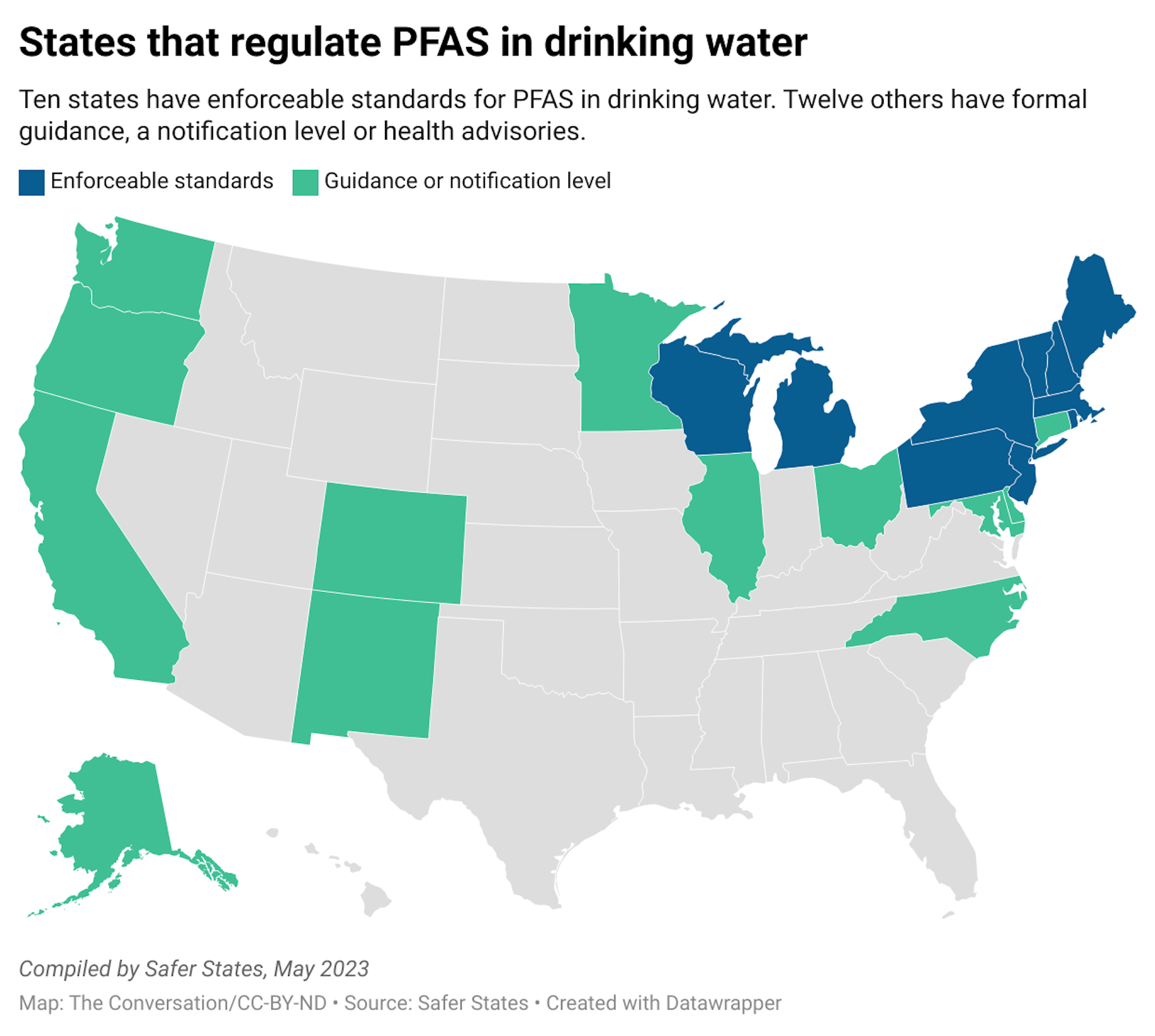
At least 24 states have laws targeting PFAS in various uses, such as in food packaging and carpets. But relying on state laws places burdens on state agencies responsible for enforcing them and creates a patchwork of regulations which, in turn, place burdens on business and consumers to navigate regulatory nuances across state lines.


So, what can you do about PFAS?

Based on current scientific understanding, most people are exposed to PFAS primarily through their diet, though drinking water and airborne exposures may be significant among some people, especially if they live near known PFAS-related industries or contamination.

The best ways to protect yourself and your family from risks associated with PFAS are to educate yourself about potential sources of exposures.

Products labeled as water- or stain-resistant have a good chance of containing PFAS. Check the ingredients on products you buy and watch for chemical names containing “fluor-.” Specific trade names, such as Teflon and Gore-Tex, are also likely to contain PFAS.

Check whether there are sources of contamination near you, such as in drinking water or PFAS-related industries in the area. Some states don’t test or report PFAS contamination, so the absence of readily available information does not necessarily mean the region is free of PFAS problems.

For additional information about PFAS, check out the Agency for Toxic Substances and Disease Registry, EPA and U.S. Centers for Disease Control and Prevention websites or contact your state or local public health department.

If you believe you have been exposed to PFAS and are concerned about your health, contact your health care provider. The Agency for Toxic Substances and Disease Registry has a succinct report to help health care professionals understand the clinical implications of PFAS exposure.

This article was updated June 23, 2023, with 3M’s settlement agreement.

Kathryn Crawford, Assistant Professor of Environmental Health, Middlebury

This article is republished from The Conversation under a Creative Commons license. Read the original article.

Do at-home COVID tests still work? New research suggests they are less effective than thought

Most of us have taken a COVID test at home. The uncomfortable nasal swab, the anxious waiting as the red lines bleed into either positive or negative. And then finally, the result. The whole process can leave many of us wondering if these little tests are actually accurate. Given their widespread use in lieu of more accurate tests doctors can order, take home COVID tests can play a big role in the pandemic, so their precision is critical.

Last summer, reports surfaced that many at-home COVID tests were yielding false negatives. Adding to a confusing time during the pandemic, experts warned that a negative at-home test didn’t necessarily mean that one was clear of the illness. Today, as daily COVID numbers have stopped being tracked, people are still getting infected — all while the state of at-home testing is murky. Now a new study published in the journal Microbiology Spectrum sheds light on just how accurate these tests are, and their limitations.

At-home tests function by detecting the presence of substances called antigens that stimulate an immune response against COVID. The presence of antigens is an indicator that a patient has the SARS-CoV-2 virus, which causes COVID. While it varies by brand, at-home tests generally work when a person swabs their own nostrils and then exposes the sample to a liquid chemical, which will then determine if they are positive or not by detecting the presence of the antigen being tested.

In the new study, researchers at California Institute of Technology tracked viral loads in three places of the human body — nose, throat and mouth — over the course of a COVID infection. While they expected to observe similar virus levels in the three locations, their results told a different story that started to raise complexities and questions around at-home tests. Specifically, that the virus appears in a person’s throat and saliva first, and then their nose.


Want more health and science stories in your inbox? Subscribe to Salon’s weekly newsletter The Vulgar Scientist.


“We wanted to ask the question: How well do the rapid antigen tests detect people who are infected, and how well the rapid antigen tests detect people who are not just infected, but actually infectious and capable of transmitting the virus to other people?” Alexander Viloria Winnett, biology graduate student and study co-author, told Salon. “There are a lot of studies out there with kind of conflicting results, likely because the population that is actually doing the test makes a big difference for how well the tests performed.”

The authors of the study found that when looking at the performance of the test cross-sectionally, at-home antigen tests are only 44 percent accurate. 

“Then if we subsetted that to people who were infectious, meaning that they had high viral loads that are likely to be transmissible to other people, we found the performance was still fairly low — just above 60 percent,” Viloria Winnett said.

“There are a lot of studies out there with kind of conflicting results, likely because the population that is actually doing the test makes a big difference for how well the tests performed.”

At first, at-home tests were believed to be more accurate. Popular at-home tests BinaxNOW and QuickVue were estimated to have an accuracy in the range of 85 percent, meaning they missed about 15 out of 100 people who are infected. Due to the way they work, they were known to be effective at detecting an infection when a person has a high viral load, meaning the point of illness that someone is most likely to infect others, by testing the viral load in a person’s nose.

Reid Akana, co-author of the study, explained to Salon that one unique part of their study was that they measured the number of viral particles in various specimens, perhaps suggesting that the nose isn’t the best place to test, as most at-home antigen tests were designed and approved to do.

This doesn’t mean the accuracy of at-home tests has declined, but rather researchers are better able to understand their limitations.

“We wanted to measure the viral load in each of those three specimen [throat, nose and saliva] types, just to see if there’s any differences in the dynamics there or how they evolve over time, and this has quite large implications for nasal antigen testing,” Akana said. “What could feasibly happen is that someone could have a very low viral load in a nasal swab and not be detectable by the antigen tests, whereas they could have very high viral loads in saliva or throat or another specimen type — potentially infectious, viral loads.”

In that case, the antigen test wouldn’t detect the virus.

Viloria Winnett said this doesn’t mean that the accuracy of at-home tests has declined, but rather researchers are better able to understand their limitations. When asked what the future holds for at-home antigen tests, Akana said declaring them “useless” would be “a step too far in one direction.”

“I think that these sorts of tests do have their place, but it’s just really important to understand the caveats behind them,” he said. “That the limit of detection of these tests aren’t necessarily in line with the viral load necessary to be infectious, you can be infectious in other specimen types, but not the infectious and specimen type you’re actively testing.”

“Colossal political miscalculation”: Potential witness rips “spineless” Republicans defending Trump

A prominent former conservative federal judge appointed by President George H.W. Bush slammed Republicans who are still staunchly backing former President Donald Trump after he was indicted by a federal grand jury.

Michael Luttig, a former judge on the 4th U.S. Court of Appeals, wrote a Sunday opinion piece for The New York Times titled “It’s Not Too Late for the Republican Party,” haranguing members of his party that continue to demonstrate “spineless support” for the twice-indicted Trump.

“The former president’s behavior may have invited charges, but the Republicans’ spineless support for the past two years convinced Mr. Trump of his political immortality, giving him the assurance that he could purloin some of the nation’s most sensitive national security secrets upon leaving the White House — and preposterously insist that they were his to do with as he wished — all without facing political consequences,” Luttig wrote. 

Luttig opined that the conservative party’s best hope was to divorce itself from all affiliations with Trump and cease emboldening and validating the ex-president and his antics.

“Indeed, their fawning support since the Jan. 6 insurrection at the Capitol has given Mr. Trump every reason to believe that he can ride these charges and any others not just to the Republican nomination, but also to the White House in 2024,” Luttig argued. 

“In a word, the Republicans are as responsible as Mr. Trump for this month’s indictment — and will be as responsible for any indictment and prosecution of him for Jan. 6,” he continued. 


Want a daily wrap-up of all the news and commentary Salon has to offer? Subscribe to our morning newsletter, Crash Course.


Luttig asserted that endorsing Trump for the 2024 presidential election would be a “colossal political miscalculation.”

“The stewards of the Republican Party have become so inured to their putative leader, they have managed to convince themselves that an indicted and perhaps even convicted Donald Trump is their party’s best hope for the future,” Luttig stated. 

“If the indictment of Mr. Trump on Espionage Act charges — not to mention his now almost certain indictment for conspiring to obstruct Congress from certifying Mr. Biden as the president on Jan. 6 — fails to shake the Republican Party from its moribund political senses, then it is beyond saving itself. Nor ought it be saved,” he added. 

Legal experts say Luttig, who testified before the House Jan. 6 committee about his role as an informal advisor to former Vice President Mike Pence at the time of the deadly Capitol insurrection, may be a potential witness in the government’s investigation of Trump’s actions on Jan. 6.

“Luttig advised Pence about his authority to prevent certification of the electoral college vote. Seems like that would make him a witness & we’ve not seen any litigation over privilege issues, so, very likely he’s spoken with prosecutors. That makes this an interesting take,” tweeted former U.S. Attorney Joyce Vance.

“I wouldn’t be surprised if Judge Luttig was interviewed by Jack Smith’s team as a potential witness,” added former federal prosecutor Renato Mariotti.

“Although his conversations with Pence could be protected by privilege, that appears to have been waived,” he added. “Accordingly, Luttig may know more than we do about Smith’s intentions.”

“Illegal”: Trump caught diverting campaign donations as legal bills pile up

Former President Donald Trump has been siphoning money raised for his 2024 presidential campaign into a political action committee (PAC) that covers his personal legal finances.

When Trump launched his campaign in November, 99 cents of every dollar raised went toward his campaign while one cent was diverted to his Save America PAC. But sometime this winter the split quietly changed and the fine print was amended to read that 10% of donations would go toward the PAC, according to The New York Times. Based on fund-raising figures released by his campaign, Trump may have sent at least $1.5 million to Save America as a result of the change, using donors to cover his legal fees rather than pay them himself, according to the report.

Even before the ex-president announced his re-run plans, Save America was paying for fees associated with investigations into Trump and his allies. Save America had about $122 million on hand in February 2022 but filings show that its funds fell to just $18 million by the beginning of this year. The remainder had been allotted to staff salaries, and Trump’s political activities in 2022, while $60 million went to another PAC, MAGA Inc., and more than $16 million went to cover Trump’s legal fees. 

Generally speaking, “a PAC cannot spend money directly on the candidate’s campaign, and a campaign committee cannot directly pay for things that benefit the candidate personally,” the Times noted.

Democratic election lawyer Marc Elias wrote that Trump’s scheme, as described, is “illegal.”

“I think in this particular situation, specifically because of the use of the leadership PAC to pay legal expenses and potentially other expenses that would be illegal personal use of campaign money, there’s an unusual incentive for the leadership PAC to take in more than it normally would,” Adav Noti, senior vice president and director of Campaign Legal Center, told the Times.

“He can use the campaign to pay for legal bills that arise out of candidate or officeholder activity — and of course, some of the current legal matters fall into that category, and some do not, and some are in a gray area,” Noti added. “It really depends on what matter we’re talking about.”


Want a daily wrap-up of all the news and commentary Salon has to offer? Subscribe to our morning newsletter, Crash Course.


Trump spokesman Steve Cheung did not answer specific questions about how the funds are divided.

“Because the campaign wants to ensure every dollar donated to President Trump is spent in the most cost-effective manner, a fair-market analysis was conducted to determine email list rentals would be more efficient by amending the fund-raising split between the two entities,” he told the Times.

Trump’s legal bills have ballooned in size since his last campaign began, owing largely to two recent indictments — one related to hush money payments made to adult film star Stormy Daniels in 2016 and the other over the former president’s Mar-a-Lago classified documents case.

Trump’s messianic appeal can’t be replicated

Well, that was quite a weekend, wasn’t it? 

For a while there it looked as if Russian President Vladimir Putin might be overthrown by a monstrous mercenary warlord named Yevgeny Prigozhin. If that wasn’t strange enough, after taking over a couple of cities en route to Moscow, the plan was abruptly aborted and the warlord was quietly sent packing to Belarus while his mercenary troops were cordially invited to join the Russian army. Nobody knows why. Now it just remains to be seen if the Putin regime has been permanently damaged or whether it was just another surreal moment in the increasingly surreal era.

Meanwhile, back in the equally surreal USA, the Republican presidential candidates all attended the annual conservative evangelical gathering, The Faith and Freedom Coalition Conference. By all accounts, the crowd was very excited to see all the candidates make their pitch, but the keynote speech by former president Donald Trump was the star event by a mile.

They should rename their group the Bad Faith Coalition.

Former Vice President Mike Pence came out on Saturday, the one-year anniversary of the Supreme Court’s overturning of Roe, in favor of a national abortion ban at 15 weeks, which GOP Sen. Lindsey Graham of South Carolina explained would be really great because they could start “saving babies in California.” Some of the faithful were reportedly disappointed because they want a full ban with no exceptions but most are willing to go along with this idea as a first step.

If you ever wondered about the sincerity of these folks, this move says it all. For years they said they simply wanted to devolve the abortion issue to the states. They insisted that all the alarm about banning abortion across the nation was overblown. I think we know better now, don’t we? They should rename their group the Bad Faith Coalition.

Florida Gov. Ron DeSantis only vaguely alluded to his main rival, Donald Trump, during his speech, reserving most of his ire for the woke and the woke and, of course, the woke. He did mention in passing that the wall never got built and that “some” of his opponents have criticized him for going after Disney — for being woke. I didn’t get the impression that the crowd saw him as any different than the other wannabes and he even signed a six-week abortion ban. That is a testament to just how little they think of him even if many of them share his agenda.

The biggest moment of the conference came from former New Jersey Gov. Chris Christie who had the temerity to criticize Trump. He told the startled crowd:

“Beware, everybody, of a leader who never makes mistakes. Beware of a leader who has no faults. Beware of a leader who says that if something goes wrong, it’s everybody else’s fault, and he goes and he blames those people for anything that goes wrong. But when things go right, everything is to his credit. I’m running because he’s let us down. He has let us down because he’s unwilling … to take responsibility for any of the mistakes that were made and any of the faults that he has and any of the things that he’s done. And that is not leadership, everybody. That is a failure of leadership.”

That was when the booing got very loud. If there’s one thing they won’t stand for it’s hearing the truth. Christie responded by saying,

You can boo all you want. But here’s the thing: Our faith teaches us that people have to take responsibility for what they do. People have to stand up and take accountability for what they do. And I, I cannot stand by.”

They were unmoved.


Want a daily wrap-up of all the news and commentary Salon has to offer? Subscribe to our morning newsletter, Crash Course.


Christie explained to the media afterward that he expected to get booed but that he thinks it’s important for people to hear what he said. The problem is that as important as one might think it is for Republicans with conservative credentials to stand before a group like that and tell them what they don’t want to hear, their beliefs don’t stem from never hearing it. They hear it. They just don’t believe it.

Trump once again proclaimed “I am being indicted for you” which, as expected, went over very well with the evangelicals. They love a messianic message.

They believe that Donald Trump is the victim of cascading witch hunts because he was so successful as president and won so hugely that the Democrats and the RINOs had to steal the election from him and indict him for crimes he didn’t commit. They don’t believe he made any mistakes for which he needs to acknowledge or apologize, so slamming his character is meaningless to these people.

Trump spent a lot of time confessing to the crime for which he’s been indicted under the Espionage Act by insisting that he had every right to commit it because he used to be the president. That’s his story and he’s sticking to it. And he once again proclaimed “I am being indicted for you” which, as expected, went over very well with the evangelicals. They love a messianic message.

But he also talked a little bit about politics too.

He took credit for ending Roe v. Wade by thoroughly politicizing the Supreme Court and bragged that “no president has ever fought for Christians as hard as I have —- I got it done, and nobody thought it was even a possibility.” He got a standing ovation for that. But he also pointedly did not endorse the 15-week national ban, instead saying that the federal government has a “vital role” in protecting unborn life and praising states for the great progress they are making in banning abortion. Trump’s smart enough to see how lethal the issue is for Republicans but he’s stuck just like the rest of them. There is no finessing this issue.

But he reserved much of his speech to push his strong wartime message:

“As we gather today, our beloved nation is teetering on the edge of tyranny. Our enemies are waging war on faith and freedom, on science and religion, on history and tradition, on law and democracy, on God almighty himself.”

In case you were wondering, the enemies he was talking about are Americans. But he also promised to keep out all the foreigners who are helping to destroy the nation. Back in 2016, it was Muslims and Mexicans. He’s casting a wider net this time:

Trump went to Michigan the next night and took it a step further. He pledged to “drive out” those who are already here:

DeSantis only promises to “destroy leftism.” Trump’s making it personal.

All of this was happening on a split screen, with a possible Russian coup attempt by a former chef turned mercenary general threatening to topple the Russian government on one side and a reality TV star defeated president who happens to be under both state and federal indictment vowing to purge all the alleged Marxists, Communists and fascists in America on the other. Surreal doesn’t begin to describe it. 

“That’s not the law”: Legal experts say Trump’s new defense shows he’s “in for a world of trouble”

Former President Donald Trump claimed on Saturday that he had the “absolute right” to keep documents after leaving the White House but legal experts say that defense won’t hold up in court.

Trump, who pleaded not guilty earlier this month to 37 charges related to his handling of classified documents, has repeatedly claimed that he had the right to take the documents under the Presidential Records Act, which legal experts have refuted.

Trump reiterated his defense during a speech at the Faith & Freedom Coalition’s annual conference on Saturday.

“Whatever documents a president decides to take with him, he has the absolute right to take them,” Trump claimed.

“He has the absolute right to keep them or he can give them back to NARA if he wants, he talks to them like we were doing and he can do that if he wants,” he added, referring to the National Archives and Records Administration. “That’s the law and it couldn’t be more clear.”

Legal experts rejected Trump’s claim.

“That’s not the law,” warned former federal prosecutor Andrew Weissmann, who served on special counsel Bob Mueller’s team. “You knew you had to return the docs, cause multiple lawyers told you that.”

The Washington Post reported earlier this month that Trump rejected advice from his attorneys to return all of the documents and reach a settlement with the National Archives before the FBI searched his Mar-a-Lago residence in August and found over 100 secret documents.

Trump instead listened to the advice of Judicial Watch activist Tom Fitton, who is not a lawyer and who told him that he had the right to keep the documents.

“Absolutely nothing about this is true,” the watchdog group Citizens for Responsibility and Ethics in Washington (CREW) tweeted in response to Trump’s claim. “If this is his defense, he’s in for a world of trouble.”

Rep. Dan Goldman, D-N.Y., a former federal prosecutor who served as the lead Democratic counsel in Trump’s first impeachment, tweeted that Trump’s “argument should be precluded at trial by the judge because it’s a false representation of the law.”

“The Special Counsel will likely move to preclude it and would win that motion with any objective judge,” he predicted.

Longtime Harvard Law Prof. Laurence Tribe called the former president’s defense “ludicrous.”

“There are only 2 ways for Trump to avoid conviction in the MAL case,” he predicted. “Get Judge Cannon to delay trial till a new president pardons him, or get a Florida juror pre-committed to acquit regardless of the facts and the law. His odds look good.”


Want a daily wrap-up of all the news and commentary Salon has to offer? Subscribe to our morning newsletter, Crash Course.


Legal experts previously told Salon that Trump’s defense would not fly given the allegations in the indictment.

“The records Trump is alleged to have illegally retained are agency records, such as records of the CIA, NSA, and Department of Defense, not presidential records,” former U.S. Attorney Barb McQuade told Salon.

“Trump isn’t charged with any violations of the Presidential Records Act,” added former Assistant U.S. Attorney William “Widge” Devaney. “Trump is charged with having secret and top secret information, refusing to turn it over, obstructing the government’s attempts to turn it over and causing people to lie about those records. I mean, it’s really apples and oranges.”

Supreme Court leaves Navajo Nation high and dry

In a major blow to the Navajo Nation, the U.S. Supreme Court on Thursday ruled that the federal government had no obligation to supply water to the tribe.

In a 5-4 vote, the court ruled that water security for the Nation did not fall to the judiciary branch, but rather Congress and the President.

“The burden now is on tribal nations to advocate for themselves and intervene whenever water rights are an issue,” said Morgan Saunders, a staff attorney in the Washington D.C. office of the Native American Rights Fund.

Writing for the majority, Justice Brett Kavanaugh held that the 1868 treaty, which established the Navajo Reservation, reserved water for the tribe, but did not require the government to take active steps to build the infrastructure needed to secure said water – an issue that has become more pressing each year as the Colorado River Basin, a major source of water for the tribe, experiences record-setting heat and some of the driest years ever recorded.

“In short, the 1868 treaty did not impose a duty on the United States to take affirmative steps to secure water for the Tribe – including the steps requested by the Navajos here, such as determining the water needs of the Tribe, providing an accounting, or developing a plan to secure the needed water,” Kavanaugh wrote.

Since 2003, the Navajo Nation has been arguing that the federal government must quantify the amount of water they have access to in the Basin as well as the potential infrastructure they need to access the water. The Nation maintained that the 1868 treaty – which ceded nearly 22-million acres of land to the United States and ended the internment of Navajos at Bosque Redondo – established the reservation as a “permanent home”, meaning that the United States agreed to take affirmative steps to secure water for Navajo citizens. The court rejected that argument.

“My job as the President of the Navajo Nation is to represent and protect the Navajo people, our land, and our future,” wrote Presiden Buu Nygren in a statement. “The only way to do that is with secure, quantified water rights to the Lower Basin of the Colorado River.” 

The decision leaves water infrastructure for the Navajo Nation on unsure ground, and could reverberate along the Colorado River Basin where 30 tribal nations rely on the river’s water supply. Of those 30 tribes, 12 of them, including the Navajo Nation still have “unresolved” rights, meaning the extent of their rightful claims to water have not been agreed upon.

In his dissent, Justice Neil Gorsuch, who is an expert in Federal Indian Law, accused the majority of “misreading” the Navajo’s request and “applying the wrong analytical framework,” adding that the Nation was looking for the government to “formulate a plan” for the tribe to access water rather than hold the government responsible for paying for pipelines or other aquifers to do so.

“Where do the Navajo go from here?” Gorsuch asked rhetorically. “The Navajo have waited patiently for someone, anyone, to help them, only to be told (repeatedly) that they have been standing in the wrong line and must try another.”

He said the tribes have done all they could including writing to federal officials, petitioning the Supreme Court and seeking to intervene in ongoing water-related litigation as well as awaiting 20 years on the court’s ruling in this case.

“At each turn, they have received the same answer: ‘Try again,'” Gorsuch wrote.

With over 17 million acres of land and over 300,000 citizens, the Navajo Nation is the largest reservation in the United States. Yet, Navajo citizens, on average, use only seven gallons of water per day for household needs compared to the national average of 82 gallons per person per day due to a lack of infrastructure. It’s estimated up to 40 percent of Navajo households don’t have running water.

This article originally appeared in Grist at https://grist.org/indigenous/supreme-court-leaves-navajo-nation-high-and-dry/.

Grist is a nonprofit, independent media organization dedicated to telling stories of climate solutions and a just future. Learn more at Grist.org


EPA announces new pesticide protection measure applied to 27 animal species: Report

The Environmental Protection Agency (EPA) announced on Thursday that it is proposing a new slate of protections for 27 species that are most vulnerable to pesticide use. Among the lucky creatures to be covered by these regulations are an extremely rare two-inch toad from the Rocky Mountains, a beautiful wild chicken whose males sport orange or golden air sacs on their necks and a beetle that was controversially thrown under the bus by a notoriously anti-environmental former American president, Donald Trump.

Neonicotinoids are the pesticides most notorious for being linked to the collapse of bee colonies throughout the world — a development that could endanger the global food supply.

In a draft white paper continuing policies started last year by the EPA’s Vulnerable Species Pilot program, the agency announced a proposal to limit pesticide use within specific regions to protect 27 of the “most vulnerable endangered species,” according to the official press release. The agency linked this new policy to the fact that at the time it was announced, it was National Pollinator Week.

“Pollinator health affects biodiversity, ecosystems, global food supplies, and human health,” EPA Deputy Assistant Administrator for Pesticide Programs Jake Li explained in the statement. “The proposed mitigations we’re announcing today are tailored to where these 27 listed species, including pollinators, live and our new maps make it easy for people to find and visualize this important information.”

Among the species that would benefit is the Wyoming toad, which is perhaps most famous for inhabiting the wild only in a single sanctuary in Mortensen Lake National Wildlife Refuge. Featured in either dark green, grey or brown, this tiny toad (it grows up to a mere 2.2 inches in length) once had broad range, existing all over southeastern Wyoming, but today has reached the verge of extinction due to a number of man-made causes.

“A very charming little toad!” exclaimed Lori Ann Burd, environmental health director at the Center for Biological Diversity, which has long advocated for stronger anti-pesticide policies like this from the EPA. “Highly endangered. Amphibians in general are very susceptible to pesticide impact because of living in and out of water. They get multiple routes of exposure because their skin is very porous.” Burd also expressed excitement that the Attwater’s greater prairie chicken is on the new list.

“It’s the only bird on that list,” Burd pointed out to Salon. “It was just found to be imperiled by neonicotinoid insecticides.” Neonicotinoids are the pesticides most notorious for being linked to the collapse of honeybee colonies throughout the world — a development that could endanger the global food supply. Many countries have banned them, but not the United States.

Indeed, the rusty patched bumble bee appears on this list for similar reasons, with the EPA observing that the highly intelligent and social bee species began to experience a severe population decline in 2007 due to a confluence of factors like “pesticides, pathogens, climate change, and habitat loss (and resulting loss of nectar sources and nesting spaces).”

Coincidentally, male Attwater’s greater prairie chickens have coloring similar to that of bees, sporting vibrant yellow and black plumage surrounding their necks and faces. These wild chickens are figuratively as well as literally colorful: When the males decide to court females, they gather in an area of either bare ground or short foliage called a “booming groundor lek.” They compete by dancing and calling out – not unlike men at a night club.


Want more health and science stories in your inbox? Subscribe to Salon’s weekly newsletter The Vulgar Scientist.


“Amphibians in general are very susceptible to pesticide impact because of living in and out of water. They get multiple routes of exposure because their skin is very porous.”

Yet perhaps none of the animals on the list have a story quite like the American burying beetle, at least in terms of their political background. In September 2020, the Trump administration controversially downlisted the popular and beautiful bug from endangered to threatened. By doing so, the Trump-era EPA opened up much of the beetle’s habitat in Oklahoma to exploitation from oil and gas companies. The strikingly orange-and-black insect had been labeled as endangered since 1989, and the decision to remove its endangered status struck many as motivated by economic considerations rather than any meaningful improvement in the beetle’s population. (The Center for Biological Diversity filed a lawsuit the following January.) As of 2020, the American burying beetle’s numbers had declined more than 90 percent despite the beetle previously inhabiting much of the eastern United States.

In addition to protecting many animal species, the new EPA policy would extend to many endangered plant species like the Leedy’s roseroot, the Mead’s milkweed, the Okeechobee gourd and the Palmate-bracted bird’s beak. It would be implemented through the dual approach of geographically limited pesticide use restrictions and measures intended to minimize how much harm pesticides can cause to wildlife when they are used. The EPA has also created an interactive website which allows the public to see the full list of protected species and the geographic region that would be covered by the new proposed policies.

That said, although Burd is optimistic that the proposals will be passed, it is “a whole other ball of wax” whether people will actually follow the new regulations.

“The label is the law and failure to comply with the label is illegal and can result in penalties, so I hope they will [follow them],” Burd told Salon. “That’s all we have in the world of pesticide regulation: counting on people to follow the label. But I think in the real world, people don’t always use pesticides exactly according to the label. I don’t think every time any one uses a pesticide, they go to all the websites that are referred to on the label and check them out. But I do think this puts them a notice. This gives them a heads up.”

Russians in “Ukraine will be fighting a war on two fronts”: Rebellion means Putin is now weaker

The Ukrainian military has finally amassed enough forces, supplies, and other resources – including a much-needed infusion of new weapons and munitions from the United States and NATO — to launch its counteroffensive against the Russian invaders. On four fronts, the Ukrainians and Russians are engaging in fierce battles that in many places resemble the hellish trench warfare of more than 100 years ago during the first World War. In some areas, the Ukrainians have successfully pushed back the Russian invaders – inflicting and enduring a large number of casualties in the process. Elsewhere, the Ukrainians have had much less success, often retaking a small amount of territory only to be forced to withdraw by Russian counterattacks.

On Wednesday, Ukrainian President Volodymyr Zelenskyy told the BBC that the counterattack’s progress has been “slower than desired” and that “We would definitely like to make bigger steps….But nevertheless, those who fight shall win and to those that knock, the door shall be opened.”

On Friday, Russia faced an armed rebellion spearheaded by Yevgeny Prigozhin’s Wagner private army, which appeared to briefly seize control of the military headquarters south of Moscow. The uprising was quickly squashed, however. By Saturday, a brokered settlement was announced between the Wagner PMC group and Russian leader Vladimir Putin.

“This is good for Ukraine. They just drew an ace.”

In an attempt to make better sense of the Ukraine war and its newest phase, Putin and Russia’s threats and goals, lessons for the United States and its national security, and what comes next, I recently spoke with Elliot Ackerman. He is a New York Times best-selling author of several books, including “2034: A Novel of the Next World War,” “The Fifth Act: America’s End in Afghanistan” and “Places and Names: On War, Revolution and Returning.” Ackerman’s new book is “Halcyon.” Ackerman is also a contributing writer at The Atlantic and a Marine veteran, having served five tours of duty in Iraq and Afghanistan, where he received the Silver Star, the Bronze Star for Valor and the Purple Heart.

This conversation has been lightly edited for length and clarity on breaking news events:

We spoke several days ago about Russia and Ukraine. On Friday, it appears that some type of mutiny or insurrection was initiated by the Wagner mercenary group against Putin. As of now, Saturday morning EST time, events are still developing, but what do we know at this early point?

Our conversation ended last week with an observation about how important it is to expect the unexpected, and here we are.

Yevgeny Prigozhin, who spent nine years in a Soviet prison for thievery and then had a successful business career that started as a hot dog vendor (you can’t make this stuff up), has risen to prominence as the head of the Wagner Group, a mercenary organization that Putin has used not only to outsource the war in Ukraine but also the war in Syria before that. Prigozhin has become increasingly critical of Russia’s command structure. He has now threatened to march on Moscow unless the chief of the Russian military agrees to meet with him; however, by the time this is printed, he may very well be on the outskirts of Moscow, as he’s only kilometers away now. 

Putin’s frontline forces are deployed in Ukraine, are training to be deployed, or are being reconstituted. Putin has a huge internal security force at his command. What do we know about the forces he has to suppress a mutiny-insurrection or even a full-on coup attempt?

The capability of these forces—which are quite capable—means much less than their loyalty. We’ve seen this time and again in the past few years, in which a well-equipped, well-trained army folds in the face of a smaller force. This is because war is fundamentally a political act; it’s politics by violence. If Putin’s security services decide that the politically expedient and safe move is to align themselves with the insurrectionists, then the size and scope of those services don’t matter because Putin no longer controls them. The politics of this moment is everything.

“The Ukrainians—out gunned for much of this war—have shown us through their actions that human will is the most impressive weapon in their arsenal; our strategy should be to get them more of the actual weapons they need.”

What does this potentially mean for the Ukrainian war? Specifically, for the Ukrainians and their counteroffensive?

This is good for Ukraine. They just drew an ace. Does it mean that the war will be over tomorrow? No. But even if Putin survives, he’ll be weaker. Starting today, any Russian who wants to fight in Ukraine will be fighting a war on two fronts, the second front being the political opposition at home.

Given the still-developing nature of these events, what are your greatest worries or fears right now?

Putin and Prigozhin have both behaved like animals in Ukraine, and cornered animals are dangerous. We should all be rooting for a Russia without Putin, but what comes next could be just as bad or worse. Autocrats the world over—from Xi in China to the ayatollahs in Iran—are watching this. They surely see themselves in Putin. This stokes fear and people don’t always act rationally in the face of fear. Particularly despots.


Want a daily wrap-up of all the news and commentary Salon has to offer? Subscribe to our morning newsletter, Crash Course.


The war continues. How are you feeling at this point? And what of all the expectations by many military and other experts that it would have been over by now? The predictions that the Russians would roll over the Ukrainians in a few weeks of battle have most certainly not aged well.

War, by its nature, is irrational. That makes it unpredictable. However, we can certainly say that this summer is an important one. Ukraine’s allies have spent much of the last year building up its military with equipment. The Ukrainians have fielded many fresh units in preparation for a counteroffensive. The Russians, who were on the offense this winter, didn’t take as much ground as some experts might have predicted. The Ukrainians have an opportunity to prove that they can outperform the Russians. If that happens, success builds on success, and they’ll be in a stronger position when the weather turns cold again. Is this enough to “win” the war; no, at least not in the short term, but Ukrainian success this fighting season could buy them another fighting season, and by that time you could start to see a meaningful accretion of territorial gains that could lead to an end game—maybe not a total victory—but at least an end game that the Ukrainians might accept.

Definitions matter. As a military professional and expert, what does a “counteroffensive” really mean? What conditions should be met? How did Ukraine’s leaders decide this was the time to attack the Russians across multiple fronts?

“Putin and Prigozhin have both behaved like animals in Ukraine, and cornered animals are dangerous.”

A “counteroffensive” is just that, an offensive action undertaken by a force that had previously been on the defensive. All through this winter, the Ukrainians have been on the defensive, particularly at the strategic level. They’ve focused on holding ground, on bleeding the Russians in places like Bakhmut, on persevering manpower, and on building up their stores of equipment. They’re now deploying those resources against the Russians with the hope of taking back territory in the east that they lost during the invasion.

There are multiple fronts and battles in Ukraine. These fronts and battles are part of a larger strategic plan and war on both sides. How do we help the general public to better understand the relationship between these different moving parts and the big picture?

Unlike, say, the war on terror, or the war in Syria, the war in Ukraine is relatively simple. It’s a conventional war. It has a clear aggressor: the Russians. It has a nation that was invaded without provocation: Ukraine. The Russian aggressor is occupying the sovereign territory of the Ukrainian defender. The Ukrainians want their country back. That means pushing the Russians across the border. That’s the big picture.

Now, how you accomplish that, that is far more complicated. The execution involves understanding the strengths and weaknesses of your army, your adversary’s army, the political conditions in your country, the countries of your allies, and your adversary’s country. It involves understanding the battlefield as not only physical terrain but psychological terrain, too. It also involves understanding how armies not only maneuver across distance, but across time. How an offensive at one moment might be a terrible idea, but at another might be exactly the right move. This is all the business of war, a very old business.

There is a widely circulated video of US and German armor that was destroyed and severely damaged by Russian mines, anti-tank missiles, and artillery during a failed breaching operation. It is inevitable that the world will soon see images of destroyed F16s and Abrams tanks as well. What are the myths vs realities of how those weapons systems will and are impacting the battle so far?

The weapons systems you mentioned above are pretty spectacular. If you’ve ever been around an Abrams when it fires its main gun or been proximate to an F-16 as it drops ordnance, it’ll rock you in your socks. But these aren’t wonder weapons. They cannot destroy everything and they themselves can be destroyed—as you noted. Also, we cannot produce them in unlimited numbers. It takes time to replace this equipment. Weapons alone don’t win wars. Human will is what wins wars. The Ukrainians—out gunned for much of this war—have shown us through their actions that human will is the most impressive weapon in their arsenal; our strategy should be to get them more of the actual weapons they need.

The Ukrainians have used drones and other means to attack Moscow, railways, and other infrastructure inside of Russia and far behind the front lines of battle. What is the impact of such attacks? What type of planning and training do such operations require?

These types of “special operations” have a significant psychological impact. The drone attacks inside of Russia remind me of America’s Doolittle Raiders in the Second World War. Immediately after the attack on Pearl Harbor, when the Empire of Japan had the U.S. on its backfoot, the Doolittle Raiders attacked Tokyo. The damage they caused didn’t meaningfully impair Tokyo’s warfighting capacity, but it had a huge psychological impact. It showed the Japanese people that America could strike them at home, and it allowed Americans to land a blow at the outset of a broader war. These types of operations require enormous, detailed planning by some of the most highly trained soldiers in any military. They are strategic in nature, so the cost of failure is often as high as the reward for victory.

The drone and other attacks and sabotage against Moscow and Russia at large are a lesson in the vulnerability of the United States as well.

We remain vulnerable to attack. The recent drone strikes in Moscow demonstrate that vulnerability, but so did 9/11 or even the recent Chinese spy balloons.

The Atlantic and Pacific Oceans have served our homeland well in the past, but they’re not impenetrable defenses, particularly in an increasingly connected world. The pandemic also showed us our vulnerabilities, not only to a virus coming from China, but our economic dependence on actors who don’t have our best interests at heart.

More than a year later, how are the Russians “seeing” the battlefield and war now?

“The longer the war goes on the greater the risk that the Ukrainians won’t lose this war on the battlefield, but at a ballot box.”

The Russians are becoming more prepared by the minute. Russia has a tradition of bungling the beginnings of its wars and then performing better over time. This was the case in the Napoleonic Wars and the Second World War. However, this hasn’t always been the case. Soviet performance in Afghanistan didn’t improve with time. Unlike Napoleon’s France and Hitler’s Germany, Ukraine has not invaded Russia. Ukraine does not represent an existential threat to everyday Russians—no matter how Putin tries to spin it—so you might not see that same Russian increase in performance that has historically occurred when there’s an attack on the Rodina, the homeland.

There are military and other experts who are predicting that the Russians will succeed in stopping the Ukrainian counteroffensive. US intelligence appraisals, as I understand it are concerning as well. There are other analysts who are predicting that the Ukrainians have a very good chance of succeeding. What are your thoughts?

It depends on how you define success. If success is that the Ukrainians push the Russians all the way back to the pre-February 24, 2022, borders and take back the Crimean Peninsula this summer, I’d agree that this seems pretty unlikely. If success means that the Ukrainians through their tenacity, valor, and military competence have put the Russians on notice that this war is unwinnable while also retaking meaningful chunks of territory, then I wouldn’t be too quick to discount the Ukrainians. Unfortunately, in the short term, it seems like the war will go on.

Many billions of dollars of equipment, arms, munitions, and other support have already flooded into Ukraine. What are some specifics of what they need now? And what of those who still say that we are escalating the war and making it more likely to spread and drag on needlessly by providing the Ukrainians with all the weapons they are requesting?

The list of weapons needed by the Ukrainians is long: F-16s, main battle tanks like the Abrams, HIMARS rocket launchers, Bradley fighting vehicles, etc. Since the war’s inception there has been a line of thinking within the Biden administration and among our allies that by giving the Ukrainians the weapons they need, we might escalate and prolong the war.  I couldn’t disagree more strongly with this philosophy.

The past eighteen months show that by arming the Ukrainians at a trickle we have prolonged the war, giving the Ukrainians just enough to fight, but not enough to win. This plays into the Russians’ hands. Putin knows that time is on his side. He knows that he’s not just fighting against the Ukrainians but that he’s also fighting again an alliance, and alliances often fall apart. The longer the war goes on the greater the risk that the Ukrainians won’t lose this war on the battlefield, but at a ballot box. In 2024, in the U.S. and Europe, we and many of our allies are holding elections. The outcome of those elections will prove critical to the war effort.

War is a cruel teacher and manmade laboratory of the worst sort. At this point more than a year in, are there any new lessons about modern warfare or is this just a refresher course on what was learned going back to World War I and before about modern warfighting?

Everything in war changes. Everything in war stays the same. On the one hand, we have soldiers slogging it out in trenches, pounding each other with artillery. On the other, we have drones spotting for that artillery, signals intercepts turning cellphone data into targeting data, and sophisticated influence campaigns being waged by both Russia and Ukraine against each other’s populations. War is always a hybrid of the new and the old, the genius and savagery within us.


Want a daily wrap-up of all the news and commentary Salon has to offer? Subscribe to our morning newsletter, Crash Course.


What have you learned from American and European and other volunteers who have served in Ukraine? What are their direct impressions of what is happening on the ground there?

I’ve spent some time reporting from Ukraine. Among the volunteers, many of whom were veterans of the 9/11 wars, the prevailing sentiment was that this war was so uncomplicated in comparison. In Ukraine, you know who the enemy is. The battle lines are clearly drawn. And the combat is kinetic and intense. We’re not seeing IEDs in Ukraine. We’re not talking about insurgency. It’s strange for many to be fighting in such a different type of war.

There are no “do overs” in war. But if given the opportunity would Putin have launched this invasion given what he knows now? If so, what do you think Putin would have done differently?

Putin did not expect the resistance he met, so I imagine he would’ve made a very different set of decisions had he known. But for too long we never expected Putin would invade, so we’re guilty too.

In war, expect the unexpected. It’s a good rule of thumb, one that might save your life.

What are Putin’s strategic goals at this point? What does “victory” look like for him and Russia?

It’s critically important in any war to understand one’s adversary, no matter how reprehensible. We should all be trying to get into Putin’s head—so long as we don’t stay there too long. For Putin, this war is about a restoration of Russia, about upsetting the Western-led global order that has dominated since after the end of the Cold War, and it’s also about capitalizing on what he perceives as Western weakness. For him, victory is Russia appropriating a significant chunk of Ukraine while simultaneously proving to the world and his erstwhile allies that the West is a decadent paper tiger, a society so inwardly focused and so beset by divisions and decadence that it can no longer stand up to strong men like him and Xi. Putin is playing for keeps, so are the Ukrainians, and so should we.

Toxic positivity and the GOP primary’s plight with mental health

Historically, talk of mental health in the public forum has been suppressed. Not anymore. For a topic society has long encouraged people to open up about — while simultaneously subduing it – mental health is now being contorted by conservative politicians into a polarizing touchpoint.

To see how this is playing out in a progress-detracting manner for the state of the mental health movement, look no further than the sardine-packed 2024 Republican presidential primary. Mental illness has been politically weaponized. Following the political uprising over COVID-19 vaccines, however, who’s surprised? 

Speaking from the stage of the 2023 National Rifle Association (NRA) convention, the now broken-up White House hopefuls Donald Trump and Mike Pence made their point clear: Mass shootings are a mental health problem, not a gun problem. This display of stigmatization is most commonly seen following tragic events, like the unparalleled number of mass shootings we’ve endured. It is an unrelated tool of distraction. Experts have said that not only are most people with mental illness not violent, but they are also far more likely to be victims of violent crime than perpetrators.

The medicalization of political subjects is an intersection Dr. Danielle Carr of UCLA grapples with in declaring that mental health is indeed, political.

The NRA, in particular, has become a continuously open spigot of blaming mental health, which has had quite effective implications on our mental health system, said Dr. Yanos, a licensed clinical psychologist and the author of “Written Off: Mental Health Stigma and the Loss of Human Potential.” The NRA’s anti-mental health rhetoric, part of their routine finger-pointing exercise, has coincided with increased institutional funding for the removal of individuals with mental health conditions from society.

This response, blaming mental health, is a common one, according to Dr. Naomi Torres-Mackie, a clinical psychologist at Manhattan’s Lenox Hill Hospital. Given the complexity of mental health, it is often not understood. “We’re emotional beings and things that we don’t understand, we fear,” Dr. Torres-Mackie explained. “We’re definitely talking on a broader scale about mental health more frequently, but quantity doesn’t always equal quality.”

Pence and Trump are not alone. Suicides are known to be soaring among teen girls, a sober reality that GOP presidential hopeful Nikki Haley baselessly blames on their peer transgender athletes. The former South Carolina governor spewed this factually incorrect and dehumanizing language at a recent CNN town hall. Asked to define “woke,” which the right has repeatedly demonized, Haley stammered this response:“How are we supposed to get our girls used to the fact that biological boys are in their locker room? And then they wonder why a third of our teenage girls seriously contemplated suicide last year.” 

Erasing “mental health” in the promotion of resiliency is not only creating more stigma and shame around mental health, Dr. Torres-Mackie said, but it is elevating toxic positivity.

Such examples of the GOP’s congregation of candidates stigmatizing mental health are not scarce. While comments like Haley’s, Pence’s, and Trump’s may seem like just talking points, they’re erasing the result of decades spent destigmatizing mental illness. When these not-so-micro-aggressions from candidates are compiled, the picture is clear: the GOP presidential primary has succumbed to a harmful reckoning with mental health at the expense of vulnerable and marginalized communities. These comments that are made on public platforms by top political contenders can be interpreted as an indication of one’s own value, with the potential to devalue and make people feel unworthy, Dr. Torres-Mackie said.


Want a daily wrap-up of all the news and commentary Salon has to offer? Subscribe to our morning newsletter, Crash Course.


So, what could this all mean for the landscape of mental health if a GOP candidate secures the White House next year? Well, there’s a blueprint of sorts already on tap in Florida. Trump-contending Governor Ron DeSantis’s wife, Casey DeSantis, recently announced a mental health campaign in Florida schools. Amidst the onslaught of other stigmatizing interventions Florida schools are enduring, First Lady DeSantis’s campaign is “rejecting the term mental health and replacing it with resiliency,” despite the widely accepted cultural abandonment of using the racially trope-heavy word “resilience.”

Erasing “mental health” in the promotion of resiliency is not only creating more stigma and shame around mental health, Dr. Torres-Mackie said, but it is elevating toxic positivity. This approach embodies the dangers of backtracking to a time when children were encouraged to not talk about hardship and pain. 

If Pence’s governorship of Indiana from 2013-2017 is any indicator of a potential mental health landscape under a GOP candidate, we could see an effort to return to an institutionalized approach, the likes of the 1960s abandoned approach. Governor Pence’s increasing number of speeches often raise this point of institutionalized mental health care, something he spearheaded with the 2019 debut of the NeuroDiagnostic Institute, a psychiatric hospital in Indianapolis.  

“The desire to remove people from society who we don’t quite understand and don’t know how to help, that’s a fear-based response,” Dr. Torres-Mackie said.

In agreement, Dr. Yanos considers calls for institutionalized mental health care as a distraction, not an answer, one that has people saying “yeah, yeah, yeah” despite it being a reality that addresses no one’s serious needs even if it was feasible on a policy level.

And it isn’t just conservatives advocating for this approach either. 

Eric Adams, the Democratic Mayor of New York City, recently debut a mental health response plan that was widely viewed as an institutionalized and flawed approach

The targeting of mental health as a scapegoat at the highest levels of political power has a trickle-down effect on individuals. For someone with no pre-existing mental health conditions, public blaming can invoke the onset of a mental health condition, Dr. Torres-Mackie said. Furthermore, this public display not only furthers the stigma while acting as a barrier between individuals and treatment but it also simultaneously prevents further funding for structural mental health change.

The more our political leaders target mental health as a justification, the more the entire system of mental health is harmed, devalued, and further stigmatized. Instead, mental health must be talked about as something everyone experiences.

The answer here seems simple; if people become fearful of mental illnesses as a result of not understanding them, then just up the awareness and education of mental health. This, unfortunately, is incredibly easier said than done as this is one of the many places where the stigma serves as a barrier.

Policing the grocery carts of poor Americans won’t make for a healthier country

In May, Senator Marco Rubio (R.- Fla) proposed an amendment to the Supplemental Nutrition Assistance Program, or SNAP, which would essentially prevent recipients of the program from buying “soft drinks, candy, ice cream, [and] prepared desserts such as cakes, pies, cookies or similar products.” 

“More than 40 percent of U.S. adults are obese, and roughly half have diabetes or prediabetes. These diseases can be debilitating. They are also extremely expensive, costing hundreds of billions of dollars in medical costs each year,” Rubio wrote in an op-ed for the Wall Street Journal. “That SNAP plays a role in their spread is immoral, irresponsible and reprehensible.”

Just one month later, in June, freshman Rep. Josh Brecheen (R-Okla.) introduced “The Healthy SNAP ACT,” which serves as companion legislation to Rubio’s proposed amendment and would similarly exclude sweets and other dessert items from being bought using the Supplemental Nutrition Assistance Program. Co-sponsors include Representatives Andy Biggs (R-Ariz.), Laurel Lee (R-Fla.), Glenn Grothman (R-Wis.), Michael Cloud (R-Texas) and Mike Gallagher (R-Wis.). 

This isn’t the first time that such modifications to the program, which already underwent a massive shift earlier this month as part of Biden’s debt ceiling concessions, have been suggested. 

However, as more and more Americans are projected to face food insecurity this year— a phenomenon experts have referred to as a “looming hunger cliff” — it’s increasingly important to disentangle harmful stereotypes about poor Americans and the way they shop from the realities of trying to feed one’s family healthfully and affordably in America today. It’s a nuanced issue, and one that won’t be solved with the passage of blunt instrument bills. 

In both 2016 and 2017, the  U.S. House of Representatives Committee on Agriculture met to discuss banning certain items from being eligible for purchase under SNAP. That same year, the issue was similarly debated by state government officials in Tennessee, Maine and Arkansas. 

In 2019, as Eater reported, Texas lawmakers proposed legislation to restrict food stamp users from buying soda, energy drinks, cookies and desserts. At the time, State Representative Brisco Cain (R. Texas) said that “at-risk Texans and families who utilize the Supplemental Nutrition Assistance Program are often the most susceptible to diabetes and the serious complications associated with it.” 

It’s a nuanced issue, and one that won’t be solved with the passage of blunt instrument bills.

He continued: “[The bill] seeks to curb the spread of diabetes and other health complications among Texans in at-risk populations by eliminating sugary drinks and snacks from the state’s nutrition assistance program.” 

While recent proposals to modify SNAP in this way have been primarily led by Republicans, the desire to more concretely control what recipients of the program purchase has been a bipartisan one. As Rubio argued in his op-ed, Agriculture secretaries to former Presidents Clinton, George W. Bush and Obama have all warned that the country needs to better safeguard the nutritional health of its citizens. 

Mayors of progressive cities — all the way back to New York City’s Michael Bloomberg in 2009 — have tried to petition the USDA, which administers SNAP, for waivers that would allow them to determine what is classified as “junk food” within their jurisdiction. 

As The Counter’s H. Claire Brown reported, there are a lot of problems with allowing states to enact “piecemeal junk food bans.” 

“For one, it’d mean inconsistent definitions of the term ‘junk food’—the Minnesota proposal would’ve allowed Kit Kats, while the Arkansas proposal would’ve banned all meat,” Brown wrote. As such, the USDA has always rejected those waiver requests, citing difficulty and inconsistency in implementing a junk food ban in just one state.

When you begin to dig into the various bills, waivers and proposals, there are two main underlying motivations for their development. The first seems to be a sincere motivation to increase the health of everyday Americans. However, a second more insidious motivation for proposing these bills (which does tend to be more popular with Republicans) is a belief that tax dollars shouldn’t pay for non-nutritious food.

“Why should our taxpayer dollars be allowed to be spent on junk foods that provide no nutritional value and contribute to America’s obesity epidemic?” asked Rep. Brecheen in a statement following the introduction of his proposed Healthy SNAP Act. 

Rubio argued something similar in the introduction of his bill: “By the U.S. Department of Agriculture’s (USDA) own admission, unhealthy foods and beverages account for more than 20% of all SNAP spending. This is obviously bad for taxpayers, who are projected to spend $240 billion on junk food, with more than $60 billion going exclusively to soda, over the next decade. But equally important are the health consequences for those relying on a program that is meant to supplement their nutrition. After all, there is nothing ‘nutritious’ about a two-liter bottle of soda, a bag of chips, or an ice cream cake.” 

The federal government pays 100% of SNAP benefits, while federal and state governments share the administrative costs. However, what Rubio’s statement doesn’t take into account are several other key details from the 2016 USDA study he cites. 

As ABC News reported , the data used for the study captured only transactions completed at a specific set of retail outlets and so is not a complete representation of the whole picture; the study also found that non-SNAP households spend 19.7% of their grocery budget on junk food, which is on par with SNAP households. 

As The Counter’s Kristin Wartman Lawless pointed out when the New York Times released an article about that same study with the headline “In the Shopping Cart of a Food Stamp Household: Lots of Soda,” that framing doesn’t accurately reflect the full findings of the report. In fact, researchers concluded that “differences in the expenditure patterns of SNAP and non-SNAP households were relatively limited, regardless of how data were categorized.”

“You can imagine another piece for the Times with a completely different headline: ‘In the Shopping Cart of American Households: Lots of Soda,'”  Wartman Lawless wrote. “That would begin to get at the bigger picture and an even bigger story: All Americans are heavily reliant on a poor-quality, highly processed food supply that is damaging our health.” 

Despite this, damaging cultural stereotypes about individuals on SNAP — that they are lazy, stupid or purposely make poor decisions regarding their health — have been standard fare since the Reagan-era when he spun campaign trail stories about “food stamp queens” on welfare buying steaks and lobster with taxpayer dollars.

This has been refuted again and again, even during the George W. Bush’s tenure as president, when the USDA denied a waiver request from Minnesota which would’ve allowed the state to determine what “junk food” constitutes for its residents.  “Implementation of this waiver would perpetuate the myth that participants do not make wise food purchasing decisions … [but] research has shown they are smart shoppers,” the USDA wrote in a statement at the time, according to The Counter. 

It’s interesting that so many conservatives decry the bogeyman of governmental overreach — until it comes to policing the diets of poor Americans. However, that is exactly the attitude that needs to be dismantled in order to more fully address the very pressing issues of both food insecurity and our country’s poor diet across the entire socioeconomic spectrum. 

It’s interesting that so many conservatives decry the bogeyman of governmental overreach — until it comes to policing the diets of poor Americans.

The issue is larger than just the choices a single individual makes when filling up their grocery cart, and when one starts looking into the contributing factors of America’s obesity, heart disease and diabetes epidemics,  it’s easy to start to feel like it’s Big Industry versus struggling shoppers, because that is largely the case. The diet industrial complex has completely gutted most Americans’ sense of what “healthy food” actually even is. 

“Low-fat and fat-free products flew off supermarket shelves. It took us decades to learn that when something is fat-free and full-flavored, it’s probably too good to be true,” writes PublicHealth.org in their assessment of obesity in America. 

They continued: “As it turns out, most food companies were just swapping hydrogenated oils and sugar in for the animal fats they removed from low-fat products. Hydrogenated oils are restructured vegetable oils that carry high levels of trans-fats, an amazingly evil type of fat that can raise your bad cholesterol, lower your good cholesterol and increase your risks of developing heart disease, stroke and diabetes.” 

Americans now spend more time at work than they did 50 years ago and many don’t live within walking or cycling distance of their offices and schools, so activity levels are down (while portion sizes are also up). When viewers turn on the television, they are greeted with a constant, erratic barrage of conflicting messages: Buy this delicious burger and have it delivered to your home. Buy all the materials for this diet that will help you finally lose the weight. But wait, doesn’t an ice-cold Coke sound great right now? 

In his op-ed, Marco Rubio asserted that banning SNAP recipients from using their benefits to buy non-nutritious food would compel corner stores and bodegas to carry more fresh produce and sugar-free drinks, however he offers no data to suggest that would actually be the case. 

These proposed revisions to SNAP also don’t address some of the practical concerns of those facing food insecurity. If someone is compelled to use their food stamps to buy fresh produce, do they know how to prepare those items? Even if they do, do they know how to stretch it to feed an entire family? Do they have time when they get home from work to cook a full, filling meal

It also raises some broader ethical questions, namely: If sugary soda is so bad, why not create a blanket regulation that impacts all Americans instead of just those using food stamps? And is there actually something morally wrong with packing a sweet treat in your kid’s (or your) lunch box on occasion — or is that only if you are poor? 

“As communities across our country continue to face significant hunger and nutrition challenges, it’s incumbent on Congress to invest in solutions we know work.”

Some legislators have proposed different ways to incentivize lower-income Americans to buy fresh fruits and vegetables, rather than barring what they can and cannot buy. Just last week, U.S. Senator Cory Booker (D-N.J.), a member of the Senate Agriculture, Nutrition, and Forestry Committee, and U.S. Representative Lisa Blunt Rochester (D-Del.) introduced the “Opt for Health with SNAP (OH SNAP), Close the Fruit and Vegetable Gap Act of 2023.” 

This legislation would significantly expand the Gus Schumacher Nutrition Incentive Program (GusNIP), which already incentivizes low-income recipients to consume fruits and vegetables by offering participants in some areas a dollar-for-dollar match in SNAP when they purchase fresh produce, thereby doubling their buying power. 

In a release, Booker and Blunt Rochester pointed out that even though the Dietary Guidelines for Americans recommend at least 50% of a person’s diet should be fruits and vegetables, less than 10% of Farm Bill agricultural subsidies go to farmers growing fruits and vegetables, and instead go to commodity crops like corn and soy, which are predominantly used in feed for animals, ethanol, or processed foods.

“As communities across our country continue to face significant hunger and nutrition challenges, it’s incumbent on Congress to invest in solutions we know work. The GusNIP program is one of those solutions that helps get healthy foods to communities that need them the most,” said Blunt Rochester. “The program creates a virtuous cycle for our communities, local producers, and local economy – which is why I’m so proud to partner with Senator Booker to introduce the OH SNAP Act to close the fruit and vegetable gap and make our communities healthier and stronger.”  

As for Rubio’s proposed amendments to SNAP, he has said that he is hopeful he may be able to make some headway because the current United States Secretary of Agriculture, Tom Vilsack, has returned to the role after serving under President Obama from 2009 to 2017. However, Vilsack’s Agriculture Department recently told Spectrum News that it does not approve of Rubio’s plan.

“Rather than focusing on restricting choice, which would increase program costs and complexity and undermines the dignity of millions of Americans by assuming that low-income Americans are unable to make decisions that are best for themselves and their families, USDA has worked to make healthy choices more accessible and within reach for all Americans,” a department spokesperson said in an emailed statement to the publication. 

“And Just Like That,” Charlotte takes her final form: white woman demanding to speak to the manager

Charlotte York Goldenblatt could use better friends.

To the casual “Sex and the City” voyeur, this concept is incongruent with its mission. That show marketed a lot of merch and trends, but topping its bestseller list was, and is, the resilience of friendship. And Charlotte (Kristin Davis) came through the ’90s and early ’00s the most consistently supportive and supported bud, if not the one most people wanted to be likened to in those character quizzes.

This continues in “And Just Like That …” when Charlotte, by force of will, adds filmmaker, fine art collector and fellow rich lady Lisa Todd Wexley (Nicole Ari Parker) to her clutch of ladies who lunch. Charlotte initially pursues Lisa because she’s a distinguished Black woman, and Charlotte decides she and Harry (Evan Handler) need more people of color in their social circle.

But she and Lisa turn out to be more alike in important ways than, say, she and Carrie (Sarah Jessica Parker) or she and Miranda (Cynthia Nixon), her remaining confidantes in a group that once included Samantha Jones (Kim Cattrall), who Charlotte tolerated for Carrie’s sake.

When Charlotte scores an invitation to the Met Gala, it’s Lisa who shares her fitting appointment for her bespoke gown, not Carrie. (Surely not Miranda, who has flitted off to L.A. to get her some more Che Diaz, played by Sara Ramirez). And when uptight Charlotte explodes upon discovering her eldest child Lily (Cathy Ang) consigned a slew of designer items in her closet with a local luxury resale chain called The Real Deal, only Lisa truly understands her rage.

“And Just Like That” remains style-forward, but subplots like this betray its tendency to lag a few steps behind the conversation.

“This is blasphemy,” Lisa affirms after glimpsing Lily’s miniature Chanel offered up online, like some common rag – and marked down, no less. “I think that’s Lagerfeld’s last collection. In a few years it’ll be worth three times that.”

“Four!” Charlotte spits, adding, “I am furious! Can I sue?”

This would have been a fine time for Lisa to advise Charlotte to let these threads go. Maybe Lisa didn’t realize Charlotte was serious. If she had, she might have stopped her new pal from marching into one of The Real Deal’s physical locations and demanding they return a dress her child has outgrown. “They took advantage and they took my Chanel!” she chirps.

All it would have taken is a simple warning: “This is Karen behavior.” Friends don’t let friends trend in that direction. Real ones save us from ourselves. But Lisa is an enabler, as is Carrie, who flanks Charlotte as she accosts the Real Deal clerk and growls out the signature line of her type: “Listen Eden: My husband is a partner at a major New York law firm. So you might watch your tone, or I’m going to call your manager!

When “And Just Like That” resumed Carrie, Miranda, and Charlotte’s New York adventures in 2021, and in their 50s, the show’s creator Michael Patrick King did his personal best to make up for the original version’s heteronormative whiteness by inserting two Black women, including Lisa, Columbia professor Nya Wallace (Karen Pittman) and real estate broker extraordinaire Seema Patel (Sarita Choudhury) into their lives. As a reminder, King’s best efforts at inclusion also consist of “2 Broke Girls,” which memorably featured one of TV’s cringiest Asian stereotypes imaginable.

If the first season stumbled through awkwardly welcoming non-white, queer characters into its fold, a mission the show still hasn’t entirely figured out, the second yanks our attention to the wear and tear time has visited upon their quirks.

Bringing Lisa, Seema and Nya into the fray also brought each veteran character’s personality flaws into relief – including the supposedly sexually inquisitive Carrie who, in her podcast with Che, a nonbinary comedian, discovers she’s uncomfortable slinging slang referring to the vagina. This hesitance continues in the new season where, on her podcast, she balks at referring to down there as, um, down there in a sponsorship segment.

And Just Like ThatNicole Ari Parker and Kristin Davis in “And Just Like That” (Craig Blakenhorn/Max)
But the shape that Charlotte’s shock at Lily’s closet clearing takes makes her previously adorable affectation not so cute. “Sex and the City” is a cultural influencer that predates TikTok and Instagram, setting the bar for fashion and au courant activities like drinking Cosmos and weekly brunches. “And Just Like That” remains style-forward, but subplots like this betray – or is the right word fulfill? – its tendency to lag a few steps behind the conversation when it comes to sociocultural matters.

In these opening episodes, Charlotte is the same tightly wound princess she’s always been. But the child-sized Chanel mess brings out a side of her that’s very 2020.

The term Karen is common enough that it has gone from being feared by white women to explained by Parade magazine to being reconsidered as a sign of empowerment: “Are You Being A Karen, Or Are You Just Assertive?” asks a HerWorld.com headline. To the writer’s credit, the point of the article is to let whoever needs to get the message know that Karen-qualifying behavior is not acceptable.

Nobody, or not enough people, conveyed that message to Charlotte, although it’s unclear whether that’s what King and his co-writer Susan Fales-Hill were going for or whether they simply wanted to have fun with Davis’ character showing out. If it’s the second desire, we’re left with the realization, or reminder, that all this time “SATC” fans have been applauding a Karen.

And Eden of The Real Deal, who probably earns an hourly wage, is the most recent visible casualty of her self-involvement.

Perhaps that’s the point. Charlotte cannot ever cease making every situation about her and how she sees the world. When Miranda breaks the news to Carrie and Charlotte that she’s leaving Steve for Che, who seduces her with a cloud of shot-gunned weed smoke and nimble fingers, Charlotte can’t wrap her head around Miranda’s queerness. Even during that lunchtime conversation with Lisa, with her best male friend Anthony (Mario Cantone) in attendance, when Lisa tries to change the subject by ordering a vodka tonic for herself and Charlotte, Ms. York Goldenblatt can’t take the hint.

“Why the day drinking, you might ask?” she teases before explaining that her judgmental mother-in-law is coming over with her sorority sisters for afternoon tea, adding, “And she’s the president of the Comments That Cut Like a Knife chapter!” This slices an opening for all kinds of follow-ups or commiseration. Nope.

Charlotte responds to Lisa’s distress with, “I’m just so surprised at Lily. It was a gift!”

Overall Charlotte remains a good person. But she’s also an example of a nice white woman who demands and expects things she isn’t owed.

Season 1 of “And Just Like That” gave rise to a small consensus that out of all the show’s characters, new and returning, Charlotte emerged on the other side as the least odious and most solidly herself. Miranda transitions into her 50s clumsily and racially clueless. Carrie loses Big and her mind for a while, so we excused her faceplant into widowhood and applauded her when she found her footing again.

Charlotte remained Charlotte, more or less – prissy but ultimately understanding, making motherhood her measuring stick for success. She supports her child Rose when they came out as gender-fluid and wanted to be known as Rock (Alexa Swinton) because that is what the best mothers do.

These examples and others lend validation to the argument that Charlotte is more progressive than “Sex and the City” viewers gave her credit for being in the past. The reality is a little more complicated, as the dress fit demonstrates.

And Just Like ThatKristin Davis in “And Just Like That” (Craig Blakenhorn/Max)

In “Sex and the City” Charlotte always strove to be proper and was often wrong in the process. Back in the ’90s she tsk-tsked at Samantha’s usage of the phrase “Black talk” and informed her the politically correct way to say such things is “African American talk.” (No. No, it wasn’t, and no, it isn’t.) Charlotte also inserted herself in a circle of powerful Manhattan lesbians so she could have new experiences, hiding her straightness until she couldn’t.


Want a daily wrap-up of all the news and commentary Salon has to offer? Subscribe to our morning newsletter, Crash Course.


Overall Charlotte remains a good person. I can’t picture her allowing Richard Burton to totter off-leash in an area reserved for birders in Central Park, let alone threaten the life of a man calling her on such a transgression. She’s a stickler for following guidelines.  But she’s also an example of a nice white woman who demands and expects things she isn’t owed and attempts to enforce rules nobody asks her to.

Battling the wave “And Just Like That” created is as senseless as Charlotte’s tirades. If you understand that few if any of the millions watching will ever age into this lifestyle then, like Seema’s many lays, it’s a harmless good time — a fantasy of maturing chicly even after, say, accidentally urinating on oneself after hip surgery. If Carrie Bradshaw can recover from that, why not us?

But do not mistake Charlotte for the one who has it all figured out, even when it dawns on her that her “speak to the manager” ire is less about how she loses Lily’s couture than losing her little girl. When Carrie, a beat or two too late for Eden, warns Charlotte of how close she is to becoming a meme, the Chanel crusader comes to her senses.

“I don’t need that dress. I have the memory. And Lily! Whoever she is now,” she tells Carrie before adding, “Let’s go.”  There’s no indication that Charlotte apologized to the young woman at the store. Why should she? Moving on is more in character. And Carrie doesn’t hold her buddy accountable for her abusive behavior. She’s just there to buy shoes.

“And Just Like That” streams new episodes Thursdays on Max.

Science and corporadelics in Colorado: Can mushroom-capitalism save us from an existential crisis?

At $1,800 for a business-class ticket, the Colorado Convention Center’s Bellco Theater is full on Friday night with the who’s-who of a burgeoning psychedelics industry that’s predicted to be worth $100 billion by 2030. The dress code is “psychedelic business casual” on the final night of Psychedelic Science 2023 — the largest conference of its kind in history with more than 11,000 attending, according to event sponsors the Multidisciplinary Association for Psychedelic Studies (MAPS).

The man of the hour is MAPS President Rick Doblin. His legacy spearheading the campaign for FDA-approved MDMA trials and a lifetime spent bouncing around psychedelic research units have led him to the Denver stage. He steps out to greet a roaring crowd, ready to deliver the week-long conference’s closing remarks. 

That’s when, from the back of the theater, the drum starts. Like a heartbeat — boom-boom, boom-boom — growing louder. Then come the shouts. A woman’s voice rises above crowd, calling to the stage. 

“We are Indigenous! And we have been excluded!” she shouts. “The Native coalition asks Rick Doblin: Where were you yesterday during our panel? Where is the panel for sexual assault survivors?”

“You’re erasing our cultures. Please stop. Think. Please look at the cycle of colonization and how this continues to happen.”

A group of protesters gather and slowly move toward the stage, drum beating steadily against a tide of jeers from a mostly white crowd that’s suddenly lost its zen. Doblin, hands over his brow as he peers out from under the stage lights, tells the protesters that now’s not the time. The crowd’s booing grows more hostile, someone shouts “Security!” The heartbeat-drum continues. 

“We tried to be as inclusive as we could be,” Doblin says, pacing as the crowd starts chanting on his behalf. 

Doblin seems to realize he’s losing control. Finally relenting, he offers the protesters one minute of speaking time on stage. A woman takes to the mic, followed by others who climb up. 

“Where are the Indigenous people of these lands? The elders?” she asks. “Where are the investors, investing in Land Back water rights?”

When she yields the mic to a young Indigenous man, he implores the crowd not to be deceived by commercial interests posing as healthcare. The crowd boos him too.

“You’re erasing our cultures. Please stop. Think,” he says, voice trembling. “The same happened to tobacco. Now it causes cancer. The same happened to opioids. Now it causes addiction. Same happened to coca. Now cocaine causes a lot of harm. Please look at the cycle of colonization and how this continues to happen. In 2030 and decades from now, you’re going to see the medicine harming you because they are living beings and they don’t like to be abused.”

“This isn’t a collective liberation movement. This is a capitalization and you’re stepping on our plants. You’re stepping on our medicines.”

The Science of Risk 

The chemical responsible for a psychedelic experience actually penetrates — down to the cell — a part of the brain that is otherwise hardened by a dense structure

Critics of the encroaching control of corporatizing forces in the emerging world of psychedelic research were not limited to the event’s Indigenous contingent. Before being allowed to present their studies at Psychedelic Science 2023, researchers and scientists were required to sign a contract with MAPS. It included two notable clauses, as reported by Psymposia’s Russell Hausfeld

First, presenters would be barred from making appearances related to their research for a full four months (two before the event, two after) anywhere within a 500-mile radius of Denver. Second, and more controversially, presenters could be turned away if they offered any statements that “discredits MAPS or tarnishes its reputation and goodwill” (or were affiliated with an organization).

Following the publication of Psymposia’s article, MAPS reportedly released all presenters from the radius clause of the contract, though the reputational clause remained — drawing concerns over potential interference with academically independent critique. But other worries appeared about MAPS’ handling of scientific ethics when presenters were reportedly told that their slides which contained conflict-of-interest statements would be removed — and that the information would be tucked into the event’s app. 

“Unless the audience checks the app, they would have no idea if a speaker declared a COI,” Psymposia’s Brian Normand said in a tweet

The clauses drew critical glances from more than just the press. MAPS sponsors some of the most advanced Food and Drug Administration clinical trials on psychedelics and continues to curry millions of dollars in donations to fund the path it’s quickly charting toward FDA-approval of MDMA (sometimes called “Molly”) for therapeutic use. But that path has been perilous for some, and MAPS has a history of being criticized by some of the participants in those trials.

In a notably timed Friday release, the Food and Drug Administration issued its new draft guidance on the use of psychedelic drugs in clinical research. 

“FDA may place a study under an IND [investigational new drug] under clinical hold if it finds, among other reasons, that human subjects are or would be exposed to an unreasonable and significant risk of illness or injury,” the agency said, noting that subjects receiving active treatment with psychedelic drugs remain in a vulnerable state for as long as 12 hours, depending on the substance. 

At Psychedelic Science 2023, neuroscientist Gül Dölan presents research on the opening of “critical periods” of cognitive development. (Photo by Rae Hodge)The agency proposed any subject being tested would need two professionals monitoring them at all times — a lead with graduate-level professional training and clinical psychotherapy experience, licensed to practice independently, and an assistant with a bachelor’s degree and at least one year of experience in a licensed mental healthcare setting (though not necessarily licensed themself). 
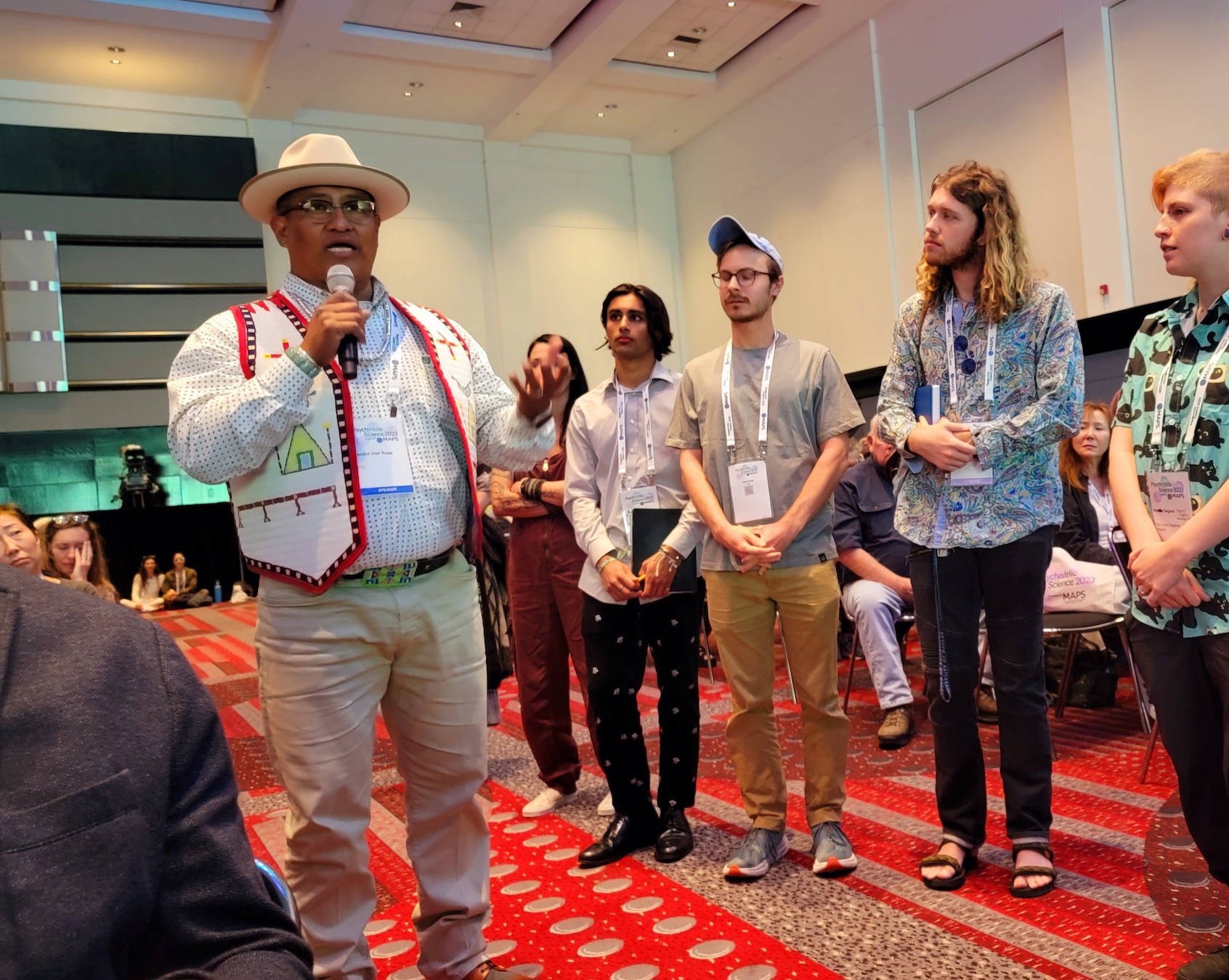
In 2020, Doblin told Quartz in an interview that he negotiated with the FDA to conduct psychedelic therapy with one license per two-person team. 

“We do not think it’s necessary or important for both people to have a license,” he said, arguing the second licensed therapist could make treatment too expensive for patients.

The Science of the Sacred

Scientifically speaking, something rather miraculous happens inside the brains of mammals when we take psilocybin in a therapeutic context. The chemical responsible for a psychedelic experience actually penetrates — down to the cell — a part of the brain that is otherwise hardened by a dense structure, and unlocks a level of cognitive development that we leave behind in our early years of cognitive development.

Neuroscientist Gül Dölen called this a “critical period” — and explained to the conference crowd that this unique process could allow us to experience and heal levels of cognitive development that we haven’t had access to since childhood. 

Most remarkable, however, is that this effect doesn’t disappear after the trip. Once the immediate effects of a mushroom trip subside after a few hours, the long-term benefits and ability to access this “critical period” remain remain available for up to two weeks more.  


Want more health and science stories in your inbox? Subscribe to Salon’s weekly newsletter The Vulgar Scientist.


“Where you grew up, and what culture you were raised in has a big impact on our understanding of the rules of hierarchy and dominance … So if you go to a new culture, you will struggle to adapt to the social rules if you don’t have any familiarity. And so people intuited that there was a ‘critical period’ for this type of learning on your social environment,” Dölen said. 

Neuroscientist Gül Dölen called this a “critical period” that could allow us to experience and heal levels of cognitive development that we haven’t had access to since childhood. 

But psychedelics, she explained, are proving to offer access to a potentially wider range of critical learning periods where humans can re-learn pro-social values that could be healthy for therapeutic treatment. 

There’s no critical period for human psycho-spiritual development, though. While religious indoctrination is often entrenched in childrearing across both Indigenous and Abrahamic traditions, we humans are not limited to any single window of time when it comes to developing a faith in the divine through moments of religious ecstasy. Nor, among the non-religious, is there any deadline for undergoing what foundational psychologist Abraham Maslow called “peak experiences” of transcendent communion with a sense of timeless universal connectedness. 

Altered states of consciousness can and do find us, at any moment throughout our lives, from dreams to orgasms to yes, taking drugs. It’s this hopeful fact which drove conference-goers to overflow into hallways and scramble for seats during a packed Thursday session held by researchers from John Hopkins and New York Universities. In the course of their small but uniquely important study, the researchers gathered 24 religious clergy from 16 distinct organizations — giving each of them two high-dose psilocybin sessions, then monitoring participants for long-term changes.  

Researchers were introduced by Anthony Bossis, a clinical assistant professors at NYU’s Grossman School of Medicine, who told the audience that implications of psychedelic research may far exceed usefulness in the treatment of clinical disorders.

“They may promote meaning-making. They may force you into spiritual continuous dialogue. And they may be useful in consciousness and religious studies. Are we wired for meaning?,” Bossis said. “And, if so, why?”

Though the participants’ identities were not revealed, researchers relayed both quantitative findings of the study and the post-session statements of participating clergy. Like the words of a rabbi of the Jewish Renewal movement who, Bossis said, expressed 

“The experience deepened and open my appreciation of other religions as well as my own,” the rabbi told Bossis. “And I realized that each have this incredible truth. And all the truths are in all religions to some degree. Some of them just highlight one factor more than the other, but the active ingredients are all the same.”

Sandor Iron Rope, president of the Native American Church of South Dakota, addresses NYU and John Hopkins religious researchers. (Photo by Rae Hodge)Remarkably, none of the clergy reported that the experience was incompatible with their fundamental theology, or resulted in any crisis of faith — though the challenges reported included a difficulty integrating the experience into their everyday life because they didn’t feel like they could talk to their communities. 
“An experiential reference point for understanding theological beliefs. The words before, of their theological understandings may be understood conceptually or intellectually from their training. It was now felt and understood from the lived experience,” said researcher and therapist Cody Swift.

“These types of studies are the only way that the Western world could really understand the correlation of Spirit and these medicines.”

There are reasons to remain skeptical and wary of even the good-faith efforts of religious researchers. The long-promised psychedelic industry is steadily becoming concentrated in the hands of pharmaceutical and tech giants before it’s even off the ground, it is haunted by the voices of test subjects who suffered the trauma of unethical research, and it teeters on the edge of further colonizing an Indigenous medicine at the expense of its historic stewards. 

But hope persists that — if the marriage of psychedelic medicine and its cultural history is protected, and if qualitative research into our holistic human experiences is likewise seated at the table — a body politic of the psychedelic industry can still emerge which does more good than harm.  Among those voices of hope are Indigenous leaders like Sandor Iron Rope, President of the Native American Church of South Dakota and board member of the Indigenous Peyote Conservation Initiative. 

“These types of studies are the only way that the Western world could really understand the correlation of Spirit and these medicines,” Iron Rope told the research panel Thursday. “Thank you, everybody, for understanding the Indigenous perspectives and these vital cultures. And I’m looking forward to unifying and finding balance in this life.”

That sense of unification, itself the most commonly reported feeling of who undergo psychedelic experiences, is critical not only to the ecological conservation of the medicine, but to the cultural conservation of the psycho-spiritual cure the medicine has always provided humans. 

Psychedelic medicine’s intrinsic property is that it elicits in us a timeless sense of caring pro-social reciprocity only otherwise glimpsed in our earliest years — a critical period, one that the medicine re-opens long past the close of childhood’s brief hour. And if we seek a culture-wide transformation through the use psychedelic therapies, as MAPS has claimed it does, then the medicine’s rave-going euphoria and storefront availability must never be divorced from the root-deep psychological healing we ask these plants to give us as individual adults. 

Reckless western industrialization and extractive capitalization of this sacred medicine, being inherently anti-social pursuits themselves, risk making the medicine completely ineffective for those who take it. Worse yet, they risk completely stripping the medicine of any cultural transformation espoused by its biggest profiteers. Or, as Bossis put it Thursday: 

“The psychedelic experience alone doesn’t change us — unless it changes our values and our lives.”

Are you putting Parmigiano Reggiano in your espresso martinis? You should be

For anyone who’s ever spent more than two seconds with me, it should go without saying that cheese is my favorite food.

Sometimes, people will snicker at that, as if cheese in and of itself isn’t substantial or legitimate enough to constitute as a favorite food, but they are mistaken. No matter if enjoying a sharp cheddar or goat, a buttery Manchego, a pungent bleu or an unctuous Gruyere, I’m in my glory when I’m eating cheese, incorporating it into recipes of all shapes and sizes or just mindlessly munching on craggly, irregular chunks. 

To put it simply, it’s a perfect ingredient, whether it’s lightly dusting the top of a warming soup, encasing a chicken cutlet or being devoured with roasted peppers, arugula and a heaping amount of balsamic vinegar.

What often stands out for me — both in price, as well as flavor and texture — is the crumbly, cherished Parmigiano Reggiano (which, no, isn’t the same as Parmesan and please don’t pronounce it parm-eh-sahn). As reported in 2021, “When discussing Parmigiano-Reggiano, we also must note “parmesan,” which is actually quite different. While also totally delicious, it’s not as regulated, prestigious or expensive as Parmigiano-Reggiano.”

Parmesan Reggiano cheese on cutting boardParmesan Reggiano cheese on cutting board (Getty Images/MEDITERRANEAN)
Something I’ve always been fascinated by, though, is the use of cheese in desserts, drinks and other “unusual” applications. In order to further explore this realm, I spoke with Chef Michele Casadei Massari, US Brand Ambassador for Parmigano Reggiano, who may be the foremost resource for unique, specialty applications for Parmigiano. He walked me through his adoration for the flavor profile, his desire to produce interesting recipes for Parmigiano usage, how to properly honor the special ingredient and what he’s dreaming up next. 

The following interview has been lightly edited for clarity and length.

Cheese is probably my absolute favorite food and Parmigiano Reggiano might be my favorite iteration, so I’m very excited about this discussion! Cheesecake with Parmigiano Reggiano is such an amazing idea. How did you conceive of that dessert?

I am endlessly inspired by Parmigiano Reggiano and am always seeking unexpected ways to showcase it through my cooking: I wanted to explore Parmigiano Reggiano’s savory and nutty profile in a dessert. To make this recipe, I combine a traditional cheesecake base with different ages of grated Parmigiano Reggiano  the cheese adds a unique depth of flavor and a rich, creamy texture to the dessert.

Parmigiano Reggiano CheeseParmigiano Reggiano Cheese (Getty Images/Buena Vista Images)
Generally, the notion of cheese is so completely savory, sans mascarpone, ricotta and cream cheese. How does incorporating Parmigiano Reggiano into a cheesecake base subvert that? 

Incorporating Parmigiano Reggiano into a cheesecake brings a delightful twist to the conventional sweet cheesecake. Parmigiano Reggiano’s nuttiness and umami flavors effortlessly balance sweet and savory, resulting in a unique and intriguing flavor experience; it adds a rich complexity and depth to the dessert. 

“I am endlessly inspired by Parmigiano Reggiano and am always seeking unexpected ways to showcase it through my cooking”

The idea of Parmigiano Reggiano in desserts and beverages is an odd one; it’s exciting to me, but I’m sure for others, it might seem unappetizing. What led you to explore the realm of using parm. in unconventional ways? 

The exploration of using Parmigiano Reggiano in unconventional ways stems from my passion for pushing culinary boundaries. I constantly seek to create unexpected and exciting experiences for myself and my guests. While it may seem unconventional to some, experimenting with Parmigiano Reggiano in desserts and beverages allows me to spotlight the versatility of this incredible cheese and challenge preconceived notions about its usage.


Want more great food writing and recipes? Subscribe to Salon Food’s newsletter, The Bite.


One of my favorite things about Parmigiano Reggiano is the craggly, salty, crunchy bits; when making a smooth puree, does that lacking textural aspect affect the overall product? Or is the flavor so concentrated and robust that that’s not even noticed? 

When creating a smooth puree with Parmigiano Reggiano, the textural aspect certainly differs from the craggy, crunchy bits we associate with the cheese. However, the concentrated, robust flavor of the puree compensates for the lack of texture. The puree can be used as a base or sauce, adding a rich and intense Parmigiano Reggiano flavor while allowing other ingredients to provide textural elements.

Parmigiano Reggiano Espresso MartiniParmigiano Reggiano Espresso Martini (Photo by Noah Fecks)

When I first heard of the idea of Parmigiano Reggiano espresso martinis, I was amazed. I love the combination! How is Parmigiano Reggiano added to that drink to ensure a smooth, rich cocktail?  

Parmigiano Reggiano Espresso Martinis are a spectacular marriage indeed! Parmigiano Reggiano is infused into the vodka and added as a garnish, giving rise to a smooth and rich cocktail. The cheese imparts its distinct flavor into the cocktail, enhancing the overall taste experience and elevating the coffee and caffeine tango. Straining the cocktail after infusing and then garnishing ensures a smooth texture, allowing the flavors to shine.

https://www.instagram.com/p/Ck3_R8tS-lu/?hl=en

In culinary school, we made a parm stock and it was one of the best smelling and tasting things I’ve ever had. I’ve also had super-smooth parm espumas on restaurant dishes that were amazing. Beyond the martini and cheesecake, what are some of your favorite ways to work with Parmigiano Reggiano beyond the customary?

Beyond the customary uses of Parmigiano Reggiano, there are many exciting ways to work with this unique cheese. Some of my favorites include creating Parmigiano Reggiano crisps, incorporating it into savory bread or pastry dough; making Parmigiano Reggiano-infused oils or vinaigrettes; and even using it as a crust or topping for roasted vegetables.

Additionally, you can take the Parmigiano Reggiano experience to a new level by simmering the rind in a curry. The rind will soften during cooking, releasing its rich, nutty flavors. The possibilities are endless and I’m always thrilled to discover new ways to showcase the versatility of Parmigiano Reggiano and engage with other cuisines.


Chef Michele Casadei Massari's Clam Chowder with Parmigiano ReggianoChef Michele Casadei Massari’s Clam Chowder with Parmigiano Reggiano (Photo courtesy of Riccardo Pizza)From a savory perspective, I love your takes on clam chowder and chapati! Adding Parmigiano Reggiano rinds to chowder broth sounds amazing. What other ideas do you have for using parm? What else might we see from you in the future?
Parmigiano Reggiano offers infinite possibilities. In addition to the chowder and chapati ideas, you can use Parmigiano Reggiano rinds in broths, stocks, dashi, ramen or soba to enhance their flavors. You could also use grated Parmigiano Reggiano as a finishing touch on grilled meats or vegetables, incorporating it into risotto or a frittata or even create Parmigiano Reggiano-infused butter, cream sauces, hummus, tahini or even add it to labneh cheese!

As for the future, I’m always driven to create innovative dishes that highlight exceptional ingredients and Parmigiano Reggiano will continue to inspire my culinary explorations. I am particularly intrigued by Parmigiano Reggiano’s potential in the cocktail world  I currently have gin on my mind. I’ll keep you posted, I promise! 

“I am particularly intrigued by Parmigiano Reggiano’s potential in the cocktail world — I currently have gin on my mind. I’ll keep you posted, I promise!”

I love the tahini and labneh ideas! Do you consider yourself a drinks and desserts specialist? Or did the cheesecake and martini recipes strictly come about due to your desire to use Parmigiano Reggiano in novel ways?

While I thoroughly enjoy crafting drinks and desserts, the development of the Parmigiano Reggiano-infused cheesecake and martini recipes was driven by my desire to showcase the cheese’s extraordinary qualities: captivating aroma profile, nutritional benefits, the aging process, the diverse milk used in its production . . . the list goes on!

Parmigiano Reggiano’s biodiversity deserves more recognition and exploration and I’m determined to shed light on its potential in ways that have yet to be fully realized. However, it’s important to note that my culinary expertise goes beyond drinks and desserts: I enthusiastically delve into various flavors, techniques and culinary concepts that span the savory and sweet domains.

Poor air filtration in schools is driving absences and tanking productivity, but the fix is simple

As summer break releases students from schools across the country, we have an opportunity to fit classrooms with a simple and cost-effective solution to reduce skyrocketing absenteeism and address tanking American productivity.

So, what’s stopping schools from implementing this safe, effective and free countermeasure to combat airborne infections, reduce classroom pollution and even improve academic performance? The answer is simple: Not enough parents are demanding it.

At the start of the pandemic, keeping children at home slowed the American workforce, which might be why the Biden administration committed to getting kids back into schools. But although the pandemic has ended for most Americans (at least those who are not elderly, immunocompromised, or too young to find easily accessible vaccines), US schools have still seen staggering increases in chronic absenteeism, with COVID playing a significant role. At the same time, record numbers of parents have been missing work to take care of sick kids, which has been associated with a notable decline in American productivity.

Many are quick to point out that the earliest and hardest-hitting flu and RSV season — and not COVID alone — was responsible for filling children’s hospitals this past fall. But this overlooks findings as recent as May indicating that COVID damages T cell response, producing immune impairment that contributed to this surge in illness. This may explain why many parents find themselves echoing what Dr. James Antoon of Monroe Carell Jr. Children’s Hospital at Vanderbilt has said: “since September [kids have] been sick with back-to-back viruses.”

Some states, including Alabama, have put forth legislation to add thirty calendar days to the academic year with the stated goal of fighting learning loss — but must we accept sickness and record-high chronic absenteeism rates as a permanent condition for our children? Maybe it’s time to dust off the largely-neglected air filtration recommendations schools were advised to implement at the start of the pandemic.

What’s stopping schools from implementing this safe, effective and free countermeasure? Not enough parents are demanding it.

It’s not a new concept, but the past three years have taught us a lot more about how powerful clean air can be against airborne viruses. Dr. Joseph Allen at the Harvard School of Public Health has gone as far as to say that, “the person who designs and operates your building has a greater impact on your health than your doctor.”

In 2020, ventilation and filtration were recommended by experts in public health, building science and HVAC engineering. The American Society of Heating, Refrigerating, and Air-conditioning Engineers (ASHRAE)’s official position is that their own standard is “not meant for infection control” and that standard ventilation levels are “significantly lower than levels recommended” for our current challenges. Under pressure from the White House, ASHRAE has approved a new indoor air quality standard that is, in fact, even more aggressive than many of the recommendations heretofore.

Broadly speaking, to reduce airborne infections, experts recommend that schools introduce outdoor air, use in-room portable HEPA filters and upgrade HVAC filters. Healthy air in schools is a long-term solution with broad health benefits, which can be key to managing allergies, asthma, and preventing airborne infections. With increased wildfires as a result of climate extremes, air filtration becomes an essential tool in classroom resilience. No matter the contaminant, cleaner air has been linked to improved cognitive function and academic performance.


Want more health and science stories in your inbox? Subscribe to Salon’s weekly newsletter The Vulgar Scientist.


But how much is enough clean air for buildings? Guidance co-authored by ASHRAE and the American Council of Government Industrial Hygienists (ACGIH) suggests introducing six to twelve air changes per hour of outdoor air. In most classrooms, this would be one to two cubic feet per minute (CFM) of airflow for every square foot of classroom space.

Some studies associate this amount of airflow with more than 80 percent reductions in exposure and transmission at the bottom of this range. The American Industrial Hygiene Association argues for this same range, while noting that the lower end may be inadequate for densely occupied spaces with one or more infected occupants — in other words, school classrooms. Even dropping down to the CDC’s recent recommendation of five air changes per hour still may afford a 65 to 75 percent reduction in exposure according to CDC and CERN.

“The person who designs and operates your building has a greater impact on your health than your doctor.”

The Lancet COVID-19 Commission gives alternate recommendations about how much airflow should be afforded to each occupant, which is a metric that building operators often prefer. Their best prescription? At least 30 CFM per person. Lower threshold guidelines from the WHO and CDC in 2020 amount to roughly 20 CFM per person, which is still much higher than what is required by International Mechanical Code. One analysis indicates that these ventilation rates can reduce infection risk by 70 to  80 percent in classroom spaces.

With the emerging evidence that COVID infection disrupts immune systems, there’s even more reason to protect our youngest population from repeat infections. And though high-quality masks are still an important and necessary tool, especially for those of us who are immunocompromised, many children are unable — or unwilling — to mask for long periods of time. Plus, with lunch and water breaks, consistent masking has become an almost impossible request. This might partially explain why the White House has undertaken a long-term strategy of pressing hard for ventilation and filtration.

We have the technology to slow transmission of airborne viruses. Some hospitals and office buildings already use this technology to prevent patients, employees and conference participants from getting sick. And for schools, it would be free: in 2021, the Federal Government announced it would provide $123 billion in emergency relief funds, enough to cover air filtration upgrades for public and private schools nationwide. Schools can use Elementary and Secondary School Emergency Relief Fund (ESSER) funds as late as September 2024, or later if they sign a contract before then.

This summer is an ideal time for schools to introduce quality air filtration in classrooms

As of March, these funds were only 36 percent spent, according to data compiled and published by FutureEd. It is critical for parents to stand up now as ESSER stakeholders and advocate for schools to make the important connection between air quality and attendance, as well as academic performance.

Schools that aren’t sure where to begin can receive free, expert technical assistance from the US Department of Energy’s Efficient, Healthy Schools Campaign. This program, in partnership with the EPA, can help decision-makers at US schools make the best use of Elementary and Secondary School Emergency Relief and Inflation Reduction Act funds.

This summer is an ideal time for schools to introduce quality air filtration in classrooms so that next year, parents can feel confident their children will be less likely to miss school days and spread illness to classmates, family and communities. Improving air filtration will not only help stop transmission of current viruses, but it will also protect American children from future pandemics.

We ask our children to wash their hands. We ask our doctors to wear gloves. It’s time that we ask our schools to clean the air.

Meet the creative genius behind those faux — yet deliciously realistic — Ben & Jerry’s flavors

When the Huffington Post posted a 2011 story with the headline, “‘Arrested Development’ Character Tobias Fünke Gets Ben & Jerry’s Flavor,” fans of the famed sitcom and the famed ice cream brand alike went nuts.

The exclusive pint flaunted a cut-out image of Fünke, notably played by David Cross, alongside bold letters displaying the ice cream’s official flavor: “I Just Blue Myself.” As for its actual makeup, the frozen treat promised a blueberry flavored base with rich chocolate swirls and white chocolate cut offs. Quite tasty, right?

Well, there was just one problem with the grand announcement. It was all fake. 

The Huffington Post story encouraged readers to click through to learn more about Fünke’s Ben & Jerry’s ice cream flavor and offered a link to a Vulture story, which displayed an enlarged image of the ice cream container. Aside from the classic Ben & Jerry’s typography, the ice cream was clearly an imposter… c’mon now, what in the world are white chocolate cut offs?

Turns out, the ice cream artwork was made by Jon Defreest — a creative director, graphic designer and digital illustrator from Boston, Massachusetts — who garnered online fame for his collection of faux Ben & Jerry’s flavors. In addition to Fünke’s “I Just Blue Myself,” there’s Ron Swanson’s “All of the Bacon & Eggs You Have,” Dwight Schrute’s “Beet It,” Boba Fett’s “Carbonite Crunch” and Dexter Morgan’s “Miami Slice.”

“I was a TV kid growing up. I watched a lot of cartoons and most of my art revolved around the things I was watching on TV or a lot of cartoons or a lot of my favorite characters,” explained Defreest in a recent interview with Salon Food. “So as I got older, when art became more of my full-time job, I started to pull from some more resources on TV.”

He continued, “You see a lot of ‘Parks and Recreation,’ and ‘Breaking Bad,’ ‘The Office’ and other stuff that I was into at the time, I’d say about 10 years ago. I just started blending graphic design with pop culture references to TV and television characters and I did it for a few websites here and there that I was working on at the time that no longer exist.”

Amid the mid-2000s, Ben & Jerry’s artwork was a common sight on social media, namely on Tumblr, where illustrations — from hand drawn anime styles to Western cartoons and realism — were quick to attract major fanbases. Defreest asserted that his Ben & Jerry’s creations weren’t unique per se, but they certainly showcased his love for comedy and parody art. Each of Defreest’s creations pay homage to his appreciation of pop culture, good TV and good ice cream.

“I love comedy. So if I wasn’t doing art for a living, I’d do something like writing a comedy because those are just my two favorite things — design and comedy,” he said. “I don’t do a lot of serious art. I like to weave comedy into my artwork.”

Making Defreest’s Ben & Jerry’s art requires time, patience and plenty of attention to detail. Defreest said the easiest parts are finding stock images of his chosen characters and recreating the Ben & Jerry’s logo by hand, which can then be created as copy-and-paste templates. The hardest and most time-consuming part, however, is making the bottom of each pint resemble the real deal.


Want more great food writing and recipes? Subscribe to Salon Food’s newsletter, The Bite.


“But the fun part is the details, the small things that you hope that people don’t notice right away and hopefully pick up on,” Defreest added. “I always like to hide something in my art to at least give it a few more dimensions than just the main event…something in there that’s like a little hidden joke or a little hidden something that people can appreciate.”

Defreest hasn’t updated his Ben & Jerry’s collection recently, especially after settling down with his wife and four-year-old daughter. But if he had to make a new faux ice cream flavor, it would definitely center on Netflix’s hit anthology television series “Black Mirror” — his latest obsession,

These days, Defreest is straying away from digital art and creating more tangible pieces, like wall art. In the same vein as his past work, his wall art is also inspired by pop culture and popular television shows. His most proud creation is “Bluey” themed art for his daughter.

“I’m not doing [art] commercially so much anymore,” Defreest said. “I’m still making TV inspired art. I don’t think I’ll ever escape it.”

Hope in “End Times”: Peter Turchin’s analysis of our coming collapse could help us avoid it

The day Donald Trump was arraigned for unauthorized possession of national security documents — heightening his party’s attacks on the nation’s justice system — also saw the publication of Peter Turchin’s new book, “End Times: Elites, Counter-Elites, and the Path of Political Disintegration,” arguably the most comprehensive explanation so far of the current and ongoing crisis of American politics. 

For all its breadth and depth, there’s a simple message at the core of “End Times”: At the heart of our problems, Turchin writes, is “a perverse ‘wealth pump’ … taking from the poor and giving to the rich,” and we have to find a way to turn it off. America has essentially done that before, during the New Deal era, and other nations and societies have done it as well. But only about one in five of the nation-states or empires that face cyclical crises like the one we’re in today escapes it, Turchin reports. So the odds aren’t great, unless we act fast and with purpose, making full use of what we now know. 

As I explained in my recent interview with Turchin for Salon, he was one of the few observers who saw this breakdown of political order coming. In a 2010 letter to Nature he warned: “The next decade is likely to be a period of growing instability in the United States… set to peak in the years around 2020.”  

He was drawing on a model of cyclical integration and disintegration first introduced in Jack Goldstone’s 1991 “Revolution and Rebellion in the Early Modern World.” Since then, Turchin and his colleagues have created a database of roughly 300 cases of crisis, stretching from the Neolithic Age to the present, with what he calls “good data” on about 100 of them.

For example, their analysis codes for 12 indicators of negative consequences, such as population loss (which occurs in about half such crises) and ending in revolutions, civil wars or both (which happens about 75% of the time). Cases that avoid such outcomes obviously hold valuable lessons — especially since the sample size is just about big enough to guard against cherry-picking evidence to prove some cherished point. 

It should be no surprise that the Progressive/New Deal era in America, which produced decades-long high levels of social cohesion, is one such example. But “End Times” helps us understand that as one specific example of a broader genre of successful sociopolitical responses, some of which might be less obvious. That can potentially help us think more constructively about how to find our way out of our current crisis state — and mitigate the next one.

There’s a central tension in “End Times” between the evidence about what works and the obstacles to executing those things, and that’s also based on the historical record. On the one hand, Turchin’s book strongly argues that something akin to New Deal reforms isn’t just a good idea in moral or political terms but is an objective necessity to avoid disaster and rebuild social trust. But he’s also clear about the deeply rooted forces that stand in the way of such reforms, casting them as damaging partisan politics or even an existential threat. In our interview, Turchin told me, “We don’t have to do exactly the same thing the Democrats did in the New Deal,  but somehow we have to achieve the same result. And I just don’t see that happening.”

In elite discourse today, “extreme left” and “extreme right” are routinely equated as unreasonable extremes, in contrast to an ideal version of pragmatic bipartisanship that will somehow save us. somehow the source of our salvation. But most of what is commonly called “leftist” these days is just an expanded version of the progressive policy vision that resolved America’s previous period of crisis during the Great Depression, and that vision has significant electoral support

My point is not to claim that all answers can be found on the left, which has its own internal conflicts and contradictions. But “End Times” offers a pathway toward a realistic focus on viable solution paths that elite compromise politics are doomed to obscure, if not destroy.  


Want a daily wrap-up of all the news and commentary Salon has to offer? Subscribe to our morning newsletter, Crash Course.


In three appendices to his book, Turchin provides a non-technical explanation of his approach to understanding history and how it developed over time. Goldstone’s book “was almost completely ignored” for a decade after its publication, he writes. His own experience was quite different: “To my surprise, the new science of cliodynamics, which I launched in 2003, started getting immediate traction.” The reason, he says, was his use of data, which he discusses in detail.

Turchin doesn’t even mention the biggest reason Goldstone’s book was ignored: It defied the dominant zeitgeist of the early 1990s. It was published the same year as the Soviet Union collapsed, and the following year saw the publication of Francis Fukuyama’s “The End of History and the Last Man,” which argued that we had reached “the end-point of mankind’s ideological evolution.” There were no more revolutions to be had. It was a huge hit. Everyone wanted to believe it. By 2003, not so much.

One of Goldstone’s key discoveries was this: “Before every major revolution or rebellion between 1500 and 1900, I found that indeed, population had grown substantially in the prior half century.” But “population growth was almost nil” in periods when those explosive outcomes did not happen. His model was more complex than that, and  concerned not just the size and condition of the general population, but also that of elite groups who held social power.  

Turchin had been a mathematically-inclined biologist before turning his attention to human history (his PhD from Duke is in zoology), and understood how to use nonlinear models of processes in which small changes can produce large results, as can happen, for example, with modest changes in fertility rates. Goldstone’s model, known as structural demographic theory (SDT), suggested that human systems could be modeled in similar ways. 

Of course revolutions and civil wars are complex phenomena, but Turchin’s scientific experience led him to conclude that a “relatively small set of mechanisms can generate exceedingly complex dynamics.” He sees four main drivers that lead to societal crisis, of which the most important is “intraelite competition and conflict,” and the most variable is “geopolitical factors,” which for large and powerful nations like the U.S. tend to be negligible. Another driver, “popular immiseration,” increases as population growth drives down living standards, which leads to “elite overproduction,” for example when too many middle-class college graduates compete for a stagnant number of well-paying jobs. The last driver, the “failing fiscal health and weakened legitimacy of the state,” is exacerbated by both popular immiseration and elite overproduction, which are clearly the central features.  

Turchin also focuses attention on what he calls the “engine” at the heart of the model, the previously mentioned  “perverse ‘wealth pump’… taking from the poor and giving to the rich.” It intensifies and locks in popular immiseration and also drives elite overproduction, undermining social trust at both the top and bottom of the social pyramid. 

America since Reagan has fallen prey to “one of the most fundamental principles in sociology, the ‘iron law of oligarchy,'” Turchin writes, leading to the “perverse ‘wealth pump’ … taking from the poor and giving to the rich.”

This reflects “one of the most fundamental principles in sociology, the ‘iron law of oligarchy,'” he writes, “which states that when an interest group acquires a lot of power, it inevitably starts using that power in self-interested ways.” For example, while wages fell far behind the growth of economic productivity from 1979 onward, Turchin cites analysis from the Economic Policy Institute indicating that three-fourths of that gap was due to elite-driven policy shifts: weakened labor standards, the erosion of collective bargaining, corporate globalization and so-called fiscal austerity.

That was all part of what Turchin calls the “Trend Reversal of the Reagan Era,” when the broad-based well-being and social trust from the New Deal era dramatically reversed themselves:

Diminished economic conditions for the less educated were accompanied by a decline in the social institutions that nurtured their social life and cooperation. These institutions include the family, the church, the labor union, the public schools and their parent-teacher associations, and various voluntary neighborhood associations.

The importance of the wealth pump in driving instability, and the need to constrain it to avoid collapse, cannot be overemphasized. It’s reflected in the last lines of Turchin’s book: “Complex human societies need elites — rulers, administrators, thought leaders — to function well. We don’t want to get rid of them; the trick is to constrain them to act for the benefit of all.”

That’s a lot easier said than done, of course. But clearly establishing the need, and showing that it’s not just an ideological position but an urgent practical necessity, represents a huge step forward. That alone makes “End Times” required reading for all who are serious about saving or redeeming American democracy.  

How I made my peace with “I Think You Should Leave” – a cringe comedy I was one reluctant to watch

Legs tucked underneath me as my head lolled to the side, my whole body buzzed with sunburnt warmth and fatigue from a day of walking through echo-y museum hallways and cobblestoned streets across Paris. I was eager to unwind with some quiet screentime — Paul Hollywood calling some middle-aged mother of two’s chocolate cake stodgy, perhaps. But what I got could not have been further off course. 

“What should we watch?” I asked my boyfriend — looking equally as sleepy and satiated — from across the couch at our Airbnb.

I thumbed through channels of French sitcoms from the ’80s, watching lithe and leggy women strut around cardboard set apartments in sea-green workout gear. 

A voice tinged with caution, reservation, and sheer blind hope squeaked out: “Have you watched the new season of ‘I Think You Should Leave’?”

“I Think You Should Leave” is a habitual line-crosser, a virtuoso of a series that specializes in dialing up its jokes to unprecedented levels of, well, ridiculous.

I bristled immediately. Of course, I had not. Netflix’s cult-favorite sketch-comedy series “I Think You Should Leave” created by Tim Robinson and Zach Kanin had long been a polarizing linchpin in our relationship. My boyfriend remains utterly enraptured by the show’s unhinged absurdism, while I usually struggle to give rise to an audible chuckle, save for a few smirks and snickers. Ever since the show’s third season dropped late last month, my subconscious had been silently prepping for this moment.

“I think you’ll really like this one sketch!” he said, clambering toward me as I passed him the remote through limp fingers. As the show’s signature geometric, pastel-hued intro rolled on to the screen, overlaid by John Lewis’ “Baby Bay,” I let my legs unfurl and sank deeper into the couch, bracing myself for disappointment. 

In the skit, Robinson plays Ronnie, one of numerous contestants on a sudden-elimination dating show called “Summer Loving.” Unlike the other men who are vying for a shot at love with bachelorette Megan, Ronnie has only joined the show to make overzealous and nonstop use of the zip line over the pool. Megan tells Ronnie she is considering ousting him from the show, saying, “I feel like you’re just here for the zip line,” followed by sepia-toned flashbacks of Ronnie zipping above the pool.

“You never joined us at any of the group meals, and when you were reprimanded and asked to join us, you ate as fast as you could,” Megan says, while Ronnie shakes his head in denial, his lips pressed in a hard line. Then, another clip in which a contestant asked Ronnie how he thinks his connection with Megan is. “Good,” Ronnie replies before the Thor lookalike can even finish speaking, choking back bites of a burger before boomeranging back to the zip line.

A springy feeling in my chest bubbled to a breathy snort as I watched my boyfriend throw his head back and land a primordial thump on his chest every time Robinson flung himself from the zip line into the pool. Soon enough, I was chortling right alongside him. 

I certainly never imagined that a relaxing trip to France would be the backdrop for my mental pivot about “I Think You Should Leave.” A year ago, I wasn’t laughing at this show. Whenever it was on, I became huffy, knitting my brows and aggressively scrolling through my camera roll or Twitter in silent protest.

My state of elation was undeniable. Now I just had to figure out how I’d gotten there. 

I Think You Should LeaveTim Robinson in “I Think You Should Leave” (Courtesy of Netflix)The skit itself was, admittedly, hilarious. Watching Robinson, wrapped in a sopping rash guard and baggy swim trunks, pedal his feet furiously above the water while the rest of the contestants socialize at a luau cocktail mixer was simple, stupid, comedic gold. The awkward, hypnotic quality of humor was doled out in perfect portioned dollops, straddling the line between wondering, “Am I really laughing at this?” and wanting to scream “Why aren’t you laughing at this?!” to anyone who isn’t. More than that, however, I reveled in my boyfriend’s reaction to Robinson’s antics — every resonant guffaw was a reminder of how profoundly effective this show was, and his happiness alone was enough to let each episode bleed into the next.
Right after “Summer Loving” came a skit featuring a cameo from Fred Armisen, who plays a father hoping to scare his sons into behaving better by showing them a video of him walloping a random kid on the street. However, it quickly becomes apparent that Armisen’s character staged the video through a company called Street Sets, once the “kid” is shown be an elderly stunt double. “F**king Street Sets! I paid $15k for this!” Armisen yells, followed by a clip of him shoving an old man wearing a bowl cut wig into a brick wall.  

“I Think You Should Leave” is a habitual line-crosser, a virtuoso of a series that specializes in dialing up its jokes to unprecedented levels of, well, ridiculous. It’s a cringe-comedy cornucopia, overflowing with whoopee cushions, ghost tours gone wrong, sloppy steaks and Little Buff Boys. Watching alone, the show’s humor may not land — it feels eerily off-kilter, making the viewer white-knuckle their way through the maze of Robinson’s and Kanin’s minds. But I’ve found that viewing it in groups provokes an intensely successful domino effect. A feeding frenzy of laughter nearly always ensues by the time the third or fourth skit rumbles onscreen. 

Interest in “I Think You Should Leave” is not a question of high-brow versus low-brow humor, per se. Though Robinson and Kanin waterlog each skit with wonderfully crusty and classic “immature” comedy — poop jokes, “huge cum shots” and hot dogs abound — they produce salient, albeit silly, sketches about the dissolution of social norms and scenarios, parodying our ricocheting emotions and opinions incredibly well and acting as a sort of provisional panacea for an increasingly fraught society. 

Additionally, “I Think You Should Leave” pushes boundaries for its unwillingness to release “the awkward tension of any jokes; instead, they get escalated until they veer into the surreal,” writes Amanda Wicks for The Atlantic. “More often than not, premises focus on someone’s mounting anxiety — specifically the kind that stems from misunderstanding banal situation . . .” It doesn’t get more relatable than that. 

I Think You Should LeaveTim Robinson in “I Think You Should Leave” (Courtesy of Netflix)I’d like to believe that I’m not put off by crude and ludicrous humor, as someone who grew up with a dad who owned every episode of “Jackass” on video cassette. And though shows steeped in awkwardness and idiocy — a lá “Nathan For You”, “The Rehearsal,” and “Impractical Jokers” — have always triggered my second-hand embarrassment, I still find the cringey, hijinx-stuffed premises funny. But not knee-slapping, doubled over in pain, gonna pee my pants kind of funny. “I Think You Should Leave” is no exception. The show’s third season has run the gauntlet of dippy humor, from an anthropomorphized egg with a butthole, to a TV show host who scrolls on his phone to avoid confrontation with guests, to a woman who hates her boss because he won’t allow her to keep her pet rats at the office. 
The more I watch “I Think You Should Leave,” the more I get it, which is to say, I don’t get it at all. And that’s the point

When “I Think You Should Leave” was released in April of 2019, it melded seamlessly into the full-bellied feel of the times: buoyant and completely punch-drunk with positivity. But I would not encounter the show until 2021, at the height of the COVID-19 pandemic — an era of greasy-haired, ramen noodled, puff-puff pass kind of nights. Though I, and much of the rest of the world, felt like my life was hurtling towards an ether of smudgy uncertainty, I came to find solace in quiet nights punctuated by “I Think You Should Leave’s” wacky sketches. The show was a warm, buttery glow to share with friends at the end of a Zoom-filled winter day in Manhattan, beckoning us with its particolored screen cuts and Robinson’s zany charm. 


Want a daily wrap-up of all the news and commentary Salon has to offer? Subscribe to our morning newsletter, Crash Course.


In most episodes, Robinson’s facial muscles are contorted in concentration, his mouth typically tinged red and shiny, flecked in a layer of spittle as his tongue thrashes around with each breathless word, his arms and fingers tight and rigid as he gesticulates wildly, like a frenetic toddler readying to thwack the life out of a beach-balled piñata. He, along with the show, has been a refreshing, mostly unfunny enigma, calling me back time and time again with all the appeal of a pied-piper wearing a plaid button-down and the occasional fedora.

The more I watch “I Think You Should Leave,” the more I get it, which is to say, I don’t get it at all. And that’s the point — it’s not so much about me understanding the humor or finding the jokes funny as it is about the reactions of people who do. Getting to the start of each new season of “I Think You Should Leave” is still a process that requires gentle goading, and I never choose to watch it alone. But that’s an intentional decision because, for me, cringe is a dish best served in the company of others. 

Rebellion pulls back from Moscow to avoid Russian bloodshed

Yevgeny Prigozhin’s Wagner private army has pulled back from their advance into Moscow on Saturday, agreeing to retreat towards Belarus in a deal struck that will spare them prosecution for their rebellion.

After previously stating that his army had no intention of backing down, the fray fizzled out rather quickly, with Prigozhin later stating that he wished to avoid bloodshed.

Per reporting from Politico, “ultimately, Moscow appeared an improbably ambitious target for Prigozhin and Russian regular forces appeared unable to do much to counter Prigozhin in the south.”

“During this time we did not spill a single drop of blood of our fighters,” Prigozhin said in the aftermath. “Taking responsibility for the fact that Russian blood will be shed — on one side — we will turn our columns around and go in the opposite direction to field camps, according to the plan,” he said.

Prior to the rebellion retreating, Belarusian leader Alexander Lukashenko issued a statement “claiming he held talks throughout the day with the outspoken oligarch” and that they’d come to an agreement.

“Yevgeny Prigozhin accepted the proposal of the president of Belarus, Alexander Lukashenko, to stop the movement of armed personnel of the Wagner company inside Russia, and take additional steps to de-escalate tensions,” a statement from Lukashenko’s office detailed.


Want a daily wrap-up of all the news and commentary Salon has to offer? Subscribe to our morning newsletter, Crash Course.


Ukrainian President Volodymyr Zelenskyy issued a statement in response to the events of Saturday saying, “Today, the world saw that the bosses of Russia do not control anything. Nothing at all. Complete chaos. Complete absence of any predictability . . . The longer your troops stay on Ukrainian land, the more devastation they will bring to Russia. The longer this person is in the Kremlin, the more disasters there will be.”

Chimpsky, not Chomsky: Did Nim the chimpanzee actually learn American Sign Language?

Humans are often thought to be the only animals capable of language. But it’s difficult to prove a negative like this because we’ll never definitively know the subjective interior monologues of other animals, if they even exist. Nonetheless, much research has been poured into the study of animal intellect and whether creatures like orcas, pigeons and octopuses share a similar type of sentience, especially when it comes to our close primate cousins, chimpanzees. One of the most outstanding and intriguing questions is whether chimps have language — and a little ape named Nim Chimpsky has only made the prospect more controversial. 

People who study languages almost universally know the name “Noam Chomsky.” In addition to being the father of modern linguistics, the popular intellectual has written more than 150 books on myriad political and social subjects. As a result, the name “Noam Chomsky” is familiar not only to students of linguistics, but also political nerds and social justice advocates.

“Nim’s signing wasn’t spontaneous. He was unable to use words conversationally, let alone form sentences.”

Noam Chomsky is, if nothing else, a bona fide celebrity — but who the heck is Nim Chimpsky?

No, that isn’t a cringey pun. (Well, it isn’t only a cringey pun.) Nim Chimpsky is the cheeky moniker that was once applied to a real-life chimpanzee. Because Chomsky (not Chimpsky) argues that human beings are uniquely “wired” to develop language, Columbia University psychology and psychiatry professor Herbert S. Terrace decided to work with psycholinguist Thomas Bever on training a chimpanzee how to “speak” using American Sign Language. The thusly dubbed Nim Chimpsky (as a playful rebuke to Chomsky’s theories) did not, as many hoped, unequivocally prove that chimpanzees can develop language just like humans.

Then again, some people argue that Chimpsky did prove that. It’s just that the matter remains, all these years later, intensely controversial.

As chronicled in the 2011 documentary “Project Nim,” Terrace decided to see if Chimpsky could learn human language by placing the infant monkey into the home of one of his former students, Stephanie LaFarge. The goal was to see if Chimpsky could acquire human-like language if he was raised like a real human being. Starting in late 1973, Nim Chimpsky began his life/experiment — but controversy soon arose. Despite being treated kindly, Nim Chimpsky showed unexpected aggression toward his human caretakers. His behavior was so sporadically violent that, after he attacked one of the people taking care of him in 1977, Terrace moved Nim Chimpsky back to a regular laboratory. At that point, Terrace called off the experiment.

Additionally, Terrace and his colleagues reached a disappointing conclusion: Although Chimpsky had appeared to learn language — he moved his hands and body in a manner consistent with American Sign Language, using over 120 combinations, in order to seemingly ask for things like food and affection — the evidence indicated that he was simply mimicking the behavior of the humans around him. It is possible that Chimpsky understood at least some of the “words” he was forming, but it is also very, very far from being proven.

“Nim learned to sign to obtain food, drink, hugs and other physical rewards,” Terrace later explained to Columbia University. “Nim often got the signs right, but that was because his teachers inadvertently prompted him by making appropriate signs a fraction of a second before he did. Nim’s signing wasn’t spontaneous. He was unable to use words conversationally, let alone form sentences.”


Want more health and science stories in your inbox? Subscribe to Salon’s weekly newsletter The Vulgar Scientist.


Nim Chimpsky simply wasn’t happy being forced to live with humans.

Chimpsky’s story ends first with a scare, and then rather anticlimactically: He was initially sold to a pharmaceutical animal testing laboratory, but after public outcry, moved to the Black Beauty Ranch in Texas. There he lived out his remaining days in peace until passing away of natural causes in 2000.

Yet the controversy about his legacy did not die with him. Speaking to Columbia University many years later, Terrace insisted that his experiments had proven the importance of words to the development of language. This still distinguishes Terrace’s theory of language from Chomsky’s, who argues that there is a “universal grammar” embedded in the neurology of every human brain which is unique to our species. Importantly, the presence of a universal grammar means humans can create an infinite number of meanings from a finite number of words. Yet if other animals can also form words, Terrace claims, this speaks to their ability to communicate regardless of whether they also form grammar.

“Those insights had a profound effect on linguistics and cognitive psychology,” Terrace concluded to Columbia University. “But they said nothing about words, without which none of his grammars would work. At best, Chomsky’s theories are limited to people who know words. Project Nim showed why learning words is crucial for mastering language.”

Nim Chimpsky’s life also opened up important questions about the ethics of animal research. Although Chimpsky was spared the horrid fate of living in a pharmaceutical laboratory, at least one of the humans who worked closely with him believes he was emotionally harmed by not being allowed to grow up with his own species.

“You could read [fear and apprehension] through his facial expression and his body language,” recalled Bob Ingersoll, a graduate student at the University of Oklahoma who worked with Nim Chimpsky, in a retrospective interview with NPR. “It was very distressing to him and … we were really worried about Nim and we spent quite a lot of time with him, making sure he was eating and drinking and not being picked on by the other chimps.”

Indeed, Ingersoll even remembers smoking marijuana with Nim Chimpsky, stating that “although we were familiar with chimpanzees that did things like drinking and smoke cigarettes and that sort of thing, I’d never had a chimpanzee request weed from me. That was an eye-opener.”

Yet ultimately, Ingersoll’s main observation was that Nim Chimpsky simply wasn’t happy being forced to live with humans.

“What he needed at that point was to be with other chimps,” Ingersoll concluded. “Chimps don’t need to be with humans. They need to have a chimp life. So my own personal need to hang out with Nim or walk with Nim wasn’t as important to me as doing the right thing for Nim … Chimpanzees in captivity is just not where they ought to be … I would hope that one of the lessons that we learned from Nim’s life is that keeping chimpanzees in cages is torture and really plays havoc on their mental health.”

How to build a zero-waste economy

It wasn’t until Sarah Paiji Yoo became a new mother that her journey into plastic-free living really began. 

Specifically, it was the switch to baby formula that changed her worldview. Yoo had been breastfeeding her son for a few months and was looking to transition him to a dissolvable formula in 2018. But she found herself wondering what kind of water to mix it with — bottled or tap.

There were no good options. “I was horrified to learn that regardless of whether you drink tap water or bottled water here in the United States, our water contains hundreds of pieces of microplastics per liter,” she said. 

Yoo began connecting the dots, tracing those microplastics — tiny shards of plastic that form from the breakdown of larger plastic items — back to their source. Or rather, their many, many sources. Yoo was soon seeing plastic throughout her life: It held her child’s vitamins, her toothpaste, the ketchup she kept in the fridge. “It’s really everything,” she said.

The next few years would bring a deluge of new and alarming data about plastic’s impact on people and the planet. Scientists began finding microplastics everywhere: in deep ocean trenches, near the tops of remote mountains. In 2019, researchers in Australia estimated that we ingest a credit card’s worth of microplastics every week, with unknown health effects. Other reports documented the ballooning impact of plastic pollution on marine life, as well as plastic production’s growing carbon footprint and disproportionate harms against poor communities of color.

Yoo was determined to do something about it. A self-described serial entrepreneur, she ended a self-imposed break from starting new businesses to co-found Blueland in 2019. The company’s mission is to eliminate unnecessary plastics from familiar cleaning and personal care products like dish soap, toilet bowl cleaner, and body wash — all of which it sells in concentrated tablet form, shipped directly to customers in recyclable paper packaging.

The tablets dissolve in water and can be used to refill Blueland’s durable glass or ceramic bottles. Yoo said the bottles are intended to be “the last set” of cleaning containers her customers ever buy: No more disposable plastic, no more pollution, no more hazardous tap water. “We don’t take that lightly,” she told Grist.

Yoo is among a growing number of business owners who have aligned themselves with activists and policymakers who want to move the global economy away from plastics, which are rarely recycled and are laden with toxic chemicals. The broader movement seeks to reduce plastic production, an urgent priority considering petrochemical companies’ plans to triple the amount of plastic they make by 2060. That scenario could cause more than 44 million metric tons of aquatic plastic pollution every year. 

But these advocates and entrepreneurs are also envisioning a future free from single-use items altogether. By promoting a “circular economy” — patterns of consumption that reduce waste generation of any kind — they hope to eliminate not only single-use plastics, but also disposable products made from paper and metal. Their vision will require whole new business models and supply chains that prioritize reuse — containers and dishware and shipping packages that can be used again and again rather than discarded after just a few minutes.

The Ellen MacArthur Foundation, or EMF — a nonprofit that advocates for a circular economy — estimates that businesses have an opportunity to save some $10 billion in material costs if they replace just 20 percent of their single-use plastic packaging with reusable alternatives. But the shift will also require buy-in from customers, who will have to embrace a host of unfamiliar products and practices. Some of these reusable solutions are relatively new inventions, like lightweight, concentrated formulas of familiar body care products, while others represent a return to systems that have been around for a long time: say, bringing your own container to the bulk aisle at the grocery store, or leaving glass bottles curbside to be picked up for cleaning and reuse, à la the milkmen of generations past.

American culture needs to “dispose of that disposable mindset, where everything is to be used and thrown away,” said Linda Corrado, a board member for the reuse nonprofit Upstream and an independent consultant in sustainable business strategies. She said she dreams of a day when plastic-free shopping is the default, where customers shop in stores that are “just one bulk bin after another.”

EMF has broken down the reuse market into four models defined by who owns the packaging and where it gets refilled. To get a better sense of how the reuse revolution is taking shape, Grist spoke with representatives from businesses — some of which were previously highlighted in an EMF report — that are turning those models into a reality, and to customers who have tried their products. Some companies, like Blueland, are making plastic-free refills for soap available through the mail so customers can fill up their own empty containers. Others are setting up “reverse logistics” infrastructure so people can borrow takeout containers and later return them to a dropoff location. All are trying to strike a balance, nudging consumers toward new habits while also making their systems as convenient as possible.

“With all of today’s technology and innovative solutions,” Corrado said, “the possibilities are endless.”

Broadly speaking, the Ellen MacArthur Foundation classifies reuse systems based on two factors: who owns the containers and where they’re filled. With companies like Blueland, the customer owns the container — potentially one sold by Blueland for $8 to $11 (although, for many products, any old container will do). And because refills are ordered online and delivered straight to people’s doorsteps, the system is labeled “refill at home.” 

The concept works for a wide range of products, particularly those that can be dehydrated into tablet or powder form: toothpaste, mouthwash, dishwasher detergent. Getting rid of the water in these products means they don’t have to be shipped around in huge plastic containers; customers just dilute them at home with water from the tap.

These lightweight products take up less space and are easy to move around, said Jennifer Congdon, deputy director for the advocacy group Beyond Plastics and an avid user of low-waste products. Although toothpaste and detergent refills ordered online often come with a small amount of paper packaging, she said her family prefers them to traditional items from the store, which often come with a larger plastic footprint. “We’ve reduced so much of our plastic consumption, which feels really good,” she said. 

There are refill-from-home systems that go beyond cleaning and body care, including some familiar ones that allow customers to re-create their favorite soft drinks and other beverages. Sodastream, for example — which was acquired by PepsiCo in 2018 — sells a machine that lets customers make their own carbonated water, which can then be turned into a sort of DIY root beer or cola with the addition of some concentrated flavor droplets. The brand Bevi brings this concept to office spaces, dispensing customizable drinks from a contraption that looks kind of like a high-tech espresso machine.

Companies like these refill-at-home models because they can boost brand loyalty. Once customers have made an initial investment in a company’s reuse system, buying their containers or technology, they’re less likely to switch to another one — at least in theory. Congdon says she feels “some pull” to return to her favorite reuse brands, but that she often switches between several options for different refillable products. Which one gets refilled is a matter of convenience, and sometimes, she opts for products that can be refilled on the go — in a grocery store.

Grist / Daniel Penner

Refill on the go, in which customers own their own reusable containers but fill them up at locations outside their homes, is arguably the most common reuse system. Just think of the now-ubiquitous water-bottle-refilling station, or reusable shopping bags that you bring to the supermarket. Many cities now have entire stores dedicated to this reuse model, often called zero-waste stores or refill stores.

Miriam Gordon, a strategist for the nonprofit Story of Stuff Project, which advocates for policies to reduce plastic pollution, shops at a co-op grocery store in San Francisco that carries many of its products in bulk. She brings reusable containers from home to fill with everything from spices to honey and vinegar. “There are all kinds of things” to refill, she said. “It’s really exciting to be able to do that.”

Many consumers also find it exciting to compare the per-pound prices of packaged versus bulk goods, and to save money on in-store grocery refills. Some bulk products like spices can cost just a quarter of their prepackaged counterparts by weight.

That’s not to say there aren’t still challenges. First of all, shoppers have to actually remember to bring their reusable bags and containers — it’s not refill on the go if you use those paper or plastic baggies that most stores offer in the bulk section. Containers then have to be inspected and weighed by store clerks before they can be refilled. All this takes extra time and forethought that most shoppers aren’t accustomed to.

“I’m not the average consumer,” Gordon acknowledged. Although she’s willing to take on some inconveniences for the sake of reuse — like schlepping around a heavy load of stainless steel, glass, and ceramic jars every time she does a grocery run — not everyone feels the same way. For in-store refills to catch on more widely, Gordon said she’d like to see stores offer their own reusable containers, which customers could borrow and return later.

Businesses face additional challenges in communicating the cost savings of bulk, particularly for concentrated products. For Meliora, a cleaning product company that sells soap sticks and tablets, the price-per-ounce label that’s required in many states can be misleading. They make concentrated products look deceptively expensive, said Kate Jubkas, Meliora’s founder — especially when compared with their watered-down competitors, even though they may actually cost less on a per-use basis.

“The price is going to look high for a tiny little package” of dissolvable soap, Jubkas said, even if one package is enough to fill three normal-sized bottles of all-purpose cleaner.

In some cases, restrictive health regulations give customers no choice but to use disposable packaging. While refill on the go is relatively straightforward for nonedible goods like soap and shampoo, public health departments in many places bar stores from letting people use their own containers for food. Instead, they’re required to offer disposable tubs or bags, meaning many bulk-food systems aren’t actually advancing a circular economy. In Washington, it wasn’t until late 2020 that an update to the state’s food code finally began allowing customers to bring their own containers to the bulk section, as long as a cashier visually inspected each one before use. Even now, the containers are only allowed for select items.

Aimee Simpson, formerly the senior director of advocacy and product sustainability for a small chain of grocery stores in the Seattle area called PCC, said the state still prohibits their customers from filling up reusables with foods deemed ready to eat, a category that includes many bulk favorites like nuts and granola, as well as the entire hot bar. There are also separate rules for bulk foods that have to be scooped and those that operate by gravity — as in, when you pull a lever to release food from a narrow chute. (The rules are stricter for scoops, since they present a greater risk of cross-contamination.)

Advocates for reusables nationwide say there’s a labyrinth of bulk-food safety regulations that may or may not be enforced, confusing customers from state to state and from store to store. People “really, really want to bring their own containers … but they’re getting mixed messages,” said Heather Trim, executive director of the nonprofit Zero Waste Washington. Bills in several states aim to bring clarity by allowing reusables in more situations. In Oregon, for example, Governor Tina Kotek recently signed a law directing the state’s health authority to write rules allowing consumers to bring their own containers to restaurants so they can be filled with food.

Reusable bag with lentils spilling out

Grist / Daniel Penner

For the other two kinds of reuse systems, known as return from home and return on the go, businesses own the containers, rather than individuals. The biggest hurdle in these cases isn’t necessarily customer buy-in; it’s logistics.

In the so-called linear economy, products fly off the shelves wrapped in cheap plastic and paper that companies don’t have to keep track of. The packaging becomes someone else’s responsibility — to discard, to recycle — the minute it reaches a customer.

“We are very efficient in selling products to consumers,” said Clem Schmid, general manager of Loop, a self-described “global reuse platform” that partners with major brands and retailers. “This part of the supply chain … has been optimized to death for 60 years. But returning products back to where they started is virtually a virgin land today.” 

Unlike with single-use packaging, company-owned reusable containers have to be fastidiously tracked, washed, inventoried, restocked, and refilled. All of this requires infrastructure that many companies have simply never built.

Rather than figure out all those steps on their own, businesses commonly hire a third party to do it for them. Loop, for example, helps its corporate clients set up the “reverse logistics” infrastructure that forms the backbone of returnable packaging systems. In one of Loop’s most prominent partnerships, with Walmart locations in northwestern Arkansas, customers can order a small number of food and body care products — things like ketchup and laundry detergent — that are packed in reusable squeeze bottles and canisters. In this return-from-home model, customers pay a small deposit, usually between $1 to $3, that gets refunded after a Walmart employee picks up the empty containers from people’s homes. 

The system is particularly promising for restaurants and cafes, which can participate together in a third-party reuse program that would be too complicated to manage on their own. Heather Watkins, co-founder of the Portland, Oregon-based company Bold Reuse, said many food-service locations lack the kind of dishwashing infrastructure that’s necessary for them to go fully reusable. 

Bold Reuse helps by offering a subscription service for restaurants, which can sign up to replace either some or all of their single-use dishware with reusable inventory. Participating businesses can decide to charge customers a returnable deposit to “borrow” the dishes, which are later handed off to Bold Reuse for cleaning offsite. Starbucks ran a pilot program like this in Seattle in 2021, where it gave customers the option of paying a $1 deposit for a reusable cup that could be returned at drop-off kiosks. (Bold Reuse handled the cleaning.) Starbucks says it wants to implement the program in all its Europe, Middle East, and Africa locations by 2025.

The business owners Grist spoke with were evasive when asked whether customers ever forgot to return their packages, but none seemed overly concerned about losing their inventory. That may be because many such programs involve inexpensive reusable polypropylene containers, which are less wasteful than single-use but are still made of plastic. Critics note that, at the end of their life, these containers will likely have to be downcycled into lower-quality plastic products like carpeting. Other materials like glass and stainless steel are preferable from a sustainability standpoint, but companies may hesitate to use them since they would require higher deposit fees to discourage theft.

It sounds like a lot of work, but there are reasons beyond good PR for companies to embrace returnable packaging. Watkins said her clients see it as a “huge opportunity” to meet their waste diversion and greenhouse gas mitigation targets, since plastics, made from fossil fuels, have a heavy carbon footprint. Returnables can also be a money-saver, since they free companies from endlessly recurring purchases of single-use packaging. 

“We meet or beat single-use,” Watkins told Grist. She said return on the go reduces some of her clients’ packaging costs by 70 percent.

Although returnable packaging systems are still geographically limited — they’re usually only available to those living in major cities — consumers who have access to them report big benefits. Consumers who were formerly lugging around a heavy collection of jars and other containers might no longer have to do so, while others report a sense of relief from not having to decide how to responsibly dispose of their takeout boxes. Small deposit charges might deter some people from choosing a returnable package, but it can also feel good to see that money returned, as if it’s a kind of reward.

Gordon, with the Story of Stuff Project, said the return-from-home systems she’s participated in have been “super convenient.” One company, Dispatch Goods, drew her in when she learned in the depths of the COVID-19 pandemic that it was partnering with local Bay Area restaurants to offer takeout meals in returnable containers. The $3 deposit she paid per container was quickly refunded after a courier picked up the empty containers from her home.

“I ended up doing all my takeout orders from the restaurants that offered Dispatch Goods containers, and my level of takeout really increased,” Gordon told Grist. She got “pizza, Indian food, Burmese food, salads. It was great.” 

A refillable and reusable milk bottle

Grist / Daniel Penner

As some of the most enthusiastic consumers incorporate reuse into their lives, big brands also seem to be recognizing the growth potential for reusable products. In the beverage sector, Coca-Cola and Pepsi announced targets last year to sell 25 and 20 percent of their beverages globally through reusable systems, respectively. Coca-Cola, for example, plans to deploy more “Freestyle” machines — basically, soda fountains that can dispense soft drinks into a refillable cup.

Environmental advocates note, however, that more systemic solutions are needed to fill in the gaps of what’s currently a patchwork of private-sector reuse programs. “There’s only so much that voluntary initiatives can do,” said Mark Buckley, strategic design manager for EMF. EMF’s own voluntary initiative for companies to cut back on single-use plastic — the “Global Commitment” — showed in its most recent annual report that its members have made almost zero progress in reducing virgin plastics use since 2018 and will “almost certainly” miss 2025 targets for scaling up reusable, recyclable, and compostable packaging.

Plastics recycling, greenwashing, and deceptive lobbying raise additional concerns. Even as plastic companies advertise initiatives to move toward reuse, they and their lobbying groups have spent hundreds of millions of dollars to keep single-use plastics in play. Most plastics aren’t truly recyclable, and a growing body of research shows that plastics recycling can harm low-income communities of color and keep thousands of hazardous chemicals in circulation, but the industry still promotes plastics recycling as part of a circular economy. A survey conducted in February showed that a majority of Americans don’t trust the industry to address plastic pollution without government enforcement.

It's a bipartisan issue to reduce waste.

Congdon, with Beyond Plastics, said it’s important for consumers to not only demonstrate demand for reusable products, but to fight for policies that tip the scales away from plastics. Individual action is necessary, she said, but it should serve as “fuel for that fire that burns in us to make bigger change.” This could include updating health codes that keep reusables out of grocery stores, restricting companies’ use of plastic packaging, or passing policies to make reusables more cost-competitive by increasing the price of virgin plastics.

Trim, with Zero Waste Washington, said these measures could help “institutionalize” some of the reuse infrastructure that’s being laid out by the private sector. Specific examples include the WRAP Act in Washington state, which would, among other things, set up a statewide deposit return system for beverage bottles and require companies to redesign packaging so it’s reusable, recyclable, or compostable. The Break Free From Plastic Pollution Act of 2021 would have implemented a national bottle bill at the federal level, but it never moved out of committee. The bill is expected to be reintroduced this congressional session. 

One beacon of hope: Americans across the political spectrum support policies to address plastic pollution, including by replacing single-use plastic with alternatives. That same poll from February, conducted by the progressive think tank Data for Progress, showed that a majority of voters want to reduce overall plastic production and ban single-use plastic items. Nearly 80 percent of voters want a return-on-the-go reuse system for their community.

“It’s a bipartisan issue to reduce waste,” Trim said. “If we can reduce, we can move to refillables.”

This story has been updated to clarify that Aimee Simpson no longer works at PCC.

This article originally appeared in Grist at https://grist.org/solutions/zero-waste-circular-economy-reuse-refill-containers/.

Grist is a nonprofit, independent media organization dedicated to telling stories of climate solutions and a just future. Learn more at Grist.org


“It’s been a life-changing experience for me”: How a play about drinking helped Andre Royo get sober

Television and movies have a bad habit of portraying addicts as toothless, run-down, bent-over stragglers who can barely walk and communicate. This couldn’t be farther from the truth — many addicts look just like the person sitting next to you on the train or across from your desk at work. Actor Andre Royo spoke to me candidly on “Salon Talks” about his own recent journey with addiction and the dangers of attaching stigmas to addicts — all part of his performance in the one-man show “Drinking in America,” written by three-time Obie Award winner Eric Bogosian and available now on Audible.

In fact, taking on this project felt like fate during a dark time in his own life, Royo shared with me. “I felt a sense of loneliness. I was really into drinking at that point and I just wasn’t happy. I’m thinking to myself, ‘I’m going to get f**ked up and I’m on a one way ticket,’ like ‘Leaving Las Vegas.'”

When Royo called up Bogosian, an old friend, his outlook began to change. “He was like, ‘I’ve got this play, “Drinking in America.”‘ I was like, ‘I’m drinking right now. I don’t know if I can do a one-man show. It’s been 15 years since I’ve been on stage.’ He was like, ‘Well, I did it back in the day, and I wrote it when I was a year and six months sober.’ If I said yes to this project, I’d be doing the rehearsal when I’m a year and six months. I felt like it was kismet.”

According to the U.S. Dept. of Health and Human Services, 46.3 million people aged 12 or older (or 16.5% of the population) met the applicable DSM-5 criteria for having a substance use disorder in the past year, including 29.5 million people who were classified as having an alcohol use disorder and 24 million people who were classified as having a drug use disorder. But addiction stretches far beyond narcotics, which “Drinking in America” proves out in the 12 to 13 characters Royo portrays — from how we ride our ambition toward that good ole American need for success, womanizing, overeating and spending. With the legalization of sports betting and casinos popping up across the country, more and more Americans are finding themselves chained to things and activities that they don’t need.

Royo is best known for a pivotal television role that taught him and America so much about addiction — playing recovering heroin addict and police informant Reginald “Bubbles” Cousins on HBO’s “The Wire.” Recently, he has appeared in the film “To Leslie” and the series “With Love,” “Truth Be Told,” “Empire” and “Hand of God.”

Watch Andre Royo’s “Salon Talks” episode here or read a Q&A of our conversation below to learn more about why Royo is sober today, his journey with fatherhood and how he found his way back to the stage. 

The following conversation has been lightly edited for length and clarity.

How does it feel to be back home in New York City?

I’m feeling great, man. It feels good to be back home. I’ve been in LA for a while now, and I forgot a little bit about that New York energy. It’s fantastic. The minute you land at the airport, you just feel yourself getting revved up. “I’ve got to get my luggage, I’ve got to get that cab, I’ve got to get to my Airbnb.” You just feel alive again. That’s what New York does, it hits you with a jolt of electricity. It’s good to be home.

People know you as a talented actor. People know Eric Bogosian as a talented playwright and actor as well. You two linking up on this project, I feel like it’s something special. Take us back to the beginning when you decided to do this.

Well, it’s a long beginning. It comes in sections. I was with a dear friend of mine by the name of muMs. I don’t know if you know him, muMs, the poet. That’s my high school buddy. We were doing a play at The Lab called “The View From 151st Street.” Every night after the show, muMs would go to Eric Bogosian’s house to play poker. He invited me one day, and I went to Eric Bogosian’s house, and he was a fan of “The Wire.” He was telling me about his dealings with heroin and stuff like that. He was telling me how much Bubbles meant to him. We just hit it off, and we started playing poker. I’m not a good poker player, so I would lose my money. 

“I’ve got to find my joy because I love the craft too much. I need to go back to New York and get on stage.”

I love his writing, and I wanted to do “Talk Radio” one day. He wrote this play called “Talk Radio” that Oliver Stone did a movie about where he played the lead character. I fell in love with that play and that movie, so I told him, “I want to do ‘Talk Radio’ one day.” Cut to, you know the game, I’m in LA doing shows, living my life, and then COVID hit. Once COVID hit, it just seemed to me, at that time, that things were over. Broadway was closed. I’d never heard of that. New York City was shut. New York City, we take pauses, but shut down? I just was like, “It’s over.” 

All of a sudden, we started coming back, and I got back into doing some TV, and it didn’t feel the same. I felt a sense of loneliness. I was really into drinking at that point and I just wasn’t happy. I’m thinking to myself, “I’m going to get f**ked up and I’m on a one way ticket,” like “Leaving Las Vegas.” I’m dealing with deaths in my life. I’ve lost some friends, and COVID hit, and I went through a divorce. I’m unhappy, and I said, “I’ve got to find my joy because I love the craft too much. I need to go back to New York and get on stage.” 

I called Eric Bogosian up and said, “Yo, I want to get on stage.” He was like, “I’ve got this play, ‘Drinking in America.'” I was like, “I’m drinking right now. I don’t know if I can do a one-man show. It’s been 15 years since I’ve been on stage.” He was like, “Well, I did it back in the day, and I wrote it when I was a year and six months sober.” When we were talking, if I said yes to this project, I’d be doing the rehearsal when I’m a year and six months. I felt like it was kismet.

“You go as hard as you can until the buzzer buzzes. When the curtain closes, then you pass out.”

I said, “Eric, I’m going to take you up on that. Let’s do ‘Drinking in America.'” Once I said that, it just seemed like the universe was speaking for me. It just lined up. Audible called up. I don’t even know how they heard about it. We were in Indiana, me and my director, Mark Armstrong, and met Jesse Eisenberg, who was working with Audible at the time. Again, we were thinking about “Talk Radio,” and when we got to New York, “Talk Radio” couldn’t happen because of some rights, or some legality. “Drinking in America” was all full steam ahead, and they said the same thing you said. They were like, “Eric Bogosian is writing, and you’re acting. We want to do it.”

I was like, “OK,” and two, three months later, we’re here. It’s been a life-changing experience for me to be on stage back in New York, in front of my family, in front of my friends. My daughter never saw me act on stage before, so it was the first time for her. You’ve got to show her the reasons why dad’s been away for moments in her life because of the craft. It’s just been a monumental moment. I would put it right up there with my experiences with “The Wire.”

The key in “Drinking in America” is stamina. You were on 1,000% from minute one, all the way to the end. The one thing that came to mind, I was like, “How’s this guy not tired? He must have a Bowflex and a Peloton and a shake weight.”

It’s called a two-liter Coca-Cola and a lot of green tea. When we said yes and we were really getting into the complexities and the preparation, Eric Bogosian said, “You put your foot on the gas, and you don’t let go.” I’m a New Yorker; we move fast. Everything about us is just, go, go, go, get it done. Food to go, breakfast to go, get to work, get on the train. I would say it’s in my DNA. You go as hard as you can until the buzzer buzzes. When the curtain closes, then you pass out. Believe me, when the show’s over, I go out, I sign a couple of playbills, I say hi to a couple of people, and I’m running to bed.

“I’m a year and eight months sober now, but in my relationship with alcohol, I felt like I’ve been each one of these characters at one point in my life.”

I’m running to bed just to hit the bed and recharge. It’s just energy that I think I’m born with, or grew up in. When you get on stage and you see that audience, there’s an obligation, there’s a relationship, and they’re feeding you. When I walk out, and I see the audience, I see you in the audience for a second, I’m going, “Y’all came here for a show. Let me give you a show.” That’s my responsibility. If I feel myself getting low, I just close my eyes, or I just concentrate in the moment of my character, and I could feel you guys in the audience feeding me, “Do it, Dre. Do it.” It’s a give and take, and if you give me the energy, I’ll give you the show.

There are some funny parts, too. Does the funny come easily to you? 

For me, the funny has come easy because I’m not trying to be funny. I’m a student of the craft. There was a moment when I was in school and my acting teacher at the time was telling me about Jack Lemmon. He said, “Any actor trying to be funny is the kiss of death.” It’s not something you should try to do. You should try not to be funny and that’s funny. When you have an emotional scene and you’re trying to get to a point where in certain roles or certain scenes, you’re expected to cry, for me, it always worked where, when you try not to cry, when you’re trying to stop yourself from crying, that’s when you cry.

I think it’s the same with comedy. I’m not a comedian and I think that’s the hardest job in the business. I think those guys deserve more than they get as far as accolades, as far as awards, because to walk into a room where people are expecting you to be funny, “Make me laugh right now,” that’s a pressure I don’t like to mess with, I don’t f**k with. When I’m doing my roles, I would say I’m a comedic actor, where I know that there are moments that are funny, because we as an audience have a f**ked up idea of what’s funny. When somebody busts their a** in front of us, we laugh.

I’m like, “S**t, I wish I was recording, so I can show it to my family at dinner.”

Listen, Worldstar became famous, the phone became famous with that camera, from cats and people getting f**ked up. We have a horrible sense of humor. We laugh at anything, even when we are uncomfortable, it’s an uncomfortable laugh. I don’t know why it comes easy. Like I said, I just think, because I try not to be funny, I just try to be honest, and I think I leave it up to the audience. Most of the time, the audience is just as f**ked up as I am.

There’s a collection of characters in your one-man show. Can you walk us through them?

It was interesting. There’s about 12 or 13 characters in the show. When I was trying to memorize this goddamn 70 pages of lines, it was hard for me. I would memorize one monologue and forget the next one. What helped me digest the words was, I looked at all these characters as one. I felt like, in my relationship with alcohol, I’m a year and eight months sober now, but in my relationship with alcohol, I felt like I’ve been each one of these characters at one point in my life.

That’s what weaves them together.

That’s right. It is an addiction to something. They have different substances, but the addiction is the same. When you really want something, and you lose control of your desire for it, you’re addicted. Some of these characters are addicted to the American dream, like the melting pot. It’s about the immigrant from Havana who came in America and he really believes that if he works hard, all his dreams will come true. He gets caught up into that American dream, and he’s just working, working, working, working, not having time for anything else, losing family, losing sleep, but he believes, if he works that hard, the dream will come true. Unfortunately, for five out of 10, it doesn’t.

You just be caught in that hamster wheel, just working, and you forget how to live. Then, you’ve got the agent, Wired, who’s f**king doing coke and drinking and he’s into the Hollywood fame. He wants to be number one. Jay-Z said it best, fame is one of the worst addictions in the world. It makes you do s**t that you don’t want to do just to be noticed, just to be seen.

“These guys are all addicted and all lost in a certain bottle. It describes the alienation of men in post-modern time, where we as men built this idea of what masculinity is.”

Then, you’ve got the dude, the ceramic tile salesman, and he’s addicted to despair. One thing that we know as artists, and you’re a writer, a fabulous writer, sometimes you’re in different hotels in different states, it’s lonely. You sit around, bored out of your mind. I don’t want to lose any sponsors, I would love to get on hotels.com, but any hotel, from one star to five star, week after week, it’s a nightmare.

You’re just sitting there, just lonely. You go down to the bar, you sit around, you’re trying to make friends and cordial conversation with people that you don’t know and you’re not going to keep in touch with. You’re just trying to make a connection for now. He’s addicted to that, so he finds himself caught up in celebrating, hookers and champagne. These guys are all addicted and all lost in a certain bottle. It describes the alienation of men in post-modern time, where we as men built this idea of what masculinity is. We go, “We must protect, we must provide, we must stay strong.” 

When I was growing up, and I look at my dad and my uncle, you had men that just were so hell-bent on being strong, not showing weakness. If you were too smart, you were a geek or a nerd. If you show vulnerability, you were a sucker or a marshmallow. Good guys finish last. This idea where men have to be strong and couldn’t show emotions, work is hard. It wears you down, and all of a sudden, you can’t go to anybody and go, “I’m f**king tired. I need a break,” or else you’re considered soft.

At what point in your life did you understand the flaw in that thinking? It took me a long time.

When I had my daughter. A daughter changes everything.

I just had a daughter three years ago.

It changes everything. And I knew it. I was in a club when I found out my wife at the time was pregnant. I’m celebrating, I’m in the club just getting drunk, hollering, hoping for a boy. “I’m going to get a boy, it’s going to be hip-hop, it’s going to be this, this and this.” I remember going to the bathroom, and I took a piss, and I’m looking in the mirror, and I’m drunk as hell. I looked at myself, and I was like, “If I have a boy, I’m not going to change. Nothing is going to change about my lifestyle right now. It’s going to be partying and bulls**t, and teaching my kid how to get laid and how to be a man. If I have a girl, I don’t want her to be with a guy like me. I’m going to have to change. I’m going to have to be vulnerable. I’m going to have to open up, and really try to be a different idea of what a man is.”

Once that opened up, I started looking at my dad, I started understanding my uncles, and seeing how they never showed me emotions. They busted their asses and worked hard for me, but I never saw them ask for help. I never saw them show any emotion but strength. I also saw them go to the bottle.

A lot of men have daughters, and they don’t go through that change. I wonder, why did you have that change? Why did I have that change? Maybe we are good people.

You know what? I’m a mama’s boy. I’m a mama’s boy all the way, and she told me, she didn’t care what I became, she didn’t care what I did. She knew the hustle out in the streets was going to be . . . one way or another, she wanted me to just be a good person. Whatever job you had, even if you’ve got that illegal job, whatever job you’ve got, just try to be a good person. For me, that stuck. For me, understanding what a good person meant was breaking outside of barriers, thinking for yourself, and trying not to get caught in a cycle that you know is wrong. I always had this idea in my mind. 

“I realized, I’m 50-something years old. It’s just my turn to deal with grown-up s**t.”

When I hung out with my crew, we did some bad s**t. Everybody was doing bad s**t, but there were certain people within the crew that didn’t know that they were doing bad s**t. They convinced themselves, “If I’m stealing, I need it. I’ve got to have it.” It’s about, only strongest survive. There were certain guys who knew they were doing bad, and when they did it, they got worse karma, because they knew they were acting outside of who they were. For me, I knew everything about myself. At one point or another, I had to at least gauge it to, are you being a good person? Maybe that’s what opened up that moment of me looking into the mirror, drunk as f**k, about to have a kid, I was like, “I’ve got to be a good dad.”

I wasn’t acting at the time. I was doing a little theater here and there, but I was doing construction. My mind was telling me, “I’m about to tell this little kid, you could be anything you want to be,” and I’m saying that with true belief. I didn’t want my kid to look at me and go, “You wanted to be a construction worker? Is that what you wanted?” I was like, “I can’t have that. I’ve got to have my kid look at me and believe what I’m about to tell them by action.” I want my kid to look at me and say, “You’re an actor. You always wanted to be that. You’re speaking truth.” I had to open up a vulnerability and just change my game.

Especially for you, “Drinking in America” is such an important piece of art because you played Bubbles on “The Wire,” who was one of the most memorable, lovable addicts in television history. Do those worlds connect for you? Was there any inspiration in that?

I had a long stint with alcohol. In my preparation for Bubbles, I saw and met a lot of people in different variables of an addiction. Again, as a New Yorker, growing up, I saw guys and women coming out of offices in the middle of zero-degree weather having to have a cigarette, you had to have a smoke. I just looked at everything and realized: we’re all addicted to something. Sugar is number one.

Even with the hard stuff, too. When I was on the corner, dudes in suits would pull up to buy crack, because it’s Friday. A little Friday crack.

It’s the accessibility to just get away, to escape. I’ve had many aspects of understanding that addiction is not the problem, it’s the problem of self resilience. When you quit drinking, it’s not like your life gets better. You still have the same problems. What happens is, you’re just saying to yourself, “I don’t need the liquor to handle my problems.” Then, you’ve got to build a certain strength. I think we all have that strength. We just get worn down. 

Once you get a little taste of something that makes you feel better, you are going to do it, and you don’t know you have a problem until it becomes a problem. Alcohol is something in our society that’s just used and commercialized as a celebratory thing. We pop bottles when you want to celebrate. It’s, “Happy New Year,” drink all day. When you have a bad day, “Go get a drink; it’ll make you feel better.” 

“I can take all my issues, and all my experiences with alcohol, and put it in my craft instead of my liver.”

It’s medicine, and we do it all the time. We have beers and watch sports. Alcohol is connected to everything, and the person drinking doesn’t know he has a problem until it becomes a problem. I think that’s with anything, with sugar, obesity, with nicotine, with caffeine, we all have it. Once you, the individual, recognizes it, and understands that it’s gotten away from him, he’s doing it now when he doesn’t want to do it, then he can start deciding on whether to make a change, and it’s not easy. For me, I don’t even know if I would be sober right now if I didn’t make a decision, or things didn’t start happening to me that made me have to make a real, rock-bottom choice. I lost some friends, I went through a divorce, my daughter graduated. I’m an empty-nester and I’m feeling like s**t, and I’m just drinking.

Trader Joe’s was selling Japanese whiskey at $30 bucks a bottle. That’s easy, I’m just going in. I get a phone call, and I don’t mind sharing this with you, because we’re family, and if it can help people out there, so be it. I got a call, and like I said, I’m a mama’s boy, and my mom was diagnosed with Alzheimer’s.

Sorry to hear that.

At first, I was boo-hooing. I’m talking to my friends, and most of my friends are like, “I lost my mom three years ago,” or, “My mom is going through that now.” I realized, I’m 50-something years old. It’s just my turn to deal with grown-up s**t. If your mom is calling you and you’re finding out that she has Alzheimer’s, I have no time to be drunk. I have to always be ready. If that phone rings, and you need me, I’m ready. I can’t be like, “I’ve got a hangover. I can’t do it right now.” Or, forget that you even called in the first place. 

“Once I put the bottle down and started going through my sobriety, it wasn’t the liquor that I was addicted to. I was addicted to the lifestyle.”

Playtime is over. For me, that was my, for lack of a better word, bottom. I don’t think there is a bottom. I think you make a choice after you get a couple of hits, and whatever your hit is that you can’t take no more, you’re going to make a choice to go one way or the other. My way was to put the bottle down, and make sure I could always pick up the phone. That was it, cold turkey, enough said. 

I realized once I put the bottle down and started going through my sobriety, it wasn’t the liquor that I was addicted to. I was addicted to the lifestyle. I like being in the bar, I like talking s**t. I like going whoo-ha for the team, and knocking back a beer. I realized, I can do all that woo-hollering with a cup of coffee, or another vice, Coca-Cola. 

“Drinking in America” came in at the right time, we were saying how the universe speaks, where I was like, “Wow, I can take all my issues, and all my experiences with alcohol, and put it in my craft instead of my liver.” This is my way of being able to go on stage, and saying, “Thank you liquor for all the good times.” There were good times. Sometimes liquor gave you the courage to talk to the right girl. Sometimes liquor calms you down, so you can go into that audition and book a job. I had great times with liquor, and “F**k you for all the bad times.” I’m on stage going, “Good day. Bravo, and I’ll see you later.”

Is there a formula for Audible? Do they record every play, or is it just one?

I don’t know, bro.

The one I went to, you didn’t miss a beat. You didn’t skip a word. 

Thank you, I hope they recorded that. Knowing how the universe works, they probably missed that one. I know, from what I understand, they bought the Minetta Lane Theater, a wonderful theater that I used to go to back in the day. I think it’s set up to be able to record, I just don’t know what they choose to record, or what day. I think they were going to tell me, but I told them not to tell me, because I don’t need extra pressure. I know that it’s set up that they can record when they want to, and I know that there’s a couple of shows throughout the run that they probably did record. Hopefully, they recorded the good ones, and if not, they’ll just do a whole bunch of splicing, and get it right.

Audible has been fantastic, man. Audible has really set up a certain standard in theater, where they really respect and treat the artists the way they should be treated. We go out there, and we try to give our blood, sweat and tears to perform, or entertain, and when you go backstage, they make it real nice, and really set you up with a lot of caregiving. They got me a a personal trainer to stretch me out. They make sure that I’ve got the right type of dietary needs to keep my stamina up.

Six two-liters of Coca-Cola?

When I need it, that’s right, and a two-liter of water, just to make sure I mix it up a little bit. It’s been a great experience. Like I said, I hadn’t done theater in about 15 years, so to come back and take this on, and have this type of lift, it just makes me really appreciate the love of acting, and the love of the audience, and that relationship that we always share. The theater is the actor’s medium. It’s the most spiritually satisfying experience that any actor can have. Television, it’s the writer’s medium. You guys [the writers], pen the paper, it’s where y’all can tell eight episodes, y’all can tell a real gripping story, and it pays very well for the actor. Movies are the director’s medium. The director is the boss, the God. 

Any actor out there, if you get a chance to step on the stage, I always say, go for it. It’s a jolt of creative juices that I never experienced. Once I got a taste of it back in the day, I knew I was going to find my way back there. Your first question, “How does it feel to be home?” It feels like love. I’m glad to be back.

What’s next for you?

What’s next for me is a nice, long nap. Then, I go back to the hustle. I go back to LA. I live in Ojai now, but I go back to LA. I tell the people, “OK,” because when you tell your agents and managers you want to do theater, they get pissed off. They go, “Aww, s**t.” Now, they’ve got to make up for lost time, and hopefully, I’ll end up on another show somewhere, or do some movies. I love independent films. The last film, “To Leslie,” did well. There’s talks of this going other places, talks of maybe taking “Drinking in America” to London or to LA. “Talk Radio” is still something I want to tackle. I think this experience on stage has just opened up another avenue, where I can now travel with my creative aspirations, and do it all.