Spring Sale: Get 1 Year, Save 58%

The 6 most disturbing John Wayne Gacy moments from Netflix’s “Conversations with a Killer”

Watching Netflix’s “Conversations with a Killer: The John Wayne Gacy Tapes” – a follow-up to its Ted Bundy version – feels like watching a slow-moving train wreck. It unfurls gradually, in excruciating detail. In the series, Gacy offers his own accounting of himself as portions of 60 hours of unearthed audio from interviews with him are employed. However, such an unreliable narrator who is keen only to defend himself rarely gives an honest answer about the 33 murders he perpetrated during the 1970s shortly before his 1994 execution.  

Across three episodes, director Joe Berlinger portrays a 1970s culture of sexual suppression and anti-LGBTQ+ sentiment. It was this environment that supposedly activated the psychotic tendencies of Gacy — a powerful Chicago political force and part-time clown who assaulted and murdered young men without remorse — and allowed him to get away with it.  

RELATED: How serial killers capitalize on chaos, according to an expert

From clown obsessions to basement death traps, here are six disturbing revelations from the series: 

1  Pogo the Clown

When Detective Rafael Tovar obtained a search warrant to investigate Gacy’s house of horrors in 1978, he discovered zigzag-patterned walls, a tiki bar, a pool table and . . . clown paintings. A lot of them. One sat above the living room sofa, leering at disquieted visitors. Others grinned maniacally against the dark paneled walls of Gacy’s bedrooms. A third, a clown lamp, stood with soaring eyebrows and uplifted arms, supporting the lampshade. 

In Gacy’s world, clowns represented invisibility. “When you clowned, you’re hiding your image,” he said. “There are things you could do that you couldn’t do as a person.” Gacy took it upon himself to dress up as a clown at Illinois Democratic Party events. Pogo the Clown, as Gacy called himself, visited hospitals and parades adorned in a red wig and exaggerated red and blue face paint. This alter ego allowed him to perpetuate assaults, inappropriately touching women as he interacted with them at public events. 

“Clowns can get away with anything,” Gacy said. “Clowns can get away with murder.” 

John Wayne Gacy original artwork “Pogo the Clown” self-portrait(Steve Eichner/WireImage)

2  Gacy’s troubled childhood

Gacy was born in 1942 in Chicago, Illinois. As a child, he was a hypochondriac, “a sickly little bookworm.” He struggled with what was perceived as masculinity. He preferred Beethoven or Tchaikovsky to sports. He strained to earn his father’s approval — but never could.

Gacy’s father called him “dumb and stupid.” He frequently assaulted Gacy, victimizing him in the basement of the family’s home. “He was projecting it, dumb and stupid, on his victims,” Gacy’s criminal attorney Sam Amirante said. “He figured if he killed them, he was basically killing himself over and over and over again.” 


Want a daily wrap-up of all the news and commentary Salon has to offer? Subscribe to our morning newsletter, Crash Course.


3Politics of power

In the northwest suburbs of Chicago, John Wayne Gacy was the kind of person everyone knew. In 1964, he worked as a manager of Kentucky Fried Chicken. In 1966, he joined the Waterloo Jaycees, a prominent community service organization. And even in 1968, when he was sent to the Anamosa Men’s Reformatory following a conviction of sodomy, he earned an award for “Man of the Year” and built a mini golf course in the penitentiary. 

Gacy wanted to be a “big shot.” He threw elaborate, themed parties, rubbing shoulders with influential Chicago politicians as he posed in Paul Revere-style colonial garb. In one photo, he stands next to President Jimmy Carter’s wife Rosalynn at the Daley Plaza. 

“I’m a power person,” Gacy said. “I enjoy power.” 

RELATED: Why serial killers are drawn to politics

4  “Where is Robert Piest?”

In 1978, 15-year-old Robert Piest landed a job as a stock boy at Nisson pharmacy in Chicago, Illinois. There, he met Gacy, the owner of PDM construction. Piest rushed out of the store, begged Gacy for a job, hopped in his car and was never seen again. 

By 1979, investigators discovered body after body buried in the basement of Gacy’s home: 29 bodies — none of them Piest’s. “We were all racking our brains,” Cook County evidence technician Daniel Genty said. “What has gone on here? Where is Robert Piest?”

It wasn’t until April that investigators found Piest’s body in the Illinois river. In the end, it was a small receipt Piest’s friend Kim plucked out of the trash that wound up in Piest’s coat and tied Gacy to Nisson pharmacy — and the crime — that day.

 “You thought you were gonna get away with it and you didn’t,” Piest’s friend Kim Buyers-Lund said. “All because of that little piece of paper.” 

A barren plot of land where John Wayne Gacy’s “house of horrors” once stood. It was later demolished (Bettmann Archive/Getty Images)

5Jeffrey Rignall: The survivor

Not all of Gacy’s victims died. In March of 1978, Jeffrey Rignall woke up at 5 a.m. by the steps of Lincoln Park. He was half-dressed, his face completely burned. 

The night prior, Gacy had picked Rignall up in his car and offered him marijuana. Later in the night, Gacy placed a chloroform-covered rag over Rignall’s face, chained him and assaulted him. 

When Rignall spoke to police about the incident, they took the matter “lightly.” 

“I think it’s quite likely that police and other authorities had a hard time understanding that rape can occur between men,” gay rights activist Martha Fourt said. “The notion of a man being the victim, I think it was hard culturally to understand.” 

“I’m just thankful that I woke up in the park,” Rignall said. “Instead of underneath his foundation.” 

6 “Is he insane or is he just evil?” 

In 1980, Gacy was tried for the murder of the 33 people. During the trial’s closing arguments, Cook County prosecutor Bill Kinkle planted the wooden structure of Gacy’s crawl space in front of the jury — the same basement opening Gacy used to dispose of the bodies. Kinkle ripped each of the victims’ photos from a plastic board. “If you want to show mercy to this killer,” he said. “You show the same mercy that he showed when he took these lives off the face of the earth and put them here.” The photos flung into the crawl space opening. “There was this big exhale,” Kinkle recalled. “And then total silence.” 

The moment shattered Gacy’s defense. His attorneys argued that he was mentally insane, that he should be studied in a mental health facility so this “never happens again.” 

But Gacy’s ability to hide his victims’ bodies, to successfully run a business, to bookmark a section of a criminal law text detailing “mentally ill” legal defenses, spoke to his sanity. The jury agreed. “John Wayne Gacy made his own choices,” a juror on the case said. “And so that makes him completely sane in my view.” 

“Conversations with a Killer: The John Wayne Gacy Tapes” is now streaming on Netflix. Watch a trailer for it below, via YouTube.

More stories to check out:
Was “The Last Kingdom” better than “Game of Thrones”?

History is littered with examples of TV shows ruined, or at least compromised, by bad endings. The most prominent recent example is “Game of Thrones,” which had such a divisive ending that nearly two million fans signed a petition to remake the final season. At the other end of the spectrum, what can a good ending do for a show? Can it elevate it to a whole new level, making it better than the sum of its parts?

The Last Kingdom is a historical fiction drama that has never quite gotten the amount of recognition it deserves. The show started as a BBC production before Netflix took the reins. Its final season is out now, and it’s not only gone over well with reviewers, but pleased audiences pretty much across the board. It’s hard to find someone disparaging “The Last Kingdom” season 5 online, but there are plenty of people singing its praises, with many going so far as to say the show as a whole was better than “Game of Thrones.”

Ever since that narrative started popping up online, it’s been haunting me. Was “The Last Kingdom” better than “Game of Thrones”? I loved both shows, and find the question fascinating.

As with any comparison between two pieces of art, there isn’t really a correct answer. But it’s definitely worth talking about. So let’s talk.

Sticking the landing

First off, “The Last Kingdom” had an amazing final season. Saying it stuck the landing feels like an understatement. Many shows seem to have condensed final seasons, like “The Expanse or “Thrones.” While some series pull that off, it can mean spending less time with the characters, and on the resolution to their conflicts. It can make the ending feel “rushed,” which was an accusation leveled very fairly at “Game of Thrones.”

Going into “The Last Kingdom” season 5, I was nervous it might suffer from this problem. There were a few moments, especially early on, where it did feel like things were moving too quickly from point A to point B. But somewhere around the middle of the season, “The Last Kingdom” slowed things down and allowed Uhtred time to reflect on the journey that had taken him from Bebbanburg to a royal advisor and back again. It tied up many of the show’s loose ends, and took the time to examine what those resolutions meant to the characters.

It was about as good a final season as we possibly could have hoped for, which is even more impressive when you consider that it isn’t even truly the end of Uhtred’s story; there are still three more books in Bernard Cornwell’s “Saxon Stories” series that are getting covered in the follow-up film “Seven Kings Must Die.” But if that movie wasn’t getting made and season 5 was the last time we ever saw Uhtred and his companions, it would be just as satisfying.

Comparatively, the final season of “Game of Thrones” is pretty universally decried as its worst. It may have featured some of the most elaborate, complicated sequences ever put on television, but it rushed major plotlines, had Daenerys and Jon break up without ever really delving into the emotions behind their split, and so on. Rewatching “Game of Thrones” season 8 years later, there are clearly brilliant things about it, especially when it comes to the technical aspects of the production and the acting. But it simply did not fulfill the promises of what came before.

Regardless of how fair some of those criticisms are, there’s no denying that the final season of “Game of Thrones” tainted its legacy somewhat, while “The Last Kingdom”‘s final season has elevated it.

Destiny is all . . . and it has been pretty consistently

The other major point in “The Last Kingdom”‘s favor is its consistency. When we talk about “Game of Thrones” having a bad final season, part of that comes down to the fact that the show varied wildly on the consistency front. Its first four seasons got progressively better. The next two were rockier but still had lots of wonderful stuff. The final two seasons were both extremely divisive. The fact that we can pinpoint specific shifts in seasons like this drives the point home: “Game of Thrones” had some pretty big inconsistencies on the quality front. Yes, I’m looking at you, Dorne.

Which season of “The Last Kingdom” was the worst? I couldn’t tell you. Yes, I’m sure that if you looked really hard you could probably choose one, but for the most part it felt like a show telling one story over the course of five seasons, with exactly the same style and panache all the way through. The only major difference was that the production got more and more polished as it went on, but it always felt like a rock solid show. There was never a point where “The Last Kingdom” was bad, and that goes a long way.

A show is more than its final season

Most of what we’ve talked about so far concerns these shows at the finish line. Did “The Last Kingdom” have a better ending than “Game of Thrones”? Absolutely. There’s really no question there. And it didn’t come down to the spectacle, it came down to the quality of the narrative.

Yet a show’s legacy is about much more than its final season alone. “Game of Thrones” literally changed TV; it’s not a stretch to say that without “Thrones, The Last Kingdom” might never have even gotten made in the first place. “Thrones” was absolutely more influential than “The Last Kingdom” . . . but was it better?

I’d argue that, in terms of the overall story it was telling, “The Last Kingdom” was more satisfying. It made promises to its viewer and did an excellent job of keeping them. But in terms of immense moments that stunned fans, “Thrones” definitely takes the crown. Yes, “The Last Kingdom” had its own awe-inspiring scenes, but can we honestly say there was any one in particular on the level of the Red Wedding or the Battle of the Bastards? I’m not so sure.

To dragon or not to dragon, that is the question

There are other aspects at play here which make comparing these two shows like comparing apples to oranges. “Game of Thrones” has fantasy elements; “The Last Kingdom” is more firmly rooted in actual history. “Game of Thrones” had to figure out how to portray dragons and other magical things on screen, and when it got it right, it was breathtaking. “The Last Kingdom” featured elements drawn from real-world history. That gave it a sense of authenticity, but 90% of those authentic-sounding names were variations of Aethelsomething, which never stopped being frustrating.

Both shows had their highs and lows. For “Game of Thrones,” the lows were lower but the highs higher. Say what you will, it was a show that took risks. For “The Last Kingdom,” it kept things steady and reliably amazing throughout, taking fewer risks and reaping less monumental rewards. Hopefully this leads to more longevity for the series, as more and more people catch on to the fact that it was an incredibly good story well told. Time will tell.

Was “The Last Kingdom” better than “Game of Thrones”? As with any piece of art, the answer to that question lies entirely in the eye of the beholder. For my part, I’m just grateful we live in a time where we’re able to experience them both.

A suspect has been named in the 2007 case of missing toddler Madeleine McCann

A suspect has been formally named in the 2007 disappearance of three-year-old Madeleine McCann, making this the first time authorities have zeroed in on someone in an official capacity since the toddler’s parents, Kate and Gerry McCann, were cleared themselves.

German police first began investigating the suspect, Christian Brueckner, in 2020, but did not have enough evidence to charge him at the time, according to CNN. On Thursday Brueckner was officially made an “arguido,” which translates as “named suspect,” and today Portuguese prosecutors interviewed the man in prison where he was informed of his “arguido” status, per a report by New York Post

Although it’s been nearly 15-years since McCann vanished from her parent’s holiday apartment in the southern Algarve region, police are still treating this as a missing persons case and Brueckner; who is currently serving a prison sentence in Germany for drug offenses, and the rape of a 72-year-old woman which took place in the vicinity of where the toddler went missing; has not been charged in the McCann case at the time of this report.

Related: From “The Outsider” to “Wrinkles the Clown,” why the boogeyman is all over our TVs 

“We welcome the news that the Portuguese authorities have declared a German man an ‘arguido’ in relation to the disappearance of our beloved daughter Madeleine,” Kate and Gerry McCann said in a statement posted on the Official Find Madeleine Campaign Facebook page. “Even though the possibility may be slim, we have not given up hope that Madeleine is still alive and we will be reunited with her.”


Want a daily wrap-up of all the news and commentary Salon has to offer? Subscribe to our morning newsletter, Crash Course.


According to the the German State Prosecutor’s Office of Braunschweig, Brueckner has previously been convicted for the sexual abuse of children, but no mention was made as to what details emerged that led to him being named an ‘arguido’ in the McCann case after all this time. 

In the New York Post’s report they detail that police asked Brueckner a series of related questions during their interview with him today such as an explanation of his whereabouts the night McCann went missing, but he refused to answer.

In 2019 Netflix released an eight episode documentary series called “The Disappearance of Madeleine McCann” which may have had a hand in bringing new life to the cold case.

Read more:

Give in to Nicolas Cage’s “Massive Talent,” a clever caper with the power to make anyone a fan

In “The Unbearable Weight of Massive Talent,” the legendary actor Nicolas Cage (Nicolas Cage) is hoping to play “the role of a lifetime.” But despite what he thinks is a good meeting — to an outsider, Cage comes off as a little desperate — the director (David Gordon Green) “goes in a different direction.” This disappointment sends Cage to hit the bottle like the Oscar-winning actor’s character, Ben Sanderson, in “Leaving Las Vegas.” In fact, Cage is so discouraged that he calls his agent, Richard Fink (Neil Patrick Harris), and tells him he is going to quit acting. Besides, he needs to repair his relationship with Addy (Lily Mo Sheen), his teenage daughter who has always comes second (or possibly third) to his self-indulgence and his career.

What’s an actor with nouveau shamanistic instincts to do?

But before he retires, Cage has to go to Mallorca and meet with Javi (Pedro Pascal) — a huge fan of the actor — who is paying him a cool $1 million for a personal appearance. Cage, who is $600,000 in debt, needs the money, so he agrees, albeit reluctantly. What he doesn’t know is that CIA operatives Vivian (Tiffany Haddish, underused) and Martin (Ike Barinholtz) suspect Javi has kidnapped the teenage daughter of the Spanish Presidential candidate (who, incidentally, is also a Cage fan) and is hiding her in his lair. Cage is therefore asked to spy on Javi, locate the candidate’s daughter, and possibly kill his host. 

What’s an actor with nouveau shamanistic instincts to do?

“The Unbearable Weight of Massive Talent” runs more mild than wild, with this ridiculous premise and that is a good thing; it doesn’t take itself too seriously, even if Cage does. The film delights in throwing in as many Cage film references as possible. There is the “What do you say we cut the chit-chat, a-hole?” line from “The Rock,” the golden guns props from “Face/Off,” and the healing power of cinema is exemplified by Cage’s 1994 feature, “Guarding Tess.” There are also visual and/or aural cues to “Moonstruck,” the underrated “Captain Corelli’s Mandolin,” “National Treasure,” “Mandy,” “Con Air,” and “The Croods,” among several other films. (Viewers unfamiliar with the actor’s oeuvre will have no trouble keeping up.)

RELATED: Nicolas Cage’s revenge thriller “Pig” is more about loss than bringing home the bacon

“Nic Cage smooches good.”  

Moreover, in the film’s oddest moments, Nic is visited by Nicky (Nicolas Kim Coppola), an alternate version of himself from Cage’s “Wild at Heart” period that echoes the twins Cage played in his Oscar-nominated performance in “Adaptation.” The film’s weirdest bit has Cage kissing himself, but, then again, as Nic Cage boldly declares, “Nic Cage smooches good.”  

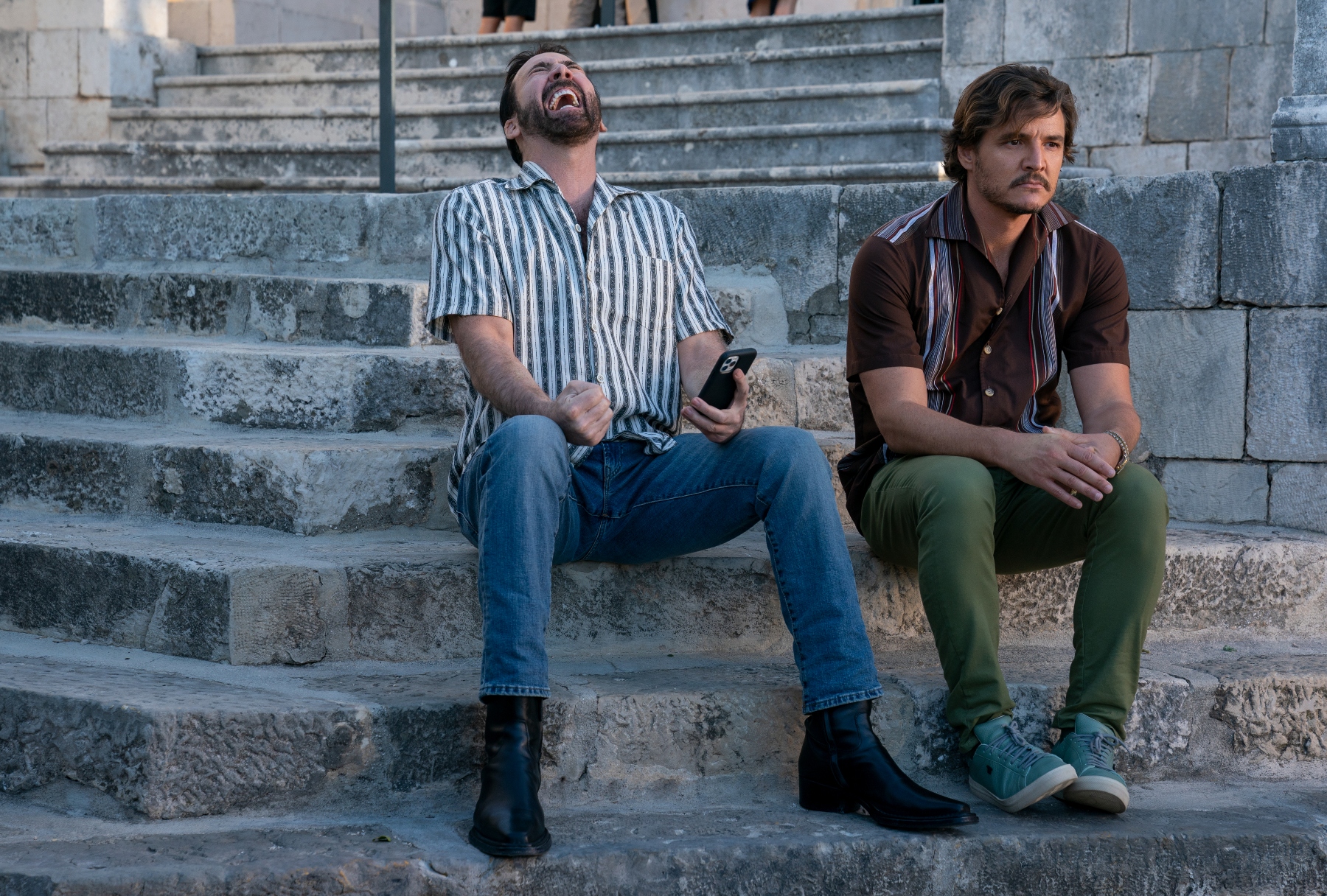
Nicolas Cage and Pedro Pascal in “The Unbearable Weight of Massive Talent” (Katalin Vermes/Lionsgate)

The best part of the film are the scenes featuring Cage and Javi, where the Spaniard gets to live out every movie lover’s fantasy of having a sleepover with the actor they most admire. Pedro Pascal plays Javi like a lovestruck teenager, which is why their discussion of Javi’s favorite films, or an episode where Javi and Cage have an adventure while tripping on LSD, are great fun. The guys even get to have a “chase” scene — cue a “Gone in 60 Seconds” reference — which is a hoot, and there is a terrific bit where they admire and swap each other’s shoes. 

Javi has a screenplay he hopes Cage will star in, however, because Cage needs to find the kidnapped teenager, he stalls by suggesting he and Javi write a movie together instead. It will be character-driven adult drama, until Vivian encourages Cage to suggest a kidnapping to understand Javi’s mindset, and their screenplay shifts gears and genres and becomes an action film. (Something for everyone!) Of course, the self-referential “The Unbearable Weight of Massive Talent” shifts gears, too. 

But the film gets sillier as it folds in on itself, and when Cage’s long-suffering ex-wife, Olivia (Sharon Horgan, wonderfully droll), and daughter arrive in Mallorca, Addy gets kidnapped, and Cage’s safety is compromised. 


Want a daily wrap-up of all the news and commentary Salon has to offer? Subscribe to our morning newsletter, Crash Course.


The CIA storyline is the film’s weakest element because the bromance between Cage and Javi is so strong. Had there been some ambiguity about Javi’s criminality, the film might have ratcheted up the tension. At least, the action, when the s**t gets real, is kind of exciting.

There are scenes of him howling or wailing wildly.

The art imitates life imitating art imitating life gimmick here is certainly clever, and Cage does get some real opportunities to shine. He is arguably best doing a physical comedy bit as when he accidentally doses himself while on a CIA mission and has to break into a room through a window from an outside ledge to get the antidote. And there is an amusing scene involving Cage and Javi tripping and trying to scale a wall when they think they are being pursued. 

But for superfans hoping Cage will eat a live cockroach (as he did in “Vampire’s Kiss”) or have a manic moment (as he has done in many of his films), “The Unbearable Weight of Massive Talent” doesn’t ask Cage to get too crazy. Yes, there are scenes of him howling or wailing wildly starting with his very first appearance in the film, but this version of Nic Cage — while not as introspective as his recent turn in “Pig” — is certainly more subdued. That is certainly to the film’s credit as Cage is actually quite likeable here; the success of his performance is that he makes viewers want to hang out with him (as Javi does) — even if this kind of self-absorbed, movie-star persona is precisely what irritates his daughter.  

“The Unbearable Weight of Massive Talent” may not quite be a game-changer for Cage — time will tell — but it does poke fun at Cage’s celebrity in a smart, self-deprecating way. It is sure to please fans and non-fans alike.

“The Unbearable Weight of Massive Talent” opens in theatres Friday, April 22. Watch a trailer for it below, via YouTube.

More stories to read:

“The Flight Attendant” pours out an intoxicatingly mysterious first two episodes in season 2

The first season of HBO Max‘s Hitchcockian thriller series “The Flight Attendant” wrapped in December 2020, and whether you’ve been slinging back vodka and sodas like the show’s main character Cassie Bowden (Kaley Cuoco) enjoyed doing throughout the entirety of that first season, or dry as a bone and carefully balancing all of your internal and external baggage, to the best of your abilities, like the turned-a-new-leaf Cassie of season 2, it may be hard to remember where we left off. 

When we first met Cassie we followed her booze-soaked antics as a flight attendant for Imperial Atlantic, flirting her way across the friendly skies during her work hours, and partying her blonde ponytail askew during any personal time she was afforded. It didn’t take long to catch on to the fact that these two things often blurred together in Cassie’s life, which, as a thriller will sneak up and do on ya, propelled her right into the perfectly wrong place at the perfectly wrong time to set up the conflict needed to advance the rest of the season. And in this particular case that conflict comes in the form of a handsome dead guy that Cassie wakes up next to.

RELATED: “The Flight Attendant” returns with double the baggage and showcase for Kaley Cuoco

After discovering baby-faced businessman Alex Sokolov (Michiel Huisman), throat slit and very much deceased in the bed next to her after what was supposed to be a one-and-done night of debauchery that began with a dual membership to the mile high club and continued during Cassie’s layover in Bangkok, Cassie spends the rest of that season attempting to clear her already pretty tarnished name, and figure out who’s behind his murder, all while trying to quit drinking and stay alive. 

The second season jumps ahead with two back-to-back episodes, and in the premiere we meet back up with Cassie just days before the one-year anniversary of her sobriety, so we see that she’s managed the whole no drinking thing all this while; but the staying alive part is still, apparently, challenging for her as she has, once again, put herself smack dab in the middle of danger.

Kaley Cuoco in “The Flight Attendant” season 2 (Julia Terjung/HBO Max)Having moved from her apartment in New York to a gorgeous cottage in Los Angeles that would be an immediate add to anyone’s Pinterest, Cassie is six months into the longest relationship of her life with a guy named Marco (Santiago Cabrera), helping to keep her AA meetings well-stocked with donuts, and preparing for a visit from her best friend Annie (Zosia Mamet) and Annie’s kinda sorta fiance Max (Deniz Akdeniz). All well and good, and nothing that could eventually lead to her early death in that life equation, but add in the fact that she’s moonlighting as a CIA civilian “asset” when not working as a flight attendant and here comes our conflict for this season.

Want a daily wrap-up of all the news and commentary Salon has to offer? Subscribe to our morning newsletter, Crash Course.


When Cassie’s CIA “handler” Benjamin (Mo McRae) sends her on an assignment in Berlin to observe the comings and goings of a man named Will (Kayvon Esmaili) she’s warned to not get too close, which she has a bad habit of doing, but of course she doesn’t pay that any mind. Trailing her “mark” to his hotel, Cassie has a run-in with a sketchy couple in the lobby who stop her to say they were on her flight from Los Angeles. While one half of the couple, Gabrielle Diaz (Callie Hernandez) distracts her with pleasantries, the other, Esteban Diaz (J.J. Soria) uses a phone app called “data clone” to steal the info from the contents of her purse. I’m assuming this is info contained in her phone, but who the hell knows what a “data clone” is capable of, really? Either way, this is an interaction to keep in the back of your mind as this couple will surely play a large part in the danger and intrigue of upcoming episodes, starting with episode 2 where they’re caught trying to break into her house. 

Once Cassie cozies up to Will at the bar you can see her struggling with pushing back demons of the past. She wants to flirt with him. Possibly go up to his room. But she holds herself back and continues with her mission, following him to the roof of a heavily graffitied warehouse and snapping pictures of him retrieving a mysterious envelope. 

Conning the front desk clerk of the hotel into telling her which room Will is staying in, she checks into the one across from it so she can continue keeping tabs. Peering across in a very “Rear Window” fashion, she’s shocked to see Will having sexy times with a blonde woman who has the exact same back tattoo as she does. Staring in amazement, she’s late to retreat from the milky-eyed gaze of the man in the room beneath Will’s who appears to be spying on him as well, and now her. 

In a panic, Cassie flees her room, making it out to the street just in time to see Will get into a car that explodes soon after, killing him (we’d assume) and knocking her unconscious. While she’s out she has visions of her former selves, echoes of her messy past, who neg and taunt her. When she snaps back to reality she makes her way back to her room but finds that her key card no longer works. A cleaning woman lets her in, but that doesn’t bring much in the way of relief as all her stuff is missing. And while all of this is happening we get snippets here and there that introduce a second mysterious plotline in the way of needy friend and fellow flight attendant Megan (Rosie Perez) who seems to have been kidnapped, but TBD on this one. 

On this same TBD front, there are a few new characters introduced in this season who we, as of now, are uncertain as to whether they’ll land in the black hat or white hat category. Grace, played by the fantastic comedian Mae Martin, is a fellow flight attendant and seems cool and casual at first, but then we see her get wrapped up in a sourdough-themed lie, and partake in some shady dealings with a box of fentanyl lollipops. And then there’s Dot Karlson, played by Cheryl Hines (BRAGGADOCIOUS ALERT . . . a little Easter egg there for any fans of the Tig and Cheryl: True Story podcast who may be reading this) who is a higher up at the CIA and seems to want to bend the truth about what happened to Will, and whether or not someone may be trying to frame Cassie for his murder. 

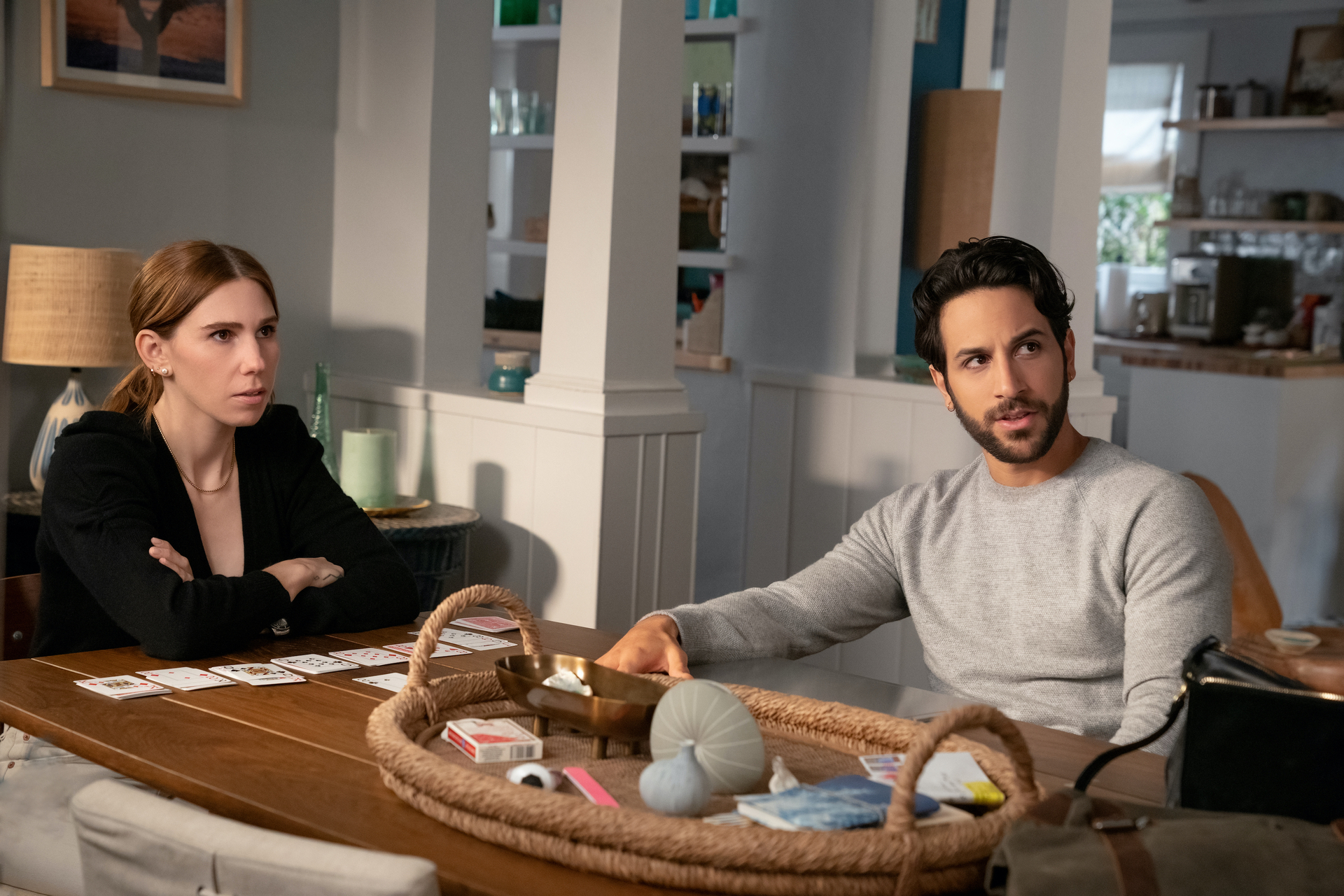
Zosia Mamet and Deniz Akdeniz in season 2 of “The Flight Attendant” (Jennifer Rose Clasen/HBO Max)In episode 2 Cassie is reunited with Annie and Max, who come to Los Angeles to visit and don’t even have time to hit up a taco cart before getting thrown back into Cassie’s drama. While they’re catching their breath from hearing Cassie rattle off the details of Will’s murder, an airport employee knocks on the door and delivers Cassie’s missing suitcase.

Tipped off to the fact that it’s been tampered with by the change in location of the the blue ribbon identifier she always ties to it, they have a feeling they’ll find something alarming inside once they unzip the case, and they’re certainly right about that. Rather than a few changes of underwear and a couple pairs of jeans they find a bloody blond wig and a vintage ViewMaster with a reel of ominous photos and/or clues in place. One of these clues takes them to the base of The Lady of the Lake statue in Echo Park, but they don’t know what to do once they get there. The person snapping photos of them from a distance likely knows what’s up, but we won’t be privy to that intel until the next episode, if we’re lucky. Hopefully by then we’ll also learn what Margaret Cho’s character Utada’s intentions are with Megan, and why, aside from the fact that they’re slow dancing to records like it’s any ‘ol Tuesday night, it seems like she’s the one who kidnapped her? Damn. I love this show. 

Read more:

A new guide to traveling — and traveling to eat — while fat

Have you ever walked into a restaurant and realized that the chairs were just too small for you? Ever asked for a seat belt extender the moment you walked onto an airplane, because you just knew that the seat belt wouldn’t fit? 

Me too.

I’m Chaya Milchtein. I am a fat, queer woman, an automotive educator, a journalist covering cars and travel, and an influencer who takes up space. 

Related: From Iceland to Italy, a Wisconsinite cheesehead’s guide to European cheese

Like most fat people, traveling and adventuring comes with its own unique challenges and considerations (and a whole heck of a lot of planning), like digging for weight limits and having to call when aren’t listed on typical and nontraditional vacation activities, like helicopter rides, scuba diving, Segways tours and even ATV rentals. 

As an aside, I find it interesting that helicopters are used in emergency situations to carry tons of equipment, medical staff and numerous patients — but somehow can’t be used to carry my wife and I. Also, why can’t hotels have large plush towels, instead of the tiniest little pieces of fabric I’ve ever seen? 

I’m not alone. 

Approximately, 67% of women in the United States are above a size 14 — though, it should be noted that statistic comes from an over ten-year-old study, so that number is likely higher and larger. 

Nobody said that traveling while fat is easy, but goddamn, I’m making it happen, and I want to help you do it too. That’s why I’m compiling “A Fatty’s Guide to Traveling and Eating the World,”  a travel and food column here at Salon that’s dedicated to helping travelers of all sizes find adventure

After all, the market is there. Plus size women’s apparel is a $24 billion enterprise in the United States alone. However, just as we remain an underserved market in fashion, we certainly are nearly invisible in the realm of mainstream travel media — something I’m looking to change. 

While there is much travel ahead, for a moment, let’s look back at some of my very best hotels, restaurants, and experiences around the world to add to your bucket list. 

***

Hotels

The St. Regis – Rome, Italy

You should have seen the grin on my face when I discovered that the plush, glorious towels in this gorgeous hotel could wrap all the way around my body. That feeling is gold! But that wasn’t the only reason to love this luxurious hotel in the heart of Rome. Our bed was unbelievably soft, like laying on a cloud — yet still somehow firm — making it easily among the top five hotel beds I’ve slept on in the world. The staff were top-notch, leaving us feeling like royalty in a hotel that boasts the first ballroom that was open to the public in Rome. 

Hotel De Sers – Paris, France

A massive tub for two in the center of the largest bathroom I’ve ever seen? Yes, please. Hotel De Sers isn’t just a home base while visiting Paris; it’s an experience in itself. We were greeted with wine and French pastries and our two-room suite had a kitchenette and a balcony overlooking the Eiffel Tower. There were two bathrooms in the room, and while one made for a little “too squishy” an experience, the water closet in the main bathroom was plenty big enough for me as it was on the larger side according to European standards. 

Marival Armony – Punta De Mita, Mexico

I just recently got back from Mexico where I stayed in four different hotels. Of the bunch the Marivel Armony was in a category all of its own. Sure, there were the seemingly countless pools and jacuzzis — but the spa was truly next level.

For the first time in my life, I experienced a full-body scrub and mask, which was followed by an unbelievably relaxing massage. There wasn’t a word or glace that made me even remotely uncomfortable and, despite my initial hesitation, I allowed the masseuse to even scrub, mask and massage my stomach, which was actually a really pleasant experience. 

***

Food

The Super Expensive Food Tour – Paris, France

The Super Expensive Food Tour (for what it’s worth, it comes in at a little over $325) was the very first traditional food tour my wife and I took, and it transformed the way we travel. I was worried that the walking might be too much, but the stops at a variety of local restaurants were well-timed. We had a blind caviar tasting — complete with a thorough education on all the varieties and intricacies — drank delicious cocktails and champagne, and ended an impeccable evening with a delicately fluffy souffle.  

Bruna – Guadalajara, México

First of all, make sure to order a cocktail if you drink. It’s a spectacular tableside experience, complete with spun sugar, smoke and other intricate details that leave you mesmerized. The food certainly doesn’t play second fiddle. The mole sampler is incredible, but there wasn’t a single bite of the entire meal that didn’t delight the senses. The chairs were too small, but I grabbed a different one that worked perfectly without issue. 

Mole sampler (Jodyann Morgan)

Mezzanotte – Seattle, Washington

I have to admit, I’m picky. Especially when it comes to pasta. The texture has to be right, the sauce just right, and the balance of flavors should be sinfully good. Mezzanotte nails every single kind of pasta I had the pleasure of trying there. Add in the chewy focaccia, rich burrata, and dessert and you’ll leave after a meal that you’ll be talking about for a long time. 

Weinkeller – Niagara Falls, Canada 

Five years ago, on a visit to Niagara Falls, my wife and I stumbled onto a restaurant that I can still remember like yesterday. 

We were inexperienced travelers, and this was our first big trip. Our entire trip was a bust as far as food was concerned. Every meal fell short until we stumbled across Weinkeller. Not only is the food locally-sourced, Weinkeller makes their own wine and it’s available on tap. The menu is available in a three- or five-course format, and each dish is scratch-made daily. Pure heaven! 

Ardent – Milwaukee, Wisconsin

I love food in all kinds of different presentations, but there’s just something really special about chef’s choice tasting menus. There’s no stress about picking the perfect dishes, and the multitude of small-format courses mean that even if something isn’t quite up to your taste, there’s more coming. And Ardent, in my hometown, truly nails the tasting menu, with finesse and next-level skill going into every bite.

***

Experiences 

Blue Lagoon – Grindavík, Iceland 

They say that the Blue Lagoon is one of the wonders of the world — and while I wouldn’t quite describe it that way, it’s a magnificent spa with killer views and in-water massages that transport you into another universe. The Blue Lagoon has two hotels, multiple restaurants, and lava fields as far as the eye can see. Bring your own robe though if you are over a size 20/22, as the largest robe was a bit too small on me. 

Borola Café Coffee Tasting – Mexico City, Mexico

This coffee-tasting experience at a locally owned cafe in Mexico City taught me to really understand coffee, from picking up the notes in different types of coffee to learning the best way to do a pour over. I came in having never really enjoyed the taste of a regular cup of coffee, and left having thoroughly enjoyed the first black coffee to ever pass my lips. And the fresh-from-the-oven Mexican pastries were just the icing on the cake.

Hot Tub Boats – Seattle, Washington

Heaven must feel like a soak in a Hot Tub Boat — which is exactly what it sounds like — leisurely floating on Lake Union. Maneuvered by a joystick, the boat can easily be navigated and doesn’t exceed 5 miles per hour. The company provides a wireless speaker so you can set the mood, and a dry storage area so you don’t soak anything that… should not be soaked. Bring a cooler and snacks, and enjoy! 

Oh, and this is important. When I visited, Hot Tub Boats only offered relatively small towels. After seeing my post on social media, they immediately sought to remedy this, because plus size people deserve towels too!

Vintage Car Ride – Paris, France

Okay, the vintage car ride from Viator I took with three other people was definitely a bit smooshy, but I’m not telling you to cram everyone in. This is the perfect Paris experience for lovebirds. Not only do you get to see the city while riding around in the back of a top-down vintage beauty, but you get a tour, a fantastic view from an observation point, and photos to keep the memory alive. Worth every penny. 

Follow along next month for a deep-dive into my next adventure. We’re going to Las Vegas, baby!

Read more: 

Florida family charged with beating man who they believe “turned” their son gay

On August 6, 2021, a family in Pompano Beach, Florida savagely attacked a young gay man, leaving him lying in a pool of blood for thirteen hours. He is now permanently blind, a newly released arrest warrant details

Inna Makarenko, 44 and Yevhen Makarenko, 43, discovered their 21-yea- old son Oleh was in a relationship with the victim and believed the victim “turned him gay.” The 31-year-old victim’s name is hidden due to Marsy’s Law. 

The two dated for nine months. Oleh possessed a key to the victim’s apartment and often spent the night there. 

At the end of July 2021, Oleh told the victim his parents discovered he was gay. His father treated Oleh “poorly” and did not accept him. His mother “was forcing him to marry a woman.” 

Around 1 am on August 6, the Makarenko family chased the victim inside his apartment. As Oleh and Inna watched, Yevhen and his son Vladyslav beat the victim and struck him in the face with an unknown object. 

The victim fell to the floor and pretended to be dead in an attempt to end the attack. Fourteen hours later, a sheriff’s deputy found him lying in a pool of blood, the door left open. 

The victim is now permanently blind. He suffered a concussion, brain swelling, severe bruising and multiple fractures in his face and jaw. He endured four surgeries and will receive two more. His medical expenses amount to over $100,000. Six months after the attack, as he began to recover his memory of the event, the victim visited the Broward County sheriff’s deputies to press charges. 

All four Makarenko family members face charges of attempted murder, battery and kidnapping. Yevhen, Inna and Oleh face additional hate crime charges, meaning they may face life in prison for each count. The family is currently in the Broward County jail; Vladyslav was extradited from Alabama.

The Makarenkos’ attorney Michael Glasser spoke to CBS Miami about the charges.

“It’s an emphatic denial that they injured this individual, that they would ever endeavor to injure this individual, and, most specifically, that they would not even think of injuring individual based on his sexual orientation,” he said. 

The Makarenkos’ supporters started an online petition attesting the family’s innocence and raising money for their defense. 

Oleh’s female fiancee Christina Herman denies that Oleh is gay and emphasizes the family’s innocence.

“I don’t believe it at all, I have proof,” Herman said. “I wear a ring which is an engagement and one kind of marriage ring. I know Alex has his ring in jail. That is proof to me. I know we are in a relationship.”

Yet investigators on the case emphasize the link between the victim’s sexuality and the brutal assault. “This crime was a senseless and unprovoked attack done onto a homosexual man, just due to the mere fact that he was homosexual,” Broward’s sheriff’s detective Conor Ryan wrote.

Inna Makarenko faces a bond hearing on April 25.

Marjorie Taylor Greene denies calling for Pelosi’s execution during trial, then backtracks

Rep. Marjorie Taylor Greene, R-Ga., on Friday appeared to walk back her denial of calling House Speaker Nancy Pelosi, D-Calif., “a traitor to the country” in a trial around her eligibility for re-election, admitting that she previously said Pelosi “violated her oath of office.”

Greene’s seeming about-face came under oath this week when questioned about her rhetoric and actions leading up to the Capitol riot. The trial stems from a recent lawsuit brought by a group of Georgia voters who argued that the Georgia freshman does not qualify for re-election over her apparent violation of the 14th Amendment, which bars anyone who supported an insurrection from running for Congress. 

During the hearing, lawyer Ron Fein, who is representing the plaintiffs, asked Grenee if she called Pelosi a “traitor” in her many disagreements with the House Speaker.

RELATED: Federal judge greenlights challenge to disqualify Marjorie Taylor Greene from re-election

“In fact, you think that Speaker Pelosi is a traitor to the country, right?” Fain inquired. 

“I’m not answering that question,” Greene responded. “I haven’t said that.”

“Put up plaintiff’s exhibit 5,” Fain pressed on.

“Oh, no,” Greene interjected. Wait. Hold on now…”


Want a daily wrap-up of all the news and commentary Salon has to offer? Subscribe to our morning newsletter, Crash Course.


The exchange appears to be referencing a 2019 video Greene released on Facebook while campaigning for Congress. In the video, reported by CNN, the Georgia Republican claimed that Pelosi was “guilty of treason” over the House Speaker’s apparently lenient border policies.

“She took an oath to protect American citizens and uphold our laws. And she gives aid and comfort to our enemies who illegally invade our land. That’s what treason is,” Greene said in the video. “And by our law representatives and senators can be kicked out and no longer serve in our government. And it’s, uh, it’s a crime punishable by death is what treason is. Nancy Pelosi is guilty of treason.”

Throughout the trial, Greene repeatedly claimed that she did recall a number of statements that she made surrounding the integrity of the 2020 election. She also alleged that she has had “many people” manage her social media accounts over the years, implying that she should be off the hook for some of her online activity. 

Leading up to the trial, Greene aggressively sought to block the proceeding. But on Monday, a federal judge ruled that the proceeding could move forward, requiring the Georgia conservative to provide sworn testimony. If the judge rules in favor of the plaintiffs, Greene will be made ineligible for public office forever.

RELATED: Marjorie Taylor Greene gives anti-LGBTQ rant (again

A renowned environmentalist says we’re understanding forests all wrong

The term “trillion trees” has recently entered the public lexicon — a political shorthand for the policy proposal to literally plant 1 trillion trees across the planet to solve climate change. While this seemingly audacious idea has some sincere proponents, English science writer and environmentalist Fred Pearce isn’t sold. Certainly, Pearce isn’t anti-tree; quite the opposite, as his new book, “A Trillion Trees: Restoring Our Forests by Trusting in Nature,” is a wondrous guide through the world’s many magnificent forests, from Nigeria to Ecuador. 

As Pearce reviews humanity’s history of interacting with these natural resources, Pearce argues for nuance in the way we understand forests. First, the way we imagine it now, he argues, is just not accurate — and neither is the notion that planting a trillion trees should be anything other than a last resort.

RELATED: A proposal to plant a trillion trees to save us from climate change may not be realistic. Here’s why

“We simply have to recognize that our history of human occupation of the landscape is much more complex than we sometimes like to think,” Pearce told Salon. Likewise, Pearce stresses that the natural environment wasn’t a blank slate prior to colonization: “Environmentalists tend to think that history started when the Industrial Revolution happened, or if you’re in the America that it happened when Columbus arrived, and nothing much happened before that or there was some sort of perfect state. Things are much more complex,” he added.

Yet Pearce is not arguing that that the environment can not be restored through human intervention. Pearce tells stories of precisely that happening, such as when Pennsylvania was dangerously close to losing its wild forests in the late 19th century until conservationists (and later the New Deal) intervened to save the day. At the same time, Pearce notes that wherever farmers, loggers and other landowners throughout the world have simply stepped back, nature has often restored wild forests on its own.

“Forests can and will regrow,” Pearce explained. “They have great powers of restoration.”


Want more health and science stories in your inbox? Subscribe to Salon’s weekly newsletter The Vulgar Scientist.


This is not the only misconception about forests that Pearce attempts to clear up. Speaking to the fellow nature-lovers who he clearly anticipates will be a large part of the audience for this book, Pearce points out that advocates of forest restoration will focus on how trees can help with climate change in terms of carbon emissions. Because the planet is warming due to greenhouse gases being emitted into the atmosphere, and trees absorb up carbon dioxide (which is one of those gases), the assumption is that they can help offset climate change. Yet even if it was logistically feasible to plant as many trees as necessary for that plan to work, trees simply have more intrinsic value than that.

“In many ways we tend to think about forests in climate in terms of carbon; now everybody is measuring carbon and conserving carbon and everything goes through this carbon prism, but forests have much more wide ranging impacts on climate both locally and globally,” Pearce told Salon. He noted that forests are major recyclers of rain, as evidenced by a brief survey of world geography: South America’s Amazon forest is at least as wet and sometimes even wetter than its coasts because the continent’s coastal regions have forests, while if you go to continents where there aren’t forests on the coast, the central areas quickly become arid and desert regions.

“It’s quite clear, and there’s been good research done into this, that rainfall downwind of forests globally is at least twice that of downwind of land which is not forest,” Pearce explained. “So forests are clearly major generators of rainfall.”

Pearce also notes in his book that forest restoration, when most effective, is managed on a local level rather than through imposition from impersonal, larger entities. He points to indigenous communities that have managed to maintain low levels of deforestation that outpace even nature reserves.

“Planting is not best; natural restoration is in most places going to be the most effective,” Pearce writes. “And also the cheapest, I might say, when it comes to bringing forests back to the planet. Natural restoration will also result in more by diverse forests, which will probably contain more carbon at the end of the day as well. But also I do want to stress local management. I’m not bring in favor of conservation that moves in and tries to take over land on behalf of nature.”

Pearce is not the first scientist to express skepticism at the effectiveness of the trillion-trees proposal. Speaking by email to Salon last year, Stanford University climate scientist Chris Field explained that “the really important question to ask is how many trees can be grown to maturity. Planting billions of seedlings is easy. Caring for those tress as they grow, confront droughts, insects, wildfires, and logging is much more challenging.”

“A Trillion Trees” essentially echoes that view, repeatedly insisting that societies which have pragmatic relationships with forests — not going out of their way to create them through planting, but also being mindful of sustainability issues — generally have the best long-term results when it comes to saving forests.

“It seems to me that if you like ecological virtue and environmental justice, if I can use that phrase, go together remarkably well,” Pearce put it. “So I’m anxious to put together the ideas of natural restoration and of local management and incidentally, I don’t think there’s contradiction between the two, because all we’re doing essentially is going back to some of the old ideas of the old wisdoms about sensibly managing forests.”

For more Salon coverage on climate change:

Babies named “Daenerys” shot up 700% after “Game of Thrones” premiered

Parents have a lot of options when picking out names for a new baby: their parents’ names, names from history, names they’ve just heard and liked . . . and names from pop culture.

What characters from movies and TV shows move the needle the most? Using data from the U.S. Social Security Administration and its baby name popularity index, the fine people at “Organic Baby Formula put together a little list showing what names had the biggest impact on how parents chose to name their kids.

The methodology is simple: they looked at various popular shows or movies, and then how many kids were named after characters from those shows or movies within a year of release Take a look, and feel free to click on the image to blow it up:

How much do movies and TV shows influence baby names?

And here’s the list in text form, just for good measure:

  • Scarlett — “Gone With The Wind” (1939) — 940.00%
  • Daenerys — “Game of Thrones” (2011) — 700.00%
  • Tristan — “Legends of The Fall” (1994) — 538.90%
  • Merida — “Brave” (2012) — 463.60%
  • Leia — “Star Wars” (1977) — 357.10%
  • Neo — “The Matrix” (1999) — 353.80%
  • Moana — “Moana” (2016) — 258.30%
  • Katniss — “Hunger Games” (2012) — 200.00%
  • Trinity — “The Matrix” (1999) — 183.00%
  • Ariel — “The Little Mermaid” (1989) — 172.59%
  • Arya — “Game of Thrones” (2011) — 172.40%
  • Chandler — “Friends” (1994) — 167.10%
  • Tiana — “Princess and The Frog” (2009) — 110.70%
  • Esmeralda — “Hunchback of Notre Dame” (1996) — 82.80%
  • Elsa — “Frozen” (2013) — 66.80%
  • Luke — “Star Wars” (1977) — 52.10%
  • Bella — “Twilight” (2008) — 35.50%
  • Rocky — “Rocky” (1976) — 33.30%
  • Logan — “X-Men” (2000) — 31.90%
  • Jasmine — “Aladdin” (1992) — 17.29%

So “Game of Thrones” is one of two series to have two entries on this list, for both Daenerys and Arya. (The other is “Star Wars,” with both Leia and Luke).

Mind you, seeing how much more popular a name is over the year before doesn’t tell you how popular it is in raw numbers. After “Game of Thrones” premiered in 2011, “Daenerys” may have increased a staggering 700% while “Arya” only went up 172.4%, but I’m willing to bet there are actually more kids named Arya out there than kids named Daenerys, because “Arya” was conceivably a reasonable name even before the show began, whereas pretty much no one named their child “Daenerys” before seeing Emilia Clarke in costume.

HBO is returning to Westeros soon with “House of the Dragon.” We’ll see soon enough if there’s a rush of babies named “Rhaenyra.”

9 best barbecue sauce brands, from Kansas City-style to Alabama White

Nothing gets me craving sticky barbecue sauce-coated chicken thighs or pulled pork like a warm evening. There’s just something about the heat — maybe it’s the near-constant earthy aroma of other grills at work — that screams “slather everything in barbecue sauce”! And it’s a year-round favorite, too — barbecue is just as much of a welcome addition to a Super Bowl spread as it is a summer cookout. Apparently, other food writers and chefs think so too, so I asked some to tell me about their favorites.

So what exactly qualifies as “good” barbecue sauce? First and foremost, it must be flavorful and representative of the regional style. A Kansas City-style barbecue sauce will not taste or look like an Alabama White sauce in any way. KC barbecue sauce will be a perfectly balanced sweet and spicy sauce; you should taste equal hints of brown sugar, black pepper, and a little bit of tang from apple cider vinegar. It should be thick enough that you can baste ribs or toss pulled pork with it using equal ease. Alabama White sauce should be thick, tangy, and creamy, thanks to a combination of mayonnaise, vinegar, and pepper. Head over to the Carolinas and you’ll find two more styles of sauce — Carolina Gold, which is a mustard-based sauce popular in South Carolina, and a tangy, vinegar-based sauce known as Lexington-Style Sauce.

Beyond being regionally accurate, a good barbecue sauce should offer a little bit of versatility (it should work with pork and chicken, over grilled meats just as well as low-and-slow cooked cuts).

And finally, we will always have a bias towards small-batch makers and sauces straight from some of our favorite barbecue joints across the country like Joe’s Kansas City Bar-B-Que and Stubb’s Bar-B-Q in Austin.

Whether you’re into a vinegar- or mustard-forward, tomato- or mayonnaise-based sauce, you’re bound to find a new favorite in this list. Here are 9 killer barbecue sauces, recommended by food writers and chefs. Grab a few bottles and then all that’s left to decide is burnt ends or pulled pork mac and cheese?

The best barbecue sauces

1. Cattlemen’s Carolina Tangy Gold BBQ Sauce

“Our family was introduced to Carolina Tangy Gold BBQ Sauce several years ago by one of our neighbors who was originally from South Carolina. And it has been a staple in our house ever since. There’s just something about that sweet mustardy tang that we just love.” — Michelle Braxton, recipe developer and blogger at Supper with Michelle

2. Stubb’s Smokey Mesquite Bar-B-Q Sauce

“I’m pretty partial to the Stubb’s Mesquite Bar-B-Q Sauce. I’ve tried other brands but nothing beats the smoky-tangy-sweet balance of Stubb’s.” — Amelia Rampe, food stylist and Studio Food Editor at the Kitchn

3. Dreamland Barbecue

“I’m from Alabama, and the barbecue style there is something of a hybrid. You can find both the tomato-based Memphis-style sauces and the more mustard-forward Carolinas one. My very favorite sauce is from my friend’s pit, Rusty’s BBQ, where he makes it in sweet, spicy, and house varietals. But barring that, my favorite widely-available sauce — the one that reminds me of home and instantly transforms a pile of pulled pork — is Dreamland barbecue sauce, from a mini chain of pits started in Tuscaloosa.

“It has a good balance of vinegar, heat, and the umami from the tomatoes, and it isn’t as sweet as many of the sauces I’ve tried from the grocery stores up north. it’s popular enough that you can grab 32-ounce jars of it once you pass airport security in Birmingham, which I do when I have the chance, but barring that, you can order it from Dreamland’s website or at a considerable mark-up from Amazon.” — Margaret Eby, Editorial Lead

4. Big Bob Gibson White Sauce

“My other favorite barbecue sauce more unique to Alabama is Big Bob Gibson white sauce, a mayonnaise-based concoction that’s particularly great on grilled or roasted chicken. It has this wonderful creamy-tangy-sweet-garlic thing going on, and it’s also very versatile. You can thin it out to use as a salad dressing with excellent results.” — Margaret Eby

5. Bachan’s The Original Japanese Barbecue Sauce

“I’ve been pretty obsessed with Bachan’s Japanese barbecue sauce. It’s made with soy sauce, mirin, rice vinegar, and other spices making it the perfect meld of sweet, savory, and tangy. I love using it as a glaze on ground chicken meatballs under the broiler, an immediate flavor boost. The origin story of Bachan’s is also very touching, the sauce was created by Justin Gill in honor of his Japanese-American grandmother (“bachan” means “granny” in Japanese), and her prized recipe that has been passed down in his family for years.” — Noreen Wasti, recipe developer and food stylist

6. Jones Bar-B-Q Sweet & Tangy BBQ Sauce

“Truthfully I’m not a huge barbecue sauce person, but I would happily douse any protein with this sauce. So tangy and delicious. It’s great as a marinade, too, when I’m not feeling super creative!” — Sara Tane, food editor and private chef

7. Bone Suckin’ Sauce

“My dad makes the absolute best ribs. Like, so good that recently a vegetarian friend had to make an exception to try one. Needless to say they involve a top secret recipe, but the part I can share is our favorite barbecue sauce: Bone Suckin’ Sauce. The perfect balance and sugar and vinegar, both the sauce and dry rub are fundamental to a good rack of ribs.” — Courtney Kassel, food writer

8. Richard’s Vermont Made

“I always grab a bottle of Richard’s Vermont Made Barbecue Sauces when I’m in search of barbecue sauce. The hot version is my favorite—properly spicy, balanced, and not too sweet. — Christine Clark, writer, cheese educator, and co-host of “Is This a Brie” podcast

9. We Rub You

“An unexpected but then totally obvious brand I love is We Rub You, the Korean BBQ brand with a few different flavors and a great price point. My favorite is the Original Korean BBQ Sauce flavor that has great umami from the ginger and sesame, and still has the sweetness, kick and tang you want in a sauce. I love it over fish, juicy charred chicken, and steaks!” — Fatima Khawaja, freelance chef

How to clean your garbage disposal and stave off that gunk for good

Clean Like You Mean It shows you how to tackle the trickiest spots in your home — whether they’re just plain gross or need some elbow grease. You’ll get the cleaning secrets we’ve learned from grandma, a guide to our handiest tools and helpers, and so much more. Pull on those rubber gloves and queue up the tunes: It’s scour hour!

Speaking as someone who didn’t have a garbage disposal until she was 25, these kitchen appliances are honestly the best. Gone are the days when you have to fish little chunks of food out of a drain filter or worry about gunk getting clogged up in your pipes. Instead, all you have to do is flip a little switch, and woosh! There it all goes, shredded into tiny pieces.

Like any kitchen appliance, though, garbage disposals require regular cleaning, and if you skip out on maintenance, you can often end up with a stinky, slimy mess on your hands. After all, the food particles that don’t get washed down the drain can quickly rot. The good news, however, is that it’s actually very easy to clean a garbage disposal — and that’s coming from someone who absolutely hates cleaning. Here’s what you should do to keep your disposal pristine and odor-free.

For a quick-and-easy clean

It’s a good idea to give your garbage disposal a quick cleaning on a weekly basis, but that doesn’t mean you have to take everything apart and scour every inch. For a low-effort cleaning method, start by flipping up the splash guard — the rubber panel that sits around the drain hole — and wiping off any gunk that’s accumulated on its underside. (This is often the cause of odors.) Some guards can even be removed and out in the dishwasher for hands-off cleaning.

Once you’ve taken care of that, toss a few handfuls of ice cubes into the garbage disposal, and turn it on without water. The ice will help break up any food particles that are stuck on the blades. Once you hear the grinding has mostly stopped, turn on the cold water to flush out the disposal and let it run for at least 30 seconds.

To freshen it up

If you want your garbage disposal to smell fresh and clean, there are a few tricks you can use to neutralize any odors and give it a pleasant scent. Start by pouring half a cup of baking soda into the drain. (This doesn’t have to be an exact measurement, so feel free to eyeball it.) Then, follow it up with about a cup of white vinegar — the combination will fizz up, breaking down any lingering crud. Let it work its magic for 10 minutes or so, then use hot water to rinse it out.

From here, toss a few citrus peels into the garbage disposal. I like to use lemon, but orange or lime work just as well. Run cold tap water and turn on the disposal to make it smell bright and clean. You can use this trick every few days as needed — personally, I do it any time I have leftover lemon peels.

For a periodic deep clean

Once or twice a year, you may want to deep clean your garbage disposal, especially if it has a lingering odor. To do this, you’ll want to unplug the appliance and/or turn off its circuit breaker. Be sure to test the power switch to ensure it’s truly off.

Next, put on a pair of rubber gloves — this part can get kind of gross — and use either a sponge or long-handle scrub brush to wipe down the interior of the grinding chamber. The blades in these appliances aren’t overly sharp, but you’ll still want to work carefully to avoid nicking yourself. Rinse your cleaning tool frequently to get rid of the gunk, and be sure to get the top and underside of the splash guard.

Once the grinding chamber is clean, you can plug the garbage disposal back in and run hot water through it for a few minutes to really flush it out. Feel free to follow up with either of the methods outlined above to freshen it up.

Tips for maintaining a garbage disposal

If you want to keep your garbage disposal in fighting condition, it’s important to treat it properly. There are a few important guidelines that people often forget, but these easy steps will ensure your garbage disposal works optimally for years to come.

  • Don’t overload your disposal: If you have a large amount of food waste to dispose of, put it down into the disposal a little at a time.
  • Know what can’t go down the drain: Garbage disposals can handle a lot, but there are certain foods that can damage or break your appliance. You shouldn’t put grease, bones, fruit pits, or pasta down the garbage disposal, and fibrous produce, like celery or onion peels can get stuck as well. Try composting these instead!
  • Flush it out: Odors in your garbage disposal are often caused by pieces of food that don’t get washed all the way down the drain. Run water for 20-30 seconds after grinding to thoroughly flush out the grinding chamber and pipes.
  • Avoid harsh cleaning chemicals: You shouldn’t use bleach or other harsh chemical cleaners in your garbage disposal, as they can corrode the metal components of the appliance and wreak havoc on your pipes.

“Corporate welfare”: Bernie Sanders calls out Congress over proposed Jeff Bezos “bailout”

Sen. Bernie Sanders took to the pages of The Guardian on Friday to inveigh against legislation currently before Congress that, if approved, could provide billionaire Jeff Bezos’ space flight company with a lucrative NASA contract to build a moon lander.

“At a time when over half of the people in this country live paycheck to paycheck, when more than 70 million are uninsured or underinsured and when some 600,000 Americans are homeless, should we really be providing a multibillion-dollar taxpayer bailout for Bezos to fuel his space hobby?” Sanders, I-Vt., chair of the Senate Budget Committee, wrote in his op-ed. “I don’t think so.”

“The time is now,” he added, “to have a serious debate in Congress and throughout our country as to how to develop a rational space policy that does not simply socialize all of the risks and privatize all of the profits.”

The bill at issue is the COMPETES Act, a measure ostensibly aimed at bolstering U.S. semiconductor manufacturing, providing more funding for technological research and development, and enhancing the nation’s space exploration efforts.

The Vermont senator has warned for weeks—including in remarks on the Senate floor—that the bill is rife with “corporate welfare.” Sanders has trained much of his ire on a provision that would give NASA $10 billion to pick a company to build a second moon lander after the agency awarded SpaceX—a company owned by billionaire Elon Musk—a $2.9 billion contract to make a lunar rocket last year.

Blue Origin, which competed for the original contract, unsuccessfully sued NASA over the SpaceX deal, claiming the contract was improperly awarded. Last July, Bezos and a handful of others rode a Blue Origin rocket to the edge of space, a 10-minute trip for which he was widely derided.

With the COMPETES Act, Congress appears poised to give Bezos another shot at a NASA contract. The House and Senate have both passed versions of the legislation, but the two bills must be reconciled before they can reach President Joe Biden’s desk for final approval.

Sanders is pushing lawmakers to strip out the $10 billion “bailout to Blue Origin” and attach conditions to the measure’s proposed taxpayer subsidies to the U.S. microchip industry. As Politico reported last month, Bezos’ company is “working behind the scenes to combat the Vermont Independent’s assault on its possible role in NASA’s public-private partnership to land on the moon by 2025.”

In his op-ed for The Guardian on Friday, Sanders argued that “this issue goes well beyond just one contract for Bezos to go to the moon,” noting, “In 2018, private corporations made over $94 billion in profits from goods or services that are used in space—profits that could not have been achieved without generous subsidies and support from NASA and the taxpayers of America.”

“NASA has identified over 12,000 asteroids within 45 million kilometers of Earth that contain iron ore, nickel, precious metals, and other minerals,” the senator wrote. “Just a single 3,000-foot asteroid may contain platinum worth over $5 trillion. Another asteroid’s rare earth metals could be worth more than $20 trillion alone. According to the Silicon Valley entrepreneur Peter Diamandis, ‘There are twenty-trillion-dollar checks up there, waiting to be cashed!'”

“The questions we must ask are: who will be cashing those checks?” Sanders continued. “Who will, overall, be benefiting from space exploration? Will it be a handful of billionaires or will it be the people of our country and all of humanity?”

Kevin McCarthy’s anti-democratic demise: How Donald Trump successfully sabotaged the modern GOP

Once again, House Minority Leader Kevin McCarthy, R-Calif., has made a public fool of himself.

As Heather “Digby” Parton recounts at Salon, the New York Times published reports this week of how McCarthy spent the immediate aftermath of the January 6 insurrection trying to push Donald Trump out of office for inciting it. McCarthy, who has since overcome his temporary Trump animus to return to his natural supplicant state, responded with a whiny statement declaring that the report is “totally false and wrong.” Of course, he was lying, as Digby notes, because the New York Times reporters had receipts: A recorded January 10, 2021 phone call between McCarthy and Rep. Liz Cheney, R-Wyo., in which McCarthy promised he would urge Trump personally to resign. Instead, McCarthy ended up rallying to Trump’s side and becoming one of the most stalwart opponents of any effort to hold Trump or any of his cronies accountable for attempting to overthrow democracy. 

McCarthy’s journey is not a surprising one. The man has always been a coward and a lickspittle. He was no more going to discover a spine and a conscience after January 6 than a zebra would turn into a unicorn. No doubt he’s still pretending to oppose the violence of the day, but on the whole, his journey from being anti- to pro-insurrection was entirely predictable. What makes this latest public humiliation of McCarthy interesting is not what it says about him, which we already knew, but how it reflects the larger trend in the GOP. 

RELATED: Kevin McCarthy caught on tape: Trump won’t forgive him this time

In the past year, the average Republican has transitioned from someone who ostensibly denounced the Capitol riot to someone who romanticizes it as a glorious revolution — which is exactly what Trump wanted.

The evolution of the polling data shows a clear trajectory.

What makes this latest public humiliation of McCarthy interesting is not what it says about him, which we already knew, but how it reflects the larger trend in the GOP. 

In the weeks after the Capitol riot, with the images of violence and mayhem still fresh on people’s minds, most Republicans opposed — or at least told pollsters they opposed — what had gone down that day. While Republicans polled would often try to both sides the story, pretending that “antifa” was as much to blame as right-wing militants, they still generally opposed the riot. A mid-January poll showed that, in the immediate aftermath of the attack, a substantial minority (43%) of Republicans called the rioters “patriots,” but it was still a minority. By March 2021, a poll found a slim majority, 53% of Republicans, said that the rioters were not justified in their anger or their actions. And more than three-quarters of Republicans agreed that the rioters should be prosecuted in another poll conducted at the same time.

In the year and change since then, however, those numbers have shifted dramatically.


Want more Amanda Marcotte on politics? Subscribe to her newsletter Standing Room Only.


From March to September 2021, Pew Research found that support for prosecuting the rioters dropped from 79% to 57% of Republicans. (It’s likely even lower now!) The share of Republicans and Republican-leaning independents who said Trump bears no responsibility for the insurrection increased from 46% in January 2021 to 57% in January 2022. Most chillingly, a recent poll shows a full 57% of Republicans now describe the insurrectionists as “patriots.” Likely, the true number is even higher and only muted by the social desirability bias that makes Republican voters wary of being too openly fascist when talking to a pollster they assume works for the “liberal media.” But even among those who admit it, we’ve seen a dramatic swing of 14 points in a year, from minority Republican support to majority Republican support for the insurrection. 

Trump himself has been sending a series of strong signals that he’s proud of inciting the insurrection, wants more credit for what he did.

None of this should be a surprise.

In the past 15 months, there’s been a massive propaganda push on the right to reframe the insurrection not as the violent attempt to overthrow democracy that it was, but as an act of “patriotism.” The rioters themselves have been romanticized not as the modern-day brownshirts that they are, but as noble warriors fighting to “save” America. (“Save” it from democracy, natch, though they will never say so outright.) Conspiracy theories, often contradicting each other, have been floated to give everyday Republican voters permission to shift from opposing the riot to supporting the insurrectionists. The insurrectionists who are in jail awaiting trial have been recast as “political prisoners” and Ashli Babbitt, who was shot by Capitol police in order to prevent her from leading a mob to run down fleeing Congress members, has been lionized as a martyr

RELATED: “If I do this, what do I have to lose?”: New documents show Trump feared no consequences for a coup

Most importantly, Trump himself has been sending a series of strong signals that he’s proud of inciting the insurrection, wants more credit for what he did, and expects his followers to see the violence in the same laudatory light he does.

He keeps bragging about how many people he convinced to riot on his behalf that day. He’s eagerly participated in the beatification of Babbitt. He defended the crowd’s attempts to find and execute his then-vice president Mike Pence. He’s suggested he will pardon people convicted of crimes committed during the insurrection. With all these signals coming from Trump and Fox News to suggest that the insurrection was a good thing, it’s no surprise that the GOP base has shifted from disapproval to celebration.


Want more Amanda Marcotte on politics? Subscribe to her newsletter Standing Room Only.


Trump is not subtle about the pride he takes in the insurrection, or his belief that he is entitled to overthrow American democracy to install himself as ruler. There’s simply no way to support Trump without supporting the broader anti-democratic agenda. And there’s no way to oppose democracy without embracing the violent enforcement of a fascist ideology, which is ultimately what the insurrection was about. 

This is why it’s so dangerous to have outlets like the New York Times downplay the rise of anti-democracy sentiment in America by using euphemisms like “impassioned about electoral issues.” As uncomfortable as it may be to admit that the majority of Republican voters now oppose democracy, talking around the issue only serves to normalize what amounts to a growing fascist movement. Exposing McCarthy’s sliminess and dishonesty is all good and well, but his shift is only part of a much bigger, more frightening story about how the larger GOP is turning its back entirely on democracy. 

Matt Gaetz leads GOP backlash against Kevin McCarthy over secret recording bashing Trump

Rep Matt Gaetz, R-Fla., lashed out at Rep. Kevin McCarthy, R-Calif., on Friday after MSNBC’s Rachel Maddow played a recording of the House Minority Leader telling GOP members “I’ve had it with this guy,” when talking about Donald Trump back in January 2021, and then adding he would push the former president to resign before Joe Biden’s inauguration.

In a tweet on his personal account, Gaetz — who has indicated previously that he might oppose McCarthy becoming speaker if the GOP reclaims the House in the 2022 midterms — claimed McCarthy had it all wrong and lacks his “instincts.”

According to Gaetz, “While I was rallying in Wyoming against Liz Cheney… Kevin McCarthy was defending Liz Cheney among House Republicans… While Liz Cheney was secretly recording Kevin McCarthy for the New York Times,” adding, “@GOPLeader – you should have trusted my instincts, not your own.”

Although Gaetz claimed it was Cheney who handed over the damning tape after McCarthy issued a statement bluntly claiming he made no such comments, the Wyoming Republican who has become a pariah within her own party for voting for Trump’s impeachment, issued a statement of her own claiming, “The select committee has asked Kevin McCarthy to speak with us about these events but he has so far declined. Representative Cheney did not record or leak the tape and does not know how the reporters got it.”

Fox News anchor mocked after claiming it costs “nearly $11 for a gallon of milk”

Fox News anchor Sandra Smith claimed that a gallon of milk cost her nearly $11 during a recent segment, quickly provoking a round of Twitter mockery

“I bought a gallon of milk last night — granted, we live in New York, things are higher priced than a lot of areas in the country — it’s nearly $11 for a gallon of milk at a New York grocery store,” Smith said as the cable news chyron read “Inflation Nation.”

Users were quick to refute Smith’s statement, however, with many New York residents seemingly fact-checking by sharing the current prices of a gallon of milk at grocery stores such as Whole Foods and Gristedes. 

One user’s quip evoked the famous line from “Arrested Development.”: “It’s a banana Michael, what could it cost? $10?”

RELATED: CNN’s milk report: Why right-wing misinformation will always get amplified by the mainstream media

H/T: Media Matters 

“Grasping for straws”: Trump’s “MAGA goon squad” scrambles for cash as campaign donations dry up

Appearing on the Daily Beast’s “The New Normal,” Roger Sollenberger — who has been investigating the campaign finance woes of Reps. Marjorie Taylor Greene, R-Ga., Madison Cawthorn, R-N.C., and Matt Gaetz, R-Fla., — explained that fundraising for the three has become more difficult as they scramble to ramp up the outrage that normally shakes loose cash from supporters of Donald Trump.

Last week Sollenberger reported that Taylor Greene is spending enormous amounts of cash on fundraising which has created the illusion that she is taking record sums, but now it is catching up with her.

Added to that, he notes, the far-right House lawmakers — including Rep Lauren Boebert, R-Colo., — are falling on hard times getting the kind of attention that generated donations.

Labeling them the “MAGA Goon Squad,” Sollenberger pointed out to the “New Normal” hosts, that the four GOP lawmakers as a group spent “$275,000 more than they took in in the first quarter of 2022.”

Focusing on Greene — who is facing being bumped off the ballot due to her ties to the Jan 6th insurrection — he explained, “… this has been a pattern of her fundraising for a long time. Her numbers are kind of a sleight of hand in that way. People really see how much money she’s bringing in, but they don’t see that she spends a whole lot to get there. And this quarter gave the lie to that. She switched over to this like direct mail campaign and stopped doing so much digital stuff. And then just kind of ate it pretty hard.”

He went on to elaborate that trying to raise cash using Jan 6 has lost its luster and the four are “grasping at straws” trying to find a fresh approach to ramp up new outrage.

“They raised so much money off of the controversy that they could stir on the heels of that tumultuous and explosive event that generated so much resentment from the far right and they tapped right into that and were able to stir up millions of dollars last year on the heels of the riot,” he stated. “And so in the past few months they’ve been kind of grasping at straws, right? Greene hasn’t really been able to attract much controversial lightning. Gaetz is—you know, his own investigation, we haven’t heard much out of it recently, it’s ongoing clearly, but it’s just not in the news.”

“The only person who’s been in the news is Cawthorn for his orgy and cocaine remarks, and he just got blasted for that stuff. So they haven’t really been able to turn the magic on. The sauce hasn’t been there for the past few months and it really shows in the money,” he added.

You can listen below:

Top Trump aide Mark Meadows registered to vote in 3 states while demanding “election integrity”

Mark Meadows spent many of his final days as former President Donald Trump’s chief of staff railing against election fraud, which he and other Republicans falsely claimed had tipped the 2020 election in favor of President Joe Biden.

After exiting the White House Meadows took a position as senior partner at the Conservative Partnership Institute (CPI), which promotes “election integrity” efforts. He gave a speech at CPI’s Election Integrity Summit in Atlanta on Feb. 19. Then just three weeks later, according to records obtained by The Washington Post, Meadows and his wife, Debra, submitted registrations to vote in North Carolina – all while being registered to vote in Virginia and South Carolina.

“The overlap lasted about three weeks,” The Washington Post reports, “and it might have continued if revelations about Meadows’s voting record had not attracted scrutiny in North Carolina. Meadows still is registered in Virginia and South Carolina.” He and his wife no longer are registered to vote in North Carolina.

Meadows was the keynote speaker at a CPI Election Integrity Summit in Atlanta on Feb. 19. “What you’re doing is investing in the future of our country and making sure only legal votes count,” Meadows told attendees. He said he had just gotten off the phone with Trump, who he said had told him: “We cannot give up on election integrity.”

About three weeks after that speech, the New Yorker reported, Meadows registered to vote at a home where he did not reside. The magazine reports that on Sept. 19, “about three weeks before North Carolina’s voter-registration deadline for the general election, Meadows filed his paperwork. On a line that asked for his residential address – “where you physically live,” the form instructs – Meadows wrote down the address of a fourteen-by-sixty-two-foot mobile home in Scaly Mountain. He listed his move-in date for this address as the following day. Meadows does not own this property and never has. It is not clear that he has ever spent a single night there.”

He then apparently voted based on that address in the 2020 election via absentee ballot.

The New Yorker reported: “The previous owner, who asked that we not use her name, now lives in Florida. ‘That was just a summer home.'” She said she and her husband bought it in 1985. “We’d come up there for three to four months when my husband was living,” she said. Her husband died several years ago, and the house sat mostly unused for some time afterward, she said, because she had ‘nobody to go up there with anymore.'”

“Gaslighting”: Activists blockade NY Times and corporate newspapers for ignoring climate crisis

A group of climate campaigners on Friday blockaded the entrance of a printing plant in New York City in an effort to hamper the distribution of the New York Times, the Wall Street Journal, and other corporate-owned newspapers to protest their failure to cover the planetary emergency with “the frequency it deserves.”

The activists, operating under the banner of Extinction Rebellion, stressed in a statement that the blockade was targeted not at individual journalists, but “at the board of directors and senior management at these institutions that determine what to include and exclude in each publication.”

“Extinction Rebellion stands behind the right to free speech and a free press, and views the breaking of certain concrete mundane laws as a public plea for societal change,” the statement reads. “The climate and ecological crisis is already here—destroying people’s homes and livelihoods with extreme weather, droughts, and fire—yet governments and corporations, influenced by mass media corporations, are complacent by continuing to ignore the root causes of the crisis and the dire situation humanity is facing.”

The demonstration singled out News Corp, The New York Times Company, and Gannett—which respectively own the Journal, the Times, and USA Today—for “enabling the government’s gaslighting of the public” by burying critical climate stories below the fold or in later pages. The outlets have also come under fire for plastering fossil fuel company ads alongside their coverage and actively perpetuating climate disinformation.

Such failures, the campaigners argued, make it “easy for government to act like the climate and ecological crisis is years away, ignore scientists’ urgent calls to action, and refuse to take the steps we need to start transforming our systems from finite and fragile to strong and resilient.”

“They must be clear about the extreme cascading risks humanity now faces, the injustice this represents, its historic roots, and the urgent need for rapid political, social, and economic change,” the activists continued. “This includes more front-page coverage of the climate emergency.”

The demonstration came as scientists and youth climate activists around the world, marking Earth Day, engaged in rallies and non-violent civil disobedience to condemn their governments’ continued support for fossil fuel production as accelerating warming wreaks havoc across the globe.

“This is not a ‘happy Earth Day,'” Swedish activist Greta Thunberg tweeted Friday. “It never has been. Earth Day has turned into an opportunity for people in power to post their ‘love’ for the planet, while at the same time destroying it at maximum speed.”

U.S. climate scientist Peter Kalmus, an expert who has taken direct action in recent days as part of a growing worldwide mobilization, wrote Thursday that “the more we threaten the fossil fuel status quo, the less the media covers it.”

“Our experience with the global Scientist Rebellion was almost no media coverage, and then only a little after it had already gone viral,” Kalmus added. “The revolution will not be televised.”

An online database unveiled earlier this week shows that financial institutions in G20 countries—many of which have pledged meaningful action to combat runaway warming—provided 2.5 times more financing for oil, gas, and coal projects than clean energy between 2018 and 2020, yet another example of governments’ refusal to heed the increasingly dire warnings of climate scientists.

“The truth is, we have been poor custodians of our fragile home,” United Nations Secretary-General António Guterres said in a statement Friday. “Today, the Earth is facing a triple planetary crisis. Climate disruption. Nature and biodiversity loss. Pollution and waste.”

“This triple crisis is threatening the wellbeing and survival of millions of people around the world,” Guterres continued. “We need to do much more. And much faster. Especially to avert climate catastrophe.”

“Authoritarian socialist”: Democratic governor slams Ron DeSantis’ Disney stunt

Colorado Governor Jared Polis rebuked Florida Gov. Ron DeSantis’ “socialist attacks” on Disney, inviting the company to put down roots in the Centennial State amid its political showdown with the Florida GOP. 

“Florida’s authoritarian socialist attacks on the private sector are driving businesses away,” Polis tweeted on Tuesday. “In CO, we don’t meddle in affairs of companies like @Disney or @Twitter.”

“Hey @Disney we’re ready for Mountain Disneyland and @twitter we’re ready for Twitter HQ2, whoever your owners are,” the Democrat added. 

RELATED: Bob Chapek finally condemns “Don’t Say Gay” bill, but Disney employees say it’s not enough

Polis’ offering came just a day before the Florida Senate voted to strip the company of its decades-long special status that allows Disney to levy its own taxes and provide its own municipal services. This week, the Florida Senate and House approved a measure that would officially eliminate the Reedy Creek Improvement District, the company’s governing jurisdiction and special taxing district. 

The political showdown appears to have its roots in Disney’s objection to a Republican-led measure signed into law last month, when the state formally outlawed the instruction of any LGBTQ+ subjects in the classroom with what critics call the party’s “Don’t Say Gay” bill (HB 1557). 


Want a daily wrap-up of all the news and commentary Salon has to offer? Subscribe to our morning newsletter, Crash Course.


Shortly after the bill’s signing, Disney CEO Bob Chapek rebuked the law, vowing to have it repealed. That promise did not sit well with the Florida GOP, which immediately accused the company of somehow playing into the hands of a “woke” agenda that allows for teachers to “groom” their own students. 

RELATED: #BoycottDisney: How Disney’s new CEO has managed to anger both sides of the culture war

Apart from Disney, DeSantis has also waged a rhetorical crusade against Twitter for adopting a “poison pill,” also known as a shareholder rights plan, that temporarily thwarted Tesla CEO Elon Musk’s hostile takeover of the company. 

According to Bloomberg, Florida’s state pension fund owns ​​949,690 shares of Twitter. DeSantis claimed that Twitter’s poison pill “was probably an injury to the fund.”

“So we’re gonna be looking at ways that the state of Florida, potentially, can be holding this Twitter board of directors accountable for breaching their fiduciary duty,” the governor said. 

Twitter is currently headquartered in San Francisco but the company has offices in Colorado.

“Black votes are under attack”: Experts say Ron DeSantis’ new congressional map is “deeply racist”

Florida’s Republican-controlled House voted along party lines Thursday to approve a congressional map drawn by the office of right-wing Gov. Ron DeSantis, a move that came after state Democrats staged a sit-in on the chamber’s floor to condemn the redistricting plan as unconstitutional and racist.

The map, which cleared the state Senate on Wednesday, now heads to DeSantis’ desk for his signature—a mere formality given that he preapproved the district lines at the behest of the state Legislature’s Republican leaders, who ceded control of the process.

As the vote took place, Florida Democrats chanted that “Black votes are under attack,” echoing experts’ warnings that the map is “deeply racist.” The New York Times reported Wednesday that the redistricting plan “would end the congressional career of [U.S.] Representative Al Lawson, a Black Democrat from Jacksonville, by carving up a district that stretches across North Florida to combine Black neighborhoods in Jacksonville and Tallahassee.”

“It would also eliminate an Orlando district held by Representative Val Demings, a Democrat, and pack Black voters from two districts in Tampa and St. Petersburg into one, creating a second district certain to be won by a Republican,” the Times noted.

The map, which heavily favors Republicans overall, is expected to face legal challenges.

The House vote Thursday was held after a group of Florida Democrats, led by Black lawmakers, disrupted debate on the congressional map by taking control of the floor and holding a sit-in and a prayer-in.

“We are here taking a stand to stop the attacks, stop the Black attacks,” said state Rep. Angie Nixon (D-14), who helped lead the demonstration. “We need to ensure we adhere to fair districts. We need to ensure all Floridians have a voice… What they do to one of us they do to all of us.”

The Miami Herald reported that “an hour into the protest, House officials appeared to have cut off the wifi as protesting lawmakers were posting live videos.” The House sergeant-at-arms also removed an Associated Press photographer from the floor.

Following a brief recess, Republicans returned to the chamber and pushed through the map.

“This is not democracy,” state Rep. Anna Eskamani (D-47) tweeted following the vote, warning that Republicans are “drunk on power and bullying anyone in their way into submission.”

Last week, as Common Dreams reported, the Republican leaders of Florida’s Legislature announced that they were “awaiting a communication from the governor’s office with a map that he will support,” effectively handing DeSantis the power to craft the state’s congressional districts ahead of the crucial 2022 midterm elections.

The Republicans’ move came after DeSantis vetoed a congressional map that state lawmakers approved last month, demanding more aggressive action targeting a pair of districts represented by Black Democrats.

At present, the Washington Post noted Wednesday, “Florida has 27 congressional districts, 16 of which are represented by Republicans and 11 by Democrats.”

“Under the new map, which was proposed by DeSantis himself, Republicans would probably represent 20 districts while Democrats would represent eight,” the newspaper added.

In a series of tweets on Thursday, the ACLU of Florida argued that “the governor’s map is a blatant and illegal partisan gerrymander.”

“These maps clearly sever Black communities across the state, manipulate the lines to favor the governor’s party, and diminish minority voting ability in violation of the Fair Districts requirements—which were enshrined in the Florida Constitution by a supermajority of Floridians,” the group added. “Leaders of the Florida House and Senate abdicated their responsibility to craft a fair, constitutional map and ceded its authority to a governor who is clearly not interested in respecting Fair Districts.”

Steve Bannon got a Trump pardon but his associates just pleaded guilty to border wall scam

“War Room” host and former White House Chief Strategist Steve Bannon was among the Donald Trump allies who Trump granted a presidential pardon near the end of his presidency. Bannon was facing criminal charges in the We Build the Wall case along with fellow MAGA Republicans Brian Kolfage and Andrew Badolato, who continued to face charges after Trump left the White House — and Kolfage and Badolato, Business Insider reports, have pled guilty to charges that include conspiracy to commit wire fraud and money laundering and making false statements on a tax return.

We Build the Wall was a crowdfunding campaign for a U.S./Mexico border wall, and according to the indictment, it raised $25 million. But federal prosecutors alleged that some of the money was diverted to nonprofits linked to Bannon. Kolfage served as president of the We Build the Wall project, and both Kolfage and Badolato agreed to a plea deal with federal prosecutors in March.

Business Insider’s Rebecca Cohen reports, “Prosecutors said (that) Kolfage paid himself $200,000 a month using donations during the scheme and also used supporters’ money on luxuries like jewelry, an SUV, and payments for a boat. Kolfage also admitted to underreporting said donations on his tax returns to avoid paying taxes.”

When Kolfage and Badolato appeared in federal court on Thursday, April 21, Cohen notes, they “apologized for their actions and admitted they knew what they were doing was wrong at the time.”

Although Bannon, thanks to Trump, enjoyed a get-out-of-jail-free card in the We Build the Wall case, he is now facing unrelated charges in another matter. Bannon was charged with contempt of Congress for defying a subpoena from House Speaker Nancy Pelosi’s select committee on the January 6, 2021 insurrection.

Kevin McCarthy caught on tape: Trump won’t forgive him this time

Oops, he did it again! House Minority Leader Kevin McCarthy, R-Calif, shot off his mouth and may have ended his second chance to become speaker of the House of Representatives much as he ended his first one. Apparently, he just can’t help himself.

Excerpts of the latest tell-all book about Donald Trump’s tumultuous final days in the White House as he attempted to execute his coup d’etat, this one by New York Times reporters Jonathan Martin and Alexander Burns, made the rounds on Thursday and contained some new juicy details about the doings of then-Senate Majority Leader Mitch McConnell, R-Ky., and McCarthy during that period. The book, entitled “This Will Not Pass: Trump, Biden and the Battle for America’s Future,” reveals McConnell making delightful comments like, “The Democrats are going to take care of the son of a bitch for us,” referring to the impending impeachment over the events of January 6th about which he reasonably said, “If this isn’t impeachable, I don’t know what is.”

This isn’t the first time McCarthy’s loose lips got him into trouble.

That’s not surprising. McConnell said as much on the floor of the Senate and despite his unprincipled commitment to vote for Trump in 2024 should he be the nominee, McConnell has made no secret of his loathing for Trump — a loathing that is fully reciprocated by the man who calls McConnell “Old Crow” and urges every Senate candidate to vote against him for Senate leader.

McCarthy, however, is another story.

RELATED: Kevin McCarthy lets GOP’s Benghazi mask slip: It’s all about derailing Hillary Clinton

Yes, he also took to the floor on the night of January 6th and said that Trump bore responsibility for what happened that day. But almost immediately after the Joe Biden’s inauguration, McCarthy dashed off to Mar-a-Lago to kiss Trump’s ring. The two men posed for a picture to commemorate the event and Trump made sure it was circulated. The new book reveals what McCarthy was saying in the interim. McCarthy told a group of top House Republicans on January 8th that Trump’s conduct was “atrocious and totally wrong” and he blamed the president for inciting people to attack the Capitol. He asked about the process involved in invoking the 25th Amendment to remove Trump from office, but he was tremulous and afraid that the upcoming impeachment would “put more fuel on the fire.” According to Martin and Burns, as time went on, McCarthy actually seemed to gather some conviction the more clear it became what a disastrous event the insurrection was.

Two days later McCarthy was on the phone with his leadership team again,  as the Times reported:

When Representative Liz Cheney of Wyoming asked about the chances Mr. Trump might resign, Mr. McCarthy said he was doubtful, but he had a plan.

The Democrats were driving hard at an impeachment resolution, Mr. McCarthy said, and they would have the votes to pass it. Now he planned to call Mr. Trump and tell him it was time for him to go.

Mr. McCarthy said he would tell Mr. Trump of the impeachment resolution: “I think this will pass, and it would be my recommendation you should resign,” he said, according to the recording of the call, which runs just over an hour. The Times has reviewed the full recording of the conversation.

He acknowledged it was unlikely Mr. Trump would follow that suggestion.

“What he did is unacceptable. Nobody can defend that and nobody should defend it,” he told the group.

McCarthy even went so far as to admit that he wished the social media companies would ban Republicans in his caucus like Rep. Lauren Boebert of Colorado as they had banned Trump. 


Want a daily wrap-up of all the news and commentary Salon has to offer? Subscribe to our morning newsletter, Crash Course.


I don’t think anyone expected that the man Trump called “My Kevin” would actually call Trump and tell him to resign. But the mere fact that he said he would is a problem for him with the MAGA crowd, and, needless to say, Trump himself.

McCarthy’s spokesman denied that he ever said such a thing. He issued a statement saying, that McCarthy never said he was going to call the president and tell him to resign. The minority leader himself put out a statement later:

Last night the two authors appeared on Rachel Maddow’s show with receipts:

There’s no word from Trump as I write this and one assumes that the MAGA faithful in the House are waiting to get the signal from their Dear Leader. McCarthy, meanwhile, is almost certainly rueing the day he booted Rep. Liz Cheney, R-Wy., from the leadership. Payback’s a bitch.

RELATED: Kevin McCarthy breaks political tradition, endorses Liz Cheney’s pro-Trump primary challenger

As I mentioned, this isn’t the first time McCarthy’s loose lips got him into trouble. Recall that back in 2015 when then-speaker John Boehner, R-Ohio, resigned, he was considered the heir apparent until he blurted out to the TV cameras that they had staged the Benghazi hearings to bring down Hillary Clinton. That precipitated a mad dash for a replacement and they ended up coercing former Wisconsin Republican Rep. Paul Ryan into taking the job against his will.

And then there was this:

A month before Donald Trump clinched the Republican nomination, one of his closest allies in Congress — House Majority Leader Kevin McCarthy — made a politically explosive assertion in a private conversation on Capitol Hill with his fellow GOP leaders: that Trump could be the beneficiary of payments from Russian President Vladimir Putin.

“There’s two people I think Putin pays: Rohrabacher and Trump,” McCarthy (R-Calif.) said, according to a recording of the June 15, 2016 exchange, which was listened to and verified by The Washington Post.

He just keeps stepping in it, over and over again. It’s like a tic with him.

McCarthy isn’t the only one with dreams of holding the Speaker’s gavel. 

McCarthy didn’t suffer any repercussions from Trump for that little slip-up. By the time it came out, he had correctly sussed out the most advantageous ways to suck up to the president by paying attention to the most minute details. He communicated to him using colorful pictures and big charts and made note of his infantile preferences and catered to them. Observing that Trump only liked the red and pink Starburst candies he deployed a staff member to buy cases of them, pull out the president’s favorites and put them in a glass jar with his name on it. It’s doubtful that even Trump’s nanny ever went to such trouble.

And it paid off for him. Trump has always eventually forgiven McCarthy for these transgressions, apparently because he really likes the way he grovels. One suspects that he’ll need to do a full hair-shirt/self-flagellation while crawling on his belly singing “YMCA” for this one. There is no subject about which Trump is more sensitive or volatile.

RELATED: Does Trump still have the juice? His spotty endorsement record suggests decline

McCarthy’s caught on tape and there’s no way Trump won’t hear it. You can be sure that Ohio Rep. Jim Jordan will let him know about it if he hasn’t. After all, McCarthy isn’t the only one with dreams of holding the Speaker’s gavel. 

“Go f**k yourself”: Trump and Don Jr. war with top GOP donor who bought ads opposing his candidate

Former President Donald Trump’s endorsement of “Hillbilly Elegy” author J.D. Vance has sparked a civil war between Trumpworld and one of the Republican Party’s biggest donors.

Trump last week endorsed Vance, a venture capitalist whose campaign is financially backed by billionaire Peter Thiel, in the Ohio Republican Senate primary. The move sparked backlash from Republicans in the state who have criticized Vance for making anti-Trump statements in the past. Trump expected the conservative Club for Growth, which spent more than $65 million to elect Republicans last campaign cycle, to drop their backing of Vance opponent Josh Mandel but the group doubled down instead, according to The New York Times’ Maggie Haberman.

The Club for Growth aired new ads in Ohio on Thursday featuring quotes from Vance criticizing Trump. Vance strongly opposed Trump during the 2016 campaign, blaming “racism” and “xenophobia” for his rise. Vance called Trump “reprehensible” and in a private text message reportedly worried that Trump would become “America’s Hitler.”

The ad shows Vance describing himself in a 2016 interview as a “Never Trump guy” and shows one of his old tweets where Vance described Trump as an “idiot.”

Trump, who seems to have forgiven Vance after repeated trips by Thiel and the candidate to his Mar-a-Lago resort and Vance’s rebranding as a far-right culture warrior, lashed out at Club for Growth over the ad buy, directing his assistant to send a note to David McIntosh, the group’s president.

“Hi Mr. McIntosh. The President shares this message with you: Go f**k yourself,” the message said, according to Haberman.

But the message seems to have backfired.

“We are increasing our ad buy for Mandel, a Club for Growth spokesperson told Politico’s Natalie Allison.

RELATED: Does Trump still have the juice? His spotty endorsement record suggests decline

McIntosh appeared at Trump’s rally in North Carolina just days earlier, where Trump touted him as a “very powerful man” and praised him for the group’s massive spending.

Donald Trump Jr., who has been increasingly involved in campaigning for his favored candidates, also lashed out on Twitter.

“The RINO frauds attacking [Vance] HATE him precisely because they know he will shake up the establishment,” Trump Jr. tweeted on Thursday along with a clip of him stumping for Vance in Ohio.

Trump Jr. also went after Mandel, tweeting a montage of the candidate appearing in the past with Trump foes like Sen. Mitt Romney, R-Utah; former Sen. John McCain, R-Ariz.; and former Ohio Gov. John Kasich.

“One of the things that’s setting me apart right now is how strongly antiestablishment I am,” Mandel says in a clip from an interview, adding that he’s taking on “squishy establishment Republicans” like Romney before the video shows him campaigning with Romney, who voted kick Trump out of office during his impeachment trial.

“Ohio friends – Meet the real [Josh Mandel],” Trump Jr. tweeted. “The Club for Chinese Growth backed establishment candidate.”

A source close to Trump Jr. told Haberman that he is considering opposing all candidates newly endorsed by the Club for Growth unless they pull the anti-Vance ads and remove McIntosh from its board.


Want a daily wrap-up of all the news and commentary Salon has to offer? Subscribe to our morning newsletter, Crash Course.


Such a move would put the GOP in a precarious position. The Club for Growth poured $15 million into the North Carolina Senate primary to boost Trump-backed candidate Ted Budd into first place, drawing complaints from a Republican opponent that the group was trying to “buy a Senate seat.” The group’s affiliates have also poured millions to back other Trump-endorsed candidates after getting big donations from Trump billionaire donor Richard Uhlein and GOP mega-donor Jeff Yass. The deep-pocketed group has raised more than $38 million in the past year, according to Open Secrets data.

But the Club for Growth also backs candidates opposed by Trump, like Alabama Senate candidate Rep. Mo Brooks, whom Trump un-endorsed for not defending his election lies enough, and former Rep. Matt Salmon, R-Ariz., who is challenging Trump-backed candidate Kari Lake in the Arizona gubernatorial primary.

It’s ironic that the Ohio Senate feud seems centered on past comments by candidates ostensibly counter to Trump’s agenda given that the club for Growth strongly opposed trump’s candidacy in 2016, spending millions to defeat him before he pulled out the Republican nomination.

The spat underscores Trump’s falling influence as he touts himself as a kingmaker with the power to make or break Republican candidacies. A group of 40 county GOP chairs in Ohio sent a letter to Trump ahead of the endorsement urging him not to back Vance.

“This group represents supporters of multiple candidates, with the notable exception of JD Vance,” the letter said, arguing that Vance worked in 2016 against his candidacy and referred to Trump’s supporters as “racists.”

“An endorsement that cuts against your support and legacy in Ohio will only serve to confuse or upset voters,” the group said.

Trump’s recent endorsement of Dr. Mehmet Oz in the Pennsylvania Senate race also riled his supporters, who blasted him as the “antithesis” of everything Trump stands for and an “anti-gun pro-abortion open borders Hollywood liberal.”

In Tennessee, the state Republican Party this week voted to boot Trump-backed House candidate Morgan Ortagus off the ballot after she sparked infighting among the former president’s supporters.

But Trumpworld appears to be standing by Trump’s controversial endorsements. Trump Jr. campaigned with Vance on Wednesday, bizarrely touting, of all things, Vance’s consistency on Trump.

“That’s the standout where you’ve (Vance) kind of been with us all along,” Trump Jr. told the Toledo Blade. “J.D. has actually been by far the most consistent and intellectually honest about his positions and everything as it relates to Trump from day one.”

Read more: