Spring Sale: Get 1 Year, Save 58%

Benjamin Franklin continues to be a pop culture darling, from “Bill & Ted’s” to video games

He’s the latest subject of a Ken Burns documentary, PBS’ double header “Benjamin Franklin,” which is now streaming. Quotes attributed to him spring up everywhere, including on Netflix’s “Virgin River.” Why has Benjamin Franklin, or our idea of Franklin, endured in our national memory for so long, and where are some of the places in popular culture to continue to find him? 

Related: Ken Burns on Benjamin Franklin & our nation’s flawed identity: “Race is the central question” of US

As Carla Mulford wrote in her article “Figuring Benjamin Franklin in American Cultural Memory” from “The New England Quarterly”: “Franklin’s figure offers a representative case of the multiple ways Americans have searched for a national culture.” He’s a founding father, helped draft the Declaration of Independence and was one of its signers, but we often think of him attaching a key to a kite in a storm with reckless optimism that confirmed electricity. He had gout, a disease whose risk factors historically included eating rich food and drinking alcohol, though it’s now known to be an inflammatory arthritis that can impact anyone, and whose old-fashioned nickname “the disease of kings” calls to mind American excess.  

Franklin’s face is also on the $100 bill, which means he will live on in slang and in songs forever.

Franklin’s second life after getting cut from “Hamilton”

Lin-Manuel Miranda’s Broadway musical about the founding fathers originally included a tune called “Ben Franklin’s Song.” When he couldn’t figure out how to place the scene, Miranda cut the song, which features Franklin boasting about his accomplishments and romantic conquests and lamenting the story of his illegitimate son, who was a British Loyalist

In 2016, Miranda contacted The Decemberists‘ front leader Colin Meloy to offer the band the discarded song to record. They did, to stunning results. The chorus includes the very catchy “Do you know who the f**k I am?” Franklin is not modest, at least not in this version. 

Rolling Stone describes the tune as a “triumphant, expletive-laced folk-rock track.” It’s one of my son’s favorites and he has been informed in no uncertain terms can he ever sing it in front of his grandparents. 

Quotable Franklin 

Some lines in his enduring “Poor Richard’s Almanack,” the book Franklin first published under a pseudonym in December 1732 with everything from life advice to weather predictions, were not original musings, but sayings from figures like Plato, which Franklin paraphrased or expanded.

Franklin adopted a persona in the book, the narrator Poor Richard, whose personality changed over time.

Franklin adopted a persona in the book, the narrator Poor Richard, whose personality changed over time from being rather foolish to being a quietly wise and humble philosopher, espousing adages such as “Early to bed and early to rise, makes a man healthy, wealthy, and wise.”

Almanacs were popular at the time, a form of yearly books that include a calendar, and farm and weather information such as the rising and setting times of the sun and moon, sprinkled with other data.  

Over the years, lines from “Poor Richard’s Almanack,” which was an annual publication edited by Franklin until 1757, have been mentioned everywhere, from T-shirts to TV shows. The National Constitution Center describes Franklin as possibly “the most-quoted public figure of his generation.”

No, he didn’t say that

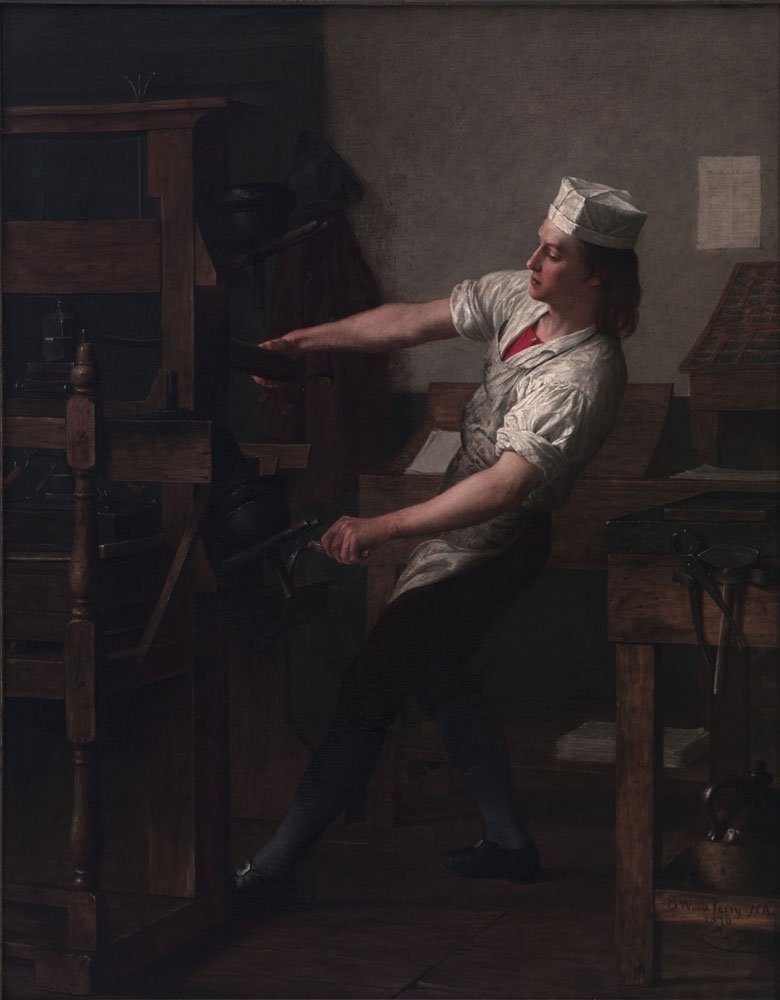
Young Franklin at the Press“Young Franklin at the Press” by Enoch Wood Perry, 1876. (In the collection of Albright-Knox Art Gallery, Buffalo, New York)Franklin is also frequently misquoted in pop culture (and of course, on Facebook and Instagram pages). Phrases erroneously attributed to Franklin include “A penny saved is a penny earned” (he wrote something similar in “Poor Richard’s Almanack” but not that line).

Sadly, Franklin also never said or wrote “God made beer because he loves us and wants us to be happy.”

Sadly, Franklin also never said or wrote “God made beer because he loves us and wants us to be happy,” though Franklin did write in a letter of rain entering the vines of grapes and becoming wine as “constant proof that God loves us, and loves to see us happy.”

Franklin for kids

An adorable animated version of Franklin makes a recurring appearance on “The Fairly OddParents.” You can find him as a playable character on the game “Tony Hawk’s Underground 2,” not to mention in children’s books from the mouse-narrated “Ben and Me” to “Ben of All Trades: The Most Inventive Boyhood of Benjamin Franklin.”  

And he even had his own series called “Liberty’s Kids,” an animated show that aired on PBS in which Benjamin Franklin (voiced by Walter Cronkite) and his teenage reporters experience life during the American Revolution, covering stories from the Boston Tea Party to the ratification of the Constitution. It’s exciting, patriotic stuff.

Watch the opening sequence (featuring a theme song complete with rap breakdown) below, via Mill Creek Entertainment, which bought the home video rights to the series:

Franklin the time traveler

Frequently in time travel stories, from “The Flintstones” to “Bewitched,” Franklin is there — a surefire, instantly recognizable way to indicate we’re not in Kansas anymore. Or, in the current year. He plays charades in “Bill and Ted’s Bogus Journey,” and there’s a Ben Franklin impersonator on “The Office.”   

Franklin invades sports

Philadelphia 76ers mascot Franklin holds his hands in the air during a timeout in the game against the Indiana Pacers on February 20, 2015 (Mitchell Leff/Getty Images)The Founding Father inspired the name of the Philadelphia 76ers NBA team mascot, Franklin the Dog. The royal blue canine was introduced in 2015, replacing previous mascots Hip Hop the rabbit and Big Shot from the ’80s.

Franklin the namesake

“National Treasure: Book of Secrets” movie poster (Walt Disney Pictures)Characters are called after Franklin on everything from “M*A*S*H” (Captain Benjamin Franklin “Hawkeye” Pierce) to “National Treasure,” where Nic Cage’s character Benjamin Franklin Gates is (conveniently) an American historian, cryptographer and treasure-hunter. 


Want a daily wrap-up of all the news and commentary Salon has to offer? Subscribe to our morning newsletter, Crash Course.


Franklin’s physical appearance is perhaps the most recognizable of the founding fathers: his long hair (bald on top), buckle shoes and round glasses; his many inventions included bifocals. In portraits we have of him, he’s also half-smiling, Mona Lisa-style, as if he knows a secret. He gave us a lot of advice and words (well, some of which we made up) and he gives us a lingering image, one that would not be possible without the power he also gave us. As The Decemberists sing in their song about him: “Electricity. Yeah, you can all thank me.”

More stories like this:


Your salt and pepper shakers have a surprisingly spicy history

The world of kitchen tools is immensely diverse. From spatulas and whisks to air fryers and crockpots, there is no “one size fits all” when it comes to the breadth of kitchen tools, their uses and their designs. How, then, would tools such as salt and pepper shakers be defined? They’re not merely decorative and they have a function beyond aesthetic appeal, so they do qualify as a “tool,” but would one ever equate salt and pepper shakers and Instant Pots in the same breath? 

Throughout Western countries, salt and pepper shakers are commonplace on nearly every kitchen or dining room table. In most instances, salt and pepper are some of the only seasonings that are simply always left on the table. 

Related: The (cheap) tools that will transform your cooking in 2022

That said, for some, shaking a bit of salt and pepper onto your meal may be a bit of an insult. It’s essentially like saying to the cook, “Sorry, but this isn’t to my liking. Let me improve it myself.” Similarly, at a restaurant, a diner should feel secure in the seasoning prowess of the chef and the kitchen. After all, you’re paying for your food to be cooked, so you should expect a proper seasoning deftness. Still, the presence of salt and pepper shakers remains a mainstay on most kitching and dining room tables. 

Taking all of this into consideration – how did the salt and pepper shaker set originate? Did it once pose more of a functionality in actual cookery than it does now? Is the functionality of salt and pepper shakers now outweighed by their aesthetic or nostalgic appeal? If so, does it primarily offer a decorative element in the vein of a fun seasonal item, a holiday standby, a wedding favor — or does it manage to encompass all of the above? 

Origins of seasoning

It is thought that John Mason — also the originator of the mason jar — invented the shakers in the mid-1800s, as noted by Ten Random Facts, but the shakers didn’t become widespread and manufactured until the 1920s. Mason’s original invention was idealized to “hold salt that would [be] evenly distributed … on food, by shaking it through several holes punched into a tin cap,” as noted by Our Everyday Life. However, this ingenuity didn’t really take shape until after Morton added magnesium carbonate to salt in order to ensure a free-flowing pour. Smithsonian notes that one of the first “fine quality” shakers was created in the early 1920s by a German pottery manufacturer named Goebel. 

Hundreds of years ago, salting your food was a laborious process: salt was typically kept in a cellar and broken off in large clumps before being sprinkled over dishes. Soon after, salt began to be collected in small bowls and placed on the table with a spoon, which also added a customizable element to a meal. You could effectively “salt to taste.” As previously noted, Morton Salt then, per the Smithsonian, “introduced magnesium carbonate … which prevented caking and made it possible to pour salt from a sealed container.” This changed the future of salt and allowed for a shelf-stable, consistently reliable product that wouldn’t become lumpy or unappealing over time.

Hundreds of years ago, salting your food was a laborious process: salt was typically kept in a cellar and broken off in large clumps before being sprinkled over dishes.

Journal of Antiques notes that salt shakers once contained a block of sorts that was used to mill or break the salt into pieces in the case that it clumped. After Morton’s discovery, this piece was removed, and as modern ceramics became more and more widespread and common, the shakers boomed in popularity — eventually becoming the collectible, souvenir, favor or hand-me-downs that they are today.

Brass Armadillo, a Des Moines-based antique mall, states that the shakers were initially ubiquitous throughout restaurant kitchens and hardly ever seen in a home kitchen after first being developed. Salt and pepper shakers soon became a go-to souvenir option for many families. It doesn’t hurt that they tend to be very economical (amongst fervent collectors, though, it is said that certain high-quality, unique, or vintage shakers can sell for exorbitant amounts!). 


Want more great food writing and recipes? Subscribe to Salon Food’s newsletter.


As Smithsonian notes, the majority of saltshakers contain one hole, while pepper shakers tend to have two or three. Interestingly, Smithsonian also states that “it was the Great Depression … that gave a major boost to the popularity of salt and pepper shakers as both a household and collectible item,” perhaps due to the fact that most were made of ceramic and were very affordable. 

All about salt

Of course, salt is arguably the single most important ingredient in any dish. It bolsters flavors that otherwise lie dormant, it adds a salinity that permeates, it heightens the flavors of other complementary ingredients, and it helps to deepen the taste in any dish — both savory and sweet. In addition to seasoning food, salt also plays a significant role in brining and preserving foods, which was paramount in the days prior to refrigeration.

This video from BBC Ideas notes that salt is “essential for life and has been used since prehistoric times,” noting that it’s “one of the earliest food industries and one of the most important commodities in the world.” (Fun etymology note: the Roman word ‘sal’ for salt is also the base of salary and salad, which are both said to have been named in conjunction with salt.)  

Salt is arguably the single most important ingredient in any dish.

The History Vault dates salt production and consumption to 450 BC in China, while pepper originated in India has been “exported from South Asia for about 4000 years.” Prior to shakers and grinders, pepper was prepared in a mortar and pestle prior to being served or used in cooking. There is also a thought that excessive seasoning was used to “disguise the flavor of rancid meat” in pre-refrigeration times, as unappetizing as that sounds. 

NPR notes that salt was once incorporated into a meal at the table in a unique manner: a meat carver — known as a trinciante — would carve meat, letting the meat slices fall onto the plates of each diner, and would then “dip the end of the knife in salt and scrape it onto the diner’s plate,” according to NPR. Fascinating, but this clearly required quite a bit of labor. The invention of the shaker helped to make seasoning an individual, simple task.

The importance of pepper

Peppermate notes that the pepper grinder “was invented by Peugeot of France in 1842.” Peppercorn is said to have helped “delineate between sweet and savory,” and was often used in tandem with salt – and rarely with any other spices or seasonings – to add a refined, heightened flavor to dishes. 

Varieties of pepper, such as cayenne, were also used, but not as commonly. Morton’s invention of “easy flow” salt helped to influence the development of today’s shakers, which only require a simple flick of the wrist to spruce up your foods, as opposed to sparingly sprinkling salt crystals from a spoon or tip of knife. Peppermills did replace shakers in some cases, especially as time has gone on, and with increased recipes calling for “freshly ground black pepper” (via BBC Foods).

BBC Foods also interestingly notes that pepper began to become known as “melancholy” spice, so many were opting to enjoy “more sanguine” spices instead — until myriad French chefs began to incorporate black pepper into a swath of classic French dishes, and this inclusion began to permeate the culinary world at large.

Pepper is always best when freshly ground. When dried and ground, the pungency begins to dissipate, so a freshly ground cranking results in sharp, pungent notes of pepper, which is why “freshly ground black pepper” is a nomenclature that caught on with such fervor.

A package deal?

While some view “salt and pepper” as a package deal, it is important to note that they are inherently different ingredients — salt is something that can (and should) be added to practically anything, whereas pepper can add a strong note and sharpness that wouldn’t be very welcome in a large swath of dishes. Of course, this didn’t stop “salt and pepper shakers” from being marketed as a two-in-one item or set. Furthermore, it’s also important to note that a “pepper shaker” and a pepper mill or grinder are two very separate items. 

Modernity — and what’s to come

Did you know that there’s even a salt and pepper museum located in Tennessee — and that it boasts over 20,000 pairs of shakers? According to Wide Open Eats, the museum was opened in order “to display the societal changes represented in salt and pepper shakers.” Smithsonian notes that the collection includes “fat chefs, ruby red tomatoes, guardsmen in bear skins, Santa’s feet sticking from a chimney, pistols and potatoes…” and many, many more. 

Nowadays, shakers have been modernized. There are electric peppermills, as well as specialty saltshakers with grinding features. Also, the sheer number of salt and pepper products has grown increasingly, which adds yet another element to the shaker discourse. For many, though, the reliable, ceramic standbys are unbeatable. 

The longevity of salt and pepper shakers is yet to be seen, but I’d be comforted by the notion of my relatives’ centuries in the future feasting on a robust Thanksgiving meal, complete with matching turkey shakers in a starring role on the Holiday tablescape. I grew up with those familiar, nostalgic shakers, and whether your table is festooned with turkeys, Santas, snowmen, or whatever ceramic delight is customary in your family. They are clearly much more than merely a vessel for seasoning. A nostalgic relic, salt and pepper shakers are part functional tool, part antique, and part souvenir, encompassing each realm fully.

I can only hope that ornate, decorative, or even absurdist shakers — both holiday-themed and not — will continue to hold a special place on the dining room and kitchen tables of the future.

More of our favorite kitchen gear: 

On Will Smith slapping Chris Rock and what I know about heroes and violence

“Jada, can’t wait for G.I. Jane 2,” a sharply dressed Chris Rock said to Jada Pinkett Smith in front of a packed house of celebrities and viewers at home watching the 94th Academy Awards ceremony. Will Smith, Jada’s equally dapper, megastar husband, then made his way to the stage, power-walked toward the 57-year-old comedian, and right after Rock said, “Awwww, here comes Richard” — as in his Oscar-nominated role as the hero of “King Richard,” as in Richard Williams, father of the famous tennis champion Williams sisters –– Smith cocked his arm back like granddad’s rifle and slapped the taste out of Rock’s mouth in what was maybe the best-dressed assault in the history of the Academy Awards.

“Baby, you see that?” my wife said to a half-asleep me. The slap woke me up.

“Oh hell no, that’s not real,” I said, wiping the sleep off of my face. “Would the Oscars stage a bit where two Black men fight, at the height of racial tension in the woke era? In 2022? Hell, no. Rewind it!”

“I think it’s real.”

As Smith walked back to his seat, Rock said, “Will Smith just slapped the shit out of me.”

Then Smith yelled, “Keep my wife’s name out your f**kin’ mouth!” Viewers at home couldn’t hear that part in real-time; it was censored. Of course, Twitter and Instagram provided uncensored versions. The scene was as ugly as we thought it was.

 * * *

So many think pieces have been written about this incident since it happened — some bad, some very bad — so I’m not going to waste your time talking about how gracious it was of Chris Rock to protect Smith from the LAPD in that vulnerable moment, or about Will Smith’s apology and his decision to withdraw from the Academy, a self-inflicted punishment that didn’t fit the crime. (Maybe take a year off, but don’t resign entirely.)

RELATED: Will Smith and the function of a slap – what it means for comedy and comedians

I also will not be doing a deep dive into Will Smith’s journey of masculinity and self-acceptance he wrote about in his memoir “Will”; or Chris Rock’s job as a comedian, work that historically has been made from poking fun at the insecurities of others and their own; and how our society is full of hypocrites (me included) because we all pick and choose the jokes we want to laugh at. Jokes about LeBron James’ hairline are apparently acceptable; jokes about Jada’s are not. That’s how comedy is now, and that’s how it’s always been — the only non-policeable genre of art, up until people want to police it.

I don’t want to debate. I also don’t want to demonize Smith or Rock.

Any take on comedy or the Oscars or the parties involved can be debated and even proven wrong by people with different life experiences and perspectives. We are all complex, multi-layered beings. So I don’t want to debate. I also don’t want to demonize Smith or Rock. The way I see it, they are both victims of America’s obsession with the hero’s journey.

Arguments have been flying over who was the hero of the moment. Was it Smith for standing up for his wife? Rock for being fearless in his comedy first, and then for not pressing charges? But my main concern is our obsession with being the hero, the role violence plays in that obsession, and how it never really works out in real life the way Hollywood shows us.

RELATED: I grew up surrounded by toxic masculinity, but I evolved: We have to give people a chance to grow

When I have tried to tell my childhood friends, on more than one occasion — usually over drinks — that I was bullied when we were kids, they laugh hysterically, exposing every tooth in their big giggling mouths.

“Boy, you had all the Nikes and all the Jordans,” they fire back. “No one picked on you!”

And yes, I had some very nice things — things that often attracted the wrong kind of attention. Someone would see me shining, or witness a young girl — maybe a girl they had a crush on — admiring me and my budding adolescent fashion sense and want to fight. So I had to fight.

Every man in every movie, sitcom and cartoon I watched either completed their hero’s journey or died trying.

My first brawl was with a kid named Burger. On a beautiful summer day, he body-slammed me, Hulk Hogan-style, about a foot deep into the concrete after I tried to stop him from bullying another friend. Initially, I didn’t fight back. I allowed Burger and everyone else on the block that day to laugh at me while calling me all kinds of a chump for not defending myself. Burger knocked me completely off my neighborhood’s food chain. I hid out in my room for a couple of days, watching TV shows and movies, including Will Smith’s “The Fresh Prince of Bel-Air” and Chris Rock’s “New Jack City.” And I noticed that every man in every movie, sitcom and cartoon I watched — even Rock and Smith –– either completed their hero’s journey or died trying.

Maybe you’re reading this thinking, “There is no way Rock played a hero in ‘New Jack City.’ Cut it out!” Let me explain.

Chris Rock’s character Pookie had the ultimate hero’s journey in “New Jack City.” We meet Pookie at the opening of the film; he starts as a stickup kid. And we can easily assume he wasn’t robbing for the pure pleasure of it: he didn’t attack a working citizen or a helpless grandma. He attacked a drug dealer who wanted to poison our community with crack. That’s hero work. The drug dealer in question happened to be an undercover police officer played by Ice-T, who shot a poor kid just trying to feed his family. Pookie was so much of a hero that he even threw the cash he stole from Ice-T onto a playground full of kids forced to grapple with the whole of poverty. Hero.


Want a daily wrap-up of all the news and commentary Salon has to offer? Subscribe to our morning newsletter, Crash Course.


Pookie didn’t just go away after the intro, either; he fell on hard times and started using crack as a result of Ice-T’s police violence. Ice-T, who by now has made friends with notorious drug dealer Nino Brown, finds Pookie on Thanksgiving Day and beats him up again. Pookie earned this whipping, though, because he was yelling at a woman, making Ice-T the hero. But Pookie wasn’t done. In true hero fashion, he beat his crack addiction, graduated from rehab and volunteered to go undercover into the dangerous drug organization in an effort to get crack off of the streets: that’s a hero move. He died trying to save inner-city kids from Nino, Ice-T and crack. God bless Pookie, a true American hero.

A hero’s journey is pretty simple: a character — traditionally a man — is faced with a great challenge, but he’s filled with doubt up until he decides to abandon the doubt, conquer the challenge and accept his hero status. Burger, the boy who beat me up, was on the other end of my hero’s journey. If I didn’t defeat him, I would never be able to go outside again. I would let myself down along with the group of imaginary people who needed me to save them from the wrath of Burger. So I slipped a padlock into a long tube sock, tied that sock into a tight knot, and used it to beat a chunk of meat out of Burger’s head, thereby reclaiming my space on the food chain. The corner went wild. I was the hero.

I don’t know how Will Smith feels, but I imagine his inner arc might have been similar to mine: triumphant when he approached the stage, sure. But what people are not talking about is how Smith might have felt after the slap. I can’t speak for Smith, but I know I felt horrible after hitting Burger with the lock. Not like a hero — more like a villain. What felt even more horrible is that I would continue to perform similar acts of violence for at least two decades after that incident.

* * *

There were times I was the slapper. There was Burger. Then there was this guy named Andre I slapped for stealing my bike. I slapped my friend Todd’s father after he stole our Sega Genesis, slapped Chico for slapping my cousin Lo, slapped Ira because his face was slap-able, slapped my gym teacher for saying, “Watkins, I’ll f**k you up!” Slapped my cousin Angelo, slapped the dude Kelly from across the street for slapping Angelo, slapped Fat Del for disrespecting my aunt, slapped Hugie while he was slapping my cousin, slapped Dress Code on the block, slapped Sam, slapped Sam Jr., slapped a photographer at a college who disrespected a young woman, slapped myself to stop myself from slapping a local reporter, and slapped a Black Republican after a panel discussion at Columbia University. I slapped a white man in a bar, slapped an older white man at a protest, slapped Wiz for allowing me to get slapped at a Project Reunion party and slapped Big House for breaking up the fight. And boy did my palms sting.

Let’s skip past the times my dad or uncle slapped me for crying –– even though those slaps stung hard enough for me to take a couple of decades off from shedding tears.

Then there were the times I was the one slapped. Let’s skip past the times my dad or uncle slapped me for crying –– even though those slaps stung hard enough for me to take a couple of decades off from shedding tears. Of course, my mother slapped me in the market for mouthing off. God, her hands were quick. Then there were all the slaps I took from police officers, especially in the ’90s and early 2000s, the golden years for slapping young Black men. Burger slapped me silly more than once. My cousin Angelo slapped me back with a baby oil-doused hand, my cousin Kevin and I slapped each other senseless for about an hour, back and forth to see who would tap out first, and I can’t remember who won but I remember the pain.

RELATED: Men explain toxic masculinity to me, a man writing about toxic masculinity

A whole family slapped me on a sunny day after I disrupted their family reunion — it seemed like hitting me brought them closer together. I was slapped by a bouncer in a club for dunking a basketball: “The hoop is for decoration, aesthetic, no dunking!” But I was young and nimble and — define aesthetic — so I slammed the ball again away. And boy oh boy did my jaw sting after that.

And from all of those slaps, I learned nothing at all except the one fact I learned after slapping that chunk of bloody flesh off Burger’s head with that sock-lock. Hitting people does not make you a hero. It does not bring joy, happiness or healing. It does nothing more than temporarily feed your ego. So if you can, please keep your hands to yourself, because the juice ain’t worth the squeeze.

Those of us watching from the audience — we take-havers and we side-pickers —  need to check ourselves as well. Why are we so quick to name a hero in a fight, especially when they’re causing pain to another person?

More stories about the aftermath of the 94th Academy Awards: 

Snacks have lost their damn minds

It was the spring, of 2021 and Avi Bonnerjee, a 35-year-old Brooklyn resident, was shopping for groceries. While perusing the pasta shelves, something caught his eye: Flamin’ Hot Cheetos Mac ‘N Cheese.

“The package had a very cool cheetah on it, which seemed like a weird way to sell macaroni and cheese, or any food. And it was bright red, with Guy Fieri–style imagery of flames,” he recalls. “I felt compelled to buy it.”

He brought it home and promptly did nothing, allowing it to “languish in the pantry for months.” And then came Thanksgiving.

He and his partner were instructed to show up at a friend’s home with a dish for the table. In the end, they came bearing two: a container of stuffing, and a casserole dish of Flamin’ Hot Mac ‘N Cheese, on top of which Bonnerjee had sprinkled little bits of Cheeto.

“You eat with your eyes. People were very put off by it at first — there was a lot of hesitant sniffing. But once I got in there, it was extremely recognizable. The noodles were very limp. The sauce was too creamy. But it was reminiscent enough. And honestly, it kind of tasted good,” he says. “It wasn’t the first novelty food I’ve tried,” he says. “And it probably won’t be the last.”

Bonnerjee is just one of many participating in a seemingly unending modern food trend: novelty snacks that seem to be proliferating on grocery shelves at an alarming rate.

In the past few years alone, Americans have been introduced to products like Mini Funfetti Unicorn Pancakes — which contain little bits of candy and, perplexingly, nothing shaped like a unicorn — in the freezer section, chips flavored like a Wendy’s chicken sandwich in the munchies aisle, and Little Debbie Cosmic Brownie Cereal on the breakfast shelves. There are collaborations between distinct brands, as with Pillsbury’s Lucky Charms Sugar Cookie Dough, and there are single-brand experiments, like Blue Heat Takis. There are boxes of Twinkies cereal, and stacks of Birthday Cake Waffles. There is mayonnaise flavored like a Cadbury Creme Egg, and it is complete chaos. We are living in a golden age of snacks — or perhaps the dark ages.

“We don’t have [numbers] on this specifically, but there do seem to be more novel or extreme flavors hitting the market,” says Barb Renner, U.S. Consumer Products leader for Deloitte.

Shock-jock branded food moments have, of course, been around since well before the first Cheetos Sweetos Cinnamon Sugar Puffs or Limeade Oreos hit the shelves — probably even before the first competitive eater crammed 13 hot dogs down his throat in Coney Island on the Fourth of July in 1916.

And at a basic level, it’s no wonder why: “If you think about the marketing funnel, awareness eventually moves down to consideration, and then trial, and then of course conversion or purchase, and then retention,” says Brandon Perlman, founder and CEO of marketing firm Social Studies, Inc. “Going viral is like maximizing awareness. It may not get a customer to convert, but awareness will definitely put you in the consideration set.”

But why more? And why more now? Grocery stores and snack producers were cagey when I reached out to ask, in no uncertain terms, what in fuck’s name is going on. After giving me the runaround over a lengthy email exchange, a General Mills PR representative pointed me toward the company’s public website. A representative from Whole Foods wrote, “Whole Foods Market has always been an incubation platform for fun, exciting and unique items.” Beto Galvan, VP of Own Brands Innovation & Product Management for Albertsons, sent me a cheery and cryptic response noting that “out of the box” items are currently “in-demand,” and very little else. Gristedes never replied, and Kellogg’s ghosted me.

One purveyor, however, was happy to spill. His name was Jonathan Rodriguez, and he was boarding an airplane to meet with Wiz Khalifa about a limited-edition cereal release. Rodriguez is Director of Partnerships at Soflo Snacks, a Miami-based company that peddles what he calls “collectibles” in the snack space — “like a physical NFT.”

“[We’re seeing more novelty snacks] because the demand is there — we’re seeing demand for new flavors and new tastes. People want to try something new,” he says. “Before this wave, everyone was offering the same thing for eight years.”

Flamin’ Hot Cheetos Mac ‘N Cheese has been the most successful product Soflo has carried to date. Perlman points to social media channels as virtual echo chambers that make it feel, for consumers, like there are more of these novelty snacks, regardless of actual numbers.

“More people know about them than ever before,” he says. “There are more trees falling in the forest, and there are more people in the forest.”

Renner postulates that pandemic dynamics are at play, too: “Now that things are opening up, the CPG product innovation pipelines have two years’ worth of ideas waiting to be tried. In order to gain attention and cut through the noise, surprising and extreme combinations and variations can help companies do that.”

In other words, to even enter the echo chamber, brands see their best bet as either an over-the-top stunt product — a shocking little dare in a crinkly, colorful package — or an earnest attempt at over-the-top deliciousness, like Cinnamon Toast Crunch–flavored Cinnadust Betty Crocker Frosting.

On either end of the spectrum, flavors and concepts seem hand-selected from another ongoing trend: targeting millennials with their own nostalgia.

“There are no new ideas. Everyone is just taking your memories and selling them back to you now,” says Bonnerjee. “Larry David is selling cryptocurrency. There’s the Lion King, only now it’s CGI, not animated. People have a sense that their best years are behind them. They’re receding deeper into this fictional world where all their memories and nostalgia are.”

Elana Berusch, a 29-year-old who lives in Denver and develops products for a frozen sandwich company, developed such a penchant for Cheetos growing up that her wedding featured baskets of Flamin’ Hots on tables for all of the guests. (No word on whether her dress had extra pockets for Tide Pens.) Berusch tried the Flamin’ Hot Cheetos Mac ‘N Cheese after stumbling upon it during a hangover grocery run.

“Our generation has all these memories of Dunkaroos, and Cookie Crisp, and Twinkies,” she says. “Companies can market that: ‘We tried this new thing, but it has a flavor that’s nostalgic for you.’ And then even if you don’t want to buy the Twinkies cereal, it gets you to the cereal section of the grocery store,” she says.

Whatever the force behind this wave of candy-coated, neon-tinged snackery, it shows no signs of slowing down.

Perlman estimates that only three years ago, roughly one in 100 requests he’d get from food clients were for a marketing splash that consumers might deem “buzz-worthy.” Today, he says, “it’s 10 of 100 requests.”

Even Bonnerjee, who openly acknowledges that his role in these “cynical marketing plays” is perpetuating some of these “late-capitalist artifacts,” says he’s not yet ready to put down his fork.

“There are still ones I want to try, but I haven’t summoned the courage,” he says.

Noam Chomsky: We’re nearing “the most dangerous point in human history”

Renowned linguist, philosopher and Salon contributor Noam Chomsky issued a dire warning on Wednesday that humanity is at a crucial point in its history — largely due to the twin threats of climate change and nuclear war.

“Because of Trump’s fanaticism, the worshipful base of the Republican Party barely regards climate change as a serious problem. That’s a death warrant to the species,” Chomsky said in an interview with The New Statesman. The American scholar, who is currently a professor at the Massachusetts Institute of Technology and the University of Arizona, also warned of Russian President Vladimir Putin’s “monstrous” war in Ukraine. Chomsky explained that Putin has set off a chain of events which could lead to an apocalyptic global war.

RELATED: Noam Chomsky discusses the path to a livable future

“We’re approaching the most dangerous point in human history,” Chomsky concluded. He recalled an article he wrote as a child in 1939 about how the cloud of fascism was gradually overtaking the world and ominously added, “I haven’t changed my opinion since. It’s just gotten worse. The doomsday clock of the Bulletin of Atomic Scientists — under Trump they abandoned minutes, moved to seconds. One hundred seconds to midnight. That’s where it is now because the threats are accumulating.”


Want more health and science stories in your inbox? Subscribe to Salon’s weekly newsletter The Vulgar Scientist.


Chomsky has previously expressed sympathy for Putin’s policy positions toward Ukraine, although he has never supported acts of unprovoked war such as the one currently being waged by Russia against Ukraine. In a 2015 interview with Salon, Chomsky noted that throughout the 1990s NATO expanded to the borders of Russia even though Mikhail Gorbachev, who was then the leader of the Soviet Union, had been verbally assured that in return for supporting German reunification NATO’s sphere of influence would not go past East Germany.

“And now it’s gone further, even to Ukraine which is right at the heart of, apart from historical connections, of Russian geo-strategic concerns,” Chomsky argued. “That’s very serious.” He later added that the media coverage was “all about what a lunatic Putin is” and claimed that “you can like him or not, but his position is perfectly understandable.

Chomsky has been a consistent proponent of taking aggressive measures to address climate change. In a 2020 Salon interview, he drew attention to a document by President Donald Trump’s Transportation Department in which they admitted that global temperatures will exceed four degrees centigrade above pre-industrial levels by 2100 but only proposed reducing car and truck emissions.

“This is the most extraordinary document in human history,” Chomsky told Salon. “I can’t think of anything like this. The thing that comes closest is the Nazi Wannsee declaration in 1942, which was the formal decision of the Nazi party to wipe out all the Jews of Europe. Not even that said, ‘Let’s race ahead to make some money while destroying the prospects of all human life on Earth.’ Why isn’t this the headline everywhere?”

In December Chomsky told Democracy Now that he believes America is moving toward a “proto-fascism, where many of the symptoms of fascism are quite apparent — resort to violence, the belief that violence is necessary.”

He added, “A large part of the Republican Party, I think maybe 30 or 40%, say that violence may be necessary to save our country from the people who are trying to destroy it, the Democrat villains who are doing all these hideous things that are fed into their ears.”

Read more on Noam Chomsky:

Raskin calls out “Trump-Putin axis” after Marjorie Taylor Greene heckles Jan. 6 committee vote

Rep. Marjorie Taylor Greene, R-Ga., reportedly heckled Rep. Jamie Raskin, D-Md., a member of the House Jan. 6 select committee, on Wednesday for encouraging the House of Representatives to hold two of Donald Trump’s former allies in contempt of Congress.

The freshman firebrand interrupted Raskin to shout about “Russia collusion” and refer to Ashli Babbitt, the Trump supporter who was shot and killed by a Capitol police officer while attempting to break into the lobby of House Speaker Nancy Pelosi on Jan. 6, 2021.

ttps://twitter.com/hugolowell/status/1511759309922836486

RELATED: Jan. 6 committee calls on Merrick Garland to act: “Do your job so we can do ours”

“We’ve got some people echoing all of Trump’s complicity with Vladimir Putin from the Georgia delegation back there,” Raskin said in response. 

The Democrat continued: “I accept the heckling … because if she wants to stand with Vladimir Putin … she is free to do so.”


Want a daily wrap-up of all the news and commentary Salon has to offer? Subscribe to our morning newsletter, Crash Course.


Greene’s remarks came in direct response to the panel’s recommendation of contempt charges against Peter Navarro and Daniel Scavino, two former Trump aides who allegedly assisted the former president in his failed bid to overturn the 2020 presidential election. The recommendation was made after both refused to comply with the committee’s subpoenas of their communications leading up to the Capitol riot, which Navarro and Scavino have argued are protected by executive privilege. 

According to a recent committee report, Navarro helped Trump “develop and implement a plan to delay Congress’ certification and ultimately change the outcome of the November 2020 presidential election.” Scavino was allegedly “with then-President Trump on January 5 and January 6 and was party to conversations regarding plans to challenge, disrupt, or impede the official congressional proceedings.”  

This week, the House Committee voted to advance possible contempt charges for both Navarro and Scavino, and the full House followed with a vote to endorse those charges on Wednesday. Now the Department of Justice will decide whether to hand down official indictments.

Thus far, the Justice Department has only indicted former Trump strategist Steve Bannon despite the hundreds of subpoenas issued by the select committee, leading many Democratic lawmakers to become frustrated by the agency’s inaction.  

RELATED: Time for Merrick Garland to act: Trump can’t get a pass on serious crimes over “politics”

When the House voted to hold Bannon in contempt back in October, Greene had a similar outburst directed at Raskin, as well as committee vice chair Rep. Liz Cheney, R-Wyo., that involved bizarre references to Black Lives Matter and Jewish space lasers. 

Greene “seemed to have some kind of ancient beef with the former chair of the House Republican Conference, Liz Cheney, over the Jewish space lasers thing or something like that,” Raskin said, summarizing the bitter exchange. “And she denied that she’d ever said that and blamed that on the mainstream media.” 

Meet the scientist who wants to control the weather

It is easy to forget that clouds — yes, those big, cottonball-resembling things in the sky — are comprised of thousands of tiny particles, so small that they float through the air instead of settling on the ground. These are known as aerosols, and for scientists like geoengineering expert Dr. Hannele Korhonen — who has ambitions to control the weather — they are a lifelong passion.

That passion is at the heart of “How to Kill a Cloud,” a new documentary that premieres on VICE’s The Short List on Thursday, April 7th on VICE.com. The title is apt both literally and for figurative reasons: It chronicles Korhonen’s doomed pie-in-the-sky dream — which takes her from her native Finland to the United Arab Emirates (UAE) on a $1.5 million grant — to make it possible for people to create rainclouds in the desert. As Korhonen hobnobs with one percenters and wrestles with the ethical implications of manipulating the weather, “How to Kill a Cloud” uses a light touch to cut between Korhonen’s obviously sincere and brilliant fascination with science and the grubby networking that is required as she pursues her dream.

RELATED: The Australian wildfires were so big that they punched a hole in the ozone layer

The ambition to control the weather sounds like the domain of mad scientists — or at least, of the very rich countries that can afford such luxury technology. Yet such ambitions also inevitably lead to thorny ethical and political drama: in China, for instance, where clouds are routinely “seeded” with silver iodide or liquid nitrogen to stimulate snow or rainfall, intense debates preside over who has access to which cloud’s water, and when and where such cloud-seeding is appropriate.  

“I think there is a larger question as it pertains to geopolitics as well, in terms of the wealthy countries being in the position of being able to do this and bringing the top scientific minds from around the world in order to do this research, and who actually gets to own this research is the UAE in the end,” docuseries curator Suroosh Alvi told Salon. “And if they have issues with Iran or Qatar across the Gulf, will they be able to flood them out? I think it is very, very political and gets us into the ethical kind of issues around it.”

Many scientists think the technology being developed could be used to help slow down or solve the problems associated with climate change.

Yet while it seems frightening for people to be able to control the weather, greenhouse gas emissions have already begun changing the atmosphere through the process known as climate change. In a sense, humanity is already past the point of no return when it comes to altering the weather. The only difference is that, if Korhonen’s visions are realized, humans will have the technology to do so deliberately.


Want more health and science stories in your inbox? Subscribe to Salon’s weekly newsletter The Vulgar Scientist.


“The difference with weather modification is that you make science where you try to find means [to] control it the way you want it — and when you want it,” director Tuija Halttunen explained to Salon. “The contradiction is that many of the scientists who I met during film are very concerned about climate change.” Many scientists think the technology being developed could be used to help slow down or solve the problems associated with climate change, although “they don’t want to do that” necessarily, Halttunen said, because that would merely be a temporary fix: “The final answer is any way to cut down the emissions and not to find means for how to keep up this [wasteful] way of life.”

Yet “How to Kill a Cloud” is not all about ethical debates and the future of humanity. There is also plenty for the science buffs out there, as Halttunen and Korhonen capture beautiful shots of clouds and break down how people can understand them not as ephemeral dreams from the sky, but as real-life objects.

“There wouldn’t be any clouds if there weren’t impurities in the atmosphere and in the air,” Halttunen told Salon when asked about the filmmakers’ fascination with clouds. “In a sense, the air must be dirty to get clouds, because the water gets on the surface on the particles.” The air impurities mean that rain droplets aren’t pure liquid water, but contain impurities too. “There is always the impurity in the air,” Halttunen continued.

Perhaps this is an appropriate metaphor for the dilemma captured in “How to Kill a Cloud” — the purity of Korhonen’s fascination with science and stated desire to help humanity, and the imperfections of the tiny particles of capitalism and geopolitics that get mixed in with those ambitions. Within this milieu, the documentary serves as something of an effort to create good — both by shedding light on the sausage-making side of science and by providing readers with some entertaining and legitimate science to help the medicine go down more smoothly.

“By putting this out there and pushing it as far as we can and as wide as we can, that’s one way to help mitigate [misinformation],” Alvi told Salon when asked if the documentary could be an antidote to the bad science circulating online. “I think the director, she felt that the protagonist Hannele did kind of ignore the politics of it all in order to be an ambitious scientist. Maybe that’s okay if she is a scientist and she’s doing good work, but we don’t know if it’ll get weaponized down the road or not.”

Read more Salon articles on meteorology:

A contentious study reveals exactly how easily COVID-19 spreads

Since the dawn of the pandemic, it’s been one of the most glaring missing puzzle pieces in the scientific portrait of COVID-19: Just how much virus does one need to be exposed to in order to get infected? 

Previously, theories were formulated by measuring the viral load in an infected person, meaning the amount of virus found in a person’s body. While studies have found a link between viral load and severity of the disease, the amount of virus a person needs to have in order to get COVID-19 — the disease caused by SARS-CoV-2 — remains unknown.

Until now. A new study using an uncommon testing technique suggests it only takes a mere droplet — one 10 microns across, or one-hundredth of one millimeter — to infect someone with COVID-19. Droplets of this diameter are commonly expelled in a single cough or sneeze. The study was published Thursday in the journal Nature Medicine

Though small, the study is particularly significant because it was a human challenge trial — meaning that human subjects were actually deliberately infected with COVID-19. Usually, these types of studies are controversial, particularly with viruses with higher mortality rates like COVID-19, but the results are immensely valuable.

RELATED: What COVID-19 will look like in 2100

The study began in March 2021 with 36 volunteers who were between the ages of 18 and 30 who had no evidence of a previous infection and weren’t vaccinated.

“People in this age group are believed to be major drivers of the pandemic and these studies, which are representative of mild infection, allow detailed investigation of the factors responsible for infection and pandemic spread,” said Chief Investigator Christopher Chiu, from the Department of Infectious Disease and the Institute of Infection at Imperial College London. 


Want more health and science stories in your inbox? Subscribe to Salon’s weekly newsletter The Vulgar Scientist.


All of the volunteers were screened for any risk factors for severe COVID-19, such as having any blood, heart, liver or kidney issues. The study was also conducted in phases to further minimize the risk — for example, the first 10 people to get intentionally infected with COVID-19 received the antiviral drug remdesivir to reduce their chances of progressing to severe disease. Researchers in charge of the study also had monoclonal antibodies on hand in case anyone’s infection progressed in a concerning way; ultimately, nobody had to receive the antibodies. 

Notably, scientists observed that an infection developed within two days of first exposure, suggesting that COVID-19 has a short incubation period. The researchers also confirmed that people shed high amounts of virus before they show symptoms, adding to the difficulty in stopping the spread of infection before a person shows symptoms.

Out of the 36 participants, 18 people were infected with COVID-19 after scientists exposed everyone with a small drop of fluid containing the first detected strain of SARS-CoV-2 through a tube inserted into their nose. Two of those infected never experienced symptoms, while 83 percent of those infected lost some of their taste and smell. Nine subjects couldn’t smell at all. Six months after the study, one infected participant still had an altered sense of smell. Notably, there was no evidence of pulmonary disease in those who were infected.

The researchers noted there appeared not to be a correlation between viral load and severity.

“No quantitative correlation was noted between VL [viral load] and symptoms, with high VLs present even in asymptomatic infection,” the researchers stated.

Chiu said the study revealed “some very interesting clinical insights.”

“Particularly around the short incubation period of the virus, extremely high viral shedding from the nose, as well as the utility of lateral flow tests, with potential implications for public health,” Chiu said.

Next, researchers are hoping to do another challenge study with subjects who are vaccinated against the delta variant.

Read more about COVID-19:

Roleplaying in sex? “The View” gets an education on the do’s and don’ts of the erotic practice

Engaging in consensual roleplay with a partner is supposed to be a fun way to spice things up in the bedroom and bring a shared sexual fantasy to life. Pretending to be a celebrity or even a fictional character is not an uncommon suggestion amongst most couples.

But what if your partner asked you to dress up as a casual acquaintance, be it the next door neighbor or a random coworker? Is it a bad idea or is it kind of . . . sexy? 

This is the exact scenario that the hosts on “The View” discuss on Tuesday. Whoopi Goldberg draws attention to the letter by an unnamed woman who wrote to Slate’s “Dear Prudence” advice column asking for help. Here’s a snippet of her entry:

“My husband and I have resolved to be more open about our sexual desires after a long “dry spell,” which has really revitalized all aspects of our relationship and made us much happier. We often dress up during sex, which is really fun, but recently he confessed a desire that gave me pause. He wants me to dress up as a casual acquaintance of ours. He wants to call me her name and for me to wear a very particular kind of clothing she wears. I’m not sure what to think. It’s kind of gross, and also suggests he’d rather be sleeping with her. Then again, maybe I should be glad he’s not and he’s making do with what he’s got (me). What should I do?”

While “The View” co-hosts reacted with a range of giggles and gasps of pearl-clutching horror, one person emerged as the voice of reason . . . and possibly experience?

RELATED: “The View” hosts offended by humorous marriage book: “You don’t need to call people funny names”

“Well the thing is, these are rookie roleplayers,” says Sunny Hostin, clearly setting herself up to not be a rookie. She delves into the etiquette of roleplaying while her fellow panelists laugh uncomfortably. “I’ve heard that there are rules, and rule 101 is that you don’t roleplay as someone that is attainable, someone that you know.”

The unattainable is key. Celebrities, fictional characters, people working certain jobs (and uniforms/looks) are all fair game. Guest co-host Stephanie Grisham, who was the White House press secretary under the Trump administration, acknowledges that line.

“You want me to dress up as Princess Leia, Tina Turner, I’m down,” Grisham states, perhaps revealing a bit about her own experiences. But dressing up as a known person in her orbit is off the table for her.

Although some hosts are more horrified than others, they agree that the Dear Prudence  request is enough to spoil a good marriage. Joy Behar is more blunt with her thoughts, stating that the husband in question isn’t interested in role playing but is actually sexually desires that acquaintance. She cites a couple who got divorced after the husband was caught repeatedly screaming the name of another woman in his sleep. In the words of Behar, the husband “had the hots” for this woman, who was indeed an actual person and not just a random fantasy.


Want a daily wrap-up of all the news and commentary Salon has to offer? Subscribe to our morning newsletter, Crash Course.


“Now you’re adding a freaky dimension into your marriage that you may not be ready for,” continues Hostin. “They say roleplay is very healthy for your sex life.”

Hostin has made no secret of her utter devotion to her husband (and even took offense at Heather Havrilesky’s humorous book on marriage where she refers to her husband as a “smelly heap of laundry”). Hostin clearly believes she knows what it takes to have a harmonious marriage.

Goldberg, however, is not buying it. “I can’t be married anymore. This is too much for me.” 

Watch the full discussion below, via YouTube:

More stories you might like:

This wacky storage method will save your asparagus

Spring is a month away but if you think that I haven’t attempted to cook with the sad stalks of asparagus that are available in grocery stores right now, you are mistaken. Sure, they do the job for a quick roasted side dish, especially when sprinkled with crunchy, cheesy breadcrumbs. But asparagus soup, crostatas, vegetable frittatas, and spring-forward pasta recipeswill have to wait until a robin gently taps me on the shoulder and says, “it’s time.”

Whether there’s still snow on the ground in your area or you can finally step outside with just a light jean jacket, you should treasure these precious green stalks. If you’re buying asparagus, take care of it properly. The best way to store fresh asparagus is like a bouquet of tulips: aka upright in a glass jar with an inch of water. This will prevent the asparagus tips from getting mushy and smelly, while maintaining the stalk’s bright green color. Plus, a large mason jar or tall drinking glass will help to accommodate the towering stalks so that they can stay fresh for days. “Even better, trim the bottom one inch from the bottom before sticking them in a vase in your fridge,” says Food52 community member Alyssa.

In general, fresh asparagus should be refrigerated but with this method, you don’t have to do so. “If you keep them upright in water, as in previous answer you really don’t need to refrigerate them. It’s fine to keep them on the counter for a few days this way,” writes user pierino.

Once they’re standing tall and proud, loosely cover the asparagus with a plastic bag and store the jar in the fridge (again not a must, but this is our preferred method). Just make sure not to wrap them too tightly (ditch tying the bag with a constrictive ribber band!) because the tops need air circulation; otherwise, they’ll turn mushy within a day or two, thus ruining the stalks that we’ve all waited so long to purchase.

Sinema throws cold water on Manchin’s revised Build Back Better proposal in private donor meeting

The Biden White was seriously disappointed when, in December 2021, centrist Democratic Sen. Joe Manchin of West Virginia announced that he wouldn’t vote for the Build Back Better Act — an announcement that came after months of negotiations. Nonetheless, Biden supporters hoped that some type of BBB compromise could be worked out with Manchin in 2022. But journalist Hans Nichols, in an Axios article published on April 6, stresses that BBB continues to face another major hurdle from Sen. Kyrsten Sinema of Arizona.

“Last year, Sen. Joe Manchin, D-W.Va., publicly sounded the death knell for President Biden’s Build Back Better agenda,” Nichols explains. “Sen. Kyrsten Sinema, D-Ariz., his fellow holdout, is privately concurring, Axios has learned…. In closed-door conversations, Sinema has told donors a path to revival is unlikely. That’s dampened expectations Congress will act on a slimmed-down bill before Memorial Day. It also means any revived BBB legislation faces an arduous route back to the center of the Senate agenda.”

Sinema, like Manchin, is a Democratic senator with a decidedly centrist voting record. And she isn’t shy about voting with Republicans at times. However, Arizona Central has reported that Sinema is “expected to vote to confirm” Judge Ketanji Brown Jackson, President Joe Biden’s nominee to replace the retiring Justice Stephen Breyer on the U.S. Supreme Court. On March 10, Sinema described her meeting with Jackson as “very productive” and wrote, “I welcomed hearing directly her belief in the importance of an independent judiciary, her judicial philosophy, and her approach to precedent.”

Manchin has already announced that he will vote to confirm Jackson, as have three moderate Republican senators: Mitt Romney, Susan Collins and Lisa Murkowski. Sinema, meanwhile, appears to be more enthusiastic about Jackson than she is about reviving the Build Back Better Act.

“No one’s reached out to Sinema about the contours of the slimmed-down (Build Back Better) deal Manchin has discussed, people familiar with the matter tell Axios,” Nichols reports. “Instead, Sinema’s telling donors most of her focus is on the $10 billion COVID-19 relief bill, the so-called China competition legislation and modifications to the Electoral Reform Act…. With an expected vote on Judge Ketanji Brown Jackson to serve as a Supreme Court justice this week, the Senate still wants to act on coronavirus relief before leaving town.”

Nichols adds, “If not, after a two-week recess, senators expect to finalize the new COVID-19 spending and then turn to settling differences with the House over the China bill. As a practical matter, those issues will suck up much of the Senate’s bandwidth, leaving little room for Build Back Better talks.”

Republican-appointed Supreme Court shuts down GOP’s bid to ban early voting in Arizona

The Arizona Supreme Court on Tuesday denied a request by the state Republican Party to outlaw early voting, a practice that has historically aided participation in elections. All seven judges on the state’s Supreme Court were appointed by a Republican governor.

The decision stems from a lawsuit originally filed by the Arizona Republican Party, along with its secretary, Yvonne Cahill, who argued that early voting is unconstitutional and that the court should, at a minimum, ban absentee voting for anyone who does not have a clear reason for voting by mail. If the court could not deem early voting unconstitutional, the suit also asked the Supreme Court to eliminate ballot drop boxes or ban ballot counting prior to Election Day.

On Tuesday, however, Arizona Supreme Court Chief Justice Robert Brutinel, who was appointed by former Republican Governor Jan Brewer, shot down the GOP’s general premise, saying that the party’s suit did not meet the factual criteria required to establish standing. 

It remains unclear whether the GOP will now opt to file a case in Superior Court. 

State Democrats, who previously blasted the lawsuit, have celebrated the decision as a win for voting rights advocates across the Grand Canyon State amid a Republican-led effort to pass bills that would make it harder to vote for minorities, the elderly, and people with disabilities. 

“Today, the Arizona Supreme Court dismissed a dangerous lawsuit that threatened early voting in the state and challenged provisions of the Elections Procedures Manual,” tweeted Katie Hobbs, Arizona’s Democratic secretary of state. “Arizona voters will still be able to vote early, access drop boxes, and make their voices heard.”

RELATED: Arizona bills embrace Trump conspiracy theories, could allow GOP to reject election results


Want a daily wrap-up of all the news and commentary Salon has to offer? Subscribe to our morning newsletter, Crash Course.


Republican Gov. Doug Ducey, for his part, has also come out against the idea of banning early voting, saying that “it would undo the work of many Republican governors and secretaries of state over the past several decades.” Last month, the governor called the state Republican Party’s lawsuit “poorly crafted,” according to The Arizona Daily Star.

Despite conservative claims of widespread fraud in the 2020 election, there is no substantive evidence of foul play having occurred in any battleground states, including Arizona, where 90% of voters casted a ballot by mail, according to the Citizen’s Clean Election Commission. 

Still, Arizona Republicans have largely made it their mission to ensure “election integrity.” 

Just last week, Ducey signed a bill requiring the state’s residents to provide proof of citizenship and residency to cast a ballot – criteria that used to apply to state elections only. And last May, the governor signed a measure that effectively purged all voters from the state’s permanent early voting list. The law was put in place during the GOP-led audit of Maricopa County, a months-long, circus-like affair that ultimately revealed President Biden had defeated Donald Trump in the 2020 election by a wider margin than previously reported. 

RELATED: Trump’s Arizona “audit” ends in second humiliating defeat: report

Tennessee’s child marriage bill pushes another purpose: Gutting same-sex marriage

Republicans love nothing more than setting up their own “alternatives” to the cultural institutions they believe have been “tainted” by liberalism. Did Twitter ban you for racist vitriol and inciting domestic terrorism? Then try to start (but fail) at creating a Twitter of your own. Don’t like that Disney disavows hatred of LGBTQ people? Try to start a children’s entertainment company that pushes dull right-wing propaganda instead. Angry that major razor companies won’t financially support fascism? Make your own razors! Are you just generally mad at Starbucks because you have a sneaking suspicion that drinking coffee is somehow effeminate? Start your own coffee company that’s draped in gun-related imagery and pretend it doesn’t scream “overcompensation.” There will surely be a “conservative” Oreo to come out any day now that the right is mad about the company running pro-LGBTQ ads

Even though they tend to be a little quieter about it these days, Republicans are also still mad that queer people have supposedly sullied the heterosexual institution of marriage. So it shouldn’t be a surprise that they’re scheming for ways to create an “alternative” form of marriage, one that excludes same-sex couples. But unlike “alternative” cartoons or razors, it appears that the long-term goal here is to make the straights-only “alternative” the only way to get married. 

A new bill proposed by Republicans in the Tennessee state legislature is mostly getting attention because it would reinstate legal child marriage, which was ended in the state in 2018. But digging in a bit deeper, it becomes clear that the legalization of child marriages, for Republicans, is more of an ancillary benefit to this law. Mostly, it looks like a scheme to outlaw same-sex marriage without directly overturning Obergefell v. Hodges, the Supreme Court decision that cemented marriage equality.

RELATED: I was one of the lawyers who helped win marriage equality. And yes, the GOP can take it away

Specifically defining marriage between one man and one woman as something that the government then has an obligation to recognize as a valid union sets up the stage for Obergefell being rendered meaningless,” Jessica Mason Pieklo, a legal expert with Rewire News Group, told Salon. (Full disclosure: My partner produces Pieklo’s weekly podcast “Boom! Lawyered.”)

Step #1: Create an “alternative” form of marriage that excludes same-sex couples.

HB 233 would allow people to get married without a license, so long as they were one man and one woman, simply by declaring themselves married or having a pastor marry them. As the bill’s sponsor, Republican Rep. Tom Leatherwood, told a local news station, it is meant as “an alternative form of marriage for those pastors and other individuals who have a conscientious objection” to legal same-sex marriage. In other words, if you think a marriage license is sullied by the fact that other people who have the same license are gay, you can get married without one. (Don’t tell them that LGBTQ people also get the same driver’s license as straight people!)


Want more Amanda Marcotte on politics? Subscribe to her newsletter Standing Room Only.


But while Leatherwood and other supporters of the law are pretending that it’s merely an “alternative” form of marriage, it takes almost no digging to discover that the end goal is for this form of marriage to totally replace the current marriage licensing system, which allows for same-sex marriages. Leatherwood is one of a number of Tennessee politicians, nearly all Republicans, who have signed onto a pledge declaring “Tennessee can repeal is [sic] licensing statutes” and replace it with this so-called alternative form of marriage that excludes same-sex couples. 

This really isn’t even that complex of a plan. Step #1: Create an “alternative” form of marriage that excludes same-sex couples. Step #2: Get rid of the regular marriage licenses, so that the straights-only “alternative” is the only way to get married in Tennessee. 

It’s part of a larger effort by Republican-controlled state legislatures to write laws that do end runs around previous Supreme Court decisions that protect human rights. In Texas, the “bounty hunter” enforcement mechanism is being used to ban abortion without directly overturning Roe v. Wade. Florida Republicans are using the same civil enforcement mechanism to get around free speech protections with their “don’t say gay” law. And this Tennessee bill appears to be about finding a way to end the legal right to same-sex marriage without overturning Obergefell directly. 

RELATED: Tennessee Republicans push to abolish age limit on heterosexual marriages amidst “groomer” outrage

During the Senate confirmation hearings for Ketanji Brown Jackson, President Joe Biden’s first nominee to the Supreme Court, Sen. John Cornyn, R-Tex., went down an alarming rabbit hole, making it quite clear that he is still outraged about the legalization of same-sex marriage. He kept saying unsettling things like, “Marriage is not simply a governmental institution. It’s also a religious institution” and insisting that Obergefell was somehow oppressing people “who have a firmly held religious belief that marriage is between a man and a woman.”

Step #2: Get rid of the regular marriage licenses, so that the straights-only “alternative” is the only way to get married in Tennessee.

He doubled down the next week, complaining that the Supreme Court “mandated same-sex marriages” and arguing that “consent is discarded.” The speech drew a great deal of mockery because he made it sound like the state is forcing people into same-sex marriages. But what he’s doing is actually quite clever and sinister. He’s reframing the Obergefell decision as a form of religious discrimination on the grounds that couples who object to same-sex marriage are being “forced” to get a license they feel is sullied by having to share the right to it with same-sex couples.

Cornyn’s ugly rants were a signal to Republicans in state legislatures that he believes there’s a way to use these “religious discrimination” arguments to defend schemes to gut Obergefell. He hinted that there should be religion-infused “alternatives” to marriage licenses that exclude same-sex couples. Clearly, the Republicans in Tenneessee heard the message. 


Want more Amanda Marcotte on politics? Subscribe to her newsletter Standing Room Only.


This is all part of a larger push from Republicans to get more aggressive about rolling back hard-won LGBTQ rights, now that they feel they have a 6-3 majority on the Supreme Court. They’re so emboldened, in fact, that they’re starting to lose the secretiveness that has defined the past few years of their work, as evidenced by the ease with which Republicans fling the word “groomer” at anyone who supports LGBTQ rights. Just a few years ago, Alliance Defending Freedom — the main anti-LGBTQ legal non-profit — was limiting itself to trying to create religious carveouts to anti-discrimination laws. They now are admitting to the Washington Post that they would like to recriminalize gay sex. 

The good news with the Tennessee law is that there’s a steep hill to climb to make this scheme work. Even if Republicans do pass the “alternative” marriage into law, they probably need large numbers of straight people to get married this way, before they can even discuss ending the marriage license. On that front, they may not find a lot of takers. This is hardly the first time conservatives have tried to establish an “alternative” marriage law for fundamentalist Christians. In the ’90s, three states passed “covenant marriage” licenses whose main feature was that they made divorce much harder to get. But almost no one bothered to get married that way. The laws still stand, but the Christian right’s hopes to make divorce in general harder to get went up in smoke. 

That said, as the Texas “bounty hunter” abortion ban shows, the current Supreme Court is only too happy to sign off on all sorts of harebrained legal schemes to unwind human rights. With firm Republican control over state legislatures, it may not matter if the public shows no interest in these attempts to rewrite marriage laws to re-exclude same-sex couples. Whether or not this particular strategy works, one thing is clear: Republicans have not accepted legal same-sex marriage — they are still plotting on ways to get rid of it. 

RELATED: Florida Republicans revive deadly “queers recruit” myth with passage of “don’t say gay” bill

Mitch holds COVID aid “hostage” as free care ends to prevent Biden from ending Trump’s border policy

Senate Republicans on Tuesday threatened to tank a new $10 billion coronavirus relief package unless Democrats allow a vote on an amendment to preserve Title 42, a Trump-era border expulsion policy that the Biden administration is moving to end after months of sustained pressure from immigrant rights groups.

Late Tuesday, Republicans in the upper chamber blocked a procedural effort to begin consideration of the bipartisan Covid-19 aid measure, which includes money to help the U.S. purchase coronavirus test kits, therapeutics, and vaccines. Public health advocates have criticized the bill’s exclusion of funds to combat the pandemic globally.

“I think there’ll have to be an amendment on Title 42 in order to move the bill,” Senate Minority Leader Mitch McConnell, R-Ky., told reporters ahead of Tuesday’s procedural vote. “There’s several other amendments that we’re going to want to offer, and so we’ll need to enter into some kind of agreement to process these amendments in order to go forward with the bill.”

Senate Majority Leader Chuck Schumer, D-N.Y., accused Republicans of holding coronavirus relief “hostage for an extraneous issue.”

The GOP’s stonewalling comes as the Biden White House is urgently requesting Covid-19 funding to keep critical pandemic response programs alive. The administration has already been forced to wind down a program that covered coronavirus testing and treatment for the uninsured.

One private testing company, Quest Diagnostics, quickly seized the opportunity to announce that patients without Medicare, Medicaid, or private insurance coverage will be charged $125 for one of its PCR kits.

Politico reported Tuesday that Republican obstruction over Title 42 “could stall for weeks what Biden called much-needed coronavirus aid, unless senators can reach a deal before they plan to leave on Thursday or Friday.”

“Without a breakthrough, the aid won’t be approved until late April or perhaps May,” the outlet noted.

First issued by the Centers for Disease Control and Prevention (CDC) in March 2020 despite internal objections from experts, the Title 42 order allows immigration authorities to quickly expel migrants and asylum seekers at the border, using the coronavirus pandemic as a justification. Such a policy was long advocated by Stephen Miller, former President Donald Trump’s xenophobic immigration adviser.

For months, the Biden administration rebuffed calls from rights groups and legal experts to end Title 42, under which more than a million migrants have been turned away at the southern U.S. border and often sent back into dangerous conditions in their home countries.

Last week, the CDC announced that Title 42 would no longer be in effect as of May 23, outraging anti-immigrant Republicans and drawing objections from some Democratic lawmakers, including Sens. Joe Manchin, D-W.Va., Mark Kelly, D-Ariz., and Catherine Cortez Masto, D-Nev.

It’s not clear whether those Democrats would be willing to vote with Republicans to push a Title 42 amendment into the Covid-19 funding bill.

The inclusion of such an amendment would likely endanger the legislation’s prospects in the House. Late Tuesday, the Congressional Hispanic Caucus (CHC)—which has dozens of members in the lower chamber—said it “opposes any amendment to the Covid relief package that would attempt to reinstate the Trump-initiated Title 42.”

“The pandemic was used as an excuse to implement Title 42 and deny asylum-seekers their legal right to due process,” the CHC added. “Title 42 should not be used as border policy. Instead, we must work to address the root causes of migration, border efficiency, legal pathways to citizenship, and update our outdated immigration laws through immigration reform to address cyclical migration patterns.”

John Roberts joins dissent calling out conservative majority for abusing “shadow docket” powers

On Wednesday, the U.S. Supreme Court issued an “emergency” ruling in Louisiana v. American Rivers. The decision temporarily reverses a lower court’s order blocking a Trump-era water regulation that makes it easier for states to issue permits to dump pollutants into navigable rivers — at least until the Ninth Circuit decides whether to take up an appeal of that order.

The order marks yet another controversial use by the Republican-appointed justices of what legal experts call the “shadow docket” — using the emergency relief process to summarily overrule lower courts or laws without any public argument or justification for doing so. Normally, the Court will hear oral arguments, deliberate, and issue an opinion on their reasoning, but ever since Republicans took a six-justice majority, the Court has increasingly skipped all of that on more substantive issues.

One unusual thing happened this time, however: Chief Justice John Roberts, a typical member of the conservative side of the bench, joined the dissent from liberal Justice Elena Kagan condemning the court’s alleged abuse of the shadow docket — a potential sign he, too, is growing annoyed by his colleagues’ use of emergency orders.

Jan. 6 committee testimony forces Ivanka Trump to choose between protecting her dad and “her brand”

Ivanka Trump spent about eight hours answering questions about the Jan. 6 insurrection in testimony before the House select committee.

Committee Chairman Bennie Thompson, D-Miss., said her virtual testimony was “not in broad, chatty terms, but she’s answering questions,” and NBC News reporter Ryan Reilly explained how she might have resolved the inherent tension between her desire to portray herself as a positive influence on her father but without implicating him in criminal wrongdoing.

“You know, I think it’s present to this broader theme that we saw throughout the Trump administration where Ivanka Trump and Jared Kushner tried to make themselves out to be the reasonable people in the room,” Reilly said, “and they kept saying that they were trying to push Trump in the right direction. It became a trope throughout the Trump administration. We saw this and every decision that from administration made that was unpopular with the broader masses or may have been unpopular in their circles. There was always the story that said, ‘Well, you know Ivanka was trying to push him in the right direction behind the scenes.’ So this sort of seems like an ongoing theme here because Jan. 6 is now this monumental event that is shaping the entire Trump presidency. I think it’s clear here and then she recognizes that. She has to be clear that, you know, she was a reasonable force in the room. She has to get the narrative out there or else is going to bring her entire brand down along with her father’s.”

Another conflict she faces is the likelihood that Ivanka Trump did not believe her father had the 2020 election stolen from him, as he claimed.

“It’s difficult to imagine that Ivanka Trump actually believes the things about the stolen election that her father believes,” Reilly said. “Just generationally, she’s younger, she’s more internet-savvy, she’s college-educated, she’s probably a lot less conservative than her father. So to imagine that we’re in a situation where she actually believe these lies that the president was spreading, which is what makes her testimony so important, because a critical thing here is whether or not Donald Trump actually believes the lies that he was telling about the stolen election. That’s really a critical component of this, especially for the Justice Department investigation, where that’s going to be a critical component to broader, to the broader investigation and criminal culpability ultimately.”

“If he actually believed the lies about the stolen election, that’s a lot different than just saying these things to try to make a splash and change direction of the election — basically, essentially, steal the election,” Reilly added. “If he knew they were lies, that’s one thing. If you actually believe the lies, there’s another. That could determine the trajectory of the criminal side of this investigation.”

“Devastating”: Oklahoma’s near-total abortion ban is “worse than Texas” — and impacts other states

Reproductive rights advocates on Tuesday braced for Kevin Stitt, Oklahoma’s Republican governor, to sign what’s been described as a “worse than Texas” abortion ban that would make performing the medical procedure at any stage of pregnancy a felony punishable by up to a decade in prison.

The New York Times reports the GOP-controlled Oklahoma House of Representatives voted 70-14 to approve Senate Bill 612, which would imprison healthcare providers who perform abortions at any time “except to save the life of a pregnant woman in a medical emergency” for 10 years or fine them $100,000. The measure, which was passed by the state Senate last year, heads to the desk of Stitt, who has pledged to sign “every piece of pro-life legislation” he receives.

“If allowed to take effect, S.B. 612 would be devastating for both Oklahomans and Texans who continue to seek care in Oklahoma,” reproductive rights groups including the ACLU of Oklahoma and Oklahoma Call for Reproductive Justice said in a statement.

“Nearly half of the patients Oklahoma providers are currently seeing are medical refugees from Texas,” the groups added. “Now, Oklahomans could face a future where they would have no place left in their state to go to seek this basic healthcare.”

S.B. 612 has been compared to S.B. 8, the Texas law banning abortion after around six weeks of pregnancy and incentivizing private citizens with a $10,000 reward plus legal fees for successfully suing abortion providers or anyone who “aids or abets” the procedure. The law allows no exceptions in cases of rape or incest.

However, critics say the Oklahoma bill is even more severe than the Texas ban.

“We are actually going to be worse than Texas because this bill would prohibit abortion access as soon, at conception, whereas Texas allows for a six-week abortion ban,” Tamya Cox-Toure, executive director of the ACLU of Oklahoma, told KTUL.

Cox-Toure said that “Oklahoma providers were seeing an increase of almost 2,500%” in people seeking abortions “because of Texas patients coming to Oklahoma for care.”

Myfy Jensen-Fellows of the Trust Women Foundation told KTUL that S.B. 612 “will make it difficult not only for people in Oklahoma, not only people in Kansas and Texas, but the entire region.”

S.B. 612 is one of numerous state-level attacks on reproductive rights, and comes as the constitutional right to abortion established nearly half a century ago in Roe v. Wade is imperiled by the United States Supreme Court’s right-wing supermajority.

State-level abortion bans like S.B. 12 have spurred calls for the U.S. Senate to pass the House-approved Women’s Health Protection Act, which would codify the right to abortion nationwide.

Responding to the Oklahoma bill, Planned Parenthood Action tweeted, “These extremist politicians are willing to turn their own constituents into medical refugees.”

“Abortion is healthcare,” the group added. “And we’ll keep fighting for your care, no matter what.”

“Little maggot-infested man”: Tom Cotton slammed for saying Ketanji Brown Jackson would defend Nazis

“Tom Cotton is the lowest of the low,” Democratic National Committee Chairman Jaime Harrison told the hosts of MSNBC’s “Morning Joe” on Wednesday. Angered by the Republican senator’s suggestion that Ketanji Brown Jackson, who is set to be confirmed to the Supreme Court this week, “might have” defended the Nazis during the Nuremberg trials, Harrison called Cotton a “little maggot-infested man.”

“You know the last Judge Jackson left the Supreme Court to go to Nuremberg and prosecute the Nazis,” Cotton, a Republican from Arkansas, said on Tuesday, referring to Justice Robert Jackson, who was appointed in the 1940s. “This Judge Jackson may have gone there to defend them.”

Cotton’s outlandish remark was just one of many in a series of disparaging attacks against the liberal appointee during his Senate floor speech on Tuesday. 

In particular, the Arkansas Republican blasted Jackson for her work as a public defender, which at one point involved defending four suspected terrorists in Guantanamo Bay.

“Judge Jackson has also shown real interest in helping terrorists,” Cotton stated, omitting the fact that she was assigned this case. 

But as Jackson explained during her confirmation hearings last month, “federal public defenders do not get to pick their clients,” noting that the right to representation is a “core constitutional value.” 

RELATED: Sen. Tom Cotton campaigned on his “experience as an Army Ranger” — but he didn’t have any

Cotton’s comments were widely criticized by Democrats and Jewish organizations, some of whom suggested that his rhetoric echoed that of past dictators. 


Want a daily wrap-up of all the news and commentary Salon has to offer? Subscribe to our morning newsletter, Crash Course.


“@SenTomCotton is [sic] proposing is that criminal defendants should not have legal representation,” tweeted Rep. Eric Swalwell, D-Calif. “The government would prosecute without an adversarial system testing its burden of proof. Cotton’s preferred system of justice is exactly the type of justice meted out by dictators.”

“The fact that a brilliant black woman is going to be a Supreme Court judge offends him so much that he doesn’t even realize he just came out against due process,” echoed Rep. Ilhan Omar, D-Minn. “What a joke.”

The Anti-Defamation League meanwhile called Cotton’s comments “absolutely shameful conduct.”

“To use a Nazi analogy as some sort of twisted way to attack Judge Ketanji Brown Jackson is reprehensible,” the group said. “We’ve said it a thousand times and we’ll say it again: stop trivializing the Holocaust for political gain.”

RELATED: Journalist warns “performative” attacks on Ketanji Brown Jackson may “come back to bite the GOP”

Sarah Palin accuses Ketanji Brown Jackson of being “ill-prepared” for questions: “It’s insulting”

Judge Kentanji Brown Jackson appears to have the votes to be confirmed to the Supreme Court, as three Republicans — Sens. Susan Collins, R-Maine, Lisa Murkowski, R-Alaska, and Mitt Romney, R-Utah, — are set to vote with every Democrat. She brings with her a trove of legal experience, including the first Supreme Court nominee in decades to have served as a public defender.

But on Tuesday, speaking to Real America’s Voice, former Gov. Sarah Palin, R-Alaska, tore into Jackson — claiming that she is unqualified for the role, and that her nomination was somehow an insult.

“I don’t think she is right for the Supreme Court,” said Palin, who is currently in a Congressional bid for the seat vacated by the late Rep. Don Young. “She did not have the most basic, fundamental answers to the most basic, fundamental questions being posed to her, of her, from those on the Hill, and it kind of shocked me that she seemed so ill-prepared, really, to be able to answer a simple question like, what’s a woman? Y’know, our first, second, third graders can answer that one. And that took me aback.”

“I think it’s unfortunate that Joe Biden came right out of the chute saying, he was going to base his pick on race and on gender,” continued Palin. “And, you know, that brings back the movement towards freedom and true equality, so far back, and, you know, it’s pretty insulting that he pretty much just decided to create those parameters.”

Watch below:

The essential spring care guide for your houseplants

Potted greenery is the perfect way to connect with nature when spending time indoors — my own green roommates have been wonderful company through the winter. Now that spring is here, it’s the best time to tend to your botanical buddie — whether you’ve got a few or 100 — before making a break for the actual outdoors. While proper watering and correct sun exposure are your first priorities when bringing home a plant, there are a few other ways to ensure that your plants continue to grow and thrive through the seasons: soil health, pest inspections, and even a little leaf management are all important habits to add to your seasonal care routines.

I know that tackling a huge to-do list, when all you want to do is head outdoors, can seem daunting, especially if your plants are in the multiples. Try carving out the time to make these tasks enjoyable — break them up into bite-sized goals that you can tend to realistically throughout the week, rather than in one fully loaded day. Turn on some music and put on a mud mask, making it an act of self-care for yourself, too! And who knows, once you’re through with your seasonal houseplant duties you might even find yourself in need of a larger pot — or one that needs filling. You’ve earned yourself a reward at the local plant store for all that hard work!

So, are you ready to spend a little time on your leafy loves? Here’s an easy-to-tackle list of planty things to check in on before your attention drifts to the outdoors.

1. Repotting 
Has your plant outgrown its digs? This is a great time to check if its roots are starting to bind (check for any tangling or strangling or if root material is starting to poke out from the bottom of the pot) or if they need more room to grow. Simply swap out for a larger sized pot and gently zhuzh and detangle tight roots with your fingers before planting with fresh potting mix.

2. Soil check 
Your plant might not need a new pot, but its soil tank might be running low. Some cultivars are hungrier than others, and providing the appropriate amount of nutrients and moisture retention is critical. If your soil appears crusty or brittle, and does not absorb water easily, it might be time for a full potting mixture refresh (and not just a top dressing of soil) to bring back necessary nutrients.

3. Feeding and amending 
This is an expansion on your soil health check. Where nutrient-rich soil with good drainage and compost should be enough to keep leaves growing, you might need to add some extra nutrients depending on the state of affairs. Many plants go dormant during the winter months, so spring is an excellent time to feed them while they prepare for new growth. Yellowing leaves and stunted growth might be a nitrogen deficiency; try adding coffee grounds or worm castings into your potting soil as an excellent homemade and organic amendment.

Liquid amendments are easier (and less messy) to apply to potted plants: simply mix into your watering can and saturate the soil on watering day. I love using liquid seaweed and kelp fertilizers for my container plants because the plant not only receives the nutrients it needs, but the soil also becomes healthier, which aids in its natural defense against pests and diseases.

4. Pest inspection 
Bugs . . . they’re going to happen. Whether one hitch hiked its way home from the nursery or creeped in from your own backyard, there’s going to be a time when unwanted guests find their way inside. Early detection is critical as it makes getting rid of them easier. Move any infested plants away from the others, and remove all visible bugs by wiping with a wet cloth or pruning damaged leaves off completely. Depending on your visitor, you may need an organic treatment such as neem oil, insecticidal soap, or sticky fly traps. However, the common aphid can easily be evicted with a vigorous jet of water and a little hand smushing. Do not delay taking care of bugs, as one pest is one pest too many when it comes to indoor plants — and you don’t want to be dealing with an entire colony moving in.

5. Pruning 
Good airflow between leaves is just as important for indoor plants as it is for outdoor ones. If there are any decaying, drying or damaged leaves, now is a great time for a little snip, which will make room for new growth. If you are removing healthy leaves with stems that might be overcrowding, try your hand at saving them for propagation. Most clippings will sprout roots by simply placing them in water for a few weeks!

6. Watering adjustments 
It is not uncommon for my kitchen sink or bathtub to be filled to the brim with a clash of sage, chartreuse and kelly green leaves. In fact, I love watering days and truly enjoy getting to know each potted pet while keeping an eye out for that first droopy leaf. However, a shifting season can have an impact on your practiced watering routine.

Watering varies with the weather…or how much you’re running your heater. Dryer, warmer environments during the winter months require more watering than those lovely, breezy spring days. On the other hand, more sunlight might cause your plants to dry out quicker and suddenly need more drinks than back in December. Now is the time to establish new routines and check in on your plants a little more frequently until you both find a new rhythm. Don’t stress though, most plants can take a little drying out between drinks so most watering missteps are salvageable.

7. Leaf dusting 
Did you know that a little layer of house dust can interfere with your plants) ability to properly photosynthesize? I’m not saying you need to be wiping down every single leaf each week, but a build-up can take its toll if left unnoticed for months on end. To address this, simply cut off a corner of a clean/unused sponge and with just a little bit of water and a clean dry cloth tackle one plant (or one section of a larger plant) a leaf at a time.

8. Rearrange and refresh 
Speaking of spring (and more sun), that indirect sunlit spot might start turning into the sun’s blazing surface in the coming weeks. Keep an eye for shifting light and move plants around accordingly. Think of it as a little redecorating to go with your spring cleaning…maybe even swap out pots for a new look in their new location.

Trump’s trashing of Ukraine pays off for Russia: Republicans vote to reject NATO — and democracy

A couple of weeks ago, some Republican senators took to the microphones to declare that the war in Ukraine has shown that Democrats are a bunch of weaklings who can’t defend America. What a shocker? One of them even called Joe Biden “Bambi’s brother.” But despite their fist-shaking, you could see they were just going through the motions. That’s because they know their party is hopelessly confused about what they need to do to appeal to their base on foreign policy these days. Elected GOP officials are all over the map on this issue, with a growing faction becoming more hostile to support Ukraine by the day.

It’s actually not unprecedented for Republicans to vote against military action instigated by Democratic presidents and it isn’t even unprecedented for them to refuse to back NATO. Back in the ’90s, many of them voted against intervention in the Balkans region after the former Yugoslavia splintered, even in the face of ethnic cleansing and genocide. The House GOP leader at the time, Tom Delay of Texas, said he didn’t trust the president and claimed the crisis was “falsely described as a huge humanitarian problem, when in comparison to other places, it was nothing.” ( It was not nothing.)

I think what he said accurately summed up the thinking of many Republicans at the time. Their hatred for Clinton was so overwhelming they simply could not support anything he did and frankly, they just didn’t care about all those war crimes. If anything, they were sympathetic to the Serbian strongman who had been terrorizing the region for most of the decade, Slobodan Milošević, who was eventually found guilty of war crimes by the International Criminal Court in The Hague.

RELATED: Putin’s war crimes — and his military failures — are making his GOP apologists squirm

But after the many decades of reflexive GOP hostility to the Soviet Union and their virulent anti-communist scaremongering, it is still a bit startling to see so many of them suddenly ambivalent about Russian aggression.

Why?

There was a time when the hard-line right-wingers defined themselves by their antagonism toward America’s strongest post-war adversary. They were so paranoid about it that for a time they believed the entire government was overrun with Russian spies and the whole country was in danger of being overtaken from within. Not anymore.

On Tuesday night, the House of Representatives held a vote for a simple, non-binding resolution expressing support for NATO and calling on President Joe Biden to strengthen the organization’s commitment to defending democracy. All the Democrats and two-thirds of the Republicans voted for it.

63 Republicans voted against it.

This was the most anodyne resolution under the circumstances you could possibly come up with. This isn’t like Kosovo when they were voting on whether to authorize airstrikes, it was a purely symbolic statement to back the NATO allies which are bearing a huge burden of taking refugees and a statement of support for NATO’s “founding democratic principles” citing the threat of “authoritarian regimes” and “internal threats from proponents of illiberalism.”

If you look at that list of the Republicans who voted against this resolution, nearly one-third of the caucus, you’ll see that it includes the usual Trumpist suspects and a few more we might not have known was in that faction. Considering all the kind words Trump himself has had to say about Putin ever since he began the invasion, it’s obvious this is where the Trump base is on this issue. And it seems to be growing in Congress.


Want a daily wrap-up of all the news and commentary Salon has to offer? Subscribe to our morning newsletter, Crash Course.


And this wasn’t the first House vote that made that clear — although it did garner more votes than any of the previous ones. The first vote on March 2nd was a resolution urging sanctions against Russia and military aid to Ukraine for which all of the Democrats, even the true blue anti-war lefties, voted. Only three Republicans declined to support it: Matt Rosendale, R-Mt., Thomas Massie, R- Ky., and Paul Gosar, R-Az.

“Before Tuesday night, 21 House Republicans had already voted against support for Ukraine or sanctions on Russia”

Two weeks later on March 9th, the House voted to suspend oil and gas imports from Russia. Two Democrats voted against it as did 15 Republicans. On March 17, the House passed a bill to end favorable trade relations with Russia and Belarus and eight Republicans voted against it. All of the Democrats voted yes.

Meanwhile, members of this faction are busy proposing legislation of their own, which explains their objections to the aforementioned resolutions and bills. North Carolina Rep. Madison Cawthorn and Arizona’s Gosar want to prohibit the military from deploying any more troops in support of Ukraine in Europe than are stationed at the Mexican border. 10 more Republicans want to bar the delivery of military aid to Ukraine until the border wall is completed. I think it’s only a matter of time before they propose an invasion of Mexico along the lines of Putin’s incursion into Ukraine.

Before Tuesday night, 21 House Republicans had already voted against support for Ukraine or sanctions on Russia. And that number had only grown from one vote to the next, culminating last night in 63 Republicans voting against even expressing support for democracy. That third of the caucus will have an enormous influence if the Republicans take control of the House next January.

RELATED: Putin’s war and the battle for democracy: How this conflict raises the global stakes

So where is this coming from?

Some of it is simple contrarianism, of course, just as it was back in the ’90s. There is, after all, a Democrat in the White House. And some of it comes from a very real admiration for Russia, especially its leader Vladimir Putin. But a lot of this attitude is no doubt due to Trump’s trashing of Ukraine and its president Volodymyr Zelenskyy over the years. Some believe that Ukraine deserved to be invaded, largely based on the misinformation they’ve been fed about “biolabs” and “Nazis,” both of which they believe America is responsible for perpetrating. And, of course, Trump blamed Ukraine for the election interference in 2016 — no doubt having been told that by Putin himself.

But there are other rationales as well. Some simply don’t like NATO and have bought into Trump’s nonsensical view that Europe is a “welfare case.” Many of them just don’t think the U.S. has any reason to have allies or joint defense agreements, which reveals that they have no knowledge of history. They also seem to think that Russia is super strong and America is extremely weak, so it’s a mistake to hit the hornet’s nest. These are the people who dress up in the flag and sing “I’m proud to be an American ” at their wedding receptions.

“It’s obvious this is where the Trump base is on this issue”

And, needless to say, aside from his impressive manly manliness, a lot of Republicans appreciate Vladimir Putin because he believes in traditional family values and won’t let that “woke,” gay agenda infect his culture the way the Democrats have done here. Because, let’s face facts, this is all the Democrats’ fault, especially the alleged “Biden Crime Family,” and the bogus climate change pushers who cooked the whole thing up to screw up the oil markets and force their radical Green New Deal down the throats of Real Americans.

This faction within the Republican Party is powerful and it’s becoming mainstream. The big question is how many Republican voters are with them. If the voters are following the same trajectory as their representatives, there are more today than there were a month ago and that’s frightening. 

Court disbars Jan. 6 defense lawyer who claimed “it’s not illegal to go inside the Capitol”

A Virginia court last week disbarred an attorney representing numerous prominent Capitol riot defendants, including a top Oath Keepers member charged with seditious conspiracy.

A three-judge panel in Prince William County Circuit Court ordered attorney Jonathon Moseley’s law license revoked, according to court records first reported by Politico.

The details of the case have not yet been released but a case summary posted on the Virginia State Bar website this week said Moseley was found to have violated “professional rules that govern safekeeping property; meritorious claims and contentions; candor toward the tribunal; fairness to opposing party and counsel; unauthorized practice of law, multijurisdictional practice of law; bar admission and disciplinary matters … and misconduct.”

Moseley told Politico that he filed an appeal but his disbarment could complicate matters for his prominent clients. Moseley is a member of the bar of the federal court in D.C. handling Jan. 6 cases and membership in the bar is contingent on his membership in another state, according to Politico.

Moseley represents Kelly Meggs, one of the leaders of the Oath Keepers group charged with breaching the Capitol. He has also represented multiple witnesses subpoenaed by the House Jan. 6 committee, including Oath Keepers leader Stewart Rhodes and Ali Alexander, one of the organizers who planned the “Stop the Steal” rally before the riot. Moseley is also an attorney for the Oath Keepers organization in a civil lawsuit brought by Democratic House members seeking damages from the group and former President Donald Trump, among others, for their roles in the riot. Moseley was on the phone with Rhodes when he was arrested by the FBI.

RELATED: Oath Keeper returned to Capitol on Jan. 7 for “recon” as group plotted weeks of battle: prosecutors

Moseley’s role in the Jan. 6 cases has been “marked by his unusual and rambling legal filings,” Politico reported, which have drawn rebukes from judges.

Moseley and another attorney in December asked U.S. District Court Judge Amit Mehta to release two Jan. 6 defendants who claimed they might be forced to get COVID vaccines against their will.

“Defendants, not surprisingly, offer no evidence to support their fantastic fears of forced injections,” Mehta said, dismissing the motion as a “lengthy diatribe questioning vaccine efficacy and safety.”

Moseley has also repeatedly argued that Trump supporters that wanted him to remain in office would not have stormed the Capitol to obstruct Congress because they “needed lawmakers to remain in session to overturn the election,” according to Politico.

Moseley also previously represented Zach Rehl, one of the Proud Boys leaders charged with obstructing Congress. Moseley withdrew from the case in December and submitted a bizarre court filing discussing the difficulties of handling the case and his billing practices.

Representation of the high-profile Jan. 6 figures has been complicated by the fact that many defendants and witnesses have blamed each other for the violence that day. Moseley filed a motion in the Rehl case suggesting that Alexander should be held accountable for violence arising from the riot just two months before he claimed to represent Alexander himself.

Moseley has also defended his clients on television, sparring with CNN host Brianna Keilar in February after suggesting that the Oath Keepers did nothing wrong by entering the Capitol.

“I’ve had lunch in the Capitol for no reason,” Moseley said. “It’s not illegal to go inside the Capitol.”

“Did you break through the window to get into lunch?” Keilar shot back.

The Capitol Police also rejected Moseley’s argument.

“When it comes to the violations on Jan. 6, it is not relevant whether or not the U.S. Capitol is a public building,” a spokesperson told Politifact. “It was not open to the general public that day. First, because of the COVID-19 pandemic. Second, because of the Joint Session of Congress. The rioters violated the law the moment they crossed the police line.”

In an earlier interview with Keilar in January, Moseley dismissed evidence compiled by the Justice Department against the Oath Keepers, including messages showing members discussing “unconventional warfare” and a “massively bloody revolution,” as innocent ramblings.

“It was about their somewhat fanciful idea that the president was going to call them up under the Insurrection Act, which I don’t pretend to understand,” Moseley said at the time. “They were quite fixated on the idea that Trump was going to activate them as a militia under the Insurrection Act.”

Moseley did not mention that Rhodes in the messages discussed how to make senators “very uncomfortable with all of us being a few hundred feet away.” Another message said that Trump had “no intent” to do anything “so patriots are taking it into their own hands.”

Moseley in the interview insisted that the Oath Keepers merely “went to the Capitol to provide security at a demonstration that turned into chaos.”

“I’m not saying I would advise them to do any of the things they did,” he added, but insisted that “their purpose in coming to DC was to provide security for legal, permitted demonstrations.”

Moseley’s website appears to have gone offline, according to Politico. Moseley, who worked at the Education Department in the Reagan Administration, also previously worked for the conservative legal activist group Judicial Watch, the website site said. He listed his practice areas as including DWI, suspended license, and reckless driving, adding that “Jonathon Moseley delivers the results you need at a price you can afford.”

Read more:

Remote work could bring health benefits to night owls

Many so-called night people feel that, when it comes to society’s expectations about when the workday should start, they drew the short straw.

Research shows that “night owls” are hard-wired to sleep later, yet 9-to-5 work schedules force them to battle their physiology and wake up early. Research also has shown that conventional timetables leave them vulnerable to physical and mental health issues.

“It is harder for night owls to function in the world because they’re out of sync with the conventional schedule,” said Kelly Baron, an associate professor at the University of Utah who studies sleep health and clinically treats patients who have insomnia. She noted that poor sleep is also a driver of worker absenteeism and use of sick days. “We would get better performance out of employees if they were allowed to work at their best working time.”

Her research has found that keeping late evening hours can cause even healthy night owls to be prone to bad habits like eating fast food, not exercising, and socializing less.

But the covid-19 pandemic, which forced many people to telework, allowed more flexibility in work schedules, prompting sleep scientists to rethink assumptions about sleep and how to assess patients.

The pandemic “was an international experiment to understand how sleep changes when work hours and work environments change,” said Baron.

Researchers in Italy are among those tapping into this question. In a recent study, they found that many Italians who don’t typically fit into a traditional daylight timetable thrived and their health improved when the pandemic’s remote working conditions allowed them to work later hours.

Federico Salfi, a doctoral student at the University of L’Aquila and self-professed night owl, joined with colleagues late in 2020 to examine how the work-from-home trend influenced Italian sleep habits. Through social media, they identified 875 people who represented in-office and remote workers. They then used web-based questionnaires to discover the impacts of remote working on sleep health. The findings: The pandemic’s work-from-home flexibility helped the participants better align their work and sleep schedules — many of them for the first time.

More specifically, the researchers found evidence that evening-type people slept longer and better while working from home, with a corresponding decrease in symptoms of depression and insomnia.

They also pointed out an important theme that echoes other studies — that people who fall into the night-owl category regularly sleep less than early risers. On his podcast, Matthew Walker, a professor of neuroscience and psychology at the University of California-Berkeley and author of “Why We Sleep,” said it was the difference of 6.6 hours a night versus more than 7 hours a night, leading night owls to accumulate a chronic sleep debt. (The study is available as a preprint and has not yet been peer-reviewed.)

So why don’t such people just go to bed earlier? The answer is complicated.

To feel sleepy requires a biochemical cascade of events to kick into action, and that timing is determined by a person’s chronotype. A chronotype is an internal “body clock” that determines when people feel awake or tired during a 24-hour period. The cycles are genetically set, with about half of people falling into the midrange — meaning they neither wake at dawn nor fall asleep past midnight — and the others evenly split as morning larks or night owls.

In prehistoric times, a mix of mismatched bedtimes served an evolutionary purpose. Evening types would watch over morning types while they slept, and vice versa. Modern society, however, rewards early risers while stigmatizing those burning the midnight oil, said Brant Hasler, associate professor at the University of Pittsburgh and part of the university’s Center for Sleep and Circadian Science. “We are catering to one portion of our population at the expense of another.”

Walker has outlined specific health consequences on his podcast. Late-night types are 30% more likely than early birds to develop hypertension, which can lead to strokes or heart attacks, and 1.6 times as likely to have Type 2 diabetes since sleep affects blood sugar regulation. They are also two to three times as likely to be diagnosed with depression and twice as likely to use antidepressants.

A study published in February also found that evening people who slept more during the pandemic still had remarkably poorer mental health compared with morning larks.

Neither Walker nor Hasler was involved in the Italian study.

Still, some experts noted that the Italian study had limitations.

“I couldn’t find clearly included in the study: Were people always on those schedules? [Or did they change after the pandemic?] Because that is something that really matters,” said Stijn Massar, a senior research fellow at the National University of Singapore. Plus, since covid has drastically affected almost all aspects of life, pandemic-era sleep data can get muddied by the many lifestyle changes people have had to endure.

Moreover, sleep scientists are still wondering if it is always healthier for someone to sleep in sync with their chronotype.

It’s a question of prioritizing individual schedules versus community schedules. But “sleep is one of the great mysteries of life,” said Massar. “This is all somewhat speculative,” with each new study providing glimpses of the bigger picture.

Battleground Michigan: GOP joins with militant far right in campaign against democracy

Right-wing groups have launched an unusual political campaign in Michigan, uniting major Republican donors — including Betsy DeVos, Donald Trump’s former education secretary — with far-right militants in an effort to exploit the state’s petition rules and bypass the normal legislative process. If successful, this could lead to the veto-proof enactment of a series of bills that would sharply restrict voting rights, curtail the state’s public health powers and direct taxpayer money to private schools. 

In mid-March, a far-right group called Stand Up Michigan launched a campaign called Four Signatures for Freedom, seeking to gather at least 100,000 voter signatures for four petitions in support of conservative policies similar to those enacted in several deep-red states. But Stand Up Michigan appears extreme even by current Republican standards: Tammy Clark, the group’s executive director, has suggested that the Declaration of Independence allows for the abolition of the federal government, jokingly described herself as a “domestic terrorist” and repeatedly echoed Donald Trump’s false claims that the presidential election was stolen. A precursor group to Stand Up Michigan helped organize a protest that drew some of the men later arrested as part of an alleged plot to kidnap Michigan Gov. Gretchen Whitmer

The petitions the group is currently promoting include “Secure MI Vote,” which would limit voters’ access to absentee ballots and impose new voter ID requirements; “Unlock Michigan 2,” which would strictly limit the government’s ability to impose emergency public health restrictions; and two petitions related to a “school choice” initiative called “Let MI Kids Learn,” which enjoys the strong backing of DeVos and her family foundations. The group is also seeking to sign up conservative voters to serve as election poll workers with the aim of embedding right-wing volunteers at voting locations next November. 

RELATED: Michigan GOP launches not-so-secret plan to undo Whitmer’s veto on voting bill

In recent weeks, signature gathering has been taking place across the state, outside dollar stores, grocery markets, gyms, churches and more. This past Saturday, reported Bridge Michigan’s Jonathan Oosting, every seat at Donald Trump’s rally in the state’s Washington Township bore a copy of the Secure MI Vote petition along with instructions for signature collection. 

Democrats and advocacy groups have documented examples of paid petition circulators misleading the public about the contents of these petitions, both by overtly lying about the measures they promote — which is not illegal in Michigan — and also by falsely claiming that the petitions are merely a means of getting the proposals on the ballot next November. That’s technically possible, but under Michigan’s eccentric process, if the petitions are successful then the state’s Republican-dominated legislature can — and almost certainly will — pass them automatically, with no possibility of veto by Democratic Gov. Gretchen Whitmer, and no chance for the public to weigh in. 

What’s even more alarming, progressive advocates say, is that disparate conservative interests have found common cause in collaborating on these petitions, offering still more evidence that far-right insurgent groups formerly seen as beyond the pale are increasingly coming to dominate the Republican Party, at the federal level and across the states.  

The power of petitions in Michigan

Michigan is one of only two states where citizens can indirectly propose legislation via petitions known as citizen initiatives that then go straight to the legislature. Many states allow for citizens to petition for ballot initiatives, giving the electorate a chance to vote directly on proposed legislation or constitutional amendments. But Michigan law also allows for a different and strikingly undemocratic procedure of legislating by petition. 

Under that provision, if at least 8% of voters who participated in the last gubernatorial election sign a petition in favor of a policy, that proposal can go directly before the legislature for an up or down vote, which, unlike most other legislation, would not be subject to the veto of a governor.

Since the 1960s, said Democratic State Sen. Dayna Polehanki, only nine “citizen initiative” bills have passed in Michigan. But today’s dynamic in the Mitten State, with a Republican-controlled state legislature and a Democratic governor — Whitmer, targeted in the aforementioned kidnapping plot during the anti-pandemic shutdown protests of 2020 — has changed everything. 

Notably, one of the major petition drives underway in Michigan, Secure MI Vote, effectively replicates a package of nearly 40 bills introduced in the Michigan Senate last spring to restrict voting rights, many of which were subsequently passed — and then vetoed by Whitmer. 

As Salon’s Igor Derysh reported last September, Michigan Republicans proposed their Secure MI Vote petition with the secretary of state’s office before the bills were even vetoed, amounting, in Democrats’ view, to a two-track plan to force the voter restrictions through one way or another.  

After Whitmer vetoed the bills, said Nancy Wang, executive director of the state voting rights advocacy group Voters Not Politicians, Republicans admitted that passing them the traditional way had never been their objective. “Very openly, when they started this legislative effort,” said Wang, “the head of the GOP said, ‘Well this isn’t our end goal. We know they’re going to be vetoed and we’re going to use that momentum to fuel this petition drive.'”

If passed, Secure MI Vote would require voter ID for both in-person voting and requesting absentee ballots, require partial Social Security numbers for voter registration, forbid county clerks from accepting funds from outside entities to help administer elections and prohibit election officials from sending mail-in ballots or applications unless they are directly requested by voters.

RELATED: Michigan GOP’s latest vote-crushing scheme could eliminate 20% of polling sites

“There are all these different ways that they would make elections harder for people to participate in and for clerks to administer,” said Wang. 

Democrats also say the measure would amount to overriding a constitutional amendment passed in Michigan just four years ago, with overwhelming public support, that substantially expanded voting access. In 2018, two-thirds of Michigan voters passed a ballot initiative to provide for no-excuse absentee voting and automatic and same-day voter registration, among other provisions. That ballot initiative, “Promote the Vote,” supported by the ACLU, the NAACP and the League of Women Voters, won nearly three million votes, 67 percent of the total. But if the Secure MI Vote petition can gather just 340,047 signatures — the 8% threshold required by Michigan law — that small sliver of the electorate will be able to send the measure before the Michigan legislature, where Republicans are sure to pass it. 

“It’s an end-run around the normal legislative process,” said State Sten. Erika Geiss, chair of the Senate Democratic Caucus. “They are using a provision in our state Constitution that allows the legislature to claw back a ballot initiative that was a citizen initiative.” 

In addition to the voter suppression initiative, there are also two petitions associated with Let MI Kids Learn and Unlock Michigan 2. 

Ostensibly a student scholarship plan, Let MI Kids Learn would allow individuals and companies to claim tax credits for donating to programs that would provide substantial funds to help families pay for private school tuition as well as far more modest amounts to cover education-related expenses for public school students. Although Michigan’s constitution has a strict prohibition on public funding for private schools, Let MI Kids Learn attempts to circumvent that by establishing a pass-through organization that would distribute scholarships and allow funders to use donations to offset their taxes. 

To critics, the initiative is a thinly-veiled effort to create a voucher system in Michigan, after two previous efforts to pass ballot initiatives allowing for public aid to private schools — including a voucher scheme led and lavishly funded by the DeVos family in 2000 — failed by huge margins. 

As with Secure MI Vote, Republican legislation covering similar ground as Let MI Kids Learn passed in 2021, but was vetoed by Whitmer, who cited the high cost of the measure and charged that Republicans’ bill would “turn private schools into tax shelters for the wealthy.”  

Sen. Polehanki, the minority vice-chair of the Senate Education and Career Readiness Committee and a two-time Michigan teacher of the year, said that when Let MI Kids Learn was initially proposed as Senate Bill 687, she challenged Republican supporters on how they would account for the $1 billion deficit it would create in the state budget over subsequent years. Polehanki also noted that the measure was transparently designed to favor private schools, since it would allow for private school students to receive a benefit of about $7,830, to go towards tuition, while public school students would only be eligible for a maximum $500 benefit to pay for curriculum materials or miscellaneous education expenses. 

But just as Republicans’ voting restrictions found a second chance in this year’s petition drive, in early February, DeVos helped launch the Let MI Kids Learn petition initiative at an online event where she described the proposal as a means “for parents to take control of education in Michigan.” DeVos and her family are also among the initiative’s top funders, with her and her family members donating a combined $350,000 to the ballot committee circulating the petitions. 

“It’s been Betsy DeVos’ longtime dream to privatize education in Michigan. This is her attempt to flout the Michigan Constitution to put public dollars into private religious schools.”

“It’s been DeVos’ longtime dream to privatize education in Michigan. She’ll say things like ‘school choice leads to greater Kingdom gain,’ and that ‘public schools have displaced the church as the center of communities,'” said Polehanki. “This is an attempt by Betsy and her GOP megadonors to flout the Michigan Constitution to put public dollars into private religious schools. In a nutshell, it’s another one of her school voucher attempts.” 

Lastly, there’s the Unlock Michigan 2 initiative, which would build on an earlier, successful citizens’ petition launched in 2020 that gathered more than half a million signatures to strip some of the governor’s public health emergency powers. 

In 2020, the original Unlock Michigan campaign, supported with close to $700,000 in funding from a group associated with state Senate Republicans, petitioned the public to overturn a 1945 law that gave the governor unilateral power to issue executive orders in a state of emergency. Today’s “sequel,” as supporters are calling it, would limit the state health department’s emergency powers to 28 days and require the department to get approval from both houses of the legislature before declaring a state of emergency.

When it’s legal to lie

Amid the initial Unlock Michigan campaign in 2020, the Detroit Free Press obtained video evidence that showed a private canvassing company, under contract with the Unlock campaign, explicitly instructing petition gatherers to use misleading or illegal tactics in gathering signatures, including by lying to voters. 

Today, a number of anecdotes suggest that those tactics are being replayed in the campaign to gather signatures for the current conservative petition initiatives under way. Because, as Polehanki said, “It’s legal to lie as a petition circulator in Michigan.” 

In March, Samuel Robinson, a reporter with MLive, tweeted that he’d been approached by a paid petition circulator outside a Dollar Tree store, soliciting signatures for Let MI Kids Learn by claiming that he was “gathering signatures to help special needs kids.” 

In January, Wang’s group, Voters Not Politicians, released a video recording of one petition-gatherer in Kalamazoo making an astonishing array of false claims in one four-minute span. The circulator, who said he’d been hired to come up from Florida and that he got paid by the signature, told voters that Unlock Michigan 2 was a measure to “stop COVID from spreading”; that Let MI Kids Learn would provide “scholarships for needy kids”; and, bizarrely, that Secure MI Vote would require two forms of ID in order to vote. Throughout the interaction, the circulator repeatedly insisted that the petition would only result in getting the issues on the ballot, and not, as is almost certainly the case, that if the petitions gather enough signatures, the Republican legislature will pass them unilaterally.

“The ballot initiative will never actually go to the people, so it’s a farce,” said Geiss. “They are lying by saying that the people will get to vote on it, because they never will.”

The same month, Rep. Amos O’Neal, a Democratic member of the Michigan Legislative Black Caucus, said that while he was waiting for a haircut, a petition circulator came into his barbershop, telling the largely Black clientele and employees there that the Secure MI Vote petition he was sharing would “help improve voting.” O’Neal said the circulator, a young Black man, made it clear that he’d been hired to gather signatures and also that he couldn’t explain what the petition would really do. It fell to O’Neal to explain what the measure meant to the people waiting in the shop — how, in his words, it “would roll back the hands of time to [before] the 1965 Voting Rights Act.” 

“I really felt offended that this person would come into a place like that, doing something that’s detrimental to all of us, and not know,” said O’Neal, saying he had to educate the circulator himself on how the initiative would “have an adverse effect on you and all the folks who look like you.” 

To O’Neal, it was evidence that the campaign has made a concerted and cynical ploy to hire canvassers of color to collect signatures in majority-minority neighborhoods by misrepresenting what the petitions would mean for those communities. 

“Between the Democratic caucus and the Michigan Legislative Black Caucus, we are incredibly concerned about the targeting [of communities of color] and how they’re misrepresenting themselves,” agreed Geiss. “It’s all a lie. And quite honestly, it’s in service of the Big Lie from 2020 because they really don’t want people who they think are undesirable to have access to the ballot.” 

“It just goes to show that the tactics are getting more novel and more disturbing,” said Wang. “Anything goes. And it doesn’t seem to matter to people with political power how they’re staying in power, even if it’s very anti-democratic.” 

What is Stand Up Michigan?

But if the methods alone are troubling, advocates say the coalition behind them is even more concerning. While all of the petition initiatives have their own individual ballot committees, one entity is largely responsible for transforming them into a joint platform. That’s Stand Up Michigan, as mentioned above the state’s leading far-right umbrella group, which has attracted and embraced some of the most marginal figures in the conservative movement, including individuals responsible for making violent threats against the government, but which is nonetheless becoming a powerful force in mainstream Republican politics. 

The co-founder of Stand Up Michigan told podcast listeners that his nutritional supplement would turn their bodies into “an environment of greatness” and “dominate” the COVID virus.

In the spring of 2020, the group that would become Stand Up Michigan emerged at the head of the earliest waves of right-wing protests against pandemic public health restrictions. Initially founded as a Facebook group called Michiganders Against Excessive Quarantine, the group was led by Garrett Soldano, a chiropractor from Kalamazoo who is currently running for governor but at the time was involved in a health supplement multi-level marketing scheme. (In 2020, Soldano told listeners of his podcast that a nutritional supplement called Juice Plus+ would turn their bodies “into an environment of greatness” that would easily “dominate” COVID-19.) 

That April, Soldano’s Michiganders Against Excessive Quarantine, which had quickly gained close to 400,000 followers on Facebook, reportedly helped organize a protest at Michigan’s Capitol that drew hundreds of protesters, some bearing assault rifles. Two armed protesters who were captured in an iconic photograph taken by Polehanki inside the Capitol, were among the group arrested several months later for plotting to kidnap Whitmer and try her for “treason” over her pandemic response. (This week a Michigan jury is deliberating on charges against four of the men accused of taking part in the plot.)

RELATED: Michigan manbaby protest: Wait, we thought conservatives were “rugged individuals”

When Facebook subsequently shut down Michiganders Against Excessive Quarantine, Soldano launched Stand Up Michigan as its replacement, tapping into the same energies.

In a 2020 In These Times article, journalist Jacob Wheeler notes that Stand Up Michigan’s activism helped foster the atmosphere of extreme anti-government resentment in which the kidnapping plot was hatched.

Since then, the group, now largely under the leadership of its other co-founder and current president, Ron Armstrong, former mayor of the rural western Michigan town of Newaygo, as well as executive director Tammy Clark, has hosted a number of other protests against public health restrictions, and has involved itself in multiple conservative causes. 

In recordings of local meetings over the last year obtained by Salon, Armstrong and Clark have cast Stand Up Michigan as a movement of the Christian right, recruiting conservative churches to help establish county chapters that might evade government oversight, as Clark explained in one 2021 address, and comparing their movement to largely apocryphal stories of the “Black Robe Regiment,” in which church leaders are said to have led the charge in the Revolutionary War. (Historians have long debunked such claims, but the narrative has become common currency in Christian right circles.) Clark has frequently spoken of the U.S. in Christian nationalist terms and Armstrong has described Stand Up Michigan’s cause as “a spiritual war,” pitting patriots against “demonic” opponents. 

The group has also aligned itself with other far-right communities, including the “constitutional sheriffs” movement, which argues that local sheriffs represent the highest form of authority provided for in the U.S. Constitution, and that almost all other forms of local, state and federal government are therefore invalid. In one June 2021 meeting, Clark argued that the Declaration of Independence provides for abolishing the government when it becomes tyrannical. 

“You might think that makes me a domestic terrorist if I talk like that today,” Clark said. “I’m relying on our founding documents. This is how Stand Up Michigan was born.” 

Despite this militant rhetoric and far-right associations, Democratic leaders say that Stand Up Michigan has amassed substantial influence within Michigan’s GOP.  Stand Up Michigan says the same.

In a recording of one meeting this March, Clark spoke about the group’s growing clout among Michigan Republicans, particularly through the current petition campaigns:

They know that we are coming. And like Michael [Farage, a conservative activist in Grand Rapids who in 2020 helped lead a Patriot group demonstration that burned absentee ballot applications] said, they are afraid of us. …They don’t really like us. Oh, they love us every four year when they want doors knocked, but they don’t realize we’re awake, we’re here, we’ve taken over, step aside. And so they are starting to allot money and funding and financing to the leaders of the grassroots groups, including Stand Up Michigan, to go get this done, because they support a lot of what we are doing. And now they’ve realized that they have to work with us. They don’t have any choice, or we’ll fire them. So that’s kind of what’s happening right now. There’s a real revolution going on inside. 

In the same talk, Clark claimed she had “staff within the GOP hunting and searching for me right now for locations where we can set up these petition drives all around the state” — that is, gathering signatures for the various petitions, and also recruiting up to 5,000 people to work as “election inspectors” in August and November.

As Clark continued:

There’s three petitions and then there’s the election protection team. Remember, we talked about that [when] we had [Michigan GOP Election Integrity Director] Matthew Seifried here. … And we developed this with the Michigan GOP. Shockingly. They are working with us to help in those areas to recruit 5,000 election workers for the GOP. Because shame on the GOP, it’s their fault that our election was stolen. It’s 100 percent their fault.

A dangerous new coalition

Clear signs of partnership are also coming from the other ballot campaigns. In mid-March, reportedly facing a shortfall in the number of signatures they need, the DeVos-backed Let MI Kids Learn campaign announced it was combining forces with Stand Up Michigan to work on all four petition drives together. 

In an email the campaign sent to its supporters, the campaign asked for volunteers to join the same weekend of action that Stand Up Michigan was then promoting, as part of a joint effort to “restore freedom this spring.”  

“We will be getting the word out,” read the email, “along with our friends at Stand Up Michigan and other important groups, to join us in gathering citizens from every county to come, sign petitions.” 

Advocates say this level of partnership represents an evolution in DeVos’s advocacy, from a concern strictly around school privatization to initiatives to restrict the vote and tie the hands of public health officials. 

“These efforts are consolidating into one power structure, and the Republican establishment is perfectly comfortable with having these extremists out there generating a lot of energy.”

“I think it just verifies what we were suspecting: that a lot of these efforts are really consolidating into one power structure, and the [Republican] establishment here in the state is perfectly comfortable with having these kinds of extremists out there, spreading their message and getting support and generating a lot of energy,” said Wang. “It’s an extreme, subversive kind of anti-democratic effort, but then it’s also blessed by the Michigan Republican party, so it’s this mix of different factions on the right working together.” 

“There is an overlap of leadership between these different efforts, and now we’re seeing very clear connections between them all,” Wang continued. “Regardless of whether they started off as grassroots or with some kind of extremist energy behind them, they’ve all been endorsed, and sometimes funded outright, by establishment Republicans.” 

In response to these joint conservative efforts, a number of progressive and Democratic campaigns have emerged to urge Michiganders to be wary of what petitions they’re offered, and perhaps to “decline to sign,” as several counter-campaigns have phrased it. 

Rep. O’Neal said that members of the Legislative Black Caucus have been organizing with labor groups, churches and the NAACP to launch local education drives about these petitions. The key, said Wang, is urging people to read the 100-word synopsis atop each petition. Unlike whatever petition circulators may tell people on the street, the written summaries must be approved by the state and so must be factual. 

Wang’s group has also gone on the offensive, launching a petition drive of its own to propose a ballot initiative for a state constitutional amendment that would protect the fundamental right to vote without harassment or interference. 

“Michigan is a battleground,” said Wang. “We are pulled in all these different directions, with groups that are trying to perpetuate the Big Lie and change election outcomes, and then voter-led citizens’ groups like ours that are trying to spread the word that this is happening and it poses a threat to our democracy in Michigan.” 

“It’s about power and control by a small subset of the population over the rest of us,” agreed Sen. Geiss. “We need to do everything in our power to stop that.” 

Read more on the battle over public education: