Spring Sale: Get 1 Year, Save 58%

The tale of two meatloaves

Big Little Recipe has the smallest-possible ingredient list and big everything else: flavor, creativity, wow factor. That means five ingredients or fewer — not including water, salt, black pepper, and certain fats (like oil and butter), since we’re guessing you have those covered. 


I had to include the meatloaf in the “Big Little Recipes” cookbook. I knew this. With five ingredients — ground beef, yellow onion, bread crumbs, eggs, and ketchup — it’s just the sort of low-lift, high-reward dish that the column is all about.

But then one thing led to another, and I didn’t include it at all.

In the book, there are several dishes you might recognize from the column over the years. Except none of these were copied and pasted — every one was retested, revisited, reimagined, and interrogated with a million what-ifs.

Say, what if you used saltines instead of graham crackers in the Lime Posset? Two words: Heck yes. Or what if instead of Pork Tenderloin with Kimchi and Apples, it was pork chops? Turns out, the tenderloin really is better.

The meatloaf was one of those recipes that started out as one thing and, somewhere along the way, became something else entirely. The beef switched to pork (for sausage-y vibes). The ketchup to mustard (for tang and spice). The onion to cabbage — and this ingredient, in particular, changed everything. Sautéed cabbage adds loads of savoriness to the meatloaf, while raw cabbage becomes a lively slaw to serve alongside.

This week, I’m taking you behind the scenes of the recipe development process — so grab your apron and come on into the test kitchen. I also chatted all about Big Little Recipes with our Founding Editor and resident genius Kristen Miglore — so grab your headphones, too. And maybe a hot cup of coffee or tea for good measure. Why not?


Big Little Favorites

Here are a handful of greatest hits that we reimagined in the cookbook. If you haven’t already — what’re you waiting for? — try the originals on the site. Then check out the shiny-new versions in print, and let me know what you think. I can’t wait for this cookbook to be in your kitchen.

Easy Meatloaf

An old-school meatloaf you can count on. The book version swaps up almost every ingredient, except for the eggs (which provide structure and moisture) and the English muffin crumbs (which, um, I’m obsessed with). In the original (below!), you deglaze sautéed onions with water to create an instant vegetable stock, which keeps the meatloaf extra moist. In the book, that same magic trick works with sautéed cabbage.

Pulled Pork Sandwiches

Sure, the crackly-edged, falling-apart pork shoulder hogs all the attention. But it’s the three-ingredient BBQ sauce — just ketchup, chipotles, and apple cider vinegar — that I’m smitten with. In the book, we also include a vegetarian riff. Can you guess the not-pork main ingredient? Let me know in the comments.

Bean Chili

A buttery, oh-so-speedy chili you can and should make on a weeknight. Spoiler: The ingredients are exactly the same in the cookbook. What changes is the way they’re cut. Instead of cutting them evenly, so they cook evenly, the book tells you to cut them unevenly (some chunky, some fine). This yields distinct textures and bonus complexity.

No-Cook Tomato Sauce

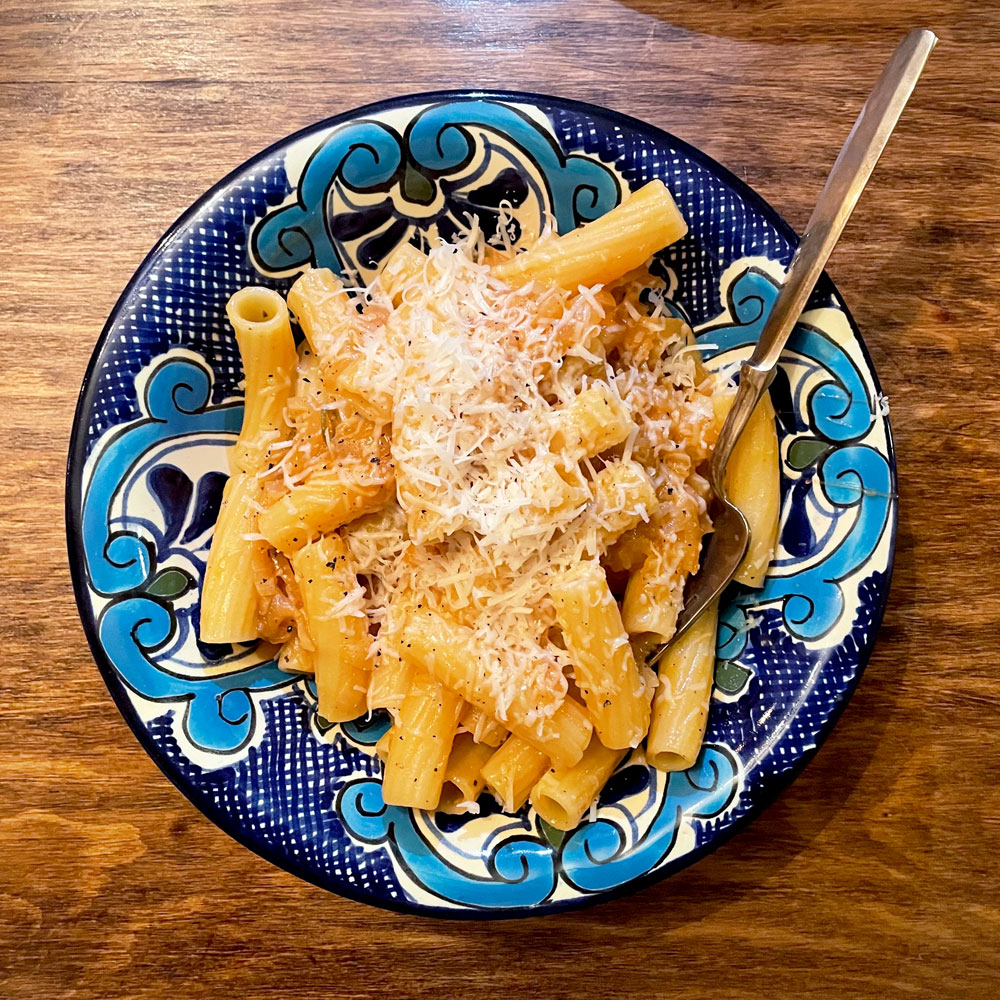
The combination of hot pasta and melting tomato butter is too good to not keep. So in this case, I actually added something to the recipe — while keeping the same tiny ingredient list. Enter: more tomatoes, sizzled in some of that tomato butter, until they burst and concentrate. Tomato-buttered tomatoes, how meta is that?

Sesame Chicken with Radicchio-Orange Salad

Breaded chicken cutlets without the bread crumbs. Sesame seeds create an extra-crunchy crust. While the recipe on the site uses chicken breasts, I retested with chicken thighs and, turns out, those work wonders, too. So the cookbook lets you take your pick. The salad also got a makeover — all you’ll need is baby arugula and marinated artichokes (whose marinade turns into the world’s easiest dressing).

Unfussy Eggplant Parm

This saucy, cheesy, community-favorite would make even an out-of-season eggplant feel special. I futzed with the type of mozzarella (is low-moisture really best?) and the order that the cheese and bread crumbs are layered (is there a better way?). The result is the same and also different, like Bennifer in 2002 and Bennifer in 2021.

Oatmeal Cookies

For when you’re too lazy to make classic oatmeal cookies — you know, with the creamed butter, the leavening agents, the raisins and/or chocolate chips. Effortlessly gluten-free, these only need oats, tahini, and brown sugar. If you’re feeling kinda-sorta ambitious, there’s another version in the book, where you toast the oats for even more flavor. It’s a hands-off step that makes a huge difference.

Lemon Bars with Salty Olive Oil Crust

OK, you got me, I made these over and over as an excuse to eat a lot of lemon bars. But! There were aha moments along the way. By scaling down the quantities, the crust became a smidge thinner for increased crustiness. And olive oil, which takes the place of usual butter in shortbread, also made its way into the lemon curd, to round out all the puckery sourness.

Snag a copy of the Big Little Recipes cookbook in our Shop, or a slew of other places, like AmazonBarnes & NobleBooks-A-MillionBookshop.orgHudson BooksellersIndieBoundPowell’s, or Target.

This post contains products independently chosen (and loved) by Food52 editors and writers. As an Amazon Associate and Skimlinks affiliate, Food52 earns an affiliate commission on qualifying purchases of the products we link to.

Unlike the shows that came before it, “Insecure” has always been about hustling one’s way to success

A recent episode of “Insecure” revolves around a homegrown game Issa (Issa Rae), Molly (Yvonne Orji), Tiffany (Amanda Seales) and Kelli (Natasha Rothwell) play called Questions in a Hat, basically Truth without the Dare. The ladies are gathered at Issa’s apartment and, appropriate to the half-hour’s title “Chillin’, Okay?!,” they have a warm wine-and-weed buzz going, save for the “Cali-sober” Kelli, who worries about the dangerous juju the game might unleash.

Many of the questions they place in the hat are comically harmless. But one hits Issa squarely in the chest. “If you could only spend the rest of your life with the last person you slept with,” the slip of paper reads, “how would you feel?”

Even before this hang, Issa’s been wondering about that. The current season begins with Issa calling things off – again – with her old flame Lawrence (Jay Ellis). Her reasons are understandable: Lawrence had moved to San Francisco for his career and was on his way to having a baby with his ex Condola (Christina Elmore), a former friend of Issa’s. Theirs was never going to be a simple affair.

RELATED: “Insecure” to the end

Her current lover Nathan (Kendrick Sampson) is devoted, reliable and, importantly, local. One might say he fits the current Issa brand now that she has solidified her love for South L.A. art, food, fashion and culture into a promotional business called The Blocc. Nathan, who cuts hair at a local barber shop, fits in neatly.

Staging the love life equivalent of “Let’s Make a Deal” near the end of the story is a romantic comedy staple, with the hero or heroine usually asked to pick between ho-hum stability or a love leap, the appliance in hand or the mystery hidden just beyond that door.

Real life is never so clean-cut.  To see “Insecure” posing the scenario somewhat more originally, then, is refreshing. The Nathan-or-Lawrence question is not the end-all for this show in the way it is or was for other HBO comedies, like that one about the four New Yorkers with a thing for Cosmos and obscenely expensive shoes. But those women always had options falling into their laps. Issa and Molly have to hustle for theirs.

On a re-watch of the current season, the word “choice” comes up time and again. Sometimes it’s presented as a part of conversations between friends, but often it’s inserted into a script running in Issa’s head.

Among the things I’ll miss most about the show are the bracing inner dialogues Issa has with mirror self, or her wild daydreams where she cuts loose instead of holding in her true feelings, as when she launches Lawrence and Condola’s adorable infant into the air like she’s taking a three-point shot at a Lakers game.  

As payback, or penance, Dream Condola kicks Issa into a pile of garbage bags as revenge. “Own your choices,” coos Issa’s rival as she’s splayed out at her feet.

Agonizing over what could have been a universal indulgence, part of that much ballyhooed tyranny of choice once cited as the Millennials’ existential scourge. The spin “Insecure” puts on this is showing that for Issa and Molly and everyone around them, life is a banquet of choices that’s only as rich and extensive as the extra effort they put into it.

Not long ago, Issa wondered in front of a packed auditorium whether she was truly heading in the right direction. Even then her path was solidifying, thanks to a successful block party that draws the attention of a major corporate sponsor.

But the way was never a straight line. At the beginning of the show Issa worked at a stupidly named urban non-profit We Got Y’all, struggling to help the place fulfill its mission of uplifting Black youth. Being the only Black employee at a place full of bewildered white liberals doubting her qualifications takes its toll, and she quits.

From there she works as a ride share driver and accepts what other opportunities she can seize until, finally, she executes an event that tangibly uplifts her community instead of merely talking about it. We see her promoting literary events and art walks that attract major media attention; more importantly, we see her pounding the pavement to make them happen.  

Of course she would. Issa is an extension of her creator.


Want a daily wrap-up of all the news and commentary Salon has to offer? Subscribe to our morning newsletter, Crash Course.


When “Insecure” began in 2016 it was the second comedy created by and starring a Black woman after Wanda Sykes’ 2003 Fox comedy “Wanda at Large.” Today it’s one of several that exist because Rae took that shot.

Now she’s one of the entertainment industry’s most sought-after talents and a prolific producer. And unlike the stories behind other shows about young women’s lives, “Insecure” was not handed to her. She had to create her opportunity by way of a web series “The Misadventures of Awkward Black Girl,” which was discovered by Larry Wilmore, her “Insecure” co-creator.  

Remembering that is crucial to comprehending Issa and Molly’s separate professional evolutions, hand-in-hand with their approach to relationships. Rae understands that the most interesting part of any great success story is the come-up – not necessarily stories of ramen days, but the quest and discovery of a noodle soup recipe folks will pay $20 to eat.

Issa’s stint at We Got Y’all is an essential stepping-stone to founding The Blocc. The downside for Issa is that when one of the artists she works with, Crenshawn (Kofi Siriboe), turns on her on social media, what little momentum she’s built hits speed bumps and there’s very little she can do to fight his smear campaign without risking her credibility.

Molly’s career switch from a token associate at a white law firm to a valued contributor at a Black boutique firm is simpler to track. But they’re both examples of women who tried to work within systems that would never allow them to excel. They had to make their own way and build their own definitions of success. Molly’s trajectory this season moves her off the dating wheel and closer to her family when her mother has a stroke, makes her career voyage choppier than expected while also putting her work/life balance into perspective. The lesson she takes from that is about choices, too. “You’ve got to be really intentional with the people you love,” she tells her girls.

And this circles back to the Nathan/Lawrence dilemma, two options she nurtured into existence, each of them decent. But which will get her to where she needs to go. Moreover, must “Insecure” land with one or the other to provide its audience with sufficient closure?

This isn’t Questions in a Hat. Rae isn’t obligated to answer. Still, it is something to contemplate as the show heads into its final three episodes . . . starting with this week’s aptly titled “Choices, Okay?!”

New episodes of “Insecure” debut Sundays at 10 p.m. on HBO and stream on HBO Max.

More stories like this:


Gavin Newsom announces plan to enact gun control measure inspired by Texas abortion law

California Gov. Gavin Newsom announced a new plan Saturday that would use the legal maneuvering Texas has employed to enact the country’s most restrictive abortion ban — but instead targeting those who sell assault rifles or so-called “ghost gun” parts that allow buyers to build untraceable weapons. 

It’s a novel approach that would use the same threat of vigilante lawsuits to enact a liberal priority that has long languished in Congress. Newsom’s announcement also comes on the heels of a Supreme Court ruling that allowed Texas to keep its new provision in place as lawsuits against it make their way through the courts. 

In a statement released over the weekend, Newsom claimed his staff is working with both the California Legislature and the state’s attorney general to draft a bill similar to Texas’ S.B. 8, that would allow private citizens nationwide to file lawsuits “against anyone who manufactures, distributes, or sells an assault weapon or ghost gun kit or parts in the State of California.”

“If the most efficient way to keep these devastating weapons off our streets is to add the threat of private lawsuits, we should do just that.”


Want a daily wrap-up of all the news and commentary Salon has to offer? Subscribe to our morning newsletter, Crash Course.


Previously, the California governor said he was “outraged” that the Supreme Court allowed Texas’ six-week abortion law to stand. It’s a timeframe that bans nearly all abortions, because the first six weeks of pregnancy often passes before a woman even knows she is pregnant. 

Reports suggest the high court, stacked with three members nominated by former President Donald Trump, may be leaning toward ruling in Texas’ favor — effectively ending the decades of protection given to abortion rights after the landmark 1973 ruling in Roe v. Wade.

Newsom’s plan to use the same legal tactic as Texas to enact his own state’s policy priorities is a future at least partially predicted by Justice Elena Kagan, who has previously argued in court recently that “we would live in a very different world from the world we live in today” if S.B. 8 is allowed to stand.

“Essentially, we would be inviting states, all 50 of them, with respect to their own preferred constitutional rights, to try to nullify the law this court has laid down,” she said. 

In another Tweet, Newsom argued “if that’s the precedent,” he would have to embrace the tactic whether he liked it or not.

“If states can now shield their laws from review by the federal courts that compare assault weapons to Swiss Army Knives, then California will use that authority to protect people’s lives, where Texas used it to put women in harm’s way,” he wrote.

“If TX can ban abortion and endanger lives, CA can ban deadly weapons of war and save lives.”

More commentary on Texas’ S.B. 8 and the ongoing battle to protect abortion rights:

Plastics, fertilizer, and synthetic rubber: Report calls out chemical industry’s use of fossil fuels

Everyone knows that the fossil fuel industry drives global warming. A new report shows that the chemical industry contributes to the climate crisis, too. But the conversation about solutions to climate change has largely omitted the role that chemicals and petrochemicals play in exacerbating the crisis, and the report says policymakers should start thinking about ways to green the industry. 

The chemical sector doesn’t just make products like inks, solvents, glues, and soaps. It also makes products out of oil and gas like plastics, fertilizer, and synthetic rubber. The chemical industry often relies on fossil fuels to power its factories and make its products. And some of these chemicals, like refrigerants, are potent greenhouse gases themselves. All of those emissions add up. 

The report, published by the nonprofit Center for Progressive Reform with input from other environmental nonprofits, shows the chemical industry is responsible for 7 percent of total global greenhouse gas emissions — some 3.3 gigatons of greenhouse has emissions a year. That’s orders of magnitude less than the 89 percent of global carbon emissions that the fossil fuel industry produces, but it’s still a significant contribution, especially considering the fact that world governments are scrambling to slash emissions wherever possible as climate change accelerates and the window to take action grows narrower. Yet chemicals, the report said, “continue to be overlooked in efforts to mitigate climate change.” 

Emissions from the chemical industry are on the rise. In the U.S. alone, emissions from this sector increased 43 percent between 1990 and 2019 to meet growing demand. By the end of this decade, petrochemicals — chemicals derived from oil and gas — could account for more than a third of growth in oil demand, more than the freight, aviation, and shipping industries. In short, if governments don’t intervene, the chemical industry could become an increasingly serious obstacle to global efforts to decrease emissions. 

In addition to the role chemicals and petrochemicals could play in exacerbating global warming, the industry also poses a risk to the communities in which it operates — areas the report shows are often inhabited by people of color and low-income residents. Some of these communities are already experiencing chemical disasters due to extreme weather fueled by warming temperatures, and more neighborhoods could experience such disasters as extreme weather continues to plague the United States and other countries. An analysis of the industrial facilities regulated under the federal Risk Management Program, which use, manage, or store hazardous chemicals, showed a third of these facilities in the U.S. — nearly 4,000 buildings — are at risk of being impacted by wildfires, flooding, hurricane storm surge, or coastal flooding. 

So what can legislators do to better protect residents from hazardous substances and prevent the chemical industry from tanking the planet? The report recommends that the Environmental Protection Agency put more stringent measures in place requiring chemical manufacturing facilities to become more energy efficient. Chemical and petrochemical companies could transition their factories and facilities to renewable energy, which would reduce emissions from at least one facet of their operations. Legislators could also continue to pass laws outlawing single use plastics, which help reduce demand for oil-based products. And they could pass more laws that phase out chemicals that produce greenhouse gases like hydrofluorocarbons, which are used in refrigeration. Lastly, the EPA could conduct risk assessments of neighborhoods and communities that are home to hazardous chemical facilities and require those facilities to plan for extreme weather disasters. 

“We can’t solve the climate crisis without significantly reducing and replacing fossil fuels throughout the chemical industry,” Darya Minovi, policy analyst at the Center for Progressive Reform, said in a press release. “The chemical industry must do its part to stop our global temperatures from rising to the point of no return.”

Is the cold hurting my dog’s paws? Dog experts explain when to worry

As humans bred dogs to be companions, herders, hunters or ratters, we also bred some to be adept at surviving in the cold. Sled dogs — breeds like Alaskan Malamutes, Siberian Huskies and Samoyeds — actually followed a different evolutionary path than other domesticated canines, helping humans transport their bodies and belongings through frigid temperatures for at least nine millennia.

Yet not all dogs are as cold-hardy as these breeds. And as winter descends upon the Northern hemisphere, millions of American dogs will be subject to walking on snow, ice, and frigid sidewalks. For dogs that aren’t bred to romp around in such conditions, it is natural for dog owners to wonder whether it’s safe for dogs to brave such conditions; or if, perhaps, we are unintentionally hurting them by walking them in the snow. 

The answer, it seems, involves stopping for a moment and thinking about your dog’s physical features. Does it have a lot of insulation on its body, like blubber and fur? Was it bred to perform tasks like those undertaken by sled dogs, and therefore is likely to be acclimated well to even the most brutal weather?

When compared to how humans would have to answer those questions, most dogs wind up looking pretty good. According to Dr. James A. Serpell, a professor of ethics and animal welfare at the University of Pennsylvania School of Veterinary Medicine, the majority of dog breeds are “extremely hardy and tolerate cold far better than humans do.” There are variations depending on a breed’s fluffiness (hairless breeds, for instance, may need to be bundled up), size (big dogs have it easier than small ones) and health (older dogs can be vulnerable).

Serpell noted that in general, dogs are “more likely to suffer from overheating than from hypothermia.”

This does not mean, however, that loving owners can afford to entirely disregard their animal’s response to cold.

“Some long-haired breeds may suffer from ice and snow clumping around their feet which can be painful, and owners should try to avoid walking them over sidewalks treated with salt and other de-icing crystals as far as possible,” Serpell told Salon by email, adding that they sting the pads of dog’s feed and can even cause them to crack and bleed. “If a dog has a serious problem with de-icers, the owner should consider buying booties to put on the dog’s feet for protection.”


Want more health and science stories in your inbox? Subscribe to Salon’s weekly newsletter The Vulgar Scientist.


The dog’s lineage is also important, as generations of evolution make specific dogs more suited to specific climates. Chihuahuas, for instance, are indigenous to Mexico, with Spanish Conquistador Hernán Cortés writing in a letter that they were sold as food among the Aztecs. Those dogs did not need to thrive in colder temperatures and will thus be more vulnerable than the ones whose ancestors were adapted to snow and frosty winds.

“Double-coated breeds like Siberian Huskies, Samoyeds, and Tibetan Mastiffs are built for the cold weather and generally do not need additional layers to keep warm,” Molly Sumridge, an instructor of anthrozoology at Carroll College, wrote to Salon.

On the other end of the spectrum, breeds with short coats like pit bulls and dobermans can benefit from more layers if they’re going to be outside in the winter for a long time. There are also situations in which every dog will need amenities like boots, such as if they live in an area where their feet will frequently contact snow-melting chemicals. Sumridge added that owners also need to be watchful of the tips of dogs’ ears, which like humans’ are susceptible to frostbite.

Finally, and most importantly, dog experts stress the importance of paying attention to your dog’s behavior. Even though dogs speak in barks and body language rather than words, they still sends you clear signals about what they want. Humans should not impose their own assumptions on how a dog is “supposed” to behave on to the animal, but trust their intuition about how the animal’s actions correspond to its likely emotions.

“Depending on the dog’s breed and cold tolerance, dogs can enjoy the snow just as much as their owners,” Sumridge explained. “Keeping an eye out for signs of cold, or hesitation to staying outside, means it’s time for a break. Otherwise, with proper clothing and protection, based on the dog’s comfort, both humans and canines can have a blast in the cold weather.”

15 ultra creamy macaroni and cheese recipes

My definition of a perfect bowl of macaroni and cheese consists of corkscrew-shaped pasta, a sharp cheese sauce (perhaps with some combination of Swiss, cheddar, and Gruyere), a touch of nutmeg and black pepper, and a buttery topping of crispy breadcrumbs. Preferably, I would eat it as is, but I’m not above adding pulled pork or lobster meat either.

There are so many things to love about macaroni and cheese, but one of the biggest perks is that it’s completely customizable. You can swap out the pasta shape (say medium sized shells instead of elbow macaroni), change around the cheeses, or add more heat if you’re feeling spicy in the form of diced jalapeños, cracked black pepper, or dry mustard.

As a rule of thumb, mac and cheese can be made partially in advance, which will save time if you’re trying to make a batch for a weeknight dinner. “The sauce can be made and cooled to use at a later time. We recommend using your cheese sauce within a week. The sauce on its own won’t freeze well, but mixing the sauce with pasta and then freezing will help to preserve the sauce for longer,” says Clare Malfitano, head chef at Murray’s Cheese Bar.

When it’s time to reheat, Malfitano has some tips for ensuring that the mac and cheese doesn’t dry out. “Add a little additional cheese, mornay sauce, and cream or milk. Then reheat either in the oven or on the stove, depending on how long you can wait,” says Malfitano

Ahead, find out cheesiest, creamiest, all-around classic macaroni and cheese recipes.

* * *

Our best mac and cheese recipes

1. Martha Stewart’s Macaroni and Cheese

Leave it to the queen of all things cooking (and gardening, crafting, and decorating) to serve up a recipe for a perfect bowl of homemade mac and cheese. Martha’s trick is using two different kinds of cheese — sharp white cheddar and Gruyere — both in the bechamel sauce and mixed with breadcrumbs for a crunchy topping.

2. Creamiest Baked Mac and Cheese

There’s a few ways to make this better-than-average baked mac and cheese recipe. The first is undercooking the pasta so it’s slightly more al dente; once you add the hot, creamy cheese sauce, the pasta will absorb the heat and continue to cook. Second is using way more cheese sauce than you think you need in order to prevent the cooked macaroni from drying out. And third, a combination of oven baking and broiling will result in a bubbling hot pasta dish with a crispy, crunchy topping.

3. Stovetop Mac and Cheese with Garlic Powder and White Pepper

Food Editor Emma Laperruque promises a recipe for macaroni and cheese that is just as easy as the boxed version with way better flavor.

4. Melissa Clark’s Stovetop Mac and Cheese

If you prefer a bowl of mac and cheese that forgoes a broiled breadcrumb topping, this ooey-gooey recipe is the one for you.

5. Baking Sheet Macaroni and Cheese

On the other hand, if your favorite part of eating homemade macaroni and cheese is getting to eat all of the crunchy, crispy bits on top, this “why-didn’t-I-think-of-that” recipe from Food52 founder Amanda Hesser means a thin layer of cheesy noodles, all of which get super crispy when baked on a sheet tray.

6. Greens Mac ‘n’ Cheese from Jamie Oliver

Wondering how to get your little ones (or maybe little ones at heart) to eat their greens? Stir roasted leeks, broccolini, baby spinach, and fresh thyme into the cheese sauce for this test kitchen-approved mac and cheese recipe.

7. Instant Pot Mac and Cheese

One of the best uses for this multi-cooker is mac and cheese. “It comes together in about 20 minutes, is cheesy-as-heck, and best of all, won’t take up any valuable oven space,” writes recipe developer Ella Quittner.

8. My Favorite Vegan Mac and Cheese

To make the cheesiest cheese sauce that’s totally vegan, combine soaked raw cashews, cannellini beans, lemon juice, paprika, turmeric, miso, nutritional yeast, and cayenne pepper in a food processor and blend until it’s super duper smooth.

9. Tikka Masala Macaroni and Cheese from Preeti Mistry

Inspired by the flavors of chicken tikka masala and the creaminess of butter chicken, this warming, tomatoey mac and cheese is something I want a giant bowl of on the coldest day of the year.

10. 3-Ingredient Macaroni and Cheese

Not all mac and cheese needs to be made with a bechamel sauce. For this recipe, all it takes is starchy pasta water, a little bit of melted butter, and a meltable, lovable cheese.

11. Truffled Macaroni and Cheese

Swiss Raclette cheese and good truffle oil introduce strong, luxurious flavors in this fancy macaroni and cheese.

12. Sheet-Pan Mac and Cheese with Pumpkin and Brown Butter

“There’s nothing cozier — or easier to pull off — than sheet-pan mac and cheese. It’s perfectly creamy and crunchy, lacking in any superfluous bits. And when pumpkin and brown butter join the party, well, it’s unstoppable,” writes former Food52 staffer Ella Quittner.

13. Fall Mac and Cheese with Butternut Squash and Bacon

When there’s an abundance of seasonal produce filling the shelves at the grocery store or farmers’ markets, you might feel guilty for craving something as simple and timeless as mac and cheese. This recipe offers the best of both worlds, allowing you to itakie advantage of fall’s finest butternut squash.

14. Miso Mac and Cheese

Build up the savory, satisfying flavor of umami in this mac and cheese by using just ¼ cup of white miso paste.

15. President Reagan’s Favorite Macaroni and Cheese

Politics aside, Reagan might be onto something with this macaroni and cheese recipe. It only uses three cups grated cheddar cheese (versus what some might consider a more interesting trio of gouda, Gruyere, or something really funky like gorgonzola).

Lauren Boebert, MTG drop in on Dr. Fauci in “SNL” cold open

Right-wing Reps. Lauren Boebert and Marjorie Taylor Greene — toting military rifles — appeared in a COVID-19 update from Dr. Anthony Fauci during Saturday Night Live‘s opener.

“The government has been using this fake disease to strip us of our freedoms,” said Greene, played by SNL‘s Cecily Strong. “Do they think we’re dumb?”

“Please, would they give a dumb person a gun? Yes,” responded Boebert, played by SNL‘s Chloe Fineman.

“First, they said the shutdowns were until they found a vaccine,” Greene said. “Then, they found a vaccine and said it worked. Then, they said everyone should get it. Then, people got it and it saved their lives. If that’s not communism, then honey, I might not know what communism is.”


Want a daily wrap-up of all the news and commentary Salon has to offer? Subscribe to our morning newsletter, Crash Course.


“So Merry Christmas, and remember: Guns don’t kill people, people people people,” Boebert said.

At the end of the sketch, after Fauci (played by Kate McKinnon) proclaimed that everyone had found some common ground, Greene added: “And we can all agree that the Fox News Christmas tree arsonist must be executed!”

The sketch also featured appearances by former New York Gov. Andrew Cuomo and his brother, former CNN anchor Chris Cuomo, as well as Texas Republican Sen. Ted Cruz.

Watch it below via NBC:

Veteran anchor Chris Wallace leaving Fox News after 18-year run

Fox News anchor Chris Wallace, the longtime broadcaster who has moderated two presidential debates and earned accolades for his evenhanded coverage while at the conservative network, announced Sunday he is stepping down from his post. 

As for next steps, Wallace says he plans to become an anchor at the CNN-hosted streaming service, CNN+, which will likely debut at some point next year. 


Want a daily wrap-up of all the news and commentary Salon has to offer? Subscribe to our morning newsletter, Crash Course.


Wallace has been a staple at Fox News during his 18-year run at the Rupert Murdoch-owned network, after being hired to host the influential Sunday morning political show “Fox News Sunday.” He made the announcement at the end of this week’s program, saying: “It is the last time, and I say this with real sadness, we will meet like this.”

“I want to try something new, to go beyond politics to all the things I’m interested in; I’m ready for a new adventure,” Wallace said. “And I hope you’ll check it out. And so for the last time, dear friends, that’s it for today. Have a great week. And I hope you’ll keep watching Fox News Sunday.”

Wallace spent time during his farewell address lauding management at Fox News, who have slowly drifted toward a more partisan approach to journalism over the past few years, for never interfering with his program. Even as Tucker Carlson and others gained notoriety for spreading falsehoods and distortions about the 2020 election, vaccines and other news events, Wallace said he was given room for his own signature style of asking difficult questioning of public figures, regardless of party.

“The bosses here at Fox promised me they would never interfere with a guest I booked or a question I asked and they kept that promise,” he said. “I have been free to report to the best of my ability, to cover the stories I think are important, to hold our country’s leaders to account,” he explained.

Wallace began his career covering the Reagan White House for NBC before being hired away by Roger Ailes, who co-founded the network. 

The New York Times reports that Wallace’s contract was up at the end of the year, and that Fox wanted to keep him on board, citing an anonymous source familiar with the discussions.

Without its longtime host, “Fox News Sunday” will be anchored by a rotation of the network’s other stars including Bret Baier, Martha MacCallum, John Roberts, Neil Cavuto and others, according to the Times.

Mike Lindell loses to “The Daily Mail” in court following his allegation of defamation

Mike Lindell, CEO of MyPillow, Inc., recently suffered a loss in court as a federal judge ruled in favor of The Daily Mail regarding his defamation lawsuit against the news outlet.

According to Newsweek, U.S. District Court Judge Paul Crotty reportedly rejected the suit “asserting in the ruling that the article the prominent conspiracy theorist took issue with ‘cannot be reasonably construed as defamatory.'”

The ruling follows Lindell’s lawsuit back in January following the release of a Daily Mail article alleging “that he and 30 Rock actress Jane Krakowski had a secret romance. The report was based on a tip from an “anonymous friend” and Lindell and Krakowski quickly denied the claim. Lindell even said he’d never heard of the actress.”


Want a daily wrap-up of all the news and commentary Salon has to offer? Subscribe to our morning newsletter, Crash Course.


In the ruling, Cotty pushed back against Lindell’s claim writing, “Dating an actress—secret or not—would not cause ‘public hatred,’ ‘shame,’ ‘ridicule,’ or any similar feeling towards Lindell.” The judge also insisted that “Dating an actress—secret or not—would not cause ‘public hatred,’ ‘shame,’ ‘ridicule,’ or any similar feeling towards Lindell,” Crotty wrote.

The judge also claimed that Lindell’s argument “has not identified any statements in the Article that a reasonable person would view as defamatory.”

Lindell, who founded the Lindell Recovery Network after overcoming his own battle with heroin, also claimed one line in the article damaged his reputation because it alleged that he’d pursued a woman with champagne. Due to the work his recovery network does, Lindell argues that the article hindered “his ability to provide services to addicts.”

However, the judge also refuted that argument.

RELATED: Rats, ship: Even far-right channel Newsmax is cutting ties with Mike Lindell

“The purchase of alcohol is a legal and ordinary act,” Crotty wrote in his ruling. “If even more problematic depictions of alcohol consumption, such as underage drinking or alcoholism, routinely fail to qualify as defamatory in New York courts surely no reasonable reader could find it offensive to exchange champagne or other bottles of liquor as gifts between romantic partners.”

The ruling comes after The Daily Mail’s response in an attempt to defend itself. The news outlet highlighted Lindell’s history of circulating conspiracy theories and misinformation.

“Plaintiff Michael Lindell is no stranger to scandal. In the last year alone, the self-described crack-addict-turned-CEO ventured beyond pillow sales to become a peddler of an unproven COVID-19 ‘cure,’ and a leading proponent of baseless election fraud theories; stores dropped his company’s product after Plaintiff was photographed leaving the White House in January 2021 with a notepad referencing ‘martial law,'” an April memorandum pointed out.

The memorandum added, “He and his company have been mired in litigation—previously, in several suits alleging fraudulent advertisement practices, and more. Yet Plaintiff [literally] has made a federal case out of statements in an article about his rumored consensual romantic relationship with a popular, award-winning actress, claiming that these references irreparably harmed his reputation.”


‘Tis the season, once again: Evangelicals must save Christmas from an imaginary enemy

Here comes my favorite season of the evangelical political calendar. It’s time for the righteous war to save Christmas from the evil progressives with their “Happy Holidays” and their zero-tolerance policy for nativity scenes. Those heartless liberals will attempt once again to destroy the true meaning of Christmas, burn down all the Christmas trees (not just the one outside the Fox News building), spell it as “Xmas” and generally rip all mention of God from this holiest of holidays. 

No of course I don’t believe any of that, despite my personal background as an evangelical pastor. In truth, this yet another political and cultural issue that has been created entirely out of whole cloth by the great distaction agents of the evangelical Republican machine. I believe this issue perfectly illustrates the blueprint behind the evangelical approach to politics. They start with a fake issue that requires no grounding in scripture, zero biblical evidence and zero change for anyone within their own group. It is easily identifiable and pushes emotional buttons, which makes it an easy money-raising grift for politicians and pastors, and reliably provides a seasonal ratings boost for Fox News. It’s another issue where evangelicals get to pretend they are fighting for God’s cause while in fact ignoring every issue that affects God’s people. Lastly, they get to declare victory every year because, no matter what Donald Trump and any number of leading evangelicals may claim, there never was a war on Christmas conducted by liberals, atheists, Muslims, Jews, godless Communists and other infidels. 

The idea that somehow Christ’s birthday — which definitely wasn’t on Dec. 25, by the way — requires any form of annual celebration has no connection to Christ, his teachings or the Bible. I cannot even figure out what aspect of the “traditional” Christmas celebration has anything to do with Jesus. The madhouse shopping (both online and in person), the tree, the lights, the tinsel, the consumerist orgy of Black Friday and Cyber Monday and whatever other special days the marketing people can come up with this holiday season is a celebration of everything that money can purchase, and has literally nothing to do with the ministry of Jesus. Last I heard, according to Christian theology you cannot serve both God and money, and far too many are trying to do just that during the Christmas season — and for that matter all year round. Christ was removed from the Christmas season a long time ago, no matter what you call the holiday.

RELATED: Meghan McCain suggests Fox Christmas tree arson attack is worse than GOP’s assault on democracy

No issue better exemplifies the misdeeds of the evangelical political machine than the fight to “save” Christmas from imaginary enemies who are supposedly trying to crush the joy out of the holiday with too much wokeness (or whatever). The enemy is said to be everywhere, yet somehow the fight is easily winnable. You will hear a handful of folks who announce, “I proudly say Merry Christmas,” as if some committee of socialists or feminists were trying to prevent them from saying it. It is difficult for me to imagine Jesus Christ walking around an American town saying, “Hey, where’s my nativity scene?” It’s easier for me to imagine Jesus wondering why this country so many people claim is a “Christian nation” can ignore the plight of the poor, the sick and those newly arrived among us.  

Fighting the war on Christmas also allows the evangelical movement to ignore larger issues that plague millions of Americans during this time of year. The Christmas season is known pose specific difficulties for homeless veterans, for people without health insurance, for those who are barely struggling to get by, and for the sick, lonely and desperate. If I’m not mistaken, those are the people Christ called his followers to serve — but fighting to save Christmas from the liberals allows the evangelicals to ignore that urgent call.  


Want a daily wrap-up of all the news and commentary Salon has to offer? Subscribe to our morning newsletter, Crash Course.


The annual declaration of victory is my favorite hypocritical element of this ritual war. At one point some years ago, former Fox News host Bill O’Reilly declared he had personally won this fight, saving Christmas for all real Americans. There could hardly be a better example of everything that is wrong with this movement: O’Reilly got his followers worked up about saving Christmas, while in his own life he was sexually harassing numerous women he worked with. That’s very much like the evangelical movement: Find an issue to draw attention away from what you’re doing in secret, very likely being acts of cruelty, oppression and ignorance. Victory is easily declared because there was no fight, except in the overheated evangelical imagination. Christmas always comes around every year and fake victory follows, along with great ratings for Fox News, fundraising for sanctimonious Republicans and big money flowing into evangelical churches.  

So, yes, for the next few weeks the battle will be joined again, and evangelical believers will once again be told the fight is difficult — but in the end (spoiler alert!) Christmas will be saved yet again. In truth, nothing much will occur to make this holiday season different: We will see no new laws enacted to help those in need, heal the sick, welcome the foreigner and serve the poor. But at least we get to say “Merry Christmas” — which of course we always did — and somehow that will make up for all our lost opportunities to make real change in Christ’s name. 

I don’t begrudge anyone the “Christmas spirit.” But as I said earlier, nothing about our current Christmas culture has anything to do with Jesus, no matter what we may call the season. The life of Christ had nothing to do with decorated fir trees, expensive electronic gadgets or ugly sweaters. Maybe we could say it had something to do with giving and receiving gifts — but not in the literal or material sense. If we were truly to celebrate the ministry of Jesus in America, that would mean a celebration of sacrifice, mercy, forgiveness and humility. We’re a pretty long way from that right now.

More on the evangelical war to “save” the holiday season from liberals:

Trump rally features “many empty seats” — so many that arena’s top level had to close

Donald Trump’s event with former Fox News host Bill O’Reilly on Saturday had so many empty seats that organizers closed the top bowl of the stadium.

“Thousands of people donned their red baseball caps or favorite Donald Trump T-shirts in the FLA Live Arena in Sunrise Saturday afternoon to see the former president and conservative darling Bill O’Reilly,” the South Florida Sun Sentinel reports. “The crowd chanted, ‘Let’s go, Brandon’ while waiting for the two to appear. … Many seats remained empty in the cavernous arena. The top level was closed and ticket buyers were ‘upgraded’ to the lower bowl.”

Saturday’s event was the first of four that are part of Trump’s “History Tour” with O’Reilly. The tour continues Sunday in Orlando, where ticket sales have also reportedly been slow, before moving on to Houston and Dallas next weekend.


Want a daily wrap-up of all the news and commentary Salon has to offer? Subscribe to our morning newsletter, Crash Course.


Tickets for the “History Tour” reportedly started at $100 for upper deck seats and ran into the thousands of dollars for VIP packages. The VIP packages included “floor seats, a 45-minute reception before the show, and photos with Trump and O’Reilly.”

One political scientist recently told the Orlando Sentinel that “if not many people show, then I think Democratic and liberal critics will say that it shows that the Trump phenomenon has maybe hit its peak. And that there is a limit to what he can get away with.”

According to the Sun Sentinel, Saturday’s event featured Trump “deriding the current president, claiming the election was stolen, and portraying the country under Joe Biden as a crime-ridden, inflation-plagued mockery overrun by foreign criminals.”

RELATED: Inside the 38-page PowerPoint TrumpWorld circulated to justify election subversion

“Trump had few comments that veered from what he has often said publicly,” the newspaper reports. “But he made the occasional unrehearsed comment. When the microphone failed and O’Reilly went silent, Trump said he thought something had happened to him.”

“I thought he went down, which frankly would have been very exciting,” Trump said.

The newspaper also notes that “members of the Proud Boys white nationalists — a group that has resorted to political violence to achieve its ends — were present.”

Read the full story.

Gerri & Roman: A one-way “Succession” lust story

From the glorious panoply of gender double standards to choose from, I would select as my least favorite the one around age — the one that says that a woman who is older than her man is an “older woman,” whereas a man who is older than his woman is a man, skip the modifier. In an email, gender historian Nancy Cott told me that she believes the eons-old age double standard stems from “the assumption that women get to puberty earlier than men . . . and that a woman capable of childbearing is what any man wants/needs. Plus — perhaps even more strongly — the younger she is, the more likely to be a virgin. Then there’s also the idea that the man should always dominate, even in a love relationship — so the more like a child the woman is, the easier to dominate her.” It’s enough to make a middle-aged woman want to beat the shit out of a bathroom. 

Like practically everyone, I was wildly pleased by the younger man–older woman sexual dynamic gathering steam in the second season of “Succession,” HBO’s pitch-black comedy-drama, in which scions of the foulmouthed, talkaholic Roy family are vying to take over their aging father’s Murdochian media empire. By the end of the second season, Roman (played by Kieran Culkin, born 1982), the youngest Roy boy, has made it abundantly clear to Gerri Kellman (played by J. Smith-Cameron, born 1957), Waystar Royco’s long-suffering general counsel slash fixer slash patience pillar, that she seriously turns him on. In response, she has, more than once, assisted Roman by verbally haranguing him while he masturbates. It’s a refreshing inversion of the old-stud/trophy-wife trope, and as I dove into Season 3, I found myself harboring a hope that Gerri would finally get some sexual gratification for her trouble.

RELATED: “Succession” presents the “Chiantishire” dog show, starring the well-bred Roys

Season 3 is, winningly, rife with Roman’s swaggering sexual self-abnegation. While he and Gerri await Logan’s marching orders in a hotel suite, Roman suggests that they give the bed a whirl: “I’d lay you badly, but I’d lay you gladly.” Gerri isn’t having it and tells him that as far as she’s concerned, those wanks never happened. A few episodes later, Gerri informs Roman that she has a lunch date — the fact that she’s dating “needs to be understood” — which puts him in a right snit. Later, in the Roman equivalent of a jealous suitor prostrating himself, he asks her, “How was the date? Did you f**k him or just tug him off between courses?” 

No one who watches “Succession” mistakes Roman for a boyishly lovable scamp. Something besides Gerri that Roman has found sexually arousing? Jacking off against a glass window in his Manhattan office. Roman’s psychology is complex, to be sure, but he’s clear about what he wants, which is not his modelesque girlfriend who is around his own age. What Roman wants is what we see that Roman wants, and, being a Roy, he usually gets it.

But what does Gerri want? With only one episode left in the season, it looks as though it’s not going to be Roman: she made it plain to him that she didn’t want the d**k pics that, as we learned last week, he has been sending her. My initial appreciation for the entertainment value of the d**k pics storyline has morphed into an unhappy realization: now that Roman is guilty of sexually harassing Gerri, there would seem to be no way to recover the possibility that something reciprocally sexual can develop between them.

RELATED: Sexting’s perverse double standard: Why girls are set up to fail

But could it have happened? In an October profile on Smith-Cameron for W magazine, the actress says, “In truth, I think neither Roman nor Gerri know what they’re doing . . . Even though it’s inherently sensational and illicit, I feel like Gerri’s not the personality type to exploit that, and I don’t think she’s interested in him romantically.” I get it: the actress’s and writers’ first loyalty is, of course, to the character rather than to some feminist wish-fulfillment scheme of mine; if Gerri’s creators, who know her best, say that she wouldn’t be turned on by Roman and his masturbatory mommy fantasies, then I can’t very well object. But can I at least vent my disappointment?

“Succession” celebrates the erotically improper, and it doesn’t seem impertinent to suggest that its makers would like for the show to be seen as sexually fearless. (Jacking off against a glass window in a Manhattan office! Incest jokes! Tom’s kitchen chat with Shiv’s vagina! Tom’s reunion with his own ejaculate — returned to him orally by his fellator — at his bachelor party!) And yet could it be that the show is a mite squeamish about one of the last sexual taboos out there — the postmenopausal woman’s sex life? Some years ago I saw 1980’s “American Gigolo” at a revival house and didn’t understand the yuks rattling through the theater when Richard Gere’s character says, in what wasn’t a laugh line, that during one job it took him three hours to give an older woman an orgasm. Honest answer, please: is it that “Succession’s” writers truly can’t conceive of someone like Gerri Kellman being attracted to someone like Roman Roy, or is it that the writers aren’t sure how viewers would take a 60-something woman either enjoying a hay romp with a comely younger gent or indulging in a bit of self-pleasuring à la Roman?

The Harrisons and Clints get to spend their third acts getting some on camera, but the screens big and small don’t offer much in terms of older women having sex; our best chance was dashed when Kim Cattrall, for her own reasons, decided not to return as shag queen Samantha Jones in the “Sex and the City” reboot, “And Just Like That . . .” Yes, hormones stop raging, but from everything I’ve preemptively learned from my doctor, not to mention from Rita Moreno, women’s sex drive, just like men’s, can taper without extinguishing.


Want a daily wrap-up of all the news and commentary Salon has to offer? Subscribe to our morning newsletter, Crash Course.


In her interview with The New Yorker last month, Smith-Cameron says this of Gerri’s take on Roman’s sexual interest in her: “Gerri is puzzled at first. And scandalized, intrigued, amused in turns.” The actress recaps the scene from season two in which Roman ends up masturbating in her bathroom while she’s on the other side of the door: “First, I’m just consoling him about Shiv, and then it shifts to being horrified about what he has in mind. And then I scold him, and then I see he’s turned on, and then I’m kind of being seductive, maybe. And then I’m, like, ‘Get in the bathroom!,’ like a dominatrix, and then I’m laughing. It was like crossing an obstacle course.” When it comes to Roman’s hots for her, Gerri runs the gamut of responses except for one: arousal. 

So, are we now forced to consider that when Gerri talked Roman through a wank, it was just another example of a woman sexually gratifying a man with no regard for her own pleasure? If so, then maybe the Gerri-Roman thing isn’t so transgressive after all. Maybe it’s just a one-way lust story that’s all c**k but c**tless, as Roman (or Logan, or Kendall, or Shiv, or Tom) might say, or, as I might say, lacking in balls.

“Succession” airs its season finale Sunday at 9 p.m. on HBO.

More stories you might like:

A “talking” cat is giving scientists insight into how felines think

Billi, a 13-year-old domestic cat in Florida, presses a button that voices the word “dog” — twice.

She proceeds to sit as if she’s waiting for her human parent, Kendra Baker, to respond.

“Dog outside, hmm?” Baker asks Billi, via the buttons. A few minutes later, Billi presses another button for “tummy,” twice. 

“Accident or premeditated murder? You decide,” Baker writes on the caption of the video on Instagram.

Those who follow the travails of internet-famous “talking” animals may be familiar with Bunny the Talking Dog, a TikTok– and Instagram-famous pet. Just like Bunny, Billi the cat uses an augmentative and alternative communication (AAC) device — essentially, a sound board made up of buttons with a different word vocally recorded on each — to “talk” to her human, Baker. Baker, like Bunny’s human parent, was inspired to attempt this means of animal-human communication after she observed Christina Hunger, a speech-language pathologist, who taught her dog Stella to use an AAC device.

Of course, unlike Bunny and Stella, Billi is a cat. And while dogs, as social animals, are renowned for being able to understand human speech, cats are a different matter.

That didn’t stop Baker. At the start of the pandemic, when she found herself with extra time on her hands, Baker decided to order an AAC device to see if Billi could “talk,” too.

“At that point Billi was the first cat that I knew of to try it,” Baker tells Salon. “I hadn’t seen any cats do it.”

Considering Billi’s feline status, Baker was naturally a bit skeptical at first.

“I was concerned because they [the buttons] were quite large for a little tiny kitty, and I was not sure that she was actually going to be heavy enough to press them,” Baker said. “So I started with a word that I’d really not recommend that you start with, which is ‘food,’ because it becomes very motivating for them. And Billi loves food.”

Baker’s concerns quickly washed away once it became clear that Billi was able to press the button “food” — which she appeared to enjoy doing perhaps a little too much.

“She was definitely heavy enough for it,” Baker said. “And then I later regretted starting with food because it kind of backfired on me, but it definitely got the ball rolling.”

Today, Billi has 50 words on her board, and — like Bunny — is part of the ongoing research project called TheyCanTalk, whose goal is to understand if animals can communicate with humans through AAC devices. While the study is mostly made up of dogs, about 5 percent of the animals using AAC devices are now felines. It turns out that many cats have been successful at using the device.

Leo Trottier, cognitive scientist and founder of How.TheyCanTalk Research and developer of the FluentPet system Billi uses, admitted to Salon he was “pessimistic” about cats using the buttons, but was pleasantly surprised when they started to see felines catch on. Now, he’s intrigued by the ways in which cats appear to use the buttons differently from dogs.

RELATED: Bunny the “talking” dog is reporting her dreams, opening up a scientific debate

“What’s interesting is that they [cats] tend to not do that much in the way of multi-button presses, but there’s like a lot of single-button presses,” Trottier tells Salon. “With cats, you kind of have to find things they really want, and there are just fewer of those than with dogs.”

Baker agreed that Billi appears to string words together less frequently than dogs. For example, Bunny is often putting together what appears to be sentences like “night talk sleep,” which Bunny’s human interpreted as the dog’s attempt to communicate that she was having a dream. But Baker has a theory on why cats, like Billi, might be more prone to pressing one button to communicate.

“She does string words together, but it is much less frequent than what I see some of the dogs doing, and I don’t know exactly why that is but I will say she’s more deliberate in her button presses,” Baker said. “Billi is very, very deliberate when she presses a button and knows exactly which one she’s looking for, she takes her time . . . and if she is going to string a sentence together, she’ll take a thinking loop and then she’ll come back — very rarely does she go from one directly to another.”


Want more health and science stories in your inbox? Subscribe to Salon’s weekly newsletter The Vulgar Scientist.


Could it be that in observing cats use the AAC device, humans are finding out that the stereotypical differences between cats and dogs are actually true? Perhaps, but researchers have been very cautious to jump to any conclusions about these “talking” animals yet. In fact, it’s up for debate if these animals are, scientifically speaking, speaking — or if they’ve simply been trained to use specific buttons to conjure specific things. Whether or not their communications are spontaneous has yet to be concluded.

Still, the spectacle of an animal talking through speakers is fascinating to observe, and researchers are excited by the prospect that cats are part of the project now.

“I’m very intrigued by the cats that are using the boards, because there’s really a dearth in cat cognition studies, particularly those that happen in the home,” Gabriella Smith, a cognitive science researcher at CleverPet. “Cats are really kind of overlooked in the companion animal cognition world. I’ve been a big fan of Billi, and my animal cognition scientist brain just lights up because I see these behaviors that I know from my own cat — but now I’m able to look at it from a cognition lens.”

Smith added that having cats as part of the TheyCanTalk study is a great way to study their cognition — and also, perhaps, dispel myths about cats.

“They have this reputation of just doing what they want and not really caring what the humans are doing, and I think this is a great opportunity to see that they actually are paying attention,” Smith said. “Seeing that they can be engaged, that they’re not just cat automatons, that aren’t driven by instinct 24/7 can function a great deal positively for their role in other studies.”

In some ways, including cats in the study has opened the door for other species too — like birds. Indeed, some birds are notorious for their ability to mimic and learn humans words, so their addition makes sense.

Regardless of what these studies ultimately tell us about cat cognition, Billi’s owner has observed a noticeable shift in Billi’s happiness since introducing the buttons to the talkative kitty.

“I really believe that the majority of house cats are bored and depressed,” Baker said. “We don’t give them any stimulation . . . and if this pandemic has taught us anything, it’s that staying inside your house all day is terrible. So you know, anything that we can do for them that gives them a better life, I’m for it.”

Read more about how pets communicate:

Spiking gas prices are a preview of an energy transition gone wrong

As Americans face $5 per gallon at the pump and warnings of 50 percent increases to their home heating bills this winter, the country is getting a taste of the risks of a poorly managed energy transition. One of the scariest parts of transitioning away from fossil fuels is the risk that governments will fail to manage the delicate dance between winding down supply and demand. Lower supply too fast without ramping up clean options in parallel, and people who still rely on fossil fuels — which right now is pretty much everyone — will face energy shortages and sky-high prices. 

As gasoline prices flew up over the last few months, Republicans from fossil fuel–rich states, such as Senator John Barasso from Wyoming, began exploiting that fear by condemning President Joe Biden’s climate policies. In a recent speech on the Senate floor, Barasso laid into Biden for his “attack on American energy,” naming the president’s cancellation of the Keystone XL pipeline, the administration’s temporary pause on oil and gas leasing, and a recent report from the Department of Interior recommending higher fees for drilling on federal lands. 

But while these actions might limit oil and gas production in the future, none of them have to do with the current squeeze causing prices to rise. And in fact, experts argue that the rest of Biden’s climate agenda, much of which is included in the $1.85 trillion Build Back Better Act that passed the House in November, will provide precisely the right tools to insulate Americans from similar price swings in the future.

Oil and gas prices are up because drillers idled their wells and laid off thousands of workers in 2020 when demand dropped due to the COVID-19 pandemic. Demand has rebounded and production has not kept pace, leading to tight global supplies of oil and gas and high prices. 

The reasons production has been slow to return are complicated. The Organization of the Petroleum Exporting Countries, or OPEC, along with Russia, decided earlier this year that they would bring production back online incrementally, increasing supply by 400,000 barrels per day each month. The group has thus far refused Biden’s pleas to ramp up faster. 

Meanwhile, U.S. oil and gas companies are having trouble finding qualified workers and accessing credit, according to a surveyreleased by the Federal Reserve Bank of Dallas in September. Some reported they were holding back production, skeptical that the high prices would stick. Companies are also paying out profits to their shareholders rather than investing it back into production. After nearly a decade of making little money from oil and gas companies due to the fracking boom that flooded the market with cheap energy, investors are pressuring companies not to grow production too quickly.

Severin Borenstein, an economist at the University of California, Berkeley’s Haas School of Business, argues in a recent blog postthat gasoline prices are not as high as they seem. Adjusted for inflation, prices are still lower than they were for several years after hitting record highs right before the 2008 financial crisis. He finds that the majority of households will still spend less of their income on gasoline than they have, on average, over the last 17 years. 

Borenstein writes that there’s no point in Biden trying to address high prices by, for instance, releasing oil from the Strategic Petroleum Reserve, a stockpile of oil overseen by the Department of Energy. (Biden announced he would release 50 million barrels just before Thanksgiving, but it was not expected to make a big dent in gasoline prices.) The real problem to work on, Borenstein argues, is widening income inequality.

“What we need to address is the everything affordability crisis for people being left behind, with stronger social programs, educational options, and job opportunities,” he writes. 

Many families who couldn’t afford to pay their utility bills during the pandemic are entering the winter months still steeped in debt. Households around the country owe approximately $20 billion total, which is more than 60 percent higher than average, according to the National Energy Assistance Directors Association, an organization of state-level officials. 

The White House is trying to ensure that people aren’t forced to make choices between staying warm or buying food this winter by encouraging states, localities, tribes, and utilities to plan early and proactively administer new funding from the American Rescue Plan, a coronavirus relief bill that Congress passed in March. The bill provided an additional $4.5 billion on top of the $3 billion to $4 billion allocated annually to help low- and middle-income families pay their utility bills. It also infused $21.5 billion into the Emergency Rental Assistance program, which can be tapped to help renters pay for home energy. 

Still, experts say more is needed. The National Energy Assistance Directors Association sent a letter to Congress in October asking for an additional $5 billion to help low-income households cover energy costs.

But current trends indicate that this may not be a short-term problem that one cycle of extra safety net spending can fix. Investors and lenders are starting to move away from financing oil and gas production due to mounting social and political pressure to stop funding fossil fuels. 

“There is a huge dearth of financing in the sector,” said Amrita Sen, chief oil analyst at Energy Aspects, an energy research firm, speaking on Columbia University’s Energy Exchange podcast. While finance is drying up, Sen said, demand for fossil fuels has not yet budged. Thanksgiving air travel was nearly at pre-pandemic levels, and highway traffic is back too. While electric vehicle sales are growing, they still represent less than 1 percent of the global car stock. Approximately 60 percent of U.S. homes are heated with oil, propane, or natural gas.

Climate change itself also threatens to strain the market. Another contributing factor to the current price spike is colder-than-normal temperatures last winter that depleted stores of natural gas as people burned it for heat, followed by record high temperatures this summer that ran up natural gas–fired electricity consumption. Together, these weather trends meant natural gas stores were not replenished. 

“We know we will see more climate-related weather events along these lines,” said Sara Baldwin, director of electrification policy at Energy Innovation, an energy and climate think tank. “So the cycle is only likely to continue and get worse over time if we continue to remain wholly reliant on gas and oil.”

Baldwin applauded the short-term fixes that the Biden administration is pushing, but she argued that the best way to help insulate Americans from the volatility of the oil and gas market is to help them electrify their cars and homes. If you are totally reliant on a supply of gasoline to get around or natural gas to heat your home, you are subject to the whims of the market. But the electricity system is growing increasingly diversified, supplied by a mix of wind, solar, hydropower, geothermal energy, and nuclear, in addition to fossil fuels, padding it from sudden price swings. 

The Build Back Better Act, the social spending and climate bill that passed the House in November, contains billions of dollarsthat would help Americans make the switch. It offers up to $10,000 per home in rebates for insulation, electric appliances like heat pumps and induction stoves, and electrical panel upgrades to support those new appliances. The rebates bump up to a $14,000 maximum for low- and middle-income households, multifamily buildings, and tribal communities. There’s also $5.89 billion in rebates for other measures that increase energy efficiency, which will lower people’s utility bills.

It’s not just homes. The bill would also increase rebates for electric vehicles — new and used — and make them fully refundable, meaning Americans would be able to claim the full amount no matter what their tax liability is. And to Borenstein’s point, the legislation would also create an estimated 2 million jobs and expand job training programs.

In a world where the bill passes the Senate, and many Americans take advantage of these programs, those who don’t might continue to be saddled with high prices if oil and gas supplies remain tight. Baldwin says policymakers need to work to make sure that the most vulnerable populations are being prioritized first in the transition.

There’s also a risk that sustained high prices could cause governments to cave on their climate plans and use policy tools to expand oil and gas production. “It will require leadership on all fronts to ensure that we don’t just continue to dig the hole deeper,” said Baldwin.

All hail the holiday aunt: the most untraditional character in traditional Christmas films

Netflix’s “Single All the Way” – though part of an important shift: a bumper crop of queer holiday films – is a bit of a slog. Its hour and 40-minute runtime feels much longer, possibly because not a lot happens and none of it is unexpected. City dweller goes home for the holidays, realizes he loves the small town family life more than the big city rat race, and by the way, his longtime friend is about to become more than a friend. 

The only thing new is that the romantic leads are both men — and hopefully soon, dramatizing queer lives will be less of a novelty just by itself and simply a part of many more stories. But there is a shining star on this rather scrawny tree. And that is the Christmas aunt.

She’s boozy. She’s brash. She’s played by Jennifer Coolidge. Once a Broadway star (well, Off-Broadway; well, an understudy), Aunt Sandy pens an adaptation of the traditional Christmas story every year and makes the children in her family perform it. One character describes the very loose adaptation as being “like a play within a play,” a sort of Nativity “Noises Off.” 

RELATED: TV’s first crop of queer Christmas movies range from saccharine fun to superficial flops

Then Aunt Sandy (Coolidge) enters the room singing “Joy to the World.” In a leopard print coat, shaking her chest, wearing earrings that are actually stolen Christmas tree ornaments, she makes the line “The Lord is come” sound obscene. Because the aunt knows how to make an entrance. Fashionably late. Bearing designer bags in leather-gloved hands. 

The aunt is generous. She gets drunk easily and often. She is extreme. And she breathes life into an otherwise tired film. “I love her,” visiting friend Nick (Philemon Chambers) mouths to Peter (Michael Urie), Aunt Sandy’s nephew.

The aunt is loving. She hugs her nephew, warmer and more affectionate than the parents in most Christmas films, tells him she loves him and is here for him, then her eye catches his dashing friend. “What a handsome new boyfriend.” 

Aunt Sandy calls it, as aunts always do. Aunts, like animal print-wearing oracles, know.

The trope of the holiday aunt can be seen in recent Christmas fare like “Holidate” (2020) where Aunt Susan (Kristin Chenoweth) inspires the main character (Emma Roberts) to find herself a “holidate,” a casual date who can be the plus-one to seasonal occasions like family gatherings and New Year Eve parties, but nothing more. After the holidays, the holidate is to be discarded like shredded gift wrap. You can guess how this is going to go.

Chenoweth’s Aunt Susan is blond curls and high heels, always dressed for the occasion, even/especially if the occasion calls for “sexy nurse costume.” She models nude for an art class. She writes a date’s name on her arm because she can’t remember it. In virtually every scene, the holiday aunt causes a scene. 

And she is not young. Most, though not all, of holiday aunts are in their 40s — or in Aunt Susan’s case, pretending to be in their 40s — or 50s, which seems like prime Hollywood age for both joking about promiscuity while also acknowledging sex appeal. The holiday aunt is confident. She knows she’s stunning.

HolidayKristin Chenowith in “Holidate” (Steve Dietl/Netflix)

If the aunt is younger, as in “Happy Christmas,” she doesn’t behave age appropriately. Aunt Jenny (Anna Kendrick) in the 2014 film “still acts like” a child, according to the movie’s tagline. Entrusted to babysit, she offers to text her sister-in-law photos for “proof-of-life” of her nephew, swearing, “I’m going to make him love me.” She passes out drunk in a hallway. She advises her writer sister-in-law to pen a romance novel: “If there was sex in it, I would be so excited. It would be my favorite book ever.”

The holiday aunt is sex-positive. Aunt Sandy brings up Grindr, and upon discovering the object of her affection is a gay man, she replies, “So what? I mean, people are into all sorts of things. Right?” Aunt Susan assures her niece, while her date is right there: “Your tits look great in that dress.”

Not only is the holiday aunt supportive of her queer nephew in “Single All the Way,” she knows her gay icons, appearing as Glinda the Good Witch from “The Wizard of Oz” in her own Christmas pageant — which she titles “Jesus H. Christ” — reciting in her Moira Rose-twinged accent, “word for word Madonna’s pre-show prayer from ‘Truth or Dare'” to inspire the child actors before the play. And Aunt Sandy is well aware that she’s on her way to becoming a queer icon herself.

Kendrick’s Jenny aside, the aunt is usually successful in Christmas films. She has it together: wearing nice, expensive-looking clothes, her hair and makeup always done (at least, at the beginning of the night) — an aspirational hot mess. 

In Lifetime’s 2020 “The Christmas Aunt,” the aunt gets her own film. Beautiful, successful with an exciting job in an art gallery, Rebecca (Keshia Knight Pulliam) is still single — and the one her sister and mother call in at the last minute to babysit, knowing she can make it work. Not only does she juggle a demanding boss and taking care of the kids, she works Christmas magic in a household whose parents have not had time to decorate. She reconnects with an old flame and brings the glamour too. “I’m going to need coffee,” she says. “Lots of coffee.” 

Because aunts get Christmas s**t DONE. “You’re killing it by the way, this whole aunt thing,” her love interest tells her.

Aunts have come a long way since the single, eccentric aunt played for sad laughs like Aunt Gladys in 1995’s “Home for the Holidays,” who confesses a teenage kiss before slurping wine. Or even Aunt Gayle on “Bob’s Burgers,” famous for ruining Thanksgiving with her libido, her anxiety, and her cats. 


Want a daily wrap-up of all the news and commentary Salon has to offer? Subscribe to our morning newsletter, Crash Course.


In 2014, the holiday cards of one Bridget McCartney went viral. Cut out of her family’s cards because she was the only one unmarried out of her parents’ five grown children, she decided in 2010 to make her own cards. Over the years, McCartney’s Christmas cards with a spinster aunt twist have included photos of her double-fisting alcohol, posing with a male mannequin in a pool, passed out at a dinner table (where all the other guests are McCartney herself), and asleep in holiday pajamas alone in the woods. 

According to her Instagram, McCartney has been married for two years now. No word if her husband appears in the Christmas card. 

As the internet applauded McCartney’s hilarity, creativity, and resilience (her mother was not happy about the cards), so too reviews have described Coolidge as scene-stealing in “Single All the Way.” Does the criminally talented Coolidge ever not steal every scene she’s in

But really, the holiday aunt is the hero here. In the traditional genre of the Christmas film, the aunt is the most untraditional person. She makes us believe that another life is possible.

We don’t have to give up our career and move home. We don’t have to abandon our childhood dreams of theatrical glory or leave glamour behind as we age. We don’t have to marry the strapping young man. Or any man. We don’t have to marry or have children at all because the aunt doesn’t. The aunt presents a different way, a path she blazes herself — and she models a different kind of happiness, one she made all by herself, by living authentically a bold life that she loves.

“I’ll be right back,” Aunt Sandy tells her family in the bar after the Christmas pageant. “Or, maybe not.”

MORE STORIES LIKE THIS:

How Abraham Lincoln dealt with traitors and insurrectionists: A history lesson

Only one president, before the current one, won a national election only to see a large proportion of the country outright refuse to participate in our democracy rather than accept the result. That president was, of course, Abraham Lincoln. He concluded that those who conspired in an illegal plan to undo the American experiment in democracy had to be permanently banished from politics. It is a lesson Lincoln’s successors forgot, and arguably one that should be studied carefully today.

There are key differences, to be sure, between the situation faced by Lincoln and what confronts Joe Biden today. Lincoln’s victory in the 1860 election was controversial because of his opposition to slavery. No one claimed the election result itself was fraudulent — a region of the country simply despised him for being a Republican, with Lincoln’s name being left off the ballot on the ballot in most Southern states. What’s more, the aftermath of Lincoln’s victory led to a literal civil war, and despite some dire predictions we are not close to that in the 21st century. In addition, while the 1860 election tore America apart because of one grave and highly divisive issue (that being slavery), the 2020 election posed a major threat to democracy largely because of the damaged ego of a highly narcissistic candidate.

In both cases, however, we see a large, reactionary faction rejecting an election loss, and that act serving as the catalyst for a crisis of democratic legitimacy. Lincoln faced a violent rebellion that literally caused armed conflict, resulting in hundreds of thousands of deaths. What Biden faces today is more difficult to define, but looks to be an effort to subvert the rules of democracy in practice while maintaining rhetorical support for them, and while nominally abiding by existing laws and working through existing institutions. 

The political question made visible in both cases is one of self-preservation rather than principle. To what degree can a democracy tolerate the actions of those who wish to destroy it? How much defiance and resistance is permissible before democratic institutions lose all meaningful authority?

RELATED: The Revolution of 2020: How Trump’s Big Lie reshaped history after 220 years

We can never know how Lincoln would have governed during Reconstruction, since he was assassinated shortly after the Confederacy surrendered. But in waging war against the seceding states in 1861, Lincoln acted decisively to save democracy, something his immediate predecessor James Buchanan was clearly unwilling to do. Lincoln considered his legitimacy as the democratic leader of the entire nation to be beyond question, and did not hesitate to send men to kill and die for that principle.

Based on the reconciliation policies Lincoln discussed during his lifetime, he clearly had an intended strategy for bringing former Confederates back into the Union. We could call it a carrot-and-stick approach: Go relatively easy on most defeated rebels, below the highest ranking political and military leaders, and make it relatively easy for Southern states to begin governing themselves again (once they accepted the abolition of slavery). The so-called Radical Republicans disagreed with Lincoln on many details and wanted a much harder line taken against former Confederates in the South, and even Lincoln understood that tolerance and generosity would only go so far. 

With Lincoln’s approval, Congress addressed this question directly. “The laws enacted by Congress to prevent former Confederate leaders from acquiring power after the Civil War provide an object lesson for our time,” Harvard law professor Laurence Tribe wrote Salon by email. They have been enshrined in law as precedent for stopping those who would commit violence against a democratic government. Of the resulting statutes, Tribe identified this one as the “most pertinent”:

Whoever incites, sets on foot, assists, or engages in any rebellion or insurrection against the authority of the United States or the laws thereof, or gives aid or comfort thereto, shall be fined under this title or imprisoned not more than ten years, or both; and shall be incapable of holding any office under the United States.


Want a daily wrap-up of all the news and commentary Salon has to offer? Subscribe to our morning newsletter, Crash Course.


This principle — that involvement in direct insurrection or rebellion must lead to being exiled from politics — was added to the Constitution itself through Section 3 of the 14th Amendment, one of three amendments passed in the immediate aftermath of the Civil War. Every former Confederate state had to ratify these amendments before rejoining the Union.

No person shall be a Senator or Representative in Congress, or elector of President and Vice President, or hold any office, civil or military, under the United States, or under any state, who, having previously taken an oath, as a member of Congress, or as an officer of the United States, or as a member of any state legislature, or as an executive or judicial officer of any state, to support the Constitution of the United States, shall have engaged in insurrection or rebellion against the same, or given aid or comfort to the enemies thereof. But Congress may by a vote of two-thirds of each House, remove such disability.

Tribe explained the rationale behind the “disqualification provision” this way: “The will to violate one’s oath to uphold the Constitution of the Union couldn’t be relied on to evaporate just because the rebellion had been put down when the Union Army defeated the Army of the Confederacy. The authors of the 14th Amendment knew better than to trust the treasonous insurrectionists with the power of any public office, state or federal, ever again” — allowing for exceptions by way of a supermajority vote in both houses of Congress. 

After Lincoln’s death, however, nothing went according to plan. The new president, Andrew Johnson, was a Southerner and an overt white supremacist. He had opposed secession, but in every other way was sympathetic to the Confederacy. 

Under Johnson, the government’s approach “was pretty lenient in terms of whether to exclude or allow ex-Confederates to return to power” says Harold Holzer, one of the leading authorities on Lincoln. Although former Confederate president Jefferson Davis was barred from running for office, his vice president, Alexander H. Stephens — who had given the infamous Cornerstone Speech in 1861, clearly identifying slavery and white supremacy with the Southern cause — was allowed to serve as a congressman from Georgia in his later years.

Holzer also told Salon by email that Stephens “even got a speaking role at the ceremony at which Congress accepted the gift of a painting of Lincoln’s first reading of the Emancipation Proclamation. That’s how far sectional reconciliation went, in the absence of real racial reconciliation.” This was a mistake, Holzer believes: “In my view, lax rules and laws allowed far too many ex-Confederates to return to state and federal government.” The clear result of this was the end of Reconstruction and the beginning of the Jim Crow regime, in which formerly enslaved people — supposedly granted the right to vote under the 15th Amendment — were effectively disenfranchised and subjected to a reign of terror that lasted almost another hundred years.

Holzer draws a clear conclusion from this history. “If there is a lesson to be learned,” he wrote, “then anyone who participated in, or fomented, the January 6 insurrection should be barred from ever serving in government again — from the top down.”

Tribe expressed a similar view, citing “mounting evidence” that Trump and various Republican allies — including members of Congress — conspired to overturn the 2020 election. If Civil War precedents are followed, he said, “All of those who were involved in that plot, and those involved in the rally fueling and ‘inciting’ that ‘insurrection,’ ought to be investigated and, if the evidence is as it appears to be, prosecuted.” Under the language quoted above from federal law and the 14th Amendment, that would also mean permanent disqualification from public office.

There is no indication, however, that Biden or Attorney General Merrick Garland are likely to heed Tribe’s advice in general terms, still less seek to prosecute Donald Trump himself. For many critics, this looks to be a matter of putting PR or optics ahead of principle. It might also be described as ignoring or avoiding an important lesson from American history: Don’t allow traitors to get away with it.

More from Matthew Rozsa on the contradictions and hidden corners of U.S. history:

Capitol rioters’ boasts on social media are coming back to haunt them as they face prison: report

According to a report from the Associated Press, participants in the Jan 6th Capitol insurrection are finding out that their boasts on social media about taking part in the riot that sent lawmakers fleeing for their lives are influencing the amount of time they may spend in jail.

Case in point: convicted insurrectionist Russell Peterson of Pennsylvania was confronted by U.S. District Judge Amy Jackson with a Facebook post he wrote where he told his friends, “Overall I had fun lol.”

That didn’t sit well with the judge who told him, before sentencing him to 30 days in jail, “The ‘lol’ particularly stuck in my craw because, as I hope you’ve come to understand, nothing about January 6th was funny. No one locked in a room, cowering under a table for hours, was laughing.”

Peterson is not the only one to have his social media comments blow up in his face months after the riot.


Want a daily wrap-up of all the news and commentary Salon has to offer? Subscribe to our morning newsletter, Crash Course.


“FBI agents have identified scores of rioters from public posts and records subpoenaed from social media platforms. Prosecutors use the posts to build cases. Judge now are citing defendants’ words and images as factors weighing in favor of tougher sentences,” AP’s Michael Kunzelman wrote. “As of Friday, more than 50 people have been sentenced for federal crimes related to the insurrection. In at least 28 of those cases, prosecutors factored a defendant’s social media posts into their requests for stricter sentences, according to an Associated Press review of court records.”

According to the report, “Rioters’ statements, in person or on social media, aren’t the only consideration for prosecutors or judges. Justice Department sentencing memos say defendants also should be judged by whether they engaged in any violence or damaged property, whether they destroyed evidence, how long they spent inside the Capitol, where they went inside the building and whether they have shown sincere remorse.”

RELATED: Inside the 38-page PowerPoint TrumpWorld circulated to justify election subversion

In the case of Lori Ann Vinson who “publicly expressed pride in her actions at the Capitol during television news interviews and on Facebook,” Judge Reggie Walton admonished her, “I understand that sometimes emotions get in the way and people do and say stupid things, because it was ridiculous what was said. But does that justify me giving a prison sentence or a jail sentence? That’s a hard question for me to ask,” before sentencing her to five years of probation and ordering her “to pay a $5,000 fine and perform 120 hours of community service.”

New Jersey gym owner Scott Fairlamb was filmed punching a police officer outside the Capitol, with AP reporting, “His Facebook and Instagram posts showed he was prepared to commit violence in Washington, D.C., and had no remorse for his actions, prosecutors said.”

Facing Senior Judge Royce Lamberth, Fairlamb was told after accepting a plea deal, “You couldn’t have beat this if you went to trial on the evidence that I saw.”

Fairlamb was subsequently sentenced to 41 months in prison.

You can read more here.

As climate worsens, environmentalists grapple with the mental toll of activism

While growing up in the ’90s in Johnson County, Kansas, in a suburb of Kansas City, I had a friend, Kevin Aaron, who was a dedicated environmentalist.

To strangers, Kevin appeared to be a laid-back punk-rock music fan with a dry and slightly mischievous sense of humor, but those of us who knew him best saw his passion for sustainability blossom during high school.

In his barbecue-obsessed part of the country, he became the rare vegetarian, driven by witnessing large-scale meat production’s damage to the environment. As he grew into a young man, he eagerly researched and then adopted alternative practices — like driving a hybrid car — that he thought might reduce carbon emissions, if only by tiny measures.

In the early 2000s, Kevin was living in the Bay Area and preparing for a career in climate advocacy, enrolled in a master’s program in city and regional planning while studying for a law degree.

During his graduate studies, he became overwhelmed by a sense of hopelessness about the climate. He died by suicide in 2003, at age 27. Kevin had been living with a feeling that his efforts — combined with those of other environmental activists — just wouldn’t be enough to turn the tide on global warming. It added to the depression he was already struggling with, said his mother, Sami Aaron.

Environmental worries can motivate but also overwhelm people. Polling from September 2020 showed that more than half of adults in the U.S. were anxious about how climate change affects their mental health. And nearly 40% of surveyed Gen Z Americans, born after 1996, said addressing climate change is their top personal concern.

The loss of Kevin remains a shock for me, and for others who cared about him — especially his mother, who has become increasingly involved in environmental advocacy.

Aaron often turns to nature for comfort, and she picked a former Superfund site in Olathe, Kansas, that has been converted to a flower-filled sanctuary as the spot for us to talk about her son. She said that the more deeply Kevin became involved in environmental activism, the more his thinking about the future turned pessimistic — his mind and mood overtaken by despairing thoughts, like an invasive species.

“There was one little seed that was planted where he couldn’t then quit thinking about it,” she said.

After Kevin died, Aaron found some solace in yoga and meditation, but continued to see her grief as a private struggle — until a few years ago, when she met some environmentalists in the Flint Hills of Kansas who also struggled with mental health issues.

Aaron wanted to teach them the coping strategies she had learned after her son’s death, so she created a Kansas City-based nonprofit, the Resilient Activist. The organization’s website explains that Kevin’s death occurred “when eco-anxiety (fear about the ecology of the planet) and solastalgia (grief over loss of beloved places in nature) combined with his own inner demons and he took his own life.” The Resilient Activist offers mental health resources, community-building programs, consulting and other psychological resources for the environmental community.

“We need activists who have the resilience to see us through these difficult times,” Aaron said. “That’s what I wanted to give. It’s like, what would have helped him and others like him.”

In eastern Kansas, the college town of Lawrence is steeped in environmental activism and, on Aug. 31, dozens of protesters gathered before the start of a city meeting, chanting slogans and carrying signs: “Time Is Running Out!” As the evening rush-hour traffic roared past, activists demanded Lawrence leaders follow through on their sustainability pledges.

Many of the protesters were University of Kansas students, like undergraduate Marc Veloz. He moved to Lawrence from Texas, where he became concerned about how flooding was disproportionately affecting communities of color in Dallas. He said taking part in local activism helps get him through what he calls “dark days.”

“There are those days that I just have to lean on the little wins we’ve had to keep me going,” Veloz said. “Because I know that being in that space of despair and anger and sadness, it isn’t sustainable.”

Another student, Kai Hamilton, grew up in the Kansas farming town of Hesston. She recalled that even though her neighbors suffered droughts year after year, the words “climate change” were never said out loud.

“I have vivid memories of being alone in my room in high school and just being so overwhelmed and deeply sad about my lack of control over it and also the lack of action in the world,” Hamilton said.

Another protester, Agustina Carvallo Vazquez, came to KU from Paraguay, where she said she witnessed destructive and exploitative agricultural practices. She planned to study economics and music but started focusing on environmental activism after she grew frustrated by the inaction she found in the United States.

Some amount of anxiety is a natural response to climate change, said Susan Clayton, a professor of psychology at the College of Wooster and a board member of the American Psychological Association. She said getting involved in activism or environmental groups can help relieve feelings of helplessness, but, paradoxically, advocacy carries the risk added stress — sometimes leading to a diagnosis of mental illness.

Clayton said that anxiety crosses the line to becoming a true concern when it causes activists to turn away or give up on the problem.

“We have to find that common ground, where we can accept that there are some really serious things going on, but it doesn’t lead us to despair,” Clayton said.

For decades, though, many environmentalists resisted prioritizing their own mental health.

In 2018, Greenpeace International signaled a shift when it launched a major study on why so many of its activists were working themselves past their healthy limits. Agustin Maggio, a campaign manager for Greenpeace, explains that many local volunteers and leaders had bought into a kind of “martyr culture.”

“Burning yourself out is almost like a badge of honor,” Maggio said.

Greenpeace and other leading environmental groups, including the Sierra Club, have begun urging volunteers and staff members to take breaks, unplug or even limit the scope of their activism for the sake of mental health.

Ward Lyles, an associate professor of urban planning at the University of Kansas and an environmental activist since the ’90s, said he has changed the way he talks with students about the climate.

“When I first started, I thought it was my job to scare people into action,” Lyles said.

Now, Lyles said, he recognizes that students enter his classes already terrified about what’s happening to the planet — and desperate to do something about it. In class, Lyles welcomes discussions about environmental anxiety and grief, so that emerging activists understand they are not alone in having those feelings.

“In classes where you acknowledge this is hard — this is hard work to do, but we’re here to support each other — then it’s really amazing to watch students come together and talk about finding solutions,” Lyles said.

During the pandemic, Sami Aaron has been leading yoga and meditations to help activists relax and reduce narrow, negative thinking patterns that feed anxiety and depression. Reaching a sustainable future, Aaron explained, will require people to remain optimistic and open to new possibilities.

The goal is “to kind of shift you out of that fight-or-flight mode,” she said. “So that now you’re in a place where you have all different ways of thinking. You have all other options for what can happen and what you can do.”

This story is from a partnership that includes NPR, KCUR and KHN.

Subscribe to KHN’s free Morning Briefing.

I take to drinking

It’s just one glass to relax. My kids aren’t asleep yet; I can hear Henry talking to his teddy bears in his crib, and Lydia and Elvis are still telling each other stories upstairs, giggling now and then, but otherwise the house is quiet. The television is off. I collect a few dishes from the dining room table and head into the kitchen to unload and reload the dishwasher, but before I start, I open the highest corner cabinet and consider my options: American Honey, Bailey’s Irish Cream and Amaretto, Maker’s Mark, or a glass or two of merlot

This is what I do now, but I used to hate alcohol, all kinds. I shook the cans Dad sent me to fetch to make them flat, Miller Lite cans he drank from then stepped on with the heel of his work boot, cans crunched and piled in a dumpster behind his shop after hours, into the evening, and on the weekends. Those nights when he finally came back to the house, Dad wrapped his strong arms around me and smiled. 

“I love you, Sare,” he said, and I rolled my eyes. 

“I love you, too,” I crooned, “Goodnight, Dad.” 

And there was the drink that kept my grandma away on holidays (not feeling well), the drink that made the dad of the kids I babysat for pass out on the floor before driving me home down dirt back roads, the rum my mom said made her sob so she wouldn’t drink it anymore, but it was all kinds, especially beer, that goat piss yellow. 

RELATED: Why I’m (still) straight edge

I sneered and turned up my nose at my peers, the high school boys and girls who gathered around campfires at their parents’ houses on weekends underage drinking and drinking and drinking. Here I am, now, sipping a generous pour of American Honey from a glass tumbler, sighing, alcohol warm down my throat.

* * *

I took to drinking malt beverages first because they tasted like liquid candy instead of the sour water of Millers, “fruit-flavored” wine coolers I could twist the bottle cap off and take a swig without a grimace. It started when I studied abroad in Australia for a semester my freshman year of college, where it was okay to drink at 18. I followed the rules. I obeyed the law. The Americans joined the Aussies in the merry, slightly startled looking party. Aussies know how to hold their alcohol. I hula hooped for a lemon Stolychnaya Ruski; it was paradise hot, the bar was open air, everyone sat at picnic tables, clapping, cheering, counting to ten as I hula hula hula won! This was the first drink I actually liked. I drank it down as if it was fair lemonade, pressed the rim of the glass against my lips. 

My boyfriend squeezed my waist, so proud of his girl and her hula, her smile, her empty bottle. Later, I lectured him about drinking. 

“It’s just that, you’re different when you drink,” I said, the “I love you’s” quicker, easier, just like my dad, just like him. 

“I’m not like your dad,” he said and laughed, tipping back an amber bottle. 

I hated alcohol, I hated the way it burned a hole through the casing around a man’s emotions so they could leak out uninhibited. I hated the way the hangover sealed tight whatever cracked the night before and coated it in bitters.  

Back home, Dad drank a six pack a day, at least. 

I drank just one. I was careful.

* * *

But this new boyfriend, this new man knew these things about me and didn’t care whether I drank. By then, I didn’t care—as much—either. My fiancé drank a beer on occasion, a bottle once in a while at a backyard party, something accompanying dinner. I slurped a strawberry daiquiri with my parents and brothers and husband-to-be at Pickle Bill’s for my 21st birthday, where I snapped through and pulled out the meat from all-you-can-eat crab legs. 

Wait, did I even order an alcoholic beverage? Or was I still above a buzz, afraid to be under the influence, insistent I could have a fine time completely sober? And I could, absolutely I could, order whatever you want, I’ll have a Pepsi instead.

* * *

“What do you mean, you are thinking about a dry wedding?” Dad said, voice rising in volume. Brandon worked at a Christian school and we weren’t sure how it might be perceived if alcohol was served at our wedding. We were concerned about appearances. “We are not inviting all of our friends to a wedding that isn’t going to serve alcohol. What kind of a party is that?” Dad said, red-faced, and I was quick to back down, okay, beer and wine but no liquor. Wine is fine but liquor is quicker, I thought to myself, but it doesn’t matter; this was a Miller and Bud drinking crowd, not martinis or amaretto sours or straight up Jameson drinkers, like we will be, later. 

* * *

“Do not get drunk on wine, which leads to debauchery, but be filled with the Holy Spirit, speaking to one another with psalms, hymns, and songs from the Spirit,” I read, my NIV Study Bible weathered, its spine broken and pages noted, Ephesians verses underlined, “Sing and make music from the heart to the Lord, always giving thanks to God the Father for everything, in the name of our Lord Jesus Christ.”

Amen. It’s the Spirit alone I consumed, the Spirit that moved. But Brandon would drink, and when we went out to line dance, the bottles lined the bar. I gulped from a plastic cup of water, then surged back to the polished floor for another cha-cha and watched as my husband loosened up, and suddenly he wanted me, he was singing too loudly in my ear and swinging me tight around the dance floor.

Other nights, we met our friends at Boccasio’s, a bar we didn’t think any of the other believers would be and ordered our drinks in secret. It was karaoke night and Brandon belted out bar favorites—”You Never Even Call Me By My Name” by David Allan Coe, “The Fireman” by George Strait, “Live Like You Were Dying” by Tim McGraw, or maybe some Rolling Stones, Beatles, Elvis tunes, anything to get a rise from the crowd. I tried on Sara Evans’s “Suds in the Bucket,” which wasn’t quite a “Tear in My Beer” but it was close. I was still sober, sober and insecure, but I sang the lyrics anyway.

I wrinkled my nose at all of the bottles, “Gross,” I said, “I don’t know how you drink this stuff.” 

Instead, I tried white wines and sangrias. I tried margaritas. I tried daiquiris and sours and Long Island iced teas. I tried red wines, eventually, after the burnt oak flavor wore away and I had “acquired a taste” for this water-to-wine beverage, this merlot and sauvignon and shiraz, words I practiced pronouncing for the feel of them in my mouth, their tannins, their full-bodied flavor. I tried these drinks with friends whose palates were more sophisticated than mine. We drank one, or two, maybe three, and then I was laughing and speaking as one with authority, wit quick and sharp if just a little slurred. So this is why people drink, I thought.

* * *

I wondered how much is too much, whether drinking could be done with any control. Could it be simply enjoyed, with a little moderation? Was it ever okay to drink? Was it never okay to drink? Was it always okay to drink? My husband came home around one or two in the morning from singing at another karaoke night with friends. It was dark. I was startled. He shook me awake, I couldn’t say no, I don’t know how to stop, and I held him, and we stopped, for a while, we didn’t drink, for a while. He remembered his alcoholic grandfather; I remembered my mom’s Al-Anon book. It was whispering around the edges of our conversations—can we hold our alcohol, can we say no, do we know how to stop, are we dependent, alcoholism coursing through our genetic code?

* * *

After we left the Christian school bubble and arrived in a more moderate work world, after our crisis of church and hunt for an authentic community of believers—we wanted real people with real problems, people unafraid to drink together—Brandon and I sat at the bar in a New York City hotel and ate and drank. The waitress brought me my sour apple martini. I sipped it and ate and we laughed and felt shell-shocked but free, free, free of the two children under two that were back at home with our parents. My glass was empty and then we ordered another round that came late. 

“I’m so sorry, I forgot!” she said. “I’ll bring you another round.” We looked at each other and laughed—we were still in debt; it’s on the house—and drank it up. 


Want a daily wrap-up of all the news and commentary Salon has to offer? Subscribe to our morning newsletter, Crash Course.


“I’m going to need your help,” I giggled, drunk, for the first time so drunk, stupid drunk, lobby of the hotel spinning drunk, and Brandon propped me up tight against the earthquake. The earth trembled. He negotiated the distance between our booth and the elevator, then pressed the button, and I leaned, heavy against him, leaned, all the way to our room, and all I wanted was him. Immediately. 

I nibbled his ear. We shivered out of our clothes and into the bed with a splash of sheets and blankets rippling, rolling like waves in that king-size bed. The room spun and spun and spun and still nothing, still nothing, okay, okay, I thought, I’m tired now, enough, all I wanted was to sleep, so tired, so hot, so drunk, so drunk.

* * *

“Go, eat your food with gladness, and drink wine with a joyful heart,” I read in my Bible again, this time from Ecclesiastes, “for God has already approved of what you do.” I am still a good girl. I still obey the rules. We meet friends at a wine bar thirty minutes away and split a flight of wine—a flight, the way spirits rise and take wing, so free—and then split another flight again. We drink and drink, laugh and laugh and drink, eat a couple of flatbread pizzas and read the wine descriptions. Can you taste the tannins? We laugh. This is such a robust wine! We snicker, What is a tannin? We look it up on our phones, Google that shit! we shout and laugh but don’t remember the definition later. Somehow, we all drive home. Somehow, we are not arrested. Somehow, I make it up the stairs, crawl up the stairs, one knee and hand in front of the other, laughing, laughing, woozy, spinning. 

“Just look at you, you’re no good to me now,” Brandon laughs a line from “That Thing You Do,” and I groan and smile, crawl into my side of the bed.

* * *

That night in the campground while the fire crackled and our three children slept and we gathered with my parents around the campfire, Brandon brought me a drink—”I think you’ll really like this,” he said. I took a sip. It was sweet and warm going down, and strong. “Mmm, that’s nice,” I said, “What is it?”  

“American Honey.”

“Mmm,” I said, sipping again. Soon, I was standing and singing at the top of my lungs with my mom and dad while my husband strummed the guitar, singing to the night, singing to the sky, singing because we love to sing, we love this song, “THIS IS THE BEST SONG EVER!” we sang. We were so happy, so in love, so funny, so free, the fire dying, our glasses filled and refilled. 

* * *

We came to bourbon and whiskey together even though it’s his friends who introduced them—Jack’s okay but Maker’s is better, Jameson, Jefferson’s Reserve, Basil Hayden’s, Elijah Craig, or Woodford Reserve all acceptable, desirable. He orders a double pour, neat. I like the heat on the back of my throat, the warm glow, tension loosened and then shed on the floor. I make a hot toddy when my throat’s feeling sore—hot water over a shot of whiskey and a spoon of raw honey and suddenly my spirit is quiet. I smile over the edge of my mug and snuggle under the covers. We clink our glasses and sip. “Cheers!” 

It is warm here.

* * *

Brandon is on the road. This is my evening routine lately. I kiss the kids goodnight, gather up the cookware and silverware from dinner, unload the dishwasher, reload the dishwasher, wipe down the counters, and turn off the kitchen light. I have a seat on the couch in the living room and pop open my laptop or crack the spine of a book or flick through the movies I’ve DVRed, and write or read or watch TV, or all of those at once. And drink.

More stories on drinking and alcohol: 

Vegetables can ragù, too

The Italian word ragù traditionally conjures a long-simmered meat sauce rich with aromatics and tossed with pasta. But who says meat has to be the main ingredient, anyway? A few successes cooking down whole cauliflower and broccoli into rich, flavorful pasta sauces got me thinking about the boundless possibilities of slow-cooking earthly delights into concentrated submission. So, I thought I’d dig a little deeper with help from two experts in Italian-inspired plant cookery

But before we test said parameters, let’s establish them, semantically. Ragù refers to a class of long-simmered Italian pasta sauces traditionally made with ground or minced meat, vegetables and (occasionally) tomatoes. (Bolognese actually falls under the ragù umbrella; the two technically aren’t interchangeable.) Ragout, on the other hand, is a slow-cooked French-style stew that can be prepared with meat or fish and vegetables — or just vegetables. Then there’s sugo, which broadly means sauce, though it suits our contextual purposes well here, as Virginia-based cookbook author and Italian cooking teacher Domenica Marchetti tells me. 

“There’s a sauce in Italian called sugo finto, and that means ‘faked sauce,’ referring to a sauce that has no meat in it,” Marchetti says. Harking to a time when meat was a rarity and luxury for many Italians, home cooks would mince and cook down ragù’s vegetarian building blocks — say, carrots, celery, onions, parsley and garlic — then add tomato and bay leaf and cook it as though braising meat, without the meat. “It’s really the most basic of Italian sauce ingredients, but if you let it cook enough and get to a nice thickness, it can definitely qualify as a ragù. You can even toss a parm rind in there.”

This resourceful spirit carries over to a simple onion ragù based on Campania’s la genovese, which Marchetti came up with for her excellent 2011 cookbook, “The Glorious Pasta of Italy.” In the traditional version, beef chuck cooks down for hours with lots of onions and (less) celery and carrot. The silky, beef-infused onion sauce gets spooned over the pasta primi course before the chuck roast arrives as the fall-apart main event. In Marchetti’s veg-friendly “shortcut genovese,” she caramelizes then simmers a heap of sliced onions with marjoram, tomato paste, Marsala wine and beef or vegetable broth.

It’s “as though you’re going to make onion soup,” she says. Instead, you toss that velvety, pinkish melange with ridged penne or rigatoni and finish with sharp, salty pecorino cheese. (You’ll find the recipe for this wintry celebration of the allium below.) 

From here, Marchetti and I unpack the ragù potential of everything from squashes (“I love winter squash with tomatoes!” she says) to legumes (“I’ve yet to try lentil ragù!”). 

Before long, she realizes that the clean-out-the-fridge pasta she’s planning for that very evening qualifies as ragù, too. Cubed eggplant fried in oil joins diced sautéed red onion, garlic, red pepper flakes, chopped mixed olives and milled tomatoes, then bubbles away with rosemary, oregano, thyme, parsley, mint and basil. A splash of balsamic vinegar finishes the tangy, savory sauce before she tosses it with pasta. (Later, we unofficially dub this caponata ragù.)

“That’s the beauty of pasta,” Marchetti says. “So much goes with it.”

RELATED: This is the best-tasting and, arguably, most Italian carbonara I’ve ever made

Of course, we can’t really talk about vegetable ragù without addressing the meatiest veg of all: the mushroom. So I call on Chicago executive chef/proprietor Joe Frillman, who happens to make one of my all-time favorite mushroom ragùs at his Midwestern pasta restaurant Daisies. This rich, decidedly chunky sauce starts by large-dicing and searing meaty portobellos, which are removed before the pan gets deglazed with white wine previously used to rehydrate dried porcinis.

The plumped, chopped porcinis go in next along with parsley stems, bay leaves and a few ladlefuls each of pomodoro sauce and mushroom stock, which the restaurant cyclically fortifies with mushroom stems and trimmings. Once the sauce reduces to pasta-clinging consistency, the caramelized portobello pieces are added back, and the ragù is tossed to order with eggy ribbons of housemade pappardelle. 

“It’s a direct translation of the pork ragù I’ve done my entire career — just subbing out pork for mushrooms,” Frillman says. “To mimic that texture, we have to keep the mushrooms in big pieces. To me, giant chunks are indicative of ragù.” 

At Frillman’s independent, vegetable-centric restaurant, like so many home kitchens throughout the centuries, inventive veg ragùs are partly a financial necessity — maximizing and cross-utilizing every produce item that comes through the door. In Daisies’s broccoli ragù, line cooks braise the fibrous stems, then shave and deep fry the florets for garnish. For pumpkin ragù, most of the gourd is braised with carrot and onion in stock made from veg trimmings, then larger-diced pieces of pumpkin are added towards the end of cooking — and not just because Frillman has exacting opinions on ragù’s chunkiness. 

“Textural variation goes so far in food,” he says. “It adds this intangible — you don’t necessarily think about it, but subconsciously, you’re like, ‘Why is this so good?’ It’s because you’re hitting that balance of salt, umami, sweetness, acidity and texture. Texture is one of those things, as well.”


Want more great food writing and recipes? Subscribe to “The Bite,” Salon Food’s newsletter.


It’s also out of a deep respect for and understanding of the vegetable to augment each part to its fullest — braising its fibrous stalk, sautéeing its leaves, pickling its roots, deep-frying its florets and so on. In this spirit, Frillman and I proceed through the ragù-ing potential of everything from beets (“finished with dill and smoked trout roe!”) to multiple iterations of celery in a single dish (“fermented and dehydrated roots, braised stalks and thinly shaved leaves!”) and, finally, carrots. 

“Wait, carrots?” I impulsively protest. “I don’t love cooked carrots — they’re too sweet.” 

But Frillman won’t be so easily deterred. “Think of a Middle Eastern-inspired carrot sugo situation with onions, za’atar and garlic — maybe cut with some amaro-plumped raisins,” he says. 

The beauty of working with vegetables in this context, he reminds me, is that I don’t have to cook them to death to achieve the texture I want.

And when all else fails? “Add a little more butter or olive oil,” he says. “Fat solves everything.”

***

Onion RaguOnion Ragu (Photo courtesy of Maggie Hennessy)

A note on the recipe

All too often, onions play a flavor assist role in our dinners, which is why it felt fitting in this ode to veg ragù to uplift this magnificent, economical allium to star status with Domenica Marchetti’s brilliant shortcut genovese. The slow-cooked onions take on a velvety texture and intense, savory-sweet flavor — deepened with the addition of nutty dry Marsala, meaty tomato paste and broth. A finishing blizzard of pecorino balances the caramelized sweetness with a top note of piquant saltiness, making for a lush and satiating Sunday dinner that will be known hereafter to me as Domenica’s onion ragù. 

***

Recipe: Domenica Marchetti’s Shortcut Genovese

Slightly adapted from The Glorious Pasta of Italy (Chronicle Books, 2011)

Ingredients:

  • 4 Tbsp unsalted butter
  • 4 lbs yellow onions or a mix of yellow and red, halved through the stem and thinly sliced
  • 1 tsp fresh marjoram or oregano
  • 1 tsp kosher salt
  • Freshly ground black pepper
  • 1 cup dry Marsala wine
  • 1 Tbsp tomato paste or purée
  • 1/2 cup homemade meat broth or low-sodium beef or vegetable broth
  • 2 lbs dried penne rigate or rigatoni
  • 1/2 cup freshly grated pecorino, plus more for serving

Directions:

Warm the butter in a large, heavy-bottomed saucepan over medium heat. When the butter is melted and begins to sizzle, add the onions and stir to coat them well with the butter. Sprinkle in the marjoram, salt and a generous grind of pepper. Reduce the heat to medium low, cover and let the onions cook, stirring occasionally, for 15 or 20 minutes, or until they wilt. Uncover and cook for one hour. Be sure to stir frequently to ensure even cooking and to prevent scorching. The onions are done when their volume has reduced dramatically and they’re very soft and golden.

While the onions are cooking, bring a large pot of water to a boil and salt generously.

Raise the heat to medium high under the onions and pour in the Marsala. Cook, stirring for 2 minutes, or until some of the wine has evaporated. In a small bowl, whisk together the tomato paste/purée and broth. Add the mixture to the onions and stir to combine well. Reduce the heat to low and cook for about 5 minutes, or until the sauce is just simmering.

Add the pasta to the boiling water, stir to separate and cook according to the manufacturer’s instructions until al dente. Drain the pasta in a colander set in the sink, reserving about 1 cup of the cooking water.

Transfer the pasta to the saucepan and gently toss the pasta and sauce to combine thoroughly, adding a splash or two of cooking water if necessary to loosen the sauce. Sprinkle in the pecorino and toss to combine well. Transfer the dressed pasta to a warmed serving bowl or shallow individual bowls. Sprinkle additional cheese over the top, if you like, and serve immediately.


More food and inspiration from this author: 

Shut your pie hole! Seasonal desserts to bake with apples instead of pie

For years, apple pie has been revered as a signature fall dessert and Thanksgiving staple across households nationwide. The delectable delicacy, common within the states, originated in England over 630 years ago. In the year 1381, the first recipe for English apple pie was written and publicized. The ingredients list was both measly and vague, only calling for “good” apples, “good” spices, figs, raisins, pears, saffron and coffyn (an early European pie crust).  

Unbeknownst to these pioneering bakers, the dessert would later receive national acclaim for its celebration of fall’s most prized produce — apples. This commonplace fruit offers a refreshingly sweet taste amidst a beautiful mesh of crisp and fleshy textures. Apples are also incredibly versatile and although they’ve been primarily coupled with classic apple pie, they can also stand-out in an assortment of baked goods — cakes, turnovers, donuts and plenty more.

RELATED: 11 best apples for apple pies (and tarts and galettes)

Here at Salon, we love a good slice (or two) of warm apple pie. This season, we’re excited to expand our baking endeavors and try new apple-themed recipes.

To help instill our love for baking with apples, we spoke with Kierin Baldwin, chef-instructor of Pastry & Baking Arts at the Institute of Culinary Education (ICE). Baldwin offers tips for choosing the perfect apples to bake with and shares her recipe for madras curry apple doughnut muffins.  

The key to a perfect baking apple is its texture

The list of apple varieties is plentiful and nearly endless — just step into the produce section of your local supermarket to see for yourself. There are Fujis, Braeburns, Pink Ladies and Honeycrisps, just to name a few. So when it comes to baking, which apples are the best kinds to use?

“The thing you want to be conscious of when you’re baking with apples is how much moisture is still in the apple,” says Baldwin. “There are some apples that will break down as you cook them and basically, over time, they’ll turn into applesauce.”

Soft apples, such as McIntosh and Golden Delicious, are more prone to becoming mushy when coated in sugar and exposed to high temperatures. These apples are better suited for compotes and preserves, Baldwin advises.   

Crisp and firm apples, like Honeycrisp, Granny Smith and traditional Thai apples, are better suited for baking. These apples have a waxy exterior and are less likely to break down during the baking process.

Regardless of the specific kinds of apples you choose to use, Baldwin also recommends peeling the skin before baking. She stresses that this tip is essential.

“In general, apple peel tends not to soften when you bake it,” Baldwin says. “Even if it [the peel] gets a lot of sugar, it will kind of be chewier than it was when the apple was raw.”

What to bake with apples

The classic apple crisp and cobbler are Baldwin’s go-to recipes for rich flavors and simplicity. A more elevated version of both desserts is the traditional Brown Betty, Baldwin suggests. This baked dish has alternating layers of sweetened crumbs or bread cubes and baked apples. It’s full of buttery goodness and is peak comfort food when topped off with fresh whipped cream, vanilla ice cream or lemon syrup.    

“These are all super rustic, very comforting kind of homemade desserts,” Baldwin adds.

For lovers of fancy and quirky names, Baldwin recommends trying apple buckle — the love child of an apple cake and streusel. There’s also the apple pandowdy, an old-fashioned delight that’s akin to a haphazard and partially baked pie. Pandowdy includes splotches of irregularly shaped dough set atop a sugary apple filling.

Baldwin’s final suggestion is an Amish classic, the apple grunt. This Pennsylvania Dutch cake is best made with crisp red apples and pairs nicely with apple cider.

These autumnal desserts feature the classic combination of seasonal flavors: apples, vanilla, cinnamon and nutmeg. If you’re keen on experimenting with unconventional flavors, Baldwin recommends pairing apples with ginger and even curry powder. Baldwin’s favorite blend of Madras curry powder has turmeric, chili, salt, cumin seed, fennel seeds, black pepper, garlic, ginger, fenugreek, cinnamon, cloves, anise and mustard.  

Baldwin’s Madras curry powder is a star-stellar addition in her personal recipe for madras curry apple doughnut muffins. This recipe, found below, is a must-try for this fall season!

***

Recipe: Madras Curry Apple Doughnut Muffins
Courtesy of Kierin Baldwin, chef-instructor at the Institute of Culinary Education

Makes approximately 24 muffins

Ingredients:

Doughnut Muffin Batter

  • 500 grams of peeled and cored apples
  • 550 grams of flour
  • 1 tablespoon baking powder
  • 3/4 teaspoon baking soda
  • 2 teaspoon ground cinnamon
  • 1 teaspoon salt
  • 180 grams of dark brown sugar
  • 300 grams of granulated sugar
  • 3 large eggs
  • 2 teaspoon vanilla extract
  • 180 grams of vegetable oil
  • 180 grams of sour cream
  • 2 teaspoons of apple cider vinegar

Curry sugar

  • 225 grams of unsalted butter
  • 200 grams of granulated sugar
  • 2 tablespoon of Madras curry powder (Baldwin recommends Sun Brand Madras curry powder)
  • 1 tablespoon of ground cinnamon
  • 1/4 tablespoon of fine sea salt

Directions:

  1. Preheat your oven to 350°F. (Or 325°F if your oven has a convection setting)
  2. Prep a muffin tin by placing muffin liners in the cups.
  3. Grate the apples using the larger holes on a box grater and set aside. (If they brown slightly while they sit it’s not a problem. It will be unnoticeable in the finished muffins.)
  4. Mix together the flour, baking powder, baking soda, cinnamon and salt and set aside.
  5. In a large bowl, whisk together the eggs, sugars and vanilla, then add the oil and sour cream. Whisk the vinegar into the wet ingredients last.
  6. Fold the dry ingredients into the wet mixture until it is mostly combined but still somewhat lumpy, then fold in the grated apples until everything is just blended.
  7. Scoop the batter into the prepared muffin tins, filling each cup approximately 3/4 full. Bake the muffins until they spring back when pressed gently in the center, approximately 24-28 minutes in a standard oven. (It will take less time in a convection oven.)
  8. While the muffins bake, melt the butter gently just until it is liquid. Put the sugar, spices and salt in a bowl and whisk them together.
  9. Once the muffins come out of the oven, allow them to rest in the pan until just cool enough to handle but still quite warm, approximately 15 minutes. As soon as you can touch them, gently lift each one out of its cup and then, holding it by the bottom half in the paper liner, dunk the top into the melted butter and then sprinkle generously with the curry sugar. Allow the doughnut muffins to cool completely and then store them in an airtight container at room temperature for up to 4 days.
  10. If you want to have a seriously decadent muffin, bake them without the paper liners directly in a muffin tin separated with nonstick pan spray and then dunk the whole muffin in butter and dredge it in the curry sugar. You will need to double the melted butter and the curry sugar blend. Any extra curry sugar can be saved in an airtight container for 3 months if it is still clean after coating the muffins.


More dessert recipes we love: 

The mythical history of mincemeat pies

If you happen to be British, then mince pies are a non-negotiable part of the holidays.As a nation we buy around 370 million of them every December, and goodness only knows how many we bake ourselves. If my family’s anything to go by, it’s a lot. Last year, my mum and I managed 250 mince pies for a church coffee morning, and I’d guestimate that my Aunty Christine and my mother-in-law Sheana were baking at a similar rate.

Little wonder, then, that to me mince pies feel integral to the holidays. I imagine Mary and Joseph sitting round the manger, offering a freshly baked plate of the Christmas pie to the visiting shepherds. In fact, this fanciful notion is not as far from the truth as you might guess. Mince pies have culinary roots that go back, deep into the mists of time. “Shrid pie” has evolved over thousands of years, from a pie made with spiced minced meat, to the dried fruit “mincemeat” that we know and love.

Yes, meat. Literal meat. And lots of it too. In comparison to the treats we’re used to today, this seems perversely strange. But let’s step away from the afternoon tea tray, and instead, imagine something more like Moroccan pastilla, the pigeon or rabbit filo pie studded with almonds, scented with cinnamon, and dusted with powdered sugar. Variations on pies like this were popular all over the Middle East, down into Ancient Egypt, across to Greece (get in there, spinach and golden raisins) and all the way to pre-Christian Rome, where spiced, sweet meat pies were an integral part of Saturnalia celebrations. Early mince pies fit clearly into this culinary lineage. But how has this traditional Christmas pie developed over time?

What’s in a name?

Over the years, recipes have called for mutton, goose, and beef tongue. Even in the beginning of the 20th century, cooks relying on the popular “Mrs. Beeton” cookbook (published in 1861) included plenty of meat in their pies. Only in the last 50 years or so has suet stood in for meat, and only in the last decade has vegetarian suet become the default for commercially produced products.

One of the oldest English cookbooks, “The Forme of Cury” (circa 1390) contains a recipe for a gloriously meaty mince pie. The “Tartes of Flesh” contains stewed birds and rabbits, as well as ground boiled pork (“hewe hem to smale gobbetes,” the recipe commands). The mixture is flavored with cheese as well as “gode powdours and hool spices, sugur, and saffron.” A recipe from “Elinor Fettiplace’s Receipt Book” (1609), suggests equal parts minced lamb, beef suet, currants and raisins, and flavorings include ginger, mace nutmeg, cinnamon, orange peel, and sugar. Not a lot of sugar, however, as this was still the most expensive of luxuries. But as sugar became cheaper (with plentiful imports from the West Indies), mince pies became sweeter and recipes adapted to meet this new possibility.

In the brilliantly (but misogynistically) titled “The English Huswife, Containing the Inward and Outward Virtues Which Ought to Be in a Complete Woman” (1615), written by Gervase Markham (a man, of course), there’s a recipe that describes mincing “the best flesh from the bone” of mutton before flavoring the mixture with a range of spices that feels familiar to the canon today: clove, mace, pepper, and orange peel.

In fact, these classic Spice Road flavors are what imbued mince pies with an almost mythical significance. Especially after the Crusades, when soldiers returned from Jerusalem having experienced tastes far beyond what they would have been used to in their English villages. You could even draw a connection to the journey of the Magi who followed a star from the East to bring gifts to the baby Jesus. Echoes of that connection still exist today: Ever wonder why so many mince pies today are decorated with stars?

The symbolism of stars

The expense of these spices meant that mince pies were a special-occasion food. They were made as part of the Twelve Days of Christmas feasting, richly decorated with cut-out pastry, elaborately shaped, and dressed to impress. Over time, they gained in symbolism: 13 key spices and flavorings were said to represent Jesus and the 12 disciples; 12 dried plums were added to the mixture, one for each apostle; the citrus rind was said to symbolize the bitterness of the crucifixion, the sweetness of the dried fruits, the joy of the nativity.

All of this mythology was precisely not what Puritan revolutionary leader Oliver Cromwell had in mind when he became head of the UK’s short-lived republic in 1653. Too idolatrous. Too Catholic. Though he stopped short of technically banning mince pies, he did strongly discourage them, and as a consequence the mince pie became (secretly, sneakily, rebelliously) even more popular. One of the first things that King Charles II did after the government fell and the monarchy was restored, was to officially rescind the unofficial ban. Mince pies, much to popular acclaim, were emphatically back.

In 1662, just two years after Charles II’s decree, Samuel Pepys wrote about mince pies in his famous diary, “I sent for a mince pie abroad, my wife not being well to make any herself.” Incidentally, this may well be the first recorded mention of a shop-bought mince pie, and the first shade of snobbery about them. It’s clear that Peyps is relieved that Elizabeth is well, and his mince pie baking has returned in-house when he writes the following year, “I thank God, and at home found my wife making mince pies.”

These are still very much pies on the savory side of the sweet-savory dichotomy. By 1845, Eliza Acton wrote two recipes for mince pies: one, the typical meat mince pie we’ve been seeing thus far, with one pound of tongue (!); and another, with a lot more sugar and dried fruits, but where the only nod to carnivores is suet. She calls it “superlative.” Today we’d probably just call it “mincemeat.” Thus, the style of mince pie that we know and love today began its meteoric rise.

How to make mincemeat pie

The filling for this traditional Christmas pie historically consisted of meat and fruit, specifically shredded beef suet or venison, but it has evolved to more ingredients overtime. In fact, those meaty versions haven’t existed on most holiday tables since the 17th century. Nowadays, you’ll find that the British staple is primarily a fruit pie filled to the brim with boozy dried fruit. Our modern-day recipe for mince pie is made with finely chopped dried fruit (think: dark raisins, currants, figs, apricots, and berries), which is cooked in brown sugar, orange juice, candied ginger, and an assortment of warm spices like cinnamon, cloves, allspice, and nutmeg, plus a little bit of cognac or brandy.

Once the fruit has rehydrated and the liquid has fully evaporated, transfer the mixture to an airtight container (ideally sterilized jars) and store in the refrigerator for at least one week, and up to one month. When you’re ready to bake the pie, prepare and roll out your favorite pastry dough. Transfer it to one nine-inch pie dish or miniature pie dishes, add the homemade mincemeat filling, top with more pastry, and bake until the pastry is golden brown. They’re best enjoyed when served warm with a dusting of powdered sugar, if you really want to go all out.

Nowadays, you can purchase mince meat pies from bakeries and brands like Walker, or even pre-made mince meat filling from Robertsons that you can spread on crumpets or scones. Different though mince pies have tasted over the centuries, these ancient flavors — pastry, cinnamon, cloves, citrus, nutmeg, mace, dried fruits — weave back through history, echoing familiar scents from the past into our wintry kitchens today. They connect us, on a deep, sensory level, to our ancestors, who like me look out at the cold, expansive darkness that is the outside world and think, “Nope. Absolutely not. Pass the baked goods — I’m staying inside.”

Tucker Carlson says son was in U.S. Capitol building on Jan. 6

Fox News host Tucker Carlson, who has used his considerable platform as the most-watched cable news personality to spread conspiracy theories about and downplay the severity of the Jan. 6 Capitol riot, revealed this week that his son was inside the building that day — and that Carlson was in communication with him the entire time.

He made the comments Thursday during a recording of “The Fourth Watch Podcast,” hosted by right wing commentator Steve Krakauer. Carlson’s admission came in response to a question about his recently released “Patriot Purge” documentary, which spreads a number of debunked conspiracies about the storming of the U.S. Capitol building on Jan. 6 — most notably the idea that the entire things was a “false flag” operation spearheaded by “deep state” operatives in the FBI and other national security agencies.

“What is it about the focus on Jan. 6 that made you say, ‘We need to give a different look at this,'” Krakauer asked Carlson at one point.

“Well, I hated what happened on Jan. 6, you know one of my kids was actually in the building when it had happened. I was on the phone in real time,” Carlson responded.


Want a daily wrap-up of all the news and commentary Salon has to offer? Subscribe to our morning newsletter, Crash Course.


He did not say which of his sons attended the Capitol riot that day, but The Hill reports that it was likely Buckley Carlson, an aide in the Capitol Hill office of Rep. Jim Banks, R-Ind. Neither Carlson responded to the outlet for comment.

The Fox host’s statements shine a new light on his months-long effort to portray the events of Jan. 6 as anything other than a coordinated attempt to stop the certification of the 2020 election — a goal that was accomplished for a short time as Congress delayed its business and hunkered down in the face of explicit threats of violence. A number rioters even called for the killing of Vice President Mike Pence, who they felt did not put sufficient effort into his attempts to overturn the election results. 

Carlson went so far as to say: “Anyone who calls Jan. 6 an insurrection is a liar at this point.”

A number of Fox employees have raised concerns about Carlson’s rhetoric, including pundits Steve Hayes and Jonah Goldberg, who quit the network over the alleged distortions in his Jan. 6 special. 

“Fox News still does real reporting, and there are still responsible conservatives providing valuable opinion and analysis,” the duo wrote. “But the voices of the responsible are being drowned out by the irresponsible.”

“A case in point: Patriot Purge, a three-part series hosted by Tucker Carlson.”

More on the fallout from Tucker Carlson’s Jan. 6 coverage:

We’re all focusing on the wrong things on “Succession”

With all due respect to my fellow journalists, I believe everyone has been focusing on the wrong developments since the penultimate episode of the third season of “Succession” aired. Instead of discussing Kendall’s (Jeremy Strong) future or Roman’s (Kieran Culkin) face melting off and his soul leaving his body after sending a d**k pic to his father (Brian Cox), we should be discussing something much more important: the show’s continued dedication to impressive visual gags.

Specifically, why has no one addressed the fact that Roman has a photo of a fluffy white cat on his camera roll or that his lock screen is him giving the finger to Shiv (Sarah Snook)?

It might seem trivial, especially given the ambiguous way the episode in question ended, but “Succession” is one of the few shows on TV that doesn’t screw around when it comes to technology or the visual gags it makes possible. While other shows put minimal effort into what viewers might see on a TV screen or a phone in any given scene — the most recent episode of “Hawkeye” wants us to believe Clint Barton (Jeremy Renner) starts a new text conversation with his wife (Linda Cardellini) every time he messages her (this is a common problem across TV and film) — the creative minds behind “Succession” are out here creating literal works of art that might only appear for a few seconds but greatly help to not only enrich the world of the show and deepen its characters but also entertain us as viewers.

RELATED: “Succession” and the end of the myth of American meritocracy

In “Chiantishire,” right before Roman sends the aforementioned illicit photo to his father by mistake and sets off a chain of events from which he might never recover, he receives an encouraging text from Gerri (J. Smith-Cameron). She congratulates him on a job well done after he smooths things over with Lukas Matsson (Alexander Skarsgård) and convinces Logan to entertain discussions of a possible merger between Waystar and GoJo. Roman’s lock screen is clearly visible behind Gerri’s text (I’ll forgive him for enabling text preview while his phone is locked since it’s necessary to the story here), and it’s clear the photo is of him flipping his sister the bird. It says a lot about Roman that his choice of photo features his family and centers his place within it. But it also reveals his general feelings towards Shiv. While this isn’t exactly breaking news, it reinforces the complicated relationship that exists between the two siblings.

Once Roman decides to reply to Gerri’s text, we see him open his camera roll in search of the now-infamous d**k pic. Given that he’s trying to be discreet, we can’t see a whole lot of Roman’s camera roll (though we see plenty of Roman). But what we can make out is a nighttime photo of a large estate, the picture of the cat, and what appears to be the aforementioned photo of Shiv. Roman is hardly someone who would own a cat as a pet, and he doesn’t seem like the type to save random animal photos on his phone to send to other people (that’s totally something people do, right?), so its placement here is just as noteworthy.

What does it mean? Is it meant to reveal that Roman might have a secret soft side (no way) or that the Roys actually are just like the rest of us (unlikely)? Does it only exist to make us laugh? Maybe. 

This is hardly the first time the show has put this much effort into what’s stored on or displayed on someone’s phone, though. Earlier this season, in “Mass in Time of War,” we saw that Shiv has her father saved in her phone with a photo of Saddam Hussein, which obviously says a lot about how she views Logan but says a lot about Shiv too, since she still chose him and the company over Kendall. And, of course, there was the time Matsson took a piss on Roman’s phone in “Too Much Birthday” as a symbolic gesture of how he felt about Waystar’s streaming app.


Want a daily wrap-up of all the news and commentary Salon has to offer? Subscribe to our morning newsletter, Crash Course.


In 2021, our phones are our lifelines to the world. What we have saved on them says a lot about who we are, what is important to us and how we view ourselves as well as the people in our lives. What we do with them says even more — to Roman, it makes no difference whether Matsson pisses on his phone because he has plenty of money to replace it. The creative minds behind “Succession” know all of this, obviously, and they execute everything to reflect it. It’s impressive when you really think about it. After all, someone had to take that photo of Snook getting flipped off even though it would be on TV for a few seconds at most. That takes effort and preparation.

Of course, these are also just the latest examples of how “Succession” uses technology to bolster its ongoing narrative. Viewers have long cheered the show’s fake news chyrons that have appeared in the show. In Season 2, one read, “Gender Fluid Illegals May Be Entering the Country ‘Twice’.” Another asked, “Why Are So Many of Our Older Celebrities Dying?” In another episode, a chyron proposed the most important question of all — “Wait, Is Every Taylor Swift Lyric Secretly Marxist?” — while another was a pitch-perfect parody of current “news” practices: “Meet the World’s Richest People Trafficker (He’s a Surprisingly Nice Guy).”

These are incredible sight gags, small rewards for eagle-eyed viewers. But they also fit within the context of the show given how important the use of media and the presence of the media are to its story. However, they also feel like real news items that one could conceivably find in the wild. This now extends to the use of cell phones as well.

So apparently we’re supposed to believe that Roman Roy is someone who has photos of cats on his phone. What does it mean? It’s still not entirely clear. But perhaps we’re actually asking the wrong questions. Maybe we should be asking: Is the cat imaginary? Is it dead? And does Colin need to take it out in a paper bag?

The “Succession” finale, in which all or none of these questions will be answered, airs Sunday at 9 p.m. on HBO.

More stories you may like: