Spring Sale: Get 1 Year, Save 58%

Reversing the “weaponization of Christianity”: How “religous freedom” can be used to fight Trumpism

Donald Trump’s role as the country’s first white president is obvious and omnipresent. He campaigned on white identity politics, racism and nativism. As compared to his racism and White identity politics, Trump’s “Christian” faith is likely more befuddling if not unbelievable to those who do not follow politics closely.

Trump’s version of Christianity is performative and strategic. Trump, in both his public and private life, has repeatedly demonstrated by his behavior and values that he violates almost every tenet of Christianity (as well as human decency and morality more broadly). He embraces cruelty, violence, greed, avarice, selfishness, revenge, lying, lust and dissembling. In total, Trump appears to worship power and himself instead of God and Jesus Christ.

At their core, Trump’s “Christian” values are defined by his transactional relationship with the Christian right, and specifically White Christian nationalists, a group he has promised to elevate to supreme power in the country if they gave him what he wants: their votes, money and control over many tens of millions of people. The bargain was extremely fruitful for both sides: a majority of White Christians voted for Trump (again). With his return to the White House, Trump is poised to make White Christianity (better described as White Christian authoritarianism) the de facto official state religion of the country, with all of the power and privilege(s) that comes with it.

The Rev. Paul Brandeis Raushenbush is the president and CEO of Interfaith Alliance. An ordained Baptist minister, he works with affiliates, networks and leaders in Washington, D.C. and across the country to forge powerful alliances among people of diverse faiths and beliefs to build a resilient, inclusive democracy and uphold religious freedoms. He hosts the weekly podcast and radio show “The State of Belief”, distributed by Religion News Service, holding weekly conversations with inspiring spiritual leaders, civic exemplars, artists and activists. Rev. Raushenbush previously served as senior vice president of the Auburn Seminary and as the founding and executive editor of HuffPost Religion. 

In this conversation, Rev. Raushenbush reflects on his fears and finding hope in this time of uncertainty with Trump’s imminent return to power and what they will mean for marginalized communities and others deemed to be “the enemy within.”

He explains how the Age of Trump and the rise of authoritarian populism and MAGA are also a moral crisis made possible by how the right-wing spent decades capturing and distorting “morality, “God” and “Christianity” to advance its antidemocratic agenda and the culture of cruelty.

At the end of this conversation, Rev. Raushenbush offers a model of how Christians, members of other faith communities, and people of conscience more broadly, can be partners in defending American democracy and civil society from some of the worst assaults on civil rights, freedom and human dignity that Trump’s administration and his allied forces have promised and threatened on “day one” and beyond.

This is the first of a two-part conversation.

How are you feeling given Trump’s election and what that will mean for the country’s democracy and civil society?

I am feeling determined. I do have moments of fury. I am also experiencing some fear.

I am a gay man with a family. Right now, nothing feels safe and secure. There is a great level of vindictiveness against the LGBTQ community right now. We are being targeted. Ultimately, as a society, we're in a fraught moment where it's unclear what will happen with Trump taking power. With all that said, there are moments of encouragement too. There are many people, really good people, who are inspiring me. For all of the bad things that will happen with Trump's administration, and all that it means for many targeted communities, this could also be a moment of opportunity. A moment to build alliances for mutual aid, support and positive change. Like many people, I am experiencing so many different emotions all at the same time.

How are you processing the existential danger that comes with being a member of a targeted group in the Age of Trump?

Trump and the rise of illiberalism, intolerance and all that goes with it, have created a permission structure for cruelty on a massive scale. Of course, this involves overturning civil rights laws that protect marginalized groups. But there is also the day-to-day fear of being targeted for just trying to live and doing basic human things like holding your partner's hand in public. I live in a part of country where there is supposed to be all this tolerance and safety for gay people — yet all it takes is one second for something bad to suddenly happen.

"The myth that America was founded as a Christian nation is central to the project."

I know that you are familiar with the work of James Cone, who was one of my professors at Union Seminary. His work on Black Liberation Theology and the Black Freedom Struggle greatly informed my own work and thinking about the liberation of LGBTQ people and how all these liberation struggles intersect. This moment of crisis and uncertainty with Trump's election and the rise of the MAGA movement has brought to the forefront many questions of faith and what it means to be a Christian.

I am very suspicious of many of my fellow Christians right now, given how many of them evidently support Donald Trump and his authoritarian populist movement. There is a long tradition of people using my faith to terrorize others. So, one of the things I do as a minister and as a leader of an interfaith organization is to try to make it clear in my talks and other work that religion is not automatically or necessarily good. Religion has been the source of much evil, which we can chronicle throughout our history. In America, we're in a moment where religion is again being used as a pretext for subjugation and discrimination. White Christianity, especially white right-wing Christian fundamentalism, is such a deep and important current within the MAGA movement and today's "conservatives" that I think even many people who are working in mainstream politics don't really understand what's happening. This weaponization of Christianity is very dangerous to the country and our freedoms.

Given your religious training and political work, how do you reconcile or confront the Age of Trump and America’s democracy crisis as a moral crisis? This is far from being “just” about “politics.”

If a person is not able to correctly describe the fundamental immorality of what is happening right now and what is about to happen — with the assaults on the rights of the LGBTQ community, undocumented people, women, the poor and other marginalized and vulnerable communities — then they have lost their sense of what morality actually is.

When the government is restricting a person's rights to control their own body and other freedoms of personhood, then that is immoral. Sterile discussions about policy can mask the moral injury that is being done there. We need to develop a language that embraces morality questions and seeks moral clarity. That language is needed to explain to the public how public policy and politics can cause direct harm to real people and to their lives and happiness. This extreme right-wing movement that we are up against is very skilled at co-opting the language of “morality” and “God” and “Christianity” to do things like ban books, or force a certain type of prayer in schools.

We need your help to stay independent

People of conscience, who believe in the Constitution and the separation of church and state and the American democratic tradition, need to find ways to undermine how the right-wing has distorted and weaponized the language of "morality, "God," and "Christianity" for their own purposes. The origins of the crisis, embodied by the rise of Trumpism and the current version of the Republican Party, go back to the rise of the so-called Moral Majority in the 1980s under Reagan.

Thinking about the Black prophetic tradition, what does it mean for Christians and other people of conscience to bear witness in this moment? To speak truth to power? And yes, to also engage in corporeal politics?

Witnessing means showing up and saying what's true. Witnessing is something that my organization encourages people to do in their local communities to push back against the Christian Nationalists who are trying to take over school boards and libraries, for example. Those of us who are Christians and reject Christian Nationalism must witness and speak boldly and make it clear that Christian Nationalists do not represent our faith or the version of Christianity, Christian ethics and Christian love that we believe in. One of the ways that the Christian Nationalists win is if we leave a vacuum for them to fill.

An integral part of witnessing in the Christian faith also involves sharing what God has done for you in your life. Applying that model of witnessing in a democracy means demanding that your government does not get to mandate a state-sponsored or official religion or place one religion above others. It means refusing to allow the government to impose some "patriotic" education program or try to erase history because it makes white people and other dominant groups uncomfortable.

One of the reasons the Interfaith Alliance was started was in direct reaction to the Christian Right’s claim to speak for Christianity in America. The myth that America was founded as a Christian nation is central to the project of course. The Christian right is just one strain of religion in America. They most certainly, for example, do not represent the Black liberation tradition or other more progressive understandings of the Christian faith. 

The 2024 election has been described as the “anxiety election.” As public policy and other experts have pointed out we can document empirically how Trump’s proposed policies will negatively impact the life chances and life outcomes of many millions of people in this country — and around the world. The dread and fear are palpable. I have been talking to friends who are mental health professionals and they have told me how they are overwhelmed by the number of new and returning clients that they are seeing since the election. 

How are faith leaders, especially those who are involved in pastoral care on the day-to-day, managing right now? 

This is a challenging time. Given all the rage, anger, uncertainty and the extremely polarized and divided society we are living in right now, our spiritual communities are experiencing that too. Faith communities can be sources of great comfort and hope, but they can also be very stressful. The faith leaders I am in contact with are having a difficult time dealing with all of this. So many people are in pain right now — and have been for a long time even before this election season.

Faith communities are going to be critically important as Trump returns to the White House and we face the range of damaging and harmful policies he is going to enact. Faith communities have the potential to be spaces for resisting and organizing in defense of these assaults and trauma. This will be a time of challenge, when religious communities can leverage their power to show up for one another, stand against mass deportations and/or attacks on Black and brown people's lives and defend civil rights and the social safety net. Faith communities play an important role, as they have historically in this country, in caring for people.

"Religious freedom" has been frequently used as an excuse to engage in discrimination — most recently, for example, against the LGBTQ community. But religious freedom can also be used as a way of pushing back against the powerful forces Trump commands. We can make clear that it’s our congregation’s right to house undocumented people. To support and aid LGBTQ people. To support abortion access. 
Biden’s shadow communications strategy is creating a drone conspiracy crisis

If you read between the lines, the federal government thinks there’s a good possibility that irresponsible drone pilots are out there looking for a viral TikTok moment. 

Over the weekend, the White House held a hastily scheduled Zoom conference between reporters and FBI, DHS and FAA officials who gave a background briefing on the spate of drone sightings that have dominated the news for nearly a month. On Friday, Former Maryland Gov. Larry Hogan called on the federal government to take action and shared a video of what appeared to be dozens of drones outside of his home.

The White House didn’t say the Zoom meeting with reporters was a result of the Hogan inquiry, and I won’t speculate. Correlation is not necessarily causation, but we all have our suspicions. After the White House and its representatives briefed reporters Saturday, it was apparent the federal government believes that most sightings are of manned aircraft in normal air traffic patterns for nearby airports and that the confirmed drone sightings do not constitute a national security threat. But, they also admit they have no idea who’s piloting the drones seen along the eastern seaboard.

National Security spokesperson John Kirby said as much in the White House Brady briefing room Thursday. “The analysis thus far, in an investigation that is ongoing, has not revealed any national security or malicious intent or criminal activity,” he explained. 

How can the government be so sure the drone pilots aren’t engaged in criminal activity, have malicious intent, or aren’t a security threat if they don’t know who’s flying the drones? Well, according to DOD, DHS, FBI, and FAA officials on the weekend call, the information gathered thus far confirms the drones aren’t being launched from foreign powers from a secret Iranian mothership at sea — nor from a secret airbase at the North Pole set to find out who’s naughty or nice. Apologies to “Red One.”

Instead, the DOD officials claim it was “irresponsible” of the drone pilots and that they were very frustrated with the flights, making it sound like a bunch of stoned or drunk teenagers are having fun at everyone else’s expense. So, maybe it is someone doing the naughty or nice list thing.

Obviously the administration wants to take it seriously since even government officials have seen the drones. And, the alphabet agencies, as the DOD official stressed, want to make sure that people do not panic. That was actually one of the first questions asked of officials in the very short weekend briefing (only three reporters got to ask questions). The first reporter sounded as panicked as possible and the government officials sounded like school teachers trying to calm down a kindergartner after they’ve soiled themselves in class.

The government has ample ability and opportunity to counter drones. If there were a serious problem with national security, then the story would probably be about someone on our military bases shooting down the drones — not that the drones were playing hide and seek.

The second reporter who asked a question got in the only decent one: Can the government confirm that there have been sightings over U.S. military bases? The DOD official speaking on background confirmed that Picatinny Arsenal, the army facility in Morris County, NJ had recorded sightings, as had Naval Weapons Station Earle.

The FBI official briefing reporters confirmed more than 5,000 reports had been filed since the first sighting on November 18, and said that those sightings had generated fewer than 100 leads. Most of those were on the ground “and very few from pilots,” in the air, reporters were told.

How few? No one asked. What were the nature of those reports from pilots? No one asked. Were these professional or private pilots? No one asked.

Those are key questions as corporate and airline pilots as well as private pilots are trained aerial observers and their reports are important as the government tracks down the causes of and solutions to the ongoing mystery.

We need your help to stay independent

Government officials, being government officials, of course, expressed concern (on background, as all of the briefing was) about having enough legislative authority to go after whoever is piloting the drones for whatever reason. The DOD official complained about not having the ability to coordinate with civilian authorities. The FAA official reminded everyone that most anyone can fly a drone up to 400 ft AGL (above ground level) in daylight or at night without restrictions – as long as the drone is kept within eyesight and avoids manned aircraft. 

“So far they (the drone pilots) haven’t done anything illegal,” reporters were told. 

Panic, of course, is part of the lexicon in every news story these days, and Kirby had to deal with a bunch of it in the briefing room Thursday as reporters asked about military installations NORTHCOM reaction, national security threats and basically sounded like squealing pigs who had their short hairs tugged out with rusty pliers.

“We understand that people are concerned . . .what I can tell you as we sit here today . . . is we haven’t seen any indication thus far that there’s a public safety risk,” Kirby said.

Then he kind of stepped in it when he stated there has “been no evidence of any of this activity in or near restricted airspaces,” when, as the DOD confirmed Saturday there indeed had been.

Giving him the benefit of the doubt, perhaps he was misinformed when he stepped into the briefing room and spoke with reporters on Thursday. Or, perhaps the government had not yet confirmed what everyone else suspected to be true.

But the bottom line is that the public, already wary of anything said by anyone in the government, is adversely affected by the spouting of misinformation. The administration didn’t help itself with the Zoom briefing on Saturday either. None of the people speaking for the government would go on the record. Everyone spoke from the shadows of “for background only” with all comments attributable to “FBI official” or etc. The briefing began with a two-minute explanation on this shadowy condition of speaking to an issue that concerns millions of curious Americans.

Sure, you can downplay it, laugh at it and evade it. But that’s how conspiracies are born and for those who still don’t get it, on a broader scope, this is why millions of voters do not trust our government and vote for shady con artists who take advantage of the misinformation and lack of transparency.


Want a daily wrap-up of all the news and commentary Salon has to offer? Subscribe to our morning newsletter, Crash Course.


Adam Kinzinger, speaking on Bluesky social media Saturday put it this way; “Why is it that when you disprove the conspiracies about the drones with the fact that it’s not aliens or Iran, the MAGAS get angry at you? Shouldn’t you be happy they aren’t Iranian or alien? Do they really just wish chaos and destruction on us all? If so, what is so broken in the? Why so angry?”

What Kinzinger doesn’t get, and what many refuse to understand is that the cult is going to cult no matter what. And the cult simply doesn’t believe you – for a variety of reasons including the fact that our government has a long history, through many administrations,  of not being transparent.

Is there a serious problem with drones in New Jersey? Let me break down what I know covering the military and the federal government for 40 years, and as a private pilot and an amateur pilot of radio-controlled aircraft like small drones; Probably not

There is no indication, so far, anywhere that these are aliens, foreign actors from secret offshore bases or Santa Claus checking out landing patterns for Christmas Eve. Of course, that could all change with any solid evidence. 

I want to know what the pilot witnesses told investigators. These are trained observers and their statements are among the most valuable we could hear. Meanwhile, the government has ample ability and opportunity to counter drones. If there were a serious problem with national security, then the story would probably be about someone on our military bases shooting down the drones — not that the drones were playing hide and seek.

We have not been told if these drones had payloads, cameras or anything else onboard. Maybe it is just a bunch of recalcitrant teenagers. I was one once. I could see that. Or it could be someone trying to photograph highways, homes and military bases. There are plenty of examples of that for innocent and nefarious reasons.

I’m fairly certain it isn’t Santa Claus, but who knows? The government is so shadowy in its explanation of this mystery – I could almost see a spokesman saying, “Be serious. Santa Claus? We can neither confirm or deny that. We are dedicating the appropriate resources to finding out what is behind this mystery that we take very seriously.” The funny thing is, they’d probably never realize how whatever they say in the shadows translates to those who are already looking for a conspiracy in which to believe.

So, you may conclude it is best to continue the practice of shadow communication since people are going to believe what they want anyway.

But, I prefer speaking plainly. I only wish our government did as well. I am pretty sure that’s why some of them are on the naughty list.

Death seems “kind of arbitrary”: Scientists want to upload the brain so we can live forever

Humans have yearned for immortality for as long as we‘ve understood our fragile permanence. But while dodging the Grim Reaper was once relegated to the realm of religious myth, now technology is attempting to find the cure for death. Most popular is the idea of cryopreservation — that is, any process which preserves biological tissues by storing them at extremely cold temperatures — which can be traced back to a 1931 science fiction novel, “The Jameson Satellite” by Neil R. Jones. The first in a series of adventure tales about the titular Professor Jameson, the story includes a detailed description of the professor freezing his brain by sending it into space, where it is eventually revived and installed into a mechanical body.

Jones’ ideas were so provocative, they inspired American academic Robert Ettinger to write a 1962 non-fiction book, “The Prospect of Immortality.” In 1976, Ettinger founded the Cryonics Institute, a nonprofit that freezes both humans and pets in the hope of someday reviving them, and the cryopreservation movement was born.

Dr. Ariel Zeleznikow-Johnston hopes to pick up the movement where Jones left off, albeit with the significant twist that his version does not require freezing. A research fellow at Melbourne’s Monash University, Zeleznikow-Johnston wrote the new book, "The Future Loves You: How and Why We Should Abolish Death," which makes the case that cryopreservation is possible and should be more widely available. Rejecting the popular notion that death endows life with meaning as “palliative philosophy,” Zeleznikow-Johnston’s book instead argues a human’s connectome — a high-resolution map of all their brain connections — could be theoretically recorded perfectly before they die.

Once that happens, that same internal brain activity could be recreated through high-powered computers, while a new brain is grown in a vat via stem cells or some combination of the two. As such, Zeleznikow-Johnston is proposing a spiritual descendant to the cryonics movement (which he dismisses as “unscientific” and “unsubstantiated”), one where the focus is not on preserving tissues but on the “data,” so to speak, of our distinct connectomes.

"We have very strong evidence that the static structure of the neurons is enough to hold onto someone's memories and personality."

“Within this science fiction is a kernel of truth: with sufficient understanding of how the brain enables a person to be who they are, it might be possible to place a dying individual in a state from which they could one day be revived,” Zeleznikow-Johnston writes in his book. From there he explores how the current state of neuroscientific recording and tissue preservation is such that, while his dream is currently not possible, technologies like chemical vitrification (a process for hardening the outer eggs of embryos, similar to how glass is hardened) enable us to preserve a person’s brain well enough that the connectome could also be preserved.

Salon reached out to both Zeleznikow-Johnston and to a group of scientists and philosophers who, though unable to read his just-released book, were made familiar with its basic premise. One of them — Dr. Jason D. Shepherd, an associate professor of neurobiology at the University of Utah School of Medicine — was skeptical that it is feasible to recreate an individual’s unique connectome.


Want more health and science stories in your inbox? Subscribe to Salon's weekly newsletter Lab Notes.


“Even if you could download the information that a brain holds, the trillions of synaptic connections unique to each brain … Those synapses are constantly changing,” Shepherd said. “Downloading would only catch a snapshot in time.” He also argued that too many scientists take for granted that consciousness can exist without a body, which Shepherd doubts.

“We neuroscientists have long ignored the brain-body axis but recently we have discovered that there is constant cellular and molecular communication between the body and the brain that ultimately contributes to our sense of self,” Shepherd explained.

In response to these arguments, Zeleznikow-Johnston told Salon that “an actively conscious individual, like you or I right now, has constantly changing dynamic properties of their synapses, where the neurons are electrically active and there is ion flow going from one neuron into another, chemical transmission, all sorts of changing dynamic properties.”

Yet even though this is the case, “we have very strong evidence that the static structure of the neurons is enough to hold onto someone's memories and personality and that sort of stuff,” Zeleznikow-Johnston said. “And we know that not in a weird science fiction, speculative way, because we have good data already to suggest that that's the case.”

"It's still two beings, two conscious entities, not one."

For example, Zeleznikow-Johnston pointed out that hospitals already widely use deep hypothermic circulatory arrest, or induced hypothermia. By cooling patients down to roughly 18º C (64º F), doctors can stop heart and brain activity to provide surgeons with a 45 to 60 minute operating window. The patients who are revived from this process keep their long-term memories, although they lose some working memories.

To David Skrbina, a philosopher and author of the books "Panpsychism in the West" and "The Metaphysics of Technology,” there is a much deeper flaw in Zeleznikow-Johnston’s hypothesis: It misunderstands the very nature of consciousness.

“Is my connection pattern equal to ‘me?’” Skrbina asked. “And if it continues to interact with the world, to change and to learn, is that ‘me’ that is changing?” Skrbina compared Zeleznikow-Johnston’s theoretical scenario as analogous to someone creating a clone with their exact memories.

“He would surely walk and talk like me!” Skrbina said. “He might even be able to fool family and friends. But still, there would be ‘me’ and ‘him.’ It's still two beings, two conscious entities, not one.”

Luke Roelofs, a philosopher of mind at NYU's Centre for Mind, Brain and Consciousness, also argued that the ideas in Zeleznikow-Johnston’s book are too cavalier in defining consciousness.

“It’s a generic term for a certain property we all share — I’m conscious, you’re conscious, and maybe years in the future a preserved brain, or an AI system, or a digital upload, will be conscious,” Roelofs said. “But people also use it as a catch-all, but talking about ‘my consciousness’ and ‘your consciousness’ as two distinct things. Thinking about immortality, the question is whether the consciousness that might be created in my cryogenically preserved brain in the future would be my consciousness, or a new consciousness that merely resembled mine.”

To Skrbina, the solution to these intractable problems defining consciousness is through a philosophical concept known as panpsychism. Panpsychists believe that all forms of matter, however small, contain elements of consciousness, and that life as many define it is simply made up of extremely complex forms of consciousness created via organic chemistry. Of course, because consciousness is perceived by panpsychists to be universal, the term “consciousness” itself becomes somewhat misleading.

“As a panpsychist, I prefer not to use that term, which, in addition to being vague, is also quite anthropocentric,” Skrbina said. “I prefer more generic descriptions of mentality: experientiality, subjectivity, intentionality and qualitative feeling. We have a hard time extending consciousness to other beings, especially to the ‘lower’ animals (whatever those might be), plants or inorganic things. But it seems easier to talk about experientiality or subjectivity, or even will, in all things.”

"We believe contemporary structural brain preservation methods have a non-negligible chance of allowing successful restoration in the future."

Addressing the philosophers’ observations about consciousness, Zeleznikow-Johnston acknowledged that there is “not a good consensus on how consciousness comes about or even often exactly how to go about defining consciousness. But the most common working definition used by neuroscientists and philosophers is that for something to be conscious means that it feels like something to be that thing.”

However, Zeleznikow-Johnston disagrees with that definition because he feels it is a “first person subjective definition” of consciousness, rather than one sufficiently detached to be ascertainable by a theoretical third party. Instead, he subscribes to a different philosophical school.

“One very common theory amongst philosophers and neuroscientists is functionalism, the idea that all that really matters is the function, not whether something is made of biology or silicon or anything else,” Zeleznikow-Johnston said. “A mind upload would probably be conscious in the same way that a natural biological human is.” For similar reasons, Zeleznikow-Johnston rejects panpsychism.

“I'm not the most sympathetic to panpsychism in its broadest sense of even electrons having some simple level of consciousness because of the combination problem, which is how electrons, molecules, atoms and small things — with their little proto-consciousness or small elements — come together to produce a unified consciousness in a larger entity,” Zeleznikow-Johnston said. “If all of the bits in my head have their own unique little bits of consciousness, it's unclear how they combine into my unified sense of conscious experience.”

Hedda Hassel Mørch, a philosopher and associate professor at Inland Norway University of Applied Sciences, argued that all of the parties in this conversation need to distinguish between what they mean by consciousness and self. At the same time, they need to understand that at least some of these debates may be more intellectual than practical in their consequences.

“Most philosophical theories of consciousness hold that our consciousness correlates with the brain (they just disagree about how and why), such that if it were possible to revive a cryopreserved brain then consciousness would come back,” Mørch said, including panpsychism. “If a cryopreserved brain is revived, and put back into more or less the exact same physical state as before preservation, it seems natural given panpsychism that the consciousness of its particles or other constituents would ‘recombine’ such that more or less the exact same kind of complex consciousness would return.”

We need your help to stay independent

Regardless of whether his ideas are technically possible, Zeleznikow-Johnston believes they are exciting because at the very least they strive toward the desirable end of prolonging and enriching human life. A recent study in Frontiers in Medical Technology explored several potential strategies for preserving structural information in the brain after death, including traditional cryopreservation.

“We believe contemporary structural brain preservation methods have a non-negligible chance of allowing successful restoration in the future and that this deserves serious research efforts by the scientific community,” the authors wrote. “Research in this area will potentially have spillover benefits to other fields, including improvements in methods to study brain disorders and neural ischemia, improvements in techniques for organ banking, and enabling human space exploration.”

When asked about the possibility that eliminating death will render life less important, Zeleznikow-Johnston strenuously disagrees.

“Why do we get the 80 years that we currently have, as opposed to the one year that a mouse gets, or the 200 to 250 years that a whale or tortoise gets?” Zeleznikow-Johnston asked. “If our lives are given meaning by 80 years, would they be more meaningful if we live 60 years or substantially less meaningful if we lived 150 years? It seems kind of arbitrary once you start looking at the evolutionary biology of why we live the lives we do, that that should be the limit that we should be accepting.”

Etsynomics: Like to make stuff? Here’s how to sell it

Everyone starts their art journey somewhere, and for me, that was at a neighborhood ceramics studio a little more than a year ago. I became addicted to the feel of clay, the triumph-failure cycle of the wheel, the loop-de-loop of joy and horror when pieces finally emerged from the kiln.

I turned out cheerful if not masterful pieces with reckless proliferation: The lumpy pink vase, the thick-bottomed trinket bowl, the loopy cup with uneven seafoam glaze. But then as I proudly posted pieces on social media, a weird thing started happening: People wanted to buy them.

It seems I had a new side hustle. But I wasn’t sure how to navigate or optimize the sales to people I didn’t know, the low- and high-hanging fruit. “Just open an Etsy store,” a voice told me. It was an inner voice, though — a voice that knew exactly zero about selling art and craftwork even though I’ve sold dozens of pieces of flipped and found furniture online. 

I spent days photographing my ceramics, measuring them, weighing them and coming up with (what I thought were) perfect hashtags for the listing. I clicked a link to go live. And then? Not much happened. My Etsy store feels like one of those abandoned Old West towns where every now and then a cowpoke will ride through, pick up a bag of feed, and go on their way

Since I opened in March, I’ve had 17 orders resulting in $362.73 in sales, but paid out $52.81 in listing and commission fees, $97.66 in marketing and $100.40 for shipping, leaving a net profit of $111.86. Not nearly enough to make all that listing work worth it.

But there was one item that kept selling out consistently: my flower frogs. These are ceramic disks the size and shape of coasters that harken back to Victorian times, but with holes so you can turn stems in a plain old jar or glass into a masterful flower arrangement. I thought I’d use that as my test item across all platforms, but a retail store bought all my inventory, and then the next two batches. The hidden variable skewed my research.

We need your help to stay independent

Sell like the pros

My marketing approach has been scattershot at best, but I have learned there are best places and practices for selling anything. Etsy is still the powerhouse platform to build a brand and scale up sales for art and handiwork. There’s a small fee and Etsy takes a cut of sales, but shipping labels are discounted so you’ll pay less than if you purchased them at the post-office.

In eight years, Dylan Jahraus has sold $1.7 million worth of items from her Etsy empire and teaches others her secrets in what she calls The Ultimate Etsy Course. It all started when she listed a letter “J” covered in flowers, leftover from her wedding, to show customers the kind of thing she could custom make for them. “Within four months, I scaled to over $10,000 a month, and over a million in profit within five years. So start with what you have.”

She then went on to learn the ways to optimize listings without paying for ads, but warns success takes more than pressing go and waiting for the orders to roll in.

"You don't need 50 listings to be successful in Etsy. You can be successful with 10 listings, but quality really matters"

 “You really need to start in an aggressive, active way with a lot of strategy behind your listings, so that then this can become passive.”

Create products for your target customer, she advises. The Etsy customer, she explained, is willing to pay a premium and is more patient than the Amazon customer who expects their cut-rate item to arrive overnight.

“You don't need 50 listings to be successful in Etsy. You can be successful with 10 listings, but quality really matters, so don't put up listings that aren't optimized with SEO, otherwise you will develop a low conversion rate, which gives your shop a negative quality score,” she warns. “You want to make sure you start correctly, otherwise you may end up starting over once you learn the right strategies.”

She also said it’s important to amplify your value proposition through your photos and your price points. “If those are not both better than the competition, you really don't stand a chance.” She suggests outsourcing photography if that’s an issue. She provides tons of tips for free on her website, and you can watch her videos on YouTube.

Other ways to sell

Etsy’s not the only place to connect with customers. Among other platforms, you can create your own Shopify site, list on your social media, sell in person, show in galleries, hit up retail stores for wholesale orders and list with Amazon (though they’d take a bigger cut, and you can’t dictate your return policies).

With the boost of approaching holidays, about half of my month’s art revenue came from a holiday market benefitting my local Boys & Girls club, but I forked over 25% of my sales over the two days, $117. (I didn’t mind; it was for a good cause.) The Instagram and Etsy ads I bought for to market my irreverent F-word holiday cards cost $50 and $70, but I didn’t make a single sale that way; I did, however, sell three batches of 10 cards to friends who saw them on Facebook for a total of $180, no paid ads required.

Last month I also decided to practice manifestation ala influencer Amanda Francis, and as I delivered four large dishes to a client, I said to myself, “Money is flowing toward me in abundance.” I’d charged my customer $100, which was low considering all the work that went into them, but she is a friend of a friend and a teacher.

When I got back to my car, I heard that delicious little Venmo chime and looked down to see she’d paid me $200. I thought she’d made a mistake. “Nope,” she wrote, “They’re gorgeous and I’m obsessed and I love when I have the means to support artists.” Abundance, indeed.

“Remember Kavanaugh?”: Graham says Hegseth is victim of “anonymous allegations”

Former Fox News host Pete Hegseth has faced a wide range of allegations since Donald Trump nominated him to serve as secretary of the Department of Defense in November. In spite of the diversity of the accusations against Hegseth — which range from problem drinking to sexual assault — Sen. Lindsey Graham sees little more than an orchestrated smear campaign. 

Graham told NBC's "Meet the Press" on Sunday that he saw shades of Supreme Court Justice Brett Kavanaugh's contentious (and ultimately successful) confirmation in the negative press around Hegseth, disregarding the fact that the claims have come from former employees, police reports and Hegseth's own mother.

"I'm in a good place with Pete unless something I don't know about comes out," he said. "These allegations are disturbing, but they're anonymous…There's one allegation about sexual assault, that person has the right to come forward to the committee. But about mismanagement of money, about having a drinking problem… he's given me his side of the story, it makes sense to me."

Graham added that Hegseth's nomination would not become a headline-dominating affair like the hearings around Kavanaugh. 

"Remember Kavanaugh?" he said. "We're not going to let that happen to Pete. You're not going to destroy his nomination based on anonymous allegations."

Graham's point echoes one made by Hegseth himself, who has trotted out several different defenses in the weeks since his nomination. In an interview with Megyn Kelly, he accused the Democrats of propping up false allegations to derail his nomination. 

"That's what they're trying to do. That's their playbook," he said. "They're going to make it up. Just like they have so far." 

Graham's harping on the anonymity of the allegations appears to be part of a GOP playbook around Hegseth. Sen. Joni Ernst of Iowa shared earlier this week that she hopes to give Hegseth a fair shake away from the noise of reports in the media.

 “As I support Pete through this process, I look forward to a fair hearing based on truth,” she added, “not anonymous sources.”

“MAGA is the Republican Party”: Romney admits to Tapper that he’s a dinosaur

While Democratic Party strategists seem stuck in a loop of chasing down the last remaining Never Trump Republicans, some of the GOP's biggest names are willing to admit that the old conservatism is a thing of the past. 

Sen. Mitt Romney, a choice straight out of central casting for the sort of blue-blood establishment Republican that once defined the party, admitted that his time was done in an interview with CNN's Jake Tapper.

“MAGA is the Republican Party," the staunch critic of the president-elect shared on Sunday. Donald Trump is the Republican Party today.”

Romney has maintained a public dislike of Trump throughout the MAGA figurehead's decade-plus on the political scene. He voted against the president-elect in both of his impeachments and has never cast a ballot for him in a presidential election. 

"I’m, as you know, not a supporter of President Trump’s. I didn’t support him in this election. I didn’t the last time he ran either, largely for matters of character,” the one-time Republican presidential nominee shared. 

Still, he recognizes that his mannered Yankee conservatism has fully given way to the conspiratorial hooting of Sun Belt extremists. Trump, himself a coastal elite, played to his base when he permanently decamped his life-long home in New York for the resort communities of Florida. And while Romney may not like the man, he told Tapper that he's willing to play along if it means advancing Republican political goals.

“I think most people disagree with me. I’m willing to live with that. I just put emphasis on different things than I think the public at large does right now,” he said of his feelings on Trump before adding that he deserves a shot to do right in his second term. 

“I agree with him on a lot of policy fronts. I disagree with him on some things,” Romney said. “But it’s like, OK, give him a chance to do what he said he’s gonna do and see how it works out.”

Watch Romney's entire interview below:

Special ops series “Lioness” continues its MAGA courtship

Judged on the premise alone, “Lioness” might sound like the kind of progressive Hollywood fare that could alienate MAGA audiences. The streaming series, which just concluded its second season on Paramount+, stars Zoe Saldaña and Nicole Kidman as leaders of the CIA’s clandestine Lioness program, through which they recruit and train women to infiltrate terror networks and drug cartels. The titular lionesses are lethal, highly effective warriors — who would have no place in the military as reimagined by Pete Hegseth, Donald Trump’s embattled nominee for Secretary of Defense. 

Only about a third of the storytelling in “Lioness” is shoot-'em-up action, though. The remainder is political intrigue and family drama, and in these realms the show seems carefully calibrated to appeal to politically conservative viewers. Often, the political leanings of the show are subtle, glimpsed in B-story plots and transitional moments between more intense scenes. 

In a recent episode, Saldaña’s character, Joe McNamara, walks in on an argument between her tween daughters and their father, Neal (Dave Annable). The girls have just called Neal transphobic because he balked at using someone’s pronouns. 

“The definition of ‘phobia’ is the extreme or irrational fear of something,” Neal patiently explains while continuing to make breakfast. “Disagreeing with somebody is not a phobia.”

Did you get that? He’s not transphobic; he’s not extreme or irrational. He merely “disagrees” with somebody. About their gender. Never mind that Republicans spent more than $65 million demonizing trans people in election ads this year — handsome, soft-spoken Neal reassures us there’s no such thing as transphobia. 

Joe backs him up. “Ideas are meant to be challenged,” she says. “He has the right to disagree with you.” It’s what makes America great. 

Back in season one, in another father-daughter moment, Neal admonishes his daughter Kate (Hannah Love Lanier) after a car accident: “Cars kill more teenagers than any other cause combined,” he says. The character is a surgeon, so he ought to know what he’s talking about. In reality, though, guns are now the leading cause of death among American adolescents. (Perhaps that truth would be an uncomfortable thing for Republican viewers to hear, since 81% of them believe that guns make people safer.)

The show seems carefully calibrated to appeal to politically conservative viewers.

Fourteen-year-old Kate is also briefly pregnant, but the show sidesteps the complexity of her reproductive choices by writing a convenient miscarriage into the very next episode. (“God decided,” Joe tells her.) Avoiding hard conversations about abortion has been part of the Republican playbook since the U.S. Supreme Court made the unpopular decision to overturn Roe v. Wade in 2022. 

“Lioness” also portrays government and the fourth estate in ways that closely align with Trumpian fantasies: Though a Democratic President may occupy the White House, the country is actually run by deep state technocrats who don’t even bother to loop him into their machinations; America has “open borders” — an indisputable truth that even Democrats acknowledge matter-of-factly; and the mainstream media is dishonest, biased and cartoonishly woke. 

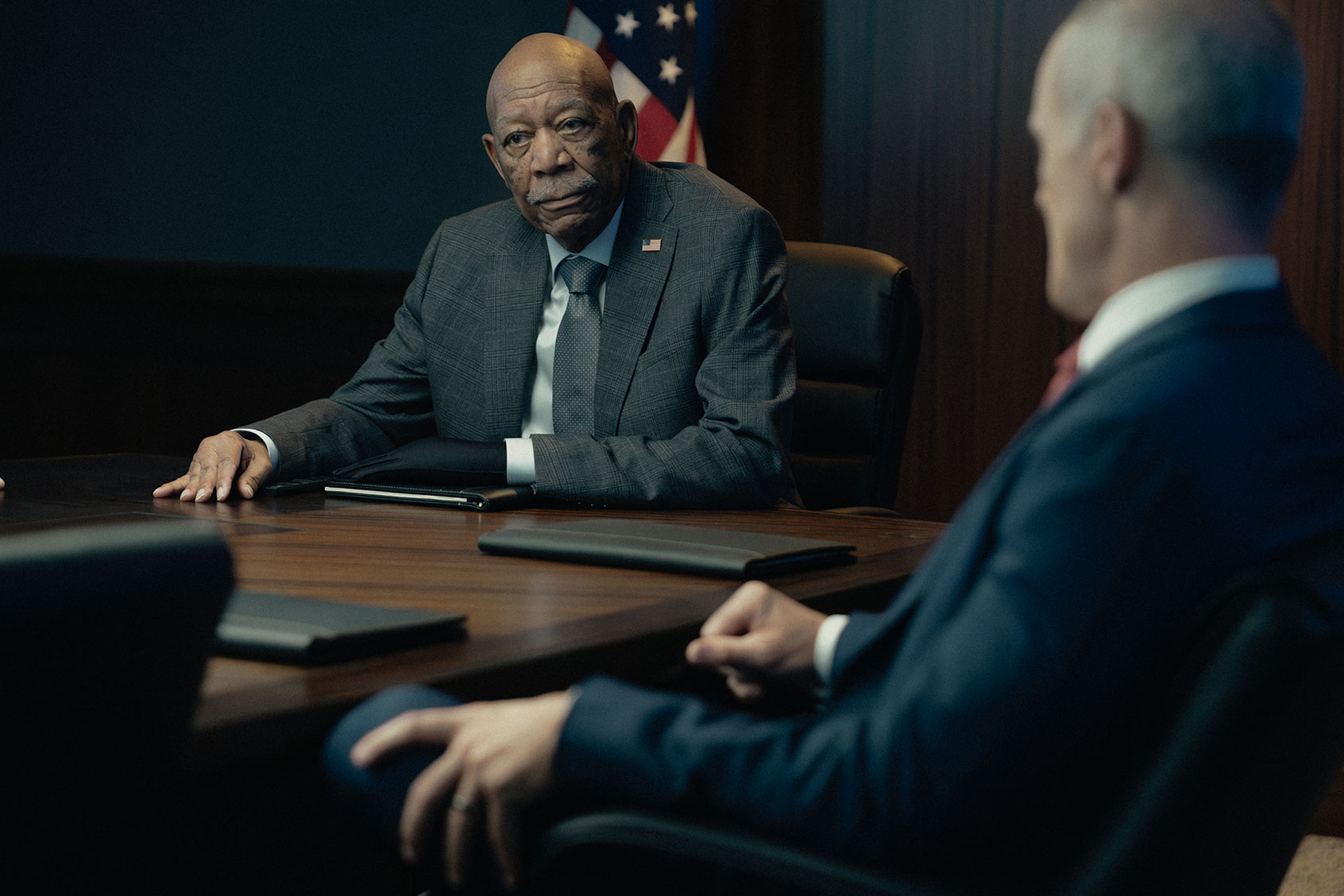
LionessMorgan Freeman as Secretary of State Mullins and Michael Kelly as Bryon Westfield in "Lioness" (Ryan Green/Paramount+)In the penultimate episode of the show's second season, Secretary of Defense Edwin Mullins (Morgan Freeman) takes a moment to watch the Sunday morning political talk shows. On “Face the Nation,” a guest uses the word “Latinos” and is immediately reprimanded by the host. 
“‘Latino?’ Do you think that’s an appropriate term in our current climate?” she asks, incredulous. 

“So what should I say?” the interviewee responds. “‘Latinx?’ I should just invent a term that has absolutely no meaning in the English language to satisfy your aversion to being disagreed with?”

Of course, it’s completely plausible that a Republican pundit might disdain the use of the word “Latinx.” But would a Sunday morning host on network television scold a guest for using the word “Latino”? Only in a MAGA fever dream. 

“Turn that s**t off,” Mullins says, disgusted. He then dismisses mainstream media outlets as “court jesters.” Newspapers such as the New York Times and Washington Post have lost all credibility, he says, because they peddle only opinions and propaganda. 

 “Americans have always been gullible, but they’re not stupid. Lie to them enough, and they won’t trust you to tell them the sun’s rising.” In a line that resonates with recent talk of right-wing retribution against the media, he predicts a violent end for those court jesters: “Before long, the court’s gonna start chanting ‘off with their heads.’” 

“Lioness” is hardly the first prestige TV program to accommodate conservative sensibilities.

In the same scene, Mullins — who, let’s remember, is ostensibly a Democrat — waxes nostalgic about the presidency of George W. Bush in a soliloquy so preposterous, ahistorical and silly that not even Morgan Freeman can salvage it. Without mentioning him by name (referring only to “our 43rd President”) Mullins recalls serving in Congress when Bush was elected, and laments that he and his “petty” Democratic colleagues opposed all the new President’s appointments. “If he tried to get a kid into the Naval Academy, we figured out a way to block it.” Then came 9/11. “We needed a leader,” Mullins muses, “and a leader arose.” 

Of his own party’s leaders, Mullins admits, “Right now we don’t have one.” (Though the Democratic President in the “Lioness” universe is never named, he’s often dismissed as ineffectual or absent, which echoes Trump’s characterization of Joe Biden.)

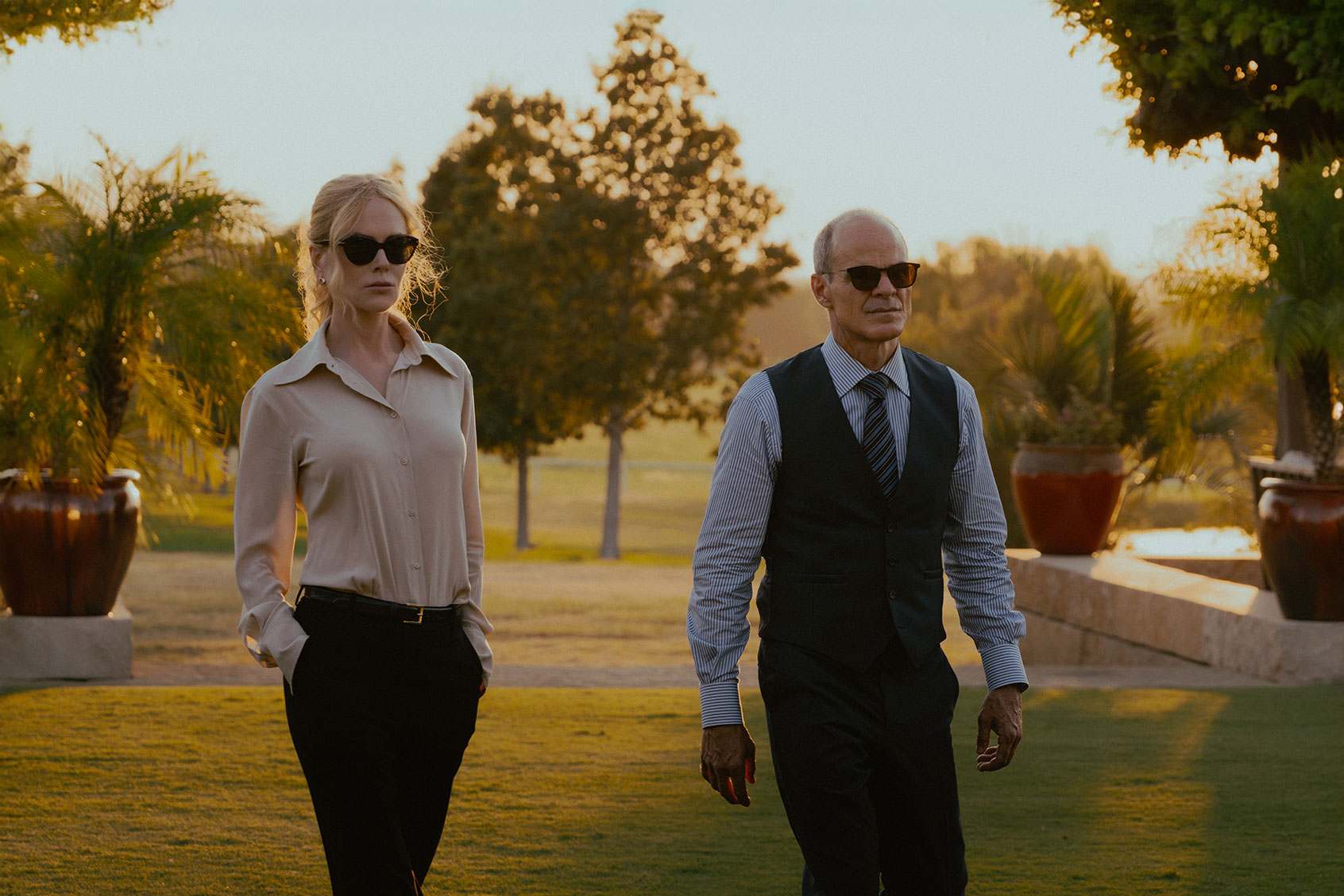
LionessNicole Kidman as Kaitlyn Meade and Michael Kelly as Byron Westfield in "Lioness" (Ryan Green/Paramount+)It’s unclear how (or whether) the tectonic shift in real-world politics might be reflected in future seasons of “Lioness.” The show has only obliquely referenced elections. In a prospective third season, the story could continue to depict Trumpian ideas, even without a Trump-like character. On the show's recent second season finale, CIA Deputy Director Byron Westfield (Michael Kelly) travels with Kaitlyn Meade (Kidman) and a team of American operatives to Mexico to help assassinate a cartel leader and install a more cooperative replacement. If that plot point sounds vaguely familiar, it might be because Donald Trump has been floating plans to send American “kill teams” into Mexico to neutralize drug lords.

“Lioness” is hardly the first prestige TV program to accommodate conservative sensibilities. “Reacher” star Alan Ritchson surprised and enraged that show’s right-wing fanbase when he called Donald Trump “a rapist and a con man” in an interview with The Hollywood Reporter. And it should come as no surprise that “Yellowstone” is a hit with conservative audiences — it’s the creation of Taylor Sheridan, the same showrunner who helms “Lioness.”

None of these shows, though, is popular exclusively among conservatives. As sociologist Tressie McMillan Cottom explains in a “New York Times” column, liberal viewers are more omnivorous than conservative viewers. “Liberals watch, read and listen to more stuff than conservatives do,” McMillan Cottom writes, citing research by colleagues. “They also do not necessarily reject a cultural object because conservatives like it.”

So far, there are scant details about a third season for “Lioness,” but Saldaña told Vanity Fair that she has a “contractual obligation” to play Joe for at least three seasons. With more than 12 million viewers streaming the second season premiere (a record for Paramount +, it’s clear that “Lioness” has found its audience. 

Beyond almond and oat: How pecan milk is shaking up the plant-based market

For decades, soy milk was the only widely available alternative for those seeking a non-dairy option. But in recent years, the plant-based milk market has transformed into a thriving sector filled with innovation, from almond and oat to pistachio and even sesame. According to McKinsey's 2022 Dairy Report, this evolution reflects shifting consumer habits: nearly a quarter of Americans now consume both dairy and plant-based alternatives, driven by factors like health, taste and sustainability. Yet, the market is not without its challenges — rising prices, environmental concerns and the need for differentiation have put pressure on producers to innovate.

Enter Laura Shenkar, founder and CEO of PKN, the world’s first pecan milk brand. Shenkar has positioned pecans, America’s only indigenous commercial tree nut, as a sustainable and nutrient-packed alternative in the crowded non-dairy aisle. 

Shenkar shared with Salon how PKN aims to disrupt the category, from its ecological focus to its commitment to taste and accessibility.

This interview has been lightly edited for length and clarity. 

The market for plant-based milk alternatives is growing crowded, with almond, oat and soy dominating the shelves. What inspired you to champion pecans as the centerpiece of PKN, and how do you see pecan milk carving out its space?

We’ve captured the attention of consumers because we are addressing a rare white space in consumer products — with a hero ingredient people always love to fill one of the mainstays of the American diet, milk.

As we look toward the evolving water crisis in California, it’s clear that we need to start looking for a new, water-resilient source of nuts.  

A 2016 stream revitalization project in San Saba Texas sparked my interest in pecans.  As the only commercial tree nut indigenous to America, they were uniquely resilient and could be independent from the demands for water, for chemicals like pesticides, as well as pollinators that define the current supply of nuts in the US. These nuts are all from California, where almonds alone use more than 10% of its water.  

With more than a third of US consumers lactose intolerant, this market will need to double just to address our basic health requirements. Pecans provide the highest level of flavonoids and the highest ratio of antioxidants of any tree-nut to support brain- and heart-health.

But most importantly, we believe that next-generation brands need to make food that brings joy and delights our consumers. You should feel the celebration of Thanksgiving pecan pie in every sip.

Pecans are native to the U.S., and you’ve highlighted their ecological benefits. How does PKN approach sustainability, and what challenges do you face in scaling a product while staying true to your environmental ethos?

We believe that next-generation consumer products need to efficiently use scarce resources, and we’ve built our company from the ground up to minimize food waste and build a robust, carbon-efficient supply chain. 

We’ve worked with the most committed pecan shellers to upcycle pecan pieces and capture nut meats to preserve their nutrition.

We’ve also developed a waste-free production process that uses dramatically less water and produces less waste than conventional almond milk manufacturing.

Finally, we’ve invested to develop our products for shelf-stable packaging with a year-long shelf life.

It’s important to note that pecans are truly the only commercial nut that is indigenous to America. Pecans do not require irrigation or chemicals to grow. They’re self-sustaining and also a more pure crop in terms of agriculture. 

Every day we all seem to hear about the water scarcity in California and how it impacts the supply of almonds. As this water scarcity limits nut production in California, pecans are emerging as the only sustainable choice. Having pecan milk on shelves as a choice for consumers gives them a delicious alternative that can also be better for sustainability measures and the environment.

We need your help to stay independent

Your messaging emphasizes health benefits, from antioxidants to omega-3 fats. How do you balance communicating the science behind these benefits with making your brand approachable to the average consumer?

Consumers have a lot of options these days, so we’re committed to in-store sampling events that introduce PKN with its wonderful taste and also highlight the nutritional benefits. Flavonoids have been an unsung hero for brain-health, and people are interested to learn that integrating pecans into everyday eating can support longevity and health. 

You’ve mentioned that pecans can serve as an anchor for the future of farming. Could you share more about PKN’s relationship with pecan growers and how you’re fostering partnerships that benefit local farming communities?

We care about our sourcing and we are very much focused on our farmers. We highlight the hard work our farmers do to grow the pecans that become our milk. It’s important to note that our milk is made of upcycled pecan pieces. To that, we as a company are more sustainable than any other brand on the market. So many farmers were wiped out by the Hurricanes Helene and Milton, and will not recover. We are in touch with them and are doing everything in our power to help them as they move forward. 

Taste is king in the food world. What steps did you take to ensure pecan milk delivers on flavor, and how have consumers responded to its distinctive taste compared to more established plant-based milks?

We see taste as a primary driver, followed by all the wonderful attributes that pecans offer. With our Barista product in particular, it took us 18 months to get it right. What that means is we failed a lot in order to perfect it, to make the Barista the highest quality it can be, especially when it comes to frothing qualities for making lattes and cappuccinos. 

Plant-based foods often face scrutiny over accessibility. How does PKN aim to make pecan milk a viable option for a wider audience, both in terms of price and availability?

Much of our product innovation has focused on upcycling pecan pieces, which generates a new revenue stream for farmers, but also reduces the price of our products. As we ramp up production, we’ll be able to reduce costs and introduce new products for each of the grocery market segments.

We closely watch the market and see where we fit in, in terms of product offerings and price point. Indeed, accessibility is important to us, and we want to make sure our pecan milk stays as reasonably priced as possible.

You’re developing what you’ve called ‘next-generation plant-based foods.’ What’s on the horizon for PKN beyond pecan milk, and how do you see the brand evolving in the coming years?

We’re on the hunt for new ingredients to simplify our ingredients.  We’re examining opportunities to integrate other native plants into our pecan milks for both sweetness and spiciness, for protein, and also to add bio-effective, plant-based sources of calcium and key minerals.  

We are rolling out new products in 2025, so stay tuned! 

We’ve captured the attention of retailer buyers and consumers because we are addressing a rare white space in consumer products — with a hero ingredient people always love to fill one of the mainstays of the American diet: milk.

“How many rapists are in my wallet?”: Rock questions “worst president ever” Trump talk on “SNL”

Chris Rock pulled no punches in his return to "Saturday Night Live."

Rock's wide-ranging monologue, the comic joked about Elon Musk, the shooting of healthcare CEO Brian Thompson, but he saved his best jabs for President Joe Biden and President-elect Donald Trump.

He started with talk of Trump's "good year," noting that Trump "survived an assassination attempt" and "won the presidency again" before being named Time's "Person of the Year."

"You know, it could happen to a nicer guy," he quipped. 

While he's certainly no fan of Trump, Rock gave no space to people who think Trump will be the worst president in the history of the United States.

"Dude it's the United States presidency. Come on, We've had some presidents. This is not the most dignified job in the world," he said. "We've had presidents show up to the inauguration with pregnant slaves. And I'm just talking about Bill Clinton."

He added that some of our most venerated presidents were deeply immoral.

"You know the history of this country. You know how many rapists are in my wallet right now?" he asked. "A cup of coffee in America costs seven rapists, but Trump's going to get it down to three."

Rock turned to Biden, talking about his age and his controversial pardon of his son

"I gotta hand it to Joe, man,” Rock said. “You know, he don’t move as fast as he used to. He don’t talk as fast as he used to. But that middle finger still works, boy."

Watch the entire monologue below:

ABC agrees to settle Trump defamation lawsuit for $15 million

ABC News has agreed to settle a lawsuit brought by Donald Trump over the statements of host George Stephanopoulos

The network will pay Trump $15 million to bring an end to the president-elect's defamation suit, brought by Trump after Stephanopoulos said that he had been found "liable for rape" in the lawsuits brought by E. Jean Carroll.

The $15 million will go directly to a future presidential foundation and museum. The network also issued an apology as part of the settlement. 

"ABC News and George Stephanopoulos regret statements regarding President Donald J. Trump made during an interview by George Stephanopoulos with Rep. Nancy Mace on ABC's 'This Week,'" the apology included in the settlement filing read.

Trump filed the suit earlier this year, maintaining that a jury found him liable of sexual abuse, not rape. The judge in that Carroll case later ruled that Trump's attempt to put daylight between the two terms was a distinction without a difference. Judge Lewis Kaplan said that Trump's actions would be called "rape" in everyday speech. 

“The finding that Ms. Carroll failed to prove that she was ‘raped’ within the meaning of the New York Penal Law does not mean that she failed to prove that Mr. Trump ‘raped’ her as many people commonly understand the word ‘rape,’ ” Kaplan ruled.

The ongoing defamation lawsuit would have forced Trump and Stephanopoulos to sit for depositions. Earlier this week, the judge in Trump's suit ordered them to make time for the court, saying there was "no reason for any further delay.”

15 years ago I got veneers — now my teeth keep falling out

A couple of times a year, one of my veneers falls out. It’s happened so often at this point that it's become a recurring joke among my friends: How will Edgar’s fake teeth fall out next? Will it be from eating corn on the cob? Biting my nails? Recently, the evil culprit was a stale pan dulce at a friend’s birthday party in New York. The party was country and western-themed, and my tooth that fell out was the exact one that, in a movie, an actor playing the role of "Hillbilly" or "Bumpkin" would have blacked by production out to signal the character should be seen as poor and dumb. I tried to laugh it off, though on the inside I was mortified: Those were the stereotypes I was trying to counter when I first got my veneers installed in 2009, when I was still in high school. 

Back then, the only people getting veneers were celebrities like Tom Cruise and Hillary Duff, who could afford the 5-figure price tag for a quality set. My family, like most Americans, didn’t have that kind of money to spare. In Orlando, my mom worked as a barista at Starbucks, making a little over $20,000 a year. We both had the same teeth: jagged and growing inward, with dark cavernous gaps between them. I brushed mine obsessively as if to wash off the word DIRTY I felt was written on my forehead. Unlike me, however, my mom owned a cheap pair of flippers: those perfect, creepy-looking fake teeth toddlers wear in beauty pageants. When she put them on every morning, her face lit up, and she was free to go out into the world with her head held high.

I’d begged my mom for braces for years, but there was no way she could afford both the initial installing fee, plus the return to the dentist every couple months to tighten them. It was a miracle if we went once a year at all. Veneers, on the other hand, were a one-stop solution, though at three times the price. In the end, she paid for them with credit cards, and even then, she didn’t have enough credit for a whole set and could only purchase me enough to cover the top row of my teeth, which the orthodontist assured were “the only ones people see anyway.” They were $8,000—almost half her annual salary. A few months later, she would declare bankruptcy. 

As shortsighted as my veneers might seem to some, to my mom they must have been an investment in my future. Before I got my teeth fixed, I was an ambitious kid with a near-perfect grade point average. I dreamt of clawing my family out of poverty and giving my mom the life she deserved. Then one day, I was expelled from high school on drug charges after a student lied to the campus police about me being a dealer. By the time I started at my new school, the future and all my lofty goals had begun to feel childish and naïve. There was something that seemed preordained about the expulsion, like it was the first step in what was bound to be a lifetime of failures. Deep down, I worried that if I didn’t have straight, white teeth, I would never be successful, the same way I worried my being gay and non-white would inevitably hold me back. 

As shortsighted as my veneers might seem to some, to my mom they must have been an investment in my future.

The veneers helped restore my faith in the future. Staring at my new $8,000 smile in a handheld mirror at the orthodontist’s office, a flicker of hope stirred inside me for the first time in forever. If this could happen, then maybe I was wrong about being destined for failure; maybe there were good things ahead. When the orthodontist informed me I would have to replace my veneers in 15 to 20 years, I shrugged his words off, figuring that adult me would have no problems with money. After all, I had a smile like Hillary Duff. Who wouldn’t hire me?  

Now the 15 years is up, and I don’t have anything close to the $10,000 I need to replace them—and that’s if I’m lucky, since a decent porcelain pair can run up to five times that. It turns out getting my teeth fixed wasn’t the secret recipe to getting rich that I’d hoped. 

Don’t get me wrong, my veneers have come with some sweet benefits. Whereas my old gap-toothed smile gave away that I was poor, my shiny new teeth imply wealth, a healthy lifestyle, a lifetime of regular trips to the dentist. Like wearing eyeglasses, they even make me look smarter. “You can tell a lot by someone’s hygiene,” a man once told me on a first date. “Bad teeth are a deal breaker for me. I want someone who takes care of themselves.” I nodded politely, while privately remembering how awful it felt as a child when others assumed my natural teeth were a result of not “taking care of myself,” as opposed to a combination of biology and difficulty accessing healthcare. It was one of the worst and best compliments I’ve ever gotten.

To tell you the truth, I’m not above playing into stranger’s assumptions. My veneers are the first thing people see at job interviews, and I take full advantage of that. I didn’t go to an Ivy League university. I don’t have family connections in any industry. But I can smile like my life depends on it. These days I’m a writer, which you’d think is the one career where appearance doesn’t matter, yet with the rise of social media, writers are increasingly expected to be full-fledged brands. With the pressures of keeping up a platform and invitations to speak on panels and read my work in public, I find myself having to smile more than ever before. 

It turns out getting my teeth fixed wasn’t the secret recipe to getting rich that I’d hoped. 

This would be fine, except for the problem of my veneers falling out. Every time it happens, I’m thrown back into a past that I tried so desperately to forget, and once again I’m that insecure teenager who doesn’t see the point in trying. Making a living as a writer is difficult enough (for reference: for my last book, my publisher paid me $15,000, before taxes, spread out over three years), and with my mom aging out of the workforce and increasingly depending on me for financial support, it's unlikely that I’ll be able to save $10,000 to replace my teeth anytime soon. 


Want smart health and science stories in your inbox? Subscribe to Salon's weekly newsletter Lab Notes.


I don’t feel sorry for myself. I won’t lie; I did get a good run out of these bad boys. But I do wish that 16-year-old me had been better prepared for the responsibility of maintaining veneers. Even so, I don’t regret getting them. If I hadn’t had the procedure done at such a crucial point in my life, I wouldn’t be where I am today, both because of the confidence they’ve given me and the doors they’ve opened in my profession. At the same time, I’m nervous about where I’ll end up if I can’t keep them. It helps that I’m not alone in my fear. Losing your teeth is consistently ranked as one of America’s top nightmares. It just so happens their nightmare is my daily reality. 

I’ve been lucky so far. I found a dentist once who glued one of my teeth back on for $50. Others have done some clever maneuvering with my dental insurance, which I only have because of my partner. Each time, they send me off with the warning to be more careful, because next time the damage might be too drastic to repair. I try to stall however I can: brushing and flossing after every meal, avoiding eating hard foods like apples. 

I feel oddly comforted by the fact that other people are just as desperate as me to have beautiful smiles. Nowadays, I can’t turn on a TV set without seeing a celebrity with a pair of blinding white veneers, whether on reggaetón stars like Bad Bunny or drag queens like Sasha Colby. But veneers aren’t just for the rich and famous anymore. It isn’t strange for average Americans to opt to have the procedure done. Some of them fly to Colombia or find “dentists” on TikTok who promise veneers at a fraction of the cost. I would do the same, but I’ve read too many horror stories about people cutting corners to get quick fixes only to end up with botched smiles. 

I feel oddly comforted by the fact that other people are just as desperate as me to have beautiful smiles.

Seeing this latest rise in veneers, especially among influencers, reminds me that they weren’t simply a vanity procedure for me, but directly linked to my ambition. When I was younger, I believed I needed the perfect smile just like I believed I needed a fancy suit and tie to complete the illusion that I was someone worth giving a chance to. Whether my plan worked? It’s hard to tell. What I do know is that the profession I’ve chosen often places me in the public eye, something I would have never done as a teenager when all I wanted was to hide. 

The irony is that now that I’m in my 30s and fake teeth are everywhere, the people I envy most are the ones with natural, imperfect smiles. I love a gap, Zendaya’s slight snaggle, all those little personal details that separate a face from the rest of the crowd. I feel envious when I see strangers biting into apples, not worried about the consequences. Meanwhile, I can barely look at a corn on the cob without flinching. It’s been said before: You never know what you have until it’s gone. As the expiration date on my veneers rapidly approaches, I can only hope that in the next few years, I’ll figure out a way to keep smiling.

Good riddance to Washington’s real power duo

Senate Democrats have started to say their goodbyes. 

“Some of the happiest times I have had in the Senate were on Joe Manchin’s boat,” said Senate Majority Leader Chuck Schumer. The New York leader recently took to the Senate floor to thank Manchin for his frolicking houseboat parties on the Potomac — always featuring a bipartisan guest list, Illinois Sen. Dick Durbin made sure to mention. 

“Some of the biggest accomplishments of the” Biden administration, Schumer admitted, “would not have gotten done without Joe.” Wishing farewell to the retiring West Virginia senator, Schumer called Manchin “invaluable.” 

Senate Democrats showered retiring Arizona Sen. Krysten Sinema with similar praise. 

“Senator Sinema always made a splash and often,” colleague and Virginia Democrat Mark Warner noted, “at the end of the day, won her battles.” The senator continued: “But for all the ink spilled on Kyrsten, what I think a lot of people failed to see is her incredible ability to talk and build relationships with everyone. There have been so many times—not just on the big bills, candidly not just at the behest of Democratic leadership, but candidly on the behest of some of our Republican friends, to say this senator is being particularly challenging on this bill or on this issue. I think there was probably no one who got sent into those kind of negotiation.” 

Manchin and Sinema’s steadfast positioning says so much about Democrats’ problems with coalition-building. 

Days later, Manchin and Sinema united to scuttle Democrats’ efforts to hold off the incoming Trump administration’s efforts to roll back all of the progress on worker-friendly labor regulation that the Biden administration has implemented. 

“Millions of working people across the country will pay the price for their actions,” Massachusetts Sen. Elizabeth Warren said of the pair's vote to block the reconfirmation of Lauren McFerran to the National Labor Relations Board. Two of the NLRB’s five members are Republicans, and two are Democrats, and the sitting president chooses the board’s chairperson. The 48 other members of the Senate Democratic Caucus voted to confirm McFerran for another term, but Manchin and Sinema said no.

Neither Manchin nor Sinema are currently Democrats. Manchin started 2024 knowing it would be his last in the Senate. In May, he quit the Democratic Party. When Sinema ditched the Democratic Party in 2022 after serving three terms in the House as a Democrat and becoming the first Democrat in three decades to win an Arizona Senate race, it inflated Manchin’s outsized influence in the Democratic caucus.

Sinema, for her part, had been rather absent from recent Senate votes until the NLRB vote this week. The Wall Street Journal reported Sinema “skipped every vote since November 21,” including votes on critical judicial confirmations.

We need your help to stay independent

“Pathetic,” was the way fellow independent Bernie Sanders described the betrayal. Minnesota Democrat Tina Smith called it “disappointing.”

The two had previously supported a Republican resolution to overturn the NLRB. President Joe Biden vetoed it. During Biden's four years in office, the two clashed bitterly with Democratic colleagues over a number of legislative priorities while also playing a pivotal role in some of the president's signature accomplishments. In many ways, Joe Biden and Kamala Harris have no legacy without Joe Manchin and Kyrsten Sinema. In so many other ways, Manchin and Sinema hampered the president's plans the whole way through. From the Inflation Reduction Act to Biden's Build Back Better plan, both blocked and slashed sweeping progressive legislation, making them the most disruptive elements of Biden’s domestic agenda. 

Manchin infuriated Democrats with his refusal to expand the child tax credit. During the debate of the expansion, a bunch of kayaking protesters famously confronted Manchin on his houseboat, “Almost Heaven” — named for lyrics in John Denver’s classic song about West Virginia. In the end, however, Manchin significantly shaped Biden's legacy by backing the much smaller Inflation Reduction Act and Biden’s bipartisan infrastructure law.

Sinema maintained her resistance to higher tax rates and attempts to weaken the filibuster. She also supported Democratic party-line bills, even after leaving the party. She voted to convict former President Donald Trump in his two impeachment trials, opposed Trump-backed Supreme Court Justice Amy Coney Barrett and supported Biden's Supreme Court nominee, Justice Ketanji Brown Jackson.

For his part, Manchin argues that he often got “caught in the middle” of what Democrats want and what his West Virginia constituents in the MAGA stronghold of West Virginia want. Manchin’s last electoral victory was by less than 20,000 votes in 2018. Two years later, Trump won every county in the state in a near-40-point romp. 

 So what is reasonable for Democratic voters to expect from Democratic lawmakers in such a position? Manchin's retirement, along with the departure of Montana's Jon Tester, leaves few other Democrats in red states to navigate the dilemma. It is clear that the base of the Democratic coalition is far from Manchin's home state. Manchin and Sinema’s steadfast positioning says so much about Democrats’ problems with coalition-building.  

Trump was prosecuted under the Espionage Act — now he’ll turn it against his “enemies”

There is palpable fear that Donald Trump's upcoming presidency will, as he repeatedly promised during the 2024 campaign, bring systemic suppression of free speech and criminalization of dissent. In his victory speech, Trump called the media "the enemy of the people," a recurring refrain of his political career. His nominee to head the FBI, Kash Patel, has called for the prosecution of journalists and leakers.

I know what this looks like first-hand: I have represented national security and intelligence whistleblowers across the Obama, Trump and Biden administrations who've been investigated or prosecuted for leaking government secrets to the press. Those secrets revealed "dark ops" like torture, extraordinary rendition, mass domestic surveillance and drone assassinations. Many of these programs were later deemed to be illegal, unconstitutional or both.

In an inversion of the standard judicial paradigm, government employees and contractors who revealed these extrajudicial activities were the ones subject to criminal investigation and prosecution. Even more concerning, they were charged under a draconian World War I-era law called the Espionage Act. Despite its name, the law has rarely been used against actual spies. Instead, it has almost exclusively been deployed against public servants to stifle internal dissent.

The Espionage Act is an ideal weapon for Trump’s retribution toolkit. In one of the ultimate dark ironies of this era, Trump himself has been charged under this law and knows its blunt force at first hand. His administration wielded the Espionage Act against FBI whistleblower Terry Albury, who revealed surveillance of journalists, religious and ethnic minorities and immigrant communities. Under Trump, the Justice Department also used this law to prosecute Air Force veteran Reality Winner, who disclosed Russia’s attempts at election interference. The Espionage Act's most recent victim is Daniel Hale, a veteran of the Afghan war who exposed the brutally inaccurate targeting of drone strikes and the extent of unreported or under-reported civilian casualties.

More troubling still, Trump expanded the Espionage Act’s use in charging WikiLeaks founder Julian Assange for activities that can reasonably be described as ordinary journalistic practice. Joe Biden's administration could have closed the door on this dangerous law, either through a legislative fix or by standing down in court cases, but did not, instead allowing the problematic prosecutions against Hale and Assange to continue.

Despite its name, the Espionage Act has rarely been used against actual spies. Instead, it has almost exclusively been deployed against public servants to stifle internal dissent.

The most insidious part of this law — and the part that may appeal to Donald Trump the most — is its built-in provisions of secrecy. During the pre-trial phase, discovery takes place in a Sensitive Compartmented Information Facility, or SCIF, an enclosed, government-controlled room for dealing with allegedly classified information that has supposedly been leaked. This hermetically sealed, windowless room is the only place where attorneys and their clients can discuss the evidence. Cell phones, personal laptops and even legal pads are prohibited. After that, legal proceedings under the Espionage Act largely transpire away from the eyes of the public, thanks to national security secrecy rules – in effect, creating a modern-day Star Chamber. 

Preliminary hearings transpire behind closed doors. In one especially Kafkaesque incident, I was even shut out of a hearing on dispositive motions for my client, Daniel Hale, even though there was no classified information at issue. The "public" docket, a formal record of all the proceedings and filings in the case, sheds no additional light, consisting largely of pleadings that are filed ex parte (that is, by only one side) and under seal, for what is called "in camera review" (meaning for the judge’s eyes alone). Once the process reaches “open” court, further barriers arise. The Classified Information Procedures Act allows the government to create “substitutions” for secret information, such as summaries or redacted versions that can be used in court.

These procedures can sometimes border on the bizarre, beyond George Orwell's imagination. In the prosecution of NSA whistleblower Thomas Drake, the government tried to invoke the silent witness rule, which would require the judge, the jury and the opposing lawyers to speak in code words indecipherable to the public. In that case, the government even tried to preclude the usage of the terms "whistleblowing" and "First Amendment."

Finally, the Espionage Act is a strict liability law, meaning that a defendant’s intentions — whether salutary, malevolent, purely selfish or some combination thereof — are entirely irrelevant. It doesn’t matter whether disclosures were made because the whistleblower believed that the public had a right to know what the government was doing in secret, or were made for fame, personal profit or petty revenge. No public interest defense is available, meaning that a defendant cannot explain at trial that their disclosure of information — even if it demonstrated illegal, unethical or morally troubling conduct by the government — was something the public needed to hear about. In fact, defendants cannot talk about their motives, benevolent or otherwise, until they face sentencing once they’ve already been found guilty.


Want a daily wrap-up of all the news and commentary Salon has to offer? Subscribe to our morning newsletter, Crash Course.


The fact that Trump himself has been charged under this law is likely to embolden him, not deter him. Both of our political parties bear responsibility for the looming crackdown on media sources and journalists who have spoken out against abuses of power. In a permanent stain on Barack Obama’s legacy, his Justice Department revived the long-dormant Espionage Act and used it to prosecute more whistleblowers than all previous presidents combined. That created a dangerous precedent that has subsequently been used to normalize the prosecution of so-called leakers.

Trump's DOJ further expanded the Espionage Act’s use during his first term with the indictment of Assange, which sought to criminalize such typical journalistic activities as cultivating a source, protecting their identity and using encrypted messaging. The Biden administration aggressively continued the Assange case, which ended in a plea bargain and the first-ever Espionage Act conviction for a publisher.

Trump is likely to use a range of more obvious press suppression methods, such as defamation lawsuits, the revocation of FCC licenses, and the repeal of Justice Department regulations that restrict subpoenas for media outlets' proprietary information and internal records. But the table has been set for the incoming Trump administration to unleash the far stealthier and constitutionally dubious tools of the Espionage Act to prosecute media sources and journalists as part of his revenge campaign to go after "enemies within."

It is worth remembering that this pernicious law was most famously abused when a corrupt president deployed it several decades ago against a legendary whistleblower. That president was Richard Nixon, and that whistleblower was Daniel Ellsberg, who released the Pentagon Papers to reporters and ranked near the top of Nixon's infamous enemies list. That is a cautionary tale we should not forget. We must be wary of this deeply flawed law being used by a president who, by his own admission, is hellbent on retaliation against media critics and perceived political enemies. If the past is prologue, the danger that press freedom may fall victim to personal vendettas is real.

Frustrated with high drug costs, biohackers are reverse engineering medical treatments

The crescendo of outrage at the health care system lately has some arguably valid complaints. Take insulin for example. Affordable insulin is so hard to come by in the U.S. that people turn to underground networks of shared medicines, ration their own supply to cut costs, or sometimes cross the border to Mexico or Canada to get the medication they need. 

Pharmaceutical companies recently introduced price caps on insulin after coming under scrutiny for charging hundreds of dollars per vial, which could be purchased in Canada for roughly one-tenth the price. About 8 million people in the U.S. with diabetes rely on insulin, and its high prices have become emblematic of what many see as a broken health care system.

“Among diabetics, there is quite a lot of desperation, and there’s quite a lot of people facing really serious health consequences and often even death because of the fairly arbitrary and often deeply flawed ways that the system that provides us with the medicine we need to survive fails,” said Anthony Di Franco, a Type 1 diabetic and computer scientist.

Insulin is one of many inaccessible medications in this system, with Americans paying three-fold the price for drugs as comparable countries in 2022. Desperate for relief, people with conditions like long COVID also turn to online drug markets because clinical trials testing therapies to treat it have been slow. People with rare diseases often don’t have access to therapies that could help because there is little financial incentive for pharmaceutical companies to invest in trials to test them. And some patients with fatal conditions who do have treatments approved still can’t access them through insurance because of complications in the current regulatory structure.

"This is, fundamentally, a response to a system that is perceived to be not working."

Fed up with the U.S. health care system, many so-called biohackers are trying to increase access to therapies by providing people with DIY instructions to make them from the comfort of their own home. Biohacking covers a range of activities, from performing gene-editing in garages to synthesizing the ingredients of certain medicines or technologies and publishing DIY instructions on how to make them at home to reverse engineering vaccines.

The emergence of biohacking in itself shows that there are unmet needs within the current system, said Ishaan Kumar, medical student at University of Chicago, who has written about the movement.

“This is, fundamentally, a response to a system that is perceived to be not working and arguably doesn’t work in a lot of cases, like with super rare genetic diseases that affect something like two to three new patients a year,” Kumar told Salon in a phone interview. “That’s not enough to run trials, let alone return a profit, so the regulatory and economic incentives that we have in our pharmaceutical system just do not account for those patients.”

One through-line in many of these initiatives is that they are counter-institutional in nature. In a 2010 conference, computer scientist Meredith Patterson delivered a “Biopunk Manifesto” and described her stance on biohacking: “We reject the popular perception that science is only done in million-dollar university, government or corporate labs; we assert that the right of freedom of inquiry, to do research and pursue understanding under one’s own direction, is as fundamental a right as that of free speech or freedom of religion.”


Want more health and science stories in your inbox? Subscribe to Salon's weekly newsletter Lab Notes.


In 2015, Di Franco founded The Open Insulin Project, a community based organization run by volunteers, with the intention to “biohack” publicly available research on how insulin is made and provide those directions in an open-source format. Under the project’s model, the cost of insulin could be as low as $7. The project is still in the development stages but Di Franco says one day it might partner with local medical institutions to scale a production model. (If that is the case, it will have to meet the regulatory requirements of the Food and Drug Administration.) 

“There are reasons to be skeptical that everyone is going to have insulin factories on their countertop,” Di Franco told Salon in a video call. “But there are also reasons to be skeptical about the currently dominant way of doing things, which has its own very serious issues.”

Critics are concerned that DIY initiatives forgo some of the rigor of testing the safety and effectiveness of treatments regulated in the current regulatory system. Without the checks and balances, and resources, of a larger system, many are concerned that the DIY approach could lead to someone getting hurt.

“Making insulin is something that should be doable,” said Hank Greely, who directs the Center for Law and Biosciences at Stanford University. “But whether it’s doable in a safe, effective, reliable and non-contaminated manner is a different question.”

Making medicines can be complex and often requires specific equipment as well. While some things may be feasible to make at home, other medications require machines like a liquid chromatography-mass spectrometry (LC-MS) that can cost hundreds of thousands of dollars, said Derek Lowe, a long-time drug discovery researcher, who has criticized some biohacking initiatives.

"Organic synthesis is widely varied," Lowe told Salon in a phone interview. "There are so many compounds, so many reactions, and so many ways to run every reaction, that keeping up with all the things that can go wrong is literally a full-time job."

"We reject the popular perception that science is only done in million-dollar university, government or corporate labs."

Others see biohacking as a way to restore autonomy to patients and provide an option that cuts costs for them. Nevertheless, the concern is that some individuals could appropriate the biohacking space with bad intentions, said Lisa Rasmussen, a philosophy professor at University of North Carolina, Charlotte who is writing a book about DIY science. 

“When people write about citizen science or DIY bio, it's often an enthusiast about it who says, ‘Look at all the amazing things we'll be able to do!’ But then you can imagine someone else coming along and saying, ‘Oh, well, this is a good way to avoid all the expensive FDA regulations, I'm just going to do this,” Rasmussen told Salon in a phone interview. “We are trying to think about the ethics in the sense not of preventing helpful innovation, but rather preventing potentially harmful misuse.”

In 1980, the Bayh-Dole Act was passed to allow institutions to benefit financially from government-funded research. Today, regulatory institutions are often influenced by financial investors, said Jean Peccoud, a professor at Colorado State University who has studied DIY insulin.

“You could have something that is slightly, you know, not quite as bulletproof, but would be infinitely cheaper and affordable,” Peccoud told Salon in a phone interview. “But that conversation is not taking place because the only people who are invited are the people who are making the patents.”

The current system is certainly not bulletproof. In addition to the people who cannot afford or access medications, there are plenty of historical examples in the traditional scientific framework to point to, like when researchers withheld treatment to Black patients in the Tuskegee syphilis study or used genetic material from the Havasupai tribe without consent. 

Mixael Laufer founded the Four Thieves Vinegar Collective — self-described as an “anarchist collective” — to provide free instructions on how to make drugs like the EpiPen, the abortion medication misoprostol, and the opioid-overdose reversal medication naloxone, among others. Everyone in the collective is a volunteer, which is also not-for-profit. The price of a full course of Sovaldi, a treatment for hepatitis C, using the collective’s instructions costs around $300, Laufer said, whereas its market price can run up to $84,000.

“We are not trying to present ourselves as a better alternative to the existing medical infrastructure, we just want there to be an alternative,” Laufer told Salon in a phone interview. “The goal is that people make up their own mind.”

We need your help to stay independent

The collective has not been contacted by the FDA directly for providing these services, Laufer said. However, the FDA did issue a statement warning against a “$30 DIY alternative” to an EpiPen shortly after Four Thieves released instructions for making their device. A few months afterward, the FDA revisited the EpiPen conversation to accuse Pfizer of failing to properly investigate malfunctioning EpiPens, leading to patient deaths.

Kumar, at the University of Chicago, said an important question to consider is who would be responsible for something like this if it happened with a DIY EpiPen. Patricia J. Zettler, a former FDA attorney, has argued that what the collective is doing is legal because they are only providing information and not actual pharmaceuticals.

“From an ethical and moral perspective that is a very difficult question in terms of responsibility … but it feels wrong to me, at least in an intuitive sense, to say it would be the parents’ fault because they couldn’t afford an EpiPen,” Kumar said. “Again, we come back to the question of: Where is the failing? And I think the failing, arguably, is the system.”

How the sunk cost fallacy hurts your finances

Everyone makes mistakes or suffers from bad luck from time to time. But too often, people dig their heels when the tide is shifting against them, rather than getting back on course — especially when they feel they've invested too much time, money or effort to make a change.

This phenomenon is known as the sunk cost fallacy, and if you're not careful, it can keep you from reaching your financial goals

In economics, a sunk cost is an expense that has already been spent, and there's no way to recoup the costs. For example, if you start watching a TV show and don't like it, you can't get that time back. It's a sunk cost. 

A sunk cost fallacy then occurs if you lean into the sunk cost by putting more resources toward it, even though that doesn't recoup what's already lost. So if you keep watching that TV show and pay for another month of streaming because you've "invested too much time," spending more time and money does nothing to get your original time and money back. Instead, it often leads to more losses, as you could end up watching more of a show you don't enjoy, rather than switching to something you'd like.

This issue can also pop up in more serious ways financially, such as leaning into sunk costs with investments, large expenses or career choices.

Sticking with misguided investments

A major way that the sunk cost fallacy hurts finances is by causing investors to stay committed to a misguided investment for too long or even allocate more to chase losses. 

We need your help to stay independent

Suppose you bought $1,000 worth of a particular stock on a hunch that the company would have a strong earnings report. However, the company ends up having a disastrous quarter and the stock falls by 20%. Now your investment is worth $800. 

The psychology of this sunk cost fallacy is that people feel they will lose money by giving up now, even though logically they will get something back by selling, rather than risk further losses, explains Tania P. Brown, a CFP and job exit financial coach.

This issue gets tricky, because you do want to be cognizant of panic selling, and investments do fluctuate in value. However, you need to reevaluate based on the new circumstances, not what once was. The question is whether keeping that current value of $800 in that stock aligns with your risk tolerance and goals more than moving those funds to another investment. 

"I always try to remind my clients that not all investments need to succeed. The overall plan needs to succeed," said Cliff Ambrose, founder and wealth Manager at Apex Wealth.

If you don't have an overall plan to guide you, then you may need to start there, rather than trying to pick or stick with investments that aren't necessarily getting you to where you want to go. 

As you plan, you can proactively consider how you would respond if faced with particular losses, like having a strategy for what you would do if a particular investment dips by 10%, said Brown. For some, the answer might be to stay the course but perhaps have a strategy like a check-in with a friend or adviser at that point. Others might set a limit at which point they will exit the investment. That way, you don't have to make a purely emotional decision when faced suddenly with losses.

Getting attached to purchases

The sunk cost fallacy can also emerge when it comes to hanging onto purchases for longer than they best serve you.

Let's say you took out a car loan for $40,000, with monthly payments of $600, and you've already paid off $20,000 for that car loan. Then you get a new job that enables you to work from home, so you realize that you don't really need that car anymore, as you can share your partner's car. 

Suppose the car's resale value enables you to break even in terms of paying off your remaining loan and getting rid of the car. But you're hesitant to take the plunge because you feel like you've already paid off half the car, and you don't want to feel like you spent $20,000 with nothing to show for it. 

However, this is a sunk cost. Continuing to pay $600 per month — plus maintenance, registration fees, etc. — only digs a deeper hole. It might not feel great emotionally, but the reality is that the best decision for your finances could be to sell the car.

What you spent in the past shouldn't influence your decision now. That money is gone

In other words, what you spent in the past shouldn't influence your decision now. That money is gone. You can only choose what to do going forward, and you have to weigh the pros and cons of your options without letting the emotion of what you've already spent get the best of you.

"Human beings naturally are impulsive and they make a lot of decisions off of emotions rather than logic. So at the end of the day, our job [as advisers] is to bring logic and actual math into the conversation and try to see if we can outweigh what emotional decisions were previously made or can be made in the future," said Ambrose.

Staying at the wrong job

Not all sunk costs have to do with direct spending. Sometimes the sunk cost fallacy shows up in more complex ways that affect your long-term finances and life satisfaction, like with your career choices.

Someone who spends several years and hundreds of thousands of dollars on higher education to be a doctor or lawyer might feel like they can't simply walk away from all that investment. Yet there's no getting that time or money back. It's in the past. 

Now that person would have to evaluate if moving forward with their current career path is the best decision for their future or if they're better off changing course. 

Financially, this decision can be dicey, especially when it comes to high-paying roles like doctors and lawyers. Yet there are plenty of cases where someone leaves these types of positions to pursue their passions, like starting their own business, which leads to higher income in the long run alongside greater life satisfaction.

"Sometimes it's about re-imagining, thinking about this change as an evolution, not necessarily that you're giving up something"

"Sometimes it's about re-imagining, thinking about this change as an evolution, not necessarily that you're giving up something," said Brown. 

If you're considering leaving your current employer to start your own business, for example, the years spent climbing the corporate ladder are not necessarily wasted.

"You're transitioning from using your skills for an employer to using your skills for yourself," said Brown.

Ultimately, reframing the issue and zooming out can help counter the emotionally charged nature of these types of decisions that often lead to sunk cost fallacies. 

With investing, for example, "If the big goal was to build wealth, we can reframe it as we're exchanging investments; we're cutting our losses to move to another place to build wealth," said Brown. 

Also, being gentler on yourself can help you accept errors and move on in a way that better aligns with your goals.

"If you're doing something you've never done, it's okay to fail. You will make mistakes," said Brown. "It's OK to stop something that is not working."

“This has gone too far”: Hochul says drone debacle demands federal action

New York Governor Kathy Hochul has joined the growing chorus of officials demanding action over a series of mysterious drone sightings over several states in the Northeast.

Hochul announced on Saturday that drone activity forced an upstate airport to shut down for an hour on Friday night, demanding the Biden administration “step in” to provide information and support to Empire State authorities.

“This has gone too far,” Hochul said in a statement, calling on Congress to legislate against unmanned aircraft systems and drones. She cited a bipartisan bill in the House that would expand states’ authority to deal with drones and strengthen the FAA’s oversight powers.

“Extending these powers to New York State and our peers is essential,” Hochul said. “Until those powers are granted to state and local officials, the Biden Administration must step in by directing additional federal law enforcement to New York and the surrounding region.”

Just a day earlier, Hochul downplayed concerns on social media over the drones.

“At this time, there’s no evidence that these drones pose a public safety or national security threat,” she said in a post to X on Friday.

The airfield incident that triggered Hochul's change of heart comes amid weeks of reports of heightened drone activity in the region.

In neighboring New Jersey, officials criticized White House spokesperson John Kirby’s claim that the government couldn’t “corroborate” any sightings. GOP Rep. Chris Smith called Kirby's response on Thursday “dismissive.” Democratic Gov. Phil Murphy told Biden in a Thursday letter that it had “become apparent that more resources are needed to fully understand what is behind this activity.”

President-elect Donald Trump weighed in on Truth Social Friday night, arguing the government should “shoot them down” if the drones’ origin couldn’t be identified. 

“You should always fight”: Jay-Z accuser speaks out in new interview

The woman who accused rappers Jay-Z and Diddy of raping her when she was 13 years old detailed her experience in an interview with NBC News.

In the interview, the unidentified woman recalled being taken by Sean "Diddy" Combs’ driver to an MTV Video Music Awards after-party, where she spoke with celebrities before she “started feeling funny.” The alleged victim said Combs and Jay-Z — whose real name is Shawn Carter — raped her. She said the experience ruined her life.

“I got severely depressed. I withdrew completely. My grades started slipping,” she said, adding her downward spiral included a period of homelessness.

The woman filed a lawsuit last weekend, adding Carter to a pre-existing lawsuit accusing Combs of sexual assault. Combs has faced numerous allegations of sexual assault and is currently facing criminal sex trafficking charges.

In her first interview since the accusations were filed, the Jane Doe acknowledged that her account in the lawsuit contained some inconsistencies.

“I have made some mistakes,” she said.

NBC noted that the version of events shared by the accuser included a celebrity who wasn't in New York at the time. She recalled her father picking her up after the party, though he has said he doesn’t remember doing that. 

Still, the woman told NBC News she felt an obligation to come forward.

“You should always fight for what happened to you,” she said. “You should always advocate for yourself and be a voice for yourself. You should never let what somebody else did ruin or run your life. I just hope I can give others the strength to come forward like I came forward.”

Carter denied the allegations as soon as the news broke and once again refuted them to NBC, saying the “incident didn’t happen.”

Combs also denied the allegation, one of over a hundred brought against the mogul.

Trump considering United States Postal Service privatization: report

Donald Trump is mulling privatization for the United States Postal Service, according to insiders who spoke to the Washington Post.

Sources who spoke to the Post claim the president-elect has eagerly discussed gutting one of the federal government’s oldest agencies, going so far as to gather transition team perspectives on privatizing the agency earlier this month. 

Trump discussed his plans to overhaul and the department with Cabinet nominee Howard Lutnick at Mar-a-Lago, per the Post. He’s put forward a planned Department of Government Efficiency, headed by Elon Musk and Vivek Ramaswamy, that would have a wide mandate to slash department budgets.

Trump said the federal government should not step in to subsidize the service’s losses – which totaled $9.5 billion last fiscal year – a move that could potentially destroy the agency tasked with delivering mail to every American. 

Trump appointee and Postmaster General Louis DeJoy defended the agency’s lack of profitability on Tuesday in a heated congressional oversight hearing, explaining to Rep. Rich McCormick, R-Ga., that the Post Office provided an essential service before resorting to covering his ears.

“This Congress is responsible for the fall of the Postal Service. I am trying to fix the Postal Service,” DeJoy told McCormick.

Trump picked DeJoy, a campaign donor, during his first administration to preside over a series of cuts and delivery slowdowns. The then-president soured on DeJoy in the lead-up to the 2020 election, waging war on the USPS and repeatedly questioning the security of mail ballots.

The Postal Service remains one of the most popular government agencies, logging a 72 percent approval rating in a July Pew Research poll.

On “Shrinking” Brett Goldstein models a version of what forgiveness can look like, and it’s not easy

Louis Winston’s contribution to “Shrinking” begins like so many of us watching, with a rearview glimpse at his fortunate life. Each day he and his fiancée Sarah would sit on a bench at the South Pasadena train stop and make up ridiculous stories about strangers, transforming average passers-by into assassins and cowboys.

One night shortly after they moved in together, they leave a restaurant after dinner and drinks with friends. Sarah suggests they call a rideshare. Louis, played by Brett Goldstein, insists he’s fine to drive. Louis looks capable as they drive away, completing another frame in this sweet relationship slideshow. Sarah even jokes that he’s definitely going to get laid.

Since this scene plays more than halfway through the second season in an episode called “Last Drink,” we recognize this as the bleakest version of “famous last words.” Louis caused the car crash that killed the wife of Jimmy Laird (Jason Segel), robbing his teen daughter Alice (Lukita Maxwell) of her mother. 

The same crash effectively ends Louis’ old life, too. He pushes Sarah away and sentences himself to a lonely existence, restarting his life as a barista. Eventually, he takes it upon himself to apologize to the Lairds face to face – first to Jimmy then, somewhat compulsively, to Alice. Each reacts with explosive anger. But it looks like Louis desperately wants to both express his genuine remorse and offer himself to Jimmy and Alice as rage target.

Goldstein co-created “Shrinking” alongside Segel and Bill Lawrence, but he’s primarily familiar to American audiences as the gruff Roy Kent from Lawrence’s other Apple TV+ plus hit “Ted Lasso.” His role was shrouded in secrecy until the second season premiere revealed he's playing the man who accidentally ruined Jimmy's life. Seeing Goldstein, an actor closely associated with a scruffy romantic lead, portray a tender crushed soul with heartbreaking plausibility feels cognitively dissonant at first, even though Lawrence has said in interviews that Louis more closely resembles the actor’s true temperament.

ShrinkingBrett Goldstein and Lukita Maxwell in "Shrinking" (Apple TV+)
Forgiveness can be a one-person endeavor, but anger and sorrow aren’t faucets that turn off with a pardon.

The audience’s demonstrative empathy for Louis, though, is as much a credit to the writing as Goldstein’s performance. Together they make a thoughtfully conceived and composed character into a narrative impetus not usually seen in stories about grief and healing, and there are precious few of those in the first place.

Presenting grief as a one-sided process is simpler, especially the kind that springs from misfortune created by another person. A common assumption is the person who caused the tragedy doesn’t matter and doesn’t deserve our consideration. Survivors’ journeys are compelling in themselves.

But Lawrence spelled out to The Hollywood Reporter that he envisioned “Shrinking” as a three-season arc progressing through grief to forgiveness and eventually culminating in moving forward. Any therapist will tell you it is possible – in concept – to forgive someone without directly addressing that person. This is helpful advice when the party in question is absent or unreachable, as many offenders are, and it often accompanies the advice that forgiving ourselves is paramount.

We need your help to stay independent

“Shrinking” being an ensemble show, it gives everyone else something to forgive and be forgiven for too: Sean (Luke Tennie), Jimmy’s PTSD patient turned housemate, figures out how to reconcile his unmet parenting needs with the set cement that is his father’s emotional distance.

A flailing Liz (Christa Miller), no longer in high demand to play Alice’s surrogate mother, dips her toe and lips into a near-affair with an old friend and rival to her husband Derek (Ted McGinley). Jimmy’s co-worker and friend Gaby (Jessica Williams) feels guilt and shame about leaving her sister, a recovering addict, alone in caring for their cantankerous mother.  

The only person who isn’t wrestling with guilt and forgiveness is  Michael Urie’s Brian, who’s too busy trying to adopt a kid and unexpectedly supervising the friendship that develops between Louis and Alice, who sees their growing bond as a means of mutual recovery.  

Jimmy isn't quite there, which is relatable. His inability to forgive might even be a selling point, ever so slightly, to the woman from whom he purchases a car, Sofi (played by Segel's "How I Met Your Mother" co-star Cobie Smulders).

ShrinkingCobie Smulders and Jason Segel in "Shrinking" (Apple TV+)
Shortly after they meet in the most recent episode, "Changing Patterns," Sofi flirtatiously and awkwardly compares Jimmy's widower status to her lot as a divorcée: Tia was wonderful, while Sofi caught her husband cheating on her with her best friend.  "Any good memory that I have of my husband is tainted. OK? They're gone," she says. "But I bet you have, like, a million amazing memories of your wife, and you get to keep them. Forever.

"I win!" she concludes. "I'm the winner! I have so much anger. I feel like I'm stuck! You know, it's probably going to be easier for you to move on eventually." 

What Sofi doesn't know is that some time before this meet-cute, Jimmy stumbles on Alice and Brian sharing dinner with Louis at a restaurant. He curses out Brian, then responds to Alice's suggestion that forgiving Louis may help him by doing that — then in the next breath, making Louis promise to cut ties with his daughter.

It's devastating, not to mention cruel given Louis' fragile state. But Jimmy gets to be wild and mad and messy, because could we honestly say we’d do better in his shoes? We also watch him try to be a better father while mourning his loss. He’s only human. He deserves our grace.

Asking whether the man who ripped Jimmy’s life apart merits forgiveness, though, isn’t an exercise engaged in on TV beyond the occasional very special episode. “Shrinking,” through Goldstein and Louis’ subplot, makes it simple to grant him our sympathy and benediction while admitting that in real life, it would not be so easy.

ShrinkingLukita Maxwell and Jason Segel in "Shrinking" (Apple TV+)Merriam-Webster’s word of the year would not be polarization if millions of people didn't find the actions and views of millions of others to be unforgivable. Then again, millions aren’t sorry for supporting cruel policies designed to hurt people they neither know nor want to know.
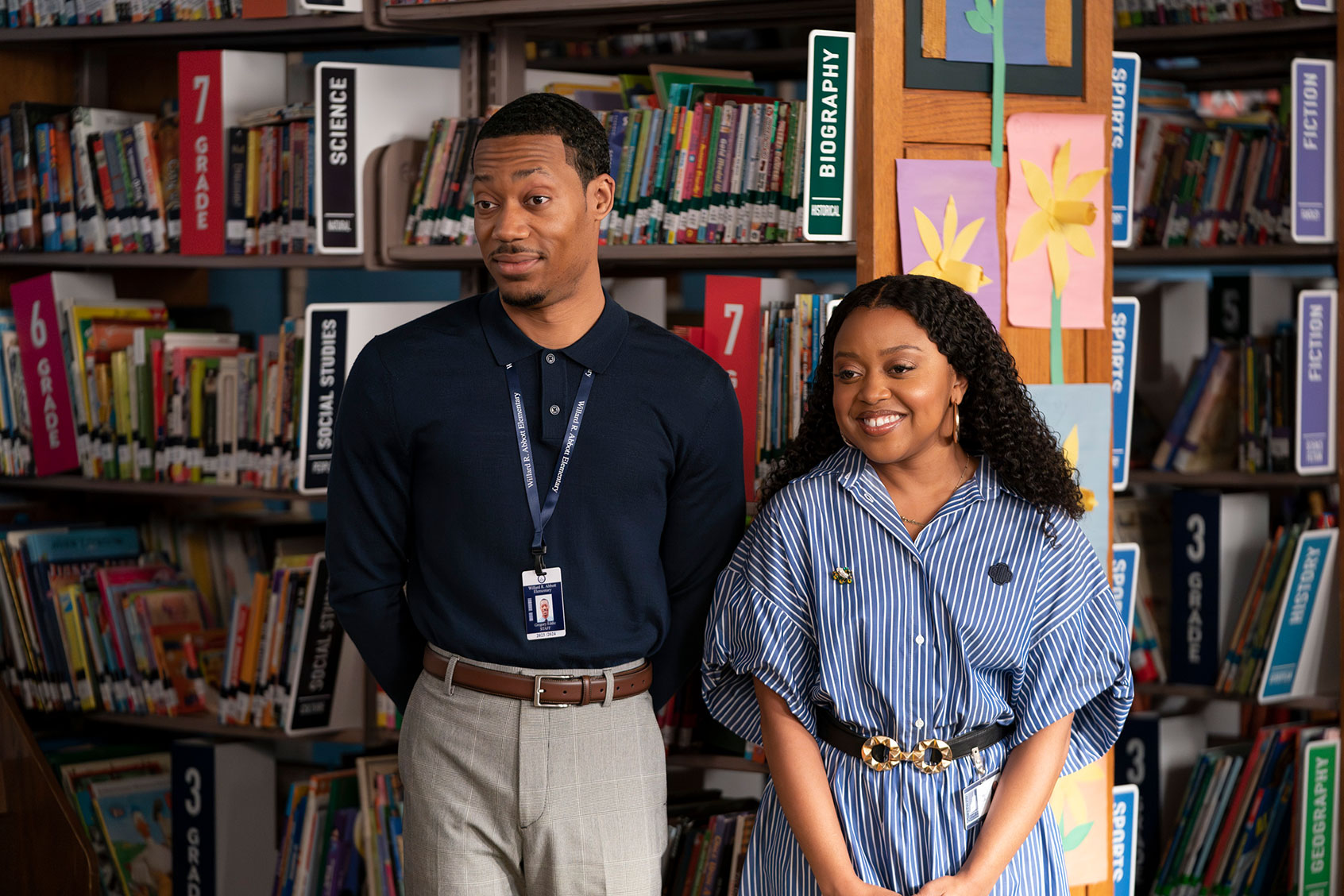

Want a daily wrap-up of all the news and commentary Salon has to offer? Subscribe to our morning newsletter, Crash Course.


So . . . that’s probably too large of a scenario to be solved by the “Shrinking” model of forgiveness, but it’s also true that we are a massive puzzle made up of broken relationships and insular groups. Within those smaller rifts are fractures caused by personal slights and shortcomings.

Often we hear about how much in common we have with each other besides the partisan dealbreaker. Our feelings concerning someone having killed another are more forceful than simple a difference of opinion, making the introduction of Goldstein’s lonely, bleak café worker especially timely.

Forgiveness can be a one-person endeavor, but anger and sorrow aren’t faucets that turn off with a pardon. It takes re-committing to forgiveness and constantly releasing residual acrimony. We have to let go of what we wish we could say to any offenders we'll never see (or see again) or be trapped in an esprit d’escalier loop within an M.C. Escher stairway labyrinth.

That makes Louis a kind of wish fulfillment, a good person whose terrible mistake shattered his good life along with that of two strangers, who doesn't simply make amends but tries to build something good with those he wronged. “Shrinking” could have progressed just fine if the writers let the person driving the other car remain an anonymous force or an unseen villain. Giving him a face and a broken heart and Goldstein’s soulfulness asks us to reexamine our own hard lines — and wonder whether they’re protective or binding.

New episodes of "Shrinking" stream Thursdays on Apple TV+.

How short kings and queens dominated 2024 – from a short queen’s perspective

This has been year of short celebrities winning. From Sabrina Carpenter and Marcello Hernández, to Bruno Mars, Ariana Grande and Quinta Brunson, each talent dominates in their element, defying the idea that small is insignificant. And I should know; I’m an expert. 

I come from a family of shorties. Coming in at (barely) 4 feet 9 1/2 inches – all I ever grew up around in my immediate circle were other like-minded shorties. I mean we all are within a few inches of each other (well, that is except for my younger brother who is 5-foot-8. Bless him, he’s considered the tall one).

I’m here to tell you short people have had a bit of an edge in the zeitgeist this year.

But as I left my stubby-limbed bubble, the world wasn’t as kind or understanding. People of average height would make being short into a joke or problem, such as saying the classic line, “How’s the weather down there?” Boys at school would try to use my head or shoulders as an armrest. Some of my (former) friends would even tell me I'm technically a dwarf because I'm under 5 feet for mean, dramatic effect.

They all made being short sound so much worse than it was. In reality, I'm mostly neutral about my height. I crop and tailor my clothes when they are too big, and I fit in all my petite mom’s vintage ‘90s hand-me-downs. The only downside to my small stature is that I still, for the life of me, cannot reach anything on high shelves at the grocery store or my cabinets. But that’s why I have two stools and a ladder for my high-ceiling Brooklyn apartment. And why I dangerously climb shelves at the grocery store instead of asking for help.

Tall people have endless representation like professional athletes Shaquille O'Neal, Lebron James and Brittney Griner at the forefront of culture. (Except for decorated Olympian Simone Biles, who is a 4-foot-8 powerhouse. Obviously, a point for the short people column.) Athletes and models embody the sought-after taller, slender beauty standard. 

This summer, people on TikTok even spread the audio for Megan Boni's viral video that goes, “I'm looking for a man in finance. Trust fund, [6-foot-5], blue eyes,” which pokes fun at unreasonable dating standards. While y’all are looking for your skyscraper, tall kings and queens, I’m here to tell you short people have had a bit of an edge in the zeitgeist this year. 

Abbott ElementaryTyler James Williams and Quinta Brunson on "Abbott Elementary" (ABC)It’s been a fabulous year for petite princes and princesses and tiny titans. A bright example is comedian and writer Quinta Brunson. In the fourth year of her smash comedy hit “Abbott Elementary,” the megastar is only gaining more power like Thanos and she’s only a mere 4 feet 11 inches  . . . and a half. You can’t forget the half. 
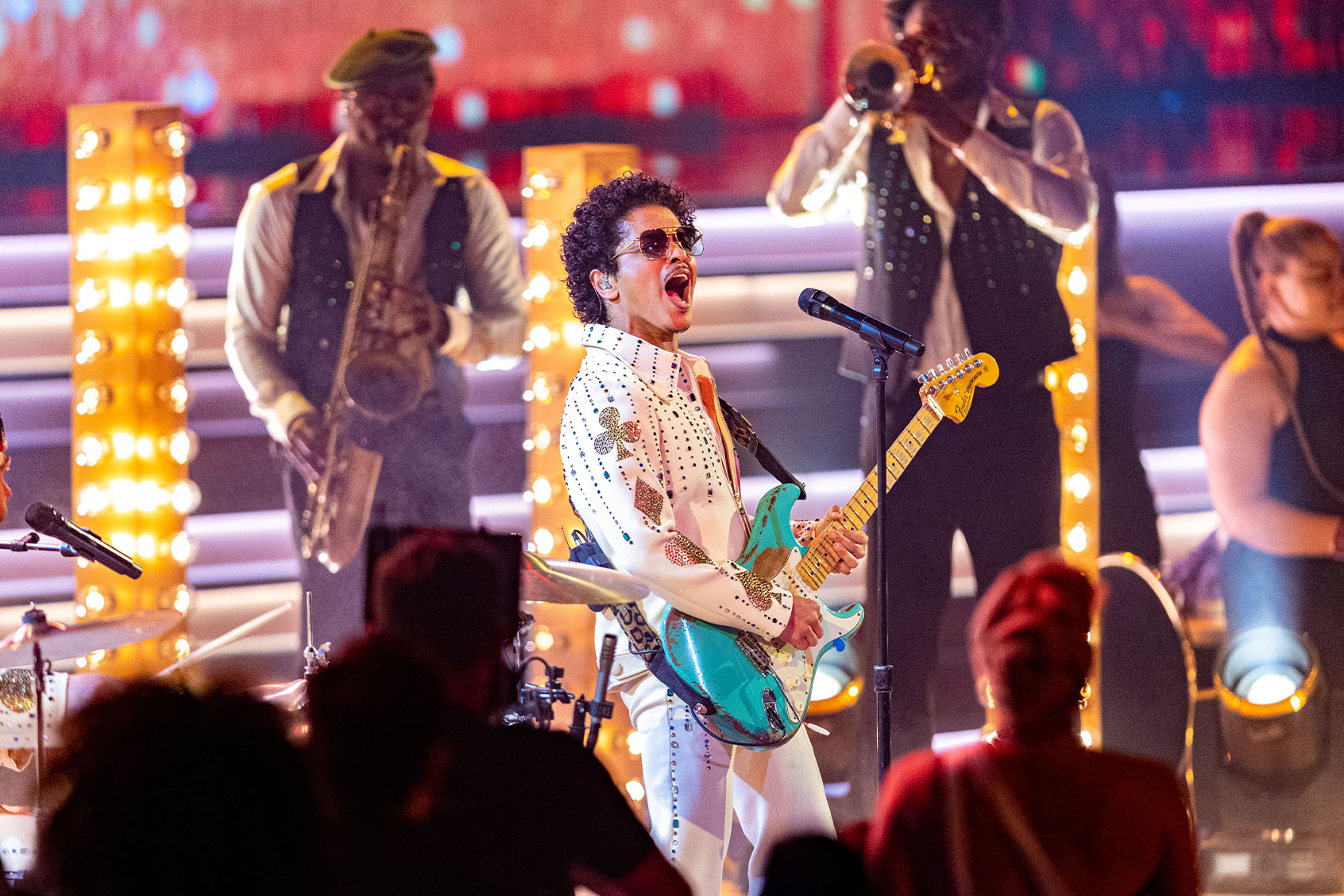
But seriously, the “Abbott” showrunner and star has just clinched a 2025 Golden Globe nomination for best comedy actress in a TV series, won an Emmy early in September for her writing, and her show is only getting bigger and better.

Mostly, Brunson just gets what it’s like to be a short, grown Black woman. She once joked in a stand-up set at the Laugh Factory, “People treat being short like there’s something wrong with you like it’s some type of disease or like you’re very Other. It’s what I imagine racism to feel like – I don’t know!” 

Brunson’s not the only compact person who has stolen our hearts this year. Short pop stars like Ariana Grande have blown audiences and critics away with her portrayal of Glinda in the movie musical adaptation of “Wicked” and even snagged a 2025 Golden Globe nomination for best supporting actress in a musical or comedy for the role. Grande is such a musical powerhouse, she sometimes tricks us into forgetting she’s just a mere 5-foot-1. Maybe because she’s always in stilettos.

Bruno MarsBruno Mars of Silk Sonic performs onstage at the 64th Annual Grammy Awards held at the MGM Grand Garden Arena on April 3rd, 2022 in Las Vegas, Nevada. (Chris Polk/Variety/Penske Media via Getty Images)One of pop music’s most electrifying male performers, Bruno Mars also had a banger of a year.  Three years ago, he deviated from his usual pop for his soaring ‘70s R&B project Silk Sonic with Anderson .Paak and then took a break from performing. But this year, the pop prince came back swinging to claim his throne with songs collaborating with pop divas Lady Gaga and Rosé from Blackpink, both of which went viral. Mars reached over 138,3 million monthly listeners on Spotify, becoming the first artist to do so. He's also  is the second artist, after Sabrina Carpenter, "to replace himself at number one and take the top two spots" at the same time on the Billboard Global 200 and Global Excluding United States with these two songs. Standing at 5-feet-5 tall, whatever Mars lacks in height, he makes up in sheer musical genius. 

Another miniature man making a name for himself is “Saturday Night Live” heartthrob and self-proclaimed short king, Marcello Hernández. The Cuban-Dominican, Miami-born comedian was just upped to series regular in the show’s 50th season – so clearly, he’s doing something right. 

Since his casting last year, Hernández has injected the sketch comedy show with a sense of self-deprecating humor and short-man empowerment – I know that sounds oxymoronic. But Hernández's appeal is rooted in his self-awareness and sardonic humor. In one of his first sketches, he says, “I know I’m short. You know how I know? Because when I lie about my height I say I’m [5-foot-9], which really means I’m [5-foot-7 1/2], and I’m lying about the half.”

Saturday Night LiveMarcello Hernández on "Saturday Night Live" (NBC)
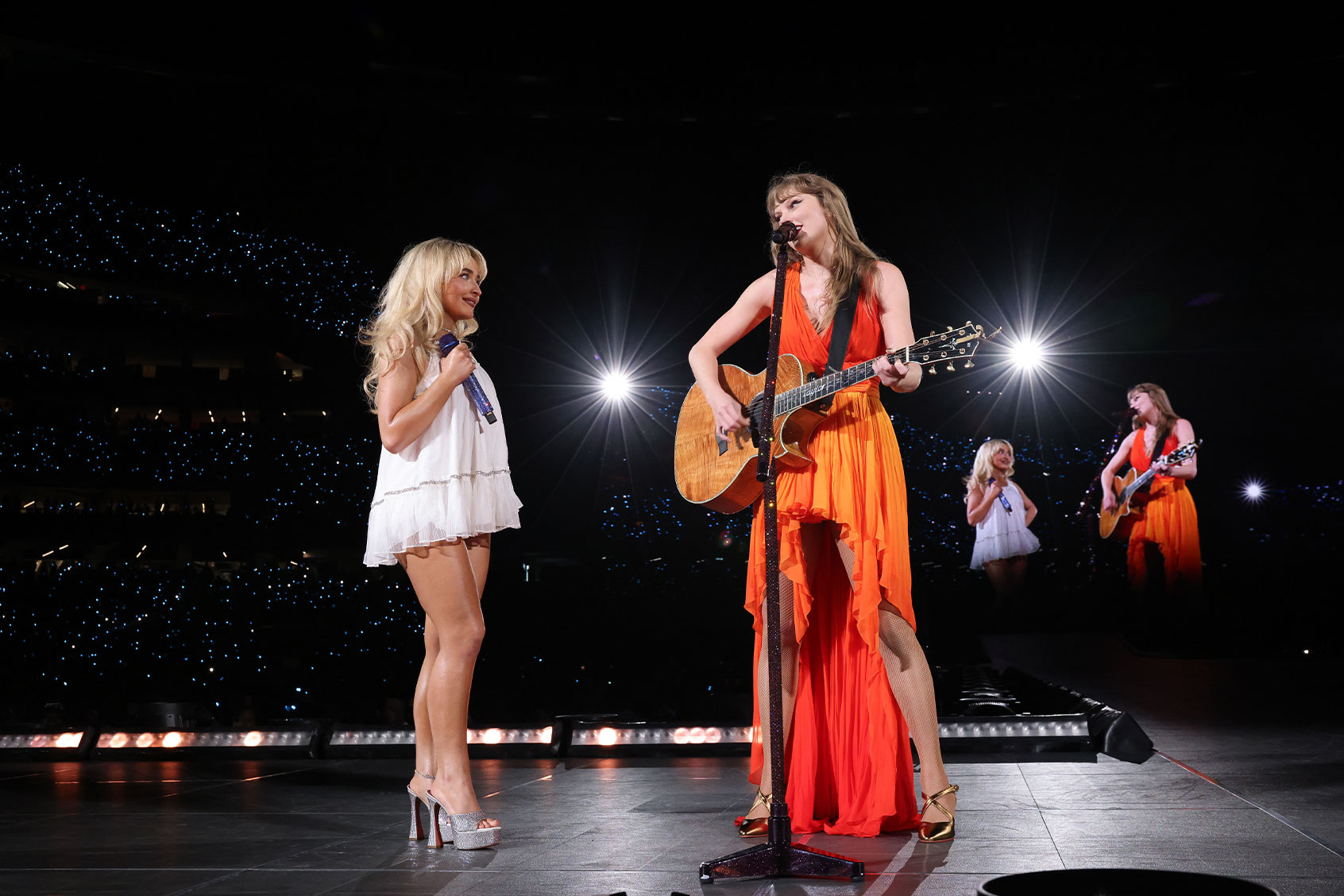
In the recent "SNL" episode with host Paul Mescal, the 5-foot-11 Irish man jokedsabout his viral photos wearing skin-baring athletic shorts. Hernández interrupts Mescal’s monologue dressed in a pair of snug short shorts while slapping his bare thighs. “I’m trying to be like you man. You like what you see?” he asks.

“Absolutely not. By the way, those are way too short,” said Mescal.

Hernández quips, “Well you know what they say, Paul. The shorter the shorts, the taller you look." 

Carpenter is an unstoppable force. And I think it has everything to do with her height.

Hernández has even linked up with this year’s most searched artist and resident short girl, Sabrina Carpenter. The pair, who met at Variety’s Power of Young Hollywood Awards, planned a skit during her Inglewood “Short N’ Sweet” tour date. Hernandez showed up dressed in his soul patch and blue suit in character as his viral character Domingo, whom he made famous in “SNL” skits “Bridesmaid Speech” and “Babymoon.” 

Sabrina Carpenter; Taylor SwiftTaylor Swift (R) and Sabrina Carpenter perform onstage during night two of The Eras Tour at Caesars Superdome on October 26, 2024 in New Orleans, Louisiana. (TAS2024/Getty Images for TAS)

During her concerts, Carpenter usually pretends to arrest her fans for being “too hot” in a gimmick to engage her audience. This time, Domingo got his shot with Carpenter as she put him under arrest. So he sang to her and the audience confidently, “Came all this way. Had to explain. Direct from Domingo. Sabrina’s a friend. She’s like my sis but I would hook up though!”

We need your help to stay independent

In the same vein as Domingo’s sweet pickup line, Carpenter has a bunch of those on her raunchy, funny new album “Short N’ Sweet.” Out of all the short people listed here, the 5-foot queen has had an inescapable impact on pop culture and music this year. From her brief and cute 36-minute album, garnering multiple Grammy nominations to her viral short girl-centered fashion and a Netflix Christmas special (in which Brunson also makes an appearance) – Carpenter is an unstoppable force. And I think it has everything to do with her height.

In the opening line of her album “Short N’ Sweet,” Carpenter sets the tone, singing, “Oh, I leave quite an impression, 5-feet to be exact.” Without trying too hard, the 25-year-old is right. Whether it’s the discourse about her sexuality or her slow-burn rise to mega fame, she has been at the center of people’s attention. That’s the thing about being short; you may not see us directly in your line of sight but we’re here. And if I’m making bold statements, Carpenter might just be the most important short person since like the late Queen Elizabeth (joking – mostly).

Needless to say, men like Bruno Mars to Marcello Hernández and women like Quinta Brunson, Ariana Grande and Sabrina Carpenter have shown me that being short can be something to laugh about but it can also be a way to be present and stand in my body and make my shortness take up all space in the world – even if my limbs can't reach everything. 

OpenAI whistleblower found dead in San Francisco

A former OpenAI employee who spoke out against what he called illegal copyright violations by the ChatGPT maker was found dead last month in what officials ruled an apparent suicide.

26-year-old Suchir Balaji quit the AI firm in August, telling the New York Times in October that OpenAI illegally used copyrighted data to create its technology, including the flagship ChatGPT. He had quit the firm a few months prior.

“If you believe what I believe, you have to just leave the company,” Balaji told the Times, adding that training on stolen data was “not a sustainable model for the internet ecosystem.”

Balaji posted findings on his personal website in October suggesting that OpenAI’s defense of how it trains its models was inaccurate. The whistleblower alleged the company hadn’t met the qualifications of the “fair use” doctrine it claimed when using a wide array of data.

Weeks later, in late November, Balaji was found dead in his apartment, per the San Jose Mercury News, with authorities finding “no evidence of foul play.” The Bay Area paper claimed that the information Balaji held was expected to be used in upcoming lawsuits against the tech giant.

OpenAI faces a host of lawsuits from multiple industries. Computer programmers and record labels have accused the company’s model of illegally training on their property. News outlets have also cried foul, with the New York Times suing OpenAI last year.

The company, valued at $157 billion during an October round of investments, claims to draw over 200 million weekly active users with ChatGPT, in addition to its Dall-E image generator and recently launched Sora video generator.

The UC Berkeley graduate was hopeful about the benefits of AI when he began working at OpenAI, telling the Times he “thought that A.I. was a thing that could be used to solve unsolvable problems.” Before his death, he told the paper that he was pursuing personal projects.

Balaji isn’t the first corporate whistleblower to pass away shortly after sharing their story this year. Two former Boeing employees died after speaking out against the embattled aviation giant in March and April.

“He wasn’t trying to be a hero”: Remembering Chef Mahmoud Almadhoun of Gaza Soup Kitchen

Last November, Hani Almadhoun mourned the deaths of his brother Majed, his sister-in-law and three of his nephews who were all killed by the Israeli army in Gaza. This November — just a few days after Thanksgiving — Almadhoun lost another brother: chef Mahmoud Almadhoun, who was targeted in a drone attack.       

Mahmoud, a father of seven and a beloved name across North Gaza, was best known for his efforts to uplift his local community. Alongside Almadhoun, Mahmoud co-founded the Gaza Soup Kitchen, which provides fresh-cooked meals to displaced individuals across the area. He also opened a medical clinic — supplying countless patients with essentials like baby formula, medicine, blankets and diapers — and launched a small school.

Despite the ongoing atrocities, Mahmoud always led with compassion and gratitude. Prior to his death, the chef was detained in northern Gaza by the Israeli military and subsequently released both times. His killing wasn’t a mere accident, Almadhoun alleges.

“Mahmoud’s killing wasn’t just an attack on my family; it was a message. He wasn’t a fighter—he was a father, a humanitarian, and a man devoted to his community,” Almadhoun wrote in a memorial for his younger brother published in The Nation. “His only ‘crime’ was slowing the ethnic cleansing of northern Gaza through tireless efforts to organize aid, deliver meals, and sustain those around him.”

He continued, “I believe his killing was not an accident; it was meant to silence the helpers—the humanitarians who stand in the way of Gaza’s complete erasure.”

Almadhoun, director of philanthropy at UNRWA USA, spoke with Salon  about the death of his late brother and the future of the Gaza Soup Kitchen.

The following interview has been lightly edited for clarity and length.

Take me back to when you and Mahmoud started the Gaza Soup Kitchen.

Around December last year, Mahmoud and I were helping our community by doing two things. One, buying ready-made meals from somebody who was still cooking rice. We would buy bags of cooked rice and give it to people in bundles. And two, sourcing food packages so we could buy canned food, wipes, lentils or pasta — whatever we could find. 

A few months later, the rice person who we used to buy rice from said he could no longer provide it because he couldn’t find rice and afford it. So, Mahmoud figured, ‘Hey, what will we do now?’ He improvised a plan to start cooking for people. Our kitchen used to be in the old market (located in the center of Bethlehem). Mahmoud bought three pots and made a stew out of veggies — mostly from cans, like peas and carrots — fresh tomatoes, seasonings and salt. He provided meals for about 120 families on the first day he cooked. I believe the first day was February 14, Valentine’s Day.     

Mahmoud and I eventually decided that the kitchen was going to be a sustained effort for the time being. Mahmoud started going into the local farms, specifically in Beit Lahia, and buying anything he could find. There were some potatoes. Because it was winter, they hadn’t spoiled. There were some zucchinis that were intended to be small but had become overgrown. There were also some carrots. Mahmoud would buy large volumes of food, store them in his warehouse and then cook stews. He did that for about a month until the new season brought more greenery and fresh crops, including melons and persimmons. That sustained the operation for a few more months.

In February, the local media was celebrating the kitchen’s initiatives because, at the time, the North was being intentionally starved. And in March, the kitchen garnered attention from the international media. [Amid our operation], Mahmoud and I lost our brother, Majid. Mahmoud himself had been detained, abducted and released. People found something poetic about our story. The operation was to stay for 10 months until Mahmoud was killed in November. 

The soup kitchen is described as “more than just an initiative, it’s a personal vow,” per its website. Tell me more about that message.

We cook for our neighbors. We are struggling, like all of them. We are not on an organization’s payroll. We just cook for our neighbors. And our vow is to not close shop when things get difficult. We continued to operate until, literally, the bombs fell outside the kitchen. We can’t disappear because this is our neighborhood. We’re not going to hide because this is where we live. If we don’t cook for others, we ourselves don’t eat.

It’s also a testament that Chef Mahmoud was assassinated. I can’t believe I said the words “chef” and “assassinated” all in one line. We continue to do the work and provide meals in different parts of Gaza, the North and the South. At the end of the day, people still need us. There are hungry children in Gaza that need support, and we will be there for them.

Is there a fond memory you shared with your brother while working in the kitchen together?

Mahmoud was always proud of the solutions he provided. He was also proud of being the person who provided meals for up to 700 families per day. Mahmoud would call me in the morning and say, “Hey Hani. Can we do X, Y and Z?” And I’d say, yes. In one instance, Mahmoud told me that he was going to grill some meat. I was like what the heck is he going to grill? Because meat is banned. It’s restricted. You can’t bring in meat from outside. Mahmoud got canned meat, which he sliced and seasoned. He cooked it in olive oil, grilled it and came up with a new dish. We call it Canned Meat Shawarma Wraps. People keep asking for it because they’re tired of eating pasta and lentils for four months. That’s one of the dishes that Mahmoud created and became known for in North Gaza.

I read your recent memorial for Mahmoud that was published Wednesday in The Nation. You mentioned that your brother didn’t just focus on food. He also opened a medical clinic and started a small school. Mahmoud’s efforts truly showcase his immense bravery, grit and fearless dedication.

Mahmoud decided to open up a medical point. He hired three nurses and one doctor. The medical point operated for a little bit more than three months before it was targeted. When the hospitals were under siege, victims were brought to the medical point for first aid. Mahmoud helped those victims. That was a very proud moment for him and a big deed that he’s done in the community.

He also opened a school. I remember he used to run away from school as a kid. About 560 kids were enrolled at the school. Some students attended for as long as a month before the school was targeted on November 3. When Mahmoud built the school, he put up a sign that read, “Please Do Not Bomb” in Hebrew alongside the U.S. flag. That was one of the ways he wanted to keep the school safe and the young children out of harm’s way.     

Mahmoud would always find ways to solve problems for the community. About two weeks before he was murdered, Mahmoud figured out a way to get clean drinking water in the North. He found a water pump that had solar panels. Mahmoud purchased some of that water and gave it away to the town. 

When he could no longer cook because his staff ran away for their lives, Mahmoud said he would deliver food, lentils, blankets, diapers and baby formula to Kamal Adwan Hospital. He’s got a soft spot in his heart for the hospital, so whenever they ask for something, he would deliver it. He's been helping the hospitals as much as he can and we, as his family, think that's why he was targeted by the Israeli Army. One day, Mahmoud was walking to the hospital to check if the produce he had delivered reached its destination. He was walking to the hospital, 30 yards outside of his house, when he was killed on the spot. There was no crossfire. It’s an assassination. We know it was.   

No matter how dire his situation was, Mahmoud made an effort to document his community efforts and share a simple yet kind message: “I send this video with love and thanks to my friends in the United States.” He was always incredibly grateful.

There’s a long history of Mahmoud, his videos and the work he’s done on the Gaza Soup Kitchen’s Instagram page. So far, the Israeli army has not provided an explanation for Mahmoud’s killing. We're not holding our breath. We know the IDF had his phone number. They have my phone number. They could have called and said, “Hey Mahmoud, we don’t want you to be here.” He would’ve gladly left. Mahmoud is a father of seven. He wasn't trying to be a hero. He was just solving problems for our neighbors. 

Now, if there is anybody who thinks Mahmoud has a secret life, it has been proven that he has been taken twice by the Israeli army, like all the men in North Gaza, and released within hours. I've seen comments by the trolls claiming he was part of Hamas. I assure you, he had nothing to do with that. Mahmoud was just a business guy. He was selling and buying food, then pivoted to cooking and opening a school and delivering water every morning in North Gaza.     

Through the soup kitchen, food was providing sustenance, but I’d say it was also utilized as a symbol of resilience and hope.

The soup kitchen became a ritual for the day for the people in North Gaza. Mahmoud started cooking every morning at nine. People came to receive food and hang out. The speakers would be blasting music. Kids danced Dabke, sang and played while waiting for the food to be ready. You know, agencies may deliver civilians a bag of flour, but they’re not going to eat spoonfuls of plain flour. There is no gas to cook with. So people rely on a community kitchen that cooks for them.      

Mahmoud was celebrated because he was doing one thing that a lot of people who were watching from afar wanted to do, and he sustained it. Some people cook for a day or a month and then they leave. We kept our operation going. This is the story of Mahmoud. He loved to cook. He used every Friday to make the family meal, which was always some form of rice and chicken. At the kitchen, he continued to do that on a much bigger scale. He really helped people stay in the land until the Israelis needlessly took him out. He shouldn't be where he is now. It’s been a difficult reality to live in.

Tell me more about the family dinners.

So, Friday is the day that people don't open their shops. Mahmoud wouldn't go to work on Friday, he would sleep in and wake up around 11 or 12. He would then season the chicken, cook it in the oven and make the rice or couscous for our family. Mahmoud liked to eat. He had a very good appetite. He would feed our parents, his kids — whoever lives in our area. That’s his passion.   

Mahmoud was making stews at the soup kitchen for the longest time until our older sister, who is a culinary wizard, started making more sophisticated menu items like Palestinian Rummaniyeh and other local dishes. She was known for making Palestinian couscous from scratch. When our sister started making more dishes, Mahmoud focused on managing the business and buying medicine for the medical point.

What legacy will Mahmoud leave behind? And what is the future of Gaza Soup Kitchen?

This morning, I woke up to pictures of Mahmoud’s kids helping their uncle distribute food parcels in memory of their father. We’re continuing to connect with my brother by doing the things that he would have enjoyed doing for the family. We hope his kids realize how important his work was and continue to help their community.  

As far as our soup kitchen operation, we're still cooking for our neighbors. We're not shrinking. We're expanding, unfortunately. It’s bittersweet because expanding the soup kitchen means more people need it, but people should have food at home. We currently have three soup kitchens in North Gaza and two in the South, where we’re also doing food parcels. In Al-Zawaida, we were cooking for approximately 400 families. Now, we’re cooking for 600 to 700 families. That number is growing because food is very expensive and people can’t afford it. They’re displaced, they’re living in tents.

We want to honor Mahmoud’s memory by serving our fellow neighbors. This is not to make a political statement. Yes, we’re Palestinian. Yes, we’re resilient, but we’re mourning his death. Just because we are continuing to cook doesn't mean we aren’t sad. Every day, a memory or video pops up and we start tearing up. We’re humans. But at the end of the day, people who are not in Gaza need to see a glimmer of hope.

TikTok ban allowed to go forward as case heads to Supreme Court

TikTok is still on the clock. 

Earlier this week, the social media app asked a federal appeals court to issue a temporary injunction on a federal law that would ban the app from the United States. That law, passed with bipartisan support and signed by President Joe Biden in April, would require TikTok parent company ByteDance to sell the app to a non-Chinese company or cease U.S. operations. 

TikTok's attorneys pleaded with the D.C. Circuit Court this week, saying the court should issue a stay of the ban so that the problem wouldn't be forced in front of the Supreme Court "over the holidays."

“Out of respect for the Supreme Court’s vital role, this Court should grant an interim injunction that enables a more deliberate and orderly process,” they wrote, per CNN.

The court wasn't moved. In an unsigned order, the judges wrote that issuing such a stay on a law they had just found to be constitutional was unprecedented. 

"The petitioners have not identified any case in which a court, after rejecting a constitutional challenge to an Act of Congress, has enjoined the Act from going into effect while review is sought in the Supreme Court," they wrote.

They also called the stay "unwarranted" and noted that such a reprieve would go against the "deliberate choice" to set the effective date 270 days from the law's passage. The deadline for a sale or ban is January 19. 

Biden has the ability to grant a one-time extension of the sale deadline, though that seems unlikely. His Department of Justice argued against the temporary stay this week. 

“Blessing and a curse”: Kratom helps many get off other drugs but carries its own risks

For Andy, kratom produces a similar effect to the opioids he was once addicted to, giving him enough energy to get through the day and reducing some of the pain he feels from working in physically demanding jobs in fast food and factories. Kratom, a plant from Southeast Asia with stimulant and opioid-like effects that is commercially available across most of the U.S., also helped him stop drinking and quit opioids. Yet Andy is now completely dependent on kratom instead.

“It’s been kind of a blessing and a curse for me,” Andy, who requested using only his first name for privacy, told Salon in a phone interview. “I was able to quit alcohol and I don’t do opiates anymore, but I do take quite a bit of kratom now and I am addicted to kratom.”

The kratom tree (Mitragyna speciosa) is a member of the coffee family, but the similarities end there. Its leaves are dried up and ground to be sold in smoke shops, online or sometimes even cafes. Chemical compounds within the plant, especially mitragynine and 7-hydroxymitragynine, bind to the opioid receptors in the body, acting as a stimulant in lower doses and behaving more closely to an opioid at higher doses. Importantly, the alkaloids in kratom are considered "atypical opioids" so a one-to-one comparison to something like morphine isn't entirely accurate.

At higher doses, kratom has been associated with side effects like liver injury and slowed breathing, with other drugs or medications potentially affecting a person’s susceptibility to some of these adverse outcomes. Unlike opioids though, the National Institute of Health reports that kratom fatal overdoses are “extremely rare,” and the drug has actually been used by many as a tool to cope with opioid withdrawal symptoms or quit drugs like fentanyl entirely. 

"There are people who say it is very bad, and there are people who have said it has changed my life."

As a commercially available product that is relatively affordable, many have turned to kratom when they do not have access to other treatments for conditions such as chronic pain, depression and anxiety, or substance use disorder. People with all of these conditions notoriously suffer from treatment disparities, with 94% of people with substance use disorder going untreated in 2021. Additionally, there are few available treatments for people with chronic pain, and far too few resources for the millions of Americans who experience anxiety and depression.

According to the Centers for Disease Control and Prevention (CDC), 80% of people who experienced a kratom overdose between July 2016 and 2017 had a history of substance use and 90% were untreated for pain.

Like cannabis and other medicinal plants, kratom doesn't consist of just one drug but multiple. As mentioned, some of these alkaloids work on the central nervous system’s opioid receptors, binding to them as partial agonists. However, they don’t cause the same strong effect as something like heroin would, but they do provide similar effects as morphine or other opioids in regards to pain relief, often with less adverse or toxic effects, said Dr. Oliver Grundmann, who studies the effects of herbal products on the central nervous system at the University of Florida.


Want more health and science stories in your inbox? Subscribe to Salon's weekly newsletter Lab Notes.


“Many of the alkaloids also bind to other receptors that are not opioid receptors as well, and that might explain why we see this kind of relief of depression and anxiety with the use of kratom,” Grundmann told Salon in a phone interview.

An estimated 1.7 million Americans used kratom in 2021, but it hasn’t been studied extensively, with a 2022 review concluding the research on its health effects was “still in its infancy.” The Food and Drug Administration (FDA) recommends against its use, citing its “risk of serious adverse events.”

It is also labeled a "drug and chemical of concern” by the Drug Enforcement Agency (DEA). In fact, the DEA tried to ban kratom in 2016, but received such backlash, including from a bipartisan coalition in Congress, that the agency backed off from its emergency scheduling — a move that was unprecedented in American drug policy. Still, some states like Alabama and Vermont have introduced their own bans, while other states have swung the complete opposite direction, passing laws that enshrine access in places like Kentucky, Texas and Oregon. Kratom use spans the political spectrum and some believe the associated risks are overblown by some in media and government, but its true risks are not black and white.

“There are people who say it is very bad, and there are people who have said it has changed my life,” said Dr. Abhisheak Sharma, the co-director of the Translational Drug Development Core and assistant professor at University of Florida. “As a scientist, we see the good and the bad side of it, and I believe everything depends on the dose.”

We need your help to stay independent

In kratom’s natural leaf form, the body is not efficient enough at metabolizing the drugs to easily overdose, Sharma said. However, many products like liquids or capsules that contain kratom extract are much more potent, which can lead to some of its negative effects, including overdose. Many kratom-derived products also include isolated or chemically-synthesized components of kratom, which are sometimes more potent and have not been studied in humans.

For example, mitragynine naturally comprises 3% of the kratom plant, but has been detected in concentrations of up to 60% in extracts, Grundmann said. Most of the pain-relieving effects of kratom don't come from mitragynine, however, but what it breaks down into: 7-hydroxymitragynine, which is 13 times more potent than morphine. This metabolite does occur naturally in kratom leaves but at nearly undetectable levels. However, some kratom companies have isolated the drug and are now selling it as a nearly pure substance.

These extracts and isolate products are increasing in prevalence among what is sold in the market, Grundmann said. Although the kratom plant itself is relatively safe, that may not be reflected in the same products hitting shelves in some areas.

“Based on the current market situation, I one hundred percent agree with [the FDA] because I don’t want a young kid taking a semi-synthetic alkaloid, considering it as an herbal supplement,” Sharma told Salon in a phone interview. He clarified that kratom can be useful to people struggling with substance use getting off other drugs, and that he would like to see increased regulations to ensure leaf-based, pure products are in the market.

Anecdotal experiences with kratom cover all ends of the spectrum, with some saying it saved their life and others blaming it for the deaths of loved ones. Yet some deaths involving kratom may have occurred when a person consumed one of its derivatives, were on other medications that could have influenced their tolerance, or when kratom was mixed with other drugs. Without more research, some of the effects of these possibilities are still unknown.

Still, the rate of fatal kratom overdoses pales in comparison to those lost to opioids or even alcohol. Eleven deaths between 2011 and 2017 were associated with kratom, according to a 2019 report using poison control center data. In comparison, more than 200,000 people died by death from an opioid overdose during the same time period, according to NIH data.

For Andy, buying kratom takes priority over buying food sometimes. When he doesn’t have it, he starts to experience withdrawals that he says are similar to opioid withdrawal. But for him, that is far better than the alternative.

“Without it, I would probably be doped out,” he said. “I would probably be dead by now.”