Spring Sale: Get 1 Year, Save 58%

In the shrewd “Promises,” Isabelle Huppert is a local politician dealing with truth and perception

The new political-themed drama, “Promises,” which just received its world premiere at the Venice Film Festival, deals largely with a mayor in a Paris suburb trying to manage the bureaucratic nightmare of saving an urban housing development. But this juicy drama is far from being a boring town hall meeting — and not just because it stars Isabelle Huppert. The film creates its intrigue from the various promises and political machinations that reveal each character’s true nature. As alliances are formed and broken, folks feel cheated and make sacrifices, and ethics and friendships are challenged, “Promises” offers a fascinating portrait of ambition and loyalty. 

It does take a few minutes to get acquainted with all the players in director/cowriter Thomas Kruithof’s film, but the stories and power struggles are compelling. Clémence Collombet (Huppert) is a mayor in her second and possibly last term. Her chief of staff is Yazid (Reda Kateb), an immigrant who, like Clémence, knows how to talk with the people. They are very concerned about the problems at Les Bernardins, a housing development where mostly immigrants live in decaying and unsafe conditions. (There is a bad leak in the building as the film opens, and dodgy wiring in an overcrowded unit among other issues.)

Clémence wants to save Les Bernardins, but she needs the government’s financial support in the form of a 63 million Euro rescue plan to achieve this. Jérôme Narvaux (Laurent Poitrenaux), a high commissioner who has the PM’s ear, has a damning letter about her incompetence, which Clémence asks him to suppress while she attempts to resolve the situation. She concocts a plan with Yazid to sue the building’s legal administrator, Chaumette (Vincent Garanger). It is a risky political move — and one that literally requires the buy-in of the building’s tenants who must put up their suspended monthly fees to execute. Moreover, there is no guarantee of success. Everyone, especially Michel Kupka (Jean-Paul Bordes), the head of the tenants’ group (who wrote the damning letter), hopes Clémence can deliver on her promise.


Want a daily wrap-up of all the news and commentary Salon has to offer? Subscribe to our morning newsletter, Crash Course.


Meanwhile, Jérôme floats the possibility that the PM is interested in giving Clémence a cabinet position if she retires from being mayor as planned. However, a meeting she has with the PM’s proxy, makes Clémence realize that while she will have more power in the cabinet, it would be with less freedom. This situation influences her decision to run for reelection, even as her deputy, Naidra (Naidra Ayadi), is mounting her own campaign for the expected vacant mayoral seat. 

“Promises” shows how Clémence shuttles from crisis to crisis with steeliness and grace. Huppert’s character is defined by her integrity; she really does care about the people she represents. And while she is caught between a rock and a hard place with Les Bernardins, she also must consider her own political ambitions. Is Clémence, who cut deals and reneges on promises, going to sell her soul for power? Her character is described as “ruthless,” but Huppert’s internal performance keeps viewers guessing until the very end. When someone tries to chip away at her tough exterior, suggesting she is lonely after her son moved out, she dismisses them — perhaps for being so on the nose.

But even more interesting than Clémence is Yadiz, who does much of the work Clémence gets credit for. “Promises” might have been even better than it already is had the film been told from Yadiz’s perspective. He does not just help Clémence pick out what to wear for her meeting with Jérôme, or represent her at soirees, Yadiz is involved in tracking down the players as the Les Barnardins situation escalates and Kupka’s and the tenants’ support erodes. Yadiz also manages a situation involving a youth, Wayne (Youssouf Wague), that eventually develops into a false accusation, leading one of the film’s key insights, “The truth isn’t the problem.” It is all about perception.

“Promises” is very shrewd in how it perceives local politics. One of the more telling comments involves a conversation between Yadiz and Kupka about the tenants of Les Bernardins. Yadiz links squalid housing to flat-screens, which offer sports channels and game consoles that keep kids at home. Tenants would rather buy televisions than pay their housing fees. Kupka acknowledges the truth in this statement, which speaks to greater issues of poverty, housing, inequality, and related social ills. 

But arguably the most revealing anecdote has Yadiz recounting the case of Alice Palmer, the former Illinois politician, whose disqualification during a senate run paved the way for Barack Obama. It is an apt metaphor for some of the film’s politicking.

Kruithof maintains a cool but engrossing tone as the various dramas and subplots unfold. The film maintains interest because the characters are all vulnerable as they grapple with the various crises in their lives. When Yadiz goes rogue after an intense exchange with Clémence, the film builds to a dramatic conclusion, and there is real tension and investment in seeing who will come out unscathed. 

“Promises” teeters between optimism and cynicism, letting characters — and viewers — hang on tenterhooks in the balance. Which is why the film is so engaging.
 

Joe Rogan has COVID — and took a ‘kitchen sink’ drug cocktail including ivermectin

Popular podcaster Joe Rogan revealed on Wednesday that he’s come down with COVID-19 — and he’s taking a wide cocktail of drugs to treat it, including ivermectin.

Vice News reports that Rogan revealed his diagnosis in a video in which he appeared “exhausted.”

In the video, Rogan explains how he rushed to treat himself with as many drugs as possible.

“We immediately threw the kitchen sink at it,” he said. “Monoclonal antibodies, ivermectin, Z-Pak, prednisone.”

In fact, ivermectin is not recommended as a treatment for COVID-19, as science officials say there has not been nearly enough research into its effectiveness as a treatment.


Want a daily wrap-up of all the news and commentary Salon has to offer? Subscribe to our morning newsletter, Crash Course.


All the same, Rogan said the cocktails left him feeling “like a new man,” writes Vice.

Vice’s report notes that Rogan has drawn criticism for hosting several vaccine skeptics on his podcast, including notorious anti-vaxxer Alex Berenson.

Rogan has also told fans he’ll pay for their fake vaccination cards if they are dealing with businesses that have vaccine passport systems.

“If someone has an ideological or physiological reason for not getting vaccinated,” he said, “I don’t want to force them to get vaccinated to see a f*cking stupid comedy show.”

McCarthy warns Big Tech against cooperating with Jan. 6 committee: “Republicans will not forget”

A House Select Committee is requesting that nearly three dozen telecommunications companies preserve the phone records of Donald Trump, his family, and various GOP members of Congress as part of its probe into who fueled the fatal insurrection on January 6.

The companies targeted include, among others, At&T, Google, Verizon, Facebook, and Apple. Every one of them has been asked to “preserve metadata, subscriber information, technical usage information, and content of communications for the listed individuals.” 

“The Select Committee today sent letters to 35 private-sector entities, including telecommunications, email, and social media companies, instructing them to preserve records which may be relevant to the Select Committee’s investigation,” the committee’s spokesperson said on Monday. “The Select Committee is at this point gathering facts, not alleging wrongdoing by any individual.”

The names of those individuals have not been made public, but the requested information will range from home addresses, IP addresses, and credit or banking information to online purchases, emails, and text messages. Sources familiar with the matter affirmed to CNN that the names in question include several members of Congress who played some part in the “Stop the Steal” rally. 

Among the lawmakers set to be scrutinized include Reps. Lauren Boebert, R-Colo., Marjorie Taylor Greene, R-Ga., Madison Cawthorn, R-N.C., Jim Jordan, R-Ohio, Andy Biggs, R-Ariz., Paul Gosar, R-Ariz., Mo Brooks, R-Ala., and Matt Gaetz, R-Fla. All of them have in some way pushed Donald Trump’s baseless claims of election fraud, which Democratic lawmakers have repeatedly argued were the basis for the Capitol riot. 

It remains unclear what legal maneuver or mechanism will be used to compel the companies to hand over their records. CNN noted that the Democratic-led committee has subpoena power. 

In addition to legislators, the panel is also asking the telecommunications giants to retain the records of people already charged by the Justice Department for their effort to “to challenge, delay, or interfere” the Electoral College’s certification of President Biden’s win.

The request is the panel’s third major move in recent days. Last week, the House select committee requested documents and data from eight federal agencies, including the National Archives, the Records Administration, the Justice Department, and the FBI. The committee also made a preliminary request last week to various social media companies. 

The committee’s latest maneuver has been widely mocked by a number of Republicans, particularly those targeted in the offensive. 

Rep. Brooks called those leading the effort “socialists” and “‘Pelosi Republicans.'” 

He tweeted on Monday: “1 Total waste of taxpayer money. 2 Boredom for who looks at my records. 3 Russian Collusion Hoax 2.0. Why not subpoena Socialists who support BLM & ANTIFA?”

House Minority Leader Kevin McCarthy, R-Ca., lobbed threats at any company who complies with the panel’s request, warning that “a Republican majority will not forget.”

Rep. Greene took McCarthy’s rhetoric a step further, saying that the companies will be “shut down” if they bend to the panel’s will.

“These cell phone companies, these telecommunications companies, they better not play with these Democrats,” Greene said during a Fox News interview this week. “Because Republicans are coming back into the majority in 2022 and we will take this very serious… if they go along with this, they will be shut down. And that’s a promise.”

The committee consists of nine legislators, including seven Democrats and two Republicans – a result stemming from McCarthy’s decision back in July to pull all of the Republican picks from the panel. McCarthy has instead said the GOP will “run [its[ own investigation.”

U.S. Rep. still unaccounted for — but “safe” — after failed attempt at rogue Afghanistan evacuation

A U.S. Congressman is still unaccounted for after he attempted to mount an unauthorized evacuation mission into Taliban-controlled Afghanistan — though his office released a statement assuring reporters that he is currently “safe,” according to a report.

Rep. Markwayne Mullin, R-Okla., reportedly “bullied” and “threatened” officials at the U.S. Embassy in Tajikistan for their refusal to help him transport large amounts of cash into the country in order to fund the rogue mission, according to The Washington Post. It was his second attempt to enter the country over the last few weeks.

He apparently was planning to rescue five American citizens — one woman and four children — by hiring a helicopter in Tajikistan. But limits on how much cash he could transport into the country prevented him from getting the mission off the ground.

“To say this is extremely dangerous is a massive understatement,” one State Department official told The Post. 

It’s unclear where he currently is, or whether he is still attempting to enter Afghanistan. 

His office did release a statement after publication of The Post’s story, saying Mullin “has been and is currently completely safe” and that he “will continue to do anything in our power to bring home all Americans from the war zone that President Biden abandoned.”

On Wednesday morning Mullin also posted a cryptic message to Instagram assuring his constituents that he was “heading home,” and explaining his radio silence by saying “it wasn’t safe to be communicating.”

“Have we been helping get Americans out of Afghanistan, yes,” he wrote. “Is the mission continuing, yes. Am I missing, no. Did I go dark for a little, yes because it wasn’t safe to be communicating. Am I extremely disappointed in how we (United States) left Americans behind . . . that would be an understatement.”

“#Ordinarypeopledoingextraordinarythings,” he added.

Mullin’s failed attempt to enter Afghanistan follows multiple attempts from both Congressional leadership and the Biden Administration to dissuade members of Congress from mounting trips into the country. 


Want a daily wrap-up of all the news and commentary Salon has to offer? Subscribe to our morning newsletter, Crash Course.


Just last week, two Representatives: Seth Moulton, a Massachusetts Democrat, and Peter Meijer, a Michigan Republican, made another unauthorized trip to Kabul which lasted less than 24 hours. The decision to travel to Afghanistan just as America was evacuating thousands of civilians and allies reportedly “infuriated” Pentagon and State Department officials. 

“It CANNOT be overstated how angry” Pentagon and State Department officials are at the two congressmen, tweeted John Hudson, one of The Washington Post reporters who broke the story.

“It’s one of the most irresponsible things I’ve heard a lawmaker do,” an unnamed diplomat told the Post. “It absolutely deserves admonishment.”

How civilizations thwart extinction in the face of existential crises

Humans set ourselves apart from other animals in our ability to recognize and stave off coming threats. A tiger or a dove cannot plan for a flood that might be decades off, and then build their dens defensively; humans, on the other hand, are blessed with the ability to predict and anticipate threats that may be far in the future. 

It is odd, then, to think that American civilization is (for the most part) keenly aware of the threat of climate change, yet so far incapable of compensating and overcome it. We build our cities to withstand hurricanes and floods, heat and cold; we build dams and windmills, and re-routed the Colorado River to keep Phoenix and Tucson hydrated at a cost of $4 billion. Now, we are keenly aware of the existential threat of climate change — of its potential to disrupt our lives in unimaginable ways, or even bring about the end of human civilization. So why is it that our civilization can’t wrap our minds around it?

Part of it may be that reality is hard to imagine. For one thing, no one alive today has lived through the collapse of an entire civilization; the actual day-to-day experience of witnessing that process is alien to us.

Still, it is difficult to conceive of why any society, particularly ours, would allow itself to be brought to extinction. We already know climate change is feeding the wildfires that consume the Pacific Coast and causing rising sea levels which will soon flood cities like New York. Large sections of the planet will become too hot or dry to inhabit (goodbye, Phoenix), extreme weather events like hurricanes will be much more common and supply chains for everything from food to microchips will break down.

Yet despite this knowledge, we still seem poised to “walk the plank with our eyes wide open,” to quote Gotye’s hit 2010 song on the topic. Even after the United Nations climate panel release yet another report warning of an environmental apocalypse unless we eliminate greenhouse gas emissions, humanity is not doing the one thing it must: Dropping all other priorities until the existential threat is neutralized.

The strange thing is that, if you look to history, there are other situations in which societies faced, and recognized existential threats. Some rose to those occasion and overcame them; others saw the writing on the wall but were incapable of changing their ways. The sagas of previous civilizations that recognized these threats — and either bowed to them or planned around them — are key to understanding the plight of our empire as it struggles to address the climate crisis.

* * *

We can start with a lesson in when things went wrong — namely, Ireland, when a famine that was completely foreseeable occurred despite there being ample warnings.

The Great Famine of 1845 to 1852 occurred due to a brutal combination of economic and ecological injustices perpetrated by Ireland’s English conquerors. On the economic side, English and Anglo-Irish landlords and middlemen (people tasked to collect rent) controlled the island’s land and wealth, leaving the Catholic common folk in abject poverty. Their ability to control land was so limited that they had to rely on potatoes for food, since those could be grown cheaply, abundantly and in lower quality land. More than 175 government panels of various kinds warned that the economic system in Ireland was unsustainable, as millions were already suffering through starvation and ill-health and the slightest breeze of bad luck could knock down the whole house of cards.

That figurative breeze finally came in 1845 in the form of Phytophthora infestans, a fungus-like organism that demolished potato crops throughout Ireland. Ruining up to one-half of the potato crop in 1845 and three-quarters over the following seven years, the Great Famine ultimately led to at least 1 million deaths and the emigration of at least another 1 million souls (many of them to America). England implemented some half-measures in a semi-sincere attempt to alleviate the misery — they repealed laws that made staple foods like bread and corn prohibitively expensive, for example — but refused to check the avarice of the elites. The Irish working class was still forced to produce foods like beans, peas, honey and rabbits that were exported to other countries (in some cases, like with butter and livestock, exports may have increased). Economic elites still were allowed to exploit the Irish working class in a number of ways. The mere concept of widespread wealth redistribution, which alone could create economic justice and responsible land management, was never seriously considered.

Ireland therefore stands mainly as an object lesson in the danger of letting special interests dictate policy, particularly when experts can foresee adverse consequences. The powers controlling Ireland had every reason to know that disaster was afoot but, because they did not value Irish lives, failed to avert a humanitarian catastrophe. Business logic prevailed over plain old logic.

It doesn’t help that, unlike the Irish of the mid-19th century, Earthlings in the early-21st don’t have the option of emigrating.

* * *

The Netherlands presents us with a more hopeful example of a civilization facing an existential threat and dealing with it. As far back as the days of the Roman Empire, the area now known as the Netherlands was notorious for its intense flooding because of its low elevation. Observers and inhabitants alike knew that if the region was to be populated, the flooding would have to be controlled.

Thus, by the later half of the first millennium AD, the inhabitants of the Netherlands had already begun to construct rudimentary dikes. Dike construction picked up in earnest around the start of the second millennium, and by the 13th century most of the dikes had been linked to each other so an ongoing sea defense system could exist. Dutch officials even created local water boards around this time in order to maintain the dikes.

Crucially, Dutch politicians continued to work together over the years to maintain their dikes, with most major political institutions in the country recognizing that their very survival depends on them. In 1953, when the sea level on the Dutch coast rose so high that flooding destroyed millions of dollars in property and caused 1,835 deaths in the Netherlands (as well as 307 in England), the government quickly created a so-called “Delta Commission.” The panel came back with a suggestion that the country create an elaborate infrastructure of dikes, dams, storm barriers and sluices so that future catastrophic flooding will not occur. As a result, no one in the Netherlands has been killed by a flood since the 1953 disaster.

There are several valuable lessons to be found in the Dutch example. First, there is a willingness by all sides to overlook their differences when it comes to matters that literally mean life or death for their civilization. Second, there is a pragmatic approach to problem-solving that is gradual when necessary and drastic when necessary, emphasizing state-of-the-art knowledge over any particular philosophical approach. Lastly, of course, is the fact that governing authorities listened to scientific experts (or, if we’re talking about the medieval era, their equivalents). This not only saved lives, but protected Dutch civilization and allowed it to become a modern empire — which, ironically, is now implicated in the global capitalist order that is hastening carbon emissions.

There is also a contested example of a civilization collapsing which, though contested, has many lessons for our modern predicament: that of Easter Island. In his 2005 book “Collapse: How Societies Choose to Fail or Succeed” (which built on the work of other scholars tracing back to the 1970s), biologist Jared Diamond posited that the Rapa Nui people on Easter Island (which is also known as Rapa Nui) saw their civilization collapse because their population grew too large and they overused the island’s limited resources. In particular, Diamond notes that they over-harvested the wood that was used to construct moai, or large statues of forefathers that owners used to flaunt their wealth and status. The loss of trees supposedly led to soil erosion, however, making it difficult to grow food in a society that (without wood) people could not leave. The end result, Diamond argues, was cannibalism, warfare and a major population decline.

If true, Diamond’s hypothesis would have obvious implications for global warming: a society engaged in deforestation which led to a concomitant collapse in the surrounding ecosystem, causing a food shortage. This happened in a closed system, an island, that was difficult to emigrate from.

Yet not everyone agrees with Diamond’s theory. Speaking to Salon by email, scholars Robert DiNapoli, Terry L. Hunt, Carl P. Lipo and Timothy Rieth argue that the archaeological record does not support Diamond’s hypothesis. Rather, they believe that the evidence suggests a “population that arrived on the island ca. 1200 AD, grew to a size that was supported by the resources available on the island, and live in communities that drew benefits from monument construction.” They argue that these communities were sustainable for more than 500 years.

The “Rapa Nui people were able to adapt to their local environments and live successfully despite the island’s inherent constraints (size, remote location, few natural resources, etc.),” the scholars said.

In this narrative, what upset the balance on Rapa Nui was, quite simply, European colonialists. They performed slave raids which took thousands of people off the island, brought diseases with them, and devastated the island’s environment. (For 50 years, the island was managed as a sheep ranch through a foreign corporation.) All of these factors spread needless suffering and misery to the Rapa Nui and cost incalculable lives. Yet in spite of this, the Rapa Nui people survived, and today more than 5,000 live on the island, speak their ancestral language and practice their native culture. Those moai, maligned as an unnecessary waste of resources by Diamond, may have even helped, since they brought communities together.

“The very thing that people have said was the ‘downfall’ of Rapa Nui society is almost certainly a key part of their success,” the scholars told Salon.

The lesson of the Rapa Nui is not so simple. Yet their plight speaks to the importance of monuments and other cultural artifacts in civilizations — keystones that help civilizations survive in the face of external threats, whether imperialism, greed or climate change. 


Want more health and science stories in your inbox? Subscribe to Salon’s weekly newsletter The Vulgar Scientist.


Why did Ida cause so much less damage than Katrina? Because government did its job

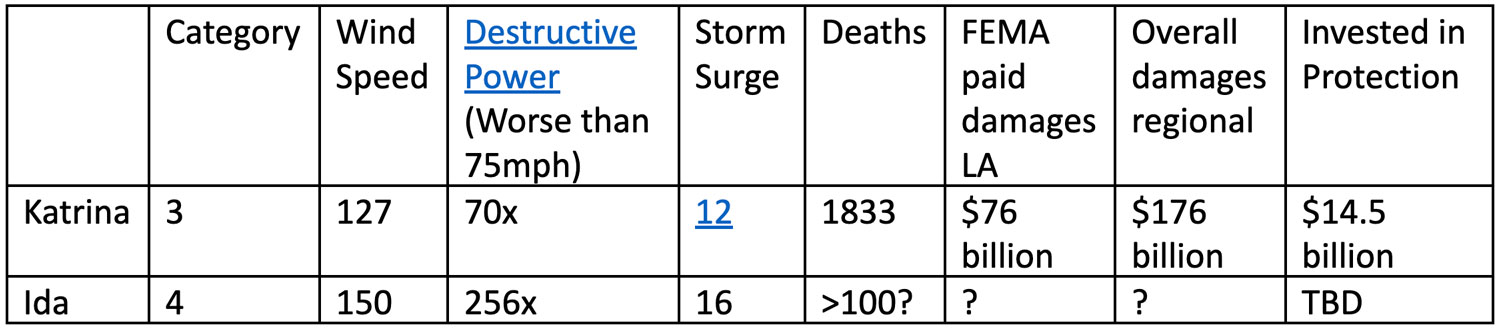
The most significant images from Hurricane Ida’s devastating landfall on the Gulf Coast are the ones we are not seeing: no refugees huddled in the Superdome, no shots of block after block of New Orleans under water, no miles of overtopped and crumbling levees. As the table below suggests, Ida, which hit New Orleans more directly than Katrina did in 2005 — and mustered greater and more concentrated destructive power — wreaked only a fraction of the loss of life and property damages. 

Why is this so significant? Because the biggest reason that, as the mayor of New Orleans said, “We didn’t have a second Katrina,” had nothing to do with Ida’s relative strength. It had to do with $14.5 billion in federal investment in disaster prevention, mostly spent raising, strengthening and hardening the levees, surge barriers and pumping systems that protect New Orleans. These investments saved the city.

The lesson here is clear enough: Prevention works.  Investment pays off. We do not need to wait for “stuff to happen” and then clean up the bodies. A focused and competent federal government, getting ready for disasters that haven’t yet happened, is an absolute key to the safety of millions and millions of Americans. FEMA alone spent $76 billion on Katrina disaster relief in Louisiana, most of that in New Orleans. So the $14.5 billion spent on prevention has already, at the most conservative estimate, been repaid several times over to the Treasury  and the taxpayers. 

But the strengthened and hardened dike ring around New Orleans almost didn’t happen. Many Republicans resisted these investment and improvements, citing the impact on the federal deficit and taxes. Then-House Speaker Dennis Hastert initially said the city should be bulldozed and abandoned. Congress at first refused to apply normal loan forgiveness policies to FEMA loans after Katrina. Eventually a well-organized Louisiana delegation was able to obtain recovery assistance — and it paid off big time. 

Ida has shown us one thing — appropriate investment in disaster prevention mean a smaller, not larger, deficit and tax burden. 

Along with investing in the future, we need to behave more prudently today. Again, government is the key to making that happen. Those parishes in Louisiana whose levee hardening had not yet been completed suffered the same kind of disastrous impact that Katrina left behind. Further to the north, we saw in Tennessee two weeks earlier how a meteorologically local event can devastate communities — particularly in counties that have refused to prepare themselves in recent years, continued to allow the construction of buildings with no safety or construction codes at all, and chose not to participate in the federal Flood Plain Insurance Program. (Neighboring Nashville, after earlier floods, adopted building codes designed to protect residents in a flood. It’s much better prepared than it used to be.) 

These lessons ought to become the center of the congressional debate on both of the Biden’s administration’s pending infrastructure bills. As I wrote recently, these bills are being misleadingly treated as one-time fixes, when the reality is that they should represent a new normal, in which the U.S., like other industrial nations, regularly invests in making the nation’s infrastructure secure in the face of increasingly likely extreme weather events. We should maintain our roads, power systems, water supplies, broadband and other infrastructure at above average levels, not at a D-minus. 

As for the argument that either budgetary concerns or a desire for lower taxes warrants clinging to our “just let stuff happen” attitude about the future should no longer get even momentary traction. It just not a serious response to the obvious challenges before us. Ida showed us that a safer future is fiscally responsible and tax-positive — and, far more important, will save enormous numbers of lives.

The “soft” overturn of Roe v. Wade exposes how far-right John Roberts has let the Supreme Court go

At the stroke of midnight on Wednesday, the Supreme Court suddenly overturned Roe v. Wade.

The move was quiet and it very well may be temporary (they could still issue a short decision any minute now, or not) but make no mistake, a Roe overturn is exactly what it is. But headlines across the country aren’t coming right out and saying so, because the Supreme Court used a dastardly legal manipulation to let states ban abortion without actually issuing a straightforward decision to end abortion protections. 

Earlier this summer, Texas passed a law banning abortion at 6 weeks. Six weeks may sound like a luxurious amount of time to make a decision, but in fact, it amounts to a near-ban on all abortion. That’s because in reality, “six weeks” is only two weeks after the missed period, and that’s only in women who have highly regular periods. Critically, it is also before many doctors will even do the procedure, for safety reasons. So it’s estimated that 85-90% of abortions in Texas are performed after the 6-week mark.

To make it worse, the law is written in such a way as to make wife beaters, Aunt Lydias, and embittered incels the primary enforcers of the ban, establishing what amounts to a public bounty hunter system. As legal analyst Imani Gandy explained at Rewire News Group, the law “allows anyone—literally anyone, including strangers!—to file a lawsuit against a person they suspect is going to either provide an abortion or help a person obtain an abortion.” This means that not only can the abusive ex-boyfriend sue the doctor who helped his victim escape his clutches, but he can now also go after the friend who put her up and paid for her abortion. 


Want more Amanda Marcotte on politics? Subscribe to her newsletter Standing Room Only.


As The 19th reports, Planned Parenthood and other clinics across the state have already mass-canceled abortion appointments.

This Texas law clearly violates Roe v. Wade, the landmark Supreme Court decision that bars states from banning pre-viability abortion, a category which very much includes pregnancies two weeks after a missed period. And yet, somehow the Fifth Circuit Court, which is notoriously authoritarian, found a way to uphold the law. The law went into effect at the stroke of midnight on September 1, as the Supreme Court passively allowed that lower court decision to stand. The move, or lack thereof, is unprofessional and cowardly, but it did allow the far-right court to have it both ways by banning abortion in Republican-controlled states without drawing “Roe overturned” headlines that would anger the large majority of Americans who want to keep Roe in place. 

Unfortunately, such a shadowy maneuver is hardly a unique move for this court. These kinds of passive, backdoor decisions are increasingly how the Supreme Court is now doing business. Despite the self-flattery from the legal world about the apolitical nature of the courts, the reality is today’s Supreme Court is both very political and very right-wing.

It is not hyperbole to say that the GOP has spent years shaping not just the Supreme Court but the entire federal judiciary to force a far-right ideology on a public that keeps rejecting it at the ballot box. The problem for Republicans, however, is that dramatic Supreme Court decisions overturning Roe or otherwise gutting hard-earned human rights would anger voters. That could drive up turnout for Democrats in elections and hurt elected Republicans. The court’s behavior suggests a clash between a yearning to push the country as far to the right as possible and a political need to avoid backlash. 

One way they’ve squared that circle is by gradually chipping away at laws like the Voting Rights Act, so they can destroy human rights quietly without drawing the attention outright annihilation would bring. But the newest innovation is abusing the so-called shadow docket.

As Igor Derysh reported for Salon, the shadow docket is “where the justices hand down largely unsigned short opinions without going through standard hearings, deliberations, and transparency.” Traditionally, it’s mostly upholding lower court orders or emergency petitions that aren’t especially controversial. But this court, controlled by Chief Justice John Roberts, has started to use the shadow docket to issue far-right rulings under the radar, avoiding the press coverage that more traditional rulings get. That’s how, for instance, the Supreme Court dispensed with the eviction ban that President Joe Biden was implementing to prevent a surge of pandemic-caused homelessness. It’s also how the Supreme Court forced the Biden White House to enforce the racist “remain in Mexico” policy regarding political asylum seekers. As Moira Donegan at The Guardian explains, this sleazy strategy for cheating the legal system was developed under Donald Trump. 

Previously, shadow docket emergency requests had been rarely used, to advance the interests of the governing administration. From 2001 through 2016, the Department of Justice applied for these emergency relief interventions from the court only eight times. During the four years of Trump’s presidency, however, the justice department applied 41 times…..

Bypassing lower courts, the Trump administration was able to solicit the supreme court for a green light for border wall funding and construction, for a ban of transgender troops in the military, for a ban of immigrants from Muslim majority countries, and for many, many executions during the administration’s 11th-hour killing spree in the latter half of 2020.

Unfortunately, this strategy has been devastatingly effective at lulling the press into not covering how far-right the Supreme Court is, and therefore tricking the public into believing the courts are more reasonable than they actually are:

This Roe non-decision advances the court’s cowardly strategy a step further. By not saying anything at all, they allow the Texas law to go in effect without drawing headlines that indicate that Supreme Court decision was made one way or another.

From a journalist’s perspective, I can say that this method, while sordid, is effective for media manipulation. Outlets cannot publish straightforward headlines that say “Roe overturned” or “Supreme Court upholds Texas abortion ban,” because it hasn’t actually happened, one way or another. It’s possible that a decision is issued later today or this week, or never. There’s no way to know and so no way to write clear, compelling headlines, much less stories that state clearly, one way or another, if Roe is overturned. It’s Schrödinger’s abortion ban. 

Except, of course, for the women who actually need abortions. For them, these legal ambiguities are irrelevant, because the situation is black-and-white: They need abortions, but are barred legally from getting them. If they can’t figure out ways to get abortions on the black market or out of state, they may end up being forced into childbirth. While headline writers are stuck trying to explain this to the public, pregnant people themselves are very much non-ambiguously in crisis. 


Want more Amanda Marcotte on politics? Subscribe to her newsletter Standing Room Only.


What makes the non-decision even more repugnant is that the Supreme Court is due to hear arguments next month in Dobbs v. Jackson Women’s Health Organization, which involves a 15-week abortion ban in Mississippi. That ban may sound less serious than the Texas ban, but it is also an invitation to the Supreme Court to overturn Roe, since it’s an attack on the pre-viability standard. Mississippi’s lawyers have even made it clear that overturning Roe is the point of the law. 

That’s why, even if the Supreme Court accedes to public outrage over this cowardly Roe overturn, and issues a too-late injunction against the Texas law, a lot of damage has been done by not swiftly enjoining a law so clearly in violation of Roe. Legal analysts Jessica Mason Pieklo at Rewire and Steven Mazie at The Economist explained on Twitter:

It’s a truism in Beltway media that Roberts is an “institutionalist” who values preserving the Supreme Court’s integrity over his far-right views. This is, as many pieces of received wisdom in D.C., utter nonsense. To be clear, Roberts values his reputation as an institutionalist. That’s why he has increasingly embraced strategies based on subterfuge and obfuscation, so he can preserve that reputation while actually doing what he was appointed by George W. Bush to do, which is impose a far-right ideology on a public that rejects it. Roberts is the one who is shepherding this abuse of the shadow docket. Roberts is the one who is letting Texas ban abortion, in direct violation of Roe, by simply washing his hands of the issue. He’s a radical wolf in institutionalist sheep clothing. The only hope is that this abortion ban is finally what attracts enough national attention to these abuses, and blows up an authoritarian strategy that only works in the shadows. 

100% whole-wheat pie crust is a bad idea. Or is it?

Big Little Recipe has the smallest-possible ingredient list and big everything else: flavor, creativity, wow factor. That means five ingredients or fewer — not including water, salt, black pepper, and certain fats (like oil and butter), since we’re guessing you have those covered. Psst, did you hear we’re coming out with a cookbook? We’re coming out with a cookbook!


Let’s get this out of the way: 100%whole-wheat pie dough is a bad idea. You don’t need to tell me, because I’m telling you. It is dense and tough and unagreeable. That’s why smart recipe developers take a different path.

Stella Parks, a pie genius, uses 50% whole-wheat flour in her recipe on Serious Eats. The whole-wheat offers “flavor and tenderness,” which the all-purpose flour backs up with “strength.” And Erin McDowell — another genius! Food52’s resident baker! She wrote The Book on Pie! — uses even less whole-wheat flour (44%). And whole-wheat pastry flour at that, which has a lower protein content and yields a softer dough.

As Erin explains in her book, “While it is possible to make a dough 100% regular whole wheat flour, the dough requires significantly more hydration, and I find the resulting crust dense. Using a combination of whole wheat pastry flour and all-purpose flour is the perfect solution.”

A few years back, I whole-wheat-ified a bunch of baked goods and, while whole-wheat cookies were “even better,” the whole-wheat pie crust was worse. Not worth it, I said. Do 75% max, I said. But I was wrong.

Turns out, I wasn’t asking enough questions. Like, what is whole-wheat flour, anyway? And what the heck is pie dough? With a fresh perspective, 100% whole-wheat pie dough not only becomes possible — but also a very good idea.

As its name suggests, whole-wheat flour includes the whole wheat kernel (endosperm, bran, germ, and all). This means more protein, more fiber, more flavor — and more bulk to weigh down breads and pastries as they attempt to rise in the oven.

But just as there’s more than one kind of wheat — actually, there are thousands — there’s more than one kind of wheat flour. Depending on where you live and your supermarket, you’ll probably find a couple types: For me, in the Northeast, the default is labeled as “whole-wheat flour,” milled from hard red wheat. There’s also white whole-wheat flour, milled from hard white wheat.

So no, white whole-wheat flour is not a mix of white and wheat flours. But funnily enough, it acts just like that in baked goods. Think of this ingredient as the compromise between the nourishing nuttiness of traditional whole-wheat and the creamy fluffiness of all-purpose. Aka, the best of both worlds.

This isn’t to say you should swap white whole-wheat flour into recipes willy-nilly. When I started working on this column, I tried just that in an all-butter pie dough recipe, and I still ran into the same hurdle identified by other bakers (good flavor, bad texture).

The popular solution is to reduce the percentage of whole-wheat to 50 or fewer, as Stella, Erin, and many other bakers have proven works well. The other option is to leave the flour as it is, and rethink the other main ingredient in pie dough: fat. Besides butter, pie dough recipes can use shortening or lard.

Or, less commonly, cream cheese. This ingredient is crucial in Jewish rugelach — a traditional, flaky-crumbly cookie my grandma taught me how to make around the age when I still worried about monsters under the bed. The ratio you’ll see over and over is easy enough for a kid to memorize: one part flour to one part cream cheese to one part butter. Buzz them all in a food processor, roll out a circle, cover it in jam and nuts, cut out triangles, curl them into little crescents, let your grandma pinch your butt.

When I worked as a baker at Scratch, Phoebe Lawless‘s pie shop in North Carolina, one of the most popular pies ditched a flaky butter crust in favor of a tender rugelach one. Likewise, one of Rose Levy Beranbaum’s go-to pie doughs hinges on cream cheese. As Sarah Jampel wrote about it, “the fat and milk solids in the cream cheese inhibit gluten formation (and provide a flavor that makes the crust tasty enough to eat bare).”

Because rugelach doesn’t need any water — the cream cheese has more than enough moisture — it avoids the catch-22 of whole-wheat, where you have to add more water to fully hydrate the flour, but then the excess water yields a dense crust.

All you’re left with is a super flavorful, super tender, super forgiving pie dough that just happens to be made with 100% whole-wheat. The only question is: What recipe will you put it toward first?

Recipe: 100% Whole-Wheat Pie Crust

Prep time: 35 minutes
Makes: 1 single 9-inch pie crust

Ingredients:

  • 113 grams (1 cup) white whole-wheat flour, preferably frozen
  • 1/2 teaspoon kosher salt
  • 113 grams (4 ounces) cream cheese, broken into pieces
  • 113 grams (4 ounces/1 stick) unsalted butter, cubed

Directions:

  1. Add the flour and salt to a food processor and pulse just to combine. Add the cream cheese and pulse until totally incorporated, with no big pieces visible. Add the butter and continue to pulse until the butter is totally incorporated and the mixture is curdy, almost like cottage cheese, easily holding together when squeezed. Form into a disk and tightly wrap in plastic. Refrigerate for at least 30 minutes and up to 2 days before using. 
  2. On a lightly floured surface, roll out the dough to a circle about 12 inches in diameter. At this point, you can take any path you’d like. 
  3. For a free-form galette (my favorite!), transfer the dough to a parchment-lined sheet pan, add your filling to the center, leaving a 1-inch or so border, and then fold over that border to form a crust. 
  4. For a par-baked crust, place into a 9-inch pie pan and crimp however you like. Prick the bottom and sides with a fork, line with parchment, and fill with pie weights (I use dried beans). Bake at 400°F for 15 to 20 minutes, until the crimped crust is starting to brown. Remove from the oven, remove the parchment and pie weights, and bake for another 5 to 8 minutes to dry out the bottom. (If the crust puffs up at all or starts to shrink, you can prick it with a fork to depuff, or push up the shrunken sides with the side of a measuring cup.) 
  5. For a blind-baked crust, place into a 9-inch pie pan and crimp however you like. Prick with a fork, line with parchment, and fill with pie weights (I use dried beans). Bake at 400°F for 15 to 20 minutes, until the crimped crust is starting to brown. Remove from the oven, remove the parchment and pie weights, and bake for another 12 to 15 minutes to fully bake until deeply golden brown. (If the crust puffs up at all or starts to shrink, you can prick it with a fork to depuff, or push up the shrunken sides with the side of a measuring cup.)

The best butter substitutes for baking (that actually work)

Let’s start with the bad news. There is absolutely nothing on this earth that can truly replace butter. Not the most expensive extra-virgin olive oil, not the most convincingly golden popcorn topping, not even the most optimistically branded substitute spread. If it’s not butter then yes, I can believe it’s not butter. But if you’ve just flipped open the butter door in your refrigerator to find yourself staring into the void, don’t despair. With some clever substitution techniques, you’ll be baking, sautéing, or slathering toast without a stick in sight. From vegan butter substitutes like coconut oilavocado oil, and mashed bananas to dairy products like ghee that work seamlessly as a butter alternative, these ingredients can easily replace butter in savory dishes and baked goods (and some even have some bonus health benefits to boot).

What makes butter . . . butter?

Butter, like most good things in life, is an emulsion. To make butter, all you need to do is agitate some cream enough, and the tiny droplets of butterfat will come together, separating from the watery buttermilk. The result is mostly butterfat, but not all. Butter is typically 15 to 30% water, with milk proteins working as an emulsifier (more on these later).

Because butterfat is hydrogenated — i.e., the carbonic acid chains of butterfat molecules are covered in hydrogen atoms, which keep the molecules from curling, and help them bond to other butterfat molecules — butter is solid at room temperature. This is important for making flaky pie dough, fluffy buttercream, or for buttering toast, so when substituting butter in certain recipes, it’s important to use other hydrogenated fats to fill the role.

We’ll also have to consider the way butter behaves when it’s melted. It has a very low smoke point (about 200 to 250 degrees Fahrenheit), but before it starts smoking, it browns. The delicious nutty flavor of browned butter comes from the milk proteins and sugars in the butter undergoing Maillard reactions (aka, browning). This is one of the things that’s just about impossible to replicate with other fats, though we can create Maillard reactions in other ways. Of course, you can use brown butter as is — drizzle it over sweet potato ravioli, mix it into shortbread cookies, or even fry eggs in it for breakfast. Sure, this isn’t a substitute for butter, but it’s a delicious alternative to regular butter.

To tackle the impossible challenge of replacing butter, we need to divide and conquer. Some alternatives work perfectly in flaky tarts while failing spectacularly in delicate creams (take lard or shortening, for example). Others are perfectly suitable for sautéing, but turn pastry dough into a soggy mess (say, olive oil). To cover butter’s majestic range, each alternative oil or fat must play its part. Ahead, we’ll get into the best butter substitutes based on certain types of recipes. Whether you’re out of butter or lactose intolerant and looking for a dairy-free alternative, there are a dozen different products that work in place of butter.

Is butter really bad for you?

OK, we hate to go there. Maybe it’s not great for your heart but it’s great for the soul, so that counts for something, right? Yes and no. According to the American Heart Association, butter naturally contains saturated fat…and a lot of it. One tablespoon of butter contains, on average, approximately 7 grams of saturated fat. For context, the AHA recommends that individuals who need to lower their cholesterol should reduce their consumption of calories and fat to 11 to 13 grams of saturated fat per day (or two tablespoons of butter). Doing so may reduce your risk of heart disease and improve your overall cardiovascular health.

Of course you could be avoiding butter for another reason, like a vegan diet or an intolerance to dairy, or even just a dietary change. So even if you’re not out of butter entirely but are looking for a healthier alternative to the creamy spread, here are our favorite substitutions.

What is ghee?

Maybe you’ve run out of butter, but, searching frantically through your pantry, you stumble across a jar of ghee. Huh, you say. This is basically butter, right? Well, you’re not entirely wrong. Ghee, a staple of Indian, Pakinstani, and Bangladeshi cuisine, is made by heating butter until it clarifies (meaning that the water and milk proteins separate from the fat), and then heating it some more until the milk proteins brown, imparting their heavenly, nutty aroma.

Ghee has, and it pains me to say this, some clear advantages over butter. Its smoke point is over 200 degrees higher (around 485 degrees Fahrenheit), so it burns less easily. Plus, it’s basically shelf-stable, and its flavor is richer and, well, more buttery than butter. For frying and sautéing, ghee has the advantage. For sponge cakes and other baked goods that call for clarified butter, feel free to sub in ghee, anticipating a nuttier flavor. Or throw caution to the wind and make it into homemade puff pastry.

Vegan substitutes for butter

There are many vegan butters available on the market (and we’ve rounded up our ten favorites here). You can use vegan butters in most recipes that call for dairy butter in a 1:1 swap, whether baking or cooking. They have a spreadable texture and nutty, buttery flavor, though they can’t be browned like dairy butter can. Generally, vegan butter are made with a base of nut and vegetable oils, such as macadamia, coconut, sunflower, or avocado oil. However, some vegan butters are nut-based and use ingredients like fermented cashews or coconut cream to create a creamy consistency and rich flavor.

Baking without butter

I would argue that, as a rule, baked goods are mostly just a vehicle for butter, except for when they are a vehicle for chocolate. But that’s not to say that baking without butter is a hopeless endeavor. In fact, some of my favorite sweets are exceptions to this rule.

Coconut oil

Like butter, coconut oil is a hydrogenated fat with an assertive flavor. Use it to make a tempting pie dough, or in this decadent, dairy-free carrot cake. Just remember that it’s flavor will shine through wherever it goes, and it tastes nothing like butter.

Non-coconut oils

Samin Nosrat is obsessed with oil cakes, and you should be too. Because they are made with un-hydrogenated fats that are liquid at room temperature, they have a moister, tenderer texture than butter cakes. Try David Leibowitz’s genre-defining ginger cake with peanut or vegetable oil, or crack out the EVOO for this delicate pound cake with sherry.

Lard

Divisive in its highly un-kosher, un-vegan, unapologetically porky nature, lard makes, in my humble opinion, the most deliciously flaky Hong Kong egg custard tarts. But it has a couple other considerations, aside from flavor and provenance. It tends to produce more crumbly, less puffy pastry than butter, partly because, unlike butter, it doesn’t contain much water to steam and push apart the layers during baking.

Another thing to keep in mind: At room temperature, butter is solid; but it melts at 90 to 95 degrees Fahrenheit, dissolving on your tongue. Lard, however, melts at a much higher temperature, and leaves a residue in the mouth some find unpleasant.

* * *

Sautéing, frying and roasting

Just the idea of hot, foaming butter sizzling in a skillet makes my mouth water. But the fact is, more often than not I reach for the olive oil when sautéing vegetables and proteins. There are two main considerations here.

The first, of course, is flavor. If you’re cooking French, don’t swap sesame oil in for your beurre blanc. In fact, don’t make beurre blanc, or anything else defined by the particular flavor of butter. Instead, consider the cuisine and core ingredients of the meal you’re preparing, and choose cooking fats accordingly.

The second thing to consider is heat. Some fats, like butter, have relatively low smoke points, making them unsuitable to high-temperature frying. Others, like ghee or vegetable oil, can get ripping hot without a wisp of smoke.

Sunflower Oil

It’s not the flashiest, but sunflower oil can put a sear on steak faster than butter can, and it can do it without the risk of burning.

Olive Oil

A good olive oil is spicy, fresh, and voluptuous. It can add layers of flavor to a braise, or brighten sautéed greens. I use extra-virgin for everything, though some would be horrified to hear it.

Duck Fat

Duck fat is delicious. Roast potatoes in it, of course, but also use it to confit everything from duck legs to arctic char. Or go really wild and bake it into savory cookies.

Schmaltz

Growing up in a vegetarian Jewish household, I never ate schmaltz (rendered chicken fat), but I did hear about it. It was spoken of in hushed tones, an unspeakably delicious relic of our history. Even if you’re not vegetarian, it may be difficult to find schmaltz for sale. It’s not fashionable anymore. But it is still delicious.

And if you’ve taken the trouble to skim some from the stockpot or out from under your roast chicken, do not throw it out. Instead, mix it into your matzo balls, or sizzle some chicken livers and make your bubbe proud.

* * *

Un-buttering bread

One of the greatest pleasures of butter is slathering it over bread. People think buttered toast is nice, but only because they haven’t had the courage to spread a serious slab of cold butter on bread, and slide their teeth through it.

Before you argue, Via Carota, arguably the best restaurant in Manhattan, has nipped this dispute in the bud by topping (room temp) crostini with massive quenelles of butter, draped with anchovies. It’s pretty close to perfect. But here I am getting distracted. Without butter, we have a few options to elevate our bread consumption.

Olive oil

The best thing to do to bread other than to slather it in butter is to dip it in really, really good extra virgin olive oil. In fact, if you have a truly incredible olive oil, be sure to do this, and promptly — olive oil deteriorates as it ages.

Avocado

Putting avocado on toast has become something of a millennial pastime, and for good reason. If you can get your hands on a good avocado, it offers much the same pleasure as well-buttered bread. The unctuous fattiness, the silky texture, the perfect, yielding bite. In fact, the experience of good avocado on toast has so much in common with butter on bread it might just make you miss it more.

Other butters, nut and not

Peanut, almond, cashew, maple — nut butters may have butter in the name, but they have little to do with the real article. What they do all have in common is that they’re delicious on bread. And sometimes, it’s better to make a strong pivot than to go with any kind of imitation.

Republicans are right to worry about Afghanistan and terrorism — but they’re wrong about who incites

It has been obvious for some days that the right-wing is preparing a major pivot from hand wringing about Joe Biden’s alleged betrayal of Afghan refugees to hand wringing about all the Afghan refugees he brought into the country to kill us all in our beds. I wrote about the early shifts in perspective last week and it’s starting to come into full focus now that the military evacuation is over. Right-wing fear-mongering about immigrants and refugees is as predictable as Republican voter suppression.

Fox News celebrity Tucker Carlson has made the evacuation of refugees part of his Grand Unified Theory, The Great Replacement, whereby Joe Biden and the Democrats conspired to bring these foreigners to America in order to supplant good, pure white people and dominate the American culture and politics. Carlson is influential in right-wing circles but while his argument feeds into their sense of grievance, it may be a bit esoteric for many of the folks in his audience. Former president Trump’s top immigration adviser Stephen Miller makes it more explicit and folds in some of the old “welfare queen” arguments, complaining that the refugees will get benefits and it would be cheaper to settle them in Pakistan, which he thinks proves this is all about an “ideological objective to change America.”

House Minority Leader Kevin McCarthy, R-Calif., edged toward what is going to be the ultimate argument when he said this on Monday:

Knowing that they said they took more than a 120,000 lifts with only 5600 being American, I I think we should look through and screen before people come to America. We’ve got to make sure what’s in there.

When asked if he thought it was OK for these Afghan refugees to settle in the U.S., McCarthy replied “after we get the screening it’s a whole different question” which isn’t exactly responsive. But then he’s made his position clear before. According to the New York Times, he told a bipartisan group of House members last week, “we’ll have terrorists coming across the border.”

He knows his base. After all, back in 2016, Donald Trump had promised to repatriate all the Syrian refugees who had been fully vetted and already settled in the U.S. simply because you just can’t trust ’em. He wanted to send Congresswomen Ilhan Omar, Rashida Tlaib and Ayanna Pressley “back to where they came from” even though they are all American citizens, the latter two having been born here. (Not that that matters, he wanted to end birthright citizenship as well.)

As I noted last week, Trump himself has wavered between needling President Biden by pretending to care about the Afghans left behind and accusing the administration of allowing terrorists into the country. But on Monday, he told Fox News’ Stuart Varney, “We should have hit that country years ago, hit them really hard, and then let it rot” so it’s hard to believe any protests of concern for the Afghan people. It’s just not in him. I think we can expect him to jump on the “terrorist” bandwagon 100% from now on.

All signs point to the GOP believing that it can turn the “Biden screwed up Afghanistan” into “Biden brought the threat of terrorism back to the U.S.” And the whole thing fits neatly into their overarching worldview that they, and the U.S., have been humiliated at the hands of “the other” whether it’s a foreigner or devious Democrats stealing the election right in front of everyone. This is the same worldview that brought us the deranged mass shooters with their Great Replacement-style manifestos and screeds about Jews and caravans — and the violent events of January 6th.

All the screeching about phantom Afghan terrorists will end up inflaming the real would-be terrorists who live among us — and they are plenty inflamed already.


Want a daily wrap-up of all the news and commentary Salon has to offer? Subscribe to our morning newsletter, Crash Course.


All over the country, we are seeing anti-vaccine and anti-mask protesters explode into full-blown hysteria over the idea that kids might be required to get vaccinated and wear masks when they come to school. Dress codes and vaccines are already commonly required in public and private schools and have been for many decades. Now they are an infringement on the fundamental freedom of their parents to be irresponsible fools with their own families and the families of others. And they are getting more and more violent in their rhetoric:

https://twitter.com/RonFilipkowski/status/1432166542683279362

It isn’t entirely unprecedented for GOP candidates to promote violence in recent years and be richly rewarded for it. One of them became president of the United States. You may also recall that a congressional candidate by the name of Greg Gianforte was even arrested for assaulting a reporter a couple of years back. He is now the Governor of Montana. But the myriad threats against local officials such as public health officers and school board members in the last year is an escalation of political violence on a new and much more intimate level than we’ve seen. Across the nation, aggrieved right-wingers are intimidating officials with the words “we know where you live, we will find you” and targeting at their homes.

And while most Republican officeholders are more or less standing back and allowing this to happen out of cynical self-interest, some are saying the quiet parts out loud themselves.

Congressman Madison Cawthorn, R-N.C., told a group of constituents the other day that  “if our election systems continue to be rigged and continue to be stolen” there is going to be bloodshed and he really doesn’t look forward to taking up arms against other Americans.

History Professor Ruth Ben-Ghiat defined what is happening in stark terms on “All in with Chris Hayes” on Monday: “Authoritarianism is when thugs and criminals become the lawmakers.” Hussein Ibish, Senior Resident Scholar at the Arab Gulf States Institute in Washington, made a startling observation about this turn of events in The Atlantic:

Decades of living in, studying, and writing about the Middle East have taught me that whenever a political faction becomes obsessed with violent rhetoric and fantasies, brutal acts aren’t far behind.  And while there’s always been a strain of militancy on the American right and left fringes, there is something unmistakably new, and profoundly alarming, about the casual, florid, and sadistic rhetoric that is metastasizing from the Republican fringe into the party’s mainstream.

The truth is that the violent rhetoric and fantasies have been there for quite a while, it’s just that they were channeled into wars on foreign soil like the tragic 20-year quagmire that ended this week. And soon they will no doubt be directed at the new immigrants from Afghanistan as “floridly as ever. The American right-wing has always found somebody to hate. But if Trumpism is defined by one unique characteristic it’s that it feels free to direct its violent rhetoric against fellow Americans in ways we have not seen since the Civil War

Democrats say abortion is on the line in recall election. But rolling back rights wouldn’t be easy

SACRAMENTO, Calif. — As the election to recall California Gov. Gavin Newsom approaches, abortion-rights groups are warning that Californians’ right to an abortion is on the ballot.

Newsom, a Democrat, himself tweeted that “abortion access” is at stake.

“There’s no question that if a Republican is elected, access to abortion in California will be restricted,” Jodi Hicks, president of Planned Parenthood Affiliates of California, said at a press conference in July.

But this message is strategic and is more about firing up left-leaning voters than it is about policy, said Rob Stutzman, a Republican political strategist.

“There’s no indication from polling in this election that [abortion] is at all what Californians think this election is about,” Stutzman said. “This fits into the type of campaign that they’re running, which isn’t persuasion; it’s motivation to turn out.”

In reality, California has some of the strongest abortion protections in the country and restricting them would be difficult for a replacement governor to accomplish with only a little over a year remaining in the term, opposition from an overwhelmingly Democratic legislature — and the right to abortion enshrined in the state constitution.

Although governors can veto legislation, set budget priorities and make regulations through state agencies, only small-scale change would be possible and would almost exclusively affect women on Medi-Cal, the state’s Medicaid insurance program for low-income people.

“I don’t think abortion is going to be severely restricted in California,” said Laurie Sobel, associate director of women’s health policy for KFF. “It’s more subtle than just slashing laws that are on the books — it’s not being supportive” of progressive new laws.

Restrictions adopted by other states — such as laws that require ultrasounds before abortions or regulations that make it hard to open abortion clinics — likely wouldn’t fly in California without a friendly legislature, Sobel said.

Yet reproductive rights groups have painted Californians’ right to access abortion as threatened by the Sept. 14 recall election. Newsom appeared with Planned Parenthood leaders Wednesday night to say California’s role as an abortion-rights standard-bearer is more important than ever because other states are increasingly restricting access and the U.S. Supreme Court will decide this year whether to uphold the seminal Roe v. Wade decision, which legalized abortion nationally.

None of the four leading Republican recall candidates responded to calls and emails about their positions on abortion.

Larry Elder, a conservative radio host who is the leading replacement candidate in most polls, has been the most outspoken on the issue. He has called abortionmurder” and Roe v. Wade “one of the worst decisions that the Supreme Court ever handed down.” Businessman John Cox has called himself “pro-life” in previous campaigns, but said he prefers not to talk about social issues, and state Assembly member Kevin Kiley (R-Rocklin) has received endorsements and positive ratings from anti-abortion groups. Former San Diego mayor Kevin Faulconer has said he supports abortion rights.

Every registered voter will receive a ballot in the mail, though voters will also have in-person voting options. If Newsom is recalled in the Sept. 14 election, his replacement would take office in late October, and would serve the remaining portion of Newsom’s term, until January 2023. A replacement could run for a regular four-year term in the November 2022 election.

State law establishes a woman’s right to an abortion, generally until a fetus could survive on its own. And the state constitution includes a right to privacy that the Supreme Court of California has ruled protects abortion, even if the U.S. Supreme Court overturns Roe v. Wade. The state Supreme Court has also struck down laws that limit abortion or require parental consent. State law requires every state-regulated health plan, public or private, to cover the procedure.

Still, abortion-rights advocates argue that having a right doesn’t always mean being able to access treatment, and that an anti-abortion governor could find ways to make the procedure less accessible. Experts say there are three primary ways a replacement governor could restrict access:

  • Vetoing bills or budget items (the governor has line-item veto power over the state budget) would be one of the most direct ways. State Sen. Lena Gonzalez (D-Long Beach) introduced a bill this year to eliminate cost sharing for abortion for Medi-Cal patients, which awaits a committee hearing before heading to the Assembly for a final vote. She said she still would have introduced the measure under an anti-abortion administration, but that it would have been an “uphill battle” on every front.

Democrats, who have a supermajority in both houses of the legislature, could override a governor’s veto with a two-thirds majority in both chambers. The last time that happened was in 1980.

Susan Arnall, director of outreach and engagement at the Right to Life League, said an anti-abortion governor could help bring balance to the Capitol by vetoing “anti-life” legislation, even if lawmakers end up overriding the veto. “That at least delays things. It slows the process down, and that’s helpful,” she said.

  • Governors have broad power to change how Medi-Cal, which covers roughly half the abortions in the state, funds abortion. For instance, an anti-abortion governor could work through the Department of Health Care Services to set Medi-Cal reimbursement rates for abortion so low that no doctors could afford to perform the procedure. Or the governor could make the process of getting paid by Medi-Cal so difficult that providers wouldn’t bother. These and other bureaucratic hurdles could add up, making it harder for someone to get an abortion as quickly as they need one, said Fabiola Carrión, the National Health Law Program’s interim director of reproductive and sexual health. “This is particularly a concern with people who live in central California and rural areas” where patients must drive long distances to find a provider. “Abortion is already a time-sensitive service.”
  • At the end of the year, the Food and Drug Administration is expected to rule on whether mifepristone, a prescription drug used in medication abortions, can continue to be dispensed via telemedicine without seeing a provider in person — a service the agency approved provisionally this year. If the FDA allows the telemedicine option to continue, it will require the state to update its Medi-Cal provider manual. A new governor could install a director at the Department of Health Care Services who wouldn’t update the manual, and Medi-Cal enrollees who want medication abortion might have to see their provider in person first.

“California already has abortion deserts within our own state,” Hicks said. Even a barrier that seems small “still matters for someone trying to get services.”

Democratic consultant Rose Kapolczynski said the threat an anti-abortion governor could pose to abortion access is real, regardless of how long that person held office. Newsom’s replacement would immediately have to start running for reelection, she said, which provides the incentive to do big things in the first year.

“The Newsom team knows they need to do everything they can to motivate Democrats to mail in their ballots, and they’re talking to those voters about the issues they care most about,” Kapolczynski said. “It’s completely legitimate to talk about what happens if the recall succeeds.”

This story was produced by KHN, which publishes California Healthline, an editorially independent service of the California Health Care Foundation.

Recognizing monarch butterflies under the Endangered Species Act may do more harm than good

Monarch butterflies are one of the most charismatic insects in the world. They’re the most eye-catching wings in the sky, with dramatic orange-and-black coloration and a heroic migration hundreds of thousands of miles across North America. 

Insect populations are declining worldwide, and monarchsare no exception. Efforts to reverse the trends are underway across the United States and Canada. These include creating pollinator gardens for nectar sources, planting milkweed — a critical host for monarch caterpillars to acquire food and defense sources — and preserving habitats that provide shelter and nectar to foraging butterflies. Backyard gardeners, once averse to milkweed due to its weedy ability to take over gardens, are planting more milkweed than ever before. 

Even with these efforts, many national insect conservation groups advocated in 2014 for the United States to list the monarch butterfly as “threatened” under the 1973 Endangered Species Act (ESA). While the monarch wasn’t added to the ESA at the time, as of 2020 the U.S. Fish and Wildlife Service announced that adding them to the ESA was warranted. But a recent op-ed from scientists at the US Geological Survey and the University of Hawai’i says that listing the monarch as endangered would be a mistake. The authors urge the US Fish and Wildlife Service to let states take their own approaches to the conservation of monarch butterflies before moving to the much more strict ESA measures.

Listing the monarch as an endangered species, the authors argue, would trigger regulatory protections that could actually harm monarch populations and current conservation efforts. Currently, there are numerous groups working to save monarch butterfly populations across North America. These include strategies by state fish and wildlife agencies to provide funding for monitoring programs, habitat conservation, and education of private landowners. A total of 27 states have included the monarch butterfly as a “Species of Greatest Conservation Need” in State Wildlife Action Plans, which allow states to use federal grant funding for personalized conservation planning. Without knowing the needs of butterflies at the state and regional level, the ESA could actually harm current efforts. 

The ESA requires the designation of “critical habitat” for species listed under the federal bill, but this isn’t easy for every species. Monarchs rely on milkweed and flowers on a large geographical footprint for food and the undersides of milkweed leaves to lay their offspring. It’s not enough to save the monarchs by simply planting in a single area. Butterflies travel long distances across roadsides, farms, and backyards over hundreds of miles. But designating such a non-specific habitat as “critical” under the ESA could actually miss those small gardens or roadside runoff ditches of flowers that monarchs depend on for sustenance. By requiring monarch habitat in certain areas, the authors argue that larval host plants may be removed and landowners could be less interested in voluntarily planting pollinator-friendly plants on private land. Cultivating areas exclusively for milkweed may even harm other pollinators, reducing native plant availability and disrupting ecological communities.

North American monarchs can be divided into multiple groups of migratory populations, and researchers have even proposed monarchs be split into ‘subspecies’ across North and South America. Each population may have different needs for successful conservation, meaning that a broad approach like that written into the ESA would not help.

It’s not clear if captive rearing will help either. In a recent paper published by The Proceedings of the Royal Society B., researchers found commercially derived monarchs reared outdoors failed to successfully orient south — unlike their wild counterparts. Commercially raised monarchs also changed their direction of flight more often during flight simulator experiments, and only a subset of the testing groups correctly found the southern direction over multiple tests. (On the other hand, a more recent paper from May found captive-reared monarch butterflies oriented south 26 percent of the time in flight simulators, but 97 percent of the time in the outdoors.)

In another study, researchers found that monarchs reared in captivity had tested strength 56% less than wild butterflies. Forewing length, a trait associated with successful migration, of these indoor-raised butterflies was smaller and less elongated, and their orange coloration was paler. Darker red and orange hues in monarch wings have been linked to the ability to fly longer distances, suggestingpigment deposited on wings may be linked to thorax size, energy storage, and metabolism. 

Finally, a study from PNAS in 2019 found that captive-reared butterflies are unable to successfully migrate. Butterflies reared from eggs acquired from commercial production and wild populations were raised outdoors in enclosures over multiple generations to determine how breeding impacts hereditary traits. While wild-caught butterflies emerging in October flew south, commercial butterflies had no directionality. The commercial monarchs had smaller, rounder forewings. Indoor monarch females also had lower egg counts compared to wild females. While the environmental cues to induce migration are not well understood by the entomological community, monarchs raised indoors or reared for multiple generations in enclosures may not pick up these necessary cues, losing the ability to migrate at all.

As a kid, I used to raise monarch butterflies with my parents in our backyard. We’d collect eggs from a field near our house, and pick milkweed leaves to feed the growing caterpillars over the following weeks. Once the caterpillars had formed a chrysalis and successfully emerged, we’d bring them outdoors and release them. If you do raise a monarch this summer, make sure to tag and monitor its flight using the Monarch Watch tagging program, or a local community science project.

Later in the summer, especially during the late fall season when the offspring are responsible for making the trip south to Mexico, it may not be advised to raise butterflies in your home. Instead, plant some milkweed seeds in your yard for next season, and encourage local businesses and neighbors to plant pollinator gardens of their own. Add your data to the Integrated Monarch Monitoring Program. That way you’re giving every monarch a great place to rest, drink some nectar, and continue on their way.

Mike Lindell’s meltdown begins: He recently sold a MyPillow plane to fund Dominion lawsuit

Pillow mogul turned election conspiracy theorist Mike Lindell is facing multiple difficulties in his two-pronged quest to prove that the 2020 election was stolen by China — and to fend off a colossal lawsuit by Dominion Voting Systems, which claims that Lindell and many others defamed the company and did enormous damage to its business and reputation. 

With Dominion’s $1.3 billion lawsuit hanging over his head, records indicate that Lindell is making major personal concessions in preparation for a significant legal battle. 

According to Federal Aviation Administration (FAA) records reviewed by Salon, Lindell (through his company MyPillow) has recently sold off at least one of his private planes. FAA records indicate that an aircraft registered to MyPillow — a 1993 Dassault-Breguet Falcon 50 with tail number N497SP — was transferred to Clyde Air LLC on July 26, for an undisclosed purchase amount. (A similarly-configured 1993 Falcon 50 private jet currently on the market has a $2.5 million price tag.)

Using an apartment address associated with the new owner, Salon traced the purchase to a potential big-money buyer: capital executive Frank Selldorff. He didn’t return a Salon request for comment on Tuesday afternoon. 

Leading up to Lindell’s August “cyber symposium” in Sioux Falls, South Dakota, which was intended to prove his extravagant claims about the 2020 election (but clearly did not do so) the plane registered to MyPillow was used in a number of Lindell’s schemes, including his alleged efforts to transport and conceal Dominion and Smartmatic voting machines at various locations across the country. (No such machines materialized at his Sioux Falls event, despite many promises that they would.)

The 10-seat luxury aircraft, which has three fixed engines, was supposedly used to carry the alleged machines in a bizarre game of hide-and-seek Lindell conducted in May.

At the time, Lindell claimed he was hiding the machines in undisclosed locations, but since then has dodged questions from Salon and other publications on the matter. 

Josh Merritt, a former member of Lindell’s “red team” at his August South Dakota event, told Salon the plane was sold to bankroll Lindell’s legal defense in the Dominion suit.

The pillow king unloaded the aircraft “because he’s needing money,” Merritt said. “He just started raising money for the lawsuit by Dominion.” 

Merritt also said that while he was working with Lindell’s team earlier this summer, the Falcon 50 plane was apparently out of commission. An employee of Lindell’s “told me they quit using it,” he said. 

Lindell has also often used a different private plane, a 2005 Bombardier Challenger 300 with tail number N487JA. According to FAA records, that aircraft is owned by TVPX Aircraft Solutions Inc., which didn’t return Salon’s request for comment on Tuesday. It’s not clear whether Lindell charters the jet or owns it through a third-party firm. Both arrangements are relatively common in private aviation.

https://www.instagram.com/p/COsk-F_Nhpt/?utm_medium=copy_link

Asked whether he had sold an airplane to raise money, Lindell called one Salon reporter “flying pond scum” and “slime.” 

During his Monday night appearance on “Frank Speech,” his internet program, Lindell said that one of his planes had broken down over the past week, which he saw as a “divine” message. 

“I was so happy when I came out of Missouri [last week], and, actually, my plane broke, and I know that was God’s way of saying, ‘You aren’t missing this meeting,'” he said. “It was just a divine appointment.”

According to Khaya Himmelman, a reporter for the Dispatch who attended Lindell’s ill-fated South Dakota event, the pillow king “has nowhere left to go, and the game is finally over.”

Even Lindell’s most loyal followers “could never say for certain that he had the ‘evidence,'” Himmelman continued, “but now it’s abundantly clear that he doesn’t, and he never did. I think as we get further and further away from this election, any association with Lindell will be seen as highly embarrassing, so more and more of his already dwindling following will quietly distance themselves.”

There are still unanswered questions, Himmelman added, about Lindell’s rise and fall as a MAGA-world star: “We also might end up seeing who’s really behind Lindell,” she said.

Most of Lindell’s supposed evidence of election fraud, as Himmelman noted, was likely provided by self-appointed “investigative journalist” and right-wing operative Mary Fanning, whose sole source was a discredited former government contractor named Dennis Montgomery, “who has a long history of making outlandish claims that fail to come true,” as the Daily Beast wrote last November. Fanning and Montgomery are viewed with immense suspicion even among Trump supporters and Republicans, which may explain why Lindell has been completely ignored in recent months by Fox News and other conservative outlets.

This is how easy it is to get ivermectin, the dewormer drug that conspiracists say cures COVID-19

It started with an email, sent to a doctor source whom I frequently interview for pandemic stories. I was thinking about what one might call the ivermectin epidemic, in which hundreds of thousands of Americans are taking the off-label horse de-wormer drug as a sort of COVID preventative — despite scant evidence for its efficacy and a host of miserable side effects.

“How easy is it to get a prescription for ivermectin?” I asked.

His response: “Google ‘ivermectin’ and your city.”

So I tried it, typing “ivermectin, San Francisco” into Google. An ad for a telehealth platform called Push Health popped up. Sure enough, the company had a dedicated page on its site about obtaining ivermectin. While the company did not explicitly say it could be used to treat COVID-19, the breeziness of obtaining a prescription advertised by the platform made me think that their page likely had something to do with the rapid increase in interest for the drug in the United States

On August 13, 2021, prescriptions for ivermectin peaked, with more than 88,000 written just in that week, according to the Centers for Disease Control and Prevention (CDC). That’s a 24-fold increase compared to pre-pandemic times, when prescriptions averaged 3,600 per week. 

The rise in ivermectin isn’t because there’s been a rise in internal parasitic infections. As I’ve reported before, ivermectin, which is an off-label anti-parasite drug used for the treatment of certain parasitic worms in people and animals, has become the new hydroxychloroquine — in the sense that it is an ineffectual treatment for COVID-19 that has gained currency among those who are skeptical of science. Just as hydroxychloroquine was hyped by right-wing politicians (including President Trump) as a possible treatment for COVID-19, conservative talking heads and anti-vaxxers are now promoting ivermectin to their audiences despite limited scientific evidence showing that it is a viable treatment for COVID-19. Some experts who study misinformation have argued the ivermectin-pushing agenda is a means of promoting the narrative that science is innately untrustworthy because an alternative treatment has been unfairly maligned by science and government. 

Since ivermectin is already Food and Drug Administration (FDA)-approved, it can be prescribed by any U.S.-based physician, usually to people with intestinal strongyloidiasis and onchocerciasis — two conditions caused by parasitic worms. Generally, the prescription is given in very small doses. Without a prescription, the only other way to obtain ivermectin would be at a feed store or farm supply store, which sell the drug as a horse dewormer. Consuming the latter form of ivermectin is, for obvious reasons, very dangerous. Yet people are still doing it. In Mississippi, 70 percent of recent calls to the state’s poison control center were related to “ingestion of livestock or animal formulations of Ivermectin purchased at livestock supply centers,” the state department of health said in a news release last week. 

The FDA, Centers for Disease Control and Prevention (CDC), and multiple state health departments have issued warnings against taking both the feed-store kind, and the human formulation, to treat COVID-19. Despite the human prescription being used variously in treating internal and external parasites, ivermectin can mix with different types of drugs negatively. Likewise, higher dosages — which have been promoted unscientifically as a way to treat COVID-19 — can have profoundly negative side effects, ranging from diarrhea to nausea to severe skin rashes. High doses can be toxic. Most importantly, there is no sound scientific evidence to suggest that it can help treat COVID-19. For people who don’t know that, or choose not to believe it, a prescription for over-the-counter ivermectin is easy to obtain. 

* * *

After doing a little research to make sure Push Health wasn’t a take-my-money-and-leave scam (by the way, I don’t recommend using the platform for anything), I decided to move forward and pay $65 for a consultation to follow my curiosity.

On Push’s site, I filled in information about my local pharmacy — where I’d pick up my prescription. Then I typed in basic information about myself, like birthday, contact information, and home address. The next part asked me what type of medication I wanted, and the reason I wanted it. I simply typed “ivermectin” and then “Covid.”

After submitting my patient information and paying for a future virtual consultation, I was told via email that I’d be “matched” with a provider in 24-48 hours. But only three hours later, I was matched with a doctor who allegedly went to New York Medical College; and there was no video consultation, just word that I had been issued a prescription that read as follows: 

Prescription(s)

1)ivermectin 3 MG Oral Tablet. take 4.5 tablets daily for 5 days. #: 23 Tablet, Refills: 0.

2)doxycycline hyclate 100 MG Oral Capsule. Take 1 capsule BID for 10 days. #: 20 Capsule, Refills: 0.

(Doxycycline hyclate, by the way, is an antibiotic. I didn’t ask for it and am not sure why it was prescribed.)

An hour later, I got in my car and drove to my local Walgreens. I decided to go through the drive-through, provided the pharmacist with my last name and date of birth, which showed my prescription was in the system. There, I discovered that, since my health insurer does not use Walgreens, I would have to pay out of pocket for both medications, which would total more than $200. 

Before issuing the drugs, the pharmacist asked questions about what I was going to use it for.

Echoing what thousands of other Americans believe, I said, simply: “Exposure to COVID.” 

He scrutinized me. “Both the FDA and CDC have warned against using it for this reason,” he said. He asked about the prescription’s provenance; I told him I got the prescription off of a telehealth platform. 

“It doesn’t work for COVID-19,” he continued. He advised calling my doctor for clarity. I left without my ivermectin. 

As I drove away, I wondered if I had spoken with a pharmacist who cared less — and were more willing to pay out of pocket — would I have been able to drive off with ivermectin? Probably. My attempts to get ivermectin as a prescription had failed only at the final stage, thwarted by a concerned pharmacist. 

Back home, I dug deeper into the internet, looking into the other options that an enterprising ivermectin-seeker could pursue. A quick search for “how to get ivermectin” on Reddit revealed many people seeking prescriptions were calling doctors recommended by a nonprofit organization called the Front Line COVID-19 Critical Care Alliance (FLCCC). The contact information for FLCCC-recommended doctors is listed on their website. I emailed, texted and called seven; four quickly responded and were willing to do a consultation with me — for a fee between $60 to $100 — and write a prescription for ivermectin. 

The organization known as the Front Line COVID-19 Critical Care Alliance was created during the pandemic, and has been criticized for promoting the use of ivermectin based on unsubstantiated scientific evidence. In March 2021, editors of Frontiers in Pharmacology took down an article that was written by a member of the organization because it violated the journal’s policies. 

“The authors promoted their own specific ivermectin-based treatment which is inappropriate for a review article and against our editorial policies,” said Dr. Frederick Fenter, Chief Executive Editor of Frontiers, in a statement. “In our view, this paper does not offer an objective nor balanced scientific contribution to the evaluation of ivermectin as a potential treatment for COVID-19.”  

In December, the FLCCC’s president, Pierre Kory, gave a statement at a US Senate hearing on COVID-19 treatments and called ivermectin a “miracle drug.” On Twitter, Kory has described the media’s criticism and any doubts about its efficacy as a treatment for COVID-19 as a “war” against the drug. 

* * *

Only 41% of the population of Arkansas is vaccinated against COVID-19, well below the 51% of Americans overall who are fully vaccinated. Some rural Arkansas counties have vaccination rates as low as 10% of the overall population, according to the New York Times.  

Yet like many Southern states, a great deal of Arkansans are flocking to ivermectin as an “alternative” COVID-19 treatment. Indeed, pharmacists in the state are seeing an uptick in ivermectin prescriptions, pharmacist John Vinson, who is also the CEO of the Arkansas Pharmacist Association, tells me. Sadly, Arkansas has seen over 20 overdoses due to people taking the version of ivermectin meant for animals.

“The larger of the two concerns that we have as pharmacists — if we had to pick between the two — would be the use of a product that a patient would purchase in a tractor supply store that’s intended for animal use,” Vinson said. “But it is true that with prescribed doses that are meant for human consumption, there is always the possibility of adverse effects — which is why we have recommended dosages and why there’s a physician involved in that decision-making with the patient.”

Both pharmacists and the CDC suspect that many of the prescriptions for human use are coming from telehealth platforms — or, as one pharmacist called them in Time magazine, “quack telehealth prescribers.” Many such online providers appear to be part of for-profit schemes. According to Time’s investigation, a right-wing group called America’s Frontline Doctors has been allegedly taking peoples’ money by promising to give them a telehealth consultation for ivermectin. It is unclear how many of the providers listed by the FLCCC are legit or not. 

The FLCCC did not respond to any request for comment about providing a list of doctors to get ivermectin prescriptions, which included one on the Push Health network. I revealed myself as a journalist to the Push Health doctor, and asked how it was possible that he wrote a prescription for me without even a virtual consultation. He did not respond. 


Want more health and science stories in your inbox? Subscribe to Salon’s weekly newsletter The Vulgar Scientist.


How medications are prescribed varies state by state, but some pharmacists — like the one I encountered — have become the last line of defense against dangerous pseudoscience. 

“We are advising our pharmacists to certainly ensure that there’s a patient-physician relationship, and to talk to those physicians or nurse practitioners who may be prescribing it, and to learn where’s their evidence [from],” Vinson said. “Our role is to educate our patients and provide context and information; in some cases, pharmacists may work with their patient to actually not fill that prescription.”

Vinson said it’s a “fine line” when it comes to questioning the filling of off-label prescriptions.”There are many other conditions and diseases for which off-label use of FDA approved medications have been used, and in many cases, that off-label use really helps people,” he noted. Part of the pharmacist’s job, however, is identifying what could be dangerous. 

“If we start to see danger, like we did with opioids and benzodiazepines in recent years, then we could start to see more and more pharmacists that may refuse to fill a prescription based on what they feel is a danger to the patient,” Vinson said. “Some of the treatment doses for ivermectin are higher doses than what is normal for other infections, and so then you get concerned about potential overdose or potential adverse effects that don’t show up at the lower doses.”

Joe Biden’s revenge: Drone attacks are fueling the “madness of militarism” in Afghanistan

Joe Biden provided a stirring soundbite days ago when he spoke from the White House just after suicide bombers killed 13 U.S. troops and 170 Afghans at a Kabul airport: “To those who carried out this attack, as well as anyone who wishes America harm, know this: We will not forgive. We will not forget. We will hunt you down and make you pay.” But the president’s pledge was a prelude to yet another episode of what Martin Luther King Jr. called “the madness of militarism.” 

The U.S. quickly followed up on Biden’s vow with a drone strike in Afghanistan’s Nangarhar province that the Pentagon said killed two “high-profile” ISIS-K targets. Speaking to media with standard reassurance, an Army general used artful wording to declare: “We know of zero civilian casualties.” But news reporting told of some civilian deaths. And worse was soon to come. 

On Sunday, another American drone attack — this time near the Kabul airport — led to reliable reports that the dead included children. The Washington Post reported on Monday that family members said the U.S. drone strike “killed 10 civilians in Kabul, including several small children.” According to a neighbor who saw the attack, the newspaper added, “the dead were all from a single extended family who were exiting a car in their modest driveway when the strike hit a nearby vehicle.”

Words that Biden used last Thursday night, vowing revenge, might occur to surviving Afghan relatives and their sympathizers: “We will not forgive. We will not forget.” And maybe even, “We will hunt you down and make you pay.” 

Revenge cycles have no end, and they’ve continued to power endless U.S. warfare — as a kind of perpetual emotion machine — in the name of opposing terrorism. It’s a pattern that has played out countless times in Afghanistan, Iraq and elsewhere for two decades. And it should not be a mystery that U.S. warfare has created still more “enemy” combatants.

But neither the U.S. mass media nor official Washington has much interest in the kind of rational caveat that retired U.S. Army Gen. William Odom offered during a C-SPAN interview way back in 2002: “Terrorism is not an enemy. It cannot be defeated. It’s a tactic. It’s about as sensible to say we declare war on night attacks and expect we’re going to win that war. We’re not going to win the war on terrorism.”

By any other name, the “war on terror” became — for the White House, the Pentagon and Congress — a political license to kill and displace people on a large scale in at least eight countries, which are rarely seen, much less understood. Whatever the intent, the resulting carnage has often included many civilians. The names and faces of the dead and injured very rarely reach those who sign the orders and appropriate the funds.

Amid the Biden administration’s botched planning for the pullout, corporate media have been denouncing the president for his wise decision to finally withdraw the U.S. military from Afghanistan. No doubt Biden hopes to mollify the laptop warriors of the Washington press corps with drone strikes and other displays of air power. 

But the last 20 years have shown that you can’t stop on-the-ground terrorism by terrorizing people from the air. Sooner or later, what goes around comes around.

“What did Fox know?”: Trump calls out Fox News during interview with rival conservative network

Donald Trump aired his personal grievances and spun election conspiracy theories during a one-on-one interview with the friendly One America News Network.

The twice-impeached one-term president sat down with OAN’s Dan Ball on Monday night to claim he would have handled the troop withdrawal from Afghanistan better than President Joe Biden, whose mental and physical fitness he questioned.

“He’s taken us out,” Trump complained. “No, we could have gone out. We could have gone out with great dignity and saving lives and everything else, nothing to do with it. But [the media are] trying to protect him with that.”

Trump went on at length to complain that his occasional difficulty with stairs was covered far more than an instance where Biden stumbled on his way onto Air Force One.

“When he fell up the stairs, fell up the stairs three times, it was not on any program,” Trump said. “If that was me, it would have been the biggest story for months, career-ending. It was never on the media, never on mainstream media, his trip. It’s okay, you can trip. Gerald Ford tripped, never lived it down. I would go very carefully down the stairs, I don’t want to trip. You don’t live it down with these people. With him they never put it on.”

Trump then went on to repeat his baseless claims about election fraud.

“Why do they protect them, and with Biden, there’s nothing — the people get it, ultimately the people get it,” he said. “I got 75 million votes. I had the media totally against my, outside of yourself and a few others, I had the media against me as much as anyone has ever seen. No one has seen anything like it. I had the vicious Democrats, communists socialists, call them whatever the hell they are or they’ll impeach you if you sneeze, and just vicious what they do, and I had big tech against me, and I was told you can’t win if you have big tech. I had 75 million votes, more than any sitting president has ever gotten. They said he had 81 million, there’s no way he got 81 [million votes].”

Trump then claimed he couldn’t have lost the election because his rally crowds were bigger than Biden, whose events were purposefully limited to prevent public exposure to COVID-19.

“I’d come into Arizona and draw 45,000 people at a rally,” Trump said. “He’d come into Arizona and he had eight circles and couldn’t fill them. He had to ask the press — he didn’t ask the press because he couldn’t do that, he wouldn’t know how — but the press would be asked to fill the circles, please, because they had no people, and then I was upset in Arizona and Fox called it early when I was leading big. What did Fox know to do that?”

McCarthy’s “threatening” response to Jan. 6 committee could be criminal: former federal prosecutor

Republican House Minority Leader Kevin McCarthy drew criticism on Tuesday after he issued a statement in an apparent attempt to hinder the Jan. 6 committee’s ongoing investigation. Some even argued McCarthy’s broadside may constitute criminal obstruction of justice.

The House select committee pursuing the case sent requests this week to social media outlets and telecommunications companies, asking them to preserve records that might be of interest to the investigation. ABC News reported:

While the requests do not single out any lawmakers or members of the Trump family by name, the committee is focusing its inquiry on Republicans closely associated with the ‘Stop the Steal’ effort and who spoke at the rally on the morning of Jan. 6, according to a committee source.

The committee is also interested in the records of Ivanka Trump, who worked in the West Wing, and Donald Trump Jr. and Eric Trump, who worked on their father’s reelection bid.

This move apparently spooked McCarthy, prompting him on Tuesday to push back in a statement:

Adam Schiff, Bennie Thompson, and Nancy Pelosi’s attempts to strong-arm private companies to turn over individuals’ private data would put every American with a phone or computer in the crosshairs of a surveillance state run by Democrat politicians. If these companies comply with the Democrat order to turn over private information, they are in violation of federal law and subject to losing their ability to operate in the United States. If companies still choose to violate federal law, a Republican majority will not forget and will stand with Americans to hold them fully accountable under the law.

From the start, McCarthy is over his skis. He accused the Democrats of “attempts to strong-arm private companies to turn over individuals’ private data,” but the committee’s preservation request doesn’t yet rise to that level. And it’s not clear what “federal law” the committee’s request would violate.

But worse than misstating the facts, McCarthy may be improperly interfering in the investigation. Ken White, a former federal prosecutor and legal analyst who is typically restrained in his application of federal law, argued on Twitter that there’s a decent, if not decisive, case that McCarthy’s threat is criminal.

“This may not be criminal, but it is a colorable law school exam question for obstruction of justice, worth the analysis,” White wrote. “In effect [McCarthy] is threatening to use future unspecified legislation to punish witnesses for responding to legal process. I could convince a jury he’s acting with the required corrupt mental state. There are other complications.”

He linked to the federal obstruction of justice statute in the U.S. criminal code for reference.

“Now, maybe McCarthy genuinely believes the requests for docs are unlawful. There are remedies for that — like suing and seeking injunctive relief, a protective order preventing compliance. You know, the rule of law. What you do if you have a legal argument,” he continued. “By contrast, ‘we think these official demands from Congress are invalid and if you abide by them we will use majority control of Congress to punish you’ sounds like a good example of ‘corruptly’ under the statute to me.”

Glenn Kirschner, another former federal prosecutor who tends to be more enthusiastic about applying criminal statutes to novel situations, agreed:

It’s nevertheless extremely unlikely that the Justice Department under Attorney General Merrick Garland would pursue this case. He’s shown a clear hesitancy to act in any way that might be perceived as overly partisan, and it’s hard to imagine he would stick his neck out on a relatively novel case that targets the House minority leader.

However, it’s notable that McCarthy is skating so close to the legal line, if not crossing it. Legal expert Elizabeth de la Vega argued it suggested a guilty conscience on his part:

GOP governor’s staffers under FBI probe for pushing deal to give tax break to campaign donor: report

On Tuesday, The Arizona Republic reported that the FBI is investigating several current and former staffers of Gov. Doug Ducey, R-Ariz., over an alleged deal they pushed through behind closed doors to give a tax break worth up to $100 million that would have favored one of the governor’s campaign backers.

“Grant Nulle, former deputy director at the Department of Revenue, said an FBI agent contacted him in mid-July, shortly after an Arizona Republic investigation uncovered how the Ducey administration had pushed the department to agree to refund sales taxes on fuel for mining companies, even though that tax had been in place for decades,” reported Craig Harris. “The companies that stood to benefit were represented by Texas tax firm Ryan LLC, founded by Ducey supporter G. Brint Ryan. The top three deputies in Ducey’s administration left their government jobs and went to work for Ryan to push for the tax refund.”

The dispute turned on whether diesel fuel should be given a tax exemption as “mining equipment” — which Ryan’s firm insisted it should be, even though state law had never been interpreted that way. The refund itself ultimately did not go through, because Arizona Attorney General Mark Brnovich persuaded an appeals court to rule against Ryan’s firm — but before that ruling, many of Ducey’s top staffers were privately pushing the Revenue department to settle the case for a large payout.

According to the report, the case could implicate a number of major Ducey allies, including former Chief of Staff Kirk Adams, former Deputy Chief of Staff Danny Seiden, who heads the Arizona Chamber of Commerce & Industry, and former General Counsel Mike Liburdi, who was appointed by former President Donald Trump as a federal judge for the District of Arizona.

The controversy comes as Ducey is also facing threats from the Biden administration to claw back federal funds he has earmarked specifically for schools that do not impose COVID-19 mask mandates.

You can read more here.

Trump fans lash out at Republican Ron Johnson after senator admits Wisconsin election “not skewed”

Sen. Ron Johnson, R-Wisc., an ardent promoter of Donald Trump’s baseless claims of election fraud, had a bizarre moment of clarity this week when he argued that “there was nothing obviously skewed” about the 2020 election results in Wisconsin. 

In what appears to be an undercover video filmed by The Undercurrent at the Wauwatosa GOP Chicken Burn on Sunday, Johnson was captured trying to disillusion The Undercurrent director Lauren Windsor (who posed as a Trump supporter) from the notion that the former president lost as a consequence of systemic election fraud. 

“In Wisconsin, do you know the vote totals?” Johnson asked Windsor.

“I don’t, no,” she responded. 

“So without knowing the votes totals, you can’t even state that opinion,” he shot back. 

Johnson continued by rattling off a number of vote counts across presidential and congressional candidates in the 2020 election, suggesting that fraud would have been statistically implausible. 

“Prior to this election, I was the number one vote-getter statewide with under 1.5 million votes,” he explained. “This election, Trump got 1.61 [million]. No Republican has ever cracked 1.5 million. Numerous Democrats have gone over 1.6 [million] and 1.5 [million]. Just the Republican state assembly candidate got 1.661 million votes. The eight congressional candidates also got 1.661 million.” 

Johnson continued: “So we obviously counted enough Republican votes. The only reason Trump lost Wisconsin is that 51,000 Republican voters didn’t vote for him. They voted for other Republican candidates.”

But Windsor pressed on, continuing the ruse. “So you’re telling me Joe Biden won this state fair and square?” she asked.

“It’s certainly plausible,” he said. “There’s nothing obviously skewed about the results.”


Want a daily wrap-up of all the news and commentary Salon has to offer? Subscribe to our morning newsletter, Crash Course.


Needless to say, Johnson’s admission was met with shock and derision from Trump’s most diehard supporters:

Though Johnson conceded to Trump’s electoral loss, the Republican lawmaker nevertheless believes in the necessity of a “forensic audit” in his home state.

“I’m the only one who had a hearing on the irregularities of the [2020 election results],” he said in another video released by Windsor. “The last thing I would focus on would be the [voting] machines. We have paper ballots, we have the machines logs, we’ve got the machine totals. We should be focusing on that.”

Back in December, Johnson held a widely-mocked hearing as chair of the Senate Homeland Security and Governmental Affairs Committee on Trump’s allegations of widespread voter fraud. State officials have repeatedly rebuffed these concerns. 

Johnson’s comments come just after a GOP-led state committee last week approved a $680,000 budget for an official probe into the state’s 2020 election results.

“Only Murders in the Building” bridges Boomer and Millennial sensibilities for a comedy that slays

Decades will pass before people know whether this pandemic produced a masterpiece on par with William Shakespeare’s finest. But in the short term one can certainly say Selena Gomez has used the time well.

It’s not as if life was terrible for the pop star before. But when sheltering in place made TV more central to our lives, Gomez was among the first to harness the mood and her celebrity into an approachable cooking series, “Selena + Chef,” that invited people into her kitchen.

That was merely an amuse bouche gleaning entertainment from her marginal cooking skills. Hulu’s 10-episode murder mystery “Only Murders in the Building” capitalizes on her strength and dramatic versatility, placing her on equal billing with comedy legends Steve Martin and Martin Short – and better still, equal footing.

Martin and Short share a concord built over decades’ worth of performances, including 2018’s Emmy-nominated Netflix special “An Evening You Will Forget For The Rest Of Your Life.” They’ve developed a reliable cadence over the years to the point that it’s impossible not to see something of each man in the characters they play, including their “Only Murders” reluctant friends Oliver Putnam (Short) and Charles Haden Savage (Martin).

Few newcomers could easily insinuate themselves into such a classic partnership, let alone match their combined energy signature. And yet where other actors might have come off as a smaller third wheel next to Martin’s bursts of lunacy and Short’s controlled absurdity, Gomez is the stabilizing force that makes this unlikely crime-solving trio work.

Gomez’s Mabel is a mystery unto herself as well as a recent addition to the Arconia, a classic apartment building situated in New York’s Upper West Side. Home to an assortment of characters ranging from an anonymous cat enthusiast to, improbably enough, Sting, the residence is the sort of aspirational piece of Manhattan real estate that has a waiting list to get in. It’s a close community in the sense that people share walls and overhear each other’s business, forming fierce opinions about their neighbors without truly knowing one another.

Charles and Oliver have lived there for decades. When he was in his prime, Charles enjoyed a marginal amount of fame as Brazzos, the sort of 1990s-era TV detective given to overly detailed monologues that went the way of David Caruso’s popularity. Now he’s a quiet grump who keeps to himself.


Want a daily wrap-up of all the news and commentary Salon has to offer? Subscribe to our morning newsletter, Crash Course.


Oliver, a Broadway producer whose career is largely behind him, is the opposite – a chatty, peacocking diva who assures anyone who will listen his next hee-yooge smash is just around the corner. The closest thing he had to a hit was a disastrous adaptation of “Splash: The Musical,” so a career revival probably isn’t in the cards. When he runs into Charles in the elevator the two signal a mild loathing for each other. Mabel ignores both.

Then a fire alarm empties the building and brings them together over the campfire of their common obsession: a popular true crime podcast. That alone wouldn’t be enough to cement a friendship from thin air, of course. Only a neighbor’s strange death achieves that. The cops expediently rule it a suicide, but none of them buys that. So the three of them embark upon their own investigation, chronicling their findings in their own true crime audio series.

Martin co-created “Only Murders in the Building” with “Grace and Frankie” producer John Hoffman, a provenance that explains some of the stylistic curios incorporated into the story. The performer has a way of taking elements that would seem simply weird on their own and combining them with other set pieces to lend an emotional sparkle to what would otherwise be very ordinary moments.

For instance, Charles plays the concertina. In a world partly made by a man who directed, wrote and produced a documentary about the history of the theremin, this is entirely believable. Viewers unfamiliar with Martin’s odd hobbies may share Oliver and Mabel’s opinion that Charles’ instrumental contribution is a little much. 

But when Charles becomes smitten with Jan (Amy Ryan), a bassoonist who lives in the building, his instrument makes sense. The concertina’s otherworldly keening pairs magnificently with the bassoon’s loamy baritone register. Constructing their inevitable courtship around such a duet feels like a very New York moment – absolutely romantic and melancholy all at once. Within the enclosed universe of a majestic building struggling against the years of dust baked into its patina, such interludes feel natural.

Besides, “Only Murders in the Building” works because it embraces such entrancing details, but even more so because its creators recognize what grants any piece of art the potential to become classic: it’s in the marriage of old and new. People who love Martin and Short are already attuned to what the writers are giving us here, but Gomez, a performer steadily transitioning into the next stage of her acting career, may not be as much of a known quantity.

This cuts the other way too, of course. (One of the funnier details in the show is also its most telling, which is when we see Mabel has designated Martin’s character in her phone as “Charles (old)”.) Such is the nature of chasm between Boomers and Millennials; one generation doesn’t quite comprehend the other’s habits, but when they find common cause the results can be formidable. In the course of realizing this, the writers deftly capitalize on the comedy inherent to these misunderstandings. Mabel has to counsel Oliver and Charles that they don’t need to sign their texts, which they resent having to send instead of just calling her up. In turn, she nearly makes their heads explode when she identifies Sting as a member of U2 who wrote “Sledgehammer.”

Merging notes of an Agatha Christie-style mystery with a crisp parody of true crime’s established formula helps to bridge that gap too. You may recognize this in the show’s animated title credits, which simultaneously evoke a hip New Yorker magazine illustration and the classic Edward Gorey opening sequences that open “Masterpiece Mystery!” – the archetypical public television staple kids like Mabel may have watched with their grandparents.  

Any show can string together a decent whodunnit, but examining loneliness as a universal mystery is the more captivating concept enriching the three-part harmony wrought by Gomez, Martin and Short’s combined performances. Mabel’s sardonic, above-it-all rejoinders help her deflect inquiries about who she really is. Behind that protective curtain of sarcasm is a young woman feeling alone and exposed in the big city, fueling her true-crime obsession.

Charles, who wears his old TV role like shield, is similarly inclined to scripting his way around emotionally difficult corners. Oliver’s theatrical cheer and strange addiction to hummus and other dips conceals money problems and a disconnect with his family.

Melting these barriers fills “Only Murders in the Building” with a sweet core augmented by the writers’ loving attention to the personal quirks defining the most tangential characters. This includes the show’s array of cameos and famous guest cast: joining Sting (who is truly a comic delight) are the likes of Nathan Lane and Tina Fey, along with Da’Vine Joy Randolph as a New York Police Department detective worn out by all the amateur sleuth “numb-nuts” making her job more difficult.

Some may find it interesting that Martin created a show in which initially his co-stars, and Gomez in particular, get to deliver some of the sharpest lines while he plays the straight man. This isn’t altogether out of character to people who have seen the parts of Martin’s filmography that play up his natural affability over his over-the-top physical humor – or, for that matter, read his books or plays. Besides, this balances out later as Charles’ subplot expands to lend a necessary emotional weight to the overall arc.  

He has a singular way of framing the peculiar in terms that make sense to anybody, and without letting go of the qualities that make them special. This shows his and the other producers’ understanding of what a story requires to attain a kind of timelessness: it’s all in finding the right balance between the old-fashioned and perhaps underappreciated, and the fashionable and unexpected.

With that in mind, inviting Gomez and Mabel into his and Short’s universe to play along with Charles and Oliver is a natural choice. While Martin’s and Short’s alter egos aren’t too far off from what we know about their specific stage presence, Mabel and Gomez stretch that familiar alliance in unexpected ways.

Only eight installments of “Only Murders in the Building” were made available for review, saving what may be the story’s most significant answers for the final two. That may be plenty of time to resolve this mystery, but I have a hunch plenty of folks are going to want more.

They’d do well to remember that the Arconia is a big place, and we’ve only met a few of the folks who live there. With any luck, along with another resident’s fatal misfortune, Mabel, Oliver and Charles might catch another mystery to solve. And we’d happily return for another visit.

The first three episodes of “Only Murders in the Building” are streaming on Hulu. New episodes debut weekly on Tuesdays.

Texas Republicans win their war on voting

After a 38-day walkout by Texas Democrats, two special legislative sessions and nationwide criticism, Republicans in the Texas legislature finally passed sweeping legislation that drastically restricts voting rights and access.

Despite months of Democratic pushback, S.B. 1 is now heading to Republican Gov. Greg Abbott’s desk after being passed on an 80-41 vote in the House and a 18-13 vote in the Senate on Tuesday. 

“I look forward to signing Senate Bill 1 into law, ensuring election integrity in Texas,” Abbott said in a statement celebrating the bills passage. 

The soon-to-be laws aims to address basless claims of lacking election security in the Lone Star State. The move will cement Texas as one of the last GOP-led states to approve a restrictive voting bill – an eventuality Texas Democrats have sought to resist for months. 

“The point that I make to you today is that Texas has consistently reviewed its election law policy over time, making changes and updates as needed,” said GOP Rep. Andrew Murr, who authored the legislation. “SB 1 continues this process.”

Democrats argue that the bill will impose a substantial burden on people of color and people with disabilities, effectively granting them less of a voice in the future elections. The legislation, NPR noted, contains provisions that would restrict early voting hours, ban drive-thru voting, limit 24-hour voting options, add new penalties for criminal conduct at voting booths, empower partisan poll watchers, and heighten the requirements for those seeking to vote by mail. 

Harris County officials have said that voters of color comprise most of the state’s voters who opted for 24-hour voting, according to NPR. There are similarly wide disparities in voting-related prosecutions, with at least 72% of prosecutions targeting Black and Latino voters, per an ACLU analysis

Back in late May, as a last-ditch gambit to derail the bill, the majority of House Democrats staged a walkout of the Texas Capitol, depriving their Republican colleagues of the required quorum to advance the bill through the legislature. The move sparked immediate Republican ire, with Abbott threatening to arrest the caucus upon their return to Texas – a move which the Texas Supreme Court affirmed as legal. Abbot further rescinded the paychecks of at least 2,100 legislative staffers working under the Democrats who fled in a bid to punish them for doing so. 

Last week, a sufficient number of Democrats returned from their jaunt to Washington, D.C., allowing the measure to formally make its way through the state legislature. 

Want a daily wrap-up of all the news and commentary Salon has to offer? Subscribe to our morning newsletter, Crash Course.


On Tuesday, Texas House Speaker Dade Phelan, R, claimed that there were “absolutely no deals made” with Democrats. “I think many members saw that if we were gonna go there,” Phelan told the Texas Tribune, “they were gonna be the ones maybe possibly causing this harm to the House, and that’s why I think you saw a lot of members show up.”

In fact, Republicans made a last-minute change making the bill even more draconianly punitive, as CNN reports


Republicans on the conference committee chose to remove a bipartisan amendment that would have prevented voter fraud charges against people who did not know their “particular circumstances” made them ineligible to vote.

The amendment, which was adopted in the House without any debate, was created in response to the case of Crystal Mason, a Texas woman sentenced to five years in prison for voting while on supervised release from prison, even though she said she did not know she was ineligible to vote and the provisional ballot she cast never counted.

State Democrats, for their part, have accused the bill of outright discrimination. 

“I am convinced that because our elections were safe, secure and successful that we are not here really to deal with what I termed the pretext of the policy goals — incidents of fraud or likelihood of fraud,” said Democratic Rep. Rafael Anchía, on the floor. “I know people bristle at certain terms that are used so I’ll just say [the Legislature has] been intentionally discriminatory.”

A number of Democrats specifically took issue with their Republican colleagues’ unwillingness to consider Democratic-backed amendments. 

“Texas is not a one-size-fits-all state,” said Democratic Rep. Toni Rose. “The fact that you all have already made a clear choice is just so disingenuous to me.”

Salon is closing comments for good. Here’s why

It’s time.

Like Ben Affleck, we here at Salon have been in a two decades-long, on again, off again relationship. For him, it’s with Jennifer Lopez. For us, it’s our comments. On Friday, September 3, we will be eliminating the comments section here, consciously uncoupling for good.

The media landscape is vastly different than it was even just a year ago, and enormously different than the last time we changed our commenting platform in 2018. (You may have noticed we don’t have any comments that stretch back earlier than that.) Conversations are mostly happening in different ways now, and it makes sense for us to adjust accordingly.

The name Salon has always stood for spirited conversation, diverse opinions and above all, true community, and that has never been a one-way proposition. Over the years, that imperative has taken numerous forms, from message boards to an in-house blog system (a space where, among other things, “Julie and Julia” was born) to traditional story comments. The comments appearance and infrastructure has changed over time, and we’ve even gone long periods without having them at all. We’ve always tried to stay attentive to the ways in which communication evolves, and that is a process that continues today.

I got online almost 30 years ago, on an antediluvian modem that tied up my landline (ask your parents) and showed me the world. Communication and connection are the twin pillars of my adult life, and Salon’s comments have provided me a space to practice both.

For the past three years, you’ve seen me in the comments: moderating, kicking trolls and spammers to the curb, and talking with you, honestly, about Salon’s stories. I feel I’ve grown to know a lot of you personally, even though we’ve never met. You’ve made me think and you’ve made me laugh and you’ve moved me with your candor and vulnerability. I am so grateful for that. I’m looking forward to continuing the conversation in new ways as my role here as a senior writer expands.

In fact, there are many places for Salon’s passionate, opinionated community to engage, and we’d love to see you there.

You can find us — and join the discussions — on:

. . . and even TikTok!

Do you like Reddit? You can often find our stories being shared and discussed in places like r/politics and r/futurology. Jump in!

Want to keep track of your favorite writers? The best places to find them on social media are listed at the bottom of all their stories. 

Have you signed up for our newsletters? “Crash Course” is your morning run-down of Salon’s news and commentary; “Standing Room Only” is Amanda Marcotte’s twice-weekly rowdy politics wrap; “The Vulgar Scientist” is a weekly round-up for science enthusiasts; and coming soon is “The Bite,” our weekly food newsletter. 

If coming here has become part of your daily routine, this would be a great moment to become a Premium subscriber if you haven’t already, or renew that subscription if you have. Not only do premium members directly support Salon’s journalism, they also get the ad-free experience plus unlimited views on our app, among other benefits. And we have some cool opportunities in the works for members and Salon’s writers and hosts to connect — stay tuned.

So while comments are going away, this isn’t an end of the conversation. It’s just time to change the channels we use to talk — and listen — to each other. I know we all still have plenty to say.

Ed Asner helped usher in the secular rabbi, making America warmer and a little more Jewish

It’s hard to think of a more universally beloved curmudgeon than Ed Asner, who died on Sunday at 91. From his early work in Chicago’s legendary improv scene in the 1950s to his 2003 take on Santa Claus in “Elf” and his soaring 2009 performance in “Up,” Asner played the role of a hard-boiled-but-soft-hearted crank to perfection. Offscreen, he was equally full of gruff empathy, devoting himself to a life of advocacy for the vulnerable: everyone from artists to immigrants to laborers to Holocaust survivors. It was onscreen, though, that he did his most creative work to repair the world, establishing — with his legendary character Lou Grant — a cultural archetype that defined a sitcom generation.

In his 2002 book “The Haunted Smile,” historian of comedy Lawrence Epstein coined a phrase that defines that archetype expertly: “secular rabbi.” Full of tough love and gentle wisdom, secular rabbis — a sitcom staple since the 1970s — preside over a cast of zany, misfit, insecure characters and step in at crucial moments to offer moral guidance, encouragement, and sometimes a good joke to break the tension. The actors who play them are typically, but not always, Jewish. (Asner’s parents were Orthodox Jews who immigrated to the U.S. from Russia and Lithuania.) The characters themselves are almost always coded as Jewish, too, but rarely referred to explicitly as Members of the Tribe.


Want a daily wrap-up of all the news and commentary Salon has to offer? Subscribe to our morning newsletter, Crash Course.


Asner’s Lou Grant character was one of the first secular rabbis in television history. Grant, who debuted on “The Mary Tyler Moore Show” in 1970, was the director of a nightly news broadcast: a crusty Midwesterner in the mold of Studs Terkel or Mike Royko. In the pilot episode, he hires Mary Richards — a plucky, independent, but guileless woman — as his associate producer, thrusting her into the cutthroat world of television journalism. Grant believed in her talent, and he gave her responsibilities few women were given at the time. He stood behind Mary whenever she got overwhelmed or succumbed to self-doubt. Beneath his irascible exterior, Grant was part mensch, part feminist male ally.

Asner’s character resonated so strongly with audiences that when The Mary Tyler Moore Show finished its remarkable seven-year run — having given rise along the way to two notable spin-offs featuring Mary’s best friends, Rhoda and Phyllis — Lou Grant became one of the first hour-long dramas in television history to be spun off from a sitcom.

No longer surrounded by a television newsroom full of eccentrics, Grant transformed into a stern, wise newspaper editor who stood for truth and justice in a world that expected moral compromise. He guided his pool of reporters through thorny ethical questions as they wrote about pressing social issues. The appeal of the show hung on Grant’s humanness . . . or, to use the appropriate Jewish term, his Menschlichkeit

Between “The Mary Tyler Moore Show” and his own program, Asner won five of his seven primetime Emmy Awards — more than any other male actor — for his portrayal of Grant. (The others were for standout performances in two legendary miniseries: “Roots” and “Rich Man, Poor Man.”) All told, Asner’s character was a huge hit for more than a decade.

Lou Grant also set the standard for a generation of sitcom secular rabbis that followed. James L. Brooks, who co-created “The Mary Tyler Moore Show,” cast Judd Hirsch in a similar role as Alex Rieger on “Taxi.” Rieger was an astute observer of human nature who helped a garage full of cab drivers with big dreams cope with their even bigger failures. The 1970s and 1980s saw (among others) Hal Linden playing a patient, caring precinct captain leading a motley crew of detectives on “Barney Miller”; Gabe Kaplan as a playful, warm-hearted educator who returned to his old neighborhood to teach remedial students in “Welcome Back, Kotter”; and Allan Arbus as soft-spoken psychologist Sidney Freedman keeping a madcap group of military doctors from falling apart on “M*A*S*H.” 

After a cohort of loud-and-proud comedians like Lenny Bruce and Mel Brooks, who worked tirelessly to make Jewishness part of mainstream American culture, this new generation of characters (and the writers who created them) worked covertly to achieve the opposite transformation, making America more Jewish instead. Collectively, they helped smuggle Menschlichkeit — under the cover of the sitcom — into the broader American culture. By the late 1980s, though, the archetype had clearly run its course. Producers abandoned Baby Boomer ideals and optimism in favor of Gen X disillusionment and cynicism.

When “Lou Grant” was canceled after five critically acclaimed years, many observers, including Asner himself, wondered whether politics were to blame. A lifelong progressive, Asner was a member of the Democratic Socialists of America. Through his work with a variety of non-profit organizations, he fought for free speech, single-payer health care, wildlife conservation, and support for undocumented migrants, among many other causes. He also served two terms as president of the Screen Actors Guild. In real life, Ed Asner, like Lou Grant, treated matters of truth, justice, and care for those in need with the utmost seriousness and devotion.

So beloved were both the character and the actor that a mere three days before he died, a fan asked Asner, on Twitter, whether it was too late to revisit his most famous character. Is there, in these difficult times, a resurgent need for a mensch like Lou Grant? Is the success of shows like “The Good Place” and “Ted Lasso” an early indication that sitcoms might be ready to embrace earnestness and emotional intelligence again? Ever a secular rabbi, Asner offered the fan a little bit of comfort and optimism: “Never too late,” he answered. Sadly, it was.

No contracts, no snacks: Everything you need to know about the Nabisco strike

Earlier this month, “It’s Always Sunny in Philadelphia” actor Danny DeVito tweeted out what has become a common refrain among labor advocates: “NO CONTRACTS, NO SNACKS.” The tweet, which was shared almost 38,000 times, continues to gain traction. It’s a virtual reminder of the ongoing strikes taking place at Nabisco factories in five states across the country. 

On Aug. 10, about 200 workers represented by the Bakery, Confectionary, Tobacco Workers and Grain Millers (BCTGM) union went on strike in Portland. They were followed by workers in Colorado, Virginia, Illinois and — most recently — Georgia. 

According to union representatives, Nabisco — which has seen record profits amid the pandemic — is asking its workers to put in extra hours while paying less overtime. Darlene Carpenter, a business agent of BCTGM local 358 in Richmond, chalked up the company’s refusal to offer more compensation to greed. 

“They don’t have any respect for their workers that gave them the opportunity to make that kind of money. We’re peons to them, and everyone is at the point where enough is enough,” Carpenter told The Guardian. “We’re at the point where we’re saying this is how the cookie is going to crumble now because we can’t do this.”

Here’s everything you need to know right now about the strike. 

What does Nabisco make? 

Nabisco makes snack foods, including Belvita, Chips Ahoy!, Fig Newtons, Oreo cookies, Ritz Crackers, Teddy Grahams, Triscuit crackers and Wheat Thins. 

Why is Nabisco pushing for workers to log more hours? 

Mondelēz International, Nabisco’s parent company, reported more than $5.5 billion in profits in the second quarter of 2021. CEO Dirk Van de Put received almost $17 million in total compensation in 2020. (For what it’s worth, the median employee compensation is $31,000). 

The company’s profits are indicative of the surge in snack purchasing over the course of the pandemic. Dollar sales of salty snacks were up 14% for the year ending in February 2021, while sweet snacks were up 11%, according to NielsenIQ.


Want more great food writing and recipes? Subscribe to Salon Food’s newsletter.


In an effort to keep up with the increased demand, officials from Mondelēz began moving some workers from traditional 9-to-5 schedules, sometimes to 12- and 16-hour shifts. 

What concerns have Nabisco workers expressed? 

In addition to the concerns about working longer hours without additional overtime compensation, union workers and representatives told The Washington Post that their pensions were supplanted by a 401(k) plan three years ago; they would like their pensions restored. They also expressed suspicions that two “recent factory closures in Georgia and New Jersey [were] part of a broader campaign to move low-wage work to Mexico.” 

BCTGM President Anthony Shelton said in a statement that workers “are telling Nabisco to put an end to the outsourcing of jobs to Mexico and get off the ridiculous demand for contract concessions at a time when the company is making record profits.”

In an online informational packet compiled by Nabisco, officials write that the company is planning increased capital investment in the U.S. over the next five years, including expansions to its Chicago bakery. To keep up with needed Chips Ahoy! production, the company also needs to open a new location. Portland is a potential candidate. 

“If we are unable to achieve the needed changes in these contracts, we will need to consider other options for investment in the U.S.,” it said. 

What demands do the Nabisco workers have? 

Union workers are rejecting management’s calls for changes in shift lengths and overtime compensation. The workers are also calling for the restoration of their pension plans. 

How has Nabisco responded to the strikes? 

In an Aug. 23 statement, Mondelēz International wrote that it was disappointed workers had gone on strike. (Salon has separately reached out for comment.)

“Our goal has been — and continues to be — to bargain in good faith with the BCTGM leadership across our U.S. bakeries and sales distribution facilities to reach new contracts that continue to provide our employees with good wages and competitive benefits,” the statement reads. “Including quality, affordable health care and company-sponsored Enhanced Thrift Investment 401(k) Plans, while also taking steps to modernize some contract aspects which were written several decades ago.”

What’s next? 

The Nabsico strike is still ongoing — and other union workers are acting in support. As Laura Wadlin, the co-chair of the Portland Democratic Socialists of America, posted on Twitter, union railroad workers delivering baking supplies to the Nabisco factory in Portland backed up the train when they saw picketers on the tracks. 

“[G]ood luck making cookies without the flour and sugar they were going to deliver,” Wadlin wrote. 

The Railroad Workers Union responded online: “No contract. No snacks. Flour and sugar stays on tracks.”