Spring Sale: Get 1 Year, Save 58%

In space, no one can hear you scream — but it still gets incredibly noisy

You’ve probably heard astronauts talking to mission control while they perform operations in space. In these recordings, you can hear the back-and-forth chatter, along with the astronaut’s breathing and the background noise of their spacesuit pumping oxygen into their helmet to keep them alive. Yet, if they removed that helmet and broke the barrier of the suit shielding them from outer space, that conversation would be cut — and all sound would go radio silent.

As astrophysicist Neil DeGrasse Tyson once explained on the podcast StarTalk, astronauts would be able to hear things from within the body itself — like their own heartbeat.

“The sound of silence is the sound of things that were always making noise that you never noticed before,” he said on the podcast.

Sound waves are a vibration carried through some sort of medium, like air or water or in the case of the heartbeat, the body. When those vibrations reach our ears, they send a vibration through our eardrums, which is recognized in the brain as sound. 

Because sound needs something to travel through, it can’t make its way through the vast majority of space, which is a vacuum containing essentially no particles. Interplanetary space contains just a few dozen particles in each cubic centimeter — in comparison, the air we breathe has tens of quintillions of molecules per cubic centimeter. (For scale, 10 quintillion seconds is longer than the age of the universe.)

“In the universe, an absolute vacuum is rare, and most of the universe is very low-density high-temperature plasma,” said Chris Impey, an astronomer at the University of Arizona. “In principle, sound could travel through that, but it would have very different properties to what we are used to.”

"In the universe, an absolute vacuum is rare, and most of the universe is very low-density high-temperature plasma."

Gas clouds, dust clouds and solar winds for example, could all have sound waves pass through them, even if they are relatively low-density, said Phil Plait, an astronomer who runs The Bad Astronomy blog. The structures of many gas clouds, for example, can be formed by sound waves, or shock waves in the case that the material moves faster than the speed of sound, he explained.

“We see the effects of sound in these objects all the time,” Plait told Salon in an email.

This would be nothing like the sound we are used to on Earth and wouldn’t be detectable by the human ear, which can only hear a very narrow range of frequencies. You may remember the black hole in the Perseus galaxy cluster about 250 million light-years away, from which NASA detected emanating pressure waves in 2003.

Although this was not a sound recording like you would hear from a microphone, NASA did convert these pressure waves into sound, albeit one that is far too low of a frequency for the human ear to detect. For what it’s worth, though, they did find that the waves corresponded to the note of B-flat, about 57 octaves below the middle C note on a piano. 

Then, in 2022, NASA’s Chandra X-ray Observatory sonified this wave data into a couple of sounds the human ear could hear at frequencies 144 quadrillion and 288 quadrillion times higher than the original. (To get a sense of just how astronomical this figure is, one study estimated that there are 20 quadrillion total ants on Earth.)


Want more health and science stories in your inbox? Subscribe to Salon's weekly newsletter Lab Notes.


"What's going on is that matter is surrounding the black hole, and when some stuff falls in it can create a powerful wind that compresses the material around it, making a sound wave,” Plait said. “We don't detect the sound itself, but we can see the ripples in the gas and they can be converted into sound we hear.”

There are entire projects dedicated to sonifying data from astronomical objects. In the Cassini mission, for example, NASA detected radio waves emitted from charged particles in magnetic fields, which were converted to sound. Still, these were plasma waves, and not sound waves.

However, sound has been detected within our own solar system. During NASA’s Perseverance mission on Mars in 2021, the rover’s microphones detected the whir of the mission’s helicopter and noises created by the rover. It also detected naturally occurring sounds on the planet itself — including Martian wind. Back in 1981, Russia also reported sounds on Venus during the Soviet Venera 13 mission, which sounds like waves hissing on a beach.

Yet sounds on other planets sound different than they do on Earth because other planets have different atmospheres. On Earth, the unique combination of oxygen, nitrogen and other gases, combined with the effects of gravity and solar heating, create a certain density of molecules that carries sound as we know it.

In contrast, the atmosphere on Mars is roughly 2% as dense as Earth’s, and its composition is dominated by carbon dioxide. Overall, sounds would be quieter and slightly muffled, and it would also take longer to reach you than it would on Earth. Some higher pitched sounds would be inaudible entirely. 

Interestingly, if you played a church organ on Mars, the set of flue pipes that create sound in a way similar to a flute would go up in pitch, but the reed pipes, which produce sound in a way similar to a saxophone, would go down in pitch, said Tim Leighton, an acoustics professor at University of Southampton, who created models to predict sound on other planets.

The first million years of the universe … sounds like "a descending scream, a deep roar and a final growing hiss."

Saturn’s moon, Titan, is probably acoustically the closest to Earth. However, the pressure and density are a bit higher at ground level, and the speed at which sound travels through the atmosphere is lower than Earth. As a result, many sounds such as voices, flutes and organ pipes would play at a lower pitch, Leighton said.

On Venus, sounds that are caused by solid objects vibrating, like harmonicas or reed organ pipes, would be pitched down because the atmosphere is dense and soupy. However, sounds from things like flue organ pipes or flutes, which are propagated through air, would be pitched higher than Earth. That’s because the extremely hot temperatures on Venus make sound travel faster than on Earth.

Additionally, if we theoretically heard a sound like a vocalization on Venus, our perception of the size of the creature it was coming from would be a little distorted. That's because humans evolutionarily developed a way of hearing vocalizations in which sound travels to the top of the nose of the speaker and back again in a form of echo, which we subconsciously use to estimate how large a creature is based on the tone they emit, Leighton said. 

On Venus, "this pulse quickly travels up to the top of the nose and back again much sooner than it would on Earth,” Leighton told Salon in a video call. “Your brain hears that and imagines the person is about three feet tall.”

As we continue exploring more distant planets, recording sound could help scientists better understand them. For example, measuring the sounds of wind on Mars could provide clues on how the planet’s surface forms, Leighton explained.

“It can tell us a lot about the atmosphere and how it changes as the sun goes up and down, and how that, in turn generates winds to shape the surface of Mars,” Leighton said. “That indicates the power of these microphones.”

Sound could also help us explore planets like Jupiter and Saturn, which likely have plenty of sound to hear but have thick clouds and inhospitable conditions that make it difficult to access visually, Impey said.

“In fact, since the atmosphere is sort of opaque and you can't really see through it, it might be a way to sense what's happening better and more efficiently than you could with any sort of a camera, which wouldn't really work very well at all,” he told Salon in a phone interview.

When looking for sound in the universe, astronomers have also looked back in time. Back in the early years of the universe, it was a hot plasma soup that was far more dense. That plasma carried acoustic oscillations, although still not at an audible range. However, in one research project, astronomer Mark Whittle compressed the first million years of the universe into 10 seconds, shifted up by 50 octaves so that the human ear could hear. It sounds like "a descending scream, a deep roar and a final growing hiss," he reported.

About 400,000 years after the Big Bang, sound waves called Baryon acoustic oscillations rippled through the cosmos to influence how galaxies were distributed. As such, one could say that life on Earth as we know it in some way originated from a sound wave. It’s not called the Big Bang for nothing, after all.

“Within that sea of brilliance, the seeds for all that we now know were already present, latent, waiting to unfold,” Whittle wrote in his report. “Most remarkable of all, perhaps, these seeds were sounds – pressure waves coursing through the fluid.”
Lesbians are still getting crumbs this Pride Month, but at least there’s more of them

Better than a calendar, a dependable way to be alerted to the start of Pride Month is to be on the receiving end of an inbox filling up with communiques from that sock company you ordered from one Christmas, or that place where you sometimes purchase scented candles, serving as the first trickle of a quick to follow deluge announcing the current year's all-caps PRIDE COLLECTION. And with it, a social media feed peppered with lingering gay content from recent months past, and announcements for a new selection of upcoming films and TV shows made for and centered on happy, rich gay men, with just an afterthought of tiny, nibbled upon bones tossed down for the "L" in LGBTQ+, which usually have something to do with criminally insane nonmonogamous lesbians who have terminal cancer and star someone who recently made it known on TMZ that she kissed a girl once when she was drunk, alongside a straight actress who has, for one reason or another, been nominated as an honorary lesbian. But this year, something feels just a tad bit different. This year, in a rare twist, the #PRIDE scale seems to be moving a bit on the side that holds lesbian and lesbian coded content and, as far as I can tell, none of the characters in these upcoming sapphic offerings are being held in a mental institution or are candle-holding robed ghosts haunting their former homes — hand in hand — having died after just a page of dialogue between them.

This year, in a rare twist, the #PRIDE scale seems to be moving a bit on the side that holds lesbian and lesbian coded content. 

As someone who identifies as a lesbian — and I do realize that’s a rather vintage label, these days, with more and more members of the community preferring queer, or no label at all — Pride Month has always felt like something not entirely for me because the majority of events scheduled for it, shows and films released during it and even marketing campaigns shoe-horned into the intended relevancy of the month are historically catered to gay men. Thinking back to the Pride events I’ve attended over the years, in various cities, they’ve matched the “we’ll take what we can get” energy that many lesbians are used to, where I spent many sweaty hours drinking warm, cheap beer concealed in a commuter mug, cheering in the street as float after float of shirtless gay men paraded by like a slap in the dewy face followed by a handful of chucked glitter and a reminder that, after the parade, lesbians on the sidelines could shuffle off to the nearest coffee shop or whatever and huddle over a shared alt-weekly or, when those ceased to exist, a cell phone, to hunt and peck for when the month’s sole lesbian event was taking place, and in what feminist bookstore or sports bar that stuck a rainbow sticker on the window to “welcome” us in for a select number of hours until the space shifted back over to something specifically for men when it would then be made known, either directly or via cold looks, that it was our time to leave. 

Lesbians — or queers, if you'd prefer — deserve more. And thankfully, I'm seeing a trend towards the "more" direction, and I can't just assume that it's because my algorithm is feeding me what I want to see, because as we know, the algorithm has been broken for a while now.

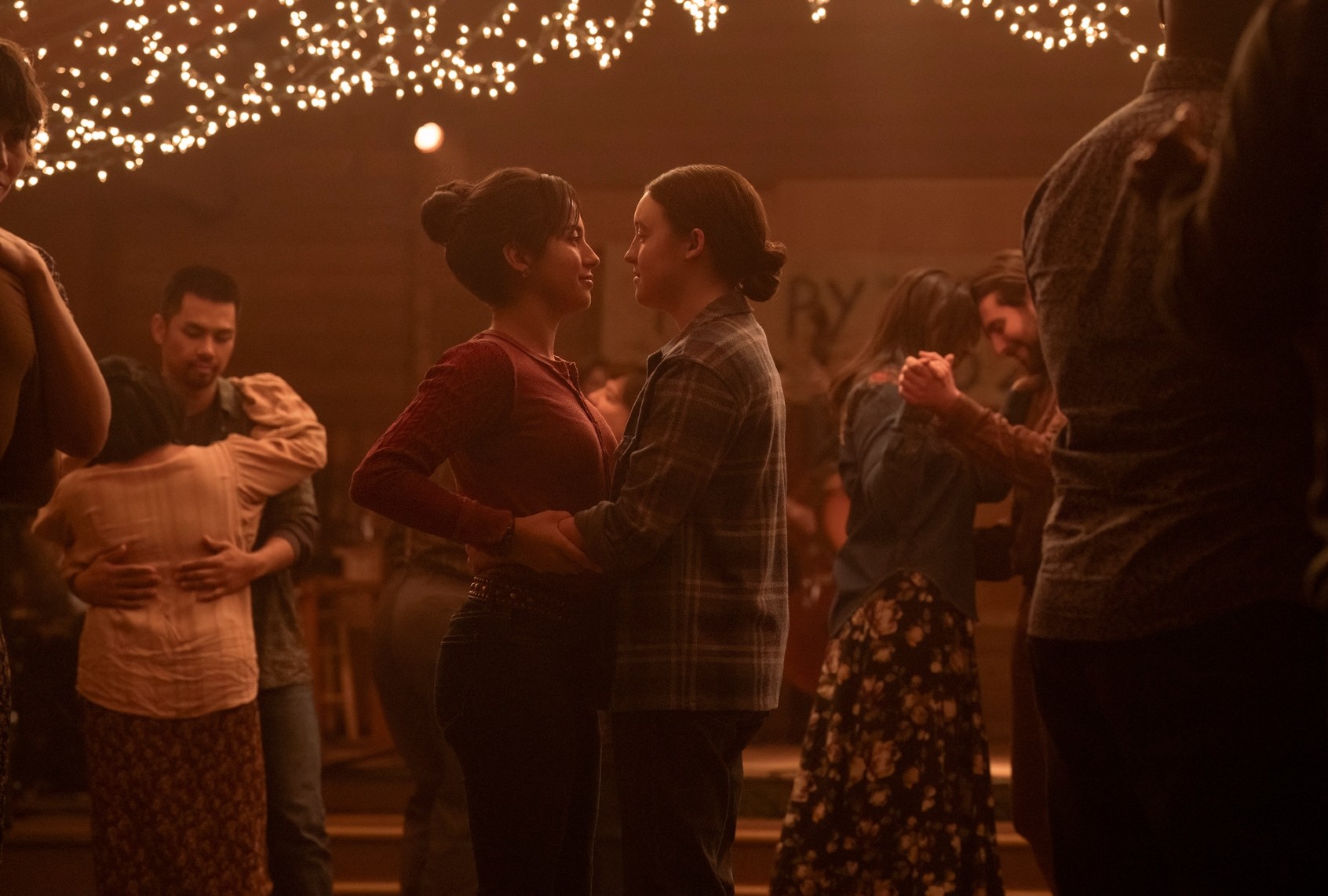
Isabela Merced and Bella Ramsey in "The Last of Us" (Liane Hentscher/HBO)
"The first Pride was a riot" is a phrase that gets tossed around every Pride Month, and for good reason. The phrase is in reference to the Stonewall uprising on June 28, 1969, when transgender and gender non-conforming people like butch lesbian Stormé DeLarverie were targeted by police at the Stonewall Inn in New York and Black transwoman Marsha P. Johnson is credited with retaliating by throwing a brick to ward off police officers attempting to rough up and arrest patrons — although the details of this story have been argued about ever since. We would not have Pride Month without the trans community. And I still want more lesbian representation during Pride Month. Both can be true, and both can be good. And in all of the sensitivities and often difficult to navigate narratives within those statements, I would wager that one thing — if not that — could be quickly agreed upon in any friendly argument taking place at any random remaining bar that caters to the LGBTQ+ community this time of year . . . cisgender gay men have plenty to call their own. What can we have that's for the rest of us? 

When you subsist on crumbs for long enough, you learn to make a meal out of them.

At the top of this, I wrote that I've noticed an influx of lesbian and lesbian coded content and the "coded" part there has a lot of weight to it, as does my mention that, as a community, lesbians have adapted to a "we'll take what we can get" way of life, at least when it comes to the media we're offered.

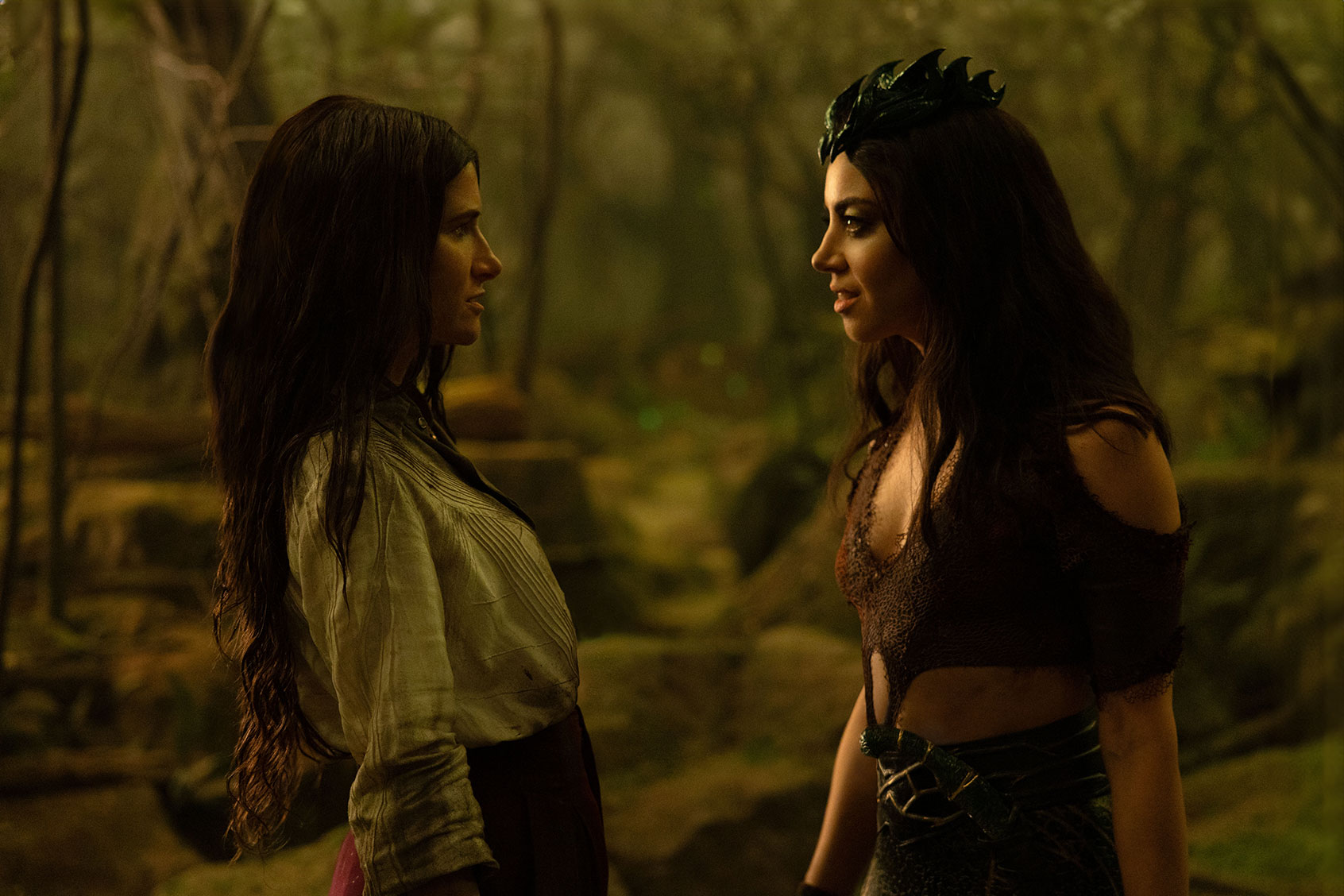
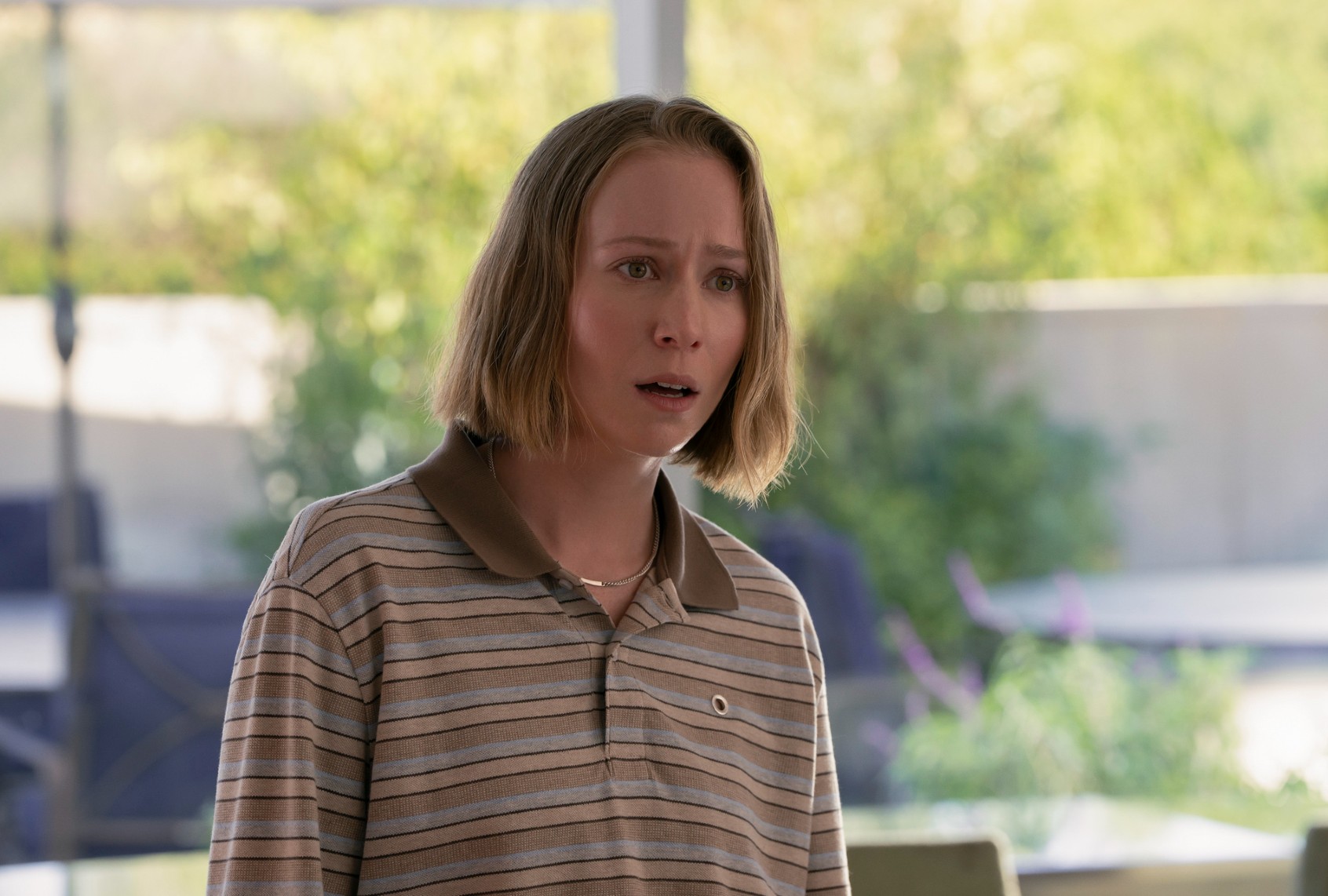
Agatha All AlongAgatha Harkness (Kathryn Hahn) and Death (Aubrey Plaza) in "Agatha All Along" (Photo courtesy of Marvel Television/Disney+/Chuck Zlotnick)While it's been tremendous fun to watch "Yellowjackets" get more and more sapphic as the series progresses, to receive the wondrous gift of a heavily lezbionic "Agatha All Along," to witness Rosie O'Donnell lose her WLW V-card on "And Just Like That," to sigh romantically at Bella Ramsey and Isabela Merced's characters on "The Last of Us" — Ellie and Dina — throwing caution to the wind to have sex in the midst of a zombie apocalypse, and to see Hannah Einbinder run down a hallway in a very appealing way in the "Hacks" Season 4 finale, it's still all just crumbs. And yet still, I'm sitting here happy, feeling as though lesbians are trending up this Pride. And why? Because it was announced in May that Hannah Einbinder and Gillian Anderson will be starring in a slasher called “Teenage Sex and Death at Camp Miasma,” directed by Jane Schoenbrun? Because Margaret Qualley was cast as a lesbian detective alongside Aubrey Plaza in the upcoming Ethan Coen and Tricia Cooke film, "Honey, Don’t!" I mean, yeah. That's exactly why. When you subsist on crumbs for long enough, you learn to make a meal out of them. You've heard of "girl dinner?" Well, this all feels like a lesbian feast.  

Start your day with essential news from Salon. Sign up for our free morning newsletter, Crash Course.


Weeks prior to the official start of Pride Month, Prime Video — the Amazon streamer that canceled "A League of Their Own" after one season and nixed the previously dangled carrot of an additional four episodes to finish out the established storyline — debuted a new series, "Overcompensating," starring Benito Skinner as a closeted gay guy struggling with his identity during his first year of college. Ramping up to Pride Month in 2024, gay media was abuzz about the UK's first gay male dating show, "I Kissed a Boy," making its U.S. debut on Hulu. 2024 also had, smack in the middle of Pride Month, Season 2 of "Interview with the Vampire" on AMC — centering on two gay vampires who defy the logic that erections rely on a functioning/alive circulatory system. Jumping back two years, to 2022, Hulu rolled out the rainbow carpet for "Fire Island" during Pride Month. The list goes on and on, back and back, and not just with television, but films and books as well. There's a theme here, each year, and it's that lesbians should be satisfied with reruns of "The L Word" and annual re-watches of "Carol" and "Bottoms" and call it a celebration. Hell, make a theme out of it and watch these in the back of a rented U-Haul while petting some cats and eating some hummus and . . . who needs Pride Month anyway!?!

Hannah Einbinder in "Hacks" (Kenny Laubbaucher/Max)

"The L Word" aired its last episode on Showtime in 2009 (yup, 16 years ago), and it's still the first and last widely recognized cultural offering of its kind in that it was primarily about lesbians and, across five enjoyable seasons and one hilariously awful season, depicted a soap opera style glamorization of a group of lesbian friends doing normal lesbian stuff like having sex with a wall and waving goodbye to the ghost of their friend in a waterfall. Will we ever have another one like it? I'd like to think yes, but it sure is taking its time, isn't it?

In the meantime, on the first week of Pride 2025, I'll sit here and wait, hoping that Pride 2026 does a little bit better for lesbians while still being thrilled that we have the previously mentioned "Teenage Sex and Death at Camp Miasma" and "Honey Don't" to look forward to, as well as the also newly announced gay zombie movie, "Queens of the Dead," starring Katy O'Brian. I'll wait, highlighting passages from "L Word" stars Leisha Hailey and Kate Moennig's new book, "So Gay For You," about their experience making that show oh so many years ago, and tell myself that, finally, everything's coming up lesbians.

Democrats’ path to electoral prosperity: public wealth funds

The Alaska Permanent Fund, established by a Republican governor nearly a half-century ago, has allowed Alaskan residents to share in the profits from oil and mineral extraction in the state.

As the New York Times explains, “Similar socialized funds — sometimes called sovereign wealth funds — are common in other conservative states." In fact, The National Interest reports that “The great majority of states that have a domestic sovereign wealth fund are solidly Republican states." Texas, Wyoming, and North Dakota, for example, all maintain multi-billion-dollar public wealth funds.

Democrats need to think even bigger if they want to win back respect — and the vote. They need to consider that American productivity goes well beyond oil and gas, that it’s the result of 75 years of progress in technology and medicine and finance and numerous other industries, and that it derives from the sweat and inspiration of all of our parents and grandparents. Stock market gains reflect our productive past. All of us should reap some reward from that long-term effort.

New wealth should not be taken only by the 10% of Americans who own 93 percent of the stock market. While the S&P 500 has gained a pre-inflation average of over 10 percent annually over the past half-century, the returns on that growth have accrued passively to the richest among us.

Large-scale public wealth funds have been proposed to correct the imbalance. Funding will ideally come from a Financial Transaction Tax or some form of levy on market capitalization. The argument for a Financial Transaction Tax has been made for years by Dean Baker and Elizabeth Warren and Bernie Sanders. An alternative is a small tax on stock holdings. The Peoples Policy Project noted that At the end of 2017, the market capitalization of listed domestic companies was $32.1 trillion. A one-off 3 percent market capitalization tax would thus bring in around $1 trillion of assets.

We need your help to stay independent

The current U.S. stock value is over $50 trillion. Just a two percent tax on that amount would return $1 trillion. Each one of America’s 127.5 million households would earn nearly $8,000 per year. All families, rich or poor, would share in America's prosperity.

Of course, the millionaires who own almost the entirety of the stock market will resist even a small percentage payback to the country that made them rich. Despite the unlikelihood of getting the super-rich to part with their money, there’s a good reason – other than the fairness of recognizing society’s contribution to long-term wealth gain – for stockholders to embrace an American Permanent Fund. As noted by reliable financial sources, consumer spending directly influences stock market performance. With the massive trillion-dollar surge in consumer spending, stock market growth is likely to make up that tiny transaction or capital holdings tax, and then some.

It's certainly worth paying a nominal amount to stimulate the economy and boost one's own stock portfolio.

But where is the political will to make this happen? Perhaps a proposal by Democrats for a nationwide public fund through a Financial Transaction Tax will convince a cynical middle-class America that the Democratic vision focuses on the needs of society rather than on rich individuals.

Indigenous land defenders face rising threats amid global push for critical minerals

Miguel Guimaraes, a Shipibo-Konibo leader, has spent his life protesting palm oil plantations and other agribusiness ventures exploiting the Amazon rainforest in his homeland of Peru. Last spring, as he attended a United Nations conference on protecting human rights defenders in Chile, masked men broke into his home, stole his belongings, and set the place on fire. Guimarares returned days later to find “he will not live” spray-painted on the wall.

The U.N. special rapporteur on human rights defenders, Mary Lawlor, denounced the attack and urged Peru to guarantee Guimarare’s protection. Although Guimaraes enjoyed international support, his assailants haven’t been identified. 

Guimaraes is one of 6,400 activists who endured harassment or violence for defending human rights against corporate interests. That’s according to a new report from the Business & Human Rights Resource Centre that chronicles attacks and civil violations human rights defenders worldwide have experienced over the past decade. Although Indigenous people make up 6 percent of the world population, they accounted for one-fifth of the crimes documented in the report. They also were more likely than others to be killed, particularly in Brazil, the Philippines and Mexico.

Some of these attacks arise from the “range of ways” governments are restricting civic space and discourse and “prioritizing economic profit,” said Christen Dobson, an author of the report and co-head of the Civic Freedoms and Human Rights Defenders Programme. “Over the past 10 years, we’ve seen a consistent, sustained pattern of attacks against people who speak out against business-related human rights, risks, and harms,” he said.

People like Guimaraes experience a wide variety of harassment, including judicial intimidation, physical violence, death threats, and killings. Most abuse stems from defenders raising concerns about the social and environmental harm industrial development brings to their communities and land. (More than three-quarters of all cases involve environmental defenders, and 96 percent of the Indigenous people included in the report were advocating for environmental and land issues.) The majority are tied to increased geopolitical tensions, a crackdown on freedom of speech, and the global minerals race, the report found.

Most of these attacks are reported by local organizations focused on documenting and collecting Indigenous cases, and the number of crimes against them may be higher. “The only reason we know about even a slice of the scale of attacks against defenders worldwide is because defenders themselves are sharing that information, often at great risk,” said Dobson.

Virtually every industry has a case in the database that the Business & Human Rights Resource Centre maintains. The organization has tracked companies, trade associations, and governments believed to have requested, or paid, law enforcement to intervene in peaceful protest activity. In 2023, for example, local authorities in Oaxaca, Mexico, attacked and injured members of the Union of Indigenous Communities of the Northern Zone of the Isthmus who were peacefully blocking the Mogoñe Viejo-Vixidu railway, which posed a threat to 12 Indigenous communities in the area.

The protest against the Dakota Access Pipeline saw the highest number of attacks related to a single project over the last decade, the report found. Around 100,000 people in 2016 and 2017 gathered to oppose the pipeline and were met with a campaign of harassment, intimidation, and arrest. Energy Transfer, the company that led the project, filed a defamation suit accusing Greenpeace of violating trespassing and defamation laws and coordinating the protests. In March, a jury ordered Greenpeace to pay $660 million in damages, a verdict legal experts called “wildly punitive.”

The Business & Human Rights Resource Centre cites that lawsuit as an example of companies using a legal tactic called a strategic lawsuit against public participation, or SLAPP suit, to silence dissent and harass protesters. But Energy Transfer cited that courtroom victory in its response to the nonprofit’s report: “The recent verdict against Greenpeace was also a win for the people of North Dakota who had to live through the daily harassment and disruptions caused by the protesters who were funded and trained by Greenpeace.”

Fossil fuel companies were hardly the only offenders, however. Dobson and her team identified several cases involving renewable energy sectors, where projects have been linked to nearly 365 cases of harassment and more than 100 killings of human rights defenders. 

But mining, including the extraction of “transition minerals,” leads every sector in attacks on defenders. Forty percent of those killed in such crimes were Indigenous, a reflection of the fact that more than half of all critical minerals lie in or near Indigenous land.

The outsize scale of harassment and violence against Indigenous people prompted the U.N. special rapporteur to release a statement last year making clear that “a just transition to green energy must support Indigenous peoples in securing their collective land rights and self-determination over their territories, which play a vital role in biodiversity, conservation, and climate change adaptation.“

Businesses, particularly those in mining and metals, are being pressured to ensure their operations do just that. The Consolidated Mining Standard Initiative, or CSMI, for example, is a voluntary framework to improve industry policies adopted by several trade associations like the Mining Association of Canada. “The standard addresses a broad range of community risks by requiring mining operations to work with communities to identify and work together to mitigate risks faced by the community,” the association said. “Such risks include those to human rights defenders, where they exist.”

Another member of the initiative, the International Council of Mining and Metals, said it has “strengthened our member commitments on human rights defenders to explicitly include defenders in companies’ due diligence, stakeholder engagement, and security processes. Defenders often work on issues related to land, the environment, and Indigenous peoples’ rights.” 

Even as this report highlights the dangers human rights defenders face, a growing need for critical minerals, mounting demand for the infrastructure to support AI, and the dismantling of regulatory oversight in the United States bring new threats. The report also makes clear that these attacks will not decrease until broad agreements to adopt and implement protections for these activists are enacted. Such policies must be accompanied by legislation designating Indigenous stewardship of their land and requiring their involvement in project consultations.

Yet Indigenous organizations tend to doubt any industry can be trusted to voluntarily participate in such efforts. In a letter sent to the CSMI, 25 human rights organizations including the Business & Human Rights Resource Centre said mandatory participation will be required to ensure robust protection of human rights defenders and relationships between industry and Indigenous peoples. “People and the environment suffer when companies are left to self-regulate with weak voluntary standards,” the letter stated. 

Still, change is coming, however slowly. When Dobson and her team started tracking the harassment and violence against human rights defenders, she wasn’t aware of any companies with a policy pledging to not contribute to or assist attacks against defenders. Since then, “We’ve tracked 51 companies that have made this policy commitment,” she said. “Unfortunately that doesn’t always mean we see progress in terms of implementation of those policies.”

"This story was originally published by Grist. Sign up for Grist's weekly newsletter here."

PRRI’s Robert P. Jones: “Donald Trump sees himself as the king of kings”

The American people need to give up childish things and do the necessary hard work if they are to have any chance of saving their democracy from Trumpism and the larger right-wing antidemocracy revolutionary project. As James Baldwin counseled in a 1962 essay that appeared in the New York Times Book Review, “Not everything that is faced can be changed, but nothing can be changed until it is faced.”

Unfortunately, there are very few indications of such newfound maturity. The American people remain in a deep slumber and state of learned helplessness as Donald Trump and his forces continue with the shock and awe campaign against American democracy, civil society, the rule of law, the Constitution and human decency. The mainstream news media as an institution appears to have chosen a strategy of anticipatory obedience and compliance, if not collaboration, in normalizing Trumpism and his attempts to become the country’s first elected dictator. The Democratic Party is mired in infighting and a perpetual post-mortem about how and why it was routed by Donald Trump and his MAGA Republicans in the 2024 election. The concept of how to be an effective opposition party seems outside the grasp of its leaders.

Pro-democracy civil society organizations and the courts are trying to resist Trump’s attempts to neutralize them. Unfortunately, Donald Trump has great leverage in such a struggle and is using the near-limitless resources of the State to impose his will. For example, while the courts have repeatedly ordered a halt or pause on the Trump administration’s actions, it has and continues to treat such orders and rulings as optional, rather than as the commands of a co-equal branch of government, per the Constitution.  

Donald Trump was democratically elected. By choosing him over President Biden and then Vice President Kamala Harris, a majority of voters endorsed Donald Trump’s values, character, behavior and public aspirations to be a dictator on “day one”; This is a damning indictment.

After more than 10 years of the Age of Trump and all the horrible things it has spawned and encouraged, public opinion polls show that there are still many tens of millions of Americans who will not abandon Donald Trump under any circumstances. Moreover, by some metrics, Donald Trump has actually expanded his base of support among the most disgruntled and alienated members of the American public.

To that point, polling by the Public Religion Research Institute (PRRI) has consistently shown that white right-wing Christians are the bedrock of Donald Trump’s support. This level of devotion gives Trump a great amount of power and flexibility in his quest for unlimited power because unlike his predecessors, he has a cult-like following that he can use to claim democratic legitimacy combined with autocratic powers and a willingness to shatter America’s political and societal institutions to achieve his personal and political goals. This combination is a powerful force multiplier for competitive authoritarianism and perpetual MAGA rule by Donald Trump and his chosen successors.

Robert P. Jones is the president and founder of Public Religion Research Institute. He is the author of the New York Times bestseller "The Hidden Roots of White Supremacy and the Path to a Shared American Future," as well as "White Too Long: The Legacy of White Supremacy in American Christianity."

In this conversation, Jones emphasizes how racism, white racial resentment, and white identity politics are central to Donald Trump’s appeal and the rise of his authoritarian populist movement. The denial and evasion of this reality by many white Americans — especially liberals and moderates in the news media and political class — explains why they have been so ineffective in stopping the rise of Trumpism and the larger antidemocracy project. Jones reflects on the Trump administration’s thought crime regime and what it feels like to be the author of a book that has been censored for being “unpatriotic” and contrary to “American values.”

Jones also explains how “conservative” so-called “values voters” have now replaced those values with Donald Trump and MAGA and see him as a tool to impose a White Christian nationalist theocracy on the American people. At the end of this conversation, Jones warns that the future of American democracy and “free and fair” elections in 2026 and beyond are far from guaranteed. 

You and I have been engaging in a years-long conversation about the Age of Trump and America's embattled democracy. Trump is back in power as we warned. It has been more than 120 days, and matters are very dire here in the United States. How are you feeling?    

Even as someone who lives and breathes politics in the United States, I continue to be in a state of perpetual disbelief. On the one hand, there's not much at this point that President Trump could do that really would surprise me. But at the same time, the speed of the destruction he has commanded and unleashed on so many fronts makes my head spin. I was prepared for Trump's return to the presidency to be ugly and disastrous. But seeing the reality of it — especially up close here in Washington, DC, where so many patriotic public servants’ lives have been decimated by Trump’s attacks on our government institutions — has been very upsetting. I love my country, and it is painful to watch it being dismantled and destroyed by Trump and his MAGA forces. 

The Age of Trump and this assault on multiracial democracy have been the norm for American society. Black and brown Americans have only been equal citizens under the law for 60 or so years. In the immediate sense, the Age of Trump is the White backlash and White frontlash to President Obama, the country's first black president. But its origins are much deeper. Many white Americans seem to be in shock and still stunned because they believed in an America that did not really exist; Trumpism is quintessentially American. 

I think you're right. I am white. Most white Americans are having a much harder time digesting what they're seeing from Donald Trump than Black Americans and other people of color, for the reasons you just explained. Most Black Americans have had the experience of living under a government that was openly malevolent toward them. They either directly experienced or otherwise know the history of Jim Crow racism. They have deeply felt these feelings before. It is not new, nor is its revival a shocking surprise.

"There is a stunning dichotomy between predominantly White Christian groups and everyone else."

On the other hand, white Americans, for most of our nation’s history, hypocritically said they supported democracy while still supporting white supremacy. The Civil Rights Movement fully exposed that hypocrisy and deep contradiction in American society, but white Americans have made heroic efforts not to see it. That is why so many White Americans are still, a decade after Trump’s first rise to power, expressing surprise at the MAGA movement's hostility to democracy.

I also do not believe that White Americans as a group have the coping skills to deal with the challenge of Trumpism to our democracy and freedom in the same way that Black Americans do. Black Americans created institutions of resistance and survival, including the Black church and a music and larger cultural life that channels the energy of survival and resistance. Most white Americans do not have that kind of history and resilience to fall back upon. In all, for many white Americans, the Age of Trump left them with a deep sense of vertigo. They feel, many for the first time, that their world is spinning, but really, it’s just that we are all finally reaping the white supremacist whirlwind.  

How are your colleagues who work in civil society organizations feeling right now? 

People are reacting in a wide range of ways. Some people are ducking and covering. For example, they are scrubbing their websites and materials of certain words and phrases such as "diversity," "equity," "inclusion," "race," "racism," "systemic," etc., etc. But there are other organizations and leaders saying "No!" We are not going to alter our mission statements and retreat. We have long histories and values we're committed to, and we're going to stay the course. And you know what? If we go down, then we are going to go down while being true to our mission. We at PRRI are committed to taking that course.

We need your help to stay independent

There are recent inspiring examples of that type of integrity and courage. Here is just one: the Episcopal Church refused to participate in the Trump administration's resettlement program for Afrikaners. The Episcopal Church has had a refugee resettlement program for more than four decades that's been in partnership with the United States government. They have helped needy and deserving people from all over the world get their footing here in the United States. Through common membership in the worldwide Anglican Communion, The American Episcopal Church is tightly connected with the Anglican Church of Southern Africa (ACSA). The Episcopal Church courageously refused to play its assigned role in what is essentially a Trump-produced white supremacist morality play. Moreover, the Episcopal Church, in an act of protest, is shutting down their entire four decades-long resettlement program rather than comply with helping the Trump administration with its white identity politics propaganda program. 

 The Afrikaners are the descendants of and direct beneficiaries of Apartheid in South Africa. By privileging those Afrikaners over Black and brown refugees, many who have been waiting in line for years and who are actually deserving of help and protection, Trump is sending a very clear message about his and the administration's values and priorities. The Episcopal Church is a role model of resistance and principle in this dark time.

As part of its national whitewashing and Orwellian memory hole "patriotic education" program, the Trump administration is censoring books, targeting universities and colleges, and the American educational system more broadly, and even attacking museums and libraries. Your book was banned at the US Naval Academy. How does it feel to have such an "honor" and "distinction?" 

The Nazis burned books to destroy knowledge. It was an analog world then. Now we are in a digital world, and the Trump administration can destroy and suppress knowledge and the truth with the push of a button. In addition to so much digital destruction, which materially would be the biggest book burning in history, the Trump administration is resorting to old-fashioned book bans. My book, White Too Long: The Legacy of White Supremacy in American Christianity, was one of 381 books, including seven books on Christianity, banned from the US Naval Academy. Guess what? Quite predictably, all those books were about Christianity's complicity with racism and white supremacy. But Hitler's book "Mein Kampf" was not banned. Apparently, books about Christianity's complicity with racism and white supremacy are too dangerous for midshipmen to read, but "Mein Kampf" is not.

But there has been important pushback. The New York Times published two different articles on the books being banned at the Naval Academy per Donald Trump and the Secretary of Defense Pete Hegseth’s directives. The American Academy of Religion organized a webinar featuring me and the other banned religious studies authors to denounce the bans and support academic freedom. A retired Navy commander organized an effort to make the banned books available to midshipmen. As a result, most of the banned books are now being put back on the shelves as the US Naval Academy. Personally, for the Trump administration to ban one of my books makes me feel like I must be doing something right.

Trump has now been president for more than four months, approximately 130 days. What are the polls telling us about his support among the American people, in particular white Christians?

White Christians are still largely supporting Trump. If you look at the voting and polling patterns, there is a stunning dichotomy between predominantly White Christian groups and everyone else. A recent PRRI poll shows that Trump's favorability among white evangelical Protestants is 73%. Trump also has majority support among other white Christians, too. White Catholics: 53% favor Trump. White non-evangelical Protestants: 52% favor. The LDS church, sometimes called the Mormons: 51% favor. Non-white Christian groups, non-Christian religious groups, atheists, agnostics and unaffiliated all hold unfavorable views of Trump. 

Given Trump's behavior such as claiming he is chosen by God, is a type of prophet, comparing himself to Jesus Christ, invoking God and Christianity to justify his policies that should be antithetical to that faith tradition and the Bible, and his willful gross failings — that are publicly documented — of his morality, character and behavior, how are white Christians justifying their continued support of him? 

The rationales that White right-wing Christians use to justify their support of Trump are all over the map. This is because there has been a desperate search for a plausible theological justification for a predetermined political decision for Trump. Some of the rationales for Trump's behavior are farcical, such as the claim that he is a "young Christian" who is still maturing in his faith. We heard that in the beginning with Trump. That excuse has been dropped because Trump is not changing and does not want to change. One big challenge is that Trump has explicitly said that he has never had to ask for forgiveness for anything that he has done in his life. The most fundamental commitment of being a Christian is to admit that you've sinned and that you need forgiveness from God. Even Trump’s denial of that basic Christian tenet has proved no obstacle for his white Christian supporters.

At this point, years later, it’s clear that Trump's relationship to white Christians is transactional. Now it is more common to hear white Christians instead claiming that he is a tool of God and prophecy. Ultimately, white conservative Christians are trying to find a theological justification for what is really a political transaction that gives them the power they want in American society — and Trump is making it increasingly clear that much of that power is oriented around the preservation of white supremacy. 

What does it mean to be a "values voter" in the Age of Trump and his return to power?

Very few people use that language anymore. We heard those types of appeals during the George W. Bush presidency and even in the beginning of Trump's first term. For obvious reasons, most white evangelicals have dropped that terminology. A major hub for white evangelical organizing in 2004, ivotevalues.com, for example, is now defunct. Now their appeals are about how "Trump is going to protect our way of life" and "Trump is going to protect our religion." Only the thinnest veil of Christian morality is pulled over the MAGA movement today — it is transactional and about power. Even the cruelest policies, such as Trump’s illegal renditions of immigrants to hellhole prisons in other countries without due process guaranteed to all by the Constitution, evoke little protest. Or perhaps it is more accurate to say that, if we take this support seriously, such cruelty is in fact a reflection of the values of these voters.

After the passing of Pope Francis. Trump shared an AI-generated image of himself as Pope Francis’ successor. How did white Christians, and white Catholics, specifically, react to such an act of disrespect? 

White evangelicals are the ones who get much of the attention from the news media and public. But white Catholics and white non-evangelical Protestants have supported Trump every time he has been on the ballot. There is no such thing as blasphemy from Donald Trump's point of view. There cannot be, since blasphemy depends on the acknowledgment of the sacred. Trump sees himself as the king of kings, the ruler of the world. Posting an image of himself as the new Pope fits Trump's brand and ego perfectly. He got very little pushback from his white Catholic base about that act of gross disrespect. 

What role do race and racism play in terms of white Christian support for Donald Trump and his MAGA movement? This is another area of great failure by the white-dominated mainstream American news media. There are the same evasions and rhetorical tricks applied in the news media's discussions of "working class" support for Donald Trump. Race is central here and not coincidental and/or peripheral. 

When I hear "working class," I always add "white" to the front of those two words. When I hear "Christian nationalism," I do the same thing. To your point, if you look at the data, you don't see huge class breaks among African Americans, for example, in terms of support for Trump. There is economic anxiety on both sides of the color line. But non-whites suffer much more from economic disadvantage and inequality than do white Americans. 

What we found here at PRRI, looking at the data going back to 2016, is that both economic and racial anxiety are independent predictors of support for Trump. If you were making a recipe, it would be two parts white racial anxiety and one part economic anxiety that made up the toxic cocktail that drove people to support Donald Trump. However, among Latinos in particular, there was an economic headwind that really hurt Kamala Harris and helped Donald Trump among that group. Those roads were mostly paved by economic concerns. There is also research that suggests that some Latinos and other non-whites supported Trump because they wanted a type of honorary Whiteness.


Start your day with essential news from Salon.
Sign up for our free morning newsletter, Crash Course.


But our 100-day poll shows that the group that has moved the farthest away from Trump is Latino Protestants, a group that voted two-thirds for Trump in 2024. Trump's favorability is down from 51% to 32% among that group in just 100 days. The economic chaos Trump has unleashed, together with Trump's nativism, racism and the violence that is being visited upon Latinos as part of the mass deportations, is pushing them away from Trump.   

Is there anything that Donald Trump could conceivably do that would cost him the support of his white Christian followers, or his MAGA people, more generally?  

The public opinion research shows that Donald Trump is a fairly unpopular person in terms of his favorability. In 2016, his favorability was only 24% before he secured the nomination and became the official Republican presidential candidate. Then partisanship takes over, and the Republican Party rallies around him. Since his first term, Trump’s favorability is consistently at about 40 to 45 percent. That is his ceiling and floor. But Trump’s favorability among Republicans has never dipped below 70 percent. That support is rock solid, and there is virtually nothing Trump can do for the Republican base to not support him. In fact, in one of our polls here at PRRI, we asked people who had favorable views of Trump the following question: Is there anything Trump can do to lose your support? Two-thirds of the respondents said there is absolutely nothing Trump could do to lose my support. Trump's MAGA base is that locked in. It is going to take independent voters moving away from Trump to potentially weaken him to any significant and/or long-term amount.

As for some hope, the polls do show that Trump's tariffs, his corruption and disregard for the rule of law, his abuses of power, and his attacks on the social safety net are hurting him with independent voters. Once the impact of the tariffs hits, I think we may see even bigger swings. If Trump launches mass deportations that feature militarized internment camps for undocumented immigrants in this country, that will also be another inflection point. But Trump’s base will be with him: six out of ten Republicans support military internment camps for undocumented people. 

Why believe that given Donald Trump and his forces’ autocratic and increasingly fascist and authoritarian assaults on democracy and the rule of law, there will even be “free and fair” elections in 2026 and beyond? That is a huge assumption that hangs over all these conversations about the future and resistance to Trump and the MAGA revolutionary project’s drive for unlimited power. 

When I talk about the midterms, I preface that with the qualifier, "if we have free and fair elections." It is very conditional. In theory, if the Democrats take back control of Congress, they could reverse some of Trump's most onerous policies. But, like you, I am quite worried that the midterms and beyond will not be "free and fair" and that Trump and the Republicans will basically have sham elections in key states to "legitimate" their rule.

I am from Mississippi. Elections during Jim Crow segregation were supposedly "free and fair," and they were anything but. This is part of America's living history and present — the Republicans in the South are rolling back civil rights and voting rights laws to bring back a 21st-century version of Jim Crow at the ballot box. This is not something in the distant past or in a distant country. American democracy and its principle of "free and fair" elections are not something to be taken for granted. In fact, truly free and fair elections have only been with us for about one-quarter of America’s nearly 250-year history. And that achievement will not be preserved without an active effort to protect it next fall.

“Nobody’s getting rich doing drag”: It costs to be a queen

If you’ve ever seen a drag queen performance — either in person at your local club or on “RuPaul’s Drag Race” — you’ve likely admired their charisma, uniqueness, nerve and talent.

But one thing you might not have admired? Their bank account.

Being a drag queen — even being a famous drag queen — may not pay the bills. And there are a lot of bills to pay. 

“People do drag because people love drag,” Indianapolis-based drag king Damien Belmont said. “Nobody's getting rich doing drag. That's the unfortunate reality, but it's reality all the same.”

What is the cost?

Like any other kind of artist, the costs associated with being a drag queen may seem minimal if you’re not in the biz. But for those working regularly, there are huge costs associated with it.

We need your help to stay independent

Denver-based Jessica L'Whor, a full-time drag queen and performer, breaks down the makeup costs:

  • Makeup: Between $50 – $100 every 2-3 months
  • Skincare products: About $50 per month
  • Costume commissions: Sporadic, but averages between $625 and $1,250 per month
  • Wigs: Each wig costs between $20 and $700
  • Wig restyling: Between $50 and $200 depending on various factors
  • Gas: Varies depending on how far you have to travel for a gig

“It all adds up,” L'Whor said.

What’s even more surprising is how much — or perhaps more accurately, how little — drag queens make per gig. On average, L'Whor says that clubs pay between $75 and $200 per gig. And while patrons can tip, those amounts also vary. If it’s a slow night or people are feeling frugal, tips can be minimal. That’s another major reason why many drag queens only rely on their art as a side hustle.

“I’d say 25% of drag queens make a full-time living,” said drag queen Dixie Krystals.

Belmont said he doesn’t know any drag queen or king who makes a living based solely on their performances.

“In fact, most of us are lucky if we kind of break even when it comes to expenses,” Belmont said.  “It gets really expensive really quickly, especially if you’re not resourceful.”

What’s hurting drag queens?

Between 2002 and 2023, more than 45% of gay clubs closed in the U.S. These clubs are the lifeblood for drag queens — every time a gay or queer club or bar closes, queens inevitably lose out. 

High food prices and housing costs mean consumers have less to spend at bars. That means less money for tickets to drag shows, for tipping queens and for drinks. 

"It gets really expensive really quickly, especially if you’re not resourceful"

Also, “going out” culture has changed. Gen Z has been hailed as the first generation to drink more responsibly, but spending less money on alcohol hurts the nightlife business. The fewer people there are at a show, the less money is spent on the queens.

The cost of RuPaul’s “Drag Race"

OK, so being a local drag queen doesn’t pay much. But surely being a drag queen and a TV star must pay more, right? Not necessarily.

Since 2009, “RuPaul’s Drag Race” has been hailed as one of the best reality shows around. It’s also been a proving ground for drag queens not only in America, but all over the world.

However, with the 10th season of “RuPaul's Drag Race All Stars” airing now, some critics are noticing that "Drag Race" alumni aren't as profitable as they used to be.

Many queens spend thousands of dollars on their outfits just to appear on the show. And if they aren’t a winner or a fan favorite, they may “never earn that money back, leaving them financially devastated," according to one queen. 

Several have said they’re not pulling in as much as they expected, even after appearing on the show and progressing through the various rounds. Season 15 contestant Salina EsTitties said many “Drag Race” alumni are not raking it in, especially not after recent economic changes.

These struggles have been coming to a head for years. Ever since “Drag Race” became a mainstay, queens have been spending more money, often taking out huge loans to cover what their savings can’t. Most recently, season 17 contestant Lexi Love said she took out a second mortgage to pay for her outfits for the show.

So whether you’re a local drag queen performing at a club a few times a month or a reality TV star, the cost of drag weighs on everyone.

What hurricane season? FEMA chief flusters staffers by appearing not to know about peak storm period

The acting head of FEMA left staffers flummoxed after he appeared not to know that the United States had a hurricane season.

David Richardson, who has led the federal disaster response agency since May, seemed unaware of the peak storm period that runs between June 1 and Nov. 30. His remarks to that effect came during a Monday morning all-hands meeting, per a report from Reuters. The FEMA head’s seeming ignorance comes after the National Oceanic and Atmospheric Administration predicted a busier-than-usual hurricane season.

Sources familiar with the meeting who spoke to CBS News said that it was unclear whether or not Richardson was actually uninformed about hurricane season. Some speculated that Richardson was making a joke that didn’t go over well. Either way, the remark was disheartening for employees of the agency that has long been in President Donald Trump‘s crosshairs.

Richardson’s fumbling did little to inspire confidence in the man with zero disaster management experience. The former Marine offered a terse message to staffers at the start of his tenure, warning them not to “get in [his] way.”

The president has repeatedly floated the idea of terminating federal disaster relief altogether and leaving states to pick up the pieces after hurricanes, earthquakes and wildfires. Richardson told staffers he would carry out whatever Trump asked with single-minded intensity.

“I will run right over you,” he said. “I will achieve the president’s intent.”

Trump administration left clueless about Ukraine’s attack on Russia

President Donald Trump was completely in the dark about a Ukrainian operation that sent attack drones deep into Russia on Sunday, per several reports.

Ukraine's attack involved more than 100 drones and reportedly destroyed dozens of Russian military aircraft. In posts to X, Ukrainian President Volodymyr Zelenskyy said the attack took over a year and a half to plan and called the operation "brilliant."

"Today, a brilliant operation was carried out — on enemy territory, targeting only military objectives, specifically the equipment used to strike Ukraine," he shared on X. "Russia suffered significant losses — entirely justified and deserved." 

The assault comes after weeks of Russian bombing campaigns on Ukrainian cities. U.S. and Ukrainian officials confirmed that the Trump administration was not made aware of the attack in advance, per a report from Axios. The White House has been working to broker a peace deal between Russia and Ukraine for many months, with Trump souring on Zelenskyy and Russian President Vladimir Putin at times.

Russian and Ukrainian officials met today for their second set of direct peace talks, but left with no significant breakthroughs. The talks lasted just over an hour, CNN reported. Both sides agreed to work on a new prisoner exchange, but the nations made no progress toward a ceasefire.

“They did not accept our relationship”: Actor Jonathan Joss shot dead in alleged homophobic attack

Actor Jonathan Joss was shot dead by a neighbor at his home in San Antonio this weekend. He was 59.

The fatal shooting came after a dispute with a neighbor on Sunday night, per TMZ.  Witnesses told police that Joss and the suspect, Sigfredo Ceja Alvarez, were in a heated argument when Alvarez shot Joss multiple times. Joss was pronounced dead on the scene. Law enforcement detained Alvarez a block away from Joss' home. Alvarez has been charged with murder.

Joss' husband claimed that the shooting was a homophobic attack. In a post to Joss' Facebook, Tristan Kern de Gonzales said the incident was the culmination of years of hateful abuse from neighbors.

"We reported these threats to law enforcement multiple times and nothing was done," he shared. "Throughout that time, we were harassed regularly by individuals who made it clear they did not accept our relationship. Much of the harassment was openly homophobic."

De Gonzales said the shooting was unprovoked.

"Jonathan and I had no weapons. We were not threatening anyone," he wrote. "We were standing side by side. When the man fired, Jonathan pushed me out of the way. He saved my life…He was murdered by someone who could not stand the sight of two men loving each other."

Joss is best known for his role as John Redcorn in “King of the Hill.” He voiced the character in Seasons 2 through 13, taking over the role from actor Victor Aaron after Aaron died in a car accident in 1996. Joss had a recurring role as Chief Ken Hotate in "Parks and Recreation" and appeared in TV shows like "Tulsa King" and the films "True Grit" and "The Magnificent Seven."

Trouble for law firms that bent to Trump orders: Clients say firms “don’t have a hard line”

Law firms like Paul Weiss that bent to the Trump administration’s demands are finding that big-name clients prefer to take their business elsewhere, The Wall Street Journal reported Monday.

McDonald’s and Oracle are among the growing list of clients choosing to part ways with the appeasing firms. General counsels have concerns about whether these law firms could be trusted to fight it out for them in the courtroom and in negotiations, the Journal reported, when they so easily bent to Trump’s demands.  

In a recent luncheon, a top lawyer for Citadel told leaders of some of the country’s biggest law firms that the hedge-fund company prefers to work with law firms that aren’t afraid of a fight.

In his first days in office, President Donald Trump signed a series of executive orders that targeted high-profile law firms. The orders punished some firms for their previous clients, claiming they weaponized the justice system and threatening to strip them of security clearances and government contracts.

Some firms capitulated, while others — like Jenner & Block, Perkins Coie, WilmerHale and Susman Godfrey — chose to sue the administration. In the months since, many of these executive orders have been struck down or ruled unconstitutional.

As the Journal reported, clients are now skeptical that the firms that folded to Trump can aggressively defend their interests. The general counsel of a manufacturer of medical supplies explained that firms without “a hard line towards the Trump administration don’t have any line at all.

Firms that cut deals with the administration have also faced resignations from young attorneys and partners alike.

At the same time, the law firms that chose to sue the administration rather than fold have experienced difficulties too, the Journal noted, with some claiming in recent court filings that they've heard from anxious clients and lost business because of the orders. 

With “The Phoenician Scheme,” Wes Anderson perfects his product to cold, shiny results

By this point, we know what we’re going to get sitting down to watch a Wes Anderson movie. (That is, if we even know a new Wes Anderson movie is coming out at all.) Audiences will be treated to a richly detailed world, filled with quirk-forward characters and verbose musings about life, love, travel, art, the human condition, fine cuisine and the inevitability of our demise. A handful of recognizable faces will pop up; Bill Murray, Willem Dafoe, maybe one or both of the Wilson brothers. Their dialogue will be unapologetically fast-paced and dryly humorous. The entire affair will be a grab-bag of Anderson’s trademarks, and hopefully, the writer-director will carve out room to find something unique to say amid all of his wheel-spinning. 

Anderson’s style wasn’t always so predictable. It used to be that going to see one of his films guaranteed a visual feast that would bring untold narrative delights, threaded throughout any one of his movies, so the story worked in tandem with the filmmaker’s creative signatures. Over the last half-decade or so, the bond between style and story has cracked. Though Anderson’s conceptual scope is as bold and sprawling as ever, his ideas now bear the weight of his visual prowess. No longer the niche filmmaker he once was, Anderson has long since crossed over into the mainstream, buoyed by a culture that has turned esotericism into a commodity. Now, Anderson’s films are picked up and picked apart for moodboards and generative AI prompts. They’re part of a recently announced, homogenous Criterion Collection box set, too uniform to speak to the array of colors and characters in its contents. Why put your whole heart into something if the audience will ignore your intention in a race to associate themselves with an aesthetic? 

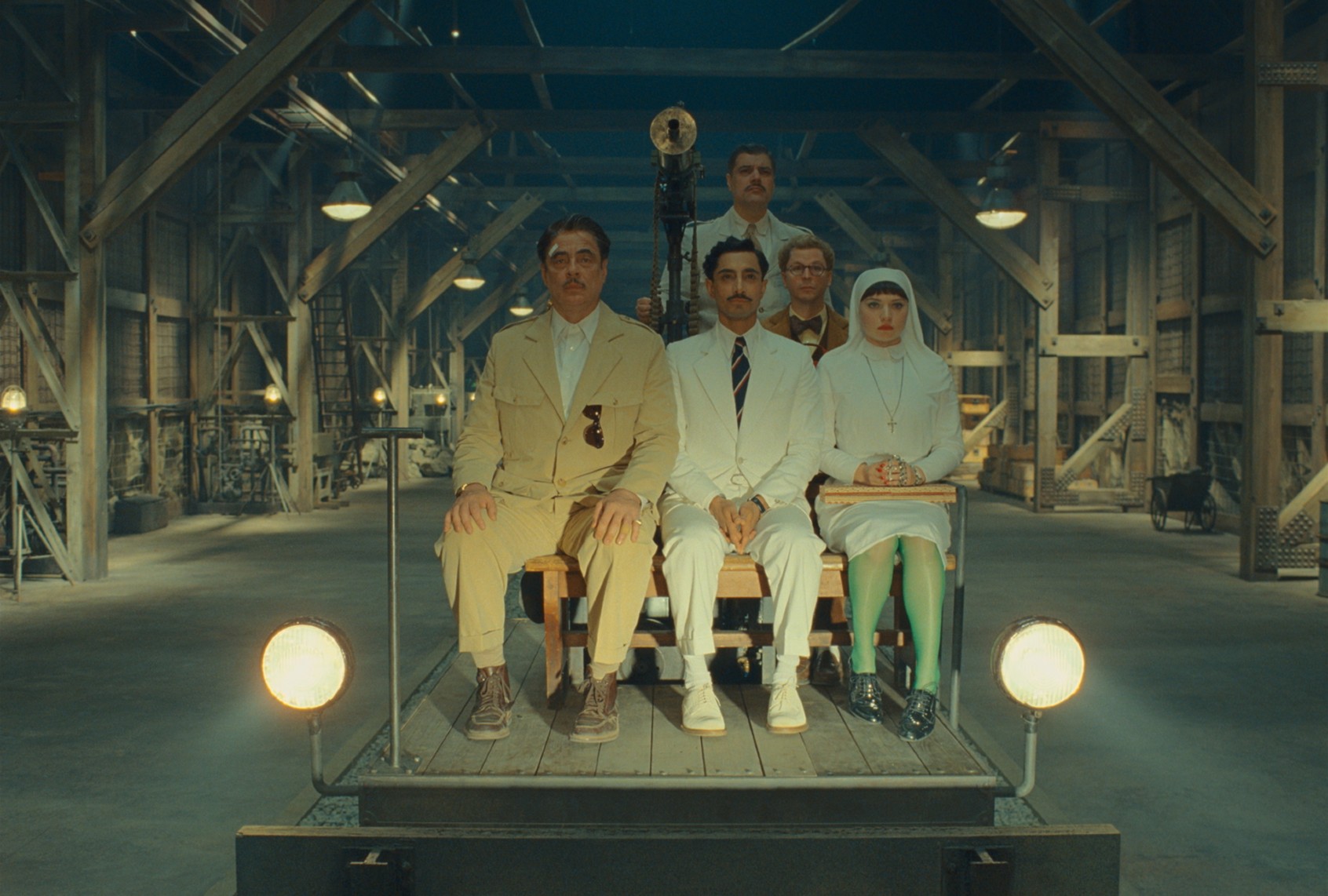
(L to R) Benicio Del Toro as Zsa-Zsa Korda, Michael Cera as Bjorn and Mia Threapleton as Liesl in director Wes Anderson's "The Phoenician Scheme" (Courtesy of TPS Productions/Focus Features)
“The Phoenician Scheme” has Anderson pulled in two different directions, caught between art and business in a time when the two have never been more disparate. The resulting product is just that: a product, with all of the matte pastel appeal of Anderson’s oeuvre, yet little of its memorable charm.

In Anderson’s latest, “The Phoenician Scheme,” the director grapples with being seen as a brand instead of a storyteller. The film follows Benicio Del Toro’s Zsa-zsa Korda, an assiduous businessman hell-bent on developing a fictional version of 1950s Phoenicia into a profitable economic system, from which he and his band of cohorts will reap the rewards. Zsa-zsa ropes his only daughter, a nun named Liesl (Kate Winslet’s daughter, Mia Threapleton), and a brilliant tutor, Bjørn (Michael Cera), into his farce, toting them along for a dangerous journey. The film is wry and beautifully realized, one of Anderson’s best efforts in years. It’s also one of his coldest, with all of the wheeling and dealing of commerce and incessant business jargon seeping into the movie’s bones and leaving the viewer emotionally disconnected. “The Phoenician Scheme” has Anderson pulled in two different directions, caught between art and business in a time when the two have never been more disparate. The resulting product is just that: a product, with all of the matte pastel appeal of Anderson’s oeuvre, yet little of its memorable charm.

Just because Anderson is making glorified Funko Pop! figurines doesn’t mean that “The Phoenician Scheme” is a bad film — or perhaps more accurately, an uninteresting one, given that relegating works like Anderson’s to a term like “bad” is unfairly reductive. In fact, the movie sits miles from uninteresting. Its central trio of acerbic misfits is Anderson’s most fascinating collection of characters in some time, co-conceived alongside his longtime collaborator and friend Roman Coppola, who co-wrote 2021’s “The French Dispatch” and 2023’s “Asteroid City.” Unlike those two films, which played with narrative form in an attempt to shake up the audience’s expectations for an Anderson production, “The Phoenician Scheme” is relatively straightforward. It’s a story told in chronological order, rarely dipping into the director’s so-loved narrative asides, which amiably guides the viewer through a deluge of fast-talking, corporate jargon to keep them in the film’s grasp throughout all 102 minutes. Much like jumping into “Succession” or “Industry” totally blind, if you wait it out, you’ll come to understand what’s happening eventually.

After a suspicious plane crash that ends in another one of Zsa-zsa’s outlandish near-death experiences, the tycoon suspects that the several recent attempts on his life are connected to his plans to develop Phoenicia. To protect the titular scheme already in motion, Zsa-zsa reconnects with Liesl, who is just days from taking her holy vows and spending the rest of her life in a convent as a devoted servant of God. Yet, as much as she rejects the flair of her father’s lifestyle, Liesl can’t help her affection for the glitzy, impious pleasures Zsa-zsa so adores, making Threapleton the coolest nun since a habit-wearing Lindsay Lohan took down conservative cowboys in Robert Rodriguez’s “Machete.” 

(L to R) Benicio Del Toro as Zsa-Zsa Korda, Riz Ahmed as Prince Farouk, Michael Cera as Bjorn and Mia Threapleton as Liesl in director Wes Anderson's "The Phoenician Scheme" (Courtesy of TPS Productions/Focus Features)
Liesl’s sunglasses-wearing, pipe-smoking, lipstick-stained disaffection is a joy to take in, but Threapleton brings so much more to “The Phoenician Scheme” than devout detachment. Zsa-zsa wants Liesl to be the sole heir to his estate, and she agrees, so long as he’ll help Liesl discover who murdered her mother. (Zsa-zsa repeatedly swears he had nothing to do with her death.) Zsa-zsa’s business exploits may be the film’s primary thrust, but Liesl’s journey to actuality is its most invigorating plotline, carried ably by Threapleton with cutting sarcasm and genuine emotion behind her steely, green-eyed gaze.

The film, unfortunately, needs a character like Liesl to carry it. While Del Toro’s comedic timing has never been better, and Cera’s thick Norwegian accent and dopey peculiarities feel right at home in Anderson’s world, Zsa-zsa and Bjørn would be lost without Liesl. Perhaps that’s the point Anderson is making, that suave business magnates and silly scientists alike will be undone by their inherent, world-conquering machismo. But Cera and Del Toro’s characters are too thinly written for that idea to feel thematically cogent. Amid Zsa-zsa’s enterprising adventures, Anderson loses sight of his protagonist’s initially unmistakable sensitivity, once lurking just beneath the surface. It’s frustrating to get a taste of this intimacy, only to watch it slip through our fingers, especially when each frame of “The Phoenician Scheme” looks so meticulous that one wishes the screenplay itself could match its authors’ eye for physical beauty. 


Want a daily wrap-up of all the news and commentary Salon has to offer? Subscribe to our morning newsletter, Crash Course.


Instead, Anderson and Coppola are preoccupied with the minutiae of trade and commerce. Their determination to write authentic lingo about investment gaps and percentages is admirable enough, but that means little when the average viewer is unconcerned with authenticity, especially in a film so stylized. They eventually move what would otherwise be the film’s centerpiece dynamic — the burgeoning father-daughter connection between Liesl and Zsa-zsa — to the back burner, forgetting about their relationship until flames threaten to consume it. Liesl and Zsa-zsa’s oft-neglected kinship is sweetly tied up in the end. But by then, it’s too late; Anderson’s spent so much time assessing how his characters can mind the financial gap that he’s forgotten to tend to the narrative ones in his screenplay. 

It'd be foolish to think that an artist like Anderson wouldn't be chaffed by seeing his style replicated by unimaginative wannabes, typing sentences into AI image generators. Maybe this is Anderson’s way of saying that stealing something beautiful in the name of “innovation” comes at a great cost, not just to the original artist but to the public consuming this bastardized “art.” 

It’s hard not to notice that “The Phoenician Scheme” continues the director’s late-period trend of trying to forge resonance where there is little. In his work alongside Coppola, Anderson crafts small pockets of earnest depth amid turbo-accelerated storytelling, which are typically the scenes that have the biggest impact on viewers. (Think: Margot Robbie’s brief balcony scene in “Asteroid City.”) His films have a rhythm to them. They move rapidly and are so bountifully detailed that neither the eye nor the brain can keep up entirely. So, when Anderson slows the pace, the audience understands that it’s time to feel. It’s a trick that works almost every time, but like most clever tricks, seeing it happen enough times will dull the impact, no matter how impressive the construction is. 

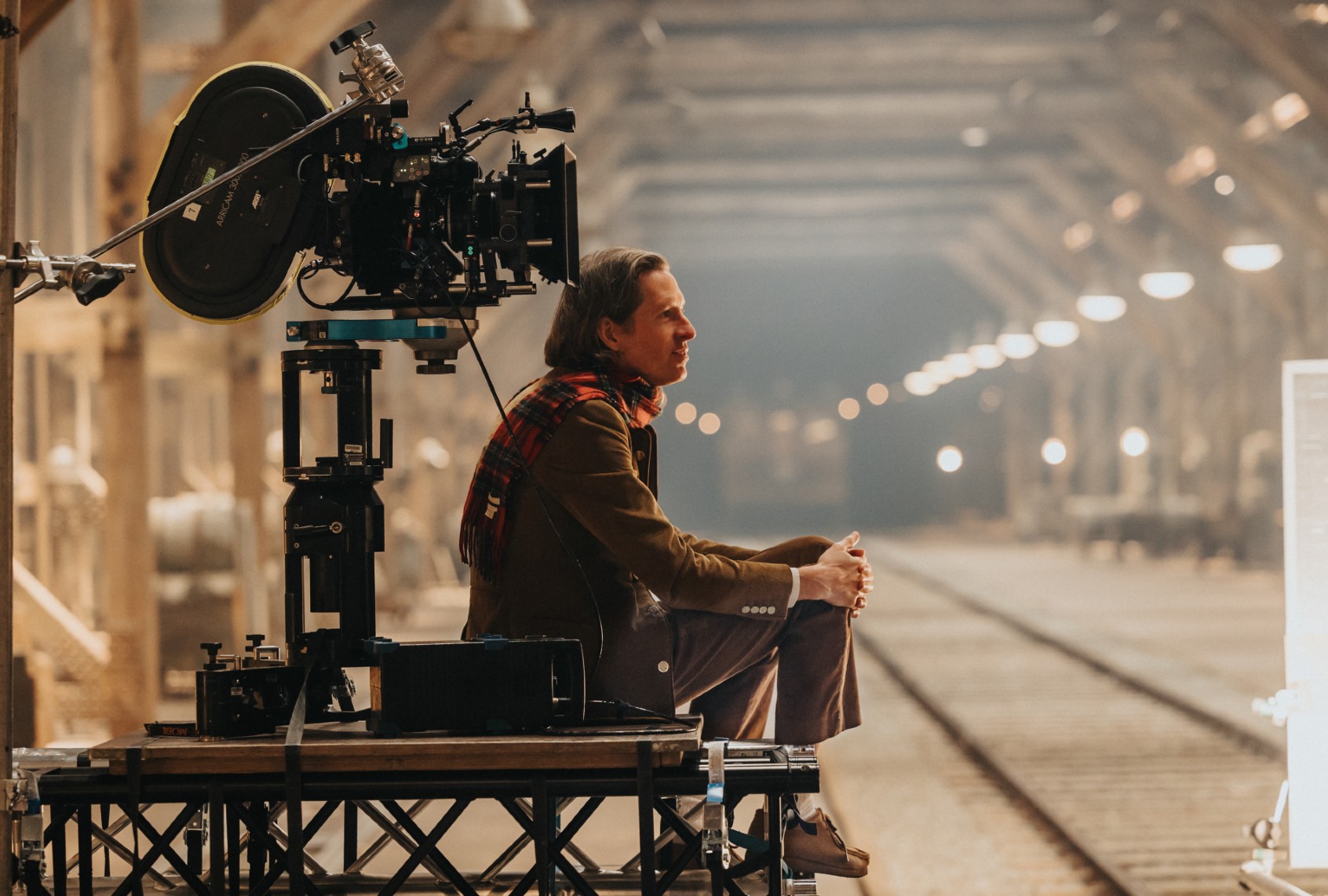
Director Wes Anderson on the set of "The Phoenician Scheme" (Roger Do Minh/TPS Productions/Focus Features)

While Anderson’s go-to formula made him a household name, his penchant for idiosyncrasy and fastidious precision has been a double-edged sword. “The Phoenician Scheme” spots a filmmaker writing himself to the edge of a cliff. The stories have gotten colder; the characters are predictable and plucked from a stock of go-to traits. Anderson’s work has become mired by his ambitions to create adult fairy tales so outsized and wondrous that they’re undeniable, no matter how repetitive they are. And now, with his latest film — his third in five years — he’s come back down to Earth. Industrialism has replaced love. Duplication has replaced creativity. 

Perhaps this is part of Anderson’s response to those frightening AI prompts that jacked his style. (I’d say it’d be foolish to think that an artist like Anderson, whose work is so scrupulous, wouldn't be chaffed by seeing his style replicated by unimaginative wannabes, typing sentences into AI image generators instead of picking up a camera.) Maybe “The Phoenician Scheme” is Anderson’s way of saying that stealing something beautiful in the name of “innovation” comes at a great cost, not just to the original artist but to the public consuming this bastardized “art.” 

That idea isn’t out of the realm of possibility, but if it’s intentional, Anderson never makes it overt enough for viewers to grab onto. Even as he’s faced with people trying to swipe the method he’s spent years perfecting, Anderson’s too good-natured — possibly too content in his legacy — to swipe back. But what once made Anderson’s work so irrefutable was his delight in taking big swings, whether in visual form, narrative writing, or both. And, granted, there are some new, kinetic camera movements and brief experiments with structure in “The Phoenician Scheme” that feel like the seedling of something original, but they aren’t enough to sustain consistent hope. Should he ever swallow his pride and burn his pastel fables to the ground, at least just once, Anderson might be able to forge something new and innately memorable from the ash. Until then, they will remain bright, beautiful and bloodless.

Perfect summer tomatoes? Turn them into butter

Every summer, like clockwork, a particular kind of collective amnesia lifts. Tomatoes — real ones, the kind that bruise if you breathe on them too hard — return, and we remember they’re not just filler for BLTs or wedges to shove beside a burger. For a few fleeting weeks, we become evangelists. We declare that they “need nothing but salt.” We remind one another: the best ones never see the inside of a refrigerator. We post photos of them sliced and sweating in the heat, as if the act of witnessing alone might preserve them just a little longer.

It’s easy to roll your eyes at the tomato mania — I certainly have, when I was younger and a little more cynical about everyday pleasures — but lately I’ve been thinking about what it reveals: a deep, hungry desire to feel the passage of time through something tangible. Something we can taste. In a world where the grocery store produce section hums along with seasonless consistency, tomato season offers the rare thrill of noticing. Noticing that the light has changed. That the fruit is warm from the sun. 

That for once, we are eating something right when we’re supposed to.

This kind of noticing — the quiet, seasonal kind — is something writer Ligaya Mishan recently explored in a piece for The New York Times Magazine, where she writes that “no one takes the changing of the seasons as seriously as the Japanese.” She’s talking about the ko, the 72 microseasons in the traditional Japanese calendar, each lasting just a few days, with names like “fish emerge from the ice” or “rainbows hide.” 

It’s a reminder of how little seasonality is left in the average American day, unless you’re lucky enough to stumble into a farmers market in July, tomatoes stacked like suns.

Pickling, I’m realizing, used to be a kind of culinary celebration of agricultural microseasons. A way to pay close attention. A way to mark what was ripe, what was fading, what needed saving. A practice that asked you to linger.

And then, in one of those gentle coincidences that feels like the universe is nudging you, I came across an old cookbook from 1965 written by a comedy writer who became a sort of pickle poet. His name was Leonard Louis Levinson, and he’d spent most of his adult life writing comedy — for radio, for television, for Hollywood. But when he published “The Complete Book of Pickles and Relishes,” he claimed it got more laughs than anything he'd ever written. Which is saying something, because this wasn’t a humor book. It was a sincere, slightly obsessive, utterly charming ode to the art of preserving. 

“I became a chutney cosmopolite,” he wrote, “and a raconteur of relish recipes.” (Reader, I was sold).

We need your help to stay independent

I’m a sucker for people who become accidental academics through obsession, the kind of folks who fall so deep into a personal passion that they emerge with a whole taxonomy in tow. Levinson was one of them, and his book brims with the fruits of that fixation: some timeless — kosher dills, sweet pickled carrots, snappy gherkins — and some charmingly dated, like walnut catsup or minted onion slices dyed an improbable shade of jade green.

But the recipe that stopped me, the one that made my mouth water for tomato season and mourn its eventual end in the same breath, was tomato butter. Not sauce. Not ketchup. Butter. A slow-cooked spread made from tomato pulp and sugar, spiced with ginger, cinnamon, cloves, and brightened with lemon juice. The summer cousin of apple butter, but richer somehow — silkier, sun-drunk. A condiment built for summer evenings, when everything feels a little overripe and golden at the edges.

Levinson’s version is the one I’m eyeing for later in the season, mostly because it yields so much: four full pints from 12 cups of tomato pulp and seven cups of sugar (plus a comparatively restrained ½ teaspoon ginger, 1 teaspoon cinnamon and ¼ teaspoon cloves). A pantry-filling affair. But for now, in this more tentative early stretch of the season, I’ve been making tiny batches at home — using whatever haul I can carry back from the market, tweaking the acid, the sweetness, the spice level as I go.

I like more ginger than Levinson. Less sugar, and brown instead of white. A pinch of salt isn’t out of place here either — and a small spoonful of miso adds the kind of quiet, savory bass note that makes everything else sing.

It’s outrageous on a BLT. Fabulous on a cracker with cream cheese. It turns a plain egg sandwich into something practically transcendent. And when the time comes — when the crates of tomatoes start to dwindle and I feel that first late-summer shiver in the air — I’ll settle on a recipe. I’ll make a full batch. I’ll jar it.

Then, one night, maybe in late October, when the wind has a little bite and the sky goes dark too soon, when the scent of the season shifts from sunscreen and basil to something earthier, lonelier — I’ll pop open a jar. I’ll spread it on a warm slice of cornbread, maybe with a little salted butter, and I’ll remember: that fleeting, perfect window when tomatoes tasted like time itself.

Quick Tomato Butter (Small Batch)
Yields
1 jar
Prep Time
15 minutes
Cook Time
30 minutes

Ingredients

  • 1 ½ lbs ripe tomatoes (about 3 medium), cored and roughly chopped

  • ⅓ cup brown sugar (adjust to taste)

  • 2 tsp fresh grated ginger

  • 1 tsp ground cinnamon

  • Pinch of ground cloves

  • 1 tsp white or yellow miso

  • 1 tbsp lemon juice

  • Pinch of kosher salt


Directions

  1. Simmer the tomatoes:
    In a saucepan over medium heat, cook the tomatoes down until soft and juicy, about 10–15 minutes. Stir occasionally and mash gently to break them up.

  2. Blend:
    Use an immersion blender (or transfer to a blender) to puree until smooth. If you want a silky texture, strain through a fine-mesh sieve. If you're into rustic, skip it.

  3. Return to pot and season:
    Add the brown sugar, ginger, cinnamon, cloves, miso, lemon juice and a pinch of salt. Simmer over low heat, stirring often, until thick and glossy — about 20–30 minutes. It should mound up on a spoon.

  4. Taste and tweak:
    Add a splash more lemon if it needs brightness, or a pinch more sugar if your tomatoes are tart.

  5. Cool and store:
    Spoon into a jar and refrigerate. Keeps for about 1 week (if it lasts that long).

“Hot Ones”: Ana de Armas reveals what her last meal on Earth would be

For Ana de Armas, Cuban food is comfort food. The Cuban-Spanish actor, who stars in the upcoming “John Wick” spin-off action thriller “Ballerina,” shared what her final meal would be while feasting on a platter of spicy chicken wings. 

“Cuban food is just comfort food for me and it’s very basic, you know, it’s rice and beans,” de Armas told “Hot Ones” host Sean Evans on Thursday’s episode. “Black beans are my favorite. Definitely ropa vieja and tostones. Picadillo is really good too — it’s minced meat in tomato sauce and olives. Cuban food is really well condimented. It’s not spicy but it has… spices. Oh my gosh, I love it. It’s so yummy.”

De Armas also weighed in on what separates a great mojito from a mediocre one: “I think it’s how much sugar you put in it. It’s a fine line between making it way too sweet and just the right amount. And the rum is important. It’s white rum, Havana [Club] 3. That’s what it is. You can’t put anything else in it.”  

Aside from food, the actor revealed the one thing she hated doing onscreen — which she, unfortunately, couldn’t avoid in Ron Howard’s “Eden.”

“Singing. I hated it,” de Armas said. “I remember when I talked to Ron and I was like ‘Ron, I really think I should lip sync. This is not for me.’ And he just didn’t want to hear it. He was like ‘no, you’re singing. You’re singing. If you do it bad, it’s good for the character.’ And I’m like ‘yeah but people don’t know that.’”

She continued, “I just couldn’t convince him to let me lip sync, so I had to learn the song. It was horrible. I was terrified. I would rather do 100 stunts than sing that song. It was terrifying because it’s also in front of all the actors. I just felt very exposed and vulnerable and it’s not one of my talents for sure.”

De Armas’ latest role is a vengeful ballerina-assassin, which came with it’s own John Wick-style fight sequences.

“I think we wanted to just keep pushing the humor in the franchise,” she said. “You know you watch the John Wick films and sometimes the fights are really intense and gory. But it’s the kind of action that you’re just having so much fun like you put your fingers on your face but you’re looking through. You can’t stop it.” 

As for adding the ballet element, De Armas said “it was really important.”


Want more great food writing and recipes? Subscribe to Salon Food's newsletter, The Bite.


“I really wanted to see her — she’s a woman in a man’s world and I want it to feel like every punch, every kick, everything was hurting. I really wanted her to go through that pain.”

Despite her impressive filmography — which includes titles like “Knives Out,” “Blonde” and “Blade Runner 2049” — De Armas told Evans that she actually hates watching herself on film.  

“Yeah that goes all the way through to the end, so I start seeing early cuts of the film. I’ve kind of gotten better at watching myself and trying to separate myself from my performance alone and just look at the whole thing,” she said. “The whole picture and what’s good for the film sometimes it’s not what selfishly you would want to do for yourself.”

“I’m a very perfectionist and I like things, you know, they can always be improved. They can always be better.”

Watch the full interview below, via YouTube:


“This is an existential threat”: Legal experts warn that the rule of law is on the ropes

When Rachel Cohen resigned from her job at a big law firm earlier this year, she was giving up on three years of service and a $300,000 salary. But she found it more important to send a message about President Donald Trump — and her firm's capitulation to an administration she sees as being engaged in extreme overreach and intimidation.

Her resignation “was attempting to get the firms to collectively recognize this moment for what it is: for the real, existential, nonpartisan threat to legal processes and procedures that we're seeing in this country,” Cohen, a former Skadden Arps associate attorney, said during a panel discussion last week. 

In mid-March, Cohen penned an open letter, now signed by nearly 2,000 lawyers, pledging to resign if her employer refused to push back on Trump’s series of executive orders targeting specific law firms for previously representing clients and causes counter to his interests. The firm accepted Cohen’s resignation and shortly after reached a $100 million, pro bono services deal with the administration.

“Since this is an existential threat, as opposed to a difference of political opinion, it's very important that we act and speak collectively and in a measured and honest way,” Cohen said. “Once …  [it] became extremely clear that the industry wasn't going to act collectively, the efficacy of internal advocacy had run out for me, personally, at least.”

Cohen's remarks came during a "Speak Up for Justice" webinar last week, which sought to shed light on the current strain and political pressure on the judiciary and the legal profession. Moderated by forum founder Paul Kiesel, a Los Angeles trial lawyer, the discussion comes amid a fraught moment in which officials are calling for the impeachment of judges, the Trump administration is ostensibly defying court orders, FBI agents have arrested a state judge and Americans are raising concerns about a one-sentence provision in the Trump-backed House reconciliation bill that would weaken the power of the courts to enforce a contempt citation. 

“It's essential to have courts, to have the support of people of the judges and the courts, and so it's really important at a moment like now that we really highlight and don't normalize or rationalize attacks on judges and on the court, because by doing so we're harming ourselves and we're harming the protector of our constitutional rights,” argued Ashley Akers, an ex-federal prosecutor who resigned from the post just days after Trump took office. 

Throughout the discussion, panelists referenced Chief Justice John Roberts’ mid-May critique of people “trashing the justices" and declaration that the rule of law is “endangered” most among young people.  

We need your help to stay independent

“When the Chief Justice said rule of law is in danger, I take him seriously. I don't think he was exaggerating,” North Carolina Attorney General Jeff Jackson, a Democrat who previously served as a U.S. representative for the state, said during the discussion. “I don't think the average person, when they have the opportunity to hear a nonpartisan account of the rule of law — the situation we're in — I don't think it strikes them as an exaggeration.”

U.S. Circuit Judge M. Margaret McKeown issued an even stronger warning than Roberts, admonishing the recent uptick in attacks of the bench and calls for impeachment, noting recent reports of escalations in threats against judges in the last five months. 

“We know that words matter. We know that what's perpetrated on the internet and elsewhere matters,” she said on the panel. “I think that we have to say that these current attacks on our judicial system, which are unprecedented and have begun to look like those in other countries, which he never really thought we would see — it is this backsliding.”


Want a daily wrap-up of all the news and commentary Salon has to offer? Subscribe to our morning newsletter, Crash Course.


Panelists also emphasized the physical harm that the charged rhetoric toward judges and other officials can cause, referencing high-profile instances of political violence over the last two decades. Will Rollins, a former California congressional candidate and Justice Department counterterrorism prosecutor, connected the threat of assassination he faced as a candidate to the fatal shooting of U.S. District Judge Esther Salas’ son in 2020 by a disgruntled litigant and other acts. 

“For the first time in my life, I understood, personally, how fear can stifle speech, debate and perhaps worst of all, the willingness to serve at all — the idea that you are putting yourself or people you love at risk, just for speaking your mind, just for disagreeing, just for running for office, just for serving on the bench,” he said. 

“That is why attacks on Judge Esther Salas and her family, Congressman Steve Scalise, Congresswoman Gabby Giffords, President Trump, Speaker [Nancy] Pelosi and her family and far too many others throughout our recent history, are really attacks on all of us,” Rollins added. “They are attacks on the Constitution itself.”

Boulder police say “makeshift flamethrower” used in antisemitic attack that injured 8

Police say a man used a "makeshift flamethrower" in an antisemitic attack on Sunday that left eight people injured in Boulder, Colorado.

“The initial callers indicated that there was a man with a weapon and that people were being set on fire,” Boulder Police Chief Stephen Redfearn told reporters, per Colorado Public Radio. “When we arrived, we encountered multiple victims that were injured, with injuries consistent with burns and other injuries.”

The attack took place Sunday afternoon as people gathered for a weekly vigil held for Israeli hostages in Gaza. Those injured ranged in age from 52 to 88, with two victims seriously wounded.

Local police and the FBI say the alleged attacker, 45-year-old Mohamed Sabry Soliman, shouted "Free Palestine" as he attempted to set people on fire. He was detained after appearing to accidentally set himself ablaze, according to the Associated Press.

The attack comes less than two weeks after a man shot and killed two Israeli embassy employees outside a Jewish museum in Washington, DC. The suspect in that incident also shouted "Free Palestine."

Lynn Segal, a 72-year-old woman who participated in Sunday's vigil, noted in an interview with the AP that the attack came despite the fact that participants such as herself support the Palestinian cause. In Israel, family members of hostages are largely critical of Prime Minister Benjamin Netanyahu and his war effort, which has killed tens of thousands of Palestinians.

The ugly truth of Trump’s America first agenda

The United States became the undisputed leader of the "free world" after World War II for a lot of reasons, but one of the most important was the fact that so many of the most renowned scientists who had been displaced during the war came to America. This was especially true of German Jews and some of their comrades who were chased out of Germany when the Nazis took power. It was a massive brain drain that hobbled the German war effort and benefited the Allies greatly.

The Trump administration has embarked on a concerted effort to end America's role as a world leader in science and innovation.

As reported in the book "Hitler's Gift" by Jean Medawar and David Pyke, Germany had long been the acknowledged world leader in the hard sciences. Between 1901 and 1933, it had won a full one-third of all the Nobel Prizes. Between 1933 and 1960, it won only eight. According to the book, “some 2600 scientists and other scholars left Germany within the first year [alone], the vast majority of them Jewish. Twenty-five per cent of all physicists were lost from German universities in an insane squandering of talent.” Almost all of them emigrated to the United States and the U.K., winning a vast number of Nobel prizes in the ensuing years. They included such luminaries as Albert Einstein, Edward Teller, Leo Szilard, John von Neumann, Hans Bethe and Stanisław Ulam among many others.

This ended up being Hitler's gift to America which spent the next 90 years welcoming the very best minds from around the world to study here and do the research that made the U.S the world's leader in physics, medicine, chemistry and economics which has led to the astonishing innovations such as this contraption you're reading this on right now. The alliance between the federal government and the great American research universities is one of the most successful public-private partnerships in history.

The parallels between what happened to Germany's scientific community and what is happening here isn't perfect, but it's close enough. The Trump administration has embarked on a concerted effort to end America's role as a world leader in science and innovation. They aren't singling out Jewish scholars, although plenty of Jews will be caught up in it. They are instead using a blunderbuss to blast the whole system by targeting foreign students for deportation and defunding the research that will lead to the breakthroughs of the future.

There is no logical reason for any of this. Their reasons change day to day. One day it's because the research is "DEI" which simply means we have no need to understand anything about diverse populations. Another day it's withholding money for universities allegedly because of antisemitism and revoking Harvard University's right (and probably others in the future) to enroll foreign students. Now we've gone into full red scare McCarthyism toward Chinese students and scientists.

Listen to the Secretary of Homeland Security speak about it over the weekend:

That's just ignorant smearing by someone who doesn't even know what habeas corpus is. But it's a problem since our secretary of state has just announced that he will “aggressively revoke visas for Chinese students." There are over a quarter of a million of them studying in the country as well as other Chinese and Chinese-American researchers who are very heavily represented in the scientific fields. They are now being hunted, apparently because our government doesn't value scientific innovation and wants them to go elsewhere to share their talents and ambition.

According to the American Association of Universities:

[A] recent brief from the Association of American Medical Colleges (AAMC) found that the NIH has canceled $1.9 billion in funding across hundreds of grants over the past few months.

“This year’s terminations of biomedical research grants funded by the National Institutes of Health are unprecedented in the history of the agency,” stated AAMC in the brief.

We need your help to stay independent

Every day, there are stories of researchers seeing their life's work being capriciously destroyed without any thought or consideration for the value they bring to the country's economic and social well-being. Foreign scientists working in the country are harassed by ignorant customs officials and, in some cases, thrown in prison on spurious grounds. It's impossible not to see this as another example of an authoritarian government purging the country of its finest minds simply as a way of exerting control.

To make matters even worse, we seem to be also intent upon replacing our scientific community with woo-wellness influencers and conspiracy cranks, led by none other than the Secretary of Health and Human Services, Robert Kennedy Jr. It's a lethal one-two punch.

Meanwhile, the rest of the world is eagerly anticipating that they will reap the benefits of "Trump's Gift." According to Politico, he has sparked Europe's "New Enlightenment."

European universities and top politicians have mobilized in response to Trump’s domestic measures, creating new initiatives aimed at attracting top foreign talent to Europe by offering generous grants and greater academic freedom.

Earlier this month, European Commission President Ursula von der Leyen and French President Emmanuel Macron unveiled a €500 million plan named “Choose Europe for Science” aiming to lure foreign researchers to the EU.[…]

The Commission last month announced plans to accelerate visa procedures to attract U.S. researchers and EU research ministers met in Brussels on May 23 to discuss how to increase Europe’s competitiveness in science and innovation.

China and India are also stepping up efforts to lure foreign talent and keep their own at home.

All of this is going to affect not just the cutting-edge medical advances, but it's also going to affect U.S. business competitiveness and the jobs of the future. The dynamism of the American economy has been the envy of the world for decades, but we are throwing away the very engine that drives it. But then, the Trump administration keeps insisting that Americans yearn to work in factories and eschew material things in order to engage in more spiritual pursuits, so perhaps our future really lies with supplying the rest of the world with consumer goods while they engage in the services and investing that made America wealthy in recent years.

In some ways, it's odd that Trump would go along with all this. He's always been a big admirer of the MIT big brains like his uncle, who taught there (which he often uses as validation of his own alleged genius), and he went to Penn as did Don Jr., Ivanka and Tiffany, and it's an Ivy League school. But then he does have tremendous status envy, which was exacerbated during the pandemic when he commonly made a fool of himself with his attempts to discuss serious scientific subjects. And he certainly senses how much his followers loathe the intellectual elite.

At this point, the battle with Harvard is simply a battle of wills. He wants to see them crawl. Whether they do or not, much of the damage is already done. The top scientific talent from around the world is already seeking opportunity elsewhere and they are being offered plenty of incentives. It's only a matter of time before American talent does the same because they won't have the support or the resources to do their work here anymore.

It's a hell of a "gift" to the rest of the world. So much for America first. 

How progressive critics paved the way for Trump’s attack on judicial supremacy

One of the key axioms of politics in our, and any other, era is that nothing lasts forever. Today’s seemingly new political arguments, almost certainly, will find their way into an opponent’s arsenal.

Evidence of that axiom is abundant. Where once Republicans were rapidly anti-Russia and anti-Putin, today they favor accommodation. Where once Democrats were suspicious of free trade, today they embrace it as part of their criticism of the president’s protectionism.

The most consequential of those inversions involves attitudes toward courts and judges. Where once progressive critics called the rule of law a myth and worked to expose the politics of law, today the president mobilizes that argument to accuse judges of being driven by partisan motivations.  

If the Constitution survives this moment, we should be cautious about calling for the dismantling of the courts’ ultimate authority to advance the political cause of the moment.

In the first Trump administration, as the president stacked the Supreme Court and the federal judiciary with MAGA-allied judges, progressives eagerly denounced those judges and what they labelled “judicial supremacy.” They argued that the authority to interpret the Constitution was not lodged solely in the judicial branch. It was, they contended, also the work of the other branches, and the American people themselves, to say what the law is. Now, they are appalled when members of the Trump Administration take up those arguments and offer constitutional arguments of their own.

Before saying more about the source of attacks on the courts and positions now being appropriated by the Trump administration, let me cite a few examples of its escalating critiques of judicial supremacy.

On May 20, Secretary of State Marco Rubio delivered his own rendition of the powers and jurisdiction of the federal courts. Testifying before the Senate Foreign Relations Committee about the handling of the Kilmar Abrego Garcia deportation case, and the administration’s reluctance to “facilitate” his return, Rubio insisted that he does not have to obey court orders when they touch on the foreign policy of the United States.

“There is,” Rubio said, “a division in our government between the federal branch and the judicial branch. No judge, and the judicial branch, cannot tell me or the president how to conduct foreign policy.” The Secretary of State insisted that “No judge can tell how I have to outreach to a foreign partner or what I need to say to them. And if I do reach to that foreign partner and talk to them, I am under no obligation to share that with the judiciary branch.”

Rubio is not the only one in the administration to act as if they get to define what the Constitution means or what authority courts have. Two months ago, Attorney General Pam Bondi claimed Federal District Judge James Boasberg, who, as NBC News noted “is presiding over the case involving the administration’s use of the rarely invoked Alien Enemies Act to deport what officials claim are gang members to El Salvador” was “trying to control our entire foreign policy,” and that under the Constitution, he “cannot do it.”

And then there is the recent insistence of White House staffer Stephen Miller and Homeland Security Secretary Kristi Noem that the president has the right to suspend the privilege of the writ of habeas corpus. 

Some might call these comments unconstitutional or anti-constitutional, but I suspect they would say that they have as much right to interpret the Constitution as the judicial branch. That is the position of conservative allies of the administration

Adrian Vermeule, for example, Professor of Law at Harvard, argues that the law “is to a large degree what the President and the agencies say it is.” And “The President, as a key figure in the republic, has a responsibility to interpret the Constitution in a way that promotes the common good and effective governance.” 

We need your help to stay independent

This brings us back to the fact that arguments made with the goal of advancing one political program may be flipped and turned to another purpose. It was not so long ago that progressives chaffing under the rulings of the Roberts Court called for the same kind of diffusion of the authority to interpret the Constitution that we are now seeing from the Trump Administration. 

In September 2020, New York Times columnist Jamelle Bouie quoted with approval the following: “’The judiciary is not the sole guardian of our constitutional inheritance and interpretive authority under the Constitution has varied over time.’” In his own voice, he said: “(I)f protecting the right of the people to govern for themselves means curbing judicial power and the Supreme Court’s claim to judicial supremacy, then Democrats should act without hesitation.”

Twenty years earlier, two progressive constitutional law scholars reacted to an increasingly conservative Supreme Court’s erosion of the Warren Court’s pro-criminal defendant Miranda v. Arizona decision  by calling for what they called “shared constitutional experimentation.”  As they put it, “Because constitutional meaning is so wrapped up in broader questions of governance, constitutional interpretation should be a shared endeavor among (at the least) all the branches of the national, state, and local governments. Each branch brings to the process both a constitutional role and a set of institutional advantages….”  

A few years earlier, another law professor argued that “competition and debate among the branches concerning important constitutional issues may well promote the kind of public dialogue that would lead to adoption of constructive constitutional approaches while enhancing respect for the fundamental values inherent in constitutionalism.”

One final example is drawn from the work of two prominent, progressive constitutional law scholars, Yale’s Robert Post and Reva Siegel. They observe that it would “be a fundamental mistake to define constitutional law in ways that force nonjudicial actors regularly to choose between obeying constitutional law and fulfilling what they regard as their constitutional obligations.”

Trump administration officials would likely agree. They might claim to be engaged in the very form of constitutional interpretation and dialogue that Bouie and others on the left have held out as a healthy and welcome. Or, perhaps more accurately, they may be owning the libs by cynically using their arguments to secure the administration’s own political purposes.

Whatever their motive, using the tools of progressive constitutional scholars, Trump and his colleagues are creating what Princeton’s Kim Lane Scheppele labels a “counter-constitution, an alternative constitutional reality proposed in place of a current constitution.” 

That is why, if the Constitution survives this moment, we should be cautious about calling for the dismantling of the courts’ ultimate authority to advance the political cause of the moment. Supreme Court Justice John Marshall got it right when, more than two centuries ago, he wrote, “It is emphatically the duty of the Judicial Department to say what the law is.”  

All of this is a reminder that in a constitutional republic, officials, citizens, and commentators need to take a long view and think not just of what will advance their immediate interest. Prudence requires considering what things would look like if, and when, their opponents come to power. 

Patience and foresight are underappreciated, but indispensable virtues of constitutional government.

Johnny Depp v. Amber Heard predicted young male voters flocking to Trump

History will no doubt look upon the outcome of the Johnny Depp v. Amber Heard with the same skepticism now applied to O.J. Simpson's 1995 acquittal after charges of his killing his wife and her friend. The 2022 trial, in which Depp sued Heard for defamation after she made anonymous allusions to domestic violence in a 2018 Washington Post op-ed, was a farce — by design. Depp hired publicist Melissa Nathan, who famously bragged she could "bury anyone," to seed social media networks with misogynist rumors about Heard, who had been 25 when she started dating the 48-year-old movie star. The New York Times later reported on Nathan's alleged tactics, based on court documents from a similar campaign against actress Blake Lively. The strategy, according to the Times, is "waging a largely undetectable smear campaign in the digital era," which succeeded when "online criticism of the actress skyrocketed."

This week is the third anniversary of the day that a jury favored Depp over Heard. Looking back, the whole situation can be read as a portent for the 2024 election of Donald Trump.

The evidence in Depp v. Heard, in a sane world, should have favored Heard. His claim to damages was that Heard's op-ed led to him losing his lead role in "Pirates of the Caribbean." A Disney executive denied this on the witness stand, and Depp's longtime talent agent testified that Depp's erratic behavior was what soured his reputation on set. As Jessica Winter at the New Yorker wrote during the trial, Heard produced "a trove of text messages, witness statements, and photos of injuries — which, she says, corroborate her allegations of abuse." Depp had previously sued a British tabloid for calling him a "wife-beater," and he lost, even though British law favors plaintiffs in defamation cases to an outrageous degree. The judge described Heard's side of the story as "substantially true." Winter continues:

There are also Depp’s texts sent before he married Heard—in which he calls her a “worthless hooker,” jokes about how he’ll “smack the ugly c—t around,” and, at one point, shares a brainstorm with the actor Paul Bettany: “Let’s drown her before we burn her!!! I will f—k her burnt corpse afterwards to make sure she’s dead.” There’s footage of Depp trashing a kitchen and audio recordings of him telling Heard, “Shut the f—k up. . . . Don’t f——g pretend to be authoritative with me. You don’t exist.” Depp, to review, is the plaintiff in the defamation trial, and the one whom most of social media is rooting for.

As that last sentence suggests, the case ended up being tried in the court of public opinion, where the preposterous story that Depp was the real victim took hold. Instructions to the jurors to ignore the crescendo of support for Depp outside the courtroom didn't matter, leading to a $15 million judgment in his favor. It's not clear how much of the pro-Depp clamor was seeded by his hired guns, but in the end, they were pushing on an open door. As journalist Kat Tenbarge reported for NBC at the time, content creators for TikTok and YouTube found that spreading sexist rumors about Heard was like printing money. There was an immense amount of public hunger in 2022 to forget all the lessons of the #MeToo movement, and instead fall back into the comfortable belief that sexism is a myth, women just make up stories for attention, and it's accused men who are the real victims. 


Want more Amanda Marcotte on politics? Subscribe to her newsletter Standing Room Only.


This week is the third anniversary of the day that a jury favored Depp over Heard. Looking back, the whole situation can be read as a portent for the 2024 election of Donald Trump. The public outpouring of support for Depp reflected a widespread willingness to choose self-delusion over facing hard truths, especially about the dangers of male domination. For a lot of people, it's exhausting hearing about how many women are beaten, raped, killed, harassed, and otherwise oppressed. It can feel much easier to believe it's all just made up. It's simpler to believe that ours is a just system, even as men still hold the lion's share of power and money. It's comforting to imagine that men react to all their privilege with grace and gratitude, and ignore the reality where all too many abuse women because they can. Trump was selling the same message to his voters: Wouldn't it be easier to live in a fantasy where patriarchy is all kittens and rainbows? Isn't it easier to live in the lie than confront the hard truth?

In May, the gold standard for post-election analysis, the Catalist report, was released. It affirmed what preliminary reports had shown: there was a huge swing to the right among young men in 2024. "In 2024, the gender gap among 18 to 29-year-olds widened to 17 points," the report explains. In 2020, 55% of men in the youngest bracket voted for Joe Biden. In 2024, only 46% voted for Kamala Harris. Early exit polls were bad enough, but this data shows even more how much younger men have been bamboozled by the MAGA propaganda machine into voting against their self-interest on issues like education costs, future employment, and clean energy.

Much attention, for good reason, has been paid to the role that social media influencers, podcasters, and other online content creators played in this shift. Some present as apolitical entertainers, such as Joe Rogan, the Nelk brothers, or Theo Von. Others, like Jordan Peterson or Ben Shapiro, wear their right-wing politics more proudly. But all share a view that men are the oppressed ones in our society, supposedly denied their ability to bro out and be their full manly selves. And while some may be coy about who is behind this supposed oppression of men, realistically, there can only be one answer: women. Or, more specifically, what's harshing men's vibe is women claiming the right to be treated as equals and to be safe from male violence. 

Claims that men are "innocent" in the face of overwhelming evidence of guilt are rarely about a sincere misapprehension of the facts. Instead, it's an oblique statement of an unspeakable but widely held belief that violence against women shouldn't be a crime, especially for high-status perpetrators. We see this with Trump. He's been found liable by a civil jury for sexual assault and is on tape bragging about exactly the kind of crime multiple women have accused him of. His supporters are aware of this, but ultimately, they don't seem to care. They lash out at the alleged victims for speaking out, believing women have a duty to endure men's abuse in silence. 

This also helps explain the unhinged rage that exploded across the internet at Heard. The more evidence she produced against Depp, the angrier the mob got. People desperately wanted to believe the charming actor whose movies they've enjoyed their whole lives is a wonderful guy. When presented with evidence to the contrary, it was just easier to shoot the messenger than grapple with the uncomfortable reality that the world is often more complicated and uglier than we'd like it to be. They wanted Heard to shut up, not because they didn't believe her, but because they did. 

The far-right website Daily Wire spent an astonishing amount of money promoting anti-Heard propaganda during the trial, which confused many people at the time. The Daily Wire is a political outfit, so why would they care about celebrity gossip that doesn't seem to have any partisan value to it? But they understood that Heard v. Depp did benefit Republicans, especially Trump. The entire circus was useful for convincing people that it's okay to choose disinformation over the truth, especially when the facts make you feel bad. It all goes back to George Orwell's insight with the "two-minute hate" in "1984." Self-delusion takes practice. Defending Depp was boot camp for the real test: supporting the lie that Donald Trump would make a fine president. 

Be proud — science says it’s healthy

When Emy Rodriguez Flores was growing up, he didn’t feel like he had space to come out as a queer person. It wasn’t until he moved to New York City in 2009 to go to college that he felt free to be authentically himself. His first Pride celebrations there were a sort of escape, when he could be gay without feeling shame — which unfortunately wasn’t the case during the other months of the year.

“This was also around the time that gay marriage became legal nationwide, and it was something that instilled actual pride within me,” Rodriguez Flores, a travel journalist based in Valencia, Spain, told Salon in a phone interview. 

During the first Pride marches taking place the year after the 1969 Stonewall riots in New York City, thousands of people protested across the country for equal rights. To this day, Pride celebrations held each June serve as a time to commemorate the activists whose hard work paved the way for the liberties the LGTBQ community has today. It’s also an opportunity to celebrate queer communities; a safe space in which all identities can feel proud. 

Many studies have linked negative health outcomes to shame, which is closely related to the stigma and discrimination LGBTQ and other marginalized communities face. Yet studies have also shown that positive health outcomes are associated with shame’s opposite: pride.

Having family support can offset some of the negative health impacts resulting from discrimination, said Elizabeth Saewyc, a nursing professor who researches youth LGBTQ health at the University of British Columbia. Many queer people also find this support through a chosen family.

“That contributes to a sense of pride, which allows you to also shrug it off a bit more,” Saewyc told Salon in a phone interview. “That helps support people's well-being and buffers against those negative health outcomes.”

Psychologists have largely divided pride into two types: hubristic pride, which focuses on “getting ahead,” and authentic pride, which is about feeling good about yourself, said Jessica Tracy, a psychology professor at the University of British Columbia and author of “Pride is the Secret to Success.”

“Authentic pride is the good pride, feeling confident, like you worked hard for something and feel great about yourself,” Tracy told Salon in a phone interview. “[Hubristic pride] is egotism, and the words that go with it are arrogant, conceited, cocky and pretentious.”

In Tracy’s research, people with more authentic pride have been found to have more friendships, be more respected in their communities and be more conscientious, she said. People with more hubristic pride, on the other hand, are more prone to anxiety, have difficult attachment styles and are more aggressive and domineering. Hubristic pride has also been associated with higher levels of shame, she said. 

We need your help to stay independent

“Hubristic pride is to some extent a psychological defense mechanism,” Tracy said. “When people are afraid of feeling shame, one way to cope with that and avoid it is to build yourself up in this aggrandizing way.”

In the context of the LGBTQ community, shame can stem from family members or other members of society saying it is not OK for them to be who they are, Saewyc said. However, “when you are supported, accepted and celebrated for who you are, you are really allowed to grow and flourish,” she explained.

The positive impact of authentic pride has also been studied specifically among LGBTQ populations. In one 2021 study, a sense of identity pride in addition to teacher and family support was associated with lower rates of depression. In another exploratory study in England, Pride parade participants said these kinds of events helped counteract feelings of shame stemming from societal discrimination.

Yet future studies like these could be threatened by the Trump administration’s widespread cuts to diversity, equity and inclusion research. The LGBTQ community has made major strides toward equality in recent decades, but many of those gains are now at risk. 

Although same-sex marriage is federally protected, Republican lawmakers in a handful of states have proposed resolutions that urge the Supreme Court to overturn its decision. The Trump administration has released a review on transgender health care that suggests young people with gender dysphoria should be directed toward behavioral therapy instead of gender-affirming care, which has been shown across decades of research to improve health outcomes. In January, the administration also banned all flags other than the U.S. one — including the Pride flag — from its embassies.

Political decisions like these directly impact the LGBTQ community. Long-term stressors created by discriminatory policies, stigma and a lack of access to health care can have negative health impacts, and the LGBTQ community faces an increased risk for depression, cardiovascular disease and diabetes, among other conditions.

However, some of these risks can be reduced if support is made available. In one study Saewyc conducted among children in British Columbia, suicidal thoughts and attempts were reduced among sexual minority girls in places that were more supportive of the LGBTQ community, reflected by the prevalence of Pride parades, flags and other programs designed to support the community. 

“We found direct relationships between being in that more supportive environment with visible, physical examples of Pride — like rainbow flags and things — and lower rates of depressive symptoms, suicidal thoughts and attempts, bullying and substance use,” Saewyc said.

Still, the reality is that it is difficult to have a positive sense of self without feeling accepted by others, Saewyc said. Humans are social creatures that thrive in community. Especially in adolescence, our sense of self starts to shift from the family structure to one that involves friends and broader society, and what we encounter in our relationships in those settings can influence how we form our sense of self and learn to accept ourselves, she explained.

"We found direct relationships between being in that more supportive environment with visible, physical examples of Pride — like rainbow flags and things — and lower rates of depressive symptoms, suicidal thoughts and attempts, bullying and substance use"

Unfortunately, many members of the LGBTQ community face violence when being their authentic selves in certain spaces. Between 2022 and 2023, LGBTQ individuals were five times as likely to experience violent crimes than straight people, according to data from the National Crime Victimization Survey.

“In some places, it can actually be dangerous to be out,” Saewyc said. “It can be hard to have that sense of pride in who you are when it can lead to violence against you, discrimination, the rejection of services or bullying in school.” 

However, a supportive community can combat some of those stressors. In one 2021 study, having at least one trusted adult in childhood was linked to fewer adverse childhood experiences (ACEs), which have been identified as a risk factor for many chronic health conditions. 

Pride celebrations are important because young people, in particular, get to see other people being themselves, being supportive and being celebrated for it, Saewyc explained. 

“That kind of public affirmation is another way to help young people really develop that pride in themselves and that self-acceptance,” she said.

These demonstrations, which provide spaces for people to express authentic pride, don’t only benefit the LGBTQ community. One study of 45 Wisconsin schools found the presence of Gay-Straight Alliance programs designed to provide a space for students to talk about the issues they face reported less truancy, smoking, drinking and suicide attempts for both LGBTQ and heterosexual students.

Ultimately, the onus of repairing harms done by systematic discrimination is on those who have the power to change those systems, and not the individuals affected by them. Still, science suggests pride as a feeling and Pride as a celebration both have a role to play in combating the stressors that result from that discrimination.

“Obviously, the laws make a difference,” Saewyc said. “But communities have persistently sought after and found those moments of joy, solidarity and resistance in order to live their best lives.”

Joy is closely related to authentic pride. In Tracy’s research, it’s often challenging to disentangle authentic pride from happiness when measuring people’s emotions because they co-occur, she said.

"Most things that make us proud also make us happy, so that is in some way a benefit of pride"

“Most things that make us proud also make us happy, so that is in some way a benefit of pride,” she said. “This is one way to try to be happy.”

For Rodriguez Flores, one part of Pride is about remembering the history of the queer movement and the leaders that came before him to fight for the rights he lives with today. Their work, he said, “made a queer, BIPOC writer like myself feel validated,” and gave him “the strength to be out in the world.”

The other part of Pride for him is about feeling free to explore his identity and celebrating what he finds in that process. And although queer people continue to experience threats to their livelihood, they have always fought to have the freedom to express themselves and find joy.

“I think in the queer community overall, and specifically in the U.S., there's a lot of folks that are exhausted, but they still have fight in them,” Rodriguez Flores said. “I know that things are pretty grim, and they are looking worse and worse every day, but I think people still have hope, and that is super important.”


“He was always on top of it”: Clinton pushes back against reports of Biden decline

Bill Clinton sees no reason to be concerned about Joe Biden's mind. The 42nd president defended Biden against allegations of mental decline during a stop by "CBS Sunday Morning."

In a wide-ranging chat also covering Trump's second term and what Democrats can do to fight back, Clinton was asked about  "Original Sin." That book, from authors Jake Tapper and Alex Thompson, alleges a cover-up of former President Biden's supposed deterioration in the White House.

Clinton said that he hadn't read the book before offering his own opinions on Biden's health.

"I saw President Biden not very long ago, and I thought he was in good shape," he said.

Clinton went on to say that his "only concern" about a Biden running for a second term was whether or not anyone could "could that job until they were 86."

“We’d had several long talks," Clinton continued. "He was always on top of his briefs.”

The man who occupied the White House throughout most of the '90s said he has no interest in reading the accusations of "Sin."

"He’s not president anymore, and I think he did a good job," Clinton said. "Some people are trying to use this as a way to blame him for the fact that Trump was reelected."

Biden himself responded to the book earlier this week, saying he could "beat the hell out of" both authors.

In “Bring Her Back,” Danny and Michael Philippou work through the horror of loving too much

On a sticky, rain-soaked May evening, at a screening for their gut-wrenching (in all senses of the term) new film “Bring Her Back,” filmmaker brothers Danny and Michael Philippou approached an eager New York City crowd with a healthy sense of trepidation. Their 2023 horror breakthrough “Talk to Me” earned rave reviews from critics and performed exceptionally well for a debut feature, earning substantial word-of-mouth praise from audiences over a busy, “Barbie”-fied summer release schedule. As if the pressure to live up to expectations wasn’t intimidating enough, the brothers had only finished “Bring Her Back” a few days before its initial screening, working up to the last minute to shore up the film’s final cut before showing it to audiences. Suffice it to say, their nerves were warranted.

But as the screening finished, the lights went up, and the Philippou brothers sat down for a brief post-show Q&A, it quickly became clear that their apprehension was not merely a bout of filmmaker performance anxiety. “Bring Her Back” is an intensely personal film for the twin siblings, who came up in Australia making scrappy yet wildly popular short-form YouTube sketches under their channel RackaRacka, before stepping into the feature-length narrative space. The film was partially inspired by a friend who lost their child, and the end credits feature a dedication to another family friend, Harvey Wallace, who passed away suddenly during pre-production, which the brothers say had a fundamental, if inadvertent, impact on the film. “When you get really personal, it’s a way to exorcise those demons or to express something you can’t entirely put into words,” Danny Philippou told Salon. “It did feel like we were grieving somebody at that time . . . and the film became about saying goodbye to them as well.”

Jonah Wren Phillips in "Bring Her Back" (Ingvar Kenne/A24)
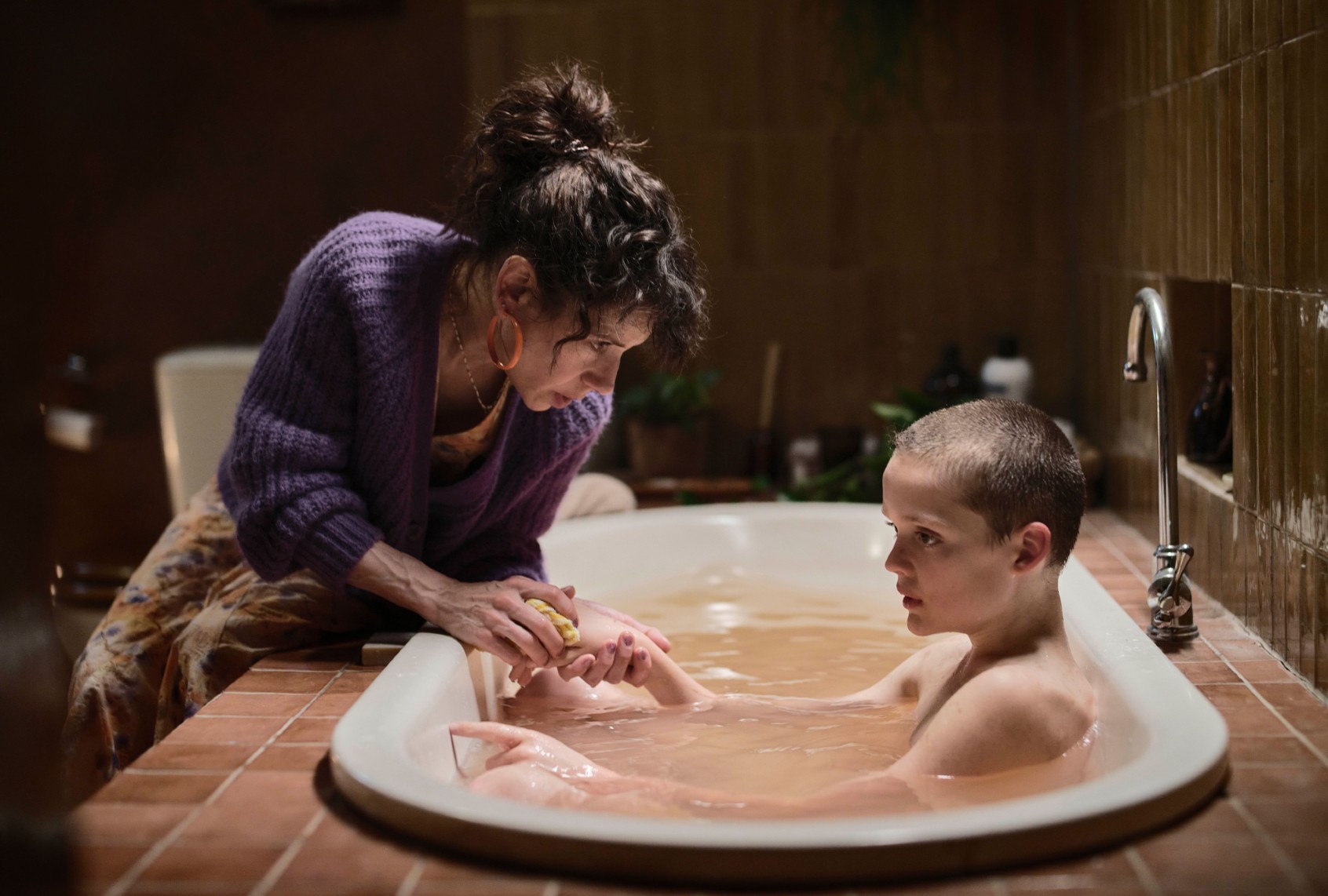
“I think the [thematic] cohesion is what drew Sally Hawkins to it as well, from a character point of view, really diving into Laura and her scenes in a human way. Grief is something that’s not obscure. It’s ingrained into the film and the characters.” 

As its title suggests, “Bring Her Back” is as much about saying goodbye as it is the desperation to come face-to-face with a loved one, long after they’re gone. In her first proper horror film, Sally Hawkins stars as Laura, a seemingly doting foster mother to Andy (Billy Barratt) and his little sister Piper (brilliant newcomer Sora Wong), who has low vision. Laura lost her daughter, who also had limited vision, some years prior, and has devoted herself to foster parenting in the wake of her grief. And though Andy is hyper-protective of Piper, Laura's instant familiarity and comfort around his sister provide an unusual respite. That is, until Laura’s other foster, Oliver (Jonah Wren Phillips), begins to exhibit increasingly strange behavior, which Laura brushes off. In their brief time together, Laura, Piper and Andy strengthen their bond, only to realize how terrifying it is to be stuck to something as it starts to rot.

Though “Talk to Me” rode the wave of recent horror films that build an allegory around grief, “Bring Her Back” is different. It shirks overt metaphor for an atmosphere that is disarmingly intimate and tender, using Hawkins’ warmth to pull viewers in before submerging them in Laura's trenchant sadness. The film is lighter on scares than its predecessor. Still, the Philippous have filled any gaps with fantastic character work and rich, haunting details — like Andy and Piper’s code word, “grapefruit,” which they repeat when they know the other sibling isn’t being honest. In “Bring Her Back,” every solitary frame, needle drop and word of dialogue brims with intention. Yet, despite the movie’s often overwhelming darkness, the Philippou brothers are light and effusive, so excited to talk about their film that they often talk over one another just to finish a point. Earlier this month, Danny and Michael Philippou brought their singular sibling energy to Salon to tell us what it was like making one of the year’s most surprising, affecting films yet. 

Sally Hawkins and Jonah Wren Phillips in "Bring Her Back" (Ingvar Kenne/A24). At the screening in Brooklyn earlier this month, you mentioned that “Bring Her Back” is a film very close to your hearts. I know it’s an emotional subject, but could you explain why writing and making this film was so important to you?
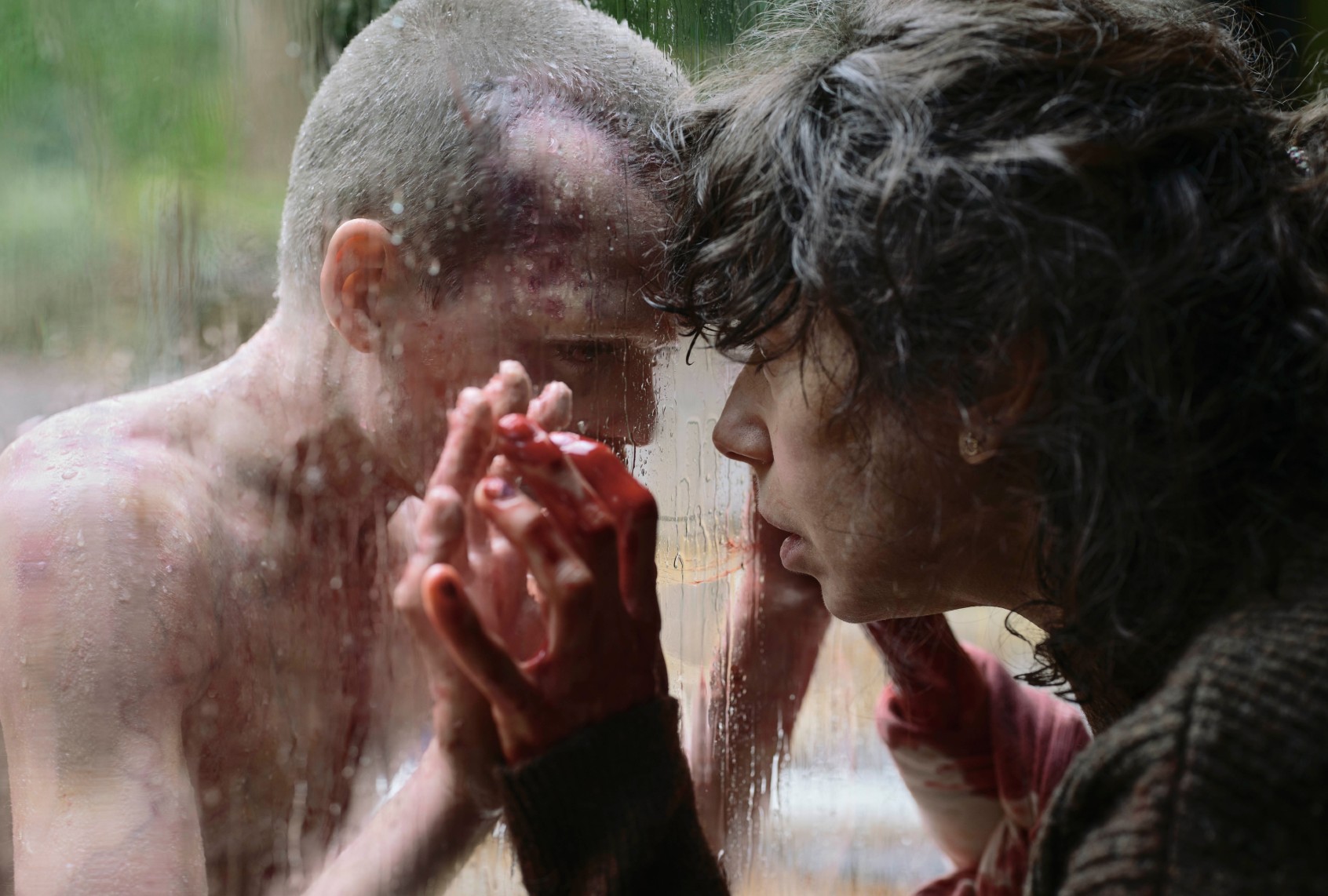
Danny Philippou: Horror — not just horror, any sort of art — when you get really personal, it's a way to exorcise those demons, or to express something you can't entirely put into words. So [making a film] is about drawing from those real experiences and putting them somewhere where you don’t have to carry them anymore. That’s just how we tackle any of the art that we're doing. Anything that we're writing, anything that we're making, is to put ourselves out there and express personal things. It did feel like we were grieving somebody at that time, we just lost them in pre-production, and the film became about saying goodbye to them as well. The best way to make art is to be as personal as possible.

It’s a closed circle. And speaking of, you mentioned at that same screening that you had just wrapped the movie. What were you doing up until the last minutes?

Michael Philippou: The sound mix was the final thing to do, and we were right up against it, trying to get it all done in time. And that's what was surreal about it. We hadn't even processed what the movie was. And then going into showing it, it was like . . .

Danny Philippou: Oh my God, so terrifying. I got up for that Q&A, and at the start, it was like, I can’t even speak. 

Tell me about how you strived to make grief overwhelm this film, because the feeling envelops this entire movie, as opposed to being just an allegory or metaphor.

Danny Philippou: Naturally, because it was happening at the time. Films that were written to be scary turned out really sad because of what we're going through. And in the script writing process, it's about having that lived history, or having this thing that's tying all of these characters together. When you're telling a story, everything is serving the theme, it's not just the metaphor; the characters are serving this theme, the environment is serving this theme. We’re making sure it all ties together — even the sound design and the rain representing these characters’ grief. That feels like you're telling a cohesive story, when that all ties back to this one thing.

Michael Philippou: I think that's what drew Sally to it as well, from a character point of view. Really diving into [Laura] and her scenes in a human way. Grief is something that’s not obscure. It’s ingrained into the film and the characters. 

Danny Philippou: But there are metaphorical things there, and there are certain scenes that are representing different stuff that’s a bit more vague. [Laughs.] Which I like as well! But having the main thing be grief, it’s like, don't hide that it’s about that. There’s no shame.


Want a daily wrap-up of all the news and commentary Salon has to offer? Subscribe to our morning newsletter, Crash Course.


Let’s talk about Laura. She’s a woman who’s dedicated her life to taking care of children until hers was taken from her, and it transformed her love into all-consuming darkness. How did you approach that balance, where Laura is incredibly monstrous but also very human? 

Danny Philippou: It comes from working through the character with Sally. It’s like, “Don’t look at this through a horror lens, look at this through a human lens. What is actually happening here?” A big thing for the film, and having a character to uncomfortably empathize with, is showing that she’s struggling with what she has to do. This isn’t an easy thing for Laura [to hurt these kids]. It’s not like, “I’m just going to get this done.” She actually, at points in the film, doesn’t want to do this. She’s not an outward villain. The world, this experience and this scenario have twisted her into something else. 

Jonah Wren Phillips and Sally Hawkins in "Bring Her Back" (Ingvar Kenne/A24). Sally brings this film so much in terms of humanizing what would otherwise be a very grotesque, supernatural story. What was it like to get the call that she was on board for this? Because you’ve mentioned that you didn’t think she’d be interested in this film.
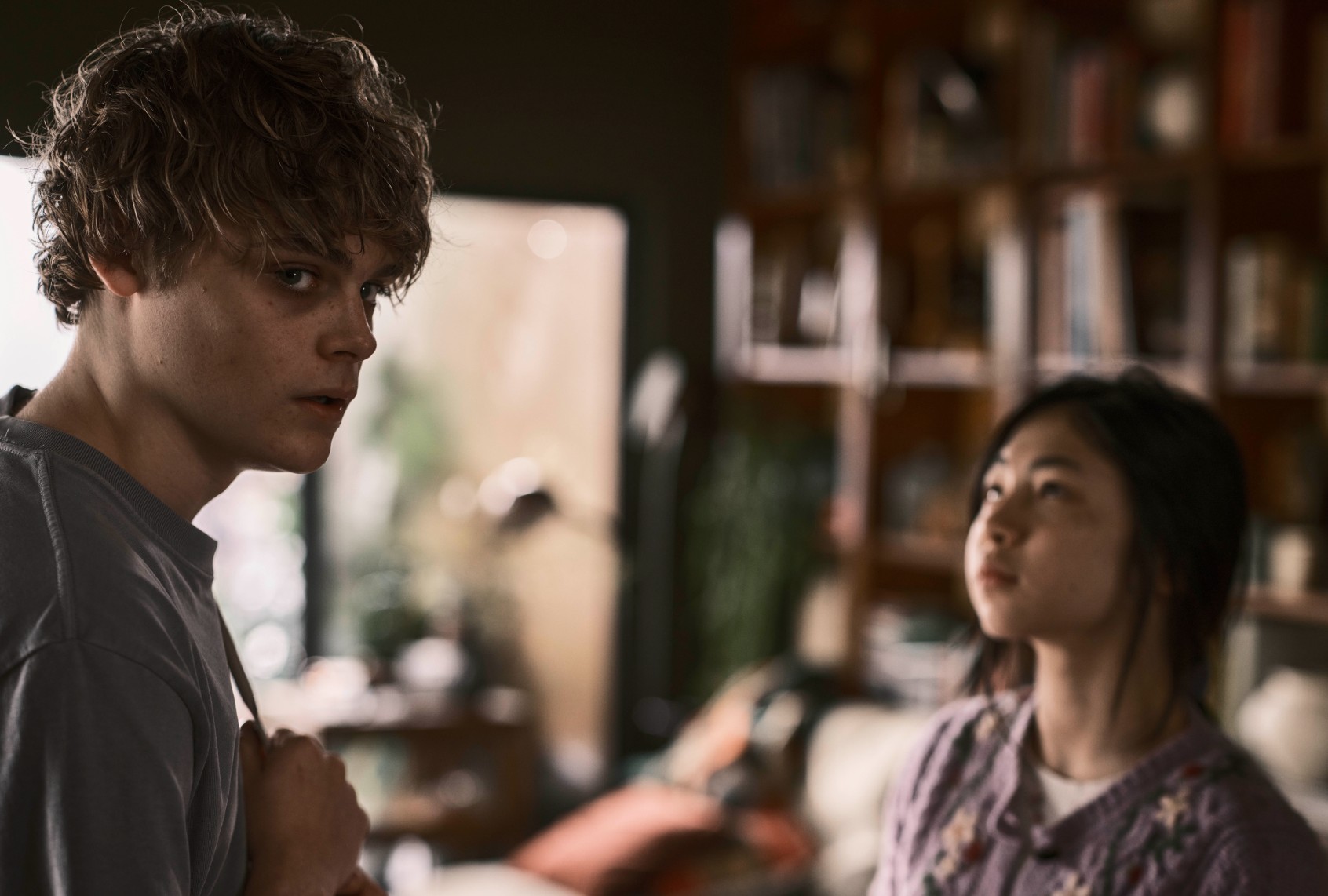
Michael Philippou: No f**kin’ way we didn’t! [Laughs.] We’re such big fans, but we even got told that our energy and hers are so different that it would never work. But hearing that she was interested in it, and chatting with her . . .

Danny Philippou: She really, really connected with it. Sally loved the script. And she never looked at it, like, “Oh, I'm gonna try a genre film now!” She just connected to Laura as a character. She wasn’t looking at it through any genre lens, it was purely from the character. And that was the conversation with her. She was picking up on the smallest little details, asking about them, and the conversation with her felt so natural. It felt like we'd known her forever. And once we got off the Zoom, it was like, “We have to make this work. Whatever we need to do to have her in the film. Please.” We love her so much.

“It was the most amazing thing, seeing Sora from the start of production and watching her at the end. She had all these doubts she could do anything, and then at the wrap party, she’s scream-singing and jumping along, having the time of her life. They were two different people.”

She seems like someone who would gel well with you guys! She seems like she can let her hair down.

Michael Philippou: She’s so much fun. There’s times when you just want to hang out with her. The most fun thing was on the weekends, watching movies with Sally, and getting inspiration for the scenes.

Danny Philippou: And someone that you’re comfortable with, you can ask, “Can we just go to the set at 5 a.m., and film Laura in this environment?” And she’s like, “Yeah, let’s do it!” So it’s just us, her and the cameraman. No one else is there. We’re just in this world together. She was down for all that kind of stuff. 

Michael Philippou: Working with someone who’s that passionate and involved and who cares that much is the most amazing.

Danny Philippou: She wasn’t phoning it in.

Billy Barratt and Sora Wong in "Bring Her Back" (Ingvar Kenne/A24)I want to talk about Sora Wong. She’s magnificent in this movie, it’s so hard to believe this is her debut. She’s so natural and vulnerable. Tell me what it was like working and settling into this character, because in the film, she reads so game for everything, like the wild scene where Piper, Laura and Andy are all getting drunk together.
Danny Philippou: She was nervous about all of that stuff. She was like, “I don't know if I can sing on camera. I don't know if I can dance on camera. I don't know if I can cry on camera.” She had these walls put up and these doubts that she put on herself, and then the film was about getting her comfortable to be able to express herself in the most outward way. It was like, “This is a safe place. You don't feel embarrassed about [anything]. There is no such thing as a bad take. There's no such thing as you doing something wrong.” It's about expressing ourselves here and getting people comfortable to be able to portray these characters. It was the most amazing thing, seeing her from the start of production and watching her at the end. She had all these doubts she could do anything, and then at the wrap party, she’s scream-singing and jumping along, having the time of her life. They were two different people. 

Michael Philippou: It was an amazing transformation, seeing her from the beginning of the shoot to the end. Because the last shot with her was the last scene that we shot, and so there are so many emotions that need to be conveyed in a subtle, human way. And she just nailed it. We purposely built up to those bigger moments, and seeing that translation was incredible. 

Danny Philippou: We mentioned grief, and she was talking about how she wished she'd learned Japanese so she could’ve had a proper conversation with her grandfather. She has experienced these things and this world feels so lived-in; allowing the actors to put themselves into the roles, change dialogue if they need to, pick their outfits, act out scenes that aren't even in the movie but give [the character] a sense of history — that stuff's all important.

On a more micro-level of detail: The needle drop of The Veronicas’ “Untouched” in that wild, pivotal scene where Laura is trying to cover her tracks. Was that song written into the screenplay, or was that a decision that came later on? The lyrics, “I need you so much, I can’t forget you / It’s not enough to say that I miss you,” are so strangely appropriate to Laura’s situation and her loss. 

Michael Philippou: There’s a reason for that genre and that song. But the exact song wasn’t in the script.

Danny Philippou: We knew that part of Laura’s character, whenever she has these nerves or anxiety, she blasts pop music. She’s using that to calm herself down. The whole film is about perspective and different perceptions. You’re hearing this song, you’re thinking she’s upbeat, but she’s actually in this terrible place. Something really horrific is happening in that upstairs bedroom. Music supervision, for picking the exact song, our guy, Andrew Kotatko, is incredible. The home videos of her daughter that Laura watches are a helpful way of grieving, and we have this inversion of the twisted tapes of resurrections that she’s watching at the same time. It’s like the scene that goes into Yoko Ono towards the end, when Laura’s quickly cleaning up the house. There’s a music inversion [to the scene’s tone], which we love.

Michael Philippou and Danny Philippou behind the scenes of "Bring Her Back" (Ingvar Kenne). Staying on the minute details, I need to ask you about “Grapefruit.” How did you choose that word to be the one Andy and Piper say to each other when they’re asking each other to be brutally honest?

Danny Philippou: When you're writing these characters and you're putting yourself into these films — it’s the same with my co-writer, Bill Hinzman — everything is drawn from real places. And “grapefruit” is the actual word that he uses with his partner. “Grapefruit, I'm being serious right now.” He uses that word. So that's where the exact word came from.

Danny Philippou: It adds such a big [theme] of truth and lies. Piper has to trust Andy 100%. He is her eyes. So that's a word that’s like, “You have to be straight with me.” And for him not to be honest with her drives the wedge dividing them.

I’d imagine using one word like that is tricky, because if you use it too much, it could feel cloying or like it’s preying on the audience’s emotions.

Danny Philippou: It’s one of those things where you don’t know. I remember those questions [from the studio]: “Is anybody going to get what the hell ‘grapefruit’ means?” Like, I’m pretty sure! They’re like, “Do we need a moment where we explain what the word is?” 

What do you think your relationship as brothers brings to a movie like “Bring Her Back?” It’s so firmly about family, and you two seem like you have a great sibling rapport like Piper and Andy.

Michael Philippou: I don’t think so!

Danny Philippou: I don’t think so either! [Both laugh.]

Michael Philippou: It’s interesting, the film is less based on our relationship and more about who Piper and Andy are based on. There are small things about it, but not overtly. 

Danny Philippou: What’s wrong, Michael? What’re you embarrassed about?

Michael Philippou: I’ll tell you one thing I was inspired by. It was Andy hitting Piper. That’s your older sibling. Our older sister drugged us when we were babies because she was jealous that we were getting all the attention.

Danny Philippou: Such an inappropriate story to tell, but yeah, she did try to kill us. [Laughs.]

As someone whose sister dropped him on his head as a baby, I can relate. 

Danny Philippou: Thank god!

“Bring Her Back” is in theaters nationwide.

“Stick to spaceships”: Musk interview grows tense during grilling on Trump admin policies

Elon Musk wants everyone to know that he's a different man from the one who was serving in the Trump administration earlier this week. 

In a pre-taped interview with CBS Sunday Morning that took place while Musk was still serving under Donald Trump, the SpaceX head bristled at mentions of the Trump administration's policies and tried to steer the conversation toward his rocket business. Musk brushed off questions from CBS' David Pogue about Trump's tariffs and the Department of Homeland Security's attempted crackdown on foreign students before attempting to set terms. 

"I think we want to stick to the subject of the day, which is, like, spaceships as opposed to presidential policy," Musk said. 

"I was told anything's good," Pogue shot back. 

"No…well, no," Musk said.

Pogue eventually got Musk to talk about his time in government, letting the billionaire on how "unfair" he was treated after taking a chainsaw to significant portions of the federal government. The world's richest man, whose lay-offs and buy-out programs cut more than 25,000 federal employees, took offense at becoming "the whipping boy" for government cuts.

"If there was some cut, real or imagined, everyone would blame DOGE," Musk said, before admitting that he does want to heavily reduce government spending. "I'm like a proponent of smaller government, not bigger government. So, now if somebody's a proponent of, you know, more government programs and bigger government, and they see, 'Hey, DOGE is cutting all these government programs,' then they'll be fundamentally opposed to that because they just think the government should do more things."

Watch the entire interview below:

The best salad dressing? Fancy ranch

I love a good vinaigrette. I mean love it — in the way one loves a very specific pen, or a particular font of sparkling water: a devoted, slightly niche affection, underlined with ritual. Every few months, usually on payday, when the world feels flush and possible, I make a pilgrimage to the fancy Italian sausage shop in the next neighborhood over and buy a new-to-me vinegar. White balsamic, pomegranate, one that tastes like garlic in a velvet cape. I like the drama. I like the tang. I like a dressing that makes your mouth do a little gasp.

Don’t get me wrong: I’ll happily eat a bowl of arugula with nothing but olive oil and lemon, feeling clean and little smug and mildly French, like a woman who writes her grocery lists on notecards and lives near a goat. But, and I think you may agree with me, there are few things more viscerally satisfying — more undeniably correct — than dragging a crisp radish slice or a ridged potato chip through something cold, creamy and tangy enough to make your salivary glands seize. 

Ranch dressing is a sensory shortcut to pleasure: multiple alliums, acid, umami, herbs, suspended in a plush, mayo-forward cloud. It’s comfort. It’s nostalgia. It’s maybe a little trashy, in the best possible way. 

Which is why I’m a little embarrassed, but mostly evangelical, about what I’ve come to believe: ranch dressing is the best dressing. And the best ranch, I’m starting to think, might be fancy ranch.

I’m talking miso-spiked tahini blends from the Bon Appétit test kitchen. I’m talking lemony labneh swirled with cilantro-chili oil. I’m talking $9 tubs of “green goddess” dips from upscale grocers that still hit the ranch part of your brain like a gong. Velvety, herby, tangy creations that feel like little edible love notes to the original.

Before it was America’s sweetheart-slash-punching bag of condiments, ranch dressing was a solution to a logistics problem. In the early 1950s, plumber and construction foreman Steve Henson was working in the Alaskan bush, where perishables like fresh herbs and garlic were hard to come by. So he did what any practical man with a taste for creamy salad dressing might do: he made do. Using what he had — dried herbs, powdered garlic and onion, black pepper — he whipped up a blend that could be stirred into mayonnaise and buttermilk to make something tangy, herbaceous and addictive.

"I’m a little embarrassed, but mostly evangelical, about what I’ve come to believe: ranch dressing is the best dressing. And the best ranch, I’m starting to think, might be fancy ranch."

A few years later, Henson and his wife, Gayle, opened a dude ranch in Santa Barbara County called, in a stroke of eventual marketing serendipity, Hidden Valley Ranch. There, Henson served his house dressing to guests in mayonnaise jars. It became a hit. Demand spread, and within a few years the Hensons were selling envelopes of the seasoning mix by mail, so people could recreate the magic at home. Just add buttermilk and mayo, and you had a little taste of California dude-ranch hospitality — no horse required.

By 1983, ranch had gone shelf-stable and truly national, available in squeeze bottles, pump dispensers and foil-topped tubs across the country. It became the people’s dressing: a dunk for baby carrots, a drizzle for pizza, equally at home next to a pile of atomic-red buffalo wings or a crisp wedge. According to a 2017 industry study, ranch remains the most popular salad dressing in the U.S., beloved by 40% of Americans. (Italian dressing trails behind at a distant 10% like a politely clapping runner-up.)

We need your help to stay independent

However, ranch’s overwhelming popularity has also been its greatest liability. 

It is, without question, one of the most widely consumed condiments in the United States — a fact that would, on its face, suggest greatness. But in the strange math of food culture, popularity often equates to suspicion. Like iceberg lettuce or American cheese, ranch has become shorthand for everything supposedly wrong with the national palate.  In one Washington Post op-ed, a columnist declared ranch “what’s wrong with America,” adding, “fancy restaurants need to stop experimenting with this revolting milk-rot.” And in Delish, one contributor simply wrote: “Keep your processed AF, globby dressing away from me.”

The criticism isn’t without merit. The squeeze-bottle version of ranch — stabilized, shelf-stable and engineered for maximal cling — is not exactly what anyone would call elegant. But there is another ranch. And it is good.

Now, I actually first started noticing this during the height of the New Southern movement. You may unfortunately remember the era through the parts that quickly calcified into cliché: $14 cocktails in Mason jars, the monoculture of pork belly, a nationwide proliferation of flaccid fried green tomatoes. However, as a displaced child of the Midwest, I quietly delighted when the dressing began appearing in places it hadn’t quite belonged before. There it was, adorning $18 iceberg wedges at bistros with Edison bulbs and reclaimed-wood banquettes; served alongside housemade chips in ramekins barely larger than communion cups; slicked like a balm onto spicy Nashville-style hot chicken sandwiches that made your fingers shimmer with grease.

They weren’t exactly reinventing the wheel. More often than not, these were just simple ranches made with care — good buttermilk, what was probably Duke’s and a handful of punchy herbs snipped into a stainless steel mixing bowl. Nothing fussy. Just cold, creamy proof that someone had paid attention.

But the version that got me thinking differently — that nudged me toward the edges of what ranch could be — was Chris Morocco’s tahini ranch, published in Bon Appétit in 2017. It’s built on tahini, lemon juice, miso, maple syrup and water, punched up with spices. The result is velvety and plush, with a kind of savory-luxurious sweetness that clings to everything it touches. I make it at least twice a month, mostly as a dip for sugar snap peas or thinly sliced cucumbers, though it’s also played supporting actor in one of the best chicken salad sandwiches of my life , built on toasted sourdough with butter lettuce and a few rings of red onion.

That dressing opened the door. From then on, I was game to try anything with a vaguely ranch-adjacent profile—a curiosity that inevitably leads to questions about where, exactly, ranch begins and ends. Calvin Eng’s take (another favorite) anchored by Kewpie mayonnaise, garlic chives and a pinch of MSG, falls squarely within the bounds. 

Allison Roman’s “The Dip” stretches the category a bit further. She calls it “a very high-brow version of ranch dressing,” though its components — scalliony chile oil, briefly sizzled with cilantro stems (or chives), folded into thick, lemony labne — may read as a departure. Still, it hits the same emotional notes: creamy, tangy, herbal. 

In the end, that’s what ranch comes down to: not the ingredient list, but the feeling.

Ranch doesn’t need a rebrand. It just needs a little respect — and maybe a few upgrades. The good stuff isn’t cloying or gloopy or overly complicated. It’s sharp and creamy, cool and salty, built with care and a little imagination. Maybe it’s tahini. Maybe it’s labneh. Maybe it’s mayonnaise and a packet of seasoning, stirred together in a quiet kitchen on a Tuesday night. Whatever the form, the point remains: ranch is a dressing worth dressing up for.

“Soulless, mindless entities”: Trump shares QAnon conspiracy theory suggesting Biden is a clone

Posting to Truth Social late Saturday night, Donald Trump boosted a claim that former President Joe Biden was a clone. 

"There is no #JoeBiden – executed in 2020," the reshared post reads. "#Biden clones, doubles & robotic engineered soulless mindless entities are what you see. #Democrats don't know the difference."

The claim that body doubles or clones have replaced some celebrities for nebulous and nefarious reasons holds some purchase among members of the far-right. And to give some credit to Trump, it's entirely possible that he skimmed the text and thought it aligned with his frequent claims that Biden was puppeteered throughout his second term

The president has been amplifying right-wing internet conspiracies for years. He gave subtle nods to QAnon, the online cult that believes Trump will usher in a great "storm" that will cleanse sex traffickers and child abusers from positions of power in the United States, while campaigning for a second term. His campaign elevated unfounded beliefs about gang and cartel activity in the country and raised the profile of an entirely fabricated claim that Haitian immigrants in Ohio were eating local pets. In the latter case, Trump's insistence that recently resettled Haitian immigrants were "eating the cats" and "eating the dogs" led to bomb threats in the city of Springfield.

Still, delving into talks of cloning grown humans — something that is not scientifically possible in the present — is a big step into the murk of the GOP's tin-foil fringe.