Spring Sale: Get 1 Year, Save 58%

“Lightning in a bottle”: How Taylor Swift and Travis Kelce’s love story inspired a Hallmark movie

The world has been entranced with Taylor Swift and Travis Kelce's relationship ever since she was seen sitting in a box seat at the Arrowhead Stadium in Kansas City, Missouri last year to watch him play football.

"Everyone is rooting for them."

The rest is history. The pop star and Chiefs' tight end gallivanted around the world together, and Kelce ended up joining his girlfriend on stage performing at the London Eras Tour date earlier this summer. Their love has even inspired the Hallmark Christmas movie, "Holiday Touchdown: A Chiefs Love Story." In the movie, Alana (Hunter King) is the third generation in a family of Chiefs superfans, who believe that a special knit hat they own has the power to get the team to the Super Bowl. In turn, they're convinced that the Chiefs have also brought them love. As they family is in the running to win the Fan of the Year contest, Alana falls in love with Derrick (Tyler Hynes), a man who works for the Chiefs and helps determine the winner of the competition.

I spoke to the stars of "Holiday Touchdown" at New York's Park Lane Hotel, which was already decorated for Christmas. During our interview, King and Hynes raved about how people like Swift and teams like the Chiefs bring such unity and togetherness.

"When I went to Taylor Swift's Eras Tour, I just would look around and see everybody experiencing the same thing at the same moment, and everyone was impacted emotionally in a different way," said King about attending the tour in Missouri.

Like Taylor Swift, "Holiday Touchdown" shows how the Chiefs, the spirit of Christmas and a little healthy competition can bring people together. Travis' own mother Donna Kelce even shows up to make a cameo in the film. Oh, and a Chiefs superfan who happens to be a cat also joins in on the fun.

Check out Salon's interview with the stars, who discuss their current Swift era and what it was like meeting Donna Kelce . . . and the scene stealer known as Catrick Mahomes.

The following conversation has been lightly edited for clarity and length.

While this story isn’t about Taylor Swift and Travis Kelce, their romance was likely an inspiration for it. What can you say about the impact of that couple becoming such a cultural phenomenon?

Tyler Hynes: It feels like everybody's rooting for them. That's such a lovely thing, when you have such a universal thing that people are getting behind. There are rare moments like that it seems as of late. [To] have everybody be rooting for them. It feels like a similar feeling, if you're talking about inspiration to the movie. It's kind of what's happening in the movie. Everybody's rooting for her character to get what she wants, to find love, and to really find and reaffirm her faith in this team and this tradition and family and all those wonderful things. While it's not a Taylor and Travis' story, there's obviously an inspiration from their love, as so many other things are.

Hunter King: It truly does feel like everyone is rooting for them. You feel that in this film as well, whether it's everyone collectively rooting for the Chiefs, rooting for us, rooting for Alana – you definitely feel that kind of love. I think that the Chiefs have bottled up that love that they have for each other, and it's just like lightning in a bottle, and everyone wants a little piece of it, wants to learn from it.

Hynes: When you see their huddles, like pregame stuff it just hypes you up, and you're just like, "Yeah, that's a real family."

Alana’s family is closely associated with the Kansas City Chiefs, to the point that there’s even a legend associated with the team and their relationships. Are there any stories that each of your families have handed down that have taken on a life of their own?

Hynes: There's a thing in Nova Scotia, Canada, where my grandparents are from, and it's a food item. It's called rappie pie, and it looks like prison food. It looks pretty unpleasant. Maybe prison food is delicious. I've never been in person, so what can I say? Doesn't look good. It looks like somebody ate the food and then gave it back to the plate, and then you're eating it again.

But it's like mashed potatoes with the starch that has been taken out. So it's like a clear jelly, and it's chicken, and you put butter and salt and pepper, and it's incredible. There isn't a person in the world who doesn't eat this thing. It's just like, "Oh my god, this is delicious." The most comfort food. They've passed that on. Nobody knows what rappie pie is, except for maybe a small population. My parents have brought that into our lives. Every Christmas, people fight over it, not friendly. They love it. 

King: My favorite thing is when my grandma gets a little bit tipsy, and then she'll share family secrets with me from way back in the day when she was a kid or about her grandparents. I'm gonna hold those near and dear to my heart, and she's sworn me to secrecy. But it is the best when she gets a little drunk. Tell me all the gossip.

Hynes: Naughty inside!

King: Oh yeah! *mimicking her grandma's voice* This person got in trouble! Never believe Uncle Timmy, like all that. Now I just know so much. I don't know half the people but I know what they did.

Holiday Touchdown: A Chiefs LoveChristine Ebersole, Ed Begley Jr., Diedrich Bader, Megyn Price, Hunter King and Tyler Hynes in "Holiday Touchdown: A Chiefs Love Story" (Hallmark Media/Matt Hoover)What can you say about the importance that sports can play when it comes to fandom and how they identify with a team? Do either of you feel that way about any sport or team?

King: I think it just brings people together and to experience something collectively as a whole. I know right now we're talking about sports, but even when I went to Taylor Swift's Eras Tour. I just would look around and see everybody experiencing the same thing at the same moment, and everyone was impacted emotionally in a different way. It just brought me to tears thinking how everyone was different in this moment and experiencing such joy altogether. That's what sports do for a lot of people, is they just bring everybody from different walks of life together to root for one thing, and people that maybe you would not have met before, and it's just such a special thing and such a bonding experience. People get to do [it] with your friends and your family. It creates a lot of tradition.

Hynes: I keep watching sports documentaries lately. I've been going on a run like I watched the Boston Red Sox beat the [Curse of the Bambino]. I get emotional watching these sports documentaries I'm finding. It's this underdog putting it all on the line, and just everything culminating to a moment and how precise and precious or fleeting that thing is. It's a really interesting thing that our culture, just being witness to, finds that same feeling that they feel doing it. That's a really fascinating, connective thing that our culture all engages in.

It's crazy that we have as much sports as we do. We have so many different facets of it. A lot of them are so elaborate. They're constantly evolving. It's fascinating. Now finding football for myself and looking into it more closely, how it all works and this team, it's a well that keeps filling. Even if it's an enemy on a different team, there's still a camaraderie there. Like our writer Julie Sherman Wolfe is a 49ers fan. Despite the fact that she hates my guts, doesn't mean we don't love each other.

"It just brought me to tears thinking how everyone was different in this moment and experiencing such joy altogether."

Another large part of this movie is superstitions. Superstitions are incredibly important in sports, not just with Alana’s family. What sort of superstitions do you have, if any?

King: I don't have a sports superstition. Although during these interviews, I realized I maybe should adopt [one], but we are working like a collaborative superstition as a team, team being me and Tyler. But mine is just simple: if I see the clock and it says 11:11, and I don't make a wish, I'm just scared of what's to come like the universe will punish me. So I have to make a wish at 11:11 if I see it.

Hynes: She takes it to a dark place. It's supposed to be a positive right?

King: Well it is a superstition! I want something amazing to happen or even neutral. But you just can't miss it.

Hynes: I've never been like a superstitious person. I'm a skateboarder. We risk our body parts when we do certain things.You know what? I may have just discovered my only superstition. When I'm skateboarding, whenever I would start thinking of the worst case scenario like if there's a rail going downstairs, like, "Oh, if I don't do that, then I'm gonna end up there, and my children will never be born." Those kinds of things. Yeah, I would go, "I have to do it now." I would force myself to do it.

King: That's kind of a good superstition.

Hynes: It was like if I didn't do it, then you would never do it. There would be repercussions of some kind, so I'll force myself. That has become a superstition. 

Holiday Touchdown: A Chiefs LoveRichard Riehle, Christine Ebersole, KC Wolf and Donna Kelce in "Holiday Touchdown: A Chiefs Love Story" (Hallmark Media/Joshua Haines)

Tying this back to Taylor Swift and Travis Kelce, his mother Donna Kelce also makes a cameo in the movie. What was it like on set when she was there? She also appears this season on the other Hallmark movie “Christmas on Call.”

Hynes: We don't talk about that Christmas movie!

King: She was very popular. It was like being with the cool girl at school. Everyone wanted to talk to her. Everyone wanted to see her, see what she was wearing and see what she was doing. But then it's as if the cool girl was also the nicest person you've ever met, which makes it even better. So she was the popular cool girl – popular, cool, nice girl on set, and we couldn't get enough of her.

Hynes: It's true.

King: We love Donna.

Of course, there were Chiefs stars there, including players Trey Smith and Trent Green, and Chiefs coach Andy Reid, not to mention the KC Wolf (with the googly eyes). What was it like working with each and experiencing the love of football with them too?

Hynes: [Trent] was like a legend of a man and he was so personable and was a good actor. Handsome, might I say! It was a unique experience having them all there. It was really wholesome. Everybody had such fun doing it. It didn't seem like people were getting nervous about things. Certainly, watching me perform makes everybody feel comforted knowing that the bar is down there.

King: Oh, stop it.

Hynes: Trent — remember how funny he was?

King: Yeah, he was phenomenal. It was the whole thing. He was great. Everyone was great. Everyone lived up to the expectations and more. It seemed like they had all done it many, many times before.

Hynes: Trey had his lines like an hour before he was acting.

King: He was off-book, ready to go! 

Holiday Touchdown: A Chiefs LoveCatrick Mahomes and Hunter King in "Holiday Touchdown: A Chiefs Love Story" (Hallmark Media/Joshua Haines)This is a question from my editor: What was it like to have a cat that dressed like Catrick Mahomes on set? Did you take a selfie with him?

King: Oh yeah.

Hynes: There were tons, too many selfies. 

King: I love that cat. He was so huge. He was so chill.

Hynes: Aloof.

King: He was very, very cute, and he was just so chili, just out there the whole time. I think he got up once, and everyone's like, "Oh wait, where's he going?" He's the real star of the show.

Hynes: He covered a lot of ground too. There was a large surface area that he took up!

He's pretty big?

Hynes: Big boy!

King: Do you remember how much he weighs?

Hynes: No! It was a lot.

Did y'all lift him?

Hynes: There was a moment I tried to lift him . . . Catrick, lay off the Häagen-Dazs.

Are either of you Swifties? I know Hunter you mentioned Era's Tour. What date did you go to?

"There's an authenticity."

King: I went to the Kansas City Tour. My sister [actress Joey King] was in her music video and she got to come out on stage. They showed the music video, and [Joey] introduced her on stage. It was incredible. I've been a Swiftie for a very long time, but that was just, I've never been more proud in my life watching my sister up there in front of this crowd full of thousands of people like 60,000 at Arrowhead. Big Taylor Swift fan over here!
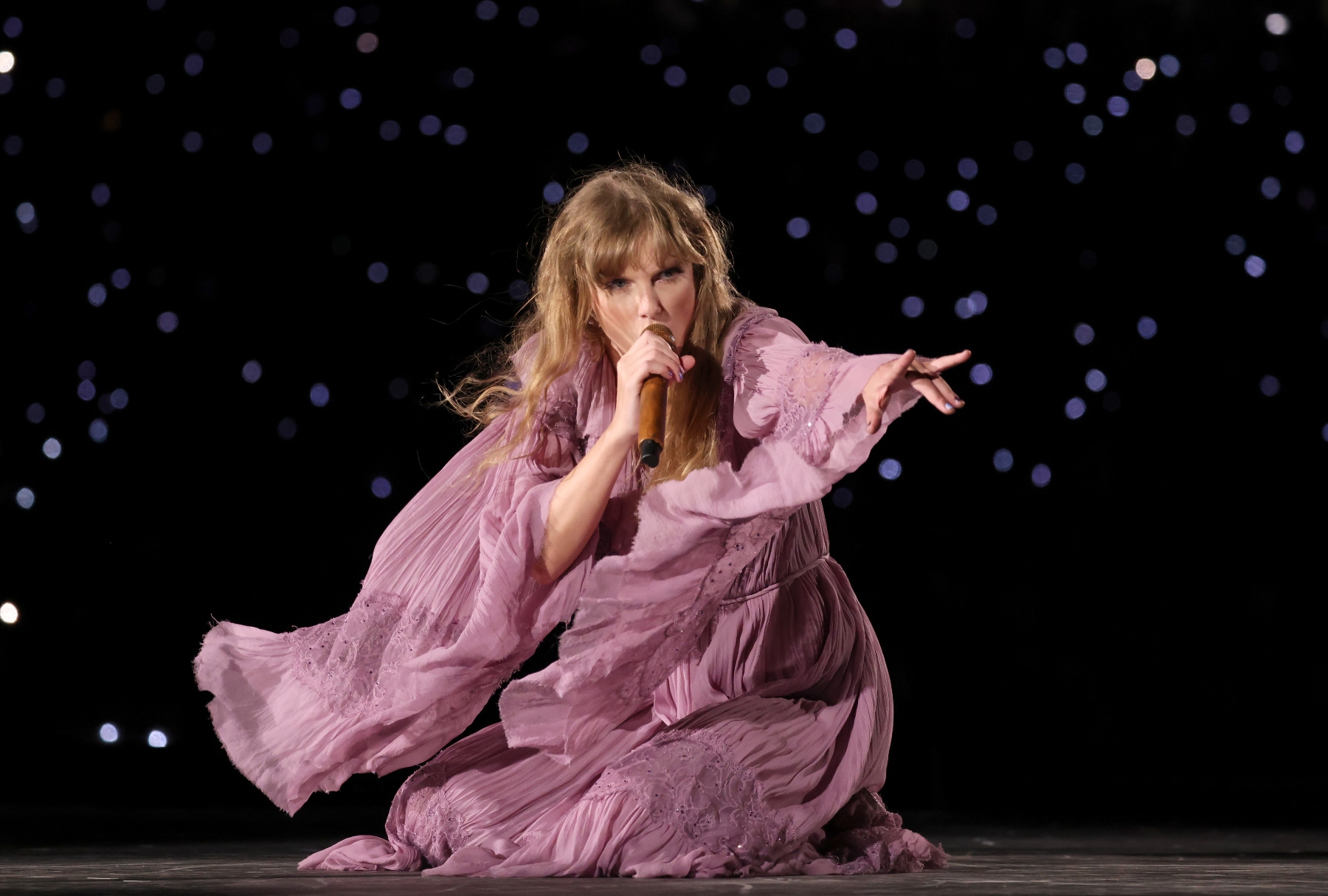
Taylor Swift performs onstage for night one of Taylor Swift | The Eras Tour at GEHA Field at Arrowhead Stadium on July 07, 2023 in Kansas City, Missouri (John Shearer/TAS23/Getty Images for TAS Rights Management)

Was that before or after you filmed this movie?

King: Before! A year and almost a day.

Did it feel like crazy being back at Arrowhead Stadium?

King: Oh, yes, crazy. Then seeing it with an immense amount of her fans, and then when we got to film the scene where the drone shot pulls back, and it's just us in the stands. Seeing it completely empty was just wild. Then going later for the first opening day game, and then seeing it full of Chiefs fans. It was just seeing it in all different capacities was amazing.

Hynes: My [Swiftie] application is still pending. I wouldn't be so brave but I've watched a few documentaries as I do about everything. I love documentaries. There are three films I shot prior to shooting this movie. There's a young woman named Chloe who played my daughter in these films, and she is a huge Taylor Swift fan. I wore a Swiftie-style bracelet in the movie for her. She gave me a grocery list of songs I should listen to.

There's a few songs that I had already loved. I watched a documentary about her and I really started to understand. Again, it's wild because there are similarities between her, the Chiefs and Hallmark. There's an authenticity and an attention to detail that is shared by few. I understood why there is such a deep connection with this person who is turning out such an abundance of music and has such a legacy that she's leaving. It's this thoughtfulness that seems to be the connective tissue between Hallmark, Chiefs and Taylor. I saw that and watched the documentary . . . but I can't sing all the lyrics.

King: But you're in a "Lavender Haze."

If you had to pick a Taylor Swift album that represents the era that you're in right now, what would it be?

King: I don't know! There's just too many. I love "Midnights" and "The Tortured Poets Department."

Hynes: Which one was the one that had "Trouble" on it?

King: "Red." "Red" was a great album. "1989" was great. We could go on. I don't have a favorite. I love them all for different reasons.

Hynes: I got into "Red" and "1989" in Europe. I got in those discographies. 

King: I have some more for you!

We need your help to stay independent

Who are the bigger fans: football fans or Swifties?

Hynes: That's tough.

King: Oh, that's really tough. It might be a tie.

Hynes: You can't give it a tie. You got to draw a line in the sand. No one wants that. Viewers are going to be like, "No!" I'm gonna say Swifties.

You heard it here first!

King: International pop star!

Hynes: If you come for Taylor, they come for you! Somebody comes for football, you might walk away. 

King: We protect our queen!

"Holiday Touchdown: A Chiefs Love Story" premieres Saturday, Nov. 30 at 8 p.m. ET on Hallmark Channel.

“He’s a mythic figure”: Gingrich fawns over Trump after Zuckerberg visit

Former House Speaker Newt Gingrich likened Donald Trump to heroes of ancient epics in a fawning interview with Fox News’s Kellyanne Conway.

During a stop by "Hannity" on Friday, Gingrich rationalized Meta CEO Mark Zuckerberg’s meeting with Trump as a sign that the Facebook boss understood the president-elect's special place in the world.

“I think the only way you can begin to understand this is to take Trump totally outside of normal American politics and recognize that he's a mythic figure,” Gingrich told Conway. “He’s like some of the people who come out of the Viking sagas.”

One of Trump’s earliest GOP backers, Gingrich added that the president-elect survived a shooting and bested Kamala Harris because he was a "genuine, historic leader."

The former speaker claimed the tech billionaire and other powerful figures’ embrace of Trump was a sign of a “cultural change that you see maybe twice in a century.”

Some, including The New York Times's Maggie Haberman, saw the Meta CEO’s Wednesday trip to kiss the ring at Mar-A-Lago as an indication that big tech figures are cozier to Trump than during his first term.

“As with a number of industries, but certainly the tech industry, a lot of people coming to Trump and not the other way around,” Haberman said in a CNN interview on Wednesday night. 

Mar-A-Lago, the center of Trump’s transition, has hosted former Trump critics like Zuckerberg, MSNBC’s Joe Scarborough and Mika Brzezinski, and Canadian Prime Minister Justin Trudeau in recent weeks.

Too good to go? The second life of leftovers

Leftovers have always been a bit of a culinary underdog. In pop culture, they’re the sad, wilted contents of plastic containers relegated to sitcom refrigerators — proof of a dinner gone unloved. Yet for me, leftovers have never been a source of shame. Growing up in a family of six, including two perpetually ravenous brothers, leftovers were a rarity, and when they appeared, they were a kind of edible jackpot. The prize might be a sliver of Mom’s baked spaghetti or the last spoonful of Dad’s white chicken chili, spooned unceremoniously onto a tortilla chip or two. In a house where food disappeared almost as quickly as it was made, the idea of leftovers as a burden simply didn’t exist.

But the pandemic changed my relationship with leftovers, as it did so many other things. Suddenly, there was no line between breakfast, lunch and dinner — time blurred into endless stretches punctuated by snacks. Cooking at home was both a necessity and a tedium. The monotony of reheating last night’s dinner collided with the allure of delivery apps, which dangled the promise of something new and indulgent. During those early lockdown days, ordering takeout wasn’t just about food; it was also a symbolic act of solidarity with small businesses. Who could resist Thai curry when the alternative was a third day’s helping of tepid spaghetti?

That said, the delivery era was relatively short-lived in my kitchen. Inflation hit, the novelty wore off and my credit card bills needed a break. I found myself cooking more, out of both financial prudence and a desire to regain control of my meals. In my now two-person household, his return to home cooking brought an unexpected companion: leftovers.

At first, I’ll admit they did feel a bit like a chore, a sign of my failure to portion correctly or eat everything while it was fresh. But somewhere along the way, my perspective shifted. Leftovers became less a consolation prize and more a creative challenge. Inspired by books like "PlantYou: Scrappy Cooking: 140+ Plant-Based Zero-Waste Recipes That Are Good For You, Your Wallet, and the Planet” — which I read after author Carleigh Bodrug was interviewed by my colleague Michael La Corte — “Perfectly Good Food: A Totally Achievable Zero Waste Approach to Home Cooking,” and Julia Turshen’s absolutely fantastic “What Goes with What: 100 Recipes, 20 Charts, Endless Possibilities,” I started planning meals with their second act already in mind. A pot of roasted vegetables became the filling for quiche. Sunday’s roast chicken transformed into chicken Caesar wraps for an easy weeknight dinner. 

What I discovered was a subtle joy in this kind of kitchen alchemy. Leftovers weren’t just practical; they were a form of play. Could I turn two cups of rice and some sad parsley into the backbone of a respectable dinner? Could last night’s roasted carrots hold their own in a salad with miso dressing? The answer, more often than not, was yes.

We need your help to stay independent

It seems I’m not alone in my reevaluation. Culturally, leftovers are experiencing a kind of rebranding. Apps like Too Good to Go have turned them into a trend. The app, which matches users with heavily discounted “surprise bags” of food from local restaurants and grocery stores, has become one of my favorite indulgences. One morning, I scored a bag of sourdough bagels from a local bakery, which became the base for towering breakfast sandwiches made with leftover roasted vegetables, scrambled eggs and a swipe of pesto. Another time, I received half a container of meatballs in red sauce, which I transformed into a pizza topped with olives and roasted red peppers. I’ve gotten some slightly stale baguettes which made for great baked French toast.

Even Whole Foods has joined the movement, offering its own grab bags of surplus food via Too Good to Go. A recent haul included a ham sandwich, fresh tortilla chips, pork burritos and a sturdy little tub of mushroom barley soup. 

The cultural shift extends beyond apps. At restaurants, BYOC (bring your own container) is becoming more common, though the etiquette and legalities of the movement remains a bit murky in the United States. In many Asian and European countries, bringing reusable containers to pack up leftovers has become standard practice, a practical nod to sustainability. However, in Chicago, I’ve spotted diners discreetly pulling silicone containers from their bags at both hole-in-the-wall pho joints and glossy small-plates spots, while mainstream food publications, including Eater, have begun championing this practice, calling on diners to take the responsibility of leftovers into their own hands — literally. 

"It’s a charming, if optimistic, vision of a world where leftovers are not just saved, but celebrated."

Pall Musaev, CEO of the reusable container company Mr. Lid, recently told me he’s seen an uptick in people bringing his products to restaurants. Musaev envisions a future where restaurants and municipalities work together to promote reusable containers, perhaps even offering branded, swappable ones. 

“What I love about a reusable container is that it is a net benefit the first time you use it,” he said. “From the first-use it is already reducing the need for one single-use container. I do believe that we need to create a functional product that also allows for self-expression. What does your container say about you? Who's your favorite team? What's your personality like? Do you exude luxury?” 

He said:  “Collaborations will be critical to the success of reusable containers. Not only restaurants, but municipalities will play a key role in facilitating this change by acknowledging gaps in bylaws but also by offering a turnkey solution for patrons and allowing the use of reusable containers. Restaurants and restaurant supply companies could start to get involved and create a turn-key solution of branded, generic containers that are swappable. I believe any restaurant chain that gets in front of this movement will benefit as a leader in the effort to reduce single-use.” 

It’s a charming, if optimistic, vision of a world where leftovers are not just saved, but celebrated.

And why shouldn’t they be? There’s something inherently hopeful about leftovers. To tuck food away for another day is to believe in the future. To trust that you’ll want that pasta again, that the soup will still be good. It’s a quiet act of care, not just for the planet or your wallet, but for yourself.

These days, I see my leftovers as small opportunities — a way to stretch the limits of my creativity, yes, but also a reminder that even the most unassuming meal deserves a second chance.

“I have no respect for you”: Hegseth’s mom said he “abused” many women in 2018 email

Pete Hegseth's own mother accused him of being abusive toward women in a 2018 email. 

Penelope Hegseth reached out to her son — a former Fox News host who is currently under consideration to serve as Donald Trump's secretary of defense — to criticize him while he was going through a particularly contentious divorce. Penelope Hegseth called her son no good and abusive in the flame-throwing message that stuck up for his ex-wife Samantha.

"On behalf of all the women (and I know it’s many) you have abused in some way, I say get some help and take an honest look at yourself," Hegseth's mother wrote. "I have no respect for any man that belittles, lies, cheats, sleeps around and uses women for his own power and ego. You are that man (and have been for years) and as your mother, it pains me and embarrasses me to say that, but it is the sad, sad truth."

The New York Times shared the text of that email on Friday. Penelope Hegseth has since disavowed her statements in the email, telling the Times that their decision to publish the message was "disgusting" and saying that her characterization of her son's treatment of women was "not true" and "has never been true."

Allegations of Hegseth's mistreatment of women have bubbled back up in the days since his nomination to Trump's Cabinet. A woman accused Hegseth of sexual assault in 2017, with the conservative commentator settling out of court with her several years later. The police report from that incident soon resurfaced. Hegseth has maintained that their encounter was consensual. 

Similar allegations have already derailed one of Trump's Cabinet nominations. Former Rep. Matt Gaetz removed himself from consideration for the role of attorney general as multiple investigations into alleged sexual misconduct cast a shadow over the process. 

TV’s Dr. Oz invested in businesses regulated by agency Trump wants him to lead

President-elect Donald Trump’s choice to run the sprawling government agency that administers Medicare, Medicaid, and the Affordable Care Act marketplace — celebrity doctor Mehmet Oz — recently held broad investments in health care, tech, and food companies that would pose significant conflicts of interest.

Oz’s holdings, some shared with family, included a stake in UnitedHealth Group worth as much as $600,000, as well as shares of pharmaceutical firms and tech companies with business in the health care sector, such as Amazon. Collectively, Oz’s investments total tens of millions of dollars, according to financial disclosures he filed during his failed 2022 run for a Pennsylvania U.S. Senate seat.

Trump said Tuesday he would nominate Oz as administrator of the Centers for Medicare & Medicaid Services. The agency’s scope is huge: CMS oversees coverage for more than 160 million Americans, nearly half the population. Medicare alone accounts for approximately $1 trillion in annual spending, with over 67 million enrollees.

UnitedHealth Group is one of the largest health care companies in the nation and arguably the most important business partner of CMS, through which it is the leading provider of commercial health plans available to Medicare beneficiaries.

UnitedHealth also offers managed-care plans under Medicaid, the joint state-federal program for low-income people, and sells plans on government-run marketplaces set up via the Affordable Care Act. Oz also had smaller stakes in CVS Health, which now includes the insurer Aetna, and in the insurer Cigna.

It’s not clear if Oz, a heart surgeon by training, still holds investments in health care companies, or if he would divest his shares or otherwise seek to mitigate conflicts of interest should he be confirmed by the Senate. Reached by phone on Wednesday, he said he was in a Zoom meeting and declined to comment. An assistant did not reply to an email message with detailed questions.

“It’s obvious that over the years he’s cultivated an interest in the pharmaceutical industry and the insurance industry,” said Peter Lurie, president of the Center for Science in the Public Interest, a watchdog group. “That raises a question of whether he can be trusted to act on behalf of the American people.” (The publisher of KFF Health News, David Rousseau, is on the CSPI board.)

Oz used his TikTok page on multiple occasions in November to praise Trump and Robert F. Kennedy Jr., including their efforts to take on the “illness-industrial complex,” and he slammed “so-called experts like the big medical societies” for dishing out what he called bad nutritional advice. Oz’s positions on health policy have been chameleonic; in 2010, he cut an ad urging Californians to sign up for insurance under President Barack Obama’s Affordable Care Act, telling viewers they had a “historic opportunity.”

Oz’s 2022 financial disclosures show that the television star invested a substantial part of his wealth in health care and food firms. Were he confirmed to run CMS, his job would involve interacting with giants of the industry that have contributed to his wealth.

Given the breadth of his investments, it would be difficult for Oz to recuse himself from matters affecting his assets, if he still holds them. “He could spend his time in a rocking chair” if that happened, Lurie said.

In the past, nominees for government positions with similar potential conflicts of interest have chosen to sell the assets or otherwise divest themselves. For instance, Treasury Secretary Janet Yellen and Attorney General Merrick Garland agreed to divest their holdings in relevant, publicly traded companies when they joined the Biden administration.

Trump, however, declined in his first term to relinquish control of his own companies and other assets while in office, and he isn’t expected to do so in his second term. He has not publicly indicated concern about his subordinates’ financial holdings.

CMS’ main job is to administer Medicare. About half of new enrollees now choose Medicare Advantage, in which commercial insurers provide their health coverage, instead of the traditional, government-run program, according to an analysis from KFF, a health information nonprofit that includes KFF Health News.

Proponents of Medicare Advantage say the private plans offer more compelling services than the government and better manage the costs of care. Critics note that Medicare Advantage plans have a long history of costing taxpayers more than the traditional program.

UnitedHealth, CVS, and Cigna are all substantial players in the Medicare Advantage market. It’s not always a good relationship with the government. The Department of Justice filed a 2017 complaint against UnitedHealth alleging the company used false information to inflate charges to the government. The case is ongoing.

Oz’s investments in companies doing business with the federal government don’t end with big insurers.

Oz is an enthusiastic proponent of Medicare Advantage. In 2020, he proposed offering Medicare Advantage to all; during his Senate run, he offered a more general pledge to expand those plans. After Trump announced Oz’s nomination for CMS, Jeffrey Singer, a senior fellow at the libertarian-leaning Cato Institute, said he was “uncertain about Dr. Oz’s familiarity with health care financing and economics.”

Singer said Oz’s Medicare Advantage proposal could require large new taxes — perhaps a 20% payroll tax — to implement.

Oz has gotten a mixed reception from elsewhere in Washington. Pennsylvania Sen. John Fetterman, the Democrat who defeated Oz in 2022, signaled he’d potentially support his appointment to CMS. “If Dr. Oz is about protecting and preserving Medicare and Medicaid, I’m voting for the dude,” he said on the social platform X.

Oz’s investments in companies doing business with the federal government don’t end with big insurers. He and his family also hold hospital stocks, according to his 2022 disclosure, as well as a stake in Amazon worth as much as nearly $2.4 million. (Candidates for federal office are required to disclose a broad range of values for their holdings, not a specific figure.)

Amazon operates an internet pharmacy, and the company announced in June that its subscription service is available to Medicare enrollees. It also owns a primary care service, One Medical, that accepts Medicare and “select” Medicare Advantage plans.

Oz was also directly invested in several large pharmaceutical companies and, through investments in venture capital funds, indirectly invested in other biotech and vaccine firms. Big Pharma has been a frequent target of criticism and sometimes conspiracy theories from Trump and his allies. Kennedy, whom Trump has said he’ll nominate to be Health and Human Services secretary, is a longtime anti-vaccine activist.

During the Biden administration, Congress gave Medicare authority to negotiate with drug companies over their prices. CMS initially selected 10 drugs. Those drugs collectively accounted for $50.5 billion in spending between June 1, 2022, and May 31, 2023, under Medicare’s Part D prescription drug benefit.

At least four of those 10 medications are manufactured by companies in which Oz held stock, worth as much as about $50,000.

Oz may gain or lose financially from other Trump administration proposals.

For example, as of 2022, Oz held investments worth as much as $6 million in fertility treatment providers. To counter fears that politicians who oppose abortion would ban in vitro fertilization, Trump floated during his campaign making in vitro fertilization treatment free. It’s unclear whether the government would pay for the services.

In his TikTok videos from earlier in November, Oz echoed attacks on the food industry by Kennedy and other figures in his “Make America Healthy Again” movement. They blame processed foods and underregulation of the industry for the poor health of many Americans, concerns shared by many Democrats and more mainstream experts.

But in 2022, Oz owned stakes worth as much as $80,000 in Domino’s Pizza, Pepsi, and US Foods, as well as more substantial investments in other parts of the food chain, including cattle; Oz reported investments worth as much as $5.5 million in a farm and livestock, as well as a stake in a dairy-free milk startup. He was also indirectly invested in the restaurant chain Epic Burger.

One of his largest investments was in the Pennsylvania-based convenience store chain Wawa, which sells fast food and all manner of ultra-processed snacks. Oz and his wife reported a stake in the company, beloved by many Pennsylvanians, worth as much as $30 million.

KFF Health News is a national newsroom that produces in-depth journalism about health issues and is one of the core operating programs at KFF—an independent source of health policy research, polling, and journalism. Learn more about KFF.

USE OUR CONTENT

This story can be republished for free (details).

KFF Health News is a national newsroom that produces in-depth journalism about health issues and is one of the core operating programs at KFF—an independent source of health policy research, polling, and journalism. Learn more about KFF.

Subscribe to KFF Health News' free Morning Briefing.

This article first appeared on KFF Health News and is republished here under a Creative Commons license.

Experts expect “heads on spikes to make an example” as soon as Trump takes office

With some of President-elect Donald Trump’s allies promising to dismantle entire federal departments and the incoming administration laying the groundwork for mass layoffs, experts say Trump is likely to start with targeted firings aimed at making an example of specific civil servants as he tests the waters in his second administration.

While the incoming Trump administration is laying the groundwork to change the rules to be able to fire civil servants en masse, Don Kettl, a professor at the University of Texas at Austin Lyndon B. Johnson School of Public Affairs, told Salon that he expects them to try making an example of a few key targets first.

“Henry VIII didn't need to kill them all, he just needed to kill a few,” Kettl said. “He just needed some heads on spikes to make an example.”

The Heritage Foundation has, for example, circulated a list of targets at United States Citizenship and Immigration Services that they believe are “in league with left-wing open border groups” and that would like to see removed from the civil service. Kettl said Trump’s allies probably have similar lists for the Environmental Protection Agency and the Civil Rights Division at the Justice Department and other agencies the president and his allies feel were insufficiently loyal in his first term.

“Only a fool would try to dismiss large numbers of federal employees,” Kettl said. “It’s one thing to throw sand in the gears of the federal government, it’s another to try to destroy it.”

However, the first steps towards either mass dismissals or targeted example-making will be the same — reviving a policy first instituted in Oct. 2020 by an executive order creating an employment category known as “Schedule F.”

In the federal government, civil servants are divided into different employment categories. In 2020, Trump created Schedule F as a new classification for those whose role is “of a confidential, policy-determining, policy-making, or policy-advocating character.” 

“It’s one thing to throw sand in the gears of the federal government, it’s another to try to destroy it.”

For those seeking to dismantle the administrative state or particular departments, the important part is that Schedule F civil servants would not enjoy the same employment protections afforded most civil servants and would instead be at-will employees, who could be easily dismissed.

Many estimates have floated a figure of around 50,000 federal employees whose positions could be reclassified to Schedule F. However, the National Treasury Employee Union has warned that, according to its review of Trump-era documents from the Office of Management and Budget, the number of potential Schedule F civil servants could be much higher

Critics have panned the plan as a return to the spoils system, in which a political figure would reward loyalists with government appointments, and a break from merit-based civil service, which has existed in one form or another since the Pendleton Act’s passage in 1883. Since the act's passage, it has been illegal to fire merit-selected civil servants for political reasons. Schedule F would serve as a way around these protections.

President Joe Biden introduced federal regulations earlier this year aimed at blocking Trump from reinstituting Schedule F through the Office of Personnel Management. Kettl said, however, that because these regulations were done through the executive branch and not legislation, Trump will probably be able to undo them very quickly. 

“Anything that is put in regulation can be removed by regulation,” Kettl told Salon. “If they wanted they could institute an interim final rule at 12:30 pm on January 20th.”

Once in power, Kettl explained, the question for the Trump administration will be “what kind of signals do they want to send and legally what kind of process do they want to go through?” 

We need your help to stay independent

Ronald Sanders, a senior fellow at George Washington University’s Center for Excellence in Public Leadership, who has worked on nine presidential transitions and held positions across the federal government, told Salon that between Schedule F and the power the president maintains over the rest of the federal workforce, the incoming administration has laid the groundwork to dismiss people first and resolve outstanding issues later.

“In a word, it's pretty complicated but if the Trump administration wanted to run roughshod over that and basically say ‘you’re fired,’ they could and let the Merit Systems Protection Board and the courts sort it all out and it's my suspicion that that is what will happen,” Sanders said.

According to Sanders, however, there are reasons why the Trump administration might choose not to pursue mass layoffs out of the gate first. The first reason is that even Republicans do not want “large numbers of laid-off civil servants in their districts.” 

The second is that the combination of the threat of Schedule F, promises to move government jobs out of Washington D.C., and the introduction of political considerations into what were once merit-based roles may be enough to engender mass resignations.

The American Federation of Government Employees has warned about, with the union’s policy director, Jacqueline Simon, telling the Hill that they’re expecting an “exodus.”

“They do not want to be political appointees. They don’t want politics to interfere with any aspect of their job,” Simon said.


Want a daily wrap-up of all the news and commentary Salon has to offer? Subscribe to our morning newsletter, Crash Course.


Sanders noted that such an exodus could be just as destructive to administrative agencies while not being subject to the same legal scrutiny as mass firings. Sanders said that, often, the people who leave the civil service voluntarily in such a scenario are those who can find the most attractive job offers elsewhere or may be near retirement, meaning an exodus would erode institutional memory in these departments.

Several legal grey areas will likely need to be resolved in court and could complicate a scheme to reclassify tens of thousands of civil servants as Schedule F or to fire them. Encouraging voluntary resignations wouldn’t have the same hang-ups.

In Sanders’ opinion, the biggest legal issue is whether veterans would retain their right to appeal a dismissal even if their position was reclassified as Schedule F. Given that veterans account for 30% of the federal workforce, this represents a significant complication.

Sanders, who resigned from his position as chair of the Federal Salary Council over Schedule F during the first Trump administration, noted that he is an “unashamed Republican” but that he worries about “an ulterior motive” behind the staffing changes.

While proponents of Schedule F say the policy is meant to ensure the federal government is responsive to elections, Sanders said he’s concerned the changes are intended to ensure loyalty and to “prevent those agencies from doing their jobs” via understaffing. 

Sanders also said that, regardless of intent, introducing this level of political consideration into civil service positions stands to compromise the advice that civil servants give to the administration.

“Civil servants are empowered to give frank and fearless advice to their political masters,” Sanders said. “You don't want them to tell a political appointee what they think that political appointee wants to hear — you want them to tell the truth.”

Gen Z, millennials struggle with money dysmorphia

If you find yourself constantly worrying about money, obsessively checking your bank account, comparing your net worth to others,and feeling inadequate even though you’re on solid financial footing, you might have money dysmorphia.

Long story short, money dysmorphia is when you develop an unrealistic and distorted view of your finances, making you believe that your financial situation is worse than it actually is. 

According to a Credit Karma survey, around one-third of Americans experience a distorted view of their finances. However, Gen Z and millennials seem to struggle with it more than other groups. Credit Karma found that around 43% of Gen Z and 41% of millennials feel behind financially even though they actually have above-average savings. And approximately 45% of them are obsessed with the idea of becoming rich. 

Kristie Tse, psychotherapist and founder of Uncover Mental Health Counseling, believes it stems from the deep-seated beliefs about worth and the narratives we heard about money, success and failure as children. 

“In my experience with clients, cultural narratives and family dynamics profoundly influence these beliefs,” she said. “As a psychotherapist, I see how societal pressures and generational teachings about money can distort one’s financial self-image. Specifically, people from marginalized communities may internalize negative stereotypes about economic potential, which complicates their relationship with money.”

In other words, this feeling of shame or unease about having or spending money is usually rooted in some kind of unresolved emotion or perception picked up early on.

We need your help to stay independent

Another culprit is the endless cycle of social comparison. Today, social media platforms like TikTok and Instagram are flooded with influencers flaunting their luxury purchases, vacations to exotic locations, and six-figure savings by their mid-20s. And when Gen Z and Millennials — who spend so much of their time on these platforms — are bombarded with these highlight reels, it’s easy for them to feel inadequate and anxious about their finances. 

Do you have money dysmorphia? 

Although medical professionals don’t officially recognize money dysmorphia as a clinical diagnosis, this disconnect surrounding your finances can undermine your financial well-being, damage your self-esteem, and disrupt your sense of control. 

According to Chelsea Williams, chief financial architect at Core Solutions Group and the creator of Money Mastery, some signs and behaviors that indicate you might be experiencing money dysmorphia are avoidance of things such as financial planning, looking at your bank statements, or even discussions of money. Another sign is fearing spending or feeling poor even when you're not.

“Feeling compelled to earn more, even if you're already financially independent, is also a sign of money dysmorphia,” she said. “Negative shopping habits such as buying expensive items to feel adequate or feeling ashamed after spending are also signs.”

Ways to overcome it 

Money dysmorphia isn’t a condition that sticks with you forever. If you think you might suffer from money dysmorphia, Tse believes the first step to overcoming it is to reframe your old narratives about money.

Money dysmorphia isn’t a condition that sticks with you forever

“It's essential to identify and challenge negative narratives about money you've internalized, often shaped by cultural or family dynamics. As a psychotherapist, I focus on helping my clients unravel these emotions and beliefs linked to their financial self-image,” she said. 

One way to start unraveling these beliefs is by journaling. Williams recommends jotting down the fears about money that are holding you back. Then, write down positive affirmations that challenge your old fear and give you permission to think of a new thought that will serve you.

“That way, when your negative thoughts and fears come up, as they surely will, you've got a positive thought ready to take over instead of continuing the old line of thinking,” she said.  

It’s entirely possible to rewire your brain to create a healthier money mindset. “Your thoughts are neurological pathways laid out in your brain. The more you think a thought, the stronger that neurological pathway becomes,” Williams explained. Journaling builds awareness of these thoughts as they arise and reinforces your ability to choose new, healthier patterns over the old ones.

Building a healthier relationship with money

When you see someone your age with a $500,000 savings account or a million-dollar home, it’s easy to start questioning if you’re falling behind and even develop symptoms of money dysmorphia.

Social media is just a highlight reel

But remember, social media is just a highlight reel. Most people only post their successes and leave out the debt, sacrifices, and hard work that might go on behind the scenes. Plus, you’re on your own path and financial journey. Comparing yourself to others who might have had family support or different life circumstances isn’t fair to you — or realistic. 

That said, if you’re still feeling anxious about money and can’t help comparing your financial situation to others, consider seeking support from a psychologist or financial therapist. They can help you address the root causes of these feelings and build a healthier relationship with money.

How climate change became a pretext for fascism

2024 was an ominous year for the future of Earth. Climate scientists anticipate that it will be the first year in which the average planetary temperature was 1.5 degrees Celsius higher than pre-industrial levels, a critical threshold established in 2015 during the Paris climate accord. Meanwhile a 2023 study in the journal Proceedings of the National Academy of Sciences found humans brought about as many extinctions over the previous five centuries that if our species had never existed, it would have taken 18,000 years for that same number of genera to have gone extinct on their own.

The good news for humanity is that people have the power to stop these mass extinctions and stave off the worst consequences of climate change. The bad news for our species is that we are not doing any of those things; in fact, we are led by science-denying politicians like Donald Trump in the United States, Vladimir Putin in Russia, Viktor Orbán in Hungary and Javier Milei in Argentina.

Julian Cribb, a British-Australian author who specializes in covering the intersections between science and politics, has published nine books on subjects related to ecocide — the practice in which humans actively destroy their environment. His latest is "How to Fix a Broken Planet: Advice for Surviving the 21st Century," in which he warns that humanity is running out of time to fix the escalating crisis. Among other things, Cribb proposes the creation of a Global Truth Commission to help leaders separate good science and information from bad; technological innovation to wean humanity off of agriculture and create food in more sustainable ways; and strategies that will address all of the threats to humanity’s future holistically, rather than separately. Cribb discussed his thoughts on humanity’s future with Salon.

This interview has been lightly edited for clarity and context.

In the past, you have advocated for a Global Truth Commission. Can you elaborate on what that means, how it would be implemented, and what you'll say to those who claim this violates free speech principles?

A Global Truth Commission basically is a fact-checking agency. The world has 420 fact checking agencies, which are run mostly by media organizations, like Reuters, for example. In Australia, we have one run by the ABC, a fact-checking organization that simply checks the statements of public figures. If they find them to be false or untruthful or misleading, they publish their findings. They don't punish people in any way. They just simply expose the lies for what they are.

Indian farmer damaged wheat crop heavy rainAn Indian farmer checks his wheat crop that was damaged in heavy rain on the outskirts of Amritsar on March 21, 2018. (NARINDER NANU/AFP via Getty Images)And we believe now that, such as the torrent of untruths and deception of lies that are pouring forth from politicians, corporate interests and others, we have to make some corrections. Otherwise, you cannot have a democracy. You cannot even have a society if nobody knows what the truth is, because everything begins to disintegrate. Every decision you take is based on false grounds if you allow untruths to rage unchecked. So a World Truth Commission is simply a fact-checking agency that would check the statements of prominent public figures and publish its findings.

How do you deal with the fact that with climate change, pesticide pollution, plastic pollution and all of these ecocidal practices, there is so much misinformation that people can't distinguish between what is real and what is fake? How do you specifically make it easier for scientific facts to be widely distributed?

The Council for the Human Future is trying to do just that. We're about to set up a world news website where we will only publish scientifically validated, fact-checked information about these things. People are going to have to learn that if they accept false information, they are likely to incur damage to themselves. That's the penalty of accepting lies. People who believe them end up making bad decisions.

"Climate change is not the only threat. There are 10 major catastrophic threats to the human future."

You can't thrust this on 8.2 billion people, but you can offer them the truth. You can offer them validated truths. In other words, things that have been checked by experts and, and not just asserted by vested interests in business, in commerce, in politics, and so on.

Based on your research into effective political activism, what can individuals who are concerned about climate change do to empower themselves in meaningful ways?

The first thing is to understand that climate change is not the only threat. There are 10 major catastrophic threats to the human future. And they're all working together. They're all coming together at the one time. Climate change is only one of them. So it's only 10% of the problem we have to understand.

The others include resource failure or insecurity — i.e., lack of water and forests and fish and things like that; lack of food; collapse of ecosystems and mass extinction; nuclear weapons, WMDs and things like that; food security/food instability in the global food supply, which is now a major issue worldwide; pandemic diseases, which are breaking out every two or three years now; overpopulation, which occurs whenever you breach environmental boundaries; new technologies, every new technology starts off benign and then becomes malignant very, very rapidly, such as coal being benign in the 1850s, and it's become malignant, or AI, or nanotechnology, or biotechnology — these are all in danger of becoming malignant because they're uncontrolled, and we need control over new technologies; and basically misinformation is a major threat to human survival because people are not being informed about what the real situation is.

Heat Wave Drought YemenA view of dried soil after the rising temperatures attributed to climate change have resulted in a reduction of water levels in wells and reservoirs across Sanaa, Yemen on August 26, 2023. (Mohammed Hamoud/Anadolu Agency via Getty Images)Why do you think, when people talk about ecocide, we only discuss climate change? Why do we not talk about this more broadly?

Because climate change has had huge scientific effort put into it, and consequently, its publicity has raised its profile above the other major threats. But ecological collapse and extinction are far more dangerous to the human future in the long run. We can't survive on a planet that cannot support life. We're destroying life left, right and center at the moment with global poisoning and the like.


Want more health and science stories in your inbox? Subscribe to Salon's weekly newsletter Lab Notes.


Basically ecocide is human overpopulation. Overpopulation is scientifically defined as a state where you start destroying your living environment. Whether you are a grasshopper or a bird or a human, if you start destroying the environment in which you live, then you are overpopulated. That's how we measure overpopulation. And the human species is way overpopulated, about four times overpopulated now. It's not just a number, it's not just about what is the ideal population of the planet, it's about how many people can actually survive here in the long run on the resources which are finite and provided by the Earth. So ecocide is just a kind of a lawyer's term for killing off the cradle of life that supports us.

Are we doomed to be poisoned by pollution or can we still clean the planet?

Every breath you take, you are inhaling toxic chemicals. Whether it's from the rear end of a truck or a bus, or whether it's just coming out of your sofa or all those PFAS chemicals, flame retardants and stuff. Every child born today is born with toxic chemicals in its blood. It takes it in through its mother's milk. It gets a mouthful of pesticide. That’s World Health Organization data, not mine. We are completely surrounded by toxic chemistry.

A lot of it is man-made and a lot of it is man-generated. In other words, actions like mining development, agriculture and so on, unleash a whole lot of chemicals which impinge on us every day. We get them through our mouths, through our skin and in our bones, by breathing. Every person on the planet is being poisoned every second of the day.

It seems like the answer is yes. Are there solutions to this?

We can fix them if we understand the problem. At the moment, we're only understanding bits of the problem. We're obsessed with plastics over here, and we're obsessed with hormone disruptors over there. We're looking at little bits of the problem. We're obsessed with PFAS chemicals. They're tiny. There's 350,000 manmade chemicals, right? And they all break down to make other chemicals and intermix with other chemicals.

We need your help to stay independent

So it's a very complex issue, but there are things we can do to clean up the planet, yes. It's a major problem. It's five times larger than climate change. It kills 10 times more people than climate change, but there are solutions to it, and I've published them in a couple of books.

In some of your books, you made the link between climate change and these other forms of pollution, but also how they are linked to issues like famine and war.

The way most people are going to feel climate change is in the failure of the food supply, because clearly famine is spreading around the world at the moment. Food price inflation is going through the roof. It's what destabilized America enough for the Trump regime to get in. Trump is a climate impact, believe it or not. Trump is a climate impact, an impact of climate change, because when people get nervous about food availability, the price of food, they tend to vote for authoritarian conservative or right-wing regimes. And that's what's happening worldwide. It's not just in America. It's happening in Australia, it's happening in Austria, it's happening in Hungary — it's everywhere. The world is swinging to the right because of this uncertainty generated by the climate impact on food.

"In all my reading of history, I've never found a woman who started a war."

There are many ways that climate impacts food.It creates drought, obviously, and that cuts crop harvest yields. It produces heat waves, which often prevent the flowering of the crops, so that destroys their fertility. Rice, for example, will not grow above 42.2 degrees Celsius. The rice plant dies, so you could lose your rice harvest in a certain area. Things like that and floods will also destroy crops. It’s a big problem.

Agriculture was a beautiful technology for 7,000 years back in the Bronze Age. It is not appropriate to feed 10 billion people on a hot, climate-ravaged earth. We need new ways to produce food, and there are new ways to produce food, and they're being experimented all around the world at the moment.

Climate change is also fueling immigration. How do you propose we handle this?

It's very, very hard to control. I read a report from the Swiss in Zurich predicting 1.2 billion climate refugees by 2050. That's terrifying. The number's about a hundred million at the moment. There's about 350 million humans on the move worldwide now every year. But Zurich is talking about a tripling or a quadruple in the number of human beings on the move that is going to collapse borders. It's going to sweep away governments completely. It's going to utterly destroy the old nation-states as we know them.

For example, if a hundred million refugees come out of Africa and flood into Europe, you are going to lose Spain, Italy and Greece just like that. Their people in turn will flee north into the other countries. You get this displacement effect. It is actually a realistic fear. The only way to keep people in their own countries is to secure their food supply. To do that, you need renewable food and you need to recycle your water.

Can you elaborate on the technology that would provide this renewable food and clean water?

With water, it is simply a matter of recycling. You just use well-established scientific techniques to cleanse the water that you are currently flushing down the toilet or running off the city streets and you remove the bugs from it and put it back into the system with food.

There are three main ways of producing renewable food: One is regenerative farming, which is being practiced by advanced farmers around the world; the second one is recycling all of the nutrients and all the water that currently flow through our big cities, enabling cities like New York or Shanghai or Paris to feed themselves by simply recycling nutrients and growing their own food on the spot with the nutrients and water that they've already got using hydroponic, aquaponic and other systems; and the third one is deep ocean aquaculture, which is being pursued by scientists at Berkeley University of California at Berkeley.

It's a very feasible technology for producing an endless supply of food from the deep oceans, not from the coast. I hasten to add, it's not a form of farming. You use the deep water where you're not impacting any other species around the planet. You're not displacing anything else. You're not cutting down the Amazon in order to feed people. These three systems will create a renewable food supply.

My next question is in one of your books, you mentioned that women would be better to lead on climate change than men. What does smashing the patriarchy, so to speak, have to do with climate change?

In all my reading of history, I've never found a woman who started a war. I don't mean Helen of Troy-type mythology. Women have led countries successfully in defense of their own country, people like Golda Meir in Israel and Indira Gandhi in India and Margaret Thatcher in the United Kingdom. They've defended their country successfully against aggression, male aggression from elsewhere. But in the last 150 years, all wars that have been started, they've all been started by males, either male-dominated governments or kings, basically. Wars of conquest, which are normally fought over territory, food, land and water are things that blokes like doing.

Climate Protester walking towards a wildfire started by a launched tear gas canisterA protester is walking towards a wildfire started by a launched tear gas canister during a march as part of a rally against the construction of a giant water reservoir (mega-bassine) in Migne-Auxances, western France, on July 19, 2024. (Jerome Gilles/NurPhoto via Getty Images)What do you think of the results of the 2024 election in which a candidate who acknowledges science was a woman and lost to a candidate who does not acknowledge science and is a man? 

That was partly the result of misinformation, which we discussed earlier, but also as I mentioned, climate is already driving up inflation and it's making the food supply less secure. There is drought all through America at the moment. People are feeling very nervous. Now, to give you an example, in the 1930s, Germany had been through a horrendous famine and starvation in World War I, when nearly a million Germans died of hunger. That was what drove Germany into the arms of the National Socialists. Basically, this insecurity regarding food and inflation, a massive inflation under the Weimar Republic, shook people to the core. So basically that's what makes people nervous and they tend to go for big, tough authoritarian male leaders. And I think that's what, from my reading of all the American commentary, it was basically economic insecurity that delivered Trump the win.

But of course, he's already appointing a cabinet of the cognitively impaired, people who simply do not understand the problem or else are hostile to objective information. You're going to get some very bad decisions in the next four years, and America's going to be a very unpleasant place to live for ordinary, decent human beings. A lot of the ugly aspects of authoritarian rule are probably going to become manifest. So you have my heartfelt sympathies, but it's going to happen in a lot of other countries, not just America. It's happening in Britain. It's happening in Australia. It's a pretty universal trend at the moment, and it's not going to save us. It’s going to speed our demise.

Trudeau visits Trump at Mar-a-Lago amid tariff threats

Amid threats from the president-elect to impose tariffs on Canadian imports, Prime Minister Justin Trudeau met with Donald Trump at his Mar-a-Lago resort on Friday. 

Trudeau flew to Palm Beach to visit Trump at his so-called "winter White House," seeking to avoid the stiff tariffs that Trump has promised to enact via executive order on his first day in office. Trump alleges that Canada and Mexico are allowing undocumented immigrants and drugs to pour over their borders into the United States and intends to use the tariffs as a form of punishment for failing to stem the supposed movement of people and narcotics.

"As one of my many first Executive Orders, I will sign all necessary documents to charge Mexico and Canada a 25% Tariff on ALL products coming into the United States, and its ridiculous Open Borders. This Tariff will remain in effect until such time as Drugs, in particular Fentanyl, and all Illegal Aliens stop this Invasion of our Country!" he wrote on Truth Social earlier this week. "Both Mexico and Canada have the absolute right and power to easily solve this long simmering problem. We hereby demand that they use this power, and until such time that they do, it is time for them to pay a very big price!"

The United States is a massive trading partner with Canada, receiving nearly all of the country's crude oil exports in 2023. An unnamed source who spoke to the Associated Press said that Trudeau plans to have dinner with Trump, hoping to talk him down from 25% tariffs. 

President Joe Biden also cautioned Trump against his planned tariffs, telling reporters on Thanksgiving that the move was "counterproductive."

"We have an unusual situation in America. We’re surrounded by the Pacific Ocean, the Atlantic Ocean, and two allies: Mexico and Canada. And the last thing we need to do is begin to screw up those relationships," he shared from Massachusetts. "I hope they reconsider." 

“The last thing we need to do”: Biden rails against Trump’s proposed tariffs

Joe Biden asked Donald Trump to reconsider plans to impose tariffs on China, Mexico and Canada.

Speaking to reporters on Thanksgiving, Biden said the move would work against any attempts to rein in inflation.

"I hope he rethinks it. I think it’s a counterproductive thing to do,” the president shared."We have an unusual situation in America. We’re surrounded by the Pacific Ocean, the Atlantic Ocean, and two allies: Mexico and Canada. And the last thing we need to do is begin to screw up those relationships."

Biden also said that the United States' relationship with China is in a good place and that a trade war would sour the mood between the White House and President Xi Jinping.

"The one thing I’m confident about Xi is he doesn’t want to make a mistake," Biden said. "I’m not saying that he is our best buddy, but he — he understands what’s at stake… I mean, things are moving in the right direction."

Earlier this week, Trump said one of his first acts as president would be imposing steep tariffs on imports from some of our biggest trading partners.

"As one of my many first Executive Orders, I will sign all necessary documents to charge Mexico and Canada a 25% Tariff on ALL products coming into the United States, ” Trump wrote on Truth Social, adding that “we will be charging China an additional 10% Tariff, above any additional Tariffs, on all their many products coming into the United States of America.”

Biden said that there's no doubt that progress could be made on trade deals but that the tariffs might jeopardize any potential advancements.

"There’s a lot more to do," he said. "I hope they reconsider."

Musk, father of 12, spent Thanksgiving dancing to “Y.M.C.A.” with Trump

Elon Musk has a massive family, but he spent the Thanksgiving holiday with his soon-to-be boss, Donald Trump

Musk, who was attending a Mar-a-Lago dinner with his mother, was caught on video bopping along to Trump campaign rally staple "Y.M.C.A." The SpaceX head was seated next to Trump, as well as the president-elect's son, Barron, and wife Melania.

In the clip, Trump can be seen clapping Musk on the back as the chorus kicks off, leading Musk to throw his hands in the air and shout along to the 1978 hit by Village People.

Trump has regularly played the band's hits "Macho Man" and "Y.M.C.A" at his rallies. Village People lead singer Victor Willis initially okayed the use of his group's music, saying in 2020 that Trump has "remained respectful in his use of our songs and has not crossed the line."

Willis changed his mind after Trump forcefully cleared out a Black Lives Matter protest in Washington, D.C.'s Lafayette Square. Willis asked that Trump cease using his music at rallies, saying he "can no longer look the other way." In spite of a cease and desist letter sent to Trump last year, the disco act's songs have remained a part of his events. 

Trump tagged Musk to lead the currently nonexistent Department of Government Efficiency. Alongside Vivek Ramaswamy, the billionaire has been given the frighteningly vague mandate to slash government spending and axe other departments. He's already announced his intention to defund the Consumer Financial Protection Bureau. 

Alanis Morissette’s “Ironic”: Putting an end to the debate over whether it is or isn’t

The prevailing notion is that the Alanis Morissette’s song “Ironic” is not ironic at all, but instead simply full of bummers, is a pedantic and sad case of unimaginative people wielding sexist bias to dismiss Alanis as dumb. Alanis has admitted that the lyrics to “Ironic” prove she didn’t properly grasp the meaning of the word. We’re not here to rehash verdicts already rendered. She f**ked it up and said so. We’re here to examine the implications of that f**kup, to explain why it was usefully so very on the nose for the ’90s and to argue that the song is redeemable while the critique of it is not.

Alanis is far from dumb.

The commonly understood definition of irony, where what is said is literally the opposite of what is meant, comes to us from Greek philosophers. This is verbal irony, or in ’90s parlance, sarcasm. It’s saying, “Oh, yay, I get to flunk another math test this week,” when what you mean is that you are freaked out about your consistently terrible grades in math class. Situational irony is when what happens is the opposite of what is expected to happen. It’s when you somehow get an A on that math test despite being utterly unprepared for it. Sometimes, the math teacher acknowledges situational irony by asking you to stay after class so he can accuse you of cheating, since neither of you can believe you suddenly aced a test by any other method.

By the measure of the Greeks, the song “Ironic” is a technical failure because it serves bummers in lieu of true opposites. Yet Alanis is far from dumb, and a case-by-case nitpicking of the lines is as micro as Socrates playing devil’s advocate in response to every little thing his students say, while the song is operating at a macro or meta level more akin to Aristotle’s notion of infinite regress. The fable goes that someone asks what holds up the earth in space and is told the planet rests on the back of a giant turtle. So, the question then is what that giant turtle rests on, and the answer of course is another giant turtle. It’s turtles all the way down into the abyss. Alanis is interested in these mystic “slippery slope” moments, these big-ticket human crises that feel apocalyptic yet idiotic. She didn’t spend any time checking whether the chardonnay or Mr. Play It Safe were properly aligned with the rules of irony. No admiration from Socrates then, but perhaps plenty from Aristotle.

We don’t know whether Alanis read or cared about the Greeks, but she’s made hundreds of mentions of Swiss psychoanalyst Carl Jung and how his pioneering theories of analytical psychology deeply influence her songwriting. Jung died in the early ’60s before irony began trending as a fundamental human relation. Although he had no explicit definition of irony, he theorized that humans are strongly influenced by symbols expressed through myths and dreams or other cultural touchstones. In his emphasis on the gap between our surface words or actions and their deeper psychological meanings or feelings, Jung would probably say that irony questions and subverts normative cultural narratives. He would understand irony as an archetype drawn from our collective unconscious.

This is the way in to grasping how Alanis does effectively utilize irony. She has a deep understanding of and a postmodern comfort with cognitive dissonance, with lyrics that describe the affective landscape of the gap between our gestures and expectations. Sadly, one of the best defenses of “Ironic” comes to us from Vince Vaughn. The opening sequence of the 2013 film “The Internship,” which Vaughn wrote and starred in, has “Ironic” blasting in a convertible with the top down as Vaughn and Owen Wilson head out for a night on the town. Wilson is dismayed that this song is on Vaughn’s “get psyched” playlist and they debate it. “I defy you to crush this chorus and not get psyched,” Vaughn says. Wilson does so and then is indeed psyched. One hundred percent of the examples given in “Ironic” are bummers, and yet the lyrics close with a reminder that life has a funny way of helping you out.

“Irony does not involve the simple substitution of the opposite for the literal meaning.”

That’s Barthesian irony. Roland Barthes was a French literary critic who worked in semiotics, the study of signs and symbols, just as Jung did. Compared to the Greeks’ understanding of it, Barthesian irony is less concerned with opposites. He simply defined it as a rhetorical device involving a double meaning. The discrepancy between the two meanings generates ambiguity and this ambiguity can push a listener to interpret the lyrics of “Ironic” in a new way. You can sing about all the bummers in “Ironic,” but do so joyfully, embracing even the hard parts of life as inevitable or necessary. Our struggles help us out. Framing something bad as somehow yielding something good is a subversive move when it allows multiple, conflicting interpretations of a song at the same time. It offers ten thousand spoons instead of one knife. This multiplication of meaning is a form of linguistic play, a turning to imagine what one might do with the unexpected bounty of ten thousand spoons. When critics dismiss “Ironic” as made up of a failed set of literal opposites, they miss the point: irony is a rhetorical whirlwind that disrupts language and undermines normativity.

Dualistic dismissals of “Ironic” foreclose its vivacious, nonbinary complexity. “Irony does not involve the simple substitution of the opposite for the literal meaning,” said Barthes in “Elements of Semiology.” “It is a form of semantic pivot which overturns the hierarchy of language, bringing into play the signified and the signifier, the explicit and the implicit, the internal and the external, the present and the absent.” By Barthesian standards, “Ironic” is ironic. This is especially true when Alanis questions whether life can be a little too ironic. The Greeks conceived of irony as pass/fail, but Alanis considers irony to be a spectrum, and she slides from side to side across the examples in the song in a manner that is definitely akin to Barthesian play. The most critics can really claim is that she didn’t do so on purpose.

To the extent that her intentions are discernible, I agree that they should matter to our discussion here. Barthes expects irony to be done deliberately. Fortunately, life does seem to have a funny way of helping Alanis out. After she realized her erroneous deployment of the concept, she was given a shot at redemption in the opportunity to carefully consider how to position “Ironic” in the “Jagged Little Pill” Broadway musical. This was an epic chance to reject, remedy, or advance criticisms of the original album. Older and wiser Alanis did not throw the moment away, but instead positioned the critique itself within the musical to add further layers of irony. The plot of the musical updates the context of the lyrics by putting them into a writing workshop as a poem, with other characters criticizing the poem’s lack of irony.

“Ironic” is the fifth of 10 songs in Act 1, and its beautiful reversal hunts the hunters. It laughs them right off the stage, not meanly or defensively — because they are somewhat correct about the lack of opposites in the song — but instead with a disregard for any criticism that would tend to deny the overall gorgeousness of the poem on the basis of a technicality. Rachel Syme’s foreword to the musical book says that this version of “Ironic” turns it into “an inside joke about poetic license and grammatical errors.” The song and the scene are given to Frankie, described in the musical book as an “aspiring poet, president and founder of SMAAC (The Social Movements and Advocacy Committee), proud Black woman, bisexual feminist, perennial troublemaker, revolutionary in the making.” She’s also adopted. SMAAC only has two members at first, Frankie and her best friend/girlfriend, Jo. Frankie makes mistakes but is also a strong advocate for others.

We need your help to stay independent

The Writer’s Workshop classroom at Frankie’s high school is found in Act 1, Scene 5. The teacher says, “Frankie will read her piece, and we will then use constructive criticism to help her shape it into something brilliant-ish.” Frankie describes her writing, the lyrics to “Ironic,” as “an essay-poem-story-type” thing. After the first verse, Alanis included a footnote in the musical book stating, “I get it when people mock these lyrics. The real irony of all time for me is that I’m usually the grammar police. I’m usually the one going, ‘Ah, that’s not the King’s English.’” In the musical, one classmate interrupts Frankie to say, “That’s not irony, that’s just, like, s**tty.” Another classmate says it fails according to the definition of irony present in Greek tragedy. One more classmate tries to improve upon the plane crash scenario with the old man, to make it actually ironic by turning him into an airplane mechanic instead of a guy who was afraid to fly. Frankie’s love interest, Phoenix, consoles her by saying these critics are projecting, that Frankie is “obviously a great writer and their only defense is to be hyperliteral.” With renewed confidence, Frankie continues to sing as Phoenix duets on the remaining verses.

In this version of “Ironic,” Frankie sings, “It’s like meeting the boy of my dreams and then meeting his . . .” Phoenix finishes the line with “. . . I’m not seeing anyone.” The album finishes it with “. . . beautiful wife.” The last time I saw Alanis live, she finished it with “. . . beautiful husband,” making it explicitly queer and generating extra cheers from the crowd. She left a footnote here in the musical book: “For the last eight years or so, whenever I perform it in concert, I sing ‘Meeting the man of my dreams / And then meeting his beautiful husband.’ Which is true. I have fallen in love with a lot of gay men.” I’m just obligated here, as a sidebar, to keep flagging instances of Alanis being an ally to my people.

Berlant also theorized a post-irony characterized by meaningful sincerity.

Diablo Cody knew she wanted to directly address the decades of controversy about “Ironic,” especially given that Alanis consistently has a playful attitude about the criticism. Cody writes that Alanis was “always open” to poking gentle fun at the song and “there is such a discourse around the inaccuracy of that song.” The use of “inaccuracy” here is telling, as if a rhetorical device could be objectively correct or not. She set the debate in an English class because it absolutely does belong there. “I would not have taken that meta approach unless I had felt that the song demanded it,” she wrote. Rather than make fun of the song, Cody forthrightly admits she wanted to “make fun of the song’s critics.”

Celia Rose Gooding relates to the way criticism is deployed against her character, to shut her up in a grand sense just as critics tried to quiet Alanis. “People don’t like it when women speak their truth,” Gooding says in the musical book. “When you can find a little piece of something almost fractionally incorrect, it’s so easy to just say, ‘You’re wrong. You’re stupid. You don’t know what you’re talking about, girl.’” There’s the feminist seedling. We’ve covered why the broader French mode of irony that makes space for “Ironic” is superior to the Greek mode that excludes it, but we have not yet tied the irony issue to a larger conversation about sexism in the dismissal of Alanis’ work.

For this, we turn to the work of Lauren Berlant. Berlant was one of the most influential 21st century American cultural critics, known for pioneering the field of affect studies. Though they didn’t build upon Jung directly, their examination of how emotions are socially constructed is well aligned with Jung’s notion of how archetypes format human experience. Berlant theorizes that women’s feelings are simultaneously expressed and constrained by sentimentality. The portrayal of intense emotional states tied to women’s experiences is certainly a main mission of Alanis’ body of work and could also be considered a Jungian archetype. “Jagged Little Pill” is exemplary of the psychological landscaping Berlant is interested in as a cultural expression operating at the intersection of emotion, gender and power in public life. To silo or deride the mission of Alanis is to file it away as “female complaint.”

In Berlant’s view, irony is a key mode of expression in contemporary life because it showcases the gap between our ideals and the reality of our lived experience. It’s like meeting the man of your dreams and then meeting his beautiful husband. Irony produces laughs and shrugs that help us navigate the emotional and political contradictions of everyday life. Because women are often marginalized or excluded from dominant cultural narratives, irony provides us a means to subvert them and a pressure-release valve for our ambivalence about whether transformative social change is possible. “Ironic” shows how our expectations are consistently defeated by life, yet we do get psyched when we sing it. Berlant coined the term “juxtapolitical” to describe this messy, contradictory tangle of social and emotional interconnectedness that reveals itself as we grapple with our multidimensional context, using archetypes like the bummer situations presented in the lyrics of “Ironic.”

Alanis was both behind her times and ahead of them.

On top of this endorsement of irony, Berlant also theorized a post-irony characterized by meaningful sincerity, allowing us to patch or bridge the affective conflicts of public life that can’t be resolved through ironic detachment. They were a “both and” kind of theorist, just as Alanis is. Berlant thought that marginalized groups can’t afford the cruel optimism of attaching to unattainable happily-ever-after narratives, even if these American dream fantasies continue to shape culture. Between Barthes and Berlant, Alanis gets to have the black fly in her chardonnay and drink it, too. The worst-case scenario for “Ironic” here turns out to be not that bad at all. Alanis was both behind her times and ahead of them: behind in the sense that she may have botched one interpretation of irony, but ahead in the sense that her sincerity and authenticity were harbingers of a post-ironic future. In oscillating between expressing radical emotional honesty and playing with failure in her utilization of irony, she served up a prophetic glimpse of what ultimately became the standard milieu of young people at the crossroads between irony-obsessed Millennials and sincerity-possessed Gen Zers.

Here’s a quick example of how young people still get Alanis while critical oldsters fail to learn any new tricks. In 2005, a decade after “Jagged Little Pill,” the Black Eyed Peas released a song called “My Humps,” which Alanis subsequently covered ironically. She was offering a critique, a feminist rejection of the supposedly postfeminist objectification of Fergie’s hot body. The video Alanis made for it shows her elbowing a handsy dude in the face. She also slowed the tempo way down to give it a less danceable ballad vibe. Her cover went massively viral and young people briefly allowed it to rule the internet because they totally understood the “both and” of it, while those with some journalistic power often did not. Of the fact that it is still normal for Alanis to be criticized in this way, all I can say is, it figures. Some descriptions of the “My Humps” cover from male critics: not funny, smug, witless, self-conscious, pop music cannibalism, dreadful and completely missing the point. Personally — and ironically — I’m more comfortable assigning those descriptions to her critics.

How chef Patrick O’Connell’s “living theater’ revolutionized fine dining

Patrick O’Connell is a singular force in the restaurant world, with a storied career that spans decades.

His masterpiece, The Inn at Little Washington, is not only one of the most awarded and cherished restaurants in Virginia and the D.C. area but also a culinary icon recognized across the country—and even the world. For more than 40 years, The Inn has set the standard for fine dining and hospitality, earning numerous accolades. O’Connell and his team have been celebrated with James Beard Awards, including a lifetime achievement award, as well as Michelin stars. The Inn has also received honors from Forbes, AAA, Wine Spectator, and even the White House.

Located about 60 miles from Washington, D.C., The Inn is a beacon in the restaurant world, with hospitality at its core. In 2018, it was awarded three stars by the Michelin Guide, a distinction it has retained ever since. As Andrew Lloyd Webber once remarked, “For my money, this little hotel provides the best overall dining experience I can remember in a long while, perhaps my best ever.”

Salon recently had the opportunity to speak with Chef O’Connell about the origins of The Inn, his commitment to sustainability, his iconic dishes and much more.

Patrick O'ConnellPatrick O'Connell (Photo courtesy of The Inn at Little Washington)

The following interview has been lightly edited for clarity and length. 

For those unfamiliar with The Inn at Little Washington, how would you describe its ethos?

Dining at The Inn at Little Washington has been likened to performance art with the guest always playing the starring role. The experience evokes a romantic dinner party in a private country house from another era. Whimsical touches such as our rolling cow — named Faira — displaying cheeses invites guests to relax, be themselves and have fun.

In addition to being a 3-Michelin Starred dining destination, The Inn at Little Washington is also the longest tenured Forbes 5 Star property in the world, where the finest culinary and hospitality experiences are delivered with a touch of theatrics. 

The Inn at Little Washington is a restorative retreat in the Virginia countryside, a place where the extraordinary is the norm and every detail is thoughtfully considered. 

Have there been any menu staples that have been present for your entire tenure? 

Some of the earliest dishes have found their way onto the menu at our newest café, Patty O’s, where they are enjoying great popularity. They are like family friends who have been with us for 46 years.

There's a certain timelessness associated with The Inn at Little Washington. What do you attribute that to?

Consistency is the key to any restaurant’s longevity. In order to stay energized, a restaurant needs to continually reinvent itself, while keeping a thread of continuity. Each time a guest comes, there should be a new element of surprise. 

The Inn at Little Washington Main Inn FrontThe Inn at Little Washington Main Inn Front (Photo courtesy of The Inn at Little Washington)

I know that you're self-taught. Can you tell me a bit about that? 

The first job I ever had was in a humble neighborhood restaurant. Perhaps there may be only one advantage to being ‘self taught’. No one is there to tell you that something is impossible.

Is there a dish on the menu currently that you are proudest of? 

I don’t serve anything I’m not proud of — they are all like my children. 

We need your help to stay independent

I know that there's a real focus on sustainability at The Inn at Little Washington and there has been for a long time. You've championed so many important concepts — like farm-to-table, local, sustainable food — for years before those things became "trends," if you will. Can you speak to that a bit? 

Sustainability has been at the heart of The Inn at Little Washington since day one — long before it was trendy.

When I first opened The Inn over 46 years ago, we were in a remote corner of Virginia with a limited supply chain, so sourcing locally wasn't just a choice; it was a necessity. But that necessity quickly grew into a passion. We started by partnering with local farms and as time went on, we began growing our own ingredients right here on our 26-acre property.

Today, we employ two full-time farmers, five gardeners and a beekeeper. We’re one of five restaurants in the US to hold both 3-Michelin Stars and the Michelin Green Star for sustainability.

Braised Bison Short RibBraised Bison Short Rib (Photo courtesy of The Inn at Little Washington)

The Inn at Little Washington has had three Michelin stars for a few years now — along with Green Stars — which is arguably the single most impressive accolade a restaurant can receive. What is it like to sustain that level of quality, of high-level food or elite service? 

Many people in our industry agree that maintaining is harder than achieving these accolades.

Would you say that your drama and acting background plays into your experience at The Inn at Little Washington? How does that background permeate your approach?

My background and love of theater is the element that most differentiates us from everyone else in the field. I’ve always felt that the dining experience is ‘living theater’.

Is there a particular dish over the years that you feel the most affinity for?

I focus on whatever is in front of me at the moment. Anything that is in season that we’ve grown captures all my interest. 

I'd love to hear more about this iconic butter pecan ice cream! It's quite the legendary recipe.

In 1980, Craig Claiborne of the New York Times came for a visit and fell in love with our butter pecan ice cream. He said it was the finest butter pecan ice cream he’s ever tasted. Since then it has taken on a life of its own and seems to have universal appeal. We now serve it at our café. 

The Inn at Little Washington FoyerThe Inn at Little Washington Foyer (Photo courtesy of The Inn at Little Washington)

Beyond Michelin and Mobil, The Inn at Little Washington has received accolades from the James Beard Foundation, the International Herald Tribune, Zagat, Travel & Leisure and many, many other publications and organizations, like Wine Spectator, Cigar Aficionado and Gourmet. What is the level of training for staff? It must be incredibly thorough.

We never stop learning. We never stop training. 


Want more great food writing and recipes? Subscribe to Salon Food's newsletter, The Bite.


Can you talk a bit about Patty O's? 

Located just steps from the main Inn and named after my childhood nickname, Patty O's is a charming sidewalk café and European-style pastry shop which pays homage to my journey as a chef, capturing the essence of what has shaped me over the years. 

You won the Lifetime Achievement Award from the James Beard Foundation in 2019. What was it like to receive something so validating? 

There aren't too many awards that you'd happily wait a lifetime for, but this was definitely one of them. I was humbled to join a group of incredibly distinguished icons who have received this rarified award before me. All of them have inspired me.

DessertDessert (Photo courtesy of The Inn at Little Washington)

What stands out for you as a formative moment that got you into cooking or food at large? 

I sometimes think that the best and the worst thing that ever happened to me was that I got a job in a restaurant at the impressionable age of 15. The addiction was immediate. Once I discovered the intensity of this delicious business I was hooked. More than anything I fell in love with restaurant people. They always seemed to be paying a debt they didn’t owe while struggling to hold onto their dignity.

In those days the business was a safe haven for misfits of every persuasion who all seemed to have a whacked sense of humor and a genuine appreciation for the absurdities of life. Because restaurant people were capable of operating in two distinct worlds— “out front” in the dining room and in “in back,” behind the scenes in the kitchen, they made normal people seem one dimensional and infinitely boring by comparison.

Every day I felt like I was watching a split screen film with two shows running simultaneously — the fantasy taking place in the dining room juxtaposed with what was going on behind the scenes in the rough and tumble world of the kitchen.

What’s your biggest tip for cutting down on food waste? 

With over 250 staff to feed every day, twice a day, we don’t have a lot of wasted food. 

What's next for you? 

Now that we have just completed the renovation of our newest accommodation, Cardinal’s Nest, we are turning our attention to further expansion. Plans for 10 new guest rooms and a spa have recently been approved. 

My ADHD makes managing money nearly impossible

I had navigated the medical system to make an appointment, filled out pages of forms, answered a nurse’s questions that repeated what had been asked on the form and answered the psychologist’s questions, which repeated the nurses. If you’ve ever heard someone scratch their nails against a chalkboard for an hour straight, you can imagine the feeling in my ADHD body, averse to every single part of this process, yet drawn to the promise: medication. 

It had taken me years to officially get diagnosed after first hints I might have this neurodevelopmental disorder, and years more to land here, at medication. My life without it is a swirl of forces, leading to natural disasters of impulsivity that often lay waste most acutely in my bank account. 

The doctor explained that he was newer, and he wanted to bring in the expert. This “expert” came in to the windowless room, leaned against the wall and said, “I’ve never heard about anyone with ADHD struggling with personal finances. Have you tried seeing a therapist?”

The dam broke. Tears and a raised voice followed. “Yes, I’ve seen a therapist, as I told him, as I told the nurse, as I filled out on the form.” I was a hysterical woman joining the ranks of generations of women who have sat in a male doctor’s office not being believed. I scrabbled to regain ground. “I wrote about this for the New York Times.”

The expert, standing with his arms crossed, looking down at me in the chair, told me I was very emotional. He suggested they increase the dosage of my anxiety medication, and he left. 

“Well then he is, by definition, incompetent,” said an expert I’d interviewed for a previous story, whom I called in desperation. 

We need your help to stay independent

He knows what I now know, that the connection between ADHD and financial struggles is well-documented. A study on the finances of people with ADHD begins: “ADHD has a debilitating influence on everyday functioning, including the capability to make financial decisions.” 

Previous studies have found that we have trouble with impulse spending (as I said), maxing out credit cards and saving. 

“Furthermore,” the study continues, “compared to adults without ADHD, adults with ADHD showed difficulties in making decisions referring to the future and reported more often to experience impulse buying and the use of a spontaneous or avoidant decision-making style.”

Not everyone with ADHD is broke. I have friends who are millionaires because of their ADHD. We also have this superpower called hyperfocus, and for some, finances is their hyperfocus. For me, it’s online shopping. When eBay first came out, the dopamine mix of winning and spending led to an only kind of joking roommate intervention. 

Beyond the studies and my own personal history, there’s also the empirical evidence. The discussion board of the Facebook group Neurodivergent Finance/ADHD Finance, with more than 15,000 members, is a wall of desperation. They’re struggling, they’re in debt, they’re broke, they barely made rent, they’ve overspent, they’re asking for help. 

There’s a well-known (at least for us) concept of the ADHD tax: the extra money you end up paying because of the symptoms of ADHD. Time-blindness causes late fees; object impermanence means we lose things and have to replace them.

My struggles with money have been a defining theme of my life

My struggles with money have been a defining theme of my life. There are realms of adulthood I just can’t get to, because every time I climb a ladder of effort, I fall down a chute of impulsivity. It feels nearly impossible to explain to those without ADHD what’s it’s like to not be able to say what you’ll do in a moment. You promise this time you’ll resist, and then you don’t. Over and over again, for decades. I used to think I was just morally a bad person. Defective. 

That’s why the ADHD community, the boards and the classes and support groups, have been life-changing. They’ve taught me that I don’t have to berate myself, hate myself, call myself names. I’ve learned to advocate for the person inside here, stuck with this ADHD mind for my entire life, through no decision of my own. And it’s not an excuse; it’s an operating system I’m learning to live with and thrive with. 

But for professionals to have no idea — for the people who hold the key for many people to not know that this is the reality we live in — is, I agree, incompetent. 

It’s been nearly a year since that appointment. Even though I continue to struggle, I haven’t yet made my way through the ADHD kryptonite of the medical systems, the forms, to get a second opinion. 

I have no idea how much their ignorance has cost me.

Why Kamala Harris lost: Around the world, incumbents are in trouble

The aftermath of Kamala Harris' electoral defeat has followed a predictable pattern: First the political pundits and then the representatives of different factions within the Democratic coalition have all claimed that the result confirms their prior assumptions and beliefs. Big surprise! 

But this year really is different. As social psychologist Jay Van Bavel summed up in a Bluesky post, it was simple: "Anti-incumbency bias." Electorates voted against incumbent parties not just in the U.S. but in virtually every country in the world this year, for the first time in more than 70 years. Van Bavel added, "This global trend was a tsunami that swamped ideology, gender, race, age, etc."

Why did Trump beat Harris? Anti-incumbency bias:People voted against the incumbent party in every part of American and every country in the world this year–for the first time in 70+ years!This global trend was a tsunami that swamped ideology, gender, race, age, etc.

[image or embed]

— Jay Van Bavel, PhD (@jayvanbavel.bsky.social) November 7, 2024 at 6:09 AM

Two counter-caveats should be added: As late votes are counted, the Democrats’ vote-share loss continues to shrink, and those losses were largest in noncompetitive states where the Harris campaigns did not focus. In the key "blue wall" swing states, vote-share losses were far smaller (as the New York Times notes, about Pennsylvania), reflecting the fact that for all the finger-pointing, Harris' campaign almost bucked a historic worldwide trend. That only makes it more important to understand that trend, because it's much bigger than just the 2024 election, momentous as it may have been. Understanding what’s driving this climate of discontent is a necessary framework for understanding our own situation. 

Predictably, the Democratic Party's establishment is finding all sorts of ways to duck responsibility for this loss. But one thing should be clear: There was an unprecedented burst of self-organized grassroots enthusiasm for Harris as soon as she announced her campaign — a series of mass video calls, beginning with Black Women for Harris, reflecting an enormous depth of interest, compassion and commitment that nothing in Donald Trump’s campaign came close to matching. Yet she still lost, despite having the best-funded campaign imaginable. All kinds of contradictory arguments can be made, and are being made, about why that happened. But the disconnect between elite opinion and mass voter behavior was striking, and we need a broader view to assess which arguments make the most sense and how much they mattered.  

Before we begin, let’s address something fundamental: what voters want. As the Washington Post drily put it, “Voters prefer Harris’s agenda to Trump’s — they just don’t realize it,” summarizing the findings of a 128-item YouGov survey, which led me to post this on Bluesky:

Case in point:

[image or embed]

— Paul Rosenberg (@paulrosenberg.bsky.social) November 19, 2024 at 5:03 PM

As YouGov reported, “53% of Harris' policies and 19% of Trump's policies are bipartisan,” meaning policies supported by majorities of voters in both parties. Nonetheless, centrist swing voters who agreed more with Harris ended up breaking for Trump.

This was underscored by Data for Progress, which found that Trump voters in the crucial states of Pennsylvania and Michigan supported populist economic policies more in line with Harris’ agenda than his. While it’s frustrating to see people voting against their own expressed policy preferences, it's hardly new. As I’ve repeatedly noted over the years, Lloyd Free and Hadley Cantril’s 1967 book "The Political Beliefs of Americans" found that while half the population qualified as ideological conservatives, two-thirds supported progressive government programs, a finding consistent with decades of polling ever since. So this represents a long-standing problem — a profound deficit in the deliberative dimension of our democracy — which was exacerbated by unprecedented levels of disinformation, reflected in the finding that "80% of swing voters who chose Trump believed Harris held positions she didn’t campaign on in 2024."

But this combination of long-term and newly intensified problems (including wildly misleading economic reporting about the strongest economy in the world) can’t adequately explain the global big-picture view required for any analysis or discussion going forward.  

If your kid is failing in school, that’s your kid's problem (and yours, of course). But if everyone’s kid is struggling, you’ve got a different kind of problem on your hands. That’s where Democrats find themselves today. Trying to fix specific electoral failings without a wider view of the broader challenges that face democracy worldwide can’t get to the root of the problem. We need to ask why people almost everywhere rejected incumbents, regardless of ideology, and what’s to be done about it. 

Trying to fix the Democrats' failings without a wider view of the broader challenges that face democracy worldwide can’t get to the root of the problem. We need to ask why people almost everywhere rejected incumbents, regardless of ideology. 

A story I wrote here in May 2020 suggests some answers: The most obvious "why" is the global pandemic and its after-effects. Popular opinion four years ago supported a strong social-democratic response, and bipartisan majority support for such a response could have pointed to a path beyond polarized gridlock. That path could have moved us away from the failed neoliberal model that both Donald Trump and Bernie Sanders railed against, with very different alternatives in mind. Trump wanted to return to 19th-century economic protectionism, and apparently still does. Sanders reflected critiques like those of economist Dean Baker’s open-source book "Rigged: How Globalization and the Rules of the Modern Economy Were Structured to Make the Rich Richer," summarized here.

Given that polarized elite politics stood in the way of such a public-goods care economy, I argued that citizen assemblies could deliver the goods while substantially deepening the deliberative dimension of democracy, as has already been demonstrated around the world. Like criminal or civil juries, citizen assemblies rely on the capacity of ordinary people to deliberate seriously and build bonds of trust, in ways that are often mistakenly assumed to be beyond them.

In other words, I argued that the pandemic had exposed long-standing problems, and that an economic restructuring supported by a broad bipartisan majority and civic deliberation was the answer. You could argue that article represents my priors — and you’d be right. But my preference for deliberative democracy involves giving everyone’s priors a chance to be heard and taken seriously, in a way that no one's priors get examined today. It’s a preference for a better way of collective sense-making, one that might actually help steer us out of our current neofascist skid. 

I first explained that globalization, in historical terms, comes in waves that often break with pandemics. I cited a blog post by evolutionary anthropologist Peter Turchin, who traced this pattern back to earlier waves of Afro-Eurasian "continentalization" in the Old World and of "Mediterraneanization" before that. While COVID-19’s mortality rate was much lower than past pandemics, its spread was rapid and dramatic, “and our neoliberal, debt-financed, just-in-time, global-supply-chain economic system deliberately has far less resilience than previous globalized trade systems,” with possibly worse systems ahead. I continued: 

"Government is the problem," neoliberals argue — except when it's working in service of the market. "Not so much," the pandemic reminds us, with climate crises looming right behind it. A response that prioritizes enhanced resilience may be both the most prudent and the most visionary alternative we have.

I quoted Arundhati Roy: "Historically, pandemics have forced humans to break with the past and imagine their world anew. This one is no different. It is a portal, a gateway between one world and the next." But getting to a better new world required resources of leadership and trust that were in dramatically short supply, for reasons that Turchin's work helps explain.  

Secular cycles and the end of "The End of History"

Turchin identifies the driving force behind waves of globalization as "secular cycles" of integration and disintegration that individual societies go through, which can become synchronized by shared experiences such as pandemics. Such cycles, driven by demographic change and its interaction with social structure, were first identified by sociologist and historian Jack Goldstein in his 1991 book "Revolution and Rebellion in the Early Modern World," which broke with the dominant view that associated revolutions with ideological advancement, or at least with dramatic change. That dominant view was the background assumption behind Francis Fukuyama’s much-celebrated 1992 book "The End of History and the Last Man," which argued that the end of the Cold War marked the endpoint of humanity’s ideological evolution, with "the universalization of Western liberal democracy as the final form of human government." 

Needless to say, Fukuyama was wrong, although not everyone has woken up and smelled the coffee. Goldstone saw something different: a continuation of revolutions around the world, and the possibility of precisely the sort of political crisis the U.S. finds itself in today. (He specifically warned about the danger of selfish elites failing to invest in the nation’s long-term well-being.)

In early modern England and France, revolutions did lead to ideological change, Goldstone found, while elsewhere — most notably in China and the Ottoman Empire — they did not. There were changes in leadership with no coherent ideological element. The common driving forces, playing out over multiple generations, were mass immiseration (as living standards fell, due to overpopulation), elite overproduction (too many elites struggling over not enough resources) and fiscal crisis, as the state tries to put out too many fires at once. I summarize the specific dynamics more precisely here. In Turchin’s subsequent research, he found that erosion of trust was also a predictable part of the process, along with other measures of declining social, political and economic well-being.

As elite overproduction worsens, dissatisfied elite aspirants form “counter-elites” that seek to overturn the system. They may develop narrative justifications, but those aren't necessarily ideological or political. In these low-trust environments, conspiratorial narratives that combine contradictory or conflicting views will do just fine. When people have suffered long enough, they're likely to follow just about anyone who promises to make things better — or at least to make someone else pay. 

This may be a factor, alongside active disinformation and bad media reporting) in why Joe Biden’s remarkable economic record simply didn’t matter to many voters. They may be doing better than they were four years ago, but they still face worse economic prospects than their parents did 20 or 30 years earlier. Misleading or alarmist economic reporting blinded them to Biden's actual accomplishments and left them open to Trump’s false claims that Democrats "are KILLING SOCIAL SECURITY AND MEDICARE by allowing the INVASION OF THE MIGRANTS" (when immigration actually has exactly the opposite effect). That combination produced pseudo-factual narratives that seemed to describe deep-seated frustration and suffering. 

When people have suffered long enough, they're likely to follow just about anyone who promises to make things better — or at least to make someone else pay. 

But the suffering is real enough, as the dramatic rise in deaths of despair testifies. Similar suffering has been experienced repeatedly throughout history, as Goldstone, Turchin and their colleagues have found. In conditions like this, opportunistic "counter-elite" figures like Trump are "typical actors," I wrote in 2020, "but some counter-elite figures — such as the Gracchi brothers during the Roman Republic — promote more just alternatives."

Based on this kind of “structural demographic theory,” there was no reason to expect an end to the cycle of revolutions, or to expect America to be immune. Goldstone already saw worrying signs that American elites were under-investing in the nation’s basic long-term needs. But we can certainly hope to better understand the process and minimize its ill effects. 

Turchin has written repeatedly about this theory over the years, most recently in his 2023 book "End Times: Elites, Counter-Elites, and the Path of Political Disintegration" (see my interview, review and further commentary), based on a database of hundreds of examples. He developed a typology of failing regimes and a simplified diagnosis of their most basic failing: "a perverse 'wealth pump' … taking from the poor and giving to the rich," that our society has not found a way to turn off. We did so during the New Deal era to some extent, a trick that Turchin says only one in five declining nation-states or empires manages to pull off.

A politics of care and deliberation 

In 2020, I expressed hope that the pandemic afforded us an opportunity to do that again. At the time, polling by Data for Progress found substantial bipartisan support for a New Deal-style response to the pandemic, even though Republican elites usually hate that sort of thing. In the months and years after that, Biden’s embrace of the Democrats' Unity Task Force recommendations — a peace treaty of sorts with the Sanders faction — led to a robust response, similar in spirit to the Data for Progress proposals. But it was Sen. Joe Manchin, a nominal Democrat, who ultimately crippled the effort, refusing to support Biden’s Build Back Better bill. Waleed Shahid sums it up in The Nation: 

Progressives pushed mightily for Build Back Better to pass. It was centrist obstruction — namely Senators Manchin and [Kyrsten] Sinema — that blocked those policies. The result was a patchwork of long-term measures like the Inflation Reduction Act and the Bipartisan Infrastructure Deal, whose benefits won’t be felt until 2025 at the earliest, if at all. By failing to pass Build Back Better, Democrats lost the chance to deliver easy-to-understand, tangible economic benefits and solidify their image as the party of working people.

This was the opportunity missed, although of course I didn't know that in the spring of 2020. But I was certainly aware of conservative elite opposition, and raised the prospect of empowering mass political engagement through citizen assemblies — randomly selected, demographically representative bodies that engage in informed and respectful deliberation, facilitated by professionals. As stated above, such assemblies are analogous to something more familiar: the jury system. The same basic principle applies: In the proper setting, ordinary citizens sworn to a public duty can be relied on to make sound judgments on serious and consequential matters. (It’s no accident that Donald Trump has done everything possible to keep himself away from such citizen-based justice.)


Want a daily wrap-up of all the news and commentary Salon has to offer? Subscribe to our morning newsletter, Crash Course.


I had previously interviewed Claudia Chwalisz, who then led the OECD's work on innovative citizen participation, and she told me that political polarization was a design feature of electoral systems, but that its effects could be mitigated through a broader democratic vision:

Democracy is more than elections. If we see things that way, then there is a search for rethinking the architecture of our democratic institutions more broadly to overcome some of these design flaws in electoral representative democracy — not in a way that destroys that system, but in a way that complements it.

Deliberative processes are one part of the picture of the type of change needed for democratic governance to become capable of addressing complex and long-term problems, in a way that builds trust and tries to bring society together.

As I wrote at the time, creating these kinds of assemblies “to develop comprehensive frameworks around such areas of broad agreement could play a significant role in moving our politics beyond its current state of deadly stalemate.” 

I had written earlier about a similar process developed decades ago by political scientist James Fishkin, which he calls a “deliberative poll.” In 2019 he held a session in Grapevine, Texas, with just over 500 people, divided into smaller groups of 14 each, which he called “America In One Room.” I wrote about it both before and after the event. An overwhelming 98.2% of participants found it “valuable.” People formed bonds of friendship, even with those who had different views and, most significantly, common ground increased on a wide range of issues, mostly by people moving toward the center — but not entirely and not symmetrically. The most dramatic change was on the question of whether undocumented immigrants should be "forced to return to their home countries before applying to legally come to the U.S." Republican support dropped from 78.7% before the deliberations to 40.3% afterward. That's even more remarkable when you consider how much the national tone on immigration has shifted since then.

There's currently no formal or legal status available for such assemblies, but the fact that so many Trump supporters already favor Democratic policy ideas suggests that convening these kinds of processes in blue states, or in blue cities in red or purple states, could help to move policy in a more progressive direction and, more important still, could help build trust and fact-based consensus.

There's no formal or legal status available for citizen assemblies, but the fact that so many Trump supporters already favor Democratic policies suggests that convening them could help move policy in a more progressive direction.

In the short run, perhaps they could rally opposition to draconian cuts to government programs that are clearly on the chopping block. Trump appears to have won a bare plurality, on a margin of just over 230,000 votes in three key swing states. The cuts now being discussed would roll back programs and policies that have been in place for decades, based on majority support. That's a sign of Trump's utter recklessness and the callousness of those around him, but it's a sign of our democracy’s weakness, as it's currently constituted, that he could very well get away with it. Creating new democratic structures — on the fly, and out of necessity — is an altogether worthy and quintessentially American response. It could help prevent wanton destruction, while giving a fair hearing to justified criticisms and complaints that may not have been taken seriously.

America is not alone: Liberal democracy around the world is imperiled by its lack of robustness, responsiveness and deep deliberation. Other countries with parliamentary democracies are better off than the U.S. in many respects, as explored in my interview with Maxwell Stearns about his book "Parliamentary America." But even the world's best democratic systems need more help faced with this dangerous moment of world history.

I believe it makes sense for the Democratic Party to take the initiative in launching this new deliberative process, but it must do so in a way that places the process in nonpartisan (but not "bipartisan") hands. In my next article, I’ll further explore the specifics involved, as well as the broader requisites for strengthening the deliberative dimension of our democracy.

We stand at a moment of great peril, unlike any our nation has known since the Civil War. But we are not powerless to act, and we must act together. If we are forced to make our democracy anew in order to save it, then perhaps this moment of great peril is actually a blessing in disguise. In the words of Tom Paine, "We have it in our power to begin the world over again."

5 things you can do this holiday weekend to build community IRL

For young people across the country, this month has been extremely difficult. We know Donald Trump and his loyalists only care about themselves –  they don't care about us, our futures, or our opportunities to live a prosperous life.

I started organizing in my early twenties in Texas because I believed in the power of us – the people – to stand up, fight back, and build a government and economy that works for all of us. After organizing construction workers for fair working conditions in the wake of the 2016 election I founded Jolt, an organization to turn out young Latino voters in Texas. Today, as the leader of the nation’s largest youth vote organization, NextGen America, I’m continuing the work of educating, empowering, and mobilizing this critical bloc.

If you’re feeling hopeless, take solace knowing that young people make up nearly one-fifth of the electorate and are a critical section of our democracy. Together, we are a powerful force for change. We believe in building a nation and economy that works for everyday people, not billionaires and corporations. Creating a better tomorrow means taking little steps one day at a time to grow our grassroots power, and you can start today

Here’s five simple things you can do to support the people-powered movement for progress:


  1. Don’t disconnect.

    In the months ahead, it’s critical that we stay informed on the Trump Administration’s decisions and policies that will impact us, our neighbors, and our families. It can feel exhausting to think about what can happen in the next four years, and it’s important that we take a minute to acknowledge these emotions, but we cannot let them paralyze us. There is strength in our collective voices, and the work each of us can do every day to stay informed and build power remains essential.

  2. Uplift facts and accurate resources.

    Donald Trump rode disinformation to power.  So it’s critical that we stay informed with reputable, fact-based news outlets like the 19th, NPR, Salon, Associated Press, and The Guardian. By supporting informed and credible reporting, we can know where our work will be the most effective even as the Trump administration targets journalists.

    We need your help to stay independent


    There’s a flood of misinformation and disinformation, and experts advise caution and critical thinking about what you read online. A lot of the misinformation is spread during big events, and it's important to consider who may benefit from false information going viral. Before you hit the ‘like’ or ‘share’, be thoughtful of the news you consume and make sure to verify the original source of the report as credible.

    To counter the influx of mis/disinformation on your feed, make sure to also follow a range of fact-based experts and advocates.

  3. Join a community event.

    With Donald Trump back in power, our rights and communities are under direct threat—but we won’t back down. Together, we can defy his agenda and fight for a nation that protects and uplifts us all. It’s why we joined “Worth Fighting For,” a community-building campaign to process the current moment, deepen our connections, and think about how we’ll take action in 2025 — individually and together. You can find an event near you, or if you want to host an event, you can take steps to start by clicking here.

  4. Take action at the local level.

    The work to educate, empower, and mobilize young people has always been about building a progressive movement that is larger than any single candidate or election year. One way to build the movement is through local action. If you haven’t already, take a look at who your state and local representatives are, and figure out where they stand on issues that are the most important to you.

    There’s bills moving in Congress right now, like H.R. 9495, the Stop Terror-Financing and Tax Penalties on American Hostages Act, which would give the Treasury Department unchecked authority to declare ANY nonprofit they don’t like a “terrorist supporting organization,” – a label that would cost nonprofits their tax-exempt status, effectively silencing any opposition to the far-right. But you can take action right now by writing to your representatives and urging them to vote ‘No.’
    From school board actions to mayoral decisions, what happens in one state doesn’t stay there – many state initiatives could end up in the MAGA-stacked U.S. Supreme Court and impact all of us. It’s important that we take action to combat threats to our freedoms and our futures at every level.

  5. Take care of yourself.

    It’s easy to fall victim to burnout at a time when it feels like our country is moving in the wrong direction. Whether we like it or not, burnout can result in apathy and overwhelm. We understand that finding time to do the things that help you feel whole and give you the energy to fight can be challenging, especially in the current landscape. However, it’s essential to combat these feelings. In the words of the great Audre Lorde, “Joy, and celebrations in particular, focus our attention on our commonalities, not our differences.

Young people turned out this year, and by taking these steps, we can continue our movement for freedom, equity, and hope. This is a movement built by a collection of diverse coalitions and unity, and we are proud to stand together with our partners like NAACP, Planned Parenthood, Climate Power, Alliance for Youth Action, and so many more. No matter who’s in office, the people always have power.

Crossing evolutionary paths: New research finds different hominin species coexisted

The bones they found in the sand were a clue that something more was buried beneath the surface. When a team of excavators in the Turkana Basin, an archaeological site in Kenya, dug deeper, they found more evidence that ancient human ancestors had existed in the region: footprints. 

“One long trail was super obvious and really spectacular,” said Craig Feibel, a geographer at Rutgers University who was called in to study the site. 

Archaeologists had been able to determine that two different kinds of hominins, or living beings that evolved after the split from the apes 6 or 7 million years ago, existed near this ancient lake in Kenya at the same time based on bones that had been discovered in the region. But these remarkably preserved footprints were the first to indicate that two different species of hominins — including Homo erectus, which is a direct ancestor to humans, and Paranthropus boisei, which was a different species that also descended from the ape ancestor but died off around 1 million years ago — both coexisted around 1.5 million years ago in this space, Feibel said. 

In fact, the footprints indicate these two species were walking along the lakeshore within hours or days of each other, according to a study published this week in Science that Feibel co-authored.

“You can never tie down where bones come from [because] they could be transported or carried off by carnivores or scavengers,” Feibel told Salon in a phone interview. “With the footprints, we know these two species were right here on the same beach within a short period of time.”

3D model of fossil footprints of Paranthropus boiseiA 3D computerized model of the surface of the area near Lake Turkana in Kenya shows fossil footprints of Paranthropus boisei (vertical footprints) with separate footprints of Homo erectus forming a perpendicular path. (Kevin Hatala/Chatham University)Over time, sediment accumulated on the lakeshore and the footprints were preserved underground. In the past half a million years, activity in the Rift Valley has pushed up these layers of sediment with the footprints, exposing this fossil evidence, Feibel said.

"With the footprints, we know these two species were right here on the same beach within a short period of time."

In addition to these two species of hominins, researchers in the region have also found evidence of ancestors of animals still found in Africa today like giraffes, pigs, and elephants. The researchers in this study also found large footprints from a bird, likely from the giant marabou stork lineage, according to the study.

“The lake margin is a really rich environment, so there would potentially be aquatic resources like fish available there,” Feibel said. “It would have also been near an extensive grassland with lots of available plant resources and lots of animals that are using those resources coming down to the lake for water.”

Generally, our direct ancestors Homo erectus are thought to have used tools and eaten meat, whereas P. boisei, an evolutionary cousin, had larger jaws that are thought to have been used to chew mainly vegetation. Both were walking on two feet, although they had different gaits and foot shapes, which the research team in this study used to differentiate the footprints. 

There’s no way to know for sure what relationship these two species of hominins had with one another, but they likely coexisted because they had different diets and possibly habitat preferences, said Matthew Sponheimer, an anthropologist at the University of Colorado Boulder.


Want more health and science stories in your inbox? Subscribe to Salon's weekly newsletter Lab Notes.


“If Homo erectus ate considerably more animal foods than Paranthropus boisei, that alone would guarantee rather different niches,” Sponheimer told Salon in a phone interview. “We have very little reason, given our current knowledge of the diets of these species, to think there would have been much competition.”

Footprints can help us better understand how various ancient species moved about in a way that sedentary bones cannot, Sponheimer said. In northern Tanzania, footprints helped anthropologists understand that other hominin species also coexisted near the famous human ancestor “Lucy,” a species known as Australopithecus afarensis, dating back roughly 3 million years ago.

Footprints can also tell us more about the portions of the landscape that were frequented by these hominins. For example, there is some debate about whether the large jaws of P. boisei were used to crack hard foods like nuts or simply chow down on plants. Discovering more footprints in the region to get a better idea of how this species was moving around the lake could help determine if they ate mostly plants or consumed other foods as well.

We need your help to stay independent

“That our fossil ancestors and close kin needed water in itself is not shocking … But one of the best ways to get sufficient calories given Paranthropus boisei’s chewing anatomy would be to eat plants near water,” Sponheimer said. “So it would be lovely if we had an independent line of evidence that is consistent with a lot of this new dietary evidence we have.”

Researchers have been studying this region for decades and continue to find new fossil evidence, Feibel said. As these excavators continue to search for other ancient remnants, they will likely be spending hours pacing along the same shore the hominins before them did 1.5 million years ago.

“Footprints give more detail than these discrete bits of anatomy that we typically have,” Sponheimer said. “And it just hits you differently visually when you see those footprints — just as if you were walking in the sand at the beach.”

From “Mad Men” to “Sweethearts,” Kiernan Shipka says there’s no such thing as “just friends”

Kiernan Shipka doesn’t like the phrase “just friends.” To the actress, who recently held roles in films like “Twisters,” “Longlegs” and “Red One,” it’s a trite reduction and frequent label applied to those relationships we can’t seem to define — the kinds that sit in the nebulous realm between friends and something more. The kinds that could almost certainly come to romantic fruition, if only someone could find the right words. 

“I always catch myself because it’s the way we say it, but I don’t like ‘just friends.’ I think you’re friends,” Shipka explained in a recent Salon Talks sit down. “It takes away from the fact that it’s really valuable.”

It’s a tension that sits at the heart of Shipka’s latest film, “Sweethearts,” a romantic comedy from HBO about Jamie (Shipka) and Ben (Nico Hiraga), two seemingly codependent best friends who make a pact to end each of their respective long-distance relationships from high school during the fall break of their freshman year at college. Aside from being drawn to the film’s comedic plotline and script, Shipka shared how she identified closely with the “will they won’t they” energy of Jamie and Ben’s friendship. “I definitely have a lot of ‘platonic friendships’ that have a tiny little dangling, ‘Is this just this or is this something more?’ It wasn’t something that I’d ever played before,” she added. “So that was another part of it that I thought, ‘Oh, that’ll be cool because I can really relate to that.”

Shipka also knows a thing or two about the nature of a long-lasting friendship like the ones seen in “Sweethearts.” One of her most well-known and longstanding friendships is with former “Mad Men” co-star January Jones, who played Shipka’s character’s mother, Betty Draper. “If you told little six-year-old me that, one day, we’d be getting drinks together and talking life, I think it would blow my mind,” Shipka says. 

That’s the crux of where “Sweethearts” finds its true resonance with Shipka’s career. "I love that I get to be a part of things where I then make friends and they stay my friends.”

The following conversation has been lightly edited for clarity and length.

Can you introduce us to the story? What about “Sweethearts” really drew you to it?

“Sweethearts” is about a turkey dump [when a college student returns home for Thanksgiving and breaks up with their high school partner], which I did not know was a thing. It really revolves around this friendship between our main characters, Ben and Jamie, and they've been friends forever. They're sort of joined at the hip. They decided to go to college together, have never been romantic, and have their long-distance relationships that they decided to keep when they embarked on their college journeys. 

Slowly but surely, they start to realize that maybe these relationships are ruining their lives or at least their college experience. When they go home for Thanksgiving, they make a pact that they're both going to dump their significant others, and chaos ensues because it's a movie. [Laughter.]

Was there anything in particular that made you really want to join this project?

There's so many things. First, I love comedy and I don't do it as often as I would like. That's always an immediate draw, but the script was so funny, it made me laugh. I just saw it with an audience for the first time, and everyone was laughing and it was so exciting. It's genuinely very funny, so that was one thing. 

"I feel like in my 20s, every single month I'm a new person."

Everyone involved was so great. That didn't change, from first impression to [now], we're all still friends and hanging out. 

As far as the story itself, I definitely have a lot of "platonic friendships" that have a tiny little dangling "is this just this or is it something more?" It wasn't something I'd ever played before, so that was another part of it that I thought, "Oh, that'll be cool because I can really relate to that."

Do you think that long distance relationships can work?

I think they can work, but I think it's hard when you're so young. Going to college, you're 18, 19, finding yourself. I think that's a hard time to have a long distance relationship. If it works for someone, that's amazing, but I totally understand where it's probably always hard. I feel like in my 20s, every single month I'm a new person and I am changing. If the person that I'm in a partnership with is far away, that's really tricky.

Sometimes embarking on adulthood or going away from home for the first time, that sense of, "Oh, there's something from my past that's still with me," I see where that could be limiting for some people.

At one point in the movie, your character Jamie says she really only texts her boyfriend Simon when she's uncomfortable or looking for a distraction. How do you feel about the idea that people can get mired in this sense of familiarity, even if they aren’t in the best relationship?

I feel like that can be applied to people. It can also be applied to things or the way that one lives their life. I think we all know what a comfort zone feels like and it's so understandable, but there's also so much on the other side of being comfortable. It's definitely a theme in the film that I could relate to, not so much so in a romantic relationship that I have or even really relationships with most of my friends, but just with things too.

According to Ben, Jamie can be mean and has this desperate sense of wanting to be accepted. What do you think about her?

She has her trauma. She has a childhood experience with a group of girlfriends where she gets turned on and she doesn't really trust her female friendship, so she has none. Playing her, I viewed her as a wounded little girl in a lot of ways, and I think that externally came off as her being controlling.

She's so guarded. She is wall on wall on wall. There are some lines that didn't make it in the movie that were even more playing on that. For me, it's about kind of psychoanalyzing and getting into why exactly she's the way she is. She comes off one way, but inside, I think she's a ball of mush somewhere – you have to peel back the layers and the layers and the layers.

Palmer (Caleb Hearon), Jamie's other close high school friend, has a subplot that was one of my favorite parts of the movie. He's clearly disenchanted by Cranford High and the drawbacks of being queer in the small town suburbs, but then he finds this unlikely camaraderie and comfort. Why is his character’s finding acceptance in unexpected places so important to the film?

"When I was six or seven, January Jones was the coolest living or dead human"

It's so beautiful. It's really an amazing part of the movie, and it was really awesome to watch with an audience for the first time because I could tell that it really moved people. It moved me. I think it's great because a lot of kids are going to be watching this, a lot of kids who don't feel seen or like they can step into themselves fully without moving to New York, or moving to LA, or doing something drastic. You just see someone coming into their own as they are where they are. There's something really, really touching and special about that, and Caleb does such an amazing job.

It's also fun too. It's nice to have stuff that feels meaningful in a movie that's also really fun and silly. It's really lovely. It warmed my heart and it made me really proud to be a part of it.

How much would you say this movie is about individual exploration vs. being anti-relationship?

I really do feel like it falls more on the individual exploration front and really, it’s about friendship too. At the end of the day, these relationships are driving the plot, but really what it's about is the fact that it's OK to change and grow. It's not some major threat if your friendship changes, it doesn't mean that it's over. That's what Jamie, in particular, but Ben and Jamie are learning through this movie.

The movie is certainly a lot about long-lasting friendships, and one of your most well-known friendships is with January Jones from your days on “Mad Men.” What does that friendship mean to you and how much of an influence does your time on Mad Men still have on your life?

So much. I still think this, but when I was six or seven, January Jones was the coolest living or dead human. Everything that she did, I then wanted to do. She would drink iced green tea, I wanted iced green tea. She wore UGGs like it was nobody's business, and I wanted UGGs. Truly, everything that she did, I was just bowing down. If you told little six-year-old me that, one day, we'd be getting drinks together and talking about life, I think it would blow my mind. I love her. I mean, she's still a great friend. It's been really cool to have once been a kid working with these people and now be an adult and have some cast members still in my life as friends. It's really nice, it's kind of “pinch me." There's something about it that doesn't quite feel real but [still is] very nice.

“Sweethearts” is about moving on to the next stage of life. For someone who's been acting professionally for such a long time, does the film resonate with you moving on to the next chapter of your career or life?

"It's the way we say it, but I don't like 'just friends.' I think you're friends."

Yeah, it completely does. On the front of just making the movie, I love that I get to be a part of things where I then make friends and they stay my friends. I actually cannot believe that this movie is coming out because we all just hang out all the time. I'm just talking about my friends right now and this experience that I had, I cannot believe that other people are going to see it. There's this nice thing as I get older where I'm like, "Oh my God, I can make friends on the movies that I do?" Because “Mad Men” was a different thing. I mean, everyone was so much older than me, and the kid who played my brother changed seven times, so that was hard to hold onto. Being a part of things that not only are really fun to work on because of the content, but also because of the people, is something that's become more of a priority as I've gotten older. 

It's really a fun one, and I think making these moments feel like a big deal is great too. You can watch it and go, "Oh, you're just going home and you're just breaking up with these people. It's just a flash in the pan of your life," but it's a big moment. I think it's a moment that changes both of them and will significantly for the rest of their lives. It's cool to zoom in on very particular moments in life. That's what I love about films in general.

I also liked how much the film values friendship.

I do too. [Some people are] just friends. Actually, I always catch myself because it's the way we say it, but I don't like “just friends.” I think you're friends. I always bump on that, and it's something my mom used to tell me a lot too when I was like, "Oh, no. We're just friends." She goes, "No, you're friends. That's enough. You're not just friends." I like that, but I catch myself all the time because obviously it's the way that it's said. It takes away from the fact that it's really valuable.

A clip from “When Harry Met Sally” plays in the film. We hear Billy Crystal as Harry say that no man can be friends with a woman he finds attractive. Was “Sweethearts” grappling with that question something that interested you?

Yeah, I thought it was a really interesting thing to talk about in a movie. I certainly have tons of platonic friendships that I don't think are going anywhere, and they're great. I really did want to touch on that, because obviously, that's such a notion and it's such an iconic monologue. How can it not get in your head? I mean, it's profound in its way, and he's rooted in that belief. If you think that, you can totally move about the world that way, but I think there's another way and this movie has that message. I loved that, because it was relatable to me and I think a ton of people.

"Sweethearts" premieres Nov. 28 on Max.


I’m a dad in my 40s. This Black Friday, I’m finally giving up buying action figures for myself

At this year’s New York Comic Con, held last month at Manhattan’s 3.3-million-square-foot Jacob K Javits Center, I stood before a dinosaur-sized inflatable Goku — the protagonist from the Dragon Ball Z franchise — with over 200,000 fanboys and fangirls swirling around me. Everyone was hunting for exclusive bobbleheads.

New York Comic Con is the East Coast’s biggest ode to pop culture. It's a four-day convention that is less about comic books themselves and more about accumulating pins and posters and hoodies and mystery boxes exploding with stuff you will never use. There are vendors selling replicas of Thor’s hammer. Life-sized glow-in-the-dark Slimers. Lightsabers that can power your house. It's geek fashion week, and everyone competes for who has the best cosplay, spending months and thousands to dress as their favorite characters. Those who don’t cosplay are decked out in geek swag, acting as billboards for their chosen properties.

I came with $100 cash in my pocket — much less than most folks there — and I was ready to blow it on Marvel shirts, hats and action figures. But I was just so bored with it all.

It was a terrifying realization for someone whose life revolved around geek culture and toys, especially as we climbed towards the apex of the shopping year: Black Friday, Cyber Monday and Small Business Saturday, plus regular Tuesday, Wednesday and Thursday — all spectacular times to find deals on action figures during the holiday season.

As the toy industry struggles, sales to adults are skyrocketing, and toy companies are marketing nostalgia, releasing figures that remind folks of their youth.

Every year, November and December would fly by as I scrolled the Target and Walmart and Amazon and eBay sites hunting for the newest Spider-Man figures, yearning for that same jolt of excitement I had when I first began collecting as a pre-teen.

I’m not alone. For the first time, according to a 2024 Circana study, in the first quarter of this year, American adults spent more on toys for themselves than for preschoolers, shelling out over $1.5 billion in sales in the first three months. In the past year, a whopping 43% of adults purchased themselves a toy. Similar trends are happening in the UK. As the toy industry struggles, sales to adults are skyrocketing, and toy companies are marketing nostalgia, releasing figures that remind folks of their youth.

Shopping for toys gave my droll winter workdays meaning. It made parenting less wearying when I could flick through my kids’ toy catalogs, searching for the toys I wanted. When your days are monotonous — working and changing diapers and driving kids to school — scoring a rare collectible makes you feel accomplished.

And the season of giving — to myself — begins in October, with Comic Con. Other than a couple of years during the pandemic, I’ve attended every New York Comic Con for more than a decade.

Even preparing for the con was exciting for the shopper in me. I needed to plan my outfits, the bag I'd carry all my goodies in without breaking my back, the shoes that would help me not destroy my ankles while I stood in lines for panels. For months, I would refresh comic news websites hourly for the latest drops for the con and holiday season that I wouldn’t be able to afford.

Over the years, I’ve filled many roles at the con, many of which let me in before the normies, so I could be first in line for swag. I’ve attended on a professional pass as a school social worker learning how to incorporate comic curriculum into my programming. I’ve written for random comic websites that pay me nothing but offer free press passes. I’ve elbowed my way through twisting lines to secure exclusives that I sell within minutes on eBay so I could afford more exclusives for myself.

I had a comics-themed bar mitzvah, and Comic Con was that times a million. I grew into adulthood, getting married and starting my own family, secure with my action figures and comics by my side. Life changed, but Spider-Man didn’t. Family and friends aged and died, but Aunt May never did.

Now that I own a house, I have more physical space than ever, but less space to collect anything. This is because I have a ton of little people living with me: a 6-year-old, a 4-year-old, and a 1-and-a-half-year-old. And they all have their own toys, spilling out of every crevice. Now, my collection of action figures has been pushed into the scorching attic. All my unopened Pop! bobbleheads have been discovered by my kids, their packaging torn to pieces and heads ripped off. To marvel at my 30th anniversary X-Men Hologram Set — which is still miraculously sealed! — I need to schlep upstairs and battle through the walls of spider webs.

I grew into adulthood, getting married and starting my own family, secure with my action figures and comics by my side. Life changed, but Spider-Man didn’t.

But I can delve into memories without moving an inch. One of the first years I attended Comic Con, I volunteered to write for a now-defunct geek website to secure that coveted press pass. I scored an interview with Darryl McDaniels, the iconic black-hatted co-founder of pioneering hip-hop group Run-D.M.C., who was promoting his new comic. He was a comic book geek himself who overcame addiction and had the gentlest voice. Before we chatted, he had to use the restroom, so he spirited me backstage along with his crew.

Outside the bathroom, he stopped to talk with his friend Stan Lee, the co-creator of the Marvel Universe, who was then in his 90s. I attempted to play it cool. I didn’t want to burst with excitement, so I held my breath and didn’t move, and for that moment, I was just part of DMC’s entourage, chatting with the man who created my childhood. It’s a memory no one can take from me, one that will never be stuffed into the attic. I’m still buds with one of the members of DMC’s crew.

This year, I went into the city for three days to attend the con. It was my first time not cuddling my son to bed since the pandemic started. Instead of forcing myself to trek to Javits every day, I only attended for two days, spending less than six hours total at the con. When I was there, I hung out with my cousin — the dude who introduced me to comics with a Fantastic Four annual all those decades ago. When I shopped, I shopped for my kids, searching for the perfect pins based on their favorite properties: Spider Gwen for my daughter and Pikachu for my son. The 1-year-old didn’t need anything. Neither did I.

The more I find myself distanced from the clutter of action figures and collectibles, the more I find myself loving comics.

The truth was, I still had a great weekend. During my years writing about comics — often for free — I built relationships with people I adored. I spent an hour debating the Jewish influence on the Skrull’s invasion of the Marvel Universe with the author of one of my favorite books on Jewish comic history, and I was invited to eat Shabbat dinner with the former comics editor at Heeb Magazine, one of the greatest magazines ever. Over delicious homemade challah, we discussed classic graphic novels, many of which he edited.

The more I find myself distanced from the clutter of action figures and collectibles, the more I find myself loving comics. I re-read comics and am blasted back to moments of my life that I cherish. Issues of X-Men from the '90s zip me into the backseat of my parent’s car, safe with them at the wheel. I read issues of Avengers and feel the same way I did on my wedding day when I read them to distract me from my anxiety. Today, I still purchase physical comics to support my local comic shop, but I read most issues digitally, with my babies cradled close after bedtimes.

I’ll even try and enjoy myself this Chanukah season. Sure, I’ll still flip through my kids’ catalogs, but I feel a sense of relief knowing I won’t spend entire days scouring the web for a few bucks off a figure I will never open. Next year, I’ll still trek to Comic Con with a hefty bag and good shoes, but it won’t be the same. What matters these days isn’t the stuff I accumulate. My kids just destroy it anyhow. But I’ve got great relationships and memories that aren’t going anywhere, and I’m creating new ones every day.

No sweat: Simple ways to to ease your anxiety and help save on Thanksgiving food costs this year

Thanksgiving is a marvelous holiday—but not always for our wallets. This year, however, the financial stress (including lingering inflation) doesn’t have to break the bank. 

Salon spoke with financial, food and grocery experts to gather the best tips for a budget-friendly celebration.

Prep smarter, not harder

Anya Obrez, of the Natural Resources Defense Council (NRDC), suggests starting with portion planning. The NRDC’s free digital tool, the "Guest-imator," can help estimate serving sizes. Obrez also advises shopping with a detailed list and sticking to it.

“Making an apple pie? Skip the peeler,” Obrez said. “Those peels are nutrient-dense and taste great in pie! I like to keep a ‘stock bag’ in my freezer where I collect vegetable and meat trimmings to make stock.”

For post-shopping strategies, Obrez recommends serving smaller portions: “Start with a smaller plate. If anyone is still hungry after the first pass, they can always go back for seconds.” She also suggests encouraging guests to bring reusable containers for leftovers.

Smart storage, she adds, can extend shelf life and reduce waste. Tools like the NRDC’s Save the Food storage guide can help, as can understanding date labels. “With the exception of infant formula, most of the date labels are generally indicators of when food will be at its peak quality and is still perfectly good to eat,” Obrez explained.


Want more great food writing and recipes? Subscribe to Salon Food's newsletter, The Bite.


Shopping for savings

Despite inflation, Thanksgiving may cost less this year, according to Dr. Michael Swanson, chief agriculture economist at the Wells Fargo Agri-Food Institute. In many categories, name-brand products are priced similarly — or even lower — than store brands, giving shoppers flexibility.

Swanson suggests shopping early to take advantage of retailer deals, opting for store-brand stuffing, and taking advantage of stable year-over-year turkey prices. He also noted that cranberries are cheaper than last year.

For additional savings, consider a potluck-style dinner. “Have friends and family closest to retailers offering the best deals scoop up those items,” he said. 

Swanson also encouraged cooking from scratch when possible. 

“It’s always cheaper to go with foods that need a bigger investment of time,” he said. “A shopper who doesn’t want to go through the hassle of buying ingredients for a salad [might] go for a packaged mix, even if it’s more expensive – but they can then look other places to save on cost where they enjoy cooking from scratch."

Turkey talk

Shoppers aren’t required to buy a whole turkey. If dark meat is your preference, turkey thighs and drumsticks are an option. If you love white meat, turkey breasts can suffice.

Josh Kobert, senior content marketer at FinanceBuzz, noted that turkey prices vary widely based on factors like freshness and preparation style. 

“For the sake of consistency and accurate comparisons across stores, we limit our analysis to prices for a single style and brand of turkey, which is a whole frozen Butterball,” he said. “Butterball may be the biggest name in turkey, but they are by no means the only one and birds from other suppliers may be more or less expensive, depending on things like how the turkey was raised, how it was prepared and more." 

Turkey prices are down compared to 2022 and 2023, he said, thanks to lower feed costs and better industry planning following avian flu outbreaks in previous years.

Kobert’s top tip? Do your research. “With the rise of online shopping apps and websites it is incredibly easy to do comparison shopping from the comfort of your couch and find the best price for any and all side dishes or ingredients you may need for your Thanksgiving meal,” he said. 

No matter your approach, here’s hoping your Thanksgiving is warm, celebratory, and — above all — thankful.

Gratitude changed how I cooked this year

For much of my life, the concept of gratitude has felt like a well-intentioned holiday guest who overstayed their welcome. A nice enough idea, sure, but one that began to feel suffocating in its endless repetitions and increasingly strange associations. These days, “practicing gratitude” seems to come bundled with jade rollers, superfoods and the kind of journals that include prompts like “What’s your vibration today?” The wellness industry got its hands on gratitude and, inevitably, made it sticky with self-help slogans.

To be fair, though, I was a little suspicious of the concept long before it got Goop-ified. Growing up in a deeply Evangelical church, gratitude was often framed less as a virtue and more as a preemptive apology to an easily angered God. Be thankful, I was told, for your blessings — because if you’re not, He’ll know. It’s hard to feel a warm glow of appreciation when it comes with a side of cosmic guilt and the threat of eternal damnation. 

But after my 30th birthday — and surviving a global pandemic in which the sheer magnitude of international loss seemed to magnify personal sorrows  — I found myself cautiously circling back to gratitude. It started with a desire to reconnect with God, though this time, I left organized religion out of it. Gratitude seemed like a low-stakes way to restart the conversation: a quiet thank-you here and there, no strings attached.

At first, I stuck to the big stuff: my family, my partner, my friends. Then, my thank-yous got smaller, almost embarrassingly so. The crunch of fall leaves on my daily walk. How the really good cinnamon I splurged on enhances my morning latte. The way my dachshund, unabashedly ridiculous, rolls belly-up on the scratchy hallway carpet each morning. I worried for a bit that I was becoming a slightly self-involved dork, the sort of person who might, in earnest, Instagram a gratitude list. But over time, I stopped caring. 

Gratitude’s real breakthrough came in the kitchen. As someone who writes about food and spends an unreasonable amount of my free time thinking about what to eat next, I began to see cooking through this recalibrated lens. Leftovers, once a source of mild dread, transformed into opportunities. A container of roasted vegetables wasn’t just Tuesday’s dinner; it was Wednesday’s frittata. Half a stale baguette wasn’t trash; it was bread pudding or croutons or something I could blitz into breadcrumbs. The kitchen became less of a battleground for my expectations and more of a playground for my experiments.

Even grocery shopping changed. Instead of rushing through the store, I started lingering—yes, lingering!—in the produce section, marveling at the deep purple of a perfectly ripe plum or the scent of fresh dill. I noticed the weight of a good lemon in my hand, the neat rows of spices on the shelves. What once felt like drudgery became a small but significant ritual of abundance.

We need your help to stay independent

The biggest shift, though, was in the act of cooking itself. For quite a while, it had felt like an obligation: something to fit between deadlines and dishes, a chore to be completed before collapsing on the couch, which I recognize is ironic for someone who works in food media. But with gratitude in the mix, cooking became something else entirely. I remembered how much I loved the small, sensory details: the hiss of olive oil in a pan, the way garlic perfumes the air, the tactile pleasure of kneading dough. Recipes became invitations rather than instructions, and mistakes — an over-salted soup, a lopsided pie crust — became part of the joy.

Not every meal was a triumph, of course. There were nights when I reverted to a bowl of cereal, eaten unceremoniously while standing over the sink. But even then, I’d find myself quietly thankful for the crispness of Cinnamon Toast Crunch or the convenience of boxed oat milk. Gratitude has a funny way of sneaking in, even when you’re not paying attention.

I won’t pretend this shift was profound. Gratitude didn’t fundamentally alter my cooking so much as it reframed it. What was once a daily grind became a daily grace, an act of care for myself and the people I feed. Food became more than just fuel; it became a reminder of the extraordinary within the ordinary.

Gratitude remains an awkward, earnest thing. It’s a little embarrassing, like a parent waving too enthusiastically at a school play. But in learning to embrace that embarrassment, I’ve found something that feels surprisingly close to joy. And for that, I am thankful.

How to practice proper food safety this Thanksgiving, according to the USDA

In anticipation of Thanksgiving, the U.S. Department of Agriculture (USDA) is encouraging consumers to practice proper food safety — especially when thawing, prepping and cooking the star of the holiday: turkey.

“On the most popular food holiday of the year, we’re reminding consumers to follow safe food handling practices starting at the grocery store and going all the way through enjoying your leftovers,” said Dr. Emilio Esteban, USDA Under Secretary for Food Safety. “Following these basic steps can help keep your family and friends safe this holiday season.”

Per the USDA, shopping for a turkey without cross-contaminating other food items is incredibly important. Meat is perishable and should not be left in the so-called “danger zone” — temperatures between 40 F and 140 F — for too long because bacteria can rapidly grow and produce toxins that are not destroyed by cooking. To prevent this, the agency suggested picking up the turkey at the very end of grocery shopping so that it stays “cold as long as possible.” Perishables should also be packed in insulated bags with cold sources, like ice packs, during transport if they’ll be away from a refrigerator or freezer for more than an hour.

Consumers should make sure the packaging of their turkey is not torn or leaking. To prevent the spread of harmful bacteria, turkey and raw meat products should be placed in plastic bags or away from other ingredients in the shopping cart.

When it comes to prepping the meat, a frozen turkey can be safely thawed in the refrigerator or cold water, the USDA said. “When thawing in a refrigerator at 40 F or below, allow roughly 24 hours for every 4 to 5 pounds,” the agency recommended. It’s best to place the meat in a container or dish to catch any juices and prevent it from spilling onto other food items. If you plan to thaw the turkey in cold water, be sure to allow approximately 30 minutes per pound of meat. It’s also important to change the water every 30 minutes until the turkey is fully thawed. Once the meat is defrosted, cook it immediately.

Washing your turkey is not recommended because it can spread bacteria to kitchen surfaces and increase the risk of foodborne illness. That being said if you must wash your turkey (usually after brining), be sure to thoroughly clean surfaces with soap and water afterward and sanitize using a sanitizing solution, the USDA said.    


Want more great food writing and recipes? Subscribe to Salon Food's newsletter, The Bite.


As for cooking, the turkey must reach a safe minimum internal temperature of 165 F in three places: the thickest part of the breast, the innermost part of the thigh, and the innermost part of the wing. It’s important to use a thermometer to make sure the meat is fully cooked. Additionally, if you’re stuffing your turkey, the stuffing must also reach a temperature of 165 F.   

Cooked turkey and other perishable items that have been left outside at room temperature for more than two hours are unsafe to consume due to bacterial growth. Hot foods should be served hot and kept hot (at or above 140 F) before storing leftovers in the refrigerator.

“If you have turkey leftovers, carve the bird into smaller pieces and place them into small, shallow containers so the meat can cool evenly and quickly,” the USDA recommended.

American gratitude has no room for accountability

Happy Thanksgiving.

Peach and Blossom are thankful. As is usual on this purely American holiday, the president earlier this week pardoned the two aforementioned turkeys – sparing them from execution and dismemberment accompanied by a knife, fork and assorted side dishes with which many Ozempic-using Americans celebrate Thanksgiving.

Joe Biden worked the rope line on the South Lawn of the White House, cracking wise and joking with his eager supporters while brash young press aides wrangled the press eager to cover the moment. One press wrangler got particularly testy about entry, prompting one veteran reporter to ask “Are they going to fingerprint us too?” as they worked their way toward the president. 

As Biden noted, it was his last time pardoning a couple of turkeys. You could take that several ways, but it was met with a couple of audible gasps from the back of the crowd of supporters, to which another reporter said words to the effect of “aren’t you the same guys that forced him out?” But it was said quietly, with reverence, and only nearby reporters chuckled as they heard it.

Oh yes, there’s much to be grateful for this Thanksgiving season.

As usual with the Biden administration, no guidance was issued prior to the event. No statements were made. No one in the press corps knew much about the event until Biden spoke. Sure, you could say the Biden administration is on cruise control and with limited exceptions you’d be right. But at least the press wasn’t confronted with dyspeptic comments about it being like an “episode of the West Wing” – as Sarah Huckabee Sanders gleefully pronounced when she was at the White House for a Trump Thanksgiving.

No. Reality and not fiction mostly resides at 1600 Pennsylvania Ave. today. Biden is still dealing with war and peace in the Middle East and political prisoners in China. Of course, not much was said about those either from the White House. Rumor was that the Biden communication team, woefully lacking in the “communication” aspect of their job planned on issuing a statement on background about the turkeys that would be embargoed until the next morning – but that may be too much of an inside joke for many to follow.

Meanwhile, if you’re Donald Trump, you have a lot to be thankful for. Trump, who wants to bypass the FBI and use Fox News to vet his incoming Cabinet appointees, recently had all federal charges against him dropped by the Department of Justice because the DOJ simply won’t investigate a sitting president. Jack Smith, the special prosecutor who dropped the charges  – did so without prejudice, which means they could be brought up again at a later date, should Trump survive his term in office. No matter. Trump slipped the noose again and was as giddy as a drug addict huffing nitrous oxide, so he doesn’t much care. He’s intent on making Shakespeare’s Iago from Othello look like Atticus Finch. Too much? Uriah Heep from Dickens’ Copperfield look like Ted Lasso? Nope. Okay, he’s going to make Melville’s Captain Ahab look like Barry Allen? Figure it out.

He's thankful he’s not going to federal prison, Republicans control both the House and the Senate and the Supreme Court in his hip pocket. Every billionaire on the planet is lining up to kiss his . . . ahem, ring – and the rest of the world can kiss something else.

Life is good.

To celebrate, Trump’s incoming administration recently floated the idea of kicking out most of the corporate media from their briefing room seats, replacing them with “bro” podcasters like Joe Rogan and giving their young 27-year-old press secretary a leg up while their bombastic middle age communications director Steven Cheung will clean up and verbally browbeat anyone who doesn’t toe the company line.

In the false dawn of this coming holiday season, we are screwing ourselves into the ground trying to figure out what the heck Donald Trump will do when he gets back in office to manhandle the tattered remains of a nominally free press.

Peter Baker of the New York Times promised that even if reporters were “kicked out” of the Brady Briefing room, they’d cover the presidency “from the outside.” Good luck with that. Most of us had trouble covering him from the inside. 

So, rejoice and be thankful this Thanksgiving season. To paraphrase the comedian Richard Jeni, we’re staring at the ugly face of two great political parties in the U.S.

Democrats: A bunch of snot-nosed, smug, elitist, bong-smoking, woke, yoga-posing, incense-burning, dolphin-saving, salmon-eating hypocrites. These are the sensitive, liberal people who are always yelling about people’s freedom of speech and expression — unless you happen to say something that pisses them off.

Republicans: A bunch of homophobic, money-grubbing, greenhouse-gasing, seal-clubbing, oil-drilling, Bible-thumping, missile-firing, right-to-lifing, lethal injecting, immigrant-hating hypocrites. People whose idea of a good time is strapping a dead panda to a Lincoln Navigator and “mowing down” those in gay pride parades.

So, be thankful you have such a binary choice. 

We need your help to stay independent

Oh and Happy Thanksgiving to the Department of Justice. If nothing else, Donald Trump has proven the statement “No one is above the law” is a fallacy. Employing his keen editing instincts the statement now reads “One is above the law.” 

For a thankful sense of nostalgia, watch Peter Falk as Columbo. The rich old woman can’t bribe her away out of murder. The corrupt politician is arrested for killing his campaign manager. The evil business magnate can’t buy his way out of prison. Columbo catches them all. Of course, now I watch the show and wonder if they all just bought a judge and got off.

Or, as Richard Pryor observed years ago about the “justice” system. It means “just us.”

Rich people get a pass.

Meanwhile, Happy Thanksgiving to the members of my profession. 

In the false dawn of this coming holiday season, we are screwing ourselves into the ground trying to figure out what the heck Donald Trump will do when he gets back in office to manhandle the tattered remains of a nominally free press. There are lots of possibilities. Be thankful you know what they are ahead of time, and be thankful if you do not have to participate in the coming American tragedy. 

Donald Trump is opposed to the Press Act and has urged Republicans in Congress to vote it down. This is the third incarnation of a bill that would protect reporters from having to divulge confidential sources. Nearly every state already has such a “shield law” in place that limits the harassment of reporters so we can do our jobs. A federal law would protect us from prying federal eyes. I went to jail four times to protect a confidential source. I’ve helped to write shield laws, testified on their behalf and spoke with Congressman Jamie Raskin, D-Md., about the current bill. 

If you want real reporting, you have to support this legislation. Otherwise, reporters aren’t going to stick their neck out, companies that hire them won’t and you end up with the pablum that passes for news today. 

That’s what Trump wants, the pablum. In fact, that’s what most of our government wants. It doesn’t want reporters relentlessly pursuing facts. It wants “Fake News” so it can denigrate it, humiliate us and guarantee no real reporting is ever done. It says something that people as diametrically opposed to each other as Republican Ohio Rep. Jim Jordan and Raskin have recognized this and want to do something about it. It says more that such a bipartisan effort continues to fail.


Want a daily wrap-up of all the news and commentary Salon has to offer? Subscribe to our morning newsletter, Crash Course.


Trump will be thankful for that and what he could do with the press in the White House Brady Briefing Room will make him more so. He could rearrange the seating assignments. The two dozen reporters in the first two rows of the Brady Briefing room get to ask about 75 percent of the questions — if the rest of the room is lucky. Those reporters, like Peter Baker, represent the pinnacle of “access” journalism as many of the organizations represented there get to be in the “protective pool” of about 15 reporters and photographers who are in close proximity to the president whenever he steps into and outside of the Oval Office. Trump will actually make hundreds of reporters very happy if he strips those two dozen of their elite “first class” status — though few will admit it.

Trump can also limit the briefings. During his first administration, he went an entire year without having his press secretary brief reporters. Stephanie Grisham’s only official action in her year as the White House press secretary was to try and take away my press pass.

In addition to limiting briefings, he could just make a weekly appearance on the “Joe Rogan Show” or “Fox and Friends” rather than mixing it up with those of us who will speak truth to power.

Speaking of those, Trump – with the inevitable backing of the Supreme Court — could remove reporters he doesn’t like, or deny them a press pass altogether.

Finally, he could take a minimalist approach. He could leave things as they are and just never call on any reporter who doesn’t ask questions he wants to answer.

He can get away with anything and he will. So, be thankful if you get anything at all.

Oh, and Happy Thanksgiving to all those air travelers ponying up a small fortune to visit your family. You know what I love about modern air travel? Absolutely nothing. It’s like taking the Tripper bus from New York City to Washington D.C. It’s like traveling in steerage on the Titanic. Cramped, overbooked, under-serviced airlines with overworked employees chucking pretzels and cheap cookies at you while some John Candy look alike picks his feet he’s pulled out of a pair of smelly Crocs while munching on a rancid sandwich which emerged from somewhere under his armpit.

First class has been reduced to what economy used to be. At least you can count on a cold, boxed meal and enough liquor to put you in a state of oblivion until you land and are shoehorned out of your seat to waddle aimlessly down a crowded aisle, held up by a guy who somehow managed to stash five pieces of luggage in the overhead bins against the rules.

It’s now the Trump era again. Welcome it with open arms. Remember anyone can serve. Nothing you do or say, no matter how bizarre, illegal, grotesque or insufferably stupid as it may be disqualifies you. In fact, your worst sins are your greatest virtues in the Trump era.

Be thankful. You can also now do all your Christmas shopping via Trump campaign emails: Trump hats, Trump t-shirts, Trump coffee mugs and Christmas ornaments. Our kindly incoming president has thought about nothing but all of us and how to sell us presents we don’t need.

Just don’t use the public restrooms, ignore the detention facilities and be thankful Trump is ending the vile practice of eating cats and dogs.

But, you know what I’m most thankful for? Sweet potato pie. I got the recipe from a good friend in college whose mother made the best. I make it every year with her in mind.

Peace.

How to gather with grace after that election

As the holiday season approaches, Americans face a new layer of unease in gathering with family: political divides are sharp, especially after a tumultuous election cycle. For many, the anxiety isn’t just about who will make the mashed potatoes but how to navigate dinner conversations without feeling like they’re compromising their morals. At Share Our America, an initiative to help communities rebuild trust and reduce polarization, we know a thing or two about gathering with grace, and this season, we offer a roadmap for bringing that spirit into your own homes.

A few years ago, I sat at a picnic table in Chadron, Nebraska, watching an exchange that captured this essence of respectful dialogue we strive toward at Share Our America. Across from each other sat two women: a Holocaust survivor from New York and a conservative Christian from rural Nebraska. They were discussing abortion, a topic they approached from very different perspectives and political beliefs. But rather than arguing, they asked each other questions. They listened. No one stormed off, and neither tried to change the other’s mind. Instead, they walked away with a deeper understanding of why someone on “the other side” might think differently. That moment showed me the power of dialogue—not to change minds but to build connection and respect.

Of course, close family connections have much higher stakes than two strangers at a picnic table, especially when loved ones hold views that feel hard—even painful—to understand. For some, the best choice may be to step back from gatherings altogether this year, and that’s okay. But for those who want to approach the season with an open mind and open heart, seeking moments of genuine connection with family and friends, consider incorporating some of the practices proven to work best. These tools can help ease difficult conversations and, in turn, allow us to leave a gathering feeling a bit closer, rather than further apart.

We need your help to stay independent

  • Assume Positive Intent: Enter conversations by giving loved ones the benefit of the doubt. Rarely do family members aim to hurt each other, and starting from a place of good faith can keep things calm and constructive.
  • Focus on Shared Values: Instead of delving into hot-button issues, center the conversation on the values you share—whether that’s family, freedom, or community. Agreeing on values rather than policies can lay the groundwork for more productive exchanges.
  • Ask Open-Ended Questions: When a contentious topic arises, lean into curiosity rather than confrontation. Ask questions like, “What experiences shaped your perspective on this?” or “What matters most to you about this issue?” Listening can open doors that defensiveness tends to shut.
  • Avoid the Goal of Winning or Persuading: Holidays aren’t the time to convince someone to change their beliefs. Rather than trying to reach a solution or win the argument, focus on simply learning why others believe what they do. The goal is to understand, not necessarily to agree.
  • Name Emotions When They Arise: If you start feeling tense or overwhelmed, it’s okay to pause. Take a moment to collect yourself, or express what you’re feeling calmly: “I’m feeling hurt by this topic; can we take a break?” It’s perfectly okay to set boundaries.
  • Prioritize Relationships Over Issues: Conversations can be difficult, but your relationship with family members may matter more than any single disagreement. Keep in mind that you’re gathering to connect, not to debate.
  • Know Your Limits: If a conversation becomes too intense or feels unsafe, have an exit strategy. Something as simple as, “I love you, but I need a break from this topic” can give you an escape valve. You can always revisit the discussion later, if and when you’re ready.

The prospect of “graceful gatherings” may feel daunting or even dangerous, especially when loved ones hold views that feel threatening to our rights or well-being. Starting with the people who are more likely to respond kindly or beginning with a less-charged topic is a way to foster important connections while prioritizing your needs. And always remember, you don’t have to do this alone: involving other allied family members, therapists, or community mediators can help make these conversations safer and more productive.

I do this work because I believe that it is possible—and necessary—for Americans to find ways to gather with understanding and empathy. This holiday season, I invite you to try something new: embrace dialogue that prioritizes respect and curiosity over division. After all, a few hours of genuine conversation can strengthen the relationships that matter most. And in these small ways, we can each help to heal our fractured nation.