Spring Sale: Get 1 Year, Save 58%

With Kamala Harris, the get-out-of-the-way generation steps forward

We knew it was coming. Just listen to the racist, birtherist gibberish that came out of Trump’s mouth only 48 hours after Joe Biden announced that he had picked Sen. Kamala Harris of California as his running mate on Tuesday. 

“I heard it today that she doesn’t meet the requirements,” Trump said of Harris at his so-called coronavirus briefing on Thursday, questioning her eligibility under the Constitution to run for office. “I have no idea if that’s right. I would have thought, I would have assumed, that the Democrats would have checked that out before she gets chosen to run for vice president.” 

They were ready for her, of course. They had a right-wing loon named John C. Eastman waiting in the wings with an article ready to go in Newsweek espousing a rationale that the birthright citizenship granted under the 14th Amendment to the Constitution somehow skips Kamala Harris’ birth in Oakland, California, in 1964 and doesn’t apply to her. Somebody must have woken Trump up and tickled what remains of his medulla oblongata on Wednesday morning and showed him a tweet of Eastman’s insane “theory,” because that’s what Trump had for her on Thursday. He puked up the same lie he spent five years babbling about Barack Obama. She doesn’t look right. Her parents weren’t born here. She’s not one of us. She’s not eligible to run for vice president.

If I were Kamala Harris, I’d be masking up and getting ready to run and I’d be thanking Donald Trump for giving me the biggest gift he could give less than three months before the election. He’s an aging white man who has spent a quarter of the time he’s been president in the company of other aging white men out on a golf course wearing ridiculous white shoes hitting a little white ball and chasing it around in a little electric cart, and he’s telling the world that he wants to run as an out-and-out racist.

Kamala Harris is the perfect candidate to run alongside Joe Biden. By choosing Harris as his running mate, Biden is signalling that the old guard of the Democratic Party is ready for the younger Democrats of the future to take over. Harris is a leader of what we might call the “get out of the way generation,” which is younger, browner, blacker, more female and more open to the kinds of change that will have to take place during this century if we’re going to save the planet and not kill ourselves in the process.

Look at what the white-male, white-shoe golfer generation has done for us. Trump and Mike Pence and Steve Mnuchin and Larry Kudlow and Mike Pompeo and Bill Barr and the rest of them have stood around scratching their asses and picking their noses and betting on whether their next drive will reach the green while more than 168,000 of us have died. As many as 31 million Americans are unemployed. Tens of millions of school children won’t be returning to their classrooms as the school year begins this month and next. Travel restrictions in foreign countries have locked us within the boundaries of our own country. Trump’s wall along the border will be remembered more for keeping us in than for keeping others out.

Joe Biden is the right candidate for this year. People know him. He’s like an old pair of Nikes. He’s comfortable, he’s reliable, he fits. He’s right for the party, he’s right for the time, and he’s right for the contest against a gibbering racist lunatic like Trump. 

In a year when Black Lives Matter finally broke through and became the new civil rights movement we’ve been waiting for, Kamala Harris should take an example from the people in the streets and confront Trump and Pence head-on. She should call them out as the crazy people they are, and she should use the words that describe them accurately: racist, sexist, ignorant, stupid. People are ready to hear the truth, and they’re ready to hear it from Kamala Harris. 

What the Black Lives Matter demonstrations showed, as much as anything else, was how tired people are of the way things have been going in this country. You don’t have to look at the polls to see that people are tired of a president who lies every time he opens his mouth. They’re tired of a government run by a political party that couldn’t unite the wealthiest, most technologically advanced country in the world to confront a virus that started taking American lives back in February and hasn’t let up. 

People are sick of racism. They’re sick of ignorance. They’re sick of people’s wealth and money and connections and skin color counting for more than character and what is right. They’re sick of Donald Trump and Mitch McConnell and Lindsey Graham and Tom Cotton and Ted Cruz and Mike Pence and the rest of them sitting back and doing nothing while our brothers and sisters and mothers and fathers and children and friends and neighbors are carted away in ambulances to hospitals to die. We could have united as a country behind a rational plan to deal with an illness that we know could be controlled. We’ve done it before. We did it with polio. We did it with Ebola. We did it with SARS. We know how to manage diseases that sicken us and kill us, but we didn’t have a president who would unite us and lead us. We had a simpering, lying, frightened fool who wanted to “open up” so he could get back on the golf course with his white male buddies. We had Trump.

In Kamala Harris, Biden picked a woman who stands for everything that Trump is not. This is the perfect year for her to run for vice president. All she has to do is stand there to be a rejoinder to Trump’s racism and sexism and xenophobia. Her very presence on the Democratic ticket is to say, look at me. This is who I am. Look at yourselves. This is who we are. We are the future. We are America, not them.  
Nurses and doctors sick with Covid feel pressured to get back to work

The first call in early April was from the testing center, informing the nurse she was positive for COVID-19 and should quarantine for two weeks.

The second call, less than 20 minutes later, was from her employer, as the hospital informed her she could return to her job within two days.

“I slept 20 hours a day,” said the nurse, who works at a hospital in New Jersey’s Hackensack Meridian Health system and spoke on the condition of anonymity because she is fearful of retaliation by her employer. Though she didn’t have a fever, “I was throwing up. I was coughing. I had all the G.I. symptoms you can get,” referring to gastrointestinal COVID symptoms like diarrhea and nausea.

“You’re telling me, because I don’t have a fever, that you think it’s safe for me to go take care of patients?” the nurse said. “And they told me yes.”

Guidance from public health experts has evolved as they have learned more about the coronavirus, but one message has remained consistent: If you feel sick, stay home.

Yet hospitals, clinics and other health care facilities have flouted that simple guidance, pressuring workers who contract COVID-19 to return to work sooner than public health standards suggest it’s safe for them, their colleagues or their patients. Some employers have failed to provide adequate paid leave, if any at all, so employees felt they had to return to work — even with coughs and possibly infectious — rather than forfeit the paycheck they need to feed their families.

Unprepared for the pandemic, many hospitals found themselves short-staffed, struggling to find enough caregivers to treat the onslaught of sick patients. That desperate need dovetailed with a deeply entrenched culture in medicine of “presenteeism.” Front-line health care workers, in particular, follow a brutal ethos of being tough enough to work even when ill under the notion that other “people are sicker,” said Andra Blomkalns, who chairs the emergency medicine department at Stanford University.

In a survey of nearly 1,200 health workers who are members of Health Professionals and Allied Employees Union, roughly a third of those who said they had gotten sick responded that they had to return to work while symptomatic.

That pressure not only stresses hospital employees as they are forced to choose between their paychecks and their health or that of their families. The consequences are starker still: An investigation by KHN and The Guardian has identified at least 875 front-line health workers who have died of COVID-19, likely exposed to the virus at work during the pandemic.

But the dilemma also strains health workers’ sense of professional responsibility, knowing they may become vectors spreading infectious diseases to the patients they’re meant to heal.

Under pressure

A database of COVID-related complaints made to the Occupational Safety and Health Administration this spring hints at the scope of the problem: a primary care facility in Illinois where symptomatic, COVID-positive employees were required to work; a respiratory clinic in North Carolina where COVID-positive employees were told they would be fired if they stayed home; a veterans hospital in Massachusetts where employees were returning to work sick because they weren’t getting paid otherwise.

“What we learned in this pandemic was employees felt disposable,” said Debbie White, a registered nurse and president of the Health Professionals and Allied Employees Union. “Employers didn’t protect them, and they felt like a commodity.”

Indeed, the pressure likely has been even worse than usual during the pandemic because hospitals have lacked backup staffing to deal with high rates of absenteeism caused by a highly infectious and serious virus. Hospitals do not staff for pandemics because in normal times “the cost of maintaining the personnel, the equipment, for something that may never happen” was hard to justify against more certain needs, said Dr. Marsha Rappley, who recently retired as chief executive of the Virginia Commonwealth University Health System in Richmond.

That has left many hospitals scrambling to find skilled staff to tend to waves of patients with COVID-19.

The nurse from Hackensack Meridian, the largest hospital chain in New Jersey, told the hospital’s occupational health and safety office that she could not return to work, citing a doctor’s instructions to isolate herself. No threat to fire her was made, she said.

But in daily calls from work, she was reminded her colleagues were short-staffed and “suffering.”

She also discovered her employer had revoked most of the paid time off she believed she had accumulated.

White said Hackensack Meridian had conducted what it described as a “payroll adjustment” in March and taken leave from many of its employees without explaining its calculations.

A statement provided by a Hackensack Meridian spokesperson, Mary Jo Layton, said the system’s occupational health office “has followed the CDC recommendations as it relates to the evaluation, testing and clearance of team members following infection with COVID-19.”

Hackensack Meridian adjusted some employees’ leave to correct a technical issue that prevented leave from being counted as it was taken, it said, adding workers were provided “an individual PTO reconciliation statement.”

“No team members were shorted any PTO that they rightfully earned,” Hackensack Meridian’s statement said.

Federal officials acknowledge that staffing shortages may require sick health care workers to return to work before they recover from COVID-19. The Centers for Disease Control and Prevention even has strategies for it.

The CDC website lists mitigation options for short-staffed facilities, some of which have been implemented widely, such as canceling elective procedures and offering housing to workers who live with high-risk individuals.

But it acknowledges these strategies may not be enough. When all other options are exhausted, the CDC website says, workers who are suspected or confirmed to have COVID-19 (and “who are well enough to work”) can care for patients who are not severely immunocompromised — first for those who are also confirmed to have COVID-19, then those with suspected cases.

“As a last resort,” the website says, health care workers confirmed to have COVID-19 may provide care to patients who do not have the virus.

Like soldiers on the battlefield, Rappley said, front-line workers have been absorbing the consequences of that lack of preparedness on an institutional and societal level.

“This will leave scars for many generations to come,” she said.

Personal choice or no choice?

Shenetta White-Ballard carried an oxygen canister in a backpack at work. A nurse at Legacy Nursing and Rehabilitation of Port Allen in Louisiana, she needed the help to breathe after battling a serious respiratory infection two years earlier.

When COVID-19 began to spread, she showed up for work. Her husband, Eddie Ballard, said his paycheck from Walmart was not enough to support their family.

“She kept bringing up, she gotta pay the bills,” he said.

White-Ballard died May 1 at age 44.

Legacy Nursing and Rehabilitation did not respond to requests for comment.

Ballard said his wife’s employer offered no support for him and their 14-year-old son after her sudden death. “Only thing they said was, ‘Come pick up her last check,'” he said.

Liz Stokes, director of the American Nurses Association’s Center for Ethics and Human Rights, said immunocompromised workers, in particular, have faced difficult decisions during the pandemic — sometimes made more difficult by pressure from employers.

Stokes recounted the experience of a surgical nurse in Washington with Crohn’s disease who took a temporary leave at her doctor’s recommendation but was pressured by her bosses and co-workers to return.

“She really expressed severe guilt because she felt like she was abandoning her duties as a nurse,” she said. “She felt like she was abandoning her colleagues, her patients.”

The right thing to do

Residents, or doctors in training, are among the most vulnerable, as they work on inflexible, tightly packed schedules often assisting in the front-line care of dozens of patients each day.

Not long after one of New York City’s first confirmed COVID-19 patients was admitted to NewYork-Presbyterian Hospital, Lauren Schleimer, a first-year surgical resident, reported she had developed a sore throat and a cough. Because she had not been exposed to that patient, she was told she could keep working and to wear a mask if she was coughing.

Her symptoms subsided. But a couple of weeks later, as cases surged and ventilators grew scarce, she was working in a COVID-only intensive care unit when her symptoms returned, worse than before.

The hospital instructed her to stay home for seven days, as health officials were recommending at the time. She was never tested.

A NewYork-Presbyterian Hospital spokesperson said of its front-line workers: “We have been constantly working to give them the support and resources they need to fight for every life while protecting their own health and safety, in accordance with New York State Department of Health and CDC guidelines.”

Schleimer returned to the ICU symptom-free at the end of her quarantine, caring for patients fighting the same virus she suspects she had. While she never felt that sick, she worried she could infect someone else — an immunocompromised nurse, a doctor whose age put him at risk, a colleague with a new baby at home.

“This was not the kind of thing I would stay home for,” Schleimer said. “But I definitely had some symptoms, and I was just trying to do the right thing.”

Political forecast models aren’t more accurate than polls — or the weather

As the presidential election approaches, everyone wants to know who will win.

But nobody wants to wait until the election is actually over and the votes are all counted up and double-checked.

In an effort to predict the winner weeks, or even months, in advance, pollsters take to the phones and the internet, and academics take to spreadsheets of statistics.

Some of these analysts boast impressive track records, but take caution from a political scientist who delves into the data frequently: These methods may not necessarily be more accurate than any other method of predicting the future. For some, it’s not so different from consulting Ouija boards and reading tea leaves.

The next Nostradamus?

Several political analysts have made names for themselves as predictors of election outcomes.

In the wake of the 2016 election, one political predictor, James Campbell at the University at Buffalo, a longtime professor of political science, said forecasting models had been more accurate than the widely swinging public opinion polls. He listed several examples, along with how well they had predicted the election’s outcome.

One of the people on his list was Stony Brook University political scientist Helmut Norpoth, who back in March 2016, eight months before Election Day, had declared there was a 91% chance that Donald Trump would win. He claims to have a system capable of predicting the winner of every election outcome but two, all the way back to 1912.

Instead of relying on polls, Norpoth’s analysis, called “The Primary Model,” looks at the results of primary elections. For 2020, he observes that Trump won the New Hampshire and South Carolina primaries by wide margins, and therefore predicts the president will do better than Biden, who split those primaries with Bernie Sanders.

American University historian Allan Lichtman was another star political forecaster, who called the 2016 election for Trump in September 2016. He has identified 13 factors he calls “keys to the White House,” which include whether one candidate is an incumbent, whether the nomination was contested, whether there is a third party challenge, and Lichtman’s own assessment of the national economic conditions, the presence of a major scandal or major policy changes, as well as his views of the candidates’ charisma.

Lichtman claims he has been right about every presidential election since 1984, and says he predicts Trump will lose to Biden in 2020.

Is it a nice day in Wyoming?

Pomona College economist Gary Smith warns that these sorts of methods are not necessarily as robust as they may seem. Statistically speaking, he notes, “any 10 observations can always be predicted perfectly … with nine … explanatory variables.”

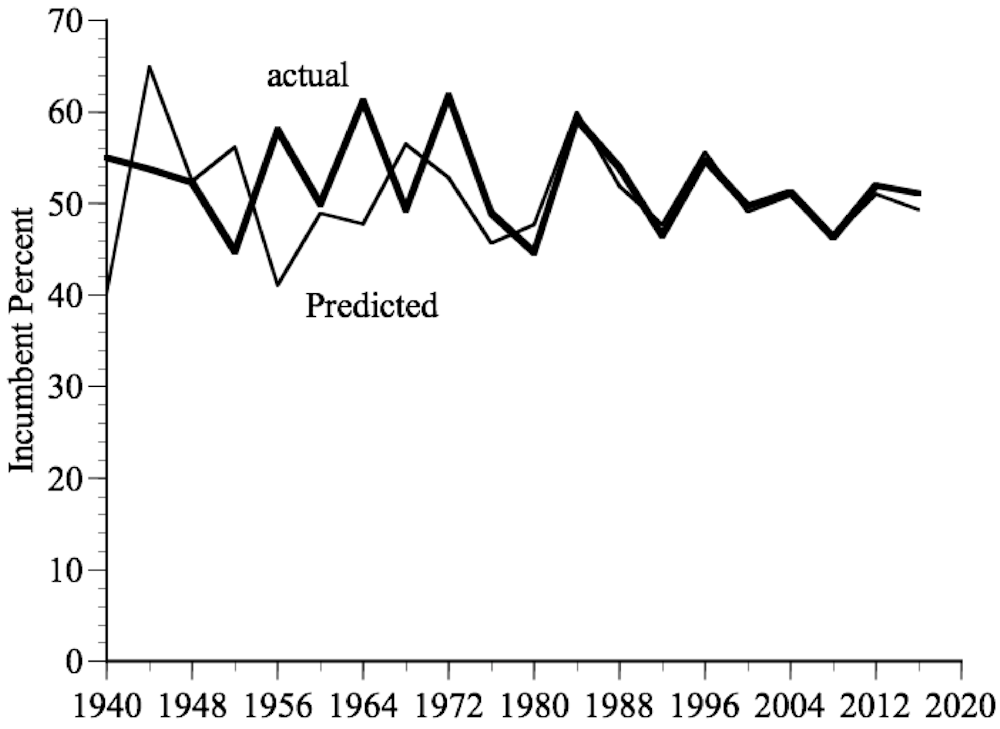
To demonstrate this, he used the high temperature on Election Day in five small cities across the country to create a prediction for the 2016 election, which matched up very well — at least from 1980 to 2016.

That and other examples he provides are reminders that with enough data, “spurious correlations” are everywhere — such as the famous example that from 2000 to 2009, the divorce rate in Maine was very closely matched to the per-capita consumption of margarine in the U.S.

NFL fans may recall the “Washington Rule,” which claimed that if the Washington, D.C., football team won its last home game before Election Day, the party in the White House would keep it. Sportswriters claimed it would predict every election from 1940 to 2000 — but since then, it has only gotten the 2008 result correct, and has been largely discarded.

A chart with two lines that don't match initially, but then match up quite closely.

From 1980 to 2016, the average temperature in five particular U.S. cities on Election Day matched up very well with the percentage of the popular vote that the party currently in the White House received. Gary Smith, Mind Matters

Hindsight in 2020 is 20/20

Of course, scholars’ political forecasting models do incorporate information that could be linked to the elections. For instance, I believe that party unity, economic performance, scandals and incumbency are some of the most important factors in how elections turn out.

But economist and weather-based prognosticator Smith is correct when he points out that some of these systems “predict past elections astonishingly well and then do poorly with new elections and must be tweaked, after the fact, to ‘correct’ for these mispredictions.” In fact, both Lichtman and Norpoth have made changes to their analysis methods over time.

They may need more tweaks in 2020, in part because they leave out factors that haven’t been important in the past, but might be vital now. For instance, election officials across the country are expecting a flood of mail-in ballots and early voting. The New York Times finds that a record 76% of Americans can vote by mail, and Gallup polling says 64% of Americans support voting by mail. Those figures are far beyond even the 40% of votes cast in those ways in the 2016 election. In the past, when new methods of voting have emerged, outcomes have been harder to predict.

The forecasts may be interesting, and — like the polls — often grab headlines, but you probably don’t want to bet too much money based on what they say.

John A. Tures, Professor of Political Science, LaGrange College

This article is republished from The Conversation under a Creative Commons license.

Don’t be hoodwinked by Trump’s UAE-Israel “peace deal”: It’s a sham

“HUGE breakthrough today,” crowed Donald Trump on Twitter as he announced the new peace deal between Israel and the United Arab Emirates. The deal makes the UAE the first Gulf Arab state and the third Arab nation, after Egypt and Jordan, to have diplomatic ties with Israel. But the new Israel-UAE partnership should fool no one. Though it will supposedly stave off Israeli annexation of the West Bank and encourage tourism and trade between both countries, in reality, it is nothing more than a scheme to give an Arab stamp of approval to Israel’s status quo of land theft, home demolitions, arbitrary extrajudicial killings, apartheid laws and other abuses of Palestinian rights. 

The deal should be seen in the context of more than three years of Trump administration policies that have tightened Israel’s grip on the Palestinians: moving the U.S. embassy from Tel Aviv to Jerusalem, recognizing the Golan Heights as Israeli territory, and creating a so-called peace plan with no Palestinian participation or input. While no U.S. administration has successfully brokered a resolution to Israel’s now 53-year-long occupation, the Trump years have been especially detrimental to the Palestinian cause. Palestinian leader Hanan Ashrawi wrote on Twitter that with this deal, “Israel got rewarded for not declaring openly what it’s been doing to Palestine illegally & persistently since the beginning of the occupation.”

Indeed, with Trump at the helm and son-in-law Jared Kushner as the primary strategist, even concessions for Palestinians have been done away with. To add insult to injury, while the deal had been couched in terms of a commitment by Israel to suspend annexation of Palestinian territories, in his Israeli press conference announcing the deal, Netanyahu said annexation was “still on the table” and that it was something he is “committed to.”

Among the most brutal aspects of this period for Palestinians have been the loss of support for their cause in neighboring Arab states. The Arab political party in Israel, Balad, said that by signing this pact, “the UAE has officially joined Israel against Palestine, and placed itself in the camp of the enemies of the Palestinian people.”

The UAE has previously held a position consistent with public opinion in Gulf and Middle East countries that the acceptance of formal diplomatic relations with Israel should only take place in exchange for a just peace and in accordance with international law. Back in June, Emirati ambassador to the U.S. Yousef al-Otaiba penned an an op-ed in the Yediot Ahronot newspaper, the Israeli equivalent to USA Today, appealing directly in Hebrew for Israel not to annex the West Bank. Now, by working out an agreement with Trump and Netanyahu to normalize relations, the UAE has made itself Israel’s partner in cementing de facto annexation and ongoing apartheid. 

The UAE’s change from supporting Palestinian dignity and freedom to supporting Israel’s never-ending occupation is a calculated move by UAE Crown Prince Mohammed bin Zayed, a shrewd Middle East dictator who uses his country’s military and financial resources to thwart moves toward democracy and respect for human rights under the guise of fighting Islamic terrorism. His support for Israel cements his relationship with the Trump administration. Trump has already gone out of his way to push billions of dollars in arms sales to the UAE, despite opposition from Congress because of high number of civilian casualties associated with the use of those weapons in Yemen.

Secretary of State Mike Pompeo has also defended the UAE from credible reports that U.S. weapons sold to the UAE have been transferred in Yemen to groups linked to al-Qaida, hardline Salafi militias and Yemeni separatists. The UAE was also stung by revelations of secret prisons it had been operating in Yemen where prisoners were subjected to horrific forms of torture, including “the grill,” where victims were “tied to a spit like a roast and spun in a circle of fire.” In Libya, the UAE has been criticized for violating a 2011 UN Security Council arms embargo by supplying combat equipment to the LAAF, the armed group commanded by General Khalifa Haftar with a well-established record of human right abuses. So this deal with Israel gives the UAE a much-needed veneer of respectability.

But it is impossible to understand the impetus for this deal without putting it in the context of the ongoing hostilities between all three countries and Iran. Following the old adage that “the enemy of my enemy is my friend,” in recent years Israel has been negotiating with various Gulf states, including the UAE, to push back against Iran’s growing influence in the region. As the communiqué announcing the Israeli-UAE deal asserted, the U.S., Israel and the UAE “share a similar outlook regarding threats in the region.” This dovetails with Trump’s anti-Iran obsession, which includes withdrawal from the Iran nuclear deal and his “maximum pressure” campaign designed to force Iran back to the negotiating table to make a “better deal.” In announcing the UAE-Israeli pact, Trump declared with ridiculous bravado that if he wins the elections, he’ll have a new deal with Iran within 30 days. Anyone who believes this must be almost as delusional as Trump. 

The fact that this agreement between two Middle East countries was first announced thousands of miles away in Washington shows that it is more about shoring up Trump’s slumping electoral campaign and improving Netanyahu’s battered image in Israel than bringing peace to the Middle East. It also shows that Netanyahu and bin Zayed have a stake in seeing Trump win a second term in the White House. Instead of pointing out the hollowness of the pact, Joe Biden’s response was unfortunately to congratulate Israel and the UAE and try to take credit for the deal. “I personally spent time with leaders of both Israel and the U.A.E. during our administration, building the case for cooperation and broader engagement,” he said. “I am gratified by today’s announcement.” 

The normalization of relations between the UAE and Israel, facilitated by the U.S., serves to prop up three repressive leaders — Trump, Netanyahu and bin Zayed — and will cause further harm to Palestinians. It is both a shame and a sham. 

As Black progressives unseat Black leaders, incumbents blame it on white “gentrification”

Some prominent Black Democrats have blamed “outside money” linked to Sen. Bernie Sanders and white “gentrification” after a growing number of young Black progressives scored upset victories over longtime Black leaders in federal and local primaries.

Progressive candidates backed by groups like the Democratic Socialists of America (DSA) and Justice Democrats have challenged longtime lawmakers in droves after Rep. Alexandria Ocasio-Cortez, D-N.Y. won a stunning upset over former Rep. Joe Crowley, D-N.Y., the longtime No. 3 Democrat in the House of Representatives, in 2018.

Jamaal Bowman, a DSA-backed middle school principal, last month defeated longtime Rep. Eliot Engel, D-N.Y., the powerful 16-term chairman of the House Foreign Affairs Committee who drew support from powerful members of the Congressional Black Caucus (CBC). Engel complained that intra-party primary challenges were a “very dangerous thing for party unity” even though he won the seat in a primary in 1988.

Some of the challenges have targeted longtime Black leaders, who have complained that the progressive insurgency risks undermining the work of longtime Black lawmakers amid Black Lives Matter protests around the country.

Last week, Black Lives Matter organizer Cori Bush, who was backed by the Justice Democrats, defeated longtime Rep. Lacy Clay, D-Mo., for a seat Clay’s family has held for more than 50 years. Bill Clay, the incumbent congressman’s father, served in the House for 16 terms and was one of the founding members of the CBC, which adamantly supported Clay’s re-election.

Bush, who unsuccessfully challenged Clay in 2018, was outraised by the 10-term incumbent, but outside spending from Justice Democrats and other progressive groups helped level the playing field in the race.

Clay complained about “outside money from sources associated with Bernie Sanders,” who had endorsed Bush, after the defeat, even though Bush raised nearly $200,000 less than her opponent.

Rep. Emanuel Cleaver, D-Mo., a former chairman of the CBC, told Politico that the caucus was “quite unhappy” over Sanders’ “political trespassing by endorsing [Clay’s] opponent.”

Cleaver argued that Clay had signed on to co-sponsor Medicare for All and the Green New Deal, showing that he is “no moderate.”

Clay himself argued before the primary that Justice Democrats were targeting CBC members “because they think we are easy targets.” In fact, the group has only targeted two Black incumbents, and in both cases their challengers were also Black.

Clay dismissed Bush’s “empty rhetoric” and argued that a young progressive could not fill his role in the House.

“There is no substitute in life for substance,” he said. “Substance is so relevant to people. That’s why there’s been a Clay there for the last 52 years.”

Critics pointed out that both Clay and Cleaver helped Republicans approve a gerrymander in 2011 that secured a legislative majority for the GOP while drawing safe districts for the two Black lawmakers. Bush, who gained prominence for her role in the 2014 Ferguson protests after the police killing of Michael Brown, also criticized Clay over his absence during the demonstrations.

“He’s had 20 years to make a change, not only in St. Louis but across this country,” she said, according to the New York Times. “He waits until something is popular to stand up for it, or he waits until there is pressure. I do it just because that is the need.”

Ahead of the primary, Clay launched a deeply negative campaign against Bush and described her as a “prop” for Justice Democrats and Sanders supporters.

“I had no title, no name, came out of the Ferguson uprising and people know who I am across the world,” Bush responded in an interview with the Times. “Not because I took money from some group — none of that. It is because I stayed true to a message of change for real people. He doesn’t understand that, because he doesn’t understand fighting for people.”

Bowman also pushed back against criticism from the CBC by quoting rapper Chuck D.

“Every brother ain’t a brother,” he told the Times. “So it’s not just about being a member of the Congressional Black Caucus, but standing up and fighting for your people.”

While progressives have seen limited but growing success in House primaries, their wins have been more notable in down-ballot races. Progressive candidates have scored significant wins in prosecutor elections in Arizona, Michigan and Colorado and state legislative races in New Mexico, Pennsylvania and Tennessee.

All five DSA-backed candidates won primaries in New York’s recent state legislature elections, joining a crop of progressives who won their primaries in 2018. The Times predicted that the wins would make New York’s state legislature “one of the most liberal in the nation.”

Assemblymember Walter Mosley, a Black incumbent in a Brooklyn district that has experienced rapid development and considerable gentrification, was defeated by DSA-backed activist Phara Souffrant Forrest, a Black woman, after being criticized for accepting money from real estate developers. Mosley blamed his loss on “outside forces, coupled with the exorbitant number of people who are first time and ideologically-driven voters.”

Another Black lawmaker, Assemblymember Tremaine Wright, lost an open Senate primary to math teacher Jabari Brisport, who is also Black, for a seat held by longtime Black legislative leader Velmanette Montgomery since 1985.

Laurie Cumbo, the majority leader of the New York City Council, who had endorsed both Mosley and Wright, blamed the “gentrification movement” for the upset defeats.

Cumbo, who herself staved off a primary challenge from Brisport in 2017, falsely claimed that the DSA-backed candidates received “over 75 percent” of campaign contributions from out of state and “mostly Seattle.” Less than 1% of solicited contributions to Forrest and Wright were from Seattle, although Crain’s New York recently reported that DSA-backed candidates in New York have received significant help from out-of-state finance, tech and nonprofit leaders.

“It is demonstrably false. The majority of donations came from New York,” Brisport told BK Reader, adding that “over 900 people from the district donated to my campaign.”

Cumbo claimed that these alleged outside interests were targeting Black leaders.

“The ability to elect unknown candidates of color with the backing of a super majority of white organizational support, with no proven leadership in the community … with very sophisticated social media strategies signifies the end of an era in Brooklyn,” she said in a Facebook post. “While we all have seen unprecedented support of people of all backgrounds in support of Black Lives Matter, the recent election results demonstrate that while we were chanting Black Lives Matter together, a movement of gentrification was strategizing on how to best unseat Black leadership.”

Cumbo claimed that “this new movement” was using “Black candidates as a trojan horse” to advance the “white agenda.”

Cumbo, who opposes defunding the New York Police Department, feuded with Brisport after he marched with 200 protesters to her home to demand the City Council slash police funding. She told Kings County Politics that the DSA was using “individuals like Jabari to run for office to carry their agenda until our neighborhoods become majority white.” Though “defunding the police” does not poll particularly well overall, surveys suggest it is far more popular among Black voters than white voters.

Brisport also questioned Cumbo’s opposition to gentrification, citing her contributions from the real estate lobby.

“The gentrifiers are the real estate lobbyists, the developers, the Real Estate Board of New York (REBNY) that helped Cumbo get elected in 2013,” he told BK Reader.

Cumbo has faced similar criticism for years, though she has repeatedly denied that she was in the pocket of REBNY, which has been accused of predatory development policies and reportedly spent more than $200,000 to help Cumbo win her 2013 race.

“Our communities are suffering from multiple angles. There’s a lack of access to affordable housing, quality health care, jobs and education,” Brisport told BK Reader. “People are looking for candidates who don’t just promise those things but actually stand up to the forces that are harming our communities.”

The DSA’s New York City chapter also pushed back on Cumbo’s claims.

“The NYC-DSA state slate swept the primaries because voters understand that we’re fighting, alongside other community groups, to keep working class people of color in their homes and neighborhoods,” the group said in a statement. “To dismiss our candidates as symbols of white gentrification and out-of-state influence is to deny their agency as working class people of color. Such dismissals also ignore that these campaigns were primarily funded by in-state small dollar donations.”

Bush implored Black voters and Black leaders, particularly the CBC, to more closely look at candidates’ records “to see what this person has actually done for their district” rather than blindly backing familiar names.

“I don’t care that somebody’s name was on a membership of something,” she told Politico. “That does not entitle them to hold the seat.”

GOP stands by complicit as Trump openly touts his sabotage of postal service

Voting rights advocates on Thursday took aim at Republicans in Congress for remaining silent in the face of President Donald Trump’s open admission that he is blocking funding for the U.S. Postal Service with the express purpose of stopping an expansion of mail-in ballot access ahead of the November elections.

Echoing comments he made during a press briefing Wednesday, Trump told Maria Bartiromo of Fox Business Thursday morning that Democrats “need that money in order to make the post office work, so it can take all of these millions and millions of ballots.”

“Now, if we don’t make a deal, that means they don’t get the money,” the president said. “That means they can’t have universal mail-in voting, they just can’t have it.”

Vanita Gupta, president and CEO of the Leadership Conference on Civil and Human Rights, tweeted that Trump is “openly touting his agenda to defund the post office to prevent people from voting amid a pandemic…[e]ven at the expense of veterans getting their medicine by mail and all of the other grave harms.”

“How many Republican senators will confront him on this?” Gupta asked. “Silence is complicity.”

Listen to Trump’s comments:

In a statement, Stand Up America founder and president Sean Eldridge said Trump is “saying the quiet part out loud” by admitting that he’s blocking Postal Service funding in an effort to hinder mail-in voting.

“His continued efforts to cripple the USPS are a clear attempt to sabotage the election and suppress the vote in the middle of a pandemic,” said Eldridge. “Congress must act now. “If Senate Republicans gave a damn about the future of our democracy, they would demand that the Trump administration return to the negotiating table on a Covid-19 relief bill that protects our elections and funds the post office.”

During his press briefing Wednesday evening, Trump vowed to continue blocking Democrats’ demand for $3.5 billion in election assistance funding for states and $25 billion for the Postal Service, calling the requests “ridiculous.”

Trump also praised Postmaster General Louis DeJoy, a major Republican donor to the president who has imposed sweeping changes to Postal Service policy that have caused major mail backlogs across the United States, prompting concerns about timely delivery of mail-in ballots in November.

“Donald Trump knows that if the people are heard in November, he and Republicans up and down the ballot will lose,” Sen. Elizabeth Warren (D-Mass.) tweeted Thursday. “This is what we’re up against—and this is why we have to fight back with all we’ve got.”

On Wednesday afternoon, House Democrats introduced a bill that would reverse DeJoy’s new policies and bar any further operational changes until the end of the Covid-19 pandemic. It’s not clear when the legislation could get a floor vote in the House.

Rep. Gerry Connolly (D-Va.), one of the bill’s co-sponsors, stressed the urgency of congressional action to save the Postal Service in a tweet Thursday, warning that “we have a five alarm fire in this country.”

“The president is on TV brazenly, corruptly, and deliberately sabotaging the USPS,” wrote Connolly. “Congress must provide the Postal Service the financial resources needed to ensure a smooth process of mail-in ballots for the November election.”

Jana Morgan, director of the Declaration for American Democracy—a coalition of over 160 progressive advocacy organizations—said in a statement Thursday that “all eyes are now on Senate Republicans.”

“We call on Majority Leader McConnell and Senate Republicans to make the right move,” said Morgan. “Stop enabling President Trump and immediately pass $3.6 billion in safe election funding and reforms, in addition to the $25 billion needed to keep the post office up and running.”

WATCH: Rachel Maddow narrates salacious excerpts from Michael Cohen’s new book “Disloyal”

The host of “The Rachel Maddow Show” on MSNBC on Thursday read excerpts from Michael Cohen’s forthcoming book on his time working as Donald Trump’s lawyer and fixer.

The book, “Disloyal: A Memoir. The true story of the former personal attorney to President Donald J. Trump” is set to be released before the November election.

Cohen released the forward to his book online, which describes allegations of deviant sex acts — and a backchannel to Vladimir Putin. On Thursday, the hashtags for “Urine Trouble Trump” and “Golden Showers Trump” trended on Twitter after Cohen’s allegations.

Cohen also described receiving hundreds of death threats after flipping on Trump.

“I urge you to really consider that fact: Trump has no true friends. He has lived his entire life avoiding and evading taking responsibility for his actions. He crushed or cheated all who stood in his way, but I know where the skeletons are buried because I was the one who buried them. I was the one who most encouraged him to run for president in 2011, and then again in 2015, carefully orchestrating the famous trip down the escalator in Trump Tower for him to announce his candidacy,” Cohen wrote.

“When Trump wanted to reach Russian President Vladimir Putin, via a secret back channel, I was tasked with making the connection in my Keystone Kop fashion. I stiffed contractors on his behalf, ripped off his business partners, lied to his wife Melania to hide his sexual infidelities, and bullied and screamed at anyone who threatened Trump’s path to power. From golden showers in a sex club in Vegas, to tax fraud, to deals with corrupt officials from the former Soviet Union, to catch and kill conspiracies to silence Trump’s clandestine lovers, I wasn’t just a witness to the president’s rise—I was an active and eager participant,” he admitted.

“Apart from his wife and children, I knew Trump better than anyone else did. In some ways, I knew him better than even his family did because I bore witness to the real man, in strip clubs, shady business meetings, and in the unguarded moments when he revealed who he really was: a cheat, a liar, a fraud, a bully, a racist, a predator, a con man,” Cohen explained.

Watch:

“Cancel ‘Rick and Morty’” gains steam after 2009 Dan Harmon doll rape video resurfaces

Eleven years after “Rick and Morty” co-creator Dan Harmon made a parody video in which he simulates raping a baby doll — and two years after apologizing for it — new attention is being brought to the video on social media and with it calls to cancel the Adult Swim show. While this isn’t the first time controversy has erupted over the video, this latest round of public backlash comes with a new twist: Posts calling for the cancellation of “Rick and Morty” frequently include hashtags used by adherents of the sprawling right-wing conspiracy theory QAnon.

The video, a parody of “Dexter” called “Daryl,” premiered in 2009 at the Channel 101 comedy festival. It features Harmon’s character climbing through a window, pulling down his pants, and rubbing his genitals on a baby doll lying on a couch. Harmon appears on camera at the start of the video warning viewers the following footage is “controversial.”

Read more from IndieWire: Tig Notaro will replace Chris D’Elia in Zack Snyder’s “Army of the Dead”

The video resurfaced in 2018 and caused backlash against Harmon on social media, leading him to delete his Twitter account. He said this at the time:

“In 2009, I made a ‘pilot’ which strove to parody the series ‘Dexter’ and only succeeded in offending. I quickly realized the content was way too distasteful and took the video down immediately. Nobody should ever have to see what you saw and for that, I sincerely apologize.”

Cartoon Network, which airs “Rick and Morty,” stood by Harmon while denouncing the video.

The clip was circulating again this week. On Twitter, it’s frequently been posted with #SaveTheChildren. That hashtag was first used to raise money for the Save the Children charity, but as the New York Times reported Wednesday, it has recently been coopted by QAnon followers. Facebook briefly disabled the hashtag after it was flooded with pro-QAnon content.

Read more from IndieWire: 4 sex positive short films that exude sensuality, kink, and body positivity

For the uninitiated, QAnon is a sprawling conspiracy theory that has quickly gained steam since the last months of 2017. Its core tenets center around the belief in a global cabal of elite pedophiles who rule the world, among them Hillary Clinton and Hollywood notables. They believe that President Donald Trump is working to expose the doings of this group.

While QAnon has many dedicated adherents, it’s likely that many people posting the Harmon video alongside #SaveTheChildren are unaware they are boosting one of the movement’s hashtags. As the Times reported, prominent mommy bloggers and fitness influencers have begun posting anti-trafficking memes with the hashtag.

Read more from IndieWire: “Clueless” reboot centered on Dionne headed to Peacock

But some people posting about Harmon definitely follow QAnon. In fact, some adherents have been discussing Harmon and “Rick and Morty” in the context of alleged Hollywood pedophilia for two years. One Twitter user posted screenshots of the video in July 2018 alongside #QAnon and #Pizzagate.

Michael Cohen says he was “active and eager participant” in “golden showers” and “tax fraud” in book

In the 3,700-word foreword from his forthcoming memoir, “Disloyal,” Michael Cohen, the former personal lawyer and “fixer” of President Donald Trump, describes his life working for his former client in terms of organized crime, comes clean about “screaming threats” on his client’s behalf and admits to being an “active and eager participant” in some of the most notorious and salacious episodes involving the future leader of the free world. 

“From golden showers in a sex club in Vegas, to tax fraud, to deals with corrupt officials from the former Soviet Union, to catch and kill conspiracies to silence Trump’s clandestine lovers, I wasn’t just a witness to the president’s rise — I was an active and eager participant,” Cohen writes in the foreword, dated March 11, 2020, which he says he began penning on legal pads in the early morning hours at the white-collar Otisville Federal Prison located about an hour and a half drive from his former Manhattan high-rise apartment.

Cohen had earlier been furloughed from that prison amid concerns over the spread of COVID-19. However, he was soon remanded, apparently for writing this book. His book’s website directly quotes federal Judge Alvin Hellerstein:

The purpose of transferring Mr. Cohen from furlough and home confinement to jail is retaliatory, and it’s retaliatory because of his desire to exercise his First Amendment rights to publish a book and discuss anything about the book or anything else he wants on social media.

“In 21 years of being a judge and sentencing people and looking at terms and conditions of supervised release, I’ve never seen such a clause,” Hellerstein added. He allowed Cohen to return to house arrest.

While Cohen’s multiple felony counts include fraud and perjury, and his own redemption testimony drew further accusations of lying to Congress, he makes clear that doesn’t expect credit from readers given this history with the truth. 

RELATED: Alleged “pee tape” incident wasn’t the only Trump “sex party” in Russia probed by Steele: report

“As you read my story, you will no doubt ask yourself if you like me, or if you would act as I did, and the answer will frequently be no to both of those questions,” he writes.

To wit, the “golden showers” line above alludes to an evening at a Las Vegas strip club called “The Act,” which was previously revealed in David Corn and Michael Isikoff’s book about the Trump-Russia saga, “Russian Roulette”:

The Act was no ordinary nightclub. Since March, it had been the target of undercover surveillance by the Nevada Gaming Con­trol Board and investigators for the club’s landlord — the Palazzo, which was owned by GOP megadonor Sheldon Adelson — after complaints about its obscene performances. The club featured seminude women performing simulated sex acts of bestiality and grotesque sadomasochism — skits that a few months later would prompt a Nevada state judge to issue an injunction barring any more of its “lewd” and “offensive” performances. Among the club’s regular acts cited by the judge was one called “Hot for Teacher,” in which naked college girls simulate urinating on a professor. In another act, two women disrobe and then “one female stands over the other female and simulates urinating while the other female catches the urine in two wine glasses.” (The Act shut down after the judge’s ruling. There is no public record of which skits were performed the night Trump was present.)

Of course, a similar lewd scenario appears in former British intelligence official Christopher Steele’s series of intel briefs on Russian election interference, in which four sources help Steele assemble a scene now known colloquially as the “pee tape” passage.

Trump, the story goes, was captured on video at the Ritz Carlton Moscow during the 2013 Miss Universe Pageant watching sex workers urinate on a bed that then-President Barack Obama and -First Lady Michelle Obama had slept on not long before, according to what has become known as the “Steele dossier.” Russian intelligence reportedly had the tape in its possession, Steele’s sources said, and held it over Trump as “kompromat,” or blackmail.

However, when Cohen was asked directly about the pee tape in his nationally televised tell-all Congressional testimony, he offered no fireworks.

RELATED: Source of “pee tape” report allegedly sought access to Trump before inauguration

“I’ve heard about these tapes for a long time,” Cohen said. “I’ve had many people contact me over the years. I have no reason to believe that that tape exists.”

Former special counsel Robert Mueller’s team had obtained text messages exchanged between Cohen and Russian businessman Giorgi Rtskhiladze about a week before the 2016 election, in which the businessman tells Cohen he’s stopped the “flow” of compromising tapes from Russia. Cohen told investigators he had spoken to Trump about the issue after receiving the texts, and Rtskhiladze later told Mueller he heard the tapes were fake.

A few weeks after Cohen’s testimony before Congress, Mueller released his final report on Russian interference in the 2016 election, and an obscure footnote buried in Section II B of Volume II appeared to allude to Cohen’s testimony.

Comey’s briefing included the Steele reporting’s unverified allegation that the Russians had compromising tapes of the President involving conduct when he was a private citizen during a 2013 trip to Moscow for the Miss Universe Pageant. During the 2016 presidential campaign, a similar claim may have reached candidate Trump. On October 30, 2016, Michael Cohen received a text from Russian businessman Giorgi Rtskhiladze that said, “Stopped flow of tapes from Russia but not sure if there’s anything else. Just so you know . . ..” (10/30/ 16 Text Message, Rtskhiladze to Cohen.)

Rtskhiladze said “tapes” referred to compromising tapes of Trump rumored to be held by persons associated with the Russian real estate conglomerate Crocus Group, which had helped host the 2013 Miss Universe Pageant in Russia. (Rtskhiladze 4/4/ 18 302, at 12.) Cohen said he spoke to Trump about the issue after receiving the texts from Rtskhiladze. (Cohen 9/12/18 302, at 13.) Rtskhiladze said he was told the tapes were fake, but he did not communicate that to Cohen. (Rtskhiladze 5/10/ 18 302, at 7.)

The texts came three days after one of the counts to which Cohen pleaded guilty supposedly occurred: making a hush money payment to porn star Stormy Daniels at the direction of the president in violation of federal elections law in order to conceal their alleged affair. Trump has repeatedly denied these allegations, which are currently being probed by Manhattan District Attorney Cy Vance

It is unclear if Rtskhiladze provided Mueller with a reason for why he had withheld his inside knowledge of the authenticity of the tapes, and it also remains unclear why Cohen would feel compelled to tell Trump about the tapes if he also doubted their existence. 

At one point a millionaire lawyer several times over, Cohen until recently worked with other federal inmates at a sewage treatment facility for $8 a month, a fact which he opens up about in his book’s foreword. Most of the foreword is dedicated to convincing the reader that Trump gets people to do what he wants without giving specific orders, a technique which Cohen says is part of Trump’s “mob” boss mentality.

“If you want to know how the mob really works, you’ve got to talk to the bad guys,” he writes. “I was one of Trump’s bad guys. In his world, I was one hundred percent a made man.”

The foreword begins:

The President of the United States wanted me dead.

Or, let me say it the way Donald Trump would: He wouldn’t mind if I was dead. That was how Trump talked. Like a mob boss, using language carefully calibrated to convey his desires and demands, while at the same time employing deliberate indirection to insulate himself and avoid actually ordering a hit on his former personal attorney, confidant, consigliere, and, at least in my heart, adopted son.

Cohen goes on to suggest that he knows this because he himself had at one time threatened to kill in Trump’s interest:

Driving south from New York City to Washington, DC on I-95 on the cold, gray winter morning of February 24th, 2019, en route to testify against President Trump before both Houses of Congress, I knew he wanted me gone before I could tell the nation what I know about him. Not the billionaire celebrity savior of the country or lying lunatic, not the tabloid tycoon or self-anointed Chosen One, not the avatar @realdonaldtrump of Twitter fame, but the real real Donald Trump—the man very, very, very few people know.

If that sounds overly dramatic, consider the powers Trump possessed and imagine how you might feel if he threatened you personally. Heading south, I wondered if my prospects for survival were also going in that direction. I was acutely aware of the magnitude of Trump’s fury aimed directly at my alleged betrayal. I was wearing a baseball cap and sunglasses and I kept the speedometer at eighty, avoiding the glances of other drivers. Trump’s theory of life, business and politics revolved around threats and the prospect of destruction—financial, electoral, personal, physical—as a weapon. I knew how he worked because I had frequently been the one screaming threats on his behalf as Trump’s fixer and designated thug.

The passage calls to mind a high-profile spat between Mueller’s office and BuzzFeed News in January 2019 over a report which ultimately played a role in the Senate confirmation hearings over the Trump’s nomination of William Barr as his second attorney general.

At the time, BuzzFeed reported that it had obtained documents and information suggesting that Trump had “directed” Cohen to lie to Congress on his behalf, a crime to which Cohen later pleaded guilty.

“President Donald Trump directed his longtime attorney Michael Cohen to lie to Congress about negotiations to build a Trump Tower in Moscow,” the report claimed, citing “two federal law enforcement officials involved in an investigation of the matter” who said Mueller had supporting evidence.

If true, the report would mean that Trump had, in fact, obstructed justice. (Mueller outlined at least ten instances of possible obstruction by the president in his report, though he did not make a conclusion about their legality.) It had a unique effect on politicians, who began to speak of impeachment in a manner in which they had not yet previously done. The report coincided with the confirmation hearing, where, under questioning from Sen. Amy Klobuchar, D-Minn., Barr acknowledged that the event, as described, constituted obstruction.

“In your memo, you talk about the Comey decision, and you talk about obstruction of justice. And you already went over that, which I appreciate,” Klobuchar said. “You wrote on page one that a president persuading a person to commit perjury would be obstruction. Is that right?”

“That — yes,” Barr replied. “Or any, well any person who persuades another.”

The allegation was so explosive that Mueller’s office broke its near-total silence up to that point, issuing a statement denying the report as written:

BuzzFeed’s description of specific statements to the Special Counsel’s Office, and characterization of documents and testimony obtained by this office, regarding Michael Cohen’s congressional testimony are not accurate.

When Cohen himself appeared before Congress only a few weeks later, he spoke of that incident much as he describes Trump in his opening lines of the foreword of his book. 

“Mr. Trump did not directly tell me to lie to Congress. That’s not how he operates,” Cohen said, adding, “he would look me in the eye and tell me there’s no business in Russia and then go out and lie to the American people by saying the same thing. In his way, he was telling me to lie.”

In a moving passage, Cohen invokes the late Rep. Elijah Cummings, D-Md., who “had the final word, as chair of the Oversight Committee.”

“Cummings was the lone politician I encountered in all my travails who took an interest in me as a human being,” Cohen writes. “When I reported to serve my sentence, he even took steps to ensure my security in prison. It was a selfless act of kindness for which I will always be grateful.”

“I know this has been hard,” Cummings said to me and the nation, his words hitting me like a kick in the gut. “I know you’ve faced a lot. I know that you are worried about your family. But this is a part of your destiny. And hopefully this portion of your destiny will lead to a better Michael Cohen, a better Donald Trump, a better United States of America, and a better world. And I mean that from the depths of my heart.”

“We are better than this,” Cummings concluded. Cohen was in tears.

Minnesota’s secretary of state is “worried” about a “coordinated effort” to undermine voting by mail

Minnesota Secretary of State Steve Simon said he is “worried” about a “coordinated effort at the federal level” to scare voters from using mail-in ballots after the U.S. Postal Service (USPS) warned his state that its vote-by-mail deadline might be too tight for the agency’s “delivery standards.” 

Forty-five more states have reportedly been warned of potential voter disenfranchisement resulting from delays in delivering mail-in ballots.

“The letters have everyone a little unsettled,” Simon told Salon in a call. “We don’t know what to make of it.”

The warnings come amid a flurry of attacks from President Donald Trump against the practice of voting by mail, including a public threat this week to block new funding from the USPS in an apparent effort to sabotage plans to expand the practice ahead of Election Day.

“They need that money in order to have the Post Office work, so it can take all of these millions of ballots,” Trump told Fox Business host Maria Bartiromo on Thursday. “If they don’t get those two items, that means you can’t have universal mail-in voting. Because they’re not equipped.”

Trump previously said the expansion of voting by mail was “my biggest risk” to winning re-election. At the same time, Trump and first lady Melania Trump have reportedly requested and received mail-in ballots for next week’s primary elections in Florida.

In a letter dated July 29, a copy of which Simon’s office shared with Salon, USPS general counsel Thomas Marshall said the agency based the warning on its own understanding of Minnesota election law.

“In particular, we wanted to note that, under our reading of Minnesota’s election laws, certain deadlines for requesting and casting mail-in ballots are incongruous with the Postal Service’s delivery standards,” Marshall wrote.

However, a recent state court order already changed the rules for this year’s election, allowing Minnesota voters to mail their ballots all the way through Election Day and extending the delivery window for up to seven days thereafter. 

“There was no mention of any of that in this letter,” Simon said. “It was like they didn’t know about the court order.”

With a Democratic governor now in office, Minnesota — which Trump’s Democrat rival Hillary Clinton won by a razor-thin margin of 44,593 votes in 2016 — remains a key swing state.

Dozens of states received similar letters postmarked around the same time, The Washington Post reported Thursday. However, the content was not identical, with some states receiving more narrow warnings than others. In addition to Minnesota, Salon obtained copies of letters sent to the secretaries of state of Colorado, Florida, Missouri, North Carolina and Texas.

Wisconsin’s elections system is different. “The secretary of state hasn’t had anything to do with elections since the early 1970s,” Wisconsin Elections Commission (WEC) administrator Meagan Wolfe, told Salon in an email.

Wolfe said that her agency, which runs elections in the state, had not received a warning letter from the USPS. “Maybe they sent it to the secretary of state by mistake,” she said. “Maybe it’s still on its way.” The secretary of state did not reply to Salon’s requests for comment.

However, Wolfe confirmed that the USPS Office of Inspector General had issued a report to the WEC on July 7 regarding “mail problems” during the state’s spring elections in April. Wolfe said the report included a section on deadline incompatibilities, though she pointed out that any changes to voting deadlines would require an act of the legislature or court order.

In the spring, Wisconsin’s expansion of mail-in voting contributed to a “shocking margin of victory” when a liberal judge trounced a conservative incumbent for a seat on the state’s Supreme Court in what was expected to be a close race.

“We have been aware for several years that Wisconsin’s statutory absentee ballot request deadline of the Thursday before an election does not fit well with USPS’ seven-day delivery advice,” Wolfe added. “For that reason, we have consistently advised voters to make their absentee ballot requests as early as possible.”

Wolfe said her office will mail voting information packets, including absentee request forms and postage-paid return envelopes, to approximately 2.6 million registered voters in early September who have not already requested an absentee ballot for November.

A spokesperson for Missouri Secretary of State Jay Ashcroft noted in an email what appears to be another oversight on behalf of USPS, which is similar to the one in Minnesota.

“A bill pushed by Sec. Ashcroft (SB 592) and signed into law by Gov. Parson in 2018 actually moved the deadline to submit an application for an absentee ballot from the Wednesday prior to the election to the second Wednesday prior to the election,” the spokesperson said.

That new deadline “created a larger window for voters to return their ballots,” Ashcroft said in a statement to Salon, in which he called the USPS warning a “non-issue.”

“Secondly, we added an email option, allowing a voter to request an absentee ballot by email,” he continued.

“I fully believe in the safety of in-person voting and have our local election authorities to thank for that,” Ashcroft added. “Any chance I get, if voters wish to vote absentee or by mail, I encourage them to apply early and to send in their ballot as soon as possible.”

The USPS issued a more narrow warning to Colorado, which had already expanded mail-in voting statewide.

Colorado Secretary of State Jena Griswold said in a statement provided to Salon that while she believes her state is “well situated to handle both the delivery and return of mail ballots,” she is “concerned about service disruptions and other attacks on the U.S. Postal Service from President Trump and members of his administration.”

“I am in confident that Coloradans will have their voices heard in November’s election,” Griswold said, pointing out that mail-in ballots are sent out three weeks ahead of Election Day. Her department maintains over 300 drop boxes across the state.

The Florida Department of State, which received one of the broader warnings, told Salon in a statement that it values its relationship with the Postal Service, as well as that “[t]he majority of Supervisors of Elections are not reporting any issues.”

“[We] understand that an increased amount of voters are opting for vote-by-mail ballots this election cycle,” the statement said, adding that Florida has installed a number of drop boxes statewide like Colorado. “We are monitoring very closely the delivery of vote-by-mail ballots in Florida. The majority of Supervisors of Elections are not reporting any issues.”

While it appears that nearly every state received a warning of some kind weeks ago, Sec. Simon told Salon that he was not sure why the news had not broken until Thursday, when Pennsylvania cited its letter in a court filing to extend its three-day mail-in deadline. He said he discussed receiving the letter in passing with one other state secretary. While both found it odd, his office did not think it was worth informing the public.

“I honestly don’t know why they sent them. We never received one in the past,”  Simon, whose efforts to meet with Postmaster General and Trump megadonor Louis DeJoy have not met with success, said. (DeJoy had a “congratulatory meeting” with President Donald Trump at the White House last week.)

“But I want to be clear: I hope it’s not an attempt to scare people into not voting by mail in general,” Simon said. “I’m worried that I see a coordinated effort at the federal level. I sure hope this isn’t part of it.”

Pentagon announces a new UFO task force

On Friday, the Pentagon announced that it is launching a task force to better understand UFOs.

In a press release, the Defense Department, perhaps to avoid association with the extraterrestrial implications of “Unidentified Flying Objects,” used the term “Unidentified Aerial Phenomenon,” but it’s clear what it’s referring to: objects in the sky of unknown origin.

“On Aug. 4, 2020, Deputy Secretary of Defense David L. Norquist approved the establishment of an Unidentified Aerial Phenomena (UAP) Task Force (UAPTF),” the press release said. “The Department of the Navy, under the cognizance of the Office of the Under Secretary of Defense for Intelligence and Security, will lead the UAPTF.”

It continued:

The Department of Defense established the UAPTF to improve its understanding of, and gain insight into, the nature and origins of UAPs. The mission of the task force is to detect, analyze and catalog UAPs that could potentially pose a threat to U.S. national security.

As DOD has stated previously, the safety of our personnel and the security of our operations are of paramount concern. The Department of Defense and the military departments take any incursions by unauthorized aircraft into our training ranges or designated airspace very seriously and examine each report. This includes examinations of incursions that are initially reported as UAP when the observer cannot immediately identify what he or she is observing.

The government’s study of UFOs has drawn increasing public attention in recent months, most notably because of a series of New York Times articles about the issue. The Navy recently officially released video taken by pilots of unknown objects in the sky behaving bizarrely, though the footage had been circulating for years prior.

But while there has been some implication that the Pentagon’s interest indicates a strong possibility that evidence exists of actual alien life, there’s little reason to believe that’s true. Undoubtedly, there have been objects and phenomena detected in the U.S. skies that have confounded expert pilots; perhaps they’re from private owners or foreign nations. And yet many of these sightings and events almost always have plausible, mundane explanations that don’t require appealing to the existence of extraterrestrial beings who have traveled to Earth.

And when reports and evidence have suggested the potential of alien life, it often turns out to be a mirage. For example, a New York Times report initially suggested former Democratic Sen. Harry Reid had attested to the existence of otherworldly objects in the government’s possession. But the story was later corrected:

An earlier version of this article inaccurately rendered remarks attributed to Harry Reid, the retired Senate majority leader from Nevada. Mr. Reid said he believed that crashes of objects of unknown origin may have occurred and that retrieved materials should be studied; he did not say that crashes had occurred and that retrieved materials had been studied secretly for decades.

Much of the supposed evidence for alien visitation turns out to be exactly like this: striking at first, but it falls apart upon inspection. And perhaps one of the best reasons to doubt the existence of alien ships visiting Earth is the ubiquity of cell phones. If alien UFO sightings were genuine, why haven’t we seen clear and decisive video evidence from a witnesses’ phone?

Republicans blame House GOP Leader Kevin McCarthy for tying their fortunes to Trump: report

According to a report from the Washington Post, disgruntled Republican House members have been privately discussing whether they should oust Rep. Kevin McCarthy (R-CA) as House Minority Leader should Donald Trump be defeated in November.

The report notes that there are a number of complaints that have been made against the California Republican, who saw the House change hands on his watch as a result of the “Blue wave” 2018 election, with many of the problems attributed to McCarthy’s close affiliation with Trump.

The Post reports that at least ten Republicans are looking at leading a revolt against McCarthy after the election, with the talk ramping up because he stood by and allowed Marjorie Taylor Greene, “a fringe House candidate in Georgia who espouses the QAnon conspiracy theory” to win in a recent primary which has embarrassed many Republicans.

According to the report, fellow House Republicans are unhappy that McCarthy refused to throw the party’s full support behind her opponent and then phoned her “in an apparent peace accord before the primary, while Trump embraced her on Twitter this week as a ‘future Republican Star.'”

Add to that, is McCarthy’s full-throated support of the president whose unpopularity is dragging the whole party down.

“A cluster of GOP lawmakers is starting to privately question whether the California Republican is putting loyalty to the president over the good of the conference,” the report states. “According to interviews with more than 10 House Republicans — all of whom spoke on the condition of anonymity to be frank — some GOP lawmakers are worried that McCarthy has tied the conference too much to Trump, refusing to stand up to the president or act as a buffer to distinguish the conference from him.”

One specific point that has rankled GOP House members was McCarthy’s failure to protect them from a demand from Trump’s campaign that they “donate to the president’s reelection effort.”

According to Doug Heye, a former House GOP leadership aide, “There’s no doubt that McCarthy is a Trump loyalist, through and through. I think the challenge for everyone in the Republican conference is, at some point there will be a post-Trump world — whether that’s coming in three months or later. What direction does the party go?”

One House member, who asked to remain anonymous was a bit more blunt, saying of McCarthy, “He does nothing but lick Trump’s boots. That’s all he cares about — so no, it’s not helpful.”

McCarthy’s fate is not only tied to Trump’s, but also to whether Republicans lose more House seats, with one Republican saying, “He becomes damaged goods [if Trump loses], but it could be offset if he is successful in helping the GOP conference win back a bunch of seats. But if we lose . . . the Republican conference is probably going to be looking for something different in leadership.”

One House Republican expressed confusion over McCarthy’s close embrace of Trump.

“He changed and became fully committed on the Trump train,” they explained. “Kevin has never been a conservative guy; he’s one of the most moderate guys in the House if you look at his voting record. But all of a sudden there was this metamorphosis where it was ‘Everything Trump.’ And look, there’s high-risk, high-reward with that.”

“In May, despite Trump’s massive war chest breaking records, McCarthy worked with the Trump campaign on a plan to get House Republicans to donate to the president’s reelection. A few weeks later, news broke that the Democratic Congressional Campaign Committee’s 42 most vulnerable members had an average 5-to-1 cash advantage over their GOP opponents, while 30 Democratic challengers outraised their Republican opponents in the second quarter of 2020 — putting Democrats in a prime position to grow their majority,” the Post reports. “Some GOP members were livid, wondering why they were called on to help fund the well-oiled Trump money machine when some of their own were in trouble.”

You can read more here.

Trump’s EPA pushes through “mind-bogglingly stupid” rollback of methane emissions rules

In a widely anticipated move Thursday, the Environmental Protection Agency yet again advanced President Donald Trump’s deregulatory agenda by weakening rules on oil and gas companies’ emissions of the potent greenhouse gas methane that were put in place by the Obama administration.

Following reports that the “sickening” policy change would come by the end of this week, former coal lobbyist and current EPA Administrator Andrew Wheeler in Pittsburgh formally announced two final rules removing the “burdensome and ineffective regulations” on the oil and gas industry.

“This decision is mind-bogglingly stupid and destructive,” declared Liz Jones, an attorney with the Center for Biological Diversity. “There are few things worse for the climate than the methane spewed by the oil and gas sector, and the solutions are readily available.”

“Even for the Trump administration,” Jones said, “this is an appalling new low.”

The new EPA policies effectively free fossil companies “from the need to detect and repair methane leaks — even as new research shows that far more of the potent greenhouse gas is seeping into the atmosphere than previously known,” the New York Times reported Thursday.

“Over the past few years there has been an explosion of new research on this, and the literature has coalesced — 80% of papers show that methane from oil and gas leaks is two to three times higher than the EPA’s estimates,” Robert Howarth, an earth systems scientist at Cornell University, told the Times.

“It’s crazy to roll back this rule,” warned Howarth, who last year published a study on North American gas production and methane emissions. “Twenty-five percent of the human-caused warming over the past 20 years is due to methane. Methane is going up. We need it to go down.”

Julie McNamara, senior analyst in the Climate and Energy Program at the Union of Concerned Scientists (UCS), concurred that methane emissions need to be urgently reduced and condemned the Trump administration for enabling the fossil fuel industry to “pollute with impunity, pocketing short-term profits while leaving communities to deal with the damage for decades to come.”

“These rollbacks distort and defy basic principles of science, economics, and policy design — an embarrassing admission that there’s no real defense for the administration’s demolition of meaningful methane rules,” McNamara added. “The idea that the oil and gas industry will control these emissions on their own, without strong standards and enforcement, doesn’t pass the laugh test.”

Adrian Shelley, director of Public Citizen’s Texas office, also called out the administration for catering to the wishes of polluters and propping up a “failing industry.” He warned in a statement Thursday:

This damaging new rule won’t save fossil fuel corporations, it won’t bring the U.S. closer to energy independence, and it won’t protect people from dangerous air pollution. It hurts everyone.

In Texas alone, drillers waste 1.4 million tonnes of methane gas each year — enough to supply every home in Dallas and Houston combined. Natural gas companies don’t want to waste natural gas, and they supported the Obama-era rule and were planning accordingly. Trump’s backward-looking policy deprives industry of what it craves most: regulatory certainty. It only moves the goalposts for a struggling industry.

David Doniger, senior strategic director of Natural Resources Defense Council’s Climate & Clean Energy Program, vowed that his organization will fight back against the administration’s latest environmental rollback.

“We cannot protect the health of our children and grandchildren, especially in the most polluted and endangered communities, if the EPA lets this industry off scot-free,” Doniger said. “We will see EPA in court.”

Earthjustice associate attorney Caitlin Miller also pledged to take legal action in response to the new EPA policies.

“With these rollbacks, the Trump administration is compounding an unprecedented public health crisis by exacerbating another,” Miller said. “We need strong methane standards to keep our air clean and safe to breathe, and combat the climate crisis.”

“EPA must prioritize our health and safety over the profits of oil and gas companies,” she added, “and we will hold them accountable in court.”

Dolly Parton on BLM: “Of course Black lives matter”

Dolly Parton is rarely political. But the country-music legend has expressed her support of the Black Lives Matter movement in light of recent protests over the killings of George Floyd, Breonna Taylor, and other unarmed black people.

Read more from Rolling Stone: The lingering mysteries of Charles Manson

In a new interview with Billboard, Parton says she is “unequivocal in her support” of protesters within the Black Lives Matter movement.

“I understand people having to make themselves known and felt and seen,” Parton says. “And of course Black lives matter. Do we think our little white asses are the only ones that matter? No!”

Read more from Rolling Stone: The unraveling of America

The article also references Parton’s 2018 decision to rename her Dixie Stampede dinner attraction as Dolly Parton’s Stampede, due to the racist connotations of the word “Dixie” and its association with the Confederacy, as well as the Dollywood Co.’s plans to expand to an international market. The name change predates similar ones from the country trio Lady A (formerly Lady Antebellum) and the Chicks (formerly the Dixie Chicks) that occurred two years later as a response to the Black Lives Matter protests.

“There’s such a thing as innocent ignorance, and so many of us are guilty of that,” Parton says. “When they said ‘Dixie’ was an offensive word, I thought, ‘Well, I don’t want to offend anybody. This is a business. We’ll just call it the Stampede.’ As soon as you realize that [something] is a problem, you should fix it. Don’t be a dumbass. That’s where my heart is. I would never dream of hurting anybody on purpose.”

Read more from Rolling Stone: What’s the difference between N95 masks and KN95 masks?

In May, Parton released a video for the song “When Life Is Good Again,” which instructed fans to “be safe, be respectful, wear your mask, lead with love.” She’ll release her first album of holiday music in 30 years in October with the just-announced LP “A Holly Dolly Christmas.”

Are late night TV hosts showing us what returning to the new normal looks like?

Too quickly and most unassuredly, corners of the country are pushing to get back to business despite the danger posed by this pandemic. Schools are opening up in states across the country, as are restaurants, bars and stores. Infection rates are spiking too, although the president and substantial sections of the population don’t seem to be bothered by that.

Meanwhile “The Tonight Show Starring Jimmy Fallon” has been back in its office – er, studio – for a month now. Its host and The Roots banter as usual, and Fallon has traded in his traditional suit and tie from the olden days for a designer version of working casual, sweaters and the odd blazer over long-sleeved cotton shirts. The only ingredient missing is the live studio audience.

Then again, Fallon has been running NBC’s banner late night program with no one to bounce jokes off of beyond his wife and kids for five months now.

Chuckles from the band and the crew give each episode the feel of some clandestine party, with host and band members situated in a way that maintains social distancing. Gone is the tall curtain, the wide stage and the signature desk. In its place is the illusion of hanging out with the host in his suave city condo with a view, his musician buddies situated nearby and famous guests beaming in from elsewhere.

Until this week, only “The Tonight Show” and TBS’ “Conan” had emerged from their quarantine pads to resume production in a studio setting.

Conan O’Brien opted to resume production from a new home base of West Hollywood’s famed comedy club Largo, one of many theaters closed during the pandemic. O’Brien built his hosting schtick on channeling absurdity into a vibe, and so it goes with him playing to a room packed to the doors with open seats.

Each in their own way provide examples for other series of how to get back to the business of live production without abandoning viewers in a time of upheaval and uncertainty. NBC “Late Night” host Seth Meyers told reporters as much last week when someone inquired about when and whether his show would get back to its normal workplace.

“Yeah, we’ve been really lucky that Jimmy and ‘The Tonight Show’ have been back in 30 Rock, forging a path, making a sort of road map for the rest of us,” Meyers said, “and so we’re definitely aiming on sooner rather than later.”

How much sooner? Possibly after the show’s upcoming two-week hiatus.

Fall’s arrival looms, and our glimpse of it brings the question of what the new season of television will look like. Each of these late night TV series in their own way have acted as the industry’s vanguard, demonstrating what’s possible.

And although it’s still very early days, each host has operated in quarantine mode for long enough to know what’s working and what the audience needs. But is it strange to also hope that a few of these late-night programs stay at home? A lot of us are still stuck in place, after all.

We get that working from home takes on an entirely different meaning when your job requires cameras, sound equipment, producers, operators and assistants. Even though these teams have been pared down – in Fallon’s case, it was pretty much just his wife filming him for a while – it’s the sort of life interruption that may seem alien to people whose main complaint about working from home is the loneliness.

Understandably, this week both CBS late night programs, “The Late Show with Stephen Colbert” and “The Late Late Show with James Corden,” resumed productions from some version of their studios away from home. (ABC’s “Jimmy Kimmel Live!” has been helmed by an assortment of guest hosts while Kimmel’s been on vacation.)

Corden’s “Late Late” set in L.A.’s Television City now has a bar and invites the house band, led by Reggie Watts, to inject additional notes of loopiness into the silence that would ordinarily be filled by the audience’s laughter. He also has a box of buttons he can press to play pre-recorded roars, applause and simulated oohs and aahs, which at least initially, he abused with glee.

Colbert’s crew constructed a version of his studio office, wood paneling and all, a few floors below his actual digs in New York’s Ed Sullivan theater. In his production from home, he resembled someone’s knowledgeable patriarch, albeit one whose punchlines are a few cuts above the typical dad jokes.

In his workspace replica he assumed the air of a counselor or public servant . . . which, if not for his multimillion-dollar annual income, accurately describes his job at the moment.

The subtle stylistic changes each of these shows has embraced are their own prescription for our quarantine blues, offering another layer of escapism that their at-home versions could not — which is the illusion of visiting someplace else.

This is not to say people haven’t been leaving their houses. They have and it’s been a problem. But in terms of “Tonight,” “Conan” and “The Late Late Show” in particular, they’re offering the vicarious simulation of going out for a nightcap or enjoying a low-key hang at a friend’s place. Adding to the retro feel are the musical guest performances on “The Tonight Show,” some submitted via video and produced in a way that reminiscent of the type of bright pop videos that used to debut on talk shows in  the 1960s and ’70s.

Notice that none of these shows has returned to the exact same sets they had prior to the COVID-19 lockdown – and who knows, they might not. (This also is something “Saturday Night Live” has to consider; its set has a lot of moving parts and behind-the-scenes crew coordination. According to Variety, Lorne Michaels and NBC are planning to return to the show’s midtown studio for the 46th season and the run-up to the presidential election in November. A premiere date has yet to be announced.)

Even if they do, it’s going to be a very long time until we fall asleep to the sounds of a live audience laughing and applause that isn’t canned and forced out with the press of a button – echoed from past that feels impossible to recapture even though it is only months gone.  

Others, though, are excelling in their “at-home” versions by fulfilling what I’ll characterize as a need for psychological solidarity. “Late Night with Seth Meyers” has always been a favorite of mine, but as the production’s quarantine has gone on, Meyers has gotten more playful and a little stranger. Recent episodes found a star feature in a strange old portrait of a sea captain that probably came from a garage sale somewhere.  

People either love or hate it, but with his grizzled voice he has become Meyers’ effective co-host and hype man . . . and regardless of your review, the sight of a weird old sea captain coming to life and spouting strange jokes is a great metaphor for the sanity slide resulting from our cabin fever.

At present, “The Daily Show with Trevor Noah” is operating as “The Daily Social Distancing Show” and should be considered the gold standard for all at-home late night comedy shows. With a tip of the hat to Samantha Bee, whose “Full Frontal” episodes come to us from the wooded space in her back yard, and John Oliver, whose main tweak to the “Last Week Tonight” set was to switch out his old desk for a glass one while continuing to broadcast from a smaller studio space he joking describes as a void, Noah appears to be living like a lot of us. His hairdo’s a bit shaggier, his shaves are intermittent, and his signature look is a slouchy hoodie.

Importantly, although his monologues pop with humor and the correspondents are still quite funny, he’s doesn’t shy away from expressing outrage at systemic injustice or pointing out the obscenity of the administration’s cavalier attitude toward the pandemic.

According to Comedy Central, “The Daily Social Distancing Show” will continue to be broadcast to the world from Noah’s apartment, and those of the series’ correspondents, for the foreseeable future.

While I don’t know how Noah feels about that, to me that knowledge is a relief. It means that the late-night audience has an array of options to cater to how we’re feeling at any given moment, whether we’re climbing the walls or simply want someone to sit on the couch with us and commiserate.

“You’ve got to be careful”: Sasheer Zamata on social media & her comedic influencer killing “Spree”

“Originally it was going to be just purely an indictment of this horrible trend in America of white male mass murderers,” says “Spree” director and co-writer (with Gene McHugh) Eugene Kotlyarenko. “Then when we came upon the idea that actually there’s a lot that horrible people like that share in common with influencer culture.”

Shot largely with GoPro and phone cameras and unfolding in a livestream format, “Spree” takes what could be a gimmicky concept and turns it into an unnervingly comic horror tale. “Stranger Things” actor Joe Keery is Kurt Kunkle, a rideshare driver and frustrated aspiring social media star who decides to start poisoning, stabbing and drilling his hapless passengers in pursuit of likes. But when he crosses paths with Jessie Adams (“SNL” veteran Sasheer Zamata) a comedian with a sharp social media game, he begins to think she may hold the key to his internet success. (The film also features scene stealing turns from David Arquette and Kyle Mooney.)

“This person,” explains Kotlyarenko, “is killing for attention.” And while the premise is satirical, it’s also alarmingly realistic. Earlier this month, reports surfaced about 18-year-old Zachary Latham, who has been accused of killing his neighbor in an altercation the victim’s family says was a bid to become “TikTok famous.”

With its eye to both the most heroic and horrifying aspects of social media, “Spree” feels all the more intimate and immediate viewed on the small screen. “Because of the quarantine and COVID, people have been glued even more to their phones and to their social media,” says Kotlyarenko. “This film is a reflection on what happens when our value system is based around attention. When that becomes the major motivator for what we post and how we express ourselves, how dangerous that can be. Social media in the last few months has been a force for social justice in a way that’s unprecedented, and that’s a really good thing. But I would also say that any time that attention is the end game, we need to start being really suspicious of our own behavior, and where our society is headed when that is the driving force of behavior.” 

In addition to Kotlyarenko, Salon also spoke recently to the film’s costar Sasheer Zamata below about shooting her own performance, roller skating and why she’s much less open on social media than her mediagenic character.

The following interview has been lightly edited for length and clarity.

Are you a horror fan? Is that what drew you to this film? 

You know, it’s funny. I keep saying I don’t like scary things, but then I keep watching scary movies. I was just talking to a friend the other day about “The Babysitter’s Club,” and she said, “Oh yeah, I read them all in high school.” And I was like, “I was more of a Fear Street girl.” Why was I thinking that I don’t like scary things? As a teenager I was searching for scary things! I think I do enjoy watching them, but this is my first time being a part of it, and it’s definitely a new thing for me. I’m excited for people to see me do a new thing and I hope people get a lot from it. It is scary. But also I think it’s very funny and thought-provoking. I hope people have multiple emotions when they watch it. 

You played a stand-up comic before, in “The Weekend,” and you play one in this. How did work with the director to create those lines where you’re drawing on your life, but with a very different character? 

Eugene wanted this to be more of a comedian who has created her career on the internet, and I’m not that kind of comedian. I did have to look at those people who are constantly talking to their phone or talking to their camera and having what the audience thinks is a personal relationship with the viewers. Going online and tweeting out everything that’s going on, that can be good for an audience, but it can be detrimental for the person who’s doing that. People can know where you are at every moment, maybe even know where your home is. And it’s interesting to play that kind of character because I try to be pretty private with my social media. I try not to let people know where I am or who I’m dating or what my family’s up to. You never know. People can get obsessed and can have negative relationships with social media, as we can see in the movie with Kurt’s character. So it was interesting to play a character who’s putting it all out there. 

What it was like for you as an actor who’s been in bigger productions going into this experience where everything is shot on iPhones and GoPros and security cams? How do you perform in such a unique shooting environment? 

It was really cool. It was a different type of exercise and performance because you’re talking to a person in front of you, but you’re also holding a camera and you’re trying to make sure everything that needs to be in frame is in the frame while you’re moving and talking. But the more we did it, the more natural it felt. At first it was just getting used to the choreography, but then eventually it was like, yes, this is also what we’re doing. Because even if I wasn’t shooting a movie and I was a content creator who was talking to a phone, that would just be what I did. I had to get into that space of being aware of the audience as well as what’s happening in the moment at the same time. It was really cool. And it’s really cool to be aware of multiple perspectives while performing. 

There are moments in the film where we’re looking at the action unfolding from different perspectives at the same time. Did it surprise you in any ways when you saw the final product? 

I don’t even know if I imagined what it turned out to be. I was aware that we were filming to multiple angles, but to see multiple things happening in front of your eyes, it’s just so cool and a little unnerving. I think that’s what Eugene wants you to have, this kind of anxiety-inducing feeling throughout. And it’s cool to see it all pieced together to make a full story. 

You said you don’t think of yourself as too much of a horror fan. Getting into this role, how did you prepare? Eugene and Joe said they watched a lot of cringe videos. Did you watch a lot of horror movies? 

I actually didn’t because I feel like the final girl, the part of the person who is fighting whatever evil force is happening throughout the film, is kind of the audience’s perspective. Everything is unexpected, everything’s a surprise. Everything is new. If I came in anticipating I’m going to be a badass, that it would be a different feel. But you know, I was a person who wasn’t expecting to encounter any of this that day and now I have to deal with it. That’s easier for an audience to relate to than “Yeah, she was ready the whole time.” 

Has it changed the way you feel about social media, in that particularly toxic side of the culture that normal, nice people don’t really see firsthand? Did you go exploring some of that? 

I think this experience made me more cautious. I think I was already less trusting, but this definitely solidified that you just never know. You just never know who’s on the other side of that computer, what they’re saying, what their lives are like, what they’re going through. You’ve got to be careful when you get on there. And you need to be careful about how you’re consuming things too.

There’s so many different things happening on screen [in the film]. We were looking at the comment section of the audience that’s watching criminal acts happen, and they go from thinking this is fake to thinking it’s real and that’s cool and encouraging more death. And that’s scary. You know, I hope that doesn’t happen, but I also can see that being a real thing. I hope people take away that we don’t want to go that far with our relationship with social media. And maybe we should analyze it a little bit more. 

Speaking of social media — you’re a comic, you perform on stage. How has this whole experience of the last few months been treating you? How are you improvising in this moment? 

It’s improvisation for sure. We’ve been just cooped up for a few months and no one could anticipate that this was going to be this long. I was supposed to shoot my standup special in May. I was ready to go and then it got postponed, and now it’s postponed to next year. I hope I can do it next year, but who knows? The thing gets longer and longer, but I’m trying to do things that make me happy. I’m still writing and working on other projects and I’m roller skating and learning how to hula hoop.

After making the movie “Psycho,” Janet Leigh stopped taking showers. So how are you feeling now about rideshares? Are you never getting in an Uber again? 

I’ll get in a rideshare, but I will never drink the water. 

“Spree” releases on demand on Friday, Aug. 14.

Buying stamps won’t stop Trump from destroying the postal system

News of a financial crisis at the United States Postal Service (USPS) has led to a public call urging Americans to buy stamps to save the country’s beloved mail system and prevent the delay of mail-in ballots in November’s election. Articles published in both Hyperallergic and Lifehacker promoted the idea that buying stamps could save the USPS. Back in April, before Trump began gutting the post office for political reasons, people who cared about the postal service were urging others to buy stamps in the hope that this would save it.

These calls to buy stamps appear logical in theory: the post office is being defunded by the Trump administration, and stamps give money to them.

But there’s just one problem: Consumers buying stamps won’t do anything to save the postal system. The postal service is not like a lemonade stand. Indeed, the problems created by Trump (and, previously, George W. Bush) are definitely structural and run much deeper.

The USPS’s crisis exists largely because Trump cut funding for the post office and implemented other policies that slow mail delivery. Trump actually told Fox Business host Maria Bartiromo on Thursday that he deliberately weakened the post office, and said that move would make universal vote-by-mail impossible.

“They need that money in order to have the Post Office work, so it can take all of these millions of ballots,” Trump told Bartiromo. “If they don’t get those two items, that means you can’t have universal mail-in voting. Because they’re not equipped.”

He made a similar remark during a press briefing on Wednesday, telling reporters that “They don’t have the money to do the universal mail-in voting. So therefore, they can’t do it, I guess. Are they going to do it even if they don’t have the money?”

The partisan attack on the US postal system is certainly troubling. Indeed, the post office is a venerated institution that qualifies as one of America’s signal achievements, both technologically and as an institution of effective, competent government. Moreover, Trump’s claim that mail-in voting leads to fraud is provably false — one political scientist, Edie Goldenberg, found that since 2000 there have only been 204 allegations and 143 convictions for voter fraud that involved mail-in ballots out of 250 million mail-in ballots that were cast. Hence, it seems that Trump’s goal is to suppress mail-in votes in the hope that it will win him the election.

The entire debacle is an unprecedented, anti-democratic backslide. Still, buying stamps is not the solution.

“Should you buy stamps to show your support for the post office? Yes. Will it generate the money the post office desperately needs? No,” David Morris, the co-founder of the Institute for Local Self-Reliance and a longstanding advocate of the USPS, told Salon by email. “If Americans were to buy 1 billion first class stamps — about 4 per household — it would constitute a resounding vote of confidence and support. On the other hand, it would generate only about $500 million [in revenue]. Most observers believe the post office needs an immediate injection of $25 billion. Only Congress can make that happen.”

Morris noted that the Democrat-controlled House of Representatives is trying to do that but is being met with opposition by Trump and the Republican-controlled Senate.

The blame for the post office’s slow decay is not entirely the fault of Trump — or, for that matter, of the Republican Party. In 2006, Congress passed a bill called the Postal Accountability and Enhancement Act, one that required the postal service to set aside billions of dollars over a ten-year period to pay for the next 75 years of retiree health benefits. This policy, and this policy alone (one that is not used for any other governmental agency or corporation), is why the postal service has experienced such serious budgetary problems. 

After forcing the post office into a budget crisis with the Postal Accountability and Enhancement Act, conservatives argued that the post office should be privatized, pointing to the budgetary problems that they, ironically, created. Barring that, Republicans have demanded layoffs and service cuts, actions that do nothing to address the absurd policy that is causing the USPS’ problems but go a long way toward hurting working class Americans and simultaneously making the postal service less efficient. As early as 2012, Senate Democrats — along with a then-obscure independent senator named Bernie Sanders — were urging Congress to save the postal service by ending the pre-funding mandate, permitting a refund of billions in overpayments to pension funds and encouraging the agency to diversity its services.

These approaches would make sense if the goal was to save one of America’s most venerated and historically successful public institutions. It does not wash, though, if the objective is sell it to some private enterprise for the enrichment of a few at the expense of the many.

So the post office’s crisis doesn’t originate in a dearth of stamp purchases. But there’s another, bigger problem with the premise of buying stamps to save the post office, as Morris explains. “The post office only recognizes the revenue generated by selling stamps when ‘services are rendered,’ which means when you use the stamps,” he says. “So we’d have to initiate a massive letter writing campaign to go along with our massive stamp buying initiative.”

Rebecca Brenner Graham, a PhD student at American University writing her dissertation about the USPS, made a similar point to Salon in an email.

“Movement to buy stamps: It’s nice. If everyone stopped buying stamps, that would be a big problem,” Graham explained. “But the movement to buy stamps alone is too little too late. It is the equivalent of individuals donating to charity in the wake of a natural disaster when the federal government needs to send FEMA or big aid packages. Of course, people should continue buying stamps and donating to charities after national disasters. But we need the federal government to act and to act big.”

Critical to understanding why buying stamps alone won’t work, of course, is breaking down precisely how the postal system was slowly destroyed and understanding Trump’s motivations. 

“There’s three main ways that he’s doing this,” Jason Johnson, a professor of political science and journalism at Morgan State University, told Salon. “The first is [Postmaster General Louis] DeJoy came in and eliminated 23 positions for postal executives, sort of regional directors. He just eliminated regional directors and then only replaced like a third of them. And these are people responsible for managing mail”   — the kind of work that involves directing employees, resources, mail machines and the like, Johnson explained.

Johnson noted that Trump has also weakened the postal service by eliminating overtime, which will make employees refuse to work several extra hours on top of their shifts since they won’t be fairly compensated for doing so. He also pointed out that the post office usually hires extra people on September through November in advance of the Christmas season — meaning that “cutting back on overtime has no purpose other than to try to make it more difficult for post office workers to pick up mail and bring it in.”

Johnson also drew attention to Trump removing 20 percent of the letter sorting machines used around the country (a decision that seemed to predate DeJoy’s tenure), explaining that “these sorting machines are critical because that’s what allows you to tell what size mail from another. A mail-in ballot has a very specific size.”

He explained that without sorting machines, workers have to hand-sort mail, which increases the probability that mail gets mis-sorted or trapped in a flier or a magazine. “So at a technical level, you’ll have fewer people getting your mail actually getting sorted in any reasonable amount of time. And then when people report those problems to their superiors, you won’t have experienced people there in order to solve a problem.”

Greg Palast, a journalist who has extensively covered voter fraud and voter suppression cases, told Salon by email that the problems with the post office are “only a tiny part of the problem.”

“Even if the ballots get through the post office, there will be mass challenges,” Palast explained. “That’s what Trump’s 50,000 strong volunteer army is for. It’s not for voter intimidation, it’s for challenging and canceling votes. Challenges to signatures — which cost 625,000 voters their vote in 2016 — quintuple that for this year. The Democrats will need an army to challenge the challenges.”

He added, “As to the post office, Democrats better have plans for mass legal ballot harvesting to take vote straight into county election board officers. The post office must be bypassed at all costs which can be done in almost every state.”

Some voters may see the postal situation and opt to vote in person on November 3 this year — a proposition that could pose significant health risks given the pandemic.

Mail-in ballots delivered to President Trump and Melania at Mar-a-Lago: report

President Donald Trump and first lady Melania Trump have requested and received mail-in ballots for next week’s primary elections in Florida.

CNN host Ana Cabrera reported on the mail-in ballots hours after the president appeared to publicly admit the reason for his opposition to supplemental election funding for the U.S. Postal Service (USPS) was for the purpose of sabotaging plans to expand voting by mail.

“They need that money in order to have the Post Office work, so it can take all of these millions of ballots,” Trump told Fox Business host Maria Bartiromo on Thursday. “If they don’t get those two items, that means you can’t have universal mail-in voting. Because they’re not equipped.”

The developments come amid reports that Trump met with Postmaster General Louis DeJoy for a “congratulatory meeting” at the White House last week.

According to Cabrera, records with the Palm Beach County Supervisor of Elections show that the Trumps’ ballots were delivered Wednesday to Mar-a-Lago, where the president declared residency last November in what may be a violation of federal election law.

The ballots were reportedly picked up by Florida Republican Party official Alex Garcia and dropped off at Mar-a-Lago. The Trumps at the time were at the president’s golf resort in Bedminster, N.J. It is unclear what delivery method carried the ballots there from the president’s Palm Beach club and then back.

Trump, who views Florida as a critical swing state, cited “tax purposes” as the primary reason why he had changed his residence from New York. He cast a mail-in ballot during Florida’s presidential primary in March, even though he reportedly drove by a polling place in person at least six times that month.

“It’s illegal,” Reginald Stambaugh, an attorney in Palm Beach County involved in a dispute over a dock the president attempted to erect at Mar-a-Lago in recent months, told HuffPost in June.

According to that report, Trump tried to vote last fall as a Floridian while claiming 1600 Pennsylvania Ave. as his residence. However, election officials in Palm Beach County rejected the attempted registration, because the White House was not located in the county.

Trump subsequently filed a new registration listing his residence at Mar-a-Lago, affirming with a signature that it was true. (“I live in Manhattan,” Trump told governors in a conference call just the week before.)

However, Trump reached an agreement with the town of Palm Beach in 1993 allowing him to repurpose his Mar-a-Lago estate into a club in return for his promise to never live there, as The Washington Post reported in May.

Florida law bars residents from registering to vote from a place of business. The law further states that registered voters must be “Florida residents,” and residents must provide either a state-issued driver’s license or identification card, according to the state’s online registration portal. (It is unclear whether the president posses either, and the White House did not reply to Salon’s questions about the matter.)

The president has spent months claiming, without evidence, that mail-in ballots invite widespread fraud and election interference. He changed his tune last week, but only in the case of his newly declared home state, whose systems he claimed in a tweet were somehow uniquely “safe and secure.”

“Whether you call it Vote by Mail or Absentee Voting, in Florida the election system is Safe and Secure, Tried and True. Florida’s Voting system has been cleaned up (we defeated Democrats attempts at change), so in Florida I encourage all to request a Ballot & Vote by Mail! #MAGA,” the president said.

Florida is represented by a governor and two U.S. senators from Trump’s Republican Party.

“Lovecraft Country” star: “It’s a shame that men and women are being accosted and lynched” today

The love that Black people have always had for science fiction is probably the biggest secret to hit Hollywood. My friends and I loved sci-fi when I was kid back in the ’90s, even though we rarely saw ourselves represented in the genre.

I mean there were a few Marvel characters like Storm, Luke Cage, and The Falcon –– and Billy Dee tried to hold us down in “Star Wars” as Lando, who none of us were really a fan of because he wasn’t the main guy. And even still, lack of representation never kept us away from enjoying everything from X-Men and Wonder Woman to E.T. –– we loved it all, but it took a long time for that love to hit mainstream. Thankfully the success of movies like “Black Panther,” “Get Out,” “Us” and television shows like Marvel’s “Luke Cage” and The CW’s “Black Lightning” have proved that the presence of Black heroes is relevant, necessary, lucrative and normal with so many sci-fi titles out, in production and ready to be released. Among those titles are HBO’s new sci-fi historical drama “Lovecraft Country.” 

Produced by Jordan Peele and Misha Green and based on Matt Ruff’s novel, “Lovecraft Country” follows an unlikely group of Chicagoans, as they road trip across 1950s Jim Crow America in search of a relative. The journey starts off as normal, but quickly becomes terrifying as racist monsters and then actual monsters derail the travelers. Just on the other side of these sci-fi trappings is the unfortunately timeless story of how bigotry has fueled America for not just decades, but centuries. The horrors of H.P. Lovecraft are reflected through the real-life roads they travel through. The all-star cast includes Jonathan Majors, Jurnee Smollett, Michael Kenneth Williams and Courtney B. Vance.

Many know Vance from “Hamburger Hill,” “The Hunt for Red October” and his Emmy Award-winning performance as Johnnie Cochran in “The People v. O. J. Simpson: American Crime Story.” Vance and I got the chance to discuss his role in “Lovecraft Country” recently on “Salon Talks.” He touches on the show’s relevance and enhanced importance in today’s context of the death of George Floyd.

You can watch my “Salon Talks” episode with Vance here, or read a Q&A of our conversation below, to hear more on the show and how he is offering support to actors and artists during this time of crisis in his role as president of SAG-AFTRA Foundation.

The following conversation has been lightly edited for length and clarity.

How have you been surviving COVID?

Just trying to make sure our children are doing their Zooms and doing all of their tutoring and getting themselves ready for the fall. It impacts everyone, but especially the young people and the children. It’s a completely different world. We can shift our minds and we’re used to making do with what would less, or if there’s more, there’s abundance, we can roll with that. But so much of the time, the young people, if they don’t have the right perspective, they’ll take it upon themselves that there’s something wrong with them or nobody cares about them. They internalize it, it’s not good.

Let’s turn to your new series on HBO, “Lovecraft Country.” It’s shot beautifully. It’s like nothing I’d never seen before. For our viewers who aren’t really familiar with “Lovecraft Country,” can you just give a brief synopsis of what the series is about?

There’s three of us. Ms. Jurnee Smollett’s character, Leticia, Jonathan Majors’s character, Mr. Atticus, and I. We go on a road trip and my family does the Green Book. We find places where African Americans or colored folks, back in the day, Black people in the ’60s to be able to travel safely down in the South. And those areas where you can get your hair done, your good meal, get your nails done, and some place where you can stay safely. So we put together and we go down to the various areas and go to these various towns and where these restaurants supposedly are and make sure they are what they are. And then we add them to our books.

We are in the midst of going on a journey down to some Southern town. And my daughter, she’s 11 and she’s an amazing illustrator. And she takes my map and she turns it into the areas where there’s wonderful things down there. She puts little wonderful drawings in when there’s a town where supposedly is not good for Black folks, she puts some sort of monstrous drawing there. And somehow her drawings turn into what they are, in addition to the monsters down in the South — the police and the sheriffs and the towns people—who are very angry at folks of color down there.

It turns into something that I don’t think we’ve ever seen before, our road trip across 1950s Jim Crow America in search of Atticus Freeman’s father. We’re doing the Green Book trip, but at the same time, he’s in search of his father who has been missing for two weeks. So, that’s the overview. There’s a struggle to survive, to overcome both the racist, terrorism, white America and the terrifying monsters that could be ripped from a Lovecraft paperback.

As a veteran actor, do you feel like the industry is opening up to more projects where there are elements of magical realism along with a strong historical context? I interview many Black writers, and we talk about how these types of elements can sometimes showcase the Black experience in a more truthful way, by being able to draw from these different places in time. Does that resonate with you as an actor at all?

What resonates with me is great storytelling. If you tell a great story, I don’t care if it’s “Slumdog Millionaire,” I don’t care if it’s “The French Lieutenant’s Woman,” I don’t care if it’s “She’s Gotta Have It,” I don’t care, it’s a great story. Just like if you write a great book, a novel, I’m going to want to read it. I think people are focusing on telling good stories. I’m pleased that we’re coming to that because we have as many stories in our toolbox as white folks do, and the Native American experience is as important as any. The Asian experience is important. The gay experience is as important as any. The trans experience is as important as any.

We have to allow ourselves to open up the old noodle and let the stories unfold. You may agree or disagree with the story. That’s for you. Don’t nobody mess with you when you tell your story. I’m watching it. Or I choose not to watch it because that’s not my type of story, but the story is still allowed to be told. And I think that “Black Panther” showed the world that our color translates and people will pay to see it around the world. So that whole adage of Black don’t travel, was a myth, is a myth. Tell a good story. And if it’s marketed just like it’s marketed for a Caucasian story, it will translate. Just tell the story and give it the same marketing tools you give to a story that is a white story and all things being equal, people will come.

What kind of challenges come with working on the time piece like “Lovecraft Country”?

You’ve got to deal with it the time period. You’ve got to deal with the cars, which are very expensive. You got to deal with the buildings and the neon signs and everything was completely different. So you have to recreate the world and get everyone in that frame of mind, mentally, emotionally, spiritually, get everybody physically in that frame of mind. So it’s a much more expensive world because you got to go out and get all of those things to say 1950s: the phones, there were no watches. When we had outdoor scenes, you had to have people dressed in the costumes. You had to have the cars that say 1950s, you had to do all those things and find those towns that look like 1950s.

Where did you shoot “Lovecraft Country”?

We shot it in Chicago. For the pilot we were in and around mostly in the hinterlands of Chicago. And then for the series we shot it in Atlanta.

In discussing your body of work as an actor, I think about your Emmy Award-winning role as Johnnie Cochran in “The People v. O. J. Simpson: American Crime Story.” It was legendary. What process do you go through when you choose your next character? What interested you in playing George Black?

Well, I’m from Detroit and everyone from Detroit is straight up from Mississippi or Alabama. It’s a Southern town in the North. The racial situation in Detroit has always been very tense. The ’43 riots, the ’67 riots, which I lived through, my family lived through, and the tanks came right down our street. There wasn’t much for me to prepare in terms of putting myself back there. It’s in us. It’s in folks of color. Anybody who’s of color has had some sort of brush with being followed in a grocery store or department store, or being pulled over or being . . .  the things that white folks potentially have no idea that we have to deal with.

It’s very easy in this kind of situation to place yourself when the sheriff comes up to our car and says, “You know this is a sundown town.” “We know, yes sir, we know what that means. We know what that means. Yes.” You make sure your eyes are down, not eyeballing him and “We’re going to do our best to get out of here. So yes, sir, yes, sir.”

So it’s something that in 2020 eyes, and 2020 sensibilities, people go, “Why is he being so Uncle Tom-ish?” Because he wants to live or she wants to live. It’s why it’s very timely for us to see this. The idea that there is no recourse.

There was no recourse for George Floyd when that officer, Chauvin, I believe his name was, his knee was on his neck. There was no recourse. There was nothing that they can do to make him stop. That’s why I think people blew up on George Floyd because it’s the ’50s and the ’40s and the ’20s and the 1880s and ’90s all over again. There’s something called humanity and when you violate a human right, you have to be called to account for it. That’s why I think why people are so incensed including all different races and nationalities around the world. George Floyd has turned into a rallying cry for human rights. When we see something like these “monsters'” behavior by these racist police establishments back in the ’50s, we just come right back to today. It’s a shame. It’s a shame that men and women are being accosted and lynched and dragged today.

As the president of the SAG-AFTRA Foundation, you’ve been putting out videos talking to and supporting your community of artists. Is there any advice that you would like to give artists out there trying to make it through this time?

Find what moves you. One of the initiatives we pulled together is that people are banding together and doing things that move them. This young lady does the entire musical of  “Phantom Of The Opera,” for example, or “Wicked” and sings a good majority of the songs and has these little costumes that she puts together and does a mini version of various operas and various new Broadway musicals as something to keep her mind occupied and busy. Finding ways to serve people. That’s what the SAG-AFTRA foundation is about. We recognize that once the pandemic hit and everything was shut down, our industry was literally shut down.

All those subsidiary jobs that people use to make ends meet were gone. There was no way for actors and actresses to sustain themselves. Our mission was that we knew we had to do something to give them a sense of purpose for themselves. I would just encourage people if they can, and however they can, to be able to find ways to partner up with people, to create, do some monologues, sing some songs. We have a very dear friend who is an opera singer and she gathered some of her opera friends and they do various arias and then put it out. She calls it the Purple Robe Series. It keeps her occupied and it keeps her involved with her community.

Is there anything else you’ve been working on that we can watch this summer?

“Project Power,” which is on Netflix now and with Jamie Foxx, Ms. Dominique Fishback and Joseph Gordon Levitt. It’s a wonderful, wonderful piece about this little pill. And if you take this little pill you get a certain kind of power. You take the pill in order to figure out what kind of power you have. Sometimes people get good powers. Sometimes there’s bad powers and you potentially will die from the power. It’s a very frightening kind of thing that the authorities are trying to control, but it’s a beautiful action flick and Jamie and Joseph and Dominique are so wonderful in it. I saw it a couple of nights ago — phenomenal.

Some of the media is getting better at calling out Trump’s election sabotage. But not all

The reporting in the New York Times, the Washington Post and the Associated Press was uncompromising: Donald Trump on Thursday fueled a false and racist “birther”-style conspiracy theory about Kamala Harris.

The Post and the AP also reported without hesitation that Trump admitted that he is starving the U.S. Postal Service of funds in order to block mail-in voting. (The Times, pathetically, reported that Trump’s statement “stirred new questions.”)

So that’s progress, right?

But on the major network evening news shows — with their huge audience of lower-information voters — Trump’s Postal Service admission was “bold” and “direct.” (His birther lie, which came just before showtime, didn’t make any of the broadcasts.)

The big print firehoses get the most attention from media critics like me. Maybe that’s a mistake.

ABC’s “World News Tonight” is the most-watched show in all of television, with nearly 9 million viewers a night. And there, namby-pamby both-sides-ism still rules.


On Thursday night, guest anchor Tom Llamas introduced a segment on “President Trump’s bold admission that he wants to block new funding for the U.S. post office to help with expanded mail-in voting during the pandemic.” (He’s actually blocking more funding than that.)

Correspondent Mary Bruce then reported that Trump “bluntly admitted he wants to block billions of dollars from the post office to try and prevent Democrats from expanding mail-in voting” — making it sound like just another partisan squabble.

After several quotes from Trump, Bruce did note that Trump “has claimed without evidence that mail-in voting leads to widespread voter fraud, but he’s also admitted he thinks expanding mail-in voting will hurt Republicans.”

But then she muddled the issue, telling Llamas that Trump, at his Thursday afternoon briefing, “seemed to suggest to reporters just now that he would be willing to negotiate and fund the Postal Service but just at a lower amount.” Trump’s comments were neither clear nor credible.

And there was no indication of how dangerous and unprecedented Trump’s assault on the Postal Service really is.

On the “NBC Nightly News,” anchor Lester Holt promoted the segment at the top of the show by saying: “Post Office in crisis, and what the president just said about funding desperately needed for mail-in voting.”

White House correspondent Kristin Welker set up Trump’s quotes simply by saying that he had offered “his most direct explanation yet about why he is refusing Democrats’ demands for billions of dollars for the Postal Service and mail-in voting.”

The “CBS Evening News” didn’t cover it at all, even though several media observers on Thursday argued that it should be the top story of the day.

What’s a better way to cover these stories?

The Associated Press’ Deb Riechmann and Anthony Izaguirre wrote that Trump “frankly acknowledged Thursday that he’s starving the U.S. Postal Service of money in order to make it harder to process an expected surge of mail-in ballots, which he worries could cost him the election.”

Amy Gardner, Josh Dawsey and Paul Kane wrote in the Washington Post:

President Trump on Thursday said he opposes both election aid for states and an emergency bailout for the U.S. Postal Service because he wants to restrict how many Americans can vote by mail, putting at risk the nation’s ability to administer the Nov. 3 elections.

Trump has been attacking mail balloting and the integrity of the vote for months, but his latest broadside makes explicit his intent to stand in the way of urgently needed money to help state and local officials administer elections during the coronavirus pandemic. With nearly 180 million Americans eligible to vote by mailthe president’s actions could usher in widespread delays, long lines and voter disenfranchisement this fall, voting rights advocates said.

And the coverage of Trump’s birther lie was  even blunter.

Katie Rogers wrote in the New York Times that Trump “encouraged a racist conspiracy theory that is rampant among some of his followers: that Senator Kamala Harris, the presumptive Democratic vice-presidential nominee born in California, was not eligible for the vice presidency or presidency because her parents were immigrants.”

She followed that with a blunt, two-sentence paragraph: “That assertion is false. Ms. Harris is eligible to serve.”

The AP’s Aamer Madhani, Sara Burnett, Amanda Seitz and Jill Colvin wrote:

President Donald Trump on Thursday gave credence to a false and racist conspiracy theory about Kamala Harris’ eligibility to be vice president, fueling an online misinformation campaign that parallels the one he used to power his rise into politics.

Asked about the matter at the White House, Trump told reporters he had “heard” rumors that Harris, a Black woman and U.S.-born citizen whose parents were immigrants, does not meet the requirement to serve in the White House. The president said he considered the rumors “very serious.”

The conspiracy theory is false. Harris, who was tapped this week by Joe Biden to serve as his running mate on the Democratic ticket, was born in Oakland, California, and is eligible for both the vice presidency and presidency under the constitutional requirements. The question is not even considered complex, according to constitution lawyers.

They also included this important context:

Trump built his political career on questioning a political opponent’s legitimacy. He was a high-profile force behind the so-called “birther movement” — the lie that questioned whether President Barack Obama, the nation’s first Black president, was eligible to serve. Only after mounting pressure during his 2016 campaign did Trump disavow the claims.

And Anne Gearan and Colby Itkowitz of the Washington Post wrote:

President Trump, in an echo of his false birtherism claims against President Barack Obama, said Thursday that questions about the eligibility of Sen. Kamala D. Harris to run for vice president were “very serious” despite the fact that they are baseless.

Honorable mention on Thursday goes to HuffPost White House correspondent S.V. Dáte, who was on pool duty and finally asked the question he and others have been wanting to ask for ages: “Mr. President, after three and a half years, do you regret at all, all the lying you’ve done to the American people?”

I would have listed a few specific lies, for good measure. Or, alternately, I wouldn’t have asked him a question at all: What’s the point? I would have told him what public-health experts say he is failing to do, or I would have simply given him a reality check by presenting some of the facts that evidently don’t penetrate his bubble.

But there was something very cathartic about hearing a member of the press let him know to his face that at least some of us are on to him.

Fox News International set to launch in 20 countries, including Mexico

Fox News has announced the launch of Fox News International, a subscription service which will offer viewers a live-stream of Fox News and Fox Business programming. 

The product will debut this month in Mexico, followed by launches in Germany, Spain and the U.K. in September. The service, which will cost $6.99 per month, aims to expand into 20 countries by the end of the year, according to a network press release

Fox News Media CEO Suzanne Scott on Tuesday said the platform would enable “our devoted audience overseas access to their trusted source for news and insightful analysis.” Along with live streams of Fox News and Fox Business, the new service will deliver 20 programs on-demand.

One media expert told Salon the product on its own was not enough to label Fox an “international” news organization. 

“The analogy here is airports that add one international destination and claim they’re now an international airport,” Scott Talan, assistant professor at American University’s School of Communication, told Salon in an interview. “It doesn’t make them international or global. It’s a toe in the water — an experiment.”

In 2018, the network launched the domestic streaming service Fox Nation, which carries content fronted by a number of Fox News hosts, as well as additional programs not available with a cable subscription. At $5.99 per month, Fox Nation comes in at a lower price point than the new international offering.

Fox News executives announced earlier this month that Fox Nation had more than doubled its subscriptions over the last year, according to The Wall Street Journal.

Though eyebrows may jump at the decision to launch a paid service in a time of unprecedented economic uncertainty, Talan pointed out that Fox does not have much on the line, relatively speaking.

“It’d actually be even more interesting if this idea was hatched during the pandemic, because when you look at the package, there’s really not much to lose,” he said.

Fox News already has the most expensive and complex piece in place: content production. Talan compared the package to rival CNN International, a full-on news service offering English-language reporting from bureaus around the world.

“It’s nowhere near what a truly international news service looks like — no reporters abroad giving a take from their perspective or telling related news stories. It isn’t even a continent type of plan,” he said. “If Fox were a restaurant, this is just another dessert to an already stacked menu. If customers don’t like it, no big deal.”

Taking into account Fox News’ record-breaking success over the last quarter and the increased consumer appetite for long-form viewing amid lockdowns, the pandemic appears to have altered consumer habits in a manner which could incentivize such a launch.

“It’s a little expensive, sure. But I get why they’re trying it — even now,” Talan said. “Because to a certain extent, we all have to keep living our lives. Today is better than tomorrow.”

The new product also raises questions about intended demographics, given Fox News’ conservative bent and the tendency for American travelers to skew left. Especially puzzling is the choice to debut in Mexico, a nation some Fox News personalities have pummeled as a scapegoat for immigration policy

For instance, in a debate over illegal immigration, network star Tucker Carlson challenged Univision journalist Enrique Acevedo over whether Americans should “be allowed” to eat ethnic food.

“I’m totally opposed to illegal immigration. I think our legal immigration should be lower, because the country is getting too volatile. Those are my sincere views,” Carlson said. “Should I be allowed to eat Mexican food?”

Mexicans should share their food and culture with Americans, Acevedo responded.

“What do you mean ‘their food?’ It’s American food. It’s American food,” Carlson said. “What do you think you own tacos now or something? I feel like [I own them]. They’re an American food, and I’m going to keep eating them, even though I agree with Jeff Sessions.”

The network’s coverage of the 2018 migrant caravan from Mexico was widely criticized as “xenophobic nonsense.” It devoted hours of airtime in the weeks after the midterm elections to warning viewers, including President Donald Trump, of a non-existent “invasion.”

Fox Nation host Tomi Lahren suggested at the time that migrants trying to cross the border into the U.S. would spread hepatitis and HIV/AIDS throughout local communities.

“Oh, and over 100 migrants have lice and multiple instances of skin infections,” Lahren continued with the chyron “Caravan of Diseases” on full display across the screen. “Oh, and there’s also the threat of a hepatitis outbreak.”

And the list goes on.

Talan raised the point that American contractors often live abroad, and industries such as defense and construction often skew conservative. But Dr. Wenshan Jia, a Chapman University professor who studies intercultural communication, told The Wall Street Journal — which like Fox News shares ownership by the Murdoch family — that his research shows that the expat life more often pushes Americans to the left, politically.

“People traveling and living abroad become more educated,” Jia said, “and so they are less prone to propaganda in their own countries.”

Obama: Trump trying to “kneecap” US Postal Service in order to “discourage people from voting”

Former President Barack Obama on Friday had some harsh words for the way President Donald Trump is handling the United States Postal Service ahead of the 2020 presidential election.

CNN reports that Obama told former campaign manager David Plouffe during a podcast interview that he has been shocked to see reports about the USPS slowing down delivery ahead of the election, which is expected to see record use of mail-in voting.

“What we’ve seen in a way that is unique to modern political history is a president who is explicit in trying to discourage people from voting,” he said. “What we’ve never seen before is a president say, ‘I’m going to try to actively kneecap the postal service to encourage voting and I will be explicit about the reason I’m doing it.'”

Obama said that Republicans have already put up several barriers to voting, such as voter ID laws.

But he argued that Trump’s efforts to impede the functionality of a Constitutionally mandated institution were on a whole new level.

“You now have the president throwing in this additional monkey wrench trying to starve the postal service,” he said. “My question is what are Republicans doing where you are so scared of people voting that you are now willing to undermine what is part of the basic infrastructure of American life?”

Former FBI official set to plead guilty to falsifying document in DOJ review of Russia probe: report

Kevin Clinesmith, a former lawyer for the FBI, will be pleading guilty to altering a CIA e-mail that was sent during the Russia investigation, The New York Times is reporting.

According to Times reporter Adam Goldman, Clinesmith’s decision to plead guilty and accept a plea deal has been confirmed by “three people familiar with the case.” And Politico’s Kyle Cheney has confirmed that, according to a lawyer for Clinesmith, he will be pleading guilty.

The CIA e-mail that Clinesmith admitted to falsifying, Goldman notes, was one that “investigators relied on to seek renewed court permission in 2017 for a secret wiretap on the former Trump campaign adviser Carter Page, who had, at times, provided information to the spy agency.”

When he was assigned to the Russia investigation, Clinesmith sent texts that were critical of President Donald Trump — who, Goldman points out, “is sure to tout the plea agreement as evidence that the Russia investigation was illegitimate and politically motivated.”

Trump, during the U.S. Department of Justice’s probe of Russian government interference in the 2016 presidential election, repeatedly slammed the investigation as a “witch hunt” that had no legitimate basis. However, Goldman notes that according to The Times’ sources, prosecutors in Clinesmith’s case are “not expected to reveal any evidence in charging documents that show Mr. Clinesmith’s actions were part of any broader conspiracy to undermine Mr. Trump.” And Michael Horowitz, in his role as inspector general for the DOJ, found that investigators had good reason to launch the Russia investigation and did not launch it because of political bias.

Horowitz, in a report, found that errors were made in the Russia investigation. However, his report did not determine that the investigation itself was illegitimate.

Trump alleged that former special counsel Robert Mueller, who conducted the Russia investigation starting in 2017, was politically biased and a tool of the Democratic Party. However, Mueller is a long-time Republican known for politically conservative views.

Clinesmith, according to Goldman, “incorrectly said that Mr. Page was ‘never a source'” and altered a CIA e-mail “to say that Mr. Page had not been a source” — and in doing so, Goldman notes, Clinesmith made a “material change to a document used in a federal investigation.”

Goldman reports: “Mr. Clinesmith did not change the document in an attempt to cover up the FBI’s mistake, the people familiar with the case said. His lawyers argued that he had made the change in good faith because he did not think that Mr. Page had been an actual source for the CIA.”

Forget ads, speeches, poll numbers — this election will be determined by whether Trump can steal it

I’m as big a political junkie as they come. I love reading polls, monitoring their day-to-day fluctuations, like a fantasy sports bettor studying blocks of player stats. I not only watch politicians give speeches, I engage in blow-by-blow commentary by my fellow junkies on Twitter. I got caught up in this election’s “veepstakes” and debating the various women under consideration by former Vice President Joe Biden as his future vice president, and it was satisfying to share my thoughts on the final choice, Sen. Kamala Harris of California. I’ve faithfully watched every episode of Crooked Media’s YouTube series analyzing various campaign ads.

God help me, I even like the Lincoln Project ads. 

But indulging my desires these days always comes with a side dose of existential dread. Ads, speeches, campaign strategy — all the usual detritus of a normal political cycle — are minor concerns in the face of the only story that really matters right now: Donald Trump is trying to destroying the U.S. Postal Service in order to keep votes by mail from being delivered on time and counted.

This election, at the end of the day, is coming down to one single question: Will Trump be able to steal it?

Or will the voters rally and find a way to keep Trump from destroying our ability to vote? 

The bad news right now is so bad that it’s hard to look at it directly. Trump’s efforts to undermine the Postal Service, so Americans can’t reliably or effectively vote by mail, are working. They could very well be sufficient to steal an election, especially since Biden’s healthy national lead in the polls is much tighter in swing states like Florida, Pennsylvania and Wisconsin.

There are already slowdowns in mail delivery, caused by the “reforms” of Postmaster General Louis DeJoy, a major Trump donor. Things are expected to get much worse in the coming weeks, as Trump and the White House focus on the fact that sabotaging the post office could very well be the key to tanking an election that is expected to be primarily conducted by mail, due to the coronavirus pandemic. The postal workers’ union in Iowa reports that mail sorting machines are being removed from some post offices, which will slow things down more. 

On Thursday, it was reported that the post office outright told the state of Pennsylvania, which was critical in the 2016 election and will be again this year, that mail-in voting simply won’t work, due to funding cuts and slowdowns. The state is suing to get the ballot deadline extended by three days, but even that might not be enough to ensure that ballots mailed before Election Day are delivered on time and counted. If it’s happening in Pennsylvania, we can be assured it’s happening elsewhere, and likely in other swing states that will determine this election. 

The usual political punditry feels like decadence in this environment. It’s hard to care about how an ad or a campaign slogan “plays” in swing states, when the real question is whether people will even get to vote at all. 

But it’s also not a time to wallow in despair. The situation is not hopeless. The good news is that there’s a real opportunity for voters to rally and take real action to make sure their vote is counted. Organizers and journalists, thankfully, have considerable resources when it comes to convincing voters that this threat is real and must be taken seriously. 

For one thing, like a hokey Hollywood supervillain who has a scenery-chewing monologue where he lays out all his dastardly plans, Trump has outright confessed to what he’s doing. 

In a Fox Business interview on Thursday, Trump explained that he’s blocking emergency coronavirus funds to the USPS because “they need that money in order to have the post office work, so it can take all of these millions of ballots” and without it, “you can’t have universal mail-in voting. Because they’re not equipped.”

Hard as it may be to believe at this late date, there are still plenty of people who struggle to imagine that Trump is really as bad as his critics say. Having him confess to his nefarious plan on TV helps circumvent that reluctance to believe that, yes, he really is trying to steal the election. 

For another thing, postal slowdowns are the sort of thing even low-information voters tend to notice. That, coupled with the fact that the two major postal unions are speaking out about this problem, means that the story about mail slowdowns has a real chance to break into the consciousness of the millions of regular people who typically tune out election coverage. This isn’t just a cable news story, but is getting covered in local newspapers and discussed on community forums like NextDoor. This is no longer about “politics,” but about the mail — which people rely on for all kinds of personal needs besides voting, especially amid a pandemic. 

A lot of Americans, including politically aware liberals who ought to know better, still have an abiding faith that everything is going to be OK and our institutions will save us. But watching the mail slow to a crawl may serve as a cold-shower reminder that the U.S. is not immune to the same kinds of authoritarian machinations that have corrupted other liberal democracies. 

As Jamelle Bouie of the New York Times wrote this week, “if you plan to vote against Trump and can take appropriate precautions, then some kind of hand delivery — going to the polls or bringing your mail-in ballot to a ‘drop box’ — will be the best way to protect your vote from the president’s concerted attempt to undermine the election for his benefit.”

Right now there are 11 weeks and change to get the word out, thanks to Trump’s supervillain-style confession. It’s an organizing problem, but not an insurmountable one. There’s enough time to educate people on how to get their vote in safely, and to recruit poll workers so that people who have to vote in person (or who choose to) don’t have to spend hours standing in line. 

The biggest remaining obstacle to convincing people this is really happening is the persistent insistence in some liberal corners that Trump is “too stupid” to pull off a plan this sinister.

It’s an argument that’s mostly about the ego of those making it, since it’s painful to imagine that someone like Trump, who can barely read and who thinks bleach injections might be the miracle cure for COVID-19, could still be clever enough to get one over on us. 

I beg my fellow liberals to stop putting their own egos before the need to save our democracy. Trump is a dum-dum, but he doesn’t need to be smart to pull off a conspiracy like this. He just needs to have the power (which he does) and the ability to hire people who are smarter than him to work out the logistics (which he has done). This is the same man who managed to cheat both the tax system and the bankruptcy system for decades, not because he’s a “stable genius”, but because he hired people to do it for him. And that’s exactly what is happening here. 

For journalists and pundits, the most important thing is to break long-standing habits of viewing everything in electoral politics through the filter of standard horse-race analysis. That stuff just doesn’t matter as much in an election where there’s only one way Donald Trump can possibly win: by cheating. 

Basically all of American political punditry (including myself) is struggling to get our heads around this right now, so I don’t mean to single out Sam Stein of the Daily Beast, only to use him as an example. This tweet from Stein on Friday morning captures the way horse-race analysis is inadequate to these circumstances: 

How something will “play” with voters doesn’t much matter if voters can’t vote. And that’s what this election will come down to: Whether people get a chance to vote at all. 

I want things to go back to normal just as badly as everyone else. I can’t wait to return to a country where we can sit around talking about campaign ads and donation numbers and speeches and gaffes and polling data, and not have to worry about things like a stolen election. But we cannot get back to normal by wishful thinking.

The only way we get back to normal is by facing this problem head on: The president is trying to steal the election, he has the means to do it, and he very well may succeed unless he’s met with massive, organized resistance.

The only way out of this is to go straight through it. So it’s time to open our eyes, get to work and make sure Trump can’t use an evil, stupid and blatantly obvious bureaucratic scheme to take away our right to vote.