Help keep Salon independent

The serious side of joy: Democrats laugh off Robert Kennedy Jr., deflate Trump with humor

CHICAGO — Donald Trump tried this weekend to derail the Democratic juggernaut that bolted from the confines of the United Center in Chicago following their convention this week. He posted nasty comments on social media and Robert F. Kennedy Jr. announced he was ending his independent candidacy to join Don the Con.

It hasn't had the effect Trump hoped for.

The Democratic faithful left their convention Thursday night in Chicago enthusiastically energized and convinced of the righteousness of their cause. Former President Barack Obama told them the number one priority was to defeat Donald Trump. Vice President Kamala Harris told them that Trump and his cult-like followers in government, “are simply out of their minds.” Both lines got standing ovations.

Republicans who spoke at the Democratic convention echoed those thoughts. That Republicans would speak at a Democratic convention is historic enough. But, that they were embraced in open friendship speaks a lot to the unity the country wants, demands and needs. The Democrats welcomed Republicans as “fellow patriots." The Republicans who are fed up with Trump extended the same compliment on a public stage to the thousands assembled and the millions watching — just not on Fox News. The Republicans told the Democrats they joined them in embracing our country over politics or themselves.

“Donald Trump has suffocated the soul of the Republican Party,” former Congressman Adam Kinzinger told them. Historic in its implication, heart-warming in a gesture of brotherhood and in its affirmation of Democratic values, Kinzinger, and every Republican who spoke was greeted with tumultuous cheers and fellowship.

That feeling of fellowship was boosted by Vice President Kamala Harris, a “happy warrior” of joy, a former prosecutor and the Democrat’s fresh face of hope.  In accepting the nomination for president, she told the faithful to “never do anything half-assed,” (a direct quote from her mother) and never complain about a problem, but do something about it. She said she was going to do something about Trump. The former prosecutor explained she will stand up against the convicted felon because he is an “unserious man” who threatens the world with serious and dangerous consequences.

She described herself in five words;  “Kamala Harris for the people” and told the audience we all deserve safety, dignity and justice.

The four-day, well-choreographed event deserves an Emmy. Featuring well-edited tapes, several couch jokes, fast-moving action, music, gut-wrenching testimonials, inspiring speeches, sarcasm, a dick joke from a former president about another former president, mocking comedy with an emphasis on the destructive nature of the Heritage Foundation’s Project 2025; the Democratic convention, with perhaps the exception of horrible wifi service, went off without a glitch. It was even more spectacular because it was pulled together on such short notice. Harris has only been the presumptive candidate for the last four weeks following incumbent President Joe Biden’s quick exit from the race after a horrible June debate performance against Donald Trump. Sure, the core planning of the convention has been several years in the making, but what the Democrats did in such short notice should not only be impressive but serve as a warning to the GOP: The Democratic Party means business.

So as the Democratic delegates, friends, family, politicians, celebrities and reporters filed out of the United Center following Harris’ rousing closing speech, they left to greet the reality of waiting in long lines for buses, Ubers, Lyfts, cabs, trains and planes to get back home and turn the exciting vibe into votes.

We need your help to stay independent

As they left, workers employed at the United Center were busy cleaning up.

I walked over to the Sirius XM radio spot to pick up a small bag, a souvenir from the CNN Grill I’d asked a friend to hold for me. After all, you can never have enough emergency phone chargers.

I asked one of those picking up the discarded trash from the event, “Mind if I take this?”

She smiled as I picked up a small poster. It’s an old reporter’s habit. A memento from a historic event you covered. She grinned and said, “less for me to pick up.”

“What did you think of the speech,” I asked her, referring to Harris’ acceptance speech.

“Didn’t hear all of it,” she said. “I heard enough. I was busy working.” She resumed her duties.

“Well thanks,” I told her as I pocketed my small, historic souvenir.

I then turned to walk away as she said, “Young man,” and I had to stop for a second as I realized she was talking to me. Rather than question her eyesight, I simply said, “Yes?”

“Every woman has a right to govern her own body – and no one should ever do anything half-assed.” She said with a smile.

I smiled back. “You did listen,” I said.

“I told you. I heard enough,” she responded.


Want a daily wrap-up of all the news and commentary Salon has to offer? Subscribe to our morning newsletter, Crash Course.


The previous night a cop, a convict, a rabbi and a comedian walked into a bar to talk to a congressman. Eric Swalwell is the congressman and the other four – well I’ll leave it up to you.

Swalwell’s party at the Gwen Hotel’s lobby bar on Wednesday brought together delegates and supporters from across the country who celebrated Minnesota Governor Tim Walz’s acceptance speech as the Democratic vice presidential candidate a little more than an hour earlier that night.

It also brought out a stocky farmer from Arizona who said he didn’t know he’d booked his vacation to visit relatives and the Science and Industry Museum on the date of the Democratic Convention. “I had free airline tickets. I wasn’t turning those down. What a show!” He said of the party. 

The Democrats knew about Kennedy because he had tried to sell himself to the Democrats first. When they turned him down, apparently Trump got him for a cheaper price that, knowing Trump, he will never pay.

As the Arizona man walked around, he wouldn’t tell me his party affiliation but he smiled and greeted everyone as if he were running for office. The cop, who along with the comedian are former football players, concentrated on their third shot of a brown liquor and pumped their fists wildly in the air shouting “Coach Walz! Coach Walz!” They marveled over Walz’s choice of defense (a 44) when he was a high school defensive coordinator and began debating whether it was best to stack the inside linebackers and whether it was best to blitz the “A” gap or “B” gap.

The Arizona farmer photobombed a photograph the Cop, Convict, Comedian and Rabbi took together to celebrate their night out with the faithful. They laughed and bought him a free drink. (They were all free.) 

After downing his aperitif, the farmer introduced himself to the convict. “What do you do for a living?” He asked.

“I’m a ward of the Bureau of Prisons,” the convict said. 

“Really,” the farmer replied, “that’s hard work guarding all those prisoners.”

“No,” the convict replied. “I’m one of the prisoners.”

The pair shared another laugh.

There was a lot of laughter throughout Chicago during the last week. There was also the usual glad-handing, posing and celebrity hunting. The CNN Grill set up just outside of the arena became the mecca for those who wanted to see or be seen.

Friday afternoon, among those in the Grill were Scott Jennings, a conservative, paid pundit at CNN and Fox Television’s Kellyanne Conway – formerly of the Trump administration. Jennings, standing outside of the CNN outdoor bar prior to Harris’ acceptance speech said he was still banking on Trump to win. “He’s still got this,” Jennings said. “It might be closer now, but Trump will win.”

Then Jennings said Trump would have “65 percent of the vote,” If he would “just shut up and go play golf. But he can’t stop talking.” And he followed it up by saying, “He should cast himself as the challenger. The outsider. That’s who he is.”

Inside the grill filled with picnic tables, waiters, extremely loud and boisterous conversation and another bar, Kellyanne was a little less sanguine about Trump’s chances. She is also more savvy about polling data. Full disclosure, we’ve gotten into many arguments, but Kellyanne was one of the few Trump acolytes who told me they did not support Trump’s attempts to take away my press pass during his administration. Kellyanne acknowledged the Democrats have struck a nerve and are currently riding a wave. “It would go well for them,” she said, “but vibes aren’t votes.”  The trick, she explained, was how the campaign handles the press, the public and pushback from Trump. “Harris is getting a bump now, but it’s a long road to November.” She explained.

Yes. It. Is. 

After Harris’ speech on Thursday night, I ran into a Democratic strategist who was in an upbeat mood. “The Vice President just gave a great acceptance speech versus Trump’s ‘exception’ speech. She and this party accept everyone. Donald Trump believes everyone has to play by the rules – except him.”

I didn’t see either Jennings or Kellyanne after the speech to get their thoughts.

But, Kellyanne was right about a key point. It is still two and a half months before the general election and anything can happen – and it usually does. The Democrats think if they stick to the script like then they’ll be fine. So far they seem to be doing just that. Harris stuck to the script so much in her acceptance speech that the only noticeable difference I saw was when she spoke about her parents. At one point, the script included the words, “my” mother. She said “our” mother to include her sister.

Again, it was about inclusion. In this case it was just including another daughter.

At the end of the day, the Democrats showed in their convention that they’ve learned a lot from and about Trump during the last eight years. They finally seem to know how to come after him – and in at least one case they did it by stealing a page out of the Donald Trump playbook.

When the Democrats brought out the “Exonerated Five” they not only rubbed Trump’s face in his own racist past, but shamed him in a thoroughly Trumpian manner – yet without the crude insults Trump is known for,hey also muffled their own dissenters inside their party – none of them (few that they are at this point) were given time on stage. The Palestinian protestors who are concerned about their friends and family in Gaza were directly addressed by both President Joe Biden in his Monday speech (in an unscripted moment of candor) and in Harris’ speech more directly and thoroughly Thursday night. 

Trump’s response to all of this was expected. His angry social media comments and even Kennedy’s announcement seemed anticipated by the Democrats. They simply aren’t being caught off-guard by Trump. Maybe after eight years of dealing with him, they’re finally getting it. That’s a better learning curve than what it took from a disastrous Macarena dance in 1996 to the vibe and efforts in 2024.

The Democrats knew about Kennedy because he had tried to sell himself to the Democrats first. When they turned him down, apparently Trump got him for a cheaper price that, knowing Trump, he will never pay. The MAGA supporters puffed their chests with pride and swore this would burst the Harris bubble.

After the laughter subsided among Democratic strategists, however, the reality set it. Democrats I spoke with just shrugged. “We ain’t going back. Remember?”

The Democrats proved in Chicago they are “Happy Warriors” but they also showed they have an energy for the fight that they haven’t displayed since 2008, and they present a unified front that includes key Republicans. That’s a unity we’ve rarely seen. 

Of all the conventions I’ve attended since 1984, this year is by far, the most historic, inclusive and serious I’ve attended. Yet, it was done with a smile.

Beware the serious prosecutor who comes with a smile.

Head lice at school isn’t the crisis it used to be. Here’s why

Picture this, it’s 1998 and you’re called to the principal’s office. Not because you flung paper clips at the substitute teacher again, but because your deskmate who has been missing since this morning went home thanks to head lice. Now, the school nurse is tasked with checking your head. Sorting strand by strand to see if tiny, six-legged insects are clinging to your scalp.

If they are, your future includes a missed day or two of school. If not, you’ll live in fear of every little head itch over the next couple of days. What remains a peculiar childhood memory for many, no longer exists for today’s school-aged kids, and that’s because the guidance on how to handle lice in an educational setting has changed. As kids return to school, they embark on yet another year where school nurses will continue to debunk and destigmatize head lice. 

“It just doesn’t make sense, if you think about the life cycle of the lice, to send a kid immediately home when you see it, when it's very likely possible that they've already been infected for three weeks or so,” Lena van der List, a general pediatrician from the University of California-Davis Children's Hospital, told Salon in a phone interview. “It’s not very easily transmissible between children, and it’s misdiagnosed frequently by non-medical professionals.”

When people think they're seeing lice, van der List said, they are just casings of these nits that aren’t alive. Head lice, scientifically known as Pediculus humanus capitis, are tiny parasitic insects that feed on blood from the human scalp; they most frequently affect kids. The wingless insects usually spread through direct contact from the hair of one person to the hair of another. Notably, research has shown that head lice are not a significant health hazard or a sign of poor hygiene.

“Despite this knowledge, there is significant stigma resulting from head lice infestations in high-income countries, resulting in children and adolescents being ostracized from their schools, friends, and other social events,” the American Academy of Pediatrics (AAP) states. “Head lice can be psychologically stressful to the affected individual.”

Nurse Examining School Children For LiceA nurse examines a group of school children in New York. She is looking for head lice. (CORBIS/Corbis via Getty Images)Hence, a change in guidance over the years. According to the AAP “no healthy child or adolescent should be excluded from school or allowed to miss school time because of head lice or nits.”
“Medical providers should educate school communities that no-nit policies for return to school should be abandoned, because such policies would have negative consequences for children’s or adolescents’ academic progress, may violate their civil rights, and stigmatize head lice as a public health hazard,” the AAP’s policy, which was released in 2022 states. 

In February 2024, the U.S. Centers for Disease Control and Prevention (CDC) also updated its guidelines stating “You do not need to send students with head lice infestation home early from school.” 

"No healthy child or adolescent should be excluded from school or allowed to miss school time because of head lice or nits."

“Students with lice can go home at the end of the day, be treated, and return to class after beginning appropriate treatment,” the CDC states. “Nits may stay in hair after treatment, but successful treatment will kill crawling lice.” 

Leaving kids with lice in school might sound outrageous to those who were banned from classrooms in decades past, but experts say it’s a reflection of our changing understanding of lice. For example, people used to believe that lice could jump from head to head, but that’s not true. However, a Washington Post article did point to selfies as a possible source of contagion, because putting heads together and leaning in to take a snapshot seems to give the bugs that opportunity.


Want more health and science stories in your inbox? Subscribe to Salon's weekly newsletter Lab Notes.


“If someone has a hat, or wears a hooded sweatshirt or coat that hangs on a hook right next to somebody else's coat, so they touch, the head lice can transfer over that way,” Kate King, a school nurse at a middle school in Ohio and president of the National Association of School Nurses, told Salon. “I wouldn't say they're highly contagious, they certainly can move from one space to another, but they do not jump, and they do not fly.”

Nobody likes to think that insects are crawling all over their heads, King added. It’s “kind of gross,” but it’s “not a high risk for disease or any other sequelae.”

Head lice used to be listed as a communicable disease, and had to report it to the Health Department, King added. 

We need your help to stay independent

“We want to look at this as helping people get rid of head lice, versus stigmatizing and saying, ‘You have to go home, you can't come back to school,’” King said. “We really want children to be in school, to feel comfortable in school, and not to be excluded for something that they don't need to be excluded for.”

Van der List said the “parental workforce” has also changed the approach to managing head lice, alongside rising concerns about absenteeism. Previous guidance to send children home immediately “really hurt families,” she said, and “for no real good reason.”

Plus, over-the-counter treatments are effective. 

“Over-the-counter treatments are great,” she said. “But in the very rare case that you're having this kind of persistence, you do want to talk to your physician because there might be a prescription needed.”

But rarely, head lice require a call to the doctor anymore. 

Supreme Court leaves LGBTQ+ students without crucial civil rights protections ahead of school year

The Supreme Court's decision to uphold injunctions on the Biden administration's latest education regulations in 10 states and hundreds of schools and university campuses nationwide leaves transgender, pregnant and harassed students without crucial civil rights protections as the new school year approaches, experts told Salon.

This year, more than two dozen Republican attorneys general and a half dozen advocacy groups filed lawsuits seeking to block the rollout of new Department of Education regulations. Advocacy groups that joined the lawsuits include Moms for Liberty, Young America’s Foundation, Parents Defending Education, Independent Women’s Network, Female Athletes United and Speech First, Inc.

Those rules lay out how the government enforces Title IX, the 1972 federal civil rights law banning sex discrimination in educational settings that receive federal funding. 

The lawsuits claimed the Biden administration is trying to impose a "radical" "gender ideology" in schools nationwide with federal regulations that redefine sex discrimination to include gender identity and formally broaden the definition of hostile environment harassment. 

Boston College political science professor R. Shep Melnick said Republican groups, conservative groups and state attorney generals acted in apparent speedy coordination to challenge the laws.

“Twenty-six Republican state attorneys general, they were all ready to go,’ Melnick said. “They picked the courts they thought would be most favorable.”

All the Republican attorneys general who have sued over Title IX are members of the national Republican Attorneys General Association – a group that’s made fighting Title IX a top priority.

At a June RAGA summer conference in West Virginia, speakers on a panel concerning Supreme Court litigation discussed how litigation against Title IX regulations “will continue to be a major area of focus for RAGA.”

Top donors to the Republican AGs nonprofit include organizations linked to conservative legal activist Leonard Leo, according to Salon’s analysis of IRS disclosures maintained by ProPublica.

Such disclosures show RAGA has received at least $22 million from the Concord Fund – a dark money group led by a former clerk for Justice Clarence Thomas and linked to Leo.

Legal experts said the Supreme Court’s decision clashes with a 2020 Supreme Court 6-3 ruling – authored by Justice Neil Gorsuch – prohibiting employers from discriminating on the basis of sexual orientation or transgender status. 

School children need “more protection, not fewer protection than people in employment from sex discrimination,” said University of South Carolina School of Law Emily Suski.

“It's not like sexual harassment or sexual assault, or any of the any of the things Title IX seeks to address is going to stop happening, right?” Suski told Salon. “So now what? What do they do when it happens this year?”

This year, lower courts issued injunctions that prevented the federal government from enforcing the entirety of the new Title IX rules not only in states that had sued — but also at hundreds of schools, colleges and universities in states including Massachusetts and California. 

The Supreme Court last week issued a 5-4 order that denied the Biden administration's request to keep the rest of the regulations in place in 10 of the states while the legal battle plays out.

Gorsuch dissented from the order.

Overall, Republican attorneys general have won seven injunctions halting the regulations in 26 states.

University of Wisconsin-Madison School of Education professor Suzanne Eckes said because the Supreme Court’s order covers 10 of those states, the remaining states are facing complicated legal questions. 

"It's a really confusing patchwork right now," said University of Wisconsin-Madison School of Education professor Suzanne Eckes.”It's just causing a lot of confusion, I would say, across the country, whether you follow the new Biden administration rules in its interpretation of Title IX or not.”

She added: “Some states that have clear litigation, it's a little more straightforward for school administrators.”

Specifically, opponents are criticizing a regulation that redefines sex discrimination to “includ[e] discrimination on the basis of sex stereotypes, sex characteristics, pregnancy or related conditions, sexual orientation, and gender identity.”

The second regulation at issue prohibits schools from preventing a person from participating in an “education program or activity consistent with the person’s gender identity.”

Northeastern School of Law professor Martha Davis said the regulations provide crucial protection for children with different gender identities and sexual orientations.

“We know that schools’ failure to really treat people with dignity and so on, leads to higher levels of suicide,” Davis said. “The injunctions generally have the impact of allowing schools to perpetuate measures that strip people of dignity.”

The lawsuits also target a regulation redefining hostile environment harassment to include offensive and unwelcome sex-based conduct that is severe or pervasive – a looser definition than the previous regulation that required the conduct to be both severe and pervasive. 

Davis said the “severe or pervasive” standard conforms federal regulation to developing case law. 

The Republican AGs and conservative groups argued that the expanded definition violates First Amendment rights by chilling speech on issues including gender identity. 

The new Biden Title IX regulations included a swath of other provisions: providing access to lactation spaces for pregnant students, prohibiting schools from asking about job applicants’ marital status, protecting students from retaliation for filing Title IX complaints and outlining when a student can receive a live Title IX hearing with cross-examination.

Davis said those rules provide urgent protection for students.

“Pregnant and parenting students often experience discrimination or are excluded from classes  and not given the kind of access to resources that they need,” Davis said. “And so now schools are not legally required to provide those kinds of accommodations under the regulations because the regulations have been stayed.”

Eckes said that the Supreme Court should have agreed with the government’s request to limit the injunctions to the three contested provisions.

“There was no reason to block the entire rule, because what they're really attacking in most of these lawsuits is focusing on transgender students really,” Eckes said. “They weren't attacking the pregnant and parenting student section of law. They weren't necessarily, or at least across the board, attacking the changes around the standard for investigating sexual harassment in universities in K 12 schools. So why not let those parts of the new rule stand?”

We need your help to stay independent

Davis noted that the Republican AGs and conservative groups argued “maintaining this broad injunction was defensible because to impose these rules on schools at the last minute would cause great expense and so on.”

But Davis pointed out that the regulations were promulgated months ago – and she said it’s unlikely that the Department of Education would have started to immediately scrutinize schools..

“There'd be a period of time where schools can show good faith in bringing their standards up to the level of the regulations,” Davis said. 

Lastly, Davis said – schools knowingly enter into a “bargain” with the federal government when they accept federal funds.

Davis said the legal campaign against the Title IX regulations are the latest example of a win for advocacy groups vying to get on the Supreme Court’s so-called shadow docket: cases where the Supreme Court decides whether to issue relief for applicants who face irreparable harm.

“The rulings that they make through the shadow docket have the force of the rule of law, even though they're being sort of issued without the benefit of full briefing or argument on a very expedited basis,” Davis said. “There may be some circumstances where there are real harms that need to be dealt with on an emergency basis by the Supreme Court. But the shadow docket has really expanded to the point where many of the cases are not ones that really raise that kind of emergency where there's a life or death kind of situation, or some kind of real, physical harm.”

Davis said continued concern over the political issue of school bathrooms appears to be a motivating force behind the lawsuits.

“So many school districts seem to be concerned that people would not be able to be barred from using a bathroom that reflects their gender identity, for example, or schools would have to provide non gender identified bathrooms, which you know is a common thing,” Davis said. “So that, I think, is the main thing that the challengers are concerned about is the mandate that they stop discriminating on the basis of sexual orientation and gender identity.“

Eckes said her research suggests that the vast majority of legal cases have ended in “a favorable result for trans students.”

For example, the Supreme Court in 2021 refused to hear a case where the Fourth Circuit Court of Appeals had ruled in favor of a transgender boy forced to use the girls’ restroom at a Virginia high school.

“The vast, vast majority of cases in courts, conservative judges, liberal judges, didn't matter who the appointee was, were siding in favor of trans students under Title IX and or the Equal Protection Clause of the 14th Amendment,” Eckes said. “Because it seems a natural extension if you're going to prohibit discrimination on the basis of sex, that would include sexual orientation and gender identity. So we almost had this general trend that was seeming to develop across the country, although I’ll concede, there are plenty of circuits that haven't addressed the issue at all, and the US Supreme Court hasn't addressed the issue at all.”

Eckes said cisgender students who have claimed that having to share a bathroom with a trans student violates their privacy rights have often not been successful in such lawsuits.

“You take those cases with the trans access cases, it's like they're creating an issue,” Eckes said. 


Want a daily wrap-up of all the news and commentary Salon has to offer? Subscribe to our morning newsletter, Crash Course.


Eckes said research shows that trans students who can’t access a bathroom that aligns with their gender identities end up not going at all. 

“They don't go to the bathroom all day,” she said. “They hold it all day. This creates medical conditions. It creates high levels of anxiety.”

The Supreme Court’s two-and-a-quarter page majority ruling upholding the broad injunction on Title IX regulations didn’t provide much insight into the justices’ thinking, Davis noted. 

The order said the government failed to convince the court that the lower court was wrong to find the three provisions “are intertwined with and affect other provisions of the rule.”

“Nor has the Government adequately identified which particular provisions, if any, are sufficiently independent of the enjoined definitional provision and thus might be able to remain in effect,” reads the ruling.

A nine-page dissent authored by Justice Sonia Sotomayor outlined why the injunction should have instead been narrowed.

“By blocking the Government from enforcing scores of regulations that respondents never challenged and that bear no apparent relationship to respondents’ alleged injuries, the lower courts went beyond their authority to remedy the discrete harms alleged here,” reads the dissent.

Sotomayor said the 5-4 ruling “needlessly impairs the Government from enforcing Title IX and deprives potential claimants of protections against forms of sex discrimination not at issue in respondents’ suit.”

Melnick said the injunctions leave schools and campuses in a bind.

“There are so many people, so many courts, agencies, administrators, involved in all of this, it really puts the schools in a terrible bind, because rules keep changing,” Melnick said. “They were supposed to adopt the rules by August 1. Now that's been stayed. If Trump wins the election, God help us, then they'll be revised again. So the amount of uncertainty schools have to face is really tremendous.”

Still, Eckes said she argues schools are still free to adopt the Biden administration’s new Title IX regulations.

“Even if you are in one of those states, you can still create inclusive policies where you welcome students and create a climate of inclusivity rather than fear,” Eckes said.

Recent Supreme Court decisions are already slowing climate progress

During its last session, the Supreme Court’s conservative majority dealt blow after blow to federal agencies’ authority to draft and enforce policies, including those aimed at mitigating climate change. Its decisions have already created upheaval for courts considering issues ranging from the approval of a solar project to vehicle emissions rules. This has upended the legal landscape for judges and for regulators, and could slow climate progress as a result.

The uncertainty has alarmed, but not surprised, legal experts who earlier this summer predicted that four rulings limiting federal authority could curtail the ability of the Environmental Protection Agency and other agencies to limit pollution, govern toxic substances, and mitigate global warming. 

“It’s going to throw climate policy into many years of litigating what these cases actually mean when applied to individual rulemakings,” said Deborah Sivas, an environmental law professor at Stanford University. “That’s not good for the energy transition that we actually need to go through.”

In its most consequential ruling, the Supreme Court overturned the so-called Chevron doctrine, which has since 1984 granted federal regulators broad leeway to use their expertise to interpret ambiguities in the law. Another ruling effectively eliminated a six-year statute of limitations on lawsuits against federal regulations, opening the door to challenges against any policy regardless of how old it is. A lawsuit against the Securities and Exchange Commission invalidated the use of in-house administrative law judges, jeopardizing a key enforcement mechanism used by more than a dozen agencies. And in Ohio v. EPA, the court’s conservative majority blocked a federal smog reduction plan, a victory for polluters and conservatives who have long argued that EPA regulations create undue burdens. 

The flurry of litigation stemming from those decisions started with the Supreme Court. On July 2, shortly after discarding Chevron, the court, in a case challenging the Federal Energy Regulatory Commission’s approval of a solar energy project, sent the matter back to the U.S. Court of Appeals for the District of Columbia Circuit. Justices asked the lower court to reconsider it “in light of Loper Bright Enterprises v. Raimondo,” the decision overturning Chevron deference.

That could be an issue, because the D.C. Circuit cited Chevron when it ruled in favor of the Federal Energy Regulatory Commission, or FERC, in February. Utilities had challenged the agency’s decision to make a solar and battery storage facility in Montana eligible for benefits under a 1978 law that requires utilities to purchase power from small renewable energy projects. Utility groups argued that the project in question shouldn’t qualify because its combined power capacity exceeded the size allowed under that law. The D.C. Circuit, invoking Chevron, deferred to the agency in upholding its decision.

Sivas said the judges most likely will stand by their decision, but will have to explain their reasoning without relying on Chevron. Although this case ultimately could demonstrate the limits of Chevron in turning back regulatory actions — jurists, after all, have other precedents they can cite, including the Skidmore deference that favors agencies when they provide persuasive reasoning for their actions — it is indicative of the litigation to come now that the Supreme Court has “watered down the influence of agencies,” she said. “We’re already in the thick of it.” 

Appellate judges, taking cues from the Supreme Court, have started returning cases to lower courts for reconsideration in light of the high court’s latest rulings. Last month, the 5th Circuit asked a Texas district court to revisit its decision upholding a Department of Labor rule allowing retirement fund managers to consider climate risks when making investments. Republican state attorneys general and fossil fuel companies considered the rule “arbitrary and capricious,” but the Texas court cited Chevron when rejecting their challenge in September. A reversal could imperil the ability of investors to align financial decisions with climate action.

It would be difficult to overstate the impact the fall of Chevron could have.

In other cases, courts are asking litigants to explain how recent Supreme Court decisions could impact their claims. On July 30, for example, the D.C. Circuit Court asked the plaintiffs in lawsuits challenging vehicle emissions standards established by the EPA and the National Highway Traffic Safety Administration to explain how the Chevron ruling and Ohio v. EPA change their arguments. The rules represented a broader push by the Biden administration to cut emissions from the transportation sector, and could serve as an early test of how such climate policies might fare in a post-Chevron world. 

It would be difficult to overstate the impact the fall of Chevron could have. Although the Supreme Court hasn’t relied on the doctrine for the last dozen or so years, lower courts have leaned on it roughly 17,000 times since 1984 to consider the legality of regulations governing everything from food safety to air pollution. They no longer have that long-standing precedent to guide them.

Jason Rylander, legal director of the Center for Biological Diversity, said the impact of the Supreme Court’s four recent decisions on these cases remains unclear, largely because the end of Chevron by design gives courts greater discretion to rule on agency interpretations of federal law. Until now, he said, Chevron deference “put a small thumb on the scale” in favor of agencies like the EPA. Now, courts must “come up with what they believe to be the best reading of the statute.” They might agree with an agency, they might not. Either way, courts hold more power to reach their own conclusions, sowing greater uncertainty — especially among courts that lean conservative, such as the 5th and 11th circuits.

Sending cases back to lower courts for further review will almost certainly delay decisions, limiting the effectiveness of federal policies to address climate change and other issues. But an even greater impact may be felt by the agencies charged with taking those actions, which are already facing increasing scrutiny and lawsuits. 

“Agencies will have to be even more careful than they already are to ground proposed regulations in the text of the statute and to explain why they believe that the regulation is consistent with Congressional intent,” Rylander said. 

More concerning, that ongoing legal chaos could discourage agencies from pursuing the bold policies needed to address the climate crisis, Sivas said. 

“If the agencies don’t think they can ever get these things past the judicial review,” she said, “they’re just not going to try to do it.” 

The elimination of Chevron is already a point of contention in debates over FERC’s Order 1920, a rule released three months ago that requires regions to engage in long-term transmission planning to facilitate the deployment of renewable energy. The rule has already faced legal challenges by groups like the Louisiana and Mississippi public service commissions, and opponents have cited the demise of Chevron as one reason jurists should deem the rule invalid. In another jarring example, lawyers for the U.S. Air Force recently told the EPA that the end of Chevron means the Air Force should not be required to heed an order to clean up PFAS-contaminated drinking water at Tucson International Airport in Arizona.

Meanwhile, the fossil fuel industry and other polluters, emboldened by the Supreme Court’s recent decisions, have ramped up challenges to environmental regulations. In late July, Republican state attorneys general, rural electric cooperatives, and fossil fuel trade organizations asked the Supreme Court to pause an EPA rule limiting the greenhouse gas emissions of coal- and gas-fired power plants. As in Ohio v. EPA, the plaintiffs are once again asking the high court to block the rule even as it wends through the D.C. Circuit. (The Supreme Court previously paused another EPA power plant emissions rule in 2016, the Obama-era Clean Power Plan, which never went into effect.) Legal experts say the outcome of Ohio v. EPA proves the Supreme Court is willing to take such far-reaching actions — and that it has clearly encouraged this request for an emergency pause.

“Industry lawyers believe it is open season to go after regulations,” Michael Gerrard, an environmental law professor at Columbia University, said. Corporate clients, egged on by Ohio v. EPA and other Supreme Court wins, have concluded that “the expense of the lawsuit is small compared to the benefit if they win,” he said.

That attitude is clear from recent publications by major law firms encouraging clients to challenge federal regulations. “Now is a great time to reassess whether to challenge existing rules or prior statutory interpretations,” one major law firm recommended, following the recent Supreme Court decisions. Akin Gump, a global firm that from 2019 to 2023 earned $7.9 million in fossil-fuel related lobbying, highlighted how the decision in Corner Post, which effectively ended the statute of limitations on challenges to government regulations, creates new opportunities for clients and recommended companies file their lawsuits “in forums that are home to more conservative-leaning judges.”

The expected rise in challenges to environmental regulations is exacerbated by continued gridlock in Congress, Rylander said. Lawmakers are unlikely to revise laws to include detailed language outlining how agencies can act on climate change. That means federal agencies will need to increasingly lean on laws like the Clean Air Act — but they can’t if they’re thwarted by turmoil in the courts. 

“We are at a critical point for climate action, and in the absence of Congressional legislation, we’re going to be asking our federal agencies to do more and more with the statutory tools that they already have,” Rylander said. “If courts start standing in the way of that, then it’s going to be disastrous for meeting our climate goals and for humanity writ large.”

This article originally appeared in Grist at https://grist.org/climate-energy/recent-supreme-court-decisions-are-already-slowing-climate-progress/.

Grist is a nonprofit, independent media organization dedicated to telling stories of climate solutions and a just future. Learn more at Grist.org


How “Pop Star Academy: Katseye” reveals the added challenge of dancing in high heels

High heels are uncomfortable. No matter the size of the heel or the shape – they tend to be a contraption created to cause the people who wear them pain. But many in our society have come to accept that beauty is pain and in “Pop Star Academy: Katseye,” that means dance is pain too.  

In the eight-part series, 20 ambitious young women undergo a rigorous K-pop training program to attempt to clinch a sought-after spot in a new international girl group created by the collaboration of K-pop machine company HYBE and an American record label Geffen. 

The girls’ talents in dance, singing and performance all range in skill level – from beginner to professionally trained in their specific crafts. Excellent vocalists may only have dance experience from copying TikTokers. Trainees schooled in ballet from childhood may not know how to control their pitch. As the show progresses, so do the girls and their skills, and the trainees' instructors emphasize that becoming a star takes endless dedication: hours of daily practice, physical stamina and mental fortitude. 

However, one of the aspects of their training involves learning how to maneuver and dance at elite levels . . . in heels. Nikky Paramo, one of the dance instructors and an industry veteran who performed with Britney Spears on tour, emphasizes how challenging this skill is, adding another level of physical complexity to a routine.

While teaching the girls a new routine, Paramo says, “People just expect women to be able to dance in heels. They’ll be like you know, ‘I could just throw heels on and do a routine.’ It’s not like that. Good luck.”

She explains, “You’re constantly forward on your toes so you're just straining your Achilles. It’s a lot to ask of your body.” The series shows how the trainees with the lowest skill level in dance only focus on the moves, whereas those who attain higher levels can add heels to their practice routines. 

Paramo says she's attempting to teach the girls how to quickly improve their skills, “while in three-inch heels and some of them have never worn heels before in their lives.”

The reality is that wearing high heels just walking around in everyday life can increase the risk of long-term health issues. The Conversation found that consistently wearing heels can lead to an “increased risk of bunions, musculoskeletal pain and injuries to the wearer. Some of these injuries, such as ankle fractures, were serious and required hospital attention.”

Ultimately, dancing in heels is a risk that dancers themselves seem to understand.

However, for dancers, this risk increases further. Dance doctors like Sajid A. Surve, a co-director of the Texas Center for Performing Arts Health and a professor at the University of North Texas Health Science Center, stresses the importance of understanding heels don’t just affect women’s feet but target other points in their bodies.

In an article from Doctors of Osteopathic Medicine, Surve explained, “High heels put the foot at an angle and pull muscles and joints out of alignment, so the effects aren’t limited to the feet. . . . It’s not unusual for people who spend lots of time in high heels to have low back, neck and shoulder pain because the shoes disrupt the natural form of the body.”

Additionally, a study that tracked a group of female dancers in heels during an hour class which included a 10-minute warm-up, 20-minute exercise and 30 minutes of choreography found increased levels of muscle tissue degradation.

Despite all these clear concerns and long-term effects on the body, there is hope for all women who wear heels, particularly the ones who dance in them. 

According to Surve, stretching calves will loosen the hamstrings and that will work to bring relief to the pain from wearing and performing in heels. Stretching before and after long periods of wearing heels and allowing some breaks during time spent wearing the shoes should help with the long-term effects.  One video from the American Osteopathic Association breaks it down:

It’s important to note that the type of shoe a person wears also determines the level of comfort and pain they will experience. Suave noted that the slope of the shoe is more crucial than the heel height. A comfortable, supported heel should allow a person’s weight to be evenly distributed. Therefore platform soles or thicker heels could help. But in the docuseries, the dancers wear narrow-pointed, thin stiletto heels that aren’t necessarily the safest to dance with and increase the risk of injury. Instructors in the show emphasize that to improve performance with heels, dancers should work on strengthening their core.

We need your help to stay independent

When it comes to the performance expected of pop stars, dancing in heels are seen as a necessity. Paramo said, “With heels the better technique you have, the quicker you’re going to move up," citing that 90% of female artists wear heels while performing.

Ultimately, dancing in heels is a risk that dancers themselves seem to understand. It’s not even just heels that pose an issue in dance – it’s footwear in general. There’s literally a niche, ASMR corner on TikTok on ballerinas showing their followers how to break in their new pointe shoes so they’re more comfortable to wear. 

If audiences learn anything from the rigors of the training seen in “Pop Star Academy: Katseye,” it’s that dancing in heels is no easy feat. Young, female dancers should be respected for the efforts they put in but also protected from permanently causing injury to their resilient bodies for their well-earned moment in the limelight.

"Pop Star Academy: KATSEYE" is currently streaming on Netflix. 

Foo Fighters did not give Trump permission to use “My Hero” at rally with RFK Jr.

During a rally in Glendale, Arizona on Friday, Donald Trump brought out "special guest" Robert F. Kennedy Jr. using "My Hero" by the Foo Fighters as his walkout song and, to the surprise of no one, did not receive permission from the band to do so.    

Earlier in the day on Friday, Kennedy suspended his presidential campaign — removing his name from ballots in key swing states — and endorsed Trump, popping up at the rally later to sing his praises as someone who he sees capable of making America "healthy again," to the embarrassment of a vast majority of his family members, including his cousin, Jack Schlossberg, who slammed the endorsement in a post to social media, writing, "Never been less surprised in my life. Been saying it for over a year — RFK Jr. is for sale, works for Trump. Bedfellows and loving it. Kamala Harris is for the people — the easiest decision of all time just got easier." 

After X user @WUTangKids tagged the Foo Fighters in a video from the Trump/RFK Jr. rally including their song, asking, "Did you let Trump use 'My Hero' to welcome RFK Jr. on stage?" The band replied with a simple "No."

A spokesperson for the band confirmed as much in a statement to Billboard, writing, "Foo Fighters were not asked permission, and if they were, they would not have granted it." Adding that "appropriate actions are being taken" against the Trump campaign and that any royalties received from the unauthorized usage of the song will be donated to the Harris/Walz campaign.

"My Hero" was the third single selected from the 1997 Foo Fighters' album "The Colour and the Shape" and has often been thought by fans to have been written about Dave Grohl's former Nirvana bandmate, Kurt Cobain, though the band has never confirmed this rumor. 

During a 1999 appearance on The Howard Stern Show, Grohl was asked about this directly, and said, “Errr, it’s kinda more about heroes that are ordinary,” adding that he has always looked up to “regular people."

In the month of August alone, Trump has had action taken against him by Isaac Hayes' estate for the unauthorized use of "Hold On, I’m Coming," and Celine Dion's management for the use of "My Heart Will Go On."

“It’s like we were astronauts”: From peak TV to “Fallout,” Walton Goggins ascends to new heights

"It's always been like the perfect stock," says Walton Goggins. The 52-year-old actor isn't talking about his portfolio — although that's probably doing well lately too — but his acting resume. As he explained during a recent "Salon Talks" conversation, "It's gone down, but it's always kind of gone up." After three decades in a Hollywood career that's most often described as "scene stealing," with memorable roles on series like "The Shield," "Justified" and "The Righteous Gemstones" and movies like "Django Unchained" and "The Hateful Eight," Goggins this year reached "a new hilltop" with his Emmy-nominated role on Amazon's "Fallout."

Playing "a noseless cowboy bounty hunter who's been roaming the post-apocalyptic wasteland for 200 years" — as well as the same character's earlier movie star incarnation — Goggins brings his trademark blend of sly humor and chilling menace to a role that anchors the iconic video game's adaptation. He also brings a whole lot of psychological mettle to a physical transformation that he admits verges on "psychogical torture." 

The Georgia-raised Goggins also talked to us about what it was like inside the first wave of "peak TV," pushing past Southern stereotypes and the "new normal" of his "Fallout" breakthrough.

This transcript has been edited for clarity and length.

Let's talk about “Fallout.” You have said you're not really much of a gamer guy.

No.

How much did you know going in, and how did they rope you into this?

How did they rope me into it? Well, Jonathan Nolan, just that name alone is enough to be roped into anything for me. But it started with a conversation with Jonah, Geneva Robertson-Dworet and Graham Wagner, our executive producers. We just got on a Zoom call and we started talking. Literally five minutes into the conversation, I said, "I'm in. I don't know what ‘Fallout’ is. I don't know the game. I don't care that it's based on a game. You could do it on a comic book, you could do it on whatever. It just came out of your imagination. If it's with you guys, I'm in."

They said, "Well, don't you want to know what you're playing?" And I said, "Sure, but it's irrelevant." They said, "Well, you're playing a noseless cowboy bounty hunter who's been roaming the post-apocalyptic wasteland for 200 years. You don't have a nose." I said, "Yeah, you know what? Maybe I should read those scripts. Wait a minute. What?" But it didn't take me long. Two episodes into reading them, I called them back immediately and I said, "I understand what you guys are doing, and I think it's revolutionary, and I'd love to go on this journey with you."

You have played a trans woman, you've done prosthetic work playing a person much older than yourself, but did you know what you were getting into when you were going to sit down in that makeup chair? You've said, it's like with Jim Carrey doing “The Grinch,” it's kind of a little bit of psychological torture.

It really is psychological torture. Venus [his "Sons of Anarchy character] was different. I mean, that was my girl, and it took about four hours in the chair for that, but I was being made beautiful. I did one movie for a friend, it was one of the “Maze Runner” [films]. I was already working in South Africa, so I said, "Yeah, man, I'll pop in there,” and that experience was traumatic for me. The story itself was fantastic, but getting in the makeup chair and the time that it took and how I looked, I had them cover up the mirror. It was traumatic, and I thought, I will never, ever do that again — that, or work with snakes. I've done both of them a couple of times since.

I don't think I let myself think about it too much until the very first day that we were going to take this for a test run and apply everything. Luckily for me, Vincent Van Dyke, who's one of the best prosthetic artists in the world, was designing the piece with Jonah and myself. They invited me to be a part of that process, and Jake Garber, who is one of the best special effects makeup artist in the world, has been a friend of mine for over 15 years now. We've probably done seven movies together. He does Sam Jackson and all of Quentin [Tarantino]'s stuff, and he's just a great guy.

"Anyone that's spent any time in Hollywood can become a ghoul."

So I knew I was in good hands. It took five hours the very first time we did it. Jake knows me well enough to know that I'm a person that likes to move, and so we built in some time for me to stretch and get my thoughts together. By the time we really got into it, two weeks into the experience, Jake had it down to about two hours and 15 minutes. But every day it was like a transition to, OK, now this is your life for the next two hours and 20 minutes, and this is what it's going to be like for the next 14 hours or however many hours we were working that day.

Was it on that first day after it took five hours that you also got bitten by a brown recluse?

Hey, wait a minute. You do research. I did, I got bitten by a brown recluse five times.

That's a hell of a day, Walton.

That's a hell of a day. Yeah, that's a long day. Luckily for me, someone told me to go to the hospital on my way to this test, and I did. I stopped, and the woman gave me the shot and said, "On your way." I think my nose actually fell off during the first test from that brown recluse.

Coming in as The Ghoul into an ER would be a very dramatic experience.

Very dramatic experience. I'm so grateful that I didn't see a picture of myself without the nose while we were filming. I didn't really see it for the first time until Jonah screened it for us. I think if I had seen it, I probably would've become obsessed with trying to speak like a person who didn't have a nose, which would've dramatically changed my voice. I would've thought, “Oh, well, The Ghoul will never wear sunglasses. You can't be nosy.” All of those things. So I'm happy that I didn't see it until the very first screening.

I want to ask you about The Ghoul and Cooper and their relation to each other, because you are the connective tissue in this story. As you're creating this character, are you thinking, “OK, are there the seeds of The Ghoul in this Hollywood actor? And is that loving father still in The Ghoul?”

Well, anyone that's spent any time in Hollywood can become a ghoul. [Laughter] It's a joke. I was there for 30 years.

For me, it was really trying to fully flesh out Cooper Howard's experience in the world that he inhabited, who his contemporaries were. He's an actor, a western movie star, but he didn't start off that way. I don't think he was like me. I don't think he came to Hollywood to become an actor. I think he was probably from middle America and from a good family, a really good family. He was a tough guy. He came to LA and he got offered to be a stuntman and was just kind of hanging around, was good on a horse and all the rest of it. One day an actor didn't show up, and the director really liked Cooper and said, "Hey, Coop, say a couple of these lines. You mind?" He's like, "Sure, why not? Yeah, I'll step in there." And he was good at it.

Then he got another part, and his stunt buddies kind of gave him a little flack for it. Before you know it, he's got his own trailer and a starring role, and the Western becomes a hit. It was understanding that world, who his contemporaries were, what his relationship with his wife was, to understand how full his life was and everything that The Ghoul had to lose. What was he thinking about? What's motivating him to be alive for 200 years? What's he searching for? And then to try to make that experience as specific as possible.

He's John Wayne.

Yeah, he's John Wayne. Alan Ladd, maybe. Yeah, a little James Arness. I've met a lot of those guys over the years.

You have been at this for 30 years, you've been nominated for an Emmy before. Having watched you all this time, this moment feels like you’ve pushed through to a new level in your career. Do you feel like something has shifted?

I do, yeah. I say that for a number of reasons. I was just in Istanbul for about eight days. I've been filming “The White Lotus” in Thailand, and we had some time off and I was just walking through the city. I've got some friends that live there, and I had people come up from really from all over the world. I've done shows that have been syndicated in a number of different countries, but not this many, and the response to it was surprising. I've really been on an island and haven't had an opportunity to experience life during this moment, but that was a taste of it. I did feel that way, and I'm very, very grateful.

"It's almost like we were astronauts."

My career has been, for me, filled with those moments. You're going along, you're going along, something happens, and then it changes. You're on a new hilltop, if not a mountaintop. For me, it's always been like the perfect stock: it's gone down, but it's always kind of gone up. I've been doing this for 30, 32 years, and I wouldn't have it any other way. If there is a God, he or she, whoever it is, has always given me a new plateau, or things that I could handle when I could personally handle them. I don't do anything different. It's always been about the work for me. And if this is a new normal, what does that mean? It just means that you get an opportunity to play in sandboxes that you may not have otherwise. Nothing changes, the process doesn't change. The access just becomes a little easier.

There have been so many other projects that have attempted to translate from a video game to a drama. Between this and “The Last of Us,” video game adaptations are now hits, they are prestige, they're getting Emmy nominations, they're getting commercial and critical success. Do you feel that this is a different moment for what viewers want?

I do. I've done a video game adaptation before. I did “Tomb Raider” with Alicia Vikander, and it was a great movie. It did pretty well too. I had a great experience, but there have been successes and failures over the course of trying to adapt the video game into a longer format narrative. I think we're just standing on the shoulders of everyone who has come before us and looking for what works and what doesn't work. I think that's just part and parcel of any new genre or any new source material for storytelling. We've had a lot of people that have gotten it right and have gotten it wrong, and then it just changes. Someone else will get something else wrong, but also get something really right. We mine so many sources for story over the course of, certainly since peak television. I was thinking about the golden era of television and how much story we've burned through really.

You were part of that.

I was lucky to be a part of that yeah, with “The Shield.” It was “The Sopranos” and it was “The Shield.” People may laugh at this, but I genuinely feel this way and I think the actors that I worked with feel the same way. It's almost like we were astronauts. What I mean by that is no one had gone on an 84-hour, serialized, nuanced exploration of a character before. I've never had that conversation with the cast of “The Sopranos,” but I've had that conversation with the cast of “The Shield,” and no one knew when we did the pilot that this is where it was going to go. I'm grateful, very grateful to have been a part of that.

But to bring it back to your earlier question, “The Last of Us” was extraordinary. The simplicity of that story is accessible to everyone. Everyone understands what it's like to be alone with your daughter, protect your child, or someone that is like your daughter, put in that place. “Fallout” is different. I mean, it's a world in and of itself. It's been around for 20, 25 years. It is a beloved game, and it has something that a lot of these other things don't have, and that is a satirical, "pull no political punches" point of view. That humor that is built into the DNA of it that has been a part and parcel of our success, and then certainly Jonathan Nolan's take on it and his execution of it. I expect this will continue.

You are one of a handful of actors I can think of who can be so, so funny and so, so scary. You are a scary guy, right?

Really? [Leans over intimidatingly]

You're scaring me right now. I'm just going to wipe off my palms.

Really? [Leans further]

You're going to make me cry and run away. Who are your role models for playing that kind of character? You've worked with John Goodman, I think he's one of those people who can do that.

He's extraordinary.

Who do you look to for inspiration? Is that something you set out to do in your career, to be the dark, funny, scary guy?

No, not at all. I've worked with most of my heroes, and I really didn't think about the genre that they were working in. I didn't think about dramas or comedies or the rest of it. I did “The Apostle” with Robert Duvall when I was 24 years old, and he was at the center of the people in the pantheon that I looked up to. That was my guy. And I got to work with Tony Hopkins and I got to work with Chris Cooper. I haven't got to work with Ed Harris yet, but there's still time and a few others kind of along the way. It was just their love of storytelling that I was attracted to.

I don't think about being funny or being serious, and I think we're all of those things over the course of a day. The best dramas are funny, and the best comedies are serious, right? I've been very fortunate to have been given the opportunity to play in both of those worlds, but there's no one specifically. John Goodman is an icon, John Turturro is an icon, Sam Rockwell's one of my best friends – nobody does it like Sammy. I have a lot of heroes, but I don't look to them specifically for this experience, just their love of storytelling.

You're a Southern guy and you have played a lot of Southern guys. You've spoken in the past about feeling a responsibility to those characters and to playing people who are from that part of our country, because it is easy to stereotype.

I think subcultures in America in general. I mean, an Italian guy from New York is going to be in the mafia. Somewhere along the way if you're a young actor coming up, you can bet there are pigeonholes for everyone. Somebody in California with blonde hair is probably going to play a surfer or smoke a joint. We all have ideas about different places in this country and the South is no exception. I was just grateful when I started out in my career to have a box to fit into. “Please, yes. What do you want me to say? How can I say it? Sure.” Then if you're lucky and you're around long enough, you can break that glass ceiling and kind of move into a different arena. But it was important for me, for a few of these jobs, “Justified” in particular, to paint a different picture of the South.

And that wasn't my experience. People [from the South] aren't dumb at all. People aren't uneducated. People have some of the best senses of humor in the world to me, and people are passionate, and kind, and wily, and unpredictable. So yeah, it has been important for me. I made four films with my partners. We started with a short film, and we were very lucky to win the Academy Award for it [2001's "The Accountant"]. The three [feature-length] movies that we made, they all give you a different point of view on the South. I think it's important for people from any region of this country to make stories about your own culture and expand the definition of and understanding for the rest of us.

You mentioned you've been filming "The White Lotus." Is there anything you can tell us? Are you going to clog in the new season?

No clogging. I just landed from Thailand where I've been for the last six months, about a week ago. Then I just went straight to Charleston to meet up with Danny McBride and I started "The Righteous Gemstones" this week. They saved all of my stuff until the end of the schedule, so I'm deep in that.

But I will say [this season of "The White Lotus"] is good. It's good. I felt that way about "Fallout" when I left it and everything was in the can. I feel that way about everything, I'm not a result-oriented guy. I'm into this for one reason and one reason only, and it is the experience of the moment. I don't watch a lot of things that I've done unless I have to, because nothing will live up to the experience that I have with whoever I'm working with between "Action" and "Cut." The rest of it is beyond my control, but that's where I derive the most joy from. And yeah, "The White Lotus" was that.

And you wanted to do it. You were a fan of the show already.

I'm a very big fan of the show, so when I got that call to come and play, it was just like getting to play with Jonathan Nolan, another feather in my cap, if you will.

Chicago deep dish: Democrats stage a triumphant spectacle — but where’s the beef?

CHICAGO — During Barack Obama’s speech to the Democratic convention last Tuesday night, I witnessed a spirited discussion between an elderly woman in the Illinois delegation and one of the fluorescent-jacketed young volunteers known as ushers, who more strongly resemble pep-squad captains. That young man wanted to retrieve a vertical cardboard sign reading “VOTE!” — if you watched the convention at all, you saw those all week: “JILL,” “WE [heart] JOE,” “COACH WALZ,” “KAMALA” — which the woman insisted on hoisting aloft at unauthorized moments. To paraphrase the delegate’s argument, she was going to do her part to encourage people to vote whenever she damn well pleased, and was disinclined to submit to scripted choreography dictated by some whippersnapper.

I felt at the time that the encounter symbolized something, but I still don’t know what. For the most part, the Democratic Party’s propaganda exercise in the City of Broad Shoulders was expertly choreographed. Tiny bands of pro-Palestinian protesters, many blocks away from the United Center, had little or no impact on the proceedings, and there can no longer be any doubt that the abrupt emergence and anointment of Kamala Harris — who now looks less like an accidental candidate than a decisive twist of fate — has fundamentally transformed the dynamics of the 2024 presidential contest. 

All the usual caveats apply regarding the outcome of this election and all other confident predictions of the future: God knows, anything could still happen, et cetera. But for the first time in Donald Trump’s nine-year escalator ride through the whirling inferno of American public life, he finds himself on the margins and on the defensive, deprived of the mildly toxic media oxygen that gives him undead life. 

Trump presumably believed that his bizarre negative charisma would carry him through all possible storms, and why not? It had certainly worked so far. But in a campaign that, somewhere deep down, he probably didn’t want to run, he bet everything on cake-walking over an older and visibly weaker opponent, only to find himself upstaged by a last-minute coup de théâtre that (again, somewhere deep down) he must have appreciated as a masterstroke.

Our felonious ex-president's stream-of-unconsciousness rants in Truth Social posts and public appearances over the last couple of weeks, which are unhinged even by his standards, offer a familiar argument: My greatness and benevolence are not universally appreciated, and it’s not fair. He surely feels, to paraphrase his own memorable words from 2020, that frankly, he did win this election — that is, he had pre-defeated Joe Biden so conclusively that the radical Marxist liberal fanatics had to stage a profoundly unfair and unconstitutional election-interference coup in order to snatch away his rightful victory. 

Trump surely feels, to paraphrase his own memorable words, that frankly, he did win this election — that he had pre-defeated Joe Biden so conclusively that the radical Marxist liberal fanatics had to stage an election-interference coup to snatch away his rightful victory. 

There’s something to that, in the usual Trumpian sense that his perceptions of reality are about 3 percent true but filtered through the distortion field of his limitless narcissism. (A process, let us note, that closely mirrors the degraded worldview of his black-pilled supporters.) The Democratic Party did indeed defenestrate its notional leader, at nearly the last possible instant and in dramatically successful fashion. 

Last week’s convention in Michael Jordan’s former arena can carry most of the adjectives media professionals have attached to it: It was triumphant, exuberant, professional and disciplined, with both a text and subtext of powerful emotion. As I wrote after the first night, it seemed like the Democratic Party’s long-suppressed id was escaping containment for the first time in decades. It was as if Brutus and Cassius, after disposing of Julius Caesar, had avoided fratricidal warfare and instead linked arms for a week-long party amid dance hits of the early Roman Republic and manufactured rumors that Cleopatra might show up at any moment. 

Exactly how much Vice President Harris desired or anticipated this dramatic plot twist — and how much, perhaps, she actually engineered it — are questions that for the moment must be left to history. But history, folks, is absolutely what we are witnessing, well beyond Harris' pioneer status in racial, ethnic and gender terms: Other incumbent presidents who intended to run for re-election have backed down, but never this late in the game or for anything like Joe Biden’s reasons. Other presidential elections have seen unexpected shifts in momentum — the 2016 and 1988 campaigns offer obvious examples — but never because a brand new nominee seized the spotlight just before Labor Day. 

Perhaps the most dunderheaded thing you can say about modern political conventions is also true: They are judged as imagineering spectacles or theatrical performances because that’s what they are. It was 36 years ago that Joan Didion described an earlier Democratic convention as closely resembling the domestic political pageantry staged in the Soviet Union, and the only decisive difference between then and now is that we’ve stopped fretting about it. 

Everyone (or “everyone,” wink wink) is a media insider by default. Everyone understands that the rhetoric of convention speeches is not to be taken literally but as simply another aspect of the stagecraft, neither more nor less important than the DJ sets (which were admittedly, if I'm using this term correctly, fire), the comedy routines or the appearances by gawky and/or adorable political offspring. We evaluate that rhetoric through a dense thicket of perceived context and self-congratulation, either by how we claim it makes us feel or by our semi-informed guesses about how it makes other imagined listeners feel, those of course less savvy and more easily swayed than ourselves.

If we accept that framing, then the professional theater criticism you have likely encountered elsewhere is highly adequate. Michelle Obama, who has the great advantage of never having held public office and thereby serving as the party’s unofficial zeitgeist, was without question the star of the Chicago show. (OK, not counting Gus Walz: I am myself the parent of a neurodivergent adult, and Gus freakin' destroyed me.) Michelle's husband did a fine job too, despite the very slight undertone of sentiment in the room that this was the guy we had really liked who sold us a minivan that coughed up its transmission after 60,000 miles.


Want a daily wrap-up of all the news and commentary Salon has to offer? Subscribe to our morning newsletter, Crash Course.


Kamala Harris and Tim Walz successfully presented themselves as a wholesome, centrist enterprise devoted to reclaiming such Republican-branded topics as patriotism and “freedom,” and thereby consigning the Trumpified GOP to the margins of “weirdness.” (To be fair, this task has been made many orders of magnitude easier by the Trump-Vance ticket’s actual behavior.) Their notional policy agenda was almost universally unobjectionable, if also highly unspecific. 

It’s nearly impossible to say anything useful about Harris’ acceptance speech on Thursday night, except that it was delivered in confident style, running several laps ahead of Trump’s dreary, doleful Milwaukee meanderings (again, not a difficult standard). It also, with only minor variations, could have been delivered by almost any actual or likely Democratic candidate of the last eight or nine electoral cycles. It may be true, as many progressives hope, that Harris is less afflicted by quasi-imperialist American exceptionalism and less wedded to the neoliberal consensus than Biden or the many Democratic moderates who preceded her. (I imagine Harris has read James Pogue's essay about the road-to-Damascus conversion of Sen. Chris Murphy of Connecticut, whom she knows well.) But there was no way to discern that amid the flag-waving, military cheerleading and Israel-first sloganeering of her actual speech.

Questions about whether the Democratic Party will someday be forced to reckon with its cognitive dissonance — an unstable rich-poor coalition, coupled with a set of baked-in policies on economics and foreign policy that most actual Americans oppose, and most people around the world actively despise — have once again been set aside amid the powerful desire to vanquish Trump once and for all. That desire is now being expressed as hope and overflowing confidence. Pride goeth before the fall and all that, but maybe what that lady with the “VOTE!” sign was trying to tell me, along with the youthful usher, was that her spirit was undiminished and she was embracing this fight. 

Fauci convalescing after West Nile virus hospitalization

Former director of the National Institute of Allergy and Infectious Diseases, Dr. Anthony Fauci, is said to be recovering at home after spending just under a week in the hospital due to a West Nile virus infection. 

No information has been given as to exactly how Fauci became infected with the virus, but it's assumed that it was caused by a mosquito bite. He is expected to make a full recovery, a spokesperson told CNN.

As the outlet points out in their coverage of Fauci's recovery, "About 1,000 Americans are hospitalized each year with the most severe form of West Nile virus, which is spread through the bite of infected mosquitoes. Another 1,500, on average, are diagnosed after developing symptoms, although experts estimate that as many of 80% of infections in the US are never identified." While there is no vaccine for West Nile, symptoms are usually mild — often compared to those experienced by someone going through the flu — but can sometimes come with a rash. Fauci, 83, seems to have been hit with the worst-case scenario here, judging by the length of his hospital stay. 

In 2004, while still the NIAID director, Fauci responded to a question from the Ask the White House forum regarding the best way to prevent the virus with a simple answer: "Mosquito control." He furthered in his response at the time that there were "a number of promising candidates" for a vaccine but, more than twenty years later, we still don't have one. 

Famous ballpark used in “A League of Their Own” destroyed by massive fire

A beloved Ontario, California baseball field burned down late Thursday night, destroying a storied set for films including “A League of Their Own” and “Eight Men Out.”

Jay Littleton Ballpark boasts a nearly 80-year history, hosting the Ontario Orioles pro team during the 1947 season and a little league team today. According to Deadline, it was designated as a historic landmark in 2003.

“This ballpark has been the heart of Ontario. It’s a historical ballpark, a place to play for our kids,” Aaron Matthiesen, the president of the Ontario Eastern Little League, told ABC 7.

The stadium garnered wide recognition when it appeared in the Penny Marshall-directed “A League of Their Own,” starring Rosie O’Donnell, Tom Hanks, and Geena Davis, the backdrop to the 1992 blockbuster.

The fire broke out at around 11:30 p.m., and firefighters were able to quell the blaze, but not before it destroyed the wooden grandstands and dugout. Per ABC 7, police were investigating the fire at the Jay Littleton Ball Park as a potential arson attack. 

The fire had fully engulfed the park by the time responders arrived, per Key News Network. No injuries were reported in the after-hours blaze. According to the New York Post, investigators were combing through the rubble on Friday morning. 


From pop stars to insult comedy, the Dems threw a cookout where the real joke was on Trump

Since the Clinton era, the Democratic Party has claimed the concept of political rock stars. Following 12 years of Democratic candidates and two Republican presidents who either looked like your dad or your grandpa, Bill Clinton and Hillary Clinton had disaffected young voters humming the refrain to Fleetwood Mac’s “Don’t Stop.”

We wouldn’t see his like again until Barack Obama spoke at the 2004 Democratic National Convention, putting the wiring in place for 2008 when the mic passed to him. Eight years later Democrats had four rock stars pitching to the American people – one of whom, Hillary Clinton, ran for the top office and lost to a blustery showman.

In the years since Donald Trump won office, and the four since he lost, Democrats watched the world shift. Fewer rock stars can sell out stadiums or arenas these days. They ceded that ground to comedians, especially ones who hit below the belt and shrug off protests about their cruelty by decrying cancel culture and supposed “wokeness.”

Trump was good for those guys. He opened the market for “putting it out there” or “saying what everybody’s thinking.” But here’s the thing about markets – when they get flooded, demand plummets. Trump’s material never changed. Grievance is exhausting.

If the recently ended convention felt vibrant and energizing, that may be a sign the audience is ready to shrug off autocratic doom.

So the Democratic National Convention turned Chicago’s United Center into the world’s biggest cookout.

Was that Don Cheadle chilling in the stands? Why yes it was. Oprah Winfrey, ladies and gentlemen, was a surprise speaker. Sean Astin introduced Indiana's delegates, and Wendell Pierce repped Louisiana. “Scandal” stars Tony Goldwyn and Kerry Washington reunited to bring up the nieces of the party’s nominee Kamala Harris to teach everyone how to pronounce her name.

Overall, though, these four nights were less about political rock stars than pop power. The roll call had a DJ blasting tracks for each state, stopping the show when Lil Jon bounded in to introduce Georgia’s delegation and drop a few bars “Turn Down For What.” Harris' home state California got four songs to pledge its delegates' votes: Dr. Dre and Snoop Dogg's "The Next Episode," Tupac Shakur's "California Love," and Kendrick Lamar's "Alright"  and "Not Like Us" (which, you'll note, is a diss track).

Sheila E; John LegendJohn Legend, joined by Sheila E., perform Prince's "Let's Go Crazy" during day three of the 2024 Democratic National Convention in Chicago on Wednesday, August 21, 2024. (Bill Clark/CQ-Roll Call, Inc via Getty Images)
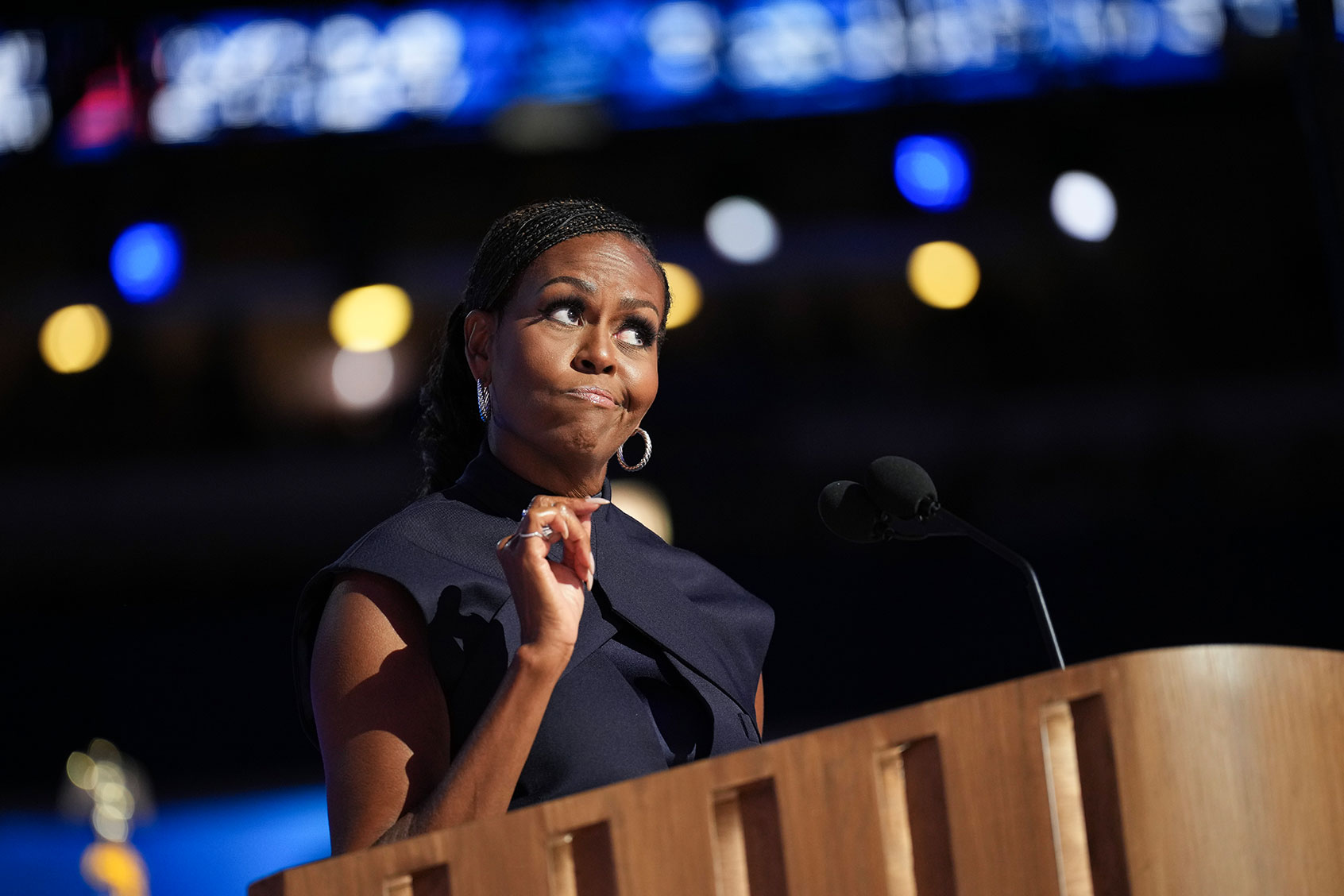
The biggest Thursday rumor was that Beyoncé would roll up, perhaps to introduce Harris, to whom the pop idol gave her blessing to use her track 2016 “Freedom.” That did not come to pass, but it’s not as if the convention was hurting for icons. By the time Harris spoke on Thursday, Pink had performed “What About Us” with her daughter Willow. Before them, The Chicks sang the national anthem.

Prior days featured John Legend and Sheila E. busting out Prince’s “Let’s Go Crazy” to represent Minnesota and performances from Maren Morris, Patti LaBelle, Mickey Guyton, Jason Isbell, Common and Jonathan McReynolds.

And the politicians? The usual parade of star elected officials sauntered past, but this time most opted to forgo the standard stemwinder for a tight five.

There was Bill Clinton on Wednesday calling Trump the “me, myself and I” option: “He mostly talks about himself. . . he’s like one of those tenors, opening up before walking onstage like I did. Trying to get his lungs open by singing, ‘Me, me, me, me, me me!’”

There was House Minority Leader Hakeem Jeffries (D-NY) likening Trump to “an old boyfriend who you broke up with, but he just won’t go away. He has spent the last four years spinning the block, trying to get back into a relationship with the American people. Bro. We broke up with you for a reason.”

With just over 70 days until the election, the Democrats are swiping their tormentors' laugh-at-'em tactics to corner the attention economy.

Michigan Gov. Gretchen Whitmer derided how out of touch Trump is. "Donald Trump doesn't know you at all. You think he understands that when your car breaks down you can't get to work? No. His first word was probably 'chauffeur.' You think he's ever had to take items out of the cart before checking out? Hell, you think he's ever been to a grocery store? That's what the chauffeur is for!" 

It’s not as if the other side has been offering up much of a battle for “Last Comic Standing” either. Rarely has there been a riper and more luscious target than Trump as he is now – knocked back on his heels, unsure of how to attack Harris or Walz. His team had plenty of “Your Biden is so old/ “How old is he?” material.

Now, that’s all out the window; now he’s the 78-year-old man struggling to come up with a schoolyard bully nickname for the younger woman he can’t help admitting is pretty by claiming too loudly in Wilkes-Barre, Penn., “I’M A BETTER-LOOKING PERSON THAN KAH-MAH-LAH.”

He was not kidding then, or when picked heckle-bait for his running mate. JD Vance stinks at wisecracks, and Trump hates being mocked. You couldn’t ask for better material.

In 2018 Obama’s former Attorney General Eric Holder contradicted Michelle Obama’s famous slogan by opining that it should be, “When they go low, we kick them.”

Michelle ObamaFormer first lady Michelle Obama speaks on stage during the second day of the Democratic National Convention at the United Center on August 20, 2024 in Chicago, Illinois. (Andrew Harnik/Getty Images)
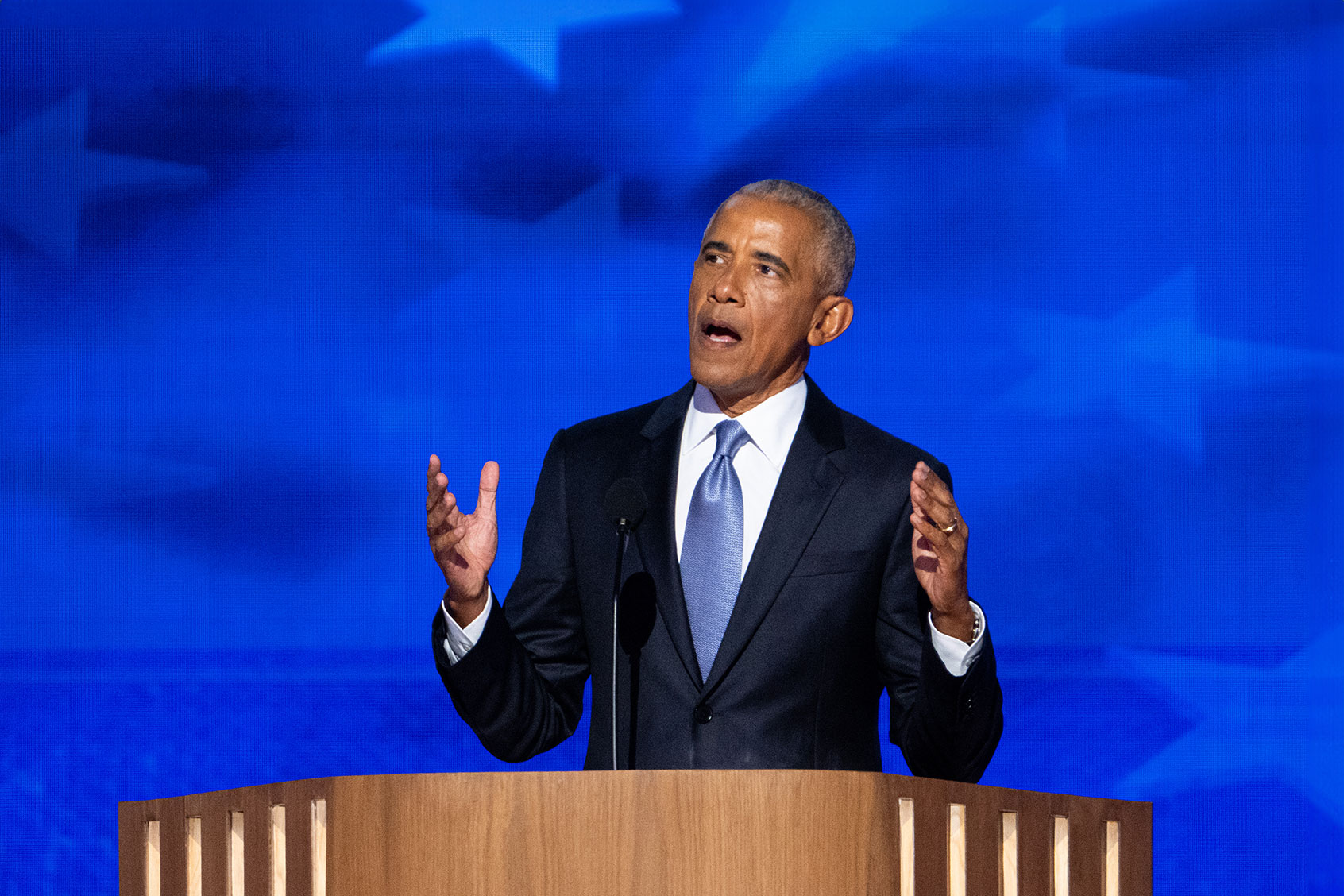
Tuesday night the former first lady proved she was listening. After reminding the crowd that their experience shows Trump feels threatened “by the existence of two hard-working, highly educated successful people who happen to be Black,” she added, “I wanna know, who’s gonna tell him that the job he’s currently seeking might just be one of those Black jobs?” 

It isn’t beyond imagination to picture Michelle making this quip in 2020 but with a bright smile. In 2024, though, she’s bulked up her stage persona. In the laugh break that followed that joke, she stared directly into the camera, her mouth playfully twisted in a “you know what I’m talkin’ about” half smirk, accessorized with side-eye.

I guess she figured Stevie Wonder had the whole nobility part covered by performing “Higher Ground.”  She wasn’t wrong.

All this aligns with the Harris-Walz campaign’s “joyful warrior” strategy, but it’s also a matter of meeting the opponent on their turf with an “anything you can do, I can do better” attitude.

Right-wing comedy is its own . . . thing . . . but the left understands that classic joke structure still rules. Combining that with the might of punching up, throw in a few live music performances, and you’ve got yourself a viewership draw.

The DNC has a network sitcom dad in Minnesota’s governor and vice presidential candidate Tim Walz, a veteran and former football coach (“ASSISTANT coach,” Trump live whined on Truth Social) who owns guns, hunts and swears that turkey is a vegetable.

Walz's best set came before the convention, on Aug. 6, when he tossed off a killer jab at Vance's expense. (“I can't wait to debate this guy.” Pause. "That's if he's willing to get off the couch and show up. See what I did there?”) And that’s fine – every entertainer knows they need to save some gas for their headlining gig.

Barack ObamaFormer President Barack Obama speaks during day two of the 2024 Democratic National Convention in Chicago on Tuesday, August 20, 2024. (Bill Clark/CQ-Roll Call, Inc via Getty Images)At a comedy festival, you don’t compete with the big guns, and as "Late Night" host Seth Meyers noted this week, everyone’s favorite Barack Obama is stand-up Obama. He did not disappoint, and neither did Michelle. She set ‘em up, and knocked ‘em down, and set him up again. Obama razzed himself by saying, “I am the only person stupid enough to speak after Michelle Obama,” but he did just fine.

All he had to do was pantomime along to a jape about Trump’s obsession with audience counts, positioning his palms in a way that everyone knew he wasn’t referring to inadequacies over rally size comparisons. Then, and this was brilliant, he threw up his hands and looked up and away as if to say, “What, am I wrong?”

We need your help to stay independent

There may have been some who might have scolded a former president for – gasp – daring to indulge in ribald, low-brow swipes. Before 2016, we should say. Eight years later, and with just over 70 days until the election, the Democrats are cribbing their tormentors' laugh-at-'em tactics to corner the attention economy — but a version that chooses cleverness.  

The Harris-Walz campaign’s TikTok team is made up of five staffers under 25, The New Yorker reports, which you can tell. The media blasts have insouciance previous presidential campaigns wouldn’t have dared to sign off on.

One includes a post from @dril, a very online comedian who apparently wasn't too pleased about the shout-out.

It’s also a matter of meeting the opponent on their turf with an “anything you can do, I can do better” attitude.

At the convention, however, their most skillful creators didn’t have to try hard to beat Trump’s surrogates wandering around “undercover.” MyPillow huckster Mike Lindell, freshly shorn of his walrus mustache, tried to debate a 12-year-old . . .

OK, can we pause? Just let that sink in.

A-a-and we’re back. Lindell stepped up to 12-year-old content creator Knowa De Brasco, probably thinking he’d score points by owning a child by trying to give him a swirlie with his voter irregularity conspiracy hokum, and ended up getting cooked, turned over and cooked again.

When Lindell blabbed out one anecdote about a “friend,” he wasn’t prepared for De Brasco to ask for that friend’s last name, which Lindell refused to provide.

“Maybe you didn’t see this in the news, maybe you’re not up on things,” Lindell ranted.

“Oh, I am. I’m up on your bankruptcy too, sir,” De Brasco said with a smile, listening politely until he finally stuck a fork in Lindell with, “So your source is ‘Trust Me, Bro’? That’s your source?” Ba-dum-CHING!

The real joke is on Trump. I mean, he started it. Political lore alleges Trump’s career in politics kicked into high gear after Obama and Meyers mercilessly roasted him at the 2011 White House Correspondents’ Association dinner. (An example from Meyers: “Donald Trump said recently he’s got a great relationship with ‘the Blacks,’ Unless the Blacks are a family of white people, I bet he’s mistaken.”)

Cut to 2016: the Democrats thought they could win with a qualified candidate with extensive experience and proficient policy explanations. Then, boom! America voted for an ex-game show host who made crowds laugh with grade-school-level taunts like referring to Sen. Elizabeth Warren (D-MA) as “Pocahontas” and ridiculing a reporter with a disability.

Comedy’s currency had turned to cruelty, and Trump was simply sharing the wealth. Last week his opposing party showed it had been saving up too while also presenting itself as a party of sincerity, featuring gun violence survivors, military veterans and Walz's former high school students from Mankato, Minn.

But even that was wrapped in pageantry. Optimistic, raucous pageantry, sure, but a showcase nevertheless that could not avoid steering into a pothole behind the scenes by rejecting the Uncommitted National Movement’s efforts to allow a pro-Palestinian speaker to talk about the Gazans’ plight before the convention audience.

Muslim Women for Harris-Walz immediately disbanded after the DNC said no, citing in part the inconsistency of the party inviting the parents of Israeli hostages onstage while denying the request.


Want a daily wrap-up of all the news and commentary Salon has to offer? Subscribe to our morning newsletter, Crash Course.


A reminder, perhaps, of the other type of politics powering this elevated courtship dance with American voters. The Harris-Walz campaign has little time to make its case to the widest swath of American voters, many of whom desire a ceasefire in Gaza but are also pro-military.

Lobbies such as the American Israel Public Affairs Committee (AIPAC) are also pouring tens of millions of dollars into ousting progressive Democrats like Congresswoman Cori Bush (D-MO) and Rep. Jamaal Bowman (D-NY) by supporting their primary opponents’ campaigns.

The final act of the convention, Harris’ Thursday night speech, was as much about laughing with her party and at Trump, who she called “an unserious man,” and a tightrope act.

When it came time to talk about the conflict, Harris quoted the Biden administration’s stance (“I will always stand up for Israel’s right to defend itself”) and added, “At the same time, what has happened in Gaza over the past 10 months is devastating . . . The scale of suffering is heartbreaking. President Biden and I are working to end this war such that Israel is secure, the hostages are released, the suffering in Gaza ends, and the Palestinian people can realize their right to dignity, security, freedom and self-determination.”

It’s too early to say whether that was sufficient to appease a coalition that is extremely fragile if not fractured. Granted, most voters are paying less attention to policy specifics right now than trying to figure out whether Harris and Walz represent an image of America worth signing on to.

“We’ve seen so many great influencers, musical artists and actors endorse Kamala,” DeBrasco told Britain’s SkyNews, “and Trump has Kid Rock and Hulk Hogan. So who really cares about those two when you have stars that young people actually care about upfront supporting Kamala, full-throated?”

Now that the show’s over, we’re going to find out.

A sequel of injustice 60 years in the making

Democrats did their due diligence and achieved a “united” convention. President Biden’s decision to no longer seek re-election could have facilitated a contested convention. However, Democrats — starting with Biden — quickly got behind Vice President Kamala Harris as the Democratic nominee. That was the test before the convention. The test in Chicago was  Palestine. 

The Biden Administration’s complicity in Israel’s genocide in Gaza and the vice president’s ambiguous posture on the campaign trail made for a potential confrontation between moderates and progressives. However, congressional progressives, from AOC to Bernie Sanders, have toed the party line and have backed the Harris Campaign. 

Pro-Palestinian uncommitted activists' protests outside the United Center in Chicago were smaller than advertised and largely ignored. As for those uncommitted activists on the inside—the thirty delegates as a result of voting uncommitted in the Democratic primary for president—they were delayed… only to be denied. 

Uncommitted activists were given space to host a panel discussion with Palestinian doctors to explain conditions in Gaza hospitals. They also were allowed to hold meetings with party officials. But were denied the opportunity to speak on the main stage during primetime after earlier consideration. Space was given to Jon Polin and Rachel Goldberg, Jewish parents of an American hostage of Hamas—with the support of uncommitted activists.

The irony of hosting a convention in the home of the largest Palestinian population in the nation—Chicago—and denying the voice of Palestinians is not lost in this moment. In response, uncommitted activists engaged in a sit-in outside the convention.  

All the partying and falling in line to show a display of strength, diversity, and unity does anything but. There is tyranny amongst Democrats because of their inaction—if not outright support—for tyranny in Palestine by way of occupation, apartheid, and genocide.

The political tension leading up to and during convention week reminds some of the 1968 DNC. Democrats convened in the shadow of the assassinations of RFK and MLK, as well as protests of the Vietnam War, with their incumbent choosing to abandon a re-election bid. However, the attempted silencing of uncommitted activists at the convention is a reminder of the DNC of 1964.

In 1964, the Mississippi Freedom Democratic Party (MFDP) was founded—by Fannie Lou Hamer, Ella Baker, Bob Moses, and James W. Wright—to counter the white supremacist politics of the Mississippi Democratic Party. The idea was birthed from Black voter registration and voting initiatives by the Council of Federated Organizations (COFO). MFDP organized a state convention to send electors to the 1964 DNC in Atlantic City, NJ; representing the scores of disenfranchised Black voters in their state. The convention was held on the backdrop of the murders of Michael Schwerner, Andrew Goodman, and James Chaney; killed near Philadelphia, Mississippi for working to register Black people to vote. Further inspired by their murders, the MFDP resolved to send their electors to be seated in the general assembly of electors at the DNC.

Once in Atlantic City, the MFDP challenged the validity of the Mississippi Democratic delegation participation in 1964 due to Jim Crow policies that disenfranchised Black voters. The Congress of Racial Equality (CORE), the Southern Christian Leadership Conference (SCLC), the Student Non-Violent Coordinating Committee (SNCC), and the NAACP all worked behind the scenes to get MFDP delegates a seat at the convention. 

We need your help to stay independent

At the convention, Ms. Hamer gave impassioned testimony of the brutality of anti-Black racism inflicted upon her simply for attempting to vote. Her testimony, told to the DNC credentials committee, was televised for all of America to hear. They heard how Ms. Hamer was made to leave her home for registering to vote. They heard of the many Black folks whose homes rang with gunshots on account of her registration attempt.

They heard that Ms. Hamer was taken to jail. They heard how the highway patrolman told Ms. Hamer, “We are going to make you wish you was dead.” They heard that two incarcerated Black men were forced to beat Ms. Hamer with a blackjack until they physically couldn’t; in the same jail where Medgar Evers was murdered. They finally heard these words from Ms. Hamer: 

“All of this is on account we want to register, to become first-class citizens, and if the freedom Democratic Party is not seated now, I question America, is this America, the land of the free and the home of the brave where we have to sleep with our telephones off of the hooks because our lives be threatened daily because we want to live as decent human beings, in America?”

None of it moved the committee. 

Democrats would not allow the MFDP  a seat at the convention. 

President Lyndon Johnson was fearful of losing the support of the Mississippi Democrats.  So like any good liberal, he suggested a compromise: The DNC would provide seats for two MFDP members in exchange for seating the all-white Mississippi delegation. MLK agreed with the compromise, but Ms. Hamer made clear: “We didn’t come all this way for no two seats, cause all of us is tired.”

Oregon Congresswoman Edith Green offered her take on a compromise: seating loyal democrats from both parties. The Mississippi Democrats rejected that and departed from the convention after all the talk of compromise. All but three to five of the sixty-eight got up and left the convention, to which MFDP delegates took their seats with passes donated to them. The next day, the party returned to find the seats removed. Their response was to stand where the seats were and sing freedom songs.

Sadly, Democrats have a history of attempting to shut down freedom fighters and justice seekers.


Want a daily wrap-up of all the news and commentary Salon has to offer? Subscribe to our morning newsletter, Crash Course.


While the Democrats of 2024 aren’t the Southern Democrats of 1964, they’ve forgotten their history because were they aware of it, maybe, they wouldn’t have repeated it. There is one Democrat aware of history; Democratic State Rep. Ruwa Romman, of Georgia, who is a Palestinian American. In the speech she was prepared to give at the convention, she referenced an awareness and respect for the history that informs the moment: 

“For 320 days, we’ve stood together, demanding to enforce our laws on friend and foe alike to reach a ceasefire, end the killing of Palestinians, free all the Israeli and Palestinian hostages, and to begin the difficult work of building a path to collective peace and safety… They’ll say this is how it’s always been, that nothing can change. But remember Fannie Lou Hamer—shunned for her courage, yet she paved the way for an integrated Democratic Party. Her legacy lives on, and it’s her example we follow.”

Uncommitted activists seem to recognize the mighty shoulders they stand on to secure justice for Palestinians and justice for all. The Harris Campaign and Democrats stand on the memory of the Trump Presidency. Thus, they walk the tightrope to salvage every vote from each constituency under their tent. A second Trump presidency isn’t optimal, but attempting to silence dissent isn’t a show of unity. It is the sort of fear that fuels a Trump election in the first place.

Howard Thurman said, “There is one overmastering problem that the socially and politically disinherited always face: under what terms is survival possible?” The DNC of 2024 leaves an equally perilous question for us to consider: for the socially and politically disinherited, under what terms is survival too good an outcome?

Democrats may learn the consequences of their answer in November.

“Sum of all parts”: Kamala Harris nomination is the culmination of “fierce” Black women leaders

CHICAGO — "We are a party of the future, we're not a party of the past," Democratic Party Chairman Jaime Harrison proclaimed during his remarks to the sparse yet lively crowd of the Black Caucus meeting in Chicago's McCormick Place Convention Center Wednesday. 

As he mused about a future for the United States led by Democratic nominee Kamala Harris, Harrison concluded his speech with a forward-looking message that sought to strike a moving contrast with the past-centric lens of Republican nominee Donald Trump's "make America great again" slogan. But the theme of Harrison's morning speech and the undercurrent of the convention's tone suggested the past wasn't so far removed from the future he and others spoke of. 

Just moments earlier, Harrison had reached into his own history to hail the nation as one in which a "round-headed kid" from South Carolina, raised by grandparents with elementary school-level education and sharecropping, cleaning and road-paving jobs, could see the success of convening a convention with a Black chairwoman to nominate a Black woman to the presidency. 

Before him, Democratic National Committee Black Caucus Vice Chair Charlie Staten introduced the event in opening remarks that called back to Black leaders and thinkers past, quoting Harlem Renaissance poet Langston Hughes and dropping subtle nods to the nation's first Black congresswoman, Democratic New York Rep. Shirley Chisholm. Those historical musings followed Harrison and Democratic National Convention chairwoman Minyon Moore opening the convention Monday afternoon by honoring civil rights activist and politician Jesse Jackson for his 1980s presidential bids and evoking the legacies of Chisholm, the first Black woman to seek the Democratic nomination, and Fannie Lou Hamer, a Black civil rights activist whose famous 1964 testimony would see its 60th anniversary on the day of Harris' Thursday nomination.

Singer-songwriter John Legend lauded Chisholm and civil rights leader John Lewis, the late U.S. representative for Georgia, amid discussion of historical discrimination and contemporary rightwing efforts to curtail marginalized people's rights and freedoms during Wednesday's Black Caucus meeting, while Sen. Elizabeth Warren, D-Mass., in main convention remarks Thursday made reference to Chisholm's "unbought and unbossed" campaign slogan in compliments to the vice president. 

What these frequent reach-backs made clear was that the historic nature of Harris' nomination carried more meaning with it than just her being the first Black woman and Asian American to secure a major-party nomination. Speakers, delegates and attendees saw Harris' ascension as not only cementing her place in a legacy of Black leadership but carrying it with her into a much more hopeful future — and that soon seemed to be a refrain they sang throughout the week.

"That's what we're going to get in a President Harris," Meredith M. Turner, a Cuyahoga County, Ohio councilwoman and Ohio delegate, told Salon Wednesday. "She is going to bring all of the experiences of her ancestors to that table when she makes decisions." 

Roslin Spigner, a New York delegate, agreed Wednesday, declaring the moment a continuation of those ancestors' efforts to create social change.

"This moment is just a continuation of what Harriet Tubman did. It's a continuation of Isabella Bomfree, which is Sojourner Truth," said Spigner, the founder of A Taste of Soul NY African American Heritage tours. "It's just a continuation of Fannie Lou Hamer. It's a continuation of Barbara Jordan, Marcia Fudge — all of these women who leaped down on faith to say, 'Black women, you need to hear our voices. America, you need to hear our voices. We have something to say, and we're going to say it.'" 

In 1972, Chisholm became the first Black woman to seek a major-party nomination when she launched her bid for the top slot on the Democratic ticket. Met with both racist and sexist opposition, political rivals underestimated the daughter of Bajan and Guyanese immigrants' campaign, perceiving it as more of a galvanizing gesture to Black voters and women than the electoral playbook she intended it to be. The famously "unbought and unbossed" candidate boasted an anti-Vietnam war and -weapons development stance and positioned herself as a champion of the working class, ultimately launching her campaign after voters pulled together $10,000 in donations

When that year's Democratic National Convention began in Miami Beach, Florida, she entered with the 28 delegates she won during the primary races. Though she was far from acquiring enough delegates to win the nomination, which instead went to South Dakota Gov. George McGovern, and later withdrew from the race, she ended the convention having garnered just over 150 delegates after disaffected pledges to other candidates defected and Vice President Hubert Humphrey released his sworn delegates to her. 

Duni Hebron, a 20-year DNC attendee and real estate broker, told Salon that Chisholm's career and campaign created a "pathway for us to dare, to dare to become, to break down whatever barriers that's in the way" and shatter the glass ceiling. 

Harris' nomination, then, accomplishes the goal that Chisholm set in motion 52 years ago, and has taken it farther. In the weeks after entering the race, Harris racked up enough delegates to secure the Democratic nomination. She's also shattered presidential fundraising records, signed on thousands of new campaign volunteers and energized voters in ways that hadn't been seen during the 2024 election cycle.

Fundraising web calls with tens of thousands of Americans in the early aughts of her fledgling campaign added to the momentum, which was solidified by her nomination via virtual role call earlier this month and official acceptance on the stage of the United Center Thursday night.

"Kamala Harris being the nominee means, not only for Black people, but for other daughters, for them to see that anything is possible," Hebron said. "She was the first woman vice president, and now we're going to make history with her. She represents all facets, all demographics. She's an immigrant child, and so am I. And so I am so proud to see her where she is, and know where we're going to take her to."

Attendees and speakers also called upon another slice of Black women's history as they traversed the halls of the United Center: that Harris was to officially be declared the Democratic nominee for president 60 years to the day of civil rights activist Fannie Lou Hamer testifying before the DNC credentials committee in a landmark speech. Hamer, a former sharecropper and a leader of the racially integrated Mississippi Freedom Democratic Party, objected to the seating of an all-white Mississippi delegation at the 1964 Democratic National Convention.

Taken with the Hamer speech anniversary, the manner in which Vietnam war tensions within the Democratic party erupted during the last Chicago-based Democratic convention in 1968 alongside a battle over seating racially integrated delegations for some states makes Harris' nomination especially poignant for DNC Black Caucus Vice Chair Charlie Staten.

"Here we are, 55 years later, nominating, choosing to nominate a Black female to head this ticket for president of the United States," he told Salon. "And she's ahead in the polls."

How Harris' campaign and presidential bid rests at the feet of those who came before her demonstrates "it's the sum of all parts," argued Spigner.

"You can't have one without the other," she said, adding: "The oratory skills that she [would] have to have Thursday night is important because that's Sojourner. The determination that she's going to have to have is Harriet. The drive to serve in leadership is Shirley."

The "guts to stand up to Donald Trump is all of us together," she continued. It's the Black girls who "weren't afraid to jump double dutch," the Black children who may have been "ridiculed because of the color of their skin" but still went to school, who, like the Little Rock Nine and Ruby Bridges, "had to go through desegregation."

Turner agreed, emphasizing that Harris' historic nomination is also a sign of how far the nation still has to go.

"I mean, we've been fighting this battle for a long time," she said. "Having a first, it shouldn't be that significant in 2024. It just lets us know how far our country still has to go around diversity, equity and inclusion, be it at city, state, county or our federal government."

Still, she said, she was excited to witness Harris accept the nomination at the DNC, acknowledging the progress it represents from previous losses like Chisholm's or former U.S. Secretary of State Hillary Clinton's "win that got away from us."

"Everything we didn't get with Shirley and Hillary, we're going to demand it with Kamala, and I'm going to be on the frontlines trying to make sure that happens," she said. 

Spigner and Turner said the moment and understanding its gravity has made them feel the "joy" and "hope" that have come to characterize the energy around Harris and her presidential campaign.

Spigner said it makes her think both of all the young Black women with hopes to achieve "any and everything in life that they choose to" and the young women who count on her as a Democratic district leader to "to help them with their dreams of becoming public servants, helping to shape and mold them and to guide them."

Turner expressed a similar sentiment, saying she hopes Harris' ascension to Democratic nominee, "this culmination of fierce women in leadership," will help forge a society that empowers children of all backgrounds and ensures they know they can achieve and have the confidence and tools they need to do so. 

"My hope for the future is that they never are afflicted by racism or sexism or bias and discrimination that those foremothers had to confront and conquer," she said. 

Spigner added that she hopes Americans young and old will recognize this moment as "something big," a historical event "just as huge as the Women's Suffrage March" of 1913, the 1963 March on Washington and both of former President Barack Obama's inaugurations in 2008 and 2012.

"This is as big a moment in history as any other moment in American history, but also as it pertains to Black America and the contributions of Black America," she said.

Harrison and Staten each shared an ideal vision for the presidential inauguration, slated for Monday, Jan. 20, 2025, the observed date for Martin Luther King Jr. Day next year: Justice Ketanji Brown Jackson, the first Black woman appointed to the U.S. Supreme Court, cloaked in black on the steps of the Capitol on the cold but clear day, holding the Bible of abolitionist and formerly enslaved man Frederick Douglass. Stepping up to join her, Harrison imagined during the Wednesday meeting, would be a president-elect Harris, perhaps dressed in tan or white, who would place her hand on the Bible and be sworn in as the first Black female and South Asian president on the steps of a building erected by enslaved African Americans.   

When recounting his version of their idealistic future to Salon, Staten affectionately dubbed the significance of the imagined moment as "our KKK," referencing the Ks in Jackson, Harris and King's names — a rebuttal he offered to opposing candidate Trump's being "pretty much in support of the [Ku Klux Klan]" by way of his characterization of 2017 Charlottesville neo-Nazi race rioters as "very fine people." 

Though Harris, should she win the presidency, would be sworn in by Chief Justice John Roberts, the optimistic dream caucus members articulate is a reflection of their hope for a better future for the country they seem to so dearly love, the legacy they wish its Black leaders to leave and how they see Harris — win or lose — fitting into it.

And Harris — in her own right — seemed to lean into it in Chicago Thursday night.

"On behalf of our children, and our grandchildren, and all those who sacrificed so dearly for our freedom and liberty, we must be worthy of this moment," the vice president told the packed arena as she closed out her acceptance speech. "It is now our turn to do what generations before us have done, guided by optimism and faith to fight for this country we love, to fight for the ideals we cherish and to uphold the awesome responsibility that comes with the greatest privilege on earth — the privilege and pride of being an American."

"Together let us write the next great chapter in the most extraordinary story ever told," she added.

Bug sprays don’t work against cockroaches, study finds. Here’s what to do instead

There's a good reason a cockroach elicits a feeling of disgust when we see one scuttle past. Cockroaches carry a wide range of diseases and pathogens including bubonic plague, dysentery, hepatitis, hookworms, leprosy, salmonella and polio. It's understandable why, when someone sees a cockroach, they reach for the bug spray.

"You can get insecticide resistance in a population inside of a home very quickly because that population is turning over and growing so fast."

Yet new research suggests these consumer-grade pesticides don't really do much — and can even be harmful. According to a recent study in the Journal of Economic Entomology, one should think twice before using insecticides based on the organic compounds pyrethroids. This includes Raid Ant and Roach Killer, Outdoor Fragrance Free; Hot Shot Roach, Ant and Spider Killer; Ortho Home Defense Insect Killer for Indoor & Perimeter; and Spectracide Bug Stop Home Barrier. At best, they were all sporadically effective, depending on complicated circumstances, in killing a common cockroach species called German cockroaches (Blattella germanica.) Additionally, they can be dangerous for humans.

"While most products performed well when applied directly to test insects, mortality was substantially lower across all surfaces with limited exposure (30 min)," the authors write. "In continuous exposure assays on a nonporous surface, products took at least 24 hr to cause 100% mortality in a field population, with some products taking up to 5 [days] to achieve 100% mortality."

Johnalyn Gordon, PhD, a postdoctoral associate at the UF/IFAS Fort Lauderdale Research and Education Center, completed this work as a doctoral student at the University of Kentucky. Speaking with Salon, Gordon explained why German cockroaches were chosen for this study.

"German cockroaches have a couple of different qualities that make them very adept at surviving in our homes and being able to adapt to our pesticides and to our control strategies," Gordon said. "First of all, their small size. They can hide in a lot of different places. They also have a relatively short life cycle, so the populations are able to grow very quickly, almost exponentially within a home. And that also means you can get insecticide resistance in a population very quickly because that population is turning over and growing so fast."

Despite seeming like simple insects, cockroaches possess remarkable intelligence and diversity. Vanderbilt University cockroach researcher Terry Page famously observed that scientists who have observed many cockroaches tend to notice that "each cockroach has its own individual face. Each one is slightly different."

But for many people, such a face is something only a mother can love. Given roach resiliency, it is understandable why people might prefer the most extreme methods imaginable to get rid of these unwanted roommates. Yet Gordon urges people in these situations to focus on the long-term consequences of their possible responses.

"One of the biggest concerns with liquid or aerosol products, the ones that we tested in our study, and total release foggers, which have have been previously tested and found to be ineffective, is that they have the possibility to contaminate the indoor environment with large amounts of pesticides if they're used improperly," Gordon said. "And oftentimes they are. So if you're going to apply an entire can of Raid or set off six bug bombs or something like that in a home, it greatly increases the risk of pesticide exposure for pets or people living in that home."


Want more health and science stories in your inbox? Subscribe to Salon's weekly newsletter Lab Notes.


"Often resources are limited for people that are struggling with cockroach infestations in their homes."

As an alternative, Gordon suggests that people faced with cockroach infestations use baits.

"Gel baits have been found by numerous studies to be very effective, at least in the lab, for German cockroach control," Gordon said. "They have that added bonus that because they work through being consumed, there's a lot less pesticide that's actually being put into the home, and they can be placed in very targeted areas where they would be less accessible to members of the home."

By contrast, insecticide sprays containing pyrethroids are only somewhat capable of curtailing cockroaches. In one part of the experiment, the scientists introduced the cockroaches to a "limited" amount of exposure — meaning that instead of spraying them directly with the pyrethroid (which always killed them) or providing them with continuous exposure (regularly covering an area with the pesticide), they looked at situations where cockroaches were only occasionally exposed to the pesticide in question.

"For the limited exposure project, we were looking at individuals that were resistant to the active ingredient, which is pyrethroids," Gordon said." And we were also looking at laboratory susceptible populations of German cockroaches. The latter are ones that have been held in the lab for decades at this point. And so they haven't been exposed to any pesticides, including the particular pesticide we were looking at. So what we found in the limited exposure was that with those resistant populations that had been collected from homes, there was substantially lower mortality on those residues."

While cockroaches may not feel the sting of pesticides, humans might, especially if they are overused in the household. As the study authors put it, "Lack of efficacy of these DIY products can not only perpetuate the consumer’s feelings of hopelessness surrounding cockroach control, but increase desperation and lead people to misuse products, with disastrous results."

Side effects of pesticide exposure are generally considered low risk, but that depends on the level of exposure.

"Though considered to have low acute human toxicity, occupational exposure or accidental exposure through ingestion of pyrethroid insecticides may lead to dermal irritation, nausea and vomiting, and dizziness," the authors report. ":More recent studies have explored the negative impacts of prenatal and childhood pyrethroid exposure on neurodevelopment."

We need your help to stay independent

There are non-toxic alternatives to roach control. Diatomaceous earth, a powder made from fossilized diatoms, dries out the exoskeletons of roaches. Though one should avoid inhaling it, it doesn't contain any toxins, roaches can't develop resistance to it and it is often extremely effective at eradicating entire infestations. As a bonus, it also works against bedbugs, which are also evolving pesticide resistance.

In general, we need to reconsider how much pesticides we really need in our homes and how effective these products really are. The latest research is intended to make that easier — and safer — for consumers who live with infestations.

"One thing I want to highlight is that one of the biggest goals of this research was to provide some insights for people that are struggling with cockroach infestations," Gordon said. "We recognize that when it comes to the do-it-yourself products that are available on shelves, there's a wide variety of options that are available and we recognize that often resources are limited for people that are struggling with cockroach infestations in their homes. The goal of this project project was to provide some insights into how resources may can be allocated towards products that would be more effective at controlling cockroaches in homes."

“We take over our country”: Trump brings out RFK Jr. at Arizona rally

Donald Trump delivered on his promise to bring a “special guest” to the stage during a Glendale, Arizona rally on Friday, after a week out of the limelight amid the Democratic National Convention.

Opening with an apparent verbal misfire, Trump brought out independent presidential candidate Robert F. Kennedy Jr., who he called “an incredible champion for so many of these values that we all share.” 

Trump, caught in a video leaked by Kennedy’s son, endorsed many of Kennedy’s anti-vaccine conspiracy theories, though the Trump campaign had previously blasted him, publicly, as too far-left.

Earlier on Friday, Trump received the endorsement of Kennedy, despite his decision not to drop out in most states, referring to his former opponent as “a very low-key person,” despite the barrage of front-page bizarre stories surrounding Kennedy, including his admissions that he had a brain worm and that he dumped a dead bear in Central Park, as well as the accusations of sexual assault made against him.

On stage, after walking out to a likely unauthorized use of "My Hero" by Foo Fighters, Kennedy gleefully told the crowd that he believed Trump — who planned to arrest unfriendly reporters — would “end the censorship” against his campaign, and tried to justify his support for the former president. 

“Don’t you want a president that’s going to make America healthy again?” the famously vaccine-skeptic Kennedy asked, hours after blaming seed oils and processed foods for America’s position during the Trump administration as a world leader in COVID deaths.

Kennedy wasn’t the only “surprise guest” to get a shout-out. Trump also drew attention to “Sherrif Joe” Arpaio, a former sheriff and two-time failed mayoral candidate who was convicted in 2017 for refusing to comply with a court order to stop racial profiling practices. Trump pardoned Arpaio days later.

In his speech, Trump, who’s demonstrated signs of panic as Kamala Harris maintains a month-long upward trajectory, took a more optimistic tone than his Thursday night meltdown on the phone with Fox News.

“74 days, then we gently move into that beautiful White House and we take over our country,” Trump said.

Trump went on to outline his election-day plan to flood polls with a heavy police presence, which some considered a form of voter intimidation.

“We need every sheriff to get over there, every law enforcement official because we got the votes. We got to make sure everything's on the up and up,” the former president explained.

Watch here: 

Trump campaign adviser slams former Rep. Kinzinger for speaking at DNC

In a recent interview, Donald Trump’s attorney and senior campaign adviser, Alina Habba, railed against former Rep. Adam Kinzinger, who spoke out against Trump as a “weak man . . . who can’t stop playing the victim” at the Democratic National Convention.

The former Republican congressman, who has previously spoken out against the party after Trump’s 2020 loss and attempts to overturn the election, and spilled secrets about Trump allegedly "smelling like a butt," addressed the convention on Thursday, speaking just hours before Vice President Kamala Harris took the stage.

“You want to speak about values? You don’t know where the hell you stand,” Habba said in an appearance on Newsmax on Thursday night. “You are calling a man that just took a bullet to the ear weak! And you are saying that he is small and he is soft?”

The rift between Kinzinger and the MAGA wing of the party has only grown since he took a central role in the second impeachment inquiry against Trump, and the subsequent January 6th investigation in Congress.

While each day of the DNC shattered even the most-watched moments of the Republican convention last month, Thursday drew in an average of 26.2 million viewers. But Habba seemed unimpressed by the coalition the Harris campaign assembled to speak against Trump.

“You are worse than a RINO, you are pathetic,” Habba said about Kinzinger.

It wasn’t just the right that criticized Kinzinger’s appearance. Palestinian-American Georgia lawmaker Ruwa Romman, who was denied an opportunity to speak on the DNC stage despite the pleas of Uncommitted Movement leaders, questioned why “our tent can fit anti-choice Republicans, but it can't fit an elected official like me,” in a speech outside the convention.

Elizabeth Warren cuts off CNBC host’s patronizing economics “lecture”

In a conversation on the Harris campaign’s plan to fight against corporate price gouging, Senator Elizabeth Warren had to set CNBC’s Joe Kernen back on track after he launched into an Econ-101-esque “lecture.”

Kernen welcomed Warren by celebrating her speech at the Democratic National Convention, before blasting the Harris campaign’s economic proposal as “price controls, basically.”

“If beef is too high, people don’t move to chicken — competitors don’t come in to undercut where the beef prices are. Nothing works when you try to artificially try to control prices. It’s just a supply and demand issue. It’s a flawed idea,” Kernen said.

“So did you have a question here?” Warren, the architect of the Consumer Financial Protection Bureau and a law professor specializing in commercial law and bankruptcy, asked.

The fazed Kernen then asked Warren why she would support the price gouging relief plan that he called a “flawed idea.”

“I understand if you want to do a lecture about this, but let’s just start with, where have you been for the last 30 years as three dozen states have price gouging laws and they have used them effectively?” Warren answered, adding that price gouging laws kept markets on the rails and kept consumers protected.

“As a result of [COVID], there were corporations that said, woah, now that we have inflation, now that prices are up overall, this is a great opportunity for us to raise prices, not just in passing along costs, but to go way, way, way above that,” Warren said, citing soaring profit margins, especially in less competitive industries.

Kernen, unsatisfied with the answer, shot back and called the plan a “fool’s errand” while attempting to cut Warren off. 

“Let me finish now,” Kernen said, with Warren responding, “You didn’t let me finish.” 

Watch the full interview here:

Trump stages Arizona rally, teasing surprise guest as campaign spirals

Donald Trump is set to headline a rally in Glendale, Arizona on Friday night, after an overnight spiral on social media and Fox News set off by Vice President Kamala Harris’ speech at the Democratic National Convention.

The Turning Point PAC and Turning Point Action co-hosted event — which will be held in the same arena that Harris and Tim Walz packed to the brim with nearly 20,000 supporters earlier this month — is slated to start at 4 p.m. local time and feature a "special guest" that many are speculating will be Robert F. Kennedy, Jr. as he, earlier in the day, suspended his presidential campaign and endorsed Trump.

Per local newspaper AZ Central, confirmed guests include election deniers like Kari Lake and Abe Hamadeh, as well as Maricopa County candidates ​​Jerry Sheridan, Shelli Boggs, and others.

Trump’s campaign has entered somewhat of a tailspin amid disastrous polls and a 4-day DNC that locked him out of the press cycle, made apparent by a flip-flop on Georgia Gov. Brian Kemp, who Trump decried for nearly four years for resisting pressure to overturn the 2020 race in his state.

“I think we’re going to have a very good relationship with Brian Kemp,” he told Fox News on Thursday night.

In another reversal, Trump tried to flip the script on abortion in a Truth Social post on Friday morning.

“My Administration will be great for women and their reproductive rights,” Trump, who boasted about ushering in the justices who killed Roe v. Wade as recently as June, wrote.


RFK Jr. suspends campaign and endorses Trump, accusing Democrats of “abandoning democracy”

Robert F. Kennedy, Jr. suspended his presidential campaign and endorsed Donald Trump in a Friday rally, capping off his unsuccessful long-shot bid.

In the conspiracy and blame-laden speech, in which the independent cited “relentless systematic censorship and media control” for his electoral failures, Kennedy said that, though he wasn’t dropping out, he would remove his name from ballots in key swing states and support Trump’s campaign.

Kennedy, a lifelong Democrat, said the party “had become the party of war, corruption, censorship, [and] big pharma,” days after reportedly begging Kamala Harris for a meeting to discuss endorsing her in exchange for a cabinet post, a request she ignored.

Kennedy, who accused the Democratic party of “abandoning democracy” by nominating Vice President Harris, went on to accuse the same Democratic lawyers who he alleged kept him off of ballots of trying to throw Trump — who led a violent mob to interrupt the election certification process on Jan. 6, 2021— in jail.

Though Kennedy’s running mate, Nicole Shanahan, seeded doubts about whether the candidate would endorse the former president without an apology for his efforts to develop and roll out a COVID-19 vaccine amid the pandemic, Kennedy proudly touted his talks with Trump over a role in a potential future administration, noting that the pair were aligned on key issues.

Kennedy, who accused the media of “colluding with the DNC” to stifle his campaign, boldly claimed that his campaign polled, at times, “in the high 20s.” Kennedy slugged between 5 and 10 percent in most nationwide polls, exceeding 15% only once, in a Forbes poll after the first presidential debate.

His endorsement could deliver Trump a small percentage of votes in key swing states, where he trails by narrow margins.

Kennedy, who spent tens of minutes ranting about seed oils, estrogen and pharmaceutical companies, also promoted in his speech the same conspiracy theories against vaccines that he’s lobbed for years.

In a statement, multiple of Kennedy’s siblings, who previously endorsed the Democratic ticket running against him, shared their disappointment at the endorsement.

“We believe in Harris and Walz. Our brother Bobby's decision to endorse Trump today is a betrayal of the values that our father and our family hold most dear. It is a sad ending to a sad story,” the statement, posted to X by Kerry Kennedy, read.

Judge axes police charges in Breonna Taylor killing, blaming her boyfriend

A federal judge tossed charges against two Louisville police officers who killed Breonna Taylor in 2020, dismissing claims that they attempted to search her home, and ultimately shot her, on a falsified warrant — shifting the blame to her boyfriend instead. 

U.S. District Judge Charles Simpson wrote that the actions of Kenneth Walker, who shot at officers when they broke down the door to Taylor’s home after they failed to identify themselves — leading him to believe they were intruders — were the legal cause of death for Taylor.

Louisville Police Detective Joshua Jaynes and Seargent Kyle Meany were charged in 2022 by the Department of Justice for submitting a false affidavit before the search, then colluding to concoct a “false cover story in an attempt to escape responsibility,” per court documents obtained by CNN.

"While the indictment alleges that Jaynes and Meany set off a series of events that ended in Taylor's death, it also alleges that (Walker) disrupted those events when he decided to open fire," Judge Simpson wrote in the ruling. Charges in a separate case against Walker were dropped after attorneys argued he believed he was shooting at a home intruder, not law enforcement.

“There is no direct link between the warrantless entry and Taylor’s death,” the judge wrote, while a separate Louisville officer involved in the shooting is set for retrial in October for endangering Taylor and others when he shot recklessly into her window.

Taylor’s death, which occurred while she was asleep inside her home, spawned months of nationwide protests as the officers evaded accountability in the immediate aftermath. While one officer connected with the killing pleaded guilty, a $2 million settlement from the city of Louisville remains the only justice won for Taylor.

“More than bad taste”: Disability rights activists condemn ableist Gus Walz backlash

On Wednesday night, millions of neurodivergent and disabled Americans saw themselves in the moment 17-year-old Gus Walz, son of Minnesota Gov. Tim Walz, emotionally exclaimed "That's my Dad!" at the Democratic National Convention (DNC). The Walz family is open that Gus Walz has been diagnosed with both Attention Deficit Hyperactivity Disorder (ADHD) and a nonverbal learning disability (NVLD).

This means Walz has a disability and, if he chooses, could be classified as neurodivergent, a term referring to people whose brain differences affect their abilities in ways that significantly deviate from the so-called "neurotypical" norm. The CDC estimated that 15 to 20 percent of the population is neurodivergent in some way, meaning millions of Americans could potentially identify with Walz.

"Insensitivity to diversity reminds us how Nazis grew their ranks … We should not confuse it with something rude, apolitical or insensitive. It heralds danger."

Unfortunately, many have twisted what was ostensibly a tender moment into an opportunity for bullying, such as columnist Ann Coulter turning Walz into a punchline by tweeting a now-deleted post that read "Talk about weird…"

Many, including former First Lady Michelle Obama, have pushed back against this negativity toward Gov. Tim Walz's son. Obama's outrage is perhaps unsurprising — she and her husband, former President Barack Obama, produced a disability-themed Netflix series called "Crip Camp." Yet if there is one constant theme among neurodiversity and disability rights advocates, it is that they are grateful for all of the support from neurotypical and non-disabled allies that they can get.

After all, mockery of the type we're seeing against Walz can have serious real-world consequences.

"The backlash against Gus Walz is heartbreaking as the Walzes represent millions of American families — about 1 in 6 children have a developmental disability," Katy Neas, CEO of The Arc, told Salon. The Arc is an organization founded in the 1950s to assist individuals with intellectual and developmental disabilities.

"This is just one example of how our society continues to perpetuate deep-rooted stigmas about people with disabilities," Neas added. "We misunderstand and devalue the experiences of people with disabilities, which is not only hurtful, but also harmful. These negative responses are chipping away at the opportunities people with disabilities have to lead fulfilling lives."

The backlash to Gus Walz might stimulate "hate and discrimination" about neurodivergent and disabled people more generally, Maria Town, the president and CEO of the American Association of People with Disabilities, told Salon.

"Given the amount online hate disabled people experience simply for being themselves and the amount of bullying youth and kids with disabilities experience on a regular basis, we could sadly anticipate that Gus would be mocked," Town said. "Soon after the DNC ended, we began to see memes online making fun of Gus' reactions — a terrible and disrespectful response to a moving display of familial love. Such a response should not be tolerated. I hope serious efforts are underway to protect Gus' physical and emotional safety as we move closer to the election."

Other people who are neurodivergent and/or have disabilities will also need protections. Mickey Rowe, an autistic and legally blind actor, elaborated how neurodivergent and disabled individuals benefit from the support of their neurotypical and non-disabled allies.

"I also know how desperately neurodivergent people look for and cling to 'good people,'" Rowe told Salon. "We face so much discrimination everyday. My daily life looks like seeking human connection, and failing. Trying to make a moment of friendship or love, and failing. Being judged and shamed by those who are scared of differences and disability. Because we feel so misunderstood the majority of the time, when we find someone smart and kind who gets it, who gets and understand us, we latch on to those safe people. We look up to them."

Rowe added, "Gus made it so clear to the world at the DNC that Tim Walz is his safe person. And since we know neurodiverse people are truth tellers at all costs, I believe Gus above any politician."

Town said many families are further seeing their experiences validated through the display of "love and support they saw through Gus Walz and his family."

"When Gus showed huge displays of emotion and overwhelm of pride for his father, he wasn't shushed or told to be smaller," she said. "Instead he was greeted with enormous hugs from a father who is obviously proud of his son, as a parent of any child should be. Many disabled people and their family members were deeply moved by this display, which on its face is ordinary but is all too rarely seen on such a national stage."


Want more health and science stories in your inbox? Subscribe to Salon's weekly newsletter Lab Notes.


"Gus made it so clear to the world at the DNC that Tim Walz is his safe person."

Dr. Ramani Durvasula, a licensed clinical psychologist and professor of psychology, told Salon that she hopes the discussion about Gus Walz can transition into a healthier national conversation about neurodiversity. Remarking that her "heart was full watching that moment when Gus was sharing his joy with the world, as were many Americans on both sides of the aisle," Durvasula urged Americans regardless of their political persuasion to educate themselves about the spectrum of human neurological experiences with regard to language, cognition, behavior, social processing and patterns such as autism spectrum.

Durvasula added that it is her "sincere hope" that we "develop policies, especially educational policies that create better systems from preschool through high school as well as adult programs that support children and adolescents as they transition into adulthood. And that these policies start recognizing the challenges that families with fewer economic resources experience. Compassion, empathy, respect, awareness of difference and meeting people where they are at, are all central to this conversation."

At least one historian who has studied the disability rights movement shares Durvasula's concern. Phyllis Vine, author of "Fighting for Recovery: An Activists' History of Mental Health Reform," singled out Coulter's ridicule as exemplifying something more insidious — a callousness toward diversity which has historically been a hallmark of far right politics.

"She follows in Donald Trump’s footsteps," Vine said. "Among his more public hostile remarks about people with disabilities date from his candidacy in 2015, in which he delighted mocking a reporter. More recently his nephew, Fred Trump III, has disclosed Trump’s repugnant views about the costs of people with disabilities, remarks made when he was president." The former president allegedly told his nephew that disabled Americans "should just die."
 
"Coulter’s remarks are more than bad taste," Vine explained, saying that all forms of dehumanization against marginalized groups must be called out for what they are. "Insensitivity to diversity reminds us how Nazis grew their ranks. Belittling people with disabilities was one of their dangerous hallmarks. We should not confuse it with something rude, apolitical or insensitive. It heralds danger."

To stave off this threat, Town urged Americans to follow the example of the Walz family: "neither ignoring or erasing disability, nor making too much of it." In terms of Gus Walz himself, she urged the public to respect his boundaries and only discuss his personal life as long as he fully consents to it. "His visibility may provide an opportunity to change the national conversation, and we implore all Americans to approach whatever Gus wants us to learn about his story with openness and respect."

We need your help to stay independent

Dr. Catherine Lord, the George Tarjan Distinguished Professor of Psychiatry and Education at UCLA's Semel Institute of Neuroscience and Human Behavior, also reminded the public to not armchair diagnose Gus Walz.

"If Gus chooses to identify himself as 'neurodivergent' that is a separate issue," Lord said. "He may be in a great position to help all the other people who are neurodivergent if he wants to do so but it should be his decision. And maybe it will help somebody understand being different in some ways doesn’t prevent good things."

"I think by far the most important thing about Gus Walz is how much he loves and respects his father," Lord said. "I’m shocked that someone would criticize him. Whether he has different diagnoses does not seem relevant or 'our business.'"

For more Salon articles on autism:

Secret Service quietly puts five officers on leave, as campaigns move on from Trump shooting

The Secret Service quietly placed at least five officers on leave in the weeks following the attempted assassination of Donald Trump on July 13, according to multiple sources familiar with the matter, in an apparent response to a lapse in sufficient security measures at the Butler rally where the shooting occurred, which resulted in Trump's ear being injured and one man's death.   

In addition to the Pittsburgh field office head, at least three officers from that office and one member of the former president’s personal detail were also placed on leave, according to CBS News

The decision, which was not confirmed to be a disciplinary action, comes as the shooting — once thought to be election-defining — moves to the back burner on the campaign trail.

At the Democratic National Convention, comments on the shooting were non-existent, and any slight poll bump Trump may have seen has long been erased by other massive shake-ups in the race, including President Joe Biden’s withdrawal. 

The head of the Secret Service, Kimberly Cheatle, resigned last month after testifying before the House Oversight Committee on the security gaps that allowed Thomas Matthew Crooks to shoot at the former president from an unsecured rooftop within 400 feet of his rally stage.

The shooting at the Butler, Pennsylvania rally was called a massive security breakdown, with the FBI later taking the reins of the investigation as the Secret Service’s own ​​internal affairs division continues its inquiry.

Though Secret Service spokesperson Anthony Guglielmi didn’t confirm the suspensions, telling CBS they wouldn’t comment on individuals, he confirmed that agents were being held to “the highest professional standards” and that disciplinary action could occur if a policy violation was found.

Trump, who returned on Wednesday for his first outdoor rally since the shooting, made no mention of the conspicuous newly added bulletproof glass standing between him and the crowd.

Democratic National Convention continues to score ratings wins over RNC

Ratings-obsessed former President Donald Trump might not like the latest Nielsen data showing that the Democratic National Convention has been outpacing the Republican National Convention's audience over the first three nights, The Daily Beast reported

For a third night in a row, the DNC beat out the RNC with over 20 million people tuning to the coverage every single day since it commenced on Monday. Compared to the 20.1 million who watched the DNC on Wednesday, the Republican counterpart attracted about 17.9 million viewers on its third night, despite JD Vance’s vice presidential nominee acceptance speech.

This makes an approximate 11% difference between the conferences’ third-day viewership.

What’s more, Minnesota Gov. Tim Walz’s speech drew 11.9 million viewers compared to 9.6 million viewers for Vance last month. 

The most viewed day of the RNC was July 18 which garnered 25.3 million viewers, which was also the day that included Trump’s first major address since his attempted assassination

On Tuesday, Barack Obama and Michelle Obama’s speech bumped the Democratic conference's viewership once again to more than 20 million viewers.

Dolly Parton gets in on the PSL craze with new pumpkin spice cookies

As August comes to a close, pumpkin spice season is officially in full swing. Starbucks brought back their signature PSL for its 21st year this Thursday, marking the earliest date the coffee chain has ever released the seasonal beverage. Now, country music icon Dolly Parton is joining the craze. 

Dolly Parton Pumpkin Spice Cookie Mix, produced in collaboration with Duncan Hines, is now available online, through major retailers including Walmart and Kroger, and via Instacart. To make the cinnamon-scented cookies — which, according to the box, also contain “pumpkin puree solids” for real fall flavor — home cooks only need to add an egg and ½ cup of melted butter. One box produces two dozen “soft and chewy” cookies in 15 minutes. 

According to Food & Wine, Duncan Hines and Parton first collaborated in 2022 with the release of “Dolly’s Southern Favorites” line, which included a Southern-style coconut flavored cake mix, a banana-flavored cake mix, a creamy buttercream frosting and a rich chocolate frosting. The line has only continued to expand since then with new products like mixes for cinnamon-swirl crumb cake and biscuits.

"I loved co-creating my Duncan Hines line with Conagra, and I'm thrilled we're going well beyond the baking aisle with new items across the store," Parton said in 2022. "We're looking to continue to inspire special moments in the kitchen with some of my family's favorite recipes, and I think people are really going to love them!”