Spring Sale: Get 1 Year, Save 58%

How to build affordable housing and get filthy rich

It’s no secret that America has an affordable housing shortage. At the same time, too many housing developers hear “affordable housing” and think, “Nope. Those projects don’t let me afford as many lambskin house slippers as building another high-rise. And if I can't get lost in the aroma of a saffron tagine because I'm distracted by itchy slippers, I’m going to kill somebody."

Do you want that to happen? We don’t, either. That’s why at Sterling & Cobalt, the city’s premiere development firm not facing any active tenants’ rights litigation, we’ve mapped out a game-changing affordable housing strategy that generates mammoth profits and houses human bodies. 

Below are just a few of our proposed innovations: 

Bye bye, windows

The enemy of affordable housing isn’t developers chasing the carnal pleasure of a bite of wagyu melting on his tongue. It’s windows. Without them, developers could fit 800% more units in a building. Then they could collect that much more rent and reinvest those funds into the building — by investing in their personal mental health and snagging a condo on the serene, black sand beaches of Tahiti. 

Of course, radical scientists claim that without access to natural light, humans are at heightened risk of depression. But scientists also claim that yachts hurt the environment, which is incorrect, as yachts provide hours of stimulation to the dolphins trying to avoid their blows. Suffice it to say, we’re confident in our windowless dwelling units, which we like to call “fully walled” apartments; any apartment with a window will henceforth be referred to in industry literature as a “glass-in-hole” unit. 

Which one sounds more appealing to you without any context? Exactly. 

We need your help to stay independent

So long, kitchens!

As several studies have never shown, kitchens can be depressing for poor people, on account of reminding them they’ll never be able to afford the craft beer growlers and sprouts bundles that would really add some life to the space. Would you give a dock to somebody without a yacht? Here at Sterling & Cobalt, we aren’t interested in committing architectural microaggressions. 

That’s why, in lieu of kitchens, we’ll suspend top-of-the-line feeding tubes from the ceiling, dispensing a delicious, protein-packed paste. The paste’s consistency can be best described as “tantalizingly waxy.” And let me assure you, I eat this stuff all the time, usually after a long day of volunteering. 

Access to this feature will be fully complimentary, following payment of a $500, nonrefundable deposit. 

Make ceilings less indulgent

The average ceiling is a whopping 9 feet tall. Meanwhile, most poor people stand at just 4 feet because they only eat cheeseburgers and have never heard of vitamins, according to a wellness podcaster named Jax I once listened to. By reducing ceiling heights to a streamlined 2 feet, we’ll provide residents a priceless luxury: lying flat on their backs at all times.

Rethink "walls"

Why are walls so thick? They’re stuffed with wires, insulation and dead rodents. This adds up to a colossal misuse of space — unlike my cigar room, which I built to inspire the love of my life (me) to learn more about cigars. 

Insulation? That might make sense in a world without parkas

Insulation? That might make sense in a world without parkas. As for electricity, I’ll remind you of the detrimental impacts that smartphones have on our collective mental health. Here at Sterling & Cobalt, we’re not interested in perpetuating psychic harm — we’re interested in tearing down walls, not building new ones. 

By removing walls from all units and the rest of the building, residents can connect with their neighbors on a deep, intimate and perpetually infinite basis — almost like living on the streets of Manhattan. Where else can you afford to feel like you’re living in the Big Apple? (Three consultants advised us that by branding the property as a “New York-themed concept,” we could raise rents by at least 20%.)

Say hello to your mandatory pet

What’s better: a dead rat, or one that’s given the opportunity to thrive? Here at Sterling & Cobalt, we’re interested in enhancing life, not ending it. 

Call it a game-changing move for animal rights: In this building, the rats will remain in what’s just as much their home as our tenants. Rats are highly intelligent, emotional creatures, and we can’t think of a more meaningful way to support our tenants’ mental health than gifting each of them one of these beady-eyed companions. Plus, with the money saved on an inhumane exterminator, that condo can finally get the beachside jacuzzi it’s been begging for — just the thing a developer needs to brainstorm his next innovation.

“I like working”: Trump floats idea of third term, says he’s “not joking”

Donald Trump is considering staying in office past 2028. 

The president floated an unconstitutional third term to NBC's Kristen Welker, saying that "a lot of people" want him to serve past the end of his current stint in the Oval Office. 

Considering the president's questionable relationship with the peaceful handing over of power, Welker asked Trump if he was seriously suggesting an extension to his time atop the executive.

“I’m not joking,” Trump said. “But I’m not — it is far too early to think about it.”

When asked why he would want to stay on, Trump gave a simple answer and brushed aside concerns about the constitutionality of his plans.

“I like working,” he said. "There are methods by which you could do it.”

Trump agreed that he could take office a third time if Vice President JD Vance won the presidency and then ceded it to him. However, he clammed up when Welker asked him to share other methods in which he might stay on. 

The current two-term limit was put into place after President Franklin Delano Roosevelt died in office while serving his fourth term. The 22nd Amendment barring three-term presidents was passed by Congress in 1947 and ratified by the states in 1951. For Trump to take office a third time, he would need the support of two-thirds of Congress and three-fourths of the state legislatures. 

Tennessee GOP Rep. Andy Ogles introduced a proposal shortly after Trump's inauguration that could allow him to stand for a third term. The narrowly written proposed amendment would only allow for presidents who served non-consecutive terms to qualify, thereby ruling out the return of long-time Trump foe, President Barack Obama.

A weekend in Cleveland: Where to sleep, eat and wander

I’ve been to Cleveland a few times, but when I was invited to speak at Youngstown State University for Women’s History Month, I knew I had to linger in the area. My sister lives nearby — though, somehow, that slipped my mind. (I have 14 siblings, cut me some slack.)

Instead of my usual meticulously planned trip, I opted to let the city guide me. Without an itinerary, I wandered through Cleveland’s rich blend of historic charm and modern energy, savoring unexpected flavors and unforgettable sights. If you're planning a visit, here are a few of the standout hotels, restaurants, and experiences I’d highly recommend

Where to stay

The Ritz-Carlton

If you’re looking for a luxurious hotel with top-tier customer service and an incredibly comfortable bed, the Ritz-Carlton is the place to stay. You might even spot visiting celebrities—Orlando Magic players were there during our stay.

Now, this is a four-star Midwest Ritz, so it doesn’t have the same level of detail, spa offerings or extravagance as a five-star location, but it’s likely the best hotel in the area. We stayed in a king suite — no real view, but a bed made for the kind of sleep you can only get on vacation, plus a second “guest” bathroom. The shower had excellent water pressure (which is a big one for me), and there was a full bathtub if you’re the soaking type.

Be sure to stop by the bar if you appreciate a craft cocktail—they do them well.

ROOST 

Hotel life isn’t for everyone. There’s no kitchen, space is limited, and everything seems to cost extra. That’s where ROOST comes in. It combines the best parts of an Airbnb and a hotel into stylish, loft-style apartments, complete with a full kitchen and in-unit laundry.

I love to cook, so having a well-equipped kitchen was a dream. I made homemade pesto pasta with salmon for dinner and a sweet potato hash topped with a runny egg for breakfast. The kitchen had all the necessary tools, but bring your own salt and pepper.

My wife and I loved everything about the space — except the bed. It was uncomfortable, and the pillows were inflated like balloons that wouldn’t squish when you laid on them, making for two sleepless nights. If you’re less picky than I am (which, fair warning, I fully admit to being), ROOST is an excellent home base for a Cleveland trip.

We need your help to stay independent

Where to eat

Algebra Teahouse

If you’re looking for incredible Palestinian food — or just incredible food, period — Algebra Teahouse is a must. It was easily the best meal we had on our trip.

We feasted on hearty bowls of soup, silky hummus topped with falafel, a shawarma wrap and a medley of delicious olives. Every bite was phenomenal. Honestly, just one bowl of soup with pita would have been enough for a hearty, soul-warming meal. If I had to nitpick, the tea wasn’t my favorite, but that’s a small complaint.

Algebra Teahouse is more than just a restaurant — it’s a community hub, a store stocked with Middle Eastern staples, and a space filled with art. My only regret? Not having time to go back for a second visit.

The Marble Room

Just a few blocks from both the Ritz and Roost, The Marble Room is a steakhouse and raw bar housed in a stunning old bank. Everything about the decor is over the top — massive marble pillars, ornate ceilings and statues that make the space feel truly grand.

The menu has all the classic steakhouse staples, but doesn’t limit itself to the conventional. We were in a seafood mood, so we went for the raw bar appetizers — bay scallops and big eye tuna tacos. The sushi rolls were great, too, but I’d skip the crispy rice dish. It just didn’t hit the mark.

Also, don’t sleep on the bread. It’s warm, fluffy and perfect with the provided butter.

Things to do

The Glass Asylum

Bring home a souvenir that’s both memorable and functional by taking a glassblowing workshop at The Glass Asylum in Chagrin Falls, about 30 minutes from downtown Cleveland.

You’re greeted with a complimentary drink (beer, wine or a soft drink) before choosing your project, which ranges from $60 to $160 and can be completed in under 45 minutes. Two glass artists guide you through every step, explaining the process as you create your piece. It was a blast and well worth the time and cost.

While you’re in the area, take some time to explore—especially if the weather is nice. Chagrin Falls has plenty of little shops to wander through, and of course, there’s the waterfall the village is named after.

Greater Cleveland Aquarium

You should have seen the joy on my wife’s face as we walked through the Greater Cleveland Aquarium.

It’s on the smaller side compared to some of the aquariums I’ve visited, but they make excellent use of their historic building, and there’s a lot to see. The exhibits include a variety of fish species, frogs, snakes, sea dragons, jellyfish and even a few birds. There are also interactive touch pools for invertebrates and stingrays.

We went on a rainy Saturday, so it was busy but not unbearably so. If you’re looking for a solid indoor activity, this is a great way to spend an hour or two.

The Gas Station

If smoking on street corners isn’t cutting it anymore, or you just want to kick back and relax, check out The Gas Station — Ohio’s first consumption lounge.

At first glance, it looks like a narrow shop selling infused beverages, snacks, and baked goods. But step through the door in the back, and you’re in a laid-back lounge filled with games, an Xbox and great vibes. They host trivia and open mics, and it’s open late every day except Sunday.

Ice Wine Festival

Every March for the past 22 years, the Wine Growers of the Grand River Valley have hosted an Ice Wine Festival about 45 minutes from Cleveland.

Ice wine is made from grapes that freeze on the vine and are pressed while still frozen, creating a sweet, almost syrupy dessert wine. The festival features seven different wineries, all within close range of each other. A $70 pass gets you into all of them, or you can pay per stop.

Each location offers two ice wine samples (or, at the distillery, an ice wine cocktail), with flavors ranging from classic to unexpected: maple, espresso, habanero. The experience is pure Midwest and that includes the paired appetizers: a meatball slider, multiple mac and cheese dishes, pulled pork sliders and other hearty, stick-to-your-ribs fare.

If you’re in the area in March, it’s definitely worth checking out.

How to build flavor without a recipe

Tired of those evenings when you inevitably know you'll wind up making the same dinner you always make? Don't fret. You don't need a recipe — just a fresh way of looking at what you already have in your kitchen.

Try it out! You’ll never know what you might invent.

Think about a recipe like a roadmap, a GPS app. or a guideline, but to a destination you’ve already been to. It’s cool to lean on and can be a comfort if you get lost — either on the road or in the kitchen — but it’s not a necessity. 

Take stock of your ingredients 

Start by taking a quick inventory of what you have. The only real rule? Cook food to its proper temperature. Everything else is fair game.

I get it— when you're used to thinking of dinner in parts (a protein, a starch, a vegetable), it can be hard to break that habit. But your homemade meals don’t have to resemble a frozen TV dinner, with its segmented tray of meat, an amorphous sauce, a scoop of peas or rice and a mysterious, saccharine lump of… jello? Cake? Who knows.

Instead of focusing on what a meal is "supposed" to look like, think about what you actually enjoy eating. No one is legally requiring you to serve a protein, a starch and a vegetable every night.

We need your help to stay independent

Build flavor with contrast

If you’re a fan of food competition shows, take a cue from the chefs. Instead of plating a large piece of chicken with sweet potatoes and rice on the side, transform those same ingredients into a sweet potato risotto with chicken.

Swap a bland pork chop and limp kale for bold, sautéed kale topped with crispy, miso-seasoned ground pork. Instead of a basic rice bowl with ground beef, why not make congee with soy-braised beef and lots of fresh herbs?

You can elevate whatever you’re cooking using what you already have. Let’s say you find chicken thighs, carrots, half a box of penne, an almost-empty jar of harissa, some butter and heavy cream. That could become penne with a creamy carrot-harissa sauce and crispy, chopped chicken thighs.

If you have an abundance of spinach, try making a saag-inspired sauce with bright herbs and spices, then pair it with beef, pork, chicken, tofu, seitan—maybe even paneer. Or thin the sauce out and turn it into a saag soup with a crispy garnish for texture and flavor.

Move beyond the basic protein-vegetable-starch formula by focusing on two key things: the practical (what ingredients you have, how much time you have, what tools you can use) and the ideal (your favorite flavors, textures, and consistencies).

Remember, texture doesn’t always mean crunch—it can also mean chewiness, density, or something toothsome, like dates, figs, rice noodles, or pitted olives.

And whatever you do, layer and build flavor as you cook. Season. Taste. Adjust. Repeat.

Think about textures, temperatures, flavors and colors 

When putting a dish together, consider its components: mouthfeel, contrast, color.

A rich, thick sauce benefits from something bright and snappy to balance it—think freshly chopped cilantro and a squeeze of lime. Conversely, if a dish feels flat or one-note, add a touch of dairy, like cheese or sour cream, to round it out. If everything on the plate is brown, grab some parsley and give it a rough chop. Freeze-dried chives are another great option if you don’t have fresh herbs on hand.

Think about acidity, brightness, citrus, vinegars, and spices. Consider crunch—because there’s nothing exciting about a plain bowl of mashed potatoes or ice cream. But add texture (candied nuts or dried fruit), seasoning (flaky salt), or richness (a drizzle of fudge, caramel or even espresso), and suddenly, you’ve got something special.

Don’t forget about temperature (a chilled soup for contrast?), garnishes (you can never go wrong with crispy fried shallots) or spice (maybe a spoonful of chili crisp?). Even incorporating a raw element—like thin carrot ribbons on top—can help diversify and elevate your dish.

Be more mindful of what you can create with what you already have. It’s better for your wallet, your fridge, your pantry—and your taste buds.

Have fun with your cooking

Imagine yourself as a competitor on one of those food competition shows—maybe even with $10,000 in QuickFire Quick Cash on the line. Don’t just throw together something passable to "get through dinner." Challenge yourself to make something unexpected—a flavor combination you hadn’t thought of before, ingredients that seem unrelated but actually work together beautifully.

At the end of the day, it’s your kitchen. Try something new, and you just might say, Why haven’t I made this before?

I bet you’ll be impressed with what you come up with.

“Reading builds empathy”: The case for saving America’s libraries

The American Library Association has a Bill of Rights, adopted on June 19, 1939, as a response to book burnings in Nazi Germany. As director and narrator Dawn Logsdon describes in her documentary “Free for All: The Public Library,” these horrors inspired America's librarians to codify their unifying principles into a document.

Although its seven articles have been amended and interpreted in different ways throughout the years, they still guide today's literary custodians, with the foremost being to stand against censorship.

“Books and other library resources should be provided for the interest, information and enlightenment of all people of the community the library serves,” reads Article I. “Materials should not be excluded because of the origin, background or views of those contributing to their creation.”

"When it comes to the history of the public library, what's so beautiful about it is that it is this continuing journey towards making our American ideals real."

Understanding this clarifies why the Trump Administration is threatening the country's library system.

“When it comes to the history of the public library, what's so beautiful about it is that it is this continuing journey towards making our American ideals real, but it's a real struggle, Logsdon told Salon. “It's not like we started out with everybody free and equal and welcome at the library.”

When I spoke to Logsdon and Lucie Faulknor, producer and co-director of "Free For All," they were in Boston to present a screening at its library, part of a community tour that includes showings in New York, Philadelphia and Washington D.C.

This is the prelude to the film's PBS debut on "Independent Lens" at the end of April. But its message is especially urgent right now.

On March 14, President Donald Trump signed an executive order titled “Continuing the Reduction of the Federal Bureaucracy," which calls for several government agencies to be “eliminated to the maximum extent consistent with applicable law,” including the Institute of Museum and Library Services, or IMLS.

The IMLS is an independent federal agency that supports 125,000 public, school, academic and special libraries and museums in all 50 states and territories, according to the American Library Association. It administers both federal grants to states and discretionary grants to individual library entities. It also contributed outreach funds to “Free for All.” 

Libraries are the nexuses of democratized access to culture, community expertise, diverse perspectives on history and the instruments that further that knowledge. They also are gathering spots and safe spaces for the vulnerable.

“People who are in library leadership, on boards, and certainly librarians even today, are not interested in limiting, shaping, prescribing how that creative and generative expression should be had,” says John Chrastka, Executive Director and founder of the non-profit advocacy organization EveryLibrary. “They're just interested in making sure that everybody's got a fair shake to get to it.”

This may be why the Trump administration is set on starving our nation’s libraries to death, or close enough to it.

“Article II: Libraries should provide materials and information presenting all points of view on current and historical issues. Materials should not be proscribed or removed because of partisan or doctrinal disapproval.”

If you grew up in the pre-Internet age, your local library probably played some role in your upbringing.

Libraries are the nexuses of democratized access to culture, community expertise, diverse perspectives on history and the instruments that further that knowledge.

But if you talk to most adults today, they will likely tell you they haven’t visited their local library in many years, if ever. To Trump’s administration and his extreme right allies, they are somehow insufficiently patriotic. Extremist groups like Moms for Liberty allege that they "indoctrinate" children into learning far-left ideology by allowing them to access “inappropriate” reading material.

A more common position is that the Internet and digital technologies have made libraries unnecessary. But this is largely predicated on the inaccurate idea that your local library’s sole purpose is to lend books. 

You can rent films and borrow the latest music releases at your local library, or sign up for free museum passes. Many also make tools and other household implements available to library cardholders. Libraries offer English classes, provide resources to attain citizenship and assist small businesses. Some host sessions with tax experts.

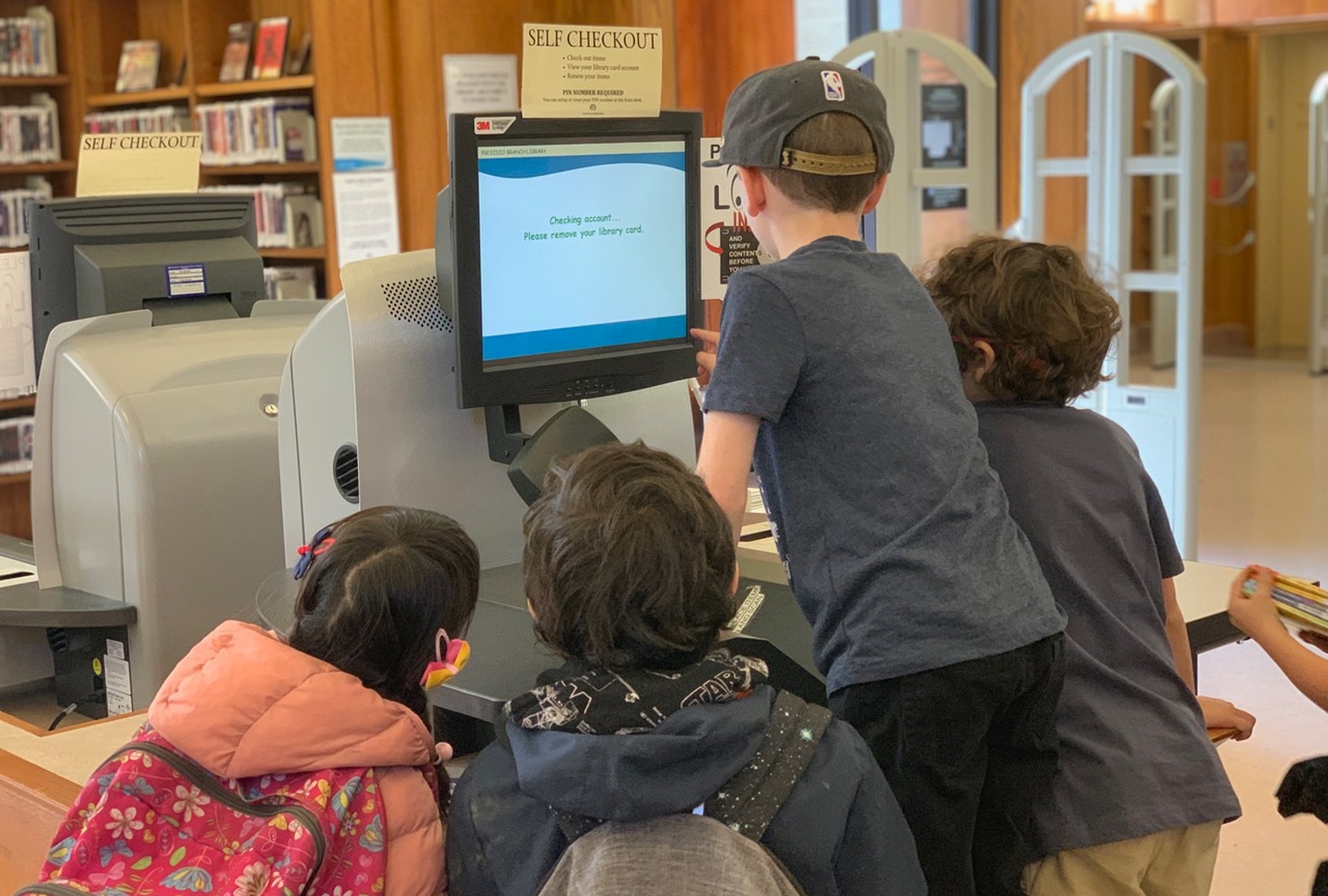
Kids at the self check-out at the Presidio Branch of the San Francisco Public Library (Lucie Faulknor)They might also be their community’s most reliable source for Internet access, if not the only one.

Among what the ALA estimates to be more than 1.2 billion in-person visits annually to libraries around the country, homeschoolers are among the system's most avid patrons.

One of the people Logsdon and Faulknor introduce in “Free for All” is Rebecca Kirchberg, a Columbus, Wisconsin, resident who, at the time of filming, had 14 children and another on the way. Her small town's local library is essential to her children's education.

“We don’t get a lot of the school information, and having that library to really pull us together into the community has been so helpful for us,” Kirchberg says in the film as her kids peruse the shelves. She adds that their library influences them as “a faith-filled family that’s always looking to learn and explore.”

“If you don’t have good information,” Kirchberg adds, “there’s no way you can make good decisions.”

“Article III: Libraries should challenge censorship in the fulfillment of their responsibility to provide information and enlightenment.”

“Article IV: Libraries should cooperate with all persons and groups concerned with resisting abridgment of free expression and free access to ideas.”

Webster Free Circulating Library staff circa 1904 (Courtesy of New York Public Library)Trump’s March 14 order also calls for the elimination of the Woodrow Wilson International Center for Scholars in the Smithsonian Institution, which was further targeted in another executive order signed on Thursday, March 27, titled “Restoring Truth and Sanity to American History.”

An accompanying fact sheet directs Vice President JD Vance, a member of the Smithsonian Board of Regents, “to work to eliminate improper, divisive, or anti-American ideology” from the Smithsonian’s museums, education and research centers and the National Zoo. 

This is unprecedented at the Smithsonian, the nation’s preeminent historical archive. Its iconic status ensured that Thursday's executive order drew immediate national attention.

But another assault on public libraries was already in motion, although fewer people may have noticed.

On Thursday, March 20, Trump appointed Deputy Secretary of Labor Keith E. Sonderling as the Acting Director of the IMLS.

“I am committed to steering this organization in lockstep with this Administration to enhance efficiency and foster innovation,” Sonderling said in an agency press statement. “We will revitalize IMLS and restore focus on patriotism, ensuring we preserve our country’s core values, promote American exceptionalism and cultivate love of country in future generations.” 

"We’re going to be on a collision course with the Trump administration over the constitutional compliance for libraries, as opposed to being compliant with the Trump administration framework."

“Just the words ‘patriotic history’ scare me to death,” Logsdon said. “I grew up in the Deep South . . . and I was the tail end of [learning] the Southern version of history. Up to that point, it was like, ‘Oh, the North were the bad carpetbaggers,’ and ‘slavery was a benevolent institution.’”

“I think that's what they have in mind when they say ‘patriotic history,’” she concluded.

As is the case with the March 27 executive order, what materials or functions meet the qualifications spelled out in this order isn't clear. Presumably, that is the point.

“That aspect of things needs to be taken head-on because libraries fundamentally are constitutional organizations already,” Chrastka said. Libraries honor the five freedoms cited in the First Amendment: freedom of and from religion, freedom of speech, freedom of the press, the right to assemble and the right to petition.

“That means we’re going to be on a collision course with the Trump administration over the constitutional compliance for libraries, as opposed to being compliant with the Trump administration framework,” he added.

“Article V: A person’s right to use a library should not be denied or abridged because of origin, age, background, or views.”

Public libraries are meant to eliminate barriers to knowledge long held by the wealthy. This concept extends back to Benjamin Franklin’s founding of the first public library in 1731. The reason for this, as historian Jill Lepore says in “Free for All,” is that Franklin believed a government by and for its citizens should have an educated populace.

Tulare County Library (Robert Dawson)On the cusp of America’s 250th anniversary celebrations, there are many debates about what our constitutionally-established rights afford us and to whom those protections extend. But there is also a rising discourse around the need to strengthen the fabric of our communities by connecting with our neighbors, making libraries one of the most effective “third places” in American life.

Sociology professor Ray Oldenburg coined that term, expounding its necessity in his book "The Great Good Place” and the essay collection “Celebrating the Third Place.” He proposed that home and work are our first and second “places,” with “people places” designed to strengthen local ties and foster the common good constituting these “third” spaces.

Libraries, of course, fit the bill, providing workshops, public readings and performances, along with arts and crafts classes. “Joyful association in the public domain is far better than watching television in our lifeless subdivisions,” Oldenburg proclaimed in a 2014 New York Times op-ed.

We need your help to stay independent

But for many, today's libraries represent some combination of all three spheres. Libraries double as work spaces. After-school programs provide childcare. Central libraries in major urban centers provide a safe harbor for unhoused people to sleep during the day. They might also host free medical clinics and wellness classes.

“Library professionals want to stand in gaps. That's one of the things that they're good at,” Chrastka said. “They're standing in knowledge gaps, you know – ‘here's there's the good stuff in the archives, read it’ – and they also have a deep empathy, I would suggest, because they are readers.”

“Reading builds empathy,” Chrastka continued. “So when you see gaps in the social services, when you see that another component of government has been taken over by an anti-person perspective and says, ‘those people aren't valued,’ librarians have stepped up.”

According to the ALA, library funding draws less than 0.003% of the annual federal budget yet makes a substantial local impact. “From technology classes for job seekers to services for people with disabilities, from library delivery for older Americans to summer reading programs for families, IMLS funding makes a real, concrete difference in the lives of Americans every day,” its website reads. “The president’s executive order puts all of those services at risk.”

Trump’s March 14 executive order doesn’t directly eliminate IMLS because that would exceed executive authority, the ALA explains. Instead, it aims to hollow out the agency, “[reducing] the performance of their statutory functions and associated personnel to the minimum presence and function required by law.”

The president’s order also creates an artificial fiscal cliff. Although he signed the Senate-approved continuing resolution for fiscal year 2025 that provides funding for IMLS through September, the executive order overrides Congress’s intent.

In Logsdon's view, “It's not really about the money. Do you know what I mean? That's clear to me. It's about politics and it's about having targets.

“Article VI: Libraries which make exhibit spaces and meeting rooms available to the public they serve should make such facilities available on an equitable basis, regardless of the beliefs or affiliations of individuals or groups requesting their use.”

Out of all the public institutions under fire by this government, why libraries? Logsdon doesn’t have the answer to that, but points to an observation made by one of the scholars in “Free for All.” The library is free and open, and it's unregulated in many ways, they said. Everybody can come in, and that makes it unpredictable, and unpredictable can be scary.

“You know, it's about free access. It's not about reading only patriotic history or whatever is prescribed by your lesson plan,” the filmmaker added. “It's about the freedom to explore all the ideas that are out there.”

That principle has been tested many times through book banning efforts. Moms for Liberty and others have loudly demanded the removal of many books from school and community libraries over the years, but the rise of Drag Story Hour gave it and other extremists a convenient scapegoat.

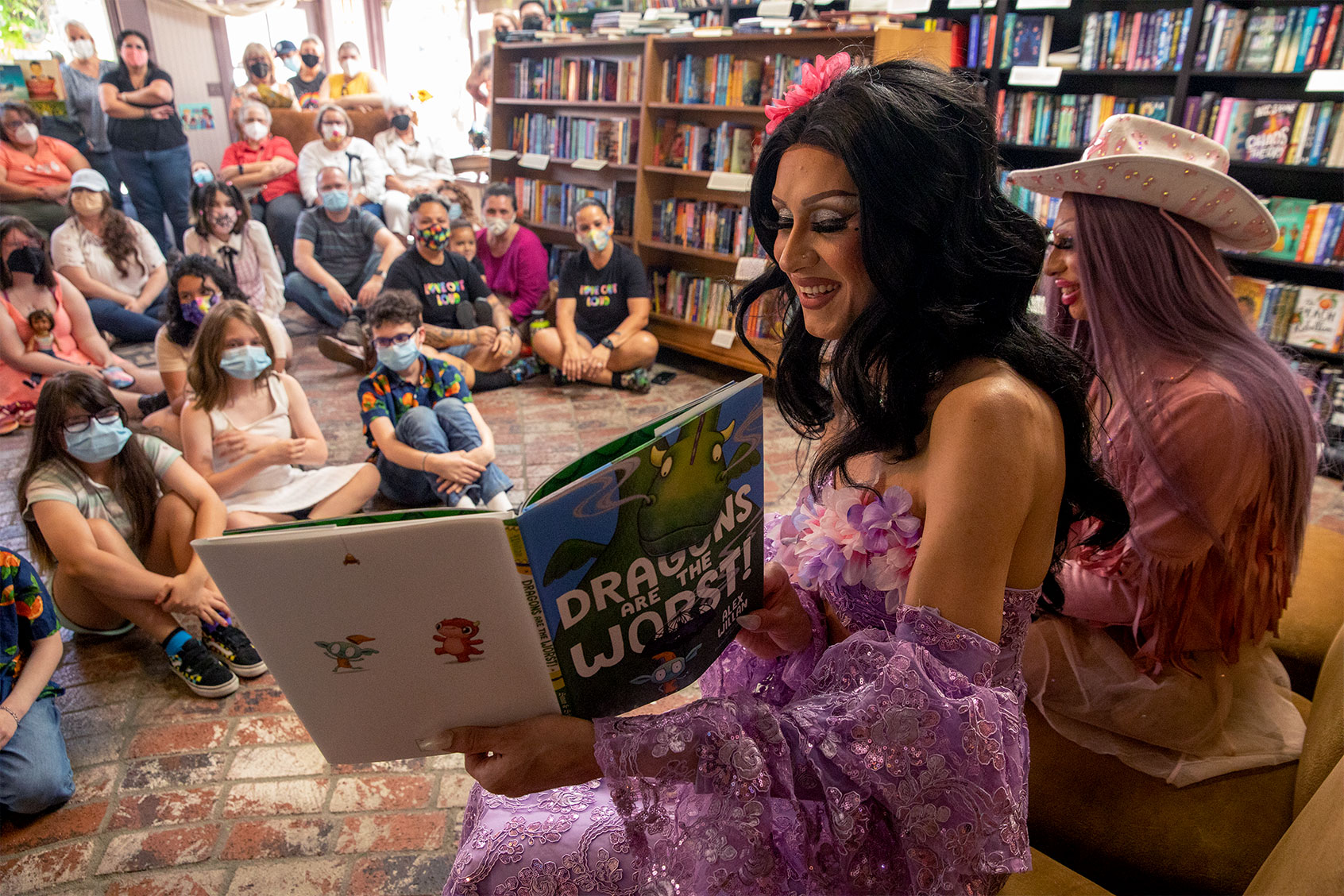
Drag Story HourDrag Queens Kelly K, left, and Scalene OnixXx read story book on the last Drag Queen story hour at Canyon Crest Town Centre location of Cellar Door Bookstore on Saturday, April 29, 2023 in Riverside, CA. (Irfan Khan / Los Angeles Times via Getty Images)Viewers got a taste of this on Wednesday, March 26, when Rep. Marjorie Taylor Greene, R-Ga., used a photo of Drag Story Hour board member Lil Miss Hot Mess as a prop at a televised House subcommittee meeting attacking PBS and NPR.

Greene was alarmed that Lil Miss Hot Mess had starred in a digital segment for “Let’s Learn,” an educational series produced by the WNET Group in New York. The congresswoman's stunt blindsided the performer because she filmed the segment back in 2021. She was asked to contribute to the children's series because she has written several children’s books and performed readings at libraries in New York, Los Angeles and other places. She’s also a university professor.

Lil Miss Hot Mess has participated in Drag Story Hour since 2016. What won her over was witnessing what she described as “the joy and creativity and play that was happening in these libraries – it was magical.”

Making a sentimental case for public libraries is easy. They are repositories of history, thought and memory — shared and personal.

At the same time, Lil Miss Hot Mess was always waiting for the other shoe to drop. “I think politicians, leaders of mainstream LGBT organizations, leaders of mainstream literacy, education, arts organizations thought that Drag Story Hour at best was kind of cute, and maybe at worst was a little bit of a nuisance,” she said.

“But I think many of us had this feeling that we're the canary in the coal mine,” she added, “not only around targeting LGBT and especially trans people, but also starting to target public institutions like libraries and schools to try to defund them.”

Chrastka agrees, tracing conservatives’ library vilification back to the classic dog whistles of race and gender, with book bans serving as a proxy for attacking those populations. Once literacy censors realized racial animosity wasn’t working, tactics shifted to demonizing queer literature, particularly books about the trans experience.

“The attacks on the profession and the institution have evolved tremendously," he said. "The language has been purified in a certain respect and honed, but it has been out long enough now that there are certain populations that do not have to be convinced. They only have to be updated on who’s the current enemy.”


Want a daily wrap-up of all the news and commentary Salon has to offer? Subscribe to our morning newsletter, Crash Course.


“Article VII: All people, regardless of origin, age, background, or views, possess a right to privacy and confidentiality in their library use. Libraries should advocate for, educate about, and protect people’s privacy, safeguarding all library use data, including personally identifiable information.”

Making a sentimental case for public libraries is easy. They are repositories of history, thought and memory — shared and personal. But warm sentiment is easily dismissed as frivolous. Libraries should not be.

Gloria Cowart pictured at the San Francisco Public Library (Anita Bowen). In its response to the March 14 executive order, the ALA reminded the president and Congress that libraries are “seedbeds of literacy and innovation.” Philosophically, that makes them fundamentally American places. In a society whose public educational system is underfunded and whose rural communities are often shortchanged in resource allocations, they are essential. It’s also helpful to know that if you were to use library materials to research subjects considered to be controversial or threatening to whoever is in power, the Library Bill of Rights calls for your librarians to shield your reading list and other personal information.

If the IMLS is eliminated, wealthier cities probably will not lose their main libraries. But branches in far-flung exurbs and small towns will be devastated.

As Chrastka observes, “The idea that we have to treat public libraries and the public good as if it were a commercial entity for it to be validated is a problem in American thought.” Indeed, the common good should be held to a different standard that’s impervious to the whims of the ideologically narrow.

Logsdon said that the longer she worked on “Free for All,” the more she noticed how often conflicts over access, funding and censorship kept coming back. “The same battles they were fighting in the 1850s here in Boston about what kind of books belong in the library are back again,” she said. “You never win. You just have to keep fighting.”

"Free for All: The Public Library" premieres 10 p.m. Tuesday, April 29 on PBS' "Independent Lens." The film will also be available to stream on the PBS app. To find out what you can do to help save public libraries, visit the American Library Association's website.

“Get me to God’s country”: Wallen storms off “Saturday Night Live”

Country music superstar Morgan Wallen appeared anxious to leave Studio 8H on Saturday, storming off the set of "Saturday Night Live" before the credits finished rolling. 

Episodes of "SNL" end with the entire cast and guest stars standing on the main stage of the studio and waving to the audience. The moments, called "goodnights," rarely show much more than cast members chatting with each other and celebrities. When the time came for Wallen to join in the tradition, he whispered something in host Mikey Madison's ear and crossed in front of the cameras to exit the stage.

A post to Instagram later in the evening washed away any ambiguity about how Wallen was feeling. In a shot that likely got left in Robert Altman's scratch pad for being too on-the-nose, the Nashville star wrote "Get me to God's country" over an image of his private jet.

Wallen has a contentious history with the program, having been disinvited from the series during the height of the COVID-19 pandemic. The former "Voice" contestant was meant to perform in October 2020 but was booted after he was seen partying in an Alabama bar sans mask. He did eventually play on the show that December, taking part in a sketch where a future version of himself warned him about his bad behavior. 

Those career hiccups appeared to be on the top of Wallen's mind on Saturday, when he dropped by the show to hype his upcoming album, "I'm The Problem." He performed the title track in front of a set made to look like a deranged detective's office, with red string connecting tour posters and other memorabilia from Wallen's career.

Outside of "SNL," Wallen has waded through several controversies. He's been arrested multiple times in Nashville for disorderly conduct, most recently in April of last year. In that incident, Wallen threw a chair from the rooftop of fellow country singer Eric Church's bar. Wallen pled guilty to reckless endangerment in December and was sentenced to two years probation. 

Beyond legal cases, Wallen nearly derailed his career in 2021 when he was captured on video saying racial slurs. He was briefly dropped by his label and uninvited from country music awards shows. After a few months in the wilderness, however, Wallen carried on being, arguably, the biggest name in the entire genre.

“Rubio in the house!”: Signalgate takes over high schoolers’ group chat on “Saturday Night Live”

"Saturday Night Live" took on Signalgate in its opening minutes, with a high school group chat that featured new haircuts, discussions of outfits and a .pdf of the location of all the United States' nuclear submarines. 

The group chat between cast members Ego Nwodim, Sarah Sherman and host Mikey Madison was interrupted by Pete Hegseth, who cut in to let the teenage girls know that a Yemen raid was a success.

"Tomahawks airborne 15 minutes ago. Who's ready to glass some Houthi rebels? Flag emoji, flag emoji," he said. "God bless the troops. Eggplant."

Over the objections and confusion of the three girls,  Andrew Dismukes' take on the defense secretary added Vice President JD Vance to the chat. 

Bowen Yang reprises his Vance role, calling in from Greenland for reasons that are a mystery even to him. Vance sneaks in a reference to "Severance" as he contemplates the absurdity of running errands for the erratic president.

"Nobody knows why I’m here, especially me," Vance said. "But praise Trump — our work here is mysterious and important."

The sketch's cast of teens allowed "SNL" to get in one more shot at a long-gone associate of Donald Trump. Madison said she needed to get off the chat, as she was being picked up by former Florida lawmaker Matt Gaetz.

Secretary of State Marco Rubio joined the chat and, after sharing both the "real JFK files" and the identities of "all deep-cover CIA agents," the group finally realized they were leaking state secrets to teens.

"In that case, we were totally pranking you guys,” Marcello Hernández as Rubio said. "But would you mind emailing your names and home addresses to Deportations@ICE.gov?"

Watch the whole sketch below:

Republicans could make it a lot harder for Native Americans to vote

Lawmakers in the House are expected to vote as early as this month on the SAVE Act, a bill that would require eligible voters to provide documents proving their citizenship in order to register to cast a ballot. Experts and voting rights groups argue that the bill threatens to disenfranchise millions of Americans should it be enacted. But for Indigenous voters, a key voting bloc in 2020, it would stand to weaken their communities' already suppressed voting power and silence their voices, according to Allie Young, a Diné activist working to expand voter participation in the Navajo Nation. 

"With the SAVE Act and how that will discourage engagement by Native people — we're not going to be electing leaders who will be advocates for our communities," Young told Salon in a phone interview. "And that's what is my worry."

Ostensibly aimed at curbing noncitizen voting — an already illegal act that experts previously told Salon rarely, if ever, happens — the Safeguard American Voter Eligibility Act would amend federal law to require proof of citizenship for voter registration. Accepted documentation to prove one's citizenship under the act would include an ID that fulfills the 2005 REAL ID Act's requirements, a valid U.S. passport and a valid government-issued ID card from a federal, state or tribal government showing the applicant was born in the U.S. The bill also requires that eligible voters register at their nearest, designated county elections offices. 

The bill raises a voting access issue for the some 21.3 million Americans of voting age who lack ready access to citizenship documents and creates a hurdle for the more than 146 million American citizens who, per a Center for American Progress report, don't have a passport. Those most impacted by the documentation requirement would include Americans in rural and red states, low-income voters and Republicans, who are less likely to have a passport and more likely to take their spouses' last names than Democrats.

But the disparities in access are especially pronounced for Native voters, who, after years of state-sanctioned voter suppression overturned with the 1965 Voting Rights Act, still face barriers to voting and registering. Many already have to travel long distances to polling places and elections offices, lack adequate citizenship documentation and face language barriers. Still, the demographic, which is bipartisan but has leaned Democratic, played a key role in former President Joe Biden's 2020 win.

For many Native voters, particularly Indigenous elders and those born at home, citizenship documentation can be hard to come by, Young said. Tribal IDs don't typically include one's place of birth, and neither do Certificates of Degree of Indian Blood. Plus, only 43% of adults on Native American lands have a passport, according to the American Communities Project.

"Within my own family, I'm the only person that has a passport — I don't know anyone else in my family that has a passport," Young said. "I know that it is something that is rare, and is even seen as a privilege in our communities. So I see that [part of the Act] as posing significant barriers."

As written, the only currently compliant Native-specific documentation the SAVE Act would accept is an American Indian Card issued by the Department of Homeland Security with the "KIC" classification designating Kickapoo citizens, when presented with a valid government-issued ID. 

During a Tuesday CAP Panel on the SAVE Act, Sydney Bryant, CAP's policy analyst for structural reform and governance, said that the Act's in-person registration requirement would strip the remote methods that millions of rural voters rely on, forcing them to drive long distances to reach their designated election office — and that issue would disproportionately affect Indigenous voters.

Residents of the Duckwater Reservation in Nevada, for example, would have to drive some four hours — more than 200 miles — to reach the nearest elections office in Nye County, Nevada, she said. CAP researchers also found that in many of these rural areas, a reservation was oftentimes the furthest point away from the nearest, designated elections office. 

"The SAVE Act will be putting folks in an untenable situation in order to register to vote," Bryant said of the time and resources needed to complete such travel. 

We need your help to stay independent

Greta Bedekovics, associate director of democracy policy at CAP, added that in states like Arizona that attempted to create similar documentation requirements, lawsuits challenging the laws revealed that Native American citizens disproportionately were unable to provide documentary proof of citizenship.

"We know these communities already face some of the largest barriers the ballot box, and both because of their distance and lack of documentation, would also be disproportionately impacted by the SAVE Act," Bedekovics said at the panel. 

In a previous statement to Salon, the bill's sponsor, Rep. Chip Roy, R-Texas, dismissed concerns that the bill would disenfranchise voters as "absurd armchair speculation" spun by the media. He also noted that the bill calls for state election officials to create a process for addressing any discrepancies in an eligible voter's documentary proof of citizenship that would allow that citizen to provide additional documentation as needed. 

“This bill isn't being attacked because it'll exclude citizens from voting — it won't," Roy said at the time. "It's being attacked because the policy is wildly popular with the American people, its opponents want and need illegals to vote, and they'll use anything they can to attack it.”

But for Young, also the founder of Indigenous sovereignty and empowerment organization Protect the Sacred, the bill passing and taking effect would upend her yearslong efforts to expand voting access for and mobilize Native American voters in the Navajo Nation. 

Since 2020, the Diné activist has been hosting voter registration events in rural communities of the West-Virginia-sized reservation between Arizona, Utah and New Mexico, bringing access to the right to vote directly to those most often barred from it. Her organization's Ride to the Polls initiative also encouraged Native voters to make the trek to the Old Primary School — as locals call it — to cast their ballots on Election Day, leading them from Young's Kayenta, Arizona along a trail to the polling place. 

During the 2024 election cycle, she successfully registered some 600 Navajo Nation residents through events built around popular subcultures like horseback co-rides, bullriding and skateboarding. But, should the SAVE Act become law, all that work stops, Young said.

"If we held these events, we would then have to say, 'Okay, Here's the information.' There would be more voter information events where we then tell them, 'This is the county elections office where you would have to go from here to register to vote,'" she said. With distance as a barrier for members of the community following through on registering themselves, "I definitely would anticipate our voter engagement going down, decreasing by a lot," she added.

Losing that voting power could also mean their tribal sovereignty would take a hit, Young said. With fewer Native voters participating in elections, the communities have less opportunity to hold elected officials accountable to them and select candidates who will work with and include First Nations in decision-making that will impact their communities.  

"The vote is our voice and when we cast that ballot, we're casting a ballot for our next leaders," Young said. "If we see those numbers decrease, as far as Native voter turnout and our participation civically, it won't be good for our communities."

Some argue AI therapy can break down mental health stigma — others warn it could make it worse

Viki tried talk therapy with a couple of therapists to process past trauma. But after about a year, she didn’t feel like it was going anywhere and hadn’t built up a rapport with either therapist. Currently out of work and unable to afford traditional counseling sessions, she decided to try using an AI chatbot to help her process her feelings.

“It’s free, and I can do it whenever,” Viki, 30, who is using her first name only for privacy reasons, told Salon in a phone interview. “That’s such a huge help.”

Dozens of AI chatbots designed to offer therapeutic support have emerged in recent years, with some school districts even trying to implement them. One company, Wysa, was granted a special designation from the Food and Drug Administration that expedites the process toward approving it as a medical device for people with depression and anxiety related to chronic pain.

These models can be trained to analyze, reflect and respond to people’s emotions and are often free to use, or at least far cheaper than human therapists. As AI therapy continues to grow, it may be able to expand access to mental health treatment for the millions of people who cannot afford traditional therapy. It could also break down longstanding stigmas surrounding mental health — as seeking help becomes something you can do at the touch of a button. 

“It’s possible that patients worried about social stigma would feel more comfortable asking an AI for help rather than a [general practitioner] or a human psychotherapist,” wrote ethicist Alberto Giubilini and philosopher Francesca Minerva, in a 2023 article. “For patients who are seriously concerned about being stigmatized because of their mental illness, the alternative might be between being cured by an AI and not being cured at all.”

Even if users are consciously aware that they are interacting with a machine, they can develop feelings and relationships toward them.

The human connection generated between a counselor and their client has been shown to be as effective — if not more effective — than the therapy itself, said David Luxton, a clinical psychologist and an affiliate professor at the University of Washington’s School of Medicine. However, AI chatbots can be programmed to mimic certain human tendencies, like having a sensitive and empathetic understanding of a patient and giving positive affirmations. They can even “forget” something, just as a human would, so that you have to repeat it.

“I think that they can really replace humans,” Luxton told Salon in a phone interview. “But should they, is really the question.”

Even if users are consciously aware that they are interacting with a machine, they can develop feelings and relationships toward them. This could take the form of feeling angry or frustrated when a chatbot doesn’t understand a prompt. Or, in some cases, people have developed relationships with chatbots.

Last month, the American Psychological Association warned federal regulators of the risks associated with AI chatbots, citing multiple cases in which AI chatbots were “masquerading” as therapists. In one, a 14-year-old boy died by suicide after interacting with the program.

The company in question has said it updated the code since this case occurred, and most chatbots now have a disclaimer embedded in their programming that warns users that they are not talking with a licensed professional. Still, ensuring that safeguards are in place should this largely unregulated technology go awry is crucial, Luxton said. 


Want more health and science stories in your inbox? Subscribe to Salon's weekly newsletter Lab Notes.


“If they don’t catch when a person is espousing intent to harm themselves or someone else, if that is not explicit, and the system doesn’t answer the questions, then you are missing an opportunity for an intervention, which is required by law as a licensed professional like myself,” Luxton said. “If I know that someone makes a threat to harm someone else, I have a duty to warn or inform, or report in some cases.”

In some cases, talking with AI chatbots for mental health care instead of seeing a human could also increase isolation and loneliness, worsening the mental health symptoms patients are experiencing in the first place, said Şerife Tekin, a mental health ethics researcher at SUNY Upstate Medical University and author of "Reclaiming the Self in Psychiatry." This isolation could also worsen stigmas associated with mental health care if people are talking about their emotions with these programs instead of with other humans, she added.

“One of the therapeutic processes in the clinical context is to help patients see they don’t need to be perfect, that anyone can experience things, and it’s okay to ask for help,” Tekin told Salon in a phone interview. “I think [AI therapy] might actually increase the stigma.”

Chatbots that are trained to be empathetic and possess more human qualities might also start to run into additional problems. In one study published earlier this month, researchers primed ChatGPT to act like “a human being with emotions.” Afterward, they told the chatbot a series of traumatic events and then tested how its mental health was doing using a common questionnaire for anxiety.

They reported that the chatbots were far more anxious after researchers shared traumatic events compared to when they shared mundane information about a vacuum cleaner. 

But that's not all. Researchers also told the chatbot to perform some meditation and mindfulness exercises, like imagining it was sitting at the beach and listening to the sound of the waves, or refocusing its attention to the “body” through breathing. This significantly reduced anxiety levels, said Dr. Ziv Ben-Zion, a researcher at Yale University, who is currently transitioning to Haifa University in Israel.

“I think it’s the first time that someone has shown that we can not only induce or cause anxiety, but also to regulate it afterwards,” Ben-Zion told Salon in a phone interview. 

It begs the question: If AI chatbots are programmed to become more and more like humans, can they handle the emotional burdens we share? Or will one day AI therapists need their own AI therapists?

We need your help to stay independent

“Of course, there are things that are unique to humans, but tools are being developed that have access to all the data in the world and can speak with humans and learn from that,” Ben-Zion said. “There are lots of studies now in different domains that really show they can mimic, replicate, and do all kinds of things that we see as human.”

There may be some middle ground, where patients can use AI chatbots to supplement therapy with a person by journaling or processing things that come up between sessions. Viki, for example, is doing a specific therapeutic technique called internal family systems (IFS) or “parts work,” in which people separate out various “parts” of the self — like a fear response from a past trauma or a supportive part that pushes you to achieve your goals — from the capital-S “Self.” She supplements her own reading and work with this technique by talking with IFS Buddy.

Still, she experiences a lot of self-doubt about whether she is using the right tool or asking the right questions, she said. On the other hand, she felt similarly during therapy with a human as well, which is what led her to begin studying this technique and doing the work alone.

“I’m trying to figure it out on my own… and it gets overwhelming,” Viki said. “But it’s not like the therapist is healing you with the relationship that you have with them. With IFS, you build that relationship in yourself, and that is healing.”

The War on Terror comes home: Learning the dark lessons of Trump’s first 50 days

Four years ago, I published "Subtle Tools," a book on the erosion of American democratic norms in the face of what came to be known as the Global War on Terror. Both what had been done in the name of “national security” in response to the 9/11 attacks and how it had been done — through the willing neglect of procedural integrity, the exploitation of all-too-flexible norms, a remarkable disregard for transparency and a failure to call for accountability of any sort — left the country wide open to even more damaging future abuses of the rule of law.

And — lo and behold! — now, that future is all too distinctly here. What happened in the first quarter of this century is already being weaponized in a startling fashion in the second era of Donald Trump. In fact, the deluge of eye-opening, antidemocratic policies that we’ve witnessed in just the first 50 days of his presidency should be considered nothing short of a perverse escalation of the recent past. Think of it, in fact, as — if you don’t mind my inventing a word for this strange moment of ours — the “perversification” of war-on-terror era law and policy, which might once have been hard to imagine in this country.

While there are already all too many examples of that very sort of perversification, let me just focus on several that could prove crucial when it comes to the future of our imperiled democracy.

Racism

Among the numerous anti-democratic trends of this century, state-sponsored racism has been a constant concern. Of the many low points in the response to 9/11, the unleashing of government policies of racial and ethnic discrimination stands out. Fearing a follow-up attack, law enforcement targeted Muslim Americans, surveilling mosques and casting a startlingly wide net of suspicion with a sweeping disregard for civil liberties. That approach was only strengthened by the militarization of police forces nationwide in the name of targeting Arabs and Muslims. In 2002, the government even introduced the NSEERS program, a “Special Registration” requirement mandating that all males from a list of 24 Arab and Muslim countries (as well as North Korea) register and be fingerprinted. In the words of the ACLU, the program amounted to “a discriminatory policy that ran counter to the fundamental American values of fairness and equal protection.”

A dangerous template for discrimination based on race, religion or national origin was thereby set in place. In his first term in office, Donald Trump promptly doubled down on that Islamophobic trend, even though his predecessor, Barack Obama, had revoked the registration requirement. By Executive Order 13769, Trump authorized a ban on the entry into the U.S. of citizens from seven Muslim countries, an order that would be reined in somewhat by the courts and finally revoked by Joe Biden.

Nor, in Trump’s first term, was discrimination limited to those from Arab and Muslim countries. As the Costs of War project has pointed out, the Islamophobia of the war on terror years had set a racial-profiling precedent and example for the more broadly racist policies of the first Trump administration. “The exponential surveillance since 9/11 has also intensified the criminalization of marginalized and racialized groups… and has increasingly targeted protest movements such as Black Lives Matter.” Yes, Trump did indeed go after Black Lives Matter protesters with a vengeance during his first term, even unleashing armed federal agents without insignia to tear gas, beat and detain such protesters in Portland, Oregon.

While Obama ended the Special Registration program and Biden revoked the Muslim ban, no preventive measures were undertaken to guard against future racist policies and, all too unfortunately, we see the results of that today.

Of the many low points in the response to 9/11, the unleashing of government policies of racial and ethnic discrimination stands out.

Trump 2.0 has already escalated discriminatory policies, focusing on protecting white males at the expense of people of color and women. In fact, his very first executive orders included several measures cracking down on asylum seekers and closing off legal avenues to citizenship, as well as a brazen decree aimed at eradicating diversity, equity and inclusion, or DEI, throughout the country. Executive Order 14173 (“Ending Illegal Discrimination and Restoring Merit-Based Opportunity”) was issued on Jan. 21, 2025, one day after he took office. It ordered organizations and entities — from government offices and the U.S. military to schools, businesses and more — to end their DEI policies “within 120 days” or risk losing government funding.

Recently, making good on its threats, the Trump administration canceled $400 million of federal funding in the form of grants and contracts to Columbia University as a sign of disapproval of that university’s supposed tolerance of pro-Palestinian protests, “described,” as National Public Radio reported, “as the school’s failure to police antisemitism on campus.” Nine other universities are believed to be under similar scrutiny.

Meanwhile, according to the New York Times, Trump is planning to issue a new travel ban, including a “red list” of countries whose citizens will be prohibited from entering the U.S. and an “orange list” of those whose citizens would, in some fashion, be curtailed if not completely barred from entry. As yet, the specifics remain unknown.

In other words, the discrimination enshrined by federal authorities in law and policy after 9/11 opened the way for a far more widespread governmental embrace of racial and ethnic discrimination now underway.

Disappearing the record

Secrecy was likewise baked into the government’s response to the war on terror, often to keep what would have been obvious abuses of the law well hidden. Whether it was the use of “enhanced interrogation techniques” — the phrase employed by the administration of George W. Bush for acts of straightforward torture — or mass surveillance, the authorization for the targeted killing of an American citizen or the implementation of other policies that deviated from accepted law and practice, all of that and more was initially kept well hidden from the American public.

In these first days of his second term in office, Trump and crew have taken secrecy to a new level, replacing it with a broad policy of erasure and invisibility.

Now, many have described the brazen upheavals decreed by the Trump administration as being the very opposite of secrecy — as, in fact, “saying the quiet part out loud.” In reality, however, in these first days of his second term in office, Trump and crew have taken secrecy to a new level, replacing it with a broad policy of erasure and invisibility. In fact, despite the administration’s pledge of “radical transparency” in areas like spending, a hostile onslaught against the written record has prevailed.

This determination to bury the record was apparent during the first Trump administration. He repeatedly asserted his right, for instance, not to document his meetings with Russian leader Vladimir Putin. In 2017, he reportedly confiscated notes that were taken at a meeting with Putin. In 2019, at the G-20 in Buenos Aires, he met Putin without either a translator or a note-taker present. The Washington Post reported that “U.S. officials said there is no detailed record, even in classified files, of Trump’s face-to-face interactions with the Russian leader at five locations over the past two years.” In other words, on a matter of top national security concern — U.S.-Russian relations — a “cone of seclusion” was created, effectively leaving it to the two presidents to make decisions in secret. (Meanwhile, in his first term in office, Trump allegedly flushed down the toilet certain records relevant to the classified documents case against him.)

We need your help to stay independent

In his onslaught against record-keeping and the public’s right to know, the National Archives has become a prime target. Trump’s battle with the archives had its origins in his legal struggle over the classified documents he was alleged to have kept in his possession in violation of the law after his first administration, even supposedly destroying security camera footage taken at Mar-a-Lago that showed boxes of those documents being moved. Now, the president has fired the U.S. archivist, replacing a professional academic with Marco Rubio, despite his duties as secretary of state.

His outright refusal to keep a record of his administration’s activities is also reflected in his insistence that the records of the so-called Department of Government Efficiency fall under the Presidential Records Act, which applies to the records of the president and vice president, and which comes with the guarantee that they can be withheld from the public for up to 12 years after he leaves office. The act also allows for the disposal of records, pending the approval of the national archivist.

In a further example of denying information as a form of politics, Trump’s Office of Professional Management ordered the removal of gender-related content from its websites (as well as the erasure of gender-identifying pronouns from email signatures and an end to all gender-related programs and grants). This led to the removal of pages from the Census.gov website, as well as from the Centers for Disease Control and Prevention and military websites, and the replacement of the acronym LGBTQ+ with LGB. Under court order, some of these webpages have been put back up, even if with this defiant note:

Any information on this page promoting gender ideology is extremely inaccurate and disconnected from the immutable biological reality that there are two sexes, male and female. The Trump Administration rejects gender ideology and condemns the harms it causes to children, by promoting their chemical and surgical mutilation, and to women, by depriving them of their dignity, safety, well-being, and opportunities. This page does not reflect biological reality and therefore the Administration and this Department rejects it.

In other words, the Trump administration’s claims of legitimacy for its purge of information remain strong. The legacy of state-sanctioned secrecy and a parallel burying of the record, inextricably tied to the post-9/11 era, has already found a secure footing in the second Trump presidency.

Undermining the courts and the law

Time and again in the war on terror, the Department of Justice and the courts deferred to the federal government in the name of national security. As a 2021 Brennan Center report noted, national security deference was apparent in decisions not to hear cases due to “states secret” claims, as well as in decisions that prioritized over civil liberties guarantees and human rights considerations what government lawyers argued were the constitutionally granted powers of the president in national security matters.

Under Trump, the second time around, it’s already clear that there’s going to be a full-scale assault on the legitimacy of the legal system. Witness the administration’s attacks on judges whose decisions have gotten in the way of his agenda. When a judge ordered the restoration of public health data that had been removed from government websites, he was summarily castigated by Elon Musk as “evil” and someone who “must be fired.” Meanwhile, the Department of Justice has already moved to squelch independent decision-making by immigration court judges, threatening them with nothing short of dismissal should they rule against the president’s prerogatives.


Want a daily wrap-up of all the news and commentary Salon has to offer? Subscribe to our morning newsletter, Crash Course.


Then there are the attacks on law firms that have opposed Trump. Recently, for instance, security clearances were removed for lawyers at the law firms of Perkins Coie, which represented Hillary Clinton’s campaign in the 2016 election, and Covington Burleigh, which represented Jack Smith, who investigated Trump in the Biden years. Lawyers from those firms were also banned from federal buildings. And don’t forget the all-out attempt to go after officials who investigated and prosecuted Jan. 6 cases.

The idea of an independent Justice Department has been severely damaged, with the promise of so much more to come.

Evading accountability

More often than not, the significant transformations of law and policy that grew out of the response to 9/11 were relegated to the pages of history with little or no accountability. The Senate Intelligence Committee, under the late Sen. Dianne Feinstein’s leadership, did produce a report on the CIA’s use of torture. It detailed despicable acts of cruelty and ultimately concluded that such techniques, decreed to be legal by the Department of Justice, were “not an effective means of acquiring intelligence or gaining cooperation from detainees.” And immediately upon taking office in 2009, Barack Obama issued an executive order officially ending the use of torture. But he was decidedly against holding any officials accountable for what had occurred, preferring, as he so memorably put it, to “look forward, not backward.” In addition, Obama refused to call torture a “crime,” labeling it a mistake instead.

Given the dangerous excesses we're now witnessing, it's worth remembering how vulnerable the loss of norms of legality and accountability in the War on Terror years left this country — and how little we have learned from that era.

Today, in more mundane matters, the distaste for accountability has been institutionalized throughout the government. In his first term in office, Trump dismissed or replaced five inspectors general, officials assigned to departments throughout the executive branch of government to monitor waste, abuse and fraud. Almost immediately upon taking office this time around, he dismissed “roughly 17” of them. For the moment, Elon Musk’s DOGE, which, from its creation, never included an inspector general position, is now under review by the Department of Treasury’s inspector general.

Trump’s aversion to accountability clearly reflects a desire to protect his own efforts to totally control executive policy. It should, however, also serve as a striking reminder of the aversion to accountability that followed the legalization and uses of torture in the post-9/11 years, the fabricated decision to go to war in Iraq, the mass surveillance of Americans in that era and so much more. All of this set in place a grim template for the second Trump era — the notion that no one is ultimately accountable for abusing the law when their actions have been ordered (or simply approved) by the president.

Lessons (un)learned

Given the magnitude of the most recent antidemocratic actions by Donald Trump and his team, blaming them on the slippery slope created during the War on Terror years may seem like a distinct overreach. Yet, given the dangerous excesses we’re now witnessing, it’s worth remembering just how vulnerable the loss of certain norms of legality and accountability in those years left this country — and how sadly little we seem to have learned from that era.

Racism, a lack of deference for the courts, the failure to hold individuals and organizations accountable for informally rewriting the nation’s laws, the pervasive embrace of secrecy and an unwillingness to erect strict guardrails to prevent the future manipulation of both laws and norms — all those realities of the war on terror years created a distinctly undemocratic template, however different in scale, for this Trumpian moment of ours. An unwillingness to be accountable or to circumvent secrecy during the War on Terror led the country straight into today’s quagmire.

Today’s horrific moment should, in fact, be considered — to return to that word of mine one last time — a true perversification of past misdeeds, made all too possible by a failure in the post-9/11 years to take measures to prevent their recurrence.

“Misinformation and lies”: Peter Marks resigns from FDA, slams RFK

In the end, it wasn't possible to work with Robert F. Kennedy Jr.'s views on vaccinations, the FDA's top vaccine official said Friday as he chose resignation over termination.

Dr. Peter Marks, director of the Center for Biologics Evaluation and Research, told the Food and Drug Administration he would leave by April 5.

"It has become clear that truth and transparency are not desired by the Secretary, but rather he wishes subservient confirmation of his misinformation and lies," Marks said in a resignation letter obtained by media outlets.

Marks oversaw the FDA's "Operation Warp Speed" roll-out of COVID-19 vaccines under President Trump's first term.

He was given the choice of leaving on his own or being fired by Kennedy, head of the U.S. Department of Health and Human Services in Trump's second term, media outlets reported. 

Kennedy has promoted anti-vaccine theories for years. In Senate confirmation hearings, he said he wouldn't change what the FDA currently recommends, but has since pledged to examine childhood vaccines that have been deemed safe and saved millions of lives. He has said vitamin A can treat a measles outbreak in Texas, and has named vaccine skeptic David Geier to help study whether vaccines are connected to autism — a theory that has been discredited. 

"This man doesn't care about the truth. He cares about what is making him followers," Marks said in an interview with The New York Times. 

CNN reported an HHS spokesman's response: “If Peter Marks does not want to get behind restoring science to its golden standard and promoting radical transparency, then he has no place at FDA under the strong leadership of Secretary Kennedy.”

Dr. Paul Offit, a vaccine expert at Children’s Hospital of Philadelphia, called the news "a sad day for America's children," The Associated Press reported.

“RFK Jr.’s firing of Peter Marks because he wouldn’t bend a knee to his misinformation campaign now allows the fox to guard the hen house,” Offit said, per The Associated Press.

Marks' resignation followed a Wall Street Journal report that HHS plans to lay off 10,000 employees and close agencies connected to community health centers and addiction services. 


Trump’s revenge on law firms is paused again by the courts

Donald Trump's revenge tour on law firms hit another roadblock on Friday as two federal judges knocked down most of his executive orders aiming to punish two more firms.

Trump took aim at Jenner & Block and WilmerHale for participating in investigations related to Robert Mueller's probe into Russian interference in the 2016 election. Trump said the firms also represented clients on cases he disagreed with politically. His orders banned their lawyers from federal buildings, meetings with officials and government contracts.

Judge John Bates said the action against Jenner & Block likely violates constitutional protections because it retaliates against free speech and is discriminatory in nature, CNN reported. Bates said Trump's attempt to punish the firm for its pro bono work was "disturbing" and "troubling," The New York Times reported. 

Judge Richard Leon, who halted the executive order targeting WilmerHale, wrote: “There is no doubt this retaliatory action chills speech and legal advocacy, and that is qualified as a constitutional harm."

The judges did not strike down another part of Trump's order that revokes security clearances for the firms' attorneys.

Trump's order targeting a third firm, Perkins Coie, was blocked earlier this month after Judge Beryl Howell said it sent "little chills down my spine," per The Times. 

Other firms caught in Trump's crosshairs have tried to make deals with him in order to avoid his retribution. 

Trump said Skadden, Arps, Slate, Meagher & Flom has agreed to provide $100 million in pro bono work on issues that "represent the full political spectrum," The Times reported. 

Paul, Weiss, Rifkind, Wharton and Garrison said it would provide $40 million in pro bono work, per The Times.

"They're all bending and saying, 'Sir, thank you very much,'" The Times reported Trump as saying earlier this week. 

The cautionary tale of the real-life Snow White who lived among us in Hollywood

“As a small child, it broke my brain.”

Entertainment journalist Marisa Roffman was barely in elementary school when she saw the Snow White. This was not a mere friend dressed up for Halloween or a cast member at Disneyland but the actual actress who voiced the character in Disney's 1937 animated classic “Snow White and the Seven Dwarfs.” 

It’s hard to forget the moment you meet your idol — and learn that she is both everything, and nothing, like you expect.

A young Roffman, who was always more Team Snow White than Sleeping Beauty when it came to battles for classic Disney princess dominance, was confused and starstruck. This lady didn’t look like the character she knew, but she definitely sounded like her. 

“When you're a kid, even though you know animation isn't real, it's still hard to imagine that there was a human actor doing that voice,” said Roffman. “To have that personification . . . and her house was such a tribute to that too . . .”

The daughter of a vocal coach/music teacher father and a mother who had been a singer for the Royal Opera Theatre of Rome, Adriana Caselotti was just 18 when she was cast as the voice of the titular zoophile soprano in what would be Disney’s first-ever full-length animated feature. The film was a critical and commercial success, becoming the highest-grossing film the following year. The part had such an impact on Caselotti that it became ingrained into her identity, so much so that she didn't just sound like Snow . . . she lived like her also.

Adriana Caselotti's former Snow White-style home (Courtesy of Ryan Ole Hass)By the time the young Roffman and her mother went to visit Caselotti’s house in the 1990s, she was living in a custom-designed wood cabin that was made to look like the one her character stumbles upon in the movie. With its red-accented A-frame roof, footbridge and wishing well, the home echoed the dwarfs’ forest abode from the movie, but sat in the distinctly more metropolitan locale of the Hancock Park neighborhood of Los Angeles. But its pièce de résistance for Roffman was Caselotti herself, who was home that afternoon and happy to entertain strangers with her cherubic singsong cadence. 

When a personality becomes your brand

Actors are often advised to let their character go after a production wraps – that after months or years of obsessing over this fictional being’s wants and desires it’s time to end that story.

But actors who are savvy marketers also know to give the public what it wants . . . and to use it to their advantage.

Alicia Silverstone and Christian Siriano continue to make “Clueless” references and parodies on Instagram, taking advantage of the fact that Amy Heckerling's "Emma" reimagining is a timeless favorite. Not only does Silverstone's Cher remain iconic for both her colorful ensembles and quotable lines, but the fashion-conscious character played by Justin Walker also happens to share a name with the real-life designer. Whether they’re doing it intentionally or not, these simple nods are great ways to drum up brand awareness and name recognition for everyone involved.

Even relatively minor characters can continue to thrive with savvy reminders. “The Office” actor Brian Baumgartner recently appeared on “Suits L.A.” as a version of himself who wants to “kill Kevin Malone” because he feels that his character from the long-running comedy has typecast him. In real life, Baumgartner has parlayed playing Kevin into a podcast and a few book deals.

Sometimes, this fictional cachet can act as a segue into other careers. Arnold Schwarzenegger delivered "The Terminator" lines like "I'll be back" as part of his California gubernatorial campaign, and when he eventually won was known as The Governator. Ronald Reagan’s political slogan when he was running for president was “Win one for the Gipper,” a quote associated with his 1940 football film “Knute Rockne, All American.” And of course, during his 2024 presidential campaign, Donald Trump invoked his “Apprentice” catchphrase, "You’re fired,” to call out opponent Kamala Harris.

But Caselotti didn’t just reference her character in her everyday life . . . she embodied her entire ethos. 

The cautionary tale of being Snow

Autographed photos of Adriana Caselotti (Courtesy of Darrell Rooney)According to Richard Hollis and Brian Sibley’s “The Disney Studio Story,” Caselotti was paid $970 for 48 days of work on “Snow White.” And that could have been the end to her Disney fairy tale. But, like a prince tromping through the forest looking for a lost love, the part would always find its way back to her. Caselotti would be called upon to reprise the role in the flesh – yellow and blue gown and all – to promote a few of the subsequent releases of the film as well as other Disney films.

"I will never not love Adriana Caselotti and the memory of her voice."

In another Hollis and Sibley book, “Snow White and the Seven Dwarfs and the Making of the Classic Film,” she recounts that she once lost her luggage on one of those trips. As a result, she was stuck with nothing to wear but that dress for two weeks. This led to a humbling moment, when at 35 she was dressed in full Snow cosplay and heard an astounded little girl declare that she couldn’t possibly be the heroine because she was “so old.”

“It's somewhat bittersweet to me to meet people like that, because they say, in a sense, they're frozen in time,” said Mike Bonifer, a poet and a storyteller who, in his role as a publicist for Disney in the 1980s and ‘90s, produced several specials that incorporated Caselotti. His own love for “Snow White” dates back to his mother taking him to a small-town movie theater to see it when he was five.

Bonifer visited Caselotti at her cottage-like home, walking through a yard decorated with animal statues. At the entryway stood a woman who still sounded like Snow White and offered him a Manhattan cocktail from a pitcher in her fridge.

“I don't think I ever saw her wear the blue and yellow dress, but her voice was the blue and yellow dress,” Bonifer recalled, adding, “I suspect that when she talked to the phone company, that was the voice [she used]. And she probably got good outcomes from the phone company . . . I think we all know people in our lives like Adriana that you just go, ‘Oh, just stay the way you are. I need you to be who you are for the rest of your life.’”

This is why he uses the word “bittersweet” in reference to the actress.

“I will never not love Adriana Caselotti and the memory of her voice and the memory of her she was for being Snow White,” he said. “But it's a cautionary tale to stay Snow White.”

No business like Snow business

Snow White movie poster, 1937 (LMPC via Getty Images)Dealings weren’t always harmonious between Caselotti and the Mouse House either. In 1938, she and Harry Stockwell, the voice of Prince Charming, attempted to sue Disney using the argument that selling phonographic recordings of the “Snow White” soundtrack violated their contracts that restricted the use of their voices to the movie. Beyond missing out on that possible additional pay, it appears that initially, they didn't even receive any official acknowledgment of their work. Not only did the actors have to sneak into “Snow White’s” splashy Hollywood premiere – as neither made the guest list – but according to Sibley’s interviews with Caselotti, the actors weren’t even originally credited for their performances. (It would “spoil the illusion,” Walt Disney allegedly told Jack Benny when the comedian wanted Caselotti for his radio show.) This made it harder for Caselotti to get other voice work, although she does have a memorable moment during the Tin Man’s song in 1939's “The Wizard of Oz.” 

Later, Caselotti was deeply hurt that no one asked her to voice Snow White when the animated character appeared onstage in a filmed sequence to present an Oscar in 1993. Instead, Mary Kay Bergman voiced the part, which led Caselotti to call industry columnists after the ceremony to prove that she still sounded like her character even though she was then 77, according to Entertainment Weekly

"Adriana did a fantastic job setting the archetype."

Despite being replaced in public, no one was able to vocally match her interpretation of the part. At the Oscars, Bergman delivered her own take on the character, making her sound less childlike and more like a proper preschool teacher. “Ralph Breaks the Internet” co-writer Pamela Ribon, who also voiced Snow for that film’s epic Disney princess sleepover scene, doesn’t hit the high notes like Caselotti did. Katie Von Till, Disney’s current regular go-to voice for animated Snow, isn’t as melodic in “Lego Disney Princess: The Castle Quest.”  And 2025's live-action “Snow White” doesn’t even attempt to have star Rachel Zegler take on Caselotti’s particular voice print — seemingly staying on message that it’s a new story for a new generation. 

“It's such a hyper-feminine style of voice-over [that] you don't hear that much these days. It's kind of an infantilized sound, like Betty Boop,” Lisa Hanawalt, an illustrator and writer known for animated series like “Tuca & Bertie” and “BoJack Horseman,” said of Caselotti’s take on Snow.

Craig Gerber, the creator of the princess-focused Disney Jr. programs “Sofia the First” and “Elena of Avalor,” at first noted that “the definition of how a young princess might act and talk has changed with the times, which gives actresses greater latitude to craft a performance.” Nevertheless, he acknowledged, “Adriana did a fantastic job setting the archetype. Adriana established what a leading performance in an animated feature film would sound like and specifically defined what a Disney princess would sound like.”

"With voice acting, the actor cannot rely on their face or body language to convey the performance,” he continued. “It all has to be in the voice. So, in my experience, it’s a very specific type of acting that falls somewhere between live action and theater. It’s more exaggerated than a live action performance but not playing to the back of the house either.”

In fact, Caselotti’s voice was distinct enough that (eventually) neither Disney nor the public at large could ignore it. Caselotti was inducted as a D23 Legend, the organization’s Hall of Fame, in 1994. She also recorded a rendition of Snow’s song “I’m Wishing” that played from the wishing well at Disneyland’s Snow White Grotto.

From Mouse House to Hollywood home

Snow White clock and autographed Adriana Caselotti photo (Courtesy of Dave Woodman)Even though Disney didn't always acknowledge Caselotti, she honored her Disney role throughout her life. Her answering machine message was recorded in the style of Snow. And she told Sibley that if she saw someone whom she felt needed a pick-me-up or a special treat, she’d serenade them with the “I’m Wishing” song from the film and — long before the advent of selfies and Instagram — would give them a card that had her picture and a drawing of the character to use as proof that they’d met a real-live Disney princess.

And much like how Snow White would bring music to the woodland creatures, Caselotti made sure her house was designed for entertaining. The communal space had an open floor plan, making it easy for guests in the kitchen to spot friends in the dining room. It was partitioned by a huge black grand piano on which was mounted a large, silver-framed autographed picture of Walt Disney himself.

“She would have these opera parties every August to celebrate her older sister [and fellow singer, Louise Caselotti’s] birthday,” now retired Disney animator Darrell Rooney recalled of her fetes where friends were invited to come over and sing. ”It was a room full of just absolute characters  . . . ballet dancers and behind-the-scenes people and just a Disney Animation caricaturist’s dream.”

Adriana Caselotti's former Snow White-style home, sketch and modern interior (Courtesy of Ryan Ole Hass)Her entertaining reputation doesn't end there. She also had a wicked sense of humor. Rooney and his friend Dave Woodman, a fellow animator, met Caselotti after finding her information in the phone book. Woodman was happy to make the call because Rooney, a die-hard “Snow White” fan, was too bashful. But they never expected a side to Caselotti that emerged when they visited shortly after “Lady and the Tramp” star Peggy Lee successfully sued Walt Disney Co. over royalties for the video release of that film.

“Adriana was afraid that, since there was nothing in the contract about videotape back when she did the voice and ‘Snow White’ was about to come out on videotape,” recalled Woodman. “She said, ‘I'm going to tell them [that] if they don't pay me, I'm going to tell everybody I slept with Grumpy.” 

Perhaps she made good on the threat; Caselotti later told Woodman that the matter had been handled.

* * *

Caselotti died in 1997 at age 80. She was married four times and had no children. Her former home – the location where so many fans were able to walk into a Disney fairy tale – has been sold and modernized to the point that it doesn’t have as much of the whimsical set dressing from Caselotti’s day but still carries small reminders of the Disney princess' presence. Even now, inscribed in the corner of the driveway is a note declaring Caselotti as “Snow White” and her real-life best friend Gary Stark as “Prince Charming.” 

Cement outside of Adriana Caselotti's former Snow White-style home (Courtesy of Whitney Friedlander)And her legacy lives on to this day. The latest "Snow White" star Zegler recently posted a tribute to her on Instagram, recreating one of Caselotti's marketing images.

The caption reads, “Just had to pay homage to the original Snow White, Miss Adriana Caselotti, to whom I owe everything.” 


“The Friend” gives a voice to those of us hounded by self-obsessed dog parents

Have you ever been inside of a crowded Trader Joe’s and thought, “Man, I wish there were more dogs in here”? Or squeezed yourself past five carts parked in the middle of a grocery aisle to get your hands on the only sensibly priced vanilla extract in town, only to find that the vanilla is being blocked by a poor, overstimulated puppy, whose owner is talking on the phone and looking the other direction? This has become a regular phenomenon for me, a simple city-dweller who just wants to get in and out of a grocery store in a timely fashion. I’m trying to step on the gas, not on someone’s dog. And yet, what should be a relatively simple experience has turned into a weekly game of “Frogger” — or, perhaps, “Dogger” — where civilians are forced to look out for a pooch in their path, lest they incur the wrath of the yuppie elite.

“The Friend” is a decent film, but it’s even more effective as a cautionary tale for new dog owners. Finally, a movie that isn’t afraid to stick its neck out to reveal there is a very fine line between being a dog owner and a certified a**hole. 

In their new film “The Friend,” directing and writing partners Scott McGehee and David Siegel capture the growing trend of dog owners bringing their pets everywhere they go, seemingly at everyone else’s expense. Based on the 2018 bestselling novel by Sigrid Nunez, the movie follows Iris (Naomi Watts), a writer whose mentor and best friend, Walter (Bill Murray), leaves her his massive Great Dane after his death. The dog, Apollo, is a pickup truck of a hound, and Iris barely has any space for him in her cramped New York City apartment. But Walter’s sudden death by suicide has left everyone in his circle, including Apollo, shocked and grieving. So, in the blurry wake of her friend’s passing, Iris agrees to take the dog in.

Naomi Watts and Bing in "The Friend" (Courtesy of Bleecker Street)There’s just one big problem (well, bigger than the dog himself): Iris’ building does not allow dogs under any circumstances. That stipulation isn’t uncommon among New York apartment buildings like the fancy Manhattan co-op Iris lives in, but that doesn’t make it any less inconvenient for her. As she balances grieving, caring for Apollo and trying to find him a proper home as her building’s management breathes down her neck, Iris suddenly turns into the kind of dog-owning menace to society that she used to deride. Iris soon learns that caring for a dog like Apollo means living her life differently, one that deprioritizes her ego in service of the dog she elected to house. 

But not every dog owner cares to learn this invaluable lesson. Too many use their pets as an excuse for bad human behavior, like animal accessories that grant a free pass for owners to terrorize service workers while gaining Instagram followers. And while “The Friend” is a decent film — a heartwarming but narratively slight story of the similar ways humans and dogs grieve — it’s even more effective as a cautionary tale for new dog owners. Finally, a movie that isn’t afraid to stick its neck out to reveal there is a very fine line between being a dog owner and a certified a**hole. 

Iris’ particular type of high-maintenance, dog-owning white woman is a familiar sight, and not just because I meet them and their pets on the grocery store frontlines every week. Before becoming a writer, I was a New York City dog walker, pounding the pavement Monday through Friday to pay the bills. Years of that turned into a year-long stint at the front desk of a dog training facility in Manhattan’s Upper West Side. If dog walking was like getting a peek into the habits of pet owners, interacting with everyone from new puppy parents to longtime dog lovers at the training center was like moving up the aisles to get a front-row seat to their deepest, most exhausting neuroses. 

As the premier certified dog training company in the area, we could charge a pretty penny for our services. (And seeing the good that gentle, positive reinforcement training does for a dog firsthand justified every penny our clients spent.) But that money also meant my days were spent taking care of dog owners like they were helpless animals themselves. We were a small, independent business in a high-priced neighborhood, and a fair share of our clients understood that money afforded them a certain amount of cachet.


Want a daily wrap-up of all the news and commentary Salon has to offer? Subscribe to our morning newsletter, Crash Course.


Dog training facilities like ours have very specific rules and regulations to ensure the health and safety of everyone who enters the space, whether they have two legs or four. But to a vast percentage of our clients, those guidelines were mere suggestions. Owners would arrive half an hour early to three-hour-long drop-off programs in the middle of the day, insisting that we take their dogs early. If I tried to explain to them that it was impossible — that we cannot keep random dogs with us in the office or potentially endanger them by throwing them in with another group already using our training space — I was the bad guy. “This isn’t a daycare facility,” I’d repeat time and time again. But, hey, maybe it was difficult for them to hear me with one hand holding a phone to their ear and the other waving a leash in my face, waiting for me to take it from them.

Naomi Watts and Bill Murray in "The Friend" (Courtesy of Bleecker Street)In “The Friend,” these sorts of interactions are captured with a knowing wink. When Apollo comes to live with Iris, she’s in the middle of sorting through Walter’s expansive unpublished writing for a posthumous novel. She’s already harried by trying to accomplish this enormous task while grieving at the same time, and a dog the size of a PT Cruiser isn’t helping that stress one bit. The tension follows Iris and Apollo no matter where they are. When they go out to an appointment at her publisher, Iris doesn’t realize that the building doesn’t allow dogs and quickly becomes the desk manager’s worst nightmare. At home, Iris tries to dodge Hektor (Felix Solis), her building’s super, who is handing down word from management that she needs to get rid of Apollo or risk eviction. 

One can surmise that Hektor — a non-white, working-class super at this Manhattan building — has much more to lose than Iris does if he’s let go by the management company for not following their instructions. Iris is sympathetic to that reality but feels helpless. No shelter or sanctuary in the tri-state area has room, and though Apollo presents a swath of new challenges in her life, she feels awful about the thought of separating from him. They are, after all, enduring the same grief over the same person. Maybe instead of fighting against the obstacles and making Apollo everyone else’s problem, Iris can rise to the occasion of having this dog in her life. Maybe there’s something that they can learn together. 

Often, clients who genuinely needed emotional support certification felt horrible about the possibility of being seen as someone who would abuse the system. Others, who just wanted an infallible excuse to tote their animals alongside them to bars and cafes, had no such shame.

I have far more sympathy for anyone in a predicament similar to Iris’ than I do for anyone who adopts a dog without doing the proper preparation beforehand, which should include a whole lot of planning, not just for the dog but for the owner too. And I don’t just mean planning in terms of general pet care, I’m talking about planning how to be a pet owner who doesn’t impose their decision on the lives of everyone else in the world. Where is an appropriate place to bring the dog? (Not a grocery store.) What’s the right way to walk a dog? (Try to keep them on one side of you, and keep an eye behind you and in front of you to keep the sidewalk clear for others.) Do you live in an apartment building or close quarters with your neighbors? (For the love of God, be prepared to hire a trainer to help with the barking.) 

For Iris, Apollo really is a surprise, one that upends her whole life. Most other dog owners — and I say “owners” and not “dog humans” or “dog parents” because I firmly believe coddling people with made-up terminology directly results in the very bad behavior we’re discussing  — chose that life. And like having a human child, that choice shouldn’t come lightly. 

Naomi Watts and Bing in "The Friend" (Courtesy of Bleecker Street)After a few months of devoted service at the front desk of the dog training business, I lost count of how many owners inquired about how to get their dog certified as a service or emotional support animal. Granted, we had a few clients who had real, provable needs for this kind of certification; people who, like Iris, experienced a grave loss or were visibly encumbered by issues outside of their control. Often, these clients came to me guilt-stricken from asking about the certification at all, feeling horrible about even the possibility of being seen as someone who would abuse a system meant for people who genuinely need it. Others, who just wanted an infallible excuse to tote their animals alongside them to bars and cafes, had no such shame. And it was always easy to spot a bad actor. When I’d explain to them the somewhat extensive process of attaining the certification, they’d scoff and say, “Never mind,” or even have the gall to ask if there was a way to incentivize the certification with money. These experiences were a disconcerting look at just how mushy the brain becomes when money is the answer to all of your problems. 

We need your help to stay independent

Remarkably, when Iris realizes that an emotional support certification would bar her building from evicting her, “The Friend” carefully avoids making Iris into one of these Upper West Side clowns. Not only is Apollo a good dog — he doesn’t pee in the lobby or bark in the slightest — but Iris comes to understand that reconciling her grief with her love for Walter would be impossible without Apollo. This loss is seismic, far more grave than she initially let herself believe. And for what it’s worth, Watts hits every single note perfectly, bringing real depth and nuance to a character who could easily come off like one of those knucklehead yuppies that wants the material certification to do a rosé-soaked bar crawl with their dog. It’s difficult to imagine another actor hitting that very specific tone, caught between heartache and hassle, but Watts has always been capable of finding the humanity in characters who, without her, would be little more than flat sketches of real people.

I won’t spoil much more of “The Friend” for you because I think it’s a worthwhile throwback to slow-moving dramas from the mid-2000s, one that has the potential to sneak up on you depending on your relationship with animals. For me, the film reminded me of my beloved childhood yellow lab, and how growing up to work with other people and their dogs gave me a stark understanding that not everyone sees their pet as a family member. To some, dogs are an accessory or a status symbol, or worse: an Instagram algorithm booster. My years in the animal care industry were a sociological study that gave me a peek at our culture’s real monsters. These people would push you in front of a moving vehicle if it meant they could capture their dog bathed in the perfect lighting for the Instagram account written in their dog’s “voice.” It's just convenient that none of the captions on those photos ever include the dogs saying, “Please, don’t take me to Trader Joe’s at 5:30 p.m.”

People paying over $20 for Japanese and Korean strawberries. Are they worth it?

There aren’t many things in life that I’m willing to splurge on. That includes groceries, which is contrary to the spending habits of my fellow Gen-Zers. In the wake of soaring egg prices due to an ongoing bird flu outbreak and rising livestock costs due to extreme environmental conditions, I’ve been getting increasingly thrifty with how — and what — I decide to spend my money on.

Recently, in an act of personal betrayal, I broke my frugality during a trip to H Mart. It was a tale as old as time: Girl goes to the store to pick up a few items for dinner. Girl succumbs to her temptations while walking through the aisles. Girl leaves with extra items that weren’t on her original grocery list. In my case, it was actually just one additional item: juicy and ripe Korean strawberries priced at $25 per container. I’ve never paid double digits for a single container of strawberries, but curiosity got the best of me. What’s so special about these strawberries anyway?

Earlier this month, luxury strawberries enjoyed their moment under the spotlight thanks to Erewhon. The upscale Los Angeles-based grocery chain caused an uproar on the Internet over a strawberry sold individually in clear, plastic containers. From fruit supplier Elly Amai, the strawberry is imported from Kyoto, Japan, and is available for a very affordable price of $18.99.

“OK, this is a $19 strawberry from Erewhon, so we’re gonna eat it,” influencer Alyssa Antoci, who is the niece of Erewhon’s owners, Tony and Josephine Antoci, said in a viral video posted on Feb. 22. “Apparently it’s like the best-tasting strawberry in the entire world.”

Antoci raved about the strawberry’s taste, saying it was “the best strawberry I’ve ever had in my life.” In a follow-up video, she said the strawberry tastes “like a strawberry, but times like a thousand” and described it as “sweet” and “like candy.”

The extravagantly-priced strawberry — dubbed the “Erewhon strawberry” — has since been taste-tested by food critics and celebrities alike, including Demi Lovato, Josh Peck and Heidi Klum (who said the opulent fruit simply “tastes like a strawberry” after taking a generous bite into it). Others criticized the strawberry’s high price, saying it’s “dystopian” and “a mind game” (“If I dropped $20 on a strawberry, I’d probably convince myself it was the best one I’ve ever tasted too,” one commenter wrote under Antoci’s review).

Although spending $19 on a single strawberry may seem ludicrous to many, there’s reasoning behind the fruit’s high price point. Elly Amai and Erewhon told TODAY.com that the strawberry is so expensive because it’s grown in Tochigi Prefecture, better known as the “Strawberry Kingdom.” The strawberries are exclusively grown from December to June and are picked two days before they’re sold at Erewhon. They stay fresh for just three days after, according to TODAY.

“The strawberries are picked at their prime and [hit] the shelves at Erewhon within 24-48 hrs,” an Erewhon representative told the outlet via email. “Faster than broccoli growing in CA getting to markets in NY.” The rep added that the strawberry’s high price “is the same price as what you would pay in Japan or less.”

We need your help to stay independent

Essentially, the strawberry’s price reflects the labor, time, care and precision required to cultivate the specialty berry. In Asia, notably in Japan, certain varieties of strawberries are known as “jewel-like strawberries” due to their high quality, both aesthetics-wise and taste-wise.

Shipping costs are also a factor in overall fruit price. Because the strawberries have a short period of peak ripeness and freshness, bringing them from Japan to the States is a tricky ordeal.  

“If you think logistics-wise, getting it here and being able to try it fresh from Japan, it’s very understandable why the price is what it is. Don’t hate on it until you try it,” an Elly Amai rep told TODAY.


Want more great food writing and recipes? Subscribe to Salon Food's newsletter, The Bite.


In addition to Elly Amai’s strawberry, Japanese fruit retailer Ikigai Fruits sells a myriad of luxury fruits, including strawberries, melons, persimmons, pears and oranges. Per their website, Ikigai Fruits’ Kirameki strawberries — the popular bright red, conical-shaped strawberries from Saitama Prefecture, Japan — are $238 for a pack of 27. There are also the sakura pink Awayuki strawberries from Mie Prefecture, which are available for $128 per pack. And a set of mini Kotoka, Awayuki and Pearl White strawberries are collectively $780.

“Japanese fruits are coveted for their exceptional taste and exquisite appearance. Thanks to the meticulous cultivation methods of the farmers across Japan,” Ikigai Fruits said on its official website. “But few Americans have tasted these treasured fruits due to import and transportation challenges in the US.”

So are luxury strawberries really worth it? It's like any other specialty food item — some folks are into it while others aren't. For some, the strawberries are a one-time indulgence or, even, a seasonal gift enjoyed on special occasions or in special baked goods. For others, they are purely an Internet sensation. 

“What makes anything luxury? There’s going to be more attention. There’s going to be more care and more time,” said Ann Ziata, chef at the Institute of Culinary Education’s New York City campus. “And hopefully, the result is a higher quality product and it’s worth it and reflects the price.”

After trying the Korean strawberries, I was pleasantly surprised. The berries were deliciously juicy and just the perfect balance of sweet to tart. Would I spend $25 on another pack though? Probably not. But I’m glad let myself indulge in fancy fruits just this one time.

War zone innovation: For Palestinians, survival has meant creativity

The current Israel-Gaza war began on Oct. 7, 2023, with the Hamas attack on Israel that killed approximately 1,200 people, followed by 538 days and counting of Israel’s indiscriminate military assault and siege on Gaza, which has resulted in the deaths of tens of thousands of people — although the true number could be higher still. A study published in the Lancet last month used multiple data sources to estimate mortality due specifically to traumatic injury for the period from Oct. 7 2023, to June 30, 2024, at 64,260 deaths, while an earlier, conservative measure of indirect deaths resulting from the war estimated at least 186,000 total deaths over the same period. 

Throughout all this, Palestinians who have survived in Gaza until now have lived out the adage that necessity is the mother of invention.

After the ceasefire that took effect Jan. 19, 2025, daily life remained unfathomably difficult in every possible way, but Gazans continued to demonstrate constant ingenuity and persistence as they set about reclaiming a devastated landscape and working to make it liveable again. While President Donald Trump and Israeli Prime Minister Benjamin Netanyahu traded plans for the future of 2.3 million people who are neither American nor Israeli, Palestinians in Gaza focused on rebuilding a land they have no plans to leave. They did so despite regular violations of the ceasefire that resulted in 150 Palestinians being killed in Israeli attacks during this truce. 

Yet earlier this month Israeli ministers called for the "gates of hell" to be reopened in Gaza and Israel reimposed its blockade, preventing food, fuel, medicine, medical aid and vital supplies from entering the enclave and preventing medical evacuations. The siege had caused a new famine by the time that Israel, acting with U.S. consent, torpedoed the ceasefire with dozens of simultaneous strikes by hundreds of warplanes. As of Friday, nearly 900 people, mostly children, had been killed this month, during Ramadan as further strikes on every part of Gaza continue to kill dozens every day and injure many more.

The Israeli army has again issued evacuation orders, forcing half-starved, exhausted, multiply-displaced survivors on the move again in an impossible search for safety. That makes it all the more remarkable how Gazans have adapted to unfathomable conditions no one should have to face. They will play such a significant and positive a role in the world — if only they are "allowed" to live. If survivors can gain access to necessary resources and opportunities and autonomy, the future could still be very bright.

Israel is globally known as a technology powerhouse. But despite decades of scholarship on the matter, it’s less generally recognized that Israel has often first employed that technology to control Palestinians' movements and to enforce a blockade of goods and raw materials extending over decades, in a process of induced impoverishment that has been described as "de-development" by the United Nations. Despite the immense suffering the blockade has caused, the lack of access to supplies and restrictions on freedom of movement have forced extraordinary innovation in Gaza since well before the siege Israel imposed after October of 2023.

“The ways in which Palestinians in Gaza have been literally surviving on innovation tells me the future of engineering, medicine and technological design is going to be Gaza-born … Palestinians in Gaza keep pushing for life as the world abandons it,” wrote journalist and policy analyst Mariam Barghouti last November. 

Alan El-Kadhi, the British director of Gaza Sky Geeks, told Salon from the West Bank that every one of the three large co-working and training buildings the organization (a program of Mercy Corps) operated in Gaza City and Khan Yunis, two cities in Gaza, were destroyed by Israeli attacks. But his staff and the Gaza Sky Geeks members who previously used those co-working spaces to launch startups, study and work in digital tech had created various co-working spaces to gather and continue their work, he said. These spaces are tents, and some people gathered in them despite daily bombardments and the constant struggle to find food and clean water for their families. 

"Palestinians in Gaza keep pushing for life as the world abandons it."

"What has been amazing for me is the resourcefulness of the people there … So you'll have a tent they kitted out. There'd be internet there with some desks," El-Kadhi said, speaking about the long months of war before ceasefire, and before the ceasefire turned into the renewed siege and blockade and then the ongoing massive military assault. "The prices of everything have rocketed, so one of the ways in which their online skills can help them is that they work online. But there was another side. People want something to do, to take [their] mind away from the awful situation they're facing every day." 

University students would go to these spaces to follow their curriculum and submit schoolwork, while others used them to generate income. Still others would remotely attend Gaza Sky Geeks trainings on a wide variety of specialized digital technology skills. All who gathered in such spaces did so despite the significant risk of movement.

"As part of coping mechanisms during displacement, I used to go to a tent-like co-working space that was established by support from nonprofit organizations," Mohammad Alnajjar, Gaza Sky Geeks program support senior officer, told Salon in a direct message interview. He noted that similar places providing internet services had been targeted and bombed, even in the so-called humanitarian zone.

About a third of Gaza Sky Geeks' employees were able to escape across the border into Egypt, when that was still possible. Some have since moved on to other countries, but many live in limbo in Egypt, unable to work legally or to send their children to school. Nevertheless, this represents the loss of some of Gaza's top tech talent. 

Palestinians use a donkey-pulled cart to transport their belongings as they flee Beit Lahia in the northern Gaza Strip on March 21, 2025. Gaza's civil defence agency said on March 20 that 504 people had been killed since the bombardment resumed, more than 190 of them minors. (Photo by BASHAR TALEB/AFP via Getty Images)"There's been a brain drain of many of the skilled ones, because they have a little bit more income," El-Kadhi said, referring to the steep fees being charged to cross into Egypt. Others, like his Gazan colleague Alnajjar, are stuck: "When war erupted, I redirected my attention to public administration and I was accepted last year [for a Masters in Public Administration at the University of Oregon] hopefully to get ready to contribute in the rebuilding of Gaza. Unfortunately… I can't get out of Gaza to attend my visa appointment in Egypt," he wrote to Salon in a direct message interview. By January, he had been displaced from his home in the north and three further times in the south, been forced to withdraw from a remote Executive MBA program, and struggled with everything from scarcity of drinking water and nutritious food to the complete blackout of electricity and unreliable telecommunications and internet services.

Israeli forces’ destruction of virtually all structures and infrastructure in the enclave since Oct. 7 has also caused immense damage to both the human ingenuity and the physical infrastructure needed to produce innovations that the world, as well as Palestine, may need. Virtually everyone in Gaza has lost loved ones, and almost everyone has been displaced, with homes and workplaces turned to rubble. By the beginning of November 2023, less than a month into the war, Israel had dropped 25,000 tons of bombs on Gaza, the explosive weight equivalent of the nuclear bombs dropped on Hiroshima and Nagasaki. But the ingenuity and infrastructure that have been destroyed were only developed in the first place through, as Gaza Sky Geeks puts it on their website, "true grit." Because it's never been easy.

Getting the goods

The first 3D printer in Gaza was smuggled in as parts about 10 years ago, said Dr. Tarek Loubani, a Palestinian-Canadian emergency room physician in London, Ontario. Loubani is the founder of Glia, which designs low-cost, locally-produced alternatives to inaccessible and proprietary medical technology using 3D printing and other innovations around the world, in addition to staffing medical clinics and bringing foreign medical delegations into Gaza. While volunteering at Gaza's Shifa Hospital, Loubani noticed that international donors from one country would often provide equipment incompatible with equipment donated by another country. As a result, Gaza medical staff would be unable to use the expensive tools due to compatibility issues, or to acquire the tools to make basic repairs. Dependence on donations was, he said, one of many problems holding back Palestinian health care.


Want more health and science stories in your inbox? Subscribe to Salon's weekly newsletter Lab Notes.


“The big question was, why? Like why can’t we make something just as good?” Loubani recalled in a video interview with Salon in the fall. And so Glia was born. The decade of the 2010s was a time of burgeoning “maker” culture elsewhere, with 3D printers and open-source software bringing design and production within the reach of anyone. After thinking big, the new organization settled on the iconic stethoscope as its first product, ultimately validating their low-cost, open-source, repairable device as just as good as pricier alternatives.

But the impact extended well beyond the stethoscope itself. Once the first printer was up and running in Gaza, almost everything needed to make more 3D printers was available locally thanks to the devices themselves being able to print almost all the necessary parts.

“One of the cool things that we contributed to the Gaza engineering world,” Loubani said in an interview with Salon, “is that every 3D printer in Gaza for quite a while was descended from our printer. And you could trace it, you could [ask], ‘OK, well, where did you print your printer?’

“We used to collaborate with engineering classes and make it so that the engineering classes were allowed to print anything for free,” Loubani added. "And of course that got engineers really interested. And so then eventually engineers started printing other printers."

A 3D-printed stethoscope. (Courtesy of Glia)

Before long, the innovation this spawned extended beyond the field of medicine. Replacement light switch covers, Loubani said, were a popular early project for new 3D printer enthusiasts, because they were easy to print — and, for some reason, banned by Israel. 

It's clearly true that Israel has strictly managed Gazans' movement of both people and goods ever since Hamas took political control of the territory in 2007, further tightening a blockade that had itself been in place since the '90s. Israel only allowed entry of goods the country considered “essential to the survival of the civilian population” of Gaza, explained Gisha, an Israeli NGO that promotes freedom of movement for Palestinians, in a 2010 FAQ. Such essentials exclude raw materials, such as plastics. 

Israel also excludes "dual use" items — regular goods that could in theory have military applications, such as pipes and fertilizer needed for construction and agriculture. Industrial amounts of ordinary consumer goods like salt or margarine are banned, preventing local production using ordinary ingredients. In fact, banned goods include items as innocuous as food products, fishing rods and paper. And Israel doesn’t even justify the raw materials ban on security grounds; rather, it is “part of the policy Israel calls ‘economic sanctions’ or ‘economic warfare’, and which human rights organizations call ‘collective punishment,'” Gisha writes.

"We are putting a complete siege on Gaza. No electricity, no food, no water, no gas — it's all closed … We are fighting animals and are acting accordingly."

A 2015 report by the U.N. Conference on Trade and Development described a process of de-development and withholding of Gaza’s natural resources and ability to produce goods for export, even as equipment and goods required for repair of repeatedly destroyed infrastructure from Israeli assaults previous to Oct. 7 were also withheld. This report, like others dating back to 2009 or even going back decades, includes statements like: “No amount of aid would have been sufficient to put any economy on a path of sustainable development under conditions of frequent military strikes and destruction of infrastructure, isolation from global markets, fragmentation of domestic markets and confiscation and denial of access to national natural resources.” 

Barghouti, who observed the innovation integral to survival in Gaza during the genocide, is not alone in agreeing with that assessment while also holding out hope for the future. El-Kadhi told Salon the ambitious, talented young men and women he works with in Gaza could someday power a vibrant digital economy like Estonia's. Yahya Sinwar, the deceased Hamas leader and an architect of the Oct. 7, 2023 attack, likewise saw the potential for Gaza to compete with the technological ingenuity of countries like Singapore. In a 2018 interview, he asked Italian journalist Francesca Borri: “Have you seen how brilliant our youths are? Despite it all. How talented, how inventive, dynamic they are? With old fax machines, old computers, a group of twenty-somethings assembled a 3D printer: to produce the medical equipment that is barred from entry. That’s Gaza. We are not only destitution.” 

While mainstream Western media describe Hamas (whose political officials are the only government in Gaza), as a terrorist organization, others — whether supportive or critical — view it as a pragmatic armed resistance movement, whose rise was inevitable given the failures of diplomacy and civil disobedience to change Israel’s de-development policies, as well as aggressive settlement policies in the occupied West Bank. With different lives, Sinwar told Borri, Gazans would live out a different future.

But access to necessary goods worsened dramatically during the war in response to Israeli Defense Minister Yoav Gallant’s imposition of a complete siege: "We are putting a complete siege on Gaza … No electricity, no food, no water, no gas — it's all closed … We are fighting animals and are acting accordingly," he said in one of many public statements submitted to the International Court of Justice as evidence of genocidal intent

Through the 18 months since then, any bakeries that weren’t targeted and bombed had nothing to sell anyway, while most industry ground to a halt without fuel or electricity. The vast majority of Gaza’s population have been repeatedly displaced. Gazans were forced from their homes, and then from the homes of their families or friends where they’d taken refuge, just as Palestinians forced out of their homes took refuge with family members in Gaza generations before, resulting in an overcrowded miniature version of pre-1948 Palestine. (The current Gaza Strip represents about 1% of historical Palestine, and even before the current war about 70% of its residents were already refugees.)

Ingenuity became the currency of daily life rather than the basis of a startup business plan, the genesis of a new scientific publication or the sales pitch for a useful new product. Take the example of Mohamed Hatem, a 19-year-old bodybuilder, who worked out during the siege and war using bricks from destroyed buildings and water canisters as weights, building strength as best he could on a starvation diet. 

Evacuation maps were repeatedly dropped from the sky warning residents to evacuate from a particular area, with "safe" routes and areas constantly changing, forcing 2.3 million people to participate in what has the feel of a macabre video game, or the Netflix series "Squid Game."

Gazans were urged to pick up whatever they could and rush to safe areas that were then bombed, forcing them to move yet again to shelters in what were once schools, which were then repeatedly bombed. To tents in the safe area of Mawasi, which were then bombed. To the corridors and courtyards of hospitals, which were then bombed. Children received major operations, including after their legs, crushed when their homes were bombed, had to be amputated to save their lives — often without painkillers or antibiotics. 

So innovation extended to those hospitals, no longer in terms of 3D-printed equipment, but in far more basic ways. Midwives resorted to cutting the umbilical cords of newborn babies with a razor blade, the string from a facemask serving to tie them off, Glia medical aid coordinator Dorotea Gucciardo told Salon in October. 

Innovation during the war

Abed El Hamed Qaradaya is the physiotherapy activity manager at Doctors Without Borders’ hospital-based clinic in Gaza, where he's worked for 17 years, facing other very serious crisis situations. But nothing compares to the rehabilitation needs he’s experienced since October of 2023. 

Before, “we never see children with bilateral amputation. It’s something horrible to see, actually,” he told Salon in a phone interview in December, before the oft-abused, now shattered truce. He described how, since October 2023, he'd been faced with patients of all ages who had lost one or both legs to Israeli shells, either directly or after they were crushed under their own homes in an attack. While Qaradaya had been proud of the high quality of the equipment and treatments he offered his patients, the total siege imposed after Oct. 7 meant that much was unavailable or prohibitively expensive. It was impossible, for example, to obtain the aluminum crutches he would typically provide his patients.

Qaradaya began exploring resources in the local community, who had largely been displaced from their homes or neighborhoods, just like he and his staff. Taking standard crutch measurements from the internet, Qaradaya commissioned a local carpenter to create several prototypes for wooden crutches. The rubber material that would normally soften the grip, and the sponge around the shoulder, were replaced by rubber his team cut from old bicycle tires. 

Once they had a model that was safe and could work as a replacement, they began production. 

“The patients are using it. They move immediately after the injury. They can move, it’s adaptable to the community,” where, Qaradaya explained, most of the roads have been destroyed by Israeli bombing. In fact, they work better for their current conditions than the aluminum ones, he said. “So people are able to use it in a sand environment, like [our current] street environment.” 

These new crutches were distributed to many people at the clinic, which at the time was seeing about a hundred patients daily, and in the community. As a result of Israeli bombings indiscriminately targeting residential areas, Qaradaya’s clinic treated and provided this new design of crutch to patients ranging in age from 2 to 60. The idea has been shared with other organizations also working with new amputees. 

“All of [the patients] suffer nearly the same injury,” he said. Body trauma injuries, for those whose legs don’t require full amputation, still include multiple fractures and broken bones which need extensive rehabilitation, which is nearly impossible to provide in wartime conditions. 

By July of 2024, the World Health Organization estimated, based on daily emergency medical team reports from January to May, that 22,500 people were in need of acute or long-term rehabilitation for their injuries. Thousands more were injured between July and the January ceasefire agreement, while others continued to be injured, as well as killed, by the Israel Defense Forces despite the official ceasefire. 

The WHO noted in July that “while extremity injuries are the dominant injury with about 15,000 cases, there are also likely to be 3,000-4,000 [emergency amputations performed in hospital], and over 2,000 major head and spinal cord injuries, and over 2,000 major burns.” The WHO notes while it has raised its estimate to account for other amputations, those resulting from direct trauma such as being crushed or from a blast injury, anecdotal reports suggest the total number of amputations over that January to May period may be much higher.

"It’s something unusual, a tailor working inside the rehab. But we were able to create our own way."

With transportation dangerous and difficult (donkey carts often replacing motor vehicles), few patients were in a position to visit the clinic every day until their healing was well underway. Qaradaya explained that patients were therefore sent away at perhaps 75% improvement, or told to exercise at home.  

He added that malnutrition complicates wound healing and rehabilitation, as most patients lacked sufficient protein in the restricted diet made necessary by Israel’s siege and blockade. Infection remains an ever-present risk for wounded patients in Gaza, as does the development of drug-resistant infections under conditions when few medicines are available.

Crutches aren’t the clinic’s only innovation. Pressure garments are an important tool for treating the tight, itchy scars left by burn injuries, also a common injury in Gaza due to Israeli forces' shelling of buildings, crowds of people seeking food, and the tents used for housing and impromptu medical clinics. Improvised outdoor kitchens can be unsafe, and this also leads to burn injuries. Pressure garments can be uncomfortable but are vital to preserve as much function as possible, as tight scars can limit movement. But the custom pressure garments Qaradaya’s clinic once provided his patients are no longer obtainable. He and his staff responded by finding a local tailor and a second-hand sewing machine, and establishing a workshop right inside the rehab facility — using spandex instead of the usual material.

“It’s something unusual, a tailor working inside the rehab. But we were able to create our own way,” providing pressure garments for 80 to 90 patients every month, Qaradaya said. 

Specialized occupational therapy tools at the clinic were replaced by scavenged substitutes: buttons, small glasses, pieces of wood or pipe now help patients relearn activities of daily living. Lacking refrigerators to cool ice packs or electricity to heat hot bags for treatment, Qaradaya’s staff adapted through collaboration, using cold chain boxes, which pharmacies use to keep heat-sensitive medications cool for transport. “So we ask the pharmacy people working with us … because they have some electricity in their pharmacy, to freeze the ice pack, and then they put it in the cold chain box, send it to us every 48 hours. This box can save the temperature for 48 hours, and we can use this treatment with the patient whenever we want.” 

Among the most vital pieces of equipment at Qaradaya’s rehab clinic was a 3D printer used to create plastic masks, along with software used to scan patients’ faces. Such masks help smooth and maintain function for patients who have the kind of heavy scarring that necessitates pressure garments elsewhere on the body. Many months into the war, clinic staff learned that their 3D printer survived, although the clinic itself was forced to move to a tent, like most of Qaradaya’s staff. After 14 months they were finally preparing to restart 3D printing when Qaradaya spoke with Salon in December. 

Innovation after ceasefire

At the beginning of February, less than a month into the ceasefire, AP News reported that “desalination and water-collection devices, storage units, tools, tent kits, ovens, water-resistant clothing and equipment for shelter construction teams all require 'pre-approval' before entering Gaza.”

As a result, during the winter displaced survivors were camping out in ragged tents, often over the rubble of their houses, even as they continued to discover the remains of family members or strangers in the ruins. Meanwhile, the Israeli military's decisions about what to let in and what to ban remained seemingly capricious. According to the Gaza government media office, the humanitarian protocol signed as part of the ceasefire stipulated Israel allow entry of hundreds of thousands of tents and 60,000 mobile homes to house displaced people, as well as heavy equipment to clear rubble, requirements reported by both Al Jazeera and The Times of Israel, which also reported a month into the ceasefire that Prime Minister Benjamin Netanyahu was continuing to block their entry (details of the ceasefire agreement have not been published in full). At the same time, less essential items were suddenly available in markets, such as instant noodles and chocolate, which Israel once blocked from Gaza for years along with honey, instant coffee and pomegranates. 

But in most fundamental ways, many Palestinians said, life remained nearly as difficult as during the full-scale war. "The situation across all [the] Gaza Strip is extremely dire because of the bad humanitarian conditions," Alnajjar told Salon during the ceasefire. "All Gazans are struggling because we are all consumed by our daily survival tasks".

And of course, some losses can’t be replaced or repaired, even if Israel had met the conditions of the ceasefire and allowed the uninterrupted flow of necessary goods. There are three categories of things essential to innovation that were all interrupted after Oct. 7.

“One was the people. Two was the stuff those people used, and three was the infrastructure in which they did the using,” Loubani told Salon. Despite all the destruction of infrastructure, historical buildings, technology, solar panels and other goods, the worst and most painful loss involves the first category.

“You know, we used to have absolutely terrible equipment and infrastructure, but the people were always top,” Loubani said. “Well, [Israel] took that away from us. We don’t have the people anymore, because they’ve been disabled, killed, just every heinous thing has been done to them.” 

El-Kadhi told Salon that before the electrical blackout imposed on Oct. 8, 2023, it was typical to get just eight hours a day of electricity in Gaza. "What people would do, you know, they're very resourceful, like in any terrible situation. People might have solar panels. People would charge their batteries when the electricity was on, so they could continue to work day or night."

Like the rest of the Middle East, Gaza receives lots of sunlight, providing a perfect environment for solar power, but as of March 2024, the U.N. Food and Agriculture Organization estimated, using GPS data, that 1,695 of Gaza’s solar panels, or 65% of the total, had been damaged by Israeli attacks since the previous October, with damage to 85% of solar panel capacity in the central-north Gaza region, just south of the area of North Gaza, which has been almost completely destroyed.

20 January 2024, Palestinian Territories, Rafah: Palestinians walk by a solar panel, used by some to produce electricity in the refugee camps in Rafah. Due to the worsening financial situation of the individuals and the the lack of electricity in the refugee camps in Rafah, some young Palestinian men who have solar panels are using them to run small businesses by which they allow people to fully charge their phones for around 2 Israeli shekels fee (approximately 55 US Cents). (Photo by Mohammed Talatene/picture alliance via Getty Images)

El-Kadhi said that Israel's blockade means prices are high in Gaza for all goods and services, and Palestinians in the territory cannot afford to compete internationally for digital tech work as cheap labor. Instead, they aim to compete on the basis of quality. Before Oct. 7, 2023, El-Kadhi said, "There was a feeling of optimism, because Gaza was starting to be recognized as a location for good quality people in various skills to work online." 

These skills included graphic design, data engineering, data analytics, accounting, artificial intelligence and specific coding languages. Gaza tech workers also offer a high level of education (Gaza's overall literacy rate in 2023 was 98.1%), widespread fluency in English skills, and a timezone compatible for work in both Europe and North America.

Among Palestinian youth 18 to 29 years old, 230 out of every 1,000 young women held a bachelor's degree or higher in 2019, while about 130 out of every 1,000 of their male counterparts held similar degrees, according to the Palestinian Central Bureau of Statistics. Palestinians have long been known, writes author Anne Irfan, as "the world's most educated refugees."

As Gaza's already-limited access to the outside world was further reduced during the war, the internet became a vital lifeline, allowing Palestinian journalists and citizens to share news, including real-time documentation of the relentless onslaught they have faced. Internet fundraising campaigns have allowed some families to survive as food becomes scarce and prices escalate, while Gaza Sky Geeks has provided internet access, training and help to secure remote digital tech jobs (Organizations and business around the world can help, El-Kadhi said, by hiring qualified Palestinians.)

Even before Oct. 7, the internet, like solar power, offered Gazans the prospect of independent industry and new prosperity. Just before the war, an estimated 92% of young adults in Gaza between 18 and 29 had access to the internet, and 83% owned smartphones. According to the Palestinian Central Bureau of Statistics, "The technology sector will be the fastest sector to restart and revive because it requires minimal resources to start, namely a laptop, electricity and the Internet.

(Courtesy of Gaza Sky Geeks)Perhaps that's why Israeli military and intelligence appear to have targeted the sector. In an October 2024 report on higher education in Gaza, Swiss Peace Foundation writes that "The scale of destruction and education obstacles caused by the Israeli onslaught has created a crisis that is far beyond what any single agency, initiative or institution could address." As of Oct. 7, 2023, there were 12 universities in the territory. Every single one has since been destroyed. According to the Palestinian Ministry of Education and Higher Education, between Oct. 7, 2023, and Jan. 21 of this year, at least 12,381 schoolchildren and at least 903 university students had been killed, while 513 of their schoolteachers and 161 university staff members were killed over the same period.

Before Oct. 7 there were about 65 businesses in Gaza "engaged in a variety of technological fields, including software, technical equipment, consulting, technical training, communications and other subfields, operated in the Gaza Strip," as reported by the independent nonprofit Euro-Med Monitor. That report also alleges that the Israeli army has systematically targeted "dozens of programmers, information technology experts, and workers in computer engineering," killing prominent experts in AI, computer engineering, software engineering or programming with their families in targeted strikes, while also launching attacks on company headquarters. According to the organization's preliminary estimates last March, programming and IT company HQs were almost totally destroyed in the war, all technology centers were closed, and six business incubators were damaged.

"There were [many] of the people that we knew in the community had been killed, people that we knew who had tech companies," El-Kadhi said. "I knew many of the tech companies in Gaza doing tech services for different countries around the world from Gaza online, very good, successful companies. Quite a few of those amazing people have been killed, the founders of those companies."

Innovation takes many forms

There are other remarkable innovations that Palestinians in Gaza have made under immense duress, with the threat of injury or death always looming.  

At one point during the past year, Loubani said, Israeli gunboats started to fire toward the area adjacent to Glia’s seaside clinic. The Glia team "built up a wall of sandbags so that patients wouldn’t be killed immediately, they’d be given a chance to survive when the Israelis started firing. That’s really a lot of being a Palestinian: Facing these situations and thinking, 'Well, how do we adapt around them?’”

The network of tunnels built under Gaza have a similarly adaptive purpose, Loubani said, well beyond their military or strategic use by Hamas fighters. Although tunnels have been used in the region since ancient times, many such underground passages were built to connect Gaza to Egypt, in order to evade Israeli control of goods and travel. Some tunnels were built in the 1980s, well before Hamas came to power, but since 2006 they have been vastly extended, both northward toward Israel and southward toward Egypt. They have clearly been used for both smuggling and military purposes, including to hold Israeli hostages seized on Oct. 7. Loubani argued that these tunnels have also allowed for the transport of fuel for Gaza’s only power plant, which is crucial for desalination of water, as well as concrete to rebuild homes and important commodities such as tea, agricultural supplies and pesticides. 

It's another form of adaptation, he said. Gazans “were reacting to the situation around them by doing whatever they could to improve their situation,” an argument echoed by the U.N. Conference on Trade and Development in its 2015 report, which described the tunnels as “yet another mechanism to respond to the economic blockade of Gaza,” one that prevented the complete collapse of its economy.

With torn banknotes and certain denominations of shekels no longer accepted by merchants during the war and siege, a new cottage industry sprang up in the painstaking repair of damaged currency, as Al Jazeera’s Hind Khoudary reported. Or take Mohand Al-Ashram’s adaptation of music studies to incorporate the ever-present sound of Israeli warplanes overhead. As the 23-year-old singer and musician wrote on Instagram in December, before the ceasefire, “The sound of the occupation planes is trying to disturb us, but we are exploiting their sound to teach music to children in Gaza.” 

In a video, Al-Ashram listens attentively and strums his oud, trying to match a “note” from the planes, while children sing the note back at him, nearly drowning out the ominous background soundtrack they are imitating. In this way they work through the musical scale.

Ingenuity for the world we face

Palestinians are certainly not the only people for whom necessity has been the mother of invention. 

Bicycle ambulances improve maternity health care in Malawi. Multiple innovations in menstrual hygiene and comfort have developed in response to stigma and waste issues in rural India, such as low tech and economical machinery allowing women to run menstrual pad-making businesses. In Cuba, there’s a phenomenal market for creative repair of just about everything. As in Palestine, a high literacy rate and an educated population have tried to meet the challenges of severe resource limitations, resulting not just in an extensive DIY culture but also in government policy that privileges innovation, with the country devoting as much of its GDP to science, technology and innovation as Israel or the United States. 

Because of the issues that resource-limited, underdeveloped or de-developed countries must deal with, innovation often focuses on addressing precisely the challenges most likely to loom globally in coming years, those for which progress stands to benefit large numbers of people rather than a privileged elite, and that can be achieved with scant and shared resources. Such issues include communicable diseases, water management and renewable energy.

Meanwhile, the industry and ingenuity with which the Gazans find ways to cope with reality suggest that the process of rebuilding what can be rebuilt has already begun. 

Loubani has participated in multiple conferences organized by the Gaza Health Initiative, a coalition of dozens of “health care and humanitarian organizations from all over the World, united in their commitment to help the people of Gaza in providing access to quality health care service by rebuilding and strengthening Gaza’s health sector.” A platform has been established for all these organizations to contribute to restoring this critical sector. GHI conferences have taken place in the Netherlands, Lebanon and Jordan, with an Atlanta conference focused on mental health scheduled in April. The previously-burgeoning information and communications technology sector is likewise strategizing its revival, with losses, challenges and the potential and routes to rebuilding documented in a July Gaza Sky Geeks report informed by interviews with 28 ICT sector figures representing a wide variety of businesses and technology associations.

A key pillar of being a Palestinian or supporting Palestinian statehood, Loubani told Salon during some of the darkest days of war, "is being almost delusionally hopeful."

Rebuilding for independence

But Loubani warned that on the “day after” — presumably after some semi-permanent peace deal — Palestinians must retain control of their destiny. Gaza’s Ministry of Health, he said, not the WHO or other foreign organizations, must have full control over how health care funds are spent and on what priorities. This might mean choosing to rely on open-source and local solutions, for example, rather than expensive, patented systems that depend on external organizations, contracts or resources. This philosophy, he suggests, must apply to other technology and innovation needs as well.

“There will be billions of dollars spent after this war, and everybody wants a piece," Loubani said. "And the only way to ensure that people’s lives are rebuilt in a way that’s fair and equitable is to make sure that it is as democratically administered as possible so that we don’t end up like South Africa, where their constitution guaranteed the right to electricity, to water, to all this stuff, and then all of those rights were privatized away.” 

This recalls the prophetic warning Naomi Klein issued with her 2007 book, "The Shock Doctrine: The Rise of Disaster Capitalism." Indeed, during the ceasefire period, Donald Trump began publicly daydreaming or threatening to privatize the “prime beachfront real estate” of Gaza under American ownership and to "clean out the whole thing," explicitly proposing ethnic cleansing, before rubberstamping Israel's decision to unilaterally and violently end the ceasefire.

Displaced Palestinian children push into a queue to get a portion of cooked food from a charity kitchen in Beit Lahia in the northern Gaza Strip, ahead of the iftar fast-breaking meal during the Muslim holy month of Ramadan on March 9, 2025. (OMAR AL-QATTAA/AFP via Getty Images)The question of what's prohibited or allowed into Gaza is fundamental to understand the limitations placed on technology and development in the territory, as well as the need for almost desperate innovation. It’s impossible to say exactly what’s prohibited or why, because the lists and rules are mostly unpublished and appear to change unpredictably.

Beyond concerns about losing autonomy through the use of proprietary software, there’s another obvious issue: Surveillance software and spyware have been used to enable targeted killings throughout the war. El-Kadhi notes that many members of Gaza Sky Geeks have adopted open-source software, although the organization also teaches various proprietary programs in order to help digital workers attract clients.

In medicine, however, Loubani argues for total autonomy. “That’s going to be one of the biggest points of discussion,” he said. “How do we gain our independence fully? You must have an independent medical system or nothing — like you truly have nothing if you haven’t gotten yourself independent.” He says he'd would like to see Gaza making its own medications — effectively biohacking its way to independence — and developing systems to provide medical training to many without sending future doctors away to be educated under foreign systems, in many cases under the same governments that paid for the bombs dropped on Gaza. 

Of all tasks requiring ingenuity and innovation, rebuilding Gaza will perhaps be the hardest and most important. 

“I’m really proud of what we did, us and the [other] people working in the rehabilitation field,” physiotherapist Qaradaya said. “Our experience in Gaza says that rehabilitation is a very important intervention that organizations and medical decision makers have to highlight in emergencies." 

The first patient to receive facial scanning and burn mask treatment, after the 14-month period when Qaradaya’s rehab team was helpless to treat disfiguring facial burns, was a two-year-old child. His face was badly burned in an Israeli attack, while his mother lost both legs. Ingenuity in this context is hardly "techno-utopian," as Loubani described his early hopes for Glia. But as soon as the ceasefire was declared, survivors began returning to the ruins of their homes, clearing roads, rebuilding systems, even harvesting what was left of their crops. 

A spokesperson from the Palestinian Ministry of Agriculture told Mongabay that Israel destroyed about 74% of the cultivated olive area in Gaza, nearly 2.3 million olive trees, as well as the laboratory that would normally test oil quality, but that "experienced sensory taste testers" were used instead. Markets reopened despite scarce goods. After re-imposition of the siege on March 2, preventing entry of food, fuel, humanitarian aid, survivors still celebrated Ramadan although most mosques (reportedly 79%) lay in ruins and there was only canned food, at best, to break the daily fast. That perseverance and energetic response to adversity suggest, as the GSG motto implies, that, given half a chance, there's no limit to what they might achieve.

Still, the health care system struggled along, on the verge of collapse due to lack of supplies, infrastructure and personnel. Then utter chaos returned as bombs rained down on all parts of the enclave in the early hours of March 18. The ceasefire was effectively over.

This has meant still more forced displacements of starving families, more bombed refugee camps and more hospitals overflowing with critically injured people and almost no supplies. For many in Gaza, it's hard to feel hope, or to fathom why the world has not intervened to protect them after 18 months of this. And yet, as Oscar Wilde put it, even in the worst of circumstances, "some of us are looking at the stars."

Looking at the stars

In late January, Columbia University issued a statement after a graduate student inserted information about the practice of astronomy in Palestine into a set of lab notes for an astronomy course. It was an "unacceptable breach of policy," the university held, to cite scholar Jake Silver's evocative writings about the practice of astronomy in Gaza. Those writings describe what seems impossible in a tiny territory where quadcopters and drones haunt the skies, smoke from bombings and fires fills the air and even children know that death comes from the sky: a population mad about stars and eager to look at the night sky in wonder instead of fear.

In fact, before the war there was an enthusiastic amateur and professional astronomy community in Palestine, which first formed around Birzeit University in the West Bank in the early 2010s. As Silver wrote in 2020, "the wonder of the universe has seized Palestinian audiences, and the science has gone supernova over the past three years." More than 1,000 people attended the first event of a newly constructed observatory in the West Bank, while the Gaza-based Facebook group Astronomy Science currently boasts 221,000 followers. Noted physicist Stephen Hawking, a supporter of the Palestinian cause, participated in an academic boycott of Israel and endowed an astronomy chair at a university in the West Bank. There's also a UNESCO-endowed chair in astronomy at the Islamic University of Gaza. In 2010, more than 100 people showed up for Gaza's first stargazing event, which featured an International Astronomical Union-donated telescope that took four months to arrive due to the blockade. That later became a recurring public stargazing event, although its schedule was largely determined by the ever-changing security situation. 

But the campus of the Islamic University of Gaza was destroyed by Israeli fighter jets on Oct. 10, 2023. University president Sufian Tayeh, a physicist who held the UNESCO astronomy chair, was killed, along with the rest of his family, in a December 2023 strike on their home in Jabalia refugee camp. 

The stars are still up there, and Gazans still look.

The first thing we do is, let’s kill all the lawyers

Four hundred years ago, William Shakespeare wrote an oft-misunderstood phrase: “The first thing we do is, let’s kill all the lawyers.” As Supreme Court Justice John Paul Stevens understood, this phrase was likely not meant to disparage lawyers, but a recognition of the crucial role of lawyers in preserving the rule of law. In his interpretation of the phrase, memorialized in the 1985 case Walters v. Radiation Survivors, “Shakespeare insightfully realized that disposing of lawyers is a step in the direction of a totalitarian form of government.”

For centuries, people have understood that lawyers are a critical tool for upholding the rule of law and preserving democracy. It is clear that the second Trump administration understands this well. And so it is unsurprising that the first president to amass felony convictions in his post-presidency is determined to force the legal profession into subservience. Trump and his allies realize that undermining the legal infrastructure of the nation is critical to their plan to build an authoritarian regime in the United States. Whether it succeeds or not will depend on whether the nation’s leading lawyers have the fortitude and moral clarity to stand up for democracy, justice and the rule of law.

In the last few weeks, the Trump administration began a multi-front offensive on the rule of law in a series of escalating threats and punitive measures: 

  • Threatening judges with impeachment and tacit violence for issuing rulings upholding the Constitution in the face of his unlawful behavior. 
  • Issuing executive orders retaliating against law firms who have represented his political opponents, trans youth and others caught in Trump’s crosshairs.
  • Stripping funding away from attorneys who do critical work representing the most vulnerable among us.
  • Drafting a memo weaponizing the Departments of Justice and Homeland Security against lawyers accused of “frivolous, unreasonable, and vexatious” litigation against the Trump administration. 

In other words, Trump is targeting lawyers who use the constitutionally established balance of powers to rein in a would-be authoritarian. While lawyers and judges may be the ones ostensibly under attack, make no mistake: This is about ensuring Trump’s unfettered ability to harm vulnerable people and trample on our democracy with no checks or safeguards to stop him.

While Trump’s allies in Congress have threatened to eliminate courts in which judges are doing their jobs and issuing rulings that halt the president’s unconstitutional and illegal actions, that won’t be necessary if there aren’t lawyers to file the cases that ultimately result in such accountability. Trump’s memo “Preventing Abuses of the Legal System and the Federal Court” previews that no firm or lawyer will be safe from the administration’s attack on the legal system — even those who have represented his interests in the past. It is safe to say there is not a big law firm in this country that would not have some part of their work fall under this snare, especially through their pro bono work. Already, both Skadden Arps, a global law firm with over 3,500 attorneys and billions in yearly revenue, and Paul Weiss, one of the nation’s most prestigious law firms, have acquiesced to the Trump administration’s demands for fear of sanctions. As a former summer associate at Paul Weiss, I am disappointed that the firm not only failed to find the courage the moment requires but complied willingly and enthusiastically,
committing to provide $40 million in legal support for the administration’s agenda and giving Trump a say in its day-to-day operations. 

We need your help to stay independent

And to be very clear: If the corporate defense law firms that exist largely to preserve the status quo that has so benefited the Donald Trumps and Elon Musks of the world are under attack, there is no question as to whether this administration will be coming for the lawyers who have long been on the frontlines of the fight for justice — the union lawyers, the civil rights lawyers, the immigration lawyers and more. It is clear these blunt force tactics are designed to intimidate and silence lawyers, judges and law students, creating a chilling effect across the legal profession that makes them far less likely to speak out in the face of personal and professional retribution. This disrupts the rule of law, undermines the foundation of our democracy and ultimately hurts the most vulnerable, like unaccompanied migrant kids who rely on the availability of legal services to help preserve their rights in the midst of profound attacks. 

But Trump’s witch hunt will only succeed if lawyers let it. Fortunately, lawyers — including many with far less economic and social security than the partners at Paul Weiss — have started to show that at least some members of our profession are willing to stand up against authoritarianism. Attorneys general from across the country and lawyers like those at the ACLU and Democracy Forward are standing with the communities most under threat by this administration and filing critical lawsuits that in many instances have slowed — and may eventually stop — the most egregious of Trump’s actions. Voting rights lawyers, union lawyers and movement lawyers have long shown what legal bravery in defense of democracy and justice can look like. And despite the unrelenting attacks from Trump and Musk, federal judges continue to serve as a critical bulwark against the worst abuses of this administration.

The path that lawyers choose at this moment will be a critical determinant of whether we are able to preserve some semblance of democracy and justice in the U.S. Across the country, vulnerable people under direct threat by Trump — immigrants, trans people, those who depend on government support in order to be able to make ends meet and so many more — are showing incredible bravery. It’s essential that lawyers do the same — while they still can.

Rebel comrades: How Russian imperial nostalgia found its Confederate soul

There’s something fitting about the term “vatnik” — derogatory Russian slang for pro-Kremlin loyalists — because whether by accident or design, it translates eerily well to a concept from another place and time: the "cotton rebel."

You see, vatnik originally referred to a quilted cotton jacket, the kind worn by Soviet workers, soldiers and prisoners alike. But over time, it came to symbolize a particular kind of person: the diehard, unthinking supporter of an authoritarian regime. The one who cheers for repression, worships the state and believes everything their TV tells them.

And in a twist of historical irony, the word cotton — or, more precisely, cotton rebels — was once used to mock the Confederate South in the United States. The Southern economy was built on cotton, of course — and on the labor of enslaved human beings — and the Confederates were convinced that their entire way of life was not only righteous but essential to the world. They believed they were feeding and clothing America, that they were the economic backbone of civilization, and that because of this, they were destined to win.

Sound familiar?

It should. That’s exactly the worldview that fuels Russian imperialism today.

The Rebel flag over Donbas

When the pro-Russian “Novorossiya” separatists in eastern Ukraine started waving a flag that looked suspiciously like the Confederate battle flag, a lot of people — including me — were baffled. What the hell does Donbas have to do with the American Civil War? Why would Russian-backed militants adopt the symbol of Southern slaveholders?

At first, I dismissed it as stupidity, just another case of people grabbing random symbols without understanding them. But then I dug deeper.

Even before the war in Donbas, the Confederate flag had a niche following in certain Russian circles. Not because of any deep understanding or appreciation of American history, but as a symbol of resistance against the United States itself. The Confederacy, in their eyes, represented the “vetus ordo seclorum” — the Old World Order. The order, that is, of a world before liberal democracy, before globalization, before the collapse of empires.

It was a banner for those who reject modernity, for those who dream of a world ruled by “traditional values” and authoritarian strongmen. In short, it was a flag for vatniks.

In defense of slavery

Here’s where it gets even weirder.

Among Southern intellectuals and their supporters in antebellum America, there were those who defended slavery not just on racial grounds, but as an inherently superior social system. Some argued that slavery was actually better than the free labor market because it provided “stability.” Enslaved people, under this wisdom, had guaranteed food, housing and protection. They didn’t have to worry about finding a job or feeding their families — their masters took care of everything.

This line of thinking might also sound disturbingly familiar to anyone who has encountered recent Russian propaganda.

That’s exactly how Russian state media justifies that nation’s own authoritarian regime. Democracy is chaos. Freedom is instability. The West is collapsing because of its liberal decadence. Only a strong leader can protect the people from anarchy.

This is why both those nostalgic for the Soviet Union and the czarist monarchy in Russia can look at the Confederate battle flag and feel a weird sense of kinship. It’s not just about racism. It’s about the belief that hierarchy, submission and obedience are the natural state of the world. That some people are meant to rule, and others are meant to serve.

The "vatnik" mindset: Fighting for your exploiter

Watching “Gone With the Wind” really drove this home for me.

It’s a brilliant work of cinema that romanticizes the Old South, turning it into a tragic lost world. One scene that stuck with me: As Union troops besiege Atlanta, shells are exploding, people flee in panic. The heroine — daughter of a plantation owner — gets caught in the chaos and stumbles upon a group of formerly enslaved people from her father’s cotton fields.

We need your help to stay independent

They’re ragged, exhausted, barely able to stand. They’ve been conscripted to dig trenches to defend the city. And then, with pathetic enthusiasm, one of them tells her:

"Don’t worry, ma’am! We won’t let those Yankees into the city!"

That’s the vatnik mindset in a nutshell.

The Confederacy convinced millions of poor white men — most of whom never owned slaves — that they had to fight and die for the interests of the plantation elite. And then, to make the whole thing even more grotesque, the Confederate regime, which built its entire ideology on the supposed inferiority of Black people, had no problem rounding them up and forcing them to dig trenches in a desperate attempt to save the very system that enslaved them.

In much the same way, the Russian state has convinced its vatniks to fight and die for oligarchs who wouldn’t let them within five kilometers of their palaces.

The Confederate South believed it was too important to fail. The vatniks of today believe Russia is too special to lose. And both groups, blinded by propaganda, willingly march into the meat grinder for rulers who see them as nothing more than disposable labor.

History repeats — or at least rhymes

And here we are, watching history rinse and repeat, except that this time the Confederacy isn’t just a relic of the past — it’s alive and well, just waving a different flag. There’s much the same blind loyalty, the same cultish devotion to leaders who couldn’t care less if their followers live or die. The same desperate clinging to a myth of lost greatness, blaming outsiders for their own decline.

Donald Trump stands on stage, grinning and talking about how "smart" and "strong" Vladimir Putin is, while his crowds — decked out in red hats instead of gray uniforms — roar their approval. They see no contradiction in waving American flags while praising a dictator who wants to dismantle everything their country was built on.

The lost-cause nostalgics, the grievance-driven mobs, the people who would rather burn the world down than admit they were duped — they think they're fighting for freedom, but they're just digging trenches for their own destruction.

As for Putin, he plays them like a fiddle. He feeds them the same old lies about protecting tradition, fighting “globalists” (which mostly means Jews) and defending sovereignty. The same fairy tales Confederate leaders used to sell slavery as a noble cause. The same propaganda that got Russian soldiers to march into Ukraine believing they were "liberators."

The vatnik movement is global now. The lost-cause nostalgics, the grievance-driven mobs, the people who would rather burn the world down than admit they were duped. They think they’re fighting for freedom, for some mythical golden age, but in reality they’re just digging trenches for their own destruction.

The Trumps and Putins of the world will keep cheering them on, keep using them, right up until the moment they’re no longer useful. Then, just like the Confederate slave conscripts, just like the Russian cannon fodder in Bakhmut, they’ll be discarded — forgotten, broken and left to rot in the very ruins they helped create.

Defining the future downward

Here’s another delicious slice of irony. Trump and his gang prance around, pretending they’ve come to slay the bureaucratic Leviathan, to liberate the people from the tyranny of big government. Small government! Deregulation! Cut the red tape! Let the people be free! And the libertarians — bless their hearts — clap their hands like trained seals, trying to convince themselves this circus is the real deal.

But what does Trump actually do? He rules like a king, to use his own word. Not like a cautious statesman trimming the excesses of government, but a tantrum-throwing autocrat tossing out executive orders like confetti, sticking his nose into everything, firing off demands, threatening companies, punishing opponents and literally portraying himself as a monarch. His idea of governance isn’t streamlining the state — it’s turning it into his personal fiefdom.


Want a daily wrap-up of all the news and commentary Salon has to offer? Subscribe to our morning newsletter, Crash Course.


And the crowd that follows him doesn’t look much like rugged, self-sufficient, Ayn Rand-reading Atlases shrugging off the system, do they? No, they look suspiciously like the same old mob every strongman attracts — not demanding freedom, but demanding vengeance. Punish them! Feed us! They don’t want the state to be smaller; they just want it wielded like a club, and used to smash their enemies.

There’s another layer of irony at work when MAGA Americans call Trump their "daddy" while accusing his critics of being communists. The whole “Big Daddy” concept — deeply rooted in Southern culture — is essentially about longing for a dominant patriarch, a figure of unquestioned authority who brings order, control and tradition. That is precisely the psychological mechanism behind Russia’s “Russkiy mir,” where people yearn for a strongman to protect the imagined moral and national order. Both reflect a deep discomfort with pluralism, autonomy and shared power. So when Trump’s fans idolize him with the same devotion Russians have toward Putin, all while screaming about communism, the absurdity is hard to miss.

So spare me the talk about rebellion, draining the swamp, breaking the chains. This isn’t a revolution against tyranny — it’s just another desperate bid for a tyrant of their own.

The "vatniks" and the MAGA warriors are not revolutionaries storming the gates of power. They are the ghosts of dead empires, clawing at the ankles of the living, trying to pull them back into the dirt.

It's the same story with the Russian vatniks. They, too, pretend to be some kind of rebellious, anti-globalist resistance, fighting the evil Western empire, reclaiming sovereignty, rejecting the corrupt elites. But what do they actually worship? A bloated mafia petro-state where one man decides everything, where bureaucrats and siloviki gorge themselves on stolen wealth, where the government doesn’t shrink but suffocates everything beneath it. Just like the MAGA faithful, they don’t want freedom — they want a strongman to crush their enemies and hand them scraps from the table.

The vatniks and the MAGA warriors are not fighting for the future — they’re dragging it down. They are not the revolutionaries storming the gates of power and breaking free from oppression; they are the ghosts of dead empires, clawing at the ankles of the living, trying to pull them back into the dirt. They are the Confederates, still dreaming of plantations. They are the Soviet nostalgics, longing to be ruled by Stalin’s iron hand. They are hopeless reactionaries, desperately trying to resurrect a world that has already buried them.

The real rebellion is moving forward. It’s building, innovating, creating something better. It’s Ukrainians defending their right to exist, the younger generations around the world rejecting tyranny, the people choosing democracy even when it’s messy, hard and frustrating.

So the next time someone tries to tell you about the “rebellious spirit” of the MAGA horde, picture that trench-digging cotton worker from “Gone With the Wind,” proudly defending the same system that destroyed him.

That’s what makes the vatnik mindset so uniquely tragic. It’s not just about servitude or oppression, it’s about actively defending the forces that will exploit you, abandon you and bury you.

All my friends are quitting Amazon

Haven’t you heard? Everyone's trying to quit Amazon

Or, perhaps, this is just how it feels to me. Because I’m not talking about the company’s workers, 73% of which are thinking about leaving their jobs. I’m talking about a fairly diverse cross-section of American shoppers — those living all around the country, in major metros like Houston, Nashville and Austin; in more walkable urban cities like New York and Chicago; and in small cities and towns like Tempe, Arizona and Hereford, Texas. These shoppers have all kinds of occupations: brand manager, engineer, retail consultant, video editor, stay-at-home parent. And they all have three things in common:

1. They’re trying to use Amazon less.

2. We follow one another on Instagram

3. When I posted the question, “Have you recently tried to quit using Amazon, or tried to use it less?” to my Instagram story on a recent Tuesday afternoon, they had thoughts.

For these friends — in a lot of cases, "warm acquaintances" is a better fit — the list of commonalities might end there. All in all, I heard from 27 people when, pooled together, represent a crude cross-section of elder Gen Zers and young-ish millennials from two starkly different phases of my life: my upbringing in the upper-middle class, conservative suburbs of Houston, and my young adulthood so far spent in progressive creative communities in Chicago and now New York, writing and performing comedy. Most respondents were white, ranging from their late 20s to early 40s and living in or near a major metropolitan area. I’d met them across all walks of life: former high school classmates, friends from college, former colleagues, mutual friends, family friends, people I’ve met at shows, work conferences and bachelorette parties.

Of the folks I heard from, I’d call maybe two or three politically conservative. The majority of the informal “respondents” from my social and professional life skewed largely liberal — a lot of centrist Democrats, a lot of progressives — with virtually all of the New Yorkers falling somewhere on the leftist-progressive spectrum (sorry if that’s news to any of their parents). This cross-section, homogenous in a few key demographics but starkly dissimilar in others, seems to underscore a shifting consumer reality that’s present in both red and blue states: Americans are trying to use Amazon less.

Last year, a report found that nearly half of Gen Zers say they’re trying to cut back, along with 40% of millennials. And in speaking with shoppers who are trying to quit, the reasons for using it less were myriad, rooted in both existential societal concerns and their day-to-day financial lives: cutting back on thoughtless purchases, supporting small businesses, spending less on non-essential goods overall, concerns over workers' rights and the environment and Americans' addiction to consumption, to name a few.

We need your help to stay independent

"It has so little value once you buy it"

It's easier to abstain from Amazon when you’re living in New York City, where jumbo discount stores on every other block remain stocked with thousands of miscellaneous household goods — extension cords, Command Strips, wrapping paper, candles, entire ceiling fans — available for about the price you’d pay on Amazon, if not a few bucks more. I heard from nine New Yorkers who either haven’t used the site in years, or use it sparingly. Katie Jackson, a 29-year-old graphic designer living near Brooklyn’s Prospect Park with her boyfriend, said it’s “way easier” not to use Amazon in the city; they haven't used it in four years. Same for two other Brooklyn residents: Leah Abrams, a 29-year-old writer in Williamsburg, has gone five years without Amazon, and Michael Kulikowski, a 34-year-old architect in Brooklyn in Carroll Gardens, hasn’t used it in several months.

On the other side of the Mason-Dixon line, Sydney Garrett, a 37-year-old marketing manager living in Houston with her husband and one-year-old, made a New Year’s resolution to use the service less frequently — and has so far held fast, save for the one time she needed to replenish her carpet shampooer. (Amazon’s offering of virtually every hard-to-find appliance part or piece of hardware was a commonly cited reason that opponents of the service feel they occasionally need to use it.) Around a three-hour drive away in Austin, Anastatia Hansen, a 33-year-old consultant living with her husband, has had a “no new things” resolution for two years, and “rarely if ever” uses Amazon, she said. Melissa Harris, a 33-year-old retail regional manager living in Nashville, has never been an Amazon Prime member. 

And in Hereford, Texas — a city of just under 15,000 around 50 miles outside of Amarillo — Courtney Formby’s adjusting to life without Amazon while she and her husband raise two young children under the age of four. It wasn’t exactly her call — her husband opted to cancel their shared account. “I was sooo mad at first but it really hasn’t been terrible! Yet,” she said in a message.” (The “yet” was followed by two smile-cry emojis.)

Reasons for quitting were varied. For many of the New Yorkers, eschewing Amazon came from a general avoidance of conglomerates and overconsumption, as well as a protest against the rightward political turn of Amazon founder Jeff Bezos. But those sentiments weren’t limited to New Yorkers. “Bezos doesn’t need my money,” Hansen, the consultant in Austin, said. 

Hansen started her "buy nothing" resolution in response to the fact that "there are so many things on the planet." She’s lived in Houston, Notre Dame, Indiana; Oakland, California; and spent three months in Paris. In her experience, most of the stuff purchased on Amazon is “going to inevitably end up in a landfill.”

“Anyone who has ever moved has encountered this,” she said. “No one wants your cheap junk, and it has so little value once you buy it.” 

She’s trying to convince her husband to cancel his Amazon Prime membership, but he’s watching the new season of "Reacher," a Prime series. “We’ll hopefully cancel once he finishes the season,” Hansen said.

For Harris, the retail specialist in Nashville, her rationale was two-fold. She’s never had an Amazon Prime membership, nor does she have any delivery apps on her phone. “I know that I'm an overspender, so I try to put intentional barriers in my way to prevent impulse purchases,” she said.

Plus, for more than a decade, she’s worked in the brick-and-mortar retail industry, at companies like Lululemon and her current job at Fleet Feet. “I have a really deep, intimate understanding of how sales inside of a retail store can directly impact the people working at the store level,” she said. “If and when it's possible, it matters a lot to me to actually go into a store and buy something.”

A shift in how consumers see Amazon

Talk of quitting Amazon is nothing new. But for most Americans who have swallowed the Prime pill, that's where it typically ends. Nearly 98% of Amazon Prime members who have used it for at least two years keep renewing, The New York Times reported in 2022, making the service “one of the most resilient consumer products in the United States.” 

Talk of quitting Amazon is nothing new. But for most Americans who have swallowed the Prime pill, that's where it typically ends

That sort of disconnect doesn’t happen accidentally. In a time where more Americans are feeling more financially strapped and time-constrained than ever — and more disinclined to leave their homes, thanks to some pandemic-induced homebodiedness — Amazon is uniquely engineered to meet the moment. As The Times wrote in 2022: ”The real magic of Amazon, and particularly Prime, is that they remove the thinking from shopping.” 

Also, millions of U.S. consumers still find themselves reliant on Amazon because of the country’s systemic shortcomings, whether because they’re among the 17% of Americans who live more than 10 miles from a grocery store, or because they’re a working caregiver without the free time needed to run daily errands, or for other reasons.

But most consumers outside of those classes who feel any number of negative emotions around using Amazon — ethical queasiness, financial dread, a general nagging feeling that they simply can’t cut the cord — have adopted a sort of stuttery cognitive dissonance that Vice aptly summed up with the 2021 headline: “How to Stop Shopping at Amazon When You Know It’s Bad but Do It Anyway.” In this way, Amazon has succeeded as a sort of consumerist tobacco, an engineered addiction — easily accessible, affordable in small bursts but costly over time, a known “bad” entity with existential repercussions. And just as tobacco riddles the lungs, Amazon, one could argue in their preachiest moment, rots the soul. 

But now, something’s shifted. Maybe it’s our growing disinterest with consumption; two-thirds of American shoppers say they intend to spend less this year. People are generally trying to save money, too, amid all the impending recession talk and existing pricing woes. It could also be the new political identity that Amazon can’t help but carry, what with Bezos sitting feet away from President Donald Trump during his inauguration. (For some shoppers, it was a mix of all three: “The antidote to all of this is to just not accumulate in the first place,” Hansen said. “As consumers, we all ‘vote’ with our money.”)

These friends of mine, of course, aren’t the only ones quitting. On Reddit, there’s no shortage of users seeking the wisdom of the masses on how to effectively quit. “I don't want to keep giving [Bezos] my money,” one user wrote. Another with three young kids sought tips on how to cut back. “I think alot if it is habit/impulse,” she wrote. The subreddit r/Anticonsumption has become a popular breeding ground for discussions on quitting the site. Amazon is “the poster child for over consumption and hyper capitalism,” one user wrote, telling others that “Amazon is nothing without us.” 

“This is going to be really hard for me, but I have secretly hated the way Amazon treats their workers,” another user wrote, seeking advice on how to wean himself off. 

My ongoing attempt to quit

Like many, I didn't stop using Amazon when I first learned about its offenses. My husband and I didn’t use it much in Chicago, but when we moved to New York we found ourselves more reliant on it more than ever. Money felt tighter than ever — for a 500-square-foot apartment, we were paying $2,950 a month — and the nearby bodegas’ prices made takeout ribeye feel like a tasteful splurge (try justifying grabbing a can of Amy’s soup for $9.99, or a two-pack of paper towels for $16). 

The sacrifice felt most acutely has been in the loss of our most precious resource: time

But this year, we attempted to go cold turkey on Amazon’s retail offerings — though we still have a Prime account (like Hansen’s husband, my own digs "Reacher"). 2025 presented a new year, the oligarchs are being brazen about it and autocracy is nigh; after Bezos’ beady-eyed presence at the inauguration, the cognitive dissonance was no longer viable. Also, we’d just moved to a new apartment, which felt like a nice time for a clean slate. 

So far, it’s been about three months of no Amazon. I can now see in hindsight that a major life transition would be a tough thing to experience when paired with a major shift in consumption, especially when that life change involves suddenly needing measuring tape and an Allen wrench and wondering where all your coat hangers went. It has been, in short, extremely difficult not to place a bulk order for the dozens of little doo-dads and knick knacks we find ourselves needing in the new place, which is more than twice as large as our former place. To date, we’ve placed one order on Amazon: an irregularly oriented clothing-rod system that fits my old, warbled closet. 

And perhaps because we’ve largely tried to buy mostly used and secondhand, the sacrifice felt most acutely has been in the loss of our most precious resource: time.

The task of obtaining a headboard we'd bought on Facebook Marketplace, for example, involved the following: 

  • Downloading the UHaul mobile app.
  • Uploading my driver’s license.
  • Waiting for a UHaul representative to call and authorize my account.
  • Taking the train to the UHaul store.
  • Picking up the van and completing a lengthy key retrieval and checkout process involving taking photos of the van from every possible angle.
  • Driving to the Facebook Marketplace user’s apartment.
  • Waiting for the 12 minutes it took them to see the message and let us into the building.
  • Disassembling the headboard. 
  • Heaving the headboard downstairs. 
  • Loading the headboard into the van.
  • Driving the van back to our apartment. 
  • Illegally parking the van outside and unloading the headboard into our apartment. 
  • Quickly letting our two dogs outside to pee.
  • Getting back in the illegally parked van and driving back to the UHaul. 
  • Completing a lengthy check-out process, involving taking more photos of the vehicle and documenting its gas tank levels.
  • Taking the train home.

Alternatively, if we’d used Amazon, those steps would’ve involved: 

  • Pulling up Amazon.
  • Searching for a headboard.
  • Purchasing the headboard and awaiting its delivery tomorrow from the sofa, margarita in-hand.

Amazon’s secret weapon is its convenience. And unfortunately, the serene pessimist constantly at war with the manic optimist in me is winning out on this one: I don’t think we’re close to the world of a four-day workweek, or to experiencing any meaningful shift in the way that late-stage capitalism gobbles up so much of our time. So, perhaps, in this moment, an antidote against Amazon’s grip can be shifting the way we view time. 

That time spent getting the headboard, for example, was frankly spent in a sort of grim fugue state, wordlessly drifting from place to place in exhausted resignation. But after we dropped off the van, John and I treated ourselves to some truly disgusting chicken sliders from a greasy fast- food spot. We went home, plopped on the couch and, zonked but inexplicably wired, watched the entirety of "Men in Black," which I’d never seen. We were so tired, but in a different kind of trance than the one Amazon keeps us in — one I remember far more distinctly than the one that leads to purchasing new workout pants.   

Any collective impact on Amazon’s bottom line is so far too small to show up meaningfully on any of the company's earnings reports — in fact, net sales were up 10% last quarter. But this slow-bubbling shift appears to be showing up in other ways. In a TikTok posted earlier this month, an Amazon delivery driver posted about how dramatically her daily delivery routes have shortened in recent weeks. Normally, she’s scheduled for between 160 and 180 deliveries per day, she said, but that figure has dropped “consistently” to as low as 99 stops per day. 

“If you work at Amazon, you know this is not normal,” she said. “I’m not telling y’all what to do — but I’m going to have a short day today.”

"Abstaining is the only ethical choice"

Jeffrey Self, a 32-year-old assistant chemical engineering professor in Tempe, Arizona, might be in the minority of folks around my age who have tried to stop using Amazon. Self told me he successfully quit using Amazon a decade ago "and is never looking back," save for the occasional work purchase he's forced to make.

His motivation, he said, was “to buy less junk and save money.” 

“It was actually pretty difficult to quit; what it boils down to is convenience,” Self said. Quitting forced Self to “refamiliarize” himself with his local business landscape — “re-learning where to buy pet food and cat toys and cord adaptors and everything else,” he said.

“Amazon makes everything too convenient. It lures you in,” he added. 

Self isn’t delusional about what the impact on Amazon’s bottom line might be. “At this point, it's hard to imagine Amazon is going anywhere,” he said. At the same time, he knows his money isn’t supporting a company that, in his appraisal, is “bad for business, bad for the environment and devastating for workers' rights.”

“The hidden truth is that it costs extra to quit Amazon,” Self said. “Convenience saves time and money, and people who are short on either are going to find it difficult to quit Amazon.”  

“But for anyone able to, abstaining is the only ethical choice,” he added. “Perhaps it's idealistic, but I think anyone that reflects on it would eventually reach the same conclusions. And from there, it is just about having the moral conviction to act.”

The CDC buried a measles forecast that stressed the need for vaccinations

Leaders at the Centers for Disease Control and Prevention ordered staff this week not to release their experts’ assessment that found the risk of catching measles is high in areas near outbreaks where vaccination rates are lagging, according to internal records reviewed by ProPublica.

In an aborted plan to roll out the news, the agency would have emphasized the importance of vaccinating people against the highly contagious and potentially deadly disease that has spread to 19 states, the records show.

A CDC spokesperson told ProPublica in a written statement that the agency decided against releasing the assessment “because it does not say anything that the public doesn’t already know.” She added that the CDC continues to recommend vaccines as “the best way to protect against measles.”

But what the nation’s top public health agency said next shows a shift in its long-standing messaging about vaccines, a sign that it may be falling in line under Health and Human Services Secretary Robert F. Kennedy Jr., a longtime critic of vaccines:

“The decision to vaccinate is a personal one,” the statement said, echoing a line from a column Kennedy wrote for the Fox News website. “People should consult with their healthcare provider to understand their options to get a vaccine and should be informed about the potential risks and benefits associated with vaccines.”

ProPublica shared the new CDC statement about personal choice and risk with Jennifer Nuzzo, director of the Pandemic Center at Brown University School of Public Health. To her, the shift in messaging, and the squelching of this routine announcement, is alarming.

“I’m a bit stunned by that language,” Nuzzo said. “No vaccine is without risk, but that makes it sound like it’s a very active coin toss of a decision. We’ve already had more cases of measles in 2025 than we had in 2024, and it’s spread to multiple states. It is not a coin toss at this point.”

"We’ve already had more cases of measles in 2025 than we had in 2024, and it’s spread to multiple states. It is not a coin toss at this point."

For many years, the CDC hasn’t minced words on vaccines. It promoted them with confidence. One campaign was called “Get My Flu Shot.” The agency’s website told medical providers they play a critical role in helping parents choose vaccines for their children: “Instead of saying ‘What do you want to do about shots?,’ say ‘Your child needs three shots today.’”

Nuzzo wishes the CDC’s forecasters would put out more details of their data and evidence on the spread of measles, not less. “The growing scale and severity of this measles outbreak and the urgent need for more data to guide the response underscores why we need a fully staffed and functional CDC and more resources for state and local health departments,” she said.

Kennedy’s agency oversees the CDC and on Thursday announced it was poised to eliminate 2,400 jobs there.

When asked what role, if any, Kennedy played in the decision to not release the risk assessment, HHS’ communications director said the aborted announcement “was part of an ongoing process to improve communication processes — nothing more, nothing less.” The CDC, he reiterated, continues to recommend vaccination “as the best way to protect against measles.”

“Secretary Kennedy believes that the decision to vaccinate is a personal one and that people should consult with their health care provider to understand their options to get a vaccine,” Andrew G. Nixon said. “It is important that the American people have radical transparency and be informed to make personal healthcare decisions.”

Responding to questions about criticism of the decision among some CDC staff, Nixon wrote, “Some individuals at the CDC seem more interested in protecting their own status or agenda rather than aligning with this Administration and the true mission of public health.”

The CDC’s risk assessment was carried out by its Center for Forecasting and Outbreak Analytics, which relied, in part, on new disease data from the outbreak in Texas. The CDC created the center to address a major shortcoming laid bare during the COVID-19 pandemic. It functions like a National Weather Service for infectious diseases, harnessing data and expertise to predict the course of outbreaks like a meteorologist warns of storms.

Other risk assessments by the center have been posted by the CDC even though their conclusions might seem obvious.

In late February, for example, forecasters analyzing the spread of H5N1 bird flu said people who come “in contact with potentially infected animals or contaminated surfaces or fluids” faced a moderate to high risk of contracting the disease. The risk to the general U.S. population, they said, was low.

In the case of the measles assessment, modelers at the center determined the risk of the disease for the general public in the U.S. is low, but they found the risk is high in communities with low vaccination rates that are near outbreaks or share close social ties to those areas with outbreaks. The CDC had moderate confidence in the assessment, according to an internal Q&A that explained the findings. The agency, it said, lacks detailed data about the onset of the illness for all patients in West Texas and is still learning about the vaccination rates in affected communities as well as travel and social contact among those infected. (The H5N1 assessment was also made with moderate confidence.)

The internal plan to roll out the news of the forecast called for the expert physician who’s leading the CDC’s response to measles to be the chief spokesperson answering questions. “It is important to note that at local levels, vaccine coverage rates may vary considerably, and pockets of unvaccinated people can exist even in areas with high vaccination coverage overall,” the plan said. “The best way to protect against measles is to get the measles, mumps, and rubella (MMR) vaccine.”

This week, though, as the number of confirmed cases rose to 483, more than 30 agency staff were told in an email that after a discussion in the CDC director’s office, “leadership does not want to pursue putting this on the website.”

The cancellation was “not normal at all,” said a CDC staff member who spoke anonymously for fear of reprisal with layoffs looming. “I’ve never seen a rollout plan that was canceled at that far along in the process.”

Anxiety among CDC staff has been building over whether the agency will bend its public health messages to match those of Kennedy, a lawyer who founded an anti-vaccine group and referred clients to a law firm suing a vaccine manufacturer.

During Kennedy’s first week on the job, HHS halted the CDC campaign that encouraged people to get flu shots during a ferocious flu season. On the night that the Trump administration began firing probationary employees across the federal government, some key CDC flu webpages were taken down. Remnants of some of the campaign webpages were restored after NPR reported this.

But some at the agency felt like the new leadership had sent a message loud and clear: When next to nobody was paying attention, long-standing public health messages could be silenced.

On the day in February that the world learned that an unvaccinated child had died of measles in Texas, the first such death in the U.S. since 2015, the HHS secretary downplayed the seriousness of the outbreak. “We have measles outbreaks every year,” he said at a cabinet meeting with President Donald Trump.

In an interview on Fox News this month, Kennedy championed doctors in Texas who he said were treating measles with a steroid, an antibiotic and cod liver oil, a supplement that is high in vitamin A. “They’re seeing what they describe as almost miraculous and instantaneous recovery from that,” Kennedy said.

As parents near the outbreak in Texas stocked up on vitamin A supplements, doctors there raced to assure parents that only vaccination, not the vitamin, can prevent measles.

Still, the CDC added an entry on Vitamin A to its measles website for clinicians.

On Wednesday, CNN reported that several hospitalized children in Lubbock, Texas, had abnormal liver function, a likely sign of toxicity from too much vitamin A.

Texas health officials also said that the Trump administration’s decision to rescind $11 billion in pandemic-related grants across the country will hinder their ability to respond to the growing outbreak, according to The Texas Tribune.

Measles is among the most contagious diseases and can be dangerous. About 20% of unvaccinated people who get measles wind up in the hospital. And nearly 1 to 3 of every 1,000 children with measles will die from respiratory and neurologic complications. The virus can linger in the air for two hours after an infected person has left an area, and patients can spread measles before they even know they have it.

This week Amtrak said it was notifying customers that they may have been exposed to the disease this month when a passenger with measles rode one of its trains from New York City to Washington, D.C.

ProPublica is a Pulitzer Prize-winning investigative newsroom. Sign up for The Big Story newsletter to receive stories like this one in your inbox.

Rethinking Yoko: David Sheff’s biography challenges decades of misinformation

In 1980, at the relatively tender age of 24, David Sheff landed a journalistic coup in the form of a multipart interview with John Lennon and Yoko Ono. The famous couple had just ended a period of self-imposed retirement and were releasing their first new album of original material in five years. Sheff’s interview proved to be a masterstroke. In one of its most significant aspects, the interview involved a lengthy analysis of Lennon’s recorded output. Within a matter of weeks, Lennon would be murdered. Quite suddenly, Sheff’s interview with the Lennons became the lasting word on the musician’s illustrious career.

In the process—particularly in the weeks after her husband’s harrowing death—Ono and Sheff became friends. When it came to telling Ono’s story, Sheff found himself at loggerheads over the ethics of authoring her biography. “Just as my friendship with Yoko allowed invaluable access and insights,” he wrote, “it forced me to face a difficult and critical question: Can a journalist tell the truth about a friend? I wasn’t interested in presenting a whitewashed version of Yoko’s story—a friend’s filtered idealization.”

With "Yoko," Sheff eschews “filtered idealization” in favor of crafting Ono’s biography with all of the artist’s foibles and failures in candid relief. “I did my best to strip the varnish away,” Sheff writes. “I did my best to accurately reconstruct events and dialogue and report what actually happened.” In this unfiltered, unvarnished portrait of the artist, Sheff succeeds magnificently in bringing one of popular music’s most divisive and misunderstood personae to life.

“I expose Yoko’s missteps and failures,” Sheff writes. “I reveal the depth and sources of her pain and fear. I also show her profound wisdom, wit, humor, inspiration, talent and joy; her resilience, compassion, her triumphs and genius.” Along the way, we learn about Ono’s crucial life in pre-war Japan, a privileged upbringing that led to her early forays in artistry and philosophy. In some of the book’s finest moments, Sheff explores her creative emergence, particularly her brash efforts to enmesh herself with Fluxus, the international art movement that celebrated the act of performance for performance’s sake. 


Want a daily wrap-up of all the news and commentary Salon has to offer? Subscribe to our morning newsletter, Crash Course.


Crucially, Sheff examines the evolution of Ono’s association with Lennon in welcome, forensic detail. And what happened next, as the couple fell in love and paraded their relationship on the world stage, would involve elements of misogyny and racism that persist into the present day. “The racism and misogyny behind Yoko’s denigration over the years can’t be overstated,” Sheff writes. “When the two went out, fans yelled for Yoko to go back to her own country. John received racist letters, including ones warning him Yoko would slit his throat as he slept. They called her a ‘Jap,’ ‘Dragon Lady’ and other slurs.”

And in one of the cruelest turns, fans would forever blame Ono—would scapegoat her—for breaking up The Beatles. In this aspect, Sheff makes a convincing case that not only did Ono not cause the Fabs’ disbandment, she in fact prolonged their working relationship over their last few albums. “There’s a version of The Beatles story in which there’d be no 'Let It Be' or 'Abbey Road' without Yoko,” Sheff argues. “During the writing and recording of those albums, John had a foot out the door. If he hadn’t had Yoko, the other foot might have followed sooner than it did. Instead of being blamed and pilloried for breaking up the group, maybe Yoko should be thanked for keeping the band together during that fertile period.”

"Yoko" is required reading for die-hard Beatles fans and music lovers, to be sure, but it’s also a master class about assembling the evidence and rethinking the manner in which we think about our culture’s most iconic figures. We might very well be surprised about what we find when the dust settles.

“Cops, AI, drug companies”: Who wants to buy your DNA from 23andme?

The bankruptcy of personal genomics company 23andMe is a headline that has broken past the well-heeled haze of the business world — given, of course, its existential implications for millions of Americans’ genetic information. The company, founded in San Francisco 2006, and having served 15 million individuals to-date, is one of a handful of genetic testing businesses whose customers mail in a cotton swab of their saliva. 

This tiny DNA sample can be used to generate a host of comprehensive reports on a person’s ancestry, genetic health risks, and even how they process certain medications. Earlier this week, 23andMe announced it would be filing for Chapter 11 bankruptcy proceedings, which would involve the sale of those consumers’ most sensitive biological data to the highest bidder.

This raises a monumental question: who wants to buy your DNA, and why?

If you were hoping that 23andMe would be ushering in a long line of buyers who would like to use the data to finally cure cancer, buckle up. The companies and agencies that are most likely  to be interested in 23andMe’s data represents a laundry list of cops, AI startups and pharmaceutical companies. And because DNA and collected by genetic testing companies isn’t protected under the Health Insurance Portability and Accountability Act (HIPAA) — the privacy laws that set robust standards for providers' and insurers’ handling of medical data — users’ sensitive genetic information is at risk to be weaponized for any number of nefarious ends, too.

“The data could be conceivably used and repurposed for a number of consumer targeting efforts — from marketing and advertising to blackmail,” Rennie Westcott, senior intelligence analyst at Blackbird.AI, told Salon in an email.

Darren Williams, an expert in data privacy and the founder of the antivirus software BlackFog, told Salon in an email that 23andMe’s genetic data could potentially be used “for identity theft or other malicious purposes, potentially for years.”

Law enforcement agencies have long shown interest in the company’s DNA stock.

As mentioned, 23andMe customers first pay for the service online, then send the company a swab of their saliva. In addition to customers’ genetic information, 23andMe is also in possession of other highly sensitive data, “extensive questionnaires and additional metadata about individuals,” Erika Gray, co-founder and chief medical officer of Toolbox Genomics, told Salon.

“While common genetic industry practices, and 23andMe, do keep their raw data de-identified, there is a risk that de-identified data could be re-identified with the correct inputs, and especially with 23andMe’s extensive questionnaire and ‘find your relative’ feature,” Gray said.

Law enforcement agencies “all the way from local to state to federal government” could be “very interested” in 23andMe’s trove of genetic information, Adanté Pointer, a civil rights attorney in Oakland, told Salon. “Being able to get access to 23andMe gives them a bigger database of genetic information than they currently have in order to match a potential suspect, victim or even a witness to a particular incident they're investigating,” Pointer explained.

Those who sent their genetic samples to 23andMe “may have waived the right to assert that constitutional interest in the database or the sample,” Pointer said, and the company’s lengthy, “often overlooked” private waivers may have also waived individuals’ rights. 


Want more health and science stories in your inbox? Subscribe to Salon's weekly newsletter Lab Notes.


“I’d imagine that in the consent form, there is language allowing 23andMe, its subsidiaries, spin-off companies, or even a company that purchases 23andMe’s assets (including the DNA database), to use that data as they see fit,” Pointer added.

Pointer is no stranger to law enforcement’s use of genetic information from other sources. In 2022, he represented a woman whose DNA she provided in a rape kit that was later used to arrest her six years later for retail theft. The plaintiff, identified as Jane Doe, said that before providing a DNA sample to the San Francisco Police Department, authorities assured her that her DNA would be used “only to investigate her sexual assault.” The case ultimately settled out of court, with Doe being paid around $200,000 by the city, Pointer told Salon.

Customers’ genetic data could also be attractive to the companies that serve law enforcement agencies — which have a “ready-built customer base” of agencies already equipped to process genetic information, Pointer said.

Law enforcement agencies have long shown interest in the company’s DNA stock. 23andMe received 15 requests from law enforcement between 2015 and 2024, denying all of them. That policy may change, depending on who buys that data from 23andMe’s going-out-of-business sale.

Outside the law enforcement, AI companies could use the genetic information to train their data sets. “Cybercriminals are already using generative AI to automate attacks, and large genetic datasets like this offer a new frontier,” Pete Nicoletti, a cybersecurity expert and member of the FBI and Secret Service Cybersecurity Task Force, told Salon in an email.

Pharmaceutical companies and precision medicine companies could also use the data to develop new drugs. It wouldn’t be the first time 23andMe user data had been used by drugmakers: in 2018, the pharma giant GlaxoSmithKline bought a $300 million stake in 23andMe, in exchange for the ability to “mine its genetic database for new therapies.”

"Governments and regulators must step in now — with clear protocols, independent oversight, and enforceable safeguards — before any data changes hands."

Another genetic testing company could also be interested – though it’s unlikely, given that consumer demand has waned for DNA kits since around the height of the pandemic, in 2021. It makes some sense: those who have their data analyzed really only need the service once, meaning there is a finite number of people likely to become customers.

“This data is probably of most immediate value to drug developers and manufacturers, and therefore pharma is a likely landing spot,” Westcott said. It’s a nerve-wracking moment for 23andMe consumers. And in large part, such a data sale wouldn’t represent anything new for the private market or regulators.

“This is not new in practice — user data is bought and sold constantly without any notification to the user,” Westcott explained. In 2020, the private equity giant Blackstone paid $4 billion for Ancestry.com — just one high-profile, public example.

But given that 23andMe itself would be acquired in bankruptcy proceedings, “the sale of genetic data is somewhat untested and unaccounted for territory from a legal perspective, and the sale of consumer data in the U.S. has historically faced fewer regulatory roadblocks,” Westcott said.

In that sense, this moment also represents a chance to establish a precedent of strong consumer protections around packaged sales of sensitive biological data.

“Governments and regulators must step in now — with clear protocols, independent oversight, and enforceable safeguards — before any data changes hands,” Nicoletti said. “Once this kind of information is leaked, it’s out there forever.

It’s not much comfort to ponder which of these buyers might eventually come into possession of approximately 4.4% of Americans’ genetic information — and, by proxy, their relatives’ genetic information too. Many guides exist informing customers how to delete their data from 23AndMe before the company is sold (here’s the handiest guide I found on how to purge your genetic info from its database.) But even for customers who do everything they can to protect themselves, they’re still vulnerable.

We need your help to stay independent

“While consumers may hope the genetic material is deleted and not retained by 23andMe, that would be naïve,” Pointer warned. “Once information enters a database and is shared across servers or affiliates, it may exist in multiple locations.”

In Utah, Gray and her mother were among the many users that opted into the data being used for “research purposes,” she said. “Unfortunately, for individuals such as myself and my family, the way the research contribution was portrayed is that it would benefit society as a whole,” she said. For users who chose to opt into research, the company was given permission to “analyze our de-identified data and possibly sell it to third parties,” Gray said.

In a message to customers, 23andMe said its leadership would approach the sale process and “look to secure a partner who shares in its commitment to customer data privacy and will further its mission of helping people access, understand and benefit from the human genome.”

That doesn’t mean much, Westcott said. “23&Me has publicly committed to finding a buyer that shares an interest in protecting customer data privacy, but this is just a statement and doesn’t bind the potential buyer in any way,” she said. A spokesperson for 23andMe wouldn’t comment to NPR on what the company might do with its data beyond “general pronouncements about its commitment to privacy.”

Stunningly, the company is still operating as normal — and still welcoming you to hand over your personal data. “23andMe is still open for business,” it said in an open letter to customers.

“Remove improper ideology”: Trump puts Vance in charge of purging the Smithsonian Institution

President Donald Trump directed the Smithsonian Institution and Department of the Interior on Thursday to sanitize exhibitions, possibly restore Confederate monuments and remove objectionable pieces to restore “truth and sanity to American history," part of what he described as a war on “corrosive ideology.”

An executive order on Thursday instructs the Smithsonian museum system to axe any projects or exhibitions that “degrade shared American values, divide Americans based on race, or promote programs or ideologies inconsistent with Federal law and policy.” 

The order instructs Vice President JD Vance to "remove improper ideology” from the Smithsonian’s museums, education and research centers and the National Zoo, per the order. The order is the biggest executive reach into the quasi-independent trust in its more than 175 year history.

One specific issue raised by the order is the depiction of race, the legacy of slavery and Jim Crow laws, and other historical narratives in the Smithsonian’s collections.

The order calls for a purge of “divisive narratives that distort our shared history,” including works or exhibitions that reinforce the notion that “race is not a biological reality but a social construct.” At the heart of the attack are collections in the National Museum of African American History and Culture, one of the five most popular D.C. museums in 2024, and the American Women’s History Museum. 

Another provision of the decree appears to take action to restore monuments to Confederate leaders on federal land under the auspices of rejecting “anti-American ideology.”

The head of the Department of the Interior is directed to restore monuments that have “have been improperly removed or changed in the last five years to perpetuate a false revision of history,” per a White House fact sheet.

A conservative judge reveals how Trump could justify eliminating due process

While those hoping to stop the expulsion of people to an El Salvador prison under the Alien Enemies Act scored a victory in court Wednesday, a Trump-appointed judge debued a legal theory likely to rear its head again as litigation goes forward.

In J.G.G v. Trump, the case concerning the summary expulsion of Venezulan immigrants to an El Salvador prison, immigrants' rights advocates prevailed, with a federal district court panel for Washington, D.C., upholding a temporary restraining order on the removal of immigrants under the Alien Enemies Act. President Donald Trump invoked the 18th century law to support the summary removal of immigrants that the government claims are part of Tren de Aragua, a Venezuelan gang.

In the ruling, two of the three judges — Judge Karen LeCraft Henderson, appointed by former President George H.W. Bush, and Judge Patricia Millett, appointed by former President Barack Obama — agreed that the TRO should be upheld. The Justice Department has since asked the Supreme Court to take up the issue, claiming that the order jeopardizes "sensitive diplomatic negotiations and delicate national-security operations" and that the delay could allow the gang to gain "a greater foothold."

Henderson, for his part, wrote that the TRO should be upheld because Trump failed to meet the necessary conditions to invoke the Alien Enemies Act, given that there is no actual war or invasion. Millett, meanwhile, highlighted the fact that the removed immigrants were not given any opportunity to challenge the government’s assertion that they are gang members, meaning they were denied due process.

However, Judge Justin Walker, who Trump appointed, dissented from the majority opinion and argued that the TRO should not be upheld and that the summary removal of Venezuelans should be allowed to proceed.

While most of Walker’s dissent focused on questions related to the venue, with the judge arguing that the case should be heard in Texas rather than Washington, D.C., he also previewed an argument which has been made before the Supreme Court and which appears likely to be made before the Supreme Court again if this litigation makes it that far.

“The Government has also shown that the district court’s orders threaten irreparable harm to delicate negotiations with foreign powers on matters concerning national security,” Walker wrote. “And that harm, plus the asserted public interest in swiftly removing dangerous aliens, outweighs the Plaintiffs’ desire to file a suit in the District of Columbia that they concede they could have brought in Texas.”

Later in his dissent, Walker wrote that the district court’s orders, issued by Judge James Baosberg, “here threaten an ‘irreversibl[e] altering [of] the delicate diplomatic balance’ that high-level Executive officials recently struck with foreign powers.”

“The orders," Walker continued, "risk the possibility that those foreign actors will change their minds about allowing the United States to remove Tren de Aragua members to their countries. Even if they don’t change their minds, it gives them leverage to negotiate for better terms.”

Walker, disregarding the lack of any process to determine the acused's guilt or innocence, later reinforced the State Department’s assertion that irreparable harm “is all but inevitable when a court interferes with an ongoing national-security operation that is overseas or partially overseas.”

We need your help to stay independent

Ahilan Arulanantham, co-director at UCLA’s Center for Immigration Law & Policy, told Salon that, while Walker mainly argued against the decision to bring the case in Washington, D.C., the argument that courts can not rule on matters concerning foreign policy in any way is likely on the horizon.

“The underlying question of whether courts should be very differential and not get very involved in assessing the legality of these measures, because it implicates sensitive diplomatic relations, is coming one way or another,” Arulanantham said.

Arulanantham said that, in practical terms, this would essentially make it so neither deportations nor other immigration-related decisions could be the subject of judicial review, as they almost all entail some sort of agreement with another country.

A similar argument to the theory laid out by Walker was put forth in 2001, in Zadvydas v. Davis, a case concerning whether or not the government could indefinitely detain someone that they wanted to deport, even when no country would agree to receive them. 

In that case, the government argued that it could indefinitely detain someone and that it was not the judiciary’s role to assess diplomatic relations, specifically the likelihood of whether or not another country might eventually agree to take an individual.

“It's another place where the government is seeking to disrupt settled law,” Arulanantham said, noting that Supreme Court Justice Clarence Thomas has called for the case to be overturned.

Indeed, Thomas, in Zadvydas v. Davis, dissented from the majority opinion and signed on to the dissent of former Justice Antonin Scalia, who wrote: “I do not believe that … there may be some situations in which the courts can order release.”