Spring Sale: Get 1 Year, Save 58%

From “White Christmas” to GoFundMe: The plucky American fantasy of only needing to put on a show

My first takeaway from Martin Short’s performance on “Saturday Night Live,” which he hosted last weekend along with his “Only Murders in the Building” co-star Steve Martin, was obvious: This man did not grow up in my house. 

Short appeared to miss some cues in the loose spoof of the (admittedly twisty) song “Snow” from the 1954 movie musical “White Christmas.” Had he been a presence in my rural Ohio home, he would have had that song down pat. Every Christmas Eve for as long as I can remember, “White Christmas” has been one of the traditional evening movie choices for my family, along with “It’s a Wonderful Life” and the relatively new addition, “Home Alone.” But “White Christmas,” the Bing Crosby, Danny Kaye, Rosemary Clooney and Vera-Ellen vehicle has war! Dancing! Sisters!

Most importantly: it has a show. Multiple shows, really, but the show that matters most is the one that will save everything. Specifically, the inn in Pine Tree, Vermont owned by General Waverly (Dean Jagger) the retired commander of the division Crosby and Kaye’s characters served with in World War II. Post-service, Waverly sank his savings into the picturesque inn, and he’s about to lose them. The inn is empty of tourists, because there’s no snow in snowy Vermont. 

Is “White Christmas” a prophetic metaphor for climate change? Maybe — but its prognostications also include our era of GoFundMe, the very American idea that our insurmountable problems, many caused by poverty and broken institutional systems, can and must only be fixed by individual fundraising. Let’s put on a show, everybody!

In “White Christmas,” solider show performers Bob Wallace (Crosby) and Phil Davis (Kaye) have made it big after the war, including launching a hit Broadway show “Playing Around.” Fledging sister act Betty (Clooney) and Judy (Vera-Ellen) dupe the boys into coming with them to Pine Tree, where they’ve been hired to perform. Once Waverly, Bob and Phil are reunited, and they all learn the extent of the beloved General’s financial problems, they know what will bring ’em back to Vermont. Not snow for skiing — but Broadway

Bob and Phil invite some cast members up to the inn, along with bringing backstage crew members, huge scenery pieces and backdrops and everything else you need to mount an ambitious and thematically confusing production.

The show grows quite large (how are they feeding everyone?). Many musical numbers ensue, the most surreal of which is the basically performance art “Choreography.” Phil and Judy fall quickly in love, but Bob and Betty are a tougher sell, being older and more responsible. The important thing is: musical theater brings everybody together eventually and the inn is saved. Also, it snows heavily at the end because if one thing can change the weather, it’s a Christmas carol. 

White ChristmasAmerican actors Bing Crosby, Rosemary Clooney, Vera-Ellen, and Danny Kaye sing together, while dressed in fur-trimmed red outfits and standing in front of a stage backrop, in a scene from the film ‘White Christmas,’ directed by Michael Curtiz, 1954. (John Swope/Getty Images)The idea of putting on a show to save the inn (or farm or school or town) is classic. In “The Blues Brothers,” a show will save the orphanage. In “The Muppets Take Manhattan,” a show will save an amnesia-suffering Kermit, or at least, remind him of himself. In “Rushmore,” a show helps reconcile a couple (Bill Murray and Olivia Williams). More recently, in HBO’s “The Sex Lives of College Girls,” a (male strip) show saves the reputation of a disgraced fraternity while also weirdly raising thousands of dollars for climate change refugees. 

Has a show ever saved anything? Maybe the von Trapp family at the end of “The Sound of Music,” when they sneak away during their final musical number at the Salzburg Festival, escaping from Nazis to the Swiss border. But can a variety show, produced in a ramshackle barn, with plucky performers singing their hearts out, ever raise enough money for a mortgage, to stop a bank foreclosure, to keep the wolves from the door? How much do these tickets cost?

White ChristmasDanny Kaye and Bing Crosby dancing on stage in a publicity still issued for the film, ‘White Christmas’, USA, 1954. (Silver Screen Collection/Getty Images)

The idea that we can do it ourselves, we must do it ourselves — it’s a lonely, uniquely American one.

The Austrian von Trapps aside, it seems a remarkably American idea. You must pull yourself up by your bootstraps, alone and unaided — and maybe those boots are tap shoes. Still, you will sing for your supper, work for it – and it will work. With almost 40 million people living in poverty in America and about 69% of households unable to afford to buy a home, none of us can dance fast enough, sing loud enough, or be heard above the clamor.

And so the rise of crowdfunding, which first gained popularity in music circles, a way for artists to reach fans directly and receive support from their base. But at the start of the pandemic, crowdfunding took off for non-artists too. With so many people out of work, struggling to pay rent and buy groceries, where else to turn for help but to each other? 
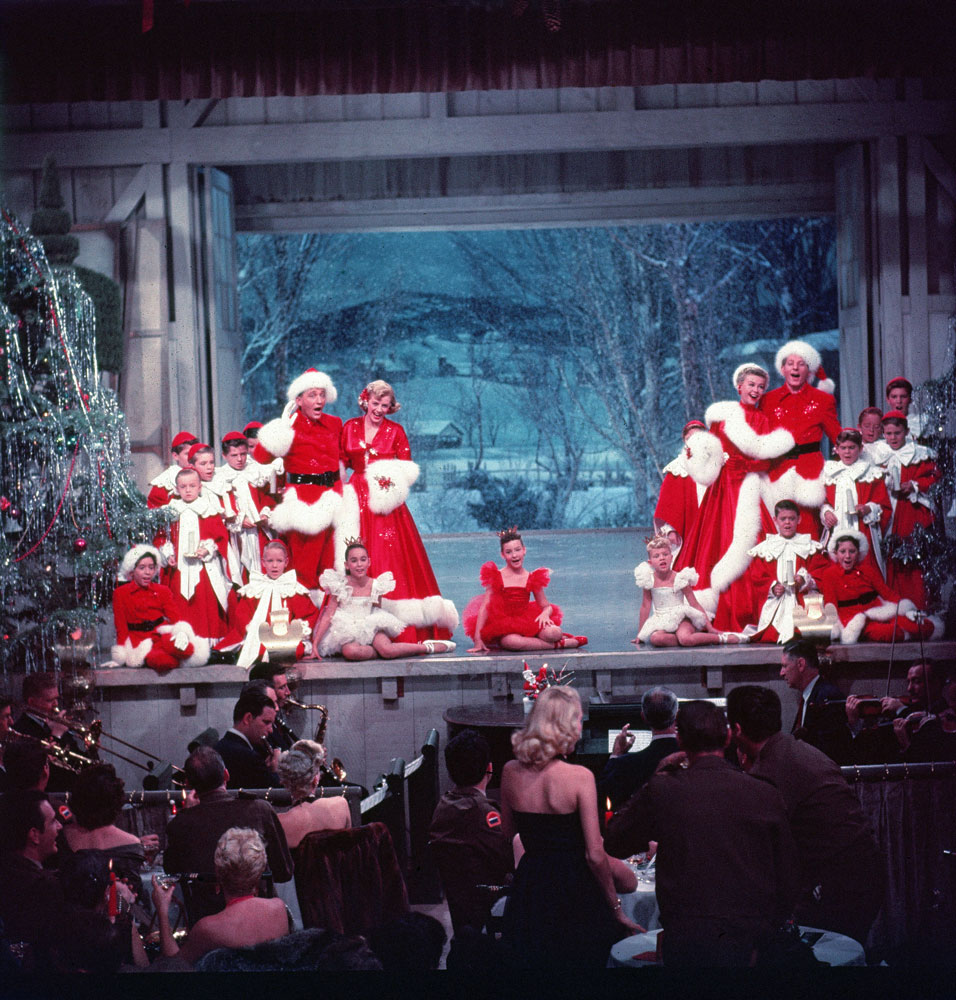
White ChristmasOn a stage full of children, American actors Bing Crosby, Rosemary Clooney, Vera-Ellen, and Danny Kaye perform on stage, dressed in red outfits with white fur trim, in a scene from the film ‘White Christmas,’ directed by Michael Curtiz, 1954. (John Swope/Getty Images)

Nothing brings a town together like a performance involving some of them. 

The Washington Post reported on how one of the most popular crowdfunding sites, GoFundMe, saw a 150% increase in 2020 in money raised for campaigns. But that increase was short-lived, and the help didn’t come for long. Or for everyone. In 2021, The Washington Post wrote, “A year into the pandemic, some individual crowdfunding campaigns are reporting little success raising donations to cover basic expenses.”

Crowdfunding works for some, but it’s a bandage on the gaping issues of outrageous medical bills and salaries that haven’t kept pace with the cost of living. Long-term, it’s about as sustainable as the idea that a show can keep an inn, an orphanage, a town afloat. The idea that we can do it ourselves, we must do it ourselves — it’s a lonely, uniquely American one.


Want a daily wrap-up of all the news and commentary Salon has to offer? Subscribe to our morning newsletter, Crash Course.


But one of the saving graces of a show? It’s a team effort. Even one-person shows require someone to direct, run the light board, paint the scenery. And nothing brings a town together like a performance involving some of them. 

How many times did “Gilmore Girls” have a show, a tiny village with not one but multiple troubadours and Miss Patty’s prolific dance studio? Stars Hollow once had a lavish “living paintings” performance while the equally small town of “Virgin River” inexplicably put on the most elaborate Renaissance Fair with every resident in opulent, Shakespeare in the Park-worthy gowns that they just had lying around somewhere next to their rain gear.

As a former community theater performer myself, I know each show, especially each show put on in a former church, with hand-sewn costumes, lights made from coffee cans, sets with the paint still drying on opening night — each show is a leap of hope. Each act in a play is actually an act of faith. That it will work at the last minute, the lines learned, the seats filled, and the urgent need saved at last. Guffman will come. The snow will come. The money will come. And the show must go on. 
At labor rally in D.C., rail workers and progressive allies vow to push Biden on sick days

While the congressional imposition of an unpopular rail contract on the nation’s 115,000 workers who lacked paid sick time, in order to prevent a strike, may have faded from the headlines, a series of high-energy union rallies across the country on Dec. 13 are adding pressure on President Biden to issue an executive order mandating paid sick days for rail workers.

At the same time, in an additional sign of increasing militancy within the rank and file of the rail industry, a longtime president of the 28,000-member Brotherhood of Locomotive Engineers and Trainmen, who pushed for the controversial deal, was just voted out of office.

The rank and file of eight rail unions voted for the deal, with four, including one of the larger units, rejecting it, in large part over the issue of paid sick days. Despite a 24 percent pay raise, many the workers rejected the contract because of the lack of sick time for a workforce that’s on call 24/7.

Earlier this month Congress went along with prohibiting rail workers from striking, but a bipartisan majority in both the House and the Senate voted for a second piece of legislation that would have mandated rail carriers provide seven days sick leave. But the 52-43 tally in the Senate fell short of the 60-vote threshold required for passage.

Not since 1992, when President George H.W. Bush invoked the 1926 Railway Labor Act, has Congress voted to prohibit rail workers from striking. Sen. Joe Biden of Delaware was among a handful of pro-labor senators who voted against that move.

After speaking at the Dec. 13 railroad union rally on Capitol Hill, Rep. Donald Payne Jr., a Democrat who represents New Jersey’s 10th congressional district, said he remained “optimistic about the prospects” for an executive order. Payne, who chairs the House Subcommittee on Rail, Pipelines and Hazardous Materials, led the floor debate for both imposing the unpopular pact and a second measure to mandate that workers get the paid sick leave the rail carriers had successfully resisted.

At the rally Payne told railroad workers and their supporters that “the fight is just beginning” for them to have “the right to have what every American should have — what my staff has, what I have, what every Republican [member of Congress] has — sick time. It’s the American thing to do.”

At last week’s boisterous midday rally, scores of rail workers and their supporters, mostly from the mid-Atlantic region, cheered speakers like Brian Renfrow, the recently elected president of the National Letter Carriers.

Bernie Sanders: “What you have shown the country is how outrageous this level of corporate greed is and how we have it in the rail industry and in other industries across the country.”

“Three hundred thousand members of my union stand with you,” Renfrow told the cheering crowd. “Just like letter carriers, rail workers are essential workers. Throughout the pandemic, just like you, we came to work every day to keep our country moving. My members work long hours in extreme conditions: rain, snow, extreme temperatures. You do the same. Since 2015 the seven largest railroads have had record profits totaling near $150 billion and in that same time frame, since 2015, these same companies have cut tens of thousands of jobs.”

Renfrow continued: “You should not be forced to work when you are sick. You should not have to choose between taking care of yourself and your family and keeping your job. Federal workers, including members of Congress, have sick leave and you should too.”

“What you have shown the country is how outrageous this level of corporate greed is and how we have it in the rail industry and in other industries across the country,” said Sen. Bernie Sanders of Vermont. “You have raised consciousness on this issue, because you guys are not the only ones in that position. We are going to continue the fight to guarantee paid family and medical leave for all workers in America.”

Sanders called out the relatively recent role of Wall Street investors in the deterioration of working conditions in the rail sector, including the use of so-called precision schedule railroading which penalizes workers, including termination, for taking time off for any reason.

“They walked into the industry a number of years ago and said, ‘Hey, you are too nice to your workers. Tighten up — cut, cut and cut,’ and in the last six years we have seen a 30 percent reduction in the workforce,” Sanders said. “You guys have to do more with less support and that is their ideology: How do we work people to the bone so we can make $20 billion a year? That is why we have to put an end to precision schedule railroading.”


Want a daily wrap-up of all the news and commentary Salon has to offer? Subscribe to our morning newsletter, Crash Course.


Union officials described how the nation’s rail industry had gone from close to 50 Class 1 railroads in the 1980s down to just seven with the monopoly power associated with the 19th-century robber barons. Several protest signs demanded that federal regulators protect the current two-person crews required for freight trains that can be five miles long, boosting the carriers’ cost-profit ratio. Unions maintain it’s just a matter of basic public safety for the communities through which they run.

“What does that train do to the communities it goes through?” bellowed one union speaker. “It blocks the crossings forever. It literally severs communities and the neighborhoods — and we know that the trains do not operate safely everyday. That’s why we need that second person on the train who can make that cut [of the freight cars] at the crossing so the local people can get through. That’s the conductor, the very same person they are trying to take off the train.”

Backers of swift executive action by the president point to what public health officials describe as the triple threat of surges in COVID, the flu as well as in pediatric respiratory virus cases in children. Throughout the pandemic the transport, food processing and health care workforces were hit hard by COVID, which claimed 1.1 million Americans, including a still unknown number of front-line essential workers, particularly before the widespread availability of vaccines.

On Dec. 9, Payne was one of 73 members of Congress who wrote Biden asking for him to take executive action. Two of Biden’s former Democratic opponents, Sanders and Sen. Elizabeth Warren of Massachusetts, also signed on.

In addition to Payne, Rep. Bonnie Watson Coleman and Sen. Cory Booker of New Jersey signed on. Labor appeared to get more traction from New York’s delegation with signatures from Sen. Kirsten Gillibrand and Reps. Yvette Clark, Alexandra Ocasio-Cortez, Jamaal Bowman, Adriano Espaillat, Mondaire Jones, Ritchie Torres, Jerry Nadler and Carolyn Maloney.

“We have heard terrible and tragic stories from rail workers who have been penalized for spending the day in the hospital with their sick children,” the congressional letter recounted. “A locomotive engineer, who, out of fear of being fired, was forced to skip his doctor’s appointment after experiencing unusual symptoms, suffered a heart attack and died in an engine room just weeks later. There is absolutely no reason why these workers should have to deal with these conditions in the richest country in the history of the world.”

The members of Congress observed that while President Obama signed an executive order in 2015 establishing paid sick leave for federal contractors, it “ultimately did not cover rail carriers despite the fact that the Federal Government has hundreds of contracts with freight rail carriers. You can and you must expand this executive order.”

Moreover, the letter argued that “the Secretary of Labor has the authority under the Occupational Safety and Health Act to set mandatory occupational safety and health standards for businesses affecting interstate commerce. We can think of few things that threaten the safety and health of workers more than being required to come into work sick and exhausted and we can think of few industries more quintessential to interstate commerce than freight rail.”

Under the Federal Railroad Safety Act, the letter concluded, the secretary of transportation “has a duty to promote safety in all areas of railroad operations, to reduce railroad-related accidents, and to reduce deaths, injuries and damages caused by rail carriers. Guaranteeing that workers are not operating trains or inspecting rail signals while sick or tired would fundamentally improve the safety of our national rail operations.”

“We say we are for people’s right to organize and fight back,” said Rep. Rashida Tlaib, “yet we are not letting them use the leverage to say, ‘We are not going to show up until they get what we need.'”

In an interview after he spoke at the Capitol Hill rally, Rep. Bowman said he found it “incredibly frustrating” that even within his own party “we have too many conversations about private interests — commercialization and the measuring of the health of our country only through our economy without taking care of the workers — without providing a prevailing wage, without providing affordable housing, without providing sick leave.”

Rep. Rashida Tlaib of Michigan, one of a handful of House members to vote against the imposition of the contract, told the crowd that withholding their labor to protest things like unsafe conditions was a fundamental human right.

“We say we are for people’s right to organize and fight back, yet at the same time we are not letting them use the leverage to say they are not going to show up until they get what we need,” Tlaib told InsiderNJ in an interview. “Federal workers, rail workers, everybody should be able to say, ‘Hey, you have had too many cases of COVID or instances where we needed paid leave.’ At that point you should be able to just step away and say we are not going to show up to work until you handle it.”

Tlaib recalled that early in the pandemic she and other members of the Michigan delegation were inundated by requests for N-95 masks from the TSA workers at Detroit Metro Airport. “They just weren’t giving people masks,” she said, “and we were trying to hunt them down like everybody else because they just were not providing them even though the airport was a huge hot spot for the spread of the pandemic. Yet management seemed to have them.” 

The Capitol Hill labor rally even draw two House Republicans who voted with their Democratic colleagues to compel the railroads to provide the seven paid sick days. On the way back up Capitol Hill for a vote, Rep. Don Bacon of Nebraska and Rep. Brian Fitzpatrick of Pennsylvania shared their rationale with InsiderNJ.

Bacon said his grandfather was a railroader with the Illinois Central and that he and Fitzpatrick were pragmatists.

He said he tried to make the unions’ case to his party’s caucus. “I did talk to them, and I said some of these people have worked 20 days straight and the next day, they are on call. People want quality of life and not just pay. That’s the case I make. Theodore Roosevelt was a strong labor guy. H,e said everybody should get a square deal to include the workers and I think that is where Republicans should be instead of being stilted one way or the other.”

“It’s not just the physical health impact of having sick days,” said Fitzpatrick, a former FBI agent and federal prosecutor. “it’s the psychological and emotional health, the mental health issue that COVID has brought on. It’s the second wave of the healthcare crisis and sick time can be used for that too.”

JFK expert calls out CIA for continuing to withhold documents

Jefferson Morley of “JFK Facts,” is taking the government to court after the CIA refused to release 4,000 documents about the JFK assassination findings.

In 1992, Congress passed a mandate that all of the documents around the assassination be released by Oct. 2017, but when former President Donald Trump was in office and the time came to release all of them, he didn’t. President Joe Biden has released a whopping 13,000 documents, but the CIA is still refusing to turn over the remaining 4,000 documents.

One of the pieces of information revealed was a psychological evaluation of Lee Harvey Oswald, who was arrested for assassinating John F. Kennedy. That evaluation wasn’t considered important enough to even mention in the Warran Commission report, which is the final government report finalized in 1964.

“It did not see this material belonging in its report,” Morley said of the intelligence around Oswald. “I don’t think these post hoc claims about Oswald’s psychology are as important as the records about CIA operations around Oswald while JFK was still alive. That is what the CIA is still withholding.”

He went on to say that the record the CIA has on honesty with the American people isn’t a great one. Earlier this month, Morley explained that he thinks these 4,000 will provide “smoking-gun proof” that Oswald was linked to the CIA.

“When the CIA says we’re not hiding anything but just let us hide 4,000 different assassination assassination-related records, some people, like your previous guest are going to say, well, that’s fine. We trust them,” said Morley. “But you know what, the CIA has an atrocious record on transparency around the Kennedy assassination. They misled the House Select Committee on Assassinations on key points. And lastly, Judge John Tunheim, on the JFK review board in the 1990s, called on the CIA to release additional documents that he said the CIA had deceived the JFK review board in 1998. And those documents did not review this week. So, the idea that there’s nothing significant left in the documents that the CIA is hiding, we strongly disagree.”

It’s for that reason that he said they’re suing the president and the National Archives to obtain the documents. The group said that the information left in those 4,000 pages would reveal the CIA’s sources and methods around Lee Harvey Oswald, who said he never assassinated JFK.

In 2017 when the documents were previously supposed to be released, former CIA officer Phil Mudd said that there were likely still CIA agents that were still in the field who could be impacted. But the assassination was almost 60 years ago.

He also explained that this is the fourth time in five years that the CIA has blown through the law that mandated transparency around the assassination information.

Watch below:

Kari Lake is going off the deep end over election being “stolen” from her

Kari Lake, who was Arizona’s Republican gubernatorial candidate, is vowing to push back against the so-called “evil b–tards” who she believes stole the governor’s election from her.

According to Mediaite, footage of Lake’s recent speech at former President Donald Trump’s Mar-a-Lago estate has emerged. The clip, which was obtained by The Republican Accountability Project, features Lake claiming the election was successfully stolen. Now, the footage is circulating on Twitter.

Speaking to the crowd of attendees, Lake said, “We just had such a huge movement going into election day, so to watch these people – these evil b–tards.”

She continued, “Can I say that here, is that alright? To watch them steal this in broad daylight, and if they think they are going to get away with it, they messed with the wrong b—h, ok?”

The crowd responded to Lake in a receptive manner.

Lake’s latest rant follows her refusal to concede the race. The angry gubernatorial candidate has also filed court documents challenging the election results due to speculation of voter fraud.

“Hobbs, the Democratic secretary of state, is scheduled to take the oath of office as Arizona’s governor on Monday, Jan. 2. Lake lawyer Bryan Blehm, who was the attorney for the Cyber Ninjas’ partisan election review last year, had asked the judge for a three-day hearing on Lake’s election claims,” KPNX reported. “Hobbs’ attorney warned during Tuesday’s court hearing that dragging out the case could cast a pall on the January inauguration.”

Watch below:

Salton Sea public health disaster gets a $250 million ‘shot in the arm’

This story is part of the Grist series Parched, an in-depth look at how climate change-fueled drought is reshaping communities, economies, and ecosystems.

Last week, the federal government announced it will spend a quarter of a billion dollars over four years to clean up what remains of the Salton Sea, a lake in southern California that has been shrinking due to climate change-driven drought. 

For decades, communities living near the sea have been afflicted by health problems caused by algae blooms and dust storms spurred by wind kicking up drying sediment from the sea’s ever-widening shores. The government’s new plan aims to help remediate some of those health impacts while simultaneously encouraging farms in the region to reduce their reliance on water from the Colorado River.

The $250 million will come from $4 billion earmarked for drought funding in the Inflation Reduction Act, the climate and energy security bill passed by Democrats and signed by President Joe Biden in August. The new money is meant to complement more than half a billion dollars the state of California has already committed to restoration and dust-suppression projects in the area. 

The Salton Sea, a body of water that formed by accident more than a hundred years ago when the Colorado River overtopped an irrigation channel and flooded an empty lake bed, has become a controversial flashpoint in California’s ongoing efforts to conserve its increasingly limited water supply from the Colorado River basin. 

For around half a century, the brimming Salton Sea attracted tourists, anglers, and celebrities like the Marx Brothers and the Beach Boys to its shores. But the sea was only directly fed by the Colorado River for a period of two years starting in 1905. Since then, it has been sustained indirectly by agricultural runoff from farms in the Imperial Valley that use water from the Colorado River to irrigate their crops. As water evaporates from the sea’s surface into the atmosphere, the body of water has become more concentrated with pesticides and other farming byproducts, and algae have proliferated in its tepid, shallow waters. The approximately 650,000 people living nearby suffer from headaches, nosebleeds, asthma, and other health issues.  

The Department of the Interior, the government agency that is managing the restoration agreement, has made it clear that there are strings attached to the federal funding. The department’s Bureau of Reclamation will provide California with $22 million in new funding between now and the end of next summer to spend on restoration projects around the sea, conduct research on current and future cleanup projects, and hire two representatives from the Torres Martinez Desert Cahuilla Indian Tribe to help implement those projects. 

The remaining $228 million is contingent on the state following through on its commitment to conserve 400,000 acre-feet of Colorado River water every year starting in 2023. Specifically, the Imperial Irrigation District, or IID, the public utility that supplies the Imperial Valley and its 500,000 acres of farmland with Colorado River water, will need to take on additional conservation measures in order to help California meet that target. A day after the Interior Department announced its $250 million plan, the IID board voted 3-2 to approve it, signaling that the district agrees, at least for now, to conserve 250,000 acre-feet of river water per year as part of the state’s wider goal. 

“This landmark agreement demonstrates much-needed federal commitment to the Salton Sea and IID’s commitment to improving Basin resilience,” Michael Cohen, senior associate at the Pacific Institute, a water conservation think tank, said in a statement. 

Conserving all that water comes with tradeoffs for the Salton Sea. An IID projection shows that by 2027, the measures will expose an additional 8,100 acres of dusty shoreline. That’s where the funding for restoration and cleanup from the federal government comes in.

Jenny Binstock, a senior campaign representative at the Sierra Club, told Grist that she considers the new funding a “shot in the arm” for the efforts to fix the sea’s problems, though she said more can be done. Binstock wants federal and state agencies to thoroughly consult surrounding communities before approving new projects and, looking further ahead, figure out a way to pump new water into the sea. “Moving forward it will be essential that federal partners continue to work with the state, water agencies, and local communities to ensure that the Salton Sea remains a major priority as part of the complex water challenges facing the Western U.S.,” she said.

“True Grit” is a Christmas movie for me

My dad had just been diagnosed with stage IV melanoma when my husband, 14-year-old daughter and I flew from our home in Philadelphia to the house in Florida where my parents lived as snowbirds each winter. By the time we arrived, my dad was down 20 pounds, his trademark spark of humor gone from his eyes. It was hard to believe this was the same 76-year-old who, only weeks earlier, had been playing tennis twice a week.

Dad spent much of our visit resting on the couch. I assumed we would skip my Jewish family’s annual tradition of a Christmas matinee, but the remake of “True Grit” had just been released and my father wanted to see it in a theater. I called my siblings, and we made plans to meet.

That afternoon, three generations of my family filled a row of seats at the Cinemark Palace 20 in Boca Raton, and for two hours, we escaped our sadness. Dad even managed to stay awake for the entire movie — even before his illness, he was notorious for nodding off when the lights went down.

As we shuffled out after the credits, he smiled and pronounced it a terrific film. By mid-February, he was gone.

It was a bittersweet twist of fate that the Coen brothers’ masterful reboot of “True Grit” would be the last movie my dad saw before he died from cancer almost 12 years ago, given his connection to the original starring John Wayne.

It was a bittersweet twist of fate that the Coen brothers’ masterful reboot of “True Grit” would be the last movie my dad saw before he died from cancer.

The John B. Stetson Company, founded in 1865, was the world’s largest hat maker during the early 20th century, and the originator of the Western hat. My dad was the art director who designed the ad making John Wayne the face of the brand — a pairing so iconic, the name Stetson would become synonymous with cowboy hats.

My father and his copywriter friend quit their advertising jobs to form their own Philadelphia agency in 1968, with only a single client and their shared determination to keep them afloat. They landed the Philadelphia-based Stetson Hat account shortly after, around the time the film “True Grit” went into production.

Displaying grit of his own, my dad contacted Paramount Pictures and wrangled permission to bring a crew onto the set to take pictures of John Wayne in action, wearing a Stetson in every shot. His partner wrote the copy, and the resulting campaign established their reputation as a creative force.

Design was a language I shared with my dad. We bonded over elegant typography and an appreciation for white space on the page. Of the four kids in my family, I was the one who followed in my father’s footsteps, graduating from art college before taking a job as an art director at an advertising agency.

As a little girl, I couldn’t wait for my dad to come home from the office. He’d greet my younger sister and me with a cheerful, “Hi, pals!” and hand us each a treat from his briefcase: a box of Raisinets or a coveted sheet of “poppers,” I’d later learn was just bubble wrap. I can still picture him walking in the door with a wool felt fedora on his head of black curls, as dashing as Don Draper in “Mad Men.” His hat, of course, was a Stetson.

My dad’s biggest clients were fashion accounts, and he took the train from Philly to New York to work with top photographers and modeling agencies. He often brought work home, using an X-Acto knife and rubber cement to cut and paste layouts, decades before I’d learn to do so on a Mac.

I can still picture him walking in the door with a wool felt fedora on his head of black curls, as dashing as Don Draper in “Mad Men.” His hat, of course, was a Stetson.

As a young teenager, I’d walk downstairs to our basement and find the ping pong table covered with large glossies of Carol Alt, Paulina Porizkova, Patti Hansen, and Iman, from photoshoots my dad directed. Casually, he’d slide two photos in front of me and ask which I liked better. I’d pick one and he’d pit it against another until we narrowed them down to the best.

When I was older, he brought home presstype, sheets of alphabets in different fonts that you would transfer to illustration board by rubbing the waxy paper with a burnisher until the letter stuck. He put me to work setting type by hand, and taught me how to eyeball the space so the letters would barely kiss, creating the perfect kern.

What felt like fun was an apprenticeship in art direction, Mr. Miyagi-style. By my senior year in high school, I had a well-developed eye and could set headlines like a pro. Wax on. Wax off.

Dad was a kind and generous man whose soft-spoken voice belied his ability to get his way. He was a perfectionist, sure his method of taping a package or setting up a beach umbrella was the only way that made sense. But it was his professional work ethic and bold creativity that earned him recognition as one of the best in the Philadelphia ad community. Competing against much larger agencies, he used to clean up at awards shows. From him, I learned to strive for excellence, and that if you don’t ask, the answer is always no. His campaign for Stetson was all the proof I needed.

After he died, I helped my mother clean out my childhood home so she could put it on the market. Mom asked if I wanted my dad’s old collection of portfolios, giant vinyl cases stuffed with proofs from print campaigns spanning his career. Here was the physical embodiment of our special connection. Of course I wanted them.

Losing my dad so suddenly was a gut punch. His absence was palpable and my grief, at times,  felt bottomless. Then one night, I recognized one of my dad’s favorite fonts in the title of a TV show. He had used Goudy Oldstyle in several of his long-term ad campaigns, and the typeface was as familiar to me as his handwriting. Seeing it reminded me that he wasn’t completely gone from my life.

My dad’s design aesthetic, creative drive, and attention to detail were ingrained in me from decades of watching and learning from him. More importantly, I carried inside his trust in my abilities, which gave me the courage after his death to pursue my dreams.

And when I forget, there’s a framed magazine ad for Stetson Hats hanging on my wall to remind me — a tribute to the power of aiming high, and a memento of our last family holiday spent together.

Our love affair with fake meat couldn’t last

You might think it was the beginning of the end of the Beyond. After showing up on every menu you opened, carving out entire new neighborhoods in your supermarket aisles and monopolizing the conversations of your all plant-curious friends for the past few years, alternative meat has recently lost some of its cachet.

Last month, a Motley Fool report noted that the Beyond Meat company’s stock had declined a stunning 85%, and that 200 staffers have been laid off. “As well as consumers rejecting its product,” journalist Rich Duprey observed, “distributors and retailers weren’t ordering more of it, either.” Our consumption of the old-fashioned kind of meat, in contrast, has not abated at all. We eat more beef now than we did a decade ago, and our poultry consumption, meanwhile, is at an all-time high. Have we lost our taste for meatless meat?


Want more great food writing and recipes? Subscribe to Salon Food’s newsletter, The Bite.


A variety of factors seem to have led to the Beyond company’s changed fortunes. In November, the Los Angeles Times reported that leaked documents and photos from a Pennsylvania factory revealed “apparent mold, listeria and other food-safety issues” including the presence of “foreign materials” in food from the plant.

But while the negative publicity is never good for business, it’s unlikely that concerns over food safety have been translating to consumer trends. After all, if revelations about processing conditions really impacted buying habits, who would ever eat factory-farmed meat again? A recent Purdue University study found that even when participants were given “information nudges concerning possible environmental and health impacts of meat production,” they were still “not able to change preferences toward a plant-based meat substitute.”

Instead, the shift may come down more to simple economics. Jessica Randhawa, creator and writer of The Forked Spoon, tells Salon Food, “While the plant-based meat substitute market and market capitalization have declined this year, I think it has more to do with its pricing and inflation than with our tastes. Most people I know who have had the plant-based options enjoy them, but the cost makes it more of a luxury item.”

“Curiosity caused the products to become popular, but over time the novelty has worn off. “

And then there’s the boredom factor. (How’s that Instant Pot you just had to have in 2018 working out these days?) Sara Bachmann, creator of Sara’s Veggie Kitchen, says, “When these new plant-based meats were first introduced, the curiosity that it sparked caused the products to become popular, but over time the novelty has worn off. There is a time and place for meat substitutes like at your local burger joint but at home,” she says, but “I would much prefer cooking with lentils, beans or mushrooms for a ‘meat’ replacement in meals and recipes.”

Yet Paul Shapiro, CEO of The Better Meat Co. and author of “Clean Meat: How Growing Meat Without Animals Will Revolutionize Dinner and the World,” warns against any hasty epitaphs for the meatless burger.

“I think the reports of the death of this industry may be premature,” he says. “It’s true that Beyond has suffered lately, but at the same time, Impossible claims that they’re still growing 40% year on year. What’s probably happening is that Impossible is taking some of Beyond’s market.” And he adds, “If you look at plant-based chicken brands, they’re claiming massive growth this year. There’s lots of ways to recreate the meat experience without animals.”

Maybe my problem is that I don’t want a meat experience (or a chicken one) without animals. I can admit that the first time I ever had an alternative meat burger — at the enthusiastic urging of a newly vegetarian friend — I definitely experienced a certain sense of disbelief. Disbelief at the fact that anyone actually enjoys this stuff. It was one of the weirdest-tasting things I’d ever eaten. It had texture, sure, but the flavor was, to my buds, unnatural and unpleasant. Over the years, I have periodically tried various types of meat substitutes, and they’ve always provoked the same intense displeasure. 

Of course, the thing about taste is that it’s highly specific. New York City chef and registered dietician Abbie Gellman notes, “Those products are not targeted to people who already eat vegetables. Those products are targeted to people who are meat eaters primarily and don’t want to eat plant-based foods. That is why they were made to look and taste like meat. It’s a different market.” I will always gladly order a sweet potato or black bean burger or anything involving mushrooms, precisely because they taste like sweet potatoes or black beans or mushrooms.

As Salon senior politics writer Amanda Marcotte expressed a few years ago, I too prefer “appreciating vegetables on their own, instead of lamenting that they aren’t meat.”

And that’s something to think about, for all of us wondering how we might want to eat better going forward into the new year. Maybe like me, you’ve given meat substitutes your best shot and know they’re not for you. If you still consume meat, you might feel like Bhagyashree Katare, one of the Purdue study authors, who told the Guardian in September. “If I’m spending money in a restaurant, and I’m a meat eater, why would I spend money on plant-based meat? I would rather eat an actual burger.” But if for the sake of your health, the health of the planet, and the welfare of animals, you’d like to at least reduce the amount animal products you consume, there are lots of ways to go about it.

Vegan coach Tenny Minassian advises, “Meat substitutes definitely have their place for people who are cutting down their meat consumption, or transitioning to a plant-based diet. However, a lot of people tell me they want to eat plant-based due to health concerns. I always recommend a whole-foods plant-based diet for them. They can create their own meat substitutes by focusing on protein-rich ingredients like tofu, tempeh, and legumes like lentils or beans. Adding walnuts and mushrooms to the mix helps give it the fat and the meaty texture you are looking for, without the added cholesterol that comes with animal products.” And Stephanie Wells, MS, RD, a registered dietitian and owner of Thyme to Go Vegan Nutrition Services, similarly advises, “I think meat alternatives can be a great tool for people who are just starting to eat less meat, since you can cook them the same way you would cook meat.” But she adds, “When I help clients find ways to eat less meat, I emphasize plant-based sources of protein like beans, lentils, tofu, edamame, nuts, and seeds, which should form the foundation of their diet along with whole grains, fruits, and vegetables.” 

“If people want to just eat less meat or no meat, that’d be great. But humans seem to really like meat.”

Looking to the future, Paul Shapiro says, “We have to find ways of slashing the number of animals we are raising for food. Increasing demand, for me, is the number one cause of deforestation, the number one cause of wildlife extinction, the number one cause of antibiotic resistance and a driving cause of climate change. I’m bullish on these methods of recreating the meat experience — using plant proteins, using fungi fermentation and using animal cells. I think the task before us is to figure out ways we can give people the experience of eating meat without the need to raise and slaughter animals. If people want to just eat less meat or no meat, that’d be great. But humans seem to really like meat.”

I still like to eat meat, too, albeit in smaller quantities. And like a lot of people, I am still on the learning curve of discovering what other foods to fall in love with, somewhere out there beyond meat.


A rundown of the most absurdist candy cane flavors

For years and years, candy canes have been a comfortable, fixed component of the holiday landscape of iconic images: their brittle snap, their cling-wrap plastic exterior, their red-and-white colors indicative of their flavoring and a clear reference to Santa Claus himself. 

They're also multi-purpose: Some let the candy cane sit in their mouths like a lollipop, some crush them and use them to top lattes or lava cakes, and others never open nor eat them whatsoever and instead use them for decorating or DIY ornaments. Regardless of how they're used, they represent a sort of holiday-adjacent stability amidst the tenuousness of everyday life. They are one of the many, many items that reliably come back around, year after year, holding a place in both your home and heart.

When I was younger, I was partial to those brightly colored canes (they were also usually blue, yellow and green in addition to the red and white) that had a more sweet, amorphous flavor instead of the pronounced mint. Since then, though, the world of candy canes has become more diverse than ever. For those who fancy themselves real candy cane enthusiasts, the wackier the flavor, the better.

Some of these flavors are clearly designed for their shock value, while others are more akin to this meme, posing a potentially interesting flavor that might actually be kind of delicious. From pickle and Caesar salad to butter and even shiitake mushroom, today's candy canes run the gamut, serving as gag gifts, stocker stuffers and surprisingly tasty treats.

One thing remains static regardless of flavor, size or color: the hook shape of the cane itself. While the flavors and colors have shifted exponentially, and the sizes vary — some canes are enormous and some are tiny — the shape itself hasn't changed in quite some time.

The history of the candy cane is pretty fuzzy — filled with conjecture and speculation — but the shape itself is thought to come from a church in 17th century Germany fashioning candy sticks into hooks to look like a shepherd's staff, according to Thought Co. As The Conversation notes, the original candy canes were likely plain white, with the customary red stripes not added until years later, probably around "the turn of the 20th century."

Since then, the candy cane itself remained relatively static, until recent years when notions of differing, unique flavors (i.e caramel macchiato) to help expand the flavors of the cherished candy began to enter the genre. That was soon followed by "ew"-type novelty gifts, perfect for the holiday season. And the rest is history.


Want more great food writing and recipes? Subscribe to Salon Food's newsletter, The Bite.


A company called Archie McPhee's boasts a bunch of wacky-flavored candy canes, including rotisserie chicken, "hamdy" canes, ketchup, macaroni and cheese, brisket, pho (!) and "clamdy canes." They also sell candy canes that are based on trendy foods like pickles and bacon. They even sell a "Bah, Hambug!" candy cane which has, according to their website, "no flavor, color or Christmas spirit."

Some other flavors sold by other companies are molded after sodas like Dr. Pepper, strange ingredients like wasabi, or candy or snack-flavored iterations like Swedish Fish, Hot Tamales, Nerds, Sour Patch Kids or Oreos. Other flavors include Funfetti, gravy, birthday cake and Froot Loops. There's even a kale-flavored option.

There really is no limit to the absurdity of the flavors. 

At their core, though, what do they offer? A classic candy cane is nostalgic, retro, respectable. But that doesn't mean that there's no space for these silly flavored canes.

These novelty flavors are good for a joke, a chuckle, or a silly Secret Santa gift with an affordable price tag. No one is going to be selling you on the fact that an especially ludicrously-flavored candy cane deserves praise for its culinary nuance, but that's okay. These are a fun way to celebrate the holidays, your favorite food, or simply an item that isn't even opened or tried, just appreciated for its sheer outrageousness. They're also perfect stocking stuffers, really. 

Celebrate as you wish! I won't begrudge you if that includes gifting all of your family, friends and loved ones a medley of pho and sardine candy canes. 

Picky eater? Research shows it could be in your DNA

In the last 40 years, obesity has been constantly rising. This has happened despite the popularity of all kinds of diets ranging from low-carb, paleo or even ice cream based.

Many scientists believe this is because cheap junk food has filled supermarket shelves and fast food takeaways. This food is high in calories and other not-so-healthy ingredients, such as saturated fats, simple sugars and salt. But it’s designed to taste delicious. Taste is a dealbreaker when it comes to deciding what to eat, diet plans or not. Yet our understanding of what makes food taste good is limited.

My team’s research explored how genes and biological processes influence which foods we find irresistible. We partnered with UK Biobank to ask the participants in our study how much they liked 139 foods, rating them from one to nine on a questionnaire, with nine being the most delicious. UK Biobank is a collection of almost 500,000 UK volunteers, who agreed to provide their personal information for scientific purposes. They were aged from 50 to 70 at the time of our study.

We sent the questionnaire by email and received close to 189,000 responses. The first step in our study was to analyze links between food people said they liked. For example, if someone likes pears, can we expect them to also like apples and strawberries. We mapped the relationships between different foods.

Good taste

We found food can be categorized in three groups: highly palatable foods, which include meat, junk food and desserts; low-calorie foods, mostly fruit and salad vegetables but also oatmeal and honey; and acquired taste foods, which are strong-tasting foods children generally dislike but learn to enjoy, such as coffee, alcohol and spices.

The map revealed some surprises. Foods didn’t group by flavor type (such as sweet vs. savory) but by how likable they were. For example, a taste for fruit juices correlated more with a preference for desserts rather than fruit. So, fruit juice went in the highly palatable category rather than low-calorie. Foods people think of as vegetables do not cluster together. The mild-tasting ones, such as tomatoes or courgettes, are in the low-calorie group, while the strong-tasting ones, like bell peppers or onions, were in the acquired taste group. Also, sweet drinks like sodas clustered closer to meat and deep-fried foods despite their sweet flavor.

We then looked at which differences in people’s DNA could be linked to the types of food they relish. We identified 325 different genes, mostly in the brain, implicated in determining what we like to eat. When we looked at how much the three categories of foods correlated genetically between each other, we found that the highly palatable foods had no correlation with the other two categories of foods. This suggests there are two biological processes. One regulates a weakness for highly pleasurable foods, while another regulates the rest.

What’s next

Twin studies suggest food preference is 50% genes and 50% personal experience. The family environment plays a role in children’s food preferences but not in those of adults. The shift happens around adolescence. It is still not clear how a liking for different food matures in children, as no one has carried out large-scale longitudinal studies. My team would like to try and fill this gap in research next.

For our study, we also used MRI brain scans to look in more detail at which areas of the brain correlated with the three food groups. We once again found that enjoyment of highly palatable foods was associated with a larger volume of brain areas involved in perceiving pleasure in food. The other two groups were associated with brain areas involved with sensory perception, identification and decision-making.

These findings shed a new light on our understanding of people’s food choices. If you understand why you don’t like certain foods, it may help you improve the way you cook or prepare them. For example, many people do not like coriander, as it “tastes soapy.” This is genetically determined, giving some people a sensitivity to a compound in coriander. Cooking coriander instead of eating it raw reduces the soapy flavor. This is a simple example, but it shows how a little preparation may make foods more acceptable.

Health professionals and schools could use the information on taste and people’s DNA to identify those more at risk of having unhealthy diet choices and help them with early targeted programs. Pharmacological solutions could shift someone’s preference for different types by activating different parts of the brain or hormones. For example, high levels of a hormone called FGF21 can trigger a preference for savory food; low levels can trigger a preference for sweeter food. It may be possible in the future to develop medicine that changes the foods you take pleasure in eating.

Nicola Pirastu, Senior Manager Biostatistics Unit at Human Technopole and Honorary Fellow, The University of Edinburgh

This article is republished from The Conversation under a Creative Commons license.

Why did it take so long to adapt Octavia Butler?

In a beautiful essay in Vulture, published earlier this year, E. Alex Jung writes that Octavia E. Butler “never told an aspiring writer they should give up, rather that they should learn, study, observe, and persist.” Butler could have been speaking of her own life, a writerly existence of fairly early publishing success but a consistent struggle for financial security and the uphill battle of being a Black woman in a genre dominated by white men.

Butler is now considered a visionary if not the mother of Afrofuturism, which Ramtin Arablouei of NPR describes as “an open-ended genre combining science fiction, fantasy and history to imagine a liberated future through a Black lens.” Butler was raised by her widowed mother, who worked for wealthy white women, and grandmother in Pasadena, California. She said the moment she decided to be a writer of science fiction was when she saw the 1954 B-movie “Devil Girl from Marsas a 9-year-old. She loved comics, superheroes and sci-fi, loved a genre that took its time loving her back. 

Her first novel “Patternmaster” was published in 1976. She would go on to publish a dozen, along with a collection of short stories. The first Black woman to win both the Nebula and Hugo awards, Butler was the first science fiction writer to be awarded a MacArthur genius grant. She was prolific until her death, at only 58. 

Her 1979 novel Kindred” has come to the screen in a new FX series by Branden Jacobs-Jenkins and it’s aching and necessary — but the adaptation was a long time coming. What took the world so long to wake up to Butler? Time writes, “It is absolutely wild that it has taken nearly half a century” for Butler’s work to make it to the screen. Wild, or exactly how America works?

“Kindred” is about a contemporary Black woman named Dana who starts traveling back in time to a 19th century Maryland plantation in an inexplicable way she has no control over, experiencing firsthand the violence of slavery. In the past, Dana becomes involved in the lives of enslaved Black people as well as the cruel white plantation owners and their children, yanked back and forth from her own life. The series updates Butler’s novel with some changes, including placing Dana, an aspiring TV writer, in 2016 Los Angeles, which Salon’s Melanie McFarland describes as “the year that Americans discovered on a grand scale just how much the United States detests women, and how many white women voted in agreement with that view.”

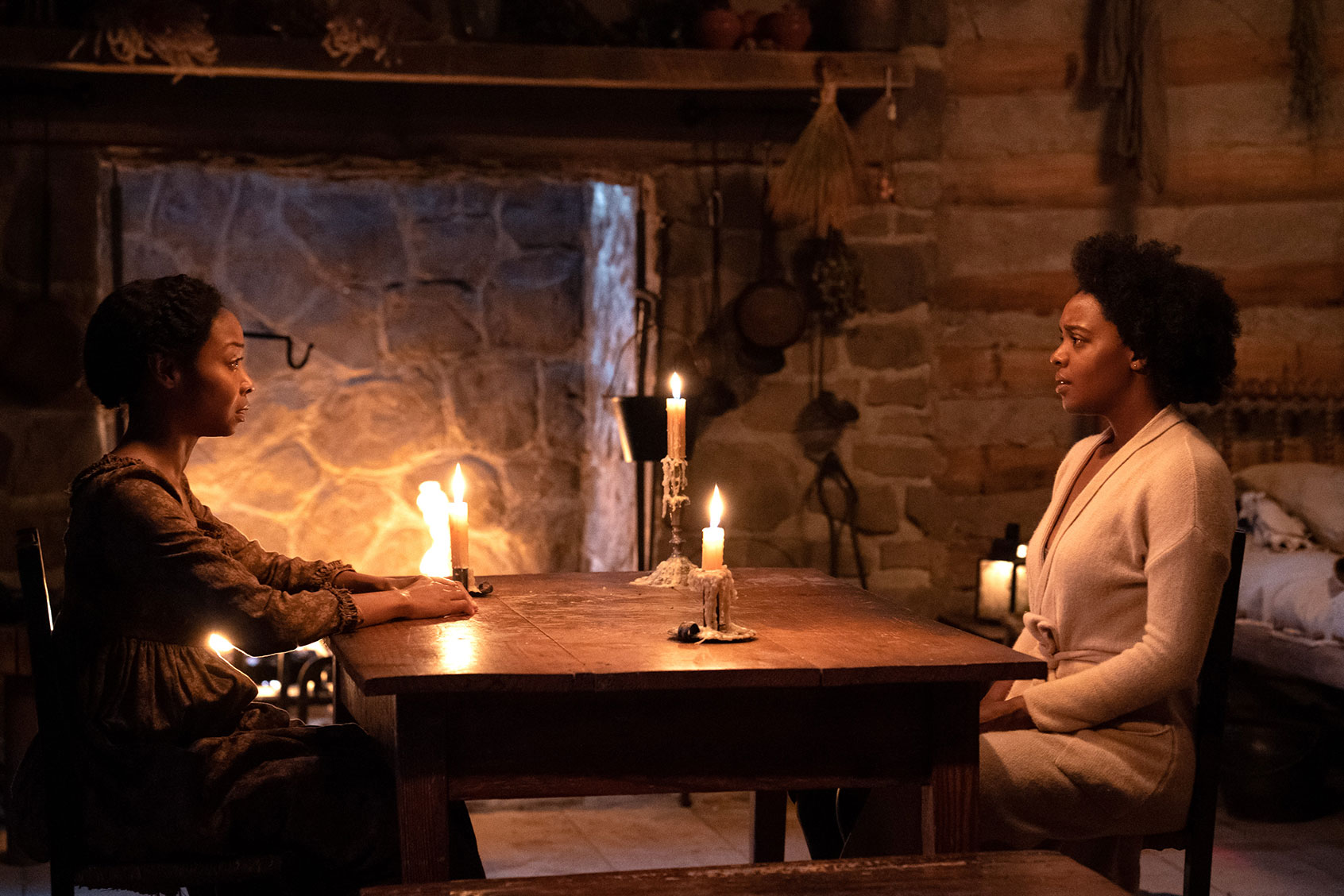
KindredSheria Irving as Olivia, Mallori Johnson as Dana in “Kindred” (Tina Rowden/FX)Butler wrote her novel in part thinking of her mother’s experiences as a cleaner. In its obituary of the writer, The New York Times quoted Butler speaking about “Kindred” to Publishers Weekly, “I didn’t like seeing her go through back doors . . . If my mother hadn’t put up with all those humiliations, I wouldn’t have eaten very well or lived very comfortably. So I wanted to write a novel that would make others feel the history: the pain and fear that Black people have had to live through in order to endure.”

“We both played at not knowing why she was behaving that way.” 

Butler had published her first few novels without meeting her editor, Sharon Jarvis at Doubleday. When the two finally met face to face at a conference, as Jung writes, “Jarvis was surprised to learn Butler was Black. ‘I went up to her at a science-fiction convention and introduced myself and she opened her mouth, stepped back, and stared,’ Butler said. ‘Then we both played at not knowing why she was behaving that way.'” 

KindredMallori Johnson as Dana in “Kindred” (Tina Rowden/FX)Asked by Terry Gross in a “Fresh Air” interview from 1993, “As a woman and as an African American, are there things that bothered you about the science fiction books that you read when you were first starting to read them?” Butler answered, “Yes, I wasn’t in them.” At the beginning of her career, which she had launched without an agent, “nobody knew who I was and nobody knew I was Black. And no – apparently, there wasn’t any worrying. I didn’t have any difficulty selling my first three novels. When I wrote ‘Kindred,’ which is unmistakably of special interest to Black people, I had a lot of trouble. All of a sudden, 15 publishers couldn’t find a place for it. They didn’t know how to sell it.”
In 1980, she had published an essay describing her first year of college in 1965 when she “sat in a creative writing class and listened as my teacher, an elderly man, told another student not to use Black characters in his stories unless those characters’ Blackness was somehow essential to the plots. The presence of Blacks, my teacher felt, changed the focus of a story, drew attention from the intended subject.” Those same sentiments were echoed, she wrote, 14 years later when she heard a writer at a sci-fi convention lecture “that in stories that seem to require Black characters to make some racial point, it might be possible to substitute extraterrestrials — so as not to dwell on matters of race.”

“Well, let’s do a little dwelling,” Butler wrote next.

“Oprah Daily describes ‘years of meh and rejection’ every time he brought up ‘Kindred.'”

Is it so shocking that it’s taken this long to bring Butler’s work to the screen when 2022 saw a slew of canceled shows with Black leads, like “black-ish,” “Queens,” “Our Kind of People,” “Naomi” and “Batwoman.” Low ratings were blamed for most of these cancellations. Other shows that feature actors of color stepping into iconic roles or fictions, particularly sci-fi or superhero ones, have been greeted with hate and trolling. As far as behind the scenes goes, the Writers Guild of America in their 2021 Screen Inclusion Report found a 3% increase of screenwriters of color, but this was only a nominal boost; 77% of working screenwriters are still white. 

In an interview with Oprah Daily, playwright and producer Jacobs-Jenkins talked about his struggle to bring “Kindred” to the screen, which took “about a decade.” Oprah Daily describes “years of meh and rejection” every time he brought up “Kindred.” The project took four years in development. Other Butler adaptions are suddenly in the works elsewhere, including an HBO pilot of Butler’s final novel “Fledging,” Prime Video adaptations of “Wild Seed” and “Dawn” and a feature film of “Parable of the Sower” by A24.


Want a daily wrap-up of all the news and commentary Salon has to offer? Subscribe to our morning newsletter, Crash Course.


“Parable of the Sower” is Butler’s most famous work — and the one that finally landed her on The New York Times bestseller list, a lifetime dream that was not achieved until 2020, years after her death. It was a dream not realized until the literary gatekeepers in America knew for certain, thanks to the pandemic and rapidly escalating climate change, that the global apocalypse detailed in Butler’s pages could and was coming true. 

Most science fiction comes true if you live long enough. But not all writers face the same poverty, racism and exclusion that Butler lived with, nor do they write with such clarity and vision. In “Parable of the Sower,” a young girl has the power to change things. In “Kindred,” a young woman changes lives — and saves her own. “Parable of the Sower” is set in 2024, which isn’t so far away now. In late 2022, might we approach being ready to listen and believe? 

“The White Lotus”: Here are the real hotels featured on the show, but can you afford them?

The second season of Mike White’s acclaimed HBO anthology series “The White Lotus” has officially come to an explosive end. And while most of the latest buzz concerns a beloved character’s “derpy” demise and another not-so-beloved character’s questionable sense of fashion, there’s also plenty of talk about the show’s luxurious locations.

Season 1 took us to the sunny, open-air beachfronts of Maui while the second season transported us to yet another picturesque beach destination in Sicily. With backdrops so gorgeous, it’s easy to overlook the messy drama of the series — the frivolous, oftentimes, murderous antics of rich people — in the face of such aspirational vacation locales.

Whether your heart desires the Pacific or Mediterranean, here’s a closer look at the real-life White Lotus resorts, whether they’re open to the public or not and their most extravagant offerings. 

Season 1: Maui

The first season introduced us to the kooky staff at the White Lotus resort in Hawaii, the dysfunctional Mossbacker family, the newlywed yet incompatible Pattons and a lone traveler named Tanya McQuoid (Jennifer Coolidge) who’s seeking inner peace following her mother’s death. The focus here was money and power — which spurs rifts amongst the guests and the resort staff — along with a missing, illicit green backpack. In the end, someone does end up dead, adding to the bigger commentary about who has power.

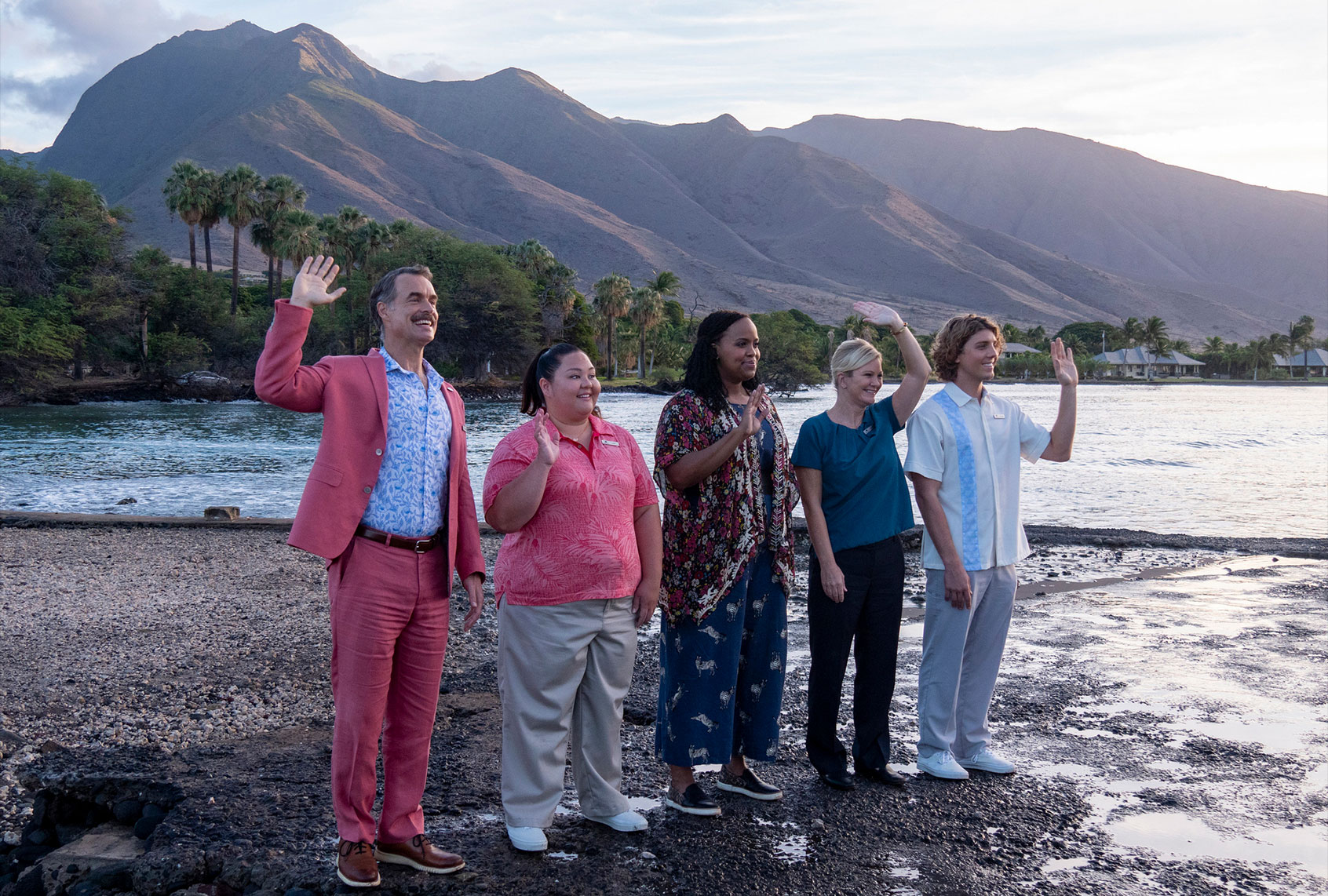
The White LotusMurray Bartlett, Jolene Purdy, Natasha Rothwell, Lukas Gage on “The White Lotus” (HBO)

All the hoopla takes place in the real-life Four Seasons Resort Maui at Wailea, a 5-star hotel that is currently available to book. It’s located near one of Maui’s largest beaches, Wailea beach, and touts 380 guest rooms and suites; three pools; a spa, which offers wellness services by the pool and ocean; three golf courses and an art museum.

The White LotusSydney Sweeney, Brittany O’Grady and Alexandra Daddario in “The White Lotus” (Mario Perez/HBO)

Current room rates range from $1,160 per night, which is plenty expensive, but downright reasonable compared to the most expensive suite. If you opt for the “Lokelani” Presidential Three-Bedroom Suite, which is akin to Shane (Jake Lacy) and Rachel Patton’s (Alexandra Daddario) sought-after Pineapple Suite, that will set you back $27,000 per night. What do you get? A whopping 7,200 sq.ft. of space, that includes a 1,900-sq.ft. private garden and options of two king and two queen sized beds. There’s also a 180-degree view of the nearby oceanfront and the islands on the horizon.

If you’re a bit more modest and yet still like some lavishness like the Mossbacker family, the hotel’s slightly smaller “Maile” Presidential Suite is 4,000 sq.ft. of indoor space and has a 180-degree oceanfront view of the Pacific, neighboring islands and Wailea Beach. Or, if you’re going solo like Tanya, that would be the Oceanfront Prime Suites, that’s still plenty roomy at 1,400 sq.ft.  with – what else? – an 180-degree oceanfront view of the beach and neighboring islands. 

The White LotusSteve Zahn and Connie Britton from “The White Lotus” (Courtesy of HBO)

Season 2: Sicily

One feature we’d hope not to get on a jaunt to Italy is the floating corpse that Daphne Sullivan (Meghann Fahy) bumps into while swimming in the Ionian Sea. Nevertheless, it’s easy to see why she and husband Cameron (Theo James) – along with other married couples Harper (Aubrey Plaza) and her husband Ethan (Will Sharpe), and Tanya and her hubby Greg (John Gries) – would find the location enticing.

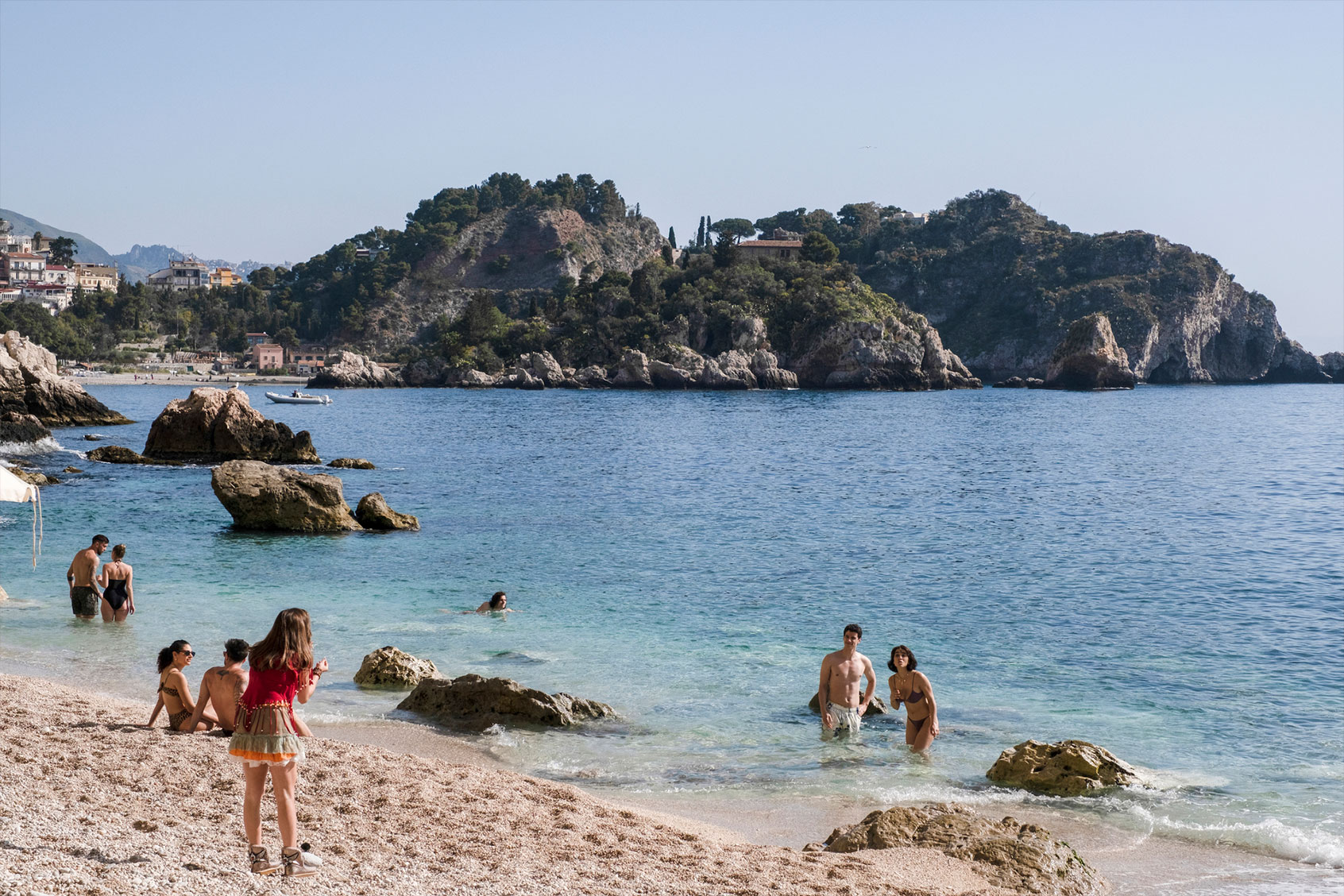
If you’re looking to recreate their romantic/dysfunctional getaway, you may need to plan ahead. The Four Season’s San Domenico Palace in Taormina, a former 14th-century convent-turned-luxury resort where most of the action was shot is currently closed but is slated to reopen on March 14, 2023. As resort manager Valentina will have you know, there are 111 rooms, suites and specialty suites (where you can have an illicit hookup with a piano player) that costs $800 and up, far up. If you’d rather not risk running into corpses in the sea, you could take a dip in the cliff top infinity pool that overlooks Taormina Bay. As seen on the show, San Domenico Palace is also near Mount Etna, which may or may not be erupting for dramatic effect should you visit.

The White LotusSimona Tabasco and Beatrice Granno in “The White Lotus” (Photograph by Courtesy of HBO)

Fortunately, many of the historical towns and nearby landmarks that appeared on the show are open to visitors as well. First is Noto, the idyllic city in southeastern Sicily where Daphne and Harper spent their girls’ daytrip. For free, you can take in the city’s baroque architecture, limestone piazzas and beautiful cathedrals. Noto and its Piazza del Municipio notably appeared in Michelangelo Antonioni’s classic 1960 film “L’Avventura.” 

But if you happen to be rolling in it like Daphne, why not copy her getaway and rent the privately owned Villa Tasca (you know, whatever you need to do to make you feel good). Located in Palermo, the villa is only available to rent for special events and weddings, but Dream Exotic Rentals is offering it as a vacation rental starting at about $5,684 per night.  A steal. The entire villa includes four bedrooms, five bathrooms and one large pool, so be sure to kidnap bring plenty of company if you’re planning on visiting.

The White LotusMeghann Fahy and Aubrey Plaza from “The White Lotus” (Courtesy of HBO)
Let’s say you’re into following the trajectory of the Di Grasso men, who traveled to Castello degli Schiavi, which is the famous setting of Apollonia’s (Simonetta Stefanelli) death in “The Godfather.” The 18th-century grand estate is located less than a mile west of the Ionian Sea and about 10 miles south of San Domenico Palace, not far for your driver at all.

Among the many other landmarks open that are open to the public include Taormina, the beach town on the east coast of Sicily, and Palermo’s Teatro Massimo, where Tanya dolefully watches “Madama Butterfly” with her shady bestie Quentin (Tom Hollander). It’s up to you just exactly how much of her adventure with the “high-end gays” you want to reproduce.

The White LotusBeatrice Granno, Adam DiMarco and Simona Tabasco from “The White Lotus” (Courtesy of HBO)
Season 3: Destination unknown

It’s no surprise that staying in “The White Lotus” hot spots comes with a hefty price tag, given its wealthy clientele like Tanya, who moved from Petal to Blossom status over the years. If you have the means to live like them, however, feel free to replicate their experiences (sans death, of course). However, if that lifestyle isn’t feasible, you can simply drive by each location and take a quick peek in.

The world tour of the White Lotus resorts will likely continue with the show possibly heading to South Asia in Season 3, per Daphne, who cheered, “Next year, the Maldives!” at the end of her season. White also told Vanity Fair in a December interview, “We are going to scout in Asia and look at countries there.

“My instinct is that maybe it has something to do with spirituality. Eastern versus Western religion, or Western people in an Eastern culture,” he added. “Maybe after sex it would be nice to have something that’s a little more celestial or something that’s a little more out of the carnal, I guess. But I don’t know.”

Winter storms are back — and scientists say climate change is making them a lot worse

As winter storms continue to pummel much of the United States, is climate change partially — or majorly — to blame? 

As with any natural disaster that relates to the weather, it is natural to wonder whether climate change plays a role. Certainly the weather this winter has been extreme, with Texans and Oklahomans being warned of potential tornadoes and Americans everywhere bracing for possible power outages (which on their own can be devastating). Winter storms mean blocked roads, damaged property, crumbling infrastructure and possibly even injuries and deaths.

The big question for both policymakers and the public, therefore, is how much of the horrid weather can be definitively attributed to global warming.

Climate change experts say that the worsening weather is not merely a coincidence — climate change really is exacerbating our winter storms this year, as multiple experts told Salon.

“Winter storms develop in a climate change environment: it is warmer and moister,” Kevin Trenberth of the National Center for Atmospheric Research (NCAR) told Salon by email. “But it is plenty cold in winter over the continent. It means snow amounts can be much greater: e.g. see Buffalo recently. They may be more intense: not guaranteed, but more developments ensue. Watch for a bad nor-easter.”

While it may seem counterintuitive to attribute more snow to the planet warming, Trenberth observed that this only seems to be the case because the general public is insufficiently informed about how climate change works.

“[People need] education that winter warming may mean more snow, not less,” Trenberth added.


Want more health and science stories in your inbox? Subscribe to Salon’s weekly newsletter The Vulgar Scientist.


This does not mean that scientists can precisely quantify the extent to which climate change has played a role. According to Dr. Michael E. Mann — a climate scientist and director of the Center for Science, Sustainability and the Media at the University of Pennsylvania — it is “tricky” to figure these things out with precision.

“There’s still quite a bit of debate about whether we can expect more events like the Texas cold spell last year due to climate change,” Mann wrote to Salon. “On the other hand, there is evidence that warming leads to more powerful, snowier nor’easters—something we’ve seen quite a bit of in the northeast in recent years.”

“There is evidence that warming leads to more powerful, snowier nor’easters—something we’ve seen quite a bit of in the northeast in recent years.”

The good news is that, while there are many unanswered questions, scientists do know the means of accomplishing this. As Mann put it, they will use “high-resolution climate model simulations that better resolve the dynamics of powerful winter storms like nor’easters.”

Mann added, “It’s something I hope to look into in my own research over the next few years.”

While the exact role of climate change in causing winter storms is murky, there is little question that the storms have been getting worse — and, in the process, have wreaked havoc on an American infrastructure that is simply not equipped to handle them. This was dramatically demonstrated last year when millions of Texans were left without electricity during an unprecedented winter storm because their power grid had not been designed for resiliency during adverse winter conditions.

“I would say that extreme weather in general—whether summer season extremes like droughts, heat waves, and floods, or winter storms like nor’easters—are disruptive to transportation, and labor, and all of the elements that comprise a supply chain,” Mann told Salon. “So more extreme weather means more disruption of supply chains.”

Trenberth added that the weather problems do not stop simply because there is an end to the “snow and ice and cold.”

“In spring, the snow and ice melt can lead to flooding, as has happened in recent years over the upper Midwest,” Trenberth wrote to Salon. This year, a La Nina year, [there was] more [precipitation[ in northern states.” He added there could also be “possible continued drought in southern states” as well as “fire risk, especially as people get careless with heating.”

Ironically, although Texas Gov. Greg Abbott tried to argue last year that the blackouts somehow discredited the need for a Green New Deal, one expert told Salon at the time that as climate change worsens, extreme weather events will further test America’s infrastructure. Eventually there may be no choice but to rebuild it.

“From a Green New Deal perspective, we would want to have public utilities that prioritize public safety and resiliency and disaster readiness over the optimal price in a perfect market equilibrium situation and really nice weather — so I think that’s an important distinction,” Daniel Aldana Cohen, associate professor of sociology at the University of Pennsylvania and co-author of “A Planet to Win: Why We Need a Green Deal,” told Salon at the time.

The absolute best way to cook butternut squash

In Absolute Best Tests, Ella Quittner destroys the sanctity of her home kitchen in the name of the truth. She’s boiled dozens of eggs, mashed a concerning number of potatoes, and seared more Porterhouse steaks than she cares to recall. Today, she tackles the butternut squash.


In October of 2022, Michigan-based farmer Derek Ruthrouff claimed the Guiness World Record for the heaviest butternut squash. Ruthrouff presented a hulking specimen that weighed in at just above one hundred and four pounds. Three weeks later, I consumed roughly the same volume of butternut squash. I did not win an award for it.

Squash was first cultivated more than 8,000 years ago in Mexico and Peru, but the butternut variety was bred by a man in Massachusetts in the middle of the twentieth century. It has a lamp-shaped body and flesh the color of American cheese, and when prepared deftly, it tastes like a sweetened, concentrated pumpkin — a touch vegetal, and noticeably nutty. There is little more that is winter-affirming than a perfectly cooked butternut squash, soft and candy-like, buttery and rich. Good butternut squash can be revelatory. Good butternut squash can turn around your whole day. Which I know, because three weeks after Rutherouff won that fancy award — and international glory — for his enormous home-grown contribution to the butternut canon, I dropped two full sheet pans of roasted squash onto my living room floor and my (bare) feet.

All of this to say, I may not have come out of the latest round of Absolute Best Tests with a trophy, but I did come away from my battlefield (my home, which is now covered in smears of squash in places you couldn’t dream of) with hard-earned intel and the discovery that a perfect bite of squash soothes all ills. Even the kind of ill where you thought you washed your feet thoroughly but hours later you look down to find another little bit of squash on your toe. Let’s dive in:


Controls:

I cooked eight butternut squashes of roughly the same size, about two pounds apiece. Yes, my husband did look at the kitchen counter and then at me and, saying nothing, delivered just a swift shake of his head, before he silently walked from the room.

For methods that required the squash to be peeled and cut down, I did as follows:

Peel squash with a vegetable peeler. To cut squash in half lengthwise, slice about 1/2 inch off the top and bottom to make flat sides; stand the squash up on a cutting board and carefully slide down the center with a large, sharp knife to make two roughly-even halves. Scrape out the seeds with a spoon.

For cooking methods that involved using a fat, I used extra-virgin olive oil. I seasoned only with Diamond Crystal kosher salt.


Round one: Roasting

1. Roast whole

Ingredients:
1 tablespoon extra-virgin olive oil
1 medium butternut squash
3/4 to 1 teaspoon Diamond Crystal Kosher salt

Heat oven to 425°F. Rub whole squash all over with oil then season with salt. Place on a parchment-lined sheet pan or baking dish and poke it in about 10 places, all over, with a sharp knife or fork. 
Roast about 55 to 85 minutes (depending on size), turning once midway through, until the skin is brown and bubbled, and a knife easily pierces the squash all the way through. Remove from oven; let cool enough to handle, then slide in half lengthwise and scoop out the seeds.

Findings:
The roast whole specimen was tender all the way through, with flesh a consistency closer to canned pumpkin than cantaloupe. This method would be excellent if intended as a fuss-free way to generate easily mashable squash for a second use, like as one component of a butternut squash cheese sauce for pasta. A primary benefit of roasting a squash whole is that there arises no need to risk chopping off an extremity trying to saw through a whole, raw butternut upfront; once cooked, the squash was easy as butter to slice. The only downside — beyond a slightly longer cook time than other methods — was that because the squash went in whole, it wasn’t seasoned until after the roast, which meant the seasoning didn’t have a chance to bind as well and sink beneath the surface. (The skin, however, was delicious.)

2. Roast in halves

Ingredients:
1 1/2 to 2 tablespoons extra-virgin olive oil
1 medium butternut squash
1 1/2 teaspoons Diamond Crystal Kosher salt

Heat oven to 425°F. Cut squash in half lengthwise: slice about 1/2 inch off the top and bottom to make flat sides; then, stand the squash up and carefully cut down the center to make two roughly even halves. Rub halves all over with oil then season with salt. Place on a parchment-lined sheet pan or baking dish, cut side down.

Roast until the halves are blistered and easily pierced all the way through with a knife, 40 to 50 minutes (depending on size). Remove from oven; let cool enough to handle, then scrape out the seeds with a spoon.

Findings:
The roast in halves method produced beautifully seasoned squash with a healthy amount of browning, which meant a meaningfully better flavor than the roast whole squash. Roasting squash in halves is an excellent choice for home cooks who wish to generate a visually dramatic centerpiece for a meal; the roasted halves could serve as vessels for a long-simmering sugo di carne, or a warm, perky grain salad.

3. Roast in cubes

Ingredients:
1 1/2 to 2 tablespoons extra-virgin olive oil
1 medium butternut squash
1 1/2 teaspoons Diamond Crystal Kosher salt

Heat oven to 425°F. Peel squash with a vegetable peeler. Cut squash in half lengthwise: slice about 1/2 inch off the top and bottom to make flat sides; then, stand the squash up and carefully cut down the center to make two roughly even halves. Scrape out the seeds with a spoon. Cut each half into 1-inch-thick slices, then cut in the other direction to make 1-inch cubes. 

On a parchment-lined sheet pan or in a baking dish, toss cubes with olive oil and salt until coated. Arrange in a single layer. Roast until squash is tender and browned and easily pierced with a fork, flipping cubes occasionally, about 30 to 40 minutes.

Findings:
The roast in cubes method provided the best specimen for crisp maximalists, since each side of each tiny cube was given ample opportunity to firm up against the hot pan. The cubed squash was also wonderfully rich, since there was much more surface area available for oil and salt than with most of the other methods. I can’t count the shortened cook time as a plus though, because the upfront peeling and chopping meant the overall process actually took longer than the roast in halves batch.

4. Roast in cubes (low temp)

Ingredients:
1 1/2 to 2 tablespoons extra-virgin olive oil
1 medium butternut squash
1 1/2 teaspoons Diamond Crystal Kosher salt

Heat oven to 350°F. Peel squash with a vegetable peeler. Cut squash in half lengthwise: slice about 1/2 inch off the top and bottom to make flat sides; then, stand the squash up and carefully cut down the center to make two roughly even halves. Scrape out the seeds with a spoon. Cut each half into 1-inch-thick slices, then cut in the other direction to make 1-inch cubes.

On a parchment-lined sheet pan or in a baking dish, toss cubes with olive oil and salt until coated. Arrange in a single layer. Roast until squash is tender, browned, and easily pierced with a fork, about 45-55 minutes.

Findings:
This batch of squash was overall quite similar to the roast in cubes (high heat) batch, but less crispy. Where it lacked in sharp edge, it made up for in flavor — because of the longer cook time, these cubes had a noticeably more concentrated, sweet flavor.

5. Roast in wedges

Ingredients:
1 1/2 to 2 tablespoons extra-virgin olive oil
1 medium butternut squash
1 1/2 teaspoons Diamond Crystal Kosher salt

Heat oven to 425°F. Peel squash with a vegetable peeler. Cut squash in half lengthwise: slice about 1/2 inch off the top and bottom to make flat sides; then, stand the squash up and carefully cut down the center to make two roughly even halves. Scrape out the seeds with a spoon. Cut each half into 1-inch-thick crescents. 

On a parchment-lined sheet pan or in a baking dish, toss wedges with olive oil and salt until coated. Arrange in a single layer. Roast for about 30 to 40 minutes until squash is caramelized and tender. Remove from oven.

Findings:
Roast in wedges squash offers a number of advantages: it cooks more quickly than halved or whole squash, offers a huge amount of surface area for crisping and seasoning, and it looks sort of fancy. It’s no more annoying to prep than the cubes, so overall, it is a hair faster than the roast in halves thanks to the shorter oven jaunt. I would employ this method if I wanted crispy, flavorful squash with enough surface area to complement a sauce, or if the squash were the entree, broiled cheese and seasoned panko.


Round two: Other methods

1. Microwave

Ingredients:
1 medium butternut squash
1 to 1 1/2 teaspoons Diamond Crystal Kosher salt, to taste

Cut squash in half lengthwise: slice about 1/2 inch off the top and bottom to make flat sides; then, stand the squash up and carefully cut down the center to make two roughly even halves. Scrape out the seeds with a spoon. Place each half, cut side down, on a microwave-safe plate. (You can line it with parchment paper for easy clean up.) 

Place the plate or parchment paper into the microwave. Microwave for 15 to 20 minutes on 100% power in roughly 5 minute increments, until the squash is easily pierced with a knife. Let cool enough to handle, then scoop the squash from the skin with a spoon and season with salt.

Findings:
The Microwave squash was sweet and vegetal, and mostly the texture of baby food, with a few spots that cooked unevenly and were tougher. I was as surprised as the next guy (my husband) to find that I enjoyed it nearly as much as the roast whole squash, I suppose because the roast whole also didn’t get oil on its flesh. This method would be useful to me if I didn’t have access to a stove or oven, and I needed the flesh of the squash for a dish in which it would get seasoned and mashed (like a riff on Thanksgiving sweet potatoes, but with squash).

2. Steam

Ingredients:
1 medium butternut squash
1 to 1 1/2 teaspoons Diamond Crystal Kosher salt, to taste

Peel squash with a vegetable peeler. Cut squash in half lengthwise: slice about 1/2 inch off the top and bottom to make flat sides; then, stand the squash up and carefully cut down the center to make two roughly even halves. Scrape out the seeds with a spoon. Cut each half into 1-inch-thick slices, then cut in the other direction to make 1-inch cubes. 

Bring 2 inches of water to boil in a large saucepan fitted with a steamer basket, making sure the water doesn’t touch the bottom of the basket. Add cubes to steamer basket, cover, and steam until tender all the way through, about 10 to 15 minutes. Remove from the steamer; season with salt.

Findings:
The steam squash cubes were beautiful, a darker orange and less opaque than any of the other trials. They had the most distinctly vegetal flavor, and were less sweet (since the squash did not make contact with a hot surface to brown). This method would work best if you intended to use the squash in a dish where too much sweet squashy flavor would overwhelm the other components (like, as a topping to a chirashi bowl), or in some sort of salad or agridolce where the squash will absorb the flavors of a dressing.

3. Roast then pan fry

Ingredients:
1 tablespoon extra virgin olive oil, plus 1 tablespoon
1 medium butternut squash
1 teaspoon Diamond Crystal Kosher salt, plus one 1 teaspoon

Heat oven to 425°F. Rub whole squash all over with 1 tablespoon oil then season with salt. Place on a parchment-lined sheet pan or baking dish and poke it in about 10 places, all over, with a sharp knife or fork. Roast about 55 to 85 minutes (depending on size), turning once midway through, until the skin is brown and bubbled, and a knife easily pierces the squash all the way through. Let cool enough to handle. Then, lay the cooked squash on a cutting board and slice the squash lengthwise. Scrape out the seeds with a spoon and discard. Scoop out flesh and set aside. 

Add remaining 1 tablespoon oil to a cast iron skillet. Once hot, add the soft, roasted squash flesh, and season all over with salt. (You can eat the roasted, salted skin for a snack!) Sauté, moving squash around every few minutes with a wooden spoon, until browned in places, like a softened hash.

Findings:
Oh my! This was a delight. As proof, it is the first squash I went back to after the sheet pan drop and splatter Incident of 2022, for comfort. The resulting squash was deeply sweet, with a concentrated nutty flavor complemented by all of the oil, salt, and extra exposure to a hot pan. I would love to eat a large vat of roast then pan fry every night until March. It would be a stand out dinner side, or a perfect base for fried eggs.


The TL;DR of it all

The overall best methods for evenly crispy squash with flavorful flesh and maximal seasoning were:

Roast in cubes and roast in wedges (use a lower oven temp if you prefer extra sweetness to crisp).
If you want to arrive at similar results but save yourself all the peeling and chopping time, roast in halves is your saving grace this season. 
If you aren’t pressed for time and love a sweet, rich squash dish, roast then pan fry was the clear, overall hero of this test.

“The Menu”: Ralph Fiennes’ new film shows why restaurants are a ripe setting for horror

Dark comedy horror “The Menu,” starring Ralph Finnes, Anya Taylor-Joy and Nicholas Hoult, follows a group of wealthy foodies who travel to an exclusive, remote destination restaurant.

The cult-like devotion of the staff towards the celebrated chef who runs the restaurant, however, soon reveals a more sinister game afoot.

While “The Menu” plays with anxieties about food, it is more emphatically about the restaurant trade. It draws on a long tradition of horror films about creative artists who are driven mad by the demands of critics and consumers.

In films such as “Mysteries of the Wax Museum” (1933), “The Phantom of the Opera” (1962) and “Theatre of Blood” (1973), artists not only take revenge on those who consume their labor (agents, critics and consumers) but also turn these victims into the materials of art. They become elements in the production process rather than consumers of its products.

This explains why “The Menu’s” mad Chef Slowick (Fiennes) is so distressed when he discovers an uninvited guest, Margot (Taylor-Joy), at the meal. He “has to know whether you are with us or with them” – one of his brigade of producers or one of the consumers.

As it transpires, Margot is actually an escort. She is very much not “one of them” (the elite customers of the restaurant), but rather is more like the chef and staff providing a service in the restaurant.

Dining as a “theatrical experience”

As the evening progresses, the behavior of the kitchen staff demonstrates the dehumanizing discipline and sacrifice necessary to produce food for the elite. Their devotion to Slowick meanwhile, hovers between that of a proletarian army in revolt against its oppressors and the legions of the undead commanded by figures of aristocratic despotism such as Dracula.

“The Menu’s” concern with class and the distinction between the service worker and the elite customers that they serve is also dealt with through its depiction of cooking. Like many high-end restaurants, Slowick’s establishment features an open kitchen, meaning the meal is not just about the food consumed, but an example of dining as a “theatrical experience.”

This “theatrical experience” is how increasingly grim events are explained away. They’re merely part of the intellectually challenging experience offered to patrons. But it also brings out another aspect of class distinction: a question of taste.

The MenuRalph Fiennes and Anya Taylor-Joy in “The Menu” (Eric Zachanowich/Searchlight Pictures)

French sociologist Pierre Bourdieu describes the taste of elite social classes as “a systematic refusal of all that is ‘human’ . . . starting with everything that reduces the aesthetic animal to pure and simple animality, to palpable pleasure and sexual desire.” Or, one might add, food that purely satisfies hunger.

On the one hand, then, Slowick’s behavior pushes the tastes of his elite clientele to their logical conclusion. He starts with a refusal of “ordinary” pleasures, such as satisfying their appetites, but soon moves on to a sadistic exercise in the control and punishment of the body. Slowick takes the elite dining experience beyond refusal of the appetite into the intellectually challenging – discomfort, punishment and torture.

Refusing the refusal

Of course, the greatest affront to distinction within the high-end restaurant is to complain of still being hungry – or worse still, to demand the cooking of that which haute cuisine refuses.

It is when Margot requests a simple burger and fries – a meal a world away from Slowick’s intellectually challenging haute cuisine – that “The Menu” boils over into its dramatic climax.

Mark Jancovich, Professor of Film Studies, University of East Anglia

This article is republished from The Conversation under a Creative Commons license.

In Israel, Netanyahu’s extremist new government rips off the mask

Benjamin Netanyahu’s proposed coalition government of Jewish extremists, fanatic Zionists and religious bigots represents a seismic change in Israel, one that will exacerbate Israel’s pariah status, erode external support for Israel, fuel a third Palestinian uprising, or intifada, and create irreconcilable political divides within the Jewish state.  

Alon Pinkas, writing in the Israeli newspaper Haaretz, calls the coalition government, scheduled to take power within the next week or so, “a kakistocracy extraordinaire: government by the worst and least suitable collection of ultra-nationalists, Jewish supremacists, anti-democrats, racists, bigots, homophobes, misogynists, corrupt and allegedly corrupt politicians. A ruling coalition of 64 lawmakers, of whom 32 are either ultra-Orthodox or religious Zionist. Certainly not a coalition Zeev Jabotinsky, the father of Revisionist Zionism, or Menachem Begin, the founder of Likud, could have ever imagined.” 

Itamar Ben-Gvir, from the ultra-nationalist Otzma Yehudit or “Jewish Power,” party, will be the new minister for internal security. Otzma Yehudit is populated with former members of Rabbi Meir Kahane’s Kach party, which was banned from running for the Knesset in 1988 for espousing a “Nazi-like ideology” that included advocating the ethnic cleansing of all Palestinian citizens of Israel as well as all Palestinians living under Israeli military occupation. Ben-Gvir’s appointment, along with that of other far-right ideologues, including Bezalel Smotrich, to be in charge of the Occupied Palestinian Territories, effectively jettisons the old tropes liberal Zionists used to defend Israel: It is the only democracy in the Middle East, it seeks a peaceful settlement with the Palestinians in a two-state solution, and while extremism and racism have no place in Israeli society, Israel must impose draconian forms of control on the Palestinians to prevent terrorism. 

Ben-Gvir and Smotrich represent the dregs of Israeli society, one that promotes “Jewish identity” and “Jewish nationalism” in a Zionist version of fascism’s call for blood and soil. They are Israel’s equivalent of Lauren Boebert and Marjorie Taylor Greene. Their Religious Zionist bloc is now the third largest in the Knesset.

Israel’s new government effectively jettisons the old tropes used by liberal Zionists: This is the only democracy in the Middle East, it seeks a peaceful settlement, extremism and racism have no place.

Ben-Gvir, who was rejected for army service because of his extremism, stole a hood ornament from Yitzhak Rabin’s car a few weeks before the then-prime minister was assassinated in 1995 by Jewish extremist Yigal Amir. Amir, like many far-right Israelis, including arguably Netanyahu himself, considered Rabin’s support for the Oslo Accords to be an act of treason. “We got to his car, and we’ll get to him too,” Ben-Gvir said at the time. He calls for the deportation of Palestinians who confront Israeli soldiers, followers of the anti-Zionist ultra-Orthodox Netueri Karta movement, as well as Israeli-Arab Knesset member Ayman Odeh and the anti-Zionist Marxist Knesset member Ofer Cassif, who is Jewish. 

The old tropes Israel employed to justify itself were always more fiction than reality.  Israel long ago became an apartheid state. It directly controls through its illegal Jewish-only settlements, restricted military zones and army compounds more than 60 percent of the West Bank and has de facto control over the rest. There are 65 laws that directly or indirectly discriminate against Palestinian citizens of Israel and those living in the occupied territories.

The old tropes are being replaced by screed-filled diatribes that paint Palestinians and Arabs (both Muslim and Christian) as contaminants and an existential threat to Israel. This hate speech is accompanied by a vicious internal campaign to silence Jewish “traitors,” especially those who are liberal or left-wing and secular. An Otzma Yehudit-run autocracy will shut down democratic debate, eviscerate the protections of civil society and further codify what has long been reality — Jewish supremacy and the ongoing ethnic cleansing of Palestinians from their own land that dates back to the founding of Israel in the 1940s.

The once unthinkable is now thinkable, such as formally annexing large sections of the West Bank, including “Area C,” where up to 300,000 Palestinians live. The killing of about 140 Palestinians this year, including the American journalist Shireen Abu Akleh, is the worst death toll since 2006 (not including major escalations of violence such as Israeli bombardments of Gaza). It has been accompanied by Palestinian attacks that have left 30 Israelis dead. 

The new government will accelerate these killings along with house and school demolitions, expulsions of Palestinians from East Jerusalem, the uprooting of Palestinian olive orchards, mass imprisonment and the ethnic cleansing of Palestinians. The totality of these crimes amount to the international crime of genocide, the New York-based Center for Constitutional Rights explained in 2016. 

Gaza, the world’s largest open-air prison, will continue to be more frequently bombed and shelled. Its infrastructure, including its water, electrical and sewage systems, as well as fuel storage facilities, will be targeted for obliteration. Gazans and their fellow Palestinians in the West Bank will be subject to ever-tightening blockades, reducing them to a level of subsistence one step above starvation. Instead of attempting to cover up the murder of Palestinians by Jewish settlers and the Israeli army, the new government will openly celebrate the atrocities. 

After the recent execution of an unarmed Palestinian who was shot three times at point-blank range, and then again while on the ground, by an Israeli border policeman during a scuffle that was captured on video, Ben-Gvir called the officer a “hero.”


Want a daily wrap-up of all the news and commentary Salon has to offer? Subscribe to our morning newsletter, Crash Course.


Netanyahu, who is charged with fraud, breach of trust and accepting bribes in three corruption cases, is determined to politicize the judiciary. He and his coalition partners will further curtail the rights of Palestinian citizens of Israel who are already second-class citizens. They will continue to push aggressively for a war with Iran. They will support efforts to seize the Al-Aqsa Mosque in Jerusalem, which Jewish Israelis call the Temple Mount and is the apparent site of the Second Temple, destroyed by the Romans in 70 A.D.

Jewish extremists have long called for the Al-Aqsa Mosque, the third holiest shrine for Muslims, to be torn down and replaced by a “Third” Jewish temple, a move that would set the Muslim world alight. (The First Temple, according to Jewish tradition, was built there by King Solomon in the 10th century B.C., although there is no clear archaeological evidence to support this.) Ben-Gvir, who considers Baruch Goldstein, the Jewish settler who in 1994 massacred 29 Muslim worshipers in Hebron, “a hero,” has announced an imminent visit along with other Jewish extremists to the site of the mosque. When Ariel Sharon, then Israel’s opposition leader, went to the mosque site in September 2000, it ignited the Second Intifada. 

I wish this was conjecture. It isn’t. It is what these fanatics advocate.

Avigdor Maoz of the extremist Noam party, which opposes LGBTQ rights and wants to ban women from serving in the military, has been appointed to oversee the Israeli school curriculum, Russian immigration and national Jewish identity.

“Anyone who tries to harm real Judaism is the darkness,” he said last week. “Anyone who tries to create a new so-called liberal religion is the darkness. Anyone who — with intentional concealment and obfuscation — tries to brainwash the children of Israel with their agendas, without the knowledge of the parents, is the darkness.”

Jeremy Ben-Ami, president of the liberal Zionist advocacy organization J Street, said in a public statement that Israel’s next government “seems likely to take more actions that run counter to the values that American Jews teach our children are the essence of Jewish identity,” including support for civil rights, the labor movement, the women’s movement and LGBTQ freedoms. 

“How can we explain to our children and our grandchildren, let alone to ourselves, that these values are the core of the Jewish identity, but the state of the Jewish people is denying another people their rights and equality and undercutting the rule of international law?” Ben-Ami asked. “This is a fundamental crisis that looms over our community in the coming years. Those in the establishment of our community who insist that Jewish America must stand united and unquestioningly loyal to Israel no matter what are doing a deep, deep, disservice to the health of the Jewish community.”

After the 1967 war that saw Israel invade and annex Egypt’s Sinai peninsula, Syria’s Golan Heights, Gaza and the West Bank, Israelis frequented Palestinian territory to shop, eat at restaurants, spend the weekend in the desert oasis of Jericho or get their cars fixed by Palestinian mechanics. 

The Oslo Accords of 1993 seemed to herald a new era: Palestinian businessmen returned from abroad. Radical Islamists shrank away. Women took off their head scarves. There was a brief and shining moment when normal life seemed possible.

The Palestinians were a pool of cheap labor, and by the mid-1980s, around 40 percent of the Palestinian workforce was employed in Israel. But the growing repression by Israeli authorities in the West Bank and Gaza, seizure of larger and larger tracts of Palestinian land for expanding Jewish settlements, and festering poverty saw Palestinians, most of them too young to remember the 1967 occupation, rise up in December 1987 to launch six years of street protests known as the first intifada. That uprising eventually led to the 1993 Oslo Accords between Israel and the Palestine Liberation Organization (PLO), headed by Yasser Arafat. Arafat, who had spent most of his life in exile, returned in triumph to Gaza with the PLO leadership. 

The Oslo Accords seemed to herald a new era. I was in Gaza when they were signed. Palestinian businessmen who had made their fortunes abroad returned to help build the new Palestinian state. The radical Islamists shrank away. Palestinian women took off their head scarves. Beauty salons proliferated. There was a brief and shining moment when a normal life, free from occupation and violence, seemed possible. But it swiftly soured. 

The barring of Palestinian workers from Israel, coupled with increased Israeli violence and land theft, led to another uprising in 2000 that ended in 2005. This one, which I covered for the New York Times, was far more violent. Jewish settlers were relocated from Gaza and Gaza was sealed off. Israel also built a security barrier — at a cost of about $1 million per mile and deemed illegal by the Internal Court of Justice — to separate Israel from the West Bank and annex more Palestinian land. The wall was constructed in the wake of a spate of suicide bombings that targeted Israelis, though the idea was floated by Prime Minister Rabin in the 1990s on the basis that “separation as a philosophy” requires a “clear border.” Arafat, whom I met with many times, spent the final days of his life under Israeli house arrest. The collapse of Oslo ended the pretense of a peace process or negotiated solution.

I suspect we stand on the cusp of a third and far more deadly intifada. An uprising will be used by Israel to justify savage reprisals that will dwarf the punishing economic blockade and wholesale slaughter meted out in Gaza during Israel’s assaults in 2008, 2012 and 2014, which left approximately 3,825 Palestinians killed, 17,757 wounded and over 25,000 housing units partly or completely destroyed by Israel, including multi-story apartment buildings and entire neighborhoods. Tens of thousands were left homeless and huge swaths of Gaza were reduced to rubble. During the 2018 Great March of Return protests, where young people in the besieged enclave demonstrated in front of the Israeli barrier, 195 Palestinians were shot dead by Israeli snipers, including 41 children, as well as medics such as Razan al-Najjar. 

As the violence and repression against Palestinians by security forces, soon to be run by Jewish fanatics, increases, larger and larger numbers of Palestinians, including children, will die in airstrikes, shelling, sniper fire, assassinations and other Israeli attacks, including those carried out by rogue Jewish militias, which also attack Arab citizens inside Israel. Hunger and misery will be widespread. 

The brutal subjugation of Palestinians, justified by a toxic ideology of Jewish supremacy and racism, will only be halted by the kind of sanctions campaign mounted successfully against the apartheid regime in South Africa. Short of that, Israel will be a despotic theocracy.

Even if Harry and Meghan “win” for Netflix, they lose

In the second half of “Harry & Meghan” we bear witness to the couple’s session with a meditation coach. Sitting side by side on a couch, they breathe deeply and take in her wisdom.

“Remember that what is transpiring in the media, what is being created is an illusion,” she says. “When you try to prove that you’re good and that you’re not the person they say you are, you’re taking the bait, you’re feeding the beast. It is an illusion. Your work is not to prove your goodness. You know who you are. Both of you.”

Meghan breaks into tears at hearing this, because that coach is right.

On the other hand, the fact that we’re watching this transpire on our TV screens proves they didn’t take her advice.

A more empathetic view points out that would be impossible. If Prince Harry and Meghan Markle remained silent and let the institution that runs the royal family continue to lie about their character, their well-being would always be at the mercy of Buckingham Palace.

Hence, H & M are not merely feeding the beast, they’re milking it. Good for them. Judging by the social media reaction to the series, along with Netflix-provided viewership data, this Jersey’s got plenty to give.

The first three episodes enjoyed the best opening week of any of the streaming platform’s documentary titles, logging 81.55 million hours of viewing worldwide. It was a Top 10 show in 85 countries and debuted as Netflix’s No. 1 series in the U.K.

That doesn’t mean everyone is rooting for them, but when does likability factor into deciding whether to watch a show like this? Not as often as you think. There are fans of “The Kardashians” who don’t like the Kardashians. In that respect, it’s best thought of as a real-life fairy tale told by the Sussexes and director Liz Garbus, featuring an imperfect prince and his bride who, by her own account, “tried so hard, and that’s the piece that’s so triggering because . . . it still wasn’t good enough. And you still don’t fit in.” 

Indeed. Nothing that the Duke and Duchess of Sussex do or say will change anyone’s pre-existing opinions about them – and be assured, almost everybody has one.

They are extremely wealthy, and perhaps the highest-profile interracial couple in the United States and the U.K., if not on the planet. They are also in the unique position to throw open the doors of the British royal family’s laundry room.

All of that places the couple in a position where even if they “win,” as far as that can be measured by ratings, they lose. That they’ve made this series at all is offensive to die-hard royalists. Whether people believe what they have to say is another matter. Many will resent what they hold back, as if the couple promised to serve dirt on King Charles III and William, Prince of Wales, and Kate. For the record, they never did. 

H & M aren’t merely feeding the beast, they’re milking it.

On the contrary, Meghan has nothing but kind words for Charles and the late Queen Elizabeth II. And that fuels the discourse related to Meghan’s willingness to join a family intimately associated with colonialist exploitation and all of its associated suffering. The opening episodes of “Harry & Meghan” address that history, but that sharpness is somewhat blunted by the couple’s assertion in these new episodes that she and Harry explain they were willing to continue doing their work of representing the Queen’s interests after placing an ocean and most of Canada between them and the palace.

One popular argument posits Meghan, a Black woman proudly dedicating her life to social justice, should have refused to participate in such a morally questionable enterprise. Of course, this ignores the very human inclination to be loyal to a family into which she married, one that refused to extend similar loyalty to her.

Meghan Markle, the Duchess of SussexMeghan, the Duchess of Sussex (MICHELE SPATARI/AFP via Getty Images)
Besides, to continue this debate, doesn’t this play into the unreasonable expectation that this woman who leaped from co-starring in an American cable drama to marrying into a monarchy propped up by many generations’ worth of baggage, could somehow transform centuries of racial animus by her very presence?

It’s all messy, and it all leads to the conclusion that “Harry & Meghan” was never going to give the public enough of the mess that it desires.

However, it is deft at interrogating the weight the public places on institutional validity and how that can be horrendously misused.

“Harry & Meghan” puts the couple’s story to its highest use by examining the toxic influence powerful institutions like the British monarchy have on society and the dangerous alliance wrought by wielding that influence through the media. The United States is contending with its own version of that problem in the form of a pliant media’s coziness with right-wing politicians and billionaires. The U.K. tabloid press is simply more brazenly irresponsible than most stateside publications and broadcasters – we should say, those that aren’t owned by Sinclair or the Murdoch family.

Parallel to this, its look at the way Meghan is a lightning rod for social media hatred is particularly compelling. Her case aligns with verified data concerning marginalized people being the main targets of online abuse and violent threats. Harry may sound hyperbolic when he calls social media bullying a humanitarian crisis, but once Bot Sentinel founder and CEO Christopher Bouzy breaks it down, you realize he’s not so far off.

Bot Sentinel is a non-partisan enterprise dedicated to combatting disinformation and targeted harassment by monitoring accounts for signs of trolling and inauthentic accounts. In the series, Bouzy declares that the online coordination dedicated to stirring up hatred for the couple is unlike anything his company has ever seen.

Meghan, Duchess of Sussex and Prince Harry, Duke of Sussex attend a reception to mark the fiftieth anniversary of the investiture of the Prince of Wales at Buckingham Palace on March 5, 2019 in London, England. (Dominic Lipinski – WPA Pool/Getty Images)

His company analyzed 114,000 tweets and found that 70% of the most hateful content originated from 83 accounts that had a reach of 17 million users. Most of the content was produced by middle-aged white women, said Bouzy . . . allegedly including Meghan’s half-sister Samantha. (Samantha Markle denies involvement through her lawyer, claiming her account was hacked. Sure, Jan.)

The couple’s natural reaction to this can’t help coming across as anything but personal, since these trolling efforts helped to escalate the death threats Meghan received. “You are making people want to kill me. It’s not just a tabloid. It’s not just some story. You are making me scared,” she says through tears. “And you’ve created it for what? Because you’re bored or because it sells your papers or it makes you feel better about your own life? It’s real, what you’re doing. And that’s the piece I don’t think people fully understand.”

Author Safiya Noble seconds this by saying, “Let’s be clear about what’s actually at stake here: It’s like symbolic annihilation. If you can destroy people who are symbols of social justice, then you can scare people to not want to be public. It is a way to signal to the rest of us to stand down.”

Even viewers who disagree with that characterization of Meghan as a symbol of justice can’t deny the genuine paranoia and despair she and Harry must have felt in knowing that amid this coordinated hate campaign, Buckingham Palace announced it was withdrawing their security.

Harry and Meghan are in a position where even if they “win,” they lose.

Footage of the paparazzi circling their temporary home in Canada and strangers lurking just beyond their property provides some idea of how terrifyingly uncertain that experience must have been . . . until media mogul Tyler Perry swooped in and whisked them to safety. Thus, the uplifting resolution of the fairy tale resumes with what we know. First came relative privacy, then came Oprah. The revelation that Perry, who hadn’t met the couple before abetting their escape to California, is Lillibet’s godfather, is a pleasant epilogue too.

In this way and others “Harry & Meghan” plays out the difference between a journalistic documentary endeavor and portraiture. There’s nothing wrong with that second approach, although the average viewer doesn’t recognize the nuances separating one from the other. As such, one reason people question Meghan’s historical and social naivete concerning the institution she and her husband would have continued representing is that Garbus isn’t shown asking them about it. 


Want a daily wrap-up of all the news and commentary Salon has to offer? Subscribe to our morning newsletter, Crash Course.


A similar reaction may meet Harry’s account of what occurred at the famous Sandringham family meeting, where he sought to hammer out an agreement about his and Meghan’s role before they permanently stepped down. Then again, those circumstances are depressingly recognizable to anyone dealing with a dysfunctional family. Here was Harry, hoping to spend time with his grandmother, only to be denied that chance. Instead, he was made to face down his disapproving father and brother with no support.

“It was terrifying to have my brother scream and shout at me and my father say things that simply weren’t true,” he recalls, “and my grandmother, you know, quietly sit there and take it all in.”

Afterward, the palace’s public relations team quashed a story about the wedge between him and William, adding his name without asking his permission. “Within four hours they were happy to lie to protect my brother. And yet for three years, they were never willing to tell the truth to protect us. So there was no other option at this point. I said, ‘We need to get out of here.'”

Prince Harry; Meghan MarklePrince Harry, Duke of Sussex and Meghan, Duchess of Sussex meets children as she attends the Commonwealth Day Service 2020 on March 09, 2020 in London, England. (Chris Jackson/Getty Images)

And yet, as Garbus records the couple in the days that follow their CBS interview with Oprah, we see that William has texted Harry a message. What the text says or what it means for the future of their relationship is never specified; we simply see Meghan embrace Harry, who says he must think about what to do with it.

Is that a missed opportunity on Garbus’ part or an intentional omission to honor her subjects’ privacy? We can only guess and choose whether to respect that choice, all of which depends on how we feel about these two. Professional loudmouths like Howard Stern may write off their account as whiny; Harry describes his last few years “like living through a soap opera where everyone else views you as entertainment.”

Regardless, in making the series a combination of confessional and edifying, essentially doing exactly what their meditation specialist advised them against, Harry and Meghan’s love story gets in the way of the valuable conversations “Harry & Meghan” seeks to have. That probably won’t matter much in the long run. This is only the beginning of what they have to say.

All episodes of “Harry & Meghan” are streaming on Netflix.

“Avatar: The Way of the Water”: Tired climate clichés distract from James Cameron’s vision

It’s been 13 long years since we last visited the planet of Pandora. During that time back here on Earth, we’ve seen huge tumultuousness: economic crises, the rise of populist politics, a deadly global pandemic and a growing climate emergency. But on Pandora, very little has changed.

The main hero of the first “Avatar” film, Jake Sully (Sam Worthington), is still leader of the Na’vi tribe. The tribe still live a symbiotic life with nature and the forests are still awash with neon flora and exotic fauna. Sully now has a family though: four children including an adopted child called Kiri (Sigourney Weaver).

Perhaps in an attempt to keep in tune with the development of cinematic universe franchises (one of the biggest popular culture changes in the last 13 years), director James Cameron has decided to rehash the themes of the first film only bigger, louder and with a more substantial CGI budget. But in so doing, he has created a sequel that, while visually stunning, has stunted politics.

It isn’t long into the film that the “sky people” (the invading and colonizing humans Sully was once among) make their return.

As if the last 13 years hadn’t happened, we are once again fed the plot of an evil imperialistic force fighting against a nature-loving indigenous population. Only this time it’s wetter and with bigger animals.

If the first installment was “Pocahontas in Space,” “Avatar: The Way of the Water” is “Free Willy in Space.”

The Way of the Water’s climate catastrophe

For those who haven’t kept up, Pandora is a far-away planet, rich in natural resources that the greedy human race is looking to mine. In the first film, it was the very valuable (if ridiculously named) unobtainium that they were willing to kill for.

This time, humans are looking for a new home away from a dying Earth.

This threat is explored through the familiar science fiction cinematic narrative of an invading army (who are working for a corporation looking to extract resources) fighting against an insurgent indigenous people.

This is a common cinematic allegory used to depict practices of colonialism that tie military offenses tightly with the motivations of profiteering international corporations. Last year’s “Dune,” a similar science fiction epic, has clear colonial overtures, and since 9/11, many American cinematic adventures have played on how the U.S. waged it’s imperialistic war on terror.

After a prolonged introductory conflict, Sully is forced to flee his forest home and take his family to a distant tribe living on and in the water.

We are invited into a serene, ethereal and shimmering world full of color, strange creatures and clear blue vistas. That the film spends so much time creating this beautiful but “natural” landscape is deliberate.

It is emphasizing how indigenous populations’ careful stewardship of their habitats is an important corrective to the runaway climate catastrophe that we as a species (or more accurately, as a capitalist society) are creating.

This “Blue Planet” aesthetic only charms for so long. The hours spent building this water world add little to the characters’ depth. Instead, a clichéd rebellious child versus stern father subplot plays out in exactly the manner you would expect. This is particularly irksome as the complexities of being a parent are themes that Cameron has explored brilliantly in the past – motherhood in “Aliens” and fatherhood in “Terminator 2.”

Given the clear links to the natural world and its destruction, this portion of the film could have leaned more into the current atmosphere of protest against climate catastrophe. Climate activism is dominated by the collective action of young people, yet “The Way of the Water” depicts the tribal children as passively submitting to the will of their parents and elders (with grave consequences for those who didn’t).

Where the film falls short

In Cameron’s third act, the rebellious unity of the indigenous tribes, the animal life and indeed the rocky edifices and outcrops come up against the mechanistic and militaristic invading humans. It’s nature versus capitalism, the pervading battle of our contemporary age.

Given that there is already an “Avatar 3” in the works, it’s not surprising that this battle is only partly concluded. Perhaps Cameron is saving the collective resistance of the younger Na’vi against invading forces for the third film? If so, it would be a more fitting allegory for current climate activism.

Mainstream popular culture has always been a vehicle to speak truth to power. But in these turbulent times, it is often mirroring back to us the multiple troubles of our world with increasing detail and artistic quality. “Avatar: The Way of Water” doesn’t seem to go too far down this road. It tells a similar story to the one it told 13 years ago.

As geopolitical climate scholarship tells us so emphatically, climate justice is only possible with a recognition of, and action against, the massive damage wrought by climate catastrophe.

In the 13 years since the first “Avatar,” these lessons have yet to be learned. Climate catastrophe is upon us more than ever. And yet the world will need to take politically bold and perhaps even dangerous steps in fighting against it.

The inspiration for such bold action won’t necessarily be found in “Avatar’s” sequel. But what we do find is a reminder of the exquisite natural beauty in the world that we should all be fighting for.The Conversation

Oli Mould, Reader in Human Geography, Royal Holloway University of London

This article is republished from The Conversation under a Creative Commons license. Read the original article.

After conducting a Twitter poll, Musk reinstates a number of briefly suspended journalists

Only days after a banning spree in which Twitter CEO Elon Musk suspended the accounts of a number of journalists who he accused of doxxing him, he’s made the decision to reinstate them after conducting a Twitter poll.

Among the accounts briefly banned were CNN’s Donie O’Sullivan, New York Times reporter Ryan Mac, Washington Post reporter Drew Harwell, Mashable reporter Matt Binder, and independent progressive commentator Aaron Rupar, all of whom are back in action as of the time of this post.

3.7 million Twitter users participated in Musk’s poll on whether or not to reinstate the journalists, with the end results coming out at 58.7% to 41.3% in favor of doing so.

“The people have spoken,” Musk tweeted, forgoing the use of Latin this time around. 


Want a daily wrap-up of all the news and commentary Salon has to offer? Subscribe to our morning newsletter, Crash Course.


“I want to thank everyone for all the support and kind words over the past day and some change,” Aaron Rupar tweeted after his account was flipped back on. “I was pretty bummed about getting suspended initially but quickly realized it’d be fine because I’m blessed to have an amazing online community. Seriously, I appreciate it a lot. Cheers.”

“Matt Binder is back,” the Mashable reporter tweeted, riffing off Musk’s “Space is back” tweet from Friday.

Prior to reinstating the suspended accounts, Musk tweeted out a jab at the outrage the suspensions caused, particularly within the journalism community, saying “So inspiring to see the newfound love of freedom of speech by the press.”

As Musk cycles through rapid fire changes to Twitter usage and functionality, he announced on Saturday that “Twitter will start incorporating mute & block signals from Blue Verified (not Legacy Blue) as downvotes.” 

“Very cool idea. Creates an incentive for civility and good-faith effort even while criticizing,” Lex Fridman, podcast host and research scientist tweeted in response.

What really happens when an oil pipeline leaks?

Criss-crossing the globe like scratches on a mirror, our energy sector has erected enormous structures for transporting fossil fuels. There are more than 250,000 miles of oil pipelines across the world, according to the nonprofit environmental group Global Energy Monitor, and that isn’t even counting the nearly 18,000 miles of natural gas pipelines.

With so many potential points for failure, these pipes tend to leak also. Like, a lot. In the U.S., 1.8 million gallons of oil were accidentally spilled in 2020, while a report issued earlier this summer by the nonprofit Public Interest Research Groups found that a methane gas pipeline incident occurs somewhere in the U.S. approximately every 40 hours. They report that between 2010 and 2021, more than 300 of these leaks resulted in explosions and fires that killed 122 and injured over 600.

“The frequency of oil spills in general has increased in the last decades, due to increased international transportation of cargo and consumption.”

Even before they’re burned, fossil fuels can be very toxic. Last year, when a pipeline leak slicked 130,000 gallons of oil on Huntington Beach, California, it smeared critical marsh and wetland habitats, killing fish and birds. In situations like these, the sticky, black liquid can suffocate whales and dolphins, who can’t surface to breathe, while birds can become unable to fly and drown. Toxic chemicals within oil can negatively alter animal health. Spills can also disrupt food chains, tainting sensitive ecosystems like wetlands and mangroves.

This autumn has been big for oil leaks, and not in a good way. Just recently, the Keystone Pipeline ruptured due to an unknown cause, gushing nearly 600,000 gallons of crude oil into a creek in Washington County, Kansas. The pipeline, operated by TC Energy Corporation, squiggles for 2,687 miles all the way from northwest Alberta, Canada to the Gulf of Mexico. It is one of many arteries that deliver that critical fossil fuel so many Americans are dependent on. But that dependency comes with a price. When Keystone was first built, many experts warned it was “essentially guaranteed” to leak.

And leak it has. Less than a year after it first began shipping oil, Keystone spilled about 500 oil barrels (21,000 gallons) in North Dakota due to a failed fitting. Officials say the most recent discharge is the largest leak in Keystone’s history, and the largest crude oil spill in the U.S. in nearly a decade, but it almost certainly won’t be the last.

Because methane is colorless, or invisible to our eyes, such images may not quite capture the seriousness of the situation. 

Images of the disaster depicted a beige hillside marred by black goop threading itself into the waterway. But not all pipeline leaks appear so dramatic, nor are they always accidents.

In late September, two natural gas pipelines that run through the Baltic Sea, Nord Stream 1 and 2, were attacked. A series of detonations punched four holes in the underwater pipelines on Sept 26th, releasing so much gas it may constitute the single largest release of methane in human history, to say nothing of exacerbating Europe’s ongoing energy crisis.

However, photographs of the incident depict a few bubbles in the ocean, resembling a frothing jacuzzi tub jet. Because methane is colorless, or invisible to our eyes, such images may not quite capture the seriousness of the situation. Methane is an extremely potent greenhouse gas, about 25 times more efficient at trapping heat than carbon dioxide. Nonetheless, some climate experts say that even this massive loss pales in comparison to how much methane the oil and gas industry releases on a daily basis.

“This is a wee bubble in the ocean compared to the huge amounts of so-called fugitive methane that are emitted every day around the world due to things like fracking, coal mining and oil extraction,” Dave Reay, executive director of the Edinburgh Climate Change Institute, told Politico in September. It seems unlikely to damage the local environment much either, at least in the long-term. It’s not clear if or when the pipelines will be repaired.

While humans have gotten much better at preventing and cleaning up these oil spills and pipeline leaks, they still have serious, widespread impacts on our environment. In some cases, how destructive these impacts can be is a black box. A 2020 study in the journal Environmental Science and Pollution Research analyzed 1702 oil spills between 1970 and 2018, but only 312 (18 percent) reported impacts to wildlife.

The study noted that 71 percent of these spills come from marine vessels. But while most people may assume that only means petroleum tankers, the giant type of ship that was implicated in the 1989 Exxon Valdez oil spill, the bigger problem is actually commercial vehicles, like cargo ships, fishing vessels and even cruise ships. In fact, oil spills from tankers has dropped significantly over the last five decades, but that still hasn’t offset the general trend: oil spills are on the rise.

“The frequency of oil spills in general has increased in the last decades, due to increased international transportation of cargo and consumption,” the authors wrote. “When all shipping spills are considered, shipping is responsible for significantly greater numbers of spills than all other sources combined. … Remembering that a spill of any size or oil type can significantly affect wildlife, and with the numbers of oil spills reported increasing, there still remains significant concern for wildlife impacts from acute oil spills.”


Want more health and science stories in your inbox? Subscribe to Salon’s weekly newsletter The Vulgar Scientist.


Then, of course, comes the cleanup. The Nord Stream pipelines have stopped leaking at this point, but some people suggested burning it off to prevent it from entering the atmosphere. This might have worked, just like flares at garbage dumps, for example, though some research suggests this isn’t actually efficient. Or it could have created a giant fireball. So this idea was scrapped.

Crude oil cleanup is much more difficult. The Keystone leak, for example, also spread bitumen, better known as asphalt, which sinks in water, making it harder to clean. Other forms of petroleum will float on the surface of water, creating a slick just a few millimeters thick. As this spreads out, it becomes more difficult to contain, so a lot of cleanup efforts are based on how quickly workers move to stop it. If an oil spill is detected in time, cleanup crews can skim it from the surface and use special sponges to soak up the fuel.

Other strategies include using dispersants, a special class of chemicals that can break down the oil into tiny droplets and spread it through the water more easily. But while mechanical approaches like skimmers are generally preferred to dumping additional chemicals in the water, these tactics often miss a lot of oil.

“Under ideal (rather than normal) circumstances, skimmers can recover—at best—only around 40 percent of an oil spill,” Doug Helton, NOAA’s Office of Response and Restoration Incident Operations Coordinator, wrote in 2015. “During the Deepwater Horizon oil spill response, skimmers only managed to recover approximately 3 percent of the oil released.”

Ultimately, the best way to clean up an oil spill is to prevent it from ever happening. The more quickly we move away from using fossil fuels for energy, the better it is for all life on Earth, not just humans.

Trump is losing it on Truth Social as he braces for DOJ referral

Hours after Donald Trump lashed out over the possibility that the Department of Justice could be receiving one or more criminal referrals next week from the House select committee investigating the Jan. 6th riot at the Capitol, he launched a new broadside with an implied threat that his perceived political enemies “must be dealt with.”

Friday night just before he wrote, “THEY ARE GOING AFTER ME BECAUSE THEY ARE REALLY GOING AFTER YOU!” he complained, “‘THREAT TO DEMOCRACY’ is the Radical Left Democrat’s new chant. Like RUSSIA, RUSSIA, RUSSIA, before it, and all the rest, it is a total Disinformation HOAX & SCAM. They are the ones who are the REAL THREAT TO DEMOCRACY.”

Early Saturday morning, he fired off two more posts on his Truth Social account, with the first making a familiar complaint that the FBI and DOJ failed to investigate the theft of the election from him.

He wrote, “This (the FBI’s wild and crazy relationship with Twitter) is absolutely a coordinated effort to change Election Results! Rachel Campos-Duffy…and it worked, but they got caught. This is why people protested in Washington. Our 2020 Presidential Election was Crooked, Rigged, and Stolen, and yet the Unselect Committee of Political Hacks & Thugs didn’t spend any time investigating this outrage!”

He followed that up with a call to action to his supporters.

He wrote, “Our Country is SICK inside, very much like a person dying of Cancer. The Crooked FBI, the so-called Department of ‘Justice,’ and ‘Intelligence,’ all parts of the Democrat Party and System, is the Cancer.”

“These Weaponized Thugs and Tyrants must be dealt with, or our once great and beautiful Country will die!!!” he added.

Will the ghost of Eugene McCarthy haunt Joe Biden’s path to re-election?

These days, conventional media wisdom says that President Biden will have a smooth path to renomination if he wants it.

Don’t be so sure.

Fifty-five years ago, pundits scoffed when a Democratic senator announced that he was running against incumbent Lyndon Johnson for their party’s presidential nomination. Eugene McCarthy launched his campaign to challenge Johnson’s continual escalation of the war in Vietnam.

Joe Biden’s public approval rating is now at 42 percent, virtually identical to what President Johnson’s was when the McCarthy campaign began in November 1967. A few months later, on March 12, 1968, McCarthy received 42 percent of the votes — a stunning result, just seven points behind Johnson — in the first-in-the-nation New Hampshire primary. Sen. Robert Kennedy jumped into the race four days later. And two weeks after that, Johnson shocked the country by declaring that he would not seek re-election. 

It would be nice to hear from Biden the kind of statement that Johnson made: “I do not believe that I should devote an hour or a day of my time to any personal partisan causes or to any duties other than the awesome duties of this office — the presidency of your country.” But Biden has said in recent weeks that he intends to run again.

Spinners aligned with the White House are careful to detour around the notable shortage of enthusiasm for Biden among the Democratic electorate. New polling has found that 57 percent of Democrats don’t want him to be the party’s nominee.

So far, no Democrat in Congress has shown any interest in entering the 2024 primaries against Biden. Yet a progressive challenger could launch a principled campaign to constructively give Biden a run for his corporate money in early primary states — raising vital questions about crucial policies along the way.

Skeptics might point out that, unlike when McCarthy received strong support from antiwar citizens, today there is no single overriding issue like the Vietnam War. But there is a class war (by any other name) going on with great intensity in the United States — and a wide range of Americans are feeling the countless dire consequences of inordinate corporate power and worsening economic inequality.

Of course, Biden does not want to face a primary rival who could clearly illuminate such issues. In the absence of a credible opponent, the president could skate through the primaries without needing to face cogent critiques of his administration’s record on an array of chronic problems — including corporate price-gouging, skyrocketing costs of housing, voter suppression, and a bloated military budget that soaks up roughly half of all federal discretionary spending.


Want a daily wrap-up of all the news and commentary Salon has to offer? Subscribe to our morning newsletter, Crash Course.


Given the enormity of the crises facing the United States and the world, measures that Biden has proposed are often akin to calling for garden hoses to put out roaring wildfires. Being far better than Republicans in Congress is a high jump over very low standards, while simply blaming Joe Manchin and Kyrsten Sinema, the Senate’s two pseudo-Democrats, is more like scapegoating than explaining. 

Whether in the realms of the predatory health care system or the exploitative treatment of workers by huge corporations or the ever-increasing stranglehold of big tech companies or many other ills, Biden has often accepted or worsened destructive priorities while rejecting remedies that would improve people’s lives instead of boosting corporate profits. 

“Our ideas are way more popular than Joe Biden is,” a progressive Democratic member of the New Hampshire legislature says in a TV ad that will begin to air throughout the state this week. A young voter says, “Joe Biden representing the status quo in 2024 simply won’t cut it.” Another New Hampshire voter warns in the ad (which was produced by our colleagues in the Don’t Run Joe campaign), “We can’t afford to risk the White House for a Republican who could defeat status-quo Joe.”

But where is a prominent progressive Democrat willing to challenge “status-quo Joe” in the primaries? Political courage appears to be in short supply among self-identified progressives on Capitol Hill, who so far have done nothing to help get Biden out of the way and clear a path for bolder leadership. It will be up to grassroots activists to get the job done.

PG&E cuts thousands of workers ahead of winter wildfire maintenance

Pacific Gas & Electric, California’s private utility company that maintains a monopoly over electric service in the state, let go of thousands of contractors and employees across multiple trades over the last month. 

Union leaders told members that the layoffs were due to overspending, and that as Pacific Gas & Electric, or PG&E, overruns its budget towards the end of the year, the company decided to push back fourth-quarter work into the new year.

Workers let go include vegetation management inspectors, tree trimmers, electrical linesmen, and pole testers — all work that is critical to wildfire mitigation. 

“[We] do annual maintenance to ensure fire safety and have deadlines to get it done,” said a vegetation management inspector in the north Bay Area who requested anonymity. “By pushing back fourth-quarter work, [the crews] are falling behind one to two months.” The delay could be costly: Winter is often the best time to prune trees, when cracks and deadwood are more visible and trees are not actively growing.    

According to reports from the state’s Office of Energy Infrastructure Safety, PG&E is already far behind on work orders for line maintenance. “That’s a major safety concern,” said Mark Toney, executive director of TURN, a utility ratepayer advocacy group, adding, “I keep getting calls from hospitals and housing projects that can’t get connected to the grid.” 

The private utility, one of the largest in the country, has played a notorious role in sparking some of the largest fires in the state, including the Dixie Fire in 2021 and the Camp Fire in 2018, the deadliest fire in California history. In 2019, PG&E filed for bankruptcy after announcing a $13.5 billion settlement with California wildfire victims. In April of last year, it was put under a period of  “enhanced oversight and enforcement” by the California Public Utilities Commission due to concerns that PG&E wasn’t clearing trees away from power lines fast enough, raising the risk of fallen branches sparking another fire. But the commission voted to lift the probation last week, saying that the company had made progress.

“They should be moved up the ladder of probation,” not have their restrictions removed, said Toney. “They keep causing fires and failing inspections.”

The International Brotherhood of Electrical Workers 1245, or IBEW 1245, the union that represents PG&E workers, provided no comment on the layoffs. But workers who attended a union meeting on Thursday said leaders referenced the job losses as “large and unprecedented,” said that workers laid off across crafts numbered in the thousands, and that decisions were being made by PG&E upper management because of budget constraints.  

The utility has been at work burying, or undergrounding, 10,000 miles of overhead power lines in high-fire risk districts as part of its wildfire mitigation plan, a labor intensive and pricey undertaking that will cost an estimated $25 billion.  

Toney and other rate payer advocates have criticized the initiative as a way for the utility to invest in capital projects that increase shareholder returns while neglecting the work that is really needed. “I am concerned that they are diverting money from basic operations, maintenance, and repairs and putting it into undergrounding and other capital projects that create profit,” said Toney. He added, “It’s hard to understand how they’re running out of cash with these double digit rate increases,” referring to the utility’s proposal to hike rates by about 20 percent in 2023, after a similar jump in 2022. 

In a statement to Grist, PG&E said that the company was cutting back contractors based on the amount of work that needs to be done and that they typically use contractors as a flexible resource that they ramp down at the end of the year.

“Overall, we have reduced the number of contractors working for PG&E in recent weeks due to several factors, including completing or nearly completing the 2022 work plans these contractors had supported,” said PG&E spokesperson Matt Nauman. He also said that snow in the mountains has caused some work to stop for the season and that PG&E is looking to bring more of its tree work in-house by hiring 150 vegetation management inspectors as employees. Currently almost all the tree work is done by contractors.

The crews have been told they can likely expect to return to work in January and February, but according to another vegetation management contractor who was let go and was at the union meeting on Thursday (but who asked not to be named), “many groups weren’t given a set return date” and “‘no guarantees’ was emphasized at length.” Rex Casteel, who cleared hazard logs in the town of Paradise after the devastating Camp Fire, added that while this is only his fifth winter, he has never encountered anything like this work stoppage before. 

“They saved money at the end of this year, but they are going to be squeezing their workforce to get compliance done next year,” said one worker. 

Update, December 12, 2022: This piece has been updated to anonymize the names of two sources.

“Groomers,” Paul Pelosi and so much more: The most unhinged GOP conspiracy theories of 2022

Conspiracy theories have been a fixture of American politics for generations, but in the age of Donald Trump and the internet, they have become more dangerous and unhinged than ever. In the past year — quite likely a golden age of conspiracy theory — Republicans have endorsed all kinds of dubious, far-fetched or provably false theories, most based either in denying the validity of election results or embracing the all-encompassing online cult movement QAnon, which is now pretty much the conservative mainstream.  

This is not to say that liberals or progressives are incapable of embracing ludicrous theories. Both sides do it! But let’s be honest: Republicans have a particular gift for this stuff, which has reached new heights of late with baseless claims that the “deep state” used ballot drop boxes to rig the 2020 election or that electronic voting machines were somehow programmed — by the Chinese government? the Italian military? an incomprehensible cabal linked to the late Venezuelan president Hugo Chávez? — to defeat Republicans. 

These theories have either been debunked entirely or fall into the unfalsifiable category of speculative fiction. But to honor conservatives’ unique achievements in this field, Salon created a roundup of the most unhinged Republican conspiracy theories of 2022:

Voting as late as possible on Election Day will “stop the steal”

In the lead-up to the 2022 midterms, a close ally of Republican Pennsylvania gubernatorial candidate Doug Mastriano sought to convince voters to cast their ballots “as late in the day as possible” on Election Day in order to “overwhelm the system” and “stop the steal of 2022”.

Conspiracy theorist and QAnon supporter Toni Shuppe claimed this strategy would prevent hackers from altering voting-machine totals and avoid voter fraud. 

This brilliant plan wasn’t just confined to Pennsylvania. The local Republican Party and allied groups in El Paso County, Colorado, proposed similar plans, with the GOP county clerk saying that people were discussing voting as late in the day as possible to “overwhelm the system” and “expose the algorithm.”

Apparently the idea here is that lots of Republican votes late in Election Day would derail Democrats’ plans to commit fraud, since they wouldn’t be sure how many ballots they would need to win elections. 

Voting as late in the day as possible, claimed the Republican clerk of a Colorado county, would “overwhelm the system” and “expose the algorithm” used by nefarious Democrats.

An aide to Michael Peroutka, the Republican candidate for Maryland state attorney general, made the same suggestion, encouraging voters at a rally to arrive at the polls in the last two hours before they close. “Vote on Nov. 8 as late in the day as possible,” Peroutka’s campaign coordinator said. “If everyone could stand in long, long lines at 6 o’clock, that would actually help us.”

The messaging was further amplified and widely circulated on right-wing social networks like Gab and Truth Social. “VOTE IN PERSON on NOVEMBER 8th! VOTE AS LATE IN THE DAY AS YOU CAN! This helps make it harder for the DEMOCRATS to cheat and create fake ballots,” a user with almost 6 million followers wrote on Oct. 22. 

Republicans also recycled their claims from 2020 that mail-in voting was somehow manipulated to create widespread fraud. ballots. It’s worth noting that Mastriano and Peroutka, like most other Republicans who spread election falsehoods, lost their races, leading at least some Republicans to conclude that this entire strategy may have been flawed. 

The “great replacement” makes it to the mainstream

The “great replacement” theory, which claims that liberal elites are deliberately driving high levels of immigration in order to “replace” white Americans — or even to kill them off — was once confined to the far-right white nationalist fringe. But at this point it has been almost completely normalized within the Republican Party. Fox News’ Tucker Carlson had mentioned replacement theories more than 400 times on the air before the deadly mass shooting that killed 10 Black people in a Buffalo supermarket last May. It later became clear that the shooter, a young white man, believed in this hateful fiction and had driven for several hours to stage a violent assault in a predominantly Black neighborhood. 

Different versions of the theory have been used by white supremacists to justify racial hatred and violence for decades, but only recently have major media commentators like Carlson and elected Republicans adopted it at scale. 


Want a daily wrap-up of all the news and commentary Salon has to offer? Subscribe to our morning newsletter, Crash Course.


In an interview with Fox News host Larry Kudlow, for instance, Sen. Ron Johnson, R-Wis., criticized the Biden administration’s stance on immigration. “This administration wants complete open borders,” Johnson said. “And you have to ask yourself why? Is it really they want to remake the demographics of America to [ensure] that they stay in power forever?”

Another apparent believer, Rep. Lauren Boebert, R-Colo., falsely claimed that Democrats want to grant amnesty and a path to citizenship to “8 million illegal aliens.”

“Yes, there is definitely a replacement theory that’s going on right now,” Boebert added. “We are killing American jobs and bringing in illegal aliens from all over the world to replace them if Americans will not comply with the tyrannical orders that are coming down from the White House.”

During a House Foreign Affairs Committee meeting on the root causes of migration from Central American countries, Rep. Scott Perry, R-Pa. — who was also an enthusiastic supporter of Donald Trump’s 2021 coup attempt — said that many Americans fear that “national-born American[s]” are being replaced in an effort “to permanently transform the political landscape of this very nation.”

Several U.S. Senate candidates in 2022 also endorsed the conspiracy theory to varying degrees, in an apparent effort to align themselves with the most zealous Republican voters. Republican J.D. Vance, who won the Ohio Senate race, released a campaign ad entitled “Are you a racist,” in which he claimed the media had censored Republicans and called them racists for “wanting to build Trump’s wall.”

“Joe Biden’s open border is killing Ohioans with more illegal drugs and more Democrat voters pouring into this country,” Vance added. (In fact, newly arrived immigrants cannot vote, and there is currently no pathway to citizenship for most undocumented immigrants or asylum seekers.)

Another Senate candidate Eric Greitens of Missouri, claimed that Biden was “wiping out the distinction between citizens and non-citizens, and he’s doing it on purpose.”

Despite Republicans’ disappointing results in the midterms, there are no indications the party intends to back away from this rhetoric.

Adults who support equal rights and access to care for LGBTQ youth are “groomers”

This ugly combination of homophobic slur, sex panic and psychological projection might have been the biggest hit of the GOP’s conspiracy-theory year. Fox News host Laura Ingraham claimed on her show, for example that public schools that accept or embrace gay, lesbian, bisexual, nonbinary and trans youth have become “grooming centers” where “sexual brainwashing” takes place. 

Many Republicans have espoused similar claims, suggesting that support for LGBTQ youth amounts to “grooming” them for sexual activity, and some have explicitly made charges of pedophilia.

When Florida Republicans were pushing legislation to ban discussion of sexual orientation or gender identity in classrooms, Gov. Ron DeSantis’ press secretary, Christina Pushaw, defended Florida’s “Don’t Say Gay” bill by accusing opponents of preying on children.

“The bill that liberals inaccurately call ‘Don’t Say Gay’ would be more accurately described as an Anti-Grooming Bill,” Pushaw wrote on Twitter. “If you’re against the Anti-Grooming Bill, you are probably a groomer or at least you don’t denounce the grooming of 4-8 year old children. Silence is complicity. This is how it works, Democrats, and I didn’t make the rules.”

On the day DeSantis signed the bill into law, the Walt Disney Company, one of Florida’s largest employers, released a statement saying the bill “should never have been signed into law” and that Disney’s “goal as a company” was to see for the law “repealed by the legislature or struck down in the courts.”

Disney then became the target of “grooming” accusations, with far-right Arizona state Sen. Wendy Rogers tweeting that “Disney should now be known as the grooming company.” Rogers continued to attack those who support LGBTQ youth as “groomers” while campaigning for Idaho Lt. Gov. Janice McGeachin, who mounted a far-right Republican primary campaign for governor (and lost). 

In an interview that Rep. Marjorie Taylor Greene of Georgia posted on Twitter, she referred to Democrats as “the party of pedophiles” and blamed them for all the “horrible things” happening in the country. 

“The Democrats are the party of princess predators from Disney,” she added. “The Democrats are the party of elementary school teachers, trying to transition their elementary-school aged children and convince them they’re a different gender. This is the party of their identity, and their identity is the most disgusting, evil, horrible things happening in our country.”

Marjorie Taylor Greene, of course, pushed the “groomer” smear all the way to calling Democrats “the party of pedophiles” and “the party of princess predators.”

Several Republican candidates have also promoted closely related anti-LGBTQ conspiracy theories that feed on anxiety around trans youth in particular. Michigan secretary of state candidate Kristina Karamo falsely suggested that sexual abuse stems from the LGBTQ community and said in a podcast episodes that the “political LQBT movement” will “indoctrine [sic] society with sexual perversion” and that as a result, “pedophilia is going to be normalized.” (She lost.)

Michigan gubernatorial candidate Tudor Dixon repeatedly claimed that “grooming” was taking place in schools and attorney general candidate Matthew DePerno actually called his Democratic opponent, Attorney General Dana Nessel, “Michigan’s Groomer General,” amplifying false beliefs associated with QAnon. (Dixon and DePerno lost too.)

The attack on Paul Pelosi was fake

After the brutal home-invasion attack in which Paul Pelosi, the husband of House Speaker Nancy Pelosi, was seriously injured, right-wing outlets began circulating groundless claims — many rooted in salacious homophobic rumors — casting doubt on what had happened.

Some Republican officials went on to suggest that the man who broke into the Pelosis’ San Francisco home and attacked Paul Pelosi with a hammer was in fact Pelosi’s secret lover, even though the man’s social media revealed that he was obsessed with right-wing conspiracy theories. The assailant was later charged with attempted murder and attempted kidnapping of a U.S. official.

Rep. Claudia Tenney, R-N.Y., circulated a photograph on Twitter that showed a group of young white men holding oversized hammers beside a gay Pride flag, with the comment “LOL,” according to the New York Times

These conspiracy theories spiraled out of control after a local TV news reporter tweeted that the attacker was clad only in his underwear at the time of his arrest. The reporter later deleted the tweet after police said it was untrue.

Rep. Clay Higgins of Louisiana tweeted a photo of Nancy Pelosi looking distressed and called her husband’s attacker “the nudist hippie male prostitute LSD guy.”

Republicans seemed especially unwilling to acknowledge that the attacker was inspired by right-wing ideology. Sen. Ted Cruz of Texas called the man “a hippie nudist from Berkeley,” and Marjorie Taylor Greene continued to insist that the media was spreading misinformation and the intruder was a friend of Paul Pelosi.

“The same mainstream media democrat activists that sold conspiracy theories for years about President Trump and Russia are now blaming @elonmusk for ‘internet misinformation’ about Paul Pelosi’s friend attacking him with a hammer,” Greene said on Twitter

Donald Trump Jr. mocked the attack on his social media, sharing a “Halloween costume” intended to represent the hammer-wielding intruder.

Alongside a photo of a distressed-looking Nancy Pelosi, Rep. Clay Higgins, R-La., falsely asserted that the attack was a prostitute. “That moment you realize the nudist hippie male prostitute LSD guy was the reason your husband didn’t make it to your fundraiser,” said his later-deleted tweet. 

Whether or not Republican candidates and officeholders personally believe in all these conspiracy theories, they have clearly adopted or adapted them in an effort to draw in supporters from the most extreme fringes of American politics, many of whom share an ideology that supports or condones political violence. Once upon a time, that would have been seen as off limits: In the 1960s, Republicans tried to force overt white supremacists and anti-Communist conspiracy theorists out of the party. In 2022, the boundary between “mainstream” Republican politics and dangerous rhetoric on fringe internet message boards has almost completely evaporated. 

Is Trump running in 2024 just to shield against prosecution?

On Friday’s edition of CNN’s “The Situation Room,” New York Times reporter Maggie Haberman argued that former President Donald Trump sees his 2024 presidential campaign as a “shield” against indictment — even as he appears to barely put effort into his bid to retake the White House.

This comes as the former president faces a number of criminal investigations, including special counsel Jack Smith’s probe into the efforts to overturn the 2020 election and the stash of classified documents recovered by the FBI at Mar-a-Lago, and a state-based electoral criminal investigation in Georgia. It also comes as the House January 6 Committee is poised to vote on a criminal referral for Trump on two charges to the Justice Department.

“Let me get Maggie to weigh in on how this is all impacted on the Trump’s presidential campaign announcement,” said anchor Wolf Blitzer. “It has gotten off to a rather lackluster start.”

“I think it has gotten off to a lackluster start for a number of reasons,” said Haberman. “And think the main one, frankly, is the relatively poor performance of Republicans in the midterms, compared to the ‘red wave’ that Republicans and some non-Republicans have been predicting was coming.”

Another reason, Haberman continued, is that Trump himself “is focused on anything but his presidential campaign.”

“I have been told by multiple people close to him that he sees a campaign as a shield against potential DOJ action, or action in Georgia, in the form of an indictment against him,” said Haberman. “I don’t think that has changed, and think that you will see him continue over the next couple of weeks … as events unfold.”

Watch below: