Spring Sale: Get 1 Year, Save 58%

The holidays will loosen our purse strings, forecasts say

Buoyed by an economy that has strengthened in recent months, consumers plan to spend more on gifts, food and seasonal items this year, according to recent forecasts. That would provide a boost to retailers, who report consumers are still bargain shopping as a result of inflation. 

Holiday shoppers plan to spend an average of $1,778 this season — an 8% increase over last year’s intentions, according to a survey from consulting firm Deloitte. Most of this is expected to occur on major shopping days like Black Friday and Cyber Monday, when retailers typically offer their deepest discounts of the year. 

Higher prices continue to weigh on budgets despite easing inflation. Many shoppers across income groups are adopting frugal strategies, such as switching brands, choosing more affordable retailers or opting for private-label and dupe products, said Brian McCarthy, principal in Deloitte’s retail strategy group.

Sales are surging at Walmart. The company on Tuesday reported a 5.3% growth last quarter compared with the same period last year, and its profit grew 8.2%. Walmart credited higher-income shoppers for the growth, with households making more than $100,000 a year accounting for 75% of the gains. About 60% of Walmart's sales come from groceries and household items.

That's the opposite of Target, which is expecting a weak holiday shopping season. The company said consumers strained by higher prices resulting from several years of inflation continue spending less on discretionary goods like home decor, electronics and clothing —  the bulk of Target's sales. Target said sales during the final quarter of the year will be flat, and lowered its profit forecast. The company reported a sales increase of just 0.3% during its latest quarter. 

The National Retail Federation predicts holiday spending in November and December will be between $979.5 billion and $989 billion, representing a 2.5% to 3.5% increase over 2023.

“The economy remains fundamentally healthy and continues to maintain its momentum heading into the final months of the year,” said Matthew Shay, president and CEO of the National Retail Federation. “The winter holidays are an important tradition to American families, and their capacity to spend will continue to be supported by a strong job market and wage growth.”

The economy grew by 2.8% in the third quarter compared to the same period last year, fueled by a 3.7% increase in consumer spending — the primary driver of economic growth, accounting for over two-thirds of the nation's GDP.

Despite a slowdown in job creation, with just 12,000 jobs added in October due to temporary disruptions from strikes and hurricanes, the labor market remains strong. The unemployment rate held steady at 4.1%.

We need your help to stay independent

More online shopping

Both physical and online retail sales are expected to grow, but online shopping is projected to increase at a faster pace, with an estimated growth rate of 10.1% from 2023, said Jitender Miglani, principal forecast analyst at research firm Forrester. This growth is fueled by the convenience of round-the-clock availability, a wide product selection, competitive pricing and the ease of comparing prices. 

To maximize value and minimize stress, experts suggest the following:

  1. Plan ahead and shop early. Retailers launch holiday deals earlier every year. Make a list, compare prices, stick to a budget, and shop before popular items sell out. Take advantage of price matching policies to ensure the best deals.
  2. Join loyalty programs. Many programs offer early access to deals, free shipping and rewards that can be used for future purchases.
  3. Use price tracking apps. Apps can notify you when the price of a product drops.
  4. Leverage credit card perks. Some credit cards offer cash back, welcome bonuses and extra rewards through promotional links.
  5. Explore second-hand marketplaces. Many new items are listed at discounted prices after the holidays.

Tariffs could affect future spending

Presidential policy changes threaten to dampen the festive spirit in the years to come.

American consumers may tighten their belts further if the Trump administration imposes sweeping tariffs. Trump has proposed a 60% tariff on imports from China and a 10-20% tariff on imports from other countries.

“Retailers rely heavily on imported products and manufacturing components so that they can offer their consumers a variety of products at affordable prices,” said Jonathan Gold, NRF vice president of supply chain and customs policy. “A tariff is a tax paid by the U.S. importer, not a foreign country or the exporter. This tax ultimately comes out of consumers’ pockets through higher prices.”

Following Columbia Sportswear, Walmart is the latest retailer expressing likely price increases, as about one-third of the retailer’s items are subject to tariffs.

The loss in average disposable income from these price increases would be the equivalent of $1,900 to $7,600 per household

If implemented, tariffs could reduce American consumers' spending power by $46 billion to $78 billion annually, according to NRF estimates. For example, the price of a $50 pair of athletic shoes could rise to $59-$64, and a $40 toaster oven might cost $48-$52. Low-income families would feel the impact most acutely, facing higher costs on essential goods.

The loss in average disposable income from these price increases would be the equivalent of $1,900 to $7,600 per household, the Budget Lab at Yale estimated

While some U.S. manufacturers may benefit from the tariffs, the gains to U.S. producers and the Treasury from tariff revenue do not outweigh overall losses to consumers, Gold said.

Gaetz hints at plans for Trump administration position, Florida governorship

Matt Gaetz is already weighing his next move.

The recently resigned representative has been keeping busy with Cameo since intense scrutiny of his nomination for attorney general led to him bowing out of consideration for Donald Trump's Cabinet. Gaetz doesn't seem content to hawk $500 pep talks, however, and he hinted at a few political futures on X. 

Former Florida House Rep. Anthony Sabatini tweeted that Gaetz "will be the next Governor of the State of Florida" on Saturday. Gaetz shared the idea along with an image of the waving flag of Florida. 

(It's worth noting here that Sabatini was dinged for his associations with convicted sex trafficker Joel Greenberg. Greenberg's friendship with Gaetz was the seed for both a Department of Justice investigation and a House Ethics Committee probe into the former congressman. The latter investigation likely doomed Gaetz's attorney general confirmation before it ever got started.)

Current Florida Gov. Ron DeSantis is term-limited and won't be able to run for the governorship in 2026. Who will take up the chief Republican role in the rapidly reddening state is still an open question.

From his congressional account, Gaetz shared the thoughts of right-wing social media figure Catturd, who laid out the possibility of Gaetz serving as a special counsel in the Trump DOJ.

"The Biden Administration has filled hundreds of pages of briefs in federal court claiming that Special Counsels do not require Senate confirmation. In case anyone was wondering," he wrote.

“I can’t do Elon”: Carvey admits that he has yet to nail Musk’s accent on “SNL”

Dana Carvey has a knack for impersonation. The comedian's run on "Saturday Night Live" was so iconic that we're willing to bet most people under the age of 50 hear him in their heads when they try to recall George H.W. Bush's speaking voice. Still, he's far from perfect, and there's one recent celebrity whose voice has eluded him.

“I can’t do Elon Musk very well,” Carvey shared on an episode of his "Superfly" podcast. “But I can do something that sounds not like anything. He has an incredible accent — South Africa via Canada, via Pennsylvania. It’s almost like, it’s a little bit of Australian in there, a little bit of British, but he’s not totally that.”

Carvey played Musk once during his election season return to "Saturday Night Live," drawing criticism from the billionaire and vaguely defined member of the Donald Trump administration. Carvey's bouncing and buffoonish take on Musk's sycophancy struck a chord, with the Tesla head commenting on it on X.

"SNL has been dying slowly for years, as they become increasingly out of touch with reality. Their last-ditch effort to cheat the equal airtime requirements and prop up Kamala before the election only helped sink her campaign further," he wrote. 

Musk agreed that Carvey didn't quite have him down.

"Dana Carvey just sounds like Dana Carvey," he said.

The majority of Carvey's recent "Saturday Night Live" appearances showed off his doddering and bewildered take on Joe Biden. Carvey said he's planning to grace studio 8H again in December but gave no hints as to who he'd be playing.

I didn’t know I was middle-aged until I wrote a book about sexy moms

When I published my debut novel ("The Band," from Atria/Simon & Schuster) this year, I unwittingly found myself in an accidental field experiment on whether motherhood is synonymous with "middle age." A few months prior, I was at a toddler's birthday party when my husband casually referred to me and all the same-aged women in the room as "middle-aged." Being 39, I told him the joke was not funny. After a brief poll around the room, all the other husbands and dads agreed: Late 30s was definitely too young to be deemed "middle-age."

Maybe those men were just better trained to fear their wives’ fury than my own man, or maybe they were biased. After all, every woman that I knew in that room did the conventional thing and married an older guy — some by just a handful of years, a small enough of a gap to warrant having seen the same movies in high school, and some by a lot, enough to raise uncharitable questions about whether “old sperm” was a thing that they should be concerned about, seeing as children were the future and all. So by this logic, if the younger wives were middle-aged, that could only mean their more advanced husbands (in years, at least) were in danger of being at old age’s doorstep. Even so, I chose to believe them. I thought I was safe.

But then my novel — which features my fictional doppelgänger as the narrator, who finds herself in a situationship with a Kpop boy bander multiple years her junior — came out, I discovered that in fact, some people automatically assumed that the mother in the book was also middle-aged.

The first time it happened, it was in print. A journalist had interviewed me over Zoom about the backstory behind "The Band," and our conversation was the kind that felt like it was between old friends, rather than total strangers who got introduced via a publicist. She was an author herself; also, a woman, and assuming that she didn’t have any fancy Zoom filters or high-tech ring lighting going on, looked approximately in the same age group as me. We chatted effusively about everything from situationships (love them/hate them) to our favorite bands (N’Sync, BTS) and day jobs (professoring, psychologizing, writing) to using prophecy as a plot device (to emulate both the Bible and Shakespeare). Her article, when it came out a few weeks later, reflected the depth and breadth of our conversation along with all the highlights — everything I had hoped for — but one thing that caught my eye was the mention of the middle-aged psychology professor at the center of the book. This was news to me. I had no idea I had written a book about a woman who was halfway to the grave.

It threw me into an existential crisis that started with me going back to my bone-broth regimen and ended with me hungry and asking ChatGPT “What is the definition of middle age?”

Despite spending the last four years writing, editing, and promoting this baby, the fact that one of its main characters (whose voice, profession, and other demographic labels were largely my own) was already in middle age felt like a revelation — albeit not necessarily a good one. The closest thing I can liken it to is the adult equivalent of finding out that Santa isn’t real or that the tooth fairy just threw your baby teeth in the bathroom trash can after paying you market price for them. It threw me into an existential crisis that started with me going back to my bone-broth regimen (for the collagen, all the well-preserved women of TikTok tell me) and ended with me hungry and asking ChatGPT “What is the definition of middle age?”

Keep in mind that I make no references or clues to my protagonist’s actual age in the novel and only mention, in passing, her school-aged children, who just so happened to be the same ages as my real children. (As they say, all writing is autobiography.)

So I thought that maybe this was a one-off. I moved on with my life and my book promotion, wandered away from my commitment to slow-cooking chicken feet in my Instant Pot for its collagenic properties, and figured that I wasn’t really middle-aged. I comforted myself with reminders: I still got carded for buying alcohol at the grocery store! (At least when I didn’t have my children with me). I still got randos DMing me across my socials! (At least whenever I posted material that didn’t involve books or husbands or kids). I could still fit into the short-shorts I had since college with my alma mater scrawled across the butt! (Although now I have just enough shame to only wear them to bed and not in public, where other women — my age or not — could judge me).

Is motherhood itself synonymous with middle age?

But then, during another interview, it happened again. The second time I heard the reference to the "middle-aged woman" at the center of the book — much to my shock and awe — was in person. During an author panel at a yacht club, the bookseller interviewing me and another novelist expressed her surprise that the "middle-aged" mom in my book was so driven by sex. I, in turn, expressed my surprise that this was a surprise to anybody.

I looked around the room at the audience. Based on my cursory and non-scientific snap judgment, it looked like most people there were my age; a good number of them were older, as at least one had explicitly pointed out to me during our taco bar lunch earlier that day. I asked them if they stopped caring about or talking about sex after college, or their 20s, or whenever it is when a person transitions from being a young person or generic adult into “middle age,” whatever that is. I stopped just short of asking them about their own sex lives because I still wanted them to like me enough to buy my book.

Afterward, when I returned to my separate life as a social psychologist and mother myself, I wondered: Is motherhood itself synonymous with middle age?


Want a daily wrap-up of all the news and commentary Salon has to offer? Subscribe to our morning newsletter, Crash Course.


Here's why it matters: As I teach my undergrads every semester in the Psych of Prejudice class they're required to take, ageism is real. By that logic, it's no stretch to unpack the many negative connotations of "middle-age," and to be automatically labeled that because one is a mother is a social liability of motherhood that nobody is talking about, but maybe we should. Because here's what else comes with that: the association between motherhood and all the other things we — myself included — historically associated with aging, like an absent sex drive, a declining openness to experience, irritability and moodiness.

I grew up across various neighborhoods in China, Puerto Rico, and American cities across the Midwest, the South and the West Coast, and I don't remember knowing any sexy moms. Maybe women just aged faster back then, before Instagrammer mothers who could pass for the same age as their teenage daughters invaded our feeds and told us that anything was possible, especially with the right gym equipment/plastic surgeons/plant-based diets/Korean skincare products. The only time I came close was once in the fifth grade, when my own mother elicited shock and awe from my classmates when she showed up to pick me up from school early in a green velvet dress and face full of makeup.

“That’s your mom?!” a boy I was madly in love with asked me, clearly impressed. He was probably thinking of his mother, who wore her grays prematurely and her clothes breathable and loose-fitting.

“Yep,” I replied, smug for the first time that year as the new girl in school already in the comedogenic throes of puberty. But then in the months and years that followed, that green velvet dress disappeared, never to make an appearance again, and instead got replaced with muumuus, as comfortable as they were shapeless. I didn’t think much about it until several years into my own marriage, when my husband would make the oft-repeated joke that if I ever started wearing muumuus myself, we would never see another wedding anniversary. I’d laugh and remind him that I like my outfits uncomfortable and spandex-ridden, partly to keep him on his toes and partly because my self-esteem is unstable so I could use all the help I could get, particularly in the form of attention from strangers. But also because I believe in the mom who still relishes being seen for herself and not just as an extension of what she can do for other people.

As I approach my 40th birthday — which might soon usher me officially into middle-age-dom myself — I’m comforted by the oft-cited finding that a 40-year-old woman (and mother) usually has the sex drive of a single (and childless) 18-year-boy. In this climate, few stats give me more hope for the future. 

“Everyone is taking their skim”: How Democratic consultants cashed in on Harris’ losing campaign

In the wake of Vice President Kamala Harris’ defeat, recriminations have flourished inside the Democratic Party with different factions blaming different policies or groups to explain the loss. Critics, however, describe a deeper structural problem with how the modern Democratic Party runs campaigns, which lines the pockets of party insiders, bloats campaign budgets and boxes out influences from outside party elites.

The Harris campaign broke campaign finance records, raising nearly a billion dollars, but ending the race $20 million in debt, spending millions on consultants and hundreds of millions of dollars on paid media.

While most political strategists agree that some spending on paid media is necessary to win a campaign in 2024, Faiz Shakir, a senior advisor to Sen. Bernie Sanders, I-Vt., told Salon that the Harris campaign's spending profile is indicative of a structural issue with how the Democratic Party approaches paid media and political strategy. 

According to Shakir, Democratic strategists often see cutting a new 30-second ad as a sort of cure-all to a campaign’s problems and a way for campaigns to address a weakness without re-evaluating the message or stances they’ve taken. “There’s no room you walk into in which saying we should run an ad sounds like bad advice," he said. 

“The 30-second ad being pushed by media consultants is often seen as the easiest way to solve a problem, even if it won’t solve that problem,” Shakir told Salon. “The bigger problem to me is when there is a flaw or problem in the campaign it often wrongly becomes understood that there is a 30-second ad that can cure it. If we have a problem with Latino men, or young people or working-class people in Pennsylvania, how about another 30-second ad for that?”

Shakir summed up the issue saying that “there is often a product problem and not a sales problem” with Democratic campaigns. However, there is another side to the problem with paid media, in Shakir’s view. At every step in the process of making an ad, everyone is taking their cut.

“The opportunity to make money off of the firm that has created 30-second ads and the person who has placed the ads is ripe for abuse because there are hundreds of millions of dollars going into it and everyone is taking their skim,” Shakir said. “There’s a huge escalation every step of the way because of a skim at every level.” 

According to Shakir, it doesn’t have to work this way but media firms and campaigns often push for more expensive production strategies like more shoots, or oversaturating airwaves, because it’s an opportunity for everyone to get paid. In some cases, Shakir said, even senior campaign staff will get a cut of ad spending.

“It’s the influence of money, which is absolutely a cancer.”

This way of doing paid media where the cost escalates at every step of the process is how campaigns end up like Harris’, spending upwards of $690 million on paid media. According to an analysis by The Times, outside groups supporting Harris spent even more on paid media, $2.5 billion.

President-elect Donald Trump trolled Harris' campaign about its exorbitant ad spending after his victory tweeting that "I am very surprised that the Democrats, who fought a hard and valiant fight in the 2020 Presidential Election, raising a record amount of money, didn’t have lots of $’s left over."

“Now they are being squeezed by vendors and others. Whatever we can do to help them during this difficult period, I would strongly recommend we, as a Party and for the sake of desperately needed UNITY, do,” Trump tweeted. “We have a lot of money left over in that our biggest asset in the campaign was 'Earned Media,' and that doesn’t cost very much. MAKE AMERICA GREAT AGAIN!"

Reviewing the ad spending from the Harris campaign, it’s clear that the bulk of the money was funneled through firms run or owned by Democratic Party insiders. For example, Media Buying and Analytics LLC, received upwards of $281 million for media production and ad buys from the Harris campaign in the 2024 cycle and is owned by Canal Media Partners, according to Business Insider, a firm that has worked with hundreds of Democratic campaigns and was founded by Bobby Khan, who has been in and out of Democratic politics since the early 1990s.

Many of the FEC filings documenting payments from the Harris campaign to Media Buying and Analytics lump together media production and buying, meaning it’s impossible to distinguish how much the firm is being paid to create media for the campaign versus how much it is spending on air time and what sort of commission the firm is making on those ad buys.

Other big Democratic firms like Gambit Strategies LLC and Bully Pulpit LLC also made out handsomely, receiving more than $122 million and $101 million in disbursements from the Harris campaign respectively. Gambit Strategies was founded by Megan Clasen and Patrick McHugh, with Clasen coming out of Hillary Clinton’s campaigns and McHugh having worked for a super PAC supporting former President Barack Obama’s re-election, Priorities USA.

In what might have foreshadowed the 2024 campaign, Priorities USA published 2021 a memo criticizing the bloat in ad spending in Democratic campaigns titled “How Democrats Can Optimize Media Spending And Stop Wasting Millions.”

One Democratic strategist, who worked on a campaign for the House this cycle also described a dynamic where media firms will try to convince candidates or campaign staff that the reason races are lost is because they got buried by paid media opposing them. While this is sometimes plausible, like in the New York primary against Democrat Jamaal Bowman, it also results in campaigns spending on paid media, even when a race isn’t competitive or when they're not going up against the deluge of spending against them, as Bowman did.

According to Shakir, however, the problems with the Democratic Party’s structure and the way it runs campaigns go beyond just media consultants and the party’s love of paid ads. The core issue, as Shakir puts it, is that the party political operations are a closed loop with well-off consultants, politicians and donors all taking advice from each other with little outside input.

“He’s just a rich dude, why does he have so much of a say in what the party does?”

“We have a working-class problem in the Democratic Party and when you have wealthy consultants talking to wealthy donors who are all living in an elite bubble, it can become detached from what messages will resonate with people who aren't in the elite bubble,” Shakir said. “You can be a good person with good character trying to do the right thing to try and help Kamala Harris win but when you are surrounded by monied interests you have to figure out how you don't become bubblized.”

Gabe Tobias, a veteran strategist who has worked on insurgent Democratic campaigns for candidates like Rep. Alexandria Ocasio-Cortez in New York and Rep. Cori Bush in Missouri, told Salon that he sees the influence of people like Reid Hoffman, billionaire founder of LinkedIn, as exemplary of this dynamic. 

“Reid Hoffman is emblematic of the problem of wealthy donors being the ones steering the party,” Tobias said. “He’s just a rich dude, why does he have so much of a say in what the party does?”

Hoffman was one of a few business moguls who seemed to have sway at the Harris campaign, attending meetings like “Business Leaders for Harris,” which featured both the billionaire and campaign staff like policy director Grace Landrieu and campaign deputy chief of staff Sergio Gonzalez, as reported by The American Prospect.

“Reid Hoffman needs to be a servant to a larger policy-making platform and not a decision maker in it,” Tobias said. “The scary part is that no one is. These wealthy donors are inserting themselves when they feel like it.”

Tobias described a dynamic where campaign staff and candidates are hesitant to publicly push back on the assertions of billionaire donors like Hoffman, even if the campaign doesn't intend to let them direct policy.

Tobias indicated that the apparent influence of the super-wealthy has a dual effect. It undermines the Democratic Party’s support from its traditional base by steering policy discussions away from economically populist ideas that go against the interest of the wealthy, while simultaneously helping support candidates who are charismatic but don’t come into politics with a consistent ideological framework. 

The influence of billionaires was directly early in Harris’ bid for the presidency when moguls like Mark Cuban warned the Harris campaign that a billionaire tax, for example, would be too aggressive, according to the Washington Post. Other business executives, like Tony West, the chief legal officer at Uber and Harris’ brother-in-law, also served as advisors and, according to the Atlantic, helped steer the campaign away from criticism of corporate power.

We need your help to stay independent

In Tobias’ opinion, the Democratic Party needs to put forth candidates who either outright turn down business executives with divergent interests from working-class Americans or candidates who will at least force them into a position where they are not influencing policy or the campaign. He says the seats at the table currently occupied by people like West, Cuban and Hoffman should instead be occupied by people that, at the very least, represent popular constituencies, like the president of the AFL-CIO.

The problem, as Tobias puts it, is that Democratic campaigns have become reliant on the money of billionaires because years of attempting to appease wealthy donors via policy concessions have hollowed out the party’s base of support.

“There isn’t a base for them to easily turn out or mobilize around so they’re forced to rely on big money to help them win elections,” Tobias said.

Joe Radinovich, a veteran campaign strategist out of Minnesota, described another way in which donors influence policy and campaign decisions however, and one where they don’t even necessarily need to explicitly pressure a campaign to take certain positions.

Radinovich said that candidates and campaign staff are often forced into conversations with donors in the context of fundraisers because of the expenses of political campaigning, conversations which are longer and more in-depth than any conversation a candidate will have with average voters.


Want a daily wrap-up of all the news and commentary Salon has to offer? Subscribe to our morning newsletter, Crash Course.


There are also coalitional issues. In attempting to appeal to wealthier suburbanites, Democrats have steered messaging to cater to them, which often muddles the message the party is sending, sometimes at the cost of focusing on issues that may be more salient to the working class.

“There was the pre-Trump coalition, which was built on working-class people, and the post-Trump coalition, which was wealthier, college-educated people with concerns about democracy,” Radinovich said.

At the same time, the people running the campaigns are incentivized to make  “small ‘c’ conservative” decisions when designing campaign strategy, because, while their goal is to win the election, they also must, for the sake of their career, be able to explain all of their decisions in the event of a loss.

These “small ‘c’ conservative” choices might, for instance, include deciding to run a new 30-second ad or hiring consultants that have won campaigns in the past. The calculation, Radinovich said, often comes down to the fact that “they’re worried about their jobs and their future jobs.”

The Harris campaign did hire some familiar consulting groups, which are often also owned or staffed by Democratic Party insiders. All told, the Harris campaign alone spent nearly $13 million on consultants in the 2024 campaign, and the Harris campaign combined with the largest super PACS supporting her election effort spent around $23 million on consultants.

For example Precision Strategies, a firm founded by Jen O'Malley Dillon, the campaign chair for Biden and later Harris, also received some $112,924. David Plouffe, the campaign manager for Obama’s 2008 campaign who went on to work at the Chan Zuckerburg Initiative and Uber after leaving the White House, also serves as counsel at Precision Strategies. Plouffe later returned to politics, working on the Harris campaign.

Carla Frank LLC, a firm apparently named after longtime Biden aide Carla Frank, also received over $100,000, according to federal filings. MKJ Consulting, apparently named after the initials of one-time Harris aide Megan Krausman Jones, received $157,000 during the 2024 campaign. 

While these consultants and campaign strategies are sometimes enough to get Democrats elected, they don’t address the more fundamental problem with the Democratic brand, which Radinovich says has often gone unexamined, especially since President-elect Donald Trump first won in 2016.

 “To me, one of the takeaways from this large amount of spending on the Harris campaign is that the amount of media couldn’t overcome a brand issue,” Radinovich said. “Trump created a situation where there was a lot of reaction to him that benefited us and there wasn’t enough reflection on whether people liked us or just didn’t like him.” 

Some strategists who worked on the Harris campaign but wished to remain anonymous pushed back on the notion that she didn’t focus on economic issues and suggested that headwinds like inflation would make it difficult for any incumbent to win. They did, however, often agree that the Democratic Party has a brand problem that has been building for years, but which Harris stood little chance of solving in her 107-day campaign, a brand problem in that it's unclear what the central tent pole of the party is.

Shakir summed up the problem: “It’s the influence of money, which is absolutely a cancer.” 

“You have to be aware that the monied influence isn’t helping,” Shakir said. “There is a world where good monied influence might have been helping you but that’s just not where we’re at with the modern Democratic Party and modern Democratic consultants.”

Shakir did, however, offer a reason for optimism: Democrats across the ideological spectrum “from Blue Dog Democrats to the Bernie wing” are realizing that the needs of working-class people need to be in the driver's seat of future campaigns. 

Donald Trump and the intellectuals: How do we navigate the darkness ahead?

More than a half-century ago, Noam Chomsky’s seminal essay, "The Responsibility of Intellectuals," appeared in a Feb. 23, 1967, special issue of The New York Review of Books. That was then, at the height of the controversial war in Vietnam, when the question was who bore responsibility for speaking truth to power, for holding to task those responsible for prosecuting such an undeclared, unpopular and unwinnable war.

This is now, today, when We the People are enjoined to raise this question anew, in light of the results of the recent presidential election and in anticipation of those who will soon occupy the corridors of power, presuming to do so on our behalf. The United States is not now at war in any traditional sense of the term; but the country is in an acute state of turmoil and drift, at home and abroad, that is every bit as serious and demanding as anything we have faced in recent memory.

The incoming president will have all three ostensibly coequal branches of the federal government in his pocket, staffed with political and personal loyalists who have essentially forsaken their institutional responsibilities for checking and balancing one another in order to secure self-interested presidential favor. It promises to be a heretofore unequaled imperial presidencyunitary executive theory made real, but on steroids.

As it was then in 1967, so it is now: The responsibility of "intellectuals" is, at least arguably, to act as the vanguard of republican democracy by filling the institutional void we have inherited, to serve as a mediating mechanism between government and the people, provide voice for the voiceless, think for the unthinking legions among us and perhaps thereby enable the public to live out the true meaning of popular sovereignty through informed civic engagement.

Two questions that have forever encumbered treatment of intellectual responsibility remain with us. First, who are we talking about? Who are these privileged, specially endowed individuals whose expertise and experience equip them to speak with authority, to those both in and out of power? Are they academics, scholars and scientists, or do they also include those of less elevated standing — technocrats, policy wonks, apparatchiks, pundits, journalists — who command a sizable public audience? The question, unanswerable on its face, assumes special importance when national security is at stake. When all is said and done, virtually every area of public policy is connected in some fashion to national security, robustly defined.   

Second, what is the proper function of the intellectual? Is he or she to be an unregenerate mouthpiece for those in power, or a responsible critic? There are those who might argue for the former on unifying patriotic grounds, but the latter is the only defensible, self-respecting and indeed ethical posture, especially given present circumstances. The regime soon to enter office will be populated by a new cadre of national security mandarins, all largely devoid of visionary ideas, certainly nothing we could call progressive, much less transformative. They will almost assuredly be captive of warmed-over doctrinal verities, underwritten by arrogant conviction. It will therefore be incumbent on intellectuals, whoever they are, to serve as a kind of shadow government, offering the kinds of independent checks and balances that have otherwise been lost.

What is the proper function of the intellectual? Is he or she to be an unregenerate mouthpiece for those in power, or a responsible critic? The latter is the only defensible, self-respecting and indeed ethical posture.

Come January, the newly anointed national security mandarins of the incoming administration will undoubtedly fashion themselves as tough-minded, hard-nosed, steely-eyed realists — not as the result of thoughtful philosophical reflection, but as a counterpoise to anything that smacks of weak, naïve, altruistic idealism or (still worse) liberalism. They will come to office convinced that they see the world as it is and forever has been — a dog-eat-dog, kill-or-be-killed, survival-of-the-fittest jungle filled with threats that are objectively discernible to the vigilant and discerning among us. Their answer to this state of affairs will be the steady, unremitting accretion and employment of power — defined predominantly in military terms — to serve narrowly defined national interests.

They will uncritically embrace and revivify the assertions expressed in the 2017 National Security Strategy and 2018 National Defense Strategy documents, which can be summarized this way: We face a world characterized by so-called Great Power competition, in which resurgent adversaries hostile to the established rules-based international order — read China and Russia — seek to unseat the United States from its position of international primacy. In that world, only the character of war, not its fundamental underlying nature (organized violence for political purposes), is subject to change, and the preferred line of effort in confronting such a state of affairs is to make the military ever more “lethal.”


Want a daily wrap-up of all the news and commentary Salon has to offer? Subscribe to our morning newsletter, Crash Course.


In the same vein, they will continue to employ the tired, chest-thumping, muscle-flexing rhetoric of “warfighting” as the supernal essence of the military, and will depict “warfighters” — all who serve in uniform, whether trigger pullers or paper pushers — as the human instrumentality for this purpose. This will be a willful surrender to the age-old, patently illogical dictum that preparing for war is the necessary precondition for peace. It will provide partisan political justification for eternal increases in an already gluttonous, strategically distorted defense budget, and it will thereby ensure that such wimpy, frivolous distractions as peacemaking, peacekeeping, humanitarian assistance and disaster response will never be defining raisons d’être of the U.S. military.

This new mandarin caste will feel fully justified and largely uninhibited in turning their backs (make that our backs) on heretofore valued allies — Ukraine for sure, and quite possibly Taiwan and South Korea.

Rhetoric to the contrary notwithstanding, these new mandarins will stay resolutely wedded to the necessity of American unilateralism, their guiding precept being “unilateralism whenever possible, multilateralism only when necessary.” This will supposedly guarantee that the United States forever remains the pre-eminent global superpower, and that a self-serving conception of the "national interest" will always take precedence over ill-defined or illusory global concerns.

All available evidence indicates that this new mandarin caste will be fully willing to place unqualified, inexperienced, character-challenged, norm-busting loyalists in the highest positions of public trust. They will assuredly favor withdrawing from, undermining and hindering the authority of existing international agreements, international organizations, and established alliances and partnerships that impose entangling obligations on the U.S. and inhibit its freedom of action. They will feel fully justified and largely uninhibited in turning their backs (make that our backs) on heretofore valued allies — Ukraine for sure, and quite possibly Taiwan and South Korea. They will feel unconstrained in expanding government secrecy and domestic surveillance and will not hesitate to fire career public service professionals who stand up to them and get in their way.

We need your help to stay independent

It's already clear that these new mandarins represent a clear and present danger to sound civil-military relations: the threatened wholesale firings of “woke,” deep-state generals and admirals for political disloyalty and ideological impurity; the unlawful and unethical misuse of the military for such tasks as rounding up immigrantscountering domestic dissent — cast as the work of insurrectionists or enemies within — and other forms of covert action against political “enemies”; the planned discrediting, undermining and possible elimination of essential social responsibility initiatives, such as diversity, equity and inclusion programs or the prohibition against women serving in combat; and the prospect of uniformed war criminals being exempted from prosecution for battlefield atrocities.

It's entirely too fitting here to invoke a key passage from Richard Hofstadter’s classic 1966 treatise on "Anti-Intellectualism in American Life," which alludes to the historical tendency of malcontented "Know-Nothings" to seek out scapegoats for their own ignorant prejudices, including among those scapegoats contrarian intellectuals (the intelligentsia):

There has always been in our national experience a type of mind which elevates hatred to a kind of creed; for this mind, group hatreds take a place in politics similar to the class struggle in some other modern societies. Filled with obscure and ill-directed grievances and frustrations, with elaborate hallucinations about secrets and conspiracies, groups of malcontents have found scapegoats at various times in Masons or abolitionists, Catholics, Mormons, or Jews, Negroes or immigrants, the liquor interests or the international bankers. In the succession of scapegoats chosen by the followers of this tradition of Know-Nothingism, the intelligentsia have at last in our time found a place.

“Anyone who has begun to think,” philosopher and educator John Dewey observed, “places some portion of the world in jeopardy.” It is actually the blinkered thinking, or rather non-thinking of the new national security mandarins about to ascend to the highest levels of government that most promises to place America's future in jeopardy. It is to those who live in the world of thought and ideas — yes, the intellectuals — that we must now look, in hopes that they will step up to the task of relentlessly and responsibly scrutinizing and criticizing those in power on our behalf, and perhaps thereby lighting the way through the darkness ahead.

Bacteria found on asteroid was actually Earthly contamination, scientists report

When scientists discovered water and a chemical compound common in RNA on a rock from the asteroid Ryugu, astronomy fans and laypeople alike held their collective breath for the chance of extraterrestrial life. As more evidence of microorganisms emerged, experts began to wonder if humans would soon learn life exists somewhere in the universe besides Earth.

A recent study in the journal Meteoritics and Planetary Science threw cold water on the idea — the microbes on Ryugu almost certainly came from Earth rather than outer space. They learned this because a sample from Ryugu, retrieved by the Hayabusa 2 mission 186 million miles from Earth, sent to Matthew Genge at Imperial College London was thoroughly tested for evidence of microbial life. None were found, indicating that the organic chemicals initially discovered were Earthly contaminants rather than indigenous to Ryugu.

“The presence of terrestrial microorganism within a sample of Ryugu underlines that microorganisms are the world's greatest colonizers and adept at circumventing contamination controls,” the authors conclude. “The presence of microorganisms within space-returned samples, even those subject to stringent contamination controls is, therefore, not necessarily evidence of an extraterrestrial origin.”

This is not the first time that scientists received false hope about proof of extraterrestrial microorganic life. In 2020 researchers publishing in the journal Nature Astronomy revealed that the atmosphere of Venus appeared to contain trace amounts of phosphine, a gas associated with anaerobic bacteria on Earth. Yet two subsequent scientific investigations failed to replicate the earlier study’s results, suggesting that there was no phosphine as previously thought.

On that occasion, the scientific error was that analysts misread the results from spectrometric readings of the Venusian atmosphere. This time the issue was much simpler — as the authors themselves wrote, “the discovery emphasizes that terrestrial biota can rapidly colonize extraterrestrial specimens even given contamination control precautions.”

Trump’s plan to dismantle DEI on day one is a “colorblind” path to Jim Crow 2.0

Donald Trump’s vow to ban diversity, equity, and inclusion (DEI) initiatives in workplaces and educational institutions on day one of his administration is not about fairness—it’s about erasing decades of progress and reinstating systemic racial barriers under the guise of equality. This is not a neutral policy proposal but the blueprint for a modern-day colorblind Jim Crow 2.0.

Calling DEI “Didn’t Earn It,” as critics derisively refer to it, is not just insulting but echoes the rhetoric and practices of the Jim Crow era, which were designed to delegitimize the achievements and contributions of Black Americans by framing them as unqualified or undeserving. The poll taxes and literacy tests of that era operated under the idea that Black people were fundamentally unqualified to participate in democracy. The Supreme Court justified “Jim Crow” aka separate but “equal” by arguing in Plessy v. Ferguson that racial separation did not impose inequality and that any perception of inferiority among Black Americans was a result of their own faulty thinking. Ironically the Roberts Court, in its decision to strike down affirmative action in college admission also accused Black people of a similar type of “faulty thinking.”  Chief Justice Roberts wrote for the majority: “They have wrongly concluded that the touchstone of an individual’s identity is not challenges bested, skills built, or lessons learned but the color of their skin…”Legal scholar Cedric Merlin Powell argues that such logic rewrites history and creates an unworkably narrow definition of discrimination, focusing on outcomes while ignoring structural inequity.

A key figure in Trump’s anti-DEI agenda is Stephen Miller, who according to reports is set to become Trump’s Deputy Chief of Staff for Policy. Miller has proposed transforming the Equal Employment Opportunity Commission (EEOC) into an entity focused on addressing what he calls “anti-white discrimination.” Thus, Trump’s presidency appears poised to roll back workplace protections for Black Americans to a degree not seen since the end of Reconstruction, which ushered in Jim Crow.  For Black professionals, who already navigate systemic barriers and entrenched inequities, this represents a direct assault on their workplace opportunities and dignity.

We need your help to stay independent

The claim that DEI initiatives unfairly disadvantage white Americans is not only false but dangerously misleading. U.S. institutions—from housing to education—have systematically excluded Black Americans and other people of color for generations, creating barriers that persist today. Programs like the GI Bill, celebrated as America’s first “color-blind” policy, ostensibly extended benefits to all veterans. Yet in practice, Black veterans were excluded from the housing loan benefits that white veterans used to build generational wealth. This exclusion laid the foundation for the racial wealth gap that still endures: Black Americans, on average, hold a fraction of the wealth of white Americans.

Today, DEI initiatives aim to address these inequities, but Trump and his allies, including Christopher Rufo, the architect of the “critical race theory” panic, frame these programs as preferential treatment. They claim DEI promotes “unqualified” Black professionals and other people of color, while advocating for a so-called “color blind” meritocracy. This narrative mirrors historical efforts to disguise exclusion as neutrality and is built on a lie.

According to a McKinsey & Company study, Black Americans are currently one to three centuries away from achieving employment and economic parity with their white counterparts without targeted interventions. Is the goal to extend that gap by a millennium? Far from privileging people of color, DEI initiatives and policies like affirmative action have barely pried open a crack in the doors of opportunity. These programs are not about elevating the “unqualified” but about dismantling the structural barriers that perpetuate inequality.

Miller has gone from theory to action in his role with America First Legal, amplifying the myth of reverse discrimination. He has targeted institutions like Northwestern University and NASCAR with lawsuits and complaints, alleging that DEI initiatives marginalize white men. But the data tells a starkly different story. According to an article in USA Today, about the EEOC complaint Miller brought against NASCAR, Miller alleged that NASCAR, one of the least diverse sports, was discriminating against white men because it had a program to increase the diversity of the pit crew. According to the article, NASCAR has just one Black driver in its premier Cup Series and five Black pit crew members out of more than 300. So, would fairness be zero? Miller’s narrative is a deliberate attempt to weaponize “colorblindness” and allegations of reverse discrimination to dismantle programs fostering equity.

Trump’s agenda doesn’t just aim to dismantle DEI—it seeks to, like the Plessy Court and the Roberts Court,  delegitimize the very idea that systemic racism exists. This tactic is part of a long historical pattern. In 1866, President Andrew Johnson vetoed the Civil Rights Act, arguing it unfairly advantaged Black Americans over whites and articulated what could be called the first reverse discrimination argument. Trump’s strategy follows the same playbook, updated for today’s political landscape. Today systemic racism often operates through policies and practices designed by what I call the “hidden hand” to appear race-neutral or by obscuring the role race has played, such as in the racial wealth gap, to reframe the narrative while maintaining white dominance. Nicholas Confessore’s investigative reporting in The New York Times exposed a coordinated effort by the “hidden hand” to dismantle DEI initiatives under the pretext of combating “anti-white bigotry.”

For Black professionals, the stakes could not be higher. DEI and anti-discrimination policies provide critical frameworks for addressing microaggressions, bias, and systemic inequities in the workplace. Highly qualified Black professionals with skills, education and ability still find themselves un and underemployed. Without these programs, workplaces risk reverting to environments where equity is not even an afterthought. The consequences extend beyond individuals. Dismantling DEI stifles innovation, alienates diverse consumer bases, and undermines the ability of organizations to compete in an increasingly global and diverse economy.

The fight against this “color-blind” agenda requires collective action. Corporations have both the responsibility and the tools to resist. Businesses have the right to require workplace education and hiring practices that support competitiveness in the market. Government overreach into these areas, if properly framed, could be challenged in court, with lower courts and the Supreme Court potentially drawing the line on infringement of corporate autonomy.

By doubling down on DEI efforts, challenging systemic inequities, and advocating for policies that advance inclusion, companies can push back against the erosion of civil rights and lay the foundation for a more equitable future. Trump’s attack on DEI is not just a rollback of policy, it is a test of our national commitment to equity and justice. The stakes could not be higher.

Laser-based lidar tech is rewriting history — if climate change doesn’t erase it first

Tashbulak and Tugunbulak may be largely forgotten today, but the pair of Uzbekistani cities thrived during the Medieval era. Nestled in the Tien Shan mountains, the largest east to west mountain range on Earth, merchants from all over Europe and Asia would travel to Tashbulak and Tugunbulak to hawk their wares. Located on the famous Silk Road, Tashbulak and Tugunbulak were a nexus of trade and culture.

More than a thousand years have passed since their heyday, however, and as humans continue to destroy our environment, archaeological treasures like those in these cities could be lost forever. But thanks to a powerful laser-based technology called lidar, ancient history is being illuminated like never before.

Scientists still debate whether lidar stands for “laser imaging, detection and ranging” or “light detection and ranging.” Either acronym accurately summarizes the technology, which uses lasers to measure large areas by targeting a surface or object and measuring how long it takes for light to be reflected back. But no one is debating how lidar is helping preserve humanity’s most important historic sites from our species’ tendency to destroy our natural environment.

"All of the storytelling takes time, and time is critical right now."

When it came to the lost cities of Tashbulak and Tugunbulak, anthropologist Michael Frachetti used lidar to conduct unprecedentedly detailed scans of the Medieval metropolis, which thrived approximately 2,000 meters above sea level between the 6th and 11th centuries. Their research was published in October in the journal Nature, with Frachetti marveling at how these ancient cities struggled with the same self-destructive habit of exploiting their natural resources.

“There does appear to be an environmental factor which played a role in both the establishment of the cities in high altitude — in this case areas rich in ore and other resources,” Frachetti said. “We hypothesize that the investment these populations made in producing iron metallurgy would have had significant environmental impact on local forest resources used for fuel. This remains to be demonstrated scientifically, but given the scale of smelting documented at Tugunbulak, it makes sense that there would have been consequential effects on the ecology of this highland landscape.”

Frachetti, who teaches at Washington University in St. Louis, added that “we think there is a broader lesson related to the impact of intensive exploitation of the environment and the ultimate sustainability of urban settings, which we can extrapolate from this time in history.”

Lidar image of La Mojana Raised Fields in ColombiaLidar image of La Mojana Raised Fields in Colombia (Courtesy of NV5)Ron Chapple agrees that lidar keeps reminding us about the importance of environmental protection. Chapple is the former CEO of GEO1, a company that specialized in utilizing lidar technology. He was an early investor in lidar technology, recognizing during his former career as an aerial cinematographer that it has the potential to transform archaeology. He regularly is consulted by scholars about how to use lidar, and today Chapple is VP Global Strategic Solutions at NV5, a multinational corporation that also specializes in lidar, imaging and analytics.

He is particularly well-known for acquiring extremely detailed images of a lost city half a world away from Uzbekistan — Ciudad Perdida (literally Spanish for "lost city"), an ancient city in Colombia’s Sierra Nevada de Santa Marta mountains. Ciudad Perdida is believed to have been founded about 800 A.D., which if true would make it older than the ancient Peruvian city of Machu Picchu by more than six centuries. Archaeologists dream of discovering more locations like Ciudad Perdida, and yet Chapple has watched with anxiety as human activity endangers these delicate sites.


Want more health and science stories in your inbox? Subscribe to Salon's weekly newsletter Lab Notes.


Indeed, last week a 1,100-year-old pyramid in Mexico collapsed into a pile of rubble because of heavy rainfall that was preceded by record-breaking drought which evaporated entire lakes. Tariakuiri Alvarez, a living member of the P'urhépecha tribe, told Live Science his ancestors would have interpreted the crumbling of the pyramid at Ihuatzio as a "bad omen."

Salon spoke with Chapple about the future of lidar and how, because of climate change, he believes humanity needs to start using lidar as much as possible to protect our civilization’s most precious relics before they are lost forever.

This interview has been edited for clarity and length.

What do we know for sure about climate change and its impact on the future of archeology? What about other human activities such as warfare or various forms of industrial, agricultural and other commercial development?

I think it's safe to assume that climate change is going to change current human living patterns in a few different ways. For example, if the world is getting a little bit warmer where crops would say grow at a 2,000-foot elevation, now that it's warmer, the farmers might need to go upslope to 3,000-foot elevation and start clear-cutting areas so their crops can continue to grow. By clear-cutting, you have the potential to damage untouched areas where there could be sites of archeological significance.

"During the helicopter flight, we could see clear-cutting occurring within a couple of miles of the site that we were surveying."

I think [climate change] is one of the main ones, as well as any similar type of development where there are more people moving on Earth. If there is warfare, any human influence has the potential to expose untouched areas. If we can use lidar and survey those areas in advance, we not only may be able to preserve and record any evidence of ancient settlements, but that data could assist in better land planning.

Likewise with sea level rise [caused by climate change]. Increasing ocean heights may cause migration from the coasts to higher ground. Again, you're opening or removing forests with farming and development that could affect archeological sites.

How does lidar offer a solution to these?

We were doing archeological discovery in the Sierra Nevada de Santa Marta mountains in northern Colombia. During the helicopter flight, we could see clear-cutting occurring within a couple of miles of the site that we were surveying and in roughly similar terrain. Now we have no way of knowing if there was anything of historical value there or not, but it has the potential of modifying the land so that we may never know what history could have been hidden under the rainforest.

Lidar image of Ciudad PerdidaLidar image of Ciudad Perdida (Courtesy of NV5)How much of the data that your company has accumulated over the years can be realistically analyzed by qualified historians, anthropologists and other scholars who can actually transform it into meaningful stories and history?

NV5 doesn’t deliver just numbers. NV5 believes in democratizing data, and we use algorithms that say, for archeologists, will highlight the contours of the ground. This visualization makes it easier for researchers to be able to look at that data and understand what they're looking at. In many cases, we are layering that data with other information such as imagery from either airplanes or satellites to provide more context.

Aerial View of Ciudad PerdidaAerial View of Ciudad Perdida (Courtesy of NV5)How do you tell a story with that data? How do you make that data easy to understand? All of the storytelling takes time, and time is critical right now. We analyze and learn what's out there. I think of Chris Fisher, an archeologist friend of mine who discovered ancient settlements in Honduras using lidar technology. Chris always says, “Is the Amazon natural,  or are we looking at an overgrown garden?
We need your help to stay independent

In the 1500s, something like 90% of the population in South America was wiped out because of diseases that came in when the Europeans settled and started to explore. For example, in 1520, when [Hernán] Cortés arrived in the densely populated Mexican city of Tenochtitlan, his soldiers brought along smallpox, which killed off 40% of the population in a single year. It harkens back to COVID-19 in an extreme sense. The more we learn about these civilizations that are now beneath the dense jungle canopy, the more we may be able to learn about our future.

I'm thinking of the recent discoveries in Brazil and Uzbekistan using lidar. As I'm sure you saw, a research team in the Brazilian state of Rondônia discovered an 18th century Portuguese colonial city. In Uzbekistan, a different research team provided great detail about a pair of 6th to 11th century cities on the Silk Road, Tashbulak and Tugunbulak, that had thrived before being lost to time. What are your thoughts about the significance of these individual discoveries and how the average news consumer should internalize them in terms of their larger relevance?

Is there something out there that's going to change our civilization dramatically? Maybe not today, because we have better ways to fight disease, but knowing what was out there is essential. Is it possible that some of the world’s greatest cities are still lying hidden beneath the Amazon rainforest, or in other undiscovered areas around our world? While I am not a doomsayer, with a catastrophic meteor or nuclear event, large swaths of civilization could be changed forever.

What’s interesting to me about working with NV5 is that we provide data and analytics that will provide the tools for humanity to manage climate change and population growth. But back to archeology, we need to understand what was there before it's too late and provide the history that our fellow humans and children deserve.

Texas greenlights Bible-based curriculum for use in public schools

The Texas State Board of Education approved a new curriculum that will incorporate stories from the Bible into elementary school education.

In an eight-to-seven vote on Tuesday, the board approved the state-written “Bluebonnet” curriculum, which infuses Bible stories into language arts materials for students in kindergarten through fifth grade. All four Democrats on the board were joined by three Republicans in voting unsuccessfully against the curriculum.

Texas schools will have the option to pick the curriculum in the coming school year, which critics argue violates First Amendment protections against a state establishment of religion.

School districts that adopt the Bible-based curriculum will qualify for extra funding of up to $40 per student per year as a result of a 2023 state law incentivizing the use of material approved by the state board.

Governor Greg Abbott installed a Republican to the board ahead of the vote. That seat is due to be filled by Democrat Tiffany Clark in January. Clark ran unopposed for the seat that was vacated by Democrat Aicha Davis. Appointee Leslie Recine was the deciding vote in the approval of the curriculum.

A prominent teachers’ union in the state said the material approved by the “last-minute political appointee” violated the Establishment Clause of the U.S. Constitution.

“At a moment of profound political division, this curriculum is a concerted effort to 'other' and exclude students of differing cultures and religions through state-sponsored instructional materials,” the American Federation of Teachers' Texas chapter shared in a statement. “It is the latest evidence that Christian nationalists have bought their way into every governing body of the state, including the SBOE.”

Proponents of the curriculum argue that the religious passages provide important context for American history. Those boosters include Gov. Abbott, who earlier this year claimed that Bluebonnet would allow “students to better understand the connection of history, art, community, literature and religion on pivotal events.”

Similar arguments have been employed in Oklahoma, a laboratory of ideas for desecularizing public schools. Superintendent Ryan Walters has ordered state schools to teach the Bible and recently went on an oddly specific hunt to find Trump-endorsed Bibles.

“How much does it cost?”: Musk jokes about buying MSNBC from Comcast

Elon Musk joked that he was mulling a purchase of liberal-leaning cable news network MSNBC in a post to X on Friday.

The world's richest man and Tesla CEO is a member of Donald Trump's administration. Musk chimed in about the potential sale of the Trump-averse network after being alerted to it on X, a social media company he also owns, by Donald Trump Jr.

Trump Jr. pitched a purchase to Musk as the "funniest idea ever" on X.

“How much does it cost?” Musk replied.

MSNBC parent company Comcast announced on Wednesday that it's looking to spin the network off into a new entity along with several other cable channels like USA, Oxygen and CNBC.

The shareholder-owned spin-off grouping of NBCUniversal's cable networks — called SpinCo for the time being — will theoretically be able to focus on rapid growth in a way that the Comcast conglomerate can not. Comcast chairman Brian Roberts said the move "set these businesses up for future growth,” but Musk and others can't help but notice that the smaller portfolio of cable-only networks is also easier to sell.

MSNBC is currently in the midst of a ratings and identity crisis. Ratings are down 38% post-election compared to pre-election 2024 averages. Star anchor Rachel Maddow reportedly took a pay cut in a new deal with the seemingly struggling network. "Morning Joe" hosts Joe Scarborough and Mika Brzezinski didn't help public perception of the network any when they decided to meet with President-elect Donald Trump.

Were Musk to go through with his purchase of MSNBC, it wouldn't be the only spite-induced media purchase of 2024. Satirical newspaper The Onion recently purchased Alex Jones' conspiracist media company Infowars at a bankruptcy auction. That sale came after Jones was hit with a staggering defamation judgment ordering that he pay $1.4 billion to the families of the victims of the Sandy Hook mass shooting. The Onion has said it plans to relaunch Infowars as a parody of itself.

Should Musk want to do something similar, he's certainly not hurting for funds. The SpaceX owner's net worth ballooned to nearly $350 billion this week following Trump’s reelection, a sign that his tens of millions in campaign contributions may have paid off.

“The whole thing is nuts”: Rogan worries Biden’s Ukraine moves could start “World War III”

Podcaster Joe Rogan slammed President Joe Biden’s lame-duck efforts to arm Ukraine in its fight against Russia in a Friday episode, claiming the nation’s use of long-range American missiles could bring “World War III.”

In an interview with record producer Scott Storch, Rogan cosigned the Grammy nominee’s suggestion that he felt “safer” under a Donald Trump presidency than Biden’s leadership. He also wondered if a change of strategy this close to a hand-off of the presidency was wise. 

“[But] what I don’t feel safer is right now, they’re launching missiles into Russia,” Rogan said. “How are you allowed to do that when you’re on the way out? Like the people don’t want you to be there anymore. This should be some sort of, like, a pause, for like, significant actions that could potentially start World War III.”

Biden authorized the Ukrainian military to use long-range American-made missiles against Russia last weekend, responding to Russia deploying North Korean soldiers to the battlefield in its ongoing war effort. 

The outgoing president has ramped up weapons shipments to Ukraine and dismantled some restrictive rules on the use of American munitions ahead of Trump’s inauguration. The president-elect has expressed a desire to cut off aid to Ukraine and has previously shown coziness with Russian President Vladimir Putin. Rogan endorsed president-elect Trump a day before the election and he hoped that his second term would bring an end to hostilities.

“We voted Trump in, and his idea is to stop all this s**t, and hopefully he can do that,” Rogan said.

Rogan suggested Ukraine “come to the negotiation table” with Russia instead of continuing fighting the war, which will enter its third year in February.

“Maybe that would be a good thing we would like to avoid from a dying former President,” Rogan said. “F**k you, man. F**k you people. You f**king people are about to start World War III.”

“She guided him in his activism”: Film shows how Lauren Bacall made Humphrey Bogart a Democrat

With a name like Humphrey DeForest Bogart, you’ve got to be tough,” intones Bogie in director Kathryn Ferguson’s insightful and entertaining documentary, “Bogart: Life Comes in Flashes,” now in theaters. Using the rugged screen legend’s words (voiced by Kerry Shale), as well as film clips, archive footage and interviews with friends – including director John Huston and actress Louise Brooks – Ferguson recounts Bogart's career from his early days on the Broadway stage to his initial efforts in Hollywood to finally his unqualified success.

Ferguson frames Bogart’s personal life through the women in his life, his indomitable mother Maud, an illustrator and suffragette who supported the family, as well as his wives Helen Menken, Mary Philip, Mayo Methot and of course, Lauren Bacall, all of whom contributed to his career. Bacall’s memories about their relationship on-screen and off are the most poignant in the film. She recalls Howard Hawks discouraging their relationship, as well as her decisions about working and raising her two children with Bogart. 

Ferguson focuses mainly on Bogart’s life off-screen. He was a heavy drinker and loved sailing. His fights with his third wife, Mayo Methot — they were known as “The Battling Bogarts” — were oddly charming. As her career was on the downslope during their union (in the late 1930s through the mid 1940’s), he was not quite a leading man yet, and after they met, and as the film explains, “She set fire to him, and blew the lid off all his inhibitions — forever.”

“Bogart: Life Comes in Flashes” emphasizes how the iconic star cemented his screen image by playing a heavy in “The Petrified Forest” in 1936. After a series of gangster roles, he shifted to starring in detective films, most notably as Sam Spade in “The Maltese Falcon” and as Philip Marlowe in “The Big Sleep.” He also delivered Oscar-nominated performances in the classic “Casablanca” and as Queeg in “The Caine Mutiny,” winning the Academy Award for best actor for “The African Queen.” 

“Bogart: Life Comes in Flashes” also features interviews with Bogart and Bacall’s son, Stephen Bogart, an executive producer of the film, who spoke with Salon about Bogie, Bacall and this new documentary.

This is the first authorized doc about Bogart. What initiated this project, and, as manager of his estate, what was it about this film that appealed to you?

Kathryn came to me, and I spoke to my sister and my partner about it. Initially I was going to say if this would be another cookie-cutter documentary on the man and his movies, I wasn’t interested in that. That’s been done before, many times. When Kathryn told me the perspective that she wanted to take on this, I was all in. It was totally different from anything I saw or different from a documentary on a movie star that I’ve seen. The movies are secondary to the man, and that was what brought it home to me. 

What can you say about the selection of clips, interviews, and archival footage used to tell Bogart’s story in the film?

We didn’t pick and choose anything. We opened our archives and let her run with it. I saw her documentary on Sinead O’Connor, I was gratified. I didn’t have any input on what clips or audio was used — that was all Kathryn’s production team. I didn’t want to have any input because that’s not my bailiwick. I didn’t want to get in the way of someone who knows what they are doing. It was an incredible amount of research. It took a year and half to make. Some stuff they found I had never seen before. 

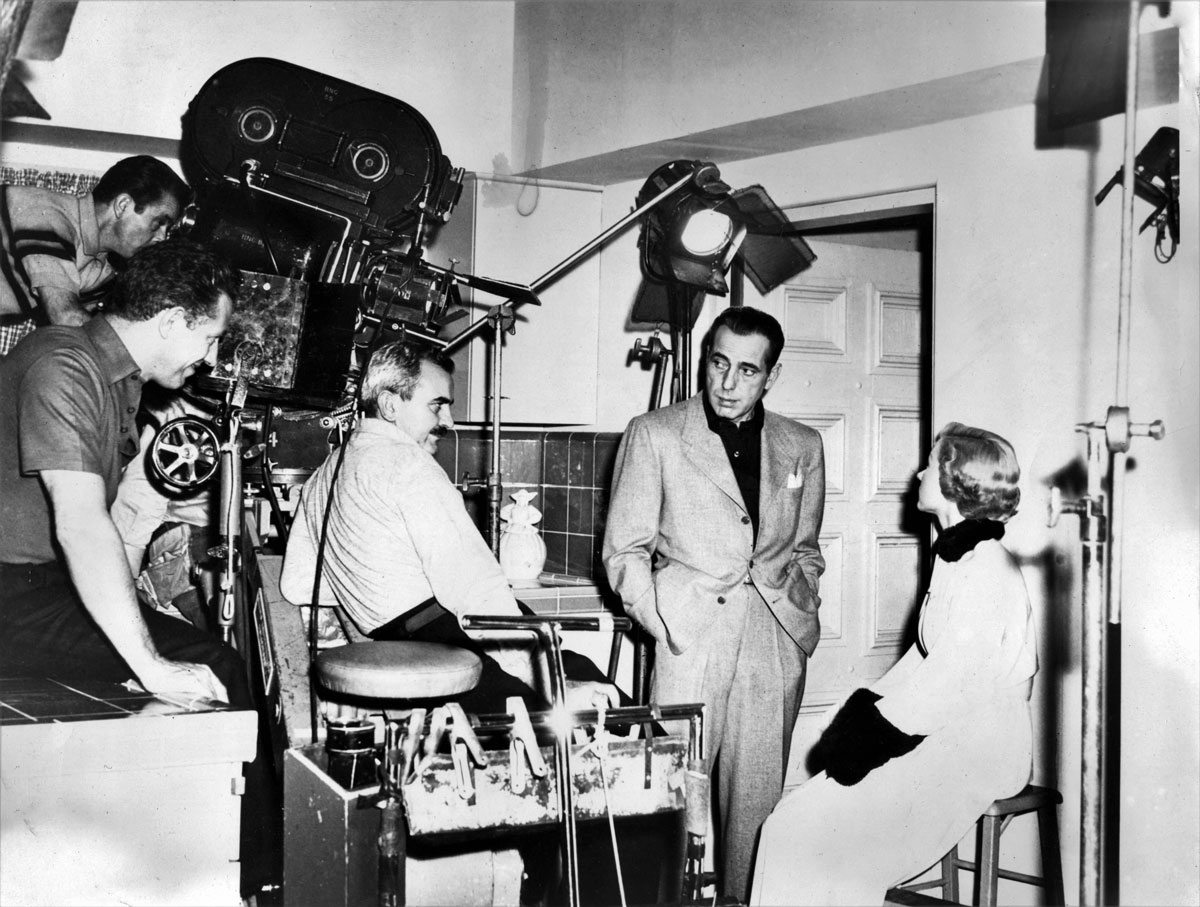
Humphrey Bogart and Gloria Graeme on the set of "In a Lonely Place"Humphrey Bogart and Gloria Graeme on the set of "In a Lonely Place" (Freestyle Digital Media)

The film defines Bogart’s life and career through the women in his life, his mother and wives. Did you ever meet your father’s ex-wives? If so, what were your impressions of them?

No, I never met them. My father died when I was 8; he was sick when I was 7. My mother and I never talked about them, especially about Mayo. I was never spoken to about these women. I only looked at them in the periphery. I found out more about them because I really didn’t know anything. It was interesting how they each did contribute, even unknowingly, to his career. His mother didn’t know what he was going to become. Helen [Menken] didn’t know what he would become.

I will say my father did have an eye. His wives were very good-looking. He really loved Mary [Philips], but she didn’t want to stay in LA. She wanted to be on Broadway, so she went back to New York. And Mayo [Methot] was the one who influenced his stratospheric rise to stardom more than anyone else in how she guided him and the movies he made before “Casablanca.” And then my mother [Lauren Bacall] came along, and it was more my father making my mother’s career, but she guided him in his activism. He was an activist when he refused to do a film without Lena Horne because she was Black. But he was one of the first stars to start his own production company and fight against the studio system. 

When you talk about Mayo, I think of “A Star Is Born” with one on the way up and one on the way down .  . .

Right, that was in the doc. That must have been difficult for Mayo. She could see him going up and her going down, and then the whole thing just disintegrated. Then he met my mother and that didn’t help things at all. It was interesting to learn about Mayo’s influence and that perspective. And it must have been devasting for Mayo when Bogie hooked up with this 19-year-old, my mother [Bacall].

I want to talk about your mother, if we can. She was an icon too. 

When my mother got the Kennedy Center Honor, she wanted Gregory Peck to introduce her. He was a longtime friend, but because Gregory Peck agreed to introduce Bob Dylan, she ended up with Sam Waterson, who my mother didn’t really know. I got to meet Bob Dylan, which was cool. Bob looked at me and said he was really nervous to meet the President, who was Clinton. I told him, “Bob, I think he’s more nervous to meet you!” 

We need your help to stay independent

There is also a line in the film that your father felt he wasn’t a good father, but I took this to mean he felt guilty that he wasn’t there for you as much as he felt he should be. Thoughts?

I don’t think that’s correct. I think he wasn’t a young kid kind of father. I don’t think he should have felt that way. Some parents, especially males, have trouble with 1- and 2-year-olds. I had a difficult time [as a father] with that as well. It is difficult for a male to relate to a 1- to 2-year-olds. That’s not true for all men. I think he had a difficult time because he was a father late in life. He was very rigid with scheduling — go to work, come home, have dinner with my mother without the kids, and go to the boat on the weekend. I didn’t go to the boat, and I wasn’t having dinner with him.  

What do you remember about your father?  What lessons did your father (or your mother) impart to you? 

He said, always tell the truth, and the Golden Rule: Do unto others as they would do unto you, which I’ve tried to live by. He was an honest guy and didn’t cotton fools. He was very principled. As Katharine Hepburn said in the movie, he was kind of puritanical, because those where the times back then. It was very closed. Especially sexual mores back then. He was very nice and polite. He was a different kind of guy. 

Bogart played characters who were insolent. He embodied toughness. He was “rugged” and the epitome of cool.  What do you think made him such an icon? Why do you think he has endured for decades? 

I don’t know. I have no idea how it happens. He was all those things you said he was. He was an activist. He worked for Adlai Stevenson and went to the House Un-American Activities Commission [hearings]. Why he has continued over so many other people – I think my mother and his relationship certainly had a lot to do with that. But he died early. He made great movies. He was a writer’s actor; he loved writers.

The film shows that Bogart, when he was starting out, had setbacks and successes. His early films made little impression until his gangster era and detective films got him noticed. Did he (or your mother) talk about his career, and how he felt he was perceived? 

My mother and I really didn’t talk about it. He says in the documentary he thought he was always going to play gangsters. He was electrocuted how many times, and shot how many times, and died how many times and all that. “High Sierra” was the tough guy [breakthrough]. When he got into the detective genre, with “The Maltese Falcon,” it was a whole new arc for him. He wondered: How am I going to be leading man? They want me to be a leading man in “Casablanca.” Are they out of their minds? Then he made another transition. It’s such an interesting arc of work. It’s very surprising. I think it would have been surprising to him. 

You mother, Lauren Bacall, says in the film that she based her career around him. She also wanted a son to remind her of Bogie. Can you talk about the dynamic of their relationship? 

Her influence was not his choice of films or his career, but personally — his change from Republican to Democrat, and his support of Adlai Stevenson. Instead of being as much of a loner, he was going out in public with my mother. He was going to Africa to make “The African Queen.” He was ornery and talked about how pissed off he was at John Huston the whole time.

John Huston was never nice, but he made some great films! . . .

No, but what a guy! Talk about a renaissance man. He was what, fighting in the Mexican American war, going elephant hunting and all this sort of stuff. I remember the line [about making “The African Queen”] in the film: “If it was something John thought was easy to get to, he would discard it to get to do something harder to make it more difficult.” Working with him and Kate Hepburn and bringing the whole Rat Pack — this was my mother’s influence on him. That and giving him a stable home life, saying we’re going to have some kids, and be married, and I’m going to follow you everywhere . . .


Want a daily wrap-up of all the news and commentary Salon has to offer? Subscribe to our morning newsletter, Crash Course.


What is your favorite film, performance, or scene featuring your father and why?

My favorite is “Treasure of the Sierra Madre,” because of the story behind it. My father wasn’t going to do it. His agent said, “You really have to do it. John wants you to do it. Walter [Huston, John’s father] is going to be in it.” And Bogie goes, “I don’t want to die, I’m a star. I don’t want to play the second guy.” But he did it because they were such great friends, and it ended up being a spectacular movie that won Walter Huston an Oscar. 

“Bogart: Life Comes in Flashes” is playing select theaters. It will be released on digital Dec.10.


“We will crush you”: Graham threatens allies with sanctions over Netanyahu arrest warrant

Republican South Carolina Senator Lindsey Graham wants a forceful response to American allies who might comply with an international court order to arrest Israeli leaders Benjamin Netanyahu and Yoav Gallant.

The International Criminal Court issued arrest warrants for the prime minister and former defense minister for “intentionally direct[ing] attacks against the civilian population of Gaza” on Wednesday. The United States is not a member of the ICC and the Biden administration dismissed the warrants as “outrageous” on Thursday.

The 124 member nations of the ICC could well arrest the Israeli leader and Gaza war architect if they set foot on their soil, a possibility Sen. Graham rebuked in on Friday while stopping by Fox News' "Hannity."

“If you are going to help the ICC, as a nation, enforce the arrest warrant against Bibi and Gallant, the former Defense Minister, I will put sanctions on you as a nation,” Graham warned. “You’re gonna have to pick the rogue ICC versus America.”

Graham added that he's "working with Tom Cotton" on an act that would sanction any nation who aided in the arrest of "any politician in Israel."

"We should crush your economy because we’re next,” Graham said. “Why can’t they go after Trump or any other American president under this theory?

Many of the US’s closest trading partners are committed to abiding by the ruling. Canadian Prime Minister Justin Trudeau said the country had an obligation to uphold the warrant, as did leaders in Ireland, Spain, the Netherlands and other American allies in Europe.

"To any ally, Canada, Britain, Germany, France, if you try to help the ICC, we’re gonna sanction you,” Graham said on Friday.

Sanctions are carried out by the executive branch, not the Senate, but some inside the upcoming Trump administration have expressed similar disdain for the ICC’s findings. Incoming national security advisor Mike Waltz blasted the top international court and promised a “strong response” to arrest warrants for the pair.

“The ICC has no credibility and these allegations have been refuted by the US government,” Waltz wrote in a Thursday post to X. “You can expect a strong response to the antisemitic bias of the ICC and UN come January.”

During his first administration, Trump was a vocal critic of the ICC, imposing severe sanctions on its prosecutors and judges for looking into potential American war crimes in Afghanistan.

Watch the entire segment below:


I asked ChatGPT to plan my Thanksgiving menu. Here’s how it did

Thanksgiving comes with plenty of stressors, especially if you’re hosting and cooking up a feast yourself. The main one being putting together an extensive Thanksgiving dinner menu complete with appetizers, main entrees, sides and desserts. Sure, the annual festivity has its fair share of signature Thanksgiving foods, but it can be hard — and frankly, overwhelming — to choose which specific dishes you’d like for your own, curated menu. 

In the world of artificial intelligence chatbots, it seems like the solutions to some of our most pressing problems are right at our disposal. That includes creating a comprehensive Thanksgiving menu. In anticipation of the holiday, I turned to ChatGPT for some much-needed help on figuring out what to cook.

I started off simple and typed in “Help me create a Thanksgiving menu” into the message box. The chatbot instantly came up with a full menu separated into five parts: Appetizers, Main Dish, Side Dishes, Desserts and Drinks. For appetizers, the chatbot chose Deviled Eggs with a Paprika Twist, describing it as “a classic starter that's easy to prep and customize”; Cranberry Brie Bites, “puff pastry, creamy brie, and cranberry sauce — bite-sized and irresistible”; and an    Autumn Charcuterie Board, containing “a mix of cheeses, cured meats, fresh figs, apples, and roasted nuts.”

Moving on to the main dish, the chatbot offered two suggestions: Roast Turkey with Herb Butter (“Tender, juicy turkey infused with garlic, sage, rosemary, and thyme,” it said) or Butternut Squash Lasagna layered with spinach, ricotta, and mozzarella for a vegetarian option. 

The side dishes were pretty standard and included Classic Stuffing made with “crusty bread, celery, onions, and a touch of sage”; Creamy Garlic Mashed Potatoes with a hint of roasted garlic; Sweet Potato Casserole topped with pecans and toasted marshmallows; Roasted Brussels Sprouts with Balsamic Glaze; and Cranberry Sauce made with orange zest and a touch of cinnamon.

For dessert, the chatbot chose Pumpkin Pie, Apple Crisp and Pecan Pie Bars. Drinks included Hot Spiced Apple Cider made from apples, cinnamon and cloves; Cranberry Ginger Mocktail and Pumpkin Spice Latte — a “homemade version to keep the pumpkin vibes going,” per the chatbot.  

ChatGPT also offered a few Thanskgiving-centric prompts, which I decided to test out. The first asked for a vegetarian dish for Thanksgiving. The chatbot suggested Stuffed Acorn Squash, saying it’s “hearty, festive, and packed with seasonal flavors.” It also offered a recipe for making the dish. All you’ll need are two medium acorn squashes, cooked quinoa or wild rice, fresh or dried cranberries, chopped pecans or walnuts, diced onions, garlic, cinnamon, thyme, olive oil, salt and pepper. Shredded Parmesan or vegan cheese is optional for topping.

In addition to menu ideas, ChatGPT offered a few hosting and Thanksgiving decor tips. “Decorating your home for Thanksgiving is all about creating a warm, inviting, and festive atmosphere that celebrates gratitude and the season's bounty,” the chatbot said. 


Want more great food writing and recipes? Subscribe to Salon Food's newsletter, The Bite.


It suggested hanging a wreath made out of autumn leaves, pinecones, berries, or mini pumpkins; a welcome sign and lanterns with LED candles in the entryway. Throw blankets & pillows, mantel decor and rustic touches, like bowls filled with acorns or vases with dried wheat stalks, are great for the living room. The dining table, which is the star of the holiday, can be decorated with an eye-catching centerpiece that contains candles, greenery, pumpkins and gourds. If you’re hosting a crowd, Thanksgiving-themed name cards and festive plates layered with autumnal napkins, rosemary and a mini pumpkin are must-haves. 

For the kitchen, the chatbot suggested seasonal utensils (think festive dish towels and aprons) along with miniature pumpkins, cinnamon sticks, and small jars of seasonal spices placed on the countertop. Additionally, outdoor decorations included pumpkins and gourds, hay bales and string lights.

AI certainly has its list of detriments but, surprisingly, ChatGPT didn’t disappoint with its recommendations, tips and menu options. That’s all to say that if you’re struggling with compiling a Thanksgiving menu this year, perhaps give AI a chance.

“Stockings hung like Arnold Palmer”: Maher urges liberals to not let Trump ruin holidays

Bill Maher has heard enough crowing about cutting off family members who voted for Donald Trump

The "Real Time" host used his "new rule" segment on Friday to push back against the idea that you should excise Republicans from your life in the wake of the election. Maher sees the holiday season as the starting point of any national reconciliation, figuring that we can't possibly unify the country until we unify our dining room tables.

"For the Democrats, this was a brutal loss, but the plan to deal with it has to be better than 'stay in a snit,'" he said. "Family isn't like gender. You can't fix it by cutting off members." 

Maher railed against Yale psychiatrist Dr. Amanda Calhoun, who told MSNBC's Joy-Ann Reid that it's "okay to cut off family members if they voted for Trump." Maher compared the act of refusing to spend holidays with Trump voters to "not letting certain people sit with you on the bus" as a photo of Rosa Parks flashed on the screen, drawing groans from the audience.

"[Calhoun] also said that it shouldn’t be automatic that family members think they’re entitled to your time. She said that’s just a societal norm," Maher continued. "Family. Who do they think they are? Family?"

Maher thought it was ridiculous that a mental health professional would encourage people to isolate during the holidays, wondering if she also recommended drinking too much and putting on weight. Ultimately. Maher pushed for a tone of reconciliation during the holidays.

"If we ever want this nation to heal, this is what we have to do," he said. "Force ourselves to reach out and find out why someone feels the way they do and make the choices they make without prejudging them a monster." 

Maher also asked liberals to consider the fact that Trump is getting through the holidays just fine and that he "couldn't ask for a better gift" than knowing his opponents were sulking.

"I'm sure Mar-a-Lago already has bells ringing and stockings hung like Arnold Palmer," he said.

Watch the whole segment below:

Cher memoir review: The global superstar’s story of grit is purely American

My favorite part of Cher’s recently published memoir, bar none, is the biographical note: “Cher is a global icon.” Virtually any other celebrity would be required to rehearse a slew of accolades. But not Cher. In her case, it’s patently unnecessary. You already know her. You’ve always known her.

I’ve always known her, too. In the early 1970s, I was a faithful viewer of the "Sonny & Cher" variety show. To my seven-year-old mind, they had already achieved the most significant fame that a kid from the Houston suburbs could reasonably measure: they had been animated guest stars on "Scooby-Doo." I’ll say it again. "Scooby-Doo."

When Sonny and Cher settled in for an extended residency at Houston’s Livestock Show and Rodeo, I begged my parents to take me to see the duo’s Astrodome performance. “We’re not rodeo people,” my mother coldly informed me. “But I’m a 'Scooby-Doo' kid,” I replied. As it turned out, mom was right. The hog-tying did absolutely nothing for me. But Sonny and Cher exceeded my dreams. When they launched into “I Got You Babe,” the Dome’s massive crowd responded with a veritable roar. It was my very first concert.

In the first volume of "Cher: The Memoir," the author traces the contours of her life from her childhood in the 1940s and 1950s through the onset of a film career in the 1980s that would launch her celebrity into superstardom. Her formative years, by any degree, were dizzying: born in 1946 as Cheryl Sarkisian to a Cherokee mother and Armenian father in rural Missouri, she became an entertainer, out of sheer necessity, at an early age. Her parents, for lack of a better word, were hustlers: her father was a grifting heroin addict while her mother lived on the fringes of movieland, working as a cigarette girl at the Copacabana and landing bit parts on shows like "I Love Lucy" yet never quite catching that elusive big break.

Cher grew up with a rootless backdrop that included her mother’s ever-shifting array of husbands, all the while traveling, nomad-like, from one place to another with stints in Pennsylvania, Texas, California and New York. As a fourth-grader, Cher caught the acting bug after performing in "Oklahoma!" Taking her cues from the likes of Elvis Presley and Eartha Kitt, she began training her famous contralto.

In 1962, at age 16, Cher met Salvatore Phillip “Sonny” Bono in an LA coffee shop. She was mesmerized by the smooth-talking Sonny, who raffishly claimed to be a descendant of Napoleon Bonaparte. Eleven years her senior, Sonny was working for famed record producer Phil Spector at the time. By 1964, Sonny and Cher were married. Under Sonny’s tutelage, she sang backup on several Spector recordings, including the Ronettes' “Be My Baby” and the Righteous Brothers’ “You’ve Lost that Loving Feeling.”

We need your help to stay independent

Originally dubbing themselves as Caesar and Cleo, they began releasing singles, eventually landing a middling hit with “Baby Don’t Go” as Sonny and Cher. After recording their first album "Look at Us," the duo achieved stardom with “I Got You Babe” in 1965. Written by Sonny as a retort to Bob Dylan’s bitter “It Ain’t Me Babe,” “I Got You Babe” found the couple sparring with the Beatles at the top of the charts. 

Behind the scenes, life was anything but easy. By the early 1970s, the couple transitioned to television after the hits began drying up. A control-freak of the highest order, Bono proved notoriously difficult to live with, a situation that was no doubt exacerbated with the birth of their child, who now goes by Chaz, in 1969 and Cher’s success as a Sonny-less solo artist with the chart-topping hits “Gypsies, Tramps, and Thieves” and “Half-Breed.” Even still, Sonny kept his wife in a kind of constant, isolated motion. In a telling moment of high camp, he dubbed their touring entourage as the “Benevolent Army of El Primo,” with Cher playing the role of Prima Donna to Sonny’s all-encompassing, self-created moniker His Supremeness.

Not surprisingly, by the time that the couple alighted at the Astrodome in 1974, they were headed for divorce proceedings. By the late 1970s, as Americans turned away from its once ubiquitous variety shows, Cher found herself in a different kind of quandary. She was largely famous for being famous, yet eager to fully remake herself beyond Sonny’s long shadow. “It’s a thousand times harder to come back than to become,” she points out. “Becoming famous is hard, but making a comeback is almost impossible.”


Want a daily wrap-up of all the news and commentary Salon has to offer? Subscribe to our morning newsletter, Crash Course.


As volume one comes to a close, Cher lingers on the edges of one of popular culture’s most intriguing comebacks, with the singer rebranding herself as a bona fide movie star. But make no mistake about it, Cher’s is a uniquely American story. The product of a diversity of experiences and surviving on pure grit, Cher is us.

Republicans and RFK Jr. have embraced psychedelics. What could go wrong?

When conspiracy theorist Robert F. Kennedy Jr. took to the social media site X (formerly Twitter) last month to threaten the Food and Drug Administration, he included a laundry list of items that he wants to deregulate if elected to a health leadership position under the incoming Trump Administration. For the most part, all of the items Kennedy listed — including clean foods, raw milk, and stem cells — seemed to fall in line with his campaign to prioritize personal choice and new age or experimental medicines while upending regulatory bodies like the FDA. 

But Kennedy also listed psychedelic drugs, which are banned in most parts of the world, as something under the FDA’s “aggressive suppression,” which may come as a surprise to those who associate psychedelics with “flower children” of the 1960s and not the far-right libertarian crowd that Kennedy has historically drawn. As one supporter commented on his post, “I disagree on the psychedelics which are horrible, but on everything else, yes.” 

Yet Kennedy is just one of several prominent Republican politicians to recently endorse psychedelics. In 2023, former Texas Gov. Rick Perry, who served as the U.S. Secretary of Energy under the last Trump Administration, spoke at the annual Multidisciplinary Association for Psychedelic Studies (MAPS) conference after previously backing a Texas bill that would increase research investigating psilocybin for veterans. Psilocybin is the drug in "magic" mushrooms and has been shown to significantly improve depression symptoms for patients in clinical trials, and other studies are investigating its use in other conditions like obsessive-compulsive disorder (OCD)post-traumatic stress disorder (PTSD), and substance use.

“Some of you are out there thinking what in the hell is that dude doing on this stage,” Perry said at the conference. Yet that same summer, Perry said federal psychedelics legalization was actually “more supported by Republicans” than Democrats.

"You have people saying psychedelics are going to cure the mental health crisis, and those are big statements."

Now that Republicans control the Senate and Congress — and President elect Donald Trump nominated Kennedy to lead the U.S. Department of Health and Human Services — some are hopeful that the GOP can exercise its governing power to revive a psychedelic movement that has shown signs of losing steam. Yet others warn that right-wing leadership could fast-track psychedelics and prioritize the business side of the industry without ensuring equal priority to the “integration” part of the psychedelic experience that comes with additional mental health and societal supports.

“The Trump Administration has signaled that it is going to be as radical as possible," said Brian Pace, a psychedelics researcher at Ohio State University. "They see themselves as coming in and cleaning house and implementing change through executive directives, and I don’t think that makes for careful medicine.”


Want more health and science stories in your inbox? Subscribe to Salon's weekly newsletter Lab Notes.


Although it remains illegal on the federal level, psilocybin was legalized in Oregon and Colorado through ballot measures in recent years, and treatment centers are now being rolled out in these states. Many other cities have decriminalized psychedelics, citing their low risk for harm, especially compared to drugs like fentanyl and methamphetamine.

With this momentum, many were hopeful that Lykos Therapeutics (formerly known as MAPS Public Benefit Corporation), would get FDA approval this summer when they submitted a new drug application for MDMA to treat PTSD. MDMA, sometimes called "ecstasy," had been shown to significantly improve PTSD symptoms in clinical trials.

However, the industry experienced serious setbacks after the FDA rejected MDMA therapy in August, citing concerns over the quality of the data submitted with the new drug application. Earlier this year, study participants came out to say that they had felt pressured to report positive results, and at least one patient came forward with sexual misconduct allegations. Ultimately, some of the studies submitted in the new drug application were retracted by the journal that published them

Juliana Mercer, the director of veteran advocacy and public policy at Healing Breakthrough, which advocates for MDMA-assisted therapy for veterans, said the FDA's MDMA decision came as a "gut punch" to those working to increase the availability of psychedelics and that long-standing stigma against controlled substances like MDMA are a barrier to getting them approved. In Massachusetts, a ballot measure to legalize psilocybin was also rejected this past election.

"I think there is absolutely still stigma attached to it," Mercer told Salon in a phone interview. "There is still more work to be done in terms of correcting the information that was given to us through programs like the 'Just Say No,' campaign and the War on Drugs."

Although Kennedy will need to be confirmed by the Senate to secure a leadership role at the HHS, some believe his influence could lead to deregulation that could make psychedelics more widely available.

"For those who think that psychedelics are going to revolutionize mental health, 'solve the mental health crisis,' or introduce kinder, gentler capitalism, it's much more likely that the reverse is going to happen."

“With plans to bust the corrupt alliance between major pharmaceutical companies and the agencies that regulate them, while supporting transformative treatments such as psychedelic-assisted therapies, we expect RFK to usher in a new era of U.S. health care,” Joe Caltabiano, the CEO of Healing Realty Trust, which invests in the psychedelics industry, wrote in a statement.

Yet others emphasize that those regulatory frameworks are in place for safety reasons and that psychedelics need to be subject to this kind of scientific scrutiny. Some, including Dr. Nora Volkow, who helms the National Institute of Drug Abuse, have warned that the hype around psychedelics has outpaced the science.

“You have people saying psychedelics are going to cure the mental health crisis, and those are big statements,” Pace told Salon in a phone interview. “Those are the kinds of statements that certainly attract investors, and they certainly get donations to get a research study done.”

In addition to support from Republican representatives in California, Texas and Michigan, psychedelics have also garnered advocacy among Silicon Valley Republicans. Elon Musk, who Trump appointed to lead a new Department of Government Efficiency agency, has said that he has a prescription for ketamine, a psychedelic-like anesthetic, and has discussed using other psychedelics. Earlier this month, psychedelic investor Christian Angermayer said on X that many attendees at a psychedelics event in San Francisco were “pro-Trump, some of them very openly” which “would have been impossible a year ago.” And Rebekah Mercer, who has been called “one of the chief financiers of the fascist movement,” donated $1 million to MAPS through the Mercer Family Foundation to fund psychedelic research for veterans.

Although some have argued that psychedelics can “turn” people into progressives, change ideology, or fight facism, these substances have a long history of use by people across party lines and tend to amplify existing ideologies rather than change them, Pace said. As psychedelics have hit the mainstream, it follows that they are being embraced by mainstream political parties in the U.S., he added.

"For those who think that psychedelics are going to revolutionize mental health, 'solve the mental health crisis,' or introduce kinder, gentler capitalism, it's much more likely that the reverse is going to happen," Pace said. "Psychedelics will be assimilated by the mental health system, [or, for example,] they will be applied through a conservative, Christian lens, rather than distort[ing] it."

Psychedelics have been described as having the power to deconstruct the mind, from which changes can be made in the process of integration that can significantly improve mental health. In Western culture, the reconstruction part of the process could be deprioritized in an attempt to find a “quick fix” to the mental health crisis.

We need your help to stay independent

“When the stakes are high, go slow, but in Silicon Valley, it’s ‘move fast and break things,’” Pace said. “But in this case, we are talking about people — not things.”

Psychedelics may be another tool for tackling the mental health crisis, but they will be most effective for communities that have social support in place to help them integrate the experience, Pace said. It also seems counterintuitive for Republican leaders to try and solve the mental health crisis — which is known to be amplified by health disparities, discrimination and social determinants of health like economic inequality — when many of those same leaders back legislation that puts more people at risk for these situations on the front end, he added.

“There is this idea that if you have a mental health problem, you take a pill and you have this individual solution for a problem that affects a lot of people,” Pace said. “There is this systemic side of how to address things like reducing the rates of PTSD by making sure that we have robust conversations about sexual assault prevention with men and boys and all kinds of things that are beyond the individual. But this can be a selling point for people: ‘Now we have this treatment, you just pull yourself up by the bootstraps and get back in the saddle.’” 

CORRECTION: A previous version of this article stated that Healing Realty Trust invests in the cannabis industry, which is inaccurate. Additionally, this article mentioned that Lykos Therapeutics was formerly known as MAPS, when it was technically called MAPS Public Benefit Corporation. The article has been updated.

What Biden’s COVID czar learned from the pandemic

Ashish Jha, the dean of Brown University’s School of Public Health, served as the White House Covid-19 response coordinator from March 2022 to June 2023. On Monday, after delivering the keynote for an infectious disease symposium at the University of Michigan, Jha sat down with Undark to discuss what the country got wrong, and what it got right, during the pandemic.

The interview also touched on Robert F. Kennedy Jr. and the politics of public health. Our conversation has been edited for length and clarity.

Undark: What do you think public health researchers and officials did well during the pandemic?

Ashish Jha: There was unprecedented collaboration among researchers globally. I remember just being on a bunch of these group listservs of scientists from around the world, sharing data, sharing data early. The whole preprint movement of getting stuff out quickly was terrific. It had some serious downsides — some bad stuff got out there that ended up creating a lot of confusion — but overall, I think that was a net positive.

Obviously, the way researchers came together, worked with government, worked with industry, to build the vaccines, I thought was extraordinary. The next thing was more researchers in the U.K. than the U.S.: The way they pulled together large clinical trials of therapeutics — the U.K.'s whole effort was truly extraordinary.

The Trump administration gets credit for Operation Warp Speed. The Biden administration gets credit for building up a vaccine distribution network, for ramping up vaccine production, solving all the supply chain problems.

I don't want to overstate: It was not the perfect response, but I actually think we got a lot of things done pretty effectively, pretty quickly. If you think about how many people we lost compared to, like, the 1918 flu pandemic, overall, given how long this pandemic was — the flu pandemic of 1918 was much, much shorter — I think we did OK. But there were things we could have done better. I still think we lost way too many people.

UD: Were any mistakes made in the name of public health, and if so, what can we learn from them?

The way we handled schools was largely a mess. I think closing schools in the spring of 2020 made a lot of sense. We really just didn't know what was happening. There was a line I had, really throughout the whole pandemic, which was, “Schools should be the last to close, first to open,” and we largely ignored that. The blue states ignored that way more than the red states; the blue states ignored it in the name of public health.

"In the name of public health, we kept going."

This is my own personal journey on this: Over the summer [of 2020], I was actually pretty worried that we weren't set up to open schools safely. A lot of schools went ahead and opened anyway, without the mitigation things that I thought would be helpful, and it turned out that they did not cause a huge spike in cases. They probably drove cases up a little, but not in a substantial way. So by the end of September of 2020, in my view, the evidence was overwhelmingly clear that we could open schools and that the benefits of doing so would far outweigh any public health costs.

In the name of public health, we kept going, especially in a lot of blue states where the schools remained closed for the entire academic year, or a large chunk of it. And I think that was a disaster. It didn't promote public health. It caused a lot of learning loss, caused huge psychological problems. We did it in order to keep people safe, and I'm not sure it actually kept people safe. So that was one big mistake.

One that I have mentioned I have some real concerns over is vaccine mandates more broadly. I was in favor of vaccine mandates in the spring of ’21 largely because I think they worked in terms of driving up vaccination rates, but I also think they sowed the seeds for discord and people becoming really resistant to vaccinations in a way that was, in the long run, probably pretty harmful.

UD: Can I interrupt you, because I actually had a specific question about vaccine mandates. Can I jump to it?

AJ: Please.

UD: In June 2021 there was an op-ed about vaccine mandates. And two critics of the public health establishment, Jay Bhattacharya and Martin Kulldorff, wrote that it would be harmful to mandate Covid-19 vaccines among young people. Specifically, they wrote, "there is intense pressure on young adults and children to be vaccinated […] It makes public health sense to require some vaccinations in some settings. However, in the case of Covid vaccines for young people, such mandates harm public health."

AJ: There are two parts of this. In my view, then and now, people were better off getting vaccinated, including young people. I have three kids, all of them got vaccinated. I didn't do this out of some public health zealotry. I did it because I thought that was good for them.

I think health care worker mandates make a lot of sense because you're working around vulnerable people. And vaccines do reduce transmission. And to people who are like, ‘‘Oh, vaccines don't stop transmission’’: No, but they slow down transmission. They reduce it.

[A mandate] made a lot of sense among health care workers. Whether it made sense more broadly — I mean, a lot of relatively young people still got infected and died during delta, so it is not like it had no impact. I just have real concerns about whether we should have been mandating it in that setting.

To be perfectly intellectually honest, I was all-in on mandates. There's no revisionism here. I called it as I saw it then. I really thought these were the right thing to do. And in retrospect, given how this has played out, I'm no longer sure that was the right recommendation.

UD: Donald Trump has announced Robert F. Kennedy Jr. as his nominee for Secretary of Health and Human Services. Some physicians and public health professionals have responded by calling the nominee, among other things, a grade-A crank and a disaster for public health. You’ve described his ideas as unserious and often downright harmful. What do you think accounts for Kennedy's appeal among some members of the public at this particular time?

AJ: Right now, we're in a moment where everything is so tied to political identity. The fact that he is a nominee for Donald Trump means a lot of Donald Trump fans have become Robert Kennedy fans. Some of the stuff he's talking about, these were the ideas that Michelle Obama was espousing: about healthier lunches, healthier foods. She got pilloried by the right for it: “It's government interference. And it's a nanny state.” The stuff Robert F. Kennedy is proposing is way more nanny state-ish.

I do think part of his appeal is that it's sort of a team sport, and if he's member of your team, you're going to defend him and defend them. But there is a chunk of people who, I think, very much like a lot of his ideas.

To the extent that he's encouraging people to eat healthier, great, but the challenge is, if he wants to take on the food industry and reduce the number of additives, what's the process he's going to use to decide which additives belong and which ones don't? You don't have a sense that he's seriously committed enough to the scientific process to use data and evidence to make those determinations. Therefore, my view is that if he becomes the HHS Secretary, he will actually make little to no progress on any of these issues.

His view on other things like vaccines and pasteurized milk — that can actually end up doing a lot of harm.

UD: If he is confirmed by the Senate, should public health officials who oppose his appointment, or who disagree with some items on his agenda, try to find common ground and work with him?

AJ: We should absolutely engage, and if he ends up in that role, absolutely try to influence him towards making good decisions — not because we like him or dislike him, but because the health of the American people [is] on the table, and anything we can do to make that better, or reduce the harm he can cause, the better off people are.

UD: The Pew Research Center found that over the course of the pandemic emergency, Republicans' confidence in scientists declined by roughly 20 percentage points compared to about a 5 percentage point decline among Democrats. Why do you think this happened?

AJ: First of all, I hate the fact that it did happen. The partisanization of public health, and of public health science, is just very bad for our country. These things have not generally been super partisan, and the fact that it's become more partisan is really harmful.

There are two or three things that have driven it. One that the public health community owns is, let's be very honest and clear: Most public health scientists and medical scientists tend to be left of center. What that means is the way we often talk about things, the way we often engage with people, rubs conservatives the wrong way, or reminds them that we, in public health, don't often understand what the issues are.

I'll give you an example. In the early days, actually through much of 2020, when people were recommending avoiding indoor gatherings, we were very dismissive of people gathering in churches, kind of dismissed it as not-an-essential thing. Well, it's not essential if church is not an essential part of your life. But if church is an essential part of your life, feels pretty important.

Someone brought this up to me early, in like April of 2020, and I was like, this is a really good point. And then I tried to change how I talked about this. But I think there are a lot of people in public health who, because they're not in more conservative communities, didn't appreciate what matters to people, and were often dismissive of it.

There was a lot of other stuff that public health experts did that really made people wonder what was motivating our advice and scientific judgment. I think about the George Floyd protests. Here we had spent four months telling everybody not to gather in groups, not to go outside, and then all of a sudden you have these massive protests. Then you had a lot of public health people saying, “Oh, it's OK because it's for a good cause.”

You're like, the virus cares what cause it's for? How does that make any sense?

And then you have a whole bunch of what I think of as bad actors, who exploited every mistake that we made. It's funny, even now, there are people dredging up my tweets, and I'm like, yeah, oh yeah, in August of 2020 I tweeted that. Some people are like, ‘‘You should go back and delete all your old tweets.’’ I'm like, no, I said what I said. I was not perfect. I've made mistakes. I am very comfortable with that.

There are bad actors who want to use this as a way to drive a wedge and drive discord. They've gotten a lot of purchase among some parts of the conservative and right wing. By the way, there are also a lot of bad actors on the left who do the same thing. I just think they've had less influence, but they're also trying to do the same thing: undermine confidence in the public health scientists.

UD: Is there anything else that you'd like to say?

AJ: I look at countries like the U.K. and others that are doing a deep dive into what went right and what went wrong. And it does sadden me that we are never going to do that as a country, not formally. What that means is that there's just a ton of informal Covid revisions being done by everybody in their own bubbles. What we're doing is really solidifying these largely simplistic narratives: We overreacted. We underreacted. We did too much. We didn't do enough.

I think it's unfortunate because, as I laid out earlier this morning, we're going to face more of these, and if we don't have a clear-eyed understanding of what went right and what went wrong, and how we're going to do better next time, then we're not going to do better next time.

That's the challenge. I wish that there was more space right now to have more of an honest discussion about these things.

This article was originally published on Undark. Read the original article.

Experts: DOGE scheme doomed because of Musk and Ramaswamy’s “meme-level understanding” of spending

Elon Musk and Vivek Ramaswamy, the billionaires President-elect Donald Trump picked to lead the new Department of Government Efficiency (DOGE), have made their aspirations of slashing government spending clear, promising to bring a "chainsaw" to federal bureaucracy and costs.

To cut back on hundreds of billions in government spending, one approach Ramaswamy has suggested is eliminating programs that have lapsed spending authorizations despite still being funded by Congress, which include veterans' healthcare services, housing assistance and the Justice Department. But not only does that proposal misunderstand the function and role of funding authorization in Congress, the lack of authorization doesn't indicate wasteful expenditures, federal fiscal policy experts told Salon.

"They have a fundamentally superficial understanding of what they're doing," argued Bobby Kogan, the senior director of federal budget policy at the Center for American Progress. "They have a meme-level understanding. 'Let's get rid of unauthorized spending' is the sort of thing that you might see in a Facebook meme."

Ramaswamy and Musk expanded on that suggestion in a Wall Street Journal op-ed published Wednesday, outlining the newly minted out-of-government advisory commission's plans for reducing excess spending. DOGE, they wrote, will target some $500 billion in annual federal expenditures that "are unauthorized by Congress or being used in ways that Congress never intended" in an effort to help "end" federal overspending.

But the notion that any spending is not approved by Congress or used outside of how the legislative body intends is "inaccurate," said David Reich, a senior fellow at the Center for Budget and Policy Priorities. The Constitution requires Congress to authorize any and all government spending, which it does through funding bills, or appropriations. 

"For anything the federal government is spending, there's going to be an appropriation," Reich told Salon in a phone interview. "It could be an annual appropriation. It could be an appropriation and authorizing law, but Congress will have authorized that expenditure."

The authorization that Musk and Ramaswamy take up actually refers to an internal House of Representative's rule that creates a separate process for authorization and appropriations, experts said. 

Authorizing committees in the House make laws dictating provisions for the creation of agencies and their functions, which include "aspirational-level" provisions for how funds can be used like requirements for eligibility to receive that funding and stipulations on its use, Kogan explained in a phone interview, and the authorization is usually temporary to allow the committees to reevaluate those details over time. 

We need your help to stay independent

"For a while it was a very common practice for authorizing legislation to say, 'And there is hereby authorized to be appropriated X dollars in year one and Y dollars in year two' and so forth," Reich said.

But the House's use of that language has lessened in recent years, and the chamber often waives the rule, explicitly or implicitly, by considering the funding bills, which it does "often completely consistent with what the authorizing law does," he added, calling the authorization of funding via authorizing laws a "technical step."

For programs where Congress has allowed its authorization to lapse, appropriations legislation covers it. Instead of needing two laws —  an authorizing law that approves funding for an agency and another to actually allocate those funds — Congress only passes the appropriation, which then gives the program the authority to spend its funding, according to The Washington Post

In their op-ed, Musk and Ramaswamy pointed to $535 million allocated to the Corporation for Public Broadcasting, $1.5 billion for "grants to international organizations" and nearly $300 million allocated to "progressive groups like Planned Parenthood" as examples of excess spending that could be cut, appearing to cite figures from a Congressional Budget Office report on programs with unauthorized funds. 

But Kent Smetters, the faculty director of the Penn Wharton Budget Model and a University of Pennsylvania Wharton School professor of business, economics and public policy, told Salon that these unauthorized funds don't inherently amount to wasteful or excess spending either. 

"In practice, unauthorized funds give a federal agency more flexibility to direct funds toward the needs that the agency sees as a higher priority at any point in time," he said in an email, adding that "unauthorized funds are probably a bit more efficient because an agency might have more information about immediate needs after the funds were appropriated by Congress at a more aggregate level."


Want a daily wrap-up of all the news and commentary Salon has to offer? Subscribe to our morning newsletter, Crash Course.


Programs without separate spending authorization amount to more than $516 billion of the budget, with the 10 largest programs comprising $380 billion of that share, according to a report from the Congressional Budget Office. Health care for veterans has the largest amount of "unauthorized" government spending, coming in at $119.1 billion. Funding for other programs like housing assistance under the 1998 Quality Housing and Work Responsibility Act, and government entities like the State Department and Justice Department would, in theory, be on the chopping block, per Ramaswamy and Musk's suggestions.

Still, as an out-of-government entity, DOGE can only make recommendations to Congress for ways to pare down the federal budget. "Congress will still decide whether authorized or unauthorized programs get funding," Smetters said. "It is not up to the discretion of the White House."

While policymakers have room to eliminate excess federal spending in bipartisan ways, Kogan said, the amount of wasteful government spending is far smaller than what Ramaswamy and Musk suggest.

"People have this idea of just huge and absurd amounts of government waste, and it's just not borne out in the data," he said.

Two-thirds of federal spending is mandatory, while the remaining discretionary spending largely goes toward defense. Over 70% of the nation's non-interest spending is public benefits to Americans, like Social Security, SNAP, WIC, Medicaid and Medicare, Kogan said, and "by definition, if you're cutting those, you're cutting aid to people."

"I think a lot of this comes down to people saying, 'Well, I just don't want us to do that program, and that's fine," he said, adding: "That is a stance someone can take, but it is flatly incorrect to pretend the money we give to states to help them make sure that kids with disabilities have enough money to succeed — that's not waste. You might not like the program, but is just not waste."

Sardinia fights for the climate future: What this ancient island’s struggle can teach the world

GAVOI, SARDINIA — On the staircase to the mayor’s office of Gavoi, a screen projects the daily count of energy production and carbon emissions reduction from the solar panels that adorn the municipal buildings in this charming mountain town, as if suggesting that the direction of the energy policy for the second largest island in the Mediterranean is on target. 

As thousands of climate advocates descend on Baku, Azerbaijan, this week for the 2024 U.N. Climate Change Conference, better known as COP29, Sardinian President Alessandra Todde reiterated her island’s intent to address the “climate emergency” through strong “collective action” in the Mediterranean, citing the recent flooding disasters in Valencia, Spain and the south of Sardinia.

But the roadmap for such collective action here — technically, Sardinia is an "autonomous region" of Italy, with its own government — presents a new path forward as a European climate leader on different terms. Sardinia has broken with the Italian government in Rome in a showdown over a "speculative assault” of private energy projects, political power and its implications of autonomous rule in an age of climate change.

Thousands of protesters converged on the Sardinian capital of Cagliari last month to deliver an extraordinary package — more than 210,000 signatures from an island of 1.6 million inhabitants — on behalf of the “Pratobello 24” initiative, which aims to reclaim the region’s jurisdiction over urban planning, including renewable energy installations. 

"Sardinia, like it or not, will not accept to passively suffer decisions made from above," President Alessandra Todde declared, in a salvo clearly directed at right-wing Prime Minister Giorgia Meloni.

In ways similar to protests seen from Greece to Australia to the “wind rush” in Brazil, and even in Swedish activist Greta Thunberg’s protest against Europe’s largest onshore wind farm on indigenous Sami territory in Norway, the Sardinian rebellion emerges as a powerful cautionary tale: Central government officials must learn follow the lead of locally-based planners in addressing climate action.

Sardinians are quick to remind visitors that this crisis is more than a handful of wind turbines tilting above an archaeological site. Nor is it a simple “not in my backyard” complaint, of the kind echoed from Cape Cod to Ireland. 

In an effort uniting often acrimonious political parties earlier this summer, the Regional Council under the newly-elected Todde passed an emergency 18-month suspension of a mind-boggling number of wind turbine and photovoltaic projects ushered in under former Italian Prime Minister Mario Draghi's administration in 2021 and meant to exploit Sardinia, among other regions, to meet European Union benchmarks for national carbon reductions. 

That didn’t land well in Rome. Prime Minister Giorgia Meloni, still reeling from the electoral rebuke of her right-wing alliance in Sardinia's elections last spring, immediately announced her government’s intention to challenge the region’s jurisdiction in Italy's Constitutional Court. 

While that jurisdictional question heads to the courtroom, Todde’s regional government approved a legislative decree in mid-September to set "provisions for the identification of areas and surfaces suitable and unsuitable for the installation of renewable energy systems," marking the island as the first Italian region to “propose a law on suitable areas approximately three months in advance of the deadline set by the Government.”

"Sardinia, like it or not, will not accept to passively suffer decisions made from above," Todde declared, in a salvo clearly directed at Meloni.

We need your help to stay independent

Ancient Rome's emperors once feared the wind power along the “insane mountains” on this island. Now it is the Sardinians who are gobsmacked by the Roman obsession with wind power and its possible destruction of their island. According to the Italian-based multinational TERNA, the largest independent electrical grid operator in Europe, applications by outside companies for renewable projects in Sardinia, underscored by E.U. incentives and funds, now number well over 750, potentially producing nearly nine times the amount of clean energy required in the Italian decree.

“We inherited a region without rules regarding the installation of renewable energy plants,” declared Todde, “with many authorizations effectively out of control.”

Saddled with the highest utility rates anywhere in Italy, Sardinians also know that nearly three-fourths of the energy production on the island comes from fossil fuels, including the only two coal-fired plants in the entire country, both dependent on imported coal, which have been given an extension to operate until 2027. But even that doesn't tell the whole story; nearly 40% of the energy those plants produce is exported to mainland Italy.

For Todde's administration, the response is clear: Sardinia plans to lead a green energy transition on its own terms, consulting with municipalities, territories and citizens. 

Invoking the island’s autonomous status, which makes it one of five regions in Italy granted special jurisdiction over planning and regulatory provisions, Sardinia's Regional Council has not abandoned the Draghi-era benchmarks for renewable energy, but intends to restrict them to “suitable areas” that ensure protection of the landscape, along with cultural and environmental assets.

That laudable-sounding goal may be more complicated to achieve than it sounds.

A cultural reawakening is spreading across the island, aligning diverse groups committed to municipal rights, cultural and archaeological preservation, environmental protection — and a history of resistance.

Diverse voices of rebellion are growing ever more pointed, with increasing protests and blockades. The energy transition, activists say, must serve the island, not subjugate it. A “revolt of the olives” emerged as a symbolic showdown in Selargius, a small municipality near Cagliari, where TERNA's expropriation and destruction of a farmer’s olive grove brought out an army of shovel-wielding supporters to plant new olive trees.

Even "Casino Royale" film star Caterina Murino returned to her native island and met with Todde, invoking the resistance of Sardinia's 14th-century hero Eleanor of Arborea as a model for regional leadership. Last week, jazz legend Paolo Fresu performed on Italian national TV along with popular TV host Geppi Cucciari, who joined her fellow Sardinian in reading his monologue dedicated to the island's heritage, "The Wind Knows." 

Sardinians fear this energy transition will transform their landscape and invade their territory, with the greatest benefits going to Italian and international corporate speculators. From interviews around the island, it is clear that those who live here and love the island fear they will suffer a cultural uprooting, one similar to what has happened over previous centuries, and even millennia.

This assertion of Sardinia’s ancient heritage might be the greatest outcome of this crisis. A cultural reawakening is spreading across the island, aligning diverse groups committed to municipal rights, cultural and archaeological preservation, environmental protection — and a history of resistance.

Beyond its fabled beaches, Sardinia is not an “empty stage,” as both ancient and modern-day Romans have conceived it. Considered by archaeologists as an “open museum,” the island possesses the highest density of Neolithic and Bronze Age archaeological sites in Europe. One only has to visit the pioneering Nurnet geoportal website, which tracks the island’s archaeological wonders, including those of the Nuragic civilization, which served as a cradle of architectural and maritime innovation in the Bronze Age, beginning around 1800 B.C.


Want a daily wrap-up of all the news and commentary Salon has to offer? Subscribe to our morning newsletter, Crash Course.


“The risk is that the areas of great environmental, historical and archaeological value in Sardinia will be irremediably compromised,” former Baunei mayor Angela Corrias recently told me.

Many such sites, such as the Bronze Age "nuraghe" or tower fortress known as Genna Maria, risk losing their status as anchors for cultural tourism, locals fear, due to the encroachment of wind and solar projects. Villanovaforru mayor Maurizio Onnis filed a formal comment on the environmental and cultural impact of the wind farm proposal in August, declaring that the “historical-identity elements of the landscape” at Nuraghe Genna Maria would be “fractured,” resulting in the “disintegration” of the panoramic and environmental values of the area.

Todde’s regional government even joined a court challenge against a solar proposal near the UNESCO World Heritage Site at Barumini. A regional court recently struck down a project proposed near Pranu Muttedu, a Neolithic necropolis that has been called the Sardinian Stonehenge.

Some activists invoke a historic uprising against an Italian military facility in Pratobello in 1969, and an awareness of Sardinia's colonial legacy remains a factor today: More than 60% of Italian military operations, including war games and bombing ranges, have claimed over a quarter of the island's territory.

A century before the military takeover, deforestation of the island by Italian railways and companies left Sardinia “literally razed as if by a barbarian invasion,” declared the legendary Sardinian journalist and Marxist philosopher Antonio Gramsci in 1919. He also pointed out the effects of destruction on the island’s climate: “We inherited today’s Sardinia, alternating long dry seasons and flooding showers.”

Today’s climate crisis, therefore, is not a new story for this island.

Yet Sardinia has never lacked for ideas or innovators. In the midst of this cultural revival, Sardinians see their ancient history as a continuum of today’s endeavors; writers, artists and cultural tourism groups are engaged in a process they call "re-storification," unearthing and forging new stories, rituals, and gatherings that recover the withered or denied strands of history and reshape a continuum between the past and present. That includes climate action.

In fact, the Regional Council passed its own environmental energy plan in 2016, spelling out a path to a renewable energy transition and 50% reduction of carbon emissions by 2030.  Amid political turmoil and changing regional administrations, the plan fell through the cracks as Draghi's government in Rome ramrodded its decree over Sardinian silence, more than consent.

That era of silence in Sardinia is over now. 

Former Sardinian president and Tiscali founder Renato Soru, the “Bill Gates of Italy,” who created the first subscription-free internet company in Italy, has issued his own Project Sardinia plan for renewable energy. The regional newspaper Unione Sarda, which has become a clearinghouse of information over the “wind assault,” promotes the "Pratobello law," an initiative to grant territories the power to decide over energy projects. In the once-abandoned village of Rebeccu, the MusaMadre Project has inspired a revival based on the power of eco-cultural arts projects.

Sardinians are not waiting on the government to move forward.

“Soon we will have already created an Eden,” Stefania Demurtas and Salvatore Marongiu told me, as we walked in the shade of fruit trees through their agro-forestry project, Tenute il Maggese, in the eastern Ogliastra area. “A regenerative future is waiting for us in Sardinia.”

In the meantime, Sardinia’s fate as a climate leader, and its authority to decide its own energy future, will be decided in the courts. But the island's message to Italy — and the faltering COP29 negotiations — has already set its course. .

Doom spending: How to not let Trump break your budget

Lately I’ve been in the market for a new purse. For research, I joined the handbag forum on Reddit a few weeks ago. Most of the posts are about two things: people showing off their latest purchase or people wanting advice on what purse to buy.

However, I also noticed something new: people showing off an impulse purchase made just after the election. It was like the election results pulled the rip cord and people responded by letting go of their budgets. 

Posts like that were only one example of "doom spending" — a concept of spending more money when we feel anxious. 

What is doom spending? 

Even before the election, doom spending was on the rise. A 2023 survey found that about 25% of Americans were doom spending to manage stress. Another survey found that approximately 37% of Gen Z and 39% of millennials are doom spending. Beyond the election, issues like climate change and housing affordability are huge drivers of doom spending.  

When the future looks bad, why save for it when you can enjoy your money now? A pessimistic or even nihilistic point of view can cause you to doom spend.

We need your help to stay independent

Cheyenne Bailey, a 32-year-old waitress from Queens, said she went through a doom spending phase shortly before and after the election, buying hair accessories, clothes and cosmetics.

Normally, when she makes an impulse purchase, it’s no more than $100. This time? “It was like $1,000 very quickly before he was even elected,” she said, calling it a financial blackout.

“In the moment, it felt very frantic and impulsive,” she said. “I’m someone who is pretty intentional about their budget, so it was rather out of character.”

Financial therapist Amanda Clayman, host of the “Emotional Inve$tment” podcast, said when it’s hard to imagine a good future, living for today seems like the only remaining option. Also, if life blows up even when you’ve been following the rules, it can feel like there’s no reason to “be good.”

“It shakes our trust in future rewards and makes us seek out more impulsive and immediate gratification behaviors, like spending or doing something slightly bad or transgressive,” Clayman said.

Sometimes doom spending is also about having more control in the moment if you feel like you don’t have any control over the future. 

“I think the impulse spending was a way to self soothe and have focus on my immediate future when my big picture future felt very at stake,” Bailey said.

Bailey also noticed that she’s been using buy now, pay later apps and services lately, which also correlates to her dystopian feelings about the future. 

How to cope without spending

Any therapist will tell you that doom spending — just like doom eating, doom Netflix binging or doom phone scrolling — is not the answer. While there may be an initial rush of euphoria, the guilt that follows can often cause a spiral of more spending.

The problem is that when we feel bad, we feel compelled to do something to ease the pain, even if the resulting action isn’t helpful in the long run.

“A lot of times when we feel anything that feels like pain, our brain is going to be so quick with some kind of product or service that it feels like a solution,” Clayman said “That has already been programmed into our brain.”

The first step to changing your behavior is noticing it. Once you notice it, Clayman says you shouldn’t feel pressured to change it. Over time, as you keep noticing the behavior, you may decide not to engage in it.

Another important concept to remember is grace. Having grace for yourself is crucial because it keeps the shame from doom spending at bay.

For now, that might mean changing your budget and acknowledging that you might be spending more on creature comforts.

“These are really extreme circumstances to be living in, and to be expecting myself to have a normal everyday budget as if I’m not existing in some very uncertain and emotionally triggering times, that would be unfair to myself,” Bailey said.

Clayman also says having some non-spending ways of coping with stress, anger or frustration in place can help you avoid doom spending. 

“Do something weird, but not bad,” she said. “Transgressive, but not destructive.”

Some ideas include buying some cheap dishes at a thrift store and breaking them in the driveway, ripping up an old T-shirt or hitting some rocks with a hammer. 

"There are some simple ways you can express your grief, your anger, your resentment and frustration"

“There are some simple ways you can express your grief, your anger, your resentment and frustration,” she said.

I'd also challenge anyone dealing with doom spending to keep saving for the future, no matter how bleak it seems. Here’s why: If the world is still around in some way, shape or form, having more money will be a good thing. Money is a tool and it can give you options, whether that means moving to a new country or colonizing Mars because Earth has imploded.

And if you really want to put your money where your mouth is, consider setting up recurring donations to a worthy cause. Even if it’s a small amount, making it a regular part of your budget can help make a real impact over time. This will also make you feel more in control.

“I feel like the only plan you can have is a balance of self soothing and recharging and refueling so you can take action later,” Bailey said.

Trump tags NFL alum, Fox News contributor and House race losers in Cabinet pick blitz

President-elect Donald Trump flooded his Truth Social feed with a grip of key Cabinet nominations on Friday night, rounding out his administration less than two months ahead of his inauguration.

Among the picks, ex-NFL player and former Texas state Rep. Scott Turner was tapped to lead the Department of Housing and Urban Development. The president-elect’s only Black Cabinet  nominee served in Trump’s first administration on the White House Opportunity and Revitalization Council.

One-term Oregon congresswoman Lori Chavez-DeRemer was asked to lead the Department of Labor. Chavez-DeRemer, who lost her seat earlier this month, is a pro-labor pick for a largely anti-union administration. She was one of just three Republicans to back the PRO Act in the House. Teamsters President Sean O’Brien praised the Trump pick on social media Friday night.

Additionally, Trump brought alt-right political commentator Sebastian Gorka back into the White House, appointing him to serve as a deputy assistant to the president and a senior counterterrorism adviser. Trump also brought back Alex Wong to serve as assistant to the president.

“Since 2015, Dr. Gorka has been a tireless advocate for the America First Agenda and the MAGA Movement,” Trump said in a statement.

The president-elect tapped doctor and Fox News contributor Janette Nesheiwat for the role of surgeon general, citing her work during the COVID-19 pandemic and other natural disasters as qualifications for “MAKING AMERICA HEALTHY AGAIN.” 

Trump announced plans to install Johns Hopkins surgeon Marty Makary as the head of the Food and Drug Administration, Makary was a vocal critic of coronavirus lockdowns and argued the pandemic would end when Americans reached “natural immunity.” 

Trump said in a statement that Makary would “evaluate harmful chemicals poisoning our Nation's food supply and drugs and biologics being given to our Nation's youth.” Makary and Centers for Disease Control pick Dave Weldon, also announced on Friday night, will work alongside Department of Health and Human Services head Robert F. Kennedy Jr. to manage the nation’s health if all are confirmed.

Earlier on Friday, Trump confirmed reports that Project 2025 architect Russ Vought would lead the Office of Management and Budget and appointed hedge fund manager Scott Bessent to serve as Treasury secretary. 

“Clean out the bad guys”: Trump wants to fire Smith’s entire DOJ team, per report

Donald Trump has made it clear that he plans to oust Special Counsel Jack Smith almost immediately after taking office, but a new report suggests that the president-elect won't be satisfied with just one pink slip.

The Washington Post spoke to members of Trump’s transition who said that Trump plans to fire everyone who worked on Smith's two doomed cases against him. Smith wound down those cases days after Trump's win and has reportedly made plans to be out of office before Trump is inaugurated.

A source on Trump's transition team who spoke to the Post said the president-elect “wants to clean out ‘the bad guys.’” Spokesperson Karoline Leavitt seemed to echo that rhetoric in an official statement from team Trump.

“President Trump campaigned on firing rogue bureaucrats who have engaged in the illegal weaponization of our American justice system, and the American people can expect he will deliver on that promise,” she told the outlet.

Trump also talked of enemies within the Department of Justice when nominating Pam Bondi for attorney general. 

“For too long, the partisan Department of Justice has been weaponized against me and other Republicans,” Trump wrote on Truth Social. "Pam will refocus the DOJ to its intended purpose of fighting Crime, and Making America Safe Again.”