Help keep Salon independent

“Democrats want to take your right to vote”: Musk panders to Trump rally crowd in Butler

Elon Musk made his far-right slide explicit on Saturday, getting on stage to deliver a speech at Donald Trump's rally redux in Butler, Pennsylvania. 

Trump's celebration of still being alive brought out his running mate JD Vance and several of his children before bringing the SpaceX head to the stage. Once there, Musk accused Democrats of trying to "take" Republicans "right to vote" away. He also said that Trump "must win" the election in November. 

Musk has boosted right-wing fonts of misinformation since taking over X. He's frequently boosted conservative (and occasionally outright white supremacist) accounts on his own personal account. Musk recently lamented on X that "no one is even trying to assassinate Biden/Kamala" after two assassination attempts on Trump (he deleted the post after facing backlash). 

At the rally, Musk took a shot at President Joe Biden's health while praising Trump's bravery under fire.

“And you know, the true test of someone’s character is how they behave under fire," he said.  "We had one president who couldn’t climb a flight of stairs and another who was fist-pumping after getting shot. … So who do you want representing America?”

(It should be noted that President Biden is not running for re-election. He left the race under pressure following a disastrous debate performance.)

Trump continued a years-long trend of brushing off Musk after the CEO concluded his speech. He brought up Musk's satellite-based internet service Starlink before casually dismissing it with a "whatever the hell that is." 


“Only a matter of time before somebody tried to kill him”: Vance says Trump shooting inevitable

JD Vance knows exactly who to blame for the string of attempted assassinations on Donald Trump

It's not Trump's own superheated and divisive rhetoric, the Secret Service or the assassins themselves: it's the Democrats. 

Speaking at a rally in Butler, Pennsylvania, the site of a Trump assassination attempt earlier this year, Vance blamed the Democratic Party for the pair of people who have tried to take potshots at the former president in recent months. 

"First, they tried to silence him. When that didn't work, they tried to bankrupt him. When that didn't work, they tried to jail him," Vance said of Democrats. "With all the hatred they have spewed at President Trump, it was only a matter of time before somebody tried to kill him."

Vance said the Democrats "continued to use dangerous, inflammatory rhetoric" after the assassination like calling Trump "an existential threat to our democracy."

Both would-be assassins were GOP supporters at some point in their lives. 20-year-old Thomas Matthew Crooks, who shot Trump and others before being gunned down by the Secret Service, was a registered Republican. Ryan Routh, who was captured by law enforcement in Florida after he was spotted lying in wait along the former president's golf course, was a one-time Trump supporter

"I and the world hoped that president Trump would be different and better than the candidate, but we were all greatly disappointment [sic] and it seems you are getting worse and devolving," Routh shared on social media in 2020. 

Elsewhere, he showed his support for Republican Nikki Haley and conservative Democrat Tulsi Gabbard.

The massive rally in Butler is meant to be a show of strength for Trump, who will speak on the spot where he was very nearly killed, a little over a month before Election Day. 


“It was a mess”: Melania Trump “questions the results” of 2020 election in new memoir

Melania Trump doesn't agree with her husband on all the issues, but she's sticking by his side when it comes to conspiracies about the 2020 election. 

In a snippet of her upcoming memoir shared by the New York Times, Trump made it clear that she thinks there was something fishy about the election that former President Donald Trump handily lost to Joe Biden

"It was a mess. Many Americans still have doubts about the election to this day," she wrote. "I am not the only person who questions the results.”

Donald Trump launched an extensive legal and PR campaign questioning the election results in 2020. His fervor and insistence that democracy had been subverted lead to a riot that breached the U.S. Capitol on January 6, 2021. Nearly four years later, Melania still holds to some of the beliefs that spurred a mob into action. 

She questioned the need to “count votes for days" after the election, ignoring the need for accuracy in tight, statewide races. 

Donald Trump is currently facing down a massive election interference case orchestrated by Special Counsel Jack Smith. A recent filing shared by Smith detailed exactly how far Trump was willing to push to interrupt the certification of election results on Jan. 6.

For her part, Melania says she was focusing on her White House renovations during the riot. Per the Times, she pinned her lack of response to the storming of the Capitol on her PR team, which she says was "behind schedule."  

“The bad guys won in WWII”: Minnesota candidate is latest GOP member to espouse pro-Nazi view

The Republicans can't help but hand it to Hitler lately. 

Royce White, a former NBA player and present-day conspiracist running for a U.S. Senate seat in Minnesota, claimed in a recently unearthed social media post that the “bad guys won” in World War Two.

“The bad guys won in WWII. There were no 'good guys' in that war,” White wrote in a post still live on X, referring to the American, British and Soviet troops who defeated Nazi forces and liberated millions from concentration camps. “The controlling interests had a jump ball.”

The remarks were resurfaced by Heartland Signal. White has been running to unseat Sen. Amy Klobuchar and the seemingly pro-Nazi tweets aren't tthe only controversial comments made he's made online.

In a post this week, White told a voter on the fence to “pull your skirt down,” prompting that voter to respond, “you just lost my families (sic) support.”

White isn’t the only GOP candidate to land in hot water for a seeming affinity for Nazis in recent weeks.

North Carolina gubernatorial candidate and incumbent Lt. Governor Mark Robinson’s posts on a pornography forum, uncovered by CNN, showed a pattern of support for fascist ideology. Robinson even dubbed himself a “black NAZI” and said that he would prefer Hitler’s leadership to Barack Obama’s.

“I’d take Hitler over any of the sh*t that’s in Washington right now!” Robinson said in 2012.

Oklahoma’s education department seemingly wants to buy 55,000 Trump Bibles

Oklahoma public school officials are taking bids for 55,000 new Bibles, and the specifications are eye-catchingly specific. 

Republican Superintendent Ryan Walters is searching for King James Bibles containing both the Old and New Testaments, with the U.S. Constitution, Bill of Rights, Pledge of Allegiance, and Declaration of Independence inserted, “bound in leather or leather-like material for durability.”

 Oklahoma Watch asked Christian education material supplier Mardel to check its 2,900 Bible options against the specs. They found no matches. However, the publication found two: the $60 Donald Trump-endorsed “God Bless the U.S.A. Bible” from Lee Greenwood, and the $90 Donald Trump Jr.-backed “We The People Bible.”

Those Bibles made headlines in March as the ex-president's latest branded venture, succeeding a sneaker launch and a series of NFTs. Trump gets a cut of each Lee Greenwood Bible sale.

“There are very few Bibles on the market that would meet these criteria, and all of them have been endorsed by former President Donald Trump,” Oklahoma Appleseed Center for Law and Justice Executive Director Colleen McCarty told Oklahoma Watch.

A former state Attorney General told the paper the bid request seemed “​​anything but competitive” and worried it might violate state law. 

The Bibles are part of Walters’ mission to make religious education a mainstay in the Sooner State. In June, Walters ordered the Bible be used in lessons for students in fifth grade and up, warning that his office expected “immediate and strict compliance.”

A rep for Walters defended the Bible-scouting process and shrugged off the connection to Trump.

“There are hundreds of Bible publishers and we expect a robust competition for this proposal,” Dan Isett, a spokesperson for the Oklahoma Department of Education, told the Guardian.

How Adam Brody as a hot rabbi in “Nobody Wants This” is making religion cool again

I went to three various churches during my adolescence: a youth group on Wednesdays, an Ethiopian church on Sundays and an American one on Saturdays. The ritual of going to that much church felt more devout than my actual devotion to a God I really didn't understand, or was reluctant to understand.

But while watching "Nobody Wants This," Netflix's new romantic comedy series centered on an interfaith relationship between an agnostic sex and relationship podcaster, Joanne (Kristen Bell), and Noah Roklov — played by a still very hot Adam Brody — religion began to make sense to me again. Don't get me wrong, I'm still agnostic, but finding comfort in Joanne and Noah's gentile-Jewish romance illuminates the refreshing relationship a person can have with religion. Or maybe it was my longstanding crush on Brody that influenced my openness. 

Either way, "Nobody Wants This" navigates the line between the chaos in Joanne and Noah's relationship from its meet-cute to the calm in their ever-evolving understanding of each other's stark and sometimes glaring differences and conflict.

However, their will-they-won’t-they hits a snag when the couple struggles to bridge the gap in their faith difference as the progressive, cool Noah is up for a promotion as head rabbi of his Los Angeles synagogue. Even Noah's liberal interpretation and practice of Judaism are not enough to ignore the striking dissimilarities in his relationship with the non-Jewish "shiksa" Joanne.

"Nobody Wants This" establishes Noah as an empathetic, nonjudgmental figure in the show for both Joanne and potentially agnostic or non-Jewish viewers.

Despite the resolve of the conflict in their relationship hinging on whether Joanne converts to Judaism or if Noah gives up his dream of running a synagogue — the questions of faith examined in the show are a breath of fresh air. As more young people — specifically women — move further away from organized religion, the show's portrayal of faith through the ever-charming '00s heartthrob Brody is cool and poignant. 

Joanne and Noah's relationship begins how most millennial relationships do — no, not through dating apps — at a friend's party. Walking into the party wearing an over-the-top fur coat, Joanne shows up under the assumption she's there to meet men: specifically a divorcee, a rabbi and a finance guy. But she crushes on the man she least expects. Noah plays up his charm until it's revealed, gasp, that he is the rabbi. "It's hot. Right?" he tells a bamboozled Joanne. 

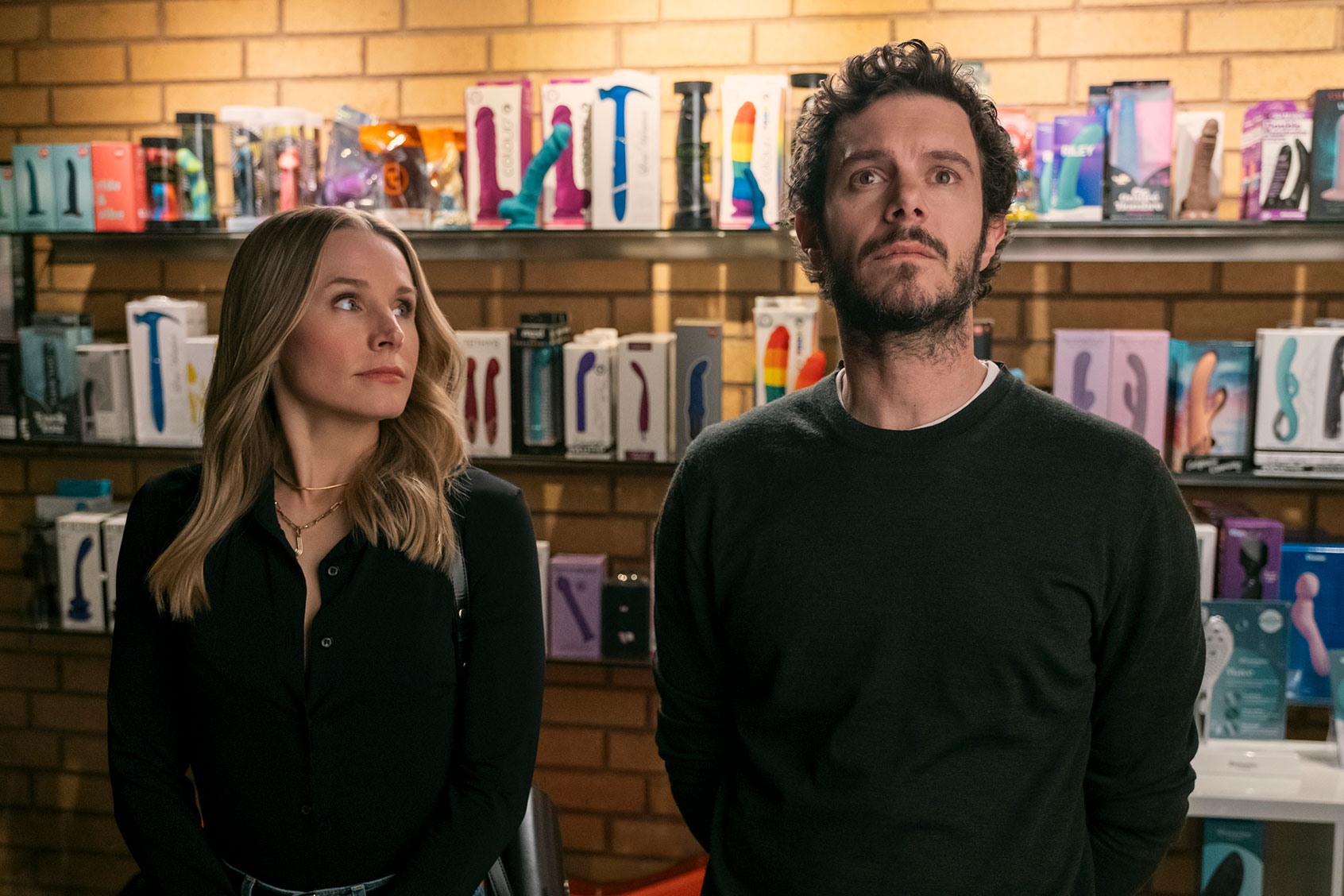
Nobody Wants ThisKristen Bell as Joanne and Adam Brody as Noah in "Nobody Wants This" (Adam Rose/Netflix)Later, as Noah is walking Joanne to her car, the unexplainable ease in their dynamic leads her to admit, "I don't believe in God. Sorry, is that offensive to say to a rabbi?" Noah responds, "You can say anything you want." This is the first time "Nobody Wants This" establishes Noah as an empathetic, nonjudgmental figure in the show for both Joanne and potentially agnostic or non-Jewish viewers. 

But mostly, the moment shows Noah himself isn't perfect either. He so clearly dresses like an LA Silverlake hipster, smokes weed and uses expletives just like everyone else. He knows that too. Noah is self-aware and he plays up "the Torah bad-boy vibe." Despite that — it doesn't negate his faith. When Joanne questions whether Noah's a real rabbi, he says, "I'm all in on this thing. I'm a real rabbi. I swear."

Even his sermon brings a sort of fun, youth pastor energy — reminiscent of my megachurch childhood. Noah boils down the message of a parable about a man who is stranded on a roof during a flood, begging for help from God. He explains there are endless life choices and fear shouldn't dominate our decision making. He says, "Thinking about switching careers? Maybe that's God pushing you. Hesitating about a big decision? That could be God telling you to think twice. Thinking about going all in on crypto? Might not be God. Ask your accountant what they think."

He concludes: "If you think God's plan is supposed to feel like something specific, and you haven't felt it . . . and you wonder if we're all in on some big secret that you aren't in on, let me tell you, you're in on it."

It's a message the show holds dear, even if someone like Noah's more traditional mother, Bina (Tovah Feldshuh) thinks it is a "weird sermon."

We need your help to stay independent

Joanne and Noah's relationship feels like a secret they're both in on, and maybe God too. Despite challenges like bridging family expectations and each other's wants and needs, they never let fear or a lack of understanding of each other be the downfall of their interfaith relationship. 

For one, Noah is willing to be a guide in his religious rituals, which leads to a hilarious episode five where the couple's religious differences get tested at the fault of Noah's own ambitions. When Noah has to fill in for his boss, Rabbi Cohen (Stephen Tobolowsky) at Camp Haverim, a camp for Jewish kids, Joanne joins Noah on the trip. Joanne learns what the word "Shalom" means, which feels a little farfetched in that she's a metropolitan lady, not to mention a podcaster, and should definitely have already known the meaning of the word. Nonetheless, she also learns that the bratty, teenage Gen Alpha girls all thirst over "hot rabbi" Noah. 

As the couple hits the phase in their relationship where they are ready to "DTR," or define the relationship, they hit a snag. Noah begins to hide Joanne from an unexpected Rabbi Cohen, who shows up at the camp and tells Noah he's on the path to becoming head rabbi. Noah broadcasting his relationship with a gentile would put his dreams on hold. This leads to Noah calling Joanne his friend in public when she wants to be introduced as his girlfriend.

A melancholic Joanne leaves camp for an important job meeting with Spotify and in true romcom form — Noah chases after her to apologize. At a restaurant on Shabbat, Joanne begrudges Noah for making her miss her first Shabbat dinner. He then explains the origins of Shabbat, "The candles represent the two temples in Jerusalem that were destroyed, and we light them to remind us that buildings can crumble, but that doesn't matter. What matters is gathering with people we care about, so Shabbat can happen anywhere. It's kinda like a pop-up. So welcome to your first Shabbat dinner." 

It's a sweet moment that acts as a level of education for Joanne and the audience. The moment is spurred by Noah's favorite interpretations of the story of Shabbat. It shows that the couple is carving out their own traditions with ones that Noah holds dear to himself in his personal relationship with faith. Now Joanne can cherish them too.

Further into the show and the evolving relationship between the pair, Brody and Bell bounce off each other's breezy chemistry. But they also showcase the growing tension and dynamic in heterosexual relationships across the U.S. As more men move towards religion, there has been an increase in young women who are self-described as religiously unaffiliated. This compares with 34 percent of men, a survey by the Survey Center on American Life at the American Enterprise Institute found.

"Nobody Wants This" is not the answer to the burgeoning gap between men's and women's religious and political beliefs. In fact, the show highlights the particular stickiness of their specific situation. A dose of reality hits Joanne when Noah tells her she will have to convert for Noah to become head rabbi. Her friend Ryann (D'Arcy Carden) says of the conflict: “Just . . . be Jewish. It’s not like you stand for things.” So Joanne tries, and fails, realizing her conversion would only be for Noah and not herself. Again, in a perfect ending, Noah chooses Joanne over the job.

Some critics have stated their issues with the depiction of the interfaith relationship and its stressed complications. But one thing "Nobody Wants This" and Brody's performance do right is portray a quieter, more insightful understanding of someone's faith. Noah's faith and spirituality are never questioned and his steadfastness reminds us that there is comfort in being sure but, as in Joanne's case, there is also grace in not being sure and questioning it all.


Kamala Harris to appear on chart-topping “Call Her Daddy” podcast

Vice President Kamala Harris will appear on the smash-hit "Call Her Daddy" podcast next week in a conversation with host Alex Cooper surrounding reproductive rights.

“Daddy” was  Spotify’s second-most popular podcast in 2023 (and the runaway favorite among women).  Per The Hill, Harris sat for the interview on Tuesday. 

Cooper was previously weary of bringing her politics onto the podcast. The overturning of Roe v. Wade changed the calculus for the star podcaster, however. In 2022, she produced a documentary-style episode in support of abortion rights, telling the Hollywood Reporter that the issue was too important to ignore.

“I am a white woman of privilege living in Los Angeles, California, and I think I do know a lot of my listeners relate more to me than maybe what I’m showing in this documentary,” Cooper said at the time. “This should affect every single woman in America and it is eventually going to.”

Harris has sat for fewer legacy media interviews than previous presidential nominees, focusing instead on podcasts like Cooper’s. Earlier this week, the vice president  sat down with Matt Barnes and Stephen Jackson on their “All the Smoke” podcast. She isn’t alone in her media strategy to meet young voters where they are.

Trump so far in 2024 has made campaign stops with podcasters Lex Fridman, Logan Paul, and Theo Von, and stewed last month over not getting an invite from genre giant Joe Rogan, whose show topped Spotify end-of-year charts again in 2023.

Harris’s stop to “Call Her Daddy” is indicative of a widening gender gap between herself and Trump. The candidate, who has made reproductive rights a central issue in the campaign, leads female voters by more than 15 points, a recent American University poll shows.

From Cheez-It to Trader Joe’s, what is up with the mini tote bags craze?

It’s a known fact that Trader Joe’s has no shortage of cult-favorite store items. There’s its rendition of Takis, better known as Chili & Lime Flavored Rolled Corn Tortilla Chips. There’s its Two-Buck Chuck, a line of cheap yet robust Charles Shaw brand wines. And there’s its mini tote bag, the latest Trader Joe’s product to go viral across social media.

Back in February, the California-based retailer sent the internet into a frenzy over its limited-edition totes, which are a miniature version of the classic Canvas Bags. Similar to the Stanley Cup craze, Trader Joe’s totes are the “latest mundane item to suddenly become all the rage,” wrote Business Insider’s Emily Stewart. Video footage posted online showed crazed (and relentless) shoppers storming into their local Trader Joe's and hoarding as many bags as possible. In several Trader Joe’s locations, the demand for the totes was so high that store employees had to place limits on how many bags consumers could purchase. Not everyone was lucky enough to get their hands on the lucrative totes as they sold out almost immediately.

Naturally, Trader Joe’s mini tote found its way into the resale market, where eager sellers hiked up the bag's price by hundreds of dollars. The bag, originally priced $2.99 each, went for $999.99, according to a now-defunct listing on eBay. Another old listing showed the bag on sale for a whopping $280. On Instagram, a few Trader Joe’s fans hosted tote bag giveaways for those looking to get their hands on the season’s hottest accessory.

Clearly, consumers still can’t get enough of the mini tote bags because last month, Trader Joe’s relaunched its bags, once again for a limited time only. They are available for the same price and in the same four colors: red, blue, green and yellow.

As of recently, Trader Joe’s isn’t the only food brand to release their own, unique mini totes. Cheez-It, the popular brand of cheese crackers, also hopped on the mini tote bandwagon with its aptly named Mini Cheez-Tote. Per a description for the tote, “The limited-edition Cheez-It® Mini Cheez-Tote is the ultimate fashion staple, blending style and convenience so you can carry your favorite 100% real cheese snack wherever you go."

Cheez-It’s tote is also simple in design. Each bag is made of light-colored canvas with the words “Tote It Cheez-It” embossed on a yellow square that resembles an actual Cheez-It cracker. The totes come with a “perfectly fitting, rare mini box of Cheez-It® crackers — because your favorite snack deserves to travel in style,” according to the brand.

The totes retailed for $7.99 each. They are currently out of stock.

Cheez-It’s tote received five star reviews, albeit from just two customers: “KD” and “Extra Toasty.” They both claimed that the bag is a “MUST HAVE” (yes, in all caps) and “a necessary item.”

“Have you ever wondered what to buy someone who has everything? Well folks, this is the item they don't have. I don't even have it. They never made enough. It's the unicorn of totes. Wanted by thousands but elusive,” Extra Toasty wrote in their review for the tote, which they weren’t able to get in time.

“Want to be the envy of all? Want your friends and coworkers to be jealous? This is the IT item of Fall 2024.”

Following Trader Joe’s success with their mini totes, it’s no surprise why Cheeze-It also tried their hand at launching their own bag, which enjoyed similar successes. Much of the hype behind these mini totes stems from the fact they are hard to attain. The key buzz term used by both Trader Joe’s and Cheeze-It is “limited edition,” which intensifies consumers’ desire to seek out the bags. So much so, that some will even go out of their way to spend hundreds of dollars just to have the bags in their possession.

We need your help to stay independent

The mini totes have also attained a similar social status as luxury items. There’s an unspoken exclusivity factor that comments on who can (and can’t) afford the bags.

"So it’s almost paradoxical that these are utilitarian goods," Josh Clarkson, a professor of marketing at the University of Cincinnati, told The Washington Post. "It has this feel that you are democratizing status in some way. People are taking everyday, relatively accessible items and creating status for them."


Want more great food writing and recipes? Subscribe to Salon Food's newsletter, The Bite.


As for why mini totes — in particular — are all the craze right now, it's because they're aesthetic and unique. The bags aren’t particularly revered for their functionality. Unlike a regular-sized canvas bag, the mini totes won’t be able to hold a week's or month's-long haul of groceries. Instead, they’re revered as a fashion handbag — a fun little accessory. The totes are perfect for everyday use, “whether you’re heading to a game or running errands,” Cheeze-It said of its totes.

On TikTok, several consumers personalized their mini totes with embroidery, drawings and decor. “The Trader Joe’s mini tote is cool and all,” said one creator. “But do you wanna know what’s even better? Embroidered Trader Joe’s tote!” Another altered the Trader Joe’s logo to read “Trader Hoe’s.”

Indeed, there’s a real hunger for mini tote bags. Will other food brands also hop on the trend soon? It certainly wouldn’t be shocking but for now, only time will tell.

“Couldn’t think of anybody more deserving”: Vietnam vet gives Trump his Purple Heart

A Vietnam veteran gifted Donald Trump his Purple Heart on stage at a campaign event on Friday.

The surprise moment came during a Trump rally in Fayetteville, North Carolina. The former Marine, who only gave his first name of Dwight, said he was moved to give Trump his medal after watching him survive an assassination attempt in Butler, Pennsylvania this summer. 

Dwight handed Trump the Purple Heart, which is awarded to U.S. military members who are wounded or killed while serving, after Florida Rep. Anna Paulina Luna read a letter from the veteran.

“Dear President Trump, watching you during the Butler rally, and you getting back up, both my wife and I gave a sigh of relief as well as a few tears,” he wrote. “I would be honored if you would accept this small token I received as a young Marine in Vietnam.”

Dwight added that he thought the award was "appropriate" as Trump was wounded by a bullet fired by would-be assassin Thomas Matthew Crooks. Trump is returning to Butler this weekend for another rally. 

At the Fayetteville town hall, the former president joked that it looked like Dwight was handing him money. He had placed his medal in a white envelope. 

"Looks like a check,”Trump joked. “It’s cash."

On stage, Dwight told Trump that he "couldn't think of anyone more deserving" of the medal and recalled being inspired by his reaction in the moment. 

“You took it. You laid down there. You got back. And the first words out of your mouth was ‘fight, fight, fight,’” Dwight said, noting that it took "guts" to stand back up without a weapon.  

Trump said he was "very lucky" and reiterated a recent claim that a higher power kept him alive

"Maybe it wasn’t so much luck. Maybe it is something else, right?" he said. "Maybe there’s something else up there.” 

Toxic chemicals from Ohio train derailment lingered in buildings for months

On Feb. 3, 2023, a train carrying chemicals jumped the tracks in East Palestine, Ohio, rupturing railcars filled with hazardous materials and fueling chemical fires at the foothills of the Appalachian Mountains.

The disaster drew global attention as the governors of Ohio and Pennsylvania urged evacuations for a mile around the site. Flames and smoke billowed from burning chemicals, and an acrid odor radiated from the derailment area as chemicals entered the air and spilled into a nearby creek.

Three days later, at the urging of the rail company, Norfolk Southern, about 1 million pounds of vinyl chloride, a chemical that can be toxic to humans at high doses, was released from the damaged train cars and set aflame.

Federal investigators later concluded that the open burn and the black mushroom cloud it produced were unnecessary, but it was too late. Railcar chemicals spread into Ohio and Pennsylvania.

As an environmental engineers, I and my colleagues are often asked to assist with public health decisions after disasters by government agencies and communities. After the evacuation order was lifted, community members asked for help.

In a new study, we describe the contamination we found, along with problems with the response and cleanup that, in some cases, increased the chances that people would be exposed to hazardous chemicals. It offers important lessons to better protect communities in the future.

How chemicals get into homes and water

When large amounts of chemicals are released into the environment, the air can become toxic. Chemicals can also wash into waterways and seep into the ground, contaminating groundwater and wells. Some chemicals can travel below ground into nearby buildings and make the indoor air unsafe.

A map of several states shows the wreck site on the Ohio-Pennsylvania line, with the highest likelihood of chemical concentrations there, but chemicals likely still wafting over Pennsylvania, New York and other states.

A computer model shows how chemicals from the train may have spread, given wind patterns. The star on the Ohio-Pennsylvania line is the site of the derailment. Click the image for a larger version. Andrew Whelton/Purdue University, CC BY-ND

Air pollution can find its way into buildings through cracks, windows, doors and other portals. Once inside, the chemicals can penetrate home items like carpets, drapes, furniture, counters and clothing. When the air is stirred up, those chemicals can be released again.

Evacuation order lifted, but buildings were contaminated

Three weeks after the derailment, we began investigating the safety of the area near 17 buildings in Ohio and Pennsylvania. The highest concentration of air pollution occurred in the 1-mile evacuation zone and a shelter-in-place band another mile beyond that. But the chemical plume also traveled outside these areas.

In and outside East Palestine, evidence indicated that chemicals from the railcars had entered buildings. Many residents complained about headaches, rashes and other health symptoms after reentering the buildings.

A photo of a document shows the discrepancy between people smelling chemicals and their hand-held detectors, which did not detect chemicals.

A rail company contractor air testing report dated 11 days after the derailment noted a ‘strong odor’ but said the handheld air testing device did not detect chemicals. Andrew Whelton/Purdue University, CC BY-ND

At one building 0.2 miles away from the derailment site, the indoor air was still contaminated more than four months later.

Nine days after the derailment, sophisticated air testing by a business owner showed the building’s indoor air was contaminated with butyl acrylate and other chemicals carried by the railcars. Butyl acrylate was found above the two-week exposure level, a level at which measures should be taken to protect human health.

When rail company contractors visited the building 11 days after the wreck, their team left after just 10 minutes. They reported an “overwhelming/unpleasent odor” even though their government-approved handheld air pollution detectors detected no chemicals. This building was located directly above Sulphur Run creek, which had been heavily contaminated by the spill. Chemicals likely entered from the initial smoke plumes and also rose from the creek into the building.

Our tests weeks later revealed that railcar chemicals had even penetrated the business’s silicone wristband products on its shelves. We also detected several other chemicals that may have been associated with the spill.

Weeks after the derailment, government officials discovered that air in the East Palestine Municipal Building, about 0.7 miles away from the derailment site, was also contaminated. Airborne chemicals had entered that building through an open drain pipe from Sulphur Run.

More than a month after the evacuation order was lifted, the Ohio Environmental Protection Agency acknowledged that multiple buildings in East Palestine were being contaminated as contractors cleaned contaminated culverts under and alongside buildings. Chemicals were entering the buildings.

Contaminated water can cause contaminated air

The creek that flowed through town became heavily contaminated by the spill. More than 43,000 fish died downstream, and chemicals traveled 270 miles (435 kilometers) down the Ohio River.

As tainted water flowed downstream, light chemicals like butyl acrylate naturally left the creek and entered the air by a process called volatilization.

A creek with a device shooting water into the air by injecting air into the water.

Equipment installed at various points along contaminated creeks to aerate the water ended up releasing chemicals into the air. Andrew Whelton/Purdue University, CC BY-ND

Unnaturally however, the equipment used for cleaning the creeks also transferred chemicals from the water into the air. Residents near aeration equipment, which injects air into water, in part to help fish survive, complained of odors entering their homes and experiencing health problems. Our study shows the chemicals in the air may have been up to 2 to 25 times higher near these aerators.

Over the four-month study period, rain and the actions of contractors increasing and decreasing water flow also stirred up the creeks, releasing more chemicals into the air.

Steps to protect public health in future disasters

As with past disasters, what happened in East Palestine offers many lessons for communities.

One of the most important is for communities to demand an exposure pathway diagram immediately after a chemical incident occurs. An illustration can help the community recognize potential threats, whether from the air or from culverts beneath their buildings, and see where testing and guidance are needed.

A diagram shows how chemicals in water and the air can get into homes and buildings.

A diagram illustrates chemical exposure pathways in East Palestine. Visualizing these risks can help residents and communities figure out how to respond. Click image to expand. Andrew Whelton/Purdue University, CC BY-ND

Monitoring the health of people exposed to the chemicals is also crucial. Because so many people became ill in and around East Palestine, and because testing overseen by government agencies did not pinpoint the exact conditions responsible for the illnesses, we recommend long-term medical monitoring for those affected.

People closest to the disaster site – those who lived in, worked in or visited buildings that became contaminated – likely experienced the greatest exposures. Railroad workers, government workers, cleanup workers, visitors and residents in Ohio and Pennsylvania were among those reporting health problems. Norfolk Southern and one contractor were cited for failing to protect workers from exposure.

Indoor building contamination can be a long-term problem. Just like with wildfire smoke, affected buildings need to be professionally cleaned because the chemicals can remain for months.

Building exteriors also need to be decontaminated. Chemicals may continue to release from surfaces into the air.

A close-up of a stick in a creek shows the rainbow-colored sheen from chemicals

A sheen from the chemical spill was still evident on a creek in East Palestine on March 24, 2024, more than a month after the derailment. Andrew Whelton/Purdue University, CC BY-ND

There is also a need for better methods and evidence-based policies to rapidly identify chemical exposures. The U.S. Environmental Protection Agency, months after approving the use of handheld air testing devices to screen homes, determined that those chemical detectors could not have reliably alerted to butyl acrylate at all levels that can cause health problems. Not all the chemicals spilled were monitored for in buildings.

For complex disasters, we recommend calling in experts from outside the responding agencies and companies involved to provide the needed specialized expertise.The Conversation

Andrew J. Whelton, Professor of Civil, Environmental and Ecological Engineering, Purdue University

This article is republished from The Conversation under a Creative Commons license. Read the original article.
Independent bookstores see post-pandemic bump

When the Covid-19 pandemic first hit, supply chains around the world were instantly disrupted. The drop in supply correlated with price increases, resulting in higher-than-average inflation.

Even now, four years after the start of the pandemic, consumers are still reeling from high grocery, housing and insurance costs. Many are turning to credit cards to pay for expenses and slashing discretionary spending on items like vacations, restaurants and more.

Despite people tightening their purse strings, one place seems to have thrived during Covid: the independent bookstore.

Rising numbers

Research shows there has been a sharp increase in the number of independent booksellers, even though monoliths like Amazon still reign supreme. In my own city of Indianapolis, I can think of five independent bookstores that weren't here before Covid.

“The pandemic was incredibly tough for many small businesses but also helped kickstart lots of folks reading more again, so many of us ‘rediscovered’ reading,” said Jake Budler, who owns Tomorrow Bookstore in Indianapolis with his wife, Julia Breakey. 

My hometown isn’t an outlier. In fact, the number of independent bookstores has grown by 200 from 2022 to 2023 and the number has more than doubled between 2016 and 2023.  Also, the American Booksellers Association said that online sales for independent bookstores have seen a 500% increase since 2020

We need your help to stay independent

Bookstores are often seen as a place for people to support certain policies. As some schools have pushed to ban certain books, local bookstores have stepped up to act as a safe refuge for those books. There’s even a bookstore in my city that focuses on banned books.

“I think in order to successfully run a brick and mortar space anymore, you really have to distill down to what your identity is,” said Irvington Vinyl & Books owner Elysia Smith. “You can't be a bookstore for everyone because inventory costs so much.”

Smith's bookstore, which also includes a large vinyl record selection, focuses on used books,as well as the LGBTQ+ community. Across the country, many other bookstores focus on niche communities, like Yu and Me Books in Manhattan that focuses on books about and for immigrants and people of color.

Some of the surge in popularity for local bookstores may be due to social media trends, like #bookTok, a hashtag on TikTok where people shout out their favorite books. Also, when series like ACOTAR become popular on social media, it can spark a bigger reading trend. Romance novels have also gotten a huge push recently, and many local bookstores focus on that genre to attract avid consumers.

Online sales thriving

The good news is that nowadays you don’t have to shop in person to support your local bookstore. Sites like Bookshop.org let you shop online and get books delivered to your door, with a portion of the proceeds supporting local bookstores. Plus, if you designate a specific store they’ll receive the profits. The revenue is not as much as if you shopped from them directly, but it’s more than they would get if you went through Amazon instead.

“Their margin is worse, but their reach is greater,” Smith said. “So it's one of those things where you just have to figure out how to weigh the value of your time appropriately and use it within your means.”

Many local bookstores have also become community spaces, offering a free place to read, work, hang out or do homework. Some have their own free book clubs. In a time in which the decline of the third space is being rapidly observed, bookstores can fill that void.

“There is a broader trend of folks shopping local, independent and small – we are realizing how important that is for our communities and quality of life,” Budler said. “Bookstores are a high point within that trend – they are spaces that are literary, educational and fun – and also spaces for community.”


Donald Trump wants to dismantle the Department of Education. Some professors would welcome it

Donald Trump has never made a secret of his antipathy to higher education, but scapegoating the academy has become a central preoccupation of his second presidential run. His running mate, JD Vance, has openly declared that universities are the enemy and championed an aggressive attack on them. Agenda 47, Trump’s collection of policy proposals, includes a pledge to protect students from the “radical left and Marxist maniacs infecting educational institutions.” This contempt for higher education is a powerful rallying cry in their larger rightwing populist campaign.

If Trump takes the White House in November his administration could abolish the Department of Education, as called for by Project 2025; levy fines on universities and use them to fund an online university called American Academy; replace college accreditors as part of their crusade against the “radical left;” roll back diversity, equity, and inclusion efforts; and implement a host of other disastrous measures.

While many academics have sounded the alarm about Trump’s plans to gut academia, Trump is not without supporters in higher education. I have studied 198 leading conservative professors and found that 109 support Trump: “academic Trumpists.” These are professors who advocated and voted for Trump in 2016, supported his administration despite all its turmoil, and challenged the legitimacy of Biden's win in 2020. A few even supported the January 6, 2021 assault on the Capitol. They are overwhelmingly white, male and tenured. Some, like Marshall DeRosa, Professor of Political Science at Florida Atlantic University, express their support in blunt terms. In 2016 he said, “I’m looking forward to voting for Trump, because I see him as a wrecking ball and I want to see those sons of bitches squeal in Washington, to be quite frank.” Trump now gives every indication that he will take his wrecking ball to higher education and, if he does, he’ll find some professors there to welcome him. 

We need your help to stay independent

The most influential academic Trumpists include Victor Davis Hanson, fellow at the Hoover Institution and Hillsdale College, regular Fox News contributor, and whose book The Case for Trump was briefly on the New York Times best seller list; John Eastman, former professor at Chapman University School of Law, who spoke at Trump’s January 6, 2021 rally and presided over the legal rationale for Trump to believe he could obstruct the Congressional certification of Biden’s electoral victory; Peter Navarro, formerly at the University of California-Irvine, who as Trump’s White House economic advisor, advocated a trade war with China and claimed that it was “statistically impossible” for Trump to have lost the 2020 election. (Navarro was convicted on two counts of contempt of Congress and served prison time). 

Not surprising, many academic Trumpists bemoan what they see as a stifling liberal campus culture. For Mark Bauerlein, retired from Emory University, academics are caught in a bind that only Trump can break: “bow down to diversity or risk your academic career.” Only Trump will fight against “identity politics [that] have overtaken scholarly standards.” In Out of Order: Affirmative Action and the Crisis of Liberalism, Nicholas Capaldi of George Mason University calls political correctness doctrinaire liberalism.”

They participate in and benefit from a vast conservative network beyond the academy. Three-fourths of the academic Trumpists affiliate with prominent conservative and powerful think tanks, such as the Heritage Foundation, the Claremont Institute, the Heartland Institute, the Ludwig Von Mises Institute, the Independent Institute, and the Federalist Society. A few Trumpists affiliate with smaller neo-Confederate think tanks such as the League of the South, the Abbeville Institute, and Stephen D. Lee Institute, which embrace white nationalism. The Claremont Institute stands out as the network hub. Eighteen of the academic Trumpists affiliated with the institute also have ties to 32 other conservative think tanks. There is no similar clustering of anti-Trumpist conservative professors around such right-wing centers.


Want a daily wrap-up of all the news and commentary Salon has to offer? Subscribe to our morning newsletter, Crash Course.


Despite the spectacular controversies surrounding the Trump White House only eight of the 109 Trumpists have rescinded their support since the 2016 election. Fourteen — notably John Eastman — joined Trump in claiming that the election was stolen from him by voter fraud.

In a polarized political environment, it can be easy to forget that political camps are not monolithic. To be a conservative is not necessarily to champion Trump. Conservative professors who don’t support Trump include Harvard government professor Harvey Mansfield who considers Trump a “demagogue.” Robert P. George, at Princeton University, “fiercely opposed” Trump the candidate, saying he was “a person of poor character.” Jon A. Shields at Claremont McKenna College, said “I wouldn’t vote for Trump under any condition.” 

Right-wing populism—the kind that Trump evokes when he condemns higher education as a bastion of sinister elites—is the key dividing line. The academic Trumpists support it, the anti-Trumpists professors do not. In their book, Passing on the Right, Jon Shields and Joshua Dunn noted that “conservative professors…look askance at the populism that has shaken up the Republican Party in recent years.”

It is these conservative professors who liberal academics must unite with to stand against Trump’s increasingly strident attacks on academia. Our political differences may be vast, but we agree on the value of higher education and understand that to lose it would be devastating for generations of Americans to come. 

“She has an easier path to 270”: Experts disagree on who has the “advantage” 30 days before election

One month out from Election Day, Vice President Kamala Harris and former President Donald Trump are locked in a dead heat while the Democratic and Republican Parties face one of the closest races for control of Congress in recent memory.

FiveThirtyEight’s polling average has Harris and Trump within a single point of each other in Pennsylvania, North Carolina and Nevada. No candidate leads in the average for any of the other swing-states by more than two points, with Trump leading in Georgia and Arizona by 1.3 points and 1.2 points respectively and Harris leading by 1.6 points in both Wisconsin and Michigan.

“I really do think both the presidency and the House are effectively 50-50 propositions," Kyle Kondik, managing editor of Sabato’s Crystal Ball at the University of Virginia Center for Politics, told Salon.

“One striking thing is that while the campaign will be raging, the schedule is clear—no debates are scheduled, for instance,” Kondik added. “Maybe there will be one, but to the extent there are dramatic new developments, they will have to develop organically as opposed to happening during a debate or some other event.”

Logan Phillips, the founder Race to the WH — one of the most accurate forecasters in 2022 — described the presidential race as “incredibly close” but with Harris enjoying a small advantage. The advantage, in Phillips’ assessment, comes down to Harris’ relatively strong position in Wisconsin and Michigan.

“She has an easier path to 270 and while the polls have gotten a little closer there’s a lot of swing voters eager for something new,” Phillips told Salon.

Phillips also noted that Democrats still suffer a structural disadvantage in the Electoral College, though probably not as large as in years past. In recent years, Democrats have shed some support in New York and California while simultaneously gaining support in more competitive states, like North Carolina. This means Harris will still likely need a national lead to win in the Electoral College, but not as big of a lead as Democrats needed in 2020, for example.

Phillips expects the final 30 days before the election to be defined by perceptions of Harris, saying that the race could hinge on the Harris campaign’s “ability to define herself versus Trump’s ability to define her.”

Harris’ campaign is also attempting to craft perceptions of the vice president in the final stretch of the race, specifically to attempt to capture the votes of Republicans disillusioned with Trump. Their strategy is exemplified in the recent event Harris had with former Rep. Liz Cheney, R- WY, the daughter of former Vice President Dick Cheney.

"We may disagree on some things, but we are bound together by the one thing that matters to us as Americans more than any other, and that's our duty to our Constitution and our belief in the miracle and the blessing of this incredible nation," Cheney said at an event with Harris Thursday in Wisconsin.

Political strategist John Conway, who works for Republican Voters Against Trump, told Salon he sees this as a winning strategy

“These are going to be razor-thin margins and the winning margins for Kamala Harris are going to be center-right voters,” Conway said. “We do focus groups every week with these center-right swing voters and we’ve seen that the bottom was falling out after the debate with Joe Biden. Harris reassembled the Democratic coalition and for these center-right swing voters who are on the fence they've been willing to hear her out.”

Other political strategists have indicated that at the same time Harris is appealing to Republicans she has been losing support among younger voters and Latinos, two core parts of the Democratic base.

Conway said that he thought that Democratic partisans would still come out on Election Day, owing to the fact that Trump is on the ballot and that the best thing that could happen over the next month would be for voters to see a lot of both Trump and Harris.

“The more voters see Donald Trump the less they like him and the more voters see of Kamala Harris the more they like her,” Conway said. “I think it’s the right strategy for Kamala Harris to persuade these center-right swing voters and I think it’s a false choice to say the campaign will hurt Democratic turnout.”

We need your help to stay independent

In terms of the battle for the Senate, Democrats are holding out fairly well despite the fact that they are defending five seats in Nevada, Pennsylvania, Wisconsin, Ohio and Montana and running candidates in two swing states: Arizona and Michigan.

In the battleground seats Democrats are defending, they consistently lead in polling in Nevada, Pennsylvania and Wisconsin and Sen. Sherrod Brown leads in most polls of Ohio. In Arizona polls, Rep. Ruben Gallego, D-Ariz., leads Republican challenger Kari Lake in almost every public poll by a healthy margin. In most public polls of Michigan, Democratic Rep. Elissa Slotkin, leads Republican Rep. Mike Rogers.

Despite the favorable polling in these battlegrounds, Kondik said that Republicans are favored “thanks in large part to a favorable set of targets” adding that ”they seem to be in good shape to get at least 51 seats and could go higher than that.”

Essentially, Republicans need only to hold onto their seats and win in the one battleground Senate race where Democrats are trailing: Montana. Sen. Jon Tester, D-Montana, has trailed Republican challenger Tim Sheehy since around mid-August. Combined with the fact Senator Joe Manchin, D-W.Va., is retiring, this alone could deliver the Senate to Republicans. Notably, if Republicans win the White House and only flip the West Virginia seat, they would also end up in control of the Senate due the to vice president’s tie-breaking role as president of the Senate.

There are a few wildcard Senate races where Democrats might be able to pull out a win, like Texas and Florida. Recent ActiVote polling of Texas found Rep. Collin Allred, D-Texas, just five points behind Sen. Ted Cruz, R-Texas, and other surveys have found an even smaller lead for Cruz. In Florida, Sen. Rick Scott, R-Fla., leads by just 4.2 points and the race has steadily tightened since the beginning of August.

Phillips told Salon that the Senate is where his model diverges from many others. He agreed with Kondik on the GOP’s advantage in terms of the Senate map, but noted that “Democrats seem to have a real candidate recruitment advantage,” a factor noted by Sen, Gary Peters, D-Mich., who is the chair of the Democratic Senatorial Campaign Committee.


Want a daily wrap-up of all the news and commentary Salon has to offer? Subscribe to our morning newsletter, Crash Course.


Democrats currently enjoy a two-point lead in FiveThirtyEight’s generic ballot polling of the House, leading Republicans 47% to 45%. Democrats, however, were disadvantaged in redistricting ahead of the 2024 cycle, with a Brennan Center analysis finding that the current maps have 16 fewer districts that President Joe Biden would’ve won in 2020 with the bulk of the losses coming in Texas and Florida. 

Democrats, in shedding some support in New York and California, might have a harder time retaking battleground House districts in both states in 2024.

Democrats do, however, have more target seats this year. Race for the WH identified around 23 “prime targets” and 21 “stretch targets" for Democrats, with prime targets being seats Democrats might easily flip and stretch targets representing potential pickups in a favorable election year. While seats in New York and California have received a lot of attention, these target seats are also scattered across the country including in states like Iowa, Colorado, Louisiana, Alabama, Washington and Oregon.

Republicans have 14 prime targets and 31 stretch targets and their map of targets is more scattered across the country, with some notable districts in Michigan, Maryland, Virginia, Maine and Pennsylvania.

CDC warns of online pharmacies selling fake drugs tainted with fentanyl

This week, the Centers for Disease Control and Prevention (CDC) issued a public health warning about prescription medications sold by online pharmacies. The public health agency said some online pharmacies could be selling prescription drugs tainted with the potent opioid fentanyl, which can be deadly.

In September, the U.S. Department of Justice (DOJ) announced an indictment against people managing illegal online pharmacies. According to the DOJ, these individuals are advertising, selling, manufacturing and shipping millions of unregulated counterfeit prescription pills to tens of thousands of Americans. These counterfeit medicines usually contain fentanyl, which means people who take these drugs could be at risk of an overdose. 

“The proliferation of fake online pharmacies is fueling this nation’s fentanyl epidemic,” U.S. Attorney Damian Williams said in a press release about the indictment. “At least nine victims who purchased counterfeit pills from the defendants died of narcotics poisoning, including a 45-year-old army veteran who thought she was purchasing real oxycodone.”

The CDC recommends when purchasing from an online pharmacy to make sure it has a U.S. state licensed by the FDA (which consumers can check here). Signs that you’re purchasing a medication from an online pharmacy include not requiring a doctor’s prescription, they lack a licensed pharmacist to answer your questions, and they offer big discounts that seem too good to be true. The CDC also recommends having naloxone on hand, a drug that can reverse opioid overdose, and to call 911 if an overdose occurs.

Drug overdose deaths may be decreasing — but not for everyone

Late last month, news outlets reported that drug overdose deaths across the country were "falling fast," in a “promising” trend that is “saving thousands of lives — But many people working on the ground in harm reduction spaces say the national trend does not align with what they are seeing as they continue to watch people who use drugs in their community die at alarming rates.

In Ashland County, Wisconsin, for example, there were more overdose fatalities in the first half of 2024 than there were in all of 2023, and the majority of people who died were American Indian Alaska Natives, said Philomena Kebec, economic development coordinator for the Bad River Tribe.

“I think we need to celebrate the reduction in overall fatality but it has to be couched within this qualification that some racial groups are not experiencing a decrease in overdoses,” Kebec told Salon in a phone interview. “In fact, we've been seeing an increase in overdose fatality rates, and we're also really hobbled by the data lag in getting this information.”

"There has not been a decrease of this magnitude since I started looking at these data from the mid-1990s."

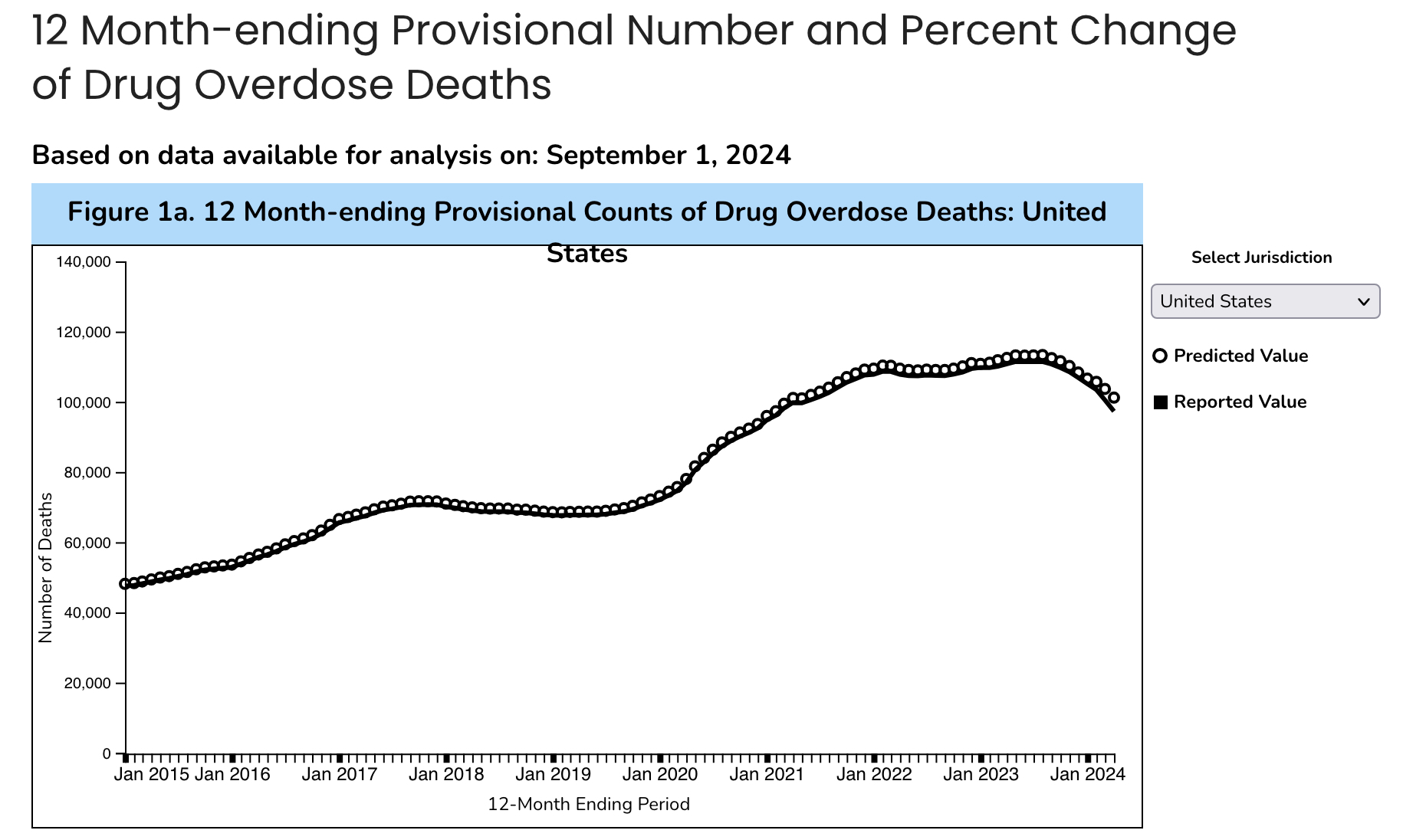
Provisional data released by the Centers for Disease Control and Prevention (CDC) show that overdose deaths declined nationally by about 10% between April 2023 and April 2024. Another analysis confirmed this decline, performed by researchers at the Street Drug Analysis Lab at the University of North Carolina at Chapel Hill, synthesizing emergency room visits and ambulance runs along with public health data. They also found that non-fatal overdoses were decreasing by an even greater rate of between 15 and 20% over the same time period. Interestingly, the decline seems to be spreading from east to west.

“There has not been a decrease of this magnitude since I started looking at these data from the mid-1990s,” said Dr. Nabarun Dasgupta, a drug policy researcher at the University of North Carolina who performed the analysis. “There was a year or two where it leveled off right before the pandemic, and we were hopeful, but then it went way, way up after that.”

Drug overdose death statistics from Jan. 2015 to Jan 2024. (Centers for Disease Control and Prevention)Theories on what could explain this unprecedented decline abound, but no one knows exactly what is causing it yet. As more people mix drugs like xylazine with synthetic opioids, their exposure to deadly doses of fentanyl could be reduced. Others attribute the decrease to the increased availability of naloxone and medication-assisted treatment like buprenorphine used to treat opioid use disorder. Still others think the trend is likely caused by changes in the drug supply itself.

Or, it could be that we have reached a sad point in the overdose crisis where the number of people who are susceptible to dying from drug use has reached its peak and the number of people impacted is simply starting to recede, said Dr. Daniel Ciccarone, a substance use researcher at the University of California, San Francisco.

“[The number of people using drugs] is not growing, it's not expanding, it is dying,” Ciccarone told Salon in a phone interview. “The cohort is both going through treatment and through death, making it smaller over time, and that's led to a small enough population that it looks like deaths are going down.”


Want more health and science stories in your inbox? Subscribe to Salon's weekly newsletter Lab Notes.


Harm reduction workers say each life lost to an overdose is preventable, which would hold true for the estimated 101,168 people who died from an overdose last year. Some are calling for more granular data analyses to get a clearer picture of who is being “saved” from whatever change is causing this decline — and who is being left behind.

Since 2021, overdose deaths showed signs of plateauing or declining overall in national data, but they continued to rise in Native American, Black and Hispanic communities. American Indian and Alaska Native populations had the highest fatal overdose rates in both 2020 and 2021, increasing by 33% between those years. While analyses of overdose trends by race for the 2023-2024 year have yet to be performed on the national level, it’s unlikely such stark upward trends would suddenly drop.

Some state data has begun to illuminate the racial disparities buried within the CDC data. In Maryland, the decline in overdose deaths in the past year occurred almost entirely among white people, whereas the number of overdose deaths among Black people rose during this time period. In North Carolina, Philadelphia, Massachusetts and Tennessee, among other states plus Washington, D.C, deaths similarly declined for white people and continued to rise among Black people. Dr. Nora Volkow, the director of the National Institute on Drug Abuse, has acknowledged this discrepancy.

“It’s also important to acknowledge that progress has not been equal for all groups,” Volkow told The Guardian earlier this week. “Unfortunately, for the most affected groups, namely Native Americans and Black American men, the death rates are not decreasing and are at the highest recorded levels.” 

“In Black communities across this country, the diminishing death rates are not the story,” said Tracie Gardner, co-director of the National Black Harm Reduction Network. “What the numbers don't show are what I would say are the policy realities and the narratives of the communities that have been the hardest hit.”

The reasons behind these disparities are rooted in the origins of the overdose crisis, when illegal substances were planted in Black and brown communities to increase incarceration rates. The drug supply changed over time, and the number of people using drugs increased to include higher numbers of white people, some of whom became addicted to prescription opioids and other drugs.

Harm reduction programs and a federal response to curb the overdose epidemic — which has killed more than one million people since 1999  — were enacted. However, many of these interventions failed to reach the Black, Indigenous and Hispanic communities that were most impacted, said Ricky Bluthenthal, the associate dean for Social Justice at the University of Southern California.

“It's been the case in the entire ‘War on Drugs,’ where the response to substance use disorder among Latino and Black folks has often been to put them in jail, and jail is not where people recover from substance use,” Bluthenthal told Salon in a phone interview.

Harm reduction originated in the movement to increase treatment access for gay men with HIV, Bluthenthal added, but many of these programs were not created with Black, Indigenous and Latino populations specifically in mind.

“I was one of two or three African-American people running the needle exchange program in the United States [in 1991], there were some Latinos, and the other folks were mostly white,” Bluthenthal said. “That reflects where the money was to support those kinds of activities … and we're still trying to overcome that.”

The consequences of a racialized response to the overdose crisis along with the crisis being fundamentally rooted in a racist initiative, is playing out in the fatal overdose disparities we see today. Bluthenthal coauthored a 2021 study in the journal Drug and Alcohol Dependence, finding that Black and Latino populations in Los Angeles and San Francisco were less likely to have access to naloxone, the life-saving opioid overdose reversal medication. Across several studies, Black, Latino and Indigenous people who use drugs have been shown to have limited access to medications for opioid use disorder, driven in part by healthcare providers’ implicit bias and users’ distrust of the medical system.

Many Black communities might have reduced access to methadone clinics because they have police officers stationed outside, and Black people are disproportionately charged and criminalized for drug possession. Depending on their location, certain harm reduction services might be available in only English, which could discourage Spanish-speaking Latino people who use drugs from seeking care.

We need your help to stay independent

Kebec, of the Bad River Tribe, noted that Wisconsin invested in distributing naloxone boxes in 43 locations across the state, but the supply wasn’t accompanied with any sort of funds for educational materials teaching people how to use it. This is one example of how, even when resources are granted, they are not designed to maximize effectiveness in Indigenous and Black communities, she said. 

As a result, her community has continued to see rising overdose deaths among these two groups. One tribal member earlier this year died from a fatal overdose within county jail.

“There are so many disconnects and a lack of accountability for really protecting the lives of Indigenous and Black people in this state,” Kebec said. “It’s this colonial dynamic where they have created a problem and then are just leaving these under-resourced communities to deal with it on their own.”

“What should I do with this pain?”: Israelis, Palestinians try to move forward

With the first anniversary of the Oct. 7 Hamas attack on Israel approaching, the death toll in Gaza climbing to more than 41,500, and Israel inflicting ever more extreme violence on the West Bank and now on Lebanon as well, something very different happened recently in a poky classroom at Columbia University. Two young men, one Palestinian and one Israeli, both of whom had lost people they deeply loved to the conflict, came to speak not about fear and anger, revenge or oppression, but about reconciliation, friendship and peace.

One of them was Arab Aramin, a 30-year-old Palestinian from Jerusalem whose little sister, Abir, had been shot and killed in front of her school by an Israeli soldier. She was 10 years old.

The other was Yonatan Zeigen, a 36-year-old Israeli who grew up on the Kibbutz Be’eri near the Gaza border, where his mother, the renowned peace activist Vivian Silver, was killed by Hamas on Oct. 7, 2023.

Both men are fathers, both thin and lightly bearded, and both are members of the Parents Circle, a joint Israeli-Palestinian organization of 750 bereaved people working together to end the cycle of revenge that has so scarred their lives. They and other members of the group were touring New York and the Boston area to introduce the Parents Circle and its philosophy to Americans.

Moving from anger to empathy

I went to hear the men speak when they were at Columbia and was surprised to find them tucked away in one of the most remote corners of the university, in perhaps the smallest classroom I’ve seen in all my decades teaching there. It seemed chillingly symbolic that a group carrying a message of reconciliation in this time of extreme violence and conflict should be relegated to such a hidden and shabby spot.

The visitors began by asking us, the audience of about 20 people, to introduce ourselves. Among us were several Israelis, a few Palestinians, a Jewish law student from Iran and other students and teachers from a variety of departments around the university, including political science, Middle East studies and, in my case, the Graduate School of Journalism. One man startled us by saying he was a Palestinian who lived in Ireland and had once fought with and killed people for the Irish Republican Army but is now devoted to promoting peace. Like the rest of us, he had come to hear how the speakers had moved from grief and anger to promoting reconciliation and empathy.

“Peace became irrelevant”

After the introductions, Zeigen and Aramin, each squashed into one of the old wooden desk chairs cluttering the room, opened by telling their own stories with striking honesty, for it is impossible to talk about reconciliation in a land mired in conflict without also bringing up heartbreak, history and hate. Zeigen, who wears his hair shorn tight to his head, emphasizing his finely boned face and huge brown eyes, began by describing his mother. “She was a feminist, a peace activist — she devoted her life to that,” he said, his voice instantly sad. “I grew up knowing lots of Palestinians because of her work. She would take us into Gaza to meet her friends. But I knew my Israeli peers did not experience this because of the divisions between our peoples.”

It is impossible to talk about reconciliation in a land mired in conflict without also bringing up heartbreak, history and hate.

Once he was grown, Zeigen became an activist himself, soon moving to Haifa to study law, thinking that would be the best way to help forge peace. But after he married and became a father, while no progress was being made between Israelis and Palestinians, he began to give up. “Peace became irrelevant and I fell into a political coma,” he told us.

He switched from law to social work and had two more children. “I tried to hold onto the fantasy that I could live a normal life.” He did not wake from that political coma until Oct. 7, when his wife told him what was happening. He called his mother at the kibbutz while it was under attack.

“We decided to say goodbye”

“We talked through the morning about how the once celebrated Israeli Army was not coming, a dual experience of knowing something was happening but being unable to understand it, to grasp the scope.” Then he heard shots and screaming through the telephone. “They are in the house,” his mother told him.

“I asked her, what should we do? Keep talking or say goodbye? We decided to say goodbye.” He paused, then told the audience, “I was lucky.” He gestured to two other members of the Parents Circle sitting nearby, Layla Alshekh, a Palestinian, and Robi Damelin, an Israeli, both mothers who lost children to the conflict. “Most of us do not get to say goodbye.”

Zeigen’s own mother was killed in the safe room of her house that day, but he was unable to find out her fate for a long time because the house had been burned down. At one point, she was considered a hostage, then her bones were found and identified and he knew for sure.

“I sat down and said, ‘What now? What should I do with this pain and helplessness? What should all of us do?’ I realized my illusion of safety was gone. That we all need to shape an alternative reality where no one should pay this price. Otherwise, it will happen again and again.”

“We are not weak people who kill”

Aramin, who also wears his hair cut short and has huge brown eyes, spoke next, telling the rapt audience that he was only 13 when his sister died. She had just bought some candy and was standing outside her school when an Israeli border guard shot her with a rubber bullet and killed her.

We need your help to stay independent

“She was everything to me, my second mother, even though she was younger, because I was just a stupid, naughty boy,” he said with a sad but wry smile. “I kept going into her room to find her before I remembered she was not there. All I could think about was taking revenge. But I had no gun, so I lied to my parents, stopped going to school and went to the checkpoint instead to throw stones at Israeli soldiers.”

Luckily for him, a friend of his father saw what he was doing and reported him to his parents. His father sat him down and told him it was time to have a talk.

Aramin’s father, Bassam Aramin, had himself been arrested for throwing stones at Israeli soldiers when he was 16, and served seven years in an Israeli jail for his actions. But whenever Aramin asked his father how he had been treated in prison, Bassam refused to answer. A founder of Combatants for Peace, which describes itself as “an organization of former Israeli and Palestinian combatants leading a non-violent struggle against the occupation,” and a member of the Parents Circle himself, Bassam only wanted to talk about peace.

“Abir’s murder could have led me down the easy path of hatred and vengeance,” he wrote in an autobiographical essay, “but for me there was no return from dialogue and non-violence. After all, it was one Israeli soldier who shot my daughter, but one hundred former Israeli soldiers who built a garden in her name at the school where she was murdered.”

“My father is my hero,” Aramin told us. “When I said I wanted to kill the soldiers who killed my sister, he told me, ‘We are not weak people who kill. We have strength in other ways.’ But I still needed revenge. So, he said, ‘I understand, but first you must make peace with yourself.'”

Bassam then took his young son with him to Germany, where he had been invited to give a talk. While there, he and Aramin also toured the former Nazi concentration camp at Buchenwald.

“He wanted to take me out of my stress, but he also wanted me to learn about the narrative of the other side,” Aramin explained to me later.

"It was one Israeli soldier who shot my daughter, but 100 former Israeli soldiers who built a garden in her name at the school where she was murdered."

“I started to cry like crazy for all the people who had died there,” he told us in that classroom. “But then I felt even more confused. I realized I knew nothing about my enemy. All I knew of them was that they had killed my sister, and that they were the soldiers who would storm into my house at five in the morning to harass my father because he had a Palestinian ID and my mother had an Israeli ID, so they were not supposed to be in the same bed.”

His mother was Palestinian, but because she had been born in East Jerusalem, she had a Jerusalem ID that looked Israeli. That was enough to subject them to persecution.

“So I taught myself Hebrew and I began to learn that if you want to kill yourself, keep hating your enemy. If you want to save yourself, then learn about your enemy. I began to lose hate and fear of the other side. But it took me seven years to make peace with myself and to understand that behind every Israeli is a human being.”

Both Aramin and Zeigen agreed that the first step toward ending the cycle of revenge is for Israelis and Palestinians to listen to each other’s stories, learn each other’s language and come to see one another as the humans we all are.

Listening from the heart

The Parents Circle conveys this message not only by holding talks like the one at Columbia, but through videos of bereaved people telling their stories, an online guide to conflict resolution, and an educational program aimed at both children and adults called Listening From the Heart. The goal is to move people away from thinking in binary terms of “us versus them,” “victim versus oppressor,” or “right versus wrong” to considering instead how to accept people’s differences while working toward peace.


Want a daily wrap-up of all the news and commentary Salon has to offer? Subscribe to our morning newsletter, Crash Course.


“Our organization does not advocate a political solution to the conflict,” explained Shiri Ourian, executive director of American Friends of the Parents Circle, who was touring with Aramin and Zeigen. “Our vision is for a reconciliation process to be alongside any political solutions.”

Zeigen elaborated further in a text: “Declaring in advance a solution (one or two states, federation, etc.) is not constructive if there is no ability to reach that solution in total agreement. The point of the Parents Circle is to train both peoples to accept or reach a solution from a place of equity, of acknowledging each other’s narrative, pain and reasoning, and to be able to build trust and a shared future.”

As one of the organization’s campaigns stated, “If you have lost a family member due to the conflict, and you are also tired of the never-ending cycle of loss of life, we would like to see you with us.”

Banned

At home in Israel, the Parents Circle has been sending bereaved Palestinians and Israelis to talk together in schools for some 20 years. It also runs youth programs and an Israeli-Palestinian Memorial Day every spring, which the organization says is the largest such jointly organized peace event in Israel.

These actions have long been controversial in a land where so few Israelis and Palestinians ever get to know one another, but since Oct. 7, the Israeli government seems to see the Parents Circle as downright dangerous — so much so that the Israeli Education Ministry recently banned its speakers from entering schools at all. (Twice!)

"The point of the Parents Circle is to train both peoples to accept or reach a solution from a place of equity, of acknowledging each other’s narrative, pain and reasoning."

The first ban took place in April 2023 which, according to the Jerusalem Post, the ministry excused by citing a new rule prohibiting any educational program that “slanders” the Israel Defense Forces or its soldiers. The Parents Circle sued, a judge reinstated its right to speak in schools and then the ministry barred them once again. The circle has been battling that decision in court ever since.

Yuval Rahamim, Israeli co-director of the Parents Circle Families Forum, lamented the ban in a blog post written last September: “A generation that grows up shielded from alternative viewpoints is ill-equipped to engage in meaningful dialogue, bridge gaps, and work towards peaceful solutions… In such a scenario, the cycle of animosity and mistrust continues unabated.”

Letting go of revenge

In their talk at Columbia, Zeigen and Aramin also emphasized that understanding and even friendship between their peoples is essential if lasting peace is ever to be achieved. This doesn’t necessarily mean forgiving those who kill, it only means letting go of the need for revenge. “I do not want my son to see his sister or brother die like I did,” as Aramin put it.

Both men were quick to add that the members of the organization hold a wide range of views about how to solve the conflict, but the view they all have in common is this: Nobody wants anyone else’s child, brother, sister, mother or father to die in the name of their own loved ones. As Rahamim wrote, “The tears shed by a bereaved Palestinian mother are no different from those of a grieving Israeli mother.”

Once Zeigen and Aramin had finished telling their stories, they took questions from the audience and, naturally enough, given that we were at Columbia, the subject of campus protests came up. Neither man seemed much impressed.

“Instead of exporting solutions, you have imported the conflict,” Zeigen told us. That made a few of us blink.

“If you want to promote peace in Israel, give up the flags,” he continued, adding that he has nothing against the flags and their symbolism, but that in protests, they only serve to emphasize divisions. “Put the flags down and hold up peace signs instead.”

Aramin agreed. “The land doesn’t belong to Palestinians and it doesn’t belong to Jews,” he said. “God gave it to us all.”

If only more people would listen right now, with Gaza lying in rubble; Israeli bombs crushing southern Lebanon; war spreading ever more widely across the region; and tens of thousands of children, women and men maimed or killed.

Menendez brothers resentencing possible as L.A. prosecutors look over new evidence

Sentenced to life in prison nearly three decades ago, Erik and Lyle Menendez could have a shot at freedom as Los Angeles prosecutors comb through new evidence.

In a Thursday news conference, Los Angeles County District Attorney George Gascón shared that attorneys for the Menendezes had provided new evidence in a petition and  asked the court to vacate their convictions. Gascón announced a Nov. 29 hearing on potential resentencing .

“We have not decided on an outcome. We are reviewing information,” Gascón said, per CNN, adding that his office wasn’t certain of the “validity” of the new evidence. “We will evaluate all of it.”

The pair killed their parents, Jose and Kitty Menendez, in 1989. They were sentenced to life in prison in 1996 on their second murder trial. That trial famously forbade the use of most evidence detailing possible abuse of the brothers, a move that has long inspired criticism from criminal justice advocates including Kim Kardashian. The new evidence includes a letter from Erik Menendez that his attorneys believe backs up the brother's claims of long-term sexual abuse by his father.

Erik and Lyle Menendez have long been vocal about the abuse they experienced at the hands of their father, Jose, a factor they say should have played into their sentencing.

Cliff Gardner, an attorney for the Menendez brothers, celebrated the news in an email to the Associated Press.

“Given today’s very different understanding of how sexual and physical abuse impacts children — both boys and girls — and the remarkable new evidence, we think resentencing is the appropriate result,” Gardner reportedly wrote. “The brothers have served more than 30 years in prison. That is enough.”

The duo are back in the limelight due to a Ryan Murphy-created Netflix series dramatizing their case: "Monsters: The Lyle And Erik Menendez Story." Erik criticized the series in a post to Facebook last month.

“These are my people”: Parton donates $1 million to Hurricane Helene relief

Country music superstar Dolly Parton announced she was donating $1 million of her own money to help Hurricane Helene victims.

Parton announced the donation as part of a larger relief fund she's spearheading at a Walmart in Newport, Tennessee on Thursday, per the Knoxville News Sentinel. In addition to Parton's donation, the fund includes an addition $1 million from her Dollywood Parks & Resorts and other businesses and a $4 million donation from Walmart. The aid will support key cleanup and rebuilding programs through the Mountain Ways Foundation.

“I just want you to know that I am totally with you because I am part of you. I love you,” Parton said. “I look around and I think, these are my mountains, these are my valleys, these are my rivers flowing like a stream. These are my people. These mountain-colored rainbows, these are my people, and this is my home.”

 “I can’t stand to see anyone hurting, so I wanted to do what I could to help after these terrible floods," she added. "I hope we can all be a little light in the world for our friends, our neighbors — even strangers — during this dark time they are experiencing.”

The utter devastation of Helene, which swept across five states and killed at least 225 people, has left hundreds of thousands without power and thousands more without shelter.

“Helene, Helene, Helene, you came in here and broke us all apart,” Parton reportedly sang, to the tune of her classic “Jolene.” “Helene, Helene, Helene, we're all here to mend these broken hearts.”

Parton had already coordinated the distribution of a semi-truck full of water in Tennessee prior to announcing her cash donation. 

“They're active and already making a difference in Tennessee. So, for me, it made complete sense. No time to wait six months to develop a new nonprofit,” Dollywood President Eugene Naughton told the News Sentinel. “They're feeding about 2,000 people a day, and I felt like we could scale them up and really go out under their nonprofit umbrella and get to work.”

“Most dangerous candidate in my lifetime”: Springsteen slams Trump, backs Harris

Rock legend Bruce Springsteen offered an endorsement for Vice President Kamala Harris – and a rejection of Donald Trump and JD Vance’s politics – in a video posted to the singer’s social media on Thursday.

“Friends, fans, and the press have asked me who I’m supporting in this most important of elections,” the singer said from a diner counter. “I’m supporting Kamala Harris for President and Tim Walz for Vice President, and opposing Donald Trump and JD Vance.”

The endorsement touted Harris’s record on social justice and her vision for the country, but was equally centered on the danger of a second Trump term in the "Born to Run" singer’s eyes.

“Donald Trump is the most dangerous candidate for president in my lifetime,” Springsteen warned, adding that his disdain for the Constitution should “disqualify him from the office of president ever again.” He added that Trump "doesn't understand the meaning of this country."

Minnesota Governor Walz, a proud “dad rock” fan, celebrated the endorsement on social media.

“As a lifelong fan, I couldn't be more honored to have your support,” Walz replied to the endorsement on Instagram.

The Harris campaign has cast itself as a “big tent,” drawing support from everyone from Bernie Sanders to Dick Cheney. The campaign's stable of celebrity backers is just as wide-ranging, with Harris and Walz snagging endorsements and rally appearances from rapper Megan Thee Stallion, Charli XCX, Taylor Swift and now, Springsteen.

The famous New Jerseyan, who previously backed Obama and narrated a 2020 ad for Biden, has a history of political activism. Springsteen opposed Trump’s playing of his songs at his rallies in 2016, becoming one of the earliest members of a dozens-deep roster of A-listers asking the ex-president to keep them off his campaign playlist. That same campaign, Springsteen called Trump a "moron."

The feeling is mutual, with Trump sharing at a rally earlier this year that he was never a fan of Springsteen.

Dimon denies Trump endorsement after Truth Social post

JPMorgan Chase CEO Jamie Dimon is denying claims that he endorsed former President Donald Trump in the upcoming election. 

Dimon's denial, through reps, came after Trump shared a screenshot of unknown provenance on Truth Social with the claim that his campaign had the backing of the banking bigwig.

A rep for Dimon quickly corrected the record, telling CNBC that “Jamie Dimon has not endorsed anyone. He has not endorsed a candidate.”

The move was a blow to Trump, who was once rumored to be considering Dimon to lead his Treasury Department. It’s unclear where the post originated. It  is still live as of this writing, hours after Dimon’s team denied the endorsement.

Trump told NBC News he was not the one to post the endorsement, implying he may not have sole control over his account.

“I don’t know anything about it,” Trump said. “Somebody put it up.”

Friday’s post wasn’t the first time this cycle that Trump lied about receiving a major endorsement: in August, the ex-president posted AI-generated images touting an endorsement from Taylor Swift to Truth Social. Swift later cited that false endorsement as one of her reasons for speaking out against Trump. The pop star endorsed Kamala Harris on the night of her debate against Trump.

Swift shared that the AI-generated pics “really conjured up my fears around…the dangers of spreading misinformation.” 

Though an endorsement seems unlikely, Dimon has celebrated Trump’s economic and foreign policy record.

“Trump was kind of right about NATO," Dimon told CNBC in January, adding that the ex-president was "kind of right about immigration. Tax reform worked.”

Biden confident election will be “free and fair,” but not “peaceful”

President Joe Biden expressed doubts on Friday over whether the upcoming election would yield a peaceful transfer of power.

Asked at a White House press briefing if he had confidence that the election would be free and fair, as well as peaceful, Biden noted that those were “two separate questions.”

“I'm confident it will be free and fair. I don't know whether it will be peaceful,” Biden said. “The things that [former President Donald] Trump has said, and the things he said last time out when he didn’t like the outcome of the election, were very dangerous.”

“I noticed that the vice presidential Republican candidate [JD Vance] did not say he’d accept the outcome of the upcoming election. They haven’t even accepted the outcome of the last election,” Biden said, adding that he was “concerned about what they’re going to do.”

Biden's remarks come nearly four years after a mob of Trump supporters attacked the U.S. Capitol during the certification of Biden’s election victory.

On Friday, Vance again again dodged the question at a campaign rally, repeating the same “focused on the future” line he deployed at the debate to avoid taking a formal position on whether the 2020 election was won by Biden.

Biden previously warned Americans that Trump “means what he says” with regards to fighting a losing outcome, pointing to the former president’s suggestion that there would be a “bloodbath” should he lose.

Concerns over Trump’s unwillingness to concede his 2020 loss were rehashed earlier this week when Special Counsel Jack Smith released a 165-page court filing outlining Trump’s actions during his alleged election subversion plot on Jan. 6, 2021. 

Smith’s filing claimed that Trump responded, “So what?” when informed that violent protests had driven Vice President Mike Pence into a secure hiding spot, and outlines Trump’s resistance to issuing a statement asking rioters to disperse.

“I’m back in!”: Biden jokes about re-entering presidential race at press briefing

President Joe Biden had a spring in his step after championing a string of successes at a Friday press briefing.

Biden stopped in for an impromptu Q-and-A during Press Secretary Karine Jean-Pierre’s routine briefing, kicking the session off with a nod to the briefing room's roots.  

“Hey folks, my name is Joe Biden,” he said as he surprised reporters. “Welcome to the swimming pool.”

Biden dropped out of the race in July following a disastrous debate performance that left party members and Democratic voters unsure if Biden was a viable candidate. He passed the torch to Vice President Kamala Harris, who saw an immediate surge in support.

The president was on-hand to crow about a string of economic successes, including the end of a longshoremen's strike and an unexpectedly sunny jobs report.

Biden threw shots at Florida Sen. Marco Rubio, who suggested without proof on Friday that the September employment data was falsified.

“I’m gonna be very careful here. If you notice, anything MAGA Republicans don’t like, they call fake,” Biden said. “The job numbers are what the job numbers are. They're real.”

“Do you want to reconsider dropping out of the race?” a pool reporter asked as Biden left the briefing.

“I’m back in!” Biden quipped.

“Very good news”: Strong September report shows U.S. added 254k jobs

The U.S. added 254,000 jobs in September, demonstrating strong economic vitals just 31 days before the election.

The report from the Bureau of Labor Statistics was released Friday morning and showed the U.S. in September had the strongest job growth in six months.

The unemployment rate, which has hovered around 4% since 2022, hit a 54-year low in January of last year. September’s numbers showed once again that the economy remains strong.

Former President Donald Trump has hit Kamala Harris hard on economic issues in recent speeches, claiming that she would usher in the worst recession since the Great Depression. His remarks came despite the stock market’s record highs during her tenure as vice president.

The Biden administration touted the report as evidence of policy successes.

“The past two days, we’ve gotten some very good news about the American economy,” President Joe Biden said in a Friday press briefing, celebrating the reports and a swift end to a dockworkers' strike that spurred fears of shortages. 

The strong economic numbers come two weeks after the Federal Reserve significantly cut interest rates, an indication that the U.S. moved through the deepest period of inflation while avoiding a recession.

Trump dismissed the jobs numbers, saying that the increase in overall jobs was due to work going to "illegal migrants."

“We have a very real opportunity”: Democrats think they can take down Ted Cruz and Rick Scott

Democrats said Friday that they are going on the offensive in two red states, Florida and Texas, confident that their candidates can credibly challenge incumbent Republican senators. 

Speaking on a press call, Sen. Gary Peters, D-Mich., head of the Democratic Senatorial Campaign Committee, said the party is convinced that Sens. Ted Cruz, R-Texas, and Rick Scott, R-Fla., are vulnerable this November.

“We have very real opportunity in both Texas and Florida,” Peters told reporters, detailing a multi-million dollar investment in the races by the DSCC. “If you look at those two states, our challengers are running against unpopular Republican incumbents who have very weak polling, and right now, our challengers are surging. We’ve got momentum.”

In Texas, recent polls show Democratic challenger Colin Allred around 3-4% behind Cruz, within the margin of error. In Florida, Democrat Debbie Mucarsel-Powell trails Scott by roughly the same amount.

Peters stressed that Democrats have an uphill climb ahead of them but that the party believes the races in these states can be won, which would go a long way to ensuring the U.S. Senate remains in Democratic control next year. His comments come after the Democratic National Committee recently announced it was transferring millions of dollars to state parties, an investment made possible by the party's record-breaking fundraising since Harris ascended to the top of the presidential ticket.

The strategy is simple: invest more money and resources, Peters said. "Putting wind in our sails is the amount of enthusiasm that we have from volunteers,” he added. A record number of people have volunteered to help elect Vice President Kamala Harris, he said, "enthusiasm" that has trickled down to Senate races.

Pointing to Texas, Peters said polling shows that Allred performs better the more voters get to know him, suggesting he has room to grow in a way that the better known Cruz does not. "As he gets to be known, he wins," Peters said.

"And in Florida, same situation," Peters said. "We have Rick Scott, the incumbent there, who has run several statewide races, and even when he's had a tailwind behind him, he's never won by more than just a hair over 1 point. That's not a strong candidate."

With the races so close, Peters argued that the winner will be determined by whoever puts in the most effort between now and November.

"The polling is moving in our direction. We have momentum. We're confident we can keep that momentum going," he said.