Help keep Salon independent

This discount grocery store is raising its average hourly wage to $23, hiring more employees

Aldi, the family-owned discount supermarket chain, will raise its average hourly wage to $23 amid a hiring surge in anticipation of the upcoming holiday season.

In a Sept. 4 press release, Aldi announced that it will hire more than 13,000 store and warehouse associates as it prepares for one of the busiest times of the year in retail. The new and national average starting wages for Aldi employees will be “$18 and $23 per hour, respectively, based on market and position,” the chain specified.

Aldi, which has been named one of America’s Best Large Employers by Forbes, also promises current and prospective employees two additional incentives: robust benefits and opportunities for advancement. Employees working more than 30 hours a week have access to healthcare insurance, paid time off (including 100% paid parental and caregiver leave) and flexible scheduling. Aldi added that many store associates eventually attained store manager, leadership and corporate positions throughout their careers. Specifically, 70% of assistant store managers and over 30% of store managers started as store associates at Aldi. All executive leaders began their careers in an Aldi store, the chain said.      

“Whether it’s our in-store team filling shelves with fresh produce, warehouse staff managing logistics, or drivers delivering our trending ALDI Finds, our employees fuel the quicker, easier and more affordable shopping experience our shoppers know and love,” Aldi president Atty McGrath said in a statement. “Our ability to attract and retain talent has always been key to our success, and we look forward to helping our new team members grow in their careers.”

Aldi’s recent hiring and expansion initiatives come more than a year after the grocery chain closed a store in Minneapolis' Northside community, described as a “key location for Black and impoverished Minneapolis neighborhoods" by the Minnesota Star Tribune.

“We are sad, frustrated, and angry that Aldi, one of the three main sources of fresh produce and basic necessities at an accessible price point in North Minneapolis, suddenly announced its permanent closure this week,” Appetite for Change, a North Minneapolis food security nonprofit, wrote in a statement at the time. “That said, we are not surprised.”


Want more great food writing and recipes? Subscribe to Salon Food's newsletter, The Bite.


They continued, saying the “Northside has a history of businesses coming to our neighborhoods and then abruptly exiting, leaving our community shaken by the instability.” Such abrupt closures are a common occurrence throughout the community and “cause gaps in essential goods or services that are not easily or swiftly replaced.”

Unphased by the impact of its closure, Aldi requested suggestions for new store locations in a social media post made just two days after its North Minneapolis location closed its doors.

“If we were looking for new store locations, any suggestions on where we should go next?” Aldi’s corporate account tweeted.    

In its most recent press release, Aldi said it is looking to expand its team of more than 49,000 employees and continue adding new stores across the U.S. 

“I will be glad when you gone”: Gunman supported Trump before he allegedly tried to kill him

A man accused of bringing a gun to Donald Trump’s golf club in South Florida with in an intent to shoot the former president actually voted for the Republican in 2016 before growing disillusioned with him, according to social media posts that show he went on to support former Rep. Tulsi Gabbard, D-Hawaii, before backing what he saw as a 2024 unity ticket of GOP candidates Nikki Haley and Vivek Ramaswamy.

On Sunday, Secret Service agents opened fire after spotting a man with a rifle on the perimeter of Trump International Golf Club in West Palm Beach, roughly 400 yards from where the Republican candidate was standing. The man, identified as 58-year-old Ryan Wesley Routh, fled the scene and was arrested shortly later without incident.

It is the second time this summer that Trump has been the target of an apparent assassination attempt, raising questions about the Secret Service’s ability to protect their charge. It is also the second time that the accused perpetrator has been someone with unclear motivations and head-scratching politics.

Thomas Matthew Crooks, the 20-year-old who opened fire at a Trump rally in Pennsylvania this past July, was a registered Republican who some peers described as conservative but who also donated $15 years earlier to ActBlue, a clearinghouse for liberal causes.

In a June 2020 post, Routh identified himself as a former Trump supporter, describing the 78-year-old Republican as “my choice” in 2016. But, he continued, “I and the world hoped that president Trump would be different and better than the candidate, but we were all greatly disappointment [sic] and it seems you are getting worse and devolving.

“I will be glad when you gone,” he added.

By 2020, Routh was promoting Gabbard, a right-wing Democrat from Hawaii, who is herself backing Trump this cycle. “Tulsi, we need to ramp up our efforts and grow some support so when the field narrows to none, you can win,” he wrote to her on X, formerly known as Twitter. “Let me help.”

Four years later, Routh had pinned his hopes on a pair of non-Trump Republicans. Addressing Nikki Haley, Trump’s former ambassador to the United Nations and rival for the 2024 nomination, he wrote on X: “Please join Vivek Ramaswamy as a team of pres and vp; we must do this now to create a winning ticket now that we can all get behind.”

A Haley-Ramaswamy unity ticket was not Routh’s only harebrained scheme. Following Russia’s invasion of Ukraine in Feb. 2022, Routh was apparently inspired to take up the cause of freedom and democracy in Eastern Europe.

“In my opinion, everyone should be there supporting the Ukrainians,” he told The New York Times in 2023, apparently speaking from Washington, DC. Despite having no military experience, or prior connection to Ukraine or Afghanistan, Routh, described as a former construction worker, told the Times he was trying to help send Afghan soldiers to fight the Russians.

On a GoFundMe page, Routh’s apparent fiancee said he was also raising money to send drones and other material to Ukraine, according to The Washington Post.

We need your help to stay independent

But it appears he may have soured on the war, or at least the chances of Kyiv prevailing in it, penning a 291-page tome titled: “Ukraine’s Unwinnable War: The Fatal Flaw of Democracy, World Abandonment and the Global Citizen-Taiwan, Afghanistan, North Korea and the end of Humanity [sic].” A description of the book, posted on Amazon, further suggests the author is not a stable man: “Roosters’ crow and here I sit at 5am; I shot a white rooster yesterday and they normally run off screaming, but this one was paralyzed and could no longer walk and was dragging itself along with its wings.”

It's possible this one-time Trump voter was motivated by the former president's hostility to Ukraine and sympathy for its invader. But perhaps more revealing than his scattered politics and sudden enthusiasms, however, is Routh’s past criminal record. As the Post reported, following a 2002 traffic stop in Greensboro, North Carolina, he barricaded himself for hours in a nearby building, “armed with a machine gun,” before being arrested without incident.

Responding to Sunday’s incident, some Republicans were quick to blame Democrats.

“This rhetoric against President Trump, this narrative that he will be the next dictator, that he is the next Hitler coming, it has got to stop,” Rep. Mike Waltz, R-Fla., told Fox News, falsely claiming that elected officials have said Trump should “be stopped by any means necessary.” Elon Musk, the billionaire owner of X and Tesla, embraced conspiratorial insinuation, publicly wondering why a registered Republican, and then a 2016 Trump voter, had tried to kill the former president while “no one is even trying to assassinate Biden/Kamala.”

Democrats, meanwhile, condemned the apparent attempt on Trump’s life, just as they did in July. “Violence has no place in our country,” Minnesota Gov. Tim Walz posted on social media. Senate Majority Leader Chuck Schumer called for the perpetrator to “be prosecuted to the fullest extent of the law.”

In September as in July, there is as of yet no simple explanation for why this particular man, at this particular moment in time, wanted to take a shot at the former president, nor do we know why the Secret Service appears incapable of securing a perimeter. What we do know is that poor mental health and easy access to military-grade weapons is a distinctly American formula for violence and infamy.

“Appalling and indefensible”: Musk deletes post saying “no one is even trying” to assassinate Harris

Tesla CEO and X owner Elon Musk faced backlash over a since-deleted post following the second assassination attempt on former President Donald Trump Sunday night.

A 58-year-old man was arrested on Sunday afternoon after firing shots while Trump was playing golf at the Trump International Golf Club in West Palm Beach, Fla.

The shooter was identified as Ryan Wesley Routh, a self-employed affordable housing builder and devout support of Ukraine, according to his social media profiles. 

Following the attempt, an X user posted a tweet asking why anyone would want to assassinate the Republican nominee. “And no one is even trying to assassinate Biden/Kamala,” Musk responded to the post.

The tweet has since been deleted but not before it was seen by over 34 million users. 

Musk immediately faced widespread outrage over the post.

“This is appalling and indefensible,” wrote Jonah Goldberg, the editor-in-chief of The Dispatch. 

Others tagged the FBI and Secret Service, claiming Musk is a threat to national security.

Musk deleted the post and attempted to dismiss it as a failed attempt at humor.

"Well, one lesson I’ve learned is that just because I say something to a group and they laugh doesn’t mean it’s going to be all that hilarious as a post on š•," he wrote. "Turns out that jokes are WAY less funny if people don’t know the context and the delivery is plain text," he added.

Routh is the second person to attempt to shoot Trump in the last two months. In July, another man, 20-year-old Thomas Matthew Crooks, fired shots at the Republican nominee at a rally in Pennsylvania, injuring Trump’s ear.

Donald Trump’s dead cat strategy puts the pressure on JD Vance

If you feel as if American politics have taken yet another deep dive into the Trump-show maelstrom, you aren't alone. This past week has been a chaotic whirlwind of lies, false accusations, lurid scandals and even a foiled assassination plot. Even the sleaziest reality show wouldn't have the nerve to script something like this.

The assassination plot that capped off the week took place on Sunday at Trump's Palm Beach golf club, where the Secret Service reportedly spotted a man with a rifle in the bushes at one of the holes and shot at him, setting off a chase which concluded in his arrest. It's still early, but a cursory look at his background appears to show the man's politics were all over the place, from voting for Trump to donating to Democrats, and then begging Nikki Haley to team up with Vivek Ramaswamy to compete for the presidential nomination. At one time, he tried to be involved with recruiting foreign volunteers to fight in Ukraine, but nobody took him seriously.

They aren't going to let this go, at least until they find a new outrage with which to entertain their supporters and distract from the fact that Trump is deteriorating more everyday and JD Vance isn't ready for prime time.

And he was, naturally, a serious gun nut who'd been charged with crimes going back 20 years, many of them involving firearms. So it figures that the Secret Service reportedly found an AK-47 and a scope at the scene. As far as we can tell, this is yet another case of an armed-to-the-teeth, mentally ill man bent on violence.

Democrats across the board, including President Biden and Vice President Kamala Harris, condemned the attempt and called for calm. But it makes no difference. Republicans are on a tear right now, hurtling off in different directions in the wake of Trump's disastrous debate performance, and it's unlikely they're going to dial it back.

Trump's bizarre contention in the debate that Haitian immigrants are "eating the dogs and eating the cats" in Springfield, Ohio, has morphed into a full-blown panic resulting in bomb threats, school and hospital closings and terror among the Haitian community in that town. Despite the governor of Ohiolocal leaders and business owners making it clear that none of these grisly accusations are true — and that the immigrants are hard-working, taxpaying contributors to the town's economic resurgence after years of decay — Republicans refuse to back down.

When asked about the bomb threats, Trump said he didn't know about them, and then continued to demean and degrade the immigrants, going so far as to say they would be among the first he deports if he wins the presidency. City officials say most Haitian immigrants in Springfield are in the U.S. legally, the New York Times reports but apparently that will no longer be an impediment. Trump is even beginning to use the word "remigration," which has been defined as a far-right concept "referring to the forced or promoted return of non-ethnically European immigrants, often including their descendants who were born in Europe, back to their place of racial origin, typically with no regard for their citizenship."

We know how he feels about those "s**thole" countries. He was railing against them during his presidency. Now we are seeing him gin up threats against legal immigrants who hail from them.

We need your help to stay independent

Sen. JD Vance, a Republican from Ohio and Trump's vice presidential nominee, made the rounds of the Sunday shows and doubled down on the calumny. When confronted by CNN's Dana Bash with the fact that the accusations about eating cats and dogs were lies, Vance effectively admitted it, suggesting that Republicans have to lie about these things to get the media to focus on their narrative:

I agree that Trump probably doesn't know that what he's saying is a lie. He said he heard it on television, presumably Fox News, so in his mind it may be a fact. And he doubles down on everything anyway because MAGA means never having to say you're sorry. But Vance knows better. Unfortunately, he doesn't know when to keep his mouth shut and often gives away the game, as he did there.

It came to my attention that there is an actual political strategy known as the dead cat strategy, also known as "deadcatting," if you can believe that. It was coined by none other than former British Prime Minister Boris Johnson when he was mayor of London:

There is one thing that is absolutely certain about throwing a dead cat on the dining room table — and I don't mean that people will be outraged, alarmed, disgusted. That is true, but irrelevant. The key point, says my Australian friend, is that everyone will shout, "Jeez, mate, there’s a dead cat on the table!" In other words, they will be talking about the dead cat — the thing you want them to talk about — and they will not be talking about the issue that has been causing you so much grief.

According to The Bulwark's Marc Caputo, the Trump campaign is very happy with this Haitian immigration story. He says they believe that if the media is talking about immigration (even if it's a lie) they're winning, because it's their strongest issue in polling. That's likely true to some degree but it's not the only reason they won't let go of it. The Trump campaign doesn't want the media rehashing his dismal debate performance, and they  don't want rumors about Trump associate Laura Loomer, which have caused a rift in the GOP coalition, to be a topic of conversation. 


Want a daily wrap-up of all the news and commentary Salon has to offer? Subscribe to our morning newsletter, Crash Course.


Using an actual "dead cat" is a bit on the nose, but I have no doubt that at least some of them are aware of the concept. JD Vance probably is. Even after the bomb threats started and the story had been thoroughly debunked, he tweeted: "In short, don't let the crybabies in the media dissuade you, fellow patriots. Keep the cat memes flowing."

MAGA insiders are clearly trying to distract from their campaign's shortcomings, with Trump posting one of the silliest, most juvenile posts he's ever written to try to get a new controversy going. On Sunday he blurted out: "I HATE TAYLOR SWIFT." (Maybe he let his six-year-old grandson play with his phone, but I doubt it.) Vance's admission that they "create stories," along with his obstreperous appearances on the Sunday shows overshadowed the all-caps Swift hate, and then another gun nut gave him the ultimate gift of thwarted martyrdom and overwhelmed everything else.

I wish we could say this would also mean that Haitian immigrants in Springfield will be able to go back to their lives and put these horrible lies and accusations behind them. But earlier on Sunday, Trump's campaign said he plans to visit there "very soon." They aren't going to let this go, at least not until they find a new outrage to entertain their supporters and distract from the fact that Trump is deteriorating more every day and Vance isn't ready for prime time. We can only hope that nobody gets hurt before they move on to the next shiny object.

The 76th Emmys made satisfying history while reminding us that TV favors humanity over partisanship

Television is never quite perfect, even in its remarkable seasons. Awards shows celebrating TV have a long history of being far worse, somehow, than the most plodding dramas. That is reason enough to celebrate the 76th Emmys Awards for yielding a three-hour and eight-minute ABC telecast that felt downright sprightly.

It had sufficiently enjoyable if barely noticeable hosts in “Schitt’s Creek” stars Eugene and Dan Levy, who had the good sense to make the night's focus the talent that was there to make a point about the medium or the election's stakes, or in the case of "Only Murders in the Building" stars Martin Short and Steve Martin, simply funnier.

Best of all, it had excellent wins, including the surprising triumph of “Hacks” over “The Bear” in the top comedy race and the impressive dominance of best drama winner “Shōgun,” whose team entered the Peacock Theater on Sunday’s primetime Emmys ceremony having already won 14 Emmys out of its 17 total nominations at last weekend’s Creative Arts Emmys.

By the end of the telecast, it had swept the major individual acting categories, making history with Anna Sawai becoming the first actress of Asian descent to win the best drama actress Emmy and Hiroyuki Sanada becoming the first Japanese performer to win best drama actor. This Emmy represents Sanada’s first major American industry award ever after decades of playing memorable roles in TV and cinema. He and Sawai join Néstor Carbonell, who earned an award for guest actor in a drama.  

History was made many times over last night. “Shōgun” is the first best drama Emmy winner in which Japanese, not English, is the dominant language. Its 18 Primetime Emmy wins set a new record for most wins by a single show during any awards season. “The Bear” distinguished itself earlier this year with its 23 nominations representing the most in a single year for a comedy series and, by the end of Sunday night, earning the most wins in a single season once Sunday's tally was added to the seven it scored at last weekend’s Creative Arts ceremony, bringing its total wins to 11.

Its stars Jeremy Allen White and Ebon Moss-Bachrach repeated their strolls to the awards podium in January, joined this time by Liza Colón-Zayas. At the Creative Arts Emmys co-stars Jon Bernthal and Jamie Lee Curtis were awarded guest actor and actress Emmys for their knockout performance in “The Bear” episode “Fishes.”

Ayo Edebiri, who won the best comedy actress Emmy in January, was unseated this time by six-time Emmy winner and “Hacks” star Jean Smart. Nevertheless, this was not an Emmys year that necessarily favored repeat winners or industry stalwarts.

In a series of categories that includes an HBO stalwart in “True Detective: Night Country” and an especially strong season of “Fargo,” a pair of titles that qualify as marquee brands, “Baby Reindeer” took home four Emmys between the top prize and individual Emmys for Gunning and its creator Richard Gadd, a two-time winner on Sunday for writing and lead actor.

Colón-Zayas was an unexpected victor in a comedy category she shared with legends Meryl Streep, Sheryl Lee Ralph and Carol Burnett.

Lamorne Morris’ deserved win for his work in “Fargo” means he defeated recent Oscar winner and co-star in “The Sympathizer” Robert Downey, Jr. in the best supporting actor for a limited or anthology series or movie category.

On the other hand, Jodie Foster won the first Emmy of her career for “True Detective: Night Country” . . . which, as TV creator Sierra Ornelas pointed out in a post on X, makes her the sole winner representing any shows about Indigenous peoples. Foster’s co-star Kali Reis was also nominated but lost to “Baby Reindeer” star Jessica Gunning. “Reservation Dogs” and its star D’Pharaoh Woon-A-Tai  were also nominated but shared categories with White and “The Bear.”

“The Bear” may have lost in what is considered to be an upset, but if it weren’t in the running a “Hacks” win would have been a foregone conclusion. So yes, these Emmys made history while reminding us that certain barriers are still waiting to be broken.

Awards shows are platforms performers use to acknowledge whatever political or social strife is souring life outside the Hollywood bubble, although on the surface, their producers try to err on the side of non-partisanship.

The 76th Emmys went a different direction, speaking to the common multicultural humanity TV shows us at its best by paying homage to TV archetypes.

Introducing several categories were actors associated with famous TV villains (Antony Starr from “The Boys” joined by Giancarlo Esposito from “Breaking Bad” and Kathy Bates ostensibly from “American Horror Story,” but really from "Matlock"), alongside coaches (Jane Lynch from “Glee,” Brendan Hunt from “Ted Lasso”, doctors, attorneys and cops.

But it was the TV moms and dad groupings that spoke volumes, calling on Damon Wayans (“My Wife and Kids”), George Lopez (“The George Lopez Show”) and Jesse Tyler Ferguson (“Modern Family”) — a Black, Latinx and gay father — to do the honors for the dads.

Connie Britton (“Friday Night Lights”), Meredith Baxter (“Family Ties”) and Susan Kelechi-Watson (“This Is Us”) hailed the evolution of TV moms from simple nurturers to women, as Kelechi-Watson put it, "who have choices."

We need your help to stay independent

That language is as intentional as the selection of Candice Bergen to present for best actress in a comedy. Bergen does not have a show to promote in this new season. Instead, the “Murphy Brown” star was there to remind us of when, in 1992, Vice President Dan Quayle criticized the show for featuring an arc when Murphy became pregnant and decided to raise the baby as a single mother.

“Oh, how far we’ve come. Today a Republican candidate for vice president would never attack a woman for having kids, so as they say, my work here is done,” she said wryly, adding, “Meow.”

This wasn’t the only direct jab at right-wing idiocy in the presidential election, although John Leguizamo introducing himself as “one of Hollywood’s DEI hires” put a little more heat on the serve, adding, “The D is for diligence, the E is for excellence, the I is for imagination.”

Leguizamo’s point was to celebrate the strides brown actors have made over the last three-quarters of a century of the Emmys’ existence: “Everybody played us, except us,” he said, listing the famous white actors who played Latinx characters in film — Marlon Brando, Al Pacino and Natalie Wood — along with the stereotypes that alleged to speak for his people on TV.

The producers saved another no-brainer archetype, the TV president, to introduce the award for best TV drama. But for that, they put aside the problematic POTUSes of yore — leaders from “24” and “Scandal,” for example – and called on the cast of the aspirational multiple Emmy winner “The West Wing” to do the honors.

 If you thought that meant the cast of “Veep” would do the honors for the top comedy award, Annie Murphy’s appearance alongside the Levys quickly zapped that idea. Murphy joined her “Schitt’s Creek” co-stars to introduce their TV mom Catherine O’Hara, who revealed that the top comedy Emmy went to a show that is very easily recognizable as a comedy.

Sunday’s production wasn’t free of awkwardness, besides the usual cuts into the presenters' lines and a stiff Johnny Walker product placement bit that reeled Moss-Bachrach and Taylor Zakhar Perez into an embarrassingly stiff exchange that might have made half of America reach for some other brown liquor if the show wasn’t going down smoothly otherwise.

One reason it did was that Eugene and Dan Levy redefined the hosting approach of “getting out of the way” by entirely refusing to imprint themselves on the show. They played the part of Those Guys From That Show You Liked a Few Years Back and let the funnier people do their thing.

That began with Martin and Short, the first presenters of the evening alongside their “Only Murders in the Building” co-star Selena Gomez, who couldn’t keep herself from breaking as they launched into their old man comedy duo accessorized at times with a “Shingles Doesn’t Care” caption banging over their shot.

It was a weird non-sequitur that winked at their age and reminded us of why these old guys are still two of the best reasons to watch TV, and how well-matched they are with Gomez.

They were also the night’s first example of showing progress through demonstrated popularity and success. As “Hacks” creators Lucia Aniello, Paul W. Downs and Jen Statsky took the stage to accept their best comedy Emmy, Downs spoke about the necessity of showing vibrantly written older characters like Smart’s — and Martin’s and Short’s, for that matter.


Want a daily wrap-up of all the news and commentary Salon has to offer? Subscribe to our morning newsletter, Crash Course.


Some acceptance speech stands were wobblier, as when Billy Crudup, who won a supporting actor in a drama Emmy for “The Morning Show,” described his Emmy- and Oscar-nominated wife Naomi Watts as “an immigrant who starts businesses.”  Which is . . . an accurate description, although one that ignores the fact that the only risk the British-born Watts may have taken to emigrate to the U.S. may have been to decide whether to fly into JFK or LaGuardia.

A more poetic connection to the hope that remains in our anxious times might be seen not only in the historic wins for Colón-Zayas, who became the first Latina to ever win in her category.

Or “Y Tu Mama Tambien” stars Gael Garcia Bernal and Diego introducing the nominees for director in a limited or anthology series or movie entirely in Spanish, without subtitles or translation. This was a solidarity gesture to the more than 42 million people in this country who primarily speak Spanish, which acknowledged the hundreds of thousands of Spanish-speaking migrants being demonized by one major political party’s presidential candidate. It also correctly bet that the audience could follow along without a problem.

Consider, too, the overwhelming success of “Shōgun” — a story inspired by Japanese history and celebrated in a country that less than a century ago persecuted and imprisoned Americans of Japanese descent.

As he accepted his Emmy, Sanada described “Shōgun” as “an East meets West project, with respect.” He added, "'Shōgun' taught me that when people work together, we can make miracles. We can create a better future together.”  Stories bringing that vision to life proliferate across TV. Sometimes, though, it takes acknowledgments like this to prove the spirit behind them is understood and seen.

ā€œActive suppression of witnessesā€: CIA lied about “Havana Syndrome,” whistleblower documents reveal

The CIA has consistently lied to the American public about anomalous health incidents (AHI) for the last several years and may be guilty of obstruction of justice, according to documents recently released by the U.S. government.

Often referred to as “Havana Syndrome,” AHIs became widely known when American officials and their families living and working in the U.S. Embassy in Havana, Cuba, first reported symptoms which include balance and cognitive problems, insomnia and headaches. Salon reported in March 2023 that a then-newly obtained declassified report, prepared for the director of national intelligence by a panel of experts, appears to show conclusively that "Havana syndrome" — a cluster of unexplained symptoms experienced by diplomats and government personnel abroad — is not a naturally occurring health problem. 

The new information verifies the former report. A whistleblower filed a complaint last year with the Office of the Director of National Intelligence’s Inspector General. We obtained the information via a FOIA request and subsequent lawsuit brought by the James Madison Project and attorney Mark Zaid.

“This whistleblower complaint represents the most significant and lawful disclosure of information that undermines the public posture of the Intelligence Community, and specifically the CIA, concerning AHIs,” Zaid said. “The information seen first-hand by this whistleblower directly contradicts the asserted conclusions that U.S. personnel, particularly within the IC, are not being attacked by a foreign power using some sort of directed energy. It asserts the existence of classified documents, which are specifically identified in the complaint, is being deliberately covered up, including being withheld from other investigating federal agencies."

Several members of Congress, when contacted, said they thought the “matter had been settled” and there “wasn’t anything to this,” prior to the release of the information. The information just released by the government, however, shows that Congress and the FBI were among the government institutions that were either lied to or had information withheld from them.

“The IC Inspector General investigated this complaint and deemed it to constitute an 'urgent concern’ and forwarded it to the House and Senate Intelligence Committees. In fact, the formal HPSCI investigation that was initiated earlier this year was, in large part, because of the information that was presented by this whistleblower and others connected to the evidence,” Zaid explained.

“AHI victims are dedicated federal civil servants, military members and their families, and they deserve better than the treatment they have received for injuries sustained in the line of duty,” Zaid said. He represents more than two dozen current and former federal employees who have been recognized as AHI victims, as well as the whistleblower whose complaint was released. 

The White House responded to the latest release of information, vowing to protect federal workers who have suffered because of AHIs. NSC spokesperson Sean Savett said, “Speaking broadly, at the start of the Biden-Harris Administration and again following the 2023 Intelligence Community assessment, the White House directed departments and agencies across the federal government to prioritize investigations into the cause of AHIs and to examine reports thoroughly; to ensure that U.S. Government personnel and their families who report AHIs receive the support and timely access to medical care that they need; and to take reports of AHIs seriously and treat personnel with respect and compassion. That remains our priority."

We need your help to stay independent

The released documents accuse the agency of constantly lying to Congress and other agencies about the nature and scope of the problem.

“The CIA, with apparent assistance of elements of the DNI — notably the National Intelligence Council and the National Counter Intelligence and Security Center . . . is engaged in the active suppression of witnesses, and actions which may constitute obstruction of justice and witness tampering as define in federal statute,” it states in the released documents.

A CIA spokesperson refuted the information released by the government.

“The notion that the CIA lied to US policymakers is absolutely false. CIA takes its responsibility to provide decision makers with impartial, fact-based intelligence and analysis with the utmost seriousness. The Intelligence Community Assessment on anomalous health incidents released by ODNI reflects years of rigorous, painstaking collection, investigative work, and analysis by IC agencies, including CIA.  We applied the Agency’s very best operational, analytic, and technical tradecraft to what is one of the largest and most intensive investigations in the Agency’s history.  The CIA remains committed to ensuring continued access to care for affected officers and to fully investigating any reports of health incidents," a CIA spokesperson told Salon. 

"The facts are the facts," Zaid said in response. “History will not judge the CIA's role or those who helped cover-up the truth regarding AHIs in a positive light. Their actions and words betray the loyal employees and so many others who serve our country as dedicated public servants. I have attended classified meetings held by Congress and witness after witness undermines what the CIA claims. If it would declassify the evidence, then the public would know who was telling the truth." 

AHIs have been controversial since first making news nearly a decade ago. Sounding like something out of a James Bond novel or science fiction, the accusation has been that the government has been aware of, or perhaps participated in, the use of microwave or other energy weapons, which can confuse, sicken and even kill individuals from an acceptable range without being traced.

The NSA provided Zaid, as part of his representation of a pre-Havana AHI victim Michael Beck, a memorandum dated October 14, 2014, stating that it possessed “intelligence information from 2012 associating the hostile country to which Mr. Beck traveled to in the late 1990s with a high-powered microwave system weapon that may of the ability to weaken, intimidate, or kill an enemy over time and without leaving evidence.” The intelligence information in question remains classified.


Want a daily wrap-up of all the news and commentary Salon has to offer? Subscribe to our morning newsletter, Crash Course.


The heavily redacted document released by the government points to a variety of duplicitous activities taken by the CIA to hide the cause of AHIs. 

In January of 2023, Secretary of State Antony Blinken defended U.S. diplomats who had come forward to report suspected incidents. "Their pain is real," he said then. "I have no higher priority than the health and safety of each of you."

At that same time, Director of National Intelligence Avril Haines said it was "very unlikely" that a foreign adversary was responsible for the AHIs reported. Some published reports have suggested that the symptoms were characteristic of "mass psychogenic illness." The declassified report rejects that, finding that the AHIs "do not fit criteria for mass psychogenic illness."

Of particular concern was the evidence that some of the cases occurred on American soil. In 2019 a White House official reported symptoms while walking her dog in a Virginia suburb of Washington, D.C.  

The National Institute of Health through the Department of Health and Human Services began a protocol “created to contribute to the understanding of anomalous health incidents and their impact on U.S. Government officials and their family members,” in the wake of dozens of reports from government employees. 

A letter signed by Dr. Leighton Chan, Acting Chief Scientific Officer to the participants in that study on August 27, 2024, announced that “due to concerns about this study raised by some participants,” the NIH was shutting it down out of “an abundance of caution.” Zaid confirmed that some of the concerns involved the CIA requiring its employees to participate in the study if they wanted to receive health care treatment, which is considered unethical. 

AOC is right: Jill Stein’s campaign is not serious

Rep. Alexandria Ocasio-Cortez recently made headlines for calling perennial Green Party presidential candidate Jill Stein “predatory” and “not serious.” AOC is right.

Giving voters more choices is a good thing for democracy. But third-party politics isn’t performance art. It’s hard work — which Stein is not doing. As AOC observed: “[When] all you do is show up once every four years to speak to people who are justifiably pissed off, but you're just showing up once every four years to do that, you're not serious.”

To be clear: AOC was not critiquing third parties as a whole, or the idea that we need more choices in our democracy. In fact, AOC specifically cited the Working Families Party as an example of an effective third party. The organization I lead, MoveOn, supports their 365-day-a-year efforts to build power for a pro-voter, multi-party system. And I understand third parties’ power to activate voters hungry for alternatives: I myself volunteered for Ralph Nader in 2000, and that experience helped shape my lifelong commitment to people-first politics.

But Stein isn’t interested in doing the heavy lifting of organizing at the grassroots level required to win substantive policy achievements for Americans of any political stripe. 


Want a daily wrap-up of all the news and commentary Salon has to offer? Subscribe to our morning newsletter, Crash Course.


Stein’s campaign is not only disingenuous but dangerous. In 2016, Stein’s vote tally was enough to make the difference in Michigan, Pennsylvania and Wisconsin, flipping the electoral college from Hillary Clinton to Donald Trump. Now, she could do it again, and Republicans are helping her — because they understand that Stein’s candidacy benefits no one but Trump. 

Multiple reports have revealed a web of GOP lawyers, operatives and deep-pocketed donors aiding not only Stein, but also independent candidate Cornel West for this very reason. They’re funneling millions of dollars to their campaigns with a focus on getting them on the ballot in key battleground states. Stein and West are also darlings of MAGA talking heads like Steve Bannon. Even Trump himself has expressed his appreciation for the spoiler candidates.

In theory, the Greens were founded to advance environmentalism, social justice and peace. One might ask how those goals are achieved by playing spoiler to Democrats and aiding Republicans in amassing power, considering the last two decades of climate setbacks, wars and gutting of civil rights protections stemming from the Bush and Trump presidencies (and their Supreme Court appointments). Meanwhile, for all of Stein’s environmentalist talk, she personally benefits from oil and gas leases, including on the Keystone XL pipeline, and has millions invested in funds that hold significant stakes in fossil fuel companies like ExxonMobil and Chevron.

While Ralph Nader came from a respected background of advancing consumer protection laws, Jill Stein is better known for hobnobbing with Russian officials and spouting disinformation on behalf of Vladimir Putin. When she’s not recording anti-American talking points in Red Square, Stein spends her time making false claims about the Democratic record on immigrationhealthcare and more. 

We need your help to stay independent

And in 2016, after helping throw Trump a victory, Stein preyed on liberals’ false hopes that recounts could reverse razor-thin margins and turn the election around. She boosted her public profile by calling for recounts in Wisconsin, Michigan and Pennsylvania. She even pulled in $7.3 million from donors to fund recount efforts, spending it on things like advertising and travel and getting in hot water with the FEC

That fits squarely within Stein's long pattern of “predatory” politics.

This election will be tight. The risk of a rerun of 2016, when Stein helped flip multiple battleground states to Trump, is very real. We all know how high the stakes are: Under the current all-bets-are-off Supreme Court, a second Trump administration will seek to enact most of the extreme right wing’s repressive Project 2025 plan, including a national abortion ban, deep cuts in health programs, tax cuts for billionaires and the end of climate and clean energy programs.

Rep. Ocasio-Cortez understands that third-party pressure can help push America toward real change. But to have an impact, the parties and their leaders have to put in the work. Jill Stein is not the leader who will do that and doesn’t have a serious strategy to deliver results. 

There’s a clear choice to make in this election, and it’s a binary one. To create positive change and defeat the dark future a second Trump administration would bring, it’s time for voters of every political stripe to unite behind Kamala Harris. 

Jodie Foster gives moving speech for first-ever Emmy win: “Love and work equals art”

Although Jodie Foster has bragging rights to just about every entertainment accolade there is — including leaving her mark alongside film legends who've come before her at her hand and footprint ceremony in April — there's been one key award she'd yet to claim, until now.

At the 76th Emmy Awards on Sunday, Foster won the first Emmy in her long-running career, giving a moving acceptance speech after winning best lead actress in a limited or anthology series for her role as Chief Liz Danvers in "True Detective: Night Country." 

Giving special thanks to co-star Kali Reis, showrunner Issa López, her children and her wife, Alexandra Hedison, Foster said, "Love and work equals art," telling her kids to "remember that."

Foster, who has previously won Oscars for her work in "The Accused" and "The Silence of the Lambs," has checked almost all of the boxes needed to get her EGOT. All that's left is a Tony Award. 

"This is an incredibly emotional moment for me because 'True Detective: Night Country' was such a magical experience, and it all comes from the top," Foster said in her speech. "And mostly the indigenous people, the Iñupiat and Inuit people of northern Alaska. They just told us their stories and allowed us to listen, and that was a blessing. It was love, love, love, and when you feel that, something amazing happens that's deep and wonderful and is older than this place and this time."

“If you’re struggling, keep going”: “Baby Reindeer” head encourages perseverance in Emmys speech

"Baby Reindeer" creator and star Richard Gadd nabbed an Emmy award for his writing on the hit Netflix series and used his acceptance speech to offer support and solidarity for those going through a difficult time.

Gadd plays struggling comedian Donny Dunn in the series. Dunn is stalked over a period of several years by a woman named Martha (Jessica Gunning) and sexually assaulted by a writing mentor in a fictionalized portrayal of similar incidents in Gadd's own life.

“This is the stuff of dreams,” Gadd said as he accepted his award. “Look, 10 years ago I was down and out, right? I never ever thought I would get my life together. I never ever thought I would rectify myself for what happened to me and get myself back on my feet again. And then here I am just over a decade later, picking up one of the biggest writing awards on television.”

"I don't mean that to sound arrogant," he continued. "I mean it as encouragement for anyone who's going through a difficult time right now, to persevere. I don't know much about this life — I don't know why we're here, none of that. But I do know that nothing lasts forever. And no matter how bad it gets, it always gets better. So if you're struggling, keep going, keep going. And I promise you, things will be OK."

“It’s okay to ask for as much money as a TV dad”: TV moms praise progress at Emmys

Let's hear it for the moms.

Three key mothers of television — Connie Britton, Meredith Baxter and Susan Kelechi-Watson — joined forces to highlight the strides TV moms have made over the years as sitcoms continues to evolve and expand. 

“We have come a long way from when we were lucky enough to even leave the kitchen, “ Baxter, who played Elyse Keaton on "Family Ties" for seven seasons, said.

The trio were on hand to present the award for writing for a comedy series at the Emmys on Sunday, following a separate "TV Dad" segment helmed by George Lopez, Damon Wayans, and Jesse Tyler Ferguson.

Britton, who played Tammi Taylor on "Friday Night Lights", was grateful for the progress that mom roles have made and alluded to her roles on "Nashville" and "American Horror Story." 

"TV moms can do it all," she asserted. "We can be a country music star…[or] the head of a haunted household."

Realistic portrayals of momhood on television were few and far between for most of television history. "Roseanne" peeled back the veneer around the grunt work of parenting and allowed ongoing problems in the family to stay messy and unresolved. In the decades since, the variety of mom portrayals has greatly expanded.

Watson, who played Beth Pearson on "This Is Us," noted how TV moms "are no longer one dimensional."

"We have choices," the "NCIS" actor said. "Choices that remind us that our dreams aren’t deferred. It’s okay to soul search. It’s okay to ask for as much money as a TV dad."

“I feel like Sarah McLachlan right now”: John Oliver thanks his dead dog at Emmys

John Oliver honored his late dog at the Emmys, but not without a touch of the Brit's sense of humor. 

During the comedian's acceptance speech for his Emmy win for best scripted variety series for his long-running HBO show "Last Week Tonight with John Oliver," Oliver paid his respects to his dog in a touching moment.

Oliver said, "I want to thank the silly odd dog. We have the most fantastic dog, and she was at our wedding and she got us through the pandemic. She was with us for two pregnancies…"

Mid-sentiment, the comedian got cut off by the orchestral music used to play the winners off the stage. Oliver responded, "Perfect choice of music."

He continued: "We had to say goodbye to her. I feel like Sarah McLachlan right now. She was an amazing dog."

The music continued to play louder until Oliver shouted: "F**k you! There you go. This isn't just for her. This is for all dogs. All dogs, you are all very good girls. You are very good boys. You all deserve a treat. Play me off now! Thanks so much."

Television's most prestigious night has mentioned cats and dogs in a running theme — nods to viral comments from Donald Trump, who falsely stated immigrants in Springfield, Ohio were eating dogs during his first debate with Vice President Kamala Harris and Sen. JD Vance's "childless cat ladies."

Earlier in the evening, Candice Bergen said, "Today a Republican candidate for vice president would never attack a woman for having kids. So as they say, my work here is done. Meow."

“Keep believing and vote”: Liza Colón-Zayas uses Emmys win to uplift Hispanic women

Liza Colón-Zayas earned her first Emmy on Sunday, winning in the outstanding supporting actress in a comedy series category for her role as sous chef Tina Marrero on FX's "The Bear."

As she accepted her award, an astonished Colón-Zayas said that her husband actor David Zayas had encouraged her to write an acceptance speech, though she hadn't taken his advice. "I didn't, because I didn't think it would be possible," she said.

"How could I have thought it would be possible to be in the presence of Meryl Streep and Carol Burnett and Janelle [James] and Sheryl Lee Ralph?" Colón-Zayas continued, citing her fellow nominees. 

"Thank you for giving me a new life with this show. And to all the Latinas who are looking at me, keep believing and vote," the actor concluded. "Vote for your rights."

Colón-Zayas' win came as somewhat of a surprise, given that Meryl Streep and Hannah Einbinder were the favorites to win for their respective roles in "Only Murders in the Building" and "Hacks." "The Bear" is up for 23 awards on the night. Jeremy Allen White  and Ebon Moss-Bachrach won their nominations in outstanding actor and supporting actor in a comedy seres, respectively. 

Last month, Colón-Zayas told Variety that her first Emmy nomination was a validating moment in her decades-long career as an actor.

"To have the world say, 'We see you,' and I will dare to say, 'Here are my peers.' Carol Burnett raised me. Meryl Streep is a queen. Sheryl Lee Ralph too. Being in that company with those women is beyond," Colón-Zayas said. 

Emmys: Dan and Eugene Levy crack a joke about “The Bear” being nominated as a comedy

Eugene and Dan Levy, the father-son Emmys hosting duo, are taking shots at "The Bear's" controversial comedy categorization.

The 76th Emmy Awards heated up with a monologue from the Emmy-winning comedy actors, the Levys, on Sunday evening, throwing shade at the Hulu series nominated for a historic 23 awards in the comedy genre.

Eugene joked, "‘The Bear’ is nominated for 23 Emmys tonight, making it the most nominated comedy in history."

“Now, I love the show, I love the show, and I know some of you will be expecting us to make a joke about whether ‘The Bear’ is really a comedy — but in the true spirit of ‘The Bear,’ we will not be making any jokes," Eugene said.

The hosts are two of many who have discussed the confusion and controversy around the show's tone and genre. While viewers and critics hotly debate the genre because of its weighty subject matter and anxiety-inducing storylines, it is considered a comedy. Its creator Christopher Storer sees it as a comedy, so that's the final ruling direct from the horse's mouth, as it were. It is reported that The Television Academy of Arts and Sciences doesn't enforce any definitions of what a comedy is, however. So there you go.

"The Bear" has already won an Emmy for best supporting and lead actor and actress in a comedy series for Ebon Moss-Bachrach, Jeremy Allen White and Liza Colón-Zayas.

Read the rest of The 76th Emmy Awards winners here.


FBI investigating second Trump assassination attempt in Florida

Authorities say Donald Trump is safe after an "attempted assassination" at his West Palm Beach golf course. 

The former president was playing a round of golf on Sunday afternoon when a Secret Service agent spotted a person hiding out at the next hole, according to Palm Beach County Florida sheriff Ric Bradshaw.

Bradshaw shared in a press conference that the agent "engaged the individual" and they fled. A witness was able to give identifying information about the suspect to authorities and they captured him after he crossed into nearby Martin County. CNN reports that the suspect in custody is named Ryan Wesley Routh.

Bradshaw told reporters that they recovered "an AK-47-style rifle with a scope" along with two backpacks and a GoPro camera. 

"The Secret Service agent that was on the course did a fantastic job," Bradshaw shared. 

Shots were fired on the course, though it is unclear at this time if the would-be assassin fired on agents. Trump campaign staff shared with NBC News that Trump is "safe" following the incident. 

Vice President Kamala Harris said on X that she is "glad" her counterpart in the 2024 presidential election is safe.

"Violence has no place in America,” she wrote.

Trump's running mate, Ohio Sen. JD Vance, said on X that Trump was in "good spirits" when he spoke to him about the incident.

The apparent assassination plot is the second such incident to befall Trump this year. In July, a 20-year-old named Thomas Matthew Crooks fired on the ex-president during a rally in Butler, Penn., striking him in the ear and killing a rally attendee. Crooks was killed by return fire from law enforcement. 

The 2024 Emmys winners list

The 76th Emmy Awards are here and yes, this is the second Emmys this year.

Last year's historic dual industry-wide strikes entirely halted Hollywood and postposed the 75th Emmy Awards to January. But the 2024 Emmys are back in their September slot and this time they're hosted by Emmy-winning Eugene and Dan Levy, the comedy father-son duo most recognizable for their roles as Johnny and David Rose in "Schitt's Creek."

This year's awards nominations were dominated by breakout shows "Shōgun" and "The Bear," both leading the way as the most Emmy-nominated shows in 2024. "Shōgun" landed 25 nominations and "The Bear" smashed comedy nomination records with 23 nods, but in the end, "Hacks" took home the award for outstanding comedy series.

Here are the 76th Emmy Awards winners in full:

Outstanding Comedy Series:
"Abbott Elementary"
"The Bear"
"Curb Your Enthusiasm"
"Hacks" WINNER
"Only Murders in the Building"
"Palm Royale"
"Reservation Dogs"
"What We Do in the Shadows"

Outstanding Drama Series:
"The Crown"
"Fallout"
"The Gilded Age"
"The Morning Show"
"Mr. and Mrs. Smith"
"Shōgun" WINNER
"Slow Horses"
"3 Body Problem"

Outstanding Limited or Anthology Series:
"Baby Reindeer" WINNER
"Fargo"
"Lessons in Chemistry"
"Ripley"
"True Detective: Night Country"

Outstanding Reality Competition Program:
"The Amazing Race"
"RuPaul’s Drag Race"
"Top Chef"
"The Traitors" WINNER
"The Voice"

Outstanding Scripted Variety Series:
"Last Week Tonight With John Oliver" WINNER
"Saturday Night Live"

Outstanding Talk Series:
"The Daily Show" WINNER
"Jimmy Kimmel Live!"
"Late Night With Seth Meyers"
"The Late Show With Stephen Colbert"

Outstanding Directing for a Comedy Series:
"Abbott Elementary" — "Party"
"The Bear" — "Fishes" WINNER
"The Bear" — "Honeydew"
"The Gentlemen" — "Refined Aggression"
"Hacks" — "Bulletproof"
"The Ms. Pat Show" — "I’m the Pappy"

Outstanding Directing for a Drama Series:
"The Crown" — "Sleep, Dearie Sleep"
"The Morning Show" — "The Overview Effect"
"Mr. and Mrs. Smith" — "First Date"
"Shōgun" — "Crimson Sky" WINNER
"Slow Horses" — "Strange Games"
"Winning Time" — "Beat L.A."

Outstanding Directing for a Limited or Anthology Series or Movie:
"Baby Reindeer" — "Episode 4"
"Fargo" — "The Tragedy of the Commons"
"Feud: Capote vs. The Swans" — "Pilot"
"Lessons in Chemistry" — "Poirot"
"Ripley" WINNER
"True Detective: Night Country"


Want a daily wrap-up of all the news and commentary Salon has to offer? Subscribe to our morning newsletter, Crash Course.


Outstanding Writing for a Comedy Series:
"Abbott Elementary" — "Career Day"
"The Bear" — "Fishes"
"Girls5Eva" — "Orlando"
"Hacks" — "Bulletproof" WINNER
"The Other Two" — "Brooke Hosts a Night of Undeniable Good"
"What We Do in the Shadows" — "Pride Parade" 

Outstanding Writing for a Drama Series:
"The Crown" — "Ritz"
"Fallout" — "The End"
"Mr. and Mrs. Smith" — "First Date"
"Shōgun" — "Anjin"
"Shōgun" — "Crimson Sky"
"Slow Horses" — "Negotiating With Tigers" WINNER

Outstanding Writing for a Limited or Anthology Series or Movie:
"Baby Reindeer" WINNER
"Black Mirror" — "Joan Is Awful"
"Fargo" — "The Tragedy of the Commons"
"Fellow Travelers" — "You’re Wonderful"
"Ripley"
"True Detective: Night Country" — "Part 6"

Outstanding Lead Actor in a Comedy Series:
Matt Berry — "What We Do in the Shadows"
Larry David — "Curb Your Enthusiasm"
Steve Martin — "Only Murders in the Building"
Martin Short — "Only Murders in the Building"
Jeremy Allen White — "The Bear" WINNER
D’Pharaoh Woon-A-Tai — "Reservation Dogs"

Outstanding Lead Actor in a Drama Series:
Idris Elba — "Hijack"
Donald Glover — "Mr. and Mrs. Smith"
Walton Goggins — "Fallout"
Gary Oldman — "Slow Horses"
Hiroyuki Sanada — "Shōgun" WINNER
Dominic West — "The Crown"

Outstanding Lead Actor in a Limited or Anthology Series or Movie:
Matt Bomer — "Fellow Travelers"
Richard Gadd — "Baby Reindeer" WINNER
Jon Hamm — "Fargo"
Tom Hollander — "Feud: Capote vs. The Swans"
Andrew Scott — "Ripley"

Outstanding Lead Actress in a Comedy Series:
Quinta Brunson — "Abbott Elementary"
Ayo Edebiri — "The Bear"
Selena Gomez — "Only Murders in the Building"
Maya Rudolph — "Loot"
Jean Smart — "Hacks" WINNER
Kristen Wiig — "Palm Royale"

Outstanding Lead Actress in a Drama Series:
Jennifer Aniston — "The Morning Show"
Carrie Coon — "The Gilded Age"
Maya Erskine — "Mr. and Mrs. Smith"
Anna Sawai — "Shōgun" WINNER
Imelda Staunton — "The Crown"
Reese Witherspoon — "The Morning Show"

Outstanding Lead Actress in a Limited or Anthology Series or Movie:
Jodie Foster — "True Detective: Night Country" WINNER
Brie Larson — "Lessons in Chemistry"
Juno Temple — "Fargo"
Sofía Vergara — "Griselda"
Naomi Watts — "Feud: Capote vs. The Swans"

Outstanding Supporting Actor in a Comedy Series:
Lionel Boyce — "The Bear"
Paul W. Downs — "Hacks"
Ebon Moss-Bachrach — "The Bear" WINNER
Paul Rudd — "Only Murders in the Building"
Tyler James Williams — "Abbott Elementary"
Bowen Yang — "Saturday Night Live"

Outstanding Supporting Actor in a Drama Series:
Tadanobu Asano — "Shōgun"
Billy Crudup — "The Morning Show" WINNER
Mark Duplass — "The Morning Show"
John Hamm — "The Morning Show"
Takehiro Hira — "Shōgun"
Jack Lowden — "Slow Horses"
Jonathan Pryce — "The Crown"

Outstanding Supporting Actor in a Limited or Anthology Series or Movie:
Jonathan Bailey — "Fellow Travelers"
Robert Downey Jr. — "The Sympathizer"
Tom Goodman-Hill — "Baby Reindeer"
John Hawkes — "True Detective: Night Country"
Lamorne Morris — "Fargo" WINNER
Lewis Pullman — "Lessons in Chemistry"
Treat Williams — "Feud: Capote vs. The Swans"

Outstanding Supporting Actress in a Comedy Series:
Carol Burnett — "Palm Royale"
Liza Colón-Zayas — "The Bear" WINNER
Hannah Einbinder — "Hacks"
Janelle James — "Abbott Elementary"
Sheryl Lee Ralph — "Abbott Elementary"
Meryl Streep — "Only Murders in the Building"

Outstanding Supporting Actress in a Drama Series:
Christine Baranski — "The Gilded Age"
Nicole Beharie — "The Morning Show"
Elizabeth Debicki — "The Crown" WINNER
Greta Lee — "The Morning Show"
Lesley Manville — "The Crown"
Karen Pittman — "The Morning Show"
Holland Taylor — "The Morning Show"

Outstanding Supporting Actress in a Limited or Anthology Series or Movie:
Dakota Fanning — "Ripley"
Lily Gladstone — "Under the Bridge"
Jessica Gunning — "Baby Reindeer" WINNER
Aja Naomi King — "Lessons in Chemistry"
Diane Lane — "Feud: Capote vs. The Swans"
Nava Mau — "Baby Reindeer"
Kali Reis — "True Detective: Night Country"

“Absolutely not”: Ohio Gov. DeWine says he’s seen no evidence of Haitian immigrants eating pets

Ohio Gov. Mike DeWine is countering a right-wing smear campaign against Haitian immigrants in his state. 

During a Sunday stop on ABC This Week, DeWine said "absolutely not" when asked if he'd seen any evidence of the claims, spread by former president Donald Trump and his running mate JD Vance, that recent immigrants to Springfield are eating pets.

"That's what the mayor has said. That's what the chief of police has said," the Republican governor shared. "Let me tell you what we do know, though. What we know is that Haitians who are in Springfield are legal. They came to Springfield to work. Ohio is on the move and Springfield has really made a great resurgence." 

DeWine admitted that the recent influx has come with "some challenges" including traffic enforcement among drivers who might not be familiar with U.S. roads, but added that the Haitian immigrants are "good workers" who have "helped the economy."

DeWine's admonishment came after members of his party have spent the last week spreading baseless accusations against immigrants in the small city. Vance admitted earlier the same morning that he had used the unsubstantiated claims to "create a story" that he wanted to tell. 

Since Trump and Vance shared the rumors, Springfield has suffered through a spate of bomb and shooting threats, which the former president has waved off.

Tyrese on “1992,” making Hollywood uncomfortable and rejecting “wack” R&B

Tyrese Gibson is a Grammy Award-nominated, multi-platinum recording artist and celebrated film star from the "Transformers" and "The Fast and the Furious" franchises. But over 25 years into his career, Gibson reveals why he faced great challenges trying to get projects that he's actually passionate about made.

Whether its making "1992," set in his hometown of Watts, Los Angeles, with its heavy topic (the Rodney King riots) or producing his new album "Beautiful Pain," a deeply vulnerable story about this last relationship, the release of these projects are "real miracles," Gibson told me during our "Salon Talks" conversation.

Outsiders who are familiar with Gibson’s hit records like "Nobody Else," "Sweet Lady" and his films like "Baby Boy" may think that movie scripts land on his desk. But that is not his reality.

"1992," directed by Ariel Vromen, is a heist thriller set on April 29, 1992, the first night of the Los Angeles riots following the verdict in the Rodney King trial. Gibson plays Mercer, a former gang member, alongside Lowell, played by Ray Liotta in his final film role. During the riots, Lowell's family attempts a massive heist.

The film struggled during every stage of production, according to Gibson. Initially, there was "no marketing, no budget, no premieres," he said. “I'm just sitting here like, "Man, what the f**k is going on? Why am I this far into my career, and why does it seem like this is so challenging?”

The film, in theaters now, garnered an audience with the release of its trailer, but Gibson explained why Hollywood passed over it initially. "I'm not calling people racist, I'm saying Hollywood doesn't really know what to do…" He continued, "These are uncomfortable topics. These are very hard movies to sell, period."

And when it comes to music, Gibson is clear on the type of R&B he puts out. "Every R&B single out here is feeling insecure, feeling like if I don't put a rap on my song, it ain't going to matter," he said. That's not what he'll be doing, he confirmed, choosing instead to work with greats like David Foster and Kenny G on his latest album.

Watch my "Salon Talks" episode with Tyrese Gibson here, or read our conversation below to hear more about working with Liotta before he passed away, the parts of Hollywood that no one sees, and how he's bringing back real, love making R&B music with his new album, "Beautiful Pain."

This transcript has been edited for clarity and length. This interview was conducted before recent news events surrounding Gibson's detainment.

Congratulations on your new film, “1992.” It's going to keep everyone on the edge of their seats. Can you talk about how the project came about?

You want to know the short version or the long version? This movie was not supposed to see the light of day, man.

Why is that?

Well, because it was a movie that nobody in Hollywood wanted to make. These types of topics are uncomfortable. Imagine showing up with this script that has all the looting, rioting, and racism from the Rodney King verdict and then, instead of making it about riot and looting and police brutality only, let's go ahead and put a heist and Ray Liotta and breaking into a warehouse [in it]. 

"Black people living in Black skin is the most uncomfortable reality that a lot of people don't want to face."

They pitched it long before I was involved. They pitched it to all the studios, streaming platforms. Everybody passed on it. Then they went and raised the money on their own to get the movie made. Then even after the movie was made, nobody wanted the movie. 

They ended up getting confirmation that the film was in its first film festival, TIFF. The director called me and was like, "I’ve got some great news. We just got a confirmation that we're going to be in TIFF." He's like, "Tyrese, this is a big deal for us, brother. This is big, brother. Toronto International Film Festival is big, brother." I'm on the phone like, "Wow, man. This is so great."

Not even three days later, he called me back. "F**k. F**k. F**k. F**k." I said, "What? What?" He said, "It's not TIFF. It's the Toronto Independent Film Festival.” It's TIFF, but it ain't TIFF. It's the film festival that nobody goes to in the same city around the same time, but that TIFF ain't TIFFing. [Laughter.]

Anyway, we invited a bunch of people and tried to figure out how to get them to not attend the real TIFF to come over to the other TIFF. It was a TIFF for TIFF, but we got it done, and that's when the movie got purchased from Lionsgate.

Then the other challenge was the independent division of Lionsgate bought it, which means they're going to get it for very little. No marketing, no budget, no premieres, no interviews, no nothing is connected to getting behind this movie. And I'm just sitting here like, "Man, what the f**k is going on? Why am I this far into my career, and why does it seem like this is so challenging?"

Now, the first thing you need to know is that Hollywood would've never made this movie. Not that they didn't have the money. Not that they're not interested. They would've been so uncomfortable.

It’s based at the time of the unrest in LA after the Rodney King verdict. You feel like that's a time period that they don't want to relive? Or you think it's too relevant in regards to what has been happening in America over the last few years?

Black people living in Black skin is the most uncomfortable reality that a lot of people don't want to face. When [a white person] gets pulled over, that experience is very different than when I get pulled over. Doesn't matter if I'm in a Rolls-Royce or a goddamn Honda Accord on three flats with four kids in the car. That reality is a reality. It's been going on long before camera phones, long before they've had cameras in every intersection and Google Maps. It is a very uncomfortable reality.

When you have a topic like the Rodney King beating and then the Rodney King verdict, where you had White police officers literally smiling in the courtroom when the not guilty verdict was read, that's what set us off. And I was living in the hood. I'm from Watts. I'm not an implant. I'm not somebody who grew up in the suburbs, moved to Watts when things got hard. I was born at Martin Luther King Hospital in Watts. It's where I'm from. It's who I am. It's my DNA.


Want a daily wrap-up of all the news and commentary Salon has to offer? Subscribe to our morning newsletter, Crash Course.


For me to grow up in such a volatile situation, you can't run around in Hollywood and say, "This is the movie we want to make." I don't care if you put the heist in it, bank robbery in it, it's grounded in the reality of racism. I'm not calling people racist, I'm saying Hollywood doesn't really know what to do with movies like that. I've been in this s**t for a long time. It's like, "Ah, that did happen, Emmett Till, but what do we do with that? And how do we sell that? And slavery did happen, but how do we sell that?" These are uncomfortable topics. These are very hard movies to sell, period. "1992” was that exact thing.

"I'm from Watts. I'm not an implant. I'm not somebody who grew up in the suburbs … It's who I am. It's my DNA."

We have the most diverse cast in the history of every South Central LA movie. Here's the list: “Colors,” “Menace II Society,” “Poetic Justice,” “Boyz n the Hood,” “Baby Boy,” “Straight Outta Compton,” even “Set it Off.” All Black, predominantly African-American, cast. Black filmmakers. Black, Black, Black, Black, Black. And when you see White people in these movies, they're normally racist cops f**king Black people up.

Even the fact that the director is Israeli from Israel, named Ariel Vromen, who's a genius, I don't know how he did this damn movie. He's incredible, I could not be more proud, because when you're born and raised there, you don't make movies like this about Black culture for Black people. 

These movies belong to everybody. “Schindler's List” should not be watched by just Jewish people who are affected by the Holocaust, who happen to be Jewish. We need to tell the story about the Bronx, about the mob, about Philadelphia, about whatever those uncomfortable topics are. Everybody deserves for their story to be told, and I could not be more proud.

Tell us your character Mercer's story. He's a brother. He's building a relationship with his son. Walk us through some of the things he's going through.

[Mercer] ended up being a deadbeat father to his son, which is very, very typical. I tell people all the time, a lot of fathers who are not involved in their father's lives, it's not because they're like, "Oh, I got a kid, and I just want to be irresponsible." I didn't have a father so what the f**k is being a father? You become a part of the cycle, and you don't really know how to break the cycle. If you weren't raised in a stable environment, you grew up in a foster care system, then everything about you being present, nurturing, and involved in your child's, son or daughter's life, it just doesn't quite happen for you.

[Mercer] ended up being a deadbeat because he was raised by a deadbeat. It's a cycle, he went to the street life, to cribbing, drive-bys, in and out of jail, selling dope. [Mercer] had his son and baby mama, who he wasn't f**king with, in the hood. She ended up blocking him from being around his son, rightfully so, because of the life that he was living. Then she ended up dying in a tragic accident, which is what we unpack in the movie. Now, he’s got full custody of his son, just stepped out of the halfway house, got a job, doing his thing. And now he’s raising his son.

This movie right here is going to have you on the edge of your seat, it's a heist. Imagine if a heist went down during September 11th. Everybody's over there focused on the trauma and everything that's going on, so let's go take advantage and break in a building in Wall Street and steal $5 billion that's in a vault.

That's what happened in this movie, and that's the part that people are just shocked, which is why we went from straight-to-DVD, straight-to-streaming, “this movie doesn't matter,” to all of a sudden we’ve got five movie premieres, and Snoop Dogg is a producer. We got a soundtrack that we never had. My song, “Wildflower,” is the title song. As soon as the credits start rolling, you hear “Wildflower,” dedicated to my mother, produced by David Foster. 

God is something else, man. I don't know what y'all belief system is, I don't care how long I've been doing this, I am experiencing real miracles in real time on levels that have completely overwhelmed me. I can't believe that I'm doing any interviews. When somebody tells you there is no money, no budget, no nothing associated with this movie that we are obligated to contractually, and then you come to New York, and you go on “Good Morning America,” I’ll tell you something. That s**t hit different. That hotel I'm staying at can't be cheap."

We broke the goddamn Instagram on Lionsgate, and everybody at Lionsgate was like "I think we need to go ahead and get in the basement and rethink this thing because this is the same Lionsgate Instagram page, we got $40, $50 million movies with budgets [on]." No other trailer did the number that it did. That s**t changed everything, man. That's the fans letting the world know, "This is what the f**k we want to see."

I think the film is going to hit different for a lot of people. You get that father and son dynamic, and you get what you're going through versus what Ray Liotta and his family is going through.

I like that, “Ray Liotta and his family.” Ray Liotta, rest in peace, from Jersey. Legend. He blessed us in life with all of the art and gangster movies and level of acting chops he brought to this world. No one will ever be him, before or after him. Ray Liotta is a legend. He also did the movie, “The Iceman” with the same director, Ariel Vromen.

Ray Liotta in this movie is the most uncomfortable thing you'll ever see. Scott Eastwood played his son along with Dylan Arnold, who was also in “Oppenheimer” with Christopher Nolan. They just won seven Oscars. Man, this movie is some other s**t. Nobody has ever seen anything like this come out of South Central LA.

I want to switch gears to talking about your new album, “Beautiful Pain.” What can the fans expect? 

I was in a relationship with my ex for five years, and literally she woke up one day and just decided she didn’t want to be married no more. We had a child that was less than a year old. Never cheated, no physical domestic violence, no side chick pregnant. She ain't go on my phone and see no DMs, and I ain't do anything that I would expect to f**k up my marriage. She just decided she don't want to be married no more.

So, I'm basically about to release an album that I wish was everybody else's but mine. It's called “Beautiful Pain.” It's executive produced by a legend, I can't even believe I can say his name: David Foster. And my producer Brandon B.A.M. Hodge. Twenty songs total, live. The most vulnerable, honest—I mean, if this album don't go down in history, I quit. Now, if y'all don't know me, it'd be like I'm sitting here tooting my own horn, and why wouldn't I say that's about my own album? 

How do you feel about the current state of the R&B genre?

Let me tell y'all something, there’s so much wack s**t out here. I ain't got nothing to say about no specific artist. I'm just going to say it's so much wack s**t out here because everything is microwaved. Every R&B single out here is feeling insecure, feeling like if I don't put a rap on my song, it ain't going to matter. Let me tell y'all something, I'm 45 years old. I don't want to see no kids in my audience. I'm grown. Okay? You'll never see Lil Tay Tay with David Foster in the same sentence. It was never Luther Vandross featuring Kurtis Blow. It was never Marvin Gaye featuring Run-DMC.

[Singing.] “I wanna tell you, baby. The changes I've been going through. Missing you. Missing you. 'Til you come back to me. [Starts exaggerated rapping.] 'Til you come back to me. I ain't never put the sound on the seat. Open up the door to the Lambor-g. Put that p***y on the floor on the beat.” [Laughter.] 

It's never going to f**king happen. Ever. Luther Vandross, Marvin Gaye, Donny Hathaway, Stevie Wonder, they understand something that we don't understand.

You bringing that feeling back.

It's back. Ain't not one g*****n rapper on this album. I'm grown. This is for grown folks. And guess what? When you hear this album, for all the youngsters with a short attention span, let me go ahead and get y'all out the way now. This album is going to put you to sleep. This album is for your parents, it ain't for you. If you are really into music, you're going to understand that Luther Vandross took his motherf**kin' time. Okay?

[Singing.] “Til you come back to me.” This is what an intro is called, not the [Beatboxing] and go straight in, [Rapping] “Ain’t no nothin left to do.” No, no, no. Luther Vandross said, "Hold on. Let me give you this." [Singing.] “’Til you come back to me. I don't know what I’m gonna do. No, no, no. No, no, no, no, no, no, no, no.” That's the intro. Then the song starts.

The people want it, man.

I'm not being disrespectful, I'm just letting y'all know I got a song seven-and-a-half minutes long. Lenny Kravitz. Kenny G. El DeBarge. Kim Burrell. David Foster. Okay? Brandon B.A.M. Hodge from Connecticut, genius.

Tim Burton’s use of a “Soul Train” scene in “Beetlejuice Beetlejuice” was probably not the best idea

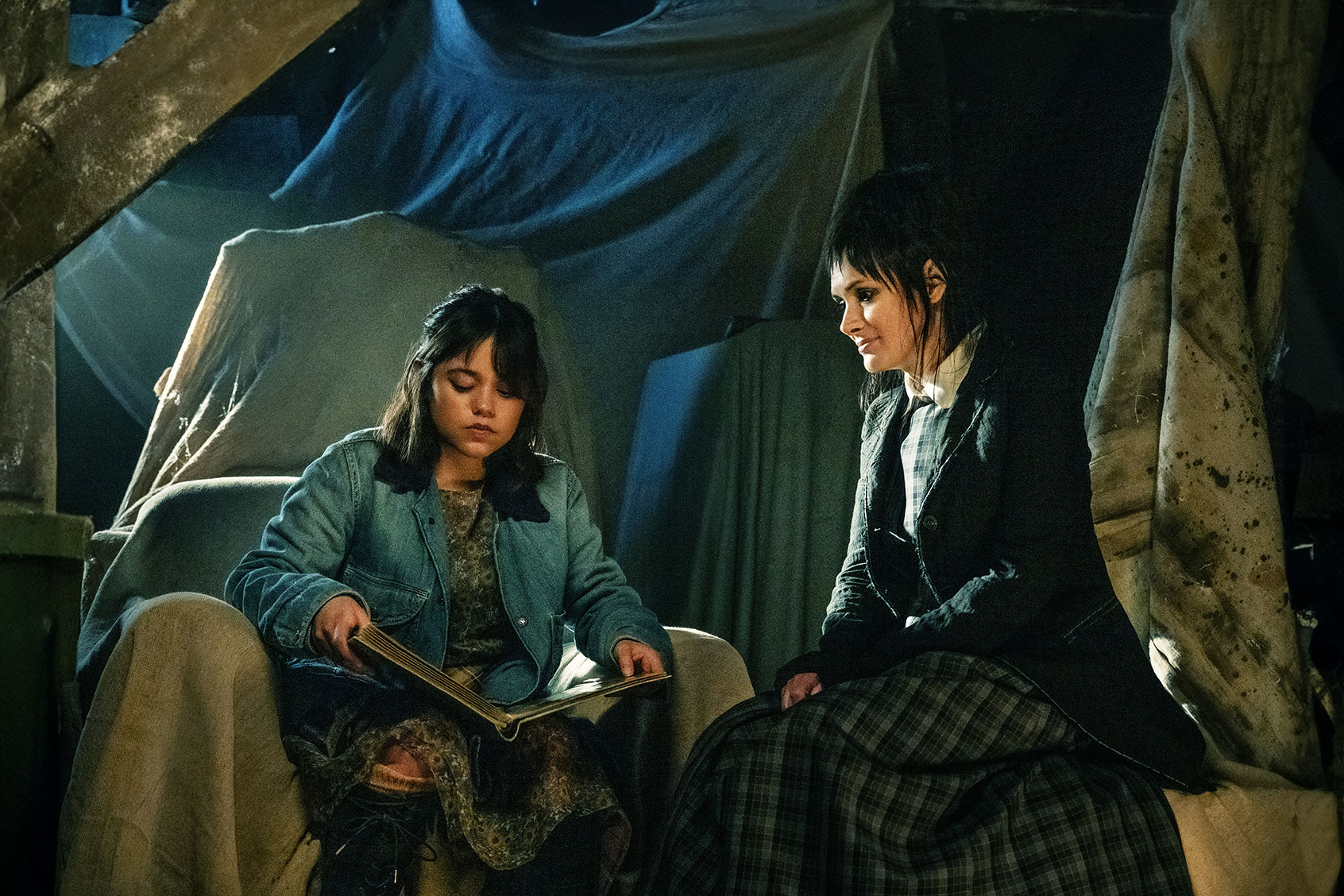
As is the case with many sequels (save for "Toy Story 2" and "Shrek 2"), "Beetlejuice Beetlejuice" wasn’t anything to write home about.

While it wasn’t the worst follow-up film I’ve seen, it certainly didn’t do much justice to its iconic ’80s predecessor. "Beetlejuice Beetlejuice"'s lackluster quality effectively boiled down to being stuffed with far too many, largely disjointed plotlines — including a wildly underused Monica Bellucci as the sutured ex-lover of the titular crusty poltergeist (Michael Keaton) — and an unsettling ending scene that saw Jenna Ortega’s Astrid birth a bloody Beetle-fetus.

But perhaps the most cringe and egregious aspect of Tim Burton’s record-breaking fall blockbuster was the addition of a "Soul Train" segment, in a ghoulish riffing of the classic ’70s music television series.

Astrid becomes trapped in the afterlife after her new beau reveals himself to be a dead charlatan who once trafficked in parricide — he tricks her into swapping her soul for his, dooming her to "Soul Train" to the Great Beyond (where you go when you’re dead, dead). She’s navigated toward the ghost train through a crowd of dancers doing The Bump and The Roger Rabbit as a conductor (who looks suspiciously like the late Don Cornelius, the original host of "Soul Train") crows, “All aboard!”

"Beetlejuice" part deux’s inclusion of the groovy ghost train may at first seem like a fun cultural touchstone. In actuality, it’s Tim Burton’s lazy attempt at reconciling past criticism regarding his casting decisions.

Debuting in 1970 on a local Chicago television network, "Soul Train" highlighted the joy of Black Americans through dance, style, and culture. As Brooklyn White-Grier wrote in a 2023 CNN explainer, “In the middle of the Black Power era and feeding from the civil rights movement, 'Soul Train' provided a fresh opportunity for Black people to see and celebrate themselves. It was the most prominent stage displaying the mingling of sociocultural and political progress — and an imagining of life unencumbered by white supremacy.” The show also sparked the career success of a number of Black artists, such as Rosie Perez of Spike Lee’s "Do the Right Thing" and Vivica Fox, who lent her talent to Tarantino’s "Kill Bill" as Vernita Green.

If you know anything about Burton’s movies, you know that they tend to feature characters who embody all the qualities of a sickly Victorian-era child: waifish, sunken doe-eye and gaunt faces with a deathlike pallor. Think Roderick and Madeline Usher. And while there’s nothing wrong with a director emulating a certain aesthetic, Burton’s well-documented history of hardly ever casting minority actors for his roles makes the "Soul Train" scene sit all the more uncomfortably.


Want a daily wrap-up of all the news and commentary Salon has to offer? Subscribe to our morning newsletter, Crash Course.


In 2016, actor Samuel L. Jackson became the first Black person to play a lead in a Burton film when he was cast as the shapeshifting Mr. Barron in "Miss Peregrine’s Home for Peculiar Children." (Keep in mind that Burton has been actively directing since the 1970s.)

When Burton was asked by Bustle to elaborate on his predilection for pasty actors while promoting the film, which was adapted from Ransom Riggs’ 2011 novel, the director offered a stunningly tone-deaf response.

“I remember back when I was a child watching 'The Brady Bunch' and they started to get all politically correct,” Burton told then-Bustle reporter Rachel Simon. “Like, OK, let’s have an Asian child and a Black — I used to get more offended by that than just — I grew up watching Blaxploitation movies, right? And I said, ‘That’s great.’ I didn’t go like, ‘OK, there should be more white people in these movies.’”

Unsurprisingly, those comments were met with considerable backlash on social media.

"If you say 'Tim Burton' three times, a goth white dude appears and mansplains to you how casting only white people isn't racist," wrote @knownforms in a post to X. 

"Hoo boy they're discussing diversity with Tim Burton, who's never even cast a white person with a tan," added @alshipley.

For Jackson’s part, he affirmed to Bustle that while he “noticed” the lack of diversity in "Miss Peregrine"’s casting, it didn’t sway him from joining the project. “I had to go back in my head and go, how many black characters have been in Tim Burton movies?” Jackson said. “And I may have been the first, I don’t know, or the most prominent in that particular way, but it happens the way it happens. I don’t think it’s any fault of his or his method of storytelling, it’s just how it’s played out. Tim’s a really great guy.”

Beetlejuice BeetlejuiceJenna Ortega as Astrid and Winona Ryder as Lydia in "Beetlejuice Beetlejuice" (Warner Bros. Pictures/Parisa Taghizadeh)Even when Burton did cast Black leads in his popular Netflix series, "Wednesday" — which saw him partner with nascent scream-queen Ortega as the Addams family’s brooding, braided scion — he fumbled the proverbial bag. Fans slammed the casting of Black actors Joy Sunday and Iman Marson as racist, taking issue with how they were cast as a mean girl and a bully at Wednesday’s boarding school, Nevermore Academy, in their respective roles.

When the New York Post reached out to Burton’s team regarding the blowback, a WME representative for the director said, “I’m not forwarding a comment request this silly to Tim.”

In "Beetlejuice Beetlejuice," the ghost train in the "Soul Train" scene has all the makings of a funky subway car, fitted out with hot – albeit decaying — dancers wearing disco attire. If not for the fact that there’s no returning from the Great Beyond, it doesn’t seem like a bad setup for living in the land of death. It certainly bests the phantasmagoric desert full of sandworms.

But despite the scene's rhythmic appeal, its singularity is deafening. It stands in stark contrast to the fact that there are quite literally zero other Black people in the film — not in the land of the living, dead, or background for that matter. This fact renders the "Soul Train" a cheap caricature of diversity, only underscoring the sheer flaccidness of Burton’s attempt at inclusivity.

As one guffawing TikToker put it, “Tim Burton was so tired of people saying that he don’t be putting Black people in his movies that he said, ‘Here! Take a freaking 'Soul Train' joke!’”

Still, though, It would be remiss to neglect to acknowledge that one of the film’s leads, Ortega, is a Hispanic actor, hailing from Mexican and Puerto Rican parentage. The actor has previously spoken about diversity and beauty standards in Hollywood, and how she saw herself fitting in. “As a child actor, there are two jobs that you can get: you’re either the younger version of someone or you’re playing somebody’s daughter — and there were just not many leading Hispanic actors who I could be that for,” Ortega told The Hollywood Reporter in 2023. “So a lot of the jobs that I was going for growing up would never work out, because I didn’t look [a certain] way. That was really hard, to hear that something you couldn’t change was what was preventing you [from succeeding].”

While Ortega’s sentiments and experience are undeniably real and valid, it’s important to account for her conventional attractiveness and what some might argue to be her white-passing Latina status, a title I know well in my own right from growing up racially white but ethnically Hispanic.

Tack on the way Beetlejuice speaks Spanish ad nauseam while offering theatric displays of wedding-night love to Astrid’s mom and medium-extraordinaire, Lydia Deetz (Winona Ryder), and the film’s convoluted plot is thrown into even further disarray where diversity is concerned.

As one X/Twitter user succinctly put it, it all just feels like Burton, in "Beetlejuice Beetlejuice," “did the wildest stereotypical s**t.”

“Cooking, to me, is an art form”: Leila Heller on the rich history of Persian food

Leila Heller, the president of contemporary art galleries in New York and Dubai, happens to also be the author of one of the most beautiful cookbooks released this year.

Titled "Persian Feasts" — and rest assured that the jubilant, convivial recipes inside do indeed live up to that name — the cookbook embraces Persian food and culture in an unabashed manner, tracing the Heller's mother's journey to the US in 1979 as the through-line for Heller's memories.

Full of colorful, fragrant dishes highlighting the stunning breadth of Persian cuisine, Heller bridges the gap between food, art, culture and history in a way that is both inspiring and totally novel.

Salon Food recently had the opportunity to speak with Heller to discuss Persian history, her co-authors, the link between art and cooking, her favorite Persian dishes and so much more.

The following  interview has been lightly edited for clarity and length.

Persian Feasts: Recipes & Stories from a Family TablePersian Feasts: Recipes & Stories from a Family Table (Courtesy of Phaidon)

What is your favorite cooking memory? 

One of my most cherished memories is cooking alongside my mother when I was just five years old. She had bought me my own set of miniature cooking utensils and pots and I would mimic her every move in the kitchen. This memory is deeply embedded in my mind. Later, as a freshman at Brown University, when the International House invited students to prepare a dish from their home country, I recreated my mother's loobia polo — a fragrant green bean and rice dish with tender veal. I prepared it with the same love and attention to detail as if I had learned the recipe only the day before. The dish was met with great admiration from both the international community and the faculty, who cherished the meal and my enthusiasm. 

Why do you cook? 

I come from a family where culinary traditions are deeply revered. My mother and grandmother taught me the art of Azerbaijani cooking, a skill passed down through generations. My father's three sisters — Jamileh, Massumeh and Atieh — introduced me to the rich flavors of Russian and Uzbek cuisines, including dishes like borscht, pirozhki and Salad Olivier. This diverse culinary heritage has profoundly shaped my approach to cooking.

What stands out for you as a formative moment that got you into cooking or food at large? 

A defining moment in my culinary journey occurred at Brown, where the success of my first dish garnered significant praise. This encouragement led me to cook regularly for fellow students, flatmates and professors, all of whom cherished my cooking. Many saw parallels between my cooking and my visual art — especially my embroidered canvases, which, much like my dishes, were crafted with meticulous care and dedication. After Brown, I continued this tradition in London while pursuing my postgraduate studies at Sotheby's, hosting dinner parties that became a cherished part of my social life. This continued during my time in graduate school in Washington, D.C. and later in New York, where my dinner parties became legendary events, with hundreds of guests in attendance. Today, I continue to cook for every gathering –   each meal I serve is home-cooked, reflecting my passion for sharing my food and culture.

Can you tell me a bit about your background in food at large, as well as specifically in regards to Persian cuisine? 

I believe that a truly skilled cook can master the cuisine of any culture. I discovered my natural talent for cooking at the age of 18, a gift that runs deep in my maternal and paternal family. I find immense joy in sharing my meals with friends and family, often joking that my husband married me only for my culinary skills. My family, like my parents before us, are food enthusiasts. We travel extensively, not only to experience new adventures but also to explore and savor the diverse cuisines of the world.

Eggplant, Walnut & Pomegranate StewEggplant, Walnut & Pomegranate Stew (Courtesy of Nico Schinco)

What would you say are the foundations or hallmarks of Persian cuisine? 

Persian cuisine is traditionally prepared in large quantities and even one family will prepare enough for 5 or 6 people. When cooking for just two, we take great care to prepare a sumptuous meal, typically featuring a pot of rice with a golden, crispy bottom (tahdig), accompanied by a rich Persian stew (khoresh) and sometimes a hearty soup (aash) to begin. Fresh herbs, homemade strained yogurt and pickled vegetables (torshi) are customary accompaniments. For larger gatherings, the table becomes a true feast, with generous servings of rice, various stews, lamb, fish, chicken, duck and an array of appetizers.

The dishes are usually presented buffet-style to accommodate the variety and abundance. Feasting is a long-standing tradition in Persian culture, with its history dating back more than 5,000 years. My co-authors — Lila Charif, Laya Khadjavi, Bahar Tavakolian and I — have titled our book "Persian Feasts" to honor this rich history.

Is there a particular Persian dish that stands out as best exemplifies the cuisine on the whole? Or a personal favorite of yours? 

Iran is renowned for its vast array of dishes, including nearly 50 different types of rice and as many stews. One of our most celebrated dishes is chelow kebab, a combination of fragrant white rice with a crispy bottom, served alongside skewers of marinated beef and lamb, roasted tomatoes, peppers, egg yolk and a sprinkle of sumac. This dish is typically accompanied by doogh, a refreshing salty yogurt drink, as well as fresh herbs, feta cheese, walnuts, radishes and strained yogurt, plain or infused with garlic. This would be served with Taftoon, Sangak, or Barbari bread. 

What is a great "gateway" recipe in the book for a reader who's totally unfamiliar with Persian ingredients and dishes?

Chelow kebab is a dish that, while seemingly simple, holds great depth and flavor. Another beloved and straightforward dish is abgosht, a hearty stew perfect for the colder months. Our cookbook features two variations of this recipe: one made with lamb and the other with chicken, each offering a comforting and satisfying meal.

So many of the recipes in the book are so beautiful and robust, in both terms of flavor and appearance. Is that typically how Persian food is typified?

Indeed, the presentation of food is of utmost importance in Persian cuisine. The garnishes and embellishments are as significant as the flavors themselves. Iranians take great care in decorating their dishes with slivered nuts, fresh herbs, pomegranate seeds and a delicate sprinkling of spices, as well as caramelized barberries or chopped walnuts, enhancing both the visual appeal and taste.


Want more great food writing and recipes? Subscribe to Salon Food's newsletter, The Bite.


This is so much more than "just a cookbook," with historical information, personal and family anecdotes, recipe stories, curated menus and so much more — can you talk a bit about that? What was it like to shine a light on more than just strict recipes? 

The recipes in our cookbook were meticulously documented by my mother over a span of 30 years, each perfected with her personal touch. After her sudden passing, I felt a deep responsibility to bring this project to fruition, alongside my dear friends and co-authors, who were like daughters to my mother. I wanted the book to offer more than just recipes; I wanted it to tell a story.

Having been deeply immersed in the art and museum worlds for over 42 years, I reached out to esteemed scholars — Dr. Massumeh Farhad, Chief Curator of Islamic Art at the Smithsonian National Museum of Asian Art and specialist on the 16th century court of Shah Abbas; Dr. Talinn Grigor, an art historian and leading faculty member at the University of California; and Kim Benzel, associate curator of Ancient Near Eastern Art at the MET, as well as MET Museum fellow,  Jake Stavis – to contribute essays on the historical significance of food in Persian culture, from ancient times to the modern era. My co-author, Lila Charif, a naturopath, wrote insightful chapters on the health benefits of Persian herbs, spices, oils and teas. I also penned a brief history of my mother’s family, weaving in narratives of Persian feasts and celebrations that are integral to our cultural identity.

Nahid Joon with her children Leila and MamadyNahid Joon with her children Leila (right) and Mamady (left). (Courtesy of Leila Heller)
For the unfamiliar, can you explain a bit in terms of differentiating between Iranian and Persian cuisine? Or are they one in the same?  

Persia and Iran are two names for the same country, though they carry different historical connotations. The name "Persia" originates from "Pars," a region in southwestern Iran and became widely used in the West due to Greek and later European references. It specifically referred to the heartland of the Persian Empire, particularly during the Achaemenid period and has since evoked a sense of the country's ancient grandeur and cultural achievements.

"Iran," however, is rooted in the word "Aryan," meaning "Land of the Aryans," and has been used locally since the Sassanian era to denote the broader realm of the Persian empires. This name reflects a more inclusive identity that encompasses the vast cultural and ethnic diversity of the region. In 1935, Reza Shah Pahlavi formally requested the international community to use "Iran" to better align with the country’s indigenous name and heritage, marking a shift towards a modern national identity that represents all of its people, beyond just the historical Persian heartland.

The adoption of "Iran" was also a statement of sovereignty and unity, embracing the country’s multi-ethnic composition, including Persians, Azeris, Kurds and others. While "Persia" evokes the rich cultural and imperial legacy of the ancient world, "Iran" represents a nation that is dynamic and diverse, with a cohesive identity that honors both its past and its future.

Thus, "Persia" and "Iran" are two sides of the same coin: "Persia" celebrates the historical and cultural richness of a civilization that has profoundly influenced the world, while "Iran" underscores a contemporary, unified nation that reflects its full cultural and historical tapestry. In short, the cuisines are one and the same. 

The book is dedicated to your mother, as well as the "brilliant, courageous and brave women of Iran, who inspire all of us." Could you speak a bit about that?

My mother was a true Shirzan (Lion Lady). In Farsi, this term honors women who are strong, who stand up for their rights and who are trailblazers—courageous, brave and resilient, much like a lioness. It is a tribute to my mother and to all the women of Iran who have, throughout history, fought for their rights.

Over the last century, these women have managed families, pursued careers and championed equal access to education alongside men. They have valiantly defended their country, culture and values. These are the women who inspire me, women like my mother, whose unwavering determination helped me achieve my goals and who fought not just for her own rights but also for the rights of her family.

There's such a clear passion for Persian food that permeates this book that is nearly contagious! What are some of your absolute favorite Persian flavors? 

I love to prepare dishes such as Ash-e-Anar, a hearty soup rich with herbs, pomegranate juice and lentils; Fesenjoon, a luscious stew made with pomegranate molasses, ground toasted walnuts and either duck or chicken — while I typically prefer duck, I often opt for chicken for larger gatherings; Ghormeh Sabzi, a fragrant herb stew with dried lemons, lamb or beef, red beans and an array of herbs; a baked fish dish with large filets of salmon, sea bass, or halibut, served with an herb sauce; and Albaloo Polo, a sour cherry rice dish, one of my mother's specialties. The rice is beautifully colored by the cherries, with a touch of saffron for a golden hue and garnished with slivered pistachios. I often serve this with my mother’s special turmeric chicken, made with thighs and breasts.

My mother also loved pairing Albaloo Polo with turkey for Thanksgiving — her favorite holiday — as it celebrates all cultures and traditions, a sentiment she deeply valued as an immigrant. For dessert, I enjoy serving Sholeh Zard, a saffron and rosewater-infused rice pudding garnished with slivered nuts. These dishes capture my love for flavors like saffron, pomegranate molasses, turmeric, Omani lemons and fresh herbs.

What would you say are your three most used ingredients? 

Choosing just three favorite ingredients would be impossible! Hardly a week goes by without using saffron, turmeric, pomegranate molasses, tamarind, cinnamon, or sumac in my cooking. My mother's unique Persian spice blend is a cornerstone in most of my dishes. I also have a deep love for fresh herbs in my salads — coriander, dill, chives, parsley, oregano, thyme, rosemary and many others.

What would you say is the overlap, if you will, between cooking/food and the art realm?

Cooking, to me, is an art form — much like a painter prepares their canvas, a cook prepares a meal with love, creativity and a keen attention to detail. As I mention in the book, I see my mother’s approach to cooking much like a painter’s canvas, where the universality of art and cooking beautifully intertwine.

We need your help to stay independent

For this book, you worked with various collaborators in Lila Charif, Laya Khadjavi and Behar Tavakolian, a list which includes a naturopathic nutritional therapist. How did this influence the recipes?  

My co-authors are not just collaborators but also my closest friends, who were like daughters to my mother. They spent years cooking with her, especially as they began their married lives, often visiting her to learn and refine their recipes. My mother was an extraordinary chef, celebrated for her culinary skills. Lila Charif, Bahar Tavakolian and Laya Kadjavi, whose mothers and mothers-in-law  were also close to mine, drew much inspiration from her in their own cooking. Lila Charif, a naturopath, was instrumental in ensuring our recipes promoted health and well-being. Her expertise guided us in selecting the right oils and cooking at temperatures that preserve the nutritional integrity of the ingredients.

Persian Feasts author Leila Heller with co-authorsPersian Feasts author Leila Heller with co-authors Lila Charif, Bahar Tavakolian and Laya Khadjavi. (Courtesy of Hamid Biglari)

How do you practice sustainability? 

Sustainability is a core principle in my approach to cooking. I strive to use locally sourced ingredients whenever possible and I prioritize sourcing from farmers who practice sustainable methods. Additionally, I ensure that leftovers from my kitchen never go to waste. I share them with friends and family and any remaining food is thoughtfully distributed to elderly friends and others in the community.

What’s your biggest tip for cutting down on food waste? 

Persian food has a wonderful quality — it remains delicious over time, often tasting even better on the second or third day. There is no waste in my kitchen. I regularly send meals to my mother’s friends who are homebound or unwell. I believe in minimizing food waste by sharing it with those in need, reinforcing a sense of community and care.

“I HATE TAYLOR SWIFT”: Trump goes on Truth Social tirade against Harris supporters

Donald Trump told his supporters how he really feels about Kamala Harris' most-famous booster in a Sunday morning flurry of angry posts to his Truth Social platform. 

"I HATE TAYLOR SWIFT," the former president wrote, as one part of a tirade against rich supporters of Harris' candidacy. 

"All rich, job creating people, that support Comrade Kamala Harris, you are STUPID," he wrote. "She is seeking an UNREALIZED TAX ON CAPITAL GAINS. If this tax actually gets enacted, it guarantees that we will have a 1929 style Depression. Perhaps even the thought of it would lead to calamity – But at least appraisers and accountants would do well!"

The tone is a far cry from the disinterested one Trump put on for Fox News immediately after Swift's endorsement of Harris earlier this week. 

"It was just a question of time. She couldn't possibly endorse Biden. You look at Biden, you couldn't possibly endorse him," he told the hosts of Fox & Friends. "She's a very liberal person. She seems to always endorse a Democrat. And she'll probably pay a price for it in the marketplace."

Though Trump said he"not a Taylor Swift fan," his campaign took the opportunity to release merch in the style of Swift's Eras tour t-shirts.

Swift had remained silent through much of the 2024 election season, but said she felt compelled to share her endorsement after Trump shared an AI-generated image of Swift endorsing his campaign. 

"Recently I was made aware that AI of ‘me’ falsely endorsing Donald Trump’s presidential run was posted to his site. It really conjured up my fears around AI, and the dangers of spreading misinformation. It brought me to the conclusion that I need to be very transparent about my actual plans for this election as a voter," she wrote on Instagram on Tuesday. "I’m voting for [Harris] because she fights for the rights and causes I believe need a warrior to champion them.


“We’re creating a story”: Vance admits he’s making up Haitian immigrant smears

JD Vance didn't originate the rumors about Haitian immigrants in Springfield eating cats and dogs, but he's more responsible than anyone for their rise into the national political discussion

After a week marked by threats against immigrants in the Ohio town, the senator and vice presidential candidate admitted to "creating a story" around Haitians during an interview with CNN's Dana Bash on Sunday.

When Vance was pinned down by the host over the smears he spread being entirely false, he didn't seem ashamed. He told Bash that he had to create a fiction to bring media attention to the way that his constituents are suffering (read: having to live alongside hard-working, legal immigrants to the United States in a newly revitalized town).

“If I have to create stories so that the American media actually pays attention to the suffering of the American people, then that's what I'm going to do," Vance said.

Elsewhere in the interview, Vance downplayed the recent spate of bomb threats against Springfield's government buildings and hospitals and waved off a march held in the city by the Proud Boys. He also admitted that he hadn't been to the city recently. He met all examples of threats against Vance's constituents by attempting to turn the conversation back to the Biden administration's immigration policy.

"We can condemn the violence on the one hand but also talk about the terrible consequences of Kamala Harris's open border on the other hand," he said.

“Exercise extreme precaution”: Springfield university nixes events over anti-Haitian shooting threat

Wittenberg University in Springfield, Ohio has cancelled all planned on-campus activities for Sunday, after receiving a shooting threat targeted at Haitian immigrants

"Wittenberg University is currently taking extreme precautions following an email sent Saturday, Sept. 14, that threatened a potential shooting on-campus," the school of nearly 1300 students shared. "The message targeted Haitian members of our community."

The school said that local police have increased patrols on-campus due to the threat of an attack. It's the latest in a string of threats against local government offices, hospitals and businesses in the Ohio town, all stemming from anti-immigrant rhetoric from Republican politicians. 

The tense week in Springfield began with a rumor, circulated on Facebook, that recent Haitian immigrants to the area were eating local pets. That debunked story was circulated by right-wing operatives like Charlie Kirk and vice presidential nominee JD Vance.

The completely unsubstantiated claim was countered by local police, who have no record of any incidents involving pets being eaten. However, the truth couldn't stand up to former president Donald Trump yelling the story into a metaphorical megaphone at the presidential debates earlier this week.

Trump claimed that Haitian immigrants to Springfield were "eating the dogs" and "eating the cats" in an incoherent ramble from ABC's debate stage and has doubled down on that idea in recent days, even when he's been told that lie is putting people at risk. President Joe Biden has repeatedly countered the bigoted smears from Trump and the GOP, calling the rumors "simply wrong." 

"So many Americans, like [Press Secretary] Karine [Jean-Pierre], as you point out, is a proud Haitian American, a community that’s under attack in our country right now. It’s simply wrong,” Biden said in a press conference outside the White House on Friday. “This has to stop, what he’s doing. It has to stop.” 


Are sheriffs special in America? Definitely — but not the way the far right claims

Sheriffs are unique figures in American politics and American society — but not in the way that many people, especially on the far right, would have you believe. The right-wing conception of the "constitutional sheriff" runs up against the fact that the word “sheriff” appears nowhere in the U.S. Constitution. It's mentioned in many state constitutions, but not all of them: In fact, Connecticut, which dubs itself the "Constitution State,” has abolished the office altogether. But the myth endures for a reason, reflecting the fact that county sheriffs, while almost always elected officials, are generally not well integrated into the fabric of government with its multiple paths of checks and balances. 

As a result, local sheriffs have often been able to resist various reform efforts over the years, and the most recent wave of criminal justice reforms have not been an exception. The anomalous and isolated status of sheriffs is reflected in media coverage and academic research as well. Individual sheriffs like the notorious Joe Arpaio, former sheriff of Maricopa County, Arizona, may gain significant local or even national attention, but consistent, systemic scrutiny is rare. So "The Power of the Badge: Sheriffs and Inequality in the United States," a new book by political scientists Emily M. Farris and Mirya R. Holman, is long overdue. 

It begins with a historical overview, then moves on to examine the county sheriff as an elective office, and how that status differs in practice both from what sheriffs themselves may claim and what democratic theory suggests. American county sheriffs are 98% male, a marked contrast to elected district attorneys, almost one in four of whom are women. That leads into an exploration of the ways sheriffs exercise and expand their authority, which sets the stage for the theme suggested by the book's subtitle: how the sheriff's office perpetuates inequality in a many areas, especially regarding violence against women, traffic enforcement and immigration. 

Farris and Holman clearly take a critical view of sheriffs past and present, but they're not rigidly unsympathetic. Although the sheriffs and their practices skew strongly toward white male conservative defenders of existing power structures, there's significant variation to be found, and their discussion is appropriately nuanced. But the big picture is clear: Nationwide, the sheriff's office is long overdue for reform, particularly in light of the right-wing radicalization of many sheriffs in rural areas. The book's final chapter examines the prospects for reform, which are less than promising. Raising awareness of the problem, as this book surely ought to do, is the first step in changing what’s possible.

I recently interviewed co-author Mirya Holman, an associate professor at the University of Houston's Hobby School of Public Affairs, via Zoom. This transcript has been edited for clarify and length.

Your first chapter looks at the sheriff's office in the larger context of U.S. history. You have sections addressing the era of slavery and Reconstruction, the "Posse Comitatus" movement and the recent phenomenon of the "constitutional sheriff." We could easily spend the whole interview asking about this chapter, since it covers so much ground. Let me start by asking about the main lessons we should learn from that history. What are the important patterns that emerge?

One key takeaway for me is that sheriffs have regularly used social control in communities as a tool to make sure that some groups of people remain in power and other groups of people don't have access to power. If we think about sheriffs' role in slavery, for example, sheriffs were one of the primary offices engaged in enforcing runaway-slave acts, financially benefited from capturing individuals who had fled slavery and regularly engaged in actions to ensure that white people and communities were able to have power and Black people were not able to have power. 

If we look at the role that sheriffs play as the U.S. expands westward, they again played a central role in assuring that some groups of people — particularly white people and white people with access to property — have the ability to retain their power.  So we see, for example, sheriffs play a role in helping business owners squash union movements or organizing efforts. In Colorado, sheriffs are central actors in making sure that miners don't have the capacity to fight against people who own the land. When we move forward into current-day America, even something as simple as the role sheriffs play in civil asset forfeiture, or the role of sheriffs in enforcing evictions, reinforces this idea that this is a tool used to keep a particular power balance in society. 

Your second chapter chips away at one of the major justifications sheriffs rely on, the fact that they are generally elected officials. You find that sheriffs are highly unrepresentative of the population as a whole: More than 90% are white, less than 2% are women, 0.2% are women of color. They're overwhelmingly conservative Republicans, and only 1% identify as liberal. You also look more specifically at sheriffs relative to the specific counties where they're elected. What did you find there? 

We find over and over again that the modern-day sheriff is unrepresentative of the county that he serves. I'm going to use "he," because, as you say, most sheriffs are men. We look at this in a couple of different ways. First we say, OK, is it really true that they're unrepresentative? If we look at places where there's electoral competition, are sheriffs more representative? That's not what we find. If we look at ideological representation, again what we see is this rightward skew where sheriffs are reliably more conservative than the counties they serve, which means that counties with liberal residents are regularly not represented by the sheriff's office of sheriffs. 

You find that sheriffs tend to have uncompetitive elections, with a shallow field of challengers. Sheriffs tend to serve decades in office and routinely select their successors, effectively creating dynasties of closely controlled power. What are the most important factors involved in preventing elections from being a source of accountability, as they are supposed to be?

Voters have to be able to choose between candidates in order for elections to serve as a way of changing anything. But we often see in sheriff elections that there is only one person on the ballot, or that electoral competition is sometimes in the primary election and in a general election the sheriff will be unopposed. 

"As the U.S. expanded westward, sheriffs played a central role in assuring that some groups of people — particularly white people and white people with access to property — had the ability to retain their power."

We argue that there are a couple of factors here. One is that most sheriffs worked in their office before the became sheriffs, as a deputy or a jailer or a staff member. So just imagine: If you wanted your boss' job, how would you interact with that person? And how would your boss treat you if they thought you wanted their job? And if, when you got their job, they would no longer have a job? They're not going to be promoted, because sheriffs are the end of the line in county government. So we find that sheriffs engage in a variety of actions to curate the pool of potential challengers. 

They might identify people where they think, "This guy is going to be a good sheriff, so I want to make sure that he's under my wing. When I am finally ready to retire, I'm either going to endorse this guy or I'm going to retire before the end of the term and appoint this person to fill the rest of it, so he's the incumbent when the next election comes around." It's a regular pattern we find, that sheriffs resign before the end of their term so they can hand-pick their successor in the next election. It means there is not really the opportunity for change in elections. Either it's just the same guy running over and over again or it's a slightly different guy, but it's the guy that the previous guy picked. So we have this unbroken chain where we rarely see dramatic changes in who's going to hold the office.

What happens when a challenger does emerge? 

One thing we find is that if sheriffs have an internal challenger, meaning that somebody from their office runs against them, and the sheriff wins, they tend to punish the people that work for them. One interesting thing about the office, from the perspective of power, is that sheriffs are both executives — they're elected and they have a lot of control over their office, they can set policy — but are also fundamentally bureaucrats. They manage a large set of employees, they make bureaucratic decisions about how the office is run, how the jail is run. So if a sheriff is mad about somebody challenging them, they punish that person. Sheriffs are regularly accused of retaliation by employees who run against them for the office. We see through data that when sheriffs are challenged internally, they subsequently reduce the pay of people who work for them. They essentially are, like, "Hey, you challenged me, now I'm going to get you back.” 

Your third chapter is about sheriffs’ authority as elected officials. If their goal is to get re-elected, you write, "this is achieved by sheriffs increasing their authority and decreasing their accountability." What are the most significant things they do to increase their authority? 

There are lots of ways that sheriffs expand what they do. We could call it mission creep. Broadly, sheriffs are county-level law enforcement officers. We might think of that as a very narrow set of tasks, or we might thing of it as extraordinarily broad. Sheriffs, particularly in rural areas of the United States, often think about this as a very broad set of tasks associated with law enforcement.

You and I might think, well, law enforcement, that does not include mosquito control, right? But the sheriff of Orleans Parish, Louisiana, would disagree: They breed fish and have boats to engage in mosquito control in that parish. Or we might think that sheriff's deputies primarily drive cars around, but many sheriffs also have boats to engage in watercraft control, they have airplanes and helicopters, they engage in a wide set of emergency services. You might look at natural disasters as an example where sheriffs radically expand their services, and often don't contract that after the natural disaster. Sheriffs are also recipients of military grants and military equipment. 

Also, sheriffs run jails, and there's a lot of service expansion around jail maintenance. If you think about criminal justice reform and you're interested in the quality of life that incarcerated individuals have, one way to improve that is to offer more services: mental health care, education, work release programs. All of those are consistent with reforming our criminal justice system, but also involve expanding the sheriff's authority. So the sheriff goes from running the jail to being the primary mental health care provider in the county, or the primary person that provides job skills. The portfolio of things that office does gets larger and larger. 

In Chapter 4, where the themes are inequality, autonomy and authority, you examine the influence of sheriffs’ attitudes in three arenas where they have significant autonomy: violence against women, traffic enforcement and immigration. What are the main takeaways? Let's start with violence against women.

We use data from two different surveys where we ask sheriffs themselves about their own individual attitudes. For example, what are your attitudes about women's equality? What are your attitudes about the status of women in society? Do you endorse what scholars call domestic violence and rape myths? These are common misconceptions about the sources of violence against women or interpersonal violence. Think about a phrase like, "Women can choose to leave their abusers anytime. They just decided not to." How much do you agree with that statement? Then we ask them about the services they provide to victims of interpersonal violence and sexual assault. One thing that we consistently find in this area, and also in traffic and immigration, is that the sheriff's own attitudes really matter in shaping the kinds of policies that their offices produce. 

So in this circumstance, sheriffs who have more negative views about women in society, who endorse these myths, are less likely to say that they offer victims of interpersonal violence services like access to shelters or information at the hospital or transportation away from an abuser. These are really important things for women who are experiencing interpersonal violence, and our findings suggest that it really matters. 

How do sheriffs' attitudes translate when it comes to traffic enforcement? 

"Sheriffs who have more negative views about women in society, who endorse these myths [about domestic violence], are less likely to say that they offer victims of interpersonal violence services like access to shelters or transportation away from an abuser."

There is this long history of traffic enforcement being used as a tool to engage in disparate enforcement of laws against Black and brown individuals, and we know this is one area where discretion really matters for the police. A law enforcement officer can choose whether or not to pull you over, whether or not to write you a ticket or arrest you. We find sheriffs that have more negative attitudes toward Black people and immigrants are more likely to say that their office doesn't have policies around racial equality and arrest, and are likely to say that they oppose those kinds of interventions. Again, this is a situation where the individual attitudes of the sheriff then influences how their deputies engage in law enforcement in their communities. 

What do you find with regard to immigration law enforcement?

This is a really interesting policy venue for sheriffs. In general, Homeland Security and Border Patrol do not have the resources that they would need to actually enforce immigration laws. They're both relatively small agencies. Border control is largely concentrated on the borders themselves, and one evolution of the policy over the last 40 years or so has been this top-down deregulation of immigration authority to local enforcement. Sheriffs are one of the primary tools of that enforcement, via jails and arrests. 

So let's say you are in this country without the legal right to be — you overstayed your visa, for example. Most of the time you are not engaged in any action that is going to have your status in the community checked, except when you engage with law enforcement. Here again, discretion plays a role. So we asked sheriffs a variety of questions about their attitudes about immigrants. For example, “Do immigrants take away more than they give back to society?” And then we ask them about a whole bunch of points of contact between their deputies and the community: At what point do you check the immigration status of individuals? This includes everything from somebody being a witness to a crime to a traffic stop to being booked for a non-felony offense to being booked for a felony to post-trial booking in the jail. 

We would expect that this check-in with ICE about whether or not somebody's been flagged would happen when somebody's actually in jail. But we find that sheriffs who have negative attitudes about immigrants say their deputies are much more likely to check the immigration status of witnesses to crimes and people whostopped for traffic issues, as compared to those sheriffs who have more positive attitudes towards immigrants. This has real consequences, if we think about the willingness of members of the community to interact with law enforcement, or to call the police when there's an emergency. If you think your immigration status is going to be checked, you're not going to call the cops to report a crime. 

In Chapter 5, on the "radicalization" of county sheriffs, you look at how that has unfolded over the last half-century through right-wing recruitment efforts. You begin in the 1970s with the Posse Comitatus movement, which then led to the "constitutional sheriff" movement. What were the key moments in this development? 

In the 1970s, a variety of what we might call modern-day militia movements that emerged. Some emerged in anger over the civil rights movement and are explicitly racist or white supremacist, some are neo-Nazi, some are explicitly focused on the American West. During this time, members of these movements identify the county sheriff as this ideal locally elected official who has a lot of autonomy. This is where the beginning of the idea of the constitutional sheriff emerges, where sheriffs somehow have this unique constitutional power.

Just as a side note, sheriffs don't generally have any unique constitutional powers. Lots of offices have constitutional powers, and sheriffs are sometimes among them and have some designation in the state constitutions. But this is not a unique sheriff thing. 


Want a daily wrap-up of all the news and commentary Salon has to offer? Subscribe to our morning newsletter, Crash Course.


The founder of the Posse Comitatus movement, among other people, worked to promote this idea that sheriffs are this last line of defense against the overreach of the federal government. We should try to elect people as sheriffs, in their view, who are going to defend their communities against any efforts by the federal government to take guns away, or try to enforce civil rights rules. Eventually, rules about federal land management in the West get wrapped up in this. During that time, I would not call sheriffs active participants in this movement at all. There were quite a few sheriffs saying, "Please stop mentioning my name. Stop talking about this." But over time, that militia movement sort of dies out. With the Oklahoma City bombing and Timothy McVeigh, many militia movements go underground and become less publicly visible, and focus way less on sheriffs.

We see the re-emergence of these ideas during the county rights movements in the 1990s, but we don't see the ideas gain national prominence until the rise of Richard Mack as an intellectual leader of the right after Barack Obama's election as president. Mack himself has said he was inspired by the idea that Obama was going to come in and do all this crazy stuff. So Mack, who was a former county sheriff in Arizona, used the notoriety that he has from being involved in a gun rights case to go on the Tea Party circuit and develop a much broader following of sheriffs, making the argument that sheriffs have this unique responsibility to protect their residents against the overreach of the federal government. 

Then we see a lot of effort around the post-Sandy Hook discussion of gun control, with sheriffs emerging as vocal opponents to any kind of federal gun control. This evolves into anti-COVID restrictions, and along with guns and federal overreach that has continued to be a core component of this right-wing movement of sheriffs who have taken up this mantle, claiming, "We're a unique office. We have this unique responsibility." 

And you do see that right-wing extremism reflected in many sheriffs' views today

"Richard Mack, a former county sheriff in Arizona, used his notoriety from a gun rights case to develop a much broader following, making the argument that sheriffs have this unique responsibility to protect their residents against the overreach of the federal government."

Sure. If you ask sheriffs in surveys whether or not they believe in statements like "sheriff have a responsibility to interpose against federal overreach," or that the federal government should have to request permission from the sheriff before they go into a county, we see high rates of sheriffs agreeing with these statements. These are also highly correlated with sheriffs saying that they won't enforce gun control measures, or that they oppose mask mandates.

In Chapter 6, you turn to a range of different “tools for reform,” including elections, civilian review, the appointment of sheriffs, investigations and various state and federal policies, as well as the abolition movement. As you lay these options out, they all have serious limitations, though some incremental changes have been made. What lessons do you draw here?

Change is really hard. There are more than 3,000 sheriffs in the United States, and the tools that seem to be the most effective are also the ones that are most limited in scope. If we think about elections as a tool to shape who sheriffs are and their policies, OK, that's great. We need to encourage more people to run for the office. But that's highly localized, right? It's hard to identify people in 3,000 counties who have the interest, capacity and experience to run for the office. The same goes for something like civilian oversight. It's a tool that might matter, but it has only been rolled out in very few places and sheriffs have been very effective at reducing the implementation of effective civilian oversight. 

One common problem seems to be that sheriffs really are outside the networks of accountability that encompass government at different levels, from national to local. It seems as if we need the kind of information you provide to become much more widely known in order to build a movement for accountability. Maybe we need to develop alternative ideas of what we want on the county level, for example, more public health services rather than law enforcement. 

Yes, I agree. Sheriffs operate in this unique space in that they don't have horizontal accountability. Think about state legislatures. If we are mad about what a state legislature does, we might think about the governor serving as a form of accountability, or an independent state administration governed by bureaucratic rules, or the judicial system. For sheriffs, there are parallel bodies like county commissions, but they're seen as independent, not as one overseeing the other. County commissions in most states have no power to check the decisions made by the sheriff. So they lack horizontal accountability, and often lack vertical accountability too. Some of that is by their own efforts, by saying to state and federal governments, "You can't tell me what to do." But it's also general public blindness to what happens in this office and the fact that there's no oversight, particularly in rural areas without robust media networks. You might have civilians who are identifying problems and writing blog posts or yelling on Reddit, but there's no way to convert that to any kind of change. 

I would support any effort toward stronger institutionalization of services — health services, mental health care, job training, post-incarceration care — separate from the criminal justice system. What we see overwhelmingly is that, particularly in rural America, the county sheriff and the jail has become the primary site for a lot of these services, particularly to vulnerable populations, because there's nobody else to do it. 

If you live in a rural area and somebody in your life is in a mental health crisis, the sheriff is the only person to call in most places. They're going to take that person to jail and then they may provide some kind of mental health care, or transport them to a faraway mental health facility. We could interrupt that pattern if we had more robust mental health care in rural America. It's the same thing with interventions around the homeless population. All these things have been shuffled into the jail system. The sheriff provides these services and thus expands his power. If we provided those services separate from from the criminal justice system, that would circumvent that process. 

Finally, what's the most important question I didn't ask, and what's the answer?

One thing I think a lot about is: What does a good sheriff look like? One thing I think is important is that sheriffs are willing to give away their power. You see effective and sensible sheriffs who are not just invested in expanding mental health care in the jail, but in interventions that stop people from going to jail entirely. Sheriffs who support alternative services and housing-first policies, policies that are not aimed at, first you get someone to the jail and then you provide services. Those are the kind of sheriffs that people should be interested in supporting.

ā€œWhat homegrown fascism looks likeā€: The insidious nature of GOP’s not-quite-dog-whistle politics

"DEI hire," "didn't earn it," randomly blaming diversity — rightwing pundits have parroted those claims throughout the year, flinging the language at high-ranking officials or doling them out in the face of tragedy. 

Far-right commentators hurled the phrase at Vice President Kamala Harris both before and after her surprise ascent to the top of the Democratic ticket. But before her, ultraconservative lawmakers, pols and influencers wielded the language against White House Press Secretary Karine Jean Pierre, Baltimore Mayor Brandon Scott and former Harvard University President Claudine Gay, all of whom share in having held prominent positions and being Black.    

For Evelyn Carter, a social psychologist and diversity, equity and inclusion consultant, the anti-DEI refrain from the right sounds all too familiar.  

"It is the latest iteration of a challenge that has come up for, I mean, as long as I can remember. Twenty years ago, it was 'you're an affirmative action hire' or 'you're a diversity hire,'" she told Salon, recalling how peers at Northwestern University lobbed such comments at her and other Black students when she attended in the 2000s.

Since the label "DEI hire" has gained popularity among the far-right, many on the left have harangued it as another dog whistle, a form of coded language with multiple meanings, that allows ultraconservative political actors to disparage powerful professionals of color. Others have argued that the phrase is a thinly veiled way of saying the N-word, and even conservative officials have spoken out against its use.

The broad consensus around what "DEI hire" implies — if not outright means — is clear: at best it looks racist and sexist; at worst, it just is. But how easily its meaning is ascertained raises questions about whether "DEI hire" is a dog whistle in the traditional sense, more slur-adjacent as some suggest, or something new.   

Still, if United States history has imparted anything, it’s that this language isn’t isolated to just words. It often materializes in action that works to the detriment of the people the language is meant to exclude. Against a backdrop of a national effort to eliminate diversity, equity and inclusion policies in schools, universities and corporations, the right's mobilization around "DEI" and "DEI hire" appears all the more dangerous. 

From CRT to DEI — a conservative activist's strategy

Anti-DEI sentiment erupted into the mainstream in December 2023 as far-right influencers pushed for then-Harvard University President Claudine Gay's resignation amid campus tensions over the Israel-Hamas war. The campaign for her ouster started with far-right activist and journalist Christopher Rufo and found an amplifier online in users like hedge fund manager Bill Ackman before coming to a head after her controversial response to concerns of antisemitism on Harvard's campus during a congressional hearing.

As the claim that the university's first Black president was a diversity hire took off, the plagiarism allegations that Rufo and others also leveled about her early research, coupled with the blowback from her response, became evidence of her supposed lack of qualifications. 

Gay's takedown was strategic — Rufo admitted as much in a January interview with Politico the day after Gay announced her resignation, telling the outlet: "When you put those three elements together — narrative, financial and political pressure — and you squeeze hard enough, you see the results that we got today, which was the resignation of America’s most powerful academic leader."

A dog whistle secretly communicates one targeted idea to an in-group while also offering an innocuous separate message to people outside of that group.

Rufo had been rallying against what he calls "DEI bureaucracy" long before last winter, and his anti-DEI campaign followed his 2020 crusade against critical race theory (CRT), once understood as an academic, legal framework interrogating the role of color-blind institutions and laws that undergird systemic racism. 

The anti-CRT effort saw some success. In the wake of the 2020 racial justice protests, CRT, with help from Rufo, quickly became something of a "radical left" boogeyman. For the right, it came to represent an educational doctrine hellbent on fortifying racial resentment, and conservative officials felt the need to take action against it.

In Florida, Republican Gov. Ron DeSantis responded to the anti-CRT effort by enacting the 2022 "Stop W.O.K.E. Act," which prohibits classroom discussions and workplace trainings that made students and employees feel discomfort around their race. At the national level, former President Donald Trump in 2020 issued an executive order that admonished "blame-focused diversity training."

Still, the anti-CRT effort did not receive the kind of traction among the public that anti-DEI sentiment has seen thus far.

"The shift from attacking CRT to attacking DEI enables people to go after Black people and women in positions of power," said Jason Stanley, a co-author of "The Politics of Language" and a professor of philosophy at Yale University. "It was unclear with the CRT stuff, which was also a dog whistle, how you were going to use it to go after individual people. But what we had coming out of [the George Floyd protests] was a backlash against diversity, equity and inclusion offices, and then the expression morphed."

Since Gay's resignation, rightwing pundits have tacked a derogatory "DEI" moniker onto a smattering of subjects and people.

"The surface message isn't very good. It's not very acceptable either, and it looks pretty darn racist. And the hidden message is even worse."

On social media, they sought to blame Boeing aircraft failures on the company's adherence to an internal diversity initiative. When a container ship crashed into a Baltimore bridge in March, they found fault for the tragic collapse in duly elected Mayor Brandon Scott, who they dubbed the city's "DEI mayor," and accused Maryland Gov. Wes Moore, a fellow Democrat, of prioritizing diversity in his appointment of Ports of Baltimore Commissioner Karenthia A. Barber (both Barber and Moore are Black). 

"We know what they want to say, but they don’t have the courage to say the N-word, and the fact that I don’t believe in their untruthful and wrong ideology," Scott said of the attacks during an appearance on MSNBC's the ReidOut at the time. 

While Rufo, in his Politico interview, insisted the "DEI hire" invocation against Gay was "absolutely not fueled by racial animus" or sexism, it's clear the label largely comes off that way. It's taken on dog whistle status — even if it might not completely operate like one.

"A slightly different functioning dog whistle"

A dog whistle secretly communicates one targeted idea to an in-group while also offering an innocuous separate message to people outside of that group. As such, they often carry two meanings, the first being more acceptable and broadly understood, while the other, problematic meaning is meant to only to be understood by the speaker's intended audience. The number "88," for example, when used by white supremacists, is a code for the letters HH, or, "Heil Hitler."

How that language traditionally works is by relying on plausible deniability when confronted about the hidden message in order to keep it coded, explained Jennifer Saul, a University of Waterloo professor of philosophy whose research focuses on political language, including racist, sexist and deceptive speech.     

While "DEI hire" ticks these boxes — on the surface discrediting the target's qualifications by claiming a policy privileges their race or gender, while underneath tying that alleged inadequacy to the target's race or gender, if not standing in for a slur — the plausible deniability component of its function is much harder to locate. 

"In this case, the surface message isn't very good. It's not very acceptable either, and it looks pretty darn racist. And the hidden message is even worse," Saul told Salon. "So if it is working like a dog whistle, it's a slightly differently functioning dog whistle."

The term "DEI" on its own already comes with a number of negative associations. It can represent an affront to a supposed American meritocracy, while also being a reminder of a poorly done or cumbersome mandatory workplace training. Packaged into a dog whistle, those negative associations make it a "multifunctional term" that can be doled out in a number of different contexts to do "negative work," making it a "well-suited attack" for the right, Saul said.

We need your help to stay independent

"Dog whistles are only necessary where you're saying something anti-democratic because democratic public reason is governed by certain norms" like having full, equal respect, added Stanley. Using a dog whistle, then, "is threatening for democracy because democracy is all about equality, not making some people into second class citizens." 

To Ian Haney López, author of "Dog Whistle Politics" and a UC Berkeley law professor, "DEI hire" is a "classic dog whistle" insofar as it triggers "deeply internalized racial and gender resentments" while offering users a "seemingly neutral and principled way to defend" them.

Where do these fears and resentments come from? One answer is the diversifying population of the country, which research indicates can make white Americans "feel threatened," offered Carter, whose social psychology research has interrogated how to detect and discuss racial bias. 

"A lot of that is because, when it comes to an understanding of the way that our country and our world operates, it is one that relies on white people and whiteness being the source of power, the main decision makers, and everyone else who is not white or who is not aligned with that practice being on the losing end," she said.

Claudine Gay, Vice President Harris and other targets of this "DEI hire" language "represent the kind of figurative representatives of this threat to whiteness," speculated Luvell Anderson, a professor of philosophy at the University of Illinois Urbana-Champaign who researches hate speech, racial slurs and racial humor. "Using phrases that aren't particularly well hidden seem to be more acceptable because the threat seems to loom larger — at least that's the perception — in a way that it might not have been in the 80s, for example."

Because most Americans are aware that the phrases are meant to communicate something negative, the use of "DEI hire" against Black professionals and officials "seems to mark a shift in the way that this kind of language is being employed," Anderson told Salon. That change, he said, follows "what our politics makes possible with respect to the way that power is operating, both at the policy level, but also at the discussion-level."

Looking to the past to see the future

Haney López's theory of "dog whistle politics" locates the strategy's origins in the 1960s, with the 1964 campaign of Republican candidate Barry Goldwater and the 1968 bid of then-Republican presidential candidate Richard Nixon. Both deployed the "Southern strategy," described as such because it strove to appeal to white Southern voters who opposed racial integration following the Civil Rights Movement's success.

While Goldwater's direct opposition to the Civil Rights Act failed to garner enough support to secure an electoral victory, Nixon's re-up on the strategy four years later, using racially coded language like "states' rights," "forced busing" and "law and order" to describe policies that let those voters know he had their interests in mind — "maintaining white dominance" as Haney López puts it — proved more successful. 

Here, "the plausible deniability is a deniability about the racial strategy, the racist demagoguery of Goldwater and mixing themselves," explained Haney López, whose scholarship explores constitutional law and race. 

Republican candidates would continue to build on dog whistle politics as a strategy to appeal to white Southern evangelicals over the next few decades.

"Racism is the core of their campaign and yet they want a public discourse in which the very idea that they're racist is not only absurd, but offensive and indicative of liberal condescension and bias."

During his campaign in the 80s, Ronald Reagan's warning of the "welfare queen" misusing government funds soon came to evoke an image of a Black single mother who exploited that financial support to the detriment of American taxpayers. George W. Bush's use of "wonder-working power" during his presidential campaign, while benign to a general audience, also called upon a religious association in evangelical circles that signaled allegiance to the group, according to Luvell Anderson.  

But dog whistle politics, though not explicitly termed as such, also stretch much farther back through history to the post-enslavement era, argues Khalil Gibran Muhammad, a Harvard University professor of history, race and public policy.

Over a century ago, when Black people began to migrate from the South, Americans in the North used the language of Black criminality to justify segregation in places like Philadelphia, Chicago and New York, attempting to characterize Black people as criminal threats to distinguish themselves from Southerners who'd employ racial slurs. Later, in the South, the Jim Crow laws that restricted Black Americans' 14th Amendment rights and freedoms used "colorblind language" in an effort to use other legal maneuvers as proxies for race, like in the case of disenfranchising clauses that prohibited someone from voting if they weren't descended from people who had been voters. 

"American politics, for 120 years since the end of slavery, has been defined by uses of political speech to signal a commitment to keeping Black people in their place, to limiting their freedom," Muhammad said. 


Want a daily wrap-up of all the news and commentary Salon has to offer? Subscribe to our morning newsletter, Crash Course.


Those politics still remain in policies and practices that work to reinforce that supposed place for Black Americans and other minoritized groups, Haney López argued, citing Michelle Alexander's "The New Jim Crow."

Mass incarceration, which disproportionately impacts Black Americans, grew, in large part, in response to "dog whistle competition about who could use the language of crime to stampede white voters in their fears of African Americans," Haney López explained. Racial politics and resentment expressed in coded language drove the erosion of the social safety net, helped along by the Republican Party's interest in boosting big business and dismantling marketplace regulations. The "violence and rhetoric of criminality" applied to Central American migrants at the U.S.-Mexico border also buttresses the nation's mass deportation, he added, noting Border Patrol's status as the nation's largest law enforcement agency.

The right's mobilization around DEI also raises the possibility that similar consequences can arise, Haney López and Muhammad said. 

"The danger here is that, by scapegoating, maligning and essentially holding up a vision of America that is in stark contrast to the realities of a country that is becoming populated by more people of color, political violence will be normalized as results in a way that we haven't seen in a generation or two," Muhammad said. "In other words, we'd be reaching back into a kind of arsenal of weapons that have long been deployed against nonwhite people who had the audacity to make claims on the same rights as white Americans."

He pointed to the "authoritarian and arguably fascist regimes" Black Americans lived under post-slavery and Reconstruction: antagonism from a police state, having to contend with propaganda that held the natural leaders were white, Jim Crow politics that rejected Black women's bodily autonomy, particularly with respect to sexual violence and forced sterilization

"If you want to see the future, you only have to look to what happened to Black people in this country 400 years after slavery began," Muhammad said, noting that the difference now is that the right is "targeting anyone who is not on board with an authoritarian vision of an American future" as evidenced by ongoing attacks on civil liberties, bodily autonomy and explicit calls for theocracy. "That's what homegrown fascism looks like in America."

"Racism is the core"

By the rise of the Trump era, dog whistles' form had changed, according to Haney López. Instead of the plausible deniability of their hidden messages being directed outward to deny claims of bigotry from critics, it now turns inward from the speaker to — in this case — the MAGA base.

This new function of plausible deniability allows the base to tell itself, "We're not racist, we're just worried about criminals," or, "We're not racist, we're just concerned unqualified applicants are getting important jobs they don't deserve." This change, Haney López explained, is, in part, due to the success of the Civil Rights Movement, which transformed white America's racist perspective into a belief that such views are immoral. 

Trump and other Republican's rhetorical tactics play off that form, giving the base a rationale for embracing their fears, while also building solidarity with the group by eliciting accusations of bigotry, he said. The galvanizing force Trump generated from backlash around Hillary Clinton's 2016 "basket of deplorables" comment serves as an example of that dynamic.

So, too, does a 2022 ad for JD Vance, then running for the U.S. Senate in Ohio, titled, "Are you a racist?" In the ad, which opens with Vance asking the viewer the title question and if they "hate Mexicans," Vance concludes with a staunchly populist message: "I'm JD Vance and I approve this message because whatever they call us, we will put America first."

"Racism is the core of their campaign," Haney López said, "and yet they want a public discourse in which the very idea that they're racist is not only absurd, but offensive and indicative of liberal condescension and bias."

That dynamic has translated into policy and legal challenges as Republicans have mobilized against critical race theory and DEI — and the impacts of those moves have become visible.

In June of last year, Republican Texas Gov. Greg Abbott enacted a ban on diversity, equity and inclusion in the state's universities, which included eliminating campus multicultural centers and identity groups. A 2023 Florida ban on dedicating state funding to DEI policies and programs at state universities shuttered their DEI offices, eliminated connected positions and reallocated dedicated millions to other measures. 

Some institutions of higher education across the nation have begun to review and roll back race-conscious scholarships in the wake of the Supreme Court ruling race-based affirmative action in university admissions unconstitutional. Others have seen dips in Black, Latino and Asian American student enrollment as the new academic year gets underway. 

In the private sector, grant programs seeking to address inequities in access to funding for women of color have been hit with lawsuits. Fearless Fund's grant program, which aimed to boost Black women's businesses with $20,000 in venture capital funding, on Wednesday announced that they agreed to discontinue it in a settlement after a lengthy legal battle. 

"It is a political movement to forestall, to roll back, to destroy, the effort to make American democracy work for everyone."

Shelton Goode, a diversity, equity and inclusion expert, told Salon that the crusade against DEI has also placed a strain on the industry as practitioners navigate the shift in attitudes. He said his business consultancy, Icarus Consulting, saw a 68% drop in its revenue between June 2023 and June 2024, which he attributes to the successful weaponization of DEI. 

This movement against DEI, an extension of Nixon-era politics, "undoes the progress that we've made and that we're still trying to make toward being an integrated, multiracial society," Haney López said. "It redescribes the progress as instead racial threat."

The characterization of Vice President Harris is an "escalation" of the ousting of Claudine Gay, which is also an escalation of the attack on DEI in Florida, Texas and other states, added Muhammad. 

"So Kamala Harris, in some ways, represents an answer to Trumpism, and it is her embodiment of all of the work of trying to make this country embrace its future and live up to its full demographic possibilities, a country that will, by definition, look more like Kamala Harris than Donald Trump in the future," he said. "This is what this is all about. It is a political movement to forestall, to roll back, to destroy, the effort to make American democracy work for everyone."

The threat to democracy

When Nika White, a DEI practitioner and the founder of Nika White Consultancy, first saw how the far-right was wielding "DEI hire" against the vice president, she didn't have much of a reaction to it.

"I decided that I wanted to be more unbothered by it, and that felt a bit more empowering and like a way to reclaim agency," she told Salon, noting she expected that rhetoric to arise. "It's a distraction. It sows discord, and it's something that I don't want to give power to."

Since the rightwing crusade against DEI began, White said she has lost a handful of clients, including a university system in her state of South Carolina responding to the affirmative action decision. At the same time, she said she's also had an equal number of clients renew their commitment to DEI and continue their work, and she's instructed them to fortify their legal preparedness in the face of the attacks. 

Still, White and Goode are concerned with what's next for DEI work and practice. They pointed to the proposed eradication of federal diversity, equity and inclusion initiatives outlined in "Project 2025," a 900-page policy guideline created by conservative think tank The Heritage Foundation for what the next conservative administration, presumably that of Trump should he win, should work to implement if elected this November.

The proposals culling DEI from government agencies and offices, White and Goode warn, pose a danger to the practice and the people DEI is meant to assist by raising the potential for more hostility to be directed toward them and eliminating policies that increased the number of qualified people of color and other marginalized groups in career fields in which they are underrepresented.  

But "regardless of whether Trump wins, it's already happened — that future is already here," Muhammad argued. "The only question is: will the federal government become an instrument of authoritarian state-level politics and policy vision — that the Heritage Foundation has now enshrined in a document — that would then eliminate any form of power or resistance to defining the entirety of America that way?"

When reached for comment over email, a Heritage Foundation spokesperson said someone at the organization would be able to respond via phone call. After providing a number, Salon never received a phone call, nor did the organization respond to a follow-up email. 

While at least 140 of his former aides and associates have been connected with "Project 2025," Trump maintains he has nothing to do with, nor knows anything about, the document.

"We know what the tools of domination look like. More of our future hinges on this election than at any point, and more of our future will depend on what even happens if Harris wins or the Democratic Party secures the White House — it's not over. It ain't over," Muhammad said. "There's way more to come, much more work to do, and looking at what's happening at the state-level tells us all we need to know about what their vision is for the entire nation."

Editor's Note: This article is part of U.S. Democracy Day, a nationwide collaborative on Sept. 15, the International Day of Democracy, in which news organizations cover how democracy works and the threats it faces. To learn more, visit usdemocracyday.org.