Spring Offer: Get 1 Year, Save 58%

“I wish I never made this film”: “20 Days in Mariupol” filmmaker on Ukraine war doc winning Oscar

Ukrainian journalist and director Mstyslav Chernov's acceptance speech at the 96th Academy Awards Sunday night for the film "20 Days in Mariupol" was one of distinct pain and sorrow.

The film was shot inside the war-torn port city of Mariupol and documented the early stages of Russia's full-scale military invasion of Ukraine at the beginning of 2022. Winning an Oscar for best documentary feature should have been a highlight for Chernov and the team of journalists at the center of the film, however, Chernov's speech acknowledged the lasting emotional impact of and fatalities from the war on Ukrainians.

"I am honored but I will probably be the first director on this stage to say that I wish I had never made this film," he said. "I wish to be able to exchange this for Russia never attacking Ukraine, never invading our cities. I wish to be able to exchange this for Russian not killing 10,000 of my fellow Ukrainians."

Chernov continued that he would rather trade the award and prestige for Russia "releasing the hostages" and "the civilians who are now in their jails."

"I cannot change history. I cannot change the past," he emphasized. "But we all together, you – some of the most talented people in the world – can make sure the history record is set straight and the truth will prevail and the people of Mariupol and those who have lost their lives will never be forgotten. Because cinema forms memories, and memories form history.”

Ryan Gosling brought Kenergy to the Oscars with an epic performance of “I’m Just Ken”

It's not like Ryan Gosling is new to belting out a tune, having low-key fronted the early 2000's rock band, Dead Man's Bones, but it's been awhile and it's hard to have anticipated what a live performance of "I'm Just Ken" would end up sounding like, sung in front of every famous person in the world at the Oscars on the glitziest awards night of the year. Well, it sounded amazing. Nay, epic.

Flanked by dancers and fellow Kens Simu Liu, Ncuti Gatwa and Kingsley Ben-Adir styled in what looked to be a throwback to Madonna's 1985 video for "Material Girl," Gosling started out in the audience, singing in the ear of "Barbie" co-star Margot Robbie, with Billie Eilish giggling in her seat behind him, and then made his way up to the stage, crooning, posing, punching through boards — you know, Ken stuff — building up a vibe of glittery machismo that went through the roof when joined by Slash, guitarist for Guns N' Roses, who evened out the vamping of Mark Ronson, co-composer of the song.

With things swirling around and Gosling lifted into a high-budget crowd-surf, he made his way back into the audience to share a mic with director Greta Gerwig, giving her her flowers for making the film the success that it was. After she sang a bit of the song, he looped "La La Land" co-star and "Poor Things" best actress winner, Emma Stone, into the fun, capping off one of the best moments of an all-around warm and fuzzy and wonderfully supportive show.

Watch here:


“Let’s stop killing kids” in Palestine: At Oscars, celebs wear pins to call for a ceasefire

Several celebrities, including director Ava DuVernay and “Poor Things” star Ramy Youssef, donned red pins in support of Artists for Ceasefire at the Oscars red carpet on Sunday.

“We’re calling for [an] immediate, permanent ceasefire in Gaza. We’re calling for peace and lasting justice for the people of Palestine,” Youssef told Variety‘s Marc Malkin on the red carpet. “It’s a universal message of, ‘Let’s stop killing kids. Let’s not be part of more war.’ No one has ever looked back at war and thought a bombing campaign was a good idea. To be surrounded by so many artists who are willing to lend their voices, the list is growing. A lot of people are going to be wearing these pins tonight. There’s a lot of talking heads on the news. This is a space of talking hearts. We’re trying to have this big beam to humanity.”

Also spotted wearing the Artists for Ceasefire pins were “Poor Things” star Mark Ruffalo; “Nimona” actor Eugene Lee Yang; “What Was I Made For?” singer Billie Eilish; director Misan Harriman, whose film “The After” is nominated for best live action short; and writer-director Kaouther Ben Hania, who is behind best documentary feature nominee “Four Daughters.” Milo Machado-Graner and Swann Arlaud, stars of Justine Triet’s best picture nominee “Anatomy of a Fall,” were also seen sporting pins displaying Palestine’s flag.

In October, a group of 400 artists penned a letter to Joe Biden, urging the President to demand a permanent ceasefire in the Israeli–Palestinian conflict. Notable signees included Youssef, Ruffalo, Joaquin Phoenix, Cate Blanchett, Jon Stewart, Kristen Stewart, Susan Sarandon, Mahershala Ali, Riz Ahmed, Quinta Brunson and more.

In anticipation of the Oscars, thousands of Pro-Palestinian protesters assembled on Sunset Boulevard before marching towards Dolby Theatre, where the award show would take place. They waved Palestinian flags and chanted, “Free, Free Palestine,” and “Long Live Palestine.”

The Oscar winners list: Live updates of the 96th Academy Awards

The 96th Academy Awards on Sunday night has arrived with Jimmy Kimmel hosting for the fourth time. 

The most prestigious night in film is being held at Los Angeles' Dolby Theatre. This year's nominees are a strong showcase of the excellent year in film that exceeded box office expectations. Christopher Nolan's "Oppenheimer" dominated the nominations with 13 nods, with films like "Poor Things," "Killers of the Flower Moon" and "Barbie" trailing behind. 

While 2023 was a tough year for the industry as a whole with dual labor strikes shutting down film and television productions entirely, the industry was also dealing with slow returns to the movies due to COVID-19-related effects and an unexpected humanitarian crisis in Gaza. Local law enforcement authorities have even increased security due to planned organized anti-war protests proposing to halt the Oscars. Other historic moments could also happen during the evening like the potential first-ever Native American actress to win best actress for Lily Gladstone's performance in "Killers of the Flower Moon."

Despite the tumultuous year, the nominated and winning films and performers underline that stories are only getting bigger and better as audiences are having fun at the movies again.

Here is the 96th Academy Awards nominees with winners marked as they're announced. Check back afterward for the completed winners list:

 
Best picture
"American Fiction"
"Anatomy of a Fall" 
"Barbie"
"The Holdovers"
"Killers of the Flower Moon"
"Maestro"
"Oppenheimer" WINNER
"Past Lives"
"Poor Things"
"The Zone of Interest"
 

Best director

Justine Triet ("Anatomy of a Fall")
Martin Scorsese ("Killers of the Flower Moon")
Christopher Nolan ("Oppenheimer") WINNER
Yorgos Lanthimos ("Poor Things")
Jonathan Glazer ("The Zone of Interest")


Best actress

Sandra Hüller ("Anatomy of a Fall")

Lily Gladstone ("Killers of the Flower Moon")
Carey Mulligan ("Maestro")
Annette Bening (“Nyad”)
Emma Stone ("Poor Things") WINNER


Best actor

Jeffrey Wright (“American Fiction”) 

Paul Giamatti (“The Holdovers”) 

Bradley Cooper (“Maestro”)

Cillian Murphy (“Oppenheimer”) WINNER
Colman Domingo (“Rustin”)

 
Best supporting actress

America Ferrera ("Barbie")

Danielle Brooks (“The Color Purple”)

Da’Vine Joy Randolph (“The Holdovers”) WINNER
Jodie Foster (“Nyad”) 

Emily Blunt (“Oppenheimer”) 


Best supporting actor

Sterling K. Brown (“American Fiction”) 

Ryan Gosling (“Barbie”)
Robert DeNiro (“Killers of the Flower Moon”) 
Robert Downey Jr. (“Oppenheimer”) WINNER

Mark Ruffalo (“Poor Things”)


Adapted screenplay
Cord Jefferson (“American Fiction”) WINNER
Greta Gerwig and Noah Baumbach (“Barbie”) 
Christopher Nolan (“Oppenheimer”) 
Tony McNamara (“Poor Things”)
Jonathan Glazer ("The Zone of Interest")
 
Original screenplay

Arthur Harari and Justine Triet (“Anatomy of a Fall”) WINNER
David Hemingson (“The Holdovers”) 

Bradley Cooper and Josh Singer (“Maestro”)
Samy Burch and Alex Mechanik (“May December”) 
Celine Song (“Past Lives”) 

 
Cinematography

“El Conde” 
“Killers of the Flower Moon”
“Maestro” 
“Oppenheimer” WINNER
“Poor Things”


Costume design

"Barbie"
“Killers of the Flower Moon”
“Napoleon” 
“Oppenheimer”
“Poor Things” WINNER


Film editing

“Anatomy of a Fall”
“The Holdovers”
“Killers of the Flower Moon”
“Oppenheimer” WINNER

"Poor Things"

 
Makeup & hairstyling
“Golda”
“Maestro”
“Oppenheimer”
“Poor Things” WINNER 
"The Society of the Snow"
 

Production design

“Barbie”
“Killers of the Flower Moon”
“Napolean”
“Oppenheimer”
“Poor Things” WINNER
 

Original score

“American Fiction” 
"Indiana Jones and the Dial of Destiny"
"Killers of the Flower Moon"
“Oppenheimer” WINNER
"Poor Things"
 

Original song

“It Never Went Away” from "American Symphony"
“Barbie” (I’m Just Ken")
“Barbie” (“What Was I Made For?”) WINNER
“Flamin’ Hot” (“The Fire Inside”)
"The Killers of a Flower Moon" ("Wahzhazhe (A Song for My People)")
 
Sound
“The Creator”
“Maestro” 
"Mission: Impossible — Dead Reckoning Part One"
“Oppenheimer”
“The Zone of Interest” WINNER
 

Visual effects

“The Creator”
“Godzilla: Minus One” WINNER
"Guardians of the Galaxy Vol. 3"
"Mission: Impossible — Dead Reckoning Part One"
"Napolean"
 

Animated feature

“The Boy and the Heron” WINNER
“Elemental” 
“Nimona” 
"Robot Dreams"
“Spider-Man: Across the Spider-Verse”
 

Documentary feature

"Bobi Wine: The People's President"
"The Eternal Memory"
"Four Daughters"
“To Kill a Tiger”
“20 Days in Mariupol” WINNER
 

International feature

"Io Capitano"
"Perfect Days"
“Society of the Snow” 
“The Teachers’ Lounge” 
“The Zone of Interest” WINNER
 

Animated short

“Letter to a Pig” 
"Ninety-Five Senses"
"Our Uniform
"Pachyderme"
“War is Over! Inspired by the Music of John & Yoko” WINNER
 

Documentary short

“The ABCs of Book Banning”
"The Barber of Little Rock"
"Island In Between" 
“The Last Repair Shop” WINNER
“Nǎi Nai & Wài Pó” 
 

Live action short

"The After”
“Invincible” 
“Night of Fortune
“Red, White and Blue”
“The Wonderful Story of Henry Sugar” WINNER

The 96th Academy Awards was broadcast live on Sunday, March 10 on ABC.

Biden says he regrets using the word “illegal” in reference to an undocumented immigrant

During President Biden's State of the Union address on Thursday, there was a moment in which he engaged in a back and forth with Marjorie Taylor Greene on the subject of Laken Riley, referring to Jose Antonio Ibarra — the man charged with the Georgia student's murder — as "an illegal," which he received a considerable amount of backlash for. In an interview with Jonathan Capehart on MSNBC on Saturday, Biden expressed regret for his use of the word, saying, “I shouldn’t have used ‘illegal’; it’s ‘undocumented.’” 

Bringing up Trump's frequent use of the word "vermin" to describe immigrants, and his racist cautionary tales of them "polluting the blood," Biden contrasted his views on the matter to further apologize, saying, "What I won’t do. I’m not going to treat any, any, any of these people with disrespect . . . Look, they built the country. The reason our economy is growing. We have to control the border and more orderly flow, but I don’t share his view at all.”  

As The New York Times highlights in their coverage of Biden's interview, "The president’s reply went further than when he was first asked about the matter by reporters on Friday. He did not explicitly take back the term at that point, noting that the immigrant charged in the murder in Georgia was 'technically not supposed to be here.'"

“The Regime’s” meme-worthy satire can’t compare with Katie Britt or today’s bad political actors

It took about two years for a scene in Oliver Hirschbiegel’s 2004 feature “Downfall” to become an internet meme Hall of Famer. You’ve probably seen some version of it. The late Bruno Ganz’s Adolf Hitler, dug into this bunker like a late summer tick, transforms in the space of a door clicking shut into an erupting Vesuvius, spewing lava-hot rage on his top officers.

Enterprising YouTubers changed the subtitles to suit whatever subject they wanted Hitler to be freaking out about in any given week, and for several years some version of it circulated before YouTube cracked down on our good time. Everyone had their favorite; mine was the 2010 version showing Ganz’s Hitler appearing to freak out about Jay Leno returning to “The Tonight Show.”

These days the internet moves much more quickly. Not even a couple of hours passed before online artists rolled up their sleeves to cook Sen. Katie Britt, R-Ala., for serving up one of the creepiest State of the Union GOP rebuttals ever.

Nestled in what appeared to be a kitchen display at her local Lowe’s, Britt dramatically read for the lead role in a Lifetime ‘90s-era woman-in-peril flick, dropping anecdotes about cartel-sanctioned gang rape, murder and the upbeat reminder that we are “steeped in the blood of patriots who overthrew the most powerful empire in the world.”

“Mr. President, enough is enough. Innocent Americans are dying. And you only have yourself to blame,” Britt declared with an "angry teacher parent volunteer" energy. “Fulfill your oath of office. Reverse your policies. End this crisis. And —” for this part, she adopted a “9-1-1- call from the closet” whisper “— stop the suffering.”

I don’t think I fully appreciated what Kate Winslet and writer Will Tracy are doing with HBO's “The Regime” until I took in the highlights of Britt’s speech a few times. Britt has little in common with Winslet’s Chancellor Elena Vernham, the dictator of the nonexistent country of Middle Europe, understand. Elena knows how to perform, for one. She also dresses to impress . . . her will on her underlings.

Tracy, who co-wrote the script for “The Menu,” introduces Elena years into her iron-fisted rule and establishes how well-versed she is, or thinks she is, at speaking to the nation.

“My loves,” she calls her people in her impeccably staged official broadcasts where she touts her hard work at “smashing the failed state” and saving the country from “bandit radicals” of the left.

We can see how meaningless everything Elena preaches is but, oh, doesn’t she make autocracy look good! Her locks? Laid. Her drip? Flawless. Elena speaks about her regime as if she’s in a relationship with her people. “And so I bless you all and I bless our love. Always,” she tells them in her speech celebrating her seventh Victory Day – that is, the seventh year after she “won” her office in a “free and fair election.”

Tracy and Winslet have explained that Elena Vernham isn’t based on any one or two real-life strongmen; she’s a mosaic of many. Still, it's tempting to pick out certain traits – like her mysophobia or her obsession with starring in holiday song-and-dance performances despite being ridiculously tone deaf – and link them to specific leaders. For instance, she doesn’t simply want appreciation. She wants top billing in the dreams of her faithful. She wants to be loved.

“Broken people really love broken people, don’t they?” someone tells Elena in a later episode when her back against the wall. “They’re born in pain, so you turn their pain to anger and make their anger your cudgel. It’s brilliant!”

Political catchphrases, like memes, can twist our perception of the world. Elena speaks of having a “graceful mind,” which is what exactly?  An undefinable and therefore unattainable state, save for the special and worthy who get it.  It's a lovely sounding concept. Kind of like Middle Europe.

“Broken people really love broken people, don’t they?”

Elena’s land sits both geographically and philosophically between Russia and America’s European allies; their main resources are sugar beets and cobalt mines that the United States wants to secure exclusive majority control over in exchange for a sizable investment in Elena’s regime and agreement to look the other way as she cracks down on local protests with deadly force.

But she comprehends that how things look or sound matters more than what’s happening. Her party is called the New Liberty Front which sounds so, I don't know, free? And yet her administration allegedly protects her people’s freedom through surveillance and sanctions its law enforcement goons physical searches of its citizens.

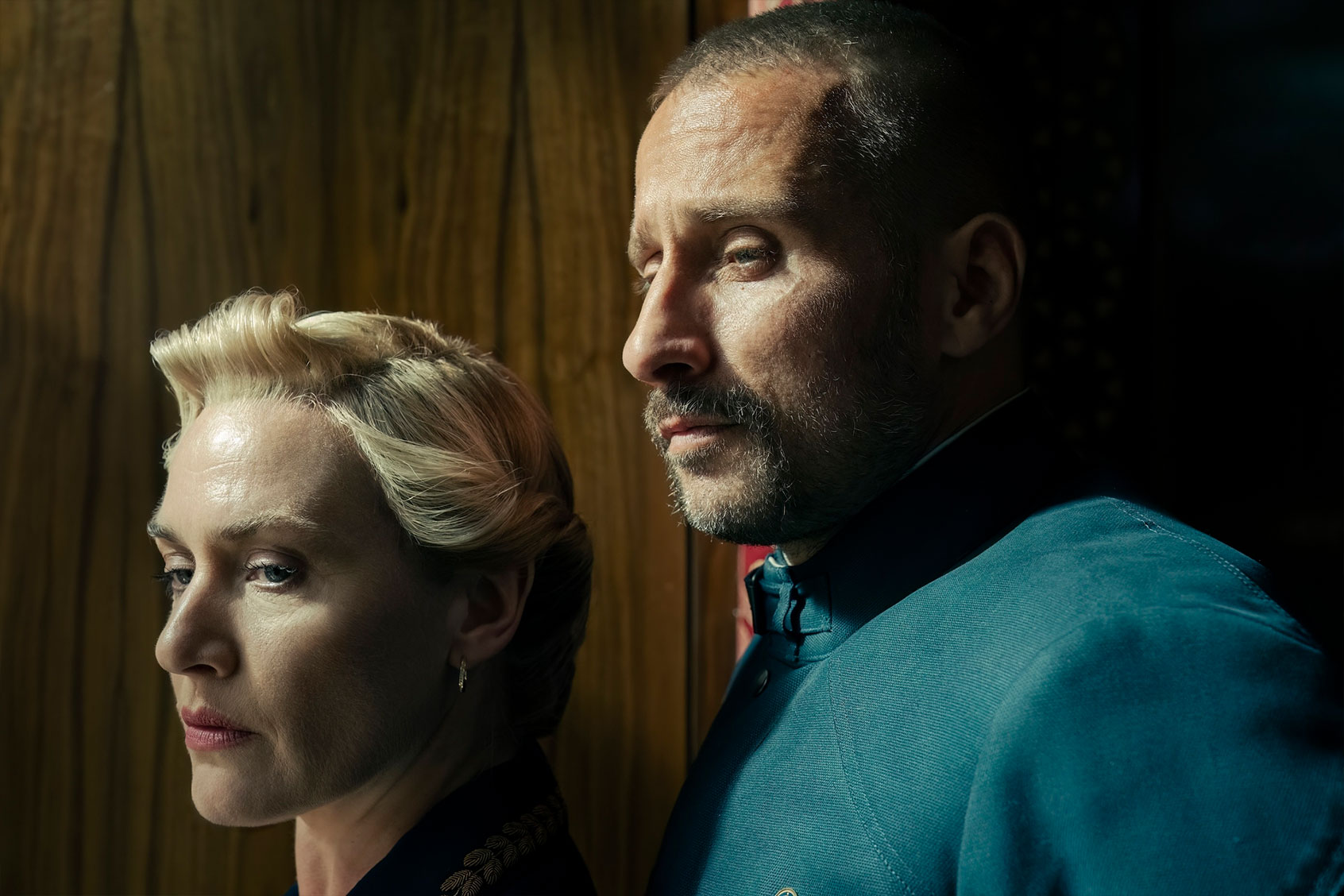
When a group of miners protests and a military battalion responds by shooting them dead, she enlists their corporal Herbert Zubak (Matthias Schoenaerts) to be her guard dog. He follows her around the hotel she’s co-opted as her political headquarters and palace with a moisture monitoring device until a nocturnal break-in reveals a better use for him.

The RegimeKate Winslet and Matthias Schoenaerts in "The Regime" (HBO)

All of this is about optics. Zubak isn't special. His entry level job could have been any member of his unit since Elena simply wanted a “butcher” in uniform. Luckily for her – Europe, not so much – Zubak only wants to please Elena and has a rugged sexy appeal, wrapping his violent inclinations in charisma.

Britt, one of the GOP’s youngest congressional members, was drafted along those same lines. She was supposed to play the reasonable, relatable young mom to Joe Biden’s supposedly doddering old man who, in his address, came out swinging. Her job was to make her party look good in comparison, and the Democrats lax on anarchy. Here’s how that worked out.

“What in the first week of acting school is this?” asked baffled X poster @nycsouthpaw

Soon after, a user who goes by the handle @BowmanInc spliced together an “Inside the Actors’ Studio” parody.

“The Handmaid’s Tale” jokes proliferated.

And the fun continued from there. One likened Britt’s 17-minute performance to an audition for a “Misery” reboot. John Fugelsang joked, "Guys I didn’t get to see the end of Katie Britt's speech but did she finally get to speak w/a manager?"

Political catchphrases, like memes, can twist our perception of the world.

“The Regime” isn’t as clean of a satire – an oblique way of saying that its comedic power is more reliant on Winslet’s excellent expressiveness than the setups. Maybe that’s a component of the environment. We aren’t merely post-“Veep,” a show that had the relative luxury of fantasizing about political fecklessness, but in an era when real-life political farce rains down around us and the actors are in a position to endanger and ruin lives.

This, I think, is what makes any joy one might take in MAGA conservatives’ misery over Britt’s broadcast debut temporary – and leave no doubt, the party’s leadership was aghast, according to many reports. (“What the hell am I watching right now?” a Trump adviser blurted, per Rolling Stone.)

But durable memes and other internet parodies are products of ironic remove, I think, which is something few of us can afford. Fifteen years ago we assured ourselves we were distant enough from Hitler and Nazism enough to make them into clowns. Most of us probably didn’t imagine a major political party would have overturned Roe v. Wade, either.

Or, for that matter, that they would enlist a woman to reassure other women that her party, the one working to destroy their reproductive rights and freedoms, is the “choice our children deserve.” While sitting in a fake kitchen.

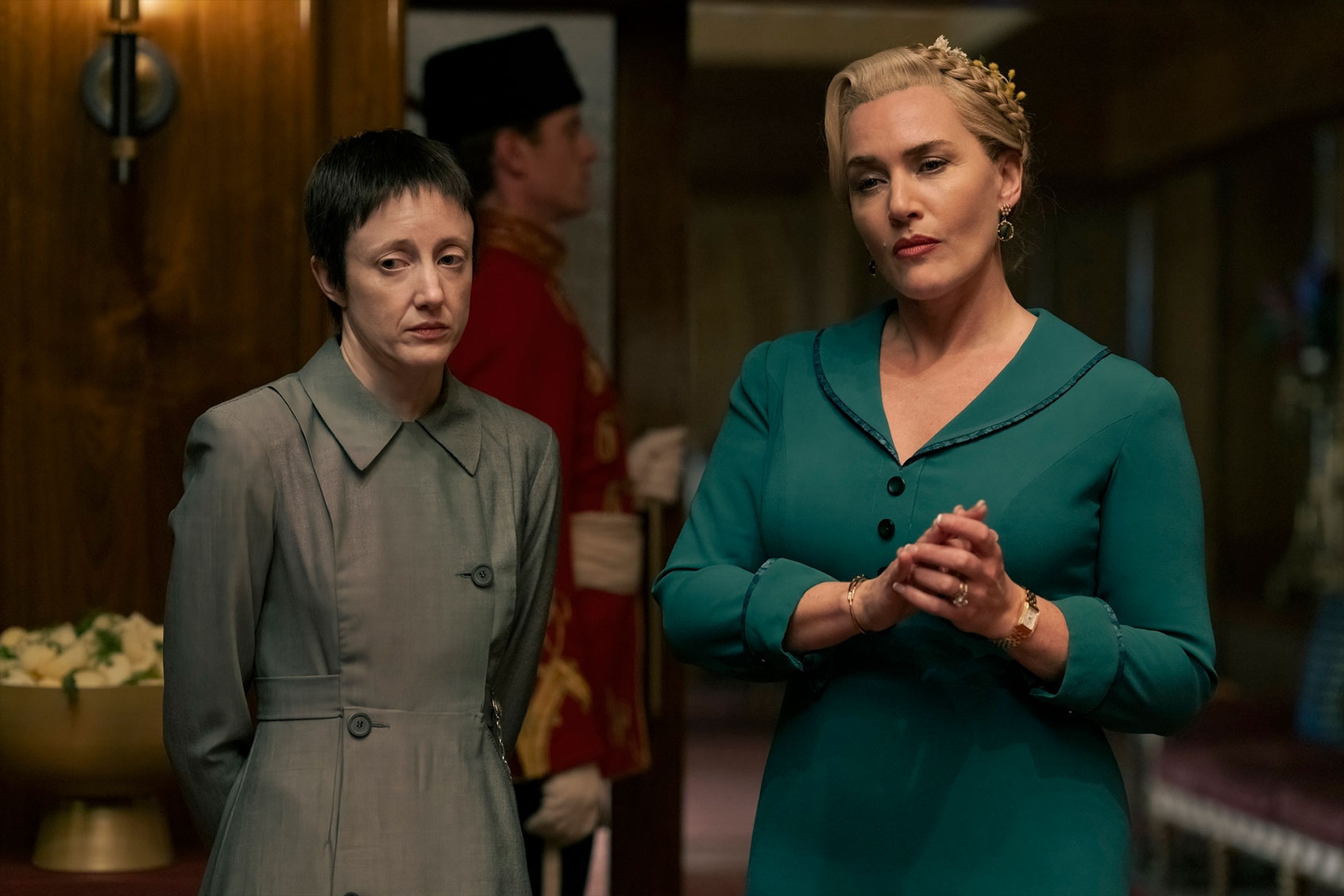
The RegimeAndrea Riseborough and Kate Winslet in "The Regime" (HBO)

Living in this bizarre reality augments the dissonance at work in “The Regime.” Elena is ridiculous but shockingly realistic. The humor laced through her lickspittles' obsequious efforts to placate her doesn’t quite dare you to laugh but isn’t going out of its way to encourage giggles either. This, too, is about optics; how can we easily laugh when we see the corrupt organs of our own sick political corpus behaving similarly every day?  

The first of “The Regime's" six episodes shows Elena as a coddled ruler whose cabinet members appease her if only to keep the machinery going – a mechanism designed to line their pockets and those of their enablers, including the United States, leaving the scraps for the working class.


Want a daily wrap-up of all the news and commentary Salon has to offer? Subscribe to our morning newsletter, Crash Course.


Then again, the only members of the servant class that we see are Andrea Riseborough’s Agnes, the downtrodden palace manager. Elena never sets foot in the palace’s kitchen – that’s Agnes’s job, along with having given birth to the son Elena claims to be hers.

It’s plain to see Agnes knows something’s wrong with her leader’s mission but soldiers onward nevertheless. She’s just the help at the end of the day – same as Zubak. And Britt, perhaps, which further shortens the shelf life of this mockery. For every hilarious swipe at her expense, some believe everything half-baked statement she dropped.

That side-splitting “Downfall” meme was from a serious, depressing drama about the days leading up to Hitler's suicide, don't forget, and the story is told from the perspective of a secretary, Traudl Junge, who willingly went to work for him. At the top of the movie we see footage of the real Junge, expressing her guilt over the fact that she went along without thinking because she convinced herself she wasn’t a fanatic.

“In Berlin, I could have said, ‘No, I’m not doing it. I don’t want to go to the Fuhrer’s headquarters.’ But I didn’t do that. I was too curious. I also didn’t realize that destiny would take me somewhere I didn’t want to be. But nevertheless, I find it hard to forgive myself,” she said.

This is the scene worth recalling all these years after the meme’s relevance has subsided, and it hints at what we should be absorbing from “The Regime” as it airs simultaneously to the coming weeks of election madness.

Winslet is magnificent, and she makes Elena the sun queen around which all of her people revolve, an eminently GIF-worthy figure. We’d be wise to keep an eye on Agnes too, because the Elenas of the world couldn’t make it without the people just doing their jobs. And they're not the telegenic influencers making us laugh off proposals and positions that should terrify us. 

"The Regime" airs Sundays on HBO and streams on Max.

Scarlett Johansson does a perfect Katie Britt in “SNL” cold open

Since Thursday, Sen. Katie Britt's haunting response to President Joe Biden's State of the Union speech has served as a good reminder of just how fun the internet can be in the days following an epic personal fumble such as hers. With her whispery-voiced kitchen performance taking place so close to the weekend, many keeping track of the hilarious backlash to her lie-peppered rebuttal were anticipating "Saturday Night Live" having a go at her, and the show did not disappoint.

Assuming that "SNL" writer and co-anchor of "Weekend Update," Colin Jost, now owes a huge favor to his super famous wife, Scarlett Johansson surpassed expectations for who would step-up to spoof Britt, giving a flawless delivery of the senator's ASMR dramatics for this week's cold open and even managing to seamlessly work in a "Get Out" reference, like an A-list diss DJ.

Cross necklace and all, Johansson "understood the assignment," as the youths say, and seemed to be having a lot of fun with it, tackling the role of an unhinged Alabama Republican with the same professionalism as she would her next Marvel blockbuster.

"I have the honor of serving the great people of Alabama, but tonight I'll be auditioning for the part of scary mom," she says at the beginning of the sketch. "And I'll be performing an original monologue called 'this country is hell.'"

I'm not just a senator. I'm a wife. A mother. And the craziest b***h in the Target parking lot.

Watch here:

The art and allure of awful food photos

For various reasons blurring the lines of work and pleasure, I’ve spent the past 13 years regularly documenting the food I cook and eat on Instagram. It began as equal parts photo diary and aspirational proving ground. I was barely a food writer back then, and my small platform lent another dimension to that persona. See? I cook clever dishes and go to interesting restaurants and have amusing opinions about what I eat! 

My photos were really bad at first: unappetizing, boring — “Here’s some beige oatmeal I made!” — taken at poor angles, perpetually under- or over-exposed. But this was par for the course on the then-nascent app, where feeds mostly consisted of amateurish snapshots of friends’ and family’s vacations and meals, presented chronologically. 

Over time, like everyone else on this attention-sucking platform, I got better at it. I found my preferred food filters (Clarendon) and angles (overhead). I accumulated followers and felt the hollow if intoxicating gratification of broaching some arbitrary number of likes (200 on this one!). When we entered the algorithmic era a few years ago, feeds became algorithm-curated mirrors held up to stuff we already liked. Settings, updates and filters shifted in favor of higher-engagement reels — which I don’t post. I felt personally attacked each time my hardwon engagement plummeted, which was often. Foodstagram got prettier, same-ier, lonelier and less fun. Advertisers shouldered their way in. 

Yet I dutifully kept sharing my foodish photos and stories to a shrinking audience, wondering what I was still doing here and why.  

***

Turns out, we humans have displayed our garish food selfies since at least the 1600s, when the pronkstilleven genre of painting originated in Antwerp. Meaning ostentatious or sumptuous still life, pronkstilleven art became all the rage in the Dutch Republic, both as a social documentation of wealth and a kind of moralistic satire. 

These were the early days of capitalism, and 17th-century Holland had become one of the richest and most urbanized provinces on earth, thanks not just to colonialist exploits but a multinational company formed from various trading ventures called the Dutch East India Co. The merchants who’d accumulated this newfound wealth got a taste for the good life: luscious, imported citrus and plump olives; salt and spices; rich pastries; young game meats and wine — all doled out using gold, ceramic and pewter serveware. 

They threw elaborate feasts like edible temples to their worldliness and wealth. But alas! How would fellow merchants or visiting dignitaries know about these luxe banquets once all those enviable perishables had been consumed? They commissioned artists like Jan Davidsz. de Heem — who’s credited with founding the style — Nicolaes Gillis, Clara Peeters and Adriaen van Utrecht to paint naturalist oil works depicting their lavish tables. 

We need your help to stay independent

A 1630s oil painting by the Flemish Peeters, called “Still Life with Crabs, Shrimps and Lobsters,” looks something like a highly stylized shot you’d scroll past on a modern fine-dining restaurant’s Instagram announcing its $200-per-head brunch extravaganza. In the foreground, piles of cakes and bread threaten to tumble off the table. Three hulking partial wheels of cheese form the backdrop for a veritable bounty of eggs, crab, shrimp and boiled lobster, arranged amid gilded and pewter-topped vessels and silverware inlaid with precious stones. 

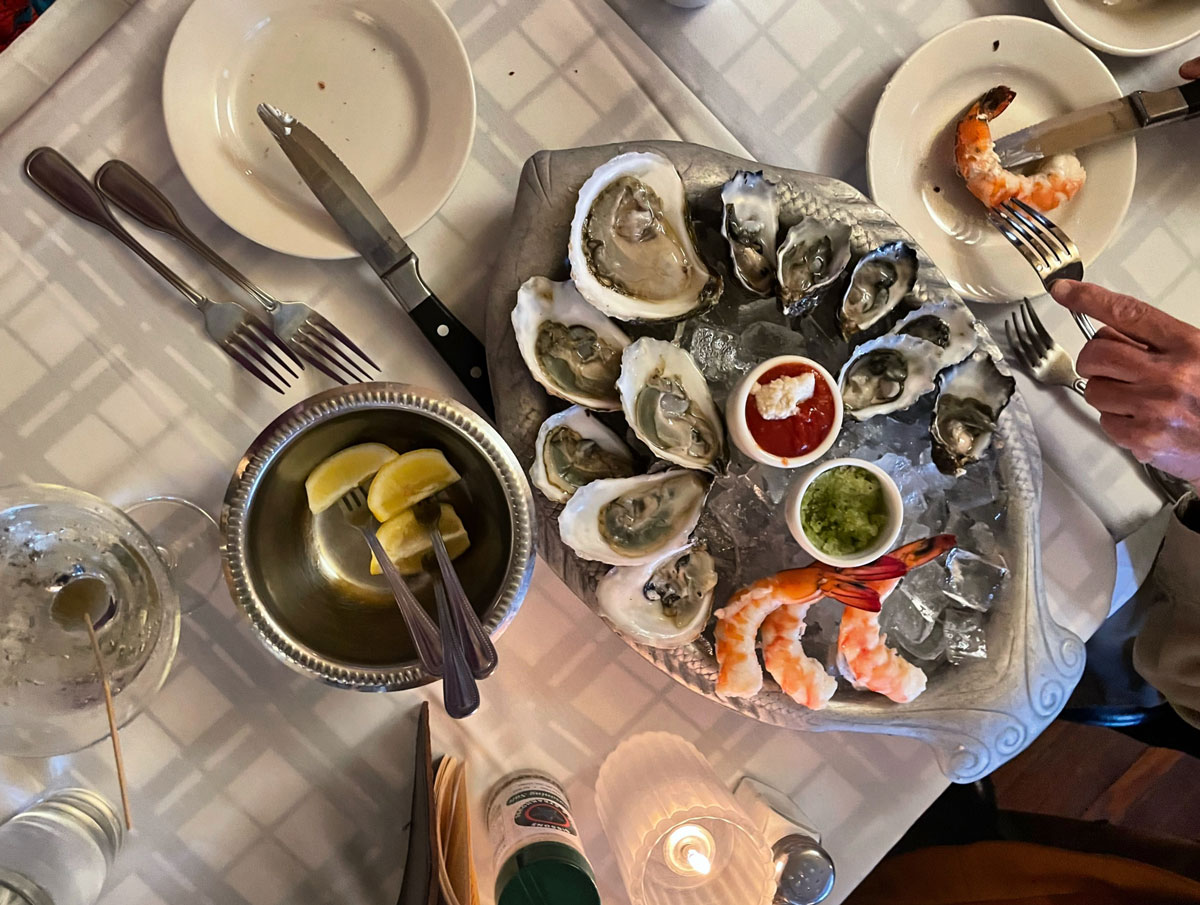
Oyster platterOyster platter (Photo courtesy of Maggie Hennessy)

Pronkstilleven pieces are complex and elaborate — aspirational in the same way foodie socials favor the gauche. (Who doesn’t love to like a foie-topped wagyu burger or chicken nuggets wrapped in gold leaf and topped with caviar?) Yet pronk works carried deeper meanings as the earliest forms of vanitas, a genre that uses symbolism to convey the brevity of life and futility of pleasure. Even as the flourishing art market and overseas trade brought economic and cultural prosperity to Dutch society, the Protestant reformation was simultaneously propagating the spread of Calvinism across the northern Netherlands, which called for strict moralism. 

Peeters’s “Still Life with Crabs, Shrimps and Lobsters” purportedly contains religious references, depicting foods allowed during the Lenten season as well as a scene of Abraham’s sacrifice of Isaac woven into the blue damask tablecloth. Tables overflowing with rich food sought to admonish self-indulgence, decorative empty vessels pointed to the emptiness of wealth and possessions, and oft-depicted roses suggested that beauty and life are fleeting. 

All of this was to say: Soon you’ll die. What have you done with your time?

***

Last fall I was in Montreal on holiday, indulging in a hedonistic feast at Joe Beef that would’ve provided terrific fodder for pronkstilleven artists: oysters freshly plucked from the Atlantic; snails bathed in garlic butter; rosy curls of Iberian ham topped with compressed melon; glossy, brandy-drunk lobster spaghetti; and fat slices of steak, all washed down with bottle upon bottle of wine. 

Joe Beef is one of the most famous restaurants in North America, with a slew of awards for its lust-for-life French cooking and a couple of cookbooks to its name. Its narrative arc is as thoroughly well-documented as that voluptuous lobster spaghetti. Nonetheless, I found myself compulsively getting up with the arrival of every dish, snapping dishes from overhead between sheepish apologies to my friends. 

Lobster spaghettiLobster spaghetti (Photo courtesy of Maggie Hennessy)Fortunately, the dim lighting in Joe Beef’s dining room is intended to foment escape, rather than accommodate unoriginal food photography, meaning every picture I took turned out unappetizing, amateurish and drab — with several unwelcomed cameos by the shadow of my hand holding the phone. As I later scrolled through this sickening slideshow, wondering what I could salvage to post, I realized how overdue I was to reexamine my relationship to documenting food on this increasingly vapid platform. Why did I wish these images looked better? For engagement bait? To prove I’d eaten at this restaurant? What was all this for anymore?

My iPhone photo album is a compendium of a life centered around the dining table. It traverses ostentatious chilled seafood platters and glass eel pinxtos just before I slurped them down on the street in San Sebastian, Spain. There are selfies with a crackly baguette on the street and a huge head of CSA-grown lettuce in my home kitchen. I’ve saved snaps of my husband pulling the first cheesy slice of tavern-style pizza, my outstretched hand holding a Chicago-style hot dog at Wrigley Field, and literally dozens depicting my favorite breakfast: a single, oozing fried egg on toast with avocado and blobs of chili crisp. 

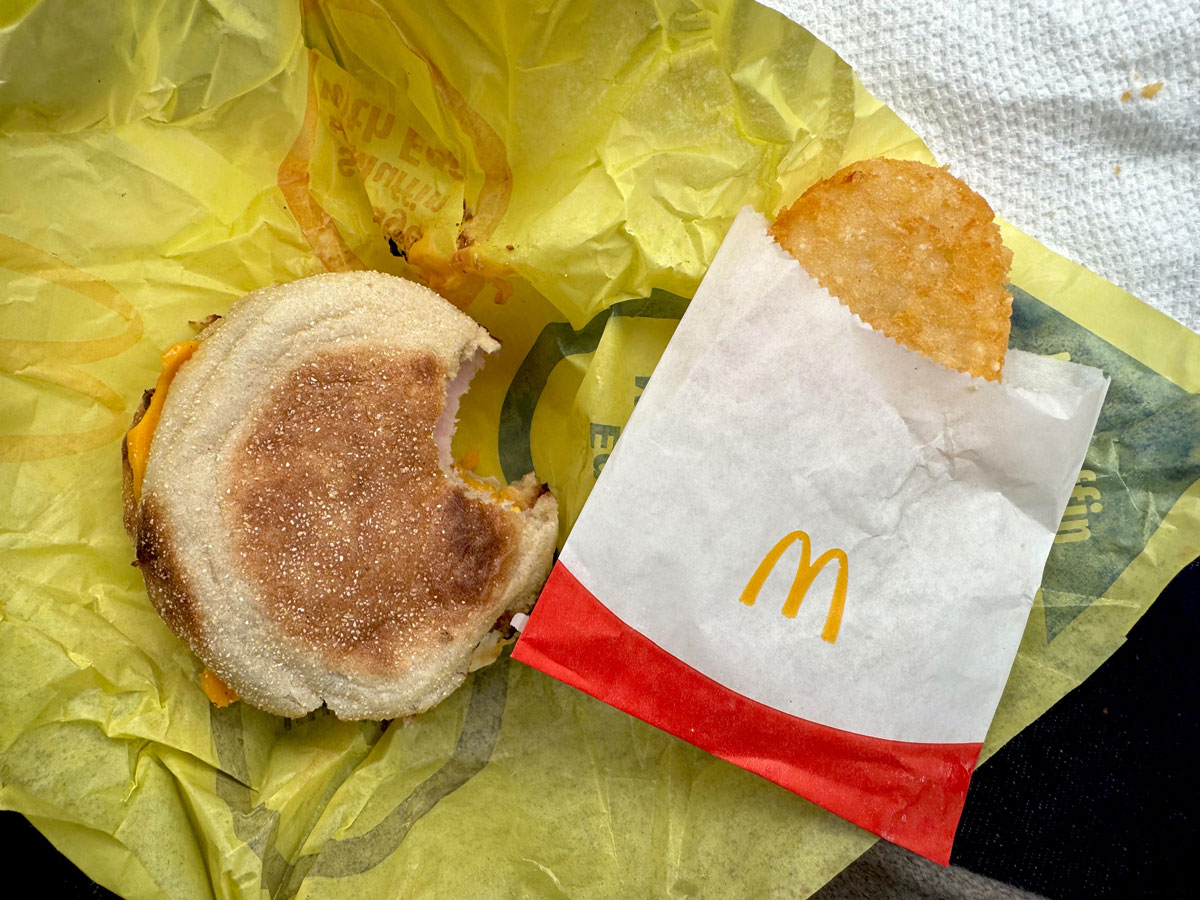
McDonald's breakfastMcDonald's breakfast (Photo courtesy of Maggie Hennessy)Capturing food is a way to teleport myself to specific, rich moments in time. What did the air feel like on my face that night in that city? Why did that bread taste so good? Who was I with at that restaurant, and what did we talk about? Where was I living at the time? As a storyteller, I will always feel compelled to document and share some of these experiences within my small sphere of influence. But lately I’ve begun saving more of life’s pure pleasures for myself too — deliciously here and then gone, sometimes to be forgotten, other times to be revisited in my album in all their grotesque, pixelated, unimaginative glory. 


All hail Leon, the king of “Curb Your Enthusiasm”

Yes Larry David has millions of dollars, unlimited opportunities in Hollywood and enough resources to come out on top, even when he clearly loses. However, Leon is the biggest winner in the history of "Curb Your Enthusiasm," as he's the only person in the universe who's figured out how to out-Larry Larry. 

We met Leon Black (J.B. Smoove) back in 2007, when the Black family is displaced by Hurricane Edna (based on Hurricane Katrina), a vicious storm that dismantles the entire state of Louisiana. Coverage of the news leaves Cheryl David (Cheryl Hines) distraught – depressed and hungry to do something nice for the people of Louisiana. She asks Larry if they could adopt a family who was affected by the storm and take care of them until they got back on their feet. To this, Larry says hell no. 

Later that night, the Davids find themselves playing a couples game with the Funkhousers and the Greenes. In this particular game, you have to guess the identity of the person in your friend group who your spouse would consider having sex with. Marty Funkhouser is up first, and after complimenting all of the women present, he settles on his wife. He would always choose his wife. This is the easiest question in the world for Larry to answer, he doesn't care who's watching or who will judge – because he knows if he gets a pass from Cheryl, he isn't going to waste that pass on Cheryl, he's going to go for Richard Lewis's young girlfriend Cha Cha (Tia Carrere). 

This bold outburst – a clear embarrassment to Cheryl – lands Larry in the doghouse. He begs for forgiveness, telling Cheryl he would do anything in the world to make things right – so they adopt the Blacks, a family of four they pick up during the first episode of the sixth season, when they move in.

We don't meet Leon until the next episode, when Loretta Black (Vivica Fox), smokes a cigarette and burns down the house – causing the lot of them to take up at another residence, where Leon, the brother of Loretta moves in. 

Leon was not affected by Hurricane Edna. He had already been living in LA, but if his family struck it big with a rich Hollywood producer, then why shouldn't he benefit too? 

Three key things happen in the sixth season that permanently connect Larry and Leon for the next 17 years: 

  • Larry falsely accuses Leon of ejaculating on a fresh comforter set

    Larry is uncomfortable with Leon moving in – being as though he wasn't a victim of the hurricane – but decides to play ball and lets him stay. This almost explodes when Cheryl finds evidence of semen on the comforter set in Leon’s guest room. She approaches Larry, who is ready to kick Leon out. Leon stands his ground though, telling Larry that he has too many sexual partners to be masturbating on Larry’s comforter, and even if he wants to masturbate in Larry’s house, he can't because there are “no visuals,” and nothing that look at, mainly because Larry only has basic cable. 

    Later in the episode we find out that Jeff (Jeff Garlin) is the culprit, and Larry gives Leon an appropriate apology. 

  • Someone steals Larry’s beloved Joe Pepitone jersey, but Leon retrieves two 

    Larry goes to the cleaners to pick up his Joe Pepitone jersey, only to find out that they had given it away to someone else. The owner tells Larry that this is the law, sometimes you gain an extra piece of clothing form the cleaners and sometimes you lose. Larry is clearly upset but there is nothing he can do. 

    While Larry is apologizing to Leon for the false ejaculation accusations, he notices a guy wearing his jersey. Leon hops out of the ride and takes the jersey. Later on in the episode they see another guy with the same jersey, and then Larry checks the size of the jersey Leon has recently snatched and realizes that they have the wrong one, so Leon takes the right one too, and now the duo have a matching set. Best friends for life. 

  • Larry costs Leon a job

    Leon has been going on job interviews, trying to find employment so that he can make enough money to move out.

    Larry has been getting calls from telemarketers all day who just wanted talk, talk, talk. He and Leon realize that they have the same cell phones and at some point they make a mistake and switche devices. Leon gets a call from a place that wants to offer him a position, but Larry has his phone, thinks it's a telemarketer and curses the guy out. Leon remains unemployed and has been unemployed ever since. 

    If Leon would have gotten that job then we never would have known how great of a partner to Larry he would be. This is where we thank God for making Larry an a**hole. 

We need your help to stay independent

Leon is Larry’s ultimate protector. At the same time, only Leon can attack Larry, disagree with Larry and have conflict with Larry. 

Throughout the years Leon has remained a resident at Larry David's home, and the perfect sidekick: the yin to Larry’s yang and the only person able to balance Larry out. 

Leon is Larry’s ultimate protector. At the same time, only Leon can attack Larry, disagree with Larry and have conflict with Larry. Over the years he grows into the person that Larry did not know he needed. Like the episode where a contractor is trying to rip Larry off, but decides to adjust the price once he sees that Larry has a Black friend living at the residence. 

Leon is also the one who gives Larry the courage to get back out there and date after he separates from Cheryl by diagnosing him with “mopey d**k.” Jeff tries to educate Leon on the actual phrase “Moby Dick,” the book by Melville, but Leon insists by telling Larry that he is “mopey d**k” because his peins is moping as a result of him laying around all day, mourning a woman that doesn't want him. 

Leon goes on to start multiple businesses with Larry, which includes a company that gives people who work at magazine stands and parking garages a chance to go take bathroom breaks, always gives Larry the best advice on race relations and relationships and is right there with him when he opens Latte Larry's, a spite store to rival Mocha Joe. 

What's more impressive is the Leon has found a way to avoid working traditional nine-to-fives, and lives a glorious life for free. Sure, he starts a business here and there, but all of these companies come from conversations with Larry and rise as quick as they fail – leaving Leon the opportunity to eat delicious food, do hot yoga and travel. The beauty of this situation is that Leon lives a life as if he's the one who created "Seinfeld" even though he has never worked on the show, because he has brilliant insight like Larry, the ability to get under people's skin like Larry, but none of the responsibilities that Larry has. Leon won, because Leon just gets to be Leon, who everyone loves. 

Maybe "Curb" shouldn't end . . .


The state of Alabama hypocrisy

Last year, I wrote an article titled, “Damn right, I come from Alabama” in response to the Montgomery brawl that captured the nation’s attention for weeks.

I made a bold remark that Alabama was finally on the right side of history in terms of how it is viewed by others outside the state, for once: footage of Black folk standing up for themselves in the face of blatant racism went viral. However, I must admit, after the article ran, I privately contemplated how many days, minutes, seconds would it take for Alabama to reassume its stupidity-throne with some backward, ignorant thing that would once again recrown it as the epitome of whistling Dixie.

It took approximately six months.

Alabama purports to be a fire-red Christian state with deep family values. And perhaps in their own eyes, no one is more Christian and has a more personal relationship with God than the good citizens of Dixie. In reality, it is a twisted version of rogue Christianity in which two-faced thought is at the epicenter of any form of truth. 

To pull the covers off this Christian hypocrisy, follow me back to January 25, 2024, when Alabama made international news in how it killed a man on death row. The execution was a heinous, immoral and outright shocking display of vitriolic violence, incorporating a procedure that had never been used before. Of course, leave it for Alabama to be the worldwide leader in all things ignorant — or as they say down South, ignant. Allow me to give you the visual: a contraption resembling a diver’s helmet was placed on Kenneth Eugene Smith as he awaited death. One could surmise Mr. Smith looked like a deep sea diver or an astronaut, except his only exploration would be via a one-way ticket to the great beyond.

With the contraption pulled over his head, Mr. Smith was forced to inhale nitrogen hypoxia until, as eyewitnesses reported, his body parts twisted and squirmed and he no longer existed among the living. At that moment, I wonder if the jury who originally sentenced Mr. Smith to life without parole appreciated the judge overruling their original sentence and taking it upon himself to administer his version of vigilante justice by sentencing Mr. Smith to die.

To execute Mr. Smith in such an inhumane manner makes one wonder how we can call America a civilized society.

If that mode of execution isn’t enough to make a moral person cringe, how about 30 days after breaking the most scared covenant of Christianity by killing someone, the Alabama Supreme Court decided that frozen embryos can be considered "children" in a ruling on "wrongful death of a child" lawsuits filed by couples whose embryos, frozen as part of the in vitro fertilization process, had accidentally been destroyed. This caused IVF treatments to come to a halt in the state due to legal liability concerns. 

Allow me to quote Chief Justice Tom Parker's reasoning behind this decision: “[H]uman life, cannot be wrongfully destroyed without incurring the wrath of a holy God, who views the destruction of His image as an affront to Himself.” 

This is what the new generation would call a WTF moment in history. Right after Alabama suffocates a human being to death, the state then spins its own narrative spin with yet another spin. How can the state kill a human being and yet say it is immoral to kill a human being? I would love to ask the powers that be within the state the following question: Are not all human beings molded in your God’s image? Or is this a selective God that will sanction murder in the same breath as condone it?

The IVF ruling was not even thinly veiled in its intention to cross boundaries between the separation of church and state. At the center of this blatant integration of confederate theology belies the real subtext: Alabama has a horrid history of control and hate, riddled with white men trying to tell women what to do with their bodies. 

Recently I talked with my Advanced Poetry students about Alabama’s execution and IVF ruling. These young poets were eager to talk. While many students held varying views on the death penalty, they seemed united in the understanding that a woman’s body is hers as much as a man’s body is his. Many of the young women in my class were jaded after the overturning of Roe v. Wade, but the Alabama court ruling made them mad as hell. They could not get past the disbelief of how someone wanted to control their body. When I asked students to explain a bit more in detail, they articulated, with clarity, that these measures were draconian and archaic, the polar opposite of what a civilized society should resemble. If I had to paraphrase the conversation, mostly led by the women, it would be this: “Alabama is playing the role of God.”

In other words, the two events, taken together — the methodology of execution and the ruling that jeopardizes in vitro fertilization as a method to start a family — were enough for them to agree this was indeed a WTF moment.

This is what the new generation would call a WTF moment in history. 

And then the state spinned its narrative again. 

Many conservative Christian women around the state apparently felt as my students did — that a ruling that would restrict a woman’s right to start a family as she is able was a bridge too far. But the same hypocritical fools who likely supported amending the state constitution in 2019 to “ensure the protection of the rights of the unborn child,” which played a role in the IVF ruling, only care enough to address this madness with a temporary bandage at best. Thanks to their outrage, Gov. Kay Ivey might as well have been on ice skates in terms of how quickly she signed a new bill granting civil and criminal immunity to IVF practitioners into law. But while the new law supposedly shields doctors and providers from legal liability when working with frozen embryos, critics say it avoids addressing the real problem — the ruling that confers "personhood" onto embryos in the first place. I guess for the gain of political favor, God gonna let this one slide for the good Christian folks in Alabama?


Want a daily wrap-up of all the news and commentary Salon has to offer? Subscribe to our morning newsletter, Crash Course.


Regarding a woman’s right to make the choices that affect her body, I speak from experience: A woman I was in a relationship with got pregnant, and because neither of us was prepared to raise a child, she decided to get an abortion. Initially, I wanted to have the child and figure it out. She did not. When I listened to the pain and internal struggle she was going through, I began to understand. This was her decision, and I had to respect that. That changed me. I get it. I, as a man, have no right to tell a woman what to do with her body.

Lately, I've felt like I've traveled through a portal against my will to Earth 2, a parallel universe to Earth l. On Earth 2, society has been turned upside down, and the immoral is now the moral. Spirituality is placed on a pinwheel and spun counterclockwise, stopping at random to decide how to control the citizens. Seasons are unbalanced. Sometimes it forgets to snow in winter and sunny days are often shaped by gray clouds stuck in suspended animation. The birds are just as confused as the humans.

All Alabama has given us is more contradictions: What is life and what isn’t? Who gets to live, and who doesn’t?

Spin, spin, spin. Every legislator in the state of Alabama who placed this madness in motion should be dizzy from all the spinning. I don’t know how they’re still walking upright.

America’s amateur sports are plagued with scandal: Is reform finally coming?

The Commission on the Future of the U.S. Olympic and Paralympic Committee, established by Congress in 2020, last week issued its long-anticipated report. This 277-page document offers 12 recommendations, including the first serious proposals to wrestle with USOPC's blatant failures in handling the sexual abuse crisis in youth sports. One of those recommendations would amount to the first fundamental retooling of America's sports system since the Ted Stevens Amateur Sports Act of 1978.

The committee's Recommendation No. 3 calls for spinning off the U.S. Center for SafeSport as a government-funded entity, thereby removing it from both the influence and the administrative structure of USOPC and its national sport governing bodies, known as NGBs.

Recommendation No. 1 would break off grassroots youth programs in the various Olympic sports from the authority of NGBs, putting them instead under a newly created federal agency, while keeping programs aimed at elite athletes under the umbrella of the USOPC bodies. This is a crucial missing reform to the existing system, which currently puts kids at all levels of athletic ability and aspiration at the mercy of one-size-fits-nobody nonprofits, which are ultimately controlled by USOPC apparatchiks at the national headquarters in Colorado Springs.

As a reporter who been investigating this subject for more than a decade, I didn’t see such a strong report coming. The commission co-chair, University of Baltimore law professor Dionne Koller, last year downplayed the suggestion that a close examination of the SafeSport center was even part of her mission. The report in fact seeks to address multiple controversies within the U.S. Olympic movement, from pay equality for elite female athletes to the way bids are handled for American cities to host Olympiads. But it’s the sections about curbing abuse that have claimed the major headlines, and rightly so. My analysis is that Koller is a savvy hand in the ways of Washington, and realized that the commission’s best strategic play was to tamp down expectations prior to the report’s release.

Surely the commission is aware that wonky recommendations from a blue-ribbon panel (which included legendary Olympic hurdler Edwin Moses and gold-medalist swimmer Nancy Hogshead, now a women’s sports advocate) don’t automatically translate into implementation. Given that the U.S. Congress is deeply divided on just about everything, including such higher priorities as the future of democracy, it isn’t especially likely to focus on overhauling the amateur sports system anytime soon. Nor are the money-first apparatchiks of the Olympic movement likely to give up on their bastardized vision of SafeSport without a fight.

Whether or not Koller gets credit for steering the conversation in the direction of meaningful reforms, commenters and stakeholders made their voices heard during the last lap of the commission’s work. Last summer a leaked staff analysis found that the SafeSport agency was “in potential crisis.” The abuse scandals of USA Gymnastics were already well known, and other damaging media accounts have followed, outlining distasteful scenarios in many other sports, including speed skating and taekwondo. The biggest footprint of all was the scores of abuse claims and civil lawsuits at USA Swimming, which commandeers the after-school practices and year-round meets of as many as 500,000 American kids.

We need your help to stay independent

At a commission hearing last September, SafeSport center CEO Ju’Riese Colón pushed back, insisting that the agency had “pioneered a shift to a safer sports culture over the last six years.” In fact, the center's history of alleged corruption tells a different story. Salon readers may already know, among other things, about SafeSport’s highly paid chief investigator, who outright conned complainants before moving on to become the chief integrity officer of the entire federal court system.

In what might be regarded as a dramatic understatement, the new commission report finds that the SafeSport center “does not adequately employ trauma-informed practices,” a flaw that exacerbates the reluctance of victims to file claims out of fear that the process will be re-traumatizing. The agency “has never been able to find its footing," the report continues. "It must not, however, be allowed to become an enduring example of failure.” Colón is praised for her openness, at last year’s hearing, to a reconceptualization.

In a side note with historical resonance unacknowledged by the commission, the proposed independent spinoff of SafeSport is compared to the evolution of the U.S. Anti-Doping Agency, which the report maintains has been a rousing success. What is not mentioned is that USADA’s CEO, Travis Tygart, cut his teeth as a lawyer for USA Swimming, where he was implicated in abuse cover-ups during the regime of Chuck Wielgus, that entity's chief executive from 1997 until his death in 2017.


Want a daily wrap-up of all the news and commentary Salon has to offer? Subscribe to our morning newsletter, Crash Course.


Even if this commission's recommendations don’t make it to the finish line, its report will remain immensely valuable for its documentation of the history, and the skewed priorities, of the Amateur Sports Act. The current system “emerged in large part as a result of public attention to what was believed to be poor U.S. Olympic showings against Soviet-bloc nations,” as the report says, resulting in “a uniquely American balance” of public-private oversight, which is long overdue for a facelift.

The unknowable political factor, going forward, is about America’s sports parents, collectively intoxicated by the prospect of college scholarships and potential Olympic glory. Are they truly aware of what’s in their children’s best interests — and are they willing or able to stand together in support of the commission’s proposed reforms?

Democrats are fighting against “shrinkflation” with a new bill. Here’s everything you need to know

On Tuesday, Cookie Monster, the ravenous blue puppet who has a penchant for chocolate chip cookies, expressed his dismay at “shrinkflation,” which has been called “the worst corporate idea in years” by Forbes.

Shrinkflation, a portmanteau of the words shrink and inflation, is a decades-old strategy where items shrink in size or quantity — sometimes even quality — while their prices remain the same. The grocery shrink ray is just one of many responses during periods of shortages and inflation. Recently, shrinkflation took off during the pandemic, when significant supply chain disruptions and labor shortages forced companies to drive up food and transportation costs. Instead of alleviating those costs, companies kept them high to offset higher wholesale costs while downsizing their products.

The Bureau of Labor Statistics identified food and household commodities, including potato chips, paper towels, cereal, cleaning supplies, and candy, as some of the top product groups most affected by shrinkflation. Toilet paper and paper towels are reportedly 34.9% more expensive per unit than they were in January 2019, per a December report from Democratic Sen. Bob Casey, citing Labor Department data. Of that total cost increase, 10.3% is due to producers reducing the size of rolls and packages. A similar increase was observed for snacks like Oreos and Doritos, which are 26.4% more expensive since January 2019. Nearly ten percent of that price hike has been accomplished by giving consumers fewer chips and cookies for their money’s worth.

The report also noted that family-size packs of Double Stuf Oreos decreased 6% in size by weight, but maker Mondelez International is charging the same price. Consumers further claimed that Mondelez reduced the amount of filling in each Oreo — an accusation that the company denied and still remains unverifiable.

Ahead of the 2024 presidential election, inflation remains a top issue among voters, many of whom have blamed Biden for rising costs. Now that national inflation is set to fade in 2024, the president along with lawmakers are shifting their attention to growing shrinkflation. Last month, Biden slammed shrinkflation in anticipation of the Super Bowl, calling on companies to “put a stop to this” in a game day commercial.

“I've had enough of what they call shrinkflation,” he said. “It's a rip-off.”

"Some companies are trying to pull a fast one by shrinking the products little by little and hoping you won't notice…I'm calling on companies to put a stop to this,” Biden added.

On Thursday, Biden called out shrinkflation during his annual State of the Union address to Congress: “Too many corporations raise prices to pad the profits, charging more and more for less and less,” he said. The president also joked about the candy bar Snickers, saying they are now smaller in size but available for the same price.    

“The snack companies think you won't notice if they change the size of the bag and put a hell of a lot fewer — same size bag — put fewer chips in it,” Biden added before boosting Casey's shrinkflation-centric bill.

Earlier this year, Casey penned a letter to the Government Accountability Office urging the oversight agency to examine the effects of corporate greed on consumers. “Corporate strategies to hide price increases and raise the unit cost of everyday items like food and household products are hurting families in Pennsylvania,” he wrote. “The American people should not have to tolerate corporate executives squeezing them for every last nickel and dime.” Casey cited his November greedflation report, which found that from July 2020 through July 2022, inflation rose by 14 percent while corporate profits rose by more than 74 percent.

Casey, who serves on four committees in the 118th Congress including the Committee on Finance, co-introduced a bill focused on shrinkflation late February alongside Sen. Elizabeth Warren, D-Mass. The Shrinkflation Prevention Act would allow the Federal Trade Commission and state attorneys general to crack down on corporations that reduce product size without a reduction in price. Section 5 of the Federal Trade Commission Act already prohibits “unfair or deceptive acts or practices in or affecting commerce.” If the bill is passed, then shrinkflation would also be qualified as unfair and deceptive. 


Want more great food writing and recipes? Subscribe to Salon Food's newsletter, The Bite.


“Corporations are trying to pull the wool over our eyes by shrinking their products without reducing their prices — anyone on a tight budget sees it every time they go to the grocery store,” Casey said. “Pennsylvania families are sick and tired of digging deeper into their wallets for their weekly grocery runs while corporate CEOs laugh all the way to the bank. I’m fighting to crack down on shrinkflation and hold corporations accountable for these deceptive practices.”

Groundwork Collaborative, a progressive economic policy research group, along with Public Citizen, a non-profit consumer rights advocacy group, have both endorsed Casey’s bill. The bill has seven Democratic co-sponsors including Sens. Tammy Baldwin of Wisconsin, Elizabeth Warren of Massachusetts, Jacky Rosen of Nevada, Cory Booker of New Jersey, Sheldon Whitehouse of Rhode Island, Sherrod Brown of Ohio and Patty Murray of Washington as well Sen. Bernie Sanders, I-Vt.

Many Republican opponents say the bill “would go too far by telling companies how to package their products,” according to USA Today. Mike Faulkender, who served as assistant secretary for economic policy at the Treasury Department under former President Donald Trump, asked if Democrats “[had] any idea how communist in nature that would be?”

At this time, consumers can combat shrinkflation by adopting smart shopping strategies. According to U.S. News & World Report, consumers should compare the unit prices of products, consider store brand items, enroll in a membership-based store, limit their purchases of processed snacks and focus on healthy bargain foods.

Nervous about November? Stop listening to pundits and start defending the president

This past week’s State of the Union, and the incredibly powerful performance by the President, in any other era, would result in a rash of articles about the strong position he is in as we move closer to the November election. Of course, we don’t live in any other era, and in the post-truth “feelings over facts” timeline in which we live, we know that his opponents are going to double down on their attacks and that is going to fuel even more hot takes about President Biden’s fitness for office from pundits and armchair strategists all over Washington. Some of those takes will repeat deeply offensive and ageist attacks on his mental capacity that were dropped into a special counsel report by a deeply political operative who sought to harm him– despite the fact that the report completely exonerated him of any wrongdoing. That, of course, is the price of doing the right thing in an America that is defined by its MAGA obsession– even when you play by the rules, you will be attacked mercilessly. 

Despite the fact that we’ve been living in a world in which a small group of authoritarians surrounding Donald Trump continue to gaslight and attack the rest of us, there are still pundits and operatives who haven’t adapted their strategies and tactics to those realities. They view every single thing said by the abusers as something we need to consider and we need to be afraid of. These conversations end up fueling private conversations at the cocktail parties all over Washington, in which otherwise well-meaning staffers, consultants and strategists discuss and dissect these attacks to the point where they result in big portions of the progressive infrastructure seizing up, unsure of how to react and afraid that whatever they do will be the thing that will propel Trump back to the White House.

It turns out though that the answer is far easier than the half-baked solutions that seem to make it into the navel gazing podcasts online or the “think pieces” we see in some papers. The answer is to stop looking for alternatives and start defending the President. Every single time we entertain notions that our opponents' attacks are real, we perpetuate the ability for our opponents to create doubt in the minds of voters. Every single time we play on their level and play the “what if” game, we make an undecided voter feel anxious over the President’s leadership.

We need your help to stay independent

Otherwise convincible voters are looking for leadership and reassurance that the president is strong and that the past four years have been an incredible success. They don’t want to hear us wonder out loud about what Trump’s allies are saying and they definitely don’t want us to lend those attacks credence. Doing so undercuts the campaign’s ability to make a case for the next four years and undercuts our ability to defend democracy against those who are intent on destroying it. Further, there has arguably never been a clearer choice and message between two Presidential candidates as there is in 2024. The Biden presidency has been an astonishing success that prevented our nation from spiraling into failure, restored confidence in our world leadership and created the most successful economic recovery in the post-pandemic world. We just need to get out there and defend it. 

Meanwhile, while we sit around pondering Ezra Klein or Nate Silver, Donald Trump and his allies are preparing for militarized detention of immigrants and asylum seekers, invoking the insurrection act in order to restrict the exercise of free speech and enabling Russia to attack NATO allies. We know what they are going to do if they win, they are telling us every day. At the ultra-conservative gathering CPAC this week, Trump ally gleefully proclaimed, “Welcome to the End of Democracy” while Steve Bannon gleefully cheered him on.

The only way that we are going to defeat the anti-democratic forces that are looking to transform our nation in ways that keep us all up at night is to present a unified opposition. The only thing that our opponents understand is the exercise of force and power. When we equivocate or fail to defend a President who has brought our nation back from the brink of ruin, all they sense is our fear, and all it does is embolden them. Instead of dragging the entire nation into a debate over our President’s fitness, it's time for all of us to do the one thing that will prevent him from losing– get out there and start defending his record. If not, then we’ll all be sitting around in October wondering where things went so wrong.

“Let them eat cereal”: How accusations of “greedflation” fueled consumer ire against Kellogg’s

Since 2022, Kellogg has been running an ad campaign encouraging families, with the help of Tony the Tiger and Toucan Sam, to break out of their boring dinner rotation and swap in the occasional bowl of cereal. “If you’re tired of cooking chicken over and over (and the kids are bored of eating it) we’ve got something you’ll want to try,” the description for one of the advertisements read. “Turn off the stove, pop open the pantry and pour your favorite Kellogg’s cereal for dinner!”

That commercial didn’t inspire nearly the same amount of dialogue as when — nearly two years later, on Feb. 21 — WK Kellogg Co. CEO Gary Pilnick also suggested customers eat cereal for dinner, likely because instead of positioning it, as the advertisement had, as a little treat, he suggested it as a solution for families feeling throttled by food inflation. 

“The cereal category has always been quite affordable, and it tends to be a great destination when consumers are under pressure,” Pilnick said in an interview with CNBC. “If you think about the cost of cereal for a family versus what they might otherwise do, that’s going to be much more affordable.”

He isn’t wrong; the average price per box of cereal in the U.S. is around $3.27 and, when speaking with CNBC, Pilnick estimated that a serving with milk in fruit would cost about $1. However, his comments didn’t sit well with many viewers and consumer advocates who quickly pointed out that the price per unit of Kellogg’s products was up by 17.1% in October compared with the same month a year earlier, the highest increase among ready-to-eat cereal brands. 

This has led to widespread calls for a boycott of Kellogg’s products, which could potentially spark the boycott of other food companies that are perceived to be similarly squeezing their customers during a period of time when, as reported by Pew, more than 90% of Americans say they are “very” or “somewhat” concerned about the price of food — especially because the boycott is reportedly already starting to produce some results. 

“There’s no reason for you to jack up your prices the way you did, except to screw us,” TikTok user @TallGirl6234 said in a now-viral video posted in February. “And you know what? Now we’re going to screw you — while eating some other brand’s cereal.”

The success of the video has launched the hashtag #letthemeatcereal as well as associated website Let Them Eat Cereal, which provides resources for customers who want to participate in a boycott of Kellogg’s products “from April 1 to June 30th (2024 Q2) by buying the store brand, making your own, and sharing resources for others to get involved.” 

“Boycotting Kellogg and other mega corporations isn’t easy, and this is intentional,” they continue. “It is an excellent way to use collective action for change though.” 

This period of sustained grocery inflation, even as the price of other goods comes down, has caused frustration for a lot of American customers. As Abha Bhattarai and Jeff Stein wrote for the Washington Post, there are a lot of complex, interlocking reasons why the cost of food at the supermarket is still up. “Prices remain elevated due to a mixture of labor shortages tied to the pandemic, ongoing supply chain disruptions, droughts, avian flu and other factors far beyond the [Biden] administration’s control,” they wrote. 

We need your help to stay independent

However, economic experts and everyday Americans are both increasingly talking about how “greedflation” is potentially impacting the cost of goods. 

“The idea that profits drove our current bout of inflation surfaced in the last few years among progressive economists and lawmakers but was waved away by more mainstream types as a ‘conspiracy theory,’” wrote Emily Peck for Axios last summer. “That changed earlier this year. In a speech in January, then-Fed vice chair Lael Brainard said wages weren't the main driver of inflation and pointed to a ‘price-price spiral,’ where companies mark up prices far higher than the increases in their input costs.” 

Companies, some customers would say, like Kellogg. There are reports that the calls for the boycott of the brand are already starting to have some effect. As reported on Friday by the Daily Dot, some shoppers have already started to see Kellogg’s cereals for prices as low as 99 cents on supermarket shelves. In a viral TikTok video, user Marc Fazon found similar prices at his store. 

“Yo, this is the cheapest I’ve ever seen cereal be,” he said. “Ninety-nine cent, nah, the protest is working y’all, keep doing it.”

Kellogg isn’t the only company facing increased scrutiny — or the threat of boycott — from disgruntled customers. Let Them Eat Cereal has already posted plans to boycott three additional companies in the next calendar year: Netstlé, Coca-Cola and Exxon.

Plot twister: A new test gauges Hollywood’s depictions of global warming. Will it make a difference?

Good feminists or adept film buffs may be familiar with the Bechdel Test, a metric for gauging female representation in film. Created by comic author Alison Bechdel in the 1980s, a movie has to meet three standards to pass: It must have at least two women in it, the women need to talk to each other and they should discuss something other than a man.

A climate script consultancy is so determined to raise awareness about climate change, they created a new version of the Bechdel Test (also known as the Bechdel–Wallace Test), to hold Hollywood accountable for how it depicts one of the biggest existential crises of our time.

"Climate change is not an incidental plot point. It is the very focus of human survival and will soon become the central story of our time."

According to the group Good Energy in partnership with Colby College’s Matthew Schneider-Mayerson, the so-called Climate Reality Check performs a similar function for raising global warming awareness. For a movie to pass the Climate Reality Check, its world must include climate change and a character who knows about it. This only applies to movies set in the present or near future, on Earth and in our shared universe. So don't expect Darth Vader to suddenly start talking about global heating.

So how well does Hollywood hold up to this standard? Good Energy and Schneider-Meyerson analyzed thirteen of the thirty-four feature length fictional films nominated for Oscars in 2024 through their Climate Reality Check.

The movies included "American Fiction," "Anatomy of a Fall," "Barbie," "Past Lives," "Mission: Impossible—Dead Reckoning Part One," "The Creator," "Spider-Man: Across the Spider-Verse," "Io Capitano," "May December," "Nyad," "Perfect Days," "The Teachers’ Lounge" and "Godzilla Minus One." Only three of those motion pictures passed the Climate Reality Check: "Barbie," "Nyad" and "Mission Impossible."

"We hope to see 50% of Oscar-nominated films (that are set on Earth in the present or future) pass the Climate Reality Check by 2027," the authors of the Climate Reality Check write. They add later on their website that their goal "was to ensure the test was easy to use, measurable and creatively inspiring."

"I believe this test is a good reminder that climate change exists in our daily lives in a multitude of ways, whether or not we see it on screen," Anna Jane Joyner, Founder of Good Energy, told Salon by email. Joyner also said it is "incredible" that "three of the most celebrated films of the year talked about climate change in very different and fact-based ways, as it intersects with consumerism, national security, and our species and ecosystems. If you put a mirror to our daily lives, the narrative opportunity is limitless."

Not everyone thinks the Climate Reality Check is going to achieve as much good as its creators believe — including some respected scientists.

"My initial reaction is that this feels a bit hokey," Walt Meier, Senior Research Scientist at the National Snow and Ice Data Center at CIRES/University of Colorado, told Salon. "I’m all for greater exposure to and understanding of climate change science, but I don’t think it makes sense to force it into a plot where it doesn’t fit."

Meier argued that the original Bechdel Test was created to illustrate how women are marginalized in movies, and was "fundamentally different" from a climate change test because of the divergent contexts.

"Female characters are often marginalized in movies and are not given realistic roles with depth. In virtually any movie, there is the opportunity to do so in a natural and realistic way for female characters," Meier pointed out. "I don’t think that that is necessarily the case for climate change. Of course, one could wedge it in, but if it feels forced, I don’t think it would have a beneficial effect."

Joshua Colwell, a physicist at the University of Central Florida, has first-hand experience ensuring scientific accuracy in movies: He worked as a "comet adviser" on the 1998 film "Deep Impact," which is widely regarded by scientists as one of the most scientifically accurate films in the disaster genre — not that that's exactly a high bar. According to Colwell, movies in general have the potential to raise public awareness about pressing issues like climate change. His question about the new Bechdel Test is whether it will be widely known enough to have a positive effect.

"As for the test itself, its impact will depend on the extent to which movie studios and the public care about passing the test," Colwell told Salon. "I applaud the effort to try to raise awareness, and I’d be curious to see results for all major theatrical releases, not just Oscar-nominated films."


Want more health and science stories in your inbox? Subscribe to Salon's weekly newsletter Lab Notes.


"This feels a bit hokey. I’m all for greater exposure to and understanding of climate change science, but I don’t think it makes sense to force it into a plot where it doesn’t fit.

"The line in 'Mission Impossible' that makes the movie pass the test is, I think, spot on," Colwell continued. "It points out that the combination of dwindling energy supplies and damage to food supply systems through environmental destruction are a grave global geopolitical threat."

Colwell also emphasized that addressing climate change is not just about saving polar bears. "It’s about averting mass famine, widespread migration and the spread of armed conflict. There’s a reason the U.S. Department of Defense identifies climate change as a serious threat to national security," he said.

Acclaimed screenwriter Bruce Joel Rubin, who co-wrote "Deep Impact," said it's hard to say whether the test will help, but it definitely won’t hurt as Hollywood "probably need plots more focused on the problem." Rubin singled out "The End We Start From," a lesser-known survival film starring Jodie Comer, as a quality 2023 movie about climate change.

"Climate change is not an incidental plot point," Rubin said. "It is the very focus of human survival and will soon become the central story of our time, assuming we still have a civilization able to engage the unfolding drama that surrounds us all."

Meier told Salon that he has seen several of the best picture nominees for this year's Oscars, and argued that going through the list helps illustrate the test's ineffectiveness. For instance, "American Fiction" is a comedy set in our universe but has a plot that in no ways intersects with climate change. "There is a beach house in the movie, so sure, they could have the characters say something about concerns over sea level rise. But it would be forced and would detract from the main focus of the movie," Meier said.

On the other hand, Meier points out that one of the Oscar season's biggest contenders, "Oppenheimer," can be perceived through a very interesting light when filtered through the test. After all, it is the true story of a brilliant and perceptive scientist whose accurate warnings were ignored by policymakers.

"'Oppenheimer' certainly has relevance for climate change in terms of the potential negative effects of human technology and our ability to make powerful changes in the environment," Meier said, later adding in his observation that "I think there are connections to climate change that are interesting to discuss, but I don’t think climate change would fit within the movie itself."

"The nihilistic, apocalyptic stories don’t really help much. We need more deeply personal stories of hope, change, and survival."

Edward Maibach, a professor at George Mason University and director of the organization's Center for Climate Change Communication, offered his own possibility: "To pass the test, at least one sympathetic (i.e., not villainous) main or supporting character must either directly express concern about climate change and/or support for government or corporate action to deal with climate change; and/or take a meaningful action in support of government or corporate climate solutions (e.g., voting, calling their elected representative, selecting one brand over another because of the parent company’s climate commitments)."

By contrast, Kevin Trenberth — who is part of the Climate Analysis Section at the U.S. NCAR National Center for Atmospheric Research — speculated that it is "unlikely" that the Climate Reality Check will improve the general public's scientific literacy. "A few movies that focused on weather or climate have things quite unrealistic," Trenberth told Salon, listing "The Day After Tomorrow," "Twister" and "Waterworld" as egregious examples. He said that if Hollywood wants to depict climate change accurately, it should show widespread droughts, wildfires, extreme storms and flooding. These stories "mostly get reported as isolated events not part of a bigger picture that describes why they occur," he said.

We need your help to stay independent

Finally, Ann Merchant, the deputy executive director for communications at the National Academies of Sciences, Engineering and Medicine — and manager of the Science & Entertainment Exchange, an organization that exists to promote scientific accuracy in mainstream Hollywood releases — pointed to recent Pew data that suggests a majority of Americans view climate change as a bona fide threat to our future. This can be where Hollywood could help things out.

"Though when you pull that number apart by political affiliation there’s a big difference between Democrats and Republicans," Merchant said. "This kind of unpacking is what accounts for the necessity for different messaging for different audiences on this topic. A story that lands with one viewer might be entirely ineffective with another, which is why we need a variety of stories on this topic."

Merchant added, "In general, we’d like to see more films and television shows where climate change is featured in differing ways, but with a consistent emphasis on positive outcomes that are derived by activating evidence-based solutions. Which is a super wonky way of saying that the nihilistic, apocalyptic stories don’t really help much. We need more deeply personal stories of hope, change and survival."

GOP’s top Mayorkas investigator is Benghazi probe alum

The lead investigator for the Republican impeachment of Homeland Security Secretary Alejandro Mayorkas is no stranger to doomed efforts.

Today, Sang Yi is the House Homeland Security Committee’s director of investigations, a senior staffer in the House impeachment of Mayorkas. In 2012, Yi was a professional staff member working for the Republicans who successfully politicized the deadly attacks in Benghazi, Libya, but failed to prove misconduct by then-Secretary of State Hillary Clinton.

Similarly, the Mayorkas impeachment effort has been criticized by Democrats, legal and constitutional scholars, and even congressional Republicans. There’s no viable path to a conviction and although the Senate is expected to decide on next steps this week, it’s not clear the impeachment will even go to trial.

Related: Mayorkas Impeachment Staff Have Theocratic Ties
Related: A Stephen Miller Aide Helped Impeach Mayorkas

In the years since Benghazi, Yi has honed his oversight craft under the tutelage of right-wing, theocratic-leaning organizations that are no stranger to causes both radical and untethered from fact. Some have been reported as pushing a Trumpist agenda on congressional Republicans.

Yi has also served as a public official in Fairfax, VA, where he publicly championed causes including diversity and environmentalism. Yi is himself an immigrant who when running for office praised Latino and Hispanic culture. (Yi and the committee did not respond to emailed questions and a request for comment.)

Although Yi is not named in the Benghazi probe record, he was a professional staff member of the Oversight Committee at the time and can be seen sitting behind then-Rep. Jason Chaffetz (R-UT) during the first hearing.

Kurt Bardella was the committee’s deputy communications director and senior advisor back then. Asked where Yi stood on the Benghazi investigation at the time, Bardella said he didn’t know, given that Yi was low level at the time.

However, Bardella called Yi “an eager beaver wanting to do whatever project was thrown at him.” Bardella added, “I found him annoying.”

When the Republican Benghazi fever finally broke, the GOP investigations seemed to have backfired politically, exonerating Clinton and the Obama administration of legal wrongdoing. Even some Republicans criticized the investigations.

But if Yi was an eager beaver in 2012, ideological training since then by theological, hard-right outside groups has likely not tempered that impulse. One former Democratic Hill staffer, who asked not to be named, said that today’s Republican staffs are a new breed.

“It used to be there were some people who would push back” against extreme partisan use of congressional oversight, the former staffer said. “[Then-Rep.] Chris Shays from Connecticut didn’t buy into some of the crazy stuff.”

That’s no longer the case, the former staffer said. Those tempering influences “faded away, so now it’s sort of competing to see who can be the most aggressive.”

And since the Benghazi probe, Yi has had training from that camp, in literal boot camps staged by the theocratic far right.

The boot camps were created jointly by the American Accountability Foundation (AAF), Heritage Foundation, and Conservative Partnership Institute (CPI). 

The AAF has made a name for itself targeting nominees and appointees of Pres. Joe Biden. Especially, according to one report, women and people of color. The AAF is run by a former aide to then-Sen. Jim DeMint (R-SC).

DeMint is a founder of the CPI, and former president of Heritage. Ironically, he was ousted from Heritage amid tensions over his alignment with Trump. 

Now, the tensions are gone and Heritage is on board the Trump train, laying track for a second presidency with Project 2025. Heritage is leading a coalition of groups, including CPI, planning to capitalize on a second Trump presidency by sweeping aside longtime government employees who might be slow to bow to Trump’s will.

The agenda includes further restrictions on reproductive and LGBTQ+ rights, and minimizing legislative and judicial power in the face of a Trump presidency. The groups behind it aren’t waiting for a Trump victory; they’re already training legislative staff.

The staff researcher boot camps take place on a $7 million compound named “Camp Rydin,” after wealthy software executive Mike Rydin, a Turning Point USA advisory council member.

Yi participated in two of these “Congressional Researcher Bootcamps” in 2022. The first was in May and then, after Republicans won House control that November, there was a Dec. 12 boot camp.

In his congressional disclosure filing for the December event, Yi said the trip “will help provide me training for conducting effective congressional oversight.”

It’s not clear why Yi felt he needed the training, as the Carl Levin Center for Oversight and Democracy, named for the late Democratic senator from Michigan, considered Yi sufficiently qualified to serve as an instructor as early as September 2022.

What the right-wing training organizations offered, however, included “ideological vetting.” The training emphasized how congressional staff can work with outside organizations, potentially supplementing meagerly resourced congressional staffs with assistance from wealthy organizations funded by dark-money donors.

The agenda for one of the boot camps Yi attended included a session on “coordinating with outside groups to increase the effectiveness of Congressional investigations.”

Former Republican White House ethics lawyer Richard Painter told Politico, “Even if it’s technically legal, it’s very unseemly.” Painter said that having “outside partisan groups hauling staff over to a resort with only Republicans in the room and coaching them on how to get more aggressive … really undermines the integrity of any investigations.”

If any of this actually helped Yi in his role as lead Mayorkas investigator, it’s not evident in the fruit of the committee’s labors. The two articles of impeachment condemn Mayorkas for doing things every cabinet member does: Prioritizing enforcement measures based on administration policy positions and telling Congress he was doing a great job.

The result was the first-ever impeachment of a sitting cabinet member, in this case a Latino former prosecutor, for failing to detain every single undocumented migrant possible. And the impeachment only happened on the second try, with a purely party-line vote on just about the thinnest of margins.

Even some Republican allies said Mayorkas’s sins weren’t impeachable. And some Republican senators have suggested they agree.

The impeachment’s failures may have been foreseeable. As Politico reported, the boot camps are not just aligned with former Pres. Donald Trump, they’re pushing congressional Republicans to remake their probes in his image. “Trump-allied activists are quietly shaping House Republicans’ investigations of the Biden administration,” Politico reported.

Politico named former Trump Chief of Staff Mark Meadows among CPI’s leaders, and election-denying Trump attorney Cleta Mitchell as a CPI fellow.

If GOP impeachment and oversight efforts — targeting Mayorkas or anyone else — seem to have missed the mark, it may be related to the boot camp’s choice of teachers. One session last year on how to “maximize research impact” was led by someone from Epoch Times.

Publicly, Yi has put forward a persona starkly different from the politics of the Heritage Foundation and its boot camp partners.

As a City Council member and mayoral candidate, Yi routinely embraced some of the causes derided by the right but likely to win votes in Fairfax, VA. 

He has celebrated Ramadan and Juneteenth. One post about Holocaust Remembrance Day showed people in a concentration camp.

In September 2022, not long before targeting Mayorkas for abetting an invasion over the southern border, Yi marked Hispanic Heritage Month by posting that, “The Hispanic and Latino community contributes so much to our beautiful city.”

Yi has noted more than once that his parents immigrated here with him in the 1980s.

The bipartisan persona may have been politically beneficial as a Fairfax politician, but even then, Yi maintained heavyweight right-wing connections. During his mayoral campaign, the nonpartisan nature of that election — which is mandated by law there — crumbled after Yi held a fundraiser attended by GOP bigwigs and offering top donors access to Gov. Glenn Youngkin (R-VA).

On Jan. 6, 2021, Yi said he was working from home but was “absolutely disgusted by today’s un-American and disgraceful violence” in the Capitol. (As Politico reported, the oversight boot camps Yi would later attend included numerous election deniers. The chair of Yi’s committee, Rep. Mark Green (R-TN), reportedly spitballed with Meadows about ways to steal the 2020 presidential election.) 

And Yi has displayed a theocratic bent fully in step with the right-wing organizations that ran his boot camps. When Fairfax ended religious invocations at its council meetings, Yi objected.

His reasoning suggests he shares the same God-over-government impulses that drove the Jan. 6 attackers and still drive Trump supporters today. “[I]nvocations remind us that there’s a higher power,” Yi said in a 2021 interview. “It just reminds us that there’s a higher authority than government.”

Yi also falsely characterized northern Virginians as “very religious.” In fact, 30% of his county’s population is estimated to be religiously unaffiliated, higher than the national average.

He has also in recent years claimed to have witnessed the 9/11 attacks first hand, even though only a tiny number of people actually saw the first plane knife into the World Trade Center. Yi has said he watched the attacks “across the Long Island Sound” from his vantage point on the campus of the U.S. Merchant Marine Academy.

The academy is 15 miles from where the towers stood and Yi would have had to watch the attacks not only across the Long Island Sound but also across much of lower Manhattan and the East Village, New York’s East River, and the borough of Queens.

“I had an extra-unfortunate experience of witnessing those cowardly attacks across the Long Island Sound as a midshipman standing on the campus of the U.S. Merchant Marine Academy in New York,” Yi said at a 2018 Fairfax Council meeting. “I watched those buildings crumble.”

In 2022 he described “witnessing first hand the devastating attacks.” He said he hoped people would honor the memory of the fallen by “making a compassionate America.” The following year, he took on the lead investigative post in the effort to impeach Mayorkas.

Katie Britt seems to have taken some liberties with that sex trafficking story she told

Sen. Katie Britt, R-Ala., has been having an interesting week. After being raked over the coals in all corners of the news and entertainment sphere — including "The View" — for her bizarre "tradwife" response to President Biden's State of the Union address on Thursday, a journalist has pieced together that she took some creative liberties with a story she told during her speech, which she framed as a slam against the president although the event she described apparently took place years before he was in office, and didn't happen quite like she told it. 

During her kitchen-side rebuttal, Britt recounted a trip to the Del Rio sector of the Texas border where she paints a picture of a conversation had with a person believed to be Karla Jacinto Romero, who was sex trafficked in Mexico — not the United States, as the senator suggested — from 2004 to 2008, twenty years before Biden became president, per CNBC's coverage of journalist Jonathan Katz's sleuthing.

“We wouldn’t be okay with this happening in a third-world country,” Britt said after recycling the tale. “President Biden’s border policies are a disgrace. This crisis is despicable.” And beyond the timeline being off here, and the misdirected finger-pointing, there's a big question mark at the end of her presenting this as though it was something told directly to her.

“Britt tells it like she’s sitting by the banks of the Rio Grande, like holding her hand, like getting her to tell the story that she won’t tell anyone else,” Katz said in a now viral TikTok.

In reality, Britt visited the Del Rio area in January 2023 on a joint trip with Sens. Marsha Blackburn, R-Tenn., and Cindy Hyde-Smith, R-Miss., and during that trip Jacinto Romero appeared at a press conference where she publicly relayed her story. 

@katzonearth This isn’t going to make her like TikTok more. #katiebritt #sotu #stateoftheunion #lies #politicians #biden2024 #trump2024 #immigration #traffickingawarenes #mexico #bordersecurity #fyp ♬ original sound – Jonathan M. Katz

Take grilled cheese to the next level with tips from a professional chef

Based off his experience helping construct the Murray’s Melts menu at the famous Murray’s Cheese, Chef James Briscione is an expert when it comes to grilled cheese. Some of his creations include The Southerner, which includes Chef James's famous pimento cheese; The Thanksgiving; and The Perfect Pear, a dessert sandwich that features poached pears and mascarpone on brioche.

While grilled cheese is a staple of most people's childhood, the perfect balance of melted cheese, crunchy bread, and hearty fillings is not as easy to achieve as one might think. Here are some great tips to help you make the greatest grilled cheese at home!

Regionalize: As with most cooking, often your best bet is to follow mother nature. Pair up ingredients (including vegetables and cheeses) that come from the same area of the world. Stick with this and you’re pretty much guaranteed the flavors will complement each other.

Mind the salt: One of the trickiest things about dealing with cheese is that you have to find ingredients that will complement the flavors without adding too much more salt. For example, using Serrano ham instead of prosciutto gives a spicy kick rather than the taste of straight salt.

Gooey-factor! There are a couple of tricks to get the perfect gooeyness to your sandwich. Put something spreadable on the bread (some sort of soft cheese, mayo, etc.) and make sure to put cheese on either side of the fillings so that when it melts, the cheese will bind all the ingredients together.

Less is more: As Chef James says, “ a great grilled cheese is dependent on the perfect balance of gooey to bready. ” Be careful not to over-do it on the fillings — remember the cheese is the star of this meal! Your filling-to-cheese ratio should allow for the flavors to enhance each other, rather than overpower.

Sometimes becoming a great cook isn't about learning every new trick and technique, but rather working on perfecting the basics. And of course, a healthy appreciation for the “gooey factor."

“Real Time”: Robert De Niro says a vote for Trump is a vote for living in a nightmare

Appearing as a guest on "Real Time with Bill Maher" days before the Oscars on Sunday, having been nominated for the award of best supporting actor for his role in "Killers of the Flower Moon," Robert De Niro veered away from awards season chit-chat to speak on a subject he's become well-versed on, how Donald Trump is "a total monster."

At the 2018 Tony Awards, De Niro used his time on stage to make his opinions on the man known, saying, "F**k Trump" while introducing Bruce Springsteen's musical performance that night, and his views have definitely not changed, telling Maher on Friday that people should go ahead and vote for him if they wanna live in a nightmare.

"The bottom line is, it's Biden versus Trump," De Niro said. "We wanna live in a world that we wanna live in and enjoy living in, or a nightmare? Vote for Trump. You'll get the nightmare. Vote for Biden, we'll be back to normalcy."

Pressed to weigh-in on why he thinks Trump seems to be winning, even gaining more votes with women this time around, De Niro didn't have an answer, saying he just doesn't want to feel the way he felt when Trump won in 2016.

"The guy is a total monster," he said. "I don't understand it. I guess they get behind the kind of logic, they wanna f**k with people, screw them because they're unhappy with something. He's such a mean, nasty, hateful person. I'd never play him as an actor because I can't see any good in him. Nothing. Nothing at all. Nothing redeemable in him." And, coming from a guy who's spent most of his career playing mobsters and killers, this says a lot.

Watch here:

“Saturday Night Live” is “a bad thing for comedians” says journalist Seth Simons. He has a point

Over the nearly 50 years that “Saturday Night Live” has been on the air the headlines it generates take on a certain sameness. We search for signs of its essentiality, wondering whether it remains relevant in seasons devoid of superstars among its repertory players.

We bemoan its lack of superstar hosts and, worse, express outrage when the show platforms someone like billionaire doofus edgelord Elon Musk, or more recently, self-described racist comedian Shane Gillis, who was hired as a featured player in 2019 before video surfaced of the comic gleefully using a slur for Chinese people and other racist jokes made in his comedy podcast. Then he was fired

Five years later, as journalist Seth Simons pointed out in a recent Zoom conversation with Salon, Gillis is one of the biggest names in comedy. “SNL” creator Lorne Michaels is more concerned about that than angering his audience, which is why the comedian was chosen to host the Feb. 24 episode. At the time people rightly wondered what would compel Michaels to hire the guy he fired in 2019 to host his show in 2024.  Since then, the public's ire has receded. Outrage tends to be temporary, you see. Michaels knows that.

The episode before Gillis', hosted by Emmy- and Golden Globe-winning star Ayo Edebiri of "The Bear," featured former GOP presidential candidate Nikki Haley in its cold open. Haley opposes marriage equality and transgender rights but Edebiri, who is queer, was pressed into the show's laundering service nevertheless.  Playing a town hall audience member she calmly asks, "I was just curious: what would you say was the main cause of the Civil War, and do you think it starts with an 'S' and ends with a 'lavery'?"

"Yep, I probably should have said that the first time," Haley replies with a politician's hollow grin before cheerily adding, "Live from New York, it's Saturday night!"

The responses were not glowing: "Saturday Night Live sure does have a long track record of comedy-washing hateful conservatives," activist Charlotte Clymer posted on X

"Saturday Night Live" has a long history of tapping controversial or downright repugnant figures to host and then humanizing them. Candidate Donald Trump monologued for late-night viewers in 2015 months after calling Mexicans drug dealers, rapists, "and some, I assume, are good people." Dave Chappelle's repeat hosting gig in 2022 is noteworthy for his remarks pitting Jewish people against Black people. Rudy Giuliani and Andrew Dice Clay have both hosted the show, although the former did so at a time when he was known as America's mayor. But New Yorkers knew exactly who he was back then, which means Michaels did too.

“Lorne, he's an interesting character who is probably less of a mastermind than he gets credit for,” Simons told me. “I think he's interested in chasing the zeitgeist, he's interested in chasing relevancy, more so than playing both sides of a political spectrum, which is probably just a convenient thing to justify what are ultimately impulses or instincts.”

Simons is credited as the first journalist to surface the clips that led to Gillis’ ouster from “SNL,” although others swiftly followed. But over a decade of covering comedy’s intersection with labor, inequality and extremism has made him an expert in understanding the outsize power Michaels holds in the comedy world and American life more broadly.

Saturday Night LiveHost Shane Gillis during the Monologue on the Saturday, February 24, 2024 episode of "Saturday Night Live" (Will Heath/NBC)Simons shares his insights in his newsletter Humorism, an essential read to understanding the more serious side of this business. His writing for other outlets is equally sobering, the most recent being a Los Angeles Times column where he weighed in on Gillis days before the comic’s Feb. 24 appearance.

“Do I think Gillis shouldn’t host “SNL” because of all this? Trick question: I don’t think anyone should host ‘SNL,’ because I think ‘SNL,’ which exerts a monopolistic chokehold on American comedy, should not exist,” Simons wrote. “But it does exist, and despite its waning relevance, it still plays an important role in popular culture — both as a talent pipeline and as a public relations machine for the famous and powerful.”

This travels the heart of what more of us should contemplate when assessing the NBC comedy institution – not the grade of its punchlines but its role in shaping our civic and political discourse.

Simons discussed this with Salon, along with explaining why the caliber of impersonations that define “Saturday Night Live” in an election year are not merely meaningless, but may have a sinister influence on how we relate to our lawmakers.

The following interview has been edited for length and clarity.

I want to start by asking you to expand upon something you said in your LA Times opinion piece about Shane Gillis: essentially, that “Saturday Night Live” should not exist anymore because it has a chokehold on comedy. Can you explain what you mean by that? 

Sure. Imagine if the biggest institution in journalism was Fox News, and to work in journalism or in media, you had to go through Fox News. That everyone is trying to get on Fox News, because Fox News is the only place where you can go and actually make a good salary and have resources to do the work you want. 

That’s sort of the role that “SNL” has in comedy, as I explained in the piece I wrote for Longreads last year. It has sort of expanded its tentacles across TV. 

When you work in “SNL” for a few years – five, 10, 15, however long you stay there — it's sort of a golden ticket in Hollywood. So much of TV and film comedy today is dominated by people who came through “SNL,” which is important. Because I think “SNL” trains people to make a specific type of comedy. It trains people to run a workplace in a specific way and to accept certain workplace norms. 

Tina Fey joked at the PEN America gala last year that no one lets writers be monsters like Lorne Michaels. Then she joked that the crew of “The Other Two” knows that. And she wasn't supposed to say that. As you may recall, a few months later, “The Other Two” was canceled amidst an investigation into the showrunners being bad bosses. And both showrunners were former “SNL” head writers. 

"So much of TV and film comedy today is dominated by people who came through 'SNL,' which is important."

So I think of it as . . . I wanted to say the top of the pyramid, but I think it's more of a funnel. In comedy, you toil onstage or in low-paying comedy theaters and clubs for years until you get a chance to work for the one show that hires up-and-coming comedians by design. Then if you prove yourself there at the top of the pyramid, you can go out into the rest of the ecosystem, and sell your TV shows, get auditions, get paid commercial campaigns and basically live as an artist. This is all a long way of saying if you want to work in comedy, you sort of have no choice but to try to go through “SNL”. 

And that's a good thing, and it's a bad thing for comedians, I think.
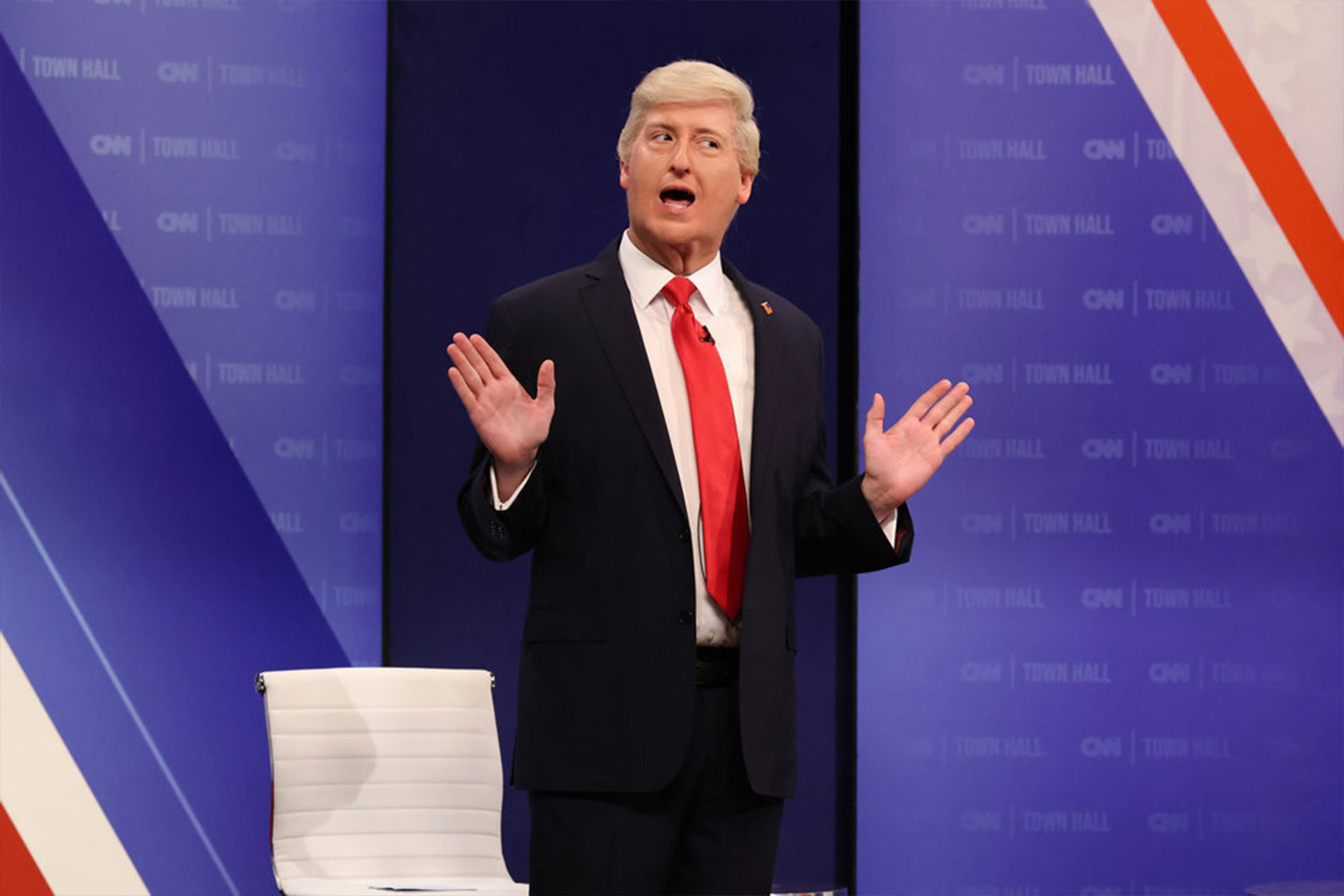
Saturday Night LiveJames Austin Johnson on "Saturday Night Live" (NBC)Regarding “SNL” and its political relevance, I think a lot of people have noticed there aren’t a whole lot of teeth there. One of the things that struck me when Shane Gillis and James Austin Johnson were both playing Trump in the same skit, as much as I hate to admit it, Gillis did a better impersonation.

From a larger perspective, though, the quality of the impersonation matters less than the writing itself. And none of the skits in this election year approximate anything close to biting satire. Is that a function of those other issues we’re talking about, or it is related to the difficulty of satirizing the politics of a moment where everything is ludicrous?

One thing I'll just say before I forget about the impressions: I do think “SNL's" longtime mode of political satire has been . . . about the personalities of politicians, rather than the policies of politicians and the function that they serve in the world, and the intense damage that they do. 

That's why you get someone like Nikki Haley or Dan Crenshaw on it. They’re characters, and they become TV characters, rather than people who are actually destroying the world and hurting real people. 

The function of “SNL'" impressions is to cultivate in the audience a sense of politics as TV and as drama. And it frustrates me immensely, both because I care about the world and what happens in it, and I get no pleasure out of watching a particularly good Trump impression or a particularly good Joe Biden impression. It baffles me sometimes that that becomes the sign of good comedy or acting. It's like, what is the catharsis here exactly? 

We need your help to stay independent

. . . To the broader question, and I think this is true of late-night shows, largely — and this was sort of put to me by a former late-night writer years ago — all of these shows are written by people who sit around watching cable news, and then write sketches based on what they see on cable news. 

And cable news, obviously, also has its limitations. It is also inclined towards treating politics as duels between competing personalities. And so I think that naturally reduces the scope of what satire is capable of and what it's interested in, and the news that it is digesting and converting into satire. So I think you'd necessarily get a very shallow view of the world. 

I don't have enough of a command of “SNL” history to know whether it was consistently, meaningfully better in the past. But I also think it is only natural that as media dies, and as the quality of the content that writers are consuming gets worse, so, of course, will the satire. 

It's a funny thing with “SNL.” Whenever you criticize it, or at least whenever I criticize it, there's this common response that Lorne has used himself, where he's just like, “Oh, everyone always remembers it being better when they were younger, and it's they just think it's always worse compared to that.” Which may be true. 

But it is not incompatible with the idea that it also just gets worse over time as the central creative force gets older and more divorced from reality, and as the people who work under him become more inclined and driven just to please him, which is largely the job at “SNL”: to not make the boss unhappy. 

I think that the fact that “SNL” can rapidly decline following the departure of two or three people says less about the rest of the cast or the writing than what’s going on behind the scenes. I also wonder if part of it might be related to this whole idea of late-night itself being at a transition point, possibly even on the verge of death. Since “Saturday Night Live” is such an institution, I wonder if it may consider itself to be somewhat inoculated against that – which also may be the worst thing for its comedy, because it instills the attitude of, “We’ll just ride this out until we find the next great cast.”  

I think it is immune. Harry Shearer ("The Simpsons") put this to me after I wrote my Longreads essay. . . . He pointed out that [Simons reads]: “’ SNL’ has never had to contend with competition on either side of the other two major networks. It's the only place to nationally advertise on television on late Saturdays. That's what you might call license to stink.” And he obviously worked there for a little bit, too.

I think that's a really good and underappreciated point. It’s also just so big and so old, and it has so much money to do with whatever it wants, that there's an extent to which I think it is just pointless to talk about whether the comedy is good because the comedy is only a byproduct at this point.  

I've written before that I think its main function is [to be] a PR machine for the famous and the powerful. And of course, it sells ads. You can find a lot of evidence throughout history of it sort of tailoring the comedy to be inoffensive to its advertisers. Yeah, it's too big to fail at this point. I think it can do whatever it wants, as we saw a few years ago when there was a pretty explosive child sex abuse lawsuit against it that has never been acknowledged by Lorne Michaels, or anyone in the show. 

That same year, it came back in studio during COVID before vaccines by paying audience members, which somehow was a loophole in New York State COVID guidance that I don't think actually existed. . . . But that's what it is at this point: It’s an institution, and a very powerful one, that for some reason, doesn't often get treated as that.

Saturday Night LiveColin Jost and Michael Che on "Saturday Night Live" (NBC)President Joe Biden went on “Late Night with Seth Meyers” recently to mark its 10th anniversary. Now, that show gets a lot of respect in the comedy world. But if you're Joe Biden, and you've declined to do mainstream interviews, you haven't done press conferences, and you bomb on TikTok, that's a strange place to appear for reasons other than nostalgia.

I bring that up for two reasons. First, I'm wondering if part of his team's calculus was that “Late Night” is harmless. Second, I wonder if part of what Lorne is kind of vacillating between right now is acknowledging that he still has political pull through both “Saturday Night Live,” and the other pies he has his fingers in. Yet at the same time, Biden’s “Late Night” appearance acknowledges that these shows have lost their kingmaking ability.

"I think it is just pointless to talk about whether the comedy is good because the comedy is only a byproduct at this point. "

I'm making a mental note to FOIA the Joe Biden Presidential Library in five years for an email. But yeah, I would imagine Lorne is trying desperately to get him right now. I do think Lorne . . . thinks very highly of “SNL's" role in the national conversation, especially around elections. And I mean, when they came back [in 2020] I believe they did, like, six episodes in a row — again during COVID and an election season — which was unusual for them. That's because Lorne wants to be a part of that conversation. 

What I see from the Biden-Seth Meyers interview is this other role that late night and comedy and Hollywood have right now, which is to foster parasocial relationships with politicians, and to help people relate to politicians the same way they relate to TV characters or their favorite TV stars. Just to create that affinity of, “This guy's hanging out with Seth Meyers and Amy Poehler. That's awesome. I like him.” They become products and commodities, the same way commercials make us like a cereal or a deodorant brand. And I think that's probably what's happening there. And it's also a very powerful thing that these shows still do.

And yet it struck me that when Nikki Haley made that surprise appearance in a recent “SNL” cold open, it was just one of the worst things you could possibly see. 

That whole sketch I found offensively unpleasant to watch. You know, what I see with that is “SNL” bringing in a talented young artist and sort of having her bend the knee to the system. 

And I think “SNL” does that with all the talented young artists that it brings in, is it turns them into mouthpieces for the rich and powerful, and publicists for politicians and oligarchs like Elon Musk. That's, again, why it matters that “SNL” is this choke point where you go through it, it conditions you to be a nice little power-serving writer or actor, and then you go and make your own TV shows and your own movies. And maybe not everyone does that exactly. But in aggregate, over 50 years, it affects the type of stuff that gets made. 


Want a daily wrap-up of all the news and commentary Salon has to offer? Subscribe to our morning newsletter, Crash Course.


In your view, what is the conversation that people should be having about "Saturday Night Live"?

I'd like people to pay attention to “SNL” as an ecosystem or as part of an ecosystem, where it doesn't seem to matter whether comedy is very good. I am sort of at this point after writing about it for so long, that I’m totally disinterested in the nature of the comedy itself. It only interests me as a workplace. But it's hard to convey why people should care about “SNL” as a workplace. 

. . . And I think the conversation about someone like Bowen Yang, who's a great comedian and a great actor, shouldn't be, “Oh, I'm so glad to see them on ‘SNL.’” It's, why does he have to do “SNL” to get to do this stuff? Why does Sarah Sherman have to sell out to Lorne Michaels to be able to make the weird and unlike anything else comedy that she makes, you know? 

Or to go back a few years, why did we immediately stop talking about Shane Gillis after the show hired and fired him in 2019? Why is there no reconsideration of the show itself?

That's also why the choke point of it all matters. . . . Are we just to trust that the person who thought Shane Gillis was funny and didn't do their research — or did do their research and liked it — is making good decisions now and should be running a workplace? Or: The people who looked the other way as Horatio Sanz did what he did are still there. Are we to just trust that they are not letting anyone else get hurt? I don't trust that. [Editor's Note: Sanz settled the sexual assault lawsuit in November 2022 but did not admit to wrongdoing. NBC, named as another defendant in the suit, also settled.]

Those are the important questions to ask about the show, I think — the questions that the show can't just answer by doing a better episode the next week.

In “Dune,” Zendaya’s Chani is the savior we need

Timotheé Chalamet's pale visage and perfectly coifed curls may be the face of the "Dune" franchise, but another powerhouse has emerged. In the second installment of Denis Villeneuve's carefully crafted and magically strange science fiction action film, we have a glimpse of a new savior: Zendaya.

The former Disney Channel star turned dramatic actor known for her Emmy-winning performance in "Euphoria," fully transforms as Chani, a Fremen warrior in "Dune Part Two." In Villeneuve's film, Paul Atreides (Chalamet) is a reluctant Chosen One. The son of a duke (Oscar Isaac) and a telepathic Bene Gesserit woman (Rebecca Ferguson), Paul is an outsider who lands on the desert planet Arrakis, where his family was sent by the Emperor (Christopher Walken) to exploit for Spice, an abundant natural resource.

When Paul's father is killed for political reasons and the fate of House Atreides hangs in the balance, he and his mother find refuge with the Indigenous people that inhabit the endless sand dune-scape. It's in Arrakis where Paul meets Chani, the girl who has been haunting his dreams, the girl who seems to be his soul mate. 

Paul's life in Arrakis is one that simply begins and ends with Chani. Yes, she's beautiful but also an impressively skilled fighter, whose blue-eyed stare lingers on Paul and vice versa. It's here that we uncover more about Chani through Paul's gaze. And later throughout the nearly three-hour epic, we see the bone-chilling evolution of Paul through Chani's pragmatic eyes. Paul is expected to eventually become the Lisan al-Gisab, which translates to "The Voice from the Outer World," a powerful messiah prophesied to be the savior of all worlds and liberate Arrakis. However, despite this fate, through her actions we see that Chani is actually more suited to be the leader who's needed.

Dune: Part 2Timothée Chalamet as Paul Atreides and Zendaya as Chani in "Dune: Part Two" (Warner Bros. Pictures/Legendary Pictures)Throughout "Dune Part Two," Chani's values are crystal clear: She believes in the power and strength of the Fremen's autonomy. Someone like Paul, an outsider, who is supposedly a chosen messiah threatens this very idea. Nevertheless, while his presence in Arrkais is troubling to most, she treats him as an equal. However, she still strongly emphasizes to Paul that she believes that only the Fremen can unshackle themselves – not an outside messiah or prophecy. Even if that's what spiritual fundamentalist Fremen like leader Stilgar (Javier Bardem) and countless others believe.
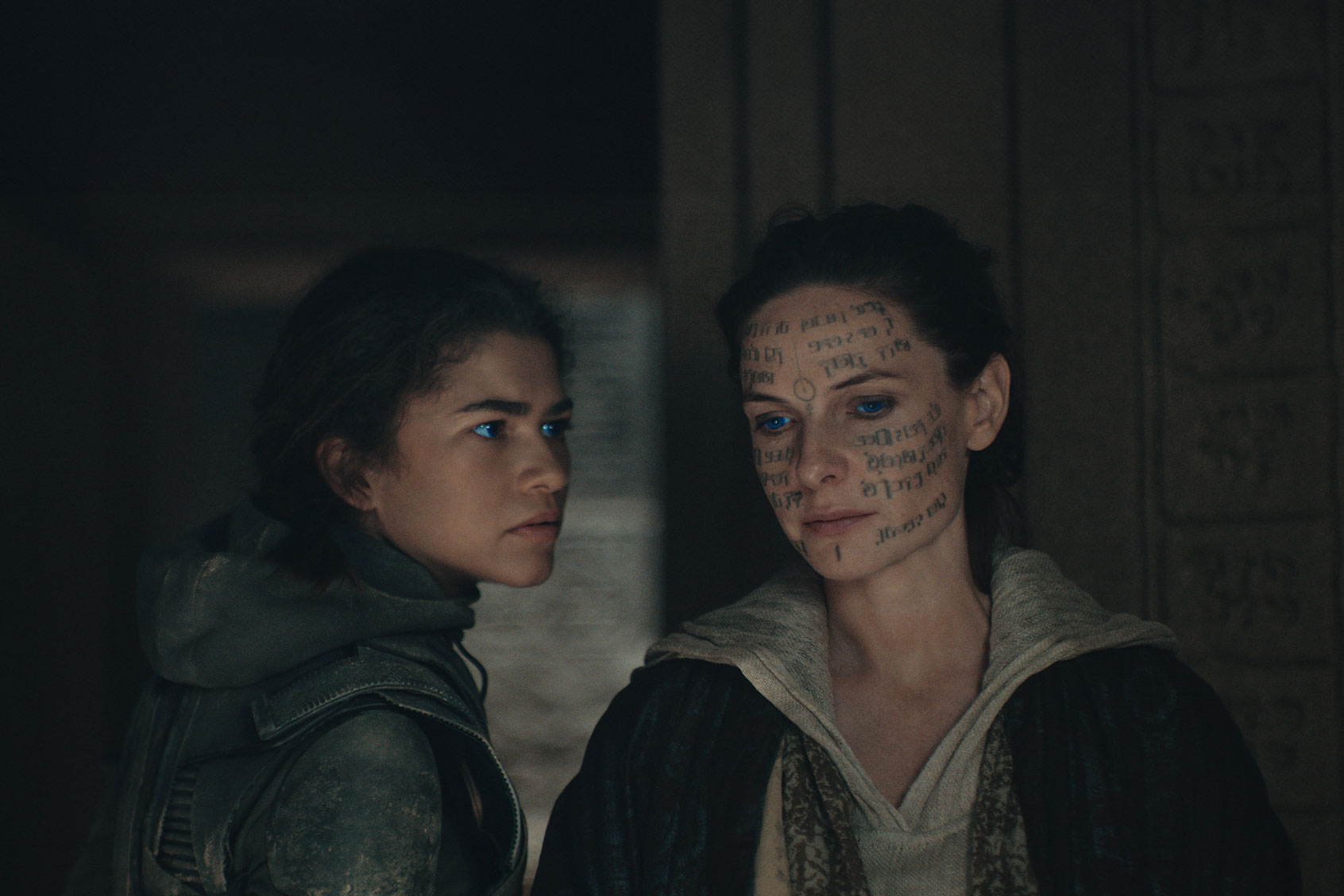
Part of Paul's supposed destiny is that he will easily adapt to the Fremen way of life. While the strong-willed Chani is apprehensive about Paul's presence, she is nevertheless intrigued by the teenager and doesn't want the outsider to butcher her people's identity and culture. Neverthless, when Stilgar challenges Paul to spend a full night in the desert alone, Chani can't help but want to save the clueless boy. She teaches him how to gracefully sand walk in the right way like the Fremen do, so he doesn't get eaten alive by sandworms.

Despite their very different upbringings and destinies, the pair bond through their desert adventures, like taking out Spice harvesters together. The quality time leads to a beautifully still scene where deep in the dunes, Chani tells Paul, “Your blood comes from dukes and great houses. Here, everyone is equal.” He responds earnestly, “I’d very much like to be equal to you.” It's a moment of sincerity that he will later haunt him. But Paul's rejection of the prophecy and his destiny is what leads Chani to fall in love with him.

While Paul's values are rooted in avenging his father through his thirst to eliminate the Harkonnens, he inadvertently evolves into Muad'dib, which is the name for a kangaroo mouse in Arrkais. Choosing that as his Fremen name signifies how he has assimilated while also acknowledging the wise survival skills of the creature. Now, as Muad'dib, Paul is finally tethered to a belief system. He believes in the Fremen because he is Fremen now. However, whether Paul rejects his fate or not, either way, it's a self-fulfilling prophecy. In a scene with his mother, Lady Jessica – now a Reverand Mother who has been behind spreading that the Lisan al-Giab is here to the Fremen – she tells Paul, "We gave them something to hope for.” Paul roars, “That’s not hope!”

This immediately changes the dynamic between Paul and Chani too. The destiny he was so dead set on avoiding and rejecting comes knocking on his door and so is the inevitability of a full-scale war between the Houses which will lead to billions dead in his name. But this doesn't stop Chani from questioning religious authority like Jessica, Stilgar or Paul even though she loves him. It actually makes her critiques of the prophecy more valid because she knew the gentle and kind person that Paul once was.

Dune: Part 2Zendaya as Chani and Rebecca Ferguson as Lady Jessica in “Dune: Part Two" (Warner Bros. Pictures/Legendary Pictures)When Paul drinks the Water of Life and gains supreme consciousness, he becomes the Lisan al-Gaib. However, he dies first and Chani cries over his lifeless, limp body, screaming that his mother did this to him, that the prophecy did this to him. But like a twisted fairy tale, Chani is a part of the prophecy too. Her tears save him, and he awakens like Sleeping Beauty. He arises with her help and she slaps the resurrected messiah and it reverberates in the room. While everyone else is enamored by Paul's accession to power, Chani is brimming with anger. The anger stems from her heartbreak that Paul chose the power he so obviously feared. Anger and sadness are all over Zendaya's face as she watches Paul transform into a dangerous, populist cult leader.

In this story about false prophets and their ability to lead zealots down a dangerous path, Chani is the only character in "Dune: Part Two" who is a true skeptic of all that is supposedly fated. She is devout to her steadfast values and her righteousness even though it would be easier to submit to the brainwashing of the prophecy. Although Paul loses all of his sincereity as he promises he "will love [Chani] as long as I breathe" as he claims Princess Irulan (Florence Pugh) as his future new wife and names himself Emperor, Chani has never been so sure that all of this is so deeply corrupt. And the audience notices it too. Paul's convictions come from a place of selfishness and Chani's come from her lived experiences as an oppressed Indigenous person — not a cosplayer like Paul. She leaves, heartbroken on a sandworm. But she's the only one who comes out of all of this looking like a true savior.

"Dune: Part Two" is now playing in theaters nationwide.

Why warzones are the perfect place for antibiotic resistance and what that means for Palestine

The word “gauze” may have originated from the Palestinian territory Gaza, but even that wound care staple is running out in the besieged region. According to the Palestinian Health Ministry, over 30,000 people, mostly women and children, have now been confirmed dead in Gaza as a result of the ongoing siege and bombardment by Israel, with over 70,000 injured, although these figures are considered to almost certainly be undercounts.

The conflict was sparked in retaliation for the Hamas massacre of approximately 1,200 civilians and soldiers and kidnapping of around 250 others on Oct. 7th. Now more than two million people — the entire surviving population of Gaza — are housing insecure and living in unsanitary conditions. The majority, especially in the north, are acutely starving. The untenable situation has threatened to spill over into neighboring nations, with many implications for global conflict. One issue which might not immediately come to mind, but which ought to concern us all, is antimicrobial resistance (AMR).

AMR is a broad phenomenon, but simply describes when our tools defending against deadly microscopic nasties stop working. Bacteria, fungi, parasites and viruses can all develop resistance to antibiotic, antifungal, antiparasitic or antiviral drugs. When such medications become ineffective, even formerly mild diseases can become serious threats to public health.

Over the past century, heavy use of antibiotics and similar medications has given AMR a boost, threatening to upend the public health gains of the 20th Century that saw child and elderly mortality from common bacterial infections drop dramatically, raising life expectancies from a 19th century average of around 47 years.

Diseases of all kinds have been making a worldwide comeback thanks to societal inequities, air travel, a backlash against even basic childhood vaccinations, the tendency of bacterial infections to follow viral ones, and apparent immune dysfunction resulting from COVID-19. But to really come to grips with this new age of disease, you must add the failure of antibiotics to the mix — which brings us back to Gaza.

The situation in Gaza

The impact of antimicrobial resistance isn’t confined to a single patient, but affects all of us.

While volunteering in Gaza for the first 43 days of the war that started after Oct. 7th, Dr. Ghassan Abu-Sittah, a British-Palestinian plastic and reconstructive surgeon, volunteered under absurdly difficult conditions in Al-Ahli Arab Hospital and Shifa Hospital in the north of Gaza, as well as Al-Awda Hospital in the Jabalia refugee camp. He was at Al-Ahli when hundreds of displaced people were killed by a blast of disputed origin — some may remember him from the press conference he held in the hospital courtyard, surrounded by dead bodies.

He left Gaza on day 43 of the war after hospitals were mostly besieged and shut down in the north where he had been working. Since returning to the UK, he has testified to a British war crimes investigation unit about the apparent deliberate targeting of healthcare facilities by Israel, alleging also that he saw patients with chemical burns consistent with the use of white phosphorus, which is a war crime. While still in Gaza, Abu-Sittah co-authored a November letter in The Lancet describing a documented rise in antimicrobial resistance in the territory previous to the current bombardment and siege, and highlighting aspects of the current situation conducive to further spread of AMR.


Want more health and science stories in your inbox? Subscribe to Salon's weekly newsletter Lab Notes.


“War-related contributing factors to antimicrobial resistance include restricted resources, high casualties, suboptimal infection prevention control and environmental pollution from infrastructure destruction and heavy metals release from explosives,” the authors write generally, also summing up the situation in Gaza.

Abu-Sittah, who has also worked in Lebanon, Syria, Yemen and Iraq, previously described development of antimicrobial resistance in the context of war in Syria, teasing out factors contributing to the problem before the conflict started in 2011, and afterward. Others have documented AMR associated with conflict in Ukraine and Sudan.

One of Abu-Sittah’s co-authors, Antoine Abou-Fayad, has also contributed to a study of war as a driver of antimicrobial resistance in Iraq, in which the authors argued that “Contemporary conflicts, waged in urban and industrialized landscapes, pressure microbes with selective environments that contain unique combinations and concentrations of toxic heavy metals and antibiotics, while simultaneously providing niches and dissemination routes for microbial pathogens.”

Giving evolution a massive boost

Every time we pressure a doctor into giving us an antibiotic for the common cold (which is caused by a virus and therefore not responsive to antibiotics), we increase the amount of antibiotics floating around. In 2022, The Lancet published an overview of the global prevalence of antimicrobial resistance, using data current as of 2019. Antimicrobial resistance was directly responsible for 1.27 million deaths, it also played a contributing role in another estimated 4.5 million deaths that year. Clearly, the problem of pathogens like bacteria becoming resistant to commonly-used antibiotics is one of life and death.

The impact of antimicrobial resistance isn’t confined to a single patient, but affects all of us. It can cue the return of the bacterial infections that used to make life nasty, brutish and short — and in some ways, this is already happening. As the Lancet study shows, the problem of growing antibiotic resistance has been an issue for decades. In the words of the World Health Organization, which launched its new data visualization dashboard of antimicrobial resistance and antimicrobial use last month, “AMR puts many of the gains of modern medicine at risk. It makes infections harder to treat and makes other medical procedures and treatments – such as surgery, cesarean sections and cancer chemotherapy – much riskier.” In fact, the WHO considers AMR one of its top ten greatest threats to global health and it is predicted to cause ten million deaths per year by 2050.

AMR has massive economic costs and threatens the global food supply. By increasing pressure on health care systems and killing livestock, it is predicted to push some 24 million people into poverty by 2030. What may seem at first like a minor problem is in fact a multi-sector, cross-issue catastrophe in the making. In an attempt to develop an adequately robust response, the United Nations General Assembly will convene its second high-level meeting on antimicrobial resistance in September 2024. There is a metaphorical arms race between microbes and drug development, and the literal military-industrial complex is increasingly creating conditions in which AMR can thrive.

Casual overuse of antibiotics is not the only factor that favors development of resistant pathogens like bacteria. Although The Lancet study does refer to the challenges of accurate and ample data collection in poor countries and to the difficult conditions that can increase the risk of antimicrobial resistance, it notably fails to mention the role that conflict and war-related collapse of health care and other infrastructure play in its development.

For example, Acinetobacter baumannii, a cause of hospital-acquired bacterial infection that can attack most parts of the body, was once sensitive to first-line antibiotics, but the AMR-favoring conditions of war have led to an alarming number of multidrug resistant strains — and growing incidence well beyond the Middle East. In fact, A. baumannii was dubbed “Iraqibacter” after causing many multidrug resistant bloodstream infections among U.S. service members returning from Iraq. A. baumannii, is on the rise in both the U.S. and the U.K., and has not remained confined to military veterans.

Likewise, both injured military personnel in Ukraine and refugees from that country have brought AMR to Germany and the Netherlands, and rising rates of multidrug resistant bacteria in Europe more generally have been linked to the ongoing conflict in Ukraine.

Highly polluted sites contaminated with heavy metals are further known to provide an environment that selects for antibiotic-resistant strains of bacteria. Hair analysis of infants in Gaza demonstrated heavy metal contamination in utero following major military attacks in 2009, 2012 and 2014 that could be seen in persistently high levels in the children by the end of the study in 2019. The 65,000 tonnes of bombs dropped on Gaza between Oct. 7th and Jan. 4th have left unknown levels of heavy metals in and around a population among whom nearly 100,000 people are dealing with injuries, including emergency amputations, burns and blast wounds.

Three pillars of antimicrobial resistance

Work was being done to combat growing antimicrobial resistance in Gaza well before the current war and siege.

"All of the injuries we’ve seen since November, since October really, are blast injuries. And so 99 percent, we could say are explosive injuries."

Dr. Amber Alayyan is a pediatrician who works for Doctors Without Borders as deputy cell manager for the Middle East. Her teams have observed antibiotic resistance in Syria, as well as in Yemen and in Iraq, and she closely followed the impact of antimicrobial resistance in Gaza since well before Oct. 7, 2023.

In fact, Alayyan told Salon that over the past 15 years, Doctors Without Borders has worked in Gaza’s Shifa and Nasser hospitals treating infected wounds resulting from burns (often children injured by ground-level stoves in refugee camps) and traumatic injuries. “When I talk about traumatic [injuries] I think of bombs, bullets, violence-related trauma, but it’s not necessarily violence-related [wounds] that are going to get infected. And so the burn cases as well, and those are a lot of women and children.”

Then came March 2018, the start of the so-called Great March of Return. This involved sometimes weekly demonstrations against the blockade of Gaza and for the right of return of Palestinian refugees, largely along the border fence between Gaza and Israel and involving as many as 50,000 protesters. The vast majority were peaceful, but stone-throwing, tire-burning, attempts to damage the fence, and the launching of burning rags on kites or balloons into Israel by protesters set off a violent response from Israeli security forces.

Over the course of a year, nearly 30,000 people were injured and 175 killed. Injuries to both adults and children resulted from tear gas, rubber-coated bullets and live ammunition, with 7,000 wounds caused by the latter. A year on, the already-strained health care system was in dire condition, and the impact on wound care became impossible to ignore.

“We were already seeing high rates of antibiotic resistance, and very complicated infection and multidrug-resistant types of bacteria. And so it was complicated. [Treatment is] doable, but it’s complicated. And what it requires is that patients have to come back over and over, not just for surgery, but also to make sure that the wound is healing.”

"We were already seeing high rates of antibiotic resistance, and very complicated infection and multidrug-resistant types of bacteria."

To tackle the gamut of problems leading to wounds that don’t heal, become infected, or don’t respond to first or second-line antibiotics, Alayyan and her team then set up Gaza’s only bone and tissue lab, allowing for the identification of specific pathogens infecting wounded tissue. This allows doctors to prescribe only antibiotics that are going to work on the particular pathogen. They also employed doctors specifically trained in antimicrobial resistance and antibiotic ‘stewardship’ — the careful and restrained use of antibiotics to prevent development of resistant bacteria.

“We looked at it as really sort of three pillars: the doctors who are the stewards, the microbiologists, and the nurses and pretty much everybody is included in what we call IPC: infection, prevention and control,” Alayyan told Salon. “Without those three things, you can’t even talk seriously about antimicrobial stewardship.”

Alayyan stressed the importance of multidisciplinary treatment to prevent the spread of antimicrobial resistance. “At the base of the pyramid is hygiene, so infection prevention and control.” There’s also an important component of patient education, and she includes mental health care as a vital factor in ensuring compliance with the strict requirements of effective wound care.

“Our surgeons are running out of basic gauze”

“That was before, and you throw in October 7 … and it’s a bit of a no-holds-barred kind of situation right now,” Alayyan said.

Israel’s siege and bombardment of Gaza began after Hamas' Oct. 7th attack, but ever since, those three things – physician stewardship, microbiology and infection prevention and control – have become essentially unattainable.

"Supply issues can always exist, but the deliberate blocking of supplies and staff and labs … That is unique. Usually no one does this."

“At that point, there were tens of thousands of internally displaced people living in Nasser [hospital] so that made follow up care for patients difficult because you had to find your patients,” Alayyan explained. “There were so many internally displaced people all over the hospital, including not only the patients but their families. All of the injuries we’ve seen since November, since October really, are blast injuries. And so 99 percent, we could say are explosive injuries." Such injuries result in damaged limbs, burns and injuries to soft tissue of the chest or abdomen. On February 22nd, Christopher Lockyear, the secretary general of Doctors Without Borders, told the U.N. Security Council, “Our surgeons are running out of basic gauze to stop their patients from bleeding out. They use it once, squeeze out the blood, wash it, sterilize it and reuse it for the next patient.”

Karin Huster is a nurse, also with Doctors Without Borders, who just returned from working at Rafah Hospital, in a city whose former population of 300,000 has increased several times over thanks to a million or so displaced people from elsewhere in Gaza. Huster told Salon that surgeons in Rafah Hospital still had access to clean gauze, but not much else.

“Right now we’re talking about basic war surgery,” she said.

Others have referred to being forced to practice 18th century medicine. “It is incredibly difficult to do the work as it should be done,” Huster said. She has worked in conflict zones across the globe — confronting famine in Nigeria, Ebola in Democratic Republic of Congo, cholera outbreaks in Haiti and war in Iraq — but said the situation in Gaza cannot be compared to anything she has seen before.

“Supply issues can always exist, but the deliberate blocking of supplies and staff and labs … That is unique. Usually no one does this. Here, we are blocked. Things are deliberately not making it in for a variety of reasons.”

According to reports by international news outlets, these include aid trucks being held en masse at the border by the Israeli government, Israeli protestors preventing even that access going through, and the Israeli government’s policy of siege.

It is considered a war crime under the Geneva Conventions to starve civilians as a weapon of war, or to “attack, destroy, remove or render useless” items needed for civilian survival.

Doctors Without Borders has a specialized microbiology lab that hasn’t been accessible since the start of the war, and one of their microbiologists was killed with his children in a strike on his home back in October. Nasser hospital, where the group had a surgical team working on soft tissue and burn injuries, has been under assault for days and is no longer operational. Previously, two surgeons were doing up to 20 surgeries every day.

“And I can tell you,” said Alayyan, “that having a team of exhausted surgeons does not make for great antimicrobial stewardship.”

Doctors in Gaza are using whatever is available or can be brought in by international teams, which is typically broad-spectrum antibiotics. They are used prophylactically, with health care workers aware that their patients are vulnerable to infection due to poor conditions, and may be unable to finish a full course of antibiotics or receive follow-up care. This increases the likelihood that resistant pathogens will develop.

We need your help to stay independent

“You want to protect the patient,” Alayyan said. “But at the same time, you’re not necessarily protecting the patient if what it means is that they’re going to get to a point where nothing works on the infection. It’s just an impossible situation for the medics to be in.”

This is the background for the letter by Abu-Sittah and colleagues.

“I worked for many years on [antimicrobial resistance] in the war in Syria. And I never saw anything like this,” Alayyan said. “When a body is not well nourished, any of the healing processes are either slowed or stopped completely […] The problem is that when the wounds don’t heal, and when you’re malnourished, you’re more at risk for sepsis, so blood infections, things like that, or wound infections, which then of course means more antibiotics. It’s sort of a dirty spiral, really.”

When asked what one essential factor could mitigate or prevent the further growth and spread of antimicrobial resistance in Gaza, Alayyan answered with a single word: “Ceasefire.”

“Shark Tank” investor plans to buy TikTok if bill to ban the app pushes through

On Friday, President Joe Biden voiced his support of an advancing bill aiming to crack down on the social media app TikTok over concerns that its Chinese parent company, ByteDance, compromises data security — with U.S. officials warning that China's intelligence laws could leave the user information that TikTok collects vulnerable to prying eyes. While the ban would not be outright, it would move to bar it from U.S. app stores if ByteDance doesn't sell it. And one well-known businessman is already eyeing the possibility.

In a recent appearance on Fox News’ “The Story,” “Shark Tank” investor Kevin O’Leary spoke to anchor Gillian Turner about the financial benefits of the app, especially in terms of advertising in the U.S., saying that he plans to swoop in and save it. "[It's] not going to get banned, ‘cause I’m gonna buy it,” O’Leary said. "Somebody’s going to buy it, it won’t be Meta and it won’t be Google, ‘cause…regulator [will] stop that.”

Highlighting that TikTok is one of the most successful advertising platforms in social media today, and worth billions, O’Leary says that all of his companies use it, and he's definitely not alone there. According to The Washington Post, the app has been downloaded 170 million times in the United States.

"The @HouseCommerce Committee just voted 50-0 to force TikTok to sever their ties with the Chinese Communist Party," House Majority Leader Steve Scalise wrote in a post to X (formerly Twitter) on Thursday. "I will bring this critical national security bill to the House floor for a vote next week."

Per reporting from Reuters, TikTok maintains that "it has not and would not share U.S. user data with the Chinese government," and that a resulting ban "will damage millions of businesses, deny artists an audience, and destroy the livelihoods of countless creators across the country."   


On abortion rights, Blue Dog Biden is all bark, no bite

In a deeply unconvincing speech full of stale platitudes and bare-minimum promises, President Joe Biden treated abortion rights like they were a campaign-trail side dish rather than the main course of his coming election. If you’ve seen the articles gushing about his 2024 State of the Union address, you’ve probably noticed a number of outlets striving to center the abortion part of his speech — as though they might encourage him, like a grade schooler, by loudly praising even the poorest effort in order to spur him toward better attempts. 

And I get it. We all need some hope right now. Taking your wins where you can get them — no matter how small — is part of that. But Biden’s not a kid, and I’m not here to spare the rod. I’ll vote how I must, but I’m not so scared of Donald Trump’s return that I’ll grit my teeth and cheer for whatever bare-minimum candidate the Democratic Congressional Campaign Committee props up on stage. And if you care about abortion rights, you shouldn’t cheer either. At least not for a string of empty promises and hollow threats. If you haven’t seen the abortion excerpt of Biden’s speech, Time Magazine’s video cut is tidy enough. 

“My predecessor came to office determined to see Roe v. Wade overturned. He’s the reason it was overturned, and he brags about it. Look at the chaos that has resulted,” Biden said. “If you, the American people, send me a Congress that supports the right to choose, I promise you I will restore Roe v. Wade as the law of the land again.“

Bullshit. 

You want to know why Roe was overturned? Because it could be. For 49 years, the entire right to abortion in this country hinged on a court ruling, not a law. And that ruling was left undefended by lawmakers who had every chance to make it the law of the land. Democrats have had since 1973 — the year Roe was ruled and that Biden was first elected to office — to enshrine the bare-minimum right that American women only narrowly obtained after having to scrape and plead and fight and die for it. Democrats had trifecta control of the House, Senate and White House in 1993 under Bill Clinton, 2009 under Barack Obama, and 2021 to 2023 under Biden — and they could have codified Roe through any of those years. 

They didn’t. 

We need your help to stay independent

Of course, as he told an interviewer in 2006, Biden himself did “not view abortion as a choice and a right.” And, until 2019 when his campaign advisers apparently directed his attention to the year printed on the calendar, Biden still thought federal funds shouldn’t be used for abortions. 

In the hours before the SOTU, the White House sent out what can only be seen as a desperate reminder of their list of good deeds following the fall of Roe. They include: allowing a sliver of abortion access for Veterans Affairs patients and active military; reminding hospital administrators and insurance companies of the rules they’re already under; offering hard-to-use Medicaid waivers to patients seeking out-of-state abortion care; taking the first step to improve abortion data privacy; and, most critically, finally getting contraception approved for over the counter sale. 

And, yes, those are all good things. Every marginal inch we can get, even if it’s a watered down half-measure, is a good thing. But this list isn’t enough and everyone knows it. This is just another male politician offering women the bare minimum possible while expecting our gratitude — and still under-delivering while blaming others. Biden’s moves wouldn’t have been necessary had Democrats delivered protections for abortion rights at any point in the past five decades instead of using the fear of loss rights as a cudgel to get women to the polls. 

I will not praise a Democratic president for doing the bare minimum

It was nice of him to sign that executive order when Roe fell but, as Reuters put it, “it offered few specifics and promises to have limited impact in practice, since U.S. states can make laws restricting abortion and access to medication.”

“The White House is not publicly entertaining the idea of reforming the court itself or expanding the nine-member panel,” the outlet reported.

I know, I know — I can hear you asking some fair questions. Don’t I care how much worse it could have been under the GOP? Aren’t I grateful that we had Biden and the Democrats to triage the damage of Dobbs? Can’t I just appreciate the crumbs he left on the table for us? 

No. Abortion rights are an expectation of any free people and an entitlement by virtue of biological nature. I will therefore act with entitlement toward my body and life. I will not praise a Democratic president for doing the bare minimum expected of him in a moment when my life is threatened. No more than I would praise a Republican president for not threatening my life. 

By some accounts, it took Biden 468 days to even say the word abortion once he took office. The first time he said it was on May 3, 2022, hastily addressing the leaked SCOTUS draft opinion. The Supreme Court overturned Roe v. Wade the next month. When it did, my state, Kentucky, was the first to effectively ban abortions in the US. In July, we found out that the night before Roe fell, the White House sent our governor an email “heads up” that Biden was set to nominate an anti-abortion Republican to a federal, lifetime-appointment judgeship in Kentucky. 

“It's why Biden's failure to say the word 'abortion' matters so much. It's not a gotcha by advocates and activists. You can't defend what you won't name,” Rewire’s Jessica Mason Pieklo tweeted.

Our last abortion clinic is still closed — and, for all his bluster, Biden won’t bother coming to Kentucky in his post-SOTU campaigning. Likewise, as Kentucky’s volunteer network of grannies and aunties have been shuttling women and girls back-and-forth over state lines, begging for donations to abortion travel funds and running estimates on the likely increases of teen pregnancies and maternal mortality, Biden was taking his sweet time to come up with abortion access options for ban states like mine. 

I don’t recall seeing him down here doing the Lord’s work for the teen girls living in trailer parks and public housing projects who are just trying to get through high school in a state where 45% of women have faced sexual violence and the actual rape-kit backlog numbers aren’t clear. I certainly didn’t see him jumping into action, enacting immediate protection of abortion rights on federal lands inside ban states as everyone begged him to, nor jumping down Republicans’ throats with the fury of the Defense Department. 

My criticism of Biden doesn’t come from a desire to see the GOP win in November. It comes from my inability to punch Nazis in the face without going to jail, and from my refusal to sit through the burning of the planet while watching women die. I’ve got no applause left in me for anyone who isn’t actively in the fight, and no feigned excitement for a party that treats a rising tide of dead women like a political opportunity. If Democrats want to see me clapping, they can drop the saccharine “malarky, by gosh” shtick and lay down some bare-knuckle brutal politics like the GOP has used against them at every turn. 

The Democrats have most female voters hostage here; they know the GOP is more lethal to women on this issue, so they know women will vote Blue. But I’m not throwing roses at Biden’s feet just because he tosses us some crumbs. I’m keeping the roses — and I want my bread.