Spring Sale: Get 1 Year, Save 58%

“He’s hardly infirm”: Judge pushes back as Fox lawyer tries to get Rupert Murdoch out of testifying

The Delaware judge presiding over Dominion Voting Systems’ $1.6 billion defamation lawsuit against Fox News pushed back after attorneys for the network tried to get Fox Corp. Chairman Rupert Murdoch out of testifying at next month’s trial.

Judge Eric Davis rebuffed the network’s lawyers’ claim that Murdoch is too infirm to travel, citing a letter he received claiming that 92-year-old Murdoch could not get to Delaware to testify because of COVID, NPR reports.

In a rare moment of frustration for the cool-headed judge, Davis advised Fox attorneys against making him “look like an idiot.”

“I also have people telling me that he’s done some things recently that [show] he’s hardly infirm,” Davis said, mentioning Murdoch’s recent engagement and subsequent plans to travel to his homes in Los Angeles, Montana, New York and London. 

Fox attorney Matthew Carter argued that Murdoch’s testimony was unnecessary, citing his seven-hour deposition.

Davis said that he had the authority to compel Murdoch to testify regardless.

Throughout the hearing, attorneys debated whether the judge could compel lower-ranking Fox officials to appear in court, what topics could be discussed during trial, the types of exhibits attorneys could show and the amount of days of advance notice a witness could be given for their testimony, according to NPR.

“You guys are fighting over 24 hours?” Davis reportedly asked, addressing the latter question. 

The discord expanded to the public disclosure of court documents as Dominion attorneys argued that Fox attempted to conceal information from the public and its attorneys objected to their exhibits being used in open courts. Fox’s side rebutted by saying they had rejected Dominion’s 1,000 extra exhibits so they would not have to waive their right to object in the future.

Tuesday’s proceedings also revealed a bombshell email from Murdoch to Fox News CEO Suzanne Scott on Jan. 20, 2021, cited in slides Dominion’s legal team presented. In the email, made public on Wednesday, Murdoch writes that then-outgoing president Donald Trump’s parroting of claims of election fraud in 2020 was “pretty much a crime” that led to the Jan 6. insurrection.


Want a daily wrap-up of all the news and commentary Salon has to offer? Subscribe to our morning newsletter, Crash Course.


“Trump insisting on the election being stolen and convincing 25% of Americans was a huge disservice to the country. Pretty much a crime. Inevitable it blew up Jan 6th,” Murdoch wrote. “Best we don’t mention his name unless essential and certainly don’t support him. We have to respect people of principle and if it comes to the Senate don’t take sides. I know he is being over demonized, but he brought it on himself,” he added.

The newly revealed messages follow February’s release of texts between Fox News executives and hosts privately bashing the election lies they aired. The texts’ authors – including host Tucker Carlson and his producer Alex Pffeifer – also expressed concern that fact-checking the false claims would hurt the network’s “stock price” or anger former-president Trump.

“Sidney Powell is lying,” Carlson told Pfeiffer after an interview with Powell, according to the filing, calling her a “f*cking bitch.”

As the discussions in Tuesday’s hearing continued, Davis reminded Fox’s attorneys to “be careful,” foreshadowing what may be a tense trial over Dominion’s lawsuit next month. 

“These documents once again demonstrate Dominion’s continued reliance on cherry-picked quotes without context to generate headlines in order to distract from the facts of this case,” a Fox News spokesperson said in a statement. “The foundational right to a free press is at stake and we will continue to fiercely advocate for the First Amendment in protecting the role of news organizations to cover the news.”

The trial is scheduled to begin April 17. 

Hide your muscular calves! On “Yellowjackets,” sex is violence

There’s a scene in “Edible Complex,” the second episode of “Yellowjackets” Season 2, in which Walter (Elijah Wood) shows up at the medical facility Misty (Christina Ricci) works at, and she takes notice of his muscular calves, of which we know she’s a fan.

As he walks past her station, pushing his mother in a wheelchair, he gives her a little grin that could be read as flirtatious or menacing and she titters in a way that could, in turn, be interpreted as repulsed or intrigued. For a show with zig-zagging storylines, all of them soaked in duplicity and questionable motives, this brief exchange feels like a flashing warning sign. As we’ve learned in past episodes, “meet-cute” goes to “meet your maker” real fast for anyone affiliated with the Wiskayok High School Yellowjackets soccer team and referring to orgasms as “the little death” is not just poetics for them; it’s a threat.

Within the horror and thriller genres, a sex scene is usually a pretty good indicator that someone is about to die, so much so that it’s become a trope. This series follows those same rules, but the deaths here don’t happen right away, prolonging the dreadful suspense. Rather than dying quickly,

Characters marked by the Wiskayok kiss of death are left in the delusion of safety, only realizing the terrible mistake they’ve made when it’s much too late.

characters marked by the Wiskayok kiss of death are left in the delusion of safety, only realizing the terrible mistake they’ve made when it’s much too late. 

At the end of Season 1, Jackie’s (Ella Purnell) fate was sealed when she slept with Travis. At the time, we didn’t quite know what Lottie (Courtney Eaton) meant when she admonished her for doing this, saying, “He doesn’t belong to you.” It could have been assumed that she was referring to the fact that Travis had been romantically tied to Natalie (Sophie Thatcher), but Season 2 points to a larger meaning.

In a fight with Shauna (Sophie Nélisse) over years of pent-up grievances with sexual betrayals at the top of the list, Jackie was sent out of the cabin and froze to death in the snow. Picking up months later, her body is set aflame on a makeshift funeral pyre, but she’ll find no peace in that final memorial — further punished, made useful as a form of penance for the sins of her sexuality.

In “Edible Complex,” as Jackie slowly burns just outside, Travis and Natalie engage in a sort of psychic orgy, having sex — possibly for the first time, successfully — while Travis fixates on a vision of Lottie bathed in light, flashing in and out, keeping his mojo running. While they go at it in the increasingly stinky cabin that most of the show’s ’90s timeline takes place in, the heat of Jackie’s burning body causes snow to fall from an overhead branch, extinguishing the flames just enough to cook her, but not cremate her. It should be noted here that it takes a temperature of at least 1,800 degrees Fahrenheit to turn a body to ash, and since a normal campfire only reaches temps of 1,500 to 1,650 Fahrenheit this wouldn’t have worked anyway, but still. There she lays, like a deep-fried turkey, and the smell of her flesh leads most of the team outside to feast, with very little hesitation. 

Sophie Thatcher as Teen Natalie and Kevin Alves as Teen Travis (Kailey Schwerman/SHOWTIME)“She wants us to,” says Shauna, hand over her pregnant belly. And what’s not clear here is if she’s talking about her unborn child, Jackie, or Lottie. Whether Lottie’s “visions” are real or delusional, she finds purpose in people. With Jackie fully out of the way, having served a purpose of her own by feeding her teammates, Natalie, Shauna and Travis are the three lovers left to pay for their sins. We know what becomes of Travis, having died by what’s explained by adult Lottie (Simone Kessell) as an “accidental” death by hanging — in her presence — while attempting to pass out just enough to commune with the darkness that haunts him. So that leaves Shauna and Natalie. Taissa (Jasmin Savoy Brown) and Van (Liv Hewson) are two other characters who have had sex scenes in the ’90s timeline, but we haven’t met adult Van yet (played by Lauren Ambrose) and, so far as we know, their sins of sexuality — as pertains to all of the above — only tie them to each other. Literally.

With a reunion that we know is coming, either adult Van will help pull Tai from the darkness, as she did so many years before, or sink into it with her.


Want a daily wrap-up of all the news and commentary Salon has to offer? Subscribe to our morning newsletter, Crash Course.


Everyone in the present timeline is worse off than they were when they were stuck in the wilderness, which is saying a lot because . . . cannibalism. Lottie is definitely up to something, feeding Nat lies and then giving her a comic book villain’s stink eye as she walks away. Tai has gone into such a fugue state that she’s hallucinating visits with her son and causing accidents with her ex-wife in the passenger seat. And Shauna, on the brink of being arrested for murder, has no one to cling to but her husband, who we will henceforth refer to as Papa Roach, and her daughter, who she only spends time with to try and keep her from ratting her out. 

There will be many more deaths to come in this series, likely in this season alone, and with all the other mysteries floating around the biggest in my mind is who will be the next to go? From “tiny deaths,” to actual ones, spring is a long ways away, and the wilderness — of then and now — is hungry for more hearts. 

QUICK BITES:

  • “It’s heliotrope, it’s not purple. We make the dye ourselves from the flowers used to treat wounds.” Okay, hippie.
  • Callie, very much her mother’s daughter judging by the way she treats men, should have waited till after she had those chocolate chip pancakes before breaking up with Kyle. God knows she shouldn’t trust her mother’s cooking at home; best to fill up when she can.
  • A popular theory is that Mari is the “pit girl” featured in what we assume are flashbacks. Seeing her pull stuff like threatening to eat Shauna’s food and rip Jackie’s coat off of her dead body, I’m not doubting this. Even though she’s one of the funniest members of the team, she’s not making much of an effort to endear herself to others, which would seem like an important strategy here, now that humans have made it to the menu.
  • What is the meaning behind this guy with no eyes? Tai’s grandmother saw him on her deathbed, and she almost followed him off a cliff in this episode. Is he a personification of “the bad one” that lives inside of her, or nothing more than a hallucination? 
  • “Does it look like girl poo? Or boy poo?” I’m with Misty. This is, in fact, a thing. 
  • At Lottie’s cult, Natalie lays down on her bed and has a memory of what looked to be a past OD. From what I could tell, she was being treated by medics while Travis stood in the background. Let’s put a pin in this. If it was just a simple memory, why did it seem to scare her so badly?
  • In the next episode, Misty and Walter will interview some guy who’s been living at Nat’s motel for three months. Why do I always think every new turn will lead to Javi? Seriously though, is this gonna end up being Javi? Where’s Javi?? I go back and forth on him being dead or not. Right now I’m leaning towards no. Just finding his dead body somewhere would be too simple.

Thank you to that white man down in Florida: Lessons learned from reading a banned book

“They seemed to be staring at the dark, but their eyes were watching god.”

It took 160 pages to reach that line. I eagerly waited for Zora Neale Hurston to reveal to me the titular meaning of her widely celebrated, but now banned book. For so long I had wanted to read great Black women authors, but had put it off. That is until a man from Florida had told me that it was not worth anything, let alone my time, to rest my eyes the profundity dripping from every sentence of the 1937 novel. 

A book ban seemed like the perfect time to get started on my literary bucket list. 

The book was a gift from the African American Policy Forum given out ahead of a panel discussion, “Whitewashing Black Studies: The Fight for African American Studies in the Era of Racial Backlash” headlined by its Executive Director Kimberlé Crenshaw and hosted by Columbia Law School. I decided to relive my grad school days with a study session at the university’s main library. But long COVID fatigue made it a struggle. I contemplated heading home when an event reminder email buzzed on my smartphone. “The first 50 people to arrive at the event will receive a free book from our Books Unbanned: From Freedom Riders to Freedom Readers campaign.” Energy from the chance at a free book had suddenly made light of my load and I sauntered over to the law school building.

Out of the neatly organized pile, I searched for a title that enticed, and most importantly one that I had not already owned, but failed to open. “The Bluest Eye. Check. “Just Mercy,” “Heavy: An American Memoir.” Hmm, maybe! What else? “The Color Purple.” Check.

We were able to choose two titles, but my eyes were arrested by an image of a crowned black woman surrounded by gold, chin tilted ever so slightly toward the collaged heaven artfully crafted on the cover. “Their Eyes Were Watching God” scribbled beneath her in white permanent marker. I immediately snatched up my opportunity before someone in line behind me made up their mind. 

The event was a response to the recent efforts in Florida and beyond to ban books that dared to shine light on the margins for fear, the panelists explained, of admitting their centrality to the American narrative of social progress. 

I read the first page of Hurston’s words, which beckoned me to read the next few sentences until I vowed to read at least a chapter a day until I was finished, lest I let another book collect dust on my shelf. Somewhere around page 70 I was scheming to cancel my streaming services. I’d need the time to feed my renewed desire to read all the Black classics I had always meant to read. A book ban seemed like the perfect time to get started on my literary bucket list. 

Never again, I vowed, would a Black elder be bewildered by my lack of exposure to Toni Morrison, Alice Walker, their predecessors or their contemporaries. And for that I had to thank a power-seeking white man from Florida for telling me where not to look, who in doing so told me and millions of others exactly where my attention deserved to be. 

Human history shows us how often men who seek power do so with a god complex. It makes me wonder what type of god that white man from Florida seeks to be.

Now here I am, a few weeks later and I’ve lived a lifetime having joined Janie Crawford on a decades-long, wayward journey towards herself in southern Florida. Thrust by her grandmother towards the institution of marriage for a semblance of protection, I followed along the course of three marriages. Nanny, the sole relative in Janie’s life, was motivated by memories of her own rape by her master at the end of the Civil War and the consequential birth and tragic life of Janie’s absent mother. Each marriage was successively better, but none were without their own sadness. Hurston revealed the internal triumph of Janie’s fall from grace as she grew into her own mind and decided to finally live a life worth remembering. 

My innocuous deed of acquiring knowledge through the written word, 157 years ago would have been brutally punished for not only the act, but the ability to do so. 

Of all the intricacies of slavery that haunt me, of all the activities deemed beyond the realm of the enslaved, the anti-literacy laws of 1831 always struck me as the most curious. They were a response to slave rebellions. I’ve been a proficient reader since I was a child – from making up words and reading books upside down as a toddler to having an eighth grade reading level in 12th grade. It never sat right with me. Now decades later into my own saga and little over a century and a half after slavery in the United States, we find ourselves once again in the land of the free debating words and Black people. In the home of the brave codifying fear of discomfort towards our collective history. 

“All gods dispense suffering without reason,” Zora writes. Human history shows us how often men who seek power do so with a god complex. It makes me wonder what type of god that white man from Florida seeks to be. Because we’ve seen throughout time the ends that begin with the kinds of words he and others speak. “Half gods are worshiped in wine and flowers. Real gods require blood,” Hurston explains with a deep knowing that ought not be forgotten. 

The beauty of exploring reality through literature and other forms of artistic human expression is that we don’t have to live lessons to learn them. We don’t have to wait for blood to be drawn to learn pain, nor do we have to wait for history to repeat itself to see why such rhetoric should be a political non-starter, if we make a habit of opening and discussing books written before our time. 

Behind the veil of parental rights, is the resurrected mantle of old anti-intellectualism made modern.

Even so, as we watch attempts to codify the erasure of trans people and the history of African Americans, we’re already at the precipice of reverting to a history long sworn would go unrepeated. The formation of education as a battleground has been decades in the making.  

Behind the veil of parental rights, is the resurrected mantle of old anti-intellectualism made modern. The oft-bemoaned and cursed “liberal education” originated with and was championed by another ambitious governor and later commander-in-chief, President Ronald Reagan. Before becoming the standard-bearer of the Republican brand of trickle-down economics and bootstrapped public services, his state of California was embroiled in the nation’s first scholarly battle for ethnic studies. The five-month standoff in 1968 between a multicultural coalition of students and San Francisco State University for the teaching of “third world history and black studies” would result in the nation’s first ethnic studies program. 

In 1967, National Review founder William F. Buckley Jr. wrote, “When asked to document his case against educational excesses Governor Reagan brightly observed that he did not see why the state should need to support courses in ‘how to burn the governor in effigy.'” Buckley continues, “Reagan has naysayed the superstition that any spending in the name of higher education ought (a) to be approved of, and (b) to be exempt from public scrutiny.” 

“It’s not going to stop with Black studies, it will continue to all the other subjects and knowledges that are midwifed and have been midwifed by Black studies.”

As president, Reagan would turn this position into policy which led to the slashing of state allocations for higher education and became the hallmark of his tenure, which coincided with the “intellectual frivolity” of nationwide implementation of ethnic studies. This would create a new, predatory loan industry to meet the demand for higher learning, creating today’s student debt crisis, stagnating the progress of several generations of students, reducing their participation in the economy. 

Today, this anti-intellectualism takes the form of omissions to sooth right-wing fear of a shameful past. That means the banning of books like “The Storyteller,” an account of the rise of Nazi Germany and the omission of race from the story Rosa Parks‘ refusal to sit in the back of the bus and barring a film about Ruby Bridges and desegregation. 

During the panel at Columbia Law, Roderick Ferguson, Professor of Women’s, Gender, and Sexuality Studies and American Studies at Yale University warned against the “denuding of African American studies of the things that degrade.” “It’s not going to stop with Black studies, it will continue to all the other subjects and knowledges that are midwifed and have been midwifed by Black studies. I just want to put that on the record.” 

In the forward of my copy of “Their Eyes Were Watching God” written by Edwidge Danticat (another Black woman I’m often directed to read), she makes clear the power of what I’ve just read and guides me deeper. Danticat cites Alice Walker in reminding readers that “a people do not throw their geniuses away.” A citation composed in 2000 with the prescience that accompanies old knowledge brought forward. I know now what I must do: Keep those books open that others would rather have closed. I am a Freedom Reader

I cannot think of anything more American than determining something for one’s self. But that requires that one actually grapples with that which they are told they should not. “They seemed to be staring at the dark, but their eyes were watching god.” What book bans are trying to bury are actually seeds and the warm winds of compassion and the light of day are coming. Now I can see in the dark place that we’ve returned to. Anti-intellectualism and the counterculture it is inspiring will prove to be rich soil for the next generation of progress to cultivate. 

Freedom is not a permanent state of being, but a continuous action.

With my newfound appetite for the written word, I’ve now turned to devouring Hurston’s “Barracoon,” the story derived from interviews conducted in 1927 with Cudjo Lewis, the last surviving “cargo” transported from Africa. In it she describes the slave trade as a parade of “youth on the first leg of their journey from humanity,” and I can’t help but think Professor Roderick Ferguson’s description of African American studies as being “designed for the rescue of the human.” 

My mind oscillates between the story of Cudjo Lewis’ history and Professor Ferguson’s resonant warning and about the current efforts to suppress history as “fascist degradation of human beings.” It is our duty then to “figure out ways to interrupt the social reproduction of cowardice” as he advises and seek humanity in all of its multitudes in the face of those who wish to delegate knowledge and thus the possibilities of freedom and equity. 


Want a daily wrap-up of all the news and commentary Salon has to offer? Subscribe to our morning newsletter, Crash Course.


Banned words question the merits and methods of domination, and render them obsolete through understanding. I won’t go back, which I’m sure is the real fear for those who know no other way than domination to secure a future. 

At the risk of an ancestral side-eye from Hurston, who insisted that the lives and stories Black people be considered outside of relation to or reaction of white provocation, I’d like to thank that power-seeking man from Florida, for continuing the American tradition of telling free people what they can’t do only to spark a movement. If only to remind us that freedom is not a permanent state of being, but a continuous action and that the American dream actually requires that we be awake to enable our enjoyment of its promise.

Here’s where you can find the priciest — and cheapest — Big Macs in the world

The beloved Big Mac is a household name across the world. Consisting of two beef patties, a slice of cheddar cheese, dill pickles, shredded lettuce, sliced onions and the classic “Big Mac Sauce,” it’s no surprise why the hefty burger is a staple at every McDonald’s menu. It’s simple. It’s tasty. And, it’ll have you craving for more!

If there’s one thing you can count on when ordering a Big Mac, it’s its consistency. But that can’t be said about its price, which differs from country to country and, even, state to state. Back in November 2022, CashNetUSA, an online lender company, compared the prices of a Big Mac in every U.S. state and every country in the world. They specifically used the McDonald’s website and local delivery apps to find the price of a Big Mac and a Happy Meal in every country and U.S. state. They then converted the prices to U.S. dollars and ranked them in a series of maps and charts.

Per the data, the world’s most expensive Big Mac can be found in Liechtenstein and Switzerland for a whopping $7.75. In fact, in Switzerland, you can also pay for your Big Mac with cryptocurrency. On the flip side, the world’s cheapest burger can be found in Pakistan at just $1.91, followed by Egypt at $2.12 and Indonesia at $2.35.

The United States has the 19th most expensive Big Mac in the world with an average price of $5.35. Taste of Home wrote: “These prices are based on the Big Macs sold in capital cities of these countries, so technically the average here for the United States is $5.35—which seems expensive compared to state prices. This means that Big Macs sold within capital cities of the country are likely more expensive than the entire state averages reported by CashNetUSA.”

Hawaii is the U.S. state where McDonald’s is the most expensive ($5.31), followed by New York ($5.23), California ($5.11) and Maryland ($5.03). The cheapest Big Macs are predominantly sold in the deep south states, namely Mississippi, where a single burger costs $3.91.

Today, a Big Mac costs more than 10 times the original 45 cents burger, which was invented in 1967 by Uniontown McDonald’s franchisee Jim Delligatti. The high prices, which will continue to rise in the future, are primarily due to soaring retail beef prices along with higher operational costs and greater demands for labor, also per Taste of Home. But despite the increasing menu prices, many Mickey Dee’s customers are still ordering away. A July 2022 report from CNN Business said sales jumped 3.7% at McDonald’s U.S. restaurants that were open at least 13 months. That growth was due to higher menu prices and “value offerings” on its regular menu and through its app, according to McDonald’s.   


Want more great food writing and recipes? Subscribe to Salon Food’s newsletter, The Bite.


“We’re taking smaller, more frequent price increases because it gives us the flexibility to be able to see how consumers are reacting and then adjust if or when necessary,” said CFO Kevin Ozan, per CNN.

“Even though we’re pushing through pricing, the consumer is tolerating it well,” added McDonald’s CEO Chris Kempczinski.

In addition to looking at Big Mac prices, CashNetUSA ranked the price of a Happy Meal, which is an astounding $8.17 in Liechtenstein and Switzerland. In the United States, the most expensive Happy Meal is sold for $3.71 in Hawaii. The cheapest Happy Meal is available for just $2.73 in Mississippi.

Manhattan DA accuses GOP of “unlawful political interference” in Trump case

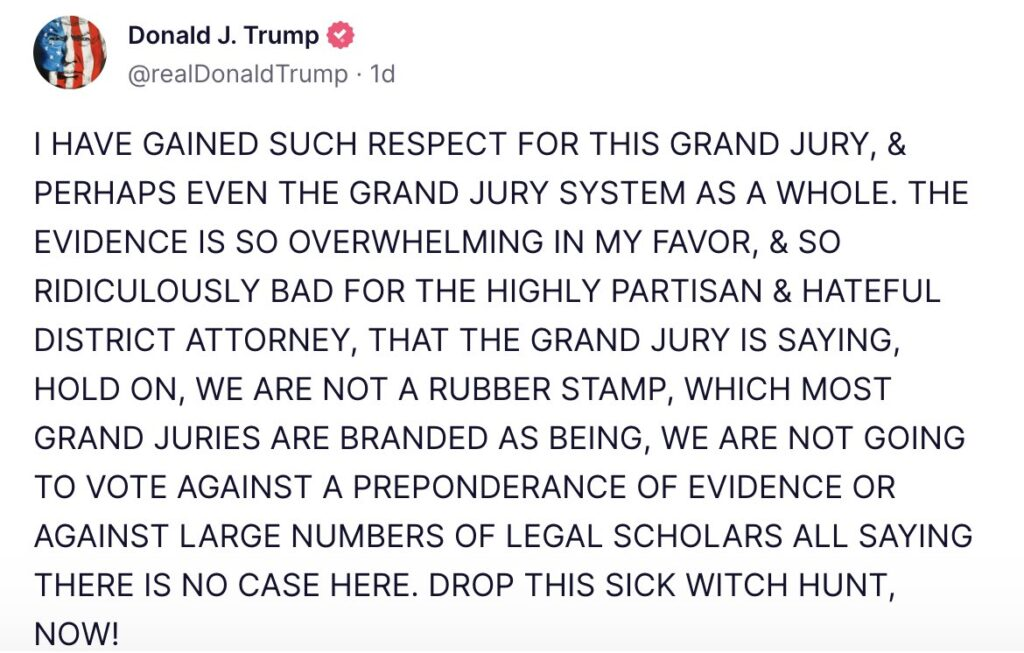
The office of Manhattan District Attorney Alvin Bragg on Friday slammed House Republicans for demanding information on their case against former President Donald Trump, calling their attempt “unlawful political interference” in an ongoing criminal case. 

Three committee chairmen — Jim Jordan, R-Ohio, Bryan Steil, R-Wis., and James Comer, R-Ky. — attempted to gain access to documents and testimony about Trump’s hush money case before he was indicted on Thursday. In a letter to the lawmakers obtained by the Washington Post, Leslie Dubeck, the general counsel for Bragg’s office, scolded the Republicans for trying to “collaborate” with the former president.

“As you are no doubt aware, former President Trump has directed harsh invective against District Attorney Bragg and threatened on social media that his arrest or indictment in New York may unleash ‘death & destruction,'” Dubeck wrote to the chairmen.

The specific charges against Trump are still unknown as they are sealed, but that hasn’t stopped him from trying to undermine the criminal investigation on his far-right social media site Truth Social.

Dubeck noted that the lawmakers could have used their prominent positions to denounce Trump’s baseless attacks on the justice system. “Instead, you and many of your colleagues have chosen to collaborate with Mr. Trump’s efforts to vilify and denigrate the integrity of elected state prosecutors and trial judges and made unfounded allegations that the Office’s investigation … is politically motivated,” Dubeck wrote. 

“We urge you to refrain from these inflammatory accusations, withdraw your demand for information, and let the criminal justice process proceed without unlawful political interference,” she continued.


Want a daily wrap-up of all the news and commentary Salon has to offer? Subscribe to our morning newsletter, Crash Course.


In a March 25 letter to Bragg’s office, the chairmen said they were seeking the documents because Congress might try to pass legislation to shield former presidents from state criminal investigations for “personal acts.” Dubeck’s response to the request was that they were trying to invent “a baseless pretext to interfere with our Office’s work,” stating that they never cited that rationale in their original request for documentation. 

Dubeck on Friday repeated her statement that the committees have no jurisdiction to oversee a state criminal prosecution and ripped apart the argument that their investigation was politically motivated because they didn’t hand over the requested materials. 

“That conclusion is misleading and meritless,” Dubeck wrote Friday. “We did not engage in a point-by-point rebuttal of your letter because our Office is legally constrained in how it publicly discusses pending criminal proceedings, as prosecutorial offices are across the country and as you well know.”

Dubeck reaffirmed that if the Republican lawmakers did not withdraw their request, the district attorney’s office would be willing to meet with them to discuss how to fulfill their request without violating their obligations as prosecutors.

“We trust you will make a good-faith effort to reach a negotiated resolution before taking the unprecedented and unconstitutional step of serving a subpoena on a district attorney for information related to an ongoing state criminal prosecution,” she concluded.

“The grift continues”: Trump tries to cash in on his indictment

The Trump campaign and the former president’s Republican allies wasted no time attempting to turn Thursday’s indictment news into a lucrative fundraising opportunity, appealing to their right-wing supporters for cash on live television and in a flurry of late-night emails.

“We are living through the darkest chapter of American history,” blared one email that the Trump Save America Joint Fundraising Committee fired off after a Manhattan grand jury voted to indict the former president on criminal charges related to an alleged hush-money payment to porn star Stormy Daniels ahead of the 2016 election.

“With your support, we will write the next great chapter of American history—and 2024 will forever go down as the year we saved our Republic,” the email, which was attributed to Trump himself, continued. “Please make a contribution—of truly any amount—to defend our movement from the never-ending witch hunts and WIN the WHITE HOUSE in 2024.”

A subsequent email with the subject line “Holding a shirt just for YOU” called Alvin Bragg “George Soros’ bought-and-paid-for Manhattan D.A.” and said Trump was indicted for “committing NO CRIME.”

The email then transitioned to a sales pitch for Trump campaign shirts, which supporters were informed they could receive for “free”—in exchange for a $47 donation.

“What better way to show your support for President Trump and our incredible movement during this dark chapter in our nation’s history than to proudly wear the brand-new ‘I Stand with President Trump’ T-shirt,” the appeal declared.

Sen. Lindsey Graham, R-S.C., meanwhile, used his appearance on Sean Hannity’s live-audienceFox News show Thursday night to plead with Trump supporters to “give the president some money to fight this bullshit.”

“He’s spent more money on lawyers than most people spent on campaigns. They’re trying to bleed him dry,” said Graham, one of many Republican lawmakers who rushed to Trump’s defense following Thursday’s news.

Republican members of Congress also sent out urgent fundraising emails Thursday night in an attempt to capitalize on news of Trump’s indictment.

“Contribute to our OFFICIAL TRUMP DEFENSE FUND to STAND WITH PRESIDENT TRUMP against this SCAM INDICTMENT,” read an email sent by the campaign of Rep. Elise Stefanik, R-N.Y., the chair of the House Republican Conference.

The Trump campaign said it raked in at least $2 million in donations in the week after the former president predicted on his social media platform earlier this month that his arrest was imminent.

Trump is expected to turn himself in to New York authorities early next week. The former president is reportedly facing more than 30 criminal counts of document fraud, though the indictment and exact charges remain under seal.

MSNBC‘s Steve Benen wrote Friday that “in theory, it might seem impossible for a scandal-plagued politician to turn a criminal indictment into a grift.”

“In practice, the relationship between Donald Trump and his followers is not normal,” Benen added, noting that the Trump campaign has successfully raised money off impeachment proceedings, efforts to overturn the 2020 election results, and supposed post-election campaigns to “secure” future contests.

The latter fundraising ploy yielded millions of dollars for Trump’s PAC—but that money was reportedly funneled toward the former president’s travel costs and other expenses, not the election battles donors were promised.

“Common sense might suggest that the public would see these developments, learn about the former president’s underhanded tactics, and his fundraising would dry up—especially in the wake of a criminal indictment,” Benen wrote Friday. “His schemes have been exposed. His willingness to exploit his supporters has been well documented. All of this should start closing wallets. But Trump’s hold on his followers is strong—so the grift continues.”

“Empty posturing”: Experts rip DeSantis’ “cheap and performative” threat to block Trump extradition

Florida Gov. Ron DeSantis, who is widely expected to challenge Donald Trump for the 2024 Republican presidential nomination, said that he would not cooperate with New York prosecutors on any extradition requests in case one is needed to arrest the indicted former president. 

“The weaponization of the legal system to advance a political agenda turns the rule of law on its head. It is un-American,” DeSantis said in a statement posted to Twitter.

“The Soros-backed Manhattan District Attorney has consistently bent the law to downgrade felonies and to excuse criminal misconduct. Yet, now he is stretching the law to target a political opponent,” he continued, not mentioning Trump by name. 

“Florida will not assist in an extradition request,” DeSantis concluded, “given the questionable circumstances at issue with this Soros-backed Manhattan prosecutor and his political agenda.” 

Left-wing philanthropist George Soros has been a frequent target of baseless right-wing antisemitic conspiracy theories. Former federal prosecutor Joyce White Vance dismissed DeSantis’ threat as “empty posturing,” but argued that “the appeal to antisemitism, the Soros reference, should give every Jewish voter & anyone concerned about hate reason to reject DeSantis. Believe them when they show you who they are.”

Legal experts say that DeSantis can try to resist a move to extradite, but technically has no power to stop it. He would also not play any role if Trump surrenders.

In a statement obtained by the Washington Post, a Bragg spokesperson said the Manhattan district attorney’s office has contacted Trump’s attorney “to coordinate his surrender to the Manhattan D.A.’s Office for arraignment on a Supreme Court indictment.” 

In order to decline an extradition request, DeSantis would need solid legal reasoning. The Constitution states in Article IV, Section 2, Clause 2 that no state has the right to decline an extradition request from another one.

“A person charged in any state with treason, felony, or other crime, who shall flee from justice, and be found in another state, shall on demand of executive authority of the state from which he fled, be delivered up, to be removed to the state having jurisdiction of the crime,” the Constitution states.

This is also backed up by federal law, which says states must comply with other states’ extradition requests. 


Want a daily wrap-up of all the news and commentary Salon has to offer? Subscribe to our morning newsletter, Crash Course.


Michael Bachner, a former prosecutor in Manhattan, said in an interview with the Post on Thursday that “DeSantis would be very hard pressed legally to refuse” an extradition request for Trump because he only plays an administrative role in the case. 

Florida permits law enforcement or other individuals to arrest someone they know is subject to a criminal charge, Bachner explains, which means a governor doesn’t have to get involved. However, he also notes that it’s unlikely extradition will even be necessary as Trump has not signaled that he would resist his arrest. 

Former federal and state prosecutor Elie Honig added that even if the situation escalated to that point, “any effort to oppose interstate extradition would fail legally. The Constitution, federal law, and prior cases make this clear.”

Bachner also said it would be “politically expedient” for DeSantis to say he won’t assist with one. 

Bill Kristol, an avid “Never Trumper,” accused DeSantis of being “cheap and performative” during an appearance on Scripps News. 

“DeSantis is just tossing this off,” he said. “Obviously, it’s cheap and performative and it doesn’t mean much…He’s just grandstanding…It shows a real contempt for the rule of law in this country.” 

“Wonderful news!”: Maggie Haberman reveals former Trump employees texted her to celebrate indictment

New York Times reporter Maggie Haberman revealed that she personally received texts from former President Donald Trump’s inner circle celebrating his indictment.

A Manhattan grand jury on Thursday voted to indict the former president in connection to a 2016 hush-money payment to porn star Stormy Daniels. Haberman, the author of “Confidence Man,” told CNN that she started getting texts from Trumpworld contacts within minutes of the news. 

Host Kaitlan Collins asked Haberman if there were people within the Trump Organization that were “quietly cheering” amid news of the indictment. 

“By quietly, I’m sure they were loudly on their end of the phone, but were texting me,” Haberman said. “And there was a long trail of people who feel burned in one way or another by Donald Trump. We certainly saw that in the White House. This was a pattern that existed for decades before the Trump Organization.”

“The number of people I heard from yesterday who worked for his company, who were really happy. One person texted with the words ‘wonderful news!'” she revealed. “That really tells you something about where these folks’ heads are.”

Haberman also said that Trump’s advisers were “caught by surprise” and some of them even learned of the news from her and her colleagues. 

“He’s very angry and should not really surprise anybody,” Haberman said of Trump. “I don’t think that means that he’s throwing staplers, but I think he’s really angry. Everything that you were saying in his statement about how this is a political persecution or a political prosecution, I think, is something that he genuinely believes. And I expect that it is going to be said with greater degrees of intensity.”

She also shared that they expect Trump to surrender on Tuesday, but that they’re not sure how that’s going to look. 

“This is not an ordinary defendant,” Haberman cautioned. “He comes with a phalanx of Secret Service. This is going to require multi-agency protection. He’s not just any other defendant in reality.”

In another appearance on Thursday night’s edition of CNN’s Anderson Cooper 360, Haberman said that the “process of getting arrested” will be “much more jarring for him than I think most people realize.”


Want a daily wrap-up of all the news and commentary Salon has to offer? Subscribe to our morning newsletter, Crash Course.


“I’ve been told that he’s been briefed on what that will look like. It will involve fingerprinting. It’s going to be unlike, you know, a normal arraignment because he’s going to have Secret Service and this is going to look different,” she said. 

“This is somebody who has spent more than four decades trying to avoid being arrested or being indicted. And so this is a really scary moment for him, despite whatever he says,” Haberman continued. “Now, you talk to different people tonight, you hear he’s fine. You talk to others who say that he’s very angry. I expect that we will be hearing all of those emotions going in various ways for the coming days.”

Haberman explained that she doesn’t know what the fallout is going to be politically, but that this is the first time that she can think of where he can’t control a situation. 

“He was able to control impeachment in some way because Mitch McConnell was on his side in the Senate trial and because House Republicans were on his side,” she explained. “He was even able to control the second impeachment to some extent. With the Mueller report and the investigation. He was never going to get indicted as a sitting president.”

“I think that he has an overconfidence in his ability to impact events by intimidation tactics, by pushing out headlines,” she concluded. “This is now in the hands of whatever judge he draws and what the voters think.”

When I need the world to feel right again, I make a cozy 4-ingredient Skillet Crusty

A few months after Hurricane Sally came ashore (September 16, 2020), my husband, Tom, and I bought a fixer-upper on the top of a mountain in the Smokies of North Carolina. As much as we love where we live in Alabama, we wanted a second place, one on higher ground, after enduring that horrific, 24-hour beast of a storm that brought the highest water ever recorded in our community as well as harrowing, but more typical, hurricane-force winds. 

Thankfully, all is well at home, no hurricanes to dodge this time of year, but we are here in North Carolina this week, atop our near 5000-foot perch, relaxing and enjoying our view of layered blue-gray mountains that recede in rows all the way to what looks like the end of the world. Having a new place means stocking a new kitchen, and on this trip I bought a brand new iron skillet, something I haven’t done in decades, so I have been seasoning it over the last two days. 

If you don’t know what it means or don’t know how to “season” an iron skillet, I will share how I was taught. Hopefully, you already have an iron skillet and can skip this part, but if not, hopefully you’ll be inspired to get one, if for no other reason than to make a beloved breakfast tradition: The Skillet Crusty. 

To do this, the first step is to preheat your oven to 450 (some say 400, but I was taught 450) and wash your new skillet with dish soap and water. After washing, dry it thoroughly. I place mine on the stove over low heat to make sure it is completely dry. Once it is dry, create a work area with an old kitchen towel to protect and pad your countertop, then place your skillet on it. Use a paper towel to rub every inch of your new skillet — bottom, top and handle — with a high-heat oil. I use avocado oil. Massage the oil in and wipe off the excess. Then, place your skillet face down on a sheet of aluminum foil that has been positioned on the middle rack of your preheated oven. Let your skillet bake in the oven at 450 degrees for one hour. 

When the hour is up, turn the oven off and allow your skillet to remain inside until completely cooled. Once cooled, take it out, preheat the oven again to 450 and repeat the oiling and baking process three to four more times. It isn’t difficult, but it does take a while.

 Buttery, eggy and scrumptious, it was so satisfying and exactly what we wanted.

Since arriving here in North Carolina several days ago, the only thing I have baked has been my now gorgeous and gleaming, new iron skillet, but the warmth and (the real or possibly imagined) aroma emanating from the kitchen while I have been seasoning it made both Tom and me want something fresh-baked and delicious. So this morning with my new skillet ready to go, we started the day off with a Crusty. It did not disappoint. Buttery, eggy and scrumptious, it was so satisfying and exactly what we wanted. 

A Crusty isn’t sweet on its own, but you serve it accompanied with sweet things like maple or yacon syrup, honey, fresh fruit, stewed cinnamon apples, jams or preserves, powdered sugar or whipped cream. Plain, straight out of the oven, it is spectacularly basic, but with even the least amount of dressing up, it blossoms into something unlike anything you’ve ever had. Though entirely dissimilar, it is difficult not to compare it to a pancake, but a Crusty is denser, more like a cross between a pancake and quiche. I love that it can be made with any type of flour and any type of dairy. It is versatile and perhaps the easiest breakfast to throw together other than, say, a bowl of cereal

With only three ingredients, plus butter for your skillet, it really is a breeze to make. You don’t have to mix your dry ingredients and wet ingredients separately or worry about the order you add things to your one bowl. There’s no folding anything in or worry about over-mixing; in fact, you could even toss it all into a blender if you wanted as the ratio of liquid to flour makes it very thin. It is completely hassle free, and without question a great recipe for your little ones to help with or even make themselves. (You would just need to take over once they have it ready for the skillet.) And as you probably already surmised, you don’t need an iron skillet to make this, despite my strong feelings about the importance of having one. Whatever you use, iron skillet or not, make sure it is about twice the depth of your batter because it rises a bit as it bakes.

A Crusty comes out of the oven beautifully golden with a crispy raised outer edge like a puffy halo. You will be tempted to try it plain, but don’t do it. Like Eliza Doolittle in “My Fair Lady,” it must be transformed from basic to extraordinary with a little of this and a little of that—berries, syrups, coconut, toasted chopped nuts, whatever you like. I prefer to have lots of options on the table so everyone can choose for themselves.

This morning I made our Crusty with sorghum flour, a new favorite of mine. Tom and I kept it pretty simple with just a drizzle of honey and some fresh blueberries and raspberries, but it felt so good to have something fresh baked. It was delicious! We made it together while drinking coffee, then ate it while standing at our new, floor-to-ceiling window, which was a wall not long ago, so that we could continue watching the birds at the feeders. A male and a female goldfinch, white-breasted nuthatches, slate-colored juncos, chickadees and tufted titmice were just some we could name. We laughed and talked and took our time. Before we knew it, it was after noon. Clearly we needed a Crusty — something more, or better than, our typical daily routine breakfasts. 

The last several months have been quite possibly the most difficult months in each of our lives with Tom having had health challenges and me losing my mom, both of us needing caretakers and both of us having to be caretakers. This morning the proverbial clouds cleared and the stress, fear and sadness of these last months felt far behind us. Eating our fresh baked Crusty, both of us healthy and smiling, enjoying our morning, gave us a sense of all being right with the world. A feeling we have not had much of lately.  

That’s the subtle power of food and mealtimes: they create space for things to shift. This easy to turn out dish takes a modicum of energy and effort but is more than enough to transform an every-day into a special day. 

There is nothing better than good food to bring you into the moment and slow time a bit so that you can reconnect with the ones you love. And what an added bonus when it is this easy to make!

Skillet Crusty
Yields
4-6 servings
Prep Time
5 minutes
Cook Time
25-30 minutes

Ingredients

4 eggs
1 cup all-purpose flour
1 cup milk
4 tablespoons of butter (but you may need more) 


Directions

  1. Preheat oven to 350. 
  2. Whisk or blend eggs, flour and milk together well. 
  3. Place butter in a round skillet (I use a 10.25″ cast iron skillet) and allow it to get very hot and bubbly in the oven. Use enough butter to thoroughly cover and slightly pool in the bottom of skillet once it is melted. 
  4. Remove skillet (carefully!) and pour batter into hot skillet.
  5. Bake 25 to 30 minutes or until golden and sides are puffy.
  6. Serve warm with fruit, jams, preserves, syrups, whipped cream, powdered sugar, or anything else you can think of.

Cook’s Notes

If you are interested in substituting some or all of the regular, all-purpose flour in this or other recipes with a gluten-free version, you will need to add a binding agent like xanthan gum and some tapioca starch or cornstarch. There are lots of gluten-free flour blends that are 1:1 replacements, but it is easy to mix up your own.

One that I have used countless times is the following blend by Carol Fenster:

  • 1 1/2 cups sorghum flour
  • 1 1/2 cups potato starch
  • 1 cup tapioca starch
  • Mix and store in tightly covered container.

As you get used to different mouthfeel of gluten-free baked goods, you can try a simpler substitution of 1/2 teaspoon of xanthan gum per cup of sorghum flour for cookies and cakes, and 1 teaspoon per cup for breads. I have used this simpler method for this Crusty recipe many times.

Salon Food writes about stuff we think you’ll like. While our editorial team independently selected these products, Salon has affiliate partnerships, so making a purchase through our links may earn us a commission.  

“Retaliation from red states”: Fox News stokes fears of political “violence” over Trump indictment

Fox News host Tucker Carlson had a meltdown on his show Thursday night after news broke that a Manhattan grand jury indicted former President Donald Trump in a hush-money case, calling it a targeted “political purge” against Republicans. 

“The rule of law appears to be suspended tonight, not just for Trump but for anyone who would consider voting for him,” Carlson said on his show. “This is what it seems to be. It is a political purge.” 

“It almost feels they’re pushing the population to react,” he said, referring to Democrats. “‘We think they’re demoralized and passive, let’s see if they really are.’ At what point do we conclude they’re doing this in order to produce a reaction?”

While Carlson implied that there might be “retaliation from red states,” his guests were much more straightforward in their warnings of political violence.

Comedian Adam Carolla asserted that “people are going to go out and protest. Somebody is going to do something stupid and then they’re going to fire up the DOJ, just like January 6th.” 

Carlson then claimed that Republican voters were being “pushed into a corner.” Carolla responded: “I feel like it’s to get them to react so that the government can now swoop in.”

Sports columnist Jason Whitlock then accused Democrats of “agitating for unrest” and cautioned that he is “ready for whatever’s next.”

Whitlock’s rhetoric closely resembled the former president’s calls to action from his supporters after the 2020 election. “I hope every other man out there watching this show, I hope you’re ready for whatever’s next,” Whitlock told Carlson. “If that’s what they want, let’s get to it.”

He continued his rant by claiming that “there is a godless element in this country that does not care about fairness.” 

“They don’t care about the will of the people. They care about power and control. As you have spelled out this week, they think they’re God,” Whitlock claimed, referencing Carlson’s earlier attacks on transgender individuals. 

Radio host Glenn Beck echoed Whitlock’s inflammatory remarks.

“They wanted violence from the right from the beginning,” Beck told Carlson, arguing that Democrats were purposely trying to provoke Republicans by indicting Trump. “They can’t wait [for] it. They need it. They want you to strike out. Why? Because then they can close the cage.”

Beck also predicted that the country would be “at war” by 2025.


Want a daily wrap-up of all the news and commentary Salon has to offer? Subscribe to our morning newsletter, Crash Course.


Carlson went on to claim that Trump’s indictment was a bigger stain on American democracy than the Jan. 6 insurrection by the former president’s supporters. 

“If you believe in our system and you want it to continue, you have to raise your hand and say stop, because this is too great an assault on our system, much greater than anything we saw on January 6th, that’s for certain,” Carlson said.

Carlson faced widespread criticism earlier this month after he framed the attack on the capitol as “mostly peaceful chaos.” 

“This is transparently political, it’s meant to take him out of the presidential race,” Carlson said on Thursday after Trump’s indictment. “That’s not allowed.”

We scouted “Dungeons & Dragons: Honor Among Thieves” and can confirm that it’s a veritable treasure

Past cinematic exploits marching under the “Dungeon & Dragons” name have made plenty of us hesitant to trust any stirrings of excitement related to “Dungeon & Dragons: Honor Among Thieves.” Veterans seems to be the most adamant skeptics. They have their justifications – namely, three of them, all of which fly the “Dungeons & Dragons” banner. 

Younglings may not fully comprehend the apprehension, and that’s understandable. To those gamers, Dungeons & Dragons has always been acceptable. Between the celebrity endorsements and its “Stranger Things” mainstreaming, people take the brand’s relatively recent broad appeal for granted.  

This forgets the high fantasy wasteland that came before Peter Jackson’s 2001 adaptation of J.R.R. Tolkien’s “The Fellowship of the Ring.”

One year before the release of “Fellowship” its distributor, New Line Cinema, put its name behind another sword and sorcery adaptation that Salon’s executive editor Andrew O’Hehir, in his previous life as this site’s movie critic, condemned with, “This fantasy crap, fake-o effects and all, betrays princes of dice, masters of graph and wielders of bong.” The first “Dungeons & Dragons” also stars Thora Birch and Jeremy Irons instead of Cate Blanchett and Sir Ian McKellen.

The success of “The Lord of the Rings” movies catapulted Elijah Wood, who played Frodo Baggins, into the next echelon of superstardom. Meanwhile Justin Whalin, the lead of “Dungeons & Dragons,” is engaged in the most valiant work of all – he’s a history teacher. As Legolas, Orlando Bloom proved elves could be elegant and f-i-n-e foin, erasing all reminiscence of whatever Marlon Wayans was going for in that other flick.

Not content to leave a crime alone, the producer of “Dungeons & Dragons” followed it with 2005’s “Dungeons and Dragons: Wrath of the Dragon God” and the 2012 “Dungeons & Dragons 3: The Book of Vile Darkness,” direct-to-DVD bombs best left in the Underdark. Each ran on Syfy during its B-movie era, which means many gamers saw them anyway, losing intelligence points in the bargain.

But to loosely quote Blanchett’s Galadriel, “The world is changed. I feel it in the water. I feel it in the earth. I smell it in . . . the Pine.” And we saw it in the tempting trailer for “Dungeon & Dragons: Honor Among Thieves,” which drew a few hesitant nerds to preview screenings.

As a member of one such scouting party, I can report that the pull quotes singing its praises aren’t overselling it – except, maybe, the trade publication that called it the best movie of the year. (Let’s not get too excited, people. We’ve barely brushed our knuckles against April’s door.)

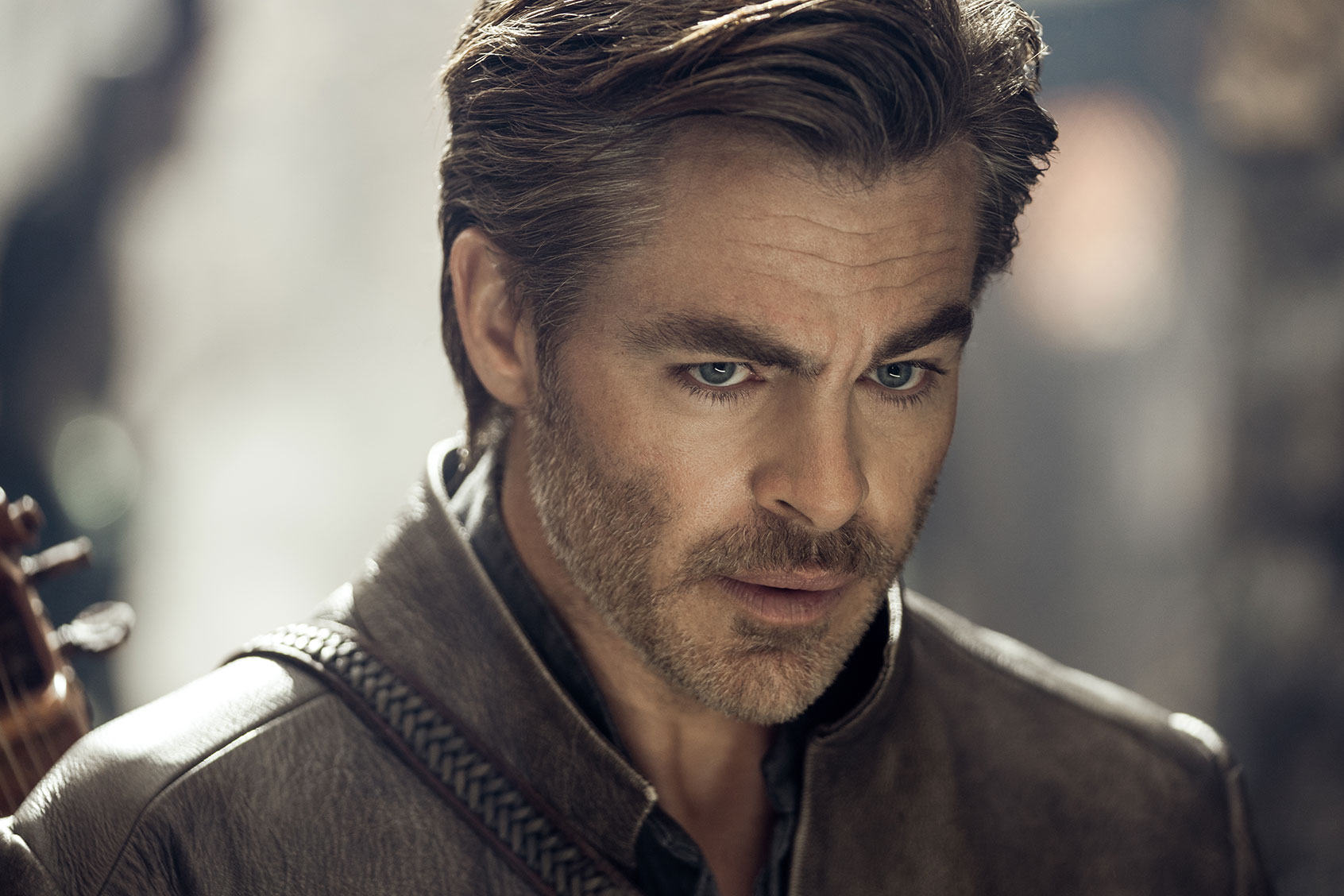
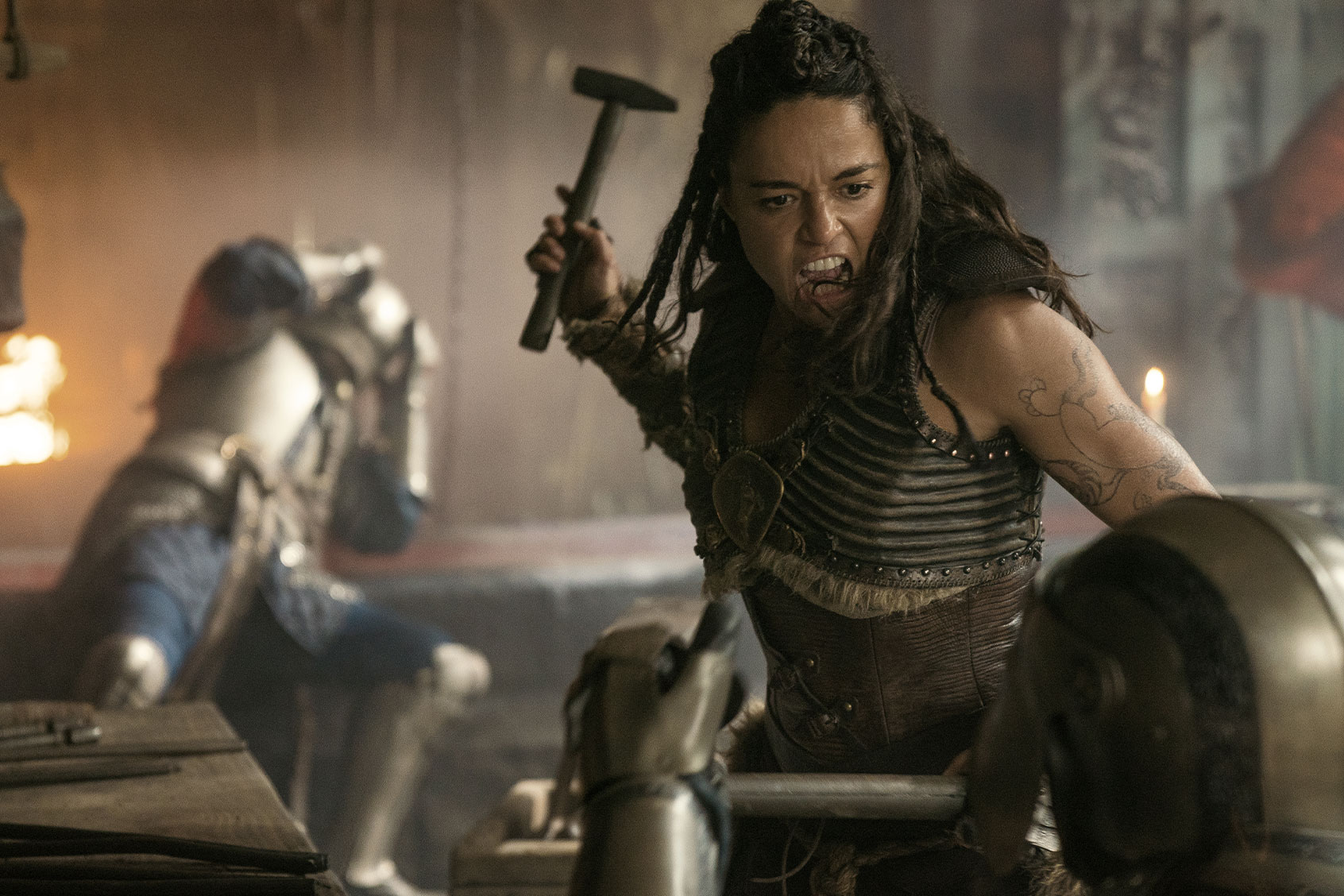
Calling it a rousing good time, though, is entirely accurate. “Honor Among Thieves” capitalizes on the unexpected buddy chemistry between Chris Pine as smooth-talking bard Edgin Darvis, and Michelle Rodriguez‘s exiled barbarian Holga Kilgore. Their intractable bond is forged not in war but in domesticity: Holga steps up to platonically co-parent Edgin’s daughter Kira (Chloe Coleman) when she sees this suddenly single dad falling down drunk on the job. 

To support themselves they build a small band of thieves that includes a mid-talented sorcerer, Simon Aumar (Justice Smith), and a rogue, Forge Fitzwilliam (Hugh Grant), who scheme to part Faerûn’s richer folk from their gold. The partnership ticks along smoothly until they’re contracted by a wizard named Sofina (Daisy Head) for a heist that goes sideways. Edgin and Holga are captured, leaving Kira effectively orphaned.

Their first mission, then, is to return home to Kira. But the stakes quickly rocket skyward, forcing the duo to reunite the old band and add extra muscle by allying with a druid, Doric (Sophia Lillis).

“Honor Among Thieves” is about as complicated as a low-level campaign, but its immersive joy capitalizes on that simplicity, making the story vibrate with true affection for the game and its fandom.

In case you’re still not convinced, we’ve broken down other reasons why “Honor Among Thieves” steals the crown.

01
The adaptation’s reverence for the game includes an appreciation of its silliness 
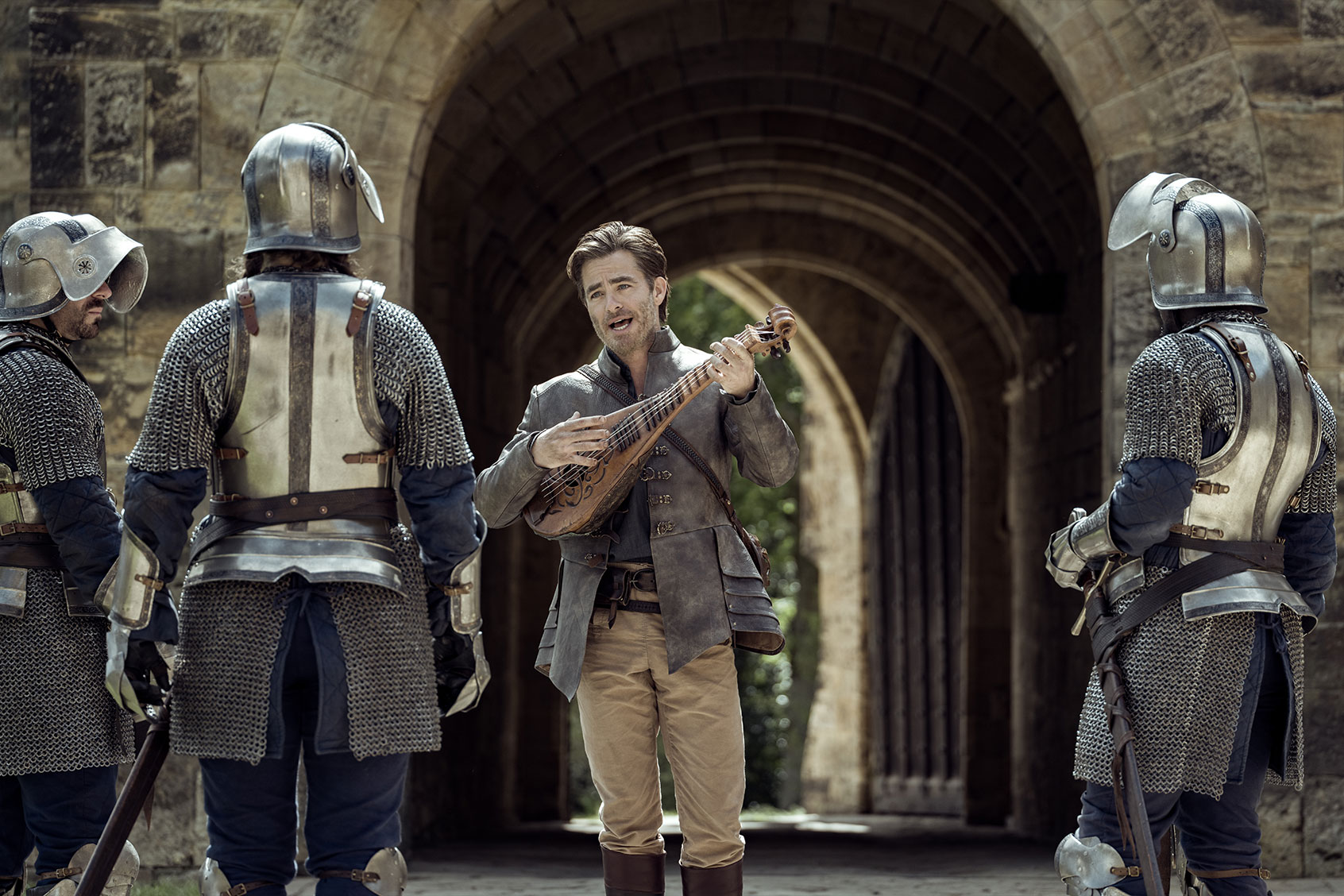
Image_placeDungeons & Dragons: Honor Among ThievesChris Pine plays Edgin in “Dungeons & Dragons: Honor Among Thieves” (Paramount Pictures/eOne)holder

While it’s too early to refer to the new “Dungeons & Dragons” movie as part of an overall trend in adaptations, it is another screen work whose success rests in its creators not only simply knowing the product but strongly connecting it on a personal level. 


The Last of Us” creators Craig Mazin and Neil Druckmann credit their love of the narrative powering Druckmann’s video game and valuing the feelings the story engenders for facilitating its successful adaptation to TV. “Honor Among Thieves” co-directors and writers John Francis Daley and Jonathan Goldstein (“Horrible Bosses,” “Game Night”) have a similar connection to D&D.


Daley participated in a years-long game as an adult, and it shows in the cavalier jokes, the rowdy physical humor and bouts of heroic incompetence. Instead of abusing bombastic high fantasy English into tortured, shallow conversations everyone takes too seriously “Honor Among Thieves” characters speak, think and react in the way dice-throwing, smack-talking friends sitting around a table would, possibly (probably) while buzzed and giggly. 

02
Unlike past “D&D” flops, the story is observant of the game’s rules
Image_plaDungeons & Dragons: Honor Among ThievesSophia Lillis plays Doric in “Dungeons & Dragons: Honor Among Thieves” (Paramount Pictures/eOne)ceholder

Daley and Goldstein wisely refuse to be constricted by them, however. Seasoned gamers can debate the merits of how massively overpowered some of its heroes are while also excusing that indulgence because, again, this is a movie. Nitpicking over, say, how many times a druid can transform into an owlbear between long rests is excessively nerdy; also, who doesn’t want to see that happen as many times as possible?


If you don’t play the game but simply want to enjoy Pine bantering with Rodriguez, terms like “overpowered” and “owlbear” zip right by you, no problem. Daley and Goldstein wrote the script to be appreciated by the battle-experienced and folks who are just there for the laughs. So regardless of whether you know how a Speak With Dead spell is supposed to work, you’ll get the joke.

https://youtu.be/kXJo4PoMQRM 

03
The filmmakers understand that dragons are kind of played out
Image_Dungeons & Dragons: Honor Among ThievesMichelle Rodriguez plays Holga in “Dungeons & Dragons: Honor Among Thieves” (Paramount Pictures/eOne)placeholder

With a few exceptions – “House of the Dragon” and other George R.R. Martin titles, mainly – we’ve been there and done that in terms of the whole flying, firebreathing kaiju business. Still, “dragons” is in the title, which means we should expect Edgin, Holga and the gang to encounter a couple in their hikes around Faerûn. 


Happy the filmmakers meet that expectation by playing to the movie’s comedy focus on a massive scale and very creatively, without downplaying the terrifying mortal danger presented by these monstrous killers, all without transforming the action into an unbecoming cartoon.

04
It uses its visual effects wisely if not sparingly
Image_placeDungeons & Dragons: Honor Among ThievesDaisy Head plays Sofina in “Dungeons & Dragons: Honor Among Thieves” (Paramount Pictures/eOne)holder

In addition to hiring no-name actors for its sequels, past “Dungeons & Dragons” films cheaped out on the visual effects to a degree that you could feel the utter disdain its creators had for gamers and the fandom.


Part of that is a matter of financial constraints, of course. The 2012 movie had an estimated budget of $12 million versus the $151 million hoard propelling “Honor Among Thieves,” courtesy of its co-producers Paramount and the Hasbro-owned eOne. More resources don’t guarantee the money will be well spent, mind you; you can look at any overwrought CGI-reliant Marvel movie for examples of visual effects overloads that neglect to make the best use of the cast’s abilities or to infuse the writing with soul.


“Honor Among Thieves” is almost entirely constructed out of digital fakery, yet finds a balance between enchanting digital creations and enhancements and situational humanity, or whatever that term’s equivalent would be for half-elves and tieflings. Better still, the dramatic tension doesn’t fall apart during its inevitable sorcery battles which, in lesser film and TV, burst into empty, dragging spectacles with adversaries lamely hurling balls of fake light at each other.

05
It’s in on the jokes concerning character classes
Image_placeDungeons & Dragons: Honor Among ThievesChris Pine plays Edgin in “Dungeons & Dragons: Honor Among Thieves” (Paramount Pictures/eOne)holder

What is the point of a bard, anyway? In most fantasy tales the heavy fighters lead the quest. They’re the ones who get the job done, after all. Not here. Holga may be the muscle, but she’s also a woman of few words who probably scores low in the intelligence and wisdom categories. She’s fine with Edgin acting as the squad’s leader, the guy whose main weapons are a lute and speechifying. 


In the same way we accept that bar fights get more dangerous if someone decides to punch up Motörhead’s “Ace of Spades” on a jukebox, bards can cast spells in Dungeons & Dragons. Most wouldn’t render believably in live action. (Amazon’s “The Legend of Vox Machina,” in contrast, visually realizes its bard Scanlan’s magic admirably because it’s a cartoon.)


But instead of engulfing its actors in rosy halos, Goldstein and Daley lean into the punchline about the apparent uselessness of bards by making Edgin a wheeling-dealing gabber whose main contribution is to strategize and inspire (a legitimate bard spell). That doesn’t stop some of his companions from questioning his value.


Then we have Regé-Jean Page’s Xenk Yendar, a paladin so devout and good that it makes him insufferable – which is precisely how paladins should come across in mixed company. Page is one of the few actors in the movie playing his part as if he’s in a juvenile, terrible “Dungeons & Dragons” adaptation, sealing his performance as one of the movie’s strongest assets.


Want a daily wrap-up of all the news and commentary Salon has to offer? Subscribe to our morning newsletter, Crash Course.


06
Its casting is purposeful and properly utilized
Image_placDungeons & Dragons: Honor Among ThievesJustice Smith plays Simon, Chris Pine plays Edgin, Rege-Jean Page plays Xenk, Sophia Lillis plays Doric and Michelle Rodriguez plays Holga in “Dungeons & Dragons: Honor Among Thieves” (Paramount Pictures/eOne)eholder

Having a respected A-list actor in a hammy genre piece says nothing about its quality. Exhibit A: Dame Helen Mirren co-stars in “Shazam! Fury of the Gods,” but so what?


However, “Honor Among Thieves” savvily capitalizes on the existing rep of its best-known actors. Pine’s work in 2009’s “Star Trek” and “A Wrinkle in Time” showcase his devoted father side; combine that with the playful energy he brought “Wonder Woman” heartthrob Steve Rogers, and there’s Egdin. Rodriguez’s Holga plays into her rep as an action-heavy with a kind heart who’s all about family, a la “Fast & Furious.”  


“Bridgerton” established Page as the unattainable dreamboat everybody wants to be around, prime attributes for a paladin, a class requiring high charisma. Another star’s cameo exceeds these in terms of its context and the celebrity’s participation; their delight in their appearance is completely unexpected, so that’s all we’ll say.


Lastly, there is a rare exception to the truism mentioned at the start of this section – you know, the thing we said about a famous actor’s participation not being indicative of a movie’s quality.

07
Hugh Grant is in it
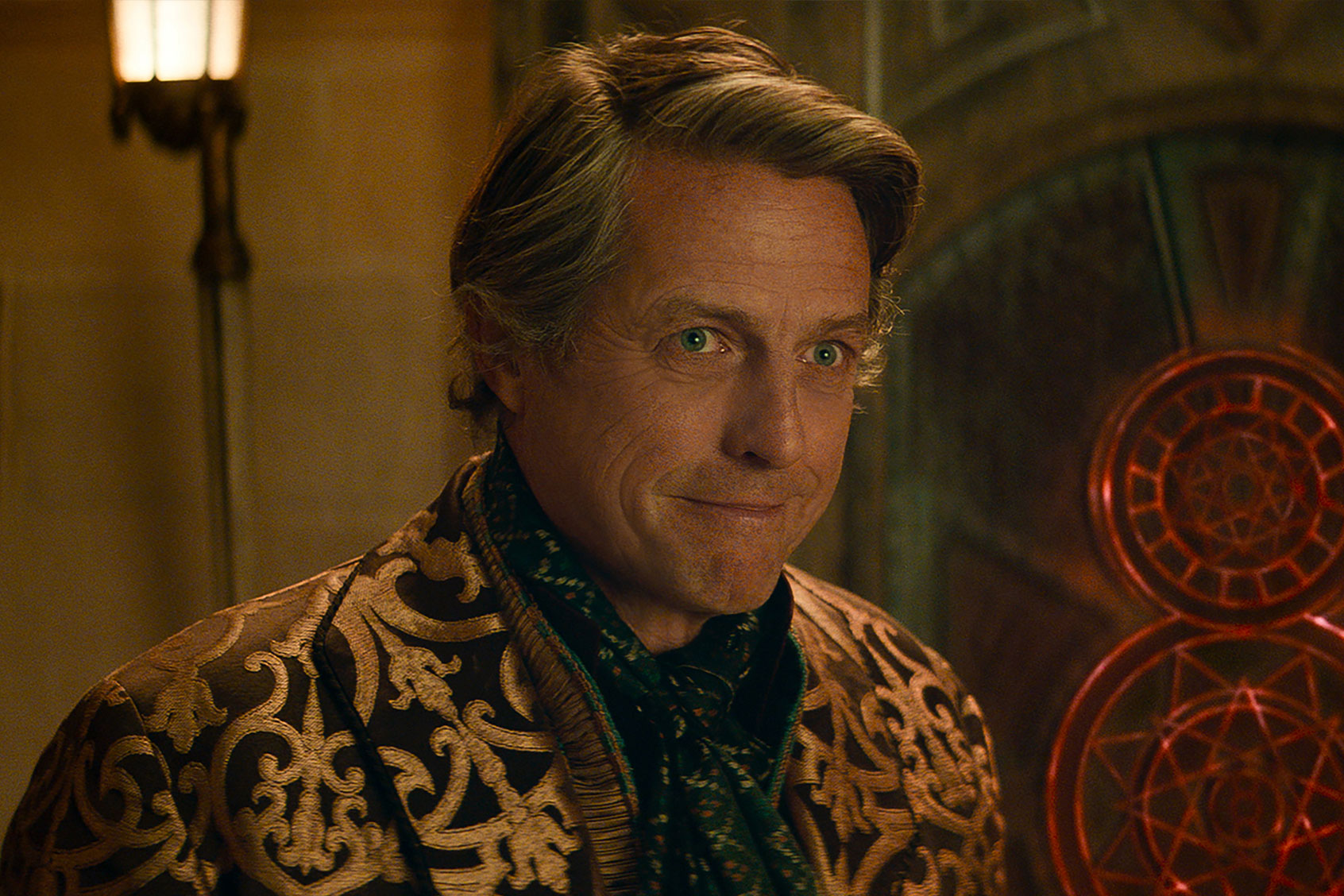
Image_placehDungeons & Dragons: Honor Among ThievesHugh Grant plays Forge in “Dungeons & Dragons: Honor Among Thieves” (Paramount Pictures/eOne)older

Some people may wonder why Grant’s presence is a credit to “Honor Among Thieves,” especially after his condescending behavior toward an interviewer on the Oscars red carpet. That means you probably haven’t been blessed with his performance in “Paddington 2.” Correct that oversight as soon as possible.


Grant knows how to play a sensational heel to the hilt and has a knack for choosing movies many are primed to underestimate. Then he gloriously hams his way through every inch of proverbial celluloid in a way that makes you love him even more than you love hating him. That Grant believed in the potential of “Honor Among Thieves” enough to sign up for the adventure should tell you something.


By the time the end credits roll, you’ll be glad you tagged along too.


“Dungeons & Dragons: Honor Among Thieves” premieres Friday, March 31 in theaters nationwide.


“Teary-eyed” Lindsey Graham goes on Fox News to beg viewers to give indicted Trump “money”

Sen. Lindsey Graham, R-S.C., did not take the news of Donald Trump’s indictment well, appearing on Fox News on Thursday night to beg viewers to donate money to the former president. 

During an appearance on Sean Hannity’s show, amid the network’s collective meltdown over the indictment, Graham defended Trump after a Manhattan grand jury on Thursday voted to indict the former president in connection to a 2016 hush-money payment to adult film star Stormy Daniels.

Graham claimed that the indictment was motivated by “hatred” and argued that Democrats “fear Trump at the ballot box” despite President Joe Biden winning by 7 million votes in the last election.

“They’re trying to drain him dry,” a bleary-eyed Graham said. “He’s spent more money on lawyers than most people spent on campaigns.” 

The indictment in Manhattan may just be the beginning of Trump’s legal troubles this year. He is also facing a criminal investigation in Georgia regarding his attempts to overthrow the 2020 election, and another criminal investigation by the Justice Department over his alleged mishandling of classified documents at his private estate in Mar-a-Lago, Florida. He will also be tried in April over his alleged rape of journalist E. Jean Carroll in the 1990s.

During a span of just two minutes, Graham pled viewers to visit Trump’s website and donate three times. 

“Donald J. Trump.com. Go tonight. Give the president some money to fight this bullsh*t,” Graham begged. “This is going to destroy America. We’re going to fight back at the ballot box. We’re not going to give in. How does this end Sean? Trump wins in court and he wins the election. That’s how this ends.”

Hannity then asked the senator: “How do you get the thirty-four counts on this in your view?”

“How do you do it? Well if, if you got a pile of crap and you chop it up thirty-four times, it’s still a pile of crap,” Graham said. “It’s duplicitous charging. They’re trying to smear the guy. They’re trying to take cases that nobody else would take and resurrect him. This is literally legal voodoo. This is political persecution. This is a combination of political hatred and selective prosecution on steroids.” 

“To those who are listening tonight: If you believe Trump is being treated poorly and wrongly, stand up and help the man,” Graham continued his emotional plea, later adding that their prayers would also be welcomed. “Pray for him. Go to Donald J. Trump.com and give money so he can defend himself.” 

“This is a moment in American history. This is the most irresponsible and dangerous decision by a prosecutor in the history of the country,” Graham added. “He’s opened up Pandora’s Box against the presidency itself,” he continued. “This is a danger to the presidency. This is turning the rule of law upside down to destroy a man, Donald J. Trump, who the left fears. Do not let them get away with this vote. Show up at the ballot box. Donald J. Trump.com. Give the man some money so he can fight.” Hannity thanked him as his studio audience applauded.


Want a daily wrap-up of all the news and commentary Salon has to offer? Subscribe to our morning newsletter, Crash Course.


During the interview, a heckler in the audience was heard screaming at Graham.

“This is a wonderful day. You lie by omission and you lie,” the heckler said before the sound was cut off.

Graham quickly drew social media scorn over his appearance.

“Are you saying Trump threatened to release dirt on everyone if he goes to jail? Is that why he is teary-eyed and panicked?” said one user.

British journalist Anthony Davis pointed out, “Lindsey Graham is literally crying over Trump, like a devastated boyfriend. And then goes on to grift for cash on his behalf?! The cult is strong with this one… #TrumpIndictment”

Joe Scarborough also mocked Graham on Friday, playing a montage of the senator’s pleas before comparing him to predatory televangelists like Jim and Tammy Faye Bakker and Oral Roberts. 

“Trump so constantly hustles his supporters for money. Is he a billionaire, or is he not? Legal fees should be a rounding error in his checking account, but he is constantly hustling his supporters for money to pay his legal bills,” co-host Willie Geist said.

“I always talk about the Jim and Tammy Faye Bakker approach to politics scamming people like my grandmother out of their social security checks, $25 here, $50 there.,” Scarborough said. “I’ve got to say, that Lindsey Graham moment, he’s tearing up … Lindsey knows what a bad man Donald Trump is. Lindsey is the one who said if we make him our nominee, he’ll destroy the Republican party, and we deserve it.”

“Lindsey almost crying there, that reminded me of Oral Roberts climbing up into his tower in the ’80s, saying, ‘Give me $3 million or I’m not coming down from this tower,'” Scarborough said.

“It is an unapologetically joyful film”: Director urges viewers to visit Hulu’s charming “Rye Lane”

Utterly charming and pulsating with color, “Rye Lane” is director Raine Allen-Miller’s fabulous feature debut about two strangers, the introspective Dom (David Jonsson) and the refreshingly disarming Yas (Vivian Oparah), who meet cute at an art opening. The pair form a quick connection and soon spend the rest of the day together getting to know each other. Both are recovering from breakups, and as they reveal their vulnerabilities, they bond. Sometimes this involves karaoke, and sometimes it involves breaking into an ex’s apartment to retrieve a sentimental object.

Both Jonsson and Oparah are charismatic leads, but the film is visually dynamic with terrific flashbacks and fantasy sequences. Allen-Miller also establishes a keen sense of place in the various ethnic food shops — one features a clever cameo — in this South London district in Peckham. But what makes “Rye Lane” magical is the way the two characters help each other become their best selves by just seeing what happens. 

Ahead of the film’s premiere at the Sundance Film Festival, Allen-Miller spoke with Salon about making “Rye Lane,” which is now available on Hulu.

Let’s start with an icebreaker. In the film, Dom and Yas are strangers who acknowledge that everyone has a mess. We are strangers, what mess can you share with me?

The mess I can share with you . . . Gosh, that is a hard question. I wasn’t expecting that! I cannot think of a mess. My bedroom and my really neurotic dog.

You toggle back and forth between Dom and Yas. How did you identify with the characters and how did you maintain a balance in telling their stories? 

I massively identified with Yas. Early on in the process of working on the script with the writers [Nathan Byron and Tom Melia], I put a little bit of myself into her. Therefore, the Dom character, and him being different from her, was inspired by that. But the actors did so much. I want them to know the character more than I did and tell me fresh things that I wouldn’t think of. It was a collaboration in that sense, working with them and my obsession trying to create a female character that feels so young and “London.”

Your film is a road movie that never leaves South London. What can you say about creating a different vibe for each situation and location that Dom and Yas find themselves in? 

In all of my work I try to tell story visually, not only in dialogue. That was the attraction to the script. It’s a dialogue-heavy script, and made me laugh a lot, but I felt I could inject a lot of visuals into it and build a world. I’m obsessed with world building. How do you take a script, set in a day that is two people mainly walking around and make it feel dynamic and make it feel like this amazing journey. For me it is like that. I do think in a visually bonkers way. Because it’s a simple script of walking around South London, making that really elevated in a magical way felt nice. It’s natural for me, but I also felt it would service the script well. I loved “Before Sunrise.” and I thought, “How do I do the opposite of that?” I absolutely loved that film, but I don’t want to do that. I want to do something that is more me. I was talking with someone recently about “Withnail and I” and how that was also a film about two people in London.

I looove “Withnail and I”! Can you talk about developing the energy and color which is so vibrant?

As someone who wears ridiculous, colorful clothes, it represents me in so many ways, because deep down, I’m quite a dark person, but I love color. I think when things are dark or sad, color helps so much, but it also helps when things are happy. No matter what I do, I always want to inject color into it. It’s part of who I am, and the surroundings I am in. I moved to South London when I was 12. It is colorful place, so it was effortless to shoot. We added production design in some places but in was just there in others.

The characters’ emotions are triggered by videos, songs, images, and objects. What observations do you have about the meanings we place on things that bond us, or how we connect to someone, even a perfect stranger, or even this idea of fate?

That is how we think. A song that really reminds us of someone, and flashes us back to that moment, it is what happens in our brain. I wanted to make a big point out of that. It’s the truth, and even though it is done in a slightly surreal way, it is still the truth. That’s how I think, anyway.

The film addresses issues of truth and trust. It also shows how strangers can have a positive impact on our lives. How do you think Dom and Yas helped each other become their best selves? 

For me, when I met my partner, the first time we met I immediately felt comfortable and a better person. That’s what relationships are about. If you meet someone that you can be your best self or feel like you can be your best self and be comfortable with who you are with that person, that’s amazing. And I think you know that quite quickly. It’s the same with friendship, I think. There are some people I meet that I feel really comfortable with right away. 

Music is a very key element in the film. I’m curious about the song selections, which create different moods. I also want to know what you would choose to sing in a karaoke bar. 

It’s odd because, apart from the Tribe track, it’s so British and that’s really important to me to celebrate British musicians. But then we had Kwes. I had made a playlist before shooting the film, and 90% of it was Kwes’ music. He helped really bring to life that world that I wanted to create that felt fresh and new.

My karaoke song would be “This Must Be the Place” by the Talking Heads. One day I’m going to make a film with that song in it. I sing it, I dance to it. It makes me happy. It makes me sad. It’s just the best.

I love that song too! I want to do that lamp dance to that song! The characters talk about grand gestures. Have you ever made a grand romantic gesture, and if so, what was it, and how was it received?

Wow. I feel like I have the answer to this question! There’s something I’ve done that’s really romantic, and I want to remember it. I can’t think right now! We may have to come back to this. I want to give you the answer. Oh, OK, my fiancé and I love hot dogs passionately — like you go to a Michelin star restaurant and review them vibe — and we have the same birthday. On our birthday I dressed up as a hot dog and danced around. That’s not the one I was thinking of but it’s one for now. 

Speaking of food. I was amused by the “Love, Guacally” scene. I don’t want to spoil it, but can you share how that came about? 

I love talking about it, but I also don’t want to say anything about it. Folks shouldn’t know.  All, I’ll say is I wanted a cheeky wink.

The film’s message is “Let’s see what happens.” What do you want to happen with “Rye Lane?”

Having been through a pandemic, I just want people to enjoy themselves, laugh, and have a nice time. It is an unapologetically joyful film and I think people should have an unapologetically joyful time watching it. That’s the goal.  

What are your career aspirations, now that you have this film under your belt?

I don’t want to be the rom-com person. I’m in denial about “Rye Lane” being a rom-com. [Laughs] I’m writing a heist film at the moment and have ideas for a horror film. I want to make work that is funny. I really like comedy, but it doesn’t have to be completely joyful. What I loved about “Get Out” is that it’s so entertaining, and it has a message. I want to make work that does that. I don’t think everything has to be arthouse. I like the world seeing it and it being accessible to everybody, but also, having important messages and voices is key for me. 


Want a daily wrap-up of all the news and commentary Salon has to offer? Subscribe to our morning newsletter, Crash Course.


What about the opportunities you may have as Black female filmmaker? 

I am very proud of being a Black female, working-class person, but I also really just want to make films and have that not be the film as to why someone is interested in me. I want to make great work and I am excited that in hopefully less than 10 years people won’t be saying “female,” ‘Black.”  I just love to be able to make films. It’s all about what’s next. What’s next is not a rom-com. It’s a diverse cast because that’s the way the world is. It is harder for me, but there are so many elements — there is female, class, because the UK is obsessed with that, and my race. The pigeonhole situation is about my next project not being those things.

“Rye Lane” is available on Hulu starting March 31.

MAGA House GOP slammed for “ignoring all the evidence” to defend “disgraced former president”

Progressives on Thursday cheered the news that disgraced ex-president Donald Trump has become the first former chief executive of the United States to be indicted, after he was formally charged by a New York grand jury that has been investigating hush-money payments he made to adult film star Stormy Daniels.

But while progressives hailed the development as a necessary culmination of myriad investigations into the former president’s many alleged crimes, some suggested it doesn’t go far enough.

“Donald Trump was the most corrupt president in American history,” said Noah Bookbinder, a former federal prosecutor who currently heads Citizens for Responsibility and Ethics in Washington.

“He has spent his entire political career dodging accountability for his wanton disregard for the law. It is finally catching up to him,” Bookbinder said. “The charges in New York are the first ever brought against him, but they will not be the last.”

Rep. Ted Lieu, D-Calif., noted the historic nature of the indictment but said it was necessary to preserve justice.

“Indicting a former President is a horrible precedent; the only precedent worse than that is to not indict Donald Trump if there is evidence that he committed crimes,” he wrote on Twitter. “This is a somber moment for America. We should let the judicial system do its job without interference.”

Rep. Eric Swalwell, D-Calif., took a similarly reserved tack, calling it ” a somber day for America.” He said, “Donald Trump deserves every protection provided to him by the Constitution. As that unfolds, let us neither celebrate nor destroy. Justice benefits us all.”

Those not in office were notably less subdued.

Adam Green, co-founder of the Progressive Change Campaign Committee, hailed the indictment but noted that bringing Trump to justice is long overdue.

“Let’s be honest: After inciting an insurrection at the U.S. Capitol, pressuring local officials to overturn the 2020 election, receiving financial kickbacks from foreign powers, and numerous other crimes during his presidency, it’s embarrassing and infuriating that the first indictment against Trump is about…Stormy Daniels,” Green said.

As Manhattan District Attorney Alvin Bragg and his prosecutors have been burrowing further into the Trump payments to Daniels, the ex-president has been making numerous veiled threats of violence if he’s charged. In a post to his failing social media site, Trump warned of “catastrophic” “potential death & destruction” which could follow any indictments he may face.

Responding to Trump’s threats, Rep. Ilhan Omar, D-Minn., noted that it was the duty of policymakers and citizens to support the impartial administration of justice.

“Now it is up to all of us, as citizens and elected leaders, to support accountability and to follow the facts where they lead,” she said. “Political interference in a criminal investigation, up to and including incitement of violence, are hallmarks of democratic decline. I hope all of my colleagues will join me in supporting justice and accountability—regardless of party—for the sake of our democracy.”

Accountable.US Executive Director Tony Carrk noted in a statement that House Republicans have been running interference for Trump:

“Today’s news is the first step in showing that no one is above the law. It is striking to watch the MAGA House GOP ignore all evidence and bend over backwards to support the disgraced former president. These are the same Republicans who are coordinating with Trump himself on how to use their investigative authority. These are the same Republican lawmakers who have tried to discredit the Manhattan District Attorney. And they’re the same people who defended Trump after he incited the violent attempted insurrection on our Capitol. House Republicans are throwing their support behind Trump because they’re desperate to help him enact his extreme, unpopular agenda including cutting Social Security and passing a national abortion ban.”

On “Top Chef: World All Stars,” to the Victoire go the spoils

“Top Chef” really might be one of the most feel-good shows on television. It’s neat to compare the show’s current tone to the dark nature of Season 2 of the same show: they couldn’t be more disparate.

Ali has yet another top-notch, super positive episode, scored by another win and even more of his even-keeled, good-natured, modest energy. In Episode 2, I felt Ali was great (but Chef May slightly outshone him in that episode) and I felt similarly here: Perhaps Ali is our winner in this episode, but I’m more struck by Victoire, who has a terrific showing. (Isn’t it wild that she speaks seven languages and just learned English only four months prior to when “Top Chef” began filming?)

Her confessionals are laugh-out-loud funny, she speaks about moving from Congo to Italy, her facing everyday racism in Italy, her triumph on “Top Chef” Italy and how she now knows that she’s a beacon of inspiration for many women around the world. This is crystallized by Sylwia’s constant, kind support of Victoire, from their working together in last week’s elimination challenge to her finishing Victoire’s sentences at the table in this episode.

Mind you, this all not even mentioning her entire allergy moment (and subsequent win)!

Mind you, all this and not even mentioning her entire walnut allergy moment (and subsequent win)! What a roller coaster of an episode for her. But back to the competition . . . 

Biscuits galore (but not like the ones Kacey Musgraves sings about

This Quickfire segment opens with a funny quip from Gabri about the guest judge Paul Young’s attire being reminiscent of Austin Powers, but I’d argue that Padma’s getup is even more Powers-influenced: a mod sheath dress with matching go-go boots. (Also love her speaking Italian to Victoire at one point. Who’s the polyglot now?) 

The Quickfire challenges the chefs to make two biscuits — one savory and one sweet — but I’m perplexed by the instructions and truly can’t discern if the challenge is actually a biscuit biscuit (like the American ones you’d get from Popeye’s) versus a British biscuit (aka a cookie). This isn’t answered until the cheftestants present their food. I especially love the way that Sara fuses the two types of biscuits while still incorporating the Southern flavors that she’s most comfortable working with.

I’m also intrigued by German Tom here, who gets an oddly scathing critique from Paul Young – for not at all meeting the brief by making CAKE – which is the first time Tom displays any sort of negativity or anything other than his light and easy breezy persona thus far. Fascinatingly enough, though, Tom’s scenes still seem to be scored with jaunty, almost-carnival like music. 

Ali’s Quickfire win (for his savory Za’atar biscuit and sweet orange sablé) is noteworthy because his strategy cooking them is the almost laughable, with his peering into the ovens and babysitting throughout. But again, his affable nature and apparent sweetness turns what could’ve been a funny moment into a wholesome one.

. . . again, his affable nature and apparent sweetness turned what could’ve been a funny moment into a wholesome one.

My favorite part of the Quickfire is Buddha’s telling us that he bought his dog eye surgery – “he was about to go blind” – with his “Top Chef” winnings from last year. Buddha’s dog’s name is translated to “little crumb” but Buddha says he had “more rolls than a bakery.” The whole confessional is just *chef’s kiss.* 

Off to the stadium

This is one of the few times I can recall that the group goes in almost completely blind — only knowing the challenge would be held at Tottenham Hotspur stadium.

Top ChefPadma Lakshmi in “Top Chef” (David Moir/Bravo)

For the elimination challenge, teams of three will face off each against each other “regulation” style, basically meaning that a bracket-style competition, which would finish with the only team that loses twice entering a final round in which the three chefs would then compete against one another. 


Want a daily wrap-up of all the news and commentary Salon has to offer? Subscribe to our morning newsletter, Crash Course.


Luciana has a (very foreshadowing-heavy) confessional in which she reveals if she knew about the parameters of the challenge prior to, she probably wouldn’t have picked Gabri and Begoña as her teammates. Oop! 

Top ChefBegoña Rodrigo in “Top Chef” (David Moir/Bravo)

Luciana has a (very foreshadowing-heavy) confessional in which she reveals if she knew about the parameters of the challenge prior to, she probably wouldn’t have picked Gabri and Begoña as her teammates.

Begoña immediately takes charge of the team, which is contrasted to the other team, in which we get a bit of discord between Nicole and Victoire. Soon enough, though, the other team has some issues with the lack of texture in their dish (“soft on soft” is never a good bet!) and Victoire suddenly is sneezing incessantly and her voice deepens about five octaves. Turns out that she’s incredibly allergic to the walnuts, but hadn’t say anything to her teammates. I was fascinated by the fact that the medic immediately jumps in after time is called to pull her off and tend to her. Coincidentally and fortunately, her team wins, but it raises the question: What the heck would have happened if they hadn’t? Would Victoire have been forced to just forfeit? Who knows . . . but thank goodness their team wins, and Victoire is able to move on. I especially love when Victoire finds out about her team’s win and wants to go celebrate with them, but the medic forcefully refuses to let her. I think the epipen was still in her leg!

Team Charbel/Sara/Sylwia also succeed with their take on a Welsh rarebit (interesting that that dish was actually the challenge in the most recent “Last Chance Kitchen” unbeknownst to this team, of course). I really like each cheftestant on this team, so I’m happy for their success. 

Top ChefAquiles Chávez, Ledley King, Padma Lakshmi, Tom Colicchio and Gail Simmons in “Top Chef” (David Moir/Bravo)

“Pack your knives and go”

I’m also surprised that the Begoña team makes so many (simple) mistakes, repeatedly: the oxidizing apple, the weird lack of texture in the first dish (even after Luciana called it out) and even the pea cookery in the final challenge (or lack thereof). Just odd overall . . . and a good harbinger of the fact that their team will eventually be the losing team (although I’m a little anxious for Buddha and Tom, so I’m glad they pull it off and am intrigued by their using a dessert — and a relatively simple one at that.) 

Both Begoña and Gabri have confessionals discussing the camaraderie of their team and how they don’t want their friends to go, but we get nothing of the sort from Luciana — who eventually winds up being the “victim,” if you will.

Top ChefBegoña Rodrigo, Luciana Berry and Gabriel Rodriguez in “Top Chef” (David Moir/Bravo)

In the final judging, there’s numerous mentions of the fact that Begoña’s dish, while the peas aren’t stellar, is clean, elegant and even deemed “art” by Gail. All of the peas are undercooked, though, according to Tom. Yet again, a simple ingredient (rice, peas) tends to often trip up these incredibly talented chefs. I am also oddly intrigued to see how closely Begoña holds on to those long tweezers, even when standing in front of the “judges’ table” and when hugging goodbye to Luciana. Like a comfort of sorts? 

I love Luciana’s final words about how she’s sharpened her knives and is ready to remove her earrings and start chopping in “Last Chance Kitchen.” We’ll see how she fares! 

Next week looks interesting . . . why is Gail getting emotional?

“Top Chef: World All Stars” airs Thursdays at 9 p.m. on Bravo and streams next the day on Peacock.

“Karma”: Exonerated Central Park 5 member reacts to Trump indictment with one-word statement

Yusef Salaam, one of the five New York teens wrongfully convicted and imprisoned for the 1989 rape of a jogger in Central Park, issued a brief statement following Thursday’s criminal indictment of former U.S. President Donald Trump—who called for bringing back the state’s death penalty to execute the defendants and never apologized after they were cleared.

Salaam tweeted: “For those asking about my statement on the indictment of Donald Trump—who never said sorry for calling for my execution—here it is: Karma.”

Trump spent $85,000—over $200,000 today—on a full-page ad that ran in all four of New York’s major newspapers calling for the restoration of capital punishment so that the Central Park Five could be executed.

The ad read, in part:

Mayor [Ed] Koch has stated that hate and rancor should be removed from our hearts. I do not think so. I want to hate these muggers and murderers. They should be forced to suffer… Yes, Mayor Koch, I want to hate these murderers and I always will… How can our great society tolerate the continued brutalization of its citizens by crazed misfits?

The five Black and Latino teens—Antron McCray, Kevin Richardson, Raymond Santana, Korey Wise, and Salaam—were beaten and coerced by New York City police into falsely confessing to the rape. They spent years behind bars for the horrific crime that they did not commit.

Salaam, who was 15 years old when his life was upended, was imprisoned for six years and eight months before his exoneration.

In a 2019 interview with the BBC, Salaam—who is now a motivational speaker—said that “I look at Donald Trump, and I understand him as a representation of a symptom of America.”

“We were convicted because of the color of our skin. People thought the worst of us,” he added. “And this is all because of prominent New Yorkers—especially Donald Trump.”

In a statement, National Action Network founder and president Rev. Al Sharpton said that “it’s not lost on those of us who were there in 1989 that Donald Trump will likely walk into the same courthouse where the Exonerated 5 were falsely convicted for a crime they did not commit.”

“Let’s not forget that it was Donald Trump who took out full-page ads calling for these five Black and Brown young men to get the death penalty,” Sharpton continued. “This is the same man who’s now calling for violence when he has to go through the same system. The same man will have to stand up in a courtroom and see firsthand what the criminal justice system is like.”

“All I can say is, what goes around comes around,” he added.

Your microwave popcorn bags are full of harmful “forever chemicals”

You may not be able to see PFAS molecules around you, but they are ubiquitous: in our food, leaching into our water supplies, and in our blood. The class of water-resistant compounds used to make raincoats waterproof and nonstick pans stick-proof are also known as “forever chemicals,” so named because they do not naturally break down in the environment (or in our bloodstream). Some of the mundane everyday objects where they can be found include common food packaging products like fast food wrappers, non-stick cookware and microwaveable popcorn bags.

Brosché mentioned pizza boxes as a prime example: If you observe a “shiny surface” to them, that’s the PFAS coating. “It’s almost like oil or something like that,” she said.

The publication of a March 2023 study co-authored by IPEN — or the International Pollutants Elimination Network — makes clear the extent to which PFAS are getting into our bodies through microwave popcorn. Sinisterly, this quotidian movie-time snack could pose a health threat. 

Indeed, as Dr. Sara Brosché, Science Advisor with IPEN, explained to Salon, high levels of forever chemicals in one’s body threatens fertility.

“PFAS are related to issues around fertility and endocrine disruption,” Brosché said. She likened the apocalyptic PFAS scenario to something like “The Handmaid’s Tale” — a sci-fi show about a fertility crisis partially caused by environmental pollution that results in a post-apocalyptic and patriarchal society. “Not the whole scenario — obviously that has a lot of other implications — but just looking at the premise of, what if we cannot reproduce anymore?”

In the joint study that IPEN published with the help of the Nexus3 Foundation, an Indonesian public interest organization, scientists analyzed 29 microwaveable popcorn samples produced by four major popcorn companies: the American Popcorn Company, which makes Jolly Time; Conagra, which makes Act II; Ramsey Popcorn, which makes Cousin Willie’s; and Preferred Popcorn. Without exception, all of the popcorn bags tested positive for one or more PFAS. For example, Jolly Time and Act II bags often had perfluorobutanoic acid (PFBA) and perfluorohexanoic acid (PFHxA); Cousin Willie’s bags often had fluorotelomer alcohols (FTOHs); and Preferred Popcorn bags often had FTOHs and PFHxA.

If you feel confused keeping up with this word salad of acronyms, you are not alone. Indeed, your confusion is the not-entirely-unwelcome byproduct of a method seemingly used by large corporations to avoid health and environmental regulations.

“It’s very, very difficult for consumers to keep track of all of these substances,” Brosché admitted. “I’m a chemist and I’m having difficulties!”

“There are so many thousands of different PFAS chemicals in different chemical classes with different amount of fluorine atoms in these different molecules,” Brosché told Salon. The fluorine atoms are the magic ingredient that, chemically, makes these compounds incredibly resistant to water, grease or anything that comes their way; if you’ve ever seen water or oil bead on a nonstick pan, that’s thanks to PFAS.

Brosché noted that existing PFAS are constantly being replaced by newer chemicals as previous ones become subjects of concern to public health experts. “Every time one of these PFAS molecules are getting regulated, the industry just comes up with a new one that is slightly shorter or slightly different, but it still has basically the same function and the same health impacts,” Brosché said. “They typically have been regulated one-by-one instead of regulating the whole class.” This is a process known as “regrettable substitution.”


Want more health and science stories in your inbox? Subscribe to Salon’s weekly newsletter The Vulgar Scientist.


Yet while in theory there are an endless variety of PFAS, the reality is that the chemicals pretty much look the same — and inside your body, they all have similar effects.

“Look at the products that contain them,” Brosché told Salon. Brosché mentioned pizza boxes as a prime example: If you observe a “shiny surface” to them, that’s the PFAS coating. “It’s almost like it’s oil or something like that,” she said.

PFAS do not merely look unappetizing; these “forever chemicals” have been linked to health ailments ranging from pregnancy problems and lower sperm counts to liver disease and high blood pressure. Despite these concerns, only one of the four popcorn companies studied in the new research (Conagra) responded by promising to change; they told the authors that they have removed PFAS from their ACT II products in the United States as of 2022 and from their global ACT II products as of March 2023. Salon reached out to all four companies for comment and has not heard back as of the time of this writing. Some watchdog groups occasionally report on which brands claim to avoid PFAS, though it is ever-changing; hence, consumers who want to protect themselves from forever chemicals may need to educate themselves for the foreseeable future.

“It’s very, very difficult for consumers to keep track of all of these substances,” Brosché admitted. “I’m a chemist and I’m having difficulties! There has to be regulation first. And then of course, for a regular consumer: if there is a table of contents for, or a list of, what a product contains, if they use the words ‘per-fluor,’ then that indicates the product has PFAS in it and should not be used.”

IPEN and Nexus3 argue that popcorn makers should eliminate PFAS from their products, and fully disclose PFAS in existing products until they have all been phased out and shifted to safe alternatives. They also advocate for governments to list all PFAS for global elimination under the Stockholm Convention, an international environmental treaty that has been effective since 2004, and ban the sale and importation of PFAS-treated food packaging such as microwaveable popcorn bags.

Hitting my stack: How yoga helped me understand my trans identity

If you’ve never done a handstand, let me paint a picture of what it can feel like at the beginning: There’s panic (or at least there was for me, someone who grew out of gymnastic potential in the seventh grade when I hit five feet, ten inches). Balancing your body weight on your hands is, in the most basic sense, foreign. Your fingers suddenly have to act like toes. Your legs flail in their newfound weightless oblivion. Your sympathetic nervous system—which controls the fight, flight, or freeze response—can get activated by the perceived danger of the situation. Your chest tightens, and it gets harder to breathe.

In other words, it’s terrifying.

If you’ve never come out as trans, let me paint a picture of what it can feel like at the beginning: There’s panic (or at least there was for me, a 27-year-old who suddenly felt like I had to start life all over again). Balancing my questions about coming out (am I really doing this?) with my certainty (I absolutely have to do this!) felt like I was playing a particularly aggressive game of mental tennis most days. It left me winded. I was flailing in a newfound weightless oblivion. For months, my sympathetic nervous system made it harder to breathe.

No matter the circumstances, flipping your world upside down doesn’t happen easily.

* * *

I had never felt truly comfortable in my body, but lately, it had been a bizarrely foreign entity, an alien encounter each time I looked in the mirror.

May, 2021: The world isn’t fully upside down, but the horizon isn’t exactly level. When I started flirting with the idea of transitioning, it felt like the whole world was changing with me. The months leading up to my coming out as transgender coincided with springtime, the rollout of the COVID-19 vaccine, and a broader societal reopening that meant the return of activities we had largely abandoned in 2020. Yoga had been a part of my daily routine pre-pandemic, and one day a teacher whose classes I used to frequent asked if I would be interested in working with her back in the studio, demonstrating the poses she taught for online and in-person students.

In exchange for demoing, I’d get free unlimited yoga classes. My body, aching and stagnant from months of working from home in a less-than-ergonomic IKEA chair, told me to say yes. But saying yes meant two things: I had to practice in the middle of the room instead of my preferred back corner, and there would be a lot of eyes on me, making it impossible for me to continue skulking around the place unnoticed. The eyes gave me pause.

I had never felt truly comfortable in my body, but lately, it had been a bizarrely foreign entity, an alien encounter each time I looked in the mirror. I had recently shaved my head, and I felt exposed everywhere I went. The yoga uniform—leggings and a tank top—would only heighten the sensation that I’d left the house half-finished somehow. In the abundance of private time carved out by the pandemic, I was experimenting with new hairstyles, new clothes, new ways of moving. I felt like I was unboxing and assembling a new version of myself in real-time—and now I would be inviting other people to watch on camera as I fumbled with the provided allen key and the mini wrench, potentially making a fool of myself if I couldn’t parse through the unintelligible instructions for being a whole person

Then again, free yoga. My desire for both a deal and a reason to leave the house every once in a while won out. I set a goal: I’d use these classes to learn if I could do something I never believed I could do before. A proof of concept, if you will. 

Before the pandemic, I had wanted so badly to be able to handstand. In yoga, I watched, covetous and profusely sweating, as people around me in class pointed their toes skyward and inverted. You probably have to be born that way, I used to think. But certain gender-related questions I was having made me want to prove myself wrong. I wanted to believe that what we are born as is not all we are, or all we can be. 

* * *

My handstand was a work in progress, and I had to fail, publicly and frequently, if I ever wanted to hold it.

To hold a steady handstand in yoga, you have to do something called “hitting your stack.” It’s when your hips line up over your shoulders, your shoulders over your wrists, all your joints “stacked” on top of each other like interlocking Lincoln Logs. From that stable foundation, you can hold handstands longer and with more control. 

Finding my stack was hard. I spent months with my hands planted on the mat, kicking my feet up, catching air for a few seconds, toppling over. Awkward half-cartwheels. Loud crashes. A kick to the face for more than one bystander. I’m not sure “graceful” has a strong enough antonym to describe my first lurches toward a world flipped upside down. I fumbled and tumbled and generally made a fool of myself in the studio most evenings in front of a roomful of people. 

But in the process of trying to find my stack, I became less self-conscious. I had to. My handstand was a work in progress, and I had to fail, publicly and frequently, if I ever wanted to hold it. I had to be willing to display an imperfect product each and every time I stepped on my mat. 

Which is why, after months of showing off one imperfect product, the yoga studio was the first place I debuted another: My name. 

* * *

“Have you ever considered a different name?” 

Cole, a shortening of my old last name, fell out so quickly that it took me by surprise. It felt so natural, like my body sighing and settling into something more comfortable.

That night in my journal, I covered a full page with my name, written over and over like a prayer.

It was another trans person who asked me this question on a Wednesday in November, half a year after I started demoing. The Wednesday part doesn’t matter so much—I just want to convey that this was an average day, the middle of the week, a time when you don’t expect extraordinary things to happen but sometimes they do anyway. 

When I look back decades from now, I imagine that this otherwise unremarkable Wednesday will stick with me as one of the most important days of my life, because everything after stems from that one little question. Have you ever considered? is such a powerful way to begin an exploration of your identity. It implied a level of choice over my body and my being that I didn’t even realize I had, let alone understand I could wield. That night in my journal, I covered a full page with my name, written over and over like a prayer. Could it be that easy? I wondered. Could I really be who I wanted to be? 

Handstands and transitioning brought up the same fear: that I was just plain too old for this s**t. I’m 27, I told myself. My prefrontal cortex is fully developed and the steady low back pain of adulthood has already descended upon me. The ship for major changes seemed to have sailed, years ago and at a fast clip away from shore. I believed that what I had been capable of up to that point in my life was who I was, and would be. 

So many of the trans people I saw around me had known this about themselves since they were children. They had gone through hormone replacement therapy, surgeries, and name changes in their younger years, when puberty was a convenient mask for the general awkwardness of transitioning. Similarly, so many of the people I saw hitting their handstands in yoga classes were people who had done this for decades. They were former gymnasts and cheerleaders and tumbling prodigies whose after-school activities provided them with a muscle memory for all sorts of bodily contortions.

The world, teetering at a seasick angle for months, finally tipped, gloriously, upside down. 

Put simply, it’s daunting to try new things as an adult. We live in a culture that celebrates prodigies. We’re encouraged to brand ourselves, early and with certainty, and to stick to what we know. When I changed my name, I agonized over how and when to tell people about it in a way that wouldn’t be, well—weird. I joked that the Official Trans Handbook (not a thing) should have a better guide for this. Was there a mandatory minimum waiting period that I had to try out a name in my head before debuting it more broadly? Did I have to summon a council of more experienced trans people to give my new name the stamp of approval? What the hell was I supposed to tell the lady at the Chinese food restaurant where I’m a regular, who enthusiastically greets me by my old name every time I call in my order?

That first time I used my name in public inspired in me the panic I associate with someone trying to pass off a microwaved jar of Prego as a laboriously simmered bolognese. Surely someone in this yoga studio would be skeptical and call me on my bluff. Someone would know that I had only just thought of this name a week ago, that this idea wasn’t particularly well thought out for something so significant—that there was no way it could actually be mine.

“I have a quick announcement,” I said before class, my voice shaking only a little. “I’m going through a transition, and I’d really appreciate if you could use my new name, Cole, and they/them pronouns.”

No one seemed to care that I was generally unsure about everything, or that I hadn’t used this name for very long (and couldn’t say with certainty that I’d use it forever), or that I was an adult who was making this transition at a point that felt, to me, a little late in life. They were mainly just happy for me. Or they didn’t care much at all, which felt surprisingly good. Normal.

The world, teetering at a seasick angle for months, finally tipped, gloriously, upside down. Hearing my name echoed around the room brought the horizon into focus, a crisp line I had drawn and then stepped over. New name, same badassery, one of the students typed in the Zoom chat after class. Go Cole

When I hit my stack for the first time a few weeks later, in the exact same spot where I had debuted my name, it took me by surprise. There I was, hovering upside down, feeling absolutely weightless. It had been waiting around a corner, until I was ready to turn.

In every possible way, I proved myself wrong. What I was born as wasn’t all I could be. It wasn’t even close.

Trump reportedly “caught off guard” by 34-count indictment — melts down all night on Truth Social

Former President Donald Trump will be charged with more than 30 counts of falsifying business records after a Manhattan grand jury voted to indict him on Thursday, according to CNN.

The felony indictment, which remains under seal until Trump is arraigned as early as next Tuesday, includes 34 counts of falsifying business records, CNN reported, though the details of the charges remain unclear.

Despite predicting that he would be “arrested” in New York earlier this month, Trump and his aides were “caught off guard” by the news, according to Maggie Haberman of the New York Times.

Some of Trump’s advisers were “confident” that there would be no movement from the grand jury until the end of April at the earliest after news reports earlier this week revealed the panel planned to go on a weeks-long pre-scheduled hiatus, according to the report.

Trump ahead of the indictment had been joking about “golden handcuffs,” according to The Washington Post, but did not expect the news to land this week.

“It was a surprise to everybody,” former longtime Trump adviser David Urban told the Post, which added that some of Trump’s lawyers were preparing to take time off because they did not expect any movement for several weeks. Trump adviser Boris Ephsteyn even told the former president that he would not be indicted at all, according to the report.

Trump attorney Joe Tacopina acknowledged on Friday that Trump was initially “shocked.”

“After he got over that, he put a notch on his belt and he decided we have to fight now,” Tacopina told NBC’s “Today.” “He got into a typical Donald Trump posture where he’s ready to be combative on something that he believes is an injustice.”

Trump attempted to convey a calm demeanor by attending a “very public dinner with his wife, Melania, and her parents at the club at Mar-a-Lago,” according to Haberman. But a Trump adviser told the Post that the former president was “irritated” and “deflated” on Thursday.


Want a daily wrap-up of all the news and commentary Salon has to offer? Subscribe to our morning newsletter, Crash Course.


That was evident on Truth Social, where Trump posted and shared more than 45 “truths” since the indictment news broke.

“These Thugs and Radical Left Monsters have just INDICATED [sic] the 45th President of the United States of America, and the leading Republican Candidate, by far, for the 2024 Nomination for President,” he wrote. “THIS IS AN ATTACK ON OUR COUNTRY THE LIKES OF WHICH HAS NEVER BEEN SEEN BEFORE. IT IS LIKEWISE A CONTINUING ATTACK ON OUR ONCE FREE AND FAIR ELECTIONS. THE USA IS NOW A THIRD WORLD NATION, A NATION IN SERIOUS DECLINE. SO SAD!”

“They only brought this Fake, Corrupt, and Disgraceful Charge against me because I stand with the American People, and they know that I cannot get a fair trial in New York!” Trump wrote two hours later.

“These Corrupt Democrat Prosecutors, all from poorly run and very dangerous Democrat run cities, are not going to choose the Republican Nominee, or the next President of the United States!” he later wrote.

“WHERE’S HUNTER?” Trump demanded in a 3 am post aimed at President Joe Biden’s son.

Trump in a statement posted to the platform repeated his widely debunked lies that the 2020 election was stolen from him and alleged that the indictment amounts to “blatant Election Interference.”

“Never before in our Nation’s history has this been done before,” Trump said, claiming that Manhattan District Attorney Alvin Bragg was “hand-picked and funded by George Soros,” a billionaire Democratic donor and frequent target of antisemitic conspiracy theories.

“I believe this Witch-Hunt will backfire massively on Joe Biden,” Trump continued. “The American people realize exactly what the Radical Left Democrats are doing here.”

Haberman during an appearance on CNN predicted that Trump would “try to use the weekend to sway public opinion as much as possible.”

“That’s his go-to move… to try to shape public opinion and use that to try to force events,” she said. “He was trying it with what was essentially an intimidation campaign against Alvin Bragg in the last two weeks. Clearly, it did not work.”

Trump’s historic criminal indictment all but clinches another GOP presidential nomination

If you wondered what that shrill, high-pitched wail you heard late yesterday afternoon was, it was the sound of millions of MAGA Republicans hysterically keening over the news that their Dear Leader, Donald Trump, had been indicted in the New York porn star hush-money case. According to social media and Fox News, this so-called “weaponization” of the government by the Democratic Party spells the end of the Republic as we know it, and “the people” aren’t going to stand for it.

Trump released a statement that began:

“This is Political Persecution and Election Interference at the highest level in history. From the time I came down the golden escalator at Trump Tower, and even before I was sworn in as your President of the United States, the Radical Left Democrats – the enemy of the hard-working men and women of this Country – have been engaged in a Witch-Hunt to destroy the Make America Great Again movement.

Same old, same old.

His devoted minion, House Speaker Kevin McCarthy, hit all the highlights with a statement he immediately released when the news was announced:

Alvin Bragg has irreparably damaged our country in an attempt to interfere in our Presidential election. As he routinely frees violent criminals to terrorize the public, he weaponized our sacred system of justice against President Donald Trump. The American people will not tolerate this injustice, and the House of Representatives will hold Alvin Bragg and his unprecedented abuse of power to account.

Many other elected GOP officials pounded the same drum with statesmanlike sentiments such as “the anti-American left is going to fuck around and find out” from Louisiana Rep. Clay Higgins.

Meanwhile, Fox News, which has had a bit of a fraught relationship with the former president lately, immediately jumped to his defense with everything they have. Under a chyron that said, “Third World Banana Republic,” host Tucker Carlson said it was a worse assault on the system than January 6 (which is interesting since he claims that was merely a peaceful tourist visit). He told his audience that it’s “probably not the best time to give up your AR-15s ..the rule of law appears to be suspended tonight — not just for Trump, but for anyone who would consider voting for him.”

Senator Josh Hawley, R-Mo.,told Fox News host Jesse Watters that “this is burning down the rule of law. They will regret doing this because I think the American people won’t stand for it.” South Carolina Senator Lindsey Graham, a Republican babbled incoherently on the network:

Even the pious Mike Pence went full MAGA, proclaiming it a “political prosecution.” (If he thinks the Trumpers will forgive him his trespasses by doing this, he’s dreaming.)

It’s going to be very hard to run against Trump when he’s under indictment.

They’re all rending their garments over “the rule of law” being destroyed because a district attorney is bringing a criminal case against a man he says committed a crime. How this is an assault on the rule of law I don’t know, particularly since none of them even know what the charges are much less the evidence that’s been amassed. Essentially, they are all saying that a private citizen who was once president and wants to be president again cannot be prosecuted. These are the same people who spent the last seven years lustily chanting “lock her up” at the mere mention of Hillary Clinton.


Want a daily wrap-up of all the news and commentary Salon has to offer? Subscribe to our morning newsletter, Crash Course.


Still, it’s a bit surprising that the reaction was so overwrought considering that there have been reports that this indictment was imminent for the last couple of weeks and Trump himself had been screeching about it non-stop since he announced they were planning to arrest him last Tuesday. But since that didn’t happen and some new witnesses were called in this week, I suppose they may have convinced themselves that Trump’s claim that Manhattan DA Alvin Bragg had backed off was true. Trump himself posted on Truth Social on Thursday morning:

That didn’t work out the way he hoped it would, did it?

Despite all the bluster over the past couple of weeks, according to the New York Times’ Maggie Haberman, Trump and his team were caught off guard by Thursday’s announcement. They had come to believe that any indictment would not be handed down until next month. But they nonetheless wasted no time in getting out the fundraising requests. As much as Trump may be dreading arrest, he’s anticipating a massive haul from his followers who are always thrilled to give the supposed billionaire their hard-earned cash when they feel he’s being persecuted.

And Trump is also buoyed by the recent spate of polling that has him substantially expanding his lead over his potential primary rivals. Fox News released a poll this week that has him over 50%, doubling his lead over Florida Gov. Ron DeSantis to 30 points. That’s a 15-point gain since last month which, coincidentally, is when Trump went on the attack against DeSantis and the rumors of imminent indictment started to circulate. Quinnipiac’s latest survey shows that 75% of Republicans believe that an indictment should not disqualify him from running for president and 62% of the general public thinks the Manhattan DA’s case is motivated by politics, not the law. 47% of Republicans support him compared to only 33% for DeSantis.

Perhaps this explains why, after trying to subtly diss Trump by repeating the words “hush money” and “porn star” when responding to the rumor that Trump would be indicted, DeSantis has reverted to unalloyed support with his statement last night in which he vowed not to “help” extradite the former president to New York. Of course, Trump’s lawyers had already announced that he would voluntarily appear for the arraignment so it was just a bit self-serving — but that says something in itself. DeSantis knows that when it comes to Trump and his legal troubles he simply cannot cross him. The GOP base won’t have it. That is the most likely reason why Trump’s poll numbers are up and DeSantis’ are down. It’s going to be very hard to run against Trump when he’s under indictment.

Count me among those who think it’s quite likely that instead of harming his chances of winning the Republican nomination, this indictment and any that follow, will almost guarantee it. As we can see by the reaction from the elected officials, it’s not just the MAGA hardcore who feel compelled to rush to defend him. This is an organizing tool and a fundraising vehicle for the whole party and it may just vault him to the nomination without much competition. It’s even possible that DeSantis might decide not to run after all.

It may have been possible for someone to challenge Trump unless he was indicted at which point the whole party has to circle the wagons to defend him. That’s how perverse the Republican Party has become.

It remains to be seen if the rest of the electorate will be so forgiving. That Quinnipiac Poll may show that Republicans think an indictment has no bearing on his ability to run for president, but by a 57 – 38 percent margin, the general public disagree and believe a criminal charge should disqualify him. Those GOP officials quoted above can read that poll too but, as always, have decided their interest lies in supporting him even if it destroys the party. When he said he could shoot someone on 5th Avenue and not lose any votes, for once in his life he wasn’t lying. 

“They banned Dolly”: Republicans want the dumbest parent at the school to control the curriculum

It’s become a truism in recent years that the one thing all Americans agree on is a love for Dolly Parton. The country singer-songwriter has woven together a persona that transcends political divisions. But now even Parton can no longer sidestep the escalating right-wing censorship campaign that is tearing through schools.

It was reported this week that school administrators in Waukesha County, Wisconsin barred first graders from singing “Rainbowland,” a song Parton performed with her goddaughter, Miley Cyrus, who also wrote the song. The school justified the decision by sayingthe song could be deemed controversial.” This is a song whose most incendiary lyrics read, “Wouldn’t it be nice to live in paradise/Where we’re free to be exactly who we are.” But such is the current level of paranoia on the right over even a hint of inclusivity and tolerance.

Journalist Jeff Sharlet noted on Twitter that one conservative school board member in Waukesha County told him that “critical race theory” is “intertwined, and it is soft, and it is subtle.” Actor George Takei, in contrast, reacted how people who live outside of the paranoid right-wing bubble did: “They banned Dolly‽‽”


Want more Amanda Marcotte on politics? Subscribe to her newsletter Standing Room Only.


This isn’t even the only story this week of right-wing censorship hysteria that’s gone national, even international.

Using “parent rights” as a fig leaf for censorship is tough when so few parents wish to even use such “rights.” This is why Republicans have landed on this strategy of simply giving a single busybody total veto power over a school curriculum or library.

At the Tallahassee Classical School, a Florida charter school that claims to offer a “content-rich classical education in the liberal arts and sciences,” sixth-grade students were shown a picture of Michelangelo’s “David.” The principal was subsequently fired after a single parent claimed it was “pornographic,” because, famously, David has a penis, albeit one in a much different state than one usually expects to see in pornography. 

The chair of the school board defended the decision by saying, “Parental rights are supreme, and that means protecting the interests of all parents, whether it’s one, 10, 20 or 50.”

Notably, this idea of “parental rights” only tacks one way, towards the worst parents in a school. The rights of parents who want kids to learn about the most famous sculpture of the Renaissance must give way to that one parent that every school has, the person so daft the other parents are amazed they had the cognitive powers to even make a baby in the first place. 

This kind of idiocy is sadly on-brand for Florida —but Republicans in Congress are working to make sure that no one is safe from the willfuly idiocy of the worst parents at any given school.

Last week, House Republicans passed a bill they misleadingly named the “Parents Bill of Rights.” It should be called the “Dumb Parents Empowerment Act.” The bill would require the school to allow any parent to “review, and make copies of, at no cost, the curriculum of their child’s school.” It would also require schools to provide parents “a list of books and other reading materials available in the library of such school.” 

The rights of parents who want kids to learn about the most famous sculpture of the Renaissance must give way to that one parent that every school has, the person so daft the other parents are amazed they had the cognitive powers to even make a baby in the first place. 

As Hayes Brown wrote at MSNBC, it’s “a blueprint for the harassment of teachers, administrators and school boards that has escalated over the past three years.” It’s legislation designed to arm that one busybody who has more time than sense to endlessly complain about everything, making it impossible for the school to teach even basic lessons to the students. Luckily, Democrats control both the Senate and the White House, so this bill has no chance of becoming law any time soon. But it’s part of a larger GOP-led movement to signal to the biggest bully in any PTA that he or she should be the sole arbiter of what all the students at a school get to read or learn. 


Want more Amanda Marcotte on politics? Subscribe to her newsletter Standing Room Only.


This month, it took just one complaining mother in Pinellas County, Florida to block all teachers across North Shore Elementary from showing “Ruby Bridges,” a 1998 Disney movie about the 6-year-old who was the first Black student to attend an all-white school in New Orleans in 1960. Unsurprisingly, most parents for the years they have been showing this movie have been fine with this movie. It’s not exactly an obscure part of history. The story of the girl’s remarkable courage inspired a Norman Rockwell painting. 

Judd Legum and Tesnim Zekeria of Popular Info, who have been invaluable in covering the right-wing censorship craze, dug deep into how it is that one mother could shut down movie viewing for a whole school. Parents have always been allowed to deny their children permission to watch a movie when it’s shown, but that wasn’t enough for Emily Conklin. After keeping her second grader from seeing the movie, Legum and Zekeria report, “Conklin filed an ‘Objection to Instructional And/Or Media Material’ seeking to ban the Ruby Bridges film for all second graders — and even much older students.” Her reasoning, as it were, does not boost confidence that Conklin is a thoughtful person who should be given so much power over an entire school’s curriculum.

According to Conklin’s objection form, which was obtained by Popular Information, the “theme or purpose” of the Ruby Bridges movie is “racism.” Conklin claims the result of a child watching the film would be to “teach them racial slur [sic]” and that “white people hate black people.” She objects to the movie being “very aggressive” about “the anger/racism of these white people.”

Conklin also admits to only watching the first 50 minutes of the movie.

As Legum and Zekeria note, “decision comes following the passage of the Stop WOKE Act,” a bill signed by Republican Gov. Ron DeSantis that bans “content that could make students feel uncomfortable or guilty because of their race.” It’s caused statewide incidents of draconian censorship, as educators have gone so far as pull all books from the shelf, out of fear that parents like Conklin could make their lives hell with frivolous accusations. Legum and Zekeria also detail how a single complaint from one parent resulted in a district-wide ban of “The Bluest Eye” by Toni Morrison, which is another book that heavily centers around the apparently now-controversial idea that racism is bad. 

To be fair, “racism is bad” is really not that controversial an idea, at least among Americans who are still young enough to have children in school. Over 60% of millennials, according to Pew Research, agree that “increasing racial/ethnic diversity is good for society.” Add to that fact that most parents are incredibly busy with work and life duties, so even the more conservative ones aren’t going to waste energy getting mad that their kids are learning very basic facts about American history. The kind of people who have the time and the desire to wage a culture war on schools tend to be more of the grandparent or even great-grandparent age. 

Using “parent rights” as a fig leaf for censorship is tough when so few parents wish to even use such “rights.” This is why Republicans have landed on this strategy of simply giving a single busybody total veto power over a school curriculum or library. Any group of people of sufficient size will have at least one person who has the twin personal failings of being both mean and stupid. All Republicans need to do is give that person the tools to harass school officials endlessly, and the result is the increasingly silly bans of once non-controversial ideas, like “segregation was bad” or “self-esteem is good.” 

Yes, Donald Trump has committed many crimes — but that’s not why he faces prosecution

Donald Trump — now under indictment and facing four government-run investigations, three criminal and one civil — is not being targeted because of his crimes. Nearly every serious crime he is accused of carrying out has been committed by his political rivals. He is being targeted because he is deemed dangerous for his willingness, at least rhetorically, to reject the Washington consensus regarding neoliberal free-market and free-trade policies, as well as the idea that the U.S. should oversee a global empire. He has not only belittled the ruling ideology, but urged his supporters to attack the apparatus that maintains the duopoly by declaring the 2020 election illegitimate.

The Donald Trump problem is the same as the Richard Nixon problem. When Nixon was forced to resign under the threat of impeachment, it wasn’t for his involvement in war crimes and crimes against humanity, nor was it for his illegal use of the CIA and other federal agencies to spy upon, intimidate, harass and destroy radicals, dissidents and activists. Nixon was brought down because he targeted other members of the ruling political and economic establishment. Once Nixon, like Trump, attacked the centers of power, the media was unleashed to expose abuses and illegalities it had previously minimized or ignored.

Members of Nixon’s re-election campaign illegally bugged the headquarters of the Democratic National Committee in the Watergate office building. They were caught after they broke back into the offices to fix the listening devices. Nixon was implicated in both the pre-election illegality, including spying on political opponents, as well as attempting to use federal agencies to cover up the crime. His administration maintained an “enemies list” that included well known academics, actors, union leaders, journalists, businessmen and politicians.

One 1971 internal White House memo entitled “Dealing with our Political Enemies” — drafted by White House counsel John Dean, whose job it was to advise the president on the law — described a project designed to “use the available federal machinery to screw our political enemies.”

Nixon’s conduct, and that of his closest aides, was clearly illegal and deserving of prosecution. There were 36 guilty verdicts or guilty pleas associated with the Watergate scandal two years after the break-in. But it was not the crimes Nixon committed abroad or against dissidents that secured his political execution but the crimes he carried out against the Democratic Party and its allies, including in the establishment press.

“The political center was subjected to an attack with techniques that are usually reserved for those who depart from the norms of acceptable political belief,” Noam Chomsky wrote in the New York Review of Books in 1973, a year before Nixon’s resignation.

As Edward Herman and Chomsky point out in their book, “Manufacturing Consent: The Political Economy of the Mass Media”: 

The answer is clear and concise: powerful groups are capable of defending themselves, not surprisingly; and by media standards, it is a scandal when their position and rights are threatened. By contrast, as long as illegalities and violations of democratic substance are confined to marginal groups or dissident victims of U.S. military attack, or result in a diffused cost imposed on the general population, media opposition is muted and absent altogether. This is why Nixon could go so far, lulled into a false sense of security precisely because the watchdog only barked when he began to threaten the privileged.

What led to the unraveling of Nixon’s government, and what lies at the core of the attacks against Trump, is the fact that, like Nixon, Trump’s targets included “the rich and respectable, spokesmen for official ideology, men who are expected to share power, to design social policy, and to mold popular opinion,” as Chomsky noted about Nixon at the time. “Such people are not fair game for persecution at the hands of the state.”


Want a daily wrap-up of all the news and commentary Salon has to offer? Subscribe to our morning newsletter, Crash Course.


This is not to minimize Trump’s crimes. Trump — nearly even in the polls with President Joe Biden in the 2024 presidential race — appears to have committed several misdemeanors and serious felonies.

In November 2022, the Department of Justice appointed a special prosecutor to investigate Trump’s retention of classified documents at his Mar-a-Lago home in Florida and any potential criminal liability resulting from that act, as well as any unlawful interference with the transfer of power after the 2020 presidential election.

Separately, a district attorney in Georgia is working with a special purpose grand jury in relation to Trump’s attempts to overturn the 2020 election result. A key piece of evidence is the notorious phone call between Trump and Georgia’s secretary of state, Brad Raffensperger, in which the president kept insisting he needed more votes to be found. Charges in this case could include conspiracy to commit election fraud, racketeering and pressuring and/or threatening public officials.

Manhattan District Attorney Alvin Bragg has now apparently indicted Trump for the $130,000 payment he made to porn star Stormy Daniels, with whom Trump allegedly had a sexual relationship. This payment was misreported in the Trump Organization’s records as a legal retainer in violation of campaign finance laws.

Finally, New York Attorney General Letitia James is bringing a civil lawsuit alleging that the Trump Organization lied about its assets in order to secure bank loans. If the attorney general’s lawsuit is successful, Trump and other members of his family may be barred from doing business in New York, including buying property there for five years.

Trump’s alleged offenses should be investigated. But the cases involving Daniels and the retention of classified documents seem relatively minor, and frankly similar to those committed by Trump’s political opponents.

Last year, Hillary Clinton’s 2016 campaign and the Democratic National Committee agreed to pay fines of $8,000 and $105,000 respectively, for mislabeling a $175,000 expenditure on opposition research, namely the long-discredited “Steele dossier,” as “legal expenses.” The improper retention of classified documents has typically resulted in a slap on the wrist when other powerful politicians have been investigated. Clinton, for example, used private email servers instead of a government email account when she was secretary of state. The FBI concluded that she sent and received materials classified as top secret on her private server. Ultimately, FBI director James Comey declined to prosecute her. Trump’s former vice president Mike Pence and Biden also had classified documents at their homes, though we are told this may have been “inadvertent.” The discovery of these classified documents, rather than triggering outrage in most of the media, initiated a conversation about “overclassification.” Former CIA director David Petraeus was given two years probation and a $100,000 fine after he admitted to providing highly classified “black books” that contained handwritten classified notes about official meetings, war strategy, intelligence capabilities and the names of covert officers to his lover, Paula Broadwell, who was also writing a fawning biography of Petraeus.

As was the case with Nixon, the most serious charges Trump may face involve his attack on the foundations of the two-party duopoly, especially undermining the peaceable transfer of power from one branch of the duopoly to the other. In Georgia, Trump could face very serious criminal charges with potentially lengthy sentences if convicted, likewise if the federal special prosecutor indicts Trump for unlawful interference in the 2020 election. We won’t know until any indictments are made public.

Yet the most egregious of Trump’s actions while in office either received minimal media coverage, were downplayed or lauded as acts carried out in defense of democracy and the U.S.-led international order.

Trump faces a number of serious charges that merit investigation. But his most egregious actions while in office received minimal media coverage — or were applauded.

Why hasn’t Trump been criminally investigated for the act of war he committed against Iran and Iraq when he assassinated Iranian Maj. Gen. Qassem Soleimani and nine other people with a drone strike in Baghdad airport? Iraqi Prime Minister Adel Abdul-Mahdi condemned the strike and told his parliament that Trump lied in order to get Soleimani exposed in Iraq as part of peace talks between Iraq, Iran and Saudi Arabia. Iraq’s parliament passed a resolution demanding that all foreign troops leave the country, which the U.S. government proceeded to reject.

Why not prosecute or impeach Trump for pressuring his first secretary of state, Rex Tillerson, to lie and say that Iran wasn’t complying with the Joint Comprehensive Plan of Action, known as the Iran nuclear deal? Trump ultimately fired Tillerson and resumed unilateral, devastating and illegal sanctions against Iran, in violation of international law and quite possibly domestic U.S. law.

Why wasn’t Trump impeached for his role in the ongoing attempts to engineer a coup and overthrow the democratically elected president of Venezuela? Trump declared previously unknown right-wing politician and would-be coup leader Juan Guaidó to be the true Venezuelan president and then illegally handed him control of the Latin American country’s U.S. bank accounts. The illegal U.S. sanctions that facilitated this coup attempt have blocked food, medicine and other goods from entering the country and prevented the government from exploiting and exporting its own oil, devastating the economy. Over 40,000 people died between 2017 and 2019 due to the sanctions, according to the Center for Economic and Policy Research. That figure is certainly higher now.

Nixon, like Trump, was not impeached for his worst crimes. He was never charged for directing the CIA to destroy the Chilean economy and back a far-right military coup that overthrew the democratically elected left-wing government of Salvador Allende. Nixon wasn’t brought to justice for his illegal, secret mass bombing campaigns in Cambodia and Laos that killed hundreds of thousands of civilians, and his government’s role in the slaughter of Vietnamese people, resulting in at least 3.8 million killed, according to a joint report from Harvard University and the University of Washington — and even higher casualties according to investigative journalist Nick Turse. Nixon wasn’t held accountable for what then-President Lyndon Johnson privately blasted as “treason” when he discovered that the yet-to-be-elected Republican candidate for president, and his future national security adviser, Henry Kissinger, were deliberately and illegally sabotaging Johnson’s peace negotiations in Vietnam, ultimately prolonging the war for another four years. 

Articles of impeachment against Nixon were passed by the House Judiciary Committee. Articles I and III focused on allegations related to Watergate and Nixon’s failure to deal properly with congressional investigations. Article II related to allegations of violations of citizens’ civil liberties and abuse of government power. But they became moot once Nixon resigned, and in the end the disgraced former president didn’t face charges related to Watergate. A month after Nixon left office, President Gerald Ford pardoned him for “all offenses against the United States” that he “committed or may have committed or taken part in during the period from January 20, 1969 through August 9, 1974.” 

Like most of his opponents, Trump serves the interests of the billionaire class — but he is impulsive, bigoted, inept and ignorant, an embarrassment to the established power elite.

This pardon cemented into place the imperial presidency. It entrenched the modern notion of “elite immunity,” as the constitutional lawyer and journalist Glenn Greenwald notes. Neither Republicans nor Democrats want to set a precedent that might hamstring the unchecked and unaccountable power of a future president.

The most serious crimes are those that are normalized by the power elite, regardless of who initiated them. George W. Bush may have started the wars in the Middle East, but Barack Obama maintained and expanded them. Obama’s crowning achievement may have been the Iran nuclear deal, but Biden, his former vice president, hasn’t reversed Trump’s trashing of it, nor has he reversed the decision by Trump to move the U.S. embassy in Israel from Tel Aviv to Jerusalem in violation of international law. 

Trump, like most of his opponents in the Republican and Democrat parties, serves the interests of the billionaire class. He, too, is hostile to the rights of workers. He, too, is an enemy of the press. He, too, backs the diversion of hundreds of billions of federal dollars to the war industry to maintain the empire. He, too, does not respect the rule of law. He, too, is personally and politically corrupt. But he is also impulsive, bigoted, inept and ignorant. His baseless conspiracy theories, vulgarity and absurd antics are an embarrassment to the established power elite in the two ruling parties. He is difficult, unlike Biden, to control. He has to go, not because he is a criminal, but because he is not trusted by the ruling crime syndicate to manage the firm.

America’s same-day delivery obsession contributes to dead whales piling up on coastline

It wasn’t quite ‘a break the glass’ emergency moment but in a recent letter to the National Oceanic Atmospheric Administration Senators Cory Booker and Robert Menendez warned that a “concerning number of whale deaths along the Atlantic Coast” could be the harbinger of extinction for certain species of the extraordinary mammals.

In a March 28 letter to Janet Coit, the assistant administrator for Fisheries National Marine Fisheries, New Jersey’s Senators, along with their colleagues Richard Blumenthal (D-CT), Jeff Merkley (D-OR), and Sheldon Whitehouse (D-RI) signaled a sense of urgency writing that “accessibility, transparency, and timeliness” was of the utmost importance when it came to “NOAA’s whale injury and death reporting.”

The Democratic Senators referenced what NOAA describes as an “unusual mortality event” along the Atlantic coast from Maine through Florida where there had been 178 cases where dead whales washed ashore, from Maine to Florida with New Jersey accounting for 22 of them since 2016.

“However, in recent months, there has been a concerning number of whale deaths along the Atlantic coast. From North Carolina to Nova Scotia, Canada, more than 20 whales have died since December 2022,” the Democratic Senators warned. “If the death trajectory continues, particularly amongst juvenile individuals, species will begin to disappear. There are fewer than 340 NARWs (North Atlantic right whales) remaining, including fewer than 70 breeding females, and without action, the NARW will likely go extinct.”

DEAD WHALE PILE UP

Since December, the pace has accelerated dramatically with at least ten whales washing up dead just on the New Jersey coastline, sparking a fierce partisan debate on the future of our state’s ambitious wind power program to build three off-shore wind turbines farms capable to provide enough carbon-free electricity to power 1.5 million homes.

March 1st Rep. Jeff Van Drew blasted the Biden administration “for its continual lack of transparency…. about the correlation of offshore wind development and the death of endangered whales.”

In his press release, Van Drew linked to an internal letter from 2022, that was addressed to Brian Hooker, the lead biologist of the Bureau of Ocean Energy Management (BOEM) from Sean Hayes, the Chief of Protected Species at National Oceanic and Atmospheric Administration (NOAA) addressing  the decades long impact offshore wind will have on North Atlantic right whales in southern New England.

“These risks occur at varying stages, including construction and development, and include increased noise, vessel traffic, habitat modifications, water withdrawals associated with certain substations and resultant impingement/entrainment of zooplankton, changes in fishing effort and related potential increased entanglement risk, and oceanographic changes that may disrupt the distribution, abundance, and availability of typical right whale food,” Hayes wrote.

The NOAA expert’s correspondence continued. “The focus of this memo is on operational effects, and as such, focuses on potential oceanographic impacts driving right whale prey distribution, but also acknowledges increased risks due to increased vessel traffic and noise. However, unlike vessel traffic and noise, which can be mitigated to some extent, oceanographic impacts from installed and operating turbines cannot be mitigated for the 30-year lifespan of the project, unless they are decommissioned.”

“They refuse to acknowledge that their plan to ‘save the world’ through alternative energy sources will have detrimental and catastrophic effects on our environment and marine animals,” Van Drew wrote in his press release that pledged hearings. “But, as long as these offshore wind companies make their profits under the guise of stopping climate change, I guess it doesn’t matter to this administration. Accountability is coming.”

On March 16, at the Wildwood Convention Center in Ocean County, an unusual Congressional field hearing was convened by Van Drew, along with fellow Republican Reps. Chris Smith (NJ), Andy Harris (MD), and Scott Perry (PA) that drew 400 people according to the Asbury Park Press.

The construction of the massive wind farms turbines, which can range between 466 feet to close to 850 feet tall, considerably taller than the 305-foot story Statue of Liberty, are the centerpiece of Gov. Phil Murphy’s ambitious climate change agenda.

The multiple whale deaths in such a short period of time proved divisive within the environmental movement at a pivotal time when the climate crisis appears to be accelerating. Meanwhile, billions of dollars in dark money from nefarious corporate sources can produce pseudo-science and swells of online conspiracy theories which can have a gravitational pull-on public opinion.

At Van Drew’s SRO hearing in Wildwood, Cindy Zipf, executive director of Clean Ocean Action, called for a pilot program to study what the potential impact of a commercial scale wind turbine farms would have on marine mammals that appear to be already under significant ecological stress, according to the Asbury Park Press.

“Climate change is real,” Zipf testified at the hearing. “Reducing fossil fuel (use) is critical toward this goal… Now while some offshore wind may hold promise, federal and state agencies have moved forward without public transparency, robust and sound science, and good governance.”

Zipf, a long-time environmental activist, went on to warn that there was not enough attention being paid by regulators to the unanticipated consequences from the vessel traffic, ocean noise, and the alteration of ocean flows and sea floor habitat that would result from the offshore energy projects, the newspaper recounted.

WIND POWER RESISTER

For Rep. Van Drew, a former Democrat who switched parties as a sign of allegiance to Donald Trump, before the former president incited the Jan. 6 Insurrection, the hearing was a chance to channel his inner Theodore Roosevelt, the Republican conservationist, trust buster and white supremacist,

“I want to thank you all for joining us here today for the launch of a congressional investigation into offshore wind,” NJ Spotlight reported Van Drew said as he opened the hearing. “We call it offshore wind industrialization.”

It was a curious turn with Van Drew positioning himself as the anti-big project protector of the world’s largest mammals looking to check the “cold blooded capitalist” Gov. Murphy designs on a vast swath of our horizon line.

It works for his “Don’t Tread on Me” base already fearing their own imminent extinction and provides an opening for his re-invention with voters whose life experience has taught them that when big business and the government lock arms mammals of all sizes and description can be put at risk.

Case in point, the bi-partisan beltway corruption that enabled Norfolk Southern to serve up a mass dose of vinyl chloride for the unsuspecting people along the railroad right of way in East Palestine, Ohio.

So far, overwhelmingly the state’s environmental groups have rallied to protect Murphy’s windfarm vision which could dramatically cut the state’s carbon emissions while  adding as many as 10,000 jobs by 2045.

At a Jan.17 press conference on the Atlantic City Boardwalk, representatives from the NJ League of Conservation Voters, the New Jersey Sierra Club, the Association of New Jersey Environmental Commissions, the New Jersey Organizing Project, Anglers for Off-Shore Wind and the GreenFaith Alliance took their turn making the case against suspending the work despite the groundings.

“The number one threat facing our marine ecosystem today, including marine mammals, is climate change and offshore wind and access to clean energy and our transition to clean energy is one of the most important tools that we have in order to protect the entirety of our ecosystem including marine mammals,” Alison McLeod, the public policy director for the NJ League of Conservation Voters.

McLeod added that preliminary reports indicted the recent whale deaths were linked to vessel strikes, something that’s become increasingly more common as the whales shifted northward as the Atlantic’s ambient water temperature has risen.

Jennifer Coffey, the executive director of the Association of New Jersey Environmental Commissions, told reporters that the leading cause of whale deaths were vessel strikes, entanglements with abandoned fishing nets, and the ingestion of plastics which have proliferated in the world’s oceans.

“We also know that plastic pollution is a growing cause of death killing 100,000 marine mammals and one million sea birds each year—time and time again we have seen whales die from malnutrition with stomachs full of plastics washing up on our beaches,” Coffey told reporters. “The World Economic Forum has said that by 2050, when my 13-year-old niece will be younger than I am now, we will have more plastic than fish in our ocean unless we make major changes now.”

Capt. Paul Eidman (pictured), a member of Anglers for Offshore Wind and the Anglers Conservation Network told reporters the spate of whale deaths in the broader context of the climate crisis.

“I have been looked at right in the eye four times [by a whale] and these are highly intelligent and sensitive creatures—these experiences are more memorable than the fishing trips and my interaction with a humpback whale remains special and precious to me,” Eidman said. “Warming waters are in part responsible for increasing the human whale contacts and a threat to numerous species around the globe to say nothing about the threat of sea level rise, flooding, and storm activity along our Jersey shore.”

Last month, Ocean County commissioners voted to support a moratorium on offshore wind development, a day after State Sen. Vince Polistina, (R-Atlantic) “called on the Murphy administration to impose a 30-day pause on work to build a network of offshore wind turbines, giving scientists further time to study their environmental effects,” the Atlantic City Press reported.

The county’s move was prompted after a dead 35-foot female humpback whale washed up in Manasquan, Monmouth County, at that point the ninth dead whale in the NJ/NY metro area this winter. The graphic images of the whale corpse sparked conversations about the potential “adverse effects on the local $7 billion tourism industry” and “the state’s $2.5 billion commercial fishing industry,” according to the newspaper.

Back in January, reporting on the pro-wind farm environmental groups was countered by pushback from Clean Ocean Action.

“We have had more beached whales in a month than in a year upon average, so we are very concerned about the unprecedented number of whales being washed up dead on our beaches in a short period of time,” Clean Ocean Action Advocacy Campaign Manager Kari Martin told NJ Spotlight News.

Martin told the public TV news outlet that she was concerned that the whale groundings were linked to the offshore wind surveying crews use of sonar sound waves to map the underwater terrain might be a culprit.

Back in 2002, Science reported on a landmark research study conducted by the U.S. Navy and the U.S. National Marine Fisheries Service that concluded the Navy had “killed at least six whales in an accident involving common ship-based sonars.”

“For decades, marine mammal scientists have suspected that sonar pings produced by military ships may have played a role in a half-dozen unusual strandings of beaked whales, toothy marine mammals that often feed deep in the ocean,” Science reported. “In each case, researchers discovered the beached whales shortly after nearby military sonar exercises, but the remains were always too decayed to reveal evidence of sound-energy injuries.”

Science continued. “In an interim report released Dec. 20, 2001, Navy and NMFS scientists conclude that the strandings were caused by an ‘unusual combination’ of factors, including sea-bottom contours and water conditions that may have channeled and magnified sonar pings. While the researchers could not pinpoint exactly how the sound energy injured the whales’ ears or tissues, the acoustic assault appears to have left some dazed and confused, causing them to swim ashore or become vulnerable to shark attack.”

Asked about the sonar issue, back in January, ANJEC’s Coffey, said the offshore wind survey crews don’t use the same the sonar blasting used by the Navy. “This is a different technology and there are mounds and years of scientific research from Alaska to the Gulf Coast looking at geo-technical surveying—and all the research shows it is outside the hearing range of whales,” Coffey said.

Off-shore wind power projects come under the regulatory jurisdiction of the U.S. Bureau of Ocean Energy Management that oversees the “development of U.S. Outer Continental Shelf energy and mineral resources in an environmentally and economically responsible way,” according to its website. Each wind project has to file an environmental impact system.

The Brigantine based Marine Mammal Stranding Center was founded in 1978 and is the sole federally credentialed animal hospital in New Jersey that can handle shore stranded marine mammals and sea turtles.

“Vessel strikes and entanglement in fishing gear are the largest known human threats to whales of all species,” MMSC’s Facebook page reported.  “Although there has been speculation about whether these whale deaths are linked to wind energy development, at this point no whale mortality has been attributed to offshore wind activities.”

According to MMSC, there are currently a “high number of large whales in the waters off New Jersey, likely attracted by prey (small fish) that are also attracting stripers, so we advise boaters to go slowly (less than 10 knots) and keep a lookout for whales. There is currently a voluntary slow zone in effect for the waters off New York and New Jersey. There are also active Seasonal Management Areas (where all vessels 65 feet or longer must travel at 10 knots or less) off the ports of New York/New Jersey and Delaware Bay.”

According to Public Employees for Environmental Responsibility, a non-profit advocacy group, federal regulators have failed to implement the “decisive measures” necessary to protect them “due in part to fishing industry opposition.”

“Due to a combination of increasing coastal ship traffic, smaller crew size, bigger vessels and faster speeds, fatal collisions between ships and whales are on the rise,” according to PEER. “Federal agencies are resisting actions designed to protect whales from collisions with ships. As a result, fatal ship strikes on whales are becoming a leading threat to survival. Deafening underwater noise levels also prevent whales from hearing approaching propellers.”

Two years ago an NOAA report flagged non-compliance with suggested vessel speed limits as a top risk to the already endangered North Atlantic right whale population which is down to just 400. These whales can range from 45 to 55 feet long and weigh 70 tons.

Between the warming of the ocean, and the whales increasing migration to our Mid-Atlantic coastline, these exquisite creatures are being drawn into one of the busiest and greediest commercial shipping lanes at risk of becoming floating roadkill on the altar of same day delivery.


Former soldiers without a future: America’s remarkable unwillingness to support its veterans

Here’s something we seldom focus on when it comes to war, American-style, even during the just-passed 20th anniversary of our disastrous invasion of Iraq: many more soldiers survive armed conflict than die from it. This has been especially so during this country’s twenty-first-century War on Terror, which is still playing out in all too many lands globally.

And here’s something to add to that reality: even though many more soldiers survive, they do so with ever more injuries of various sorts — conditions that the Veterans Affairs (VA) and military doctors euphemistically call polytrauma. For some of this, you can thank ever-more-sophisticated improvised explosive devices (IEDs) and other gems of modern warfare like “smart” suicide bombs that can burn, blind, deafen, or mutilate soldier’s bodies, while traumatizing their brains in myriad ways, some of which will not be evident until months or years later.

The U.S. Department of Defense’s wartime casualty count provides just a glimpse of this disparity between injuries and deaths — about eight wounded for every one killed, according to its figures — because it totes up only those troops and contractors whose deaths and wounds can be traced back to their time in war zones like Afghanistan, Iraq, Somalia, and elsewhere. The Pentagon doesn’t include in its tallies those whose injuries either happened or only became apparent off the battlefields of America’s wars, who, for instance, suffer from breathing problems thanks to the toxic burn pits the Pentagon established to dispose of garbage in Iraq or from depressionpost-traumatic stress disorder, and chronic pain. After all, the suicide rate of veterans is 1.5 times higher than that of the general population.

Such casualty criteria suggest that the U.S. government has many more veterans of its post-9/11 wars to care for than it has ever acknowledged. Those would also include people who have never seen combat but lived through the relentless pace and pressure of deployments or even simply the brutal hazing in many commands in today’s overstretched military.

In short, America’s veterans need all the help they can get and, as yet, there’s no evidence it’s coming their way.

All told today, more than 40% of post-9/11 veterans have some sort of officially recognized disability — compared with less than 25% of those from prior wars. That number is expected to rise to 54% over the course of the next 30 years. Those veterans are also using VA medical services at unprecedented rates, yet they often need to wait weeks to access much-needed care.

The Personal Battles We Don’t See

As a military spouse of 10 years, a clinical social worker serving veterans and active-duty military families, and a co-founder of Brown University’s Costs of War Project, I’ve spoken to hundreds of veterans and active-duty service members over the years. They regularly describe gaps in the kind of medical care and social support they so desperately need. Often, private charities fill in where state assistance is lacking.

Among the examples I’ve encountered would be the Air Force Reserve officer who relied on donations and food banks to feed his family; the former Marine infantryman who found a physical therapist for his never-ending back pain and mobility issues thanks only to a chance encounter at a farmer’s market; and the Navy ensign, less than honorably discharged with “bad papers,” who got treatment only through a local Alcoholics Anonymous group. And just beyond the frame of such (relatively) happy endings lie significant holes in government support for the health of our veterans.  

Also common in military communities are the family members and loved ones who leave their jobs to travel with wounded or ill service members to find help or devote enormous amounts of time to assisting with their daily care. Consider, for instance, the single mother who left her two younger children on their own in California so that she could be with her war-injured son while he recovered at Walter Reed National Military Medical Center in Maryland. Think of the kids who watch television and play video games all afternoon, because their mother needs to drive their war-traumatized father to appointments. Caregivers like them sacrifice more than they should for their loved ones and their country. In return, they are offered next to no recognition, nor even protection from the violence that is not uncommon in such military families.

In most prior major wars, the draft helped ensure the presence of more support personnel for active-duty troops and veterans, while more Americans then knew someone who had served. Twenty-first-century America has settled for a society characterized by less knowledge of — and support for — its veteran community. Civilians (mostly women, of course) often pick up the slack, even as they are expected (along with their husbands) to smoothly reintegrate into civilian life after serving in the armed forces.

The VA Caregiver Program

The government is not entirely indifferent to the plight of family members who give up their livelihoods to care for our wounded. In 2010, President Barack Obama signed into law a bill that set in motion the VA Caregiver Program, a series of supports for families already dealing with the most injured or ill post-9/11 veterans. The program includes a stipend, travel reimbursement, special healthcare services, and training for these caregivers. Over time, it was expanded for veterans of other eras and their loved ones, while the criteria for being a paid caregiver came to include anyone living with a veteran full-time. The establishment of that Caregiver Program crucially recognized the family as an integral part of the echelons of private contractors brought in to support the War on Terror, even if wives, mothers, and relatives were not nearly as handsomely paid as their defense contractor peers.

Unfortunately, good things only last so long! In late 2021, the VA announced that it would conduct an audit of the nearly 20,000 families of post-9/11 veterans receiving stipends and services under the program, based on a new more stringent set of requirements. Those rules stipulated that veterans whose loved ones were enrolled be totally unable to perform at least one of the “tasks of daily living” like getting dressed, bathing, eating, or simply moving around.

While the VA initially projected that about a third of the “legacy” families previously covered by the program would lose their benefits in the new care environment, it soon became clear that many more — nearly 90% of those reviewed — might be found ineligible. After a series of court challenges and interventions by veterans’ groups, the Caregiver Program suspended its audit in early 2022 and agreed to reexamine its rulemaking.

This February, however, the Supreme Court rejected an appeal brought by advocates for veterans challenging the absence of caregiver input in the review process and a lack of attention to the particularities of what each veteran actually needs. In the meantime, as with so many other aspects of military life, all too many veterans and their families who have relied on this support see their futures hanging by a thread.

The War on Terror’s Lasting Human Costs

We Americans tend to look the other way when the government places a relatively small number of us in harm’s way — though we were talking about 170,000 American troops in Iraq alone in 2007! Today, most of us undoubtedly think the War on Terror is over. When President George W. Bush’s administration first received congressional authorization to attack Afghanistan and then Iraq, essentially obtaining blank checks for years to come, generations of Americans, many from lower-income and minority communities, were consigned to endless fighting and — no kidding! — hundreds of thousands of them to futures of injury and social isolation.

Lack of support for such future veterans was seeded into the process from the outset, since the Bush administration never set aside money to cover the long-term expenses of caring for them, nor did Congress ever fully account for such future costs that could, in the end, reach – a Costs of War Project estimate — $2.2 trillion. It’s not clear where that money will come from, let alone how we’ll recruit and train enough healthcare providers and support staff for a pandemic-ravaged medical system.

As a military spouse and mental healthcare provider myself, I face the apathy of our government on a regular basis. My spouse is about to end 20 years in the military and, with some trepidation, I anticipate the long wait times and bureaucratic red tape that I know all too well have been faced by so many others in his position.

My experiences as a therapist do little to counter such realities. More than three months ago, I called the provider services department of the VA’s Community Care Network. It contracts with non-military healthcare givers so that veterans can seek services outside of VA facilities if they choose to do so. After the representative I spoke with confirmed that there was a need for more mental health providers in my region, she took down my name and contact information, telling me that someone would call back to do an “intake” interview with me within 10 days.

More than 100 days and three follow-up phone calls later, I’m still waiting. So is a colleague I know with decades of experience navigating America’s labyrinthine mental-health insurance system. Most major insurance companies do have standardized online forms that can digitally accept “intakes” from credential providers. (Indeed, all that is necessary is less than a page-worth of demographic and tax-related information.) No such entry point exists in my regional VA system — and mind you, I live just a stone’s throw from the Pentagon.

For every VA staff member keeping a seat warm who stands between veterans and those qualified to provide for their care, there is at least one untrained, stressed-out family member forced to work at little or no cost. Believe me, it’s difficult to witness the stress of a loved one facing a momentous transition, while knowing that the policymakers once so prepared to place them in harm’s way are now remarkably unprepared to care for them when they are no longer of direct use.

United We Fall?

You’d like to think — wouldn’t you? — that people are what Americans most want to invest in to secure a livable future for our country, let alone humanity as a whole. Again and again, facing needs ranging from healthcare to hunger to unfettered environmental degradation wrought by our own military and government, our congressional representatives seem ready to commit to little more than ever greater weapons production on a multi-year basis.

Lack of support for veterans is but part of this larger social vacuum. In my family, at least, a fear of far worse lurks all too close at hand (including that our country might end up in a future apocalyptic nuclear tit-for-tat with Vladimir Putin’s maniacal Russian government). Even without such futuristic horror, the living conditions of the vulnerable among us who have survived our own nightmarish wars should serve as a warning that, if we continue to be so unprepared to care for those who tried to serve us, not much worth fighting for will remain.

My spouse and I like to torture ourselves weekly by watching the apocalyptic sci-fi television series The Last of Us in which pandemic-stricken zombies and violence by our own troops reduce this country to a series of military-led quarantine zones reserved for a privileged few. In one scene, a general in charge of one of those zones warns an unruly teenage recruit that her best bet for a decent existence is to become an officer in his government. Spoiler alert: she ends up getting kidnapped by resistance fighters who try to use her to find a cure for the pandemic virus circulating in that world. In the end, she buys into the dream of a decent future made possible by science and acts on it herself. You’ll have to watch to find out more, but her caring decision to pursue what’s best for us all left my spouse and me feeling remarkably upbeat in such a downbeat world.

I suspect that if we do want a better world, the rest of us will have to act like that young heroine who risks life and limb for the good of us all. My version of that dream would start with urging our government to do everything possible to ensure that we invest more in human beings instead of the next round of weaponry, including the world-ending variety of them.  

A recent New York Times op-ed marveled that Americans today don’t seem to fear nuclear weapons as they once did, even though we fear so many other things from viruses to disinformation to climate change. Paradoxically, I suspect that such an oversight is caused, at least in part, by this country’s seemingly never-ending commitment to funding an ever-vaster military and its weaponry instead of education, healthcare, infrastructure, and jobs, not to speak of the veterans we dispatched into that nightmarish war on terror without making a commitment to truly support them.

Isn’t it time that we begin pushing our congressional representatives (small hope, sadly enough!) to set in motion policies that would uplift us all, including those veterans, instead of pouring yet more staggering sums into a military that’s only sent so many of us to hell and back in this century?