Spring Sale: Get 1 Year, Save 58%

“It is not red or blue, it is green”: How Fox News’ profit motive makes it even more dangerous

I have always been skeptical of the economic deterministic view that you can reduce all human motivation to money. People are complicated and are motivated by many things, including ego, fear, love, status, etc. Economic motives are certainly part of the equation but I’ve never bought the idea that you can always explain everything if you just “follow the money.”

Businesses, however, can usually be put in the “money is everything” category and many make the argument that that’s how it should be, fiduciary duty and all that. There are certain wealthy actors who are motivated by both ideology and money. These are people who use their power and their businesses to advance personal causes while also chasing a profit. The right-wingers among them (the majority of the bunch) have the felicitous advantage of their ideology working to their economic imperative so no doubt some of their alleged ideals are simply in service of that goal.

Over the years it’s been assumed that Rupert Murdoch has been one of those businessmen. He is the most influential right-wing media mogul in the world and has been closely associated with conservative politics and politicians across the globe. He promoted the right’s ideologies in his newspapers, magazines, publishing, television and more. His son Lachlan, who is preparing to take the reins of the organization, has been thought to be even more committed to the advancement of the right’s political projects than his father. And yes, they have been making a lot of money in the process.

But after reading the depositions of Murdoch, his son, the top executives and their most important stars, I think we can now say with some certainty if we want to understand the Rupert Murdoch media empire: It really is simply greed. They do not care about anything else.

The revelations in this Dominion lawsuit just keep coming and they are truly devastating to whatever tattered remains there might have been of Fox News’ status as a legitimate news network. The email exchanges in the court filings show that throughout the election and post-election period, the executive suite and the stars’ only real concern was about their ratings and their “brand,” which they saw as being threatened if their network reported the unassailable fact that Joe Biden had won the election. At the direction of Donald Trump, their audience was defecting to the D-list alternatives OANN and Newsmax which were all in on Trump’s Big Lie. Even today, the network persists in pushing other conspiracy theories on a daily basis in order to keep the audience they helped to program happy and engaged. Nothing else matters, certainly not journalistic credibility.

Murdoch bobbed and weaved in his depositions saying that he didn’t believe the election had been stolen and tut-tutted about his celebrity hosts failing to acknowledge the truth. But he also made it clear exactly what matters to him as the boss of this media company.

Fox News chief executive Scott had been wooing Mike Lindell, the MyPillow founder, major advertiser and pro-Trump conspiracy theorist, according to Dominion’s filing. Scott sent Lindell a personal note and a gift while encouraging Fox shows to book him as a guest to “get ratings.”

On Jan. 26, Tucker Carlson had Lindell on his show. Rupert Murdoch told Dominion’s attorneys he could stop taking money for MyPillow ads, “[B]ut I’m not about to.”

According to the transcript, an attorney for Dominion then suggested, “It is not red or blue, it is green.” Murdoch agreed.


Want a daily wrap-up of all the news and commentary Salon has to offer? Subscribe to our morning newsletter, Crash Course.


On Thursday, Lachlan Murdoch attended a Morgan Stanley investor conference and gave a laughably fatuous comment:

“I think a lot of the noise that you hear about this case is actually not about the law, and it’s not about journalism, and it’s really about politics, right. And that’s unfortunately more reflective of this, this sort of polarized society that we live in today.”

“I think fundamentally what I have to say about it is that a news organization has an obligation, and it is an obligation, to report news fulsomely, wholesomely and without fear or favor. And that’s what Fox News has always done and what Fox News will always do.”

There is no word on whether anyone who heard this in real-time died of laughter but it’s reasonable to assume that they all exchanged a few chuckles at the very least. He had to be joking, right? If this case has proved one thing it’s that Fox is terrified of its audience and favors the GOP. That’s how they make their money and money is all that matters.

Meanwhile, their most popular host, Tucker Carlson, is also shown to be obsessed with the business ramifications of not going along with the Big Lie. He chastised Fox News reporters for telling the truth, complaining privately to his peers that it was hurting the stock price and damaging the company. If there was any doubt that Carlson’s schtick is nothing but an act to keep his viewers entertained, we can set it aside. He, too, is nothing but a phony greedhead selling hate and grievance to the audience he’s helped get addicted to it. Like any drug, it takes more and more to get them high, and that, in turn, brings in more and more profits to the one who supplies it.

This is a clarifying moment because it means that no one needs ever take their rhetoric at face value ever again. Just as we discovered that the conservative evangelical Christians who became Donald Trump’s most loyal followers actually had no morals or ethics, we now know for sure that the purveyors of Fox News have no real political philosophy or beliefs. It’s just a business to them and they are serving the customers of the market they made.

Knowing this doesn’t make any difference to the result which is that their creation — a delusional political faction — has taken over the Republican Party and now threatens American democracy. But it’s always best to understand what you are up against and we now know that the most powerful right-wing media institution in the world is nothing more than a family of hustlers and opportunists out to make a buck. Whatever they say about politics should be seen as nothing other than pandering for profits. That’s all it is. 

“Creed III” hits hardest outside of the ring

“Creed III” is promoted as a boxing movie, but is really a tale of pain, regret and the power of brotherhood.

For those who haven’t been following the franchise, Michael B. Jordan stars as Adonis Creed, the illegitimate son of Apollo Creed (Carl Weathers) from the Rocky movies in the ’80s.

He’s the best fighter in the world, has a beautiful family of his own and able to retire without concussions and brain damage. Win, win, win. 

In “Rocky,” Apollo is a superstar boxer,who gives a title shot to an unknown Italian brawler named Rocky Balboa (Sylvester Stallone). Creed pounds on Rocky during their first bout, but ultimately learns to respect the underdog from South Philly, who would officially take his belt in “Rocky II.” Obviously the movie is called Rocky, so Balboa would become the champion for the most part. Apollo Creed, who still has plenty of fight in him by the time “Rocky IV” rolls around, steps back into the ring and is beaten to death by Ivan Drago (Dolph Lundgren).

What we didn’t learn in those ’80s movies, is that Apollo had a baby with his side chick who would be named Adonis, the man that would eventually grow to be one of the most ferocious fighters in the history of the sport. 

In the first “Creed,” we are introduced to young Adonis (Jordan), at a group home in Calforina, as a troubled teenager, who took pleasure in rearranging the faces of the kids that tried to bully him. Apollo’s wife Mary Anne Creed, played by Phylicia Rashad, becomes aware of Apollo’s love child, and adopts Adonis from the group home – agreeing to raise him and make sure he has all of the resources needed to be productive. By the time we get to “Creed III,” Adonis’ success is evident. He’s the best fighter in the world, has a beautiful family of his own and able to retire without concussions and brain damage. Win, win, win. 

The story picks up when we meet Diamond Damian Anderson played by Jonathan Majors. Creed exits his gym, and sees a crusty Damian in unintentionally worn denim, posted up on his shiny Rolls Royce. Creed is defensive at first, until he finds out that this is a reunion with an old friend. The two men catch up over a meal – mainly reflecting on Adonis’ success. During the conversation we learn that Damian served 18 years in prison. There’s a flashback at the top of the film that showcases Damian’s boxing skills – and lets us know that he carries a pistol, but by the time we reach the restaurant, we also learn that Damian had once sacrificed his life and freedom to protect Adonis. 

Jonathan Majors in “Creed III” (MGM)

Majors does a brilliant job of looking and selling the part of the broken friend turned villain.

We learn that the two men had been leaving a bout back when they were teenagers, in search of post-victory snacks. While entering the store, Adonis, notices an abusive house dad, Leon, from his days at the group home. Creed being Creed, he pounds Leon’s face into the concrete, until Leon’s friends join in, to jump Creed. Damian swoops in, waving his pistol, and saving Adonis by clearing the scene. The cops pull up, Creed takes off, and Damian is booked for firearm possession. 

Over the years, Damian made multiple attempts to reach out to Adonis while serving his time in prison; however, Mary Anne thought he was a bad influence and did not need to be a part of Adonis’ new life. By this point, Damian has no interest in being a part of anyone’s life. He wasted so many years behind bars and couldn’t see past revenge – it was time to collect. 

The pacing of Damian’s character is where “Creed III” is at its best. Majors does a brilliant job of looking and selling the part of the broken friend turned villain. His stance, humility and willingness to accept the hell that was his life easily pulls the heartstrings of both Adonis and viewers alike. Damian snakes Creed in pursuit of an opportunity, and no one sees it coming. Damian’s rise, which could have went terribly wrong – is also done extremely well. A no-name gets a title shot because of his proximity to power, teaching viewers how power actually works in the real world. 

Adonis’ growth as a father and learning the best ways to love his daughter Amara Creed, played by Mila Davis-Kent also deserves a nod. Too many of these action movies invest so much into the slugfest and not enough time into developing what happens outside of the ring. We see Jordon dressing up like a frog for his daughter, taking up for his daughter after she clocks a bully in the nose and sharing his passion for fighting against his wife Bianca’s (Tessa Thompson) will. 

Michael B. Jordan stars as Adonis Creed, Mila Kent as Amara and Tessa Thompson as Bianca in “Creed III” (Eli Ade/MGM)“Creed III” is at its worst when Adonis decides to fight Damian. Why would Adonis fight Damian – he literally had nothing to gain? For starters Adonis loses the only mom he really knows, Mary Anne in the film. And then Creed is breaking down, his body is damaged from years fighting and unlike many fighters, he retires on top. So why risk it all to fight Damian – a boxer with a shallow record who clearly cares about vindication and winning more than honor? Creed appeared to be blindly driven by passion in two previous movies, so why is he still making terrible decisions? Shouldn’t he be growing as a person? And why would Bianca be on board with this decision, offering zero pushback? Creed, who’s enjoyed more money and power than one person needs has nothing to gain, still jumps in the ring. The juice doesn’t seem worth the squeeze. 

This is also the first “Creed” movie where Sylvester Stallone does not make an appearance. The absence of Rocky isn’t missed because Creed doesn’t need the Italian Stallion in his corner anymore. The franchise has moved far beyond the father and son relationship between Creed and Rocky – and has exploded into the realm of brotherhood, Black healing and what that looks like. While Rocky will always be an important figure in the Creed franchise, his presence had no place in this tale. 


Want a daily wrap-up of all the news and commentary Salon has to offer? Subscribe to our morning newsletter, Crash Course.


The film is about brotherhood – both Creed and Damian are hurt and forced to process their trauma in different, but also similar ways. The choice to not make the two fighters sworn enemies at the end of the film proves that the creators are aware of the bigger issues that men who are strangled by toxic masculinity have to deal with in society, which proves to be more powerful. Having the old friends talk it out at the end and make amends, iss equally authentic, brilliant and a huge step in the right direction. 

The “Rocky” franchise dealt with the rise and fall of the fighter; “Creed” is dealing with the rise and fall of man, how we can all be better, and we should all be here for it. 


“Sleeper case”: Experts say Trump indictment in Manhattan is “imminent” — and it’s “pardon-proof”

The Manhattan district attorney’s office informed former President Donald Trump’s team that he could face criminal charges stemming from his role in the hush money payment to Stormy Daniels, according to multiple reports.

Prosecutors offered Trump a chance to testify before the grand jury hearing evidence in the case in the “strongest indication yet that prosecutors are nearing an indictment of the former president,” The New York Times reported on Thursday, adding that such offers “almost always indicate an indictment is close.”

Trump is unlikely to testify but his lawyers could try to meet with prosecutors in an effort to fend off criminal charges, the report added.

An indictment in the case would mark the first-ever indictment of a former president and could upend Trump’s third presidential bid.

The Manhattan investigation, which has lasted nearly five years, now focuses on the $130,000 hush money payment that former Trump fixer Michael Cohen paid to Stormy Daniels during the 2016 campaign to cover up her alleged affair with Trump. Cohen, who later pleaded guilty to federal campaign finance charges over the scheme, testified that Trump reimbursed him for the payment.

Trump has repeatedly called the investigation a politically motivated “witch hunt” and claimed that District Attorney Alvin Bragg, who is Black, is “racist” against him.

“I did absolutely nothing wrong,” Trump claimed in a lengthy rant on Truth Social, denying that he had an affair with Daniels and claiming the probe was part of a larger conspiracy to bring him down.

A spokesperson for Trump called the potential indictment an “embarrassment” to prosecutors and New York City.

“The Manhattan District Attorney’s threat to indict President Trump is simply insane,” the spokesperson told the Times.

The report cautioned that Bragg may still decide against indicting the former president, but former federal prosecutor Glenn Kirschner noted that inviting the target of an investigation to appear before a grand jury is “almost always the last investigative step” before an indictment.  

Former U.S. Attorney Harry Litman tweeted that the report signals that an indictment is “imminent.”

“This is imminent as in next few weeks. As in Beware the Ides of March,” he wrote.

Fellow former U.S. Attorney Barb McQuade agreed that the report suggests that the prosecutors are “at the end of the investigation.”

“In New York law requires that the prosecutors at least invite the target in to testify, but they’re not going to invite that person in until you are at the very end because before you interview, someone who’s the target of an investigation, you want to be as informed as you can be about that investigation,” she explained on MSNBC.

An indictment does not guarantee a conviction, however. Prosecutors could charge Trump with a misdemeanor in connection to the Trump Organization falsifying records to write off the payment as a legal expense to Cohen. But the charge could become a felony if prosecutors show an “intent to commit or conceal a second crime,” which in this case would be a violation of New York election law banning unlawful campaign expenditures to evade contribution limits. If convicted of a felony, Trump could face up to four years in prison.

“It should be obvious to you why this crime might be a challenge to prove. Trump’s defense will likely be that the $130,000 payment to Daniels was made to avoid embarrassment and preserve his marriage, not in order to evade campaign finance limits,” tweeted former federal prosecutor Renato Mariotti.

Prosecutors could also paint Cohen, a convicted felon, as a disgruntled former employee who admitted to lying in the past.


Want a daily wrap-up of all the news and commentary Salon has to offer? Subscribe to our morning newsletter, Crash Course.


But former acting Solicitor General Neal Katyal, a professor at Georgetown University Law Center, said he believes “it’s not going to be a very difficult thing to prove.”

“I think that the evidence here so far looks pretty damning. And I think if I’m Donald Trump at this point, you know, I’d be pretty worried because this is a hard thing, I think, for him to get out of,” he told MSNBC.

McQuade also pushed back on the idea that Trump’s defense will be that the purpose of the payment was to protect his wife and not his presidential ambitions.

“I think he can believe that to be true, but it’s not a valid legal defense,” she told the network, adding that if campaign expenditures were concealed, “then that’s a crime regardless of why he did it.”

Former federal prosecutor Andrew Weissmann, a professor at New York University Law School, said that the Manhattan probe was “always the sleeper case” compared to the Georgia probe into his efforts to overturn his election loss and the Justice Department investigations into his role in the Jan. 6 Capitol attack and classified documents found at Mar-a-Lago.

“The NY criminal case against Trump may not be the most serious or straightforward legally… but it is presidential pardon-proof,” he tweeted, “and brought in a state where the governor and legislature are not trying to interfere with the case.”

“Top Chef: World All Stars”: We see London, we see France, we see cheftestants cooking up plants

Rejoice! “Top Chef” has returned for yet another season — its landmark 20th season, actually, which plays host to a worldwide competition along the ‘All Stars” vein, bringing together winners and finalists from various countries’ “Top Chef” iterations to compete together in London. The official title is “Top Chef: World All Stars,” which . . . could’ve used some workshopping? Nevertheless, the consummate cooking competition is back! 

For a little over 20 years, competitive reality TV has been my medium of choice. I hopped on the “Top Chef” train a little late, just before I attended culinary school and then retroactively watched every single episode available, frenetically catching up on all seasons. Since then, I’ve seen every episode as it airs. As the realm of food competition shows chugs along with inane mundanity, “Top Chef” is the crown jewel and the only one that I still keep up with. It has a certain sophistication, an elevated level of cooking and Gail Simmons — what’s not to love?

“Top Chef” has a certain sophistication, an elevated level of cooking and Gail Simmons — what’s not to love?

The premiere opens with Padma‘s iconic intro — this time, complete with a new sponsor in Saratoga water, not “Saaaaan Pellegrino” (read in Padma’s mellifluous tone). Padma welcomes the competitors to a particularly scenic hill overlooking the famous Tower Bridge and we are treated to voiceovers of each cheftestant as they enter the arena, if you will. We find out the finale will take place in France and that “Top Chef” has had 29 international versions over the years, with over 100 winners from around the globe. (This season, though, features 16 chefs representing 11 different countries.)  

They all then hop on a London bus (it’s giving “Austin Powers”), gawk at some landmarks, discuss traveling (Ali and Sara haven’t been to London before), and Padma oddly asks Dawn, “Are you rested?” for some inexplicable reason.

A fishy Quickfire

Buddha Lo and Sylwia Stachyra collaborate in the Quickfire on “Top Chef: World All Stars” Episode 1 (David Moir/Bravo)The Quickfire challenge is intense and very frenzied complete with the cheftestants running amok over the course of three minutes to find five ingredients. Holding their little wire bins, the chestestants watch as Gail and Tom wheel out a cornucopia of seafood to pair with the items they picked up. We are then treated to a lolzy, subtitled Dale confessional in which he discusses his Canadian connection to Gail and his accent. The cheftestants must then pair up for the Quickfire itself, making a dish with their pooled ingredients from the pantry plus a fish component. 

The next five minutes are harried and rushed, but there are both some lovely food and some not-especially-terrific looking dishes: Buddha and Sylwia serve up a classic dish with leek, potato and house-made butter, while Sara and Dale concoct a langoustine dish with seafood broth and gremolata. I also liked the sound of Amar and Ali’s pan-roasted sea bass with kimchi emulsion and roasted eggplant baba ghanoush and feta.

On the flipside, the salmon poached in cabbage juice and kissed with the flame of blowtorch on a plate adorned with a Jackson Pollack-esque splatter doesn’t look especially alluring. Nicole and Victoire’s super-undercooked cacio e pepe risotto with poached oysters and mint doesn’t sound fantastic either. Gabriel and Luciana’s scallop aguachile with raw chayote and a lobster water shot, however, are also a hit with the judges. Charbel and Dawn’s grilled mackerel with zucchini and sauce vierge with balsamic is underseasoned and leaves “something to be desired.” Gail says Samuel and Tom’s salmon dish has a gritty element in the emulsion and the aforementioned risotto is indeed “too al dente.” Buddha/Sylwia, Sara/Dale,and Luciana/Gabriel become our Top 3 and Sara/Dale take home the Quickfire win and the immunity for the first elimination challenge. 

No garden-variety elimination challenge

The elimination challenge must feature a vegetable-forward dish in which the protein is used as a “seasoning or accent.” The cheftestants each have a budget of 250 pounds and only two hours to prepare and cook at Royal Botantic Gardens, Kew, which is a UNESCO world heritage site. Begoña, whose restaurant has a Michelin star, is often vegetable-forward and looks forward to the challenge.


Want a daily wrap-up of all the news and commentary Salon has to offer? Subscribe to our morning newsletter, Crash Course.


During the shop at Whole Foods, it feels like deja vu as we are yet again treated to a Dawn confessional to reveal she’s struggling with menu conception, while Charbel outlines his entirely onion-specific dish. The cook for the elimination challenge feels particularly rushed, but there are some interesting moments, such as when Dawn continues to struggle, complete with a super awkward moment when Gabriel spills water directly into Dawn’s pot (?), which causes her to go into a lil’ spiral for a moment before pivoting, draining the excess water and adding some coconut milk to help rehydrate and flavor that component of her dish.

Sara is light and loose, making quips throughout the cooking process, while others seem very overwhelmed and/or overheated. Germany’s Tom (the cheftestant, not Colicchio) has trouble getting his carrot mousse to set up due to the hot kitchen. We’re also treated to our only “flashback”/personal confessional of the episode, with a quick Dale story complete with some photos about how he started in a Gordon Ramsay kitchen at the beginning of his career.

Angela Harnett, Tom Colicchio, Ali Al Ghzawi, Charbel Hayek, Dale MacKay, Buddha Lo in “Top Chef: World All Stars” Episode 1 (David Mohr/Bravo)

During the shop at Whole Foods, it feels like deja vu as we are yet again treated to a Dawn confessional in which she notes that she’s struggling with menu conception.

The guest judges are an incredibly impressive array of international national chefs, some with Michelin stars, and the backdrop of the challenge is an aesthetic gem, with arching, glass ceilings and sky-high, verdant plants. The presented dishes are a bit of a blur because — again — the pacing seems rushed (this episode would’ve really benefited from an additional 15-20 minutes to help round this issue out), but there are some clear favorites and some obvious letdowns.

Charbel’s dish is immediately striking, featuring onions with an onion soubise between each layer, as well as an onion mousse, sumac tuile and chicken jus, with an elegance that is juxtaposed by the boyish energy of his confessionals. Begoña’s dish, a beautifully constructed ring of pumpkin “pasta” with duxelle and raw milk cream in the middle is a unique offering. And even better, German Tom’s carrot mousse sets up! 

Charbel’s dish is immediately striking, featuring onions with an onion soubise between each layer, as well as an onion mousse …

We get a lovely moment from Victoire and Luciana — the “queens of cassava,” as dubbed by another cheftestant — who speak about the importance of the vegetable in their personal lives and upbringing. (I love how Luciana just holds a cassava as she presents.)

Tom Colicchio is clearly not fond of the fact that many of the dishes are essentially a hodgepodge of vegetables complete with a large piece of protein: some lamb, some shrimp or some fish, for the most part. I find it interesting that so many cheftestants go this route — the challenge parameters are clearly to focus on the vegetables with the protein as an afterthought, which automatically makes me think of a vegetable-centric dish with a lighter protein component such as a jus, a crumble or a lighter touch of sorts. It’s a bit clunky that some of them make a ton of vegetables and then just plop some meat alongside. Clearly, as shown by Tom’s repeated comments, the protein often winds up being superfluous. At the same time, though, the judges also note that while the first challenge of the season usually tends to have some real misses, the overall level of cookery displayed here is much more elevated than typical – which of course makes sense and sets the stage for a particularly competitive season. 

Some of the dishes that seem to be fall flat are Samuel’s tiger prawn carpaccio with a prawn cracker, Dawn’s West Indian-flavored filled pastry with coconut and Gabriel’s mextalpique-inspired, messy-looking dish — in which he forgets his chicken emulsion which would’ve helped tie it all together. 

The chopping block

Angela Harnett, Padma Lakshmi, Tom Colicchio and Gail Simmons at the judges’ table in “Top Chef: World All Stars” Episode 1 (David Mohr/Bravo)Fast-forward to judges’ table, in which the Top 3 are German Tom, Charbel and Begoña, all of whom are clearly shown as having some of the standout dishes. German Tom’s dish is highlighted for his chutneys and his carrot focus, Charbel’s for his unique onion stacking and the soubise layer of detail in between each layer, while Begoña’s lovely presentation and deep flavor clearly resonates. Angela Harnett announces that the winner is Charbel. Once upon a time in “Top Chef” lore, the first elimination challenge winner would almost always end up as a finalist, but that’s changed in recent years. It’ll be interesting to follow Charbel’s journey; I’m intrigued by the way the show edits him. His confessionals repeatedly let us know he’s 25, highlight his slight showboat-ing and the fact that he — like Buddha — is a very recent winner. 

(Also, how cool is the judging room/kitchen?I especially love the half-clock door entrance reminiscent of “Alice in Wonderland.”)

The bottom group, which shouldn’t come as a surprise, is Samuel’s flaccid, uncleaned prawns, Dawn’s patty and Gabriel’s charred mess. Tom notes that Samuel’s lack of removal of the shrimp’s gastrointestinal tract severely distracts from the quality of his dish (this has also become one of my biggest culinary pet peeves lately, too, and has resulted in my consuming much less shrimp in recent years). Gabriel says that he couldn’t make the mextalpique because of the limited offerings at Whole Foods and acknowledges that he didn’t pivot well, while Harnett notes again that his charred ingredients overpowered the dish and the missing espuma affected the overall flavor. Dawn says she had a tough time, clumsily referencing Gabriel’s mistake with a cringy shoulder rub. She’s commended for her plating and seasoning, but Tom deems it “the right dish at the wrong time.” Dawn seems defeated in the stew room, waving and saying “good to meet you” to her competitors, but carrot mousse Tom is encouraging and positive, gassing her up a bit. 

The judges discuss, ultimately landing on the fact that Dawn’s dish, while not ideal, is clearly better than the other two. Samuel’s lack of deveining his prawns is a much bigger issue, but given the challenge, it’s noted that his vegetables are seemingly stronger than Gabriel’s. In the end, though, there’s clearly one mistake that can’t be overlooked, so Padma tells Samuel to pack your knives and go, and he heads off to “Last Chance Kitchen,” saying “bye bye, La France!”

The season promo that follows is an exciting jumble of a pub crawl, multiple impressive judges and chefs (Clare Smyth! Alain Ducasse!), a fun quip about how the “risotto spell has been broken,” a new Restaurant Wars format complete with “existing infrastructure,” lots of drama, a medic visit and — of course — some very elevated cuisine. 

My two pence

Sylvia Stachyra, Begoña Rodrigo, Amar Santana, Tom Goetter are ready to cook on “Top Chef: World All Stars” Episode 1 (David Mohr/Bravo)Generally, “Top Chef” tends to have a slower start. I also find that it can be very rushed and frenzied in the opening episodes. Once it gets into the meat and potatoes (pun intended), though, there’s a quality to “Top Chef” that isn’t seen in many other shows: there’s gravitas, there’s pathos, there’s real emotional connectivity and there’s superb food. The midseason to finale run of most “Top Chef” seasons is a veritable treasure trove of storylines and heft, which is one of the many reasons it’s remained in rotation for me for so long. 

There’s a quality to “Top Chef” that isn’t seen in many other shows: there’s gravitas, there’s pathos, there’s real emotional connectivity and there’s superb food.

I will also remark that I find it fascinating that multiple international contestants (primarily Gabriel and Samuel) seem hamstrung or otherwise affected in competition, alluding to their lack of familiarity with some of the standard U.S. “Top Chef” rules and regulations, which isn’t the case in their local version of the franchise. This seems especially focused on the Quickfire times and cooking outside of the kitchen. I wonder, then, if this season’s leaning on the U.S. format may give an advantage to the likes of Sara, Amar, Buddha and Dawn?

While the show’s editing does a pretty good job of covering everyone, I do feel that May is the most under-exposed cheftestant, so I look forward to learning more about her. Her confessional states that she was affected by being named as the runner-up, and the reason she’s a part of this season is to go a step further and win, so I’m intrigued to see how that may turn out. Sylwia seems like potential comic relief, so I’m also looking forward to seeing more of her. Victoire is another interesting cheftestant who I’d like to see develop on the show; the combination of Italian and Congolese cuisine sounds incredible. 

Two of the most compelling stories this season . . . will be if Dawn is able to get out of her own way and if Sara Bradley may also be making her first trip to France . . . as a finalist.

Two of the most compelling stories this season, I predict, will be if Dawn is able to get out of her own way and if Sara Bradley — who’s now crossed London off of her bucket list — may also be making her first trip to France . . . as a finalist. We’ve watched both of these women go through the trials and tribulations of “Top Chef” before, and I am invested in their journeys, especially after seeing Dawn have yet another rough start.

We’ll see! Either way, it’s so good to have “Top Chef” back. 

“Top Chef: World All Stars” airs Thursdays at 9 p.m. on Bravo and streams next day on Peacock.

Kevin McCarthy won’t let Republicans “move on” from January 6

Speaker of the House Kevin McCarthy, R-Calif., seems committed to a philosophy of governance by trolling.

On Wednesday, McCarthy granted Rep. Marjorie Taylor Greene, R-Ga., the chance to be speaker pro tempore, despite — or likely because — the congresswoman rose to fame by harassing survivors of school shootings and hyping the QAnon conspiracy theory. Handing Greene the gavel likely got the desired response of widespread liberal outrage, with folks deeming the move “vile” and “shameful.

Provocations like this help with Republican fundraising, no doubt. Nothing opens MAGA wallets faster than success at “triggering the liberals.” Still, the move is a puzzling one, from a political standpoint. However much money it makes is overshadowed by the incredibly bad optics of McCarthy pandering to the most radical elements in his party. Republicans performed well under expectations in the 2022 midterms, precisely because the voters turned against people like Greene, who has been calling for a “national divorce” and celebrating the January 6 insurrectionists as if they were unjustly detained activists. One former aide of Sen. Ted Cruz, R-Tex., griped that it was a “[f]ree campaign commercial for Democrats.”


Want more Amanda Marcotte on politics? Subscribe to her newsletter Standing Room Only.


It’s especially strange that McCarthy went there after what was, at best, an underwhelming attempt earlier in the week at empowering the insurrectionist right by working with Tucker Carlson at Fox News to rewrite the history of January 6. McCarthy had showily given Carlson access to previously unreleased footage of the Capitol riot, no doubt with the full understanding that Carlson would put out flat-out lies about what happened that day. But even a propagandist as talented as Carlson can’t turn the Capitol riot straw into gold.

It’s not just that Carlson fell flat at pretending the riot was either peaceful or justified. By making a big honking deal out of these efforts to rewrite reality, Carlson and McCarthy ended up making January 6 — which is a major political albatross for Republicans — top headline news all week. Even the January 6 committee was often less successful than Carlson at putting the insurrection front and center in American political discourse.

Even a propagandist as talented as Tucker Carlson can’t turn the Capitol riot straw into gold.

Many Republicans are starting to get miffed at Carlson. As Axios reported, many Senate and even some House Republicans are griping that they want to “move on” and put January 6 in the “past.” As one anonymous House Republican told Axios, “this is not a winning issue with swing voters.” Smart Republicans want to shove January 6 down the memory hole, instead of constantly reminding voters that Donald Trump attempted to overthrow democracy.

But House GOP leadership clearly has gone all in on the effort to recast January 6 as a glorious day that Republicans should be celebrating. Giving Greene, who is the most famous apologist for the riot in Congress, the gavel for a day was just the beginning of McCarthy’s insurrection-friendly gestures this week. Rep. Barry Loudermilk, R-Ga., was announced as the head of a new “investigation” into the January 6 committee. The choice is a pointed one, as Loudermilk was caught on camera giving Capitol tours to people who subsequently stormed the building. (Loudermilk denies intentionally helping insurrectionists to case the joint.) House Oversight Committee Chair James Comer, R-Ky. and Greene also announced an upcoming congressional visit to the January 6 prisoners. 

McCarthy will still pull faces and pretend to disapprove of the insurrection, but all these gestures taken together paint a clear picture: House Republican leadership is backing the “January 6 was good, actually” narrative. And McCarthy is doubling down on this revisionism, even though the splashiest move in that direction — giving footage to Carlson — seems to be backfiring spectacularly. 

It’s worth remembering that one of the biggest questions of 2022 was how Democrats were going to be able to keep January 6 fresh on voters minds, knowing as we all do how the mainstream media has short attention spans. The January 6 committee was a triumph not just because they made a persuasive case for Donald Trump’s guilt. They overcame what was believed to be substantial odds against them, in order to get the media talking about January 6 all over again. Post-election polling suggests it had a huge impact, in that voters cited concerns about saving democracy as a reason they turned out to vote. 


Want more Amanda Marcotte on politics? Subscribe to her newsletter Standing Room Only.


Now McCarthy, Greene, and other far-right Republicans in the House seem determined to do Democrats’ work for them, and make sure that people are talking about January 6 throughout 2023. Democrats are definitely capitalizing on this moment. Wednesday, Rep. Jamie Raskin of Maryland, who sat on the January 6 committee, gave a barnburner of a speech in Congress, declaring that Republicans want people “to disbelieve the evidence of our own eyes and our own ears,” and reminding viewers, “We saw them come and descend upon this chamber, this Congress, wounding and injuring 150 of our police officers, breaking people’s noses, breaking people’s fingers, putting people in the hospital.” The speech got widespread coverage. 

Smart Republicans want to shove January 6 down the memory hole, instead of constantly reminding voters that Donald Trump attempted to overthrow democracy.

President Joe Biden’s White House took the rare step of calling Carlson out directly, issuing a statement condemning “this false depiction of the unprecedented, violent attack on our Constitution and the rule of law — which cost police officers their lives.” And when Rep. Jim Jordan, R-Ohio, tried to use his subcommittee to portray January 6 rioters as innocent victims of federal overreach, Democrats released a widely-covered report exposing the GOP witnesses to be far-right operatives who traffick in conspiracy theories. 

It’s a genuine mystery, however, why Republicans are so eager to write their opponents’ campaign ads for them. It may just be hubris. McCarthy and his far-right cronies often exist in the same right-wing media bubble as their followers. They may not know that these stunts are alienating to anyone who isn’t already a devoted Fox News junkie. It may about money. The House GOP has been sending fundraising emails hyping Carlson’s propaganda efforts because while most Americans are alienated, the kind of people who give them money love this sort of thing. It may just be the ongoing faith that McCarthy and his fellow travelers have that Trump has serious political mojo, a belief that seems impervious to the fact that Trump keeps losing Republicans otherwise winnable elections. 

The grimmest possibility: These Republicans may not care about electability at all. Voters are grossed out by the relitigating of January 6. Potential domestic terrorists, however, are energized. As Barton Gellman chronicled this month at the Atlantic, election officials are being terrorized across the country by bloodthirsty MAGA devotees. If the goal is not to win elections, but to steal them, there’s value in keeping the most unhinged members of the MAGA base keyed up and ready to threaten anyone who protects free and fair election systems. If your belief that January 6 was just the beginning of a violent revolt to end democracy, well, you would be behaving exactly how Greene, McCarthy, and Carlson are now. 

Dominion lawsuit makes clear exactly how the Fox News feedback loop works

February was Black History Month. As documented by the watchdog group Media Matters, instead of respecting the contributions of Black Americans to the U.S. and the world, Fox News chose to spend nearly every day of Black History Month engaging in acts of anti-black racism and white supremacy.

On the first day of the month, for instance, top-rated host Tucker Carlson told his audience that competing networks that offered Black History Month coverage were “openly advocating” for the genocide of white people. A week later, Media Matters noted, “During ‘The Five,’ co-host Jesse Watters suggested that the people ‘who financed’ and ‘designed’ it deserve credit for American infrastructure built by slaves. Watters also joked that he should receive reparations for being ‘1% Black.'”

Repeatedly, Fox News hosts blamed President Joe Biden’s administration for fostering a so-called anti-white society:

February 5

On his show Life, Liberty & Levin, Mark Levin accused “the establishment” of “anti-white racism.”

February 6

Carlson claimed that the Biden administration is “punishing” and “discriminating against certain classes of people” — specifically white men — by appointing Black women as federal judges. Minutes later, Tucker’s guest and Manhattan Institute fellow Christopher Rufo criticized a Florida State University scholarship for nonwhite students while an on-screen chyron read “FSU scholarship: Whites need not apply.”

[…]

February 20

Gutfeld used his show’s opening monologue to accuse Biden of fanning the flames of racial division with “gasoline and a blow torch” by talking about lynching while hosting a screening of a film about the 1955 lynching of 14-year-old Emmett Till. Guest Drew Pinsky suggested Biden was “putting a flame under” racial hate and urged schools to teach about Reconstruction, which he called “the real violence that led to this moment.”

February 23

Carlson accused Biden of using equity practices to enact a mandatory “new Jim Crow” that targets white people. Carlson equated the Biden administration’s initiatives to promote diversity to “open racial discrimination, mandatory at all levels of the federal government.”

Fox News is the propaganda arm of the Republican Party. Today’s Republican Party is a white identity and white supremacist organization. As seen through the leaders and their behavior, policies, and overall ideology a hostility towards Black and brown people – including outright racism and white supremacy – is now central to what it means to be a “conservative” and “Republican” in the Age of Trump. In its assigned role, Fox News disseminates, amplifies, reinforces, and normalizes those beliefs and values.

As shown by the private emails, text messages, and other documents that have been revealed through the Dominion Voting Systems $1.6 billion defamation lawsuit, Fox News executives and leading personalities like chairman Rupert Murdoch, Tucker Carlson, Sean Hannity, and others have no respect for the network’s audience.

For example, as seen with newly-released documents from the Dominion case, despite Fox News’ coverage of Donald Trump’s claims that the 2020 Election was “stolen” by Biden and the Democrats, the network’s leadership knew that such claims were not valid. Instead, they chose to present those lies as facts out of fear that Fox News’ audience would abandon the network.

In a series of posts on Twitter, Matthew Sheffield, a former right-wing media consultant and Salon staffer, was even more direct:

The Dominion documents have revealed that Fox views its audience as uninformed simpletons who are so wrapped up in their own hatred of fellow Americans that they cannot bear to hear about inconvenient facts.

Dominion’s defamation case against Fox News is so strong that leading constitutional law scholar Laurence Tribe told Salon that “[This] case is the strongest defamation case that I can remember seeing in really the 50 years that I’ve studied this area of law,” Tribe said. “It’s quite remarkable that the evidence is all there and that it easily meets the appropriately difficult standard that New York Times versus Sullivan established in 1964.”

For its part, Fox News maintains that Dominion’s lawsuit is an attack on the First Amendment’s protections for a free press. 

Hate is profitable and central to the Fox News business model.

In reality, Fox News is not in the news business. It is a right-wing “content” propaganda business where their modus operandi is not to inform and educate their audience but instead to give the fan base what they want – which in this case is racism and white supremacy and other anti-Black and anti-brown sentiment.

As a business model that approach makes sense, however unethical and immoral it may be. The Fox News audience is older, less educated, and disproportionately white. Research has repeatedly shown that cohort is much more likely than (white) Democrats or liberals to be racist and hold other types of animosity towards Black and brown people. This includes hostility toward teaching Black History in the country’s schools.

Social scientists and other experts have also shown that Fox News contributes to anti-Black bias and racism through its coverage that disproportionately links Black people to crime, violence, poverty and other negative stereotypes.

In essence, white racist viewers are attracted to Fox News and Fox News in turn amplifies their racist attitudes and beliefs.

A 2015 study by the media watchdog group FAIR explained the feedback loop in this way:

Do media and racial polarization reinforce each other? Is there a connection between news media viewing habits and attitudes about racial equality? Based on an analysis of the American National Election Studies 2012 dataset, we find that white respondents who regularly watch Fox News are more likely to express attitudes of symbolic racism and racial resentment. This is especially true of those Fox News viewers who live in the South.

One common expression of racial resentment is the stereotype that black people have disproportionate influence over the levers of power. Though people of color are far more likely to live under an unrepresentative city council and have far less influence over policy, many racist whites wrongly think that government disproportionately benefits non-whites through social programs.

Our analysis suggests that regular Fox News viewers are more likely to hold such opinions, even after controlling for other factors such as individual race, age, income, education, partisanship, ideology, religiosity and geography.

Research by political scientists Thomas Gift, Andrew M. Bell and Julie M. Norman goes even farther in demonstrating how Fox News activates racist and other anti-black attitudes among white viewers:

Results showed that respondents were significantly more inclined to convict the accused and to find his actions less justified if and only if two conditions were true: The alleged criminal was presented as Black, and the story was reported by Fox News. In other words, just seeing a Fox News logo — keeping all other details the same — was enough to make White Americans think Black Americans were more likely to be guilty of a crime….

One plausible explanation is what social scientists call “priming” — a stimulus that prompts a person to think or behave in a particular pattern. Research has already found that looking at an image of a Confederate flag can make Americans less likely to vote for a Black candidate. Another study has discovered that exposing respondents to an American flag can make citizens more likely to vote Republican.

Similarly, simply spotting the Fox News masthead may be enough to prompt some Whites to expect that Blacks are guilty. Other research finds that Fox News has regularly blamed Black people for rioting and that Fox News’s website is more likely to show Black people in stories about crime. That in turn suggests that Fox News might reinforce racial stereotypes. Other scholars have found that different racial groups tend to be associated with distinct stereotypes — for example, Middle Eastern populations are associated with terrorism, Latinos with illegal immigration and, relevant to our study, Blacks with violence and criminality.

The findings suggest a plausible hypothesis. Perhaps the media brand of Fox News has become such a potent symbol in American politics that, all by itself, it can activate racialized attitudes. When Americans enter partisan “echo chambers,” they don’t just watch or read different news — they enter a hyper-ideological, value-laden environment that alters how they digest and interpret even the same facts.

The white supremacist terrorist who killed 10 Black people while they shopped at a supermarket in Buffalo, New York last May cited the “great replacement” conspiracy theory – that white people are being “replaced” in America and other “white” countries by Black and brown people – as one of the motivations for his crimes. Public opinion polls show that more than 50 percent of Republicans believe in the “great replacement theory.” It is no coincidence that Fox “News” hosts and guests, most notably Tucker Carlson, have repeatedly endorsed that white supremacist conspiracy theory and others.

In the end, hate is profitable and central to the Fox News business model.

But that hatred is also a very lethal business. The Dominion defamation lawsuit will hopefully inspire other parties who have suffered because of Fox News and its intentionally malign actions to seek and receive justice.

Israel’s liberal supporters speak out against Netanyahu — but they’re still in denial

When the New York Times featured an opinion article by billionaire Michael Bloomberg this week, it harmonized with a crescendo of other recent pleas from prominent American supporters of Israel. Bloomberg warned that Israel’s new governing coalition is trying to give parliament the power to “overrule the nation’s Supreme Court and run roughshod over individual rights, including on matters such as speech and press freedoms, equal rights for minorities and voting rights.” Such a change would, Bloomberg added, undermine Israel’s “strong commitment to freedom.”

Strong commitment to freedom? That would sure be news to the more than 5 million Palestinian people living under Israeli occupation in Gaza and the West Bank.

The pretense is that what’s happening now with Israel amounts to a surprising aberration from its natural state. At times, the denial even rests on the tacit and absurd assumption that Jews are less inclined to commit atrocities than any other people. But recent events in Israel are continuing a long Zionist process that has been propelled by mixtures of a valid yearning for safety and extreme ethnocentrism, with terrible results.

Three widely esteemed human rights organizations — Amnesty InternationalHuman Rights Watch and B’Tselem — have rendered a clear and convincing judgment: Israel operates a system of apartheid against Palestinians. 

When Israeli officials are confronted with such truth — as shown in a recent video of a Q&A session with Israeli ambassador Tzipi Hotovely at the Oxford Union in Britain — the responding demagoguery is pathetic and outrageous. 

During the last few weeks, Israel’s government has grown even more dangerous in rhetoric and oppressive in deeds, with its soldiers protecting Jewish settlers as they terrorized Palestinians with rampant violent rampages.

Israel has been the fruition of a Zionist dream, but at the same time a real-life nightmare for Palestinian people. The occupation of Gaza and the West Bank that began in 1967 has been nothing less than an ongoing, large-scale crime against humanity. Now, early 2023 has brought an unprecedented flood of concern from Israel’s supporters in the United States. Prime Minister Benjamin Netanyahu’s new government has made clear its fascistic contempt for Palestinian lives, while even taking steps to curb some rights of Israeli Jews.


Want a daily wrap-up of all the news and commentary Salon has to offer? Subscribe to our morning newsletter, Crash Course.


Since mid-February, the leading liberal American Jewish organization J Street — which describes itself as “pro-Israel, pro-peace, pro-democracy” — has been sounding frantic alarms. The group’s president, Jeremy Ben-Ami, warns that after taking power in early January, “the far-right … is now firmly in control of the government of Israel” and that Netanyahu and his allies “are moving at lightning speed to enact their agenda, threatening to make Israel unrecognizable to millions of Jews and others in the United States who care deeply about the country and its people, and who believe in the democratic values on which it was founded.”

In a typical email alert, J Street declared that “Netanyahu is subverting Israel’s democracy” by advancing “a plan to completely strip the independence of Israel’s Supreme Court.” J Street went on to criticize the new government for policies not unlike those of Israeli governments going back decades; the new administration has “moved forward plans to build thousands of new settlement units in occupied territory” and “approved ‘legalization’ of at least nine West Bank settlement outposts that were previously unauthorized by the Israeli government — acts of de facto annexation.”

And yet, after decrying these ominous developments, the J Street action alert merely told recipients to “contact your representative in Washington and urge them to speak out and stand up for our shared interests and democratic values.”

Early this month, J Street lamented that “terrible violence and conflict on the ground continue to escalate — as this year has seen deadly terror attacks on Israelis and the highest monthly death toll for Palestinians in over a decade.” But there was not even a hint of calling for a cutback — let alone a cutoff — of the massive subsidy of several billion dollars in military aid that automatically flows every year from the U.S. treasury to the Israeli government.

Far from being a “Jewish democratic state,” Israel has evolved into a Jewish supremacist state. In the real world, “Israeli democracy” is an oxymoron. Denial does not make that any less true.

“This was real and raw”: Fans weigh in on Chris Rock’s special, from trans jokes to Slap clapback

“I love how quickly [the Kardashians] accepted Caitlyn [Jenner],” Chris Rock says in Netflix’s historic livestreamed special “Selective Outrage.”  He adds, “No muss, no fuss; she’s with us.” 

The addition of a transgender acceptance segment in Rock’s hourlong comedy special may have surprised some who went in only expecting the long-awaited rebuttal for the Oscars slap. But for others, it was a welcome detour. Christian Orr, a 43-year-old liquor store manager from Westminster, Maryland, who is the father to a trans daughter, appreciated the sentiment.

“The first thing he said expressed love [for the community],” Orr told Salon at the event on Saturday, March 4, which was shot and streamed live from downtown Baltimore’s Hippodrome.

“He’s the GOAT. I would see Chris Rock anywhere, anytime, anyplace.”

Rock’s segment goes on to hypothesize how his family would react if his father came out as transgender – that they would be as accepting as the Kardashians, but may take a while. “It wouldn’t be the first season,” he quips. The main holdout would be his brother Andre, whom Rock says he’d have to set straight: “She’s your daddy!”

The punchline rocks the audience, who bawl with laughter, interspersed with oohing. Rock cackles. 

“It spoke to my experience with my daughter,” said Orr, adding that the joke “advanced the dialogue” for the transgender community.

Orr and his wife were surprised but supportive when their 19-year-old daughter came out as trans about a year ago. While they assumed friends and family would be generally receptive,  he added, “Not everybody will be on board in the ‘first season,’ and that has been my experience. My goal is for everyone to accept my daughter.”

Showing up for Chris Rock

Baltimore’s Hippodrome where Chris Rock livestreamed his Netflix comedy special “Selective Outrage” (Courtesy of Cornelia Holzbauer)
On this windy and brisk Saturday night, Baltimore’s theater district – dotted with concert venues, bars and seafood restaurants – drew large crowds and local television stations to the sold-out show. Rock had taken a considerable risk when he decided to stream “Selective Outrage” live, but for fans like Orr, that made it even more worthwhile to see the comedian live for the first time.

“This is as unique a live experience I could ever have. I’m super excited,” said Orr. After the show, Orr was just as enthusiastic, even if he’d rank “Selective Outrage” last out of Rock’s six stand-up specials. “He’s the GOAT. I would see Chris Rock anywhere, anytime, anyplace,” said Orr.

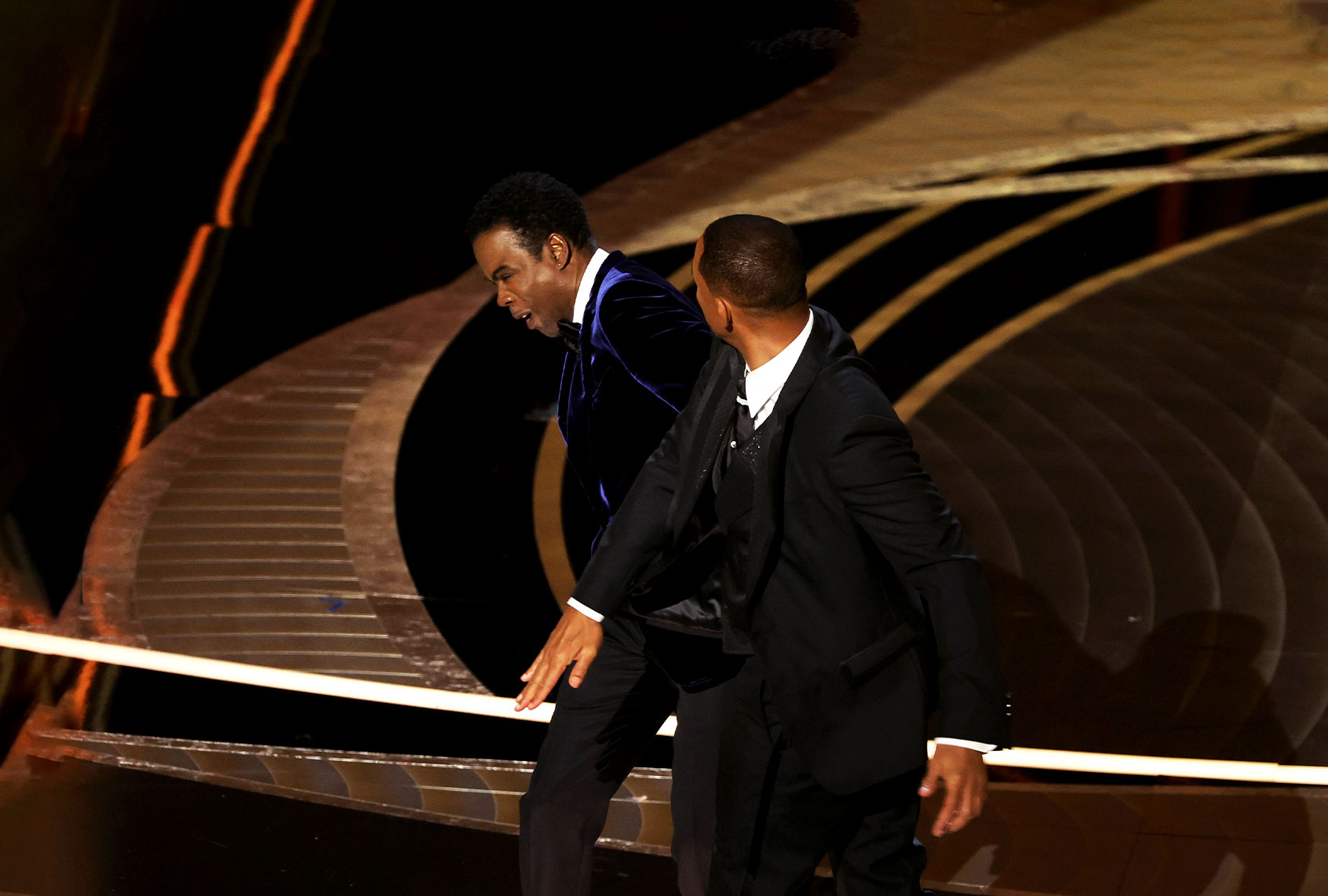
“Selective Outrage” marked the first time the comedian addressed The Slap or Slapgate – when actor Will Smith slapping Chris Rock onstage at the Oscars a year ago – in front of a global audience. While the special received mixed reviews from critics, in his dedicated fans’ eyes, Rock can do no wrong. 

“I’ve been a fan of [Rock] for a long time. He keeps it simple. He’s level-headed and humble,” said retiree Gillian Williams, 62, one of the first in line to enter the theater. He was one of the many who arrived to line up almost three hours before the start of the 10 p.m. show.

A second queue of fans was hoping to snag last-minute tickets at the box office. Meanwhile, a giggling crowd lined up to pose for pictures amidst lit-up letters reading “Selective Outrage” and the Netflix logo. A young man in a Netflix sweater encouraged, “Use the hashtag #ChrisRockLive in your posts!” Local television stations camped across the street to film b-roll. 

Michael Devine, a 49-year-old teacher from the Eastern Shore of Maryland, had traveled two hours to Baltimore with his wife Kris to see Rock live for the first time. The couple was excited about the Netflix live aspect and seeing the trucks and the news media. “We can only be winning tonight . . . we’re here for Chris Rock.” 

The Slap clapback and other jokes

Will Smith; Chris RockWill Smith appears to slap Chris Rock onstage during the 94th Annual Academy Awards at Dolby Theatre on March 27, 2022 in Hollywood, California. (Neilson Barnard/Getty Images)While most fans expected Rock to address The Slap, that was only part of the draw to attend.

“We’re here to hear,” said Josh Wiley, a 48-year-old sales manager from Towson, Maryland, eager to enter the theater with his wife. “We want to hear live and in person how he truly felt.” But overall, Wiley was simply expecting to laugh and have a good time.

Meanwhile, Devine said, “[Rock] has to talk about The Slap at some point. People want to hear it, but I don’t think he’s going to make the whole show about it.” 

“You could tell from his delivery he had been waiting a long time to address it.”

While much of the Rock’s 65-minute set features recycled material from his “Ego Death World Tour,” he does indeed eventually deliver. The last eight minutes are devoted to a scorching rejoinder to The Slap.

“Will Smith practices selective outrage,” Rock says in the special. “Everybody knows I had nothing to do with that s**t. I didn’t have any entanglement,” referring to Jada Pinkett Smith’s affair. “Everybody called him a b***h and his wife a predator, [. . . ] and who does he hit? Me!” Rock vigorously delivers these lines to a cheering, clapping audience. 

Baltimorean journalist Ron Matz, 76, thought Rock’s performance was “sensational,” and added: “You could tell from his delivery he had been waiting a long time to address it. He did so with a ferocity you don’t see very often. This was real and raw, he delivered.” 

Devine was glad The Slap took up only a little of the set and enjoyed Rock’s riffs on America’s biggest addiction: attention. “Can’t get enough attention, feening for likes,” the comedian says in the special. “Posting up pathetic pictures: ‘This is me, 25 years ago, when I was hot. Like me!'” Rock adds that the four best ways to get attention are promiscuity, infamy, excellence and victimization. Devine found Rock’s commentary “really interesting and somewhat true.” 

“Expectations can kill appreciation every time,” settlement support specialist Shanita Starks, 49, said post-show. Starks compared the special to “Tamborine,” Rock’s 2018 Netflix special in which he addressed his previous porn addiction and cheating contributing to his ultimate divorce.

“[Through ‘Tamborine’], we were able to have shared experiences as we’ve all played different roles in relationships,” she said. “As an audience, we typically want comedians to speak our truth, but [‘Selective Outrage’] was about his.” 

Starks is a forever fan. Rock’s jokes about dating women in their 40s and 50s, as opposed to those in their 20s, resonated with her and her friends. During his set, the comedian quips that younger women are happy when their man buys them a pair of shoes while older ones demand their house be renovated. “Men date younger women ’cause they’re less expensive to date,” Rock reasons.

Starks agreed: “Women in their 40s and 50s have no issue with how intelligent and expensive we are. We’re completely aware.” 

Baltimore and beyond

Local fans emphasized the hometown pride evoked by Rock’s decision to bring a global audience to Baltimore, a city still struggling to shed its crime-riddled reputation reinforced by “The Wire” and the unrest following the 2015 death of Freddie Gray while in police custody. 

“This puts Baltimore on a national stage in a positive light,” Amber Wendland, a 35-year-old architect, said, “It’s a once-in-a-lifetime thing, and it doesn’t happen in Baltimore often.” 

Karen Miller, 53, a political fundraiser from Downtown Baltimore, shared Wendland’s excitement. “A lot of folks think that ‘The Wire’ is everyday life here, but that isn’t the case,” she said before the show. “[Rock] ‘s here, the show is sold out, and folks are still trying to get tickets!” 

“This puts Baltimore on a national stage in a positive light.”

The audience roared when acclaimed filmmaker Spike Lee took his seat in the right box, sporting his signature glasses and a purple jacket. Baltimore’s mayor and Maryland’s Governor also attended. “It was so fun seeing the mayor and Spike Lee present in the theater. The whole vibe felt electric,” said Katie Chiaramonte, a 39-year-old doula and writer who attended the show with her wife, Nia. 

Matz also loved spotting the celebrities, concluding it was “an important night for Baltimore, a city struggling to bring people back to its downtown area.” A sold-out show meant a “hopeful sign for a city looking for positive news.” 


Want a daily wrap-up of all the news and commentary Salon has to offer? Subscribe to our morning newsletter, Crash Course.


On Monday night, Christian Orr rewatched a fragment of Rock’s performance with his daughter.

“In some situations, I actually prefer trans women to original recipe,” the comedian jokes in “Selective Outrage.” “When you’re watching the game, they could read defenses. ‘That’s a Cover 2’ ‘Ooh, thanks, Peaches!'” Reacting to thunderous laughter and a few groans, Rock follows his riff with a mischievous chuckle and tiptoes the stage as if to avoid an imaginary physical attack. 

Orr felt that was the only joke that didn’t fit in with the rest, so he sought his daughter’s opinion. “I wanted to know if I was missing anything. If something I laughed at were to offend my daughter, maybe I need to rethink how I look at stuff.” 

His daughter usually doesn’t laugh out loud, Orr said. He inquired if Rock’s sports joke affronted her. She smiled.

“No, it’s whatever. It wasn’t offensive, but also not hysterical,” she replied.


Comedian who called AOC a “big booty Latina” sues after she blocks him on Twitter

A comedian named Alex Stein filed a lawsuit against Rep. Alexandria Ocasio-Cortez (D-NY) on Wednesday claiming that her blocking him on Twitter violates his constitutional rights.

The incident that led to AOC blocking Stein took place last summer when he yelled out to her outside the U.S. Capitol calling her a “big booty Latina.”

In a clip of the exchange, which AOC shared to her own Twitter account shortly after it occurred and then removed as to not give Stein further attention, he stands in close proximity to her as she’s walking up the Capitol steps saying “She wants to kill babies but she’s still beautiful,” before launching into further commentary on her looks.

“You look very beautiful in that dress,” Stein says in the clip, which is posted below. “You look very sexy. Look at that booty!”

Visibly confused over what’s taking place, AOC is seen walking over to Stein, flashing the peace sign for his video and then moving on.

“I was actually walking over to deck him because if no one will protect us then I’ll do it myself but I needed to catch a vote more than a case today,” she later commented on Twitter.


Want a daily wrap-up of all the news and commentary Salon has to offer? Subscribe to our morning newsletter, Crash Course.


In coverage of the lawsuit by CNBC, they highlight that it “cites a federal appeals court decision that ruled against then-President Donald Trump, saying he violated the constitutional rights of several people by blocking them from following him on Twitter.”

In a statement from Stein he says that he has no hard feelings for AOC and isn’t seeking monetary damages, he just really wants her to unblock him so he can “communicate with her.”

“I literally have a live show in Austin during SXSW all because I called AOC a big booty Latina…life is weird,” Stein tweeted on Thursday, amidst numerous shares of press coverage pertaining to his lawsuit.

Some GOP election officials refused to certify results. Few were held accountable

ProPublica is a Pulitzer Prize-winning investigative newsroom. Sign up for The Big Story newsletter to receive stories like this one in your inbox.

A week and a half after last November’s vote, members of the Board of Elections in Surry County, North Carolina, gathered in a windowless room to certify the results. It was supposed to be a routine task, marking the end of a controversial season during which election deniers harassed and retaliated against the county’s elections director. Not long into the meeting, however, a staffer distributed a letter from two board members stating that they were refusing to certify.

According to the letter, the two members had decided — “with regard for the sacred blood shed of both my Redeemer and His servants” and “past Patriots who made the ultimate sacrifice”— that they “must not call these election results credible and bow to the perversion of truth.”

In their view, a federal judge who’d struck down a North Carolina voter ID law for discriminating against minorities had transformed the state’s election laws into “a grotesque and perverse sham.” Tim DeHaan, one of the two board members who signed the letter, explained at the meeting, “We feel the election was held according to the law that we have, but that the law is not right.”

This argument failed to win over the three Democratic board members, according to a recording of the meeting. DeHaan eventually agreed to join the three on a technicality, and the board certified the election with a 4-1 vote. Jerry Forestieri, the Republican board secretary who also signed the letter, held out.

DeHaan and Forestieri declined to comment and did not respond to written questions.

Before 2020, local election officials seldom voted against certifying results. But in 2022, conservative officials in North Carolina, Arizona, Nevada, Pennsylvania and New Mexico refused to do so. Some admitted to refusing to certify for political reasons. In all the 2022 cases, the election results eventually were certified, sometimes under a court order.

Election law experts say that these disruptions reveal a weakness in the American electoral system, which relies on thousands of local officials to certify the totals in their counties and municipalities before their results can be aggregated and tallied for state and federal elections.

Local elections officials “could create chaos” all the way up the chain by refusing to certify, said Alice Clapman, a senior counsel in election law at the Brennan Center for Justice. “And in that chaos you have more room for political interference.” Five legal experts described to ProPublica scenarios in which legislatures, courts, secretaries of state or governors could use a failure to certify at the local level to exert partisan influence.

Clapman said that even if refusals to certify don’t affect election outcomes, they can violate state laws and can amplify and validate harmful misinformation that feeds election denialism because of the imprimatur of the officials’ offices.

A ProPublica review of 10 instances of local officials refusing to certify 2022 results in four states found that, for the majority of them, the state election authority did not ultimately pursue official consequences. Two of them have been referred for criminal prosecution, but the attorney general in that state would not comment on whether there is an open investigation. And two — the ones in Surry County — are facing potential removal from their posts by the State Board of Elections.

“There needs to be some sanction when there is lawlessness,” said Richard L. Hasen, an election law professor at the University of California, Los Angeles, and director of the Safeguarding Democracy Project. “If you allow these things to take place without any sanction, then you invite more serious rule-breaking in the future.”


After the DeHaan and Forestieri letter, Bob Hall, the former executive director of the watchdog group Democracy North Carolina, submitted a complaint to the State Board of Elections to start a disciplinary process, as permitted by North Carolina law if board members commit an alleged breach of duty. An attorney for Hall argued in a subsequent document that “if left unchecked, Forestieri and DeHaan may be the first of many board members throughout the state and across the political spectrum who cannot be trusted to faithfully certify election results.”

That led the state board to summon Forestieri and DeHaan to its headquarters in the capital, a roughly three-hour drive from their rural home, for a hearing last month.

At the beginning of the proceeding, DeHaan argued that the hearing itself was “illegal” because it was supposed to be held in the county the board members are from. The Democratic board chairman agreed and voted with a Republican colleague to move the hearing to Surry County. A date has not yet been set. “The relocation to Surry County shows that this isn’t normal,” said Christopher A. Cooper, a professor specializing in North Carolina politics at Western Carolina University. “There isn’t a long history of examples of this sort of thing to lean on.”

Experts point out that efforts to hold local officials accountable for not certifying their elections have been of a patchwork nature across the nation. “I think states are trying to figure out what to do and are approaching it differently, like a prosecutor making a judgment on a case-by-case basis whether to bring a case or not,” said Derek T. Muller, a professor at the University of Iowa College of Law who has researched legal options for ensuring that local officials certify elections. “States need to figure out how to bring these cases in a fair, consistent and lawful way.”

In Cochise County, a rural part of Arizona on the Mexican border, a pair of county supervisors refused to certify their November 2022 results despite state officials warning them multiple times that doing so would be illegal under state law. In early December, a court ordered them to certify, but one supervisor, Tom Crosby, still skipped the vote.

The next day, the state elections director, at the urging of a former Republican Arizona attorney general, sent a letter to the state attorney general referring the supervisors for criminal investigation, arguing that they had committed “potential violations of Arizona law.” The letter concluded, “This blatant act of defying Arizona’s election laws risks establishing a dangerous precedent that we must discourage” by taking “all necessary action to hold these public officers accountable.” A spokesperson for the Arizona Attorney General’s Office wrote that they “cannot confirm or deny any potential investigation” that may have resulted from the letter.

In January, a group of Cochise County voters launched a petition to recall Crosby. As of late February, it had approximately a quarter of the 6,000 signatures it would need by early May to result in a new election, according to Eric Suchodolski, the chairperson of a committee leading the effort. “It’s our best recourse as citizens,” he said. “I didn’t think the authorities would ultimately do something, and even if they did, it can take awhile.”

In response to a request for comment, Crosby said: “If I get into defending myself it will never end. I’ve already answered all this stuff.” In the past, he has disputed the validity of the certification of the county’s voting machines, despite assurances from the state.

While in North Carolina and Arizona there are ongoing efforts to hold accountable local officials who didn’t certify their elections, Nevada and New Mexico decided not to pursue such efforts.

In Nevada, one Republican commissioner in Washoe County and another in Nye County refused to certify, though in both cases the other four commissioners outvoted them. A spokesperson for the Nevada Secretary of State’s Office said that “our office is not aware of any legal consequences for that action” by the commissioners.

In Otero County, New Mexico, the county’s three commissioners initially voted unanimously against certifying the June 2022 primary elections. This followed months of disputes about election security driven by conservative activists who also fueled protests in Surry County.

New Mexico law requires commissioners to approve election results unless they can point to specific problems. The Otero commissioners only raised debunked concerns about hacked voting machines, with one of the officials, Couy Griffin, referencing his “gut feeling.” The New Mexico secretary of state subsequently asked the state’s Supreme Court to step in, and it ordered the commissioners to certify. The secretary of state also sent a letter to the state’s attorney general notifying him of “multiple unlawful actions by the Otero County Commission” and asked for “a prompt investigation.” Faced with this, two of the commissioners switched their votes, certifying the election. Griffin did not. (In Sandoval County, on the other side of the state, one commissioner voted against certification, though the four others on the panel outvoted him.)

Griffin did not respond to a request for comment.

The New Mexico Secretary of State’s Office decided not to further pursue “punitive action” against the officials who did not certify, according to Alex Curtas, its communications director, because “our concern was getting the election certified, so that’s where that ended.”

“Once it became clear that we had that state Supreme Court precedent and this wasn’t really a widespread thing, just two hard-right commissioners, we felt comfortable that this wouldn’t be a major problem in the general election,” he said, “and in our perspective it became a bit of a moot point.”

Griffin eventually was subsequently removed from public office and banned from holding it by a judge’s order as part of sentencing for participating in the Jan. 6 insurrection.


Part of the challenge for states seeking to crack down on officials who refuse to certify elections is that many of the laws that provide recourse were written more than a century ago. “We’re dealing with modern issues with very old statutes,” said Quinn Yeargain, a professor at the Widener University Commonwealth Law School in Pennsylvania.

Some states recently enacted new regulations. Last year, Colorado legislators passed the Election Security Act, which mandates that the secretary of state certify a county’s results if it misses the deadline to do so. In Michigan, voters passed a wide-ranging voter-protection ballot proposal in November that made certification a “ministerial, clerical, nondiscretionary duty.” This clause was in response to conservative members of a county canvassing board for Detroit refusing to certify the 2020 presidential election for a few hours, momentarily threatening to throw its certification into chaos.

Election legal experts note that holding local election officials accountable for voting against certifying elections will continue to be complicated. Muller, the Iowa law professor, favors what he calls the “least invasive process,” one that would allow courts to replace local officials who refuse to certify elections with other officials who would do their duty.

But he said any process that results in an official being forcibly replaced is likely to carry political risks, including the potential to abuse the system to disempower political opponents.

“We haven’t seen fallout from local election officials being removed yet, because these processes are just beginning,” Muller said. “But we could see that soon.”

“Yellowjackets” is returning to push the boundaries of what being “Just a Girl” really means

Days ago, Florence Welch dropped a teaser video on Instagram in which the musician from Florence + the Machine lingered over a clothes rack full of her signature sequined and lacy, flowy Stevie Nicks (or Daisy Jones)-like dresses before choosing one of the last items on the rack. A letterman-style jacket with “Yellowjackets” emblazoned on the back. Guitars and keyboards crashed as Welch turned a smile to the camera.

Her coy caption reads, “So happy I got picked for the team this year,” accented with a blood drop emoji.  

On Thursday, the trailer for the highly anticipated second season of Showtime’s “Yellowjackets” dropped like that emoji. It’s just as wild and bloody, and Welch provides the soundtrack. Viewers got to hear the rest of the song from that first social media teaser: a cover of No Doubt’s hit “Just a Girl” from their third studio album “Tragic Kingdom.” It’s moody, it’s haunting and its 28-year-old lyrics seem primed for just this moment. 

“Yellowjackets” ended its first season with a stunning revelation, which has made the wait for its return difficult. One of the high school girls from the 1996 soccer team whose plane crashed somewhere over remote Canada, is unexpectedly still alive in the present. That would be Lottie (Courtney Eaton as the teenager, Simone Kessell as the adult) who’s grown up to be running some kind of group whose monochrome-clad members may have kidnapped Natalie (Juliette Lewis). Lottie always had a presence.

In the trailer, we see her as an adult in serene robes. The structure which works so well in the show, alternating between the events of 1996 and 2021, is sped up to the extreme, and we have the girls struggling in the wilderness, isolated, bloody, cold and desperate — and also struggling to adjust to “reality.” We also get the first glimpse of what may have been their lives shortly after rescue (or escape): the press hounding them, cameras flashing, questions flying, a crime scene. We get Melanie Lynskey with a gun, and Elijah Wood and Christina Ricci bantering in what will surely be a pairing for the ages. And we get adult Lottie as a source of . . . something. “Lottie can help us,” an adult Van (a perfectly cast Lauren Ambrose) says as she strokes fellow survivor Taissa’s (Tawny Cypress) hair.

https://www.instagram.com/p/Cpc9Enps1xz/?hl=en

Through the trailer, a dark song plays, faint piano with Welch’s vocals at the forefront. The slowed-down version of No Doubt’s hit is difficult to place at first. Written by Gwen Stefani and her brother Eric, the song was about her frustrations at being a young woman in the world, including difficulties with her overprotective parents. As Stefani told People, “My parents were quite strict with me, and I was living at home, even into my 20s. And I would have to come home and knock my parents’ door . . . ‘I’m driving home. I’s like one in the morning, and if something did happen to me, I’m vulnerable because I’m a girl.’ And you start to think, ‘Wow, maybe people actually look at me different because I am a female.'”

The song was a 1995 smash, which means the girls of the soccer team would have heard it, probably would have known it by heart as I did. But lyrics like “I’m just a girl living in captivity” aren’t a metaphor for the Yellowjackets. They take on new, darker meaning with the remote and winter isolation the girls are experiencing.   

The lyrics and pacing for the song as it plays over the action echoes the frustrations that the young women must be feeling given society’s and then their situation’s limitations. 

The moment I step outside
So many reasons for me to run and hide
‘Cause I’m just a girl living in captivity
The rule of thumb makes me worry so
Oh I’m just a girl
What’s my destiny?
What I’ve succumbed to is making me numb
Oh I’m just a girl
My apologies. What I’ve become is so burdensome
Oh I’m just a girl, oh lucky me
Tweedle-dum there’s no comparison
I’ve had it up to here
I’m just a girl in the world

It all builds to a crescendo with a montage of screams, peaking with the ultimate breaking point: “I’ve had it up to here.” This song is a warning. And a promise.

Welch’s strong cover disguises the song — just like extreme circumstances, including trauma and starvation, also change the girls. Or maybe too: bring out aspects that were already in there, buried — the primal violence, the anger at the world and what it’s done to them, how it’s left them. But the Yellowjackets are just girls, like the song says. At the end of the day, they’re children thrust into an unthinkable situation. 


Want a daily wrap-up of all the news and commentary Salon has to offer? Subscribe to our morning newsletter, Crash Course.


In one of the most eerie scenes of the trailer for Season 2, the encroaching shadow of the now-infamous antler queen headdress spreads over a present-day floor. It’s coming. It’s always been here. “What I’ve become is so burdensome,” Welch sings. Maybe we all have an antler queen inside us.

“Yellowjackets” returns Friday, March 24 on streaming and Sunday, March 26 on Showtime. Watch the trailer for Season 2 via YouTube below:


Tennessee Republicans pass bill letting clerks refuse marriage licenses to LGBTQ couples

The Republican-controlled Tennessee state House of Representatives voted on Monday to pass a bill that would allow county officials to deny same-sex or interracial couples marriage licenses.

House Bill 878 states that county clerks and their staff “shall not be required to solemnize a marriage if the person has an objection to solemnizing the marriage based on the person’s conscience or religious beliefs.” The bill now heads to the Senate, which will begin consideration of its passage in the chamber next week.

If the bill becomes state law, it would directly challenge federal marriage equality protections, including Supreme Court rulings and the recently-passed Respect for Marriage Act.

The Respect for Marriage Act, which passed in the last congressional session and was signed into law by President Joe Biden, requires states to recognize same-sex marriage licenses from other states but does not require them to issue same-sex marriage licenses themselves — meaning that if federal marriage equality protections are ever undone by the conservative-led Supreme Court, states would be able to deny same-sex couples the right to marry.

Federal marriage equality protections have been in place since 2015, when the Supreme Court ruled in Obergefell v. Hodges that states must grant same-sex couples the right to marry. Decades earlier, in the 1967 case Loving v. Virginia , the Court ruled that states could not ban interracial marriages.

In the Supreme Court case upending abortion rights last summer, however, Justice Clarence Thomas suggested that justices should re-examine Obergefell and other cases based on “due process” precedents and the right to privacy standard previously established by the Court

The Tennessee bill, which has a high likelihood of passing, has the potential to upend marriage equality protections across the country — if the bill becomes law, it will likely be challenged, resulting in appeals that could work their way up to the Supreme Court.

Critics condemned the bill for being a blatant attack on LGBTQ couples in the state, pointing out that the legislature has already passed a number of bills aimed at restricting the rights of LGBTQ people.

“Extremist Tennessee lawmakers are unrelenting in their discriminatory attacks on the LGBTQ+ community,” said Human Rights Campaign Legal Director Sarah Warbelow, adding that this bill and other anti-LGBTQ bills “are about stripping away the basic human rights that LGBTQ+ people have fought for over decades, forcing LGBTQ+ people, particularly transgender and non-binary people, back in the closet and labeling us as dangerous.”

“The Tennessee House of Representatives continues to be one of the most dangerous legislative chambers in the country for LGBTQ+ people,” Tennessee Equality Project Executive Director Chris Sanders said.

Girl Scouts not thrilled Raspberry Rally cookies are being resold on eBay for hundreds of dollars

Boxes of the newest Girl Scouts of the USA (GSUSA) cookie variety, Raspberry Rally, are being resold for hundreds of dollars on eBay. The unauthorized resales have left the organization “saddened” by those “looking to make a profit” off of the organization’s name without supporting its mission.

Described as a “sister cookie” to the cult-favorite Thin Mints, the popular chocolate-coated cookies were introduced in August. However, they could only be purchased online and shipped directly to consumers’ homes. Per the organization’s website, this allowed Girl Scouts members to “learn new skills and build their ecommerce business.”

The Girl Scouts typically recognize cookie season nationally from January through April, though it may vary locally. Prior to this season, GSUSA announced possible cookie delays and shortages due to ongoing supply chain issues. One of the Scouts’ vendors, Little Brownie Bakers, also “reported projected inventory shortages,” which impacted “select councils’ timing of their local cookie sales,” according to a January news release.

After selling out, Raspberry Rallys are now being resold on eBay, which currently features buy-it-now prices ranging from $15 for one box to a whopping $400 for a case of $12 boxes, according to a scan by Salon Food. In comparison, the Girl Scouts’ price was $5 to $6 per box.

In a statement to Salon Food, GSUSA emphasized the critical role of cookie sales in funding its scout programs.

“Cookie sales are critical to Girl Scouts programs. We like to remind all cookie customers that the proceeds stay local and are critical to fund troops’ activities throughout the year,” a GSUSA spokesperson said via email. “Participating in the Girl Scout Cookie Program gives girls the opportunity to not only learn the valuable life skills of goal setting, decision making, money management, people skills and business ethics, but to gain confidence and make new lifelong friends.”

The statement continued, “Every year, cookie sales start and end on a rolling basis across the country, varying by council. Both bakeries producing Girl Scout Cookies have reported supply chain issues. We encourage cookie customers to find a local booth, try different flavors if their first choice isn’t available or donate to their local council’s cookie donation program to support the largest girl-led entrepreneurship program in the world.”

“We’re saddened that the platforms and the sellers are disregarding the core mission of the cookie program.”

In separate comments to “Today,” the organization expressed its “disappointment” with the “unauthorized resales” of its products, which disregards “the core mission of the cookie program.”

“We’re saddened that the platforms and the sellers are disregarding the core mission of the cookie program and are looking to make a profit off of the name without supporting our mission,” a GSUSA spokesperson told the outlet.

Amid the backlash, eBay said resales of the cookies don’t violate its own policies.

“eBay’s purpose is to connect people and build communities to create economic opportunity for all,” an eBay spokesperson told “Today.” “We strongly support the entrepreneurial spirit of hardworking local Girl Scout troops and encourage cookie-seekers to also support their local Girl Scouts, however the sale of Girl Scout cookies does not violate eBay policies.”


Want more great food writing and recipes? Subscribe to Salon Food’s newsletter, The Bite.


Amy Amatangelo, a Girl Scouts cookie distributor in the Boston area, suggested that the shortages were also a result of the Girl Scouts not anticipating high demand for Raspberry Rallys. Demand for the cookies was reportedly so high that consumers drove up to local Girl Scout cookie booths, desperately asking for the raspberry treats.

“As a general thing, people want what they can’t have, so there’s probably something elusive about the Raspberry Rally only being available online,” Amatangelo told Salon Food. 

She continued, “When it was introduced, there was a lot of commotion and press around it. So, people were very aware of this new cookie, but then they couldn’t get it from their local Girl Scout or at a cookie booth. That is, to me, what the shortage is about. Girl Scouts didn’t anticipate the demand of this new way of introducing a cookie flavor.”

The Raspberry Rally may not be in stock right now, but there are plenty of other cookie varieties to try. Adventurefuls, a brownie-inspired cookie that was last year’s new flavor, are back and available for purchase. Classic flavors like Do-si-dos, Lemonades, Tagalongs, Thin Mints and Samoas are also fully stocked.

The simple 3-ingredient omelet that’s a favorite of Southern crab pickers and brunch lovers

If you grew up on the water, as my husband, Tom, did, your love affair with crabmeat started early. Whether you had your own crab traps off the end of your dock or your family bought fresh crabmeat from a local market, you came to understand at an early age that crabmeat was special. It wasn’t something you had everyday, and it might even mean company was coming.  

We have blue crabs here, Atlantic blue crabs to be specific, the same ones they have all around the Gulf Coast as well as up and down the Atlantic. They’re small; it takes about three crabs to make a pound, and you don’t get much meat out of that pound. I’m told that even an experienced crab picker can get only a little over two ounces of meat per pound of crabs. It is a laborious endeavor, but those delicate morsels are so very, very worth it. 

The highest grade of crabmeat is known as “jumbo lump.” It comes from the two muscles of a crab’s swimming fins and is the whitest and sweetest part of the crab. Jumbo lump is also the priciest and preferred grade for these omelets, as well as for crab salads. Despite its premium price and despite it has been “picked” before you buy it, you still have to carefully pick through it again to remove every bit of shell before eating it. It is the most time consuming part of any dish made with crabmeat, but again — it’s worth it.  

“Lump” is the next best grade and made of slightly smaller white pieces and is used for crab cakes and other dishes where the crab will be mixed with other ingredients. You can certainly use lump for these omelets, but jumbo lump is always preferred.

Like all the tastiest crab dishes, the more crab you have, the better. It would be virtually impossible to have too much. These omelets are little more than egg-drenched crabmeat with a little something green for color. They are so simple, yet so delicious. We serve them with salty, buttery grits and fresh fruit. 

Tom introduced me to these omelets soon after we began spending weekends and summers here at the beach. We now live here full-time, along our quiet little bay just north of Orange Beach, Alabama, only five or so houses down from the family house where he spent so much of  his youth. This recipe brings back his happiest memories of being down here as a child. 


Want more great food writing and recipes? Subscribe to Salon Food’s newsletter, The Bite.


Tom’s mother, Mag, made these omelets in a chafing dish right on the breakfast table. Although explicitly not recommended nowadays, once upon a time, cooks did this to the delight of those seated at the table. And delight she did! The gleaming silver dish with the bright mirror-finish and fire underneath was magical to Tom and his siblings. 

The story goes that Mag would make up a bowl of the egg and crab mixture then let the kids ladle their own into the heavily buttered dish right at the table. Spoonful by spoonful and in mere minutes, each omelet was flipped and plated like pancakes. The hope was that there would be leftovers because they are just as good cold for lunch as they are hot for breakfast.

There are so many heavenly crab dishes if you can get your hands on fresh crabmeat. Whatever you choose to make, set some aside for a crab omelet. You won’t be sorry!

Crab omelet 
Yields
2 servings
Prep Time
5 minutes
Cook Time
12 minutes

Ingredients

4 eggs

1 to 2 very finely chopped green onions

1/2 to 3/4 pound crabmeat

Salt to taste 

Butter for the skillet


Directions

  1. Beat eggs well in a large bowl, then fold in the remaining ingredients making sure to coat them well. 
  2. Use a large spoon to add the crab better to a well-buttered skillet. Cook over medium heat until the bottom is lightly browned, about 4 to 6 minutes. 
  3. Flip and repeat before taking off heat and moving to a plate to serve. 

Cook’s Notes

If you don’t have green onion, you can use onion powder and finely chopped fresh parsley or even a bit of dried parsley. You just need a “a little green.” You can also substitute regular onion for the green onion, but make sure you chop it very finely and use only a teaspoon. finally, you can also add 1 teaspoon of finely chopped shallots, chives or chervil. 
 

Salon Food writes about stuff we think you’ll like. While our editorial team independently selected these products, Salon has affiliate partnerships, so making a purchase through our links may earn us a commission.


“They groomed the audience”: Legal scholars say Fox has “absolutely no First Amendment defense”

Dominion Voting Systems on Wednesday asked a judge to issue a ruling in its $1.6 billion defamation lawsuit against Fox News before next month’s scheduled trial after submitting evidence showing that Fox hosts and executives knew the TrumpWorld election lies they aired were false.

Dominion asked the judge to decide the case in its favor, arguing that Fox News had “produced no evidence – none, zero – supporting those lies.”

“This concession should come as no surprise. Discovery into Fox has proven that from the top of the organization to the bottom, Fox always knew the absurdity of the Dominion ‘stolen election’ story,” Dominion said in the filing. “Despite having conceded it was all a lie, and despite internal documents proving they knew it was a lie all along, Fox still will not retract the lies and tell its audience the truth,” the company’s lawyers added.

Fox Corp. Chairman Rupert Murdoch acknowledged in his deposition that some hosts “endorsed” false claims. Internal messages also showed that top hosts, including Tucker Carlson, Sean Hannity and Laura Ingraham, derided the stolen election claims in private text messages but continued to air them in an effort to keep viewers from turning their attention to competing networks. 

“It’s really kind of remarkable, the quantity of evidence tending to show knowledge or recklessness in this case,” Lyrissa Lidsky, a constitutional law professor at the University of Florida, told Salon. “It’s very rare, in a case against the media, that you’re going to have this quantity of evidence, that they knew what they were putting out there was false.”

When it comes to establishing “actual malice,” showing knowledge that the statement is false or reckless disregard of the truth both play a key role, she added.

“More and more information and evidence keep trickling out that they did know what they were saying was not truthful and yet kept putting it out there anyway,” Lidsky said. 

Despite an ongoing behind-the-scenes “internal critique” of the election lies that former President Donald Trump was pushing out, hosts continued to air conspiracy theories they knew to be false because they believed “it would disturb their viewers to hear the truth,” she said.

“Some of the information that’s coming out suggests that the journalists thought [the viewers] couldn’t handle the truth,” Lidsky said. “One of the rules of being in the media is ‘Don’t insult the intelligence of your audience.'”

Murdoch even acknowledged that some of the hosts crossed a line.

“Maybe Sean and Laura went too far,” Murdoch wrote in an email to Fox News CEO Suzanne Scott, referring to the primetime hosts pushing out election denialism after Trump’s loss.

Dominion alleged in its lawsuit that the right-wing channel “recklessly disregarded the truth” and accused Fox of wanting a “license to knowingly spread lies”.

The network fired back, accusing Dominion of an “unprecedented effort to punish the press for covering and commenting on the most newsworthy story of the day.”

“This effort to publicly smear a media organization just for having the temerity to cover and comment on allegations being pressed by the sitting President of the United States should be now recognized for what it is: a blatant violation of the First Amendment,” lawyers for Fox News said.

But First Amendment experts argue that Fox can no longer rely on the First Amendment as a defense.

“In my view, they have absolutely no First Amendment defense because they satisfied the actual malice standard,” said Catherine Ross, a constitutional law professor at George Washington University who specializes in First Amendment issues. “If this extraordinary case, with the mountains of evidence that we have already seen, does not meet the actual malice standard for holding a news organization to account for falsehoods, it is hard to imagine what would.”

Beyond actual malice, the network’s motivation behind spreading falsehoods has also come to light, Ross told Salon.

“The motive was clearly profit,” she said. “In other words, pleasing the Fox audience and giving them what they want.”


Want a daily wrap-up of all the news and commentary Salon has to offer? Subscribe to our morning newsletter, Crash Course.


But the audience’s demands didn’t just arise out of nowhere, Ross added. Leading up to the 2020 election, Fox invited numerous guests who sowed doubt about the validity of the election. 

“They had groomed the audience to be receptive to those fabrications about a stolen election,” Ross said, emphasizing that it’s critical to look at context when looking at speech claims.

This is a strong case for the court to grant summary judgment, Ross added, which would mean that there are no disputes over material facts and no factual issues for the jury to resolve. The court can reach the merits of the legal claim. But even if the court decides that Dominion wins the case, there could still be a jury trial, Ross said, which could be limited to determining the amounts of damages Dominion is seeking. Along with compensatory damages of $1.6 billion, Dominion is also asking the court to impose punitive damages. 

“It’s also possible that everything will go to the jury because the judge may say ‘we’re going to have a trial anyway’, but it would make the trial much longer and much more complex,” she said.

Fox is likely to focus its efforts on limiting these damages, Lidsky said. They could still try to claim that only a select number of journalists meet the standard for “actual malice,” but the growing evidence suggests otherwise – implicating the entire network, she added.

Even if Fox is able to defend itself in the case, “the reputational black eye that this represents for a mainstream media organization is significant,” Lidsky said. 

She added that this case isn’t just about Fox, but also sends a message to other journalists to recommit to the ethics of getting the story right.

Ross echoed similar sentiments and said that “Fox has really undermined democracy in a profound way.”

But she added that this case serves as an important reminder of the function of defamation law, which individuals like Trump have used “as a weapon against [journalists] who don’t have a deep enough pocket to defend themselves.”

“This is a reminder,” Ross said, “of why we have strong rules against defamation that also protect political speech.”

Driven by “mass fear-mongering” on crime, 31 Senate Dems join GOP to block D.C. reforms

Progressives on Thursday lambasted dozens of U.S. Senate Democrats for dealing “a huge blow to commonsense criminal justice reform efforts” by siding with the Republican Party on a resolution to block a criminal code passed by the Council of the District of Columbia—a move that one civil rights lawyer said was transparently made in response to GOP “fear-mongering” about crime, and not in the interest of keeping residents safe.

Thirty-one Democrats and two Independents joined the Republicans in passing a resolution—authored by Republican Sen. Bill Hagerty of Tennessee—to block the Revised Criminal Code Act (RCCA), which was enacted in January and included an elimination of nearly all mandatory minimum sentences and changes to maximum sentences for a number of crimes, making some higher and some lower.

Along with Independent Sens. Kyrsten Sinema of Arizona and Angus King of Maine, the 31 Democrats who joined the Republicans were Sens. Tammy Baldwin of Wisconsin, Michael Bennet of Colorado, Richard Blumenthal of Connecticut, Sherrod Brown of Ohio, Maria Cantwell of Washington, Bob Casey of Pennsylvania, Chris Coons of Delaware, Catherine Cortez Masto of Nevada, Kirsten Gillibrand of New York, Maggie Hassan of New Hampshire, Martin Heinrich of New Mexico, John Hickenlooper of Colorado, Tim Kaine of Virginia, Mark Kelly of Arizona, Amy Klobuchar of Minnesota, Ben Ray Lujan of New Mexico, Joe Manchin of West Virginia, Bob Menendez of New Jersey, Patty Murray of Washington, Jon Ossoff of Georgia, Alex Padilla of California, Gary Peters of Michigan, Jacky Rosen of Nevada, Brian Schatz of Hawaii, Chuck Schumer of New York, Jeanne Shaheen of New Hampshire, Tina Smith of Minnesota, Debbie Stabenow of Michigan, Jon Tester of Montana, Mark Warner of Virginia, and Ron Wyden of Oregon.

Sens. Bernie Sanders of Vermont, Elizabeth Warren of Massachusetts, Cory Booker of New Jersey, and Ed Markey of Massachusetts were among those who opposed the resolution.

Sen. Raphael Warnock of Georgia voted “present” and Sens. John Fetterman of Pennsylvania, Dianne Feinstein of California, and Tom Carper of Delaware were not present for the vote.

President Joe Biden said after the bill was passed by the D.C. Council that he opposed Republican efforts to block the measure, but reversed course last week, telling Democrats that he would not veto Hagerty’s resolution if it arrived at his desk.

Since the passage of the RCCA, Republicans have used the law to portray the nation’s capital as crime-ridden and Democrats as weak on criminal justice, despite the fact that the updated criminal code increased sentences for gun crimes and sexual assault and created a new felony offense for shooting a firearm in public.

The issue of carjacking took center stage as the new code reduced sentences for the crime. The law would have applied a 24-year maximum sentence for carjacking, reduced from 40 years—the same amount that’s applied to second-degree murder, according to the code’s author, defense attorney Patrice Sulton.

Civil rights lawyer Udi Ofer demanded to know how a criminal code that still includes harsher penalties for armed carjacking than more than a dozen states qualifies as “soft on crime.”

“This vote goes well beyond D.C.,” said Ofer. “Mass incarceration was not a product of mass crime. It was a product of mass fear-mongering and fights between party elites on who can be ‘tougher.’ The victims of these political fights have been millions of people. More will now suffer.”

Despite Hagerty’s claim that the resolution was necessary to end “the crime spree that is happening in our major cities,” carjackings in D.C. this year have been reported at roughly the same level as they were by this point last year. Violent crime is down by 8% in the district compared to March 2022.

“We know that these votes were driven by politics, not by data,” said Ofer. “Democrats are terrified that Republicans will portray them as soft on crime, and the Republican Congressional Committee has already announced that it will run ads against House Democrats who voted for [the] D.C. bill.”

Soon after the resolution was passed, Republicans promptly released attack ads targeting 14 Democrats who opposed it in the House.

In the U.S. House, progressives and proponents of statehood and self-determination for Washington, D.C.—which Biden has claimed to support—denounced the Senate’s first vote in three decades that blocked a law passed by local lawmakers in the district.

“Supporting statehood in words is not sufficient,” said Rep. Alexandria Ocasio-Cortez of New York. “We need to support statehood in our governance and in our actions.”

Rep. Eleanor Holmes Norton, D-D.C., said she would work to “convince President Biden that his intention to sign the disapproval resolution is incompatible with his Statement of Administration Policy.”

“Even if President Biden signs the resolution and denies D.C. residents the very self-governance that he has claimed to support, this chapter of D.C.’s continuing fight for autonomy is, in itself, a powerful argument for the full rights that can only be provided by D.C. statehood,” said Holmes Norton. “I will not stop until the job is done.”

Samantha Bee on why she’s on tour: “It is feeling treacherous out there to be a woman”

“I feel like my voice is really missing out there,” says Samantha Bee.

Ever since her provocative, hilarious, “Full Frontal with Samantha Bee” ended its six-year run last summer, we’ve felt exactly the same way too. But now, the Emmy Award-nominated comedian, writer and television host is back with a nationwide live tour called “Your Favorite Woman” — and this time she has no television executives or advertisers to appease, and no bleeps left to give. 

Bee joined me in our Salon studio recently to talk about why she wants to hit the road (starting April 7 in Newark), about male executives seeing her “through the prism of how they’ve dealt with their ex-wife” and why her kids give her hope — even if they think she dresses like a potato. Watch the “Salon Talks” episode with Samantha Bee here or read our conversation below.

This interview has been lightly edited and condensed for clarity and length.

Let’s talk about the live show. It seems like the idea of it started around the time that “Full Frontal” ended. What has that been like?

Everyone was very sad when “Full Frontal” was canceled, but it wasn’t a super surprise. I can’t say that it snuck up on me or anything like that. The idea of doing a live show has been in my brain for a really long time, and of course everyone on my management team has been like, “You’ve got to hit the road.” And I’ve been like, “I can’t.” With the conclusion of the show, I was like, “Oh, now I can. Now I will definitely do that.” It feels like a very organic next step for me because it’s always been up in my brain. With the cancellation of the show, I was like, “Well, I now have time.”

I know you’ve described it as a celebration of how effing awesome women are. What am I going to see when I go to your show?

Rather unfortunately, the world is conspiring to make the show land in the most perfect spot ever because it has been feeling to me, and I’m sure to you as well, that it is feeling a little treacherous out there to be a woman. Feeling the backlash pretty hard right now. 

“We have a complete misunderstanding about women, and I think that people have really stopped trying.”

There’s any number of things that we can look at that give us an indication that our opinions are not particularly valued, so I wanted to do a show about that. I wanted to do a show that is a continuation of “Full Frontal” in a way, or a natural jumping off point to commune with the “Full Frontal” audience again. I feel like my voice is really missing out there. 

To talk about the conditions that women are living in right now feels super vital to me. We just have a complete misunderstanding about women, and I think that people have really stopped trying. That’s how it feels to me. I think there’s a misunderstanding about our bodies. I think our bodies are a surprise to us. We are not educating people about their bodies. We are not educating women about their bodies. We end up going through all these phases of life where, everything that’s happening to me right now is a huge enormous shock. I feel like we should have fewer shocks particularly as we age.

I’m 53. I personally entered perimenopause and I was like, “Oh, am I dying? What’s happening right now? Is this normal?” As with many stages of your life, you end up going into a place where you think you’re the only one experiencing something, and it feels so terrifying to say out loud what you’re going through. Then you find out that everyone around you is having the exact same experience of being completely siloed in their own anxieties about what is happening to them. I want to say all those things out loud.

We live in a culture where, you’re like 25, 30, and then you’re past your prime. That comes from a real place, and women feel it too, which is why there is this silence about perimenopause. There is this fear that if you are not young and hot and viable, you will lose your job somehow. You will not be qualified for public office.

Feel free to hop on a little chunk of ice and float yourself out to sea because you’re not needed here anymore. It is really terrifying and it feels really risky to talk about it out loud. But it’s a full, hopefully, third of our lives that we’re living in a state of confusion and shame, and it’s pretty weird. I don’t really want to talk about perimenopause with people who are trying to sell me stuff. No offense, but capitalism’s not going to fix the conditions that we’re living under. Actually talking out loud about the things that create false shame in our bodies will cure the problem.

As opposed to seeing it as something that needs to be cured. 

It’s not actually a problem. The problem is how the world sees it. Half the world is going to experience it. Not talking about it does a disservice to all of the 50% of the people who are going to physically experience it, and the other 50% of the people who are going to also experience it in a different way.

You are a woman in entertainment. You have a degree of power and you’ve gotten to a certain place in your career. Do you see people starting to check out when you’re in meetings? 

As a woman, you always experience people checking out in meetings. Well look, if we’re going to talk, let’s talk. You always experience being in a meeting with male executives and you can see them and it’s very hard to pinpoint, but you can see them watching you through the prism of how they’ve dealt with their ex-wife or something like that. Seeing all of their previous relationships in the way that they’re interacting with you. It’s not something that you can really put your finger on, but you really do feel it. Particularly in the entertainment industry, which has this chummy kind of, “We’re all just chill here.” It’s a very not chill environment, actually. It’s not really any more chill than any other industry.

I’ve really come to a stage in my life where I’m now turning down opportunities when they were with the wrong collaborators, just with people who I could tell were on the precipice of not listening to me and not liking my ideas. I was like, “I think this isn’t going to work for me because I can tell how we’re already relating and I’d really rather not.” I don’t need to put myself back in those situations. This is a giant learning curve for everyone. It can pull the rug out from under you at any moment. I’m not feeling sad about it or anything. I just would like to speak honestly about it because I think it’s relatable.

I wonder if maybe that’s also part of what the appeal of doing a live show is going to be. 

“You can see them watching you through the prism of how they’ve dealt with their ex-wife.”

Totally. 100%. There’s no other kind of person governing what it is. It just is what it is. You can like it or not like it, but it just exists. There’s no advertiser to please; there’s no machine to feed. It’s just a live show. It exists in and of itself.

It’s still completely terrifying. I’m not without terror. There’s loads of anxiety and stuff like that, and all of that is of course natural. But nobody’s saying, “Oh, you can’t make fun of Taco Bell because they’re just a huge advertiser. Can you make fun of P.F. Chang’s instead?” There’s nobody doing any of that, which is really fun for me. It’s really new. Live performance is not new to me. That’s very natural. I get it. I love that world. I love live performance, but having it not be governed by anyone else’s appetites is pretty new, and that’s exciting. It feels fresh.

We live in such a polarized world. You have people who are not fans who you have to deal with on social media, and then you have people showing up at drag reading hours with guns. Are you thinking about what you might encounter on the road?

I don’t really encounter people, certainly not in New York City. I don’t know what it will feel like to travel around. I think it’ll be completely fine. I can’t imagine it’s going to be a problem. And maybe, oh God, I never really thought about that. S**t. Oh, jeez Louise. I think that people who have real serious objections to content like mine are focusing their attention on things that are televised now. They have bigger fish to fry. I’m going to be surrounded by perimenopausal and menopausal women. They’re not going to let anyone through.

There’s so much to be enraged about right now. You don’t lack for material. What is firing you up right now today in terms of sheer stupidity? 

Anything that serves the cause of keeping people in the dark about themselves makes me crazy. Anything that serves the Lord of keeping people uninformed, making them feel alone, making them feel crazy in their bodies, making them deny who they are makes me f**king crazy.

It’s part and parcel of Nikki Haley running around town going, “My dad didn’t sign a permission slip for me to get sex ed in seventh grade,” and it’s an applause line. Everybody’s like, “Hooray for ignorance! Don’t ever make people feel comfortable in their own skin!”

It’s the weirdest flex I’ve ever heard.

It’s the weirdest flex. It’s not a goal. It’s terrible. It’s terrible to talk about freedom from one side of your mouth and literally want to clamp down on people’s freedom. That’s the way that it always was of course. Governors who want to keep a window open to do a read through of your menstrual histories — the fact that that even came up at all is so insane. People not getting the medical care that they need. They literally are kept in the dark. They’re fed so much misinformation about processes in their bodies and the way things work that they literally grow up to have no understanding of themselves, of what a D&C is, when it can usefully be employed as proper healthcare when it’s needed. It makes me insane. 

Sorry, I didn’t expect to go there. I thought I was going to be like, “Anyways, go to samanthabee.com. But now I’m in my black sweater just like, “Ugh.”

There’s that additional terror and crankiness that comes from being a parent. What do you feel hopeful about, that you can try to say to your kids at the dinner table?

I don’t necessarily try to infuse them with hope. They’re the ones who infuse me with hope. I have three kids. They’re very different. They’re very smart. Each unique and intelligent in different ways. When I look at them, I just see people

“I walked out of the house the other day and it was cold and my son was like, ‘You are literally dressed like a baked potato.'”

who have so much potential. They have so much intelligence and potential. They’re such a smart and informed generation. They don’t seem hopeless to me at all. They actually seem very competent, much more competent than I was when I was their age. All I did was check my face for zits for 12 hours a day. 

My kids, they’re making things happen. It’s not just my kids. I see that in their generation too. They really are doers. They’re doers. I don’t think that I have much to impart to them other than just being an honest version of myself, but they’re making me feel like they’re going to be fine. We definitely set fire to the world, but they’re going to figure it out.

You are a public figure for progressive, forward-thinking ideas. When you go home, is there anything that your kids are like, “You got that so wrong?”

Oh my God. There’s not one thing that they think that I am right about. It would be unnatural. It would be completely unnatural. It would be actually very bad for them if I walked in the door and they were like, “I respect you so deeply. What you said just sent me to another level.” They absolutely think that I was put on earth to pour them orange juice, to pick up laundry off the floor, and serve them in any possible way that I can. There is no acknowledgment of the work that I do behind the scenes underneath the surface to keep food in the fridge, to keep dinners on the go. No acknowledgment whatsoever.

I know that they’re going to feel really grateful and glad and they’re going to really understand it when they’re about 33 to 38. They’re going to go, “Oh my God, I had no idea what it took to do all the things that you did for us to support our life.” It would be terrible for them if they were like, “You are incredible at what you do.” I acknowledge and I’m very pleased that they have respect for me. We have a respectful home environment and we have so much fun together. It would be bad for their development if they thought I was cool. I walked out of the house the other day and it was cold and my son was like, “You are literally dressed like a baked potato.” I was like, “You’re not wrong.” And yet it cuts so deeply.

Oh yeah. They just break your hearts.

They don’t even know how savagely cruel they are so easily. It’s wonderful.

Dominion filings: GOP elites and their Fox counterparts hate Trump, but they can’t get rid of him

The ongoing legal battle between Dominion Voting Systems and Fox Corporation has yielded a treasure trove of evidence pointing to a verdict that the right-wing cable infotainment channel willfully propagated lies about the 2020 election. It’s also revealed another truth: No one in the right-wing media ecosystem likes disgraced ex-president Donald Trump.

“I hate him passionately,” Fox’s number-one anchor Tucker Carlson privately confided in a text message to one of his producers on Jan. 4, 2021, reproduced in Dominion’s legal filings.

“We are very, very close to being able to ignore Trump most nights,” he fantasized.

Two days later, after Republican zealots stormed the U.S. Capitol seeking to hang then-vice president Mike Pence and delay the Electoral College certification of Pres. Joe Biden’s 2020 victory, Carlson raged to his producer that Trump was a “a demonic force” and “a destroyer.”

While the formerly bow-tied host’s hatred for Trump was the most explicit among his colleagues, he’s far from alone as a prominent Fox figure who’s trying to discard the twice-impeached former president.

Fox chairman Rupert Murdoch has been anything but subtle in trying to manipulate Republican voters into dumping Trump in favor of Ron DeSantis, the Florida governor who is the heavy favorite among the right-wing donor class to be the GOP’s 2024 presidential nominee.

Up until his speech at last week’s CPAC political conference, Trump had not appeared on Fox’s airwaves since he declared his third presidential candidacy, a soft ban that has been obvious to everyone in Republican politics. By contrast, Murdoch’s book company HarperCollins is the publisher of the Florida governor’s new book and he’s received the red-carpet treatment at Fox, receiving five separate promotional interviews on the right-wing infotainment channel.

Laura Ingraham, Carlson’s prime-time anchor colleague, even went so far as to emcee a private fund-raising event for DeSantis in February and then invite him onto her show a few days later. Calling him “the man everyone’s talking about,” she declined to disclose where and why she had just seen the Florida governor.


Ingraham’s shameless refusal to inform viewers of her secret political agenda is par for the course at Fox, which has been indisputably revealed in the Dominion suit to be nothing more than an oligarch’s machine for fleecing uninformed Christian fundamentalist viewers whose raging discomfort at modernity has drafted them in a non-stop war against modernity.

Reactionary media outlets have been busy stoking this rage and monetizing it for decades.

“Right wing media have been engaged in a 70-year project to ensure that their audiences only trust conservative news outlets,” historian Nicole Hemmer told Washington Post columnist Greg Sargent. “They’ve worked to discredit other sources of more-objective information, so that their audiences are unwilling to trust outlets more rooted in reality.”

Fox CEO Suzanne Scott, who’s worked at the infotainment channel since its founding in 1996, demonstrated repeatedly in private emails and texts produced in the Dominion lawsuit that she understands intimately what her audience wants.

“Pivot but keep the audience who loves and trusts us,” she wrote Murdoch in a Nov. 9, 2020 text message as the two discussed how to help viewers process Trump’s loss. “We need to make sure they know we aren’t abandoning them and still champions for them.”

Shielding Fox viewers’ tender feelings was a theme to which she returned in the weeks that followed.

“I can’t keep defending these reporters who don’t understand our viewers and how to handle stories,” she wrote in a Nov. 19 message to Fox News president Jay Wallace complaining about a reporter who had dared to debunk Trump’s lies about losing. “The audience feels like we crapped on [them] and we have damaged their trust and belief in us.”

It is difficult to argue with journalism professor Jay Rosen, who describes Fox as “the commercial arm of a right wing political movement, specializing in strategic resentment and aggregated grievance in the attention economy, while behind the scenes it tries to be a kingmaker and party boss, riding the tiger of manipulated rage.” But that definition is also true for the Republican Party at large, which has for decades sought to include an ever-growing circle of far-right Americans into its electoral coalition rather than moderate its radical anti-government ideology. Republican voters aren’t casting ballots for their party so much as they are against an America they see as fallen from its divinely endowed Christian heritage.

This oppositional approach, or negative partisanship, is also how Republican-leaning voters view Trump himself. He is their instrument rather than their leader, a position they’ve made quite clear by booing every time he touts Covid-19 vaccines or candidates they don’t like at campaign rallies.

Despite their refusal to go along with everything he says, Trump remains the preferred candidate for Republican voters, not because he’s got the best ideas or is the most intelligent, but rather because he hates the same people they do.

The disgraced ex-president made that clear in his CPAC address last week, calling his 2024 campaign bid “the final battle” for America.

“In 2016, I declared, ‘I am your voice,'” he said. “Today, I add: I am your warrior. I am your justice. And for those who have been wronged and betrayed, I am your retribution.”

The Republican donor class desperately wants Trump to go away. His vicious personality and support for sedition is electoral poison for a reactionary movement that has never enjoyed public support for its agenda of slashing government spending. But just like Fox, they cannot rid themselves of him.

Judge: MAGA hoaxer Jacob Wohl violated KKK Act, Civil Rights Act by targeting Black voters

Right-wing hoaxers Jacob Wohl and Jack Burkman violated multiple federal laws with a voter suppression scheme targeting Black voters during the 2020 election, a federal judge ruled on Wednesday.

U.S. District Judge Victor Marrero in a 111-page opinion said Wohl and Burkman targeted thousands of robocalls in Pennsylvania, Michigan, Ohio, New York and Illinois in a “calculated” plot to “deter Black voters by exploiting fears and stereotypes.”

The pair’s robocalls pushed misinformation about mail-in voting in the robocalls amid former President Donald Trump’s baseless fear-mongering about expanded mail-in voting during the pandemic.

“Mail-in voting sounds great, but did you know that if you vote by mail, your personal information will be part of a public database that will be used by police departments to track down old warrants and be used by credit card companies to collect outstanding debts?” the robocalls said. “The CDC is even pushing to use records for mail-in voting to track people for mandatory vaccines. Don’t be finessed into giving your private information to the man, stay safe and beware of vote by mail.”

Marrero said the evidence showed that “the neighborhoods that Defendants targeted were not accidental or random” and a reasonable jury would find that the pair wanted to “deny the right to vote specifically to Black voters.”

Burkman and Wohl pleaded guilty last year to one count each of felony telecommunications fraud and were sentenced to two years probation, six months of electronic monitoring and 500 of community service registering people to vote.

Marrero in his opinion wrote that the pair also violated the Civil Rights Act, the Voting Rights Act, and the Ku Klux Klan Act – which allows people to sue to enforce their 14th Amendment rights.


Want a daily wrap-up of all the news and commentary Salon has to offer? Subscribe to our morning newsletter, Crash Course.


The opinion was handed down after a lawsuit from the National Coalition on Black Civil Participation and New York Attorney General Letitia James, who accused the pair of harassing and pushing disinformation to about 5,500 New Yorkers. The plaintiffs will now propose damages and penalties in the suit.

“Your vote is your voice, and I am proud that today the court ruled in our favor to uphold the most important cornerstone of our democracy,” James said in a statement on Wednesday. “Wohl and Burkman engaged in a disgraceful campaign to intimidate Black voters, using threats and lies to keep them from making their voices heard in an attempt to secure the election for their preferred presidential candidate. I will always stand fierce in defense of New Yorkers’ right to vote, and anyone who attempts to take away that right will be met with the full force of the law.”

How Obamacare enabled a multibillion-dollar Christian health care cash grab — with GOP help

ProPublica is a Pulitzer Prize-winning investigative newsroom. Sign up for The Big Story newsletter to receive stories like this one in your inbox.

Joe Guarino rescued an entire industry with help from what some called “divine” intervention.

A little-known lobbyist from Virginia, Guarino was hired in 2007 by the Alliance of Health Care Sharing Ministries, the trade association for nonprofit alternatives to medical insurance founded on Christian principles. Health care sharing ministries take fees from members, which are then used to pay other members’ health bills.

At the time, the industry had been tainted by a scandal involving one of the largest ministries in the country, the Christian Brotherhood Newsletter, based outside Canton, Ohio. State authorities won $14 million in civil judgments against two of its top leaders for enriching themselves instead of paying the medical bills of its members. A ProPublica investigation last month revealed that many of the Brotherhood’s executives, including Daniel J. Beers, were involved years later in the launch of a second scandal-plagued ministry, Liberty HealthShare.

The Washington-based alliance was looking to Guarino to repair the industry’s reputation and pass laws to fend off a looming movement to regulate the business. The lobbying effort is an example of how the ministries have quietly worked over the years to shield themselves from consumer protection laws and preempt government oversight.

Guarino decided to launch a state-by-state campaign to pass so-called safe harbor laws that exempt health care sharing ministries from insurance regulation. The carve-outs were justified, the alliance argued, because ministries don’t set prices and coverage based on risk calculations or pool people’s money, as insurance companies do. In the United States, many of the rules for health insurance are set by the states in which companies operate.

Guarino met with lawmakers in Virginia, Arkansas and Idaho. “Most of the time I was hiring local lobbyists, training them, and then they got the bill passed for us,” Guarino explained.

Although it did not attract much attention, the campaign was a remarkable success. By 2008, 15 states had passed safe harbor laws. Then, a new threat emerged. In 2009, President Barack Obama proposed his sweeping reform of the health care system. Central to the law was a provision referred to as the “individual mandate,” which required that every American obtain health insurance or face a fine. The mandate presented a direct threat to health care sharing ministries: If members were forced to buy insurance, they would likely leave en masse.

Although Guarino was embarrassingly outgunned by the health insurance lobby, he was determined to slip some version of a safe harbor carve-out into whatever the Democratic-controlled Congress handed the president. “I went and saw 150 congressional staffers during that time,” Guarino said.

The turning point came when Guarino reached out to a GOP state legislator he knew in Iowa and asked if she could put him in touch with Republican Chuck Grassley, the state’s longtime senator who wielded power as a member of the Senate Finance Committee. The lawmaker had known Grassley’s family since childhood and agreed to set up a meeting. “Lo and behold, that happened,” Guarino said. “As a Christian, I look at this and say, ‘Oh, this is God’s way of orchestrating things.'”

Guarino told ProPublica that he and his clients got on the phone with Grassley. Together they crafted an amendment to Obamacare that exempted members of sharing ministries from having to obtain health insurance on religious grounds. Behind the scenes, Grassley got that carve-out into the Senate version of the bill, Guarino said. (Grassley did not return a request for comment.)

The passage of the Affordable Care Act was chaotic and, for ministries, that was fortuitous. The House version, which many Democrats preferred, didn’t include Guarino’s exemption. If the House bill prevailed in negotiations between the two chambers, ministries would be extinct.

But with the sudden death of Sen. Ted Kennedy, Democrats lost their filibuster-proof majority in the Senate and could not pass the House version. They were forced to go with the Senate bill that included the carve-out.

The exemption — just 200 words in a 900-page bill — survived tense negotiations between the chambers, going virtually unnoticed. Obama signed the ACA into law in March 2010.

“That’s our language right in the bill,” Guarino told ProPublica.

One friend told him that he’d just saved an entire industry. The larger Christian health share community hailed it as a miracle. “If you’re a person of faith, some of us might say it was kind of divine,” said Tony Meggs, then CEO of Medi-Share, one of the groups that formed the Alliance of Health Care Sharing Ministries.

Meggs estimates membership grew tenfold after 2014, when the individual mandate went into effect. Four years later, the alliance announced that about a million Americans belonged to its member ministries. Some bought into the ministries because they disliked Obama and associated him with the law. Others did it for economic reasons. The ministries offered cheaper plans than insurance sold on the ACA marketplace, which were expensive for anyone who did not qualify for subsidies or Medicaid. Many self-employed people and small business owners fell into this category.

“All of a sudden people started getting religion because they could save $700, $800 a month,” Meggs said.

Both Meggs and Guarino say they believe that most health care sharing ministries do right by their members and the insurance alternative can work when it’s under ethical management. But both acknowledge the industry has been vulnerable to abuse. “Obviously, that kind of growth is going to attract bad actors and people who look for opportunity to enrich themselves,” Meggs said.

One of the people who took advantage of the opportunity is Beers, the patriarch of the family that started Liberty HealthShare just as Obamacare’s individual mandate drove thousands of people to health care sharing ministries. The ProPublica investigation found that Beers acts as a shadow lord over an empire built with money from Liberty HealthShare. Some of the family grew rich while Liberty’s members were left with tens of millions of dollars in unpaid health bills.

Beers’ name does not appear on any official documents related to Liberty, and he denied involvement in family businesses that profited from the ministry. Attorneys representing Beers and members of his family also disputed ProPublica’s finding that they controlled or influenced the sharing ministry or did anything wrong. Liberty is now under new management that does not include Beers or his relatives.

For those in the ministry industry, however, Beers’ involvement has been an open secret for years.

Meggs told of a surprise encounter he had around 2014 with Liberty’s then-CEO, its vice president and Beers, all key figures in the Brotherhood. The group wanted to propose a partnership between Meggs’ ministry and Liberty, which was experiencing explosive growth

At the meeting, Beers was clearly in charge, Meggs remembers, so no matter what they were selling, he wasn’t buying.

Liberty, he said, looked too much like the Brotherhood.

Lauren Boebert trashes sex-ed — then announces teen son is making her a “36-year-old grandmother”

Rep. Lauren Boebert, R-Colo., announced that her 17-year-old son will be making her a “36-year-old grandmother” in April.

Boebert, who called to cut funding to schools that teach students comprehensive sex education at last week’s CPAC, announced at a Moms for America event that her son Tyler and his girlfriend are expecting a baby boy.

Boebert during the announcement took at dig at LGBTQ Americans, saying that she and her husband are raising their four boys “to be men before liberals teach them to be women.”

Boebert then revealed that “come April, I will be a Gigi to a brand new grandson.”

“Now, any of you who have young children who are giving life, there’s some questions that pop up. There’s some fear that arises,” Boebert said in a video posted by Patriot Takes.

Boebert said that when she approached her son and told him that he is making her a “36-year-old grandmother,” he reminded her that she was a teen mother herself.

“He said, ‘well didn’t you make granny a 36-year-old granny,'” she said. “I said, ‘yes I did.’ He said, ‘well then it’s hereditary.'”

Boebert went on to claim that there is “something special about rural conservative communities.”

“They value life,” she said. “If you look at teen pregnancy rates throughout the nation, well, they’re the same, [in] rural and urban areas. However, abortion rates are higher in urban areas. Teen moms’ rates are higher in rural conservative areas, because they understand the preciousness of a life that it’s about to be born.”


Want a daily wrap-up of all the news and commentary Salon has to offer? Subscribe to our morning newsletter, Crash Course.


A 2019 study published in the American Journal of Public Health found that teen pregnancies in rural areas tend to be unintended and may be higher because teens may be vulnerable to “local conditions that limit unintended pregnancy management options.”

The Centers for Disease Control and Prevention report that only about 50% of teen mothers receive a high school diploma by 22, compared to 90% of women who do not give birth during high school. “The children of teenage mothers are more likely to have lower school achievement and to drop out of high school, have more health problems, be incarcerated at some time during adolescence, give birth as a teenager, and face unemployment as a young adult,” according to the CDC.

The CDC recommends providing teens with sexual education and other resources to prevent teen pregnancies.

Boebert at CPAC called to cut funding to schools that provide comprehensive sex education because there are schools “that are teaching worse than just gender ideology.”

“They have comprehensive sex ed. They’re teaching kids how to have and enjoy sex, and even same-sex sex, how to pleasure themselves,” she said. “This is not something elementary students should learn, nor any student in a public school…These are the things that we need to go after and cut their funding.”

Raskin goes off on GOP’s Jan. 6 “nonsense”: They’re telling us to “disbelieve our own eyes and ears”

As right-wing politicians and pundits continue to peddle lies and conspiracies related to the January 6, 2021 attack on the U.S. Capitol by supporters of then-President Donald Trump, Democratic Maryland Congressman Jamie Raskin on Wednesday delivered a passionate rebuttal of Republicans’ “nonsense.”

Speaking on the House floor, Raskin asserted that “it all starts” with “Donald Trump’s ‘Big Lie'” that the 2020 presidential election was stolen.

He continued: “They say, ‘Who knows, maybe he won, maybe he didn’t. You say Joe Biden’s president, we say Donald Trump’s president.’ Nonsense!”

“Sixty federal and state courts rejected every claim of electoral fraud and corruption that they put forward. Sixty,” Raskin—who was the lead manager for Trump’s historic second impeachment—reminded listeners. “They don’t have a single court that ever ruled in their favor. Donald Trump lost that election by more than seven million votes, 306-232 in the Electoral College.”

“So then… their Big Lie has to stretch all the way over January 6,” Raskin said. “We have to disbelieve the evidence of our own eyes and our own ears. We saw them come and descend upon this chamber, this Congress, wounding and injuring 150 of our police officers, breaking people’s noses, breaking people’s fingers, putting people in the hospital, and already they’re back on the news with big lies saying, ‘No, no, no, it was a tourist visit.'”

Referring to the Fox News opinion host and the Republican House speaker, Raskin tweeted Wednesday that “Tucker Carlson’s assault on the truth about January 6 is unconscionable, but more scandalous yet is Kevin McCarthy’s central role in its design. America, we cannot let McCarthy and Carlson become the Orwellian editors of our past or the authoritarian authors of our future.

On Monday evening, Carlson—who according to legal documents said he “passionately hates” Trump even as he publicly amplified the ex-president’s lies—dubiously dismissed the Capitol attack as “mostly peaceful chaos.”

Carlson’s characterization was roundly rejected even by numerous Republican senators including Thom Tillis of North Carolina, who called the false narrative “bullshit.”

Have we hit Peak Trauma? Psychologists worry the term “trauma” is becoming meaningless

There’s no question that numerous people across the world experience trauma every day — yet the word “trauma” is increasingly being used to describe experiences that might not really be traumatic. That may not seem like a big deal, but psychologists say that the trivialization of the word might make it hard to differentiate real trauma from everyday unpleasantness.

For example, an “American Idol” contestant recently claimed to be “traumatized” by some offhand feedback from Katy Perry. A brief scan of TikTok videos labeled with the hashtag #trauma reveals the extent to which the term “trauma” has entered the casual lexicon to refer to mild annoyances or cringey moments, rather than truly traumatic events.

“Anytime we use words that have deeper meanings, it does discount the true meaning and experience for someone that is experiencing the true definition of that word.”

Trauma — as both a theory and reading topic — has, in recent decades, enjoyed a renaissance in the realm of pop psychology. Popular books like “The Body Keeps the Score,” which unpacked the relationship of trauma to one’s physical body, have contributed to a larger audience reading and understanding the topic. Yet some mental therapists are wary that the word is being overused, which can be detrimental to those who have experienced true trauma.

“I do agree that the word ‘trauma’ can be thrown around a lot,” Erica Turner, a licensed professional counselor, told Salon. “And it’s important that we all educate ourselves on what trauma actually means so we can respect those experiencing it.”

The word “trauma” appeared in English in the late 1600s, although at the time it more generally referred to a physical wound. In the late 19th century, scientists began using it to refer to psychic wounds as well. In the same time period, French neurologist Jean Martin Charcot suggested that patients experiencing symptoms associated with what doctors then called “hysteria” perhaps actually had a history of trauma.

It wasn’t until 1949 that the verb “traumatize” was used to refer to something psychologically harmful — a time period when, incidentally, millions of World War 2 veterans were experiencing the as-yet-unnamed post-traumatic stress disorder. (PTSD wasn’t formally named until 1978, in part due to the experiences of Vietnam veterans.)

Nowadays, the concept of trauma — and the idea that it causes suffering — is well-established in psychology. The American Psychological Association describes trauma as an “an emotional response to a terrible event like an accident, rape, or natural disaster.”

Turner noted that trauma is complex, as two people can experience the same event and have a completely different response afterward. “Trauma is not the event that happened to you, it’s the way you perceived it (i.e., the thoughts and feelings you had about it) and the way it impacted your body and nervous system,” she said via email. “Trauma is the negative way you were impacted by an external event.”

Trauma therapists, Turner added, describe trauma experiences as falling into two buckets. The first is  “Big T” traumas, which, Turn says, include “major accidents, natural disasters, physical or sexual assault.” Then there are “little T traumas,” which include bullying, emotional neglect, non-threatening injuries, and minor accidents.

“We as a culture focus more on Big T traumas but don’t always acknowledge the ‘little-Ts,'” Turner said. “Some people do not even realize that they have experienced little-T traumas because our society does not fully recognize things like childhood emotional neglect or attachment trauma as being traumatic, when in fact, they are. “


Want more health and science stories in your inbox? Subscribe to Salon’s weekly newsletter The Vulgar Scientist.


According to the Centers for Disease Control and Prevention (CDC), 61 percent of adults experience an Adverse Childhood Experience (ACEs), meaning a potentially traumatic event that occurred in childhood. ACEs include abuse, violence or growing up in a family with mental health or substance abuse issues. “Toxic stress from ACEs can change brain development and affect how the body responds to stress,” the CDC states. “ACEs are linked to chronic health problems, mental illness, and substance misuse in adulthood.”

“We as a culture focus more on Big T traumas but don’t always acknowledge the “little Ts.”

Colleen Marshall, LMFT and VP of Clinical Care at Two Chairs, told Salon it is common for individuals to search for suitable words to describe their experiences, and at times, they may unknowingly use words that carry a more different meaning than what they intended. “‘Trauma’ is one of those words,” Marshall said. “People might say ‘I had a traumatic ride to work today’ or ‘I was traumatized by the discussion.'”

Marshall continued: “The problem with using this word in these ways [is] it dilutes its meaning and power of describing a true traumatic event.”

According to Marshall, such use of the word “trauma” suggests quotidian difficulties are comparable to living through a genuine traumatic experience that invokes a trauma response. This may trivialize the experience of those who have suffered from trauma. Marshall compared the casual use of the word “trauma” to being “depressed” or “bipolar.”

“People also say ‘I am depressed’ when they mean sad or down,” Marshall said. “Or ‘I feel bipolar’ when they mean their mood is up and down today; anytime we use words that have deeper meanings, it does discount the true meaning and experience for someone that is experiencing the true definition of that word.”

“When we dilute psychological terms such as trauma — applying weighty terminology to commonplace, everyday matters — we face the serious risk of minimizing mental health issues.”

Psychologist Dr. Carla Manly, a clinical psychologist and author of “Joy From Fear,” said the word “trauma” itself has a variety of different connotations and may mean different things to different people. But to a psychologist, it’s used to refer to “serious psychological damage.”

The APA further explains that when a person experiences trauma after a traumatic event, “shock and denial are typical.” “Longer term reactions include unpredictable emotions, flashbacks, strained relationships, and even physical symptoms like headaches or nausea,” the APA states. “While these feelings are normal, some people have difficulty moving on with their lives.” More broadly, and perhaps a little more complicated, the APA says that a trauma happens after events that “often challenge an individual’s view of the world as a just, safe, and predictable place.”

“When we dilute psychological terms such as trauma — applying weighty terminology to commonplace, everyday matters — we face the serious risk of minimizing mental health issues and the difficult experiences of those who suffer from them,” Manly said. “For example, a person who experiences chronic hypervigilance and anxiety due to PTSD may be helped by using the term ‘trauma’ to identify and describe their experiences.”

Manly added that by using the word “traumatic” to refer to mundane life experiences, like a challenging workday or bad haircut, “can downgrade the seriousness of genuine trauma.”

Dr. Manly noted that those who use the term “trauma” loosely usually don’t intend to undermine or offend those who suffer from trauma-related mental health disorders. Still, she believes it is crucial to raise awareness about its use.

“If you’ve found yourself using terms like ‘trauma’ without thinking about the possible consequences, don’t shame yourself,” Manly said. “Simply use the realization as a powerful opportunity to be more mindful about the impact our word choices can have on others.”

New Zealand wants to tax cow burps (yes, you read that correctly)

New Zealand, where agriculture is one of the largest contributors to climate change, is proposing a tax on cow burps. The reason seems simple enough: Cows release methane, a potent greenhouse gas and New Zealand has a goal of reaching net-zero emissions by mid-century. Right now, the country’s effects on climate change come roughly equally from carbon dioxide and methane.

Worldwide, 150 governments have committed to cut methane emissions, both from agriculture and by cracking down on the largest source – fugitive leaks from natural gas pipelines and other fossil fuel infrastructure.

But is methane from cows really as bad for the climate as methane from fossil fuels? And given its shorter lifetime in the atmosphere, is methane as bad as carbon dioxide?

The answers involve renewable resources and the so-called circular economy. Understanding the effectiveness of different strategies is important as countries plan their routes to net-zero emissions, which is necessary for the world to stop further climate change.

Moreover, emissions must not just reach net-zero, they must stay there.

Targeting methane

I am a climate scientist who has spent decades studying global warming. Evidence has clearly established that human activities are causing climate change. Humans have released so much carbon dioxide into the atmosphere since beginning to burn fossil fuels in the 1800s that the accumulated gases are now trapping significantly more heat than is released to space. The result is global warming.

Some carbon dioxide stays in the atmosphere for hundreds to thousands of years. But methane, the second-most important greenhouse gas, lingers in the atmosphere for only about a decade before being oxidized to form carbon dioxide.

Although methane doesn’t last as long, it is many times more potent than carbon dioxide at warming the climate. That’s why it’s a target for policymakers.

However, its effects can be misjudged. A rough equivalence of the heating from methane to that of carbon dioxide is often used to estimate its effects on the climate, but the number varies by the time frame.

The global warming potential typically used for methane is 28 times that of carbon dioxide for a 100-year period. But a spike in methane has no effect after about 30 years because the methane is well gone by then. So, methane’s effects on temperature are greatly overstated over centuries, while considerably understated over the first 20 years. Indeed, scientists have argued that short-lived climate pollutants such as methane should be split out from long-lived ones such as carbon dioxide when making policy.

Moreover, biogenic sources of carbon, such as from trees or cattle, are renewable, while fossil fuel sources are not.

Biogenic or fossil?

Biogenic methane comes from all sorts of livestock – cattle, sheep, goats, deer and even buffalo – and it has a circular life.

It originates as carbon dioxide in the atmosphere that is taken up by grass and other plants during photosynthesis. Those plants are eaten by animals and then methane is burped out during digestion or released as flatulence or through decaying manure. Once released, methane stays in the atmosphere for about a decade before it becomes carbon dioxide and is taken up by plants again.

Some carbon is temporarily stored as meat, leather or wool, but it too is eventually recycled. The amount of methane from livestock would be stable were it not for rising demand for animal protein by the ever-increasing global population, leading to increasing livestock on farms.

Fossil fuels, on the other hand, have been in the Earth for millions of years. Fossil methane is a waste product of coal mines and also is extracted from shale and other underground deposits as natural gas. So-called fugitive emissions leak from pipelines and abandoned wells and methane is often flared or vented directly into the atmosphere. There are also often major outbursts from accidents that can now be tracked from satellite. The Nord Stream gas leak in September 2022, likely caused by sabotage, reportedly leaked 500,000 tons of methane.

Methane leaks were evident in 2019 satellite data from the Permian Basin, a large oil and gas field in Texas and New Mexico. Global Airborne Observatory/Carbon Mapper, University of Arizona/Arizona State University/NASA/JPL-Caltech

While biogenic methane ultimately recycles the carbon dioxide that was its source a short time ago, fossil-sourced methane adds carbon dioxide to the atmosphere. Studies have estimated that livestock is responsible for about one-third of global anthropogenic methane emissions, while oil and gas operations represent about 63%.

That doesn’t mean countries shouldn’t reduce biogenic methane, too. But the circular life of biogenic methane means that it should be considered separately from fossil methane when determining how to manage emissions to reach net zero by 2050.

Implications for climate policies

Many of the actions that governments take today under the guise of net-zero emissions risk passing the harms of climate change down to future generations rather than fundamentally solving the problem. Strategies that aim to reduce carbon from any source, as opposed to focusing on reducing the use of fossil fuels, are an example.

Right now, carbon dioxide from burning fossil fuels is generally treated interchangeably with carbon emissions from clearing forests or from methane emissions. Simple conversion factors, while convenient, mask complicated value judgments. For example, reducing methane may buy a decade of lower temperatures. Reducing fossil carbon, on the other hand, buys thousands of years.

There’s a similar argument to be made about carbon offsets involving trees. Trees take up carbon dioxide during photosynthesis and use the carbon to create wood, bark, leaves and roots. When the trees die or are used, the carbon is recycled as carbon dioxide. But while planting a new stand of trees may lock up some carbon, most only live for decades and trees can get diseased or burn in forest fires, meaning they’re temporary. Recent research suggests that the value of trees as carbon offsets is greatly overestimated. Further, planting monoculture tree plantations has drawbacks, especially with regard to biodiversity.

Emissions from burning coal, oil or natural gas can only be credibly offset by removing carbon dioxide and storing it in a form that will be stable for many thousands of years.

Steadying or reducing livestock numbers and perhaps changing their feed can stabilize their methane emissions. But to address the climate change crisis long term, I believe it is essential to recognize that the real solution for climate change is to cut emissions of fossil fuels.

Kevin Trenberth, Distinguished Scholar, NCAR; Affiliate Faculty, University of Auckland

This article is republished from The Conversation under a Creative Commons license. Read the original article.