Spring Sale: Get 1 Year, Save 58%

LinkedIn at 20: how a new breed of influencer is transforming the business networking giant

When someone says social media, you probably don’t immediately think of LinkedIn. But there’s no denying that the business networking site has gone the distance: it is now 20 years since it was founded in Silicon Valley.

It was the brainchild of Reid Hoffman, a U.S. entrepreneur who worked on an early social media platform for Apple before launching one of his own in 1997. SocialNet was a dating and professional connections site, but folded two years later after failing to find a big enough userbase in those early days of the web.

Hoffman went on to become a senior manager at PayPal, and made a substantial amount of money when it was bought by eBay in 2002. This helped him to co-found LinkedIn on December 28, 2002 with a team of former SocialNet colleagues, becoming its first chief executive and later executive chairman.

This was a period when everyone was realizing the importance of individual interconnection and peer-to-peer interactions. LinkedIn launched in May 2003, just ahead of Myspace and Facebook. But where they and others like Friendster went after the consumer market, Hoffman’s venture was always focused on business.

How it grew

LinkedIn was originally set up as a place where users could share their CVs and establish a network of people who could recommend them. It took a while for the service to find its feet via innovations like allowing users to upload their contacts books (2004), as well as jobs listings (2005) and public profiles (2006).

LinkedIn went international in the late 2000s, opening an office first in the UK in 2008 and introducing Spanish and French language versions the same year. Jeff Weiner, formerly of Yahoo, took over as chief executive the following year as the company morphed into a proper business.

It made money from premium features that enable users to do things like messaging outside their network, send promotional emails and access analytics. It also sells advertising space and packages to help recruiters attract talent.

It floated on the stock market in 2011 with a valuation of $9 billion. This helped to finance an acquisition spree that has gradually bolted new features onto the platform, such as posting articles (2015) and videos (2017).

The company was acquired by Microsoft in 2016 for $26 billion (£21 billion). With Hoffman joining the Seattle giant’s board the following year and Weiner still LinkedIn’s chief executive today, Microsoft has taken a relatively hands-off approach to ownership.

Pandemic benefits

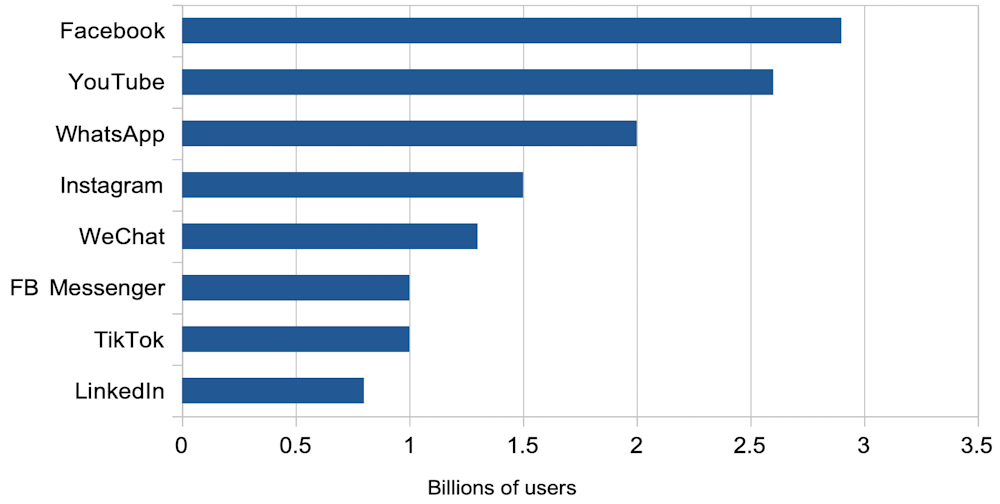
Today LinkedIn is arguably the seventh largest social network after Facebook/Messenger, YouTube, WhatsApp, Instagram, Twitter and Tik Tok. In 2021 it had nearly 824 million users across 200 countries and territories, of which 6% (49 million) are premium subscribers, paying a minimum of $29.99 a month.

Not only does LinkedIn’s business focus attract an upmarket userbase, they are also youthful. The majority (59%) is made up of 25-34s, followed by 18-24s (20%) and 35-54s (18%). It generated revenues of over $10 billion in 2021.

World’s biggest social networks

Bar graph showing the largest social networks by user numbers

All the data is monthly active users from January 2022, except LinkedIn, which just gives user numbers. Statista

LinkedIn had a “good” pandemic, with conversations on the platform rising 43% and content-sharing almost 30%. It benefited from a shift in how people networked, related to findings from numerous studies that it’s the “weak links” in our professional networks who are the most important for gleaning critical information that leads us into jobs we genuinely desire.

At a time when the usual barriers of time and space were less relevant and Zoom calls were ubiquitous, it became the perfect moment for reconnecting with these occasional contacts. Especially with so many people questioning their work situations, LinkedIn was the ideal place to see their posts and reach out to them.

This meant that LinkedIn played a key role in the great resignation, particularly since like the platform, this movement was dominated by millennials. Users posting about changing or quitting jobs would attract large numbers of likes and comments, inspiring others to do likewise. The fact that so many people were connected on LinkedIn multiplied the effects, making it both the main catalyst and the main solution for employers.

LinkedIn user growth over time

Line graph showing growth in LinkedIn user numbers over time

Various sources

Meet the “work-fluencer”

LinkedIn’s role as a lightning rod for work issues is also likely to determine how it develops, as a new category of social media influencer emerges – the “work-fluencer.” Companies are increasingly finding that employees’ LinkedIn profiles and postings can express the brand better than corporate accounts, allowing them to develop the corporate business network much more quickly and naturallyand naturally.

When this is done well, employee posts are usually much more authentic than corporate PR. Rather than just curating articles on professional milestones and triumphs, people have become more open and honest about day-to-day work life.

Over 13 million LinkedIn members have their profile set to “creator mode” to obtain higher exposure for their postings. Many use the hashtag #careertiktok to publish things like their wages and day-in-the-life vlogs about their professions, achieving over 1.5 billion views.

This new “online watercooler” represents a change in the amount of information people reveal about their work on the internet. Workers are raising formerly taboo concerns like pay transparency, discrimination and professional undermining. Some professionals like lawyers, entrepreneurs and HR experts, have leveraged their posts into new content-marketing businesses and other profitable side hustles.

Twenty years after LinkedIn was founded, this could enable the platform to enjoy the kind of trust and community growth that other social media networks would envy. Certainly it has challenges – fake accounts are an issue, for example. And LinkedIn inevitably attracts a lot of spam, which is probably one reason it doesn’t achieve the same amount of daily interactions as other social media.

On the other hand, it benefits from not having a single direct competitor of scale. The nearest big ones would be Facebook Groups or Reddit, but LinkedIn’s purely corporate focus is always likely to be a plus against such players. At a time when traditional platforms like Facebook and Twitter are experiencing difficulties, LinkedIn has a real opportunity to continue succeeding as the one dedicated platform of its size.

Theo Tzanidis, Senior Lecturer in Digital Marketing, University of the West of Scotland

This article is republished from The Conversation under a Creative Commons license. Read the original article.

How food corporations manipulate you into eating more junk food

Fellow junk food eaters can undoubtedly attest to the feeling of craving more, even when one thinks they have finished eating. Whether sweet, salty, or savory, junk food is a food of habit and repetition, compelling us to just have one more bite. 

There are, of course, evolutionary reasons that we crave these kinds of simple flavors, embodied in sweets or fatty, salty foods. But there is also a more sinister element to our nation’s junk food addiction: food manufacturers are manipulating our minds and bodies — spending millions of dollars over decades to engineer food that tastes good, but not good enough to make us stop eating. In addition, they play off of our own evolution as a species to help us develop dependencies on foods even when we know eating them is not in our best interest.

“The difference between a watermelon and something processed by a large company is that, for the latter, those foods are altered in ways to make them literally irresistible.”

There are several ways that this happens. The first involves a quirk of human psychology known as sensory-specific satiety.

As the term hints at, sensory-specific satiety is what happens when you taste the same kind of food for so long that you grow bored with it. Even if your favorite food is ice cream or pizza, you would likely want something new if forced to eat nothing but ice cream or pizza for every meal.

Food manufacturers understand this, and as such when they design foods to hook in customers, they are clever about it. They keep in mind a factor known as “the bliss point,” which refers to the exact combinations of saltiness, sweetness and other tastes that any given food item needs to be (a) delicious and (b) not quite delicious enough that you will feel satisfied after a small serving.

Quite to the contrary: Like many other businesses, food manufacturers want customers to buy as much of their product as possible. Customer satisfaction, though important, is not as much of a priority as customer demand — and getting your customer to crave a food item because they never quite feel satisfied after their last taste effectively establishes long-term and lucrative demand.

Take Prego spaghetti sauce, which was “optimized” by food industry scientist and mathematician Howard Moskowitz. Even though one may not think of spaghetti sauce as equivalent to candy, a single half-cup of Prego Traditional has more than two teaspoons of sugar — as much as at least two Oreo cookies. This is because industry research found that the sugar stimulated consumer tastebuds enough to make them crave more and more of the spaghetti sauce, even though this sauce does not taste much like counterparts that were primarily tomato-based.

In addition to leaning into the distinct psychology behind how humans respond to tastes, food industry experts also look into how our bodies evolved to process different types of nutrients. Evolutionary psychologists argue that the body craves things like fats, sugars and even salt in order to shore up its stores of energy so that it will suffer less during periods of famine. This is why — when a junk food fan eats something like a greasy fried chicken leg or a bag of sugar-coated candy — their brain releases chemicals which tell them to enjoy themselves and indulge. Your body does not understand that there are “good foods” and “bad foods”; it simply processes this food as being something it likes, and therefore encourages you to chow down on it again and again.

“When we taste something and when those nutrients hit our gut, there are signals in the brain — pleasurable signals — that make us think, ‘This is really delicious! I like this a lot!'” explains Dr. Alexandra DiFeliceantonio from Fralin Biomedical Research Institute at Virginia Tech Carillon. “That’s probably due to a class of chemicals called opioids.”

Yes, those are the same opioids that refer to the addictive pharmacological drug of the same name. Opioid peptides in your brain are very similar neurochemically from the ones that you can put in your body with pills.

In addition to these opioids, the body also releases a neurochemical called dopamine, which DiFeliceantonio compared to a “tag,” figuratively poking your body and saying, “‘Oh, go do that again! That’s something that you should eat again. That’s something that you should go do.’ It has to do with motivation and with learning, and both these signals are really important for our behavior.”


Want more health and science stories in your inbox? Subscribe to Salon’s weekly newsletter The Vulgar Scientist.


In and of itself, there is nothing inherently sinister about this aspect of human neurochemistry. Indeed, the same signals that make a person crave cotton candy or a Big Mac could in theory also draw them toward a crunch carrot, juicy orange or tender strip of lean turkey. Yet according to Dr. Nicole Avena, an assistant professor of neuroscience at Mount Sinai Medical School and a visiting professor of health psychology at Princeton University, there are important differences in how the brain responds to highly-processed junk foods versus how it processes something like a banana or grilled flounder.

“It seems that foods with added sugars are ‘enjoyed’ differently, as our brain seems to be more sensitive to higher amounts of sugar than we would typically see in nature (like, for example, in an apple),” Avena wrote to Salon. This is evidenced, among other things, by the contrasting ways in which humans eat the highly-processed, chemical-laden foods and the ways in which they eat those that appear in nature.

“People are not experiencing this with things like beans, baked chicken breasts and fruit, even if they really like them,” Dr. Ashley Gearhardt, an associate professor at the Department of Psychology at the University of Michigan, told Salon. To illustrate her point, Gearhardt turned to one of her own favorite foods: Watermelon.

Neuroscientist Dana Small suggests that junk foods which combine sweet flavors with fat form a combination not found in nature except in breast milk — and which therefore perhaps stimulate a primal memory.

“I love watermelon, it’s delicious, but nobody sits down and eats the whole watermelon,” Gearhardt observed. The difference between a watermelon and something processed by a large company is that, for the latter, those foods are altered in ways to make them literally irresistible. This happens when companies use a combination of salt, sugar and fat to create foods that overstimulate the taste buds — and yet are designed to never quite leave you feeling satisfied. Even though saturating foods in salt, sugar and fat fuels the obesity epidemic — and does not necessarily provide consumers with the best culinary experience — it guarantees that customers will keep coming back for more by overstimulating one’s feeling of taste pleasure in exactly the right ways. Since the companies’ view their foremost responsibility as being to their shareholders, that is in itself a good enough reason to continue preparing foods with excessive salt, sugar and fat.

“Salt, sugar, and fat are big players in junk food because the body is wired to detect them and signal the reward centers via the taste buds for sugar and salt, and the trigeminal nerve for fats, with more signalling in the gut,” explained Pulitzer Prize-winning journalist Michael Moss, author of “Salt Sugar Fat,” in an email to Salon. He also pointed out that companies are clever in appealing to senses other than taste. They will intentionally make their junk foods colorful and vibrant to look at, and have textures that are pleasing to the touch. Sound can also play a role, with Moss noting that one experiment found customers are more apt to buy potato chips that crunch loudly. Even memory is important, with Moss referring to the research by Yale University psychologist and neuroscientist Dana Small which suggested that junk foods which combine sweet flavors with fat form a combination not found in nature except in breast milk — and which therefore perhaps stimulate a primal memory through a part of the brain known as the striatum.

The underlying problem is that the human body is like a machine that needs fuel to survive, but has programming which has not been updated to figure out how to make sure that it craves the healthiest nutrients. We are instead programmed to simply gravitate toward as many calories as possible.

“We detect the calories in what we eat, through sensors on the tongue and possibly in the gut, and we’re drawn to foods that have more calories because for most of our existence getting enough calories was life and death,” Moss wrote to Salon. “But we can’t distinguish between nutritious calories and the empty ones in junk food, and so we get just as excited about 300 calories in a candy bar as we do over those in more wholesome food.”

Does all of this science mean that one can consider junk food to be “addictive”? It depends on who you ask and how you define the term.

For his part, Moss resists the word “addiction” on the grounds that it is “a lay term and generally spurned by the medical community because it’s vague and unscientific.” As far as lay definitions go, however, Moss certainly acknowledged that it applies to junk food insofar as it conventionally refers to “a repetitive behavior that some people find difficult to quit,” analogous to how consumers interact with alcohol, cigarettes and other drugs. He also pointed out that when manufacturers boost sales with “words like crave-ability, snack-ability and more-ishness” it becomes “difficult for them to draw a line between that and compulsiveness on our part.”

Avena, by contrast, is quite unambiguous about using the word “addiction.”

“We have done a lot of work to characterize food addiction,” Avena told Salon. Her research has found that junk foods trigger all of the same symptoms associated with other kinds of addiction including withdrawal, cravings and bingeing behavior.

“When you look at the criteria for addiction that are in the DSM (Diagnostic and Statistical Manual for Mental Disorders–the book that the American Psychiatric Association uses to describe the criteria that need to be met in order to be diagnosed with mental health conditions), junk foods meet all of the criteria,” Avena pointed out.

Say farewell to soggy bread and beef stock: Upgrade your French onion soup with these expert tips

There truly may not be a more comforting and deeply savory dish than French onion soup. While sometimes relegated to a supporting character status as a mere appetizer, this soup deserves center stage. When I was in middle school, my friend got me hooked onto French onion and I made it a point to try it at quite literally every restaurant that offered it — and I’ve never looked back.

Built from rich, immensely craveable broth and onions and topped with a cap of bronzed, perfectly crisped cheese, French onion’s hold on the world of ramekins is absolute. Restaurant-style French onion soup, served in a piping hot ramekin with Gruyere melted to the top and sides, is one of the best experiences one can enjoy while eating out. 

Making or enjoying it at home, or perhaps even as takeout or delivery, is often another story entirely. 

Early in the pandemic, I shifted to ordering French onion soup to enjoy at home, which was was… not nearly as enjoyable. While the soup itself was typically delicious, it was then packaged with sodden, soggy bread and a  ball of melted cheese, which certainly caused my enjoyment to dissipate. Furthermore, after giving up red meat, I knew I couldn’t (in good conscience) continue to enjoy this rich, deep soup and all of its accouterments.


Want more great food writing and recipes? Subscribe to Salon Food’s newsletter, The Bite.


This got me to thinking: what would become of French onion if I were to eschew any-and-all-soggy-bread, remove beef stock and craft the dish at home? It should also go without saying, but I amped the cheese quotient up, too. 

Here are the results. I hope you enjoy them as much as I do. 

French onion soup
Yields
06 servings
Prep Time
 05 minutes
Cook Time
hour 30 minutes

Ingredients

1 stick unsalted butter

1 1/2 to 2 pounds alliums of your choosing (red onions, sweet onions, yellow onions, white onions, leeks, shallots and the like), peeled and thinly sliced

5 to 6 thyme sprigs

Kosher salt

No more than a teaspoon or two of vinegar, ideally sherry or black

1 teaspoon Worcestershire sauce, optional

1/4 vermouth or white wine, optional

4 cups broth, stock, or liquid of your choosing (chicken or turkey broth, Parmigiano stock, roasted garlic base, water, or a combination) 

2 to 3 bay leaves

Baguette or bread or your choosing, sliced into 1/2-inch thick slices, ideally about the same shape and size as your serving bowl

1 to 1/2 cups shredded Gruyere or Comte

Grated Parmigiano Reggiano, optional

Chives, finely minced, for garnish


Directions

  1. Using a very large soup or stock pot or Dutch oven, melt the butter over medium heat. 
  2. Add all of your alliums at once, along with the thyme, turn the heat to medium-low and settle in for the long haul. Don’t rush! Also, if the alliums seem to be darkening too much or the pot is getting very full of fond, add a tablespoon of water at a time to help deglaze and loosen things up. Stir throughout, but don’t feel like you need to stand at the stove.
  3. Once the alliums are super-tender, browned and smelling very aromatic, remove the thyme sprigs, season with salt and add the vinegar of your choosing. Let cook 2 to 3 minutes or until almost evaporated; the alliums should have further darkened. Repeat the process with the vermouth or white wine and/or Worcestershire, if using.
  4. Add all of your stock, broth, or liquid, as well as the bay leaves, turn the heat to medium-high, cover the pot and let cook another 30 to 45 minutes.
  5. Toast or broil your baguette slices. Top with cheeses and broil again, just another few minutes, until the cheeses have melted and slightly browned.
  6. Remove bay leaves from soup, taste soup for seasoning and ladle into large bowls. Top with cheese toast, garnish with chives and serve piping hot. 

Cook’s Notes

-Properly caramelized onions need at least 30 to 45 minutes, so find every iota of patience you have and lean into this process. Stay near the kitchen and read a book, scroll through Instagram, play with your puppy, do a puzzle … whatever. Just don’t rush this process; you’ll be a very happy camper later if you abide by these directions.

-I love garlic in soups, but when it comes to French onion, you really want nothing “swimming” around in the broth except for onions. If you’re insistent on garlic flavor, rub some on your baguette toast prior to adding cheese, incorporate a roasted garlic puree of sorts into your broth, or merely sprinkle in some garlic powder before the soup is done cooking. 

-I have a strangely sharp aversion to sweet flavors in savory dishes, so I lean into savory flavors as much as possible since caramelized onions are pretty inherently sweet. I do not at all recommend adding sugar, which some recipes do call for, because then your rich, deep, beautiful soup can become a saccharine, strange concoction.

-Since the soup and the toasts are two separate entities here, feel free to utilize that to your advantage and serve this family style. Restaurant-style French onion is iconic served in those ramekins, but doing that at home and with multiple ramekins in a home kitchen oven can be challenging at best or a dangerous mess at worst. If you prefer the idea of a serve-yourself serving bowl with floating cheese toasts instead, that could certainly be a preferable (or more convenient) approach.

-If you are a fan of the bread-at-the-bottom-of-the-bowl component, feel free to throw that in your bowl before ladling any soup in. I would just say don’t worry about toasting it? It seems counter-intuitive to toast a piece of bread to get it crispy — and then pour soup over it. You do you, though! 

Salon Food writes about stuff we think you’ll like. While our editorial team independently selected these products, Salon has affiliate partnerships, so making a purchase through our links may earn us a commission. 

A stick-to-your-ribs breakfast salad to start your day right

“Tell me what you had for breakfast.”

It’s a question sound engineers and producers often ask guests to check their microphone levels. Over the years with Salon Talks, I’ve heard hundreds of responses, but the only one that ever stuck in mind came from the author who replied, “A big salad.” No bagel? No eggs? No oatmeal, even? “I feel like whatever happens for the rest of the day, at least I had something good to start it.” I was thoroughly intrigued.

I didn’t do anything about it — I happily kept on eating chocolate sprinkles on bread — but I was intrigued.


Want more great food writing and recipes? Subscribe to Salon Food’s newsletter, The Bite.


Then I read Deb Perelman’s beautiful new “Smitten Kitchen Keepers,” a book that contains not one but three inspiring recipes for jazzy breakfast salads, and I knew this was an idea whose time had come. 

The month of January is impossibly contradictory. It signals fresh beginnings and healthy, sober lifestyle choices. It’s also often a time of year we often feel bleak and depleted, in need as much of comfort as kale. I don’t do resolutions, but I do believe in setting goals and intentions, and mine this year mostly involve making manageable shifts and not getting stuck in any ruts. I want to embrace change, and to not be afraid to try new things — even small new things. Especially small new things. You know that expression, “Do one thing every day that scares you?” Some days, just cutting an avocado scares me. What if I get the knife stuck in the pit? Just toasting nuts can be a project. What if they burn? So, what if I could begin my days with one little achievement under my belt?

I have done a mashup here of two of Perelman’s salads, taking the nuts, avocado and sumac from one and the radishes and orange from the other, then throwing the whole works on a bed of arugula. If like me you wake up furiously hungry, you need something that’s going to stick to your ribs until lunchtime. I promise this meal will do the trick, but feel free to make it your own. As Perelman writes of her recipes, “Use them as a jumping-off point for whatever is in your fridge.”

I have not entirely abandoned my morning oatmeal or smoothies, but it’s been refreshing to shake up my routine lately with something crunchy, sustaining and savory. And it really is a mood lifter to leave the house in the morning feeling like whatever happens for the rest of day, at least I can say I gave myself a good start. 

* * *

Inspired by “Smitten Kitchen Keepers” by Deb Perelman

Fearless Breakfast Salad
Yields
 1 – 2 servings
Prep Time
 10 minutes
Cook Time
 5 minutes

Ingredients

  • 1/2 cup of chopped almonds or walnuts
  • 1/4 cup of olive oil
  • 1 large orange
  • 1 ripe Haas avocado
  • 1 lime
  • 4 or 5 small radishes
  • Handful of greens, if you like
  • Flaky sea salt
  • Red pepper flakes
  • 1/2 teaspoon of sumac, if you have it


Directions

  1. In a small skillet, heat the nuts and olive oil over medium heat for 2 to 3 minutes, until the oil is just bubbling and the nuts are toasted. Remove from the heat and set aside.
  2. Halve the avocado and cut into wedges. Slice the orange into wedges, removing any seeds and white pith. Slice the radishes.
  3. Remove the nuts from oil, reserving 2 tablespoons.
  4. Slice the lime and squeeze into the olive oil. Season with salt, red pepper flakes and sumac.
  5. In a bowl, combine the avocado, orange, radishes, greens and nuts. Drizzle with the dressing. Adjust seasonings if needed. Enjoy immediately.

Cook’s Notes

This salad makes a lovely vegan start to the day, but you could add a dollop of yogurt or cottage cheese on top for extra fuel.

Salon Food writes about stuff we think you’ll like. While our editorial team independently selected these products, Salon has affiliate partnerships, so making a purchase through our links may earn us a commission.

“There are too many secrets”: Document classification system needs an overhaul says WaPo

The discovery and voluntary relinquishing of classified documents at properties connected to President Joe Biden ignited a firestorm among politicos given the story’s concurrence with the ongoing saga surrounding former President Donald Trump’s hoarding of top-secret texts at his Mar-a-Lago golf compound in Palm Beach, Florida.

The United States Department of Justice’s appointment of special counsels to investigate each case – Jack Smith for Trump and Robert Hur for Biden – signals that Attorney General Merrick Garland seeks to remain impartial in pursuit of the truth.

And although the circumstances of the two scandals lack a fundamental equivalency – with Trump’s being presumed as a criminal matter and Biden’s being likened to Hillary Clinton’s exonerated negligence – the stories have nevertheless triggered discussions over the federal government’s policies regarding sensitive materials.

READ MORE: Donald Trump accuses the ‘fake news media’ of downplaying the Joe ‘Bidden’ documents story

On Sunday, The Washington Post Editorial Board expanded on that topic, opining that “the classification system for managing secrets is overwhelmed and desperately needs repair.”

The paper’s editors had two main points. The first was that “too much national security information is classified, and too little declassified. For years, officials have stamped documents ‘secret’ in a lowest-common-denominator system that did not penalize over-classification and made declassification difficult and time-consuming. For example, in November, a 2004 interview of President George W. Bush and Vice President Dick Cheney with the 9/11 Commission was released to the public. It should not have taken 18 years.

They cited a statement given in 2004 by then-Republican Congressman Christopher Shays of Connecticut, who lamented the quantity of information that intelligence organizations deem unfit for public knowledge.

“There are too many secrets,” Shays said. That formed the basis of the Post‘s second argument.

READ MORE: Chris Wallace blasts Republicans for double standard on Trump and Biden classified docs ordeal

“Over-classification is counterproductive, making it harder for agencies to function, draining budgets and eroding public confidence. Agencies put their best people to work on the most urgent problems, and declassification is a low priority,” the Board explained. “Now comes a ‘tsunami,’ as the Public Interest Declassification Board warned two years ago: an explosion of digital information. Yet management of classified materials ‘largely follows established analog and paper-based models.'”

The editors then suggested a solution.

“A good start would be to simplify the classification process into two tiers, ‘secret’ and ‘top secret,’ eliminating the lower ‘confidential’ level, while protecting those secrets that need special handling,” they said. Recall that “confidential” was the marking that plagued Clinton during her 2016 presidential campaign.

The Post also alluded to a meeting held by “government experts” from the Hudson Institute in which they determined that “the growing volume of classified records already exceeds the ability of humans alone to process them.”

The editors concluded that the Hudson Institute’s realization was a “wake-up call,” adding that “the whole system needs to be fixed, and its dysfunction should not be ignored for another decade.”

Tanzania’s tomato harvest goes to waste: Solar-powered cold storage could be a sustainable solution

Feeding Africa’s growing population is a big development challenge for governments, policy makers and agriculture experts. Adding to the challenge is the high level of food loss and waste that most small-scale farmers experience.

The African Postharvest Losses Information System reports indicate that countries in Africa waste more than 30% of fresh fruits and vegetables through inefficient post-harvest management. The impact of this loss and waste is severe on smallholders who rely on farming for a living. The Rockefeller Foundation has warned that inefficient post-harvest infrastructure could cause millions of agriculture-dependent households in Africa to fall back into extreme poverty.

The region urgently needs solutions to reduce food loss and waste.

Tanzania is one of the countries that experience this problem. The East African nation is an agriculture-based economy, with small-scale farmers dominating the sector. Most small-scale farmers live in areas where access to electricity is limited. As a result, they don’t have cold storage facilities for their fresh vegetables and fruits. With a lack of cold storage, nearly 30% of fresh produce in Tanzania perish before they get to consumers. For fresh tomatoes, as much as 50% is lost before reaching markets due to poor storage conditions.

Recently, solar-powered cold storage facilities have emerged as a potential solution. These facilities are already benefiting thousands of farmers and traders in Nigeria, but they are not reaching many others across sub-Saharan Africa.

In my recent research, I examined what was holding back progress. Focusing on tomato farming in Kilolo district in southeast Tanzania, I spoke to farmers, solar energy experts and policy experts to explore what needs to be done to improve access to cold storage facilities. I found that the barriers to uptake were limited awareness, the cost of the technology, farmers’ low capacity to pay and consumer preference for non-refrigerated food. Practical policy interventions would include incentives to attract investment, payment flexibility to make technology more affordable and greater awareness of the benefits of cold storage.

What causes tomato losses

Tomato production has huge agribusiness potential in Tanzania. However, small-scale farmers are confronted with several post-harvest management challenges.

In my interactions with farmers, I noticed that most tomatoes got damaged soon after harvesting due to poor handling, lack of proper storage and the use of motorbikes to transport tomatoes from farms to distant wholesale markets.

Due to a lack of storage facilities, farmers without pre-orders kept their harvest in a shaded open space while waiting for buyers. Some reported treating matured tomatoes with chemicals to delay ripening while waiting for buyers, or they simply delayed harvesting them. When the rain comes, most tomatoes get spoiled very quickly. As a result of all these factors, post-harvest tomato losses could be as high as 60%.

Solar-powered cold storage technology

Tanzania has made significant progress in increasing access to solar energy technologies for rural populations. About 70% of rural households use appliances powered by solar, but high investment costs remain the most significant barrier to uptake.

A solar expert told me a 40-foot solar-powered cold storage facility could cost about US$20,000 to set up. Given that most small-scale farmers are low-income earners, such a facility is beyond their means. As a result of small market share and the significant upfront costs involved, solar companies have been reluctant to venture into the cold storage technology business, added this solar expert. The capital cost constraint is also linked to poor financing for renewable energy programs. In several parts of Africa, including Tanzania, insufficient foreign direct investment for solar energy projects has been identified as a major impediment to market growth.

Solar-powered technologies are a clean energy solution with environmental benefits, but they are rarely promoted; marketing is poor. In Tanzania, my interactions with farmers and traders revealed that the vast majority of the potential market had no basic knowledge of solar-powered cold storage. They were interested in using the technology to minimize losses during harvest season, but they weren’t sure how it would affect their business earnings. They needed more information.

Farmers and traders also expressed concerns about whether their regular clients would be willing to buy chilled or refrigerated tomatoes. I was surprised to hear that this was a potential problem. According to these farmers, most consumers in Tanzania prefer freshly harvested tomatoes. One said:

Distant buyers from Dar es Salaam, Tanga or Dodoma sometimes opt to come straight to the farm and pick the tomatoes they want; usually, they prefer and want you to harvest those that are in the green stage so that they don’t spoil during transportation. These kinds of buyers will not buy tomatoes that have been stored in cold storage facility.

Experts suggested that this concern could stem from limited exposure to chilled and frozen foods among local populations in Africa. Solar service providers would need to be aware of this market reality.

Overcoming barriers

Solar-powered cold storage technology is of prime significance in Africa’s efforts to cut post-harvest losses and attain food security, as outlined in the African Union Malabo Declaration, but costs and affordability make it very challenging for African-based solar service providers. Private sector participation will be needed to increase financing and investment for cold storage technologies in emerging markets such as Tanzania. This can only be realized under a supportive regulatory environment and innovative policy incentives that attract capital.

The good news is that in the last few years, private financing for renewable energy programs in developing countries has more than doubled. The opportunities are opening up for African-based solar companies and their potential market.

Evodius Waziri Rutta, Sustainability Researcher, Queen’s University, Ontario

This article is republished from The Conversation under a Creative Commons license.

Jeff Beck: The unorthodox techniques that made him such a unique guitarist

The praise Jeff Beck, who has died aged 78, received from indebted musicians during his lifetime already read like unbridled eulogies. Eric Clapton had called him “the most unique guitarist,” Steve Lukather (Toto) “God’s guitarist,” and Joe Satriani “just a genius.”

Jazz great John McLaughlin described Beck as “the best guitarist alive,” Steve Vai as “unique in the most superlative use of the word,” and Noel Redding (Jimi Hendrix Experience) as his “personal favorite.” Queen’s Brian May said Beck “radically changed” his view of the guitar.

Beck’s fame was not drawn from a catalogue of hit songs (though there was, of course, Hi Ho Silver Lining), nor from a cushy decades-long residency in a mega-band (though there were many supposed offers). Instead, he was a guitarist’s guitarist who seemed to be the humble protagonist at the center of a plethora of seminal moments in pop history.

Those moments included the 1960s UK blues invasion, the pop-jazz movement of Stevie Wonder, 1970s funk fusion and “world fusion,” and millennial rock, pop and film music. He drew upon styles including jazz, reggae, Bulgarian folk, western and Indian classical music, and influenced artists in an even wider circle of styles.

Beck’s only tool was the electric guitar and its ecosystem of pedals and amp. Despite evolutions and augmentations, this toolkit has largely stayed the same for guitarists over the past 60 years. Beck’s standard-tuned Stratocaster – with fuzz, distortion and echo pedals through Fender and Marshall amps – is, with just a little customisation to preserve tuning amid his vigorous string bending, about as classic and established as it gets.

So how did Beck use this common instrument to create such stylistic range, personality and depth of expression?

A common instrument for an uncommon sound

It’s useful to consider not only what differentiates but what is shared by all these styles. In its most reductive form, music can be seen as the manipulation of the fundamental dimensions of rhythm (where musical objects are placed in time), pitch (individual notes and harmony) and timbre (the identifying quality or tone of a sound – its attack, volume, grittiness etc).

These are all open to all degrees of precision, rigidity and creative freedom. Rhythms can be precise but simple, or extremely nuanced and off-grid. Pitch can be treated as exact steps or a smooth continuum, and a musician can opt for an unchanged timbre or manipulate it extensively.

Various skills can be seen as intersections between these dimensions, such as phrasing (pitch and rhythm), rhythm guitar (harmony and rhythm), articulation (timbre and melody), gesture (rhythm and timbre) and so on.

Diverse styles explore these dimensions in differing ways. Blues tends to have a simple (but not easy) harmonic and scalar context, allowing high sophistication of articulation, pitch inflection, timbre and phrasing. Funk’s cyclical rhythmic and sometimes-only-one-chord context invites a deep connection with subtle rhythmic shifts. Pop requires ruthless commitment to melodic accessibility. Indian classical music has a drone and no harmony, allowing expressive engagement with a single pitch melody.

In general, music theory and tuition tends to see these dimensions in exact grids (a lattice of even rhythms, pitches and simple timbral markers), ignoring the vast expression between the cracks. Beck, however, engaged deeply with all of these dimensions, using their fullest range and internal nuance. His unorthodox technique was sculpted in an ego-less service to their creative expression.

He had an intuitive musical ear and technical control for sophisticated jazz harmonies, pitch inflection and melody, as well as a wide timbral finesse – from a barely audible fragile touch to a wall of dense noise. He interacted with amp feedback to turn the guitar’s usual “pluckiness” into anything from mechanical growls to uncannily vocal timbres, to other-worldly sustained flute sounds.

An idiosyncratic technique

Beck’s commitment to these dimensions manifested in his idiosyncratic technique. He abandoned a plectrum for direct contact with the strings, ensuring that every note was distinct, different and mattered.

He would simultaneously control the whammy bar, volume and tone control of the guitar which – with the combination of harmonics, off-fret slide and left-hand inflection – explored an orchestral range of sonic possibilities. Always pushing and never complacent, each record explored new territory and musical affordances.

Beck’s innovations in lead guitar tone with the Yardbirds inspired a generation, but fans could never predict what his next album or group would sound like.

One thing remained constant, however – his unique touch shined through every note. Beck’s diffident, vegetarian, ever-curious and youthful demeanour belied a deep musical wisdom, reminding us that musical creativity and individuality comes from a desire not to impress others, but to express ourselves.

Milton Mermikides, Associate Professor in Music, MMus Programme Director and Deputy Director of the International Guitar Research Centre, University of Surrey and John McGrath, Senior Lecturer in Music, Deputy Director of the International Guitar Research Centre (IGRC), University of Surrey

This article is republished from The Conversation under a Creative Commons license. Read the original article.

Have hope for “The Last of Us,” a drama about enduring at the end of the world, not just surviving

Shockingly enough, the pandemic seems to have depleted our appetite for apocalypse fantasy. Who’d have thought it?  Not the people who made “The Walking Dead,” “World War Z” and every other shambling undead property that ruled the 2010s, along with more recent end-of-the-world, zombie-free tales like “Y: The Last Man” or the remake of “The Stand.”

If their brief lifespans are an indicator of the longevity odds of “The Last of Us,” HBO’s high-budget video game adaptation would seem to have a difficult if not impassable road ahead of it – and not merely due to our presumed fatigue with scripts about some impending version of Earth’s big Game Over. Conversions of console-based mythologies to screens have a notoriously poor track record. In that regard, the starting line for “The Last of Us” is better positioned than, say, the challenge that the “Resident Evil” series writers faced in their effort to conjure prime rib out of the conceptual equivalent of Steak-Umms.  

In creating “The Last of Us” Neil Druckmann intentionally spins a narrative as stalwart as its ferocious gameplay. The non-player character (NPC) backstories aren’t simply described in their inventory notes but play out as the main characters travel through their forbidding environment. This is just one reason the PlayStation games have earned an enthusiastic fanbase since the first one came out in 2013.

Not even that is enough to guarantee a video game adaptation’s success. Druckmann is also the creative mind behind the “Uncharted” franchise, which became a film; take that information as you will. “The Last of Us,” however, enlists the storytelling expertise of Craig Mazin, the Emmy-winning creator of “Chernobyl.” By merging the psychological profundity and emotional realism Mazin applied in his historical drama to Druckmann’s speculative premise, its nine episodes feel at once harrowing and, strangely enough, hopeful.

Pairing “Game of Thrones” alumni Pedro Pascal and Bella Ramsey is key to establishing that air of optimism, however faint it may seem at times. In Druckmann’s universe, the extinction-level pandemic is caused by a Cordyceps fungus akin to a real version that infects insects and eventually takes control of their brain function, driving them to spread their spores. In “The Last of Us,” the fungus evolves to infect humans, transforming them into a variety of infected, with the most dangerous being the later-stage monsters known as “clickers” and “bloaters.”

its nine episodes feel at once harrowing and, strangely enough, hopeful.

Viewers who haven’t played the video game don’t need to know those terms or even be concerned that episodes are driven by running from hordes of brainless, drooling former folk. Like “The Walking Dead,” the living pose a higher degree of day-to-day peril to their fellow humans than the undead; in this world, the main factions are the military’s fascist governing arm, known as FEDRA, and the resistance network dubbed the Fireflies.

Ramsey’s Ellie isn’t a fan of belonging to either, desiring most of all to be cherished by someone. The actor is familiar to most as the fearsome Lyanna Mormont, the young Lady of Bear Island in “Game of Thrones” whose battlefield scowl captures the mood of every woman who has had it.

The Last of UsPedro Pascal and Bella Ramsey in “The Last of Us” (HBO)Here she gets to play the part of a playful, curious, and tough 14-year-old who was born after the virulent fungal outbreak decimates humanity. All pre-outbreak technology is a marvel to her, from aircraft to video games. (The show’s shout-out to “Mortal Kombat” is delightful.) When she and Pascal’s Joel encounter an old car at one point, he mutters about it being a piece of crap. She counters, with her face transformed into a beacon of awe, that to her it might as well be a spaceship.

Circumstances place her in Joel’s care, although he refuses to allow affection to soften him. Ellie becomes his responsibility; he insists on viewing her as cargo.

Pascal is mainly associated with “The Mandalorian,” which makes it easy to liken this situation to his “Star Wars” character. But Joel is hardened by loss. Two decades after civilization falls, he’s a black market smuggler who links a will to survive to his brother Tommy (Gabriel Luna), and his partner Tess (Anna Torv).

When Tommy doesn’t return from a mission for the Fireflies, Joel and Tess take on the job of smuggling Ellie beyond the walls of Boston’s grim quarantine zone and into hollowed-out cities, unfamiliar forests, and the vast wilderness that has reclaimed the land from mankind – untamed places that are home for the fungus to thrive unchecked, along with its once-human hosts.

Describing the stakes in those terms makes it easy to picture all the ways that “The Last of Us” could have fallen into the trap of making a series out of what are essentially gaming cinematics. But Druckmann and Mazin avoid this by expanding the backstories mainly implied in the game into fully realized biographies.

It adequately pays homage to the adrenaline-spiking chaos that is the survival horror genre’s selling point.

The most beautiful of these inspire the third episode starring Nick Offerman and Murray Bartlett as Bill, a featured non-player character in the game, and Frank, another figure who is merely mentioned. The writers develop seeds sprinkled with the game’s narrative into what may be the season’s best episode and possibly among the best performances Offerman has ever given.

Do not take this to mean that this drama eases up on the violence or brutality that gamers want to see in these stories. There’s a place for non-violent TV drama about how the world continues after society falls; for the time being, that role is played quite well by “Station Eleven.” 

The Last of UsAnna Torv and Pedro Pascal in “The Last of Us.” (Liane Hentscher/HBO)
“The Last of Us,” in contrast, admirably services its original constituency through a lightning-paced depiction of its end-of-days’ opening act, and it adequately pays homage to the adrenaline-spiking chaos that is the survival horror genre’s selling point.

Those sequences, and the unpredictable incursion of preternaturally fast and savage monsters here and there, are not this story’s primary magnets. (Although, of course, raiders, despots and cannibals are among the threats Joel and Ellie contend with.) Mazin and Druckmann confirm their understanding of our fatigue with subsistence stories and grim battles by emphasizing themes that are more relatable to those looking for escapism instead of another reminder of how scary the world has become.


Want a daily wrap-up of all the news and commentary Salon has to offer? Subscribe to our morning newsletter, Crash Course.


Joel and Ellie’s journey as the primary focus inspires the auxiliary plots to emphasize the necessity of caring for others as a means of affirming one’s purpose. This is the doorway for joy to enter, and it’s a means for deep pain, betrayal and madness to find its way in, too, and with similar efficiency to that Cordyceps infection.

Connected to this is the importance of trust as both an uncompromisable aspect of survival and living. When we widen that lens to apply that idea to the series as a whole, its creators have made serious efforts to earn that from the audience too. Whatever online trolling there has been over the diverse casting in this series is, as usual, irrelevant. 

Mazin, Druckmann and the directors got the vital elements of “The Last of Us” right by honoring what makes the game outstanding and making its story come alive for anyone who has never played it and never will. Nonstop action can be enough to move along stories in that format and in comic books. Real people require additional dimensionality – and here, at last, is an apocalyptic fantasy that strives to give us that along with its monsters.

Ultimately that’s more effective in persuading the audience to invest in the hearts of these characters and their thousand-mile journey, as opposed to expecting people to be thrilled anew by gazing at the latest herd of traumatized people struggling to endure and survive.

“The Last of Us” premieres Sunday, Jan. 15 at 9 p.m. on HBO.

Behavioral telehealth loses momentum without a regulatory boost


Controlled substances became a little less controlled during the pandemic. That benefited both patients (for their health) and telehealth startups (to make money).

Some potentially addictive medications — like buprenorphine and Adderall — are now far more available online to patients because of regulatory changes. Given the scarcity of qualified doctors to treat some of the behavioral health conditions associated with these drugs, like opioid use disorder or attention-deficit/hyperactivity disorder, doctors’ new ability to prescribe online or, in some cases, by telephone is a huge change. But easier access to the drugs has both upsides and downsides, since they’re often dispensed without accompanying therapy that improves the odds of a patient’s success.

Pre-pandemic, patients sometimes traveled several hours for addiction care, said Emily Behar, director of clinical operations for Ophelia, a New York startup serving people with opioid addictions. Or patients might be struggling with multiple jobs or a lack of child care. Such obstacles made sustaining care fraught.

“How do you reach those people?” she asked.

It’s a question preoccupying much of the behavioral health sector, complicated by the reality that most patients with opioid use disorder aren’t in treatment, said Dr. Neeraj Gandotra, chief medical officer of the Substance Abuse and Mental Health Services Administration.

Increased access to telehealth has started to provide an answer. Behar, the startup executive, says its patients can see expert providers at their convenience. Missed appointments are dropping, say many in the industry.

The startup has secured solid funding — nearly $68 million, according to Crunchbase, an industry database — but addiction specialists and other prescribers of controlled substances online are a mixed group. Some are nonprofits; others are large startups attracting scrutiny from the news media and law enforcement for allegedly sloppy prescription practices.

The influx of new providers is attributable to loosened requirements born of pandemic-era necessity. To help patients get access to care while maintaining physical distance, the Drug Enforcement Administration and SAMHSA waived restrictions on telehealth for controlled substances.

But whether those changes will endure is uncertain. The federal government is working piecemeal to codify new rules for prescribing controlled substances, in light of the health care system’s pandemic experience.

On Dec. 13, SAMHSA issued a proposal to codify telehealth regulations on opioid treatment programs — but that affects only part of the sector. Left unaddressed — at least until the DEA issues rules — is the process for individual providers to register to prescribe buprenorphine. The new rules “get us at least a little bit closer to where we need to go,” said Sunny Levine, a telehealth and behavioral health lawyer at the firm Foley & Lardner, headquartered in Milwaukee.

Congress also tweaked rules around buprenorphine, doing away with a long-standing policy to cap the number of patients each provider can prescribe to. Ultimately, however, the DEA is the main regulatory domino yet to fall for telehealth providers.

In addition, pharmacies are taking a more skeptical stance on telehealth prescriptions — especially from startups. Patients were getting accustomed to using telemedicine to fill and refill their prescriptions for medications for some controlled substances, like Adderall, primarily used to treat ADHD. A shortage of Adderall has affected access for some patients. Now, though, some pharmacies are refusing to fill those prescriptions.

Cheryl Anderson, one Pennsylvanian with ADHD, said she sought online options because of her demanding schedule.

“My husband is frequently out of town, so I don’t have someone to reliably watch the baby to go to an in-person appointment,” she said. It was tough, with three kids, to find the time. Telehealth helped for about half of 2022. Previously, the DEA and state governments imposed tough rules on obtaining controlled substances from online pharmacies.

But in September, after her doctor wrote a refill prescription, she got a phone call saying her local pharmacy wouldn’t dispense medications if the prescription came through telehealth. Other local pharmacies she called took the same position.

Those denials seem to reflect a broader cultural shift in attitudes. Whereas patients and politicians hailed telemedicine at the beginning of the pandemic — first for its safety but also for its increased convenience and potential to extend care to rural areas and neighborhoods without specialists — hints of skepticism are creeping in.

The telehealth boom attracted shady actors. “You had a lot of people who saw an opportunity to do things that were less than scrupulous,” particularly in the behavioral health market, said Michael Yang, a managing partner at the venture capitalist firm OMERS Ventures. Skeptical media coverage has proliferated of startups that, allegedly, shotgun prescriptions for mental health conditions without monitoring patients receiving those medications. “It’ll settle down.”

The startups pose quandaries for local pharmacists, said Matt Morrison, owner of Gibson’s Pharmacy in Dodge City, Kansas.

Pharmacists have multiple obligations related to prescriptions, he said: to make sure incoming prescriptions are from legitimate physicians and that they’re connected to an actual health condition before filling the order. The sense around the industry, Morrison said, is that prescriptions from startups are tricky. They might come from a distant provider, whom the pharmacist can’t contact easily.

Those qualms pose difficulties for addiction treatment. Persuading pharmacists to fill prescriptions is one of the biggest administrative tasks for Ophelia, Behar said. Still, the shift online has been helpful.

“Telehealth picks up the gaps,” said Josh Luftig, a founding member of CA Bridge, a program based in Oakland, California, that helps patients in emergency departments initiate treatment for substance misuse. The supply of care providers wasn’t enough to meet demand. “Across the board, there’s been a lack of access to treatment in the outpatient setting. Now all they need is a phone and to get to a pharmacy.”

Treatment is more efficient for patient and provider alike, providers say. “The majority of our patients prefer to have a telehealth experience,” he said. “The telehealth appointments are more efficient. It increases the capacity of each person involved.”

Well-established organizations also report success: Geisinger, a large mid-Atlantic health system, said 94% of participants in one maternity-focused program were compliant, spokesperson Emile Lee said.

Ophelia, which started up just before the pandemic, expected to treat patients both in-office and online. “We have an office in Philadelphia we’ve never used,” she said. Now the company labors every few months — in anticipation of the end of state and federal public health emergencies — to make sure that the end of the associated looser rules doesn’t lead to disruptions in care for their patients.

More clarity on the future of online treatment could result from permanent regulations from the DEA. What the agency’s rule — which would create a registration process for providers interested in prescribing controlled substances online — will say is “anyone’s guess,” said Elliot Vice, an executive specializing in telehealth with the trade group Faegre Drinker. That rule has been pending for years. “To see this still not move, it is puzzling.”

The agency, which declined to comment specifically for this article, pointed to previous statements praising increased access to medication-assisted treatment.

“There shouldn’t be any change in the rules for telehealth,” Luftig said. “It would be the most horrific thing in terms of access for our communities. It would be an unmitigated disaster.”

KHN (Kaiser Health News) is a national newsroom that produces in-depth journalism about health issues. Together with Policy Analysis and Polling, KHN is one of the three major operating programs at KFF (Kaiser Family Foundation). KFF is an endowed nonprofit organization providing information on health issues to the nation.


This story can be republished for free (details).

KHN (Kaiser Health News) is a national newsroom that produces in-depth journalism about health issues. Together with Policy Analysis and Polling, KHN is one of the three major operating programs at KFF (Kaiser Family Foundation). KFF is an endowed nonprofit organization providing information on health issues to the nation.

Subscribe to KHN’s free Morning Briefing.

The fear-mongering narrative around fentanyl has eerie parallels to the crack epidemic

Fentanyl seems to have a strange grip on the public mind these days, as breathless (often questionable) narratives around this drug are everywhere. According to the news media, this mysterious substance is appearing on shopping cart handles, in children’s Halloween candy, in baby formula, and even poisoning police officers who are near it. Many media outlets push unsubstantiated rumors about this phantom menace, stoking fears that fentanyl could strike any person at any time. 

Yet in all this breathless coverage, expert sources such as doctors, recovery advocates, and people who work on the front lines of America’s overdose crisis and come in contact with fentanyl all the time, are rarely asked for comment. 

This strategy of “shock and awe” isn’t new. It’s a playbook we’ve seen before. And if we don’t change the narrative around fentanyl, we’re doomed to repeat the same mistakes—and get the same deadly consequences.

Is fentanyl as scary as it is depicted?

Fentanyl is portrayed as a lethal illicit opioid that can kill with a single touch. Each week seems to bring a news story about a police officer who arrives on the scene of a minor drug bust and claims to “overdose” on fentanyl through casual exposure, either by touching fentanyl or simply being in its presence. 

At the same time, fentanyl is well-known and studied in clinical settings. It is a medication that is used safely in hospitals everyday for anesthesia, where deaths from it are quite rare. If you’ve had surgery with anesthesia, the odds are good that you were given fentanyl during the procedure. So, why aren’t you dead or foaming at the mouth? 

Like fentanyl, crack was said to be so addictive and dangerous that only an all-out war on drugs could stop it.

The answer is simple. It’s physiologically impossible to overdose on fentanyl by merely touching it. Toxicologists and medical experts have repeatedly debunked claims of accidental fentanyl exposure, but in this atmosphere of misinformation and overreaction, the truth doesn’t seem to even register. 

It’s true that the fentanyl created in illicit drug labs and distributed on the street is different from the pharmaceutical-grade fentanyl administered during surgery. But neither type can kill someone through simple skin contact. Nor is it likely that someone is lacing Halloween candy with a valuable street drug.

The narrative of misinformation surrounding fentanyl is frightening—and ultimately, those lies are what put people’s lives at risk.

A fear-mongering playbook that stands the test of time

Fentanyl is a convenient bogeyman in what has become the newest wave of the American war on drugs. The playbook that is pushing the fentanyl scare narrative is almost identical to the one deployed during the crack epidemic of the 1980s.

The parallels between crack and fentanyl are striking. When it hit the streets almost four decades ago, crack was presented as a new, scary drug—just like fentanyl. As crack proliferated in Black and urban communities, it was portrayed as a “Black drug” by the media. This fueled racist myths and misinformation about “crack babies” and so-called “super predators,” a myth perpetuated by politicians. Like fentanyl, crack was said to be so addictive and dangerous that only an all-out war on drugs could stop it. Myths about its danger and potency were used to justify new levels of policing and punishment—which specifically targeted Black people. Just as criminalization and harsh punishment worsened the crack epidemic, the same thing is happening now with fentanyl. 

Worse, demonization of fentanyl — and its depiction as a magical evil powder where even minute quantities can destroy, say, police (just by touching it) — belies its legitimate medical use. If this continues, people with chronic pain who use prescription fentanyl to manage their medical needs could struggle to access life-sustaining medications. The results will be the same: crackdowns, severe punishments, and prisons crammed with people who need treatment instead of jail time. 

Helping people is more humane and less expensive than another drug war

Misinformation about fentanyl abounds, and basic facts can be hard to come by given how the mainstream news narrative rarely questions the idea that merely looking at the powder can cause seizures, as numerous uncritical news stories vis-a-vis police reports attest. Fentanyl still makes headlines daily, and was a star subject during the 2022 midterms. With a new Congress now in place and a presidential election just around the corner, we’re going to be hearing a lot more about fentanyl. But will we be hearing the truth, or just some well-spun lies?

Instead of creating policies that will prevent this crisis from ballooning to even more catastrophic outcomes, decision-makers are using fentanyl as an opportunity to grab power.

Politicians on both sides of the aisle are now crafting legislation to “protect” police and border patrol agents from fentanyl “exposure.” However, these actions are misguided. Rather than disproportionately focusing on the supply side of the drug crisis and targeting people who use drugs — people who deserve compassion, access to recovery resources, harm reduction, and treatment — we must have policies that take a more strategic and humane approach to the demand side. Each year, police make more than one million arrests for drug possession. That’s six times as many arrests for drug possession than drug sales.


Want more health and drug policy stories in your inbox? Subscribe to Salon’s weekly newsletter The Vulgar Scientist.


Yet instead of helping those who struggle with addiction, states continue to implement three-strikes drug laws, prison for possession, and drug induced homicide convictions that carry decade-long prison sentences. Several state attorneys general are even calling to have fentanyl classified as a “Weapon of Mass Destruction,” potentially opening a Pandora’s Box of anti-drug user laws that could severely worsen America’s overdose crisis.

Reaching across the aisle isn’t enough to end the crisis

Over the past several years, many leaders have been able to address the addiction and overdose crisis through unity, compassion, and evidence-based policy. Sadly, when it comes to fentanyl, a consensus is hard to find. Fentanyl and its scare narrative have become a wedge issue for many policymakers and media. Rather than push a public health narrative and share the truth about fentanyl, its risks, and its solutions, the drug has become sensationalist clickbait. Fears of fentanyl create opportunities for those on the left and the right.

This type of toxic storytelling isn’t new—and neither are the solutions to widespread overdoses and drug risks. We know what works and we know what doesn’t. All we have to do is look at history. But irresponsible reactions are taking the place of thoughtful contemplation and informed decisions. Instead of creating policies that will prevent this crisis from ballooning to even more catastrophic outcomes, decision-makers are using fentanyl as an opportunity to grab power and the public ear. It’s Crack 2.0 — and undoubtedly, the same lethal consequences are right around the corner for fentanyl, too.

Let there be no doubt, action is needed to address fentanyl. It is a piece of the opioid overdose crisis that continues to affect millions of Americans’ lives. Those of us doing the work on the ground know that every day, we lose hundreds of people to preventable overdoses—often, overdoses where fentanyl is involved. The help we needed should have come years ago, and we are working against the clock to save lives. The type of action we take will determine if we actually end this crisis for good, or if we layer even worse policy over failed attempts that will add to the death toll.

Ending it for good means putting the drug war playbook back on the shelf. It means refocusing media outlets on accurate reporting and public health information. And it means calling on those in elected office to protect our common good. We can’t have another War on Drugs in America and expect to save lives. The cost is too high—to families, communities, taxpayers, and even our criminal justice system. We have to flip the script on fentanyl if we hope to survive.


5 Instant Pot chicken thigh recipes for the quickest, coziest weeknight meals

Chicken thighs are a weeknight workhorse: They’re far more flavorful than other cuts (looking at you, chicken breast) and manage to stay juicy throughout cooking. However, when you’re exhausted from a long day, the idea of cooking a whole meal — and doing all those dishes — can still feel daunting. Enter: the Instant Pot. Using one of these electric pressure cookers speeds up the cooking process dramatically, meaning you can have dinner on the table in as few as 30 minutes.

To get you started, we’ve collected five of our favorite recipes that marry the versatility of chicken thighs with the quick-cooking abilities of an Instant Pot.

Our best chicken thigh recipes for Instant Pots

1. Instant Pot Butter Chicken

You’d never guess that this butter chicken comes together in 30 minutes — it’s just that flavorful. Garam masala (paired with ground turmeric, cumin, and paprika) is key to developing a complex flavor in a short period of time, so don’t skimp on the spice blend.

2. Instant Pot Creamy Mushroom Chicken

Rather than relying on a can of cream of mushroom soup, this chicken dish features a simple, homemade sauce consisting of mushrooms and cream, plus aromatics like garlic, onion, and thyme. The final product is a cozy, satisfying dish that’s ideal for chilly winter evenings.

3. Instant Pot Chicken in Red Wine Sauce

These chicken thighs braised in red wine take inspiration from the French coq au vin. Instead of the low-and-slow cooking method traditionally used for this dish (which can easily take several hours), this recipe employs an Instant Pot to get the cook time down to 45 minutes.

4. Instant Pot Chicken with Cumin-Chile Sauce

A combination of chile powder and ground cumin serves as the backbone of this chicken dish. Eat it over rice, suggests recipe developer Urvashi Pitre, or shred the meat and use it for tacos.

5. Melissa Hartwig’s Instant Pot Chicken Cacciatore with Zucchini Noodles

In addition to coming together in under an hour, this recipe happens to be Whole30-friendly and chock-full of vegetables. Rather than the standard accompaniment of noodles or pasta, this cacciatore gets paired with zoodles, or spiralized zucchini, for a fresh — but still satisfying — version.

Canceled Kyle Rittenhouse event prompts threats and harassment targeting Texas brewery

A Conroe brewery says it’s been inundated with harassment and some threats after announcing Friday that it would no longer allow a “rally against censorship” featuring Kyle Rittenhouse to be held there later this month.

“It’s been kind of a s**tstorm,” Southern Star Brewery CEO Dave Fougeron said in a Saturday morning interview. “But now I’m more certain than ever that I made the right decision.”

Fougeron also said that he was not aware until a few days ago that the event’s “special guest” was Rittenhouse. And he disputed claims – including those from Rittenhouse and others – that the cancellation came after pressure from a “woke mob” or distributors such as H-E-B.

Rather, he said, it was primarily concerns from local patrons that led to the decision. Fougeron described himself as apolitical, and said his brewery, which produces well-known local craft beers such as Bombshell Blonde, strives to be a place that’s welcoming to all.

“Our place is super inclusive,” he said. “We are super pro-veteran, super pro-law enforcement. We’re trying to be good people in the community. We’re friends with our firefighters, with our police department. . . . We have a lot of gay patrons who come in because it’s a place of inclusivity. It’s crazy that we’re getting threats from people.”

RELATED: Conroe brewery pulls out as venue for Kyle Rittenhouse rally against censorship

On Friday evening, Rittenhouse – who was famously acquitted of fatally shooting two people in Kenosha, Wis. at a Black Lives Matter protest in 2020 – accused the brewery of censoring him.

“It’s really disappointing to see that places continue to censor me and not allow my voice and many other voices to be heard because they bend to the woke crowd,” Rittenhouse posted to his nearly one million followers on Twitter. Other high-profile right-wing accounts similarly accused the brewery of censorship after it announced that it was canceling the event because it “doesn’t reflect our own values.”

An event spokesperson confirmed the cancellation on Friday and said it was “definitely” getting rescheduled elsewhere.

The Jan. 26 event was also set to include a leader of TEXIT, a group that advocates for Texas to secede from the United States. The event organizer is Defiance Press, a Conroe-based publisher behind titles including “Corona-fascism” and a biography of Joe Arpraio, the former Maricopa County, Arizona sheriff who refused a judge’s order to stop racial profiling by his department.

Defiance Press describes itself as “active in the fight against censorship through publishing conservative books which have been widely censored from mainstream media,” and has also published materials that support Texas leaving the United States.

Rittenhouse has increasingly focused on anti-media and “anti-censorship” crusades since being found not guilty of homicide and other charges in 2021. The cancellation by Southern Star – which follows a few days of backlash – is just the latest controversy involving Rittenhouse to occur in Texas.

Last year, he announced his plans to attend Texas A&M University, a claim that he walked back after the university said he had not been accepted. Rittenhouse, an Illinois native, later said he plans to attend Blinn College, a two-year school in Brenham.

Disclosure: H-E-B and Texas A&M University have been financial supporters of The Texas Tribune, a nonprofit, nonpartisan news organization that is funded in part by donations from members, foundations and corporate sponsors. Financial supporters play no role in the Tribune’s journalism. Find a complete list of them here.

This article originally appeared in The Texas Tribune.

The Texas Tribune is a member-supported, nonpartisan newsroom informing and engaging Texans on state politics and policy. Learn more at texastribune.org.

How to fix the Supreme Court: Congress has the power, and simply isn’t using it

For decades conservative Republicans have focused attention, resources and organizing on reshaping America’s courts, on a scale progressives have never dreamed of. But now, with the complete capture of the Supreme Court by a conservative supermajority, and a series of stunning rulings last term — most notably the Dobbs decision, overturning Roe v. Wade — that could finally be about to change. With the House of Representatives now in Republican hands, there’s no prospect of a congressional response in the next two years, but that’s all the more reason for developing strategies and organizing for action in anticipation of regaining the power to act in 2025. 

Mitch McConnell’s blatant theft of two Supreme Court seats has justifiably thrust the idea of court expansion to the fore. While sleepwalking centrists stifled any action in Biden’s first two years, the high court’s increasing recklessness has dramatically eroded support for the current institution, renewing the possibility for significant reform, particularly since the recent rulings sharply threaten growing popular movements in the Democratic Party’s base. But what kinds of reform will actually work remains unclear.

Historical arguments have mostly focused on Franklin D. Roosevelt’s abandoned effort at court expansion from the 1930s. Although that failed, it nonetheless altered the court’s jurisprudence, saving New Deal legislation as Roosevelt had wanted. Furthermore, both the suddenness of Roosevelt’s action and its abrupt abandonment are distinctly at odds with our current situation. 

There is a much better historical reference point for us to consider, as David Gans argues in a forthcoming paper in the Lewis and Clark Law Review, “Court Reform and the Promise of Justice: Lessons from Reconstruction.” Gans is director of the Human Rights, Civil Rights, and Citizenship Program at the Constitutional Accountability Center, and contends that the post-Civil War period holds significant lessons about how to achieve greater accountability in a time of intense political conflict. Perhaps most significantly, that period saw the most fluidity in the size of the Supreme Court — which is not dictated by the Constitution — but its most profound and lasting impacts lay elsewhere, in the expansion of federal court jurisdiction to protect constitutional rights. 

Gans doesn’t claim that Reconstruction provides a paint-by-numbers guide for what should be done now. His approach is more in line with Mark Twain’s reputed aphorism, “History may not repeat itself. But it rhymes.” So court expansion may well play a decisive role this time around, but that’s only one aspect of the arsenal of powers Congress has available under the Constitution, and Reconstruction saw these powers were most vigorously debated and deployed. If Congress has rarely exercised those powers, that doesn’t mean that they don’t exist or should be regarded as unthinkable. But it does mean we should learn as much as possible from history. Salon interviewed Gans by email for a detailed unpacking of his historical argument. Our exchange has been edited for clarity and length.

When people think about court reform, attention invariably goes to FDR’s court-packing plan. Why do you think Reconstruction is a more fruitful historical reference point, and why is this so little known?  

The defeat of Franklin Roosevelt’s far-reaching court expansion plan — which would have added an additional justice for every sitting justice over the age of 70 — receives the lion’s share of attention in modern debates over court reform. Yet in many respects, Reconstruction provides a more salient historical precedent. During Reconstruction, Congress used its powers under the Constitution to reform the federal judiciary in a variety of ways. It repeatedly changed the size of the Supreme Court, stripped the court of jurisdiction over a class of cases that sought to challenge Reconstruction, and used its enforcement power to protect fundamental rights and expand the ability of the federal courts to redress state abuse of power.

During Reconstruction, Congress repeatedly changed the size of the Supreme Court, stripped it of jurisdiction over certain cases, and expanded its oversight over state-level abuses of power.

Reconstruction provides an important reminder that Congress has many tools available to it to ensure that the Supreme Court and the federal judiciary upholds our whole Constitution’s bedrock promises of liberty and equal justice. And unlike the case of FDR’s court expansion plan, Reconstruction provides examples of reforms that were successfully enacted into law. In all these respects, Reconstruction provides a model for comprehensive court reform today. 

You write that “almost all of the court reforms being debated today have historical antecedents in the Reconstruction period.” The first thing you consider is changes to the size of the court — first it was expanded it to 10 justices, then shrunk to seven, then expanded back to nine. You ask, “Did court expansion succeed?” And you answer, “both yes and no.” In what sense did it succeed and in what sense did it fail? 

Court expansion had an important effect on some areas of law, but not others. Court expansion during the Reconstruction era succeeded in producing a new majority on the Supreme Court disposed to uphold President Lincoln’s wartime measures. It led to one of the quickest overrulings in Supreme Court history. In 1871, in Knox v. Lee, just one year after the Supreme Court struck down the use of paper money as legal tender, the new majority overruled that decision, championing Congress’s broad power to solve national problems.  


Want a daily wrap-up of all the news and commentary Salon has to offer? Subscribe to our morning newsletter, Crash Course.


But those who hoped the newly constituted Supreme Court would vindicate the Constitution’s new guarantees of liberty and equality were bitterly disappointed. Even with new appointments, the Supreme Court of the Reconstruction era repeatedly gutted the 14th Amendment, turning “what was meant for bread into stone,” as Justice Noah Swayne observed. This reflects both the appointment politics of the day, in which presidents prioritized appointing justices that would uphold wartime measures, and a national mood that, as time went on, increasingly took a tragically dim view of Reconstruction’s promises of racial justice.   

The example of jurisdiction-stripping was complicated: Congress first expanded the court’s jurisdiction, then cut it back. What happened to create that situation? 

Reconstruction posed immense legal and political questions concerning the states of the former Confederacy in the wake of the Civil War. One of the biggest questions concerned how Southern states would be governed until they satisfied the conditions for readmittance to the Union. In the Reconstruction Act of 1867, Congress split the former Confederacy into five military districts and required the former states to ratify the 14th Amendment and adopt new state constitutions that broadly granted voting rights to all adult men without regard to race.  

Southern litigants brought a slew of challenges to the Reconstruction Act, claiming that the military rule of the former Confederacy was unconstitutional. In the wake of an 1866 ruling that overturned the military conviction of a Confederate conspirator in Indiana, congressional Republicans feared that the Supreme Court would use a habeas corpus action brought by William McCardle to strike down military rule of the South and wreak havoc with Reconstruction.  

Congress responded by enacting a law that took away the Supreme Court’s appellate jurisdiction to review habeas decisions by lower federal courts. This move succeeded, producing one of the preeminent examples of congressional control of Supreme Court jurisdiction. Ultimately, the court dismissed McCardle’s case, observing that “the power to make exceptions to the appellate jurisdiction of this court is given by express words” in the Constitution. Jurisdiction-stripping did not rein in the Supreme Court in any lasting way, but it succeeded in preventing the court from considering the constitutionality of the Reconstruction Act.    

As an alternative to jurisdiction-stripping, congressional Republicans attempted to require a supermajority vote on the Supreme Court in order to overrule Congress. What arguments were made for that effort, and are they worth reconsidering today?

In seeking to require a supermajority vote of two-thirds of the justices to strike down an act of Congress, Republicans in 1868 stressed that the Supreme Court was initially composed of six justices, effectively requiring a two-thirds vote to decide a case. They also drew an analogy to the constitutional rules for a presidential veto. The bill passed the House but died in the Senate.   

Supermajority requirements are an avenue to rein in the court and make it harder to strike down federal laws, but they hardly offer a solution to a court dominated by a conservative supermajority, as ours is today. Even with a supermajority requirement, the Roberts court would remain free to decimate fundamental rights by overruling rights-protective rulings, as it did in Dobbs, and inventing judge-made rules, such as the non-textual and ahistorical “major questions” doctrine the court invoked last term in West Virginia v. EPA, when it invalidated a federal rule issued to reduce greenhouse gas emissions from power plants.  

In fact, the court’s invocation of the “major questions” doctrine to require that Congress speak clearly if it wishes to delegate power to an agency concerning certain matters of political and economic significance illustrates how the conservative supermajority on the Court has been able to frustrate congressional intent while simultaneously giving off the perception that it is deferring to congressional power.

You write, “While court expansion and jurisdiction-stripping proved most important in the short run, the most enduring reforms were those that provided a federal forum to vindicate constitutionally guaranteed rights.” What, specifically, did Congress do, starting with the Habeas Corpus Act? 

Reconstruction witnessed the greatest enlargement of federal jurisdiction in American history. Many of these measures changed the powers of the federal courts to vindicate constitutionally guaranteed rights, seeking to make the federal courts partners in Reconstruction’s project of ensuring equal citizenship and reining in abuse of state power. The Habeas Corpus Act of 1867 gave federal courts the power to free a person held in state custody in violation of the Constitution or federal law, while Section 1983, enacted in 1871, created a right to sue state and local officers to enforce federal constitutional rights in federal court.  The big idea underlying both these landmark pieces of legislation was that it was up to federal courts to safeguard constitutional rights and ensure governmental accountability.    

Reforms of this sort should be part of the progressive court reform agenda today. The Roberts court has repeatedly closed the courthouse doors to those victimized by government or corporate abuse of power. A central goal of court reform today should be to realize our constitutional promise of equal justice under law by broadly opening courthouse doors that the Roberts court has repeatedly bolted shut.  

In your section “Lessons For Court Reform from Reconstruction,” the first lesson is that the Constitution gives Congress broad powers to reform the federal judiciary, and the second is that “Reconstruction provides a lens to evaluate the reforms pursued by Congress,” both its successes and failures. First I’d like to ask about court expansion, which you note “halt the 6-3 conservative majority’s effort to rewrite huge swathes of constitutional law and imperil basic freedoms long enjoyed by Americans.” How would you apply the history you recount to where we are today?

The Roberts court has repeatedly closed the courthouse doors to those victimized by government or corporate abuse of power. A central goal of court reform today should be to realize our constitutional promise of equal justice under law.

Appointments to the Supreme Court are a key way of changing the law. That’s true today. It was also true during Reconstruction. The “legal tender” cases of the Reconstruction era illustrate that court expansion can be an incredibly powerful tool to change a hostile Supreme Court. Court expansion led to overruling a prior precedent on a hotly disputed question. Reconstruction also reminds us that appointments matter: Many of the justices appointed by Republican presidents during Reconstruction, tragically, played a role in burying the promise of the 14th Amendment’s safeguards for liberty and equality.  

Regarding jurisdiction-stripping, you warn that “A bill stripping the Supreme Court of jurisdiction and broadly foreclosing judicial review over a class of cases would provoke a major constitutional fight.” 

Taking away the Supreme Court’s jurisdiction over a class of cases is one of the tools Congress possesses, but I worry that jurisdiction-stripping may not prove a successful avenue of reform in today’s climate. Limiting Supreme Court jurisdiction would leave final say with the federal courts of appeal, which in many cases remain dominated by conservative ideologues appointed to the bench by Donald Trump. A reform that empowered conservative courts of appeal to move the law far to the right, without any possibility of appeal, would not be progress. 

What other procedural reforms might make more sense? Reforming the infamous “shadow docket,” for example?

Currently, the Supreme Court has virtually complete control over the cases it hears; four justices, less than a majority, can vote to hear a case. The Roberts court has used this power aggressively to hear cases handpicked to allow the conservative supermajority to pursue their ideological projects and overrule cases they dislike, and has repeatedly employed its emergency docket — i.e., the “shadow docket” — to move the law to the right, all without the transparency, deliberation and publicly available legal reasoning that is essential to the judicial process.  

Congress can change this. It can prescribe the kinds of cases the court can hear, require a supermajority to hear a case or insist on a conflict in the lower courts as a prerequisite to Supreme Court review. It can limit shadow docket abuses by prescribing tough standards for emergency relief.    

A third path forward is to “pass landmark civil rights legislation that opens the courthouse doors and ensures the promise of justice for all Americans,” you write. “[L]egislation of this kind will be essential — indeed, it is also necessary to combat how the conservative majority of the Roberts Court has gutted the Voting Rights Act.” Let’s start there: What can be done to restore the Voting Rights Act? 

The Roberts court has repeatedly eviscerated the Voting Rights Act. In 2013, in Shelby County v. Holder, the court gutted the Act’s preclearance remedy applicable to jurisdictions with a long history of flouting constitutional guarantees. To employ these remedies, the court’s conservative majority said, Congress had to write a new coverage formula. In 2021, in Brnovich v. Democratic National Committee, the court’s conservatives rewrote the Voting Rights Act’s prohibition on state practices that result in racial inequality at the polls, making it nearly impossible to challenge a voting law that disproportionately disenfranchises voters of color.   

Congress cannot alter Shelby County’s constitutional ruling, but it can revitalize the Voting Rights Act by writing a new coverage formula and setting aside Brnovich’s cramped construction of the Voting Rights Act’s result test. Congress can make real the promises of the 15th Amendment by nullifying neutrally written laws that suppress the vote in communities of color. 

You go on to say that several other areas of the law “cry out for congressional intervention.” The first of those is to eliminate the doctrine of qualified immunity. What’s the source of this problem?

Congress can end qualified immunity, a judge-made rule that makes it incredibly difficult to hold police officers and other government actors accountable when they violate constitutionally-guaranteed rights. Qualified immunity has no basis in the law. When Congress enacted Section 1983 during Reconstruction, it consciously chose not to provide any immunities to officials who violate constitutional rights in carrying out their duties. By gutting Section 1983’s promise of accountability, the Supreme Court has let government officials violate fundamental rights with impunity.  

A second area you cite is rehabilitating habeas corpus review by repealing AEDPA. Can you explain?

Habeas corpus is critical to rein in state abuse of power and vindicate freedom, but today, habeas corpus is badly broken. The Supreme Court’s conservative majority has interpreted AEDPA, a 1996 law that requires federal courts to defer to state courts, to make it nearly impossible to vindicate constitutional rights. According to the conservative supermajority, habeas review is an intrusion on state sovereignty and should be only available in the most egregious of cases. Congress can change this and restore a federal forum to vindicate constitutional claims by state prisoners and redress criminal justice abuses.  

How can any of this be accomplished with a conservative supermajority on the Supreme Court? Or is the real issue that the difficulties of reform will ultimately drive the process of court expansion?

None of this will be easy. Progressives should be cognizant that the conservative supermajority will look for ways to gut any new legislation enacted by Congress. Any new measures must be drafted using the clearest language possible to prevent the court from exploiting ambiguities to hollow out Congress’ handiwork — and the likelihood that a court like the current one could simply ignore these legislative endeavors suggests it might be wise to include them as part of a reform package that includes court expansion.

But Congress should not shy away from acting on its obligation to enforce constitutional rights simply because it might provoke a clash with the conservative supermajority on the Supreme Court.  On the contrary, progressives in Congress have to make the case that the Supreme Court is getting the Constitution dead wrong and that Congress must use its powers to vindicate our Constitution’s text, history and values. 

Finally, what’s the most important question I haven’t asked? And what’s the answer?

The question would be: How should progressives understand the goal of court reform? What are the failures of justice that court reform should aim to correct? The answer is that modern debates over court reform are dominated by questions of court expansion and term limits. But court reform is about more than the composition of the Supreme Court. It’s about whether the Supreme Court is acting as an impartial arbiter to realize the Constitution’s promise of equal justice under law, to safeguard bedrock rights and to ensure that our courts work for all Americans.  

The Roberts court is failing in all these respects. From abortion to voting rights to criminal justice to government and corporate accountability, we have a Supreme Court that is declaring open season on fundamental rights and putting accountability far out of reach. With a 6-3 conservative Supreme Court systematically bent on rolling back fundamental freedoms and closing the courthouse doors to the most marginalized Americans, a central part of the court reform agenda should be about ensuring the promise of justice for all.  

How Anne Rice’s home became the best character in AMC’s “Mayfair Witches”

In “Anne Rice‘s Mayfair Witches” — AMC’s second adaptation of Rice’s work after acquiring the filming rights to her “The Vampire Chronicles” and “The Lives of the Mayfair Witches” series shortly before her death — many of the main characters live beyond the standard rules of humanity, and one main character is not a human at all. No, not Lasher (Jack Huston). I’m referring to the Mayfair house itself.

In Rice’s 1990 novel “The Witching Hour,” the first of the series this latest adaptation is based on, we’re introduced to the character Deirdre Mayfair, played by Annabeth Gish in the show. Held in a near catatonic state in an effort to keep her from Lasher, the entity tied to her family name for generations, Deirdre sits stoic on the balcony of the Mayfair residence, aging along with the beautiful mansion in the Garden District of New Orleans inspired by the very home that Rice herself lived in for 15 years.

In the second episode of “Mayfair Witches,” titled “The Dark Place,” Dr. Rowan Fielding (Alexandra Daddario) seeks out this house after the death of her adopted mother Elena (Erica Gimpel) unfolds a personal backstory that makes her ability to kill people with her mind a little less confounding. Jumping on a flight to New Orleans, a place she believes to be visiting for the first time although, unbeknownst to her, she was actually born there, she learns that the Mayfair house is associated with witches, but what she doesn’t know yet is that she is one of them. 

Although “Anne Rice’s Mayfair Witches” was not able to film in the actual house Rice describes in her books – where she lived with her husband, poet Stan Rice and son, writer Christopher Rice – the production filmed a good portion of it nearby at the Soria-Creel House, an 1875 mansion with a similar exterior. And when not filming at that location, they pulled off a lot of the shots using a set shared with AMC’s “Interview with the Vampire” production that came before it. 

During a panel for the Television Critics Association prior to the premiere of “Mayfair Witches,” creator Esta Spalding and Executive Producer Mark Johnson revealed that they had to paint over the wallpaper in one of their shots as it was visibly the same as what was used in interior shots for “Interview.”

“We’re really using each other’s spaces physically, but we’re trying to, in the first season of this show, have only these very, very selective Easter eggs for the audience to pick up on,” Spalding said.


Want a daily wrap-up of all the news and commentary Salon has to offer? Subscribe to our morning newsletter, Crash Course.


While AMC did its best to re-create what Rice saw in her mind as she wrote her Mayfair series, her former home has a life of its own.

While AMC did its best to re-create what Rice saw in her mind as she wrote her Mayfair series, her former home has a life of its own.

In a 2014 Facebook post, Rice writes about the house saying, “When I wrote ‘The Witching Hour,’ I made the house I was living in, in the Garden District of New Orleans, on the corner of Chestnut and First Street, into the home of the Mayfair family of witches. I lived in this spectacular house for 15 years, and it figured in a total of five novels . . . I no longer live there, but will always walk those rooms in my dreams, and the house shall live in my heart forever.”

In a special exhibit at Tulane University in New Orleans, situated directly across from the reading room that houses the archives of her journals and manuscripts, a photo and text display of Rice’s house at 1239 First Street tells its story.

“The Rice home on First Street became a place of pilgrimage where fans were often greeted by her dog, Mojo,” a section of the display reads. It goes on to call attention to the iron fencing around the home, an example of “an early form of chain link.” The craftsmanship of this fencing contains beautiful rosettes, leading the home to often be referred to as “Rosegate.”

As the exhibit at Tulane points out in another display, the first sentence of “The Witching Hour” mentions this house, and it’s a central figure through her Mayfair works.

While writing this book, which had an early working title of “Witches’ Fire,” according to her journals, she only had to look out the window to get further inspiration.

In an entry dated June 11, 1992, Rice paints the picture of an average day spent working on her Mayfair books in the very home they’re partially set in writing, “Thunder and a dark sky. I’m in the black rocker on the front porch. Just thought I’d stop here on my way upstairs. It’s thundering away. Rain is slapping all of my broad leaf plants. It’s beautiful. All the trees — from the great oaks through the little bushes — are blooming.”

In an earlier journal, Rice looks back at one of the first times she saw the house, a situation that her character Rowan is about to experience in the series.

In an entry from that journal dated July 17, 1989, Rice writes “It’s lovely over here. Can I think back to that November day when I stood out there looking at this house? Suppose someone had said ‘next summer you’ll be in the kitchen and everything will be new and shiny and fine.'”

In a 2004 feature, the Orlando Sentinel described Rice’s emotional state as she prepared to leave her last home in New Orleans prior to relocating to California after the death of her husband in 2002:

“To this day, she refuses to set foot on the third floor of her house, which was used as Stan’s studio. Anyone wandering upstairs would see things exactly as he left them. An unfinished self-portrait he started leans against one wall. His last coffee cups are on a stool. A plastic Barnes & Noble bag with Anne’s likeness on it is tacked to the wall, because he thought the image captured her face nicely. On the opposite wall is a small sign reading, ‘Seize the Carp.’

Although Rice lived in California at the time of her death, she will forever be associated with New Orleans, and her home on First Street will always be tied to the Mayfair Witches.

On October 30, 2022, there was a second line for Rice in honor of her passing that circled past her house and paused for a moment of silence. 

Watch the full second line below.

Meet the “California sober” set: Why trendsetters are ditching all drugs except pot

This month, as many folks attempt to ditch alcohol for “Dry January,” some are picking up cannabis as a replacement. In some circles, skipping booze for weed is a lifestyle colloquially known as going “California sober,” a reflection of the lax attitudes around pot that abound in the Golden State.

For Alexis*, a 35-year-old software engineer from Portland, Oregon, being California sober means abstaining from alcohol, cocaine, meth, psychedelics, nicotine — everything but marijuana and caffeine. After witnessing how her parents struggled with addiction and alcohol use, she self-described as “straight-edge,” meaning she stayed totally abstinent from drugs until her late 20s. Then, she found cannabis.

For some folks, especially those in the addiction recovery world, using one drug to help you stay off another is a taboo dooming users to failure or relapse.

“When I did finally get introduced to marijuana, it was like night and day for my general anxiety, and helped me feel creatively empowered,” Alexis told Salon. “Marijuana made the world softer without the downsides I saw my friends go through with other drugs.”

The term “California sober” evokes breezy West Coast stoner vibes, as the state was one of the first to legalize medical marijuana in the ’90s. California’s Humboldt County, situated in the far northwest of the state, is legendary for its “Emerald Triangle,” once home to many underground pot farms. Now, of course, cannabis in California is a multi-million dollar industry that by some estimates will soon make up about 20 percent of the entire country’s legal weed market.

But is ditching all other drugs besides cannabis really all that “sober?” For some folks, especially those in the addiction recovery world, using one drug to help you stay off another is a taboo dooming users to failure or relapse. One rehab retreat center warns, without citing sources, that “medical use of marijuana can be dangerous for people in recovery and may lead to an even worse relapse over time.”

This idea is plastered across other rehab websites, too. The message is clear: If you’ve struggled with opioids, stimulants, alcohol or benzos, then stay away from all other drugs, including marijuana.

But how much truth is there to this statement?

Based on several measurements of harm, including dependence and risk of overdose, cannabis is remarkably less risky compared to alcohol. Though using marijuana, the extract of the cannabis plant, is not “safe,” it is very rarely a direct cause of death. One literature review could only find 35 deaths associated with cannabis, many of them involving complex medical history; while a more recent study in England found that toxicity from cannabis was “negligible.”


Want more health and science stories in your inbox? Subscribe to Salon’s weekly newsletter The Vulgar Scientist.


Meanwhile, alcohol is attributed to 3 million deaths per year globally, or 5.3 percent of all deaths from any cause, according to the World Health Organization. Using alcohol has also been linked to more than 200 different diseases and at least seven types of cancer.

Grinspoon emphasizes that cannabis can be addictive. But that doesn’t mean moderate use can’t be a sort of in-between strict sobriety and destructive drug use.

“Drinking has become more and more of an issue the older I became,” James*, a 28-year-old consultant from Phoenix, Arizona, told Salon. “Drinking further harms my already impacted impulse controls. I’ve drank and driven, self-harmed and hurt loved ones due to words I’ve said while intoxicated. At this point, I recognize that it’s very hard for me to live a ‘sober’ life — if I don’t smoke cannabis, I’ll drink. If I don’t drink, I’ll smoke cannabis. Even in times where I’ve really worked on my sobriety, I always lapse. Rather than setting myself up for failure, I’d rather work on my own moderation with cannabis.”

Going California sober can be an effective harm reduction tool, says Peter Grinspoon, a primary care physician at Harvard Medical School who specializes in medical marijuana. He says he’s helped many of his patients transition from opioids, alcohol or both to cannabis instead. Grinspoon, who is also a board member of the advocacy group Doctors For Cannabis Regulation, emphasizes that cannabis can be addictive. But that doesn’t mean moderate use can’t be a sort of in-between strict sobriety and destructive drug use.

“Millions of people use cannabis as part of their recovery,” Grinspoon told Salon. “Addiction kills. We need a big tent for recovery, not a small tent.”

Yet Grinspoon says this idea of being “California sober” has not widely caught on with addiction psychiatrists, who still think of marijuana as dangerous and having no medical value. These attitudes can be linked to Alcoholics Anonymous, which has published literature warning that “the misuse of prescription medication and other drugs can threaten the achievement and maintenance of sobriety” and that people who used “street drugs, ranging from marijuana to heroin, have discovered the alcoholic’s tendency to become dependent on other drugs.”

“The Big Book was written in 1939, before we had MRIs, before we understood the brain,” Grinspoon said, referring to the best-selling text authored by Bill Wilson about how to quit problematic alcohol use. “This is an ideology, not science. Yet it has such an overwhelming influence.”

“In short, ‘addictive personality’ is a complete myth.”

Alcoholics Anonymous and other rehab routes typically promote the myth of cross-addiction or the “addictive personality” — the idea that if you can’t use one drug responsibly, then you can’t use moderate amounts of another substance. In other words, the idea that abstinence from all drugs is the only route for someone with a substance use disorder.

The addictive personality is not a topic that has been researched in much detail, but much of the evidence for it is weak. Furthermore, this model reduces the complexity of addiction into a “one type fits all” approach, according to Mark Griffiths, a professor and psychologist at Nottingham Trent University who specializes in behavioral addictions like gambling and sex addiction.

“There is no personality trait that guarantees an individual will develop an addiction and there is little evidence for an ‘addictive personality’ that is predictive of addiction alone,” Griffiths wrote in the Global Journal of Addiction & Rehabilitation Medicine in 2017. “In short, ‘addictive personality’ is a complete myth.”

Regardless of its merits or pitfalls, cannabis use is not going away. As more and more states and countries undo prohibition, citizens have more choices for getting buzzed. There are other state-named consumption regimens too, including “Colorado sober,” which means one abstains from alcohol, but indulges in cannabis and psychedelic drugs like psilocybin “magic” mushrooms.

“Alcohol can be a tough one to drop, but the long-term benefits of not blacking out regularly, not drinking daily and developing into a borderline alcoholic are very positive,” Tyler, a 37-year-old homesteader from Texas and former Colorado resident who identifies as “Colorado sober,” told Salon. Denver, Colorado was the first city to decriminalize mushrooms in 2019, with the rest of the state following suit last November, but also legalizing DMT, ibogaine, mescaline and a few other powerful psychedelics. So The Centennial State has a bit of a reputation for ego-dissolving, mind-altering substances.

On the weekends, Tyler would alternate between LSD, mushrooms and DMT. “Having cannabis and psychedelics to turn to is nice and can help remind you of long-term goals,” he said. Psychedelics are surging in popularity in other parts of the country, too, so maybe “Colorado sober” is becoming more of a thing, like the California version. It’s not that new of an idea, actually. After all, even Bill W., the founder of AA, was a proponent of using LSD to quit drinking booze.

Getting intoxicated is a big part of being human. It is very probable that many of those reading this now are under the influence of a stimulant like caffeine. Psychedelics and alcohol have played a role in the growth of civilization; though any drug can have ill health effects, there’s nothing morally wrong with experiencing a buzz. Regardless, any drug can be toxic if not used responsibly — and no matter what path one chooses, there are always risks. The lines between “sober,” “California sober” and “Colorado sober” reflect how different people are risk-averse in different ways.

*Names have been changed.

Trump rebuked over social media meltdown against rape accuser in sexual assault case

Former President Donald Trump was not pleased with the line of questioning he was confronted with by a lawyer representing one of the women accusing him of sexual assault. Now, details about his intense interaction with a lawyer during the deposition are coming to light.

On Friday, Jan. 13, a New York federal judge delivered a ruling to allow for a deposition to be unsealed.

According to Mediaite, the deposition was part of the lawsuit filed against Trump by E. Jean Carroll. The judge’s ruling was a response to a request by Trump’s legal team to have the case dismissed.

READ MORE: Judge ‘smoked’ Donald Trump ‘and his counsel’ over ‘inexcusable’ requests for delays in defamation case

The news outlet highlighted one aspect of the deposition where Trump was questioned about a Truth Social post where he mocked Carroll describing her as “Ms. Bergdorf Goodman” and labeled the accusation as a “complete con job.”

“And, while I’m not supposed to say it, I will,” he added. “This woman is not my type!”

During the deposition, Trump was asked, “Why did you decide to issue the statement on Truth Social on October 12th?”

Rattled by the question, Trump fired back saying, “Because I was offended at this woman’s lie. Because I was offended that she could just make up a story out of cold air, refuted by her testimony on CNN, but that she could make up a story just out of nowhere and that I get a phone call asking me about this ridiculous situation.”

READ MORE: Sean Hannity was ‘actively misinforming’ Fox News viewers during Sidney Powell interview: columnist

He went on to criticize his accuser insisting there is “something wrong” with her.

“The woman — there’s something wrong with her in my opinion. Okay. But it’s a false accusation,” Trump said. “Never happened, never would happen. And I posted and I will continue to post until such time as — and then I will sue her after this is over, and that’s the thing I really look forward to doing. And I’ll sue you too because this is — how many cases do you have? Many, many cases, and I know the statements that were made — that you made. Keep Trump busy because this is the way you defeat him, to keep him busy with litigation. So I will be suing you also, but I’ll be suing her very strongly as soon as this – but I’ll be suing you also.”

After listening to the former president’s rant, the lawyer asked, “Are you done?”

Trump replied, “Yeah.”

“Is there anything in particular that prompted you to make this statement last week?” the lawyer also asked.

“Yeah,” Trump said, adding, “Her false story and that I have to waste a whole day doing these ridiculous questions with you.”

Hospitals’ use of volunteer staff runs risk of skirting labor laws, experts say

MOUNT PLEASANT, S.C. — Most of the 30 volunteers who work at the 130-bed, for-profit East Cooper Medical Center spend their days assisting surgical patients — the scope of their duties extending far beyond those of candy stripers, baby cuddlers, and gift shop clerks.

In fact, one-third of the volunteers at the Tenet Healthcare-owned hospital are retired nurses who check people in for surgery or escort patients to a preoperative room, said Jan Ledbetter, president of the hospital’s nonprofit Volunteer Services Organization. Others relay important information from hospital staffers to expectant families. “They’re kept extremely busy,” Ledbetter said. “We need to have four of those volunteers a day.”

At hospitals across the U.S., volunteers play an integral role. So much so that when volunteers were barred from East Cooper at the beginning of the covid-19 pandemic, staff nurses assumed the volunteers’ duties in the surgical waiting room. Like paid employees, hospital volunteers typically face mandatory vaccine requirements, background checks, and patient privacy training. And their duties often entail working in regular shifts.

At HCA Healthcare, the world’s largest for-profit hospital system, volunteers include aspiring medical providers who work in patient rooms, in labs, and in wound care units, according to the company’s magazine.

Over centuries, leaning on volunteers in medicine has become so embedded in hospital culture that studies show they yield meaningful cost savings and can improve patient satisfaction — seemingly a win-win for hospital systems and the public.

Except, there’s a catch.

The U.S. health system benefits from potentially more than $5 billion in free volunteer labor annually, a KHN analysis of data from the Bureau of Labor Statistics and the Independent Sector found. Yet some labor experts argue that using hospital volunteers, particularly at for-profit institutions, provides an opportunity for facilities to run afoul of federal rules, create exploitative arrangements, and deprive employees of paid work amid a larger fight for fair wages.

The federal government instructs that any person performing a task of “consequential economic benefit” for a for-profit entity is entitled to wages and overtime pay. That means profit-generating businesses, like banks and grocery stores, must pay for labor. A Chick-fil-A franchise in North Carolina was recently found guilty of violating minimum wage laws after paying people in meal vouchers instead of wages to direct traffic, according to a Department of Labor citation.

Still, volunteer labor at for-profit hospitals is commonplace and unchecked.

“The rules are pretty clear, and yet it happens all the time,” said Marcia McCormick, a lawyer who co-directs the Wefel Center for Employment Law at Saint Louis University. “It’s a confusing state of affairs.”

In a statement, HCA spokesperson Harlow Sumerford said coordinators oversee hospital volunteers to ensure they are participating in appropriate activities, such as greeting and assisting visitors. Tenet Health spokesperson Valerie Burrow did not respond to a question about how the company ensures that its volunteer activities comply with federal labor laws.

Ben Teicher, a spokesperson for the American Hospital Association, whose members include more than 6,000 nonprofit, for-profit, and government hospitals, did not respond to a question about whether the organization offers guidance to hospitals regarding the legal uses of volunteers.

Meanwhile, the pandemic made the importance of hospital volunteers more apparent. In March 2020, volunteer programs nationwide were largely disbanded, and the volunteers’ roles were filled by staff members — or left unfilled — when hospitals closed their doors to everyone except employees, patients, and a few visitors. Volunteers were welcomed back once vaccines became widely available, but many didn’t return.

“We’ve lost so many volunteers,” said Ledbetter, who runs the volunteer group at East Cooper Medical Center. “They found something else to do.”

On South Carolina’s Hilton Head Island, Vicki Gorbett, president of the island’s hospital auxiliary, estimated 60% of the group’s volunteers who left during the pandemic haven’t returned. Much larger hospital systems, some of which boast hundreds or thousands of volunteers, have been affected, too.

“We’re building back from the absolute bottom,” said Kelly Hedges, who manages volunteers at the Medical University of South Carolina.

Hedges was furloughed for the better part of six months when hospital volunteers were sent home in March 2020. She estimates there are about 600 volunteers at MUSC’s hospital campus in Charleston now, down from 700 before the pandemic.

“During a labor crisis, this is a department you want in operation,” she said.

While hospital volunteer programs reboot across the country, labor experts say using volunteers may expose some medical facilities to liability.

The Fair Labor Standards Act prohibits “employees” — defined broadly as people an employer “requires or allows” to work — from volunteering their time to for-profit private employers. The same law also requires these employees to be paid no less than the federal minimum wage.

These regulations make it “very, very difficult” for a volunteer to donate time to a for-profit hospital, explained Jenna Bedsole, an employment attorney in Birmingham, Alabama.

The right to be paid isn’t waivable, McCormick said, meaning that even those volunteers who don’t consider themselves employed may be entitled to compensation. However, the U.S. Department of Labor is “stretched pretty thin” and doesn’t enforce the rules that apply to for-profit companies, except in extreme circumstances, she said.

She cited a court ruling in 2017 that found people who volunteered at consignment events for Rhea Lana — a for-profit company that organizes the resale of children’s clothing — were employees who should be paid.

But in most cases, McCormick said, it is difficult to determine the outcome of enforcement actions against for-profit companies.

“The Department of Labor sends a letter to the putative employer warning them that it thinks the FLSA is being violated,” she said, “and it may not take any other action. And it only issues news releases for big cases.”

Companies are more likely to be targeted for the inappropriate use of unpaid interns, she said.

But this isn’t to say that, in some cases, individuals can’t donate their time in a for-profit setting. In a for-profit nursing home, the federal government has said, people may volunteer without pay if they’re attending “to the comfort of nursing home residents in a manner not otherwise provided by the facility.” That might include reading to a resident, for example.

One-off charitable opportunities are also possible. A choir group could host a concert in a hospital lobby without violating the law, or a community organization could serve hospital staffers an appreciation lunch.

Beyond that, for-profit “hospitals potentially expose themselves to risk of civil liability,” Bedsole said, which could add up in terms of back pay due to employees, fines, and legal fees. If hospital volunteers provide essential services, there is a danger they could be held liable, she said.

Nonprofit hospitals must follow federal labor laws, too.

At the small, nonprofit Baptist Memorial Hospital-Leake in Carthage, Mississippi, the coordinator of volunteers, Michelle McCann, can’t use a volunteer in any role that matches an employee’s job description. She said she’s also prohibited from asking a hospital employee who is off the clock to volunteer their time for a job similar to their own.

“We’d have to pay them for the hours,” said McCann, national president of the Society of Healthcare Volunteer Leaders.

Nonprofit hospitals are required to provide a benefit to their communities, such as offering charity care, in exchange for their special tax status. But when it comes to making money, the differences between for-profit and nonprofit hospitals are often negligible to the casual observer, said Femida Handy, a professor of social policy at the University of Pennsylvania.

“When you go to the hospital, do you ask for the tax status?” she asked.

Sam Fankuchen, CEO of Golden, a company that develops software used to organize volunteer labor, said the pandemic hastened a change in public opinion. “Just because an organization is nonprofit, it doesn’t necessarily mean they’re 100% dedicated to the greater good,” he said. “Some nonprofits are better run than others.”

Most volunteers are simply trying to figure out how and where they can help in the best possible way, he said.

“The consideration about the tax structure is secondary,” said Fankuchen, whose software is used by hospitals and other businesses. “The big picture is that hospitals exist to deliver care. I think it’s reasonable that they have volunteer programs.”

Jay Johnson, support services manager at Trident Medical Center in North Charleston, South Carolina, coordinates roughly 50 volunteers who contribute an estimated 133,000 hours annually to the for-profit hospital, which is owned by HCA Healthcare.

Trident’s volunteers are widely beloved by the staff, he said.

“We actually had a ceremony for them when they came back” when restrictions loosened, Johnson said. Beyond that, volunteers benefit from premium parking spaces and free lunches “to really make sure they’re appreciated,” he said.

Trident volunteers are required to be vaccinated and undergo a background check. Then, they are assigned to the areas that best match their interests.

Breast cancer survivor Pat LoPresti for example, volunteers in Trident’s Breast Care Center. Volunteering provides a sense of purpose and an opportunity to socialize, said LoPresti, a retiree who met her husband, another volunteer, while volunteering at the hospital.

“I started volunteering there because they could use me,” LoPresti said. “It’s such a privilege to help people in a time when they need it.”

KHN (Kaiser Health News) is a national newsroom that produces in-depth journalism about health issues. Together with Policy Analysis and Polling, KHN is one of the three major operating programs at KFF (Kaiser Family Foundation). KFF is an endowed nonprofit organization providing information on health issues to the nation.


This story can be republished for free (details).

KHN (Kaiser Health News) is a national newsroom that produces in-depth journalism about health issues. Together with Policy Analysis and Polling, KHN is one of the three major operating programs at KFF (Kaiser Family Foundation). KFF is an endowed nonprofit organization providing information on health issues to the nation.

Subscribe to KHN’s free Morning Briefing.


In defense of “The Menu” diners

The night after seeing “The Menu,” my partner and I went out to dinner. Not to a fancy place. A place with good food, but one with a price tag within the reach of a writer and journalist, a place where one could comfortably wear jeans and sneakers without attracting dirty looks. Still, after the appetizer arrived, my partner spread out his hands and froze me with the declaration, “Do not eat!” It took a beat before I recalled the rest of the line, the line that comes next in the movie. “Taste.” I will give this to “The Menu.” We will joke about it for a while.

The Mark Mylod-directed film, written by Seth Reiss and Will Tracy, based on a story by Tracy, is a critical darling, with some outliers. Both critics at KPCC describe the film as “contrived” while critic Wade Major labels it “very familiar,” saying of its formulaic nature and surface-level story, “It looked and felt and seemed a whole lot better than it really is.” In the Huffington Post, Candice Frederick calls the film “a profoundly empty viewing experience.” 

That’s a reoccurring theme, as even its positive reviews acknowledge there isn’t a lot of there there. As Christy Lemire writes on Roger Ebert, “You may find yourself feeling a bit hungry after this meal is over.” One of the ways “The Menu” leaves a bad aftertaste? Its odd declaration of who among the characters has privilege and who doesn’t, and its lack of a position about why.

In “The Menu,” Ralph Fiennes plays Chef Julian Slowik, the chef at the exclusive, high-end restaurant on a remote island where diners are ferried in for a one-of-a-kind dining experience. A young couple visits and realize on this night, as with the Hotel California, you can check out but you can never leave.

Julian has had enough, and he’s going to bring down the diners at his fancy restaurant, those patrons he has grown to loathe, along with him and his entire, very large kitchen staff. As such, he has carefully selected the diners — a captive audience, if you will — for his final meal. While the film is perhaps meant to be a rather heavy-handed satire, and Julian its villain, viewers have rallied behind him, calling the film a take-down of the rich. But who is it taking down exactly? Let’s see.

The MenuJanet McTeer, Nicholas Hoult, Anya Taylor-Joy, and Paul Adelstein in “The Menu” (Courtesy of Searchlight Pictures)Like a seasonal menu, the chef’s patron selection has been meticulously curated. The film mentions this fact repeatedly. The guests for this tasting are a table of men in finance, a famous food critic and her eager-to-please editor, an older couple who are restaurant regulars, a movie star past his prime and his young assistant, and young foodie Tyler (Nicholas Hoult) and his date, Margot (Anya Taylor-Joy). Julian’s elderly mother also occupies a table in the corner, slowly drinking herself to death.

The film takes a very retro view of privilege, aligning with the chef who longs for ye olde hardscrabble days of flipping burgers and the idealized, manic pixie dream sex worker.

These are the wealthy we are skewering (rather literally). Of all the guests, the food critic (Janet McTeer) is the most grating, blasé and entitled. But her editor (Paul Adelstein) goes along with things out of a sense of self-preservation. He needs his job. The same may be said of actor’s assistant Felicity (Aimee Carrero), though she has no student loans. Multiple yes men and women face the wrath of the chef, which doesn’t seem fair, nor something the character who expresses repeatedly he had to pay his dues with “s**t work” would carry out. But Julian’s empathy extends only to traditionally attractive sex workers and high-end service workers. 

The MenuJohn Leguizamo in “The Menu” (Courtesy of Searchlight Pictures)Is George (John Leguizamo) really condemned to death for the crime of making a bad movie? That would take out most people in Hollywood. George is far from an abusive star, and treats his assistant kindly when she admits she’s taken money from him. Elderly regular Richard (Reed Birney) has cheated on his wife Anne (Judith Light) and engaged the services of a sex worker. Putting aside the judgement this seems to make about sex work, Anne is long-suffering. Her crime is . . . staying with a cheating man? Again, a decision some women are forced to make in order to survive.

Anne is the most sympathetic character of the bunch, her allying with the sex worker her husband employed one of the few moments of emotion in the film. Encouraging the younger woman to go, to escape and live, Light looks very, very tired. And while the demise of a table of embezzling finance bros would not be a great loss to some, these characters are all men of color. In a world of Elon Musk and Donald Trump, a world with Harvey Weinstein and Jeffrey Epstein and many more of their ilk, are these really the folks targeted for takedown? The ones the chef carefully selected for punishment? He didn’t have any human traffickers or murders or child abusers on his list? 

We’re so into where our food comes from now. But what about where our stories come from?

The white, male chef has more privilege than some of his diners, especially the characters of color. But the film takes a very retro view of privilege and class, aligning with the chef who longs for ye olde hardscrabble days of flipping burgers and the idealized, manic pixie dream sex worker. That character, Taylor-Joy as Margot, is a source of sympathy (and gross fascination) for Julian, but the woman whose husband employed a sex worker will get none. Margot was a last-minute replacement. We don’t find out anything about the woman her date intended to bring, but the chef was perfectly fine killing her. 


Want a daily wrap-up of all the news and commentary Salon has to offer? Subscribe to our morning newsletter, Crash Course.


Critics have called out the film for lacking a point of view, that such rudderlessness may be the source of the lite feel of “The Menu.” But there is also no reckoning, despite the flambé at the end. No character learns anything. No one is likely to change (or gets the chance to). The diners aren’t so bad and the workers aren’t so good, but the ending and the overall film feels hollow, like that bread course.

We’re so into where our food comes from now. But what about where our stories come from? Who are the best creators of stories about privilege and its opposite? Perhaps the emptiness reviewers and audiences of the film have pointed out is what happens when one does not have lived experience of the central issues inherent in their tale. “The Menu” is a send-up, sure, but a shallow one. Who gets to tell the tale of privilege? Who gets to live to tell?

“The Menu” is currently streaming on HBO Max.

Not quite losing my religion: Being a liberal evangelical isn’t always easy

Throughout my life, I have questioned my Christian faith. On two occasions in my life, however, I have seriously considered the possibility that the God who has directed every aspect of my life is just a very nuanced invisible friend. The first time when I was 19 years old and took a college course on faith. The second time is right now.  

The arguments against the existence of a deity are quite sound. Most faiths, including my own, are neither exemplars of morality nor of intellectual ideals. Important books like Richard Dawkins’ “The God Delusion” and Sam Harris’ “Letter to a Christian Nation” seek to destroy any reasonable basis for faith in the Christian God or any other god. Not to mention that a few years back, Socrates did a pretty good job at this as well.  

The American version of the Christian faith — or at least of the widely popular evangelical variety — makes it even more difficult. Too many representatives of my Christian faith preach a hateful agenda based on self-righteousness, arrogance and judgment. They got the massively hypocritical Donald Trump elected president and could possibly do it all over again. They legitimize attacks on the LGBTQ population and seek to control women who dare to strive for personal freedom.  

These are the evangelicals who beg for money, promote their books, conferences and massive sanctuaries, and push to support the party of God through the Republican agenda. Then, beyond this country’s borders, these evangelicals send out missionaries to help transform other countries’ policies on gay marriage, contraception and abortion, on the premise of promoting their own interpretation of the Gospel.

Almost every conflict found in the world today has Christians on one side or the other. Killing in the name of God is certainly not just a Christian thing, but it’s fair to say that Christians throughout history have made it part of their agenda. Some preachers will even say God deliberately kills people with natural disasters. Just check out how Pat Robertson reacted to Hurricane Katrina or the 2010 and 2021 earthquakes in Haiti. According to people like him, such tragic events are instruments of God’s vengeance.  

Indeed, when I just look at my own life it is quite difficult to see the hand of God. Sometimes truly wonderful things have happened to me, and sometimes really terrible things. In both cases, it never had anything to do with my prayer life or the strength of my faith. Good and bad fortune seemed random, much as they do for every person I know, regardless of their faith or lack thereof.

And yet, I believe.


Want a daily wrap-up of all the news and commentary Salon has to offer? Subscribe to our morning newsletter, Crash Course.


First, I still owe money on the student loan I took out to attend an evangelical seminary, so I am not abandoning my faith until that loan is paid for. I’m being facetious, but I have sometimes felt that this idea of being the way I am for so long — a person of faith — makes it difficult to imagine changing that. I have no memory of ever not believing in God, and I talk to God all the time. I have run two evangelical churches, traveled on mission trips, completed a 90-credit seminary degree and written countless articles in defense of the Christian left. What would be the point of all that if I concluded that God was just make-believe?

When I just look at my own life, it is difficult to see the hand of God. Wonderful things have happened to me, and so have terrible things — and it never had anything to do with my prayer life or the strength of my faith.

To be more serious, I have also had incredible encounters with the presence of God. I know this can happen to a bunch of idiots at a football game or attending a lame Christian-rock concert, and I can understand why nonbelievers would be skeptical. But those moments have felt as true as anything I have ever experienced. I have also seen the magnificent art and architecture inspired by the message of Christ, and felt the collective presence of spirit expressed in those works.

Ultimately, like all believers, I have decided to take a leap of faith. I feel no need to discredit science, or to apologize for the evils done in the name of God. I refuse to lazily fill in the gaps in scientific knowledge by pointing toward God. And I fully understand that human beings have an alarming capacity for tremendous evil, whether they claim to be people of faith or not. I do not understand God, or the text of the Bible, or why God has revealed himself so many ways in so many various belief structures. I do not know what happens when we die, or whether God exists — at least not in the way we know everyday truths.  

I am choosing to make my giant leap because, in all my experience, study and observations, my faith in a divine resurrected Christ makes the most sense. It is not about the comfort of knowing Christ, forgiveness of my sins and the prospect of salvation, or even about the wisdom of Christ’s teachings. I believe that I believe in the truth. I believe that Jesus Christ is the messiah. I know that either I will die and be no more — and perhaps see Bill Maher for a split-second, telling me, “I told you so” — or I will die and see Christ. I certainly hope it is Christ. I really, really hope it isn’t Bill. 

Fauci weighs in on Elon Musk saying he should be prosecuted

Dr. Anthony Fauci recently weighed in with his reaction to billionaire businessman and Twitter CEO Elon Musk’s calling for his prosecution. In fact, Musk even went a step further touting what he described as “Fauci files.”

According to Fauci, Musk’s remarks left him puzzled for a number of reasons. On Friday, January 13, Fauci —former director of the National Institute of Allergy and Infectious Diseases (NIAID)— appeared on Fox News’ Your World” where host Neil Cavuto asked him what he thought about “the world’s richest man, or second richest now, going after” him.

The nation’s top infectious disease expert insisted he has no idea what Musk was referring to.

“I have no idea what he’s talking about, Neil,” Fauci replied. “I wish I did. I’m clueless about what he’s referring to.”

Per HuffPost, the latest Fauci files come shortly after another debacle Musk dubbed the “Twitter files.”

“Previous installments of the ‘Twitter Files’ series have detailed the internal discussions at and workings of the social media platform, before Musk’s purchase of it. The ‘Fauci files’ were due to drop early January, per Musk. But the release appears to be delayed,” the news outlet reported.

Further expounded on the situation, Fauci said, “I just don’t understand what he’s doing. And I don’t think I should be addressing it because it’s a bit puzzling to me.”

Fauci also made it clear that he had “absolutely nothing to hide at all” and would “be able to defend everything” he did to mitigate the spread of the virus.

“So, a lot of people are spouting out a lot about things on me and Twitter. I don’t have a Twitter account. I’ve never had a Twitter account. I don’t intend on having a Twitter account. And I’ve had nothing to do with Twitter,” he said. “So, I don’t know what they’re talking about when they say that, Neil. I just don’t. I’m puzzled.”

Watch below:

Trump vents on Truth Social as Mar-a-Lago investigation ramps up

Donald Trump was up bright and early on Saturday morning ranting about the Department of Justice’s investigation into the sensitive documents he took to his Mar-a-Lago resort and refused to give back which eventually led to the FBI serving him with a warrant and searching the premises.

Using the documents discovered at President Joe Biden’s residence from when he was vice president as a springboard, the former president characterized the “Special Counsel” looking into the Biden situation as “not known as a flame-throwing lunatic” while taking aim at his own nemesis as a “Trump Hating political Thug.”

Hot on the heels of special counsel Jack Smith adding more members to his investigatory teams, the former president launched another broadside and complained he is being treated unfairly.

In a series of posts on Truth Social from very early Saturday morning, Trump first wrote, “Page 1: What Biden did was wrong, but he was given a reasonable and stable Special Counsel who is sane, inclined not to make waves, friendly with RINOS, and is not known as a flame-throwing lunatic or a Biden hater. What I did was RIGHT, Secured documents in a secured place, lock on the doors, guards and Secret Service all around, security cameras working. Mar-a-Lago is essentially an armed fort, and was built that way in the 1920’s, with High Walls & structure to serve as the Southern W.H.”

He followed that soon after with, “Page 2: I was President of the U.S. and covered and protected by the Presidential Records Act, which is not criminal and allows and encourages you to talk to the NARA, which we were, very nicely, until the FBI, who it is now learned has been after me for years without pause or question, RAIDED Mar-a-Lago, a stupid and probably Illegal thing to do. As President, I have the right to declassify documents, Biden did not. Special ‘Prosecutor’ Jack Smith, however, is a Trump Hating political Thug.”

He then insisted that Smith drop the investigation, which is reportedly looking at obstruction of justice for refusing to return the documents for months, and violations of the Espionage Act.

“Page 3: The Boxes Hoax Case against me should be dropped immediately. I have done nothing wrong!” he insisted.

The decision of where to seek care is complicated by the multitude of options

One evening in February 2017, Sarah Dudley’s husband, Joseph, started to feel sick.

He had a high fever, his head and body ached, and he seemed disoriented, she said. The Dudleys had a decision to make: go to the hospital emergency room or to an urgent care clinic near their home in Des Moines, Iowa.

“ERs take five, six, seven hours before you’re seen by a doctor, depending on how many people are there,” Sarah said. “I know that I can go to an urgent care clinic and be seen within an hour.”

According to court filings, at the clinic, a physician assistant misdiagnosed Joseph with the flu. His condition worsened. A few days later he was hospitalized for bacterial meningitis, and he was placed into a medically induced coma. He had multiple strokes, lost hearing in one ear, and now has trouble processing information. The Dudleys sued over the error and a jury awarded them $27 million, though the defendants have asked for a new trial.

Their story reflects a challenge in the American health care system: People who are injured or sick are asked, in a moment of stress, to prudently decide which medical setting is the best place to seek help. And they must make that choice amid a growing number of options.

Landing in the wrong setting can lead to higher and unexpected medical bills and increased frustration. Patients often don’t understand what kind of services different settings provide or the level of care they need, and an uninformed choice is “a recipe for poor outcomes,” said Caitlin Donovan, senior director at the National Patient Advocate Foundation, a patients’ rights nonprofit.

“We’ve created this labyrinth health care system that is functioning to maximize profit,” Donovan said. “It does that by creating an ambiguous system that’s difficult to navigate, that’s constantly shoving more costs on the patients.”

But revenue-driven and risk-averse operators of sites that act as alternatives to hospital emergency rooms have little incentive to make the process easier for patients.

“We live in a fee-for-service world, so the more patients you see, the more money you make,” said Vivian Ho, a health economist at Rice University. “If you’re going to be opening one of these facilities up — even if you’re a not-for-profit — you’re looking to bring in revenues.”

The number of urgent care clinics in the U.S. has grown by about 8% each year from 2018 to 2021, according to the Urgent Care Association. But the services and level of care offered can vary widely by clinic. In its current strategic plan, the industry group says it’s working to help a wider audience understand what counts as urgent care.

Concentra, which operates urgent care clinics in the eastern and central U.S., advertises its ability to care for allergies, minor injuries, and colds and flu. CareNow, another major urgent care player, says its clinics can treat similar issues, but services may vary by location. According to the American Academy of Urgent Care Medicine, some clinics offer labs and X-rays; others have “more advanced diagnostic equipment.”

Ho said urgent care clinics can provide quicker access to cheaper care. Free-standing emergency departments, on the other hand, tend to charge considerably higher prices for similar services, she said.

Free-standing emergency departments are increasingly common, though data on their exact numbers is murky. Some are owned by hospitals, while others are independent; some are open 24/7, others aren’t. While they’re often staffed by doctors with emergency medicine training, many don’t offer trauma services or have operating rooms onsite, even as they saddle patients with large bills.

Patients didn’t always have so many options, said Dr. Ateev Mehrotra, a professor of health care policy at Harvard Medical School. Despite all the choices, he said, the health care industry tends to direct patients to the highest and most expensive level of care.

“What is the thing that you probably hear when you call your primary care doc while you’re waiting on hold? ‘If this is a life-threatening emergency, please call 911,'” Mehrotra said. “Risk aversion is constantly pushing people to the emergency department.”

Federal law requires emergency departments at Medicare-participating hospitals to care for anyone who shows up. The Emergency Medical Treatment and Labor Act, also known as EMTALA, was created in 1986 in part to prevent hospitals from transferring uninsured or Medicaid-covered patients to other facilities before stabilizing them.

But the lack of clear guidelines on enforcement of the law sometimes stops emergency department doctors from redirecting patients to more appropriate facilities, physicians said. The law doesn’t apply to urgent care clinics and applies inconsistently to free-standing emergency departments.

The law makes hospital-based ER doctors nervous, said Dr. Ryan Stanton, an emergency medicine physician in Lexington, Kentucky. Those who would like to direct patients to settings with lower levels of care, when appropriate, worry they may run afoul of EMTALA.

“It is meant to protect the consumer,” Stanton said. “But it has the downstream effect of: There’s things I would like to be able to tell you, but federal law says I can’t.”

Stanton said EMTALA could be updated to allow hospital emergency room doctors to be more open with patients about the level of care they need and whether the ER’s the best — and most affordable — place to get it.

The Centers for Medicare & Medicaid Services, the federal agency that enforces the law, said it is willing to work with hospitals on how to communicate with patients but did not elaborate on specific initiatives.

Efforts to educate patients before they seek care don’t always clear up confusion.

Take, for example, urgent care chain MedExpress, which offers a list of conditions it treats and a guide for when to seek more intensive care.

Karolina Levesque, a nurse practitioner for MedExpress in Kingston, Pennsylvania, said she still sees patients with serious health warning signs, such as chest pain, who require referral to an emergency room. Even those patients are frustrated when they’re sent somewhere else.

“Some of the patients will say, ‘Well, I want my copay back. You didn’t do anything for me,'” Levesque said.

Some patients, like Edith Eastman of Decatur, Georgia, said they appreciate when providers realize their limits. When Eastman got a call last February that her daughter had hurt her arm at school, her first thought was to take Maia, 13, to an urgent care center.

A local clinic had cared for Maia when she broke her arm previously, and Eastman figured providers there could help out a second time. Instead, worried the fracture was more complex, they referred Maia to the emergency room and charged $35 for the visit.

“The urgent care said, ‘Look, this is above our pay grade.’ It didn’t just patch her up and send her home,” Eastman said.

All parts of the health care system need to play a role in clearing up the confusion, advocates say. Insurance companies can better educate policyholders. Urgent care clinics and free-standing emergency rooms can be more transparent about the kinds of services they offer. Patients can better educate themselves to make more empowered decisions.

Otherwise, solutions will be piecemeal — like the short-lived ad campaign run by BayCare, which operates hospitals and urgent care centers around Tampa, Florida. Launched in 2019, the effort to educate patients went viral.

“I have the flu: urgent care. I have the plague: emergency care,” one ad read.

Helping patients self-triage means BayCare can reserve its more expensive ER resources for patients who really need them, said Ed Rafalski, the system’s chief strategy and marketing officer.

But other hospitals, he said, see only competition in other players entering their markets.

“If you have a free-standing urgent care facility open across the street from your ER, you’re going to lose certain portions of your business just by the fact of them being there,” he said.

Donovan, the patient advocate, said that kind of mindset perpetuates confusion that is ultimately harmful for patients.

“If you break your leg, it’s not reasonable to be like: ‘Did you Google whether urgent care or ER is appropriate?”’ she said. “No, you just need to get care as quickly as possible.”

KHN (Kaiser Health News) is a national newsroom that produces in-depth journalism about health issues. Together with Policy Analysis and Polling, KHN is one of the three major operating programs at KFF (Kaiser Family Foundation). KFF is an endowed nonprofit organization providing information on health issues to the nation.


This story can be republished for free (details).

KHN (Kaiser Health News) is a national newsroom that produces in-depth journalism about health issues. Together with Policy Analysis and Polling, KHN is one of the three major operating programs at KFF (Kaiser Family Foundation). KFF is an endowed nonprofit organization providing information on health issues to the nation.

Subscribe to KHN’s free Morning Briefing.

Family history, distilled: My ancestor Nathan “Nearest” Green, Jack Daniel’s and my dad’s sobriety

Our fingers kissed cufflinks, watches and his Serenity Prayer coin. My brother and I sought knowledge through my father’s belongings, as we packed up his apartment after his death. Starched clothes, suits protected by plastic bags from the dry cleaner, button-down shirts ready to wear all stood in his closet on hanger after hanger.

Once when I was home from college, my dad picked me up for a lunch date. He stepped out of his Ford pick-up wearing a loud blue plaid button-down shirt.

“You kinda bright today,” I greeted his smile.

“I’m a star, I gotta shine,” he laughed. I laughed too — partly at him, partly with him.

In memoriam of his self-image, I wanted two of his shirts to tuck between the blouses and skirts in my own closet. To keep him close, to hear his smiling voice and corny jokes, to see him.

In his file cabinet, I found his personal papers, organized, and folders labeled with his precise cursive script. His letters were round, fat and yet distinct as they touched and agreed. A thin, aged brown envelope held my grandmother’s birth certificate from which I learned her first name was Ora, not the middle name she used in day-to-day living, Charlene. My grandfather Charles Green’s birth certificate was not in the file cabinet. But there was a copy of his Enlisted Record and Report of Separation with an Honorable Discharge designation from the Army. He was separated from military service in January of 1946, a few short months after the end of World War 2. My father had told me about letters my grandfather had written while he was in the service.

“He had a buddy who had a lady back home in Wartrace, Tennessee. His buddy couldn’t write, so your grandfather wrote letters for him. Well, when he [my grandfather] went back home, he wanted to see this young lady he had been writing to.”

Lynchburg, my Grandaddy Charles’ home, was a stone’s throw away from Wartrace. He went to the neighboring town and there he met Charlene, who would become my grandmother.

“So he stole his buddy’s girlfriend?” I asked, too young at the time to ask more meaningful questions.

“Well, if that’s how you want to put it,” my dad grinned.

Disheartened that I was unable to find evidence of this beginning to my grandparents’ romance, I laid claim instead to a letter from my grandfather to “Uncle Jesse” and “Aunt Mattie,” who raised him after his mother died of pulmonary tuberculosis at only 39.

These mythical figures sat in large round black frames and adorned the walls of my grandparents’ home even after my grandfather died. They were part of the dining room, perched above the buffet. Uncle Jesse and Aunt Mattie reigned over us at dinner time or when my brother and I ran through the dining room to go out the back door. 

Princely. Proud. An ancestral presence.

In November 1951, Granddaddy Charles wrote to his family about his children (my father was only two at the time, his brother, my Uncle Alton, an infant). I devoured the opportunity to see these men as babies through my grandfather’s eyes. One child followed every move my grandfather made: a father watching his son watching his father. Ever aware of familial duties, my grandfather remarked about Christmas being right around the corner and money being scarce. 

“It take every dime I can get my hands on in order to get by, and then I can’t hardly make it. … I haven’t been feeling to good all this fall, but I do feel some better than I have been, but if it wasn’t for my two baby it wouldn’t matter what happened to me.”

Was depression penned at the tips of his cursive script? What did he not say to Uncle Jesse and Aunt Mattie? Before he was my grandfather, what did this young man Charles say to himself in quiet moments, after his babies were put to sleep?

* * *

In 2016, via the New York Times, Clay Risen stamped pieces of Nathan “Nearest” Green’s legacy into America’s mind through his article, “Jack Daniels Embraces a Hidden Ingredient: Help From a Slave.” I interrogated Risen’s diction out of habit, but also in an act of reclamation of my ancestor. My great-great grandfather, George Washington Green, was the second son of Nathan “Nearest” Edmund Green.

Here is an excerpt:

Performing an Embrace: Jack Daniel’s recognition of Nathan Green

The author engages in wordplay by referring to an enslaved human as an ingredient. Language is tricky, nebulous, highly interpretative and emotional.

Jack Daniel’s: The first word in the title is about the multi-billion dollar whiskey company that bears Jack Daniel’s name, but is now owned by Brown-Forman. The privilege and power once held by Jack Daniel himself is still pervasive as represented in the syntax of the title; the subject, the company, is performing an action. 

Embraces: Generally, we think of an embrace as an intimate act. One definition offers the image of one holding “(someone) closely in one’s arms, especially as a sign of affection.” How can a living company embrace a dead man? Is this about Nearest Green or Jack Daniel? Risen suggests the embrace is tentatively given in the savvy social media and marketing campaign used to celebrate the 150th anniversary of the company.

Hidden Ingredient: We mostly associate ingredients with substances to make a dish. In playing with words, the author diminishes the role of a key player in the production of the “dish,” Jack Daniel’s whiskey, to make a catchy title. Is there room to hold him (Nathan Green) in any higher esteem than an ingredient?

According to the Jack Daniel’s website, limestone spring water was the impressive ingredient that was essential to the production. The barrel in which the whiskey is placed is even considered an ingredient, albeit one that the distillery makes itself. Jack is named as having “found the perfect mix of corn, rye and barley” to make up this recipe, one that has not changed since Jack “found” the recipe.

Help From: The words “help from” conveniently allow the reader to believe Green “helped” Daniel. Micheal Twitty, cited by Risen, says “if Green taught Daniel, the history of alcohol production by blacks hailed from West Africa.” Because records on Green’s contributions are not easily traced due to his enslaved status, Risen treads carefully, he puts forward the idea that Green “helped” Daniel. 

A Slave: The title ends with the word slave, not an individual, not a name. The definition of a slave puts an individual first: “A person who is the legal property of another and is forced to obey them.” Unfortunately, for the sake of brevity, American traditions, ease of use, etc., the term slave is opted for over the word enslaved. The definition of enslaved puts the act first: “cause (someone) to lose their freedom of choice or action.”

Agents with power and money performed egregious acts of oppression on those they enslaved. Let us choose to recognize the act first, and by default the subject who enacted these crimes through the use of the word enslaved. Nearest Green is being acted upon, “embraced,” now much like he was being acted upon, “enslaved,” during his lifetime.

It was important to me to interrogate the language of a system that had long had control over Black bodies and stories. I sent the piece to the Times too late for them to consider it, but I held onto it as my own rejection of certain narratives. An embrace of agency.

My father and I would joke, “How did he get the nickname Nearest? Was he the closest Black man to Dan Call” when Dan needed something? Did Call rename him?

And Uncle? Why was my Great-Great-Great-Grandfather being called “Uncle” by the white enslaver?

Historical documents explain that President Washington called Chef Hercules “Uncle Harkless.” The uncle and aunt designations were often bestowed on enslaved Blacks. Historian George T. Winston called this nomenclature part of the “social intercourse” between Blacks and Whites during slavery.

Where does social intercourse fit in a system of slavery?

In 1901, looking back, it fit snugly in the White imagination as a real thing, instead of as a rhetorical device used to create an illusion of social intercourse in an inhumane environment.

* * *

I wrote a poem once.

The spectators decided
the metaphoric image
that sat in the third stanza
meant to describe the abstract idea
was the agent of my poem.

Granddaddy Charles was born to Reak Henry Green and Parthenia Smith Green, my great-grandparents, in 1922. According to the 15th census records in 1930, neither attended school, but they both could read and write. Parthenia died when Charles was 10; her infant son, Oscar, died less than two months later at just over a year old. My grandfather and his siblings were spread amongst the family to be cared for in the absence of their mother.

Why was my Great-Great-Great-Grandfather being called “Uncle” by the white enslaver?

According to his death certificate, my Great-Grandfather Reak’s cause of death was “arteriosclerotic heart disease due to generalized and coronary arteriosclerosis.” The other significant condition that contributed to his death was “peripheral arteriosclerosis with gangrene of the feet.” The Mayo Clinic describes this as a disease that “occurs when the blood vessels that carry oxygen and nutrients from your heart to the rest of your body (arteries) become thick and stiff — sometimes restricting blood flow to your organs and tissues.”

It’s a progressive disease that can cause chest pain, leg pain or numbness; gangrene is one of the resultant health effects. The heart falters beneath the weight of excessive alcohol use.

They misread,
because they chose
what they wanted to see.
You will do the same.

Did alcohol numb or exacerbate his pain? There are oral, undocumented stories regarding the Greens’ intimate relationship with alcohol, including Reak’s. What was his story? What were his choices? Spiritual laws, as Dr. Caroline Leaf writes in her book, “Switch On Your Brain,” suggest “…choices will impact not only your own spirit, soul, and body but also the people with whom you have relationships. In fact, it goes even deeper; your choices might impact the generations that follow.”

Reak was the son of my Great-Great-Grandfather George Washington Green, whose father was Nathan “Nearest” Edmund Green. In the 1870 U.S. Federal Census, Nathan’s age was 27, which would have made his birth year 1843; in this census, he was listed as born in Maryland. His personal estate value was listed as $450, (approximately $9,378 today) and more than some of the white people listed on census lines near him. In the 1880 Census, Nathan was 60 years old, which would have made his birth year 1820 and his birthplace was listed as Tennessee. Shadows were cast on the fullness of his being via the 23-year birth date disparity recorded in federal documents.

Nathan Green was married to Harriet Lou Flack Green, and they had at least nine children. He worked on a farm in Moore County, Tennessee, according to the 1880 Census. (The soil was great for growing wheat, corn and oats: corn is a primary grain used in Jack Daniel’s whiskey.) So much of his history was lost.

…you, too, will get lost,
Do not trust your internal navigation system to
dictate the correct turns.

You make this poem.
Whatever angle from which you
stand to allow white light
to strike your retina,
exposes you to yourself.
Your shutter speed
will make this poem.

* * *

In “Jack Daniel’s Legacy,” Ben A. Green describes the introductory meeting of Jack Daniel to George Washington and Nathan “Nearest” Green: “Jack, this is Uncle Nearest Green,” said Dan Call as he spoke to a coal black Negro, who seemed to be in charge of the still operation. “Uncle Nearest is the best whiskey maker that I know of.”

Since the New York Times article, the Jack Daniel’s website has updated the famed whiskey’s origins. Today, Nathan “Nearest” Green is more prominently acknowledged in his role of teaching Jack Daniel how to make whiskey than he was in 2016. The company acknowledges more history about my ancestors’ relationship with Jack:

“Nearest would work with Jack as his first master distiller until Jack moved his operation to the Cave Spring Hollow sometime after 1881. There, Nearest’s sons George and Eli and his grandsons Ott, Jesse and Charlie continued the Green family tradition, working at Jack’s distillery in the Cave Spring Hollow.”

The Jesse mentioned here was the great-uncle who raised my grandfather, Charles.

Clay Risen helped to establish that enslaved Blacks did play a role in whiskey making in pre-Civil War America. Distilling traditions were brought from Africa. In an episode of the Gastropod podcast, he said:

“A number of enslaved people would illicitly distill. They would have their own stills back in their part of a plantation and that was, depending on the slave owner, depending on the time, accepted or tolerated often as just a way of allowing people to sort of let off steam. So it’s certainly the fact—it’s certainly true that there was a a culture and a tradition of alcohol making, whether it’s brewing or distilling, that an enslaved person would have brought to an endeavor like what became the Jack Daniel’s distillery.”

Risen’s language here again leans towards the enslaver. The enslaved did not have “their part of the plantation.” First, these people, like the land, were considered property. Second, alcohol is a depressant; it slows down mental activity. This language, that use of the drug was “accepted or tolerated” for enslaved peoples has a rhetorical purpose. It paints the enslaver as benevolent, where the benefits of enslaved consumption of a depressant upstage the idea that these people were provided an opportunity to blow off pent-up steam from being enslaved and oppressed. In his autobiography, Frederick Douglas explained, “When a slave is drunk, the slaveholder has no fear that he will plan an insurrection; no fear that he will escape to the north. It is the sober, thinking slave who is dangerous, and needs the vigilance of his master.” 

* * *

In the 1880 census, my Great-Great-Grandfather George Washington Green was listed as 17, which would have made his birth year 1863 (and he was listed as 7 in the 1870 census). However, in Ben A. Green’s book “Jack Daniel’s Legacy,” George was described as 10 years old when he met young Jack Daniel in 1853. Daniel was hired to work on Dan Call’s land, while the Greens’ labor was exploited. Lack of records, documentation, power and humanity silenced accurate history.

George Washington Green was named for the first president of the United States. President George Washington enslaved Black people, including his personal chef, Hercules. He transported Hercules back and forth between Mt. Vernon and Philadelphia to ensure that his chef was never on Philadelphia soil for longer than six months at a time. According to the 1780 An Act for the Gradual Abolition of Slavery in Pennsylvania, enslaved people who were brought to the state by a non-resident were considered free if they were in Pennsylvania for six months or longer. Exploiting the time limit loophole was an exertion of privilege and power. 

Zoom out to see the larger picture, to be uneasy about pride and consciousness in the racist country that my family helped build.

Despite his egregious actions, President George Washington was deeply woven into the nation’s fabric. In 2011, a different Washington wrote an article explaining that the Washington surname was the Blackest name (most common amongst this demographic) in America based on the 2010 census. He cited Adam Goodheart, a professor at Washington College, who explained the trend towards choosing names of American forefathers: “There was a lot more consciousness and pride in American history among African Americans and enslaved African Americans than a lot of people give them credit for. They had a very strong sense of politics and history.”

The 19th-century literature and “slave narratives” we studied in graduate school detailed the atrocities of slavery. I had a 21st-century awareness of a country that systematically robbed and trampled a group of people and I struggled to gaze upon my ancestors embracing American forefathers who participated in the oppression of our racial group. Zooming out, my gaze was from a place of privilege.

They misread,
because they chose
what they wanted to see.

You will do the same.

Zoom in, recognize the naming actions as a symbol of pride in their country. Fresh from enslavement, they had little. The intangibles of national pride, to belong and navigate their lives with agency, were easy to embrace.

Do not trust yourself
to read this correctly.

Zoom out to see the larger picture, to be uneasy about pride and consciousness in the racist country that my family helped build.

Zoom in. Zoom out. Adjust the shutter speed. Let light in.
Do not trust yourself to read this correctly.

I gave my idea a form,
a structure in which to be contained
stanzas, line breaks that were cues.

You are required to open yourself wide
to make this hold together.
You are the center.
But do not trust what you see;
you will not be able to see enough.

* * *

As my fingers caressed my father’s cufflinks and watches, his Serenity Prayer coin, I was saddened that time had escaped us. He was only 55 when he died from heart disease. One sympathy card from my father’s sponsor explained that he knew the family might be wondering, but he wanted to let us know, “Wade had been sober for one year.” His anniversary had just recently passed.

How do systems of slavery, racism and segregation — the sins of my country — bear responsibility for my ancestors’ actions, their thinking, their trauma? As David Love writes, “And while racial oppression has a psychological, multigenerational impact on Black people, it also leaves a biological and genetic imprint in its victims. In other words, research suggests the trauma is embedded in the DNA, changing one’s genetic makeup and becoming transferable to subsequent generations.”

How do I distill this information, these stories into something affirming?

I look at my father’s gold, purple and pink chips emblazoned with 2 months, 3 months, 6 months, 9 months from Al Anon. I hold a piece of my dad in the plastic that held his successes. This was evidence of how he tried to traverse valleys created before him. Just like my Uncle Alton, who sought to celebrate his 70th birthday as he was dying with cancer. However, he transitioned four days before the date. They tried to hold onto life to meet that next milestone. When I zoomed out, I saw the “trying,” the process. There was honor in carrying trauma and genetic inheritances and wading onward through the journey.

What does a “compromise meatball” taste like?

Anytime you walk into Peanut Park Trattoria, the year-old Italian restaurant in the heart of Chicago’s Little Italy, you’ll most likely see an order of meatballs on almost every table. Indeed, the restaurant churns out upwards of 200 orders each week. 

This could be easily explained by the indisputable, comforting appeal of meatballs. But these baseball-sized creations are especially good — tender yet substantial, juicy and savory, richly seared then submerged in sweet, rich tomato sauce. What you might not know is you’re actually eating a “compromise meatball” between co-owner Dave Bonomi and co-owner/executive chef Tony Fiasche. 

Meatball construction is a nostalgic, deeply personal business. The pressure no doubt ratchets up when you’re a restaurant owner charged with feeding the finicky, nostalgic masses. Bonomi and Fiasche were both already restaurant owners when they opened Peanut Park together in December 2021. 

Meatball construction is a nostalgic, deeply personal business. 

Bonomi owns iconic, coal-forged pizza minichain Coalfire. There, the meatballs topping the Vodka Meatball pizza are unabashedly chock full of beef, butter and cream-soaked croutons,  and perfumed with Bonomi’s most beloved herb basil. Bonomi formed his first (professional) beef-and-veal meatball at age 12, while working at Rocco’s Pizzeria in Naperville, Ill. 

And every Sunday of his adulthood when he’s not at work (few and far between these days) commences with Sunday sauce, into which he plunks fat beef meatballs after searing them in a cast-iron skillet. 

Fiasche, however, is best known for pork — specifically, ‘nduja. He and his father and business partner Agostino Fiasche put the spreadable spicy pork sausage on the map in Chicagoland with their salumeria ‘Nduja Artisans, which they followed up with deli/grocer Tempesta Market. Fiasche Sr., the namesake and chef of 37-year-old Ristorante Agostino, brought his family salumi tradition as an immigrant from Calabria in southern Italy. Tony Fiasche’s preferred home-cooked meatball is a Neapolitan — dotted with plumped raisins and buttery pine nuts. But whatever kind he’s forming, the foundation is always the same. 


Want more great food writing and recipes? Subscribe to Salon Food’s newsletter, The Bite.


“There’s nothing like a heritage pork meatball,” Fiasche says. “But I might be biased; it’s kinda my livelihood.”

So, naturally, the compromise meatball would be as simple as creating a 50:50 split of beef and pork, right? Not quite. 

The Peanut Park meatball indeed comprises humanely raised, half-beef and half-pork. And despite their fondness for ribbing one another over every minute detail of meatball construction, Fiasche and Bonomi overlap in a few other tenets. Both like flavoring meatballs simply, with a single herb like parsley or basil (parsley at Peanut Park) and sautéed onions and garlic. 

“There’s nothing like a heritage pork meatball. But I might be biased; it’s kinda my livelihood”

“The sautéeing step step brings such a deep, roasted sweet flavor that you can’t get from raw aromatics or onion or garlic powder,” Fiasche says, adding: “Don’t sauté them in too much oil, or it’ll mess with the bind and structure of the meatball, making it brittle.” 

A generous pinch of red pepper flakes in Peanut Park’s meatballs nod to Fiasche’s family’s roots in Calabria — where the heat of the region’s namesake Calabrian chiles infuses almost everything.  

Bonomi and Fiasche likewise agree on the importance of meatball hydration, though they diverge on how to best go about this. Bonomi goes all in on dairy, particularly at Coalfire, where he starts by making garlic-butter croutons, which he then blitzes into breadcrumbs

Then, I take those buttery breadcrumbs and soak them in heavy cream — not milk, not water, heavy cream,” he says. “Take that, Tony. And those go into the meatball. A lot of times when you’re rolling them, you can feel in your palm if they’re going to be moist enough. If not, add more heavy cream.” 

Fiasche, a self-described student of his parents when it comes to cooking, prefers adding moisture to meatballs the way his mom does, via a few spoonfuls of tomato sauce, which he gently works into the meatball mixture. 

“I would not be putting milk in there,” he says with a laugh. “I just wanna make sure we’re clear on that.”

Bonomi won this battle at Peanut Park, where hunks of the restaurant’s housemade rosemary focaccia are soaked in whole milk before joining the meatball’s remaining components. Hopefully by now, though, you’ve lost count over who can claim more of Peanut Park’s meatball. Like all great comfort food dishes, this one has taken on a life of its own — igniting a different, albeit connected, nostalgia with every bite. It doesn’t have to taste exactly like the Neapolitan or veal meatball of Fiasche’s and Bonomi’s respective childhoods to evoke that warmth. 

“This conversation has me reflecting on what the meatball means to me,” Bonomi says. “One of the cool things — for sure to anybody who’s Italian American — is when you talk about meatballs, it almost always brings up a family memory. I think about my mother, my grandmother, aunt, my dad. I think about my Great Aunt Annie from Italy who used to make them. It’s so near and dear, the meatball, and so Chicago.”