Spring Sale: Get 1 Year, Save 58%

Lindsey Graham loses it while discussing abortion on Fox News

Fox News host Shannon Bream grilled Sen. Lindsey Graham (R-SC) over his proposed national abortion ban. He asserted that Americans would “revolt” unless he sponsored the legislation.

Graham appeared on Fox News Sunday just days after proposing a 15-week federal abortion ban with minimal exceptions for rape, incest and the life of the mother.

But Bream pointed out that Graham was on record saying abortion decisions should return to state legislatures if the U.S. Supreme Court overturned Roe v. Wade.

“You’ve got to explain the pivot,” Bream said.

Graham insisted that despite his remarks on states’ rights, he has spent 20 years trying to ban abortion at the federal level.

“But you said the states should make these decisions,” Bream noted.

“Elected officials can make the decisions,” Graham countered. “State or federal. I’m not inconsistent.”

Throughout the interview, Graham insisted that the United States had the same abortion policies as China and North Korea.

“If you tell the pro-life movement that we can’t set some national standard to prevent Chinese abortion policy in Maryland or California, there will be a revolt by the pro-life community,” he argued. “The people are with me!”

Watch below:

Alex Jones’ ex-wife says he’s a “dangerous kind of mentally ill”

Kelly Rebecca Nichols, the ex-wife of disgraced conspiracy theorist Alex Jones, revealed to The Young Turks on Sunday that Jones is a far worse character in person than he is on television.

The couple divorced in 2015, and Nichols has become a vocal critic of Jones as he faces trials for defamation filed by the families of the victims of the 2012 Sandy Hook Elementary School massacre in Newtown, Connecticut.

“As a human being, he is more unhinged and weirder and terrifying and threatening and looming and raging than on screen,” Nichols said.

Jones is “modified on screen,” Nichols continued. “You can see this when he says, ‘oh I have to go off the air right now,’ cause he’s going back into like the real person, right? The real rage is coming out and it’s so extreme that his staff, you can tell, is like, ‘you need to go off.'”

Nichols said that “it’s hard to talk about” Jones because they have a “brave and courageous” daughter who has “stood up to Jones as nobody does or has,” adding that Jones is “still harassing” her.

Jones, Nichols said, “is the kind of crazy like Charles Manson, or like somebody that really needs to be institutionalized cause he does. And he is a mentally ill – a dangerous kind of mentally ill – person and his behaviors are abhorrent.”

Nichols also blasted “officers of the Texas court who are profiting off of him in the Sandy Hook/Connecticut case who have a duty to protect Alex Jones from himself and specifically us from him.”

In 1953, “Queen-crazy” American women looked to Elizabeth II as a source of inspiration

In the spring of 1953, women from across the United States traveled to Britain – for many, it was their first time abroad.

The impetus for the trip was Queen Elizabeth II’s coronation, held in Westminster Abbey on a rainy June 2 of that year. Among those making the journey were Peggy Webber, who traveled all the way from Iowa, and Geneva Valentine from Washington, D.C. For both women, whom I learned of while researching the monarchy and gender, the coronation provided an unprecedented opportunity to be part of a momentous occasion in which a woman was at the center of the story.

For almost 70 years, there has been a long-standing affection for Elizabeth from across the Atlantic, especially among women. It may be of a less showy variety than the attention lavished on other, potentially more glamorous female members of the royal family, such as Princess Diana or the Duchesses of Cambridge and Sussex. But it endured. A Febuary 2022 poll found that more than 60% of American women held a favorable opinion of Elizabeth. The survey found her to be the most popular of all living royals, with women generally holding the royals in greater esteem than men do.

In her own way, the queen quietly captured the imaginations of American women from the very beginning of her reign. As a historian of the British monarchy, I know part of the interest stemmed from Americans’ abiding affection for the royal family – something that transcended Elizabeth’s reign.

But for many American women, Elizabeth also represented something else. At a time when women were, in many cases, expected to conform to traditional roles of a housewife and homemaker, Elizabeth was ascending the throne of a powerful country. In the words of one psychologist interviewed for a 1953 Los Angeles Times article, for the first time “the women of America have found a heroine who makes them feel superior to men.”

Long-standing affection

Just as American women in the 20th century followed Elizabeth’s evolution, from dutiful daughter to young bride and mother to conscientious sovereign, so did earlier generations take interest in Queen Victoria’s coronation, marriage and jubilee celebrations in the 19th century.

For even though Americans chose a different path with independence in 1776, the British royal family has always exerted a strong pull on the American psyche. In fact, that pull is perhaps even greater because it is uncomplicated by politics. It is not U.S. tax dollars at work, so Americans can take pleasure in the ceremonial and the romantic without being burdened by questions of what it costs and means to have a monarchy.

There is a specifically gendered aspect to America’s love affair with the royals, too. When women traveled to London in 1953 – or, as second best, turned on their newly purchased television sets to tune into the coronation coverage – they were not just interested in what the queen was wearing or the dashing figure cut by Prince Philip.

They were also fixated on the fact that so much fuss was being made over a woman at all, and a powerful one at that. As U.S. ambassador to Italy Clare Boothe Luce explained at the time, this was “an assignment made to order for a woman.” Luce used this logic to convince President Dwight Eisenhower to send the journalist Fleur Cowles to the coronation as one of his official representatives.

Indeed, as Luce alluded to, there was something deliciously disruptive about Elizabeth’s reign. Against a postwar backdrop, when many American women were being urged to return to the home and take pride in the efficiency of their kitchens, here was a 25-year-old princess being elevated to a position of head of state, her every step reported and discussed. This was anomalous, and in ways that seemed to augur well for others of her sex.

Reporter John Kord Lagemann, writing in the Los Angeles Times in 1953, captured this sentiment in a piece on “America’s Queen-Crazy Women.” Elizabeth, Lagemann noted, posed a challenge to patriarchy. Case in point was her marriage. Here, he wrote, the “situation is reversed” and the woman “commands.”

Elizabeth did not need to “play according to a man’s rules by acting demure and helpless.” Rather, she could “be as imperious as she pleases.”

Lagemann’s observations provide some clues to Elizabeth’s hold on American women. Even as the women’s liberation movement helped shift certain conversations, the queen continued to model an alternative path forward – one in which women could travel without their children, demonstrate their command of policy, be at the center of the photograph, take responsibility and even grow old in the public eye.

Elizabeth II will be mourned by many around the world, including the daughters and granddaughters of those “Queen-Crazy” Americans who traveled to London in 1953 for her coronation but have yet to see a female head of state installed in their own country.

Arianne Chernock, Professor of History, Boston University

This article is republished from The Conversation under a Creative Commons license.

Ads are coming to Netflix soon – here’s what we can expect and what it means for streaming

Ads are coming to Netflix, perhaps even sooner than anticipated.

The Wall Street Journal has reported that Netflix has moved up the launch of their ad-supported subscription tier to November. The Sydney Morning Herald, meanwhile, is reporting that Australia is amongst the first countries likely to experience ads on Netflix later this year.

Netflix first announced they would introduce a new, lower-priced, subscription tier to be supported by advertising in April. This was an about-face from a company that had built an advertising free, on-demand television empire. Indeed, it was only in 2020 that Netflix CEO Reed Hastings ruled out advertising on the platform, saying, “You know, advertising looks easy until you get in it.”

The change of heart followed Netflix’s 2022 first quarter earnings report, which saw a subscriber loss for the first time in over a decade. The addition of ads to the platform is a clear sign of the emerging period of experimentation across the streaming landscape.

How will it work?

It’s important to note that not every Netflix subscription tier will carry advertising. The current plan is there will be one newly introduced and cheaper subscription tier supported by advertising, targeting in the US market around USD $7-9 a month as the price point. This will represent a discount from the current cheapest plan of US $9.99 (AUD $10.99) a month. These prices will be adapted to the different currency markets Netflix operate across and the existing price points in those markets.

By bringing a hybrid advertising/subscription tier, Netflix is adopting a business model already present on other streamers like Hulu. Netflix is keeping this a hybrid tier, meaning while the new tier will be cheaper, it will not be free, like ad-supported streaming available on Peacock.

Advertising presents complex new technological and business challenges for Netflix, which has not worked in this market before. To enter this new market, Netflix announced advertising would be delivered through a partnership with Microsoft.

Partnering with Microsoft allayed some fears around Netflix entering a new media market and gives Netflix access to Microsoft’s extensive advertising delivery infrastructure.

Netflix has announced that original movie programming may stay free of ads for a limited period upon release, and that both original and some licensed children’s content will remain free of ads.

As well as staying away from children’s advertising, which in Australia is highly regulated by government and industry codes, Netflix is also avoiding any advertising buyers in cryptocurrency, political advertising, and gambling.

Advertising will run around 4 minutes per hour of content — for context Australian commercial free-to-air TV networks are limited on their primary channels to 13 minutes per hour and 15 minutes per hour on multi-channels between 6am and midnight.

Netflix will also have limits on the number of times a single ad can appear for a user and there is expectation that ads for movie content will be delivered in a pre-roll format, not interrupting the feature.

Advertising in the streaming sector

Netflix is not the only subscription service to announce advertising as part of new pricing strategies. Earlier this year Disney announced a highly successful quarter from a subscriber uptake perspective, growing by 15 million subscribers, however streaming-induced losses were $300 million greater than estimated.

Disney also announced that an ad-supported Disney+ subscription option will become available in December. The Wall Street Journal reported that the December timeline given by Disney is what drove Netflix to bring forward their ad plans.

TV consumers are historically well accustomed to advertising in television — in Australia, commercial free-to-air networks Seven, Nine, and Ten carry advertising, public broadcaster SBS carries a limited amount of advertising, and even pay-TV provider Foxtel is supported by both subscription fees and advertising. Advertising itself is not new to audiences, but it has not been present on a number of premium streaming platforms like Netflix before.

Streaming platforms like Netflix and Disney+ are seeking ways to both reach new audiences and to maximize their revenues from each user. There is a belief amongst top executives that providing a cheaper ad-supported tier will tap into the market of audiences who both do not mind advertising and see current subscription prices as too high.

There is also evidence from other streaming platforms, such as Hulu and Discovery+, that have offered ad-supported subscription tiers, that these tiers can generate greater average revenue per user (ARPU) than higher priced subscription-only tiers.

The ARPU is a metric used in the streaming industry that looks at how much money a company makes from each subscriber after deducting business costs. Having higher revenues from a subscriber can be driven by increasing subscription prices, driving subscribers to more expensive subscription tiers, reducing business costs, or by adding additional revenue streams like advertising.

In 2021, Discovery CEO David Zaslav noted that Discovery+ was generating more revenue per subscriber from their cheaper ad-supported tier than their more expensive subscription-only tier thanks to the advertising revenue. Zaslav commented that advertisers were keen to reach an audience that was largely not accessible through other television means.

With this in mind, Netflix and Disney are betting that their ad-supported tiers can perform similarly and increase the revenue they can generate per subscriber.

Experimentation across the streaming sector

Experimentation around established business strategies is ruling the current streaming landscape.

HBO Max, under newly merged corporate parent Warner Bros. Discovery, is now switching to licensing content in select markets rather than streaming on its own platform. With the airing of “The Lord of the Rings” prequel “The Rings of Power,” Amazon Prime Video is discovering whether its experiment with the most expensive television production ever at US $715 million (AUD $1.05 billion) will pay off with audiences.

There is experimentation across the streaming industry in licensing strategies, spectacle television, pricing models and beyond. The results of this experimentation will take time. But what the arrival of advertising on Netflix signals is that established strategy no longer rules the streaming landscape.

Oliver Eklund, PhD Candidate in Media and Communication, Queensland University of Technology

This article is republished from The Conversation under a Creative Commons license. Read the original article.

“The Gospel of Wellness” author on the cult of Gwyneth, and why Goop fans don’t buy the snake oil

I want to relax so hard. I want to win at serenity. Because, as journalist and author Rina Raphael explains in her new book, “The Gospel of Wellness: Gyms, Gurus, Goop, and the False Promise of Self-Care“: “As Americans, we’re strivers.” Indeed, over the past few years, that ethos has helped fuel an explosively lucrative industry of products and services aimed almost exclusively at anxious, burned out, semi-affluent American women. While the patriarchy is yet to be smashed, maybe a sheet mask and detox diet will serve as a temporary salve.

As a writer, Raphael has been covering the wellness phenomenon for years. She has also, by her own admission, at times embraced it. And the intimate balance she strikes between her skeptical, curious investigation and her honest relationship with consumerism gives “The Gospel of Wellness” its intelligent, emotional punch. She doesn’t denigrate women for being influenced by a powerful and persuasive industry; instead she unpacks why modern wellness has become such a juggernaut, and the class and gender dynamics that drive it.

Salon spoke to Raphael about how we got to this place of “fetishizing health,” CBD leggings, and of course, Gwyneth Paltrow and Goop

This conversation has been edited and condensed for clarity.


Want more health and science stories in your inbox? Subscribe to Salon’s weekly newsletter The Vulgar Scientist.


I appreciated that you made this book so personal, and acknowledge your own participation in this culture. Even as you are uncovering difficult things, you are also keeping an open mind about why we gravitate toward them.

I see a lot of mocking of women. A lot of, “Oh, how can women be so stupid? How can they fall for that?” I definitely have a sneering tone at times, but not at the women who fall for these things, more at the people who are preying on their vulnerabilities and their unhappiness with certain aspects of modern life. It was important for me to include myself because I’m the same as anyone else who’s fallen for these things. It’s not necessarily their fault. There’s a lot of misinformation in mainstream media as well. There’s a bunch of stuff that doesn’t just come from influencers or Goop. You’ll find it in top publications.

And the consequences for women of not keeping up personally and socially are intense. Your own story starts eight years ago.

I had found myself constantly exhausted or dealing with pressures either within the dating scene or within the media industry, where I felt like I had to keep up with a certain pace of life. I had to have a fit body. I had to eat “clean.” I had to do all these things that at the time, I didn’t realize how I was being targeted.

I give an example in the book, where I say if you type in the word “toxic” in a woman’s publication website, you’ll get thousands of articles about “This is toxic” and “That is toxic.” “You have to clean out your refrigerator and you have to clean out your beauty pots.” Type in the word “toxic’ in a man’s website, and you’ll get one or two articles, and the word “toxic” is in reference to a man’s relationship to his boss.

We’re constantly being told we need to be better. We need to optimize. All these things which are usually exaggerated or misconstrued, but also it’s always on women. I didn’t realize that, and I basically got disordered eating. I felt exhausted. At a certain point, I realized that wellness wasn’t helping me as much as either holding me back, giving me chemophobia. I was terrified of anything that had, quote unquote, “chemicals,” without even understanding what an absurd statement that is, because everything is made of chemicals. It was adding more pressures to my life. At a certain point I just spun out.

I’m like many women. You buy a whole bunch of stuff because you see it in magazines or some influencer advocates for it. You say, “This will make me feel better. I’ll buy this CBD cream. This will help.” And you try it and it doesn’t do anything and you get a little bit wiser, and you don’t drink the Kool-Aid as much and you have a more critical eye when it comes to marketing. There was that aspect as well where I just tried so many things that I was promised would make me feel so much better and sleep better, X, Y, Z. Then you’re like, this is just snake oil.

The second part of my journey was I was a full-time wellness industry reporter. I touted a lot of companies that now I realize are quite problematic, but I was working for a business magazine. It’s not that we don’t care about science. It’s just that it’s really secondary. We care about profit growth. We care about innovative marketing campaigns. That was really more of the focus. It was also at a time where we were more susceptible to Silicon Valley and to brands and founders. Media, especially after Theranos, wised up a bit. What ended up happening is that I would do a piece on some company or some trend, and I started getting called out by scientists and doctors on social media saying, “Why would you write this piece?”

I’d be like, “What? It’s clean beauty. We all agree. Right? Clean beauty. Our face wash is trying to kill us. Right?” They’d be like, “What are you talking about? Did you speak to any toxicologist for this piece?” I’d respond something like, “Well, I spoke to a dermatologist.” They’d say, “But a dermatologist doesn’t know anything about toxicology.” I realized that I wasn’t doing the homework I thought I was, and this is a problem throughout all of mainstream media right now.

“Wellness is treated like fashion in the media. It’s not put upon reporters to investigate.”

I know we love to say misinformation is just with Joe Rogan, but it really is everywhere. That’s because wellness is treated a lot like fashion in the media. It’s not put upon reporters to investigate these claims. We just take it as a given. “Of course organic is better. Of course clean beauty is necessary.” That’s how we then basically uphold this industry that is having consequences that are not great for women. It’s stressing them out. It’s getting them obsessive consumerism. It’s telling them that if they get cancer, it’s because they didn’t buy the right foods or buy the right products. And that’s toxic.

I love in the book how you note the response when a woman says, “I have too much to do.” It gets punted back to women as, “You need to figure something else out now. You need self-care.” As you said, the solution for the problems in women’s lives is not to give them have more tasks, not to tell them to problem solve more and strategize more.

It’s so true. A lot of people see the subtitle of the book and they’re quite offended. They say, “Well, what’s wrong with self-care? That seems like a toxic idea.” I say, no, it’s the way we’re being sold self-care, which is that instead of looking at the root issues of why we’re so stressed, we’re telling people that they’re stressed because they didn’t prioritize enough face masks or bubble baths.

“If you think you’re stressed because you’re not doing enough yoga, you’re fooling yourself.”

We’re masking the symptoms, which is exactly the issue that we have with the medical industry. People will tell you to go to wellness because medicine doesn’t look at the root issues, which is not true. That’s a trope. Then they’ll do the same exact thing with wellness. It’s becoming just as prescriptive as a medical industry. If you think you’re stressed because you’re not doing enough yoga, you’re fooling yourself. I’m not saying this is simple, but I give ideas like, go and collect your fellow coworkers and say, “We’re working too many hours, or stop emailing us after work hours.” Those are the solutions. But instead, we’re just telling women to self-medicate with all this stuff.

It doesn’t work in the long run. I think women are finally starting to realize it. In the same vein, I do see sometimes women use self-care as a cover. I give the example of a woman who tells her husband, “I need you to watch the kids because I’m going to go take it a bath for an hour.” He’ll be like, “Whoa, whoa.” But if she says, “Hey, I need to engage in self-care,” he’s like, “Oh, well, that’s mental health. Okay.” Sometimes I think these things can help us. But overall, they’re not the cure-all that we think they are, and that’s not what self-care really, really means. It’s so consumer driven and it’s so productivity connected.

I have been speaking to some adolescent psychologists and therapists who told me that they have all these teen girls who are stressed out that they’re not taking care of their self-care well enough. They’re like, “I’m not doing enough face masks. I’m not doing enough yoga.” They’re stressed about not taking care of their stress well enough. This is what I mean that the industry sometimes harms us in ways that we didn’t anticipate. At the same time, I’m not saying that this entire industry is screwed. I’m not saying that there’s not value with being told to take care of yourself and to prioritize fitness and nutrition. It’s just that the way it’s being sold to us is quite problematic.

They are absolutely proven benefits to prosocial behavior, to physical activity, to eating more fruits and vegetables and less processed food. It’s not bad to meditate. It’s not bad to take time for yourself. It’s not bad to unplug and detach and sleep. So what is the difference, and how has that been monetized and leveraged to the extent that it has exploded in the last decade?

There are a few things that really distinguish the U.S. version of wellness from other countries. Wellness is of course a global interest right now. But what we have in America is unlike anything else. It is not a phenomenon replicated in other ways. That’s because we have certain attributes in this country that prime us for the problems we have right now. One is the way we look at wellness as highly individualistic. It’s on you to fix if you’re stressed or not feeling well.

You don’t see this industry telling us to deal with communal solutions or to ask for more support from our government or city plans instead of saying, “No, it’s your problem.” You are stressed out, even though it could be because you don’t have childcare policies or because you’re stressed out about the news, Roe v .Wade, your husband doesn’t help, your work emails, whatever it is. Instead they say, “No, it’s your issue. You need to prioritize yoga.” That’s number one.

“America expresses itself through shopping. That’s never ever going to change.”

The second is it’s highly consumerist. Listen, America expresses itself through shopping. That’s never ever going to change, but this idea that you have to buy all this stuff to be well is just ridiculous. It’s leading to issues where it’s leaving out certain people, certain groups of people who can’t afford all this stuff. Not just afford it. They don’t have the time for it.

This is one of the conversations we have. “If we just give lower income people more access to vegetables then they can lead healthier lives.” Well, they don’t have time to prepare it. It takes a lot of time to prepare a fresh, nutritious meal. One of the reasons people like processed food is because it’s easy. If you’re working two jobs, you can’t do that. So to tell people, “If you don’t eat clean, you’re going to get sick, ” you’re leaving out whole groups of people.

Productivity pressures is the third. Being told you have to do all this stuff is stressing people out. It’s inciting guilt when they’re not able to do all this work to be well. It’s also to some degree fetishizing health. It’s not just ingrained into your life. It’s this thing you have to do when it’s this ultimate mission and it becomes your identity. It’s going too far. That is partially because as Americans, we’re strivers. It’s spread out the old church and work ethic. We will work so hard for things.

This is what makes America successful. The drawback is that sometimes we apply that productivity ethos to other things in our lives, which can hurt us. Then I’d say the last is that, we’re dreamers. We’re the nation that put the man on the moon. Our ancestors ventured out west secure their fortunes. We grew up on these happy Disney endings. We want to believe in the fantastical and the aspirational and unbelievable, including easy fixes in a bottle.

We are the country that can build Hollywood, Silicon Valley. That also means we’re more susceptible to fantasies and sometimes not in the best way. So we will believe a Goop. We will believe some fad diet because we’re such a highly optimistic country, but the drawback, or the flip side, of optimism is gullibility.

Let’s just get into Gwyneth. She is the white hot mass of fiery snake oil in the center of all of this. It’s not all on her, but she really is the template. And yet, I have one of her cookbooks. 

The cookbooks are great. I have one too. I love a Goop sale. Listen, some things Goop does right. I’m the first to admit that.

Who’s to argue? You look on your site and you’re like, I’d like to sleep in classy sheets. I’d like to take a bath in something called “the martini.” That sounds wonderful. But we know she’s full of it. Why is she still so successful? She’s still able to pivot to “intuitive eating,” “intuitive fasts.”

She’s clever as f**k. You cannot deny that she has charm. She really understands her audience. She told Harvard business students she wants to be aspirational. It’s making health aspirational. She’s really clued into a lifestyle. She’s very, very smart. She knows exactly what her buyer wants and she gives it to them. And we trust people that we are familiar with more than other people, which is why there are no doctors leading these sort of trends. Gwyneth is an Oscar winner. She’s beautiful. She lives on the west coast and has this idyllic life. We believe if we follow the things that she consumes on the inside, we will have what she has on the outside — even though, I assure you, half of that is just genetics.

There’s part of that. I also think there’s sometimes a misunderstanding about Goop shoppers. I say this from having gone, I think, to four of their conferences and doing a lot of research with people who are fans of Goop. They don’t take her that seriously. They really prefer stuff like her cookbooks and her beauty stuff. And like you said, her sheets. She’s partially entertainment to them, in the same way that medical road shows back in the day had snake oil salesmen. The people who used to attend the snake oil salesman shows knew that he was basically full of it. Some people bought into it, but a lot of people knew it — it was their version of dinner and a movie.

It’s the same thing with Gwyneth. People know she’s ridiculous, but it’s fun. I’m not defending it because there is some danger to looking at health as fun and seeing it as entertainment. But I think people give her more credit than she should have, because if you speak to most Goop followers, they’re like, “Well, I still go to my doctor. I’m not going to Gwyneth for health advice. Come on. I’m here to buy her beauty creams.”

But she does legitimize certain problematic ideas. Adrenal fatigue is one example I give in the book that’s really, really problematic. And because wellness is being treated like fashion by the media, when she publicizes an idea, a whole bunch of 26-year-old underpaid magazine writers take that and then they publicize it. She does have an influence effect. That’s the problem with Gwyneth.

Where do we go from here? You end the book by talking about a more democratization of wellness. These concepts are important and especially in a very polarized country where what I put on my face is my identity.

In terms of the industry, it’s already changing. Of course there’s misinformation online, and of course companies are always going to target the elderly or parents of sick children. There are always vulnerable populations that are going to be more targeted than the average consumer. But you’re not seeing things like CBD leggings anymore or CBD toilet paper, which are actual products and got a lot of press coverage.

There are two reasons why. One, the consumers are sick of it. The average consumer has too many CBD products lining up on their bathroom counter that didn’t work. They’re a little bit more critical and they’re like, “I’m not buying in to the marketing thing any more.”

The pandemic also had people reassess the way they tend to their health, what they’re doing, and also their health information. We have a consumer that’s a little bit more jaded. Also, a lot of the things that we depended on that we were obsessed with, like the boutique fitness classes and the green juice, got thrown out during the pandemic. People realized, “I don’t really need these things.”

And it’s the influence of Gen Z. Gen Z is not as impressed with Gwyneth. They are not impressed with celebrities. They care more about the experts, and they are rebelling against this Millennial focused productivity mandate where everything has to work so hard and everything has to be picture perfect, the Millennial peak, pink perfection, everything perfectly positioned on your Instagram. They hate that stuff.

They’re putting their own spin on it where they’re like, “If I want to have Kraft mac and cheese, I’m going to have Kraft mac and cheese. Everything’s going to be A-OK. Stop that, Millennial.” That’s how they’re reacting, and the industry is taking note.

You’re seeing a waning off of the more ridiculous wellness trends. I’m not saying wellness is going away, but the more ridiculous aspects are basically winding down. What’s really interesting is that no one showed up to the Goop cruise. A few months ago, Goop had a cruise. I’ve been to Goop’s conferences and they are packed. I think a handful of people showed up. Goop, I think, is in trouble down the line, and that more ridiculous model is on its way out.

How much of that also intersects with our deepening understanding of diversity, our deepening exhaustion with white supremacy? A lot of this movement symbolizes something that feels even moreoffensive and privileged at a moment in our history where we have to look very hard and long at these issues of who has a seat at the table and who doesn’t.

That’s something people have really wised up to. It’s the same thing with people being vocal on social media about how these trends affect them. You see the same thing with science. The influencers used to be Gwyneth and Vani Hari. Now you’re seeing doctors, physicians, scientists become influencers in their own right. They’re saying, “Hey, what you guys all thought was right or clean or whatever, that’s really problematic. That’s not the truth.” The same thing is also happening in terms of the diversity discussion, where people are coming forward and saying, “You know what? I feel left out. What you guys are all obsessed with doesn’t help my community.” There have definitely been more vocal individuals about the issues inherent within all of this.

You end the book giving some advice we can take with us when we are lured into that aisle of our local Target, that promises some gummies that are going to change our lives. What should we be mindful of? I’m using wellness words. What we should be thinking about?

There’s nothing wrong with the word “mindful.” Just because it’s been co-opted by an industry of apps doesn’t mean we shouldn’t use that word.

Number one, I wish people would evaluate their root stressors first. Why are you stressed out? Why are you unhappy? Of course we can’t control everything. We can’t control traffic. We can’t control a whole bunch of stuff. But if people address that more than trying to mask it with a whole bunch of products, that would be beneficial. The second is to really evaluate who you’re following and who you’re taking health information from. Is this an expert in their specific field?

If you’re worried about toxicology and ingredients, then maybe you should follow toxicologist. Don’t follow a beauty founder or maybe a dermatologist who may not be as versed in those issues. So really follow someone who knows what they’re talking about. Is this a person who other experts in their field recommend? Is this someone who is trusted? If you are following someone like Vani Hari and a strong portion of the nutrition industry says this person is problematic, maybe look into that. So I see a lot of people taking advice from celebrities and founders and these people don’t know anything that they’re talking about.

Just because you were good in a movie doesn’t make you smarter than a doctor. But it’s very seductive. Especially when we are tired and vulnerable and stressed.

The last thing is just how misogynistic this industry is. How come men aren’t being forced to eat “clean”? My husband doesn’t care about his Mitchum deodorant. Why is that? Why do I care? Why am I terrified? Men, because they’re not exposed to it, are like, “Yeah, I’m not doing that.”

A lot of this industry is based on belief and hope. We take this thing and we think it’s going to transport us to a pure air or we’re going to be happier and healthier and look pretty. Analyze why you’re doing something and what you want to get out of it, and if it’s really going to make you feel better. By the way, I grew up on W magazine and Vogue. I get it. I’m not lambasting women who want certain things that are told to them by society. But really look at something and wonder if it’s really health and wellness, or if it’s just sucking you back into the cult of productivity or self-improvement. 


Kenya’s maize price has doubled in a year: 6 ways to avoid a staple food shortage

The elections in August offered Kenyans a temporary distraction from some of the challenges the country is facing. At the top of these challenges is food insecurity. In 2022, the country has experienced higher food prices than ever before. Among the commodities that have seen high price increases is maize. This staple food has doubled in price in a year.

Food price inflation, although the result of a “perfect storm”, will be high on the agenda for the new administration, which has promised to develop a lasting solution.

The current food inflation is a result of a combination of factors. First, the COVID-19 pandemic affected both production of food and inputs for production. Coupled with supply chain challenges, prices of inputs on global markets started to rise during the last quarter of 2021.

Second, Kenya is experiencing one of the worst droughts registered in the past four decades. The La Niña weather phenomenon has hit the central, eastern and northern regions of the country, leaving about 4.3 million Kenyans in need of food assistance as of August 2022.

Third, the Russian war in Ukraine affected supply not only of grains, but also of key inputs such as fertilizer.

These shocks occurred simultaneously. But long-standing issues in Kenya must be resolved anyway if the country is to be self-sufficient in staples, such as maize.

Preventing future crisis

There are six areas the incoming government should focus on:

Reduce the cost of production: In 2022, the cost of all inputs, including seed, fertilizer, agro-chemicals, hire of machinery and labor, increased. Simulations based on cost of production studies suggest that the cost of maize production will likely rise by an average of 60% for the 2022 main season. The cost of production is projected to be upwards of KSh4,000 or about US$40 for a 90kg bag, with a two-kilogram packet of flour retailing at an average of KSh220 (US$2.2). It is estimated that the annual per capita consumption of maize is 80 kg. This translates to about 200 grams daily. The average household, with four members would require to spend about KSh600 per week (about US$6).

To maintain prices at affordable levels, farmers should aim to produce maize for less than KSh1,800 (US$18) per 90-kg bag. This would allow the producers to sell at around KSh2,300 (US$23). Market data suggests a wholesale price of KSh2,300 (US$23) per 90kg bag will translate to a retail price below KSh90 US$9) per 2kg. This would be a great outcome for the country: producers would get a profit while consumers could afford to buy an essential staple.

The key cost drivers in recent years have been the rental value of land and labour. Besides these, low yields result in high production costs. Therefore, by increasing maize productivity, farmers would likely register lower costs of production, but there is still a need to address the other cost drivers. This can be attained through policy.

Fix policy incoherence: Coherence in policy is easily attained when it’s based on evidence. Decisions based on politics lead to incoherent policies. For example, a fertilizer subsidy came too late for the maize planting season this year and its design was criticized. And the maize flour subsidy announced in July was inefficient: everybody got the subsidized flour.

Combat climate change and build farmers’ resilience: The government must invest in getting and sharing advance information about weather. This year, alerts about poor weather should have resulted in advisories for farmers about what to plant. Farmers also need a better understanding of crop insurance.

Reduce post-harvest losses: For maize, this has occurred mainly due to poor storage infrastructure, and poor handling and storage of grain. There are new laws to encourage private sector investments in solving the problems – they need to be finalized and put into action. Then farmers wouldn’t have to sell crops at low prices straight after harvesting.

Invest in agricultural data systems: Once again, this must be done in cooperation with county governments, which are closer to farmers. Reliable and credible data will be useful for informing policies and interventions. It can alert the public sector to shocks such as low production. This was recommended in 2019 but the government is yet to implement most of the recommendations.

Address stagnation in productivity: Although in some years the country has registered increases in maize production, this has come primarily from area expansion rather than from productivity increases. There is a need to support county governments to revive extension and advisory systems. Robust systems make it clearer what farmers are purchasing with subsidies and how productivity is affected.

Ethiopian example

Kenya can benefit from the experience of other countries in the East Africa region. For example, Ethiopia has registered increased cereal productivity over the past two decades. It achieved this primarily because it revamped its extension systems and combined them with an inputs subsidy program which delivered seeds and fertilizers to farmers. The strategy was to teach farmers about new technologies and enable them to get the inputs required to use new knowledge.

Timothy Njagi Njeru, Research Fellow, Tegemeo Institute, Egerton University

This article is republished from The Conversation under a Creative Commons license. Read the original article.

5 problems that could slow supplies of food and other goods this winter

The pandemic highlighted how interconnected the world is right now. Multiple bottlenecks have disrupted global supply chains — the networks of people, companies and modes of transport that order and manufacture goods and deliver them to warehouses, shops or even right to our doors.

Attention has shifted to the rising cost of living this year, but it will also affect the types and amounts of goods available and how quickly they reach shop shelves. On the one hand, surging household bills and the impact of inflation could reduce demand to some extent.

As such, widespread shortages — when a lack of supply meets excess demand — are unlikely. But there could be more delays in the shipment of certain goods, particularly those made in Asian countries and delivered to western markets.

Here are five supply chain issues that could affect what we can buy this winter.

1. The rising cost of living

Skyrocketing inflation has seen households hit hard by rising food costs. Expectations that consumers will have to severely cut back on expenditure this winter has plunged demand for goods and services into uncertainty.

This makes it difficult for supply chain planners to accurately estimate in advance the amounts and types of goods likely to be needed by consumers. The pandemic has already changed this picture considerably, but predicting demand has become even more difficult in 2022.

Stock for the Christmas shopping period is made and shipped months in advance so current uncertainty is likely to feed into incorrect forecasts. This could lead to disappointment this Christmas if certain products are difficult to find or more expensive to buy as tighter supply pushes up prices.

2. Labour unrest

The rise in the cost of living has also seen workers demand wage increases to counteract the impact of inflation on their pay packets.

Industrial action ups the pressure on supply chains. Striking truckers in South Korea have already disrupted computer supply chains this summer, while UK railway strikes have affected deliveries of construction materials.

Dock workers have been on strike in Germany and the UK, while freight hubs in Ireland are expected to clog up due to strikes at the Port of Liverpool across the Irish Sea. Some UK unions have floated the idea of coordinated strike action in coming months, which could cause further disruption to supply chains.

In addition, truck driver shortages seen in 2021 have continued this year. In fact, labour shortages have spread to other sectors that support supply chains, including ports and warehouses.

Coupled with increased e-commerce demand since the start of the pandemic, operations are becoming increasingly strained for many businesses.

3. Energy shortages

Inflation has not only been a problem for food prices, but also energy costs. Rising gas prices and reduced supply from Russia are forcing European companies to look to alternative energy sources like coal, while research from Germany’s Chambers of Industry and Commerce shows 16% of its companies expect to either scale back production or partially discontinue business operations.

Germany is Europe’s largest economy and it is heavily dependent on exports. If it is expecting a recession, the impact on manufacturing supply chains globally could be significant.

But even countries that are less reliant on Russian gas are experiencing energy price rises with serious consequences for businesses. Pakistan has shortened its work week to lower energy demand. In Norway, fertiliser production has been slashed, affecting food supply chains.

US retailers are cutting their sales forecasts and UK car makers are worried about their output. In southwestern China, car assembly plants and electronics factories have already started to close due to a lack of power. All of these disruptions will cause ripples along global supply chains.

4. Geopolitical uncertainty

The invasion of Ukraine is the root cause for much of the energy and food price inflation countries are experiencing at the moment. It has thrown supply chains into disarray this year, fuelling a global food crisis.

A fertiliser shortage is also limiting agricultural output in many countries. While some grain ships have now left Ukraine, unlocking important supplies that will address famine in countries like Yemen, this will not solve the global food supply crisis.

In other parts of the world, tensions between China and the US that were already playing out pre-pandemic have continued. Recent Chinese military exercises in the Taiwan Strait following a visit to Taiwan by US House Speaker Nancy Pelosi disrupted one of the world’s busiest shipping zones in August.

Any further escalation of tensions could disrupt, for example, supply chains that deliver semi-conductors used in computers to manufacturers around the world.

5. Extreme weather

Climate change is a much more long-running problem for supply chains. This year, drought has caused water levels to drop around the world, impacting major shipping supply routes.

Low water means ships can only carry a fraction of their usual freight to minimise the risk of running aground. While freight can be diverted to other types of transport, a single ship might require more than 500 trucks to move its cargo.

In recent months, parts of China’s Yangtze river, which is responsible for 45% of the country’s economic output, have been closed to ships because water levels are more than 50% below normal. Two thirds of Europe is also experiencing drought conditions, which are only expected to worsen.

The Rhine currently has so little water that some ships can only carry a quarter of their usual freight. The drought has also hit at a time when the Rhine and other rivers are needed to move high volumes of coal and gas to prevent energy shortages.

Extreme weather events are becoming more frequent and more intense due to climate change. Predictions for extreme weather during winter 2022 include a more active than usual hurricane season, which could hit several key Atlantic Ocean shipping routes.

These five issues are likely to affect lead times in the delivery of products, particularly electronics or automobiles that are produced in China and delivered to western markets. While shortages are unlikely, some products could take longer to reach our shops this winter as a result.

Sarah Schiffling, Senior Lecturer in Supply Chain Management, Liverpool John Moores University and Nikolaos Valantasis Kanellos, Lecturer in Logistics, Technological University Dublin

This article is republished from The Conversation under a Creative Commons license. Read the original article.

“Equity within the whole restaurant”: The problem with the tipped wage

Even though he came up in professional kitchens starting as a line cook, Ron Hsu didn’t internalize the implicit inequity and racism of the tipped wage system until he became a restaurant owner, in 2019. The Atlanta-based chef/owner of award-winning tasting menu restaurant Lazy Betty, along with Asian-Southern Juniper Cafe and the forthcoming chef-driven pizzeria Humble Pie decided instead to institute the federal minimum wage and a service-charge model at his restaurants. 

It’s come with pushback — not just from some customers but from waitstaff reluctant to embrace change or loath to face confrontation with skeptical consumers. But he’s determined to be part of the — oft-maddeningly slow — change in what he sees as a deeply problematic system. 

In his own words, Hsu, who’s a steering committee member at the nonprofit restaurant equity network Raise: High Road Restaurants, lays out the problem with tipped wages, how he’s doing things differently, and how far we still have to go.

***

Ron Hsu: The tip credit didn’t really get on my radar until I became a restaurant owner, because you have to immerse yourself in all facets of the business. What caught my attention — mostly in full-service restaurants — was that you’d always find big pay disparities between the front and back of the house, usually with the front of house making more because they’re getting the majority or all of the tips. (If as a restaurant operator you claim a tip credit, that can legally only go to customer-facing employees.) For operators, they get a little more on top by subsidizing their waitstaff’s labor through tips. 

[Lazy Betty is] a tasting menu restaurant, but for most people going there for the first time, they’re going because of the food. If everyone is tipping 15 to 20% on the majority of food sales, why does that all go to the front of the house? I don’t think that’s really fair. 

I’m also a minority; my mother came to America from Taiwan with $20 in her pocket and had to fight for everything. So for me, I want things to be fair. It’s important to have more equity within the whole restaurant. Given the nature of the industry or perhaps institutional reasons, a lot of people in the back of the house are minorities. Why are they making less? Because they’re not as eloquent? That shouldn’t be a reason. 

It’s not just about pay equity between the front and back of the house. The tip credit has roots in slavery* [Editor’s note: see below]. It was a way for slave owners to continue to employ people for basically nothing

“We’re also the only industry where half of the workforce has to rely on a customer’s goodwill. If something happens out of the staff’s control to make the diner have a bad experience, they still get punished with a lower tip.”

We’re also the only industry where half of the workforce has to rely on a customer’s goodwill. If something happens out of the staff’s control to make the diner have a bad experience, they still get punished with a lower tip. Whereas if you buy an iPhone for $1,200, everything from the cost of materials and labor to build it, sell it and market it is built into that price. So this guest perception of ‘Why should i have to pay for staff labor?’ — well, you actually do that with everything you buy. It’s all perception. It’s also hard to fight something so prevalent. 

I wanted to implement a service charge, because then it’s mandatory; it’s not up to the goodwill of the customer. And because it’s a fee, the restaurant can choose how to allocate it. 

It’s very tough for restaurants to do this. Overall, those that do a service charge are decreasing their margins. It’s not like something we’re doing to manipulate the wage model or benefit our pockets. Because I’m implementing it as a charge, we have to pay taxes vs anything left by the customer is not taxed. So we get pushback from customers who think we’re being shady. Sure, there may be some operators taking advantage and pocketing it. For the most part, the restaurants doing it are trying to make change, promote equity and abolish very antiquated systems. 

I based the model on what I’d normally tip — 20% — but also knowing that I’m going to take ‘X-percent’ from my waitstaff to level things out for the back of the house, it needs to be higher so they can still make what would be competitive for the restaurant industry. At Lazy Betty, we include the service charge in all our prices. So let’s say you’re paying $15 for a cocktail, 20% of that is already allocated to staff. It’s a little different at Juniper, because it’s a much lower price point. We price everything where we think it’s at and add 20 percent to the end of the bill.  


Want more great food writing and recipes? Subscribe to Salon Food’s newsletter.


Because Lazy Betty is a higher-priced experience, customers are willing to spend more right off the bat so I had less resistance. People almost always tip on top — I would say anywhere from 30 to 50% of people. I think because of Covid they’re even more sympathetic to people in the food and beverage industry. But the culture of servers is that this is such a novel wage model they don’t trust it. After six months of operating, servers were making more, because so many leave an extra tip, and they adopted it. Most of those servers are also veterans of industry, doing this for decades. They know how to communicate with customers, navigate tough conversations and handle guest recovery with introducing new policies. 

“Most people are willing to accept a service charge because they’re leaving a generous tip anyway. “

It’s been a little tougher at Juniper. The staff is new, not quite as experienced. They’re not comfortable talking about money with customers. I think the mistake has been in how we implemented it; maybe we didn’t do enough to quell the fears of waitstaff. Some of them asked, ‘why do we need to tell customers about the service charge? That means they won’t leave an additional tip.’ It’s not their fault because it’s a novel idea. Most people are willing to accept a service charge because they’re leaving a generous tip anyway. When they don’t get informed — for us, we tell them when we drop off the check, print it on the menu, guest receipt, website, reservation platform — you can ruin their goodwill and they might not come back. 

So how do we change people’s minds? It’s nothing that’s going to be a quick fix; it’s something you have to do one customer, one server at a time. It takes a lot of data and a lot of communication to get buy-in. 

One good thing Covid did is make everyone more aware of how difficult working in restaurants is. You can’t work remotely if you’re cooking or serving food. Because so many restaurants rely on face-to-face interaction to put forth their product, a lot of our customers were like, ‘they’re working during a pandemic. We’re going out as entertainment, they’re working to survive.’ Everyone’s awareness and empathy increased. Pre-Covid, Lazy Betty was probably one of three full-service restaurants in the entire city of Atlanta with the service-charge model. After Covid when restaurants opened back up, I’d say it’s more like one in six now, which is really encouraging.

With Covid also came a lot of social issues that came to light — racial issue in this country and fact that tip credit has roots in slavery. I think everyone’s listening; now it’s about getting the right information to their ears. 

Of course, there’s still a lot of pushback. Not everyone that comes in likes it. 

But it’s gotta start somewhere. Danny Meyer tried implementing it in his restaurants [Union Square Hospitality Group] in New York in 2015, but it didn’t work. I think we’re decades away from truly seeing a different model. It is happening; we just have to do a little at a time and keep chipping away. 

*Tipping in America has its origins in the post-Civil War, when white business owners still keen to steal Black labor replaced wages with tips, nodding to a practice started by European aristocrats to show servants favor. American restaurant corporations shifted the notion of tipping from being a bonus to the sole form of income for Black workers. Eventually, Black porters fought and achieved higher wages with tips on top. But the practice persisted in restaurants, and was even excluded when Franklin Roosevelt signed the nation’s first minimum wage into law in 1938. 

Level up your grilled cheese with crunchy, buttery, dippable Gouda roll-ups

Everything they say about the cheese is true. I am currently in the Netherlands, where fields of contented looking cows roam the countryside, and where, in related developments, magnificent wheels of Gouda and Edam groan out of every other storefront. With the exception of a brief, memorable visit to Wisconsin a few years ago, I have never before been in a place where cheese is so reverently yet enthusiastically regarded. Obviously, I am like a kid in a candy store, except the candy is cheese.

And while I could die happy just eating all the cheese in the store straight out of the case, sometimes it is nice to make a little effort. Hence, roll-ups. Roll-ups are like a grilled cheese crossed with taquitos — crunchy, flavorful and just begging to be dipped. In other words, they’re exquisite.


Want more great food writing and recipes? Subscribe to Salon Food’s newsletter.


The key to a good roll-up is to fight the more-is-more impulse and don’t overdo it with the cheese. You want to get a good, tight roll and you want the heat to be able to reach the center. Done correctly, these roll-ups are perfect for dunking in your tomato soup, or, as I enjoyed them recently, a pool of marinara sauce. I made mine with a Gouda that must have come from God’s own favorite cow, but you can use any sliced cheese here you like.

* * *

Inspired by Damn Delicious and Spend with Pennies

Crunchy Gouda cheese roll-ups
Yields
2 servings
Prep Time
 5 minutes
Cook Time
 5  minutes

Ingredients

  • 2 slices of white bread 
  • 2 slices of Gouda cheese, or your own favorite cheese
  • 2 tablespoons of butter


Directions

  1. Heat a a large skillet over a medium flame. Melt your butter in it.

  2. Cut the crusts off your bread slices.

  3. With a rolling pin or wine bottle, flatten the bread slices as thinly as possible. Fresh bread works better. 

  4. Place 1 slice of cheese on top of each slice of bread, and roll in up gently but tightly. Use a toothpick to secure if it’s not going well.
  5. Add the roll ups to the skillet, turning over a few times, until the exterior is golden and toasty and the cheese has melted, about 3 to 4 minutes.
  6. Enjoy immediately.

Cook’s Notes

A slick of mustard or mayo inside the roll-ups would not hurt matters.

Salon Food writes about stuff we think you’ll like. While our editorial team independently selected these products, Salon has affiliate partnerships, so making a purchase through our links may earn us a commission.


With “The U.S. and the Holocaust,” Ken Burns makes a sobering addition to the American story

There is active evil, and there is the passive kind. Separating our self-identity from the first is easy for Americans to do. Nobody wants to be called a Nazi, a Klansman, or an antisemite, and the average American decries acts of overtly racist violence and brazenly authoritarian philosophies.

Passive evil, however, is far more insidious and dangerous because it spreads easily. When governments put resources behind it, it emboldens neighbors into becoming bullies and, if taken far enough, murderers. This is one of the urgent themes threading through Ken Burns’ latest opus, “The U.S. and the Holocaust,” a six-hour examination of the ways that the United States’ neutrality during Adolph Hitler’s psychopathic rampage across Europe contributed to the mass murder of six million European Jews.

It’s also a warning, delivered through the accounts of Holocaust survivors and others who escaped the Nazis, and the unearthed writings of those who perished.

To those familiar with Burns’ filmography this title, “The U.S. and the Holocaust,” may read as a supplement to his 2007 opus covering World War II. In reality, it’s something of a sequel to 1985’s “The Statue of Liberty.” The three parts of this work, each deriving its title from phrases from Emma Lazarus’ “The New Colossus,” remind us that we have yet to live up to the ideals that American icon and New York’s Ellis Island symbolize.

Burns is known for exploring and celebrating the American story – our heroism, ingenuity, and goodness – and the Second World War’s dominance in that mythology is as powerful as ever.

Many of the less savory parts of that narrative have been glossed over to our detriment and peril – enough to create recognizable parallels in the political and social sentiments dominating early 20th century America and Europe and the times in which we’re living. Nativist populism was on the rise, as it is now. Nearly a century ago, it was left unchecked, and Hitler and Nazi Germany accelerated it to genocidal ends.

Anyone tuning in for another unscripted celebration of G.I. bravery, national sacrifice, and red-white-and-blue gumption is in for a shock.

But as Burns and his co-producers Lynn Novick and Sarah Botstein spell out in this three-part film, our hesitancy to join the fight was not accidental, and the mollifying trope that President Franklin Delano Roosevelt didn’t know what was happening simply wasn’t true.  

Rather, it was rampant antisemitism and anti-immigration sentiment that delayed the United States’ entry into World War II. Politicians worked to curb European Jewish resettlement in the U.S. A pastor preached his gospel of antisemitic lies and conspiracies on one of the most popular radio shows in the nation.

Roosevelt may have been the first major presidential candidate to denounce antisemitism in 1932, appointing more Jews to his administration than any of his predecessors. But he was loath to risk alienating the public by committing our troops to the war until Germany and Japan forced his hand.

Therefore, anyone tuning in for another unscripted celebration of G.I. bravery, national sacrifice, and red-white-and-blue gumption is in for a shock. “The U.S. and The Holocaust,” which is narrated by Peter Coyote and features the voices of Liam Neeson, Meryl Streep, Matthew Rhys, Paul Giamatti, Werner Herzog, and others, does nothing to blemish our veterans’ hard-won pride and honor.

Rather, it imposes a clarifying honesty on our claims of openness and exceptionalism. For a time, Americans were proud to fight a war against fascism. When it came to fighting a war to save the victims of fascism, we would have preferred to stay neutral.

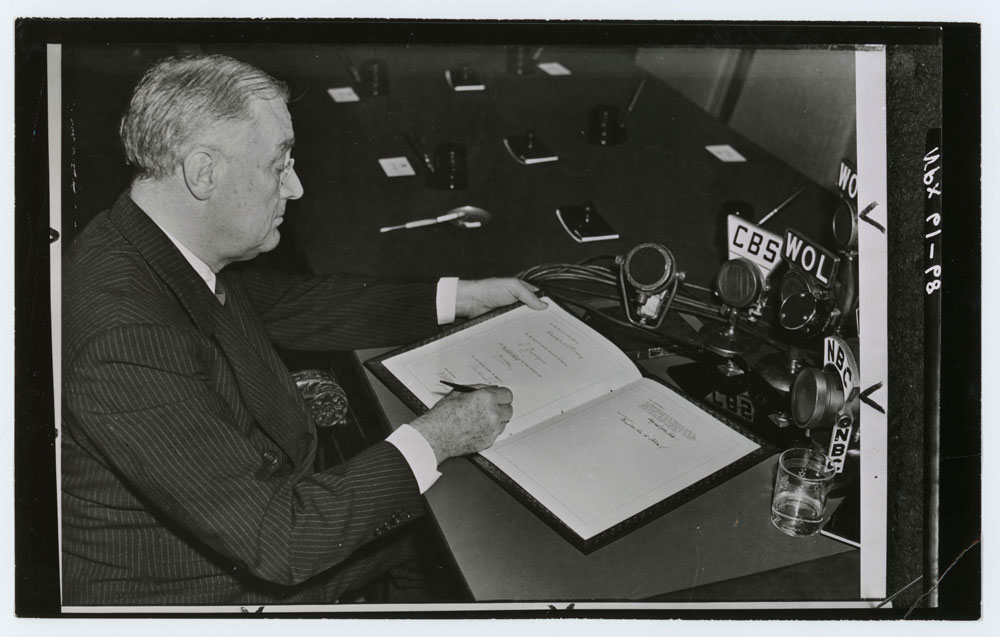
Franklin Roosevelt in Washington DC, November 9th, 1943Franklin Roosevelt in Washington DC, November 9th, 1943 (Courtesy of National Archives and Records Administration)

Think of “The U.S. and The Holocaust” as Burns, Novick and Botstein’s way of affirming our righteous role in the war while also helping us to understand the heavy toll xenophobia takes on our humanity. Most of the Holocaust’s victims were dead before American soldiers set foot in Europe, one of its experts points out.

When the United States finally entered the war, as one of the many historians consulted for the documentary points out, the war department didn’t want American soldiers to know about the mass extermination of Europe’s Jewish population. They were afraid that our G.I.s wouldn’t fight as hard if they thought they were fighting for Jews.

But this veers away from what makes “The U.S. and the Holocaust” required viewing, which is its determined focus on the everyday people living in cities across Europe before the Nazis mass murdered.  

Where most documentaries about this war or the Holocaust take a tight focus on the war machine or the ways Hitler and his general mass murdered civilians, Burns, Novick and Botstein drill down on how common and ordinary life was for these families before the Nazis came to power.

Günther Stern, the only member of his family who was able to flee to the United States before the Nazis changed their policy from deportation to extermination, remembers looking out of his apartment’s window to see his classmates marching in a parade for the SS. Eva Schloss, who survived a death camp, recalls realizing on Kristallnacht that the people throwing stones and bricks at the windows of her family’s home were her neighbors.

But the voices of those who didn’t make it, are heartwrenching. “My dear ones,” reads a note written by a Polish woman and dated June 16, 1942, “I am writing this letter before my death. . . . My hand trembles, and it’s hard for me to finish writing. Farewell.” She then signs off in the name of her family, including the youngest – a toddler “who doesn’t understand anything yet.”

Members of the Sturmabteilung or SA - a Nazi paramilitary organization.Members of the Sturmabteilung or SA – a Nazi paramilitary organization. (Courtesy of National Archives and Records Administration)
Many have pointed out the similarities between Hitler’s rise to power and that of Donald Trump and the MAGA movement. The two-hour opener makes this plain through the mere description of how the Nazi party’s numbers ballooned, enabling Hitler to take power.

His followers downplayed the most objectionable aspect of their platform, their antisemitism, to appeal to moderates. Meanwhile, they stepped up their street warfare on groups deemed unpatriotic to convince voters that civil war was imminent.

Burns likes to remind journalists that history doesn’t repeat. It echoes.

A small group of elite conservatives saw to it that Hitler became chancellor, confident that the weight of office would calm his extreme temperament – another way of claiming confidence that he’d act more “presidential.”

The producers did not create “The U.S. and the Holocaust” to be a veiled indictment of Trumpism, Republicans or the MAGA movement. They said as much at a recent Television Critics Association press conference for the documentary, which they began producing in 2015 – before Trump became president.

Back then, Botstein said, “it was impossible to imagine where we would be, not only here in America, but across the ocean and around the world.” Burns likes to remind journalists that history doesn’t repeat, it echoes through the decades and in current events for the simple fact that humanity doesn’t change all that much.  

This is why the right-wing’s xenophobia, recently on display in Florida’s Republican Gov. Ron DeSantis’ inhumane stunt of flying migrants from Texas to Martha’s Vineyard under false pretenses, isn’t original. They echo efforts made by racists in Roosevelt’s government to restrict immigration or bury emergency measures to help European Jews.


Want a daily wrap-up of all the news and commentary Salon has to offer? Subscribe to our morning newsletter, Crash Course.


World War II’s popularity and dominance in the American story should help “The U.S. and the Holocaust” draw a significant viewership, or at least one hopes that’s the case. One of the concerns raised by author Daniel Mendelsohn, whose family’s story is featured in all three segments, is that the memory of the horrific crimes against these six million Jews and hundreds of thousands of others is receding into memory.

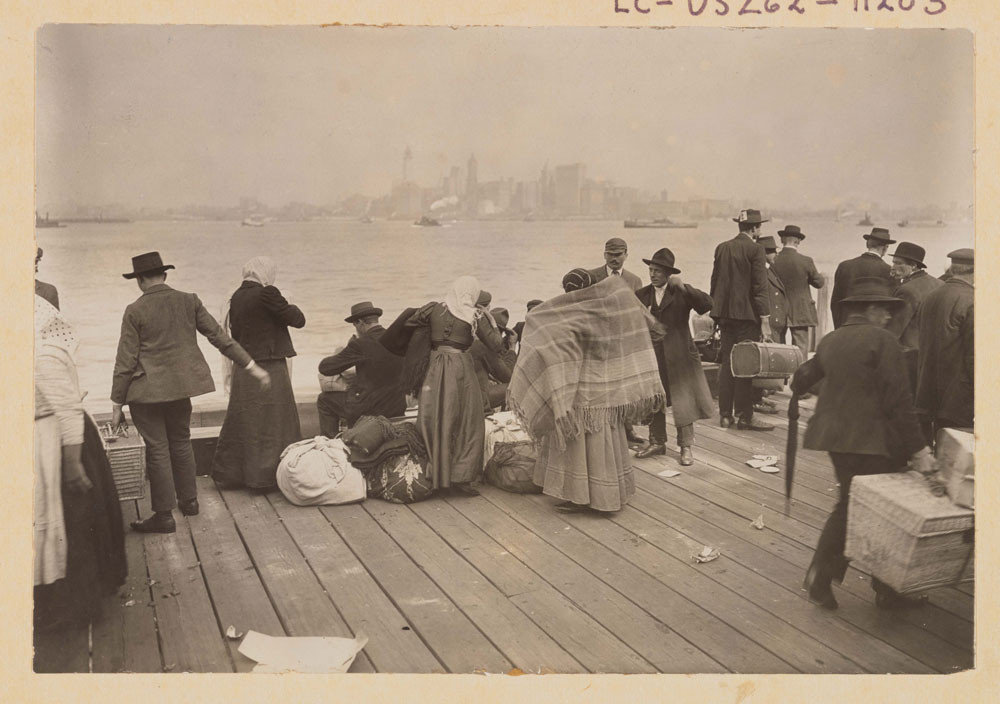
Immigrants waiting to be transferred, Ellis Island, October 30, 1912.Immigrants waiting to be transferred, Ellis Island, October 30, 1912. (Courtesy of Library of Congress)
He’s right. The internationally hailed writings of Anne Frank feature prominently in the third installment, and hearing her optimism in the face of death is fortifying. Mendelsohn also reminded the journalists covering that press conference that Frank’s face was used in a meme posted to the Facebook page for a Rhode Island sports bar during one of this summer’s heatwaves. It read, “It’s hotter than an oven out there . . . And I should know!” (When a radio host contacted the owner to ask why he did it, he only said that he thought it was funny.)

Mendelsohn went on to say that he doesn’t believe the bar’s owner thinks of himself as an antisemite . . . but this is a classic example of passive evil. “There’s no bottom, as one of my survivors said, to the things people will do to one another,” Mendelsohn says in the documentary. “The structures of what we think of as our civilized lives, they fall apart very easily. Surprisingly easily.”

How does that happen? He references the citizens who reported on their Jewish neighbors or committed violence against them directly after living beside them for years.

Waiters, people at the dry cleaners, the woman at the restaurant, “that’s who these people were,” he says. “Don’t kid yourself.”

“The U.S. and the Holocaust”  premieres at Sunday, Sept. 18 at 8 p.m. is off Monday — and continues with Episode 2 on Tuesday, Sept. 20 and Episode 3 on Wednesday, Sept. 21 on PBS member stations, PBS.org and the PBS Video app.


Salmon farming’s dirty business

Sometimes all it takes is a single photograph to change someone’s mind or inspire them to take action. For Catherine Collins and her husband Douglas Frantz, that was a photo of a yardstick plunged 32 inches into filth below a salmon farm near Port Mouton, Nova Scotia.

It led the two investigative journalists to take a deep dive into the salmon-farming industry and its dirty business. The result is their newly published book “Salmon Wars: The Dark Underbelly of Our Favorite Fish.”

Collins and Frantz, who are also the authors of several other nonfiction books, write about how salmon farming exploded into a $20 billion industry and why that threatens wild salmon, coastal ecosystems and unsuspecting consumers.

There are more than a few descriptions in the book that may leave readers with searing mental images. Here’s one: Sea lice on farmed salmon can number in the hundreds on a single fish, “so numerous that at some fish-processing plants workers use Shop-Vacs to remove them from incoming salmon.”

In an interview with “The Revelator,” Collins and Frantz explain the threats posed to wildlife, what happens to scientists and activists who challenge the industry, and whether land-based salmon rearing is a better alternative.

Why did you decide to write this book?

Catherine Collins: “Salmon Wars” may seem like an odd topic for us because neither one of us is an angler, a marine biologist, or even an environmental activist. Instead, we’re like our potential readers — simply people doing our best to eat healthy and responsibly.

That said, we do have connections to the topic that not everyone will have. My father was an avid fly fisherman. For years wild-caught Atlantic salmon was served for special occasions at our house. Sadly, our children have never known that pleasure.

Our view of salmon farms was shaped initially by a small farm that we saw go into the water not far from my parents’ cottage on the South Shore of Nova Scotia in the early 1990s. At first my parents were intrigued. They hoped that aquaculture might take some of the pressure off the dwindling numbers of wild Atlantic salmon. But they realized quickly, as the trash piled up on the shoreline and the eel grass on the seabed below the farm died, that the new technology was not the answer. In fact, it could represent a new threat to wild salmon.

Doug Frantz: Fast forward a couple decades. In January 2020 we went to a public meeting in Mahone Bay, Nova Scotia, a few minutes from our home. A group called the Twin Bays Coalition had sounded an alarm about plans by two multinational salmon-farming companies to locate more than 20 new open-net-pen farms along our coast.

By then salmon farming had grown into a $20 billion industry, and so had evidence of environmental damage from open-net farms. About 400 other people crowded into the community hall and spilled into the corridors that day to hear warnings from environmentalists, lobster fishers, businesspeople and ordinary folks.

We have spent our careers investigating and reporting for newspapers, government and law firms. So we did what we do — we investigated.

We were surprised, and continue to be surprised, by how little people know about the salmon they’re buying in markets or eating in restaurants. Honestly, smart people have no idea about the environmental harm caused by open-net salmon farms or the potential health risks from eating fish that might contain contaminants. This is one of the factors that compelled us to write “Salmon Wars.”

What are some of the ways that salmon farming can harm wild salmon and other wildlife? 

Frantz: Open-net salmon farms are floating feedlots. Each farm generally consists of 10 to 12 cages, also called pens, made of tough plastic netting to allow the ocean currents to flow through while keeping out predators. Each cage holds up to 100,000 fish and a site can contain a million salmon.

The excrement, excess feed and chemical residue from a single farm can equal the waste produced by a town of 65,000 people, according to one study. But a city’s sewage is treated, while a salmon farm simply allows its waste to drift to the seabed, creating a toxic stew that can damage marine life for hundreds of yards.

These farms are often located on wild salmon migration routes. The logic of the salmon farmers is that a good environment for a wild salmon is a good environment for its farmed cousin.

That’s just not true. These farms spew parasites and pathogens that are a proven threat to wild salmon, particularly young salmon as they migrate from rivers to the ocean. One of the biggest threats is from tiny sea lice that attach to those migrating juvenile salmon. It doesn’t take many of these parasites to kill a young salmon.

In addition to the persistent incremental environmental damage, there is a concern about the chance of a catastrophic event — such as the 2017 collapse of the Cooke Aquaculture salmon farms near Cypress Island, Washington. A scathing report by the three Washington state agencies found that the company falsely blamed the collapse on a solar eclipse when it was the company’s own negligence that led to the collapse. In the days after, 250,000 farmed Atlantic salmon escaped into the Puget Sound, competing with the native Pacific salmon for food, threatening native fish with the diseases rampant in the farm environment and potentially interbreeding with the native wild salmon.

Most North Americans likely don’t know that their farmed salmon could have an impact on people as far away as West Africa. Can you explain why?

Collins: Salmon are carnivores and the main ingredient in their feed is small forage fish, such as sardines, anchovies and mackerel. In the early days of aquaculture, it took as much as three pounds of wild fish to grow a pound of farmed salmon. Advances in fish meal production has improved the feed ratio but as salmon farming has grown dramatically around the world, so has demand for wild forage fish.

The impact is clearest along the 3,400-mile Atlantic coast of West Africa, where huge trawlers scoop up thousands of tons of these small fish for processing into fishmeal and fish oil to feed salmon that wind up on dinner tables in wealthier countries.

For Africans, this has been a disaster. The United Nations says half the fish stocks off West Africa are overfished and at risk of collapse. And 40% of these trawlers are operating illegally. Subsistence fishermen have seen catches drop sharply. Women who process and sell the fish in local markets can no longer make a living. And food insecurity is increased in one of the world’s poorest regions.

Do you see similarities with the salmon farming industry and the tobacco or oil industries? 

Frantz: We aren’t arguing that eating salmon is as bad for your health as smoking or as bad for the climate as fossil fuels. But there are other parallels.

In the early 1950s tobacco industry scientists discovered links between smoking and cancer. For decades, the industry covered up its findings and waged a war to discredit independent scientists and other critics. The oil and gas industry has tried to shift the blame for the climate crises to individuals, hiding behind slick advertising and captive politicians.

Similarly, big salmon farmers disparage scientists who point out the health and environmental risks from farmed salmon and try to discredit critics. We tell the stories of several people who challenged the salmon farming giants and wound up losing their jobs or facing lawsuits.

Salmon farmers sell their product as naturally raised and sustainable. Last year a federal judge in New York approved a settlement in which Norway’s Mowi ASA, the world’s largest salmon farmer, paid $1.3 million for deceptive advertising, and agreed to stop claiming its Ducktrap brand of smoked salmon was “sustainably sourced,” “all natural” and “from Maine.” This should be seen as a critical moment for the entire industry, and for responsible consumers.

Salmon farming can be reformed, if the public demands that its salmon is raised in healthier, environmentally friendly ways. The fact is that salmon farming, as it has been practiced until recently, is a freeloading business. In most countries salmon farms use the coastline and the water with impunity, paying little to lease the sites and nothing to clean up the damage they cause. In a single-minded pursuit of profit, the multinational corporations behind salmon farming exploit public resources and ignore public health.

Does salmon farming have a future and if so, what would a healthy one look like?

Collins: We think it does. There are three steps necessary to make that happen.

First, consumers need to understand the risks and rewards from eating farmed salmon. That means greater transparency from grocery stores, restaurants and salmon farmers. Something like a QR code on salmon should disclose where and how it was raised and list the chemicals in the water and feed.

Second, individual responsibility should be translated into coordinated action. Educated consumers can team up with environmental groups, scientists and government reformers to build a movement that demands that salmon farmers protect the environment and ensure the health of the fish they sell.

Third, governments in salmon-farming countries should stop favoring the economic interests of the industry over protection of the environment and public health.

The industry justifies itself by saying it plays an essential role in feeding the world. But there are better ways to provide the protein the world needs. One technology with the capacity to upend the status quo is recycled aquaculture systems (RAS). These facilities raise salmon on land in large tanks using filtered and recycled water. They don’t need excessive chemicals or antibiotics because the water quality is controlled. And they don’t threaten wild salmon or other marine life because the fish never touch the ocean.

One issue that even RAS plants haven’t solved is the feed. Using ground fishmeal from small fish means farmed salmon is inherently unsustainable, both in open-net pens on the ocean and giant tanks on land. New types of feed are being developed as alternatives to small fish and governments should support these efforts and consumers should vote with their pocketbooks by demanding the healthier, environmentally friendly salmon grown in RAS facilities.

Here’s the bottom line: Options exist to the open-net salmon farms that dominate our supply chain today. Change depends on the actions both of our governments and regulators, but just as importantly, consumers. Change will come when individual decisions are transformed into public demands, regulatory action and a responsible salmon-farming industry.

We can choose a better way and still feed the world.

Why housing advocates oppose a new California law designed to help the homeless

Tens of thousands of people lack access to housing in California. Streets strewn with tents have become ubiquitous across the state as the cost of living rises and wages stagnate. For months, California Gov. Gavin Newsom has been touting a solution: forcing unhoused people with mental health conditions into treatment.

While some groups have opposed this plan since its conception — including Disability Rights California, the American Civil Liberties Union of California, the Drug Policy Alliance and Human Rights Watch — they were unable to stop its passing. On Wednesday, Sept 14, Newsom signed SB 1338, the Community Assistance, Recovery and Empowerment Act (CARE) into law. The CARE Act incorporates a court system targeting people with schizophrenia and other psychotic disorders, who may also have substance use disorders.

Newsom’s office is describing the program as a “paradigm shift” — but some advocates say that shift is in the wrong direction.

Already, unhoused people with severe mental health disorders can be involuntarily held in psychiatric care, but only for three days. They can leave only if they promise to take medications and make certain appointments. Using a court order, the CARE Act extends that period for up to a year, which can be extended to two years.

Family members, service providers and first responders — including paramedics or police officers — are among those legally able to file a petition with CARE court. If facing criminal charges, the individual could avoid punishment by enrolling in a mental health treatment plan. A judge could then order someone into treatment, including housing and medications.


Want more health and science stories in your inbox? Subscribe to Salon’s weekly newsletter The Vulgar Scientist.


“With overwhelming support from the Legislature and stakeholders across California, CARE Court will now become a reality in our state, offering hope and a new path forward for thousands of struggling Californians and empowering their loved ones to help,” Newsom said in a statement.

“This law violates a person’s right to self-determination and violates people’s right to choose how they want to and need to address their problems,” Sam Tsemberis told Salon.

It’s a first-of-its-kind law in the United States, but some other states have laws that share elements of the plan. The CARE Act was drafted by Senator Thomas Umberg (D-Santa Ana) and Senator Susan Talamantes Eggman (D-Stockton.) It goes into effect next year, but only in seven counties: Glenn, Orange, Riverside, San Diego, San Francisco, Stanislaus and Tuolumne.

Newsom’s office is describing the program as a “paradigm shift” — but some advocates say that shift is in the wrong direction.

“This law violates a person’s right to self-determination and violates people’s right to choose how they want to and need to address their problems,” Sam Tsemberis told Salon in an email. Tsemberis is the founder and CEO of Pathways Housing First Institute, a non-profit founded in 1992 that originated the Housing First model for addressing housing access. He characterized the law as politically motivated, citing Newsom’s alleged bid for U.S. president, and designed to appeal to voters “tired of seeing homelessness.”

“Based on my clinical experience and research comparing voluntary and involuntary court-mandated treatment programs, it is very clear that better outcomes are achieved when treatment is voluntary, trauma-informed, and compassionate,” Tsemberis said, adding, “This law will not have any impact on reducing homelessness because it does not provide funding for housing.”

Meanwhile, homes for people with severe mental illness are rapidly closing, with at least 96 facilities closing since 2016, according to the Los Angeles Times. In January 2020, the U.S. Interagency Council on Homelessness reported California has 161,000 people experiencing homelessness, including 7,600 students. The CARE Court program is estimated to help 12,000 people, Newsom’s office claims.

But the fact that police can intervene in these situations has alarmed some advocates. “Law enforcement and outreach workers would have a new tool to threaten unhoused people with referral to the court to pressure them to move from a given area,” Human Rights Watch said in April.

“Newsom’s ‘CARE’ Courts bill will not stop homelessness and it will not stop our mental health crisis,” James Burch, deputy director of the Anti Police-Terror Project, said in a statement, citing statistics that people with untreated mental health disabilities are 16 times more likely to be killed by law enforcement. The San Francisco Chronicle recently reported that nearly 1,000 people have been killed by California police in six years.

“The last thing that unhoused, the mentally ill and those struggling with addiction need is more surveillance that subjects them to being targeted by the police. The only real solution is permanent housing, access to adequate health care and community support,” Burch said.

Burch also said that the CARE Act would exacerbate systemic racism.

“Less than 7 percent of the state’s residents are Black, but Black people make up 40 percent of the state’s unhoused population,” Burch said. “It’s clear that ‘CARE’ courts will continue this country’s legacy of disproportionately policing and caging Black people. ‘CARE’ Courts will be a stain on Newsom’s legacy as future generations will ask how such an attack on human rights came to pass.”

Tsemberis suggested an alternative to the CARE Act, emphasizing his belief that housing is a basic human right and self-determination is the “best road to recovery.”

“The Pathways Housing First program is very effective in ending homelessness for people struggling with mental health and addiction issues,” Tsemberis said. “There are more than two dozen randomized-control studies reporting that participants in Housing First programs achieve 85 percent housing stability compared to 40 percent for programs that mandate sobriety and abstinence before offering housing.”

The CARE Act comes in the face of a bill Newsom vetoed last month that would have authorized supervised consumption sites, which are services that prevent overdose deaths by allowing drug use under medical supervision. New York opened two such sites recently, preventing more than 400 overdoses from becoming deadly so far. Such services are frequently used by unhoused people and have existed for decades in other countries without anyone ever dying at one.

“The same dysfunctional and non-scientific approach we take with homelessness is also evident in the way we address other public health problems,” Tsemberis said. “This CARE Court law is playing politics with the lives of people with serious addiction problems who will remain homeless.”

Save America rally in Ohio included a QAnon theme song and one-finger salutes

During Trump’s speech in support of J.D. Vance at the Save America rally held in Youngstown, Ohio on Saturday, members of the crowd raised their hands in a one-finger salute. As this was happening, a song called “WWG1WGA” played overhead — shorthand for “where we go one, we go all,” a slogan used by members of QAnon.

As Salon coverage from earlier this week points out, Trump has “expressed his explicit support for QAnon – which promotes the idea that Trump is the savior of the American people” – by sharing a photo of himself “wearing a Q lapel pin, with the QAnon catchphrases “The Storm is Coming” and “WWG1WGA,” on his Truth Social account.” In June it was also widely reported that he publicly endorsed QAnon conspiracy theorist J.R. Majewski for a seat in the U.S. House of Representatives via Ohio’s 9th Congressional District.

“This is the week when Trump became QAnon,” says CNN Analyst Juliette Kayyem on Twitter along with a video clip from Saturday’s rally. “This isn’t a political statement; it just is, however disturbing. Week began with images of Trump on Truth Social wearing a Q pin and promoting their slogans; it ends with Q music and the Q “one” sign by crowd at his rally.”


Want a daily wrap-up of all the news and commentary Salon has to offer? Subscribe to our morning newsletter, Crash Course.


“We are a nation in decline,” Trump said in his Save America speech. “We are a failing nation. We are a nation that has the highest inflation in 50 years and where the stock market finished the worst first half of the year since 1872. Likewise, we are a nation that has the highest energy costs in its history. We are no longer energy independent or energy dominant as we were just two years ago.”

As Trump spoke these words slowly, as though reading a poem, “WWG1WGA” played in the background. Seemingly moved by what they were hearing, many people began to raise an arm, and then a single finger, in salute. 

“We have a president who is cognitively impaired, and in no condition to lead our country; which may end up in WWIII,” Trump continued in his speech. “We are a nation that no longer has a free press and has no fair press any longer. Fake news is all you get, and they are truly the enemy of the people. We are a nation where free speech is no longer allowed. Where crime is rampant like never before.”

At this part of the speech, a woman wearing a MAGA cap seated in the crowd directly behind Trump can be seen – eyes closed and hand in the air – muttering words to herself as though praying.

Amidst anti-Biden sentiments, railing against the news and bashing the current economy, Trump also worked in hints to a possible run in 2024.

“After what happened and watching our country go to hell, we may have to do it again,” he said to the crowd.

I voted for Trump — twice. I was a right-wing pundit. I was dead wrong about all of it

I voted for Donald Trump four times and Ron DeSantis twice, counting Republican primaries and general elections. I used to be an in-demand political pundit for Republican/conservative media; my work and writing appeared on sites and radio shows listened to or read by millions of Americans: Fox News, the Federalist, Real Clear Politics and elsewhere. I had frequent public speaking engagements. I was writing the obligatory hyper-partisan, fire-breathing book that was expected of somebody in my position. It was going to get me my own prime-time TV opinion show and professional podcast. I had a publisher interested in my manuscript. 

That has all changed. Now I will solely vote Democrat, in the national interest of mercy-killing the Republican Party. How, and why, did I get here? 

To be clear, I am not a registered Democrat. In Florida, where I live, I’m a registered NPA — No Party Affiliation, or independent. Millions of us have an opportunity to make history in November, and beyond, by forming unlikely but necessary alliances to defeat Republicans in every election at every possible level — from Congress to governors’ mansions to state legislatures, county and city offices and school boards.  

Does this mean I agree with all the Democratic Party’s policy positions? Absolutely not, and that’s exactly the point — this moment of necessary unity will require those of us to come together who have legitimate disagreements on policy, but who concur that the GOP is leading our beloved country, and numerous of its states, to the slaughter.

Our nation has a long history of unprecedented partnerships, all of which were considered requisite in the continued pursuit of perfecting our Union and maintaining our position as the greatest bastion of liberty in the world: 

  • Alexander Hamilton convinced his fellow Federalists to vote for Thomas Jefferson over Federalist Aaron Burr in the disputed 1800 presidential election — a  decision that cost Hamilton his life; 
  • Abraham Lincoln decided to crush the Confederacy with four years of gruesome bloodshed, although he desperately wanted to preserve the Union at any cost. That agonizing decision to wage total war against fellow Americans brought the slavery era to an end, saved America from irreparable damage — and also resulted in Lincoln’s assassination; 
  • The U.S. joined forces with the Soviet Union in World War II — an almost impossible alliance between opposed ideological forces that was necessary to  conquer the Nazis; 
  • Many Republicans in the House and Senate supported President Lyndon Johnson’s signature achievements, the Civil Rights Act of 1964 and the Voting  Rights Act of 1965, over the objections of many racist Southern Democrats; 
  • Bipartisan support for the resignation of President Nixon: Ultimately it was his fellow Republicans, led by Sen. Barry Goldwater, a conservative hero, who made clear that if Nixon did not resign, he would be impeached and removed in a Senate trial; 
  • Many Democrats rallied around President George W. Bush in the aftermath of the 9/11 terrorist attacks — even if some of them would like to deny or forget that now.

I believe our current epoch presents us with a moment similar to the aforementioned historic events — a moment in which America faces yet another existential  challenge. 

*  *  * 

I supported Trump — really and truly. I believed a Hillary Clinton presidency (and, four years later, a Joe Biden presidency) would mean the end of America.

I supported Donald Trump. I really did, and without much reservation. I believed the fallacy that a Hillary Clinton victory (and, then, four years later, a Joe Biden victory) would mean the end of America and the start of permanent Democrat rule over our nation. I was attracted to Trump because he incurred almost equal levels of ire, at least at first, from both of our major parties. My first-ever vote in a presidential election was in 2000, for Ralph Nader, and I saw in Trump some of those same maverick qualities.  

During Trump’s presidency, I adopted — and vigorously preached — the right-wing gospel: Democrats were importing foreigners to win elections forever; leftists were coming for our guns; nationalism was patriotism; there was a shadowy network of censors whose teleological purpose in life was to suppress Republican or conservative points of view; predatory men were using women’s bathrooms everywhere; and, of course, Barack Obama was the worst president in history and made Jimmy Carter look like George Washington. 


Want a daily wrap-up of all the news and commentary Salon has to offer? Subscribe to our morning newsletter, Crash Course.


I’m here to tell you that I was wrong. I was wrong about all of it. Acknowledging my errors in judgment was the start of my own personal healing process, after I came to realize that my extreme partisanship and dehumanizing of Democrats were the results of my own self-inflicted political traumatization. 

For the first year after the Jan. 6  insurrection, I was in the camp of, “Yeah, it was bad but it’s being overblown.” Then I began to look at the event more objectively, started to learn more about how many of the participants were radicalized, and continued to witness Trump traumatize the nation with his stolen election lies. I say — with no qualms and no fear of being hyperbolic — that Trump is the most  politically traumatizing figure in American history. His “rigged and stolen election” is the new version of the Confederacy’s “Lost Cause.” 

There was another event in my journey, however, which acted as a kind of healing accelerant for me, once the shock wore off. When COVID hospitalizations for children began to skyrocket here in Florida last summer, during the delta surge, I told other Trump and DeSantis voters that our governor would divorce himself from the COVID-deniers and the spreaders of vaccine disinformation. As you probably know, he didn’t do that. Instead, DeSantis quadrupled down on undermining the vaccine and undoing health precautions. 

When COVID hospitalizations for children began to skyrocket here in Florida, I told other Trump and DeSantis voters that our governor would surely divorce himself from the virus-deniers and vaccine truthers. 

Up until that point, I’d had a favorable impression of DeSantis; he seemed like a mostly drama-free purple-state governor who was genuinely interested in the hard work of governing and policymaking. The “new” DeSantis shocked me. I came to realize that he had sold his soul to keep those in the thrall of the GOP’s pandemic nonchalance, hysteria and paranoia stuck in self-perpetuating and self-exacerbating cycles of unhealed political trauma. As a father of two young daughters, I found DeSantis’ Molochian offering — to propitiate those with little to no regard for life or the suffering of others — behavior unworthy of anyone’s vote. Such a spectacular failure in leadership is rare, from any political figure of any party.

 My new organization, Listen. Lead. Unite., is dedicated to healing America’s political trauma by bringing together communities and elected leaders to collaborate on nonpartisan economic, educational and quality-of-life  solutions. There is an immense amount of work ahead of us, and I say this with no pleasure: Our nation is about to endure the kind of tumult none of us has ever lived through, and the best time to commence trying to heal is right now. 

 We Homo sapiens are a binary species; I believe Americans deserve a healthy two-party system. But the bedrock foundational principles of a functioning two-party system must include the rule of law — in the famous formulation, we are a government of laws, not of humans — and the peaceful transfer of power, not just from one president to another, but at all levels of elected office. 

In my view, the Democratic Party is relatively healthy, although it has two major blind spots: It takes for granted many historically Democratic voting blocs — such as religious minorities, LGBTQ citizens and Black and Latino voters — and it almost entirely ignores rural America. In contrast, the Republican Party is terminally ill, and its leadership knows that; that’s why they have staked a path forward that is, well, backward, with increased emphasis on everything male/Caucasian/Christian and heterosexual. 

The question before us now is whether, after 246 years of incremental and sometimes painful progress, we begin to cede ground and go backward. Or will we continue to shape our destiny in the vision of our founders, whose blueprint for our republic made clear that the maintenance and expansion of a free nation was rigorously difficult, but was both our birthright and our mandate? That will require cooperation, flexibility and sacrifice. 

We must heal our nation by re-establishing a resounding majority in favor of democracy — a majority that leaves no doubt that, when history calls, Americans of diverse views and backgrounds will answer the call by conjuring the better and  braver angels of our nature.

As I said above, America needs and deserves a robust two-party system. But to get there, and to carry on our blessed experiment in self-governance, one of our current political parties — the one I supported for many years — must be put out of its misery.

“House of the Dragon”: The assassination of Rhaenyra’s character

The world of “Game of Thrones” has never been great about consent. HBO’s “House of the Dragon” seems poised to have inherited (or technically, passed on, as the show is a prequel) that queasy legacy. The first of George R. R. Martin’s television adaptions was marked by sexual violence and exploitation.

The creators of “House of the Dragon” swore a fresh slate. But we don’t forget so easily. And it must be hard for the story to learn new tricks, as Episode 4 puts the evil in medieval, the dark in Dark Ages, and the bored in bordello. If you’ve been paying attention, you know incest is coming in the story but it’s still nauseating in the episode, titled “King of the Narrow Sea,” when Uncle Daemon (Matt Smith) takes his young niece Rhaenyra Targaryen (Milly Alcock) to a brothel and starts to seduce her

Daemon never asks permission (that’s for losers like House Stark) for anything he’s done, so perhaps it’s unsurprising that when he abruptly leaves her, mid-seduction, the princess proceedes to go home and have sex with Ser Criston Cole (Fabien Franke). Like her uncle, she does so without asking for consent, without asking anything. Not only that, but the older knight seems hesitant, downright reluctant, a reticence no doubt informed by the fact that the Kingsguard are supposed to be celibate. Does he feel as if his position is on the line? Does he have the right to say no to a princess? 

Welcome to the first erosion of Rhaenyra’s character, a destruction that proceeds as quickly and devastatingly as a figure from the King’s model town, smashed to bits. What happened to the so-called strong woman of “House of the Dragon”? She doesn’t live here anymore. 

Salon’s Melanie McFarland has written of some viewers’ nauseating approval of the uncle/young niece couple. One thing behind that approval may be the idea that by taking control of her sexuality, Rhaenyra is owning it. This girl knows what she wants, etc. etc. But Rhaenyra is not taking control of her sexuality. Her older uncle is taking control of it for her, leading and molding her like a dragon he’s trained.

Rhaenyra is not a creature to be broken, yet he treats her that way, with a downright collar. Could he be more transparent? Frustratingly, Rhaenyra puts up with it. She might not understand she’s being taken advantage of by someone with years and power over her, but worse of all, she seems suddenly to crave it. The notion that a young girl would become sex-crazed after one night at a brothel with her creepy blood relation is offensive at best, and to connect a female character’s strength to her sexuality is shoddy character development. Rhaenyra was strong before she forced a celibate knight to have sex with her. She rescued a dragon egg. She killed a wild boar. Sex doesn’t make her strong. Strength makes her strong.

House of the DragonEmily Carey and Milly Alcock on “House of the Dragon” (Ollie Upton / HBO)But that strength seems to be waning, as does her intelligence. After her wild night, Rhaenyra lies to Alicent (Emily Carey), previously her best friend and frankly, the only character in the whole kingdom she has any chemistry with. She puts the blame on Alicent’s father, Otto Hightower (Rhys Ifans). 

One should never trust a celibate knight to bring the birth control

His slimy character is nothing to write home about, but it’s not like Rhaenyra to lie, especially not so boldly and dastardly, knowing her deceits will purposefully cause harm to another. If she doesn’t care about Hightower, she does care for his daughter. It’s not like Rhaenyra to hurt someone or something on purpose. The white hart chose her, and she was merciful enough to spare it. She swallowed her pain about her father marrying her friend, soon after the death of her mother. She did what was best for her family and protected others, including their feelings.

House of the DragonMilly Alcock and Fabien Frankel in “House of the Dragon” (Ollie Upton / HBO)But Rhaenyra becomes irresponsible in a way wholly unlike the level-headed, caring and determined character, from small actions (reaching for a dagger in a fire) to big, such as failing to take steps before sex to prevent any “unwanted consequences.” Yes, those steps existed even in pretend medieval times, and one should never trust a celibate knight to bring the birth control. 
Perhaps this character assassination is softening the blow for when the young actor will be taken from us.

Another example of Rhaenyra’s eroding character is her quick agreement to marry the young man her father chooses. She agrees like it’s no longer a big deal, all the fight — or caring — gone from her. All the fire extinguished. This from the brazen character who walked out on a hall full of waiting suitors, who left them behind without explaining herself or apologizing and boarded her damn ship. Where did that girl go?


Want a daily wrap-up of all the news and commentary Salon has to offer? Subscribe to our morning newsletter, Crash Course.


Perhaps this character assassination is softening the blow for when the young actor will be taken from us. After just one more episode, Rhaenyra (along with Alicent) will be played by a different, older actor. It will be a loss without the fierce performances of Alcock and Carey who we’ve grown to love, both better than their material, soaring above the trite dialogue like those dragons. But maybe that’s for the best. The strong young woman we knew is gone. 

“House of the Dragon” airs Sundays at 9 p.m. ET on HBO.


The untold story of the struggle for disability rights in America

As I spoke with historian and journalist Phyllis Vine, I kept thinking of Howard Zinn.

The acclaimed historian is most famous for his 1980 book “A People’s History of the United States,” which almost unique among historical works of its time explored major events from our past by analyzing the actions of ordinary people — not just those of the rich and powerful. It also had the audacity to foreground those vulnerable people who were harmed by the rich and powerful, making them central rather than peripheral characters in the American narrative. In her new book “Fighting for Recovery: An Activists’ History of Mental Health Reform,” Vine follows in Zinn’s footsteps by likewise using a ground-up rather than top-down approach.

The key difference is that, in Vine’s case, the specific subject is disability rights advocacy in the United States during the late 20th century. The result is a text that takes one of the central mottos of disability rights activists — “Never about us, without us” — and effectively practices it as it endeavors to share the stories of those very same people.

“I was in graduate school at the same time that historians were discovering the voices of the people on the ground,” Vine told Salon. “I learned that it was much more important to know what the experience of slavery was like not from high above from the white men talking about slavery, but from the actual experience of people who were in chains.”

Vine added, “I came of age as a scholar during the women’s movement.”


Want more health and science stories in your inbox? Subscribe to Salon’s weekly newsletter The Vulgar Scientist.


In “Fighting for Recovery,” Vine shares the stories of patients and activists struggling with disabilities that include schizophrenia, depression, addiction issues and more. Starting in the 1970s and continuing over the following half-century, Vine — a former Sarah Lawrence College faculty member and founding member of the New York State chapter of the National Alliance on Mental Illness (NAMI) — traces the individual journeys of patients and reformers alike. While doing so, Vine finds an important narrative thread that unifies her work and allows it to make an important contribution to the historical literature.

Specifically, she identifies how the word “recovery” has evolved along with population conceptions of disabled individuals’ rights. At first, the term was strictly used to refer to addictions, and was applied in a way that empowered medical professionals more than anyone else. Over the years, however, disability rights activists such as the Section 504 protesters in 1977 changed the game.

As far as [Reagan] was concerned, being hospitalized was the equivalent of going to some kind of a hotel. It was where people luxuriated.

“Recovery isn’t either/or,” Vine explained to Salon. “It’s not like a broken bone. It’s not like reducing high blood pressure. Recovery is a process. And it’s a process that speaks to not only a political identity, but it also speaks to a personal identity.”

It also, Vine clearly establishes, speaks to each individual’s own unique set of goals.

“For some people, recovery meant they could resume life pretty much where it had been paused, in the midst of an education, a career, or a family plan,” Vine writes in “Fighting for Recovery.” “Most would learn how to chart a course managing their symptoms as they set out to achieve their goals; some would struggle more, take longer, and have to modify their goals and aspirations.”

Even today, many medical professionals resist the idea that they should surrender control over what counts as “recovery,” and instead rely on patients’ own self-knowledge. Back in the 1970s, that task was even more monumentally difficult.

“It is initially something that represents a challenge to psychiatry and the medical model,” Vine told Salon. “It finds problems in the medical model, which in effect is a model of control. It’s a model that says we know best. People in recovery were challenging that because they were saying that what the doctors were saying, what the psychiatrists were saying, what the hospitals were saying, that doesn’t fit me.”

In another important contribution to the existing literature, Vine also shines a spotlight on people among the rich and powerful who are frequently overlooked as heroes for disability rights. For instance, while President Jimmy Carter is rightly hailed for his work on behalf of disabled individuals, his First Lady Rosalynn Carter is often cast over — and unfairly so.

“When we talk about Jimmy Carter, what we really have to talk about is the power, the moral authority and the commitment of his wife, Rosalynn, for whom this was not just an exercise, but a passion,” Vine told Salon. She recalled how Rosalynn became passionate about disability rights before Carter’s governorship in Georgia, during which time his cousin developed a mental illness and was sent to the Georgia state hospital.

“It’s a model that says we know best. People in recovery were challenging that because they were saying that what the doctors were saying, what the psychiatrists were saying, what the hospitals were saying, that doesn’t fit me.”

“When he was governor, she approached her responsibility as the first lady of Georgia as having something to do that she found compelling, and she decided to work on improving mental health conditions in Georgia,” Vine expressed with admiration. “By the time they got to Washington, she was really well prepared to assume the leadership of reforming mental health in America.” This ranged from urging the president to heed a 1977 Government Accounting Office report  saying the government had to do more to help people being dumped out of mental hospitals to pushing for legislation like the Mental Health Systems Act of 1980.

Yet once Carter had left the White House, America was left with a very different type of leadership — that offered by President Ronald Reagan. In true Zinn-ian fashion, Vine’s book doesn’t hesitate to rip a beloved American leader down from a pedestal in order to relay the facts.

“Ronald Reagan comes from an entirely different mindset as governor of California,” Vine explained. “He made it clear that he did not have much regard for the needs of the Californians who were hospitalized in these vast overcrowded fire traps. As far as he was concerned, being hospitalized was the equivalent of going to some kind of a hotel. It was where people luxuriated. His appreciation for the lives of people with needs and wants was sorely compromised.”

This spilled over to his presidency, during which he rolled back the Mental Health Systems Act, repealed laws and regulations to help disabled people and cut funding for programs that couldn’t be outright eliminated. He did this because he viewed them “as not only unnecessary but as a gesture to people who are users, users of a system. He had all sorts of contempt for people with disabilities, people with needs other than he could understand, and that contempt was up and down the socioeconomic ladder.”

Vine concluded, “Reagan threw the entire weight of the federal government into the road, blocking access for people with disabilities or mental illness.”

Northeast drought endangers Massachusetts’ cranberry harvest

Peter Hanlon, a 68-year-old farmer from Boston, has been growing cranberries in Cape Cod, Massachusetts, for decades. Cranberries are in Hanlon’s blood — his grandfather farmed them on the cape before him. But six weeks ago, Hanlon sold his farm in the town of Sandwich. None of his kids wanted to carry on the tradition, and Hanlon doesn’t blame them: Profit margins are incredibly tight, and increasingly erratic weather patterns in recent years have made cranberries more difficult to grow. 

 “The last two storms, in ’15 and ’17, scared me,” Hanlon said. He recalls seeing an 11-foot surge of ocean water coming into his farm through the woods and inundating his vines, dooming many of them to die from salt exposure.

Cranberry farmers in Massachusetts have had to contend with wildly fluctuating environmental conditions over the past several years. The 2015 and 2017 storms Hanlon referred to killed some coastal Massachusetts cranberry bogs when they flooded them with sea water, extreme temperatures and drought parched vines in 2020, and a deluge of rainfall pickled the state’s cranberry crop last year, leading to a nationwide shortage. Massachusetts is the second-largest producer of cranberries in the nation behind Wisconsin, which also had a bad growing season last year.

This year, another massive drought, fueled by climate change, has farmers like Hanlon weighing their options and making tough decisions. 

Massachusetts and much of the rest of the Northeastern United States has been in a state of moderate to extreme drought for the better part of the summer. Dry conditions descended on the region in late spring and didn’t let up for months. Massachusetts dealt with some of the worst drought in the Northeast: As of the end of last month, 10 of its 14 counties were experiencing extreme drought, and the remaining four were experiencing severe drought. “The boom or bust scenario that climate change presents when it comes to precipitation events — the boom being the large precipitation event, the bust being long dry spells — that’s not a good thing,” Zachary Zobel, a scientist at the Woodwell Climate Research Center in Massachusetts, told Grist. 

The Massachusetts drought has begun to ease in recent weeks, especially after this past week, when a round of soaking storms rolled into the Northeast. But it may take another round or two of wet weather to make up for the months of drought that desiccated farm fields, depleted reservoirs, and sparked wildfires in the Northeast. And this year’s drought is more evidence that farming conditions are getting less predictable.

“Farmers wake up every day and they have to face whatever the weather is going to present to them — that’s farming,” Brian Wick, executive director of the Cape Cod Cranberry Growers’ Association, told Grist. “But it’s quite clear in talking to many growers over the past several years that this change in climate is very real and it’s really starting to impact how they farm.”

Cranberries are a finicky crop. Too much water, like the state saw last year, can cause fungus to grow on cranberry vines and affect the color and quality of the fruit. But add too little water, and the vines shrivel up and die, or the berries don’t grow to full maturity. 

Farmers also need access to ample fresh water in order to protect and harvest their cranberries. Cranberries grow on vines in dry fields much like grapes or any other crop during most of the growing season. But twice a year, farmers flood those dry fields with water and turn them into bogs: In the spring, when a late frost might threaten to kill their budding cranberry vines, the flooding protects the tender shoots and flowers from freezing over. In the fall, farmers turn on their irrigation systems again to harvest their berries. They use machines to shake the plants to release the berries into the bog, where they’re corralled into containers and shipped to destinations across the country. 

Without water, there are no cranberries. And without cranberries, Massachusetts misses out on an industry that contributes approximately 7,000 jobs to its economy and more than $1 billion in annual economic activity to the region. 

So far, it looks like most cranberry farmers are going to pull through this year, thanks to the recent storms and to irrigation pumps, which farmers switched on throughout the season to pull water from local sources and make up for lost rainfall. But it was a more expensive growing season for that reason — pumps run on gasoline or propane, and fuel costs were astronomical this summer. And the drought isn’t over yet. Wick won’t breathe easy until the berries are off the vines and loaded into trucks. “We’ll see what we get for rainfall over the next few weeks,” he said. “We still have about a month before harvest to get some periodic rains.” 

In general, climate change isn’t stopping the state’s cranberry farmers from growing their crop — yet. “Cranberries in Massachusetts will continue to thrive,” Wick said, “but it’s going to be more challenging and difficult, and they’re going to have to adapt. You’re not going to have that nice, consistent growing season, it just seems to be one extreme or another.” 

Peter Hanlon, the cranberry farmer who sold his farm, said he’s glad he’s not trying to beat the weather odds this year or in the future. “My son tells me the weather is going to get worse,” he said. But the weather has already been so bad, Hanlon says, it’s hard to imagine an even more erratic season. “I reserve judgment on that,” he said.


This story is part of the Grist series Parched, an in-depth look at how climate change-fueled drought is reshaping communities, economies, and ecosystems.

The unnatural history of Elvis Presley’s hair — as seen in the Baz Luhrmann biopic

Over at the Culture desk, some of our favorite recent pieces to write have been about character. From Susie on “The Marvelous Mrs. Maisel” to Hope on “Virgin River” to Pumpkin the dog on “The Gilded Age,” a big personality can carry a show a long way. Sometimes, that personality comes in an unexpected form. 

Take Elvis’ hair. 

Baz Luhrmann’s 2022 film stars Austin Butler as Elvis, the legendary rock ‘n roll star and actor. The story is told, oddly, from the point of view of Elvis’ manager “The Colonel” Tom Parker, unfortunately played by Tom Hanks in thick prosthetics and an even thicker accent. But as in life, (Butler as) Elvis shines. And as in life, his hair gleams. It should get its own billing. It’s thick, pompadoured and black as night.

That wasn’t natural. 

The singer famous for his jet-black locks dyed them.

Elvis Presley was born a blond, as one portrait hanging in Graceland shows. His hair started to darken somewhat in adolescence to a light brown, but aspiring to look like his heroes Tony Curtis or Marlon Brando, Elvis begin darkening his hair deliberately and dramatically. Not having the money for consistent dye when he was young, he opted for a homemade remedy. His hair looked as black and glossy as shoe polish because it was shoe polish

ElvisAUSTIN BUTLER as Elvis in “Elvis” (Hugh Stewart/Warner Bros. Pictures)Elvis believed black hair made his natural, bright blue eyes stand out, an effect also accentuated by dark eyeliner. That was a trick he learned from one of his idols, Tony Curtis, according to Presley’s wife Priscilla Presley. She told The Hallmark Channel in 2019 about when Elvis met Curtis while filming 1960’s “The Rat Race”: “Tony Curtis taught him how to put a little black eyeliner, just a little bit, above his eye. And that was a trick back in the day for men as well.”
Once the musician was successful enough to afford hair dye, to afford anything he wanted, he adopted, as Classic Country Music writes, a “signature mix of hair dyes: Miss Clairol 51D and Black Velvet / Mink Brown by Paramount.” Reportedly, Elvis even asked his wife, who first met her future husband when she was just 14, to dye her hair too, to play up the striking resemblance between them. Priscilla Presley admitted in a 2015 interview, “He did want me to dye my hair black when I was young so we could look alike a little bit.”

ElvisAustin Butler as Elvis and Olivia De Jonge as Priscilla Presley in “Elvis” (Ruby Bell/Warner Bros. Pictures)As Elvis’ look changed with the times, so did his hair, moving from a tousled puff to a glistening pompadour to mutton chops thicker than shag carpeting. The film keeps pace with Elvis’ changing coifs. As a very young, struggling performer in an oversized pink suit, hunks of hair keep falling into his eyes, like the pieces of his career almost but not quite, not yet, falling into place. His makeup looks thick and runs under the stage lights. The Colonel describes him as having, “Greasy hair. Girly makeup. I cannot overstate how strange he looked.” 
As the screaming crowds Elvis plays for grow larger, his hair grows sleeker, just as thick and large but polished, controlled. The Colonel is beginning to control him too.

ElvisAustin Butler as Elvis and Tom Hanks as Col. Tom Parker in “Elvis” (Hugh Stewart/Warner Bros. Pictures)In real life (as in the film), when Elvis went into the army in 1958 so did his hair.

As TIME writes, “The big question wasn’t whether he would pass the [intelligence] test. The big question was what the Army would do about his hair.” Elvis anticipated a military cut by getting his sideburns trimmed beforehand, and the resulting cut is less of a buzz than one might expect on a solider, a style that TIME described at the time as “much too dreamy for the Army.”

His hair in the film reflects not only career changes but personal and emotional ones as well. Family man Elvis starts to grow his sideburns long. The swoop at the top of his head seems much more deliberate as he sings on an interrupted Christmas special. In Vegas, his hair is long in back, wide as his white bell-bottoms, taking up space as Elvis the figure, larger-than-life. 


Want a daily wrap-up of all the news and commentary Salon has to offer? Subscribe to our morning newsletter, Crash Course.


Mere weeks before the end of his life at 42, in the film his fuzzy black sideburns nearly reach his mouth as the huge audience he’s performing for tries to reach out for him. The Colonel’s narration tells us, in ailing health, still Elvis “sang with all his life.” But despite the emotion pouring from Butler, nary a hair is disturbed.  

As a film, “Elvis” is a bit all over the place. As a record of an icon’s hair, it’s right in place, right where it needs to be. 


Reckoning with colonialism: The British conquered my country — and built my school

I am an 80-year-old Sudanese-American journalist who has lived in Washington, D.C., since 1980. I’m now finishing the first draft of a long memoir about my journey from a small Muslim village to the capital of American democracy. The death of Queen Elizabeth II took me back to the first khawajat (white people) I ever saw in my village, around 1950: They were a British administrator and his wife, during the last years of Britain’s half-century colonial rule of Sudan.

Whereas the husband, a symbol of Western power, and the wife, a symbol of Western beauty, were looked at as kuffar (infidels) who came from a faraway place, they also gained respected for visiting the elementary school, the post office and the “hospital” (actually a clinic), all facilities that the British had built and maintained. That’s not to ignore the Nile River shipping network, one of whose craft had brought the couple to our village.

So begins my mixed reckoning about colonialism — and my father’s.

My dad was a pious Bedouin who died 12 years ago. He had graduated from the village’s Quranic school, known as a khalwa (or madrasa, a term more familiar to Westerners). He was able to write letters and read the Quran and other religious books. But he used to tell me: “Ya rait konta zaiyak” (“I wish I was like you”), because I got to study at the elementary school built by the British.

He was fascinated with the British, and nicknamed me —the eldest of his 15 sons and daughters — “Grainfeel,” mixing an Arabic term for an elephant’s tusk with Greenfield, the name of a local British administrator.

His gifts to my mother when they were married was a British-made kerosene pressurized portable stove and a kerosene lamp, a considerable upgrade over the wood-fired stove and oil lamp made of clay used by most villagers. 

A few years later, he bought a British-made battery-powered radio, partly to listen to Quranic recitation and explanation, but also to hear news from Sudanese radio and the BBC’s Arabic-language service. About 20 years after that, he took his first haj — the pilgrimage to Mecca — aboard a British Airways de Havilland Comet, the world’s first commercial jet airliner.

It was local British health officials who had given him a job as a health worker when he deserted his Bedouin ancestors’ profession of rearing camels and carrying local goods. But for that matter, his father also had his British connection: He had signed contracts with colonial postal officers to deliver local mail with his camels.

Not to disappoint him, I excelled in that elementary school. To this day, old friends tease me about what my profession would have been if the British hadn’t build that school. Their unanimous answer: a camel herder, in the steps of my Bedouin ancestors.

I proceeded to Wadi Seidna Secondary School, a boarding school near the capital city of Khartoum, which had also been built by the British and was known as “Eton on the Nile,” after the famous English “public school.”

The British also built my alma mater, the University of Khartoum, which was originally known as Gordon Memorial College, and included Kitchener Medical School. Those names loomed large in Sudan’s colonial history.

The British built the university I attended in Khartoum — which was originally named for a colonial administrator killed by Islamist militants.

Charles Gordon was the de facto British ruler of Sudan in 1885, when a Taliban-like Islamist movement known as the Mahdists defeated several British armies, entered Khartoum and killed him. They controlled most of Sudan until 1898, when Horatio Herbert Kitchener, leading a massive multinational force known as the Anglo-Egyptian Army, led a methodical assault up the Nile River to Khartoum, ultimately toppling the Mahdists and beginning half a century of British rule.

For all my father’s respect for the British achievements in Sudan, he joined the nationalist movement that ended British rule. Like many other such movements in Muslim countries colonized by Western powers, it was largely inspired by Islam. This wasn’t only because the Western rulers were infidels. My father believed he was also following the Quran’s call for Muslims to fight aggression. He used to repeat the Quranic verse that promises: “Those who are inflicted by injustice shall win.”

Unlike French colonialism, which largely sought to assimilate Muslims in the countries it ruled, the British mostly advocated “self-rule,” whereby local Muslims would rule themselves — with benevolent oversight from London, of course. French colonialism was also often more violent, as in Algeria, where perhaps a million Algerians were killed in the struggle for independence that ended in 1962.  


Want a daily wrap-up of all the news and commentary Salon has to offer? Subscribe to our morning newsletter, Crash Course.


In Sudan, as in other Muslim British colonies, there were relatively few military confrontations. The British left behind not only their schools, hospitals and railways, but at least the idea of democratic self-government. For many painful historical reasons, in most of those former colonies, including Sudan, Nigeria and Uganda, democracy didn’t survive for long.

Long before the word “reckoning” had become commonplace in America, I visited my father in Sudan for the last time, a few years before his death. My son was with me. (You can see the three of us in the photo above.) My father was almost 90 years old at the time. I asked him about his early life and how he reconciled his attitude toward the British koffar with his appreciation for their products and the infrastructure they had built.

(I had in mind my own dilemma in America: trying to reconcile my village-rooted Islam with my current life in the greatest free country in history.)

My father answered: “Madam fi khidmat Al-Islam” (Roughly, as long as those products served Islam, they were a good thing.) He regrets about the British he summarized as: “Bas iza kano bigo Muslimeen” — if only they had become Muslims.

My father’s reckoning with British colonialism was, of course, influenced by the Quran. I often heard him repeat the verse: “Wa in janaho ila alsilm fa ajnah laho” — if they, meaning non-Muslims, resort to peace, do the same.

Years later, near the end of his life, my father viewed the British legacy with tolerance: “If only they had become Muslims,” he told me.

In 2010, when I returned to the village to attend my father’s funeral, I wanted to find out about local people’s attitude toward a more recent form Western aggression on Muslims: the U.S.-led “war on terror” that followed the 9/11 attacks. I attended a Jum’ah, or Friday prayer service, in the same mosque where my father used to take me as a child, holding his hand.

The imam’s sermon that day was full of harsh against the “infidel” Americans, and promised them a final destination in the fierce fires of hell. After he finished, I saw a man who looked to be a local farmer approach him and ask: “Laih al-nar lay Al-Amrikan? Leh ma tad’o laihom bi al-hidaya?” (Why call upon God to throw the Americans in hellfire? Why not call upon him to guide them to be just?)

The current American reckoning with our nation’s racial past, and the debate since the queen’s death about reckoning with the British colonial past, whether in Africa, South Asia, the West Indies or the Middle East, seems to miss an important point: What reckoning do we mean? The negative, the positive or both?

In Kenya, a former British colony, opinions on Queen Elizabeth have varied widely, from those who talk about the bloody British suppression of the Mau Mau revolt during the early 1950s to those who talk about the British legacy of democracy — not to forget establishing all the schools, hospitals, universities and other features of a modern state. A few days before the queen’s death, Kenya, for the tenth time, voted in a new president. It was a tightly contested election that was mostly free and fair — something that is still a rarity in Africa.

In America, amid the mourning over Queen Elizabeth’s death among fans of the royal family, other opinions began to be heard. Major newspapers have featured headlines like: “We must speak the ugly truths about the queen,” “Queen Elizabeth ll’s death recalls pain of British colonialism” and “Cloud of colonialism hangs over Queen Elizabeth’s death.” An African-American professor at Carnegie Mellon University, in a tweet, wished the queen an “excruciating death” — and boasted that she would not be fired for it.

We value freedom of speech as a core American principle, of course. All the same, my father would have recited a few verses from the Quran about the importance of moderation, forgiveness and reconciliation.

Matt Gaetz allegedly sought preemptive sex trafficking pardon from Trump

GOP Rep. Matt Gaetz of Florida is facing increased scrutiny after a bombshell Washington Post report that he sought a preemptive pardon for sex trafficking.

“Congressman Matt Gaetz (R-Fla.) told a former White House aide that he was seeking a preemptive pardon from President Donald Trump regarding an investigation in which he is a target, according to testimony given to the House select committee investigating the Jan. 6 attack on the U.S. Capitol,” the newspaper reported. “Johnny McEntee, according to people familiar with his testimony, told investigators that Gaetz told him during a brief meeting “that they are launching an investigation into him or that there’s an investigation into him,” without specifying who was investigating Gaetz.

Gaetz associate Joel Greenberg pleaded guilty to sex trafficking in 2021.

“The testimony is the first indication that Gaetz was specifically seeking a pardon for his own exposure related to the Justice Department inquiry into whether he violated sex trafficking laws. His public posture in the final months of the Trump administration was much less specific, repeatedly calling for broad preemptive pardons to fend off possible Democratic investigations,” the newspaper reported. “The Justice Department investigation into whether Gaetz paid for sex, paid for women to travel across state lines to have sex, and had a sexual relationship with a 17-year-old, was opened in the final months of the Trump administration with approval from Attorney General William P. Barr.”

Legal experts were stunned by the report.

Attorney Tristan Snell, who successfully prosecuted the case against Trump University, expected indictments after the midterm election.

“This was not the action of an innocent man,” Snell tweeted. “This was the action of someone who knows he’s guilty — and wanted a literal ‘get out of jail free’ card.”

“Why hasn’t Matt Gaetz been indicted yet? Because the investigation has ballooned — covering a huge web of political corruption, fraud, and embezzlement of COVID relief funds, as well as sex trafficking,” Snell wrote. “A wave of indictments is anticipated for after the November election.”

The watchdog group Citizens for Responsibility and Ethics in Washington (CREW) wrote, “To the best of our knowledge, Matt Gaetz is the only sitting Congressman to ever ask for a pardon for sex trafficking.”

Rep. Ted Lieu (D-CA), a former military prosecutor who sits on the House Judiciary Committee, said that GOP Leader Kevin McCarthy has an obligation to remove Gaetz from the committee.

“GOP Rep Matt Gaetz is entitled to the presumption of innocence. He is not entitled to sit on the Judiciary Committee that has oversight over the Department of Justice that is investigating him for sex crimes,” Lieu wrote. “A conflict of interest.”

Lieu said McCarthy “must remove him from the Committee.”

Harvard Law’s Laurence Tribe wrote, “Gaetz is such a slime that his conviction and jailing would lower the average character of the prison population almost as much as it would raise the quality of Congress.”

Gaetz, who represents Florida, is spending his weekend at the Texas Youth Summit.

New book alleges Trump tried to strongarm the sale of CNN to Rupert Murdoch

According to a new book “The Divider” by Peter Baker and Susan Glasser, high-ranking executives at AT&T were furious with Donald Trump for attempting to strongarm the company into selling CNN to billionaire media mogul Rupert Murdoch starting back in late 2016.

As reported by Business Insider, the two authors report Trump asked then-AT&T chairman and CEO Randall Stephenson to meet with him at Trump Tower shortly after his upset win in the 2016 presidential election.

AT&T was, at the time, working on a merger with Time-Warner and, after Trump complained about CNN head Jeff Zucker, Stephenson left the meeting feeling that the incoming Trump administration would try to block the merger.

The report notes that five months later Murdoch called Stephenson and asked, “”How’s the deal going?” before offering to purchase the network if it would help get a deal done quicker.

The book states that Stephenson reportedly told Murdoch, “Rupert, I’m not interested in selling.”

According to the Independent which received an early copy of the book, “…the Australian-born mogul would telephone a second time three months later, on the heels of a White House dinner with Mr Trump, his son-in-law turned adviser Jared Kushner, and the then White House chief of staff John Kelly,” adding, “[Authors] Baker and Glasser report that AT&T believed the calls to be ‘an implicit quid pro quo’ in which Mr Trump would not push the government to block the merger if AT&T would divest its news channel to the owner of a competitor whose network was closely allied with the then president. They add that executives ‘viewed it as crude, almost mob-style extortion’.'”

The report adds that the AT&T CEO was “totally beyond pissed” that Murdoch and Trump appeared to be teaming up against his pending business deal.

According to the report, Stephenson reportedly, “… felt that this was the most outrageous abuse of power that he’d ever seen.”

Against federal guidance, states plan to expand highways

When President Biden signed the $1.2 trillion Bipartisan Infrastructure Package into law last November, many saw it as an opportunity to combat climate change.

The bill could slash emissions from transportation, which is responsible for 27 percent of all U.S. climate pollution. With some $600 billion in new funding for the sector, the Biden administration encouraged state leaders to build out public transit systems and expand “non-motorized” transportation infrastructure, like bike lanes. One analysis from the Georgetown Climate Center estimated that these actions could reduce transportation emissions by 14 million tons per year by 2032 — about as much as the annual emissions from 4.5 million passenger vehicles.

However, some policymakers are flouting that advice.

According to a new report from the nonprofit U.S. Public Interest Research Group, or PIRG, state and local governments are at risk of squandering federal funds to build or expand major highway systems. These “boondoggles,” as the report calls them, would harm local communities and exacerbate climate change, all while failing to solve the traffic and safety problems they claim to address.

“Highway expansion harms our health and the environment, doesn’t solve congestion, and creates a lasting financial burden,” the report says. Although nearly every state has one or more highway expansion projects in the works, the authors highlight seven that would lock in polluting infrastructure and divert a whopping $22 billion away from other transportation needs.

One project is the M-83 expansion, a $1.3 billion project proposed in Montgomery County, Maryland, just northwest of Washington, D.C. According to county officials, the four- to six-lane highway expansion is needed to “relieve projected congestion” and “enhance the efficiency of the roadway network.” Although the project has been paused since November 2017 as city leaders debate its future, it remains part of Montgomery County’s Master Plan of Highways — meaning it could still be built at any time.

Diane Cameron, director of the advocacy group Transit Alternatives to Mid-County Highway Extended Coalition — better known as TAME — said the M-83 expansion is unlikely to alleviate Montgomery County’s traffic problems and should be removed from the Master Plan. “Building and expanding more highways is not the solution to congestion, it actually encourages even more vehicles to be out there,” she said. “The more you build, the more they come — and the more congestion there is in a never-ending cycle.”

That cycle is a well-documented phenomenon known as “induced demand,” in which bigger highways catalyze a series of societal decisions that bring congestion back to pre-expansion levels — or worse. For example, more homes and businesses may crop up along a bigger travel corridor, creating new destinations that are only accessible by car. Bigger highways can influence people to use their vehicles instead of public transit, leave later for work, or move farther away from the city center.

Nationwide, induced demand has already canceled out the congestion benefits of highway expansion over the past few decades. Although the U.S. has added nearly 870,000 lane-miles of highway since 1980, a Texas A&M Transportation Institute report published last year estimated that pre-pandemic congestion on American roadways is worse than it was in the early 1980s.

Expanded highways “might make your commute a little bit shorter for a little while, but eventually that traffic’s probably coming back,” said Matt Casale, PIRG’s director of environment campaigns and one of the report’s lead authors.

Highway expansion can cause a constellation of other problems. In Maryland, Cameron worries that the M-83 expansion would damage local waterways and put schools and homes within a 500-foot “pollution zone” where they’re exposed to increased transportation-related air pollution — which already kills tens of thousands of people every year. Elsewhere, critics argue that a $745 million, 8-mile bypass in southwestern Virginia would damage or destroy nearly 600 acres of forest and farmland. And in Duluth, Minnesota, the $510 million reconstruction of a downtown interchange has been criticized for sapping money away from bus, walking, and biking infrastructure, as well as much-needed repairs for existing roads.

Because highways and other polluting infrastructure are disproportionately cited near low-income communities and communities of color, highway expansion can also pose equity concerns. In Pennsylvania, for instance, a proposed redesign of the Erie Bayfront Parkway — which could cost up to $100 million — has been criticized for potentially exposing Black and brown neighborhoods to more air pollution and separating them from greenways.

“This is a civil rights issue. This is an environmental justice issue,” Gary Horton, president of the Erie NAACP, told a local newspaper.

Instead of doubling down on highway expansion, Casale called for a “fix-it-first policy” that focuses on repairing existing infrastructure. According to a 2021 report card from the nonprofit American Society of Civil Engineers, the U.S. already has a $435 billion backlog of necessary road repairs, with an additional $230 billion needed for bridge repairs and system-wide safety, operational, and environmental improvements.

“To the extent that we are spending on our roads and bridges, we shouldn’t be building new ones,” Casale said. “We should be making sure that the ones we have are safe and up to a state of good repair.”

The report also urges government officials to prioritize investments in public transportation, biking, and pedestrian infrastructure — all of which can effectively address congestion while minimizing damages to public health and the environment. Cameron added that strategically located affordable housing can also be a transportation solution, if built near existing transit stations that give people easy and car-free access to cities’ urban centers.

These measures will take significant public investment, but data suggests they’re broadly popular among the U.S. electorate. According to polling published last month by Data for Progress, three-quarters of all likely voters — across party lines — want the government to spend more money on public transit, and vast majorities think that improved transit would benefit the U.S. and their communities. 

To Casale, Biden’s infrastructure package could represent “a turning point” for American transit. “We can take this injection of money and look at it as an opportunity to invest in 21st-century transportation,” he said. “Options that don’t pollute our air, that don’t worsen the climate crisis, and that make our lives better.”

Please tell me about your delayed flight

There is a truth ignored by travelers that should be universally acknowledged: No one wants to hear about your delayed flight.

This message was drilled into me when I was a high school senior and listened to David Sedaris read a version of what was later published in the New Yorker as “Standing By.” In the opening lines, Sedaris laments the delays and cancellations that infuriate travelers. “When it happens to you, it’s a national tragedy — why aren’t the papers reporting this, you wonder. Only when it happens to someone else do you realize what a dull story it really is.” I left the auditorium and waited in line where Sedaris signed my book and gave me handful of condoms, his signature gift for teenagers, and then I drove home, determined that I’d never complain about my boring travel disruptions again.

Instead, when I found myself reading all of Jandy Nelson’s lengthy novel “I’ll Give You the Sun” during an unexpected 8+ hour layover at Reagan National or trying to sleep while holding my bags at a gate in Atlanta, I thought about ways to craft my misfortunes into an entertaining story, one that was worth telling because it was not a litany of complaints but a string of pearls, something to show off during conversation.

Fortunately, life gave me more than enough opportunities to practice this skill. There was the time I was 19 and stranded at the Charlotte airport with no flights out until the next day. I had a midterm in the morning that I couldn’t miss and was too young to rent a car, so I ended up hitchhiking with someone who was also stranded. Jason, a 30-something-year-old man who could rent a car, drove me four hours to Charlottesville, Virginia. I impressed others with my dedication to maintaining my GPA.

The entertainment doesn’t end there. Once again, at 25, I found myself stranded on a layover in the Charlotte airport after a cancelled flight in a thunderstorm, and they weren’t giving out hotel vouchers. A man in his 40s — he was a classmate in my low-residency writing program, but we didn’t know each other very well — offered to let me spend the night in his guest room. His wife and kids were visiting his in-laws, so we sat on his couch and drank beers and bonded over missing the opening lecture while “Tokyo Drift” played in the background. The next day, he drove me back to the airport where we discovered that our one flight to Montpelier had turned into three. Our man vs. airline plight became the backbone of our unexpected friendship.

Of course, there were other travel disasters that didn’t involve the Charlotte airport. There was the time I was flying to study abroad in Paris and ended up stranded at the completely empty Quebec airport at 2 a.m. I spent most of that mishap crying and scared, so it never morphed into a funny anecdote. Instead, I folded that memory and stuffed it away.

Mass flight delays and cancellations, events that would normally be considered a national inconvenience, became a “national tragedy” because they illustrated the brokenness of the airline industry.

There were also misfortunes that didn’t take place in airports. There was the time I was in Monaco (pre-Uber/Lyft), and everyone — bus drivers and taxi drivers — refused to give my friend and me a ride, so we ended up walking through the dark, winding tunnels at midnight to get back to our hotel. It became a story that my friend and I reminisced about under the guise of can you believe that we …? But it was also terrifying.

This summer, news story after news story detailed travel woes like mine but on a larger scale. Mass flight delays and cancellations, events that would normally be considered a national inconvenience, became a “national tragedy” because they illustrated the brokenness of the airline industry.

Suddenly, Sedaris’ paradigm, the one I’d used to ignore or creatively reframe my travel misadventures, fell apart. Everyone — my dad, stepdad, friends, cousins, husband’s work colleagues — was complaining about travel problems. And some of those “dull” stories were actually being reported about in the papers and online and retweeted on Twitter.

Travel news continued to worsen with reports of violent passengers and assaults against flight attendants. Additionally, in June, the Memphis office of the FBI warned travelers to expect an increase in sexual assaults on planes over the summer.

As a 30-year-old stay-at-home parent with two young kids, I was grounded and couldn’t commiserate with anyone’s travel woes. I hadn’t flown since before COVID. Instead, I had a lot of time to sit in the house I still rarely left and think about the summers when I used to get on a plane and explore somewhere new.

After #MeToo and post-Dobbs, the focal points in my memories shifted. Instead of remembering my 19-year-old determination to take a midterm, I envisioned the way I’d held my phone between my thigh and the passenger side door, texting my mom updates on my flip phone as we wound through the Blue Ridge Mountains, hoping this stranger remained as benign as he first seemed. Instead of embracing the unlikely friendship I formed at 25, I remembered the way I’d locked the door of the guest room and crawled into bed, once again hoping an older man was as nice as he’d appeared.

I stood paralyzed with fear on an empty curb at a desolate time in a foreign city trying to get a taxi and praying I made it to my hotel safely.

The hardest memory to return to was 2 a.m. in Quebec, because my vulnerability had never been contorted into an amusing story. I had walked through an empty, dark airport, unable to locate a single employee. Tears dripped down my face when I finally found someone working at the lost luggage counter, and they eventually gave me a voucher for a hotel. I stood paralyzed with fear on an empty curb at a desolate time in a foreign city trying to get a taxi and praying I made it to my hotel safely. It was the same later that summer when I walked the dark streets of Monaco in a strapless dress, hoping I wouldn’t get hit by a car or leered at by a man or worse.

When I was 16, I enrolled in a summer program for high school students at Columbia University. Before I left for New York City, my worry-prone maternal grandmother told me to be careful; someone could tie rocks on your feet and throw you in a river. I made fun of her excessive worry and dismissed her warning as unwarranted and parochial. I’d been to New York before. I knew I was likely safer there than in Memphis. At 16, I didn’t think twice about dressing up with my suite for a midnight showing of the “Rocky Horror Picture Show” at the Angelika or sneaking into a hookah bar or navigating the dark streets around the downtown pier after Fourth of July fireworks.

After all, those moments, the ones where you experience something new, something that shocks your senses or shifts your existing paradigms — that’s what makes travel exciting. I spent the decade before I had kids making those memories: Arresting architecture observed in Park Güell, eclairs purchased from a pink boulangerie in Paris, a perfect bagel eaten on the grass in Central Park, vibrant lily pads viewed from Monet’s red bridge, chilling sleet endured to witness the awe of Glacier National Park, white sangria sipped in an outdoor café in Lisbon, the “International Orange” of the Golden Gate Bridge on a fogless day.

This summer, I began to understand that none of those wondrous, once-in-lifetime experiences negated the inherit risks of traveling, especially when you’re a young woman.

A flight issue for a man is not as risky as it is for a woman. Traveling for a man isn’t as risky as it is for a woman. There aren’t news stories about men being assaulted in empty terminals at night or in airport parking garages or in business class on an international flight or while walking down foreign street.

None of those wondrous, once-in-lifetime experiences negated the inherit risks of traveling, especially when you’re a young woman.

I’m not sure what shifted the focus of my memories this summer. Maybe it’s becoming a mother and trying to raise a daughter in a world where her equality feels impossible and always at risk. Maybe it’s growing older and appreciating my worry-filled grandmother’s anxiety a little more (even if its excessiveness still makes my eyes roll). Maybe it’s that I haven’t traveled for pleasure in years, and it’s easier to analyze experiences from a distance. And maybe it’s also that last week a woman in my community — Eliza Fletcher — was abducted and murdered two miles from my house while running down the same street that I drive every morning to take my kids to preschool.

Honestly, I think it’s a little bit of everything. COVID and Dobbs and Eliza Fletcher’s murder and mothering and growing older have made it impossible to feel safe.

I now understand there was only a thin thread of chance that separated my “dull” travel stories from becoming national news. There always is. Even if I’m just traveling to Target or the grocery store or the neighborhood park.

David Sedaris’ essay “Standing By” isn’t just about boring travel tales; it’s about how flight delays and cancellations and rushing to gates, illuminate people’s worst behaviors. Sedaris closes the essay by writing, “We’re forever blaming the airline industry for turning us into monsters: it’s the fault of the ticket agents, the baggage handlers, the slowpokes at the newsstands and the fast-food restaurants. But what if this is who we truly are, and the airport’s just a forum that allows us to be our real selves, not just hateful but gloriously so?”

I hope he’s not right. For women, the repercussions of bad — sometimes horrific — behavior are so severe. I hate that’s the world we live in, and I can’t imagine sending my daughter out into it, especially when she’s older and wants to make her own memories on the streets of new cities.

So, for now, I sit at home and listen to my friends tell me about their journeys, thankful to hear the stories of their flight delays, ignoring how “dull” they how. Because, a truth ignored by travelers that should be universally acknowledged: a story is beautifully “dull” if you make it home, especially if you’re a woman.

Meet the cookbook author who’s bringing Taiwanese-American flavors to cannabis edibles

After Monica Lo experienced a herniated disc, her doctor attempted to prescribe a cocktail of painkillers and opioids, in which she had no interest. Lo was on the hunt for natural alternatives when her roommate gave her a cannabis-infused treat

“For the first time in a long time, I slept like a baby,” Lo said. “The next day, I found myself spending hours upon hours researching this plant and how to make my own infusions. Since we lived in a strict no-smoking building, I needed to be very discreet with the wafting scent of cannabis; this meant that using a Crock-Pot or cooking on the stovetop was not in the cards.”

At the time, Lo was a creative director at a sous vide start-up and thought she’d put the company’s machines to the test, which ultimately inspired her to start her educational blog Sous Weed. Now, she’s sharing her culinary creations in “The Weed Gummies Cookbook: Recipes for Cannabis Candies, THC and CBD Edibles, and More,” which came out in August. 

This practical collection of recipes is accessible to both edible newbies, as well as longtime pros who are looking for different ways to experiment with flavor and texture. The recipes include Mocha Caramels, Sour Green Apple Gummies, Lavender Chamomile Sleep Gummies, Honey Elderberry Lozenges and much more.

Lo spoke with Salon Food about the importance of diverse representation in the world of culinary cannabis, how her Taiwanese-American background informed some of her flavor and the benefits of making your own edibles at home. 

Tell me a little bit about the importance of BIPOC representation in the world of cannabis, especially amid increasingly recreational legalization across the country.

Lo: As an Asian-American woman, I didn’t feel like I was accurately represented in the mainstream media. And, in general, there’s not enough positive BIPOC representation in the cannabis space. Asian-Americans face unique issues when it comes to cannabis use and acceptance due to differences in culture and social stigmas. I most definitely did not fit into the “lazy stoner” stereotype, and I wasn’t posting photos of boobs, butts and bongs. On the contrary, the goal with my food and lifestyle photography was geared towards changing the general public perception on cannabis. I wanted to be a responsible face for cannabis users, to educate and to help dispel myths and stigmas around this beneficial plant.


Want more great food writing and recipes? Subscribe to Salon Food’s newsletter, The Bite. 


I have designed my blog, Sous Weed, and “The Weed Gummies Cookbook” to be as user-friendly as possible in hopes of empowering readers to make their own cannabis edibles at home. Both are written through the lens of a Taiwanese-American woman. My book also offers educational resources on childproofing, safety labeling, as well as encouraging readers to shop responsibly and support BIPOC cannabis brands and organizations.

It’s so important for us to understand the history of cannabis, not just the origins, but also how communities of color in the U.S. have been disproportionately harmed by the failed War on Drugs. There are too many people still incarcerated for nonviolent cannabis offenses, and I hope to help by donating a portion of the profits of “The Weed Gummies Cookbook” semiannually to The Last Prisoner Project to support criminal justice reform and drug policy reform.

The “Weed Gummies Cookbook” by Monica Lo (Monica Lo)In what ways did your Taiwanese-American background inform the types of flavors you wanted to explore in your gummies?

Lo: The Weed Gummies Cookbook” is my first solo book, and I wanted to showcase all the flavors that define me. The Terrazzo Coffee Jelly, made with agar agar, pays homage to the version my mom used to make for potluck parties. The Snowflake Crisp Nougats are candies that originated in Taiwan, often eaten during Lunar New Year. The Chocolate Turtles instantly bring me back to my childhood growing up in Texas. The combination of chocolate, caramel and pecans feels so Southern to me.

What would you say to home cooks who may be intimidated by attempting to make edibles at home?

Lo: If you’re dipping your toes in, the easiest way to infuse cannabis is to make a simple alcohol-based tincture, which doesn’t require any special tools. You can then use that tincture to make infused sugar for your gummies and candies. Safety and responsible consumption is very important to me. If you’re concerned about dosages, the recipes in the book are designed to be low-dose and snackable. Once you are comfortable with cannabis cooking, you can add more cannabis flower or use a more potent strain in your infusions.

Gemstone gummies (Monica Lo)

I noticed that you organized your recipes by texture, which I thought was really smart for a book like this. How did you come to that decision?

Lo: Thank you. I wanted to go beyond just gummies with this cookbook and cover a variety of different confections. To do so, I organized the book by gummies, soft caramels and nougats, hard and brittle and sugar alternatives. The gummy section covers various gelling agents like gelatin, agar agar, pectin and tapioca starch. The techniques get a bit more challenging as you progress through the book. Working with sugar is a science. Once you’re in the soft caramels and hard candies sections, you’ll need special equipment like a candy thermometer in order to be successful.

What are some of the advantages of making your own edibles at home?

Lo: It’s far more cost effective to make your own infusions and treats at home, especially as dispensary prices are on the rise due to a variety of reasons from taxes to operating costs.

Dispensary edibles often have preservatives to extend their shelf life, but when you DIY, you can make your edibles without the commercial preservatives and also customize the dosage to your body’s needs.

Finally, you can get strain-specific or cannabinoid-specific and cook with your favorite flower. Plus, they make for great gifts during the holiday season.

If you enjoyed this interview, check out Monica Lo’s “The Weed Gummies Cookbook: Recipes for Cannabis Candies, THC and CBD Edibles, and More,” which was released by Ulysses Press in August.