Spring Sale: Get 1 Year, Save 58%

Colorado GOP candidate wants to eliminate statewide popular vote so Republicans can win more races

On Wednesday, 9NEWS reported that a Republican candidate for governor of Colorado is proposing that the state eliminate the popular vote in statewide races — and instead adopt a quasi-electoral college system that, in his design, would give dramatically more power to less populated, more Republican areas.

“Former Parker Mayor Greg Lopez, who holds the top line on the 2022 Republican primary ballot, says Colorado should create an electoral college system for electing candidates to statewide office,” reported Kyle Clark. “The plan, which would be the first of its kind on the state level, would give far more voting power to Coloradans in rural, conservative counties and dilute the voting power of Coloradans in more populous urban and suburban areas. Lopez outlined his proposal at a May 15 campaign stop in Silverton. An audio recording of the event made by a political tracker was provided to 9NEWS.”

Under Lopez’s plan, each county would get between three and eleven electoral votes, depending not on their population, but on their voter turnout rate. As 9NEWS noted, “Colorado’s rural, conservative counties had seven of the 10 highest voter turnout percentages in the 2018 race for governor. Those counties had an average of 1,077 ballots cast in the election.”

Under this system, Democratic Gov. Jared Polis, who won the 2018 election by double digits, would have received 181 electoral votes to the 263 earned by his Republican opponent, Walker Stapleton. “Lopez’s weighting system would have given the 2,013 combined voters in Hinsdale, Kiowa and Mineral counties a total of 33 electoral votes, more than double the 14 electoral votes of Denver, Arapahoe and Adams counties’ combined 761,873 voters,” said the report.

This plan would almost certainly be unconstitutional under the Supreme Court’s landmark 1964 ruling in Reynolds v. Sims, which enforced the principle of “one person, one vote” in state elections. Lopez has openly admitted his plan would not count voters equally, saying, “It’s not about one-person, one-vote. It’s about true representation.”

Lopez has also drawn controversy for his stance opposing abortion with no exceptions for rape and incest — while avoiding questions about his 1993 arrest for violently assaulting his then-pregnant wife.

“Clear and present danger”: Trump urges Dr. Oz to “declare victory” while votes still being counted

Former President Donald Trump took to his Truth Social platform on Wednesday to encourage far-right U.S. Senate candidate Mehmet Oz to “declare victory” in Pennsylvania’s Republican primary even though the race between Oz and ex-hedge fund manager David McCormick remains too close to call.

“Dr. Oz should declare victory,” said Trump, urging his endorsed candidate to emulate what he did during the 2020 presidential contest, when he baselessly claimed while votes were still being counted that “frankly, we did win this election.”

Prematurely declaring victory “makes it much harder for them to cheat with the ballots that they ‘just happened to find,'” Trump said Wednesday, repeating his thoroughly disproven lie that President Joe Biden’s decisive win was the result of widespread fraud.

“The same man who repeatedly tried to overturn the 2020 election is urging a candidate he endorsed to declare premature victory,” tweeted Hold Trump Accountable, a campaign of progressive advocacy group Free Speech for People.

“This is why we keep saying Trump is a clear and present danger to democracy,” the group added.

Oz, a celebrity physician whom Trump endorsed last month, and McCormick are currently deadlocked, with fewer than 2,000 votes and just 0.2 percentage points separating the two right-wing candidates. More than 95% of ballots have been counted so far.

The pair is likely headed for a recount, which is automatically triggered under Pennsylvania election law anytime the top vote-getters finish within 0.5 percentage points of each other.

Whichever GOP candidate emerges will face off against Pennsylvania Lt. Gov. John Fetterman, who decisively won the Democratic primary for the battleground state’s open U.S. Senate seat.

Fetterman said Tuesday night that “control of the Senate is going to come down to Pennsylvania, and we have to flip this seat.”

Dr. Oz is causing Fox News to crack up

Mehmet Oz, the celebrity doctor running to represent Pennsylvania in the U.S. Senate, thanked Fox News host Sean Hannity for providing him with “behind-the-scenes” advice on his campaign, both pouring salt in an open wound and setting off a new round of bitter backlash. 

“I want to thank Sean Hannity. Sean is like a brother to me,” Oz ahead of his primary election on Wednesday. “He understands how to make a difference and he’s been doing that this entire campaign, much of it behind the scenes, giving me advice on late night conversations.”

The admission underscores a significant conflict of interest between the two men. Typically, members of the media are discouraged from providing direct support, financial or advisory, to politicians, lest they impugn the credibility of their platform.

RELATED: Trump fans angered by his endorsement of Dr. Oz

Hannity’s allegiance to Oz in the Pennsylvania primary is not entirely shared by his on-air colleagues. 

In recent weeks, Fox News host Laura Ingraham has repeatedly castigated the celebrity doctor. Last month, she went so far as to suggest that Donald Trump, who endorsed Oz in April, has made a “mistake” in giving the celebrity doctor an imprimatur, in large part because the candidate formerly held liberal positions on abortion and gun rights.

“​​I’ll say it, I’m not afraid to say it. It was a mistake to endorse Dr. Oz,” she said in a broadcast. “I think he is probably the greatest guy ever, it is nothing personal, but I think it was a mistake.”

Ingraham has instead heaped praise on the upstart conservative candidate Kathy Barnette, an ardent backer of outlandish conspiracy theories who also participated in the “Stop the Steal” rally. Barnette, who was a no-name just weeks ago, ran a close third to Oz and David McCormick, a former hedge fund manager. The top two vote-getters now look to an automatic recount. Barnette, for her part, lashed out at Oz’s admission:


Want a daily wrap-up of all the news and commentary Salon has to offer? Subscribe to our morning newsletter, Crash Course.


Mark Levin, another Fox News host, has meanwhile come out against Ingraham’s opposition to Oz, suggesting that she is wrongheaded because she’s not a Pennsylvanian. 

RELATED: Trump has only himself to blame for Kathy Barnette, Pennsylvania’s terrifying new MAGA darling

“For some reason, the 10 p.m.-er has a real hate-on for Oz,” Levin said last Friday. “10 p.m.-er is not a Pennsylvanian. But some people, because they have a camera in their face, actually think they know what’s best for you without actually inquiring into it.” He added: “10 p.m.-er has a cork up her nose at this. I don’t know what the problem is.”

According to the Beast, the Fox News scuffle portends more internal division as the 2024 presidential election inches closer. 

“You know the moment one of these two characters wins the primary, Fox News will get in line behind them,” one Fox News insider told the outlet.

“It’s all a part of the entertainment,” said another. 

Though Hannity’s advice to Oz was not previously known, it wouldn’t be the first time that the conservative commentator has personally lent an ear to people within his reportorial purview. 

Last month, CNN released a trove of 2,319 text messages between Hannity and Donald Trump’s former chief of staff, Mark Meadows. The texts, sent between Election Day and President Biden’s inauguration, reveal an extensive joint effort between Fox News and the Trump administration to challenge the results of the 2020 presidential election. 

“We can make a powerful team,” Meadows told Hannity. “You are a true patriot and I am so very proud of you! Your friendship means a great deal to me.”  

RELATED: “The View” hosts tickled by “Trump minions” at Fox News who are split over Dr. Oz Senate endorsemen

Biden’s missed opportunity in Buffalo: He needs to tell white people the truth

Compared to his predecessor, Joe Biden is a fundamentally good and decent human being. On Tuesday, Biden summoned that energy as he played the role of healer, counselor, and secular priest during his visit to Buffalo to help that community (and the nation) mourn in the aftermath of Saturday’s white supremacist terrorist attack.

As CNN commentator Stephen Collinson observes, Biden connected the Buffalo attack to previous “racist massacres” in Charleston, El Paso and Pittsburgh “to spell out what is now awfully obvious. The United States faces a significant scourge of White supremacist extremism that erupts periodically and results in the mass, racially motivated murder of innocent people.”

The bile is being exacerbated by online propaganda and conspiracies that White Americans could be replaced by a tide of immigration. Such claims are often legitimized on conservative media and have been hinted at by some GOP politicians….

The President condemned a “hate” percolating in politics, the media, and on the internet, which he said had convinced isolated individuals that they will be “replaced” by non-White immigrants.

Biden was referring to the so-called great replacement theory, which follows false claims advanced by QAnon conspiracists that top Democrats are involved in a pedophile ring and the out-of-control lies now believed by millions of Americans that the 2020 election was stolen. It is just the latest sign of how deeply untruths and conspiracies have hijacked U.S. politics.

The very thought of Donald Trump, whose actions and words have repeatedly revealed him to be both a white supremacist and a malignant narcissist, traveling to Buffalo in the aftermath of an attack of this kind is literally nauseating. The American people and the world are fortunate to have (barely) avoided such a scenario in the wake of the 2020 election and Trump’s attempted coup.

RELATED: Expert panel on the Buffalo shooter and what he stands for: “He was not a lone gunman”

The terror attack in Buffalo, and the rising tide of neofascism and hatred that it represents, demands bold truth-telling about the evil power of white supremacy and racism in American society. Unfortunately, Joe Biden demonstrated in Buffalo that he is not the person for that difficult task. It is painful to see him come so close to what is demanded in America’s crisis of democracy, and yet be so far away at the same time. The truism about “reach and grasp” is apt here, if insufficient: Biden almost literally has the solutions in his hand, but chooses not to make a fist around them. This is part of a much larger pattern: Joe Biden could be a great president, but seems afraid to embrace that possibility.

There was much good in Biden’s speech in Buffalo on Tuesday, when he sought to rally the nation in outrage against the upsurge of white supremacy:

[W]e are the most multiracial, most dynamic nation in the history of the world. Now is the time for the people of all races, from every background, to speak up as a majority in America and reject white supremacy. These actions we’ve seen in these hate-filled attacks represent the views of a hate-filled minority. We can’t allow them to distort America. The real America. We can’t allow them to destroy the soul of the nation.

In a particularly human and vulnerable moment, Biden reflected on his own painful experience with tragedy and loss:

Jill and I have come to stand with you and, to the families, we’ve come to grieve with you. It’s not the same, but we know a little bit what it’s like to lose a piece of your soul, whether it was a son, a daughter, a husband, a wife, a mother, a father. The feeling of having that — as I said to some of you when we talked privately, you feel like there’s a black hole in your chest you’re being sucked into, and — and you’re suffocating, unable — unable to breathe.

That’s what it felt like, at least to us, and I’m sure some version of that feels that way to you, the anger, the pain, the depth of the loss that’s so profound. … I can tell you now, from our personal experience and many others who we’ve met, the day is going to come, it will come, when your loved one brings a smile as you remember him or her. As you remember her, it’s going to bring a smile to your lip before it brings a tear to your eye. It takes a while for that to happen. It takes a while. It might take more than a season, but our prayer for you is that that time comes sooner or later. 

Biden made clear that he understands the threat that white supremacy and the rising tide of neofascism pose to American democracy:

The American experiment in democracy is in a danger like it hasn’t been in my lifetime. It’s in danger this hour. Hate and fear are being given too much oxygen by those who pretend to love America but who don’t understand America. 

America’s democracy crisis is so extreme that mainstream political leaders and others with a public platform now frequently speak out against white supremacy. To hear the president repeatedly use that term in Buffalo was striking: 

White supremacy is a poison. It’s a poison. It really is. Running through our body politic. And it’s been allowed to fester and grow right in front of our eyes. No more. I mean, no more. We need to say as clearly and forcefully as we can that the ideology of white supremacy has no place in America. None.

Explicit public discussion of white supremacy was quite rare in American political life until recently. That topic, and that specific terminology, was largely the province of scholars, anti-racism activists, civil rights organizers and other experts. That has all changed, because of the dire crisis we now face.


Want a daily wrap-up of all the news and commentary Salon has to offer? Subscribe to our morning newsletter, Crash Course.


Biden also spoke to the American people as an adult leader addressing other adults, not as if he were talking to people who are easily distracted, immature, anti-intellectual and disinclined to think about serious subjects. He is evidently trying to prepare them for the long and difficult struggle ahead.

Look, I’m not naïve. I know tragedy will come again. It cannot be forever overcome. It cannot be fully understood either. But there are certain things we can do. We can keep assault weapons off our streets. We’ve done it before. I did it when I passed the crime bill last time, and violence went down, shootings went down. We can’t prevent people from being radicalized to violence, but we can address the relentless exploitation of the internet to recruit and mobilize terrorism. We just need to have the courage to do that, to stand up.

But the opportunity Biden missed was extremely frustrating, and that is true of his response to the country’s democracy crisis more generally. He could have spoken plainly and directly to white Americans about the true costs of white supremacy and racism — something that Barack Obama, Kamala Harris or any other Black or brown leader likely could never do. Such a conversation is essential: White supremacy is a particular and specific failure of white society. Black and brown people are clearly targeted for suffering by white supremacy, but they did not cause it and cannot correct it, nor should that be their responsibility. 

Biden missed an opportunity to speak plainly and directly to white Americans about white supremacy and racism — something that Barack Obama or Kamala Harris could likely never do.

Biden could and should have told White America that it’s time to clean house, and get rid of the corrosive rot of white supremacy and racism. He could and should have named the leading Republicans and other right-wing propagandists whose language, values and beliefs are almost identical to those expressed by the man who killed 10 Black people at a supermarket in Buffalo. 

As CNN’s Collinson notes, Biden never identified “specific culprits” in the spread of white supremacist conspiracy theories during his Buffalo speech, but when he returned to the White House later on Tuesday, “he was coming closer to naming names”:

“You have folks on television stations talking about the replacement theory – they’re scaring the living hell out of people who don’t have a whole lot of emotional stability, taking advantage of … the internet and other means by talking about how we’re going to be overtaken,” Biden said at a reception honoring Asian Americans and Pacific Islanders, a group that has also faced racial hate.

As seen in his Buffalo speech and throughout his presidency, Biden, like most other American leaders and mainstream public voices (Obama included), talks about racism and white supremacy in a general way, as if they were a weather system or a moral failure common to the entire society rather than a highly specific problem. 

Definitions are critical here: Any group or individual can be prejudiced, bigoted, hateful, ethnocentric, nativist or otherwise intolerant. But racism and white supremacy are a function of power, not of skin color or some other phenotypical marker of difference. In American society, that type of group power, almost by definition, is exclusive to white people.

To defeat white supremacy and racism, white people’s relationship to such systems of power, and their role in maintaining it (consciously or otherwise) must be confronted in a specific and transparent manner. Joe Biden did not come close to doing that, repeatedly making rhetorical choices throughout his Buffalo speech that erased the specific role of whiteness and white people in creating and maintaining systematic white supremacy and racism.

Here is one example:

What happened here is simple and straightforward: terrorism. Terrorism. Domestic terrorism. Violence inflicted in the service of hate and the vicious thirst for power that defines one group of people being inherently inferior to any other group. A hate that, through the media and politics, the internet, has radicalized angry, alienated and lost individuals into falsely believing that they will be replaced. That’s the word. Replaced by the other. By people who don’t look like them.

I and all of you reject the lie. I call on all Americans to reject the lie, and I condemn those who spread the lie for power, political gain and for profit.

Who is the “them” he is speaking about, the people who supposedly fear being “replaced”? What “group of people” believes another group to be “inherently inferior”? Who are these “angry, alienated and lost individuals”? Who are “those who spread the lie”?

We cannot vanquish white supremacy and racism, and the systems of inequality and injustice they reproduce, by describing them as a vague or general pattern rather than a specific question of power.

American society cannot vanquish white supremacy and racism, and the systems of inequality and injustice they create and reproduce, without making whiteness visible. This is true when it comes to presidential speeches, and even more true in day-to-day life. Describing white supremacy and racism as a vague, general pattern — as opposed to a specific question of power, of who wields it and who does not — is an ahistorical retreat from reality. It’s also an example of a type of colorblind fantasy that inadvertently does the work of white supremacy and racism while superficially appearing to fight back against them.

Joe Biden has fashioned himself as a healer and unifier. That is admirable in many ways, but it is the wrong strategy in the current battle to save American democracy against a “conservative” and fascist opposition that views him as a usurper and has already attempted a violent coup to prevent him from even becoming president. Republicans will likely seek to impeach Biden if and when they take control of Congress, and have made it increasingly clear that they view Black and brown people — the base of the Democratic voter coalition — as less than “real Americans” who do not deserve basic basic civil and political rights.

No person of principle, integrity or basic decency should seek to “unite” or “compromise” with fascists and white supremacists, and it is long past time Joe Biden understood that. He needs to be a fighter, not a unifier, if he wishes to be the leader who saves American democracy and inspires its renewal. To be that kind of champion in this moment of crisis requires him to be specific and direct about the dangers we face

Being the champion that the American people want and need in this moment of democracy crisis will require Joe Biden, and other white political leaders, to be specific and direct about the dangers we face. White supremacy is not some rootless, inexplicable force. It is the ideology of the Republican Party, the “conservative” movement and the American right. To defeat white supremacy, those forces must be crushed. 

Read more on the Buffalo shooting and its aftermath:

“Freudian slip”: George Bush condemns the “unjustified and brutal invasion of Iraq… I mean Ukraine”

Former President George W. Bush left critics stunned on Wednesday after accidentally condemning his own invasion of Iraq while criticizing Russian President Vladimir Putin’s invasion of Ukraine.

Bush, who was accused of stealing the 2000 election before launching an invasion of Iraq under false pretenses that killed hundreds of thousands of civilians, during a brief speech at the George W. Bush Institute in Dallas criticized Russia’s autocratic system for enabling Putin to shut down and jail critics and political opponents.

“Russian elections are rigged. Political opponents are imprisoned or otherwise eliminated from participating in the electoral process. The result is an absence of checks and balances in Russia, and the decision of one man to launch a wholly unjustified and brutal invasion of Iraq,” Bush said, before correcting himself. “I mean, of Ukraine.”

Bush winced and shrugged before muttering, “Iraq too.”

The comment drew laughter laughs from the crowd before Bush blamed the gaffe on his being 75 years old to more laughter.

Bush’s invasion of Iraq, which was based on false claims that Iraqi leader Saddam Hussein planned to use weapons of mass destruction against the United States, cost the lives of more than 4,000 American troops. Thousands of others died by suicide. The Costs of War Project at Brown University’s Watson Institute of International and Public Affairs estimates that between 184,000 and 207,000 Iraqi civilians died from direct war violence and “several times as many Iraqi civilians may have died as an indirect result of the war.” More than 9 million Iraqis were internally displaced or fled as refugees.

“The actual number of civilians killed by direct and indirect war violence is unknown but likely much higher,” the researchers reported, adding that despite more than $100 billion in aid, “many parts of the country still suffer from lack of access to clean drinking water and housing.”

RELATED: Putin’s massive miscalculation: Echoes of George W. Bush — and a lesson for America’s elites

“This should be admissible as evidence as The Hague,” author Daniel Denvir tweeted in response to the video, echoing years of calls for Bush and his top administration officials to face war crime charges.

“George W. Bush didn’t do a Freudian slip,” wrote political commentator John Fugelsang. “He did a Freudian Confession.”

Bush’s gaffe drew backlash from both sides of the political aisle.

“If you were George W. Bush, you think you’d just steer clear of giving any speech about one man launching a wholly unjustified and brutal invasion,” tweeted former Rep. Justin Amash, I-Mich.

“I wish he would have been this honest and critical of himself 20 years, countless lives, and trillions of dollars ago,” wrote Donald Trump Jr.

“When your guilty consciousness catch up to you and you end up confessing but no one cares to hold you to account,” wrote Rep. Ilhan Omar, D-Minn. “The laughing is disturbing/telling of who this man & his audience are. No care for the thousands of U.S troops & hundreds of thousands of Iraqis who died in his war.”


Want a daily wrap-up of all the news and commentary Salon has to offer? Subscribe to our morning newsletter, Crash Course.


“George W. Bush just admitted to being a war criminal of the likes of Vladimir Putin, then laughed,” tweeted progressive former Ohio state Sen. Nina Turner. “Sickening.”

“It’s not a mistake. His conscience knows what he did. The Dead hear,” wrote filmmaker Michael Moore.

“This video should be played every time the US tries to assert its moral authority in international affairs,” added British journalist John McEvoy.

MSNBC host Mehdi Hasan tore into Bush over “one of the biggest Freudian slips of all time” during his show on Wednesday.

“I’m not laughing,” he said after playing the clip, “and I am guessing nor are the families of the thousands of American troops and the hundreds of thousands of Iraqis who died in that war.”

Read more:

The toxic legacy of DDT

In 1945, Rachel Carson, then a marine biologist for the U.S. Fish and Wildlife Service, developed an interest in DDT, a powerful pesticide used to eliminate insects that destroy crops and carry disease. A decade and a half later, “Silent Spring” was released, a book in which she argued that synthetic chemicals like DDT were also killing birds and fish, entering into the food chain, and contaminating the natural world. Her work, both celebrated and scorned, gave rise to a budding environmental movement and forever altered public perception of DDT.

In “How to Sell a Poison: The Rise, Fall, and Toxic Return of DDT,” medical historian Elena Conis provides an updated account of the infamous pesticide. She foregrounds lesser-known figures embroiled in the chemical’s history, telling of the small farmers, medical professionals, and nature enthusiasts who raised concerns about DDT long before it became a catalyst for environmental activism in the 1960s.

Like many stories of American innovation in the second half of the 20th century, DDT’s ascent can be traced to World War II, when it was successfully used to combat malaria-infected mosquitoes in the South Pacific. In peacetime, the production and application of DDT continued. Plywood and wallpaper were coated with DDT in suburban homes. Farmers applied it to cows and crops. Trucks drove around cities spraying it to ward off insects. Conis points out that the chemical was of such little concern at the time that children would play in its mist. “In just a few short years, the pesticide — a relatively simple compound of carbon, hydrogen, and chlorine, used with abandon — had come to symbolize our postwar nation’s capacity to vanquish age-old scourges with modern science and technology,” she writes.

But DDT’s status as a miracle chemical wouldn’t last. When it became a part of everyday American life, there was still little understanding of how it worked. (In fact, the chemist who originally convinced the U.S. government to deploy the pesticide did so by eating a chunk of it in front of the surgeon general.) Later, scientists would discover DDT was a neurotoxin that accumulated in body fat. By then, the chemical could be found in the bloodstream of nearly every American. When Marjorie Spock, an environmental activist and gardener in Long Island, New York, sued the government in 1957 over its spraying of DDT, the defense admitted the pesticide was pervasive while claiming there was no evidence this resulted in any harm to people. And while DDT indiscriminately wiped out wildlife rather than just troublesome insects, the defense claimed these populations bounced back. Those opposed to the use of the DDT, they argued, were simply opponents of scientific progress.

Conis describes how a decade before this courtroom battle, a mysterious disease spread around the country, causing lesions in the skin of grazing cattle and impairing their muscular coordination. People living far from agricultural sectors fell ill, too. Although the disease was thought to have originated in Texas, Morton Biskind, a Manhattan-based physician, began to notice an uptick in patients with unusual symptoms. Further research led him to the determination that his patients’ ailments could all be linked to the chemical. He went on to write a report in 1949 connecting the strange nationwide illness to the widespread use of DDT, writing, “To anyone with even a rudimentary knowledge of toxicology, it exceeds all limits of credibility that a compound lethal for insects, fish, birds, chickens, rats, cattle, and monkey would be nontoxic for human beings.”

Biskind’s revelations pointed to a serious problem: People were consuming the chemical in their food. Even before it became a commonly used insecticide, FDA scientists knew that cows treated with DDT would produce milk and meat laced with the chemical. Still, it was used liberally within agriculture, as were hundreds of other new chemical insecticides made available following the war.

Conis carefully details how public concern over the safety of synthetic chemicals developed in the early 1950s, during which a government task force began to look into the toxicity of the nation’s food supply.

Meanwhile, chemical corporations banded together to create a public relations campaign affirming the necessity and safety of pesticides like DDT. By the middle of the decade, hundreds of millions of pounds of synthetic pesticides were annually produced, sprayed on vast tracts of American farmland. “The U.S. was also applying pesticides abroad, too,” Conis writes, “its DDT the cornerstone of the World Health Organization’s malaria-eradication campaign. Pesticides had never been produced or used on such a scale.”


Social inequality and environmental pollution are often intertwined, a fact Conis draws attention to throughout her book. She recounts how California farm laborers were made sick by the uncontrolled use of pesticides and how the fish in a creek that ran near a predominantly Black Alabama town were contaminated. She also writes about the scary tendency for DDT to impact women and their children, as exposure to the pesticide can occur through breastfeeding as well as in-utero.

Big tobacco becomes a major piece of the story halfway through the book. In 1964, a landmark surgeon general report determined that smoking significantly increased a person’s risk of lung cancer and death. Tobacco’s relationship with DDT stretched back to the 1940s when the chemical was sprayed on fields and in warehouses where tobacco was stored. It was in both cigarettes and their smoke. Thus, the tobacco industry came up with a plan: Blame cancer on the pesticide and then commit to discontinuing its use.

Decades later, in the 1990s, the industry’s stance on the pesticide reversed, spurring the resurgence of DDT. The latter portion of Conis’s narrative tracks how free-market defenders funded by anti-regulatory chemical and tobacco companies used the demonization of DDT to divide environmental scientists and public health experts over the use of pesticides. As the spread of malaria increased throughout the globe, corporate money was funneled into a campaign that denounced the ban of DDT and blamed millions of malaria-induced deaths on overzealous environmentalists.

Conis explains how this campaign served to divert attention away from tobacco’s harm by focusing on a larger threat while also throwing into question global health strategy led by Western nations. Media manipulation, denial, and distraction were crucial to the strategy, the primary goal being the protection of industry. Conis posits that this campaign — what she refers to as “corporate doubt mongering” — helped lay the groundwork for the amplification of scientific uncertainty seen today regarding issues like climate change and vaccines.

The Environmental Protection Agency banned DDT for most uses in 1972. Once acclaimed for its efficacy and low cost, the chemical’s legacy is marked by its heavy toll. While it has been difficult for scientists to conclusively link the chemical to adverse health outcomes for people, researchers have labeled the pesticide a probable carcinogen and highlighted its connection to a variety of cancers. The chemical has also proven to be astoundingly persistent, appearing as far afield as Antarctica, where the pesticide has never been sprayed.

Conis is a sharp writer, albeit more of a historian than a political analyst. While “How to Sell a Poison” includes exhaustive research and vivid storytelling, Conis’s personal take is mostly limited to the book’s beginning and end. Interludes between its three acts would have allowed her to better connect her history to current events, delving further into some of the book’s larger themes while also providing a brief pause in what is an undeniably rigorous history. Still, the overarching message is easily understood: “Seventy-five years after scientists first warned of its hazards, 60 years after Rachel Carson wrote ‘Silent Spring,’ and 50 years after it was banned, DDT is still here.”


Andru Okun is a writer living in New Orleans.

This article was originally published on Undark. Read the original article.

Biden calls out “domestic terrorism”: That’s important, but is it enough to shift the narrative?

The number of mass shootings in the U.S. over the last few decades dictates that we speak plainly and deal with it directly — and so far we’ve never done either one of those things. So Biden, speaking to reporters before leaving for Buffalo on Air Force One to mourn with the latest victims of a mass shooting, said it: “Look, part of what the country has to do is look in the mirror and face the reality. We have a problem with domestic terror. It’s real.”

No shit. And Biden was just as blunt speaking about domestic terrorism as he was in Poland a few weeks ago speaking about Vladimir Putin. There are many motives, many reasons behind the mass shootings. But the end result is always the same — to kill indiscriminately and by doing so to strike terror into anybody’s hearts when they walk into mall, a church, a club, a restaurant or anyplace where people gather in large numbers.

To put that into perspective, I worried less about mass shootings while I was in Ukraine — and that country is at war.

RELATED: Fox News exploits Buffalo to further radicalize Republicans with “great replacement” 

Domestic terrorism didn’t begin during the Biden administration, and it won’t end anytime soon either. It’s too ingrained in our lives — ignored, and sometimes encouraged, by members of Congress who won’t confront the issue for a variety of obtuse reasons including greed, narcissism and ignorance.

Some blame Tucker Carlson and other harbingers of doom for stoking the fires. They aren’t wrong. CNN’s Jim Acosta called Fox News a “bullshit factory” this weekend — and he’s not wrong there either. But it is far worse when so-called news providers are fomenting domestic terrorism — which is exactly what Carlson does with his Putin-loving, racist, angry and bitter rants. He seems, at times, to be an unrepentant bigot and other times merely a venal and vile huckster who knows better but doesn’t care, because he garners ratings by preaching hate and fear to the uninformed.

Tucker Carlson sometimes seems to be an unrepentant bigot — and at other times merely a venal, vile huckster who knows better but doesn’t care.

Biden has decided not to call out Tucker Carlson by name, as well as others who echo Carlson’s pro-terrorist agenda. When the president disengages from the rhetoric he is trying to take the high road. The Republicans see that as a weakness. The GOP is adept and well-versed in the subtle art of dragging you into the gutter and beating you into senselessness with their anti-democratic rhetoric, the putrid bile in which they thrive. They no longer even pretend they are more than a minority party of authoritarians intent on making the world safe for white people and subjugating the rest of us to second-class citizenship or worse. It’s the dying cry of bitterness, handed down from generations of privilege.

That was the central theme of Karine Jean-Pierre’s statement to the press in her first briefing as White House press secretary this week. The Biden administration won’t abide with “name-calling,” Jean-Pierre said, and that’s fine. Three times she took questions from reporters anxious to have Biden or a member of the administration call Carlson out for his diatribes. She never took the bait. Finally, when I asked her “You do know why they do that? They think you’re backing away,” she confronted that with the adult answer: “Name-calling” does nothing but add fire to a child’s sandbox fight — the kind the Republicans thrive on.

After all, who wants to engage with a bunch of pre-pubescent crazies? Arguing with most members of the GOP is like arguing with a drunken relative at a backyard barbecue. And Democrats are often far too subtle in dealing with their drunken political relatives. Money, arrogance, ignorance, Christian zealots, wicked con men who’d steal money from cancer patients, hookers, clowns, defrocked clergy and apex sexual predators, molesters and hypocrites have joined together in some kind of Rat King convention that is today’s Republican Party. The Democrats rarely call them out for their hypocrisy — and when they do, they merely sound like their Republican counterparts without the acidic insults.

The problem is that Democrats always give the GOP home-court advantage. They argue politics on the terms dictated to them from the far right: They react to accusations. They don’t come out fighting. James Carville was among the first to recognize the battle can only be won when political arguments are framed in terms beneficial to and understood by a majority of the voting public. Hence his book: “We’re Right. They’re Wrong.” Carville, a bit of a street fighter himself, is still popular among some Democrats, but others think that by merely looking down their noses at the Republicans that they can convince the majority of voters of the righteousness of their cause. To some, Carville is old news and they are as indifferent to him as they are to the rants of the misogynistic Republicans.


Want a daily wrap-up of all the news and commentary Salon has to offer? Subscribe to our morning newsletter, Crash Course.


The fact that we are still arguing about abortion, however, makes one wonder if both sides get it — or if the American public understands how truly disingenuous, disengaged or diseased our politics and politicians have become. It also proves that the righteousness of a cause doesn’t ensure its success. That’s why Carville is still relevant. He proves the old adage from Thomas Jefferson that the price of liberty is eternal vigilance.

More than 70 percent of Americans favor a woman’s right to choose. Abortion remains one of the most bipartisan issues in this country. It shouldn’t even be up for discussion. It’s a settled issue — or at least it was. Now some employers are telling workers (Starbucks is one example) that if they want an abortion and can’t get one in the future, the company will pay for an employee to travel where abortion is legal.

On the face of it, that appears to be a generous gesture. But it amounts to women losing both their right to choose and their right to privacy.

The Democrats continue to misinterpret the far right, and definitely do not understand the depth of its depravity. Nor will the solutions they seek be found in their current actions. It’s not just, as Jean-Pierre pointed out, that the Democrats must avoid rolling in the gutter with what remains of the GOP. The Republicans are not a party that appeals to most Americans. In fact, they’re not a political party that appeals to anyone with the ability of cogent thought, or anyone who seriously practices Christianity, even if party leaders claim otherwise.

But the Democrats need to define the fight — for a change. Not since Carville has there been anyone able to take the fight to the GOP by dragging them over to the Democratic side of the aisle and beating them up with facts.

Democrats simply don’t understand the depth of the right’s depravity, and they’re unable to take the fight to the Republicans in an effective way.

The fall of Rep. Madison Cawthorn to state Sen. Chuck Edwards in the GOP primary for North Carolina’s 11th district shows there are still some signs of life in the traditional Republican Party, even in the South. But it took a hell of a rant from Cawthorn to enrage the party. As was recently reported, he sparked an uproar when he claimed on a podcast that he was invited to a Washington orgy and had personally seen leading Republicans doing cocaine. He also recently called Ukrainian President Volodymyr Zelenskyy a “thug” and the Ukrainian government “incredibly evil.”

It gives one hope that Lauren Boebert and Marjorie Taylor Greene may soon be headed for the unemployment office as well. But those in the Republican Party who are equally dangerous, yet make less noise, could be successful in the fall and scuttle any progress we’ve made since Donald Trump slithered out of town.

If the GOP cleans up its own mess ahead of the midterm elections, the Democrats have a tough road ahead — even if they can toss around terms like “Putin’s puppets” as an accurate description of some Republican officeholders, and even if they can make political hay out of women being denied their right to choose.

When it comes to the big issues, Democrats have often been ignorant of the emotional pull those issues have on voters. The Republicans deal in raw emotions while the Democrats remain incredibly inept at framing political arguments, even if they have the majority behind them.

As usual, the president was better speaking about that particular issue than any of his staff. Before he got on Air Force One he offered a plain statement that speaks volumes, not just about domestic terrorism, but about all politics in the U.S.:

And, look, there is a lot of people, like this murderer who committed this act, who are just deranged, who are susceptible, who are — who are just lost and don’t know what to do, and they’re easily taken — they’re easily sucked in. And it’s got to stop. We have to admit it. I don’t know why we don’t admit what the hell is going on.

I don’t understand it either, particularly from a Democratic Party that claims it has a better idea. The Republicans won’t admit what’s going on because they’re behind much of the dissatisfaction in this country that sucks people in and drives them to commit acts of violence.

Democrats have yet to learn how to address that issue and move the country forward, so we’re stuck in a continuing loop of fear, violence and name-calling, like NPCs in a video game that keep on running into the walls.

Read more on the Buffalo shooting and its aftermath:

Biden’s Cuba policy is a huge mess — but Obama can show him how to fix it

On May 16, the Biden administration announced new measures to “increase support for the Cuban people.” They included easing travel restrictions and helping Cuban-Americans support and connect with their families. These changes mark a step forward. But it’s a baby step, given that most U.S. sanctions on Cuba remain in place. Also in place is a ridiculous Biden  policy of trying to isolate Cuba, as well as Nicaragua and Venezuela, from the rest of the hemisphere by excluding them from the upcoming Summit of the Americas that will take place in June in Los Angeles.

This is the first time since its inaugural gathering in 1994 that the event, which is held every three years, will take place on U.S. soil. But rather than bringing the Western Hemisphere together, the Biden administration seems intent on pulling it apart by threatening to exclude three nations that are certainly part of the Americas.

For months, the Biden administration has been hinting that these governments would be excluded. So far, they have not been invited to any of the preparatory meetings, and the summit itself is now less than a month away. While former White House press secretary Jen Psaki and State Department spokesman Ned Price have repeatedly insisted that “no decisions” have been made, Assistant Secretary of State Brian Nichols said in an interview on Colombian TV that countries that “do not respect democracy are not going to receive invitations.” 

Biden’s plan to pick and choose which countries can attend the summit has already set off regional fireworks. Unlike in the past, when the U.S. had an easier time imposing its will on Latin America, nowadays there is a fierce sense of independence, especially with a resurgence of progressive governments throughout the hemisphere. Another factor is the growing influence of China. While the U.S. still has a major economic presence, China has surpassed the U.S. as the No. 1 trading partner with Latin American nations, giving them more freedom to defy the U.S. or at least to stake out a middle ground between the two superpowers.

The hemispheric reaction to the exclusion of three regional states is a reflection of that independence, even among small Caribbean nations. In fact, the first words of defiance came from members of the 15-nation Caribbean Community, or Caricom, which threatened to boycott the summit. Then came s regional heavyweight, Mexican President Manuel López Obrador, who stunned and delighted people around the continent when he announced that, if all countries were not invited, he would not attend. The presidents of Bolivia and Honduras soon followed with similar statements. 

The Biden administration has put itself in this bind. Either it backs down and issues the invitations, tossing red meat to right-wing politicians like Sen. Marco Rubio of Florida for being “soft on communism,” or it stands firm and risks sinking the summit — and U.S. influence in the region. 

Biden’s failure at regional diplomacy is even more inexplicable, given the lesson he should have learned as vice president when Barack Obama faced a similar dilemma. 

That was in 2015, when, after two decades of excluding Cuba from these summits, the countries of the region put their collective foot down and demanded that Cuba be invited. Obama had to decide whether to skip the meeting and lose influence in Latin America, or go, and contend with the domestic fallout. He decided to go. 


Want a daily wrap-up of all the news and commentary Salon has to offer? Subscribe to our morning newsletter, Crash Course.


I remember that summit vividly because I was among the bevy of journalists jostling to get a front seat when Obama would be forced to greet Cuban President Raúl Castro, who came into power after his brother, Fidel Castro, stepped down. The momentous handshake, the first contact between top-level leaders of the two countries in decades, was the high point of the summit.

That momentous handshake, the first contact between leaders of the two countries in decades, marked the dawn of a new era. It was a massive win-win.

Obama was not only obligated to shake Castro’s hand, he also had to listen to a long history lesson. Raúl Castro’s speech was a no-holds-barred recounting of past U.S. attacks on Cuba — including the 1901 Platt Amendment that made Cuba a virtual U.S. protectorate, American support for Cuban dictator Fulgencio Batista in the 1950s, the disastrous 1961 Bay of Pigs invasion and the scandalous U.S. military prison at Guantánamo Bay. But Castro was also gracious toward Obama, making clear that he was not to blame for this legacy and describing him as an “honest man” of humble origins.

The meeting marked the dawn of a new era between the U.S. and Cuba, as the two nations began to normalize relations. It was a win-win, with more trade, more cultural exchanges, more resources for the Cuban people and fewer Cubans migrating to the U.S. The handshake led to an actual visit by Obama to Havana, a trip so memorable that it still brings big smiles to the faces of Cubans on the island. 

Then came Donald Trump, who skipped the next Summit of the Americas and imposed draconian new sanctions that left the Cuban economy in tatters, especially once COVID hit and dried up the tourist industry. 

Until recently, Biden has largely been following Trump’s slash-and-burn policies, which led to tremendous shortages and a new migration crisis, rather than reverting to Obama’s win-win policy of constructive engagement with the Cuban government. This month’s measures to expand flights to Cuba and resume family reunifications are helpful, but are not enough to mark a real change in policy — especially if Biden insists on making the Summit a “limited-invite only” event.

Biden now faces a foreign policy crisis of his own making, and needs to move quickly. He should invite all the nations of the Americas to the summit. He should shake the hands of every head of state (whether he agrees with their politics or not) and, more importantly, engage in serious discussions on burning hemispheric issues such as the brutal economic recession caused by the pandemic, climate change that is affecting food supplies, and rising gun violence, all of which are fueling the migration crisis. Otherwise, Biden’s #RoadtotheSummit, which is the summit’s Twitter handle, will only lead to a dead end. 

Read more from Medea Benjamin on war, peace and U.S. foreign policy:

Madison Cawthorn calls Trump loyal and Stephanie Grisham thinks that’s hilarious

After losing the Republican Primary in North Carolina, Rep. Madison Cawthorn gave a speech in a small room of supporters before the race was called. He told the room that the one thing that became clear to him is that former President Donald Trump was a very loyal man to his allies.

“The thing I love about President Trump is that when you get your back pushed up against the wall I found that most people in politics if it’s not politically expedient for them they’ll turn their back on you in a heartbeat. But no matter what you are facing, when Donald Trump has your back, he has your back to the end,” said Cawthorn.

Speaking on Wednesday’s episode of “The View,” former Trump press secretary Stephanie Grisham explained that it clearly wasn’t the case for her or anyone else in Trump World.

“Is he kidding?” asked Joy Behar.

Sara Haines indicated Grisham appeared as though she disagreed with Cawthorn.

“Unless you’re one of the people in the united states who he was supposed to represent. that’s hard for them to swallow that, Madison,” said Whoopi Goldberg. “But, who are we?”

“Also when you turn on him and change your tune about him, he’s furious and tries to ruin you,” said Behar.

“That’s not true. That’s just not true,” Grisham said as she burst into laughter. “I’m kidding — heavy sarcasm!”

Climate crisis is reaching a boiling point

The confluence of war in Europe, a worsening hunger crisis, an ongoing pandemic, skyrocketing inequality, and unabated global warming has pushed the world to a “boiling point” that is threatening billions of lives and livelihoods worldwide.

That urgent warning was issued Wednesday by the research director of the Stockholm Environment Institute (SEI), which along with the Council on Energy, Environment, and Water (CEEW) published a detailed new report charting humanity’s difficult—but, with sufficient political will, attainable—path away from present emergencies and toward a just and livable future.

“Looking at the scientific evidence, we live amid entwined crises—planetary and human,” the report reads. “The evidence shows just how much our human wellbeing relies on the planetary systems that we are changing. The natural systems that support life on Earth have been breached, and the human systems remain plagued by inequalities.”

Unveiled ahead of the U.N. General Assembly’s Stockholm+50 meeting next month, the report argues that “we do not have a gap in policies and aspirations, rather in actions.”

“Since 1972, only around one-tenth of the hundreds of global environment and sustainable development targets agreed by countries have been achieved or seen significant progress; it is not enough,” states the new report. “The knowledge and the means of solving our problems are known and available; implementation is missing.”

Declaring that “policy decisions made today will impact global climate and ecosystems for the next 10,000 years,” SEI and CEEW call on world leaders to:

  • “Recognize Indigenous local knowledge and the Rights of Nature” and “the human right to clean, safe, and sustainable environment”;
  • Reduce their nations’ carbon footprints, a message directed specifically at the wealthy countries most responsible for planet-warming emissions;
  • Move beyond Gross Domestic Product as “the primary metric and adopt indicators that help measure progress towards the vision of sustainable development”; and
  • Redirect public financing away from fossil fuel development and toward “alternate technologies or business models, eventually moving the global economy and society to a sustainable path.”

“With humans having altered 75% of the planet’s land surface, impacted 66% of the ocean area, and directly or indirectly destroyed 85% of wetlands,” the report states, “science points to the need to redefine the relationship between humans and nature, ensure prosperity that lasts for all, and invest more actively and purposefully in a better future.”

Nina Weitz, a researcher at SEI, said in a statement Wednesday that despite mounting evidence showing the climate emergency and its global impacts are intensifying, “the ample opportunities for policymakers to take action and the growing momentum for change gives me hope.”

“We see how public opinion reflects the urgency and willingness to change lifestyles, how youth worldwide demand and exercise more agency to fight climate change, environmental degradation, and inequity, and that technological development and uptake is occurring faster than anticipated,” said Weitz.

Life on Mars would have gone extinct more than 1.3 billion years ago, study finds

Since the dawn of astronomy, humans have been obsessed with the question as to whether there is life elsewhere in the universe. Indeed, much of the scientific focus on Mars is devoted to answering this question, as there are hints that the red planet may have had microbial life in its youth. 

But you don’t actually have to go to Mars to study the planet. Conveniently, around 11 million years ago, a cluster of Martian meteorites known as the nakhlites struck Earth, likely propelled by the force of a huge impact on Mars that send debris into the solar system that eventually found its way to Earth. Swedish doctoral student Josefin Martell — along with a team of scientists at Lund University — have been investigating the properties of a cache of these rocks.

Though Martell’s team is not searching for biosignatures in this space debris, the chemical composition of meteorites reveals the abundance of life’s essential prerequisite on Mars. Investigating how much one nakhlite came into contact with water while on Mars could answer what, in a press release, Martell called the central question of whether life ever existed there.

RELATED: The 24-year-old mystery of whether a Martian meteorite harbored microbial life is still unsolved

“A more probable explanation is that the reaction took place after small accumulations of underground ice melted during a meteorite impact about 630 million years ago. Of course, that doesn’t mean that life couldn’t have existed in other places on Mars, or that there couldn’t have been life at other times,” Martell explained.

Publishing their findings in Science Advances, the international team found water would have been far too limited to support life. Without the presence of water, life as we know it would be impossible.

But was there ever sufficient water to support life on Mars? Notably, some prominent planetary scientists, including Erik Asphaug of the University of Arizona, have theorized that to be true. Though Mars looks dry now, it wasn’t always that way: wildly fluctuating climates and an absent atmosphere slowly transformed Mars into an inhospitable desert planet. Yet water was once abundant on Mars, as riverbeds and physical evidence of a hydrothermal system attest.


Want more health and science stories in your inbox? Subscribe to Salon’s weekly newsletter The Vulgar Scientist.


Using non-destructive imaging techniques, the Swedish geologists determined the limited extent to which water interacted with grains of a mineral called olivine. Results of the study indicated the minerals did indeed reacted with water.

Martell suggested minerals probably reacted with small, underground ice deposits that melted when a meteorite collided with Mars over 700 hundred million years later. However, life could have existed in other places or times on Mars.

Like most Martian meteorites, the relatively recent genesis and exodus of nakhlites mean they only provide a partial picture of a younger Mars. The nakhlites may have appeared on Earth some 11 million years ago, but they left Mars an estimated 1.3 billion years ago in the current Amazonian period. Hence, nakhlites represent one of the oldest specimens of Martian geology which we have access to. Ancient Mars had a prolific geological exchange with Earth. 

While Mars’ early history — which is when life may have actually evolved — remains obscure, Martell’s team may soon have access to older bedrock. These specimens are expected to reveal more details about water on Mars.  

Martell’s team detected the former presence of water on the samples by firing neutrons at the nakhlites. Neutrons, neutrally charged subatomic particles, are adept at revealing the presence of hydrogen, one of water’s two constituent elements. 

Because water was crucial to the evolution of life on Earth, it is considered a key component needed for primordial life to evolve. Curiously, some scientists go so far as to suggest life originated on Mars before migrating to Earth by the chance impact of a meteorite that propelled Martian surface rocks containing microbes into space, where they eventually found their way to Earth. Once a fringe belief among scientists, the theory has gained more traction in recent years, as Salon’s Nicole Karlis reported previously.

Indeed, the presence of water on a primordial Earth precipitated the evolution of complex microbial life with such rapidity that either life emerges relatively easily on habitable worlds, or a hypothetical transplant of extraterrestrial microbes gave Earth an evolutionary jump-start.

Another study last month in Science Advances lends some credibility to the idea. A team of scientists found evidence of microbial life on Earth far earlier than previously estimated. An earlier, controversial study from the team documented remnants of branching microbial structures in a piece of rock between 3.75 and 4.28 billion years old. Yet further analysis revealed a far more complex structure and evidence of hundred of distorted spheres with no explanation except microbial life.

“This means life could have begun as little as 300 million years after Earth formed. In geological terms, this is quick — about one spin of the Sun around the galaxy,” lead author Dr. Dominic Papineau told Science Daily. “These findings have implications for the possibility of extraterrestrial life. If life is relatively quick to emerge, given the right conditions, this increases the chance that life exists on other planets.”

Still, scientists debate whether water was present long enough on Mars for life to evolve. The mystery will be somewhat easier to solve once the Mars rock samples being collected by NASA’s Perseverance Rover return to Earth, which may happen around 2030. Analysis of these rocks in Earth labs could get to the bottom of the mystery. 

Read more on the possibility of life on Mars:

Lance Bass mocks Amber Heard’s testimony in now-deleted post, jumping on a nasty TikTok trend

Amid Johnny Depp and Amber Heard’s ongoing defamation trial, online users have taken to TikTok to ridicule Heard’s accounts of domestic abuse, usually by mocking her tone with exaggerated facial expressions while her emotional testimonies play in the background.

The newfound trend has so far racked up millions of views and features a vast group of participants, from impassioned Depp fan accounts to an orange feline donning a blonde wig. On Monday, former ‘N Sync boy band member Lance Bass became the first celebrity name to take part in the online hoopla after he posted a now-deleted video of himself lip-syncing to an audio of Heard’s testimony.

“At this point, we’re sitting next to each other on the edge of the couch,” Heard says in a voiceover while Bass reenacts the dialogue in his living room, per Variety. “I was just sitting there on this carpet, looking at the dirty carpet, wondering how I wound up on this carpet and why I never noticed that the carpet was so filthy before.”

The pop singer also included a video caption referencing the timing of the trial, which resumed on May 16 following a week-long hiatus.

“In honor of the trial starting back up . . . Had to do it,” Bass wrote.

RELATED: Johnny Depp’s defenders don’t get it: Being a “very low-key guy” isn’t evidence of anything

Audio tracks of Heard’s testimony on the platform are plentiful with some being more popular than others. One such audio used by numerous TikTokers is a snippet of Heard recalling the time Depp slapped her after she walked out of her bedroom.

“I was walking out of the bedroom. He slapped me across the face, and I said, ‘Johnny, you hit me. You just hit me,'” the actor is heard saying. Underneath the audio, individuals, couples and even pets recreate the scenario. While the intent is to be humorous, such cavalier treatment of the testimony implicitly discredits Heard’s claims and makes light of abuse.

Perhaps the most disturbing sound bite making the rounds is Heard’s allegations of incidents of sexual assault. “He’s like grabbing my breasts. He’s touching my thighs. He rips my underwear . . . off,” Heard painfully states. 

In this case, TikTok users, the majority of whom are women, glamorize and sexualize the allegations, grossly framing Heard’s experiences as every woman’s desired wet dream.

“I’m still trying to figure out what Johnny did wrong here,” reads one caption.

In another post the heading, “Female Johnny Depp Jurors,” appears alongside a video of a woman fanning herself with a “NOT GUILTY!!” sign and winking, presumably at Depp.

TikTok has long been a platform where people mock a plethora of topics, whether it’s politics, celebrity gossip, entertainment or pop culture events, like the Met Gala and the recent Billboard Music Awards. But something about poking fun at a woman’s testimony about enduring years of domestic and sexual violence from a partner — and having the courage to speak up about it — seems incredibly abhorrent. If anything, the trend has showcased how desensitized people are to violence and abuse. It has also revealed how little empathy and care society has for survivors.

The treatment is frankly similar to how TikTokers use film or TV clips, taking the audio from shows like “Euphoria” and overlaying it with their own videos. The difference, of course, is that the acclaimed HBO drama is fiction. Amber Heard is not . . . and yet, it does seem as if the social media platform sees her more as a character than a real person.


Want a daily wrap-up of all the news and commentary Salon has to offer? Subscribe to our morning newsletter, Crash Course.


This mockery of the trial hasn’t been confined to TikTok. A skit on the May 14 episode of “Saturday Night Live” notably focused on the alleged pooping situation, in which Depp claimed that Heard and her friend attempted to “prank” him with human fecal matter. During her testimony this week, Heard asserted the feces were left behind by the couple’s teacup Yorkshire terrier, whose bowel problems were worsened after it had accidentally ingested Depp’s marijuana.

In one moment, Cecily Strong, who plays an enthusiastic judge overseeing the case, proclaims that “this trial is fun.”

As Salon’s Alison Stine writes, the Heard/Depp trial is anything but fun, especially at a time “when the rights of vulnerable people are more and more under attack, when Chris Rock – who endured violence witnessed by millions – can make a quip like, ‘Believe all women except Amber Heard.’

“SNL” along with TikTok “has never been less funny or less relevant.”

More stories you might like:

Biden puts Defense Production Act into effect for baby formula shortage

President Biden made an announcement today that the Defense Production Act will be called upon in an effort to make baby formula readily available once again. In addition to that big step towards reversing the formula shortage he stated he has also made moves towards the creation of a program called Operation Fly Formula that will allow for the import of formula from abroad with the use of U.S. military aircraft.

In a recorded statement made from the White House, Biden said that the team assembled for these new measures have been instructed “to do everything possible to ensure there’s enough safe baby formula and that it’s quickly reaching families that need it the most. This is one of my top priorities,” according to CNN

RELATED: America needs baby formula now: It’s time for Biden to send in the Army

The Defense Production Act will greatly improve upon the government’s ability to step in and oversee that key ingredients for the formula are prioritized, and that emergency production can be called upon in cases such as this lengthy shortage.

Per the statement from the White House, “Bypassing regular air freighting routes will speed up the importation and distribution of formula and serve as an immediate support as manufacturers continue to ramp up production.”


Want a daily wrap-up of all the news and commentary Salon has to offer? Subscribe to our morning newsletter, Crash Course.


In a letter written to Agriculture Secretary Tom Vilsack and HHS Secretary Xavier Becerra, Biden said “I further request that over the next week you work with the Department of Defense to utilize contracted aircraft to accelerate the arrival of infant formula into the United States that meets our Government’s health and safety standards. This will ensure that we are using every available tool to get American families swift access to the infant formula they need.”

The Defense Production Act was first enacted on September 8, 1950 at the start of the Korean War. Prior to being called upon to help with the formula shortage, both Trump and Biden put it to use during the COVID-19 pandemic. 

Read more:

Wanda, the MCU’s Instagram boymom of “Doctor Strange”

Recently I stopped reading a popular book partly because the story hinged on the death of children. Not that I was pro-killing children in art before, but since becoming a parent, that’s a plotline I and many people with families have difficulty with, especially if the story doesn’t really merit it. What about the deaths of everyone else, in theory to protect a couple of kids? That’s a plot “Doctor Strange in the Multiverse of Madness” wants us to swallow, making a mother the villain.

In the latest Marvel film, Wanda (Elizabeth Olsen) is a single mother (in some universes), yet her actions in the film defy logic, seemingly out of step not only for a mom but for her established character. More plot device than person, is this one more woman role written thinly by a man, “Loki” scribe Michael Waldron (with notes from Olsen)? The movie’s idea of motherhood and womanhood is shallow, at best: an Instagram fantasy.

RELATED: “Harry Potter and the retconning of Dumbledore: It’s no longer about the story”

The latest “Doctor Strange” movie picks up where the streaming series “WandaVision” left off (which has to make it confusing for the many people without a Disney+ subscription). Wrecked with grief over the death of her husband, Vision, in the Disney+ show Wanda created a magical world where he’s still alive, they’re together and they have twin boys. But at the end of “WandaVision,” Wanda, going through the stages of grief, realizes the harm she caused many innocent people with her invented world, and that she has to give up her fantasy and learn to live with loss.

“Doctor Strange in the Multiverse of Madness” wants you to pretend that never happened. Quickly, in her very first scene, Wanda switches from a person healing to a murderous villain (the Scarlet Witch). Never mind all that other stuff, including pesky character development. 

The plot of “Doctor Strange” is that Wanda is going to kill a young girl, America Chavez (Xochitl Gomez), in order to obtain the girl’s power of traveling through universes. Wanda wants this ability to get to her sons. But her sons, living in another universes, are fine, well cared for by other versions of Wanda herself, which she knows going into it. There’s no tension there. So . . . what’s the reason for trying to kidnap them again?

Wanda is a saintly mother of boisterous sons, or a childless demon, trying to kill everyone. She’s a character defined only by her relationship to mothering. 

One realistic detail of the film? Wanda and the boys’ house is always messy. Because the boys’ father (at least the one they knew) is dead, Wanda doesn’t have any backup. As a fellow single mom said to me recently: “I get Mother’s Day and Father’s Day.”

As a mom, Wanda doesn’t have daughters, little witchlings like her. Instead, she has boys. Being the longtime single mother of a son myself, you have to model strength as well as vulnerability, to fix everything from the car to the dishwasher to hurt feelings alone, being there to pick up all the pieces yourself. 

But that would be true, no matter the gender of my child. The film plays into the archetype of the #boymom, a popular hashtag on Instagram, often accompanying stories that imply mothering boys is somehow harder, more wild and more a noble sacrifice than parenting other children, and the mother of sons is more devoted, more worthy of adoration. 

As Nicole Pecoraro writes about the boymom idea: “I have to wonder if we aren’t perpetuating a stereotype of the male gender by blowing up this identification of a parenting experience as chaotic and difficult — or as more important, and deserving of a greater degree of pride — just because we’re raising boys instead of girls.”

This is a stereotype replicated in “Doctor Strange.” Wanda is a saintly mother of boisterous sons, or a childless demon, trying to kill everyone. She’s a woman character defined only by her relationship to mothering.

The film is rife with misplaced grief. Nowhere does it mention Wanda’s husband, Vision.

It’s not just Wanda and her one child against the world, which is a powerful if sometimes hard relationship. Wanda’s boys are twins, as Wanda herself was. That is an intense and specific bond, but the meaning and power of being a twin is absent from the film. Wanda is outnumbered. There are more kids than her and they share a connection without her — a unique closeness, possibly even a language. Perhaps as such, they are less vulnerable than a single child alone. Whatever happens to Wanda, the boys have each other.

Along with missing the importance of twins, the film is rife with misplaced grief. Nowhere does it mention Wanda’s husband, Vision, such a central part of “WandaVision.” The true and deep love that Wanda and Vision shared — after a long and complicated buildup — is just erased. Vision is not in the film (was Paul Bettany busy?), not even as someone the kids say they miss.

For all that the film hinges on returning to them, we don’t get many scenes of the boys in “Doctor Strange.” We get the same scene repeated over and over again. A movie night, where the kids beg their mom for ice cream and the trio falls asleep together on the couch. Sounds like a nice Friday, but it’s not a nuanced view of single motherhood. 

If that’s your thesis, why would Wanda be so willing to harm, even kill, another child?

It’s not complicated. It’s an idealized, easy view of parenting, like a social media post. Wouldn’t Wanda want to dreamwalk, a kind of astral projection involving a lot of candles, into a moment when her kids might actually need her?

A big part of motherhood, for better or worse, is caring for another life more than your own. Wouldn’t Wanda want her children to be happy, or consider their feelings earlier? It feels like she’s hurtling after America (who punches through universes in star-shapes, like a multiverse Rainbow Brite who doesn’t have much of her own character development, sadly) not to save her kids, but to save some uninformed idea of a mother.

“Doctor Strange” presents a simplistic view of womanhood: that the only way a woman can “go evil” is to be separated from her children, particularly her angel boys. That implies that motherhood is all a woman who becomes a mother is. And if that’s your thesis, why would Wanda be so willing to harm, even kill, another child (America)?


Want a daily wrap-up of all the news and commentary Salon has to offer? Subscribe to our morning newsletter, Crash Course.


Part of the problem with the film is that Wanda’s motivation is murky and thin. Does she want power — or her sons? Some fans might say the Darkhold made me do it — but specific details of that are mostly absent from the film too. As the YouTube channel ScreenCrush, which calls the treatment of Wanda’s character “borderline character assassination,” says: “witch lady go bad cuz the screenplay say so.” (For another, better example of an established, female character going to the dark side after trauma, see Dark Willow.)  

“Doctor Strange” has Sam Raimi’s wonderful ghoulish touches (more of that, please!) but what it doesn’t have is a mother of sons who seems like anything more than a man’s paper doll or the flat, fake image of a momfluencer. 

More stories like this

From birria tacos to chilaquiles, Claudia Sandoval’s culinary border tour is proof food unites us

I could listen to Claudia Sandoval, the winner of the sixth season of “MasterChef” who went on to become a bestselling cookbook author, talk about food all day. When chef Claudia talks about food, my ears hear music. As I listened to her describe the wonders of birria tacos and chilaquiles on the premiere episode of “Taste of the Border,” I heard the culinary equivalent of a musician conducting a Beethoven symphony.

Even though I had just eaten lunch, chef Claudia’s passion for her craft was so infectious that I was instantly hungry for more. That’s only one of the many reasons why I loved the premiere of her new Discovery+ series, and foodies and non-foodies alike will, too. 

There’s also the fact that chef Claudia is singularly suited to be our tour guide on this culinary journey. In fact, “Taste of the Border” may be the show that she was born to host. In the series, the chef crisscrosses the US-Mexico border as she uncovers some of the best food being served in our often-overlooked border towns. After all, chef Claudia grew up as a border town kid, crossing every weekend from San Diego to Tijuana to visit family. 

RELATED: Trisha Yearwood on family recipes and the power of love

“My grandma would be cooking up and you could smell the café de olla brewing, and my grandpa would be in his typical corner reading the newspaper,” chef Claudia recalled on our recent “Salon Talks” episode. “Those are some of the most nostalgic memories I have of growing up on the border . . . [‘Taste of the Border’] is literally, literally me, and there’s so many of us who lived on the border and who know exactly what it’s like to be here and how blessed we are to have a little bit of both worlds.”

The word “border” on its own usually comes loaded with varying political views and perspectives, but this new series focuses on what unites us. It’s about what chef Claudia calls the master connecter: food. 

“I think that at the end of the day, we can all gather around a table and it doesn’t matter what side of the political spectrum you are, what you believe or any of that,” she said. “We can all come around a good plate of food and have an awesome discussion about nostalgia around food, about how that food came to be.”


Want more great food writing and recipes? Subscribe to Salon Food’s newsletter.


As chef Claudia points out, what’s on your passport doesn’t matter when it comes to one of our most innate needs: food. We all have to eat.

“It doesn’t matter who you are, where you come from, what your beliefs are, whether they’re religious, political, whatever,” she said. “In the end, we are all united through food. One thing we can all agree on is the incredible deliciousness and nostalgia of food.”

And that incredible deliciousness and nostalgia is on full display as chef Claudia explores stops along the border from San Diego, California, to South Padre Island, Texas.

***

When chef Claudia recently appeared on “Salon Talks,” we talked about her childhood on the border, food and recipes as that master connecter and why she cooks. You’re going to want to leverage the chef’s road maps to recreate her unforgettable culinary journey. Watch Claudia’s “Salon Talks” episode here, or read our conversation below.

This transcript has been lightly edited for clarity and length.

You’re Mexican American. I’m also Mexican American, except my grandmother immigrated from the south of Mexico in Mérida to the US, also the south.

Oh, wow! You eat good food then. Mérida has some of the best food in all of Mexico.

Tomorrow, we’re making cochinita pibil.

Oh! Am I invited?

You’re welcome!

Can I be invited?

You’re totally welcome anytime in our home. You were raised in beautiful San Diego, and your family yields from Sinaloa. In a way, I feel like you were born to make this show because this is about your lived experience.

I grew up as a border town kid, myself. I grew up in San Diego, and actually, my grandmother, who is technically my great-aunt, lived in Tijuana, which is literally on the other side of the border. So, every weekend growing up, we would just drive down to my grandma’s house. My grandma would be cooking up — and you could smell the café de olla brewing — and my grandpa would be in his typical corner reading the newspaper. And those are kind of some of the most nostalgic memories I have of growing up on the border. So, yes, it is literally, literally me, and there’s so many of us that lived on the border and that know exactly what it’s like to be here and how blessed we are to have a little bit of both worlds.

To touch on that, you point out at the very top of the first episode that it’s perfectly normal if you live in San Diego to cross the border at least once a week. Some Mexican Americans also identify as “Chicanos,” and Chicano culture is known as the “in-between.” What was it like growing up in between two cultures?

I think it’s wonderful. Listen, I think it’s wonderful in the sense that you don’t have to choose what you like — you can have the best of both worlds, right? It’s almost like you can have your cake and eat it, too — and that’s just the way life is. I would be remiss if I didn’t obviously state the obvious, right. I know that all of us have at one point or another heard of Selena — right? Selena, the Mexican American singer, who always said, I never felt white enough for white America but not Mexican enough for Mexico. I feel like that’s kind of that in-between culture, right? When you live on the border and then you visit the Republic of Mexico. If I went to Mérida, for example, you start to realize that there is kind of this separate culture that lives in these border towns.

When I go to Central America, it’s also completely different. If I go to the Midwest or I go to the East Coast, it’s a completely different culture than what I find in California — and even more so than what I find on the border. So, I think that exploring that — exploring the regionality of that type of culture — and Chicano is a very like California thing, right? Like, a very you grew up on kind of those two sides. On top of that, it does come with some trials and tribulations, but I think honestly, nowadays, I’m finding the beauty and the richness in that. That’s exactly why I chose to share that. I felt that it was a culture and a story that needed to be told because a lot of people really kind of have this skewed perception of what it’s like to live on the border. So, I thought what a perfect opportunity to do that with the thing that unifies all of us, which is amazing food.

I noticed you wrote on your Instagram that the word border usually comes loaded with different political views and perspectives, but this new series isn’t about that. So, what is it about?

This show is about exactly what I was just saying: food. Listen, when you live on the border, I think that one of the things that unifies all of us, and it doesn’t matter which side of the political spectrum you are, what you believe or what you don’t believe politically at the end of the day, we as Americans, as Mexicans, as Mexican Americans, anybody that is in these both countries. The reason why we have avocados in the US is thanks to that wonderful country next door and vice versa. A lot of the products that we have in Mexico are thanks to exportation from the US. We are neighbors more than we are political enemies. In fact, we have a ton of treaties with this other country  and it’s not about that.

“I want to make sure that our cultural foods . . . continue to have value “

What it’s about is the thing that unifies all of us. I think that at the end of the day, we can all gather around a table, and it doesn’t matter what side of the political spectrum you are, what you believe or any of that. We can all come around a good plate of food and have an awesome discussion about nostalgia around food, about how that food came to be. The best part of it is that food on the border is exactly that — it’s a blending of all of the cultures that have come to that border, whether it’s indigenous people, whether it’s people from central America, South America, China, Japan, all of these different cultures co-mingling in this cultural kind of, I hate to use the word melting pot because it’s become so cliché, but that’s kind of what it’s like. Yes, you’re on the border, and it seems like it’s a division, but I would argue that it’s really kind of more borderless country in the sense that it doesn’t matter what’s on your passport, we all got to eat.

One thing we’d be remiss to talk about is the food, so let’s dive in. When we start our journey, we’re in your hometown in San Diego. You say, let me quote you, “I can tell you with confidence that nothing inspires me more as a chef than this region, the intersection of two Californias.” Can you elaborate a little bit on that?

I mean, you have California proper to the north, Baha California to the south. This region inspires me. I was born here. You have kind of that California coastal cuisine to the north. That’s grown very popular with chefs like Dominique Crenn, who is the first female chef to have three Michelin stars. You have all of this kind of really cool Asian influence from Baha California because Baha California also has a very big kind of Japanese influence. You see a lot of like soy sauce, ceviche and things like that, which I love. Then on top of that, you have kind of this Mediterranean influence, as well in Baha California, so you see a lot of olive oils, especially through Baya de Guadalupe, which is wine country.

When you have just this amazing product, California of course, as we all know, is a top producer in fresh fruits and vegetables, so when we have such incredible produce coming from both sides, such incredible products, you don’t need to do much to it. That’s one of the beauties that you can find living in this borderless town of San Diego that has California to the north and Baja California to the south. You can kind of commingle both of the California’s and create kind of this new cuisine that’s like completely different and just absolutely mind blowing.

Our first stop on the show is El Caritto in Barrio Logan, where you get chilaquiles. To me, chilaquiles are the ultimate breakfast food. Could you break down what chilaquiles are for folks at home, if they haven’t had them before.

So, chilaquiles. Imagine that you take tortillas and then you fry them up to almost become chips. Imagine them almost like Doritos, but not Doritos in the sense that they’re not covered and coated yet. So, just tortillas that are fried almost like nachos, but then they’re just kind of sautéed with usually a little bit of onion, a little bit of garlic and then we just kind of douse them in this sauce. It usually depends on whether you want red, green or whatever kind of other sauce. But Mexico’s gotten creative — and we’ve gone in all sorts of different directions for chilaquiles. Most of the time, they are red chilaquiles or green chilaquiles using two different types of salsas. Then you also have the divorciado style, which is half and half, which means like divorced, they have two different sides. In its simplest form, that’s what chilaquiles are.

“My mouth is watering, in case you didn’t notice.”

Are you a red sauce or a green sauce fan?

I am definitely a red sauce chilaquiles.

Same here.

Yes. You know, I love red chili sauces. I think they add so much depth, and those dried red chilies, I think just create these amazing sauces. When you can douse tortillas in that, I mean come on. It’s like saucy nachos. I love it.

Totally. In the show, you’re not having straight chilaquiles. You’re having chilasopez — what are they?

So, chilaquiles sopes. They’re called chilasopez on the show, El Carrito, and essentially what they are is they are chilaquiles served on top of a sope. A sope is, kind of imagine it almost like a pie crust, but it’s made out of corn. So, the same masa that you would use to create a corn tortilla, you use to create almost like a thicker tortilla. And then you pinch around the edge to almost create like a little boat, and then they add beans to that and then they load your chilaquiles on top. It’s incredible.

It sounds to die for . . .

It was amazing, and instead of a regular red sauce, they had like a chipotle cream sauce, which was like, what? Then you add an egg on top of that. I mean, what else do you want in life? It was just magical.

Next, we depart for San Ysidro, which is a landing spot for many people when they cross the border into the US. You go to Tuétano Taquería for birria tacos. Can you dissect what a birria taco is for everyone at home?

Birria is something that usually is actually a pretty kind of ceremonial dish. It’s made for really large events where you have to feed a ton of people. Usually, it takes a very long time to cook — somewhere between usually four to eight hours. So, birria usually is served for large events, or it’s served for kind of like morning after breakfast, if you will. I love Tuétano Taquería because her birria is made even a little more elaborate than that. She cooks it for about 12 hours and then allows it to cool down overnight and then reheats it the next day. Now, if you know anything about Latino cooking, recalentado is a big deal. Recalentado just means recooking it the next day, right?

You’re rewarming it up the next day. What happens is in that rest period that it has, all of those flavors, everything that was kind of floating around and doing its thing, has now had a time to relax because of the temperature coming down. Something magical happens in chemistry and in food that when you allow things to come down to temperature and then brought back up to temperature, everything has kind of had an opportunity to gel, right? So, even the fat molecules and everything in there has just kind of married itself and become harmonious. What happens is with birria, it becomes almost viscus. So, you get this incredible kind of viscosity. My mouth is watering, in case you didn’t notice. You kind of get almost this amazing viscosity so that when you’re having this consommé, which is that juice, that broth that it cooks in, that usually has a blend of different chiles. I don’t know what her recipe is, because she won’t give it to me.

But you know, birria, imagine it like stewed almost like pulled pork texture, meat that just kind of falls apart in mouth, has a little bit more texture than say a short rib. Think of it almost like a really, really, really well-cooked kind of like pot roast. You know how pot roast kind of falls apart like that, like that Chuck roast kind of falls apart. It’s kind of that same type of idea, but just imagine it in kind of like this, not spicy, but spicy and flavor red sauce and that creates this luxurious consomme that is just to die for. Of course, when you serve it on a crispy kind of tortilla that’s using that same fat that was kind of rendered off at the top. You kind of dip your tortillas in that, crisp them up, add a little bit of cheese, add a little viria and then top them with a bone marrow on top. I mean, it hadn’t been invented, it hadn’t been done, but I didn’t realize it had to be done because my God it is to die for.

I wanted to touch on that. First, my abuela has taught me that the secret to great Mexican food sometimes is that it just tastes better the next day. So, I’m glad we talked about recalentado. Tuétano literally means bone marrow, and there is a hunk of bone marrow on top of these tacos, which you usually use for something like caldo. I’ve never seen it on a taco before. What is that taco like?

Well, you see nowadays you’re hearing a lot about bone broths, right? So when you hear about bone broths, guess what they’re using? They’re using a lot of bones, specifically, like tuétano, like bone marrow, and so what happens is you’re taking all of those nutrients out of those bones and creating a stock. Now she does that, creates the stock, boils the bones, but doesn’t take them the full way. She allows those to then come out about part cooked. So, she part cooks them and then she takes those bone marrows and puts them on the grill. The beauty of that is that you kind of get both of those flavors. You get the kind of more stocky type flavor, but then it’s grilled so it gets nice and charred and it gets cooked throughout. Then you obviously kind of drop that onto your taco, which adds just an anxiousness, that richness, that is incredible.

If you’ve never had bone marrow, I definitely recommend you try it. It really kind of just tastes almost like a beef butter, if you will. It’s actually incredible. In Mexico, yes to your point, we use it in caldos a lot, so caldos usually include it. The traditional thing would normally be just, if you got a bone with bone marrow in it, you take the bone out of your dish, you kind of drop the bone marrow onto a tortilla, add a little bit of salt to season and then eat that up, and it was just like, again, a buttery taco. It’s incredible.

I love listening to you talk about food. It’s like music — you just make me so excited. I just want to eat everything now.

Thank you.

“It doesn’t matter who you are, where you come from, what your beliefs are. We are all united through food.”

Lastly, in San Diego, you hit up the Convoy District for Asian food on the Mexican border, which I think might surprise some viewers. Why was it important for you to make that stop, as well?

Honestly, it was one of the biggest stories I wanted to tell. This was very important to me. When people think Mexico-America border, they think, “Oh for sure, we’re going to get some Mexican food. We’re going to get some Mexican American food. We’re going to get Americanized Mexican food.” Whatever one of those variations, right? I brought up, as we mentioned earlier, this show is about demystifying that, it’s about changing perspectives and making people realize that borders are not just as linear as one or the other.

We had a huge migration of Chinese and Japanese Americans into the California’s way back in the 1940s. A lot of people don’t know that. A lot of them were actually pushed south in south of the border. I think it was really important to share that. The Convoy District is the largest Pan-Asian destination in Southern California that has over 200 restaurants in that area. It’s where I get my nails done, where my daughter goes to pick up boba drinks. We are probably there two to three times a week because we are so lucky. We have everything from dim sum to our favorite Korean barbecue spot there. We truly have a little bit of everything, and we’re so lucky and it’s all kind of like these small mom and pop shops. It’s our own little, if you will, little China and little Japan and all of these put together.

That’s what I love about it. You’ll have a tasty noodle place serving up the best dumplings, which is like Shanghai cuisine, and right next to it, I’m not joking, is like a taquería. Then right next to that is the tofu house which is Korean tofu soup, like soondubu, and next to that you have O’Brien’s pub. That’s the beauty of a place like San Diego and the beauty of border towns. You can have Mexican next to Shanghai cuisine next to Korean food next to an Irish pub. I don’t know why it makes sense, but it makes perfect sense, and all of those businesses are thriving. Like I said, it’s what unifies us all, it’s food.

And you actually discovered on the show that Chris Lang, who you visited — you went to his family’s restaurant growing up for Chinese food, right?

Chris Lang, who is the owner of Common Theory — he’s one of the founders of Common Theory and the Realm of the 52 Remedies, which is a cool Speakeasy in Convoy. His family — that’s like 100% real. I think you can tell by my reaction. I realize that his family were the owners of Palacia Royal, which is like our family — that’s where we went every Saturday. I told you, we would go to my grandma’s. She would have breakfast for us. Then, later on, we’d go to comida china because that’s what we call it, right? Chinese food. So, we’d go to comida china, and we’d go to Palacia Royal. And the fact that it was his family’s was like, what? It just felt like it was a complete circle.

“You start to realize that food has no boundaries.”

The fact that Chris spoke perfect Spanish. I think that those are the types of stories where people are going to realize like, holy smokes, it’s like that, it really is like that. The fact that they had three restaurants. I think now there’s only one or two in Tijuana, but now that they’re on this side, they own several restaurants, including some of the best wings in San Diego at Golden Chopsticks. Common Theory, a speakeasy, but above all of it, that they’re still continuing to honor their culture and still infusing a little bit of what they’ve learned along the way.

They’re not just so stuck in their way that they’re like, we’re only going to make super authentic foods, which is wonderful sometimes, because you want that, but they’re like, no, let’s take it to the next level, and let’s create a spicy szechuan, pepper, corn, chicken sandwich that like blows your mind. So, when you start to think about how crazy it is that they’re thinking, let’s make a Nashville hot chicken sandwich on the border in San Diego but with szechuan peppercorn sauce, like what? That’s where you start to realize that food has no boundaries.

I wanted to ask you one question, which is the same question that I ask everyone who visits us. Why do you cook? It’s a very simple question. For me, as a Mexican American making my grandmother’s cochinita pibil and dishes like that, cooking connects me to my culture and my family and who I am as a person. Why do you like to cook?

I like to cook because I believe in the preservation of our cooking. I think one of the saddest things I’ve heard recently is that a lot of people aren’t cooking anymore and that a lot of those recipes that when you close your eyes right now and you think about the best dish you’ve ever had, some of those recipes are going to be lost forever. So, to be able to publish a book, to be able to share those recipes, it makes me want to cry because I’ve had people literally say to me, “Oh, my God. I thought I forever lost that recipe, and then I saw your cookbook . . . I made the birria recipe . . . Oh, my God. It just reminded me of my grandma, reminded me of my mom who’s no longer here.”

I cook to make sure that the next generations don’t forget all of those amazing recipes that are so near and dear to our heart, and food is nostalgia. So, I cook because I just want to make sure that our cultural foods and that all of those things continue to have value because they have so much value, not just emotionally, but all the way around.

Claudia, one of the things that you just said really hit home with me. These books behind me with the labels are all of my grandmother’s family recipes. What I’m actually doing before I move to LA is I’m spending some time with her here to make sure that I can learn how to cook all those recipes myself.

Speaking of which, I would be remiss to say in closing, we’re coming up on the sixth anniversary of your best-selling cookbook, so congratulations on that milestone. A) What does that feel like? And B) Can we expect another cookbook sometime soon?

I’m working on that. I am very literally working on that. I hope so. I hope so. I would love to be able to share my Olita’s recipes with you guys. I held back a lot of the recipes from that “Master Chef” cookbook, but you know, it feels incredible. I think it’s one of the things that I’m most proud of. Honestly, I knew that the cookbook was one of the biggest parts of my win because to be able to say that you’re a published author is a huge deal in my book. I was always really big into reading and so to call myself an author is like, what? I feel like it still hasn’t quite sunk in and then to be a bestselling author is like, what?

I think sometimes when I take a moment to just kind of really take in the fact that I’ve done all of this and that. Through that my daughter is forever going to have kind of similar to what you’re doing — a chronicle of those recipes and of those super, super important things to remember me by, her grandmother by, her great-grandma from. I think that those are the types of things that are gifts that can keep on giving.

I’m so happy that you’re doing that because so much of that is being lost. Even if it’s not something super authentic, even if it’s like spam and potatoes. Even those super Americanized things that you would eat — macaroni salad — I know it sounds like super silly, but everybody’s got their own twist on macaroni salad. If we can preserve those recipes, as simple as they may seem, to be able to share them in the future and say, “Hey kiddo, hey nephew, this is my grandma’s recipe — good luck beating this one.”

Trisha Yearwood stopped by the show, and she helped me connect the dots after my mom passed away a couple of years ago from cancer. I always wished I had a handwritten note from my mom that I could read when times were tough. I asked her about it, but she didn’t have the strength to do it. Then I realized that all of my mom’s recipes are handwritten notes, and when I make those, it’s like she comes to life.

That’s right.

Food connects us in that way, right?

Exactly. Food is the master connector, my friend — that’s why I say it. It doesn’t matter who you are, where you come from, what your beliefs are, whether they’re religious, political, whatever. In the end, we are all united through food. One thing we can all agree on is the incredible deliciousness and nostalgia of food.

Watch more “Salon Talks” episodes with our favorite chefs and cookbook authors:

A travel writer’s guide to eating your way through Las Vegas

When I set out to write this column, I knew that I’d encounter a whole lot of fatphobia, I just wasn’t prepared for how fast it all happened. My first destination was the glittering lights of Las Vegas. A city — one that’s filled with tourists of every size and background — teaming with life, noisy as hell, and yet somehow, thrilling

I’ve flown many times in my life, without too much of a headache. Sure, I needed a seatbelt extender, and was pretty squished, but it was a bearable torture to get to see the world. I did have one really horrible experience flying from Germany to Iceland, but that’s a story for another day. 

I was flying out from Chicago, on a direct flight to Las Vegas on United. Somehow I got upgraded into some bulkhead seats in economy plus, and didn’t realize until I was on the plane. It wasn’t just uncomfortable, I simply couldn’t fit into it. Usually, this wouldn’t be a problem. I’d ask the flight attendant to switch with another passenger, and all would be fine. Not this time. 

The flight attendant simply wouldn’t help me. 

Related: Mole, “drowned sandwiches” and margaritas: Where a travel writer eats in Mexico

I shared my experience on Twitter

“[The flight attendant] refused, telling me that I had to get off the plane to ask the agent at the gate if there was anything they could do,” I wrote. “I asked again, ‘So, you aren’t able to ask someone to switch with me.’ She said she can’t help me.”

I continued: “I turned around and asked the gentleman behind me if he wouldn’t mind swapping places, which he graciously did. Moments later, the flight attendant walked by my seat, caressed my arm, and apologized in advance for how many times they would hit me while they walked down the aisle, preparing me for the fate she’s somehow already determined for me.”

United called me to apologize, outlining that they will get a statement from the flight attended, and if they determine necessary, retraining and a mark on their record. That’s it. I guess that’s better than being ignored. 

But enough about that — Morgan and I ultimately had a fantastic time, so let’s talk about Vegas, baby!

Writer Chaya Milchtein embarking on her tripWriter Chaya Milchtein embarking on her trip (Photo courtesy of Jodyann Morgan)

Where to Lay Your Head

As you may know, Vegas has a lot of hotels. Truly, tons of them. In fact, some of the hotels have other hotels inside of them. If you’re traveling on a budget, it might be worth booking a room on Priceline, using the “Express Deals” feature. You can get a simple room on the strip for a relatively low price. Last time I went to Vegas, I landed a room at the MGM for a steal. The catch is that you don’t know what the hotel is until you’ve actually finished the booking — and then it’s non refundable. 

On the other end of the spectrum, for luxury accommodations in the middle of all the action, Nobu in Caesars Palace is the hotel for you. Vegas casinos are notorious for long lines in their lobbies to check in. In addition to all the other reasons to stay at Nobu, the fact that they have their own little check-in area away from the lobby madness is a huge perk. The room had an understated luxury to it, but was quite simple. 


Want more great food writing and recipes? Subscribe to Salon Food’s newsletter.


Since the hotel is located in the middle of Caesars Palace, you get to enjoy all of the amenities a Las Vegas resort has to offer. Gamblings, celebrity restaurants, shows, music and more. 

The Nobu Japanese restaurant is located just steps away from the entrance to the hotel, serving premium sushi and sashimi, in addition to a relatively extensive Japanese menu. The restaurant was really busy when we visited and pretty loud, but it was a Friday night, and we were seated next to a few bachelorette parties, but the food definitely made up for it and we were told it’s not usually that loud. If you’d like to try a little of everything, get the Omakase menu, where the chef serves you the best that’s available that day. Nobu’s Omakase menu includes sushi, sashimi, as well as a tempura course, a steak course, and the signature miso and mirin-marinated black cod. The meal finishes with a dessert tasting — where the Japanese whisky-cappuccino creme brulee ends the night off with a bang. 

Miso-marinated Cod at NobuMiso-marinated Cod at Nobu (Photo courtesy of Jodyann Morgan)

If a little peace and quiet after a long day is more your jam, then you’re definitely going to want to consider the Four Seasons. A luxury hotel, The Four Seasons is located on the strip, and attached to the Mandalay Bay, but it’s completely separate with its own restaurants, spa and lobby. That means you don’t have to trek through a busy casino, or get lost 20 times, to get on with your day. 

Jodyann Morgan in front of the Four SeasonsJodyann Morgan in front of the Four Seasons (Photo courtesy of Jodyann Morgan)The service at the Four Seasons is top notch, with staff that go above and beyond to make sure you have a wonderful experience. The rooms at the Four Seasons, which are located on the highest floors in the resort, are next-level, with views to match the standard that’s set from the moment you walk through the door and the cheese board they brought to welcome us was delicious!. Bonus: I loved the pillows (I have a hard time finding pillows I love). 
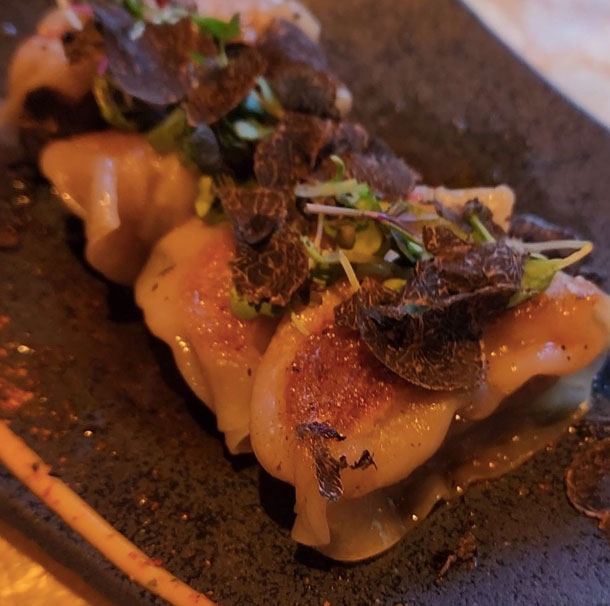
You’ll definitely want to grab a cocktail at the Press bar in the Four Seasons lobby, and if you’re a coffee lover, the mocha was the perfect balance of sweet and bitter. I didn’t love the morning breakfast, and the price didn’t match the quality, so I would skip that if I were you. 

Fill Your Belly

I’ve eaten at four different high-end sushi restaurants in my two visits to Las Vegas, and Mizumi was hands down my favorite one. From the moment you walk into the restaurant you’re transported into a world of melt-in-your-mouth food, incredible cocktails, and even better service. We were seated at a table that overlooked a stunning garden, koi pond and a 90-foot waterfall. 

Dumplings with Shaved Black Truffle at MizumiDumplings with Shaved Black Truffle at Mizumi (Photo courtesy of Jodyann Morgan)Under the helm of Chef Min Kim, the restaurant serves sushi, sashimi and other Japanese specialties. 
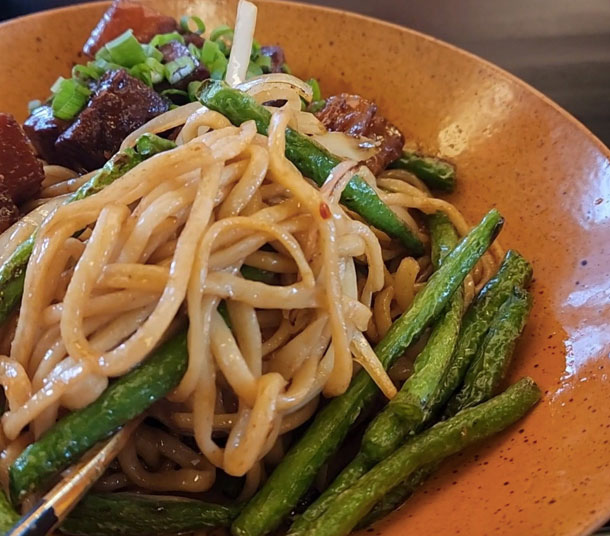
There is a great cocktail menu, too, in addition to the full bar. I’m not a big drinker, but I have a weak spot for lychee martinis and Mizumi’s were strong and perfectly balanced.

***


If hand-pulled noodles or dumplings are on your must-eat list, stop by The Noodle Den, a relaxed restaurant in the Sahara resort. Trained in Beijing, Chef Guoming “Sam” Xin expertly prepares dishes ranging from many variations of hand-pulled noodles and dumplings to duck and other Northern Chinese specialties. The Noodle Den is perfect for a quick bite, a full dinner, or to satisfy late night cravings. Don’t forget to get some tea to complement your meal. 

Braised Pork Belly and String Bean Hand Pulled NoodlesBraised Pork Belly and String Bean Hand Pulled Noodles (Photo courtesy of Jodyann Morgan)
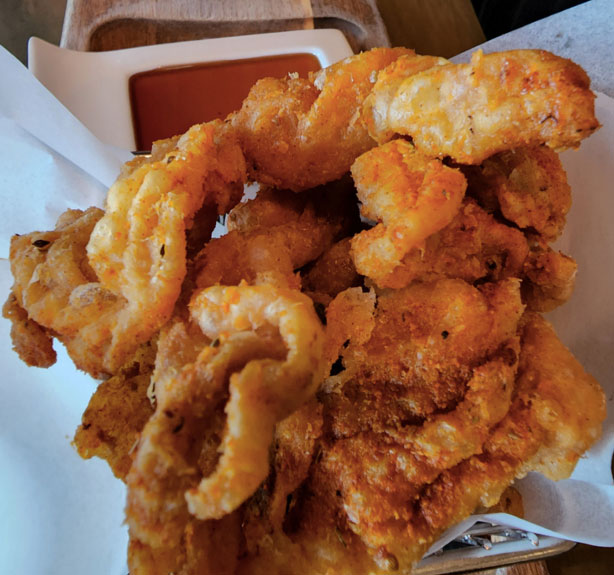
***

Are you a doughnut fan? My favorite donut in the world is a maple bacon-donut, the perfect balance of sweet and salty. Or so I thought, until I tried Pinkbox Doughnuts “Porky Face DoughCro” which is a maple-bacon croissant donut! To be honest, there wasn’t a single donut from Pinkbox Doughnuts that I tried that I didn’t like. Head to one of their four locations (they have a food truck,too) in the Las Vegas area at any time, day or night, to get yourself a memorable doughnut. 

***

Crispy chicken skins at Carson's KitchenCrispy chicken skins at Carson’s Kitchen (Photo courtesy of Jodyann Morgan)
Crispy, seasoned chicken skins, anyone? They are hands down the very best thing in Carson’s Kitchen, a relaxed, Southern-inspired restaurant in downtown Las Vegas. The menu offers sharing plates, flatbreads and handheld sandwiches, as well as your more traditional main courses. The star of the show is the massive outdoor patios and bar serving cocktails, beers and wine. 

Squish Factor: Many of the chairs have armrests, but I was able to easily swap one out for a chair without arms. If you aren’t comfortable swapping it yourself, let them know when you are making your reservation.

***

My sister and I took the Lip Smacking Foodie Tours the last time I visited Vegas, so I just knew I had to take my wife on a tour this time around. With multiple different tours sampling restaurants on the strip and downtown, the Lip Smacking Foodie Tour offers a comprehensive way to try the very best restaurants that Las Vegas has to offer in style. And folks, they don’t skimp on the food! Like seriously, you can expect a full meal at every single restaurant you visit. I enjoyed the Savors of the Strip Tour more than the lunchtime tour, but that’s truly personal preference. 

Squish Factor: Unlike most food tours, the Lip Smacking foodie tours are able to cover a lot of restaurants with minimal walking because of the saturation in Vegas. There was a restaurant where we had to take the stairs, but I discovered an elevator after the fact, so ask your guide.

Entertain Yourself

Are you a cannabis devotee? Then you’ll love the Green Tours Las Vegas cannabis tour. (Fair warning, the description of the tour was clearly written by a stoner, because it’s miles away from what actually happens on the tour, but I loved the tour anyway!) Your first stop is Nuwu, an indigenous-owned dispensary where, if you’re lucky, you’ll get private access to Nevada’s only consumption lounge to date, located on the premises. The infused watermelon margarita was fantastic, which is just one of the many different ways you can indulge on the premises. 

Then we hopped back in the van, and headed to Planet 13, which is the largest cannabis superstore, including a grow operation and a manufacturing facility for infused goodies. We got a quick run-down about how infused chocolate, candy and soda is made before heading to yet another dispensary. The Exhale dispensary is where we were recommended to actually purchase cannabis, with deals like ten pre-rolls for $45 and half a gram for $80. Finally, just in time to satisfy your munchies, the last stop is Wing King. If you preorder your wings, they will be hot and ready for you when you get there.

Squish factor: Stoner Rob (one of the owners of Green Tours) made a few passing remarks about munchies, with regards to weight gain which may be a trigger for you. The ten of us were transported in a 15 passenger van. It’s a bit of a squeeze, but our fellow guests let us have our own bench, making the trip comfy.

***

If you can, get out to the beauty of Red Rock Canyon. I took the Pink Jeep Tours open air jeep out there. The Jeep picks you up at your hotel, and brings you out to the visitor center before taking you on the four-wheeling adventure. At the visitor center you can go outside and if you’re lucky, spot a tortoise or two.

Squish Factor: I ended the experience early as soon as we got to the Red Rock Canyon visitor center. The seatbelt didn’t fit and I was squished against the low metal rail. It was the only thing stopping me from flying out of the Jeep at 55 miles per hour. I wouldn’t take this if you wear over a size 22.

***

If you’re staying at the Four Seasons, get yourself a pedicure. Vegas does a number on your feet and the spa at the Four Seasons is top notch. 

Squish Factor: The massage chairs are comfy, although a tad snug. The armrests don’t go up like in some Salons.

***

You’ll also want to book the Four Seasons Bartender’s Table experience. It’s a curated deep-dive into your choice of alcoholic beverage, and ends with a custom cocktail custom created to your specific preferences.  The mixologist prepared four different vodkas for me, and four different whiskies for Morgan, including rye and bourbon. 

As they educated us on the variations in how the liquor is made and the intricacies of the flavor, they brought out a food tasting to enjoy. Finally, after listening to our preferences throughout the experience, we caped it off with custom cocktails developed to our specific tastes. I’m very picky, and don’t drink often, but the cocktail was perfect. I’d go back just to have it again. 

Squish Factor: You’ll be seated on bar stools at the bar. They are a bit more comfortable than typically bar stools, but it’s still a high top chair.

***

With three locations in Las Vegas, the minus5 ICEBAR lets you get your drink on in a unique — and chilly — location. Be sure to make a reservation, the bar was packed! When you get there, you’ll be given gloves and a regular insulated jacket or a white fur coat (and fury earmuffs, too!) depending on the package you select. Inside the ICEBAR, you’re surrounded by everything made of ice. Sculptures, seating and even the cups you drink out are made of ice. Definitely a vibe! I’d avoid the Linq Promenade location, as we got super lost going in, and again leaving…

Squish Factor: Both the largest size regular jacket and fur coat were both relatively small on me and couldn’t close. If you wear larger than a size 26 on top, bring your own jacket or you might freeze.

***

A night tour on a GetYourGuide double decker bus is certainly the most budget-conscious, and fabulous, way to see the glitz and glamor of the strip, and visit Fremont street. Get to the meet location early! There was a wicked long line 20 minutes before the tour started. However, once the buses arrived (and there were quite a few of them), the line moved quickly, and we were on our way. These buses used to all have live guides, but now the live guides are rarely seen. The night tour in Las Vegas has a live guide, which is a special treat!

Squish factor: While I can get away with just one seat, that’s mostly because I squish with my wife, and it’s comfortable. If you’re traveling alone, or would rather not squishing with your travel buddy, and wear a size 24 or larger, it might be worth getting two seats. 

***

I’d heard so much about Meow Wolf’s Omega Mart, so I want you to know about it even though I didn’t make it there this trip. Haley Plotkin, the plus size travel blogger behind Ready Set Jet Set, did visit, and had a fabulous experience!  “When you enter, you start in the mart. Everything is for sale in the mart, including the empty boxes of fake products, which is so fun,” Plotkin told me. “Then, you start finding the portals into the multiverse. There’s a storyline you can follow, but it took me 6 hours to complete it. It involves running back and forth all over to different stations to watch videos and complete tasks.” 

Squish factor: While there is an elevator in the building, Plotkin tells me that it’s hard to get to, and the amount of stairs you have to climb are exhausting. “The main thing I was disappointed with was the slides. They are narrow and twisty,” she says. Plotkin doesn’t recommend the slides.

Read more: 

“The Real World Homecoming: New Orleans” recap: Sexy jump rope

With only a few episodes of “The Real World Homecoming: New Orleans” left, the housemates are making up for 22 years of being incomunicado by digging deep into their memory banks to reveal sexy secrets that are shocking even to those who are well-versed in the original season. 

If you watched “The Real World New Orleans” when it first aired in 2000, then you probably remember the sexual tension shared between Julie Stoffer and Jamie Murrary and how that aggressively athletic dynamic progressed from front yard mud wrestling to sneaky kisses on the stairwell witnessed by no one other than a crew of cameramen; but now we know that so much more happened between the two of them after that season wrapped. 

In a voiceover that plays during a scene in which present-day Julie and Jamie engage in something that I, until now, did not ever think of as a sex act, Julie says that there’s an inexplicable chemistry between the two of them – made obvious by the lusty glances shared as they jump rope within a foot of each other, maintaining eye contact the whole while.

RELATED: “The Real World Homecoming: New Orleans:” Have Mercy

Shortly after, an “incoming message” is received on what Melissa Beck refers to as “that demon TV” and everyone gathers on the couches to watch clips from their season adding up to the fact that almost everyone in the house in 2000 (Including Danny Roberts) had the hots for Jamie, but Julie was the one he chose to hook up with.

Julie shows no shyness in saying that in 2001, while she and Jamie were both filming “Real World/Road Rules Extreme Challenge,” they hooked up.

As the story is then told, Julie shows no shyness in saying that in 2001, while she and Jamie were both filming “Real World/Road Rules Extreme Challenge,” they hooked up. The exact terminology she uses here to describe what she was seeking from Jamie at that time is “f**k buddy.” Upon hearing this, religious housemate Matt Smith recoils in terror as though he were just told that Julie and Jamie saw Goody Proctor with the devil.

Julie Stoffer, Dan Renzi and Jamie Murray during The Real World Reunion Tour at Beacon Theatre in New York City (J. Vespa/WireImage)

With this news made public knowledge, Julie and Jamie retreat to the back patio to have a private conversation in which Julie tells him that he gave her the first orgasm of her life when they hooked up, and that this sexual awakening then led to her regularly masturbating which, as a Mormon at the time, she’d viewed as going against the religious teachings of her church. All of this registered as news to Jamie who, as a married man with kids, responded to this crotch news from a woman with kids by delivering a very polite “good convo.”

Matt, still recovering from having to hear the word “sex,” was likely into his fifth “Hail Mary” repetition in his mind, only to have his soul completely leave his body when, later, Melissa brings New Orleans psychic Elie Barnes to the house to read everyone’s tarot cards. He makes a big production out of removing himself from the activity, and even goes so far as to pull Melissa aside later to tell her how uncomfortable it all made him. To really drive his point home he jokes, eyes glassy with tears, about surprising everyone with a group rosary the next day. 


Want a daily wrap-up of all the news and commentary Salon has to offer? Subscribe to our morning newsletter, Crash Course.


 During the reading with Elie we learn that Melissa should go into politics, Tokyo Broom needs to work on opening up to partnerships, Danny Roberts is a natural leader; although he avoids it; and Kelley Wolf is good in bed. It’s also confirmed via the cards that Jamie and Julie are a perfect match, a fact already made perfectly clear by their seductive jump roping earlier.

This wouldn’t be “The Real World” if there wasn’t considerable effort put forth to ensure that the people in the house either fight or f**k in each episode

This wouldn’t be “The Real World” if there wasn’t considerable effort put forth to ensure that the people in the house either fight or f**k in each episode, so the scandalous fun is bookended by two different deliveries made to the house. The first consists of the makings for a Y2K-themed celebration in which Melissa cosplays as her 2000 self, putting on a short wig and LensCrafters glasses to dance to Juvenile’s “Back That Azz Up.” The second delivery contains accessories to play a game called “Who said that?” In this game the housemates are shown quotes from the book “MTV’s The Real World New Orleans: Unmasked,” which came out in November 2000. During this game Danny’s wounds are reopened when he’s reminded that Matt was very open at that time regarding his belief that God made sex solely for the creation of children, and that any sex that couldn’t yield such fruit was an affront to the Lord. Danny, and all of us watching, must be curious if his beliefs on the matter have changed at all. Spoiler: They haven’t.

In a voiceover towards the end of the episode we hear a producer ask Matt about his current beliefs when it comes to homosexuality, and he stiffly replies “I’m not a judge. We’re just here to love each other.” When pushed to say more he bristles and quickly shuts the line of questioning down. 

In Matt’s world, both past and present, “love” must have a pretty limited definition.

Read more:

Elizabeth Olsen recalls her “awful” “Game of Thrones” audition for Daenerys

Doctor Strange in the Multiverse of Madness” is out now in theaters, and by far the best part of it is Elizabeth Olsen’s riveting performance as Wanda Maximoff, aka the Scarlet Witch. Olsen has been a part of the Marvel Cinematic Universe since 2015’s “The Avengers: Age of Ultron,” but in Phase 4 she’s really stepped up as one of the most engaging actors in Marvel’s roster.

Yet while the actor may be best known for playing Wanda Maxmioff, in another universe she might have been an entirely different sort of conflicted heroine with a penchant for late game heel turns: Daenerys Targaryen, Breaker of Chains, Mother of Dragons, and the Khaleesi of the Great Grass Sea.

Olsen has spoken before about her “awful” audition for “Game of Thrones,” but with all the press junkets surrounding “Multiverse of Madness,” it seems like a good time to revisit it.

Elizabeth Olsen remembers auditioning for Game of Thrones: “I didn’t get a callback”

“I auditioned for ‘Game of Thrones,'” Olsen said while on The Hollywood Reporter’s Awards Chatter podcast. “I auditioned for, like, the assistant to the casting director in a small room in New York with just a camera on me and them reading the script.”

I was doing the Khaleesi speech when she comes out of the fire. It was awful. I didn’t get a callback.

Olsen also talked about this experience to Vulture in 2019. “It was the most awkward audition I’d ever had,” Olsen said. “After she just burned. And she’s making this speech to thousands of people about how she’s their queen. They didn’t know if they wanted a British accent or not. So, you did it in both. It was terrible.”

It’s interesting to hear the actor talk about this particular speech, because it’s not one that actually appeared in the show or the books. Instead, the show opted to follow Martin’s novels by using a long, silent camera pan that shows Daenerys having miraculously survived her night on Khal Drogo’s pyre, now with three baby dragons.

It isn’t uncommon for shows to have an audition with scenes that don’t make it into the final product, and Olsen’s comments line up with something that “Game of Thrones” writer Bryan Cogman said in the “Game of Thrones” oral history book “Fire Cannot Kill A Dragon.” Cogman recalled an embarrassing audition of his own where he didn’t realize he was supposed to have someone auditioning for Ros strip down to her undergarments and accidentally cut the audition short. Neither Cogman nor showrunners David Benioff and Dan Weiss had much television experience before “Thrones,” so there were some growing pains there.

Despite Olsen’s painful “Game of Thrones” audition, things seem to have worked out for the best. Emilia Clarke turned in a fantastic performance as Daenerys Targaryen over the show’s eight seasons, and Olsen is amazing as Wanda in the MCU. In this universe, peace was found.

You can see Elizabeth Olsen in “Doctor Strange in the Multiverse of Madness,” out now in theaters.

TikTok’s viral “bark at your dog” challenge may not be a good idea, experts say

Since late last year, dog owners on TikTok have been participating in what might seem like an innocent, even cute TikTok trend that involves barking at your dog.

The hashtag #barkatyourdog has over 156 million views on TikTok, and its participants run the gamut in age and popularity (many TikTok stars have dabbled in it). The video trend involves getting close to your canine’s face, barking loudly and recording the dog’s reaction. Perhaps unsurprisingly, most dogs look confused.

While it might seem like just another harmless social media challenge, canine behaviorists are warning against participating in it.

“I wouldn’t recommend it,” Cathy Madson, a lead dog trainer at Preventive Vet, told Salon. “From what I’ve seen, the majority of dogs just don’t know what to do with that.”

RELATED: Your dog has a rich interior life it’s not telling you about

As Madson alluded to, while human might find the interaction entertaining, it essentially leaves the dogs confused.

“Dogs know that we’re not dogs,” Madson said. “So they’re probably like ‘What are you doing?’ But when dogs bark, barking can mean a lot of things.”

“They might feel afraid because they don’t know what they did wrong, but you just told me to back off.”

Indeed, a happy bark, usually accompanied by a tail wag, is typically a dog’s way of greeting someone. Dogs may also bark to seek attention; perhaps they want a treat, to go outside or to play.

But a dog’s bark doesn’t always signal happiness or excitement. It’s a form of communication for dogs to let each other know that there’s something going on: hence, when one dog barks and the rest of the neighborhood dogs eventually chime in. Moreover, barking can also mean “back off,” or “go away.”


Want more health and science stories in your inbox? Subscribe to Salon’s weekly newsletter The Vulgar Scientist.


“If a person barks at them, it can tell them ‘you need to get away from me’ — and so they run away,” Madson said. “They might feel afraid because they don’t know what they did wrong, but you just told me to back off.”

Madson added that getting in a dog’s face can be a bite risk.

“It’s just putting us face to face with them, which for a lot of dogs is pretty confrontational and intimidating,” Madson said. “If some dogs are more confident, and there happens to be a resource around, they’re like ‘Well I’ll fight you on that,’ and then they respond the same way, then you have issues with there being a bite risk.”

In December 2021, dog trainer Sassafras Lowrey published a piece for the American Kennel Club warning people not to participate in this “dangerous” trend, and citing many issues with it. One of her worries was that dogs typically aren’t comfortable with a human getting in their face. Another issue is making such close eye contact with the dog.  

“Staring at a dog can result in that dog reacting defensively to the person staring at them,” Lowrey wrote. “You never want to make and maintain eye contact with a strange dog, and even though you know your own dog well, staring is still not a good idea as it can cause dogs to feel uncomfortable.”

“You can tell which dogs, in some of these videos, have a very trusting relationship with their people — but then you can see the dogs who don’t.” 

Madson said in the videos she’s seen of the trend, she’s noticed a lot of dogs exhibit “whale eye.” As explained by the AKC, “whale eye” is a term used to describe when you can see the whites of your dog’s eye, known as the sclera. This is generally a sign that a dog is stressed or anxious.

Madson added that by tricking one’s dog, it could lead to a breach of trust — especially if it’s done with a new pet.

“You can tell which dogs, in some of these videos, have a very trusting relationship with their people, but then you can see the dogs who don’t,” Madson said. “If they get startled or scared, then they can have a reaction where they associate you staring into their face, and being right next to their face… and the next time you do that, they’re thinking, ‘Oh my god, are you going to do that again? And scare me?'”

Madson said it could be “damaging to that relationship” because the dog doesn’t know what to expect.

#Barkatyourdog is just one of many curious dog-related TikTok trends. Another one trending involves users kissing their dogs, and observing their reaction. Madson said she wouldn’t recommend that one either, because it requires a person to get in one’s dog’s face, which could make a dog uncomfortable, stressed or anxious.

Instead of participating in ill-advised TikTok trends with your dog, Madson has another suggestion for owners who want to bond with their pets.

“Look for better ways to have fun with your dog, like initiating play with a toy or asking them for a cute trick,” Madson said. “I think we just need to encourage people to do better TikTok trends.”

Read more about dogs:

Joe Rogan got fooled by fake news, but didn’t realize until after his expletive-laden rant

Why fact-check when you’re not an actual news program? Well, avoiding mild embarrassment and not spreading misinformation are also good reasons.

Joe Rogan’s passionate yet misinformed rant about a proposed Australian law attempting to ban citizens from growing their own food quickly backfired after the controversial podcaster realized his claims were rooted in fake news.

In a May 12 episode of his Spotify podcast, “The Joe Rogan Experience,” its host claimed that “someone,” “I think it was New South Wales,” made an effort to pass the debunked proposal nationwide.

“I read something briefly and didn’t get into the article,” Rogan told his listeners. “But they were saying they were trying to pass a bill that would outlaw you growing your own food in Australia.”

He then mocked Australian officials, claiming in an exaggerated tone, “They were saying, ‘Whoa, you could grow your own food. And what else? The disease was from your food. It infects the population, kills us off. Oh, we can’t have that.'”

RELATED: How Joe Rogan does what he does: My day with America’s most famous podcaster

The shock jock added that he didn’t know the reasoning behind the law but was “pretty sure” it concerned agricultural contamination. He then chose his words carefully, calling Australian authorities “f**king creeps” who were trying to “smoke out” anti-vaxxers.

“You could justify it if you were a real piece of s**t, you could say most pandemics come from agriculture . . . f**king creeps man, these f**king creeps, they got a good grip on people during the pandemic,” he wailed.

“That’s how you mother**king smoke out an anti-vaxxer, you can’t even go to the grocery store anymore and you can’t grow your own food.”

Rogan only came to his senses when his producer, Jamie Vernon, Googled the topic but couldn’t find the news in question. “Nothing’s coming up,” Vernon said. “The closest I can find is New Zealand.”

“Hold on,” Rogan responded while also trying to search for the claim. “It’s got to be a real thing . . . it seems too good to not be . . . damn it, it better not be fake.

“It might be fake.”


Want a daily wrap-up of all the news and commentary Salon has to offer? Subscribe to our morning newsletter, Crash Course.


According to The Guardian, Rogan’s false claims sprung from a Facebook post that suggested that Daniel Andrews, an Australian politician and the 48th Premier of Victoria, was passing a bill prohibiting civilians from growing their own food.

“The Agriculture Legislation Amendment Bill 2022 has had its second reading in parliament,” the post read. “Biosecurity is stated as the reason for changes.”

Shortly afterward, the erroneous claim was reshared in a tweet posted by an unnamed YouTuber with more than 75 million views. The post also earned a total of 12,000 retweets.

“Australia is passing a bill that will prevent people from growing their own food,” the YouTuber wrote. “Totally normal.”

Per Reuters, similar claims were found in seven posts across Twitter, Facebook and Instagram, which goes to show how important it is to fact-check your sources and not believe everything you read on the Internet.  

More stories you might like:

Mark Ruffalo turns up in the first trailer for “She-Hulk”

Marvel Studios cannot, will not, shan’t be stopped. “Moon Knight” wrapped not long ago. “Doctor Strange in the Multiverse of Madness” just came out in theaters. “Ms. Marvel” will premiere on Disney+, and now, the studio has just dropped a trailer for “She-Hulk,” which will be out smack dab in the middle of summer. Watch below:

“She-Hulk” stars Tatiana Maslany as Jennifer Walters, a lawyer who gets the power to hulk out after a blood transfusion from her cousin, Bruce Banner. Or at least, that’s how she gets her powers in the comics. The trailer is less clear about She-Hulk’s origins, but Mark Ruffalo does show up as Bruce to walk her through the finer points of the superhero life.

Pretty much all Marvel shows have a light touch, but “She-Hulk” looks like it’s going to be especially fizzy and funny, complete with zingers, dating montages, and . . . a glimpse where She-Hulk cradles her date in her arms like a baby, in a kind of sexual way? Hey, if Marvel wants to start pushing some boundaries in their shows, more power to them.

“She-Hulk” premieres on Disney+ on August 19. See ya then, until the next thing.

Election reporter: Early GOP primaries already laying groundwork for Trump to steal 2024 election

Former President Donald Trump is moving into position to steal the 2024 election with some assistance from Republican primary voters.

The former president has backed loyalists who have endorsed his lies about his 2020 election loss, and GOP voters have picked a number of them to move on to November’s general election, although NBC News correspondent Vaughn Hillyard pointed out that Trump’s endorsement wasn’t enough for every candidate.

“If [David] McCormick is able to pull this off, it’s an opening for others in the Republican Party,” Hillyard said. “Look, Ted Cruz was on the campaign trail with David McCormick out here. Mike Pompeo endorsed David McCormick here. If you look ahead towards next week in Georgia and David Perdue loses by a significant margin to incumbent Gov. Brian Kemp, you know, there’s going to be heads that begin to turn here and a realization that Donald Trump’s word is not final.”

“Of course, the former president, you know, he believes every horse he picked was going to win here, but clearly there are Republican voters who are willing to draw a line in the sand,” Hillyard added. “Whether that is Madison Cawthorn and his litany of controversial statements in past situations he has put himself into, or whether it is the endorsement of a Nebraska gubernatorial candidate, accused credibly by eight women of groping, or a lieutenant governor running for governor in Idaho who spoke at a white nationalist conference, the Republican Party’s voters clearly are not willing to cross some lines. Whether that ultimately extends to Donald Trump, I think that’s a big question that a lot of folks will be facing come 2024 here.”

However, some Trump loyalists have already made it through GOP primaries and stand a good chance of getting elected in November, and that could put them in position to help the twice-impeached former president steal the next election.

“His stable of loyalists, you know, every few weeks here, does continue to grow, despite these losses,” Hillyard said. “J.D. Vance, Alex Mooney, congressman in West Virginia, you know, if Mehmet Oz pulls this off, you’re talking about somebody here who could potentially object to election results in 2024. Last night, you guys, is these governor races here, Doug Mastriano endorsed just last weekend, is — I mean, could be the front man of the efforts to not certify professional 2024 election results. We’ve talked to the leading GOP candidates in Arizona, Michigan and Wisconsin for governor, who all could put the 2024 election on the line if they were to, like Doug Mastriano has suggested he would do, would fail to certify the election results if Donald Trump were to run and were to lose in these key swing states.”

Less Madison Cawthorn, more dumpy fascists in bad suits: Republicans embrace covert Big Liars

Republican primaries in Pennsylvania and North Carolina may have been a big win for the Big Lie, but they were devastating for headline writers at political websites. After years of Donald Trump-inflected voting for the biggest troll they can find, Republican voters largely did what a GOP campaign consultant would prefer they do this time around. They went for candidates that, while fully committed to the anti-democratic cause, are missing that je nais se quois to produce outrage bait that has so appealed to Republican voters in the past. Two of the flashiest trolls on the ballot, Kathy Barnette of Pennsylvania and Rep. Madison Cawthorn of North Carolina, went down in flames Tuesday night.

To be certain, Republican voters still want to complete the authoritarian destruction of democracy Trump set in motion in 2020. It’s just that they have now come to realize that the key to pulling it off is running candidates who are a little bit better at hiding how evil they are. Their best disguise? Being very boring. 

In this case, what is bad for clickbait headlines is also bad for democracy.

RELATED: Madison Cawthorn’s cocaine-and-orgies brouhaha blows up the GOP’s QAnon plan

GOP primary voters are getting serious about the long-term efforts to stack the halls of power with people who will steal the 2024 election from President Joe Biden for Trump. And they understand that the task will be much easier if they run candidates who can pass as “normal” in the eyes of moderate voters, even though those candidates are just as radical underneath their bland exteriors as some of the more gleefully trollish options available to GOP voters. Turns out that the best way for a fascist to hide is in plain sight, by being so boring that voters don’t care enough to learn how terrifying your politics actually are. 


Want more Amanda Marcotte on politics? Subscribe to her newsletter Standing Room Only.


The GOP primary for North Carolina’s 11th congressional district is the perfect distillation of this phenomenon. Cawthorn won in 2020 on a wave of pro-troll enthusiasm among Trump-drunk Republican voters, which also led to the election of headline-hoggers like Rep. Marjorie Taylor Greene of Georgia and Rep. Lauren Boebert of Colorado. But the same liberal-triggering talents that so please GOP base voters have the side effect of drawing national attention. Cawthorn quickly became a reliable producer of outrage bait, from his Hitler-winking social media posts to his unsubtle calls for political violence to the scandal that finally ended him, his cocaine-and-orgies comments

The likely winner of this primary, state senator Chuck Edwards, made a name for himself by deriding Cawthorn’s antics. When Cawthorn, one of the loudest supporters of Trump’s attempted coup in 2020, encouraged Trump supporters to “lightly threaten” congressional members who didn’t back the coup, Edwards denounced his rhetoric. “As a legislator, I don’t need to be threatened to do the job the voters hired me to do,” Edwards tweeted. It’s a statement that sounds innocuous on its surface, but deeper analysis shows that, in all the ways that actually count, Edwards is just as much an insurrectionist at Cawthorn. By saying he doesn’t “need to be threatened,” Edwards is clearly implying he would have happily voted to overturn the 2020 election without being pressured. Notably, he only released this anti-violence statement after the January 6 insurrection at the Capitol failed. But while he came out against violence after violence didn’t work, Edwards continued to echo the same Big Lie talking points about “the integrity of our elections system.” 

RELATED: Trumpism in a fleece vest: GOP’s new gambit scored a big win — but here’s how to beat it

The main difference between Edwards and Cawthorn is Edwards is likely to be a more effective destroyer of democracy, precisely because there are fewer videos out there of him nakedly humping his cousin’s head. His blandness is the best possible disguise, as it allows him to convey pro-fascist sentiments to his followers while being ignored by the national press. It doesn’t help matters that nearly all Republicans these days use the same coded language about “election integrity” and “voter fraud” to signal support for the Big Lie. By being a bunch of cookie-cutter white guys reciting the same talking points, these politicians normalize the Big Lie in such a way that both the press and moderate voters start to ignore how dangerous they actually are. 

A similar situation is playing out in the Pennsylvania primary for governor. All of the major GOP candidates are Big Lie supporters who Republican voters can feel confident will help Trump steal the 2024 election. But Barnette, who was a last-minute surge candidate, has an unhinged affect and a tendency to talk about how forced childbirth after rape is a good thing. She was also photographed eagerly participating in the January 6 march that turned into an insurrection. The GOP establishment was terrified of Barnette — not because they disagreed with her anti-democracy views, but because her flat-out weirdness would draw attention to those views.


Want more Amanda Marcotte on politics? Subscribe to her newsletter Standing Room Only.


At the last minute, the majority of GOP voters agreed, splitting their votes between the two other candidates, Mehmet Oz and Dave McCormick. Both these men are stalwart Big Liars. McCormick in particular likes to imply that Black voters are inherently illegitimate. But they’re slightly better at subterfuge, in no small part because they weren’t literally photographed at the insurrection. Without wall-to-wall national coverage of their radical views, it will be easy for either man to convince large numbers of Pennsylvania moderates that he isn’t the radical insurrectionist he, in fact, is. 

It is true that Republican strategists are sweating the winner of the GOP gubernatorial primary, Doug Mastriano, who tends to be more loudmouthed about his insurrectionist views than other Republican candidates. Mastriano paid for shuttle buses to take people to the Capitol on January 6. He even has an aide who was photographed participating in the January 6 riot. If voters become aware of how radical Mastriano’s politics are, they are very likely to reject him in favor of the Democratic nominee, Pennsylvania’s Attorney General Josh Shapiro. 

RELATED: 2022 GOP primaries prove that MAGA is now bigger than Donald Trump

Unfortunately, that’s a big “if.” Because he’s another dumpy white guy with rolled-up sleeves, Mastriano just isn’t going to attract the same kind of clickbait attention that someone like Cawthorn gets. He also wisely blocks the press from many of his events, no doubt so he can unfurl the lurid conspiracy theory talk without getting quoted in headlines. Again, in a sea of white men who all look basically the same saying the same dumb things about “election integrity” and “voter fraud,” Mastriano quite likely won’t stick out. And because he doesn’t, far too many voters will go to the polls, unaware of how radical the guy they’re voting for actually is. 

The GOP establishment was terrified of Barnette — not because they disagreed with her anti-democracy views, but because her flat-out weirdness would draw attention to those views.

Senate Minority Leader Mitch McConnell is a deeply evil and cynical man, but he’s also smart. McConnell’s theory of politics is simple: The best Republican politician is the one no one pays attention to. If voters actually listen to Republicans talk about what they believe, most will be turned off. So the McConnell strategy is to speak very little, avoid press coverage, and be as blank a slate as possible. It’s why McConnell is angry with those in the GOP caucus who put their policy views in writing. The strategy is to pretend to be normal in public, and only reveal the sinister agenda after the election. It worked for Gov. Glenn Youngkin in Virginia, who bamboozled moderate voters into thinking he wasn’t so bad and then immediately became unpopular once he actually started to govern as the far-right radical that he is. 

There’s no doubt that Republican primary voters love themselves a troll. Cheap insults, conspiracy theories, winking at violence? All that stuff triggers the liberals, drawing GOP base enthusiasm. But it also tends to backfire in general election races, at least in purple districts and states. In light of that, the best GOP candidate is the one that voters couldn’t pick out of a line-up.

If Republican strategists could nominate literal blank slates, they would. But the next best thing is a truckload of white guys in khaki pants and rolled-up shirtsleeves. They can be Mussolini on the inside, but as long as they look like a generic grandpa at the cookout, they will slide under the radar and, all too often, right into electoral victory. 

Expert: DOJ’s “savvy” request for Jan. 6 transcripts avoids legal fight that bogged down House probe

The Department of Justice may have sidestepped the legal battles that have slowed the House Select Committee’s investigation of the Jan. 6 insurrection.

Federal authorities opened a new direction in their criminal probe by requesting transcripts of interviews conducted by congressional investigators, and MSNBC legal analyst Glenn Kirschner explained why that move was “savvy.”

“I think we’ve all experienced some frustration because it doesn’t look like the Department of Justice has been investigating this the way it would ordinarily investigate, you know, even large-scale conspiracy cases because they don’t appear to have been sort of carpet-bombing folks with grand jury subpoenas the way we ordinarily would,” Kirschner said.

Kirschner praised DOJ investigators for waiting until the Select Committee had conducted its interviews instead of pursuing the same witnesses.

“If the Department of Justice had gone after everybody with grand jury subpoenas, they probably would have been battling witness after witness after witness, these thousand-plus witnesses,” he said. “They would have been battling Congress, who gets which witness first and who has the greater priority. Now what the Department of Justice can do is take a thousand-plus transcripts and they can use that to build their criminal investigation.

“I actually think whether this was by design or happenstance, this may turn out to be a pretty savvy way about investigating the case,” Kirschner added, “and let’s not forget that the chief investigative counsel for the Jan. 6 committee is frankly a very accomplished prosecutor in his open own right when he served as U.S. Attorney for the District of Columbia, and I expect this is a really savvy investigation put together by the Jan. 6 Committee.”

Watch the video below or at this link.