Spring Sale: Get 1 Year, Save 58%

Only one presidential election has provoked civil war — at least until now

Before Joe Biden defeated Donald Trump in 2020, only one presidential election had resulted in massive violence against the federal government. That of course was the election of 1860, which was as divisive as any in history and plunged the United States into the Civil War. This alone makes it difficult to claim a parallel with the 2020 election, despite Donald Trump’s repeated false assertions that he actually won. To this point, there are no signs of a bloody internecine conflict that ends with at least 620,000 deaths.

So in some ways, Trump’s Big Lie about the 2020 election is not as bad as the lies that caused the Civil War. In other very important ways, however, it’s much worse.

First, though, one must understand the 1860 election, which came at a political moment fraught with danger. Americans were divided as to whether slavery should be allowed into the newly-acquired western territories. Extremists in the South, sensing an opportunity to profit off human bondage in nascent industries, wanted no limits on when, where and how slavery could be expanded. While there were certainly some abolitionists who wanted to entirely eliminate slavery, mainstream “anti-slavery” forces mostly sought a compromise, where slavery would not be allowed to spread outside states where it was already legal.

Even that was too much for the pro-slavery forces, who were worried that anti-slavery states in Congress would eventually be able to outvote the slaveholder states and compel them to get rid of their “peculiar institution.” When the Whig Party disintegrated because it wouldn’t take a firm stance on the slavery issue, and the Republican Party rose from its ashes on a platform of barring slavery in the West, Southerners made it clear they were ready to secede if a Republican became president. The first time they made this threat, during the 1856 election, it proved unnecessary; Republican nominee John C. Frémont was decisively defeated by Democrat James Buchanan, even with former president Millard Fillmore potentially siphoning off votes on the xenophobic Know Nothing ticket. (Similarly Trump foreshadowed his 2020 actions by refusing to say if he would accept losing to Hillary Clinton in the 2016 election, although his victory rendered that threat moot and Clinton conceded right away.)

But the crisis came four years later, in 1860. Abraham Lincoln, the Republican nominee, got just under 40 percent of the popular vote, but that was enough to win against an opposition that was split three ways. The Democrats had fractured after nominating Stephen Douglas, who alienated both pro-slavery and anti-slavery forces by arguing that individual states should be allowed to decide the issue for themselves. Democrats who opposed slavery by and large fled to Lincoln, while pro-slavery Democrats nominated John Breckinridge as a third-party alternative. Further complicating matters, former Whigs who wanted to avoid the slavery issue altogether fielded their own candidate, John Bell.

Lincoln’s name didn’t even appear on the ballot in 10 Southern states, but he won large majorities of the vote across the North and won 18 states and 180 electoral votes. Breckinridge was a distant second in the electoral count, carrying 11 states but just 72 electoral votes, while Douglas finished second to Lincoln in the popular vote but only won one state. So Lincoln was the clear winner — and 11 Southern states ultimately followed through on their vow to secede from the Union.

I’ve previously written about Buchanan, a reasonable contender for the title of worst president ever. He was president throughout the 1860 election but wasn’t even up for re-election after Democrats refused to renominate him. Buchanan was openly sympathetic to the pro-slavery faction, blamed abolitionists for supposedly agitating the South and believed those states had a right to secede. Instead of working with President-elect Lincoln to try to stave off the wave of Southern secession, and perhaps prevent civil war, Buchanan made a point of doing nothing. His bitterness somewhat resembled Trump’s behavior after losing the 2020 election — but at least he wasn’t trying to stay in power himself. His actions were depraved and inept, but not literally dictatorial, and he didn’t try to gaslight the public with multiple false claims that the election was illegitimate. 

Another important difference lies in the strong possibility that the 2020 election marks a direct setback for American democracy. When the fallout from the 1860 election was said and done, after a bloody four-year conflict, the franchise was actually expanded. The 15th Amendment explicitly extended the right to vote to Black men, including former slaves, and although it was not broadly or universally enforced for another full century, that at least marked a step in the right direction. Trump’s Big Lie, by contrast, has been used to justify a wave of voter suppression laws across the country, largely aimed at reducing ballot access for Black voters and other marginalized communities.

The United States has had 10 previous incumbent presidents lose elections, from John Adams all the way to George H.W. Bush. None of them were happy about it, but all of them accepted the legitimacy of their defeat. In violating this precedent and forcing his supporters to pass voter suppression laws that make Republican victories more likely in the future, Trump’s example has put democracy in dire peril. That may well be the chief legacy of the 2020 election.

There is one important way in which comparisons between the 1860 and 2020 elections are not yet clear. Lincoln was a moderate on the slavery issue who, in rough parallel to Biden, was depicted as a fire-breathing radical by his opponents. He eventually decided that the abolition of slavery was a righteous and necessary cost and took on that historical obligation, even if that meant “proving right” his pro-slavery critics. (That decision also very likely cost him his life.) Lincoln also expanded the federal government’s power to regulate the economy and vigorously prosecuted the war, even in the face of widespread protests by Confederate sympathizers in Northern cities. If your critics are going to accuse you of being extreme no matter what you do, he reasoned, there’s no longer any excuse not to do the right thing.

It took Lincoln rather too long, arguably, to learn that lesson, and Biden has likewise been absorbing it quite slowly, allowing his more ambitious programs to be watered down or jettisoned altogether by the resistance of “moderate” Democrats like Joe Manchin and Kyrsten Sinema.

None of these arguments cancel out the obvious ways in which the 1860 election had far worse consequences — at least to this point — than the one in 2020. Trump’s Big Lie seems unlikely to fuel hundreds of thousands of deaths, and try as they might, Republicans cannot literally roll back the clock to a time when women and people of color couldn’t vote at all, and when many of them were viewed as property. Even so, the fact that the comparison is not ridiculous is deeply troubling. We’ve had other controversial elections, from the tangled mess of 1876 to the Kennedy-Nixon nail-biter of 1960 to the “hanging chad” election of 2000, which was settled by a 5-4 Supreme Court decision. The 2020 election, in contrast, ought not to have been so divisive, and only became so because one man’s cult of personality was so powerful that his delusions created a malignant normality. Which of these two elections will ultimately be more destructive? It’s too early to know for certain; history will have to be the judge.

Billionaire Trump donors ordered to testify over union-busting accusations: report

According to a report from the Daily Beast, two billionaire brothers who made the bulk of their fortune selling off the Ultimate Fighting Championship, are being compelled to appear a National Labor Relations Board judge over accusations of union-busting at a casino they own.

“Brothers Frank and Lorenzo Fertitta have been ordered to testify about allegations that their gaming business, Station Casinos, egregiously tried to undercut labor organizing efforts,” the Beasts’ Noah Kirsch reported, adding, “The Fertittas are best known for Ultimate Fighting Championship—the mixed martial arts promoter they sold for more than $4 billion in 2016—and for donating millions of dollars to Donald Trump and his dark-money machine, America First Action.”

According to the report, in July a federal judge ordered the Station to start negotiations “with roughly 1,350 culinary workers over a contested 2019 union vote at Red Rock Resort,” but instead the organization offered employees new benefits, that included smaller health-care contributions on the employees’ part and a changed 401k. That, in turn, reportedly, led to a defeat by labor organizers to form a union.

In her opinion, Judge Gloria Navarro wrote, “Red Rock’s offer of benefits was a hallmark violation,” adding, “Many employees admitted not voting for the Union because they feared losing the new health care and 401(k) benefits that Red Rock had just promised.”

According to one employee, Adam Christian, he feels his fellow workers were bullied into voting no on the union.

“They decided to throw the kitchen sink at everybody and not even give detailed information to us to be able to even make an informed vote,” Christian recalled. “I just want to be treated fairly by a company and have something in writing.”

According to labor expert Bill Werner, of the University of Nevada, Las Vegas, the judge calling on the bothers to testify is an unusual move.

“It’s extraordinary that you would bring in the very, very top person in the company [to testify],” Werner explained. “What the union is saying: the Fertittas made this decision.”

You can read more here and watch an interview with Lorenzo Fertitta describing taking over the casino with his brother below:

Trump complained about Jewish voters during phone call with religious leaders: report

According to a report from the Religion News Service, the launch of Donald Trump’s new National Faith Advisory Board got off to a rocky on Thursday after he complained to religious leaders about Jewish voters not appreciating what he did for them during his four years in office.

According to the report, the official launch on the board took place this week with Trump and longtime Trump advisor Paula White speaking to members on a conference call –with the suggestion the one-term president may make another run in 2024 with the hope he can round up enough people of faith to support him.

According to the report from Jack Jenkins, “Trump referenced hypothetical future scenarios ‘if we’re able to get back in,’ while repeating the widely discredited claim the 2020 election was ‘stolen’ from him. In discussing the Catholic vote, he acknowledged he had lost ground with the bloc in his four years in office.”

“I’m a little bit surprised that we didn’t do better with the Catholic vote,” Trump told those listening in. “I think now they would give us a vote. I think we got about 50% of the vote. And yet, we did a lot for the Catholic vote. So we’ll have to talk to them. We’re gonna have to meet with the Catholics.”

Jenkins notes that Trump was hit hard by Catholic defections in the hard-hit Rust Belt states, pointing out, “Trump’s margin dropped from 64% to 57% between 2016 and 2020, whereas Biden won 42% — an 11% improvement over Clinton in 2016.”

The former president was less pleased with Jewish voters, complaining that “Israel has never had a better friend.”

“The former president expressed frustration with the lack of support from Jewish voters, despite his administration’s support of Israel,” Jenkins wrote, quoting Trump declaring, “Look what I did with the embassy in Jerusalem and what I did with so many other things … Israel has never had a better friend, and yet I got 25% of the vote. I think they have to get together. There has to be a little bit more unity with the religious groups all represented on this call.”

You can read more here.

Reimagining humanity’s obligation to wild animals

I was once challenged by a friend to explain why it matters if species go extinct. Flustered, I launched into a rambling monologue about the intrinsic value of life and the importance of biodiversity for creating functioning ecosystems that ultimately prop up human economies. I don’t remember what my friend said; he certainly didn’t declare himself a born-again conservationist on the spot. But I do remember feeling frustrated that, in my inability to articulate a specific reason, I had somehow let down not only myself, but the entire planet.

The conversation would have gone very differently had I already read environmental journalist Emma Marris’s “Wild Souls: Freedom and Flourishing in the Non-Human World,” a razor-sharp exploration of the worth of wild animals and the species they belong to, and the responsibility we have toward them. “I wanted to know whether the massive human impact on Earth changes our obligation to animals,” Marris writes. “Our emotions about animals have always been strong, but are our intuitions about how — and whether — to interact with them still correct?”

As Marris details throughout the book, while there are good reasons to value animals as individuals, there is in fact no unassailable single reason to protect species. However, that realization does not mean we shouldn’t do so, only that we should go about it in a more thoughtful way, with an eye also toward individuals. Ultimately, Marris argues that it’s time to renegotiate our approach to wild animals and conservation to better match the realities of our human-dominated world.

At the heart of “Wild Souls” is the tension that often exists between acting in the best interest of an individual wild animal and acting in the best interest of their overall species or environment. These things do not always line up, practically or morally. “That tension hinges on trying to compare two very different things,” Marris writes. “In some ways, this is the toughest problem of all.”

Arguing for the worth of individual creatures, Marris points to a mounting body of scientific evidence showing that many nonhuman animals are “smart, emotional, and even kind,” with rich inner lives. These animals are sentient beings, she writes — selves. Given this, ethical arguments can be made for individual animals’ rights to flourish and to live autonomous lives. This applies whether the life is that of a tiger or a mouse. “We are used to common things being cheap and rare things being valuable,” Marris writes. “But selfhood is both common and priceless.”

On the other hand, the same ethical arguments cannot be made for the obligation to ensure species thrive, especially if this comes at a cost to individuals. While “many of us have a deeply felt intuition that causing a species to go extinct is wrong,” Marris writes, “‘species’ is an abstract concept” that simply encompasses a basket of animals that share a certain set of traits at a given time. “The basket itself is not sentient, cannot suffer or feel pleasure, and is not alive,” she writes.

Evolution — the process that wove the species basket — is likewise not inherently “good,” Marris continues, but rather “is just time and sex and death and mutation and chance.” While arguments can be made for why a particular species is important to humans, she concludes, it’s more difficult to find a rational justification for why a species or ecosystem has any intrinsic or objective final value beyond the individual animals it comprises.

Rationality aside, though, Marris, admits that she is deeply drawn to biodiversity — that “there’s something precious in what we call ‘nature,’ in the flow of energy, in the will to survive, in the way a lupine leaf holds a perfect sphere of rain.” She allows that overwhelming, logic-based justifications for protecting species are perhaps not necessary. Human passion alone can be reason enough to value the well-being of a rare species, even if it takes precedence over individual lives of members of that species or others.

On their own, these tensions can sound abstract. Marris gets around this by grounding the reader in real-world case studies on a number of topics, including keeping animals in zoos for educational purposes; supplemental feeding to sustain imperiled wild animals; captive breeding to bolster threatened populations or to secure genetic life rafts; and the practice of hunting as an ecological tool. As Marris explains, “I tried to look at these activities through the eyes of the individual animals as well as the framework of protecting species.”

Captive breeding, for example, usually benefits the species to the detriment of individuals, which must undergo the stress of capture and captivity — and sometimes wind up inadvertently losing their lives along with their freedom. “It’s an exercise in total domination, undertaken as part of a larger cultural project of stopping extinctions, which is arguably an attempt to reverse or reduce human domination over Earth,” Marris writes. While captive breeding does sometimes work, “does saving the kind justify restricting the autonomy of the individual?” she asks.

In the case of the California condor, the answer seems to be yes. In 1987, scientists captured the last of the world’s remaining wild condors for a captive breeding program that consisted of just 27 birds at the time. Although they were forced to forfeit their freedom, the birds likely would not have survived in the wild for much longer on their own, given the high mortality rates caused by the prevalence of lead shot in animal carcasses they were feeding on. Additionally, the species, which now numbers more than 300 in the wild, almost definitely would not have survived without intervention. So in this case, the program’s success, paired with the value of condors to humans, does seem to justify “any suffering and loss of autonomy experienced by the captured birds, especially since the levels of suffering seem quite low in this case,” Marris writes.

Marris suggests, though, that there should be limits to how far we go to protect biodiversity. This becomes particularly true, she writes, in instances when “we value ‘naturalness’ so highly that we become willing to hurt and kill animals to protect it.” Humans kill hundreds of thousands of invasive species each year, Marris estimates, and the ethics of lethal control can be weighed in a number of ways. In some cases, this method can be warranted: for example, in protecting an endangered species that humans are passionate about and that lives (or grows) on an island that is small enough for eradication of the invasive species to be done humanely. In other cases, though, killing invasive species solely on the basis of being invasive means depriving rats, feral cats, rabbits, possums, pythons, and other creatures — none of which maliciously chose to be born in a spot they did not evolve to occupy — years of life, without obvious justification.

Invasive species eradication also raises questions of where to draw the line on how we define natural. Over time, invasive species adapt to their environment and even evolve into new species, setting a new definition of natural. Climate change is also shifting many species poleward, causing “the idea that everything ‘should’ stay in its native range” to become “increasingly untenable,” Marris writes. As grizzly bears move north, for example, they are beginning to hybridize with polar bears, challenging “our cultural notions of discrete species and stable ecosystems.” Should the hybrid bears be shot, Marris asks, or “left alone to mate how they please, to respect their sovereignty?”

Perhaps the best way to save the polar bear from climate change’s deleterious impacts, she adds, is simply to “let it access the gene pool of its more flexible terrestrial cousin.”

Marris readily admits that she does not have all the answers, and that, in many cases, an answer that will simultaneously serve individual animals as well as species and ecosystems probably does not exist. What she does provide, though, is a useful set of guidelines that readers and society at large can adopt to more rigorously evaluate our attitudes toward wild animals, species, and the natural world.

As Marris argued in her 2013 book, “Rambunctious Garden,” and continues to build on in “Wild Souls,” the outdated notions of naturalness, wildness, purity, and ecological and genetic integrity — as often defined by a lack of anthropogenic influence pinned to some pre-colonial, frozen period of time — are not valuable or useful lenses through which to view environmental questions and decision-making. A more helpful and realistic set of considerations, she writes, would include the flourishing of sentient creatures, human compassion, and humility, the flow of matter and energy between living things, and biological diversity.

“Taken together, I believe these values suggest that in a humanized world, we owe nonhuman animals respect and compassion, plenty of space, a climate that is not changing too quickly, and — in some cases — intervention to help them deal with environmental challenges caused by humanity,” Marris writes. And while our “reverence for the web and flow of life” may sometimes lead us to hurting or killing animals to protect a species or ecosystem, “we must not take life lightly.”

This article was originally published on Undark. Read the original article.

The sobering truth about quitting my job: I was addicted to high-stress, nonprofit work

When I left my job with no backup plan in July, I had no idea I was joining an exodus of more than 4 million Americans who had enough at work. Once I discovered this trend, I devoured articles in search of a rationale for my rash decision.

Stories about this mass departure suggest each of us has our own discrete reasons. For me, the reasons feel like a muddied watercolor, with shades of longing for well-being and autonomy bleeding into a grey malaise and existential dread: What does any of this matter when my loved ones or I could die tomorrow? 

Now that I’m free from full-time work, my once-murky canvas reveals a startling image. For years, my work life functioned like an unconscious addiction. 

I grew up around people addicted to different substances and behaviors. My family opted out of the phone book. Drug arrests ruined holidays. Rehab visits were common. The shame and poverty that resulted demanded hard work at a frenzied pace to counter. From that dynamic, I learned to anticipate needs and fulfill them. I learned that survival depended on doing, that the collective’s needs had to be more important than the individual’s. 

And, like fellow Millennials, I seek purpose in the choices I make. For me, that’s meant 11 years working in the nonprofit sector. Throughout my career, I relished the “other duties as needed” modus operandi. The frenetic energy of stress and determination animated me — and, I believed, proved my commitment to the mission. Like any addict, I would do anything to feed the monkey on my back.

Years ago, while working for a Buddhist retreat center, I supported the on-site weekend workshops once a month. These rotating weekend shifts included commercial-grade dishwashing, composting, dusting, mopping, and more tasks that fell outside of my primary job description. And on an early morning shift during a silent retreat, “other duties” reached a new level. As I set the dining hall for breakfast, a woman approached me with her head down. In silence, she passed me a note that read: “Second floor ladies’ room is backed up. All three toilets. ☹”

With a respectful nod and a chest full of valor, I made my way to the scene. Plunger in hand, I went to work. Waste sloshed on my shoes, and I gagged throughout the ordeal. Each toilet, in time, released with a victorious GALUMPH. When I returned to the office Monday, I recounted the story to my colleagues, at once sheepish and proud.

“It was my shift, what else could I have done?” I said. “I’ll always do my best for this place!”   

I can’t speak for all 4 million of my comrades who have quit their jobs during the pandemic, but for those in the nonprofit sector, pre-existing conditions compounded the stressors of COVID-19. Before 2020, half of nonprofit workers were already burned out. As defined by the World Health Organization, burnout includes “feelings of exhaustion, increased mental distance for one’s job, and reduced professional efficacy.” In fundraising, competing pressures lead to even higher burnout rates, and in turn, a revolving door — the average tenure is just 16 months

By March 2020, I had worked in nonprofits and fundraising for a decade. When I began working from home that month, any boundaries I had disappeared. If I woke with anxiety at 3 a.m., I could effectively compose emails on my smartphone. I no longer lost time to my commute — I worked through that time instead. When the initial Zoom tsunami began, I skipped meals to attend every offering on our crisis response.


Want a daily wrap-up of all the news and commentary Salon has to offer? Subscribe to our morning newsletter, Crash Course.


With no intended irony, I encouraged my colleagues to practice self-care, to sign off when needed, while anxiously biting my lips until they bled. On one of those early Zoom calls, a colleague observed that I looked exhausted.

“Bah, this is nothing compared to the 600-person sit-down dinner gala I worked,” I said. “I slept on the floor of my office many a night before that.”

She was stunned, silent. To fill the air, I continued.

“Or, you remember, that time at the Garden Party where I was schmoozing all afternoon on a broken knee. Sure, the pain was searing, but I burn for the cause.”

In one quip, I’d glorified self-harm, minimized its consequences, and rejected the concern she offered.

“Jackie, all I’m saying is that you’ve gotten good at making a living,” she said. “But have you made a life?”

How else could I have said it? I craved the phone notifications from my work email. I refreshed my inbox to get the hit of being needed. I escaped my own obsessive and anxious thoughts by focusing on something transcendent — our organization’s mission. I jonesed for my socially accepted and respected addiction.

In the pre-pandemic rhythms of my day-to-day, this self-negating behavior was normal. But in time, working remotely changed my perspective. Away from the shared office, I noticed that I liked owning my time. I savored the freedom from daily panic attacks over what to wear, and thrived in my private workspace. I loved the comfort and safety of being at home, rather than merely sleeping there. 

I also noticed the relief I felt at being away from office dynamics. Given statistics and experiences around workplaces and lack of opportunity, micro-aggressions, racism, lack of boundaries and sexual harassment, it’s no wonder that millions are opting out. For those still on the clock, resistance to brick-and-mortar business-as-usual is growing. It’s now fully expected that more people will leave as companies are pressuring workers to return to the physical office.

Now that we’ve had time to sober up, how many will choose to perpetuate their suffering? How many will haggle with their happiness in the name of acceptance, accolades or acknowledgment? 

As a child immersed in 12-step teachings, I learned the roots of addiction disease lay in emptiness, escape and longing. While chemistry plays a role, the underlying causes need fullness, not decoration, as my mother wisely says.

There was no sudden rock bottom for me; no car wreck or flash of awakening after pawning a family member’s jewelry. My realization took years of accumulated harm and a global pandemic.

No rehabs will hold or heal me. But I am using this time off as a self-guided sabbatical. Drawing on my mother’s wisdom, I’m working at nourishing the emptiness rather than filling it with busyness. Each day I set aside time to read, write and be in nature. Once I shore up my foundations, I’ll reset the balance of making a living with making a life.  

Reading through the groundswell of articles about our motives, I am heartened not to be alone. Despite addiction’s isolation, I’m now surrounded by millions who also want something else. 

Perhaps a few more of them are coming clean, too. I hope after reflecting on our habits and needs we will all re-emerge, ready to paint a new landscape that centers our well-being. 

8 best light and refreshing cocktails for cookouts and picnics

I don’t know who first quipped “you can’t drink all day if you don’t start in the morning,” but I’ve had enough experience with that mantra and its possible outcomes to know how fast a picnic or cookout can go south under its influence. Beer isn’t always the answer to a long day of drinking, either — a cold, tart pastry sour tastes wonderful in the late summer sun, but too many can make you feel like you just ate half a pie

I prefer a low-alcohol base for day drinks, especially for those long, end-of-summer and holiday cookouts and picnics. You can dress these cocktails up or down; they’re simple to make with few ingredients and no special equipment. With a couple of little flourishes, you can make a drink that tastes complex and is refreshing, easy to sip and won’t get you hammered before the grill heats up. 

The following recipes vary in their alcohol content, but all are going to be less than a cocktail made with hard liquor (gin, rum, whiskey et al. typically start at 40% ABV and go up from there). Campari and Carpano Botanic Bitter, for example, are on the higher end of the offerings here, at 24-25% ABV, while Aperol clocks in at about half that weight, and most vermouths and aperitifs fall in between. 


Want more great food writing and recipes? Subscribe to Salon Food’s newsletter.


A tip if you’re on the go: Pre-mix your non-carbonated ingredients — scaled up to make a batch — in a lidded jar. Throw the jar and any needed bubbles — seltzer or sparkling wine — in your picnic basket and go. When you arrive, shake one more time, then pour a round over ice and — if called for — top with bubbles. 

* * *

The Pigeonnier

Not too sweet, not too sour — this flavorful, fruity and floral spritz is just right. 

  • 1.5 oz. French dry vermouth (you can also sub in vermouth blanc — different flavor, still good)
  • 0.5 oz. St. Germain elderflower liqueur
  • 0.5 oz. lemon juice
  • Angostura bitters
  • Grapefruit soda to top (I like Fever Tree)
  • Lemon to garnish

Add vermouth, lemon juice, St. Germain and a few dashes of bitters to a cocktail shaker with ice and shake until frosty. Strain into a glass over fresh ice, then top with soda.

* * *

Poor Little Rich Mule

Pear, ginger, cinnamon, lime — pack this one in a thermos for apple picking and other fall daytime excursions, too. 

  • 2 oz. Mathilde Poire (or other pear liqueur  — not the spiced kind)
  • 0.5 oz. Lime juice
  • 3 oz. Ginger beer
  • Smoked cinnamon bitters
  • Cinnamon stick and lime wedge to garnish

Fill a shaker with ice. Add pear liqueur, lime juice (fresh squeezed is best) and bitters. Shake and strain over ice. Top with ginger beer and garnish.

* * *

Orange Siciliano 

An eye-opener for the day after a long night — my variation on the Sicilian is inspired by this delicious flavor combination. Pour over ice and stir gently.

  • 2 oz. Italian vermouth, like Cochi Torino
  • 1.5 oz. Amaro Montenegro (or Averna)
  • 1.5 oz. Cold brew coffee
  • Italian orange soda, like San Pellegrino Aranciata Rossa, to top
  • Chocolate bitters
  • Orange wheel garnish

* * *

Lillet Blanc Spritz 

This basic spritz is infinitely adaptable, flexible enough to take on different infusions as well as fanciful bitters and garnishes. Here’s a simple citrus version that’s perfect for a holiday picnic.

  • 2 oz. Lillet Blanc 
  • 1 1/2 oz. fresh pink grapefruit juice 
  • 1/2 oz. fresh lemon juice
  • Orange bitters
  • Club soda

Add Lillet, juices and a few dashes of bitters to a cocktail shaker with ice and shake until frosty. Strain into a glass over fresh ice, then top with soda.

* * *

Aperol Spritz

It’s a standard for a reason. Pour over ice and stir gently.

  • 3 oz. Aperol
  • 3 oz. Dry prosecco
  • Club Soda

* * *

LIGHTER-WEIGHT NEGRONI FAMILY DRINKS

Negroni fans, these are for you. Want to branch out a bit? Try subbing Carpano Botanic Bitter for Campari. It’s familiar enough to work while introducing a little novelty. Pour over ice and stir non-sparkling ingredients first, then top with bubbles. (The Americano, with club soda instead of sparkling wine, is going to be your lightest option.)

Classic Sbagliato

This drink created by mistake — a Negroni with sparkling wine instead of gin — has become a classic in its own right

  • 1 oz. Campari 
  • 1 oz. Italian vermouth, like Carpano Antica Formula or Punt e Mes
  • Prosecco or other dry sparkling wine
  • Orange wheel or peel

Paolo’s Boutique

This variation comes to us from Taylor Oliver, co-owner of Via Mare at Greydon House in Nantucket.  

  • 1.5 oz. Cocchi Americano Rosa
  • 1 oz. Braulio Alpine Amaro
  • 1 dash Bitterman’s Burlesque Bitters
  • Prosecco to top
  • Orange twist

Americano

  • 1.5 oz. Campari (or Carpano Botanic Bitter)
  • 1.5 oz. Italian vermouth, like Carpano Antica Formula or Punt e Mes
  • Club soda
  • Orange wheel or peel 

Water pie was a Depression era treat — why are people into it now?

The last gasp of summer is high time for pie-making. Fruits that have spent months softening in the sun are at their best when paired with a flaky, buttery crust. But what if I were to tell you that recently, a certain pie caught my eye that needs no fruit at all? In fact, this pie requires so few ingredients that its main component is water.

Water pie, a Depression era recipe, has been making rounds on the internet. It’s not a nickname: The filling in water pie is in fact primarily water. There are, of course, other ingredients that help differentiate the pie from a cold glass of Evian. There’s flour, butter and sugar — but really, not much else.

Water pie first caught my attention on TikTok, where B. Dylan Hollis (@bdylanhollis), a “mid-century connoisseur,” who tries his hand at a variety of vintage recipes, surfaced the creation for one of his videos. “Can you bake a pie with four ingredients?” he says, amassing the tiny ingredient list. “Yes! But I’d rather eat my mattress.”

Hollis proceeds to mix and roll out a pie dough, lay it into a tin and par-bake. Once out of the oven, he fills the crust directly with water, sugar, some flour, and pats of butter. He mixes it very little (perhaps not at all) then pops it back into the oven. Upon tasting the finished product, he screws up his face in disgust and proclaims it tastes like “soggy lint.”

I reached out to Hollis, who says he “came across the recipe printed in a community cookbook titled “90th Anniversary Cookbook — Women of United Methodist Church, Gordon Nebraska.” As a collector of vintage recipes, he was drawn to a section of the cookbook that featured recipes from the Great Depression. What we know as a water pie, was referred to in the book as Hard Times Pie 1929. “Immediately, what stuck out to me was the complete lack of spices or flavoring,” he says. “The filling simply called for water, flour, and sugar. Many online iterations one finds of the Water Pie include vanilla extract, however this printed recipe obviously took its title of ‘Hard Times’ earnestly.”

As he so aptly demonstrates in his TikTok, the water pie left something to be desired (“the taste was that of gelatinous, sodden dough”). BuzzFeed’s Erin Phraner, however, had something of a different experience with her own water pie. Also a retro recipe enthusiast, Phraner had kept the idea of making a water pie in her back pocket for some time. It wasn’t until the peak of the pandemic and the first lockdown that she thought to finally break out one of the wackiest recipes in her arsenal.

The video was a hit. “I didn’t expect it to go as viral as it did. It was silly and magical and actually really delicious (especially to someone like me who has a mega sweet tooth),” she said. “I think I’ve seen a lot of people write about it from the Depression era standpoint but that wasn’t it for me at all. It was more about doing something silly and out-of-the-box to just shake off the heaviness of the year.”

There must be some correlation between the current moment and water pie’s resurgence. I thought back to Clara Cannucciari, who built a YouTube empire off of her videos in which she cooked her way through the recipes that kept her family alive during one of America’s darkest chapters. An appreciation for the homegrown and the simplistic flourished during lockdown, was water pie one such example? Hollis seems to think so:

“We can’t deny the parallels our current COVID-19 pandemic shares with the Great Depression. Many of us are still stuck inside, money is short, and the hindrances to eating out in public has forced us to return to our kitchens and reflect on it as a place to create and sustain us more than ever before. Baking historical recipes is one of the most interesting and engaging ways to experience the past, and through that: understand our place in the present time.”

“What We Do in the Shadows” revels in the fecklessness of vampires who fail upward

Feckless is a word that became popular sometime in 2018, when we were trapped in the dark heart of the previous administration. It’s a simple term that could be applicable to anyone in the 45th Oval Office occupant’s inner circle because it can mean weak and ineffective, or worthless and irresponsible.

Every member of the “What We Do In the Shadows” vampire brood wears the term accurately too, as they’ve demonstrated over the course of two seasons of stacking up a body count, human and vampire. Most of those deaths count as dinner, but the vampire mortalities were not entirely their fault. Not that it matters.

Since Nandor the Relentless (Kayvan Novak), Laszlo (Matt Berry), Nadja (Natasia Demetriou) and energy vampire Colin Robinson (Mark Proksch)  have managed to hang on to their wealth and stick around for at least 100 years, it was only a matter of time until they failed upward. As it is in America, so goes the vampire underworld.

The third season would seem to escalate the stakes for the Staten Island vampires by giving them power and responsibility, except for the fact that the world of vampire governance is virtually toothless. Neither are there any laws that can never be broken, despite previous claims to the contrary. In the second season finale Nandor’s familiar Guillermo (Harvey Guillén), now a fully realized slayer, slaughters a room full of rival bloodsuckers to protect his allies and roommates.

Under vampire law this should result in termination with the most extreme prejudice. The number one rule is that vampires do not kill vampires, you see. In fact, the crew was on the verge of being beheaded for allegedly violating that most sacred of decrees.

Instead, the Supreme Worldwide Vampiric Council promotes all four of them to lead the Vampiric Council of the Eastern Seaboard of the new world. Their reasoning? According to the representative, delivering his message via a wobbly VHS recording, is that yes, killing other vampires is bad. But a foursome that can take out 70% of the most powerful vampires in the tri-state area in one fell swoop? “Well, these are vampires who know how to get things done!”

The gothic, randy humor bouncing through “What We Do In the Shadows” makes it one of TV’s most reliable wellsprings of giddiness because its main players are a flawless combination of lazy, self-centered, out-of-touch, entitled and, yes, feckless. Each new season offers a kind of coincidental catharsis.

This latest arc enables us to drink some joy out of watching dumb government in action – an odd proposition, given the massive injustices the Texas legislature has inflicted upon its people within the space of a couple of weeks. Somehow, though, watching our favorite pack of undead knuckleheads suddenly have power and responsibility thrust upon them for entirely illegitimate reasons feels different because the stakes are non-existent.


Want a daily wrap-up of all the news and commentary Salon has to offer? Subscribe to our morning newsletter, Crash Course.


The Supreme Worldwide Vampire Council basically exists to flex its celebrity vampire membership, as it does in the first season, when a tribunal gathers and Tilda Swinton, Danny Trejo, Evan Rachel Wood, Paul Reubens and Jemaine Clement reveal their fangs. They sentence Nandor, Nadja and Laszlo to death on that occasion too, but the roommates escape easily and continue with their afterlives, ignorant of Guillermo’s efforts to protect them.

Without him, they’d be lost. Permanently dead, too, but entirely rudderless for however long they’re able to survive, since Nandor, Laszlo and Nadja’s collective inability to interface with the modern world is a running joke. (Colin, being an energy vampire, thrives in our disaffected age.)

Take all that haplessness, strap it with power and responsibility, and you have the makings of a darkly comic season.

Within the first two episodes the gang is introduced to the secret basement headquarters of all vampires in the local New York area, a place that includes powerful artifacts and historic documents enshrined in a massive magical library.

Nandor immediately uses his new position to purloin a magical cloak to help him hit on the front desk clerk at his gym. Laszlo settles into the library’s massive collection of pornography, diving into titles such as “The Knobnomicon,” “Egypt’s Longest Penises” and “Roy Cohn, Esquire’s 169 Sex Positions.” (“Bet you didn’t know that existed!” he gloats.)

They achieve absolutely nothing to benefit anyone besides themselves, aside from Nandor and Nadja’s entering into a tenuous power sharing agreement that each of them plans to break to achieve their own glory. “The plan is that I, Nandor the Relentless,” he declares, “will sit on my throne and make a number two!”

Through this discombobulated coven the “What We Do in the Shadows” writers build a case that the reasons government isn’t working are quite simple. It may be because the people who have the duty of rule thrust upon them often have no clue of what to do with it – or, because the people trusted with the power enforce the law are too timid to do so.

Then again, nobody wants the opposite of that either, as demonstrated in Nadja’s excitement to, in her words, “escalate matters to crazy levels.”

She makes this announcement when she joins Nandor on a visit to an upstart Brooklyn flock that’s refusing to pay its membership dues. It’s their first official act of leadership, and the first time their leadership is questioned, since the young vampires refuse to acknowledge their authority or listen to anything they have to say. “You really do not seem qualified to be running s**t!” their smug leader crows, quickly following that by announcing he has a master’s degree in urban planning.

So instead of employing reason, Nadja gets them to comply by using brute force, correcting the kid in a way angry liberals wish their senators would treat the filibuster.

No one can be faulted for wanting to slump into bed for all eternity at the realization of what a mess we’re in, along with the sobering fact that our avenues to fight back are limited. The people tasked to write laws to counteract these injustices are still committed to being fair and polite, believing or claiming to believe that they can appeal to the opposition’s better nature, which simply doesn’t exist.

It’s natural to seek out the salve “What We Do in the Shadows” offers after a series of punishing reminders of how monstrous and diabolical politicians can be to the people they’re supposed to represent. In its realm, fecklessness is bliss. It informs the vampires’ bumbling through a political landscape where the only entity taking any real damage is pride.

More than anything, it thrills in serving up wisdom wrapped in jokes from the likes of Nandor, a centuries-old vampire who believes in leading from the darkness with Nadja at his side: “There’s nothing wrong with a firm number two.”

The first two episodes of “What We Do in the Shadows” Season 3 are streaming on Hulu. New episodes premiere Wednesdays at 10 p.m. on FX and stream the next day on FX on Hulu. 

25 of the most covered songs in music history

Unlike movies, where it’s rare that a second (or third) attempt at remaking a film can ever match—let alone top—the original, music is a different sort of creative beast. Just because The Beatles did a bang-up job on one song doesn’t mean that Joan Baez or Elvis Presley couldn’t do the same tune justice in their own unique way. Which is a very good thing, as The Beatles’s catalog is one of the most copied in music history. While not an exhaustive list, here are 25 of the most covered songs.

1. “Yesterday” // The Beatles

“Yesterday” has been covered more than 2200 times, with Joan Baez, Liberace, Frank Sinatra, Elvis Presley, En Vogue, and Boyz II Men among the many (many) artists to put their own spin on the song. Plus, you know you’ve made it as a band when even Daffy Duck gets in on the action.

2. “(I Can’t Get No) Satisfaction” // The Rolling Stones

This classic Rolling Stones song has been redone by a diverse array of artists, including Jimi Hendrix, Devo, and Vanilla Ice. It was also famously covered by Britney Spears at the 2000 MTV Video Music Awards before she launched into “Oops! I Did It Again.”

3. “Love Me Tender” // Elvis Presley

“Love Me Tender” was a hit long before Elvis and songwriter Ken Darby changed the title and the lyrics. The song became popular during the Civil War under the name “Aura Lee,” but it was the version that was altered in 1956 that would go on to become covered by other musicians time and time again. The range of artists who have covered it—everyone from Julie Andrews and Johnny Cash to Jim Morrison—shows just how versatile it is.

4. “Billie Jean” // Michael Jackson

When “Billie Jean” was released in 1983, it became the first song to hit #1 on four pop charts simultaneously. The song is still one of MJ’s most popular and most covered, with at least 143 recorded versions floating around out there. And yes, that includes the Chipmunks.

5. “Eleanor Rigby” // The Beatles

A somewhat surprising choice, considering The Beatles’s other hits, but it’s been covered 131 times by artists such as Ray Charles, Tony Bennett, Aretha Franklin, Kansas, and Swedish industrial metal band Pain.

6. “My Way” // Frank Sinatra

The ironic part of Sinatra’s “My Way” is how many of the artists who covered the song didn’t do it Frank’s way. But with at least 152 covers in existence, from country to punk, a little variation is to be expected. (Just avoid doing a karaoke version.)

7. “Bridge Over Troubled Water” // Simon And Garfunkel

According to Secondhand Songs, there are nearly 600 versions of this seminal Simon and Garfunkel ballad. Released in January 1970, the sweeping epic was immediately covered by both Johnny Mathis and Stevie Wonder just a few weeks later.

8. “Ain’t No Sunshine” // Bill Withers

Withers wrote “Ain’t No Sunshine” while he was working as an aircraft mechanic. The hit song propelled him onto the music scene and we’ve heard versions ever since, including from Paul McCartney, Adam Levine, and DMX.

Fun fact: Withers didn’t originally intend to say the famous “I know” line 26 times; it was just a placeholder for lyrics that he eventually planned to pen. But a gaggle of legendary musicians happened to be in the studio while he was recording, including Graham Nash, Stephen Stills, and Booker T., and they told him it was great. “They were all these people with all this experience and all these reputations, and I was this factory worker in here just sort of puttering around. So when their general feeling was, ‘leave it like that,’ I left it like that,” Withers said.

9. “Hallelujah” // Leonard Cohen

After being featured in every TV drama and sweeping cinematic moment, Leonard Cohen himself once agreed with a suggestion that maybe it was time to retire “Hallelujah” and its endless cover versions. Cohen also found it amusing that the song received so much attention, because his record label refused to release the album it was originally on. He later changed his mind about the covers, saying, “once or twice I’ve felt maybe I should lend my voice to silencing it but on second thought no, I’m very happy that it’s being sung.”

10. “And I Love Her” // The Beatles

The original song is from one of The Beatles’s earlier albums, A Hard Day’s Night, and has since been reworked by Bob Marley, Smokey Robinson, Sarah Vaughan, Barry Manilow, and Vince Gill, among numerous others.

11. “Time After Time” // Cyndi Lauper

The fact that this ’80s staple has been covered 270 times isn’t such a surprise, but the wide-ranging styles of those covers are. Check out Miles Davis wailing on his version at the Munich Philharmonic in 1988.

12. “I Walk The Line” // Johnny Cash

Secondhand Songs reports that the Man in Black’s gravelly hit has been covered nearly 200 times, but honestly, that seems low. However, the quality is high: Artists who have covered “I Walk the Line” include Dolly Parton, Dean Martin, Halsey, the Everly Brothers, Los Lonely Boys, Waylon Jennings and… Leonard Nimoy?

13. “God Only Knows” // The Beach Boys

God only knows how many times this 1966 song by the Beach Boys has been covered, but it was more than 200 at last count. Lyle Lovett’s live version at the 2007 Kennedy Center Honors, where Brian Wilson was honored, stands out to Wilson as the best rendition ever: “I thought Lyle Lovett’s version was the best version I ever heard, including the Beach Boys’. The most loving, beautiful version I’ve ever heard. Unbelievable.”

14. “House Of The Rising Sun” // The Animals

It may come as a surprise to know that “House of the Rising Sun” is actually not by The Animals originally, although their legendary folk-rock version is arguably the most well-known. “House” is a traditional folk song with roots going back to early 20th century Appalachia, and maybe even earlier. Everyone who’s anyone has covered this classic, including Dolly Parton, Woody Guthrie, Bob Dylan, Jimi Hendrix—and even Andy Griffith.

15. “Cry Me A River” // Julie London

This jazzy number from 1955 has been covered by a huge range of people, including Barbra Streisand, Joe Cocker, Aerosmith, Rick Astley, Björk, Merle Haggard, and Olivia Newton-John.

16. “Imagine” // John Lennon

Musical stalwarts like Joan Baez, Ray Charles, Elton John, David Bowie, and Queen have all given their own personal touch to “Imagine.” And in recent years, the likes of Pink, Lady Gaga, and Avril Lavigne have joined the long list of artists who have attempted to make the John Lennon classic their own.

17. “All Of Me” // John Legend

A more contemporary song on the list, John Legend’s 2013 song about then-fiancée Chrissy Teigen was once dubbed “YouTube’s Most-Covered Song.” Not a big fan of ballads? Don’t worry; there are plenty of other flavors out there, like Tiesto’s EDM remix.

18. “Over The Rainbow” // Judy Garland

One of the most frequently performed songs during American Idol auditions has also been covered by plenty of musical greats. Non-Idol cover versions include Willie Nelson, Patti LaBelle, Eva Cassidy, Eric Clapton, Chet Atkins, Tori Amos, Me First & The Gimme Gimmes, and Israel Kamakawiwo’ole. That last version is the Hawaiian rendition that’s mixed with “What a Wonderful World” that has gotten a lot of play in recent years.

19. “Summertime” // Abbie Mitchell

Abbie Mitchell is the person who originally sang “Summertime” in the 1935 opera Porgy and Bess, but Janis Joplin’s cover is probably the best-known version. But Sonny and Cher did a version, too, and so did R.E.M.

20. “Love Yourself” // Justin Bieber

Co-written by Ed Sheeran and Benny Blanco, Bieber’s 2015 revenge smash really resonated with his fellow artists. It’s been covered by Halsey (with slightly more explicit lyrics), Dua Lipa, Alessia Cara, and Dashboard Confessional. In fact, the song has been ranked just under “All of Me” as one of the most covered YouTube songs.

21. “Blackbird” // The Beatles

Another one of the prettiest Beatles songs, and another one of the most covered. In 2016, Foo Fighter Dave Grohl covered it during the Oscars, but there are also versions from Phish, Jesse McCartney, Bobby McFerrin, Eddie Vedder, and Elliott Smith.

22. “Amazing Grace” // John Newton

Although the good people at Guinness World Records recognize “Summertime” as the most recorded song in history, they also note that “Amazing Grace” has been recorded thousands of times, appearing on at least 11,000 albums. And it’s no wonder—the song has been around since 1779, and the lyrics since 1772, when clergyman John Newton wrote the poem. And it’s not just popular at church; Judy Collins’ version charted for 67 weeks between 1970 and 1972.

23. “The Look Of Love” // Dusty Springfield

Written by Burt Bacharach and originally sung by Dusty Springfield for the first Casino Royale soundtrack in 1967, “The Look of Love” has been covered a lot. The Zombies, Diana Ross, Gladys Knight, Nina Simone, Marvin Gaye, Shirley Bassey, and Diana Krall are just a few of the artists who have made it their own.

24. “White Christmas” // Bing Crosby

Thanks to the ubiquitous holiday albums churned out by everyone from David Hasselhoff to Snoop Dogg, many holiday songs have the potential to make a “most covered” list. But according to Billboard, Irving Berlin’s “White Christmas,” originally crooned by Bing Crosby, tops the list. The tune has been consistently covered since it was released in 1942, from Sinatra doing an early version in 1944 to Gwen Stefani covering it in 2017.

25. “Silent Night” // John Freeman Young

Another holiday entry on the list, FiveThirtyEight noted 26,496 “Silent Night” covers on Spotify alone—making it not so silent after all. So what version is considered the best? That’s a matter of taste, of course, but in an Entertainment Weekly poll from 2013, readers chose the version by Kelly Clarkson, Trisha Yearwood and Reba McEntire. (YMMV.)

Alex Jones gobbles ivermectin on-air during bizarre rant: “You think I’m easy to kill?”

Conspiracy theorist Alex Jones gobbled ivermectin tablets and a prescription steroid during a bizarre on-air rant on InfoWars, the longtime broadcaster’s popular online network.

Both drugs have been promoted heavily by right-wing media as miracle COVID-19 cures, despite little evidence of their viability.

But Jones has not reported an infection with COVID-19, making the strange diatribe even stranger.

“See this? See this Fauci? You see this Bill Gates?” he asked while unwrapping the pills.

“I’m going to kill those prions, you b*st*rd murderers, you’re going to hit me with a bioweapon? You monster. You want to suppress me? You want to kill me? You son of a b*tch! You goddamn demon. You think I’m easy to kill? Think I’m going to roll over to your cr*p?”

He then washed the pills down with a swig from a green bottle of unknown provenance. 


Want a daily wrap-up of all the news and commentary Salon has to offer? Subscribe to our morning newsletter, Crash Course.


Jones later addressed news reports that popular podcast host Joe Rogan had taken ivermectin to treat a recent COVID-19 infection, mocking people who questioned the former Fear Factor host’s methods.

“Yeah, that’s why Joe’s worth like $300 million, yeah, he’s real stupid,” Jones said of Rogan. That’s why he lives in a $60 million house on the river. You leftists taking all the shots and dying are dumbasses. He’s the one that headlines with Dave Chappelle, not you. You’re stupid.”

Jones has appeared many times on Rogan’s podcast, which is currently one of the most popular in the world with a self-reported 200 million monthly downloads.

You can watch the full video below via Reddit:

Lauren Boebert faces major roadblock on path to re-election: redistricting

According to a report from the Denver Post, controversial Rep. Lauren Boberet’s path to re-election received a setback on Friday after a non-partisan redistricting committee shoved her home into a much more liberal district.

In June, Politico reported that Boebert was already losing favor with voters in her district, with some supporters feeling she was more interested in building up her image than doing the job voters sent her to Washington D.C to do.

As the Post notes, unless the Colorado Republican lawmaker packs up her family and moves, her re-election hopes may be an uphill battle.

“Colorado’s nonpartisan redistricting commission has proposed a congressional map that would create a new swing seat in the northern Denver suburbs and lump conservative firebrand Rep. Lauren Boebert into a Boulder-based solidly Democratic seat currently held by liberal Rep. Joe Neguse,” the Post’s Nicholas Riccardi wrote.

The report adds, “Democrats see the map as an improvement over the initial map, which had a similar partisan division. This one splits the conservative Western Slope into two separate districts. Grand Junction and below stay in the 3rd Congressional District, now stretching out to the southeastern plains, Pueblo and Huerfano County.”

That, Riccardi explained, forces Boebert into a position where she has to make a decision that holds the key to her political future in a state that has grown less Republican-friendly.

“Boebert, a Republican, represents that district, but her home in Garfield County would now go into a reshaped 2nd Congressional District — represented by Neguse, a Democrat — that stretches to the Wyoming border with most of its population in the liberal bastions of Boulder and Fort Collins,” the report states. “Boebert has the option to move south back into her district or even run for her seat there from her home next door if she didn’t want to face the liberal voters of the new district.

You can read more here.

How to read your dog’s mind

I zip my suitcase slowly, trying to disguise the sound; but even so, I hear a stirring from the living room couch, and then four feet clamoring up the stairs, her tail rhythmically striking the baluster.  My dog Mathilde finds me in the bedroom and gazes with a half-worried, half-accusatory look, aimed first at me, then at the suitcase, and then back at me again.  

“It’s okay, don’t worry,” I say, trying to disguise my frustration that she caught me trying to hide from her that I was leaving.  Of course, I leave often to go to my office or to the gym — but my briefcase or gym bag do not incite in her the same worried look.  In those cases, she doesn’t bother moving from her spot on the couch, knowing, I assume, that it won’t be long before I return.  

But the suitcase is different — as if, despite what some early philosophers and researchers thought, time does matter to dogs like her in a very real way. As a scholar of animal studies, I have come to believe that she knows and anticipates the difference between a few hours’ absence and a trip of a few days. The suitcase has come to mean something to her, to have consequences somewhere deep within her and this she wants me to know.

For the early 20th century biologist/ethologist Jacob von Uexküll, the fact that all animals (humans included) have the capacity to be affected by things in their particular environment or world and to respond to them, is evidence that they (like humans) are subjects of their worlds and not merely objects in them.  In other words, they are not simply machines reacting to stimuli in the way that Descartes suggested in the 17th century.

True, for some animals the quantity of signs in the world that hold significance are very few.  Uexküll enticingly describes the world of the tick, who responds only to three signs: temperature, touch and smell. Since the tick can only be affected or moved by these three things, we might agree that the tick’s world is impoverished compared to that of a human, filled as it is with books and computers and music. 

“Poor in world” was how the German philosopher, Martin Heidegger described the nature of “the animal” in general and he made no attempts to distinguish between species or individuals within species.  That would mean that only a finite number of stimuli could be meaningful to Mathilde, and limited to those that a dog, any dog, can respond to.  

But what about the suitcase?  And do fewer stimuli necessarily imply that her world is impoverished compared to mine? Is her world poorer, or simply different

True, the difference between a sauvignon blanc and a chardonnay may be meaningless to her. But the scents that she follows with deliberation around trees and brush are also meaningless to me. 

If anthropocene is the most apt term for the geological age in which we now live, there is now no species that has not been affected by the ways in which we humans have built our home on earth.  All living beings have had to adjust to new climates, altered or reduced habitats, or simply the noise of technology, not just the animals we deliberately bring into our homes.  For domestic animals in particular, richer and poorer are inadequate to describe the differences of the worlds they experience with or because of us.  For the chickens, pigs and cows in factory farms, meaningful stimuli are reduced to a minimum: food, pain, and light (if they ever see it). Indeed, we might hope that their capacity to be affected by their surroundings has been destroyed, so that they don’t really experience what is happening to them, or have a sense of what life could have been.


Want more health and science stories in your inbox? Subscribe to Salon’s weekly newsletter The Vulgar Scientist.


For our luckier pets, expanding the capacity to be affected can be likened to a form of education.  Since we domestics are all companion animals, we educate each other, bringing our worlds to intersect and interact.  This is why historian of science Donna Haraway says we become more “worldly” with other animals.  We learn to notice and be affected by the stimuli in each other’s worlds. 

Such an education does not imply that there is equal control of or power over the outcome; there rarely is in any teaching situation or domestic relation.  But what living with animals can allow for and encourage, is finding meaning in things — objects or movements or sensory changes — that we didn’t notice before and that had no power to affect us.  For a dog this could be a Frisbee, a leash, a doorbell, or a suitcase.  For a human it is becoming attuned to the difference between a bark or a whimper, between ears raised or pinned back, and learning to follow the point of a nose in order to see beyond our vision, to imagine what we cannot smell.  As we train them, so do they train us.  

And it is not only dogs who become attuned to the silent expressions of our moods and bodies.  In 1907, Clever Hans achieved fame as a horse who could do arithmetic — stomping his hooves to count out the correct answers to questions posed to him by his trainer.  Hans, it was eventually discovered, could not count, but what he could do was even more significant. He detected cues in the human bodies around him, cues that they themselves did not know they were offering, but which he could read in order to offer the right answers.

We may wonder why Hans and Mathilde pay such attention to us, why they seem to care about us, and what, if anything, they want in return.  We have the luxury, indeed, the power to answer this question as we wish, or to avoid it.  Much of the time we avoid it—avoid it so as not to face how much we don’t know about them, or avoid it so as not to face when we betray their trust.  Of course, we cannot always know what it is they want, and there are times when other responsibilities of work and life and love come between to separate us for a time.  It takes effort and imagination to enter and assist them in their worlds, just as it takes constant effort and imagination on their part, to assist us in ours. 

I don’t expect to know exactly what Mathilde is thinking when she hears that zipper, what she is imagining or, perhaps fearing. But I do know that she is telling me something when she looks that way at it, and at me.  I can only hope that she finds an answer in me that she can accept, and that she’ll be happy to see me when I return.

Kevin McCarthy rebuked by Jan. 6 committee for bogus Trump claims

House Minority Leader Kevin McCarthy, R-Cali., drew a sharp rebuke from leaders of a House committee investigating the Jan. 6 insurrection after falsely suggesting that former President Donald Trump has already been cleared of any responsibility for the events of that day by Department of Justice and FBI investigators. 

“(McCarthy) has suggested, based on an anonymous report, that the Department of Justice has concluded that Donald Trump did not cause, incite, or provoke the violence on January 6th,” the statement from Committee Chairman Rep. Bennie Thompson and Vice Chair Rep. Liz Cheney, R-Wy., reads, according to CNN. “When this anonymous report was first published, the Select Committee queried the Executive Branch agencies and congressional committees involved in the investigation. We’ve received answers and briefings from the relevant entities, and it’s been made clear to us that reports of such a conclusion are baseless.”

McCarthy made the comments during an interview with the local California TV station KGET earlier this week, accusing Rep. Nancy Pelosi and other members of the committee of playing politics with their investigation — though McCarthy vehemently opposed efforts to establish a bipartisan committee to probe the Capitol riot. 

“The FBI has investigated this. The Senate had bipartisan committees come back. And you know what they’ve found — that there’s no involvement. But this is purely political in how Nancy Pelosi has handled this.”

McCarthy appears to be referencing a single Reuters report in which four anonymous FBI sources said the agency had found “scant evidence” that the Jan. 6 Capitol attack was coordinated — though the report notably did not clear Donald Trump of responsibility for the attack.

The House minority leader has flip-flopped on Trump’s culpability in public statements since Jan. 6, saying in the wake of the insurrection that “the President bears responsibility for Wednesday’s attack on Congress by mob rioters.” 

“He should have immediately denounced the mob when he saw what was unfolding. These facts require immediate action by President Trump,” McCarthy added.

Fun facts about peaches to tell all your friends

Every month, Melina Hammer, Food52’s very own Hudson Valley correspondent, is serving up all the bounty that upstate New York has to offer.

* * *

At its best, a peach must be eaten over the sink, juices dripping down your arm. At its worst, a peach is mealy and dry. To guarantee the first, seek out local peaches, which have been tree-ripened — they’ve spent more time growing to their fullest, plumpest size and are harvested just before being brought to market.

When ripe, peaches impart a distinctly peachy aroma and feel heavy for their size. Store peaches at room temperature — on the counter or in a shallow bowl to avoid bruising their tender flesh. Similar to tomatoes, peaches are best unrefrigerated if you’re going to eat them raw. I migrate extra-ripe peaches to the fridge only if I’m in a pinch, and even then, only if they are destined for baking.

If your peaches are hard and underripe, this is delicious in its own way. Slice thinly and turn into a salad (take inspiration from som tum, Thai green papaya salad, or this Genius Recipe from Bill Smith). On the other end of the spectrum, squishy and overripe peaches are excellent as shrubs or jams. Don’t let bruised fruit go to waste — there’s a use for peaches at every stage.

According to The Food Encyclopedia, “next to the apple, the peach is the most widely cultivated fruit tree in the world” with “more than 2,000 varietals.” Today, we’ll cover some vital vocabulary for the season.

* * *

Types of Peaches

Freestone Peaches

One of two overarching classifications, freestone peaches are the most widely available. Since their pits are easy to dislodge, these peaches are great for baking, eating out of hand, canning, and pickling (yes, pickling!).

Clingstone Peaches

Somewhat sweeter and juicier than freestones, and the earliest on the scene each year. As you may expect from its name, the flesh must be cut away from the pit. These peaches are more commonly used for commercial canning.

White Peaches

With lighter flesh than yellow varieties and pale pink skin, the flavor is also slightly sweeter and less acidic. These peaches fall apart more easily, so they’re less suitable for cooking and best eaten raw. Varieties include: Snow Giant, Summer Sweet, and White Dragon.

Yellow Peaches

These are the famed peaches often seen in the South: red skin and robustly yellow flesh, with a rosy center revealed once you dislodge the pit. They are juicy and sweet, with a balanced tanginess. Varieties include: Crimson Lady, Sugar Time, Contender, and Elberta.

https://www.instagram.com/p/CShSggZstgT/

Red Globe and O’Henry Peaches

My favorite yellow peach varieties, these have fuzzy red skin, and firm, red-streaked flesh. Red Globe and O’Henry are slightly more intensely flavored than their uniformly yellow cousins. They are wonderful with something savory, like scallops.

Doughnut Peaches

Doughnut peaches, aka saucer peaches, are an heirloom varietal beloved for their squat stature. They have white flesh and low acidity. And because of their novel shape, they have experienced a recent renaissance at farmers markets. These peaches are excellent eaten out of hand, added to salads, baked, or grilled.

Melting Flesh Peaches

These are exactly what they sound like — once they are ripe, rather than retaining firmness, their buttery flesh falls apart. Excellent texture for eating raw. Try the smaller, heirloom Gold Dust varietal for exceptional sweetness.

Nectarines

Did you know? Juicy and sweet nectarines are actually a type of peach. They express a gene variant, which makes their skin smooth instead of fuzzy. Great grilled, baked, or raw. Varieties include: Summer Fire, Honey Blaze, and Rose Diamond.

This post contains products independently chosen (and loved) by Food52 editors and writers. As an Amazon Associate and Skimlinks affiliate, Food52 earns an affiliate commission on qualifying purchases of the products we link to.

In “Rumors,” Lizzo and Cardi B pull from the ancient Greeks, putting a new twist on an old tradition

It isn’t often that a pop star releases a music video that aligns so well with my academic research.

But that’s exactly what Lizzo did in her new song, “Rumors.” In it, she and Cardi B dress in Grecian goddess-inspired dresses, dance in front of classically inspired statuary, wear headdresses that evoke caryatids and transform into Grecian vases.

They’re adding their own twist to what’s called the classical tradition, a style rooted in the aesthetics of ancient Greece and Rome, and they’re only the most recent Black women artists to do so.

White supremacists wield the classics

The classical tradition has been hugely influential in American society. You see it in the branding of Venus razors, named after the Roman goddess of beauty, and Nike sportswear, named for the ancient Greek goddess of victory; in the names of cities like Olympia, Washington, and Rome, Georgia; in the neoclassical architecture found in the nation’s capital; and in debates over democracy, republicanism and citizenship.

However, in the 19th century, the classical tradition started being wielded against Black people in a specific way. In particular, pro-slavery lobbyists and slavery apologists argued that the presence of slavery in ancient Greece and Rome was what allowed the two empires to become pinnacles of civilization.

Even though ancient Greece and Rome traded with, fought against and learned from ancient African civilizations such as Egypt, Nubia and Meroe, the presence and influence of these societies have tended to be downplayed or ignored.

Instead, ancient Greek and Roman aesthetics were held up as paragons of beauty and artistic sensibility. Classical statues such as the Venus de Milo and the Apollo Belvedere are often considered the apex of human perfection. And because marble statues from antiquity have, over time, lost their painted colors, it’s influenced the widespread belief that all the deities were imagined as white.

For these reasons, Black women have rarely appeared in classical depictions and reproductions.

When they did – and especially in Western neoclassical art – it was usually in the form of mischaracterization or mockery.

For example, in Thomas Stothard’s 1801 engraving “Voyage of the Sable Venus from Angola to the West Indies,” he depicts a Black woman in the style of Botticelli’s “Birth of Venus” romanticizing the harrowing trauma of the slave trade’s Middle Passage. In the mid-19th century, Sarah Baartman, a Black South African woman, was paraded around Europe and put on display due to her large buttocks. She was derisively dubbed the “Hottentot Venus.”

Black artists push back

At the turn of the 20th century, however, Black women started reclaiming classical deities of beauty, such as Venus.

Pauline Hopkins, a writer working in Boston for The Colored American Magazine, played a pivotal role. A 1903 issue of the magazine published an editorial with no byline, though there’s scholarly consensus that Hopkins penned the piece.

The editorial controversially argued that the models for two paragons of classical beauty had actually been enslaved Ethiopians.

“Authorities in the art world demonstrated that the most famous examples of classic beauty in sculpture – the Venus de Milo and the Apollo Belvedere – were chiselled from Ethiopian slave models,” Hopkins wrote. Although it is difficult to know for sure, her editorial proposes an exciting set of possibilities around how African people and civilizations influenced classical beauty standards.

During her time with the magazine, Hopkins also wrote several serialized novels, including “Of One Blood,” which was published over the course of 1902 and 1903.

In it, the protagonist discovers a hidden African civilization called Telassar that has retreated from the world and so was able to escape the ravages of colonialism and the trans-Atlantic slave trade. The protagonist discovers that he is the heir to Telassar and should join forces with Queen Candace to bring the country out of hiding and take its place in the world. Hopkins frequently describes the great beauty of all the women in the novel in terms of their likeness to the classical deity Venus.

In both the editorial and the novel, Hopkins questions the very idea that the classical tradition can be deemed “white” or “European.” She calls on her readers to consider if these aesthetics and beauty ideals were, in fact, rooted in African traditions, only to be corrupted and co-opted by white supremacists.

Other artists have followed Hopkins’ lead. Toni Morrison’s fiction has reworked stories from the classical tradition, including Euripedes’ “Medea” and Ovid’s “Metamorphoses.” In Morrison’s novel “Tar Baby,” the protagonist is a model who’s depicted as the “Copper Venus” in a magazine spread.

More recently, Beyoncé announced the birth of her twins, Rumi and Sir, by adapting Botticelli’s 1480 painting “Birth of Venus.” Meanwhile, artist 3rdeyechakra has inserted Black female artists, such as Beyoncé, Megan Thee Stallion and Lizzo, into paintings of classical deities like Venus and Aphrodite.

https://www.instagram.com/p/CSZ0uEUFrum/

An old tradition with a new twist

Which takes me to Lizzo’s joyful and gleeful reclamation of the classical tradition in her new music video with Cardi B.

In a song that focuses heavily on female empowerment and body positivity, Lizzo and Cardi B deploy the visual imagery, fashion, art and architecture of the classical era, while also populating it with people and bodies that have so long been excluded.

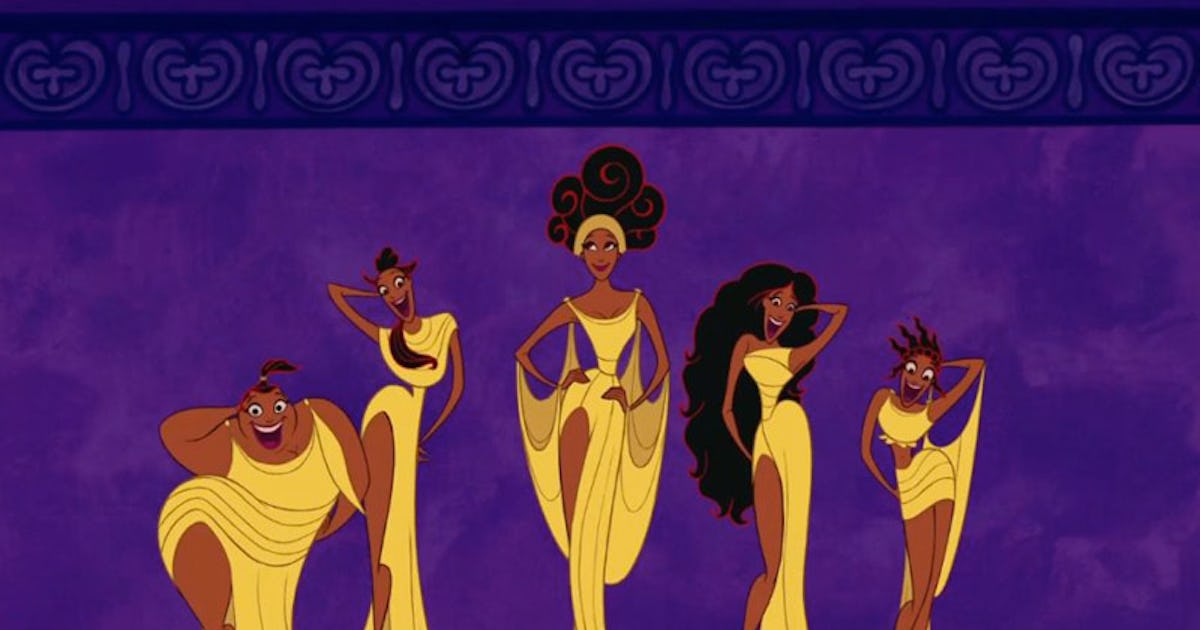
Lizzo and her dancers perform their choreography atop classical columns, positioning themselves as the muses – an allusion, perhaps, to the Black muses in Disney’s animated film “Hercules.”

The bodies of the statues in Lizzo’s video are not the chiseled physiques you’re accustomed to seeing in museums, while the various Grecian-style vases are painted with images of women in bondage gear, performing on poles and twerking. Lizzo and Cardi B also perform in front of statues that are deliberately centered on the buttocks. It’s an allusion not just to classical statues like the Venus Callipyge – which translates to “Venus of the beautiful buttocks” – but also a playful dig at a culture that historically has hypersexualized the bodies of Black women.

I’d never suggest reading the comments section of any YouTube video. But with “Rumors” you don’t have to scroll for very long before coming across a heated debate around “cultural appropriation” in the music video. Some say that it’s Greek and Roman art that’s being pilfered and sullied.

But to me, it’s just another example of Black women trying to stake their own claim to the beauty, joy and power of this tradition.

When Lizzo and Cardi B touch their acrylics in a gesture reminiscent of Michaelangelo’s famous “Creation of Adam” painting on the ceiling of the Sistine Chapel, they’re transfigured into a Grecian vase in a flash of lightning.

Just like that, the centrality of Black women to the classical tradition is no longer just a rumor.

It’s true.

Grace B. McGowan, PhD Candidate in American Studies, Boston University

This article is republished from The Conversation under a Creative Commons license.

Why Satanists may be the last, best hope to save abortion rights in Texas

As pro-choice and reproductive health groups are scrambling to make sense of Texas’ new, near-total abortion ban that went into effect this week, it appears their efforts to skirt the law are getting an unexpected boost from one organization in particular: The Satanic Temple.

The Supreme Court on Wednesday night allowed the state to implement a ban on the procedures after six weeks, before most women know they are pregnant, with no carve-outs for rape or incest. Until it is blocked or overturned, the law effectively nullifies the landmark 1973 Roe v. Wade decision — which established abortion as a constitutional right — in Texas.

Enter The Satanic Temple.

The “nontheistic” organization, which is headquartered in Salem, Massachusetts, joined the legal fray this week by sending a letter to the U.S. Food and Drug Administration demanding access to abortion pills for its members. The group has established an “abortion ritual,” and is attempting to use the Religious Freedom Restoration Act (which was created to allow Native Americans access to peyote for religious rituals) to argue that its members should be allowed access to abortion drugs like Misoprostol and Mifepristone for religious purposes.


Want a daily wrap-up of all the news and commentary Salon has to offer? Subscribe to our morning newsletter, Crash Course.


“I am sure Texas Attorney General Ken Paxton—who famously spends a good deal of his time composing press releases about Religious Liberty issues in other states—will be proud to see that Texas’s robust Religious Liberty laws, which he so vociferously champions, will prevent future Abortion Rituals from being interrupted by superfluous government restrictions meant only to shame and harass those seeking an abortion,” Satanic Temple spokesperson Lucien Greaves told the San Antonio Current

“The battle for abortion rights is largely a battle of competing religious viewpoints, and our viewpoint that the nonviable fetus is part of the impregnated host is fortunately protected under Religous Liberty laws,” he added. 

It’s unclear whether the Satanic Temple’s strategy of appealing to the Biden Administration will work. Last year, the group tried to overturn abortion restrictions enacted in the state of Missouri, but the Supreme Court declined to hear their case.

Ex-neo-Nazi Christian Picciolini: “The words I used to say are now part of the mainstream”

The foul odor of fascism has become inescapable in the American atmosphere. Republican officials across the country are working overtime to undermine the right to vote, leading right-wing pundits brazenly promulgate racist conspiracy theories and the Anti-Defamation League reports that 2020 saw a 45 percent increase in hate crimes throughout the Midwest.

There is perhaps no time more urgent to learn from one of fascism’s former foot soldiers. Christian Picciolini became a neo-Nazi as a teenager in the working class Chicago suburb of Blue Island in the late 1980s. As the leader of the Chicago Area Skinheads (CASH) and singer in the white-power rock band the Final Solution, Picciolini was one of the most effective recruiters in the white supremacist movement.

His story transformed, however, from horrific to redemptive and inspiring. Picciolini is now one of the most effective anti-hate activists in the United States. The details of his transition from Nazi to progressive — from hate leader to democratic healer — are available in his fascinating and important memoir, “White American Youth: My Descent into America’s Most Violent Hate Movement – And How I Got Out.”

Picciolini is the co-founder and director of the Free Radicals Project, an international multidisciplinary organization dedicated to the prevention of hate crimes, and working to stunt the growth of the movements that fuel them. He chronicles his current work in his insightful new book, “Breaking Hate: Countering the New Culture of Extremism.”

He is also the host of a new podcast, “F Your Racist History,” which aims educates listeners on the often unknown or whitewashed influence of racism in American culture, politics and economics.


Want a daily wrap-up of all the news and commentary Salon has to offer? Subscribe to our morning newsletter, Crash Course.


In the past few years, Picciolini’s warnings have become increasingly severe. As he and his colleagues at Free Radicals work to preserve the promise of multiracial democracy in the United States, Picciolini worries that the nation’s complacency will soon meet a catastrophic end.

I recently spoke with Picciolini by phone about this work and analysis of the current crisis facing American politics.

You recently published an alarming assessment of American politics and culture on your Facebook page, writing, “Everything happening in America and the world right now and for the last decade (rise of neofascism, Qanon/conspiracists, Trumpism, ‘America First,’ white nationalism, polarization, etc.) is leading me to believe we will face a period of darkness like we’ve never seen before.” Could you elaborate? What specifically has you so worried about this period of history?

Well, what’s happened since Barack Obama’s election is that we’ve seen the resurgence of a different kind of white supremacy. Up until that point, professionals, experts and those in law enforcement were touting the supposed fact that white supremacist organizations were either dead or dying. They were claiming that hate groups were going away, no one was joining groups like the Klan or becoming skinheads anymore and we were making great progress in combating white extremism. When Obama was elected, we saw a different kind of white supremacy. It wasn’t about joining the Klan or neo-Nazi organizations. It became about recruiting and radicalizing the mainstream.

That’s been happening now for a little longer than 12 years. We’ve seen the Libertarian Party infiltrated, and conservative spaces infiltrated by the same ideology I was involved with 30 years ago. Today we are seeing the effects of it. The fact that we are still in a place as a nation where we cannot agree that we have a problem with white supremacy — there are people who downplay the problem, there are others who are adamant that it doesn’t even exist — we are setting ourselves up for a big failure. I think after this administration we are going to see things become more conservative politically, and then government will exercise a stranglehold over how we combat white extremism. It is already tough now. We can’t find a consensus on it, which means we can’t properly fight it. Imagine how tough it will become when the federal government is under control of less friendly policymakers.

I wish that I could tell you something different, but everything I’ve seen happen over the last 30 years, and everything I see happening now, leads me to believe that we are in for a period of darkness. That means that law enforcement won’t feel that it has the support to do what they need to do to arrest white extremist criminals. White extremist criminals will blossom, and they will feel that they have the leeway to push the envelope. At the same time, we are seeing the institutions we depend on for safety — law enforcement, the military — becoming infiltrated with the same ideologies that affected me 30 years ago. It is becoming more and more part of the mainstream.

What I’ve seen happen, slowly but surely, over the past 30 years is that words I used to say as a neo-Nazi skinhead, the belief system that I had when I was an avowed white supremacist, are now part of the mainstream discussion. We are seeing people who are not neo-Nazis, or at least not claiming to be, spouting off the same beliefs — politicians, law enforcement officers, police unions. So we’re in for a very rude awakening.

It is terrifying that if you compare the rhetoric of contemporary right-wing figures, including Donald Trump, and the rhetoric in your memoir as you look back on your involvement with neo-Nazis, or the rhetoric of Timothy McVeigh, it is difficult to find any daylight between them. Can you specify what language, issues and ideas that are now prominent in right-wing discourse and Republican Party propaganda resemble what you and your associates were saying when you were a neo-Nazi?

First, there is the more blatant conspiracy-oriented language, regarding the “others” controlling the power structure. That is starting to exist in the language of QAnon, in terms of talking about “globalism.” But also, more specifically, what’s penetrated the right is “replacement theory” or the “Great Replacement.” What I mean by that is white supremacists believe that the demographics of the country are changing rapidly, and that soon white people will lose agency and power, because they will be the minority. Whether that is happening statistically or not is a different story, because what white supremacists believe is that it is an intentional process being put forward by global cabals of, in most cases, Jewish people who are trying to upset the balance of white power. White supremacists claim that diversity is genocide for the white race. They believe that the promotion of multiculturalism is a tool of white genocide.

We’ve started to hear those ideas, and similar ideas, come out of Tucker Carlson, a Fox News host with millions of viewers. It isn’t just people like me when I was hanging out in dark alleys reading pamphlets from other conspiracy theorists. People are now getting this theory and hatred from Donald Trump, and various people in his orbit. They are getting it from Paul Gosar, a Republican congressman from Arizona. These are people with suits and ties. They look like the mainstream, they sound like the mainstream and, in certain cases, they’ve been elected to powerful positions by the mainstream. And yet they are saying the same dangerous and outlandish things that a 17-year-old Christian Picciolini said when he was sporting a swastika tattoo.

It is the whole notion that if white people don’t wake up now, that they will be overrun. If you watch Tucker Carlson, people like David Duke and Tom Metzger, in the old days, said almost the exact same thing. They said, “White people, wake up! Immigration, the religions that they are forcing down our throats, multiculturalism — it’s all a conspiracy to destroy our white power.” Sometimes they use more palatable language, but they are using fear rhetoric to make white people afraid that they are being overrun by these other people and forces. Whether it is Islam, refugees, crime, immigrants or even the way they talk about outsourcing of jobs, it is all rooted in that same idea that white people have to be afraid.

And there is a certain set of policies that emanate out of that paranoia: “Build the wall,” family separation, the Muslim ban, voter suppression. Does this racist paranoia explain why so many Republicans have overtly turned against electoral democracy? They are making a brazen attempt, through voter suppression and partisan seizure of election offices, to undermine democracy. Is that where the paranoia has taken us?

I think so. Voter suppression has been around a long time. Every time there is a push for inclusion, for more people to vote, there is voter suppression. If you go back to poll taxes and literacy tests, that’s exactly what the Voting Rights Act was correcting. Yes, it was technically legal for Black people and others to vote, but white people in power made it almost impossible. There has always been a pushback by people who hold power against relinquishing that power. If you look at who is in power, it is mostly white men. Now, as they see it slipping away, or as other people become empowered, they are ramping up the dirty tactics.

As someone who has been on both sides of it, how do you suggest that a civil society with a Bill of Rights that protects speech and the press should effectively deal with hate speech, racist incitement and neofascism? How do we strike a balance between preserving our freedoms but also aggressively tackling this problem? 

That’s a tough one. We must do a better job of preventing future generations from finding what you describe as a viable option. All we can do right now is fight our way through it and hope that we survive.

Ultimately, what we have to do is hold people accountable. I’m talking about criminals, not people who are just saying things. We have a hard time holding criminals to account for the crimes they’ve committed. Just last week, Brandon Russell, one of the founders of a white supremacist terrorist group, Atomwaffen Division, was released from prison after four years, and this is after investigators found illegal guns and bombmaking material in his apartment. There are probably people in prison longer for marijuana, and this guy, for plotting to overthrow the U.S. government with a mass casualty event, is free.

It is hard to cut the head off the snake, because we are fighting this war against extremism the same way we fought the war on drugs. We are arresting and going after a lot of addicts, instead of going against the smugglers that are enabling the problem.

To round that out, we also learned this week that the FBI had been supporting Joshua Sutter, a confidential informant who was a white supremacist for 18 years. They paid him over $100,000. This is a person who still today is publishing white supremacist books and other materials, and those materials are used to radicalize people into joining Atomwaffen Division. So here is our own government actively funding someone who is working to radicalize people. That’s a problem. 

How do we expect to defeat white extremism if their coffers are being filled by the people who are supposed to protect us? When I say that we are in for darkness because we aren’t taking the right approach to combat extremism, that is exactly what I am talking about. First, we have to take care of that problem. Then we can have the tougher debate on what we do about hate speech.

I am also more of the mind that we need to do a better job of raising our children. Give them all the information that they need to succeed, and when they become adults, provide them with services like health care, like higher education — all those services we make difficult for people to access. In some cases, the only way people feel they can find agency is by joining hate groups, because they are the only ones who seem to pay attention to them, to listen to their problems. It is, of course, a toxic environment, and what they are getting is not positive interaction, but they are gravitating to these groups because they are getting something that they should be getting from society instead. So we should be thinking about how we lay a foundation under young people so that joining a hate group doesn’t even seem like an option, and so that what they offer is never attractive.

That brings us to your story, and your organization, Free Radicals. There probably isn’t a massive group of people who have a family member or friend who is in a hate group. But many people know someone in QAnon or someone who has taken an ideologically dark turn. For the sake of them, can you talk about what Free Radicals does, and also address the steps to de-radicalize people?

The Free Radicals Project is a nonprofit organization that I founded to help people disengage from hate groups. Yes, you are accurate when you say that there aren’t many members of hate groups. Now, most people with the hateful mindset aren’t card-carrying members of the Klan. That’s part of how things have shifted in the last 20 to 30 years. It is less about the group and more about the movement. There is a coalescence into the general movement. What we do is work with people directly who are in these movements, and we recognize that they don’t know how to disengage. Even if they are feeling doubt, they can’t discuss that with their comrades.

As someone who has been there myself, I have the ability to listen. We are guides, and we guide them out. It begins with understanding that ideology is likely not what brought them there. It was a search for identity, community and purpose. What I do is I offer people substitutes for the identity, community and purpose that they’ve found, and replace them with things that are more positive. We work for ways to replace the identity they found or the community in which they feel welcomed and rewarded.

That process begins with identifying the “potholes” in their lives. Potholes are those things we all encounter on our journey. Potholes are trauma. So, what is the pothole — the trauma — that put them on the road to their direction? Without debating about their ideology, we focus on those potholes and find pothole fixers — therapists, job trainers, teachers, life coaches, hobby groups, anything that can work to build a better foundation under them. 

Isn’t it true that you received a federal grant, but the Trump administration eliminated it?

My old organization that I co-founded, Life After Hate, applied for and won a $400,000 grant in 2016. We never received the money, because the administration had changed. In December 2016, we were notified by the Obama administration that we won. In the early months of the Trump administration, we were notified that we would not receive the grant. They had reviewed our application and rescinded it. We were the only organization out of 36 that had the grant revoked. We were also the only one that was focusing on white supremacy. All of the others were focusing on Islamist extremism.

That speaks to the larger issue. Earlier, you used the word “terrorist.” As you know, FBI statistics show that white supremacy organizations and related hate groups are responsible for more murders of Americans than any other extremists since 9/11. We all watched the gruesome and sad footage of Jan. 6. But it still seems that most of white America remains blasé about the terrorist threat of white hate. 

Absolutely. That is one of the biggest reasons why we can’t combat it. We can’t even name it. We refuse to look in the mirror and face that it is other Americans, not foreigners, who are the biggest threat to American democracy. We need to get over that hump, and recognize that these people are terrorists. They are criminals. We need to call them out and hold them accountable as such. My concern is that we don’t have the will to call it out. 

Is that part of what motivates your new podcast, “F Your Racist History”?

Yes, that was part of it. After 25 years, I’ve taken it upon myself to try to educate Americans about the world I was part of, because few others were stepping up to do that. I also learned a lot as I was going through my transition. We did an episode on Henry Ford, and I knew about him when I was a Nazi. I knew then that he was a supporter of Hitler. The rest of the world didn’t know that. We had a museum about Henry Ford. Every town had a Ford dealership.

So some of the podcast is about things I already knew but few others seemed to discuss, and some of it is what I’ve learned about American history. It is part of a recognition that if we don’t know where we came from, how the hell are we going to measure our progress? And part of it is that if we can’t admit that we’ve been part of this — that we’ve all been complicit — we aren’t going to stop it.

Currently, there is all this hysteria over “critical race theory.” Until a few months ago, it was a relatively obscure legal theory taught almost exclusively in law schools. Many polls confirm that most people claiming to have passionate objections to it don’t even know what it is. So it is effectively an umbrella term, for those rallying against any instruction of systemic racism and, as you say, “complicity.” Why is it important that Americans learn the true history of our country, and why is there so much backlash against that, where they are going so far as to try to ban it in colleges and high schools? 

As Americans, as people who tout our democracy, we need to understand what we are preaching. We need to understand where we come from. We should be proud of how far we’ve come, but we also have to recognize that there are still many people oppressed and excluded due to institutional racism. Until we address those things, we are creating an ecosystem that is breeding racists. As long as there are people who benefit from racism, there will be people who are attracted to it. If we ever hope to make an equitable society, we have to understand the progress but also the ugliness, and also identify all the things that are preventing us from becoming an equitable society today. 

White supremacists and the right wing are using “critical race theory” to make white people afraid that their society is going to deprive them, and turn everyone else against them. The irony is that is exactly what they are covering up — that white people, for centuries, have divided people and treated everyone else unequally. They are afraid of the mask being torn off. They are also banking that most people aren’t going to do the intellectual work to understand what they are talking about. They will just emotionally buy into it.

I talked earlier about identity, community and purpose — and potholes — as they relate to individuals, but I also think the United States as a country right now is struggling with its identity, community and purpose. We have a whole history of potholes that we’ve not dealt with, and until we deal with them we are going to keep finding ourselves going off onto the fringe. Right now we are dealing with so much uncertainty relating to the pandemic, politics, jobs, health care, so much else. Well, uncertainty is the one ingredient that allows extremism to thrive. So we are in a very dangerous position. We are on a tinderbox. We have to be really vigilant about dealing with it.

Pearl Jam’s “Ten” at 30: A raw, dynamic debut that’s both sonically and emotionally exquisite

When I think of Pearl Jam circa “Ten,” many things come to mind. Vocalist Eddie Vedder pulling a Spider-Man during shows and climbing up stage gear from which he’d dangle before somehow getting back down safely via crowd dives or precarious jumps. The arresting Mark Pellington video for “Jeremy,” which illustrates the song’s lyrics, about a school shooting.

However, a smaller gesture from the band’s 1992 MTV “Unplugged” episode looms largest in my mind. As happened during electric Pearl Jam shows, the stinging, punkish “Porch” turned into a raucous jam with a frenzied bridge and forceful vocals. As the band’s acoustic guitars fray at the seams, driven by Dave Abbruzzese’s kinetic drumming, Vedder takes a marker and scrawls out “PRO-CHOICE!!” in big letters on his arm. The cameras continued to linger on his arm occasionally for the rest of the song, making it clear the message was heard. 

As a young kid, this moment stuck with me perhaps because it coincided with my own growing awakening to the social and political activism espoused by my favorite bands. In hindsight, however, it feels revolutionary and deeply moving that the figurehead of a major rock band so openly and unabashedly supported this cause. 

Vedder wasn’t alone, of course; Nirvana’s Kurt Cobain and R.E.M.’s Michael Stipe were also vocal about many social issues at this time. But at this early stage, Pearl Jam leaned heavier than both of those bands, both sonically and emotionally. The quintet’s debut album, “Ten,” is all raw nerve endings, a collection of songs about navigating grief and mourning changes and endings. At times, these feelings are expressed via frustration; at other times, they manifest as anguish and despair. 

“Ten,” of course, is also considered one of the major albums of the grunge era, alongside another 1991 LP, Nirvana’s “Nevermind.” Pearl Jam had a head start on Nirvana — their album arrived in August 1991, a month before “Nevermind” detonated in stores — but “Ten” took longer to take off: It was certified platinum on May 5, 1992, while “Nevermind” was certified four times platinum on June 12, 1992. Like many musical movements, grunge was always more of a press-driven construction than an organic scene. 

However, a descriptor like grunge distanced bands from their ’70s arena rock lineage, an era out of fashion at the time. (It’s why Nirvana’s love of bands such as The Cars and Cheap Trick wasn’t stressed as prominently, either.) But grunge was never a monolith. Soundgarden and Alice In Chains were inspired by ’70s psychedelic stoner rock and heavy metal bands such as Deep Purple and Black Sabbath. Nirvana, in contrast, took subtle cues from ’80s college rock (Pixies, Smithereens) as well as hardcore punk and melodic new wave pop. 

About the only common grunge inspiration across the bands was Led Zeppelin and their mix of heavy blues, pastoral folk and hard rock. The British group was certainly a prominent influence on “Ten,” although the musicians who penned the foundational music — bassist Jeff Ament and guitarists Stone Gossard and Mike McCready — brought eclectic backgrounds to the album. Ament and Gossard were in the influential Seattle band Green River but were most recently in Mother Love Bone, which had glam rock and alternative metal overtones. (Tragically, the band’s vocalist, Andrew Wood, passed away from a drug overdose in 1990.) Vedder, meanwhile, was a fan of not just R.E.M. but artists such as Neil Finn, Ramones, Bruce Springsteen, Talking Heads, and The Who. 

“Ten” does boast energy, jettisoning the turgid and self-indulgent tempos of classic rock acts in favor of languid grooves — a song like “Alive” stretches and zones out, with dynamics offering respite from the heaviness — and crisp psychedelic boogie (“Deep”). Elsewhere, the album boasts surging punk (“Porch”), and hard rock that’s both exuberant (“Even Flow”) and elegiac (“Garden”), as well as intricate atmospherics, as on the opening of “Once,” that sounds like water dripping magnified 100 times.   

Time tends to flatten context around bands, which can be a good thing (old biases falling away often leads to a more open-minded listening audience) or a negative (important nuances around songs are lost). Pearl Jam often falls into the latter camp. “Alive” and “Even Flow” have been played into the ground on the radio, making them sound more like classic rock wallpaper rather than deep, meaningful songs. 

But “Ten” deserves better. It’s an album that’s the result of musicians and lyricists wrestling with deep loss. “Once upon a time I could control myself” Vedder wails on “Once.” Later in the song, he changes his tone slightly: “Once upon a time I could love myself.” The haunted “Black,” long a fan favorite, can be read as a song about finality: a death, perhaps, or a relationship that’s irrevocably severed. “All five horizons revolved around her soul as the earth to the sun,” Vedder songs.

“The song is about letting go,” he noted in the “Pearl Jam 20” documentary. “It’s very rare for a relationship to withstand the Earth’s gravitational pull and where it’s going to take people and how they’re going to grow. I’ve heard it said that you can’t really have a true love unless it was a love unrequited. It’s a harsh one because then your truest one is the one you can’t have forever.”

Much of “Ten” is focused on absence. Vedder wrote a song trilogy — “Alive,” “Once” and “Footsteps” — he called “Momma-son,” centered on a young man whose mental health deteriorates after he learns the identity of his real father. Elements of “Alive” drew from his own life: As a teenager, Vedder learned his stepfather wasn’t his biological father — and, sadly, the latter had passed away, so he never had a chance to know him. However, Vedder fictionalized his experience into lyrics that touched on incest, murder, abuse, and incarceration; together, the songs read like a short story. “Jeremy,” meanwhile, was inspired by the true story of 15-year-old Jeremy Delle, who died by suicide in his English class. The song’s narrator is one of his classmates left behind, remembering all the signs that pointed to (and his own complicity in) Jeremy’s actions. 

These are heavy topics, but Vedder’s tone is empathetic and incisive. Even early on, his emotional generosity was already fully formed, as he dug into the heart of sensitive matters. “Release,” a stream-of-conscious, primal song Vedder wrote about his reaction to finding out about his dad, is especially tender. Vedder is kind to himself as he sings, “Oh, dear Dad, can you see me now?/I am myself, like you somehow.”


Want a daily wrap-up of all the news and commentary Salon has to offer? Subscribe to our morning newsletter, Crash Course.


“Release” in particular meant a lot to Vedder. “Those words – I still refuse to write them down, even if they need them for publishing,” he said in the book “Five Against One: The Pearl Jam Story.” “I won’t write ’em down. That was just something I hadn’t experienced, it was so intense.” He extended that same empathy to the protagonist of “Why Go,” who is in the hospital against her will, and “Even Flow,” written about someone experiencing homelessness. Vedder centers these characters in their own stories; it’s their voices and perspectives we hear, rather than an outsider deciding the narrative shape.

That combination of honesty, empathy and intensity also made Vedder a formidable frontman. During Pearl Jam’s April 1992 “Saturday Night Live” appearance, he repeated his pro-choice advocacy during “Porch.” This time, Vedder was explicit: Wearing a tan shirt emblazoned with a coat hanger, he improvised some pointed commentary during the bridge. “A woman has every right to choose — to choose, to choose, to choose,” he riffed. “Choose for herself.” He didn’t need to elaborate: His passion and message was clear, and underlined exactly why Pearl Jam and “Ten” became such enduring institutions.

From a “Dear White People” swan song to Tokyo assassins, here’s what’s new on Netflix in September

September signals the end of summer, which sometimes means a pause on your favorite trashy dating shows and steady influx of new, delightfully meaningless rom-coms to indulge. But it doesn’t mean a pause on entertaining content, especially as the temperatures start to drop, the leaves begin to fall, and the weather becomes perfect to stay in and Netflix and chill to your heart’s content. 

This September, Netflix has got you covered. If you’re feeling particularly intellectual, or want to dig deeper into the history of 9/11 on its 20th anniversary this month, Netflix’s five-part docuseries “Turning Point: 9/11 and the War on Terror” might be the binge for you. And if you’re a fan of the awkward but lovable teens of “Sex Education,” its third season is finally coming your way, too. 


Want a daily wrap-up of all the news and commentary Salon has to offer? Subscribe to our morning newsletter, Crash Course.


But, as the old adage goes, when Netflix titles go, they’re gone. That means these are your last days to learn why the angry birds of “Angry Birds” are so unhappy, as the cartoon’s first two seasons are slated to end streaming on Sept. 15. The “Karate Kid” trilogy and first two “Kung Fu Panda” movies will be on the outs, too, both on Sept. 30. A good chunk of Netflix’s “Star Trek” content, like the 2009 “Star Trek,” “Star Trek: Enterprise,” “Star Trek: Voyager” and all three seasons of “Star Trek” will also depart Netflix on the 30th.

So, get in your last “Star Trek” binge! Relive the pure, DreamWorks magic that is “Kung Fu Panda”! But be sure to keep your queue locked and loaded with all the new magic Netflix has in store.

“Turning Point: 9/11 and the War on Terror,” Sept. 1

This five-part, investigative documentary series argues the cases for how modern history can be divided between before and after 9/11. The documentary goes to entirely new places and is rife with interviews with varied subjects ranging from CIA officials to Taliban commanders, and Afghan civilians most impacted by the wars that ensued. 

“Q-Force,” Sept. 2

An adventurous adult cartoon following the lives of LGBTQ superspies, Agent Steve Maryweather once reigned as the golden boy of the American Intelligence Agency, until coming out as gay. Mayweather was sent off into obscurity shortly after coming out. Rather than accept this fate, he assembled an LGBTQ+ squad of misfits that now call themselves Q-Force, and honestly, why don’t we have an all-queer “Avengers” squad yet, Marvel? The voice stars include Sean Hayes,  Gary Cole, David Harbour, Patti Harrison, Laurie Metcalf, Matt Rogers, Wanda Sykes and Gabe Liedman.

“Worth,” Sept. 3

Starring Michael Keaton as the real-life lawyer Kenneth Feinberg, who took on the impossible task of calculating how to compensate families of the victims of 9/11, “Worth” is an emotionally complex drama on the true value of human life. The film also stars Stanley Tucci and Amy Ryan.

“Countdown: Inspiration4 Mission to Space,” Sept. 6

A new documentary series that will cover a monumental event in near real time, “Countdown” is the behind-the-scenes story of the four crew members making history as the first all-civilian mission into orbit. In his trip to space, billionaire Jared Isaacman will be joined by Hayley Arceneaux, a physician assistant at St. Jude and a cancer survivor; Christopher Sembroski, a veteran of the U.S. Air Force; and Sian Proctor, a professor of geosciences and two-time NASA astronaut candidate. Its first two episodes release on Sept. 6, second two on Sept. 13 and finale to be announced in late September.

“On the Verge,” Sept. 7

From the director of “Two Days in Paris,” “On the Verge” is a dramedy following the lives of four women (Julie Delpy, Elisabeth Shue, Sarah Jones and Alexia Landeau) in Los Angeles just before the pandemic, each caught in the throes of a midlife crisis. The series seems packed with emotional highs and lows, and as generous an amount of shots at the beach as you’d expect of a story based in LA. 

“Blood Brothers: Malcolm X & Muhammad Ali,” Sept. 9

Inspired by Randy Roberts and Johnny Smith’s book “Blood Brothers: The Fatal Friendship Between Muhammad Ali and Malcolm X,” this new documentary of nearly the same name follows the story of Malcom X and Muhammad Ali’s extraordinary relationship, from their chance meeting to their eventual fallout over shifting ideals. Both men have left deep marks on history in their bold rejections of white supremacy, but few know about the bond they shared.

“Kate,” Sept. 10

A Tokyo assassin (Mary Elizabeth Winstead) has been poisoned and has 24 hours to live — meaning she has 24 hours to find her killer and exact revenge, like only a Tokyo assassin can. “Kate” is both an epic revenge thriller and a race against time through the neon-lit streets of Japan.

“Sex Education” Season 3, Sept. 17

Right on time for back-to-school season is the third season of our favorite British sex comedy, and it promises to be a doozy for the teens of Moordale. According to Netflix’s riveting but open-ended synopsis, Otis is now having casual sex, Eric and Adam are “official” and Jean is preparing for a baby. What could possibly go wrong?

“Squid Game,” Sept. 17

In this haunting South Korean television series, 456 people who have struggled in life are invited to partake in a mysterious survival competition called “Squid Game.” The competition entails a series of traditional children’s games with deadly twists, as the competitors risk their lives for a chance at $40 million. As if that doesn’t make you nervous enough, there can only be one winner. This is giving us “Battle Royale” vibes.

“Love on the Spectrum” Season 2, Sept. 21

Two years after the first season of “Love on the Spectrum” captured our hearts, the second returns to dive deeper into the dating lives of people on the autism spectrum. We’ll reunite with some familiar faces, as well as an even wider range of people and personalities to fully represent the diversity of the spectrum.

“Dear White People” Vol. 4, Sept. 22

Back and as timely as ever, the news season “Dear White People” takes place during the pandemic, as, from the future, Sam and Lionel look back on their final year at Winchester, which plays out as a ’90s-style musical. This fourth and final season comes fresh off an estimated 700% surge in viewership for the show throughout last summer, amid the uprising for Black lives.

“Monsters Inside: The 24 Faces of Billy Milligan,” Sept. 22

Followers of the stories of Ted Bundy or the elusive Golden Gate killer are in for the perfect binge, with “Monsters Inside,” which tells the story of an accused serial rapist who claims to have multiple personality disorder. The late 1970s saga sets off a captivating legal odyssey that this Olivier Megaton-directed docuseries aims to shed new light on.

“Attack of the Hollywood Clichés!” Sept. 28

In this one-off comedy special featuring the most iconic films in cinematic history, a handful of beloved celebrity guests are our tour guides through the delightful, weird and ultimately inescapable clichés of some of our favorite movies. Host Rob Lowe and his guests walk us through the origins of the tropes of “walking away from an explosion,” or the “meet cute,” or, of course, “women running in stilettos,” among many, many more.

Here’s the full list of everything coming to Netflix this month.

Sept. 1
“How to Be a Cowboy”
“Turning Point: 9/11 and the War on Terror”
“A Cinderella Story”
“Agatha Christie’s Crooked House”
“Barbie Big City Big Dreams”
“Blade Runner: The Final Cut” (1982)
“The Blue Lagoon” (1980)
“Chappie”
“Clear and Present Danger”
“Cliffhanger”
“Cold Mountain”
“Crocodile Dundee in Los Angeles”
“Dear John”
“Do the Right Thing”
“Freedom Writers”
“Green Lantern”
“House Party”
“House Party 2”
“House Party 3”
“The Interview”
Kid-E-Cats: Season 2″
Labyrinth”
Letters to Juliet”
Love Don’t Cost a Thing” (2003)
Mars Attacks!”
“Marshall”
Mystery Men”
“The Nutty Professor”
The Nutty Professor II: The Klumps”
Once Upon a Time in America”
Open Season 2″
Rhyme & Reason”
School of Rock”
Tears of the Sun”
Welcome Home Roscoe Jenkins”

Sept. 2
“Afterlife of the Party”
“Final Account”
Q-Force

Sept. 3
“Dive Club”
“Money Heist Part 5: Volume 1”
“Sharkdog”
Worth”

Sept. 6
“Countdown: Inspiration4 Mission to Space”

Sept. 7
“Kid Cosmic” Season 2
“Octonauts: Above & Beyond”
“On the Verge”
Untold: Breaking Point”

Sept. 8
“The Circle” Season 3 
“Into the Night” Season 2 
“JJ+E”

Sept. 9
“Blood Brothers: Malcolm X & Muhammad Ali”
“The Women and the Murderer”

Sept. 10
“Firedrake the Silver Dragon”
“Kate”
“Lucifer: The Final Season”
“Metal Shop Masters”
“Pokémon Master Journeys: The Series”
Prey” 
“Yowamushi Pedal”
“Yowamushi Pedal Grande Road”

Sept. 13
“Countdown: Inspiration4 Mission to Space”

Sept. 14
“A StoryBots Space Adventure” 
Jack Whitehall: Travels with My Father” Season 5
“The World’s Most Amazing Vacation Rentals” Season 2 
“You vs. Wild: Out Cold”

Sept. 15
“Nailed It!” Season 6
“Nightbooks”
“Saved by the Bell” Seasons 1-9
“Schumacher”
“Too Hot To Handle Latino”

Sept. 16
“He-Man and the Masters of the Universe”
“Jaws”
“Jaws 2”
“Jaws 3”
“Jaws: The Revenge”
“My Heroes Were Cowboys”

Sept. 17
“Ankahi Kahaniya”
“Chicago Party Aunt”
“The Father Who Moves Mountains”
“Sex Education” Season 3 
“Squid Game”
The Stronghold”

Sept. 19
“Dark Skies”

Sept. 20
“Grown Ups”

Sept. 21
“Go! Go! Cory Carson: Chrissy Takes the Wheel”
“Love on the Spectrum” Season 2

Sept. 22
“Confessions of an Invisible Girl”
“Dear White People” Season 4
“Intrusion”
Jaguar”
Monsters Inside: The 24 Faces of Billy Milligan”

Sept. 23
“Je Suis Karl”

Sept. 24
“Blood & Water” Season 2
“Ganglands (Braqueurs)”
“Jailbirds New Orleans”
“Midnight Mass”
My Little Pony: A New Generation”
“The Starling”
“Vendetta: Truth, Lies and The Mafia”

Sept. 28
“Ada Twist, Scientist”
“Attack of the Hollywood Clichés!”

Sept. 29
“The Chestnut Man”
“Friendzone”
“MeatEater” Season 10, part 1 
“No One Gets Out Alive”
“Polly Pocket” Season 3, Part 1
“Sounds Like Love”

Sept. 30
“Love 101” Season 2 
“Luna Park”
The Phantom”

Everything we know about the mu variant, the latest coronavirus mutation

A study published last month established that Americans, after years of being pounded with creationist propaganda, had decisively rejected pseudoscience and accepted evolution. While the shift in public opinion had been years in the making, there was a certain poetry to the timing of that study’s release. We have watched with bated breath as SARS-CoV-2 — the virus that brought the world to its knees by causing the COVID-19 pandemic — has evolved over and over again into something more effective at spreading through the human population. We have had the delta variant and the lambda variant and the hybrid B.1.429, to name only a few. Whenever a new strain pops up, public health officials try to strike a note between caution and reassurance.

Now we come to the mu variant, also known as B.1.621.

On Monday the World Health Organization (WHO) officially labeled the mu variant as a “variant of interest,” a designation that indicates a need for further study about possible dangers while falling short of the more serious classification, “variant of concern.” Variants of concern are regarded as a top priority because they are more immunity-resistant, contagious or deadly than other strains. Currently the WHO considers four strains to meet those criteria: alpha, beta, gamma and delta (the variant most prevalent in the United States).

The WHO reports that the earliest documented samples of the mu variant came from Colombia in January; the strain now makes up 39 percent of all the cases there. It has also been detected in dozens of other countries, most commonly popping up in the United States, Mexico, Spain and Ecuador. A British risk assessment released last month suggests that the mu variant could be at least as resistant to vaccine-based immunity as the beta strain, although more research needs to be done. The mu variant contains several mutations that have been associated with resistance to immunity, such as E484K and K417N, as well a mutation known as P681H that has been linked to accelerated transmission.

“This variant has a constellation of mutations that suggests that it would evade certain antibodies, not only monoclonal antibodies, but vaccine- and convalescent serum-induced antibodies,” President Joe Biden’s COVID-19 adviser Dr. Anthony Fauci told reporters on Thursday. “But there isn’t a lot of clinical data to suggest that. It is mostly laboratory in-vitro data.”

Fauci emphasized that people who are concerned about the mu variant should still get vaccinated. Experts agree that people who are vaccinated are still less likely overall to develop COVID-19. If they do get sick, they are also less likely to become severely ill thanks to the various protections that the vaccines confer. Fauci made this point by talking about how vaccines are still helping people against the delta variant, which is currently surging in the United States.

“Remember, even when you have variants that do diminish somewhat the efficacy of vaccines, the vaccines still are quite effective against variants of that time,” Fauci explained. As for the mu variant, he was characteristically candid.

“We’re paying attention to it, we take everything like that seriously, but we don’t consider it an immediate threat right now,” Fauci explained.

The WHO expressed a similar view regarding the mu variant, saying that more studies need to be performed so scientists can precisely understand the nature of the threat it does (or does not) truly pose.

“The epidemiology of the Mu variant in South America, particularly with the co-circulation of the Delta variant, will be monitored for changes,” the organization explained.

During the same Tuesday meeting in which it announced its decision regarding the mu variant, the WHO also announced that it will start naming variants after stars and constellations once it runs out of Greek letters. Mu is the 12th letter in the Greek alphabet, meaning scientists are already halfway through that system. One WHO official wrote to science journalist Kai Kupferschmidt that “they will be less common stars/constellations, easy to pronounce. We are just checking internally with our regional colleagues to ensure none of them cause any offence or are common names in local languages.”

As epidemiologist Dr. Eric Feigl-Ding tweeted, “it’s sad they need to plan this.”

He added that because Andromeda is a constellation, “‘Andromeda Strain’ is now technically possible as a name,” referencing the 1969 Michael Crichton novel that was adapted into a 1971 film.


Want more health and science stories in your inbox? Subscribe to Salon’s weekly newsletter The Vulgar Scientist.


Georgia GOP called “shameless” for trying to use new voting law to oust local election officials

Georgia Republicans are already trying to use their controversial new election law to drive out local election officials in the state’s largest and most Democratic county.

Gov. Brian Kemp earlier this year signed SB 202, a law that not only restricts ballot access but allows state officials to temporarily take over county election boards. This has raised concerns about potential Republican election subversion after the party lost the presidential race and both U.S. Senate elections in the state amid record voter turnout. Republican lawmakers wasted no time using the law to target election officials in Fulton County, which includes most of of the city of Atlanta and has a population of more than a million people, about 44% of them Black. President Biden won 72.6% of the vote in Fulton County, outperforming Hillary Clinton’s 2016 total by 83,000 votes. The county has been the a primary target of former President Donald Trump’s false election claims and multiple lawsuits filed by his supporters, although there has been no evidence of fraud or misconduct.

Republicans representing the county in the state legislature called for a performance review of the country’s election board in July, which Scott Hogan, the head of the state Democratic Party, decried as a “shameless Republican power grab designed to suppress voters and inject partisan politics into our elections.”

“It appears that they would like to take over the county board of elections,” Aunna Dennis, the executive director of Common Cause Georgia, said in an interview with Salon, calling the move part of a “coordinated strategy” that represents Republican “opposition to, basically, democracy.”

The misinformation and lawsuits preceding the review show that there was “clearly partisan motive” on the part of Republicans, Charles Bullock, a political science professor at the University of Georgia, said in an interview with Salon.

“The predicted changes to Georgia’s electorate are finally coming to fruition,” he said, noting that the 2020 election was likely the first time that urban Georgia had outvoted rural Georgia. “Finally there’s now proof that the state is changing and it’s going to be harder for Republicans. Where is the single biggest bastion of Democratic voters? Well, it’s in Fulton County.”

The state election board, which is currently made up of three Republicans and one Democrat, last month began the lengthy review process by appointing a three-person Republican-led panel to investigate the county’s handling of elections. The panel includes Democratic Gwinnett County election board member Stephen Day, Republican Catoosa County election board member Ricky Kittle, and Ryan Germany, the general counsel for Republican Secretary of State Brad Raffensperger, who backed the review.

Fulton County accounts for 11% of Georgia’s electorate and is one of the state’s most diverse counties. Robb Pitts, the chairman of the County Board of Commissioners, warned since before the law was approved that it would be used to target the county.

“This is the result of a cynical ploy to undermine faith in our elections process and democracy itself — it is partisan politics at its very worst,” Pitts said at a news conference last month. “This is a shameful reminder that the Big Lie is still alive. It has been successfully laundered and accepted by some of those who initially stood up against it, such as our secretary of state. Now, his comrades in this fight are the same conspiracy theorists he rebuked last year. He’s sold out and thrown his lot in with those who want to conduct a hostile takeover of our elections because he fell out of grace with the former president — he’s desperately trying to cling to power by appeasing those who believe the Big Lie.”

Bishop Reginald Jackson, a presiding prelate of Georgia’s AME Church, pointed to the record turnout among Black voters, who slightly outnumber whites as the largest single group in the county’s population.

“Today, it is clear that the Georgia Republican Party is scared. Since they no longer can win elections based on ideas, policy, leaderships or morals, their only pathetic course of action is to try to take legitimate votes away,” he said in a statement last month.

Republicans who called for the review said in a letter to the State Election Board that it was necessary to “assure voter confidence in our elections.” Raffensperger, who pushed back against false claims by Trump and Georgia Republicans about the state’s elections, also supports the investigation, though he did not get a vote because the law removed him as the chair of the State Election Board. Kemp said he “fully” supports the review.

“Fulton County has a long history of mismanagement, incompetence, and a lack of transparency when it comes to running elections — including during 2020,” the governor said on Twitter.

The county has certainly had its share of election problems, including long lines at polling locations. The State Election Board entered into a consent order with the county after voters endured hours-long lines in last year’s primary elections, which Democrats largely blamed on a statewide effort to shutter hundreds of polling places after a Supreme Court decision gutting a section of the Voting Rights Act and a lack of resources provided by the Republican-led state legislature.

“It’s definitely a result of underfunding,” Dennis said, noting that Republicans who claim to be concerned about election management in Fulton County “are not really trying to invest in helping the board of elections operationalize their offices” amid a pandemic. “Let’s not try to take them over, let’s try to actually be solution maker and mitigate the barriers, not create more barriers,” she said.

An independent monitor, Carter Jones, was appointed to observe the county’s handling of the general election. His notes, which were obtained by the AP, showed that the county’s handling of the ballots was messy and poorly managed, which may have fed unfounded allegations of fraud or mishandling. But he stressed that he saw no evidence of “any dishonesty, fraud or intentional malfeasance.”

“At a certain point, it’s people willing to believe the worst in other people to justify a narrative that they have themselves,” Jones later told the AP, referring to the Trump-centric conspiracy theories targeting the county.

Under the law, the review panel will “make a thorough and complete investigation” of “all actions of the local election official,” including its handling of election equipment, oversight of voter registration, compliance with election law and whatever other issues may be raised by lawmakers, according to Georgia Public Broadcasting. The probe is expected to last several months, though there is no time limit. The entire process could last a year or more.

After the investigation, the panel will issue a report and could ultimately recommend that the county’s bipartisan elections board should be suspended and replaced by a temporary superintendent who would have full authority to make staffing changes and polling location choices. Because the state also allows any voter to challenge any other voter’s eligibility, the superintendent could also decide on requests to disqualify individual voters.

That move can be requested by county government, which is unlikely given Pitts’ position. But it could also be requested by the Republican-led State Election Board following its own investigation and hearings to determine whether the board broke at least three election rules or laws in the last two election cycles, or whether there is “clear and convincing evidence” that the board demonstrated “nonfeasance, malfeasance, or gross negligence” over that span.

Local election officials could potentially be suspended for up to nine months, though they can petition for reinstatement before that. If such a suspension holds up, the State Election Board could remove the temporary superintendent after nine months or appoint a new election board.

The State Election Board’s members said they were required to appoint the panel under the law. Sara Tindall Ghazal, the only Democrat on the board, said she hopes that the investigation will focus on improvements that will better serve voters.

“The narrative driving this pressure has been influenced by disinformation surrounding the November 2020 election, but the fact remains that Fulton County voters have reported numerous problems for far longer than November 2020, particularly surrounding registration and absentee ballots,” she said last month. “So I urge Fulton County to view this performance review board as an opportunity to have fresh eyes on their systems and their procedures and identify areas of improvement.”

But the impression that the review board is bipartisan is misleading, said Bullock, the University of Georgia professor. “Republicans are still running this thing. Any kind of board that gets appointed, not just in this context but others, is going to be predominantly Republican.”

Voting rights groups have sounded the alarm over the possibility that an appointee of the Republican-led state board would be in charge of election administration in a county that is crucial to Democratic electoral prospects in Georgia.

“We’ll have appointees that don’t live in the jurisdiction, that don’t reside in counties as populous or as robust,” said Dennis of Common Cause Georgia. “That’s kind of the fear, that we will have representation that does not match the community” and no say over “any of the implementations of laws or structuring of the election board, nor any say in the inner workings, even down to suggesting new precinct locations and trying to do voter education campaigns with the board of elections. All these things that we have been able to do as a community — we will no longer be able to do that if this takeover happens.”

Dennis also warned that “whatever happens in Fulton is going to domino across the state” and that if this approach is successful for Republicans, other states with GOP-majority legislatures could soon follow.

“This would become a domino effect across many states,” she said. “If it happens in Georgia, people should definitely be looking out to see if major counties, and definitely progressive counties or cities who have large voting populations, will be targets as well.”

Some voting rights groups are preparing to raise funds to defend local election officials and continue to push for Congress to pass voting rights legislation like the For the People Act. In fact, even that sweeping election bill does not that currently include measures to prevent the kind of takeover activists fear.

“The worst-case scenario is that democracy is forever scarred by this direct attack to disenfranchise Black voters in a partisan election takeover,” Nse Ufot, who leads the New Georgia Project, a grassroots voting rights group, said in a statement to Salon. “This is a whitelash against the progressive coalition that came out in historic numbers to vote out 45 and send two Democratic senators to D.C. The ripple effects of SB 202 are already being replicated across Georgia and other GOP-controlled states across the country and the time to act is now.”

The tangled physics of knots, one of our simplest and oldest technologies

From whimsical flower crowns to carelessly tied shoelaces to hopelessly tangled headphones, knots are everywhere. 

That’s not surprising, as knots are quite ancient, predating both the use of the axe and of the wheel and potentially even the divergence of humans from other apes. After all, ropes and cords are practically useless without being tied to something else, making one of the most ancient technologies still remarkably relevant today.

But these tie-offs can be a problem, since knots actually decrease the strength of a rope. When a rope made up of multiple fibers is taut, those fibers all share equal portions of the load. However, the bending and compression where the knot forces the rope to curve (usually around itself, or around the thing it is tied to) create extra tension in only some of the fibers. That’s where the rope will break if yanked with too much force. And this isn’t a small effect: common knots generally reduce the strength of a rope by 20 percent for the strongest ones, to over 50 percent for a simple overhand knot.

Experience has taught surgeons, climbers, and sailors which knots are best for sewing up a patient, or rescuing someone from a ravine, or tying off a billowing sail, but until some recent research from a group at MIT it was hard to tell what actually makes one knot better than another. 

Knot strength depends a lot on its material: a beefy figure eight knot in a thin fishing line will never support more weight than the lowly overhand knot in a climbing rope. However, all else being equal, researchers have found that there are a few main traits that help define a knot’s relative strength and stability. In this case, it’s easier to think about these knots in the context of connecting two different ropes together, as opposed to creating a knot in a single rope. (This is technically known as a bend, since a true knot only involves one rope, but for simplicity, let’s use “knot” as an umbrella term.)

So how can we tell, just with our eyes, whether one knot is stronger than another? Perhaps most intuitively, knots with more strand crossings tend to be stronger. Additional points of contact likely create more friction — more resistance to coming undone. A smaller knot with fewer crossings will also usually have tighter bends than a larger knot with more crossings. This increases the tension imbalance in the fibers of the rope with the smaller knot and making it more likely to break, a catastrophe for a climber dangling off the end of a safety line or a fisherman whose dinner escapes when the knot breaks.

The second characteristic of a strong knot is known as “twist fluctuations,” which accounts for whether a single rope strand undergoes twisting as it snakes through the knot. Twist fluctuations are essentially a proxy for the knot’s stability, since a strand that is forced to twist will “lock” on itself (like a square knot) while a strand that is free to roll won’t keep its shape (like a granny knot). The concept of twist fluctuations also explains why there is a scientifically correct way to tie your shoes: the knot is less likely to slip if you alternate which strand goes on top when forming the two parts of the knot, which is the concept behind a square knot. You can tell right away if your shoes are tied correctly just by looking. If the knot tends to lie vertically along the shoe, it’s a weaker granny knot, whereas if the knot is horizontal, it’s the stronger square knot.

The last easily countable knot attribute is “circulation,” or whether adjacent rope strands move in the same direction as the knot is pulled tighter. This can happen in multiple parts of a single knot, and the more rope strands moving in opposite directions, the stronger the knot will be. For example, in a standard granny knot, rope strands slide along each other in opposite directions as the knot is tightened, generating friction that increases the knot’s strength. If instead you take a granny knot and pull on diagonal ends, the exact opposite happens. (This knot actually has a different name, the grief knot.) Adjacent strands now move in the same direction, and the knot tends to slip.

As the knots get bigger and more complicated, the same rules apply. The easiest thing to look for in a knot is the number of crossings. For example, a square knot (also known as a reef knot) scores about the same as the more complicated alpine butterfly knot both in twist fluctuations and in circulation, but has only half the number of crossings (N) and is much weaker than the Alpine butterfly in laboratory testing. 

But, having more crossings isn’t always better if a knot is lacking in twist fluctuations or circulation. The Zeppelin knot, for example, is very similar structurally to the Alpine butterfly knot, but with two fewer crossings. However, it scores better both in twist fluctuations and in circulation, and in physical testing turns out to be stronger than the alpine butterfly as well. All three factors are important and need to be taken into account when comparing the structures of different knots.

Ultimately, these theoretical counting rules for knot strength and stability are primarily useful to scientists as they continue to research the physics of knots, but they also generate some useful rules of thumb: bigger knots with more crossings are generally better, and knots that stay in place without twisting or deforming excessively when tightened tend to be stronger than others. 

To be fair, these takeaways are most helpful for those who tie or study knots more complicated than a shoelace on a regular basis, like biologists who study the microscopic knots in DNA to help understand how genetic information is preserved and transferred, or physicists trying to tie knots in a magnetic field. But if you’re not already a fisherman, sailor, climber, or DNA researcher, you can still hold out hope that you’ll get an awesome knot book for your next birthday present.

Deadbeat Trump Tower tenants not paying rent — and Ivanka’s shoemaker owes $1.5 million: report

Tenants at Trump Tower in New York City — once “a physical avatar” of the former president’s alleged business success — are “imploding,” falling behind on rent and vacating entire floors, with some mired in lawsuits.

The Washington Post reported Friday that Trump Tower tenants who are behind on rent include Marc Fisher Footwear, the manufacturer of Ivanka Trump’s shuttered shoe brand, as well as Marcraft, which sold $1,400 Trump-branded suits in the heyday of his “Apprentice” TV show.

“But through all that — as Trump Tower has dealt with imploding tenants, political backlash and a broader, pandemic-related slump in Manhattan office leasing since last year — it has been able to count on one reliable, high-paying tenant: former president Donald Trump’s own political operation,” the Post reported, referring to his Make America Great Again PAC, which has paid nearly $37,000 in rent since March. “This may not be the most efficient use of donors’ money: The person familiar with Trump’s PAC said that its staffers do not regularly use the office space.”

Campaign finance experts said while the arrangement isn’t illegal, it shows Trump “is continuing his practice exploiting loose regulations — and his own supporters’ trust — to convert political donations into private revenue for himself.”


Want a daily wrap-up of all the news and commentary Salon has to offer? Subscribe to our morning newsletter, Crash Course.


“He’s running a con,” Common Cause’s Paul Ryan told the Post. “Talking about political expenses — but, in reality, raising money for self-enrichment.”

The 12 leased floors of Trump Tower serve as collateral for a $100 million loan — one of Trump’s largest debts that is due in full next year.

Marc Fisher Footwear, which made Ivanka’s shoes, has racked up $1.5 million in unpaid rent, according to a lawsuit filed by the Trump Organization.

Marcraft, the suitmaker, is $664,000 behind on rent and is merely a “carcass” after filing for bankruptcy in New Jersey, saying its only assets were $40.75 in a checking account and “1,200 damaged coats.”

Legacy Business School, which was once led by Kardashian family matriarch Kris Jenner and charged $70,000 in annual tuition, owes $198,000 in unpaid rent and has “fallen into turmoil.”

All told, the Trump Tower’s 12 leased floors are currently 75 percent occupied, the lowest level since 2013.

15 Miami-Dade school staffers die of COVID in 10 days amid DeSantis’ war on mask mandates

On Friday, NBC 6 Miami reported that 15 staffers and educators in the Miami-Dade County school system have died of COVID 19 — just in the past ten days.

“Sonia Diaz, a spokesperson for several unions in the school district, confirmed the number of deaths to NBC 6,” reported Johnny Archer. “Miami-Dade County Public Schools resumed classes on Aug. 23, and it’s unknown when the employees contracted COVID-19.”

The news comes as school districts and state governments around the country wrestle with how to handle the continued spread of the Delta variant.

“One of [the victims] was Abe Coleman, a teacher for more than 30 years,” said the report. “In addition to teaching, Coleman was a mentor and Site Director for the 5000 Role Models of Excellence Program, overseeing the Holmes Elementary location. Coleman helped shape the lives of hundreds of young men over the years during his service for the organization that mentors young minority men in Miami Dade County.”

As Florida experiences some of the worst COVID-19 numbers in the country, even surpassing its death toll at the height of last summer’s wave, Gov. Ron DeSantis (R-FL) has continued to attack mask mandates, seeking to prohibit school districts around the state from enacting them — even as some districts in Republican strongholds acknowledge the need for mask rules.

A judge recently ruled DeSantis cannot enforce the mask mandate ban. Despite this, he has continued on with his plan to try to strip pay from local officials who impose mask mandates, starting with officials in Broward and Alachua Counties.