Spring Offer: Get 1 Year, Save 58%

Marjorie Taylor Greene says she’s never been a Republican team player

In a recent interview centering on her relationship with former Speaker of the House Kevin McCarthy (R-Calif.) and the one she's building with current Speaker Mike Johnson (R-La.), Rep. Marjorie Taylor Greene (R-Ga.) describes herself as never having been a team player, opting to make her views known regardless of who they could potentially upset.

Speaking to The Hill, Greene touches upon her pre-Congress days, saying, “I wasn’t a team player. I wasn’t even involved. I was a regular American, a very successful business owner, a mom who raised my kids, and a Republican voter who felt let down by Republicans in Washington, D.C. So that’s who I am, and I’m still that person."

As the outlet highlights, "Greene arrived on Capitol Hill in 2021 as a conservative firebrand who quickly emerged as a nuisance for top lawmakers." When sharing floor space with McCarthy, she often vacillated between critic and ally, and is now putting Johnson under that same level of conditional scrutiny, saying in her interview that she views his early Speakership record as being "terrible."

“He went from having a voting record to literally a month later … going against his own voting record and being Speaker of the House,” Greene says. “Literally all of a sudden talking about doing things that he had literally voted against only a month before that. And, you know, that was unacceptable to me, and it still is.”

Comparing Johnson's strategy to the one that eventually did McCarthy in, Greene says, “Mike Johnson comes in and first thing he starts talking about is passing another CR, and I’m like, wait a minute, what? You just voted against it. That was the whole reason why Kevin McCarthy got ousted, was working with Democrats and passing a clean CR. And you know, for me I was like, what a hypocrisy."

“Aesthetics can be used as a form of resistance”: Rethinking eyeliner, from pandemic to politics

If eyes are the window to the soul, then eyeliner could be seen as amplifying the soul's purpose.

Following the onset of the pandemic, eyeliner experienced a boost in sales due to the widespread use of face masks, which concealed most of the face thereby emphasizing the eyes. Consumers worldwide experimented with a newfound term called “above the mask” beauty, specifically using eye makeup to tap into their creativity and celebrate their personal identity. By 2021, the global eye makeup market reached an astounding value of $15.6 billion and was expected to grow to $21.4 billion by 2027 and $24.49 billion by 2029.  

"Nefertiti was really our original beauty influencer."

It was around this time that Zahra Hankir – author or "Eyeliner: A Cultural History" – also deepened her own relationship with eyeliner. The acclaimed journalist has always been an avid user of the defining cosmetic. But, it was something about the unprecedented and dire nature of the pandemic’s peak that compelled her to find more meaning in the lines she routinely drew around her eyes.

“Eyeliner was that one object that gave me a sense of normalcy,” Hankir said. “It made me feel better about myself, not just in terms of my physical appearance, which I think many people can relate to. But also this idea that I was connecting to something bigger than me and that I wasn't alone.”

Every time Hankir wore her eyeliner, she felt connected to her mother, her sister, her grandmother and, more broadly, her culture. Eyeliner essentially took on three major roles: the first being self-care, the second being self-preservation and the third being protection. Without it, Hankir said she felt “naked,” which is why she continued putting on eyeliner even when she spent most of her time in the comfort of her own home.

Hankir’s personal journey with eyeliner began during her childhood. Growing up in northern England, Hankir found it challenging to fit in as a young Muslim girl with Levantine and Egyptian heritage. Eyeliner, which was introduced to her by a close friend at the time, ultimately taught Hankir to embrace her true self wholeheartedly. Later in her adolescent and young adult years, eyeliner became symbols of confidence, rebellion and power.

“As my interest in this remarkable product deepened, I searched for its meaning in history,” Hankir writes in her new book “Eyeliner: A Cultural History,” which explores the cosmetic, social and cultural history behind the popular eye makeup. “There, I discovered an abundance of figures and cultural practices beyond those I knew from Western music and film.”

In addition to detailing her personal story, Hankir explores eyeliner’s significance in the stories of Nefertiti, Amy Winehouse and plenty more. She writes about eyeliner’s global reach, spotlighting tales of eyeliner in the savannas of Africa, in the hair salons of Iran and in the alleyways of Kyoto.

Salon spoke with the author about eyeliner’s influence on Western beauty standards along with its usage as a tool for resistance, namely in the aftermath of Mahsa Amini’s death

This interview has been lightly edited for clarity and context.

You’ve been interested in eyeliner for a long time, through your family but also through the lens of assimilation and identity. When did you know that you had enough to dig into beyond your personal associations, that you would be able to make a book on this subject?

I've had sort of a long history with wearing eyeliner. And I always had an inkling or basic knowledge that it was about more than beauty — that it was closely tied to heritage and identity. It wasn't until much later on that I explored the idea of a book. I think the moment for me was when I was having dinner with a close Iranian friend and we're talking about book ideas. At some point, I think both of us just pulled out our eyeliner – it just happened to be that she pulled her out and I pulled out mine. And then we both started talking about how important these objects were for identity, but also our aesthetic. That was the moment I was like, "Wait a minute, has this ever been done before?" Even though there's this long history of eyeliner that dates back to ancient texts and poetry and art, intersectionality could actually help in terms of writing a book because each culture and community has their own experiences with eyeliner, but there's actually a through line there in the sense that it's about so much more than beauty. It comes down to things like identity and heritage and power and gender and race and so many other things. 

I wanted to touch on something that you mentioned earlier, about how your relationship with eyeliner changed amid the pandemic and you were embracing it to a greater extent. Can you talk about the specifics?

To me, the pandemic enhanced this idea that eyeliner was closely associated with me, with my mental health. Even though I might be struggling in some areas, as so many of us did during the pandemic, and struggling to find a sense of normalcy for me, eyeliner was that one object that gave me that sense of normalcy, and that it wasn't something that I was going to give up. Eyeliner made me feel better about myself, not just in terms of my physical appearance, which I think many people can relate to. But also this idea that I was connecting to something bigger than me and that I wasn't alone. Every time I wear my eyeliner, I feel like I'm connecting to my mother and my sister and my grandmother and my culture. So I think in that sense, it took on this role of being a part of not just self care, but also self-preservation, because it just gave me this feeling that I feel protected when I wear my eyeliner. When I don't wear it, I feel like I'm naked. The pandemic could have been a moment for me where I said, ‘Well, I'm not really going out. I'm not seeing people. I'm staying at home alone.’ This is the one time when I could have stopped wearing eyeliner, but actually it's something that I continue to turn to.

As you note in your book, eyeliner is a distinctly Eastern makeup creation, with Nefertiti being one of the biggest influences in bringing this makeup practice to the rest of the world, especially the West. Could you talk more about how eyeliner affected Western beauty standards? 

"We still exist in a world in which Black and brown beauty is not celebrated as much as white beauty."

What I argue in the book is that Nefertiti was really our original beauty influencer, and our idea of Nefertiti derives from her bust. I think almost immediately there was this idea of Nefertiti being an exotic beauty. And part of that was because of the way her eyes were stencils. She had these very piercing eyes . . . it's interesting because one of her eyes was actually missing but both of the eyes were lined. And she had this perfectly symmetrical face with very strong cheekbones and jaw. How do you emulate that look, right? Well, people were transfixed by that look, understandably. And one of the tools that they used was eyeliner because they could only really emulate the look by getting her big white collar necklaces, styling their hair or wearing their hats in a particular way and eyeliner. So I think that part of this infatuation with her was this idea that you could look “exotic” like her by wearing eyeliner, and I think that that is an extension of Orientalism and this obsession with Egypt which was called Egyptomania.

Many beauty magazines started to write these feature stories about Nefertiti and you would have a white woman posing next to the bust of Nefertiti. Now, the interesting part of that discourse, I think, was that the backdrop of that was racism and a lack of representation or adequate representation in the beauty industry for women of color. And there were these stories about Nefertiti that would advise women how to look like her, but they would say, "Don't darken your skin too much," that kind of thing. So, the backdrop of racism, I think in Orientalism, was very present at the time. The beauty standards of the time were quite Eurocentric, but they were cherry-picking elements of Eastern beauty. And one of those things that they cherry-picked was the darkened eyes, the idea of darkened eyes and eyeliner. 

I think that kind of appropriation still exists today. It's almost like fetishizing Nefertiti whilst not humanizing her. And I think that we continue to see that today 100 years later, in many ways, even though there have been improvements. I think what eyeliner says about beauty standards in that specific context, the popularization of Nefertiti was that they were not fully ready to revise their beauty standards. They were just saying: we still adhere to European beauty standards. But let's take this one really interesting element of Eastern beauty and let's try to copy that ourselves.

What is the impact when people like Kylie Jenner take on makeup trends like eyeliner styles that make them look more “ethnically ambiguous” even though she’s white?

I think ultimately, we should be offering credit where credit is due. And if there are particular beauty practices or makeup practices that originate in the East, we should be quite sensitive to that and we should at least educate ourselves. I think when white celebrities and influencers cherry pick elements of Black and brown beauty in a way that makes them look ethnically ambiguous, to say the very least. I think that's highly problematic because we still exist in a world in which Black and brown beauty is not celebrated as much as white beauty. So, it's easy to dip into these parts of Black and brown beauty without actually experiencing any form of racism that might be associated with being Black or brown. 

I think with eyeliner too, there have been certain trends. Fox is one of them, this idea where people are giving themselves this sort of elongated eye look with the help of eyeliner. In some cases, models would pose in a certain way to accentuate their eyes in a certain way, whereas many Asian women had actually experienced a great deal of racism for the way that their eye might have naturally looked right when they were growing up. People need to be knowledgeable about the fact that they may be adopting a certain look that they consider “trendy” when in fact, there are many women around the world who have been mocked and who have experienced racism for having precisely that look.

Beyond just identity, your book highlights how eyeliner and makeup in general, can be used for resistance, specifically citing the case of Mahsa Amini (also known as Jîna) and the strict Islamic dress code for women in Iran. How did you find the women who were willing to speak about this? And what did you learn from them?

That was a very sensitive chapter because I was actually due to travel to Iran at the time when the protests broke out and I wasn't able to. I worked very closely with an Iranian research assistant there who assisted me with gathering the quotes and the information that I needed. And I give credit to her, of course. I don't think I would have been able to put that chapter together without her assistance, especially because you need the local language and you need the ability to research to provide a more comprehensive look at these particular cultures and communities. I'm very indebted to the research assistant for her assistance. 

"I think the Chola community is the perfect example or manifestation of how makeup can actually be political."

It was such a sensitive time when it came to the idea of how a woman presents herself there in a way that actually heightens the relevance of the conversation, because makeup plays a huge role in Iran when it comes to self-expression. The face takes on outsize importance there because there aren't that many other avenues to self-expression. Iran is actually one of the biggest consumers of cosmetics in the entire world, but there is a lot of nuance around how women wear eyeliner there. Cosmetics were banned effectively in 1979, but women found very creative ways to still self-express, even though they had to cover their bodies. Eyeliner was one of those tools. Women were wearing eyeliner in sort of bold ways, or they were wearing nail polish or lipstick. It's quite fascinating as well because sormeh is considered to be permissible because the Prophet Muhammad was said to have worn a form of eyeliner. A very subtle wearing of eyeliner along the water lines, for example, might be considered completely fine, but to wear a wing in certain spaces will get a lot of attention. I think what I really took from the research is that Iranian women are incredibly resourceful, incredibly creative when it comes to self-expression, no matter what the restrictions placed upon them are.

You write about the importance of distinct makeup in Chola culture. And although it’s not seen as resistance per se, sometimes embracing your identity can be seen as political or a social commentary. What did you learn in research and speaking to women who were proud of their chola presentation?

I think the Chola community is the perfect example or manifestation of how makeup can actually be political, and aesthetics can be used as a form of resistance. The history of that is that when the Mexican community moved here, they experienced a great deal of racism and pressure upon them to assimilate, especially when it came to their aesthetics. The backdrop of that is racism and this idea that you should assimilate into Anglo-American culture. So, for the Chola community, the way that they dressed and wore their makeup was actually a part of the broader resistance. There was all the political activism, but there was also aesthetic activism, and the aesthetic was very distinct. It's lined eyes, lined lips, the nameplate necklace, the big hoop earrings, the big hair and a specific type of clothing. For them to wear that clothing is to take pride in their identity and in their heritage and to reject adopting anyone else's aesthetic. To me, that is actually deeply and inherently political. 

What's interesting also is that there was some cultural appropriation at the time of this aesthetic, which isn't surprising, by some white celebrities or fashion houses. Eyeliner is quite central to that aesthetic and it's wielded as a sort of  weapon in a way and as a form of armor.

Gwen Stefani has famously taken on the chola aesthetic (among others). What does someone like her miss when it comes to this type of cultural appropriation?

I think it was definitely a different time as well. I do have to say her “Luxurious” video came out many years ago. I think that the conversations around cultural appropriation have changed because people are more understanding that to take certain elements of beauty from other cultures can be problematic, depending on how that is then presented and packaged to the world. In general, I think there's more awareness. I think what people should know is that they need to educate themselves and how these messages can be received. There's just so much more to it and we need to be aware of those dynamics. I think any white person who engages in this kind of behavior, without acknowledging these dynamics, would be guilty of cultural appropriation versus cultural appreciation. There's a line there.

There are two individuals you devote whole chapters to in your book. The first is Nefertiti, whom we’ve already discussed. The other is Amy Winehouse, who is known for her bold and dramatic cat eye. What is it about Winehouse and her makeup that you wanted to delve into?

"Oftentimes, she would be critiqued for the way that her eyeliner was worn."

Nefertiti and Amy Winehouse are icons when it comes to their eyeliner use. I think what makes Winehouse quite interesting as a character is that it's almost impossible to separate her and our idea of her from her aesthetic. Amy Winehouse was inspired and influenced by many different groups, but she still took those influences and then made her own aesthetic and look. I don't think that any contemporary celebrity has been able to attach themselves into our memories in the way that Amy Winehouse’s aesthetic has.

At the same time, there was so much swirling around her in terms of what she was going through psychologically and when it came to coming to terms with her fame. Her fame took on a life of its own, and she was hounded in the press for her aesthetic. Oftentimes, she would be critiqued for the way that her eyeliner was worn. If her lines were not symmetrical,  they were smudged or they were smeared, she felt short of perfection. She was critiqued in a very public way right and that's obviously very problematic. I think there was an element of appeal and intrigue when it came to her aesthetic because it was like she the more famous she became, the bigger her wings became but also, the more she struggled with her confidence, the bigger her wings became. So her wings and her big beehive kind of lent her this level of security. She was very vulnerable in the public eye. And in some ways, I feel like the absence of her eyeliner actually made more of a statement than her actually wearing her eyeliner because in her final performance, she wasn't able to draw her own lines.

Could you discuss how her look is a personal inspiration to your own?

The idea of transformation and how layered the use of eyeliner can be is really epitomized by the story of Amy Winehouse. I also think people only celebrated her after her death and her demise. But actually, her aesthetic was so singular and so unique, that it was something to be really celebrated that should have been celebrated while she was alive as well. So, she's quite a fascinating figure, and I think when we talk about eyeliner, and the history of eyeliner, you have to look at the people who wore it. The history isn't just about the composition. It isn’t just about the liquid or the pencil or the pen or the lines or the pigments. It's about the person who chooses to wear them and why they're wearing them. I think that Amy Winehouse is quite a fascinating figure in that regard.

Secrets of a serial addict: How I got hooked on quitting, over and over again

When I finally stopped smoking, toking and drinking after 27 years, I expected immense praise for my hard-won achievement. But many people I knew flung criticism instead.

“You’re too intense now,” said my mother in Michigan.

“I liked you better before,” admitted my cousin, who’d complained whenever I’d lit up but was now annoyed I couldn’t go bar hopping with her. Did she only want me to ax the bad habits we didn’t share?

“You’re no fun anymore,” carped a college buddy I’d once partied with. Did he prefer me stoned and half-conscious? 

Even a mentor said, “You’ve lost your spark.” Did he miss the deep, crazy conversations we had while chain-smoking and guzzling cocktails? I was hurt he found me more fascinating when I was using.

The muscular personal trainer I’d splurged on for a few sessions saw me sweating from nicotine withdrawal and said, “You look horrible. If it’s so painful, why don’t you just smoke?”

“I hired you to help get me over my two-pack-a-day fix,” I replied, startled. “It’s an impulse disorder. I need to learn to ‘suffer well.”

Those were the words of Dr. Woolverton, the substance specialist I saw weekly. Though I’d paid for two more sessions, the doctor suggested I cut my losses. So I quit the trainer too.

“Why all the negative reactions?” I asked in therapy, stunned and confused by the backlash.

Did he miss the deep, crazy conversations we had while chain-smoking and guzzling cocktails? I was hurt he found me more fascinating when I was using.

“Your sobriety holds up a mirror to everyone’s excesses. It could be seen as threatening,” he explained. “Especially for those who don’t want to — or can’t — stop.”

But maybe there was another reason. What if I sounded like a moralizing, self-righteous prig? Was it time to give up people-pleasing, too? 

Anxious, overweight and friendless at 13, tobacco and pot relieved my social awkwardness and miraculously suppressed my appetite. I was nervous to start college early, so I became popular as the fun girl who threw wild soirees. (Well, wild for Michigan.) We shared smokes, booze (my drink was vodka and Tab), a water bong, magic mushrooms and the occasional Xanax. I relished the role of bohemian poet, sure I needed to be wacked out to write. I clung to those crutches for decades.

It wasn’t so cute at 41 — more like pathetic and depressing. While I was too prissy to try LSD, heroin or Oxy, I loved blow since it kept me from eating for three days. Before I put my entire bank account up my nose, I committed to a year of one-on-one talk therapy with Dr. Woolverton. But each time I cut out a substance, a new fetish surfaced. A psycho-pharmacologist thought I had Attention Deficit Disorder with Hyperactivity and prescribed Adderall. It made me feel like a speed freak, so I threw those pills away. One dose of Wellbutrin almost gave me a seizure.

With no one-size-fits-all balm, we tried an idiosyncratic, all-out behavioral strategy to avoid the “substance shuffle” common with addicts. Eating the icing off a dozen cupcakes caused a sleepless sugar rush, and my jeans refused to zip. A stick of Juicy Fruit gum to quell my nicotine cravings turned into ten packs a day until a nutritionist pushed me toward sugarless — and then the sorbitol made me sick. After losing two fillings, my dentist insisted I quit gum altogether. In a state of chaotic agitation, I ricocheted from the caffeine in endless daily cans of Diet Coke to hundreds of cinnamon sticks to being unable to sleep without Tylenol cough syrup.

“You have such a compulsive personality, you could get hooked on carrot sticks,” Dr. Woolverton said. He delineated the difference between an innocuous ritual versus an obsessive dependency: Stop doing it for two weeks, and if it hurts, you’re getting addicted.

As the nicotine patch stemmed my cigarette cravings, my recovery required retraining my brain to stop reaching for anything to obliterate difficult emotions. To do that, I journaled, recording the complicated feelings I could no longer inhale, imbibe or eat away. I repeated mantras incessantly, like “Lead the least secretive life you can” and “The only way to change is to change. Understanding follows.”

"You have such a compulsive personality, you could get hooked on carrot sticks."

When a colleague called me “a walking Oprah episode,” I thought of toning it down. But then I learned the buff former personal trainer who’d asked, “Why don’t you just smoke?” died of a heart attack in his 40s. Another client of his revealed he’d been on steroids. I was shocked. I’d been so myopically involved in my own recovery, I’d missed signs he was doping. Was my temperance triggering? His death reminded me how dangerous substances could be, with deadly opioid overdoses increasing catastrophically over the last few years.

Without intervention, addictions don’t get smaller; they grow more out of control until they explode, Dr. Woolverton insisted. He advised me to put as many obstacles between myself and my substances as possible. But how?

To stay clean, I had to be boring — and vigilant. As everyone was either part of the problem or part of the solution, it was easier for me to remove people, rituals or entire food groups than be moderate. To avoid gaining weight, ruining my throat and teeth, I nixed gum, diet soda, bars and late meals at restaurants. My friend Karen called to ask me, “Want to go out and get some water?” (We wound up taking a long walk.)

I was now hooked on unhooking.

Catching a glimpse of Marlboros in the purse of a new housekeeper I was trying out made me want to bum one. How could I ask her to leave them home?

“Tell her you need to have a cigarette-free apartment, so you’d appreciate it if she left the pack downstairs with your doorman,” my doctor said. 

“That would make me sound like a control freak,” I lamented.

“You are a control freak,” he said. “Would you rather risk your sobriety than politely ask someone you might hire to help you out with a minor request?”

When I did, she replied, “Sure, no problem. I’m trying to kick it too.”

To stay clean, I had to be boring — and vigilant.

At least some acquaintances understood my need to be self-protective. Others were miffed by my rudeness. I left pals behind at readings and quickly crossed streets if I smelled a hint of weed to avoid a contact buzz, confusing companions and walking buddies. I offended an acolyte who caught me pawning off the dessert basket she brought me to a neighbor, and insulted a coworker who’d gifted me holiday champagne by saying, “Don’t you know I don’t drink?”

Without my old self-soothing methods, my nerves frayed and my patience was nonexistent. But I allowed my discomfort to surface and to play itself out, telling its own story. Nights and weekends I let myself cry, scrawling purple poetry into my journal, playing Bob Dylan bootlegs lamenting that everybody must not get stoned.

Since addicts depend on substances, not people, I attempted to rely on more humans. Yet I couldn’t handle AA groups where everyone smoked butts outside, guzzled soda and coffee and ate donuts. Instead, I avoided crowds, leaning on a few “core pillars” I trusted, like my therapist, my cousin Molly (also in recovery) and my long-suffering husband. For the first 12 months of my addiction therapy, he’d travel with me, petting my head to calm me, calling himself my “support animal.” Watching a TV show every night, he'd hold me for an hour without speaking, soothing my angst, though one evening he whispered, “The pillars are tired.”

I felt guilty for being so draining, difficult, twitchy, sweaty and claustrophobic in small spaces. At my teaching job, I fought for classrooms with windows and heating and cooling I could regulate, which alienated my bosses. In theaters, airplanes and performance spaces, I needled my companions by demanding specific aisle seats for legroom and faster escape. Everything simple was now a struggle. I’d become the Diva of Deprivation. “Life is easier when you’re anesthetizing yourself,” Dr. Woolverton opined.

My desire to please everyone was becoming toxic, so I quit that too. I skipped superficial New Year fests and literary galas filled with semi-strangers, lest I be tempted by quaffs, canapés or cannabis. I channeled those hours at home into writing and teaching instead. My frenzy and brain fog lifted and I found I could concentrate with a laser-focused intensity. I’d never be non-addictive, but as compulsions go, workaholism seemed comparatively benign, especially with regulation. I’d be at my desk at 9 a.m., then come up for air in time for class or dinner with my husband. Within nine months, something miraculous happened: My marriage, career and a few close friendships flourished.

Turned out the chemicals hadn’t liberated my creativity; they’d held it hostage. After decades of rejections, I sold several books in a row — a few chronicling my recovery — and tripled my income and energy level. Feeling intense empathy toward my students, I increased my class load and felt honored to win teaching awards. I added hours of volunteering and upped charity donations. I was so sure I’d aced clean living. And I let my guard down.

Everything simple was now a struggle. I’d become the Diva of Deprivation.

Seventeen years later, the pandemic hit. As I binge-watched TV, I munched nightly on bowls of popcorn, convincing myself it was a good, natural, snack: gluten free, whole grain, high fiber. One day when the grocery ran out of my brand (Bob’s Red Mill Whole Kernel White Popping Corn) I ran to 12 stores, unable to find it anywhere. I sweated out the 24 hours it took to arrive from Amazon. The popcorn had morphed into another obsession I couldn’t live without. A harmless one, I’d thought, before I saw I’d gained 25 pounds. I was unwittingly shuffling substances again. I knew what to do: Give up my favorite snack. It was hard for a few days, then I felt better and dropped the weight.

“You’re never recovered; you’ll always be in recovery,” Dr. Woolverton warned.

I might have to keep quitting things forever. It won’t win me any popularity contests, but having a smaller circle of VIPs who understand me is a deeper and warmer experience than placating a crowd. Dylan sang that just when you’ve lost everything you find there’s a little more to lose. After 20 years without smoking, toking or drinking, I’d add: And to be gained. By giving up toxic habits, I’ve made room for something more beautiful to take their place.

Author Anne Lamott receives backlash from Taylor Swift fans for bashing artist on X

In a statement made to X (formerly Twitter) at the start of the weekend, author Anne Lamott expressed looking forward to a new year where she would, hopefully, be able to read less about Taylor Swift. She has since learned a hard lesson on what can come from making derogatory remarks about the world-famous artist, deleting the post and issuing an apology after being pummeled with a steady string of angry replies from Swifties overnight and into Saturday morning.

"Very sorry for snarky Taylor Swift comment," Lamott writes in her walk-back of the statement that sent fans of Swift up in arms and even caused fans of her own writing to comment that the post was unlike her. "I probably got more angry response to this than for anything I’ve tweeted in the ten years I’ve been here. Note to self: try to do better."

While some of Swift's fans, as well as her own, accepted this apology, others were quick to point out that a number of the author's equally snarky replies to Swifties were still visible, having been shared by Lamott to her social media feed.

In response to one Swiftie replying to Lamott's original post with, "Hate on another successful woman that cares about other humans??? Shame on you!! So disappointed at you Anne Lamott," the author fired back with, "Goodbye, think you will be more comfortable somewhere else."

The author also shared an angry reply still visible on her feed from a Swift fan who wrote, "She’s a more talented writer than you are. More commercially successful, too. I can see why you would resent her."

In the early hours of Saturday morning, the back and forth between Lamott and angry Swift fans was still going, with the author replying "You take care, now" to yet another fan expressing disappointment in the author for "hating another's talents" while "expecting praise" for her own. But she now seems to be attempting to shake it off, so to say, so that she may better enjoy that peaceful New Year she initially mentioned looking forward to.

Bacon, butter and Brazil’s national cocktail: Salon Food’s 5 most popular recipes of 2023

In terms of popularity this year, comfort food reigned supreme for readers of Salon Food. 

Deputy food editor Michael La Corte taught us how to transform a breakfast staple into a crispy delight, while contributor Bibi Hutchings shared her secrets to cornbread, decadent crab pasta and the cozy Skillet Crusty. Finally, Salon Editor at Large D. Watkins rounds out the list with a simple 3-ingredient cocktail. 

01
The crispiest, easiest and most delicious bacon ever

Michael La Corte: I recall the time I was at a friend's for breakfast, and she took out a frying pan to make bacon for us. I watched in quiet horror as she flippantly added an inexplicable amount of bacon to a pan, cranked the heat to high and stirred it around a few times. She then placed a plate on the table that consisted of flabby, unappetizing bacon with a few char marks…


I have a trick for making better bacon, but what is it? Read more.

02
When I need the world to feel right again, I make a cozy 4-ingredient Skillet Crusty

Bibi Hutchings: We are here in North Carolina this week, atop our near 5000-foot perch, relaxing and enjoying our view of layered blue-gray mountains that recede in rows all the way to what looks like the end of the world. Having a new place means stocking a new kitchen, and on this trip I bought a brand new iron skillet, something I haven't done in decades, so I have been seasoning it over the last two days. 


If you don't know what it means or don't know how to "season" an iron skillet, I will share how I was taught. Hopefully, you already have an iron skillet and can skip this part, but if not, hopefully you'll be inspired to get one, if for no other reason than to make a beloved breakfast tradition: The Skillet Crusty. Read more.

03
The secret to the most buttery, decadent cornbread is in my family's easy recipe

Bibi Hutchings: You might think all cornbread is pretty much the same: Cornmeal, flour, rising agent, egg(s), a pinch of salt and sugar . . . but that is where you would be wrong. Read more.

04
This creamy and decadent baked seafood dish is the perfect meal for a dreary, rainy night

Bibi Hutchings: Delicate, rich crab meat is the shining star in this meal.


The shrimp very much play a supporting role — or no role at all, if you choose to omit them. It is a brilliant recipe either way and will become a favorite for entertaining, even if you cut the recipe down to accommodate an intimate party for two. Read more.

05
Brazil's 3-ingredient national cocktail is the real drink of summer

I don't know why I always forget about caipirinhas–– after all, it's Brazil's national drink. I was first introduced to the cocktail at a small Brazilian steakhouse in D.C. that has since closed. The tiny restaurant was overflowing with flavor; everything on the menu was delicious, from the juicy picanha to the golden-brown pastels. But my favorite was the flavored caipirinhas. Read more.


Shipwrecks teem with underwater life, from microbes to sharks

Humans have sailed the world’s oceans for thousands of years, but they haven’t all reached port. Researchers estimate that there are some three million shipwrecks worldwide, resting in shallow rivers and bays, coastal waters and the deep ocean. Many sank during catastrophes – some during storms or after running aground, others in battle or collisions with other vessels.

Shipwrecks like the RMS Titanic, RMS Lusitania and USS Monitor conjure tales of human courage and sacrifice, sunken treasure and unsolved mysteries. But there’s another angle to their stories that doesn’t feature humans.

I have studied the biology of shipwrecks in the United States and internationally for 14 years. From this work, I have learned that shipwrecks are not only cultural icons but can also be biological treasures that create habitat for diverse communities of underwater life.

The USS Monitor, which sank off Cape Hatteras, North Carolina, in a storm on Dec. 31, 1862, is now a center for sea life.

Recently, I led an international team of biologists and archaeologists in disentangling the mysteries of how this transformation happens. Drawing on scientific advances from our team and international colleagues, our new study describes how wrecked vessels can have second lives as seabed habitats.

A new home for underwater life

Ships are typically made of metal or wood. When a vessel sinks, it adds foreign, artificial structure to the seafloor.

For example, the World War II tanker E.M. Clark sank on a relatively flat, sandy seabed in 1942 when it was torpedoed by a German submarine. To this day, the intact metal wreck looms over the North Carolina seafloor like an underwater skyscraper, creating an island oasis in the sand.

In this video narrated by NOAA research scientist Avery Paxton, sand tiger sharks hover above the wreck of the E.M. Clark off North Carolina, with vermilion snapper schooling nearby. Jacks and an invasive lionfish also appear.

The creatures that reside on and around sunken ships are so diverse and abundant that scientists often colloquially call these sites “living shipwrecks.” Marine life ranging from microscopic critters to some of the largest animals in the sea use shipwrecks as homes. Brilliantly colored corals and sponges blanket the wrecks’ surfaces. Silvery schools of baitfish dart and shimmer around the structures, chased by sleek, fast-moving predators. Sharks sometimes cruise around wrecks, likely resting or looking for prey.

The origin of a second life

A ship’s transformation from an in-service vessel into a thriving metropolis for marine life can seem like a fairy tale. It has a once-upon-a-time origin story – the wrecking event – and a sequence of life arriving on the sunken structure and beginning to blossom.

Tiny microbes invisible to the naked human eye initially settle on the wreck’s surface, forming a carpet of cells, called a biofilm. This coating helps to make the wreck structure suitable for larval animals like sponges and corals to settle and grow there.

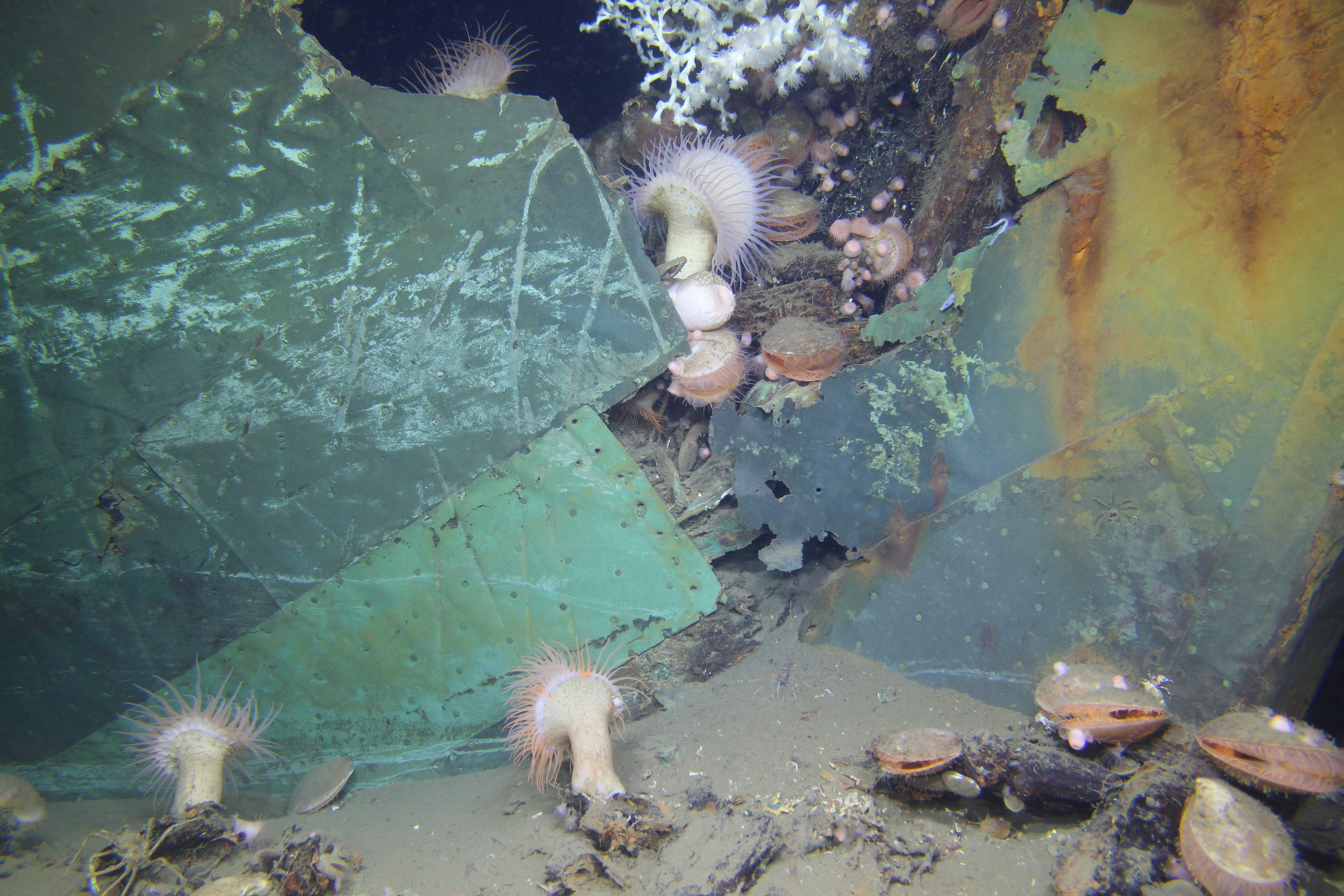
Shellfish, deepwater coral and anemones cling to the surface of a sunken wreck.

Diverse sea creatures living on the 19th-century, wooden-hulled Ewing Bank wreck, which lies 2,000 feet (610 meters) deep in the Gulf of Mexico. NOAA

Larger animals like fish sometimes appear within minutes after a ship sinks. Small fish hide in the structure’s cracks and crevices, while large sharks glide around it. Sea turtles and marine mammals such as fur seals have also been spotted on wrecks.

Hot spots for biodiversity

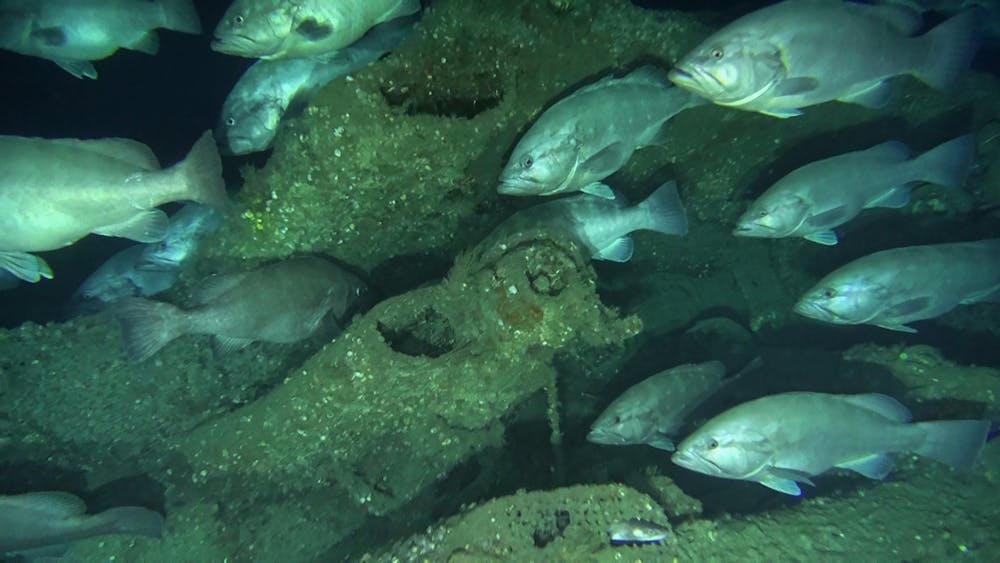
Shipwrecks host quantities and varieties of marine life that can make them hot spots for biodiversity. The microbes that transform the wreck structure into habitat also enrich the surrounding sand. Evidence from deep Gulf of Mexico wrecks shows that a halo of increased microbial diversity radiates outward anywhere from 650 to 1,000 feet (200-300 meters) from the wreck. In the Atlantic Ocean, thousands of grouper, a type of reef fish highly valued by fishers, congregate around and inside shipwrecks.

Fish hover above a wrecked ship's surface.

Groupers and a conger eel, bottom center, on the wreck of the German submarine U-576 off the coast of North Carolina. NOAA

Shipwrecks can also serve as stepping stones across the ocean floor that animals use as temporary homes while moving from one location to another. This has been documented in areas of the world with dense concentrations of shipwrecks, such as off North Carolina, where storms and war have sunk hundreds of ships.

In this part of the ocean, popularly known as the “Graveyard of the Atlantic,” reef fish likely use the islandlike shipwrecks as corridors when moving north or south away from the equator to find favorable water temperatures as climate change warms the oceans. Scientists have also observed sand tiger sharks traveling from one wreck to another, possibly using the shipwrecks like rest stops during migration.

In the deep sea, life growing on shipwrecks can even generate energy. Tube worms that grow on organic shipwreck materials such as paper, cotton and wood host symbiotic bacteria that produce chemical energy. Such tube worm colonies have been documented in the Gulf of Mexico on the steel luxury yacht Anona.

Biological mysteries abound

Despite their biological value, shipwrecks can also threaten underwater life by altering or destroying natural habitats, causing pollution and spreading invasive species.

When a ship sinks, it can damage existing seafloor habitats. In a well-documented case in the Line Islands of the central Pacific, an iron shipwreck sank on a healthy coral reef. The iron infusion substantially decreased coral cover, and the reef was overcome by algae.

Ships may carry pollutants as fuel or cargo. As shipwrecks deteriorate in seawater, there is a risk that these pollutants may be released. The level of risk depends on how much of the pollutant the ship was carrying and how intact the wreck is. One recent investigation revealed that effects from shipwreck pollutants can be detected in microbes up to 80 years after the wreck.

Ships and planes wrecked in wartime can leak toxic materials for decades after they come to rest in the ocean.

Shipwrecks may also inadvertently assist the spread of invasive plants and animals that wreak biological havoc. Wrecks are new structures that invasive species can settle on, grow and use as a hub to expand to other habitats. Invasive cup coral has spread on World War II shipwrecks off Brazil. In Palmyra Atoll in the Pacific, a type of anemone called a corallimorph rapidly invaded a shipwreck and now threatens healthy coral reefs.

The future of shipwreck exploration

Shipwrecks create millions of study sites that scientists can use to ask questions about marine life and habitats. One of the greatest challenges is that many wrecks are undiscovered or in remote locations. Advances in technology can help researchers see into the most inaccessible areas of the ocean, not only to find shipwrecks but to better understand their biology.

Maximizing discovery will require biologists, archaeologists and engineers to work together to explore these special habitats. Ultimately, the more we learn, the more effectively we can conserve these historical and biological gems.The Conversation

Avery Paxton, Research Marine Biologist, National Oceanic and Atmospheric Administration

GOP’s Biggest Losers of 2023: Donald “Smells Like A Butt” Trump and his fellow insurrectionists

This is the last in a five-day series. Read part one, part two, part three, and part four. 

There are many reasons Donald Trump is turning up the rhetoric about being a fascist dictator, even bragging on social media that "revenge" and "dictator" are the top words people use to describe him. It's a campaign strategy to win over Republican primary voters who wish to purge the country of that which they despise, such as tap-dancing jazz dancers. It's a feint, an effort to scare his opponents into believing his ascension is unstoppable, so they stop fighting him. It's also a threat to keep fellow Republicans in line, so they don't start backing challengers who aren't under 91 felony indictments. 

But it's also an attempt to hide that he smells like a butt.

"Take armpits, ketchup, a butt and makeup and put that all in a blender," former Republican Rep. Adam Kinzinger of Illinois said of Trump's odor. It's a visceral description to be certain, but also beautiful because everyone immediately knows it must be true. Trump's narcissism has led him to believe he knows everything, so he has no need to learn. By the same logic, he no doubt imagines his body, which he has routinely described as perfect, is in no need of regular cleaning. Plus, every shower means seeing his imperfect naked body in the mirror, followed by having to sit still for hours to restore his elaborate hair and make-up. We all know how he feels about that. I have to imagine he skips quite a few.

Plus, Trump knows you can't smell him through the camera, only see his glowering orange visage. Trump's faith is not in God, but that bellicosity and image management can overcome anything: Democracy, his body odor, people noticing he can barely read. It's why, despite failing to end democracy last time, Trump is running for president again, and even more explicitly as a fascist. He and his supporters believe that the will to power, expressed mainly through volume and bombast — backed with a threat of violence — will be enough to finish the insurrection of January 6. 


Want more Amanda Marcotte on politics? Subscribe to her newsletter Standing Room Only.


We have 11 months to find out if this paper tiger can become a real one. People are, understandably, frightened. But it's also worth looking back over 2023, when the legal system finally started to catch up to Trump and his fellow insurrectionists. While there's been setbacks and delays, overall, there's a reason to find hope. The courtroom has been — though far too slowly — relatively successful at stripping away all chest-beating theatrics of the MAGA insurrectionists, revealing the odorous, overcompensating men (and a few women) underneath. 

Neither liberals nor pundits can pry their eyes from the polls where Trump is running slightly ahead of President Joe Biden. The full weight of what it means for Trump to be facing 91 felony indictments in four different courtrooms has yet to really sink in. We keep holding out for a single incident — some kind of political kill shot — that will take Trump out. He is still blowing ungrammatical hot air on Truth Social while his minions swoon in cultish ecstasy, so there's a tendency to assume none of this matters. 

Trump, however, is clearly afraid, as the increasingly ear-piercing decibel levels of his whining demonstrate. His lawyers keep making ridiculous arguments, such as that attempting a coup is a legitimate presidential duty. They're not taking the long shot strategy out of an abundance of confidence. It's almost certainly because they know the evidence of Trump's guilt is overwhelming, and will do anything they can to keep a jury from hearing it. 

Indeed, the past year has been one story after another about how, when Trump and stooges actually have to show up in court, it does not go well for them. Trump was found liable for defaming and sexually assaulting E. Jean Carroll, despite his repeated bragging that he'd easily defeat her in court. His bluster did nothing to stop a judge from finding the Trump Organization guilty of fraud, and the expectation is the judgment next month will be staggering. 

More importantly, the plethora of cases related to the attempted coup and January 6 insurrection show that, stripped of their lies and hysterics, the insurrectionists fare poorly in the courtroom. The high-profile cases started to finally — finally — moved towards resolution this year. The leadership of the Oath Keepers, a far-right militia that shaped the storming of the Capitol, were handed sentences ranging from 3 to 18 years. The Proud Boys, who acted on Trump's order to "stand back and stand by," saw sentences up to 22 years. It wasn't just the sentences, however. The trials of these two gangs exposed the losers lurking beneath all camo gear and action movie talk. It turned out two things could be true: These guys were a genuine threat to democracy, but also pathetic try-hards trying to cover up for their myriad of personal failures. 

Same story in the Georgia case pressed by Fulton County District Attorney Fani Willis. She indicted Trump and 18 co-defendants for attempting to steal the 2020 election. While many of them tried to play act supervillains in their mug shots, any fool could see these were mostly a bunch of pampered country club types who got caught up in the drama of a criminal conspiracy. Sure enough, the guilty pleas started to roll in. Trump's lawyer Jenna Ellis was especially entertaining, as she blubbered in self-pity while admitting she really had no idea that things would go so badly for her. She just thought it was cool to follow Rudy Giuliani in his seditious plotting. 


Want more Amanda Marcotte on politics? Subscribe to her newsletter Standing Room Only.


As for Giuliani, it turns out that there are always new lows the most pathetic man in politics can reach. We rounded out the year with the welcome news that he owes $148 million after losing a defamation lawsuit filed by two Georgia election workers he picked at random to falsely accuse of stealing the 2020 election for Biden. Giuliani responded by defaming the women again. His pickled mind no doubt thinks he's imitating his idol. Trump also believes the best way to win is never to admit failure or defeat, but to keep flouting the law until everyone gives up trying to stop you.

But Giuliani has long shown the flaw in the "never let them see you sweat" strategy: Sometimes the sweat breaks out anyway, pouring down your face in long black streaks of hair dye that stain your face. Sometimes the fact that people can't smell you through the camera stops mattering, as your incoherent patter and shiny-yet-sallow skin tone forces them to imagine it anyway. Giuliani's bravado cannot stop our subconscious brains from conjuring what he must smell like. My mind always goes to a midtown Manhattan subway platform the morning of New Year's Day, or the gutters of Bourbon Street during Mardi Gras.

Trump hasn't been as thoroughly exposed as Giuliani to be a grasping nitwit. There is still too much coverage that focuses on his fascism, without reminding people of the worthlessness the strongman act is designed to hide. But try as he and his followers might to pretend Trump looks awesome at a defense table or in a mugshot or whingeing to anyone who will listen outside courtroom doors, the justice system has an illuminating effect. He looks like a stinky old sociopathic narcissist, a pouty child stuck in the body of a senior citizen who wears the same ill-fitting suit every day. Like a blacklight uncovering all the sticky secrets lurking beneath the thin gold veneers at Trump Tower, the courtroom has that power to expose who Trump really is. 

Let's just hope that the system holds and Trump spends a lot more time inside the court than out of it in 2024. 

The worst right-wing influencers of 2023

As right-wing influencers gain traction online and amass millions of followers for promoting extreme views, human rights groups and policy experts warn about their ideologies fueling an increase in deadly violence. The Anti-Defamation League and the Southern Poverty Law Center have documented a clear connection between hateful and extremist content and broader channels of hate. 

But despite this, influencers continue to profit off of promoting toxic masculinity and violence against women, creating content associated with the "manosphere" community, which includes incels—the most aggressive faction, according to the ADL. Incels believe that women wield excessive power and ruin their lives by rejecting them. These incel manosphere influencers leverage their platforms to connect with viewers as young as 13 years old, providing them with a sense of community, only to indoctrinate them with their extremist ideologies.

While several influencers have been banned from mainstream platforms, their ideas have already taken root in the minds of their followers, who promote their ideas offline. Many of these personalities have also returned to X, previously known as Twitter, shortly following Elon Musk's acquisition of the platform.

Salon has compiled a list of some of the worst right-wing influencers from 2023, amassing millions of followers and views by disseminating outlandish conspiracy theories. These individuals have relied on their platforms to propagate hate speech and incite violence.

How Andrew Tate cultivated a following promoting abuse and violence against women

Controversial influencer and “alpha-male” podcaster, Andrew Tate, who was charged in Romania with rape and human trafficking this year, tops the list. He was previously removed from the TV show "Big Brother" for violent behavior and was also banned from different social media platforms for promoting misogynistic views and violence against women. When the media personality was arrested, several right-wing media figures came to his defense suggesting he was targeted for "going against the system."

The self-help guru quickly gained traction online and built a predominantly male following by offering advice on how to earn money, get with women and break free from what he refers to as "the Matrix." His videos have a history of embracing misogynistic and violent messaging racking up billions of views. Tate has expressed overtly sexist or misogynistic beliefs, including his claim that the "easiest way to judge the value of a female" is based on how many sexual partners she has had and asserting that heterosexual relationships work only when the woman "obeys like she's supposed to."

In one video, Tate went as far as explaining how he would use a machete to attack a woman in his bed if she cheated on him. In another, he argued that rape victims should “bear responsibility” for their attacks. While discussing a hypothetical romantic relationship with reality TV star Kylie Jenner, Tate asserted that he would assume ownership of all her physical property.

But what’s concerning is that Tate isn’t some fringe personality who only uses platforms like Rumble or Telegram to push his extreme views against women. Instead, this controversial figure has employed mainstream platforms to disseminate some of his most extreme ideas.

Last year, Meta banned Tate across its platforms citing its "dangerous individuals and organizations" policy. TikTok, YouTube, and Twitter also barred Tate from their platforms. However, X reinstated his account shortly after Elon Musk assumed ownership of the platform.

Despite the bans, Tate has built a brand that capitalizes on promoting violence and harassment against women. But he is not alone in pushing these views. As male supremacist views have gained prominence on TikTok and podcasting platforms, different personalities have emerged dedicating entire videos to discussing the rights of "high value" or "hypermasculine" men. Not all influencers advocating for such ideas and fostering anti-feminist views are male. Some of these influencers promoting ideas that men should be entitled to subservient women also happened to be women. 

“Anti-feminist” influencer Pearl Davis is dubbed the “female Andrew Tate”

Hannah Pearl Davis, professionally known as "Pearl," has garnered millions of followers online following her viral anti-feminist rants and attacks against women. Davis quickly rose to fame pushing views similar to Tate’s and even earned the nickname of the "female Andrew Tate.” The controversial influencer has defended white nationalist Nick Fuentes and promoted anti-semitic content.

She has told her audience that women should submit to men and made claims arguing that it's a woman's fault if her male partner cheats on her. Davis has also suggested that rape victims should “bear some responsibility” for their attacks and that men should be able to hit women back, according to Business Insider

One of her extreme opinions has included claiming that women should not vote. In a video posted to X, Davis said: “The courts, the legal system, all of society is basically pandering and simping for women.” The self-proclaimed “anti-feminist” has made comments like women don't deserve a man "who makes 6 figures" if they are obese and suggested that “women cry abuse for everything and we’ve actually lost the meaning of abuse." Some of her comments have also sparked backlash. 

We need your help to stay independent

"16 year old chicks are hotter than 26 year old chicks," Davis said in one tweet. She has since deleted the tweet after receiving pushback. She told Insider she did so because "people were putting words in my mouth."

Despite pushing misogynistic content, Davis herself has said she doesn’t “hate women” and blamed the criticism she has received online due to advocating for men. While Davis has encountered her fair share of pushback, some of her online critics view her comments as nothing more than opportunities for her to capitalize on her controversial views. But regardless of whether her beliefs are true or not, what’s more concerning is that the influencer has developed a significant following despite her extremist views. 

Neo-Nazi Nick Fuentes

Another influencer who has a long history of promoting antisemitic and misogynistic comments is Fuentes, who is the founder of the far-right "groyper" movement – a group of white nationalist and far-right activists, predominantly young and male, who are attempting to introduce far-right politics into mainstream conservatism. 

Most recently, the white nationalist youth activist said on his podcast that it was “so over” after Kanye West issued an apology for making a series of antisemitic statements over the years. Fuentes, an admirer of Adolf Hitler, has called for a “holy war” against Jews in the past, according to The Texas Tribune. Fuentes has also openly advocated for a government under authoritarian, “Catholic Taliban rule,” and expressed his contempt toward women, Muslims and the LGBTQ+ community.

Fuentes gained a notable following and became more prominent in mainstream media during the 2020 presidential election. He played a significant role in the "Stop the Steal" movement, frequently combining unfounded allegations of a rigged election with white supremacist conspiracy theories. His theories claimed that there was an intentional, Jewish-driven agenda to replace white people through immigration, interracial marriage, and the LGBTQ+ community. A few days before the January 6, 2021, insurrection, Fuentes implied the need to harm legislators who refused to overturn the election results. On the day of the riot, he urged his followers to be ready to "take this country back by force."

On his show “America First” show and his America First Foundation, the self-described “proud incel,” has discussed his plans to remake the Republican Party into “a truly reactionary party.” Fuentes has described his aim of  operating within the political framework to become the "right-wing flank of the Republican Party." He said he views America’s “white demographic core” as central to its identity.

Fuentes has also made comments insisting women are too emotional to make political decisions and that rape is “so not a big deal,” as SPLC points out. He was previously suspended from Twitter in July 2021 "for repeated violations of the Twitter Rules," but returned after Musk’s ownership of the platform. 

Alex Jones and his long history of conspiracy theories

Alex Jones, a prominent far-right online influencer, is one of the few figures facing consequences for spreading conspiracy theories. Jones filed for personal bankruptcy last year after being ordered to pay more than $1 billion to the families of Sandy Hook school shooting victims for defamation. His company Free Speech Systems, which operates his Infowars website, also filed for bankruptcy last July.

Jones baselessly repeated that the 2012 mass shooting that took place in Sandy Hook Elementary School killing 20 first-graders and six adults was staged. He pushed falsehoods about the families and first responders being “crisis actors.” After he consistently perpetuated false claims about Sandy Hook, the victims’ families said they were threatened and harassed by his followers. A jury last year determined that Jones should pay nearly $1 billion in damages to the victims’ families affected by his lies about the shooting.

In the past, Jones has also actively encouraged people to participate in the Jan. 6 attack on the Capitol. He even played a role in elevating Stewart Rhodes, the founder of Oath Keepers, to prominence. Rhodes was later sentenced to 18 years in prison for seditious conspiracy related to the riot. On January 6, the right-wing conspiracy theorist led a march down Pennsylvania Avenue and up the Capitol steps. While Jones himself has not faced charges in connection with the attack, several individuals associated with his platform, referred to as "Infowarriors," including staff members and apparent fans, were among those charged.

He has made other outlandish claims in the past suggesting in a 2013 broadcast, that “of course there’s weather weapon stuff going on” and that “We had floods in Texas like fifteen years ago, killed thirty-something people in one night. Turned out it was the Air Force.” One of Jones' infamous conspiracy theories suggests that the government is employing chemicals to turn people gay allegedly through a mysterious "gay bomb" developed by the Pentagon.

“The reason there’s so many gay people now is because it’s a chemical warfare operation, and I have the government documents where they said they’re going to encourage homosexuality with chemicals so that people don’t have children,” NBC News reported

Through his platforms, Jones has propagated numerous conspiracy theories targeting the LGBTQ+ community and spreading falsehoods. His return to X, under Musk, has prompted conversations around brand safety and hate speech. The platform is also actively promoting Jones’ account to other users with Musk himself elevating Jones’ newly restored profile by engaging with him in a live-streamed interview on X. 

Despite receiving backlash for reinstating previously banned users’ accounts on X,  Musk has accused major advertisers of attempting to "blackmail" him during their boycott over concerns about antisemitic content circulating on the platform.

During his tenure at X, Musk has increasingly embraced a bullish approach to the concept of free speech on the internet welcoming users who were previously booted from the platform for violating its guidelines on hate speech and harassment. In the face of backlash for allowing their return to the platform, the billionaire has adopted a stance akin to when he reinstated Jones, stating that while the move would be "bad for X financially" but "principles matter more than money.”

2023 was the year the students fought back

With culture wars playing out in school districts across the nation, even unlikely communities find themselves embroiled in arguments over race, gender identity, sexual orientation — and, yes, cartoon buttocks.

“The worst policies coming out of the state of Texas are taking place simultaneously in Katy,” Nicole Hill, communications director for the American Federation of Teachers-Texas (Texas AFT), said in an interview. “I look at Katy as a petri dish. We’ve had a rough couple of legislative sessions with a lot of these culture war education issues driving the narrative.” (Disclosure: The AFT is a financial supporter of Capital & Main.)

The Katy Independent School District is a highly rated public school district with about 86,000 students in parts of Harris, Fort Bend and Waller counties. Katy proper is a suburb of Houston, a left-leaning city that has voted Democratic for more than a decade.

Before Katy grabbed the spotlight, Hill said, most of the cultural battles had been unfolding in North Texas, which is more conservative.

Since 2021, Katy has been among cities where conservative parent groups, notably Moms for Liberty, have successfully pushed state legislators and school districts to impose book bans, internet censorship and requirements that districts inform parents when students choose to identify as transgender or to use different names or pronouns at school.

Students in Katy and elsewhere have resisted in ways small and large. They have spoken out at school board meetings, launched “banned book” clubs to read the books that adults have said they shouldn’t read and held LGBTQ+ pride events, with parents and non-LGBTQ students showing their support.

We need your help to stay independent

 
In November, Students Engaged in Advancing Texas (SEAT), a student-led movement, filed a formal complaint with the U.S. Department of Education (DOE) to challenge the district’s requirement that students be outed to their parents. The student group delivered the complaint to the department’s Office for Civil Rights.

Jarred Burton, 16, a junior at Tompkins High School who identifies as bisexual and is an activist with SEAT, wrote this in an op-ed for the Houston Chronicle

“As a Katy ISD student, I worry that the school district’s policy is putting lives in danger. Part of the policy requires staff to notify parents if their child requests to use a different name or pronouns at school. In the case of an abusive, disapproving family, outing a student like that could put them in significant danger — a clear violation of the Texas Educators’ Code of Ethics.”

As of Nov. 1, the district had sent 19 such notifications to parents in the two months since the policy was instituted, according to a report in Houston Landing, a website devoted to public service journalism.

Pooja Kalwani, 17, a senior at Tompkins High School, said in an interview that the “outing” policy was a source of stress for students and teachers alike.

“I see these teachers every day, and they love their students and love teaching,” Kalwani said. “What they absolutely despise is seeing students go through any struggles personally. … They’re having to see their trans students hide a part of themselves. … It’s hard to see them trying to find this balance: I want to respect my students, but I can’t lose my job.”

Texas AFT also opposes the outing policy.

“Our union’s priority is the fight for thriving Texas public schools,” Hill said in an email. “Thriving schools are safe schools — for all students. We’re proud of Katy ISD students for standing up for what’s right — standing up for their classmates — when too many adults in charge refuse to do so.”


“I attempted to visit LGBTQ websites. They were blocked. That was so hurtful to see for a young child in the middle of discovering who I was.”

~ Cameron Samuels, former Katy Independent School District student

 
Cameron Samuels, 19, a 2022 graduate of Katy’s Seven Lakes High School who attends Brandeis University and continues to advocate from afar, said they hoped the complaint would get results.

“We opted for early mediation, which means, if Katy ISD agrees to participate, the [Office for Civil Rights] will not open an investigation,” Samuels said. “We made this decision because we seek a more immediate resolution, and we already know the facts because our complaint was based on public knowledge (the policy itself and a [Freedom of Information Act] request revealing that the district outed 19 students).”

Samuels shared an email with Capital & Main from the Office for Civil Rights’ regional office in Dallas confirming that it had received the complaint.

Samuels, who identifies as nonbinary, said that Katy schools served them well academically but that the district had become “oppressive … particularly with the recent rhetoric.” Samuels first experienced the district’s internet filter as a high school freshman.

“I attempted to visit LGBTQ websites,” Samuels said. “They were blocked. That was so hurtful to see for a young child in the middle of discovering who I was.”

According to a recent report from the American Library Association, Texas was the state that saw the most attempts to restrict or ban books in 2022. The report pinpointed 93 attempts to restrict access to 2,349 book titles in Texas last year — nearly double the total in Pennsylvania, the next highest  state for book ban efforts, with 56 attempts related to 302 titles. Not all of the books were banned.

In Katy, school officials bought $93,000 worth of new library books earlier this year and put them in storage so that an internal committee could review them. The district banned 14 of the books, including popular titles by Judy Blume and Dr. Seuss, bringing the total of “removed” books to about 30.

To its embarrassment, the Katy ISD Board of Trustees realized that its “nudity” bans had extended to several elementary school library books depicting cartoon backsides. In September, the board relented and, perhaps to avoid being the butt of jokes, allowed some books that had been barred to return to school shelves. Among them were such classics as Dr. Seuss’ Wacky Wednesday and David Shannon’s No, David!


Are You There God? It’s Me, Margaret, the 1970 classic by Judy Blume, was initially banned and then reinstated for secondary school students. It remains banned for younger pupils.


At the time, Victor Perez, the school board’s president, clarified the policy at a board meeting. 

“Overall, the policy has to do with, per the law, keeping harmful and obscene material, sexually explicit materials, out of the schools, and then we have a section in the policy dealing with elementary schools.”

He went on: “The board did not intend that whatsoever to include, for example, a No, David!or a Wacky Wednesday book that would include cartoon depictions of a little boy’s butt. And so we … changed the sentence to say what we’re talking about is explicit frontal nudity.”

Among the books that remain banned, many deal with racial and LGBTQ+ themes. They include This Book Is GayBe Amazing: A History of Pride and All Boys Aren’t Blue.

Are You There God? It’s Me, Margaret, the 1970 classic by Judy Blume, was initially removed and then reinstated for secondary school students. It remains banned for younger pupils. The Katy ISD website lists about 30 other books that have been “removed.” But some of those titles also appear on a list of books that have been “retained” for some grades. Suffice to say that the situation is in flux. 

A side note: Fahrenheit 451, Ray Bradbury’s iconic dystopian novel about book bans and book burnings, which was published 70 years ago, remains on the allowed list.

“Banning that would be way too on the nose,” Burton, the high school junior, quipped.

One Texas mother and activist who follows the culture wars in Katy and elsewhere views the book bans and “parental authority” trends as disheartening. She and compatriots have been promoting progressive candidates for school board elections throughout Texas. 

“I’m constantly in a state of tears,” said Nancy Thompson, an activist Latina who lives in Austin. “We really are the majority. But the other team is incredibly loud.”

By resisting book bans and limitations on personal rights, she said, “we are fighting for democracy versus living in a fascist state in a fascist country. Book bans are not going to stop people from being gay.”

In the midst of the culture wars, Hill said, Katy ISD is dealing with budget cuts and funding issues.

“They cannot pay teachers enough, and workload issues are driving them out of the career,” she said. “The district is struggling while also implementing all of the worst policies the [state] Legislature could think of. It’s a fascinating microcosm of the struggles of public schools in this state right now.”

All undocumented immigrants in California will be eligible for health insurance as of Jan. 1

On the brink of a new year, the state of California is making the historical decision to offer an expanded version of Medi-Cal – the state's own version of the federal Medicaid program – offering health insurance benefits to all undocumented immigrants, regardless of age.

The newest version of this program, which is an expansion of Gov. Gavin Newsom's 2019 package which originally offered benefits to young adults ages 19 through 25 and then bumped that to include adults aged 50 and older, will aid approximately 700,000 additional low income residents on top of the 14.6 million Californians already benefitting from the program, according to reporting by ABC News, and be put into effect as of January 1, 2024. This builds off of then-Gov. Jerry Brown's earliest version of Medi-Cal signed into effect in 2015, which was offered to undocumented children.

“In California, we believe everyone deserves access to quality, affordable health care coverage – regardless of income or immigration status,” Gov. Newsom’s office said in a statement to ABC News. “Through this expansion, we’re making sure families and communities across California are healthier, stronger, and able to get the care they need when they need it.”

As the outlet points out, "About 50% of undocumented immigrant adults in America report being uninsured, compared to just 8% of U.S.-born citizens, according to the health policy research nonprofit KFF, due to undocumented adults being more likely work jobs that don't provide health benefits, as well as facing eligibility restrictions for federal programs."

"This historic investment speaks to California's commitment to health care as a human right," California State Sen. María Elena Durazo said in a statement back in May.

Ron DeSantis says he plans to fire Jack Smith if elected

In addition to their one primary shared interest — a burning desire to win the 2024 presidential election — Ron DeSantis and Donald Trump have something else in common, a deep dislike of Special Counsel Jack Smith. 

In an interview with Fox News' Jason Chaffetz on Thursday, DeSantis detailed his goal for his first days in office, should he land there, saying, "After you win the election, start holding these people accountable who have weaponized the legal system to go after their political enemies. And that starts with day one, firing somebody like Jack Smith."    

As The Messenger points out, DeSantis has established a pattern of criticizing Smith's indictments, specifically pertaining to their focus on the events of the Jan. 6 insurrection and what Trump did or didn't have to do with it.

"If the election is not about Jan. 20, 2025, but Jan. 6, 2021, or what document was left by the toilet at Mar-a-Lago, if it’s a referendum on that, we are going to lose," he said back in August. 

Watch here:

Cher files for “urgently needed” conservatorship of her son Elijah Allman

Cher has filed for temporary conservatorship of her son Elijah Allman, 47, stating that a conservatorship is "urgently needed" because he struggles with mental health issues and addiction.

The 77-year-old singer said in the petition that his alleged addiction has left him unfit to control his assets, which could put his life in danger. If granted by the Los Angeles Superior Court, the petition filed on Wednesday would give the award-winning singer and actress temporary control of her son's finances, The Associated Press reported. Allman – Cher's second child after Chaz Bono and the son she had with musician Gregg Allman – was once a singer and guitarist for the band Deadsy.

Allman once revealed that he started taking drugs at age 11. He had once dealt with heroin addiction, becoming sober temporarily, but had been in and out of recovery for at least a decade. His relationship with his mother has also fluctuated, states Variety.

Cher's petition states that Allman is entitled to regular payments from his trust fund but “given his ongoing mental health and substance abuse issues,” the singer is “concerned that any funds distributed to Elijah will be immediately spent on drugs, leaving Elijah with no assets to provide for himself and putting Elijah’s life at risk."

In response to the petition, Allman told the AP that he is "well, and able, and of sound mind and body.” Allman declined to say if he would oppose the petition for conservatorship. A judge has scheduled a hearing in January.

Moreover, the petition states that the conservatorship is meant to keep control of Allman's finances from his wife Marieangela King, from whom he filed for divorce in 2021. The two are still legally married. 

Meanwhile, King's court documents filed in December 2022 as part of divorce proceedings allege that while the two tried to reconcile their marriage, Cher had her son kidnapped from his New York hotel.

"After spending these 12 days together in New York, on 30 November 2022, the night of our wedding anniversary, four people came to our hotel room and removed [Mr Allman] from our room," the filing states, adding that the men said Cher had hired them, according to the BBC. King also said she hadn't seen her husband in six months and doesn't know his whereabouts.

Cher denied the allegation and told Variety, “I’m not suffering from any problem that millions of people in the United States aren’t. I’m a mother. This is my job — one way or another, to try to help my children."

The issue of conservatorships may be seen as controversial because of singer Britney Spears' high-profile battle with a conservatorship that supposedly began as temporary and evolved into a controlling and abusive guardianship. For 12 years, the singer was kept under lock and key — all controlled by her father Jamie Spears, who benefited off of Spears' wealth. The singer stated in court that her father was ruining her life, claiming that a team led by her father controlled her schedule, prevented her from having another baby and bullied her. Her recent memoir "The Woman in Me" details how she was forced into the situation, which was less about actually aiding her mental health and more about controlling her autonomy and assets.

With fame and wealth that exceeds her son's, Cher wouldn't necesarily have the same mercenary motives that Britney Spears' father had. Instead, Cher's petition states the Allman and King's “tumultuous relationship has been marked by a cycle of drug addiction and mental health crises” and that she believes King “is not supportive of Elijah’s recovery.”

Ultimately, conservatorships are legal arrangements that give a third party control over someone else. They can be granted only by a court, and only a court can terminate them. The person in charge of the person's affairs is called the conservator, or the guardian in some states. But the issue around conservatorship arises because a conservator's powers can be broad and the person subject to one can lose the right to marry, make a will, vote or consent to medical treatment.


The worst film performances of 2023

It’s time once again for the 2023 acting hall of shame — the year’s most wrongheaded performances by talented people. 

A bad performance is often too earnest or trying too hard. There is either no feeling or way too much. The actor doesn’t connect with the material or their costars. Viewers should be moved by a performance – not bored or irritated. The actors on this list generate frustration because they often over-emoted.

Good actors can make bad movies, but still deliver for their fans. Jane Fonda made a trio of mediocre comedies this year – “Book Club: The Next Chapter,” “80 For Brady” and “Moving On” – but she plays to her strengths. Likewise, “Plane” was an ordinary action movie featuring Gerard Butler taking charge, kicking a** and saving lives — which is all he ever really needs to do on screen. See also: “Kandahar.” 

In contrast, it is fun to see actors take chances and have them pay off. Zac Efron and Gael Garcia Bernal both succeeded wildly with their roles as wrestlers in “The Iron Claw” and “Cassandro,” respectively. Simon Rex also continues to impress playing extreme characters this year, from a neo-Nazi in “The Sweet East” to a gay necrophiliac in “Down Low.” 

But the actors on this list either didn’t take chances — and should have — or took one that failed spectacularly. Here is a rundown of this year’s worst acting.

FerrariShailene Woodley as Lina Lardi in "Ferrari" (Photo credit Lorenzo Sisti/Neon)
Avid readers of this annual column may be pleased (or disappointed) that Adam Driver failed to place this year after being (dis)honored in the past for “Annette,” “House of Gucci” and “White Noise.” Alas, his performance as the title character, Enzo Ferrari, is not as strong as it might have been. But it was better than Shailene Woodley's whose performance is easily the weakest link in this mediocre film. As Enzo’s mistress, Lina, Woodley’s flimsy accent is only one concern. (Were it not for her slicing ravioli, viewers might not know she is Italian.)
 
The bigger issue is that she does not have much to do, and she doesn’t do it well. Lina is more wishy-washy than determined in her efforts to get Enzo to recognize their son. In contrast, Penélope Cruz as Enzo’s long-suffering wife, is feisty. Even in a flashback where Lina tells Enzo she is pregnant, she might as well be asking her lover to pass the salt; she seems neither happy nor troubled by this fact. Her lack of passion does make viewers wonder what Enzo sees in her, but it also makes folks wonder why director Michael Mann cast Woodley.
02
Paul Mescal and Saoirse Ronan in “Foe”
FOEPaul Mescal and Saoirse Ronan in "FOE" (Courtesy of Amazon)
Sometimes good actors are sabotaged by a bad script, and that is certainly the case with the enervating “Foe,” Garth Davis’ pretention sci-fi drama about Hen (Saoirse Ronan) and Junior (Paul Mescal), a Midwestern couple in 2065. When Terrance (Aaron Pierre) arrives at their farm saying that Junior has been selected to go live in space, there is a plan to create a “husband” for Hen so she won’t be alone. Mescal’s performance is ungraceful. He utters lines like, “Of course, I’m happy,” with little enthusiasm. Likewise, Ronan’s comment, “I worry that the rain will never come,” expresses no real concern. The actors are more blank than dynamic here. Mescal gets a double role, but he doesn’t make either Junior or his double distinguished. (Though he does get naked more than a few times.) As Junior goes mad, Mescal rages about spit, snot and scum, while Ronan plays the piano broodingly, before taking her buried emotional pain out on the keys. It is all very risible and will make viewers wonder who replaced these terrific actors with robots?
03
Anthony Hopkins in “Freud’s Last Session”
Freud's Last SessionAnthony Hopkins in “Freud’s Last Session” (Courtesy of Sony Classics)
This stuffy chamber drama features an insufferable humble-bragging performance by Hopkins as Sigmund Freud. The two-time Oscar winner never makes viewers think for one second that he is the famed Jewish founder of psychoanalysis. Hopkins “mimics” Freud when he should disappear into the character. The actor’s trademark tics, his hesitations and mannerisms — that slight chuckle, that deliberate enunciation — are grating as he verbally spars with C.S. Lewis (a starchy Matthew Goode) about God. The stagey exchanges should have some friction, but Hopkins portrays Freud as pompous. His superiority dominates every scene, generating indignation, not respect from Lewis, and eye-rolling from viewers. Hopkins comes off as hammy as he laughs at his own jokes or pontificates about the Greek God Momus or admonishes Lewis for his ignorance. But Hopkins' performance is most scenery-chewing when he rails about wishing his cancer had eaten into his brain, “So that I could hallucinate God and seek my bloody vengeance on him.” It is as absurd as this film is lousy.
04
Channing Tatum in “Magic Mike’s Last Dance”
Magic Mike's Last DanceChanning Tatum in “Magic Mike’s Last Dance” (Warner Bros. Discovery)
There sure were diminishing returns for this third entry in the series about exotic dancer Mike Lane (Channing Tatum) based on the actor’s past — and not just because the hunky actor never gets nekkid. Tatum oddly lacks his typical charisma here, and while he still has moves, his lap dance for Maxandra (Salma Hayek) is hardly sexy; it’s more like a gymnastics routine.
 
Tatum seems to be going through the motions in this entry, which is why “Magic Mike’s Last Dance” doesn’t excite. He can’t even generate a laugh out when he (jokingly) responds, “Who?” when asked if he knows Art Basel in Miami. Hired to put on a show at Maxandra’s London theater, Mike stages a climactic dance on stage in the rain. It’s emblematic of Tatum’s lackluster performance — all wet.
05
Liam Neeson in “Marlowe”
MarloweLiam Neeson in “Marlowe” (Open Road Films)
Neeson’s lazy performance as Raymond Chandler’s famed Philip Marlowe is a prime example of what could have been. The Irish actor could actually be a good fit for the Los Angeles private detective, but in director Neil Jordan’s version, Neeson is dead on arrival.
 
One issue is that the actor speaks his every line of dialogue — be it a flinty voiceover, a threat, or a wisecrack — in an emotionless monotone. Neeson may be suggesting Marlowe’s jaded cynicism, but it comes across as soft-boiled when it should be hard. His quizzical looks as he encounters a knotty mystery involving an heiress (Diane Kruger) are the same ones viewers may have on their own faces while watching Neeson sleepwalk through this head-scratching film. Marlowe is said to detect things, but Neeson can’t figure out how to play this role.
06
Katie Holmes in “Rare Objects”
Rare ObjectsKatie Holmes in “Rare Objects” (IFC FILMS)
Maybe it was because she was focused on directing this sentimental adaptation of Kathleen Tessaro’s novel that Holmes gives an inferior supporting performance as Diana, a wealthy young woman with mental health issues who befriends Benita (Julia Mayorga). Watching Diana trying to mask her pain with alcohol and drugs at lunch or a party is uncomfortable, not because of her issues, but because Holmes needlessly overacts. She tries too hard to project fun or despair as Diana and does neither convincingly. It becomes cringy to watch as she spirals downward. It also feels like Holmes is recycling the work she did in 2015’s “Touched by Fire,” where she played bipolar. Holmes gets a good performance out of newcomer Mayorga, but she should have cast someone else as Diana.
07
Uma Thurman in “Red White & Royal Blue”
Red, White & Royal BlueUma Thurman in “Red, White & Royal Blue" (Courtesy of Amazon Prime)

Sometimes a performance is so bad it’s actually great. And that’s the case with Uma Thurman’s President Ellen Claremont in this fabulous adaptation of Casey McQuiston’s best-selling romance. Thurman’s accent is both the key to her performance and her downfall. It’s a Texas twang that sounds like she is lisping and slurring her words at the same time, which makes Thurman sound more drunk than presidential, especially when Ellen insists, “What I need is some good old-fashioned damage control.” (Yes, Uma! You do!)
 
Her speech about being realistic versus idealistic is a howler, but even her presidential speeches are too flamboyant. Thurman delivers the rare bad performance that works because she goes all in, and no one checks her — maybe because she is playing the President? Still, it's hard not to wonder what Connie Britton, the actor whom McQuiston’s envisioned for the role, would have done with it.

Want a daily wrap-up of all the news and commentary Salon has to offer? Subscribe to our morning newsletter, Crash Course.


08
Jack Harlow in “White Men Can’t Jump
White Men Can't JumpJack Harlow and Sinqua Walls in "White Men Can't Jump" (20th Century Studios)
In his film debut, an uneven remake of the 1992 classic sports comedy, rapper Jack Harlow does not bring his A game. Nor does he provide much amusement as Jeremy, a basketball hustler hoping to score. The miscast Harlow should be a charming goofball con artist who has some mystery about him — is he for real? Instead, he is out of his league, and just about as dumb as he pretends to be. Harlow’s lame performance — he can’t even trash-talk well — drags the film down. Moreover, he doesn’t have much chemistry with his genial costar, Sinqua Wells, who nobly suffers through Jeremy’s race-baiting remarks. Harlow, stick to your day job.
WonkaTimothée Chalamet in “Wonka” (Warner Bros. Entertainment)


Chalamet doesn’t just sing off-key in this musical origin story about the famed fictional chocolatier, he is just off. Wonka is magic and the character requires a dash of deviousness (see Gene Wilder, or even Johnny Depp), but Chalamet is wholly uninspired. He mugs for the camera to overcompensate for his lack of comic timing. His performance is all forced whimsy. While he can’t carry a tune, Chalamet leaves the rest of the supporting cast, which includes Olivia Colman, Hugh Grant, even Rowan Atkinson, to carry the film. “Wonka” ultimately showcases Chalamet as the hard, inedible center in the middle of this otherwise gooey confection.

“Desperate stunt”: Republicans fume at Lauren Boebert for “seat shopping” after district swap

The chairman of Colorado's Republican Party isn't pleased with Rep. Lauren Boebert's, R-Colo., decision to skip out on a reelection bid in her home district to instead move to a more Republican-friendly district on the other side of the state. “From a party perspective, we certainly don’t think it was the best move,” Colorado GOP Chair Dave Williamson told CNN Thursday. “We felt that she was best suited for Congressional District 3 and that she was in the best position to win reelection and retain that for Republicans.” 

Boebert won against Democrat Adam Frisch by a hair in 2022, earning just 546 more votes of the over 327,000 cast, according to The Daily Beast. While the far-right representative's current district — which has a Cook Partisan Voting Index of R+7 — covers the western and southern parts of the state, the fourth congressional district resides to the East of Denver and has a rating of R+13, Colorado's most conservative. That district's current representative, Rep. Ken Buck, is retiring. Williamson predicted that Boebert would have a hard time explaining her move to voters in the fourth district. “It’s kind of a problematic proposition," he told CNN. "But it’s… something for the voters to decide.”

News of Boebert's new district also didn't sit well with Republicans already running there. In a text to Talking Points Memo, former state Sen. Ted Harvey, one of Boebert's new rivals, called her move a "desperate stunt" driven by her political problems. Another, state Rep. Richard Holtorf, ripped Boebert in a statement released shortly after her announcement. “The voters of Colorado’s 4th Congressional District want steady conservative leadership from their communities. Seat shopping isn’t something the voters look kindly upon,” Holtorf said. “If you can’t win in your home, you can’t win here.”

Why SZA’s evolution into a popstar has earned her recognition as artist of the year

SZA is not your cookie-cutter pop star. She's deemed an alternative R&B musician but rejects the label. She hates being in the public eye. Her music is brazenly self-deprecating and seemingly embraces self-loathing. Her first album's most popular song "The Weekend" focuses on being the side piece of a man's primary relationship. And yet despite all the conventional reasons her stardom shouldn't work, she's this year's most successful female artist. The Webbys even named her their artist of the year.

SZA went from an underground cult artist to a pop star through her artistry existing outside of the box that the industry puts Black female artists in.

Her long-awaited sophomore album "SOS" dropped at the tail end of last year, making it nearly six years since her smash debut album "Ctrl" released in 2017. While fans begged for a new album from SZA, calling her the new Frank Ocean or Rihanna – neither of whom have dropped new music since 2016 – SZA surprised fans with the lengthy 23-song album "SOS" last December.

Since the release of "SOS," SZA has dominated music charts, at one point having the No. 1 album in the country before she was beaten by controversial country musician Morgan Wallen. The R&B artist, whose real name is Solána Rowe, received a plethora of nominations at the Grammys, including the coveted and esteemed album of year award.

Nobody could have predicted the success "SOS" has brought SZA, even if her first album has never left the Billboard charts since its release. "Ctrl" put her on the map, but "SOS" has shown that she's here to stay and that she can unexpectedly blow through other chart-topping and successful pop artists with rabid fanbases like Taylor Swift, Beyoncé and Drake. SZA went from an underground cult artist to a pop star through her artistry existing outside of the box that the industry puts Black female artists in. Her genre-bending chameleon-like music works for everyone — the charts prove that. Also, it helps that her growing fanbase of all ages on social media like TikTok helped push her along the way.

In the time between the release of her first and second album, fans online couldn't get enough of SZA, and the explosion of TikTok's popularity only escalated her already hungry-for-music fanbase. Many of the artist's songs like "Shirt," "I Hate U," "Blind," and "Good Days," had viral moments before they were even fully released by SZA. The song "I Hate U" currently has more than 700,000 videos attached to it. "Shirt" was teased in 2020 and went viral due to a TikTok dance challenge. These teasing crumbs of music kept her young online fanbase going, longing for the release of "SOS." When "SOS" was finally released it skyrocketed to No. 1 on the Billboard 200 charts to nobody's surprise. The surprise was that it stayed there for eight weeks. Overall it was on the charts for 10 weeks, making it the longest-running No. 1 female artist album of the decade.

Not only did the album stay seated at the No. 1 spot for two months this year but her singles "Kill Bill" and "Snooze" also fought for a seat on the Billboard Hot 100 chart.

The catchy Quentin Tarantino-twinged revenge fantasy about killing her ex-boyfriend hit No. 1. and was on the charts for 50 weeks. But importantly, its catchy chorus infiltrated the online spaces. It was all over TikTok with different trends attached to its popularity on the charts and streaming music platforms like Spotify and Apple Music.

She gleefully sings as she ponders:

I might kill my ex, not the best idea
His new girlfriend's next; how'd I get here?
I might kill my ex, I still love him though
Rather be in jail than alone.

Another song popular with her fans and social media is "Snooze." The more traditional R&B-focused love song just recently reached No. 2 on the charts. The artist's runs cascade when she sings:

I can't lose when I'm with you
How can I snooze and miss the moment?
You just too important
Nobody do body like you do
I can't lose when I'm with you
I can't just snooze and miss the moment
You just too important
Nobody do body like you do, you do.

While online circles are a portion of her success, SZA's real appeal lies in her almost contradictory artistry. In "SOS" alone, she experiments outside the traditional R&B label that she feels pigeonholes herself and other Black artists. She is labeled an R&B artist but the criticism at large is that it's the de facto genre for anyone who is a Black woman making music.

SZA told the Wall Street Journal that her influences for "SOS" were Blink-182 and Radiohead. “I don’t want to push the R&B audience away,” she said. “I also don’t want to not be allowed to be who I am in a full spectrum.”

And her sophomore album does exactly that. It breaks free of the shackles of R&B and pushes into a place that is challenging and complex — all the while allowing her to experiment with R&B. Songs like "Ghost in the Machine" featuring perpetual sad girl Phoebe Bridgers is probably the most seamless collaboration on the album. The song is an obvious ode to SZA's alternative rock and indie alternative influences. "Ghost in the Machine" is a dark, bass-heavy almost-ballad about SZA's anxiety and the commodification of her celebrity.

She depressingly sings:

Can you distract me from all the disaster?
Can you touch on me and not call me after?
Can you hate on me and mask it with laughter?
Can you lead me to the ark? What's the password?

I need humanity
You're like humanity
Drownin' in vanity
Cravin' humanity
You're like humanity
I need humanity, I need.

Moreover, SZA challenges music's rigid genre classifications in the classic, late-aughts-inspired pop-punk jam "F2F." Reminiscent of a young Avril Lavigne or Alanis Morissette, SZA is angry and doesn't care to hide it — a luxury Black women aren't typically afforded without being painted as an aggressor. But in "F2F," her spitefulness and self-hatred are almost too relatable you forget her lyrics are so toxic.

She sings:

Get a rise out of watching you fall
Get a kick out of missing your call
I hate me enough for the two of us
Hate that I can't let go of you enough, this why
I f*** him 'cause I miss you
I f*** him 'cause I really miss you
I f*** him 'cause I miss you.

We need your help to stay independent

It's in SZA's versatility that she has found such heights of success and acclaim. It's worth acknowledging that many Black female artists do not receive endless opportunities to reach such mainstream levels of popularity, and but her work translates just to about everyone. SZA isn't making palatable music. Her music is so vulnerable and distinctly hers as she calls herself a loser in "Special." She wishes she was special because she gave it all "away to a loser." It's almost like we as listeners are taking a sneaky look at her top-secret personal journal or the inner workings of her messy mind.


Want a daily wrap-up of all the news and commentary Salon has to offer? Subscribe to our morning newsletter, Crash Course.


But the artist's relatability is showcased through her willingness to go to the most vulnerable parts of the human experience – whether it is about heartbreak ("Seek & Destroy,") wanting to be loved ("Nobody Gets Me,") rejection ("Too Late,") or just pure human vanity ("Conceited"). It all translates regardless of your experience. Her artistry is universal even though she started as a behind-the-scenes artist writing for musicians like Beyoncé, Rihanna and Kendrick Lamar. SZA came out of the shadows and cemented herself as artist of the year, and no one can take that away from her.


Millions of birds impacted by New Year’s Eve fireworks: study

What’s a New Year’s Eve celebration without the characteristic explosions? While many people tire of this tradition because of the strain fireworks puts on their dogs, new research illuminates just how impactful these sky bombs are on wildlife, specifically birds. In fact, birds are 1,000 times more likely to be in flight on New Year's Eve — in many instances, presumably panicked by fireworks — compared to other nights, according to a new study in the journal Frontiers in Ecology and the Environment. And those impacts can be felt as far away as six miles, with larger birds like geese being especially affected.

Researchers from the Netherlands used weather surveillance radar and bird count data (gathered by volunteers who literally count birds), then measured their movements compared to the sites where fireworks are launched. They found that the degree of disturbance was to some degree dependent on species, but that these effects could last for several days into the New Year.

Furthermore, this doesn't seem to be benign stress, like playing a harmless annual prank on a bunch of birds. Fireworks trigger the flight response — meaning both literal flight and the stress response known as “hyperarousal” — which uses up avian energy, forcing the birds to spend more time looking for food.

“Flying requires a lot of energy, so ideally birds should be disturbed as little as possible during the cold winter months,” study author Bart Hoekstra, an ecologist at the University of Amsterdam, said in a statement. He and his co-authors concluded, “Given the pervasive nature of this disturbance, the establishment of large fireworks-free zones or centralizing fireworks within urban centers could help to mitigate their effects on birds.”

2023 marked historic progress for UFO science, though no smoking gun for aliens exists yet

Before the start of the 2020s, almost anyone who admitted to a belief in UFOs (unidentified flying objects) or extraterrestrial visitors was dismissed as a crackpot. Yet since the start of the decade, the Pentagon has repeatedly and openly acknowledged that their own pilots have spotted and recorded images of UFOs (more specifically known as UAPs, or unidentified anomalous phenomena). The so-called Pentagon UFO videos — the initial clips of which were released to the public in 2020 — showed UAPs recorded in 2004, 2014, 2015 and 2019. Ever since, respected government officials and scientists have joined ordinary UFO enthusiasts in insisting that the proverbial truth must be out there.

But 2023 was arguably one the most important years for UAP developments, at least in terms of disclosures that didn't produce a smoking gun or things that were debunked. Here's a look back at what we learned.

01
NASA's first meeting confirming existence of UAPs
In June 2022, NASA announced the formation of an independent study group to weigh the evidence of UAPs and whether they indicate something more than strange weather phenomena or secretive military crafts. The 16-person group included experts from the aerospace aviation industry and academia, as well as former astronaut Scott Kelly. The panel disappointed many by concluding above all else that there is a need for more "high quality data," but even having NASA acknowledge the existence of UAPs was a major historic achievement.
 
"We steer between the rocks and the cyclone," panel chairman David Spergel, a widely respected cosmologist, said in a statement at the time. "We have a community of people who are completely convinced of the existence of UFOs. And we have a community of people who think addressing this question is ridiculous, everything can be explained."
02
The impressive UFO hearing by the US Congress
A trio of military officials met with a House Oversight subcommittee in July to discuss UAPs. It was a fruitful meeting, one that yielded a number of important revelations. One former intelligence official, David Grusch, claimed that so-called "nonhuman biologics" have been discovered from a crashed UAP. He also claimed to the assembled legislators that the Pentagon runs a progress to reassemble crashed UAPs by misappropriating funds and operating "above congressional oversight."
 
Then there was former Navy pilot Ryan Graves, who testified that both military and commercial pilots fear stigma and even professional repercussions when they report UAP encounters. Finally a former Navy commander, David Fravor, testified that in 2004 he and three of his fellow military pilots saw a white Tic-Tac shaped hovering between the Pacific Ocean and their jets, which vanished and immediately reappeared 60 miles away.
 
"The technology that we faced is far superior to anything that we had," Fravor said. "And there’s nothing we can do about it, nothing."
03
The less impressive UFO hearing held by the Mexican parliament
Not all of the UFO-related news in 2023 was promising. Just take the so-called "alien mummies" presented in Mexico, allegedly discovered by journalist and ufologist José Jaime Maussan Flota. The supposed extraterrestrials were revealed to the Mexican Congress in September. Maussan has twice before claimed to have found alien mummies, only to later be debunked, but despite this track record, Maussan was invited to present his findings to Mexican government officials.
 
Once there, he said he had discovered the pair of mummified aliens in a diatom mine in Cusco, Peru. Experts were unimpressed — including Graves, who was also invited to attend this conference. Graves later said that "yesterday's demonstration was a huge step backwards for this issue," adding that he was "deeply disappointed by this unsubstantiated stunt."

Want more health and science stories in your inbox? Subscribe to Salon's weekly newsletter Lab Notes.


04
The US admits it receives dozens of UFO reports every month
When the Department of Defense's All-domain Anomaly Resolution Office (or AARO) in 2022, the new government agency's explicit goal was to investigate all UAP incidents. As the Pentagon disclosed when releasing its annual report in October, AARO has certainly been kept quite busy: The organization had received roughly 800 reports of UAP over the preceding six months, a major jump from the previous year. Although then-director Sean Kirkpatrick, a physicist, acknowledged that about half of these contain sufficient data that they can be ruled out as "mundane things," there is a small fraction — 2% to 4% — that require further investigation.
 
"There are ways to hide in our noise that always concern me … It could just be a foreign entity. It could be a hobbyist. It could be anybody … And those are the things that we have to look into," Kirkpatrick explained to CNN at the time.
05
The supposedly alien beads that weren't
In 2014, an object from outer space named CNEOS 2014-01-08 crashed into Earth at over 100,000 mph before exploding into fragments that landed in the South Pacific Ocean. A UFO by definition, CNEOS 2014-01-08 piqued the interest of the scientific community, with Harvard astronomy professor Dr. Avi Loeb suggesting in 2022 that it could be extraterrestrial technology. After leading an expedition to the seafloor in 2023 to retrieve CNEOS 2014-01-08, Loeb came back with "spherules" that he speculated were of "likely extrasolar composition." For a moment, it seemed as if the promise of CNEOS 2014-01-08 would be fulfilled — but then other experts came back with a very different conclusion.
 
"Contents of nickel, beryllium, lanthanum and uranium are examined in the context of a known anthropogenic source of contamination, and found to be consistent with coal ash as suggested from a publicly available coal chemical composition database (COALQUAL)," wrote the authors of a paper in the journal Research Notes of the American Astronomical Society.
 
In other words, as the study put it: "The meteoritic origin is disfavored."


“They go directly to the intent”: Experts say new tapes give Jack Smith “powerful” Trump evidence

Two days before the Jan. 6, 2021 attack on the Capitol, the Trump campaign's fake electors plot to block then-President-elect Joe Biden's ascent to the Oval Office faced an almost insurmountable hurdle: The fake elector certificates from two key battleground states were held up in the mail.

Trump campaign operatives scrambled for a solution. They settled on flying copies of the false certificates from Michigan and Wisconsin to Washington, D.C., a move that depended on a chain of couriers and help from two Republicans in Congress to get the files to then-Vice President Mike Pence as he presided over the Electoral College certification.

Those operatives even floated the idea of chartering a jet to ensure the documents reached D.C. in time for the proceeding, according to emails and recordings first obtained by CNN

"The new details provide a behind-the-scenes glimpse of the chaotic last-minute effort to keep Donald Trump in office," the outlet reports.

The fake elector scheme is a prominent feature of special counsel Jack Smith's criminal case against the former president. Some of the officials involved have spoken to Smith's investigators. 

The recordings and emails also indicate that a top Trump campaign lawyer took part in last-minute discussions about delivering the fake elector certificates to Pence, potentially undermining his testimony to the House Jan. 6 Committee that he had passed off responsibility and didn't want to put the ex-vice president in a difficult position. 

The details largely come from Trump-aligned lawyer Kenneth Chesebro, an architect of the fake elector plan who is now a key cooperator in several state probes of the plot. Chesebro pleaded guilty in October to a felony conspiracy charge in Georgia in connection with the elector's scheme and has convened with prosecutors in Michigan, Nevada and Wisconsin, who are investigating the false electors in their respective states.

Chesebro is also an unindicted co-conspirator in the federal election interference case against Trump. 

CNN obtained audio of Chesebro's recent interview with Michigan investigators. Reports from earlier this month said that he also told state investigators about a December 2020 Oval Office meeting where he briefed Trump about the fake elector plot and its ties to the Jan. 6 insurrection. 

Emails the outlet obtained corroborate Chesebro's statement to Michigan investigators that he communicated with top Trump campaign lawyer Matt Morgan and another campaign official, Mike Roman, to ship the documents to D.C. on January 5.

From there, Sen. Ron Johnson, R-Wis., along with a Pennsylvania congressman, assisted in the effort to transport the documents to Pence.

“This is a high-level decision to get the Michigan and Wisconsin votes there,” Chesebro told Michigan prosecutors. “And they had to enlist, you know, a US senator to try to expedite it, to get it to Pence in time.”

Chesebro also explained the episode with Wisconsin prosecutors when he sat for an interview with the attorney general's office last week as part of a separate state investigation into the fake elector scheme, a source familiar with the matter told CNN.

We need your help to stay independent

Wisconsin prosecutors asked about the episode "extensively" the source said, pointing out that Chesebro talked about how a Wisconsin GOP staffer flew the certificate from Milwaukee to Washington and then gave it to Chesebro. 

The firsthand account from Chesebro's perspective clarifies the narrative underlying the effort to hand-deliver elector slates to Pence, which is vaguely referenced in Smith's federal indictment.

Trump pleaded not guilty to the charges, which include conspiring with Chesebro and others to obstruct the certification process on Jan. 6. Before Chesebro's guilty plea in Georgia, his attorneys contacted Smith's team. As of this week, he has not heard back from federal prosecutors, a source familiar with the matter told CNN.

Federal investigators have interviewed several people involved in the scramble with the false elector certificates, another source told the outlet. That includes sit-downs with Trump staffers who were tapped to fly the papers to D.C. and some fake electors who knew of the planning. 

Asked about the episode, a spokesperson for Johnson pointed CNN to his previous comments, where he said, “my involvement in that attempt to deliver spanned the course of a couple seconds,” and that, “in the end, those electors were not delivered.”


Want a daily wrap-up of all the news and commentary Salon has to offer? Subscribe to our morning newsletter, Crash Course.


The recordings CNN obtained could strengthen Smith's body of evidence against Trump in his federal election subversion case, according to former federal prosecutor Elliot Williams.

"It's one thing for a jury to read a transcript or even hear someone talk about things they heard somebody else say, it is another thing to hear voices to have sort of an evocative effect, that is more valuable and powerful," Williams said during a Thursday afternoon appearance on the network.

He explained that the attempts to transport these ballots across state lines and to D.C. "could be introduced as evidence showing the state mind of not just of the former president, or people around him who knew what they were doing and attempting to take all efforts to get these fake or alternate — their argument is — ballots to Washington, D.C.., it can speak to intent."

Former impeachment lawyer and CNN legal analyst Norm Eisen echoed those sentiments in an appearance on "The Situation Room" Thursday evening, arguing that the new details will likely be "very important" for Jack Smith's effort to prove his case as well as for prosecutors charging the conduct at the state level, like Fulton County, Ga. District Attorney Fani Willis.

"And the reason those details about the elaborate plan to get all the materials to Washington for Jan. 6 matters so much is they go directly to the intent here," Eisen said.

Chesebro's account, he added, paints a clear picture of the widespread, last-ditch efforts to prevent the transfer of presidential power to Biden. 

"This wasn't just, as it started out, a preventive measure in case Trump won court cases," Eisen said. "This was an active alleged conspiracy to have Mike Pence and Congress block the rightful winner of the election from taking office, and Jack Smith has said that that is a criminal conspiracy. And it's hard to understand how lawyers and other professionals couldn't see why that was wrong."

Nikki Haley deserves no grace for Civil War gaffe

If there's a worse time to drop a nuclear-powered campaign gaffe than the week between Christmas and New Year's less than a month before the primaries begin, I don't know when it is. Many people are off work, sitting around watching TV, talking about world events with relatives and otherwise tuning into the news with a focus and attention they usually don't have time for. Meanwhile, the news is usually pretty slow this time of year so any gaffe is going to get outsized attention because the media is desperate for campaign stories that aren't dull as dishwater. Something that might be one little item in a crowded news cycle becomes The Major Story and a campaign is pushed back on its heels. 

If you're one of those who tuned in over the past 36 hours, you've heard about former South Carolina governor Nikki Haley's massive gaffe in New Hampshire on Wednesday when she was asked a very simple question at a town hall meeting: "What was the cause of the United States Civil War?" That's not a trick question or a gotcha. The answer is very simple: "slavery." But what Haley said was absolute gobbledygook:

A: Well, don’t come with an easy question, right? I mean, I think the cause of the Civil War was basically how government was gonna run. The freedoms and what people could and couldn’t do. What do you think the cause of the Civil War was?

Q: [Inaudible]

A: I’m sorry?

Q: I’m not running for president. I wanted to see [what your view was] on the cause of the Civil War.

A: I mean, I think it always comes down to the role of government. And what the rights of the people are. And we, I, will always stand by the fact that I think government was intended to secure the rights and freedoms of the people. It was never meant to be all things to all people. Government doesn’t need to tell you how to live your life. They don’t need to tell you what you can and can’t do. They don’t need to be a part of your life. They need to make sure that you have freedom. We need to have capitalism, we need to have economic freedom, we need to make sure that we do all things so that individuals have the liberties, so that they can have freedom of speech, freedom of religion, freedom to do or be anything they want to be without government getting in the way.

Q: Thank you. And in the year 2023, it’s astonishing to me that you answered that question without mentioning the word, “slavery.”

A: What do you want me to say about slavery?

Q: No, you’ve answered my question, thank you.

She did answer the question, in a way, and it wasn't good. All of her babbling about freedom seemed to be aimed at the freedom of the enslavers, not the freedom of the enslaved. It's absolutely the case that those rich plantation owners "wanted the freedom to do and be anything they wanted to be without the government getting in the way." That's why they seceded from the union. 

We need your help to stay independent

It took many hours before she amended her statement which was an act of political malpractice in a situation like this. And what she finally said made it even worse:

Of course the Civil War was about slavery. We know that. That’s the easy part of it. What I was saying was, what does it mean to us today. What it means to us today is about freedom. That’s what that was all about. It was about individual freedom, it was about economic freedom, it was about individual rights. Our goal is to make sure, no, we never go back to slavery, but what’s the lesson in all that?

If it was so easy, you'd think she might have mentioned it. And again she doesn't seem to be talking about the enslaved with all that freedom talk. People held in bondage didn't have any capital or individual rights and the federal government was the least of their problems — they were held against their will by private individuals. 

All of her babbling about freedom seemed to be aimed at the freedom of the enslavers, not the freedom of the enslaved.

No, Haley was trying to incorporate standard libertarian dogma up there in the Live Free Or Die state and ran smack into an internal contradiction of that philosophy. "Keep the government out of our lives … so that we can continue to expand slavery" was the fundamental demand of the confederacy. 

Remember, that statement of hers was supposed to be the clean up and it's almost as incomprehensible as her first answer. And that leads to the real question about all this. Why was it so hard for her to answer this question like virtually any normal American in 2023 would answer it? 

Sadly, the answer to that is in the number of Republicans who don't believe that slavery was the cause of the Civil War. YouGov did a poll a few months back about this very subject and it's disheartening. First of all, there are large numbers of Americans who apparently know next to nothing about the Civil War one way or another. But among those who do have opinions about it, only 50% of Trump voters believe that slavery was the cause of the Civil War. Only 40% of Republicans said they believe the North was more justified, with a large plurality of Trump voters saying that both sides were equally justified.


Want a daily wrap-up of all the news and commentary Salon has to offer? Subscribe to our morning newsletter, Crash Course.


Nikki Haley has been trying to finesse this question going all the way back to 2010 when she first ran for governor and defended the Confederate flag. She later recanted and had the flag removed but only after the mass killing of innocent Black churchgoers in Charleston by a racist, Confederate flag-waving monster. In New Hampshire, she tried to frame the question in Libertarian language in an attempt to appeal to the independents she needs to have a good showing and did a shockingly poor job of it. But she's looking at going back to her home state in a few weeks, where Donald Trump is way ahead of her, and she knows that any discussion of slavery will be a death knell in that primary. 

Haley knows all about this— she's from South Carolina — and as she's done with the issue of abortion, she was trying to have it both ways. Her spectacular clumsiness with this question at a very bad time in the campaign news cycle is likely to hurt her but not because of the slavery question which, as we've seen, isn't any kind of deal breaker among Republicans. It's because it exacerbates her existing image as someone who doesn't have any real center and isn't her own person. This is a person who publicly promised not to run against Trump and is now doing it anyway while holding back on criticizing him and refusing to rule out becoming his vice president. (For what it's worth, Don Jr. says he would do everything in his power to stop that and he's not the only one.) 

Haley's bump in the past few weeks has been based on the idea that she's a better general election candidate than Trump. This controversy cuts into that argument and frankly she doesn't have a better one. A gaffe only matters if it reinforces an existing belief about a person and this one illustrates her central problem perfectly. 

MAGA meltdown as Trump sics Truth Social fans on Maine secretary of state who booted him off ballot

Maine’s top election official on Thursday removed former President Donald Trump from the state’s Republican primary ballot under the 14th Amendment’s “insurrectionist ban.”

Maine Secretary of State Shenna Bellows, a Democrat, issued the decision after presiding over an administrative hearing earlier this month on Trump’s eligibility after a bipartisan group of former state lawmakers challenged his candidacy, according to CNN. Bellows halted her decision pending an appeal to a state court, which Trump’s team vowed to file.

“I do not reach this conclusion lightly,” Bellows wrote. “Democracy is sacred … I am mindful that no Secretary of State has ever deprived a presidential candidate of ballot access based on Section Three of the Fourteenth Amendment. I am also mindful, however, that no presidential candidate has ever before engaged in insurrection.”

Maine is the second state to remove Trump from the primary ballot after the Colorado Supreme Court ruled earlier this month that Trump was ineligible to appear on the ballot. That ruling has similarly been stayed pending an appeal to the U.S. Supreme Court. Similar efforts have failed in other states and most legal experts believe the U.S. Supreme Court will settle the issue for the entire country.

Bellows wrote that she has a legal obligation to comply with the 14th Amendment and remove Trump.

“The oath I swore to uphold the Constitution comes first above all, and my duty under Maine’s election laws … is to ensure that candidates who appear on the primary ballot are qualified for the office they seek,” she said.

Bellows noted that evidence showed that the Jan. 6 Capitol attack “occurred at the behest of” Trump – and that the US Constitution “does not tolerate an assault on the foundations of our government.”

“The record establishes that Mr. Trump, over the course of several months and culminating on January 6, 2021, used a false narrative of election fraud to inflame his supporters and direct them to the Capitol to prevent certification of the 2020 election and the peaceful transfer of power,” Bellows wrote. “I likewise conclude that Mr. Trump was aware of the likelihood for violence and at least initially supported its use given he both encouraged it with incendiary rhetoric and took no timely action to stop it.”

Trump has yet to comment on the removal but took to Truth Social Thursday night to direct his followers to Bellows’ official website.

Trump’s campaign accused Bellows of being a “virulent leftist” who has now “decided to interfere in the presidential election.”

“We are witnessing, in real-time, the attempted theft of an election and the disenfranchisement of the American voter,” said Steven Cheung, a campaign spokesman for Trump, who has repeatedly sought to throw out votes in areas he lost and argued that former President Barack Obama was ineligible to be president over a false claim that he was born in Kenya.

The pro-Trump MAGA War Room posted a photo of Bellows posing with President Joe Biden, questioning whether followers believed she is “impartial.”

“I stand with President Trump against the Left’s blatant attack on our democracy,” tweeted Trump ally Sen. Marsha Blackburn, R-Tenn.

“The Maine Secretary of State’s decision to remove Trump from the ballot is reckless and partisan. I am confident the Supreme Court will reverse it,” wrote House Speaker Mike Johnson, R-La.

Some Trump opponents also criticized the decision. Former New Jersey Gov. Chris Christie warned that the move will make Trump a “martyr.”

“This should be decided by the voters of the United States. It should not be decided by courts. And the fact is, while there may be — people may think there's a justification for doing this — it's not good in our democracy,” he told CNN. "In the end, Donald Trump should be defeated by the voters at the polls and defeated by someone like me, who is willing to tell the truth about him. That's the way we defeat him and we end the scourge of Donald Trump in our party and our country,” added Christie, who is polling at about 3% nationally.

We need your help to stay independent

CNN legal analyst Elie Honig argued that the matter is “not that simple” and may be determined by “who gets to decide and by what process.”

“I think there’s a question there with regard to what Maine did, because if you look at the hearing, and she details this in the ruling, they heard from one fact witness, a law professor. She based her ruling on a lot of documents, but also YouTube clips, news reports, things that would never pass the bar in normal court,” he said Thursday, according to Mediaite. “She’s not a lawyer, by the way. It’s a smartly written decision, clearly consulted with lawyers, but this is an unelected– she’s chosen by the state legislature. Chosen, elected by the legislature, but not democratically elected.”

CNN legal analyst Norm Eisen, who served as Democratic counsel during Trump’s first impeachment, argued that Bellows’ decision was “correct” and “historic.”

"I see this as a proud moment in our democracy," he said. "This is how our checks and balances are supposed to work,” he said, adding: "As wrong as some people are saying… that its anti-democratic — it is never against American democracy to apply the United States Constitution."


Want a daily wrap-up of all the news and commentary Salon has to offer? Subscribe to our morning newsletter, Crash Course.


Former Nixon White House counsel John Dean warned that Trump is “in trouble wherever this is raised and addressed."

"I think the Maine decision is very solid," Dean said. "It was fully briefed. There is ample due process in this proceeding. And they just lost by a straight, honest reading of the 14th Amendment."

Dean acknowledged that the U.S. Supreme Court is likely to have the final say but added that he wants to see “those strict constructionists and originalists get around that language” of Section 3 of the 14th Amendment.

"How are they going to do it?” he questioned. “I don't know… I don't know what they can do with it other than take him off the ballot."

From the Moon’s south pole to an ice-covered ocean world, these space missions are slated for 2024

The year 2023 proved to be an important one for space missions, with NASA’s OSIRIS-REx mission returning a sample from an asteroid and India’s Chandrayaan-3 mission exploring the lunar south pole, and 2024 is shaping up to be another exciting year for space exploration.

Several new missions under NASA’s Artemis plan and Commercial Lunar Payload Services initiative will target the Moon.

The latter half of the year will feature several exciting launches, with the launch of the Martian Moons eXploration mission in September, Europa Clipper and Hera in October and Artemis II and VIPER to the Moon in November – if everything goes as planned.

I’m a planetary scientist, and here are six of the space missions I’m most excited to follow in 2024.

1. Europa Clipper

A spacecraft with two large rectangular panels coming off a small cylinder flies above a brown and white moon, with a brown striped planet in the background.

Illustration of what the Europa Clipper spacecraft will look like flying by Europa, a moon of Jupiter. NASA/JPL-Caltech

NASA will launch Europa Clipper, which will explore one of Jupiter’s largest moons, Europa. Europa is slightly smaller than Earth’s Moon, with a surface made of ice. Beneath its icy shell, Europa likely harbors a saltwater ocean, which scientists expect contains over twice as much water as all the oceans here on Earth combined.

With Europa Clipper, scientists want to investigate whether Europa’s ocean could be a suitable habitat for extraterrestrial life.

The mission plans to do this by flying past Europa nearly 50 times to study the moon’s icy shell, its surface’s geology and its subsurface ocean. The mission will also look for active geysers spewing out from Europa.

This mission will change the game for scientists hoping to understand ocean worlds like Europa.

The launch window – the period when the mission could launch and achieve its planned route – opens Oct. 10, 2024, and lasts 21 days. The spacecraft will launch on a SpaceX Falcon Heavy rocket and arrive at the Jupiter system in 2030.

2. Artemis II launch

Four people in orange spacesuits stand in a small white room.

The Artemis II astronauts at the launchpad during a ground systems test in September 2023 at Kennedy Space Center. NASA

The Artemis program, named after Apollo’s twin sister in Greek mythology, is NASA’s plan to go back to the Moon. It will send humans to the Moon for the first time since 1972, including the first woman and the first person of color. Artemis also includes plans for a longer-term, sustained presence in space that will prepare NASA for eventually sending people even farther – to Mars.

Artemis II is the first crewed step in this plan, with four astronauts planned to be on board during the 10-day mission.

The mission builds upon Artemis I, which sent an uncrewed capsule into orbit around the Moon in late 2022.

Artemis II will put the astronauts into orbit around the Moon before returning them home. It is currently planned for launch as early as November 2024. But there is a chance it will get pushed back to 2025, depending on whether all the necessary gear, such as spacesuits and oxygen equipment, is ready.

3. VIPER to search for water on the Moon

The VIPER rover to survey water at the south pole of the Moon.

VIPER, which stands for Volatiles Investigating Polar Exploration Rover, is a robot the size of a golf cart that NASA will use to explore the Moon’s south pole in late 2024.

Originally scheduled for launch in 2023, NASA pushed the mission back to complete more tests on the lander system, which Astrobotic, a private company, developed as part of the Commercial Lunar Payload Services program.

This robotic mission is designed to search for volatiles, which are molecules that easily vaporize, like water and carbon dioxide, at lunar temperatures. These materials could provide resources for future human exploration on the Moon.

The VIPER robot will rely on batteries, heat pipes and radiators throughout its 100-day mission, as it navigates everything from the extreme heat of lunar daylight – when temperatures can reach 224 degrees Fahrenheit (107 degrees Celsius) – to the Moon’s frigid shadowed regions that can reach a mind-boggling -400 F (-240 C).

VIPER’s launch and delivery to the lunar surface is scheduled for November 2024.

4. Lunar Trailblazer and PRIME-1 missions

NASA has recently invested in a class of small, low-cost planetary missions called SIMPLEx, which stands for Small, Innovative Missions for PLanetary Exploration. These missions save costs by tagging along on other launches as what is called a rideshare, or secondary payload.

One example is the Lunar Trailblazer. Like VIPER, Lunar Trailblazer will look for water on the Moon.

But while VIPER will land on the Moon’s surface, studying a specific area near the south pole in detail, Lunar Trailblazer will orbit the Moon, measuring the temperature of the surface and mapping out the locations of water molecules across the globe.

Currently, Lunar Trailblazer is on track to be ready by early 2024.

However, because it is a secondary payload, Lunar Trailblazer’s launch timing depends on the primary payload’s launch readiness. The PRIME-1 mission, scheduled for a mid-2024 launch, is Lunar Trailblazer’s ride.

PRIME-1 will drill into the Moon – it’s a test run for the kind of drill that VIPER will use. But its launch date will likely depend on whether earlier launches go on time.

An earlier Commercial Lunar Payload Services mission with the same landing partner was pushed back to February 2024 at the earliest, and further delays could push back PRIME-1 and Lunar Trailblazer.

5. JAXA’s Martian Moon eXploration mission

The JAXA MMX mission concept to study Phobos and Deimos, Mars’ moons.

While Earth’s Moon has many visitors – big and small, robotic and crewed – planned for 2024, Mars’ moons Phobos and Deimos will soon be getting a visitor as well. The Japanese Aerospace Exploration Agency, or JAXA, has a robotic mission in development called the Martian Moon eXploration, or MMX, planned for launch around September 2024.

The mission’s main science objective is to determine the origin of Mars’ moons. Scientists aren’t sure whether Phobos and Deimos are former asteroids that Mars captured into orbit with its gravity or if they formed out of debris that was already in orbit around Mars.

The spacecraft will spend three years around Mars conducting science operations to observe Phobos and Deimos. MMX will also land on Phobos’ surface and collect a sample before returning to Earth.

6. ESA’s Hera mission

An illustration of two gray asteroids, next to a gold box with two large rectangular panels on either side, and two smaller crafts.

An artist’s conception of the Hera mission to literally measure the impact of NASA’s DART mission in 2022. ESA

Hera is a mission by the European Space Agency to return to the Didymos-Dimorphos asteroid system that NASA’s DART mission visited in 2022.

But DART didn’t just visit these asteroids, it collided with one of them to test a planetary defense technique called “kinetic impact.” DART hit Dimorphos with such force that it actually changed its orbit.

The kinetic impact technique smashes something into an object in order to alter its path. This could prove useful if humanity ever finds a potentially hazardous object on a collision course with Earth and needs to redirect it.

Hera will launch in October 2024, making its way in late 2026 to Didymos and Dimorphos, where it will study physical properties of the asteroids.The Conversation

Ali M. Bramson, Assistant Professor of Earth, Atmospheric, and Planetary Sciences, Purdue University

Pediatric soup burns “alarmingly” high; report

Being accidentally burned as a child isn't uncommon, but one source of burns stands out far more among the rest: soup. As reported by The Atlantic, soup is the second most popular cause of burn-related US hospital visits for young kids. An estimated 100,000 children scalded yearly by hot food and beverages. Among upper-body soup burns, the average child required an 11-day hospital stay, and some sustained injuries severe enough to require intravenous narcotics. Instant microwavable noodle-soups, often packaged in flimsy containers, account for 2,000 US pediatric burns a year.

“Fluids like that can be superheated such that when you touch them, there’s almost like a mini explosion,” James Gallagher, the director of the Burn Center at Weill Cornell Medicine and NewYork–Presbyterian, told The Atlantic. 

As cited in the report, a 2007 study found boiling tap water actually cooled off faster than certain soups. Soups with noodles in them may retain heat longer than expected, and the noodles' texture may also increase the severity of a burn as their texture adheres to skin. Heartier soups and chowders may offer the same increase in concern. In the event a child is burned, Gallagher advised parents to avoid applying ice to the area — but to instead remove any clothes or diapers that are soaked with hot water, run cool water over the injury for 20 minutes, and then call your doctor. 

GOP’s Biggest Losers of 2023: George “It’s A Witch Hunt” Santos

This is the fourth in a five-day series. Read part one, part two, and part three

It's a good thing we know George Santos is a pathological liar, or we'd have to worry that he is the unluckiest man alive. In the past, the former Republican congressman from New York has claimed his mother died on 9/11, that his family barely escaped the Holocaust, that four of his employees were murdered in the Pulse nightclub shooting, that his niece was kidnapped, that he was once mugged and was also the victim of an attempted assassination. None of it was true. So it's okay to be skeptical of the latest Santos tale of tribulation: He says his car was broken into and $180 worth of gifts were stolen. He used a photo of broken glass as "proof," but the glass miraculously healed, with no broken windows, by the time Eyewitness News arrived on-scene. 

The histrionics over "a busted" car were mostly an occasion for Santos to play to whatever lingering audience of MAGA morons might still support the recently ousted representative, as Santos used it as grist for vitriol against the Democratic mayor of New York City, Eric Adams, who he called a "f—king animal." (Adams did not break into Santos's car and despite the myriad of legitimate criticisms of him, crime has gone down during his tenure.) One does not need to like Adams in order to reject Santos pandering to the people who assert, sight unseen, that New York City was left a burned-out husk after Black Lives Matter protests.

The whole thing is a dreary reminder that, as amusing as it may be to see Santos doing Cameo videos for cash, the man doesn't just have an ugly soul. He lacks imagination and does not deserve to be elevated to a camp icon. As Melanie McFarland wrote in Salon, "Santos’ rise to power is a symptom of that cancer" of authoritarianism that has also gave us Donald Trump. 


Want more Amanda Marcotte on politics? Subscribe to her newsletter Standing Room Only.


Instead, Santos should be remembered, in what is likely his march to prison, for what he is: The platonic ideal of a MAGA Republican. As Michelle Goldberg of the New York Times wrote when Santos was finally expelled from Congress late this year, "He’s heir to Trump’s sybaritic nihilism, high-kitsch absurdity and impregnable brazenness."

The majority of Republicans seem to understand that there is no way to denounce Santos, who is under 23 felony charges related to fraud, without calling into question why they continue to support Trump. The former president doesn't just have 91 felony indictments, but he's also been found liable in civil court for fraud and a 90s-era sexual assault of journalist E. Jean Carroll. Rejecting Santos while embracing Trump is like getting angry at the neighborhood cat caller while calling Ted Bundy a stand-up fellow. 

Rather than parse these distinctions with reporters, most Republicans instead strike a reflexive support-all-Republican-criminals posture. That's why it took 328 days and two votes before Santos got the boot. Even then, Democrats — nearly all of whom voted to toss Santos — truly deserve the credit. The majority of Republicans voted to keep Santos in the body, including the newly anointed speaker, Rep. Mike Johnson of Louisiana. 

Republicans have trained the press well. Most reporters find it tedious to remark about it. Like declaring "how 'bout that heat" in July, getting in a dander about GOP depravity is treated as the pastime of boring people. But I think the press really missed an opportunity, despite sending fleets of reporters to chase Santos around. Johnson, for instance, loves to rave about how "the Bible" is "my worldview." No one has, as far as I know, bothered to ask Johnson to point out where in the Bible Jesus condones defrauding homeless veterans, stealing credit cards, or falsifying your life story to the press. Surely there's some curiosity about his possible answer?

Sigh, who am I kidding? We all know what the outcome would be if Johnson was asked to square his support of Santos — or of Trump, for that matter. He'd flash his "what are you going to do about it" smirk and start droning some glib bullshit in the lawyerly tone he uses to make all his bananas beliefs sound authoritative. It's exhausting to even ponder. I can see why no one wants to go through the motions, even on the hope of saving the republic from these pompous liars. 

It is worth flagging that, while Johnson voted to keep Santos, he didn't exactly go out of his way to save him. Instead, he let 105 members vote to expel Santos, without trying to whip them against it. Republicans get no points for not rallying more heartily to defend Santos, however. It just underscores that what drives them is not, as Johnson said, "the Bible," but their naked worship of power. Trump has lots of power, so he gets the rally-the-wagons response when he commits crimes. Santos has infamy, but no real power. Republicans cut him loose with the same ease that Santos let that dog die

Despite all this, I was torn about whether or not Santos made the cut for a five-day series about the biggest losers of the GOP. He did do a great deal of individual harm to his alleged victims. Still, he's not a threat to the country like, for instance, former Fox News host Tucker Carlson, who was also on my shortlist. Plus, so much of the post-defenestration discourse around Santos assumes that his impudence, on its own, opens the door to his next act: Perhaps a reality TV series? A podcast? Or pulling a Milo Yiannopoulos and declaring himself "ex-gay?" I've heard more than one pundit self-assuredly declare that we will have to endure Santos for a long time. To many, it seems inevitable that Santos will find his home in the right-wing media ecosystem that apparently prints money for any grifter willing to echo their talking points. 

But I find myself skeptical for one simple reason: Odds are actually pretty high that Santos is going to prison relatively soon. His trial is set for September, and the evidence against him is staggering. Unlike Trump, Santos doesn't have a massive support system willing to pay millions to stall this trial. Why would donors give him money? Even if Santos could escape the noose, he has no power and nothing to offer potential backers in return. Plus, they'd be worried he'd steal their credit cards. 

No, I don't think Santos will have a chance to be on "Dancing with the Stars" or some "Real Housewives" franchise. Unlike the actually rich and powerful Republicans whose ranks he tried to join, Santos is likely to face swift justice for his alleged crimes. So he deserves a spot on this list. We can just hope his fate will loosen up the handcuffs for many more MAGA criminals who have done much worse than alias "Anthony Devolder". 

The year labor took the lead

This past year, there’s been a lot written about the American labor movement’s comeback, particularly after the United Auto Workers’ strike which resulted in a 25 percent wage hike and the end of an exploitative tiered workforce which depressed younger workers' earnings for a generation. Yet, what isn’t fully appreciated is just how corrupt the UAW had become before Shawn Fain’s election in 2023 that started the turnaround. 

Hopeful minds might ask if the UAW can make a comeback with a bigger, bolder vision perhaps we can do the same as a country after the nadir of Donald Trump and a long-simmering insurrection that still grips our nation as we head into the New Year.

Just a little over a month after the UAW  won it’s unprecedented six-week strike against all three big automakers, the union’s executive board voted to demand an immediate cease fire in Gaza. It had been a lot of years since the union had taken such a stand at a time when the nation’s most prestigious institutions like Harvard found themselves floundering for lack of moral clarity. 

In taking a stand, the union, which between retirees and active workers has a million members, signed on to a petition that had been drafted by the United Electrical, Radio and Machine Workers of America Union (UE) and UFCW Local 3000.

“We members of the American labor movement, mourn the loss of life in Israel and Palestine,” states the petition. “We express our solidarity with all and our common desire for peace in Palestine and Israel, and we call on President Joe Biden and Congress to push for an immediate cease fire and end to the siege of Gaza. We cannot bomb our way to peace. We also condemn any hate crimes against Muslims, Jews, or anyone else.”

We need your help to stay independent

“It’s important for labor to get out in front of this,” said Daniel Vicente, director of UAW’s Region 9 and member of the union’s executive board, in an interview. “The UAW has a long history of supporting civil and human rights issues around the world and it’s been a long time since the UAW has taken strong stances. Now, under the new leadership of Shawn Fain and the new executive board we are trying to get back to the basics of what the union was founded on —a stable life for the middle class, not just in the United States but the whole world and peace, because we can only have a peaceful world if people have work.”

The same day that the UAW weighed in, 1199SEIU, the nation’s largest healthcare union with close to a half million members, issued a similar call for “the immediate cessation of hostilities in the Gaza Strip, to allow for urgent humanitarian relief amid the collapse of the territory’s health and other infrastructure.”

“We reiterate our unequivocal condemnation of Hamas’ attack on October 7, the killings, use of sexual violence as a weapon of war, and kidnappings of Israelis and foreign nationals, 1199SEIU affirmed.  “We demand the immediate and unconditional release of all hostages taken by Hamas and the end to indiscriminate rocket attacks against Israel.

1199SEIU continued. “As healthcare workers, we are deeply troubled by the worsening health and humanitarian crisis in Gaza.  Food, water, and medicine are urgently needed to save the lives of Palestinian civilians caught up in this conflict.  We reject the notion that Israel’s attacks on hospitals filled with patients, apartment blocks filled with families, and the deaths of 11,000+ Palestinian women and children are acceptable collateral damage.  We urge an immediate ceasefire.”

While the corporate news media has zeroed in on newly elected President Fain, there’s been less attention to the deep bench of regional leadership who were part of the grassroots revival. Take for instance new executive board members like Vicente, 34, whose wife Iman is Palestinian. The couple have four children and live in western New York.

“I am also a Marine Corps veteran of the war in Iraq and global war on terrorism so I bought into the narrative that we are a just nation that always does the right thing,” Vicente said. “We could be but right now that is not true. It’s not based on the facts. We invest endless amounts of money on the defense budget and we don’t take care of poor communities where you see drug addiction—where the roads are terrible and the schools are underfunded but we have all the money in the world to put into new guidance systems so that we can decimate entire populations. It has to end sometime.” 


Want a daily wrap-up of all the news and commentary Salon has to offer? Subscribe to our morning newsletter, Crash Course.


For the UAW, the call for a cease fire in Gaza was just the latest sign of a dynamic revival of one of the nation’s legacy unions that for several years found itself mired in a sprawling corruption probe and criminal prosecution that took down two former UAW presidents and a dozen other union officials as well as auto executives.

Department of Justice prosecutors successfully charged that Fiat Chrysler [FCA US LLC],  spread $3.5 million around to get the UAW leadership to sell out the membership from 2009 through 2016. 

“FCA US LLC conspired to make improper labor payments to high-ranking UAW officials, which were used for personal mortgage expenses, lavish parties, and entertainment expenses,” said Irene Lindow, Special Agent-in-Charge with the U.S. Department of Labor Office of Inspector General, back in March 2021, when the company was hit with a $30 million fine. The announcement from the DOJ continued, “Instead of negotiating in good faith, FCA corrupted the collective bargaining process and the UAW members’ rights to fair representation.”

As a consequence of the multiple convictions, the once mighty UAW was put under an independent monitor, under the supervision of a federal judge. For all the UAW’s storied history as a legacy union that helped build the middle class and support social justice causes like the civil rights movement, it was not governed by anything like a direct democracy but by a delegate system. In 2021, the monitor put the question to all of the active and retired union members. 140,586 members voted for the right to have the rank and file pick the union’s leadership while 89,615 opted for the status quo.

“I am running because I am sick of the complacency of our top leaders,” Fain said during a virtual candidates forum during the pandemic. Fain, 55, blasted the UAW leadership for viewing “the [auto] companies as our partners rather than our adversaries” and for feathering their own nests with “wage increases, early retirement bonuses, and pensions,” even as the rank-and-file failed to be made whole after major concessions made during the Great Recession of the late 2000s.

Fain’s slate, which saw that their own union leadership had been coopted by a rigged economy that works only for multinationals and the very wealthy, prevailed across the country. 

“I am 34 years old and the director of Region 9 A that represents New York City. Brandon Mancilla is 29 years old,” Vicente said. “So, we were not even alive for the civil rights movement but if you look at their writings and listen to their speeches, they are speaking of the same issues we are dealing with today. We have not gotten better.”

Vicente continued. “I have been told my entire 34 years of life from the time I was a little kid in public school that I live in the best country in the world where if you work hard and buckle down you can pull yourself up by your bootstraps—but as it turns out all the machines that made bootstraps were sold overseas during the Clinton administration and those pathways no longer exist.” 

The militant labor torch has been passed.