Spring Sale: Get 1 Year, Save 58%

Jim Jordan demands DOJ turn over details of special counsel’s Trump investigation

Republicans in the House of Representatives on Tuesday requested information from the Department of Justice regarding Special Counsel Jack Smith’s investigations into former President Donald Trump, including details about FBI agents involved in the probes.

The letter is “an early show of how the powerful House Judiciary Committee plans to leverage a May report from special counsel John Durham detailing issues with the FBI’s early work investigating Trump campaign ties to Russia,” The Hill reports. Drafted by Committee Chairman Jim Jordan, R-Ohio, the note also marks the latest development in his GOP-led subcommittee’s efforts to build a case that government agencies are targeting conservative lawmakers.

Jordan, citing the so-called “institutional rot that pervades the FBI,” is pursuing a breakdown of the bureau personnel on the case as well as information on whether any have previously investigated the former president. He is also seeking clarity on whether Smith’s probe involves evidence gathered before Durham’s appointment, crediting new authority in congressional rules with the power to pursue information about ongoing investigations.

The letter comes as Trump’s team is looking to unmask and “purge” FBI and DOJ personnel involved in the investigations into his conduct, according to Rolling Stone.

“The extent of the FBI’s bias and reckless disregard for the truth, which Special Counsel Durham laid out in painstaking detail, is nothing short of scandalous. The FBI has tried to dismiss the report’s findings by claiming to have ‘already implemented dozens of corrective actions’ to prevent similar misconduct in the future,” Jordan wrote in the letter.

“The FBI’s window dressing is not enough. The Special Counsel’s report serves as a stark reminder of the need for more accountability and reforms within the FBI,” he continued.

Though Durham criticized the FBI in his final report, his probe of the Crossfire Hurricane investigation brought forth little new information. The inquiry examined several issues in the probe including the bureau’s failure to confirm any parts of the Steele dossier, whose array of allegations about Trump’s possible connections to Russia was used to secure a warrant to spy on his campaign advisor.

“The objective facts show that the FBI’s handling of important aspects of the Crossfire Hurricane matter were seriously deficient,” Durham said in his 305-page report, accusing the FBI of relying on “raw, unanalyzed, and uncorroborated intelligence.”


Want a daily wrap-up of all the news and commentary Salon has to offer? Subscribe to our morning newsletter, Crash Course.


Last month, the bureau said that it has “already implemented dozens of corrective actions,” adding that “the missteps identified in the report could have been prevented” if the agency had these measures in place in 2016.

In the letter, Jordan, who has invited Durham to speak to the committee later this month, also requested a meeting with Deputy Attorney General Lisa Monaco about the report.

The special counsel’s investigation into the former president has ramped in recent weeks, possibly indicating that the probes are nearing an end and that Trump could soon face more criminal charges for potentially mishandling classified materials and inciting the Jan. 6 attack on the Capitol.

Experts reject Trump’s claim that he’s just “as innocent” as Mike Pence after DOJ drops docs probe

The Department of Justice informed former Vice President Mike Pence in a letter Thursday night that it will not bring charges against him regarding the classified documents he kept in his Indiana home after leaving office, three sources familiar with the matter told The New York Times.

Notice of the probe’s end came just days before Pence was slated to announce his bid for the Republican nomination in Iowa ahead of the 2024 election.

The Justice Department wrote to Pence’s lawyer that it and the FBI had conducted the investigation into the potential mishandling of the materials, one of the sources who read the letter said, adding that the department said, “no criminal charges will be sought” based on its findings.

One of Pence’s lawyers searched his Indiana residence for documents in January following reports that President Joe Biden’s aides had found a heap of classified information at one of his old Delaware offices.

“It is appropriate that the Justice Department will not charge Mike Pence given that it was only a few documents, he apparently didn’t know about them, and he has fully cooperated with the investigation—all of which is in marked contrast with Donald Trump,” former federal prosecutor Noah Bookbinder tweeted about the latest report.

Former President Trump, who is under federal investigation for his handling of classified documents, flouted a federal subpoena last May to return the more than 100 sensitive materials later found at his Mar-a-Lago estate. 

Trump likened Pence’s handling of documents to his own in a post to Truth Social

“Just announced that they are not going to bring charges against Mike Pence on the document hoax,” he said. “That’s great, but when am I going to be fully exonerated, I’m at least as innocent as he is. And what about Joe Biden, who is hiding at least 1850 boxes, and some located in Chinatown, DC? When will the witch hunt against ‘TRUMP’ stop?”

But legal experts say Trump’s case is vastly different from Pence’s situation.


Want a daily wrap-up of all the news and commentary Salon has to offer? Subscribe to our morning newsletter, Crash Course.


“This is what happens when you voluntarily return items to the govt, don’t claim they’re yours, hide them & lie about,” former U.S. Attorney Joyce Vance tweeted. “Also: showing them off to others. Confident this is a prelude to DOJ seeking charges against Trump for those reasons.”

“Discover classified documents at your home after leaving the White House, immediately acknowledge and turn the documents over to the FBI/Archives, and look what happens,” Ryan Goodman, a professor at New York University’s School of Law and former special counsel, added of Pence.

This special Trapanese pesto — with tomatoes, almonds and mint — will impress the whole table

There’s always plenty of lively conversation when you work in a kitchen. Everyone loves to share food stories, favorite foods, to debate what’s traditional and what’s not. When I met Francesco, who comes from Puglia, he told me about his mum making orecchiette and busiate like a machine – she was so efficient and fast! Back then I hadn’t really made either of these shapes, so Francesco’s mum decided I needed to learn. She sent me a ferretto and her orecchiette knife with instructions to practice. It’s wonderful how food connects you to people you haven’t even met.

Buy the book here!


Want more great food writing and recipes? Subscribe to Salon Food’s newsletter, The Bite.


Pasta Masterclass by Mateo ZielonkaPasta Masterclass by Mateo Zielonka (Photo courtesy of Dave Brown)

Busiate with trapanese pesto 
Yields
04 servings
Prep Time
05 minutes
Cook Time
20 minutes

Ingredients

400g/14oz busiate (page 138) [in the book]

350g/12oz fresh San Marzano tomatoes (or any good plum tomatoes)

80g/3oz blanched whole almonds (or use skin-on if you prefer)

105ml/7 tbsp olive oil

2 garlic cloves, slightly crushed

juice of ½ lemon

4 stalks of basil, leaves only

2 stalks of mint, leaves only

60g/2 ¼ oz pecorino, plus extra to serve

Vegan option:

Replace the pecorino with pangrattato


Directions

  1. First, prepare the tomatoes. Score a cross in the stalk ends with a sharp knife, place the tomatoes in a large bowl and cover them with boiling water. After 1 minute, drain, then transfer to another bowl filled with ice-cold water. It will now be very easy to peel the skins, which can be discarded. Set the peeled tomatoes aside.

  2. Place a frying pan (skillet) on a medium heat and toast the almonds for 6–8 minutes, shaking the pan from time to time until the almonds are golden brown. Transfer them to the bowl of a food processor and allow to cool.

  3. Using the same pan, heat the 30ml/2 tablespoons olive oil on a medium-low heat, add the garlic and fry it for a couple of minutes to soften the cloves and flavor the oil. Tip the oil and garlic into the processor bowl with the almonds. Add the lemon juice and herbs and pulse for 20 seconds until the almonds are crushed.

  4. Now place the tomatoes into the processor bowl, switch on the food processor and slowly pour the remaining olive oil through the funnel to blend everything together to create a thick, slightly grainy sauce.

  5. Transfer to a large saucepan, season to taste with sea salt and freshly ground black pepper, then set over a very low heat.

  6.  Bring a large pan of water to the boil before salting generously, then drop in the busiate and cook for 2–3 minutes. Transfer the pasta to the warm sauce. Toss everything together, adding a splash of pasta water if needed, then scatter over the pecorino and toss again.

  7. Season with sea salt and freshly ground black pepper, then share between plates with extra pecorino and a bowl of greens on the side.


Excerpted with permission from Pasta Masterclass by Mateo Zielonka published by Quadrille Publishing, May 2023 

Georgia probe expands after Trump handed DA “new piece of evidence and tied a bow on it”: report

The Atlanta-area probe of former President Donald Trump’s attempts to overturn his 2020 election loss has expanded to include activities in Washington, D.C. and other states, two sources with knowledge of the investigation told The Washington Post.

The inquiry’s expansion is a sign that “prosecutors may be building a sprawling case under Georgia’s racketeering laws,” the outlet reported.

Fulton Country District Attorney Fani Willis, a Democrat, began her investigation over two years ago into Trump and his allies’ efforts to reverse his loss, indicating during its course that she may use the state’s far-reaching Racketeer Influenced and Corrupt Organizations (RICO) statute to accuse them of a larger scheme.

Recently, according to the two sources, Willis has pursued information regarding the Trump campaign’s hiring of two firms, one of which investigators have subpoenaed, to identify voter fraud across the country and hiding their results when they didn’t find it. The DA, whose investigation is separate from a similar federal probe into the former president, has said that she plans to make a charging decision this summer as early as August. 

Georgia’s RICO statute is one of the nation’s most expansive, granting prosecutors the power to build cases around state and federal laws as well as activities carried out in other states. According to the Post, if Willis employs the provision in making her accusations, “the case could test the bounds of the controversial law and make history in the process.”

“Georgia’s RICO statute is basically two specified criminal acts that have to be part of a pattern of behavior done with the same intent or to achieve a common result or that have distinguishing characteristics,” John Malcolm, a Heritage Foundation constitutional scholar and a former Atlanta-based federal prosecutor, told the Post. “That’s it. It’s very broad. That doesn’t mean it’s appropriate to charge a former president, but that also doesn’t mean she can’t do it or won’t do it.”

Willis’ request for information from the firms Trump hired — Simpatico Software Systems and Berkeley Research Group — reaches beyond Georgia to include the other states where the former president contested the election: Arizona, Michigan, Nevada, Pennsylvania and Wisconsin.

It remains unclear whether Willis will pursue indictments for alleged actions people took outside of Georgia. RICO experts say it’s unlikely but, the experts explained, the statute’s broad net gives the DA the ability to construct a narrative of Trump and his allies’ alleged pattern of behavior to reverse the election by bringing in evidence from outside the state and applying other state’s laws.

“For example, acts to obstruct justice committed in Arizona might be relevant if the goal of the enterprise, of the racketeering activity, was to overturn the 2020 presidential election nationally, as well as in Georgia,” Morgan Cloud, an Emory University law professor and RICO expert, told the outlet.

Cloud added that Georgia prosecutors also bear the burden of proving only two racketeering schemes occurred under the state’s RICO law but other information could be used to explain the reach of the alleged scheme.

Willis’ investigation has encountered much scrutiny in its attempts to apply state criminal laws to activities related to a federal election and that have resembled constitutionally protected speech, The Post noted. It has also sparked debate, even among those who criticized Trump’s actions, about whether prosecution will even be able to prove he and his allies committed crimes in Georgia. 


Want a daily wrap-up of all the news and commentary Salon has to offer? Subscribe to our morning newsletter, Crash Course.


Several experts said they believe Willis will draw on possible false statements that Trump, his allies and government officials — which includes Trump lawyers, senior advisors and Georgia Republican leaders — made under the RICO statute.

Norm Eisen, a criminal defense attorney who served as special counsel to the House’s first impeachment of Trump, told the Post that, though it’s too soon to judge the case, he believes the case is “a strong one.”

“Either skepticism or belief is premature because we are not privy to all the evidence that the district attorney has amassed at this point,” said Eisen, who is also a senior fellow at the Brookings Institution. “It just depends on the evidence.”

Part of Willis’ probe revolves around a Jan. 2, 2021, phone call Trump made to Secretary of State Brad Raffensperger, R-Ga., during which Trump said he just wanted “to find 11,780 votes,” the exact number he would have needed to beat President Joe Biden.

Though Trump has faced much criticism over the call, legal experts say it does not immediately implicate that he broke the law. Instead, the Post noted, “the comment could be interpreted as the then-president simply spelling out the math that would allow him to reverse Biden’s victory.”

But Trump’s statement during last month’s CNN town hall that he called Raffensperger to tell him, “You owe me votes because the election was rigged,” could provide Willis with evidence of his intent to solicit Raffensperger to switch votes.

“Subjects of criminal investigation aren’t usually reckless enough to go on national television and admit their corrupt intent,” constitutional law professor Anthony Michael Kreis, wrote on Twitter after the event. “But Donald Trump just handed Fani Willis a new piece of evidence and tied a bow on it.”

As the investigation nears the time period Willis outlined, the nation is waiting to see what evidence she’s gathered to prove Trump and his allies’ alleged scheme. The next steps —getting the case to trial and successfully arguing the allegations to jurors — could present even more difficult for the district attorney, legal experts say.

“Proving all this beyond a reasonable doubt,” Kreis told the Post, “that’s going to be the hard part.”

“There’s lots of ways to be insecure”: Jemima Kirke reflects on her “Girls” and “City on Fire” roles

When we first meet Jemima Kirke’s character Regan in the twisty Apple TV+ series “City on Fire,” she seems an elegantly capable, early 2000s-era New Yorker, the kind of woman who can juggle career, motherhood — and a cataclysmic mystery — with steely resolve. To put it another way, Regan is such a far cry from Kirke’s iconic breakthrough role as Jessa on “Girls” that she gets a showstopping monologue about how singularly not free-spirited she is.

“Jessa was probably the only character who was somewhat aspirational for people,” Kirke recalled on “Salon Talks,” because of this so-called free-spiritedness. As the show unfolded, we saw that this was not a free-spirited person. This was an erratic and impulsive performer.” 

It’s been six years since “Girls” concluded, and since then Kirke has played a variety of acclaimed roles, including a strict headmistress on “Sex Education” and a charismatic author on “Conversations with Friends.” But she says, “I think people or casting directors or writers are just starting to perhaps see me as not someone who can play a version of Jessa over and over and over.”

During our conversation, Kirke opened up about the enduring appeal of Jessa, why artists are “highly critical narcissists,” and what she was really doing the night of the big 2003 blackout. And although she says she’d be “interested” to see if she could stay play a Jessa type again someday, what matters to her now most is just giving her all to whatever she’s doing. “I don’t really care what the character is,” she says. “I truly don’t. I just want to get better.” Watch Jemima Kirke on “Salon Talks” here.

This conversation has been lightly edited for clarity and length.

When we first meet your character, Regan, she’s going through it with her family. Tell me about who this woman is.

She is someone who has so much going on in her life before the storm even happens, that she is on autopilot as a mother and a wife and a businesswoman and all these things. She has lost a sense of herself, a sense of joy and a sense of individuality and her freedom. I think she’s doing a lot of supposed tos, and that’s what she’s always done since she was a teenager. 

“Interviews are interesting. They’re sort of a permanent reminder of a temporary feeling.”

There’s two ways that a kid can rebel against an oppressive, rich family, like the one in the show. You could go off and become an artist on the Lower East Side and never speak to them again, or you could go and join the family business. Both of them are a way of protecting oneself from the family. It’s like it’s keeping your enemies closer, and I think that’s what she’s done. She’s trying to prove to herself and to the business that she can handle it all. It’s that typical sort of conundrum of being a woman who can do it all . . . But we can’t.

When you mention all of the different iterations that Regan has in her life, the most interesting was she’s also a sibling. You are famously a sibling. You are deeply interconnected in a public way with your parents, with your siblings. Was this something that you were interested in exploring?

It wasn’t. When I play a character, the last thing I would ever do is try to find a direct parallel. It doesn’t really work. I’ve tried it before where, “This woman’s pregnant, I’ve been pregnant before, I can relate.” That’s not where the relatability, in my opinion, should come from because that’s Jemima being pregnant or that’s Jemima as a sister. Using my experience as a sister or a sibling is not going to serve me playing Regan as a sibling. What [the character] William is to me is somewhat private, but he wasn’t necessarily my brother.

It is a cool thing to see that sibling dynamic played out in a drama in this particular way, and the way these characters are reacting to their family.

“I love my age, but it was like, ‘Oh my God, that was a long time ago.'”

It’s something quite romantic actually about these two particular siblings. There’s the tragedy, which always brings a sense of romance and longing. Obviously, when I say romance, I don’t mean incest, I just mean almost mythical and ethereal and so deeply emotional that they’re connected. They’re so connected in this way that they don’t bicker. They don’t really have a laugh about memories. We haven’t seen that yet. This is just two people who really, really needed each other and miss each other. I think it could have easily played as them being lovers in a different story.

The show also takes place in 2003. You are a New Yorker. Being brought back to that period in time around actors who are close to the same age you were at that time, did it change how you felt about the early 2000s? Pulling out the flip phones again.

Well, I wasn’t an adult then. I was 17, 18. I didn’t really get to work with [costars] Chase [Sui Wonders] or Wyatt [Oleff], but it was sort of strange replaying an adult in a time where I was doing what these characters were doing in the show and a bit of a reality check of how old I am. I love my age, but it was like, “Oh my God, that was a long time ago.” When they recreated Don Hill’s, that was really surreal because that was my favorite place to go to.

Some of this show takes place during the 2003 blackout. Where were you during the blackout?

Funny you should ask that, because I answered this question once before, and it was not received well. But it’s not a bad thing. I was actually at the J Sisters uptown, if you remember it. It was a place where you would get bikini waxes and your eyebrows done, and your eyelash extensions and everything. I was in the middle of getting a bikini wax and the lights went out and the power went off and I was like, “My God, go, quick because if that wax gets cold, we’re screwed.” 

Then I had to walk home. J Sisters is uptown; I lived in the West Village. I remember at the time, people I knew were really into wearing these sort of Moroccan slippers or shoes, which I did. They didn’t have any soles on them and I walked sort of flatfooted and raw.

It was so hot that night too.

It was so hot. I was like, do I hitchhike? Everyone’s hitchhiking. I think at one point I did hitchhike. I think everyone was doing it in that moment. Everyone was helping each other, but charging as well, and I didn’t have cash. This was before Uber, so it was kind of weird that people were driving around in their Toyotas and being like, “Yeah, 40 bucks take you to the West Village.”

There is a moment in the show where you are describing another character and you say, “What is she 23? She’s all free-spirited and alive. I know who she was. I was that girl.”

You played that free-spirited, alive character that sounds a lot like Jessa from “Girls.” Going back and now being the woman who’s looking at that character with that sense of distance and also anger and also a little bit of compassion and wistfulness, how do you feel about Jessa now?

I think Jessa was probably the only character who was somewhat aspirational for people because of this so-called free-spiritedness. As the show unfolded, we saw that this was not a free-spirited person. This was an erratic and impulsive performer essentially. As the show progressed, she did become more relatable. There’s lots of ways to be insecure, and one of those ways is to act really confident, and that is really who Jessa was to me the whole time. 

“Casting directors or writers are just starting to perhaps see me as not someone who can play a version of Jessa over and over and over.”

But yes, to play that role as Regan and to have that heartbreak of feeling like who she used to be was better than who she is now, is immensely, immensely painful because you can’t go back. You don’t want to go back and to feel that your husband doesn’t want who you are now is shattering.

You are moving forward on so many different fronts as a director, as an actor. You said recently that you feel like maybe you’ve reached a point in your life where you’re harder to cast and I’m curious about what it is about this time in your life, the roles that you’re looking for, the kinds of projects you want to do. 

I think I said that, and mind you, interviews are interesting. They’re sort of a permanent reminder of a temporary feeling, but there’s value in that as well but there is a truth to that. I think people or casting directors or writers are just starting to perhaps see me as not someone who can play a version of Jessa over and over and over. And I have played a version of Jessa in other things. It’s what I knew how to do for a long time, and I’d actually be interested to see if I could still do it.

I just want to get better at what I do. I really do. You know, artists, we are highly critical narcissists, and so we were just watching our own performance and there are things I want to improve upon. I don’t really care what the character is. I truly don’t. I just want to get better.

I read that you teach a film class. For those who can’t go to your class, what is a gem or a movie that you really love that you wish people could see that maybe they haven’t seen?

“When I hear that someone hasn’t seen an amazing movie, I get jealous.”

There’s so many. That’s like asking me what my favorite movie is.

The reason I started teaching this class, it’s at an organization in my neighborhood called RHAP, the Red Hook Art Project. It’s for the low income housing and for the kids of the neighborhood who can’t necessarily afford to do after school stuff. 

I have my own kids and I see what they watch on TV. The stuff that’s recommended to them is going to be based on what they last watched, or it’s going to be new stuff or it’s TikTok. So these classics and these amazing movies that are totally appropriate, even the ones that are appropriate for my children, they don’t have an opportunity to see them because they don’t know about them. Why would they? Unless someone told them. So I thought, how fun would it be to show a group of teenagers “Goodfellas“? Never heard of it. Never seen it. Or “The Shining.” That really excites me. When I hear that someone hasn’t seen an amazing movie, I get jealous because I’m like, “Oh, you get to watch that.” So it’s like a book club for movies. We watch it and then the next day we talk about it.

My goal is to influence these kids. The screen and watching things has become this sort of lazy thing. We are being lazy, we are numbing out. You don’t have to numb out when you watch movies. It can be as valuable as reading a book if you’re really watching. I just want them to see it. I want to see if I can get a kid to love movies as much as I do.

Sean Hannity vowed not to fact-check Trump’s lies at Fox News town hall — ends up being booed anyway

Former President Donald Trump spun wild tales during a Thursday Fox News town hall in Iowa after moderator Sean Hannity vowed not to fact-check his statements.

Unlike in last month’s CNN town hall, where anchor Kaitlan Collins countered Trump’s litany of misleading and false claims with fact-checks, Hannity delivered on his vow to keep the event free of fact-checking and debate.

“One thing I will tell you, this town hall is not going to be like fake news CNN. I am not there to debate the candidate. I am not there to argue with the candidate,” Hannity said during a segment of Thursday’s episode of “The Sean Hannity Show,” which was republished by progressive watchdog Media Matters.

“I am there to ask questions and let the candidate give their answer and let the audience ask their questions,” he continued. “That’s my job tonight. That will be a great distinction.”

Trump capitalized on that freedom during Fox’s town hall, making grandiose claims about his ability to “fix” what Hannity called the “bread and butter” issues of the country. The Republican primary frontrunner pointed blame at President Joe Biden for high energy prices, the crisis at the U.S.-Mexico border and the nation’s “law and order” issues, claiming instead that he could mend them within “six months” in office.

He simultaneously took aim at his opponent for the Republican nomination, Florida Gov. Ron DeSantis, again, following his Wednesday posts to Truth Social criticizing the Florida conservative.

“I hear ‘DeSanctis’ say, ‘Oh, well I get eight years … he gets four,'” Trump said, referring to DeSantis. “You don’t need four, and you don’t need eight. You need six months.”

Trump also doubled down on his claims that he would end the war in Ukraine “in 24 hours,” adding that, if he were still in office, Russian President Vladimir Putin would have never carried out the invasion. 

“I will get them into a room … and I’m telling you, within 24 hours that whole thing will be settled,” the former president told Hannity, describing his purported game plan.


Want a daily wrap-up of all the news and commentary Salon has to offer? Subscribe to our morning newsletter, Crash Course.


Hannity turned the discussion to the Justice Department’s investigation into Trump’s handling of classified materials post-presidency during the town hall, questioning him about bombshell reports that federal prosecutors obtained a 2021 recording on which he notes that documents in his possession are classified. 

“I don’t know anything about it,” Trump, who has previously argued that he had the power as president to declassify documents with his mind, said of the recording.

“All I know is this: everything I did was right,” he continued. “We have the Presidential Records Act, which I abided by 100 percent.”

At another point during the event, Hannity moved to question Trump about his tendency to hurl insults at his political opposition and suggested he might tamp down the remarks to appeal to moderate voters.

“People ask me, ‘Why does he have to fight so hard? Why doesn’t he pick his fights a little more? Why does he have to call people names?’ And the only reason I think this is an important question is because these… I think everyone here tonight is likely voting for you, right?” Hannity said, prompting cheers of agreement from the crowd.

Hannity continued, saying that the results of the 2024 election would likely rest in the hands of those who want Trump to “just tone it down a hair, stop a little of the name-calling.”

Boos and shouts of “No!” erupted from the audience

“I said it’s their question. Leave me alone,” Hannity fired back before further pushing the suggestion to Trump. The presidential candidate dismissed it.

“From the day I got in I was under siege by people that had been in Washington for many years, put in there by many different presidents, in most cases people that were against me,” Trump responded.

“They spied on my campaign. They did all sorts of things. I was under investigation and under siege and so were my people,” he continued. “And if I wasn’t tough, I wouldn’t be here right now. I guarantee you that. If I didn’t fight back, I wouldn’t be here.”

Trump, in addition to insulting his challengers, also claimed the military had a “woke” problem and criticized Hannity for joking about Biden’s cognitive ability, telling the audience that he had reprimanded the host for the comments.

Al Pacino having a baby at 83 has me feeling like a young dad for the first time ever

The 83-year-old Hollywood legend Al Pacino has a baby on the way. His girlfriend, Noor Alfallah, is eight months pregnant, and this revelation has made me feel like a young father for the first time ever. 

I always wanted a family, but when I ended up being childless at 35 while my friends were teaching their offspring how to parallel park, I thought it wouldn’t happen. I wasn’t bitter, because raising a child is expensive and a lot of work, and it also never really stops. I once had a 63-year-old uncle (by marriage) living at home with his mom, and I think she still packed his lunch! Seriously, parenting never stops. 

Without kids, you can come and go as you please, quit jobs that stress you out, overspend on Air Nikes or whatever your quirky addiction is, and even experiment with rare and exotic healing practices like ayahuasca ceremonies. I never took ayahuasca; however, it was an option when I didn’t have a child. And then I fell in love with my girlfriend, who became my wife. 

When I met my wife, I thought, How could I not have a child with this woman? We were head over heels and loved everything about each other, to the disgusting point where we could waste hours just smelling each other’s feet. And most importantly, it felt right. Having a child at that moment felt right. I wonder if Mr. Pacino and Miss Alfallah share that same feeling my wife and I had, and if you can even put an age limit on that feeling

Science puts limits on natural childbirth for women, identifying any pregnancy over the age of 35 as geriatric. My wife was 35 when pregnant with our daughter, and I took every chance I got to call her a geezer for laughs, in an attempt to cover my fear, knowing that Black women are three to four times more likely to die from pregnancy-related causes than white women. Joking and praying constantly allowed us to cope. Thankfully, she made it through, giving birth to a beautiful baby girl. And just like that, we were parents. 

Being the parent of an infant and then a toddler and pushing 40 is demanding, mainly because your body aches for reasons you will never know, and babies don’t care.

Being the parent of an infant and then a toddler while pushing 40 is demanding, mainly because your body aches for reasons you will never know, and babies don’t care. My shoulder was sore because I popped it out of place playing basketball years ago, and it felt like hurting me to just to remind me that it used to dangle. But the baby not only wanted some milk, she also wanted me to carry her down to get the milk with my sore, previously dangling shoulder. The same was true when I dislocated my knee, God knows why — only a person over 40 can dislocate a knee without fighting or playing sports, for no reason other than being 40. 

“Daddy, carry me,” my daughter said. 

“But baby, daddy’s knee has puffed up to a balloon, and I’m scared that we’ll fall because I am, I am . . . I am old,” I pleaded, swallowing my reality. “Your knees are much younger and stronger, baby. Maybe I can use you as a cane?” 

“Pick me up!” she spat back, and I picked her up like the geriatric servant I was. Will Pacino be able to do this at 83? Only time will tell. 

A positive for Al and Noor is they have enough money to hire the youngest and strongest people to carry their child around. They won’t have to make 4 a.m. milk runs because that becomes a job for the help, making the task of raising a kid a little easier.  

Selfishly, Al’s decision to procreate at 83 has made me more comfortable being 40 with a toddler. I’ve decided to identify as a young dad. I can dream harder now, because if I am as healthy as Pacino at 80, then that means my baby, my sore joints, and I could have a lifetime of beautiful memories.  

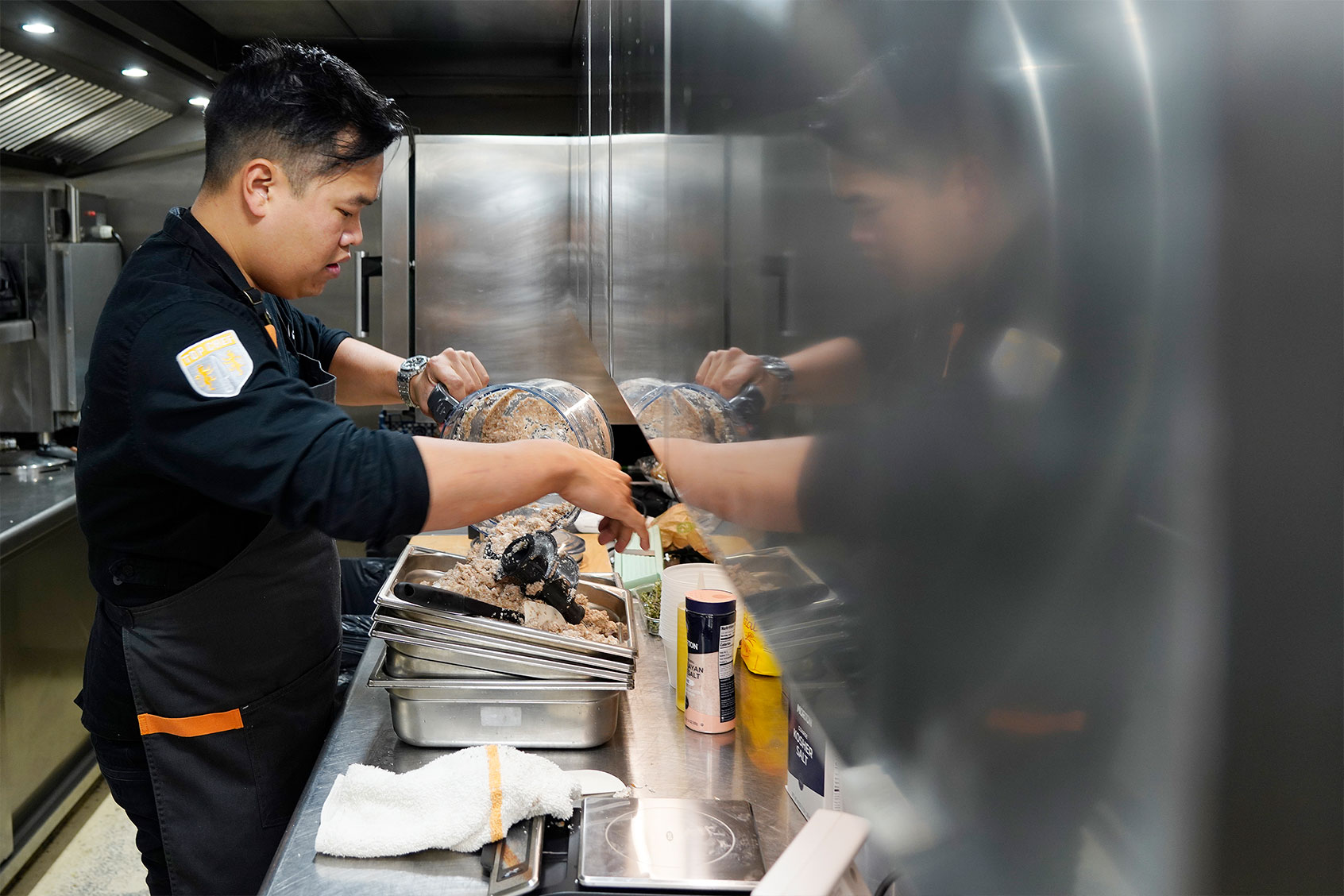
“Top Chef: World All Stars” elevates the humble mushroom for a top-tier penultimate challenge

I’ve been tough on “Top Chef: World All Stars” over the past few weeks — and this episode shows why.

When “Top Chef” is good, it’s stellar — this episode was a perfect example of that caliber. 

When “Top Chef” is good, it’s stellar — and this episode was a perfect example of that caliber. 

The final four cheftestants make their pilgrimage to Paris and directly to the Eiffel Tower (which Buddha deems “huge and pointy and in the sky”) for their final Quick Fire of the season. It is a new variation of the “wall” challenge, in which a contestant is paired with an unseen stranger behind a partition who has identical appliances, utensils and ingredients. The chef must verbally convey instructions on how to prepare a dish to this person of unknown cooking ability so that both partners deliver dishes as identical as possible.

Our guest judge for the episode is Chef Greg Marchand of “Frenchie,” who seems really terrific (I love how he judged the food). “Top Chef” is two-for-two with amazing guest judges this week and last!

Top ChefHunter Woodhall in “Top Chef” (Fred Jagueneau/Bravo)

The cheftestants are tasked with creating a dish from a small pantry, but as always with this challenge, the larger difficulty is being able to produce two identical dishes, both in terms of aesthetics and taste, only via vocal encouragement and direction — and this season, with total strangers, not family members. These total strangers, however, are probably not strangers to many: The “guest” cooks in this challenge are Olympians and Paralympians who will be competing in the 2024 Olympic Games in Paris. Buddha’s partner is Hunter Woodhall, Gabri’s partner is Suni Lee, Ali’s partner is Mallory Weggemann, and Sara’s partner is Sydney McLaughlin-Levrone. 

The Gabri and Suni scenes – in which Gabri’s chaotic energy occasionally overrides his ability to communicte clearly – are legitimately uproarious and probably the hardest I’ve laughed this season, while Ali and Mallory are fascinating to watch because of Ali’s wise decision to use measuring spoons and cups for all of his directions (and opting for the very standard, simple potato leek soup, too). Sara and Sydney seem to work very well together on their chicken-and-cauliflower dish, and Hunter cracks me up, his general nonchalance clashing a bit with Buddha’s pointed directions. Hunter isn’t familiar with leeks, capers or parsley, but Buddha handles these roadblocks well, while Gabri’s frustration with Suni is humorous throughout, all the way until he is seemingly defeated at the end of the cook. (I will note, too, that thank goodness Suni was good-natured! Someone else may have really gotten into a tiff with Gabri because he was being quite short and snippy with her.) Also, isn’t it interesting that Marchand prefers Suni’s “almost burnt” vegetables to Gabri’s? 

Top ChefSuni Lee and Gabriel Rodriguez in “Top Chef” (Fred Jagueneau/Bravo)

Marchand and Padma give Ali the win (and $10,000 for a Delta flight anywhere in the world!), noting that they literally couldn’t tell the difference looks-wise between his potato-leek soup and Mallory’s, which is the whole purpose of the challenge, making him a clear-cut winner. As the rain picks up to a concerning degree, Padma ominously notes that “greatness often grows from the humblest of beginnings” before sending the cheftestants off to a mushroom-growing cavern of sorts in order for the chefs to peruse the amazingly high-quality mushrooms that’ll be the focal point of their elimination challenge dishes. 


Want a daily wrap-up of all the news and commentary Salon has to offer? Subscribe to our morning newsletter, Crash Course.


Our chefs make their way though the intimidating, cavernous mushroom caves before meeting with Angel, the owner and purveyor, along with a family friend and translator. Our final four take their pick of the perfect, simple button mushroom (“champignon de Paris”), as well as some beautiful shiitakes. Ali’s aiming for a mushroom “steak” of sorts that’s seared off, while Buddha references a favorite meal of his — mushrooms on toast — and how he’s aiming to amp it up a bit, since this is the semifinals and the cheftestants will be serving on iconic chef Alain Ducasse’s boat/restaurant for the elimination challenge. 

Top ChefBuddha Lo, Sara Bradley, Gabriel Rodriguez and Ali Al Ghzawi in “Top Chef” (Fred Jagueneau/Bravo)

Something that strikes me throughout this episode is Gabri’s deep, impassioned desire to succeed, which stands in slight contrast with Ali’s general laid-back air and Sara’s consistently “chill” vibe. Gabri and Buddha have chats with their families, noting their journeys, their paths and their hopes for the future. While their personalities and dispositions seem so disparate, their similar passions are evident. 

While their personalities and dispositions seem so disparate, their similar passions are evident. 

On Ducasse’s boat, Buddha works on his dish, which becomes a terrine with bacon, mushroom and leek mousse, while Gabri’s dish contains a “potato nest” (it reminds me a bit of Begoña’s beautiful dish from earlier in the season) with morita pepper and mushrooms in different preparations. Ali pairs his seared “steak” mushrooms with za’atar, sumac and various mushroom textures an consistencies as well as a pomegranate-studded croquette, while Sara opts for a silky, velvety mushroom soup with raw pears and a beef marmalade. 

The chefs are shocked when Alain Ducasse peeks in, and it’s so cool to see how genuinely starstruck they all are. I love how Sara asks if she should peel her mushrooms and then immediately does so after Ducasse confirms that she should. Buddha’s up first to serve to the amazing table of Michelin stars and our judges, presenting his Champignon de Paris en croute with chicken farce, mushroom puree, pommes puree, bacon and mushroom leaves, which goes over well (as usual)! Ali’s up next with his mushroom steak with mushroom croquette, za’atar, goat cheese, mushroom jus and pickled mushrooms, but the table isn’t fond of his croquette, referencing it’s being a bit “gritty” and not loving the inclusion of pomegranate. Sara’s elevated soup dish with raw pear and beef leg marmalade, on the other hand, goes over beautifully, with remarks of how it honors the mushrooms and feels cozy “like you’re near a fireplace.” Sara states in a confessional that not only is she the only one of the four who didn’t win his/her original season, but she also has no elimination challenge wins under her belt this season . . . but she’d sure love one right now (Hint hint! Foreshadowing!). 

Top ChefBuddha Lo in “Top Chef” (Fred Jagueneau/Bravo)

Last up is Gabri, who again, ends up burning one of his components, rescuing it, but then forgetting numerous components of his dish as the timer runs out during plating (mushroom “cookies,” herbs, roasted cepes). He serves his potato nest with chile morita and champignon de Paris puree with shiitake broth and cured egg yolk, which the judges note as being exponentially spicy but also very delicious, as well as having some texture, while many of the other dishes don’t.

At judges’ table, Sara earns her first win (hooray!) for her soup which is “the essence of champignon de Paris” and is told that she’s made the judges proud. Sara also notes that she feels more accomplished making the finals in this season than she did when she made the final two in Kentucky, her first season. Buddha is also told that he’s also moving to the finals. It’s between Gabri’s scattered, not-every-component-is-included dish (which wasn’t especially mushroom-focused) and Ali’s mushroom “steak” with a problematic croquette, but which has much more mushroom flavor.

At judges’ table, Sara earns her first win (hooray!) for her soup which was “the essence of champignon de Paris” and is told that she’s made the judges proud.

In the end, after what seems like a contentious, emotional judges’ table, Ali (!) is told to “pack his knives and go,” leaving Gabri in a puddle of tears as he advances to the finals with Sara and Buddha. Our final three pop some champagne bottles and celebrates under the lights of the Eiffel Tower as we head into the finals. So exciting! It’s wonderful to see their pure, unvarnished jubilance as they gear up for what is sure to be one of the most special cooks of their lives.  

Who are you rooting for?

After dinner mints

-Just want to reiterate that Chef Greg Marchand is lovely — such excellent guest judges this season! 

-Padma is so fun, loose and humorous this episode.

-I am rooting for Sara, but obviously wouldn’t be disappointed with a Buddha win. A Gabri win, conversely, would be a truly amazing underdog come-from-behind victory for el gato, wouldn’t it? 

-Ali’s departure before the finals will certainly upset many in the “Top Chef” fandom, but after last week and this week, I do feel as though he almost sputtered out a bit towards the end of the season. But I guess this boot may fall into the “shocking” elimination category for most, all things considered. 

-I am fascinated by this Top 3: Buddha is an obvious inclusion, but I don’t think many would’ve pegged Sara or especially Gabri as being a part of this group. Rewinding a few months back, from a sheer talent perspective, I would maybe have thought Ali, Charbel, Begoña or even Tom may have made it to the finals. From a personality/reality tv character perspective, I would’ve loved to have seen Victoire or even Sylwia make it further. But I will note that now, I am very pleased with our contestants going into the big finale. 

“Top Chef: World All Stars” airs Thursdays at 9 p.m. on Bravo and streams next day on Peacock.

Legal experts compare Trump to Nixon over secret tapes — and key aide gave DOJ even more evidence

Legal experts compared former President Donald Trump to Richard Nixon after the special counsel team investigating his removal of classified documents from the White House obtained an audio recording in which he admits to have a secret document that he cannot show to others because of its classification.

Special counsel Jack Smith’s office in March obtained a recording of Trump speaking to former chief of staff Mark Meadows’ autobiography ghostwriters about a secret document he has about Iran war plans and complaining that he should have declassified the material when he was president, according to CNN and other outlets.

Former U.S. Attorney Harry Litman called the recording “smoking gun” evidence.

“The new tape is potentially killer evidence of Trump’s guilty state of mind—he knows he hasn’t declassified everything and he knows there are rules,” he tweeted.

The existence of the recording reminded some former prosecutors of Nixon’s penchant for recording his conversations — which ultimately led to his downfall during the Watergate scandal.

“Tapes brought Nixon down. Tapes are going to bring Trump down,” tweeted Tristan Snell, a former New York assistant attorney general.

The recording was made by Trump communications aide Margo Martin, who was frequently tasked with recording his conversations with book authors and journalists, ostensibly to ensure accuracy.

“Trump’s insistence that his conversations with journalists be taped, and will likely now be part of his comeuppance, is redolent of another POTUS who made tapes that were his undoing. But this time charges have been and will continue to be filed,” tweeted former federal prosecutor Andrew Weissmann, who served on special counsel Bob Mueller’s team.

“When is Trump going to say ‘I am not a crook?'” he added. “After the second, third, or fourth indictment?”

Legal experts have also speculated about other evidence prosecutors might have gotten from Martin, a former deputy communications director for Trump’s Save America PAC who now works on his campaign. The aide was subpoenaed to appear before a grand jury hearing evidence in March but investigators already had the recording before her appearance, according to The New York Times. Her devices were subpoenaed by the DOJ and scanned after her appearance. Some of Trump’s aides that were aware of the recording “have been waiting for it to become public” since Trump denied showing classified documents to others during a CNN town hall, when he responded, “not really.”

MSNBC legal analyst Katie Phang noted that the fact that investigators already had the recording and subpoenaed Martin’s devices after her appearance suggests the timing “is proof Jack Smith has more evidence than we even know.”

Fellow MSNBC legal analyst Lisa Rubin added that it’s not clear what Martin told prosecutors but it’s “interesting that she has not tweeted since late April.”

“Kind of odd for a campaign comms aide, no?”


Want a daily wrap-up of all the news and commentary Salon has to offer? Subscribe to our morning newsletter, Crash Course.


CNN previously reported that Trump’s legal team turned over a laptop belonging to an aide that worked for the Save America PAC earlier this year after the aide copied some of the classified documents “onto a thumb drive and laptop, not realizing they were classified.” 

Trump’s attorneys have insisted that Trump declassified the documents found at Mar-a-Lago despite his comments.

Trump during a Fox News town hall claimed that he doesn’t “know anything” about the recording.

“All I know is this: Everything I did was right. We have the Presidential Records Act, which I abided by 100%,” he claimed, before pivoting to a rant about President Joe Biden.

But Trump’s critics cited the existence of Martin’s laptop to counter the GOP narrative about Hunter Biden’s sordid laptop contents.

“The most interesting thing about Hunter Biden’s laptop,” tweeted Democratic strategist Adam Parkhomenko, “is Margo Martin’s laptop.”

Trump’s Big Lie is ruining it for the rest of the Republican field

Well, it appears that House Speaker Kevin McCarthy has survived the tantrum from the right-wing Freedom Caucus members after he made a deal with Joe Biden that essentially won none of their priorities and pushed off their next hostage opportunity until 2025. They weren’t happy but they were anxious to get back to screeching about “wokeness,” attacking the “Deep State” and pretending to do investigations into Joe Biden so they let it slide.

With that saga ending with a whimper, not a bang, it’s time to rejoin the Republican presidential primary clown car. Both front-runner former President Donald Trump and his chief rival Florida Gov. Ron DeSantis were in Iowa this week wooing the midwestern white conservatives who are the supposed avatars of Real America. Appearing before small intimate crowds isn’t either man’s strong suit but it’s an important rite of passage that even Donald Trump can’t entirely escape.

He takes a lot of pictures with fans at Mar-a-Lago but they’ve paid an admission fee. Trump famously made his feelings known back in 2016 when he told a reporter:

Don’t forget that when I ran in the primaries, when I was in the primaries, everyone said you can’t do that in New Hampshire, you can’t do that. You have to go and meet little groups, you have to see — cause I did big rallies, 3-4-5K people would come . . . and they said, “Wait a minute, Trump can never make it, because that’s not the way you deal with New Hampshire, you have to go to people’s living rooms, have dinner, have tea, have a good time.” I think if they ever saw me sitting in their living room they’d lose total respect for me. They’d say, I’ve got Trump in my living room, this is weird.

Speaking of weird, Ron DeSantis has been trying his best to act like a human but it’s obviously very difficult for him:

People are wondering why he pronounces his last name in two different ways (sometimes it’s Dee-Santis and sometimes it’s Duh-Santis) and that makes him testy as well:

That’s very cute but it doesn’t address the question as to why he would do something so odd. The man’s reputation for being just plain weird grows stronger by the day.

There was some substance, if you want to call it that, at the various events the two men attended. DeSantis touted his record in Florida while Trump touted his alleged 40 point lead in the state and told those gathered at the Westside Conservative Club of Urbandale, “I got China to give them for their farmers $28 billion, and a lot of people in this room, you got checks for hundreds of thousands of dollars.” (That is a lie, of course. US consumers paid for the tariffs on Chinese goods and US taxpayers bailed out the farmers for the Chinese retaliation.)


Want a daily wrap-up of all the news and commentary Salon has to offer? Subscribe to our morning newsletter, Crash Course.


Later he had a bigger town hall crowd with Fox News celebrity Sean Hannity in which he claimed he could end the Ukraine war in 24 hours by making them sit down together and refuted DeSantis’ contention that it will take eight years to destroy woke leftism by promising to turn the country around in six months. (Presumably, it will be right after he enacts his health care plan that he promised was coming in two weeks back in 2020.)

The crowd was very excited:

DeSantis has begun to attack Trump to reporters while continuing to only refer to him obliquely in his speeches. He complains that he didn’t fire Dr. Anthony Fauci during the pandemic as part of his dishonest account of his superior COVID performance (Trump didn’t have the power to fire him) and hits him for not closing the border. Trump, on the other hand, attacks and insults in the usual way but he is saying a few things that deviate from the standard right-wing line, just as he did in 2016.

For instance:

He used the term himself just a few hours later discussing the military, but it’s clear he went after DeSantis for his “woke” crusade because polling shows that most people think of “woke” as a positive term. He took credit for the COVID vaccine when one of the people in the crowd complained about the “jab” saying “there’s a big portion of the country that thinks they are a great thing.” He’s also hedging on abortion in ways that are very dicey, especially with the Iowa GOP which is heavily Evangelical. But he’s looking ahead to the general election knowing that abortion bans like the one DeSantis signed in Florida are deadly for the Republican Party.

You’ll recall that Trump did this in 2016, staking out a few positions to the left of the conservative base, most significantly his promise to protect Social Security and Medicare from cuts which had been bedrock right-wing principles for decades. It’s part of what made him different and appealing. Axios reported that Trump’s pollster Tony Fabrizio has been making the case that DeSantis is unelectable because of his hard right policies and Trump is clearly listening to him. Fabrizio says that they’ve done surveys that show that when people in swing states hear what he’s been up to, his support craters.

It’s not just the 6-week abortion ban and the fight with Disney, which are “electorally fatal.” It’s also DeSantis’ past support for cutting the social safety net and enacting a national sales tax, as well as the book banning. Whether Trump can thread the needle on all of that is up in the air. He’s been on all sides of the Disney thing and his rhetoric on abortion is satisfying no one. But it’s clear that he’s going to go after DeSantis’ record on these issues one way or the other. His Super Pac is already running ads on his votes to cut Social Security.

For his part, DeSantis seems to think he has the slam dunk electability argument with his exhortations to put an end to the “culture of losing,” suggesting in so many words that Trump is a loser who has run the GOP into the ground. He’s right about that but he doesn’t seem to realize that Republican voters are convinced otherwise. On Tuesday, Monmouth released a poll showing that almost two-thirds of Republicans think Trump is best positioned to beat Biden.

And why wouldn’t they? They believe that Trump won the last election in a landslide and the Democrats stole it from him! Until Ron DeSantis and the rest of the field are willing to admit that Trump’s contention that he actually won the election was a big lie, this attack is going to not only fall flat, it’s going to offend the very voters to whom they are trying to appeal.

This rivalry is probably not going to last very long. DeSantis may pull out a win in Iowa but the political graveyard is full of candidates who won the state and were never heard from again so that’s not going to tell the tale. The fact is that there are just too many Republicans who are still in love with Donald Trump and unless something catastrophic happens it’s going to be almost impossible to beat him in the GOP primary. Certainly, an uncharismatic grouch who pronounces his own name differently every other day is highly unlikely to do it. 

Who Ron DeSantis should fear — and why it isn’t Donald Trump

Last week, Republican Florida Governor Ron DeSantis finally announced that he would seek his party’s 2024 presidential nomination.

The mainstream news media and political class are very excited that DeSantis has finally confirmed the obvious: that he will be attempting to “Make America Florida.” It is not the specific content of DeSantis’s objectively cruel, sadistic, authoritarian, and generally anti-human policies that he has tested on the denizens of Florida that are the source of excitement (in all likelihood most of America’s mainstream political and media class view DeSantis and his policies as being abhorrent). Instead, it is the idea that there is now officially a contest within the Republican Party between Donald Trump, the traitor ex-president, and a real challenger in the form of Ron DeSantis that is causing the feelings of a dark and naughty thrill mixed with relief and comfort at the familiar.

Styles make fights; Conflict plus characters create a story.

To that point, DeSantis’s candidacy will allow the news media to feast on horse race journalism, personality profiles, public opinion polls, rumors and gossip, manufactured and exaggerated “gaffes” and “missteps. A contest between Trump and DeSantis is also an opportunity, of course, to make lots of money from ad revenue and the clash between the two rivals and other members of the Republican field – and how President Biden and the Democrats respond to them. But these are not “normal” times in America. Donald Trump and Ron DeSantis are both neofascists with a deep contempt for America’s multiracial pluralistic democracy. The differences between the two men are mostly of personality and charisma and overall style as opposed to malevolence, evil, and sadism.

Because the American mainstream news media as an institution (and many of the political class and general public) is desperate for a return to “normalcy” and the accompanying sense of false security, Ron DeSantis will be presented as a more reasonable, viable and responsible alternative to the outright fascism and unrepentant demagoguery of Trump and his MAGA movement even though such differences are a fantasy that has little if any relationship to the facts.   

“Defeating Trump and DeSantis is absolutely critical if we are to see the American experiment continue.”

In an attempt to make better sense of Ron DeSantis’s candidacy, his prospects for defeating Donald Trump, and what this all means for the American people and their imperiled democracy, I asked a range of experts for their insights and predictions.

These interviews have been lightly edited for clarity and length.

Ryan Wiggins is the Chief of Staff for the pro-democracy advocacy organization the Lincoln Project.

Ron DeSantis is going to get beat. His awkwardness and disdain for people is going to make it difficult, if not impossible to connect on the campaign trail. Launching his campaign on Twitter was a disaster that blew up in his face. It was a product rollout for Musk and made DeSantis a secondary character in his own announcement. He’s already been beset by bad staffing decisions and poor choices.

Ron DeSantis is going to lose to Trump. Trump is way ahead in all of the polls and DeSantis is competing with the other candidates for leftovers. Trump controls the party top to bottom; the infrastructure, the messaging, and has positioned himself as the central force in GOP politics. He gained support after his arrest, and there’s no way he loses support if arrested again. No one should see Ron DeSantis as a savior for the Republican Party. He will not bring it back to “normal.” Anyone who thinks that Ron represents the establishment is deluding themselves. Ron is as authoritarian as Trump is, as evidenced by his fight with Disney, his war on librarians, and his hatred towards LGBTQ individuals.

This nation is in crisis. The authoritarian MAGA movement has taken control of the GOP and is actively working to undermine our democratic institutions and processes. Defeating Trump and DeSantis is absolutely critical if we are to see the American experiment continue.

Wajahat Ali is the author of “Go Back To Where You Came From.” He is also a columnist for The Daily Beast, Medium, MSNBC Daily, and co-host of the Democracy-Ish Podcast.

I’ve been saying for a while that DeSantis is a wet noodle who is cosplaying as a MAGA alpha man. He doesn’t have “the stuff” to win a national election. This is the same man who has to be coached on how to meet and greet fans and supporters. He’s the same man who barely won office in 2018 and has looked like a terrified deer in headlights in his debates with Gillum and Crist. He’s the invisible cola of GOP politicians – no matter how much right-wing money and anti-Trump conservatives want to promote him, the kids just ain’t into him.

That being said, he is dangerous because he realizes that the future of the GOP is Trumpism on steroids. He has used Florida as his laboratory to create MAGA’s wet dream crusade against “wokeness.” Unfortunately, for him and future MAGA upstarts, these policies are repulsive to most Americans. As we saw from CNN’s disastrous town hall, Trump is still the king of this MAGA cult, and all the polls back this up. If anything, the fight between both will further erode the GOP’s chances to win back the White House in 2024. Trump will unleash hell on him and take every opportunity to ridicule him as he did during the laughable and embarrassing DeSantis Twitter fiasco last week.


Want a daily wrap-up of all the news and commentary Salon has to offer? Subscribe to our morning newsletter, Crash Course.


Mainstream media outlets and institutions will continue to fail us as they normalize and mainstream what has become a radicalized and weaponized GOP movement in the interest of “both sides” framing and not rocking the boat to help line their bottom lines and gain access to power. That’s the scary part —- we have a radical movement that has taken over one of the two major political parties. Trumpism is the future.

Steven Beschloss is a journalist and author of several books, including “The Gunman and His Mother.” 

Ron DeSantis may seem like a stylistically less extreme, less deranged, candidate than Donald Trump. But his anti-democratic bullying behavior, hostility to education and diversity, demagogic rejection of gays and people of color, attraction to violence and insistence on the make-believe “woke virus” as the nation’s greatest danger illustrates how Trump’s cancerous influence continues to drive Republican thinking. That he represents a credible alternative to Trump for many—even while he’s taking some issues farther than Trump—shows how the GOP has lost its will to win by expanding its base.

“DeSantis is a wet noodle who is cosplaying as a MAGA alpha man.”

There once was a time when we might have expected a candidate like DeSantis to go cruel and negative in the primary, then become more inclusive were he to make it to the general. But there’s no reason to assume that in his case; his authoritarian mentality and fear-based policy making is clearly who he is. His technologically disastrous launch on Twitter only underscores his inability to differentiate himself from Trump. His pledge to “fully” build the wall only made it obvious that he’s devoid of ideas that will meaningfully expand the base. At this point, with Trump so far ahead in the polls, DeSantis can only hope that a flood of indictments will finally drown Trump and make his candidacy possible.

Rachel Bitecofer is a political analyst and election forecaster.  

The so-called “Beltway Bubble” is never bigger than when it comes to covering presidential nomination campaigns. Few outside daily cable news watchers are paying ANY attention to this “issue” yet, and won’t even begin to tune in until late fall as Iowa caucus approaches. This is why polling in what we political scientists call the invisible primary heavily favors the candidates with “saturation” name ID.

Nomination campaigns tend to begin and end with the two candidates best known to the electorate. Now, with that out of the way: we haven’t seen an alt frontrunner poll as strong as DeSantis is against Trump since the 2008 Democratic Party contest between Obama and Clinton. Clinton was a VERY strong frontrunner through the entire invisible primary until the final months heading into Iowa, where an insurgent challenger managed to beat her and thus get the Big Mo’ “momentum” he needed to win South Carolina and the Super Tuesday states. The fact that DeSantis is +80 on name ID and polling in the 20s against Trump is not weakness, its strength. First off, if Trump was as strong a frontrunner as the Beltway claims he is, he’d be polling in the 70s or even 80s. Yes, he received an increase in support over the past two months (which is likely more from the narrative that DeSantis is a poor candidate than it is from Trump being formally indicted) he is still running below expectations for what we’d expect an incumbent president to put up.

Calling DeSantis a failed candidate before he even announced is wishful thinking and brings to mind comparisons with Tim Pawlenty in 2012 and Kamala Harris in 2020 as candidates who exited the race before it even began based in the Beltway Bubble who, if they had stayed in the race, likely would have benefitted from frontrunner collapses/angst like about Biden as it became clear he was the only one that could compete against Sanders.

When the so-called establishment gets spooked about their likely nominee you want to still be in the candidate field to fill that alternate role. Harris could not become the Biden-alt in 2020 because her entire time period in the race was constrained to the Invisible primary which only exists on cable news and political reporting. The reason DeSantis is so well positioned is that other than Mike Pence, he is the only Republican in the field that can compete with Trump in terms of name ID. But also because he is the only candidate in the field that will have the name ID enough to look viable to win the nomination that MAGA can accept once it becomes clear that Trump has too much indictment baggage. My expectations are that by late fall Trump will be facing multiple indictments and will begin to be seen as too risky to nomination. At this time, DeSantis is by far their most likely landing pad. The rest of the field as it currently exists is too obscure. Now, if a different MAGA flamethrower with very high name ID like Tucker Carlson was to emerge, THEN DeSantis would be in trouble.

Jared Yates Sexton is a journalist and author of the new book “The Midnight Kingdom: A History of Power, Paranoia, and the Coming Crisis.”

Ron DeSantis has been running for president since the first day he picked up the baton for the myriad of right wing think-tanks and institutes funded by the billionaire class. His slate of oppressive bills and laws was to please them and find his place in their favor, and now he’s trying to collect his reward.

“Since in Florida, DeSantis himself has led the way as opposed to a gerrymandered state rep somewhere, he has actually increased awareness about how the attack on democracy is playing out in states.”

If Donald Trump and DeSantis meet on a debate stage, Ron is in real trouble. But what he’s banking on now is the idea that Establishment Republicans and the donor class he serves will get him past Trump, which is also what he’s hoping Elon Musk and the Tech Right will help him with. Whether it’ll work or not remains to be seen.

This is an increasingly volatile and dangerous situation. DeSantis is as cold-blooded as they come. His marriage with these donors and Right Tech are troubling developments.

David Pepper is a lawyer, writer, political activist, and former elected official. His new book is “Saving Democracy: A User’s Manual for Every American“.

While he represents a large state and has an enormous war chest, Ron DeSantis has almost no other qualities that make for a good candidate. And against Trump, my guess is that baseline weakness makes it incredibly difficult to make up the enormous gap that already exists. His deeply flawed launch was yet another confirmation that he’s not ready for prime time.

He doesn’t have the personal bravado or authenticity to take away Trump voters themselves—even as he’s moved way to the right in an attempt to do so. And the non-Trump support is hopelessly divided among far too many candidates.

Outside of something truly dramatic involving the Trump investigations (and indictments alone don’t qualify as “truly dramatic” at this point, at least in terms of the primary), I don’t see DeSantis gaining much ground in the primary. It’s far more likely that once on the big stage, he falls even further. I think Trump will run over him just like he did the 2016 field, especially in direct interactions such as debates. And he symbolizes how much Republicans have failed to come up with viable alternatives to a man they know is destroying their party.

In terms of the broader battle for democracy, DeSantis has helped highlight just how extreme and anti-democratic states have become. Usually, that is hidden within the anonymity of statehouses, which usually are the ones leading the charge as people look elsewhere. But since in Florida, DeSantis himself has led the way as opposed to a gerrymandered state rep somewhere, he has actually increased awareness about how the attack on democracy is playing out in states.

Cheri Jacobus is a former media spokesperson at the Republican National Committee and founder and president of the political consulting and PR firm Capitol Strategies PR.

While I understand how dangerous Ron DeSantis can be, and is for Florida, I am not sold on the “hype” surrounding him.  Aside from the comically disastrous presidential campaign “launch” on Twitter, an obvious revenge dig by Elon Musk on Donald Trump for not returning to Twitter, DeSantis is awkward, tone-deaf, uncomfortable around people, and seems perpetually “off.”  What plays well with the shuffleboard and “Florida man” crowd, isn’t translating to the broader MAGA crowd, despite DeSantis’ alarming lunges into the heart of fascism. Perhaps it’s the missing messy personal behavior Republicans crave? Indictments? There’s still time. Today’s Republicans seem hyped up on maniacally cheering on Trump to “beat the rap” for his crimes.  If that’s the juice needed to win the GOP presidential primary, then DeSantis needs to dirty up his personal life, marriage, finances, and throw in a sprinkling of treason and canoodling with dictators and despots to be competitive. The cable TV networks seem also to require it. 

The DeSantis strategy appears to be 100% dependent on Trump federal indictments which are rumored to land this summer. He’s counting on his bland, boring demeanor, personality, personal life and simple but heavy fascist maneuverings to be the safe landing pad for enough MAGA voters, and importantly, big donors.  

The question is: Does Ron DeSantis have the gravitas to lead a national ticket? And an even bigger (and more frightening) question is: What does “gravitas” require in the GOP in this Trump fascist era?  

The media that make big bucks from Trump, as well as super PACs that make their members very, very rich pretending to fight Trump, are doubling down on DeSantis in order to prop up Trump and ensure he is the GOP nominee. Just as many rightwing figures in 2015-2016 propped up Trump because they thought a Trump nomination ensured a Hillary Clinton presidency and many of them made their fame and fortune the first time there was a Clinton in the White House — and wanted that again — some on the left (or at least the “anti-Trump” side of things) need Trump as the GOP nominee again. It’s a rather lucrative cottage industry, after all.

To quote Yogi Bera, “It’s deja vu all over again”.

Clarence Thomas, Ken Paxton and Donald Trump: The corrupting influence of oligarchy

It is tempting to attribute the scandals now enveloping two right wing icons — Supreme Court Justice Clarence Thomas and Texas Attorney General Ken Paxton — to both men’s lack of an ethical compass. Resisting that temptation is necessary if we are to learn a larger lesson about the roots of much political corruption in this country.

The through-line in those headline-grabbing events involves massive wealth, domestic and foreign, seeking to buy power and knowing how to cultivate those who have it as well as those who have had it and might regain it. Simply put, people with great wealth often seek to enlist the powerful to help them keep things as they are.

This story is as old as the Republic itself. From America’s early days, as bestselling author Thom Hartmann writes in “The Hidden History of American Oligarchy,” our history has played out in periods of back-and-forth between democracy and oligarchy, between “rule of, by and for the people” and “rule of, by and for the rich.”

Indeed, Alexander Hamilton and his Federalist contemporaries exhibited what the political scientist Jay Cost labels “a shocking naiveté regarding the greed and small-mindedness of the speculator class” which, with insider information, made a killing by buying Revolutionary War bonds from veterans. Such naiveté allowed members of that class to enrich themselves, fostering the rise of an oligarchy that sought to corrupt the government, and periodically succeeded.

That Harlan Crow lavished private jet flights and free vacations on Supreme Court Justice Clarence Thomas — not to mention paying tuition for Thomas’ adopted son and buying his mother’s house, so neither Thomas nor his mother had to pay rent or a mortgage — is just the latest example of oligarchy at work.  

The oligarchs buying influence today are not just American citizens.

In a sophisticated purchase of power that repays past favors and looks to the future, the Saudi monarchy, which happens to run one of the world’s most reactionary regimes, sponsors a breakaway pro golf tour (through its sovereign wealth fund) that has held several tournaments at Donald Trump’s courses. That comes just a few years after the then-president vetoed a congressionally approved cutoff of American military aid for the Saudi war against Yemen. (The same Saudi wealth fund also invested $2 billion in a business venture run by Jared Kushner, Trump’s son-in-law.)

The Saudis were also, at least arguably, rewarding Trump for declining to sanction Crown Prince Mohammed bin Salman, the desert kingdom’s de facto ruler, after Washington Post journalist Jamal Khashoggi was murdered and dismembered by Saudi operatives. There’s also the potential investment in future influence if Trump returns to power.

The wealth-corruption-right-wing-politics connection also plays out at the state level in this country, as came to light during the May 27 impeachment of Texas Attorney General Ken Paxton for taking bribes.  

He allegedly did so in return for helping donor Nate Paul, a wealthy Austin real estate developer, by appointing special counsels, one to look into a court-approved FBI search of Paul’s house and the other to question a local district attorney’s investigation of Paul.

Corruption, the abuse of the political system by those with the means to abuse it, is certainly not limited to elected officials on the right. But it tends to hover more heavily on the conservative side of government, both here and internationally.

German economist and social scientist Zohal Hessami’s empirical analysis of 106 countries over a 24-year period suggests that “the extent of corruption is about 10% larger when right-wing parties are in power rather than left-wing or centrist parties.”


Want a daily wrap-up of all the news and commentary Salon has to offer? Subscribe to our morning newsletter, Crash Course.


There are at least two reasons for that. First, those with great wealth and power tend to support the status-quo politics favored by conservative politicians. They are willing to pay to keep things as they are.

Second, and in parallel, there is a clear association between corruption and efforts to preserve or increase economic inequality and disparity in the distribution of wealth. A 2014 report by Oxfam, “Working for the Few,” put it this way: “Extreme economic inequality and political capture are too often interdependent. Left unchecked, political institutions become undermined and governments overwhelmingly serve the interests of economic elites to the detriment of ordinary people.”

Of course corruption can be camouflaged. Think about the Saudis and Trump. Or consider the classic deployed by Crow, who maintains that he never talks to Justice Thomas about “cases.”

In all likelihood, he doesn’t have to. Socializing with powerful people, as Crow does, builds trust and friendship. Hassami’s research shows that “trust and reciprocity are essential when people are involved in illegal activities such as corruption.”

Harlan Crow maintains that he never talks to Justice Thomas about “cases.” In all likelihood, he doesn’t have to. Socializing with powerful people builds trust, friendship and a sense of reciprocity.

What often unites those on the right, particularly those whose purpose in life is to accumulate greater and greater wealth, is opposition to democratizing measures that protect voting rights, restrict money in politics or expand the rights of underrepresented groups. Those who have “gotten theirs” prefer to keep their club exclusive.

As Finn Heinrich, an expert in governance, democracy and civil society issues, notes, the “data show a strong correlation between corruption and social exclusion.”

Let’s return for a moment to the first reason why corruption is so frequently an instinct among oligarchs. It’s not only that they like the way things are right now. They often love the past even more and seek to roll back progressive reforms toward the conditions of earlier decades, or even earlier centuries

Take billionaire Richard Uihlein, heir to the Schlitz brewing family fortune, and his wife, Liz, whom the New York Times describes as “the most powerful conservative couple you’ve never heard of.” 

They’re funding a right-wing campaign in Ohio to neuter perhaps the greatest democratic reform that the Progressive Era brought, the initiative process. That device gave citizens the right to adopt laws by a majority vote and circumvent legislatures that were often bought, sold and paid for by the robber barons of the 19th century’s “Gilded Age.”

There are lessons to be learned from the examination of this wealth-right wing politics-corruption story. One of the most important comes from Harvard anti-corruption expert Matthew Stephenson: “The fight against corruption in the U.S. was a long slow slog, one that unfolded over generations.”

Indeed, it has unfolded in the many instances where determined Americans wrested back their power, whether it was the Jacksonian Democrats who brought down the Second Bank of the United States for its corrupt influence, the abolitionists who defeated an arrogant aristocracy of enslavers who dominated poor whites along with enslaved African Americans, or early 20th-century workers who fought for their rights to organize and strike.

Today we have legislation that needs to be fought for, including bills that would impose ethical accountability on the Supreme Court, or limit the role of dark money in elections. To succeed, we all need to avoid treating the corruption of people like Clarence Thomas or Ken Paxton as a problem of a few “bad apples” and see it as symptomatic of oligarchs’ efforts to subvert democracy and equal opportunity.

To protect those things, citizens have to speak out against corruption and the oligarchs who seek to destroy government by and for the people. The moral arc of the universe bends toward justice, but getting it there requires taking action to curb the power of public officials whose strings are pulled by the likes of Harlan Crow, Richard Uihlein and Mohammed bin Salman.

What little Ukraine can teach big America about how to deal with our oligarch problem

Viktor Medvedchuk was the Rupert Murdoch of Ukraine. He ran a right-wing television network and owned TV stations across the country, while simultaneously being one of the richest men in that nation. He promoted hate and division, tax cuts for the rich and gutting the Ukrainian social safety net, and supported some of Ukraine’s most toxic politicians. 

Like many of today’s American oligarchs, he owned hundreds of politicians, who consistently voted in Parliament, state, and local governments to protect his businesses, wealth, and influence.

Then came Volodymyr Zelenskyy, who successfully campaigned for president on a Teddy Roosevelt-like anti-corruption platform and, like both Teddy and Franklin Roosevelt, declared outright war on politically active oligarchs.

As a result, today Medvedchuk is hiding out in Russia, his media properties having been sold to smaller companies that are not oligarch-owned or -influenced. Without the persistent rightwing poison Medvedchuk’s TV and other media properties had spread daily throughout Ukraine, the country is now looking at a more democratic future than does America.

Essentially, what Ukraine’s president and parliament did with their 2021 “deoligarchization” (yes, they actually call it that) law was to say to Ukraine’s billionaires:

“You may be rich, and you may have whatever political opinions you want, just like every Ukrainian. But because average Ukrainians don’t have access to millions or billions to sway public opinion or buy politicians, we will no longer allow you to use your vast riches to corrupt our nation to your own advantage at the expense of average working people.” (My words, not Zelenskyy’s.)

In 2021 the Ukrainian president declared a campaign to “de-oligarchize” his nation, having correctly diagnosed his country’s political and economic crises as tracing back to the corruption of Ukrainian politics by that nation’s morbidly rich.

“In order to succeed, Ukraine must become a rule of law democracy that works in the interests of the many, rather than the few,” Zelenskyy declared on May 18, 2021, fully nine months before the Russian invasion. 

His campaign against Ukraine’s oligarchs was as big a threat to Putin’s network of rich enablers as were the EU’s sanctions or Robert Mueller’s prosecutions of them. Some speculate it was the final straw for Putin, provoking his February, 2022 invasion. It was getting a lot of favorable publicity in Russia, and that threatened Putin and the oligarchs who keep him in power.

Zelenskyy had made clear his goal of eliminating from Ukrainian political life the vast power and influence of that country’s oligarchs.

“There is no limit to our ambition,” he said in that 2021 statement. “Every Ukrainian is acutely aware of their country’s vast untapped potential. In order to realize this potential, we must create a fair and functional system that protects the rights of the entire population rather than safeguarding the interests of the oligarchs. The foundations of this system are currently beginning to take shape. …

“Our ultimate objective is to destroy the traditional oligarchic order and replace it with a fairer system that will allow Ukraine to flourish.”

The law, which went into effect June 7th of last year, defines oligarchs as people who meet three out of four criteria, and limits their behavior in six ways that essentially reduce their political influence to that of average Ukrainians.

An oligarch, by the Ukrainian definition, is somebody who:
— Has “significant” influence over mass media,
— Controls a business that exercises monopoly influence over a part of the economy,
— Involves themselves in politics through funding politicians, political parties, political campaigns, or think tanks, etc. (the phrase used is “takes part in political life”), or,
— Has a net worth of greater than $89 million.

Ukrainian oligarchs, under the new law:
— Are included on an official register published by the government,
— May not hold political office, may not fund political parties, or have influence over any meaningful part of “political life,”
— May not purchase state assets that are privatized, and
— Must disclose their assets in what the Financial Times calls “exhaustive declarations.”
— Government officials are also required to report any meeting with an oligarch on the government’s list.

America once had a similar tradition and Americans want it back. So much so that they bought hook, line, and sinker the sales pitch from a professional con man who knew how frustrated working people are by our American oligarchs and their seizure of the GOP.

In the 2015 Republican primary, Donald Trump tapped into this longing, promising he would end the political corruption by oligarchs and the corporations that made them rich.

During the Republican primary election, Trump said of his GOP competitors:

“They will be bombarded by their lobbyists that donated a lot of money to them. Again, Jeb raised $107 million dollars, OK? They’re not putting that money up because it’s a wonderful charity. Well, it is a charity, but for them, not for America.”

That was in July of 2015 when he was considered a long-shot, fully five months before President Obama said, “I continue to believe Mr. Trump will not be president.”

Trump argued that normal, corruptible politicians would have to bend to the will of their campaign donors, even when that meant sending jobs overseas and otherwise screwing average Americans:

“So their lobbyists, their special interests and their donors will start calling President Bush, President Clinton, President Walker. Pretty much whoever is president other than me. Other than me. And they’ll say: ‘You have to do it. They gave you a million dollars to your campaign, two million, five million.”

Across the auditorium heads were bobbing as Trump tossed out the punch line he used in hundreds of speeches:

“And the plant will be built in Mexico and [that’s how] we just lost lots of plants all over our country.”

Political bribery was a felony crime in the United States virtually from the beginning of our republic until just the past 40+ years.

Those laws were strengthened repeatedly at both the federal and state levels over the past 150+ years, including hundreds of prohibitions on oligarchs, corporations, and their officers bribing politicians. 

The 1907 Tillman Act, much like Ukraine’s de-oligarchization law, made it a federal crime for any wealthy executive of a large corporation to give any money or other support of any sort to any candidate for federal office. 

Numerous state laws echoed the Tillman Act and other anti-oligarch, anti-bribery, and anti-corruption laws. 

For example, Wisconsin’s law was quite explicit:

“No corporation doing business in this state shall pay or contribute, or offer consent or agree to pay or contribute, directly or indirectly, any money, property, free service of its officers or employees or thing of value to any political party, organization, committee or individual for any political purpose whatsoever, or for the purpose of influencing legislation of any kind, or to promote or defeat the candidacy of any person for nomination, appointment or election to any political office.

“Any officer, employee, agent or attorney or other representative of any corporation, acting for and in behalf of such corporation, who shall violate this act, shall be punished upon conviction … by imprisonment in the state prison for a period of not less than one nor more than five years … and if a domestic corporation it may be dissolved … and if a foreign or non-resident corporation its right to do business in this state may be declared forfeited.” [emphasis mine]

Five Republicans on the Supreme Court, however, struck down that and literally hundreds of other state and federal anti-bribery laws in their corrupt 2010 Citizens United decision. 

In the wake of that decision, state courts were forced to strike down similar anti-bribery laws in Alaska, Arizona, Colorado, Connecticut, Iowa, Kentucky, Minnesota, Montana, North Carolina, South Dakota, Tennessee, Texas, West Virginia, and Wisconsin.

As a result, today Democrats like Joe Manchin, Kirstin Sinema, Josh Gottheimer, and the entire Republican caucus in both the US House and Senate and virtually every Republican in every state house and senate in America are regularly on the take.

A political network organized by rightwing billionaire oligarchs is believed to have more employees and a larger budget than the entire GOP. And it’s just one of several, each run by different groups of American oligarchs, sometimes even using money or other resources from foreign countries (Russia, for example, is alleged to have funded the NRA). 

This is a genuine crisis for American democracy. The poison of big money is seeping through the veins of our political system in ever-larger quantities. If not stopped, this process can be fatal. 

No democratic republic in history has ever survived as a functioning democracy more than a few generations once political bribery is either legalized or simply becomes widespread due to weak law enforcement.

This story of how wealthy oligarchs corrupt political systems is so ancient it’s at the core of the decline and fall of the Roman empire.

Historically we’ve usually seen this phenomenon in Third World countries with a weak rule of law, but more recently it destroyed or is eroding democracy in Russia, Hungary, The Philippines, India, Sri Lanka, Venezuela, Brazil, Peru, and South Africa (which, with the “gift” of American corporate lawyers to help write their new constitution three decades ago, institutionalized corporate personhood and the right of corporations to fund elections, as I document in Unequal Protection: How Corporations Became Persons).

The evidence of this cancer — installed into our body politic by five corrupt Republicans on the Supreme Court — is now so obvious that it’s turning elections and politicians are openly calling it out. 

And if we don’t do something about it soon, America may well go down the authoritarian road Trump tried to pave and the countries listed above are now on.

America has faced a crisis of oligarchy much like today’s twice before.

The first time was in the two decades leading up to the Civil War, when the Cotton Gin enabled a handful of uber-wealthy families in the South to buy up or wipe out their cotton-growing competitors, producing America’s first full-blown fascist oligarchy.

After this handful of super-rich families had taken over the entire political system of the Confederacy, they rose up and declared war on the United States itself, explicitly trying to end America’s experiment with democracy once and for all. (I lay this out in detail in The Hidden History of American Oligarchy: Reclaiming Our Democracy from the Ruling Class.)

America’s second experience with oligarchy stretched from the 1880s and the Industrial Revolution until the Republican Great Depression led Americans to put Franklin D. Roosevelt in the White House in the election of 1932.

As John D. Rockefeller and other oligarchs rose in power and political influence, what little middle class America had collapsed. The richest 1 percent held over half of America’s wealth in 1900; combined into the top fifth of Americans that group owned fully 87 percent of all the nation’s wealth, and the second fifth — arguably the middle class — held the remaining 11 percent. The bottom 40 percent of Americans had zero or negative net worth.

The average American worker during that era earned around $800 annually, and worked a 60 hour week to accomplish that.

Anti-oligarch political pressure built and the Sherman Anti-Trust Act was passed in 1890, but wasn’t seriously used until progressive Republican presidents Teddy Roosevelt (TR) and William Howard Taft used it against John D. Rockefeller and other oligarchs in the 1901-1916 era. 

TR famously believed and said:

“There can be no real political democracy unless there is something approaching economic democracy.”

President Wilson used World War I to raise the top income tax rate on multimillionaires up to 91 percent, adding to TR’s and Taft’s somewhat successful efforts to restrain the oligarchs.

In 1920, though, in the wake of the end of World War I and the Flu Pandemic of 1918-1919, Republican Warren Harding campaigned on lowering that top tax rate all the way down to 25% (which he did when elected: his anti-tax campaign slogan was “A return to normalcy”). 

He also stopped enforcing the Sherman Act, among others: his pro-oligarchy campaign slogan was: “More business in government (privatization) and less government in business (deregulation).”

The Ronald Reagan of his era, Harding’s policies — continued by Coolidge and Hoover from 1921 to 1933 — led straight to the Republican Great Depression.

Franklin D. Roosevelt came to power in 1933 and openly declared war on the morbidly rich, particularly after they unsuccessfully tried to kidnap and kill him that year in a plot outed by Marine General Smedley Butler (it was appropriately called “the businessman’s plot”).

“They hate me,” he thundered at the Democratic National Convention in 1936, “and I welcome their hatred!”

FDR raised the top income tax rate back up to 91 percent. He put Harry Truman in charge of finding and prosecuting war profiteers, further chastising America’s oligarchs. 

From their failed coup plot in 1933 until the election of Ronald Reagan in 1980, our nation’s morbidly rich mostly contented themselves with simply making money and enjoying their mansions and yachts all around the world. It was Great Gatsby all the time.

But in 1971, tobacco lawyer Lewis Powell wrote an infamous memo to his friend who ran the US Chamber of Commerce, recommending businessmen once again involve themselves in politics as they had in the 1920s. 

They needed to take over the court system, Powell said, buy legislators, sponsor pro-oligarch professors, and create a political system and network that could act as a shadow government, making America once again a safe place for oligarchs to control the political and media systems.

Richard Nixon put Powell on the Supreme Court in 1972, and Powell then authored the decision in First National Bank that struck down a century of laws restraining corporate and CEO political activism, setting the stage for Clarence Thomas to cast the deciding vote in the 2010 Citizens United decision that finally, fully legalized political bribery.

During that era from the 1930s to the 1980s, employers paid their employees well and offered generous benefit packages, largely because the oligarchs were under control and a third of American workers were union members.

For example, the nation’s largest employer in the 1950s and 1960s, Sears, had a generous stock program for its employees that guaranteed a comfortable retirement. As The New York Times noted in 2018:

“Half a century ago, a typical Sears salesman could walk out of the store at retirement with a nest egg worth well over a million in today’s dollars, feathered with company stock. … If Amazon’s 575,000 total employees owned the same proportion of their employer’s stock as the Sears workers did in the 1950s, they would each own shares worth $381,000.”

America’s middle class in the 1960s and 1970s — created by FDR out of the wreckage of the Republican Great Depression — was wealthy by today’s standards. With a high school diploma and a good union job, you could buy a home, a new car every two years, take a vacation every year, put your kids through college, and in many cases even buy a small vacation home. 

The Reagan presidency, however, put an end to that, welcoming massive contributions from America’s oligarchs as they took over the GOP. He lowed the top income tax rate on billionaires from 74% to the 30% range and so extensively shot the tax code through with loopholes that the average American billionaire pays just 3.1 percent in income taxes today. 

Reagan begin the process that, over the past 42 years, has seen over $51 trillion transferred from America’s working class into the money bins of the morbidly rich.

The number of Americans in the middle class has, as a result of Reagan’s embrace of America’s oligarchs, collapsed: before Reagan it was over 60 percent of working people; today’s it’s under 45 percent. For many, the American dream has become a nightmare of debt and homelessness.

America’s oligarchs, in other words, have purchased our political system and then used it to further enrich themselves at the expense of working-class people and the poor. The once-middle-class are now the working poor; the once-merely-poor are now the homeless.

Which brings us full circle to Zelenskyy’s anti-oligarch law and the need for America to do something like it. As Teddy Roosevelt famously noted:

“Neither the people nor any other free people will permanently tolerate the use of the vast power conferred by vast wealth … without lodging somewhere in the government the still higher power of seeing that this power … is also used for and not against the interests of the people as a whole.”

America’s oligarchs have never, ever been as rich or politically powerful as now. Three American oligarchs own more wealth than the bottom half of Americans, and oligarchs across the nation are using that money to influence politics to their own advantage.  

Over at The New Yorker, investigative reporter Jane Mayer tracks how rightwing billionaires — America’s oligarchs — have helped fund overt efforts to overthrow or significantly alter the very nature of American democracy itself, exposing the threat of great wealth that nation after nation has struggled with in the past and present.

One single American billionaire appears to have essentially purchased the deciding vote for Citizens United, while others proudly own thousands of American politicians.

The biggest obstacle to a Zelenskyy-like de-oligarchization of America is the Supreme Court’s doctrine, laid out in the 5-4 Citizens United decision with Clarence Thomas the tie-breaking vote: that money is the same thing as “free speech” and that corporations have the same rights under the Bill of Rights as do human beings.

Congress is not without options, however, as I’ve discussed here at length in the past. First, though, Democrats who are not in the thrall of the morbidly rich will have to seize a large enough majority to pass such laws out of the House and get them past an oligarch-owned Republican filibuster in the Senate.

When they tried this in 2022 with the For The People Act, every Republican joined in a filibuster that Joe Manchin and Kirstin Sinema — both enthusiastic recipients of oligarch dollars — refused to help senate Democrats set aside.

Which defines the stakes for 2024. 

This could be the election that finally determines whether the efforts to fight oligarchy — first led by Lincoln, then both Roosevelts — will succeed, or if America will follow Hungary and Russia down the dirty path to full-blown oligarchy. Whether the American experiment will survive.

Which means it’s all going to depend on us getting everybody we know registered to vote, and maintaining vigilance to make sure we’re not thrown off the voting rolls in Red states. 

Tag, we’re it!

Tennessee woman nearly died and required a hysterectomy after being denied abortion

A woman from Tennessee was forced to endure a dangerous ectopic pregnancy due to the state’s draconian abortion laws, resulting in her having to deliver her baby several weeks premature and requiring a hysterectomy afterward, which she did not want, in order to save her life.

Physicians at the Vanderbilt University Medical Center, where Mayron Hollis sought care for her problematic pregnancy last fall, were unable to develop a treatment plan, due largely to the fact that Tennessee has banned abortion completely, except in rare circumstances, and that doctors there felt uneasy about taking other steps to help the patient.

Hollis had a cesarean scar from a previous pregnancy. Around 10 weeks into her pregnancy, it was discovered she had a cesarean pregnancy, a situation where a fertilized egg implants itself onto the scar from a previous cesarean section surgery. The situation can be deeply problematic, as hemorrhaging is possible and a person can die of blood loss or other complications as the fetus develops and the placenta grows outside of the scar and beyond the uterus, attaching itself to other organs in the body.

That’s precisely what happened to Hollis, who detailed her ordeal to ABC News this week as well as to ProPublica earlier this year.

Hollis could have avoided the situation entirely if she had been able to get an abortion early in her pregnancy. However, on the very day when it was determined by herself and her husband, as well as her doctor, that she should get one, a trigger law in Tennessee banning abortion went into effect, preventing her from obtaining the procedure.

The trigger law was passed in 2019 and did not give much consideration to medical emergencies like Hollis’s — according to ProPublica’s reporting, Republican state legislators passed it for political reasons, not believing that the Supreme Court would overturn the abortion protections established in Roe v. Wade nearly 50 years earlier. The Court did end up overturning Roe in the summer of last year, just before Hollis’s medical issues began.

Financial issues further restricted Hollis from being able to travel out of state for an abortion elsewhere. Ultimately, she carried on with the pregnancy, which almost ended her life.

Other procedures that Hollis’s doctors at Vanderbilt considered employing to mitigate problems associated with the pregnancy couldn’t be obtained, too, over fears that other physicians in various departments had regarding whether they had the legal authority to pursue them. The only way her doctors believed they could take any action at all was if her life was at risk due to the pregnancy, Hollis said.

“Because of everything that was going on, they didn’t know what was the right thing to do… So the only way to save me was for something bad to happen to me,” she told ABC News.

The placenta did eventually rupture Hollis’s uterine wall, resulting in her needing medical attention, at 25 weeks of pregnancy, for excessive bleeding. But even that wasn’t enough to do something — Hollis stayed in the hospital for four days before being discharged. After one day back at home, she returned to the hospital because the bleeding started again.

At that point, it was determined that an emergency C-section was needed, and that, to save her life after the baby was delivered, Hollis would have to have a hysterectomy.

“I didn’t want the hysterectomy. But they said that was the only way that they could stop the bleeding to help me, so I didn’t have a choice,” Hollis recounted.

Problems for the family lasted long after the pregnancy was over. The baby Hollis delivered required extensive medical care, remaining in an incubator for a month and staying in the hospital for two months after she was delivered. The baby has required multiple hospital visits since, with Hollis detailing one instance in which the child almost died.

“I thought I lost her one time for like five minutes,” Hollis said. “She turned colors and I had to wait on the ambulance to get here, doing CPR and an off-duty cop showed up. He did CPR on the hood of his car and saved her life.”

Tennessee has since updated its abortion ban to allow doctors to take action when a patient’s life is at risk under certain circumstances. However, while the new law addresses ectopic pregnancies, it leaves ambiguities elsewhere by stating that doctors must rely on “reasonable medical” judgments to determine if a person needs an abortion or not, giving doctors little guidance on what they can actually do in emergency situations. The abortion law also provides zero exceptions for rape or incest.

Biden takes a nasty spill during Air Force Academy commencement ceremony

While speaking at an Air Force Academy commencement ceremony in Colorado on Thursday, President Biden tripped over a sandbag left on the stage and fell to the ground.

According to White House communications director Ben LaBolt — who issued a statement via Twitter shortly after the fall — Biden is fine, having suffered no immediate injury as a result of the embarrassing incident. 

Prior to the fall, Biden handed out diplomas to the graduates and delivered a speech in which he stressed the importance of their service to America. 

“It is no exaggeration to say that I trust my life to academy graduates,” he said at the top of his address.

Noticeably fumbling his words a bit, as he’d fumble his footsteps later on, Biden pushed through in delivering encouragement to the newbies around him.


Want a daily wrap-up of all the news and commentary Salon has to offer? Subscribe to our morning newsletter, Crash Course.


“No matter what changes or challenges come, your character, your moral clarity, your capabilities must never waiver,” the president continued. “. . .The Nation needs you. Genuinely needs you. The world stands at an inflection point . . . the decisions we make today are gonna determine what the world looks like decades from now. No graduating class gets to choose the world into which they graduate. Every class enters the history of a Nation up to the point that has been written by others. But few classes, once every several generations, enters at a point in our history where they actually have a chance to change the trajectory of the country.”

Watch the moment of Biden’s fall here:

The original “Paleo diet” and archaeologists’ mistaken assumptions about ancestors’ gender roles

One of the most common stereotypes about the human past is that men did the hunting while women did the gathering. That gendered division of labor, the story goes, would have provided the meat and plant foods people needed to survive.

That characterization of our time as a species exclusively reliant on wild foods — before people started domesticating plants and animals more than 10,000 years ago — matches the pattern anthropologists observed among hunter-gatherers during the 19th and early 20th centuries. Virtually all of the large-game hunting they documented was performed by men.

It’s an open question whether these ethnographic accounts of labor are truly representative of recent hunter-gatherers’ subsistence behaviors. Regardless, they definitely fueled assumptions that a gendered division of labor arose early in our species’ evolution. Current employment statistics do little to disrupt that thinking; in a recent analysis, just 13% of hunters, fishers and trappers in the U.S. were women.

Still, as an archaeologist, I’ve spent much of my career studying how people of the past got their food. I can’t always square my observations with the “man the hunter” stereotype.


A long-standing anthropological assumption

First, I want to note that this article uses “women” to describe people biologically equipped to experience pregnancy, while recognizing that not all people who identify as women are so equipped and not all people so equipped identify as women.

I am using this definition here because reproduction is at the heart of many hypotheses about when and why subsistence labor became a gendered activity. As the thinking goes, women gathered because it was a low-risk way to provide dependent children with a reliable stream of nutrients. Men hunted either to round out the household diet or to use difficult-to-acquire meat as a way to attract potential mates.

One of the things that has come to trouble me about attempts to test related hypotheses using archaeological data — some of my own attempts included — is that they assume plants and animals are mutually exclusive food categories. Everything rests on the idea that plants and animals differ completely in how risky they are to obtain, their nutrient profiles and their abundance on a landscape.

It is true that highly mobile large-game species such as bison, caribou and guanaco (a deer-sized South American herbivore) were sometimes concentrated in places or seasons where plants edible to humans were scarce. But what if people could get the plant portion of their diets from the animals themselves?


Animal prey as a source of plant-based food

The plant material undergoing digestion in the stomachs and intestines of large ruminant herbivores is a not-so-appetizing substance called digesta. This partially digested matter is edible to humans and rich in carbohydrates, which are pretty much absent from animal tissues.

Conversely, animal tissues are rich in protein and, in some seasons, fats — nutrients unavailable in many plants or that occur in such small amounts that a person would need to eat impractically large quantities to meet daily nutritional requirements from plants alone.

If past peoples ate digesta, a big herbivore with a full belly would, in essence, be one-stop shopping for total nutrition.

To explore the potential and implications of digesta as a source of carbohydrates, I recently compared institutional dietary guidelines to person-days of nutrition per animal using a 1,000-pound (450-kilogram) bison as a model. First I compiled available estimates for protein in a bison’s own tissues and for carbohydrates in digesta. Using that data, I found that a group of 25 adults could meet the U.S. Department of Agriculture’s recommended daily averages for protein and carbohydrates for three full days eating only bison meat and digesta from one animal.

Among past peoples, consuming digesta would have relaxed the demand for fresh plant foods, perhaps changing the dynamics of subsistence labor.


Recalibrating the risk if everyone hunts

One of the risks typically associated with large-game hunting is that of failure. According to the evolutionary hypotheses around gendered division of labor, when risk of hunting failure is high — that is, the likelihood of bagging an animal on any given hunting trip is low — women should choose more reliable resources to provision children, even if it means long hours of gathering. The cost of failure is simply too high to do otherwise.

However, there is evidence to suggest that large game was much more abundant in North America, for example, before the 19th- and 20th-century ethnographers observed foraging behaviors. If high-yield resources like bison could have been acquired with low risk and the animals’ digesta was also consumed, women may have been more likely to participate in hunting. Under those circumstances, hunting could have provided total nutrition, eliminating the need to obtain protein and carbohydrates from separate sources that might have been widely spread across a landscape.

And, statistically speaking, women’s participation in hunting would also have helped reduce the risk of failure. My models show that, if all 25 of the people in a hypothetical group participated in the hunt, rather than just the men and all agreed to share when successful, each hunter would have had to be successful only about five times a year for the group to subsist entirely on bison and digesta. Of course, real life is more complicated than the model suggests, but the exercise illustrates potential benefits of both digesta and female hunting.

Ethnographically documented foragers did routinely eat digesta, especially where herbivores were plentiful but plants edible to humans were scarce, as in the Arctic, where prey’s stomach contents was an important source of carbohydrates.

I believe eating digesta may have been a more common practice in the past, but direct evidence is frustratingly hard to come by. In at least one instance, plant species present in the mineralized plaque of a Neanderthal individual’s teeth point to digesta as a source of nutrients. To systematically study past digesta consumption and its knock-on effects, including female hunting, researchers will need to draw on multiple lines of archaeological evidence and insights gained from models like the ones I developed.

Raven Garvey, Associate Professor of Anthropology; Curator of High Latitude and Western North American Archaeology, Museum of Anthropological Archaeology; Faculty Affiliate, Research Center for Group Dynamics, University of Michigan

This article is republished from The Conversation under a Creative Commons license. Read the original article.

“This isn’t the end”: McCarthy takes aim at Social Security, Medicare after debt ceiling deal

After securing a debt ceiling agreement that caps federal spending and threatens food aid for hundreds of thousands of poor adults, House Speaker Kevin McCarthy made clear Wednesday that Republicans are not finished targeting the nation’s safety net programs—and signaled a coming effort by the GOP to slash Social Security and Medicare.

In a Fox News appearance ahead of the House’s passage of the debt limit legislation, McCarthy, R-Calif., said the measure is just “the first step” of the GOP’s broader agenda, which includes further cuts to federal programs and massive tax breaks for the wealthy.

“This isn’t the end. This doesn’t solve all the problems,” the Republican leader said of the House-passed bill, which would lift the debt ceiling until January 2025—setting up another potential standoff shortly after the 2024 elections.

McCarthy lamented that President Joe Biden “walled off” major components of the federal budget, including Social Security and Medicare, from cuts as part of the debt ceiling agreement—though McCarthy himself agreed to “take those off the table” in late January.

“The majority driver of the budget is mandatory spending. It’s Medicare, Social Security, interest on the debt,” the Republican speaker said Wednesday, adding that he intends to announce a bipartisan “commission” to examine ways to cut such spending.

The progressive group Our Revolution responded that “it’s never enough for the right wing.”

“They want it all,” the group wrote on Twitter. “We have to tell them NO.”

Watch McCarthy’s comments:

The idea of forming a bipartisan commission to study and propose cuts to Social Security, Medicare, and other non-discretionary spending is hardly new.

In 2021, Sen. Mitt Romney, R-Utah, led a group of Republican and Democratic lawmakers—including Sens. Joe Manchin, D-W.Va., and Mark Warner, D-Va.—in unveiling legislation that would establish bipartisan panels to study and recommend changes to the nation’s trust funds, a scheme modeled after the Obama-era Simpson-Bowles commission that recommended Social Security cuts.

The changes proposed by the so-called “rescue committees” would then receive expedited votes in the House and Senate.

Advocacy groups have described the Romney legislation, known as the TRUST Act, as an insidious ploy to cut Medicare and Social Security behind closed doors. Republicans have also proposed raising the Social Security retirement age, a move that would slash benefits across the board.

Social Security Works, which has been speaking out against the TRUST Act for years, said Wednesday that “MAGA Republicans want to reach into our pockets and steal our earned Social Security and Medicare benefits.”

Jon Bauman, president of the Social Security Works PAC, urged the public to “beware the ‘Problem Solvers’ and ‘No Labels’-style Democrats who would be willing to ‘serve’ on McCarthy’s commission to cut your earned benefits.”

“They are problem MAKERS,” he wrote.

After Danny Masterson rape conviction, Scientologists claim trial inflamed “bigotry” against church

On Wednesday, a Los Angeles jury found Danny Masterson guilty on two counts of forcible rape, compelling online critics to address the actor’s conviction and bash the Church of Scientology’s, alleging a history of abuse and harrasment. 

The former “That ’70s Show” star was accused of raping three women at his Hollywood Hills home between 2001 and 2003. The jury convicted Masterson of raping two women in 2003, but were unable to reach a verdict on a November 2001 allegation involving an ex-girlfriend.

The recent verdict came after Masterson’s first trial, which began in October 2022 and was subsequently declared a mistrial in November after jurors remained deadlocked. His second trial began on April 24 and went to the jury on May 17.

At the center of both trials was Scientology, which several of Masterson’s victims alleged had “enabled and sought to cover up Masterson’s monstrous behavior.” Masterson’s affiliation with Scientology dates back to when he was just 15 years of age. Although many have questioned his beliefs, Masterson has remained loyal to the Church ever since.   

Following Masterson’s conviction, actor Leah Remini — who is one of Scientology’s most vocal critics as a former member — said the two guilty verdicts are a “relief.”

“The women who survived Danny Masterson’s predation are heroes. For years, they and their families have faced vicious attacks and harassment from Scientology and Danny’s well-funded legal team,” Remini wrote on Twitter. “Nevertheless, they soldiered on, determined to seek justice. While it is up to them to decide whether they are satisfied with this verdict, I am relieved that Danny Masterson is facing some justice after over two decades of brutal sexual violence with no criminal consequences.”

She continued, saying that Scientology and its leader, David Miscavige, “played a significant role in obstructing justice in this case and other instances of sexual violence.

“Senior Scientology officials, civilian Scientologists, and their proxies have conspired to silence victims and intimidate witnesses for decades,” Remini added. “This case is just the beginning of our plan to hold them accountable.”

The Church of Scientology also addressed Masterson’s conviction, asserting that the allegations of harassment by the Church were “false” and had been “debunked.” In a statement, the group said:  

The prosecution’s introduction of religion into this trial was an  
unprecedented violation of the First Amendment and affects the due process  
rights of every American. The Church was not a party to this case and religion did  not belong in this proceeding as Supreme Court precedent has maintained for  centuries. 

The District Attorney unconscionably centered his prosecution on the  
defendant’s religion and fabrications about the Church to introduce prejudice and  inflame bigotry. The DA elicited testimony and descriptions of Scientology  beliefs and practices which were uniformly FALSE.  

The Court’s statement of Church doctrine was her own invention, DEAD  
WRONG, and blatantly unconstitutional.  

The Church has no policy prohibiting or discouraging members from  
reporting criminal conduct of anyone—Scientologists or not—to law  
enforcement. Quite the opposite, Church policy explicitly demands Scientologists  abide by all laws of the land. All allegations to the contrary are totally FALSE. 

There is not a scintilla of evidence supporting the scandalous allegations  
that the Church harassed the accusers. Every single instance of supposed  
harassment by the Church is FALSE, and has been debunked. 


Want a daily wrap-up of all the news and commentary Salon has to offer? Subscribe to our morning newsletter, Crash Course.


In addition to Remini, The Mars Volta’s Cedric Bixler-Zavala, whose wife Chrissie Carnell Bixler accused Masterson of rape, praised the victims’ resilience and called for Masterson to “rot in jail.”

“I’ll be making a list of all Danny’s helpers and rape apologists to show all of you why women don’t report rape,” Bixler-Zavala said. “We f**king told you. God bless the women that stood up to him and his s**tty f**king family. F**k Scientology. Rot in jail Danny. God bless my wife. True f**king warrior.”

Masterson was taken into custody on Wednesday following the verdict. He is facing a potential sentence of up to 30 years to life in state prison.

“Blockbuster piece of evidence”: Experts say recording “fatally undermines” Trump’s entire defense

Former President Donald Trump admitted to holding onto a classified Pentagon document about a potential attack on Iran, according to an audio recording of a summer 2021 meeting, multiple sources told CNN

The recording was made at Trump’s Bedminster golf club in July 2021, when Trump met with two people working on the autobiography of former White House chief of staff Mark Meadows. His aide Margo Martin, who regularly tapes conversations with authors to ensure accuracy, recorded the conversation, CNN reported,

“This recording is significant because it demonstrates Trump’s knowledge of the law governing classified information,” former U.S. Attorney Barb McQuade, a University of Michigan law professor, told Salon. “For most crimes, ignorance of the laws is no excuse. Handling classified information is an exception to that rule. Prosecutors must prove the defendant knew his conduct was illegal. A recording of Trump discussing his knowledge of that law would be powerful evidence of this element of the offense.”

Trump’s comments on the recording indicate his desire to share the information, but also reveal that he was aware of the constraints on his authority as a former president to declassify records, two sources told CNN. 

It contradicts the former president’s repeated claims that he declassified all material he took from the White House, allowing the tape to serve as evidence for prosecutors to establish that Trump was aware he should not possess classified documents.

“The recording is also valuable because it pertains to national defense information,” McQuade said. “For that reason, it is covered not only by statutes regulating classified information, but also under the Espionage Act. If he retained and discussed a document covered by the Espionage Act, then his claims that he declassified the documents become irrelevant. It would still be a crime.”

Sources described the recording as a crucial piece of evidence that could potentially be used in a case against Trump, according to CNN. Special counsel Jack Smith has given particular attention to the meeting as a component of the criminal probe concerning Trump’s handling of national security information. 

The audio recording would be a “blockbuster piece of evidence” in the special counsel’s case against Trump, demonstrating both Trump’s knowledge and intent concerning his alleged mishandling of classified documents, said Temidayo Aganga-Williams, partner at Selendy Gay Elsberg and former senior investigative counsel for the House Jan. 6 committee.

“[T]his recording squarely moves the investigation of President Trump’s handling of classified documents from potentially just an obstruction case to squarely an Espionage Act case,” Aganga-Williams said. “The Espionage Act makes it a crime to, without authorization, retain documents related to national defense that could be used to harm the United States or aid a foreign adversary or share such information about the same to an unauthorized person.”


Want a daily wrap-up of all the news and commentary Salon has to offer? Subscribe to our morning newsletter, Crash Course.


The recording indicates that prosecutors are not only focusing on Trump’s involvement with retaining classified documents at his Mar-a-Lago resort in Florida, but they are also examining the events that took place at Bedminster a year prior.

“Trump’s taped conversation, as reported, fatally undermines one of his earliest defenses, that he could declassify national security documents at will,” former federal prosecutor Kevin O’Brien told Salon. “No credible person has believed Trump’s defense. If reports of the taped conversation are accurate, Trump himself didn’t believe it either.”

He added that the context of Trump’s reported remarks is even more interesting since at the time of the alleged conversation, General Mark Milley was Chairman of the Joint Chiefs of Staff.  

“Trump supposedly claims on the tape that the disclosed document contradicts General Milley’s assertion that he talked Trump out of invading Iran,” O’Brien said. “If true, then the document must have contained extremely sensitive material on the military’s possible plans to in fact invade Iran. Few subjects would have been more sensitive than this – and any breach of secrecy regarding it would have threatened national security. This possibility only heightens the seriousness of what Trump appears to have done.”

Smith, who is spearheading the Justice Department investigation into Trump, is examining the removal of hundreds of classified government documents from the White House which were then taken to Mar-a-Lago after the former president left office.

“This recording, coupled with other recent revelations, makes it not only reasonable but extremely likely that former President Trump will be charged under the Espionage Act,” Aganga-Williams said.

After Chick-fil-A ruffles far-right feathers, Fox News asks if the culture war has gone too far

Now that some ultra-conservatives have vowed to boycott Chick-fil-A over the company’s corporate diversity, equity and inclusion initiatives, Fox News hosts are scrambling on-air to determine whether the public backlash towards “woke” companies — the same backlash they’ve previously helped direct at brands like Bud Light and M&M’s — has finally gone too far. 

As the Daily Beast’s Brooke Leigh Howard reported on Tuesday, several far-right pundits discovered a months-old update to Chick-fil-A’s website that outlined corporate leadership’s belief that the communities they serve are “Better Together.” 

“When we combine our unique backgrounds and experiences with a culture of belonging, we can discover new ways to strengthen the quality of care we deliver: to customers, to the communities we serve and to the world,” it said. 

After screenshots of the webpage — as well as the “revelation” that Chick-fil-A had actually been employing a director of diversity, equity and inclusion for several years — went viral on Twitter, some enraged conservatives claimed that Chick-fil-A had “gone woke.” 

“Until they start selling, uh — tuck swimsuits, I’m not going to be boycotting Chick-fil-A, they are a great company.”

On Tuesday morning, Jeff Clark, an assistant attorney in the Trump administration, wrote on Twitter: “Disappointing. Et tu Chik-fil-a?” 

“I don’t want to have to boycott,” tweeted self-described political strategist Joey Mannarino. “Are we going to have to boycott?” 

But on Wednesday’s episode of the Fox News program “Outnumbered,” host Kayleigh McEnany — who was also the former White House secretary under Donald Trump — said she though the idea that Chick-fil-A was woke was ridiculous. 

She reminded viewers that Chick-fil-A was founded by S. Truett Cathy, a devout Southern Baptist, and that his beliefs are woven through the company’s identity, as evidenced, in part, by the fact that the chain closed on Sundays. 

“You know, I’m in the airport, I want Chick-fil-A, they’re closed on Sunday in honor of the Sabbath,” she said. “Until they start selling, uh — tuck swimsuits, I’m not going to be boycotting Chick-fil-A, they are a great company.” 

McEnany was referring to the “tuck-friendly” adult swimsuits that Target has carried as part of their PRIDE line, meant for trans individuals who haven’t undergone gender affirming surgery to conceal their genitals. 

In a since-disproven post from a Twitter page called “Gays Against Groomers,” there were allegations that the Target children’s section also carried these swimsuits which — in concert with the other lines of Pride Month merchandise the department store was carrying — led to widespread calls from conservatives to boycott the store. 

As Media Matters for America recorded, Fox News aired more than two hours of coverage of the backlash to Target’s Pride Month displays last week (while, for what it’s worth, running less than a minute of coverage on a new report detailing sex abuse in the Catholic Church in Illinois during that same time frame).

It’s not a coincidence that the network also produced wall-to-wall coverage of the Bud Light’s social media partnership with trans activist and actress Dylan Mulvaney, as well as the subsequent fall-out experienced by the company following their tepid response to the transphobia their campaign ignited, the flames of which were, in no small part, fanned by Fox News. 

Fox News’ transphobic agenda isn’t a secret and their hosts’ relentless fear mongering around the sheer existence of trans individuals — and their desire to live normal lives with access to basic, affirming medical care — is only escalating as bids for 2024 elections begin to heat up. 


Want more great food writing and recipes? Subscribe to Salon Food’s newsletter, The Bite.


Trans rights are going to be one of the hot button election issues in many cities, states and municipalities over the coming years, not to mention the upcoming presidential election. And, as McEnany made clear in her initial response to the Chick-fil-A feather-ruffling, anything that detracts from or doesn’t directly support Fox’s narrative around the topic isn’t a particularly useful “news item.” 

Is that hypocritical? Sure, but when most conservatives can’t even define “wokeness,” it’s easy to keep shifting the lines in the culture war to fit the hot topic of current news or election cycle. 

Is that hypocritical? Sure, but when most conservatives can’t even define “wokeness,” it’s easy to keep shifting the lines in the culture war to fit the hot topic of current news or election cycle.

I wonder, for instance, if the news of Chick-fil-A’s Diversity, Equity and Inclusion initiatives had hit far-right Twitter a few months ago  — when critical race theory was positioned more solidly as the liberal bogeyman — if Fox News’ response would have been different? 

For now, the “Outnumbered” crew are waving off the Chick-fil-A controversy as being the result of some kind of legal mandate. 

“What will be interesting about Chick-fil-A is, can they do both?” Fox News’ Harris Faulkner said on the program. “Can they keep the DEI in the front-view mirror, the front of the car, because many states are mandating it now. Here at Fox, other corporations, there will be things they’re going to have to change because the state of New York requires it.”

As Nick Mordowanec wrote for Newsweek, it’s unclear to which state laws the Fox hosts are referring, though numerous New York-based entities including universities, law schools, the New York State Education Department and the New York Bar Association, have implemented DEI guidelines.

“Bud Light couldn’t figure out which part to do so they stuck their toe in the deep end of the water and started drowning,” she added. “Can Chick-fil-A continue to walk the plank … and at the same time do DEI, which really keeps everybody happy in the corporate end? If their states start mandating it, some of these companies are going to have to start doing things that they said they’d never do.”

“I kind of get sad”: Lauren Boebert complains about receiving “positive” calls from constituents

Right-wing Rep. Lauren Boebert, R-Colo., revealed that she gets disappointed when her office receives “a real” call from constituents as opposed to calls from those with opposing views in a Wednesday interview on the Real America’s Voice’s show “War Room.”

During a conversation with host and former White House chief strategist Steve Bannon, Boebert discussed the debt deal that House Speaker Kevin McCarthy, R-Calif., and President Joe Biden reached over the weekend.

She urged listeners to contact their representatives and call on them to vote no to the debt deal, which passed in the House Wednesday night. She also encouraged them to continue calling the offices of other members of Congress.

“People call mine all day long. Sometimes I answer the phones,” Boebert said, letting out a light-hearted laugh before Bannon joked that some of the calls are positive and some of them are Democrats.

“I kind of get sad when it’s the positive ones,” the avid conspiracy theorist said in response. “I was like, ‘Man, I was looking forward to a fight here,’ and you know I am like, ‘this is a real one.'” 


Want a daily wrap-up of all the news and commentary Salon has to offer? Subscribe to our morning newsletter, Crash Course.


Bannon laughed and joked in agreement that Boebert likes to fight. 

Boebert, whose opponent in last year’s election frequently called her politics “angertainment,” was a vocal opponent of the debt ceiling deal but did not actually participate in the House vote.

Plan your weeknight meals around this plant-based, budget-friendly superfood

In the early 2000s and after a three-year, debilitating battle with arthritis, I met a kindred spirit named Melina. She was a talented vegetarian/vegan cook who, along with her husband, had just moved to the states from Germany. She was a classically trained chef, but had suffered several health crises which had led her to re-think pretty much everything she believed about food and eating.

No longer interested in cooking meat or traditional dishes in general, she turned her attention to creating beautiful and delicious plant-based food, the food she believed had played an integral role in helping her regain her health. Her newfound passion took her around the world to train and learn from some of the best in the natural food and wellness game at that time and ultimately resulted in her opening a vegetarian grab-n-go style deli next door to where I worked. We met and hit it off straightaway and before long, I was helping out in the kitchen on the weekends.

She didn’t introduce me to tempeh, but she did forever change the way I prepare it. If you’ve never tried it, you should give it a whirl. Inexpensive, nutrient dense and packed with protein, it is something to add to your weekday line up. 

Melina felt very strongly that only organically grown, non-GMO, fermented soy-foods, like tempeh or miso, were safe to consume. She would explain that soy was never intended to be consumed in large quantities, made into a concentrated protein powder or even to be consumed every day. She thought of tempeh and miso as one might coffee or chocolate: Beneficial to most, as long as it’s organic and consumed in moderation within the larger scope of a nutrient-dense diet.    

There is a lot to unpack about soy and there is plenty of good information available if you choose to take a deep dive into both the potential benefits, as well as the problems with it. One such issue with it is like all beans — including coffee beans, cocoa beans, grains, nuts and seeds — it is high in phytic acid, a naturally occurring acid that inhibits mineral absorption. Phytic acid is the storage form of phosphorous in plants, the most concentrated area being in the bran or outer hull of the seed. Thanks to the fermentation process with which tempeh is made, the phytic acid is broken down. 

Once upon a time, tempeh could only be found in health food stores, but that’s no longer the case. It comes packaged as a thin dense cake and is now in the produce section of most grocery stores. It is generally made of soybeans, but in more recent years, varieties made from different legumes and even grains are increasingly available.  


Want more great food writing and recipes? Subscribe to Salon Food’s newsletter, The Bite.


The fermentation process makes tempeh much easier to digest than other beans, while imparting an earthy, almost nutty flavor as a bonus. Tempeh is easy to prepare and incredibly versatile. It is firm and chewy, holds its shape and is much more satisfying to eat than most other meat substitutes.

Tempeh will take on any flavor you like with a thirty minute marinade. The trick is you must steam or simmer it for about ten minutes beforehand. This pre-cook step takes the strong fermentation flavor away and it prepares the tempeh so that it can soak up the flavors of your marinade. From barbecue to a zingy Italian blend to something more Asian-inspired and gingery, tempeh can take it on.  

Tempeh keeps well and is budget-friendly. You can buy it and if you don’t get around to using it, you can toss it right in the freezer just as it is — no additional wrapping or bagging needed. Its own vacuum sealed packaging keeps it from getting freezer-burned. I keep it on hand for quick meals that I can serve at a moment’s notice.

This tempeh recipe is one of my go-tos when I want something easy and nutritious. 

Marinated tempeh
Yields
02 servings
Prep Time
05 minutes
Cook Time
25 minutes

Ingredients

1 bag riced cauliflower and/or precooked rice

1 block tempeh

For the marinade:

1 to 2 tablespoons Tamari, soy sauce or coconut aminos and salt

1 to 2 teaspoons rice vinegar

A drizzle of maple syrup

1/2 teaspoon garlic powder or 1 to 2 cloves minced fresh garlic

1/2 tsp onion powder or 1 to 2 tablespoons minced fresh onion

Dash of hot sauce, optional

For the garnish:

Toasted sesame seeds, optional

Toasted black or Nigella seeds, optional

Green onion, chopped, optional 

Directions

  1. Slice tempeh into bite sized pieces and place in a skillet with a pinch of salt and enough water to almost cover.

  2. Cook 5 to 7 minutes, then flip tempeh pieces over and cook an additional 5 to 7 minutes.

  3. Mix all marinade ingredients together and stir well.

  4. Drain, pat dry and place in a dish and marinate for at least 30 minutes.

  5. In a nonstick skillet, drizzle a bit of oil and stir fry the marinated tempeh pieces for several minutes or place the tempeh on a parchment lined baking sheet and bake until browned in a preheated, 415 degree oven. Spoon additional marinade over the tempeh several times as it bakes.

  6. Once your tempeh is cooked to your liking, add the cauliflower rice and or regular rice to the pan and continue stir frying until all is hot. Add marinade, broth or water if needed to moisten the rice while cooking.

  7. Adjust seasonings and top with toasted sesame seeds and/or toasted black seeds (aka black cumin seeds or Nigella sativa) or chopped green onion.


Cook’s Notes

Marinade

There is nothing sacred about the ingredients I have listed in this recipe. As long as you have a little something salty, a little something acidic and a little something sweet, (and optional: a little something spicy), the sky’s the limit. The same holds true with adding additional fresh or dried herbs and seasonings.

Cooking Method

  • If you are in a hurry, you can make this in one skillet.
  • If you prefer crispy tempeh, you will need to stir fry it, air fry it or bake it separate from the cauliflower rice or regular rice and add it in last.
  • “Convection Bake” works great and speeds up the process if you have that setting on your oven.
  • You can also steam/simmer cook your tempeh in broth during the pre-cook step to impart even more flavor.

Trump explodes on Truth Social after DeSantis team won’t say if it’s “Dee-Santis” or “Deh-Santis”

Florida Gov. Ron DeSantis’ campaign team is bizarrely refusing to confirm the correct pronunciation of the presidential contender’s last name.

The conservative candidate has gone back and forth on the pronunciation of his name for years, switching between “Dee-Santis” and “Deh-Santis,” Axios reports.

In his first week as a candidate, the Florida governor used “Dee-Santis” in his presidential campaign announcement video and a radio interview he did in South Carolina urging listeners to visit his website. But last week, he pronounced his name “Deh-Santis” during press appearances with Fox NewsGlenn BeckErick Erickson, and Mark Levin. His wife, campaign and the independent super PAC backing him also all use the latter pronunciation.

When questioned about the proper way to pronounce DeSantis, the governor’s campaign did not answer, and the super PAC refused to say.

“It is odd, I have to say, that the DeSantis campaign won’t confirm one way or another, how to say his name,” MSNBC host Willie Geist said during Thursday’s edition of “Morning Joe.”

“We’re happy to say it however it’s meant to be said, but we’ve heard so many different versions of it, and it goes back and forth from one event to another,” he continued, emphasizing that he is “genuinely not quite sure how to say the governor’s name.”

Former President Donald Trump seized on the report about his Republican foe on Wednesday.

“Have you heard that ‘Rob’ DeSanctimonious wants to change his name, again. He is demanding that people call him DeeeSantis, rather than DaSantis,” he wrote on Truth Social. “Actually, I like ‘Da’ better, a nicer flow, so I am happy he is changing it. He gets very upset when people, including reporters, don’t pronounce it correctly. Therefore, he shouldn’t mind, DeSanctimonious?”

Trump later shared a statement from Rep. Mike Kelly, R-Pa., that admonished DeSantis for his “ingratitude” toward Trump after receiving the former president’s endorsement during his 2018 campaign for governor.


Want a daily wrap-up of all the news and commentary Salon has to offer? Subscribe to our morning newsletter, Crash Course.


He followed that jab with a separate post linking to an article from conservative publication American Greatness about DeSantis called “Republican Voters Don’t Want a Trump Knockoff.”

Trump’s spokesperson Steven Cheung also took aim at DeSantis.

“If you can’t get your name right, how can you lead a country?” he told Axios.

According to the outlet, DeSantis seemed to use “Dee-Santis” more often earlier in his career, eventually adopting — though inconsistently — “Deh-Santis” over time. When a reporter asked his campaign for clarity on the matter during his run for governor in 2018, the spokesperson said he “prefers ‘Dee-Santis.'”

It’s common for Italian Americans like DeSantis to anglicize their names, swapping, in the governor’s case, the Italian pronunciation of “day” with “deh,” Professor William Connell, Seton Hall Unveristy’s chair of Italian Studies, said.

“But ‘Dee-Santis’ is unusual because that would be spelled ‘DiSantis’ in Italian,” he added.

Bill de Blasio, a fellow Italian American politician and former New York City mayor, affirmed that many of their colleagues use the “deh” pronunciation or one between “deh” and “day,” and levied a critique of DeSantis’ back-and-forth.

“People flip-flop and change their positions on things, but how you say your name is not one of them,” he told Axios. “It’s not negotiable!” 

How food insecurity affects people’s rights to choose whether or not to have children

Food insecurity — difficulties getting enough nutritious food for a healthy life — is a growing problem globally. It has been linked to many health and social problems including malnutrition, difficulties managing diabetes, impaired development in childhood and reduced school performance for children.

Our recent research shows how food insecurity also matters for reproductive justice: people’s ability to have only the children they want and raise them the way they want.

Led by Black women, the reproductive justice movement began in the US in the 1990s.

Awful acts of violence, such as forced sterilization and child removals, have aimed to prevent the most marginalized people from having and raising children. Reproductive justice highlights how marginalized people’s options are systematically limited by the way our societies are organized.

Reproductive justice activists assert that everyone has the right to have a child or — equally — to not have a child. If people choose to have children, they should be able to parent them with dignity in safe and healthy environments. In our research, we show how food insecurity can restrict each of these rights.


Why food insecurity matters

For one thing, food insecurity affects nutrition. Malnutrition is linked with infertility and poorer pregnancy and birth outcomes. This affects both the right to have a child and the right to parent in safe and healthy environments. It is impossible to provide a healthy environment for a child without access to sufficient nutritious food.

And food insecurity can make it hard to meet other basic needs. Food insecure people are more likely to live in unfit housing conditions or even without a home entirely. They can face impossible spending choices, such as whether to spend on food versus heating or cooling their home. Having to make trade-offs between food and other necessities is a barrier to the right to parent in safe and healthy environments.

Impossible spending choices also affect access to reproductive healthcare. Where healthcare systems charge for service, food insecure people face challenging decisions of whether to use their limited funds on food or healthcare.

And even where healthcare is free in principle — such as the NHS in the UK — there can be hidden cost trade-offs. Missing work to attend a healthcare appointment can mean less money for food. For people in precarious work who are more at risk of food insecurity, missing work could mean losing their job, placing future wages at risk.

Such impossible decisions between spending on reproductive healthcare and food affect both the right to have and to not have, a child. It may limit access to contraception, abortion, prenatal care, infertility treatment and other reproductive healthcare. Trade-offs between spending to feed one’s child versus to take them to a doctor also impede the right to parent with dignity in a healthy environment.

Food insecure people may resort to criminalized methods to obtain food, which can lead to a prison sentence. For example, in some countries sex work is criminalized, but it can be an important source of income. Broader food security crises, triggered by events such as regional conflict or the COVID-19 pandemic, may make criminalized strategies more likely.

In turn, disruption of routine reproductive healthcare in prison can negatively impact the right to have a child and separating families through parental imprisonment compromises the right to parent. A criminal record may also limit employment opportunities and access to housing, increasing the risk of food insecurity after release from prison.

And these are only a few examples.


Why is this a timely issue?

Events such as the pandemic, conflict in places such as Ukraine, Sudan, Ethiopia, Yemen and Syria and the cost of living crisis have made matters worse. Such events have disrupted global food supply chains, displaced people and made basic necessities unaffordable. On top of everything, the climate crisis will compound these problems in the coming years.

Meanwhile, reproductive justice is a pressing — and linked — global issue. Though it’s been over 50 years since the UN acknowledged reproductive rights as a human right, reproductive choice continues to be compromised globally. Just one high-profile example is the restriction of women’s right to abortion following a landmark 2022 US Supreme Court Ruling.

Recognizing the link between food insecurity and reproductive justice is important. The most marginalized people are at greatest risk of impediments to both food security and reproductive justice.

As an activist movement, grassroots action sits at the core of reproductive justice, with a commitment to elevate voices previously unheard or overlooked. There is much to be gained from collaborating with similar groups working to combat food insecurity to drive mutual learning and action.

Jasmine Fledderjohann, Senior Lecturer in Sociology, Lancaster University; Maureen Owino, PhD Candidate, Faculty of Environmental and Urban Change, York University, Canada, and Sophie Patterson, Clinical Lecturer in Public Health, Lancaster University

This article is republished from The Conversation under a Creative Commons license. Read the original article.