Spring Sale: Get 1 Year, Save 58%

“It would change our politics”: Emilio Estevez on why we should all take a pilgrimage

Why is Emilio Estevez re-releasing a film he directed his dad Martin Sheen in over 12 years ago? The actor-director stopped by Salon’s studio to share the story behind the second release of his 2011 film, “The Way,” which takes place in Spain along the 500-mile Camino de Santiago pilgrimage route where hundreds of thousands make the journey each year – a tradition since the 9th century.

The film enjoyed some small success in its original showing, but has since garnered attention and letters from tens of thousands of fans from around the world who were inspired to walk the Camino after seeing the movie. “I may never make a film like this that actually has that kind of an impact on so many people that got up out of their chair, got up their couch and said, ‘I’m going to do that,'” Estevez said on “Salon Talks.”

“The Way” tells the tale of a dad, played by Sheen, whose son, played by Estevez, dies while hiking the Camino. Sheen’s character decides to complete the journey for his son, learning about himself along the way. The result is an introspective and emotional journey with the wry humor you only get from an Estevez-Sheen creative talent. Ultimately, “The Way,” Estevez shared, is about finding community and oneself and that’s why it resonates.

Estevez explained why “The Way” sat on the shelf for years, ended up in a motion to abandon rights court in Delaware and why he wanted to rescue it. While the film is about an ancient epic journey, for many reasons, it feels more relevant than ever. “I think we’ve got to hit the reset button,” Estevez said. “I think we’re having to figure out what’s important, what isn’t. I think we’ve been sort of living within our tribes and I think we’re self-isolating before the mandatory isolation. Now it’s like we’re having to look at each other as we depend on each other in ways that I think that we had forgotten.” 

Watch the “Salon Talks” episode with Estevez here to hear more about the making of the film, his relationship with his father, and how you can see “The Way” in theaters for one day only on May 16 through Fathom Events (and later, on streaming).

The following interview has been lightly edited for clarity and length.

Why did you decide to re-release “The Way”?

The film had been sort of languishing in nowheresville for a while. When it came out, it had a sort of a cult following. We were out on about 300 screens total. We had done a national tour on a bus. I loaded my dad and my son and a couple other folks onto a bus. We shrink-wrapped the poster around this bus. We went to 35 cities over 50 days. We slept on the bus, we ate on the bus and we drove around and we screened the movie twice a night – and did Q&As and after every screening – one secular, one none. And the feedback was amazing, but we didn’t really have the money. We didn’t have the backing that we needed, the support to get it out there and keep it out there. 

“I’ll make more movies, I know that, but I may never make a film like this that actually has that kind of an impact on so many people.”

The film did well for the limited release that it had, but then the company fell into bankruptcy. And then the movie found itself in a motion to abandon rights court in Delaware. And I got a call from a small independent distribution company, said, “Hey, your movie’s sitting in this courtroom. Do you need help rescuing it?” And I said, “Sure.” So I set about trying to get the rights back to it. I did. That was a couple of years ago, so here we are. And that was during COVID. Now the movie feels, coming out of the pandemic, it feels like it’s more relevant now with this audience where the planet is now than when we originally released it.

Why do you say that?

I think we’re all having to hit the reset button. I think we’re having to figure out what’s important, what isn’t. I think we’ve been sort of living within our tribes and I think we’re self-isolating before the mandatory isolation. Now it’s like we’re having to look at each other as we depend on each other in ways that I think that we had forgotten. And I think with this film, it’s about finding community, it’s about finding yourself, but it is really about not being able to find yourself if you don’t have community. 

Martin’s character discovers that during the course of the film. He’s doing the Camino to honor his son, but he finds himself in the process. He doesn’t want these other pilgrims to go along and travel with him, but they do. He finds community and through that ultimately finds himself.

Your dad in the film is a successful ophthalmologist and he has friends, he’s got golf carts . . .

Country club guys.

In a sense, he’s still very isolated because in the film, you and your dad, he and his son, do not have a close relationship. During the pandemic, there were a lot of people who found something in this film. 

That’s absolutely right. The feedback that we were given, when people started going back out again, we would get emails, we would get posts on social. My dad’s not on the computer, so he’s all snail mail, and he would call me, he says, “I just got this amazing letter,” week after week after week. Basically the underlying sentiment was, “Thank you for making this movie. It changed my life.”

I’ll make more movies, I know that, but I may never make a film like this that actually has that kind of an impact on so many people that got up out of their chair, got up their couch and said, “I’m going to do that.”

That’s amazing. Do you have any sense of how many people?

Tens of thousands have reached out to us. And those are the ones that actually did reach out.

To say they’ve gone and done the Camino?

Yeah.

All right, so let’s back up. This is amazing, first of all, because it’s hard enough to get people out of their chair for anything.

Even go to the movies for that matter, right?

Let’s go back seriously and talk about the Camino. For people who don’t know about this pilgrimage, can you describe what it is and why it’s significant?

It started out as a predominantly Christian pilgrimage. The remains of St. James, the Apostle of Christ, are said to be interned in the cathedral at Santiago de Compostela, which is in the north of Spain. And as the crow flies, you have Madrid. Above that, you have Virgos. And then it’s a straight line to Galicia, to the sea really is where Santiago de Compostela is. Pilgrims have been doing this journey for a thousand years, and Popes and saints and kings and queens, and basically when you walk the Camino, you’re walking with all of those spirits. You are inspired not just by your own journey, but you’re inspired by those who came before you and who did this walk. It’s impossible to not walk in that history when you’re on this ancient trail. 

People have been doing this, like I said, for a thousand years, and it has morphed into something a little touristy. People go out now to find adventure or to find a partner or to find something. They’re looking for something. It’s not always a spiritual journey, but one thing is certain, however you start your Camino in Saint-Jean-Pied-de-Port, you do not finish this for the same reasons, nor do you finish it the same person. I mean, we will watch pilgrims arrive in Santiago de Compostela and drop to their knees and just weeping. Not just because they completed it, but because they discovered something about themselves over those 40 days or longer that it took to get there.

How far is it?

“However you start your Camino in Saint-Jean-Pied-de-Port, you do not finish this for the same reasons, nor do you finish it the same person.”

It’s 500 miles – 800 kilometers. You can keep going. This is not a spoiler alert, but my character dies his first day out on the Camino. He’s a world traveler. He left Berkeley, he left the world of academia, and he wanted to follow sort of the Margaret Mead-style cultural anthropology effort. He’s traveled the world, but he gets out on the trail to Santiago, and he dies. First day out, he gets caught in a storm. He’s ambitious, he’s a little arrogant, and he dies. Martin’s character goes to collect his remains instead of bringing the remains home, has him cremated and does the Camino. It is a transformational, obviously very transformational for my character, but certainly for his.

What is your family’s personal connection to the Camino, and why did you want to make the film?

For a couple of reasons. First, my grandfather is Francisco Estevez, who I dedicate the movie to at the end. Francisco never saw his name on the screen. He never saw my father’s name on the screen because my father had changed his name to Martin Sheen in 1958. When Francisco came finally to New York to see my father on stage in “The Subject Was Roses” in ’67, he looked up the marquee and there was, “Martin Sheen.” My dad saw that, and he thought, “Oh my God, what have I done? I shamed my father.” Anyway, so when I started acting, and when I started thinking about it as a profession, he said, “Don’t change your name. Don’t make the same mistake I did.” 

That’s a little backstory to why Spain and why the story. My grandfather was born in a little town called Vigo, which is about 50 miles from Santiago de Compostela, so my dad had always heard of the Camino, had always wanted to do it, but never took the time. In the summer of 2003 during the hiatus, during “West Wing,” my son was working for him as an assistant. He was 19 at the time. My dad had planned a trip to Europe. He said, “Look, we don’t have the time. We don’t have the six weeks to do the full Camino.” He says, “I’m going to go drive it. I’m just going to go check it out.” 

My son goes along. Then they’re traveling to Camino and they’re seeing the site in that site, and they stop in this town called Burgos for the night, it was like a casa rural where they take in pilgrims and they feed them and they house them while they’re on their travel, and the innkeeper’s daughter walks into the room, my son takes one look at her, falls in love. They have been together ever since. They have a child now. My granddaughter, who’s now, who just turned four. That was the first miracle on the Camino that happened. 

When my dad came home from the experience, and my son came home briefly because he says, “I’m going back to Spain for university.” My dad began to say, “Well, how about doing a film in Spain?” He started just knocked around these scenarios. Then it occurred to me that when my son finally moved to Burgos, I thought, “Well, I kind of lost the son on the Camino. Maybe that’s what the story is about. Maybe it’s about a father who loses his son.” And then essentially, I wrote my own obituary.

Do you think we as Americans need to take a pilgrimage amidst our busy lives and why? Where would you go? 

“He said, ‘Don’t change your name. Don’t make the same mistake I did.'”

I do. I think it would change our politics. I think it would change our media. I think if people actually took the time to go and travel to their interior and take the time to do that, I believe there would be massive change. The question is, when you go, can you keep it from being an Instagramable moment? Because that seems what it’s all about now. It’s like, “Here I am. Boom.” You didn’t enjoy the journey. You didn’t enjoy the moment. You had to take that photo for who? Who cares? We’ve gone so far away from doing things to improve ourselves. We’re now doing things to impress others to the point where we’re just sort of lost the plot, in my opinion.

When this film first came out, you talked about how movies usually create an overall dysmorphia for viewers based on this idea of human perfection. How we have to look a certain way, to eat to look a certain way, not to be healthy, to photograph ourselves a certain way, filters and so on and so forth. Why is your film different? What is that message? 

You’ve talked to enough directors and producers and filmmakers and actors, and I’m sure they will tell you the horror stories. When they sit in a studio’s executive’s office, and they’re talking about a specific plot or story, they want to talk about the character arc. Over a two-hour or three-hour [film], that character has to change. How many friends do you have that you’ve known for 20 years?

Many.

How many of them really changed over the course of that 20 years? I mean, really changed. How many of them totally surprised you with their transformation or they’ve made a full character arc per the studio?

None.

None. The movie is about how we are and should be OK with being exactly who we are. We know at the end of the movie, this is not [a] spoiler alert, but the Dutchman says, “I needed a new suit anyway.” And Sarah, the Canadian, played by the lovely Deborah Kara Unger, she’s not stopping smoking, no intention of stopping smoking. She’s going to be exactly who she is no matter what. So the Camino has transformed people. The journey has transformed them, but not in the ways that are obvious. They may start out as being somewhat stereotypical characters, but where they finally arrive is not so far from being stereotypical because there is not the character arc that the studios all want to see. These people are exactly the same.

You went very low-tech for this film. 

We shot Super 16. All natural light.

There’s something about that rich, grainy texture. When I watched the film, I could hear myself think because it’s not just shoved-in dialogue. There’s a lot of quietness because your dad is on a journey and he has to reconcile his own thoughts and emotions, and I assume that’s something you put some thought into.

Oh yeah. It’s about the steps you take. Talk about a 12-step program. This is a million-step program to get to the self, to get your truth. This was intentional. You’ve seen the movie. It’s swimming in grain. It’s swimming in grain, the whole movie.

The DP is a Spanish DP, Juanmi Azpiroz, who moved from Spain to Brooklyn, met his wife, his now wife, on the Camino during the film. She was actually running footage, exposed film, to Madrid. She was a production assistant and running the film every night to Madrid and coming back to wherever we were on the Camino. They met. They fell in love. They had two children. They moved to Brooklyn. He comes to Cincinnati to scout locations for “The Public,” decides, “I love Cincinnati. It’s much more affordable than New York. I’m moving my family to Cincinnati.” He says to me, Juan says, “Emilio, every time I work with you, my life changes.” He’s another miracle on the Camino. He’s a guy who’s now in his 50s and has this amazing life in Cincinnati. 

My first AD met the costume director, a costumer on the film, they married, have two children now, in addition to my son and his wife. So there were all of these amazing miracles, all of these moments of genuine love that were born out of this film that you just can’t ignore it. The movie had a magical impact on so many people and continues to.

And now it will have a whole new audience.

Indeed. And we’ve added this, Rick Steves‘ footage, which is, he’s a mad genius. My girlfriend Jackie came up with this crazy idea. She said, “Let’s call Rick. Let’s email him. Let’s just reach out to him.” I said, “Do you have his number?” She says, “No.” I said, “Well, surely he’ll respond to you.” And I said, “OK.” I wrote the email, send, let’s have another beer. He calls the next night and he says, “I’d love to be a part of it. Let’s keep talking.” I took my parents, we got on a train, took the Amtrak on our own pilgrimage to see Rick Steves to Edmonds.

We went to Edmonds, Washington, and we shot this added footage, and I was kind of the moderator, and I sat between Rick and Martin and asked them questions. And it was a great dialogue about faith and about family, about pilgrimage and Rick’s mission, which is A, why we travel and B, the road is church and how pilgrimage is really the first church.

You guys are scrappy. I’ll say that. None of that Hollywood stuff. Shrink wrap a bus and drive.

Fifty days, 35 cities.

Never let it be said that the Sheens and the Estevezs are not method folks. It’s all method.

We talk the talk and walk the walk.

And now you’re doing a special event for “The Way.” 

“If people actually took the time to go and travel to their interior … I believe there would be massive change.”

It is a one-day event on Tuesday, May 16 with Fathom Events. Then there’ll be a month where they run it on a streaming platform for one month. Then after the streaming platform, we’ll be back on all the usual suspects with Amazon and Apple and all of those.

So you will be able to find this imminently.

And you haven’t been able to, by the way, which makes this whole experience unique. We took it down from Apple, we took it down from Amazon. We sort of stripped it away from view, essentially to be able to do this re-release and reboot.

And I’ll be back to talk to you for the sequel.

A sequel?

Yeah, headed off to Spain to start doing R&D. We rediscovered Tom. I’ll give you just a brief little spoiler. He’s become fully evolved. He’s become the real citizen of the world. He’s now working with Doctors Without Borders, Médecins Sans Frontières. He is in Nigeria, and he is performing cataract surgeries in a remote village. A C130 plane comes in with supplies for the village, surgery supplies and mail, and in the drop is The Irishman’s book. In the book are some absolutely horrifying revelations, and Tom has to leave the village to go find him for the next journey.

This lemon meringue pie helped me both celebrate and mourn my mother

My sister Amy and I made our mom’s Lemon Meringue Pie last night and agreed that it is one of the best things we have ever tasted. Having not had it in quite some time, it was just as we remembered: creamy, slightly tart, perfectly sweet, with an incredible mouthfeel thanks to the vanilla cookie crumb crust and the airy, cloud-like meringue.  

Unfortunately, we got a late start on our pie. We forgot it has to chill a couple of hours in the refrigerator before serving, so we didn’t get a piece until almost ten o’clock last night. It was worth the wait. And after the week she and I have had, we felt very deserving of our late night indulgence. Tasting it was a familiar kind of Heaven that made us feel like kids again. We savored every bite.  

Since our mom passed away about five months ago, Amy and I have struggled to begin the inevitable task of dismantling and sorting through everything left behind in her house. She had such a flair for decorating and was gifted at putting things in artful groupings and arrangements, at fluffing her place and making it look like a page out of a magazine, that it has felt sacrilegious to move anything, much less to go in taking things off the walls and making stacks and piles of it all. 

But, we are knee deep in it now and making a bit of headway, despite wading through it all at a snail’s pace. We get caught up looking through old photographs and reading letters and cards, learning things we didn’t know about her while reliving our entire lives through her saved pictures, newspaper cuttings, playbills and posters. It is its own sort of funeral going through your mother’s things in your mother’s home, one that seems to go on like a play with too many acts and no intermission. 

The process has been emotionally draining (and we are nowhere near done), but we have managed to laugh and find joy throughout our days toiling away. It has been fun spending time together, eating meals together and even staying nights together as I live farther away than Amy and don’t always want to make the drive home when I can stay with her. Unearthing things we have not seen for so many years has been a treat. One such treasure that we found yesterday was an old recipe book of Mom’s with all her recipes written out in her beautiful longhand. This Lemon Meringue Pie was included in it and we took it as a sign that we needed to make one. When we left Mom’s, we stopped by The Pig (Piggly Wiggly) on our way to Amy’s, got everything we needed and jumped right in to making this pie as soon as we walked through the door.  


Want more great food writing and recipes? Subscribe to Salon Food’s newsletter, The Bite.


After this first full week working tirelessly at Mom’s, missing her and reliving and remembering so much from our childhood and adulthood, one thing has been made very clear: We are our mother’s daughters. From the way we care for her things, to the way we followed her recipe last night — trying so hard to do it just as she did  to how our tastes have been shaped by her, we carry her with us. 

This Lemon Meringue pie gave Amy and me a great ending to what was a very rough day. Combining these simple ingredients and going through the motions of making it transported us back to all the days we ooh’d and ahh’d over it with Mom. It brought us back to family dinners and poolside picnics. It took us out of our reverie and for a moment, filled the vacuum that the loss of our mother has created. 

I think this might become our Mother’s Day pie . . . at least for a while. 

Happy Mother’s Day, Mom  xoxo 

Lemon Meringue Pie    
Yields
08 servings
Prep Time
20 minutes
Cook Time
10 minutes

Ingredients

Crust  

Vanilla wafers

4 tablespoons unsalted butter, very soft or melted

1/8 to 1/4 cup sugar


Filling 

3 egg yolks, save whites and set aside

1/2 cup lemon juice

1 can condensed milk


Meringue 

3 egg whites

1/2 teaspoon cream of tartar

1/2 cup sugar

Pinch of salt


Directions

  1. Preheat oven to 375 degrees Fahrenheit.

  2. To make the crust, finely crush 17-18 vanilla wafers and mix well with butter and sugar.

  3. Press crust mixture into the bottom of a pie dish.

  4. Place additional whole vanilla wafers around the sides of the dish.

  5. To make the filling, whisk egg yolks with lemon juice, then add condensed milk and whisk vigorously for about a minute.

  6. Pour the mixture into your prepared dish and bake for 8 minutes.

  7. Remove and allow to cool while you make the meringue. You can turn the oven off at this point.

  8. To make the meringue, whip egg whites with cream of tartar using a mixer. Add sugar about a third at the time along with a small pinch of salt. Continue to whip until you have stiff peaks.

  9. Spoon meringue over pie, making decorative peaks or swirls and place under the broiler in the oven.

  10. Do not walk away  watch continuously! It won’t take long, 2 minutes as most. Take the pie out as soon as the meringue turns light tan with slightly darker peaks.

  11. Refrigerate before serving. It should be served cold.   


Cook’s Notes

-Lemon juice: You can use fresh or bottled lemon juice in this pie.

-Broiling the meringue: Leave your oven door cracked or even open when you are broiling the meringue so that you can keep an eye on it the entire time. You can easily scorch your pie if you leave it even the smallest bit too long.

-Cooling: You don’t have to wait until the custard is totally cool before putting the meringue on top and continuing on to broil. Allow to cool 5-10 minutes, then proceed on to making the meringue, spooning it on and broiling.

-Whipping to “stiff peaks”: First, make sure your egg whites are at room temperature. Use a glass or metal bowl and make sure not a drop of oil, water or egg yolk is in your bowl or on your whisk/beater. Beat on Medium. Soft peaks are when you lift your whisk and a peak forms but doesn’t stay upright. Stiff peaks are when you lift your whisk and the peak forms and stays upright.

-Lastly, do not over beat! As soon as you reach the stiff peaks stage, stop immediately.

Kagan worried about ethics of free bagels as Thomas accepted lavish trips from billionaire: report

Supreme Court Justice Elena Kagan turned down an offer of bagels and lox from a group of high school friends due to concerns that it could run afoul of the court’s ethics rules for accepting gifts, The Forward reports.

In February 2021, friends who attended Hunter College High School with the justice in the 1970s wanted to send her a “care package” of a range of inexpensive items, including bagels, lox, babka and chocolates.

“I somewhat tongue-in-cheek said, ‘I feel so badly for her, it must be so lonely and difficult, we should send her a care package,'” Ann Starer, a Hunter College High School alumni and originator of the idea, told The Forward.

However, when Kagan voiced concerns about her acceptance of the gift presenting an issue under the Supreme Court’s rules, the group abandoned the plan.

“We thought it would be a sign of support to send her some lox, but she was too ethical to take the lox,” Sarah Schulman, one of the former school friends, told the outlet.

Kagan appreciated the group’s offer but it was “creating more stress for her than it was worth,” Starer said.

She added that Kagan emailed her, reportedly writing: “I have to take these ethics and reporting considerations very seriously.”

News of this anecdote comes in the wake of multiple reports of Justice Clarence Thomas’ acceptance of lavish trips and exorbitant tuition payments for his great-nephew from GOP megadonor Harlan Crow.

Last month, ProPublica reported that Thomas received lavish, international trips from the Republican billionaire almost every year for decades and did not report them in his annual financial disclosures.

The investigative news outlet dropped another bombshell report last week, revealing that Crow had also paid the tuition of Thomas’ great-nephew, who Thomas was the legal guardian of at the time, for two years while he attended private and boarding school in the mid-to-late 2000s. The justice also neglected to disclose those payments.


Want a daily wrap-up of all the news and commentary Salon has to offer? Subscribe to our morning newsletter, Crash Course.


Responding to the news of the bagel refusal, MSNBC writer Jordan Rubin compared the implications of Kagan’s action with Thomas’ indulgence in an article for the outlet, ultimately calling for a “binding, enforceable ethics code” for SCOTUS.

“The bagel report comes as the Senate is probing the Thomas/Crow connection and the broader issue of the Supreme Court lacking a binding ethics code. Against that backdrop, the Kagan anecdote is somewhat heartening; it might give peace of mind to the people affected by her work, whether one agrees with her opinions or not,” Rubin wrote.

“But it reinforces that the same can’t be said for Thomas — who, it must be pointed out, is part of the court’s GOP-appointed supermajority, while Kagan is a member of its three-justice minority that can only sound the alarm when it comes to the most crucial issues,” he continued, adding, “So the lighthearted bagel story merely reinforces that we cannot rely on all of the justices — especially the ones who wield the most power — to err on the side of caution or even deign to answer questions about ethics issues.”

“You don’t have any facts”: Fox News host calls out James Comer’s flailing Biden probe

Fox News host Steve Doocy shot down Rep. James Comer’s, R-Ky., claims that President Joe Biden and his family conducted an “influence peddling scheme” Thursday morning.

During an interview with the GOP House Oversight chairman on “Fox & Friends,” Doocy broke down Comer’s alleged evidence of Biden’s wrongdoing.

“I know the Republicans said that the smoking gun were these financial records that you were able to subpoena and got your hands on,” Doocy told the representative. “And your party, the Republican investigators, say that that’s proof of influence peddling by Hunter and James [Biden].”

“But that’s just your suggestion. You don’t actually have any facts to that point. You’ve got some circumstantial evidence,” Doocy continued, adding “And the other thing is, of all those names, the one person who didn’t profit is — there’s no evidence that Joe Biden did anything illegally.”

Comer responded to Doocy’s pushback, claiming that Biden’s son and his associates “went to great lengths to hide” the president’s involvement by using code names for him.

“But make no mistake, Joe Biden was involved,” he added. “All these countries that the Bidens were receiving money from were countries that Joe Biden was actively visiting in.”

Comer continued to double down on the grounds of his investigation into the president.

“We’re at the very beginning stages of this, but in talking with the informants that we have — some of the former Biden associates that nobody’s heard from yet — we know that Joe Biden was actively involved, and we’re still looking for more bank records that we believe will implicate Joe Biden’s active participation in this at the end of the day,” he claimed. 


Want a daily wrap-up of all the news and commentary Salon has to offer? Subscribe to our morning newsletter, Crash Course.


Former Rep. David Jolly, D-Fla., said Comer was “humiliated by Fox News” during the interview.

“Y ou know it’s bad when you’ve lost Fox,” Rep. Eric Swalwell, D-Calif., added.

Justin Bargona, a senior reporter for The Daily Beast, said that Fox anchors’ challenges to Comer have become more frequent.

“This has become an increasingly common thing on Fox lately,” he wrote. “Seems they are starting to grow a bit restless with Comer and his overpromising when it comes to his claims about Biden family crimes and how it all points to the president.”

CNN CEO defends MAGA town hall audience that cheered Trump and laughed at sexual abuse

CNN chief executive Chris Licht defended the network’s controversial town hall with former President Donald Trump during a call with employees on Thursday, according to former CNN media correspondent Brian Stelter.

In an editorial meeting Thursday morning, Licht told CNN staff that the town hall’s audience, who cheered and applauded Trump’s lies throughout the night, tells an “important part of the story” of Americans’ attitudes toward the 2024 election.

“While we all may have been uncomfortable hearing people clapping, that was also an important part of the story,” Licht reportedly said, adding that those audience members represent “a large swath of America” whose story the media missed in 2015 and 2016.

Licht continued, saying that covering Trump is “tricky and messy” and will “continue to be messy and tricky, but it’s our job.”

“America was served very well by what we did last night,” he added. But many CNN employees disagreed, Stelter wrote.

Trump thanked and praised the audience following the town hall in a Truth Social post on Wednesday night.

“Hope everyone enjoyed CNN tonight. The New Hampshire audience was AMAZING. Thank you!” he wrote. 


Want a daily wrap-up of all the news and commentary Salon has to offer? Subscribe to our morning newsletter, Crash Course.


MSNBC’s “Morning Joe” host Joe Scarborough, however, shared the opinion of many of CNN’s staff, criticizing the network for broadcasting the event and filling the audience with Trump supporters.

On his show Thursday morning, Scarborough questioned what CNN was thinking in allowing that crowd to be present during the event.

“Of course, speaking of women, I didn’t even talk about mothers who are now afraid to send their children to school because of what happens all too often and because of Donald Trump’s Republican Party unwilling to do anything to protect our children in schools, in churches, synagogues, at country music festivals and shopping malls and grocery stores, you name it,” he said. “I just have to ask, I just have to ask, what the hell? What the hell was it with that audience? What the hell? What were they thinking putting that audience in there?”

“Those weren’t undecided voters,” Scarborough added. “It was a pep rally for Donald Trump where they mocked and ridiculed the CNN anchor, where they mocked and ridiculed a woman who was sexually abused by the man on stage. They were applauding. What was with that audience? How was that audience selected?”

How did abuse get baked into the restaurant industry?

When the The New York Times and The Boston Globe recently published exposés in which employees of award-winning chef Barbara Lynch described their abusive work environments, we weren’t surprised.

Anyone who has spent years working in restaurants probably wouldn’t be surprised, either.

As sociologists who study the culinary industry and its workers, we recently published research showing that many kitchen staffers come to view mistreatment and abuse as a mundane – and often inevitable – part of working in restaurants.


‘Showers of slaps’ and ‘grab-ass’

Much of the reporting provided damning accounts of Lynch’s own behavior – her alleged mistreatment of employees, tirades, threats, groping and sexual innuendos.

But while Lynch may be in the spotlight today, she and her alleged behaviors are, unfortunately, closer to business as usual in restaurant kitchens, where a culture of violence has been normalized.

Numerous articles and chef memoirs dating as far back as the late 1800s have detailed everyday forms of abuse in restaurants. For example, pioneering French restaurateur Auguste Escoffier wrote in his memoir that his first chef “believed that it was impossible to govern a kitchen ‘sans une pluie de gifles'” – without a shower of slaps.

Some, such as Anthony Bourdain’s memoir “Kitchen Confidential,” even romanticize these behaviors. At one point, Bourdain fondly recalls a kitchen he worked in early in his career as having an “atmosphere [that] was not unlike a Pinero play, very jailhouse, with a lot of grab-ass, heated argument, hypermacho posturing and drunken ranting. Two burly men who’d just as soon kill you as look at you, when talking to each other, would often nestle a hand tenderly next to the testicles of the other, as if to say, ‘I am so not gay – I can even do this!'”

The allegations against Lynch are only the latest in a long string of high-profile chefs and restaurateurs who have been accused of cultivating similar physically, psychologically and sexually violent workspaces.

Mario Batali, for instance, was accused in 2019 by an employee of groping and indecency, charges that he was acquitted of in 2022 and resolved with a civil settlement.

Oakland chef Charlie Hallowell and New York restaurateur Ken Friedman also came under fire during the #MeToo era, with each accused of sexual harassment and assault. Hallowell ended up selling two of his restaurants and penned a public apology, while Friedman shuttered a flagship restaurant and paid claims to 11 former employees.

In our own research, we wanted to learn more about how workers deal with toxic kitchen culture. Do they ever push back? Do they flee? Or do they put their heads down and simply rationalize it as part of what they signed up for?


If you can’t take the heat . . . 

There are obvious economic realities that prevent many from leaving violent workspaces. After all, most everyone has bills to pay.

Quitting is also hard in light of the other upsides to professional cooking, such as creativity and freedom, sensory stimulation and reciprocal joy from watching a satisfied customer eat. One sous chef we spoke with described the latter as “life-changing to me. It was addicting.”

These pressures aside, the workers we interviewed tended to see violence as a core aspect of a hardscrabble kitchen culture that has existed for generations.

Others admitted that they’ve come to expect as much after seeing the ways in which abusive chefs are glorified in the media – think Gordon Ramsay’s entertaining tongue-lashings on the show “Hell’s Kitchen,” or Ralph Fiennes’ recent portrayal of a homicidal chef in “The Menu.”

Because those we talked to saw violence in kitchens as unexceptional, most of them responded to it by sticking it out rather than resisting it. Many of them viewed enduring violence on the job as just another task on their daily to-do list.

A key element of rationalizing the violence involved justifying the perpetrator’s behavior.

There’s evidence of this in both articles about Lynch’s restaurants: Workers and the public touted Lynch as an early fighter of industry sexism, a portrayal that presented her as an ally and may have softened her blows. Her public acknowledgments of her own battles with substance abuse and childhood trauma painted her in a sympathetic light and allowed some staffers to excuse her alleged behavior.

Similar rationalizations were found in our study: A chef named Jesus, for example, recounted to us a time when his boss became so upset that, after berating his crew, he “flipped everyone off and told them to ‘go f— themselves.'” But rather than note his boss’s inappropriateness, Jesus praised him for being “straightforward” and “honest.” In doing so, Jesus excused the outburst as simply a product of honesty and emotion, rather than of a work environment that bred such behavior.

We also noticed that Lynch’s own staff rationalized their decisions to stay – despite saying they’d been subjected to abuse – because they felt that working in Lynch’s restaurants would help them find better jobs in the future. This approach was echoed by several cooks in our study – a chef named Carsen, for example, explained away the abuse he endured once at a Michelin-starred restaurant: “I was there for the experience. I wasn’t there because I was invested in the restaurant.”


Perpetuating a culture of violence

As workers endure violence in kitchens, they deal with not only the harms of being targeted, but also the psychological and emotional discomfort of remaining at a job that causes them suffering.

Studies have also shown that learning to endure violence can increase the chances of repeated abuse, as well as the incorporation of unproductive behaviors into victimized workers’ own actions. The latter can look like adopting abusive behaviors themselves or engaging in small acts of damaging rebellion, like sneaking a swig of cooking wine here or slowing the pace of work there. Cruelly, enduring violence unintentionally aids the process of making violent behavior feel and seem normal in the workplace.

So a cycle of violence perpetuates and reverberates, embedding itself deeper into the fabric of restaurant kitchens, often being passed down from one generation of cooks to the next.

Workers begin to expect it. Grant, a cook we interviewed, explained: “The abuse is normalized. And sometimes romanticized as well . . . Chefs being [jerks] is common in part because that’s the expectation for what it is to be a chef . . .  And while it [seems] like most places are getting better, it’s still a big part of kitchen culture.”

The accusations against Lynch are not exceptional. Sadly, we think it’s likely only a matter of time before another case of an abusive high-profile chef comes to light. Outrage will occur and then it will settle. Rinse and repeat.

But culinary brilliance and artistry need not be pre-seasoned with violence. Not venerating violent kitchens and chefs would be a start. Perhaps reporting and resisting abuse, rather than enduring it, will then become the norm.

Ellen T. Meiser, Assistant Professor of Sociology, University of Hawaii at Hilo and Eli R. Wilson, Assistant Professor of Sociology, University of New Mexico

This article is republished from The Conversation under a Creative Commons license. Read the original article.

“Masterful performance”: CNN defends “world-class journalist” Kaitlan Collins over town hall mess

CNN came to the defense of anchor Kaitlan Collins amid criticism of her handling of former President Donald Trump’s town hall on Wednesday.

The news network issued a statement of support for Collins, who Trump attacked during the event as a “nasty person.”

“Tonight Kaitlan Collins exemplified what it means to be a world-class journalist,” the network said. “She asked tough, fair and revealing questions. And she followed up and fact-checked President Trump in real time to arm voters with crucial information about his positions as he enters the 2024 election as the Republican frontrunner. That is CNN’s role and responsibility: to get answers and hold the powerful to account.”

Network CEO Chris Licht extended this support in an editorial meeting Thursday morning, according to former CNN media correspondent Brian Stelter. Licht praised Collins for her “masterful performance last night,” saying that he “couldn’t be more proud of her.”

“You do not have to like the former president’s answers, but you can’t say that we didn’t get them,” Licht reportedly told staffers, many of whom are upset about the event. “Kaitlan pressed him again and again and made news. Made a LOT of news… that is our job.”

Though some criticized Collins for her inability to fact-check all of Trump’s false claims, many other media personalities heralded her for being able to correct him at all.

New York Times White House correspondent Peter Baker gave Collins “props” for navigating the “impossible position” she was in during the town hall.

“Props to @kaitlancollins who was in an impossible position but did a heroic job of fact-checking Trump throughout the town hall. No easy task given how many factually untrue things he said in such a short time. Collins was a true pro and showed what a stellar journalist she is,” he tweeted.

CNN anchor Poppy Harlow praised Collins’ objectivity in the town hall and rejected pro-Trump analyst David Urban’s attempt to compare the event to a hypothetical Fox News one for President Joe Biden during CNN “This Morning” on Thursday. 

During the show, Harlow and co-anchor Phil Mattingly discussed the town hall alongside Urban and CNN analysts Maggie Haberman and Van Jones, according to Mediaite.

Haberman praised Collins for getting Trump to comment on subjects “we have not heard him talk about” while Jones compared Collins to “a matador against the biggest bull in American history” who “put a lot of knives in.”

Urban responded to Haberman’s point, saying that Trump and other Republicans “got what they needed” out of the event and that CNN doesn’t offer Trump “a friendly environment.”

“Y’know I kind of joked that you would never see Joe Biden wading into Fox News, a debate,” Urban added.

Harlow then called Urban’s analogy an unfair comparison and advised him to “not make it” when he attempted to clarify. As Urban continued to toil with his use of the word “unfriendly,” Jones jumped in.

“Oh, that was a friendly audience, buddy!” Jones said in response.

“I also think you can’t get a more objective journalist and interviewer than Kaitlan Collins,” Harlow added.


Want a daily wrap-up of all the news and commentary Salon has to offer? Subscribe to our morning newsletter, Crash Course.


In a Thursday op-ed for Courier Newsroom, former Chicago Tribune and Chicago Sun-Times editor Mark Jacobs envisioned what Wednesday’s town hall should have looked like, imagining a “Truth Buzzer” that interjected Trump’s claims with fact-checks and giving Collins some credit for her moderation during the actual event.

“CNN’s Collins was forced to challenge Trump’s lies all by herself. She pushed back in some cases, but the lies kept coming, ultimately exhausting and overwhelming her,” he wrote, adding, “She was no match for the most energetic liar in American history.”

Collins, a former reporter for the right-wing Daily Caller who now anchors CNN’s morning show, is expected to be offered a contract to take over fired anchor Don Lemon’s 9 pm slot, according to Puck News.

“Kaitlan’s offer is not contingent on her performance at tonight’s town hall, but, given the Trump X-factor, those 90 minutes have the potential to modify, accelerate, or stifle the arc of her career,” the outlet reported on Wednesday. “At the very least, her performance tonight will set the tone for a new Collins era at CNN, which, barring any f**k-ups, will run at least through the 2024 presidential election.”

The question isn’t why cast a Black Cleopatra but rather why not profile another African queen?

Few creative selections kick conversational hornet’s nests like a producer’s decision to cast a person of color in a role long associated with whiteness. Choosing biracial actor Adele James to play Cleopatra VII, the star of the second season of “African Queens,” should not have been one of them.

Cleopatra has inspired dozens of films either about her life or related to her legend, along with tens of operas and ballets. Her reputation was not diminished by her likeness starring in a commercial for vaginal douche. Surely the glamorous image of Egypt’s last Pharoah can survive a worthy portrayal by a cast that happens to have more melanin in its collective complexion than Elizabeth Taylor did.

This underestimates how devotedly anti-Black Cleopatra’s supposed image preservationists are. The “Queen Cleopatra” trailer’s release in mid-April prompted an eruption among the usual right-wing trolls suddenly assuming ownership over anything related to the African continent. But it also moved an Egyptian lawyer to file a complaint alleging the hybrid docuseries violates the country’s media laws and “promotes Afrocentric thinking,” and a historian to invoke the ridiculous term “[B]lackwashing.”

Making all things more equal, but not really, the news that Gal Gadot plans to don the Pharoah’s crown in an upcoming movie elicited complaints about whitewashing.

Amid all the arguments about skin tone, perhaps it’s worth asking whether we need another biographical examination of one of history’s biggest celebrities.  

As the series’ executive producer and narrator, Pinkett Smith has the opportunity to showcase the Sub-Saharan queens who Western history has minimized or erased with the same production values, solid scripts, and skilled casts assigned to “African Queens: Njinga” and “Cleopatra.”

I’ve namedropped Amina of Zaria before, but other rulers merit dramatization. Ethiopia’s Makeda, for instance, popularly known as the Queen of Sheba. Surely people would appreciate a look at her reign. Kandake Amanirenas of Kush, located in what is now Sudan, successfully thwarted Rome’s southward expansion into the continent after Egypt fell.

Their connection to familiar histories lends them marketability . . . theoretically. One can say the same of other Egyptian queens who came before Cleopatra, including Hatshepsut and Nefertiti. Nefertiti’s story, like Cleopatra, is the subject of some debate too.  But she wasn’t a Hellenistic ruler immortalized by Shakespeare, removing her from the Greco-Roman foundation of classicism and, by extension, claims of whiteness.

Surely the glamorous image of Egypt’s last Pharoah can survive a cast that happens to have more melanin in its collective complexion than Elizabeth Taylor did.

The critic in me generally favors examining the merits of a work of art as it is instead of wishing it were something entirely different. But “Queen Cleopatra” merits both approaches, along with pinpointing the business reasons we’re seeing another take on her tale instead a different great Black woman’s profile.  

“Queen Cleopatra” provides decent coverage of commonly known facts about the ruler while playing up the qualities about her that have fascinated Western authors, artists and eventually Hollywood. (Did she sneak an audience with Julius Caesar by rolling herself up in a rug? Probably not. Did she die by clasping an asp to her cleavage? You’ll have to watch to see what the experts think!)

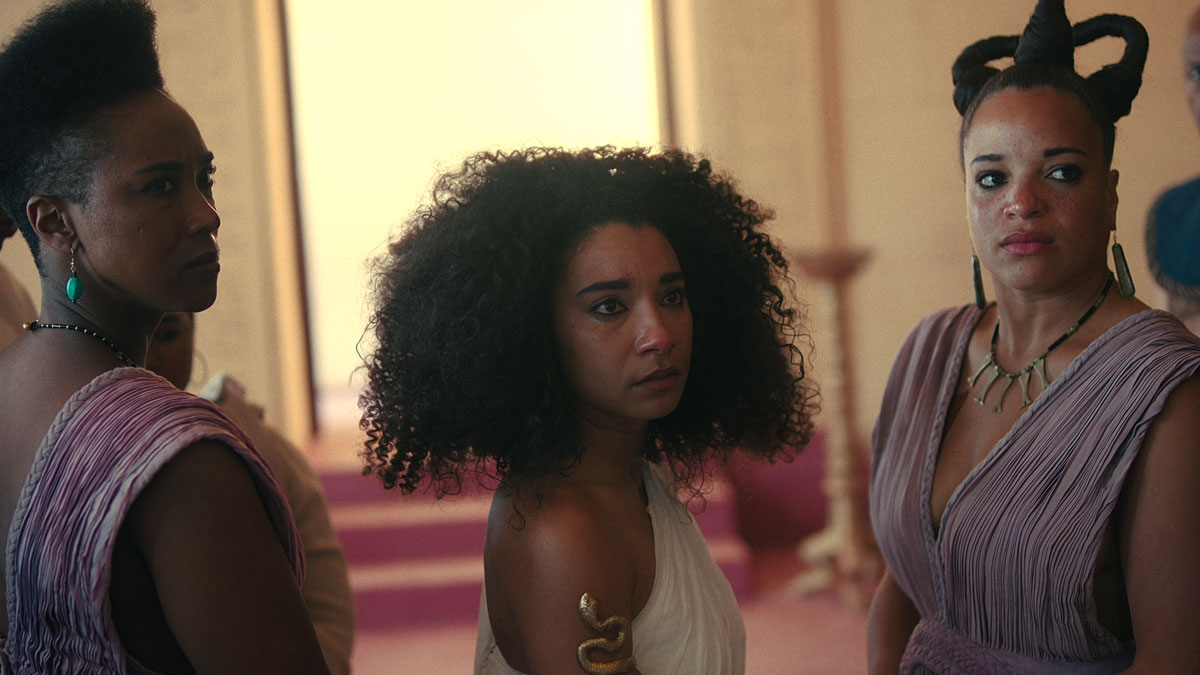
Queen CleopatraQueen Cleopatra (Courtesy of Netflix)

One welcome shift from past cinematic renderings is screenwriters Peres Owino’s and NneNne Iwuji’s emphasis on Cleopatra’s shrewdness as a political and military strategist, traits often subsumed by her legend as a seductress. Understandable, since she had children with Julius Caesar and Caesar’s lieutenant Mark Antony, whose death in her arms inspired future writers to romanticize their love story above the other. (Not for nothing, but in this “Cleopatra” Mark Antony (Craig Russell) is a scrub compared to Julius. Antony ghosted her for three years after she gave birth to his kids!)

Featured experts lending also provide dramatic context to scenes from Cleopatra’s life and humanize the decisions she makes to secure power. None of their observations would change if she were played by someone other than an actor with a Black parent.

Those same experts also expend a lot of energy explaining how the final Ptolemaic ruler of Egypt and a Hellenistic descendent might also be a Black person. Since the identity of Cleopatra’s mother was never established, no one can say with any certainty that she wasn’t an Egyptian with darker skin.

Admittedly, that possibility is doing a lot of heavy lifting.

This enigma fits nicely with the marketing surrounding “Queen Charlotte” and its fictionalized realization of an inclusive British nobility. “Queen Charlotte” creator Shonda Rhimes reminds the viewer that her Black queen’s story is fiction. “African Queens” dances into more fraught territory by presenting a straighter historic dramatization. But just like “African Queens: Njinga” surfaced in time to ride the viewership crest created by the arrival of “The Woman King” on the streamer, “Cleopatra” may latch onto the “Queen Charlotte” bump.

Still, in a time when opportunities to turn a bright light on untold stories are increasingly rare and narrowing, it’s dispiriting to think that one half of a two-season order for “African Queens” was consumed by an examination of such a widely known figure.

Before watching the Cleopatra season I would have ended my argument here. And now? While I still wouldn’t call it extraordinary from a production standpoint, it is worth digesting in ways people easily incensed by its Blackness would never countenance.

“Queen Cleopatra” shows what’s possible when we question the perspective of those who typically present these histories and the reasons those people invest in ensuring they are told a certain way.  

Queen CleopatraQueen Cleopatra (Courtesy of Netflix)

Cleopatra’s mystery lends itself to all kinds of assumptions, including those concerning her looks. Early and mid-century Egyptomania sparked recurring trends in makeup and fashion, two industries that tend to exclude people of color. That alone sheds some light on why so many who would otherwise ignore this casting choice are suddenly outraged to see her name linked to a Black woman. In the dominant culture’s imagination Cleopatra is a paragon of attractiveness, and that same culture devalues Black beauty even as it appropriates its signifiers.

This “African Queens” installment also invites us to dig more deeply by way of the featured experts. Mind you, only historians who either subscribe to the theory that Cleopatra was Black or at least welcome it show up here, by Pinkett Smith’s design. But if a person wanted to, they might look up the work of the academics featured, including Dr. Shelley Haley.


Want a daily wrap-up of all the news and commentary Salon has to offer? Subscribe to our morning newsletter, Crash Course.


Haley is the real breakout of  Queen Cleopatra” for the way she animatedly recounts scenes from Cleopatra’s life with the vibrancy of a professional storyteller. She knows how to connect the audience with this history on a human level, adding a sense of delight to Cleopatra’s triumphs and irritation on her behalf related to Rome’s disrespect.

“Queen Cleopatra” shows what’s possible when we question the perspective of who typically presents these histories.

Haley is also a classicist who views the field from a Black feminist and critical race perspective. As she explains in her 1993 essay “Black Feminist Thought and Classics: Re-membering, Re-claiming, Re-empowering,” since the foundational texts of the field are based on translations by white men, blindly trusting their interpretation of history impoverishes other perspectives and the ways we’re taught to view ourselves.

The professor is fluent in Latin, and in her essay demonstrates what she means by presenting a white male scholar’s denigrating translation of a Black woman’s description from the original Latin text. Then she translates the same passage, yielding a more straightforward meaning: “belly somewhat pinched” becomes “stomach flat and firm,” for example.

Reframing Cleopatra, she believes, necessitates reassessing previous accounts accepted as settled fact. Doing this acknowledges another cultural significance too:

In the Black oral tradition, Cleopatra becomes a symbolic construction voicing our Black African heritage so long suppressed by racism and the ideology of miscegenation. When we say, in general, that the ancient Egyptians were Black and, more specifically, that Cleopatra was Black, we claim them as part of a  culture and history that has known oppression and triumph, exploitation, and survival. Cleopatra reacted to the phenomena of oppression and exploitation as a Black woman would. Hence we embrace her as sister; she is Black.

It’s doubtful even those who embrace James as Cleopatra would consider these episodes that closely. But at a time when so-called “classical education” emphasizing the history and cultural achievement of white Western civilization is being promoted in schools nationwide, this show reminds us that history is enriched by multiple perspectives and interpretations.

Again, “Queen Cleopatra” isn’t an altruistic work on Netflix’s part. The controversy goes hand in hand with curiosity, which translates to potential hours of viewership.  That’s one of many reasons TV is a poor substitute for research and study, all undertaken with healthy skepticism.

Queen CleopatraQueen Cleopatra (Courtesy of Netflix)

That said, the reason I know the names of those other queens is because, for a span of the 1970s and 1980s, one of the widest-reaching resources on pre-20th century African history was Anheuser-Busch’s “Great Kings & Queens of Africa” series. In fact, a story in a 1983 issue of Jet Magazine features that year’s new additions to the collection: Portraits of Queen Nzingha (another spelling of Njinga) and Cleopatra VII.

These were elaborate original artworks informed by Black historians consulted for the project. But the driving motive behind Budweiser’s parent company commissioning this series was to plant brand awareness among school-aged children. Those illustrations didn’t make me a beer drinker. Instead, they introduced me to rulers that were never mentioned in my grade school textbooks.

If “Queen Cleopatra” achieves something similar, no one engaging with this history in good faith should find fault with it. But they might also ask for more stories about royal women they haven’t met before, in any famous person’s skin.

“Queen Cleopatra”  is currently streaming on Netflix. 

CNN’s own media reporter trashes network for airing Trump’s “spectacle of lies”

CNN’s own media reporter joined in the criticism of his network for airing former President Donald Trump’s litany of lies during a town hall event Wednesday night.

During the 70-minute event, the GOP frontrunner parroted lies, wild promises and crude remarks to the audience made up largely of his supporters, as evidenced by their rousing applauses and laughter.

Trump doubled down on 2020 election lies, promised to pardon “many” rioters involved in the Jan. 6 insurrection if elected president in 2024, claimed to have stopped people from “killing babies” through last year’s Dobbs decision and mocked columnist E. Jean Carroll, who was awarded $5 million in damages on Tuesday after Trump was found liable for sexually abusing and defaming her. 

CNN’s media reporter Oliver Darcy trashed the town hall in his newsletter on Wednesday night, criticizing Trump for “[unleashing] a firehose of disinformation” and speaking over moderator Kaitlan Collins throughout the event, and admonishing the network for airing it.

“It’s hard to see how America was served by the spectacle of lies that aired on CNN Wednesday evening,” Darcy wrote.

Justin Baragona, a senior media reporter for The Daily Beast, described the reaction an unnamed, on-air CNN personality shared with him immediately following the event. 

“It is so bad,” the person reportedly said. “I was cautiously optimistic despite the criticism. It is awful. It’s a Trump infomercial. We’re going to get crushed.”

Other news hosts and writers chimed in online and in op-eds later Wednesday night, reacting to the former president’s “unhinged” remarks and further rebuking CNN for allowing Trump to take the stage and do so in an audience of his supporters, including television news vet Mark Lukasiewicz, who called the event “disastrous.”

“The predictably disastrous @cnn town hall was indeed disastrous,” he said. “Proving again: Live lying works. A friendly MAGA crowd consistently laughs, claps at Trump’s punch lines – including re sex assault and Jan 6 – and the moderator cannot begin to keep up with the AR-15 pace of lies.”

James Fallows, a former national correspondent for The Atlantic, called out the town hall as the news network’s “lowest moment.”

“This is CNN’s lowest moment as an organization. (And I remember the glory days of their “balanced” panels back in 2015-2016.),” he said.

MSNBC host Mehdi Hasan reamed CNN for again platforming Trump after its former CEO called their airing of his rallies in 2016 a “mistake” and, while defending Collins response to the barrage of lies, also criticized her inability to fact-check some of Trump’s racier statements.

“Sorry, but — as predicted — this was a clear win for Trump,” he wrote in an op-ed. “He felt no pressure and conceded nothing. He was welcomed onto CNN to address an audience of non-Republicans watching at home and an audience of loyal Republicans sitting in that hall in New Hampshire. Win-win.”

“So what did CNN or Collins think would happen? Did they really have no plan to deal with Trump’s belligerent nonsense? Did they really learn nothing and forget nothing?” Hasan added, referencing a quote from 19th-century French diplomat Talleyrand that he used to open the article.


Want a daily wrap-up of all the news and commentary Salon has to offer? Subscribe to our morning newsletter, Crash Course.


Writer Wajahat Ali echoed Hasan’s sentiments in an opinion piece of his own for The Daily Beast. The New York Times contributor said that CNN “failed journalism, the American public, and its own employees by deciding to invite an arsonist who has spent the past seven years trying to burn down their house.”

“Congratulations, Licht and Zaslav,” he said, referring to CNN’s current CEO Chris Licht and Warner Bros CEO David Zaslav, who reportedly defended the town hall last week. “Bravo! What a wonderful precedent to set for your employees, especially the women who work at the “new CNN.”

Rep. Alexandria Ocasio-Cortez, D-N.Y., also slammed CNN for holding the town hall on Wednesday night, saying that the network “should be ashamed” following the event.

“CNN should be ashamed of themselves,” she tweeted. “They have lost total control of this ‘town hall’ to again be manipulated into platforming election disinformation, defenses of Jan 6th, and a public attack on a sexual abuse victim. The audience is cheering him on and laughing at the host.”

“This falls squarely on CNN. Everyone here saw exactly what was going to happen. Instead they put a sexual abuse victim in harm’s way for views. This was a choice to platform lies about the election & Jan 6th w/ no plan but to have their moderator interrupted without consequence,” she added in a second tweet.

In an MSNBC appearance that night, Ocasio-Cortez reiterated her contempt for the network’s “shameful” and “extremely irresponsible” decisions and explained that Trump’s attacks on Carroll were “a continued demonstration” of the sacrifices survivors of sexual abuse make when they “come forward and challenge power.”

“What we also saw tonight was the consequence of doing that,” Ocasio-Cortez said. “They sacrifice their anonymity, they sacrifice their safety, and they sacrifice all of this because we continue to live in a society where an overwhelming amount of structures allow this abuse to happen and find it permissible.”

“I think it was a profoundly irresponsible decision,” she added, referring to the town hall. “I don’t think that I would be doing my job if I did not say that.”

Expert: Immigration policies don’t deter migrants – Title 42 and new rules only make things worse

Politicians have been saying there’s an immigration crisis at the border for decades and have been trying to fix it for nearly as long. The rules have changed many times over the years – and they are about to change again as a pandemic-era set of restrictions expires May 11, 2023.

Before the COVID-19 pandemic, immigration into the U.S. at the border with Mexico was governed by a group of federal immigration laws and regulations, collectively known as Title 8. These laws, among other things, set the terms for the rapid deportation of people who enter the country illegally or are not eligible for asylum.

In March 2020, after COVID-19 hit, President Donald Trump declared a national public health emergency. That triggered a more restrictive set of rules under a decades-old, little used set of public health regulations known as Title 42. These regulations empowered Customs and Border Protection agents to both quickly expel migrants who entered the U.S. illegally and deny asylum seekers the right to enter the country as a way to stop the spread of a COVID 19.

As the public health emergency expires on May 11, the rules for prospective immigrants are changing again. The Title 8 rules are coming back into effect – and new measures from the Biden administration also will be in place. The administration’s goal is to stem the flow of an expected 13,000 migrants daily. But these new measures may exclude refugees facing real danger.

One new measure, for example, will deny asylum to people who arrive at the U.S. southern border without first applying for asylum online or in the country they passed through. And under Title 8, people who enter the country illegally could face a five-year ban from the U.S.

From my work as a scholar of migration studies, I believe the new set of rules may make some of the most vulnerable migrants even more vulnerable to economic and political exploitation and violence by delaying or denying them the protection of the U.S. under federal laws and international rules about asylum.

Delaying immigration and asylum

Research shows that the United States’ immigration policies have never deterred migrants from coming to the country; they have only made the immigration process longer and more difficult.

Adults, some of them wearing face masks, and children stand outdoors waiting for U.S. Border Patrol officers to pick them up.

Honduran immigrants wait for the U.S. Border Patrol after crossing the Rio Grande River from Mexico into Mission, Texas, on March 24, 2021. Michael Robinson Chavez/The Washington Post via Getty Images

In fact, asylum court backlogs have increased more than sevenfold over the past 10 years. There are more than 750,000 cases pending, with average wait times for a court date currently running over four years.

These figures do not account for the time it may take for migrants to get from their home countries to the Mexico-U.S. border, where they may also have to wait months or years to be allowed to cross. Parallel to immigration court backlogs are backlogs at the border, where the slow trickle of admissions to the U.S. of new asylum seekers, permitted now only via a glitchy smartphone app, have failed for years to keep up with new arrivals, seriously challenging Mexico’s capacity for housing them.

Humanizing deportation

Since 2016, I have coordinated a digital storytelling project called “Humanizing Deportation,” which has published personal narratives in audiovisual form from over 350 migrants. It is the world’s largest qualitative database on the human consequences of contemporary U.S. border and migration control policies.

Our research shows that as migration deterrence policies have multiplied and intensified over these past two presidential administrations, migration stories have become more complex and migrant journeys more arduous. One story from our archive shows how several of these policies have played out for a migrant family.

Our project is unable to verify all details of migrants’ stories, and what you read here is based on one family’s recollection of events.

A migrant from Honduras discusses the hardships, including deportation and kidnapping, he and his family faced as they traveled to the U.S. seeking asylum.

Deportations, childbirth and a kidnapping

A Honduran migrant who wishes to remain anonymous left his homeland initially in a migrant caravan in 2018. After crossing into the U.S., the migrant says that despite his insistence that he was fearful of being sent back and his refusal to sign a voluntary removal form, Border Patrol officers shouted obscenities at him and physically forced him to place a thumb print on the document, then deported him to Honduras.

The migrant set out again soon after that, this time with his pregnant wife and young son. Before getting far, they were detained by Mexican immigration authorities and later deported. But they left again, getting as far as Huixtla, Chiapas, in Mexico, where they had to stop so that his wife could give birth.

The family settled for a time in Monterrey, Nuevo León, but struggled to make a living there. They decided to pay a smuggler to accompany the wife and son to the Mexico-U.S. border, where in the summer of 2019 they crossed and were picked up by Border Patrol. Officers allowed the two to initiate their asylum process through the Migrant Protection Protocols program, a U.S. government program that returns migrants who arrived in the United States from Mexico by land back to Mexico while U.S. immigration proceedings are underway. Under its guidelines, they were sent back to Mexico to await a court date.

Human rights advocates criticized Migrant Protection Protocols because of dangers, such as extortion, kidnapping and rape that migrants face in Mexico. In this case, immediately after mother and son returned, they were kidnapped. Without the money to pay the ransom, they had to turn to friends and family, including the woman’s mother, who sold her house in Honduras to get them released.

Back in Monterrey, the husband, afraid to try applying for asylum after being deported but determined to reach the U.S., paid a smuggler to get him to Tennessee.

Meanwhile, his wife didn’t wish to stay in Monterrey. “I was really afraid – I didn’t go out because I felt they might kidnap me again,” she told us. So she retreated to southern Mexico with her son and baby daughter.

Working as an auto mechanic, the husband was able to earn enough money in Tennessee to pay most of what they owed the smugglers and their family.

Then, in 2021, when the Biden administration allowed migrants who had abandoned their Migrant Protection Protocols asylum applications to resume the process – but in the U.S. – the mother and children joined the husband in Tennessee. The following year, they moved to California, where as an immigrant family they feel more welcome than in Tennessee. Although the wife is still waiting for a court date, the family is hopeful that she and the children will be granted asylum. But she was thrilled to give birth recently to a baby boy in California.

“Because it’s more peaceful,” says the father, who is afraid to join his wife’s asylum claim because of his previous deportation. “We’ve heard that it’s where the immigrant community is most protected.”

Numerous policies over the past seven years have been enacted to deter migration, but many people have migrated anyway. They have been forced to navigate long, difficult, dangerous journeys and often traumatic migration processes that have endangered and complicated their lives.


Robert McKee Irwin, Deputy Director, Global Migration Center, University of California, Davis

This article is republished from The Conversation under a Creative Commons license. Read the original article.

“He is confessing on live TV”: Legal experts say Trump’s CNN town hall could badly backfire in court

Former President Donald Trump may have provided additional evidence in multiple investigations during his CNN town hall event on Wednesday, legal experts say.

Trump repeatedly lied during the town hall that the election was “rigged,” that Georgia “owed” him votes, that he had the right to take classified documents to Mar-a-Lago and that he does not know E. Jean Carroll — the writer who was awarded $5 million a day earlier after it found Trump liable for sexual abuse and defamation.

“All three ongoing criminal cases got new evidence tonight against Trump,” tweeted national security attorney Bradley Moss. “He is confessing on live television.”

During one point, moderator Kaitlan Collins pressed Trump on whether he showed the classified documents found at Mar-a-Lago to anyone else.

“Not really,” Trump replied.

Collins questioned what Trump meant by that but he continued to steamroll through his answer.

Former FBI agent Pete Strzok called the comment a “tacit admission of unauthorized disclosure of classified information.”

“There were prosecutors and agents taking notes tonight,” tweeted former U.S. Attorney Joyce White Vance.

During another exchange, Collins asked Trump about his call to Georgia Secretary of State Brad Raffensperger, demanding he “find” enough votes to swing the state’s election.

Trump said he believed it was a “rigged election” and said he told Raffensperger “you owe me votes because the election was rigged.”

“File this clip under new evidence for Fani Willis,” tweeted Anthony Michael Kreis, a Georgia State University law professor. “This sure sounds like an admission of corrupt intent to me.”

During a discussion of the deadly Jan. 6 Capitol riot, Collins pressed Trump on how his supporters that stormed the Capitol that day “listen to you like no one else.”

“I agree with that,” Trump replied.

Former federal prosecutor Elie Honig, a CNN legal analyst, called it the “most important clip of the night.”

“If you’re thinking about prosecuting Donald Trump in relation to the effort to steal the election, you’re gonna need to show that connection, that Donald Trump knew and understood that his words would be acted on. Knew and understood that people were listening to him and would actually do things because he said so, and stop doing things because he said so,” he said, according to Mediaite. “I’ve never heard him so clearly admit that. Everything Donald Trump says is out there. It’s fair game. It can be used, and I think if I’m a prosecutor watching last night, I’m circling that clip and I’m saying ‘Here we go. We just filled that gap.'”

Trump during the town hall also doubled down on his claim that he did not know Carroll and mocked her sexual abuse allegation just one day after a jury awarded her $3 million over Trump’s defamatory statements.

“This is a fake story. Made-up story,” Trump said, later adding, “I have no idea who the hell she is. She’s a whack job.”

Trump recounted his version of Carroll’s allegation to laughter from the Republican-leaning audience.

“What kind of a woman meets somebody and brings them up and within minutes you’re playing hanky panky in a dressing room,” he said.

Legal experts say Carroll could sue Trump for defamation again — though that does not justify CNN allowing him to use their airwaves to smear the writer.

“I hate that @CNN allowed E. Jean Carroll’s name to be dragged through the mud again by this terrible man,” tweeted Sherrilyn Ifill, the former president of the NAACP Legal Defense Fund. “Sure she could sue him for defamation again. That doesn’t change the hurt & humiliation at the laughter, and at the knowledge that CNN was willing to expose her to this.”

“I would be salivating if I were the attorney for E. Jean Carroll,” former federal prosecutor Laura Coates said on CNN.


Want a daily wrap-up of all the news and commentary Salon has to offer? Subscribe to our morning newsletter, Crash Course.


Former federal prosecutor Richard Signorelli noted that Carroll can likely “just amend the complaint from her other case against him with court permission, or file a third action.”

But former federal prosecutor Renato Mariotti predicted that it would not be worth it to Carroll to sue again.

“While this is possible, as a practical matter, it would be difficult for her to establish additional damages after a jury verdict made her whole for the damages she suffered up until this point,” he tweeted. “I doubt she goes down that road. The juice isn’t worth the squeeze.”

Historian Ruth Ben-Ghiat, an expert on authoritarianism, called out CNN for giving Trump a platform to rebuild his image and smear his accuser.

“CNN became a party to Trump’s need to psychologically ‘undo’ his defeat by getting the audience to applaud him *for being an assaulter,*” she tweeted. “The more approval authoritarians get, the more they feel emboldened to be even more lawless. This is why this ‘town hall’ was so dangerous.”

Trump lied shamelessly in CNN’s Town Hall — but he’s just a symptom of our national dysfunction

Since humans first crawled out of the caves and encountered others like themselves, tribes have waged war against each other for reasons that are real, trivial, fictional and nonsensical.

One could argue it’s our prime directive.

Moreover, it can be argued that every institution devised by humans has been used to enslave other humans.

The difference today is that social media has given everyone a voice to fight the power, but unfortunately, it’s that little fearful voice inside our head saying “Burn it all down!” that people are using instead. Those who wish to wield power against everyone else have listened to our fears and are leveraging them against us. Thus, the more we yell, the more violent our mania seems.

Enter Donald Trump. The former president continues to suck up all the air in the room because he is not only bombastic, he’s also a twit and a grifter with no moral center and a preternatural ability to focus on fear and use it as both currency and a cloak.

Some of that cloak was stripped away in court this week in the E. Jean Carroll civil case. She successfully established Trump as a liar and a sexual, misogynistic bully. The jury in her case slapped Trump with $5 million in punitive damages. Once again, the followers have been shown the Emperor has no clothes. But as Rip Torn reminded us in the film “Defending Your Life,” “Being from Earth, as you are, and using as little of your brain as you do, your life has pretty much been devoted to dealing with fear.” Thus Trump’s faithful fearmongers likely will not abandon their master over the Carroll verdict. His supporters are already calling it part of the “witch hunt” and giving Trump his perpetual pass to embrace his darkest angels.

It is fear of the world, fear of Trump, fear that you might be wrong and fear in general that drives his supporters to their violently manic actions. That fear sits like a giant fog, blocking true happiness and enlightenment as we suffer through a world of so-called alpha males obsessed with penis envy.

That brings us back to Donald Trump, who showed up for a Wednesday night appearance on a CNN “Town Hall” hosted by journalist Kaitlin Collins and didn’t wait more than a minute before he began lying. He told lies about January 6, the 2020 election, classified documents, the border, and made misogynist comments while also calling a Black police officer a thug.

Trump played before a handpicked crowd of supporters as Collins frantically tried to hold him accountable. Trump was Trump. He still would not accept that he lost the 2020 election, continued to spread lies about voter fraud, made disparaging comments about Carroll and continued to play to a crowd that was only too happy to cheer and applaud every misogynistic and racist comment he made.

For some, it was a moment loaded with PTSD. I for one had forgotten how happy life has been without having to face and push back against dozens of lies on any given day. But the mania that is Trump is still there, though he appears to have a lot of hard miles under him since we last saw each other.

But, just in case you missed the point, Trump endorsed the U.S. government defaulting on its debt unless the Democrats “cave” on issues and cut spending. Then he said the Democrats would absolutely cave. The funniest moment came during the commercial break when Ron DeSantis was seen in a commercial claiming he wouldn’t back down. Most of the rest of the “commercials” were in-house promos for CNN shows. Turns out few wanted to subsidize Trump’s return to television as he talked about our country being destroyed or being a Third World nation, or how great he was.

As frustrating as it was to watch him on a national stage again, and as sure as I am that millions of people watching him were yelling at the television, Trump is still just a symptom of our dysfunction.

Recent articles about the economy claim the only thing keeping us from plunging into the abyss of a recession is the American frenzied consumer. We’re so well trained at spending, that while economists claim we’re on the brink of a recession, Americans continue their consumptive nature with a fury that hasn’t let up just because we’re suffering from inflation or a loss of medical care, the shrinking or non-existence of our retirement funds, our lack of health care, insane politics, climate change, doomsday advocates, religious fanatics, Trump supporters, delusional politics from the far left, the far right, and the threat of annihilation from a stray asteroid.

Man, we’re crushing it. We’re a lean, mean, fighting capitalism machine. 

Against all logic, we’ve embraced the competition that has led to an increasingly smaller number of larger companies determining how we spend our lives.

And that’s still not good enough for some members of the Republican party. Speaker of the House Kevin McCarthy met with President Biden at the White House Tuesday. The discussion was about the debt ceiling. McCarthy wants to break the president and make him curb social spending before McCarthy will agree to raise the debt ceiling so we don’t default on our debts.  

Mind you, Republicans voted for the spending they now blame Biden for. In essence, they want Biden to act like their parent so they won’t spend again. But in an attempt to break Biden, they run the risk of breaking the country. Trump, on the other hand, is happy to say he’d welcome a default.

McCarthy is stuck too. He has to play to the crazed far-right minority that elevated him to his leadership role – or he could face losing it if one single member of his party challenges him. Hence his public stance of blaming Biden for the potential debt ceiling crisis. The entire world economy and every person on the planet could suffer because of the likes of George Santos, Marjorie Taylor Greene and the other reprobates who hold McCarthy hostage — a fact Biden acknowledged Tuesday. “I don’t know how much leeway Kevin McCarthy thinks he has in light of the fact — and I’m not being a wise guy when I say it took 15 votes for him to acquire the speakership. And, apparently, he had to make some serious concessions to get it from the most extreme elements of his party. So, I just don’t know,” Biden explained.

McCarthy is stuck too. He has to play to the crazed far-right minority that elevated him to his leadership role.

What Biden and those who understand this issue do know is that if anything could throw the world into an economic depression it would be if the most powerful country on the planet defaulted on its debts. It would be like finding out your rich uncle, who has propped up everyone else in the family, has gone broke and needs your help. (I swear that is not a Donald Trump reference.)

The only two news issues I can think of that rival the debt ceiling in importance is the war in Ukraine or a stray asteroid wiping out the planet. But Biden thinks it’s the debt ceiling; “Obviously, this is the single most important thing that’s on the agenda,” he told reporters at the White House Tuesday.

A look across the country explains why.

Rural America is dying. Some homes are so freshly abandoned in rural America that the shattered window panes are still hanging like glass fangs over the openings in the hole in the wall they used to cover.  

Spend a night in Dodge City, then drive from western Kansas through most of New Mexico and parts of Arizona along the old Cimarron Trail. A road trip through that area will show you hundreds of abandoned individual homes; hundreds of rusted trucks, cars, bicycles and school buses; tiny communities with scarce to non-existent services, from groceries to health care. Laguna, New Mexico, founded in 1699, has a median income that a fast food worker would find insulting. Vast parts of rural America look tired, abandoned and quiet — painfully so.

This is the essence of Trump Country: Empty, vaguely dangerous by night and a stone-cold drag by day. They want better. They deserve better.


Want a daily wrap-up of all the news and commentary Salon has to offer? Subscribe to our morning newsletter, Crash Course.


The one sliver of hope in a drive through these areas is the ubiquitous sight of workers rebuilding our infrastructure. Love him or hate him, Joe Biden may be remembered to posterity in a favorable manner for signing the infrastructure act. But many in Trumplandia won’t give him credit for it.

A refusal to raise the debt ceiling could be the trigger that finally destroys what’s left of the shrinking rural culture in our country. It is no coincidence that this is where Trump’s most fervent supporters live.

There’s the root of your histrionics. There’s your frenzy. It is not unexpected. It is the rage against the dying of the light, sponsored and created by the very people you voted into office to save your way of life.

A refusal to raise the debt ceiling could be the trigger that finally destroys what’s left of the shrinking rural culture in our country.

Speaking of things not unexpected, on Tuesday news broke that George Santos was charged with federal crimes. Wednesday morning we found out there are 13 federal charges against the New York Republican. All told, the craven liar and loyal Trump supporter is charged with seven counts of wire fraud, three counts of money laundering, one count of theft of public funds, two counts of making materially false statements to the House of Representatives — and a partridge in a pear tree. 

It is serendipitous that Trump, himself charged with a felony, had a civil jury rule against him the day it was announced Santos would face charges. It portends greater woes for Trump because Santos is a liar and a cheat like Trump – though nowhere near as accomplished. And like Trump, Santos is a millstone around the GOP’s collective neck. Of course he’s going to run for re-election. Meanwhile, Speaker McCarthy — who once said he wished Santos had more power than Biden — sang a different tune Wednesday evening. He said he wouldn’t support Santos for re-election and if the ethics committee found he had broken the law, he would ask for Santos to resign from Congress. This is one millstone McCarthy may yet remove from the body politic. The mania continues. In Santos’ case, you’ve got to give it to him: He’s berserk. He’s bat-guano nuts. He’s delusional, rabid and unencumbered by ethics, morality or human decency — but he and Donald Trump are consistent.

That consistency drives the paranoia and the frenzied behavior. We saw that again Wednesday night with Donald Trump on CNN. As the ancient mariners warned us, “Beware: Here there be dragons.” Trump says he would pardon a “large portion” of the January 6 rioters and claims the insurrection was a march that was done by people with “a lot of love” in their heart.

What will it take for McCarthy and what’s left of the GOP to finally push themselves away from Trump? The damage is done; there’s very little left of that party. Trump, of course, has done much more than Santos in ruining the Republican party. As Dahlia Lithwick and Ronnell Andersen pointed out in Slate this week, the former president was “found liable for a horrific sexual assault and . . . his dishonesty has become so commonplace that both his supporters and opponents mostly shrug when yet another of his statements turns out to be wholly untethered from the truth.”

Yet, the lesson from the frenzy this week is clear. A former president told a blatant lie and was finally found accountable in court. This does not bode well for those who follow that warped dragon. And he hasn’t learned a thing. He still lies continuously. Loves the fight, ignores the facts, plays to the crowd who swallows his lies and sits in judgment preaching the same fear and the same hatred.

Too bad the evangelicals who wrapped themselves around Donald Trump and his minions like McCarthy and Santos forgot their book of Hosea. “For they sow the wind, and they shall reap the whirlwind.”

Gosh, how do the Trumps keep “accidentally” hanging out with Hitler fanboys?

Late last year, Donald Trump had dinner with a couple of Hitler fanboys, a dinner he was so honored to host that he greeted it with great pomp and made sure it was in full view of the regular guests in the dining room of Mar-a-Lago. One of the Hitler apologists was rapper Kanye West, whose recent turn to the far right appears related to his well-documented severe mental health issues. The other Hitler admirer, Nick Fuentes, is a well-known incel troll and the head of the fascist America First group. Trump’s efforts to spin his dinner after the fact were limp even by his standards, saying he didn’t know who Fuentes was, a claim roughly no one believed. Sadly, as Heather “Digby” Parton correctly predicted at Salon, none of this has made a dent in Trump’s status in the GOP. If anything, Republican voters keep rallying to his side, predictably pleased that Nazi-snuggling has the liberal-triggering effect they crave. 

This likely answers the question posited by Rachel Maddow on her MSNBC show Monday night: How is it that Trump’s son, Eric Trump, and a number of other figures in the Trump orbit “are going ahead with” an event this weekend that prominently features Hitler-friendly speakers? As Maddow pointed out, both MSNBC and Media Matters have spent “months” highlighting this event, scheduled for May 12 and 13 at the Trump National Doral resort in Miami. But, after Trump’s famous dinner with Hitler apologists, he and his people seem to have decided there’s no political downside to being seen rubbing shoulders with the Mein Kampf crowd. 


Want more Amanda Marcotte on politics? Subscribe to her newsletter Standing Room Only.


No doubt many will dismiss this characterization as an exaggeration, which is one way Trump gets away with this stuff. But no, the speakers for this ReAwaken America event, which was co-founded by former Trump aide and current QAnon celebrity Michael Flynn, really are that terrible. Podcaster Scott McKay told his audience last year, “Hitler was actually fighting the same people that we’re trying to take down today,” and blamed Jews for 9/11. Right wing commentator Charlie Ward posted a Hitler speech with the caption “Hitler was warning us about the ruling class” of “Freemasonry, Judaism, Communism, Globalism, Race Wars, NWO, the Cabal & the Bankers.”

In neither case can these be waved off as a one-off (as if that would excuse it.) Media Matters has lengthy dossiers on both men, showing long histories of antisemitism, Holocaust denial, and championing Hitler as a brave truthteller. They are scheduled to speak alongside Eric Trump and his wife Lara Trump. The conference found, Flynn, has also promoted antisemitism and blamed Jewish victims for their own deaths in the Holocaust.

The tour isn’t just about Hitler apologism, of course. As the Anti-Defamation League explains, ReAwaken America also features “prominent QAnon influencers, anti-vaxx activists, election fraud conspiracy theorists, Christian pastors, political candidates and elected officials.” A real grab bag of the worst people in the country! 

For months, Eric Trump’s strategy for dealing with this criticism has been to ignore it, confident that the same voters who are fine with his dad’s dinner with white nationalists would not mind a dessert course of more Hitler praise and Holocaust denial. But after Maddow’s segment Monday night, he suddenly got hurt fee-fees. He then made empty lawsuit threats, a favorite tool of his dad’s, on Twitter. 

Note: She never said he was personally antisemitic. Just that he happily shares top billing with the Hitler fanboys that have been invited to speak at a hotel owned by his family. But no one has rejected the possibility that he’s just a shameless opportunist who panders to conspiracy theorists and bigots for money and political expedience.


Want more Amanda Marcotte on politics? Subscribe to her newsletter Standing Room Only.


Trump might be a little more fussy than usual about this because Maddow made a point to link this hateful far-right rhetoric to the shooting in Allen, Texas over the weekend. Before murdering 8 people at an outlet mall, Mauricio Garcia left a long social media trail documenting his neo-Nazi sympathies, including an SS tattoo. The widespread reporting of Garcia’s white nationalist views caused a reflexively defensive reaction on MAGA social media. Mainly, they acted outraged that anyone would impugn the honor of Nazis by suggesting one of them could have shot up a shopping mall. 

Trumpist tweeter with 1.7 million followers “catturd” suggested the shooting was a “psyops” and sent gleeful winking gifs to journalists reporting the white nationalist views of the shooter. 

Twitter’s purchaser and far-right troll Elon Musk spent the aftermath of the shooting promoting conspiracy theories meant to discredit the idea that the shooter was a fascist. 

Normal people, of course, do not feel defensive when someone points out that Nazis tend to be violent. But for the MAGA crowd, that accusation stings in an incredibly personal way. Unsurprising, given the Hitler apologism on their favorite online channels and featured at their conferences. With the heat turned up, it seems Eric Trump is also feeling a little worried that it might reflect badly on him, helping promote the careers of men who complain about how the Jews “helped engineer the takedown of Hitler” and, in doing so, “mandated the destruction of Germany.” 

Mostly, however, the Trumps don’t worry overmuch about being seen with Hiter apologists. Only when cleaning crews are still scrubbing the spilled guts of small children out of the sidewalk will you see this a temporary bout of concern that all this Nazi stuff might be a bad look.

The sad thing is that Eric and Lara Trump are right not to worry. As Maddow pointed out, this conference is not a secret and has been covered extensively by Media Matters for months. But it gets almost no pick-up in the mainstream media. The likely reason is bleak: Trump’s sympathies for white nationalists is “old news.” We all know that he won’t lose support among Republican voters because of it. Since it won’t affect polling, the horserace-obsessed press can’t bring itself to care. 

It’s this silence, however, that the Trumps count on in order to speak to their fascist, conspiracy theory-addled base while evading larger accountability in the mainstream discourse. That’s why they get upset when one of these stories does run a chance of breaking through, either because a famous name like Kanye West is attached or there’s a news hook like the Allen shooting. It suggests that they do worry that the Nazi talk could lose them support. Maybe not with the vast majority of potential Republican voters, but with enough of them on the margins to lose swing states. Otherwise, the Trumps wouldn’t spin and threaten lawsuits the second one of these stories flirts with mainstream coverage. They’re worried it could hurt them, which is why they want to keep the associations with Hitler fanboys in the shadows. 

Confronting the gun lobby’s biggest myth

This month marks the one-year anniversary of the Uvalde and Buffalo shootings, two mass shootings that left over 30 people dead. Remembering the victims of last May’s horrific events has been punctuated by the most recent mass shooting this month in Allen, Texas – the state’s deadliest since the Uvalde massacre. Acknowledging the anniversaries of mass shootings, even as fresh tragedies continue to occur, has become part of the rhythm that accompanies America’s deadly gun culture.   

By now it has become painfully clear that we cannot rely on policy alone to stop this epidemic. We must think differently about this problem and attack the root of the issue: the myth that guns make us safer. Today most Americans believe this myth, which lies at the core of our deadly gun culture, and it’s leading more and more Americans to buy guns. The gun lobby and its enablers have long pushed the myth that only a so-called good guy with a gun could stop a bad guy with a gun. As the bodies have piled up, however, gun advocates have only expanded the universe of armed good guys — from teachers to now grandparents.

In truth, all these guns are not making us safer, and study after study has shown that homes with guns have more gun violence.  While mass shootings grab the headlines, everyday gun violence caused by the decision to keep guns at home is equally devastating.  

The rate of teen suicides using a gun nearly doubled between 2010—2020. 

Kelsey Amanda McDuffie was 17 years old when the handgun her friend was cleaning discharged and killed her. Siblings Sakendra, Sakenya, and Sakenlo Steele were 9, 12, and 14 when their mother shot and killed them in their own home. Rosalinda Martinez was just 8 months old when a gun went off during a domestic dispute and ended her life.

Last month alone, 147 kids under 18  were killed by guns, not including suicides which typically are not reported in the media. Data show that the rate of teen suicides using a gun nearly doubled between 2010 and 2020. 

And yet the gun industry and gun lobby continue to perpetuate the myth that guns keep us safe. 

In the last two decades, billions of dollars have been spent to lobby for tougher gun laws, elect “gun safety candidates,” produce new research, mobilize grassroots supporters, promote community-based solutions, and on and on. And each of these tactics has resulted in some victories against the gun lobby: elections won, laws passed, research released, supporters activated and increased support for community-based solutions. 

And yet, despite these signs of progress, we cannot claim success. Gun violence has only gotten worse, even in many states that passed stronger gun laws. To be sure, extreme partisanship and a hostile Supreme Court are part of the reason this progress has not been more impactful. 

But there’s more to it: In the last 20 years, organizations working to reduce gun violence have largely avoided the gun lobby’s main talking point – the myth that guns make us safer. And in that time, more Americans are going armed and more are dying by guns.

Changing this belief won’t be easy. The polarized nature of this issue means most voting-age adults are unwilling to change their views on guns. However, young people’s views on guns are still forming, and there is reason to believe that they can be the ones to shift the narrative and reverse the trends.  


Want a daily wrap-up of all the news and commentary Salon has to offer? Subscribe to our morning newsletter, Crash Course.


This is an extremely personal issue for young people. Firearms have become the leading cause of death for children and teens, and young people have grown up with normalized lockdowns and active shooter threats. Gen Z ranks gun violence as a bigger problem than climate change or abortion access.

This generation — often called the “lockdown generation” — is uniquely positioned to change gun culture. They utilize and understand social media platforms better than anyone and are often the ones driving the creation and adoption of new cultural trends.  

Nearly half of young people told researchers they wanted more information about the risks of gun use but didn’t know where to go for information. By providing teens with the data and having honest conversations about the realities of gun violence, we can help the next generation create a new culture regarding guns and reject the belief that guns make them safer. 

At Project Unloaded we’ve seen firsthand that this approach to cultural change is viable. Through a positive, fact-based social media campaign we saw nearly 20% of teens shift their views against gun ownership after receiving simple messages on gun risks.  

This type of culture change has worked before. During its campaign against cigarettes, the Truth Initiative learned it’s much easier to change the minds of young people than adults, so they focused on reducing teen smoking. They engaged young people directly, providing them with the facts in a manner that made sense to them. As a result of these efforts, less than 3% of teens smoke cigarettes today. 

Cultural change often goes hand-in-hand with policy change.  In addition to cigarettes, we’ve seen young people shift the culture around topics like marriage equality and drunk driving, which also led to legislative reforms.  The same can be done for guns.
The most recent shooting in Allen, Texas, on the eve of the Uvalde and Buffalo anniversaries is a stark reminder that our current approach to ending gun violence is falling tragically short. However, we have the opportunity to step into the gap by providing the next generation with the truth about gun violence and the risks of having and using guns. Doing so can help change our deadly gun culture and create a safer, less violent future.

From celiac to asthma to eczema, how did autoimmune diseases become so common?

Twenty years ago, seeing the acronym “GF” on a cafe menu might provoke head-scratching; nowadays, “GF” is the near-universally recognized shorthand for gluten-free. That well-known acronym is a testament to the incredible rise in the number of people with the chronic autoimmune condition known as celiac disease — now, as many as 2 million Americans, or 1% of people on Earth. 

The reasons that celiac disease became so common are not entirely known. Some experts speculate that it has to do merely with awareness and an improvement in diagnoses; others believe it is a reaction to modern flours having more types of compounds that trigger immune reactions.

The largest increases in autoimmune disorders were seen in celiac disease, Sjogren’s syndrome and Graves’ disease.

Whatever the reason, new research suggests the prevalence of celiac may merely be a piece of a rising trend of autoimmune disorders. In a new study published in The Lancet. researchers estimate that one in ten people have an autoimmune disorder — with more women being affected than men. The huge study involved 22 million people.


Autoimmune diseases, which occur when the immune system mistakenly attacks healthy cells in the body, include type 1 diabetes, celiac disease, asthma, eczema and rheumatoid arthritis. Researchers looked at a large dataset of anonymized electronic health records in the United Kingdom of 22 million individuals to identify 19 of the most common autoimmune disorders. Their goal was to identify who is affected the most by these conditions, how some coexist with each other, and whether or not some are on the rise.

Using their dataset, they found that about 10 percent of the studied population had one of the identified 19 autoimmune disorders; 13 percent of women had them and 7 percent of men. The estimates are higher than previous ones which ranged from 3 to 9 percent, in studies that often had smaller sample sizes.

“Our data is based on the United Kingdom, we know that autoimmune disease prevalence will vary by geography, and hence it is difficult to speculate how these estimates apply to other countries,” said Nathalie Conrad, author of the paper and an Honorary Research Fellow at the University of Glasgow. “Nevertheless, there are a number of findings that contribute to better understanding autoimmune disorders around the world.”

Those findings, Conrad said, include evidence of socioeconomic, seasonal, and regional disparities for several autoimmune diseases. 

“We believe that such variations are unlikely to be attributable to genetic differences alone and suggest that potentially modifiable risk factors may be implicated in the development of autoimmune diseases,” Conrad said.

Conrad told Salon that she and her colleagues were expecting to see a greater increase of autoimmune disease incidence over time. But their study found that trends over the last two decades “do not support the idea of an epidemic of autoimmunity, at least not pre-COVID and in the UK.”

Conrad explained that in the years between 2000 and 2019, new diagnoses of autoimmune diseases per person per year increased by 4% — “similarly for men and women.”

“Considering the increased awareness and availability of diagnostic tests over the same period, this is relatively modest,” Conrad added.

However, researchers found the largest increases in autoimmune disorders were seen in celiac disease, Sjogren’s syndrome and Graves’ disease. As Salon previously reported, the number of celiac disease cases keep going up — yet due to lack of funding, researchers still aren’t sure why. Despite a common misconception, celiac disease isn’t a gastrointestinal disease, but an autoimmune one. People who have celiac disease have developed an immune reaction to gluten, which is a protein found in wheat, rye, barley and triticale. Autoimmune disorders occur when the body’s immune system mistakenly attacks its normal cells because it can’t tell the difference between foreign ones and your own body’s cells. 

As to why these autoimmune disorders are on the rise, in addition to autoimmune diseases in general — even if it’s a gradual rise — is unclear.

“We don’t know this precisely,” Conrad said. “One aspect certainly is increased awareness, earlier recognition, and availability of diagnostic tests.”

Conrad added that there are other reasons regarding suspected risk factors and environmental triggers that could play a role, such as diet, obesity, viruses, and vitamin D.

“In our study, we did not have data to examine this question in detail,” she said.


Want more health and science stories in your inbox? Subscribe to Salon’s weekly newsletter The Vulgar Scientist.


However, the researchers did have the data to start examining and identifying patterns as to why some autoimmune disorders might coexist.

“In our study, clustering was particularly visible among rheumatic diseases and among endocrine diseases,” Conrad said. “Interestingly, multiple sclerosis for example, stood out as having low rates of co-occurrence with other autoimmune diseases.”

Conrad said she hopes the biggest takeaway from this study is that most of these diseases are incurable and require lifelong treatment, and they affect about 10 percent of the population.

“And as of today, we know very little about their causes and there are no prevention measures that might help alleviate the burden of these diseases on patients and the wider society,” Conrad said. “In my view, there is a real need for more research into understanding underlying disease mechanisms and developing effective preventative measures.”

“Unhinged”: Trump steamrolls CNN town hall to promise Jan. 6 pardons, deny elections

Just a day after being found liable for sexual assault by a Manahtten jury, former President Donald Trump baffled audiences in a Wednesday night CNN town hall appearance with a litany of false claims, wild promises — and a crude stream of statements that critics are calling “unhinged.” 

“What we saw tonight was outrageous,” former federal prosecutor Laura Coates told CNN hosts after the event. 

Early in the event, Trump promised that if elected president in 2024, he would pardon “many” rioters involved in the Jan. 6 attacks on the Capitol — calling the violent insurrection, which claimed the lives of four Trump supporters, a “beautiful day.”

Addressing the Black police officer who shot one rioter while protecting Democratic House Speaker Nancy Pelosi from an attacker, Trump called the officer “that thug.”

In one of the event’s darkest moments, the twice-impeached Trump responded to CNN moderator Kaitlin Collins’ questions by mocking his sexual assault victim, E. Jean Carroll, while the audience laughed. Carroll was awarded $5 million in damages Tuesday when Trump was found liable for not only sexually abusing her but defaming her.  

“I would be salivating if I were the attorney for E. Jean Carroll,” Coates said on her Wednesday night CNN appearance. 

Despite the night’s potential to become further grounds for lawsuits, the Trump camp was elated by his appearance, NBC News’ Garrett Haake reported. 

“Trump’s campaign team is thrilled with how the night went. One senior advisor describing the night as a ‘home run,’ and telling me ‘when the lefts melting down, we know it was a good day,'” Haake tweeted Wednesday night. 

Trump also claimed credit for the U.S. Supreme Court overturning Roe v. Wade, while claiming to have stopped people “killing babies.” CNN columnist Jill Filipovic was among the chorus of online voices attempting to fact-check Trump’s false claims.

“This is obvious but contrary to Trump’s completely unhinged claims, no one can ‘kill the baby at any time they want to.’ Killing a baby is, and has been, a crime in all 50 states for the entirety of U.S. history,” she said in a Wednesday tweet. 

In another puzzling moment, Trump suggested that the U.S. should default on its national debt as a solution to the tangled budget crisis. 

“You might as well do it now because you’ll do it later,” he said. 


Want a daily wrap-up of all the news and commentary Salon has to offer? Subscribe to our morning newsletter, Crash Course.


When asked by Collins about his position on the Russian invasion of Ukraine, Trump refused to answer which country he supported — but claimed he would end the war “in 24 hours.” The remarks drew sharp rebuke from former New Jersey Gov. Chris Christie. The Republican called Trump “Putin’s puppet” in tweets. 

“Donald Trump says he would end the war in Ukraine in 24 hours tonight on CNN. Despite how ridiculous that is to say, I suspect he would try to do it by turning Ukraine over to Putin and Russia,” Christie wrote.

Collins, undeterred by Trump’s continued attempts to dodge questions, got under Trump’s skin by repeating her questions when Trump refused to respond. 

“Trump calls Collns a ‘nasty person’ on stage,” reported CNN’s Oliver Darcy. “The crowd, made up of GOP voters in New Hampshire, cheers.”

But Collins’ unshaken poise also drew admirers who praised her persistence. 

In the hours immediately following the town hall program, insiders at CNN reportedly shared their praises of Collins with Rolling Stone, calling her “unflappable” — but went on to lambast CNN that the event was allowed to occur at all. 

The event was “a f****ng disgrace,” one source said.

Another source called it “1000 percent a mistake [to host Trump]. No one [at CNN] is happy.” 

“Geyser of disinformation”: CNN gives Trump town hall to mock his victim, spread election denial

CNN allowed twice-impeached former President Donald Trump to continue a previously scheduled campaign event in a town hall program Wednesday night, despite public outcry against the event after a Manhattan jury unanimously concluded Tuesday that Trump sexually assaulted longtime columnist E. Jean Carroll. Trump used the live campaign event to continue spreading false claims that the 2020 presidential elections were fraudulent, and to mock the woman he sexually abused.

When moderator Kaitlan Collins asked Trump about the Carroll verdict, Trump bragged. 

“My poll numbers went up. They went up with the other charges too,” Trump said, chuckling as the audience laughed. 

Asked whether he thought the verdict would hurt his popularity among female voters in 2024, Trump shrugged.

“No, I don’t think so,” Trump said. 

“I don’t know her. I never met her… Her cat was named Vagina,” Trump said, repeating many of the unfounded claims he wrote in a social media post Tuesday night, ranting against Carroll in an online meltdown

Trump also doubled down remarks exposed in the infamous “Access Hollywood” tape, when he was caught bragging that famous people get away with “anything,” adding “grab them by the p****.” Collins asked whether he still stood by the remarks.

“For a million years this is the way it’s been . . . People that are very powerful tend to do well in many ways,” he said, muddling his last word.

“Fortunately? Or unfortunately?,” Collins asked. 

“Fortunately,” Trump answered. “Or unfortunately for her.”

Trump, who failed to attend his own trial, was also found liable for defamation after he called Carroll’s account of the attack a “con job.” The jury did not find him liable for rape when he attacked Carroll in 1996, though it gave no explanation why.

“I’m telling you, he raped me,” Carroll testified

As the case was civil, rather than criminal, a jury can not convict or find Trump guilty, only liable — and Trump will serve no time in prison for sexually abusing a woman. In total, the jury awarding Carroll $5 million in damages.

When an audience member asked Trump how he intended to appeal to New Hampshire’s female voters who are concerned about the overturning of Roe v. Wade. Trump didn’t answer the question directly, nor did he answer further questions about whether he would sign a federal abortion ban if elected. 

“The fact that I was able to terminate Roe vs. Wade,” Trump said. “I was so honored to have done it.”

“I’m so proud of it. We put three great justices on the Supreme Court.”

Outcry against CNN continues

Following the verdict, many called on CNN to cancel Trump’s town hall appearance. Among them, a leading national gender equality advocacy group called UltraViolet, commissioned two mobile billboards in New Hampshire and Georgia to amplify their calls.

“When media outlets like CNN give Trump a platform, they do a disservice to all their viewers. Contrary to the network’s excuses, hosting a town hall with Trump isn’t about hearing ‘both sides.’ It’s a brazen ploy to seize ratings,” said UltraViolet Executive Director Shaunna Thomas in a statement. 


Want a daily wrap-up of all the news and commentary Salon has to offer? Subscribe to our morning newsletter, Crash Course.


“In our view, CNN’s town hall provides Trump, who was just found guilty of sexual assault by a jury in federal court, more opportunities to spread lies and disinformation with impunity,” she said. “Giving convicted or alleged perpetrators of sexual abuse a platform plays a significant role in perpetuating intense stigma and shame surrounding these issues. Survivors of sexual violence deserve better than this.”

Elie Mystal, a writer for The Nation, garnered the attention of prominent lawmakers with his remarks on Twitter. In a tweet that was “liked” by Rep. Alexandria Ocasio-Cortez, D-N.Y., Mystal sarcastically asked “CNN is going to cancel the town hall instead of platforming a sexual predator, right? RIGHT?”

Pod Save America’s Dan Pfeiffer was among the voices noting the fallout of CNN’s decision, calling Trump “a gushing geyser of disinformation that is cannot be fact-checked in real time.”

“President Trump is the Republican frontrunner, and our job despite his unique circumstances is to do what we do best,” a CNN spokesperson said in a statement. 

O.J. Simpson thinks Trump’s “Access Hollywood” tape will help him in an appeal

In a video posted to Twitter on Wednesday evening, former pro-football player and one-time murder suspect, O.J. Simpson, weighed in on Trump being found liable in the E. Jean Carroll sexual battery and defamation lawsuit. 

Prefacing his thoughts by saying that friends and even people at “the store,” had been asking for his thoughts on the matter, Simpson said, “When I first heard about E. Carroll’s case with Donald I didn’t think much about it because I figured, 30 years later, this was not going to go anywhere.” 

Going on to say that he was initially confused that it was a civil case, in that it revolved around a rape and would have otherwise, presumably, been a criminal case, Simpson further stressed that he really didn’t think it would go anywhere.

Speaking specifically about the trial, Simpson said, “When I saw that they were gonna have it I said, well, come on man, how many people could come out of the woodwork 30 years later and claim some celebrity or some rich guy did something to them?”

Referencing the infamous “Access Hollywood” tape brought up in Trump’s deposition, in which he made comments about going up to a woman and “grabbing her by the p***y,” an action Trump feels is historically up for literal grabs for anyone who is “famous,” Simpson expressed the belief that this very tape could eventually help him down the line.


Want a daily wrap-up of all the news and commentary Salon has to offer? Subscribe to our morning newsletter, Crash Course.


“I do believe it’s that very ‘Hollywood Access’ tape is what’s gonna work in his favor in any appeals he does because it just didn’t seem like that should have been let in this case.”

Simpson states in his self-made video that he’s a guy who believes that you should honor jury verdicts, even when you think they’re wrong, and goes on to reference a few verdicts in his personal life as examples. 

“A civil case I had in California was wrong. I didn’t think they should have been able to have it.”

It’s presumed that the case he’s referencing here is the civil suit filed against him by the Brown and Goldman families in which he was “found responsible by a preponderance of the evidence” for the deaths of his ex-wife Nicole Brown Simpson and her friend Ronald Goldman in 1997. Simpson was ordered to pay $33.5 million in damages to both families as a result of that civil case. 

Watch Simpson’s clip here:

Republican Bryan Slaton’s Texas House downfall could complicate GOP fight against “groomers”

Sign up for The Brief, The Texas Tribune’s daily newsletter that keeps readers up to speed on the most essential Texas news.


In public, former state Rep. Bryan Slaton was a conservative champion unafraid to ruffle feathers and pick fights, even with Republicans he deemed insufficiently conservative.

A self-described “bold and brave Christian-Conservative” who’d worked as a youth pastor, Slaton featured a picture of his wife and infant son on his campaign website. On social media, he railed against “groomers,” saying their efforts to sexualize minors needed to be stopped.

Away from the public eye, however, the Royse City Republican fell far short of the morally upright life he sold to voters — a guise ripped away by a scathing 16-page report that detailed his inappropriate sexual conduct with a 19-year-old legislative aide who worked in his Capitol office.

Slaton invited the woman to his Austin apartment late on a Friday night and poured her enough alcoholic drinks that she felt dizzy and had double vision, leading to unprotected sex, after which the woman reportedly purchased emergency contraceptives against a potential pregnancy, the report by a House investigative committee found.

Slaton resigned Monday and was expelled from the House by a unanimous vote Tuesday, but his hypocrisy has cast a harsher light on Republican-led efforts to crack down on supposedly grooming-related activities, including drag performances, gender-affirming care for transgender minors and classroom discussions of sexual orientation and gender identity.

LGBTQ advocates are pointing to Slaton to redirect attacks back on the GOP, saying conservative Republicans were so busy policing drag artists and transgender Texans that they missed abuse — and so-called “grooming behavior” — by one of their own.

Rep. Jessica González, D-Dallas, said those who voted to expel Slaton should also oppose legislation he supported that would ban transgender adolescents from receiving puberty blockers and hormone therapy, on which the House is scheduled to vote on Friday.

“It’s no surprise that the man obsessed with children’s bodies — especially transgender kids — is a predator,” González said in a statement. “The courage to stop a predator has to extend to opposing his crusade to fixate the entire state on children’s genitals. He’s been calling my community ‘perverts’ and ‘groomers’ for years — when it turns out he should’ve invested in a good mirror.”

Slaton’s downfall is taking time and energy away from Republican priorities, said Derek Ryan, a GOP political consultant.

“Now, members are going to have to start all of their conversations on these issues discussing [Slaton] as opposed to the issues they actually want to discuss,” Ryan said.

“They’ve got to discuss Rep. Slaton and what he was involved in, and the next questions are going to be, ‘Are there other Republicans out there saying the same things and having similar behavior behind the scenes?'” Ryan said.

Ryan said social media commentators are painting Slaton as the “real groomer” whose actions are what Republicans should really be focused on stopping.

The criticism comes at an inopportune time for conservatives and Republican leaders who face looming deadlines for the passage of bills in the legislative session’s closing weeks. Lt. Gov. Dan Patrick, who presides over the Senate, has criticized the House for moving too slowly on conservative priorities that have already been passed by the Senate.

“This is all time that is coming off the clock when the House could be passing conservative legislation,” Ryan said.

Ryan also criticized Slaton’s delayed decision to resign, calling it a disservice to his constituents, who will now go without representation until the regular session ends on Memorial Day.

“He’s choosing himself over his district and his constituents by not resigning,” Ryan said.

Slaton has remained silent on the matter since early April, when The Texas Tribune reported he was being investigated for an inappropriate sexual relationship with an aide, though his lawyer dismissed the allegations as “outrageous claims.”

In his resignation letter Monday, Slaton did not mention the scandal, saying he wanted to spend more time with his family.

But the report detailed the shock felt by several within the conservative movement after learning of Slaton’s conduct. A legislative staffer for another state representative was said to be “very emotional about it because everyone really looked up to” Slaton.

Shock waves extended beyond the Capitol. Donnie Wisenbaker, chair of the Hopkins County Republican Party in Slaton’s district, said Slaton’s actions fell short of the morals the party claims to represent and could impact how people view the GOP.

“It’s disappointing, but that’s why we don’t need to put men on pedestals, because all of us sin,” Wisenbaker said in an interview. “It’s heartbreaking that this has happened. I hate it for the girl’s family, his family; I hate it for the girl.”

In a statement, the Hopkins County party said that even though Slaton had done “much good work” at the Capitol, it could not “condone conduct unbecoming” of a state representative.

Slaton’s fellow lawmakers, recognizing the damage the allegations could do to conservative causes, urged Slaton to resign within days after word of the inappropriate conduct began to buzz across the Capitol.

By April 5, four days after Slaton’s sexual encounter with his aide, “the entire Freedom Caucus,” a group that includes some of the most conservative lawmakers in the House, had learned of it, the report said.

An unidentified state representative confronted Slaton about the allegations on April 3, later telling him it was “bad for everyone” and asking him to resign, the report said. When Slaton asked the representative to support him and to keep their discussions private, the representative reported Slaton’s actions to the committee. He was one of four unnamed state representatives who asked the committee to investigate Slaton, according to the report.

Fear of political blowback was shared by many members of the State Republican Executive Committee, a 62-member group of activists who help set the party’s agenda. On Sunday night, more than half of the group called for Slaton’s resignation.

Fernando Treviño Jr., a member of the executive committee who called on Slaton to resign, said on social media that Slaton’s actions were “inexcusable and an embarrassment to the party, the House, and constituents of HD2.”

Slaton, a frequent thorn in the side of Republican House leaders who he criticized as too moderate, did not have many allies in the chamber. But even the few staunch conservatives who shared his political ideology began putting him at arm’s length well before the report was released.

Mark Jones, a political scientist at Rice University, said conservatives’ efforts to distance themselves from Slaton were understandable.

“You would view it as the height of hypocrisy for someone who has campaigned as well as authored legislation supporting traditional Christian values to not come close to living by those values,” he said. “For true conservatives who talk the talk but also walk the walk, it’s also an embarrassment because it undercuts everything they’re trying to achieve when someone they thought shared their values betrays those values so openly and brazenly.”

Disclosure: Rice University has been a financial supporter of The Texas Tribune, a nonprofit, nonpartisan news organization that is funded in part by donations from members, foundations and corporate sponsors. Financial supporters play no role in the Tribune’s journalism. Find a complete list of them here.


Tickets are on sale now for the 2023 Texas Tribune Festival, happening in downtown Austin on Sept. 21-23. Get your TribFest tickets by May 31 and save big!

This article originally appeared in The Texas Tribune at https://www.texastribune.org/2023/05/10/bryan-slaton-groomer-backlash-legislatur/.

The Texas Tribune is a member-supported, nonpartisan newsroom informing and engaging Texans on state politics and policy. Learn more at texastribune.org.

Republicans defending Clarence Thomas have gotten nearly $500K from Harlan Crow

Republicans on the Senate Judiciary Committee have spent recent weeks fiercely defending the deep corruption on the Supreme Court in the wake of major scandals involving several conservative justices, saying that reining in the Court is “unnecessary.” A new report finds, however, that these lawmakers may be protecting their own interests as much as they’re protecting the Supreme Court.

According to an analysis by Accountable.US, all nine of the Senate Judiciary Republicans have collectively received nearly half a million dollars in donations from conservative megadonor Harlan Crow, the man who recent bombshell reports have uncovered has been bankrolling Supreme Court Justice Clarence Thomas for decades.

This includes lawmakers like Sen. Lindsey Graham (South Carolina), the top Republican on the committee, who last week said that the committee’s hearing on the Thomas revelations and Supreme Court ethics were an effort by Democrats to “delegitimize the Court and cherry pick examples to make a point.” Graham got $20,600 from Crow in 2020 alone, the report finds.

Sen. John Cornyn, R-Texas, who repeated the dubious argument that it would constitute a violation of separation of powers for Congress to implement a binding ethics code for the Supreme Court at the hearing, has gotten $294,800 from Crow over the last two decades via his affiliated PACs and fundraising committees.

Meanwhile, Sen. Ted Cruz, R-Texas, odiously suggested that the hearing was akin to a “lynching” and said that Democrats were simply upset that Thomas has had rich benefactors. Cruz, it turns out, has had the same wealthy benefactor, having received $23,500 from Crow for his Senate and presidential campaigns between 2011 and 2017.

In all, the Senate Judiciary Committee’s nine Republicans have received $453,300 from Crow since 2002, Accountable.US found.

“There should be bipartisan outrage about the undisclosed gifts and travel billionaire megadonor Harlan Crow has given Justice Thomas,” said Accountable.US President Kyle Herrig in a statement. “Senate Judiciary Republicans should join their Democratic colleagues to act. However, their silence so far may be because they have received hundreds of thousands of dollars from Crow as well.”

On the other hand, Senate Judiciary Democrats have been seeking to get to the bottom of corruption on the Supreme Court — not only from Thomas, but also from other justices who may be in violation of the Court’s non-binding ethics code.

On Monday, the Democrats on the committee sent a letter to Crow and his affiliated companies asking him to provide, within the next two weeks, a full list of the gifts and trips he’s given to Thomas over the course of their friendship, as investigative reports have already found multiple instances of large gifts from Crow to Thomas that the justice never disclosed.

“Recent investigative reporting has identified multiple instances in which you or entities you own or control have made payments, purchased real estate, or provided gifts, travel, or other items of value to Supreme Court Justice Clarence Thomas and members of his family,” the letter read. Lawmakers say the information will help them craft legislation for Supreme Court reform.

None of the Republicans on the committee signed the letter.

Stress-related aging may be reversible, study finds

Stress is more than an unpleasant emotion; it is a legitimate health concern, as attested by both scientists and physicians. U.S. Surgeon General Vivek Murthy recently declared loneliness to be a public health problem on par with smoking in part because of how loneliness causes stress. The COVID-19 pandemic has increased individual stress levels, and doctors are recommending special diets (such as switching to plant-based meal plans) that are tailor-made for stress reduction. If nothing else, people want to avoid stress because they understand that it makes you miserable: You feel tired, you’re always in an unhappy mood, and your body ages faster than if it was just able to relax.

“Biological age increased in situations of several physiological stress but was stored when the stressful situation resolved.”

Indeed, that last symptom is particularly dreaded because — unlike the other symptoms of stress — it would seem to be permanent. Yet a recent study in the journal Cell Metabolism demonstrates for the first time that the rapid aging caused by stress can be reversed when the stress itself goes away. These findings have major implications both for the treating of stress and for the treating of aging.

Researchers from Brigham and Women’s Hospital, a founding member of the Mass General Brigham, gathered data from existing studies about situations that are likely to lead to severe physiological stress. These included elderly patients undergoing emergency situations, pregnant people (as well as pregnant mice) during phases of the pregnancy and birth and patients who had been admitted to an intensive care unit for COVID-19. The scientists then analyzed levels of DNA methylation in cells to detect molecular changes indicating an increase in morbidity and mortality risks. That is all to say that, in layman’s terms, they were seeking “biological clocks.”

“In all of the analyses, the researchers saw indications that biological age increased in situations of several physiological stress but was stored when the stressful situation resolved,” the researchers wrote. The major caveat to this is that the biomarkers could reflect factors other than biological age. Even so, “the work does point to a new understanding of the nature of biological aging, with implications for the study of anti-aging interventions,” explained the study’s authors.


Want more health and science stories in your inbox? Subscribe to Salon’s weekly newsletter The Vulgar Scientist.


“Those with better emotion regulation and higher levels of self-control were observed to have less age acceleration even at similar levels of stress.”

“Our findings challenge the concept that biological age can only increase over a person’s lifetime and suggest that it may be possible to identify interventions that could slow or even partially reverse biological age,” senior author Vadim Gladyshev, of the Brigham’s Division of Genetics, said in a statement. “When stress was relieved, biological age could be restored. This means that that finding ways to help the body recover from stress could increase longevity.”

If there is any hope for people who fear they are aging rapidly due to stress and do not want to wait for new medications, it is that there is a more accessible alternative: Emotional regulation. 

According to a 2021 study in the journal Translation Psychiatry that measured subjects based on their GrimAge (an epigenetic clock), “those with better emotion regulation and higher levels of self-control were observed to have less age acceleration even at similar levels of stress,” with stress harming people’s GrimAge as much as their BMI if they had poor emotional regulation.

In this context, emotional regulation is defined as people who have skills such as “emotional awareness, goals, clarity, strategies, acceptance, and impulse control in managing emotions.” Although GrimAge could have increased in people with higher levels of stress because they were more likely to adopt unhealthy habits such as drinking, smoking, overeating and being sedentary, the tendency existed even when held for those lifestyle factors. By contrast, healthy distractions like exercising and creative hobbies can help alleviate stress and depression by providing outlets for negative energy that do not trigger negative, stress-inducing emotions.

None of this means that one should avoid all forms of stress. The difference between healthy stress and unhealthy stress is that the latter if prolonged shrinks the parts of the brain that control emotions and metabolism, causes memory problems and can lead to mental illness later in life. While positive stress can be rewarding and some negative stress is tolerable, “toxic stress” exists when a person experiences so many negative psychological and/or physical consequences from stress that it interferes with normal functioning.

Biden “considering” 14th Amendment to end debt limit fight amid Kevin McCarthy’s obstruction

After meeting with congressional leaders at the White House Tuesday afternoon, U.S. President Joe Biden told reporters he has been “considering” invoking the 14th Amendment to the Constitution to avert a catastrophic default, but he also suggested that doing so won’t solve the current battle with House Republicans.

With Treasury Secretary Janet Yellen and others warning that the U.S. could face its first-ever default as soon as June 1, some legal experts and members of Congress have promoted unilateral action by Biden—such as minting a $1 trillion coin or citing the 14th Amendment, which says in part that the validity of the public debt “shall not be questioned,” to justify continuing to pay the nation’s bills even if GOP lawmakers won’t raise the official borrowing limit.

“I have been considering the 14th Amendment” and Laurence Tribe “thinks that it would be legitimate,” Biden said Tuesday evening, describing the Harvard University professor emeritus as “a man I have enormous respect for” and “who advised me for a long time.”

“But the problem is, it would have to be litigated,” the president said of the strategy, which Tribe advocated for in an opinion piece for The New York Times on Sunday. Biden later added that “I don’t think that solves our problem now.”

The president signaled that he is looking into asking the federal judiciary to weigh in on the 14th Amendment debate “months down the road,” after settling the ongoing dispute with House Speaker Kevin McCarthy, R-Calif.

House Republicans last month passed their so-called Limit, Save, Grow Act, which would raise the debt ceiling by $1.5 trillion or until March 31, 2024, whichever comes first, but also impose dramatic spending cuts that would affect working families. Senate Majority Leader Chuck Schumer, D-N.Y., has called the legislation “dead on arrival.”

Both McCarthy and Schumer were at the White House for Biden’s 4:00 pm ET meeting, along with House Minority Leader Hakeem Jeffries, D-N.Y., and Senate Minority Leader Mitch McConnell, R-Ky.

Biden, who unveiled his budget blueprint in March, said that “I told congressional leaders that I’m prepared to begin a separate discussion about my budget and spending priorities, but not under the threat of default.”

Schumer said after the meeting that “we explicitly asked Speaker McCarthy, would he take default off the table. He refused. President Biden said he would; Leader Jeffries said he would; of course, I said I would, but he wouldn’t take it off the table.”

“The bottom line is very simple: There are large differences between the parties,” he continued, flanked by Jeffries. “If you look at what President Biden had proposed and you look at what Speaker McCarthy has proposed, they’re very, very different. We can try to come together on those, in a budget and appropriations process, but to use the risk of default—with all the dangers that has for the American people—as a hostage and say it’s my way or no way, or mostly my way or no way, is dangerous.”

McConnell claimed that “the United States is not going to default; it never has and it never will,” but also made clear that Senate Republicans aren’t interested in a clean debt limit increase and stressed that Biden and McCarthy must reach an agreement.

McCarthy, meanwhile, said that “everybody in this meeting reiterated the positions they were at. I didn’t see any new movement.”

According to Biden, the meeting attendees’ staffs will continue to communicate this week and another meeting is set for Friday.

“Under the Henfluence” urges us to see hens as complex beings

The chirping begins hours before dawn. On a given morning, tens of thousands of chicks hatch from their warm ivory shells under the glow of artificial incubators at Murray McMurray Hatchery in Webster City, Iowa. These chicks will eventually become egg layers on small farms, homestead or in backyard coops across the country. The facility’s floor is covered in eggshells and reeks of sulfur from the slow-cooking of infertile eggs alongside still-incubating fertile ones.

For every baby bird that is hatched and sold, an equal number of fluffy newborns are disposed of, swept by the trayful into plastic-lined garbage bins and wheeled into rooms where they will be gassed, hours after pecking their way into a fluorescent-lit world. While some of the deceased will be frozen as food for rehabilitated raptors nearby, most will be dumped into landfills. The reasons for an untimely death at the hatchery could be the misfortune of being hatched a “roo” instead of a pullet, having a visible illness or developmental irregularity or simply being born in a cohort of too many chicks. This is an unavoidable part of hatcheries like Murray McMurray, as the unpredictability of hatching new life coupled with fluctuating demand for certain breeds incentivizes them to incubate more eggs than they can feasibly sell as chicks.

In her debut book, “Under the Henfluence: Inside the World of Backyard Chickens and the People Who Love Them,” journalist and author Tove Danovich describes these first scenes of a chicken’s life in vivid yet measured detail — an origin story that includes both hens who will enter the industrial egg production system as well as Danovich’s own backyard layers. The grim reality of hatcheries is just one of the pressing issues she explores in her debut book, which uses Danovich’s own journey of backyard hen keeping to undertake an engaging investigation into the lives of backyard chickens in the United States — and how they are linked to the short but disruptive history of industrial poultry farming.

Each hurdle Danovich encounters as she grows her flock is framed as an opportunity to examine the industrial poultry machine and the quality of life it determines for all chickens, from egg layers at home and show birds on display for poultry breeders to feral flocks that have returned to the wild as nature’s clucking foragers. Readers will feel like they are learning alongside her as she delves into the subjects of behavioral biology, agricultural policy and animal rescue, traveling to an Ohio fairground; a therapeutic animal program in Minnesota; Washington state’s chicken training camp; an urban junglefowl sanctuary in Florida; and back home to her backyard in Portland, Oregon.

With comical and heartbreaking anecdotes, Danovich points to how hen keeping has shifted her perspective and altered her behavior. “Chickens were domesticated over three thousand years ago and have been living in our yards — more or less — ever since,” she writes. Despite this, many people lack basic knowledge about chicken biology and fail to view these widely misunderstood birds as fellow sentient creatures. Danovich, however, sees this firsthand. After the first death among her hens, she is surprised to feel the pangs of grief and to learn that her chickens mourn their lost companions, too. As a result, she hasn’t eaten chicken meat since. Danovich invites readers to consider chickens as gentle domesticated birds living in a human-centered world and contends that getting to know chickens, through second hand knowledge or by raising one’s own flock, can expand human empathy and change our behavior to make their lives better.

It’s a Hard Knock Life for Hens

“Today, there’s never been a worse time to be a chicken,” Danovich declares. “More chickens are killed for food every year than there are people on the planet.” The majority of birds on Earth, by weight, are farmed for food. The poultry industry has bred birds to lay more eggs, grow faster for slaughter and grow bigger than their bodies can sustain. Chickens suffer during their lives up until the moment of their death, whether they are breeders, broilers (used for meat) or layers (used for eggs). “The Humane Methods of Slaughter Act, passed in 1958, requires all animals be ‘rendered insensible to pain’ before being shackled or killed — all animals except for poultry,” she notes.

Danovich uncovers uncomfortable truths about the treatment of chickens in the U.S., illustrating how human relations with chickens can be mutually beneficial or mutually devastating — more often the latter. The current spread of H5N1 avian influenza has led to the deaths of over 60 million birds from infection or culling and has contributed to soaring egg prices, garnering increased concern about industrial farming practices, animal welfare and public health. Raising one’s own hens is a tempting solution to save money and divest from the poultry industry, but therein lies other ethical quandaries: how to get backyard chickens without hatchery eggs and what to do when hens stop laying, get sick or die?

Initially, Danovich started raising hens for the same reasons that many other people do, to source eggs outside of the poultry industry and enjoy the companionship of feathered backyard pets. Since the early 2000s, backyard coops have expanded as an urban and suburban trend. Keeping backyard chickens is now a growing industry with more than 10 million American households raising chickens as quasi-pets who produce food.

Best Little Henhouse is the name of Danovich’s own curious colorful flock, as well as the title of their popular Instagram account. The coop has gained and lost residents (the current cohort is 14 and counting) since its inception five years ago. Some, like Peggy, a tall steely gray Olive Egger with a slate cap — arrived as chicks in a hatchery box shipped through the United States Postal Service. But Danovich hoped to avoid supporting hatcheries and breeding barns, with their bright lights, noxious stenches and short lifespans for residents.

Thelma and Louise, two shiny reddish brown Red Sex links, were adopted from Heartwood Haven, a sanctuary in Washington state that rescued the birds from slaughter after they spent the first years of their lives as egg-layers on an industrial farm. They are nearly identical except for their clipped beaks. Thelma’s top beak was crudely clipped just below her nostrils, causing the bottom beak to jut out partially exposed, resembling an underbite. (Debeaking, a standard form of mutilation practiced by the poultry industry, keeps chickens from pecking each other in overcrowded pens or cages.) Before roaming in an open backyard with their flockmates, Thelma and Louise lived in cramped cages stacked beneath a sunless metal ceiling.

Chickens Have Their Own Culture

By nature, chickens love to nest, dust bathe and forage for food. Roosters look out for the flock, communicating where the best foraging spots are, when dangerous birds of prey lurk overhead and when one of their own goes missing. Each hen has her own egg song that she belts out with gusto when a fresh egg is laid. Beyond vocal language, the birds communicate with subtle gestures and movement of their feathers, Danovich observes. In moments of pure contentment, chickens even purr. “These behaviors are deeply ingrained and instinctive; all of them are prevented from being expressed in a battery cage,” she explains, referring to the restrictive cages ubiquitous in the poultry industry. “Until people rescue or have chickens of their own, they don’t think much of them,” writes Danovich.

As birds of a feather, they enjoy foraging at a social distance as well as cuddling together under the sun. Not every chicken wants to be held, but many enjoy perching on a human shoulder or plopping down in an open lap to be caressed. The independent nature of chickens makes them easy to share space with because they don’t require as much attention as dogs and for many people, their non-mammalian features are fascinating to watch. Chicken watching is a favorite pastime of Danovich and has deepened her insight into the species.

When she brought Thelma and Louise home, she noticed how their behavior differed from the rest of the flock. After years confined in cages, it seemed like the pair had forgotten how to be chickens. They couldn’t fly or roost, they laid eggs without making so much as a peep and they fearfully pecked at their food during mealtime. “Watching them was like watching an animatron of a chicken, as though they were just going through the motions,” Danovich observes. It took months for them to find their birdsong and to bond with the other hens. Slowly, the hens regained their innate chicken-ness the egg industry deprived them of.

Egg-Laying Takes a Toll

Eggs were once a seasonal food. Up until the 1930s, when farmyard coops started moving into battery farm sheds, people were accustomed to limited egg supplies and chickens were seen as more than just egg-laying machines. Hens require fourteen consecutive hours of daylight for prime egg-laying conditions and under natural conditions they stop laying altogether during cold months with short days. Recipe books from that time contained tips on how to preserve eggs through the wintertime like “storing shelled eggs in pickling lime or covering them with salt,” Danovich details. “Fresh eggs in the winter were a rare delicacy that could cost four or five times as much as during the plentiful summer. Around the holidays, newspapers printed recipes for eggless cakes for the frugal housewife.”


277.5: the number of eggs the average American consumed in 2022


The demand for cheap year-round eggs partly stems from decades of lobbying by the American Egg Board since its inception in 1975. Advertising campaigns pushed eggs onto consumers with misleading health claims and catchy commercial jingles like “The Incredible Edible Egg” and “If it ain’t eggs, it ain’t breakfast, I love eggs.” Last year, the average American consumed 277.5 eggs. But it might be time for Americans to shift away from their dependency on eggs as an easy everyday source of protein.

Aside from public health concerns and an increasingly unpredictable cost, consider the purpose of eggs for the animals who lay them. Wild junglefowl only lay 10 to 14 eggs in a single clutch each year, following suit with other bird species, whereas their domesticated descendants have been bred to produce an average of 300 eggs per year. Each extra egg leeches vital nutrients from a hen’s body that are not easily replaced and contribute to her unnaturally shortened life replete with reproductive health issues, avian cancer and broken bones from osteoporosis. For chickens who are bred to compulsively lay, eggs literally hold nutrients they need to reclaim.

In the last chapter of “Under the Henfluence,” Danovich documents the effect of breeding on Thelma, whose eggs turn paper thin and off-color, as she struggles to regrow the bare patches she developed during her time on a factory farm. Danovich puts Thelma on bird birth control, a topic usually discussed only by vegan animal rescuers. The implant halts ovulation and gives hens’ reproductive system a break. After it was injected under Thelma’s skin, she abruptly stopped laying eggs and within a few weeks, Danovich saw new purple pin feathers sprouting from her bald spots.

Not everyone who rescues hens can procure birth control. According to pattrice jones of VINE Sanctuary, a queer-run vegan sanctuary that developed the first program to rehabilitate roosters rescued from cockfighting, one of the best ways to return lost nutrients to chickens is to cook their eggs and feed them back to eagerly awaiting hens. However, few people bring hens into their households solely as companion animals. Even Danovich admits that early on in her planning, she doubted that she would keep her hens once their egg laying decreased. “If they weren’t supplying fresh eggs, what were chickens good for?” she recalls thinking.

In jones’s decades of experience rescuing unwanted and abandoned chickens, the impulse to raise hens often begins as a sincere desire to be closer to animals and to the earth, but the chicken enthusiast’s desire for eggs is often in conflict with providing the best care for their hens. “Oftentimes, people turn to backyard hen keeping because they’ve heard about the cruelties of egg production and they don’t want to be part of that,” she says. “These are wholesome desires the poultry industry perverts into something that ends up harming animals.”

To rescue an industrial laying hen (from places through sanctuaries like Heartwood) is perhaps the best way to indulge in an egg that causes the least amount of harm. “Want free eggs? Don’t buy chicks — rescue hens,” Danovich advocates. At the least, sparing someone a life of indoor confinement is a fair exchange for a ration of their fluffy egg whites and jammy yolks.

Being in Better Relationship with Birds

To hatch new chicks into the world exclusively for egg production comes at a steep cost. What if eggs were viewed as a seasonal luxury, not a cheap commodity? Would chickens garner more respect and better treatment?

Beyond chicken rescue, there are other ways to connect with birds without exploiting them, like turning one’s backyard into a wild bird refuge, volunteering at local wild bird rehabilitation centers and getting into birding, jones advises. Rehabilitation of formerly-captive birds can provide a therapeutic outlet for veterans with PTSD and people with disabilities.

In “Under the Henfluence,” Danovich is careful to avoid prescriptive challenges to her readers. There is no call to become vegetarian or to give up eggs. However, it was only when she stopped eating chickens that they became more visible to her than ever before. “I notice it everywhere: chicken stock in soups, chicken meatballs at the deli, multiple restaurants that specialize in only selling products made from chicken,” she notes. By far, chickens are the most slaughtered animal on land. Their bodies are made prevalent in food by their cheapness and disposability and concern for beef’s environmental footprint has only led to increased consumption of chicken, “but there’s no cruelty footprint that’s higher.”

When animals are perceived as commodities, it is easy to ignore them. Some might feel that the book teeters on a romanticized view of the relationship between humans and backyard hens, but in conversation, Danovich is pragmatic about the role of her work. “I’m not going to change the whole world in my lifetime, but if I can meet people wherever they are, and push them a step or two further towards seeing these birds as being worthy of our curiosity and better treatment, then I’ll feel that I’ve done a good job.”

Lucy Boynton on playing the misunderstood Marie Antoinette: “She had this rebellious streak to her”

“I questioned if we needed a voice like hers right now,” Lucy Boynton said on “Salon Talks.” In a career studded with period dramas and a whole lot of corsets — “Too many corsets” — she says, the English actor was a little hesitant to take on the ultimate bewigged and bejeweled figure of western history, Marie Antoinette, for the new movie “Chevalier.” “I had a really specific preconceived idea of her,” she admitted during our conversation. “Then was kind of ashamed that I had had this narrow view of her and this very misunderstood view of her.”

In director Stephen Williams’ biopic of Joseph Bologne, the enigmatic 18th-century artist sometimes referred to as the Black Mozart, the French queen gets a more complicated — but not revisionist — treatment as we see the effects of her patronage on the young musician and composer. For Boynton, it was a chance to explore “a much darker side” of the woman behind the “Let them eat cake” myth. The darkness is something that appeals to Boynton, who’s carved a niche for herself as a period piece horror star in projects like “The Pale Blue Eye” and “I Am the Pretty Thing That Lives In the House.” 

And while the actor, who has traveled from  Renaissance Italy (in “Borgia”) to 1970s London (in “Bohemian Rhapsody”) for her roles, loves the “time travel” aspect of her job, she’s happy to jump into the present now and then, like her recent turn in “The Politician.”  But whoever she’s playing, she’d rather keep herself a little mysterious. “The less you know about me, the more you are able to believe the characters and just take them as they are,” she says, “rather than seeing Lucy dressing up.”

Watch the “Salon Talks” episode with Lucy Boynton here.

The following interview has been lightly edited for clarity and length.

Tell me about how you found out about this story and how you got involved with “Chevalier.”

I thought when I first read the brief of the script that I had never heard of Joseph Bologne before, and then realized that he is who I’ve read referred to as Black Mozart. That was  the catalyst for conversation between myself and the director, Stephen Williams, about how many people that does happen to, when your name is erased because you’re compared to your male or white counterpart. Instantly I was intrigued. 

There isn’t a huge amount of information out there, so this script was kind of the main resource for understanding who Joseph was. Most of all, it was just a really interesting brand new take on that era that otherwise we’re quite familiar with in terms of the French Revolution in Versailles, but know from this very new angle. He was a kind of rockstar of that age, so it was fascinating.

You play one of the most iconic, yet also misunderstood, maligned women in history, Marie Antionette. How did you approach playing her? 

“I want to continue doing all of those period pieces, but throwing in a few surprises here and there.”

I had a really specific preconceived idea of her when going into this. When I approached the script, I wondered how they were going to frame her because I questioned if we needed a voice like hers right now, and then was kind of ashamed that I had had this narrow view of her and this very misunderstood view of her. So I started the research from throwing all of that out the door and starting from scratch, reading as broadly as I could, trying to reach from every different resource and then started shaving away at what would be most useful for this tone of the film and her as a vehicle in it specifically. 

It became two different channels, because there’s one where you really start to understand the context for this person when you realize how young she was, for example, when she entered the French court. She was 14 when she was married into that world. It was completely foreign to her, but she had this rebellious streak to her where she would reject the rules and the status quo as was. So she was really intriguing, and I think the main impression of her is so informed and so importantly informed by her context. 

However, then for this film, it’s a really specific set of circumstances and it is visiting a much darker side of her when the walls are closing in and she starts to clutch to these principles that previously she would’ve rejected and turned her nose up at. Now those are the things offering safety, so she kind of betrays herself, and that’s how she settled on the wrong side of history. But it was interesting, and I think had she been villainized for the things that she does in this film, you would’ve really understood it The reputation she’s had based predominantly on a quote that is incorrectly attributed to her is kind of wild. I think another reminder, as this film is, to really question the sources and the history books and the way we’ve been delivered information about these people.

Right, and who gets to tell the stories.

Who gets to tell the stories, which frames people like her as a villain and erases people like Joseph Bologne entirely.

It’s not a redemption arc for her, but it’s about her being complicated and flawed in her own way as a human.

And I think, if anything, it’s just understanding you can only begin to analyze and dissect someone’s behavior if you do the same within the context of who they are, who they’ve been and their environment. There’s no point in doing it in isolation. It was a really good reminder of that and a really good exercise in doing that. Then ultimately it was more important, I think, to me, to utilize this opportunity to really drive the message of that character rather than staying too accurate or trying to honor her in any way. It was more important to honor the film, so that’s why we’ve got a villain on our hands in this film.

You are a fashion person. How did you play this role with those costumes and wigs? How did that inform who you became as her?

It completely informs it. I think that’s why the costuming process in this job is really how I’ve understood fashion more and how I’ve enjoyed it more because you realize it’s an opportunity to express yourself or alter that or create an elevated or different version of yourself and share a different side. I love doing that with characters. I think with Marie Antoinette, it was such an enticing experience, the costuming process, because she’s someone who very much believed in more is more is more when it came to decorating oneself. She was the first woman to work with a stylist as we’d know them now.

“My awkward teenage years didn’t have to end up on camera. I’m really thrilled about that.”

She was so aware of how many eyes were on her at all times, and I think she wanted to make sure that she was a kind of co-author in people’s perception of her. So that is very much informed by the way that she presented herself, whatever that says about the message she’s trying to get across. And that tells a huge story about her in itself. So it was a real education, diving into it, but also just so satisfying and exciting, getting to step into those costumes and the sheer extravagance of it all and the new kind of space that you take up both width and height. 

I was going to say, horizontally and vertically.

There were a lot of close calls with some flames on that set, yeah. Especially when that much hairspray’s involved, it’s a walking risk.

You have done your share of period dramas. You’ve been in a lot of corsets.

Too many.

When you say too many, how does that then affect how you are perceived as an actor — the kind of roles that you get maybe sent out on, and the choices that you make doing, zagging and doing things like “The Politician”?

That’s a really interesting question. I think it’s very easy to then be seen in that world or of that kind of thing, so it is then really satisfying. This job is one where you get to constantly then make a sharp plot twist, left turn, and do a contemporary horror film or something like “The Politician” where you get to keep people on their toes not knowing what to expect. But I really enjoy that.

I really love doing period pieces. I think one of the elements that I love the most about this job is the transportative nature of it and the fact that it’s the most tangible version of time travel. You get a behind-the-scenes history lesson when you do put these period pieces, and it’s just so thrilling getting to exit your life and your identity so completely when you’re surrounded by the walls of Versailles instead of Southeast London. I want to continue doing all of those period pieces, but throwing in a few surprises here and there.

The walls of Versailles. The Orient Express. London in the ’70s. 

It’s been some great sets.

You are one of the go-to horror icons, and specifically period horror. Horror in a bodice. I can’t think of any other actor who’s done that as much as you. What is it about horror that you are so attracted to, and did you have a horror movie that set you off?

Not really, because I don’t love watching them. I have to say. I mean, I love the classic, classic horror films. I mean, “Rosemary’s Baby,” “The Shining,” “Psycho.” When it is this psychological building of fear, so from the very beginning, you instill in the audience this feeling of being unsettled. I think that’s so much fun because also the process of making a horror film becomes really analytical because you are more than I think any other genre, you are specifically tuning into what the audience will be experiencing scene to scene. And being, I think, more manipulative of that. But I love a kind of gothic horror genre, because I think, I can’t remember who said it, but it’s a quote of, “You can speak to any issue if you dress it up in genre.” So it’s a really effective vehicle to be able to Trojan Horse a really impactful message. 

“As a woman in this world, there’s a certain level of fear … so there’s something really satisfying then about being the source of fear in these films.”

Also there’s an element of growing up as a woman in this world, there’s a certain level of fear of not being able to walk along the street alone after dark, and so there’s something really satisfying then about being the source of fear in these films where you for once are the kind of catalyst for these things. There’s a really unique sense of the tables being turned and of power in that. That sounds really dark, but I find that just really interesting.

It is really dark, Lucy.

I know. I listen to that back and I’m like, OK, that was revealing. Save that one for a therapist.

You’ve said that you have changed as an actor since COVID, with the pandemic and lockdown making you a bolder and more confident performer. That’s an interesting self-insight. How did that come about? Because I have to say, the pandemic didn’t make all of us bolder and more confident.

And in many ways didn’t for me either. But in that department, I don’t know, I think it was spending so much time just speaking, other than the odd Zoom here and there, it was just speaking to people in a really colloquial way. People you are very close to, family and friends and loved ones. Suddenly this layer of decorum or hierarchy was removed, and even just not being on set for an extended period kind of reset me in a way. Then when I got back on set, I realized I was speaking to my director in a much more candid way, and in a way less dictated by this hierarchy that I’ve projected onto the environment.

Especially having grown up since a kid in these kind of sets, I think I had really carried that through, this sense of hierarchy. I suddenly caught myself, and obviously not in a rude way, but just in a way that was much more bold and taking authorship and ownership of myself and my character a lot more. I was surprised and pleased with that. I think it’s just getting older as well and feeling more ownership over your job and your role and those characters.

You also started as a child actor, then you took a break for a couple of years and came back into it. What was it that made you decide that you wanted to take that time to be a teenager to go to school. What made you decide to come back? 

It was not my choice at the time. It was my parents and my teachers making me take time off to finish my exams, which now I’m grateful for. At the time, less so. I think looking back on it, it meant that just kind of what you’re saying, if I had to find out for myself what I was craving, why I was missing it, what elements and what I needed from the job and what I get from the job. I’m sure that changed because as a kid, I did kind of a few roles in very quick succession and loved it. Whereas when I went back when I was 18 and was really auditioning again, it was work and it was much more analytical and self-aware, and I realized that I needed it.

“I realized I was speaking to my director in a much more candid way, and in a way less dictated by this hierarchy that I’ve projected onto the environment.”

I think if you don’t need it, then it’s a really hard industry to keep pushing through with all the endless rejection and the endless way you have to not take anything personally and you pull yourself up and just keep learning, doing better and all. Yeah, just keep at it. I’m grateful for that time and coming back as an adult was very different. And also just for the fact that my awkward teenage years didn’t have to end up on camera. I’m really thrilled about that.

You’re a very private person. How do you balance that? How do you create those boundaries for yourself? Especially with the English press being what it is, it’s hard to be a private person.

I’m instinctively a private person, so it’s not so much that I have to try and remind myself or find ways to do it. It’s actually the other way around of, I have to find ways that I’m able to push the boat out and be more open. More than anything, it just made sense to me because, with this job, the less you know about me, the more you are able to believe the characters and just take them as they are, rather than seeing Lucy dressing up as and with these kind of affectations.

It feels counterproductive to put so much of myself out there. Obviously it’s a huge part of a job like this, just being able to tell people about “Chevalier” and talk about it in depth is a genuine privilege. So I understand that side of it. I think it’s just finding the balance of making sure that the conversations are mainly about the work, so that the work can be the thing that is at the forefront and shines so that I can keep doing it, hopefully.

You have another movie that has to do with music coming out soon.

Yes. “The Greatest Hits.”

Tell me a little bit about that.

“The Greatest Hits” is written and directed by Ned Benson. And it is a kind of meditation on our relationship between music and memory and the way that music can be so transportative and sentimental and link you to these points in your past or certain people. My character, Harriet, is transported by music to a loved one who she’s lost. 

I was sitting with the director the other night and we were reminiscing about the whole experience. It was such a special, enriching process. It’s one of those that forces you to analyze your own relationship with these things, like your sentimental relationship with music and how that plays into your own life. That’s another Searchlight movie, which I’m very lucky to be working with them again, and got a killer soundtrack. I’m really excited to share it with everyone.

“Chevalier” is currently in theaters.