Spring Sale: Get 1 Year, Save 58%

Crop irrigation has changed, according to a new study

Crop irrigation — watering the plants that make our food — is one of the most intensive uses of water in the world. This year, at the United Nations 2023 Water Conference, the biggest water conference in 50 years, water for agriculture topped many countries’ lists of concerns.

Every five years the United States Geological Survey (USGS) calculates our national water use across all water sectors. In 2015 (the most recent year for which data is available), the U.S. withdrew 118,000 Mgal/d for irrigation, which represented 42% of all our freshwater withdrawals.

The majority of our irrigation withdrawals go to irrigating agricultural crops (rather than things like front lawns), but Americans don’t directly eat a lot of those crops as food. Instead, most of our irrigated food crops (like corn and soy) are fed in large quantities to livestock (which become our burgers and rotisserie chickens), thereby compounding the amount of water it takes to produce food in this country.

More than half of the withdrawals came from surface water sources (like rivers and lakes) and the remainder came from groundwater (water found underground in aquifers). More than 80% of the withdrawals were in the 17 conterminous western states [this map shows the division], illustrating how certain areas of the country use a lot of our water to make our food.

How Much Water do Crops Use?

new modeling study published in late December, estimated how much water it took to grow 20 different crops that were irrigated with surface water, groundwater and non-renewable groundwater that depleted aquifers — using data from the 3,142 counties across the U.S. that are included in the USGS data. Water use data like these are not typically reported, if they’re even collected at all, yet many areas where crops are grown have struggled with intense drought and water overuse for decades.

The crop list included: produce (e.g., sweet corn, sugar beets, sweet potatoes); grains (e.g., wheat, rye, barley); and animal feed (e.g., corn, soybeans, alfalfa).

The study covered the years 2008 through 2020 and integrated data into a well-known water model using information about the locations of specific crops, crop growing seasons, irrigation locations and efficiencies and crop coefficients for evapotranspiration demands.

Water Irrigation Trends

The study showed some interesting agricultural water use trends.

As noted earlier, we already know that many of the crops that are irrigated are turned into animal feed and it turns out, they also take the most irrigation water.

What was new and interesting to learn was how much irrigation has shifted from surface water sources to groundwater sources and how much groundwater depletion — aquifers that have largely been drained — has occurred throughout the country (but primarily in the Southwest and Midwest).

Over time, most crops, apart from those used for animal feed, showed a decreased reliance on surface water irrigation with an overall 20% decrease in surface water use. With that came an increasing reliance on groundwater irrigation, resulting in an almost 3% increase in aquifer depletion in areas of heavy use in the Southwest and Midwest.

The authors found that the majority of produce crops used less surface water and more groundwater over the study period. The largest changes were found in three crops: rice, with 71% decreased surface water withdrawals; sugar beets, with 232% increased groundwater withdrawals; and rapeseed, with a whopping 405% increase in groundwater withdrawals.

Then there was the animal feed. It turned out to be the largest user of all irrigation water types, requiring enormous volumes at 33 km3 (26,750,000 acre-feet) of surface water and 13 km3 (10,054,000 acre-feet) of groundwater and causing 10 km3 (8,107,000 acre-feet) of non-renewable groundwater depletion. [An acre-foot is the amount of water it takes to cover one acre to a depth of one foot.]

Water resource management is often based on modeling that uses past data, but since crop-specific water withdrawals are not typically measured or reported, the modeling essentially produced estimates of how much water would likely have been used given all the information available. This is a weakness of the study because the modeled values can’t be checked against actual reported data.

Future water management might require such data collection and reporting from farmers because, as the impacts of climate change on water resources are becoming more prevalent and our water use outpaces our supply, both surface and groundwater sources are becoming less plentiful or reliable. In the future, close and careful management of irrigation water might need to rely more on modeling of actual water use data.

Crop Productivity and Irrigation Moving East

In addition to the crop water use estimates discussed above, the modeling also helped illustrate how crop irrigation is distributed throughout the country.

As seen in the USGS report, irrigation withdrawals were lower in 2015 than in the past, due to the use of more water-efficient irrigation systems. Yet, even though less water was withdrawn, both the number of withdrawals for irrigation and the number of irrigated acres has steadily increased. According to the most recent USDA Census of Agriculture in 2017, 14% of farm acres — a record 58 million — were irrigated, whereas in 1992, for example, 49.4 million acres were irrigated.

Irrigation varies by where and which type of crop is grown and not surprisingly, the drier states — like California and Colorado — generally have more irrigated acreage since farmers can’t rely on rainwater. Interestingly, the 2017 Ag Census showed that irrigation increases have shifted eastward into the Mississippi delta region, the Midwestern corn belt and southeastern states.

Although all states showed an increase in irrigated acreage, several Midwestern and eastern states, including Arkansas, Georgia, Illinois, Indiana, Iowa, Michigan, Missouri, Mississippi and Minnesota showed significant increases in the number of acres that were irrigated. States that usually top that list are the big irrigators like California, Kansas and Texas, but the number of irrigated acres in those states wasn’t as large due to numerous factors including increased efficiency, water shortages that caused farmers to fallow fields and increased competition for water for development and flows that support recreation and nature.

Eastern land irrigation numbers have steadily increased, from about 7% of total irrigated land 60 years ago to 29% in 2017. This is likely due to precipitation in those states becoming more erratic with the effects of climate change being felt around the country and farmers realizing the increased productivity that comes with crop irrigation.

The shift to eastern state irrigation is problematic because, as we’ve seen consistently around the country, no place is immune to drought. Even a seemingly water-rich place like the American Southeast regularly struggles with severe droughts and water shortages and consistent increases in irrigation have consequences for our water future.

At some point, the U.S. must reckon with the fact that we are depleting our water resources at a rapid pace through our agricultural practices. A new report from the Global Commission on the Economics of Water estimates that global freshwater demand will outstrip supply by 40% by the end of this decade. Agricultural practices that encourage waste are a large part of that demand.

It’s up to our future leadership to make the tough choices and regulate water — especially groundwater — in ways we’ve never done before. As consumers, we have a lot of power in our ability to influence lawmakers, food companies and growers to center water security in their laws and policies. It’s necessary, because the future of our food is at stake.

“It can lead to additional charges”: Experts say Trump’s plan to “rough up” DA could badly backfire

Donald Trump is reportedly planning to ramp up his attacks on Manhattan District Attorney Alvin Bragg after he became the first former president to be criminally indicted last week — but legal experts say it could backfire.

Trump was indicted by a grand jury last week on more than 30 counts related to hush money payments made to adult film star Stormy Daniels during the 2016 election by his former lawyer Michael Cohen, according to multiple reports. Over the weekend, the former president, who has denied any wrongdoing and described the investigation as a “witch hunt”, told people close to him that it was time to politically “rough ’em up,” according to the Guardian

If Trump’s attacks against Bragg continue, he could provoke a gag order, which would restrict his ability to talk about his case out of court, said Kevin O’Brien, a former federal prosecutor and white-collar lawyer at Ford O’Brien Landy LLP.

“The precedent of January 6th would probably be uppermost in the court’s mind, so Trump does not have the luxury of a clean slate,” O’Brien told Salon. “Having said that, most judges would be extremely reluctant to impose a gag order on a criminal defendant, which would fly in the face of the First Amendment.”

In the weeks prior to his indictment, the former president blasted the Manhattan district attorney’s office on Truth Social, calling it “corrupt & highly political”. He called Bragg a “Soros backed animal” and encouraged his supporters to “protest” his widely anticipated arrest. 

In one post, he even warned of “death and destruction” if he was indicted. Soon after, Bragg received a death threat letter addressed to him containing suspicious powder with the letter reportedly saying: “ALVIN: I AM GOING TO KILL YOU!!!!!!!!!!!!!” 

If Trump’s rhetoric continues to escalate and cross a line with issuing direct threats, he could face additional criminal charges, said William “Widge” Devaney, former assistant U.S. attorney in the District of New Jersey.

“It’s quite another thing when you start to make veiled threats against the district attorney’s office, against law enforcement officers, against the judge,” Devaney said. “That’s where the line crosses in terms of whether it can lead to additional charges.”

But if Trump continues with name-calling or making “political statements,” little may be done to stop him, Devaney added, pointing out that even if the judge issued a gag order against Trump, “there are hundreds of people out there who are going to speak for Trump”.


Want a daily wrap-up of all the news and commentary Salon has to offer? Subscribe to our morning newsletter, Crash Course.


Some of these people include members of Congress, like Rep. Jim Jordan, R-Ohio, who recently vowed to defund federal law enforcement agencies in the wake of Trump’s indictment.

In an interview with Fox News on Sunday, the House Judiciary chairman said that Republicans will look into defunding the agencies in charge of investigating Trump.

“We control the power of the purse, and we’re going to have to look at the appropriation process and limit funds going to some of these agencies, particularly the ones who are engaged in the most egregious behavior,” Jordan said when asked about what his committee can do against the alleged “weaponization of government.”

House Speaker Kevin McCarthy, R-Calif., has also called Bragg’s investigation into the former president “an outrageous abuse of power by a radical D.A. who lets violent criminals walk as he pursues political vengeance against President Trump.” 

After Trump’s indictment, he tweeted that the “American people will not tolerate this injustice,” and warned that the “House of Representatives will hold Alvin Bragg and his unprecedented abuse of power to account.”

In the meantime, Trump’s tone against New York State Supreme Court Justice Juan Merchan, the judge handling the case, has grown more aggressive. 

He claimed that Merchan “hates” him and that the judge “railroaded” Trump’s former chief financial officer into pleading guilty in a tax fraud case in a post on Truth Social last week.

Last year, Merchan oversaw the criminal tax fraud case against Trump’s company, in which former Trump Organization chief financial officer Allen Weisselberg pleaded guilty and was sentenced to five months in the Rikers Island jail.

Trump is expected to appear in a Manhattan courtroom on Tuesday for his arraignment.

If Trump’s comments lead “into any sort of obstruction of the proceeding or assault against one of the officials,” Devaney said, “then that could certainly change the complexion of the entire matter.”

Why Facebook’s “struggle meal” groups are the most wholesome place on the internet

Recently, it’s struck me as increasingly worth probing the cultural inclination to think about “struggle meals” as a stopgap measure for the youthful. The term — which began as a hashtag in 2017 and was further popularized by chef Frankie Calenza in his show of the same name — is even defined by Urban Dictionary as “a cheap meal [or] snack bought at the store, usually eaten by broke college students.” 

I mean, it’s a familiar enough narrative: generations of young adults have certainly sustained themselves through school on a steady diet of Top Ramen, crappy beer, handfuls of dry cereal and the occasional slice of cold pizza lifted from a grease-soaked cardboard box in a desolate faculty lounge. Or, as comedian John Mulaney succinctly put it in his 2018 “Kid Gorgeous” special, he spent $120,000 on college just to live “like a god**n Ninja Turtle.” 

As such, when many people talk about “struggle meals,” especially online, it’s often with a kind of carnival barker mentality, touting promises of the bizarre. “People reveal their worst cash-strapped ‘struggle meals,'” one headline teases, while another advertises news of a struggle meal so “alarming” that “critics [were] repulsed.” To be clear, this isn’t particularly unique; there are lots of salty little pockets of the internet for “food shaming.” One of the largest Facebook groups dedicated to the activity, which has nearly, 65,000 members, describes its purpose like this: 

We are not here to give you advice on your dish, we are here to shame ugly and nasty foods. Post with discretion, we are not responsible for anything that might happen or be said after you post. If you can’t take the heat, then don’t post it. While we are a food shaming group, we require all members to treat each other with kindness and respect. Keep the shaming to the pictures.

For food lovers with a snarky bent, these groups can totally provide a fun place to blow off some steam. In fact, some of the photographed dishes, one could argue, even “deserve” to be roasted, like chicken sushi, countertop spaghetti and meatballs, and a “demon cake” made using only a dozen eggs and a bundt pan. (That is if you actually believe those images are real meals that real people made, rather than a content farm that churns out gross food “hack” videos in exchange for outraged clicks.) But then, there are the dishes that, if you’ve ever faced food insecurity, or even just found yourself coming up short on the rent one month, likely look a little more familiar: microwave-quesadillas made with a single flour tortilla and a melted slice of Kraft American, noodles coated in ketchup, SPAM eaten straight out of the can. 


Want more great food writing and recipes? Subscribe to Salon Food’s newsletter, The Bite.


And when photographs of those meals pop up, especially as global food costs hit a record high just last year and more than 34 million Americans currently face food insecurity, the whole exercise of food shaming feels a bit like a particularly pernicious kind of classism dressed up as food criticism — which is why I’ve also increasingly found myself drawn to groups on Facebook and Reddit specifically dedicated to sharing one’s struggle meals. 

“Everyone has hard times every now and then,” reads the page description for Struggle Meals Cookbook, an 89,000-member Facebook group. “This page was created so those that are on a strict budget or have a bit of a bare cupboard can come and make their vittles for cheap.”

***

While, as discussed, the general public sometimes tend to dismiss struggle meals as something left behind when one graduates, the Struggle Meals Cookbook — and other similar online groups — seem to recognize that a lot of its membership is dealing with pretty “adult” issues: eviction, fleeing domestic abuse, medical debt, illness. Even those who aren’t in the throes of outright tragedy indicate that they find themselves increasingly anxious about rising food costs, general inflation and a market that is seemingly bracing itself for a crash. 

It’s clear from the tone of the posts that the group’s admins and members also understand that there is something inherently more dire-feeling about searching for struggle meal ideas rather than your typical easy weeknight meal. This isn’t really about trying to source sheet pan suppers that you can pop into the oven between your last Zoom meeting and picking your kid up from soccer practice, nor is it about endeavoring to break your reliance on Grubhub (though both are noble goals). 

Struggle meals are created from desperation. It’s woven into their very anatomy. They are a product of not having enough of something — sometimes energy, but more often, resources or money. 

With that in mind, the magic of these groups is actually two-fold. The first appeal is this overwhelming collective creativity and scrappiness. I’m thinking of a recent, but since-deleted, post in a smaller, private struggle meals Facebook group. A poster wrote about how she and her partner had moved into a new apartment after a period of living in shelters. They both had jobs and were doing well, but with the costs of moving (first month’s rent, last month’s rent and a deposit) and needing to buy some basic furniture, they collectively had $7 to get through the next two days until their next paycheck. 

Struggle meals are created from desperation. It’s woven into their very anatomy. They are a product of not having enough of something — sometimes energy, but more often, resources or money.

The couple also hadn’t finished furnishing the kitchen, so they didn’t yet have a microwave or any cookware, just a few utensils. Group members quickly jumped into action, however. Several commenters shared places where one can typically find a microwave to use: truck stops, gas stations, some community centers, public university lounges and libraries. 

Then, as always, people provided some really great recommendations on how to find food for cheap and utilize it well. There are so many ways to stretch basics if you know how and these groups are about making sure everyone does. Menus suggestions abound for multiple meals made from just a few ingredients. Have flour tortillas, a few cans of black beans, some cheap jarred salsa and eggs? You could make black bean quesadillas, breakfast tacos, black bean soup topped with tortilla chips, chips and black bean dip and huevos rancheros

When you do and decide to post photographs of your creations there, you’ll be sure to find a tremendous amount of support — which is actually the second element that I find so magical about these groups. 

Recently, someone posted a photograph in a struggle meals group of a dish they’d made: instant white rice tossed with jarred Alfredo sauce and some canned tuna. The poster, a man in his mid-30s, called it his “struggle casserole.” It was unapologetically processed, very beige and haphazardly scooped into a paper cereal bowl under a fluorescent kitchen light — essentially bait for anyone who likes to food shame. Here, however, the actual responses were different. 

“Here you dropped this, king,” one commenter wrote, punctuating their thought with a crown emoji. Another said, “Man, that looks bomb. If you ever make it again, a 99-cent bag of frozen peas takes it to the next level.” 

Observing those moments of quiet recognition — little exchanges that, each in their own way, communicate “I see you doing your best and it’s beautiful even if it’s all very hard” — remind me of KC Davis’ “How To Keep House While Drowning: A Gentle Approach to Cleaning and Organizing.” One of the main tenets of the book is that care tasks are morally neutral, which means that mess has no inherent meaning. 

“When you look at a pile of dishes i the sink and think, ‘I’m such a failure,’ that message did not originate from the dishes,” Davis writes. “Dishes don’t think. Dishes don’t judge. Dishes cannot make meaning — only people can.” 

Camaraderie has a really potent way of mitigating shame. 

Living in a country whose DNA is heavily interwoven with “by-the-bootstraps” myth-making, it’s easy to feel that things like struggle meals should be a source of hidden shame because they denote some kind of failure. Failure to save, failure to launch, failure to thrive. It ties into the cultural stereotypes perpetuated about people in living poverty — that they are somehow inherently lazier or less intelligent than those in a higher income bracket. 

But, as Davis writes, the food we eat cannot judge us, only people can. Simultaneously, camaraderie has a really potent way of mitigating shame. That, to me, is what we at large can learn from these  struggle meal groups. So much of food media is aspirational to the point that it becomes really easy to feel like you aren’t quite measuring up. And, if the pandemic taught us anything, it’s that sometimes just surviving is struggle enough. That ties into the rest of Davis’ point. She argues that if care tasks, like cooking and cleaning, are morally neutral, then “good enough is perfect.” 

“‘Good enough is good enough’ sounds like settling for less,” she wrote. “‘Good enough is perfect’ means having boundaries and reasonable expectations.” 

In the realm of housekeeping, that may mean leaving the dishes in the sink overnight or realizing that you will always have a junk drawer and that neither of those things makes you a bad person. And in the realm of cooking, it means that some weeks, when money is tight or your energy is depleted, dinner is going to look like Top Ramen, a tortilla topped with peanut butter or a scoop of struggle casserole. 

That doesn’t make you lazy or pathetic or otherwise morally lacking. It just means that you’re struggling, and when you’re struggling — good enough is perfect. 

Salon Food writes about stuff we think you’ll like. While our editorial team independently selected these products, Salon has affiliate partnerships, so making a purchase through our links may earn us a commission. 

Children raised with dogs and cats are less likely to develop food allergies, study finds

There are well-documented mental health benefits to pet ownership, as much research has shown. Indeed, we know there are some physical benefits as well, as dog owners tend to have more active lifestyles. Yet when it comes to conditions like allergies, we tend to think of pet ownership as exacerbating, not alleviating them.

Hence, a recent study published in the journal PLOS One might come as a surprise. The study, published Wednesday, found that children raised with cats and dogs early in life had a 13 to 16% lower risk of developing all food allergies than their counterparts who did not own pets.

Children who were exposed to dogs early in life were less likely to have nut allergies.

The researchers engaged in an exhaustive survey, studying 65,000 Japanese children with a questionnaire-based survey. They found that children who were exposed to dogs either during fetal development, early infancy, or up to the age of 3 years old were less likely to have nut, milk and egg allergies.

This wasn’t true for other pets that weren’t cats and dogs. Indeed, the same research found that children exposed to hamsters during this same period had an increased risk of nut allergies. Yet children who were exposed to cats during their early years were likewise less likely to develop specific allergies — namely, allergies to wheat, soybean and egg.

While the study is not the final word on the issue — the authors note “further studies using oral food challenges are required to more accurately assess the incident of food allergies” — it reinforces preexisting research on the seemingly bizarre ways that cats influence human development. Last year a study from the Journal of Psychiatric Research found a link among men between cat ownership in childhood and psychosis, one that could be caused by Toxoplasma gondii (T. gondii), a nasty protozoan best known for causing the disease toxoplasmosis. On the other hand, pet ownership has also been scientifically linked to a multitude of health benefits for humans including reduced risk of coronary artery disease, a reduction in stress levels and increased physical activitylowered blood pressure among couples engaged in stressful work and improved cardiovascular disease survival among older adults (aged 65 to 84 years old) diagnosed with hypertension.


Want more health and science stories in your inbox? Subscribe to Salon’s weekly newsletter The Vulgar Scientist.


In addition to adding to the growing body of scientific literature about pets and human health, the PLOS One: Children study also reinforces earlier research about the role of the environment in developing allergies. It is specifically reminiscent of the counterintuitive allergy research of German pediatrician and allergy specialist Dr. Erika von Mutius. Von Mutius repeatedly found that exposure to farmyard dirt, dust and the various aerosols that fly off of animals helps children in their respiratory development.

For example, in one 1994 study, von Mutius studied for asthma, atopy, bronchial hyper responsiveness (BHR) and hay fever among more than 5,000 9- to 11-year old children in West Germany and more than 2,600 in East Germany. Although epidemiologists had assumed that East Germans would have more asthma because of higher air pollution rates, the opposite was true. The study prompted a paradigm shift in epidemiological thinking about asthma.  

Overall in her research, von Mutius discovered that young children in Germany, Austria and Switzerland who are regularly exposed to farmyard dirt and dust develop asthma and hay fever much less frequently.

“Experts once told Erika to tone down her supposedly radical suggestions that various ‘nasties’ might have protective qualities. Today, however, the same views she forwarded then are deeply engrained in literature on asthma and allergies.”

Prior to von Mutius’ research, epidemiologists generally advised that children be kept away from supposedly “unhygienic” influences like farms or around animals like dogs and cats. Dr. Fernando Martinez, director of the Respiratory Sciences Center at the University of Arizona in Tucson, alluded to this when commenting to Lancet.

“Experts once told Erika to tone down her supposedly radical suggestions that various ‘nasties’ might have protective qualities,” Martinez told the publication. “Today, however, the same views she forwarded then are deeply ingrained in literature on asthma and allergies.”

Allergic reactions are, like asthma, auto-immune responses. So why would exposure to allergens or pollutants result in lower rates of auto-immune responses? One theory is that auto-immune responses may result from environments that are too sterile, in that the immune system doesn’t have enough to “do,” to put it in layman’s terms. This is the principle behind allergy immunotherapy, a well-established process whereby allergy sufferers are given tiny doses of the allergen that affects them, doses that increase each week; over time, their body adapts and becomes less sensitive and therefore less allergic. Immunotherapy is often given for pollen allergies or cat allergies. 

Of course, this does not mean that all of the supposedly “nasty” exposures somehow result in health. As the authors of the PLOS One: Children study note: “fish, fruit, crustacean, and soba allergies showed no significant differences in association with exposure to any pet species.” Similarly, “No significant differences were found in the associations between exposure to turtles or birds and the incidence of any specific food allergies until the age of 3 years.”

“He’s entitled to his own opinion”: Trump’s own lawyer undermines his attack on judge

Trump attorney Joe Tacopina rejected the former president’s claim that the judge presiding over Trump’s arraignment is biased against him. 

Trump on Friday went on a Truth Social rant attacking New York Supreme Court Justice Juan Merchan.

“The Judge ‘assigned’ to my Witch Hunt Case, a ‘Case’ that has NEVER BEEN CHARGED BEFORE, HATES ME,” Trump wrote. “His name is Juan Manuel Marchan, was hand picked by Bragg & the Prosecutors, & is the same person who ‘railroaded’ my 75 year old former CFO, Allen Weisselberg, to take a ‘plea’ deal (Plead GUILTY, even if you are not, 90 DAYS, fight us in Court, 10 years (life!) in jail. He strong armed Allen, which a judge is not allowed to do, & treated my companies, which didn’t ‘plead,’ VICIOUSLY.”

Tacopina, who is representing Trump in the case, rejected the claim in an interview with ABC News’s George Stephanopoulos.

“Do I think the judge is biased? Of course not,” Tacopina said. “How could I subscribe to that when I’ve had no interactions with the judge that would lead me to believe he’s biased?” he added.

Stephanopoulos pressed Tacopina to explain Trump’s claim.


Want a daily wrap-up of all the news and commentary Salon has to offer? Subscribe to our morning newsletter, Crash Course.


“You’re interviewing me, George, right?” he said. “I’m his attorney, but I’m myself. I’m not his PR person. I’m not a spokesperson. He’s entitled to his own opinion and, what he’s been through, quite frankly, I don’t blame him for feeling the way he feels.”

Trump’s indictment, along with the specific charges brought against him, remains sealed. The ex-president is expected to stand before Merchan in an arraignment on Tuesday. Trump is expected to fly to Manhattan on Monday night before returning to Mar-a-Lago after his court appearance to speak publicly.

CNN host stunned as Trump attorney throws fellow Trump lawyer under the bus on live TV

An attorney representing former President Donald Trump acknowledged that one of his other lawyers may not be suitable to represent him against charges related to the 2016 hush-money payment to porn star Stormy Daniels.

Tim Parlatore, who is representing Trump against allegations that he sought to overturn the 2020 election, threw shade at Joe Tacopina, who is representing Trump in the Manhattan case.

CNN anchor Kaitlan Collins asked Parlatore if Tacopina was the “right person” to defend Trump against a litany of charges. She appeared surprised when Parlatore acknowledged that Tacopina had “certain potential conflict issues.”

“Well, I know that Susan Necheles is a phenomenal attorney, who’s working on all the legal aspects of this,” Parlatore said. “As to who’s going to try the case? I know that Joe has certain potential conflict issues, given his prior contacts with Stormy Daniels. So, who’s the right attorney to take it to trial is something that the client will have to decide.”

“Ultimately, the decision of who to stand next to, before a jury, is a decision that only the client can make,” he added.

“It sounds like you don’t think that Joe Tacopina can. And you think he has a conflict of interest here and will ultimately be the person, representing Trump, in this case?” a surprised Collins asked the attorney.

“I’m not going to comment on Joe Tacopina,” Parlatore replied after doing just that.


Want a daily wrap-up of all the news and commentary Salon has to offer? Subscribe to our morning newsletter, Crash Course.


Tacopina, who raised eyebrows in numerous TV appearances, including one in which he lunged for a host’s documents, could pose issues for the former president. Tacopina previously acknowledged speaking with Daniels when she was searching for representation, which could pose a conflict of interest.

Other Trump attorneys have privately criticized Tacopina since he joined the team, calling him “dumb,” a “loudmouth” and a “frickin’ idiot,” according to Rolling Stone.

From chicken to chocolate: the fascinating history of the Easter egg

A lot of Easter traditions — including hot cross buns and lamb on Sunday — stem from medieval Christian or even earlier pagan beliefs. The chocolate Easter egg, however, is a more modern twist on tradition.

Chicken eggs have been eaten at Easter for centuries. Eggs have long symbolized rebirth and renewal, making them perfect to commemorate the story of Jesus’ resurrection as well as the arrival of spring.

Although nowadays eggs can be eaten during the fasting period of Lent, in the middle ages they were prohibited along with meat and dairy. Medieval chefs often found surprising ways around this, even making mock eggs to replace them.

For Easter — a period of celebration — eggs and meat, such as lamb (also a symbol of renewal), were back on the table.

Even once eggs were permitted in fasting meals, they kept a special place in the Easter feast. Seventeenth-century cookbook author John Murrell recommended “egges with greene sawce”, a sort of pesto made with sorrel leaves.

Across Europe, eggs were also given as a tithe (a sort of yearly rent) to the local church on Good Friday. This might be where the idea of giving eggs as a gift comes from. The practice died out in many Protestant areas after the Reformation, but some English villages kept the tradition going until the 19th century.

It’s not known exactly when people started to decorate their eggs, but research has pointed to the 13th century, when King Edward I gave his courtiers eggs wrapped in gold leaf.

A few centuries later, we know that people across Europe were dying their eggs different colors. They usually chose yellow, using onion peel or red, using madder roots or beetroots. The red eggs are thought to symbolize the blood of Christ. One 17th-century author suggested this practice went as far back as early Christians in Mesopotamia, but it’s hard to know for sure.  

In England, the most popular way of decorating was with petals, which made colorful imprints. The Wordsworth Museum in the Lake District still has a collection of eggs made for the poet’s children from the 1870s.


From dyed eggs to chocolate eggs

Although dyeing patterned eggs is still a common Easter activity, these days eggs are more commonly associated with chocolate. But when did this shift happen?

When chocolate arrived in Britain in the 17th century, it was an exciting and very expensive novelty. In 1669, the Earl of Sandwich paid £227 — the equivalent of around £32,000 today — for a chocolate recipe from King Charles II.

Today chocolate is thought of as a solid food, but then it was only ever a drink and was usually spiced with chilli pepper following Aztec and Maya traditions. For the English, this exotic new drink was like nothing they’d ever encountered. One author called it the “American Nectar”: a drink for the gods.

            An illustrated advert for Fry's hot chocolate shows a pair of children drinking hot chocolate in bed, with the words 'Hooray! It's Fry's' written on the bed sheet.
           An advert for Fry’s hot chocolate (c.1900-1909).
              Wellcome Collection
           

Chocolate was soon a fashionable drink for the aristocracy, often given as a gift thanks to its high status, a tradition still followed today. It was also enjoyed in the newly opened coffee houses around London. Coffee and tea had also only just been introduced to England and all three drinks were rapidly changing how Britons socially interacted with each other.

Catholic theologians did connect chocolate with Easter in this time, but out of concern that drinking chocolate would go against fasting practices during Lent. After heated debate, it was agreed that chocolate made with water might be acceptable during fasts. At Easter at least — a time of feasting and celebration — chocolate was fine.

Chocolate remained expensive into the 19th century, when Fry’s (now part of Cadbury) made the first solid chocolate bars in 1847, revolutionizing the chocolate trade.

For the Victorians, chocolate was much more accessible but still something of an indulgence. Thirty years later, in 1873, Fry’s developed the first chocolate Easter egg as a luxury treat, merging the two gift-giving traditions.

Even in the early 20th century, these chocolate eggs were seen as a special present and many people never even ate theirs. A woman in Wales kept an egg from 1951 for 70 years and a museum in Torquay recently bought an egg that had been saved since 1924.

It was only in the 1960s and 1970s that supermarkets began to offer chocolate eggs at a cheaper price, hoping to profit off the Easter tradition.

With rising concerns over long-term chocolate production and bird flu provoked egg shortages, future Easters might look a little different. But if there is one thing that Easter eggs can show us, it’s the adaptability of tradition.

Serin Quinn, PhD Candidate, Department of History, University of Warwick

This article is republished from The Conversation under a Creative Commons license. Read the original article.

“Succession”: The Roy family wails through a loveless karaoke night

Karaoke, translated from Japanese, means “empty orchestra.” The term’s poetry should not be lost on “Succession” viewers.

The final season begins with Logan (Brian Cox), the embattled Roy paterfamilias, astride the proverbial peak of his Everest. It opens at his birthday party, although there’s no indication of which it is; all we know is that it’s a number north of 80.  

As Logan strolls through rooms full of guests with his secretary/mistress Kerry (Zoe Winters), he counts his wins. He’s on the verge of selling Waystar to streaming titan and GoJo CEO Lukas Matsson (Alexander Skarsgård). He’s about to buy out ATN’s liberal rival PGM, owned by the Pierce family. He has the next president in his pocket. “I got plenty on my plate,” he says.

Nevertheless, right before this, he scans the crowd of well-wishers and huffs about the quality of the guest list: “I thought there might be a churchman. A cardinal was mentioned. A bit of f**kin’ class.”

Every man who thinks he has everything lacks something. With Logan, it’s his humanity. When he sneaks out to a bistro with his body man Colin (Scott Nicholson), he puts his finger on what’s missing. “I mean, what are people?”

“Right?” Colin absentmindedly yeses, but Logan presses the question.

“What are people? They’re economic units. . . .  But together they form a market. What is a person? It has values and aims, but it operates in a market. Marriage market, job market, money market, market for ideas, etcetera, etcetera.”

A person, to Logan, is an it. Not an organic being with a melodic soul, but a flat recording; not an individual capable of lyricism but a mechanism spewing a script. Logan Roy’s world is a gargantuan empty orchestra primed to play only his favorites and never interrupted by anything that may challenge him or help him be a better person.

“Rehearsal,” the second episode this season, demonstrates what that costs a man after a lifetime of bullying the world into dancing to his music. Since the dawn of “Succession,” creator Jesse Armstrong has primed viewers to expect some of the most consequential action to take place at grand events. This reckoning takes place at a locale near the venue Connor (Alan Ruck) and Willa (Justine Lupe) reserved to fete their guests the night before their wedding. 

Logan Roy’s world is a gargantuan empty orchestra.

The hours before that sit-down dinner are abuzz with maneuvers as Shiv (Sarah Snook), Roman (Kieran Culkin) and Kendall (Jeremy Armstrong) celebrate the victory they eked out by, yes, forming a market to outmaneuver Logan, swiping PGM from daddy’s career-capping portfolio.

While mulling dunderheaded strategies to rebrand PGM, Shiv receives a sobering phone call from her assistant: all of the top divorce lawyers in New York have “conflicted out,” refusing to represent her.

This is a Logan move; only instead of lending that strategy to his daughter, daddy whispered it to his son-in-law Tom (Matthew Macfadyen). 

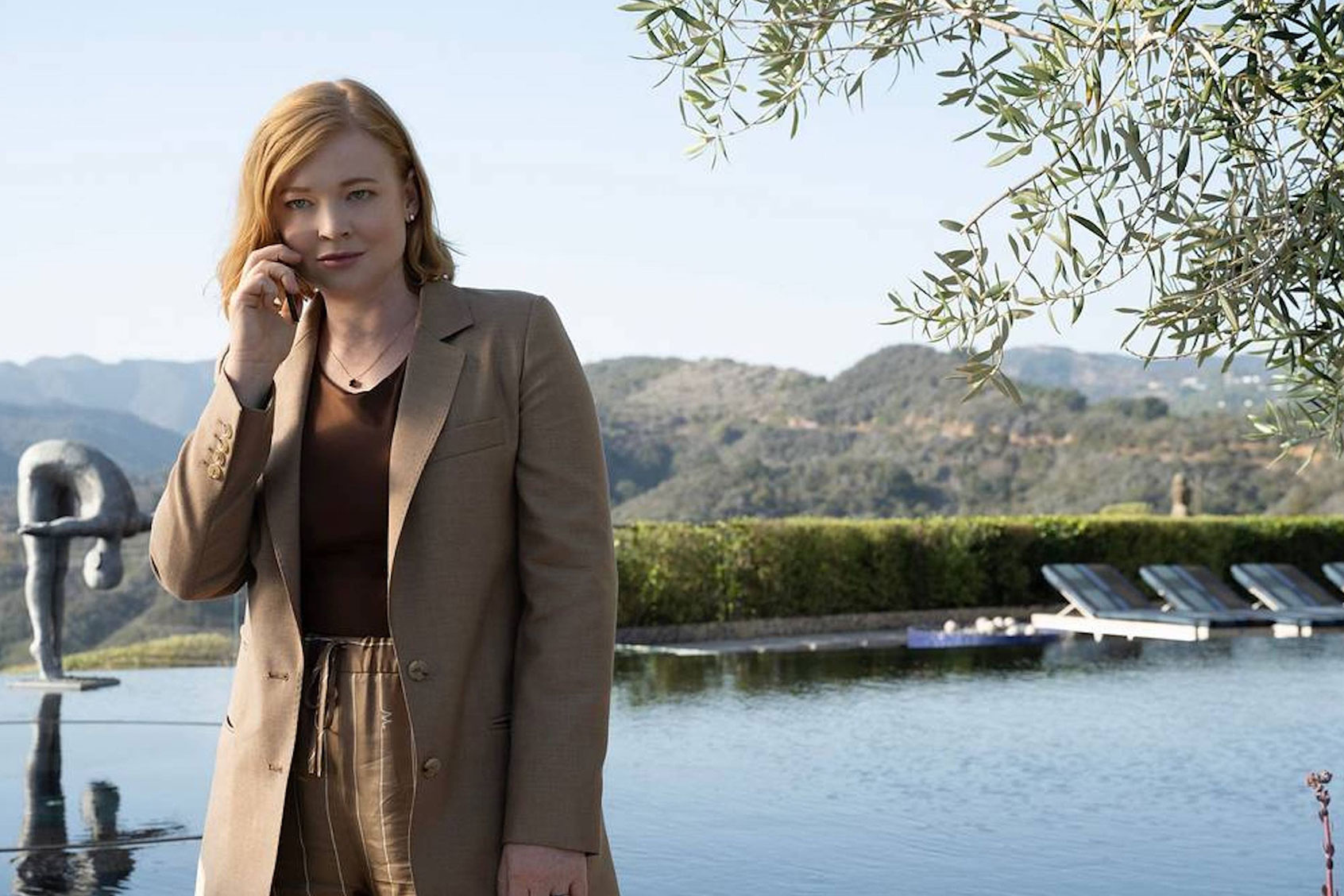
SuccessionSarah Snook in “Succession” (Photograph by Claudette Barius/HBO)

On the heels of that, Stewy (Arian Moayed) and Sandi (Hope Davis) bend the Roy children’s collective ear, insisting they block Logan from selling to Matsson without getting more money from the deal.

If the three are hesitant to side with Stewy and Sandi at first, their minds change when Father cancels their private helicopter and cars, guaranteeing they’ll be late for Connor’s rehearsal dinner. 

Logan is obviously shaken. He descends upon the ATN newsroom unannounced, wearing sunglasses indoors and “terrifyingly moseying” between the cubicles, all of which nearly causes Greg (Nicholas Braun) to soil himself. “It’s like ‘Jaws,’ if everyone in ‘Jaws’ worked for Jaws,” he whispers to a concerned Tom.

The duo hasn’t witnessed Logan’s private existential ruminations, so they don’t recognize this as an old man’s way of pushing back against impending obsolescence. In a loud speech to the plebes, he roars, “This is not the end. I’m going to build something better. Something faster, lighter, meaner, wilder. And I’m going to do it from in here! With you lot! You’re f**king pirates!”

Hooray. It’s all quite inspiring until he moves upstairs to accuse Gerri (J. Smith-Cameron) of being too eager to jump onto Matsson’s ship. Logan’s also cold on ATN’s current anchor lineup and suggests the Board consider Kerry’s audition tape. But nobody has the guts to tell Kerry, or Logan, that she’s abysmal on camera, although they love laughing at her behind her back. Until Logan catches Hugo (Fisher Stevens) mid-guffaw.

All of this is the walk-up to Connor’s rehearsal dinner, at which his half-siblings arrive in time to interrupt Willa’s drunken exit. Upstairs a distraught Connor reports that she announced, “I can’t do this, ” before disappearing into the bathroom for 40 minutes with her friends.

Kendall, Rome and a reluctant Shiv decide to take their brother out for a drink. Although Connor insists they go to “somewhere fun and real. Away from the fancy dance. A real bar! With chicks, and guys who work with their hands, and grease, and sweat from their hands, and have blood in their hair.”

A dive, then. Once they’re rubbing shoulders with the unwashed, Connor pretzels into an anxious fit, Matsson phones in a threat to walk away from the sale . . . and Shiv and Kendall discover Roman texted Logan on his birthday, violating their agreement to cut all contact with Logan until he apologizes to them. Although they’re upset, they agree to stick together and side with Stewy and Sandi. This further upsets Connor, who simply wants to get his money and be done.

And, well, maybe do some karaoke. “I’ve seen it in the movies, and nobody ever wants to go!”

This is how Shiv, Kendall and Rome end up watching Connor bleat a forlorn cover of Marissa Nadler’s “Famous Blue Raincoat” as Logan descends from on high to invade their musical bunker.

SuccessionKieran Culkin in “Succession” (Photograph by Macall B. Polay/HBO)

Connor invites Logan, to the others’ horror, and since he’s gotten wind of Sandi and Stewy’s plan, he agrees. The others assume Logan would never deign to set foot in such a low-rent establishment – and are shocked when for the first time in their lives their father comes to them, not the other way around, flanked by Kerry.

“I wanted to say something,” Logan says haltingly, ignoring their jibes before he confesses, “I guess . . . I guess I just wanted you there at my party.”

At this Kendall verbalizes the audience’s shock: “Holy s**t. Did dad just say a feeling?”

Logan keeps going. “Well, you know, I thought maybe it would be nice . . . Look. You knew I wanted Pierce, from way back. And when I lost out, that was not a good feeling.”

Shiv is unmoved, too long accustomed to Logan toying with them for fun and profit. Kerry, ever the loyal assistant, says what Logan can’t. “Your father wanted to address the personal stuff and not just launch into the business.”

But that’s the problem, isn’t it? This family’s dysfunction is entirely wrapped up in the business. Not once in Logan’s life has he given his sons and daughter an honest song from the heart. The right pitch eludes him at this moment, too.

Even when Logan tries to grant Kendall, Shiv, and Roman the priceless gift they’ve always wanted, he screws up. “Look. I don’t do apologies. But if it means so much to you then . . . sorry.”

This family’s dysfunction is entirely wrapped up in the business. Not once in Logan’s life has he given his sons and daughter an honest song from the heart.

Logan says this without detectable warmth or honesty, with zero true sentiment. It’s a cover of regret that none of his kids believe. “This deal push could be worth $100 mill to us, dad,” Kendall says. “How many ‘sorrys’ do we get for that?”

Roman tries to reel it back from the business negotiations to the personal: “What are you actually sorry for, dad?” he asks. If he weren’t completely tone deficient, Logan would apologize for everything, including stunting his children’s ability to trust or love each other or any other person; for treating them like pawns; for whipping them like mules.

All he can manage is, “Well, I’m sorry about the helicopter, for a start.” 

At this they lay into him: Kendall lists Logan’s other grave sins. What about ignoring Connor his whole life, having his mother institutionalized and beating Roman? What about paying off their mother to betray them in Italy?

“What about advising Tom on my divorce, yeah?” Shiv pipes in. “That one, that took effort. That was above and beyond.”

Logan can’t help but revert to the language they all understand, warning the kids that if they try to squeeze Matsson for more money, he’ll walk. “I know that.”

And this is where Shiv loses it. “Just because you say it doesn’t make it true. Everyone just f**king agrees with you and believes you, so it becomes true. And then you can turn around and say, ‘Oh! You see? See? I was right. But that is not how it is. You’re a human f**king gaslight.”

Logan tries one last time, pleading with them that the deal on the table is real. But is he talking about whatever he thinks is love or business? It’s impossible to tell. Shiv, assuming it’s the latter, finishes the conversation with: “Go ask [Matsson] for more money.” With that, they’re done.

“You’re such f**king dopes,” Logan finishes. “You’re not serious figures. I love you, but you are not serious people.” He stalks out of the karaoke box with Kerry, then calls off the board meeting. He tells Kerry to arrange a face-to-face with Matsson, telling her to inform his inner circle – but not Gerri.


Want a daily wrap-up of all the news and commentary Salon has to offer? Subscribe to our morning newsletter, Crash Course.


Inside the room, Shiv and Kendall are gloating. Roman isn’t as pleased with himself, but Connor, recognizing his place in the band, is defeated.

“You know what? It’s fine. The good thing about having a family that doesn’t love you is you learn to live without it,” he says. “You’re all chasing after dad saying, ‘Ooh, love me, please love me, I need love! I need attention. You’re needy love sponges, and I am a plant that grows on rocks and lives off insects that die inside of me.”

If Willa has left him, he claims he’ll be fine. If she agrees to a loveless marriage, that’s OK too. “I don’t need love,” Connor says. “It’s like a superpower.”

SuccessionAlan Ruck in “Succession” (Photograph by Macall B. Polay/HBO)

Kendall, heading home in a car, smiles with satisfaction. Shiv, tucked into her ride, stares at Tom’s contact page in her phone.

Back at his place Connor finds Willa in his bed and climbs in beside her. 

Roman, predictably, runs back to daddy, tail tucked between his legs and mouth full of sorry. “Oh, we know what they’re like,” Logan replies conspiratorially. Then he gives his youngest son a choice: he can join the meeting with Matsson or attend Connor’s wedding.

When Roman balks, Logan spells out the situation, telling his son there’s a “night of the long knives” coming, naming ATN’s top exec Cyd as the first name on the hit list. He then tells Roman he wants him to be “ATN’s ruthless fire breather.”

“You really want me at ATN?” Roman asks.

“More, Romulus,” Daddy coos, flickering on the figurative gaslight and cranking up their favorite singalong track. “More. I need you.”

New episodes of “Succession” premiere at 9 p.m. Sundays on HBO.


“They asked us to stand down”: Ex-Manhattan DA says Trump DOJ intervened in Stormy Daniels probe

Former Manhattan District Attorney Cy Vance said that the Justice Department asked his office to “stand down” in its investigation of the 2016 hush-money payment to adult film star Stormy Daniels.

Vance faced questions about why he failed to file charges against former President Donald Trump in the probe after a grand jury indicted him in connection to the payment last week.

“Why didn’t you charge the hush money case? Why didn’t you ever charge it in 2018, 2019, 2020?” NBC News’ Chuck Todd asked Vance on “Meet the Press.”

“I don’t want to get into the deliberations that might be covered by grand jury material. But… I was asked by the U.S. attorney’s office of the Southern District to stand down on our investigation, which had commenced involving the Trump Organization,” Vance replied. “And as you know, as someone who respects that office a great deal and believing that they may have perhaps the best laws to investigate, I did so.”

Todd pressed Vance on the details of the probe.

“Did your office conclude that a stand alone felony charge for these hush money payments wasn’t worth it because of so many of the uncertainties around the legal theory?” Todd asked. “And that’s why you were pursuing this larger issue, that this was just one part of sort of how the Trump Organization lied on their on their business records.”

“Again, I don’t want to get into our deliberations,” Vance said. “But we have historically filed cases of false documentation, elevating them to felonies when federal statutes were involved. It’s never been done that I know of with regard to federal election law, which is a quite a specific area of law. But I think the question is not so much why didn’t I do it or we did it, but why this district attorney is doing it. And that really requires us to be patient and to wait. This process isn’t going to be accelerated by us talking about it.”


Want a daily wrap-up of all the news and commentary Salon has to offer? Subscribe to our morning newsletter, Crash Course.


Vance also spoke with former White House Press Secretary and MSNBC host Jen Psaki about the once-seemingly deadened hush-money case. 

“We learned from the Southern District of New York that they asked us to stand down … they had this ongoing investigation and they wished that we put our efforts on hold while they completed their investigation,” Vance said. “I felt it was appropriate for me to hit the pause button.” 

“I was surprised, after Michael Cohen pleaded guilty, that the investigation from the Southern District on that issue did not go forward. By that time we had moved on to other matters,” Vance continued. 

Former federal prosecutor Renato Mariotti described the DOJ intervention as an “odd request” given that the “SDNY did not indict Trump or anyone else after that point.”

“Did then-Attorney General Barr play any role in that request? Did Trump?” Mariotti wondered

MSNBC legal analyst Lisa Rubin explained that it is “not atypical” for federal and local prosecutors to have a “turf war” over a case. 

“What is unusual, however, is for the feds to both insist that they’re all over the investigation, only to have it watered down at the insistence of political appointees and then drop it entirely, as SDNY did in summer 2019,” she tweeted. 

“Such a frickin’ idiot”: Knives out in TrumpWorld for “dumb” new lawyer in Manhattan DA case

Some of former President Donald Trump’s lawyers have trashed Joe Tacopina, his newest attorney representing him in the Manhattan case stemming from the 2016 hush-money payment to adult film star Stormy Daniels.

Several of Trump’s other lawyers have privately described Tacopina as “dumb” and a “loudmouth,” Rolling Stone reported.

Another source described him as “such a frickin’ idiot.”

But the infighting among Trump’s lawyers has reportedly been stoked by Trump himself.

“He pisses off others with his antics, but he’s a blunt object that Donald Trump wants, apparently,” a source told Rolling Stone.

Tacopina has found himself at the center of recent news, recently lunging to grab documents from MSNBC host Ari Melber during an interview about the payment to Daniels.

“Ari, that is–if that’s what you’re gonna consider a lie, a lie to me is something material under oath in a proceeding,” Tacopina said. 

“I didn’t say perjury. I said a lie,” Melber retorted.

“Yeah, but that’s not a lie,” Tacopina said. 

“That’s not a lie?!” an incredulous Melber pressed.

“Could you put the paper down, put the paper down, we don’t need that,” the lawyer told Melber.

More recently, Tacopina was accused of disclosing private information that Daniels shared with him while searching for representation. Daniels handed over her communications with him to Manhattan District Attorney Alvin Bragg’s office. Tacopina, who denied any conflict related to Daniels, also stated that he never met her.

But Tacopina disclosed that he may have spoken with Daniels in a 2018 CNN interview. 

“I can’t really talk about my impressions or any conversations we’d had because there is an attorney-client privilege that attaches even to a consultation,” Tacopina said at the time.

Tacopina backtracked after the clip surfaced, saying that his comments “lacked clarity” and were made to “terminate the inquiry, because someone on Stormy Daniel’s behalf did ask whether I would represent her, and I did not wish to discuss the matter on television.” His firm issued a statement that “there was no attorney-client relationship.”


Want a daily wrap-up of all the news and commentary Salon has to offer? Subscribe to our morning newsletter, Crash Course.


Before legally representing Trump, Tacopina also stated on CNN that if Daniels’s version of the hush-money payments was accurate, he felt the money could be considered an in-kind campaign contribution, meaning that it would have needed to be disclosed on finance forms. 

“This could be looked as an in-kind contribution at the time of the election. This is a real problem,” Tacopina said before representing Trump. “And they both, and I’m telling you this, the reason we’re here I strongly believe is because of the words of both Michael Cohen and Donald Trump.”

Tacopina has since described Daniels’s payment “plain extortion.” He told Rolling Stone that his past comments were hypothetical, in contrast to his current opinion of the case which more closely resembles his understanding of its facts.

“It was a hypothetical question asked by a T.V. host and I answered by twice qualifying my answer with  ‘if those are in fact the facts!!’,” Tacopina said.”

In a statement to Rolling Stone, Tacopina clapped back at his naysayers for their anonymity, saying, “When anonymous sources make comments criticizing others it reveals jealousy and cowardice. Anyone who takes a look at my track record of trial success and the results I have achieved for my clients couldn’t seriously criticize my work or my intelligence.”

“My results are documented and if you truly wanted to do an honest and thorough story you would speak to the clients I served over the years instead of printing false allegations from ‘unnamed sources’ who are jealous that they haven’t been chosen in this case or the other many high profile cases I have had. The story loses journalistic value and calls into question the integrity of the story and the credibility of the so-called anonymous sources,” he added.

Trump’s legal team has been plagued by infighting in recent months, according to a report by The Wall Street Journal. The report noted that Trump’s team has “suffered frequent turnover due to clashes over personality and legal strategy,” and that his attorneys have  “questioned each other’s tactics and competence behind the scenes and have urged contradictory approaches.”

American cities want to recycle their plastic trash in Mexico. Critics call it ‘waste colonialism.’

Just ahead of this year’s Super Bowl in February, the City of Phoenix, Arizona, published a peculiar press release touting its strategy for waste diversion. Thanks to its relationship with Direct Pack Incorporated, a multinational company that makes and recycles plastic, the city said it would be able to send much of its plastic waste to Mexico for recycling.

“[T]he City of Phoenix stands ready to achieve its goal of hosting the greenest Super Bowl events yet,” the announcement from Phoenix’s public works department said.

The city was referring to a forthcoming Direct Pack facility for recycling plastic items called PET thermoforms — clamshells, berry containers, salad boxes, egg cartons, and similarly shaped containers made from polyethylene terephthalate, one of the seven main kinds of plastic. Direct Pack already has a recycling facility in Guadalajara that it says can recycle tens of thousands of tons of PET thermoforms each year, and it’s been constructing a new one in Mexicali, Mexico, just across the border from California. 

The facility is great news for plastic companies based in the U.S., where industry publications say PET thermoform recycling has remained “a struggle.” These companies face growing scrutiny over skyrocketing plastic pollution, and they have spent decades trying to convince the public that recycling is the answer. Direct Pack says on its website that it can give PET thermoforms new life again and again, turning plastic containers like those thrown away at the Phoenix Super Bowl into a “valuable infinite resource.” 

But environmental advocates in Mexico are less excited about the idea of processing more of what they see as garbage from abroad. “The U.S. shouldn’t send this waste to Mexico,” said Marisa Jacott, director of the Mexican nonprofit Fronteras Comunes. “We have less money, less infrastructure.” Rather than engaging in what she called “waste colonialism,” she urged U.S. companies to stop producing so much plastic in the first place and to stop promoting recycling as a cure-all to the plastic waste crisis. 

Direct Pack’s Mexicali facility is part of a larger plan from the U.S. plastics industry to improve recycling infrastructure for the 1.6 billion pounds of PET thermoforms that the U.S. and Canada produce every year. Unlike the PET bottles used for bottled water, soda, and fruit juice, which are among the easiest plastic products to recycle, PET thermoforms are accepted by just 11 percent of the U.S.’s material recovery facilities, or MRFs — the plants where mixed materials from recycling bins like paper, aluminum, and plastic are sorted into bales for further processing. And even that doesn’t mean that those thermoforms will ultimately be turned into new products; most recyclers are unwilling to buy and reprocess PET thermoforms because it costs more to sort, wash, and recycle them than to make new plastics.

The main North American trade group for PET container recyclers lists only one facility in the U.S. that will accept PET-only bales of plastic for reprocessing. The president of another industry group, the Association of Plastic Recyclers, said last year that PET thermoforms were a low-volume commodity that weren’t worth the costs of sorting and storage.

Given such a bleak landscape, Ornela Garelli, an oceans and plastic campaigner for the nonprofit Greenpeace Mexico, said the promise of thermoform recycling is a “greenwashing strategy” from the plastics industry — a way to justify the continued production of plastics. She said it’s time to stop making so many thermoforms in the first place, not hold out hope that more recycling infrastructure will ever be able to keep up with a growing glut of plastic waste.

Still, U.S. plastic makers are doubling down. A U.S.-based nonprofit called The Recycling Partnership — funded and overseen by plastic and packaging companies, including Coca-Cola and Exxon Mobil — said it plans to fund a number of PET recycling efforts this year, beginning with a first round of grants announced in early January for three companies focused on PET reclamation. 

One of these companies is Direct Pack, whose headquarters are in Azusa, California, just outside Los Angeles. But rather than building out PET thermoform recycling infrastructure stateside, The Recycling Partnership’s grant is being used to help Direct Pack build a new PET recycling facility in Mexicali, set to begin operating this spring. According to The Recycling Partnership, the plant will source thermoforms from across the U.S., process them into a plastic feedstock called “flake,” and send them across the street to an existing Direct Pack thermoform production plant, where they will be converted into new packaging.

Andrew Jolin, Direct Pack’s director of sustainability, told Grist that “the whole process is environmentally sound,” adding that the company has been “embraced by the local community with our competitive pay scale and benefits.” He said concerns about the recyclability of PET thermoforms are “disinformation” propagated by Greenpeace and that Direct Pack plans to open a similar recycling plant in North Carolina by the end of the year.

Critics, however, have raised legal and ethical objections. Jim Puckett, founder and executive director of the U.S.-based nonprofit Basel Action Network, told Grist it was “disgusting” that the City of Phoenix and the companies represented by The Recycling Partnership were touting the Mexicali facility. “Of course it’s wonderful for them, they get to sweep their garbage across the border,” he said.

Puckett said the Mexicali facility could run afoul of an international agreement called the Basel Convention, which regulates the international plastic waste trade. Although the U.S. hasn’t ratified the agreement, Mexico has — meaning it’s illegal for Mexico to import plastic waste from the U.S. unless it’s “almost free from contamination and other types of waste” and “destined for recycling in an environmentally sound manner,” rather than incinerated or dumped. Bales of PET that contain more than 2 percent other types of plastic, paper, metal, food, or other materials are generally regulated under the Basel Convention as “hazardous waste” and are banned from U.S.-Mexico trade.

“It’s really difficult to achieve that level of cleanliness,” Puckett said. In California, MRFs are unable to sort bales of PET beyond an average of about 10 percent contamination — and that’s when they include PET bottles. There’s virtually no data on contamination in thermoform-only bales — since most recyclers in the U.S. won’t buy PET thermoforms, they’re typically not sorted into bales on their own.

Craig Snedden, Direct Pack’s president, said the company does not check PET bales before they’re exported from the U.S. to the company’s Guadalajara facility, but he’s confident that they contain less than 2 percent contamination, based on data on the weight of PET collected compared to the weight of all the nonrecyclable materials Direct Pack sends to a landfill. Adam Gendell, The Recycling Partnership’s director of materials advancement, said the most common types of contamination are from food, which “doesn’t sink anybody’s ship” or “cause deleterious effects to the natural environment.” 

In response to a detailed list of questions, a spokesperson for the City of Phoenix referred Grist to Direct Pack and highlighted its goal of achieving “zero waste” by 2050.

Environmental groups have also raised concerns that PET thermoform recycling could divert millions of gallons of water from residential use in Mexicali, which was declared to be in a state of emergency drought last summer. Multiple washes are required to remove sticky glues and labels from PET thermoforms, making them significantly more water-intensive to recycle than bottles.

Jolin said the Mexicali facility would “not use a lot of fresh water” — about 800 gallons per day. He said it’s more environmentally friendly to recycle PET thermoforms than to make packages out of other materials like paper, because doing so requires more trees to be harvested. (The U.S. recycling rate for cardboard is greater than 90 percent, compared to 5 percent for plastic.)

Garelli, with Greenpeace Mexico, said supporting a PET thermoform recycling plant in Mexico allows Direct Pack and its funders through The Recycling Partnership to skirt labor regulations that are tougher in the U.S. The minimum wage in Mexicali is about $17 per day — $2.12 an hour, based on an eight-hour workday — compared to $15.50 an hour in California.

“Instead of forcing their own companies to make the transition toward reusability, they are sending all their plastic waste to countries where there are more flexible laws,” she said. “They can pay low salaries to the workers.”

Federal data compiled by the Basel Action Network shows that U.S. plastic waste exports to Latin America have grown by some 90 million pounds per year since 2017, when China stopped accepting it with its “National Sword” policy. “It is not fair for countries — not only Mexico but other Latin American countries — to keep receiving this waste from the U.S.,” Garelli said. 


Editor’s note: Greenpeace is an advertiser with Grist. Advertisers have no role in Grist’s editorial decisions.

This article originally appeared in Grist at https://grist.org/accountability/american-cities-want-to-recycle-their-plastic-trash-in-mexico-critics-call-it-waste-colonialism/.

Grist is a nonprofit, independent media organization dedicated to telling stories of climate solutions and a just future. Learn more at Grist.org

Melting Antarctic ice may strangle vital ocean currents

As Antarctic ice melts, all of that fresh water pours into the ocean, essentially diluting it by reducing its salinity. That, in turn, is dramatically slowing the currents that, like a conveyor belt, carry oxygen, carbon dioxide, and nutrients through the sea and around the world.

A study published last week in the journal Nature modeled the impacts of this phenomenon, called overturning circulation, on the deepest ocean currents, particularly in the southern hemisphere. It found that the world is on the verge of a potentially catastrophic slowdown, which could have a devastating effect on climate change, marine ecosystems, and the stability of Antarctic ice.

“Our modeling shows that if global carbon emissions continue at the current rate, then the Antarctic overturning will slow by more than 40 per cent in the next 30 years, and on a trajectory that looks headed towards collapse,” lead researcher Matthew England, an oceanographer and climate scientist at the University of New South Wales, said at a new conference announcing the findings, according to BBC.

The researchers discovered that these currents are at their weakest point in more than a millennium. Although scientists have been discussing the possibility of a total shutdown of these currents within centuries, the study found that such a scenario could play out by the end of the century.

These currents play an essential role in oceanic health by circulating water from the surface to the depths and back. In addition to carrying heat, oxygen and nutrients to keep the marine ecosystem nourished, they play an important role in sequestering carbon from the atmosphere deep below the surface.

“If the oceans had lungs, this would be one of them,” England said

But a growing influx of freshwater from melting ice is reducing the salinity and density of seawater. That inhibits its ability to sink, slowing the overturning circulation that submerges atmospheric carbon and instead leaving it near the surface, limiting the ocean’s ability to absorb more of the greenhouse gas. Researchers believe this could lead to deep-water warming in southern oceans and could create a positive feedback loop – warming waters lead to greater ice melt, which releases more freshwater into the sea.

Beyond the climate implications, the slowing of these currents will inhibit the flow of nutrients through marine layers, impacting the food chain and oxygen-producing phytoplankton. The resulting warmer waters could further change rainfall patterns around the world, disrupting agriculture and supply chains. The researchers warn that it’s difficult to know how linear the process is, or whether these changes could accelerate.

According to an IPCC report on oceans and climate change, a slowing of marine currents can cause abrupt, and potentially irreversible, climate change on the timescale of a human lifespan. Furthermore, most models don’t consider the complexities of global climate systems, and can fail to account for abrupt, cascading change. The IPCC has argued for years to hold global climate change at 1.5 degrees C, a goal that would require an increasingly rapid shift away from fossil fuel use and a world that’s already warmed by 1.1 degrees.  According to the panel’s latest report, by 2035, the globe must curtail fossil fuel emissions by 60% compared with 2019 levels to stay under the target – but with numerous new massive extraction projects underway, overshoot scenarios are increasingly possible.


This article originally appeared in Grist at https://grist.org/climate/melting-antarctic-ice-may-strangle-vital-ocean-currents/.

Grist is a nonprofit, independent media organization dedicated to telling stories of climate solutions and a just future. Learn more at Grist.org

“60 Minutes” catapults Marjorie Taylor Greene from “the fringe to the front row”

Over the past few years there has been a lot of talk about the mainstream media “normalizing” and “mainstreaming” the white nationalist fringe that has risen to prominence under the Trump regime. They have been reasonably successful at providing context for stories about groups like the Proud Boys and have done a decent job of reporting on events like January 6. But they just can’t seem to wrap their minds around how to deal with the insurrectionist caucus in Congress.

On Sunday, CBS News inexplicably decided to air Lesley Stahl’s interview with second-term Rep. Marjorie Taylor Greene of Georgia for the venerable “60 Minutes.” If you think it was a tough interview, take a look at this response from Greene and I think you’ll be able to guess how it went:

“It was an honor to spend a few days with the legendary icon Leslie [sic] Stahl and talented crew [of 60 Minutes]. Leslie is a trailblazer for women in journalism. And while we may disagree on some issues, I respect her greatly.”

The show promoted it like Stahl was interviewing just another colorful, political character with some offbeat. views:

“From fringe to front row” read the headline on the accompanying article.

First of all, is her nickname really “MTG”? I’ve never seen it used that way. It’s common on Twitter, but that’s just because of the character limit. If people are using it like JFK or FDR that’s news to me — and if they aren’t then it’s another example of “60 Minutes” not doing its homework.

Marjorie Taylor Greene has the instincts of a fascist and a penchant for conspiracy theories.

The interview started with Stahl rattling off a list of rude descriptions people have applied to Greene, as if she’s the real victim of rhetorical assaults. Then the two went into a long back-and-forth about the debt ceiling because Greene is so important now that we must take her seriously on the issues. (Greene’s answer to what cuts she would make was to cancel “Green New Deal” spending and Covid relief assistance. On that, she didn’t sound much more foolish than most GOP members of Congress.)

But something more important is at stake. Talking to her about substantive issues as if she is even slightly cognizant of the details, much less caring about them, was a huge mistake. This little colloquy gives the impression that Greene’s a legitimate legislator when she is not. She’s a hardcore culture warrior. That is from where her power derives.

Stahl’s attempt to pin her down on some of her outrageous statements was pathetically inadequate and Greene was allowed to deflect and turn the questions back on her political enemies:

And things she says that are over the top, like —

Lesley Stahl: The Democrats are a party of pedophiles.

Marjorie Taylor Greene: I would definitely say so. They support grooming children.  

Lesley Stahl: They are not pedophiles.  Why would you say that?

Marjorie Taylor Greene: Democrats, Democrats support, even Joe Biden, the president himself, supports children being sexualized and having transgender surgeries. Sexualizing children is what pedophiles do to children.

Lesley Stahl: Wow. OK. But my question really is, can’t you fight for what you believe in without all that name-calling and without the personal attacks?

Marjorie Taylor Greene: Well, I would ask the same question to the other side, because all they’ve done is call me names and insult me non-stop since I’ve been here, Lesley. They call me racist. They call me sen, anti-Semitic, which is not true.  I’m not calling anyone names. I’m calling out the truth basically-

Lesley Stahl: Pedophile?

Marjorie Taylor Greene: Pedophi– call it what it is. 

They then show some footage with Greene declaring she believes the election was stolen and cut to Stahl and Greene wandering on the grounds of her palatial home in Georgia where Stahl’s voiceover talks about her wealth, suggesting she’s a self-made woman who ran the family construction business along with her husband. (This is a tale that the Atlanta Journal-Constitution fact-checked and debunked. She was not active in that company at all.)


Want a daily wrap-up of all the news and commentary Salon has to offer? Subscribe to our morning newsletter, Crash Course.


We then spend an inordinate amount of time watching Greene lift weights at a cross-fit gym (uncomfortably up close and personal) which was actually her primary interest in life until she discovered Donald Trump in 2017. You see, Marjorie Taylor Greene did not even have a slight interest in politics until about five or six years ago when she went online in the excitement of Trump’s upset victory and immediately dove headfirst into the right-wing rabbit hole. It was there that she made her reputation as a Trump-worshiping conspiracy theorist. Greene’s entire political worldview was formed on 4-chan, Facebook and a fringe right-wing blog where she pushed QAnon and wrote posts about “disturbing behavior that seems to keep raring it’s ugly heads … Child Sex, Satanism, and the Occult all associated with the Democratic Party.” That is all she knows about politics and government. And within three years, she was running for Congress.

Stahl let Greene get away with blowing all that off by referring to that vapid House floor speech in which she said she regretted “being allowed to believe things that were not true.” And she didn’t follow up when Greene claimed she was not responsible for liking a post that threatened former House Speaker Nancy Pelosi with a “bullet to her head.” She laughably claimed someone else had been using her social media account.

If Stahl were better prepared she would have had this at the ready. It’s from 2019:

Greene got testy when Stahl asked her those questions saying, “have you fact-checked all my statements from kindergarten through 12th grade? And in college?” Unfortunately, Stahl didn’t point out that all of these comments were in just the last five years — when Marjorie Taylor Greene was well into her 40s. There is no need to go back any further than that because she didn’t have a thought in her head about politics until she discovered the Donald Trump fandom.

Marjorie Taylor Greene has the instincts of a fascist and a penchant for conspiracy theories. She’s very energetic and very aggressive and no one should underestimate her talents, such as they are. She has admitted that she wants to create a new Republican Party in her image and while I don’t think she fully understands what that means, she’s flying by the seat of her pants and, so far, it’s working for her. “60 Minutes” went some distance last night in helping her to shoot this toxic form of politics directly into the American political mainstream. 

“Feels obstruction-y”: Experts say it may be “game over” after Trump aide gives DOJ key evidence

Special counsel Jack Smith’s team has amassed new evidence of potential obstruction by former President Donald Trump in the Mar-a-Lago documents investigation, according to The Washington Post.

Justice Department and FBI investigators obtained “particularly helpful” emails and texts from Molly Michael, a former Trump White House aide who followed him to Mar-a-Lago before leaving the job last year, according to the report.

The messages “provided investigators with a detailed understanding of the day-to-day activity at Mar-a-Lago at critical moments,” according to the Post, and have used the messages to help understand Trump’s actions last year.

Investigators are particularly interested in whether Trump may have obstructed government efforts to collect and return all sensitive materials that he took home to Mar-a-Lago, according to the report. Investigators have spent much of their time looking at what happened after Trump’s advisers received a subpoena in May demanding the return of all classified documents.

Investigators have found evidence that Trump “looked through the contents of some of the boxes of documents in his home, apparently out of a desire to keep certain things in his possession,” sources familiar with the investigation told the Post.

The team now suspects that Trump “personally examined” at least some of the boxes moved from a Mar-a-Lago storage area after the subpoena was served, based on witness statements, security footage and documentary evidence, the sources said. Though Trump’s team handed over some documents, the FBI later discovered more than 100 additional classified items during an August search of Mar-a-Lago.

Court documents seeking the warrant to search Mar-a-Lago show that agents believed that “evidence of obstruction will be found at the premises.” The warrant application said the FBI was seeking evidence of violations of laws that make it a crime to conceal, alter, destroy or mutilate a document “with the intent to impede, obstruct, or influence the investigation or proper administration of any matter within the jurisdiction of any department or agency.”

Prosecutors would have to show that Trump intended to impede or block an investigation. Walt Nauta, a former White House valet who followed Trump to Mar-a-Lago, told investigators that he moved boxes at Mar-a-Lago after the subpoena was issued at Trump’s direction.

Investigators have also found evidence that Trump told others to mislead government officials before the subpoena was issued while the National Archives was working with the DOJ to recover documents from Mar-a-Lago. Sources told the Post that Trump ignored requests from aides to return the documents and asked advisers and attorneys to release false statements claiming he returned all the documents.

Investigators also found evidence that Trump sought advice from lawyers and aides on how to keep documents that he was told he could not keep, sources told the outlet. Investigators have also asked witnesses if Trump “showed classified documents, including maps, to political donors,” sources told the Post, and whether he showed a particular interest in Joint Chiefs of Staff Chairman Mark Milley, who has repeatedly been attacked by the former president.


Want a daily wrap-up of all the news and commentary Salon has to offer? Subscribe to our morning newsletter, Crash Course.


Along with evidence collected from witnesses, Smith’s team recently won a court fight allowing them to piece attorney-client privilege claims asserted by Trump attorneys Evan Corcoran, who drafted a document falsely stating that Trump had returned all classified documents before the FBI search.

As Smith’s team presents its evidence before a grand jury, former senior FBI counterintelligence official Pete Strzok warned that the revelation in the latest report “feels obstruction-y,” adding that there is a lot of “scienter & motive in here.”

Former federal prosecutor Andrew Weissmann, who served on special counsel Bob Mueller’s team, noted that a federal magistrate judge already found probable cause that there was obstruction when he authorized the August search.

“It included evidence of obstruction, the allegation by the government in the search warrant, and that was approved by the magistrate… which was the actions of the former president after receiving a subpoena from the Department of Justice, so I agree with this could be a rock crusher game over,” he told MSNBC. “And the Republicans who are following the former president in the Manhattan case could just go over the cliff when and if we see charges in Florida that are really quite strong based on what we know now.”

Calm down, everybody! Trump is not going to be helped by his indictments

Donald Trump has never won the popular vote. His election in 2016 was a fluke, in which he only overcame Hillary Clinton’s nearly 3 million vote lead because of a few thousand swing voters in purple states. Since then, he’s been an electoral albatross around the GOP’s neck, helping them lose in 2018 and 2020 and even, in 2022, nuking Republican chances in many elections they would have otherwise won.

Most Americans hate Donald Trump. 

And yet, somehow many people keep imbuing Trump with almost magical powers to spin political straw into gold. Now we get to enjoy the spectacle of some of the dumbest people in politics issuing the same galaxy brain take that Trump will somehow benefit from being smacked with reportedly more than 30 charges by Manhattan District Attorney Alvin Bragg.

The more legal trouble he gets into, the more Trump’s narcissism and self-pity cloud his understanding of what his voters see in him.

“I think it’s gonna backfire,” assured Sen. Marco Rubio, R-Fla.

“If there is I mug shot of Donald Trump, it will be in dorm rooms and on t-shirts, making him a hero,” predicted Fox News’ Pete Hegseth.

The guy currently ruining Twitter also felt what will push a majority of Americans to fall in love with Trump is criminal indictments. 


Want more Amanda Marcotte on politics? Subscribe to her newsletter Standing Room Only.


Watching right-wing media hype this like it’s Christ’s crucifixion makes one worry that they really do think criminal indictment helps Trump. Articles, like this one, headlined “Good news for Trump: Indictments have historically helped candidates win” at the Washington Post, certainly don’t help. But, if you actually read past the headline on the Washington Post piece, you’ll see that Politico contributing editor Jeff Greenfield does not actually show that indictments make politicians more popular, so much as he demonstrates that they don’t traditionally lose voters over it. However, as Greenfield’s colleague Alexander Burns wrote at Politico last month, “Trump needs to grow his support, not merely rev up people who already care deeply about his every utterance and obsession.” Whining incessantly for two years is not going to make Trump more popular.

MAGA doesn’t worship Trump so much as they weaponize him.

I’m going out on a minor limb here, but there’s also a real chance that this eventually starts to erode the enthusiasm for Trump in MAGA-land. Not at first, of course. He’s benefiting from the well-established right-wing victim complex right now. And probably not enough for him to lose against the has-beens and creeps that are running against him in the primary. But there’s a scenario where, by the time November 2024 rolls around, even some Republicans will be exhausted, unable to muster the turnout he got in 2020. 

There’s this widespread assumption in the GOP and even in the media that Trump’s popularity with Republican voters is due to his charisma as if he has a cult leader-like hold over his people. Maybe some of his followers, sure. But he’s really not that charismatic and his voters mostly know he’s a boor. MAGA doesn’t worship Trump so much as they weaponize him. He’s a fascist and a clown, which is exactly what they value about him. They think those qualities will help their agenda. 

What is that agenda?

First, MAGA is a revanchist movement for conservative whites who believe they are entitled to a stranglehold on power. Growing racial diversity, urbanization and women’s liberation have turned them into a minority. They worry, for real reasons, that the power they feel is their due cannot be achieved any longer through democratic means. What Trump offered them was a fascist’s contempt for rule of law and democracy. He spent most of 2020 signaling blatantly that he would attempt a coup if he lost. The seeding of false claims of election fraud helped rile up his voters because they saw him as the candidate they needed to destroy a system that doesn’t benefit them as much as it used to. 

The second most important part of the MAGA agenda is, pathetically, “owning” the liberals. Because Trump’s ego only grows as his already meager intelligence degrades, he is especially annoying to people they hate. His grossness was his appeal because it was a form of revenge on the rest of the country. Trump gets this, which is why he calls himself “your retribution” when speaking to his fans. 


Want more Amanda Marcotte on politics? Subscribe to her newsletter Standing Room Only.


But with these indictments coming down, and hopefully more to come, Trump’s campaign message has shifted from “I’m the asshole you can use to punish your enemies” to “woe is me.” He’s not their authoritarian savior, but a self-declared victim who needs their help to get out of the messes he created. This shift was hilariously captured by Sen. Lindsey Graham, R-S.C., going on Fox News and crying for Trump like he’s Sarah McLachlan singing over sad dogs.

“Stand up and help the man,” Graham begged, telling grandmothers to empty their pockets to fund “billionaire” Trump’s legal bills. “Pray for him. Go to Donald J. Trump.com and give money so he can defend himself.”

Note what’s not in this plea: Any thought to what they might get in return for their support. Whatever else you might think about Trump’s gross campaign strategies in 2016, he was smart about one thing: He understood his relationship with his potential voters was transactional. He would brag at campaign rallies that he was “greedy, greedy for money” his whole life, but now, he claimed, “I want to be greedy for” his voters. His voters knew he was a liar, a fraud, and a criminal. But he suggested he would use those talents for their benefit, and they got on board with that shady deal. 

But the more legal trouble he gets into, the more Trump’s narcissism and self-pity cloud his understanding of what his voters see in him. They like him when he’s bullying people and bragging, but not so much when he’s whining. Trump rallies are an interesting indicator of this. People will line up for hours ahead of time, and they clearly enjoy hanging out with each other, eating snacks, and vibing with their fellow MAGAheads. But when Trump himself starts speechifying, they get bored and leave. And who can blame them? All he does is whine about his problems. When he does get to the parts of the speech where he talks about how he will supposedly help them, he sounds checked out. You can tell he cannot wait to get back to his favorite theme: No one has suffered more than Donald J. Trump. 

Despite all the threats from Trump and Fox News disguised as “predictions” that there would be a massive MAGA uprising in response to the indictment, mostly it’s been crickets. Even in his home state of Florida, the “crowd” that turned out to support Trump Thursday night wouldn’t be enough people for a bowling league. 

When Trump told his supporters to “PROTEST” in Manhattan last month, in what he clearly hoped was a preventive strike against indictment, barely anyone showed up:

On Friday, the New York Times published a “guy on the street” article interviewing Trump supporters. Many of them were, unsurprisingly, unwilling to admit liberals are right about Trump and were doubling down defensively. Others, however, reluctantly admitted they were getting sick of it all. “I can’t believe he’s still running for office,” one complained. No doubt the fatigued Trump voters are still a minority, but one that should worry him, as he’s already unpopular and can’t afford to lose any more support. 

MAGA is an authoritarian movement organized against democracy, not a cult of personality around Trump. They are happy to boo him or ignore him when he says stuff they don’t like, such as “vaccines work.”  He’ll probably win the GOP nomination, but only because no one else in the field really captures what MAGA voters want, which is a repulsive criminal to defeat the hated (and imaginary) liberal establishment. But don’t mistake that for blind worship of the man. 

None of this is an argument for complacency in 2024. Republicans still have massive systematic advantages that allow them to “win” elections while losing the popular vote. Unfortunately, the anti-MAGA majority will have to rally as they did in 2020 to keep this monster out of the White House. (Unless, fingers crossed, he’s in prison!) But one thing people can safely not worry about is that Trump’s chances of winning have gone up because of an indictment. Most Americans will continue to hate him. And there’s a small but very real chance his crybaby act finally starts to sour some of his support in the Republican base. 

The right’s newest culture war target: HIV treatment isn’t simply collateral damage

The right’s escalating culture war — with vigorous attacks on abortion and gender-affirming care for minors — incurs ever-evolving collateral damage. In recent months, conservative lawmakers have introduced legislation centered on banning books with LGBTQ+ content, obstructing transgender care in both minors and adults, and removing nationwide access to mifepristone—one of the drugs used to manage both medical abortion and early miscarriage. Recent events suggest that the newest casualty in these battles may be access to HIV care.

On Thursday, a federal judge appointed by George W. Bush struck down a key provision of the Affordable Care Act requiring health insurance companies to cover PrEP, the highly effective drugs used for HIV prevention. The Texas judge found that this section of the 2010 law could no longer be enforced against employers because “compulsory coverage for those services violates their religious beliefs by making them complicit in facilitating homosexual behavior, drug use, and sexual activity outside of marriage between one man and one woman.” The ruling could severely restrict access to an indispensable medication that is already underutilized due to race-based healthcare disparities, prohibitive costs, and physician under-prescribing, among other factors. 

Months earlier, Tennessee’s Department of Health revealed that they will be turning down $8.3 million in federal funding for the prevention and treatment of HIV. It’s a shocking move, considering that parts of Tennessee, like much of the South, are HIV hot spots, with Shelby County (home to Memphis) reporting one of the highest new infection rates in the country. These funds, furnished by the Centers for Disease Control and Prevention, are split among various organizations that provide HIV care. Sources within the Tennessee Department of Health believe this wholesale rejection of federal HIV funding is at least partly motivated by recent right-wing attacks on gender-affirming care for minors.

Last fall, conservative political commentators including Matt Walsh and Ben Shapiro declared that Vanderbilt University Medical Center’s transgender clinic was mutilating children. A Daily Wire article that followed described the state’s volunteer-run Transgender Task Force—which provides HIV services to transgender individuals—as an extremist activist group that “promotes transgender surgeries and abortion.” This got the attention of Tennessee Governor Bill Lee, who, through a spokesperson, promised that “these ideologies” would not be funded by the state. Rather than allow the Transgender Task Force to continue receiving just $10,000 in annual CDC funding, the Lee administration chose the nuclear optionrejecting all $8.3 million in federal funds earmarked for HIV prevention in the state.

The Lee administration claims they will provide the same level of HIV care using state funds. But the “vulnerable populations” that they’ve named as priorities are deeply concerning: “victims of human trafficking, mothers and children, and first responders.” While everyone should have access to HIV care, the aforementioned groups are in grave misalignment with those actually facing the highest HIV risk. Human trafficking is not a major driver of new HIV infections in the U.S. In 2020, women represented a minority of new HIV diagnoses in Tennessee (16%), and it’s unclear what percentage of those were mothers. In 2019, not a single Tennessee infant was born to a pregnant person living with HIV. And first responders who experience a needlestick injury face an HIV risk under 0.3%. Post-exposure prophylaxis medication reduces that risk to a near impossibility.

Transgender individuals, men who have sex with men, sex workers, people experiencing homelessness, and those who inject drugs are by far the most vulnerable groups that HIV funding should prioritize, with a particular focus on people of color. These groups’ risk is further compounded by the costs of HIV care, the difficulties of navigating our country’s convoluted healthcare system, and pharmaceutical marketing campaigns that have largely targeted pre-exposure prophylaxis toward white queer men and ignored communities of color and trans people. 

As an HIV pharmacist who is intimately familiar with barriers to care, I’m enraged by the Lee administration’s flagrant disregard for those most in need. Directing HIV funding toward a sanitized list of people the administration feels are most worth protecting may please some conservatives — but it should disturb anyone who cares about public health, as it may also be a bellwether for a nationwide disaster.


Want a daily wrap-up of all the news and commentary Salon has to offer? Subscribe to our morning newsletter, Crash Course.


Lest you think this is a Tennessee-specific issue, allow me to restate that federal funding for HIV care is often funneled through organizations that support gender-affirming care for minors and abortion. Planned Parenthood of Tennessee, for example, is another organization the Lee administration is pulling funding from, despite the state already having one of the most draconian abortion bans in the country. Planned Parenthood of Tennessee no longer provides abortions. But their association with reproductive choice is undesirable enough for the governor to kneecap their HIV preventative services entirely.

Currently, 38 states are pursuing anti-trans legislation, 21 of them focused on bans of gender-affirming care for minors. 24 states have outlawed or are likely to outlaw abortion, and five states have signed bills to defund Planned Parenthood. Anti-trans legislation has advanced across several states in just the last few weeks, including the Kentucky House and Senate overturning the governor’s veto on a sweeping anti-trans bill, the Idaho House passing a bill that criminalizes gender-affirming minor care, Texas introducing a bill banning state funding for transgender care in Texans of any age. And on March 2, Gov. Lee signed into law a ban on gender-affirming care for Tennessee minors, which will require them to detransition by March 2024. States with Democratic governors are less likely to face these particular challenges, but where does that leave the 26 states governed by Republicans? The right-wing obsession with restricting abortion and transgender services for minors—and what this will mean for HIV care—is a national issue that should raise alarm bells.

To paint any of this legislation as a righteous attempt to protect children is ludicrous. The American Academy of Pediatrics and the American Medical Association, among other major medical groups, have decried bans on gender-affirming care for minors, insisting that these services are medically necessary. Studies have shown that gender-affirming care—particularly when integrated with HIV care—improves viral suppression in those living with HIV. And, perhaps most significantly, suicidality is already incredibly high among transgender individuals, with minors facing the highest risk. Meanwhile, gender-affirming care is associated with reductions in depression and suicidality. Children will quite literally die from these right-wing attempts to “protect” them.

The individuals most impacted by bans on gender affirmation, abortion, and HIV care overlap, and the funding for these varied services cannot be cleanly separated. Tennessee may be the first state to outright reject national funding for HIV care in favor of a state-run model that prioritizes all the wrong groups. Who’s to say they’ll be the last?

How Trump’s indictment will stress America’s legal system in new ways

When former President Donald Trump turns himself over to authorities in New York on Tuesday and is arraigned, the charges on which a Manhattan grand jury indicted him will likely be made public. Manhattan D.A. Alvin Bragg obtained the indictment on March 30, but the exact charges against Trump remain sealed. Multiple media sources are reporting the indictment alleges the former president committed business fraud.

I am a former prosecutor and law professor who studies the criminal justice system. While the complexities of Trump’s case will continue to unfold, The Conversation asked me to break down the complex legal situation. Here are four key points to understand about the prosecution and what will likely come next.

1. Falsified business records are the key issue

From what we understand of the investigation, the charges against Trump appear to stem from a $130,000 payment in 2016 by Trump’s then-lawyer, Michael Cohen, to adult film star, Stormy Daniels. In return, Daniels promised not to tell the media about her alleged affair with Trump.

Media reports suggest that there could be more than 30 counts against Trump, and at least some of those counts will be felonies.

Just the fact that there are so many counts does not mean that there are many different criminal events or kinds of crimes alleged. Prosecutors often charge similar, repeated conduct — for example, multiple drug sales — as separate counts. In this case, the multiple counts may refer to a series of business records that record the same or similar transactions. Or the charges may, indeed, span multiple alleged criminal events.

Media reports indicate that Bragg does not appear to be alleging that Trump’s payment to Daniels was itself illegal. Instead, Trump will likely be charged with “falsifying business records” for trying to hide the payment by lying about its nature in the records of the Trump Organization, his company.

Creating a false business record with the intent to defraud is a Class A misdemeanor offense in New York. But the offense can become a Class E felony if Bragg can prove that Trump created false business records for the purpose of facilitating a second crime.

It is not yet clear what the second crime will be — or even that a second crime is being alleged — but possibilities include federal or state campaign finance violations or tax evasion.

2. Bragg will have to prove Trump’s involvement, fraudulent intent

If there is a trial, the prosecution will have to put together a series of pieces to secure a conviction on each of the charges facing Trump.

First, the prosecution would have to prove that the Daniels payment was recorded by Trump officials as something clearly inaccurate. It is not enough to show that the payment was recorded ambiguously — like “miscellaneous” or even “legal services.” The business records at issue must be unequivocally false.


Want a daily wrap-up of all the news and commentary Salon has to offer? Subscribe to our morning newsletter, Crash Course.


Second, it is not necessary that Trump himself created false records. The prosecution would just have to prove that Trump was the direct cause of the false entry — meaning someone followed his specific directions.

Third, the prosecution would have to prove that Trump created the false record for a fraudulent purpose and, to prove a felony, with the specific purpose of committing, or covering up, another crime.

This is important because there could be other potentially plausible reasons the defense might offer, including that Trump sought to avoid embarrassment to his family or himself. Another option is indifference, that Trump gave little thought to how the transaction was recorded. That’s why the details of the allegedly false records, and Trump’s degree of involvement in their creation, will be central questions at trial.

Finally, for the felony offense, the prosecution would also have to prove that there was another crime that was either committed or covered up by using this false business record.

A woman with white hair holds a sign that says 'Tick tock, time's up' with the photo of a man's head on it. She and another few people stand behind a police barricade that has yellow tape on it and says 'crime scene.'

People gather on March 31, 2023, in front of Trump Tower. (Spencer Platt/Getty Images)

3. It’s the most complex straightforward case in history

While everyone will be watching to see if this case is handled like other cases, differences are inevitable. For example, the NYPD and court officers will need to coordinate the arrest process with Trump’s Secret Service agents.

Further complications will arise if there is any prospect of incarceration. Based on what we know now, there is little prospect that Trump will be jailed pending trial for this allegation of a nonviolent crime. Even if he is ultimately convicted, it’s still unlikely he’ll be locked up, based on the nature of the charges and his lack of a prior criminal record. That said, judges have broad discretion in determining sentences.

That is only a small window into the logistical challenges that await the Manhattan D.A.’s office and the New York courts. If this were any other defendant, this would be a relatively straightforward case, the kind that make up the hundreds of cases in a typical prosecutor’s caseload.

However, Trump is not any other defendant. That means this is likely to be the most complex straightforward case in American history.

4. The judicial process will be a messy affair

Most low-level felony and misdemeanor cases are resolved before trial, especially when there is no obvious victim. Typically, the prosecution will offer a plea deal, perhaps including a term of probation, or even propose a diversion program with community service, for example, which will lead to a dismissal of the charges.

It will be interesting to see if Bragg makes an offer along those lines. Even if he does, defendants must typically admit guilt to take advantage of these arrangements, and Trump may refuse for political, personal or legal reasons to admit guilt.

So it’s likely the case will go to trial, a process that will be messy for many reasons — most importantly, the jury.

When choosing a jury in a criminal case, the trial judge is supposed to screen out potential jurors who are biased in favor of or against the defendant. That’s normally easy because the jurors have usually never have heard of the defendant.

But most potential jurors will have opinions about Trump and many will need to be excused from jury service because of a lack of objectivity.

In a trial with this much media attention, there will also be people who have strong feelings about Trump and want to be on the jury. Some of them may hide their biases. That’s a problem by itself.

Then, once the trial starts, the media attention will shine a spotlight on the selected jurors. If it becomes clear that the jurors lied or failed to disclose information in jury selection, that could be grounds for removing them from the jury in the middle of the trial. If enough jurors are removed, the case will end in a mistrial, sending everyone back to square one.

So, while there is a lot about this prosecution that isn’t yet clear to the general public, one thing is clear — this will be a case with unprecedented attention and complexity.The Conversation

This article is republished from The Conversation under a Creative Commons license. Read the original article.

With Chicago runoff looming, charter-school superfan Paul Vallas accused of “destruction”

With Chicago’s closely watched mayoral runoff just days away, the campaign of progressive Cook County Commissioner Brandon Johnson debuted an ad on Sunday featuring expert and parent testimony on conservative candidate Paul Vallas’ education record, including his stints managing school districts in Chicago, Philadelphia and New Orleans.

The picture they painted was not flattering. One New Orleans parent, identified as Kevin G., said that “Paul Vallas has left a trail of destruction everywhere he goes.”

“We’ve literally seen this man destroy public education, sadly for Black and Brown children,” he added.

Kendra Brooks, a Philadelphia parent and city councilmember, offered a similarly scathing assessment during her appearance in the ad, which the Johnson campaign said will air on broadcast and cable across Chicago until Tuesday’s runoff.

“I think folks in Chicago should look at the destruction that he has left behind,” said Brooks. “Money was being spent carelessly. Millions of dollars are missing, at the loss of Black and Brown communities.”

Watch the two-minute spot:

Vallas is an ardent school privatization advocate who served as CEO of Chicago Public Schools from 1995 to 2001 before moving on to head the School District of Philadelphia and the Recovery School District of Louisiana.

As The TRiiBE’s Jim Daley wrote in a detailed examination of Vallas’ record:

In each city, he opened charter schools, promoted military schools, and expanded standardized testing and zero-tolerance disciplinary policies. He also ran school districts in Haiti and Chile between 2010 and 2012…

Under Vallas’ tenure, Philadelphia underwent what was then the largest privatization of a public school system anywhere in the country. He opened 15 new charter schools over the protests of the Philadelphia Federation of Teachers, who called for a moratorium on new charters in 2006.

In New Orleans, Daley continued, Vallas “immediately set to work opening more charter schools, and the trend continued after he left.”

“New Orleans is now the only city in America with a school district that is entirely made up of charters,” Daley noted, “something Vallas also took credit for: he wrote that he ‘implemented reforms that created the nation’s first 100% parental choice district, with all schools public, non-selective, and nonprofit.'”


Want a daily wrap-up of all the news and commentary Salon has to offer? Subscribe to our morning newsletter, Crash Course.


Reshansa W., a New Orleans parent and education policy expert featured in Johnson’s new ad, said that “everything about education in New Orleans is suffering” due to Vallas’ reforms.

“It decimated our middle class,” Reshansa added. “He wasn’t right for New Orleans. He wasn’t right for Philly. He will not be right for Chicago.”

The contrasts between Vallas and Johnson on education policy have become central to the April 4 contest — which, if polling is any guide, is set to be razor-close.

Despite mounting criticism of his record, Vallas has pledged to expand charter schools if elected mayor — a promise that may help explain why a super PAC with ties to school privatization zealot Betsy DeVos recently spent $60,000 in support of his campaign.

Vallas’ campaign is also backed by rich investors — a class he catered to during his tenure as CEO of Chicago Public Schools.

Johnson, a former public school teacher and organizer with the Chicago Teachers Union, has pledged to prioritize strengthening Chicago’s public schools, which have long been badly underfunded.

ChalkBeat Chicago reported late last month that “if voters pick Johnson, his election would be the crowning achievement in a decade-long grassroots battle waged by the Chicago Teachers Union against mayoral control and many of the controversial policies that came with it, like school closures and charter expansion.”

“Johnson opposes adding charter schools and closing small district schools, of which Chicago has a growing number,” the outlet noted. “Johnson has talked about getting state lawmakers to ramp up funding increases to the state’s funding formula so Chicago and all districts get to so-called ‘adequate funding’ more quickly. He — and district officials — have also suggested pushing the state to kick in more for Chicago teachers’ pensions, which have been underfunded since the mid- to late-2000s.”

Feast on “Yellowjackets” and the lies we tell

First things first: if you haven’t already seen the second episode of Showtime’s “Yellowjackets” sophomore season and are a fan of the buzzy show, go see it. Save yourself from the spoilers you know are coming on social media, fast and hard as the snow in the somewhere in Canada wilderness. Save yourself for supper and watch.

Once you’ve had your fill, you’re going to have some questions. Why is Travis having glowy visions of Lottie when he’s having sex with Nat? Who is the man with no eyes again? One question gets soundly answered in this episode, punily titled “Edible Complex.” As Collider writes, “It was never a question of if the team would resort to cannibalism, it was simply a question of when.” But why in Wiskayok does the show cut away from its first and most important cannibalism scene, splicing it with an extended fantasy sequence? The answer rests in trauma and the lies we tell ourselves.

We knew it was going to happen, but we might not have known it was going to be Jackie (Ella Purnell) to get the first bite taken out of her — except for the fact she’s been stored in the meat shed since freezing to death; I suppose that was a dead giveaway. Props to the show, I guess, for making cannibalism look like a BBQ. It’s not simply near-starving hunger that drives the girls and Travis (Kevin Alves) to devour their departed friend, it’s that she smells delicious, having been accidentally cooked instead of cremated. The team wakes up to the smell, like bacon at your mom’s house on Saturday morning.

In their own heads, the characters look different. They look beautiful, classy, washed and serene.

The decision to start to eat is an extended one, made even more dramatic by the inclusion of Radiohead’s “Climbing Up the Walls,” which also had a great turn in “Peaky Blinders.” Music is going to be a big deal this “Yellowjackets,” season, thanks to the addition of new music supervisor Nora Felder, formerly of “Stranger Things,” who helped my tween son finally believe me that Kate Bush is amazing. Looper describes the Radiohead song as “mysterious, popular” and it certainly fits for a creepy moment in the woods, infused with tension. 

Shauna (Sophie Nélisse) is the one who goes first with the cannibalism. The others seem to look to her as if for permission. She’s the leader in this and the only one with any secret experience (she ate the ear, after all). Jackie’s best friend and representative in the afterlife, Shauna says eerily, “She wants us to,” which seems to imply that Jackie is asking for it.

Sophie Nélisse teenage Shauna in a “Yellowjackets” fantasy flashback (Showtime)We knew the cannibalism was going to be upsetting, but we didn’t know it was going to be sexual exactly. But the scene of tearing into Jackie’s body has that heightened energy. After hesitating, then jumping in, then totally forgetting themselves in the frenzy, the girls and Travis look like feral monsters to Coach Ben (Steven Krueger) who backs away slowly, hiding in the cabin, not partaking — and in doing so, perhaps marking himself for future danger.

It makes sense that the teens would go to a fantasy of ceremony. The Yellowjackets have already relied upon ritual to get through their ordeal. 

But to themselves, in their own heads, the characters look different. They look beautiful, classy, washed and serene, and sitting at a grand table in the forest. In the fantasy sequence, which the episode cuts with gritty flashes of ripping into Jackie’s corpse, the teens are seated at a banquet table, a feast laid out before them of roast meats (not human ones) and delicious fruits. They’re dressed in Greek finery with togas, robes (which seem to predict adult Lottie’s robes when she’s cult leader supreme) curls and laurel wreath crowns. Their mannerisms at the table are sweet, shy, almost childlike and polite. They are gods, maybe, or at least royals. That’s before they dig into the feast. Then they can’t believe their luck, nor how good all the food seems to be.

Sophie Thatcher, Sammi Hanratty and Kevin Alves as teenage Nat, Misty and Travis in a “Yellowjackets” fantasy flashback (Showtime)In reality, there is only one food and it is Jackie. But a lie the teens tell themselves is that it’s all something else. They are something else. Coach Ben has already been retreating into his own private fantasy of domestic bliss — of the past, or of what could have been — for a long time.


Want a daily wrap-up of all the news and commentary Salon has to offer? Subscribe to our morning newsletter, Crash Course.


It makes sense that the teens would go to a fantasy of ceremony. The Yellowjackets have already relied upon ritual to get through their ordeal. Lottie leaves the heart of the bear she’s killed as an offering. She must “bless” Travis and Nat every time they go hunting. As humans, how do we try to make sense of the senseless? We organize it. We say it has meaning, like the symbols in the woods. We sometimes fall back upon patterns and tell ourselves they’re protecting us. 

And like the Yellowjackets, we look away to survive.

The toll of emotional labor: “You have a hierarchy of whose experience matters and whose doesn’t”

I used to have a boss who, shortly after he joined the company, informed me that my job was to be his therapist. He didn’t say it in a jokey, “Whoops, I overshared today” way. He said it often, always privately, always while venting about how difficult his own job was. I wasn’t paid extra to be his therapist. I didn’t hand off any of my other responsibilities that went with my actual job title and qualifications. Instead, I was just presumed by him to be privileged to be in his confidence.

“What is so fascinating about emotional labor,” journalist Rose Hackman tells me when I relate this story to her, “is that the perpetrators of emotional extraction are constantly forcing us to exactly be their therapists, to be their emotional containers.”

Hackman knows that it’s called “emotional labor” because it’s a full-time job. Whether it’s enduring the commands to “Smile, baby” when we walk down the street, fretting that our professional successes will threaten our partners’ egos, or being treated like the office mom instead of the office mentor, the burden of carrying around other people’s feelings extracts a high price. And though our American emotional labor force primarily runs along predictably gendered lines, as Hackman explains in her new book “Emotional Labor: The Invisible Work Shaping Our Lives and How to Claim Our Power,” the dynamics aren’t always so straightforward. At its core, emotional labor is an issue of who and what we value, in our workplaces and in our own homes.

I talked to Hackman recently about the ways in which emotional labor creates a “third shift” in the lives of millions of Americans — and why it’s beneficial for everybody not to overcome it but embrace it. 

This conversation has been edited and condensed for clarity.


Want more health and science stories in your inbox? Subscribe to Salon’s weekly newsletter The Vulgar Scientist.


In the book, you go into the whole etymology and the different facets of emotional labor. We hear the phrase a lot, but what does it really mean?

I would say that it is the editing work of feelings that you will do on yourself, in order to have an effect on the feelings of those around you. It’s a smile that you will give to people regardless of whether you’re feeling good inside, in order to make them feel good inside, for example. It’s something that I argue in our society is incredibly important. It’s not just important, it’s actually vital and essential to the smooth running of our families, communities, and even our economy. 

But in spite of that, in spite of this essential nature of emotional labor, it’s a form of work that we devalue, that we render invisible. It’s a form of work that is highly feminized, sometimes racialized, depending on the context. My book, obviously, is trying to make a case that we don’t need just to reckon with this devaluing and invisibility, we need to radically shift our value system to accurately reflect how valuable emotional labor is. 

Let’s start with the way that it plays out in the home. The Cut recently did a really interesting series called “It’s Over,” and had a bunch of women talking about the moment that they knew their marriages were dead. Pretty much every story was a story of emotional labor. Of course emotional labor is also there in the ways that we interact with our mothers, with our kids. But how does it affect us in the relationship sphere? 

Emotional labor is a form of work that is expected of women in all spheres of society, whether it’s private or in public. In private specifically, a woman will be expected to cater first and foremost to the emotions of her family. But if she’s in a relationship, which is what you’re talking about, she will absolutely be expected to first and foremost cater to the emotions of her partner. That can play out in different ways, where people will pretend they don’t see it playing out. For many of us who’ve been in straight relationships, I spoke to hundreds of women for this book and it’s very clear that these male partners are aware of what they’re benefiting from. It’s the double standards of men “helping out” with the kids. That framing is revealing that we expect women to do it just by virtue of being women. With all sorts of domestic chores, including care labor and emotional labor, when men do it, it’s seen as an added [value].

The way in which this dynamic plays out in intimate spheres is so interesting, because in the larger society, you really see it from a bigger scale. But when injustice comes into the home, it’s particularly upsetting. When emotional labor is unequally put on to the wife or the woman or the person who’s playing the feminine role — because emotional inequality is definitely also in same-sex relationships — you have a very clear hierarchy of whose experience matters and whose experience doesn’t. In these straight dynamics where both partners would say, “We believe in gender equality, we’re in an egalitarian relationship,” if a woman is doing all the emotional labor, fundamentally, you’re expecting her to put herself second. And fundamentally, that means she’s at the bottom of the hierarchy. And that, to me, is very upsetting. 

I get if that was the deal you were going to get in the 1950’s. But when I see people in Brooklyn in 2023 in their families playing out this exact same thing, it’s amazing to me.

You talk about the awful, no-win situation we often find ourselves in at work. It’s very difficult to play this right in the workplace, because you won’t be as successful if you don’t play that game. But there’s a toll extracted for playing that game.

My generation of millennial women, a little over ten years ago, were told that we weren’t rising up to the top of all the industries, because we weren’t leaning in enough, we weren’t being confident enough, and the problem was that we needed to stop apologizing. That’s not necessarily just what Sheryl Sandberg was telling us. Really the culture said that to us.

So a lot of us were trying to be more confident and tried to emulate our male counterparts in these white-collar industries. And we were punished for it. A woman is assertive, and she’s seen as aggressive. Or a woman speaks her mind, and she’s seen as being a bit of a problem person. She’s told to go back to catering to male egos around her, or she’s told to just soften her tone a bit. We get policed in our tone in a way that very, very, very clearly, our male counterparts are not.

That really speaks to a double standard that we find in the literature of social psychology, and organizational psychology, that has done research on this, and very clearly says that if you are a man and you want to get ahead in these white-collar industries, you need to be two things. You need to be competent, to be good at what you’re doing. And you need to be confident in displaying these attributes, so people will be inspired and want to promote you. If you’re a woman, you definitely have to do those things too. You have to be competent, to be good at your job, but you also need to be confident. Then on top of both of those displays, you’re expected to be other-oriented. You’re expected to be nurturing, you’re expected to be caring, at the same time as you’re expected to display dominant, aggressive, competitive, male-type attributes. You’re expected to dole out an extra third shift, a third layer of emotional labor that is going to basically make the other people in the room feel comfortable. 

Not only is that a total double standard, that forces us into doing a whole extra job on top of the job we’re actually being paid to do, it’s also very, very hard to pull off being on the one end extraordinarily pushy and competent, and on the other end being terribly demure and apologetic. Basically that is what we’ve been required to do. It’s a Catch-22. If you really want to think about why women do not get into the top of industries, it’s because we are expected to find this extra shift. We are actually discriminated against if we don’t do this extra form of work that’s not required of our male counterparts.

I do not think the problem is with us. I think the problem is with a system that forces this emotional labor, and then sees this as a symptom of subservience. We’re being pushed into performing the role of the support person. In an age where we’re told increasingly that we should be authentic and to bring our whole selves to work, I think the conversation about what that actually is, is totally skewed. And it’s hypocritical beyond belief.

Let’s talk about how it’s compounded if you are a woman of color, if you are a person of color. The expectation and the consequences if you do not fulfill that role, then become even even greater.

What’s fascinating about emotional labor is when you first talk to people about it, a lot of the cultural stereotypes around it are that it’s just something that women are good at. In fact, that’s not perfectly accurate. What’s accurate is that if women are better at it, it’s because we’re more accustomed to doing it. In fact, studies across neuroscience and psychology show that everyone is definitely able to perform emotional labor, which is effectively being empathetic and taking that into account as you decide how to act.

Think about a workplace, let’s say a workplace with only white men in it. The person at the bottom who has just been recruited will likely have to be performing a lot of emotional labor for their boss, and that boss will probably perform a lot of emotional labor for the CEO. There’s a level of emotional labor that’s really effectively about deference.

“Emotional labor, even if we think of it in terms of gender, is really about power.”

Whoever in a situation of the least power is expected to make the most of it. In a work context, where we have multiple different identities, that means that people will do emotional labor according to their rank. If you complicate rank with gender, women will definitely be expected to perform very specific kinds of emotional labor tied to their identity as a woman. But then if you, for example, have a black man in a situation where he might be a middle manager, he’s probably going to have to do all sorts of emotional labor within a white context, to not come across as quote unquote, “aggressive.” He’s going to have to understand ways in which his presence needs to be modulated. He has to do emotional labor in order to reassure his white counterparts who work with him. Then when you now think about Black women, that’s a whole extra form of identity.

I want to talk also about the ways in which emotional labor plays out in terms of violence, To live under this fear of violence all the time, whether it is from intimate partners, from acquaintances, or from strangers on the street, it’s work that I don’t know if everyone on the planet understands. That mental energy takes up so much space in our lives. 

The world is so incredibly violent and somehow it’s become normalized. But stop and think about the ways in which we are perpetually not just living with the consequences of a violent world, [but] we are generally, often daily, forced into preemptively avoiding violence — specifically, rape and sexual assaults. As women that means that we end up having to do not just the de-escalation, but emotional labor of preemptive avoidance. That ends up having a huge effect on the ways in which we live our lives and a huge effect on the options that we have, not the economic options, but the social options. There’s just so much thought every single day that goes into effectively protecting us in a culture that won’t protect us.

I appreciated that you ask the question of “What about men?” in this book. When you talk about “the man box,” tell me about what emotional restrictions men are dealing with.

Before I started even doing this book, I was a writer with the Guardian. When I wrote articles in The Guardian and had conversations with people out in the world, what was fascinating to me is a lot of men see the feminist fight as something that goes against concern for men. To me, that doesn’t make any sense. By cutting them off from their emotional selves, we effectively groom men into being hyper-dominant if they are to participate in the supposedly epitome of patriarchy. It’s not just violent for us, it’s extraordinarily violent for themselves.

“A world that effectively only lets one gender have emotions is harmful for all.”

Patriarchy promises us that men will be at the top. It also promises men that they can dominate certain small spheres, but it doesn’t mean they are ultimately the winners. I’ve had a lot of men who would probably consider themselves not progressive, not feminists, who say, “Well, what about the men who go to war? What about the male suicide rates?” I’m extremely concerned with that too. A world that effectively only lets one gender have emotions, and only trains one gender to step into their full emotional selves and to develop a rich emotional literacy, while also denying a full emotional landscape to another gender, is harmful for all.

The “man box” basically refers to a very restrictive emotional landscape that we teach boys that they should not have more than a very small amount of emotions. That’s going to be pretend stoicism, because that’s not real, that’s repressive. And then there is going to be the emotion of anger, which is the one emotion that reinforces the manliness as opposed to challenges it. 

I think that a world in which we address the inequality of emotional labor distribution is not going to just be good and helpful for women and girls who are going to have the load shared. We don’t need to get rid of the emotional labor, we need to spread it more evenly. But that world, where we start valuing emotions, we start valuing emotional labor, we start letting boys and men really step into the breadth and the reality of their emotional landscape, that’s going to be very, very healing to them. As we know, the average age of death in this country has been falling since 2018, which is pre-pandemic. It’s been falling mainly because of deaths of desperation, including suicide, including overdose, including alcoholism, and those are mainly deaths that are male.

I think those deaths of desperation are very clearly tied to an epidemic of loneliness, an epidemic of men who do not have strong relationships. That is something we need to address. But as we address it, we don’t need to say, “Oh, let’s worry about our boys.” We need to say, “Hey, boys and men, there’s this work that’s already been done by girls and women, you need to value that. Then you also 100% are allowed to do that too.” That will likely not just redress the injustice, it will probably be very healing.

You end the book by talking about love and power. What is that equation? What does that look like when we are pushing that rock up that hill every day to build a world that is kinder, that values the power of love for men and women and everyone in between? 

“We fictitiously are living in a world where we’re told love and power are total opposites.”

The truth is that so much of my research in this book, very clearly and in very tangible ways, points to the fact that emotional labor — love in action, empathy in action — that’s not the symbol of submissiveness. That shouldn’t be. Fundamentally, love in action is one of the most powerful healing forces out there. It’s what forges and reforges community. It’s what runs our economy. It’s also the secret to longevity.

I quote that study researchers at Harvard did starting in the mid-20th century. They followed groups of men who were Harvard undergraduates who came from socio-economic privileged backgrounds, and others were inner city teenage boys, with in theory, drastically different roads ahead of them in terms of life outcomes. What they found, having followed them well into their eighties, is the biggest predictor of how long they would end up living was not how much they were making; it was not the degree that they had. It was the strength of their relationships. It was the acts of emotional labor that they were not just benefiting from but, in theory, they were performing. It was the strength of a happy marriage, and the strength of both personal friendships and relationships. That was the highest predictor regardless of income, regardless of background. 

That tells me, the only form of value that really can be exchanged equitably, is time. That shows me that emotional labor, love in action, could not be more valuable, is way more valuable than the cash we have at the end of the ride. But we have divorced ourselves from that, because we currently live in what I call an extractive state of emotional capitalism, which forces certain groups to do emotional labor, and refuses to recognize their work or full value and meaning. Fundamentally, if we all don’t just take care of ourselves but of the entities around us, ultimately, everyone wins.

Pasta, pannetone, Parmegiano and pizza are obviously Italian . . . right?

Of course, it goes without saying that many Italians and Italian-Americans alike have vested, entrenched opinions about their foods. So when Alberto Grandi — an Italian academic and a professor of history at an Italian university in Parma — made some especially controversial comments about the provenance of certain Italian dishes in a recent interview with the Financial Times, it’s no surprise some feathers were ruffled. 

Grandi said that some of the most cherished Italian dishes were actually not that Italian and even ventured to say that cheese produced in Wisconsin is comparable or even better than “real” Parmigiano Reggiano made in Italy. People weren’t pleased. And by that, I mean they were flipping tables across the land a la Teresa Giudice circa 2008.

To argue that pizza, pasta, pannetone and Italian cheese wasn’t intrinsically, thoroughly Italian obviously struck a chord with many, but (and please read this in my best Carrie Bradshaw impression), “I couldn’t help but wonder . . . what if Grandi’s statements are true?”

Gandri’s claims may have raised our collective hackles, but could he be on to something?

In order to get down to the bottom of this mystifying debate, I contacted Ian MacAllen, author of “Red Sauce: How Italian Food Became American,” knowing that he could help shed some light on the truth. 

The following interview has been lightly edited for clarity and length.

What is your overall impression of Grandi’s statements? 

Even academics can be prone to clickbait and it does seem Grandi is looking to cause a stir. 

However, many things we believe to be facts about food are half-truths and a lot of his statements are true, from a certain point of view.  

Is there any merit to his statements re: Parmesan cheese from Wisconsin vs. Parmigiano Reggiano from Italy? 

Wisconsin Parmesan Cheese might be more true to some historic cheese recipe, but historic recipes aren’t necessarily the best way of making food. I much prefer Parmigiana Reggiano with flaky, crystalized granules to the damp American or Argentinian Parmesans. 

I’ve seen historic recipes that describe cooking a tomato sauce on an open fire. We don’t cook like that anymore. Does that make tomato sauce cooked on an induction stove less authentic because we didn’t burn it on the bottom of the pot? 

A lot of American cheese is produced on large scale farms and processed in large, industrial facilities, especially in comparison to agriculture in early 20th century Italy. Even if Parmesan is being produced using a similar recipe as Parmigiano Reggiano was a century ago, Italians in Emilia-Romagna were not making it the same way as mass market cheese in Wisconsin. 


Want more great food writing and recipes? Subscribe to Salon Food’s newsletter, The Bite.


As far as you know, did carbonara, panettone or pizza actually originate in the US or by American chefs? Or were they authentically Italian creations? 

Carbonara has a lot of mythology behind it and much of it is just made up. The phrase is often credited to the black ration packs US Soldiers carried in World War II, but also attributed to a secret society known as the carbonari, who maybe served the dish at their secret meetings or maybe because of the charcoal workers who cooked it at their forest camps. Renato Gualandi, a chef who cooked a banquet for high ranking allied commanders in World War II is often credited with inventing the dish using ingredients in American soldiers’ ration packs. For this reason Luca Cesari describes it as an “American dish invented in Italy.” One of the earliest documented instances of a Spaghetti Carbonara recipe is in “Vittles and Vice” by Patricia Bronte indicating the recipe originated in a Chicago restaurant. But it is also possible that Carbonara existed before the war under a different name.

“Carbonara has a lot of mythology behind it and much of it is just made up.”

The fascists were keen on renaming dishes as a method of control. The fascist government  also wanted Italians to give up pasta because pasta used too much high quality wheat and they worked to unify the country culturally through food. Variations of dishes were renamed and it can be seen in sauces like Arrabbiata and Puttanesca materializing from out of nowhere after the war but being very similar to regional recipes. 

Carbonara is a relatively simple dish. It builds on pasta alla gricia, which has been attributed to the area outside of Rome for centuries. Gricia is made by adding guanciale to cacio e pepe, which is just cheese and pepper. Carbonara takes this a step further and adds eggs to the cheese, pepper and guanciale. One of the mythologies behind Carbonara is that shepherds would make this dish while tending to their grazing flock of sheep, out on the mountainsides away from the village. Salted pork and aged cheese both travel well. Eggs are obviously difficult to transport, but this is only true if you are transporting chicken eggs from a hen house. Wild bird eggs could certainly have been a substitute and impoverished, subsistent shepherds likely would have found those in the forest.  

Panettone is a very old Christmas dish dating back to Milan some five hundred years. That bread recipe obviously was different from the food we can bake today. Flour was refined differently, fruits were cured differently and even sugar, which we take for granted today, was more difficult to refine. Recipes evolve over time. 

Pellegrino Artusi has a Panettone recipe in his 1891 recipe collection, Science in the Kitchen and the Art of Well, that we would recognize, but it was really the industrial production of the bread after World War I that produced the big dome shape and the extremely airy texture. Angelo Motta did create the modern panettone. However, Italian immigrants to South America also created versions of the bread that are perhaps even more widely known around the world than the Italian brands and that speaks to the constant evolution of recipes.   

Italian food culture has always been extremely local. Neapolitan pizza, as a savory dish, came about in the late 18th and early 19th century in working-class neighborhoods. Before that time, pizza in Naples referred to a sweet pastry. Outside of Naples, pizza was not known to anyone. Certainly Italians had various types of flat breads, often with olive oil. But pizza with tomato sauce and cheese was very much limited to Naples, as was the term pizza. 

Pizza in America was also confined for many years to Italian immigrant neighborhoods where Neapolitans settled. When pizza first started gaining popularity outside of those enclaves, Americans had to literally be taught the pronunciation of the word. There are phonetic guides in many of the magazines of the time. 

The reason so few people knew about pizza before the 1950s, whether it was in Italy or in the United States, was because of the pizza oven. Neapolitan pizza ovens were heated with wood fires. Americans used coal, but the principle was the same. These ovens were temperamental. They could get very hot and bake a beautiful pizza, but it was difficult to build the fire and if the fire was out too long, the bricks would become cold and damp. After the war, Ira Nevin invented the gas-fired pizza oven. Nevin’s Bakers Pride ovens became a standard for making pizza and it is that invention that allowed pizza to become a global phenomenon. 

Do you think statements like these are in good faith? Or they’re essentially to stir up discussion like this or act as “click bait?” 

The original story reporting on Alberto Grandi on was written by a woman in Britain writing for a British paper. The United Kingdom has a very different relationship to Italian food then Americans have. The United States has literally millions of Italians come to the country between 1880 and 1940. It has become a huge part of American culture — but it’s also tied to that time and place where and when these people came to the United States. Italians come to America today and if they end up working at an Italian American restaurant they are cooking dishes that have little connection to what they knew in Italy, but it is very American. In the United Kingdom, the relationship has been different. Italians had free movement to the island when it was a member of the EU. And this happened across all of Europe — Italians moved to those countries and brought with them contemporary Italian cuisine. That food is very different from Italian American cuisine or even contemporary American-Italian cuisine.  

“There is a history of Italians blowing food dramas out of proportion.”

There is a history of Italians blowing food dramas out of proportion. When Carlo Cracco revealed he added a secret ingredient to his Amatriciana sauce, there was a national outrage. The mayor of Amatrice, where the sauce allegedly originates from, released an official recipe making clear Cracco’s error. His secret? Garlic. 

As a people, Italians take food very seriously. It is one of the country’s most endearing qualities. But many Italians don’t know the true origins of the recipes behind the food they eat. For instance, most Italians will deny Fettuccine Alfredo is of Italian origin even though the original was invented in Rome. Of course that is a very different food from the Alfredo sauce Americans eat at Olive Garden. 

Garlic scape gremolata is the perfect garnish to brighten up your favorite spring recipes

Now that spring has finally sprung, it’s officially garlic scapes season! What are garlic scapes, you ask? They are arguably the best part of a garlic plant. But more specifically, they are the long and vibrant green curlicues that grow from a bulb of garlic.

To an untrained eye, the stalks may be mistaken for chives (which are smaller and thinner) or scallions (which are thicker and more bulbous at the bottom). They may also be confused with green garlic, which are the small bulbs and stems of garlic plants that haven’t fully matured. Garlic scapes are both the tender stalk and flower bud of a hardneck garlic plant. When harvested, the scapes look like slender green tendrils. If they’re left to grow, the scapes will sprout a cluster of tiny blooms at their tips.

Garlic scapes are a popular sight at many local farmers markets and supermarkets in the late spring and early summer. In the same vein as garlic cloves, scapes can be sautéed in a medley of veggies, roasted with your favorite meats or blended to make an assortment of sauces. Of course, they can also be enjoyed raw — namely in homemade gremolata.

The classic Italian condiment is typically made of chopped parsley, lemon zest, and garlic. But it can also be made using the seasonal garlic scapes, per Seth Kinder, executive chef at the Barn8 Restaurant + Bourbon Bar in Goshen, Kentucky. At the restaurant, the scapes are all locally sourced from its own gardens, including the 683-acre Hermitage Farm, where Barn8 is located, and its sister property Woodland Farm.    

Gremolata is traditionally used to garnish Ossobuco alla Milanese — veal shanks braised with vegetables, white wine, and broth — grilled fish or other choices of protein. But Kinder prefers to use it in a mushroom risotto.   

“We sear off local Frondosa Farm mushrooms until caramelized, then turn off the heat and mix in the gremolata,” said Kinder. “This way it sweats from the residual heat to tease out the fragrance and flavor of the gremolata and lift the flavor of the mushrooms.” 

He adds that gremolata is too good to use in just a select few dishes. That’s why he sprinkles the garnish on anything and everything, from pasta agile e olio (spaghetti with garlic and olive oil) to grilled vegetables. 


Want more great food writing and recipes? Subscribe to Salon Food’s newsletter, The Bite.


To prepare Kinder’s garlic scape gremolata, simply slice six to eight handfuls of fresh scapes into discs, making sure to cut out the flower buds (they are edible though, so be sure to store them!). Then chop one bunch of fresh parsley — Kinder recommends separating the leaves and stems of the parsley and chopping them separately, then tossing them back together. This allows for a finer mince on the stems to reduce woodiness and preserves more of the parsley. Zest two lemons — “This is double what most recipes call for, I like it zesty though,” explained Kinder — and mix all the ingredients together. Gremolata lasts only a couple days, so be sure to enjoy it as soon as possible.

When it comes to following the recipe to a T, Kinder said to not overthink the process or shy away from adding your favorite herbs and additions: 

“You chop up and zest a couple things and people think you’re a wicked cook out of nowhere,” he said. “Add extra herbs or substitute others depending on how you feel or what’s in your fridge and or garden.”

Garlic scape gremolata
Yields
1 ¼  cups
Prep Time
5 minutes
Cook Time
0 minutes

Ingredients

  • Handful of scapes —6-8 depending on size
  • 1 bunch of parsley, chopped
  • 2 lemons, zested


Directions

  1. Prepare the scapes by cutting out the bulge and discarding — this part is edible, if you wish, though. Thinly slice the scapes into discs by holding the scape perpendicular to your knife.

  2. Carefully stir all ingredients together.

  3. This mix will only last a couple days — they make it fresh at the restaurant each day. After chopping the herbs down, they quickly wilt into nothing. 

With a storyline about the adjunct crisis, “Lucky Hank” moves to the head of the class

You know them, I love them. Campus storylines. Students with backpacks stroll down leafy quads. Professors linger in empty classrooms, trying to solve complex equations on chalkboards. I particularly love the scary academic fictions, the sinister force that may be supernatural and the very real bigotry facing a young Black student at a small college in the 2022 film “Master“; the creepy mentorship of Classics scholars gone too far in Donna Tartt’s novel “The Secret History” (which really should be a streaming series). 

I spent the first part of my career in academia, as a graduate student then instructor, and it’s nice to return to campus in fiction, without all the pesky department meetings and creepy supervisors. Perhaps it’s firsthand knowledge of the field that draws me to dark academia. Yes, small elite colleges really are that cloistered. Yes, small pond poets sometimes do abuse their power. But one area of darkness that campus stories have overwhelmingly neglected to explore is the very real crisis of adjuncts. Lucky for us, “Lucky Hank” has arrived. 

Lucky Hank,” the AMC’s series starring Bob Odenkirk, has a solid foundation as its source material: writer Richard Russo’s novel “Straight Man,” a bestseller from 1997 which has a much-loved position in my collection. Odenkirk plays William “Hank” Devereaux, Jr., an English professor and writer at a small, struggling college in Pennsylvania. Like Grady Tripp of Michael Chabon’s “Wonder Boys,” Hank has published one fairly respected novel, years ago. He’s struggled to write ever since, especially while balancing the demands of a dysfunctional English department and trying to escape the shadow of his much more famous writer-professor father who abandoned him. 

That’s Hank’s crisis. But the crisis of some of his colleagues is different and in many ways, much more dire. Theirs is a crisis of survival.

Many adjuncts — despite having the same PhDs as tenured professors and often, more teaching experience and publishing credits — live below the poverty line. 

One of the criticisms of the Sandra Oh-fronted limited series “The Chair” on Netflix about an English department, is that the majority of the teaching faculty was completely absent. Who was teaching all those first-year English Composition sections? Likely, adjuncts, the contractual educators who are not on the tenure track and have no chance of tenure, that oh-so indefinite academic appointment. Adjuncts teach about half or more of the courses at many universities, including at the University of Denver. Despite their huge presence, they have little to no say in faculty meetings. They don’t often receive benefits. Their employment is extremely perilous, usually not knowing until just before the start of a semester — or even after it already begins — if they’ll have any work. This even despite teaching for years at the same place. 

But most adjuncts have to teach at multiple places at the same time in order to even approach making ends meet. Over 50%, according to a study cited by Inside Higher Ed in 2020, make less than $3,5000 per course. When I taught as an adjunct, I drove between three universities, sometimes all in the same day. Many adjuncts — despite having the same PhDs as tenured professors and often, more teaching experience and publishing credits — live below the poverty line

Lucky HankSara Amini as Meg Quigly in “Lucky Hank” (Sergei Bachlakov/AMC)The adjunct in “Lucky Hank” is Sara Amini as Meg Quigley. She works as a bartender, likely making more in tips, even in a small town dive bar, than she does in the classroom. But she loves to teach. She genuinely believes in academia, despite it continually betraying her. Even Hank, her friend, lets her down by dropping the news about a hiring freeze and that there won’t be any tenure track positions at his college for years. “It’s bleak,” he says, only moments after complaining to her about his own secure tenured position, which traps him in a town he doesn’t like (but pays for his super sweet house). 

Not only that, but Hank has no work for Meg in the coming semester, no classes at all. I’m reminded of the line in “Alice in Wonderland,” where a unicorn says to Alice, “If you’ll believe in me, I’ll believe in you.” Alice never went to academia land.

The dean advises Hank, when it comes to his firing list, that adjuncts are “half the price. You should load them up.”

Hank is sympathetic but like the older, rather clueless white man he is, financially secure despite a mediocre track record, Hank protests that Meg has a great resume and “that any school would jump at the chance” to hire her, “even in this job market.” What Hank and the show are not saying is that the academic job market is dire, even for those with tenure track positions. (Good luck getting another job if you left, Hank.) For those who have (barely) existed far outside of the track, like Meg, there is little hope. Schools aren’t going to be jumping. The ones doing the leaping, scrambling to stay alive, are adjuncts

Lucky HankBob Odenkirk as Hank and Sara Amini as Meg Quigly in “Lucky Hank” (Sergei Bachlakov/AMC)Hank’s department is in dire straits as well. The hiring freeze is real, and Hank, as the grumpy chair, is given the impossible task of deciding who to let go. The dean (Oscar Nuñez) advises Hank, when it comes to his firing list, that adjuncts are “half the price. You should load them up.”

“Lucky Hank” presents one of the most realistic portrayals of writer-professors and their milieu that this writer and (former, visiting assistant) professor has ever seen. But how diverse the show’s English department is does veer into fantasy. Shannon DeVido as the department’s Emma Wheemer, who is a wheelchair user, is absolutely fantastic, yet only 4% of faculty members in the U.S. have a disability, as Boston Today wrote in 2021. Disabled faculty, especially on the tenure track, are a more rare sight on campuses than that goose who bothers Hank. While their jobs may be not as precarious as adjuncts, any marginalized faculty is going to be in danger when it comes to cuts. Emma later cries in her car. “Obviously, I’m going to be on your list,” she tells Hank.


Want a daily wrap-up of all the news and commentary Salon has to offer? Subscribe to our morning newsletter, Crash Course.


“Lucky Hank” is a comedy — and it is very funny, sweet and real. But a large part of its realness comes from the bare acknowledgement that adjuncts are real and really struggling. Hank is compelling as a character, especially under Odenkirk’s humble guy mastery. Where the show truly sets itself apart is by opening the conversation we need to have in all stories about higher ed: certain educators, through no fault of their own, are being exploited and left behind.

Manchin weighs in on risks involved in indicting Trump

During a segment of CNN’s “State of the Union,” Sen. Joe Manchin, D-W.Va., spoke to Dana Bash about the risks involved in indicting a former president.

Voicing his opinions on this historical case, Manchin said, “It’s a very sad time for America to go through what we’re going through now. People being divided, they think that justice may be biased, and we have to make sure that we wait and see what comes out next week.”

According to NBC, Trump is expected to travel to New York on Monday where he’ll stay overnight at Trump Tower in Manhattan before his arraignment on Tuesday. In conjunction with this, a rally will be held that same day in NY “to protest the political persecution of President Donald J. Trump by Soros-backed DA Alvin Bragg,” as announced on Sunday by Rep. Marjorie Taylor Greene, R-Ga.

“No one’s above the law,” furthers Manchin. “But no one should be targeted by the law. Especially through the political process.”

Highlighted in his look into the events of next week, Manchin expressed a hope that prosecutors are very thorough in what they do, so that people can have faith in the judicial system.

“You have to remove all doubt,” he continued. “You have to make sure. Cross every ‘T’ and dot every ‘I,’ as they say. But you know that no person — a president, myself, or anybody else in Congress — no matter what your status is in the United States of America, you’re not above the law. But, on the other hand, no person should be targeted by the law either. So let’s make sure that’s cleared up and let’s see where it goes.”


Want a daily wrap-up of all the news and commentary Salon has to offer? Subscribe to our morning newsletter, Crash Course.


Speaking more on the worry over judicial bias that Manchin mentioned in his segment, Trump defense lawyer, Joe Tacopina, voiced opinions of his own.

Responding to a question from Bash about the judge that will be presiding over Trump’s arraignment, Judge Juan Merchan, Tacopina said, “We are gonna take the indictment, evaluate all our legal options, and pursue every one most vigorously. This is a case of political persecution. Had he [Trump] not been running for office right now . . . he would not have been indicted.”