Spring Sale: Get 1 Year, Save 58%

How Maru Toledo is preserving Jalisco’s forgotten culinary history

When Maru Toledo asked a 100-year-old woman about a “turco de garbanz[o],” an old wedding dessert made with shreds of chicken, the elder shook her cane at the chef, less than half her age, demanding answers. “Where did you get that recipe from; how do you know it?”

Toledo, a culinary historian, explained her work: She researches the disappearing recipes of Jalisco, her home state, and had combed through old documents to piece together this specific one.

“The last time I ate this, I was nine years old,” the woman told Toledo. She had been at a wedding when Mexican revolutionaries swept through. “They took over the town, and there was a shootout. Late that night, they told us we had to leave, because the shooting would continue.”

The woman’s mother had buried her molcajete, metate, comal, and cazuelas in a hole in the ground and fled. Years later, the mother came back and dug up the pots and cooking tools, but the woman never tasted the dessert again.

When Toledo cooked the dish with the centenarian, she shed light on the nuances that research couldn’t capture. The woman’s 75-year-old daughter joined them, asking her mother why she had never made her the dessert before, or even mentioned it. The older woman shrugged, saying, “You never asked.”

Growing up in Guadalajara, the biggest city in Jalisco (and third largest in Mexico), Toledo often questioned adults about where the dishes and products they used in the kitchen came from. When she looked at Chiapas, Veracruz, or Oaxaca, she heard about the Indigenous roots of each region’s cuisine. But in Jalisco, many dishes only dated back to the 1940s.

“I spent many years asking questions,” says Toledo. “Nobody could respond, because nobody knew.” She resolved to change that and to find the origins of Jalisco’s dishes, a job that began with cooking and culinary research and has since morphed to encompass writing and teaching about the food.

Toledo started at the beginning: the Guachimontones, the pyramid and surrounding buildings in Jalisco that date to 300 BCE. She asked the archeologist working there about any culinary evidence he had found: Did the people living there use salt for seasoning? Did they raise animals? They fought battles to maintain possession of the salt mines, she learned—but ate almost no meat.

For the last two decades, she traveled the state, working with local elders and cooks. She researched and recorded how people cook, both now and dating back thousands of years, looking at pre-Hispanic cactus stews and how moles made with charred tortillas can be used to settle stomachs.

In her field research, Toledo spoke with home cooks that carried on Jalisciense traditions, trying to find the meeting point of their techniques and older recipes. Her work brought her into kitchens, and as she gained trust, she collaborated with those cooks to write down recipes.

“I have the opportunity to enter the most intimate part of the house,” says Toledo. “The kitchen is where everything happens: There is laughter, crying, joy, shame.” People don’t like to invite outsiders into their kitchens, she says, because of that intimacy. But once she gets their permission, she makes sure to credit each one as the owner of the recipe. “My work is only the collection of information,” she says, and it comes with a duty. “I am obliged to take care of those recipes and try as much as possible to make sure that the dishes continue on and do not die.” When she finishes a book, she gives each person a copy. “If they taught me one or two recipes, I return with 200.” If the person has passed since she talked to them, she gives it to their family.

Sometimes her work becomes a blessing for those families. Toledo, for example, recorded how a man in Ameca made chocolate just months before he died. Over a year later, she encountered the granddaughter of the original chocolate maker from whom the gentleman had learned his technique. The granddaughter believed the technique had been lost with the death of this man—but Toledo, having documented it, was able to show her otherwise.

Over the past few years, one dish from Jalisco has gained mainstream popularity across the globe, and in the U.S. in particular: birria. However, the rest of Jalisco’s many complex, rich soups and sauces often get left out of the conversation about Mexican cuisine on both sides of the border.

“What distinguishes us from other traditional cuisines is that most of our dishes are sauced,” says Toledo. Birria bathes the meat in broth, tortas ahogadas dips or drenches the sandwich, and carne en su jugo, as the name implies, serves meat in its own juices. “The broths are where the flavor is, in our style,” she explains. “[We don’t] use celery or parsley to make the standard kitchen broth.” Instead, cooks use fresh herbs—oregano, mint, and estafiate, a mugwort known for its digestive properties—to add flavor.

“Another thing that distinguishes Jalisco’s cuisine from other Mexican cooking is that it would be difficult to find a home where people sat down to eat without a salsa or chile present,” Toledo says. “There has to be a spice.” In one of her 25 books on the region’s cuisine, Pica y Sabe ¡Lástima que se Acabe!, Toledo detailed 78 different recipes for Jalisciense salsas. (Her other books bring the same depth to other dishes, eras, and specific geographies of Jalisco.)

Twenty years ago, little was known publicly about the history, origins, and nuances of Jalisco’s cuisine, says Toledo, but now she has written the information down, “to make it known.”

In 2011, Toledo founded the Mujeres del Maíz, the Women of the Corn, an organization that employs local women who plant and harvest corn in rural Jalisco to demonstrate and teach Jalisciense recipes. The group’s goal is to teach and promote the cuisine, while also “vindicating the role of peasant women,” They offer cooking classes at the kitchen, located an hour and a half outside of Guadalajara.

“It’s not so clean or so pretty,” Toledo says of the open-air ranch kitchen. “But ultimately it retains the rural flavor.” Mujeres del Maíz also do events in Guadalajara and around the state, and in November, Toledo launched a Vimeo channel to bring her lessons further afield.

“My dream would be to formally establish a research center,” says Toledo, describing a place that would continue the type of investigations she has done for the last two decades. But such a place would require more consistent funding. “Our government, in general, needs to pay a little more attention to all this,” she says pointedly. “It is our oral heritage.”

Toledo currently funds her work through classes at the ranch and events, like a recent meal at a Guadalajara restaurant where she featured eight different moles prepared in eight ways, including in drinks and dessert. She sees these meals as ways to repay her obligations to the Jalisco cooks—to make sure their recipes are not forgotten.

“If I am not there, if I don’t ask the questions, another recipe goes away, and maybe no one even knew that it existed.”

“Shameful”: Ron DeSantis boycotting NBC News after tantrum over interview question

Florida Gov. Ron DeSantis’ office has announced it will boycott both NBC News and MSNBC after chief Washington correspondent Andrea Mitchell said that DeSantis is attempting to prevent slavery from being taught in public schools during an interview with Vice President Kamala Harris.

“Let me ask you, what does Governor Ron DeSantis not know about Black history and the Black experience when he says that slavery and the aftermath of slavery should not be taught to Florida schoolchildren?” Mitchell asked Harris last week.

Michell’s question sparked outrage from DeSantis press secretary Bryan Griffin, who called the comment “shameful.”

“This question from @mitchellreports exemplifies everything wrong with corporate media,” he tweeted. “They’re not accidentally terrible at their jobs–they’re maliciously intent on deceiving people. @GovRonDeSantis never said this, and FL has extensive black history requirements.”

He followed up by tweeting a link to the Florida Department of Education’s African American history requirements. 

The longtime NBC reporter issued a “postscript” at the end of her Wednesday morning broadcast, correcting her characterization of the A.P. African-American studies curriculum rejected by DeSantis.

“A postscript, in my interview last Friday with Vice President Harris, I was imprecise in summarizing Governor DeSantis’s position about teaching slavery in schools,” Mitchell said. “Governor DeSantis is not opposed to teaching the fact of slavery in schools.” 

She added: “But he has opposed the teaching of an African American studies curriculum as well as the use of some authors and source materials that historians and teachers say makes it all but impossible for students to understand the broader historic and political context behind slavery and its aftermath in the years since.”

However, this wasn’t enough for Griffin, who put out a statement on Twitter, saying that DeSantis’ office will be taking “a step back” until Mitchell “corrects the blatant lie she made about the governor”. 

DeSantis’ Deputy Press Secretary Jeremy Redfern also rejected the apology.

“Saying one was ‘imprecise,’ when what they said was a blatant lie, is not an apology,” Redfern wrote on Twitter. “@MSNBC /@NBCNews should not be viewed as an objective media organization. Stop letting the corporate media be the gatekeepers of truth.”


Want a daily wrap-up of all the news and commentary Salon has to offer? Subscribe to our morning newsletter, Crash Course.


Former MSNBC anchor Keith Olbermann suggested that DeSantis was “afraid” of Mitchell.

“Ron’s presidential campaign is going to be an awfully short one if you have to keep drying his tears,” he tweeted in response to Griffin’s statement.

DeSantis appears to be laying the groundwork for a presidential bid, recently flying to events in New York and Illinois. Illinois Gov. J.B. Pritzker, a Democrat, this week hit out at DeSantis’ efforts to limit what can be taught in schools.

“Ron DeSantis’s dangerous and hateful agenda has no place in Illinois,” Pritzker tweeted. “Banning books, playing politics with people’s lives, and censoring history are antithetical to who we are.”

The DeSantis administration announced last month that it rejected the curriculum of an AP African American studies course, arguing that it sought to indoctrinate kids with leftist ideology. Pritzker responded by slamming the decision.

“Regardless of some leaders’ efforts, ignoring and censoring the accurate reporting of history will not change the realities of the country in which we live. In Illinois, we will not accept this watering down of history,” Pritzker wrote in a letter to the College Board, which sets the AP curriculum. “One Governor should not have the power to dictate the facts of U.S. history. In Illinois, we reject any curriculum modifications designed to appease extremists like the Florida Governor and his allies.”

Pritzker has repeatedly hit out at DeSantis, taking issue with arguments that the Florida governor would offer Republicans a more moderate alternative to former President Donald Trump in the 2024 GOP primary.

“DeSantis is really just Donald Trump with a mask on,” Pritzker said last year. “He’s trying to pass off his covert racism, homophobia and misogyny as a more reasonable form of Trump Republicanism.”

“Sharply incriminating”: Legal experts say Ivanka and Jared subpoenas are an “end-game move”

Former President Donald Trump’s daughter Ivanka and his son-in-law Jared Kushner have been subpoenaed by special counsel Jack Smith to testify before a federal grand jury about Trump’s attempts to stay in power after the 2020 election and his role in the Jan. 6 Capitol attack, two sources briefed on the matter told The New York Times on Wednesday.

Smith has proven himself to be an aggressive special counsel and the latest subpoena shows there are no limits to the witnesses he may call, no matter how high profile or close they are to the former president. This report comes just two weeks after it was revealed that Smith also subpoenaed former Vice President Mike Pence to testify.

“About time,” tweeted former U.S. Attorney Joyce White Vance.

Fellow former U.S. Attorney Harry Litman told MSNBC that the subpoenas show that Smith is “not messing around.”

“It also tells me not only where he’s going and where he’s been in the sense that this is an end-game move,” he said. “That’s not to say indictments next week, but Pence and these two you do when you’re really toward the end.”

Litman predicted that Smith targeting his eldest daughter will “enrage” the former president.

“Basically, he puts her in a chair and says, ‘inculpate your father, please,’ and she’s legally obligated to do it,” Litman said. “She’ll squirm but there’ll be certain, I think, events and pieces of testimony she has to give up. She can try to claim executive privilege. The courts have made quick work of that and they would again with her.”

NBC legal analyst Glenn Kirschner said the subpoena shows Smith is moving at “light speed” in his investigations. In just three months, Kirschner noted, Smith has already subpoenaed Pence, former chief of staff Mark Meadows, and Trump’s criminal defense attorneys. “And now he’s subpoenaed Trump’s daughter and son-in-law.” 

“Why is it a big deal?” he said in a video, “because Donald Trump’s own daughter is going to present sharply incriminating testimony proving that her father was waging a pressure campaign against his own vice president trying to get him to join Trump’s conspiracy trying to get him to commit a number of federal felonies.”

“When your own daughter, your own, blood testifies against you… that is going to be some of the most powerful, most sharply incriminating testimony,” he added. “You know the more we see of Jack Smith, he really does seem to be a without fear or favor kind of prosecutor. And it becomes pretty clear based on everything we’ve seen, based on all outward appearances that to Jack Smith, justice matters.”

It’s not clear at this time whether Trump will attempt to block his daughter and son-in-law from testifying on the grounds of executive privilege, as he has sought to do with other witnesses.


Want a daily wrap-up of all the news and commentary Salon has to offer? Subscribe to our morning newsletter, Crash Course.


Former acting Solicitor General Neal Katyal predicted that Ivanka Trump would “resist” the subpoena. 

“That is the Trump family motto,” he told MSNBC. “They’re more scared of telling the truth under oath than a vampire is of garlic.”

Both Ivanka Trump and Kushner served as White House advisers in the Trump administration.

Ivanka Trump was in the Oval Office on the morning of Jan. 6 while her father called Pence to pressure him to block the congressional certification of the Electoral College results naming President Joe Biden the winner of the 2020 election. 

Trump and his daughter then went together to his rally at the Ellipse near the White House. His supporters then began storming towards the Capitol building where they began to chant “Hang Mike Pence!” for his supposed “betrayal” of Trump’s wishes.

Kushner also arrived from the Middle East on Jan. 6 and went to the White House hours after the riot started. He and his wife tried to tell the President to send the mob home and peacefully transfer power.

Kushner and Ivanka Trump both testified before the Jan. 6 House select committee in videotaped interviews describing the day in question. The video testimony was replayed during the committee’s public hearings, including one notable clip in which Ivanka Trump made it clear that she accepted there was no evidence of widespread fraud in the election, despite her father’s repeated claims otherwise.

Sorry, Calvinists: A four-day workweek actually makes employees healthier, more productive

Ever since German sociologist Max Weber penned his classic 1905 book “The Protestant Ethic and the Spirit of Capitalism,” the Western World has accepted that Calvinist-influenced societies tend to associate hard work with both virtue and material success. According to this pervasive mode of thinking, there is no such thing as “too much work.” Cultures like ours take it for granted that if a human being works as hard as possible, stays frugal, and exercises discipline so as to minimize (if not entirely avoid) life’s frivolities, they will enrich both society and themselves.

“The vast majority of companies were also satisfied that business performance and productivity were maintained.”

Yet a new study from the University of Cambridge undermines this philosophy with an intriguing new finding about 4-day work weeks: Not do shorter work weeks make employees happier, but productivity does not drop one bit.

Social scientists at the prestigious university analyzed data from 61 companies that reduced their work weeks from 5-day durations to 4-day durations, assessing how those alterations impacted both their personal well-being and their business’ success. In terms of happiness, 71% of employees said they felt less “burnout” than previously and 39% also said they felt less “stressed” than they had during a 5-day work week. Sick day requests dropped by almost two-thirds as well.


Want more health and science stories in your inbox? Subscribe to Salon’s weekly newsletter The Vulgar Scientist.


“There’s a wealth of evidence that individual health suffers with long hours, and is improved with shortened hours, though it depends on timing, rest breaks, days for recovery, choice over schedules, etc.”

Yet rugged individualists will be disappointed if they hope that the drop in work quantity led to a drop in work quality. As their report to British lawmakers establishes, the companies revenues did not seem to alter significantly at all during the six-month trial period in which these new policies were enacted. Among the 23 companies that provided data, there was actually a slight increase in revenues — an average uptick of 1.4%, in fact. Eighteen of the companies are creating permanent 4-day work weeks, while only 3 are entirely pausing the program. Overall business leaders were just as satisfied with the program as their employees; when asked to rate the 6-month period with a 4-day work week on a scale from 0 to 10 (with 10 being the highest possible score), the companies gave an average final mark of 8.3.

“The vast majority of companies were also satisfied that business performance and productivity were maintained,” the authors add. They gave average scores of 7.5 to questions about their companies’ productivity and their companies’ overall performance during this period.

Perhaps most striking to anyone who envisions office life as filled with sickly laborers struggling miserably under bright fluorescent lights, it turned out that workers’ overall health improved with a 4-day work week — to their companies’ financial benefit. The authors point to how the average mental health score, measured on a scale from 1 to 5, skyrocketed from 2.95 to 3.32 within the six-month period, while more than half employees reported a drop in negative emotions. As employees become emotionally happier and improve their sleep quality (another benefit of a 4-day work week), they become healthier overall.

“It is also encouraging to see that participants reported slight improvements in their physical health,” the authors explain. “With 37% of employees reporting improvements in physical health (versus 18% decreases), the study suggests that a four-day work week has the potential to reduce costs associated with health care.”

This is not the first time experts — and politicians — have touted the benefits of a 4-day work week.

“There’s a wealth of evidence that individual health suffers with long hours, and is improved with shortened hours, though it depends on timing, rest breaks, days for recovery, choice over schedules, etc.,” Lonnie Golden, Ph.D., Professor of Economics and Labor-Employment Relations at Penn State University, Abington College, told Salon last year. “It benefits the economy under one key condition: that the hours reduced among the full-timers goes to the underemployed who are seeking more hours — that is, the work foregone is somehow, someway, shifted to those who are willing to be able to work more hours.”

Senator Bernie Sanders (I.-Vt), a stalwart advocate for pro-worker policies, also hawked the findings of this new study. 

“With exploding technology and increased worker productivity, it’s time to move toward a four-day work week with no loss of pay. Workers must benefit from technology, not just corporate CEOs,” the senator wrote on Twitter.

Americans rank 11 out of 33 among developed countries in the number of hours they work each week — below nations with fewer average working hours like Canada, Germany, the Netherlands and Sweden.

Wisconsin Supreme Court election candidate is Trump loyalist involved in electors plot

One of the two candidates who advanced to the next round of Wisconsin’s state Supreme Court race on Tuesday allegedly sought to help former President Donald Trump overturn the 2020 election results in the state through a fake electors scheme.

Two of the four candidates who took part in the primary election will face off in the April 4 general election, having secured the two highest vote totals in Tuesday’s race. State circuit court Judge Janet Protasiewicz, a liberal, will compete against Dan Kelly, a former state Supreme Court justice who was briefly appointed to the court until voters opted to replace him in the spring of 2019.

Protasiewicz won the opportunity to advance to the next round by a wide margin, securing 46.4 percent of the nearly 1 million votes cast in the primary race on Tuesday. Kelly, who received 24.2 percent of the vote, split conservative support in the state with another far right candidate, Waukesha County Judge Jennifer Dorow, who got 21.9 percent of the vote.

The final outcome is good news for Protasiewicz going into the spring general election, as she and another liberal candidate, Dane County Judge Everett Mitchell, received a combined total of 53.9 percent of the vote, while conservatives obtained a combined 46.1 percent.

Protasiewicz has been vocal about her progressive views on partisan gerrymandering of political maps and abortion, while Kelly is known to be a right-wing extremist.

When he was first appointed to the court by former Republican Gov. Scott Walker, for example, critics noted that Kelly was a member of the Federalist Society, was vociferously opposed to the U.S. Supreme Court’s marriage equality ruling, and had equated affirmative action policies to slavery. Walker appointed Kelly to the post in spite of him having no prior experience as a judge.

In recent years, Kelly has involved himself in Republican politics — including working to help overturn President Joe Biden’s win in the state in November 2020.

For the past two years, Kelly has been paid around $120,000 by Republicans for his work on so-called election integrity projects. Included in that sum is a $40,000 payment he received from the Republican National Committee after he announced his candidacy for the state Supreme Court, which is nominally a nonpartisan office.

Kelly was also a central player in the December 2020 discussions on creating a slate of fake electors to interfere with the Electoral College certification process for that year’s presidential race — an attempt to overturn Biden’s narrow defeat of Trump in Wisconsin.

According to testimony given to the January 6 committee from a former state party chair, Kelly had “extensive conversations” with other party insiders about creating a group of non-sanctioned electors to sway the election in favor of Trump during the certification process in Washington D.C. on January 6, 2021.

The Wisconsin Supreme Court contest will have significant repercussions for the state’s residents, and potentially for the entire country.

There is a high likelihood, for example, that the court will hear arguments on the right to abortion. After the federal Supreme Court overturned abortion rights protections that were recognized in Roe v. Wade, Wisconsin reverted to its previous statutes on abortion, including an 1849 law that bans the procedure except in cases where a person’s life is at stake.

Protasiewicz has made abortion rights a pillar of her campaign. “I believe in a woman’s freedom to make her own decision on abortion,” she said in one campaign ad.

The state Supreme Court will also likely examine election laws, including redistricting rules that have allowed Republicans to maintain power in the state legislature through partisan gerrymandering. While the past two gubernatorial and presidential elections have been near-50-50 splits, Republicans have maintained close to two-thirds control of both legislative chambers in the state Capitol for more than a decade. Legislative maps have been drawn up entirely by Republicans since 2011.

Protasiewicz said in a recent Wisconsin Public Radio interview that she believes the maps are rigged. “I don’t think you could sell to any rational person that the maps are fair,” she said.

If elected, Protasiewicz told voters, her rulings would be nonpartisan and rooted in the law. “I tell you what my values are because I think that Supreme Court candidates should share with the community and the electorate what their values are,” she said. “Nonetheless, I will uphold the law (and) follow the Constitution when I make any decisions. Nothing is prejudged.”

The state Supreme Court may also rule on how future elections are managed. The court, for example, decided along partisan lines after the 2020 election that ballot drop boxes in the state were illegal, a move that voting rights advocates said was based on unsound reasoning by the conservative bloc.

In the run-up to the 2024 presidential election, it’s likely that other election-related litigation will be decided by the state Supreme Court. Because Wisconsin is a swing state, the court’s decisions could play a major role in determining the final outcome of the race.

A Norfolk Southern policy lets officials order crews to ignore safety alerts

Norfolk Southern allows a monitoring team to instruct crews to ignore alerts from train track sensors designed to flag potential mechanical problems.

ProPublica learned of the policy after reviewing the rules of the company, which is engulfed in controversy after one of its trains derailed this month, releasing toxic flammable gas over East Palestine, Ohio.

The policy applies specifically to the company’s Wayside Detector Help Desk, which monitors data from the track-side sensors. Workers on the desk can tell crews to disregard an alert when “information is available confirming it is safe to proceed” and to continue no faster than 30 miles per hour to the next track-side sensor, which is often miles away. The company’s rulebook did not specify what such information might be, and company officials did not respond to questions about the policy.

The National Transportation Safety Board will be looking into the company’s rules, including whether that specific policy played a role in the Feb. 3 derailment in East Palestine. Thirty-eight cars, some filled with chemicals, left the tracks and caught fire, triggering an evacuation and agonized questions from residents about the implications for their health. The NTSB believes a wheel bearing in a car overheated and failed immediately before the train derailed. It plans to release a preliminary report on the accident Thursday morning.

ProPublica has learned that Norfolk Southern disregarded a similar mechanical problem on another train that months earlier jumped the tracks in Ohio.

In October, that train was en route to Cleveland when dispatchers told the crew to stop it, said Clyde Whitaker, Ohio state legislative director for the Transportation Division of the International Association of Sheet Metal, Air, Rail and Transportation Workers, or SMART. He said the help desk had learned that a wheel was heating up on an engine the train was towing. The company sent a mechanic to the train to diagnose the problem.

Whitaker said that it could not be determined what was causing the wheel to overheat, and that the safest course of action would have been to set the engine aside to be repaired. That would have added about an hour to the journey, Whitaker said.

But Whitaker said the dispatcher told the crew that a supervisor determined that the train should continue on without removing the engine.

Four miles later, the train derailed while traveling about 30 miles per hour and dumped thousands of gallons of molten paraffin wax in the city of Sandusky.

Records from the Federal Railroad Administration, the agency responsible for regulating safety in the railroad industry, show that Norfolk Southern identified the cause of the October derailment as a hot wheel bearing. Whitaker said this bearing was on the same engine that originally drew concerns.

A spokesperson for the FRA said the agency’s investigation into the derailment is ongoing. The agency did not say whether it was examining the role of any Norfolk Southern officials in deciding to keep the damaged engine on the train. It’s still unknown what role, if any, the help desk played in the final decision.

This month, 20 miles before Norfolk Southern’s train spectacularly derailed in East Palestine, the help desk should have also gotten an alert. As the train rolled through Salem, it crossed a track-side sensor. Video footage from a nearby Salem company shows the train traveling with a fiery glow underneath its carriage.

If, like the Sandusky train, this one was dangerously heating up, a key question for investigators will be whether the help desk became aware and alerted the crew, and if it did, why the crew was not instructed to stop. The NTSB told ProPublica it is reviewing data from the Salem detector and those before it on the train’s route.

Norfolk Southern declined to say whether members of the train’s crew received an alert before the derailment and, if they did, whether the help desk told them to disregard it. The company did not address questions about its policy giving its help desk leeway to ignore such alerts. A spokesperson said that the company’s detector network is a massive safety investment, and that its trains rarely require troubleshooting.

ProPublica asked officials at the six other large freight railroad companies whether they have similar policies allowing employees to disregard such alerts. CSX and Burlington Northern Santa Fe said they don’t, and Canadian National said that no one can instruct a crew to continue traveling when they receive an alert “requiring them to stop the train.” Union Pacific, Canadian Pacific and Kansas City Southern did not respond.

While some employees and outside experts say there are times in which such policies safely benefit business operations, union officials believe they are emblematic of Precision Scheduled Railroading, the most controversial — and profitable — innovation that’s come out of the country’s seven biggest railroads, the so-called Class 1s, in the last decade. It prioritizes keeping rail cars and locomotives in constant motion.

“He should be apologizing”: Critics call out Trump’s lie to East Palestine residents

Former President Donald Trump drew criticism on Wednesday after claiming he had “nothing” to do with gutting rail regulations before the disastrous derailment in East Palestine, Ohio.

Trump visited the town, bringing pallets of what he described as “Trump Water” and “much lesser quality water” to residents. The former president repeatedly criticized President Joe Biden for not visiting the area and claimed credit for FEMA’s intervention this week.

“When I announced that I was coming, they changed their tune. It was an amazing phenomenon,” Trump said, hitting out at Biden for traveling to Ukraine earlier this week. “I sincerely hope that when your representatives and all of the politicians get here, including Biden, they get back from touring Ukraine, that he’s got some money left over,” he said.

But critics bashed Trump’s visit, calling out his administration for rolling back Obama-era rail regulations before the derailment.

“He should be apologizing to that community for his administration rolling back rail regulations,” tweeted former Ohio state Sen. Nina Turner, a Democrat.

Asked about his administration’s rollback of rail regulations during the visit, Trump told a reporter, “I had nothing to do with it.”

But Trump’s administration had a lot to do with regulation rollbacks amid millions in donations and lobbying from rail companies like Norfolk Southern, which owned the derailed train.

As The New Republic reported:

Trump overturned an Obama-era rule that required more adequate braking systems for trains carrying highly flammable and hazardous materials (instead of the Civil War-era brakes trains use now). He pulled a stalled Obama-era proposal that would have directed companies to have at least two-man crews on trains and banned states from instating such a requirement themselves. He also halted an auditing program of railroads that has since been revitalized by the Biden administration.

Much of these regulatory slashes were made at the behest of special interests like the Association of American Railroads, which represents massive corporations like Norfolk Southern and heavily lobbied for the deregulatory cornucopia that Trump provided.

Sen. Chris Murphy, D-Conn., rejected Trump’s claim that he had “nothing” to do with his administration’s deregulatory agenda, which the former president repeatedly bragged about.

“I was there. For the four years of the Trump presidency, there was a ‘How Can We Serve You’ sign on the door for corporations. Oil, railroads, banks…whatever these guys wanted, they got,” Murphy tweeted. “That order came from the top. Help the big guys.”

Former Transportation Secretary Ray LaHood, who served as a Republican congressman, called Trump’s visit a “political stunt.”

“If he wants to visit, he’s a citizen. But clearly his regulations and the elimination of them, and no emphasis on safety, is going to be pointed out,” he told Politico.


Want a daily wrap-up of all the news and commentary Salon has to offer? Subscribe to our morning newsletter, Crash Course.


Transportation Secretary Pete Buttigieg, who has drawn criticism from both sides over his slow response to the disaster, told the outlet that a “lot of the folks who seem to find political opportunity there are among those who have sided with the rail industry again and again and again as they have fought safety regulations on railroads and [hazardous materials] tooth and nail.”

Philadelphia Inquirer columnist Will Bunch wrote earlier this week that if residents of East Palestine “truly knew the reality, a delegation of townsfolk would likely greet Trump with Tiki torches and pitchforks,” comparing Trump’s visit to the “tendency of a criminal to return to the scene of his crime.”

“Trump acted specifically to sabotage a nascent government effort to protect citizens from the growing threat posed by derailments of outdated, poorly equipped and undermanned freight trains that were increasingly shipping both highly flammable crude oil from the U.S. fracking boom as well as toxic chemicals like the ones that would derail in East Palestine,” Bunch wrote.

But the columnist also called out Biden and Buttigieg, who is visiting East Palestine on Thursday, for giving Republicans “an opening with its response that has both been too slow and in some ways underwhelming.”

“It’s still baffling why a Democratic administration hasn’t fought or looked for a way to reimpose the tougher safety rules that Trump killed,” Bunch wrote. “None of the anti-Biden critics on this issue have offered a solution, because they can’t,” he added. “The only fix for the kind of runaway abuses of modern capitalism that cause these environmental catastrophes is government regulation, aided by empowering worker safety with strong unions — two things that the Trump-led GOP has opposed at every turn.”

Joe Biden shows the world what political courage looks like. Will it make any difference?

As the man said in “The Hunt for Red October,” the last 24 hours have seen some extraordinary activity.

President Biden surprised the world with a visit to Kyiv. He then gave a dramatic speech in Poland, focusing on the threat posed by Vladimir Putin and Russia. After that, in speaking with NATO allies, he singled out what he viewed as the greatest threat to world peace. “Appetites of the autocrat cannot be appeased,” Biden told the thousands of people gathered at Warsaw’s Royal Castle. “They must be opposed. Autocrats only understand one word: No, no, no. No, you will not take my country.”

Putin responded by pulling out of the New START nuclear treaty with the U.S. — the last arms control treaty between the two nuclear superpowers — once again indirectly threatening the world with nuclear conflagration while sidling closer to China in a weird lovefest that Fox News reports will lead to Xi Jinping meeting Putin in Moscow. Of course everyone knows just how accurate Fox News reporting can be (more on that in a bit).

Biden responded by saying that NATO stands strong and our Eastern European allies are the front line of response against Putin. “This man cannot remain in charge,” Biden said upon his first visit to Poland last year. Now he seems to have implemented a more robust plan, or at least more words, to limit Putin’s influence over the world.

While even some of the president’s harshest critics (at least those who manage to cling to sentience, however tenuously) give him respect for appearing in Ukraine, they also say he has horribly misjudged the situation and could draw us into World War III at worst, or touch off a new cold war with Russia at best. The facts are not with them. You could argue we’re already in World War III and we’re playing this game by proxy. 

When I was in Ukraine last spring, I witnessed the war between Russia and a stalwart band of Ukrainian citizens intent on maintaining their independence.

I never thought that nearly a year later I would see Joe Biden enter Kyiv instead of Vladimir Putin. I can’t remember a time when an American president showed up in a war zone not controlled by U.S. troops. Neither can anyone else. 

The closest analogous visit to a war zone came during the Civil War, in July of 1864, when Abraham Lincoln visited Fort Stevens just outside Washington, climbed a parapet and came under fire. “Get down, you damn fool,” someone shouted. A nearby surgeon was apparently struck by gunfire.

But a visit to a foreign land, during a war in which no American troops are present? Forget about it. This cannot be overstated. It just doesn’t happen. That was a moment in history we should never forget.

The Trumpers among us won’t forget it. They’ll just say Biden is the most divisive president in history and should stand on our southern border with tanks instead of in the Ukrainian capital with an embattled freedom fighter. Of course, if Donald Trump had made the journey they would cheer him as the second coming of the messiah. But we all know Trump wouldn’t have dared go to Kyiv. He wouldn’t go out in the rain at a cemetery to honor Americans who died fighting in France in World War I.  

Biden not only made the Ukraine trip, but notified the Russians hours before it happened that it was about to take place. The sheer scope of this move has yet to be adequately understood. Kyiv is not a city where life is back to normal. Air raids, Russian missiles, drones, food shortages, lack of electricity, water and other assorted mayhem are a part of daily life in a large city that sits perilously close to major fighting and was up for grabs less than a year ago. The strategic and tactical considerations involved in getting Biden in and out of that country safely were mere theories until the U.S. accomplished the task.

Not only did U.S. intelligence and defense elements have to deal with possible Russian military action, they also had to consider Ukrainian infrastructure problems and the Ukrainian troops who would indirectly support Biden’s visit. Planning for presidential trips is never easy. In this case It was a monumental undertaking and the U.S. military was given a near impossible task: How do you keep our president safe in a war zone we don’t control?


Want a daily wrap-up of all the news and commentary Salon has to offer? Subscribe to our morning newsletter, Crash Course.


There are no higher stakes. Understand that. If Biden had died in Ukraine, it would be the for-real beginning of World War III, and suddenly everyone would be trying to corner the market on level 3000 sunscreen. Was it wise? Was Biden a loose cannon on the deck? Was it a cavalier decision made by a president with a slim grasp on reality? Was it pure genius?

Whatever you may think about the decision, in the event Biden got in and out of the country without a scratch. The U.S. military, our intelligence networks and our Ukrainian allies performed beyond admirably. It was, without a doubt, one of the military and intelligence community’s finest hours — not because of the shots taken, but because no shots were taken. 

If U.S. strategists had any trepidation about planning and executing this trip, they obviously shelved those, because at the end of the day Biden was putting his own life on the line. He made that decision. 

Are there other world leaders who would do the same? Volodymyr Zelenskyy famously did when he remained in Kyiv as the war began and asked the world to help his country, instead of taking a quick Uber to Poland. That was obviously part of the inspiration for Biden’s trip to an international capital that is still very much under siege. 

But there few other world leaders, particularly those who are authoritarian and fear their own constituents, would decide to show up in such a dicey situation. The criticism from those in Congress sounds even more hollow considering the leadership Biden’s actions demonstrate for the rest of the world. He showed true grit.

Are there other world leaders who would dare to enter a war zone their own forces didn’t control? Name one, Republicans: Donald Trump wouldn’t go out in the rain to honor American war dead.

Who among those members of Congress would have the courage to talk with a foreign leader while air raid sirens warn of a possible attack? Under those conditions, Josh Hawley would do his “Chariots of Fire” impression while Marjorie Taylor Greene, Lauren Boebert, Matt Gaetz and Jim Jordan would probably run screaming, flapping their hands as if their hair was on fire. Let them go to Ukraine and see the facts — if they dare. 

Greene is wailing about the need for a “national divorce” while Biden is rallying Americans to the side of freedom and democracy. George Santos will probably say he led Ukrainian troops at the Battle of Midway, while Jim Jordan would love to conduct hearings on whether Hunter Biden’s laptop was used to tip off the Japanese before Pearl Harbor. These people only exist in the shadow-land of innuendo, fear and greed while their antics ruin the ability of others to think critically and understand reality. Unfortunately for us all, this muddying of the waters has occurred at a very precarious time.

The world is on the brink. Biden’s trip to Ukraine was a giant thumbing of his nose (or a giant middle finger, if you prefer) to the Republicans, Putin, Russia and even China. His personal courage in showing up in Kyiv can be written off as an 80-year-old who can’t think straight — but only if you’re ignorant of the facts.

That brings us back to Fox News. 

Dominion Voting Systems is suing Fox for $1.6 billion for defaming the company during the 2020 presidential election by repeatedly airing claims that Dominion voting machines were hacked or otherwise overcome by a shadowy amalgamation of Democrats, shysters and foreign spies to bring about Trump’s demise and install Biden as president. Those machines were central to the fictional narrative weaved by Fox and others to support Trump. 

It was all part of the Big Lie.

Thing is, top executives at Fox knew there were no facts behind these ludicrous claims, but that didn’t stop them, along with most of the on-air talent, from broadcasting the lies. Millions of Americans believed it all. That disinformation campaign directly led to the Jan. 6 insurrection, the loss of lives and a nation that is now unable to agree on the simplest of facts.

Without a free press, democracy is a joke. Without an honest press, the joke’s on us.

Fox News is a joke. Our democracy is on the brink of being little more than a joke, but one thing that isn’t a joke is a president willing to visit a war zone our military doesn’t control, literally putting his life on the line while cowards back home call for a “national divorce” and undermine our Constitution.

The irony is that the U.S. government’s 40-year assault on the First Amendment, free speech and the free press has created the environment that gives us people like Greene, enables Fox News and gives us an administration that correctly tells us we aren’t doing our job. Our government was compromised … wait for it … by our government.

Yes, we know: The press is dying and government is killing it. Our country has been laid low by 40 years of inadequate, detrimental leadership.

Fox News is a cruel joke and our democracy is on the brink of collapse. But Joe Biden put his life on the line while cowardly Republicans stayed home and whined about it.

Joe Biden, therefore, offers an even more stunning study in personal and political courage. He had the courage to go to Ukraine. He had the courage to walk into a city without the support of the U.S. military during a time of war and palpable danger. He showed himself, with that one move, to have far more courage and resolve than most of the tinhorn dictators across the globe. I mean, he walked out of a war zone unscathed and showed what America was all about: standing by our friends. 

But is he the profile in courage we need today, right now, to stand up to the corporations and our own government, filled as it is with those who have conspired to destroy the free press and make real accomplishments hard to see behind the sewage thrown at us for our amusement by Greene, Santos, et al.?

That may ultimately be the question history asks of Joe Biden. When the world needed government to open itself up to the governed, did he rise to that challenge? Will he? Or is he a poser; another failed leader who didn’t stand up and act against the rich who are trying to dominate and demoralize the rest of us?

Who knew it would be easier to risk getting shot at on foreign soil than to stand up to the hypocrisies of our own government and big corporations?

There’s the real story.

It would take less than 3% of Big Oil’s profits to clean up methane emissions

Oil companies and governments have pledged to slash methane emissions in recent years, but so far have little to show for it. Emissions of this potent greenhouse gas by the fossil fuel industry continued to climb in 2022, the International Energy Agency said Tuesday. 

The group condemned the oil and gas industry for failing to address this problem even as it saw record profits last year, driven up by a tighter energy market following Russia’s invasion of Ukraine. The technology needed to eliminate most methane emissions already exists and would require spending only a tiny percentage of those profits to deploy, the agency said.

“Methane cuts are among the cheapest options to limit near-term global warming,” Fatih Birol, executive director of the International Energy Agency, or IEA, said in a statement outlining the findings. “There is just no excuse.”

About one-third of the global warming to date can be attributed to methane emissions. Many human activities are to blame, including agriculture and all the rotting waste people throw out. But in the U.S., energy production is the biggest culprit, according to the IEA. Methane, the main component in natural gas, leaks into the atmosphere accidentally and is also intentionally released during the production and transport of fossil fuels. 

The IEA estimates that the global energy industry released nearly 135 million metric tons of methane in 2022, which is higher than the previous year and only slightly below the record seen in 2019. Major incidents like last fall’s explosions along the Nord Stream pipelines in Europe made up just 2 percent of the total. “Globally, normal oil and gas operations emit the equivalent of a Nord Stream size event every single day on average,” the organization said.

Methane traps nearly 90 times as much heat as carbon dioxide during its first 20 years in the atmosphere. The good news is it breaks down within decades. That means curbing its release could slow global warming in the short term while the world moves beyond fossil fuels. 

Fortunately, 75 percent of energy-related methane emissions can be eliminated with readily available technologies, the IEA said Tuesday, at a cost of about $100 billion. That’s less than 3 percent of the profits that oil and gas companies earned last year, the group pointed out. The industry would not even have to dip into its profits to implement some of these solutions. Producers could capture and sell methane instead of venting it. In the U.S., about 17 percent of emissions could be reduced at no net cost, according to IEA data.

The Biden administration has promised to contain methane from the oil and gas industry, but has yet to finalize regulations that the Environmental Protection Agency proposed in November 2021. The public comment period for a revised proposal, unveiled during last year’s United Nations climate conference, closed last week. If finalized, the rules would require routine monitoring of all wells, including low-producing sites that have an outsized contribution to pollution. They would also encourage the use of advanced leak detection technologies and require well operators to sell or use excess methane instead of venting it into the atmosphere or burning it off. 

A program created by last year’s Inflation Reduction Act will also act as a backstop if the regulations are diluted or take too long to implement. Beginning next year, large oil and gas facilities will be hit with a fine of $900 for every metric ton of methane they release. 

“Fossil fuel producers need to step up and policy makers need to step in — and both must do so quickly,” Birol said Tuesday.


This article originally appeared in Grist at https://grist.org/energy/big-oil-record-2022-profits-methane-emissions-iea/.

Grist is a nonprofit, independent media organization dedicated to telling stories of climate solutions and a just future. Learn more at Grist.org

As Louisiana’s coast disappears, its historic communities are disappearing too

This story is excerpted from The Great Displacement: Climate Change and the Next American Migrationpublished by Simon & Schuster.

It was March 2021, and Sheri Neil was throwing together po’boys for the lunch crowd at her namesake Sheri’s Snack Shack, the only restaurant in the small bayou village of Pointe-aux-Chenes, Louisiana. The counter-service sandwich joint stands elevated about 12 feet off the ground, with a big red deck where people can sit as they enjoy one of Sheri’s renowned milkshakes.

At the height of the lunch hour, a woman drove into the parking lot and came running up the stairs. She was a teacher at Pointe-aux-Chenes Elementary School, which served about 80 children from the village of Pointe-aux-Chenes and nearby Ile de Jean Charles, both  Indigenous communities that had been eroding for decades. Earlier that morning a representative from the parish school board had shown up unannounced and informed the staff that the parish was closing the school, effective that summer. People had been leaving Pointe-aux-Chenes for decades, driven out by frequent floods and the decline of the local shrimping industry, and enrollment at Pointe-aux-Chenes Elementary had fallen well below the district’s target. The village no longer merited its own school, officials said.

a fallen tree and water sit near a white school building
A fallen pole lies near Point-Au-Chenes Elementary School. Jake Bittle

There were about a dozen people at the restaurant when the teacher drove up, and each of them ran at once to tell their families and friends. By nightfall everyone in town had heard the news, and by the next morning the residents of Pointe-aux-Chenes leapt into action as only the residents of a small town could. They started a Facebook group on behalf of the school and alerted the new cub reporter for the daily newspaper in the nearby city of Houma. The leader of the local tribal organization called the tribe’s attorney and asked her to help them file a lawsuit against the parish. The town staged a small picket outside the school, with students and parents holding up handwritten signs.

This was far from the first school closure in coastal Terrebonne Parish, which had seen broad population loss over the previous two decades. The story was more or less the same in every town: the shrimp business crashed, the flooding got worse, and people moved up to dry land, leaving empty desks in every classroom. No one who lived in Pointe-aux-Chenes could deny that the bayou population was shrinking. The parish had shut down the library branch a few years earlier, warehousing the books in the school building, and the bayou had lost two grocery stores in the past decade. The only remaining general store was operating on thinner and thinner margins. You couldn’t go more than a mile without seeing a FOR SALE sign.

Still, closing the school at this time felt like an unnecessary escalation, one that would push the town further toward depopulation and decay. Fifty years earlier, when Indigenous children had first attended classes there after the integration of the state school system, the school had been a hostile place, but in the decades since it had become a kind of cultural melting pot for the whole bayou community, a bridge between the white Cajun and Indigenous sides of Pointe-aux-Chenes. The school had one of the largest Indigenous populations of any school in the state, and teachers made a point of educating students about the rich history of the bayou, bringing in tribal leaders to demonstrate ceremonial dances and drum rituals. The bayou had no museum, no archive, no dedicated historian, so it was through the school that each generation of residents passed down their unique traditions to the next. If that went away, what would the town have left?

Even more painful was the fact that the decision had come just a few years after the Army Corps of Engineers had finished a new levee system that would protect the bayou, part of a massive project the agency had been working on since the aftermath of Hurricane Katrina. The erosion exodus that had begun two generations earlier seemed like it was finally about to slow down: The main reason so many people had left over the years was to escape the flood problem, but now the town would be protected from all but the most devastating storms. The marshland outside the levees might disappear, but the town itself would be safe for decades to come.

Residents had seen what could happen without that investment in flood protection. Like Pointe-aux-Chenes, Ile de Jean Charles, just a few miles to the west, had been losing population for decades amid storm and erosion — indeed, around 98 percent of the island’s landmass had disappeared over half a century. The federal government had excluded the island community from its protective levee network, and rather than protect the island with flood walls the state government had opted to relocate its remaining 40-odd residents to a new tract of land farther inland. The relocation was funded by the federal government through an Obama-era grant program, and it amounted to the first whole-community climate migration in the history of the continental United States. The original idea for the relocation had come from a senior leader of the island tribe, but many had grown dissatisfied with the state’s handling of the program: The new site lacked direct access to the water that had sustained the island tribe for generations, and many residents had vowed never to leave the island, but as of 2021 most remaining residents were preparing to make their final move inland. 

The residents of Pointe-aux-Chenes had hoped they would avoid this fate after the completion of the Army Corps’s levee system. The most optimistic residents were saying the bayou was poised for a minor renaissance now that the state had addressed the main driver of migration. The closure of the elementary school dashed these hopes: Pointe-aux-Chenes might be better protected than Isle de Jean Charles from flooding, but in the long run it was destined to suffer the same cycle of disinvestment and depopulation. Decades of erosion had already altered life on the bayou for good. The new levees had arrived too late. 

The Terrebonne Parish School Board convened the next month to take a final vote on the closure. The meeting began with a public comment period during which parents and community members could address the board. The nine members sat Supreme Court–style at a long wooden desk, all arranged to face a single public podium. The residents of the bayou stood up one by one, white and Indigenous, and pleaded with the board to reconsider its decision. A few board members seemed moved by the show of support, but it wasn’t enough: The board voted six to three to shut the school down. The 80-odd students at Pointe-aux-Chenes Elementary would attend Montegut Elementary five miles away the following autumn. The tribe’s lawsuit against the parish was still pending, but it didn’t seem likely to succeed, since the board had the authority to manage its school system the way it saw fit.

Among the audience members at the meeting was Mary Verdin, whose husband was Alton Verdin, a tugboat captain and lifelong resident of Pointe-aux-Chenes. Alton’s uncle had been a legendary tribal leader, known for getting in frequent fistfights with white police officers, and in keeping with the labyrinthine family trees of the bayou, Mary was Alton’s fifth cousin on both his mother’s and his father’s side.

Working on a tugboat didn’t bother Alton the way it bothered many other Pointe-aux-Chenes residents who had been forced to give up shrimping and fishing. The tugboat pay had been enough for Alton to support Mary and their seven children, not to mention Mary’s mother, who lived with them and helped them take care of the kids. The family had a one-story brick house on the upper end of the bayou town, the part that had once been off-limits to Indigenous people like them. The wide marshland on the edge of their property sometimes flooded during heavy rains, but the house itself was modern and sturdy, and the family had hunkered down there during several hurricanes. Some of Alton’s older relatives still lived farther down the bayou, in the open-water areas that previous generations of the tribe had called home, but much of Alton and Mary’s extended family had moved up to join them on the solid territory of the mainland.

The school closure hit Mary hard, driving her first to depression and then to anger. Five of her seven children had graduated from the school already, but Gabrielle, the second youngest, still had one more year to go before she graduated to middle school, and Raelynn, the youngest, was just two years old. Mary had always been involved at the school, collecting box tops and Community Coffee proofs of purchase, and they lived close enough that she and Alton could go and have lunch with their daughters when Alton was home from the tugboat. One year Alton had driven his daughter Abigail to a father-daughter dance in a stretch limousine — the drive took, in total, about 30 seconds — and had shown off his traditional Cajun dance moves in the school cafeteria during the talent show. Now all of that would vanish. Gabrielle would finish elementary school in the ancient Montegut Elementary building one town over, with its steep stairs and single set of bathrooms, and Raelynn would never set foot in the school that had witnessed so much history.

To Alton, who had lived in Pointe-aux-Chenes his whole life, it seemed like the levee had arrived too late. With the school closed, the out-migration from the town would become all but irreversible. Who would move down the bayou to start a family, to raise their children, knowing that with every passing year a new rip would appear in the town’s social fabric?

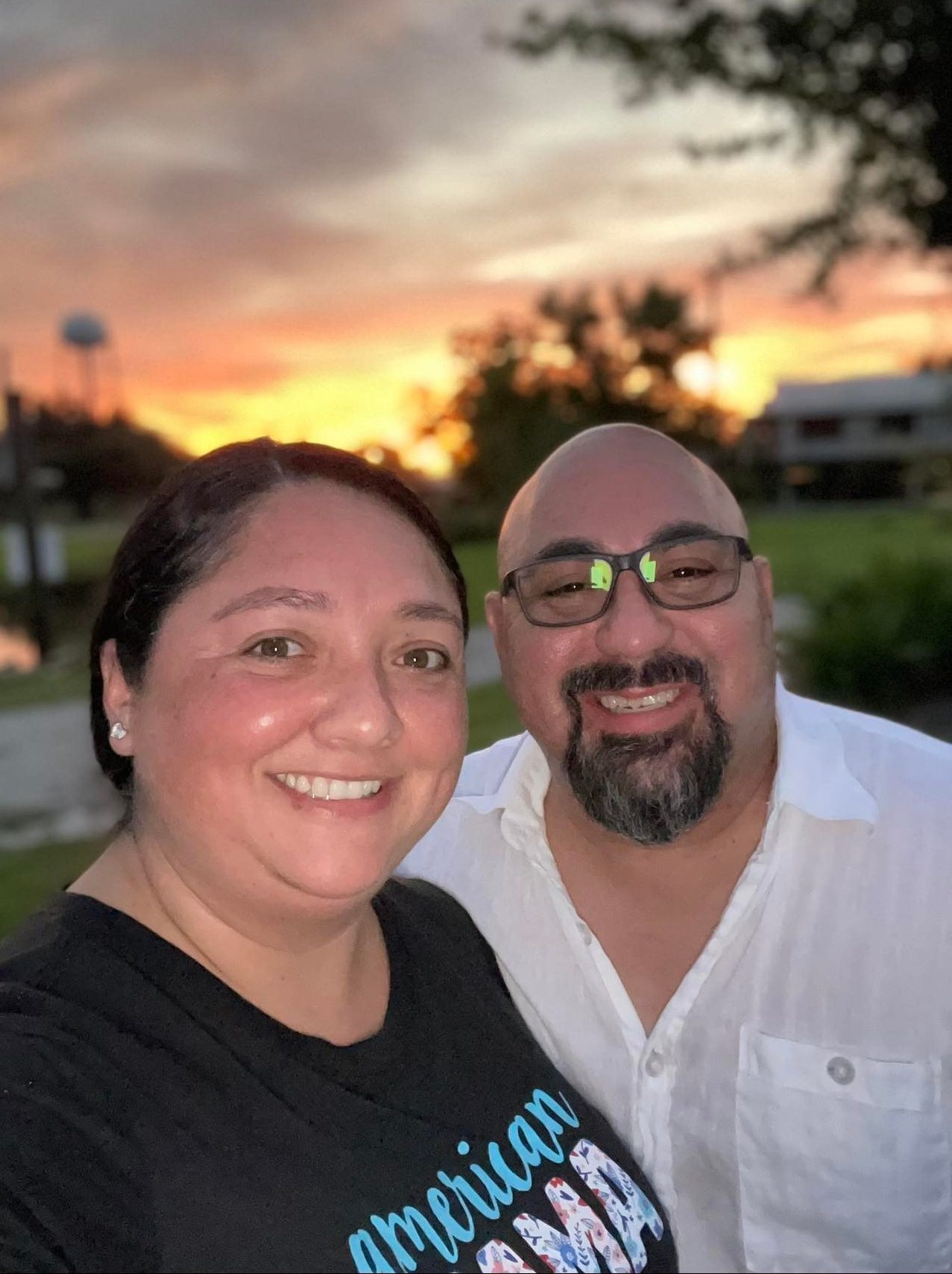
a woman and a man at sunset
Mary and Alton Verdin Courtesy of Mary and Alton Verdin

The closure of the school had started to make Alton and Mary doubt their future in Pointe-aux-Chenes. They needed to rip the floors out to fix long-term water damage, which would take thousands of dollars, and Alton wondered whether they should sell the house and find something inland in the nearby cities of Montegut or Houma. Their eldest daughter had just become a real estate agent and was looking for her first commission, so she was helping them scout out houses that might serve as suitable replacements. Both wanted to move, but they didn’t want to leave Pointe-aux-Chenes. Even as the school year began, they were stuck in a holding pattern, waiting for a sign about what they should do.

Gabrielle attended Montegut Elementary for less than two weeks before Hurricane Ida cut her school year short. The storm intensified to the threshold of Category 5 over the course of just three days as it pushed up the Gulf of Mexico, and made landfall a few miles south of Pointe-aux-Chenes with winds of around 150 miles per hour. The parish issued a mandatory evacuation order ahead of the storm, but many hardened bayou residents stayed behind and watched as the wind ripped telephone poles out of the ground and sheared the walls off double-wide trailers. The erosion of the bayou had eliminated the natural protection system that weakened storms as they made landfall, allowing Ida to retain its full strength for far longer than it would have decades earlier.

The devastation on the bayou was total. It took close to a week for the water to drain back out of the town, and when aid workers at last made it all the way down the length of the bayou road, they found that almost no structure had escaped the storm. It would take weeks for the parish to restore electricity and running water, and even longer to drag away the mountains of gnarled debris that lined the side of every road. The sole remaining grocery store sustained so much damage that its owner, Mary’s uncle, decided to shut it down for good. The final insult was that the storm had seemed to confirm the parish board’s decision to shut down Pointe-aux-Chenes Elementary. The school in Montegut had survived the storm, but the old white building on the bayou had not. The storm had twisted the structure’s metal roof like a nautilus shell and rolled it out into the street. There were shards of white wood all down the block.

Alton and Mary’s house was in better condition than many of the trailers and elevated houses around them, but it was far from livable. The roof was in tatters and water had dripped into the bedrooms and the living room. Resource-strapped FEMA wouldn’t arrive with temporary trailers for three months, and Alton’s contractor told him it would take about seven months before his house was fixed. In the meantime, Alton and his family would have to find somewhere else to stay, as would thousands of other people from Pointe-aux-Chenes and elsewhere in Terrebonne Parish.

It might sound counterintuitive, but the storm strengthened Alton and Mary’s resolve to stay on the bayou. They figured if their house had survived Ida, it could survive just about anything, and they didn’t want to abandon their ailing hometown as it began the tortuous recovery process. Unfortunately, it wasn’t up to them: There was almost no livable housing anywhere on the bayou, and certainly none that they could rent on a short-term basis. The storm had walloped the nearby city of Houma, destroying dozens of hotels and apartment complexes, which meant the closest rental they could find was all the way in Mississippi. The owner asked for $900 a month at first, but by the time Mary went to go look at the place he had jacked it up to $1,500, plus a steep deposit. She said she’d rather buy a generator and take her chances back in Pointe-aux-Chenes. 

The following summer, as the residents of Pointe-aux-Chenes struggled to make it back to the bayou, the Louisiana state legislature voted unanimously to reopen Pointe-aux-Chenes Elementary as a French-language magnet school. The tragedy of the hurricane had inspired lawmakers to override the parish board’s decision and offer the bayou community a new lease on life. Alton, Mary, and the kids returned to their battered house once the power and water came back on, and Gabrielle resumed school at Montegut Elementary, taking some of her classes in trailers.

Despite the saving grace of the school’s reopening, the recovery has been even longer and more painful than Alton feared. Instead of seven months, it has taken 15 months for the repairs on his house to begin. He and his family are now living in a camper as contractors work on fixing up the property, and even now Alton is still fighting with a supplemental adjuster over the details of the insurance payout. Hundreds of other families on the bayou and elsewhere in Louisiana are in a similar limbo: They can’t yet come back to the homes they lost, but they have nowhere else to go. Many residents are still living with family or in temporary apartments, and haven’t yet made it back to the bayou.

To make matters worse, FEMA will stop distributing temporary housing payments to the victims of Hurricane Ida next week. The agency only dispenses post-disaster aid for 18 months after a storm or fire, and after that it shifts its resources elsewhere, but the recovery in Pointe-aux-Chenes has taken much longer than 18 months, and FEMA’s withdrawal will only stretch it out further. The long process of displacement that began decades ago and has continued through an endless succession of floods is still going on, and there is no reason to think that Alton and Mary have seen the end of it. Even once the school reopens, it will take a long time before Pointe-aux-Chenes gets back to the way it was, if it ever does.

Nevertheless, the Verdins are hunkering down, trying to hold on a little longer.


From THE GREAT DISPLACEMENT: Climate Change and the Next American Migration by Jake Bittle. Copyright © 2023 by Jake Bittle. Reprinted by permission of Simon & Schuster, Inc.

This article originally appeared in Grist at https://grist.org/migration/louisiana-pointe-aux-chenes-great-displacement-book-excerpt-hurricane-managed-retreat/.

Grist is a nonprofit, independent media organization dedicated to telling stories of climate solutions and a just future. Learn more at Grist.org

What if the Dominion lawsuit is successful: Can Fox News ever be destroyed?

Fox News is not a “news” network. In reality, it is the de facto propaganda and disinformation warfare arm of the Republican Party. Fox News disseminates right-wing talking points, radicalizes its audience, tells them who to fear and who to follow, and in total conditions them emotionally, intellectually, and physically in service to “the party” and “the movement.” 

There is a straight line from Fox News to Trumpism, neofascism, and the democracy crisis here in America and around the world. Fox News is one of the most effective propaganda machines in history. Nazi Minister of Propaganda Joseph Goebbels would be in awe of it.

Fox News’ slogans and catch-phrases such as “Fair & Balanced”, “Real News. Real Honest Opinion”, and “We Report. You Decide” are Orwellian newspeak; Fox News is doing exactly the opposite. Ultimately, Fox News is not really in the news and truth business but in the entertainment and money and power and propaganda business. To that point, media and communications scholars have shown that people who watch Fox News actually know less about empirical reality and current events than do those people who consume no news at all. 

Now a new lawsuit by Dominion Voting Machines against Fox News for damages caused by that network’s claims related to Donald Trump’s Big Lie about the 2020 election has revealed that Fox News and its leaders and various personalities knowingly presented false information to the public. Text messages and other communications also show that Fox News has contempt for its audience as it believes they are incapable of accepting reality and the truth.

None of this should be a surprise. Like most state-controlled media, the management, hosts, and other employees of Fox News are not necessarily true believers in the party and movement’s political message. Many of them are just self-interested actors who are chasing money, fame, and other incentives and opportunities. The right-wing media machine is just a trough to feed at, as Salon’s Heather Digby Parton  explains:

Last week, America received proof beyond a reasonable doubt that Fox News is a dishonest institution that spread Donald Trump’s Big Lie knowing full well that he did not win the election. In a court filing from the defamation case brought by Dominion Voting Machines against the company, it was revealed that all of the top brass and their stars were fully aware that the election had not been stolen yet remained terrified of losing their deluded audience (which they had been instrumental in brainwashing) so they parroted Trump’s bogus claims. In this specific case, they spread the falsehood that the Dominion machines were rigged for the Republicans.

How has the mainstream news media responded to these fake revelations?

Of course, there is the liberal schadenfreude and mocking. But what good are ego-aggrandizing reactions that do little to nothing in the struggle to defeat the Republican fascists in their campaign to end American democracy? Elsewhere, the dominant narrative has generally consisted of shock and surprise about the goings on behind the scenes of Fox News.

That any serious journalists or reporters (or any other people who think publicly about news and politics) would be “surprised” or “shocked” or somehow taken aback by Fox News and its propaganda operation is 1) an indictment of such voices because it shows how dangerously naïve they truly are and 2) more evidence that so much of what constitutes the Church of the Savvy and the professional pundit class is a type of cosplay or Kabuki theater where people are playing a role that they think will make them “relatable” to the public and get them more “clicks”, “likes”, ad revenue and further their careers instead of boldly speaking truth to power about the country’s democracy crisis and other serious troubles. For its part, the network has dismissed the Dominion lawsuit and argued that “Freedom of speech and freedom of the press would be illusory if the prevailing side in a public controversy could sue the press for giving a forum to the losing side.”

What about Fox News’ audience and the broader right-wing echo chamber? Will these “revelations” pull them out of the Fox News orbit-cult and back to some semblance of political sanity and reality?

The answer is no.

Amanda Marcotte offered these details in a recent Salon essay:

And yet, no one expects a single one of these Fox “journalists” to pay for their lies. Worse, no one expects the network to lose a single viewer over it.

To most people, the idea that you “respect” someone by lying to them is nonsensical.

It’s not just that Fox News audiences don’t care if they’re lied to. Lies are what they crave. They tune into Fox News because lies are exactly what they want to hear.

Fox News is a brand that fully captured its target audience by creating an alternative reality for them that satisfies their basic human needs, especially community and validation and a larger system of meaning. In an American society where loneliness is a public health crisis, the importance of such feelings and emotions cannot be underestimated. Fox News is more than just a “news” outlet; it functions as a proxy for a particular type of neofascist white identity politics. 


Want a daily wrap-up of all the news and commentary Salon has to offer? Subscribe to our morning newsletter, Crash Course.


On a practical level, Fox News fans will likely not be exposed to the facts about the Dominion lawsuit and what it has revealed so far. And because they have been programmed by Fox News, like other cultists, most will reject any unpleasant or disconfirming information as lies by “the liberals” and “Democrats” designed to cause trouble by attacking their trusted Fox News hosts. As an example of what psychologists describe as “the backfire effect” Fox News viewers may actually become even more loyal and trusting of the network and its personalities after being told about the Dominion lawsuit emails and other potentially troubling information.

In a 2021 conversation here at Salon with Jen Senko, the director of the documentary “The Brainwashing of My Dad”, she explained the hypnotic power that Fox News has over its viewers:

My father was seduced by the anger and the excitement. People know that something’s wrong, that the system is rigged somehow, but they don’t give much thought to how. My father was also retiring from his job, and he found the right-wing media. This gave him something to occupy his mind and thoughts.

Now, suddenly, there’s all this excitement in his life. There is some right-wing media person telling him that the government is in his personal business too much. There are very persuasive big personalities pushing my father’s buttons and those of the audience in general. And you know what? That feels good. There is an addictive quality to anger like that. It was exciting for my father. It also provided him a group to belong to.

I believe that a lot of white men feel like, “Well, what am I supposed to do? And who am I?” They needed help in figuring themselves out, and the right-wing media and that world provided it. Too many such men developed a victim mentality, telling themselves, “I’m a victim, I’m mad, I’ve always wanted to fight back.”

On Twitter, a lot people will say to me, usually Democrats or liberals, “Oh, these people, they were always like that. They’re just finding a port to park their boat in now.” I do not believe that is necessarily true.

My dad hadn’t been racist. He hadn’t been anti-“illegal immigrant.” After listening to Rush Limbaugh and Fox News, he got brainwashed. When I made the documentary, I did not know if I believed in brainwashing. Now I know that brainwashing does exist, it is real.

There’s the brainwashing that happens through force, what we were all familiar with from movies. But what Fox News and the larger right-wing are doing is brainwashing by stealth. I believe this to be more insidious. There’s only one type of information going into the brain. There’s isolation. There is repetition. That is how they brainwash their public.

I feel like there has been a massive brainwashing campaign, something unlike anything we’ve ever seen before in this country. That’s what’s happened in America through Fox News and the right-wing media and movement.

In a particularly sharp and brave new essay, Thom Hartmann argues that Fox News may actually be guilty of sedition given that their owners, hosts, and other key personnel knew that their claims about the Big Lie and “election fraud” were in fact lies – lies that directly inspired the attack on the Capitol by Trump’s followers as part of the former traitor president’s coup attempt on Jan. 6:

There’s a thin but entirely appropriate line between hateful, lying, racist, or bigoted free speech — which a free and democratic society protects — and direct incitement to violence.

Which raises the question: when people tell lies that lead straight to the death of other people — or to another serious crime like sedition committed while trying to overthrow an election and thus our nation’s government — should they face criminal liability?

Fox “News” hosts, just like Alex Jones, lied hundreds of times on the air, echoing Donald Trump’s claim that Democrats had stolen the 2020 election from him. They knew they were lying, according to reporting from The Washington Post based on internal communications released by Dominion Voting Systems’ attorneys, and Dominion asserts those intentional lies — which they allege were done simply to make money for the network — measurably harmed the company’s reputation and business.

Like Jones, Fox and its parent company News Corp, are being held to account in civil court.

But was what Fox did merit criminal prosecution? And, if so, what about the hundreds of other Republican politicians, media figures, and news sites who went along with and echoed Trump’s lies, knowing full well they were not true?

What if the Dominion lawsuit is successful and Fox News is destroyed?

In that perfect world where Fox News ceased to exist, its viewers and the larger neofascist and antidemocracy movement would shamble on like one of the undead.

The Fox News audience is worth many billions of dollars. So, of course, another version of Fox News would soon rise to take control over that already captured and propagandized public and feed them the excitement, comfort, lies, hate, rage, and other negative and pathological emotions that its predecessor did for decades.

So, no. Fox News — as represented by the larger right-wing disinformation hate echo chamber — is not going away any time soon. It is a fixture of American life and society because the deep rot and other cultural and institutional poison that birthed today’s version of the Republican Party and “conservative” movement have not been purged. Moreover, Fox News is increasingly viewed as passe and boring by Trumpists. Those neofascist diehards are increasingly flocking to podcasts, Youtube and other parts of the right-wing extremism radicalization machine.

When Fox News is viewed as too “friendly” to “the Democrats” and “the liberals” (meaning insufficiently loyal to Trump, his successors and the larger white right and anti-democracy movement) that is a sign of how severe America’s political and larger cultural crisis really is.

The Southern Baptist Convention ousting female pastors shows the Christian right’s radicalization

Yes, this is the 21st century: On Tuesday, the Southern Baptist Convention (SBC) decided to throw out one of its biggest, most popular churches because they let women be pastors.

No one should mistake Saddleback Church, founded by fame-chasing minister Rick Warren, for a liberal church. While less overtly homophobic than other evangelical ministers, Warren has nonetheless loudly opposed same-sex marriage. He pals around with the founder of Hobby Lobby, who successfully sued to block his employees from using their own insurance benefits to pay for contraception. And he believes in forced childbirth.

But in one small way, Warren’s church has acknowledged the ways the world has changed since the advent of electricity: They now have female pastors.

Back in 2021, Saddleback ordained three women as pastors, a move the church’s Facebook page celebrated at the time as “historic.” Then when Warren retired that year, he handed the reins of power over to pastor Andy Wood — along with his wife and fellow pastor, Stacie Wood. Even though Stacie Wood was supposedly only a “teaching” pastor, her prominent role in church leadership infuriated the leadership of the SBC enough. On Tuesday, Saddleback, along with four other churches, was kicked out of the convention for daring to have female ministers. 


Want more Amanda Marcotte on politics? Subscribe to her newsletter Standing Room Only.


In one sense, the move is a shocking one. American Christianity has been on the decline for decades. In 1976, four out of five Americans identified as a white Christian, but now that group is a minority at 43% of the population. This is largely due to young people leaving the church when they reach adulthood and never coming back. Saddleback, however, was a shining star of American evangelicalism, with over half a million YouTube followers and a weekly church attendance at its California home base of over 20,000 people. Warren’s book, “The Purpose-Driven Life,” has sold over 50 million copies since its 2002 publication. In theory, Saddleback should be the kind of church that the larger evangelical movement should look to as a model for how to grow and thrive. Instead, the SBC decided to kick them out of their little Jesus club, choosing sexism over popularity. 

The SBC decided to kick Saddleback out of their little Jesus club, choosing sexism over popularity. 

The SBC’s move isn’t happening in a vaccum. It’s part of a larger right-wing backlash to feminism that has only been growing more intense since Republicans christened Donald “Grab ‘Em By The Pussy” Trump as their misogynist overlord. While most of the country grows more accepting of women’s equality, the religious right has only grown more radical in its attempts to destroy women’s rights and send women back to the kitchen. The overturn of Roe v. Wade was just the tip of the emerging misogyny iceberg. 

The SBC banned female pastors in the year 2000, as part of a larger anti-feminist backlash that also resulted in the organization endorsing the idea that women should “submit” to their husbands. Prior to then, as ordained minister and women’s studies scholar Susan Shaw wrote in 2021, there had been a growing movement within the denomination to place more women into pastoral roles. Hundreds of women had been ordained from the 70s through the 90s.

The debate stayed quiet for the better part of two decades, but in recent years, there have been more frustrations with this utterly backward policy. In 2021, popular Christian author Beth Moore publicly abandoned the SBC over “attitudes among some key Christian leaders that smacked of misogyny, objectification and astonishing disesteem of women.” Things got worse after a damning 2022 report showing how the male-dominated SBC allowed sexual abuse to thrive and protected accused rapists. In the midst of all this, Saddleback’s actions were clearly taken as a major challenge to the SBC’s culture of sexism. 

Well, the sexists aren’t giving up that easily.

In 2021, the president of the Southern Baptist Theological Seminary, Albert Mohler, wrote a screed decrying “the feminization of liberal Protestantism” and acceptance of LGBTQ rights. He blamed the nation’s declining church attendance on “social justice activism” and “liberal theology.” As Kathryn Joyce wrote in Salon in June, the internal discourse of the SBC has “revolved around the charge that the SBC has become too liberal and is at risk of being overrun by ‘wokeism’ and critical race theory (CRT).” In reality, as Robert Jones of the Public Religion Research Institute (PRRI) explained to Salon in 2017, attitudes like Mohler’s are what are running young people off.


Want more Amanda Marcotte on politics? Subscribe to her newsletter Standing Room Only.


“It’s not just that conservative white Christians have lost this argument with a broader liberal culture,” Jones explained. “It’s that they’ve lost it with their own kids and grandchildren.” But rather than adapt and grow with the times, the Christian right is kicking even more people out. They would rather see their numbers dwindle further than accept the equality of women or LGBTQ people. 

The religious right’s reaction to their declining popularity is to double down on the repressive and hateful attitudes that led people to reject them in the first place.

The full scale of this misogynist tantrum is also evident in a legal case that may make its way to the Supreme Court involving a taxpayer-funded charter school in North Carolina that has banned female students from wearing pants. The students are suing, rightfully pointing out that such a dress code violates Title IX, which bars gender discrimination in government-funded education. The school argues, however, that the skirts-only rule is important to “preserve chivalry” because a woman is “a fragile vessel that men are supposed to take care of and honor.”

There’s a lot going on with that case, including serious questions of whether the government should be funding schools that are imposing religious values in a fairly obvious violation of the First Amendment. Unfortunately, there’s good reason to worry that the current iteration of the Supreme Court, which defines “religious freedom” as the right of conservative Christians to force their faith on others, will not only take up the case but rule in the school’s favor. 

Setting the legal questions aside, the blatant sexism on display is astounding, even for a conservative Christian school. Calling women “fragile vessels” and forcing dress codes that were outdated even in the 1960s is yet another sign that the religious right’s reaction to their declining popularity is to double down on the repressive and hateful attitudes that led people to reject them in the first place. There’s more than a whiff of delusion to this language about “fragile vessels” in an era where female athletes like Serena Williams are international superstars, some of the most powerful countries in the world have female leaders, and women outnumber men in the college-educated labor force. That women are full human beings and not mere “vessels” for male purposes simply isn’t a debatable proposition. It’s an objective fact. 

But we live in an era where denying reality is just a way of life for conservatives. So Republicans are throwing a nationwide tantrum, trying to claw back decades of progress for women. On one hand, they’re having distressing successes, most notably when it comes to banning abortion. On the other hand, the more they try to crack down on women, the more unpopular they get. Americans have grown accustomed to women in the workforce and leadership roles, and our economic systems and other institutions have grown dependent on women’s labor. You can pass all the mandatory skirt rules you want, but putting the feminist genie back in the bottle won’t be so easy. 

Idaho lawmakers want to criminalize mRNA vaccines. Here’s what happens if their bill passes

Political polarization in the United States has created bitter divides over all kinds of public health measures — ranging from abortion rights to COVID-19 protections. Yet in Idaho, a deep-red state in which Donald Trump carried 63.8% of the popular vote in the 2020 election, Republican legislators are taking their conspiratorial beliefs regarding COVID-19 a step further by attempting to criminalize mRNA vaccines. 

Indeed, last week two Republican lawmakers in Idaho introduced House Bill 154 proposing that “providing” or “administering” mRNA vaccines should be criminalized. Specifically, doing so would be a misdemeanor.

“I think conservatives were very opposed to lockdowns and mask mandates, which were not shown to be very effective in curbing the spread of COVID-19; that opposition seems to have led to a distrust of the mRNA vaccines.” 

“Notwithstanding any other provision of law, a person may not provide or administer a vaccine developed using messenger ribonucleic acid technology for use in an individual or any other mammal in this state,” the bill states. “A person who violates this section is guilty of a misdemeanor.” In other words, doing so could result in jail time and/or a fine.

If passed, the bill proposes that the law should go into effect this summer on July 1, 2023.

As the COVID-19 pandemic enters a new phase, the proposed legislation is a reminder that some GOP lawmakers aren’t done fear-mongering over COVID-19 vaccines just yet. “We have issues that this was fast tracked,” Idaho state Sen. Tammy Nichols stated, though the notion that the vaccine was “rushed” has been consistently pointed out as a myth by experts. “There’s no liability, there’s no access to data,” Nichols added, which is also false

As Salon has previously reported, mRNA vaccines changed the course of the pandemic; the technology, which was novel at the time, allowed for an effective vaccine to be developed in record time. Yet what the scientific community saw as a historic moment for biotechnology turned into a polarizing debate among American lawmakers who fell for conspiracy theories and misinformation surrounding the vaccines — marking a pivotal turning point for the anti-vaccine movement, one in which some legislators can now act upon their scientifically unsupported beliefs.

“The mRNA vaccines are powerful and have saved millions of lives since the roll out,” Dr. Monica Gandhi, infectious disease doctor and professor of medicine at the University of California, San Francisco, told Salon. “I think conservatives were very opposed to lockdowns and mask mandates, which were not shown to be very effective in curbing the spread of COVID-19; that opposition seems to have led to a distrust of the mRNA vaccines, but I think we should have nuance in our response and understand that vaccination is the key to combating any pandemic.”

mRNA, or messenger RNA, refers to a single-stranded RNA molecule that provides instructions on protein production. Due to its structure, these molecules are short-lived — meaning that once mRNA is injected in a patients’ body, it disappears quickly after it enters a cell and instructs the cell to produce a copy of a protein, which in the case of the COVID vaccine is called Spike.This is how mRNA vaccines work: by providing cells with a blueprint for a part of a virus, which in return gives the cells an opportunity to respond to the virus posing a threat.

Prior to the development of mRNA vaccines, all vaccines contained either a dead or weakened version of a pathogen, which the immune system would then learn to recognize. Yet mRNA vaccines contain a “blueprint” for how to make a piece of the virus in question, enough for the immune system to recognize and identify it once it does infect.

It’s true that mRNA vaccines are a relatively new technology, but they have been in development for decades and are likely to be the vaccine of the future. In part, that’s because mRNA vaccines are easier to produce within a shorter period of time, and easier to modify in the future if necessary. As the Association of American Medical Colleges (AAMC) wrote in March, mRNA vaccine technology has the potential to treat diseases like malaria and cystic fibrosis, tuberculosis and hepatitis B. The mRNA vaccines have been successful in protecting the vaccinated against COVID-19. Despite breakthrough cases, they significantly reduced the likelihood of dying or being hospitalized from COVID-19.

“Banning mRNA vaccines will have a negative impact on public health,” Gandhi said. “The most important predictor of life expectancy loss in a large analysis performed in late 2022 across most European countries, the United States, and Chile seems to be lower vaccination uptake, especially in individuals over sixty years old.”


Want more health and science stories in your inbox? Subscribe to Salon’s weekly newsletter The Vulgar Scientist.


Idaho isn’t the only state to propose unscientific anti-vaccination legislation. By October 2022, nearly 80 anti-vaccine legislations had been introduced to state lawmakers. Under Republican Governor Ron DeSantis, Florida was the only state to not not pre-order COVID-19 vaccines for kids under 5 over the summer. Currently, in North Dakota, state legislators are considering various anti-vaccination bills, including one that would ban colleges and universities from requiring or promoting COVID-19 shots.

Academics studying the change say the anti-vaccination movement isn’t new, but over the past decade there’s been a resurgence of anti-vaccination rhetoric in politics. “Historically, anti-vaccine rhetoric has had minimal policy impact because bipartisan political leadership strongly endorsed the safety and effectiveness of vaccines,” researchers wrote in The Lancet in 2021. “However, in recent years, anti-vaccine activism has received support from some state-level Republican officials during legislative debates over bills to improve vaccine uptake.”

Seema Mohapatra, a professor of law at SMU Dedman School of Law, told Salon that the basis of the bill proposed in Idaho is similar to the lawsuit filed last November alleging that the longstanding approval of mifepristone (a medication abortion drug) should be revoked because it was allegedly based on incomplete data. Such legislative proposals question the Food and Drug Administration’s (FDA) authority to regulate medicines in states.

The proposed legislation in Idaho is also similar to the way in which anti-abortion legislators are approaching abortion bans, by criminalizing the provider.

“It’s ostensibly based on safety concerns very similar to abortion, where both mifepristone and misoprostol are extremely safe,” Mohapatra said. “In my opinion, it is contrary to federal law, the FDA’s argument would be stronger.”

Mohapatra added: “Federal courts have been staffed by ideological judges, so I couldn’t predict the eventual lawsuit would go.”

Mohapatra said this proposed legislation speaks to a “dangerous” place to be in terms of health science law.

“We are in a place where science is not seen as objective, it is seen as an opinion,” Mohapatra said, adding regardless of what happens, every time a legislation like this is proposed it gives anti-vaxxers more credibility. “Just the fact that this is proposed gives a platform for anti-science.”

“Trump water” doled out in East Palestine, Ohio by the man himself

Donald Trump made a visit to East Palestine, Ohio on Wednesday in an effort to console members of the community effected by the toxic train derailment that took place there earlier this month.

During his scheduled stop-over, Trump and his team doled out bottles of “Trump Water,” and also “a much lesser quality water” that did not include his own name on the label.

“You want to get those Trump bottles,” the former president joked, receiving polite snickers from those in attendance who have had to deal with testing hazardous water from the taps in their own homes which is described as having a “super glue/pool/fruity-like odor” since the derailment, according to coverage by The New York Times. 

Beating President Biden to the scene, Trump was asked by reporters to deliver a message to him and offered a glib “Get over here,” per The Independent.

“You are not forgotten,” Trump furthered during a brief speech. “In too many cases, your goodness and perseverance were met with indifference and betrayal.”

Remarking on Biden’s recent surprise visit to Kyiv, Trump went on to say “You have a President going to Ukraine and you have people in Ohio that are in desperate need of help.”


Want a daily wrap-up of all the news and commentary Salon has to offer? Subscribe to our morning newsletter, Crash Course.


The February 3 derailment that has left East Palestine in such dire straights involved five cars containing vinyl chloride, a colorless gas linked to various cancers; the effects of which are being compared to the 1986 Chernobyl nuclear disaster, per Salon staff writer Troy Farah.

On February 8, state officials gave the “all-clear” for previously evacuated residents to return home, but they were cautioned against drinking well-water.

“This is why people don’t trust government,” environmental activist Erin Brockovich tweeted on Feb. 13. “You cannot tell people that there has been and continues to be hazardous pollutants contaminating the environment while at the same time saying ‘all is well.’ People aren’t stupid.”

As of February 19, state officials have declared that water from the municipal system is safe to drink “though the state EPA has encouraged those who use private wells to get that water tested, since they may be closer to the surface,” according to updates from CNN.

Civil rights activist Angela Davis learns surprising genealogy on “Finding Your Roots”

On Tuesday’s episode of “Finding Your Roots,” civil rights activist Angela Davis learned a series of surprising facts about her ancestral history, but one revelation left her outright shocked.

Born in Birmingham, Alabama, Davis grew up not knowing her maternal grandparents since her mother had grown up in a foster home, so she was eager to see if host Henry Louis Gates Jr. could solve that life-long mystery for her. But after digging into her family tree, and then digging even further, he presented Davis with answers to questions that she would have never even thought to ask.

“You are descended from one of the 101 people who sailed on the Mayflower,” Gates said, presenting Davis with a manifest including the name of her 10th great-grandfather.

“No, I can’t believe this,” Davis said. “My ancestors did not come here on the Mayflower . . . That’s a little too much to deal with right now.”


Want a daily wrap-up of all the news and commentary Salon has to offer? Subscribe to our morning newsletter, Crash Course.


William Brewster, a decedent from Davis’ father’s side, was born in England roughly around 1570, according to research conducted by Gates, and was one of the first settlers in America — a fact that was difficult for Davis to wrap her mind around.

While Davis came away from her appearance on the show knowing way more about her paternal side, her maternal side remains a bit of a mystery.

No information was found on her mother’s mother, but Gates was able to uncover the name of her maternal grandfather, a white Alabama lawyer named John Austin Darden. 

“He has my mother’s lips,” Davis said, looking at a photo of her grandfather for the first time. “It’s so funny, I can see her in him.”

Ben Platt calls out neo-Nazi protesters “spreading antisemitic rhetoric” at Broadway preview

Ben Platt and the producers of the Broadway revival of the 1998 musical “Parade” condemned antisemitic protests that took place outside the musical’s first preview performance at the Bernard B. Jacobs Theatre in New York City.

“Parade” follows the true story of Leo Frank, a Jewish factory manager who was convicted of raping and murdering a 13-year-old employee named Mary Phagan in 1913. Today, the consensus is that he was wrongly convicted, but at the time, amid rising antisemitic tensions across Georgia, Frank was kidnapped from prison in 1915 and lynched in Phagan’s hometown. The public act of violence was spurred by Georgia governor commuting Frank’s death sentence to life in prison. Frank’s highly publicized case continues to be of public interest today, after the Fulton County District Attorney in Georgia reopened the investigation in 2019 to prove his innocence.

Patrons attending Tuesday night’s preview performance were caught in the middle of a protest led by members of the neo-Nazi group the National Socialist Movement. Several sign-wielding protesters outside of the theater were heard calling Frank a “pedophile,” per a social media video shared by The Forward engagement editor Jake Wasserman.

In an Instagram video posted Tuesday, Platt — who stars in the lead role as Frank —  denounced the neo-Nazi protesters “from a really disgusting group” who were “spreading antisemitic rhetoric”:

“For those who don’t know, there were a few neo-Nazi protesters from a really disgusting group outside of the theater, bothering some of our patrons on their way in and saying antisemitic things about Leo Frank, who the show is about, and just spreading antisemitic rhetoric that led to this whole story in the first place,” the Tony Award-winning actor said.

https://www.instagram.com/p/Co86gkHMlqM/?hl=en

He continued, “If you don’t know about it, I encourage you to look up the story and most importantly encourage you to come see the show, and it was definitely very ugly and scary but a wonderful reminder of why we’re telling this particular story and how special and powerful art and, particularly, theater can be. And just made me feel extra, extra grateful to be the one who gets to tell this particular story and to carry on this legacy of Leo.

“I just think that now is really the moment for this particular piece,” Platt concluded. “And I felt that I just wanted the button on the evening, at least for me personally, to be to celebrate what a beautiful experience it is and what gorgeous work all my wonderful colleagues did tonight, not the really ugly actions of a few people who are spreading evil.”


Want a daily wrap-up of all the news and commentary Salon has to offer? Subscribe to our morning newsletter, Crash Course.


The musical’s producers also released a statement on Wednesday, per The Hollywood Reporter, saying, “If there is any remaining doubt out there about the urgency of telling this story in this moment in history, the vileness on display last night should put it to rest. We stand by the valiant Broadway cast that brings this vital story to life each night.”

“Parade” premiered on Broadway in December 1998 and also features a book by Alfred Uhry — the Tony, Pulitzer Prize and Academy Award-winning playwright and screenwriter. The musical returned to Broadway Tuesday night following a sold-out run last fall at New York City Center. It is slated to officially open March 16 at the Bernard B. Jacobs Theatre.

California oil industry uses high gasoline prices to roll back climate agenda, critics allege

Over the last few years, as California has introduced stronger regulations on oil and gas drilling aimed at protecting public health, a pattern of events has started to emerge.

Here’s how it typically goes: After years of advocacy, environmentalists successfully push for new oil and gas drilling regulations. Then the industry fights back; companies pour money into an anti-regulation referendum, buying advertising and hiring canvassers to claim that they’re protecting jobs. Though they’re accused of misleading people into signing their petitions, the tactic works as regulations are suspended until voters have a final say.

That scenario — in which, for example, oil giants including Aera and Chevron spent $7 million to gather signatures and sway Ventura County voters, who elected to toss out local restrictions on oil drilling projects in 2022 — is now being repeated, but on a much bigger scale.

This time, the industry is taking aim at California’s setbacks law, SB 1137, which bans new and reworked wells within 3,200 feet of homes, schools and hospitals and was signed with much fanfare by Gov. Gavin Newsom in September 2022. On Feb. 3, California Secretary of State Shirley Weber certified that referendum after canvassers collected 978,610 signatures. The state agency that oversees oil and gas drilling has since suspended the law pending the vote on the referendum on Nov. 5, 2024.

“It’s like I’m having PTSD seeing the same playbook they did on a smaller level, now on a larger level,” said Tomás Rebecchi, Central Coast organizing manager for Food and Water Watch, who organized for years to pass the doomed setbacks ordinance in Ventura County.

Now the industry is planning the same for the whole state. A PAC organized by the California Independent Petroleum Organization (CIPA) spent over $20 million on signature gathering, with some of the biggest donors rushing to put new wells in the prohibited zone last year. Most of the funds were sent to PCI Consultants, the same firm contracted by the fast food industry to overturn state legislation meant to improve fast food workers’ wages and working conditions.

As was the case in Ventura County, canvassers were accused of using misleading or false information to persuade some people to sign petitions. Two job postings, uncovered by climate advocates, declared that petition circulators would be asking for signatures in order to stop high gasoline prices — a falsehood. Shortly before the referendum qualified for a statewide vote in November 2024, CIPA’s PAC released an ad blaming expensive gasoline on low in-state oil production.

Rebecchi hopes the results in Ventura County aren’t an omen for the state, where industries have the power to overturn popular regulations through the sheer force of their influence and money.

“The governor needs to double down and own it and fight back,” he said.

In the two years between the signature gathering for the Ventura County and statewide referenda, Newsom has seized on fossil fuel regulations as one front in a larger battle, embracing sharp rhetoric against producers as part of his climate agenda. This fight has hinged on high gasoline prices throughout 2022 as a main political sticking point.

“Wasn’t enough for greedy oil companies to inflate gas prices. Now they want to drill near daycares & schools,” his personal account tweeted on the day the state certified the referendum. “They would rather risk your health than sacrifice a single cent. Disgusting.”

Newsom came out as a strong supporter of the setbacks law after advocates spent years lobbying lawmakers and agencies for it based on the health risks of living near oil and gas drilling operations. (At one time, these harms were still the subject of debate among officials, thanks to industry talking points; now they’re taken as a given.)

The fight over the setbacks law also comes amid major changes in global energy trends. Last year saw a record rise in oil industry profits tied to supply disruptions stemming from Russia’s ongoing war with Ukraine. Chevron, which is both a driller and refiner of oil in the state, more than doubled its profits over the previous year, raking in a stunning $35.5 billion. Chevron is now massively increasing purchases of its own stock, padding investors’ wallets even more.

But those stratospheric profits didn’t correspond to a big rise in oil production. While the company produced more barrels overall in the U.S. than the year before, its worldwide production actually fell. In California, Chevron produced 8 million fewer barrels in 2022 than 2021, reflecting a general decline across the state’s top oil regions.

In response to record high gasoline prices throughout the year — which Consumer Watchdog found to be highest in California because of intentional “price gouging” by Chevron and four other refiners — Newsom called for a special session to impose a financial penalty on companies.

So far, there are few details of what this could look like. The Legislature appears to have little appetite for Newsom’s proposal. Lawmakers contacted by Capital & Main declined to comment publicly about ongoing negotiations.

It could take the form of a profit margin cap in which companies would send excess profits to the state above a certain threshold, and could add up to billions going back to Californians, said Consumer Watchdog’s Jamie Court, whose advocacy has been critical to sparking the governor’s interest in a penalty.

The industry is “threatening not only consumers with unreasonable profits, but also they are threatening the entire climate change platform by weaponizing gas prices — they’ve used their ability to price gasoline too high in California as a way of discrediting our climate laws,” Court told Capital & Main.

A letter from last June to top state lawmakers from the Western States Petroleum Association, the top industry group in the state, shows how the industry uses high gasoline prices as a way to fight safe-distance regulations on drilling.

In the letter from Catherine Reheis-Boyd to Assembly Speaker Anthony Rendon (D-Paramount), obtained by Capital & Main via records request, the oil group pinned blame for expensive gasoline on programs and regulations meant to lower emissions, including Cap and Trade and the Low Carbon Fuel Standard, both of which are funded by a gasoline tax paid by consumers.

The letter also complained about the state’s plans to phase out fossil fuel cars by 2035, and singled out the setbacks bill, which at that point still hadn’t been passed, as a leading reason for high pump prices.

“California continues to pursue an aggressive agenda to ban all in-state production of fossil fuels, while at the same time, demand in the state continues to grow,” Reheis-Boyd wrote, also citing Newsom’s ban on issuing fracking permits.

The idea that increasing in-state production will lower gasoline prices is false, according to California Energy Commission Chair David Hochschild.

“The reality is 40% of the oil industry’s approved permits in California are still valid but have not yet been used, and the price increase is occurring at the refining stage of gas production, not the oil extraction stage,” Hochschild said in a statement last October.

WSPA wasn’t involved in the referendum to overturn the setbacks law, says Kevin Slagle, the association’s vice president of strategic communications. But it opposes the law and believes restrictions on in-state drilling will restrict Californians’ oil supplies, affecting prices.

“As these politically based policies hit the public and don’t work and they’re expensive, the public backlash against these policies is what will sink climate progress,” Slagle told Capital & Main.

Pro-drilling state legislators are running with the industry’s talking points by introducing a slate of bills in the special session to shore up fossil fuel power in California.

Sen. Shannon Grove (R-Bakersfield) introduced a bill that is a rehash of one from last year, ostensibly meant to monitor emissions from oil imported via tankers but in reality meant to bolster a pro-drilling industry talking point, as Capital & Main reported. The idea that imported oil is dirtier has also figured prominently in industry ads against the setbacks bill.

Another bill backed by oil-friendly legislators would suspend the LCFS and its associated gasoline tax for a year. While controversial, the LCFS has helped replace petroleum fuel in the state with relatively cleaner sources.

However the Legislature lands on the financial penalty bill, setbacks have become a proxy for the state’s ability to withstand industry pressure on climate policy and public health. Some environmental justice advocates are hopeful that momentum is on their side.

“What they don’t understand is that they’re betting against people power,” said Kobi Naseck, coordinator for environmental justice coalition VISIÓN, in a written statement. “They’re betting against Californians, and they’re going to lose.”

“Not gonna work”: Trump rages at juror on Truth Social as lawyers prep bid to “quash” indictments

Lawyers close to the GOP witnesses in Georgia’s Fulton County are preparing bids to shut down any possible indictments from the district attorney after the forewoman of the special grand jury investigating former President Donald Trump’s post-election efforts gave public statements to news outlets. 

Lawyers close to multiple Republican witnesses in the probe “are preparing to move to quash any possible indictments,” CBS News’ Robert Costa reported on Wednesday.

Forewoman Emily Kohrs on Tuesday revealed details about the probe to the New York Times, Associated Press, Atlanta Journal-Constitution, NBC News, and CNN. Georgia law bars special grand jurors from discussing deliberations but not other parts of the grand jury proceedings.

Trump’s legal team is now monitoring the comments, including Kohrs’ hints that the jury may have recommended indictments for over a dozen key players, according to CBS News.

“Not gonna work,” CNN legal analyst Norm Eisen said of the news.

Former federal prosecutor Renato Mariotti explained that these “efforts are likely going to fail, but this is still a distraction that will burden the Fulton County DA’s office.”

“Even if the motions fail, I expect the foreperson’s comments to be used frequently by the defense, including at trial, to allege unfairness and bias,” he predicts.

Georgia State law professor Anthony Michael Kreis rejected the idea that Kohrs may have undermined the work of the grand jury with her media appearances. 

“Pure nonsense that’s all for show,” he said, referring to Trump’s legal team. “They’re trying to make this a circus.”

National security attorney Bradley Moss also explained that “two things can be true” regarding the situation.

“The little media tour the Georgia special grand jury foreperson did yesterday was obscenely stupid, ill-advised and inappropriate,” he said, adding that it is also “highly unlikely the public remarks she made will undermine any actual indictments.”

MSNBC legal analyst Lisa Rubin detailed the entire situation in a Twitter thread, and explained that Kohrs’ public statements are not “worth freaking out about.”

“I’m not saying a future defendant won’t make a motion of some kind based on her media tour,” she added. “But given that GA special grand juries are investigative, not charging, bodies & that GA law, unlike federal law, favors public disclosure of grand jury proceedings, it’ll likely fail.”

Trump also took to Truth Social on Wednesday to attack Kohrs and the entire investigation, calling it “an illegal Kangaroo Court.”


Want a daily wrap-up of all the news and commentary Salon has to offer? Subscribe to our morning newsletter, Crash Course.


“This Georgia case is ridiculous, a strictly political continuation of the greatest Witch Hunt of all time” the online rant began. “Now you have an extremely energetic young woman, the (get this!) ‘foreperson’ of the Racist D.A.’s Special Grand Jury, going around and doing a Media Tour revealing, incredibly, the Grand Jury’s inner workings & thoughts.”

“This is not JUSTICE,” he continued. “This is an illegal Kangaroo Court. Atlanta is leading the Nation in Murder and other Violent Crimes. All I did is make TWO PERFECT PHONE CALLS!!!”

However, former federal prosecutor Joyce White Vance quickly disputed the former president’s claims, simply writing, “This isn’t true.” 

“As a prosecutor you don’t want to see the foreperson speaking publicly but nothing she’s said impacts a future indictment,” she explained. “This is a preview of Trump in the criminal justice system-exploit every small misstep. When you come at the king, you’d better not miss.”

This red chimichurri has a dirty little ‘90s secret

There’s a lot of love for the green chimichurri out there — not least of all at El Che Steakhouse & Bar, the ever-bustling, live-fire Argentinian restaurant in Chicago’s West Loop. Che’s kitchen churns out at least 30 quarts per week of this herby, vinegary condiment — spooned alongside its expertly grilled steaks and swirled into ranch dressing and aioli

But today I want to heap some affection on its lesser-known red version. Executive chef/owner John Manion created this brick-red, umami-rich condiment as a love letter of sorts to the dried herb-, oil-rich chimichurris and salsas criollos gracing the tables of churrascarias and parrilladas from Sao Paulo, Brazil to Mendoza, Argentina. 

“Calling this chimichurri is generous at best,” Manion says with a laugh. Sure, it sports a similar oil and vinegar base, flavored with piquant raw garlic, dried oregano and a little parsley. But its profile leans sweeter, smokier and more savory —  thanks to a couple forms of pepper, sharp white onion and a certain ’90s throwback ingredient that may surprise some. 

“I would challenge someone to identify it when they taste it,” Manion adds wryly. 

Traditional chimichurri has been a part of Manion’s life since he was eight years old at his first churrascaria in Sao Paulo, dragging a bite of grilled steak through this herby sauce. (His dad worked for Ford Motor Co., and the family relocated to Brazil for about five years.) 

When Manion opened his first restaurant, Nuevo Latino-inspired Mas, in Chicago in 1999, he menued a very Y2K dish called churrasco atún — aka, grilled yellowfin tuna with green chimichurri and yucca fries. A bright-green melange of parsley, garlic, white vinegar, oregano and red pepper flakes, few sazones liven up meaty fish, charred beef or game birds quite like chimichurri. The sauce followed him to his second restaurant, Brazilian-inspired La Sirena Clandestina, where it accompanied a grilled hanger steak entree. 

When he opened El Che in 2016, Manion knew green chimichurri would be a natural accompaniment to bone-in ribeyes and parrilladas piled high with charred morcilla sausage, sweetbreads and thin-cut short ribs; perhaps he’d sneak it into a few marinades and dressings. But a series of trips to Argentina before debuting the steakhouse inspired a new take on this go-to condiment. 

“It started with the more oily kind of dried herb- and spice-forward chimichurris that I had at parrilladas down there, and then it took a big-time left turn,” Manion says. Che’s chefs dragged it through Spain via blitzed piquillo peppers and smoked paprika, but it still “just felt like red pepper sauce.” They kicked around the umami of parmesan, soy and fish sauce before settling on that vintage delight: sun-dried tomatoes

To be fair, Manion’s not even a fan of sun-dried tomatoes. “I lived through the ’80s and ’90s,” he deadpans — but nothing beats them for a funky-sweet, deep umami bomb.   

“You see them in Argentina; there’s Italians there,” he says. “I’m not totally sure why it works — like a really funky tomato paste maybe — but sun-dried tomatoes made sense and tied everything together.”

Slathered on grilled quail with hot honey and spooned up alongside the green on the mixed grilled meat platter, red chimichurri is giving sun-dried tomatoes their star turn once more. 

Then again, like acid-washed jeans and crop tops, it was only a matter of time before they came back in style — even if we’re still ashamed to call them out. 

Red chimichurri 

by John Manion, chef/owner of El Che Steakhouse & Bar

Yields
2 cups
Prep Time
5 minutes, plus one hour to rest
Cook Time
0 minutes

Ingredients

1⁄4 small yellow onion

4 cloves garlic, chopped

1⁄2 cup chopped roasted red pepper

1⁄2 cup sun-dried tomatoes

1 1⁄2 Tbsp Spanish pimentón

1 Tbsp dried oregano

2 Tbsp chopped Italian flat leaf parsley

1 tsp crushed red chile flakes

1/3 cup red wine vinegar

1⁄2 tsp fish sauce

3⁄4 cup olive oil

1 tsp kosher salt

1 tsp black pepper


Directions

  1. Grate the onion with a microplane or grater.

  2. Place garlic, onion, red pepper, sun-dried tomatoes, pimentón, oregano, parsley and red chili flakes in a food processor, blending until coarsely combined, about 30 seconds. Pour it into a bowl, then stir in the vinegar and fish sauce.

  3. Stir in the olive oil and let it sit for at least 1 hour at room temperature before serving.


Cook’s Notes

You won’t find fish sauce in the restaurant version of this condiment to minimize the presence of allergens on El Che’s menu. But assuming you don’t have a problem with shellfish, don’t skip its salty umami punch here.  

Salon Food writes about stuff we think you’ll like. While our editorial team independently selected these products, Salon has affiliate partnerships, so making a purchase through our links may earn us a commission.

Against the bait and switch censorship of Roald Dahl

“Attractive” is out. “Cashier” is out. “Boys and girls” are out. These are a handful of the many changes to the published books of Roald Dahl. Announced by his publisher Puffin and first reported by The Telegraph, the hundreds of changes have impacted new editions of classic books like “Charlie and the Chocolate Factory,” “The Witches” and “Matilda.” As the AP reported, “some passages relating to weight, mental health, gender and race were altered.”

Salon’s Kelly McClure wrote, “Other big changes are being made to gender-specific character descriptions, swapping ‘female’ with ‘woman,’ or doing away with the mention of gender altogether. The Oompa Loompas, a favorite from Dahl’s ‘Charlie and the Chocolate Factory,’ will now be called ‘small people’ rather than ‘small men.'”

There are concerns around Dahl. But those concerns aren’t whether the earthworm in “James and the Giant Peach” is described as “pink.”

In other words: censorship. The censoring of Dahl comes at a time when books, literature and their writers face very real threats. In 2022, author Salman Rushdie was stabbed onstage in a near-fatal attack; the writer has since lost sight in one eye. Thousands of books about race, gender and sexuality have recently been banned around the country, with librarians, including elementary school librarians, on the front lines dealing with serious prosecution for something as simple — and necessary — as providing access to books. 

Is the censoring of Dahl meant to avoid being burned in this hot climate, or to somehow bring relevance to an antiquated author? Either way, censoring Dahl is a bad idea and actually commits the ultimate sin in children’s literature: viewing child readers as less-than. 

Dahl was the author of dozens of children’s books which have sold over 250 million copies worldwide. A former wartime pilot, he also wrote short stories, several stage and screenplays and wrote for television shows. Dahl’s first book “The Gremlins,” written for Walt Disney in 1943, was not a success. But after next publishing several story collections for adults, Dahl wrote the hit “James and the Giant Peach” for his own children in 1961. 

A movie adaption quickly followed, as it did for his next novel, “Charlie and the Chocolate Factory,” turned into the widely popular “Willy Wonka and the Chocolate Factory” film starring Gene Wilder. As a children’s book writer, Dahl was a commercial success. 

Roald Dahl's Matilda the MusicalMeesha Garbett as Hortensia in “Roald Dahl’s Matilda the Musical.” (Dan Smith/Netflix)He also had a history of antisemitism, a prejudice the writer publicly admitted to, including in an interview with the New Statesman in 1983, where he said, “There is a trait in the Jewish character that does provoke animosity, maybe it’s a kind of lack of generosity towards non-Jews . . . Even a stinker like Hitler didn’t just pick on them for no reason.”

Thirty years after his death in 1990, his family wrote a public apology for his antisemitism in, as The Guardian put it, “a statement buried deep in the author’s official website.” The statement has since been deleted. The timing seemed suspect, the apology coming mere months after Netflix announced that Taika Waititi would be making an animated “Charlie and the Chocolate Factory” series and an Oompa Loompa movie.

It feels like a bait and switch, ignoring the very real issues with the writer while labeling as bad, wrong or offensive words that have no such inherent value.

In 2021, Netflix acquired the Roald Dahl Story Company. Puffin, an imprint of Penguin Books, worked with them to produce the rewritten books. In 2022, Netflix aired a well-reviewed version of “Matilda,” titled “Matilda: The Musical,” despite some viewers’ concerns about alleged transphobia in the story.

Holly Thomas wrote on CNN about Oompa Loompas, “the live-in workforce Willy Wonka trafficked from the ‘deepest and darkest part of the African jungle’ in ‘Charlie and the Chocolate Factory’? In Dahl’s original version, published in 1964, they were Black pygmies. His 1973 rewrite, published after the 1971 movie starring Gene Wilder, recasts them as ‘little fantasy creatures.'”

There are very real concerns around Dahl. But those concerns aren’t whether the earthworm in “James and the Giant Peach” is described as “pink” (now changed to “smooth”) or the Oompa Loompas as “men” (now “people.”). As the writer David Baddiel points out on Twitter, the censorship “has no logical consistency. Here, double chin has been cut, presumably to avoid fat shaming. But what about wonky nose or crooked teeth shaming? Once you start on this path you can end up with blank pages.”

It feels like a bait and switch, ignoring the very real issues with the writer while labeling as bad, wrong or offensive words that have no such inherent value. “Fat” is one of the words that has been excised repeatedly from the new Dahl, but as fat activists have been saying for years, “we as a collective society need to make room for understanding fat the way many plus-size people do: as a neutral, even affirming, term,” Aubrey Gordon writes. 

The word by itself isn’t offensive just like the word “disabled” isn’t offensive. What is offensive is ableism, fatphobia, racism, antisemitism. Pay no attention to the man behind the curtain who actually behaved and spoke in this disturbing way; instead, change “cashier” to “top scientist,” as if working as a cashier is the distasteful thing. (Spoiler: the distasteful thing is the classism on the part of the censors.)


Want a daily wrap-up of all the news and commentary Salon has to offer? Subscribe to our morning newsletter, Crash Course.


Few people are defending the sanitizing of Dahl. PEN America has come out against it, as have prominent writers like Rushdie. One could imagine Puffin (or perhaps Netflix) arguing for the censorship as an attempt to bring Dahl to a new, modern and much broader audience; Puffin has already said that the changes were so Dahl’s books “can continue to be enjoyed by all today.” But this would imply that children can’t understand a book written in the past, that they don’t know a badger’s son would be a badger, for example, that “tiny” means “small,” and it implies that by its mere presence, a word is offensive. 

The number one rule of writing for children? Don’t talk down to them, don’t underestimate them. It’s a rule that Dahl, for all his issues, understood. But years later, his censors seem not to.


94 women allege a Utah doctor sexually assaulted them. Here’s why a judge threw out their case

ProPublica is a Pulitzer Prize-winning investigative newsroom. Sign up for The Big Story newsletter to receive stories like this one in your inbox.

At 19 years old and about to be married, Stephanie Mateer went to an OB-GYN within walking distance of her student housing near Brigham Young University in Provo, Utah.

She wanted to start using birth control, and she was looking for guidance about having sex for the first time on her 2008 wedding night.

Mateer was shocked, she said, when Dr. David Broadbent reached under her gown to grab and squeeze her breasts, started a vaginal exam without warning, then followed it with an extremely painful examination of her rectum.

She felt disgusted and violated, but doubt also creeped in. She told herself she must have misinterpreted his actions, or that she should have known that he would do a rectal exam. Raised as a member of The Church of Jesus Christ of Latter-day Saints, she said she was taught to defer to men in leadership.

“I viewed him as being a man in authority,” Mateer said. “He’s a doctor.”

It was years, Mateer said, before she learned that her experience was in a sharp contrast to the conduct called for in professional standards, including that doctors use only their fingertips during a breast exam and communicate clearly what they are doing in advance, to gain the consent of their patient. Eventually, she gave her experience another name: sexual assault.

Utah judges, however, have called it health care.

And that legal distinction means Utahns like Mateer who decide to sue a health care provider for alleged sexual abuse are treated more harshly by the court system than plaintiffs who say they were harmed in other settings.

The chance to go to civil court for damages is an important option for survivors, experts say. While a criminal conviction can provide a sense of justice, winning a lawsuit can help victims pay for the therapy and additional support they need to heal after trauma.

Mateer laid out her allegations in a lawsuit that she and 93 other women filed against Broadbent last year. But they quickly learned they would be treated differently than other sexual assault survivors.

Filing their case, which alleged the Utah County doctor sexually assaulted them over the span of his 47-year career, was an empowering moment, Mateer said. But a judge threw out the lawsuit without even considering the merits, determining that because their alleged assailant is a doctor, the case must be governed by medical malpractice rules rather than those that apply to cases of sexual assault.

Under Utah’s rules of medical malpractice, claims made by victims who allege a health care worker sexually assaulted them are literally worth less than lawsuits brought by someone who was assaulted in other settings — even if a jury rules in their favor, a judge is required to limit how much money they receive. And they must meet a shorter filing deadline.

“It’s just crazy that a doctor can sexually assault women and then be protected by the white coat,” Mateer said. “It’s just a really scary precedent to be calling sexual assault ‘health care.'”

Because of the judge’s ruling that leaves them with a shorter window in which to file, some of Broadbent’s accusers stand to lose their chance to sue. Others were already past that deadline but had hoped to take advantage of an exception that allows a plaintiff to sue if they can prove that the person who harmed them had covered up the wrongdoing and if they discovered they had been hurt within the previous year.

As a group, the women are appealing the ruling to the Utah Supreme Court, which has agreed to hear the case. This decision will set a precedent for future sexual assault victims in Utah.

Broadbent’s attorney, Chris Nelson, declined an interview request but wrote in an email: “We believe that the allegations against Dr. Broadbent are without merit and will present our case in court. Given that this is an active legal matter, we will not be sharing any details outside the courtroom.”

States have varying legal definitions of medical malpractice, but it’s generally described as treatment that falls short of accepted standards of care. That includes mistakes, like a surgeon leaving a piece of gauze inside a patient.

Utah is among the states with the broadest definition of medical malpractice, covering any acts “arising” out of health care. The Utah Supreme Court has ruled that a teenage boy was receiving health care when he was allowed to climb a steep, snow-dusted rock outcrop as part of wilderness therapy. When he broke his leg, he could only sue for medical malpractice, so the case faced shorter filing deadlines and lower monetary caps. Similarly, the court has ruled that a boy harmed by another child while in foster care was also bound by medical malpractice law.

Despite these state Supreme Court rulings, Utah legislators have so far not moved to narrow the wording of the malpractice act.

The lawsuit against Broadbent — and the questions it raises about the broadness of Utah’s medical malpractice laws — comes during a national reckoning with how sexual assault survivors are treated by the law. Legislators in several states have been rewriting laws to give sexual assault victims more time to sue their attackers, in response to the growing cultural understanding of the impact of trauma and the barriers to reporting. Even in Utah, those who were sexually abused as children now have no deadline to file suits against their abusers.

That isn’t true for sexual abuse in a medical setting, where cases must be filed within two years of the assault.

These higher hurdles should not exist in Utah, said state Sen. Mike McKell, a Utah County Republican who works as a personal injury attorney. He is trying to change state law to ensure that sexual assault lawsuits do not fall under Utah’s Health Care Malpractice Act, a law designed to cover negligence and poor care, not necessarily deliberate actions like an assault.

“Sexual assault, to me, is not medical care. Period,” he said. “It’s sad that we need to clarify that sexual assault is not medical care. But trying to tie sexual assault to a medical malpractice [filing deadline] — it’s just wrong.”

“Your Husband Is a Lucky Man”

Mateer had gone to Broadbent in 2008 for a premarital exam, a uniquely Utah visit often scheduled by young women who are members of The Church of Jesus Christ of Latter-day Saints.

Leaders of the faith, which is predominant in Utah, focus on chastity when speaking to young, unmarried people about sex, and public schools have typically focused on abstinence-based sex education. So for some, these visits are the first place they learn about sexual health.

Young women who get premarital exams are typically given a birth control prescription, but the appointments can also include care that’s less common for healthy women in other states — like doctors giving them vaginal dilators to stretch their tissue before their wedding night.

That’s what Mateer was expecting when she visited Broadbent’s office. The OB-GYN had been practicing for decades in his Provo clinic nestled between student housing apartments across the street from Brigham Young University, which is owned by The Church of Jesus Christ of Latter-day Saints.

So Mateer was “just totally taken aback,” she said, by the painful examination and by Broadbent snapping off his gloves after the exam and saying, “Your husband is a lucky man.”

She repeated that remark in her legal filing, along with the doctor’s advice for her: If she bled during intercourse, “just do what the Boy Scouts do and apply pressure.”

“The whole thing was like I’m some object for my husband to enjoy and let him do whatever he wants,” Mateer said. “It was just very violating and not a great way to start my sexual relationship with my new husband, with these ideas in mind.”

Mateer thought back to that visit over the years, particularly when she went to other OB-GYNs for health care. Her subsequent doctors, she said, never performed a rectal exam and always explained to her what they were doing and how it would feel, and asked for her consent.

She thought about Broadbent again in 2017, as the #MeToo movement gained momentum, and looked him up online. Mateer found reviews from other women who described Broadbent doing rough examinations without warning that left them feeling the same way she had years before.

Then in December 2021, she spoke out on “Mormon Stories,” a podcast where people who have left or have questioned their Latter-day Saint faith share their life stories. In the episode, she described the painful way he examined her, how it left her feeling traumatized and her discovery of the reviews that echoed her experience.

“He’s on University Avenue, in Provo, giving these exams to who knows how many naive Mormon 18-year-old, 19-year-old girls who are getting married. … They are naive and they don’t know what to expect,” she said on the podcast. “His name is Dr. David Broadbent.”

After the podcast aired, Mateer was flooded with messages from women who heard the episode and reached out to tell her that Broadbent had harmed them, too.

Mateer and three other women decided to sue the OB-GYN, and in the following weeks and months, 90 additional women joined the lawsuit they filed in Provo. Many of the women allege Broadbent inappropriately touched their breasts, vaginas and rectums, hurting them, without warning or explanation. Some said he used his bare hand — instead of using a speculum or gloves — during exams. One alleged that she saw he had an erection while he was touching her.

Broadbent’s actions were not medically necessary, the women allege, and were instead “performed for no other reason than his own sexual gratification.”

The lawsuit also named as defendants two hospitals where Broadbent had delivered babies and where some of the women allege they were assaulted. The suit accused hospital administrators of knowing about Broadbent’s inappropriate behavior and doing nothing about it.

After he was sued, the OB-GYN quickly lost his privileges at the hospitals where he worked. Broadbent, now 75, has also voluntarily put his medical license in Utah on hold while police investigate 29 reports of sexual assault made against him.

Prosecutors are still considering whether to criminally prosecute Broadbent. Provo police forwarded more than a dozen reports to the Utah County attorney’s office in November, which are still being reviewed by a local prosecutor.

A spokesperson for Intermountain Health, the nonprofit health system that owns Utah Valley Hospital, where some of the women in the suit were treated, did not respond to specific questions. The spokesperson emphasized in an email that Broadbent was an “independent physician” who was not employed by Utah Valley Hospital, adding that most of the alleged incidents took place at Broadbent’s medical office.

A representative for MountainStar Healthcare, another hospital chain named as a defendant, denied knowledge of any allegations of inappropriate conduct reported to its hospital and also emphasized that Broadbent worked independently, not as an employee.

“Our position since this lawsuit was filed has been that we were inappropriately named in this suit,” said Brittany Glas, the communications director for MountainStar.

Debating Whether Sexual Abuse Is Health Care

For the women who sued Broadbent, their case boiled down to a key question: Were the sexual assaults they say they experienced part of their health care? There was a lot hanging on the answer.

If their case was considered medical malpractice, they would be limited in how much money they could receive in damages for their pain and suffering. If a jury awarded them millions of dollars, a judge would be required by law to cut that down to $450,000. There’s no cap on these monetary awards for victims sexually assaulted in other settings.

They would also be required to go before a panel, which includes a doctor, a lawyer and a community member, that decides whether their claims have merit. This step, aimed at resolving disputes out of court, does not block anyone from suing afterward. But it does add cost and delay, and for sexual assault victims who’ve gone through this step, it has been another time they were required to describe their experiences and hope they were believed.

The shorter, two-year filing deadline for medical malpractice cases can also be a particular challenge for those who have been sexually abused because research shows that it’s common to delay reporting such assaults.

Nationwide, these kinds of malpractice reforms were adopted in the 1970s amid concerns — largely driven by insurance companies — that the cost of health care was rising because of frivolous lawsuits and “runaway juries” doling out multimillion-dollar payouts.

Restricting the size of malpractice awards and imposing other limits, many argued, were effective ways to balance compensating injured patients with protecting everyone’s access to health care.

State laws are generally silent on whether sexual assault lawsuits should be covered by malpractice laws, leaving courts to grapple with that question and leading to different conclusions across the country. The Tribune and ProPublica identified at least six cases in which state appellate judges sharply distinguished between assault and health care in considering whether malpractice laws should apply to sexual assault-related cases.

An appellate court in Wisconsin, for example, ruled in 1993 that a physician having an erection and groping a patient was a purposeful harm, not medical malpractice.

Florida’s law is similar to Utah’s, defining allegations “arising” out of medical care as malpractice. While an earlier ruling did treat sexual assault in a health care setting as medical malpractice, appellate rulings in the last decade have moved away from that interpretation. In 2005, an appellate court affirmed a lower-court ruling that when a dentist “stopped providing dental treatment to the victim and began sexually assaulting her, his professional services ended.”

Similarly, a federal judge in Iowa in 1995 weighed in on the meaning of “arising” out of health care: “Rape is not patient care activity,” he wrote.

But Utah’s malpractice law is so broad that judges have been interpreting it as covering any act performed by a health care provider during medical care. The law was passed in 1976 and is popular with doctors and other health care providers, who have lobbied to keep it in place — and who use it to get lawsuits dismissed.

One precedent-setting case in Utah shows the law’s power to safeguard health care providers and was an important test of how Utah defines medical malpractice. Jacob Scott sued WinGate Wilderness Therapy after the teen broke his leg in 2015 when a hiking guide from the center allowed him to climb up and down a steep outcrop in Utah’s red rock desert.

His parents are both lawyers, and after they found that Utah had a four-year deadline for filing a personal injury lawsuit, court records said, they decided to prioritize “getting Jacob better” for the first two years after the accident. But when Scott’s suit was filed, WinGate argued it was too late — based on the shorter, two-year deadline for medical malpractice claims.

Scott’s attorneys scoffed. “Interacting with nature,” his attorneys argued, “is not health care even under the broadest interpretation of … the Utah Health Care Malpractice Act.”

A judge disagreed and threw out Scott’s case. The Utah Supreme Court unanimously upheld that ruling in 2021.

“We agree with Wingate,” the justices wrote, “that it was acting as a ‘health care provider’ and providing ‘health care’ when Jacob was hiking and rock climbing.”

Last summer, the women who had sued Broadbent and the two hospitals watched online as lawyers debated whether the abuse they allegedly suffered was health care.

At the hearing, attorneys for Broadbent and the hospitals argued that the women should have pursued a medical malpractice case, which required them to first notify Broadbent and the hospitals that they wanted to sue. They also argued to Judge Robert Lunnen that the case couldn’t move forward because the women hadn’t gone before a pre-litigation panel.

Attorneys for Broadbent and the hospitals argued, one after the other, that the painful and traumatic exams the women described arose out of health care treatments.

“Accepting the allegations of the complaint as true — as we must for purposes of this proceeding — we have to assume that [Broadbent] did something that was medically unnecessary, medically inappropriate,” argued David Jordan, a lawyer for Intermountain Health.

“But it doesn’t change the fact that it’s an act performed to a patient, during the patient’s treatment,” he said. “Because that’s what the patient is doing in the doctor’s office. They’re there for treatment.”

The attorney team for the women pushed back. Terry Rooney argued that if Broadbent’s actions fell under medical malpractice laws, many women would be knocked out of the case because of the age of their claims, and those who remained would be limited in the amount of money in damages they could receive.

“That’s really what this is about,” he argued. “And so it’s troubling — quite frankly it’s shocking to me — that we’re debating heavily the question of whether sexual abuse is health care.”

The judge mulled the issue for months. Lunnen wrote in a September ruling that if the allegations were true, Broadbent’s treatment of his patients was “insensitive, disrespectful and degrading.”

But Utah law is clear, he said. Malpractice law covers any act or treatment performed by any health care provider during the patient’s medical care. The women had all been seeking health care, Lunnen wrote, and Broadbent was providing that when the alleged assaults happened.

Their lawsuit was dismissed.

“I Felt Defeated”

Brooke, another plaintiff who alleges Broadbent groped her, remembers feeling sick on the June day she watched the attorneys arguing. She asked to be identified by only her first name for this story.

She alleges Broadbent violated her in December 2008 while she was hospitalized after experiencing complications with her first pregnancy.

The nearest hospital to her rural town didn’t have a special unit to take care of premature babies, and her doctors feared she might need to deliver her son six weeks early. So Brooke had been rushed by ambulance over a mountain pass in a snowstorm to Utah Valley Hospital.

Brooke and her husband were terrified, she said, when they arrived at the Provo hospital. Broadbent happened to be the doctor on call. With Brooke’s husband and brother-in-law in the room, Broadbent examined her late that evening, she said, listening to her chest with a stethoscope.

The doctor then suddenly grabbed her breasts, she recalled — his movements causing her hospital gown to fall to expose her chest. She recounted this experience in her lawsuit, saying it was nothing like the breast exams she has had since.

“It was really traumatizing,” she said. “I was mortified. My husband and brother-in-law — we just didn’t say anything about it because it was so uncomfortable.”

Brooke voiced concerns to the nurse manager, and she was assigned a new doctor.

She gave birth to a healthy baby a little more than a month later, at the hospital near her home.

Hearing the judge’s ruling 14 years later, Brooke felt the decision revealed how Utah’s laws are broken.

“I was frustrated,” she said, “and I felt defeated. … I thought justice is not on our side with this.”

If the Utah Supreme Court rules that these alleged sexual assaults should legally be considered health care, the women will likely refile their claims as a medical malpractice lawsuit, said their attorney, Adam Sorensen. But it would be a challenge to keep all 94 women in the case, he said, due to the shorter filing window. Only two women in the lawsuit allege that they were harmed within the last two years.

The legal team for the women would have to convince a judge that their claims should still be allowed because they only recently discovered they were harmed. But based on previous rulings, Sorensen believes the women will have a better chance to win that argument if the civil suit remained a sexual assault case.

Regardless of what happens in their legal case, the decision by Brooke and the other women to come forward could help change state law for victims who come after them.

Last week, McKell, the state senator, introduced legislation to clarify that civil lawsuits alleging sexual assault by a health care worker do not fall under Utah’s Health Care Malpractice Act.

“I don’t think it’s a close call. Sexual assault is not medical care,” he said. “I know we’ve got some bizarre rulings that have come down through our courts in Utah.”

Both an association of Utah trial lawyers and the Utah Medical Association, which lobbies on behalf of the state’s physicians, support this reform.

“We support the fact that sexual assault should not be part of health care medical malpractice,” said Michelle McOmber, the CEO for the Utah Medical Association. “Sexual assault should be sexual assault, regardless of where it happens or who’s doing it. Sexual assault should be in that category, which is separate from actual health care. Because it’s not health care.”

MountainStar doesn’t have a position on the bill, Glas said. “If the laws were to change via new legislation and/or interpretation by the courts, we would abide by and comply with those new laws.”

But lawmakers are running out of time. With only a week and a half left in Utah’s legislative session, state senate and house leaders have so far prioritized passing new laws banning gender-affirming health care for transgender youths and creating a controversial school voucher program that will provide taxpayer funds for students to attend private school.

Utah lawmakers were also expected to consider a dramatic change for other sexual assault victims: a bill that would remove filing deadlines for civil lawsuits brought by people abused as adults. But that bill stalled before it could even be debated.

Brooke had been eager to share her story, she said, in hopes it would help the first four women who’d come forward bolster their lawsuit against Broadbent. She later joined the case as a plaintiff. She read in their lawsuit about one woman who complained about him to the same hospital seven years before she did, and about another woman who said Broadbent similarly molested her two days after Brooke had expressed her own concern.

“That bothered me so much,” she said. “It didn’t have to happen to all these women.”

Brooke doubts she’ll get vindication in a courtroom. Justice for her, she suspects, won’t come in the form of a legal ruling or a settlement against the doctor she says hurt her years ago.

Instead, she said, “maybe justice looks like changing the laws for future women.”

From “New Girl” to “Not Dead Yet,” Hannah Simone loves being the bestie – on TV and in real life

Just like you, Hannah Simone has been rewatching “New Girl” too.

After playing Zooey Deschanel’s ride-or-die for seven seasons on the beloved, briefly “adorkable” comedy, she’s lately been revisiting the series on the podcast she hosts with her series costars Deschanel and Lamorne Morris. But while rewatching “New Girl” has deepened her appreciation of the show, Simone does have a few concerns for the fans who binge it. “Now people are watching it in a weekend,” she says. “I’m like, are you OK? That’s a lot of TV. We did a lot of episodes.”

But now, after a primetime hiatus of a few years, Simone is hoping viewers will keep her around “for a very, very, very, very long time” again for her new ABC comedy. Starring Gina Rodriguez as an obituary writer haunted by her recently departed subjects, “Not Dead Yet” features Simone once again in the role of best friend — but this time with a lot more baggage. 

Simone joined me on “Salon Talks” to discuss what made her return to television, female friendship, Hollywood representation and why she describes herself as an “indoor cat.” 

The following conversation has been lightly edited for clarity and length.

“Not Dead Yet” is a workplace comedy with a twist. What drew you to this show?

I read the pilot, and it had so many of the things that I look for and I really love. It had so much heart; it was really honest about what it’s like to be a mess and hold it all together and have work-life balance. It just let all the characters fall apart a little bit, and there was so much truth in it, which was really wonderful. It made me laugh out loud when I read it, but it also got me very emotional, which surprised me. That was one thing that really drew me to it.

Then the other was Gina Rodriguez. Jake Johnson, who I worked with on “New Girl,” had just done a project with her. I know that if you’re lucky enough, you can be on a show and be around those people for a very, very, very, very long time, so you want to make sure that they’re wonderful people off-screen too, because you hang out a lot. You become family.

I texted him and was like, “Tell me the truth about Gina.” He texted me back and said, “Run to work with her. She’s the best and she’s just the most incredible, kind, funny, talented, wonderful person off camera and obviously on camera.” That just sealed the deal for me, and its strong female friendships, its honest female friendships, which was one of the things I love so much about “New Girl.” It has that same feel in this show. There were so many things I really couldn’t say no.

This is a show about a friendship that has really changed, and the ways that we grow apart from each other and come back together when the dynamics are different. What did you draw on in your own life, looking at friendships and the ways you come in and out of love with people?

That was what was super interesting to me about how honestly they kind of wrote that awkward dynamic initially. My character and Gina’s character, Sam and Nell, they were best friends like that wonderful, codependent best friendship you have when you’re young, where that person is your whole world. They were personally and professionally on the same track.

Then Gina‘s character leaves, she goes and chases a man, and she falls in love. You see this in the series that my character shared that she was hurt and felt abandoned and that she didn’t have anyone. Then she finds a new friendship in Lexi, played by the incredible Lauren Ash, who was kind of Nell’s archnemesis. Nell comes back into the picture and just assumes that I’m going to ditch this friend and buddy up with her. 

“It’s great escapism television with a heart.”

But when you grow up, that’s not what happens. You don’t just throw people away. Nell has to grow up a little bit, and my character has to be honest about the fact that it hurt her to have her friend just leave. They have to repair and evolve, and then they have to understand this new friendship dynamic, which means they have to mature. I think that’s so relatable when you watch the show. We talked about it a lot on set, about having those moments where you had to be a big girl and learn how to be around people that maybe you don’t like, but the person you love loves, and work through it.

There’s so many interesting themes in this show. I know it’s called “Not Dead Yet,” and we have these great guest stars that play these ghosts, and there’s that whole aspect of it. But the heart of this show, I’ve said this from the beginning, is the love story between Nell and Sam, these two women who love each other, but things have changed and now they have to love the new versions of each other.

You’ve been in shows that are called “New Girl” and then “Not Dead Yet,” which feel very much about phases in life, or phases for women in Hollywood. You’re in your  40s; your co-stars are over 35. Is this a different moment in entertainment, where where we’re seeing more women over 30, over 35, even over 40, taking on these leading roles?

This is where representation matters. I have been so lucky to be on female-led shows with female creators who want to tell their stories. When Elizabeth Meriwether did “New Girl,” that was about that chapter in her life at that age, and she got to write what she knew. Thankfully she was given that opportunity as a woman to lead the show, and she hired women to help tell that story. The same thing, David [Windsor] and Casey [Johnson] created this show, and Casey is this incredible, strong, beautiful woman who tries to have this work-life balance in her real life and she got to infuse that in the show.

That’s why in all aspects, whether it’s gender or age or race or how you identify, it matters who gets to be the showrunners and tell the stories because then it gives actors who look different the opportunity to then play those roles. Slowly it’s changing, slowly but surely.

Over the past couple of years, there were a couple of times when you were almost back in primetime. This show is about resilience and about coming back from disappointments and near misses and things that didn’t work out. What have you brought from those experiences to this role and to this show?

What I’ve learned to really trust about this industry is that you don’t want a role or a show that you’re not right for, or the show isn’t quite right yet. You don’t want that. Those things kind of go away. If I’m up for a part and it goes to someone else, I don’t ever take that personally. That person obviously is a better fit.

When I think about “New Girl,” I actually tested for a pilot the year before for a different show, before I had learned that lesson of what’s meant for me will be meant for me. I’ll be the right choice and they won’t be able to avoid it, so I’ll get it. I tested all the way up and I didn’t get it. That show got picked up and it ran for a year, over where the “New Girl” casting was. If I had gotten that role, I never would’ve been able to go and audition for “New Girl.” 

The casting director from that is the one who remembered me and had me go in for “New Girl.” I then booked “New Girl.” That [other] show got canceled like a month later. I spent that whole year feeling sad, thinking I’ve missed this show that I was supposed to be on. But thank goodness, because if I had been on that show, I never would’ve gotten “New Girl,” and I think about that all the time with “Not Dead Yet.” 

“I don’t put myself out there at all. I have a very small, tight friend circle.”

When this show came to me, it was instant family. Forget how great this show is — and it’s great. It tells important stories and it makes people who watch it feel seen in their grief, in their mess, in all their awkwardness and weirdness. It captures it and tells it so beautifully. It’s great escapism television with a heart. But for me personally, Josh and Gina and Lauren and all of the cast, Angela and Rick, we’ve become such close friends. I saw everybody this week, in different places. I was at Gina’s house, I went to a party with Lauren, I went out with Josh.

If any of those things that had happened in between “New Girl” and now had been picked up, I never would have formed these friendships that now are so meaningful in my life. I wouldn’t have gotten to tell so many of these great stories that “Not Dead Yet” gets to tell.

So I’m grateful. I’m grateful that I got to make new relationships along the way with different studios and different networks and to figure out what stories I like to tell and grow up as a person. This was obviously so meant to be because I know just personally those people are supposed to be in my life. I feel very fortunate.

You just light up when you talk about the people you work with, and these ongoing relationships with your “New Girl” castmates. Yet when I look on your Instagram, you describe yourself as an “indoor cat” and an introvert. I want to know how someone who’s an indoor cat overcomes the fear of getting out there in the world. 

I don’t. I don’t go. I don’t put myself out in the world. I don’t put myself out there at all. I have a very small, tight friend circle. It’s so funny on these shows, “New Girl” and now on “Not Dead Yet,” people are like, “How did you guys grow the chemistry? The chemistry of the cast is so great.” I’m like, “It doesn’t work like that.” You meet somebody and you have instant undeniable chemistry without a word spoken. You just know it. That feeling when you’re like, oh, that’s just one of my people. I had it on “New Girl” and I have it on this show in spades. 

The great thing about meeting someone where you have instant chemistry with them is they accept you and love you exactly how you are. Lauren knows if we’re going to hang out, it’s going to be at my house. We’re going to be in pajamas, we’re going to be sitting on my couch watching a show together. That’s what it’s going to look like. Same with Gina. I’m going to go to her house and sit on her couch, and it’s going to be the two of us. They accept me for who I am, or if they invite me to a big party, they’ll always end it being like, “But we fully respect that you don’t like to leave your house. We love you. We just didn’t want you to not be invited. We know you’ll say no.” Those are the best kind of friends.

You have a podcast revisiting “New Girl,” a show that you were on over a decade ago. What is it like returning to these episodes and seeing them now the way that many of us have been looking at them for years?

There’s a whole new fan base that’s discovered the show. During COVID, a lot of people found comfort in it because they were at home, and it became all of a sudden a binge-able show. When “New Girl” originally aired on Fox, it was week to week, and then you’d have to wait whatever, five, six months for the new season. It went on for seven years. It’s not how it was consumed. Now people are watching it in a weekend, which I’m like, are you OK? That’s a lot of TV. We did a lot of episodes.

They intimately know the show and the world so deeply, so fast, not over this big span of time. When I watched the show, I watched it as we shot it. I haven’t watched Season 1 for whatever that is, 12 years. We decided, because we were getting so many questions with everybody newly finding the show or rewatching the show and binging it, we should make this podcast and actually rewatch it. Zooey, Lamorne and I have a podcast called “Welcome to Our Show.” We’re watching it kind of for the first time because I don’t know about you, but I can’t remember things I did 12 years ago. 

“You meet somebody and you have instant undeniable chemistry without a word spoken. That feeling when you’re like, oh, that’s just one of my people.”

Every single time we come on to record, we look at each other, we remember nothing of this episode, and we get to watch it as fans and be like, “This is so funny.” We call and we text the guest stars, the writer, the directors on that show. We get all of this information, which then sparks your memory and we get to share so many funny behind-the-scenes things that happened. “New Girl” is really good.

It’s really good.

I’m rewatching it and I’m like, “Wow. I get why so many people love it,” because I can now watch it with fresh eyes.

It’s that magic secret sauce of great chemistry and a great cast that comes together, which now you get to experience again on “Not Dead Yet.” I’m so excited for you and for this new show to open up these conversations about love and friendship and death and being messy. 

Yeah, exactly. It’s all of those things I truly hope people see in the show what I saw in it, because I love it. I truly, truly love it.

“Not Dead Yet” airs Wednesdays on ABC and streams next day on Hulu.

MTG wants to prevent a “civil war” by banning Dems who move to red states from voting for 5 years

Rep. Marjorie Taylor Greene, R-Ga., suggested that Democrats who move to Republican-controlled states should be banned from voting in elections for up to five years.

The far-right firebrand on Tuesday floated the idea after right-wing host Charlie Kirk asked how the GOP could stop liberals from “trying to invade our states or our counties.”

“What I think would be something that some red states could propose is: well, okay, if Democrat voters choose to flee these blue states where they cannot tolerate the living conditions, they don’t want their children taught these horrible things, and they really change their mind on the types of policies that they support, well once they move to a red state, guess what, maybe you don’t get to vote for five years,” Greene said. “You can live there, and you can work there, but you don’t get to bring your values that you basically created in the blue states you came from by voting for Democrat leaders and Democrat policies.”

Greene on Monday repeated her call for a “national divorce” between liberal and conservative states.

“We need a national divorce,” the right-wing lawmaker tweeted. “We need to separate by red states and blue states and shrink the federal government. Everyone I talk to says this. From the sick and disgusting woke culture issues shoved down our throats to the Democrat’s traitorous America Last policies, we are done.”

Her tweet sparked widespread backlash from both Democrats and Republicans.

Sen. Mitt Romney, R-Utah, denounced her comments on Tuesday and said that Abraham Lincoln dealt with “that kind of insanity,” during a brief press availability during his visit with lawmakers at the Utah Capitol in Salt Lake City, according to Deseret News

“We’re not going to divide the country. It’s united we stand, divided we fall,” Romney added.

But Greene defended her stance on Kirk’s show, arguing that a national divorce would not bring a civil war, but would instead offer states more power to govern themselves. 

“It’s actually separating by red states and blue states and making state rights and state power a lot stronger than it is right now,” Greene said.

“It would be shrinking the federal government, for example, we can take education. Well, if we have a national divorce, there’s no need for the Department of Education. Red states and Blue States would be in control of the education in each state,” she added. 


Want a daily wrap-up of all the news and commentary Salon has to offer? Subscribe to our morning newsletter, Crash Course.


Under this system, Greene suggested that red states could bring back prayer in school and require every student to stand for the national anthem and pledge of allegiance while blue states could replace anthems and pledges with “identity ideologies like the Trans flag and BLM.”

Greene also appeared on Fox News on Tuesday, where host Sean Hannity questioned her about her position.

“The last thing I ever want to see in America is a civil war. No one wants that — at least everyone I know would never want that — but it’s going that direction, and we have to do something about it,” Greene said.

She added that everyone she has spoken with is “sick” and “tired” of being bullied, abused and disrespected by the left.

Hannity on the show endorsed Greene’s proposal.

“The Congresswoman has another idea as well: banning people who move from blue states to red states from voting for five years so they don’t bring their bad politics with them,” Hannity said. “I actually favor that idea.”

But a growing number of Republicans have spoken out against Greene’s call for a “national divorce.” 

“This rhetoric is destructive and wrong and — honestly — evil,” Utah Gov. Spencer Cox, a Republican, tweeted in response to Greene. “We don’t need a divorce, we need marriage counseling. And we need elected leaders that don’t profit by tearing us apart.”

The White House also echoed a similar response to the GOP lawmaker. 

“Congresswoman Greene’s comments are sick, divisive, and alarming to hear from a member of the House Oversight and Homeland Security Committees,” White House spokesperson Robyn Patterson told The Daily Beast. “Congressional Republicans have an obligation to say clearly whether they agree with Congresswoman Greene’s calls to dissolve the union or condemn her vile push to further divide our nation.”

How non-scientists can assess the danger of mystery chemicals

For all the modern amenities afforded to us by industrial civilization, there is a trade-off: periodically, an accident will release hazardous chemicals into environments where they don’t belong. This sets in motion a familiar ritual in which the public must learn the names of industrial compounds they have never heard of before, and then attempt to weigh the relative degree of the existential and public health crisis posed by said chemicals.

Despite viral videos of streams and creeks littered with dead fish, the Ohio Environmental Protection Agency and the state’s Republican Gov. Mike DeWine assured the town’s residents that the municipal water has not been contaminated.

Being exposed to an industrial disaster is anxiety-inducing, and yet this taxing routine is sadly becoming more quotidian. The latest toxic exposure event occurred on February 3, when 150 freight train cars operated by the transportation corporation Norfolk Southern derailed and crashed in the town of East Palestine, Ohio. While there were no initial human fatalities or injuries, many of the tank cars contained hazardous chemicals, which put the nearly 5,000 residents of the town at risk. Those who lived within a mile of the crash and fire were initially told to evacuate “to avoid the risk of death or serious injuries from the chemicals.” The chemicals aboard included vinyl chloride, ethylene glycol monobutyl ether, ethylhexyl acrylate, butyl acrylate and isobutylene.

Since then, residents have been told it’s safe to return home. Despite viral videos of streams and creeks littered with dead fish, the Ohio Environmental Protection Agency and the state’s Republican Gov. Mike DeWine assured the town’s residents that the municipal water has not been contaminated. DeWine even recently drank water straight from the faucet.

Those who study history know that there is reason not to trust the official account. From the Exxon Valdez oil spill in Alaska to the Flint water crisis, the deleterious health effects stemming from chemical accidents don’t always emerge overnight, and those in charge can’t always be trusted.

“This is why people don’t trust government,” environmental activist Erin Brockovich tweeted on Feb. 13 in a missive regarding the East Palestine train derailment. “You cannot tell people that there has been and continues to be hazardous pollutants contaminating the environment while at the same time saying ‘all is well.’ People aren’t stupid.”

While the crash in Ohio is certainly a vivid reminder of Americans’ public distrust in government, it also highlights the lack of collective knowledge in identifying and understanding the dangers of toxic chemicals. In an age where misinformation runs rampant online, coupled with the rise of the citizen scientist, it can be hard for everyday people and the media to truly understand the toxicity and danger of a chemical. Journalists unfamiliar with science and health reporting may get facts wrong about chemical safety, and reading technical papers about industrial chemicals can be a difficult exercise for a non-expert. 

Indeed, as one chemistry professor told Salon, public knowledge about industrial chemical accidents is often sparse due to lack of regulation.

“As a chemist, I understand that everything is made of chemicals, so when we talk about chemicals at the popular level — especially in things like clean beauty products, or in the wellness space — there’s a lot of fear of ‘chemicals’ that may or may not be well-founded,” Katie Mauck, an assistant professor of chemistry at Kenyon College told Salon. “And one of the real challenges, I think, is that there’s not enough regulation.”

Without regulation, it is difficult to know both the acute and long-term effects of industrial chemicals. As Mauck pointed out, sometimes when it comes to public knowledge of a chemical’s adverse effects, such information only comes after a big accident. 

“We only get that information if a terrible accident has happened,” Mauck said. “And if it’s been appropriately tracked and monitored after that event.”


Want more health and science stories in your inbox? Subscribe to Salon’s weekly newsletter The Vulgar Scientist.


Mauck said if she were in East Palestine right now, she would be asking: “Do we know anything about the long-term effects of low-level chronic exposure to these chemicals?”

Mark Jones, a retired industrial chemist, told Salon one of the issues with regulation is that the people in charge aren’t necessarily experts.

“One of the challenges with things like the transportation of chemicals that are dangerous is that the person who makes the decision to transport the material actually is far away from any impact of anything like this derailment happening,” Jones said, adding that regulation with expert input is needed.

Mauck pointed out that the Norfolk Southern FAQ asks: “If I smell a strange odor; should I be worried?” to which Norfolk Southern responds “Non-hazardous materials can produce odors when on fire; while these odors may be irritating, they do not indicate that you are being exposed.” Mauck objects to the company’s phrasing: “That’s just not true — if you can smell it you are being exposed,” she said. “The question is, ‘Are you being exposed at a high enough level to cause adverse effects either on an acute or chronic scale?'” 

Given that both the local government and the offending corporation have a vested interest in always depicting industrial accidents as under control, it is logical for the public to be distrustful of their narrative. Most concerned citizens would be apt to turn to the internet next. But Mauck stressed the importance of context in compiling this kind of information about chemical safety and health. 

“Even when hazards are fully recognized and accurately understood and unambiguous, people will still look at them through different eyes because their risk tolerance is different,” Jones said.

“I think it’s really important to ground this in terms of how we quantify or think about chemical hazards,” Mauck said. “The adverse effects of chemical exposure come from dosage, the route of exposure, and then the vulnerability of the organism.” Mauck added for example, children and pregnant people are usually more vulnerable to exposure to adverse chemical reactions. “It’s not ‘I’ve been exposed to this chemical, and now, all of these bad effects that I’m reading about are going to happen,'” she said, emphasizing that dosage is very important as well. 

Mauck said the The Agency for Toxic Substances and Disease Registry (ATSDR) has a lot of public-facing information about chemicals that the public can access. She added that anyone can access material safety data sheets (MSDS), which are available for any chemical that is available for purchase, too. Though they are technical in nature, such data sheets typically have a “hazard statement” that explains the dangers the chemical poses; as well as a section on “toxicological information” that will list the health hazards and the route of entry.

For instance, the material safety data sheet for vinyl chloride, 1.1 million pounds of which were spilled by Norfolk Southern’s derailed train, notes that it is a “known human carcinogen” for which there is “sufficient evidence.” It also states that vinyl chloride is most toxic if ingested, and “relatively non-toxic” via inhalation. 

“The MSDS is especially important if there’s an accident that happens in lab, there’s a chemical injury or there’s a fire, it’s made to be read specifically for figuring out what the hazards are,” Mauck said. “So the MSDS is where we go.” 

Jones agreed that material safety data sheets are useful information sources, but also cautioned that the way they are written they can often make a given chemical’s potential hazards look worse than they really are. As an example, Jones noted that the MSDS for many everyday chemicals, including certain salts, make them sound quite dangerous.

“I suggest that you [look at] the one for sodium hydroxide — which is caustic soda, it’s a drain cleaner — and salt, and do a side by side and I think you’ll be a little surprised how bad salts sound,” Jones said. “I think that’s part of the trouble, the required understanding to look at these things is difficult.”

“For anything that’s being transported at scale for the chemical industry, chances are your MSDS is probably going to be a good indication of the level of hazard,” Mauck said.

Indeed, Fischer Scientific’s material safety data sheet for table salt (sodium chloride) describes it as a “white solid” that “may cause eye, skin, and respiratory tract irritation.” Later, it reads: “use with adequate ventilation. Minimize dust generation and accumulation. Avoid contact with eyes, skin, and clothing. Avoid ingestion and inhalation.”

But material safety data sheets do have great utility for communicating danger. When it comes to the East Palestine accident, Mauck said ethylhexyl acrylate, which is one of chemicals spilled in the crash, has an MSDS that immediately inspires fear. Ethylhexyl acrylate’s MSDS makes obvious that this is a chemical you don’t want to touch, breathe, or release into fisheries. 

“For anything that’s being transported at scale for the chemical industry, chances are your MSDS is probably going to be a good indication of the level of hazard,” Mauck said.

But Jones said weighing the safety risk of these hazardous chemicals is complex because of risk tolerance.

“Even when hazards are fully recognized and accurately understood and unambiguous, people will still look at them through different eyes because their risk tolerance is different,” Jones said. “So you will clearly have people saying ‘we should transport no vinyl chloride,’ and you’ll have other people saying ‘look at the track record, we do this safely 99.99% of the time.'”

Indeed, in certain countries, vinyl chloride would never be transported via train in the first place due to different regulations and industrial processes. As Shanghai Daily journalist Andy Boreham pointed out, vinyl chloride is rarely transported in China because “China has implemented a system whereby vinyl chloride is made locally from calcium carbide, which is much safer to transport.” 

Many citizens might respond the disaster and question the use and transport of so many hazardous chemicals. But Mauck said that their use in industry, and ultimately in producing consumer goods, has become normalized.

“There are so many things that we’re interacting with all the time that make them the right texture, that make them soluble in the right way, and give them a different color,” Mauck said. “There are all these things that we expect from, like, our Post-It notes, our cosmetics, our furniture and the type of paint we’re using, that have just kind of become things that we don’t even think about anymore. But most of that stuff is being either mixed with or coming from some type of petroleum-derivative chemical.”