Spring Sale: Get 1 Year, Save 58%

What’s the difference between Parmigiano Reggiano and Parmesan?

Picture this: You’re in the grocery store, picking out a cheese to sprinkle over your bowl (or blate) of onion-buttered noodles or rigatoni with vodka sauce. You spot the section of the cheese aisle that could be described, loosely speaking, as “Italian.” You scan each row and see several options that could fit the bill — craggy hunks labeled “Parmigiano Reggiano,” neat isosceles triangles that read “Parmesan,” and a whole host of pre-grated tubs sporting either one name or the other. Are these actually different products? Are they interchangeable? It’s a reasonable question, though the answer can be a little bit confusing. While the cheeses share similarities, Parmigiano Reggiano and Parmesan are not the same thing.

Parmigiano Reggiano hails from Italy, specifically from the Emilia-Romagna region (including the provinces of Parma and Emilia Reggio, giving the cheese its name) in the northern part of the country. As a legally-protected product — the cheese holds DOP (denominazione d’origine protetta) status — Parmigiano Reggiano must be produced in these designated areas, which align with its historical provenance. So, when you grab a hunk of parm at the store and see ‘Parmigiano Reggiano’ imprinted onto the rind or on the label, know that you’re getting the real thing.

Equally important to where Parmigiano Reggiano is produced is how it’s produced. The cheese must be aged for a minimum of 12 months, with 24 to 36 months being the most common maturation length. Additionally, the only ingredients that can be used to make real Parmigiano Reggiano are “milk, salt, and rennet only, with no additives and no preservatives.” Though it varies depending on its age, the cheese is defined by its slightly grainy, crystalline, and crumbly texture, as well as its nutty, complex flavor.

“Parmesan,” in contrast, is not a legally protected category — at least not in the U.S. According to Serious Eats, this means that domestic Parmesan doesn’t have to follow the same rigid standards that define Parmigiano Reggiano. Parmesan can be made anywhere, with any milk, and be aged for any amount of time. As a result, it often lacks the consistency and key attributes of the real thing. For example, the crystals present in Parmigiano Reggiano aren’t usually found in Parmesan, and the latter often features a smooth, not crumbly, texture. Moreover, additives like calcium chloride and artificial coloring are allowed in Parmesan, as are other nontraditional steps in the cheesemaking process. This is especially the case with pre-grated domestic Parmesan, which typically contains a percentage of cellulose — a plant-derived fiber — to prevent it from clumping.

Ultimately, the flavor, texture, and complexity of true Parmigiano Reggiano is hard to beat and is worth seeking out — especially in cases where you’ll be eating the cheese on its own. But, in a pinch, a high-quality Parmesan grated over a plate of pasta will certainly do the trick.

The power of this Iranian protest song at the Grammys, on my family and around the world

I’d never seen my 74-year-old mother cry like she did the day I played her, “Baraye,” the song written by Shervin Hajipour, in support of the Iranian protests that began last September following the death of 22-year-old Mahsa Amini. Hajipour posted the song, which became an anthem for the Iranian Revolution, on Instagram Sept. 28, 2022. The song, which went viral with over 40 million views within 48 hours, is now up for a new Grammy award. 

On Sunday night’s Grammy Awards telecast, millions of Iranians in America and around the world will tune in to watch the ceremony, specifically for the category of Best Song for Social Change.  

The Recording Academy announced in October that they would offer an award in this new category, for a song “that responds to the social issues of our time and has the potential for positive global impact.” In an interview with NPR, singer-songwriter and Recording Academy member Maimouna Youssef said “Baraye” was the leading candidate for the award. 

Hajipour constructed the lyrics of “Baraye” – “For” or “Because” in Persian – from the many tweets by his fellow Iranians explaining their reasons for joining the protests. 

For dancing in the streets
For our fear when kissing loved ones
For my sister, your sister, our sisters
For the changing of rotted minds

When I played it for my mother over breakfast in our kitchen a few weeks into the protests, she was wary. Every time I had mentioned the protests the previous days, she had changed the subject. When I’d press her on it, she’d say, “They’ll just continue to kill people until the protestors stop. Nothing will change.” 

“Why do you keep pushing? I told you; I don’t want to talk about it.”

But I wanted more, I wanted her to talk to me about this revolution. I wanted her to be as enraged and defiant as I was about what was happening. So, I played her the song to elicit the reaction I wanted.

In 1979, when I was 8 years old, my family fled Iran because of the revolution. Once my parents saw that Iran would be controlled by a theocratic authoritarian regime, they decided not to go back. They never talked about that time — the protests, strikes and violent government crackdowns — nor did they tell me about the decisions they had to make or the things they saw.  

So I played the song, even though my mother didn’t want to hear it. Once the song began, she covered her face with her trembling hands, and her body began shaking. Finally, sobbing, she erupted at me: “Why do you keep pushing? I told you; I don’t want to talk about it.”

“Why? Tell me why,” I said softly, “please.”

She went on to explain the horrors she’d witnessed during the 1979 Revolution. She told me about friends who were killed or jailed, whose families’ lives were destroyed, and entire communities, including many of her and my father’s family, displaced around the world. She’d pushed those images and thoughts deep down and wanted to keep them there. I cried with her for some time, understanding a part of her that I’d never seen. Then I changed the subject. 

A few days after the release of “Baraye” in late September, Hajipour was forced to take the song down and arrested by the Iranian regime.  The 25-year-old pop singer and songwriter’s arrest amplified the popularity and message of the song, highlighting the injustice of the Iranian government’s actions.

 Iranian refugees and Iranians living in Greece hold placards while singing the Iranian protest song of Shervin Hajipour during a demonstration to commemorate 40 days from the death of Iranian Mahsa Amini while in police custody in Iran, in central Athens on October 29, 2022 (LOUISA GOULIAMAKI/AFP via Getty Images)

Shortly after his arrest a campaign on TikTok urged users to nominate “Baraye,” for Best Song for Social Change. It received 95,000 – or over 83% – of the 115,000 total submissions for the award. When Hajipour was released on bail Oct. 5, he posted a message on Instagram thanking his millions of supporters and conveying his love for Iran and saying he would not leave his country. In his message, he also denounced the use of his song for political benefit outside of Iran, which some suspect was forced by the Iranian authorities.  

“For woman, life, freedom …”

A portion of the Iranian community, especially the older generation, have stayed mostly silent during the months of protests and killings of Iran’s youth. Not because they don’t support the bravery of the millions of people, especially young women, that have stood their ground in the face of horror and death on a daily basis, but because any hope they had was dissipated by seeing over four decades of violence and injustice in their homeland.

But one thing unites the Iranian people, the old and new generations, in Iran and around the world, and that is the recognition of the bravery of the women and men fighting every day for the freedoms that Hajipour’s song, “Baraye,” so adeptly and beautifully reveals.

For the feeling of peace
For the sunrise after long dark nights
For the stress and insomnia pills
For man, motherland, prosperity
For the girl who wished she was born a boy
For woman, life, freedom

The 65th Grammys will air Sunday, Feb. 5 at 8 p.m. ET/5 p.m. PT on CBS and stream live on Paramount+.

From Bush to Trump to Jan. 6: The rise and fall of “constitutional conservatism”

After generations in the shadows of American political discourse, the phrase “constitutional conservatism” burst onto center stage after the disastrous conclusion of the George W. Bush administration. The junior Bush left office in 2009 with a 22% approval rating, in the middle of the worst economic crisis since the Great Depression. But the failure wasn’t just about one president or his policies. wasn’t just Bush who had failed. In the New Republic, Sam Tanenhaus offered this summary

After George W. Bush’s two terms, conservatives must reckon with the consequences of a presidency that failed, in large part, because of its fervent commitment to movement ideology: the aggressively unilateralist foreign policy; the blind faith in a deregulated, Wall Street-centric market; the harshly punitive “culture war” waged against liberal “elites.” 

In fact, ideology has never been conservatives’ strong suit — at least, not in recent American history. Where they’ve been more successful is with myth-making, or to put it in marketing terms, branding. Bush ran for president in 2000 as a “compassionate conservative,” purportedly saving the movement from the divisive, destructive legacy of Newt Gingrich’s scorched-earth politics. But as Bush speechwriter David Frum later observed, that was “less like a philosophy than a marketing slogan.” The adviser most closely associated with that branding exercise, John Dilulio, left the new administration in August 2001, offering a similarly bleak assessment: “There were, truth be told, only a couple of people in the West Wing who worried at all about policy substance and analysis.” 

Within weeks of his departure, the 9/11 attacks shifted history and the neocons took over. “Compassionate conservative” lingered on only briefly as a catchphrase, but nothing more. 

With Bush departing in disgrace after the landslide election of Barack Obama, it was time for another reboot, and another alliteration: “Compassionate conservatism” was out; “constitutional conservatism” was in. But no one was quite sure what that meant. There were at least three broad camps who advanced that terminology around 2009 and 2010: “Burkean” intellectuals, Tea Party insurrectionists and the conservative movement leaders who produced a manifesto, “The Mount Vernon Statement: Constitutional Conservatism: A Statement for the 21st Century.” 

The label also resonated with three other overlapping constituencies who had long been fixated on the Constitution: Christian nationalists, with their specious claims that America was founded as a Christian nation; the “originalist” judicial activists of the conservative legal movement who claimed to channel the innermost thoughts of the founding fathers; and an assortment of conspiracy-minded right-wing populists, typified by longtime congressman and two-time GOP presidential candidate Ron Paul. His followers claimed to be the only true constitutionalists, feeding into such phenomena as the “constitutional sheriffs” movement, which proposes that county sheriffs are the only legitimate elected officials or law enforcement officers. The tensions within and between these competing versions of constitutional conservatism ultimately brought us Donald Trump’s presidency — and then his attempted coup in 2021. 

What these factions had in common with was this: They represented the views of an aggressive, embattled minority across a range of issues, while rhetorically claiming to stand for a silent, imagined supermajority of “real Americans.” With a few odd exceptions, such as his promise not to cut Social Security or Medicare and his reluctance to engage in overseas military adventures, the same could be said of Trump, who largely fit into the constitutional conservative scheme, even as his malevolent excesses undermined it.

All factions of constitutional conservatism had one thing in common: They represented the views of an angry, embattled minority, while claiming to stand for an imaginary silent majority of “real Americans.”

First out of the gate in 2009 was Peter Berkowitz, a senior fellow at the Hoover Institution. Three weeks before Obama’s inauguration, in a Wall Street Journal op-ed, he argued for what might be called the “Burkean” version: “A constitutional conservatism puts liberty first and teaches the indispensableness of moderation in securing, preserving and extending its blessings.” 

Moderation was Berkowitz’s central theme, as ludicrous as that looks from this distance. “Unfortunately, contrary to the Constitution’s lesson in moderation, the two biggest blocs in the conservative coalition are tempted to conclude that what is needed now is greater purity in conservative ranks,” he wrote. “Down that path lies disaster.” Different conservative factions needed each other, he argued, not just as a “coalition of convenience” but a “coalition of principle.” Principle and practicality went arm-in-arm, he argued:

If they honor the imperatives of a constitutional conservatism, both social conservatives and libertarian conservatives will have to bite their fair share of bullets as they translate these goals into concrete policy. They will, though, have a big advantage: Moderation is not only a conservative virtue, but the governing virtue of a constitutional conservatism.

But all talk of moderation was quickly swept aside by the nascent Tea Party movement, which held its first nationwide demonstrations on Feb. 27, 2009, spurred on by CNBC commentator Rick Santelli’s hysterical rant from the oh-so-populist Chicago Mercantile Exchange. Fox News jumped on the bandwagon, and the next big nationwide protest — on Tax Day, of course — drew more than 300,000 people, according to Nate Silver: “Turnout was much higher in state capitals than in other cities, and seems to have been much larger in the South than in other regions of the country. Atlanta, being by far the largest Southern state capital, therefore did very well.” Berkowitz, it appeared, was flat-out wrong: No “moderation” was needed to bring social and economic conservatives together.  


Want a daily wrap-up of all the news and commentary Salon has to offer? Subscribe to our morning newsletter, Crash Course.


At first, the Tea Party didn’t use the language of constitutional conservative, instead acting it out, as explained by Karen Armstrong in the introduction to “The Battle for God.” She distinguishes between two radically different forms of knowledge: logos, which has to do with how things work in the world, and mythos, which has to do with ultimate meanings:

Myth was not concerned with practical matters, but with meaning. Unless we find some significance in our lives, we mortal men and women fall very easily into despair. The mythos of a society provided people with a context that made sense of their day-to-day lives; it directed their attention to the eternal and the universal. …

Myth only became a reality when it was embodied in cult, rituals, and ceremonies which worked aesthetically upon worshipers, evoking within them a sense of sacred significance and enabling them to apprehend the deeper currents of existence.

That’s exactly what the Tea Party was doing. Did any of it correspond with the text of the Constitution? Selectively, here and there perhaps, in much the same way that vastly different religious practices claim to honor the same sacred text. But even asking that logos-oriented question misses the point: Mythos doesn’t have to accurately reflect anything outside of itself. Ritual practice makes it feel true.

“Several thousand neopatriots – some shouting ‘Give me liberty or give me death!’ – took to the streets in over 30 U.S. cities,” the Christian Science Monitor reported. “Eighteenth-century symbolism was rife at the Atlanta event as speakers drew comparisons with the Boston patriots who dumped the King’s tea in Boston Harbor to protest taxation without representation, an act that began the American Revolution and the founding of the United States.”

Of course that was all nonsense. The Boston Tea Party wasn’t a protest against taxes, but against lack of representation. Massachusetts, then as now, was a high-tax society that treasured public goods. Opposition to taxes per se came from a very different corner, as historian Robin Einhorn documents in “American Taxation, American Slavery.” 

The constitution celebrated by Tea Party activists was closer to that of the Confederacy than to the one that supposedly governs the actual United States.

“What I found is that in early American history, slaveholders in particular were terrified of majorities deciding how to tax them. So they came up with strategies of how to stop that,” Einhorn told me, three years before the emergence of the Tea Party. Indeed, the constitution celebrated by the Tea Party was closer to that of the Confederacy than the one that supposedly governs the actual United States.  

A third version of constitutional conservatism was unveiled the following year, and that was when the phrase really took off. A group of movement conservative heavy hitters, including Edwin Meese, Tony Perkins, Brent Bozell and Grover Norquist, brought together 80 conservative groups to endorse a manifesto, the aforementioned “Mount Vernon Statement,” which promised that “A Constitutional conservatism unites all conservatives through the natural fusion provided by American principles.” As Ben Smith reported for Politico

Meese said the statement is intended to “restate” and “update” the Sharon Statement, a 1960 manifesto of the group Young Americans for Freedom on the limits of government and the evil of communism published in William F. Buckley’s National Review, which many view as a founding document of modern conservatism.

This reboot was meant to make conservatism great again out of the smoking ruins of the Bush administration. Unlike Berkowitz, these conservatives had the organizational muscle to pull it off, even if “Not all prominent conservatives are on board,” as Ralph Hallow reported for the Washington Times. Longtime right-wing activist and direct-mail pioneer Richard Viguerie told him: “If the people in the leadership of the conservative movement are going to put out pablum like this, the tea party people are going to make them seem irrelevant. And the tea party people are going to march to the forefront.”

Viguerie’s view was echoed by an unlikely source: Rachel Maddow. who called the statement “a grandiose fake parchmenty-looking thing” filled with “such generic ‘I love my mama’ platitudes that even a pinko commie liberal elite infidel like me would be happy signing on to all but one paragraph. … If I fit your definition of conservative, your definition of conservative is probably broken.”

Pushed along by the tailwinds of social media, Donald Trump’s election in 2016 seemed to vindicate Viguerie’s view, despite the tortured efforts of intellectuals like Yuval Levin to tame and claim the Tea Party for themselves. But Trump also drew from the three older strains cited above. He secured both base and elite support with his promise that “We’re going to have great judges, conservative, all picked by the Federalist Society,” meaning that Roe v. Wade would be repealed “automatically.” That was a crucial consideration in preserving evangelical support when the “Access Hollywood” tape came out not long before the election. 

As I reported in 2018, sociologist Andrew Whitehead and two colleagues found that “Christian nationalism predicted voter support for Trump better than any other explanations that have previously been provided.” Christian nationalists selectively read and venerate the Constitution, just as they do the Bible. 

Third, Trump first established himself as a conservative Republican figure through his promotion of birtherism, setting the tone for conspiracy theorists of all stripes to coalesce behind him, as underscored by Alex Jones, who reacted to Trump’s glowing praise in 2015 by saying, “My audience, 90% of them, they support you.” After that, it was no surprise that two conspiracist movements rooted in the “Christian identity” ministry of William Potter Gale — the “sovereign citizen” and “constitutional sheriffs” movements — played significant roles in rallying militant support behind Trump’s candidacy, his Jan. 6 coup and beyond.

Alex Jones and Peter Berkowitz are effectively polar opposites: Jones epitomizes the unhinged low-trust online environment he has done so much to shape, following in the footsteps of Rush Limbaugh and Roger Ailes, while Berkowitz offers hosannas to the founding fathers for creating a high-trust model that has virtually disappeared. Yet in different ways both are the public faces of constitutional conservatism. Both ignore vast swathes of history and hold liberals responsible for destroying the Constitution they selectively revere, while never looking too closely at how much it accommodated slavery, for example, and never taking seriously the full scope of the Reconstruction amendments that at least tried to correct that tragic flaw. 

While much of the deranged conspiratorial fantasy Jones peddles may seem far removed from the constitutional realm, it’s no accident that he’s being sued into bankruptcy for his gaslighting on gun violence, at essentially the same time as the Supreme Court’s right-wing majority has gone off the rails with its Bruen ruling, dramatically expanding the scope of the Second Amendment. 

Meanwhile, the aforementioned “constitutional sheriffs’ movement has fueled increasing lawlessness by local law enforcement. As Chicago Tribune reporter Jake Sheridan recently tweeted, “Dozens of Illinois sheriff’s departments say they will not enforce a new state law banning assault weapons. The sheriffs say they believe the ban is unconstitutional.” These renegades feel no need to go to court because they believe they are laws unto themselves, as the founders supposedly intended. (In fact, the word “sheriff” appears nowhere in the Constitution.)

“Constitutional sheriffs” claim they are the only legitimate law enforcement officials, effectively a law unto themselves, as the founders supposedly intended. Interestingly, the word “sheriff” appears nowhere in the Constitution.

Trump’s Jan. 6 coup attempt, and the GOP’s complicity in letting him off scot-free, should have put an end to the “constitutional conservative” charade once and for all.  Not only did all the various different versions of that fantasy help bring Trump to power, and fail to restrain him once he had it, the majority of Republican lawmakers (and Republican voters) who supported him continued to support his attempts to overturn a legitimate election. Things might have been different if just over a third of Republican senators had voted for conviction in Trump’s second impeachment trial. No one seriously imagined they would do that, of course. Conservative principles always come with a valence. As Frank Wilhoit famously observed:

Conservatism consists of exactly one proposition, to wit:

There must be in-groups whom the law protects but does not bind, alongside out-groups whom the law binds but does not protect.

This helps explain why mythos is so central to conservatism. In-groups create and sustain themselves through a shared sense of meaning that excludes everyone else. It also explains why “constitutional conservatism” is so appealing: What better source of law could there be to protect in-groups and bind out-groups than the sanctified document of 1789? So the mythos makes perfect sociological sense, even if it’s historical nonsense. 

Consider two prospective 2023 actions of the new Republican House majority. Speaker Kevin McCarthy has expressed his willingness to consider a vote “expunging” Trump’s impeachment. That is simply not a thing. Impeachment is a constitutionally defined process, and if the framers had wanted it to be revocable, they would have provided for that. They did not: There’s no constitutional mechanism for reversing or erasing an impeachment. It’s a fanciful invention concocted to soothe Trump’s ego, and as such epitomizes what has become of “constitutional conservatism.” It’s a laughing stock.

Second is McCarthy’s threat not to raise the debt ceiling, which could have disastrous economic consequences. As historian Eric Foner pointed out in the New York Times, Section 4 of the 14th Amendment “offers a way out of the current impasse over increasing the debt ceiling. ‘The validity of the public debt of the United States,’ it declares, ‘shall not be questioned.'” Foner goes into some detail about the history involved, but the language itself is clear. But questioning the “validity of the public debt” is exactly what House Republicans seem ready to do, and nothing could be more directly opposed to the plain text of the Constitution.

Of course, conservatives have never cared for liked the Reconstruction amendments, and have done everything in their power to ignore, misconstrue or hobble them. In part that’s because their language is so clearly not conservative. The 15th Amendment, for example, is short and succinct:

Section 1. The right of citizens of the United States to vote shall not be denied or abridged by the United States or by any state on account of race, color, or previous condition of servitude.

Section 2. The Congress shall have power to enforce this article by appropriate legislation.

A right is established, and Congress gets the power to enforce it. End of story. But as David Kow explains, “Chief Justice Roberts, over the course of two Supreme Court opinions, created and applied a new ‘fundamental principle of equal sovereignty’ which became the basis for invalidating a key component of the Voting Rights Act” — an act expressly authorized by Section 2. This is entirely typical of the way “constitutional conservatives” treat the actual Constitution with contempt when it stands in the way of their political goals.  

Chief Justice Roberts has created a new “fundamental principle” used to override the 15th Amendment, which is entirely typical of the way “constitutional conservatives” treat the actual text of the Constitution with contempt.

The bottom line is clear enough: All these versions of “constitutional conservatism” are flawed in fundamental ways. The Mount Vernon Statement was either meaningless “pablum,” in Viguerie’s words, or else it was so coded that only insiders could explain what it really meant. Berkowitz’s claim that moderation is “the governing virtue of a constitutional conservatism” now looks historically ludicrous. The Tea Party’s version — which kick-started the trajectory of deepening right-wing radicalism — is based on fake history, as already noted, and sustained by false accusations. 

The “Tea” in “Tea Party” was supposed to stand for “taxed enough already,” with the claim that Obama’s stimulus — and the Bush bank bailouts he expanded — would ruinously drive up taxes. In fact, the economic stimulus was more than 30% in the form of tax cuts, exactly the opposite of what the Tea Party claimed. Such false claims, and many others, set the tone for the upsurge of conspiracy theory, utterly at odds with the Constitution’s self-evident trust-building purpose. 

Christian nationalism conflicts directly with the clearly secular nature of the Constitution (though not with the Confederate constitution, it should be noted). In “The Founding Myth: Why Christian Nationalism is Un-American,” Andrew Seidel convincingly shows how biblical principles directly conflict with our constitutional order. (Salon interview here.) Lastly, the “originalist” vision of so many conservative judges has nothing to do with the framers of the Constitution, who, as legal scholar Erwin Chemerinsky told me, “didn’t believe in originalism. … [I]f one is to follow the framers’ intent or the original understanding of the Constitution, one has to abandon originalism.”

In short, every version of “constitutional conservatism” is fatally flawed in some way. It was born as an effort to erase conservatism’s failures of the past, and persisted as a method for defining away its continuing failures, especially the ones it created along the way, culminating in Trump’s attempted coup. 

Of course the right is likely to attempt another reboot in the wake of the Trump debacle, but that is not likely to help. Conservatives’ root problem is that they don’t want to do things that are popular — that is, solve real-world problems — so they try to win elections entirely by attacking Democrats, as they did with crime and inflation in last year’s midterms or by running against “Obamacare” in the 2010s. But whenever they get power, they’re a mess. They vowed to “repeal and replace Obamacare,” but could never come up with an alternative. Their only answers to the most pressing problems of the day are to pretend they don’t exist, usually by creating entirely different and largely imaginary problems to focus on. No new branding effort can fix that. 

Are some stars and celebrity cases simply too famous to ensure that justice will be served?

Four years ago New York Times columnist Maureen Dowd made an observation worth revisiting in light of recent headlines. “Celebrity supersedes criminality,” she wrote. Dowd came to this conclusion in evaluating “Leaving Neverland,” HBO’s documentary featuring the stories of two men who allege the late Michael Jackson sexually abused them when they were children.  

But for decades R. Kelly also proved her to be right. In 2002 Kelly was simply too famous for an indictment on 14 counts of child pornography to stick. His celebrity and power in the music industry bought his victims’ silence and empowered fans to attack his accusers. That shield held until 2019, when “Surviving R. Kelly” made his crimes even more famous than his talent. 

That same year Cook County State’s Attorney‘s Office in Illinois finally charged Kelly with 10 counts of aggravated criminal sexual abuse involving four victims, three of whom were minors at the time they allege that they had sex with him. 

So if you’re wondering why people are furious at Ashton Kutcher for telling Esquire that he wants his friend and “That ’70s Show” co-star Danny Masterson “to be found innocent of the charges brought against him,” consider how many times we’ve watched fame overpower justice many times, especially within the last couple of years.

Johnny Depp’s defamation suit against his ex Amber Heard was a domestic violence case reconfigured as a battle of star power fought outside of the courtroom as well as within, and that was a war Heard was never going to win. Theirs was a civil case, but its outcome fed real fears that justice might evade Megan Thee Stallion in the criminal case against the man who assaulted her with a gun, hip-hop artist Tory Lanez.

We’ve seen fame overpower justice many times, especially within the last couple of years.

He eventually was found guilty on all three felony charges related to the case and faces up to 22 years in prison. Until that moment, and afterward, a loud constituency that included other rap stars such as Drake and 50 Cent accused Megan of lying. Lots of people believed them.

The Cook County State’s Attorney’s office’s decision to drop the charges it initially brought against Kelly in 2019 picks at these wounds, as does coverage related to Masterson’s retrial on multiple charges of sexual assault.

Danny MastersonDanny Masterson (Getty/Anna Webber)

It is important to delineate distinctions between Masterson’s case and Kelly’s, foremost being that Masterson’s guilt or innocence has yet to be determined by a jury.

The actor is accused of forcibly raping three women at his home in the Hollywood Hills from 2001 to 2003, when “That ’70s Show” was in production. A jury could not reach a verdict in his first trial, leading the Los Angeles County District Attorney’s office to pursue a second trial against Masterson in early January. Jury selection is scheduled to begin on March 29.

In contrast, Kelly was definitively found guilty in 2022 on charges of federal racketeering and sex trafficking brought by the Eastern District of New York. He is currently serving 30 years in prison and faces up to 90 additional years stemming from last September’s conviction in an Illinois federal court on three charges of production of child pornography and three charges of enticing a child. Sentencing will take place on Feb. 23. He is also facing criminal charges in Minnesota, where he’s accused of engaging in prostitution with a minor.

But it is because of these other sentences, explained Cook County State’s Attorney Kim Foxx, that her office is choosing to “direct our resources to find justice for other victims of sexual abuse.” This is a commendable goal if it proves to be true. The part of that decision that gives one pause, however, is where she mentions those other victims as not having “the power of a documentary to bring their abusers to light.”

Foxx is referring to “Surviving R. Kelly,” Lifetime’s documentary series that exposed a wide viewership to the history of rape and sexual abuse claims against the singer dating back to the early ’90s. Until that series aired, Kelly’s career and his sexual predation were unhindered, largely because people weren’t paying attention.

“Surviving” changed that, leading to Kelly finally being brought to justice. He was found guilty in 2021 on racketeering charges and violations of the Mann Act, the crux of the New York district attorney’s case. He still faces charges in Minnesota. 

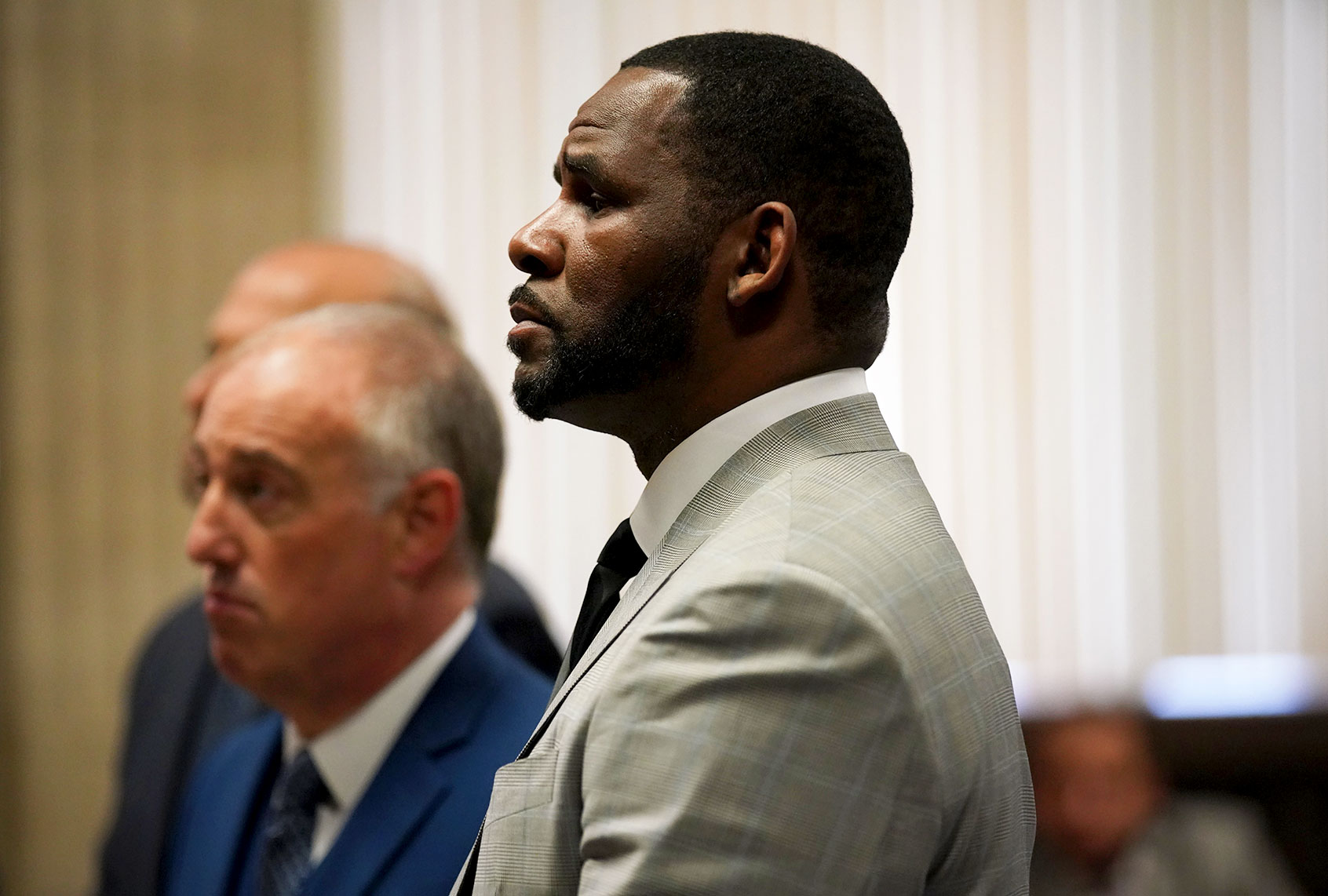
R. KellyR. Kelly pleads not guilty to a new indictment before Judge Lawrence Flood at Leighton Criminal Court Building in Chicago on June 6, 2019. R&B star R. Kelly pleaded not guilty Thursday in a Chicago courtroom to 11 new felony sex crime charges. The charges were a refiling of one of the four cases of alleged abuse that prosecutors lodged against the singer earlier this year. (JASON WAMBSGANS/AFP via Getty Images)

The New York and Illinois federal court charges came after the Cook County State’s Attorney’s office brought its charges. Thus, Foxx noted that Kelly’s federal convictions led her office to conclude that “justice has been served.” At least one of Kelly’s victims, Jerhonda Pace, feels differently.

Through her attorney David Fish, Pace shared with NPR that if Kelly’s federal appeal lead to his conviction being overturned, he could get out of prison. “This is not just a theoretical concern: we all saw Bill Cosby recently won on appeal and is back doing comedy tours,” the statement points out.

Cosby should be Exhibit A in all “celebrity supersedes criminality” claims: He was convicted of drugging and sexually assaulting Andrea Constand in 2018. But in 2021 the Pennsylvania Supreme Court overturned his conviction on a technicality after Cosby has served just under three years of his three-to-10-year sentence.

The case hinged on incriminating testimony Cosby gave in Constand’s civil suit he submitted on the condition that criminal charges would not be brought against him, to which former Montgomery County District Attorney Bruce Castor agreed. 

Constand is one of the dozens of women who came forward to accuse Cosby of sexual assault. Nevertheless, Cosby’s fans tend to forget that he admitted to drugging and assaulting Constand because he was led to believe he wouldn’t be prosecuted. To them, the performer’s case being overturned means he’s innocent of the crime. He is not.

For decades Cosby cultivated his image as “America’s Dad.” Kelly’s reputation never approximated such saintliness, but he’s still the man whose biggest hit “I Believe I Can Fly” was played and sung in church services and graduation ceremonies for years.  

People with a deeper connection to Kelly’s song catalog long excused the allegations against him as lies. Worse, they insist that his victims, even the underaged ones, knew what they were getting into when they accepted his invitation to be alone with him.

Kelly was deemed by the court to be a dangerous, violent sex offender. Cosby was too.

For the Cook County prosecutor to drop those charges doesn’t merely deny justice to the victims with sexual abuse claims against him. It implies that the existing punishment Kelly is facing is enough.

because the public bore witness to it via “Surviving R. Kelly.” Another way to interpret this is that the documentary series made Kelly’s criminality famous enough for Cook County to consider acting on its charges to be extraneous.

Following through may not have yielded additional guilty verdicts. But dropping them removes the possibility of placing another padlock on a cell from which Kelly may yet litigate his way out. His reputation is wrecked, but Cosby proves that if Kelly somehow gains release from prison, he might be able to sell tickets to live shows and be free to harm others.

Masterson’s popularity isn’t nearly as broad, but people have noticed his absence from “That ’90s Show” and possibly “The Ranch,” the Netflix series that originally reunited him with Kutcher in 2016 before he was written off, related to the allegations.

Fewer people may have followed his first trial but, owing to the accusers’ implication that the Church of Scientology helped cover up Masterson’s alleged crimes, more folks will be paying attention now.

That makes Kutcher’s observations ill-timed from the perspective of public relations and justice – the votes on each count in the deadlocked mistrial leaned toward acquittal. A jury will make the ultimate determination of whether Masterson is guilty or not. But increasingly in our age, the court of public opinion places its thumb on those scales long before a trial begins. Proclamations like Kutcher’s become part of that problem.

Esquire is careful to contextualize Kutcher’s wish for his friend to be found innocent,

Which is not, crucially, the same as Kutcher wanting his friend to get off the hook. He wants this man who was an example of how to handle yourself at a crucial time in his own life to actually be that example. To be innocent.

“Ultimately, I can’t know,” says Kutcher of what the answer is or should be in this moment. “I’m not the judge. I’m not the jury. I’m not the DA. I’m not the victim. And I’m not the accused. And so, in that case, I don’t have a space to comment.” He pauses. “I just don’t know.” 

Not knowing what to make of the criminal charges against a famous friend is understandable. Say nothing about that friend to a magazine – which Kutcher may have thought he was doing but obviously didn’t – is also acceptable.

But Kutcher is a figure with a massive platform and fans who might be moved to stand up for Masterson regardless of whether he asks them to. He said he doesn’t know, but he voiced how he wants the trial to play out. That may be enough to buy a reasonable amount of doubt, regardless of what the second jury determines.

“Love and Let Die”: Why the Beatles and James Bond remain strong British cultural exports

There was a time, many decades ago, when the English could proudly assert that the sun never set on the British Empire. Although the British Empire has long since lost its luster, two of its greatest exports still shine brightly. In his latest book “Love and Let Die: James Bond, the Beatles, and the British Psyche,” John Higgs explores the remarkable history, often intertwined, behind the James Bond movie franchise and the Beatles.

And Higgs might just be onto something. As it happens, Bond and the Fab Four can trace their emergence to October 5, 1962 — a Friday — when “Dr. No” premiered and “Love Me Do” was released as the Beatles’ inaugural single. With Sean Connery as Bond, Dr. No earned nearly $60 million, launching the series in fine style and leading to the enshrinement of October 5 as “Bond Day.” (Global Beatles Day, by the way, is celebrated annually on June 25, the date of the group’s famous Our World performance in 1967 of “All You Need Is Love.”)

“Love Me Do” would fare less successfully than “Dr. No.” The single earned a number 17 showing on the British charts that autumn. While it would be a far cry from their chart-topping exploits to come, it wasn’t too shabby for a largely regional act at the time. But the superspy and the band’s connections didn’t end back in 1962. The Beatles’ second feature film “Help!” offered a spoof — in zany British style, no less — on the Bond films. And their magisterial producer George Martin helmed the recordings of three different Bond themes, including Matt Monro’s “From Russia with Love,” Shirley Bassey’s “Goldfinger” and Paul McCartney and Wings’ “Live and Let Die.”

In the present day, Bond and the Beatles continue to reign supreme. Adjusted for inflation, the Bond franchise has netted some $19 billion in box-office receipts, while the Fabs have sold billions of records and eclipsed their genre — and the generations — many times over. With the possible exceptions of Shakespeare and the monarchy, which has clearly seen better days, Bond and the Beatles continue to make Britons proud and enjoy adulation the world over. As Higgs puts it, “The Beatles and Bond movies are our monsters in the cultural ecosystem.”

With “Love and Let Die,” Higgs makes a powerful case for his subjects’ enduring significance. His argument that the Beatles and Bond enjoy an oppositional relationship because the Fab Four’s music connotes love and Bond films represent death — thanks to the character’s well-known “License to Kill,” of course — is less convincing.


Love the Beatles? Listen to Ken’s podcast “Everything Fab Four.”


But Higgs more than makes up for this thread through his discussion of Bond and the Beatles’ twin 1960s emergence. Even as the sun was setting on Great Britain’s colonial past, Bond films and Beatles music came to epitomize that era’s penchant for English sophistication, later manifesting itself in fashion and a fresh approach to culture. Even when he was dealing out Cold War death, Bond seemed invariably happy with his lot, while the Fabs’ music celebrated the virtues of peace and love at nearly every turn.

Not surprisingly, Bond and the Beatles are still going strong at this relatively late date. While other cultural artifacts have slipped into the past, 007 and the Fab Four have transcended one generation after another, still finding new adherents six decades removed from their originating moments. Long may the monsters abide.

Salon uses Bookshop affiliate links. If you make a purchase, Salon might receive a commission. 

A jurassic mix between flamingo and whale: Never-before-seen pterosaur with over 400 teeth unearthed

A pterodactyl with some especially weird teeth was recently discovered in Southern Germany, shedding new light on the behaviors and diet of these ancient flying reptiles.

With nearly 500 hooked teeth, new research published in the German journal Paläontologische Zeitschrift describes Balaenognathus maeuseri, a pterosaur (Greek for “winged lizard”), as stalking through prehistoric swamps and using freaky denticles to filter-feed on shrimp, small crustaceans and other tasty snacks. Some 152 million years ago, during the Jurassic age, this B. maeuseri died near a village in Wattendorf, Bavaria, a German region best known for its castles, alpine landscape and beer. But Bavaria also boasts a fantastic fossil trove in the laminated limestone of its basin. The limestone is called laminated, or sometimes plattenkalk, because it is layered in flat sheets that intricately preserve fossils in incredible detail.

The plattenkalk has yielded many different species, including ancient fish like coelacanths and theropod dinosaurs. In fact, the very first pterosaur fossil ever described comes from this region. In 1784, the historian and naturalist Cosimo Alessandro Collini was the first to describe a pterosaur, a fossil heaved from the same kind of Bavarian limestone as B. maeuseri. Collini, once a secretary to Voltaire, was one of the first scholars in the Age of Enlightenment to recognize fossils as the petrified remains of ancient eras. Back then, it was common to assume fossils were evidence of the Genesis flood narrative in the Bible.

But Collini was completely confused by this creature, thinking it was a bat-like marine monster. It wasn’t until Georges Cuvier, a French paleontologist, came along that it was correctly recognized as a flying reptile. Some 240 years later, we’re still making remarkable discoveries about pterosaurs from Bavaria. But B. maeuseri is unlike anything ever found before.

“The jaws of this pterosaur are really long and lined with small fine, hooked teeth, with tiny spaces between them like a nit comb,” David Martill, the study’s lead author and a professor of paleobiology at the University of Portsmouth, said in a statement. “The long jaw is curved upwards like an avocet and at the end it flares out like a spoonbill. There are no teeth at the end of its mouth, but there are teeth all the way along both jaws right to the back of its smile.”

“What’s even more remarkable is some of the teeth have a hook on the end, which we’ve never seen before in a pterosaur ever,” Martill added. “These small hooks would have been used to catch the tiny shrimp the pterosaur likely fed on — making sure they went down its throat and weren’t squeezed between the teeth.”

The bones of Balaenognathus maeuseriThe bones of Balaenognathus maeuseri, found in the slab of limestone. (Photo courtesy of PalZ)

Up close, the teeth resemble spindly plant roots or mealworm bodies. The specimen has about 480 of them, which forms a grid similar to the huge plates of baleen that certain whales have in their jaws. Often a yellowish-white, baleen is not actually bone but keratin, the same substance in your hair and fingernails. Baleen whales will gulp up water teeming with ocean critters, then filter the water out through their baleen. Any crustaceans, shrimp, fish or whatever left behind becomes a meal for the whale.

B. maeuseri presumably got its dinner in a very similar way, but also more flamingo-like, rippling tentatively through the shallows, slurping up mouthfuls of lagoon water and filtering out the pond scum. The first part of its name, Balaenognathus, even means “whale jaw,” a reference to this feeding style. The maeuseri part refers to one of the co-authors, Matthias Mäuser, who passed away during the writing of the paper.

This is the only specimen of B. maeuseri to exist (which isn’t uncommon in the fossil record to only have one sample of an entire extinct species), but it was almost completely missed.

The specimen was accidentally uncovered while moving a large block of limestone containing ancient crocodile bones. But when discovered, it had already been broken into a slab of 17 chunks. Small fragments of the specimen were “prospected” using ultraviolet lights at night. Thankfully, this particular limestone preserves really well, so it had mostly clean breaks and wasn’t difficult to piece back together. Only a few fingers are missing. Still, during preparation some of the teeth “popped off,” as the authors put it, and had to be glued back in place. Otherwise, the skeleton is remarkably intact. Clearly, this poor pterodactyl has been through a lot.

B. maeuseri is currently on display at the Bamberg Natural History Museum in Upper Franconia, Germany.

Balaenognathus maeuseri TeethFig.A: UV close-up of the tooth section at the narrowest point of the funnel. Fig.B: tooth preservation shown in the interpretative drawing of an isolated tooth. (Photo courtesy of PalZ)

Documents show how 19 “Cop City” activists got charged with terrorism

A burst of gunfire rang through a forest on the edge of Atlanta, Georgia, on the morning of January 18. Manuel Esteban Paez Terán, whose chosen name was Tortuguita (Spanish for “little turtle”), had been shot and killed by police officers, becoming the only known person killed by law enforcement during an environmentalist act of land defense in the U.S.

Tortuguita was part of a loose-knit group continuously occupying the woods to stop trees from being felled by construction of a sprawling police training center known to activists as Cop City. In 2021, with little public input, the Atlanta city council approved plans for the $90 million Public Safety Training Center on the city-owned former site of Atlanta’s prison farm, which the trees had reclaimed and had previously been included in plans for a revamped parks system. (The activists call the area the Weelaunee Forest, a name from the Muscogee people who were violently forced out of the area 200 years ago.)

Although some members of the transient and leaderless group had damaged property in apparent attempts to stymie construction, many just camped, hoping their refusal to move out of the way of the trees would prevent them from being cut down and replaced by firing ranges and a mock city where police would conduct riot training.

That morning, members of a multi-agency law enforcement task force had moved through the woods toward Tortuguita’s tent. According to the Georgia Bureau of Investigation, Tortuguita fired first, using a handgun the 26-year-old had purchased, and struck a Georgia State Patrol officer, who was hospitalized. No civilians appear to have witnessed what happened, and the Georgia Bureau of Investigation says no body cameras captured the incident. In life, Tortuguita spoke often (and publicly) of the virtues of nonviolence, so their friends and fellow activists doubt the state’s story.

“We have no reason whatsoever to trust the narrative that’s been given,” said Kamau Franklin, founder of the local group Community Movement Builders, which organizes with Black communities in Atlanta and opposes the police training center, citing other high-profile police killings around the country in which official narratives have fallen apart.

While the environmental nonprofit Global Witness has documented over 1,700 killings of land defenders worldwide over the past decade, Tortuguita’s death is only the second such killing in the U.S. The first was a fisheries observer who disappeared at sea under circumstances that suggested foul play in 2015.

On Thursday, Governor Brian Kemp declared a state of emergency in response to protests Saturday night sparked by Tortuguita’s death, during which participants threw rocks, broke windows, and burned a police car. Kemp’s order, effective until February 9, allows up to 1,000 National Guard troops to police the streets of Atlanta.

To allies, Tortuguita’s killing was the climax of an escalation of police and legal tactics meant to stifle the wide-ranging movement to stop construction of the training center, which includes parks advocates, prison abolitionists, and area neighborhood associations. Over the course of December and January, 19 opponents of the police training center have been charged with felonies under Georgia’s rarely used 2017 domestic terrorism law. But Grist’s review of 20 arrest warrants shows that none of those arrested and slapped with terrorism charges are accused of seriously injuring anyone. Nine are alleged to have committed no specific illegal actions beyond misdemeanor trespassing. Instead, their mere association with a group committed to defending the forest appears to be the foundation for declaring them terrorists. Officials have underlined that an investigation is ongoing, and charges could yet be added or removed.

Lauren Regan, an attorney who is the executive director of the Civil Liberties Defense Center, which will represent some defendants, said the charges are legally flimsy and designed to scare movement supporters.

“It’s so next time a vigil happens, mom or the school teacher or the nurse — or someone that has higher risk of randomly getting arrested — is probably going to think twice about going,” she said.  

“They’re going to use this to continually vilify and criminalize the wider movement,” added Franklin.

Georgia’s terror law passed in response to high-profile mass shootings including the 2015 massacre of nine Black churchgoers in Charleston, South Carolina, by white supremacist Dylann Roof. The 2017 law expanded the definition of “domestic terrorism” from its original designation as an act intended to kill or injure at least 10 people to one encompassing a range of property crimes. Critics at the time, including the Georgia chapter of the American Civil Liberties Union, argued that the law was bound to be used against protesters and to stifle free speech. The charges validate civil liberties’ groups concerns and offer a warning signal for lawmakers in both major parties who have repeatedly proposed federal domestic terrorism legislation as a solution to America’s epidemic of mass murder.

Atlanta Police Department spokesperson John Chafee, on the other hand, defended the use of the law in this case. “We are hopeful the law and the possibility of being charged with this felony will be a deterrent from engaging in criminal behavior,” he told Grist. “We support the right to protest and we will work to ensure those engaged in a lawful protest are able to do so safely.”

Elsewhere in the woods on the day of the shooting, officers tore down 25 campsites and arrested seven activists. Law enforcement also netted bystanders: One Dekalb County Police Department incident report describes two individuals walking along a river trail “in an area that is being occupied by suspects wanted for domestic terrorism.” The Georgia Bureau of Investigation recommended they be “placed in flex handcuffs and transported to the nearby command post.” Later, they were determined to be “vagrants from the city of New Orleans” and were released.

Timothy Murphy was one of the last forest defenders standing. In the predawn hours of January 19, S.W.A.T. team members shone spotlights on Murphy as the activist perched above a treehouse, according to an incident report. Around sunrise, Murphy rappelled down the tree. Dekalb County Police S.W.A.T. members grabbed their legs, cut their harness, and booked them on charges of domestic terrorism.

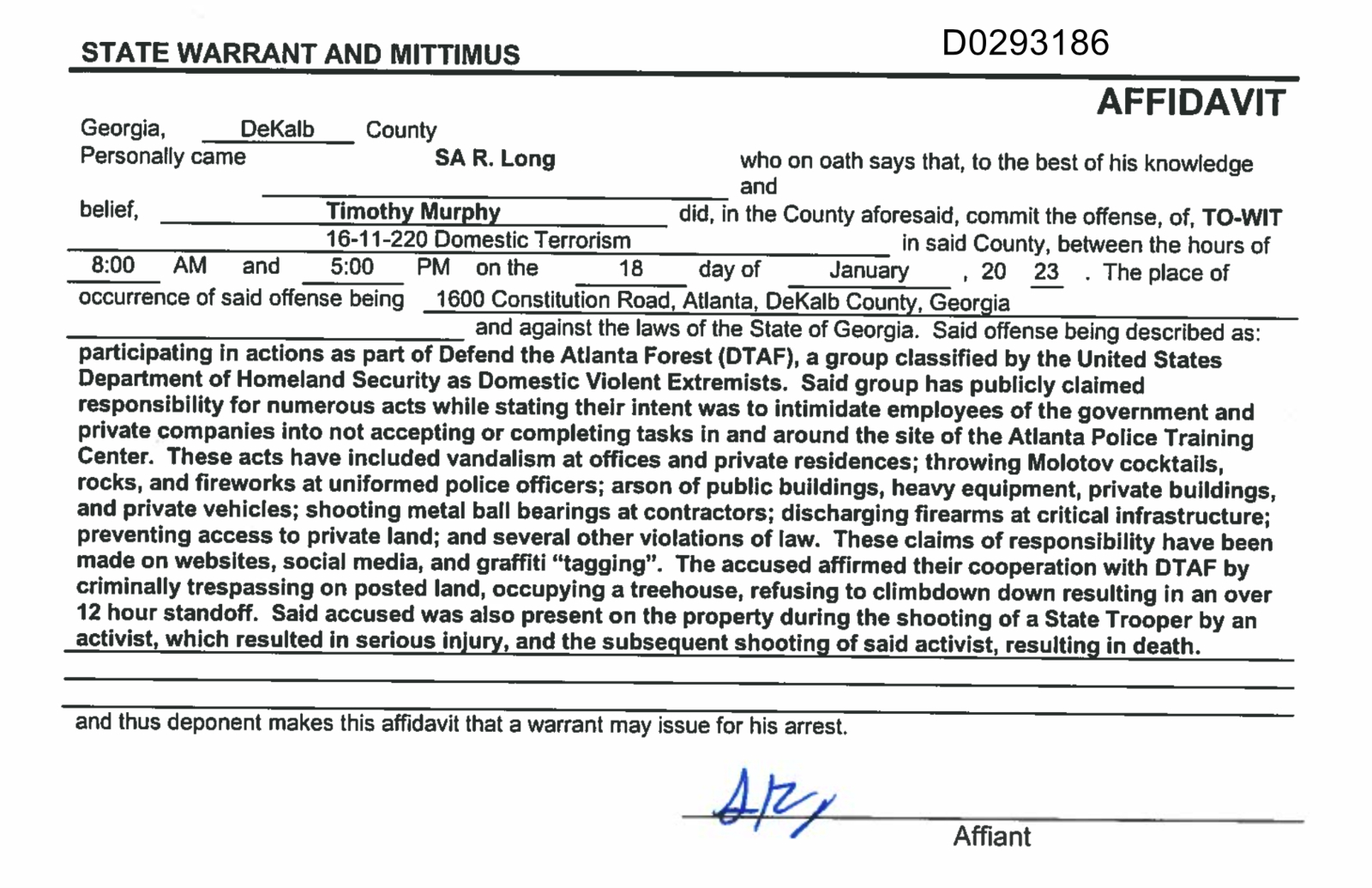
So far police don’t claim that Murphy committed any act of violence or even property destruction. Key to Murphy’s terror charge, according to their arrest warrant, is that the U.S. Department of Homeland Security, or DHS, designated a group called Defend the Atlanta Forest as “Domestic Violent Extremists.” In other words, Murphy appears to have been charged with terrorism on the basis of their affiliation with the forest defenders.

In response to questions from Grist, a DHS spokesperson denied that the federal agency classifies any specific groups with this term, while also saying that it does use the term to refer to any U.S. individual or group “who seeks to further social or political goals, wholly or in part, through unlawful acts of force or violence” and regularly shares information about threats with state and local agencies.

Regardless, the Georgia Bureau of Investigation decided that Murphy was a member of the “extremist” group on the basis of the activist’s actions: They trespassed and then refused police orders to leave the treehouse for 12 hours. As a result, if prosecutors move forward with the terror charge, Murphy will face a mandatory minimum sentence of five to 35 years in prison for what’s known as a tree sit — a common tactic among environmentalists.

A DeKalb County arrest warrant summarizes the allegation of domestic terrorism against an environmental activist accused of trespassing.

A DeKalb County arrest warrant summarizes the allegation of domestic terrorism against an environmental activist accused of trespassing. DeKalb County Superior Court

The Atlanta forest defenders’ warrants state that Defend the Atlanta Forest earned its Domestic Violent Extremist label because members had thrown Molotov cocktails, rocks, and fireworks at police, and also shot metal ball bearings at contractors. They had also committed various acts of property destruction, including vandalism, discharging firearms at “critical infrastructure,” and committing arson of “public buildings, heavy equipment, private buildings, and private vehicles.”

However, besides three allegations of rock-throwing, the 14 forest defenders’ warrants do not appear to accuse them of committing any of the above acts that led to the designation. Grist’s analysis of arrest warrants found that, for nine forest defenders detained during police operations in December and January, their alleged acts of “domestic terrorism” consist solely of trespassing in the woods and camping or occupying a tree house.

warrant following a police raid on December 13, for example, justifies a domestic terrorism charge by stating that the activist “affirmed their cooperation with [Defend the Atlanta Forest] by occupying a tree house while wearing a gas mask and camouflage clothing.” Another defendant, arrested January 18, told police that they were aware of the Cop City controversy before coming to Atlanta and had planned in advance to sleep on the land — an admission that apparently became the basis for a domestic terrorism charge. “Said defendant admitted to participating in previous protests in other states for environmental causes,” the warrant added.

Four forest defenders charged with domestic terrorism are also accused of possessing incendiary devices or firearms or throwing rocks at fire department and emergency workers and damaging a police vehicle. One of those was charged separately with injuring an officer, who scraped and cut his knee and elbow as the defendant fled. A fifth defendant is separately accused of trying to cut the rope of an arborist attempting to remove them from a tree house.

Six people charged with domestic terrorism during a night of protest in response to Tortuguita’s killing on January 21, including one who was also charged in the woods, face a slightly different set of allegations. Their domestic terrorism arrest affidavits point to felony charges they face for allegedly damaging a nearby Atlanta Police Foundation building and setting fire to a police car. A separate set of arrest citations is ambiguous as to whether the defendants are known to have personally carried out property damage, though one defendant is charged with carrying spray paint, a hammer, torch fuel, and a lighter as well as kicking and spitting on an officer as they were arrested.

The initial arrest citations for domestic terrorism also state that members of the crowd “used explosives/fireworks toward police,” without indicating whether the defendants did so themselves. The street protesters’ domestic terrorism arrest affidavits state that the alleged felonies were carried out with the intention of intimidating officials into changing government policy.

All but one of the activists arrested in the forest were released on bonds ranging from $6,000 to $13,500. None of the street protesters have been released, with four dubbed flight risks and denied bond, and two unable to pay a $355,000 bond.

The forest defenders’ charges appear to stand on shaky legal ground. To be convicted under Georgia’s terror law, an individual must first commit or attempt a felony. Nine of those arrested in the forest are charged with criminal trespass, which is only a misdemeanor.

Also, the acts must be intended to intimidate people, use intimidation to influence government policy, or impact the government through the use of “destructive devices, assassination, or kidnapping.” How trespassing and camping could constitute intimidation is unclear. The law does not contain language about whether associating with a “Domestic Violent Extremist” group counts as terrorism. 

Even if the charges are dismissed on the grounds that they do not fulfill the requirements of the law, they may leave a lasting legacy. “One of the problems with state repression is the crackdown and the arrests and the jailing and the bond — for the humans that are targeted, even if they end up being acquitted, all of that takes a toll,” said Regan, the attorney.

Although multiple environmental activists have been prosecuted under federal terrorism law in recent years, it’s been over a decade since the U.S. has seen anti-terrorism charges aimed at a broad swath of environmental activists. During a period known as the “Green Scare” in the mid-2000s, more than a dozen people associated with the Earth Liberation Front and Animal Liberation Front were arrested as part of an FBI domestic terror operation. At the time, “eco-terrorism” became the Justice Department’s top domestic terrorism priority, despite the fact that those arrested had made a point to avoid causing any bodily harm even as they burned down facilities they considered environmentally destructive.

The smaller-scale green scare that police have carried out in Atlanta in recent weeks is in some ways even more indiscriminate, since many of the alleged terrorists are not even accused of property damage.

Durham’s dud is worse than it looks — and now Trump suddenly doesn’t want to talk witch hunts

It all goes back to Trump’s obsessions.

The thing that you’ve got to remember about Trump, bless his black heart, is that his obsessions invariably take him to places he would rather not have gone. In fact, the entire reason John Durham was ever appointed by Attorney General William Barr as a Special Counsel to look into the origins of Robert Mueller’s Russia investigation in the first place had to do with Trump’s obsessions. He was obsessed that the entire thing, which he famously and repeatedly called the Russia! Russia! Russia! witch hunt, was a plot by the FBI to get him. So, Trump had Barr appoint Durham to investigate the investigators. Put another way, Trump weaponized the Justice Department to pursue his perceived enemies in the FBI, beginning with his nemesis James Comey, the former head who first opened the investigation into the Trump campaign’s ties to Russia way back in July of 2016.

The Durham investigation, as it became known over the last four years, has been in the news a lot recently. Durham was appointed in May 2019 to investigate the so-called Crossfire Hurricane FBI counterintelligence investigation, as well as the Mueller investigation, which ran from May 2017 to March 2019. A year into Durham’s investigation, at a Department of Justice press conference, then-attorney general Barr said what he was trying to do was “get to the bottom of what happened in 2016,” which is interesting in and of itself, because the only investigation taking place in 2016 was the FBI’s.

Durham wasted four years — twice as long as Mueller’s probe — and God-only-knows how many taxpayer dollars without convicting anyone of wrongdoing (he lost both cases he brought to court) or establishing the conspiracy Trump and Barr had long said lay behind the Russia investigation. Our first clue is the date in Barr’s statement above: 2016.  Trump was convinced that the FBI, and in particular James Comey, was out to get him. Trump put Comey through what amounted to a loyalty test soon after he took office, inviting him to dinner, and while Comey was there, under the influence of the splendor of the White House and the power of being in Trump’s presence, asking him if he could go easy on Michael Flynn, who had resigned as Trump’s national security adviser the previous day when it became known that he had lied to Vice President Mike Pence about his conversations with Russian Ambassador Sergey Kislyak in December of 2016. Comey demurred, and Flynn went on to be indicted and convicted of lying to the FBI about the same matter. Trump apparently never forgave Comey, especially after Comey testified before the House Intelligence Committee the following month that the Trump campaign had secretly been under investigation since July 2016. Trump fired him just two months later, on May 9, and was infuriated when he found out that Comey had flown on a government jet back to Washington after his termination.

One of the curious things that came out in the New York Times story about how the Durham investigation eventually “unraveled” was the tale of Barr joining Durham in 2019 on a trip to London and Rome as part of Durham’s probe into the roots of the Russia investigation. That the two men had made the trip overseas had been previously known. The new detail that emerged in the recent Times report was that while in Rome, Italian authorities had given the two men a “tip” that Trump was involved in some sort of financial improprieties. What the possible improprieties may have been was not explained by the Times, and there the mystery sat until Barr, in an interview with the Los Angeles Times, confirmed that he had assigned Durham to criminally investigate the matter without informing anyone that a potential financial crimes investigation into Trump had been added to Durham’s responsibilities.  What the tip consisted of remains unknown. Barr claimed to the Los Angeles Times that it didn’t amount to anything and wasn’t pursued further. 

Durham wasted four years — twice as long as Mueller’s probe — and God-only-knows how many taxpayer dollars without convicting anyone of wrongdoing

And there the entire matter of Barr’s and Durham’s big European adventure stood until I cast an eye through my files at what was going on in London and Rome in 2016 that would have precipitated their overseas trip, where they met with intelligence and law enforcement officials in both countries. The British and Italian officials were said to have been perplexed by the requests from such high-level American law enforcement officials for help with the Durham investigation and denied that their governments had anything to do with what the Times called “setting off the Russia investigation.”

And they didn’t.  

What set off the Russia investigation was actions taken by one of the Trump campaign’s foreign policy advisers in both Rome and London.  Why the Trump campaign had one of its advisers in Rome and London, and why that official was in contact with a person with close ties to Russia would turn out to be the question that got the FBI involved. 

Recall Trump campaign adviser George Papadopoulos. His contact in both Rome and London was Joseph Mifsud, a Maltese national who was involved with something called Link Campus University which had a presence in both cities. Mifsud also claimed to be a professor at the University of Stirling in Scotland and the London Academy of Diplomacy. As part of his involvement with these academic institutions, Mifsud apparently found it necessary to travel frequently to Russia where he became friendly with a man called Ivan Timofeev, a director of the Valdai Discussion Club in Moscow, as well as the Russian International Affairs Council. According to what Mifsud told Papadopoulos, Timofeev had the ear of Vladimir Putin, and might be able to set up a meeting between Putin and Donald Trump. Papadopoulos reported this back to campaign headquarters in New York and was told by Steve Bannon to keep pursuing the possibility.

Trump’s attempt to bring disrepute to the Mueller report by getting Barr to appoint a special counsel to investigate the investigators has backfired spectacularly.

It was quite a pursuit. Papadopoulos continued to meet here and there with the mysterious Mifsud. I say mysterious because Mifsud’s connections to these purported academic institutions and think tanks, like the ones run by Timofeev, have never been fully explained. But I’ve got a potential explanation: Russian intelligence frequently uses academic institutions, conferences, and think tanks as fronts for gathering intelligence around the world. Colleges and universities are innocuous. People go there to learn about diplomacy and international relations. Same with conferences, like the one Papadopoulos attended in Rome that was held by Link Campus University, where he said he met this “Professor” Mifsud.

Papadopoulos met with Mifsud when he returned to London, and this is where the FBI comes in. At a breakfast, Mifsud told Papadopoulos that he had just returned from a conference in Moscow where he had learned that the Russians had “dirt” on Hillary Clinton they might be willing to share with the Trump campaign. And what do you know, but the man Mifsud was breakfasting with was an official of that very campaign!  Mifsud also introduced Papadopoulos to a woman he claimed was Putin’s niece. Mifsud had established his bona fides with his trips to Moscow and his connections to think tank directors like Timofeev.  Papadopoulos was impressed enough that at a bar one night, he bragged to an Australian diplomat that he had learned the Russians had dirt on Clinton. The diplomat turned right around and reported his conversation with Papadopoulos to his embassy. The Australian embassy then contacted the American embassy. The American embassy then contacted the FBI in Washington.  


Want a daily wrap-up of all the news and commentary Salon has to offer? Subscribe to our morning newsletter, Crash Course.


There were four key elements in the report from London: a Trump campaign official, dirt, Clinton, and Russians. That was more than enough to start an investigation right there, and the FBI did just that.

Barr appointed Durham to investigate the origins of the Mueller report after he had done his best to bury it with his phony announcement before the report even came out, claiming that Mueller had found no “collusion” between the Trump campaign and Russia. If that was true, however, why was there a need for the Durham investigation? Well, it was to discredit the Mueller report, and that needed to be done for a couple of reasons. The first was the fact that Mueller had found eight separate instances when Trump appeared to have attempted to obstruct justice by interfering with the Russia investigation. That was definitely a bad thing, but it was no danger to Trump, as Mueller did not make a recommendation that Trump be indicted because sitting presidents cannot face federal indictments, according to a standing Justice Department policy.

So what was the big worry?  

Durham went after the Mueller investigation and ended up finding out that there actually was good cause for the FBI to investigate the Trump campaign’s connections with Russians

Mueller had indicted and convicted several Trump people such as Michael Flynn and George Papadopoulos, but only for lying to the FBI.  He had also indicted and convicted in absentia 25 Russians for interfering with the 2016 election. Thirteen of them were Russian nationals working for the Internet Research Agency (IRA) in St. Petersburg. They were charged with conspiring to interfere with the U.S. elections and identity theft. Also indicted in this group was the owner of the IRA, Yevgeny Prigozhin, a man known as “Putin’s chef.”  More on him in a bit. Twelve of the indicted Russians were agents in the Russian intelligence agency, the GRU, who were charged and convicted of conspiracy to hack and distribute key Democrats’ emails, including those of Hillary Clinton and her campaign chairman, John Podesta.

Note that all the indictments of Russians had to do with computer crimes – hacking, assuming false identities, and distribution of disinformation via social media – in a conspiracy to influence the election.

When the FBI began to investigate Papadopoulos for his claims that he knew that the Russians had dirt on Clinton, his connections to Russian were tenuous, but they were there in the person of a non-Russian, Mifsud, who had plenty of connections to Russians.  So, the FBI interviewed Mifsud, too – and here is where it gets interesting.

John Solomon is a right-wing commentator who had worked for The Washington Examiner and The Hill and who would go on to play a key role in defending Trump during his impeachment for attempting to extort the president of Ukraine into helping Trump defeat Joe Biden. In the summer of 2018, Solomon was working for The Hill and wrote a column attempting to take apart Mueller’s case against Papadopoulos. In the column, he made multiple references to Mifsud. Somehow he got access to the FBI interviews with Mifsud. He reported that Mifsud had described his contacts with Papadopoulos as “innocuous,” and denied the bit about Hillary Clinton and the Russians having dirt on her. According to Solomon, in Mifsud’s words, he was “collaborating for a number of years on a number of geo-strategic issues, mainly pertaining to publications/training for diplomats/international experts on energy security and their implications on international relations.” All he was doing was putting people together, “bridging” between them he called it, and Papadopoulos was just one of those people.  

But the mysterious Mifsud, whose passport and wallet were found in Portugal in August of 2017 and who has been missing since then, went on and on to the FBI about a curious subject: cybersecurity. 

“The intent of that ‘bridging’ was specifically of a geo-political nature and not tied in any way or form to cybersecurity,” he told the FBI in an interview.  Afterward, Mifsud went to the trouble of writing an email to the FBI, just to make sure they got what he was telling them. According to Solomon, “at one point in his email, he bold-faced a single sentence for emphasis: ‘Cybersecurity was never the direct object of any of our communications,'” in reference to Papadopoulos. What cybersecurity had to do with Papadopoulos, or Mifsud’s contacts with Russians, or anything else for that matter, was never explained by Mifsud, although the Mueller report might be consulted for an answer, as the 25 Russians he indicted were all charged with offenses that might be described as dealing with cybersecurity: hacking and using social media manipulation. Thirteen of those Russians were agents for the GRU, and 11 of them worked for Yevgeny Prigozhin, and one was Prigozhin himself.  If his name sounds familiar, it should. He’s currently in the news as the owner of the Wagner Group, the gang of ex-cons and mercenaries that have been fighting in Eastern Ukraine as part of Putin’s army.  Prigozhin has been close to Putin since he was, indeed, Putin’s chef years ago.

John Solomon’s name should also be familiar.  In his career as a right-wing commentator who spent a lot of his time trying to poke holes in the Mueller report and defending Trump from charges that he tried to extort the president of a foreign country, Ukraine, Solomon was in frequent contact with Lev Parnas, a friend of Trump who has since been indicted for several felonies after being arrested at Dulles Airport with a one-way ticket to Austria.  But, hey!  Not to worry!  Solomon landed on his feet when he was appointed, along with Kash Patel (currently a target of Special Counsel Jack Smith) as Trump’s representative to the National Archives, where both he and Patel have been involved in defending Trump from charges that he mishandled classified information stored at Mar-a-Lago.

Oh, what a web is woven when you start digging. Durham went after the Mueller investigation and ended up finding out that there actually was good cause for the FBI to investigate the Trump campaign’s connections with Russians. Go figure. Trump’s attempt to bring disrepute to the Mueller report by getting Barr to appoint a special counsel to investigate the investigators has backfired spectacularly. Two indictments of minor characters, two not-guilty findings by juries, several resignations from the special counsel staff in protest over Durham’s methods, and no holes whatsoever blown in the Mueller investigation. 

Kind of reminds you of all the lawsuits Trump has filed that have either been thrown out of court or resulted in serious judgments against him, the most recent having produced a million-dollar fine against him and his lawyer for misusing the federal courts by filing an entirely frivolous lawsuit.  All that’s come out of the Durham investigation is an example of what weaponizing an agency of the federal government looks like, up close and personal

“Hyper-partisan attack”: Arizona GOP advances new voting bills inspired by conspiracy theories

Arizona’s Republican-controlled state legislature advanced bills last month that they claim will improve election transparency — but voting rights advocates worry will actually have the opposite effect. 

The state House elections committee last week voted to pass House Bill 2308 – a bill that would bar any future secretary of state from overseeing and confirming the results of an election if they are a candidate. The bill comes after then-Secretary of State Katie Hobbs won the gubernatorial election in November.

“There’s a lack of confidence from some of my constituents in the election itself,” Republican state Rep. Rachel Jones of Tucson, who presented the bill, said during the committee meeting. “I think the optics of that – of a secretary of state running their own election for governor and then certifying that election was a major concern.”

State Rep. Melody Hernandez, a Tempe Democrat, questioned why the bill was being presented now but wasn’t a concern when GOP Secretaries of State Ken Bennett and Michele Reagan were on the ballot in 2014 and 2018.

Jones countered that the environment changed after the 2020 election and claimed that “there’s a lack of confidence in our election process” now, which brought the issue to the forefront. 

When state Rep. Oscar De Los Santos, a Democrat from Laveen, asked her if she had “any concrete evidence that there were any misdeeds from the secretary of state in the 2022 election,” Jones responded saying “It was more just the optics.”

“It was instilling a lack of confidence in the results of the election,” she added.

While there has been no evidence of corruption in the election process, Arizona Republicans have continued to sponsor bills they claim will instill faith in the election system for voters. Citing a survey from Rasmussen Reports, which has a history of Republican-leaning polling, Jones shared that 71% of U.S. voters stated they believed the midterms were “botched” during the committee meeting. 

But voting rights organizations raised concerns that advancing such bills can create more uncertainty around the election system and even increase threats against election administrators. 

“These are the same people who brought you the ‘fraudit’ following the 2020 election,” a Democratic source who asked to remain anonymous told Salon. “So, it just continues to be more bad-faith conspiracy theories and, frankly, I think voters are tired of it. This has been going on now for two years. And because of it, we’ve seen so much of violent rhetoric, resulting in threats to the safety of secretaries of state and election administrators up and down the ballot.”

The Maricopa County elections office recorded nearly 140 threatening and hostile communications against election workers between July and August of last year, according to Reuters.

Many of these threats stemmed from conspiracy theories related to the 2020 presidential election that were promoted by former President Donald Trump and his allies.

The threats asserted false claims of fake ballots, fixed voting machines and corruption among election officials in the county during the 2020 election.


Want a daily wrap-up of all the news and commentary Salon has to offer? Subscribe to our morning newsletter, Crash Course.


The same efforts that were used to sow doubt about the election system after the 2020 election are being repeated now, said Hannah Fried, executive director of All Voting is Local and All Voting is Local Action.

“Despite the fact that our elections were overwhelmingly proven to be secure, reliable, trustworthy, there are still going to be efforts to drive mis- [and] disinformation from 2022, and use that as a pretextual basis for passing new laws, and that is exactly what we are seeing in Arizona,” Fried added.

The Arizona legislature also passed three other bills, two of which the committee split along party lines.

House Bill 2319 would tell judges to “aggressively” favor an election-law interpretation that provides greater transparency and HB 2322 would put observers appointed by each party in charge of voter signature verification. 

Observers would have the ability to challenge the decisions of election workers at polling places, voting centers and other counting facilities.

“Signature verification processes, often, the way they’re carried out can be to the detriment of older voters,” Fried said. “For example, people whose signatures have changed, you really want to be mindful of any kind of change because it can have a really direct impact on people’s right to vote.”

Beyond Arizona, other states are also enacting similar efforts to “chip away” at the opportunities that have helped more people access voting, she added. 

If these efforts continue to advance in other states, it will allow legislators to strip power from people they didn’t agree with, which defeats the purpose of having separate branches of government, a Democratic source told Salon.  

“This is a hyper-partisan attack based on the fact that they don’t like election results,” said Kim Rogers, the executive director of the Democratic Association of Secretaries of State. “And I think that Arizona, frankly, has one of the strictest voter fraud guidelines already in the country.”

Republicans have pushed out unproven claims of voter fraud when it comes to in-person early voting and voting by mail. Many candidates even made the centerpiece of their campaigns promising to ban some of these efforts.

Republican Arizona gubernatorial nominee Kari Lake said she would support slashing early and mail-in voting citing unsubstantiated or disproven claims of widespread voter fraud. When she lost to her Democratic opponent Katie Hobbs by just over 17,000 votes in the midterm election, Lake refused to concede and instead filed a lawsuit against Hobbs and Maricopa County election officials claiming election fraud.

While her suit was dismissed in court last month, her efforts to sow doubt in the integrity of the election system have continued. 

Lake came under fire recently for posting photos of voters’ signatures on Twitter. Arizona Secretary of State Adrian Fontes asked Attorney General Kris Mayes to investigate her for potentially violating a state law that prohibits “records containing a voter’s signature” from being used by another person who isn’t the voter. 

Even after election workers in Maricopa County were forced into hiding after receiving threats related to the 2022 midterms, Lake has continued to peddle conspiracy theories.

Now, the Republican-controlled Arizona legislature is passing bills fueled by such election conspiracy theories, which Fried pointed out has been a concerted effort to undermine election integrity for the last couple of years.

“There are points of connectivity between all of this,” she added. “It’s not happening by accident… people who are trying to break our systems are getting smarter about it, and the really kind of over-the-top stuff that we sometimes see getting replaced with things that look reasonable on the surface are not reasonable.”

Trump biographer details his bizarre use of “mental projections”

As former prosecutor Mark Pomerantz’s tell-all book becomes public, those who have studied and written about Donald Trump for years are coming forward to agree with some of the observations.

Speaking to MSNBC’s Nicolle Wallace Friday, former Trump biographer Tim O’Brien recalled some of the more bizarre conversations he’s had for the 2005 book TrumpNation: The Art of Being the Donald.

“Most of Donald Trump’s finances, the stuff he says publicly never added up,” said O’Brien. “This was at the core of the lawsuit he filed against me was about, because the book accurately reported he spent decades inflating the value of everything he touched. In fact, during the litigation when we were deposing him we asked how he valued the golf courses. He said, ‘I don’t keep any documents.”

Wallace was shocked and humored.

O’Brien recalled asking Trump, “you don’t keep a profit and loss statement?” The self-described billionaire, said, “No, no, no.’ I said, ‘how do you know they are with their worth?’ He said, ‘mental projections.’ He has basically gone through his whole life mentally projecting toward everything around him.”

While O’Brien was talking about finances, he was also insinuating psychological projections.

“I think the issue is, yes, of course, he inflated it, these things, forever,” he continued. “And, of course, he lies and he engages in exaggeration and hyperbole. The challenge for prosecutors is to prove that was a crime. And I think that was the thing that tore apart the [district attorney’s] own team. All of them had good intentions. Mark Pomerantz ended up on one side of the equation and other people in the office ended up on another side and they couldn’t resolve their differences, whether they could take this excellent evidence to court, charge him criminally and prove he knew what he was doing.”

Pomerantz’s book describes the debate between DA Alvin Bragg, who took over after Cy Vance left. Bragg didn’t buy into Pomerantz’s argument, leading to a loud parting of ways that resulted in a public resignation level in the New York Times.

He went on to say that they might still be looking into bank fraud for Trump, which is likely what they’re pressing bookkepper Allen Weisselberg while he’s stashed in Riker’s Island Prison for accounting fraud. The Stormy Daniels and Karen McDougal payoffs are different cases, he argued.

Watch below:

Hobby Lobby founder revealed to be behind effort to “rebrand Jesus”

A mysterious commercial called “He Gets Us” that is set to air during the Super Bowl and promotes faith in Christ has been linked to the founder of Hobby Lobby — and a three-year-long campaign he has funded to “rebrand Jesus,” according to Christianity Today on Friday.

“For the past 10 months, the ‘He Gets Us’ ads have shown up on billboards, YouTube channels, and television screens — most recently during NFL playoff games — across the country, all spreading the message that Jesus understands the human condition,” reported Bob Smietana. The ad shows pictures overlaid with text like “Jesus called huddles, too,” and “Jesus confronted racism with love,” and “Jesus was a refugee.”

“The campaign is a project of the Servant Foundation, an Overland Park, Kansas, nonprofit that does business as The Signatry, but the donors backing the campaign have until recently remained anonymous — in early 2022, organizers only told Religion News Service that funding came from ‘like-minded families who desire to see the Jesus of the Bible represented in today’s culture with the same relevance and impact He had 2000 years ago,'” said the report. “But in November, David Green, the billionaire co-founder of Hobby Lobby, told talk show host Glenn Beck that his family was helping fund the ads. Green, who was on the program to discuss his new book on leadership, told Beck that his family and other families would be helping fund an effort to spread the word about Jesus.”

“You’re going to see it at the Super Bowl — ‘He gets Us,'” Green told Beck. “We are wanting to say — we being a lot of people — that he gets us. He understands us. He loves who we hate. I think we have to let the public know and create a movement.”

Hobby Lobby, an Oklahoma-based chain of big-box craft stores, is famous for its Christian theming. The chain came under controversy after it refused to provide contraception to its employees, and won the right to opt out of federal health rules at the Supreme Court.

The chain also came under a strange controversy in 2017 after it was found to be in possession of ancient Iraqi artifacts illegally smuggled out of that country, leading to civil actions by the Justice Department ordering the company to forfeit the treasures.

The Pentagon is tracking a mysterious Chinese “surveillance balloon” as it bobs around the U.S.

U.S. Secretary of State Antony Blinken has postponed a scheduled trip to China as the Pentagon continues to investigate what’s being called a Chinese “surveillance balloon” that President Biden was briefed on Tuesday.

According to Reuters, military leaders considered shooting the balloon out of the sky shortly after it was spotted but Biden, who feared that shooting it down could cause harmful debris, has chosen not to thus far.

Former President Trump expressed an opposing view, taking to Truth Social on Friday with a message saying “SHOOT DOWN THE BALLOON!”

Brig. Gen. Patrick Ryder, a spokesperson for the Pentagon, provided a statement on the mysterious balloon saying it has been “traveling at an altitude well above commercial air traffic and does not present a military or physical threat to people on the ground.” That being said, the situation is “adding further strain to tense US-China relations,” as CNN highlighted in their coverage of the balloon. 

In a statement from the Ministry of Foreign Affairs of the People’s Republic of China, a representative explained the balloon as being “a civilian airship used for research, mainly meteorological, purposes.”

“The Chinese side regrets the unintended entry of the airship into US airspace due to force majeure,” the statement furthers. “The Chinese side will continue communicating with the U.S. side and properly handle this unexpected situation.”


Want a daily wrap-up of all the news and commentary Salon has to offer? Subscribe to our morning newsletter, Crash Course.


Lynn McMurdie, a professor in atmospheric sciences at the University of Washington, weighed in on the explanation from China via a quote to The New York Times saying “It’s a plausible explanation, but it’s preposterous that they didn’t guess it would end up in North America.”

In a press conference on Friday, Secretary of State Blinken said “The first step is getting the surveillance asset out of our airspace – and that’s what we’re focused on.” 

Leaders from the House and Senate on the intelligence committees are scheduled to be briefed on the status of the balloon next week, according to a spokesperson for Senate Majority Leader Chuck Schumer.

How a master cake decorator learned royal icing string work

On a recent first day of class for the Art of Cake Decorating program at the Institute of Culinary Education (ICE), I asked my students what they were most excited to learn. String work didn’t come up. Until then, they hadn’t even heard of the cake decorating technique. And once they looked at some images, I think they were a bit intimidated.

The traditional technique is one perfected over a century. It involves delicate piping of royal icing, through a very small piping tip, built up upon itself to reach breathtaking gravity-defying heights. The two main forms of this highly skilled technique are Australian string work and oriental string work.

As with so many of our cake decorating traditions, string work evolved from techniques popular in England at the turn of the 20th century. According to Chef Toba Garrett, a master cake decorator and string work specialist, the story of how it’s thought to have developed is a relatable one. A cake decorator from Australia was in the U.K. learning from masters of overpiping — the technique of building up layers and layers of piped royal icing to create incredible sugar masterpieces. While there, sometime between 1920 and 1930, she traveled over the London Bridge. This transformative ride inspired her to consider replicating its elegant and delicate lines in sugar. I can relate. Every place I’ve ever traveled, including across my home of New York City, has been constant inspiration for my work.

. . . she traveled over the London Bridge. This transformative ride inspired her to consider replicating its elegant and delicate lines in sugar.

As the story goes, the cake decorator went home to Australia, where she practiced and developed the techniques for building the string work that seems to pop off the cake. She piped ultra-thin layers of string work over platforms or “bridges” that support them.

These cakes would have been built on the base of a fruit cake, covered in marzipan for straight edges, and then covered in rolled fondant for a perfect surface. Then the cake is marked for the curved bridge bases, which are piped repeatedly on top of each other, with time to dry in between. After the bridge is built, the cake is tilted towards the decorator, and each string is piped with a 0 tip to create ultra-delicate strings attaching to the bottom bridge, as though they are hanging in mid-air. Once these strings dry, some kind of detail piping or ornament is attached at the top string line to hide the starts.

According to Chef Toba, these cakes typically would be finished with the addition of some tiny piping work or sometimes a ribbon around the center of the cake and a tiny bow attached at the meet point, maybe a small floral spray on top. There would be no greetings or messages on the cake but maybe the name and the age. The artists wouldn’t have wanted to take away from its delicate simplicity.

Like an ice sculpture, the truth is these cakes were never really meant to be eaten. Because of the fragility, transport would have been difficult at best, and the labor involved would have made them cost-prohibitive. So mostly, Chef Toba says, they were used for cake competitions. Australian string work cakes enjoyed a height of popularity between 1950 and 1970 through the commonwealth of Great Britain, including Australia, New Zealand and South Africa.

Oriental string work is similar with its use of fine strings piped with royal icing, but in this case, the strings are dropped to create a curve. Dots are piped to attach the strings away from the cake and added layer by layer, actually turning the cake upside down during part of the process so the strings hang from the top and bottom creating elegant curves in both directions. Due to the need to turn it upside down several times, this is not really suitable for an edible cake either, but more for use in competition or display.

Cake DecoratingCake Decorating (Photo courtesy of ICE)

Both rely entirely on royal icing, a multiuse mixture of confectioners’ sugar and egg whites, plus an acid stabilizer that is firm upon piping and dries very hard. Our confectioners’ sugar in the U.S. has 3% corn starch in it. This makes the icing a bit weaker than the traditional English version. The icing sugar available in the U.K. does not have corn starch in it and because of that, it creates a significantly stronger icing that dries rock hard. We paddle this back and forth to remove any air bubbles that could break the strings while piping. It’s then placed in a cornet, or paper cone, with a 0 tip and used only in small batches so it can be easily controlled.

As our interest in fondant-covered cakes grew in the U.S. in the 1980s and ’90s, so did our interest in these traditional techniques. Those with the most skill guarded these techniques. As Chef Toba yearned to learn more, she had to work very hard to source mentors and instructors in the craft. She traveled to England to convince the masters to train her and has since become known as a master in the art. Instead of keeping it for herself, she offers instruction in this time-honored technique, passing it down to new generations — including in the curriculum she designed for the Art of Cake Decorating at ICE.

When it began, it could only be in white. No variation of color was allowed or accepted. Students who learn this technique now are bringing it into the 21st century, honoring the long-held techniques and traditions but adapting it for modern audiences. Specifically, the use of bold colors can assert a modern feeling with a vintage vibe. Marbleizing the fondant or the addition of other pieces of decor can make these techniques feel more at home in the present, too.

While the students in my cake decorating class may have started out a bit intimidated, I broke the process down into very manageable pieces, and they were able to create things they never dreamed they could. String work is one of our more traditional ways to turn humble icing and cakes into masterful works of art. With this skill in your creative toolbox, you can craft masterpieces with a wink to the past while fully embracing modern times.

By Penny Stankiewicz, chef-instructor of the Art of Cake Decorating at the Institute of Culinary Education

The restorative power of pozole

When October delivers the first real fall chill to the Chihuahuan desert of southern New Mexico, I take solace in the imminent return of pozole season at my favorite Las Cruces food truck, Tacos Romero

Here the “posole” comes in only one flavor (rojo) and one size (quart styrofoam container). The savory, rich stock teems with fatty hunks of pork shoulder and buttery white hominy beneath a slick of oil stained red from dried chiles. Diced bits of radish, cabbage and white onion add bright crunch and piquancy to this comforting soup that never fails to warm me clean through to the soul. 

Though I delight in the anticipation of Romero’s short-lived pozole, I don’t agree with this Southwestern notion of a finite soup season. Sure, when temperatures soar into the triple digits beneath a blazing sun, you might not crave a simmering cauldron of liquid, meat and veg. But soup has a weightier emotional load to carry — as the food equivalent of being hugged. Indeed, I can’t think of many other foods that bear the responsibility of restoring us when we’re sick, homesick, heartbroken, or even hungover. Nor, for that matter, can I name a culture without a significant soup tradition.  

Pozole’s own, somewhat grisly, origins purportedly date back to the Aztecs of pre-Hispanic Mexico. According to the Mazlatlán Post, it originated as a sacred offering to the Aztec god Xipe Totec in the hopes of a good harvest. Aztec warriors would kill and dismember a rival captive then toss him into the stewpot with salt and dried corn to prepare a ceremonial soup to be eaten by the Aztec priests, the king, and the warriors who — ahem — procured the meat. When the Spanish colonizers came along, they introduced pork, which the Aztecs started using instead. 

The aromatic makeup of this simple pork soup changes depending on where you are in Mexico. On the Pacific and Atlantic coasts and in the lush mountains, pozole is often green — seasoned with a salsa of roasted poblanos, spinach, cilantro and tomatillo. The dish tends toward red in the more arid, red pepper-yielding areas of Jalisco and in the northern Chihuahuan desert. 

“It’s been perfected and changed through the years, but at the end of the day, when you see pozole recipes now, they’re mostly really, really simple,” says Jose Avila, a Mexico City native who’s now chef and owner of James Beard Award-nominated La Diabla Pozole y Mezcal in Denver. “That’s Mexican food; that’s what it is. Simple, comforting food. You don’t need crazy expensive, hard-to-get ingredients, just a few ones that are fresh and well balanced; and anyone can cook it.” 

“That’s Mexican food; that’s what it is. Simple, comforting food. You don’t need crazy expensive, hard-to-get ingredients, just a few ones that are fresh and well balanced; and anyone can cook it.”

You’ll find pozole year-round at La Diabla because, well, it is a restaurant dedicated to this soup. But pozole also represents something much deeper to Avila. Though he hails from Mexico City (where pozole is traditionally red or pho-like white), his family’s traditional recipe is red owing to his dad’s grandmother’s roots in Guadalajara, Jalisco. And when he was a teenager, the dish became emblematic of family.


Want more great food writing and recipes? Subscribe to Salon Food’s newsletter, The Bite.


“My mom was a secretary who worked from 7 to 7,” Avila remembers. “We would barely see each other. So my mom, having two teenagers at that time, it was hard to make sense of my brother and me. So instead of fighting and getting mad, she came up with this idea of, ‘Let’s have dinner together every Thursday to spend some time together.'” 

She picked a pozoleria a few blocks from their house — “In Mexico City, pozolerias are as ubiquitous as taquerias.” Sometimes she cooked red pozole, too, which has since become Avila’s death-row meal. 

Yet now that Avila is the one doling out year-round pozole hugs at La Diabla in all three colors of the Mexican flag (plus a vegan version and a beguiling black one made from burnt peppers, vegetables and spices), his relationship to the dish has changed. 

“I still love it, but I don’t crave it as I used to,” he muses. Indeed, the choice to recreate the nostalgic flavors of his childhood in Mexico for a living meant an almost constant proximity to pozole — along with other beloved dishes like barbacoa and cochinita pibil — as he tweaked them ever closer to perfection. 

“I had to do that a little bit of sacrifice to be around it, make it, and bring those dishes to people,” he says. This in turn enabled him to conjure a powerful taste memory for others — perhaps a reminder of a home they miss, or a new comforting flavor when they need it. 

“At the end of the day, that’s what we do,” he says. “And there’s nothing cooler I would say than to do something for someone and then you become part of their life, in a way. There’s something remarkable that stays there. There’s a little bit of you that goes with each guest.” 

Maybe there’s something to a finite soup season, after all — giving a few months of delicious comfort back to the chefs and owners who spend the rest of the year ladling it up for us.

PozolePozole (Photo courtesy of Maggie Hennessy)

Pozole Rojo

By Jose Avila, chef/owner of La Diabla Pozole y Mezcal, Denver 

Yields
8 servings
Prep Time
3 hours 50 minutes (or 50 minutes if you opt for canned hominy)
Cook Time
2 hours 40 minutes

Ingredients

For the salsa

5 dried guajillo peppers cleaned, seeded, open flat, and deveined

5 dried ancho peppers cleaned, seeded, open flat, and deveined

6 fat garlic cloves

1 medium white onion, coarsely chopped

1⁄2 tsp dried Mexican oregano

2 Tbsp grapeseed or vegetable oil

Salt, to taste

For the soup

2 lbs dry corn*

1 Tbsp food-grade slaked lime (calcium hydroxide) to create alkaline solution*

*Or 3 cans (15 ounces each) white hominy, drained and rinsed

2 lbs cubed pork shoulder

1 lb pork spare ribs or baby back ribs

1 white onion cut in quarters

8 large garlic cloves

Salt, to taste

Sliced cabbage, for garnish

Sliced radishes, for garnish

Diced white onion, for garnish

Cilantro leaves, for garnish

Lime wedges, for garnish


Directions

  1. Soak the ancho and guajillo peppers in just enough water to cover for 25-30 minutes, or until soft. Using a blender or food processor, blend peppers, garlic cloves, onion, and oregano, plus some of the water in which the peppers were soaking, until smooth. Heat oil in a large skillet over medium-high. Add the pepper puree and salt to taste, stirring constantly as it splatters. Reduce the heat to medium, and simmer for about 25 minutes.

  2. If you do the nixtamal, boil the dry corn with enough water the covers 2 time the amount of corn, lower the flame to a slow/medium heat and cook for 3 hours, remove from stove and rinse under cold water while with both hands you mix all the corn until the water is clear and corn is tender. 

  3. Heat 4 quarts of water in a large stockpot. Add the pork meat, onion, and garlic. Bring to a boil, then lower the heat and let simmer, partially covered for 2 ½ hours, or until the meat is tender and falling off the bone. Season with salt to taste near the end of the cook time. While cooking, skim the top layer of foam and fat from the pot using a ladle. If necessary, add warm water to maintain the same level of broth in the pot. When the pork is tender, remove it from the broth, reserving the broth. Remove meat from the bones; discard bones, onion, and garlic from the broth. Shred meat (or leave in hunks if desired), and cover to keep warm. 

  4. Using a strainer, add the salsa to the broth. Bring to a boil and add the meat. Simmer gently for about 10 minutes. Stir in the white hominy, and season with salt and pepper to taste. Simmer until heated through.

  5. Place the garnishes on a platter in the center of the table so each eater can customize their soup to their taste. Ladle the pozole into deep bowls and serve immediately. 


The therapeutic benefits of “Shrinking” is not necessarily in its shaky depiction of counseling

Jimmy's wreck of a personal life is the main attraction. The ethical purity of his therapeutic methods is secondary, if that.

For many of us, television provides our first exposure to the world of work. This can be beneficial, especially when children's programs include glimpses of visits to the doctor's office, farms, or fire stations to spark curiosity, dispel mystery or reduce any fear associated with those places.

Still, it's natural to have mixed feelings about seeing your occupation portrayed on TV, especially when it's rendered poorly or unrealistically. This informs some of the conversation surrounding "Shrinking,"  the Apple TV+ comedy starring Jason Segel as Jimmy Laird, a psychologist mired in compassion fatigue.

One day he loses his patience with Grace ("Saturday Night Live" star Heidi Gardner), one of his regulars who is trapped in an emotionally abusive marriage. Instead of asking Grace for the millionth time how her spouse's latest belittlement makes her feel, Jimmy erupts with an ultimatum: leave her husband, or he'll terminate their therapy.

When she accepts his demand, Jimmy views this as evidence that his direct "psychological vigilante" style is working. He pushes his luck further when another patient, a military veteran named Sean (Luke Tennie), comes to him with explosive anger issues. Instead of relying on talk therapy, he takes Sean to a mixed martial arts gym where he can unload his rage on a consenting opponent.

Nobody in Jimmy's professional circle thinks this is a good idea. His mentor and boss Phil (Harrison Ford) is deeply alarmed. His colleague Gaby (Jessica Williams) who, like Phil, is a by-the-book practitioner, looks on with giddy nervousness, waiting for the other shoe to drop.

But whether Jimmy's unconventional approach to his job works is ultimately neither here nor there, since that's not why the typical viewer is watching. Jimmy's wreck of a personal life is the main attraction. The ethical purity of his therapeutic methods is secondary, if that.

When he's not counseling fragile clients, Jimmy is barely holding it together. We first meet him midway through an Adderall binge that has him up at 3 a.m. and loudly partying with sex workers. From there we discover he's recently lost his wife, and has abandoned his daughter Alice (Lukita Maxwell) to be raised by his next-door neighbor Liz (Christa Miller) and her husband Derek (Ted McGinley). Liz asks him, seriously, if this is how he's going to be from now on. He answers that he doesn't know.

ShrinkingHarrison Ford and Lukita Maxwell in "Shrinking" (Photo courtesy of Apple TV+)

Wounded healers are compelling. That's why there are so many of them. "Nip/Tuck," "House, M.D." and the messiest doctors on "Grey's Anatomy" hook us with their private drama. On the other hand, those shows can set inaccurate expectations concerning a vocation's standards or common practices.

The same can be said about any profession adapted for TV in a way to maximize conflict and tension. Ask a journalist how accurately writers fictionalize the fourth estate, and you'll get a rant about Hollywood's predilection for scripts with reporters sleeping with sources or betraying sources (up yours, Trent Crimm of The Independent!) or misrepresenting the power they wield, or agonizing over laughably thin workloads.

Therapists can probably relate in some ways, although the medium has historically been kinder to them – and this is said with the full awareness that among television's noteworthy mental health professionals is Hannibal Lecter of NBC's "Hannibal." 

But in the main, TV's therapists are unsung heroes, even if they overstep their boundaries, as Robin Weigert's doctor does in the first season of "Big Little Lies," or enable their clients' malevolence, as Dr. Melfi does in "The Sopranos." Sometimes the problem is that they're too good at their job, which seals the fate of Steve Carell's psychotherapist Alan Strauss in "The Patient."

They can also be empathetically flawed, as "In Treatment" depicts its shrinks in both Gabriel Byrne's version and Uzo Aduba's fourth season depiction of Dr. Brooke Taylor. Relatedly, both therapists overlap their personal spaces with their professional environment; it can't be much of a surprise to see them grow uncomfortably close to their clients.

Obviously I am not a therapist. I merely happen to share my life with one. My husband's professional inspiration is Robert Hartley, the counseling  hero of "The Bob Newhart Show." Like Newhart's therapist, my spouse maintains a very strict line between his work and personal life. That means we often watch TV in separate rooms.

See, the dramas people commonly think of as some of the best of all time – "Breaking Bad," "Mad Men" and "The Shield" being examples – feel too much like work wandering into his down time. It isn't that his clients are meth kingpins, emotionally stunted advertising executives or violently corrupt cops. He just deals with those types of personalities and counsels the people they damage all day long.

"Shrinking," he can handle. Although the main character shares his profession, my husband views Jimmy's therapist cred with a similar seriousness to what meteorologists might assign to Thor.

We watched a few episodes together at my request. I was hoping he'd provide me with a sense of how well or badly the show depicts the work life of a therapist. But after a few breakdowns of which ethical lines he crossed, he dropped the assignment cold the moment Sean moves in with Jimmy. "OK, we're in fantasy land now," he said.

My husband views Jimmy's therapist cred with a similar seriousness to what meteorologists might assign to Thor.

Situations like Sean's and Jimmy's have happened, to be clear. My spouse can verify that because a number of those cases end with such spectacular disaster that they make 11 o'clock newscast headlines. Since "Shrinking" is a sitcom from the executive producer of "Ted Lasso," Bill Lawrence, and created by one of its stars, Brett Goldstein, Jimmy probably won't end up on "Dateline."

At least, not for letting a patient stay in his pool house.

ShrinkingLuke Tennie and Jason Segel in "Shrinking" (Photo courtesy of Apple TV+)


Still, a layperson can't be faulted for wondering how Jimmy ranks as a therapist, and several reporters have consulted professionals for their insights. I'd like to gently suggest, however, that his professional quality rating matters less than what he represents in a time where therapy is at long last being more broadly accepted as necessary health maintenance.

Therapy plays a central role in the second season of "Ted Lasso," which may lend a level of trust to "Shrinking" since a number of the same people are behind it. Where it gets sticker is the implied stakes of Jimmy's work family, as in Phil and Gaby – and now, Sean – being an extension of his main family unit, which includes Liz, Derek and Jimmy's best friend Brian (Michael Urie).  

All of them know how extensively Jimmy's grief has screwed him up. They're also participants in the lack of division between Jimmy's work life and his personal life, something that his new "psychological vigilante" approach styles as an asset. In the real world, it is not.


Want a daily wrap-up of all the news and commentary Salon has to offer? Subscribe to our morning newsletter, Crash Course.


But Jimmy's mistakes-in-progress and parallel efforts to mend his life remind us that we don't often consider the ways our therapists carry their work with them. Our damage can become theirs if they're not mindful in the way they process it.

"In Treatment" hints at that toll via Dr. Taylor's struggle with sobriety, a shadow Dr. Sharon Fieldstone (Sarah Niles) also tangles with on "Ted Lasso." But Ted only finds this out when circumstances force him to deliver Dr. Sharon home after she's injured; she never plans on allowing anyone to see her extensive booze collection.

Jimmy's rock bottom informs his climb out of his depressive valley, and he carries his patients' anguish with him – the standard clinician's burden. As long as a viewer understands that this is not how therapy is supposed to work, Jimmy's personal improvement story drives the focus, not necessarily how well he does his job.

"I'd probably say that I view 'Shrinking' akin to how cops may see the policing in 'Brooklyn Nine-Nine,'" my in-house therapist said in review. I pointed out that cops probably love "Brooklyn Nine-Nine." Does he feel that way about "Shrinking"?

Not really. "For me," he said, "it lives on the comedy scale someplace between 'Cheers' and . . . what was that show where Steve Carell died in a basement?"

In case you're wondering, he couldn't bring himself to watch that one either.

New episodes of "Shrinking" stream Fridays on Apple TV+.

The 7 most outrageous revelations from Netflix’s docuseries “Gunther’s Millions”

Nothing good could come from a posh pooch and his shady handler.

At least that’s what we learn in Netflix’s latest docuseries, “Gunther’s Millions,” which investigates the crazy backstory of the richest dog in the world, Gunther. Gunther enjoys a normal canine lifestyle: he eats gold-flaked steaks for dinner, travels on private jets, owns several grand estates and has his own crew of glitzy spokesmodels. 

Gunther came by such privileges from his family – yes, the classic story of generational doggy wealth. You see, the secret is that Gunther comes from a long line of dogs all called Gunther. Such lavish indulgences began with Gunther’s great-grandfather, who was owned by a German countess named Carlotta Liebenstein and her husband, a wealthy businessman of a pharmaceutical company. Carlotta also had a son named Gunther, who later died by suicide at 26.

With no living heirs, the countess left all her fortunes with her son’s German Shepherd, named Gunther III. She declared her close friend, Gabriella Gentili, the new caretaker of the dog and manager of Gunther’s riches, known as the Gunther Trust. Gabriella then gave her duties to her son Maurizio Mian, who was also a close friend of Carlotta’s son. Today, Mian is the sole handler of the current Gunther, aka Gunther VI, and the Gunther Trust.

Gunther’s tale – while over-the-top – is just wacky enough to be convincing. But in actuality, it’s all just one big lie. Over the course of four episodes, we learn that Gunther is merely a prop in Mian’s questionable stunts and sex-fueled “scientific experiments.” It’s unclear if the real-life Gunther VI ever makes an appearance in the series or if he’s played by a decoy Gunther. But his employees and handler do in multiple sit-down interviews.

Here are the 7 most outrageous revelations from the series:

01
Gunther has his own personal chef
Gunther's MillionsGunther's MillionsGunther's MillionsGunther’s Millions (Courtesy of Netflix)

In his lavish Tuscany villa, Gunther has his own personal chef, whose name is Mirko Citti. In the docuseries, Citti makes Gunther a thick and juicy steak that is then cut and topped with flakes of gold.


“We select the meat just for him because he’s a dog who gets considerable satisfaction on the culinary level,” explains Citti. 


Per Lucy Clarkson, the canine’s head of PR, the Countess wanted to make sure that Gunther is treated like a god. In addition to his extravagant dinners, Gunther has 27 total employees working for him.

02
The ever-growing Gunther dynasty
Gunther's Millions“Gunther’s Millions” (Courtesy of Netflix)
Per Piero Salussolia, an attorney of Gunther Trust, a settlement deed lists Gunther VI as a beneficiary and states, “Should he die prematurely the Trustees will replace him as the primary beneficiary by other exemplary species with the same name choosing the one most likely to be the best living symbol of the ideology of ‘Gunther Reform’ and the ’13 Commandments.'”


Simply put, the Countess had been breeding a Gunther bloodline, and when VI is gone, VII will replace him, and so on down the Roman numeral line.


“It’s like a royalty, you know?” said Carla Riccitelli, a representative for Gunther Trust. “You have to make sure there’s always one or two or three or four coming after you.”


Salussolia added that Gunther Trust is part of a bigger business initiative called Gunther Group. The group encompasses Gunther Corporation, which includes several properties and yachts across Italy. Gunther Corporation also owns stakes in additional companies, like ICX Limited, Gunther 2000, Burgundians Limited and other businesses that Salussolia said he’s “not comfortable discussing.”

03
Mian’ series of bizarre “projects” to honor Carlotta’s late son
Gunther's MillionsMembers of the Burgundians in “Gunther’s Millions” (Courtesy of Netflix)

In the docuseries, Mian claims that Gunther Trust was created to honor Carlotta’s late son’s hobbies, which included music, television and entertainment. That’s why Mian created a band called Gunther Group and released a record called “Wild Dog.” 


“‘Wild Dog’ itself was a record with important themes,” said Mian, who likens it to music by The Beatles, Bob Dylan and John Lennon. The record is purely a scratchy electronic dance tune with a music video that features random shots of the group performing, dogs running amok and people tearing down a fence.


Mian adds that Carlotta’s son Gunther once dreamed of traveling to the United States. So, Mian and Gunther VI decided to buy properties in Miami, eyeing Sylvester Stallone’s estate and the Versace Mansion. They eventually settled on Madonna’s Mansion and bought it for a whopping $7.5 million in cash.


“I have to admit, buying Madonna’s mansion was the highest point of the second part of my life,” Mian said.


Then came Mian’s The Burgundians, a five-person pop group that would sing and dance on behalf of Gunther. Its core members included Lee Dahlberg, a spokesperson/model for Gunther Trust; Dahlberg’s girlfriend at the time, Michelle Mainoni; Dahlberg’s friend Christopher Lewinski; and Carla, Mian’s ex-wife. The group attended press conferences and gained widespread media attention. But, much of what they were doing still remained a mystery. 


The Burgundians’ casting requirements are further outlined, albeit bizarrely, in the settlement deed: 


“The Gunther boys are young, good-looking, vigorous, well-built and finely balanced. The two boys should be like Gerald of ‘G-Squad’ or Steve of ‘Worlds Apart.’ Possibly with more muscles and blonde hair. Three girls should look like Pamela Anderson, Victoria of Spice Girls, et cetera. Like the cover girls of today’s stardom, but with jaunty buttocks. None of them should be fixed elements if not absolutely necessary. The persons of the group should offer a strong idea of beauty and an almost robotic, machine-like empty image.”


There is no mention of singing or dancing abilities.

04
Turns out, The Burgundians was some sort of sex cult
Gunther's Millions“Gunther’s Millions” (Courtesy of Netflix)
The Burgundians resided in Gunther’s mansion and were monitored by “scientists,” who tracked their daily activities. Per Mian, the purpose of these “scientific experiments” was to find the secret to happiness — and further honor his late friend who died by suicide. Data from these experiments were collected by Barry Morse and then given to Mian, who allegedly shared it with other unnamed scientists.


“One of the major components of the Burgundians lifestyle advances is credited to this participation in studies dealing with sexual drive,” Gunther Trust legal documents specified. A typical schedule for the Burgundians involved three hours of sports swimming, four hours for show production, two hours for sex, two hours for meals and “execution of experiments” and two hours for “studying and preparation of business related activities.” The Burgundians were encouraged to have sex, be naked and participate in lengthy orgies.


“And then, I don’t know what happened . . . it just got weird,” recalled Mainoni. “It morphed from this glamorous, hedonistic lifestyle to more of, like, we were being watched 24-7.” She mentioned that cameras were set up in the mansion’s bedrooms without the members’ consent.

05
Mian hired two porn stars to be presidents of his soccer team
Gunther's MillionsValentine Demy in “Gunther’s Millions” (Courtesy of Netflix)

Mian and Gunther later purchased Pisa S.C., an Italian football club based in Pisa, Tuscany, and U.S. Città di Pontedera, an Italian association football club based in Pontedera, Tuscany. For the latter, Mian appointed two world-famous Italian porn stars, Ilona Staller (better known by her stage name La Cicciolina) and Valentine Demy, as its presidents.


“The presidents are representations of a collegiality, a philosophy whose core value is the pursuit of happiness,” the docuseries said.


Massimo Marini, an Italian journalist, added that Mian’s choice to hire porn stars “represents a common thread in Maurizio’s life.”


“He’s always wanted to impress and amaze, to draw attention, even knowing such things would create problems and lead to serious missteps.”

06
Mian’s other absurd “experiment”: The Magnificent 5
Gunther's MillionsMaurizio Mian and members of I Magnifici 5 in “Gunther’s Millions” (Courtesy of Netflix)

Mian’s second project was similar to the Burgundians, but it featured Italian celebrities, like TV personality Fabrizio Corona. Each member was given a necklace that had five lights representing a different element – popularity, wealth, sexuality, physicality and spectacularity – for the ideal life. If the members achieved a specific element, their necklace lit up with the corresponding light.


Additionally, the members were told to participate in “planned mating” and procreate a “generation of truly happy people.” Basically, they were all part of Mian’s plan to breed a new generation of humans that were genetically superior enough to achieve true happiness.


Of course, like all of Mian’s shady “science experiments,” this one ended in failure. Emanuel Cirinei, a member of The Magnificent 5, recalled that it was “one of the saddest moments of my life, and happiness was very far away.


“It was like a brainwash.”

07
Gunther’s backstory was also a lie
Gunther's MillionsKarlotta Leibenstein in “Gunther’s Millions” (Courtesy of Netflix)

So, is Gunther VI really worth $400,000,000? The short answer is no.


The long answer is that Gunther’s backstory was all invented by Mian so he could avoid paying taxes on his family’s fortune. Mian’s mother Maria Gabriella Gentili was the pharmaceutical entrepreneur behind the Gentili Institute, a pharmaceutical company that developed a drug that was effective in treating bone diseases. Gentili Institute was subsequently sold to Merck for millions — $400 million to be exact. To avoid paying high Italian taxes, the Mian family transferred the money in a dog’s name and later, named the fake countess as the dog’s owner.


On top of that, Gunther III actually belonged to Maurizio’s girlfriend Antonella, which means Gunther VI is a descendant of Antonella’s original dog.

“Gunther’s Millions” is currently available for streaming on Netflix. Watch a trailer for it below, via YouTube:


“Death sentence for women and families”: Federal court blocks domestic violence gun ban

The right-wing 5th U.S. Circuit Court of Appeals on Thursday struck down a federal law barring people with domestic violence restraining orders from owning firearms, a ruling that gun control advocates said will cost lives.

A three-judge panel of the New Orleans-based appellate court said in its decision that the overturned law is an unconstitutional impediment to the right to bear arms. The judges based their ruling on New York State Rifle & Pistol Association v. Bruen, a June 2022 U.S. Supreme Court decision that struck down that state’s limits on carrying concealed guns in public.

The judges — who were all appointed by Republican presidents — wrote that under Bruen, the law prohibiting people with domestic violence restraining orders from owning guns “fails to pass constitutional muster,” and that the ban is an outlier “that our ancestors never would have accepted.”

Responding to the ruling, Shannon Watts, founder of the gun control advocacy group Moms Demand Action, tweeted, “Given that domestic violence is often a precursor to gun violence, this ruling is a death sentence for women and families in the U.S.”

“When someone is able to secure a restraining order, we must do everything possible to keep them and their families safe — not empower the abuser with easy access to firearms,” Watts added. “This dangerous and deadly ruling cannot stand and must quickly be overturned.”

Slate senior writer Mark Joseph Stern warned via Twitter that “there is no real doubt that the 5th Circuit’s decision is going to lead to more abusers murdering their wives and girlfriends. It will also increase mass shootings.”

Stern noted that the U.S. Supreme Court “held that gun restrictions are only constitutional if they have historical analogs from 1791 or 1868. But domestic violence was widely accepted in those eras. So, the 5th Circuit says, the government can’t disarm alleged domestic abusers today.”

“To be clear — the reason there weren’t laws disarming domestic abusers in 1791 or 1868 is because women were not equal citizens and domestic violence was not deemed a criminal offense by the men who made and enforced the laws,” Stern added.

According to the National Coalition Against Domestic Violence, the presence of a firearm in a domestic violence situation increases the risk of homicide by 500%. Each year, more than 600 U.S. women are shot to death by their intimate partners. That’s one killing every 14 hours.

“They’re going to call you socialists anyways”: Progressives slam 109 Dems for backing GOP stunt

More than 100 U.S. House Democrats — including some of the wealthiest members of Congress — joined with Republican lawmakers on Thursday in passing a resolution “denouncing the horrors of socialism,” a largely symbolic gesture that opponents warned is nonetheless a step toward slashing Social Security, Medicare, and other safety net programs.

House Concurrent Resolution 9, which “denounces socialism in all its forms and opposes the implementation of socialist policies in the United States,” was introduced by Rep. María Elvira Salazar, R-Fla., the staunchly anti-communist daughter of Cuban exiles who once interviewed then-Cuban President Fidel Castro for Telemundo.

“I think it’s the best resolution that has ever been presented before the United States Congress,” Salazar told Insider at the U.S. Capitol before the vote. “Our youth are being penetrated by this ideology through media and academia.”

The measure—which followed the vote to oust Rep. Ilhan Omar, D-Minn., from the House Foreign Affairs Committee — passed 328-86, with 14 lawmakers voting “present” and six members not voting.

One hundred and nine Democrats—many of them members of the corporate-friendly New Democrat Coalition — joined with every Republican lawmaker in voting to approve the resolution. Prominent Democrats who voted “yes” include: House Minority Leader Hakeem Jeffries, N.Y., former House Speaker Nancy Pelosi, Calif., and House Assistant Democratic Leader Jim Clyburn, S.C., all of whom played prominent roles in defeating Sen. Bernie Sanders’, I-Vt., presidential campaigns, which were based on popular democratic socialist policies and principles.

Many of the Democrats voting for the resolution also rank among the wealthiest members of Congress, including Pelosi, whose 2018 net worth was over $114 million, according to OpenSecrets.org; Suzan DelBene (Wash., $79 million net worth); Dean Phillips (Minn., $64 million); Scott Peters (Calif., $60 million); and Ro Khanna (Calif., $45 million). Khanna along with Reps. Adam Schiff and Eric Swalwell of California and Rubén Gallego of Arizona, are either current or prospective candidates for U.S. Senate.

Denouncing the measure on the House floor, Rep. Jim McGovern, D-Mass., — who voted “no” — said that “the socialism resolution is useless. It does nothing. It does not matter. Are we talking about public schools? Are we talking about roads? Are we talking about Social Security? I mean, give me a break.”

Rep. Mark Pocan, D-Wis., Chair Emeritus of the Congressional Progressive Caucus, invoked his experience as a capitalist to lambaste the anti-socialism resolution.

“For 35 years now I’ve owned a small business, giving me significantly more experience as a capitalist than the vast majority of members on the other side of the aisle. So as a capitalist, let me tell you: This resolution is plain ridiculous. It jointly condemns Pol Pot and Norway,” Pocan said during floor debate, referring to the former Cambodian dictator, who was supported by the Republican Reagan administration after leading a genocidal regime that killed at least 1.5 million people.

Pocan continued:

Here’s what this is really about: More and more members on the other side of the aisle are calling for cuts to Social Security and Medicare, and many have referred to these programs as “socialism” throughout their existence. The other night in the Rules Committee they showed their cards. Republicans refused an amendment to declare that Social Security and Medicare is not socialism. This resolution is little about intelligent discourse and everything to do about laying the groundwork to cut Social Security and Medicare.

Rep. Maxine Waters, D-Calif., another “no” vote, called out the hypocrisy of Republicans who support corporate welfare or are personal beneficiaries of social programs. Waters took aim at House Small Business Committee Chair Roger Williams, R-Texas, who summarized his support for the resolution as: “Socialism bad. Capitalism good. In God we trust.”

“Mr. Williams is my friend,” said Waters, “but I do wonder whether Mr. Williams views the $1.43 million he received in debt forgiveness [to be] consistent with his views on socialism? I don’t get it.”

After Rep. Brad Sherman, D-Calif., who voted against the measure, noted during floor debate that there have been numerous democratic socialist leaders around the world who’ve been “allies of America and NATO,” Rep. Patrick McHenry, R-N.C., quipped, “If this resolution would just simply draw out my Democrat colleagues to just say, yes, they are in favor of socialism, maybe this is a worthwhile endeavor.”

Rep. Summer Lee, D-Pa., a former organizer from Pittsburgh’s Democratic Socialists of America chapter who voted against the resolution, shrugged off Republicans’ red-baiting and the New Democrat Coalition’s support for the GOP resolution.

“They’re going to call you socialists anyways,” Lee said.

“You can’t make this s**t up”: House Republicans wear “tone deaf” assault rifle pins amid shootings

Several House Republicans this week began wearing pins in the shape of an assault rifle on their clothing during committee meetings and on the House floor, despite the fact that there have already been more than 55 mass shootings in the country in 2023.

Reps. George Santos, R-N.Y., and Anna Paulina Luna, R-Fla., were captured on camera wearing the pins on Capitol Hill. 

“Where are these assault weapon pins coming from? Who is passing these out?” asked Rep. Jimmy Gomez, D-Calif., who was the first to share images of Santos and Luna wearing the pins on Twitter. 

“Anna Paulina Luna wore an assault weapon pin at today’s Oversight hearing — less than 48 hours after her state experienced a mass shooting,” Gomez added in another tweet. Earlier this week, 11 people were wounded in a mass shooting in Lakeland, Florida.

“You can’t make this sh*t up,” he said. “This isn’t the flex you think it is.” 

Rep. Andrew Clyde, R-Ga., who has worn the pin for years, later said he distributed them to other members to “remind people of the Second Amendment of the Constitution and how important it is in preserving our liberties.”

“Apparently I’ve been triggering some of my Democrat colleagues,” he wrote.

Democrats roundly condemned the stunt.

“To be promoting them on the floor of the House, is despicable and I think an insult to all of the victims of assault weapons,” said Rep. Gregory Meeks, D-N.Y.

“Is it really about the 2nd Amendment? Funny how you didn’t mention you own the No. 4-ranked gun store in GA,” questioned Gomez. “Not only are you mocking gun violence survivors during #GVSurvivors Week, but you’re making a profit off of mass shootings too.”

Rep. Chuck Fleischmann, R-Tenn., defended his peers, saying it is “a matter of the First Amendment.” He also claimed that Democrats are misguided for trying to ban assault weapons and requiring universal background checks, according to KFOR.

“We have many more pressing issues in this country,” he said.


Want a daily wrap-up of all the news and commentary Salon has to offer? Subscribe to our morning newsletter, Crash Course.


“Tell that to the families that lost loved ones in Monterey Park, or the kids that were killed in Uvalde,” Gomez responded. “I mean, they were so mutilated that they had to be identified by DNA.”

Gomez also added that Republicans are the ones who are misguided because polls have shown that Americans support stricter gun laws. 

In response to the outrage, Luna — who also participated in a House Natural Resources panel debate to push back on firearm bans — tweeted, “the same Democrats who are voting to send firearms to Ukraine are telling me I can’t carry one.”

She also tweeted an image of the pin, with a note mocking Gomez. “Jimmy, stop trying to date me,” the card read.

“Absolutely repulsive,” tweeted Duke University Professor of Global Health and Public Policy, Gavin Yamey. “We have mass shootings almost daily, and the Republicans are wearing assault weapon pins FFS.”

Samuel Perry, a University of Oklahoma Sociology professor commented on the “tone deaf” nature of the clothing symbol. 

“Republican members of congress are wearing AR-15 lapel pins. That’s not just tone deaf,” he tweeted. “We find Republicans value gun rights more than any other right, including freedom of speech or religion. No need for a flag or cross pin. The gun is both their patriotic & religious symbol.”

Rep. Rashida Tlaib, D-Mich., noted the disturbing nature of the pins, especially since it is National Gun Violence Survivors Week. “It’s freaking sick. And they are doing it during #GVSurvivorsWeek,” she said.

Rep. Cori Bush, D-Mo, also mentioned the timing of the images. “While gun violence continues to be the leading cause of death for children in our country, @GOP members are wearing assault rifle pins during #GVSurvivorsWeek. Shameful,” she wrote on Twitter.

“Always said it was just a matter of time before the GOP replaced the cross with an assault rifle,” said Diana Butler Bass, an American historian of Christianity. “Guns are their god.”

Rep. Gene Wu, D-Texas, explained that the GOP “has stopped playing coy and is now openly and unabashedly praising mass shooters. 

“Will there be special versions to celebrate specific mass shootings?” he asked.

Nicholas Grossman, a professor of International Relations at the University of Illinois pointed out the hypocrisy of the Republican symbol. 

“Legislators from party that defends recent coup attempt by their up-til-recently—and possibly still—party leader replace traditional patriotic flag pin with a pin depicting a rifle,” he tweeted.

State Sen. Dave Min, D-Calif., gave his thoughts on the pins and recent gun-control debates. 

“The debate over 2A [the Second Amendment] has never been about 2A,” he explained. “It’s about ‘disrupting’ civilized society as we know it, and trolling the ordinary Americans concerned about our insane levels of gun violence. That’s why it’s the biggest assholes who are most loudly touting irresponsible gun access.”

“Could upend the GOP”: Trump threatens to “retaliate” against Republicans if he loses nomination

Former President Donald Trump has made clear he is willing to throw the GOP under the bus in 2024 if they don’t choose him as their nominee — effectively a threat to hand the election to Democrats and burn it all down for Republicans — reported Ed Kilgore for New York Magazine’s “Intelligencer” on Thursday.

“Trump refused to commit to supporting the 2024 Republican presidential nominee in a conversation with conservative radio host and columnist Hugh Hewitt. ‘It would depend,’ Trump told Hewitt. ‘I would give you the same answer I gave in 2016 during the debates,'” said the report. “Despite signing a ‘loyalty pledge’ going into the 2016 campaign, Trump periodically threatened to take his supporters right out of the Republican Party by launching a third-party or independent bid. As late as March 2016, he was repeating that threat, as Politico reported at the time.”

The troubling thing for Republicans, wrote Kilgore, is that Trump wouldn’t even necessarily have to mount a full third-party campaign for president in order to make good on his threat.

“If Republican leaders turn on Trump — say, to back Ron DeSantis — he will almost certainly complain that he’s being treated unfairly and look to retaliate,” said the report. “And he won’t necessarily have to go as far as formally launching a third-party bid (though a recent poll from the Bulwark found 28 percent of Republican primary voters would vote for him if he ran as an independent).”

Rather, Kilgore noted, “A defeated Trump could upend the GOP’s 2024 nominee simply by forcing the candidate to choose between publicly dissing him and alienating MAGA voters or sucking up to him in a way that would undermine any talk of a fresh start for the party. Anyone who thinks Trump wouldn’t put his own pride ahead of the good of the Republican Party hasn’t been paying attention.”

Currently, polling still shows Trump leading the field of potential primary challengers, although no major candidates have yet stepped forward to challenge him. DeSantis has led Trump in some earlier polls, but is a relatively distant second in most. Still, he has managed to generate buzz from Washington GOP consultants and big-dollar party donors.

“Standby if there’s any stunts we need to pull”: Leaked audio exposes Trump campaign’s Big Lie

A newly released audio recording revealed former President Donald Trump’s campaign acknowledging his loss in Wisconsin while plotting to push baseless allegations of widespread fraud that were repeatedly debunked by election officials and the courts.

The audio — obtained by the Associated Press on Thursday — captured a Nov. 5, 2020 strategy session in Wisconsin, two days after the election. The political operatives in the session appear to praise the Democratic turnout in one of the state’s largest counties and even joked about their opponents’ efforts to engage Black voters 

Andrew Iverson, the head of the Trump campaign in Wisconsin, is heard warning the team that they may need to pull “stunts,” and planning a strategy to claim Democrats stole the election.

“Here’s the deal: Comms is going to continue to fan the flame and get the word out about Democrats trying to steal this election. We’ll do whatever they need. Just be on standby if there’s any stunts we need to pull,” Iverson said in the audio.

Iverson is now the Midwest regional director for the Republican National Committee, and referred the AP’s questions about the recording to RNC spokesperson Keith Schipper, who also declined to comment because he claimed to have not yet heard it. 

The audio came from a former campaign official and Republican political operative who recorded the meeting and shared the audio with AP. The operative is not authorized to speak publicly about what was discussed during the meeting, and did not want to be identified for fear of retaliation, but said they released the audio out of concern for Trump’s third bid at the presidency. 

Trump campaign spokesperson Steven Cheung dismissed the audio recording.

“The 2024 campaign is focused on competing in every state and winning in a dominating fashion,” Cheung told the AP. “That is why President Trump is leading by wide margins in poll after poll.”

Trump won Wisconsin in 2016 and his team fought hard to keep the swing state in 2020, but ultimately lost it by less than one percentage point to President Joe Biden. The result was subject to multiple independent and partisan audits and reviews, lawsuits, and recounts as Biden only defeated Trump by a margin of 21,000 votes. 

However, in the recording, Republican campaign operatives don’t discuss Trump having won the state. Instead, they focus on closing campaign offices and writing reports on how the election unfolded. At one point, Iverson even admits the margin of defeat for Trump in the state.

“At the end of the day, this operation received more votes than any other Republican in Wisconsin history,” Iverson said. “Say what you want, our operation turned out Republican or DJT supporters. Democrats have got 20,000 more than us, out of Dane County and other shenanigans in Milwaukee, Green Bay and Dane. There’s a lot that people can learn from this campaign.”


Want a daily wrap-up of all the news and commentary Salon has to offer? Subscribe to our morning newsletter, Crash Course.


The recording shows the dissonance between what Republican officials said about the results in private and the allegations of a stolen election that Trump and his allies were pushing out in public. Trump’s own attorney general told him at the time that there was no evidence of widespread fraud, but the former president ignored the advice of his administration. 

The audio also captured the Trump campaign officials discussing the state’s Black voters. At one point, operatives laughed about needing “more Black voices for Trump.” 

“We ever talk to Black people before? I don’t think so,” Iverson said to a room full of laughter. 

Another GOP operative at the meeting was identified as Clayton Henson, the regional director for the RNC in charge of Wisconsin and other Midwestern states at the time. He praised Republican turnout in the state while also acknowledging Democrats’ efforts in their turn-out-the-vote campaign. 

Henson cites the Democratic turnout in Dane County, which includes the state capital — Madison — a predominantly liberal area. The county hit a record high when it came to voting in 2020, with 80% of the voting-age population casting ballots, and 76% of the vote going to Biden. 

“Hats off to them for what they did in Dane County. You have to respect that,” Henson told the group. “There’s going to be another election in a couple years. So remember the lessons you learned and be ready to punch back.”

Biden is wielding the DNC’s power to crush a potential primary challenge in 2024

The Democratic National Committee has rolled out the blue carpet for Joe Biden at its winter meeting now underway in Philadelphia. Biden’s decision to give a speech there Friday was based on the certainty that he would be greeted with fervent adulation, just as he feels sure he can count on the DNC to rubber-stamp his manipulation of next year’s presidential primaries. Meanwhile, party officials lip-sync enthusiasm for a Biden ’24 campaign. But if Biden were truly confident that Democratic voters want him to be the nominee next year, he wouldn’t have intervened in the DNC’s scheduling of early primaries.

New polling underscores why Biden is so eager to bump New Hampshire from the first-in-the-nation spot it has held for more than 100 years. In the Granite State, “two-thirds of likely Democratic primary voters don’t want President Joe Biden to seek re-election,” the UNH Survey Center found. “Biden is statistically tied with several 2020 rivals, including Transportation Secretary Pete Buttigieg, Massachusetts Senator Elizabeth Warren and Vermont Senator Bernie Sanders, all of whom are more personally popular than Biden among likely Democratic primary voters in New Hampshire.”

Dismal as Biden’s showing was in the new poll, it was a step up from his actual vote total in New Hampshire’s 2020 primary, when he came in fifth with 8 percent of the vote. No wonder Biden doesn’t want the state to go first and potentially set primary dominoes falling against him.

Keen to reduce the chances of a major primary challenge next year, Biden sent a letter to the DNC in early December insisting on a new schedule — demoting New Hampshire to the second position alongside Nevada, while giving the leadoff slot to South Carolina. That means Democratic energy and funds will be squandered in that deep-red state, which is about as likely to give its electoral votes to the 2024 Democratic ticket as Ron DeSantis is to donate all the money in his campaign treasury to the Movement for Black Lives. 

Why is a deep-red state with the lowest rate of union membership in the country being placed first in the primary calendar? Look to Biden’s 2020 campaign for the answer.

But South Carolina, the state with the lowest rate of union membership in the country, does possess one singular virtue, from the president’s point of view: It rescued his electoral hopes with its 2020 primary, sending Biden on his way to the Democratic nomination. As the Associated Press explained last week, Biden is “seeking to reward South Carolina, where nearly 27 percent of the population is Black, after a decisive win there revived his 2020 presidential campaign following losses it suffered in Iowa, New Hampshire and Nevada.”

The president’s rationalization for putting South Carolina first is diversity. Yet the neighboring purple state of Georgia, which has an activist Democratic base, is more racially diverse — and is also a crucial swing state, where the party’s general-election prospects would likely benefit from hosting the first-in-the-nation presidential primary. 

Biden’s intervention has created a long-term political mess for Democrats in New Hampshire, where he’s now less popular than ever after undermining the state’s long-cherished first-primary status. Even New Hampshire’s normally compliant Democratic senators and representatives in Congress have denounced the move. Biden’s maneuver has undoubtedly boosted the chances that the Democratic ticket will lose the state’s four electoral votes next year. 


Want a daily wrap-up of all the news and commentary Salon has to offer? Subscribe to our morning newsletter, Crash Course.


But Biden having his way with the Democratic National Committee is a slam dunk because he supplies the ball, hires the referees, owns the nets and controls the concession stands. While cowed DNC members dribble at his behest, substantial concerns will echo outside the range of officials’ whistles. 

As a Don’t Run Joe full-page ad in The Hill newspaper pointed out last week (full disclosure: I helped write it), “There are ample indications that having Joe Biden at the top of ballots across the country in autumn 2024 would bring enormous political vulnerabilities for the ticket and for down-ballot races.”

But so far, like the Democrats in Congress, DNC members have indicated they feel much more concern about avoiding the ire of the Biden White House than about avoiding the grim potential outcome of a Biden ’24 campaign. By the time the DNC adjourns on Saturday, news reports will be filled with on-the-record statements from members lauding Biden’s leadership with next year’s elections on the horizon. Conformity prevails.

But warning signs are everywhere. Among the latest are results of a YouGov poll released days ago: “Just 34 percent of Americans describe Biden as honest and trustworthy — a new low for his presidency. That’s an 8-point drop from when this question was last asked in December 2022, prior to the public revelation that classified documents had been found in Biden’s possession.”

This is the electoral horse on which Democrats are supposed to ride into battle against the extremist Republican Party next year. The national Democratic Party is locked into operating at the whim of a president now believed to be “honest and trustworthy” by only one-third of U.S. adults.

How all this will play out at the DNC meeting is no mystery. Yet many members surely know that Biden is likely to be a weak candidate if he goes ahead with his proclaimed plans to run for re-election. Democrats’ hope, as usual, is that the GOP will defeat itself once again — an extremist party in disarray, driving away moderate voters. But it would be irresponsible to gamble on such a scenario by rolling the dice on Joe Biden.

These are the only 8 animals that can recognize themselves in the mirror (besides humans)

Several years ago, a TikTok-famous Sheepadoodle named Bunny stared at herself in a mirror and asked, “Who is this?” by tapping her paws on her augmentative and alternative communication (AAC) device’s buttons. The video of her evidently pondering her existence sparked a series of humorous memes suggesting that she was having an existential crisis.

But beyond the comedic value, Bunny’s possible existential crisis also resurfaced a scientific debate: can dogs pass the “mirror test”?

What scientists call the mirror test is used to determine whether an animal has the ability of visual self-recognition, which is considered a marker of intelligence in animals. The was developed by psychologist Gordon Gallup in 1970, and involves placing a visual marker — like a red spot — on an animal’s body. Scientists proceed to observe what happens when the animal is placed in front of the mirror, watching the animal’s reaction both to their reflection with and without the marker. If an animal passes the mirror test, they will usually adjust their body position in a way so they can get a better look at the marker on their body and pay more attention to that part of their body. This suggests that the animal knows something is different about their reflection.

Previous scientific evidence suggests that dogs do not recognize themselves in the mirror, Bunny’s debatable case aside. But while dogs are still up for debate, there are eight animals that scientists say have passed the mirror test. That suggests that these animals are among the most self-aware of all species on Earth, and may be humans’ peers from an intelligence standpoint. 

01

Chimpanzees

ChimpanzeeChimpanzee (Getty Images/Anup Shah)
As the closest living animal relatives to humans, chimpanzees have long been known for their incredible similarities to humans both physically and mentally. Indeed, in 1970, researcher Gordon G. Gallup Jr. tested chimpanzees for their self-recognizing abilities. 
 
“After prolonged exposure to their reflected images in mirrors, chimpanzees marked with red dye showed evidence of being able to recognize their own reflections,” Gallup concluded in an article in Science.
 
Gallup picked two chimpanzees that were born in the wild, two female “preadolescents,” and tried to pick subjects that had “little exposure” to mirrors or mirror-like surfaces. The way he describes the effect the mirror had on these specimens is intriguing. Gallup describes the animals “making faces at the mirror, blowing bubbles, and manipulating food wads with the lips by watching the reflections.” He then anesthetized the chimpanzees and put red dye on their bodies; when they came to, they both fixated on the red dye marks, which they could only see in the mirror. 
02
Bonobos
BonoboBonobo (Getty Images/USO)

“Nine bonobos were presented alternately with the reflective and non-reflective sides of a mirror,” scientists wrote in a 1994 paper published in the International Journal of Primatology. The study involved a standard mirror test in which bonobos were given mirrors and their reactions observed.


Researchers continued: “The apes exhibited considerable interest in the mirror, and immature animals exhibited higher frequencies of contingent action and inactive looking than did adults; four animals used the mirror to inspect parts of their bodies that were otherwise not visible to them, indicating that bonobos are capable of self-recognition.”

03
Gorillas
GorillaGorilla (Getty Images/Janpiter Frans S/EyeEm)

In 1993, Francine Patterson and Wendy Gordon contributed a paper to a larger book about great apes. Their paper, titled “The Case for the Personhood of Gorillas,” included details of a mirror test given to Koko, then a 20-year-old lowland gorilla and possibly the most famous gorilla to have ever lived owing to her ability to learn sign language.


“We gave a comparable mirror test to Koko in which she demonstrated for the first time that gorillas, too, are capable of mirror self-recognition,” the two researchers wrote. “As she attempted to remove the paint, she also spent the most time viewing her reflection during the session in which she was marked; it is evident that Koko recognised the altered image as her own.”

04
Orangutans
OrangutanOrangutan (Getty Images/Manoj Shah)

By 1981, the mirror test was well recognized as a marker of an animal’s ability to recognize oneself in the mirror. Gordon G. Gallup Jr. wrote in a paper that while it was still debatable if gorillas could pass the mirror test, orangutans did.


“Although most primates appear incapable of learning that their behavior is the source of the behavior depicted in a mirror, the present study replicates previous reports showing that both chimpanzees and orangutans are capable of self-recognition,” researchers concluded.

05

Bottlenose Dolphins

Bottlenose DolphinBottlenose Dolphin (Getty Images/Stuart Westmorland)

In a study with two male bottlenose dolphins, researchers found that they were able to react to themselves in the mirror when have a marker placed on them. These reactions included head circling, close viewing of the eye and a delay in approaching the mirror. Notably, these dolphins appeared to have the ability of self-recognition earlier than other animals who have passed the mirror test.


“Our results indicate that self-directed behavior at a mirror emerged in a dolphin at 7 months of age, much earlier than has been reported for humans and chimpanzees,” researchers stated. “Both dolphins exhibited predominantly self-directed behavior at the mirror after minimal mirror exposure and both passed subsequent mark tests.”

06
Asian Elephants
Asian ElephantAsian Elephant (Getty Images/Gilitukha)

In 2006, three Asian elephants were given the mirror test at New York City’s Bronx Zoo. Scientists placed the visual markers on the elephants’ heads.


“Here, we report a successful MSR elephant study and report striking parallels in the progression of responses to mirrors among apes, dolphins and elephants,” researchers stated. “These parallels suggest convergent cognitive evolution most likely related to complex sociality and cooperation.”

07
Cleaner wrasse
Cleaner WrasseCleaner Wrasse (Getty Images/marrio31)

In 2019, cleaner wrasses — which are tiny tropical reef fish — were the first fish to pass the mirror test. 


“When subsequently provided with a colored tag in a modified mark test, fish attempt to remove the mark by scraping their body in the presence of a mirror but show no response towards transparent marks or to coloured marks in the absence of a mirror,” researchers stated.

08
Eurasian magpie
MagpieMagpie (Getty Images/Dieter Waschbüsch/EyeEm)

In 2008, Eurasian magpies were the first non-mammals to pass the mirror test, raising questions about the neuroscience of self-recognition.


“Our findings provide the first evidence of mirror self-recognition in a non-mammalian species,” researchers stated. “They suggest that essential components of human self-recognition have evolved independently in different vertebrate classes with a separate evolutionary history.”


Joe Manchin teams up with Ted Cruz on “absurd” bill to protect toxic gas stoves

Republican Sen. Ted Cruz of Texas and right-wing Democratic Sen. Joe Manchin of West Virginia on Thursday introduced legislation that would prevent a federal agency from banning gas stoves.

Cruz and Manchin’s bill to preempt the U.S. Consumer Product Safety Commission (CPSC) from banning gas stoves —titled the Gas Stove Protection and Freedom Act and described by progressive advocacy group Food & Water Watch as “absurd” — comes even though the agency says it has no plans to implement such a prohibition.

Climate and public health advocates celebrated last month after CPSC Commissioner Richard Trumka Jr. told Bloomberg News that gas stoves are “a hidden hazard” and suggested that new ones should be banned.

However, as Reuters reported Thursday, Trumka “walked back those comments after conservatives and energy industry groups seized on them as a way to criticize the Biden administration for allegedly overreaching with its climate and environmental policy agenda.”

Food & Water Watch observed that while “there is currently no plan” to ban gas stoves, “there is substantial research documenting the hazards associated with the air pollution” the methane-powered appliances create.

A widely shared recent study found that 12.7% of childhood asthma cases in the U.S. can be tied to indoor air pollution caused by gas stoves. The findings bolstered calls from environmental justice advocates and public health experts to prohibit the sale of new gas stoves and expedite the switch to cleaner and safer electric ones, but the CPSC has yet to propose regulatory action.

“Manchin is doing his part to fuel the ridiculous right-wing panic over a nonexistent war on gas stoves,” Food & Water Watch policy director Jim Walsh said Thursday. “But his intent behind this legislation is serious: to inhibit climate action and undermine agencies charged with protecting public health and safety — all in the interest of propping up his fossil fuel funders.”

“As state and local governments are increasingly looking to turn away from gas in new construction—moves that will improve air quality and public health, and reduce climate pollution — Sen. Manchin continues looking backward,” said Walsh.

Manchin is the top congressional recipient of cash from the fossil fuel industry, which has fought aggressively against increasingly popular campaigns to outlaw gas stoves at the state and local levels.

However, the coal baron who leads the Senate Energy and Natural Resources Committee is far from alone in his defense of planet-heating and illness-inducing gas stoves.

As The Washington Post reported Thursday, Natural Allies for a Clean Energy Future—a nonprofit group founded by a half-dozen gas companies—”has enlisted prominent Democratic politicians and pollsters to help enhance gas’ reputation among liberal voters.”

Former Sens. Mary Landrieu, D-La., and Heidi Heitkamp, D-N.D.,  and former Rep. Tim Ryan, D-Ohio, are among those going to bat for the fracking and gas utility industries.

“Natural Allies is backed by TC Energy, the Canadian pipeline giant behind the controversial Keystone XL project, and Southern Company, one of the biggest U.S. utilities,” the Post reported. “Launched shortly before the 2020 election, the group is led by Susan Waller, a former executive at the pipeline firm Enbridge.”