Spring Sale: Get 1 Year, Save 58%

“Astonishing level of evidence”: Trump “caught red-handed” after Mar-a-Lago inside source identified

At least one Trump employee was caught on surveillance footage moving boxes of documents at Mar-a-Lago after the Justice Department issued a subpoena demanding the return of classified documents, according to multiple reports.

A Trump employee told investigators about moving boxes of materials at former President Donald Trump’s direction after the subpoena was issued, according to the Washington Post. Investigators reviewed surveillance footage showing people moving the boxes and ultimately secured and executed a search warrant in August to search Trump’s residence.

The employee in their first interview with investigators denied handling any sensitive documents but when agents interviewed the employee a second time, “the witness’ story changed dramatically,” sources told the Post, and said that Trump directed staff to move the boxes.

“The FBI uncovered evidence that the response to the grand jury subpoena was incomplete, that additional classified documents likely remained at Mar-a-Lago, and that efforts had likely been taken to obstruct the investigation,” the DOJ said in a Supreme Court filing on Tuesday.

The report comes amid “months of dueling accusations and theories about who may be cooperating with the federal government,” The Post reported, adding that the witness’ account has been a closely held secret inside the DOJ over concerns that the person could face harassment or threats from Trump supporters if they are identified.

The New York Times on Wednesday also reported that Trump employee Walt Nauta was caught on surveillance footage moving boxes from a storage room before and after the subpoena, though it’s unclear that Nauta is the same employee described by the Post report.

Nauta, a former military aide who left the White House and went to work at Mar-a-Lago, has been interviewed by the DOJ on “several occasions.”

“Nauta has answered questions but is not formally cooperating with the investigation of Mr. Trump’s handling of the documents,” according to the Times.

The DOJ obtained a subpoena in May to retrieve all materials marked classified. Trump’s team handed over 38 additional documents marked classified but one of Trump’s lawyers present during the meeting “explicitly prohibited government personnel from opening or looking inside any of the boxes that remained in the storage room, giving no opportunity for the government to confirm that no documents with classification markings remained,” the DOJ said in a court filing in August. The DOJ later obtained evidence that Trump was holding additional documents, and raided his residence on August 8.


Want a daily wrap-up of all the news and commentary Salon has to offer? Subscribe to our morning newsletter, Crash Course.


New York University Law Professor Ryan Goodman marveled at the “astonishing level of evidence” the DOJ collected in the case according to the reports.

“Moving documents to hide them from DOJ is the kind of aggravating factor that would make Trump’s conduct an indictable offense,” wrote Barb McQuade, a former U.S. attorney.

The testimony and additional reporting that Trump’s lawyers signed a declaration falsely attesting that all documents had been turned over “suggests an effort to hide the documents from federal government,” tweeted Renato Mariotti, a former federal prosecutor.

“This evidence is an aggravating factor that could weigh in favor of charging Trump,” he wrote.

The evidence “increases the chances of Trump being indicted after the upcoming election,” predicted former federal prosecutor Richard Signorelli.

Andrew Weissmann, a former prosecutor on special counsel Bob Mueller’s team, agreed that “the issue is no longer the proof, but the DOJ’s will” to bring the charges.

“Day by day the evidence that proves Trump personally orchestrated the theft and concealment of top secret documents becomes stronger,” wrote Harvard Law Professor Laurence Tribe. “Any shadow of a doubt about his guilt is rapidly vanishing.”

While some legal experts believe that there is evidence to charge Trump with obstruction, conservative attorney George Conway predicted that the “shortest distance between Donald Trump and an orange jumpsuit” is a case showing that he violated the Espionage Act.

 “He’s caught red-handed,” Conway told MSNBC. “Basically what he’s done, refusing to give the documents back upon request is sufficient under the Espionage Act, and he’s done that, and then you have the aggravating facts about how the volume of documents and the lying and how long it’s dragged on. I don’t know how they don’t bring the case.”

Trump, Biden and America’s destiny: We’re about to face the consequences. How bad will they be?

The Biden administration learned the hard way last week that it can’t trust Saudi Arabia.

Along with other OPEC nations, the desert monarchy cut oil production, virtually ensuring an increase in gas prices just before the November election.

“Puppets for Putin” never rang more true.

But there isn’t much of a positive nature that you can expect from a country that was complicit (at the very least) in the murder and dismemberment of a Washington Post columnist and that had a hand in the 9/11 terrorist attacks. There will be “consequences,” Biden warned in an exclusive interview on CNN. We just don’t know yet what those will be.

Consequences are a leading theme as we cruise into the midterm elections. 

Leading economic indicators show the world is slipping into recession. In the Atlantic this week, Norm Ornstein underscored the bottom line for American voters should the Republicans prevail this fall and take control of Congress. It’s not just the move toward authoritarianism. Ornstein points to the fact that the Republicans would likely, and eagerly, crash the whole economic and political system. 

White House press secretary Karine Jean-Pierre broke down the differences between Democrats and Republicans, when it comes to consequences, from her podium this week in the Brady Briefing Room. “We hold Democrats accountable,” she said. “When a MAGA Republican says something racist or antisemitic, they are embraced.”

And in the midst of the fall follies during the run-up to the election, Joe Biden is on the road again, trying to make a livin’ and doin’ the best that he can — with apologies to the Allman Brothers. 

But Uncle Joe ain’t movin’ so slow and has joined his fellow Democrats on a crusade across the country to sell the idea of self-government, while members of the GOP are pulling their hair out and screaming about lizard aliens harvesting children for God only knows what nefarious and fictional ends. Think about the consequences!

Too many Republicans see themselves as fictional heroes in the solipsistic movie playing inside their heads. The fact that anyone takes them seriously is the real problem.

For some reason the results of the midterm election remain in doubt. Election deniers now dominate the Republican Party and will cause all kinds of torture to election officials no matter what the turnout. That’s what a scorpion does. Of course the Democratic scorpion is the only one to ever sting its own back — so again, remember the consequences.

Many Democratic candidates see themselves as patriots holding the tide against rising fascism while those election deniers and GOP candidates who believe Trump is a postmodern shaman see themselves the same way. Both sentiments cannot be true.

The key is that many on the far right see themselves as fictional heroes in the solipsistic soup inside their heads. The fact that anyone takes them seriously is a dire reflection on the electorate as whole.

*  *  *

I thought about all that and more while walking up a dusty hill in a public park in Columbia, Missouri, recently. A lack of rain has turned this part of the state into a fine ash-like powder that seems to be everywhere. It sticks to your clothes and your car, and makes breathing difficult.

I walked up the hill to an outdoor theater to hear Jon Batiste sing “Tell the Truth,” make a plea for universal peace and also perform the greatest rendition of “The Star-Spangled Banner” I’ve ever heard. Batiste has said that “human interaction during a live musical performance can uplift humanity in the midst of the ‘plug in, tune out’ nature of modern society.” He proved it that night and gave me an insight into the consequences we all face. As it turns out, human interaction is not just for music. It makes a big difference in dealing with people. It’s something we did without during the pandemic — and the consequences of that are being felt today.

This country remains a hyperkinetic wound, rubbed raw by divisiveness and desperate for a laugh. Most people want very much for common sense to take over. Even those who participate most in the insanity are a little out of sorts. I saw a self-described Trumper declare he was tired of everyone “claiming to be patriots” and wanted to know “what the hell are you going to do for us if we elect you.” He declared this at a coffee shop in Fulton, Missouri, as several of his friends bobbed their heads in agreement.

Consequences. You cannot escape them no matter how much you want to, and you can’t create reality from fiction without heavy consequences. The longer you wait, the rougher those consequences will be. 

Mid-Missouri is suffering a drought. There are consequences. “There’s Missouri hot. There’s Missouri dry. Welcome to Missouri hot and dry,” I was told at a truck stop, with little hint of sarcasm. The speaker said he was tired of strife, tired of the weather and most definitely tired of politics.

With that said, there are fewer public displays of Republican lunacy in mid-Missouri in the last few months. The greatest uprising against Republican lunacy came after the Jan. 6 hearing that showed Sen. Josh Hawley (yes, of Missouri) doing his “Chariots of Fire” sprint through the Capitol on the day of the insurrection. Even stalwart members of the GOP, nay, especially the most stalwart, are beginning to understand that Hawley may have the potential for a healthy amount of adult growth, but certainly hasn’t realized any

Will he face consequences? Or will he end up out of office and hired by a news network to be the voice of the loyal opposition? There can be no consequences if those who promote extremism are given equal consideration alongside law-abiding citizens. And there can no equal justice if it is not applied to any and all presidents. 

*  *  *

The thunder rumbles in the background against a quiet countryside — with a faint baying of hounds, in response to the coyotes, the only sounds to be heard other than the wind and rain.

After weeks of no rain, the mid-Missouri countryside picked up an inch and a half on Tuesday — enough to bed down the dust, but not enough to relieve the ongoing drought. This leads me to wonder: If the Republicans are turned back in the fall and the Democrats do retain control of one or both houses of Congress, will it be enough to end the drought of decent government we’ve experienced? Or will it be just enough to bed down the dust while the drought remains?


Want a daily wrap-up of all the news and commentary Salon has to offer? Subscribe to our morning newsletter, Crash Course.


I continue to have hope, but I realize this is a long fight that won’t be over soon, no matter what the outcome in November. But I had an epiphany of sorts in a Moser’s grocery store at the north end of Fulton. They advertised that they had the best cuts of meat, and I had to see for myself. I got sidetracked when I saw a woman in her mid-80s waving a walking stick. In time. To AC/DC’s “It’s a Long Way to the Top.” When she got to “If you wanna rock ‘n’ roll,” she was somehow transformed. She told me it was “our song,” the favorite song of her second husband, whom she loved and cherished and recently lost after 40 years. Hotel, motel, makes you want to cry… It’s a long way to the top if you wanna rock ‘n’ roll. If seeing a woman over 80 dancing to AC/DC while rattling her cane won’t restore your faith in humanity, I don’t know what will.

The “Let’s Go Brandon” signs you saw along the country roads of mid-Missouri even a few months ago are less frequent in October. That may speak to a growing realization that there are consequences for all this discord.

But it’s hard to see, at this point, whether we are going to face the consequences now or later for the mistakes we’ve made in this country. Take a walk through the mid-Missouri countryside, if you can, and clear your head. The ghosts are hard to shake. The arrowheads found in the ground along a nearby creek and the Civil War buttons from the uniforms of the North and South speak of the savagery of our recent past. They’re easy to find in any cornfield.

The “Let’s Go Brandon” and “Trump Is My God” signs you saw along the country roads of mid-Missouri even a few months ago speak to the savagery of the present. Their relative absence in mid-October, a few weeks before the midterm elections, speaks perhaps to the growing realization that there are consequences for all this discord that most Americans don’t want to face, including total government upheaval on a scale not seen since the Civil War. 

There are always consequences. Seldom do we wish to face the worst of them even if we’re responsible for them. Alex Jones doesn’t have $965 million to pay for the consequences of his misdeeds. Vladimir Putin doesn’t want to face the consequences of an illegal war he started as a monument to his own ego. Donald Trump doesn’t want to face the consequences for a lifetime of bilking the citizens of the planet.

And Americans don’t want to face the consequences of the people we voted into office. But there it is. We have to do so. 

One last tale of consequence.

Sitting at Coopers Landing this week — a riverside diner, pub and music venue on the Missouri River — I witnessed a beautiful thing. Two obvious Trumpers (the MAGA hats gave it away) were sitting with two friends who obviously were not. They spoke about the last few years, COVID, Trump, the threat of nuclear war in Ukraine and the general state of the world. They embraced each other. One said to the other, “If you have to explain to me that you are woke, then you aren’t.” And the other said, “And if you claim you’re a Trump Patriot, you’re not a patriot.” They laughed, shared some suds and listened to a pretty good rendition of “Wild Night” by Van Morrison.

The consequences of our actions are things we seldom wish to face. We’re eager to slide on past them. Next month’s election won’t let us do that.

The echoes of all our past problems, the ghosts of strife from the past, the injustice, the racism, misogyny and vitriol are all crying at us across time to settle our differences and move forward as one nation.

There are those in Congress, including but not limited to Jim Jordan, Mitch McConnell, Marjorie Taylor Greene, Louie Gohmert and Lauren Boebert, who want to benefit from avoiding any consequences for their actions. But I’m not sure they’re in lockstep with Americans outside the D.C. bubble.

Out here I see people who understand consequences. Whether or not those consequences are felt in D.C. is up to the Jan. 6 committee, Congress, the president and the voters. 

Whatever voters say, in a few short weeks there will be consequences that we cannot avoid and cannot delay. The reckoning is upon us.

Supreme deceit: How Sam Alito snuck medieval state Christianity into the Dobbs opinion

The Supreme Court’s June decision in Dobbs v. Jackson Women’s Health Organization, which overturned the half-century-old precedent of Roe v. Wade, occasioned worldwide rage, enough that Justice Samuel Alito — author of the majority opinion in Dobbs — mocked the outraged Prince Harry and other luminaries. Jewish advocacy groups, among others, have filed suits argued that laws restricting abortion may violate religious freedom, but ironically enough, the widespread rage may have prevented people from noticing what may be the most outrageous feature of Dobbs.

Alito’s opinion sneaks in a 12th-century religious penalty for abortion — not a criminal statute — citing it in a section meant to support the history of criminal punishment, and with its ecclesiastical origins neatly excised. Those who are outraged by this are now free to mock Alito, unless they’d rather have him impeached — along with the whole Dobbs majority, perhaps — for deceiving America and violating the separation of church and state.  

Page 17 of the Dobbs slip opinion, in footnote 25, cites the legal treatise “Leges Henrici Primi” (or “Laws of Henry I”), which dates to around 1115 A.D.: 

Even before Bracton’s time, English law imposed punishment for the killing of a fetus. See Leges Henrici Primi 222–223 (L. Downer ed. 1972) (imposing penalty for any abortion and treating a woman who aborted a “quick” child “as if she were a murderess”). 

Legal historian Leslie John Downer’s translation of the original 12th-century Latin text, however, reads, “[I]f she does this [intentionally destroys her embryo] after it is quick [animate], she shall do penance for seven years as if she were a murderess.” Alito carefully clipped out the words “she shall do penance for seven years” from the quotation, between “quick” and “as.” 

Why hide those words? Unless he was sleepwalking, Alito understood perfectly well that he was committing a gross material omission, obscuring the fact that the “penalty” in this medieval text was merely religious and penitential, not civil or criminal. Religious “crimes” are not crimes at all, by our modern legal standards. (The Leges Henrici, at pages 222-223, mentions paying “wergeld” and “manbot,” or reparations, including compensation for loss of a pregnancy, if a pregnant woman is slain by any means. But that’s not “punishment for abortion,” which is merely penance in the Leges.) 

To say this is “just a footnote” is no excuse. If footnote 25 had used undisclosed material that was atheist, Islamist or Satanist in origin, people would be outraged; given the First Amendment’s Establishment Clause, which bans any state religion, they may be equally outraged by the court’s deliberate concealment of the Christian prehistory to Dobbs. The court’s majority has no right to inflict state religion on Americans, in even the slightest dose. 

But wait, there’s more. On pages 16 and 17, the Dobbs opinion bookends footnote 25 with, “We begin with the common law, under which abortion was a crime at least after ‘quickening’,” before moving on to common-law sources like Henry de Bracton and the statement, “English cases dating all the way back to the 13th century corroborate the treatises’ statements that abortion was a crime.” This all misleadingly implies that the Leges, which is certainly a treatise, criminalizes abortion under common law.  

Then Alito crosses the Rubicon, proclaiming on page 25 that “an unbroken tradition of prohibiting abortion on pain of criminal punishment persisted from the earliest days of the common law until 1973.” This is fraudulent, by any analysis. If the Leges Henrici is common law, as Alito presents it, mixed in with common-law sources like Bracton, it’s dishonest to say that common law has always criminalized abortion. But if Alito then wishes to backpedal and claim that the Leges, with its penance-penalty, is really canon law (i.e., church law), not common law, then two things follow: Alito falsified his argument by categorizing the Leges with common law, and he more flagrantly snuck Christian state religion into the Dobbs decision. Falsehood, either way. 


Want a daily wrap-up of all the news and commentary Salon has to offer? Subscribe to our morning newsletter, Crash Course.


Finally, English common law is normally understood to begin after 1066 (with the Norman Conquest) and no later than the 12th century, since King Henry II (1133-1189) is often called “Father of the Common Law.” But Bracton, Alito’s earliest legitimate citation for criminalizing abortion, wasn’t born until around the year 1210. In short, Alito provides doctored evidence, or none at all, for his conclusory statement that the “earliest days of the common law” criminalized abortion, and creates a kind of fake history — the fiction of an ancient, continuous Anglo-American pedigree of criminalizing abortion — which supposedly supports overturning Roe.

Was this an unintentional mistake? That’s unlikely, especially since the present author told the court, in a brief filed May 21, after the Dobbs draft leak, that the opinion failed to explain that the penalty in Leges was purely ecclesiastical. The justices paid no attention, and the error was repeated in the final June opinion.

Alito creates a kind of fake history — the fiction of an ancient, continuous Anglo-American pedigree of criminalizing abortion — which supposedly supports overturning Roe.

Oddly, the three dissenters in Dobbs failed to catch the Leges problem, and even committed a minor error on page 13 of the dissent: “Of course, the majority opinion refers [to] earlier history[;] it goes back as far as the 13th (the 13th!) century.” In fact, the Leges is even older, from early in the 12th century. Their anger, perhaps, made them “miss the trees for the forest”: Hyper-focused on the big-picture loss of Roe, the liberal justices missed crucial details about the Leges and state religion. Whether one is “pro-choice” or “pro-life,” the truth is important. 

What can Americans do, now that they know about “Leges-gate”? (In HBO’s “House of the Dragon,” Aemma Arryn learns the hard way how reproductive freedom fares when women are kept uninformed.) First, the religious freedom lawsuits contesting abortion restrictions may now seem a lot less frivolous. Second, Americans may be interested, on Election Day or otherwise (e.g., by complaining to Congress’ judiciary committees), in letting the Supreme Court know how they feel about Dobbs’ deceitful, smuggled-in religious doctrine. 

Ironically, Alito recently dissented from an order compelling Yeshiva University to recognize an LGBTQ group (at least for now) by arguing, “The First Amendment guarantees the right to the free exercise of religion, and if that provision means anything, it prohibits a State from enforcing its own preferred interpretation of Holy Scripture.” 

From him, that seems especially hollow, even ridiculous, given the sub rosa state religion Alito slipped into Dobbs. True friends of religious liberty, and other liberties as well, may want to act. 

Donald Trump has learned how to manipulate white rage — that’s very dangerous

American democracy is in peril, teetering between democracy and authoritarianism and under siege by Donald Trump, the Republican Party and the larger white right. To call them “conservative” is an insult to language.

In a recent Salon essay, historian Robert McElvaine addressed this directly, calling out “the media’s ingrained tendency to aid and abet the enemies of democracy through the careless use of language,” and especially “the ubiquitous use of the word ‘conservative’ to describe extreme right-wing radicals and their beliefs, which only seek to conserve white supremacy — and more specifically the class or caste supremacy of a small minority of wealthy and nominally Christian white men.” 

Even President Biden, a career politician and a conflict-averse lifelong moderate who still yearns to “unite” America, has publicly warned that the “MAGA Republicans” — which at this point means nearly all Republicans — are the greatest internal threat to the country since the civil war.  

America’s democracy crisis is a drama of raw political power, and a nationwide campaign by the Republican fascists to end America’s multiracial democracy. If they prevail, Black and brown people, most women, LGBTQ people, those with disabilities, non-Christians (or liberal Christians), immigrants, poor people and anyone else targeted as the Other more generally (and thus deemed “un-American”) will literally become second-class citizens both under the law and in daily life.

Many Americans who believe they are safe from American fascism because of the color of their skin, their money or other forms of privilege will rapidly learn that their freedom, safety and quality of life will be greatly diminished as well. In a recent Salon interview, author and activist Brynn Tannehill summarized this harsh reality:

Everybody who watches a zombie movie assumes that they’re going to be part of the resistance and not part of the shambling, undead brain-eating horde. All these people assume that under a fascist system they are going to be among the winners. There are many more losers in a fascist system than winners. The winners make sure that their people get taken care of first, and if you’re not near the front of the line for the goodies you aren’t going to get them. The vast majority of Americans are not going to be rewarded by fascism.

American fascism is not a foreign import or unimaginably alien. It is in our soil, and in many ways a continuation of this continent’s long history of white supremacy and racism going back to the 17th century. Trump and the other neofascists are like political necromancers: They summoned up these dark, lingering energies and are now using them for their own purposes.

Trumpism, like other forms of neofascism and fake right-wing populism, is based on a cult of personality and pathological feelings of shared identity between the leader and the follower. Any criticism of the leader is experienced as an attack on the follower, and an existential threat to one’s racial identity and core sense of self.

Trump’s anger is rooted in the assumption that a rich white man is above the law — and that it’s a violation of the natural order for a Black woman to have any power over him.

As Donald Trump faces the real possibility of finally being held accountable for his many obvious crimes, whether those be fraud, seditious conspiracy or violations of the Espionage Act, he will incite and channel even more white rage and white tribalism. He will urge his acolytes and followers to tear the country down rather than see him face justice. He will urge them to do so again if he or his party are somehow defeated at the polls in the upcoming midterms or the 2024 presidential election.

Words presage action; depending on the context, words and language can be a type of violence. Donald Trump has repeatedly said that the prosecutors who are investigating him for alleged crimes in New York and Georgia — all three happen to be Black — are “racist,” “horrible” and “mentally sick” people who are unfairly targeting him, and by extension his overwhelmingly white followers. 

The assumption here is that white people, especially rich white men, are above the law and moreover that it is a violation of the natural order of things, or American “tradition,” that Black people (and Black women in particular) could in any way potentially have so much power.


Want a daily wrap-up of all the news and commentary Salon has to offer? Subscribe to our morning newsletter, Crash Course.


AP reporter Bobby Calvan interviewed a communications scholar about how “Trump’s rhetoric has escalated, perhaps because he recognizes that some among his base are receptive to more overt racism”:

“It intensifies that discourse and makes it explicitly racial,” said Casey Kelly, a communications professor at the University of Nebraska-Lincoln who for years has pored over transcripts of Trump’s speeches.

At a recent rally in Arizona, he said — falsely — that white people in New York were being sent to the back of line for antiviral treatments.

And now Trump is using the investigations against him — and the prosecutors behind them — as “evidence of a larger systemic pattern that white people don’t have a place in the future of America and he’s the only one that can fight on their behalf,” Kelly said.

Michael Steele, who more than a decade ago was the first African American to chair the Republican National Committee, said Trump was being Trump.

“If he can race bait it, he will. These prosecutors, these Black people are coming after me — the white man,” Steele said….

Trump is questioning their legitimacy, said Diana Becton, another Black district attorney who serves in Contra Costa County in the San Francisco Bay area.

“His accusations are certainly not subtle. They’re frightening,” Becton said. “It’s like saying, we are out of our place, that we’re being uppity and we are going to be put back in our place by people who look like him.”

At the National Hispanic Leadership Conference last Wednesday in Miami, Trump continued with his racist victimology, telling attendees that “No other president has been harassed and persecuted like we have.” He also attempted to compare the FBI search of his redoubt at Mar-a-Lago for classified documents with the compounds of drug cartels in Mexico:

They raided Mar-a-Lago, but the cartels, they have their own Mar-a-Lagos — those are fine….Leave them alone. Let them continue to destroy our country. 

Think how sick it is — what’s happening in this country….We’re a country of investigations. We don’t talk about greatness anymore. Everybody gets investigated. … The cartels — nothing’s happening to them. But they go after politicians!

Trump’s fundraising and other political emails repeatedly emphasize the fictional narrative that his supporters and other “real Americans” are being victimized and are under attack by “Democrats” and their supporters, including Black Lives Matter activists and “elites” who want to destroy American heritage, values, culture and traditions. (All of which are understood as white by default.)

Trump’s fundraising repeatedly emphasizes the narrative that his supporters are under attack from “elites” who want to destroy American heritage, values, culture and traditions.

Such language is not a racial dog whistle or coded appeal. These are blaring sirens. Public opinion polls and other research have consistently shown that a high percentage of white Republicans believe that white people are the real “victims” of racism in America and are somehow oppressed or otherwise discriminated against because of their skin color, religion or cultural values and beliefs. There is no evidence to support such delusional fantasies.

In reality, American society from before the founding and through to the present is based upon the creation, protection, perpetuation and expansion of white privilege and other unearned advantages for those deemed to be white by birth or otherwise identified with whiteness and white power. Yet the compulsion toward white victimology and white grievance-mongering is so powerful in the Age of Trump that a majority of Republicans and Trump supporters now believe in some version of the antisemitic “great replacement” conspiracy theory.

In a previous essay for Salon, I wrote:

Did Republicans and Trump supporters feel shame and disgust about themselves when they learned that the terrorist who killed 10 black people in Buffalo shared their delusional beliefs about white people being “replaced” or “oppressed” in America? Of course not. If anything, the Buffalo attack appears to have reinforced their commitment to protecting white privilege and white power by any means necessary.

A new Yahoo News/YouGov poll conducted … only days after the Buffalo killings found that 61% of Trump voters believed in the central claim of the “great replacement” theory that “a group of people in this country are trying to replace native-born Americans with immigrants and people of color who share their political views.” …

According to this poll, almost three-fourths of Trump voters and more than 60% of Republicans believed the fantastical claim that “discrimination against white people has become as big a problem as discrimination against Black people in the U.S.” …

Another new poll, this one conducted in April by the Southern Poverty Law Center (SPLC) and Tulchin Research, found that while a plurality of Americans had “a positive view of the country’s changing demographics,” that was not true for Republicans, “a majority of whom viewed those changes not only negatively, but as a threat to white Americans.”

The white supremacist mass shooting earlier this year in Buffalo represents a much larger trend in American history: White racial paranoia and feelings of white grievance and victimhood have been the fuel for massive acts of violence against Black and brown Americans. Notable examples include the end of Reconstruction and the Red Summer. Indeed, Donald Trump’s coup attempt and the assault on the Capitol by his followers on Jan. 6, 2021, was a textbook white-rage attack against the very idea of multiracial democracy.

In his new book “American Midnight,” historian Adam Hochschild describes these historical continuities of white supremacy and white rage:

On Memorial Day 1917, a march of some 1,000 Klansmen though the New York City borough of Queens turned into a brawl with the police. Several people wearing Klan hoods were arrested, one of them a young real estate developer named Fred Trump. Ninety years later, his sone, with similar feelings towards people of color, would enter the White House.

During Donald Trump’s presidency, the forces that had blighted the America of a century earlier would be dramatically visible yet again: rage against immigrants and refugees, racism, Red-baiting, fear of subversive ideas in schools, and much more. And, of course, behind all of them is the appeal of simple solutions: deport aliens, forbid critical journalism, lock people up, blame everything on those of a different color or religion.

In his book “On the Pleasures of Owning Persons: The Hidden Face of American Slavery,” anthropologist and psychiatrist Volney Gay explains how ethnic violence entrepreneurs such as Donald Trump use fear, anxiety and feelings of group victimization and aggrievement as a way to expand their power:

Because splitting is a universal form of thinking, savvy political leaders use it when necessary to advance their agenda. In this sense, many politicians are canny. They recognize their subjects’ anxieties and then exploit them to increase panic, anxiety, and regression to primitive solutions…. These appeals to group solidarity and to a mythic past are identical. In each instance, a dominant group fears annihilation of its way of life and its identity (or at least manufactures those anxieties in its subjects).

With the rising neofascist tide, both here and around the world, the American people are at a crossroads. They are experiencing two countervailing forces where a fascist reactionary force is pushing back — with great success — against centuries of positive revolutionary struggle whose aim was to create a better, more inclusive, multiracial pluralistic democracy in the United States. The American people, and white Americans in particular, now have to decide what type of nation this will be. Do we move backward into some of the worst parts of our history, or do we move forward along that long, often broken arc of progress to a better tomorrow?

For the first time, researchers find that air pollution is making its way into unborn babies

The air we breathe is increasingly toxic. The World Health Organization (WHO) estimates that 99 percent of the global population inhales dirty air that exceeds their guideline limits, air that kills about 6.7 million people each year. For perspective, the WHO estimates that there were between 1.8 and 3 million deaths from COVID-19 in the year 2020. Although with the pandemic, official figures are likely an extreme undercount, the fact remains that air pollution is a prevalent, mostly invisible killer.

The problem is only getting worse. In the American Lung Association’s 2022 State of the Air report, they found that “nearly 9 million more [American] people were impacted by daily spikes in deadly particle pollution than reported last year.” Alarmingly, air pollution’s effects are not confined to the breathing, as a growing body of research suggests that air pollution worming its way into the bodies of fetuses and unborn babies vis-a-vis their mothers’ lungs.

The level of estimated pollution exposure strongly correlated with the level of black carbon found in the placenta samples and in cord blood, which accumulates in the umbilical cord.

Indeed, even before drawing their first breath, babies are being exposed to air pollution. It was first discovered in 2018 that air pollution particles can make their way into the placenta, an important organ that forms a protective interface in the uterus during pregnancy. But new research in The Lancet’s Planetary Health journal shows for the first time that these pollutants can enter the fetus, exposing unborn infants to toxins before they even breathe for the first time.

To determine this, scientists at the University of Aberdeen in the U.K., and Hasselt University in Belgium conducted two studies. In the first, 60 mothers who had just given birth at East-Limburg Hospital in Belgium voluntarily donated their placentas and blood samples, which were analyzed at Hasselt University. Nearly 90 percent of the newborns were white Europeans, so it may not give a picture of what exposure is like in places like, say, New Delhi, India, one of the most polluted regions on Earth.

The researchers analyzed the samples for black carbon, a sooty byproduct of burning fossil fuels and wildfires that long-term exposure has been associated with cardiovascular and respiratory diseases, birth defects and early death. Then, using the volunteers’ addresses and public air pollution monitoring data using satellites, they calculated the average level of exposure to toxic air. The level of estimated pollution exposure strongly correlated with the level of black carbon found in the placenta samples and in cord blood, which accumulates in the umbilical cord.

The second study was conducted in Scotland using liver, lung and brain tissue of fetuses. These samples were blasted with specialized white light lasers for just one quadrillionth of a second, but this was enough to illuminate thousands of tiny black carbon molecules.

Together, these results are pretty damning evidence that air pollutants can spread to a fetus and accumulate in worrying amounts that could lead to severe health problems down the road.


Want more health and science stories in your inbox? Subscribe to Salon’s weekly newsletter The Vulgar Scientist.


“What we have shown for the first time is that black carbon air pollution nanoparticles not only get into the first and second trimester placenta, but then also find their way into the organs of the developing fetus, including the liver and lungs,” Paul Fowler, a professor at the University of Aberdeen and one of the study authors, said in a statement. “What is even more worrying is that these black carbon particles also get into the developing human brain. This means that it is possible for these nanoparticles to directly interact with control systems within human fetal organs and cells.”

The researchers are quite sure the fetal samples weren’t contaminated by the ambient air in the lab because the black carbon was deeply embedded in the organ tissue. The mothers in both studies were also screened against smoking tobacco, so cigarette use didn’t skew the results.

“These findings are especially concerning because this window of exposure is key to organ development,” the authors wrote. “It is the life stage during which susceptibility for many diseases later in life is programmed.”

However, researchers still need to determine what mechanism of action black carbon and other pollutants actually cause disease. The presence of toxins alone isn’t enough evidence, although it is a strong indicator. “Nevertheless,” the authors conclude, “the exact impact of direct fetal black carbon exposure requires clarification and must be further elucidated in follow-up studies.”

“We know that exposure to air pollution during pregnancy and infancy has been linked with still birth, preterm birth, low weight babies and disturbed brain development, with consequences persisting throughout life,” Professor Tim Nawrot, a professor of environmental epidemiology at Hasselt University said in the same release. “We show in this study that the number of black carbon particles that get into the mother are passed on proportionally to the placenta and into the baby. This means that air quality regulation should recognize this transfer during gestation and act to protect the most susceptible stages of human development.”

There are other ways air pollution may damage an infant’s health. A study published in August in the journal Gut Microbes examined 103 Latino babies in Southern California and found that air pollution could influence the gut microbiome, the first time this was shown in infants. Some of these changes have “previously been linked with adverse health outcomes such as systemic inflammation, gastroenteritis, multiple sclerosis, and mental health disorders,” the authors reported.

“Overall, we saw that ambient air pollution exposure was associated with a more inflammatory gut-microbial profile, which may contribute to a whole host of future adverse health outcomes,” senior author Tanya Alderete, assistant professor of Integrative Physiology at University of Colorado, Boulder, said in a statement.

Alderete recommended that mothers avoid walking near high-traffic areas, investing in an air filtration system, opening the windows and breastfeeding as long as possible.

“Breast milk is a fantastic way to develop a healthy microbiome and may help offset some of the adverse effects from environmental exposures,” Alderete said.

However, as Salon previously reported, microplastics were recently found in human breast milk for the first time. Breastfeeding is still recommended, of course, but it underscores the ubiquity of pollutants when it comes to reproductive and infant health. It is critical to address this growing issue, as the future health of our children is literally at stake.

Marjorie Taylor Greene defends Alex Jones after latest verdict

On Wednesday, following an astronomical new judgment against InfoWars webcaster Alex Jones in a civil trial in Connecticut, Rep. Marjorie Taylor Greene (R-GA) took to Twitter to rage against the decision, suggesting that the trial is a violation of his First Amendment rights.

“No matter what you think of Alex Jones all he did was speak words,” wrote Greene, in a tweet linking to a far-right website denouncing the decision. “He was not the one who pulled the trigger. Were his words wrong and did he apologize? Yes. That’s what freedom of speech is. Freedom to speak words. Political persecution must end.”

Jones was ordered to pay almost $1 billion to the parents of murdered Sandy Hook Elementary School children, over his repeated claims on his radio show that the 2012 school shooting was a false flag operation staged by the government, a claim for which his supporters stalked and harassed the parents for years. The judgment joins another lawsuit over the matter in Texas, in which Jones was ordered to pay $50 million.

The First Amendment prohibits the government from making any law infringing on freedom of speech. It does not, however, protect people from being sued over defamatory claims.

Jones has already begun fundraising off the verdict against him, which poses a serious financial threat to his media and product sales.

Greene, a pro-QAnon freshman congresswoman, has caused nonstop controversy in office, from being stripped of committee assignments after the emergence of social media posts in which she endorsed killing prominent Democrats, to sharing a video of herself kicking a young political activist in the back.

Trump employee says he was instructed to move boxes of documents after subpoena was served

After The Washington Post published a new bombshell on Trump’s Mar-a-Lago documents, legal experts said it would be more likely that the Department of Justice would indict Donald Trump.

“A Trump employee has told federal agents about moving boxes of documents at Mar-a-Lago at the specific direction of the former president, according to people familiar with the investigation, who say the witness account — combined with security-camera footage — offers key evidence of Donald Trump’s behavior as investigators sought the return of classified material,” the newspaper reported. “The witness description and footage described to The Washington Post offer the most direct account to date of Trump’s actions and instructions leading up to the FBI’s Aug. 8 search of the Florida residence and private club, in which agents were looking for evidence of potential crimes including obstruction, destruction of government records or mishandling classified information.”

Legal experts quickly weighed in on the reported development.

Former federal prosecutor Renato Mariotti noted in a Twitter thread, during the employee’s first interview, he lied to the FBI, denying handling documents. His story changed during the second interview.”

“The employee is unlikely to be charged if he continues to cooperate. But his testimony suggests that Trump tried to keep documents from the DOJ, which had already served a grand jury subpoena for the documents *before* the employee was ordered to move them,” Mariotti explained. “This testimony, combined with other facts (such as the false certification to the DOJ) suggests an effort to hide the documents from the federal government. This evidence is an aggravating factor that could weigh in favor of charging Trump.”

Former federal prosecutor Richard Signorelli agreed.

“This increases the chance of Trump being indicted after the upcoming election unless [AG Merrick] Garland is dead set against it,” Signorelli wrote.

Former Pentagon special counsel Ryan Goodman thought it could also influence a future jury.

“Astonishing level of evidence. That would convince jurors,” he wrote.

Goodman noted the story said the testimony was corroborated by security footage.

Former Mueller prosecutor Andrew Weissmann said, “Between this and the testimony of Alex Cannon (to name just two recent developments) Trump’s MAL goose is cooked. As I have oft said, the issue is no longer the proof, but DOJ’s will.”

Harvard Law’s Laurence Tribe wrote, “Day by day the evidence that proves Trump personally orchestrated the theft and concealment of top secret documents becomes stronger. Any shadow of a doubt about his guilt is rapidly vanishing.”

Barney doc producer on America’s hatred of the purple dinosaur: “We can’t let something be pure”

In 1992 teacher Sheryl Leach created the gentle purple dinosaur character in order to entertain her toddler son Patrick. Thanks to her marketing creativity, going from video store to video store, “Barney & Friends” became a childhood staple, teaching kids how to sing, love one another and be happy. No one expected that Barney would become a figure of infamy.

Peacock‘s new two-part docuseries “I Love You, You Hate Me” explores the cultural phenomenon that was Barney the Dinosaur, and the resulting backlash from adults who nurtured anger and criticism around him. From Barney-bashing frat parties and hate groups to violent video games, Barney lived rent-free in adult minds, a squatter who inspired contempt and revulsion. Unfounded rumors – ranging from Barney acting as a drug mule to acting inappropriate with children – unfairly maligned the character, and even the San Diego Chicken mascot famously staged a Barney beatdown during one game.

But perhaps the most horrifying fallout was the toll it took on those closest to Barney. Bob West, who voiced the dinosaur, received death threats. Leach’s marriage supposedly fell apart from the amount of time she spent focused on Barney, often calling him her “other child.” Most of all, her son Patrick grew to resent that purple sibling, and as the show implies, this turned him down a dark path.

“I Love You, You Hate Me,” directed by Tommy Avallone, speaks to the people who contributed to “Barney & Friends,” those closest to the Leaches, leaders of hate groups and pop culture commentators to get a bigger picture of what Barney ultimately meant to America.

Executive producer Joel Chiodi spoke to Salon about putting together “I Love You, You Hate Me”:

The following interview has been edited for length and clarity.

What drew you to Barney story and inspired you to put together this docuseries?

We’re working with the director Tommy Avallone who who had an idea for it. But I wasn’t part of the Barney generation. I was just prior when it was just PBS Saturday and “Sesame Street” and, and all those shows along with Saturday morning. And so I missed that moment when it was Barney and Nickelodeon and all the things that came afterward. And so and I was always just really fascinated by the character. But then when we opened it up, there was so much more there. It wasn’t just this nostalgic piece, but it was also this thing about the dawn of hate and the ingenuity of Sheryl Leach who created Barney against all odds. I just think we’re in that ’90s nostalgia moment, and it feels like Barney was such an iconic piece of that. And I just love how there’s connectors to what’s happening today with how we live in social media, and I think it’s a great precursor and can teach us so much about the moment we’re living in now.

I Love You, You Hate MeI Love You, You Hate Me (Peacock)

Who were the participants that were the hardest to get ahold of for the docuseries?

“I feel like we really tried to do Barney justice.”

Like any family, there’s allegiances and friends and fallout and all of that. Without naming any names, there were certain people who were like, “I’ll do it but not if this person does it.” Even within the people who play Barney. So to get everyone on board, which we did – except for Sheryl and her son, obviously – it was more about assuaging everyone because everyone wanted to have their own rules about who got to participate. I think it was important for us to make sure everyone had a voice.

Are there any additional participants that you wish you got in touch with or could have featured in the series?

Obviously I would have loved to have Sheryl. I would have loved to have Sheryl’s son, and I would have loved to have other family members. I think we did them justice. My mom’s a teacher so I felt a special affinity to her. And I think as you can see, because she’s somewhat litigious, not to us, but to to anytime anyone’s sort of denigrated Barney. We end up with, it really hasn’t been a love letter, but we show all the the drama that happened in front of the screen, and behind the screen and in the culture. I just think she just really wanted to preserve Barney without an acknowledgment of everything around it. But my hope would have been that she would have come on board because I feel like we really tried to do Barney justice in the whole thing.

I love this naivete of Sheryl who didn’t know what it would take to do this and was not fearful or intimidated. Everything down to finally getting this production made, she’d spent all the money on the production. So there was no marketing. And so she went from Blockbuster to Blockbuster, and would have these endcaps where you see the VHS tapes and that’s how this thing became a hit. She just made it happen. 

I Love You, You Hate MeI Love You, You Hate Me (Peacock)How important was it to find Barney lovers for the piece? For example, members of the fan clubs and also the kid cast members who are now all grown up.

I think very important. There was a young Asian cast member [Pia Jasmine Hamilton, who played “Min.”] I didn’t realize all these mini stories that we’re going to be reflected. You hear the big ones about hate or this guy who was on “Jerry Springer” about this fight or that. But there’s these little micro stories, like we hadn’t seen Asians on camera in that way and how that informed not only this girl but the people who watch the show, this visibility moment. It’s just so heartwarming and informing this moment where we talk about wokeness and we talk about these terms . . . without even really understanding what they mean. There’s so many stories to be told, and that when people see a version of themselves on screen, how that impacts them. It felt in some ways like closure for the cast where they finally got to reconcile it and bookend the most dominant thing in their their lives. 

While making the series and doing research for it, what are some of the most bizarre stories that actually surprised you?

For me, there is a juxtaposition of the teacher [creating Barney] for her son to entertain him because she didn’t see something on the air. Totally innocent. And yet these stories of –there’s cocaine in the tail of Barney the Dinosaur, or questions of a whiff of inappropriateness in his behavior. The cocaine thing really freaks me out because normally you could say oh, that was sort of extrapolated from some weird thing about our culture. But then there’s certain things that are such a leap. You’re like, “Well, how would that even be generated?” I found that particular one to just be absolutely bizarre.

I thought this bit was incredibly entertaining where the series interviews the San Diego Chicken about his fight with “Barney” during a game, and how that sparked a lawsuit where ultimately, it was ruled as a bit of parody. Can you discuss the way the San Diego Chicken got involved with this project? And also, how did you have him be in character as a talking head?

We’ve only seen the San Diego Chicken in character. I don’t know what he looks like. No one has seen him, and I think it ultimately it fell in our laps. That trial with Sheryl and, the production suing the chicken for defamation, all of that, it feels like a key part of the story. Up until then, you’re seeing a production and a person who’s built something and hits this zenith, there’s a little bit of a backlash, but them not knowing really how defamation works. All of a sudden they turn into the big company and the bad guy who’s against free speech. And it’s a moment I think, where it adds to the – don’t try and stop us – the sort of dawn of online culture where it’s all about anyone gets to talk about whatever they want. And so she and the production look like an oppressor of that, and Barney becomes the face of it. Having the Chicken . . . I think he’s really proud of, as I think you’ve seen the documentary, the precedent he helped establish about parody and free speech.

I Love You, You Hate MeI Love You, You Hate Me (Peacock)Do you think that official Barney haters – Robert Curran, a father who started the “I Hate Barney Secret Society” newsletter or Sean Breen ,who created the Jihad to Destroy Barney – do they have any sort of change of heart now 20 to 30 years later?

“[Barney]’s kind of got a gay voice and … challenges our tropes about masculinity.”

In this digital world that we live in, it’s so funny to hear about, “I’m going to start a Barney hate club. Send 75 cents and a self-addressed stamped envelope and you will get our newsletter.” It just feels like such a different era of time. I think as the father [Robert Curran] was just annoyed with having to listen to that thing all day and then as a divorced father, where you only have every other weekend or whatever. So I think for him, it felt like a lark that turned into something. He ended up getting sober. He realized it wasn’t about [Barney]; it was about something else in his own life. And it feels really apologetic, like, “Oh, I can have a little bit of fame and leverage it for a moment,” not realizing perhaps, the toxicity of the bad way he was throwing gasoline on the fire.

[Sean Breen], I wasn’t in that interview, but my sense of it is is he’s just very contrarian and I don’t think he had a change of heart. But like, I don’t again, I personally didn’t oversee that [interview].

Were there any specific challenges when addressing Patrick Leach’s story specifically the attempted murder and also the subsequent charges? Because I know overall that is an incredibly sensitive story.

There’s the “I hate you” part of it. You hate this thing that is actually really innocent; there’s nothing behind it. It’s almost like we’re not capable – unless there’s drama or tension or conflict – we can’t just let something be pure.

Sheryl created this dinosaur to entertain her son and she calls Barney her other child. And ultimately, Patrick resented the time this dinosaur was taking his mother from him. Ultimately, she ends up walking away but by that time, it seems like the damage is done. We didn’t want to be salacious about it . . . but there is a ripple through Sheryl’s life between what happened with her ex husband and and her child. You know everyone thinks when you have success and when you have money that it will solve the problems, but sometimes it just magnifies them. 

In the documentary, Patrick Leach’s babysitter does an interview and then returns two months later to add to her story, giving more insight into Patrick’s personality as a child. What was that process like? Did you and your team reached out to Lori Wendt specifically or did she come forward on her own to clarify and also add to her story?

So we reached out, we felt like she was a critical interview. Her first interview was just OK; she didn’t really go there. And so we left it, we had enough to actually help tell the story, but she actually called the director Tommy and said, “I didn’t do this right. If I can do it, I’m gonna do it.” She actually came to us. There was a pre-interview and follow-up that happened, and then we felt like it was worth it based on what you knew her to say. And that led to the second interview, and I think a very dramatic moment in the documentary.

You didn’t grow up in the era of Barney but would you say that you’re a Barney lover or Barney hater, or just overall neutral about your feelings?

I would say two things. I’m from the “Sesame Street” era. So I’m more a fan of Snuffleupagus and Big Bird. And I have a bit of suspicion about anything that’s children’s for profit, like a Nickelodeon show or Barney show or the Power Rangers because they’re always marketing to the kids and it’s less educational or learning how to deal with grief or love or how to add or spell. It feels like a vehicle to sell. So I’m slightly anti-[Barney] in that way.

“Take a deep breath and remember underneath it, it was just a little dinosaur.”

But the thing I love the most about Barney is that right around the time Barney was being created – I get to say this as a gay guy – he’s kind of got a gay voice and he’s got the sort of not as masculine hands and bounces around in a way that challenges our tropes about masculinity. We are here with something that blew up with a ton of hate and was very divisive with “Jerry Springer” and the talk shows and all of that. And the thing that is traditionally masculine, like a “Jurassic Park,” we’re still making sequels for to this very year. So what I love about Barney . . . as a person in the LGBTQ community, it is like someone who wants to be able to continue to learn. He poses challenging questions about masculinity, about our culture, about how we talk to one another, conspiracy theories and the nature of what our our discourse has become. And for that, I love it.


Want a daily wrap-up of all the news and commentary Salon has to offer? Subscribe to our morning newsletter, Crash Course.


What do you hope audiences will take away from this documentary?

First of all, I like to call it chocolate-covered spinach. It’s super entertaining. This time that we live in, to have a little bit of lightness and fun, let’s take it right. But I hope that we can learn something too. And there’s so many lessons I don’t want to spoil people’s sense of discovery and what that might be.

For me, it was really about what do I want to focus on – the positive or the negative? Now that this is blown over we know there was no cocaine in the tail. We know all these sort of nefarious things people thought weren’t true. There was a teacher making something for her kid. It blew up in a way no one expected and made a lot of money and it made a dent in our pop culture. And everything beyond that is bulls**t. So at this moment we live in it’s something that we can take with this – as the news cycle continues on and people rage about elections and what’s right and what’s wrong – which is just to take a deep breath and remember underneath it, it was just a little dinosaur.

“I Love You, You Hate Me” is available to stream on Peacock.

Angela Lansbury was the world’s big sister

The appeal of “National Velvet” was the horse.

With a young Elizabeth Taylor as the lead, a restless, big-dreaming girl who becomes the jockey for her horse, and Mickey Rooney as Mi, my parents probably thought they were introducing my little sister and me to serious culture while entertaining our horse girl phase. But we stuck around for Dame Angela Lansbury.

In the 1940 film, Lansbury plays the older sister, Edwina, to Taylor’s Velvet. She’s brash, beautiful and selfish at first, swooning over a boy. “What does it feel like to be in love with a horse?” she says to her little sister dismissively with a pout. It takes a strong performer to make an unlikable character not only believable but beloved.

That was Lansbury. The actor was the world’s big sister, and losing her feels like a part of the family is gone. She died Tuesday in Los Angeles. Lansbury was 96.

Born in London in 1925 to an actor mother (Moyna Macgill) and politician father, Lansbury started acting as a teenager in Shakespeare performances. With the war raging, her family moved to the United States, ending up in Hollywood. At 17, Lansbury appeared onscreen for the first time as the housemaid in “Gaslight,” the 1944 film that would spawn a psychological movement or at least, a name for the manipulation seen in the story, where an abusive husband tries to convince his wife that her reality is not her own. In “Gaslight,” Lansbury’s Nancy, the new maid, is huge-eyed and bold, speaking volumes with a slight dip of her voice or flicker of her glance.

Right from the beginning, she was trying to warn us. 

Signed to MGM, Lansbury followed “Gaslight” with her sullen sister turn in “National Velvet” and “The Picture of Dorian Gray,” racking up two Academy Award nominations and a Golden Globe along the way. She would go on to receive six Golden Globes, 18 Primetime Emmy Awards and three Academy Award noms, not to mention a slew of lifetime achievement awards and six Tonys. In 2014, Queen Elizabeth II appointed her Dame Commander of the Order of the British Empire.

But first, she was typecast by MGM and cast less often than other actors. She appeared in a handful of hardly stellar films, frequently in minor and dastardly roles. “Mr. Mayer kept casting me as a series of venal bitches,” she wrote in her autobiography. Her character slaps Judy Garland in “Harvey Girls.” She played a maid again, a villainous one, in 1951’s “Kind Lady.” Unhappy with her film career, Lansbury turned back to theater and radio plays, and also started appearing in television. She appeared as the lead in “Mame” on Broadway in 1966, gold-lamé pajamas and all.

It was that emotion which made her difficult characters different.

According to her biography, many fans who wrote her letters believed she was in her 40s when she was only in her 20s. Film miscasting didn’t help, but Lansbury always had that old soul charm. In her early performances, she looks like she’s keeping some kind of secret. She knows, and we the viewers are just trying to keep up, to be let into the deep well of her eyes.

Perhaps seeking to escape her villain roles, she turned down the role of Nurse Ratched in “One Flew Over the Cuckoo’s Nest.” In 1971, she accepted her first lead in an onscreen musical: the witch Eglantine Price in the Disney film “Bedknobs and Broomsticks.”

Lansbury’s Eglantine is no-nonsense but with a heart as she’s placed in charge of young siblings evacuated during the Battle of Brittan, in a story not too removed from her own. It’s delightful film, one I watched so many times, the VHS tape started to fuzz. It’s “Mary Poppins” for the Halloween crowd, “Hocus Pocus” with much more magic and delight, with its animated sequences, a witch correspondence school and fights with Nazis. Eglantine may have been surprised to be saddled with the children, but she’s going to sing and dance about it (and enchant a bedpost).

Still, she told NPR, “I’m not really a singer. I have a serviceable voice, but how I use it — it’s the emotion under the note that sells the song.”

She may be bloodthirsty but she always wants the best for us.

It was that emotion which made her difficult characters different, including tough figures like the plotting mother of brainwashed Laurence Harvey in the 1962 film “The Manchurian Candidate, or stage mom Mama Rose in the 1974 Broadway revival of “Gypsy,” or baker Mrs. Lovett, she of the human meat pies, in Stephen Sondheim’s 1979 musical “Sweeney Todd.”

She may be bloodthirsty but she always wants the best for us.

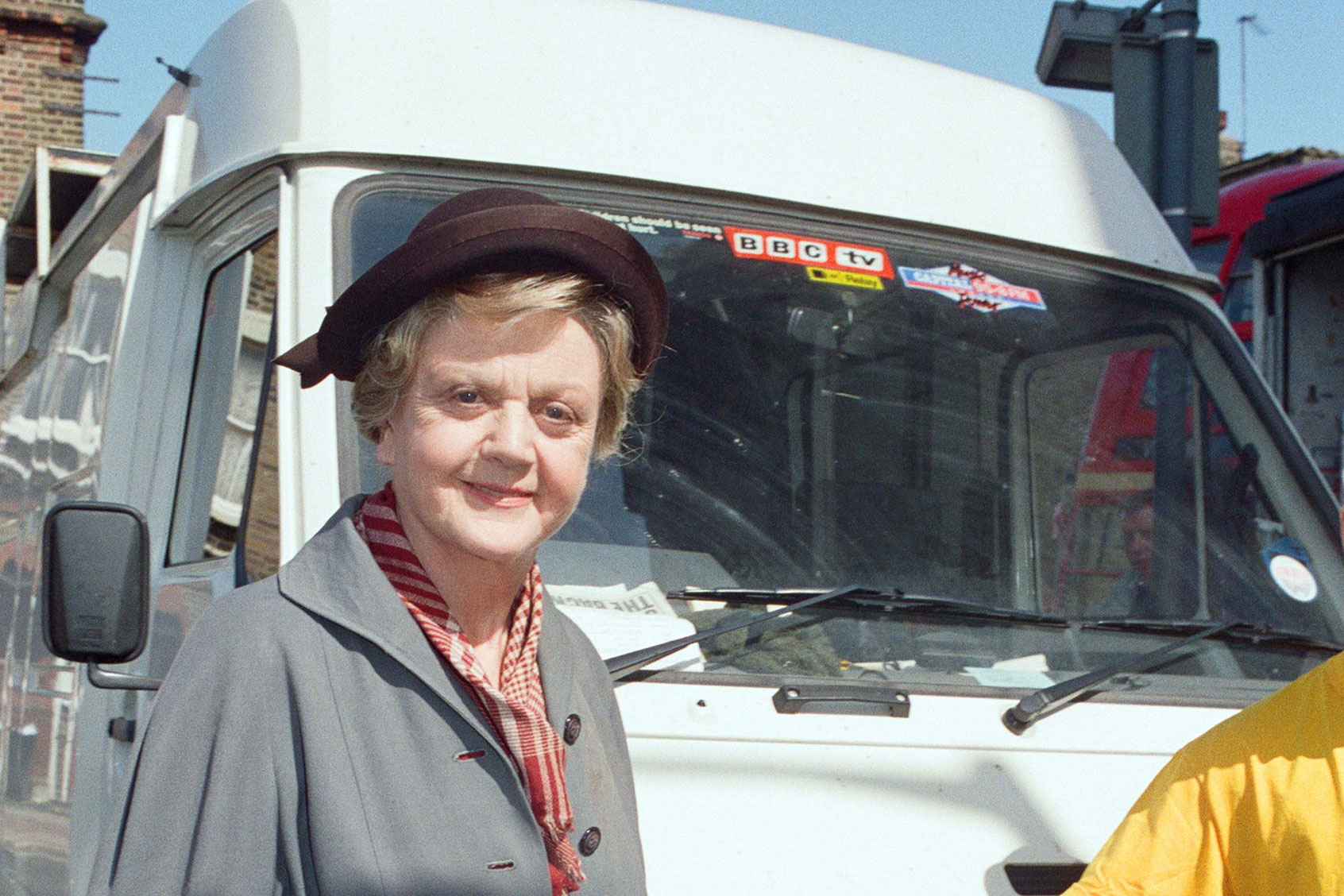
Angela LansburyAngela Lansbury on set of ‘Murder She Wrote’, 19th May 1992. (Julian Brown/Mirrorpix/Getty Images)Some of that tough love was real. Lansbury was a mother herself, and in the 1960s, she became very concerned about an older man her teen daughter was spending time with, a man who had convinced the child to steal and who would wait for her after school. Lansbury was so worried, she moved her entire family from Hollywood to Ireland, seeking to put as much distance between her daughter and the man as possible. 

That man was Charles Manson.

Lansbury also helped two of her teen children deal with substance abuse, at a time when there was little to no support about heroin addiction and the prevailing attitude toward those struggling was not like Lansbury’s stance, which was love. 

Angela LansburyHonoree Angela Lansbury accepts an honorary award onstage during the Academy of Motion Picture Arts and Sciences’ Governors Awards at The Ray Dolby Ballroom at Hollywood & Highland Center on November 16, 2013 in Hollywood, California. (Photo by (Kevin Winter/Getty Images)But Lansbury looked out and looked ahead. In 1987, she headlined the first-ever AIDS benefit in Chicago, raising $1 million. According to writer Rebecca Makkai, Lansbury, who continued to raise funds for AIDS research throughout her life, said onstage, “Here we celebrate life and together we fight.”

Lansbury was an outspoken supporter of the gay community her whole life. “I am very proud of the fact that I am a gay icon,” she said in an interview when she was 88.

Lansbury was wise without being a know-it-all, even though she did actually know it all.

Part of Lansbury’s specialness was her wide-ranging appeal, from queer fans who may have first known her from “Mame” or other Broadway hits, to children, introduced to her as the voice of the teapot in Disney’s “Beauty and the Beast.” Lansbury was wise without being a know-it-all, even though she did actually know it all, from her gently chiding Mrs. Potts to Mrs. Jessica Fletcher.

With “Murder She Wrote,” Lansbury found a character who would endure, making a senior citizen, a mystery novelist who solves murders, a star. The show ran for 12 seasons and introduced the world to cozy crime while also shining a spotlight on bookish writers; Jessica Fletcher was a former English teacher, and some of her friends in the show are teachers or professors.


Want a daily wrap-up of all the news and commentary Salon has to offer? Subscribe to our morning newsletter, Crash Course.


Lansbury’s Jessica Fletcher is the nosy neighbor who wants you to be happy, or at least, alive. She wants you to survive, but if you don’t, she will get to the bottom of it, never fear. She’s the kind of character you dream of living next door, gently warm, caring and capable. The actor stubbornly resisted the network’s attempts to write a romance for her, and Jessica Fletcher remained solo, a Maine widow who doesn’t drive who nevertheless has a huge social circle, and who helped raise her nephew, because mothers come from everywhere. 

Like Lansbury, the cool sister who grew into the wise aunt. 

Lansbury did it her way, but she brought us along for every step, every nuanced role that only deepened as she aged and became that most unlikely thing: an older woman holding her own in Hollywood. As she told NPR, “I was never going to get to play the girl next door, and I was never going to be groomed to be a glamorous movie star, and I sort of realized that, so I had to make peace with myself.”


The secret ingredients that make Angela Lansbury’s little-known cheesecake recipe work

In 1997, Tom Culver, the set costumer on “Murder, She Wrote,” had an idea. He wanted to collect recipes from the show’s cast and crew, bind them into a cookbook and sell it. The proceeds would benefit AIDS patients, specifically children and those in hospice.

Culver writes in the introduction to the eventual “The Murder, She Wrote Cookbook” that when Angela Lansbury, who starred in the series as the iconic sleuth Jessica Fletcher, was approached about the project, she enthusiastically responded by saying, “Start collecting!”

Culver did, eventually publishing 350 recipes, ranging from cast regular William Windom’s (Dr. Seth Hazlitt) caviar and grits to actress Tippi Hedren’s baked seafood salad.

“From key grip to best boy, everyone on the show has a fabulous recipe to share,” the description of the book reads. “And if you want to know just what a best boy (or a gaffer or grip) does, there’s a section at the back of the book explaining what happens behind the scenes of a TV show. With ‘The Murder, She Wrote Cookbook,’ planning a meal doesn’t have to be murder.”

Volumes of the original book are a little difficult to come by, not to mention pricey. Gently used copies now run anywhere from $93 to $199 on Amazon. But devoted fans of the show — as well as of Lansbury, who died Tuesday at the age of 96 — might be tempted to track down a copy because it contains a recipe from the star herself.

This isn’t necessarily a surprise. In a 2018 interview with Larry King, Lansbury said simple pleasures, such as cooking and gardening, were what made life worth living.


Want more great food writing and recipes? Subscribe to Salon Food’s newsletter, The Bite.


“Everything that is given to us as human beings to indulge ourselves in,” she said. “In our lives, that’s what interests me.”

As such, “Jessica’s Cheesecake” is a dead-simple cheesecake recipe (you can see a photograph of it here) with a few surprise ingredients that elevate it into something truly special. It has the basics: graham crackers, sugar, buttercream cheese and eggs. These are combined and baked into a standard cheesecake.

But then Lansbury calls for a whopping two cups of sour cream, which is in turn whipped with a little sugar and almond extract, providing a slightly fruity, almost marzipan-esque flavor. This fluffy topping is dolloped and spread across the top of the cheesecake and then chilled.

When removed from the refrigerator, it looks like the kind of cheesecake you would see on the silver screen — perhaps slowly rotating in a sparkling diner display case while an enterprising sleuth reviews her case notes over a cup of coffee at the next table over. It’s the platonic ideal with a little extra drama thrown in. Do yourself a favor and grab a slice before your next “Murder, She Wrote” viewing.

“Murder, She Wrote” is currently streaming on Peacock and other digital platforms.

“It’s not coming,” Infowars host Owen Shroyer says as Jones gets hit with nearly $1 billion verdict

As a Connecticut jury read their verdict on Wednesday — awarding nearly $1 billion in compensatory damages to families of Sandy Hook shooting victims negatively impacted by Alex Jones‘ claims that the tragedy was a hoax — statements are already being made by the Infowars camp that, somehow, the bank-busting debt is actually a win for Jones in his efforts to champion “the truth.”

Infowars host Owen Shroyer aired an emergency broadcast of his “War Room” show once the total damages had been announced to pat Jones on the back for what the rest of the world views as a financially crippling loss.

Comparing Jones to the likes of Muhammad Ali in terms of how the Connecticut verdict will make him fight even harder, Shroyer joked about the Sandy Hook families waiting for their checks to be cut saying “They aint coming.”

Jones, who was not present for the reading of this verdict, gave a broadcast of his own on Infowars echoing Shroyer’s statements. 

“As the jury reads the damages and the Sandy Hook parents weep, Alex Jones is on his broadcast, laughing and assuring his audience that he won’t actually be paying any of this money,” Tweets Brandy Zadrozny, Senior Reporter for NBC News, along with a clip of Jones making light of the verdict.


Want a daily wrap-up of all the news and commentary Salon has to offer? Subscribe to our morning newsletter, Crash Course.


The exact sum of Wednesday’s verdict, $965 million, will be split amongst 15 plaintiffs, according to The New York Times.  

“Absolutely astronomical figures in this InfoWars lawsuit out of Connecticut,” Tweets Ben Collins, Senior Reporter for NBC News. “Alex Jones owes $229 million to just the first three plaintiffs, all family members of Sandy Hook victims. There are nine more plaintiffs to go . . . Alex Jones makes an enormous amount of money, but not this much.”

Erica Lafferty, daughter of slain Sandy Hook Elementary principal, Dawn Hochsprung, spoke to reporters after the reading of the latest verdict saying “I wish that after today, I could just be a daughter grieving her mother and stop worrying about conspiracy theorists sending me threats or worse. But I know that this is not the end of Alex Jones in my life. I know that his hates, his hate, lies and conspiracy theories will follow both me and my family through the rest of our days. But I’m also hopeful for what happened here today. That it may save other families from high-profile tragedies from the cycle of abuse and re-traumatization that we have all been put through as we simply tried to survive the hardest days, weeks, and years of our lives.” 

How to embrace the apple in its entirety — peels and all

Apples may be the quintessential harbinger of autumn, even more so than the falling leaves, the welcome chill in the air or the ubiquitous PSL. From apple picking escapades and fresh-out-of-the-oven apple pies to warm apple cider and the crisp snap of a bite of a freshly picked apple, the humble fruit perfectly encapsulates both the seasonality and sentimentality of fall.

While some trudge home from apple picking with a five-pound bag and a list of all the amazing things to do with your new surplus, some snag an apple or two and then leave the bag to sit, the ethyl circulating, the apples browning and collapsing under themselves. Instead of allowing these autumnal gems to go to waste, utilize them in all of their shades, variations, and flavor profiles: baked goods, ciders, juices, savory applications, jams, apple butters, donuts, cocktails, specialty deserts, and so much more.

It’s imperative to note, though, that one byproduct of heavy apple cookery is a heap of leftover peels and skins. Unless leaving the skin on when making apple pie or nonchalantly munching on an unpeeled apple, the skin itself is rarely consumed. But why? It’s packed with nutrients and vitamins, it’s totally edible, and the varying  colors make quite an interesting tapestry, indicative of the shifting shades of autumn.

Looking to minimize food waste, use up the whole apple (sans seeds and stem, of course), and appreciate applies with a new fervor this fall? Read ahead for some tips:

Dehydrated (“chips”) and/or ground

If you’re fortunate enough to have a dehydrator on hand, then load it up with apple peels! Otherwise, turn your oven to its lowest setting and cook the apple peels until they are crisp and seemingly devoid of their moisture. 

Bonus: you can enjoy the dehydrated “chips” as-is, or you can crush them in a coffee grinder, food processor or by hand, and then use as a dried apple seasoning of sorts. Leave as-is if you’re looking to use it in savory applications (apple-seasoned roasted vegetables, apple-seasoned sautéed chicken, etc.), or mix with some cinnamon and sugar for a delicious sprinkle for coffees, breakfasts, desserts, yogurts and so much more.  

Potpourri

While obviously (unfortunately?) not edible, leftover apple peels are a perfect foundation for a DIY potpourri. Essentially a mix of dried fruits and seasonings along with particular scented oils, potpourri is an amazing vehicle to utilize those otherwise-discarded apple peels. Conversely, if you have a ton of apples leftover, you can even thinly slice them, roast or dehydrate them, and use the whole apple slices in the potpourri, too. Mix along with dried orange, cinnamon, cranberries, cloves, extracts, spices, and oils. You’ll be thrilled with the autumnal aromas permeating your home.

Peels for Pets

If your pup is experiencing some gastrointestinal issues, many vets recommend a “clean diet” consisting of white rice and boiled chicken. Some also recommend pumpkin. If you have a heaping pile of apple peels on your counter, though, slip some into their food for a boost of fiber that your pet will also probably love. Win-win!

Tea

Steep some apple peels in boiling water — flavoring as you wish with additional seasonings or sweeteners — and curl up with a big mug and enjoy. The subtle apple flavor makes this a stellar morning beverage, especially if it’s also steeped with some cinnamon sticks. 

Use in salads

Think about carrot peels or super-thinly sliced fennel and the texture and flavor they lend to salads. While using apple peels might seem odd, they are a great addition in that same vein. If you find that the “raw” peel is flaccid or unappetizing in the salad, feel free to roast before adding, or dehydrate fully, if you find that that crisp crunch is an alluring texture in your salad. 

Apple Cider Vinegar

One of the health world’s favorite items, ACV has become one of the most in-demand supplements —  as well as a handy, all-purpose tool to have around the house. While it was once a mere salad dressing vinegar, it’s now sold in pill form and other forms, becoming part of some daily regimens along with other vitamins and minerals. This process, however, is quite involved and can take up to months to complete. This is also due to the fact that ACV is a fermented product. Of course, though, the health benefits of ACV outweigh the laborious and time-consuming process. Also, you need nothing more than apple peels, water, sugar, and canning jars or bottles

Apple syrup

Arguably the most delicious item on this list, this apple syrup offers a rich, autumnal flavor that will elevate anything its added to. Essentially a reduction of maple syrup or brown sugar, apple peels, and water, this syrup is not as viscous as maple but not as thin as simple syrup. You can also enrich it even further with cream, honey, or butter. Use in coffees, yogurts, in homemade granola, over breakfast items like pancakes or waffles, or mix it with butter and slather it on anything your heart desires. 

Agrodolce

Essentially an Italiansweet-and-sour sauce,” agrodolce is a perfect balance of the two taste sensations. Oftentimes combining a sweetener or a fruit with an acid, the sauce or condiment can be customized in many ways. Here, the sweet component comes from the apple sweetness, which is balanced by a sharp vinegar, such as sherry or red wine. Many also add honey and golden raisins, along with fresh herbs, and while some agrodolces are thin and loose, others are thick and jammy. Regardless, they’re all incredibly flavorful. 

Hopefully this gives you some ideas for what to do with your apple surplus and the ensuing pile of peels. 

Salon Food writes about stuff we think you’ll like. While our editorial team independently selected these products, Salon has affiliate partnerships, so making a purchase through our links may earn us a commission.

Which came first, the incel or the misogynist? A new study delves into the incel mind

The term “incel,” short for involuntary celibate, began life as a slur wielded online. Specifically the term refers to young, typically heterosexual men who claim they are unable to have sex because modern society, and particularly women, persecute men. In the past two decades, internet forums supercharged the idea’s spread and made it into a community, replete with its own slang, ideology, and heroes.

If you haven’t heard the term, you’ve probably heard of some of their adherents, who occasionally make headlines for public acts of violence. A recent example is Johnny Deven Young, a 25-year-old from Southern California who is charged with going on a pepper spraying spree against women who rejected his crude advances. Perhaps most memorably, there was mass murderer Elliot Rodger — a Santa Barbara City College student who, in 2015 went on a mass shooting spree that killed seven people and injured 13 others in Isla Vista, Calif. Rodger spent time on forums linked to the Incel Movement, as he documented. Then there was vehicle-ramming attacker Alek Minassian, who self-identified as an incel and who in 2018 murdered 10 people in Toronto when he drove a van through a crowd of pedestrians.

Now a recent study in the journal Personality and Individual Differences claims to have deepened scientists’ understanding of what makes incels tick. To do so, Dutch and British researchers surveyed a pool of 349 predominantly heterosexual and single men who were experiencing unwanted celibacy — but, importantly, not always men who self-identified with the Incel Movement nor the term. The goal was to determine whether unwanted celibacy in itself is linked to misogynistic attitudes among men.

Speaking to Salon by email, the study’s corresponding author Dr. Pelin Gul — a professor in the Department of Psychology, Health and Technology at the University of Twente in the Netherlands — claimed that the study demonstrated that “the state of unwanted celibacy applies to the general population and [are] not exclusively characteristics of men who identify as incel (involuntarily celibate).” Gul added that “it wasn’t known especially in the social psychology literature that unwanted celibacy (besides personality traits like disagreeableness, political conservativism or social dominance) is linked to misogynistic attitudes. So, our study provided the first evidence for these two unexamined hypotheses.”


Want more health and science stories in your inbox? Subscribe to Salon’s weekly newsletter The Vulgar Scientist.


Despite the stereotype of incels as white basement dwellers, they are in fact racially, economically and in many other ways quite diverse. Some of the tenets of the Incel Movement include the belief that women discriminate sexually against men that aren’t conventionally attractive and that all women are hypergamous (obsessed with pursuing the most attractive possible men), and therefore deserving of hatred. 

“There certainly is a ‘vicious circle’ element of incel ideology: members of the Incel Movement retreat to online spaces where they spew hateful rhetoric and mobilize against a common outgroup, and those ideologies then strengthen and affect the individuals’ real-world relationships with the very women they wish to court.”

Dr. Jacob Ware, a research fellow at the Council on Foreign Relations who focuses on domestic and international terrorism and counterterrorism, told Salon by email that the study’s conclusions seemed “sound enough,” although he added that it was based on a small sample size.

“There certainly is a vicious circle element of incel ideology: members of the Incel Movement retreat to online spaces where they spew hateful rhetoric and mobilize against a common outgroup, and those ideologies then strengthen and affect the individuals’ real-world relationships with the very women they wish to court,” Ware explained. “It is not clear whether their misogyny drives them into the movement or if the movement creates and worsens the misogyny they then weaponize in their online and offline worlds.”

Describing it as an “interesting study,” Dr. Sophia Moskalenko of the National Consortium for the Study of Terrorism and Responses to Terrorism (START) wrote to Salon that she is “glad to see more survey data on incels, something that’s severely lacking at the moment. The conclusions seem justified by the data the researchers collected.”

Yet not all researchers were satisfied with the study’s methods. Dr. Tim Squirrell — Head of Communications and Editorial at the Institute for Strategic Dialogue — wrote to Salon that he has “significant misgivings” about the study because the researchers recruited incels online.

“Incel subculture has a substantial tradition of trolling and attempted media manipulation, and there is substantial mistrust of both journalists and researchers in incel spaces,” Squirrell explained. “As such, I would be concerned about the validity of this sampling method, and therefore any conclusion drawn from the study.”

While he argued that the study’s main conclusion — namely, that “the failure to satisfy a fundamental motive of human existence, namely the motive to acquire a romantic or sexual partner, contributes to individuals’ support for multiple forms of sexist and misogynistic views” — “is not necessarily incorrect,” the researchers may have done little else than measure “expressed attitudes, which may be different than the beliefs those individuals privately hold.” If the survey respondents wanted to manipulate the outcome of the study, they could have easily done so.

“Incel subculture has a substantial tradition of trolling and attempted media manipulation, and there is substantial mistrust of both journalists and researchers in Incel spaces,” Squirrell explained. “As such, I would be concerned about the validity of this sampling method, and therefore any conclusion drawn from the study.”

Moskalenko had her own criticisms of the study. Noting that the vast majority of self-identified incels are not violent and reject violence, Moskalenko disagreed with the researchers’ suggestion that the difference between violent and non-violent incels could be explained by “exposure to violent incel content.” (Gul, for her part, also told Salon that the vast majority of incels are not violent.) Moskalenko added that “the media sometimes create boogie men out of straw men” and “I think incels might be an example of that.” 

Moskalenko has worked on two separate surveys of incels, both of which were published in peer reviewed articles, and has extensively studied the data elsewhere.

“I conclude that for most incels, the motivation is largely to find a likeminded community online, to share their loneliness, frustration, sadness, and anxiety (rates of mental health symptoms reported by incels in my study and others’ are staggering),” Moskalenko argued. “Almost all incels in my studies report having been bullied. I suspect the Incel Community is a place to cope with that trauma and share that grievance.”

Like Moskalenko, Squirrell said that the vast majority of incels will not engage in violent acts of terrorism like Rodger and Minassian. The more common problem — which is consistent with the recent study’s findings — is that the Incel Community inflames their pre-existing misogyny and worsens the personal problems they wish they could fix. In addition, being an incel makes a person more likely to mistreat others.

“The misogyny that infects incel spaces is severe and violent, and people who have been steeped in those narratives are highly unlikely to be able to treat significant others with the respect and dignity needed to sustain a healthy relationship,” Squirrell told Salon. “Our concern should be oriented less towards rare but horrific instances of high profile violence, and more towards the interpersonal behaviors of people who have been immersed in subcultures where extreme ideologies are ubiquitous.”

“Almost all incels in my studies report having been bullied. I suspect the Incel Community is a place to cope with that trauma and share that grievance.”

Of course, while incels are not by and large violent, violent acts have been committed by perpetrators who explicitly identified as incels.

“Incels have committed several acts of terrorism,” Ware said. “The ideology has also inspired numerous other instances of violence where ideological justification has been less obvious. Although it is not a public safety threat on the scale of Salafi-jihadism or the violent far-right, incels will continue to pose threats to specific communities and targets.”

Going forward, Gul hopes that there will be additional research on links between unwanted celibacy (as opposed to specifically being an incel) and “desiring a more gender traditional and conservative society such as support for male dominance over women, and whether unwanted celibacy would hypothetically affect political movements and attitudes in society too, including voting.” 

Gul expressed some sympathy for those who ended up in the clutches of the Incel Movement. “Journalists and writers in popular media should be careful to not publish posts that further stigmatize incels, that present them as a violent outcast, because the majority of incels are not violent,” she noted. “It’s hard not to feel some sympathy.”

Of course, that does not mean that we should sympathize with their hatred for women, she added. “It’s right to be ambivalent about incels in general. But there is quite a variety of people who identify as incels or participate in incel forums. The majority of incels are not violent and there are even incel groups that explicitly ban expressions of anti-women rhetoric.”

Legal expert: Trump could face even more trouble if Merrick Garland indicts him in D.C., not Florida

Former President Donald Trump could face additional legal peril if Attorney General Merrick Garland decides to indict him in Washington D.C. rather than Florida, a legal expert said.

Garland could significantly expand the case against Trump if the DOJ files its indictment in the District of Columbia, Harvard Law Professor Laurence Tribe told MSNBC on Tuesday.

“The real questions before Merrick Garland are not whether to indict, but when? And where? And for which crimes?” Tribe said

“[Garland] would have to decide whether to indict him in Washington D.C., which by the way, he could do even over the Mar-a-Lago offenses because they began when he took the documents illegally from the White House, in Washington, and it was institutions in Washington that he was stiffing and deceiving when he didn’t return them,” Tribe explained.

According to Tribe, if Garland chooses to file in D.C., he would have the ability to add several other charges to the indictment. “And when it comes to trying the case in Washington, there one could include insurrection and seditious conspiracy, in addition to espionage, theft of government documents, and obstruction of justice,” Tribe said. 

When asked if he thought Garland would indict Trump, Tribe reasoned that the three alleged crimes that led to the search and seizures of Trump’s property are “strongly provable.” From his personal experience as Garland’s former research assistant, Tribe claimed that the attorney general “doesn’t do things halfway” as he’s “enormously thorough.” 

“The question of when depends very much on exactly when all the ducks are lined up in a row, when all the witnesses are ready,” he added. “Merrick Garland is not going to bring less than an overwhelming case, that I know by knowing him for all these years.”

However, The Atlantic’s Franklin Foer explained it is difficult to believe that Garland is happy about the choice he has to make: “whether to become the first attorney general in American history to indict a former president.”

There are a few reasons to contest the claims that Garland is preparing to indict, Foer wrote. For one, bringing criminal charges against Trump, who is in the opposing party, would be a dramatic show for Garland who “doesn’t believe the department should be subjected to unnecessary stress tests.” According to Foer, this act, the first of its kind, would introduce “never-ending political warfare” to the Justice Department. 

Foer also explained how the indictment location may affect the charges brought against Trump. If pursued in Florida, the former president will likely be charged in connection with stolen documents at Mar-a-Lago. But if the case is brought to D.C., Trump faces charges for his involvement in the Jan. 6 capitol insurrection. 

A Washington trial would be held in the Prettyman Courthouse on Constitution Avenue, a site close to the Capitol.

“This fact terrified the former prosecutors and other experts I talked with about how the trial might play out,” Foer writes. “Right-wing politicians, including Trump himself, have intimated violence if he is indicted.

Garland would also have to deal with the right-wing media circus that comes with Trump’s complaints and conspiracy theories about his opponents. Much like the Capitol on Jan. 6, the D.C. courthouse could become a militant ground for protesters and counter-protesters alike. Garland may also become incredibly unpopular on both sides of the political spectrum — he will either appear too lenient among the left, or be condemned as an enemy of the right.


Want a daily wrap-up of all the news and commentary Salon has to offer? Subscribe to our morning newsletter, Crash Course.


Despite all these reasons not to proceed, Foer believes that Garland will eventually indict.

“Over the course of my reporting, I came to appreciate that the qualities that strike Garland’s critics as liabilities would make him uniquely suited to overseeing Trump’s prosecution,” he writes. “The fact that he is strangely out of step with the times—that he is one of the few Americans in public life who don’t channel or perform political anger—equips him to craft the strongest, most fair-minded case, a case that a neutral observer would regard as legitimate.”

Garland has shown his tenacity in holding Trump accountable: he asked the court to unseal a large amount of seized documents, defended the FBI during Trump’s rampage against them, and has not allowed the ex-president’s legal team to stall the investigation. 

Foer also believes that his term limit is another major reason why Garland will move forward with the charges. On January 20, 2025, Garland may not be the Attorney General anymore, and if he’s replaced by a far-right appointee, the case against Trump will likely be dropped immediately. 

“The deadline for indicting Trump is actually much sooner than the next Inauguration Day,” Foer writes. “According to most prosecutors, a judge would give Trump nearly a year to prepare for trial, maybe a bit longer. That’s not special treatment; it’s just how courts schedule big cases.”

Mandatory reporting was supposed to stop severe child abuse — it punishes poor families instead

More than a decade before the Penn State University child sex abuse scandal broke, an assistant football coach told his supervisors that he had seen Jerry Sandusky molesting a young boy in the shower. When this was revealed during Sandusky’s criminal trial in 2012, it prompted public outcry: Why hadn’t anyone reported the abuse sooner?

In response, Pennsylvania lawmakers enacted sweeping reforms to prevent anything like it from ever happening again.

Most notably, they expanded the list of professionals required to report it when they suspect a child might be in danger, broadened the definition for what constitutes abuse and increased the criminal penalties for those who fail to report.

“Today, Pennsylvania says ‘No more’ to child abuse,” then-Gov. Tom Corbett declared as he signed the legislation into law in 2014.

A flood of unfounded reports followed, overwhelming state and local child protection agencies. The vast expansion of the child protection dragnet ensnared tens of thousands of innocent parents, disproportionately affecting families of color living in poverty. While the unintended and costly consequences are clear, there’s no proof that the reforms have prevented the most serious abuse cases, an NBC News and ProPublica investigation found.

Instead, data and child welfare experts suggest the changes may have done the opposite.

The number of Pennsylvania children found to have been abused so severely that they died or were nearly killed has gone up almost every year since — from 96 in 2014 to 194 in 2021, according to state data. State child welfare officials say more vigilance in documenting severe cases of abuse likely contributed to the increase. But child safety advocates and researchers raised concerns that the surge of unfounded reports has overburdened the system, making it harder to identify and protect children who are truly in danger.

In the five years after the reforms took effect, the state’s child abuse hotline was inundated with more than 1 million reports of child maltreatment, state data shows. More than 800,000 of these calls were related not to abuse or serious neglect, but to lower-level neglect allegations often stemming from poverty, most of which were later dismissed as invalid by caseworkers.

The number of children reported as possible victims of abuse or serious neglect increased by 72% compared to the five years prior, triggering Child Protective Services investigations into the well-being of nearly 200,000 children from 2015 to 2019, according to a ProPublica and NBC News analysis of federal Department of Health and Human Services data. From this pool of reports, child welfare workers identified 6,000 more children who might have been harmed than in the five previous years. But for the vast majority of the 200,000 alleged victims — roughly 9 in 10 — county agencies dismissed the allegations as unfounded after inspecting families’ homes and subjecting parents and children to questioning.

The expanded reporting requirements were even less effective at detecting additional cases of sexual abuse. Some 42,000 children were investigated as possible sex abuse victims from 2015 to 2019 — an increase of 42% from the five years prior — but there was no increase in the number of substantiated allegations, the analysis of federal data showed. In other words, reforms enacted in response to a major sex abuse scandal led to thousands more investigations, but no increase in the number of children identified as likely victims.

Child welfare experts say these findings cast doubt on the effectiveness of the primary tool that states rely on to protect children: mandatory child abuse reporting. These policies, the bedrock of America’s child welfare system, were first implemented more than half a century ago in response to growing national awareness of child maltreatment. The thinking was simple: By making it a crime for certain professionals to withhold information about suspected abuse, the government could prevent vulnerable children from falling through the cracks.

Over the past decade, at least 36 states have enacted laws to expand the list of professionals required by law to report suspicions of child abuse or imposed new reporting requirements and penalties for failing to report, according to data compiled by the National Conference of State Legislatures, a group representing state governments.

Some legal experts and child welfare reform activists argue these laws have created a vast family surveillance apparatus, turning educators, health care workers, therapists and social services providers into the eyes and ears of a system that has the power to take children from their parents.

“I don’t think we have evidence that mandated reporting makes children safer,” said Kathleen Creamer, an attorney with Community Legal Services, a Philadelphia nonprofit that provides free representation to parents accused of abuse and neglect. “I actually think we have strong evidence that it puts child safety at risk because it makes parents afraid to seek help, and because it floods hotlines with frivolous calls, making it harder for caseworkers to identify families who really do need services.”

In a yearlong investigation, ProPublica and NBC News are examining the extraordinary reach of America’s child welfare system and its disproportionate impact on the lives of low-income families of color. The stream of reports generated by mandatory reporting is so vast, and so unevenly applied, public health and social work researchers estimate that more than half of all Black children nationally will have been the subject of a child protective services investigation by the time they turn 18 — nearly double the rate of white children.

After a hotline report comes in, it’s the job of child welfare investigators to determine whether a child is truly in danger. These caseworkers aren’t held to the same legal or training standards as law enforcement, but they can wield significant power, ProPublica and NBC News found, sometimes pressuring their way into homes without court orders to comb through closets and pantries, looking for signs of what’s lacking.

Under this system, child welfare agencies investigate the families of 3.5 million children each year and take about 250,000 kids into protective custody, according to federal data. Fewer than 1 in 5 of these family separations are related to allegations of physical or sexual abuse, the original impetus behind mandatory reporting. Instead, the vast majority of removals are based on reports of child neglect, a broad range of allegations often tied to inadequate housing or a parent’s drug addiction.

In response, a growing movement of family lawyers, researchers and child welfare reform advocates have called for a radical change in the approach to child protection in America, starting with the abolition of mandatory reporting. This idea has grown in popularity among both progressive activists and conservatives who oppose what they call excessive government intrusion in the lives of families. Other critics support less dramatic reforms, such as limiting which professionals are required to report and providing better training for mandated reporters.

The fallout from Pennsylvania’s expansion of mandatory reporting has become something of a cautionary tale among those calling for a system overhaul. Even some proponents of the changes have begun to question their impact.

State Rep. Todd Stephens, a Republican who helped spearhead the post-Sandusky reforms, said the impact of the changes warranted closer examination. In response to NBC News and ProPublica’s findings, he said he would lead a legislative effort to take a “deep dive in the data” to ensure the laws are protecting children as intended.

But Stephens said he believes the legislation is working, citing the massive increase in hotline reports and the 6,000 additional children with substantiated findings of abuse or serious neglect over five years.

“The goal was, if people thought children were in trouble or in danger, we wanted the cavalry to come running,” Stephens said. “That’s 6,000 kids who are getting help who might not have otherwise.”

Child welfare experts, however, cautioned against drawing conclusions based on the increase in substantiated abuse cases because those are subjective determinations made by caseworkers that children were more likely than not to be at risk of being abused and do not indicate whether the findings were ultimately dismissed by a judge.

Dr. Rachel Berger, a professor of pediatrics at the University of Pittsburgh who served on a task force that paved the way for the 2014 reforms, said the state has not produced evidence to show the changes have made children safer.

In 2020, while testifying before the Pennsylvania House of Representatives, Berger warned lawmakers that the reforms “may have inadvertently made children less safe” by straining the system and siphoning resources away from genuine cases of abuse.

“We are continuing to tell mandated reporters, ‘Report, report, report,’ and nobody can handle it,” Berger said in an interview.

Jon Rubin, deputy secretary at the Pennsylvania Department of Human Services’ Office of Children, Youth and Families, which oversees the state’s ChildLine call center, said it’s “really hard to evaluate” whether the 2014 reforms succeeded in making children safer overall. Rubin said he’s aware of the concern that the changes overwhelmed the system and may have contributed to the increase in child abuse deaths. But he cautioned against drawing conclusions without considering other factors, such as the strain on the system caused by the fentanyl epidemic beginning in 2017.

Rubin said his agency is studying ways to reduce the number of hotline reports related to poverty and housing issues, in part by encouraging mandatory reporters to instead connect families directly with resources. The state has also made it a priority to keep struggling families together by providing access to services such as mental health counseling and parental support groups, Rubin said. He worries about the potential impact of more dramatic changes.

“How many children’s lives are we willing to risk to, as you said, abolish the system, to reduce the overreporting risk?” Rubin said. Would preventing unnecessary reports, he asked, be worth “one more child hurt or killed, five more children hurt or killed, 100 more children hurt or killed?”

But Richard Wexler, the executive director of the National Coalition for Child Protection Reform, a Virginia-based advocacy group, said that this logic ignores the harm that comes with unnecessary government intrusion in the lives of innocent families. Simply having an investigation opened can be traumatic, experts say, and numerous studies show that separating young children from their parents leads to increased risk of depression, developmental delays, attachment issues and post-traumatic stress disorder.

It isn’t necessary to threaten educators, social workers, doctors and other professionals with criminal charges in order to protect children, Wexler argued.

“Abolishing mandatory reporting does not mean abolishing reporting,” he said. “Anybody can still call ChildLine. What it does, however, is put the decision back in the hands of professionals to exercise their judgment concerning when to pick up the phone.”

The Cost of Seeking Help

April Lee, a Black mother of three in Philadelphia, said she has seen and experienced firsthand the way mandatory reporting and the prospect of child removals create a culture of fear in low-income communities.

In Philadelphia, the state’s most populous city, Black children were the focus of about 66% of reports to the city’s Department of Human Services, its child welfare agency, even though they make up about 42% of the child population, according to a 2020 report commissioned by the department.

Over time, Lee said, moms in neighborhoods like hers get used to having child welfare agents show up on their steps.

“It’s a shame,” she said. “You get to the point where it’s almost normalized that you’re going to have that knock on your door.”

Lee estimates that she’s personally had about 20 such reports filed against her in the two decades since she gave birth to her first child at the age of 15. In most instances, she said, the caseworkers didn’t leave her with paperwork, but she said the accusations ranged from inadequate housing to concerns over her son’s scraped knee after a tumble on the front porch.

The agency never discloses who files the reports, but Lee believes it was a call from a mandatory reporter that triggered the investigation that resulted in her children being taken away. In 2013, a year after the birth of her third child, Lee said, she was drugged at a bar and raped. In her struggle to cope with the trauma, she said, she confided in a doctor.

“I was honest,” Lee said. “Like ‘I’m fucking struggling. I’m struggling emotionally.'”

She suspects someone at the clinic where she sought mental health care made the hotline call, most likely, she said, believing that the city’s child welfare agency would be able to help.

The agency opened an investigation and determined that Lee — who at one point had left her three children with a friend for several days — was not adequately caring for her children. The agency took them into protective custody, according to court records reviewed by NBC News and ProPublica. Afterward, Lee said, she spiraled into drug addiction and homelessness.

At her lowest point, Lee slept on a piece of cardboard in the Kensington neighborhood, the epicenter of Philadelphia’s opioid crisis. It took two years to get clean, she said, and another three before she regained custody of all of her children.

Lee said people like to tell her she’s proof that the system works, but she disagrees.

“My children still have deficits to this day due to that separation,” she said. “I still have deficits to this day due to that separation. I still hold my breath at certain door knocks. That separation anxiety is still alive and well in my family.”

Now Lee works as a client liaison at Community Legal Services, guiding parents through the system. The job is funded by a grant from the city agency that took her children. Virtually all of the mothers she works with have one thing in common, she said: They’re struggling to make ends meet.

“We see that in a lot of our cases,” Lee said. “You have someone that went to their doctor to say, ‘Hey, I relapsed.’ That’s a call to the ChildLine. Or you have a family that might go into a resource center saying, ‘Hey, we’re homeless.’ That’s a call to the ChildLine. You have children that show up to school without proper clothing. That’s a call to the ChildLine.”

But mandatory reporting, and the fear that it provokes, makes it harder for them to get the help they need.

“The solution to poverty,” Lee said, “should not be the removal of your children.”

Policies Driven by Outrage

In 1962, a pediatrician named C. Henry Kempe published a seminal paper identifying a new medical condition that he called “the battered-child syndrome.” Drawing on a survey of hospital reports nationwide and a review of medical records, Kempe warned that physical abuse had become a “significant cause of childhood disability and death” in America and that this violence often went unreported.

The paper led to widespread media attention and calls to address what some experts began calling the nation’s hidden child abuse epidemic. In the rush to take action, one solution emerged above all else: mandatory reporting.

Within four years of Kempe’s paper, every state had passed some form of mandatory child abuse reporting. In 1974, despite a lack of research into the effects of these new policies, the approach was codified into federal law when Congress enacted the Child Abuse Prevention and Treatment Act, which requires states to have mandatory reporting provisions in order to receive federal grants for preventing child abuse.

It became conventional wisdom among child welfare policymakers that more reporting and investigations would make children safer. States gradually expanded reporting requirements in the decades that followed, adding ever more professionals — including animal control officers, computer technicians and dentists — to the list. They also expanded the definition of child maltreatment to include emotional abuse and neglect.

But critics say these policy decisions too often have been guided by public outrage and politics, not by data and research.

“Reporting has been our one response to concerns about child abuse,” said Dr. Mical Raz, a physician and professor of history at the University of Rochester who has studied the impact of mandatory child abuse reporting. “Now we have quite a bit of data that shows that more reporting doesn’t result in better identification of children at risk and is not associated with better outcomes for children, and in some cases may cause harm to families and communities.”

The Sandusky scandal, Raz said, demonstrates how a high-profile atrocity and public outcry can drive policy decisions.

The longtime Penn State assistant football coach was convicted in 2012 on 45 counts of child sexual abuse tied to the repeated rape and molestation of boys over a 15-year period. An investigation commissioned by the Penn State Board of Trustees found that several university officials, including legendary Nittany Lions football coach Joe Paterno, had known about allegations of sex abuse against Sandusky as early as 1998, but had shown a “total and consistent disregard” for “the safety and welfare of Sandusky’s child victims.”

In response, Pennsylvania passed a raft of reforms. It clarified and expanded the definition of abuse and added tens of thousands of additional people to the state’s roster of mandated reporters — which now includes virtually any adult who works or volunteers with children. It also increased the criminal consequences for failing to report child abuse, with penalties ranging from a misdemeanor to a second-degree felony, punishable by up to 10 years in prison. Although such prosecutions are rare, child welfare officials said the threat is effective in driving more professionals to report.

But the state failed to include additional funding to handle the anticipated increase in hotline calls and investigations, despite warnings from county officials that the reforms “were going to put a massive strain on their workers and would require additional resources,” according to a 2017 report from the state auditor general.

Those warnings proved prescient. In early 2015, after the changes went into effect and thousands of additional reports flooded Pennsylvania’s child abuse hotline, state officials estimated 4 in 10 callers were placed on hold for so long that they hung up before getting a caseworker on the line.

Some ChildLine workers reported an uptick in calls from mandated reporters who openly acknowledged they did not really believe that a child was in danger. Haven Evans, now the director of programs at Pennsylvania Family Support Alliance, which trains mandatory reporters across the state, was working at the state’s hotline center that year.

“There were a lot of mandatory reporters who would even admit on the phone call that they were making this report because they were concerned with the changes in the law and the penalties being increased,” Evans said. “They just wanted to, for lack of a better word, cover their butt.”

In the months and years that followed, the state added funding and workers and upgraded call center technology to keep up with the deluge. But taking a report is just the first step of the process — what some refer to as the child welfare system’s “front door” — and not enough attention has been paid to studying whether the system as a whole leads to better outcomes, said Cathleen Palm, founder of the Center for Children’s Justice, a nonprofit in Bernville, Pennsylvania, that advocates for government interventions to protect children.

In 2018, Palm came out against proposed legislation to further expand mandatory reporting that had been introduced in the wake of the Catholic clergy sex abuse scandal and grand jury investigation. Even though Palm is herself a survivor of child sexual abuse, her calls for a formal study before passing more reforms made her a target of attacks, she said.

“I literally got called by a senior official at the attorney general’s office, who called me screaming at me, equating me to a friend of the pedophile,” Palm said. “I was floored. Do you have any sense of who you’re talking to?”

The following year, state lawmakers acted anyway, passing a law that expanded when failure to report is a felony.

The same dynamic has played out across the country: High-profile media coverage of child abuse deaths and child sexual abuse have created overwhelming political pressure to ramp up mandatory reporting, in red and blue states alike.

Eighteen states have gone so far as to implement universal child abuse reporting requirements, deputizing every adult in the state as a mandatory reporter. But a 2017 study published in the American Journal of Public Health found that universal reporting requirements led to more unfounded reports while failing to detect additional confirmed cases of child maltreatment.

Kelley Fong, an assistant professor of sociology at the University of California, Irvine, has done extensive research into the impacts of mandatory reporting policies. When Fong interviewed dozens of impoverished mothers in Rhode Island and later Connecticut, they described how mandated reporters are “omnipresent” and how the fear of a call to Child Protective Services leads some to avoid seeking public assistance.

But when she spoke to professionals who had filed reports against parents, Fong found a disconnect.

“Almost to a person, every single mandated reporter said, ‘I reported because I wanted to help the family,'” Fong said. “For the most part, these mandated reporters are in their jobs because they want to help people, they want to improve conditions for children and families. And so here is this agency that offers them this possibility of getting help to parents and children.”

Fong compared this approach to sending armed police officers to assist people struggling with homelessness, mental illness and addiction — a practice that’s drawn increased scrutiny since 2020’s nationwide demonstrations for racial justice and police reform. But while there’s growing awareness of the consequences of what activists view as the overpolicing of Black communities, Fong said fewer people have applied that same critical lens to child welfare.

That’s starting to change.

In 2019, in response to concerns that Massachusetts wasn’t doing enough to protect children, the state legislature voted to create a special commission to study how best to expand mandatory reporting requirements. For two years, the commission was progressing toward that goal — until they agreed to hear public comments on their plans.

During four hours of virtual testimony in April 2021, the commission heard from dozens of parents, social workers, legal experts and reform activists, most of whom expressed deep concerns about the potential harms of expanded reporting requirements. Raz was among those who testified, citing as a warning the dysfunction that followed the Pennsylvania reforms.

Afterward, members of the commission said they were “shocked” and “taken aback” to learn about potential problems associated with expanding the child welfare system. As a result, when the commission delivered its final report to lawmakers in June 2021, it made no formal policy recommendations.

Instead, it called for further study of the unintended impacts of mandatory reporting.

The Strain on Philadelphia’s System

Few places were harder hit by Pennsylvania’s surge of new child abuse reports after 2015 than Philadelphia.

Kimberly Ali, commissioner of the Philadelphia Department of Human Services, the city’s child welfare agency, acknowledged in an interview with NBC News that the change in the state’s mandatory reporting policies put a strain on Philadelphia’s system. She said the local hotline managed by her department “imploded” after the Sandusky reforms. It took the agency years to recover.

“That was a difficult time at the Department of Human Services, just trying to manage the number of calls and the number of investigations,” Ali said.

In a city where nearly a quarter of residents live in poverty, the deluge of new reports disproportionately involved Black families and led to a sharp increase in the number of Philadelphia children being taken from their parents. In 2017, the city’s child welfare agency removed the most children per capita among the 10 largest cities in the U.S. — at three times the rate of New York and four times that of Chicago, according to data compiled by the National Coalition for Child Protection Reform.

Five of those children belonged to Lisa Mothee.

On Aug. 21, 2017, a mandatory reporter employed by the Einstein Medical Center in Philadelphia called in a hotline report flagging that Mothee’s newborn baby had tested positive for opioids. The hospital later reported that Mothee had also failed to provide her baby with proper medical care, because she declined vaccinations and other medical screenings typically provided to newborns, according to court records.

At a court hearing a month later, Mothee, who is Black, told a judge that she had taken a Percocet to cope with pain late in her pregnancy. She explained that she’d stopped consenting to vaccines after one of her children had an adverse reaction several years earlier, which she believed was her right as a parent. After a lawyer for the city’s child welfare agency acknowledged in court that they didn’t have reason to believe Mothee’s children were in danger, she figured the case would be dismissed.

Instead, the judge ordered Mothee and the father of four of her children to be handcuffed and held in court for several hours while child protection agents picked up all five of her kids from school and a babysitter.

“What? No!” Mothee called out, according to a court transcript. “You can’t take my kids! You can’t take my kids!”

Eight months would pass before a different judge ordered her children to be returned. Years later, Mothee said she’s still struggling with the trauma of the ordeal. “It’s like a death,” she said. “You never get over that feeling.”

Mothee’s case was part of a statewide trend post-Sandusky.

The number of Pennsylvania children reported as possible victims of serious medical neglect — a blanket term describing a parent’s failure to provide adequate medical care — nearly quadrupled after the reforms went into effect in 2015, triggering Child Protective Services investigations into the well-being of about 9,600 children over a five-year span, according to the ProPublica and NBC News analysis of federal data.

This surge followed a change in how the state defined when neglect, including medical neglect, can be considered a form of child abuse. Lawmakers lowered the threshold from any failure to care for a child that endangers their “life or development,” to any failure that “threatens a child’s well-being.” Critics say the change has usurped parents’ right to make medical decisions for their children and has punished people who lack easy and affordable access to health care.

Mothee’s case was among several cited in a scathing report issued in April by a special committee of the Philadelphia City Council that detailed the unintended consequences of mandatory child abuse reporting and alleged failures at Philadelphia’s child welfare agency.

City Councilmember David Oh pushed for the creation of the special committee after his own brush with a mandatory reporter in 2018. A hospital worker at the Children’s Hospital of Philadelphia had phoned in a hotline report after Oh, a Republican and the city’s first Asian-American councilmember, brought his son to the emergency room with a broken collarbone. Oh explained that his boy had been injured while practicing martial arts, but the hospital social worker said she had no choice but to notify the city, triggering what Oh viewed as a senseless investigation into a report that was ultimately deemed unfounded.

Afterward, Oh said, he heard from dozens of Philadelphia parents, including Mothee, who’d gone through similar ordeals.

Ali, the DHS commissioner, said her agency has reduced the city’s foster care rolls by about 29% since 2017, with an increased focus on providing families with services rather than removing children. But Oh said not enough has been done to mitigate the fear created by mandatory reporting, especially in poorer Black communities.

“In those neighborhoods, everyone knows about mandated reporters,” Oh said during an interview at his office. “So when your child falls off a bike, you’ve got to think, ‘Do we take him to the hospital or not?'”

Oh’s committee made several recommendations for reforms — including a call for the state to abolish mandatory reporting.

“They have a system where everyone pulls a fire alarm anytime they feel like there’s a potential for fire, and theoretically it’s great because we’re going to catch every fire before it begins,” Oh said. “But how it’s worked out is all our firefighters are running around to false alarms, and now buildings are burning and people are dying. It’s a bad system.”

“Mandatory Reporters Into Mandatory Supporters”

Some experts argue that the best way to reduce unfounded reports of child abuse and neglect is not by abolishing mandatory reporting, but by doing a better job of training professionals on when to report — and when it’s better to provide help to a family in need instead.

In Pennsylvania, medical professionals are required to complete a two-hour mandatory reporter training course every two years; other professionals must take a three-hour training every five years.

But Dr. Benjamin Levi, a pediatrician and former director of the Center for the Protection of Children, a research and policy group at Penn State Children’s Hospital, said such training programs typically lack a clear explanation of the “reasonable suspicion” of abuse that should trigger a report.

“‘Reasonable suspicion’ is a feeling — they don’t even define it,” said Levi, who developed an alternative training for mandatory reporters to help fill in the gaps.

“If you increase mandated reporting, and you don’t make sure that mandated reporters know what to report and what not to report, you’ve just made the problem worse.”

Educators, the largest source of child abuse reports nationally, in particular have struggled to correctly identify children in need of help. From 2015 to 2019 in Pennsylvania, 24 out of 25 children referred to Child Protective Services by education professionals had their cases dismissed by case workers as unsubstantiated — but only after children and parents had been subjected to questioning and home searches.

Ali, the head of the Philadelphia child welfare agency, said her department has heard from educators who felt unable to help struggling families because they feared potential criminal charges for not reporting to the abuse hotline. With the support of a federal grant, her department plans to create an alternative hotline that mandatory reporters can call when they believe a family is in need but don’t suspect children are in danger.

Adopting the language of reform activists, Ali said the goal is “turning mandatory reporters into mandatory supporters.”

But Benita Williams, former operations director of Philadelphia’s child welfare agency, warned against more radical change, stressing that mandatory reporters should never hesitate to make a report in cases of suspected child abuse.

“Just report,” said Williams, now executive director of the Philadelphia Children’s Alliance, which supports victims of child sexual abuse. “If you are not sure, report and let the professional screen that out. Don’t try to become a social worker.”

Phoebe Jones, who helps lead DHS-Give Us Back Our Children, a group that advocates on behalf of Philadelphia mothers and grandmothers who’ve had children taken from them for issues related to poverty and domestic violence, argues that the real solution is to address the issues underlying most ChildLine reports, by providing parents and caregivers with a universal basic income to ensure they have what they need to care for children.

“Rather than taking children from their mothers and paying foster parents to care for them,” Jones said, “why don’t we invest that money in families?”

Jan. 6 committee just obtained 1 million Secret Service docs — plans to drop the hammer at hearing

The House Jan. 6 committee’s next public hearing on Thursday will cover new material provided by the Secret Service revealing that former President Donald Trump was “repeatedly alerted to brewing violence” on Jan. 6, according to The Washington Post

The Secret Service provided over one million electronic communications to congressional investigators, two anonymous sources told NBC News. This includes emails and other electronic messages from agents in the days leading up to and during the insurrection.

The communications can provide insight into contact agents had with rioters, their efforts to protect former Vice President Mike Pence and what happened when Trump allegedly ordered Secret Service agents to take him to the Capitol. 

“We have and continue to fully cooperate with the Jan. 6 select committee. While no additional text messages were recovered, we have provided a significant level of details from emails, radio transmissions, Microsoft Teams chat messages and exhibits that address aspects of planning, operations and communications surrounding Jan. 6,” Secret Service Special Agent Steve Kopek told NBC.

In July, the committee subpoenaed the Secret Service for communications from Jan. 5 and 6, 2021 that were said to have been erased as part of a pre-planned phone system upgrade. The content of these texts garnered a lot of interest after former White House aide Cassidy Hutchinson told the committee that she had heard secondhand that Trump lunged at a Secret Service agent after he refused to drive the former president’s vehicle to the Capitol during the insurrection, according to NBC.

The committee also plans to share surveillance footage taken near the Ellipse on the morning of Jan. 6 before Trump’s speech at the “Stop the Steal” rally. Other internal emails that will be revealed at the hearing may include evidence about staff members warning Trump about the possibility of violence taking place that day, but Trump continuing to press Secret Service agents to take him to the Capitol to join his supporters, three people said according to The Washington Post


Want a daily wrap-up of all the news and commentary Salon has to offer? Subscribe to our morning newsletter, Crash Course.


The committee held several public hearings over the summer showing never-before-seen video footage from the Capitol attack and video testimony from former officials about Trump’s refusal to accept his election loss. The hearings provided an insight into the plans Trump’s allies orchestrated to replace electors in battleground states that President Joe Biden won and revealed the ways local and state elections officials were threatened. 

The ninth public hearing will touch on the “close ties between people in Trump world and some of these extremist groups,” Rep. Zoe Lofgren, D-Calif., who sits on the panel, said in a CNN interview

“We’re going to be going through, really some of what we’ve already found, but augmenting with new material that we’ve discovered through our work throughout this summer,” Lofgren added.

The hearing is set for 1 p.m. ET on Thursday after being rescheduled last month due to Hurricane Ian’s devastation in Florida. 

Growing GOP voter challenges have a long history of keeping down the Black vote

Voters who want to cast their ballot on Election Day this November may be in for an unpleasant surprise — the very real possibility that they will be unable to vote.

That’s because any registered voter can challenge the right of another voter, or group of voters, to cast a ballot by alleging that they are not qualified to do so.

Potential challenges range from the wrong address on a voter’s registration to not being old enough to vote to having been barred from voting as a felon. Once a challenge is made, election officials have to determine whether it is valid and whether a voter should be removed from the list of eligible voters.

State and local election officials have already had an unusually busy year dealing with voting challenges. In many places, they have been flooded with them.

The Associated Press reported on Sept. 17, 2022, that in one Iowa county, election officials who had received “three voter challenges over the previous 15 years” got 119 challenges over a two-day period.

This year, Georgia has been ground zero for such efforts. Eight counties have received complaints seeking to remove 65,000 people from their lists of registered voters. In 2021, True the Vote, a self-described election integrity group, led an effort that challenged 364,000 voters across all of Georgia’s 159 counties.

Such challenges don’t happen only before Election Day; 39 states allow similar challenges to occur on Election Day itself. A video obtained by Politico shows a GOP staffer in Michigan explaining how Republicans will, the reporter writes, “install party-trained volunteers prepared to challenge voters at Democratic-majority polling places.”

The Trump effect

In 2020, then-President Donald Trump urged his supporters to file such challenges in places where he claimed that there might be fraudulent voting.

During that year’s first presidential debate, Trump singled out Philadelphia, a longtime Democratic stronghold with a large Black population. He called on supporters to “go into the polls and watch very carefully … because bad things happen in Philadelphia. Bad things.”

The practice of citizens’ challenging others’ right to vote started long before Trump came onto the political scene. It is, in fact, older than the American republic. Throughout U.S. history, citizen voting challenges have been a tool used by people seeking to disenfranchise others and secure partisan advantage for themselves.

200 years of citizen challenges

The first laws authorizing such challenges to others’ voting rights can be traced back to the American Colonies. In some of those places, the right to challenge was even written into royal charters, allowing challenges in any Colonial election.

For example, in 1742, when Rhode Island and Providence Plantations revised its charter, the changes included this provision allowing eligible voters to question the voting rights of any other person:

“… if any Person in this Colony shall attempt to vote in any Election within the same, who is suspected not to be qualified as above said, it shall and may be lawful for any Person to inform the Moderator, or other Person who presides at such Election, that he hath Cause to doubt, that such suspected Person hath not a good Right to vote.”

Soon after the American Revolution, newly formed states enacted laws giving their voters the right to challenge people who they believed had supported the British during the war. New York law allowed citizens to object to anyone voting who had “not taken an active and decisive part in favor of the United States in the present war. …”

The full flourishing of this practice did not occur until after the Civil War. Suddenly confronted with the prospect that freed slaves would vote and change the outcome of elections, states in the Reconstruction South enacted voter challenge statutes.

These laws fostered a kind of vigilante justice, in which citizens could police the electoral behavior of others in the name of preventing fraudulent voting.

Such vigilantism was one tool among many to intimidate freed slaves and keep them from casting ballots on Election Day.

Political parties and voting challenges

Despite their tainted history, laws allowing citizens to make both preelection and Election Day challenges persisted through the 20th and into the 21st century. The Brennan Center, a progressive think tank, notes that in the early 20th century, several states reaffirmed, reenacted or refined their voter challenge laws, including Election Day challenges.

One example: In 1904, Virginia reenacted its Election Day challenge law and at the same time passed new poll tax and literacy tests for voting. Today, Virginia law says that “any qualified voter and election officers” may object to anyone’s casting a vote on the grounds that they are not legally eligible to do so.

During the 20th century, political parties promoted voting challenges.

One of the most prominent of those efforts happened during the 1981 campaign for New Jersey governor. The Republican National Committee mailed sample ballots to the homes of people in precincts with a high percentage of racial or ethnic minority voters. Voters whose sample ballots were returned as undeliverable, or because the voter had moved, were then subject to challenge.

The Democratic National Committee sued, alleging the Republicans’ effort violated the 1965 Voting Rights Act. The suit resulted in a court-approved agreement in which the Republican National Committee agreed to end this vote-challenging practice.

Before the 2004 election, the Republican Party announced another voter challenge plan. It would station 3,500 people in polling places in Democratic areas of Ohio to raise objections when Democratic voters showed up to vote. The party ultimately backed down, even though it won a court fight over its plan.

What happens in an Election Day challenge?

On Election Day any registered voter seeking to disqualify another person from voting must notify an election official of the desire to file a challenge. They may do so on the same grounds that are used in preelection challenges.

Such challenges raise real difficulties at the polls. In many states, challengers do not have to submit evidence to substantiate their allegations.

While voters get no advance notice that a challenge will be made, they may be required to provide documentation or swear on the spot that they are entitled to vote.

As Federal District Judge Donald Molloy said in a 2008 Montana election challenge case, “Voters might be intimidated, confused or even discouraged from voting upon receiving notice that their right to vote … has been challenged.”

And Election Day challenges put officials at polling places in a very difficult position. As the Brennan Center puts it, they are “under immense time pressure to decide challenges quickly. … As a result, they can be denied a full opportunity to thoroughly review every challenge and to verify the challenger’s allegations.” In some states challenged voters may be allowed to cast provisional ballots while the challenge is pending.

On Nov. 8, this nation may experience a surge of voters intimidated by Election Day challenges. Election officials may have to make hurried decisions. That’s a situation that threatens the very right to vote, a right that former President Ronald Reagan once called “the most sacred right of free men and women … (and) the crown jewel of American liberties.”


Austin Sarat, William Nelson Cromwell Professor of Jurisprudence and Political Science, Amherst College

This article is republished from The Conversation under a Creative Commons license. Read the original article.

Wildfire smoke is hurting pregnant moms and babies. Can California cities protect them?

This story is published collaboratively with the California Health Report as part of the Equitable Cities Reporting Hub for Environmental Justice, an initiative led by Grist and Next City.

Tania Pacheco-Werner put on her walking shoes. She was halfway through her first pregnancy and had just been diagnosed with gestational diabetes. Her doctor’s advice? Stay active.

But Pacheco-Werner lives just outside Fresno. It was summer, and well over 100 degrees Fahrenheit. The air outside was also thick with wildfire smoke from nearby forest fires — an increasingly common occurrence due to climate change.

The expectant mother wanted to do everything right, but was getting conflicting advice. On the one hand, she needed to walk and stay active to prevent complications from gestational diabetes; on the other, public health messaging about wildfires told her to stay inside and reduce her exposure to the smoke. So, what did she do?

Pacheco-Werner went to Walmart. Every day, her husband drove her to the nearby superstore so she could walk around and exercise indoors where the air felt cool and clean thanks to air-conditioning and filtration.

Her doctors hadn’t instructed her to come up with this solution. In fact, her doctors never advised her about the potential effects of wildfire smoke on her pregnancy. But Pacheco-Werner holds a PhD in medical sociology, is the co-director of the Central Valley Health Policy Institute, and also serves on the Board of the California Air Resources Board for the San Joaquin Valley. She had been closely following a growing body of scientific literature about the impacts of wildfire smoke on preterm birth and adverse birth outcomes.

Thanks to her own research, Pacheco-Werner knew to buy an air filter to make her home safer for herself and her baby. She knew that finding a safe space to exercise was important for a healthy pregnancy. But looking at the cloud of smoke hanging over Fresno, Pacheco-Werner suspected many other pregnant people were also in danger.

Those most at risk were likely the people living in substandard housing, a problem tied to historically exclusionary policies in the region. As research increasingly shows how wildfire smoke and poor air quality hurt pregnant people and the children they carry, cities across California are working to curb these effects through ventilation centers and weatherization programs. In Fresno, where the air quality is routinely some of the worst in the country, the city and its residents are grappling with how to keep up with the increased risk of severe wildfire smoke.

* * *

Since the beginning of the 20th century, the bulk of Fresno’s affordable housing —and, in turn, its low-income populations and many people of color — have been located on the city’s west side. Government policies codified housing discrimination in the 1930s with “residential safety maps” that aimed to help investors decide which areas were “safe investments.” They marked the “least desirable” neighborhoods in red, which became the basis for the term “redlining.” In many instances, Black people living in these redlined neighborhoods were denied home loans altogether. West Fresno was one of these redlined districts, and the homeowners there have been feeling the repercussions ever since.

The idea that present-day health problems can be traced back to redlining is not new, nor is it exclusive to wildfire smoke. In a 2020 study by the UC Berkeley–UC San Francisco Joint Medical Program, researchers found that historically redlined areas of eight cities in California — including Fresno — have “significantly higher rates of emergency department visits due to asthma.” The study analyzed several factors that might contribute to health problems in redlined areas, including emissions from highways, which are found more frequently near low-income neighborhoods. The study also briefly noted that, under racially exclusionary housing practices, Black families lacked access to well-constructed housing.

“Areas that were redlined have been shown to have houses that are of poor quality,” says Rachel Sklar, a post-doctoral researcher at the UC San Francisco’s Program on Reproductive Health and the Environment. Sklar is trying to understand the links between redlining and birth complications for pregnant people in California. She explains that, because older houses tend to have older windows, poor-quality insulation and no air conditioning (requiring inhabitants to open windows), these homes likely also harbor more air pollution, including wildfire smoke. That means residents of these homes might face higher rates of pollution exposure.

A 2005 study from the University of California Berkeley analyzed housing characteristics that may lead to “leakage” of air pollution into the home. The study found that older and smaller houses tended to have more leakage than newer and larger ones, which are more likely to have weather-stripped windows and incorporate modern building techniques. Another study, from 2001, found that there could be a tenfold difference in leakage between the homes with the best air tightness and those with the worst.

Air pollution of all types is a problem for these “leaky” homes. But as wildfire smoke increases in both severity and intensity in places like Fresno, public health messages are failing to address inequalities in housing standards. According to a report titled “Wildfire Smoke: A Guide for Public Health Professionals” compiled by the Environmental Protection Agency, “the most common advisory during a smoke episode is to stay indoors, where people can better control their environment.” However, the authors explained that the effectiveness of staying indoors as a strategy “depends on how well the building limits smoke from coming indoors.” The authors acknowledged that access to air conditioning is helpful to reduce indoor smoke, but many low-income households don’t have access to it.

“In very leaky homes,” the report found, “outdoor particles can easily infiltrate the indoor air, so guidance to stay inside may offer little protection.”

In the summer of 2018, when Pacheco-Werner was pregnant, the county of Fresno issued a health advisory about the wildfire smoke and extreme heat. In this advisory, the county advised “people with existing respiratory conditions, young children, and the elderly” to “remove themselves” from smoke. The California Department of Public Health, or CDPH, has issued similar warnings in summer months, urging people living near wildfires to “stay indoors if possible.” While the CDPH notices do state that pregnant people like Pacheco-Werner are especially vulnerable, no alternatives are given to account for variations in indoor air quality or access to filtered air.

Exposure to dangerous levels of wildfire smoke has increased significantly over the last decade. This is true for most of California and much of the western United States, but Fresno has been hit particularly hard. According to the air quality tracking website IQAir: “Smoke that travels from wildfires throughout the state often reaches the Fresno area and worsens the city’s already poor air quality, often increasing air pollution levels significantly.”

Researchers are studying the impact of Fresno’s poor air quality on children, including those exposed prenatally. The Children’s Health & Air Pollution Study is a collaboration between Stanford University and UC Berkeley that has published numerous studies assessing the effects of various sources of air pollution on children’s health, including a 2020 review of the effects of wildfire smoke. The authors cited a single day in 2018 when over 1 million school children in California had classes canceled due to wildfires. Children are particularly susceptible to smoke, they wrote, because they tend to spend more time outside, breathe more air relative to their body weight, and are still growing and developing. The researchers advised that ventilation and filtration be improved in all buildings in which children spend time. They also noted that children’s risk of health problems due to wildfire smoke doesn’t just start when they head off to school: Problems can arise while they’re still in the womb.

Researchers have recently sought to better understand the effects of wildfire smoke on pregnant people. In 2021, Stanford researchers, led by Sam Heft-Neal, published a study that linked wildfire smoke to preterm births across California. Heft-Neal and his team were able to demonstrate that every additional day of smoke exposure was linked to an increased risk of preterm birth, concluding that nearly 7,000 “excess preterm births” in California could be attributed to wildfire smoke exposure in the study’s five-year period.

Preterm birth is typically defined as birth before 37 weeks of pregnancy. According to the Centers for Disease Control and Prevention, babies born prematurely are at risk of a variety of health complications, including breathing problems, feeding difficulties, vision and hearing problems, and developmental delays. Additionally, one-third of infant deaths across the state are related to prematurity.

In the United States, the average rate of preterm births is one in 12. But there is a stark divide along racial lines, especially for pregnant people in Fresno County, home to the highest rate of preterm births in California. At least in part due to societal inequities and institutional racism, Black people in Fresno County are nearly 75 percent more likely to have a preterm birth than white people. This statistic led researchers, health experts, physicians and community members to launch the California Preterm Birth Initiative to conduct and fund research on racial disparities in birth outcomes while centering BIPOC lived experiences. According to the Fresno County Department of Public Health, in 2020, the preterm birth rate for white pregnant people in Fresno County was just under 9 percent, but the rate for Black pregnant people was approximately 13.5 percent. For Hispanic pregnant people, like Tania Pacheco-Werner, it was 10 percent, though Hispanic preterm births make up the highest total number in Fresno County, at 821 reflecting the area’s large Hispanic population. Of the total 1,378 preterm births in Fresno County in 2020, 59.5 percent of them were Hispanic.

Linking preterm birth rates to wildfire smoke exposure is complicated, Kendalyn Mack-Franklin of the California Preterm Birth Initiative explains. People of color in Fresno have reported a number of variables that contribute to their high rates of preterm birth, from lack of access to prenatal care, to racism within medical facilities. Environmental exposure likely played a role before the significant increase in wildfire smoke too, since redlined neighborhoods in Fresno are closer to freeways and pollution-emitting industrial zones.

“Preterm birth has a lot of confounding variables,” Mack-Franklin says. “It’s very difficult to say that it’s for one particular reason.”

* * *

In 2019, the California Legislature approved the Wildfire Smoke Clean Air Centers for Vulnerable Populations Incentive Pilot Program. The program, administered by the California Air Resources Board, will build a system of clean air centers by funding ventilation system upgrades in schools, community centers, senior centers, sports centers and libraries. Funding will be divided between California’s three air quality districts (Bay Area Air Quality Management District, San Joaquin Valley Air Pollution Control District and South Coast Air Quality Management District) and the California Air Pollution Control Officers Association which oversees all 35 local air quality agencies across the state. In the San Joaquin Valley District, applications for funding opened on Aug. 17.

Clean air centers are one way to tackle the problem of indoor air quality, but to Rachel Sklar, housing is still at the center of smoke’s disproportionate effects on low-income people of color. “The problem is that people have no choice but to live in poorly maintained homes,” she sats.

Sklar adds that while coastal cities like those in the Bay Area might routinely have better air quality than inland regions, low-income residents of those cities are being pushed inward to places like Fresno as their housing costs become untenable. In her most recent paper, published Aug. 28 in the International Journal of Gynecology & Obstetrics, Sklar calls for housing policy reform, writing, “The rapid population growth in inland areas with high fire risks, as well as the disproportionate share of low-income black and Hispanic people that are migrating to these areas and experiencing the downstream health effects of living in those areas must be addressed.”

While redlining and residential safety maps may technically be relics of the past, Sklar notes that today’s housing crisis is pushing low-income people to “sub-optimal living situations where their health is going to be affected.”

“Who would think that urban housing policy would have anything to do with preterm birth rates?” says Sklar. “Well, you wouldn’t, unless you connect the dots.”

Air quality districts around the state are starting to realize the importance of healthy air in homes and have piloted a variety of incentives to find solutions, though improvements in air quality are often one of many benefits of energy-focused programs. The Fresno Economic Opportunities Commission has a weatherization program aimed at helping homeowners and renters cut down on energy costs and prepare their homes for extreme weather by weather-stripping doors, caulking windows and gaps, insulating exterior walls, and repairing and replacement ducts. “Of the residents served within the past year, 56 percent lived in homes 50 years or older,” says Fresno EOC Energy Manager Matt Contrestano. “In addition, almost 23 percent of the homes assessed were deferred services due to the condition of the home including structural, electrical, plumbing, sewage and water leaks or clutter and pest infestation issues.”

In 2021, Fresno EOC’s Transform Fresno project, which focuses on downtown, Chinatown, and southwest corners of Fresno, provided energy-efficient upgrades to 12 homes; in 2020, they reached 34 homes. According to Contrestano, these programs help residents by reducing utility bills, maximizing energy efficiency, and allowing each resident to live in a healthier and more comfortable environment.

In 2021, Santa Barbara County Air Pollution Control District launched a program to give hundreds of free air purifiers to residents in the towns of Guadalupe and Casmalia. This year, the San Joaquin Valley District followed suit, approving a similar program to give 1,500 families free in-home air purifiers to mitigate the in-home risks of wildfire smoke exposure.

Despite the grueling summer months, Pacheco-Werner had a healthy pregnancy and carried her baby to full term. But her son, now 4 years old, has developed asthma, which has been difficult for Pachecho-Werner’s family to manage. There’s no way to know if his asthma is related to the wildfire smoke his mother breathed in when he was growing in her womb.

This past spring, Pacheco-Werner became pregnant again, and she worried that she’d have to endure another summer of hot, smoky weather. So far, the pollution has been moderate, but Pacheco-Werner ended up facing another challenge: Her second baby was born preterm, at 36 weeks. Although she and the newborn are recovering well, Pacheco-Werner is concerned he too will develop asthma like his brother.

Even so, Pacheco-Werner is well aware of the privilege that her fluent English and health insurance afford her. But as a Mexican immigrant who spent much of her life in Fresno’s “most impacted neighborhoods,” she continues to use her personal experiences to inform her research on the relationships between neighborhoods and health, fighting for every Californian to have equal access to clean air.

“When we don’t pay attention to inequality,” she says, “it affects us all.”

Republicans may be sabotaging themselves by harshly criticizing Biden’s marijuana moves

In my college years, I once took a road trip to west Texas with my roommate. Being a couple of college kids, we also had a baggie of weed stashed in the car. It’s a memory that would have faded into nothingness for me, but for the fact that I got pulled over for “speeding” while driving through a very rural county near the town I grew up in. I was, at best, three miles per hour over the limit. I suspected the cop saw a couple of college kids looking like they were driving in from Austin — fair enough! — and thought he could score a marijuana possession bust. This suspicion was confirmed when he barely spoke to us before immediately flinging the car door open and rooting around for drugs. 

I managed to distract him with cheerful chatter about my plans to see my mother to underscore that, despite my very Austin-centric appearance, I was but a humble small-town girl from around these parts. Luckily for me, name-dropping my former high school worked. He abandoned the search and sent us on our way without a ticket. But truly, it was just a matter of luck. Just a year before, another roommate of mine had been arrested in the same area for marijuana possession. She grew up in Houston and couldn’t appeal to rural chauvinism to escape police clutches. 

I recount this story because everyone involved in this story is white: The cop, me, my road trip companion, my roommate who had been arrested before. White privilege offers quite a bit of protection against draconian drug laws. It helped me talk the cop out of searching our car. My arrested roommate avoided prison time for possession, even though she did spend one terrifying night in jail. Whiteness is not an absolute shield against drug laws, of course. As the ACLU research shows, in 2018, cannabis use over the past year was roughly equal among Black and white people in the U.S. And while the study shows Black people were more likely to be arrested for marijuana possession than white people, that doesn’t mean white people were arrested at negligible rates. (In 2018, 567 Black people out of 100,000 were arrested for marijuana possession. In the same year, 156 out of 100,000 white people were arrested.) Republican messaging about cannabis laws promotes a notion that white people have full immunity. Polling, however, suggests that the voters do not think this is true at all. 


Want more Amanda Marcotte on politics? Subscribe to her newsletter Standing Room Only.


Last week, President Joe Biden surprised even Beltway insiders with a sudden announcement that he’s mass-pardoning everyone with a federal marijuana possession conviction, and instructing federal bureaucracies to reassess how cannabis is handled under federal drug laws. The widespread belief is this is the first step towards national decriminalization. New polling from Morning Consult and Politico shows these steps are widely popular with Americans. The pardons are more popular with Black voters (74% supporting), but for white and Latino voters, the support is still robust, approaching two-thirds. This follows previous polling that shows the majority of voters, regardless of race, support cannabis decriminalization. Among Republican voters, there’s higher support for decriminalization than for keeping pot illegal. 

Among Republican voters, there’s higher support for decriminalization than for keeping pot illegal. 

It would be nice if this reflected a national shift towards racial justice. For some, especially Democratic and independent voters, that likely is a factor. But the polling of Republicans suggests another factor: Even conservative white people are worried that they or their family members are at risk for a possession arrest. 

And so it’s strange to see Republican leaders reacting to Biden’s cannabis moves by doubling down on the ’60s-style hysterics over the supposed evils of smoking pot. Vice News collected the reactions, and the hyperbolic language from Republicans is notable for how out of step it is with the polling data. Texas Gov. Greg Abbott released a statement lambasting Biden for a supposed “revolving door for violent criminals.” Arkansas Gov. Asa Hutchinson claimed Biden “has waved the flag of surrender in the fight to save lives from drug abuse.” Fox News greeted Biden’s announcement with their usual five-alarm-fire coverage, with Sean Hannity dramatically implying ” a huge number of drug traffickers and gang members” will be released on the streets. 

In truth, this decision is setting exactly zero people free. No one is currently sitting in federal prison for marijuana possession. What the pardons will do is remove barriers to employment and housing faced by thousands of people with prior convictions, which — in addition to being a good thing on its own — also reduces crime. 

For decades, Republican messaging on crime has not really been about crime; rather, it’s been used as a convenient cover for tickling racial anxieties in white voters.

Perhaps most surprising is that Mehmet Oz, the snake oil-peddling TV doctor running as a GOP Senate candidate in Pennsylvania, seized on the Biden announcement to hammer his Democratic opponent, Lt. Gov. John Fetterman. Fetterman has been outspoken in favor of cannabis decriminalization, a view supported by 66% of Pennsylvania voters. Despite this, the Oz campaign told Axios they believe they can use this issue to paint Fetterman as “soft on crime” and “extreme.”

For decades, Republican messaging on crime has not really been about crime; rather, it’s been used as a convenient cover for tickling racial anxieties in white voters. That’s why candidates campaign on “crime” even when crime rates are low or dropping, as they have been in the past year as the U.S. emerges from the pandemic, and why the single best policy move that could affect the murder rate — expanding gun restrictions — gets ignored because those laws would affect white gun owners too. It’s why GOP advertising paints violent crime as a problem in blue states, even though it’s actually worse in red states. It’s why Republican concerns over “crime” don’t appear to extend to prosecuting the January 6 insurrectionists. And it’s why many Republicans continue to support Donald Trump, who is gearing up to be the 2024 nominee despite his wide-ranging legal problems, which include allegations of tax fraudelection interference and stealing classified documents.  


Want more Amanda Marcotte on politics? Subscribe to her newsletter Standing Room Only.


Alabama Sen. Tommy Tuberville stripped away lingering plausible deniability on this front last week when the Republican politician gave a speech equating anyone who has enslaved ancestors with criminals. “They want reparations, because they think the people that do the crime are owed that,” he declared to a stadium of cheering Trump fans in Nevada. “Reparations” is shorthand for proposals that the U.S. government compensate the descendants of enslaved people. Tuberville was making the racist subtext of “anti-crime” messaging the text. 

Indeed, much of the conservative messaging on Biden’s cannabis policy has been a head nod to those ideas. Ann Coulter, a longtime fan of the Grateful Dead, wrote, “NO ONE GOES TO FEDERAL PRISON FOR MARIJUANA POSSESSION! I don’t care what the ‘conviction’ says,” and claimed these pardons only affect “Violent Felons.” On Fox News, Will Cain argued, “In your mind, the picture that is created is some guy walking around with a joint ends up in federal prison. That’s probably not who we are talking about here.”

The comments have a lot more cover than Tuberville’s, but it’s the same idea. They want their mostly-white, mostly-Republican audiences to imagine the current laws don’t impact people like them. Such racist messaging certainly works on those audiences when it comes to other misleading stories about crime. With cannabis, however, polling suggests that white, conservative people are far more skeptical, and they do worry that they personally could be impacted. 

Republicans have been in this rut of using crime as a stand-in for white racial anxieties for so long; however, it seems many of them haven’t gotten the message that the landscape has changed when it comes to cannabis. A similar situation may be brewing when it comes to what polls reveal about abortion rights. Republicans seem taken aback by the strong majority of Americans who want to keep abortion legal and the idea that the recent wave of GOP-led state abortion bans might fomenting a backlash against their party. Republican messaging against human rights depends on reassuring their potential voters that it’s always someone else who will pay the price for criminalizing widely normal behaviors like smoking pot or having an abortion. But there may be harder limits now on how effective those reassurances will be.

UN countries adopt ‘aspirational’ net-zero goal for aviation

Nearly 200 countries pledged to cut carbon emissions from commercial aviation on Friday, marking the global community’s most ambitious pledge to regulate international air travel’s contributions to climate change.

The International Civil Aviation Organization, a United Nations agency known by the abbreviation ICAO that represents 193 member states, announced the new goal at the conclusion of its triennial summit in Montreal, Canada. The result of almost a decade of negotiations, the non-binding target that the agency called a “long-term aspirational goal” asks countries to reach net-zero emissions from cross-border air travel by 2050. 

The pledge fills a major hole left by the 2015 climate summit that resulted in the Paris Agreement, where signatory countries pledged to reduce emissions within their own borders but stopped short of tackling emissions created by cross-border travel. In remarks at the ICAO assembly last week, U.S. Secretary of Transportation Pete Buttigieg called the deal “a compromise but also a strong commitment.”

Some climate experts were less enthusiastic. 

“This is not aviation’s Paris Agreement moment,” said Jo Dardenne, the aviation director at the Belgian nonprofit Transportation & Environment, in a press release. “Let’s not pretend that a non-binding goal will get aviation down to zero [emissions].” 

Air travel accounts for between 2 and 3 percent of all global carbon emissions, and it’s trending in the wrong direction. Worldwide air traffic almost doubled between 2010 and 2020, with the COVID-19 pandemic causing only the briefest dent in industry growth. Aviation emissions are driven primarily by a small group of frequent flyers in developed countries — around 1 percent of all travelers account for around half of commercial aviation’s carbon emissions — but most future air traffic growth is expected to come from the developing world, where flying demand will likely skyrocket over the coming decades as incomes rise.

This lopsided dynamic has heavily influenced the yearslong negotiations over ICAO standards. Wealthy countries like Europe and the United States, which account for the vast majority of historical aviation emissions and have the most capital to fund a green transition, have pushed for the steepest reductions in carbon emissions. Developing countries like India, meanwhile, have sought a longer glide path toward net zero, since their aviation sectors are just now getting off the ground. These countries have also pushed developed nations for financial support as they transition toward sustainable aviation. The non-binding 2050 target represented a compromise between those two positions; previous agreements had only promised “carbon-neutral growth” from 2020 onward.

Decarbonizing aviation without compromising expectations for modern air travel is one of renewable energy’s thorniest technical problems. Many hopes are pinned on “sustainable aviation fuel,” a catchall term for alternative fuels that are less polluting than standard jet diesel. Major airline companies like JetBlue and Delta have pumped millions of dollars into developing such fuels from cooking oil and food waste over the past few years, and governments are seeking to subsidize them as well: The Inflation Reduction Act recently signed into law by President Joe Biden, for instance, contains tax credits for manufacturing such fuels.

Unfortunately, sustainable fuels are currently more than twice as expensive as conventional fuel; other solutions that would run passenger planes on batteries or hydrogen remain technologically and financially prohibitive. Airlines can also achieve marginal emissions reductions by buying more efficient airplanes and designing more efficient flight paths.

In the absence of big emissions cuts, the aviation industry has historically relied on carbon offsets to bolster its green bona fides. In addition to adopting the net-zero target, the ICAO also adopted new standards for its carbon offsetting scheme, which is known as CORSIA. The scheme requires participating countries to offset all international aviation emissions above a certain threshold by purchasing a carbon credit — paying to protect a forest that sequesters carbon, for instance, or subsidizing the cost of a new wind farm. CORSIA is the closest thing the ICAO has endorsed to a carbon tax on air travel, and it has long been seen as a key way to mitigate climate pollution within the aviation sector, in part because its standards for what counts as a legitimate offset are more stringent than many private-sector standards.

The ICAO has been developing the CORSIA standards since 2016, but the pandemic threw the rollout into disarray, as emissions from air travel plummeted and then rebounded. At the talks in Montreal, the most ambitious countries argued that each signatory nation should be limited to 70 percent of its 2019 aviation emissions, meaning if it were to emit above that threshold in future years it would have to purchase offsets corresponding to the excess emissions. Many developing countries countered that this limit would be far more onerous for them than it would be for the European nations arguing for the stricter standard, both because their aviation sectors are on track to experience much more growth in years to come and because they have less money with which to buy offsets. These countries argued that 100 percent of 2019 emissions should be the new threshold. Yet again, the final result was a compromise between the two proposals: If countries exceed 85 percent of their 2019 aviation emissions, they will have to buy offsets for every excess ton of emissions. The new standards will remain in effect through 2035.

The question lurking behind the pledge is whether sustainable fuels and offsets are enough to bring down emissions, or whether tackling climate change will require the world to fly less. The ICAO standards don’t include any direct attempts to reduce air travel, but climate activists like Greta Thunberg have sought to discourage the residents of wealthy countries from flying when it isn’t necessary. Thunberg rose to prominence on the heels of a movement known as flygskam, or “flight shame,” and she herself famously sailed across the Atlantic rather than fly transcontinental. A recent report from the International Council on Clean Transportation, meanwhile, suggested imposing a global tax on frequent flyers.

Sailboats aside, there are almost no effective transportation substitutes for long-haul flights across the Atlantic Ocean, but that doesn’t mean there aren’t easy ways to reduce air travel. At least before the pandemic, the largest share of long-haul flights were business trips, but the rise of Zoom and remote work may render some of those trips unnecessary. The most wasteful flights from an emissions perspective, meanwhile, are short-haul flights that cover distances of less than a thousand miles. Taking one of these flights is often worse for the climate than driving to your destination — let alone opting for a low-carbon substitute like a train or bus. 

MSNBC host warns “legal loophole” that sent Mar-a-Lago case to Clarence Thomas may help Trump

MSNBC’s Mehdi Hasan recently offered a detailed breakdown of how the U.S. Supreme Court’s involvement in the U.S. Department of Justice’s (DOJ) classified documents investigation could ultimately prove to be favorable for former President Donald Trump.

On Tuesday, October 11, Hasan appeared on “All In with Chris Hayes” where he explained the circumstances surrounding the investigation.

“After Trump workshopped a number of outlandish lies, including the claim that the FBI planted the top secret documents at Mar-a-Lago, he decided to do what he always does: sue,” Hasan said.

“So he went judge shopping to see if he could find a sycophant within our judicial system who would tie themselves into legal knots to give him the outcome, the cover he wanted,” the journalist continued. “And it paid off. Trump was assigned right wing Judge Aileen Cannon, whom he himself appointed and who was confirmed by the Senate after he lost the last election. Cannon, a Federalist Society member, you’ll be shocked to hear, quickly went to work dismantling basic legal logic on behalf of the guy who put her on the bench.”

Hasan went on to offer a word of advice to Democratic lawmakers:

“Democrats, take note. This is why the federal judiciary is so important, and it is why Republicans like Mitch McConnell have dedicated their political careers to reshaping it in their image for at least the next generation. Because the law, sadly, tends to be whatever an unelected judge decides it is. Which is how you end up with a judge like Aileen Cannon issuing a legally dubious ruling, appointing a special master to review the documents at Trump’s request, essentially blocking the executive branch via the Department of justice from reviewing its own documents.”

Hasan continued, “Now, the government appealed that ruling, which legal experts called ‘laughably bad’ and ‘untethered from the law.’ And a Federal Court of Appeal seemed to agree, essentially blocking part of it from taking effect. But Trump was not satisfied with getting most of what he wanted.”

Explaining how the U.S. Supreme Court ties in, Hasan said, “So, he put his lawyers to work again; this time appealing all the way to the Supreme Court. In fact, the appeal was written in such a narrow and specific way, constitutional law professor Steve Vladeck posited, quote, ‘Trump demanded that his lawyers take this case to the Supreme Court, and they found the one argument they could make that was not factually or legally frivolous.'”

“Now, you might be asking why Donald Trump wanted to take this case all the way to the Supreme Court,” he said, noting the legal loophole where U.S. Supreme Court Justice Clarence Thomes could come into play.

“Well, there is this wonky rule on the Supreme Court,” Hasan explained, “where individual justices handle emergency appeals from specific district courts, and the justice overseeing the 11th Circuit, whose decision Trump is appealing, is none other than Clarence Thomas.”

He also further explained why Thomas poses a potential threat. “Now, in addition to being arguably the most conservative justice on the court, Thomas is also the husband of far-right activist Ginny Thomas, who, in addition to pushing bonkers QAnon conspiracy theories to Trump White House officials, also personally worked to try and help facilitate Trump’s attempted coup, including participating directly in that possibly criminal fake electorate scheme.”

Watch the video below or at this link.

Expert: What the Jan. 6 committee could learn from failures of truth commissions to bring justice

The U.S. congressional committee investigating the Jan. 6, 2021, U.S. Capitol attacks is resuming its hearings on Oct. 13, 2022, and is expected to produce a report before the November midterm elections about rioters’ attempted coup and efforts to prevent President Joe Biden from assuming office.

The bipartisan committee is not authorized to indict or arrest anyone. Still, the committee hearings have prompted speculation about whether former President Donald Trump or his top advisers might face charges. The group does have the power to recommend legal actions for the Justice Department to take action against Trump and others.

But even without legal teeth, the committee can serve other purposes, like influencing public opinion, for example, or recommending policy reforms. There’s a long precedent of other countries setting up truth commissions, like the Jan. 6 committee, which work to unveil the truth about alleged crimes or major controversies.

As a political science scholar and expert on truth commissions, I think that looking at other kinds of truth commissions in different countries provides insight into what the Jan. 6 committee’s legacy might be – chiefly, it can help develop a narrative of what American democracy means.

How truth commissions work

Truth commissions are independent or government groups that investigate political crimes and human rights violations. They have provided a common way of transitioning out of political crises around the world, by hearing testimony of people involved in political violence and producing a comprehensive report with recommendations to the government.

Truth commissions are typically formed in the first year or two after the end of an authoritarian period, when a newly democratic government is faced with responding to human rights abuses and acts of political violence by the previous government. Some countries have also established truth commissions as a part of peace processes, like the 2016-2022 Colombian commission that released its final report in June 2022 following six decades of civil war. That report, based on testimony of over 24,000 Colombians affected by the conflict, emphasized the right of the victims to know the truth.

The Truth and Reconciliation Commission that formed in South Africa in 1995, following the end of the racial segregation policy known as apartheid, is probably the best known example of a truth commission.

But at least 40 other countries have used truth commissions around the world. Governments, the United Nations, human rights organizations and religious organizations have all carried out truth commissions. Like the Jan. 6 commission, other truth commission hearings can be emotional. Some have been broadcast and most have produced public reports.

Truth commissions have multiple goals. Most want to establish a historical record.

In many countries, testimony during truth commission hearings has helped locate mass graves or otherwise helped families learn what happened to murdered or missing loved ones.

Truth commissions sometimes recommend criminal prosecution – though many commissions offer amnesty to anyone who testifies, as happened in South Africa in 1995.

Limits to truth commissions

The U.S. House voted to set up the Jan. 6 committee in June 2021 “to investigate and report upon the facts, circumstances, and causes” of the Capitol attack.

Alongside the hearings, 919 individuals have been charged in connection with the insurrection.

But the Capitol attacks also left many unanswered questions – like the timeline of events, Trump’s exact association with the rioters, what role individual members of Congress may have played and why the National Guard was not directed to the Capitol for several hours.

Fully answering those questions may have positive benefits. For one, it may help Americans better understand political polarization and extremism in the country.

But that doesn’t mean it will resolve those issues.

Truth commissions are often part of a larger project of transitional justice, meaning a collection of strategies to strengthen a new democracy or a fragile peace.

Other examples of transitional justice may include putting accused leaders on trial and reforming state agencies like the police.

Countries adopt different transitional justice approaches based on what is needed in their circumstances. Because truth commissions and trials may be politically risky, some scholars instead highlight the value of amnesty for promoting human rights and democracy.

It hasn’t always worked in Latin America

For two decades, I have researched human rights and the rule of law in Central America. Different truth commissions’ pitfalls are evident there.

Guatemala, for example, had two truth commissions after its 36-year-long civil war ended in 1996. One commission was officially part of the peace process and the other was carried out by a national human rights organization.

These two commissions largely agreed on the basic facts – at least 200,000 Guatemalans were killed or disappeared during the civil war, and the government was responsible for more than 90% of human rights violations committed against civilians.

But establishing and publicizing that historical record did not lead to political stability in Guatemala.

It has also been difficult to prosecute former leaders. Guatemalan military dictator Gen. Efraín Ríos Montt, for example, was convicted of genocide in 2013 to great international fanfare. Ríos Montt was the first former head of state ever convicted of genocide in his own country’s courts. Still, another court annulled the verdict 10 days later, in a move seen by many as politically motivated.

Making a historical record

The Jan. 6 committee is not investigating a military dictatorship, as has happened in Latin America. But it is creating a historical record that will shape how Americans think about their own democracy for years to come.

August 2022 polling suggests that the hearings have not shifted public opinion on Trump or his involvement in the attack on the Capitol, with Democrats and Republicans remaining polarized.

Meanwhile, public trust in the U.S. government remains below 30%, linked to perceptions of government unresponsiveness and corruption.

It’s not year clear what the Jan. 6 committee’s legacy in American politics will be. The flashy production values and more than 20 million viewers, at one point, still may not be able to create a shared national narrative.

With only 7% percent of those polled in June 2022 reporting high confidence in Congress, it seems unlikely that the committee’s report will reduce political friction.


Rachel E. Bowen, Associate Professor of Political Science, The Ohio State University

This article is republished from The Conversation under a Creative Commons license. Read the original article.

Wait, you can actually freeze butter?

My baking group chat is abuzz: Dairy production is down, milk prices are up and it looks like there may be a butter shortage looming on the horizon. The U.S. Department of Agriculture (USDA) backs up the whispers, stating in its weekly “Dairy Market News at a Glance” newsletter that “in the Northeast and West, butter inventories are tight.” It’s disconcerting news given that holiday baking season doesn’t really begin in earnest for another month.

However, I’m here with some good news: Butter lasts a long time in the refrigerator. It lasts an even longer time when properly stored in the freezer. Now, the word “properly” is doing a lot of work in that last sentence. No one wants to make gingerbread cookies with freezer-burned butter. But no worries — here’s a guide for how to best store your butter for later use and make sure it tastes the same as the day you bought it.

How long does butter last in the refrigerator?

Butter (opened or unopened) can be kept in the refrigerator for one to three months, according to the USDA. This comes with its advantages — namely that your butter will last longer there than in a countertop butter bell or crock — as well as its disadvantages for everyday use.

“Butter has what is known as a narrow plastic range, which means that it doesn’t spread when it’s cold — it shatters,” Stephen Chavez, a chef-instructor at the Institute of Culinary Education, previously told Salon Food. “Because of this, we have to take it out of the fridge and keep it at room temperature in order for it to be creamy and usable. Butter is [also] susceptible to absorbing odors and flavors, as well as the possibility of bacterial spoilage. So, an air-tight container will be great to prevent both. If butter is left open in an area that has other food products, it can affect the flavor of the butter greatly.”

How long does butter last in the freezer?

Per a blog post from the legacy butter company Land O Lakes, “Butter freezes very well.”

“So feel free to fill your freezer,” the post continues. “It’s not unusual behavior to stock up on butter, as running out of butter can be a hassle. Freezing butter is a very good way to avoid this inconvenience.


Want more great food writing and recipes? Subscribe to Salon Food’s newsletter, The Bite.


The USDA recommends freezing your butter for no longer than one year, after which the texture and flavor will begin to change. To keep the flavor at its freshest, U.S. Dairy and Land O Lakes both recommend only freezing it for four to five months.

What is the best way to store refrigerated and frozen butter?

To prevent your butter from picking up any stray flavors or freezer burn, airtight storage containers are key. For the refrigerator, you may like something classic like a butter dish or a “butter box” with a lid. For freezing, you want to keep your butter wrapped and boxed, then place it in a freezer-safe container or a resealable plastic bag.

Do I have to do anything special to bake with frozen butter?

While there are certain recipes that actually call for frozen butter — it’s great grated into pie crust and biscuits, for instance! — it’s best to bring frozen butter down to room temperature before baking or cooking with it. After bringing your butter down to room temperature, don’t refreeze it. Instead, use it within 30 days for the best flavor.

Salon Food writes about stuff we think you’ll like. While our editorial team independently selected these products, Salon has affiliate partnerships, so making a purchase through our links may earn us a commission. 

“Saudis are working to get Trump elected”: MBS accused of “election interference” to hurt Democrats

In the United States, gas prices were decreasing during the summer months — much to the relief of the Biden Administration. But with the 2022 midterms less than a month away, Biden officials and Democratic strategists are not happy to see gas prices increasing once again.

Journalist Ken Klippenstein, in an article published by The Intercept on October 11, emphasizes that higher gas prices are politically advantageous for the government of Saudi Arabia — which would prefer to have Republicans rather than Democrats in control of the United States’ federal government.

“When, just one month before midterm elections, Saudi Arabia announced it would be slashing oil production by 2 million barrels a day, White House officials called it a ‘hostile act’ and said the (Biden) Administration was ‘reevaluating’ the Saudi relationship,” Klippenstein explains. “It was the kind of bellicose language officialdom virtually never uses to describe the oil-rich monarchy, whose vast wealth has bought it enormous influence in Washington. Congressional Democrats facing reelection amid soaring gas prices were similarly incensed.”

Klippenstein continues, “Usually, Capitol Hill will trot out bloodless language of ‘deep concern’ in response to the kingdom’s myriad human rights abuses, but this time, congressional Democrats struck back, vowing to block weapons sales and even taking the unprecedented step of introducing legislation to withdraw U.S. troops from Saudi Arabia and the United Arab Emirates. The bill’s sponsors linked their efforts to the war in Ukraine, pointing out how keeping oil prices high results in a windfall of profit to bankroll Russian President Vladimir Putin’s bloody invasion.”

According to the Brookings Institution’s Bruce Riedel, Saudi members of the Organization of the Petroleum Exporting Countries (OPEC) favor Republicans over Democrats.

Reidel told The Intercept, “The Saudis are working to get Trump reelected and for the MAGA Republicans to win the midterms. Higher oil prices will undermine the Democrats.”

When OPEC was founded back in 1960, it had five members: one in South America (Venezuela) and the other four in the Middle East (Saudi Arabia, Iran, Iraq and Kuwait). All of those countries are still members, and other countries ranging from Libya to Angola have joined OPEC along the way. But the most prominent and influential OPEC member continues to be Saudi Arabia, whose Crowd Prince Mohammed bin Salman (MBS) had an “affinity for Trump,” Klippenstein notes.

Democratic Rep. Ro Khanna of California told The Intercept, “There’s no doubt that the Saudi-led OPEC oil production cuts are a strategic effort to hurt Americans at the pump and undermine our work to tackle rising costs.”

Klippenstein points out that the alliance between Trumpistas and MBS did not end when Trump left the White House and moved to Mar-a-Lago on January 20, 2021.

“Just six months after leaving the White House, Jared Kushner, Trump’s son-in-law and former top White House adviser, won a $2 billion investment from the Saudi sovereign wealth fund at the request of MBS, who overrode the objections of Saudi officials,” Klippenstein notes. “Kushner would later flaunt his influence with the Saudis in a pitch to investors for his investment firm Affinity Partners, according to a pitch deck obtained by The Intercept in April. And Trump’s Treasury Secretary Steven Mnuchin’s firm, Liberty Strategic Capital, raised $1 billion from the Saudi sovereign wealth fund. Experts suggest that MBS’ oil production cut is a targeted attempt to hurt the Democrats’ electoral prospects.”

Trita Parsi, who serves as executive vice president of the Quincy Institute for Responsible Statecraft, told The Intercept, “This is MBS’ October surprise. This is his election interference. It forces Biden to make a choice: Will he protect America’s democracy and Democratic lawmakers in Congress, or will he triple down on a flawed gamble that says that the U.S. has no choice but to acquiesce to Saudi Arabia to prevent Riyadh from aligning with Russia?”