Spring Sale: Get 1 Year, Save 58%

Most human embryos naturally die after conception

Many state legislatures are seriously considering human embryos at the earliest stages of development for legal personhood. Total abortion bans that consider humans to have full rights from the moment of conception have created a confusing legal domain that affects a wide range of areas, including assisted reproductive technologies, contraception, essential medical care and parental rights, among others.

However, an important biological feature of human embryos has been left out of a lot of ethical and even scientific discussion informing reproductive policy – most human embryos die before anyone, including doctors, even know they exist. This embryo loss typically occurs in the first two months after fertilization, before the clump of cells has developed into a fetus with immature forms of the body’s major organs. Total abortion bans that define personhood at conception mean that full legal rights exist for a 5-day-old blastocyst, a hollow ball of cells roughly 0.008 inches (0.2 millimeters) across with a high likelihood of disintegrating within a few days.

As an evolutionary biologist whose career has focused on how embryos develop in a wide variety of species over the course of evolution, I was struck by the extraordinarily high likelihood that most human embryos die due to random genetic errors. Around 60% of embryos disintegrate before people may even be aware that they are pregnant. Another 10% of pregnancies end in miscarriage, after the person knows they’re pregnant. These losses make clear that the vast majority of human embryos don’t survive to birth.

The emerging scientific consensus is that high rate of early embryo loss is a common and normal occurrence in people. Research on the causes and evolutionary reasons for early embryo loss provides insight into this fundamental feature of human biology and its implications for reproductive health decisions.

Intrinsic embryo loss is common in mammals

Intrinsic embryo loss, or embryo death due to internal factors like genetics, is common in many mammals, such as cows and sheep. This persistent “reproductive wastage” has frustrated breeders attempting to increase livestock production but who are unable to eliminate high embryonic mortality.

In contrast, most embryo loss in animals that lay eggs like fish and frogs is due to external factors, such as predators, disease or other environmental threats. These lost embryos are effectively “recycled” in the ecosystem as food. These egg-laying animals have little to no intrinsic embryo loss.

Each square shows the first 24 hours of embryo development in a different animal species. From left to right: 1. zebrafish (Danio rerio), 2. sea urchin (Lytechinus variegatus), 3. black widow spider (Latrodectus), 4. tardigrade (Hypsibius dujardini), 5. sea squirt (Ciona intestinalis), 6. comb jelly (Ctenophore, Mnemiopsis leidyi), 7. parchment tube worm (Chaetopterus variopedatus), 8. roundworm (Caenorhabditis elegans), and 9. slipper snail (Crepidula fornicata).

In people, the most common outcome of reproduction by far is embryo loss due to random genetic errors. An estimated 70% to 75% of human conceptions fail to survive to birth. That number includes both embryos that are reabsorbed into the parent’s body before anyone knows an egg has been fertilized and miscarriages that happen later in the pregnancy.

An evolutionary drive for embryo loss

In humans, an evolutionary force called meiotic drive plays a role in early embryo loss. Meiotic drive is a type of competition within the genome of unfertilized eggs, where variations of different genes can manipulate the cell division process to favor their own transmission to the offspring over other variations.

Statistical models attempting to explain why most human embryos fail to develop usually start by observing that a massive number of random genetic errors occur in the mother’s eggs even before fertilization.

When sperm fertilize eggs, the resulting embryo’s DNA is packaged into 46 chromosomes – 23 from each parent. This genetic information guides the embryo through the development process as its cells divide and grow. When random mistakes occur during chromosome replication, fertilized eggs can inherit cells with these errors and result in a condition called aneuploidy, which essentially means “the wrong number of chromosomes.” With the instructions for development now disorganized due to mixed-up chromosomes, embryos with aneuploidy are usually doomed.

Because human and other mammal embryos are highly protected from environmental threats – unlike animals that lay eggs outside their bodies – researchers have theorized that these early losses have little effect on the reproductive success of the parent. This may allow humans and other mammals to tolerate meiotic drive over evolutionary time.

Counterintuitively, there may even be benefits to the high rates of genetic errors that result in embryo loss. Early loss of aneuploid embryos can direct maternal resources to healthier single newborns rather than twins or multiples. Also, in the deeper evolutionary history of a species, having a huge pool of genetic variants could occasionally provide a beneficial new adaptation that could aid in human survival in changing environments.

Spontaneous abortion is natural

Biological data on human embryos brings new questions to consider for abortion policies.

Although required in some states, early embryo loss is typically not documented in the medical record. This is because it occurs before the person knows they are pregnant and often coincides with the next menstrual period. Until relatively recently, researchers were unaware of the extremely high rate of early embryo loss in people, and “conception” was an imagined moment estimated from last menstruation.

How does naturally built-in, massive early embryo loss affect legal protections for human embryos?

Errors that occur during chromosomal replication are essentially random, which means development can be disrupted in different ways in different embryos. However, while both early embryos and late fetuses can become inviable due to genetic errors, early and late abortions are regulated very differently. Some states still require doctors to wait until the health of the pregnant person is endangered before allowing induced abortion of nonviable fetuses.

In the wake of anti-abortion laws, doctors have refused to treat patients with miscarriages because it uses the same procedures as abortions.

Since so many pregnancies end naturally in their very earliest days, early embryo loss is exceedingly common, though most people won’t know they’ve experienced it. I believe that new laws ignoring this natural occurrence lead to a slippery slope that can put lives and livelihoods at risk.

Between 1973 and 2005, over 400 women were arrested for miscarriage in the U.S. With the current shift toward restrictive abortion policies, the continued criminalization of pregnancies that don’t result in birth, despite how common they are, is a growing concern.

I believe that acknowledging massive early embryo loss as a normal part of human life is one step forward in helping society make rational decisions about reproductive health policy.


This article is republished from The Conversation under a Creative Commons license. Read the original article.

“The Bad Seed Returns”: Despite McKenna Grace’s unnerving moments, the sequel never really blossoms

“The Bad Seed Returns,” the Lifetime sequel to the 2018 film “The Bad Seed,” has more than a little in common with “Orphan: First Kill.”

Both feature killer kids (sort of) and importantly, both mark a return to character for their original leads. Isabelle Fuhrman returned to the “Orphan” prequel to again play Lena, an adult woman posing as a child in order to find shelter and maybe love. And Mckenna Grace of “The Handmaid’s Tale” steps into Emma’s perfect, probably patent leather shoes once more for “The Bad Seed Returns,” a direct sequel to the Rob Lowe-directed, made-for-TV remake of the 1956 film, which was itself an adaptation of the 1954 novel and play.

Both Emma and Lena kill when things don’t go their way. And things rarely do. But “The Bad Seed Returns” is more subdued in its scares. It’s also a family reunion of sorts. Grace wrote the script along with her father Ross Burge; Barbara Marshall, who wrote the 2018 film, did a rewrite. According to Grace, in an interview with The List, “Ours was too dark and too graphic and violent,” and Marshall was needed to tone the film down for its network release. It’s a shame because the fear in the movie flickers out, never really catching fire like the wood shop of the first film.

The strength of “The Bad Seed Returns” is, frankly, in its seed: the shadow of its 2018 version and its star. The talented Grace attempts to carry a film that doesn’t seem very hardy. It might not last the winter so enjoy its small blooms while you can.

In “The Bad Seed,” widowed dad David (Lowe) attempts to manage a very profitable furniture enterprise while raising his daughter, Emma, alone. Emma is 9 years old and a little strange. Her teacher never gets to finish telling her dad what exactly may be at play (psychopathy?), but does point out that the girl seems to be in her own world a lot of the time, and could be a leader, if she wanted to be. Emma can be whatever she chooses, putting on emotions like the clothes she lays out carefully on her bed. Her life is an act, one she practices to perfection in order to imitate aspects like empathy. One of the more chilling scenes in “The Bad Seed” features the child in front of a mirror, rehearsing phrases (a throwback to “basket of kisses!”) until she believes she sounds natural. 

The whole movie is a lot for Grace to carry on her sweater-set shoulders.

That scene is repeated in “The Bad Seed Returns,” as is the arranging of her outfits on her bed before school. Everything Emma does appears calculated, honed for maximum effect. Though “The Bad Seed” wasn’t terrifying, by any stretch, it was unsettling, particularly in how the child manipulated the adults around her, something Grace inhabited with unnerving effect.  

That effect feels diluted in “The Bad Seed Returns.” The new, Louise Archambault-directed film (which was delayed airing due to the Texas elementary school shooting) starts when Emma is a teenager. After the death of her father, she’s been living with her aunt Angela (Michelle Morgan) who recently married and has a baby son. Any infant in a horror movie raises the alarm in me, as does the presence of a dog. 

The Bad Seed ReturnsThe Bad Seed Returns (A+E / Lifetime)“The Bad Seed Returns” does some interesting things with the notion of new romantic partners, blended families and new children. Emma preferred how things were when it was just her and her aunt, and expresses jealousy both of her new Uncle Robert (Benjamin Ayres) and baby cousin. Robert is the first to become suspicious of the girl’s behavior. But despite Ayres and the doggedly optimistic Angela, who in Morgan’s likable portrayal becomes more and more beaten down, unable to keep making excuses for Emma, the film feels a little empty without the bittersweetness of Lowe’s David. Or even Chloe, Emma’s sadistic young babysitter from the first film: Sarah Dugdale, who went onto to terrorize her aunt Connie as Lizzie in “Virgin River.” 
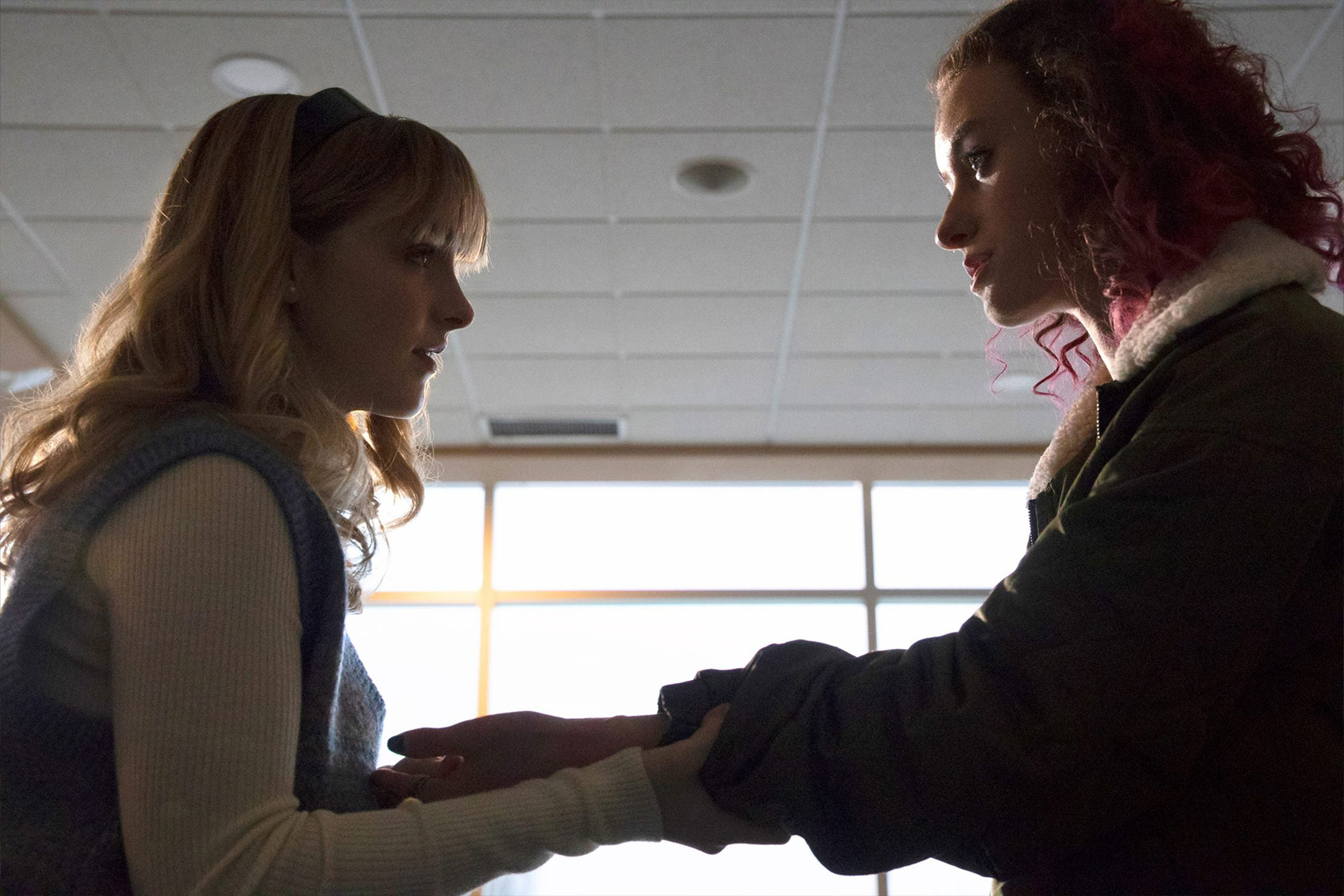
The ripe for horror setting of high school is not really taken advantage of.

Grace (“Ghostbusters: Afterlife”) was scary as little Emma, and she’s scary as 15-year-old Emma too, making her eyes go dead and lifeless, her facial muscles slack. Then, in the next moment, she imitates hysteria on a phone call. She’s an excellent mimic, a shrewd observer. In one darkly humorous moment, Emma takes an online quiz to determine if she’s a psychopath and privately celebrates the results. But the whole movie is a lot for Grace to carry on her sweater-set shoulders.

The Bad Seed ReturnsThe Bad Seed Returns (A+E / Lifetime)The introduction of someone from Emma’s old life injects a bit of energy into the plot, which for the most part, drags in an expected, easy path. The ripe for horror setting of high school is not really taken advantage of. Sometimes the scariest aspects are Emma’s conservative, matchy-matchy outfits, which seem like the clothes of a much younger child, or with their headbands and pleated skirts, like a killer Sabrina Spellman

Want a daily wrap-up of all the news and commentary Salon has to offer? Subscribe to our morning newsletter, Crash Course.


“The Bad Seed Returns” is fine for some light, holiday-weekend viewing. But like a life cut short by a killer kid, the film mostly makes one wonder what could have been (especially as first imagined by Grace and her surgeon father) and hollowly, leaves more questions than answers. Why did Emma go for years without incident? What started her down this homicidal path? What exactly is a basket of kisses?  

“The Bad Seed Returns” premieres Labor Day, Sept. 5 at 8/7c on Lifetime and streams the next day. Watch a trailer via YouTube below: 


“A long line of workaholics”: How Americans can fight for a “balanced approach to work”

To the average European, the U.S. is a country of workaholics who have an unhealthy work-life balance. Americans generally work longer hours, have less paid vacation time and are more likely to work on weekends. And despite all those long hours, Americans don’t even have universal health care — although the Affordable Care Act of 2010, also known as Obamacare, has greatly reduced the number of Americans who lack any type of health insurance.

Journalist Ruben Navarrette, Jr. examines the conditions that U.S. workers have been facing in an op-ed published by the Daily Beast on Labor Day 2022. Navarrette identifies some problems, but he also notes some positive developments for U.S. workers.

“This Labor Day,” Navarrette writes, “there is a hell of a lot going on in the ‘work space.’ Thanks to a labor reform bill that was recently passed by the legislature and which is now headed to the desk of Gov. Gavin Newsom for his signature, fast-food workers in California could soon earn as much as $22 per hour. And given that Newsom is a prospective candidate for the 2024 Democratic presidential nomination, the rest of the country can expect to hear much more about this salary boost over the next several months.”

Navarrette continues, “A new Gallup poll finds public support for organized labor in the U.S. to be the highest it’s been in more than a half-century, 57 years to be exact. Seventy-one percent of Americans now approve of unions — the highest the polling firm has recorded since 1965. The current figure is so high, in fact, that it is closing in on the percentage of Americans who backed unions in the 1950s — when three out of four Americans approved of them.”

The journalist notes that in recent years, unions have been “popping up in the darndest places” and that employees of Amazon, Trader Joe’s, Starbucks and Apple have been “organizing or advocating to start unions.”

“Many Americans are in the ‘grudge’ phase of the COVID-19 pandemic, mindful of how badly many companies and corporations behaved two years ago when U.S. workers were at their most vulnerable,” Navarrette observes. “Millions of U.S. workers lost their jobs and health insurance, and they had to figure out how to provide childcare and avoid homelessness. Now that workers have the leverage in an ’employee market,’ they’ve become hard-nosed negotiators. And we’re suffering a hangover from the so-called Great Resignation. In 2021, according to the U.S. Bureau of Labor Statistics, over 47 million Americans quit their jobs.”

Navarrette points out that some members of Generation Z “aren’t actually ditching their job” but are “no longer putting in 110 percent,” which “means no more working weekends or holidays, or logging 80 hours per week.” The journalist adds that as a “workaholic” who comes from a “long line of workaholics” and had his first job when he was 13, he is “rooting for Generation Z” and hopes that Zoomers “succeed in readjusting Americans’ work-life balance.”

“My paternal grandfather, Roman, the immigrant from Chihuahua, Mexico, used to show up to work a half-hour early and give his boss that extra 30 minutes of hard labor in the fields as a gift to say gracias to the employer — for giving him a way to feed his family,” Navarrette notes. “My maternal grandfather, Samuel, who moved his entire family from Texas to California on a rumor that farmers in the Golden State were paying one dollar more per hour, broke his hand once, but kept picking lettuce with his one good hand rather than lose his job.”

Navarrette continues, “And my grandmothers, Esperanza and Aurora, worked even harder than their husbands because — besides toiling side by side with them as equals in the fields — they also did most of the cooking, cleaning, laundry, and other household chores. Respect, ladies! Respeto…. You see, my family — like many American families, and virtually all Latino families — worship at the altar of work…. It’s clear that maintaining a healthy and balanced approach to work is a good thing for Americans to strive for.”

Have American jails become the inferior replacement for mental hospitals?

London’s Bedlam psychiatric hospital is infamous today for how its staff brutally abused their patients. Founded in 1247, the ornately-designed facility treated the people within its care as if they were freaks and monsters rather than human beings. For a period, the patients were even turned into a literal spectacle, with thousands of “normal” people flocking to Bedlam so they could pay a token fee to gawp at patients for entertainment — or, as one supporter put it, as a reminder that they must “keep baser instincts in check.”

Things are arguably better for mentally ill people in 21st century America. Yet a new study by George Mason University’s Schar School of Policy and Government, and published in the medical journal BMC Health Services Research, suggests that any improvement may not be as great as we’d like to think. At present, there are 10 times as many people with mental illnesses in jails and prisons than in state psychiatric hospitals.

In other words, we’ve substituted jails for treatment facilities. 

To learn this, the researchers looked at data from all 3,141 U.S. counties and singled out variables that could influence jail population per capita. After analyzing their data, it became clear that, as the report puts it, “counties with smaller populations, larger percentages of individuals that did not graduate high school, that have more health-related issues, and provide fewer community treatment services are more likely to have higher jail population per capita.”

“We continue to send people with mental disorders to prison, because there seems to be nowhere else for them to go.”

Niloofar Ramezani, assistant professor of statistics at George Mason University and corresponding author of the study, told Salon by email that “to our knowledge, this study is the only national-level study that examines whether the supply of community-based health services, including mental health services, influences size of the jail population in the U.S., while accounting for other criminal legal, public health, and socio-economic factors.”


Want more health and science stories in your inbox? Subscribe to Salon’s weekly newsletter The Vulgar Scientist.


Ramezani believes that the study’s “most important finding,” is that “one should focus on building up the community’s capacity to provide mental health services.”  Ramezani pointed out that their study also found that “after accounting for the availability of mental health care services, the size of the violent crime problem no longer has an effect to how the jail is used.” American society is filling up its jails with mentally ill individuals in a way that, quantifiably, cannot be plausibly linked to any kind of meaningful violent crime problem.

“The challenge is to have a sufficient workforce for supporting the mental health of the communities to help reducing the jail population size (and the overuse of jails),” Ramezani concluded.

Salon reached out to advocacy groups and experts on America’s mass incarceration epidemic. They all said the same thing: The report’s conclusions are credible — and unsurprising.

“We’ve known for some time that this country’s chief response to serious mental illness is incarceration, a fact that stands out because prisons are so clearly unsuited to treating mental illness,” Wanda Bertram, Communications Strategist at Prison Policy Initiative, told Salon by email. “Our organization recently found that even though 43% of people in state prisons have been diagnosed with a mental disorder, only 26% have received some form of mental health treatment, and only 6% are currently receiving treatment.”

Bertram added, “The readiness with which our justice system fast-tracks people with mental illnesses into prison, despite knowing that jail and prison settings won’t make that person any better, speaks volumes about the system’s ability to deliver justice.”

Dr. Craig Haney, a psychologist who has studied the psychological effects of incarceration for decades and a psychology professor at the University of California, Santa Cruz, offered some insight into why America tends to incarcerate rather than help people with mental illnesses.

“The structural origins start with the history of two simultaneous trends that began in the early 1970s,” Haney wrote to Salon. The first was the widespread closing of publicly-funded mental hospitals “in part on the promise that they would be replaced by more humane community-based treatment, a promise that was never kept” and the second was “the beginning of a decades-long ‘tough-on-crime’ era in which politicians competed with each other on who could criminalize the most things and impose the longest sentences. So we shrunk our mental health system and increased the size of our prison system.”

Bertram also attributed the trend to imprison people who are mentally ill to ideological choices.

“I think the major problem is an ideology that says that if you have some kind of illness, including mental illness, you ought to be the primary person responsible for your own care,” Bertram explained. “That’s the ideology that props up our healthcare system, where sick people bear extraordinary costs and crushing debts. And it keeps us from asking why mental health services like therapy, psychiatry, and long-term care are not only expensive, but difficult to access.” Pointing out that their report revealed roughly half of people in state prisons lacked any kind of health insurance prior to their arrest, Bertram concluded that “we continue to send people with mental disorders to prison, because there seems to be nowhere else for them to go.”

Speaking to Salon, Ramezani relayed the views of Dr. Faye S. Taxman, a co-author of the report, on the underlying causes of America’s tendency to incarcerate instead of provide health care.

“The issue could be the lack of sufficient funding stream for mental health services as well as not having enough workforce that can support communities in providing mental health services to individuals who need such care,” Ramezani explained. “Also, some view all types of crime as dangerous, so that misdemeanors and minor crimes sometimes are treated the same as major crimes in terms of assessing for pretrial detention. Many individuals cannot afford bail and are incarcerated pretrial.”

“…politicians competed with each other on who could criminalize the most things and impose the longest sentences. So we shrunk our mental health system and increased the size of our prison system.”

Ramezani and the study’s other co-authors ultimately argue, as Ramezani put it to Salon, that “more research needs to be done on the type of individuals with mental health issues who are incarcerated and how they are handled. Once we know more about them, their mental health journey, and how their mental health condition is changing over time while incarcerated, we can find better solutions to provide helpful support to them if they end up in jail.”

In addition to doing more research, American policymakers need to exercise the “political will” necessary to address mental health issues in a humane and effective way.

“The first badly needed solution is to increase the capacity of community mental health facilities—we need vastly more mental health personnel than we currently have,” Haney told Salon.

In addition, Haney said that American policymakers need “to divert mental health problems out of the criminal justice system at the very outset. Currently, when someone is having, or sees someone else having, a mental health crisis, the only response is to call 9-1-1. This typically brings the police and typically results in a criminal justice system (rather than mental health system) response. That needs to stop.” And if a case does wind up in the criminal justice system, “so-called ‘mental health courts’ need to be increased in number. These are courts where, in instances where someone has been brought into the criminal justice system for behavior that has an underlying mental health cause, requiring treatment rather than punishment, they are diverted out of the criminal justice system and into treatment.”

Barring that, Haney asserted that “inside the jail and prison system, we need to increase mental health treatment resources to ensure that those mentally ill persons who are still there are receiving appropriate care.”

Serena Williams forced journalists to get out of the “toy box” and cover tennis as more than a game

Of the many outstanding components of her game, Serena Williams may best be known for her commanding serve.

Those serves, unleashed over the course of a 27-year professional career, arguably heightened the power and intensity of the women’s game, forcing her opponents to game plan for each wicked volley.

To those chronicling her exploits as one of the world’s best tennis players, Williams served up a different challenge.

As a scholar of sports journalism, I have observed how its practitioners have struggled to find their footing when it comes to establishing consensus about what exactly constitutes good sports journalism.

Williams’ presence as a Black woman in a historically white, patriarchal sport, her commitment to activism and her willingness to bare her personal challenges to the public forced sports journalists to reevaluate professional norms that urged them to focus only on what happened between the lines.

Apolitical origins

Sports journalism emerged in the late 19th century and fully established itself as a distinct journalism genre when newspaper publishers, in an effort to attract wider audiences, moved away from being partisan party organs. Sports quickly became a lucrative way to sell newspapers.

Those apolitical origins shaped its future trajectory. Success often depended on access to players and front office personnel, as well as cozy relationships with league officials. Chief among the outcomes of that arrangement was the general reluctance among sports journalists to cast a critical eye toward the role sports plays in our communities and greater society.

In general, Americans often imagine sports as aligned with the values they hold dear. Journalists and public officials regularly talk about sports as the embodiment of a meritocracy and a reflection of the power of the individual to overcome any biases or challenges.

Such media narratives fail to address how sports, despite all their feel-good moments, play a role in contributing to forms of discrimination and alienation.

Reporters play in the toy box

By the late 20th century – just when Williams was emerging as a tennis star – the industry had turned into an enormous multimedia profit-making enterprise at a time when newspapers’ ad revenue was starting to crumble.

Sports journalists had come to be seen by their news peers as playing in a proverbial “toy box” within the wider newsroom. That is to say, their colleagues saw them as frivolous, lacking in a serious approach. They weren’t there to serve as watchdogs or contribute solutions, through their reporting, to issues affecting the nation or local communities.

Instead, sports journalists simply became known as sports gurus adept at parsing the finer points of a football receiver’s routes or debating the merits of a basketball team’s zone defense.

And so when Williams turned professional in 1995 at the age of 14, early coverage sidestepped conversations about the the unique kinds of gendered racism that a Black girl from a working-class California neighborhood might face on the professional tour.

As sociologist Delia Douglas has explained, tennis has a history as being accessible only to people who can afford to play at resorts, country clubs and tennis academies. It is also a sport with different rules for men and women, a practice that contributes to stereotypes about women athletes as weak, or less interesting, than their male peers.

But the context of Williams’ entry into professional tennis often went unacknowledged. Coverage instead focused on the efforts of her father to train his daughters, the passing of the baton from Venus to Serena, and the sisters’ style of play. Moreover, woven through that coverage was an underlying suggestion that Serena Williams did not fit within the definition of respectable tennis, as reporters commented on her fashion choices or wondered if her style of play was damaging the women’s game.

Sports don’t happen in a vacuum

Practicing sports journalism by “sticking to sports” leaves reporters ill-equipped to cover news events that demand a wider lens.

Such was the case in 2001 when fans at the Indian Wells tennis tournament subjected the Williams sisters to traumatizing racist insults, an experience that led the duo to boycott the event for 14 years.

Researchers who studied the event found that most of the ensuing media coverage focused solely on the incident itself and provided little insight to address the forms of whiteness and patriarchy ingrained in pro tennis.

This type of journalism is often described as episodic, in that it casts a light solely on the singular event, divorcing it from the forces that contributed to the specific situation. This framing technique is not uncommon in sports journalism. Coverage of the U.S. women’s gymnastics coach Larry Nassar, who was convicted of abusing dozens of athletes under his care, tended to focus on individual victim stories, while framing Nassar as “one bad apple.” And stories chronicling intimate partner violence committed by NFL players have a history of being framed similarly – a crime carried out by a singular individual, separate from a system that may foster violence toward women.

But Williams demanded sports journalists do more than analyze her serve. She has spoken publicly from her own experiences about the tragedy of subpar maternal care for Black women. She asked journalists assembled at her post-championship match news conference at the U.S. Open in 2018 – where she had argued with the judge and been deducted a point – whether a man would be so acutely penalized for doing the same thing.

Serena Williams questions whether she would have been penalized in the same way if she were a man at the 2018 U.S. Open.

She has pushed the boundaries of women’s tennis, and in doing so, has insisted that women be treated better by journalists and event organizers, calling for an end to the pay disparities between men and women on the professional tours.

Scholarship on sports journalism suggests the boundaries of the genre are rapidly changing. And the field is shedding its stick-to-sports ethos, in part, due to activist-minded athletes like Serena Williams.

Erin Whiteside, Associate Professor of Journalism and Electronic Media, University of Tennessee

This article is republished from The Conversation under a Creative Commons license. Read the original article.

Judge grants Trump’s request to appoint special master to review materials seized at Mar-a-Lago

On Monday, CBS News’ Steven Portnoy reported that Florida District Judge Aileen Cannon ruled in favor of former President Donald Trump, announcing the appointment of a special master “to review the seized property for personal items and documents and potentially privileged material subject to claims of attorney client and/or executive privilege” — a decision that puts on hold investigators’ ability to review the documents.

Cannon, an appointee of Trump herself, shot down the Justice Department’s claim that the FBI’s “taint team” has been sufficient to sort out privileged documents. She also disputed the Justice Department’s argument that executive privilege does not apply to a former president against the administration of the current president, saying that this “overstates” the law and the controlling precedent in United States v. Nixon did not settle that issue.

“[T]he Court does not find that a temporary special master review under the present circumstances would cause undue delay,” Cannon concluded, blocking DOJ investigators from continuing the probe until that review is complete — but also saying that the Office of the Director of National Intelligence can continue their classification and intelligence review of the documents, which POLITICO’s Kyle Cheney has noted is “unclear how that’s going to work.”

The decision was immediately decried by some legal experts, with former House impeachment adviser Norm Eisen arguing that the DOJ “can and should” appeal the ruling immediately.

Trump sought a special master review as a delay tactic to slow down the investigation, which is looking into the mishandling of highly classified information removed from restricted facilities and left in unsecured boxes at the former president’s Mar-a-Lago country club in Palm Beach, Fla. The full extent of the investigation was revealed when the FBI executed a search warrant on the premises.

Trump has alternatively claimed a number of contradictory defenses, including baseless accusations that the documents may have been planted by the FBI, but also the idea that he had a blanket right to declassify the documents on his way out the door using a “standing order.”

“House of the Dragon” introduces the Lannisters before they had game

In this country, you’ve got to make the money first. Then when you get the money, you get the power. Then when you get the power, then you get the women.

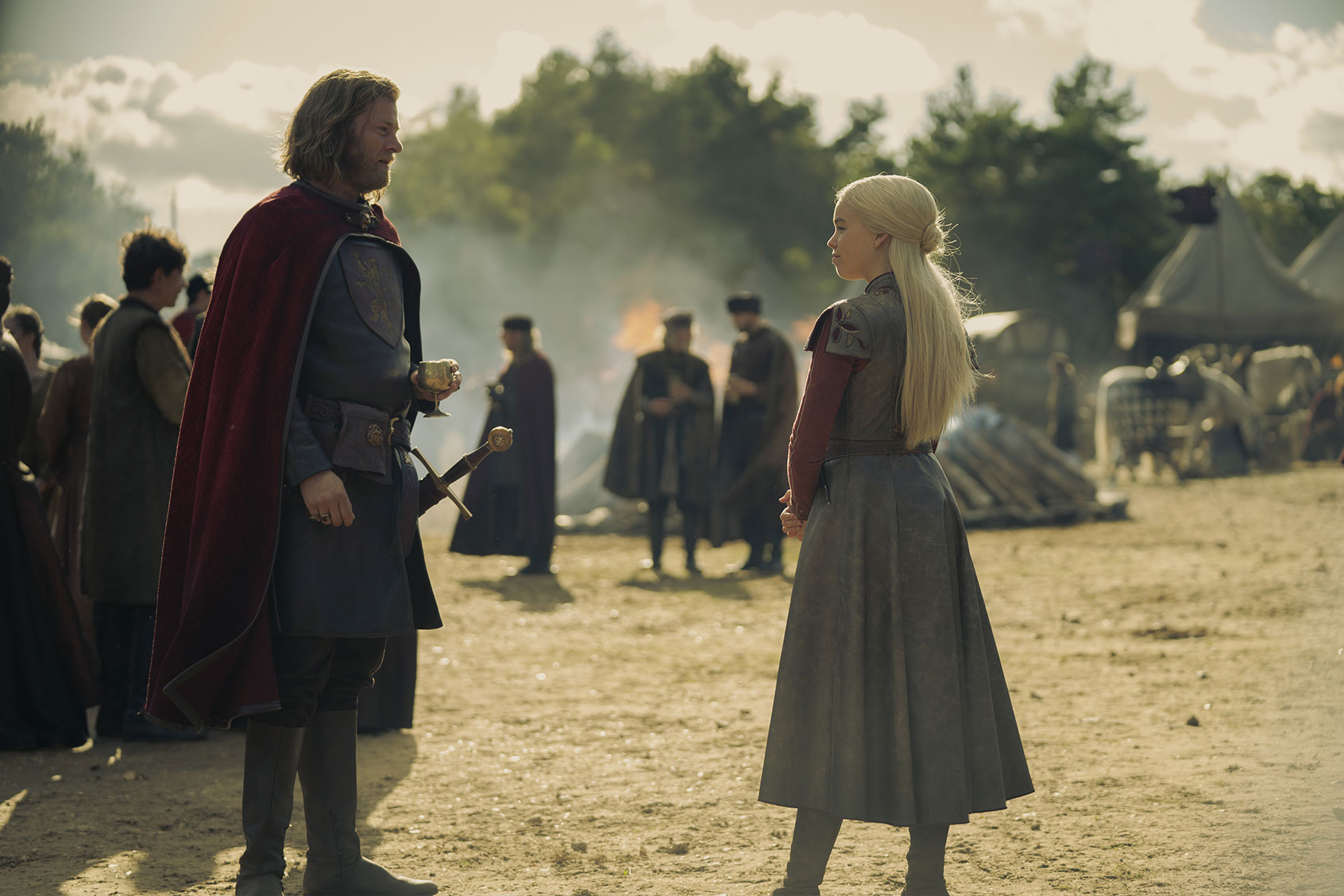
What Tony Montana knows to be true also prevails in Targaryen-ruled Westeros, as the latest installment of “House of the Dragon” shows us. In this episode, we meet Lord Jason Lannister, the idiot ancestor of Tywin, Tyrion, Jaime and Cersei. Whatever intellect that generation inherited did not come from this not-so-great-great-great . . . great . . . whatever, which Jason proves when he steps up to Princess Rhaenyra Targaryen (Milly Alcock) during the hunt arranged to honor her half-brother Aegon’s second birthday.

First Jason creates a conversational opener with some real “swipe left” material. “I wonder, Princess,” he says, “was your own second name day as grand as this?”

“I honestly don’t recall, and neither will Aegon,” she flatly, frosty replies in a tone that leaves the obvious unsaid: “Two-year-olds have the long-term memory of raw hamburger, you twit.”

While the “Game of Thrones” prequel establishes the Targaryens’ varied personalities and temperaments before Mad King Aerys poisoned their reputation for all time, not much has been mentioned about the other main houses we knew from the first show.

Many were around back then, but not all. Representatives from House Baratheon were knocked off their horses in the premiere’s tourney. Later in the same episode, Lord Rickard Stark pops in to grimly pledge his fealty to Rhaenyra when her father Viserys (Paddy Considine) names her as his heir.

But the third episode, “Second of His Name,” turns a spotlight on proto-Lannisters Jason and his twin brother Ser Tyland (both played by Jefferson Hall) to show us how far the family’s reputation rose during the two centuries between them and Tywin’s shrewder brood.

Tywin (as portrayed by Charles Dance) is a man who demands his family knows the history of the realm forwards and backward, who is wise in the way of politics, and eschews sentimentality. He probably read about Jason – he’s the Lord of Casterly Rock, after all – but it’s unlikely he’d bear knowing that Tyland and his twin made the Lannister family motto, “Hear Me Roar!” sound like a joke.

At Aegon’s name day hunt, Jason presents himself as the type of peacocking tool every woman has encountered at some point, whether in a bar, on a bus, in an ambulance, or on a church pew – anywhere, really – who believes it’s his divine duty to irritate them.

Jason Lannister has the money, see. But at this point in history, his line is short on power.

Overcompensating, tacky boob that he is, Jason believes that all it takes to win a woman’s heart is to cover himself in lions and ply her with “the finest honeyed wine you’ll ever taste – made in Lannisport, of course,” along with tall tales about the hee-yooge-ness of the highest tower at his stronghold.

“I don’t have a dragon pit, of course, but . . . I do have the means and resources to build one,” he coos, confusing Rhaenyra until he overplays his hand. “I’d do anything for my queen . . . or lady wife.” Upon hearing those words, the princess suddenly gets an imaginary phone call she simply has to take and hastily peaces out.

House of the DragonJefferson Hall as Jason Lannister and Milly Alcock as Rhaenyra Targaryen in “House of the Dragon” (Photo Courtesy of HBO)


Jason has the money, see. But at this point in history, the Lannister line is short on power, evident in Jason’s complete lack of that certain je ne sais quoi people characterize as game.

This is not the same as the life-sized multidimensional chess match type of game referenced in the other show’s title, but the aura and swagger one projects without effort when walking through a room. Ser Criston Cole (Fabien Frankel) has game to spare that he isn’t aware of originating from the quiet power earned by skill, courage and competence. That makes him leagues more potentially attractive to Rhaenyra than any golden lion.

Jason Lannister has wealth while being poor in the way of spiritual boons, including self-awareness. He’s so full of himself that he doesn’t understand his offer to House Targaryen of strength, and a golden trinket, in exchange for Rhaenyra’s hand is an insult. What team with multiple dragons needs strength?

Apparently this show doesn’t. Its giant-sized ratings and early second season renewal mark “House of the Dragon” as a success, although the story is still cooking at a very low temperature. There seem to be many people who are watching closely but aren’t quite sure why.

Some of their wait-and-see ennui may be due to the show’s introduction of characters we know only by surname without knowing their personalities. If we’re more drawn to Daemon Targaryen, for example, that might have less to do with the wider audience’s familiarity with Matt Smith, than his character behaving in a way we’ve come to expect of his family’s name. Rhaenyra, meanwhile, presents the regal face we may have hoped Daenerys would live up to.

Either feels more like an extension of the Targaryens we expect than King Viserys, a loving man who prefers his and his family’s happiness over the realm’s stability. Viserys is, you know, a swell guy. But if and when he goes the way of Ned Stark, whether by natural causes or force, I doubt the audience will miss him.

Jason and Tyland may offer something this show needs … which is a touch of comedy.

These Lannisters, on the other hand, add something to the cocktail because they’re not the men the future generation may have expected them to be. Hall, who briefly appeared as Ser Hugh in “Game of Thrones,” excels in playing up Jason’s terminal arrogance while also dropping hints, through Tyland, of where the family’s diplomatic skill comes from.

“Tyland is . . . frightfully dull, gods love him,” Jason purrs. That doesn’t mean he’s ignorant; we see him attempting to counsel the king about the severity of the threat to Westeros’ shipping routes posed by the Free City alliance called Triarchy.

Tyland’s blessed with brains but he does not have the king’s ear, or enough of pull to be taken seriously.

The Lannisters we came to know over nearly a decade’s worth of “Game of Thrones” are never presented as uniformly likable . . . save for Tyrion, maybe. But their arrogance was backed by a hefty surplus of wealth guaranteed and a certain genius regarding how to seize and hold power.


Want a daily wrap-up of all the news and commentary Salon has to offer? Subscribe to our morning newsletter, Crash Course.


Introducing Jason and Tyland may offer something this show needs that “Game of Thrones” took a while to find, which is a touch of comedy. Jason’s efforts to purchase favor from the king are as hilarious as his twin’s political impotence should be infuriating, provided we empathize with the grave wrongs the king is doing to Lord Corlys Velaryon (Steve Toussaint) and his people.

We don’t know enough about House Velaryon or its sons and daughters to care that much yet, frankly. But one recognizes the irony in seeing another pair of Lannister twins so in love with themselves that they can’t see beyond each other’s gaze. The difference in this pairing is that one is blessed with nothing but cunning while the other has nothing between his ears but shallow confidence.

If you know anything about how compound interest works, the Lannisters’ rise from a small, loud voice and a rich house of little renown to a central player in the realm’s survival in the space of two centuries is completely understandable. “Fire & Blood” explains the steps in their rise but we can’t necessarily count on the series’ writers to closely follow the same plot as the book.

We can make a few guesses related to the way the show introduces of Jason and Tyland, and how Hall plays them, purely by knowing their type’s scent, just like Rhaenyra seems to. Between one twin’s pompousness and the other’s sense of politics, Hall plays them as men intent upon elevating their station the old-fashioned way: by sidling up to anyone they can step on to rise higher, and robbing the realm blind. Those who have game, play to win. Those who don’t, cheat.

New episodes of “House of the Dragon” air Sundays at 9 p.m. on HBO and stream on HBO Max.


Here’s what science says about eating salad before carbs

Biochemist and author of the “Glucose Revolution” Jessie Inchauspé says tweaking your diet can change your life.

Among her recommendations in the mainstream media and on Instagram, the founder of the “Glucose Goddess movement” says eating your food in a particular order is the key.

By eating salads first, before proteins, and finishing the meal with starchy carbohydrates, she says blood glucose spikes will be flattened, which is better for you.

Scientifically speaking, does this make sense? It turns out, yes, partially.

What is a glucose spike?

A glucose spike occurs in your bloodstream about 30-60 minutes after you eat carbohydrate. Many things determine how high and how long the peak lasts. These include what you ate with or before the carbohydrate, how much fiber is in the carbohydrate, and your body’s ability to secrete, and use, the hormone insulin.

For people with certain medical conditions, any tactic to flatten the glucose peak is incredibly important. These conditions include:

  • diabetes

  • reactive hypoglycaemia (a particular type of recurring sugar crash)

  • postprandial hypotension (low blood pressure after eating) or

  • if you’ve had bariatric surgery.

That’s because high and prolonged glucose spikes have lasting and detrimental impacts on many hormones and proteins, including those that trigger inflammation. Inflammation is linked with a range of conditions including diabetes and heart disease.

Different foods, different spikes

Does eating different food types before carbs affect glucose spikes? Turns out, yes. This isn’t new evidence either.

Scientists have known for a long time that high-fiber foods, such as salads, slow gastric emptying (the rate at which food exits the stomach). So high-fiber foods slow the delivery of glucose and other nutrients to the small intestine for absorption into the blood.

Proteins and fats also slow gastric emptying. Protein has the extra advantage of stimulating a hormone called glucagon-like-peptide 1 (or GLP1). When protein from your food hits the cells in your intestines, this hormone is secreted, slowing gastric emptying even further. The hormone also affects the pancreas where it helps secretion of the hormone insulin that mops up the glucose in your blood.

In fact, drugs that mimic how GLP1 works (known as GLP1 receptor agonists) are a new and very effective class of medication for people with type 2 diabetes. They’re making a real difference to improve their blood sugar control.

What about eating food in sequence?

Most of the scientific research on whether eating food in a particular order makes a difference to glucose spikes involves giving a fiber, fat or protein “preload” before the meal. Typically, the preload is a liquid and given around 30 minutes before the carbohydrate.

In one study, drinking a whey protein shake 30 minutes before (rather than with) a mashed potato meal was better at slowing gastric emptying. Either option was better at reducing the glucose spike than drinking water before the meal.

While this evidence shows eating protein before carbohydrates helps reduce glucose spikes, the evidence for eating other food groups separately, and in sequence, during an average meal is not so strong.

Inchauspé says fiber, fats, and proteins don’t mix in the stomach – they do. But nutrients don’t exit the stomach until they have been churned into a fine particle size.

Steak takes longer than mash to be churned into a fine particle. Given the additional fact that liquids empty faster than solids, and people tend to complete their entire dinner in around 15 minutes, is there any real evidence that eating a meal within a particular sequence will be more beneficial than eating the foods, as you like, and all mixed up on the plate?

Yes, but it is not very strong.

One small study tested five different meal sequences in 16 people without diabetes. Participants had to eat their meal within 15 minutes.

There was no overall difference in glucose spikes between groups that ate their vegetables before meat and rice versus the other sequences.

What’s the take-home message?

Watching those glucose spikes is particularly important if you have diabetes or a handful of other medical conditions. If that’s the case, your treating doctor or dietitian will advise how to modify your meals or food intake to avoid glucose spikes. Food ordering may be part of that advice.

For the rest of us, don’t tie yourself up in knots trying to eat your meal in a particular order. But do consider removing sugary beverages, and adding fiber, proteins or fats to carbohydrates to slow gastric emptying and flatten glucose spikes.

Leonie Heilbronn, Professor and Group Leader, Obesity and Metabolism, University of Adelaide

This article is republished from The Conversation under a Creative Commons license.

Gorbachev and Bush: The world’s massive missed opportunity for peace

The recent death of Mikhail Gorbachev is reason to consider the lost opportunity that his leadership of the Soviet Union presented to the world. President George H.W. Bush is often granted much credit for taking no action to hinder the collapse of the Soviet Union under Gorbachev at the end of the Cold War. Vladimir Putin’s war in Ukraine, however, gives us much reason to reconsider that lack of response. Putin’s actions have deeper roots than just the expansion of NATO.

In terms of 20th century history, the failed response to the collapse of the Soviet Union in 1991 can only be rivaled in impact by the failed response to the defeat of Germany in 1918. Abandoning Germany after the First World War created an environment of hunger and desperation in which Adolf Hitler and the Nazis could thrive. The end of World War II gave the Allies another chance, and the United States — with its allies and through enormous financial aid and commitment — helped create a world where the defeated foes, Japan and Germany, became allies, not future enemies.

That did not just happen. Creative and assertive conceptions and actions by leaders in the Truman administration made it happen. Recognition of what the end of the war meant to a devastated Europe, as well as the slow breakdown of the wartime alliance with the Soviet Union, triggered action, not caution. The programs and initiatives were boundless: the Truman Doctrine, the Marshall Plan, NATO, the UN, the United National Relief and Rehabilitation Administration — the list goes on. All this happened not just because the U.S. had the money to do it. Policymakers also had the foresight to try to create a better world. 

Contrast that with the Bush administration’s reaction to the cataclysmic collapse of the Soviet Union. Gorbachev presented the U.S. with a great opportunity. His policies of perestroika (restructuring the economy) and glasnost (openness, freedom of the press and expression) opened the door for dramatic change, as did the adoption of a range of market-oriented policies by the Supreme Soviet. As early as a 1989 meeting with Bush in Malta, Gorbachev must have thought there was great potential in a partnership with the U.S. “The world is leaving one epoch and entering another,” Gorbachev said. “We are at the beginning of a long road to a lasting, peaceful era.”

A creative decision to aid Gorbachev in a major way might have helped his reforms succeed and could have fostered a far more positive transformation of Russia than the one we face today. Gorbachev was almost begging for such aid and as he himself said: History punishes those who act too late.

A creative decision to aid Gorbachev could have fostered a far more positive transformation of Russia than the one we face today.

Instead, despite the virtual revolution Gorbachev had unleashed across eastern Europe, Bush and the old Cold Warriors exercised enormous caution, only going so far as to drop policies of open hostility, offer arms reduction talks and tell Gorbachev he should seek financial help elsewhere. Bush complained that the U.S. had its own financial woes, yet he found plenty of money to attack Panama and then spend more than $116 billion in a war against Iraq in 1991. In that case, perhaps spurred by his obsession with Saddam Hussein, Bush was assertive, forceful and opportunistic in creating a coalition with a purpose — everything that was missing in his response to the Soviet Union. Panama and Kuwait were “liberated.” Russia was lost. 

Failing to receive useful financial aid from the U.S., Gorbachev asked to meet with the Group of Seven industrialized nations, where he planned to ask for $100 billion in assistance. Gorbachev told the New York Times on May 23, 1991, that the problems facing the Soviet Union deserved more attention and support from the G7. The Soviet Union has become “one of the solid reliable pillars of today’s world,” he told the Times. “If that pillar disappears, we should consider all of the possible consequences.”


Want a daily wrap-up of all the news and commentary Salon has to offer? Subscribe to our morning newsletter, Crash Course.


Yet, Bush, amazingly, felt that aid from the G7 nations would only raise Gorbachev’s hopes of financial support for his reforms. In July, the G7 leaders chose not to provide Gorbachev any financial aid. Shortly thereafter, without any financial support and with domestic turmoil rapidly mounting, Gorbachev was ousted and the opportunity was gone. Much as the Germans had been left to fester in their humiliation after World War I, the Russians watched their world fall apart as the West mainly stood by and watched, smug in Cold War victory. It would have not been necessary to throw money at the Soviet Union, but certainly more creativity was called for in facing such an opportunity.

The world’s problems with Vladimir Putin today do not stem from nations trying to find safety within NATO. They are the direct result of Bush and other narrow-minded politicians allowing the creation of an environment in which Putin and the oligarchs could thrive and block or reverse democratic reforms. The Bush administration failed to seize that critical historical moment, and we are all now facing what Gorbachev termed those “possible consequences.”

5 unsung films that dramatize America’s rich labor history

Unions are more popular now than at any time since 1965, and the U.S. is in the midst of a new upsurge of union organizing. Is a Hollywood drama about angry Starbucks baristas or frustrated Amazon warehouse workers far behind?

Hollywood studios and independent producers have long depicted the collective efforts of working people to improve their lives and gain a voice in their workplaces and the larger society.

Some of the most well-known labor movies champion the struggle of the everyday worker: “Modern Times,” released in 1936, stars Charlie Chaplin going crazy due to his job on an assembly line. It features the famous image of Chaplin caught in the gears of factory machinery. “The Grapes of Wrath,” a 1940 adaptation of John Steinbeck’s novel, tells the story of sharecropper Tom Joad’s radicalization after his family and other migrant workers experience destitute conditions in California’s growing fields and overcrowded migrant camps.

1979’s “Norma Rae,” is based on the life of Crystal Lee Sutton, who worked in a J.P. Stevens mill in North Carolina. The textile worker and single mom inspires her fellow workers to overcome their racial animus and work together to vote in a union. “Bread and Roses,” a 2000 film about low-wage janitors in Los Angeles, is based on the Service Employees International Union’s “Justice for Janitors movement.

In an iconic scene from “Modern Times,” Charlie Chaplin gets caught in the gears of factory machinery.

There’s also an anti-labor strain of Hollywood history, particularly during the post-World War II Red Scare, when studios purged left-wing writers, directors and actors through an industrywide blacklist. Red Scare-era releases, such as 1952’s “Big Jim McLain” and the 1954 film “On the Waterfront,” often depicted unions as corrupt or infiltrated by communist subversives.

When I teach labor history, I’ve used films to supplement books and articles. I’ve found that students more easily grasp the human dimensions of workers’ lives and struggles when they are depicted on the screen.

Here are five unsung labor movies, all based on real-life events, that, in my view, deserve more attention.

1. “Northern Lights” (1978)

This is a fictionalized account of a fascinating but little-known political movement: the Non-Partisan League, which organized farmers in the upper Midwest in the early 1900s.

During this period, Midwestern farmers worked long hours to harvest grain that they were then forced to sell for low prices to elevators, while paying high prices to the big railroad companies and banks. Economic insecurity was a part of life, and foreclosures were routine.

The film follows Ray Sorenson, a young farmer influenced by socialist ideas who leaves his North Dakota farm to become a Non-Partisan League organizer. In his beat-up Model T, he travels the back roads, talking to farmers in their fields or around the potbellied stoves of country stores. He eventually persuades skeptical farmers that electing NPL candidates could get the government to create cooperative grain elevators, state-chartered banks with farmers as stockholders, and limits on the prices that railroads can charge farmers to haul their wheat.

“Northern Lights” is based on an early-20th-century farmer-led political uprising in the Midwest.

In 1916, the Non-Partisan League did, in fact, elect farmer Lynn Frazier as governor of North Dakota with 79% of the vote. Two years later, the NPL won control of both houses of the state legislature and created the North Dakota Mill, still the only state-owned flour mill, and the The Bank of North Dakota, which remains the nation’s only government-owned general-service bank.

2. “The Devil and Miss Jones” (1941)

In this screwball comedy with a pro-union twist, Charles Coburn plays John P. Merrick, a fictional New York City department store owner.

After his employees hang him in effigy, the tycoon goes undercover to ferret out the agitators of a union drive led by a store clerk in the shoe department and a union organizer.

As he learns more about their lives, Merrick grows sympathetic to his workers – and even falls in love with one of his employees – none of whom know his true identity. As the workers prepare to go on strike, and even picket his house, Merrick reveals that he owns the store and agrees to their demands over pay and hours – and even marries the employee he’s fallen for.

The film was likely inspired by the 1937 sit-down strikes by employees of New York City’s department stores.

3. “Salt of the Earth” (1954)

Decades ahead of its time, this story of New Mexico mine workers deals with issues of racism, sexism and class.

After a mine accident, the Mexican-American workers decide to strike. They demand better safety standards and equal treatment, since white miners are allowed to work in pairs, while Mexican ones are forced to work alone. The strikers expect the women to stay at home, cook and take care of the children. But when the company gets an injunction to end the men’s protest, the women step up and maintain the picket lines, earning greater respect from the men.

Made at the height of the Red Scare, the film’s writer, producer and director had been blacklisted for their leftist sympathies, so the film was sponsored by the International Union of Mine, Mill and Smelter Workers, not a Hollywood studio.

Will Geer, a blacklisted actor who later portrayed Grandpa Walton on the TV drama “The Waltons,” played the repressive sheriff. Mexican actress Rosaura Revueltas played the leader of the wives. The other characters were portrayed by real miners and their wives who participated in the strike against the Empire Zinc Company, which served as the inspiration for the film.

The film itself was blacklisted, and no major theater chain would show it.

4. “10,000 Black Men Named George” (2002)

Andre Braugher stars as A. Philip Randolph, who organized the Brotherhood of Sleeping Car Porters, the first Black-run union.

Being a porter on a Pullman railroad car was one of the few jobs open to Black men. But wages were low, travel was constant and trains’ white passengers patronized the porters by calling all of them “George,” after George Pullman, the mogul who owned the company.

The company hired thugs to intimidate the porters, but Randolph and his top lieutenants persisted. They began their crusade in 1925 but didn’t get the company to sign a contract with the union until 1937, thanks to a New Deal law that gave railroad workers the right to unionize. Randolph became American’s leading civil rights organizer during the 1940s and 1950s and orchestrated the 1963 March on Washington.

5. “North Country” (2005)

Charlize Theron portrays Josey Aimes, a desperate single mom who flees her abusive husband, returns to her hometown in northern Minnesota, moves in with her parents and takes a job at an iron mine.

There, she is constantly groped, insulted and bullied by the male workers. She complains to the company managers, who don’t take her seriously. The male-dominated union claims there’s nothing they can do. Aimes sues the company, which, after a dramatic courtroom scene, is forced to settle with her and other women.

With stellar performances by Theron, Sissy Spacek, Frances McDormand and Woody Harrelson, “North Country” is based on a groundbreaking lawsuit brought by women miners at Minnesota’s Eveleth Mines in 1975 that helped make sexual harassment a violation of workers’ rights.

Peter Dreier, E.P. Clapp Distinguished Professor of Politics, Occidental College

This article is republished from The Conversation under a Creative Commons license. Read the original article.

Ready in a flash, caramelized tomato and sesame noodles are the best budget-friendly weeknight meal

When I was a teenager, I would lose myself in the cookbook aisle of my local used bookstore as I imagined the kinds of dinner parties I would throw when I had a kitchen of my own. I was drawn to thick cookbooks filled with expensive ingredients and aspirational menus, and I specifically remember passing over books about eating on a budget — classics like “The Thrifty Cook” and “Good Recipes for Hard Times” — because it wasn’t the future I envisioned for myself. 

Then I grew up and realized that “rent week” was suddenly a monthly reality. 

Quickly, I developed a roster of cheap, filling meals that could be cooked reliably in my studio apartment galley kitchen. Most of them were built off pantry staples — like dried beans, canned vegetables and grains — and most of them just so happened to be vegetarian and vegan

When I was in graduate school, at the height of my rent week worries, I lived in an apartment behind a Chinese restaurant. The owners were lovely people who would sneak me an extra portion of the kitchen’s “family meal.” Most often, it was 番茄炒鸡蛋, stir-fried tomatoes with scrambled eggs. It was this umami-rich, acidic dish, punctuated with a little nuttiness from sesame oil that was immensely comforting. I have grown to really, really love this flavor combination, which I have mimicked often, including in this caramelized tomato and sesame udon. 


Want more great food writing and recipes? Subscribe to Salon Food’s newsletter, The Bite.


It starts with a few pantry staples, such as tomato paste, sesame oil and soy sauce. I’m partial to udon because I can get it fresh on the cheap at the Asian market down the block, but any kind of noodles work in this dish. Rice noodles, soba or even plain spaghetti do the trick. Everything gets topped with fried shallots (another great, inexpensive flavor booster that is shelf-stable) and fresh scallions (because two alliums are better than none).

Caramelized Tomato and Sesame Udon
Yields
2 servings
Prep Time
5 minutes
Cook Time
10 minutes

Ingredients

  • 12 ounces noodles of your choice
  • 2 tablespoons tomato paste 
  • 2 teaspoons sesame oil 
  • 2 teaspoons soy sauce
  • 1 tablespoon neutral oil 

Garnishes

  • Fried shallots 
  • Chopped scallions 

Optional 

  • 1/2 tablespoon butter


Directions

  1. Cook the noodles according to the package directions and reserve at least 1/2 cup of the cooking water. Drain the noodles and set aside. 

  2. In a frying pan, add the neutral oil and tomato paste. Cook over medium-low heat until the mixture begins to brown, about 5 minutes. This means it’s caramelizing and becoming more flavorful. 

  3. Add the sesame oil and soy sauce to the tomato paste, followed by the noodles. Add the reserved cooking water a tablespoon at a time until the tomato mixture is more saucy and less pasty. If you’re adding butter, now is the time to do so. 

  4. Once the noodles are coated in the sauce, remove the pan from the heat. Divide the dish between two bowls and top with fresh scallions and fried shallots. 


Want more great food writing and recipes? Subscribe to Salon Food’s newsletter.


Cook’s Notes

If you eat dairy and eggs, feel free to add a pat of butter to the pan and top this dish with a jammy egg. If you’re vegan, plant-free butter is a delicious addition, while crispy or silky tofu is an inexpensive way to add both flavor and protein. 


Salon Food writes about stuff we think you’ll like. Salon has affiliate partnerships, so we may get a share of the revenue from your purchase. 

Mercedes Schlapp suggests Joe Biden’s aviators are a form of “propaganda”

Political commentator and author Mercedes Schlapp along with her husband, Conservative Political Action Coalition (CPAC) Chairman Matt Schlapp, are frequent guests on right-wing media outlets such as Real America’s Voice.

On Sunday, the couple appeared on Steve Bannon’s “War Room” and claimed to the show’s namesake host that President Joe Biden’s signature aviator sunglasses are left-wing “propaganda” props designed to make Biden seem tough.

“First, don’t listen to the mainstream media because what they’re trying to do is sell the propaganda that the Democrats are on the rise again,” Schlapp said. “You’d know that when you see Joe Biden put on his aviator sunglasses, and they give him this look of strength. And it’s so – it’s such a lie and so it’s so critical to just not let that get you down.”

Schlapp’s allegation follow’s Biden’s Thursday speech in Philadelphia, in which he warned of the imminent and existential dangers that former President Donald Trump’s Make America Great Again movement poses to the democratic future of the U.S.

CPAC selected Hungary’s authoritarian Prime Minister Viktor Orbán to be the keynote speaker at its conference on Aug. 4.

Watch the video via Twitter:


Trump handed Democrats a “major gift” in Pennsylvania: former Republican lawmaker

Appearing on CNN on Sunday morning, former Rep. Charlie Dent, R-Pa., forcefully explained that former President Donald Trump handed Democrats a “major gift” with his two-hour diatribe against the government on Saturday night at a Pennsylvania rally.

Hours after Trump attacked the FBI and called President Joe Biden an “enemy of the state,” Dent said the former president didn’t do himself or the Republican party any favors by airing his multiple grievances.

Speaking with host Kim Brunhuber, Dent explained, “It seems, Kim, that the country is hopelessly polarized, you know. President Trump is up in Wilkes-Barre tonight, as you indicated — up there criticizing the FBI.”

“I have to be honest with you, if any member of Congress absconded with classified material, I can assure you that somebody from the FBI is showing up at their homes and demanding they return that information. So, I am not so sure that the former president Trump did anyone any good with that speech tonight,” he continued.

“Just by showing up in Pennsylvania, he’s making the election much more about himself, and of course, most Republican candidates don’t want anything to do with Donald Trump in this general election,” he explained. “They want this to be about Joe Biden and the Democrats, but to the extent that Trump inserts himself into this conversation, he’s giving the Democrats a major gift right now. “

“That’s what we’re witnessing in Pennsylvania,” he elaborated. “Mehmet Oz and Doug Mastriano were there, but Mehmet Oz, I don’t think, wants to be anywhere near Donald Trump in this fall election. It doesn’t do him any good; he has to win swing voters, and it is hard to do that when Trump is playing and pandering to the base.”

Watch the video via YouTube

Kash Patel, Trump’s disinformation wizard, publishes worst children’s book of all time

The devastating photo that went viral last week of the “Top Secret” markings on documents that the FBI found in its court-approved Aug. 8 search of Donald Trump’s office speaks a thousand words about a former president’s utter carelessness with national security secrets. 

The photo was part of a Justice Department court filing on Aug. 30. The documents were apparently found in Trump’s personal office drawer, with his passports, and then placed on the floor for photographers.

Trump has already given his response, blaming the FBI for placing the documents on the floor and claiming that they were declassified — which is almost certainly untrue, and largely irrelevant. His point man for the latter claim has been Kash Patel, a former aide to Rep. Devin Nunes who has become a key Trump operative.

Patel has been all over the media, claiming that Trump declassified the documents. That purported wave of a magic wand doesn’t eliminate the possible harm to the nation from national security secrets in the documents getting into the wrong hands. 

Not to mention that in Trump World, reality and Trump-Patel spin-magic have little in common. Here’s the reality: As a 2020 federal court of appeals case states, “Declassification cannot occur unless designated officials follow specified procedures . . . Because declassification, even by the President, must follow established procedures.” Those procedures are highly detailed and limit the president’s power to declassify. Neither Trump nor Patel say anything to suggest those procedures have been followed. 

In addition, declassifying documents relating to nuclear secrets — documents which the Washington Post has reported were targets of the FBI search — involves a complicated process that Patel doesn’t mention. 

Perhaps most notably, in his latest legal filing, where it matters if you lie, Trump doesn’t even claim to have declassified the documents. If all that weren’t enough, declassification doesn’t even matter under the Espionage Act, whose probable violation the search warrant alleges. The statute criminalizes possessing documents, whether classified or not, if they “relate to the national defense” and were officially requested to be returned. 

Last year, a military officer who knew Patel in the Defense Department told national security columnist David Ignatius that Patel was a threat to lawful government. Indeed, in November 2020, immediately after Trump’s election defeat, he named Patel as acting Pentagon chief of staff, meaning that he was strategically placed when the DOD slow-walked the National Guard response to the Capitol attack of Jan. 6. 

Two sources also told Ignatius that the Justice Department was investigating Patel’s “possible improper disclosure of classified information.” Small wonder that he’s Trump’s point person on the subject.

*   *   *

Patel has a knack for telling political tall tales. Earlier this year, he tried to monetize his political fables, and his connections to Trump, to indoctrinate young readers, publishing a MAGA polemic disguised as a children’s book called “The Plot Against the King.”


Want a daily wrap-up of all the news and commentary Salon has to offer? Subscribe to our morning newsletter, Crash Course.


It aimed to plant in youthful brains the idea that the FBI investigation into the 2016 Trump campaign’s coordination with Russia was without merit; in the book, it’s presented as the wicked plot of “Hillary Queenton” against good “King Donald.” 

In the real world, Justice Department Inspector General Michael Horowitz’s 478-page report, released in December 2019, debunked the lie that the FBI lacked a legitimate basis to open an investigation of the Trump campaign. The predicate for beginning the probe was a July 2016 tip from an Australian intelligence official that a Russian operative had offered a Trump campaign volunteer “dirt” on Hilary Clinton.

That crucial fact earned no place in Patel’s indoctrination tract for kids Believe it or not, in his book the wizard “Patel” is the one who foils evil Hillary’s plot.

Q: How do you know when a book is all about the ego of the writer? 

A: When he anoints himself the story’s hero.

Not that Patel would care about this, but partisan politics do not belong in young children’s books. Shannon Hayes, an upstate New York farmer and mom who homeschooled her kids, has written that kids don’t need political literature because “[t]hey naturally understand how to be kind and accepting, until a grown-up teaches them something different.”

Patel’s book is a model for teaching children something different than kindness. if he tries to explain why the Top Secret documents spirited away from the White House by Donald Trump posed no risk of harm to the nation by being left around unprotected in a Palm Beach resort, expect something different than truth. 

Trump is not “above the law” in government records case: former White House official

According to CNN contributor Alyssah Farah Griffin — who serves as Donald Trump’s White House director of strategic communications — her former boss should be held to account for taking top secret documents to his Mar-a-Lago resort and leaving them sitting around.

Sitting on a panel with fellow Trump administration aides Stephanie Grisham and Olivia Troye — all of whom expressed disgust with the former president’s actions — Farah Griffin asserted there should not be a separate set of rules for the former president.

Agreeing with former Attorney General Bill Barr, who said on Fox News that the Department of Justice had every right to search the Florida resort for stolen documents, Farah Griffin adamantly claimed Trump is “not above the law.”

“Every one of us, I believe, held a security clearance in government,” she began. “There are very specific protocols to even handle these documents. If you physically take them out of a building, you need a certified carry card, you need a lead-covered bag so it can evade X-rays.”

“He [Trump] has them co-located with his Time magazine covers at a country club in Florida that’s been a target for espionage,” she exclaimed. “There is no way that this is acceptable if you don’t believe in a two-tiered system of justice where a former president is above the law. And I would just note, you know, Trump rallied last night in Pennsylvania and it descended into a ‘lock her up’ chant about Hillary Clinton.”

“The reason Republicans like myself asked for her to be investigated was mishandling of classified information — exactly what Donald Trump is doing in Mar-a-Lago,” she added.

Watch the video below via YouTube

Glitter down the Atlanta Highway – the B-52s are setting out on their final dance party!

After 45 years together the B-52’s have announced they are unplugging and de-wigging for their final US tour. “No one likes to throw a party more than we do, but after almost a half-century on the road, it’s time for one last blowout with our friends and family . . . our fans,” said Fred Schneider.

Who was to know that an impromptu jam session in 1976 in the American college town of Athens, Georgia, would be the foundation of a 45-year career?

The innovative band that formed in 1976 originally consisted of Cindy Wilson (vocals and guitar), Kate Pierson (vocals and keyboards), Fred Schneider (vocals), Ricky Wilson (guitar) and Keith Strickland (drums).

The world’s introduction to the B-52’s was the almost seven-minute song “Rock Lobster.” An unexpected hit, this uplifting musical concoction is comprised of a baritone-tuned Mosrite electric guitar riff, interspersed with stabbing Farfisa organ accents, and an array of vocal interplay with jazz-esque backing vocal parts.

These are interspersed with Pierson’s dolphin like vocal sounds while Schneider’s unique lead vocal spoken delivery offers lyrics about a crustacean. The accompanying video presented a mixture of pop culture’s past with 1950s cartoonist hair styles, surf culture, combined with uniquely erratic choreography, but musically there are elements that serve as a disruption to pop music.

“Rock Lobster” reached No. 1 in Canada, three in Australia, 37 on the UK singles charts and 56 on the US Billboard Hot 100.

Influences and scene

The band’s influences draw from diverse sources across pop culture, such as B-grade movies, Captain Beefheart, ’60s dance moves, Dusty Springfield, comic books, animated cartoons, the composer Nino Rota (Fellini films), pulp science-fiction and Yoko Ono.

This is perhaps best illustrated in the song “Planet Claire” (1978), which opens instrumentally with intermittent radio frequencies that fade to a central guitar riff derived from Mancini’s “Peter Gunn” theme, then bongos and keyboards stabs, and Pierson’s mesmerising unison singing (chromatic long notes) with the DX7 keyboard part. This is followed by witty, farcical lyrics with an abundance of sci-fi references: satellites, speed of light, Mars.

The B-52’s emerged from the 1970s New Wave (rock) scene with their own combination of non-threatening post-punk and alternative surf rock musical aesthetics. Subversion was in the form of less musical dissonance and less density, more freedom, more harmonies, more play. Less aggressive, more diva, with an infectious enthusiasm.

They created their own niche that was unquestionably southern, and importantly broke new ground as LGBTIQ+ icons, by infusing an uncompromisingly camp and queer sensibility into pop culture.

From 1979 to 1986, the band recorded four studio albums that were best known for dance grooves, featuring the distinctive vocals of Schneider using sprechgesang (a spoken singing style credited to Humperdinck in 1897 and Schoenberg in 1912), the highly experimental vocal approaches of Pierson, growls and harmonies by Wilson, and Strickland’s surf guitar riffs.

They made novel instrumentation choices: toy pianos, walkie talkies, glockenspiels, and bongos, coupled with the innovative use of upcycled fashion and costumes evoking individuality and liberation.

The exception was the EP “Mesopotamia” (1982) produced by David Byrne, a significant departure from their previous song production. Most noticeable is the slower tempo of “Mesopotamia,” 119 beats per minute (BPM) compared with” Rock Lobster’s” (1978) 179 BPM and “Private Idaho’s” (1980) driving 166 BPM tempo. “Mesopotamia” features additional synthesizer parts, poly-rhythmic beats (the combination of two or more different rhythms following the same pulse) and world beat influences.

On the surface the B-52s lyrics could be misconstrued as merely comedic, or nonsensical, however there are deeper underlining lyrical meanings that speak for the marginalised, referencing the band’s political ideology: environmental causes, feminism, LGBTIQ+ rights, and AIDS activism.

Late 1980s and early 1990s

Bouncing Off The Satellites took three years to complete and was released in 1986. Sadly, Ricky Wilson died from HIV/AIDS related illness in 1985 just after the recording sessions were complete. The B-52s reshaped the band with Strickland switching from drums to lead guitar. Later, the band also added touring members for studio albums and live performances.

The B-52s album with the greatest commercial success was “Cosmic Thing” (1989) co-produced by Don Was and Nile Rodgers. The single “Love Shack,” went double platinum, reached number 1 for eight weeks, and sold 5 million copies.

The song opens with engaging drum sounds at an infectious dance tempo of 133 BPM (beats per minute). Schneider’s distinctive vocal enters, then the bass and guitar parts. The arrangement places the hooks at the front in the song, with chorus vocal parts in 4ths.

Adding to the infectious groove is the live band sound featuring real brass section, and bass guitar and a bluesy guitar riff with crowd noises in the background. The alluring backing vocal parts on the lyrics “bang, bang, bang, on the door baby” are clearly reminiscent of the “Batman” television theme music.

Into the 21st century

In 2008 the band re-emerged from a 16-year recording absence with the 11-track album “Funplex.” There are notable modifications to the B-52s signature sound. “Funplex” is not the frenetic and spontaneous party music of previous albums. There are a few adaptations vocally too, with a change of roles with spoken word from Wilson and Pierson.

The band has toured every summer, with a variety of other bands on the circuit, the Tubes, Go-Go’s, Psychedelic Furs and KC & The Sunshine Band building new audiences.

Their appeal is still broad. In 2020, “Rock Lobster” was used in Australia for an Optus ad. The farewell tour billed as “their final tour ever of planet Earth” commences in August this year in Seattle.

Leigh Carriage, Senior Lecturer in Music, Southern Cross University

This article is republished from The Conversation under a Creative Commons license. Read the original article.

Don’t be too quick to blame social media for America’s polarization – cable news has a bigger effect

The past two election cycles have seen an explosion of attention given to “echo chambers,” or communities where a narrow set of views makes people less likely to challenge their own opinions. Much of this concern has focused on the rise of social media, which has radically transformed the information ecosystem.

However, when scientists investigated social media echo chambers, they found surprisingly little evidence of them on a large scale – or at least none on a scale large enough to warrant the growing concerns. And yet, selective exposure to news does increase polarization. This suggested that these studies missed part of the picture of Americans’ news consumption patterns. Crucially, they did not factor in a major component of the average American’s experience of news: television.

To fill in this gap, I and a group of researchers from Stanford University, the University of Pennsylvania and Microsoft Research tracked the TV news consumption habits of tens of thousands of American adults each month from 2016 through 2019. We discovered four aspects of news consumption that, when taken together, paint an unsettling picture of the TV news ecosystem.

TV trumps online

We first measured just how politically siloed American news consumers really are across TV and the web. Averaging over the four years of our observations, we found that roughly 17% of Americans are politically polarized – 8.7% to the left and 8.4% to the right – based on their TV news consumption. That’s three to four times higher than the average percentage of Americans polarized by online news.

Moreover, the percentage of Americans polarized via TV ranged as high as 23% at its peak in November 2016, the month in which Donald Trump was elected president. A second spike occurred in the months leading into December 2018, following the “blue wave” midterm elections in which a record number of Democratic campaign ads were aired on TV. The timing of these two spikes suggests a clear connection between content choices and events in the political arena.

Staying in TV echo chambers

Besides being more politically siloed on average, our research found that TV news consumers are much more likely than web consumers to maintain the same partisan news diets over time: after six months, left-leaning TV audiences are 10 times more likely to remain segregated than left-leaning online audiences, and right-leaning audiences are 4.5 times more likely than their online counterparts.

While these figures may seem intimidating, it is important to keep in mind that even among TV viewers, about 70% of right-leaning viewers and about 80% of left-leaning viewers do switch their news diets within six months. To the extent that long-lasting echo chambers do exist, then, they include only about 4% of the population.

Narrow TV diets

Partisan segregation among TV audiences goes even further than left- and right-leaning sources, we found. We identified seven broad buckets of TV news sources, then used these archetypes to determine what a typical unvaried TV news diet really looks like.

We found that, compared to online audiences, partisan TV news consumers tend not to stray too far from their narrow sets of preferred news sources. For example, most Americans who consume mostly MSNBC rarely consume news from any other source besides CNN. Similarly, most Americans who consume mostly Fox News Channel do not venture beyond that network at all. This finding contrasts with data from online news consumers, who still receive sizable amounts of news from outside their main archetype.

Distilling partisanship

Finally, we found an imbalance between partisan TV news channels and the broader TV news environment. Our observations revealed that Americans are turning away from national TV news generally in substantial numbers – and crucially, this exodus is more from centrist news buckets than from left- or right-leaning ones. Within the remaining TV news audience, we found movement from broadcast news to cable news, trending toward MSNBC and Fox News.

Together, these trends reveal a counterintuitive finding: Although the overall TV news audience is shrinking, the partisan TV news audience is growing. This means that the audience as a whole is in the process of being “distilled” – remaining TV viewers are growing increasingly partisan, and the partisan proportion of TV news consumers is on the rise.

Why it matters

Exposure to opposing views is critical for functional democratic processes. It allows for self-reflection and tempers hostility toward political outgroups, whereas only interacting with similar views in political echo chambers makes people more entrenched in their own opinions. If echo chambers truly are as widespread as recent attention has made them out to be, it can have major consequences for the health of democracy.

Our findings suggest that television – not the web – is the top driver of partisan audience segregation among Americans. It is important to note that the vast majority of Americans still consume relatively balanced news diets.

However, given that the partisan TV news audience alone consumes more minutes of news than the entire online news audience, it may be worth devoting more attention to this huge and increasingly politicized part of the information ecosystem.


The Conversation

Homa Hosseinmardi, Associate Research Scientist in Computational Social Science, University of Pennsylvania

This article is republished from The Conversation under a Creative Commons license. Read the original article.

“We, as a nation, failed our kids”: The gruesome educational consequences of the pandemic

You don’t have to try hard at all, if you are a parent, educator, or student, to remember just how confusing and scary and depressing and suffocating that first year of the pandemic was. You likely feel it still, in your own singular way, that time marked as much but what did not happen as what did. The graduations conducted via Zoom. The school plays and proms that never were. Now multiply that experience. Deepen it. Throw in corruption and violence and hunger and a mental health crisis and a series of haphazard policy decisions without any true plans, and you begin to get a sense of true enormity of what we endured, and what not everyone survived. 

In “The Stolen Year: How Covid Changed Children’s Lives, and Where We Go Now,” NPR education reporter and parent Anya Kamenetz doesn’t content herself to merely chronicle the uniquely catastrophic educational mess of 2020 and 2021. Instead, while weaving real stories of families affected by the pandemic (including, at times, her own), she explores how a century of systemic ineptitude and indifference towards our American school systems led us to fail our children on an unprecedented scale. It is a sobering, frustrating, often heartbreaking book. It’s also an essential read for anyone who lived through that time, and who wants to learn how to avoid a repeat of it in the future.

Salon spoke to Kamenetz recently about the disaster we all should have seen coming; the lessons from other nations did right; and why, in spite of our still awful educational circumstances, there’s room to hope for “post-traumatic growth.” 

This conversation has been edited and condensed. 


Want more health and science stories in your inbox? Subscribe to Salon’s weekly newsletter The Vulgar Scientist.


I can’t imagine what it was like to have to tell these stories as they were being played out. Knowing when to begin and end the tale is tricky, I imagine. It must have been hard to stop writing.

Yes. It was hard to stop writing. No one knew how long this pandemic was going to last.

You have been in this field a while. You say very clearly from the beginning that a lot of this did not come as a surprise. We were set up in many ways to have exactly the sorts of disasters that play out. When you first started seeing the signs in March of 2020, what did you think was going to happen?

It’s so hard to put ourselves back in that mindset, because it was such a discontinuity. Everything is different between the before and the after. It’s interesting. Specifically in New York City, de Blasio has this way of not making decisions until he absolutely was forced to and the writing was on the wall. For me, I knew he was going to close the schools eventually. As it was happening all over the country, I knew that the school closures were going to last longer than two weeks. I thought they’d last for months. What I didn’t think people really had time for, or they didn’t take the time to understand, is that it would have consequences.

One of the people I talked to early on is an education researcher at MIT, who used to work at a volunteer emergency rescue team, getting people out of the woods. He said that when you have a missing person, you have a golden hour and a golden 24 hours. You have to work really, really fast. You’re out there. You’re combing the woods. You’re doing absolutely everything you can. You’ve got the helicopters, you’ve got the dogs — but you always keep a couple of your smartest guys in a church basement. Their job is to plan the next 24 hours, because people on the ground are responding to immediate circumstances. You have to have people. You have to reserve energy to look ahead beyond that. That’s exactly what I feel we didn’t do.

What did other parts of the world do better than we did?

What I came to conclude is, they centered children in their decision-making in a way that we didn’t. That came from all parts of culture and society and institutions that we just didn’t have. They already had an infrastructure for things like a child tax credit, giving money to support some families. They knew who those families were, so it was a trivial thing to do to extend that support. Just making people feel like there’s an all-out society effort to surround you.

Germany had a hotline set up that said, “If you are at home and you’re stressed out and you’re at the end of your rope, please call this number. Don’t yell at your kids. We know that people are very frustrated. We are here to support you.” That’s incredibly moving to me, because I know so many parents were in that situation.

Including you. You talk about how you were in that situation.

Every parent was at the end of their rope for part of it. Every parent probably had a time when they lost their s**t with their kids. Just the idea that as a society, we’re going to help people deal with that is novel.

I’m using European countries as an example. Obviously, there was a range of issues around the world. The best thing we could have done for children is to limit the damage of the disease, right? Countries like the Vietnam, countries like Japan, countries like New Zealand, they reopened their schools with no drama, because they didn’t have cases. That wasn’t a problem. The countries like us, that were grappling wave after wave of infection, still did better for their kids — UK, Italy, Spain, France, Germany — because they prioritized children. In the fall waves, they were very clear about reopening. They had centralized messaging, which we don’t have, because we have a decentralized system.

Also, we had actively anti-science messaging from the federal government. There was no coherent messaging. Those countries had the benefit of a centralized public school systems. Generally, across the European continent, they said what the rules were going to be. They opened. They followed the rules. They were able to communicate, when outbreaks happened.

Then when cases went back up, they did another astonishing thing. They closed other non-essential gathering places. They closed restaurants. They closed bars. In Germany, they closed legal brothels and kept schools open. That is a thing that we fail to do.

New Orleans actually is a strange exception, being a blue city within a red state and having this almost all charter school system. I had someone contact me and say, “We actually did manage to open our schools, where our restaurants and bars were still closed.” That is one exception to that [inaudible] the rule. But by far across the country, there were states where everything was open. Then there were states where they gradually reopened things for commercial reasons, but they kept schools closed.

In the book, you say, care doesn’t have good publicists. That’s a big part of it too. This is also historical. This is systemic. Everything that went wrong is baked into the system here, going back well over a century. As a writer, how did you create that narrative, that if you want to understand what happened from 2020 to now, you also need to understand this part of our history in America and our education system?

There are eight ways to answer the question of why we as a nation failed our kids the way that we did. For me, this was really me following my own curiosity. There are so many systemic and historic reasons that these things happen the way that they did. Particularly too, as we went through that year with George Floyd’s murder happening in May and the huge uprising that occurred with that, that was also a time of reckoning. I was probably influenced by the cultural mood of people. This isn’t just about this one incident. This is about hundreds of years of history.

I also think, it helps give perspective to think about, you can say school lunches are the second largest federal food program, but why? Why do we choose to use schools as a means of feeding children? Why are there 30 million children that are hungry? These are the questions that I feel you need history to understand the reasons.

I remember early on in the pandemic seeing these stories that were our kids are going to “fall behind.” Our kids weren’t going to be competitive. I don’t necessarily care about my kids’ SATs, that’s the lowest priority. You talk about in the book so much more basic stuff like food, safety, health. Things that are way, way, way more on the edge of survival. What do you think we got wrong as members of the press? What were we not looking at? What were we not seeing in front of us?

The way that media covers education is tilted toward the interests of people who are trying to get their kids into competitive colleges, just straight up. It’s a very consumerist tilt. There was a guy on Twitter the other day who did a really great takedown for the percentage of all stories that mentioned colleges in the New York Times, that mention Harvard. It’s like 25%. It’s just incredibly skewed. It’s a reflection of how our society has turned education into a demolition derby, using the veneer of meritocracy to lift up education as a positional good. That allows us to launder our privilege and say, because we got our kids into this good college, that means that they’re smart, good people. They deserve everything that they have by virtue of their hereditary privilege. That’s the game and media reflects that.

Media reproduces it, because it’s staffed by people who went to the Ivy League like me. They go into unpaid internships. Then that’s their worldview, so it’s reproduced in that way. That’s starting to change. I think. At the local level, the coverage was different. As an NPR education reporter, we have a wonderful network of local reporters that we try to support, elevate their work and partner with them. A lot of people were doing great reporting on the ground about the kids that it was really affecting. Far too many kids that were being affected for basic needs.

“You can’t have a functioning economy if you don’t have a functioning childcare system. “

Most outlets have a food and restaurant beat. They turned out story after story about what was happening to restaurants from a labor perspective, from an economic perspective. We don’t have that for childcare, even though childcare is a massive sector. Unlike restaurants, the rest of the economy depends on childcare. You can’t have a functioning economy if you don’t have a functioning childcare system. Yet, we allowed our childcare system to collapse during the pandemic. We didn’t give them federal aid. The employment in that sector is still down, which is crazy. The demand is up, but they don’t have the money to pay people competitive wages. You can literally make more money at Walmart or Chipotle than you can taking care of children in their most delicate stages of development.

You can’t isolate education. You can’t just talk about schools without also talking about the caring economy, without talking about the healthcare system, without talking about the patriarchy, without talking about all of those other things about the labor force in general and how this is affecting everything. You can’t just separate it and say, “We’ll close the schools and see what happens.”

But early on in the pandemic, I also know as a parent, as a caretaker, as a daughter, there was this terrible fear that if we gather, we’re all going to die. At what point did the story change? At what point should we have been able to look at it and say, “This is now what we should be doing educationally”? It feels like it’s still a problem.

The pandemic was a social virus that ripped through the heart of what we are as humans.

It’s really complex. I remember in January of 2020, talking to friends who had family in China about what was happening there. Thinking, “We’ll never do that. Our society’s too chaotic. There’s too many guns. People don’t listen. We like our freedom too much.” I was right in the sense that reaction to lockdowns was very mixed and very intense in some places. The pandemic was a social virus that ripped through the heart of what we are as humans, which is we try to take care of each other. We need to be together. It was incredibly destructive for that reason. Knowing that as a government, you only have so much power to confine people and to create these lockdown situations. Even in China, it’s only temporary.

The question was, how much force do you try to use? Where do you apply that force? One of the early-on essays in the pandemic was “The Hammer and the Dance.” You can use maximum force, but only for a limited period of time. Or you can try to do these other measures. I think we failed in all of those things.

Let’s talk about children specifically. Let’s talk about care specifically. Hospitals, nursing homes, childcare centers, and schools, did we close hospitals? Absolutely not. The question was, how do we keep them open safely? Nobody ever contemplated closing a hospital. Did you close a nursing home? No, you did not close a nursing home. There’s no question. We did not do a good job of keeping them open safely. We cut people off from their loved ones. It was a terrible situation in nursing homes. But closing them was never something that we contemplated doing.

Childcare centers, some of them closed and some of them didn’t. Many stayed open, because they served the children of essential workers. Many stayed open, because they were in survival mode. They had people who were coming to them. They needed to make money too. That was a chaotic non-decision that didn’t promote public safety, because there wasn’t any centralized authority to help them follow self-help and safety protocols or figure out how to keep social distancing. None of that happened in the childcare sector. In fact when schools closed, kids went to those childcare centers, so it was not handled in any way. Why did we treat schools so differently from these other institutions of care, is my question?

My answer would be, because the expectation was that the moms would do it. The Occam’s razor answer is, we can close schools because of moms.

I think that’s fair. Really, it’s that simple. It’s based on this outdated and incomplete picture of who children are and where they’re growing up.

You end the book on a more proactive note. You also say, we could have been called to change the American experiment. We didn’t do that. Beyond that, what do you think now, as someone who writes on this, reports on this, observes it?

First of all, we’re doing really badly. Our fundamental rights are being taken away. Our democracy is at stake. Our economy is about to crash. We wrote an entire social contract. A bill was presented in Congress that had all of the components that other civilized countries have to support families and children. We did not pass that bill. We gave parents monthly checks for exactly nine months, to cut poverty. Then we took them away before people could even know to depend on them or appreciate them, so we have failed. But the optimism at the end of my book is earned from the conversations , I had with the mothers and the families that I followed and got to know really well during the course of this. Because they are driven to make sense of their experience. To integrate it and to move forward based on that. That’s what I want to honor.

I talk about the concept of post-traumatic growth, which I really love. It is not denying what happened. It’s not saying we’re just moving on. It’s saying, because of what happened, I am better at this and this, so I have grown from this. You can think of it as a tree. A tree assumes a certain shape, because of the conditions it grows under. If it grows on a cliff, it twists and turns. If it grows all by itself in a field, it gets big and round. If it grows tightly with other trees, it goes really high. We grow in the ways that we grow, because of what we have to face up to.

What I find incontrovertible is that there is much more of a conversation about being authentic, about especially children, about their mental health needs, removing the stigma of talking about mental health. Being able to show up. People being able to show up and be themselves in school and in work and in other settings. There’s investments in mental health that are going out now that are real. That’s a really bright spot that I see.

There’s something more fundamental. The reason I like writing about kids is that kids are growing. They’re on a growth trajectory. They are making sense of what happens to them. They are so full of potential. Every little alteration that you make has these huge impacts down the road. I think that’s why people get so excited about children and helping them thrive. That’s why I do.

Jammy eggs are the best party eggs

In 2009, Anthony Bourdain coined the term “egg slut” as a descriptor for a chef who simply adds an egg to everything to make it better. It was a prescient moment, as the impending new decade ushered in what the late food critic Jonathan Gold referred to as the phenomenon of the “era of Egg on Everything.”

Typically, these were fried eggs, draped over everything from hamburger patties to Caesar salads, but I’ve recently entered my own personal Egg Era centered on jammy eggs. The kind that you boil for just under seven minutes and halve. To me, they’re eggs at their most perfect — set whites cradling luscious, golden yolks. They also happen to be one of the best additions you can make to a late summer party.

The entertaining appeal of the jammy egg is two-fold.

Jammy eggs happen to be one of the best add-ins to traditional cookout salads like potato, macaroni and chicken salads. Again, while I love a hard boiled egg for many things, chopped jammy eggs simply belong here. Since the yolk is still a little liquid, it coats the contents of the salad, while also blending nicely with whatever “dressing” you use, whether it’s mayonnaise– or vinegar-based. The chopped egg white also gives the salad some additional texture.

A great example of this is Monifa Dayo’s “genius potato salad,” which writer Brinda Ayer once described as “transcendent.” It has everything going for it: parboiled and roasted potatoes with craggy, crisp edges; garlic aioli cut with creamy whole-milk yogurt; briny capers and pickled shallots; wisps of tender, fresh herbs; and, of course, soft-boiled eggs.

“[They] are cradled on top and roughly quartered, their unctuous yolks mingling with the aioli-yogurt blend,” Ayer wrote. “Right before the garnish, perhaps the most important step of the whole recipe takes place: the briefest, gentlest hand-mixing of the salad’s ingredients, so delicate so that streaks of aioli and discs of poached egg white will remain intact and identifiable within the mishmash.”


Want more great food writing and recipes? Subscribe to Salon Food’s newsletter, The Bite.


Another traditional salad in which this would work is “deviled egg pasta salad,” which was a fixture at my family cookouts. Like the name suggests, it takes all the typical ingredients found in deviled eggs — mayonnaise, mustard and maybe a pinch of smoked paprika whipped with hardboiled yolks —and incorporates them into dressing for elbow macaroni. It’s delicious as-is, but to borrow a term from Ayer, it’s transcendent when you substitute soft-boiled eggs for hard-boiled ones. 

On that note, while it would be a little weird to set out a plate of hard boiled eggs at a party (I’m not exactly sure why, but something shifts in those extra few minutes of boiling), I was at the soft launch of a friend’s restaurant a few years ago and one of the passable snacks was a platter of halved jammy eggs served with a few different types of salt — black, flaky, smoked — and small bowls of minced herbs. 

Its delicious simplicity can’t be overstated.

Its delicious simplicity can’t be overstated; these eggs are bite-sized umami and fat bombs made all the better by salt and a little verdance. If you want to add a little acid to them in the form of a drizzle of good vinegar or lemon zest, it wouldn’t be misplaced, though it’s by no means necessary. When served alongside sliced seasonal produce and good toast points, they feel particularly decadent despite only taking a few minutes to make. If you’re looking for a way to feed a group of people that’s truly effortless, add these to your entertaining menu. 

Having a party of one

The beauty of this dish is that it can be scaled down to a single egg. That alone is worth celebrating. 

Salon Food writes about stuff we think you’ll like. Salon has affiliate partnerships, so we may get a share of the revenue from your purchase.

This nostalgic sweet corn cake is inspired by a retro chain restaurant

Before my neighborhood even had a Taco Bell, the first “Mexican” food I ever ate was from Chi Chi’s. Founded in Minnesota by two men named McDermott and McGee — which sounds about right — Chi Chi’s was the fast-casual “restaurante” of choice of a generation.

And while I’d like to hope that my years of living in California subsequently educated my palate, sometimes I still sentimentally long for Chi Chi’s chimichangas and — as that unfortunate jingle went — fry-ai-ai-ed ice cream.

Most of all, I miss the dense, moist sweet corn cake. Served dolloped into ice cream scoop-sized servings, it dared you to define your own relationship with it. It was a side dish, right? But it was also . . . sweet? Well, yeah, that’s corn for you, the vegetable that behaves like a dessert.

You can apparently buy Chi Chi’s sweet corn cake mix, but I’ve never found it in the wild — and I wouldn’t want you to have to bank on better success. Instead, you can put together a pretty convincing version using the pantry classic by Jiffy.

It’s true that Jiffy contains wheat, while a true Chi Chi’s version does not. If you want a short path to a damn good sweet corn cake, however, you won’t be disappointed. And because this is the peak time of year for fresh corn, you can put those ears from the farmer’s market to excellent use here.


Want more great food writing and recipes? Subscribe to Salon Food’s newsletter, The Bite.


Even if you never tasted the original, you’ll appreciate how simple and versatile it is to recreate your own version at home. You can go savory and serve this with hot sauce and chopped green onions, or lean into the sweetness with a squirt of caramel sauce and fresh fruit. I can also testify that it’s great for breakfast with maple syrup and chopped nuts. There’s basically no wrong way to eat this stuff, as long as you promise to serve it generously scooped, Chi Chi’s style.

***

Inspired by Food.com and Mommy Musings

Copycat Chi Chi’s Sweet Corn Cake
Yields
 9 – 12 servings
Prep Time
 10 minutes
Cook Time
 40 minutes

Ingredients

  • 1 box Jiffy corn muffin mix
  • 1 egg
  • 1 pound freshly cut corn kernels
  • 1/2 cup (1 stick) butter, melted
  • 1 tablespoon white sugar


Directions

  1. Preheat the oven to 350 degrees.
  2. Generously butter a 9 x 5 loaf pan.
  3. In a food processor or blender, purée half of the corn. Reserve the rest.
  4. In a large bowl, stir the corn muffin mix, egg, butter, sugar and all of the corn.
  5. Pour the mixture into the pan and bake for about 40 minutes, until very lightly golden on top.
  6. Serve warm, using an ice cream scoop or similar tool to spoon out the portions.

Cook’s Notes

Instead of fresh corn, you can also reach for the frozen stuff. If so, substitute 16 ounces of frozen corn, thawed. 

Salon Food writes about stuff we think you’ll like. Salon has affiliate partnerships, so we may get a share of the revenue from your purchase.

What is Chianti, really? Chianti Classico and the black rooster, explained

Scanning the wine list at an Italian restaurant, you might pick Chianti strictly out of familiarity, especially if you’re new to wine. After all, you’ve probably wandered past a dozen or so bottles labeled “Chianti” at your local wine shop. You may remember the jug your grandparents used to bring out for pasta night. And perhaps you’ve noticed that some bottles sport a distinctive black rooster, even if you don’t know why.

Long prized by wine geeks, Chianti Classico is making a comeback of sorts, thanks in part to its producers’ zealous pursuit of quality winemaking. Chianti Classico’s sales have climbed over the last two years, most likely fueled by wine producers’ efforts to promote the region and highlight its differences from other appellations in Chianti.

Here’s a bit about the wine, the rooster, and a few inexpensive bottles of Chianti Classico that express the incredible range of its wine producers.

The birth of Chianti Classico

Wait — is Chianti a wine or a place? Actually, it’s both: Chianti is a mountainous Tuscan wine-growing region. Cosimo III, Grand Duke of Tuscany, legally established its borders in 1716, demarcating the area we now know as Chianti Classico, aka “old Chianti.” (At the time, “Chianti Classico” was just “Chianti,” and the wines made there were called — you guessed it — “Chianti.”) The new legal designation was created in response to the area’s reputation for quality. Its wines were known to make frequent cameos on royal tables throughout Europe, and its producers were keen to protect their interests.

However, no one consistently enforced the rules for who could use the name “Chianti” on wine. Since any winemaker could produce “Chianti” and trade on the region’s long-established reputation, in the 19th and 20th centuries, many winemakers outside of Chianti did just that. Even winemakers as far abroad as California began to put the label “Chianti” on their wines and use the region’s signature fiasco (those famously round, straw-clad wine bottles). As subpar producers jumped on the Chianti bandwagon, its standing among wine drinkers began to slip.

In 1932 the Italian government created a new law limiting which areas could use the Chianti name, as a response to pressure from regional winemakers. Much to the anger of producers from Chianti’s traditional boundaries, however, this law also expanded Chianti to include surrounding regions that historically weren’t considered part of it. Fortunately for those within Chianti’s original boundaries, the law allowed them to use a new, exclusive label: Chianti Classico.

What about that rooster?

The black rooster, or gallo nero, is the symbol of Chianti Classico, a subregion of the larger Chianti production zone with a centuries-old tradition of quality winemaking. In 1924, a consortium of winegrowers in the original Chianti zone began using the black rooster motif — originally adopted by the Chianti League, a medieval military organization founded to defend the region’s political borders — as their emblem. In 2005, the Consorzio Vino Chianti Classico (“Chianti Classico Wine Consortium”) chose the rooster to appear on the label of all Chianti Classico wines. Today, any bottle of real-deal Chianti Classico will feature a black rooster label. For the record, no one else is permitted to use this insignia.

Chianti Classico also maintains stricter winemaking laws than the larger Chianti region, regulating planting density, alcohol level, aging, flavor characteristics, and many other factors. Recent laws have added two special classifications: Riserva, which must age for a minimum of 24 months, and Gran Selezione, for which grapes must come from a single estate and age for a minimum of 30 months.

American “exceptionalism”

Occasionally, you might find a bottle of wine labeled “Chianti” that — surprise! — isn’t from Italy, let alone Chianti. How is this possible? Oddly enough, these labels are legal because of a loophole in an agreement between the U.S. and the European Union about how U.S. wine producers can label their wine. Americans were once allowed to use European place names on their labels; many stateside winemakers used them to indicate the style of the wine. (A hearty red might go by “Bordeaux,” while a crisp white might be “Chablis.”)

A 2006 trade agreement made this practice illegal, but many wines were grandfathered in, including California jug wine behemoth Carlo Rossi’s famous “Chianti.” Grown in sunny, pancake-flat Modesto — far from Tuscany’s famous hills — Rossi’s version doesn’t taste much like the real thing.

How Chianti Classico is made

In the U.S., we tend to talk about wine in terms of grape varieties: “I love Pinot Noir,” or “Chardonnay’s my favorite.” In Europe, though, wine is all about place. Every region boasts unique features and winemaking traditions that lend different flavors to wine grapes.

Take elevation, for instance: Chianti Classico’s vineyards are, on average, 350 meters above sea level. Those higher altitudes means that there’s more atmospheric pressure, resulting in cooler air and allowing grapes to ripen more slowly. Cooling sea breezes also help to temper Tuscany’s heat. While warm days are important to help grapes ripen fully and develop their characteristically intense flavors, these cooling influences along with nightly temperature drops help to preserve grapes’ natural acidity and lengthen the growing season for added complexity.

Then there’s the land itself — Chianti Classico’s soils include clay-limestone composite albarese and rocky clay-schist mixture galestro, which help to regulate the vineyards’ temperature and water retention.

Finally, there are the grapes. Chianti wines largely comprise a grape called Sangiovese. Tough to grow and fond of warm climates, Sangiovese is an acidic, thin-skinned grape. In Chianti, it typically becomes a tart, tannic, bold red wine with notes of cherry, plum, and garden herbs. With age, it can develop savory notes like soy sauce or salami.

Chianti owes much of its current flavor to Bettino Ricasoli, a 19th-century Italian landowner and politician who popularized the (then lesser-known, now regionally dominant) Sangiovese grape. Though Ricasoli’s recipe for Chianti differs from today’s highly regulated incarnation of the wine, Sangiovese still comprises most (and occasionally all) of the blend.

Basic Chianti must be made from at least 70% Sangiovese grapes, while Chianti Classico must be at least 80% Sangiovese. The rest can be a mix of a limited number of grapes, such as native Italian grapes like Canaiolo or international varieties like Merlot.

The winemaking process also affects Chianti Classico’s flavors. Wines that remain in contact with the grape skins for longer periods during winemaking tend to feature more robust tannins and a deeper color, while those made with less skin contact have a lighter, more approachable style. Aging in oak — traditionally in large, old barrels, but sometimes in small, new ones for a stronger oak flavor — can add flavors of baking spice and vanilla.

Chianti Classico to try this year

Here are a few bottles I recommend to first-time Chianti Classico drinkers, all of which ring in around $20–$25.

Villa Calcinaia 2018 Chianti Classico

This Chianti Classico pours a deep, dark ruby and features a nose of intense blackberry. Fermented at 84° F, the wine is full-bodied, with ripe fruit on the palate, and prominent tannins. (Higher temperatures extract more color and tannin.) The alcohol level is a whopping 14.5%, thanks to south-facing vineyards that soak in the Tuscan sun, but the wine remains refreshingly acidic despite its weight and intensity. It might be the wine you’re looking for if you’re serving rich, fatty, savory foods such as steak or pork.

Canonica Di Cerreto 2015 Chianti Classico Riserva

Ripe, rich, and full-bodied, with 18 months of oak aging, this wine could be the ideal gateway Chianti for drinkers more accustomed to ripe, hot California Cabs. With its notes of wet stone, ripe black plum, black cherry, and baking spice, this fruit-forward Riserva offers ripe tannins and balanced acidity, and clocks in at 14.5% alcohol.

Pomona 2018 Chianti Classico

In contrast, this wine features more savory, less fruit-forward flavors. With notes of olive, herbs, tea, bramble, and sour cherry, this wine ends with an edge of pleasant bitterness. Its elegant, fine-grained tannins and reserved style wouldn’t overpower delicate pasta or fish courses.

Ruffino 2018 “Riserva Ducale” Chianti Classico Riserva

Another savory, earthy Chianti Classico. Aged for 24 months in large oak casks and concrete vats, this Riserva features a delicate body, elegant tannins, mouthwatering acidity, and flavors of cranberry, tart cherry, bramble, and a hint of soy sauce. The wine’s alcohol content — 14% — is well integrated enough that it slips into the background.

Tennis bad boy or perfectionist? Showtime’s “McEnroe” is a candid exploration of a complex star

Ask a group of people who John McEnroe is in 2022 and you’re likely to get at least a few different answers. Tennis fans will no doubt identify him as one of the greatest to ever play the sport as well as one of its top commentators. Gen Z might pick him out as the inexplicable but strangely perfect narrator of Netflix’s coming-of-age comedy “Never Have I Ever.” Others might know him by name and/or reputation only — his outbursts on the court are infamous and solidly preserved in popular culture.

The point is: We all think we know John McEnroe, but Showtime‘s new documentary from writer-director Barney Douglas, titled “McEnroe,” attempts to set the record straight by painting an intimate portrait of a complicated perfectionist whose unmatched skills and intense demeanor carried him to the top of the sport while making him a polarizing figure both on and off the court. 

Less a hagiography and more of a dive into the psyche of an elite athlete who, like so many before and after, was thrust onto the world stage at a relatively young age, the hour and 43 minute film is a slyly charming confessional from one of sports’ bad boys. It pairs extensive archive footage and personal home videos with candid interviews with John, his brother Patrick (with whom he often covers tennis matches), wife Patty Smyth, and his adult children. Even fellow tennis greats Billie Jean King and Björn Borg are along for the ride (the latter from his jealousy-inducing lake house), providing their own unique insights into an existence most of us will never and can never understand. The result is a revealing look into the life and career of a man who is much more than the tabloid headlines about him ever suggested. But in some ways, the film could still go deeper.

Set against the backdrop of a single night as McEnroe wanders the streets of his hometown of New York City, “McEnroe” begins like most documentaries do: at the beginning. We learn how John started playing tennis at a young age at a club near his house, how the sport experienced a significant increase in popularity in the 1970s alongside personalities like Jimmy Connors, Ilie Năstase, Vitas Gerulaitis, and, of course, Borg (the hair depicted in this particular sequence is worthy of its own documentary).

From there, it chronicles McEnroe’s rise through the tennis ranks, from his first appearance at Wimbledon as an 18-year-old qualifier in 1977 to his bitter five-set defeat at the hands of Ivan Lendl during the finals of the French Open in 1984. In the minutes between, we’re treated to ruminations on greatness — what it is and what it means — and insight into McEnroe’s friendship with Gerulaitis and rivalries with Connors and Borg (the iconic 1980 Wimbledon final definitely gets its due). There is also significant time spent on McEnroe’s relationship with his father, who eventually became his manager, and the role the elder man played throughout his son’s life.

John McEnroeJohn McEnroe (USA) in action with racket raised at The Championships 1980, at The All England Lawn Tennis Club, Wimbledon. (AELTC/Michael Cole)
The film does all of this with a cheeky sense of style. There’s almost a “Succession”-like quality to the opening credits, and the graphics throughout that mimic or reflect McEnroe’s temper are certainly goofy, but they also make sense in the context that this is a documentary about a man known primarily for his explosive personality (if anyone can get away with using VFX of a thunderstorm brewing in the desert, it’s probably John McEnroe). Meanwhile, the sound editing during the 1984 French Open sequence probably deserves an award for the way it fully immerses viewers in the experience. 

But if there is a flaw in “McEnroe,” it’s one that affects too many documentaries like this one: It attempts to fit a lifetime into a runtime shorter than the most recent “Stranger Things” finale. Despite its subject’s willingness to be forthcoming about his life, his frustrations, his famed on-court antics, and even his drug use (“Cocaine . . . let’s just say it didn’t help,” he deadpans at one point), there is still a lot that feels left unsaid. 

As one of the greatest tennis players of all time (which is saying something given that we’re living in a world in which Roger Federer, Rafael Nadal and Novak Djokovic have taken the sport to new and ridiculous levels), McEnroe likely would have benefited from having more time to dig into the thrilling details of his storied career, especially since much of what is known about him, especially by younger audiences, is just the headlines. A 10-episode docuseries à la “The Last Dance” is not necessary, but to limit McEnroe’s swift rise, eventual fall, and the shockwaves that reverberated throughout his personal and professional lives to anything less than, say, the runtime of “Avengers: Endgame,” means much will have to be left out.

When you’re trying to unpack a man’s life and career with the intent of understanding his psyche — especially a man as complex as McEnroe, who was once referred to as “Superbrat” by the British tabloids but is now one of tennis’ most respected pundits —seeing the changes that took place over time is key to understanding the man. So despite being an entertaining celebration of a sports prodigy that will appeal to a variety of viewers, “McEnroe” doesn’t quite feel complete.

The good news is, what is included in the film makes for a captivating viewing experience, especially the time spent on McEnroe’s relationship with Borg. Known as Fire and Ice because of their vastly different demeanors on the court, their rivalry provides something of a backbone to the middle of the chronological documentary, as we relive various matches and the ways in which they pushed one another to be the best until the timeline finally reaches Borg’s sudden retirement at the age of 26 in 1983. His abrupt departure from the sport left a void that affected McEnroe greatly, and the fact that Borg agreed to be interviewed for the film reveals as much about his personal relationship with McEnroe today as it does about their fierce battle on the court decades ago.


Want a daily wrap-up of all the news and commentary Salon has to offer? Subscribe to our morning newsletter, Crash Course.


Meanwhile, the interviews with McEnroe’s adult children remind us of a world that we, the public, have never been privy to: the private life of a celebrity that continues long after the match is over or the cameras stop rolling. And it’s these fresh, revealing moments that make “McEnroe” truly worth one’s time, as we see how its formerly controversial subject’s actions and relationships affected their lives and their relationship with him, too. They ultimately remind us that no matter what we thought we knew about him, we never quite knew John McEnroe. And while we might know a bit more now, there’s still so much we’ll likely never quite understand.

“McEnroe” is currently available on Showtime on demand/streaming and premieres Sunday, Sept. 4 at 7 p.m. ET on Showtime. Watch a trailer, via YouTube.

Birds migrate along ancient routes — here’s how scientists are studying their journeys

Although it still feels like beach weather across much of North America, billions of birds have started taking wing for one of nature’s great spectacles: fall migration. Birds fly south from the northern U.S. and Canada to wintering grounds in the southern U.S., Caribbean and Latin America, sometimes covering thousands of miles. Other birds leave temperate Eurasia for Africa, tropical Asia or Australia.

Using observation records and data collected through bird banding, 20th-century ornithologists roughly mapped general migration routes and timing for most migratory species. Later, using radar at airports and weather stations, they discovered how weather and other factors affect when birds migrate and how high they fly.

Today, technological advances are providing new insights into bird migration and showing that it is more complex and wonderful than scientists ever imagined. These new and constantly improving technologies are key aids for protecting migratory birds in the face of habitat loss and other threats.

Migratory flyways are paths that birds have traveled for centuries. Scientists are working to better understand how birds use these routes.

Birding across borders

The power of the internet has greatly aided migratory bird research. Using the popular eBird network, birders all over the world can upload sightings to a central database, creating a real-time record of the ebb and flow of migration. Ornithologists have also learned to use NEXRAD, a national network of Doppler weather radars, to visualize birds migrating down the North American continent.

Now, scientists are setting up a global network of receiver stations called the Motus Network, which currently has 1,500 receivers in 31 countries. Each receiver constantly records the presence of any birds or other animals within a nine-mile (15-kilometer) radius that scientists have fitted with small, lightweight radio transmitters, and shares the data online. The network will become increasingly useful for understanding bird migration as more receiver stations become active along migration tracks.

Tracking individual birds via satellite

Three new technologies are rapidly expanding what we know about bird migration. The first is satellite telemetry of bird movement. Researchers fit birds with small solar-powered transmitters, which send data on the birds’ locations to a satellite and then on to a scientist’s office computer. The scientist can learn where a bird is, the route it took to get there and how fast it travels.

For example, the bar-tailed godwit, a pigeon-sized shorebird, breeds in Alaska and then migrates to New Zealand. Satellite transmitters show that godwits often fly nonstop from Alaska to New Zealand. Recently, a godwit set the record for the longest nonstop flight by a land bird: 8,100 miles (13,000 kilometers) in 10 days, from Alaska to Australia.

Bar-tailed godwits have the ability to correct course if they are blown off track on their epic migratory journey.

Satellite telemetry studies show how much individual birds, even those from the same breeding location, vary in their migratory behavior. Individual differences in migratory behavior are probably due to differences in physical condition, learning, experience and personal preferences.

Another shorebird, the whimbrel, also makes a phenomenally long journey over the ocean. Satellite telemetry has shown that some whimbrels travel from northwest Canada, across the North American continent to Canada’s east coast, then set off over the Atlantic Ocean on a 3,400-mile (5,400-kilometer), six-day nonstop flight to the coast of Brazil. In total, they may travel 6,800 miles (11,000 kilometers).

Sadly, hunters kill some of these birds when they land to rest on islands in the Lesser Antilles. The unfortunate fate of two satellite-tracked whimbrels has catalyzed a campaign to tighten regulations on shorebird hunting in the Caribbean.

Geotagging small birds

Many birds are too small to carry a satellite transmitter. Given the energetic effort required for migration, a device must weigh less than 5% of a bird’s body weight, and many migratory songbirds weigh under 0.7 ounces (20 grams).

An ingenious solution for small birds is a geolocator tag, or geologger – a tiny device that simply records time, location and presence or absence of sunlight. Scientists know the timing of sunrise and sunset on a given date, so they can calculate a bird’s location on that date to within about 125 miles (200 kilometers).

Colorful songbird with a small geolocation tag attached to its back.

A painted bunting equipped with a 0.024-ounce (0.7-gram) solar geolocation datalogger. Jeffrey F. Kelly, CC BY-ND

Birds carrying geologgers must be recaptured to download the data. That means the bird must survive a migration round trip and return to the same place where it was first captured and tagged. Amazingly, many geologger-tagged small birds do.

Geologgers have shown that Blackpoll warblers – small songbirds that breed in the boreal forests of North America – fly long distances over the Atlantic in fall, heading to the Amazon basin. Birds breeding in eastern North America head out over the Atlantic in maritime Canada or the northeastern U.S. and make a 60-hour, nonstop, 1,500-mile (2,500-kilometer) flight to the Greater Antilles. There they rest and recuperate, then continue across the Caribbean to South America.

Blackpolls breeding in Alaska fly across the North American continent before leaving shore on the Atlantic coast and flying to South America. In total, they journey 6,600 miles (10,700 kilometers) over 60 days.

Even more amazing, geologgers show that another small songbird, the northern wheatear, migrates from North America to sub-Saharan Africa. Wheatears that breed in Alaska fly 9,100 miles (14,600 kilometers) across Asia to East Africa, taking three months to do so. Those breeding in eastern Canada journey 4,600 miles (7,400 kilometers) across the Atlantic to Europe and then on to West Africa – including a 2,100-mile (3,400-kilometer), four-day nonstop overwater flight.

Recording birds’ night migration calls

Two hours after sunset in fall, I like to sit outside and listen to birds migrating overhead. Most birds migrate at night, and many give a species-specific “chit,” “zeep” or other call-note while in flight. The calls may serve to keep migrating flocks together, including different species heading to the same destination.

Ornithologists are using automated passive acoustic recording to study these nocturnal calls and identify the species or group of related species that make each sound. The technology is a microphone directed at the sky, connected to a computer that continuously records the sound stream and is aided by sound recognition software. Sometimes it reveals migrants overhead that are rarely seen on the ground.

Scientists use infrared cameras and birds’ nocturnal migration calls to assess the risks birds face from colliding with buildings.

Nick Kachala, an honors student in my lab, set up recording units on three university properties in the fall of 2021. One of the most common migrants recorded was the gray-cheeked thrush, a shy bird of the northern boreal forest that is rarely seen in the northeast U.S. during fall migration. He also detected the dickcissel, a grassland bird that I have never seen in our area.

Many birdwatchers are now building do-it-yourself backyard recording units to identify the birds flying over their homes during migration.

Conserving migratory birds

Radar monitoring indicates that the number of North American migratory birds declined by 14% between 2007 and 2017. There probably are multiple causes, but habitat loss is likely the principal culprit.

Satellite telemetry and geologgers show that there are special stopover sites along migration routes where migrants rest and refuel, such as the Texas Gulf Coast, the Florida Panhandle and Mexico’s Yucatan Peninsula. Conservation experts widely agree that to protect migratory birds, it is critical to conserve these sites.

Effective conservation measures require knowing where and how birds migrate, and what dangers they face during migration. Ornithologists, using these new technologies, are learning things that will help to stop and reverse the global decline in migratory birds.


This article is republished from The Conversation under a Creative Commons license. Read the original article.

Dog owners take more risks, cat owners are more cautious, research finds

Dog owners tend to take bigger risks and respond more to reward-oriented advertisements. Cat owners, on the other hand, are more cautious and more likely to react to ads emphasizing risk aversion. Those are the two main findings from new peer-reviewed research I co-authored.

My dog Midoo is always eager to join me in various activities and is never hesitant to show her excitement when people appear at the doorstep. By contrast, my cat Mipom is more alert and suspicious when she is around strangers, keeping a comfortable distance from people. I wondered, do their general dispositions have any impact on my own behavior or the decisions I make?

These are the questions I hoped to answer over a series of 11 studies I conducted with fellow marketing professors Xiaojing Yang and Yuwei Jiang.

Our first pair of studies looked at pet ownership data in U.S. states and compared that with several crude measures of risk-taking. For example, we found that people in states with a higher share of dog owners, such as North Dakota, had a greater prevalence of COVID-19 infections in 2020 than states with more cat owners, such as Vermont. Although we controlled for political orientation and other variables, our results show only a correlation. The reason dog ownership seems associated with more COVID-19 cases, for example, could be that dog owners take more risks – or they simply have to take their pets out for walks more often, which means greater exposure.

In another study, we wanted to get individual-level data, so we used an online survey tool to recruit 145 owners of either a cat or a dog – not both. We gave participants an imaginary US$2,000 and asked them to invest any portion of it in either a risky stock fund or a more conservative mutual fund. Dog owners, who made up 53% of participants, were significantly more likely to invest in stocks and also put more money at risk than cat owners.

The results of this study were also correlational in nature. So in the other studies we sought to document causality.

For example, we asked 225 people to view four print ads featuring either a cat or a dog and then decide how to allocate a $2,000 investment, as in the previous study. We found that exposure to dogs led participants to be more likely to invest more money in stocks.

Another study recruited 283 undergrads and asked them to recall a past experience involving a cat or dog. They then randomly read an ad for a massage business that either emphasized how massages increase metabolism, boost immunity and rejuvenate the body – messages psychologists have found appeal to people seeking rewards – or how they soothe body aches, relieve tension and reduce stress – phrases that tend to work better on cautious people. We told them that the company was offering $50 gift cards to several participants based on how much they were willing to bid.

Students who recalled an interaction with a dog offered bids significantly higher when they were exposed to the reward-oriented rather than risk-aversion ads. In contrast, those who recalled a cat offered much higher bids when they saw ads focused on risk aversion.

We believe these effects occur because people form mental associations of pets’ stereotypical temperaments and personalities – dogs like Midoo are eager, cats like Mipom are cautious. As a result, upon exposure to dogs or cats, these associations rise to the top of the mind and influence decisions and behaviors, an effect confirmed by our studies.

Why it matters

Pets, especially dogs and cats, are prevalent and play important roles in the lives of tens of millions of people.

In the U.S., 70% of households own at least one pet. And 50% say they own at least one dog, while 40% have a cat.

Because pets provide a sense of companionship, many people treat dogs and cats as friends and family members. So it’s only natural to wonder if our furry friends exert an influence on us, just as our human friends and family members do.

Our research suggests they do.

What still isn’t known

We plan to examine other possible effects of pets on people’s decisions and behaviors. For example, it is possible that interactions with dogs or cats can make people more or less willing to engage in conspicuous consumption. We also want to examine whether interactions with pets could affect people’s tendency to donate to charitable causes and engage in other activities meant to benefit others.


The Research Brief is a short take about interesting academic work.

This article is republished from The Conversation under a Creative Commons license. Read the original article.