Spring Sale: Get 1 Year, Save 58%

“Deranged Jack accomplished nothing”: Trump gloats on social media after special counsel resigns

If you were expecting the president-elect to take a win with humility, you clearly don't know Donald Trump

The incoming president gloated over the resignation of Special Counsel Jack Smith in a mean-spirited endzone dance on Truth Social.

"The Stench of Deranged Jack Smith and his thugs is GONE. They were sent packing after spending over $100,000,000, destroying the lives of many people and families, who will never be the same again," Trump wrote. "Deranged Jack accomplished nothing, except to show what complete losers my political opponents are!!!"

Like Smith's cases against Trump, his time at the Department of Justice ended with a whimper. The news that Smith had resigned was shared in a footnote of a court filing to U.S. District Judge Aileen Cannon, noting that the special counsel had ended his term on Jan. 10. 

Smith's resignation was expected ahead of Trump taking office, as the president had promised to fire Smith “within two seconds” of being sworn in. Smith ended his two cases against Trump — for alleged election interference on Jan. 6 and mishandling of classified documents — after Trump won the presidential election in November.

As with the resignation of would-be Trump Cabinet appointee Matt Gaetz, all that's left is the reports. The Department of Justice has spent much of this month arguing for the release of Smith's report on Trump's actions on Jan. 6. An appeals court recently denied a motion seeking to block the report's release, paving the way for Smith's words to reach the public.

Under Trump, America’s military will face a crisis: History has lessons

Come January 20, civil-military relations in this country will be thrust into turbulent and uncharted waters, driven by a mercurial, domineering commander in chief unlike any other in American history. His oft-voiced disdain for the military and those in uniform, at the same time that he treats the military as his personal property, portends a prolonged period of ethical upheaval for a military institution whose prevailing ethos has, with few exceptions, always been one of disciplined restraint in its dealings with civilian authorities.

The price of a military sworn to political neutrality, public silence and dutiful obedience is the military’s reciprocal expectation that its civilian overseers will honor the sanctity of the relationship by conducting themselves professionally and tempering their own demands for politicization. Looking ahead to the next four years, all bets are off in the face of a newly empowered commander in chief who uniformly ignores, circumvents and undermines established norms of protocol and accountability for his own benefit.

So unusual, and so potentially taxing, is the period ahead that one must ask whether there is value in looking back in time to revisit incidents that could instruct the way ahead in preserving the health, dignity and integrity of civil-military relations. Let’s see.

A lesson past: The Billy Mitchell court-martial. Billy Mitchell, father of the U.S. Air Force, commanded all U.S. Army Air Corps forces in France toward the end of World War I. An argumentative, outspoken advocate for air power and the formation of a separate air service, he alienated nearly everyone who didn’t agree with his vision. Moreover, he openly criticized both Army and Navy leadership for incompetence. So contentious was he that President Calvin Coolidge ordered the War Department to court-martial Mitchell, which it did in 1925 under the catchall 96th Article of War, for statements considered prejudicial to good order and discipline, insubordinate, "contemptuous and disrespectful," and intended to discredit the War and Navy Departments. The court found him guilty on all counts and suspended him from rank, command and duty, with the forfeiture of all pay and allowances for five years. He subsequently resigned from the service.

A question for the future: The Mitchell court-martial was an act of small-minded pettiness that must be seen for what it was: an exercise in grand theater. To be sure, there is no one in uniform today possessed of Billy Mitchell’s thespian attributes; and Calvin Coolidge was, comparatively speaking, a minor-league retributionist. Only the incoming commander in chief can lay claim to being a grand master of the performative arts. Anyone who, by word or action, upstages him or gets in his way may well fall victim to reprisal on the order of the Mitchell court martial. As with leaders of autocratic regimes, nothing is too small or insignificant to serve as pretext for a grand show trial meant to demonstrate strong-man dominance over the military. We might ask, in fact, whether former Chairman of the Joint Chiefs of Staff Mark Milley isn’t already a potential scapegoat headed for the dock.

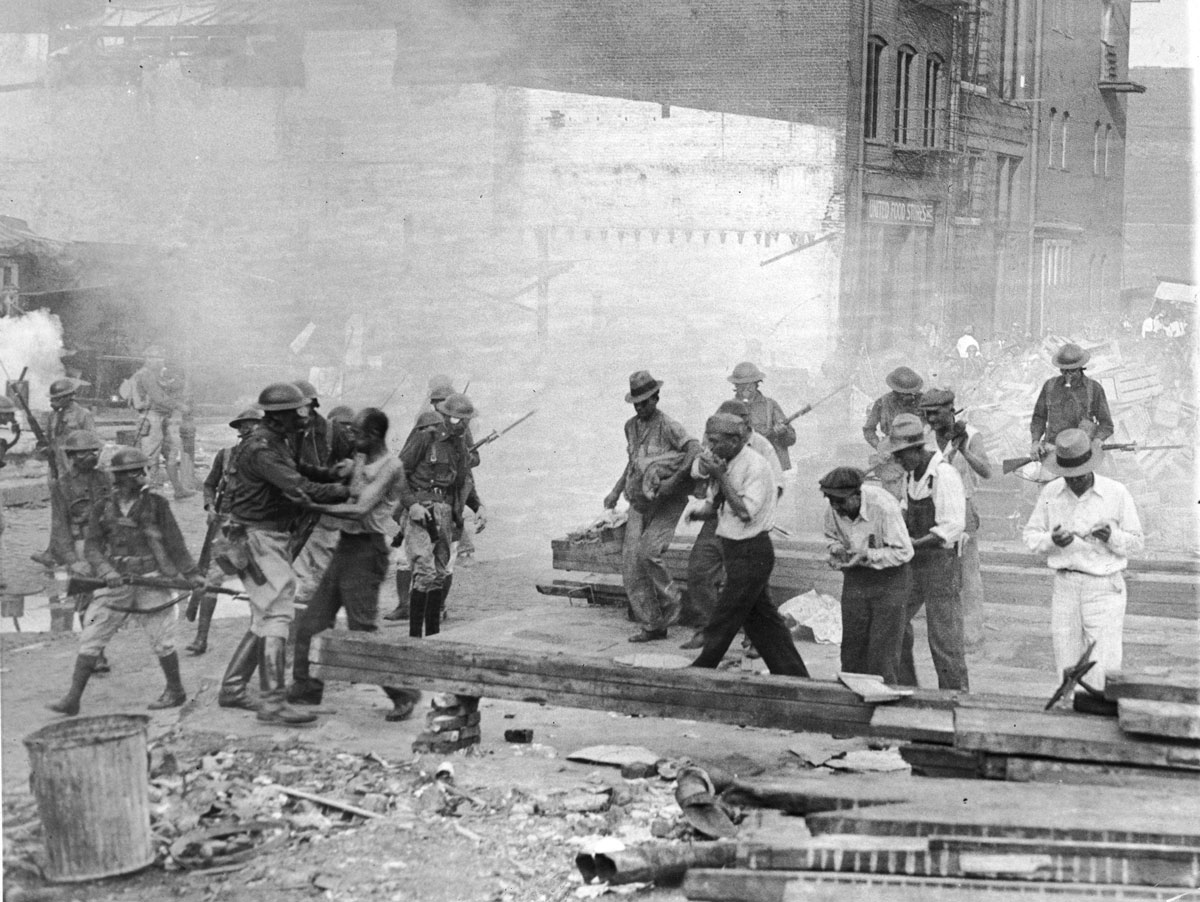
A lesson past: The Bonus Marches. In mid-1932, some 17,000 out-of-work World War I veterans suffering from the Depression, along with 26,000 families and other supporters, descended on Washington, D.C., to demand early payment of bonuses the veterans had been promised. They camped out on Anacostia Flats and other public spaces that served as bases of operation for their marches and protests. Despite their contributions to the war effort and their generally downtrodden postwar status, they were widely viewed as a public nuisance. President Herbert Hoover ordered the Army to clear out the principal campsite, so Army Chief of Staff Douglas MacArthur and then-Major George Patton led infantry and cavalry troops in doing so, burning the protesters’ shelters and belongings in the process. 

World War I Bonus MarchersSoldiers in gas masks advance on Bonus March demonstrators in Washington, July 1932. (Jack Benton/Getty Images)
A question for the future: The Bonus March affair wasn’t the first nor the last instance of government insensitivity to the plight of veterans who have sacrificed for the country, only to be summarily discarded as superfluous jetsam. The newly-infamous Project 2025 conservative policy agenda that serves as a shadow blueprint for the incoming administration calls for widespread across-the-board cuts in benefits and services, including for disabled veterans and the VA health care system. Will those affected and their supporters have the moxie and feel the urgency to engage in large-scale public protest? If so, are they prepared to be labeled insurrectionists and treated as such under the 1807 Insurrection Act? And will those in uniform who may be called on to serve as today’s MacArthur and Patton henchmen act dutifully on behalf of the state — the police state, some would say — or side with their protesting brethren?

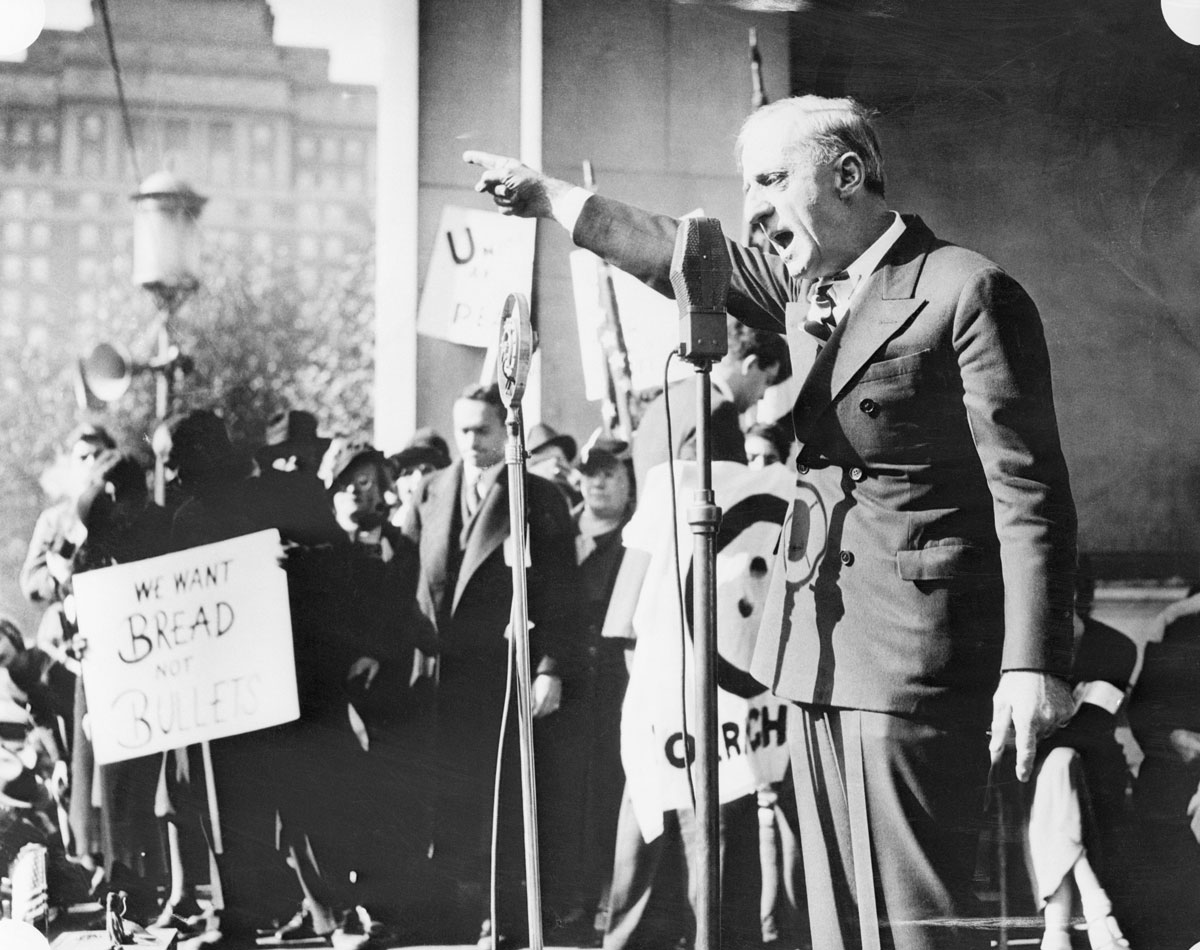
A lesson past: Coup plotters and Smedley Butler. A perennial icon of the U.S. Marine Corps, Maj. Gen. Smedley Butler was the most decorated Marine in U.S. history, including being the recipient of two Congressional Medals of Honor. Over more than three decades, he fought all over the world in battles and campaigns that fed his own growing cynicism: "I spent 33 years and four months in active military service and during that period I spent most of my time as a high class muscle man for Big Business, for Wall Street and the bankers. In short, I was a racketeer; a gangster for capitalism." In retirement, Butler produced a small book titled "War Is a Racket" expressing his distaste over having been a tool for big-business interests. Ironically, he was approached in retirement in 1933 by a group of wealthy right-wing businessmen who wanted to overthrow President Franklin D. Roosevelt and install Butler as president. He refused and took his story to Congress, which then produced a lame report that found no one culpable and held no one accountable for what came to be known as the Business Plot or the Wall Street Putsch.

A question for the future: There is no one of Smedley Butler’s stature in uniform today, and right-wing businessmen are laughably unlikely threats to a regime that exists largely for their benefit. Yet it isn’t totally frivolous to imagine other political, ideological or business factions that, seeing their interests threatened by a mercurial, impulsive commander in chief, would attempt to engineer his ouster. Though any propensity for the overthrow of government has long since been socialized out of America’s military, and especially out of its officer corps, it remains an open question whether newly generated circumstances of alienation and disenfranchisement might not energize latent, ideologically driven disaffection within the active or retired ranks that would coalesce with other restive elements of society. Were this to happen, the first-order question of whether the inflated public trust and confidence in the military would be lost will be subsumed by what, by any measure, would be the mother of all constitutional crises. 

General Smedley D. ButlerGen Smedley D. Butler, U.S. Marines, retired, pictured as he addressed a crowd of 6,000 participants in an anti-war demonstration in Reyburn Plaza, Philadelphia. (Getty Images/Bettmann)
A lesson past: Revolt of the Admirals. Since it occurred in 1949, the so-called Revolt of the Admirals has been not merely the policy and budgetary dispute it appeared to be at the time, but a classic case study in deep-seated inter-service rivalry and civilian control of the military. It was a convoluted affair that developed at the time along four converging tracks. The first, with o.rigins in the latter stages of World War II, concerned proposals for service unification, which the Navy opposed for fear of losing prerogatives and capabilities to central authority. This resolved itself in the 1947 National Security Act. The second track concerned general agreement, at least between the Navy and the Army Air Corps (and then the Air Force) in the future importance of strategic air power. This merged with a third track, which involved intense competition between the Navy and the Air Corps/Force over weapon systems, specifically over whether to invest in a new aircraft carrier or a strategic bomber. That in turn ran up against major spending cutbacks in favor of more domestic spending preferred by President Harry Truman and the secretary of defense. This all came to a head in congressional hearings when the Navy fought largely alone for its preferences in the face of opposition from the president, the defense secretary and the chairman of the Joint Chiefs. Truman, who viewed this as an affront to civilian control, had the chief of naval operations relieved and other senior officers transferred to dead-end assignments. The start of the Korean War in 1950 put an end to the affair by demanding greatly increased defense spending on all fronts.

A question for the future: With his long-established penchant for dividing and conquering any and all squabbling subordinates who seek his favor, the incoming commander in chief will almost certainly accentuate the rivalries that have forever existed among the armed services, strengthening his hand at their expense. On the other hand, it's possible that he could so badly alienate and disenfranchise the military that previous inter-service rivalry might give way to collusive stonewalling, foot-dragging and outright opposition that, in more ordinary times, would be considered soft-focus rebellion. Whether selfless unity can overcome a history of selfish disunity — actualized in the face of a common “threat” from within — will be the question of the day.

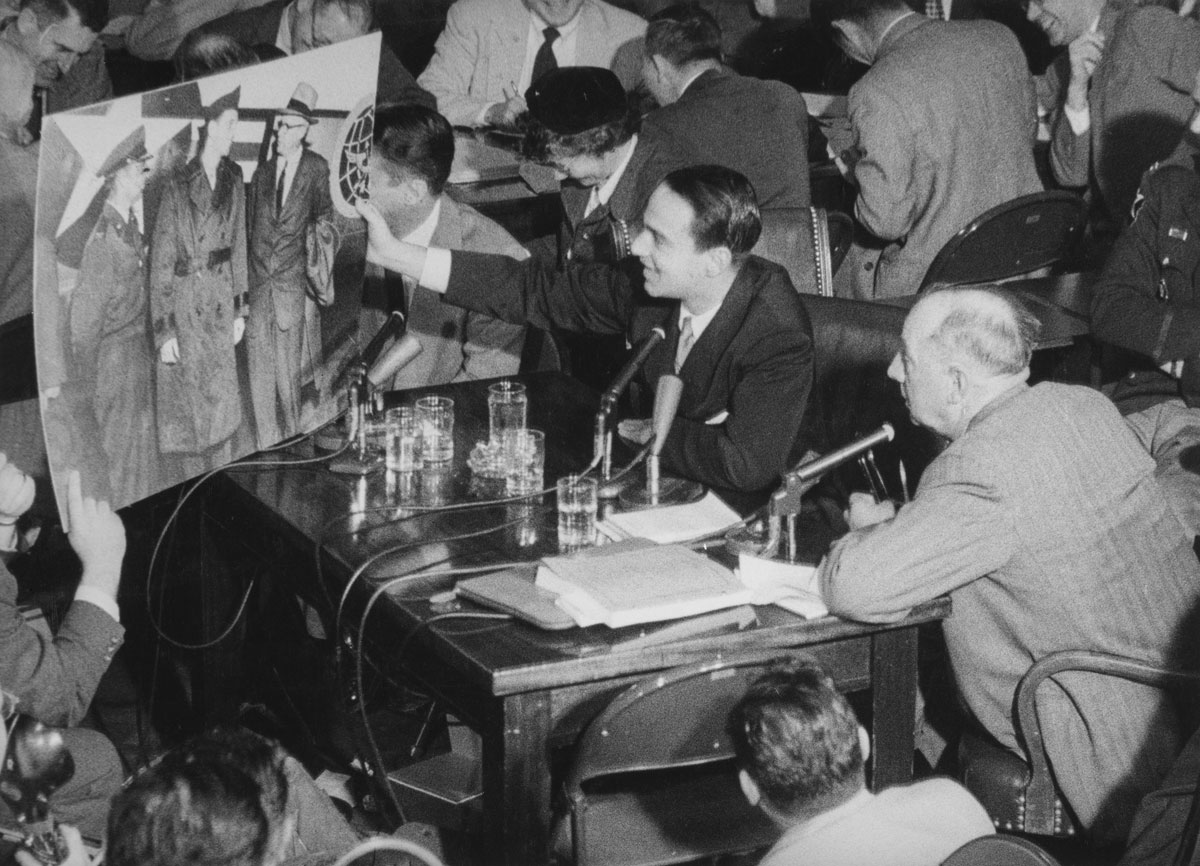
A lesson past: The Army-McCarthy hearings. The televised 1954 series of hearings before the Senate Investigations Subcommittee took place at the height of “Red Scare” McCarthyism. Sen. Joseph McCarthy accused the Army of harboring communists in its ranks, including some 130 "subversives" in defense plants. The Army countered by accusing McCarthy of trying to force the service to grant a commission to a consultant for the subcommittee. There were numerous public and contentious charges and countercharges back and forth, some linked to allegations of homosexual conduct. McCarthy's odious behavior ultimately led to his censure by the Senate and the beginning of the end to his destructive clown-show histrionics.

Army-McCarthy HearingsRoy Cohn holds up a photograph during the Army-McCarthy hearings in Washington, May 1954. (FPG/Archive Photos/Getty Images)
A question for the future: The central character linking this destructive clown show of the past to the prospective clown show just ahead is Roy Cohn, who was both Joe McCarthy’s unscrupulous hatchet man and Donald Trump's mentor and role model. Abetting the ghost of Cohn today are the contenders who seek to emulate his mission policing the public square for enemies within. The incoming commander in chief has surrounded himself with some of the nastiest witch-hunters alive, his personal posse of Roy Cohns, and there are plenty more where they came from. Barely latent McCarthyism remains alive and well today, and those who toil within the defense establishment — military and civilian alike — should consider themselves prospective targets, not for sympathizing with a subversive ideology but simply for speaking and acting in ways considered disloyal to the commander in chief. Will their superiors protect them or sacrifice them? 

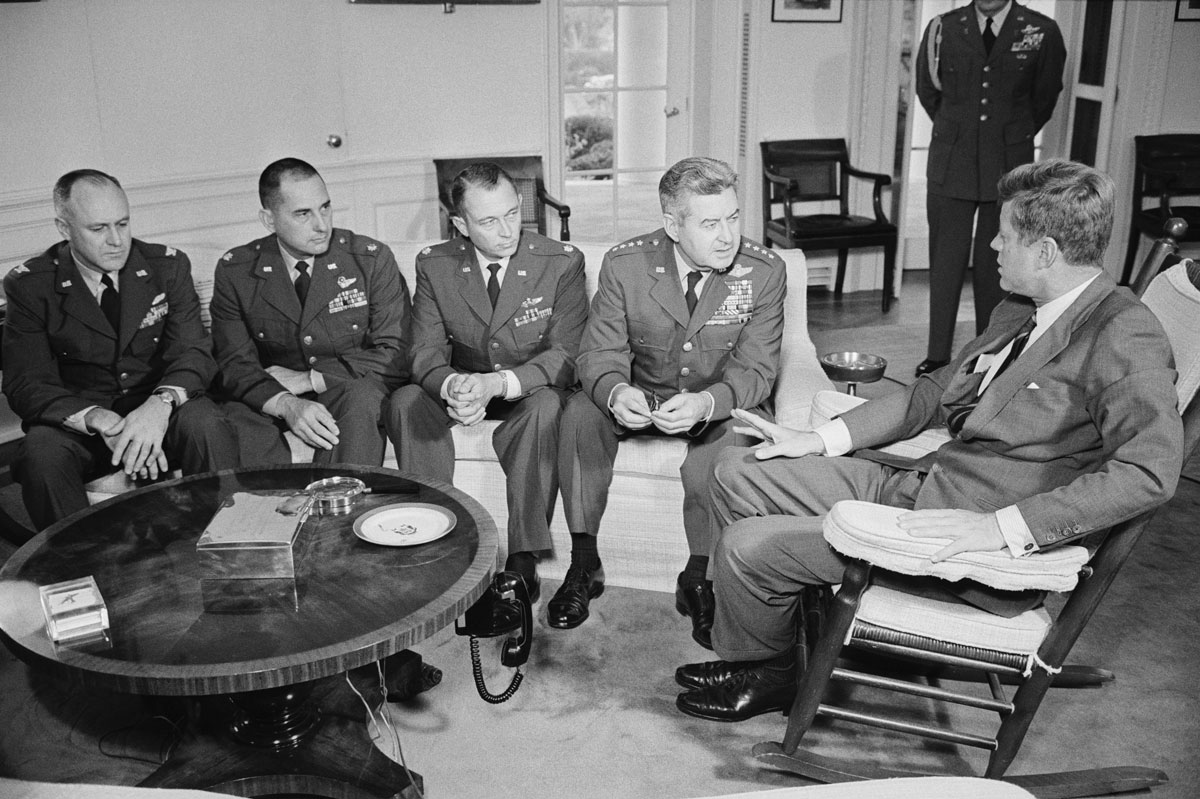
A lesson past: Walker, LeMay and "Seven Days in May" Army Maj. Gen. Edwin Walker and Air Force Gen. Curtis "Bombs Away" LeMay were cut from the same right-wing ideological cloth. Walker, a supporter of the John Birch Society, espoused radical right-wing, anti-communist views he used to indoctrinate his troops, andopenly accused public figures such as Harry Truman, Eleanor Roosevelt and Dean Acheson of being communist sympathizers. He was sufficiently controversial that he was ultimately relieved of command by Secretary of Defense Robert McNamara, and then chose to make a public statement by resigning rather than retiring. LeMay, the more accomplished and visible of the two, rose to become Air Force chief of staff after commanding Strategic Air Command and leading the strategic bombing campaign against Japan in World War II. He was constantly at odds with McNamara, President John F. Kennedy and Joint Chiefs Chairman Maxwell Taylor over the Cuban missile crisis and the war in Vietnam. From his mouth we have two quotes for the ages. The first, reflecting on the thousands of civilian deaths those under his command had imposed on Japan, was, "I suppose if I had lost the war, I would have been cited as a war criminal." The second was that either we could (according to him) or we should (according to others) "bomb North Vietnam back into the Stone Age." Walker and LeMay served as joint inspiration for the ideological Joint Chiefs chair depicted in the 1962 book and 1964 movie "Seven Days in May," who tries to engineer a coup against the president for negotiating a disarmament treaty with the Soviet Union.

A question for the future: Whereas the Smedley Butler episode involved real-world forces who sought to recruit a distinguished military hero to further their interests by overthrowing the president, the "Seven Days in May" scenario is a fictional depiction of right-wing militarists seeking to defend institutional interests cloaked as the national interest by overthrowing (in their fevered minds) a treasonous president who has colluded with a sworn enemy. Something like reality TV before reality TV existed, this scenario conjures up the eerie possibility of a commander in chief whose ties to autocratic strong men, Vladimir Putin foremost among them, could turn alarmist fiction into alarming nonfiction. Would the military, faced with similar circumstances and personalities, choose to be gatekeepers or gate-crashers?     

President Kennedy Curtis Lemay Richard S. Heyser Joe M. O'Grady Ralph D. SteaklyPresident John F. Kennedy meeting with Col. Ralph D. Steakly, Lt. Col. Joe M. O'Grady, Maj. Richard S. Heyser and Gen. Curtis LeMay during the Cuban missile crisis. (Getty Images/Bettmann)
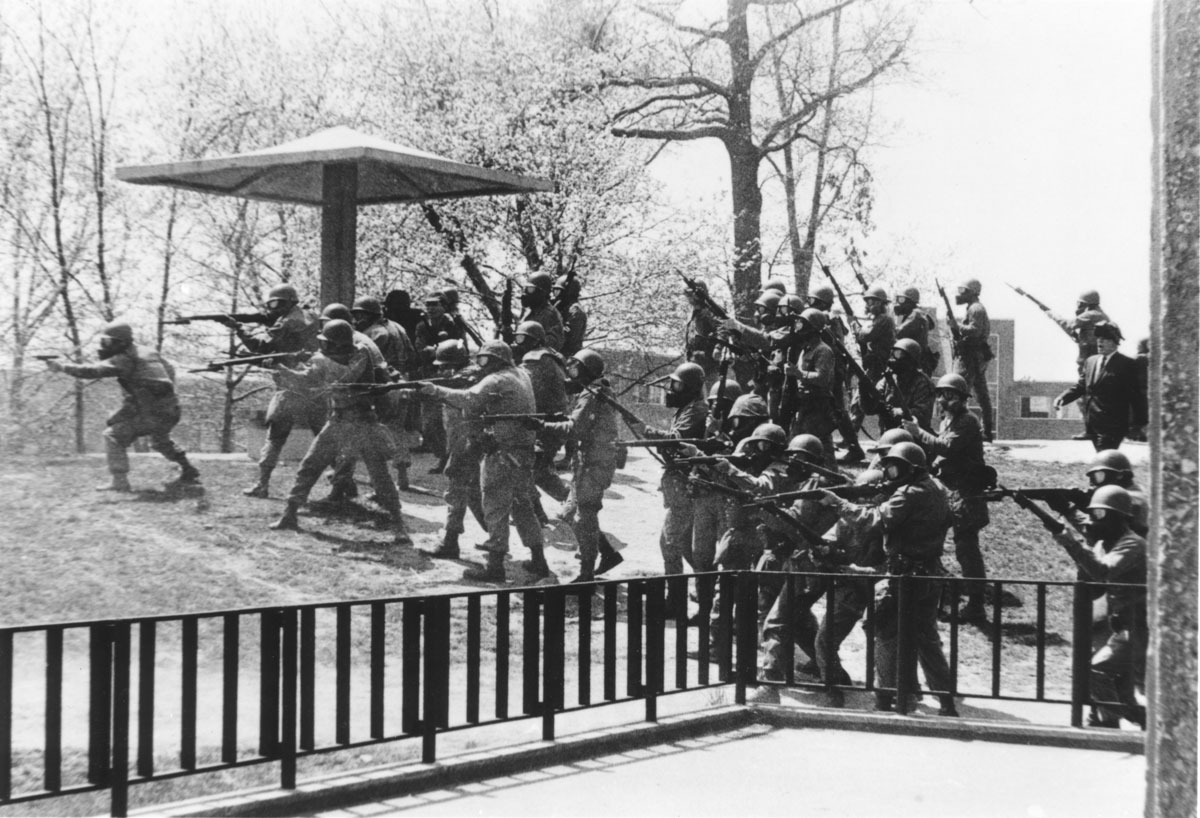
A lesson past: Kent State. A May 4, 1970, antiwar protest on the campus of Kent State University resulted in the deaths of four and the wounding of nine unarmed college students by poorly trained, poorly disciplined, trigger-happy Ohio National Guard troops called out to "restore order." Eight soldiers were charged with depriving the students of their civil rights under cover of law, but were acquitted in a bench trial. The incident triggered massive protests around the country. Subsequent charges against selected members of the Guard unit produced no convictions. More than 70 popular protest songs have grown out of the incident over time, most notably Neil Young’s "Ohio," which includes the lines "Tin soldiers and Nixon's comin'/ We're finally on our own/ This summer I hear the drummin'/ Four dead in Ohio."

A question for the future: In the post-Vietnam era of non-war wars, identifiable, cohesive, sustainable protest movements of any stripe have been rare but not altogether absent. The years immediately ahead offer ample opportunities for a new wave of protests and demonstrations by disaffected segments of the population smarting from the depredations of a rogue president committed to imposing his will on them. The mobilization of protest elements that threaten to overwhelm police is likely to precipitate the counter-mobilization of National Guard units, especially since 27 governors and 24 "trifectas" (states where the governor and both houses of the state legislature are of the same party) are Republican. How will these elements respond — as obedient oppressors or principled protectors of popular dissent?

National Guard Opening Fire on Kent State University DemonstratorsNational Guard opening fire on Kent State University demonstrators in 1970. (Universal History Archive/Universal Images Group via Getty Images)
A lesson past: The Powell-Nunn collusion. Joint Chiefs Chair Colin Powell, who was far and away the most political general since Douglas MacArthur, colluded behind the scenes with Senate Armed Services Committee chair Sam Nunn to craft the "Don't Ask, Don't Tell" policy that, for a period of time, forestalled President Bill Clinton’s 1993 commitment to fully integrate LGBTQ people into the military. Earlier, Powell had also penned a 1992 New York Times op-ed opposing George H.W. Bush administration policy on Bosnia. Needless to say, Powell was too much a political force in his own right (not unlike MacArthur) to be touched; only the personality of the commander in chief at the time — former draft-dodger Bill Clinton, rather than World War I vet Truman — made a difference.

A question for the future: An administration sworn to destroy established norms and undermine institutions, to the point of openly circumventing or reinterpreting the Constitution, almost assuredly will disregard traditional standards about the separation of powers and checks and balances. Moreover, there are now numerous members of Congress who have openly relinquished their independence of mind and spirit to the incoming commander in chief, have token military experience they flaunt for political purposes and tout themselves as authorities on military affairs. They will be all too ready to recruit sympathetic partners in uniform willing and able to abet their self-serving political desires. For those in uniform, the question will be what wins out: careerism or institutional loyalty and integrity? 

A lesson past: The revolting generals. The 2006 Revolt of the Generals, so-called, involved a group of retired generals — including Army Maj. Gen. Paul Eaton, Marine Lt. Gen. Greg Newbold and Army Maj. Gen. John Batiste, among others — who spoke out publicly in opposition to the George W. Bush administration's Iraq policy and called for Secretary of Defense Donald Rumsfeld’s resignation. This only came after they had failed to speak out publicly or, from all appearances, even to speak up internally while on active duty, when it might have made a difference.

A question for the future: If senior officers were intimidated into silence under the relatively unthreatening second Bush, there is no limit to the depths of cowardly quiescence that could be exacted by an administration where top-down bullying, browbeating, threats and intimidation are standard operating procedure. Who, otherwise committed to continuing public service in uniform, will have the courage to speak out when necessary, or even to speak up within channels under that kind of pressure?

A lesson past: The cashiering of Alexander Vindman. Army Lt. Col. Alexander Vindman was the National Security Council staffer subpoenaed by the 2019 House impeachment inquiry to provide testimony concerning President Trump’s attempt to muscle Ukrainian president Volodymyr Zelenskyy into providing dirt on Joe Biden. Vindman, who as part of his duties had listened in on the call between Trump and Zelenskyy, dutifully and truthfully reported his serious concerns over the president’s politically motivated arm-twisting, as well as about “outside influencers who [at the behest of Rudy Giuliani] had been promoting a false narrative” about Ukraine that was inconsistent with official U.S. policy. He had already reported his concerns through prescribed internal channels. His comments drew Trump's ire, and Vindman was dismissed from his NSC job and saw his previously planned promotion derailed as retribution. He subsequently retired, citing intimidation from the White House.

A question for the future: There is ample evidence from the first Trump administration that crises and associated examples of incompetence will again occur with alarming frequency. That will inevitably prompt a spate of oversight hearings and inquiries by opposition politicians on Capitol Hill. Whether the issue at hand is backroom collusion with an adversary, strong-arming an ally for political favors, the compromise of national secrets or various forms of fraud, waste and abuse, uniformed personnel, senior and not-so-senior, will be called upon to testify. Since each of the armed services includes honor and courage among its core values, these individuals will be expected, when questioned, to be forthright and truthful. When promotions and careers, to say nothing of identities and self-respect, are at risk over even the slightest deviation from the Overlord’s whimsical, selfish preferences, the question will be whether the angel on one shoulder or the devil on the other wins out.


Want a daily wrap-up of all the news and commentary Salon has to offer? Subscribe to our morning newsletter, Crash Course.


A lesson past: The not-so-undirty half-dozen. Mike Pompeo and Mark Esper, Trump secretaries of state and defense respectively, were West Point classmates inculcated with a cadet honor code that forbade lying, cheating and stealing and was intended to prepare them for a lifetime of honorable public service. Yet they repeatedly manipulated and dispensed with the truth while in office on behalf of themselves and their commander in chief. H.R. McMaster, who was Trump's national security adviser as a serving three-star general, and John Kelly and James Mattis, both retired Marine four-star generals who served, respectively, as White House chief of staff and secretary of defense under Trump, failed to speak out publicly about presidential abuses and, absent yet-to-surface revelations to the contrary, even to speak up internally to protect the integrity of their institutions. Mark Milley, as chairman of the Joint Chiefs of Staff, allowed himself to be used by Trump for crass political purposes, only to seek public redemption after the fact to preserve his own self-respect.

A question for the future: It is a self-protective, self-perpetuating myth that the military nurtures and rewards leadership. In actuality, what it nurtures and rewards is dutiful followership. Those who make it to the top and achieve high rank are those who, advertently or inadvertently, acquire patronage from superiors who prize their obedience. That's how it has always been and always will be. The incoming commander in chief knows this all too well and will ineluctably use it to his advantage. Loyalty will be the coin of the realm; even if those in uniform escape having to swear a blood oath to a commander in chief who equates his fortunes with the fortunes of the nation, those who survive and advance will be the ones who give their obeisance to him. Will personal loyalty take precedence over the constitutional oath all senior military officers and public officials have sworn?

Lessons learned are future defenses earned

As numerous respected purveyors of thought have noted over time, we learn from history little more than that we learn nothing from history. Faced with an incoming commander in chief whose expected conduct promises to exceed even the excesses of his first administration, we may be left to conclude that history, even if it doesn’t exactly repeat itself, often rhymes. Where it rhymes, inevitability is close at hand, reminding us that, as Santayana observed, we are condemned to repeat the past we fail to remember. Anyone who hopes to preserve the sanctity of the civil-military ideal would do well to circle the wagons of law and constitutionalism and man the ramparts of institutional self-preservation.

Fake news is driving us apart amid disaster — but slanted news is slowly drowning our democracy

The upcoming inauguration of Donald Trump as the 47th president of the United States — and the four years of his presidency to follow — will put American democracy to the test. His return to the Oval Office has already reignited debates over the legitimacy of elections, with partisan media framing his presidency as either a triumph or a travesty. This polarization underscores a growing danger: We no longer share a common reality. 

The erosion of trust in common facts and the fracturing of our nation's ability to engage in constructive dialogue means many of us can no longer accept a shared reality. In 2023, a CNN poll found that 69% of Republicans and Republican-leaning independents believed President Biden’s 2020 win was not legitimate. That’s not surprising given new reporting that popular conservative pundits are frequently sharing election falsehoods on YouTube, which stopped moderating election-related content 18 months ago.

There is a reason why promoting slanted news and keeping us in our own echo chambers is profitable: we tend to like it there.

It can be tempting to point to fake news and misinformation as the culprit. For the past few years, my research has focused on revealing the hidden relationships between our digital lives and our psychology, and the facts we’re learning about fake news are alarming. Leading up to the 2016 US presidential election, Facebook users spent more time reading fake news than real news. Studies show that — more often than not — people believe the content they consume even when it is factually wrong. How is it possible to maintain a functioning democratic system that is based on the will of the people, if the people are falling for lies?


Want a daily wrap-up of all the news and commentary Salon has to offer? Subscribe to our morning newsletter, Crash Course.


To make matters worse, fake news could have an even stronger impact in 2025 thanks to generative AI. With the ability to create millions of fake news articles, pictures and videos in a few mouse clicks, the creation and dissemination of false narratives has become easier than ever before. Deepfake images of Hurricane Helene victims last month demonstrated the potential — some politicians boosted the images on social media to reinforce another false narrative that the federal government wasn’t responding to communities in need. Just a few weeks ago, the U.S. Department of Justice struck down a Russian-led effort to distribute fake news about the upcoming election which according to FBI Director Christopher Wray relied on “cutting-edge AI to sow disinformation.” 

But while we should all be concerned about the impact of fake news, it’s too simplistic to point to fake news as the only barrier to reinstating an informed populace. 

As a recent study by researchers at MIT and the University of Pennsylvania suggests, the impact of news that is factually inaccurate — including fake news, misinformation and disinformation — pales in comparison to the impact of news that are factually accurate but misleading. According to researchers, for example, the impact of slanted news stories encouraging vaccine skepticism during the COVID-19 pandemic was about 46-fold greater than that of content flagged as fake by fact-checkers. Similarly, decades of research on personalized persuasion highlight how appealing to a person’s psychological traits — e.g. their personality or moral values — can sway hearts and minds without the need for content that is factually inaccurate.

Placing an overly strong emphasis on flagging and eradicating fake news could inadvertently exacerbate the impact of content that is misleading and polarizing. Take the most common approach to combating misinformation, for example: The tagging of news that are considered false by fact-checkers. The approach has intuitive appeal: it’s similar to the Nutri-Score labels that help us decide whether a particular food item might be good or bad for us by summarizing nutritional information in an easy-to-digest, color-coded scale, labeling fake news aims at providing us with a helpful mental crutch.

We need your help to stay independent

Making people’s lives as easy as possible is often the best way for shifting their behavior in a desired direction (research in behavioral economics offers plenty of compelling examples for this assertion). And, in principle, there’s nothing easier than seeing a “fake news” label on an article and, as a result, discounting its arguments or refraining from re-posting it. The problem is that we might also start using the convenient mental crutch in cases we shouldn’t — particularly in cases where a news item isn't labeled as “fake” (because it isn’t), but the content is still designed to lead us astray. As we outsource our critical thinking to the systems meant to support and protect us, we might become more vulnerable to believing content that hasn’t been flagged and therefore appears to be credible

That doesn’t mean we should abandon technological solutions that aid in identifying fake news. But we need more than that. For a start, it’s time to re-establish a digital version of the town square that allows for collective human oversight. As of now, there’s no way of comparing the personalized news and search results that one person is served by Facebook’s or Google’s algorithms with those other people see. The same algorithms that help me find the content I am most likely to enjoy online (and in the process create tremendous profits for their creators), also make it almost impossible for me to determine the extent to which my news might be biased in their depiction of current events. 

Granted, the problem here doesn’t just lie with algorithmic recommendations. There is a reason why promoting slanted news and keeping us in our own echo chambers is profitable: we tend to like it there. And we might not be overly excited to leave this place of comfort for a world that is foreign — and potentially hostile — to us. But that doesn’t mean we shouldn’t have the option to see what other people see. In other words, it’s important to have a way to peek into the echo chambers of people who might hold different beliefs than we do, and who are likely to see news that describe the same event in a very different light.

The bottom line is that to rekindle a sense of shared reality and establish a more unified democracy, we need solutions that tackle more than just misinformation. To counter the impact of news that is factually accurate but misleading or highly polarizing, it’s not enough to simply rely on systems of convenience that do the job of fact-checking. Instead, we need to sharpen our ability to think critically and reclaim the right to compare our version of “reality” to that of others.

What’s causing bird flu to surge? Probably climate change, experts say

Guillemots, black and white birds each measuring about a foot tall, cram together on Skomer Island to starve off predators and protect their eggs, of which each reproducing bird lays just one each year. On this island off the coast of Wales, nearly 100,000 of these seabirds once huddled in groups next to neighboring puffins, but the population was nearly killed off due to oil pollution and tanker traffic starting in World War II. After hitting a nadir of 2,500 in 1972, the guillemot population made a miraculous comeback over several decades, reaching 30,000 in 2022.

Then, in the summer of 2023, bird flu hit Skomer Island, killing about 15,000 birds, said Timothy Birkhead, a professor at the University of Sheffield who has spent the past 50 years studying the population. These deaths will be felt throughout the ecosystem.

"The guillemot is a key player in the Skomer 12-species seabird community,” Birkhead told Salon in an email.

The current bird flu panzootic — or a pandemic in animals — has spilled over to an unprecedented number of animals across the world since it began in 2020, killing off elephant seals, cougars, polar bears, and dozens of other mammalian species. Millions of wild birds have died from H5N1, the virus that causes bird flu, and more than 13 million poultry and 900 dairy herds have been impacted in the U.S. while at least 66 human cases have been reported. The first U.S. death from bird flu was reported last week in a patient from Louisiana.

Every infection brings us closer to another pandemic like COVID-19, experts have emphasized. A big question is why is the crisis growing now? H5N1 has been documented since the mid-'90s, with scientists warning for decades that the virus had pandemic potential. Part of what's making it such an issue today might be related to climate change.

"Climate change can affect those large scale patterns, like migration, that could bring birds into contact with agricultural systems."

Although it’s difficult to pinpoint a direct cause-and-effect relationship between climate change and bird flu, research going back many years before the current crisis linked our heating world and natural disasters with changing migratory patterns, nesting seasons, and habitat ranges of wild birds. All of this is influencing the way avian flu spreads across the world.

“Climate change is unpredictable because we can talk about a global increase in temperature, but that doesn't mean it's necessarily going to get warmer everywhere," said Dr. Damien Joly, a wildlife biologist at the University of Saskatchewan in Canada. “But what we do know is that climate change can affect those large scale patterns, like migration, that could bring birds into contact with agricultural systems that they have not been in contact with before.”

Avian flu outbreaks date back centuries, when it was once known as "fowl plague," but this outbreak is unique. This time, the virus is adapting to the environment in new ways, infecting a record number of species and surviving various seasons without dying out, Joly said.

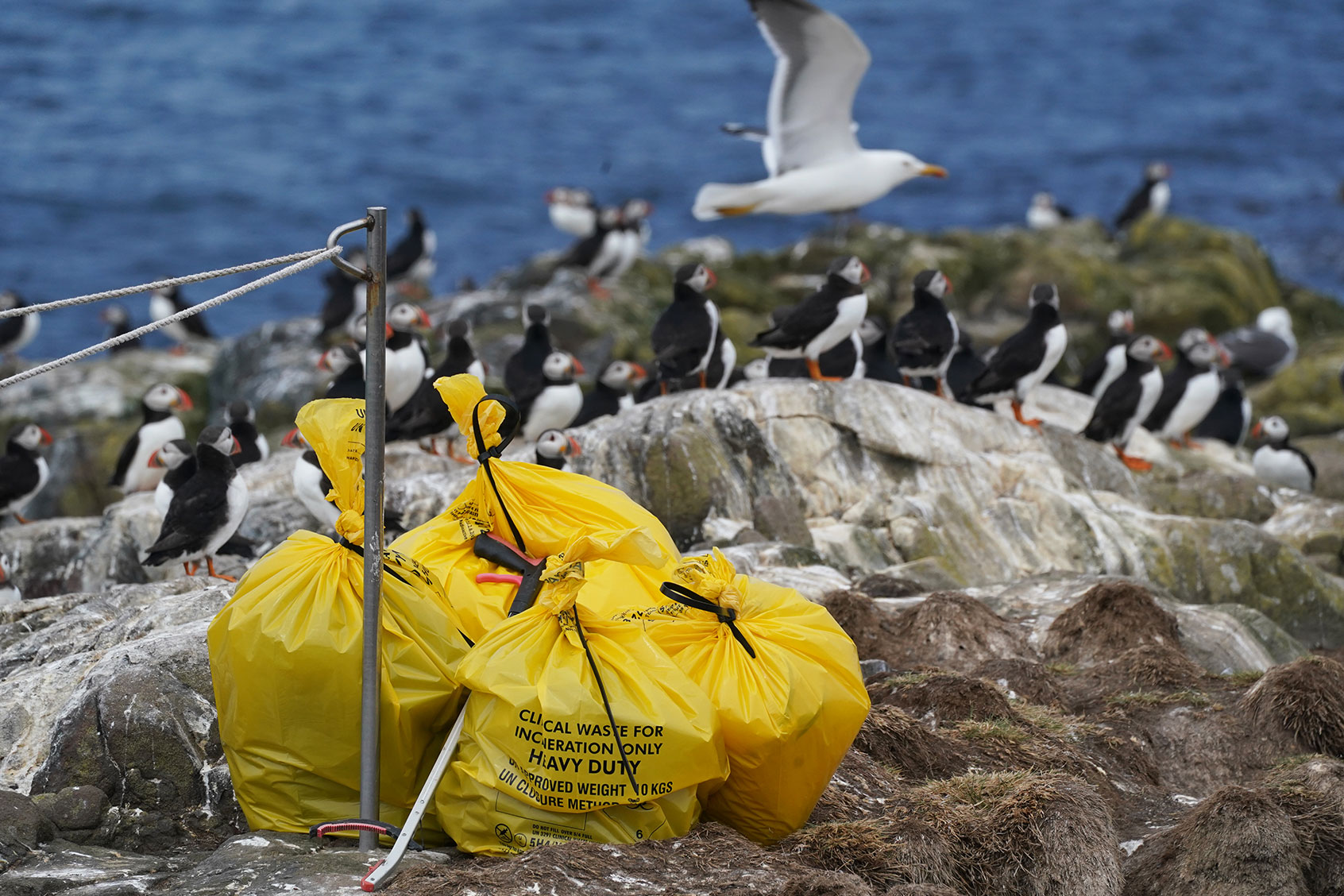
clinical waste bags bird flu Avian Influenza dead carcasses puffins seagullsClinical waste bags containing the carcasses of deceased birds await removal from Staple Island off the coast of Northumberland, where the impact of Avian Influenza (bird flu) is having a devastating effect on one of the UK's best known and important seabird colonies. (Owen Humphreys/PA Images via Getty Images)“When you think of any virus system, there are really three components that affect whether that pathogen will persist,” Joly told Salon in a phone interview. “There are host effects, pathogen effects, and the environment. Changes in the relationship between those three groups is what leads to changes in disease dynamics."

One of the ways a changing climate can impact bird flu is by increasing numbers of extreme weather events. Bird flu first arrived in North America in 2014, following a typhoon in Asia that impacted the North American Pacific Flyway, one of the major avian superhighways. In 2021, the arrival of the current outbreak in North America also coincided with windstorms in the North Atlantic that were happening at the time, said Dr. Claire Teitelbaum, who studies wildlife and infectious diseases at the USGS Georgia Cooperative Fish and Wildlife Research Unit and is also a professor at the University of Georgia. 

“Those events definitely affect when and where animals are,” Teitelbaum told Salon in a phone interview. “Animals in general are pretty good about moving away from natural disasters but they can also take those diseases they have with them as they move.”

Extreme weather events could also displace bird habitats, change the way they access food, and consequently impact the way that species can fend off a virus, said Dr. Erin Sorrell, a virologist and a senior scholar at the Johns Hopkins Center for Health Security.


Want more health and science stories in your inbox? Subscribe to Salon's weekly newsletter Lab Notes.


On Skomer Island, the guillemot population may have been made extra vulnerable to the virus due to a food shortage that occurred just before bird flu struck, likely caused by a major storm and the highest sea temperatures in the region ever on record that impacted the availability of food sources.

“All of these things can kind of come together to create a perfect storm, or you might only need three out of five of those factors to be able to have an opportunity for the virus to be around just a little bit longer, to expose one more bird species that is migrating or one more bird species that is in the surrounding environment,” Sorrel told Salon in a phone interview.

Additionally, warmer temperatures have shifted migration patterns for some species earlier, which means certain birds are spending more time on their breeding grounds, Teitelbaum said.

“From the avian flu perspective, that is important because breeding grounds can be places of high transmission,” Teitelbaum said.

One 2019 case study looking at how bird flu infected the avian population in Qinghai Lake in China reported that the wild birds there encountered the virus at their wintering grounds and traveled across Eurasia and into Egypt and Northern Africa, said the study’s author Dr. Barbara Canavan.

“It started in Qinghai,” Canavan told Salon in a phone interview. “It is a place that is warming very fast and where they’ve had significant changes in farming, providing a viral pathway to get to birds that are far more mobile."

At least 70% of pathogens that infect humans come from wildlife, and as the human population continues to expand to every corner of the globe, it increases the chances that some of those pathogens will spill over to infect people. Ultimately, the environmental alterations humans have made, like developing farmland underneath one of the greatest migratory bird flyways, serve to provide avian influenza with a consistent source of hosts. For example, bird flu was detected in pigs for the first time late last year.

“In poultry populations, when you are constantly introducing new susceptible individuals, it allows these viruses to persist," Joly said. "They can’t burn themselves out when you are constantly adding fuel to the fire.”

The Centers for Disease Control and Prevention (CDC) maintains that the risk to the general population of being infected with bird flu is low, although farmworkers in the dairy and poultry industry are at greater risk. Still, the virus is increasingly spilling over to other animals, including humans. The major concern is that the more chances bird flu has to transmit between hosts, the greater the risk that it could evolve to become more dangerous. This could occur if an infected host is also infected with another virus and genetic material is swapped in a process called viral reassortment.

We need your help to stay independent

“All of these impacts that climate change could have on locations and species interactions or temperatures in the environment are all likely to impact the rate at which the virus evolves,” Teitelbaum said. “Because it would impact when and where different genotypes of the virus are in the same place and in the same bird and able to do that reassortment.”

Surveilling how the virus transmits in the environment among wild birds can help protect domestic species and reduce its spread. In May, the U.S. Department of Agriculture received $824 million to fund the surveillance of wild birds in addition to mitigating the spread of bird flu in agriculture. Thus far, the agency has already funneled more than $2 billion in combating the virus on farms. But some are calling for additional funding to go toward the surveillance of wild birds in order to get ahead of the virus.

“Ultimately, it’s way cheaper to fund the surveillance of wildlife populations for diseases than it is to try and deal with the millions of chickens that have died associated with avian influenza in this continent," Joly said. “Being able to go upstream and detect and figure out mitigation before it gets into humans … is ultimately so much cheaper and more effective because you are not chasing your tail.”

Want to earn more in 2025? Learn these skills

The start of the new year often comes with money-related resolutions, like meal prepping to save costs or paying off credit card debt. While these are worthy goals, there's a limit to how much you can get ahead by cutting back. 

Another option is to boost your income — either at your current employer or a new one — by learning new skills and advocating for yourself.   

According to a LinkedIn poll by Phaxis, a recruitment and staffing agency, the top three skills employers say are most important for 2025 are:

  1. Foresight and problem solving 
  2. AI proficiency 
  3. Perpetual learning agility 

But it's not just about learning how to use ChatGPT and expecting a raise. Instead, employees need to figure out how to combine these types of hard and soft skills, while communicating what they're learning to employers.

We need your help to stay independent

Combining hard and soft skills

Hard skills are technical or measurable skills, such as coding, accounting and writing. While there can be some subjectivity involved with hard skills, it's generally easy for employers to see whether or not you have those skills.

But to really up your income, hard skills like AI proficiency needs to be combined with less tangible soft skills, like interpersonal skills, communication skills, critical thinking and analytical skills, said Lisa Countryman-Quiroz, CEO of JVS, a San Francisco-area nonprofit that provides job training programs. 

Enrolling in an AI graduate certificate program might help you land a job that pays more, for example, but to improve your chances of increasing your income even more, it's important to be able to apply soft skills like problem solving while using new technologies.

For example, a sales rep might use AI to conduct more outreach, but they still need to think about who are the customers they're trying to access, what are they interested in, and how can AI help craft messages that are most effective at tapping into that customer base, said Countryman-Quiroz. "That is a combination of being creative, being an analytical thinker, and figuring out how that tool can help solve the problem" of acquiring more customers.

Soft skills like perpetual learning ability are also critical for boosting your long-term earnings, rather than only relying on hard skills for quick pay bumps.

"There are lots of skills that decrease in value really quickly over time, like how to use a piece of software. Then there are skills that really transcend that, that last a really long time," like problem solving, communication, handling change, said Matthew Daniel, senior principal of talent strategy at Guild, a company that works with employers and employees in areas like education and career development.

"These were important before AI. They're even more important on the other side of AI. Because ultimately, what those point to, is do I know how to learn?" said Daniel. "Employers really want to know not what you know today, but are you going to be flexible for whatever the next three to five years hold."

Developing new skills

To develop these types of hard and soft skills, you don't necessarily have to get a new degree. There are a range of options to fit different lifestyles, budgets, goals, etc. Perhaps what's most important is to demonstrate that you're actively developing new skills, rather than reflecting on the past.

"People who say to an employer, 'I'm enrolled in this course, I'm enrolled in this program, I'm investing in myself,' those people see a mobility rate or a chance at a promotion or kind of a horizontal move at about three and a half times their peers," said Daniel, according to Guild data.

"It doesn't have to be a college," he added. "We live in a world where everybody cares more about the skills that you're growing than the college credentials that you have."

That also means that many colleges now offer shorter, more affordable programs than what you might assume. 

The higher education space is "doing more specialized certificates. Instead of committing for three years, you commit for four to six months to get a grad certificate in a particular topic," said Daniel.

Many companies also pay for these programs, as they want employees to learn new skills without taking years to do so, given the pace of change, he added. 

And if school isn't an option for you, then consider how you can make the most of what's around you. In addition to some free online programs, you can find in-person training from community organizations, for example. You can also try to make the most of your current job or hobbies to tackle new responsibilities and work with new tools.

For example, "think about community groups and volunteering. Where are there spaces for you to demonstrate your leadership skills? And then track that," said Countryman-Quiroz.

Making the case for higher pay

As you develop new skills, it's important to speak up for yourself so you can earn more. One way to do that is to talk about projects you're working on that demonstrate skills development.

In an interview, for example, "saying I'm doing some coursework right now on how to handle change management regarding AI, and I'm writing a communication plan for employees about how they should do that — that hits super differently than saying I read a book on AI, or I'm in a grad certificate program," said Daniel. "It's the ability to articulate what you're learning in a way that connects with a business strategy and the person that you're being interviewed by that makes a really big difference."

Keep in mind that talking about what you're learning is a skill you may need to practice, such as through mock interviews and discussions with career counselors.  

"If you build skills but don't also learn how to talk about those skills, you've missed some of the opportunity to earn on top of the skill that you've built"

"If you build skills but don't also learn how to talk about those skills, you've missed some of the opportunity to earn on top of the skill that you've built," said Daniel.

A similar philosophy applies if you're trying to earn more at your current job, such as in performance review conversations. And if you're unsure what skills would help lead to a raise or promotion, don't be afraid to ask. 

"I really encourage people to be upfront with your employer," said Countryman-Quiroz. "Say 'I love this organization. I want to move forward…What are the opportunities here? Or what are the skills that might be holding me back?'" 

"Any employer who hears that is going to know that you're invested and committed to the organization and to developing alongside it. So be frank, have those conversations, and then be ready to take action," she added. "Follow up with that person, maybe not in a demanding way, but to say, 'I heard your advice. I've really been working on it. I'm curious if you notice a difference.'" 

These types of conversations might feel a little uncomfortable for you at first, but it's critical to be your own advocate.

"It is only people who don't talk about raises and promotions who don't get raises and promotions. You've got to be clear about what you want," said Daniel.

Trump and Newsom are feuding over LA wildfires. It’s nothing new

Perhaps no two politicians in the United States are such consistent and bitter rivals as President-elect Donald Trump and California Governor Gavin Newsom.

Newsom, momentarily floated to replace President Joe Biden in the 2024 race last summer, is hard at work safeguarding progressive plans in his state. His status as the figurehead of a state that is itself an avatar of liberalism has positioned him as the chief Trump foil heading into the president-elect’s second term.

An outbreak of horrifying wildfires in Los Angeles this month also reignited the president-elect’s criticism of Newsom. As thousands of homes burned, Trump responded to the tragedy by spreading conspiracy theories about the state's ill-preparedness. Trump went so far as to call for the governor's resignation in a frenzy of posts to Truth Social. Newsom urged Trump to keep things civil, slamming him for trying to “politicize” the blaze before inviting him to visit the fire-torn state.

The pair’s mutual admonishment is nothing new. Their history is littered with games of political one-upmanship, legal fights and loud, national back-and-forths in service of their policies and parties.

Newsom's governorship of the Golden State began as an early referendum on Trump’s leadership. In his 2018 victory speech, Newsom took jabs at the then-president and the “politics of chaos and…cruelty” that he ushered in, promising future showdowns on issues like immigration and the environment.

Still, Newsom gave Trump a warm welcome later that year when the president came to tour the devastating aftermath of wildfire blazes in Paradise, California – or Pleasure, as Trump mistakenly dubbed it.

After taking office in 2019, Newsom’s relationship with the commander-in-chief deteriorated quickly.  A high-profile feud on immigration policy would cast the pair in the roles they've played for more than a half-decade.

The blue-state leader ridiculed Trump’s vaunted plans for a southern border wall, dubbing it “political theater” and withdrawing a contingent of National Guardsmen that Trump had deployed to the border.

Newsom also angered Trump by approving a requirement that presidential candidates on primary ballots in California release their tax records. Newsom signed the bill, a pointed attack on Trump, into law in 2019. As with most legal attempts to wrangle Trump, it amounted to nothing. That law was later struck down by a California court.

The easily flattered Trump often changed tune on Newsom amid moments of cooperation. At the outset of the COVID-19 pandemic, Trump called the governor “very nice & highly supportive” but warned him to stay strong against the “Radical Left Dems, MSDNC, etc.” in a post to Twitter.

The pandemic would soon divide them, with Trump becoming enraged as Newsom and other Democratic governors took measures to stop the spread of the virus. In a May 2020 tweet – which also foreshadowed one of the pair’s most bitter fights on mail-in voting – Trump blasted Newsom for leaving the “restaurants, beaches and stores” closed.

Trump frequently demanded California re-open on an expedited timetable, urging residents to protest disease prevention measures and embracing anti-scientific rhetoric in a ploy to rile up his base.

Later in 2020, Trump attempted to play politics with federal emergency relief funds. The then-president denied Newsom’s request for aid as the state was burning, before later reversing course amid backlash. Trump had laid into California in previous posts to social media, blaming the state for the wildfires brought on by drought. Trump said in 2019 that he wanted the state to "get their act together" blaming supposedly lax forest management for the blazes. He said that he “​​ordered FEMA to send no more money” to the state until it changed its policies.

It wasn’t the first time Trump had politicized disaster relief: a 2024 report revealed that Trump had initially withheld wildfire aid from Californians in 2018. The report claimed Trump changed his tune once an aide showed him voter data that revealed his millions of supporters in the state.

Democratic leaders labeled the actions “sadistic and depraved,” while Newsom worked with members of the California GOP to secure the funds.

Newsom hit the campaign trail in 2020, stumping for Biden-Harris as Trump sued California for leading a nationwide push for mail-in voting. Again in ‘24, Newsom went all-in for the Democratic Party candidate, Vice President Kamala Harris.

Harris' loss has re-energized the governor, who during Biden’s term faced slouching popularity and a recall battle. With Trump headed back into office in mere days, Newsom has tasked himself with resisting the incoming administration’s agenda more than just about any other Democratic leader. And Trump, with a trifecta of government control, is all but certain to use Newsom as his blue-state boogieman once again.

Space junk cleanup should adopt same strategy as ocean conservation, experts propose

Humans like to imagine Earth as a pristine blue marble surrounded by empty space and glowing stars. In fact, though, human space exploration and industrialization has polluted the area around our planet, with the resulting debris known as space junk. The problem is expected to only grow as the demand for satellites increases with our desire to explore our solar system, but it could get so bad that it could ground space travel indefinitely. What can be done?

An international collaboration of scientists in fields from satellite technology to ocean plastic pollution authored a recent review in the journal One Earth suggesting a strategy for one day restoring Earth’s orbit to its once-uncluttered status: Just use the same methods for cleaning up our oceans.

Because this space junk poses serious risk to astronauts and infrastructure in space — as well as presenting problems on the ground for people using GPS, cell phone data and weather monitoring — scientists are determined to fix this mess. The researchers argue this can be accomplished by forcing the producers of debris to be held financially accountable, developing and enforcing international legislation, creating incentives for companies to minimize orbital debris and stimulating collective scientific cooperation.

"The buildup of debris in these crucial orbits heightens the risk of collisions with operational assets and diminishes the sustainability of these valuable spaces," the authors write. "Therefore, it is crucial to treat the orbital environment as a finite resource that requires protection and conservation."

Perhaps most importantly, they call for the United Nations to get involved in the matter, urging the establishment of a new UN sustainable development goal. The UN creates these goals to establish international benchmarks for protecting the planet, ending poverty and promoting peace. There are already 17 sustainable development goals and the scientists are urging an 18th that would promote space conservation and sustainment of Earth's orbit, particularly to prevent the accumulation of space junk.

These proposals are all based on similar measures adopted to help clean up Earth’s oceans. The authors explain that this approach, though seemingly incongruous, is actually quite sensible.

“There are noticeable differences between marine and orbital environments, both physically and in terms of their chemistry and biology,” the authors write. “However, they share a common problem: the increasing presence of debris across large areas of our planet’s shared spaces.”

The lazy comedy of “Bill Maher: Is Anyone Else Seeing This?” coasts on complaints instead of jokes

It’s been a long time coming, but his latest comedy special confirms the inevitable has finally happened — Bill Maher has completed his metamorphosis into Abraham Simpson.

“Bill Maher: Is Anyone Else Seeing This?” may be improved by picturing Bart and Lisa's Grandpa muttering the “Real Time” host’s ramblings to himself while Homer, Marge and the kids go about their business, occasionally interrupting them to loudly blurt stream-of-consciousness laments such as, “Five years ago penises meant something!” That would be a riot.

Many topics Maher tries to reheat in "Is Anyone Else Seeing This?" are hangovers from Trump’s presidential campaign and the end of his first presidency — topics that better jesters composted years ago.

Hiring Dan Castellaneta in the future to read Maher's bits is an option worth considering for the performer's 14th mass hostage-taking, whenever that happens. Alas, it's too late for the Chicago audience he recently subjected to his 67 minutes of unlawful imprisonment.

I kid, sort of. Maher's people get him and rewarded enough of his mockery with laughter for this special to be recognizable as a stand-up, one he filmed after the election. Maher claims he’s done brooding about Donald Trump's return to the White House. “He got the White House again, but he’s not going to get my mind!” the HBO star declares to hoots of approval and roaring applause.

If only that were true. Many topics Maher tries to reheat in "Is Anyone Else Seeing This?" are hangovers from Trump’s presidential campaign and the end of his first presidency — topics that better jesters composted years ago.

How's this for breaking news? Maher hates cancel culture, which doesn’t exist, and “woke-ism,” the exhausted right-wing specter none can define. Maher announces his professed support of the trans community in the same way every other hack comic does, in that he says the obligatory words to make the audience comfortable with the uninspired observations that follow them. He defends his slants by saying, “I’m a noticer. That’s what I do. That’s what I’m supposed to do!” and leaves out that what he’s mainly noticing and passing off as truth is Fox News’ rage fluffing.

To take everyone’s mind off the prospect of Trump 2: Electric Waterloo, Maher takes shots at — among other crusty warts — QAnon, people wearing masks in public and the fallibility of science. Drag Queen Story Hour is OK by him, but "do we really need to be loud and proud with five-year-olds?" Gen Z, the “they” that “went after” Dr. Seuss, is as unreasonable and weak as the “they” asking to be identified by pronouns of their choosing.

Maher still pummels conservatives for their hypocrisy, but the suppurating heart of his act panders to the ironic lie of associating liberalism with elitism, particularly by insisting the kids have been raised wrong and educated wrong.  “Lemme tell you, if ignorance was a disease, Harvard Yard would be the Wuhan wet market,” he huffs, further deeming universities to be “four-year daycare center[s] for the crybullies of the privileged.”

The Cornell-educated Maher, in contrast, is just your average Joe Ivy League school alumnus who thinks “a lot of people are just tired of having to pretend that things that are crazy aren’t. Tired of being bullied by the most unfun people in the country. Tired of walking around on eggshells because of the hyper-fragile and the oversensitive.”

Left-wing quackery is a target-rich environment for jokes. Wouldn’t it be tremendous if Maher told some?

He continues, “These people who have such a sense of entitlement about never having to feel a moment of discomfort from encountering a thought they don’t already have, or a joke they don’t like.”

I, too, am tired of white fragility being wielded to justify scrubbing hard truths from history texts, book banning, and everything the white Christian Nationalist culture police are inflicting on us. But that bit doesn't refer to any of those ills. No, Maher's decided it's time to take no-fun progressives down a few pegs.

“You wonder why the left catches more jokes from me? They changed, not me, OK?” he boldly claims, repeating for emphasis, “They changed.”

Maher's supposedly new-ish persona is that of an “old-school liberal” gunning for the left's “wokeness," which he's told The Wall Street Journal is "a gold mine for comedy.” And you know what? He's not wrong. Take it from someone who lives in one of the bluest and whitest cities in the country. On the daily, I encounter cars covered in more "Coexist," Phishy-lefty stickers than scales on a carp and assume their drivers are serving a level of crunchiness I am never in the mood to chew on.

Left-wing quackery is a target-rich environment for jokes. Wouldn’t it be tremendous if Maher told some?

We need your help to stay independent

Instead of giggles, the man ABC fired from “Politically Correct” a quarter century ago for saying, “Say what you want about it, [it's] not cowardly" of terrorists who piloted the planes that crashed into the Twin Towers on Sept. 11, 2011, wants us to know that although he’s still liberal, he’s always right. 

That’s why he can take to task college students protesting the slaughter of Palestinians in Gaza thusly: “Really? Marching for Hamas? It’s like rooting for the planes on 9/11!”

Silence meets that punchline, so Maher repeats it to cue the audience to snap out of their dissociation and applaud.

“Real Time with Bill Maher” viewers may recognize most of what Maher smugly blathers about in his new special as a string of plastic wisdom pearls he’s previously belched on his show or his podcast. Lots of comics test material in other forums to build their sets, but there isn't much here that hasn't been extensively covered before and more imaginatively by other performers.

It takes time and talent to blaze new approaches to headlines we’ve forgotten about. Railing against trans fats — “which are fats that hate Dave Chappelle,” Maher quips through a self-satisfied half-grin  – doesn’t qualify.

And any topical satirist introducing a “Mars is having a tough time prying open Venus’ clamshell” segment with “Did you see ‘The Shape of Water’? Won the Oscar a few years ago?” might pause to wonder if they're engaging in some version of comedic necrophilia. The pandemic messed with our ability to track time, sure – but Bill, that movie came out in 2017.

In addition to its title doubling as a cry for attention, “Is Anyone Else Seeing This?” is Maher’s way of mass platforming the message that Maher is not and will never be a Republican.

Maher’s latest comes off as if the basics of the craft are beneath him, that lecturing instead of entertaining is sufficient.

Although he has a yen for parroting right-wing talking points down to the misinformation, Maher assures his audience that he’s on the same side as Democrats, Independents, and “non-drooling Republicans” who aren’t in denial about climate change and racism, which he generously notices is “still a thing.”

As a whole, this hour-plus validates NIMBY moderates who feel they did their part by reading Ta-Nehisi Coates in 2020 and need someone to tell them it’s still OK to refer to where they sleep as the master bedroom. I’m sure it’ll be quoted back to me by some insufferable person at some function I’ll regret attending in the near future.

Maher insists he wants everybody to come to his shows. Any sensible performer would, including people who disagree with views Maher espouses as truth based on topical takes that don’t entirely withstand a good faith Google search. A solid zinger is undeniable, and fact-checking is not a requirement for most comedy acts. There, I said it. The greatest jokes are absurdly unreal flights of lunacy. But when a news-adjacent entertainer who hobnobs with experts and politicians is representing a real concern dishonestly to serve his cranky farce, that person is contributing to a dangerous, pervasive problem. If he can't at least coax out a couple of giggle-snorts in the process, what's the point?


Want a daily wrap-up of all the news and commentary Salon has to offer? Subscribe to our morning newsletter, Crash Course.


Maybe I'm overthinking it. People crave some version of centrism rooted in common sense that isn’t toothless or meanspirited, and Maher’s tried to plant his flag in that territory while selling the pugilistic assurance that he is the one-eyed man in the Valley of the Blind. Such pomposity is extremely appealing to anyone who has tuned out a broader information space suggesting people need to commit to some of the work Maher points out still needs doing.

But Maher’s latest comes off as if such basics of the craft are beneath him, that lecturing instead of entertaining is sufficient. “Is Anyone Else Seeing This?” is foremost an exhibition of a man who considers himself to be above it all and above us all, save for the obligatory sex yuks (some of which cracked me up, which should let you know just how low the bar is for my sense of humor) in its last 10 minutes.

“I mean, is it really so hard in this country just to not be exotic?” Maher asks, in defense of averageness, knowing that the answer is no. Neither is it too much to be asked to do more than the least, or more conscientiously than what we've long done without question.

Living in a better world takes exertion, and surviving a bad one will take a lot of fortifying hilarity. If this highly paid professional clown is too annoyed to devote energy toward the former, the least he can do is put some honest effort, or any at all, into doing his job well enough to justify our attention.

"Bill Maher: Is Anyone Else Seeing This?” is streaming on Max.

“The truth matters”: Biden and Zuckerberg trade criticisms after Meta kills fact-checking

President Joe Biden condemned Meta’s decision to fire its U.S. fact-checkers on Friday, hours after Meta CEO Mark Zuckerberg accused the Biden administration of demanding the social media company pull down certain content.

Zuckerberg's announced a plan to move away from fact-checkers on Meta platforms like Facebook and Instagram earlier this week, axing the post-2016 election guardrails in favor of community notes. Speaking to reporters on Friday, Biden called the move “completely contrary to everything America's about.”

“Telling the truth matters… You think it doesn't matter that they let things be printed where millions of people read things that are simply not true?” Biden said. “We want to tell the truth. We haven't always done it as a nation, but we want to tell the truth.”

Biden labeled the decision “really shameful” and questioned the influence billionaires had over the media ecosystem, changing policies on a whim.

The decision to pull independent fact-checking, seemingly a move to appease President-elect Donald Trump, came alongside a grip of other staffing and policy changes at Meta that moved the platform further into alignment with the MAGA agenda.

In an interview with podcaster Joe Rogan, Zuckerberg countered that the Biden administration had taken too heavy a hand in their push for accuracy on social media.

The Meta CEO claimed that Biden staffers tried to sway the platform to “censor anyone who was arguing against" the COVID-19 vaccine.

“These people from the Biden administration would call up our team and, like, scream at them and curse," Zuckerberg told the noted vaccine skeptic. "It just got to this point where we were like, 'No, we're not gonna, we're not gonna take down things that are true. That's ridiculous.'”

Zuckerberg said Meta’s fact checks had become “something out of '1984,'” and added that following Trump’s first election he “deferred too much to the critiques of the media on what we should do.”

In spite of all that, Zuckerberg bristled at the suggestion that he was changing content policies in response to the recent election of Trump.

“I think a lot of people look at this as like a purely political thing because they, kind of, look at the timing and they're like, ‘Hey, well you're doing this right after the election,’” Zuckerberg said. “This is something that I’ve been thinking about for a while.

To kick off 2025, fast-food chains revamp menus to court cost-conscious consumers

A new year calls for new value menus, and a few major fast-food chains are rolling out fresh offerings to lure back an increasing number of financially-conscious customers.

McDonald’s kicked off 2025 with its brand-new value menu, which was available starting Tuesday. The “McValue” menu features a popular $5 meal deal introduced last June along with a new “Buy One, Add One for $1” option that includes breakfast. Customers can customize their own deals by purchasing one full-priced menu item from the McValue menu and adding another item of their choice for just $1. The breakfast menu includes the Sausage McMuffin, Sausage Biscuit, Sausage Burrito and Hash Browns. The lunch and dinner items include the 6-pc. Chicken McNuggets, Double Cheeseburger, McChicken and Small Fries.  

The McValue menu also includes app-exclusive offers and local deals organized by the chain’s franchisees. Additionally, McDonald’s released a new marketing campaign for its menu featuring John Cena, a “lifelong fan” of the chain, the company said in a press release Tuesday.

McDonald’s latest menu was announced back in November after an E. coli outbreak linked to onions served at the chain impacted restaurant sales and traffic. Three lawsuits were filed against McDonald’s in relation to the outbreak. The first lawsuit was filed just one day after the Centers for Disease Control and Prevention (CDC) issued a food safety alert concerning the Quarter Pounder.

The chain is still reeling from the health scare. CNBC reported that McDonald’s shares dropped about 7% in trading after the CDC’s announcement. Quarter Pounder hamburgers — a McDonald’s classic — were also temporarily unavailable across Colorado, Kansas, Utah and Wyoming, and at select restaurants in parts of Idaho, Iowa, Missouri, Montana, Nebraska, Nevada, New Mexico and Oklahoma. The hamburgers (sans any slivered onions) made their grand return at the end of October, per a media briefing.

In recent years, rampant fast-flation has made fast food items more unattainable for many Americans. To help counter that, McDonald’s announced last June that it would offer a limited-time combo meal that includes a choice of either a McChicken, a McDouble, or four-piece chicken nuggets, small fries and a small drink — all for just $5. Other fast-food chains soon followed suit, including Wendy’s (which dropped its $3 limited-time breakfast combo meal) and Burger King (which brought back its $5 Your Way Meal).

In the wake of McDonald’s releasing its “McValue” menu, Subway launched its brand-new daily value meal, fittingly called Meal of the Day. The offering includes a six-inch sub for $6.99 or a footlong for $9.99, alongside a choice of two cookies or a bag of chips and a small fountain drink. Subway’s popular sauce, Baja Chipotle, is also spotlighted in two new subs within the sandwich chain’s limited-time-only Baja Bliss Collection. The Baja Bliss subs are available with Chicken or Freshly Sliced Turkey and made with Artisan Italian Bread. 


Want more great food writing and recipes? Subscribe to Salon Food's newsletter, The Bite.


“Subway’s new Meal of the Day showcases the variety of better for you ingredients across our entire menu, our signature subs, and our definition of value — where you shouldn’t have to sacrifice quality for an affordable price,” Doug Fry, President of Subway North America, said in a press release. “Whether dining on-the-go to fuel an active lifestyle or enjoying the moment after a long day, Subway has made ordering a satisfying and tasty meal a whole lot easier.”

Similarly, Wendy’s also announced its brand new 2 for $7 deal, available until March 2. The new offer allows customers to pick two of Wendy’s most popular food items for $7. Options include the Spicy Chicken Sandwich, Classic Chicken Sandwich, 10-piece Nuggs (crispy or spicy) and Dave’s Single. From Jan. 9 through Jan. 13, Wendy’s Dave’s Single will be available for just 25 cents.

“Remember that day he had his ear pierced?”: Maher mocks Trump assassination attempt in new special

As you might expect, Bill Maher's new stand-up special was less-than-reverent of President-elect Donald Trump

"Is Anyone Else Seeing This?" premiered on HBO on Friday. The host of "Real Time" used what he's calling his "final" stand-up special to take shots at the first Trump assassination attempt in Pennsylvania, winkingly calling it "that day he had his ear pierced." 

Once the laughs subsided, Maher laid into conspiracy theorists who thought the attempt was "staged." 

"If you think there's only conspiracy theorists on the right," he said, incredulous over people who thought the plot was all an act. "Walk me through how you could stage a bullet hitting just the tip of your ear from 500 feet away."

Maher then put on a faux-Trump voice, asking Thomas Matthew Crooks to graze the tip of his ear so as not to ruin his shirt.

"And who to perform this incredible feat of marksmanship? McLovin, from the movie 'Superbad,'" he said. 

Elsewhere in the special, Maher railed against the electoral college, saying it "still sucks." The comic imagined a conversation with a reincarnated Thomas Jefferson. Maher figured Jefferson would be mad about two things: the election process being stuck in 1787 and Alexander Hamilton getting a musical first.

It's quite a bit of material for a comic who readily admitted he's tired of the stage. In a stop by CNN on Friday, he told Jake Tapper that he's "tired of touring." The comic worried about four more years of Trump because he's afraid the well has run dry on the mogul-turned-commander-in-chief.

"I didn’t want to do another Trump term. Not just because I don’t think it’s going to be possibly a great time for America…but because I’ve already done all the jokes about Donald Trump," he shared. "I don’t know what else to say about the guy…in the episodic television show that is America, I was hoping for some new characters."

"Is Anyone Else Seeing This?" is streaming now on Max.

“Is it on purpose?”: Gibson peddles wildfire conspiracies on Fox News after home burns

Mel Gibson's home in California is still smoldering, and he's wasted no time in figuring out who to blame. 

The actor stopped by "The Ingraham Angle" on Friday night to cautiously float the idea that the deadly, destructive wildfires throughout Los Angeles were set intentionally and allowed to burn. 

"California has a lot of problems that sort of baffle the mind as far as why they do things," Gibson told the Fox News host. "And then in the events like this, you sort of [think] 'well, is it on purpose?' It’s an insane thing to think. But one begins to ponder whether or not there is a purpose in mind."

Gibson questioned whether leaders wanted to empty out the state, comparing the fires in California to "old cattle barons clearing people off the land." 

"I can make all kinds of horrible theories up in my head, conspiracy theories and everything else, but it just seemed a little convenient," Gibson said, going on to ask if people were "commissioned" to start fires.

Gibson's "Ingraham" stop was of a piece with a wider right-wing conspiracist tour. As his house was burning, the actor appeared on the "The Joe Rogan Experience." Gibson pushed the idea of curing cancer with ivermectin as his $14.5 million home was destroyed by the Pacific Palisades fire. 

“I was kind of ill at ease while we were talking [on the podcast] because I knew my neighborhood was on fire, so I thought, ‘I wonder if my place is still there,’” Gibson told NewsNation. “But when I got home, sure enough, it wasn’t there.”

Overall, Gibson seemed in good spirits, marveling at the fact that the chickens he keeps weren't burned in the fire, and joking that he was ready for a fresh start. 

“I’ve been relieved from the burden of my stuff because it’s all in cinders,” he said, "I went home and I said to myself, ‘Well at least I haven’t got any of those pesky plumbing problems anymore."

Still, his visits are part of a wider right-wing turn toward paranoia when discussing the wildfires. MAGA television presenters have regularly tossed out the idea of intentional wildfires while the more conspiracist online fringe has alleged, without any evidence, that the fires were caused by "directed energy weapons."

Joe Biden’s most peculiar rejection: Why two death row inmates are refusing his clemency offer

When President Joe Biden announced last month that he would commute the sentences of 37 out of 40 people on federal death row to life in prison without the possibility of parole, along with the lengthy sentences of 1,500 other people held in federal prisons, no one, especially the president, could have imagined that anyone would turn down his merciful gestures. But now two men on the federal death row in Terre Haute, Indiana, have thrown a monkey wrench into Biden’s decision.

As the Washington Post reports, “Shannon Agofsky and Len Davis were among the 37 federal inmates whose sentences were reclassified on Dec. 23 by Biden from execution to life in prison without parole. Both men have refused to sign the paperwork accepting their commutations and filed emergency motions on Dec. 30 to block them.”

Agofsky and Davis find themselves in something of a catch-22. They do not want to be treated mercifully lest it compromise their legal position, but likely, they are stuck with Biden’s commutation.

Those actions seem unusual, but they are by no means unprecedented. Such rejections have happened from time to time throughout American history. But every time, turning down clemency has raised eyebrows and caused headaches for the legal system. Those actions set up a clash between the almost unlimited power of the president to commute sentences and the wishes of individuals with something different in mind.

In fact, if they can get away with it, Agofsky and Davis’ decision to say no to Biden’s clemency would be about the only effective check on that power. Neither seeks to die or is volunteering for execution, a practice I oppose. Instead, they are making calculations about what gives them the best chance to get off death row.

Agofsky contends, as the Post notes, that “accepting the commutation would complicate his ongoing appeal, while Davis objected to the ‘constitutional conundrum’ of the executive branch changing his sentence without his approval.” Such arguments will no doubt whet the appetites of law professors everywhere and may set up a clash that the Supreme Court will ultimately resolve.

Agofsky has been on death row for more than twenty years. When he was already serving time for robbery and murder, he was convicted of stomping to death a fellow inmate.

As NBC News notes, in his first case, he was not convicted of the murder but “received a life sentence for the robbery.” He is now seeking an injunction to stop his transfer off death row.  NBC reports he is “disputing how he was charged with murder in the stomping death” and trying to “establish his innocence in the original case for which he was incarcerated."

Agofsky wants to take advantage of the heightened scrutiny that courts are supposed to accord to death cases, something not generally required in any other kind of case. In his handwritten petition to the federal district court in Indiana, Agofsky wrote that reducing his sentence to life would remove the protection granted to him under the concept of “heightened scrutiny.” 

Though the heightened scrutiny doctrine does not necessarily lead to convictions being overturned, Agofsky Biden’s commutation “constitutes an undue burden, and leaves the defendant in a position of fundamental unfairness, which would decimate his pending appellate procedures.”

In no uncertain terms, he told the court that he  “never requested commutation. The defendant never filed for commutation. The defendant does not want commutation and refused to sign the papers offered with the commutation."

Davis, who also doesn’t want his death sentence commuted to life in prison without parole, is  “a former New Orleans police officer, (who) was convicted in the 1994 murder of Kim Groves… Prosecutors said Davis hired a drug dealer to kill Groves and charged the officer with violating Groves' civil rights.” 

Davis, as NBC reports, “has always maintained his innocence.” He also contends that the federal court “had no jurisdiction to try him for civil rights offenses.”

We need your help to stay independent

In his petition to stop Biden’s commutation of his sentence, Davis claimed that having a death penalty attached to his case “would draw attention to the overwhelming misconduct” he contends characterized the Justice Department’s handling of his case.

He highlighted “a host of constitutional violations associated with the executive branch’s attempt to sentence (him to) life…without his agreeing to commutation.” He did not specify what those violations were.

How odd that two men facing a death sentence would believe that the best way to correct what they see as miscarriages of justice is to hold onto that sentence as if it were a life preserver. As Ohio State University Law Professor Douglas Berman explains, they may be right.

“If nothing else, these efforts to refuse a capital commutation seem likely to help ensure these defendants get more attention for their claims of innocence than many others.  And I have often asserted to students in my sentencing classes that convicted murderers claiming to be wrongfully convicted on death row are likely to get more attention for their claims of innocence than convicted murderers given LWOP (life without parole).”

Throughout our history, others have refused or tried to refuse clemency. Some did so because they thought accepting it would amount to an admission that they had done something wrong

Others have done so because they didn’t like a condition or stipulation that came with clemency. Still others, like Agofsky and Davis, thought accepting clemency would jeopardize one of their legal rights.

Several of those cases were the subject of litigation and eventually found their way to the Supreme Court. Over time, the Court’s position has changed from siding with the people who said they would not accept a pardon or commutation to favoring the authority of the executive to grant clemency without the recipient's consent.


Want a daily wrap-up of all the news and commentary Salon has to offer? Subscribe to our morning newsletter, Crash Course.


In the first of those decisions, the 1833 case of United States v. Wilson, a man sentenced to death refused a pardon from President Andrew Jackson because he didn’t like the conditions attached to it. Chief Justice John Marshall held, "A pardon…not complete without acceptance. It may then be rejected by the person to whom it is tendered, and if it be rejected, we have discovered no power in a court to force it on him.” 

In a cruel twist of fate, Wilson’s victory was short-lived. He was hanged.

In 1915, the Supreme Court again called a pardon a “private” act that had to be accepted to be valid. The court affirmed “the necessity of the acceptance of a pardon to its legal efficacy…  whatever the alternative of acceptance, whether it be death or lesser penalty.”

But twelve years later, the Court changed its mind

At that time, the Court rejected the conception of pardon as a private act, instead describing it as “the determination of the ultimate authority that the public welfare will be better served by inflicting less than what the judgment fixed. Just as the original punishment,” the Court continued, “would be imposed without regard to the prisoner’s consent… the public welfare, not his consent, determines what shall be done.”

It held that in the case of a “commutation of death to imprisonment for life, it is hard to see how consent” has anything to do with it. If someone does not “accept the change, he could not have got himself hanged against the executive order….The considerations that led to the modification had nothing to do with his will. The only question is whether the substituted punishment was authorized by law.”

And that is where we are today. 

Agofsky and Davis find themselves in something of a catch-22. They do not want to be treated mercifully lest it compromise their legal position, but likely, they are stuck with Biden’s commutation.

Like tough love, sometimes mercy is not merciful at all.

Getting laid off showed me how to succeed working for myself

Late in 2019, I was laid off from a full-time job I’d started just 10 weeks earlier. Even with a few weeks’ severance to get into the new year, the layoff was psychologically devastating.

I’d been recruited into the position after successfully moving my way up at my first professional job for four years, and I was excited by the opportunities my experience seemed to unlock. The layoff was a blow to my confidence and a reminder of how fickle employers can be.

I used the network I’d built over those four years to quickly pick up freelance writing work and earn income once my severance ran out. My earnings at first totaled about half of the paychecks I’d gotten as an employee, but I was too busy with freelance work to dedicate time to searching for a job. I knew something had to change, but first I had to figure out exactly what wasn’t working.

Changing how I valued my work

I realized quickly how much I enjoyed working for myself as a freelancer, and I abandoned the job search after the first week or so. But it would take another two months for me to shake the thought of myself as an employee — an image that was hamstringing my income.

Early on as a freelancer, I chose work based on criteria that would make sense for an employee: I found one client who needed me to work 20 to 30 hours per week and thought I’d hit the jackpot. That filled over half my roster! The problem? I also gauged the hourly rate they offered based on what I’d earned as an employee.

We need your help to stay independent

This anchor client paid $30 per hour, a little more than the $29 per hour my full-time salary had added up to. My first mistake was not factoring in the payroll taxes, health insurance and 401(k) contributions my employer had paid for on top of my salary — costs I’d now be responsible for. That’s why conventional advice tells you to charge at least double the hourly rate as a contractor that you’d ask for as an employee.

My second mistake was letting one client provide the bulk of my work. That approach helped with my transition from full-time employment, but it locked in a lot of my work hours and left me inflexible to make the ongoing adjustments necessary to calibrate a viable freelance career. It also left me just as vulnerable to the whims of a single company as I’d been when I was laid off.

My biggest mistake was thinking of my pay in terms of an hourly rate. As an employee, part of my job was simply showing up (physically or virtually) and being available for my team for eight or nine hours of each workday. My salary reflected that 40-hour-per-week expectation.

By shifting away from hourly work and charging by the assignment, I doubled my freelance income in my third month

As a contractor, I don’t get paid just for being available. I get paid for the tasks or assignments I complete. When I charge by the hour, I actually get paid less as I become more efficient at completing that work — penalized for getting better at my job! Over my first couple of months as a freelancer, I noticed how much easier it was to earn from the few assignments I picked up to fill in around that anchor client, because they paid per assignment rather than per hour. I could effectively earn $150 per hour for the same work when I charged for the value I provided instead of the time I put in.

By shifting away from hourly work and charging by the assignment, I doubled my freelance income in my third month. In that first year freelancing, I out-earned my previous full-time salary by $6,000, and in my second year I went on to earn $163,000 in revenue working just three days most weeks.

Breaking free from my employee mindset

Changing the way you charge is simple advice for freelancers — but the real shift I needed to make in those early months was away from an employee mindset.

I took the job with the company that eventually laid me off because I was ready to move on from my previous job. In hindsight, I knew I was joining a mismanaged startup, but I was so ready for a change and could only imagine finding it with a new employer. So I overlooked red flags. When I was laid off, I was sure I needed to find another job quickly to reclaim stable income.

That early transition into freelancing helped me see that I could find stability without an employer and then adjust my mindset to fit independent work. I had to change how I evaluated clients to charge for my value rather than my time. And I had to let go of the feeling that one big client was more stable than multiple smaller clients.

Getting laid off was the push from the nest I needed to make this transition. Without it, I might have continued to rely on ever-changing employers for satisfaction and stability in my work. The layoff forced me to figure out how to succeed as an independent worker, and I was able to develop the mindset and skills I’ve used to support my family through self-employment for the past five years.

Why Alzheimer’s scientists are rethinking the amyloid hypothesis

For decades, scientists have been trying to develop therapeutics for people living with Alzheimer’s disease, a progressive neurodegenerative disease that is characterized by cognitive decline. Given the global rise in cases, the stakes are high. A study published in The Lancet Public Health reports that the number of adults living with dementia worldwide is expected to nearly triple, to 153 million in 2050. Alzheimer’s disease is a dominant form of dementia, representing 60 to 70 percent of cases.

Recent approvals by the Food and Drug Administration have focused on medications that shrink the sticky brain deposits of a protein called amyloid beta. The errant growth of this protein is responsible for triggering an increase in tangled threads of another protein called tau and the development of Alzheimer’s disease — at least according to the dominant amyloid cascade hypothesis, which was first proposed in 1991.

Over the past few years, however, data and drugs associated with the hypothesis have been mired in various controversies relating to data integrity, regulatory approval, and drug safety. Nevertheless, the hypothesis still dominates research and drug development. According to Science, in fiscal year 2021 to 2022, the National Institutes of Health spent some $1.6 billion on projects that mention amyloids, about 50 percent of the agency’s overall Alzheimer’s funding. And a close look at the data for recently approved drugs suggests the hypothesis is not wrong, so much as incomplete.

A few years ago, Matthew Schrag, a neurologist at Vanderbilt University, discovered possible image tampering in papers that supported the hypothesis, including in an influential 2006 Nature study that was eventually retracted. At roughly the same time, the FDA had been greenlighting medications that target amyloid beta.

In June 2021, the Food and Drug Administration approved aducanumab, an amyloid beta-targeted drug, under the “accelerated approval” program for patients diagnosed with Alzheimer’s. This pathway allows conditional authorization of drugs for serious and life-threatening diseases if there are few if any treatment options available, and if the drug affects a surrogate endpoint, something measurable in the body — in this case amyloid plaque build-up — in a way considered reasonably likely to reduce or prevent symptoms.

The data supporting aducanumab’s use were incomplete and contradictory, and approximately 40 percent of clinical trial participants suffered brain swelling or bleeding. Notably, the FDA ignored advice given by an independent advisory committee in its decision to approve the therapeutic. Schrag publicly criticized the move; meanwhile, The New York Times reported that three experts resigned from the advisory committee. They were troubled by the FDA going against a near-unanimous vote by the committee. The FDA was further criticized for not providing a compelling justification for its decision.

Prompted by the aducanumab controversy and inconclusive evidence on safety and efficacy, the Centers for Medicare and Medicaid Services, whose mandate is to determine whether to reimburse medical products, took the unusual step of conducting an analysis of the clinical data regarding aducanumab and other monoclonal antibodies that were being developed for treatment of Alzheimer’s at the time.

CMS covers products that it deems are “reasonable and necessary,” which means safe and effective, not experimental, and appropriate for Medicare patients. The agency leaves most coverage decisions up to individual health plans that contract with CMS. But in a small number of instances in which there’s a high degree of uncertainty surrounding a medical technology’s safety and efficacy, CMS carries out a national coverage determination. Subsequent to its analysis, CMS posted an official notice which stated that Medicare reimbursement would be mostly limited to Alzheimer’s antibodies that had been granted regular, as opposed to accelerated, approval. And beneficiaries requesting access to regularly approved Alzheimer’s antibodies must enroll in post-marketing patient registries that gather additional data.

Over the past few years, data and drugs associated with the amyloid hypothesis have been mired in various controversies relating to data integrity, regulatory approval, and drug safety.

The next drug to be approved was lecanemab, which also targets amyloid beta. It received accelerated approval in January 2023; later that year, it received a regular approval, which paved the way for CMS reimbursement. This time, there wasn’t a regulatory controversy. Lecanemab demonstrated modest cognitive benefit in patients with early Alzheimer’s disease. Nevertheless, trial participants were exposed to a moderate risk of brain swelling and bleeding and a few died. Questions related to lecanemab’s safety profile led to a quarrel among researchers about the risks associated with its use.

And even though the data demonstrated modest benefit in research settings, it’s unknown whether the observed lessening of cognitive decline provides clinically meaningfully improvement for patients in the real world. Experts expressed both optimism and caution.

In July 2024, the FDA approved a third antibody for Alzheimer’s. Unlike the previous two approvals, this new therapeutic, named donanemab, targets amyloid beta only at a later stage when it has clumped together to form plaques. It offers similar efficacy to lecanemab and comparable safety risks.

To Eric Widera, a professor of medicine at the University of California, San Francisco, the “results of the lecanemab and donanemab trials highlight the complexity of Alzheimer disease itself.” The drugs’ ability to remove amyloid, paired with their slight effect on measures of cognition, suggest that amyloid is likely a factor — but not the only factor contributing to Alzheimer disease progression, he wrote in an email to Undark.


Donald Weaver, a clinical neurologist at Toronto Western Hospital and a professor of medicine at the University of Toronto, agrees that the modest efficacy of some amyloid-targeting drugs does lend validity to the dominant hypothesis, “but by no means is amyloid the whole story,” he wrote in an email to Undark.

Based on findings from his own research, Weaver noted in an article in The Conversation, he believes that amyloid beta is a “normally occurring molecule that is part of the brain’s immune system.” But in the event of an infection or other trauma, the amyloid beta can’t distinguish between the invading pathogens and the host brain cells, and it may end up attacking both. This in turn leads to a chronic, progressive loss of brain cell function and ultimately, dementia.

Another line of research, which also highlights the immune system, doesn’t attribute any protective property to amyloid. Rather, the brain’s immune response contributes to neuroinflammation and increased accretion of amyloid and tau, which in turn leads to neurodegeneration.

To tackle presumably harmful neuroinflammation and protein build-up, scientists at the University of Texas Health Science Center at San Antonio are currently investigating the therapeutic effects of the antiretroviral HIV medication, lamivudine, which may reduce tau clumping and brain inflammation. This follows a large-scale observational study examining the effects of the class of drugs that lamivudine belongs to, which showed lower rates of Alzheimer’s disease in people with HIV taking the drug.

Separately, researchers are conducting a study at the Amsterdam University Medical Center involving a different HIV medicine, efavirenz. This line of inquiry follows animal model and stem cell studies in which efavirenz reduced the accumulation of both amyloid beta and tau. It’s hypothesized that accumulation of cholesterol in the brain cells of Alzheimer's patients directly leads to the formation of tangles of tau and amyloid plaques. Efavirenz may reduce brain cholesterol.

"By no means is amyloid the whole story."

And finally, researchers at Arizona State University and Banner Alzheimer’s Institute published a study in December that investigates a possible link between a common herpes virus and Alzheimer’s disease. In some people who develop a chronic gut infection from the virus, the pathogen may travel to the brain via the vagus nerve which connects the gut and brain. There, it can alter the neuroimmune system, which in turn triggers changes implicated in the development of Alzheimer’s, including inflammation and amyloid beta and tau clumping. If the connection between the virus and Alzheimer’s is proven, antivirals could then be used to potentially treat the disease.

As all these new studies unfold, additional pieces of the Alzheimer’s puzzle may be found, together with how they relate to one another, perhaps mediated by our immune systems. Ultimately, tackling Alzheimer’s successfully will likely involve a multi-pronged approach that targets multiple causes, including amyloid and tau build-up.

This article was originally published on Undark. Read the original article.

Trump’s Jan. 6 pardons could encourage more violence, says lead investigator

Tim Heaphy served as chief investigative counsel for the House Select Committee to Investigate the January 6th Attack on the United States Capitol and wrote the official after-action report about the deadly 2017 Unite the Right rally for the City of Charlottesville. As he puts it, he has become an “accidental expert” on political violence. That's why Heaphy’s new book, “Harbingers: What January 6 and Charlottesville Reveal About Rising Threats to American Democracy” must be viewed as a wakeup call about the possibility of more political violence in the near future.

I spoke to Heaphy for Salon Talks recently, and he said that he is “very concerned” we will see more political violence in the future. One specific reason he cited is that Donald Trump has not been held accountable for his role in inciting Jan. 6 attack. In Heaphy's words, Trump was "the leader" of that attack and "the head conspirator who put in motion a series of legal steps that ultimately culminated in storming the Capitol."

Heaphy noted that as a former U.S. attorney, he understands that accountability is designed to deter people from engaging in future criminal conduct. The egregious failure to hold Trump accountable, coupled with the incoming president's repeated promise to pardon the Jan. 6 attackers, "almost encourages" more violence, Heaphy explained.

Heaphy added that his investigation found that the fuel for political violence is generally not a powerful individual, but a widespread sense of grievances. His research found that both the Jan. 6 attack and the Charlottesville riot were not truly “a conflict of right or left.” Rather, both were about "insiders versus outsiders or people who believe in institutions, who are invested in them, who rely on them, and people that don't trust those institutions." Those who resort to political violence, he added, "don't trust government, don't trust media, don't trust higher education or even science in some cases."

Those views were amplified in both incidents by social media, which Heaphy says became the primary avenue for radicalization. As an example he offered Stephen Ayers, who testified as a witness in the Jan. 6 hearings. Ayers said he had learned about Trump’s claims of election fraud from Facebook, and once he began clicking on that kind of content, the Facebook algorithm pushed him toward much more of the same. Ultimately, that drumbeat of pro-Trump falsehoods incited Ayers to travel from Erie, Pennsylvania, to Washington on Jan. 6 to "fight for Trump."

Watch my Salon Talks interview with Heaphy or read a transcript of our conversation below to hear more of Heaphy's conclusions from studying the Charlottesville and Jan. 6 tragedies, and his prescription for reducing the potential of political violence moving forward.

This transcript has been lightly edited for clarity and length.

In your book, you talk about "accidentally" becoming an expert on political violence. How did that happen?

I live in Charlottesville, Virginia, and have lived there for over 20 years. I was U.S. attorney for that district and when Aug. 12, 2017, happened, the racial violence in our community, it was really troubling, really disconcerting. I wanted to do something to help understand and recover from that event. I actually reached out to the city, to the mayor, to the city council, and said, "Look, you ought to do some kind of after-action and evaluate how the preparations and management went," because it obviously had not gone well. They hired me, as a lawyer in private practice, to do an independent report of how the city managed the Unite the Right rally. That was very intense. It was 90 days, it was a sprint to put together that report, which was ultimately very critical of our client, the city. 

When Jan. 6 happened some years later, I was the general counsel at the University of Virginia, and saw a lot of parallels right away. When the select committee was formed, I had a mutual friend in Congress who connected me to the speaker's staff. I had done the Charlottesville report, which clearly had some parallels, and they hired me to run the Jan. 6 investigation. I didn't go out and decide I was going to be an expert in mass demonstrations and violence. It just sort of happened because of those circumstances.

What parallels did you find between Charlottesville and Jan. 6? You mention that the divide you observed was deeper than just right versus left.

Both Charlottesville and Jan. 6 started with an impetus, an issue that created an initial conflict. In Charlottesville, it was Civil War statues. At the Capitol, it was the election. Each event started from that core impetus to become a much broader forum for anger, for grievance, for people that were just mad at institutions. Charlottesville became about race and the great replacement theory and what's going on more broadly in this country, way beyond the statues. At the Capitol, a lot of people were there motivated by the election, but some of them were there because they were angry about COVID restrictions or some of the same motivations from Charlottesville, the sense that they were being replaced.

What we're dealing with in this country is really a conflict, not of right or left, but of insiders versus outsiders. People who believe in institutions, who are invested in them, who rely on them, and people that don't trust those institutions, don't trust government, don't trust media, don't trust higher education or even science in some cases. That's the fundamental tension that I think those two events point out.


Want a daily wrap-up of all the news and commentary Salon has to offer? Subscribe to our morning newsletter, Crash Course.


Do you see a potential for tension like that as we see a rising oligarchy in our nation? Some people in the rank and file on the right think the super-wealthy are their friends. Ultimately, I think they're going to learn they’re not.

You look around the world and this same pattern, insider versus outsider, creates a vacuum in which oligarchs rise. Yes, you see hints of that here. I do think that ultimately those super-wealthy people, those titans of tech or other industries, are really in it for themselves, not for the common good. We're not electing them to anything and their influence. I think, is troubling.

You talk about social media being something that fueled both attacks. Now we have Elon Musk, who has taken the guardrails off X, with Mark Zuckerberg apparently following suit at Meta. What are your concerns, going forward, when you see that?

I was surprised in investigating both Charlottesville and the Capitol attack at how many people in this country only get their news, their information about what's going on in the world, from these curated social media feeds. Rather than going directly to Salon or the New York Times or NPR, they're only really seeing any reporting if it's fed to them through the algorithm-driven platforms. That results in people only getting content that reaffirms their perspective. That's what the algorithms do — they pump you stuff that is similar to things with which you've engaged. 

"Some transparency about these algorithms and how they work would be helpful. Trying to restrict bots or fake accounts pumping out bad information and driving the algorithms would help. But it's not social media's fault. It's really the consumer's fault. It's our fault."

There's also very little content moderation. There's a lot of stuff out there that is pumped through the algorithm that's just wrong. It's just false. The biggest example of this is Stephen Ayers, who was a witness in the Jan. 6 hearings. He's a carpenter from Erie, Pennsylvania, and going to work every day, he’s surprised that President Trump lost the [2020] election. He started reading about it on Facebook and pretty soon he's getting content through his suggesting all this widespread fraud, with no basis in fact. He finds himself at the Ellipse and goes down to the Capitol. Now, he's not a victim, we all have a responsibility to educate ourselves, to sift the information we get. But that more and more is how Americans are receiving information.

A lot of people at Trump rallies are not getting their news anymore even from X or Facebook, they're getting it from Truth Social. How do you reach them?

It's very difficult. I think you reach them by starting really early. We have to teach young people how to navigate this information ecosystem. We’ve got to make them educated consumers, and we all have to be that way ourselves. I think some transparency about these algorithms and how they work would be helpful. I think trying to restrict these bots or fake accounts pumping lots of information and driving the algorithms would help. But it's not social media's fault, it's really the consumer's fault. It's our fault. They're profit-driven companies and they should be maximizing profit for shareholders. We collectively need to be better at navigating that landscape, starting with young kids.

You worked on the Jan. 6 committee. From what you found, what was the role that Donald Trump played in the insurrection that day?

He's the proximate cause. He's the leader. He's the head conspirator who put in motion a series of legal steps that ultimately culminated in storming the Capitol. It started with a bunch of lawsuits, which is the prerogative of any candidate, to file lawsuits challenging the integrity of the vote. All of them failed. We then moved on to pressure on state legislators to recount or to pause the certification of the electors. We then moved on to the submission of fake elector certificates, pressure on members of Congress to object and, ultimately, pressure on the vice president to do something that had no basis in law and fact. None of those things worked. He continues to pull each lever, and none of them are opening the door. The last and biggest lever he has is his angry crowd, and he fires them up at the Ellipse and sends them down to the Capitol where they literally interrupt the joint session. 

This was a multi-part conspiracy that he led at each step that resulted in the attack on the Capitol. He's the leader. He's responsible for what his campaign lawyers did, for what his chief of staff and his administration did. He's responsible for all of it, and he was directly involved, as the committee's evidence showed, in each of these steps, methodically pulling each of those levers.

From your perspective as a former U.S. attorney, what does it say that Donald Trump has not been held accountable for his role on Jan. 6?

It's really disconcerting, and it undermines the rule of law. I say in the book that I think aggressive prosecutions by the Justice Department would have a deterrent effect. It's more likely that people will pause before they're willing to engage in the kind of thing that we saw at the Capitol if they remember how many people's lives were upended, justifiably, by the criminal justice involvement. 

The same thing happens in reverse, though. If people are allowed to commit those kinds of violent acts — way beyond speech; this was conduct — and are not held accountable, it almost encourages more. It can be a deterrent, but it can also be a facilitation if there's no accountability. I worry that pulling back from these jury verdicts, these guilty pleas, sends the wrong message and empowers people in the future to do similar things.

Donald Trump has pledged to grant mass pardons to people prosecuted for their involvement in Jan. 6. What message do you think he is trying to send?

The message that he is trying to send, which is incorrect, is that people are being prosecuted or have been prosecuted for their political views. That's just not the case. The only people who have been criminally charged went beyond speech and engaged in conduct which was criminal. If this rally had been a lot of angry people chanting "Stop the Steal" and waving Trump flags, but not assaulting police officers and not breaking windows and climbing through them to get into the Capitol, there's no crime. No one is prosecuted simply for believing that the election was stolen and being at the Capitol. They had to go beyond that into conduct.

Donald Trump "was the proximate cause" of the Jan. 6 insurrection. "He's the leader. He's the head conspirator who put in motion a series of legal steps that ultimately culminated in storming the Capitol."

There's a range of culpability. Some simply stepped over that broken glass and those bloody stairs and went in, and they were charged with trespassing or disorderly conduct. Those are misdemeanors, they're the least culpable. Some were convicted of seditious conspiracy, advocating the use of force to disrupt the lawful function of government. That's the Proud Boys and the Oath Keepers, that's the most serious. There are some in between, who were at the Capitol and who did commit acts of violence. I'm not sure if the president will draw any sort of distinction between them. Will he equate the misdemeanor trespassers with the seditious conspirators and give them all a blanket pardon? I hope not. I hope there's some recognition that a pardon to some of the people on that most culpable end of the spectrum would send a horrible message to law enforcement and everybody else. We're going to have to wait and see, after Jan. 20, what comes out.

Was Donald Trump not being prosecuted an example of the system failing, or is it more accurate to say that the system is designed to protect the wealthy and powerful?

No, I think the system failed. I think the system was slow-footed here. When we at the select committee were conducting our investigation, we were getting people before they'd been interviewed by the Department of Justice, and these were people that were centrally involved, pulling these levers in this multi-part plan. We were talking to high-placed members of the White House staff or the president's own family or members of his administration who said, "Nope, we haven't received any inquiry from the Department of Justice." 

It wasn’t until the select committee actually started having these hearings that people over there said, "Hey, wait a minute, maybe there really is criminal conduct here." I don't know why that is. I don't know what informed those discussions inside the Justice Department. We didn't even start until the end of 2021, so we were even a year late. If everybody had focused on this right away, arguably you could have had charges and adjudication prior to the election.

We need your help to stay independent

What are your concerns about our institutions under this administration, considering that your work has been literally devoted to protecting those institutions?

I say in the book that we can't wait for government to fix this problem, this lack of faith in institutions. Unfortunately, in my view, in our representative government the rules are designed more to protect incumbency than to solve real problems. I look at my own congressional district in Charlottesville, the 5th district of Virginia, which is gerrymandered to be a safe Republican district. The people who live in Charlottesville, my liberal college community, really have no voice every two years in selecting our member of Congress because the district is drawn to be very favorable [to Republicans]. When you couple gerrymandering with the incessant amounts of money that flow in, primarily to incumbents, the system is designed to entrench those that are in power. They're the ones who write the rules and therefore they don't have much incentive to change them. I think that creates cynicism. 

I do think there's a basis for some people's anger at institutions, and then I worry about that. Unless we fix that process, create more incentive to compromise, create more general political competition, I think government will continue to be somewhat distant and unable to solve the problems of real people.

What happens if there's growing apathy and people continue to check out? We just had an election where many commentators said, "Our democracy w on the line," and a third of Americans still sat out.

I'm glad you raised that, because I think that's as big of a threat, or a bigger threat, than anger. You can have one of two reactions to cynicism about the system. Anger: You go to the Capitol and charge it, you fight with people that disagree with you, like in Charlottesville. Or you can just say, "You know what? It doesn't matter. I don't need to vote. I don't need to pay attention, because they're all the same."

"If everybody in America votes, pays attention, participates, educates themselves, we're fine. Democracy will be there. But if people don't, if their cynicism makes them withdraw, then we give outsized power to these extreme perspectives and we are in real trouble."

A third of registered voters didn't vote in this election. That doesn't even touch all the people who could register, who have not. I think if everybody in America votes, pays attention, participates, educates themselves, we're fine. Democracy will be there. But if people don't, if their cynicism makes them withdraw, then we give outsized power to these extreme perspectives and we are in real trouble.

How can we reach out and get people informed? Is it about trying to get people in the Republican community to speak to their fellow Republicans, and the same thing for Democrats?

I think it has to be really organic. It has to start in your family, has to start in your school, your community. It has to start in your church, in your neighborhood. It has to be ground-up rather than top-down. And how do we encourage that? I'm really attracted to things like a creative, incentivized national service where we put people together who are different, and they're building trails in Colorado or working in nursing homes in New York City. Let's find ways to bring people who are different together in lots of different settings, educational or work settings. That's the kind of organic ground-based solution that I think it's going to take.

I think what's going to happen politically, though, is that some things that happen with this new administration are going to prompt a really strong backlash. If you believe what Dr. King said, that the arc of history bends toward justice, it'll be jagged, there'll be steps backward, but maybe some of the things that happen in the next four years will prompt participation, or prompt people to care more and engage more fully going forward.

How concerned are you about more political violence going forward?

I'm very concerned about it. We've seen event after event where people sort of scratch their heads and say, "Wow, did that really happen?" Well, yeah, and you should be less and less surprised going forward. When you have things like lack of accountability, I think that only encourages the potential for more violence, so I'm very concerned. 

I do think law enforcement is getting better at preparing for some of these things, but not always. We can't always count on our law enforcement to protect us from political violence.

Los Angeles wildfires have become perfect fuel for Trump and climate denial

As of Friday, the plague of wildfires in Los Angeles has consumed more than 20,000 acres, destroyed roughly 13,000 buildings, forced more than 180,000 evacuations and caused at least 11 deaths. Though this is one of the most destructive disasters in California history, some have wasted no time in leveraging the crisis to further an agenda.

In the midst of the ongoing crisis, President-elect Donald Trump and his supporters in right-wing media are spreading misinformation about the cause of the fires and how future disasters can be addressed in the future. Scientists who spoke to Salon emphasized two points: The fires are being exacerbated by climate change, and the misinformation being spread about them can be dangerous.

“Climate change is 100% responsible” for the wildfires Kyla Bennett, director of senior policy at the activist group Public Employees for Environmental Responsibility, told Salon. “No question. I am very scared about our future — meaning all of us, not just Americans.”

Bennett drew attention to false claims from conservatives that the wildfires occurred because of pro-diversity DEI programs, and from Trump specifically that firefighters lacked water to put out blazes because it was diverted to protect the Delta smelt, an endangered fish. Gov. Gavin Newsom has demanded an investigation as to why the hydrants ran dry, which officials say occurred as water supplies were overtaxed. Some online conservatives incorrectly claim the fire departments lack money because of funds given to support Ukraine against Russia, while top Trump adviser and Tesla CEO Elon Musk expressed agreement with a post from conspiracy theorist Alex Jones attributing the wildfires to a “larger globalist plot to wage economic warfare and deindustrialize” the United States before “triggering total collapse.” 

The narratives coming out from many Republicans on social media are "all bogus,” Bennett said. “This is climate change — they [southern California] have not received rain in eight months. This is a harbinger of things to come for much of the country. We are in deep trouble, and there is no relief in sight.”

She also expressed apprehension about the incoming Trump administration, which has a history of denying climate change and propping up fossil fuel companies. “With a climate change denier coming into office, I fear we are doomed,” Bennett said.

University of Pennsylvania climate scientist Michael E. Mann told Salon that there are “so many lies out there right now” that it is difficult to even count them. The problem is exacerbated by countries like Russia and Saudi Arabia that have bot farms pumping out misinformation to distract the public from the facts. The overwhelming majority of scientists agree that climate change is caused by human activity, particularly burning fossil fuels. The overheating planet causes droughts and heatwaves to become more frequent and more intense, sea levels to rise and hurricanes to become more extreme.

“It’s a deflection campaign aimed at preventing the people and the press from focusing on the true cause — our ongoing burning of fossil fuels,” Mann said. “They’re trying to throw as much mud on the walls as they can in the hope that we’ll ignore the real problem: fossil fuels.”

Dr. Peter Kalmus, a NASA climate scientist who emphasized his opinions are his own, added that the mainstream media is failing “terribly” to dispel false narratives.

“Some of the many narratives they aren't telling, or not clearly enough, include: these sorts of impacts are all projected to get much worse; they're caused by the fossil fuel industry; oil and gas executives have been systematically lying and blocking action for decades; [and] carbon capture and carbon offsets are dangerous distractions pushed by the fossil fuel industry,” Kalmus said. 


Want more health and science stories in your inbox? Subscribe to Salon's weekly newsletter Lab Notes.


"All of this gets worse as we continue to warm the planet, underscoring the urgency of moving away from fossil fuels as quickly as possible."

While experts agree that climate change is exacerbating the current wildfires by creating unnaturally warm and dry conditions, they caution against saying it was the sole cause of the current blazes. Until more data is available, experts can’t attribute the entire disaster to global heating, according to University of Washington climate scientist Nicholas A. Bond.

“There is some evidence that summer dry periods in the western U.S. are liable to lengthen, resulting in longer fire seasons,” Bond said. “But we are well into winter, of course, and so I am unsure whether that aspect is so important in this case.” 

Bond pointed out that the colder and weaker La Niña phase of the El Niño–Southern Oscillation (ENSO) can be “often, but not always, accompanied by relatively dry winters” in southern California. “The weather patterns over the last few months differ somewhat from those with previous La Niñas, but one can make the case that ENSO might have played a role in priming the landscape for intense fires if the wind blew strongly.”

Michael Wehner, a senior scientist in the Computational Research Division at the Lawrence Berkeley National Laboratory, agreed with Bond and other experts that climate change is lengthening the western United States fire season because the hotter temperatures make the vegetation drier and more flammable. He also noted that because there was so little rain this year (which may not have been linked to climate change), the circumstances behind the current fires are very unusual.

“Given that the effect of climate change on the Santa Ana winds is unclear, the question becomes: did climate change cause the chances of such a dry year to change?” Wehner said. “So while climate change has increased the risk of fire, quantifying its effect on this particular event is challenging. But it is important to say that scientists often can state very precisely how climate change has altered individual extreme weather events.”

Kevin Trenberth, an esteemed climate scientist who has published more than 600 articles on climatology, told Salon that experts still do not know what exactly set the current fires in motion, particularly whether or not they were human-caused. At the same time, “one should not confuse the actual cause of the start of the fire with the risk for it to take off.” 

The key is to recognize that, even if scientists cannot precisely quantify the extent to which climate change caused the wildfires, it obviously played a major role in the current calamity.

“The main very robust role of climate change is the increase in surface drying,” Trenberth said. “This is the increase in surface evapotranspiration. As the atmospheric temperatures increase, they suck more moisture out of plants and the surface at a rate of about 7% per degree C (4% per deg F). They carry that moisture away and, in the absence of rainfall, lead to wilting and drought conditions, and increased risk of wildfire.”

Mann agrees with the consensus view that “climate change played a clear role here.”

We need your help to stay independent

“The unusually dry conditions in southern California are part of a longer-term pattern of longer dry seasons and late winter rains, due to human-caused climate change,” Mann said. “The dry season now extends well into winter, where it is more likely to overlap with the offshore wind/Santa Ana season. It was the confluence of these two things that was behind these devastating, fast-spreading, record damage-causing fires.”

He added, “All of this gets worse as we continue to warm the planet, underscoring the urgency of moving away from fossil fuels as quickly as possible.”

Juan Declet-Barreto, a senior social scientist at the Union of Concerned Scientists, said that people who want accurate information about how to get assistance can go to government links or reliable local sources. He urged concerned citizens to learn about climate change rather than listen to partisan outlets.

“Younger people everywhere should expect only more of this chaos and loss, so long as climate change continues to deepen fire conditions and other climate extremes,” Declet-Barreto said. “Meanwhile, fossil fuel companies are eagerly expanding production and profits. The injustice can’t be overstated.”

“I didn’t do anything wrong”: Biden says he has “no contemplation” of pardoning himself

President Joe Biden isn't sweating persistent MAGAworld threats of persecution. 

When asked on Friday if he would use his presidential pardon power to preemptively pardon himself, Biden seemed baffled. 

"Well, what would I pardon myself for?" Biden asked. "No, I have no contemplation of pardoning myself for anything. I didn’t do anything wrong."

The question came amid a blitz of pardons and commutations from Biden. The president pardoned his son, Hunter Biden, feeling that ongoing prosecutions on tax and gun charges were political (and would be ramped up under the incoming administration of President-elect Donald Trump).

"From the day I took office, I said I would not interfere with the Justice Department’s decision-making, and I kept my word even as I have watched my son being selectively, and unfairly, prosecuted," President Biden wrote in a statement about his pardon of Hunter. "Without aggravating factors like use in a crime, multiple purchases, or buying a weapon as a straw purchaser, people are almost never brought to trial on felony charges solely for how they filled out a gun form… It is clear that Hunter was treated differently."

President Biden said the continued cases against his son were an attempt to punish him led by his political opposition.

"Hunter was singled out only because he is my son – and that is wrong," he said. "In trying to break Hunter, they’ve tried to break me – and there’s no reason to believe it will stop here. Enough is enough."

Trump has frequently painted Democrats as "enemies from within" and floated the idea of jailing his political opponents. Trump lamented his own criminal cases and said they set a "terrible precedent" in an interview with Newsmax last June.

“It’s a terrible, terrible path that they’re leading us to," Trump said of the possible incarceration of Democrats. "It’s very possible that it’s going to have to happen to them."

Biden extends deportation protections before Trump hand-off

President Joe Biden extended the legal status of hundreds of thousands of immigrants to the United States by 18 months on Friday, throwing a wrench in President-elect Donald Trump's plan for mass deportations in his second term. 

Biden's administration extended the legal period that immigrants from Ukraine, Sudan and Venezuela under the Temporary Protected Status program can stay in the country by a full 18 months. While their authorization was set to expire in the spring, the incoming Trump admin will now find it difficult to remove the over 800,000 people covered by the program.

TPS allows immigrants from countries believed to be unstable to stay in the country and obtain work permits. It does not provide a path to citizenship. President-elect Trump has been a vocal critic of the program and unsuccessfully attempted to remove the protected status from nearly 400,000 Venezuelans in the country during his first term. 

“These designations are rooted in careful review and interagency collaboration to ensure those affected by environmental disasters and instability are given the protections they need while continuing to contribute meaningfully to our communities,” Department of Homeland Security Director Alejandro Mayorkas shared in a statement.

Trump and Vice President-elect Vance have both railed against TPS on the campaign, notably spreading conspiracy theories about Haitian immigrants in Ohio who were in the United States legally under the program. Their focus on the town of Springfield led to weeks of bomb threats and a pervasive fear among the area's Haitian immigrant community.


“This takes real chutzpah”: Giuliani found in contempt of court for second time this week

Rudy Giuliani was found in contempt of court for continuing to defame two Georgia election workers. 

U.S. District Judge Beryl Howell tore into Giuliani on Friday for violating a permanent injunction against bad-mouthing Ruby Freeman and Shaye Moss, two women who successfully sued the former New York City mayor for defamation. Howell said that Giuliani continued to disparage the women on his online radio show, "America's Mayor Live," telling the conservative media figure that continuing to speak ill of Freeman and Moss after the court handed down a massive punishment takes "real chutzpah." 

Giuliani's attorneys argued that the Trump hanger-on genuinely believed that Freeman and Moss committed election fraud, a point that held no water with Howell.

“So, what? You’re saying this defamation is never going to stop?" she asked. "He’s never going to stop saying this because he thinks he’s right?” 

To make sure that Giuliani is completely clear on the facts around the 2020 election in Georgia, Howell required him to sign a declaration that he's read all the evidence against his claims of fraud. She threatened Giuliani with a $200 fine and potential jail time if he failed to complete the declaration within 10 days.

Giuliani was found in contempt of court by another federal judge earlier in the week, who ruled that Giuliani was failing to turn over his assets to help pay off his nearly $150 million defamation judgment

In a post to X on Friday, Giuliani called the hearings this week a "disgusting example of Biden lawfare."

"This decision was already obvious from her earlier opinion and her overall pathological hatred of all things Trump," Giuliani shared ahead of Howell's ruling.

Prosecutors ask judge for 15-year sentence in Menendez bribery case

Federal prosecutors are asking that former New Jersey Senator Bob Menendez receive a sentence of 15 years in prison after being found guilty on felony bribery charges.

In a Thursday night filing, prosecutors asked U.S. District Judge Sidney Stein to levy a sentence that could place the 71-year-old behind bars for much of the rest of his life.

Menendez resigned in August after nearly two decades in the Senate. He was convicted last July on charges of bribery, extortion, obstruction of justice, and a slew of related crimes. Prosecutors alleged that Menendez abused his seat as the chair of the Senate Foreign Relations Committee to enrich himself, taking bribes in the form of gold bars and a new car in exchange for political favors. They also alleged that the formerly powerful Democrat served as a foreign agent for Egypt.

Prosecutors say the grave nature of the charges necessitates a lengthy sentence.

“The defendants’ crimes amount to an extraordinary attempt, at the highest levels of the Legislative Branch, to corrupt the nation’s core sovereign powers over foreign relations and law enforcement,” they wrote in the filing.

Probation officers who spoke to Reuters estimated that sentencing guidelines for Menendez's 16 convictions would merit anywhere from a 24 to 30-year stint in prison. Menendez’s attorneys asked for a substantially shorter stint, calling a potential 12-year stay in prison a "death sentence" for the elderly ex-senator. 

Menendez’s attorneys asked for leniency and placed responsibility for the bribes on Menendez’s wife, who is awaiting trial.

“The evidence showed that Senator Menendez was unaware of activities that Nadine was undertaking,” Menendez’s lawyers wrote earlier this month, per the New York Times.

Celebrities are opening their homes — and their wallets — to help those affected by California fires

As the Los Angeles-area fires tear through the city, the entertainment industry has shown solidarity with the thousands of people affected by the fast-moving blaze. 

The destructive and life-threatening fires have caused near-total decimation of the Pacific Palisades. At least 10 people have died, over 180,000 residents have evacuated and more than 10,000 structures and homes have been demolished, NBC News reported. According to The Wall Street Journal, these fires are set to be the costliest in U.S. history, with an estimated $50 billion in total damage.

But the total carnage has galvanized some members of the entertainment industry to step in to aid those who tragically lost their homes to the natural disaster. Oscar winner Jamie Lee Curtis has taken the initiative to give back in this time of need, even though she and her family were among the evacuees. 

Curtis wrote on Instagram, "My family is donating $1 million today to the relief efforts. We are in contact with Governor Newsom, Mayor Bass and Senator Schiff and I will post often about where you can send needed resources to reputable agencies."

The actress became emotional about the fires on "The Tonight Show with Jimmy Fallon" on Wednesday, saying, “As you know, where I live is on fire right now. This is literally where I live. Everything – the market I shop in, the schools my kids go to – friends, many, many, many, many, many friends have lost their homes now.”

Even former royals Prince Harry and Meghan Markle have stepped in to alleviate some of the devastation in Los Angeles. On the couple's website, they urged people to "give back" and provided numerous donation links and resources for those in search of a way to help. People Magazine reported that the Sussexes have opened their Montecito home, 90 miles north of L.A., to their friends and loved ones forced to evacuate. 

In their statement, the couple pleaded with Angelenos to give back to their community and open their doors too.

“Open your home,” they wrote. “If a friend, loved one, or pet has to evacuate and you are able to offer them a safe haven in your home, please do. And be sure to check in with any disabled or elderly neighbors to see if they need help evacuating.”

Other celebrities like Sharon Stone and Halle Berry have banded together to donate gently used clothes to a retail store called The Coop in the Fairfax neighborhood of Los Angeles, KTLA reported.

https://www.instagram.com/p/DEnyJdXS920/?img_index=1

Berry shared on Instagram, “I’m packing up my entire closet and heading over to The COOP! If you live in the Southern California area, I urge you to do the same.”

She shouted out Stone for her "leadership" and said, “This is something we can do right now, today, to help all of the displaced families that are in need of the basics today!"

We need your help to stay independent

The music industry is also jumping in to show its support. The Recording Academy, the body in charge of the Grammys, and its nonprofit MusiCares, have joined forces with the Los Angeles Fire Relief Effort to support artists and music industry professionals affected by the fires. The Recording Academy has pledged to kick the fund off with a $1 million donation, Variety reported. The effort is accepting donations and music industry workers can apply on MusiCares' website.

“The entire Grammy family is shocked and deeply saddened by the situation that is unfolding in Los Angeles,” Harvey Mason Jr., CEO of the Recording Academy, said in a press release.

“The music community is being so severely impacted but we will come together as an industry to support one another," the statement read. "Our organizations exist to serve music people because music is a powerful force for good in the world, and we hope the broader industry will now rally to this cause.”

Without Hoda Kotb, daytime television has a seismic hole in its heart

Have you noticed that when people say it’s “the end of an era,” rarely it is the end of an actual era? I see this all the time lately. A friend told me recently that Trader Joe’s discontinuing their truffle powder seasoning was the end of an era, and I had to stop myself from asking her, “Is it really?” When defining an era, we should examine times that the public at large is regularly conscious of, like the Cold War or Starbucks’ seasonal eggnog latte, which bowed from the chain’s menu in 2021 — RIP, end of an era, etc. Otherwise, we’re simply co-opting a popular phrase and diminishing its meaning, much in the way that Stan culture has removed all gravity from the word “iconic.” (No, Selena Gomez’s blue highlights at the Teen Vogue party are not iconic, despite many X accounts trying to convince us otherwise.)

There was an energy and a deeply rooted joy to Kotb's presence, perfectly suited to balancing out the often dour morning news.

But today, we’re facing a very real end of an era, and for a truly iconic figure to boot: Hoda Kotb. January 10 was Kotb’s final day as an anchor at NBC’s “Today Show,” after 17 years of spending time with viewers every morning and 26 years with the network. Kotb announced her departure last September, saying that when she turned 60 a few weeks prior, it was time for her to “turn the page and try something new.” In the following months, she bought a house in the suburbs and talked about how excited she was to wake up along with her two children, Haley and Hope, and see them off to school. The concept of family and togetherness is one Kotb always championed in her years at “Today,” and seeing her honor those values for herself was moving for both longtime viewers and her colleagues. “You have guts,” co-anchor Savannah Guthrie told Kotb. “For someone to leave at the top of their game, to leave something that’s wonderful, where it’s easy, comfortable, and say, ‘But I dream even bigger for myself’? You inspire me.”

For anyone who watched Kotb during her 17 years on “Today” — even for one, single morning — the outpouring of emotion over the news of her departure is no surprise. When Kotb joined “Today,” she brought a perceptible dose of passion to the show. She approached the subjects she covered with genuine empathy that previously seemed like it was missing from the show’s sometimes stuffy programming, where even the silliest segments felt rehearsed. There was an energy and a deeply rooted joy to her presence, perfectly suited to balancing out the often dour morning news.

Kotb was tapped to be that offsetting force when she moved from “NBC News” in the evenings to anchor the softer, brand-new fourth hour of “Today” in 2007. Just a few months later, Kotb was joined by Kathie Lee Gifford, with the fourth hour taking on its own life as “Kathie Lee & Hoda.” It was that version of the show that I came to as a teenager, planted in front of the television while home sick from school, or catching clips of the chardonnay-soaked mayhem online later in the day. Kotb and Gifford were a chaotic pair, to say the least, but what made them so magnetic was their genuine chemistry and affection for each other. They bickered and boozed, but their dynamic felt like a family. The show was easy to parody, but far easier to fall in love with — irresistible in a way that no other hour of morning talk TV has been able to replicate. With Kotb’s departure, daytime television is saying goodbye to its stalwart optimist, and it’s going to be a rocky road without her to navigate the terrain. 

“Kathie Lee & Hoda” often felt like a fever dream where two familiar figures are spinning plates on their noses while holding giant birds with one hand and a glass of white wine in another. There was nothing like it, and I hated missing it while at school. While many of my pimply peers slept in, I woke up at 6:30 a.m. on weekdays to watch Bismarck, North Dakota’s local NBC news broadcast, which would then segue into “Today.” I’d take in the day’s top stories and nod like I knew what was going on with the housing market’s collapse or Bernie Madoff’s trial. It made me feel connected to something greater than my relatively small town. When an anchor from our local NBC affiliate somehow showed up as a guest at my older sister’s graduation party, I approached him and nervously asked for a photo like I was requesting one from Barbara Walters. In hindsight, I probably shouldn’t be surprised that watching Kotb’s final show brought a tear to my eye.

We need your help to stay independent

I kept up with that newswatching habit until my own high school graduation, after which I left home to move five hours away to attend the University of Minnesota’s branch in a microscopic college town called Morris. But soon after, I was overcome by utter isolation. The loneliness was a strange sensation I had never run into before, which is saying something for a visibly gay teenager growing up in the Midwest. The connection I had with the world as a young newshound had dissolved, leaving my spirit bereft. After just a month in Morris, I dropped out of school to move back home with my parents, vowing that I’d be out in a year to start college in New York City. It was an exceedingly difficult time, one of the darkest in my life up to that point. But I found a routine eventually. I’d wake up early, go for a long run in the morning and settle down to watch “Kathie Lee & Hoda” before my afternoon shift folding jeans at Old Navy. 

It’s almost comical how quickly the shroud of gloom and doom that had plagued me since dropping out of school lifted once I was able to watch “Kathie Lee & Hoda” regularly. It was the best part of my day, an even more potent way to combat depression than running a few miles. Occasionally, I’d get scheduled for a morning shift, which meant I’d have to miss that day’s fourth-hour slot. That is until I figured out that the show re-aired at 2 a.m. Naturally, I’d stay up, pour a massive bowl of cereal, make some coffee and indulge in my favorite TV. 

Some things have changed since then, and some haven’t; I can’t drink coffee that late anymore, and I still don’t know how DVR works. I moved to New York in 2013 and have been here ever since. Gifford, for her part, left “Today” in 2019, the same year I started my career in journalism. I’d be lying if I said my irreverent, people-first journalistic spirit doesn’t come from my years watching the pros work on “Kathie Lee & Hoda.” Every person who walked into Kotb and Gifford’s studio, celebrity or civilian, was met with candor and respect. Guests were treated with empathy and intrigue, and their hosts knew how to disarm them. People booked on “Kathie Lee & Hoda” wouldn’t just talk to these two women, they’d laugh with them too.

Kotb and Gifford spent 11 incredible years cutting up together on live television. Though I taped several moments on archaic iPhones and posted them to Instagram in the nascent days of mobile social media, I thought my favorites would be lost forever. I didn’t have the good sense to note the context of my favorite opening tangents, or what day a particularly goofy segment aired. Growing up to realize that I should’ve been keeping a record the whole time is like showing up to the Library of Alexandria, already on fire, and asking someone what's happening.

“Kathie Lee & Hoda” guests wouldn’t just talk to these two women, they’d laugh with them too.

Over time I became content with rolling the “Kathie Lee & Hoda” notable quotables around in my head. Perhaps I was the chosen one who would carry these tales into a new generation, passing down stories of America’s wine-sloshed aunts like I was spinning a yarn in the back of a covered wagon. But it can be easy to forget that what you think are niche interests have a much wider net than you remember. So, when longtime online friend Caleb Stark toyed with starting an archival collection for his favorite “Kathie Lee & Hoda” moments, I all but begged him to go through with it.

In the nearly two years since its inception, Stark’s X account “Kathie Lee and Hoda No Context” has boomed to the tune of over 17,000 followers and countless viral posts. Stark compiles outrageous clips of past fourth-hour shows and sends them out daily. Turning on post notifications has never been so worthwhile. It’s critical archival work, yet also the ideal antidote to doomscrolling. Whether Gifford is throwing out ribald euphemisms or Kotb's inspirational quotes are being derailed, the show’s pure magnetism is obvious and unrivaled. Where but “Kathie Lee and Hoda” could you find a cooking segment where a guest has to defend the co-author of her book while he’s on trial for murder-for-hire?

“Morning television isn’t something that is typically thought to be evergreen because what they’re discussing is old news,” Stark tells me about the no-context account’s popularity. “But Hoda’s personality and her chemistry with Kathie Lee is something that transcends time.”

During Friday’s final show, Gifford made a surprise appearance after faking out her former co-host with a video saying that she couldn’t make it. Seated on a couch together, Kotb looked Gifford in the eyes and thanked her. “She changed my life, she chose me,” Kotb said. I was a hard news person, a 'Dateline' person. And then, one day, she called me ‘Hodawoman.’ I ripped off that news corset, we poured ourselves a glass of wine, and so it began.”

“It wasn’t until [Kathie Lee and Hoda] met that Hoda seemed to develop the missing piece, which is the ability to share about herself in a way that connects with the audience,” Stark says. “She started very attached to her cue cards and in-ear piece, something that could never work sitting alongside Kathie Lee. She came out of her shell on live television every weekday for years, and it endeared her to the audience they were building together. The fourth hour [couldn’t have lasted] so long without the authenticity that Hoda developed before our eyes.”

“She’s game, no matter if she's revealing something slightly embarrassing about herself or bullying a stuffed pig on live television.”

Though the fourth hour will forge on without Kotb as Jenna Bush Hager continues anchoring the program, any faithful watcher knows that it will never be quite the same. Without Gifford, Kotb’s zeal and her knack for full-tilt absurdity kept the fourth hour vibrating on the same chaotic frequency it had from the start. While Hager has come into her own on the show, she’s still a former First Daughter, which means that — at least in my eyes — she’ll never quite match Kotb’s fervor. Kotb’s passion for the job was so evident because she worked damn hard to get where she was. She relished every second at the top, and she loved giving a platform to those who were just as hardworking.

“A moral I’ve noticed that has followed Hoda throughout her journey on ‘Today’ is that it’s never too late to establish yourself and achieve your goals, especially when you believe in your own value,” Stark says. “For the most part [when Kotb started on ‘Today’], she was unknown to the average viewer. Years later, she’s got the career she dreamed of, a beautiful family and millions of fans across America who are celebrating her today. That would never have been possible without her ability to believe in herself and what she had to offer the country.” 

That sentiment was echoed by all of Kotb’s colleagues during the “Hoda-bration” in her final hours at “Today.” Guthrie cried, Hager asked for beta blockers, Gifford lamented the loss of sunshine in a bottle and Kotb’s replacement in the first hour, Craig Melvin, praised Kotb’s ability to connect. “She doesn’t do interviews,” Melvin said, “she has conversations.”

When I ask Stark about his favorite clips that he’s pulled, he cites two that he says “best exemplify Hoda’s willingness to commit to the bit.” In the first, she gets into a verbal sparring match with Miss Piggy, and in the second, she shows off the harrowing contents of her purse, which is really just a beat-up tote bag from a boutique pharmaceutical company. “She’s game, no matter if she’s revealing something slightly embarrassing about herself or bullying a stuffed pig on live television,” Stark declares. While I cherish every time she’s put her foot in her mouth or accidentally revealed her phone number to a national audience, it’s her raucous “iHoda” segments I’ll remember the most. Kotb would play a song for Gifford, which Gifford would inevitably hate, illustrating how miraculous it was that their clashing personalities worked so well together on television. It was a running joke that worked every time, but these segments made Kotb feel like a close friend you could gab with over margaritas after work. 

When Kotb did the news, she made the essential feel approachable. She led with heart and vigor. She didn’t just see her colleagues, she connected with them and looked out for them. She made sick days and depressive spirals feel all the lighter, even if it was just for an hour. Losing Kotb’s presence on daytime TV is a seismic loss, one that would be far more difficult to handle if she hadn’t spent her years on the air supplying longtime viewers with the tools to get through another day. Television will never be the same without her, but it will always be better for her.

“Political witch hunt”: Trump maintains innocence in defiant statement at sentencing hearing

Donald Trump maintained his innocence in a defiant and rambling statement ahead of his sentencing on 34 felony counts of falsifying business records on Friday. 

The president-elect called his conviction and sentencing a “very terrible experience” and a “great embarrassment” for the state of New York while continuing to claim that the case against him had no basis in fact. 

“This is a case that should never have been brought,” Trump said over a video call into a Manhattan courtroom, standing by the accuracy of his company’s accounting. “Everybody should be so accurate.”

Trump was sentenced to an unconditional discharge, a New York state sentence that comes "without imprisonment, fine or probation supervision." Trump’s felony conviction was a first among American presidents.

Trump called the case a “political witch hunt” meant to damage his prospects in the 2024 presidential election. He repeatedly attempted to delay the sentencing, ultimately exhausting his efforts with an 11th-hour appeal to the Supreme Court. The highest court in the land ruled 5-4 to allow the sentencing hearing to proceed.

“The fact is that I’m totally innocent. I did nothing wrong,” Trump shared on Friday morning, before wondering if the country should focus on something beyond the possible criminality of a president. “With a city that’s burning to the ground, one of our largest, most important cities burning to the ground… with all of the problems of inflation, and attacks on countries, and all of the horrible things that are going on, I got indicted over calling a legal expense a legal expense.”

Trump called the case a “weaponization of government” against him, saying he was treated “very, very unfairly” and that “the people of this country understand” that his conviction was a political stunt.