Spring Sale: Get 1 Year, Save 58%

Polyamorous relationships under severe strain during the pandemic

A few years ago I started conducting interviews with over 100 people about their online dating experiences. I wanted to know how people presented themselves on their profiles, perceived other users on the platforms, and made decisions about whom to date.

My participants included single people trying to find “the one,” some simply looking to casually date and hook up, and others in polyamorous or open relationships who were seeking to expand their network of lovers.

Things were going well, with a steady stream of data coming in – right up until the pandemic hit. Lockdown upended the normal ebbs and flows of dating life.

So I switched gears and decided to focus on how the pandemic had influenced the dating lives of my participants. I sent out quarterly surveys and interviewed subjects over video chat, the phone and social media.

One finding soon emerged: People practicing polyamory were facing a totally different set of pandemic-related dilemmas than those who practice monogamy.

At the same time, their experience navigating the complexities of having more than one partner had put them at a particular advantage when it came to managing pandemic-specific dating issues.

A polyamory primer

The Smart Girl’s Guide to Polyamory” defines polyamory – often shortened to “poly” – as “engaging in multiple romantic relationships simultaneously with full knowledge and consent of all parties.”

Counter to perceptions and myths, poly isn’t strictly about sex, nor is it a form of cheating, which constitutes nonconsensual nonmonogamy. Rather, it’s relationship-focused. Everyone involved is privy to the arrangement.

Relationship networks – also known as “polycules” – can be complex and interconnected.

There are numerous forms: hierarchical networks place certain relationships over others. Then there are nonhierarchical arrangements, which don’t prioritize or place couples at the center. In solo poly, individuals prefer autonomy and give all romantic partners equal standing.

With all of this variation, a lexicon unique to poly relationships has emerged. A “metamour” refers to your partner’s partner, and “compersion” refers to a sense of happiness you feel for a partner who is happy with another partner.

Within a hierarchical configuration, poly people use terms like “primary” and “secondary” partner, whereas many solo poly people reject language that characterizes a tiered system. They prefer to call their significant lovers “anchor partners.”

These arrangements are more prevalent than you might think.

A 2016 representative study of adults in the U.S. found that 21% reported participating, at some point in their life, in a relationship defined as one in which “all partners agree that each may have romantic and/or sexual relationships with other partners.” A CBSN documentary suggests that between 4% and 5% of adults living in the U.S. are currently practicing consensual nonmonogamy, while a 2018 study estimates that at least 1.44 million adults in the U.S. fall within the category of polyamorous.

Sociologist Elizabeth Sheff has noted that these statistics likely underestimate the prevalence of these arrangements, because many polyamorists are “often closeted and fear discrimination on account of the stigma often attached to non-traditional relationship models.”

Polycules get put on pause

For single people, finding at least one partner has been hard enough during the pandemic. But for those accustomed to juggling multiple relationships, the pandemic has forced them to rethink their expectations for dating altogether.

On a March 2020 episode of his “Savage Lovecast,” sex columnist Dan Savage declared that “poly is canceled” because of the pandemic, adding that “monogamy is where it’s at these days.”

In my study, some participants who identify as polyamorous – all of whom I refer to with pseudonyms – seemed to agree with Savage’s assertion. They told me that they were “monogamous for now,” though not out of preference, but by circumstance.

In July, Bald Guy, a 50-year-old married poly man, reported that his newest relationship seemed “to be fizzling.”

“I’ve met with her outside at a social distance of about 10 feet three times since the lockdown,” he added. “We have only done video chat once. Messages are dwindling. She is partnered up monogamously with one of her partners, too.”

Lance, a 61-year-old poly man, simply cited a lack of opportunity. “I would like to ‘date cautiously,'” he told me, “but the mechanisms to find others are not functioning as they did prior to the pandemic. I think many people have ‘gone to ground’ in military parlance.”

Aristotle, a 56-year-old solo poly man, reported a newfound openness to monogamy. Trying to manage a poly lifestyle during the pandemic had been exhausting.

“This climate,” he said, “has just put way too much stress on my prior life.”

I noticed how people in Facebook groups devoted to poly relationships were discussing how stay-at-home orders advantaged some relationship types over others. Those with “nesting partners” – a live-in partner or partners – were automatically granted the right to maintain their relationships during lockdown.

Meanwhile, those living apart were expected to cut off connection for an indefinite period.

Pulling from the existing toolkit

In my study there were also participants who have tried to retain some semblance of their preexisting relationships.

Because open communication is an important element of poly relationships, it’s common to talk about sexual health, sexually transmitted infections (STIs) and testing.

This experience has served poly people well when it comes to talking about COVID-19 testing and social contacts.

As Dandelion, a 20-year-old nonmonogamous, nonbinary person, explained, “I think having to navigate STI conversations before COVID prepared me a lot to have those conversations.”

A 64-year-old poly man who goes by Special Sauce made a similar point regarding the coronavirus: “Conversations about risk and exposure to SARS-CoV-2 are just like conversations about safe sex and testing.”

Throughout the pandemic, we’ve heard about families and friends forming “pods” or “bubbles,” limiting maskless interaction to a small, predetermined group to prevent the spread of COVID-19.

For many poly people, their pods and polycules do not neatly overlap. Some live with roommates or family members while their partners live elsewhere. Finding ways to connect with partners without endangering members of their pod has proved to be challenging.

Curio, a 38-year-old solo poly woman, reported that members of her household changed the rules in August when they realized they “needed to set people up to make informed and harm-reduction-based decisions, instead of saying a flat ‘no’ to everything.” They agreed that housemates would be permitted to connect with others beyond their bubble if the person they were seeing had received a negative COVID-19 test and quarantined until meeting.

Suedonym, a 35-year-old poly woman, described similar negotiations to protect an immune-compromised pod member; the group decided that “a person needs to be quarantined and asymptomatic for two weeks before being allowed into the pod.”

Webs become unwieldy

And yet the risks could be daunting, with some polyamorous arrangements reflecting a sprawling web of contacts.
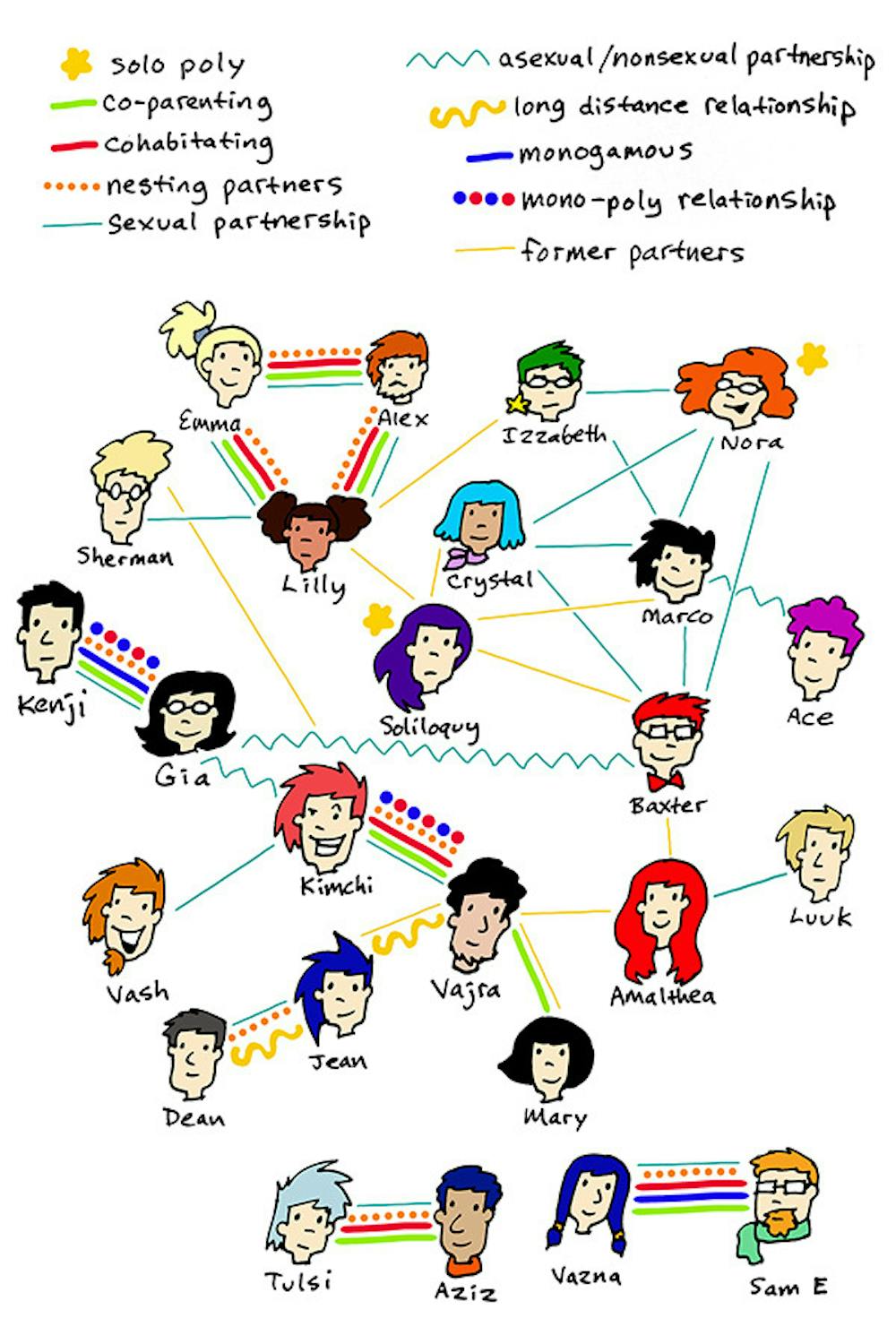
Cartoon faces are connected in various ways.

Polycules can feature a sprawling web of contacts – not exactly ideal for preserving a pandemic bubble. Kimchicuddles, Author provided

In May, Poly Slut, a 45-year-old solo poly man, sketched a social network map of his and his roommate’s interconnected polycules. He quickly realized that it would have been impractical to adhere to safety guidelines, so in the end he put some relationships on hold to reduce risk.

In January, Ebullient Mommy, a 47-year-old married, poly woman, decided, sadly, to end “all in-person sleepovers with my boyfriend because . . .  he chooses to spend indoor time unmasked with people that he and his other partner are casual acquaintances with and I’m not.”

A 66-year-old nonmonogamous man who goes by Seadog described a similar shift with one of his regular partners.

“I was widening my sphere of contacts a little,” he explained, “and that made her nervous.”

Therein lies the core dilemma for people in polyamorous relationships. Because of the complexity of pods and polycules, the challenges of keeping romantic relationships alive are even greater. Until life gets back to normal, compromises constantly need to be made.

Riki Thompson, Associate Professor, Digital Rhetoric and Writing Studies, University of Washington

This article is republished from The Conversation under a Creative Commons license. Read the original article.

Tracy Clark-Flory: “Our culture is totally ignorant around the realm of sexual fantasy”

Tracy Clark-Flory was, in many ways, the prototypical millennial feminist. During her early career years as a writer for Salon and later Jezebel, Clark-Flory carved out a name and a reliable beat as a curious, candid chronicler of modern sex culture. The Tracy I knew then was the Tracy who appeared in her frank, refreshingly non-judgmental columns, a woman who could write descriptively about a one night stand with a porn star or the realities of a “friends with benefits” arrangement.

The trolls, naturally, howled over her unapologetic daring. What they didn’t seem to notice was a human being who was never flippant or cynical, who could also speak eloquently on the illness and eventual devastating loss of a parent. One who has kept her trademark sense of wonder through her new adventures of love, marriage and motherhood

Now, in her debut memoir “Want Me,” Clark-Flory widens her scope to look back on the person she was and has become, how she defined her sex life and her sex life defined her. It’s rare for an author to approach her younger self with both unflinching candor and genuine self-compassion, but Clark-Flory does just that, as she grapples with the nuanced complexities of feminist ideals and the messiness of real, boots on the ground intimacy. I spoke to Tracy recently via phone about love, grief and faking orgasms.

The best place to start would probably be with the commenters, right? You’ve lived such a public life, and that has opened you up to a great deal of BS from trolls over the years. 

It’s actually improved dramatically. Back when I was first at Salon, that was really my initiation into writing about myself online and having anonymous strangers on the internet react to it in very violent and sometimes aggressive and hateful ways. Especially while writing for Broadsheet [Salon’s female-centric former vertical], we had our resident anti-feminist trolls. At the time, I was in my early twenties and just having my writing published, period, was quite an experience. But then having my writing published and to have such vitriol in response was remarkable.

The way that I coped with it at the time was I tried to laugh about it. I would print out the very worst of the troll comments calling me the worst imaginable names, and I would post them on my fridge like, “Well, this is hilarious. There are these hateful people out there in the world who are so riled up about me making very simple, straightforward arguments about women being equal to men.”

But there was also an undercurrent. As the years went on, I came to appreciate how not funny it was, and how much that harassment can have very real world implications. The conversation around online commenting and moderation has really changed since then, and so my experience right now is that I’ve learned to not read the comments. I have fully internalized that lesson and very rarely poke into any comment threads nowadays. I’ve also found that there’s better moderation. But now of course there’s Twitter, which is not so fun.

Do you still get lunatics coming at you?

Much less often. There have been times when I’ve written about figures in the manosphere, and them trying to engage with me on Twitter, that sort of thing. I ignore them and then it goes away. It’s actually surprising how it seems to have really quieted down more recently. The thing that’s surprising is, with Twitter, you can go viral and create backlash when you least expect it. I got so used to bracing for reaction writing about very controversial things, and then somehow it seems that when you least expect it, when you’re not anticipating something to be controversial at all, that’s when it blows up in your face.

When you talk in the book about putting the troll stuff on your refrigerator, it feels very consciously part of that larger story of you trying to figure out how to gird yourself from getting hurt. It’s “Nothing can hurt me. Go ahead, bring it on.”

It wasn’t just the troll comments on the fridge, it was a general disposition or way carrying myself. Especially with my interactions with men. It wasn’t just these anonymous men online that I was interacting with in this way. It was also the men that I interacted with in my personal life too. It was this protective outlook, a way of wearing my armor.

You talk about the dynamics of male porn stars expressing, “Wait, this isn’t what I want; this is just what people expect of me.” They don’t feel a lot of agency. Similarly, your way of giving yourself agency was by really pushing back, by saying, “Nothing bothers me, nothing gets to me.” And getting into some situations that in hindsight you can see were potentially dangerous. Do you think that’s uncommon?

I don’t think that’s uncommon at all. I had in my early twenties this very defensive posture of, ‘I’m down for whatever,” which I realize now in retrospect is very protective. In my casual encounters with men, the possibility of assault, for example, did not feel front of mind. Yet because of the realities of being a woman in this world, it was present for me. I think that unconsciously I developed this defensive posture of basically, “I’m down for everything, so nothing can be done against my will.” That was my way of protecting myself.

In writing this book and reading a lot of more contemporary feminist research, I’ve realized how much my experiences are really reflective of this neoliberal feminist mentality that emerged in the nineties that puts the emphasis on personal responsibility. It gives women permission to be sexual and avoid some of the usual judgments, as long as they do it with the impression of being in control and going after what they want. That is a terrible setup. It’s a setup that, given the current state of things, given the fact of an incomplete sexual revolution, essentially asked women to perform, to act, to play the part of the sexually liberated.

It’s a trope, but it’s very real. The “cool girl” speech from “Gone Girl” touched a nerve because it’s about women going along with something that’s kind of crappy,  that’s supposedly “empowering.”

It comes down to the fact that women often seek power through men, through being wanted by men, through being desired by them, through being married to them. The same thing happens with sexual desire. Very early on, girls learn that their sexuality is a liability. The developmental psychologist Deborah Tolman has this theory of the dilemma of desire, where young girls come up against their bodily feeling, their sexual feeling, and the real-world material dangers that are associated with their sexuality.

As a result, a lot of girls and women become disconnected from their own bodily experience, their own desires, their own wants. It’s a very socially acceptable thing to reroute those desires through men, to be wanted by men. That happens in the realm of sex, but also in terms of navigating the world at large, that we hand over our desires to men, that we find satisfaction, that we find power, through being pleasing to men.

The thread that weaves through this whole book is you and the faked orgasm. That is not something that women admit, because it’s considered such a failure. There are two aspects of that: There’s you as a woman being settling for that, and there’s that a lot of men don’t seem to care.

I do often wonder about that. Looking back, there was no time when any man was like, “Was that real? Was that authentic?” Or, “Did that feel good?” There was literally never a time, except for maybe later on, in a longer term relationship where there was commitment and real emotional engagement. Aside from that, there was never a time where a man seemed to want to ask any questions about it at all. This does raise the question for me of how much awareness any of these men might have had about authenticity that was present, and whether it was easier, more pleasant, to buy it, to believe it.

There’s a statistic you cite in the book about the percent of women who fake it and percent of men who think that a woman’s had an orgasm.

Half of women report having faked it, and some research actually puts that number higher. There was a study that found that 95% of straight men reported usually or always having an orgasm when sexually intimate, compared to 65% of hetero women. That’s a pretty substantial gap. When you look at straight women versus lesbian women, you see that there isn’t the same phenomenon happening. There is something particular to the heterosexual dynamic here.

There was a study of thousands of young women in college who are having casual sexual encounters. The researchers concluded that if it was possible — and I love that they said “if it was possible” — to get young men to care more about women’s pleasure, and for young women to feel more entitled to sexual pleasure, then that orgasm gap might be closed. I love it was, “if it was possible,” as though it some great feat.

A lot of that does come from porn and the ubiquity of porn. Many of us as feminists struggle with, “What are we supposed to feel about porn?” I notice over the past several years, porn has gotten so much more brutal. Tracy, what’s up with that?

It’s really tricky. I do relate to that sense of, if you were to log into Pornhub, for example, and just go browsing around, what you would generally see would be very different from what you would see if you had logged in the early 2000s to vivid.com. At the same time, there have been studies that have analyzed these things and have said, “Oh no, porn is not getting rougher.” I think often in these conversations, there is research, which is pretty scant, and then there’s individual experiences like, “This seems so much more extreme.”

When I started watching Tube sites in my twenties, my assumption was, “This is a very clear reflection of what straight men most want.” That was my engagement with it. Over the years, writing about it, I’ve come to view it much more as an industry. You can take the example of Netflix. Netflix wants you to keep watching, Netflix wants to keep you engaged. It’s not necessarily a pure reflection of what people want. I think that has an impact on the content that you see in porn.

I also think the advent of Tube sites, which totally decimated the industry, which totally decimated performers pay, has had a huge impact as well. I’ve talked to a lot of people in industry who reported how things have shifted, where performance have to move into more, quote unquote, extreme acts, much sooner in their careers that you have to do more for less. There’s a lot that’s happened to the industry through piracy that has changed the content.

It reminds me the performer you talk to in the book who says something like, “Anal is like a first date now.” It feels like both men and women have to do more before they’re ready, or if they’re ever ready. Whether or not it feels good is almost irrelevant. It makes it harder for people to figure out what they really are into and what feels good.

There’s this great example that the performer of Vex Ashley actually made in a scholarly article in the porn studies journal. She was saying, with Hollywood actions films, we might watch a crazy car chase, but then we have the real-world experience of driving around and seeing other human beings driving down the street and not jumping off the freeway. With sex, we might have our own personal individual experiences that fail to meet up to the fantasy realm. But because sex is so rarely talked about, because it’s so shrouded in secrecy and taboo, we don’t have the firsthand example of other people’s experience to compared to our own.

The fantastical realm of porn is uniquely unchecked in the real world. The only thing that we can check it against is our own private experience.

I’ve always said that trying to learn about sex from watching porn is like trying to learn to drive from watching “The Fast and the Furious.”

Our culture is totally ignorant around the realm of sexual fantasy. There’s this real lack of appreciation and understanding of what sexual fantasies mean, what they don’t mean, how they serve us. I think that they’re often interpreted fairly literally. There’s a real failure to appreciate the world of sexual fantasy is a magical place of pretend and illusion that can address some of our deepest fears and dreams.

You are now in a different stage in life. What do you want now for your life going forward into the next phase? What do you think is possible for women right now?

It’s all been about this journey from that sense of “Want me,” to more of a sense of, “What do I want?” And so moving towards a more embodied place of being in touch with my own desires, not just sexually, but broadly. There’s a lot that happening with this book that speaks to what I want, which is being able to be a mom, being able to be in a married monogamous relationship, and also publish a book like this and to stand by this as this is part of who I am. To be that fully incorporated person who doesn’t have to pick one category or the other, and doesn’t have to live in with the fractured self, but can have a a more incorporated experience itself.

There’s this rising generation of girls and boys coming up behind you, who are part of a different world. Do you think they have an easier time, the same time, a worse time navigating their sexuality in this world right now?

I think that in a lot of ways, things are better. The acceptance and around sexuality, the nuances around identity, the conversations that are happening right now are, without a doubt, major progress. The evolution around attitudes towards sex work, although slow, younger generations are so much further ahead in terms of figuring that stuff out than even my generation. And that’s  incredibly positive.

One thing that is concerning to me is the fact that this neoliberal feminist narrative that I mentioned has really pushed feminism away from this collective struggle into one of individualistic gain, a “lean in” style feminism tha in the realm of sexual empowerment is really discouraging.

I think about young women coming up and continuing to be encouraged to pursue sexual empowerment as though it were an individual job, as though, if you do not feel totally sexually empowered, it is your own fault as opposed to the cultural backdrop. One of the main struggles for me was coming up with that narrative of sexual empowerment. I believed that I could get it right on my own, as opposed to looking at the broader backdrop.

One of the greatest lessons from all of the time that I spent writing about sex at Salon, because I so often was interviewing individual people about their sex lives, was how much people keep hidden and how hungry people are for more of a sense of a collective engagement around these topics.

It’s so easy to feel like, “It’s just me.” Any time I’m interviewing people about their sex lives, everyone’s concerned that they’re not normal. Everyone is so exceedingly normal in that sense. We’re all so concerned that we’re little weirdos, and we’re all little weirdos. And how wonderful is that?

How ketchup, an invention of imperial China, eventually became a polarizing American staple

What is ketchup? 

It’s a smooth sauce now typically made in the U.S. with pureed tomatoes and vinegar. Historic variations have included chestnuts, fish, mushrooms, oysters and stone fruit. 

How ketchup, an invention of imperial China, eventually became a polarizing American staple

Do a quick Google image search of the term “All-American food.” Seriously, I’ll wait. 

Once you scroll past the first few rows of cheerful apple pies and almost incandescently orange Buffalo wings, you’ll end up in an endless loop of hamburgers, french fries and hot dogs punctuated by occasional images of chicken tenders and slabs of meatloaf. These are the stars of the photos, but inevitably, there’s some supporting talent in the form of a little red pool or drizzle of ketchup. 

Tomato ketchup is a 19th century American invention, the union of, as Malcolm Gladwell described it for The New Yorker in 2004, “the English tradition of fruit and vegetable sauces and the growing American infatuation with the tomato.” Bottles of ketchup are now standard on many tables — from burger and breakfast joints to some steakhouses. (Former President Donald Trump is known to have visited only one restaurant during his time in the White House: BLT Prime by David Burke at the Trump International Hotel, where he ordered a well-done steak and a side of ketchup.)

It’s enmeshed enough in the fabric of American dining that it’s the subject of multiple “Seinfeld” riffs. “Do you have a ketchup secret?” Elaine (Julia Louis-Dreyfus) coos to Russell Dalryple (Bob Balaban) in the show’s fourth season. The following season, George (Jason Alexander) informs his parents after they criticize the amount of ketchup he’s using that “this is my ketchup. I bought this ketchup just so I could have as much as I want.” 

To that end, overuse is a common complaint surrounding the condiment, enough so that the Facebook group “Ketchup is a Garbage Condiment” — which was created with a satirical mission centered partially on exposing “over use of ketchup we see on our feeds” — has almost 13,000 members. Contained within are entire folders of photos of ketchup used in increasingly unorthodox places: on macaroni and cheese, as a “dip” for Cheez-Its or smeared on croissants. A recent post shows a kid’s breakfast plate that’s more ketchup than scrambled eggs. Most comments are a variation on the joke, “This one’s broken. Toss the whole kid, and make a new one.”

Like many condiments, ketchup is polarizing — check out Saucy’s column on ranch for another feature on a divisive dip — but if you look beyond the bottle, there’s a lot to be learned about the food science behind what makes something cravable or palatable, as well as the static nature of certain condiments like ketchup. 

A little history first: While tomato ketchup is deeply ingrained enough in American cuisine that it’s present in 97% of American refrigerators, its roots trace back to imperial China, where sailors popularized a fermented paste made from fish and soy beans called “ge-thcup” or “koe-cheup,” because it was easy to store on long voyages. 

As their trade routes widened, so did the knowledge of the sauce, until it finally landed in Britain in the 18th century by way of British traders who were posted up in the Philippines, where banana ketchup is still a staple. (Keep an eye out for our deep dive into that soon.) There, British home cooks made variations on the paste featuring celery, mushrooms, nuts, oysters and stone fruit. The end results differed wildly, but the goal was the same — to create a flavorful, pungent sauce that could keep for a long time and augment meals at a time when household spices were still a luxury and to help stretch less than choice cuts of meat, especially if they were on the verge of going bad. 

In 1812, James Mease, a Philadelphia scientist, was credited with creating the first ketchup from “love apples,” a term given to tomatoes for their then-purported aphrodisiac qualities. Heinz ketchup came along in 1876, which contained tomatoes, brown sugar, salt, spices and distilled vinegar, a key ingredient that helped prevent tomatoes from decomposing as quickly.

That recipe was mimicked by home cooks, as well. Remember the opening scene of “Meet Me in St. Louis,” where Katie and Ms. Smith argued over whether the ketchup was too sugary? For both, the end result was sweet, a little bitter, salty, savory and sour. Or, the five fundamental, primal tastes in the human palate. 

That savory flavor, also described as umami, is inherent to tomatoes and some historic ketchup ingredients, such as fish, mushrooms, oysters and nuts. And it’s a subtle component, but one that enhances the flavors around it, according to Tom Gibson, a flavor scientist with the Louisville-based food and beverage consulting firm Flavorman.

“In layman’s terms, umami is typically associated with savory flavors, such as beef, chicken and pork,” Gibson said. “But most people don’t stop and think, ‘Wow! What a great umami on this apple!’ In the world of a flavorist, umami is used in a slightly different context.” 

To put it in simple terms, Gibson said, flavorists look at umami as an “effect” flavor, because certain molecules that create an umami experience can render an effect on overall taste. For example, where esters are often “fruity” and hexyl compounds are often “green,” umami is not “fruity” or “green.” Instead, it can serve to lift or alter the way someone perceives those types of flavor notes. 

“Unami creates a Miraculin effect, where flavors usually perceived in one way may be experienced differently, sometimes even opposingly to their original state,” Gibson said. “Although it can be challenging to work with in some flavor combinations, unami can function to mask off-notes, reduce bitterness and enhance sweetness in a variety of food and beverage products.” 

So why are we so drawn to umami flavors? Well, Gibson said, because they help enhance the profile of a variety of other flavors we enjoy in a dish or beverage. “Unami provides depth and creates harmony by — as the Japanese translation suggests — contributing ‘deliciousness,” he said. 

And, as Malcolm Gladwell put it, “What Heinz had done was come up with a condiment that pushed all five of these primal buttons. The taste of Heinz’s ketchup began at the tip of the tongue, where our receptors for sweet and salty first appear, moved along the sides, where sour notes seem the strongest, then hit the back of the tongue, for umami and bitter, in one long crescendo. How many things in the supermarket run the sensory spectrum like this?”

Despite being a condiment that engages all parts of the human palate, ubiquity can breed boredom. “Seinfeld” again addressed this in 1992. “Salsa is now the number one condiment in America,” George told Jerry, who responded, “You know why? Because people like to say ‘salsa.’ ‘Excuse me, do you have any salsa? We need more salsa. Where’s the salsa? No salsa?'” 

There are nuances to George’s assertion. As Robin Teets, a spokesperson for Heinz North America, told SFGate, while salsa may have taken the top spot in dollars earned, “by volume, ketchup was always the leader.” Salsa, he explained, has different “host foods” (i.e. not hot dogs) and is more expensive, so it naturally gained on ketchup in dollar amount.

But the point remains the same — at a certain point, for some, ketchup lost its love-apple luster. This plays out in current market data: Ketchup’s profits have stayed pretty flat for the last five years, as cult condiments like sriracha and endless variations of age-old standards — avocado oil mayonnaise, garlic mayonnaise, chipotle mayonnaise, Kewpie mayonnaise — now line the grocery store shelves. 

Mike Richardson, a food industry analyst at the Freedonia Group, told Marketplace in 2019 that storied brands like Heinz and Hunt’s are continuing to try their hand at more adventurous adaptations of basic ketchup. There’s Kranch (ketchup and ranch), Mayochup (mayonnaise and ketchup) and Hot and Spicy (ketchup with a hint of Tabasco). Unlike the Heinz green EZ Squirt — which was released in support of the first “Shrek” movie and remains forever seared into the brains of ’90s kids —these aren’t intended to be limited-edition flavors. They’re a play at trying to direct market dollars back to the ketchup section of the condiment aisle. 

“The development of some of these new variations of ketchup, whether it’s with different ingredient formulations or more exotic flavor profiles, has been an effort to retain the customer base for ketchup that might otherwise have gone in search of something more exciting,” he said. 

That’s not to say, however, that there aren’t gourmet or artisan ketchups. My local specialty market has a truffle ketchup that offers a tasty, if a little cloying, play on truffle fries when drizzled over some shoestring potatoes. I’ve bought and enjoyed ‘Chups’ selection of fruit ketchups, which with their cherry and mango flavors, are a nice nod to the stone fruit-based ketchups of yore. I’ve also had a tamarind ketchup, served with lamb fritters, that absolutely blew me away. 

In the war between the “Ketchup is a Garbage Condiment” and “I Put Ketchup on my Ketchup” crowds, I consider myself a neutral party. I have a couple of hard limits — as a Chicago native, ketchup doesn’t have a place on my hot dogs, and I’m likely never going to toss it on croissants or pasta — but I see its inherent value in the home cook’s arsenal, especially when you get some of the good stuff that’s more tomato than corn syrup. 

As star chef Jose Andrés told the New York Times upon the opening of America Eats Tavern — his 2011 pop-up restaurant, which had a separate menu of eight traditional ketchups made from local and foraged ingredients — “It is time to embrace and celebrate ketchup, not be ashamed of it.” 

How should I use ketchup at home? 

Beyond the basics, good ketchup can serve as a shortcut to more flavorful sauces — again, since it hits all parts of the palate — especially if you’re pulling out some of the cooler fruit and mushroom-based varieties on the market. Think quick barbecue sauces, marinades and dips. Remember the inaugural “Saucy” column about mumbo/mambo sauce? For the homemade recipe, you could absolutely ditch the tomato paste, reduce the pineapple juice a few tablespoons and sub in 8 ounces of ketchup. 

But one of the more classic ways to use ketchup is as an ingredient in “secret sauce,” which is essentially Thousand Island dressing spiked with some acid. Slather it on burgers, club sandwiches and wraps. I’m partial to it on any number of fried things: pickles, onion rings and mushrooms. 

***

Recipe: Salon’s Special Sauce

Makes 1/3 cup 

  • 1/4 cup of mayonnaise 
  • 1 tablespoon ketchup
  • 2 teaspoons smoked paprika
  • 2 teaspoons cayenne pepper
  • 2 teaspoons minced garlic
  • 2 teaspoons minced shallot
  • 2 teaspoons pickle juice 
  • 1/2 tablespoon Dijon mustard
  • Salt to taste

1. Combine all ingredients in a bowl, and mix until fully incorporated. 

***

Brand recommendations, plus how to make it at home 

Making ketchup at home is a fun project recipe. For something that’s a little different than your basic Heinz knock-off, check out the recipe from Mary Karlin’s cookbook, “Mastering Fermentation.” As the title suggests, this version is fermented — a nod to ketchup’s ancient roots. In her review of the recipe for Serious Eats in 2013, Kate Williams wrote, “It’s a simple mixture of tomato paste, salt, Worcestershire (if you’re really ballsy, you could make your own), raw honey and a starter culture, and it only needs a couple of days to get all bacteria-fied.” 

Here’s the recipe if you want to give it a whirl.  

Lindsey Graham’s friends worry he’s become “craven” in pursuit of the pro-Trump GOP crown

In a profile of Sen. Lindsey Graham (R-SC) in the Washington Post, close associates of the GOP lawmaker state that he is going “all in” to continue to support former President Donald Trump and set himself up as the leader of the Trump wing of the party and that has some of them wondering what has happened to him.

While Trump’s influence with the GOP appears to be dissipating — with a battle with Senate Minority Leader Mitch McConnell (R-KY) for control of the party about to take center stage according to Politico — Graham is throwing in with the ex-president, speaking with him almost daily and wrangling invites to Mar-a-Lago for weekends of golf.

“Graham’s post-presidential embrace of Trump — which puts him squarely at odds with Senate Minority Leader Mitch McConnell (R-Ky.) — is the latest twist in his on-again, off-again relationship with a man he once called a ‘kook’ and warned could destroy the party,” the Post report states. “It comes after the four-term senator said he reviewed polling in South Carolina and across the country that shows Trump’s enduring strength among Republicans, even after the Jan. 6 insurrection that resulted in five deaths.”

While Graham did make some rumblings about Trump after the Jan. 6th Capitol riot, he is once again embracing the former president, with the Post’s Josh Dawsey writing, “Graham is now positioning himself as a leader of the pro-Trump wing of a party that is increasingly divided about how to reckon with the divisive 45th president.”

Graham’s embrace of Trump — which is characterized as his desire to “remain relevant” and his love of sticking close to powerful people — still has some who have known the South Carolina Republican for years wondering what has changed in the man who once tweeted: “If we nominate Trump, we will get destroyed…….and we will deserve it.”

“His critics say they remember a Graham who despised Trump and what Trump stood for — and was not so craven, in their view. One longtime [John] McCain confidant said Graham is no longer in touch with many of his old friends,” the Post reports. “Amanda Loveday, a former executive director of the South Carolina Democratic Party who helped run a Biden super PAC in 2020, said it was frustrating to watch Graham continue to prop up Trump.”

“Like a lot of others, I have voted for him,” she remarked in an interview. “Everyone in South Carolina used to think he was the most reasonable man in Washington, and that has changed. Now people think he has tied himself to a horse that is unexplainable. There really is no explanation to it. He has the power to tell the Republican Party that they’re moving on.”

The report goes on to note that Graham’s change is also puzzling to President Joe Biden who has been friends with Graham for years and has reportedly asked an associate, “what had happened to Lindsey.”

Dawsey adds, “Some former Trump aides and GOP strategists say Graham likes the stardom of being around Trump. Even Trump has remarked to allies that he is surprised at Graham’s approach after their brutal 2016 encounters, and former Trump aides said Graham was always angling to get on the golf course with the president.”

You can read more here.

How to organize your baking tools like a baker

Welcome to Storage Wars, a new series about the best ways to store, well, everything. From how to keep produce orderly in the fridge (or not), to ways to get your oddball nooks and crannies shipshape; and yes, how to organize all those unwieldy containers once and for all — we’ve got you covered.

* * *

Creating an Instagram-worthy layer cake or decorating festive cookies with your kids can be a challenge when your kitchen is a cluttered mess. If you feel like you’re always searching the back of the pantry for a container of sprinkles, or if there’s that one cumbersome whisk jamming up a kitchen drawer, now’s the time to learn how to organize your baking tools and get all your utensils, appliances, and ingredients sorted and in their proper places.

When it comes to organization, so much can depend on the size and layout of your kitchen. Since every space is different, we’ve included a variety of tips and tricks for your pantry, cabinets, drawers, and countertops so you can pick and choose what works best for you and your space. A tip before you start: don’t feel limited to the kitchen organization section of stores. Look at the office organization and home improvement areas for different shapes and sizes of items, which may lead to even more creative (and occasionally surprising) storage ideas.

Countertop organization

Kitchen countertop space is prime real estate. This area should be reserved for two things: items that are either the most used or the most beautiful. This is where you want to keep that favorite wooden spoon you use to stir your favorite recipe for homemade fudge, or the perfect rubber spatula that gets every last drop of batter from a mixing bowl. They should be kept as close as possible to the work space. Since they will be on display, it’s fun to store these items in an heirloom vase or antique crock.

An adjustable countertop rack can expand to fit any space and can help sort your most used items, and can serve as a great place to show off favorite cookbooks from your collection.

Pantry organization

The pantry is where most of us store the majority of our baking ingredients. Freshness is as much of a priority here as organization. It’s important to store flours and sugars in airtight containers in order to maintain quality and freshness, clearly labeled with what is inside (so you don’t have to second-guess in the middle of baking). These food storage containers are stackable and come with a convenient handle.

Organizing herbs and spices has always been a challenge for me. Most of the solutions out there might look nice in a photo, but are not practical for my plethora of ingredients in bottles of all shapes and sizes. A slim vertical rack that can slip into the side of the pantry works wonders.

Instead of sorting herbs and spices in alphabetical order like the grocery store, I like to separate the sweet baking spices from the savory ones. This way, when I’m making something like gingerbread, the cinnamon, nutmeg, and cloves are all conveniently nestled near one another.

If you love decorating cakes or cookies, your pantry can quickly be overwhelmed with a variety of food coloring and decorative sprinkles. Since these items are smaller, a divided office organizer works wonders. This way, you can easily pull out the entire bin and quickly find what you’re looking for.

Drawer organization

Kitchen drawers are the place to store some of your most-used items that just didn’t make the cut for countertop space. This is where a drawer organizer is essential, especially one that can be expanded to fit any space.

Think about using each slot for items that are commonly used together. Maybe your pastry brush is near your pastry blender. Or your offset spatula is near piping bags and tips. The drawers closest to your workspace should be filled with the most-used items, like a hot pad or oven mitt. It’s also the perfect place to line up boxes of aluminum foil, plastic wrap, and parchment paper, and you can hang your favorite kitchen towels from the handles for quick cleanup.

Cabinet organization

Kitchen cabinets are ideal for the larger, more cumbersome items in your kitchen. This is where you might keep appliances that are not used on a daily basis. Slide-out drawers are helpful when you want to bring them out for baking.

The cabinets are also where you might store your cake pans, muffin tins, or Bundts, stacked from largest to smallest to save space. I keep my 10-inch springform pan on the bottom and fill it with my 9-inch round cake pans, followed by the 8-inch, and so forth. A shelf lifter placed in the cabinet can provide even more space to sort. This makes it even easier to see all of your bakeware and quickly grab what you need for a project. The space next to the shelf lifter is a great place to vertically line up cutting boards or cooling racks.

Creative Space

It seems that no matter how big your kitchen is, more space is always needed. This is where you can get creative. Why not take a tip from Julia Child and install a peg board to hang some of your most used items on a wall or inside a door?

Consider unused spaces in your kitchen, like the side of the refrigerator. This magnetic refrigerator rack is a genius small space solution. It’s out of sight but still stylish and functional. I was always losing my cake tester until I glued a magnet on the back, and started keeping it on the side of the fridge where I can quickly grab it to see if a batch of cupcakes is ready.

My final tip is: once all your baking tools are organized just as you like them, live with it for a week or so and bake up a couple of your favorite treats. This will help you get used to the new setup, and you might make a few logical tweaks along the way. Sometimes you never know the best place for something until you are in the middle of baking.

Related reading:

HBO’s wrenching “Allen v. Farrow” builds a damning case against Woody Allen’s credibility & egomania

What with all the documentary series and special reports that have taken on such fallen superstars as R. Kelly and Michael Jackson, some cinematic reckoning for Woody Allen was inevitable.

That the task fell filmmakers Kirby Dick and Amy Ziering to make HBO’s “Allen v. Farrow” will surely be a relief to some and predispose others to approach everything contained within the four-part series with skepticism, perhaps even doubt.

Where you fall on this scale depends on how you would answer the first question Dylan Farrow poses in her 2014 open letter: “What’s your favorite Woody Allen movie?”

How much you believe of “Allen v. Farrow” depends on your answer to that question. Dick and Ziering are aware of this, and a good portion of the series’ fourth hour features critics and academics wrestling with the conundrum of whether one can separate the artist from his art, and whether one should have to once they’ve been made aware of said artist’s odious actions.

We have known about Woody Allen’s taste for women many years younger than he since 1979’s “Manhattan,” where he plays a 42-year-old twice-divorced comedy writer dating a 17-year-old girl. At the time of its release Allen also was twice divorced and 43, and while a man’s art isn’t always an imitation of his life one of the women featured in “Allen v. Farrow” alleges that Mariel Hemingway’s “Manhattan” character is based on her.

The other version of that story is the one we already know, the tortured and squeamish “the heart wants what it wants” fairy tale that ends with Allen married to Soon-Yi Previn, Mia Farrow’s adopted daughter. Farrow and Allen were still in a 12-year relationship when he and Previn conducted a secret affair that officially began while Previn was a freshman in college. According to witnesses who worked at Allen’s apartment building and who are referenced in one episode, their sexual relationship was very much active while Soon-Yi was still in high school.

This is the part of Allen’s mythology that people accept because millions of people have a favorite Woody Allen movie, or several; because he’s a quirky artist, a writing and cinematic genius. His adopted daughter Dylan Farrow’s 1992 sexual abuse allegations were buried and overlooked in the lurid coverage of Allen’s affair with Soon-Yi, and the famed filmmaker’s people successfully painted Mia Farrow as a woman scorned and a liar. (Allen consistently denies ever having abused Dylan.)

That is the case Dick and Ziering make in “Allen v. Farrow” which replays this history from Dylan’s and Mia’s points of view and is supported by several of Farrow’s still-living children – including Fletcher Previn, Ronan Farrow, Frankie-Minh Farrow, Quincy Farrow and in audio-only clips, Daisy Previn.

Allen’s side is presented via excerpts from the audiobook recording of his 2020 memoir “Apropos of Nothing.” The series’ filmmakers reached out to him, Soon-Yi and Moses Farrow, who eventually turned against his mother and accused her of being abusive. All of them declined to participate in the project.

Documentarians aren’t obligated to be objective, and if you know Dick and Ziering’s track record you can safely guess without seeing “Allen v. Farrow” that Woody Allen does not come off well here.

The filmmakers first came to national attention with their 2012 Oscar-nominated documentary “The Invisible War,” a sobering account of the widespread sexual misconduct in the military and the near-total lack of recourse or support for victims. They applied the same critique of institutional failures to universities in 2015’s “The Hunting Ground” and took on the music industry’s propping up of rape culture in 2020’s “On the Record.”

None of these are facile examinations and each requires the filmmakers to piece together the victims’ wrenching accounts and furiously mine documentation for whatever corroboration they can construct to make the most forceful case possible. The accused never agrees to give their side.

Mounting an attack against institutional failings is in some ways simpler than taking on a Hollywood god, especially one who cultivates an image of being awkward, nerdy and clever. We expect systems to fail us, but afford special dispensation to the artists whose work speaks to our souls.

If there is a dividing line in “Allen v. Farrow” that separates the film from being a straight bullseye and a piece that somewhat leaves wriggling room for reasonable doubt, it is one drawn in the ink of the viewer’s compassion.

“Allen v. Farrow” is necessarily an intimate tragedy laid bare for all to see, one in which an abuse survivor agrees to bare her scars again and again, bringing unwarranted agony down on her mother in the process. Seen as a family quilt sewn with cherished home movies and old photos, placed next to recently filmed shots of Farrow sequestered at the family’s Connecticut retreat, the series is a devastating tragedy.  

Taken as an assembly of documentation discrediting Allen, there’s enough to back up Dylan’s insistence that Allen sexually assaulted her when she was seven years old, including Farrow’s videotaped interview of a very young Dylan explaining what happened to her in the days after the event was alleged to have taken place.  

The filmmakers polish the images’ clarity in earliest episodes as the Farrows construct their portrait of family life, filtering the footage to look darker and fuzzier as Allen’s shadow weighs heavier over them.

Then again, maybe that’s the psychological effect of the head spinning at taking in everything that happens after Dylan’s accusations go public. The recordings of phone conversations where he threatens to destroy Farrow, the step-by-step examination of all that led to the faulty Yale-New Haven Hospital report Allen made public to destroy Dylan and Mia’s account, all of it chips away at Allen’s credibility.

And there is valuable hindsight contributed by people like Connecticut prosecutor Frank Maco, who found enough evidence to pursue a criminal case against Allen but did not out of fear of traumatizing Dylan. So the world moved on, and Allen continues to make movies.

A few production aspects of “Allen v. Farrow” are questionable, like the lack of clarity as to when Daisy’s audio interview was recorded and the context in which her comments were offered. We’re left to assume that the filmmakers could only persuade her to lend her thoughts without using her image, but how do we know they made those recordings?

“Allen v. Farrow” also whisks through its examination of media complicity and the susceptibility of the gossip machine, making it easy for public relations machines around powerful men to prop up predators and bury their victims’ reputations. We know this to be true based on what we know about other powerful beastly people – Harvey Weinstein, Les Moonves – and their influence they used to wield in newsrooms. But when the film insinuates that the New York mayor’s office is behind the dismissal of a New York social worker’s findings that Dylan’s allegations were plausible, there isn’t anything to back that up beyond hearsay.

But you can’t deny the reality of the adult Dylan Farrow’s uncontrollable shuddering at the memory of her abuse. The rage you may feel at witnessing all of this and watching a succession of female performers praise Allen for all the thoughtful parts he wrote for women, or at Diane Keaton defending Allen in a “Today” show interview with Matt Lauer (of course!), is very real.

Scene after scene showing Hollywood’s elite giving Allen standing ovations and praising his genius long after Dylan’s case went public in 1992 take on a nauseating tone.

I may be one of the rare cinema lovers who never liked Woody Allen. “Allen v. Farrow” crystallizes why that is by revealing the sinister egomania fueling his vision as it shapes his art and the world around him.  That makes me lucky because don’t have to bargain with my conscience about the art and the artist. Given that he’s preparing to direct his 51st film, which is being produced in Europe, I wonder how many people’s affection for Allen will be affected by the case against him as it is presented here. 

“Allen v. Farrow” premieres Sunday, Feb. 21 at 9 p.m. on HBO.

As drug prices keep rising, state lawmakers propose tough new bills to curb them

Fed up with a lack of federal action to lower prescription drug costs, state legislators around the country are pushing bills to penalize drugmakers for unjustified price hikes and to cap payment at much-lower Canadian levels.

These bills, sponsored by both Republicans and Democrats in a half-dozen states, are a response to consumers’ intensified demand for action on drug prices as prospects for solutions from Congress remain highly uncertain.

Eighty-seven percent of Americans favor federal action to lower drug prices, making it the public’s second-highest policy priority, according to a survey released by Politico and Harvard University last month. That concern is propelled by the toll of out-of-pocket costs on Medicare beneficiaries, many of whom pay thousands of dollars a year. Studies show many patients don’t take needed drugs because of the cost.

“States will keep a careful eye on Congress, but they can’t wait,” said Trish Riley, executive director of the National Academy for State Health Policy (NASHP), which has drafted two model bills on curbing prices that some state lawmakers are using.

Several reports released last month heightened the pressure for action. The Rand Corp. said average list prices in the U.S. for prescription drugs in 2018 were 2.56 times higher than the prices in 32 other developed countries, while brand-name drug prices averaged 3.44 times higher.

The Institute for Clinical and Economic Review found that drugmakers raised the list prices for seven widely used, expensive drugs in 2019 despite the lack of evidence of substantial clinical improvements. ICER, an independent drug research group, estimated that just those price increases cost U.S. consumers $1.2 billion a year more.

Democratic legislators in Hawaii, Maine and Washington recently introduced bills, based on one of NASHP’s models, that would impose an 80% tax on the drug price increases that ICER determines in its annual report are not supported by evidence of improved clinical value.

Under this model, after getting the list of drugs from ICER, states would require the manufacturers of those medicines to report total in-state sales of their drugs and the price difference since the previous year. Then the state would assess the tax on the manufacturer. The revenue generated by the tax would be used to fund programs that help consumers afford their medications.

“I’m not looking to gather more tax dollars,” said Democratic Sen. Ned Claxton, the sponsor of the bill in Maine and a retired family physician. “The best outcome would be to have drug companies just sell at a lower price.”

Similarly, Massachusetts Gov. Charlie Baker, a Republican, proposed a penalty on price hikes for a broader range of drugs as part of his new budget proposal, projecting it would haul in $70 million in its first year.

Meanwhile, Republican and Democratic lawmakers in Hawaii, Maine, North Dakota, Oklahoma and Rhode Island have filed bills that would set the rates paid by state-run and commercial health plans — excluding Medicaid — for up to 250 of the costliest drugs to rates paid by the four most populous Canadian provinces. That could reduce prices by an average of 75%, according to NASHP.

Legislators in other states plan to file similar bills, Riley said.

Drugmakers, which have formidable lobbying power in Washington, D.C., and the states, fiercely oppose these efforts. “The outcomes of these policies would only make it harder for people to get the medicines they need and would threaten the crucial innovation necessary to get us out of a global pandemic,” the Pharmaceutical Research and Manufacturers of America, the industry’s trade group, said in a written statement.

Colorado, Florida and several New England states previously passed laws allowing importation of cheaper drugs from Canada, an effort strongly promoted by former President Donald Trump. But those programs are still being developed and each would need a federal green light.

Bipartisan bills in Congress that would have penalized drugmakers for raising prices above inflation rates and capped out-of-pocket drug costs for enrollees in Medicare Part D drug plans died last year.

“If we waited for Congress, we’d have moss on our backs,” said Washington state Sen. Karen Keiser, a Democrat who sponsored the state’s bill to tax drug price hikes.

Based on ICER data, two of the drugs that could be targeted for tax penalties under the legislation are Enbrel and Humira — blockbuster products used to treat rheumatoid arthritis and other autoimmune conditions.

Since acquiring Enbrel in 2002, Amgen has raised the price 457% to $72,240 for a year’s treatment, according to a report last fall from the House Committee on Oversight and Reform.

In a written statement, Amgen denied that Enbrel’s list price increase is unsupported by clinical evidence and said the company ensures that every patient who needs its medicines has “meaningful access” to them.

The price for Humira, the world’s best-selling drug, with $20 billion in global sales in 2019, has gone up 470% since it was introduced to the market in 2003, according to AnalySource, a drug price database.

In contrast, AbbVie slashed Humira’s price in Europe by 80% in 2018 to match the price of biosimilar products available there. AbbVie patents block those biosimilar drugs in the U.S.

AbbVie did not respond to requests for comment for this article.

Manufacturers say the list price of a drug is irrelevant because insurers and patients pay a significantly lower net price, after getting rebates and other discounts.

But many people, especially those who are uninsured, are on Medicare or have high-deductible plans, pay some or all the cost based on the list price.

Katherine Pepper of Bellingham, Washington, has felt the bite of Humira’s list price. Several years ago, she retired from her job as a management analyst to go on Social Security disability and Medicare because of her psoriatic arthritis, diabetes and gastrointestinal issues.

When she enrolled in a Medicare Part D drug plan, she was shocked by her share of the cost. Since Pepper pays 5% of the Humira list price after reaching Medicare’s catastrophic cost threshold, she spent roughly $15,000 for the drug last year.

Medicare doesn’t allow drugmakers to cover beneficiaries’ copay costs because of concerns that it could prompt more beneficiaries and their doctors to choose high-cost drugs and increase federal spending.

Many patients with rheumatoid and other forms of arthritis are forced to switch from Enbrel or Humira, which they can inject at home themselves, to different drugs that are infused in a doctor’s office when they go on Medicare. Infusion drugs are covered almost entirely by the Medicare Part B program for outpatient care. But switching can complicate a patient’s care.

“Very few Part D patients can afford the [injectable drugs] because the copay can be so steep,” said Dr. Marcus Snow, an Omaha, Nebraska, rheumatologist and spokesperson for the American College of Rheumatology. “The math gets very ugly very quickly.”

To continue taking Humira, Pepper racked up large credit card bills, burning through most of her savings. In 2019, she and her husband, who’s retired and on Medicare, sold their house and moved into a rental apartment. She skimps on her diabetes medications to save money, which has taken a toll on her health, causing skin and vision problems, she said.

She’s also cut back on food spending, with her and her husband often eating only one meal a day.

“I’m now in a situation where I have to do Russian roulette, spin the wheel and figure out what I can do without this month,” said Pepper.

This article is part of a series on the impact of high prescription drug costs on consumers made possible through the 2020 West Health and Families USA Media Fellowship.

A childhood without photographs

The girl in the photograph looks a lot like me. She is flanked by three younger girls, one of whom is having a spectacular preschooler meltdown. The girl is laughing. She has crooked teeth and a red sweater and a bad Lady Di haircut. The girl in the photograph looks like me because she is me. But I don’t entirely recognize her. I haven’t seen her in a very long time.

My aunt texted the picture to me a few days ago. She was going through some old photographs, and found this one with her daughters when we were kids. I gasped a little when I saw the image — my old living room, my old living room couch, my old haircut. Unlike my digital age daughters, who have amassed thousands of images of themselves from birth to present moment, I don’t have too many photographs from my past. My childhood exists almost entirely in my imperfect memory.

We’ve now spent two decades wondering aloud about the effects of endlessly chronicling and documenting children’s lives. We’ve raised an entire generation with month-by-month growth updates on Instagram, first day of school shots on Facebook and YouTube channels run by tweens out of their bedrooms. But what does it feel like to like to live in that very different space, one in which there’s almost no evidence of your childhood?

For most of the modern era, family photos marked a special occasion. I grew up when film and processing were the only game in town, and they were expensive. It’s unsurprisingly then that my mother, the fifth child of six, appears in only a handful of her family scrapbooks. My own life up until the day I left for college fit in one-three ringed album. Yet I remember some of the images in it better than I remember the events they marked. I am sticking my tongue out through the wide gap a recent fall made in my smile. I am stretching in my pajamas, barely awake on my fifth birthday. I am eight years old, standing on a rock at the seashore, looking at the ocean as my long hair ripples in the breeze. Those moments exist in my mind accompanied not with the feeling of the warmth of a bed or the smell of salt water, but the shine of 4 x 4 glossies in a vinyl sleeve.

Before the age of cellphones, the predictable answer to the question, “If your house was on fire, what belongs would you save?” would be, “the photos.” In the stories of devastation from hurricanes, fires, floods and abrupt violence, the narrative of the lost family mementoes figures prominently. (Hence the numerous online tutorials on how to restore damaged photos.) But there are other reasons a person would lack photographs. Adoptees, like a friend who came to America at the age of seven, may have scant photographic evidence of their earliest years. And then there are people like me, whose families have been divided by disputes and estrangement.

I hadn’t been in my mom’s house in over a decade. Yet there I was, alone inside it on the hot, wet day last summer that my stepfather died. The cops had given me the keys so I go could in and retrieve the cats while my Alzheimer’s patient parent was being transported to a care facility.

The house held few memories for me; they’d moved into it when I was thirty. There was only one thing in it I cared about, and I knew exactly where it was. The old photo album, on the bookcase in the den. The pictures of Thanksgivings and graduations and cookouts. Images of my mom and me together, in a house I am uncertain I recall the contours of. Were we happy then? I remember pictures of smiles, not the sounds of arguments. But the book was gone. That day, I stood in a hot, airless house, listening for the mewls of two hiding felines and scouring the shelves for proof of my own childhood. The cats, I would find. The pictures, I would not. Whether they’d been disposed of in a fit of rage or an accidental memory lapse, they were lost to me forever. I will never know what happened to that album. All I can wonder is, what becomes of a past I’m still trying to make sense of? If I had those pictures, would they even tell the real story?

“I have been asked these important questions many times, especially by adoptive and foster parents, but also individuals who lost their home and invaluable photographs due to natural disasters and monetary concerns,” Dr. Leela R. Magavi, M.D., the regional medical director for Community Psychiatry, California’s largest outpatient mental health organization, tells me via email. She says that the impact of that loss on childhood memories can be mitigated via other resources.

“For individuals who have few or no photographs from their childhood,” Magavi says, “they can journal and create a timeline to recall some memories. Imagining their old home, school or hobbies could target emotional circuits, which could bring back memories. Conversations with and stories shared by family memories can help adults find joy in their childhood memories. Some individuals actually gain a sense of comfort and relief by speaking with their family members. Some adults enjoy observing their loved ones excitedly speak about their childhood more than viewing a photograph. Revisiting special places from childhood can lead to an emergence of invaluable memories with family and friends.”

I learned the value of that comfort firsthand two years ago, when I returned to my hometown and reconnected with my cousins at a family funeral. My mother couldn’t reminisce with me now even if she wanted to. But walking around the old neighborhood, rekindling memories with other people whose lives were concurrent with my childhood and adolescence, gave me back a sense of rootedness I hadn’t felt in a long time. And it made me understand profoundly the value of both living in the moment and preserving it for the future.

“Your nervous system is starving for reminders of powerful moments of joy and connection. Although you don’t have those from your childhood, you can create new memories now,”  therapist J.F. Benoist, founder & program director of The Exclusive Hawaii and author of “Addicted to the Monkey Mind: Change the Programming That Sabotages Your Life,” says via email. He adds, “To adults with or without photos from their early years I say this — it’s never too late to reinvent your childhood. What I mean is that the body remembers what you reinforce every day. For example, you could go to the dog park with your spouse and dog. Take photos of the fun you’re all having together. Then, print one of those photos out and display it.”
 
It’s no accident that the hallway of my apartment is covered in photographs, mostly of my daughters but a few that predate them. I walk past them a hundred times a day, and I often stop in front of one or the other to see what it’s saying to me now. The single image ever shot of my parents together. My college roommates, laughing in a kitchen. Me, clumsy in a blue tutu. The girl in the picture looks out at me. She’s half clowning, half frightened. I know what happens to her next. She will fall down. She will never learn to dance. I also know, because I know her, that she will learn how to get back up. There’s no picture for that, but it’s okay. I remember.

Meet the coffee shop giving homeless youth a chance at success

Valarie Mckenzie struggled to control her anger early in her life and was kicked out of her home at 18. She roamed everywhere from Grand Rapids, Michigan to Atlanta, Georgia, but spent most of her time living in downtown Minneapolis, where she slept on public benches and in bus shelters. The city’s unrelenting bright lights, which she constantly tried to escape, reminded her of exactly what she lacked: a safe and warm place to sleep at night.

Late last summer, when she was 24, things began to change for Mckenzie. An outreach worker introduced her to Carley Kammerer, the executive director of Wildflyer Coffee, who offered Mckenzie a job that enabled her to secure stable housing. She had worked odd jobs before, but nothing consistent.

“It’s the job, not even really the income, that made the difference,” Mckenzie says. “It was mostly the stability,” she says, that helped her transition out of homelessness.

It’s exactly this structure and stability, paired with an environment that’s empathetic to the unique struggles faced by the roughly 13,000 young people experiencing homelessness in Minnesota every year, that Kammerer has sought to provide. She started the business in 2017, after years of working as a social worker.

As of 2019, there are more than 35,000 homeless youth in the U.S., with an additional 550,000 young people between 18 and 24 experiencing homelessness for longer than a week. Most often this is a result of family conflict coupled with poverty, mental health, substance abuse, and other contributing factors. The pandemic has hit homeless youth especially hard, as already limited access to hygiene and shelter resources has become further strained by social distancing measures and school closures.

“I had been working with youth experiencing homelessness for about eight years in different capacities,” Kammerer says. “I saw the same youth cycling through drop-in centers and outreach programs, and there wasn’t seemingly a lot of traction to get them out of that cycle.”

Valarie Mckenzie brews an espresso at Wildflyer Coffee. (Photo courtesy of Wildflyer Coffee)

Valarie Mckenzie brews an espresso at Wildflyer Coffee. (Photo courtesy of Wildflyer Coffee)

Since Kammerer’s parents owned a coffee shop when she was growing up in Wisconsin and she had roughly 10 years of barista experience herself, she decided to start a coffee business to help address the problems she was seeing in the youth with whom she worked. Her goal was to run a business that would meet homeless youth where they are, offering flexibility and understanding while fostering the soft skills and customer service-focused development that would help them meet the demands of the job market.

Developing a business model — and a vision

Wildflyer isn’t the first coffee shop to focus on homeless youth. Kammerer looked at other examples, like Purple Door in Denver (where she briefly interned), Street Bean in Seattle, and The Monkey & The Elephant in Philadelphia, and saw an opportunity to do things a little differently in terms of the length of the program and the soft-skills training focus.

She spoke with other social workers and case managers to understand what was working and what wasn’t when homeless youth tried to get and maintain jobs, and she used their insights to develop Wildflyer’s six-month program. By offering extensive training and real-time coaching when issues on the job arise, the program is designed to help bridge the gap between life on the street and entry-level positions.

“I was seeing a lot of youth get jobs and then lose them,” Kammerer says, largely due to challenges that stem from homelessness, ranging from transportation issues to accessing and storing important documents like birth certificates, which are required to establish employment.

With homelessness also comes a lack of access to resources for maintaining personal hygiene, so sometimes youth will miss work because they’re embarrassed to come in after not having showered for a few days, Kammerer says. Sometimes the mental health challenges become too much and getting to work, much less on time, can seem impossible.

Read more Civil Eats: ‘Minari’ Shines a Spotlight on Asian American Farmers

When Kammerer first established Wildflyer, the organization employed four to six young people to sell simple pour-over and iced Dogwood Coffee drinks at local farmers’ markets each season, where training was more ad hoc. It has since secured a brick and mortar location and is in the process of expanding both its coffee service and its training program.

“Youth don’t always know how to do well at time management, customer service, and dealing with managers professionally,” Kammerer says. When she founded the café, she asked: “What if we knew what we were getting into and planned ways to handle skill development rather than fire them?” Now, that’s exactly what she’s working to create.

Rather than adding a roasting component like the one at Purple Door, Kammerer decided to keep the focus on customer-facing barista jobs so they can practice what they’re learning in training.

When challenges arise, Kammerer and her team talk through them with the youth employees, focusing on causes and potential future solutions. With her social work background and contacts, she’s also able to connect youth to services and resources to help stabilize their situations.

For Mckenzie, that flexibility and understanding have made all the difference. “Carley and the shift leads and the shop manager are all very understanding of mental health and the struggles I go through,” she says. “They’re a big support.”

Building out the program

Wildflyer’s new brick-and-mortar coffee shop opened in December on Minnehaha Avenue — a stone’s throw from the civil unrest that coalesced around Minneapolis’s third precinct in the days that followed George Floyd’s death at the hands of ex-Minneapolis Police Officer Derek Chauvin.

The location was previously home to Peace Coffee, a local roaster dedicated to fair trade practices that exited the retail business after the pandemic led owner and CEO Lee Wallace to focus only on wholesale. Now, Wildflyer has taken over the space and will continue to sell and brew Peace Coffee along with Dogwood Coffee.

The End Youth Homelessness mug from Wildflyer

(Photo courtesy of Wildflyer Coffee)

“In 2020, we were able to sell 17% more coffee than we did in 2019 despite losing our food service business,” Wallace says. “There have been so many sad stories about things closing and a real sense of loss, so it was really cool to be able to tell people a good story about Wildflyer taking over.”

Wallace worked with Kammerer and the building’s owners to transfer over the lease, landing on a graduated rent increase plan so that Wildflyer has some time to get established. As a result, Wildflyer was able to save on purchases and a lower initial rent, and divert funds toward youth employment and training. “I feel eternally grateful to Peace Coffee because they sold us all the equipment and really worked out a deal with [rent],” Kammerer says. Peace Coffee’s former director of retail has also consulted with the Wildflyer staff weekly on how to run a coffee shop.

Read more Civil Eats: Major Meat Corporations Pay Millions to Settle Price-Fixing Suits

Now, with a spacious, sunlight-filled physical location, Kammerer will be able to increase Wildflyer’s available employment hours from 200 per year to a minimum of 3,000 per year. She expects to employ roughly two six-month cohorts of 10 to 12 young people who identify as everything from couch surfers to unstably housed each year with the new shop, although pandemic-related restrictions have slowed the process a bit. Dine-in service was banned in Minneapolis until January 11, but with indoor capacity now operating at 50%, Wildflyer celebrated its grand opening just this week.

Moving forward, Kammerer also plans to focus on what she calls Phase Two of Wildflyer’s work: partnering with local businesses to hire its graduates. So far, Dogwood has hired a Wildflyer graduate, and local Butter Bakery Café has come on board as the first Phase Two partner dedicated to hiring graduates with an understanding of their situation.

Evaluating effectiveness

The big question, though, is whether or not initiatives like these really work to help young people effectively transition out of homelessness over the long term.

According to Dr. Ann Masten, a University of Minnesota professor who studies youth homelessness and resilience, more studies are needed, but the existing research is promising.

2017 systematic literature review found a variety of outcomes across youth employment programs, but that the effects of skills training programs like Wildflyer are among the most significant. “The mission of Wildflyer Coffee aligns well with what we know about promoting resilience” — the capacity to successfully adapt to challenges — “in youth who have experienced adversity,” Masten says. “The program combines opportunity with support, role modeling, and mentoring, building skills, hope, and self-confidence along with work competence.”

For Mckenzie at least, the program has worked wonders. She’s staying on for an extra six months and is optimistic about finding employment through the project’s second phase.

The new coffee shop “feels like a second home to me,” she says, “and I love the fact that we have our own little group of people that come in every day, who know us by name. It’s amazing.”

ABC host catches Steve Scalise shamelessly deflecting on Trump’s role in Capitol attack

House Minority Whip Steve Scalise (R-LA) on Sunday declined to admit that President Joe Biden had not stolen the election from former President Donald Trump. And he also refused to say that Trump had any responsibility for the insurrection of Jan. 6.

In an interview with Scalise on Sunday, ABC host Jonathan Karl noted that the Republican leader had recently met with Trump at Mar-a-Lago.

“Did you ask him to take responsibility [for the insurrection]?” Karl wondered. “Did he take responsibility?”

“It was a conversation more about how he is doing now and what he’s planning on doing and what his family is doing,” the Republican lawmaker said.

“But wait a minute,” Karl pressed. “He hasn’t taken responsibility. You heard Kevin McCarthy say it. I mean, do you agree with what Kevin McCarthy said there. That the president must take responsibility? That the facts demand that he take responsibility for what happened on Jan. 6?”

“Surely, there’s a lot of blame to go around,” Scalise ducked. “But at the end of the day, the people that stormed the Capitol on Jan. 6, it was a disgrace and they need to be held accountable.”

“That’s obvious,” Karl interrupted. “I’m asking about Donald Trump’s role in this.”

The ABC host against pressed Scalise about whether he would acknowledge Trump’s role in the attack.

“It seems like all they have done since the day he walked into office was try to impeach him,” Scalise replied. “But when you look at that trial, they ran a clip of pretty much every United States senator who voted to impeach President Trump who talked about things like go and fight like hell and other things like that.”

“So you’re saying he doesn’t bear responsibility,” Karl concluded.

“President Trump has denounced what happened,” Scalise opined. “Not only on Jan. 6 but during the summer when they were burning down cities, shooting cops, beating people in the streets.”

Before ending the interview, Karl asked Scalise if he could clearly state that Biden had fairly and legitimately won the 2020 presidential election.

“The election was not stolen, correct?” Karl said.

But Scalise declined to make a clear statement.

“There were a few states that did not follow their state laws,” he remarked. “That’s really the dispute that you’ve seen continue on.”

“But, Congressman,” Karl tried again. “I know Joe Biden is the president. He lives at the White House. I asked you is he the legitimate president of the United States and do you concede that this election was not stolen? Very simple question. Please, just answer it.”

“Once the electors are counted, yes,” Scalise admitted. “He’s the legitimate president. But if you’re going to ignore the fact there were states that did not follow their own state legislatively set laws, that’s the issue at heart that millions of people are still not happy with.”

Watch the video below from ABC.

Democracy’s dance of death: Trump is gone — kinda. But the crisis is still here

We have recently been told, by ever so many earnest commentators, that the United States faces a dire historic choice between democracy and fascism — or, in the more optimistic reading, has recently faced one and surmounted it, if only just. 

If that reflects a desire to make the nation’s current predicament — and for that matter the world’s — seem like a dramatic struggle at the edge of the abyss, along the lines of World War II, that’s understandable. Maybe it’s an improvement that the mainstream media abruptly woke up to the dangers of Donald Trump’s regime, just as it was leaving office — although the sudden pivot to “Get thee behind me, Satan” after years of pretending that things were more or less normal is more than a little suspicious.

But if we are struggling with someone or something on the cliff’s edge, the landscape is shrouded in darkness. We can’t see the precipice and we’re not quite sure who our opponent is. Or exactly who “we” are. Are we at a dark historical crossroads, marked by intense internal conflict over the nature of what we used to call “Western civilization”? Absolutely. But I’m not sure either of the options we characterize with the terms of art “democracy” and “fascism” has yet revealed its true nature. 

What we’ve seen over the last few weeks, since the Jan. 6 storming of the U.S. Capitol by Trump’s supporters, should make clear to all non-hypnotized observers that America’s two-party system is locked in a death spiral it seemingly can’t escape. Despite the efforts of Mitch McConnell, Liz Cheney and a number of other prominent Republicans, their party is completely unable to free itself from the undertow of an ex-president who was comprehensively defeated, tried to stage an impromptu coup-d’état on the cheap, and lost the Senate majority they thought they had saved from the fire.

(I’m not giving Mitch and Liz any medals for valor, by the way, although they deserve a little credit for being able to think strategically beyond the middle of next week — and for finally dropping the pretense that they don’t hate Donald Trump like poison. To be completely fair, Mitt Romney has distinguished himself as a man of principle throughout this period — although, let’s face it, he’s also kind of a prick.)

Does that make the Republicans a “fascist” party? Honestly, that’s giving the shambling zombie shell of the party that once represented old money, hardware store managers and small-town Presbyterian ministers way too much credit. Say what you will about Adolf Hitler — please, people, I know that phrase is an unacceptably dark joke — the guy spent a full decade diligently building a political organization and a mass movement that had a clear set of ideological principles and policy goals. All Donald Trump did was to grasp that the Republican Party was collapsing under the massive weight of its own ideological and political failure, and then stage a hostile takeover built on social-media insults and rage memes borrowed from Fox News and the late Rush Limbaugh, he of the Presidential Medal of Total Domination of All Media, or whatever it’s called. Has that raised the national temperature and led to various acts of right-wing violence? Sure, but it’s lard-ass couch-surfing fascism, at best, not a genuine mass movement committed to seizing power.

I am 159% not here to tell you that there’s no difference between our two political parties, or that the Democratic Party’s internal conflict (which is at least about real things, including ideology and generational change) is as bad as the so-called crisis within the not-quite-post-Trump GOP, or even that Joe Biden is a hapless historical nonentity whose presidency will wind up on the rocks sooner or later. None of that’s true — well, OK, except possibly the Biden part, but he seems like a good guy on the whole who sincerely wants to patch the gaping holes in the sinking ship, and it’s way too early to have any idea how he’ll come across in the longer arc of history.

But the Democrats are hilarious, at least if you have an appetite for bleak humor. I’m not just beating up on the “liberals” and “moderates” either, as much fun as that is; the occasional or begrudging Democratic allies on the “left” — which I suppose is more or less where I identify — are also behaving like idiots. Having essentially lucked into control of both houses of Congress and the White House, after an election in which they underperformed across the nation in pretty much every state not starting with “G” (or containing a “Z”) the Democrats are doing what they do best: Fine-grained, small-bore and deeply unimpressive reform legislation, internecine battles over issues where the general public wants big policy changes but the party’s funders don’t, and attempted purges of the left, both coming from the center (which is at least to be expected) but also from the left, some of which has uselessly concluded that the growing progressive caucus in Congress are a bunch of DINO corporate sellouts.

In the near term, this points toward another rebound cycle of dispiriting political defeat: Republicans could easily recapture both the House and Senate in 2022 (although they certainly won’t win the most votes nationwide) on an incoherent non-agenda of reheated MAGA rage and conspiracy theory, effectively Trumpism without Trump and QAnon without Q. A brand new gerrymander built on the Trumpified racist wreckage of the 2020 census could once again create a built-in Republican congressional majority that it will take Democrats another several cycles to break down — even assuming that this dysfunctional political system continues to creak along in its familiar pattern, which is definitely not a safe assumption. I don’t even want to speculate about the 2024 presidential election, which looks from this distance like one of those game-theory hypotheticals that has no viable solution (mixed with one of those low-budget Italian horror movies in which demons come off the screen and eat the audience).

On a larger scale, though, it’s long past time for Americans to face the fact that we’re not the only nation in the world that’s going through this kind of crisis, and that our locked-in two-party system — which has nothing to do with the Constitution or the law — is itself a massive part of the problem. The bipolar two-party systems that defined most major European democracies during the postwar decades have already collapsed, or been rendered unrecognizable. In France and Italy, the two formerly-major center-left and center-right parties have effectively disappeared. In Britain, the once-socialist Labour Party hasn’t won an election, under anyone except neoliberal reformer and George W. Bush lackey Tony Blair, since 1974, while the ruling Conservative Party, under Boris Johnson, has reinvented itself along vaguely Trumpian lines as the party of “Little England” throwback nationalism.

In a non-parliamentary system like ours, where the two parties have deep institutional roots and formidable fundraising power — yet have become increasingly detached from grassroots organizations and their own base voters, not to mention the ability to govern effectively — that kind of “revolution from within,” however chaotic and disruptive it may be, apparently isn’t possible. We’re stuck with this thing we call “democracy,” which isn’t democratic, while trying to fend off a wave of angry yahoo populism that isn’t quite “fascism,” but expresses the legitimate anger of a significant proportion of the population in approximately the worst possible way. In game theory, there’s always a solution that offers you the best possible chance of survival. That must be true here, I guess. But whatever that solution is, we haven’t found it yet.

Pennsylvania cop charged in Capitol riots says he has “no regrets”

A Pennsylvania police officer has been hit with felony charges for his participation in the Capitol riots and now details about his Facebook posts are also coming to light.

According to the HuffPost, Joseph Fischer, a patrolman for the North Cornwall Township Police Department, is facing a string of charges including “obstruction of law enforcement during civil disorder, knowingly entering a restricted building without lawful authority, violent entry and conduct on Capitol grounds, and obstruction of justice/Congress.”

He was aware that he might lose his job and face consequences from the Federal Bureau of Investigations (FBI). However, Fischer suggested that did not matter to him.

Under a social media account with the handle “SV Spindrift,” Fischer posted footage of himself running toward a line of police officers at the Capitol screaming, “Charge!” He also noted that there were four rows of officers and he’d “made it to level two” which suggests he made it beyond two rows of the officers.

In comments he wrote about the video, he admitted to being present at the Capitol as he explained his purpose for being there. “I was there..we pushed police back about 25 feet,” Fischer wrote in one comment. “Got pepper balled and OC sprayed, but entry into the Capital was needed to send a message that we the people hold the real power.”

Fischer also admitted that he was aware that the FBI would likely arrest him, but suggested that he was not concerned. He also revealed the North Cornwall Township Police Department police chief also spoke with him about his actions. However, he claimed that Fischer losing his job might be the “price I have to pay to voice my freedom and liberties which I was born with and thusly taken away.”

Despite the consequences, Fischer stood firm on his beliefs. He wrote, “I told him I have no regrets and give zero shits. Sometimes doing the right thing no matter how small is more important than one’s own security.”

Although Fischer believes he acted accordingly, the U.S. Department of Justice and FBI think otherwise. Fischer is one of more than 230 individuals facing charges for the insurrection on the U.S. Capitol.

CNN’s “Lincoln” docuseries is a fascinating treasure trove for fans of the best Republican president

There is something incredibly charming about seeing talk show host Conan O’Brien deconstruct the genius of Abraham Lincoln — not Lincoln the president, but Lincoln the self-deprecating comedian.

This is one of the myriad pleasures derived from watching CNN’s new six-part miniseries “Lincoln: Divided We Stand,” which aired its first episode on Valentine’s Day. It is a cliché to point out that Lincoln was one of America’s greatest presidents, if not the greatest. He freed enslaved people, won the Civil War and was ahead of his time on economic issues. Yet apart from being a great president, Lincoln was also a fascinating man. It is this aspect of America’s 16th president that is captivatingly brought to the fore in the documentary, which is narrated by “This Is Us” and “Black Panther” star Sterling K. Brown.

There are so many intriguing nuggets of information to choose from here. We can start with how the series recalls the cruel hardships of Lincoln’s childhood. Lesser historians like to romanticize America’s pioneer days, but as a young Lincoln’s family moves from the hinterlands of Kentucky to those of Indiana, he isn’t exactly experiencing the bucolic idyll concocted by countless dreadfully trite early Disney movies. Lincoln lives in abject poverty and must work to survive from a very young age; his beloved mother dies when he is only nine; his emotionally distant father temporarily abandons him with his older sister (who also later dies) so that he can find a wife in a nearby town; and, when Lincoln teaches himself to read and becomes fascinated with knowledge, his father physically abuses him because he wants his son to be a farmer.

That last detail was the one that struck me the most, perhaps because it is undervalued when people think about the Great Emancipator. Lincoln was an autodidact and his thirst for knowledge, and obvious joy in being able to learn more about the world around him, is evident both in this documentary and to anyone who has read his early speeches and poems. He took considerable pains, figuratively and literally, to find books, newspapers and virtually anything else he could get his hands on to improve his education. His mind was skeptical and had a knack for separating truth from baloney; it also had an artistic and intellectual flair, loving eloquent prose and probing ideas. This trait may even explain why Lincoln thrust himself into politics at an early age, clearly savoring the give-and-take  of the Second Party System that saw Lincoln align himself with the Whig Party (the more “liberal” party by modern standards, although the term must be applied somewhat anachronistically here) with the Democratic Party, which at that time was dominated by Andrew Jackson.

These qualities sharpened Lincoln’s mind and made him into the legendary wit whose comedy chops were so deft that Coco seems genuinely in awe of them nearly two centuries later. It brings to mind the famous line from “Game of Thrones” character Tyrion Lannister, “A mind needs books like a sword needs a whetstone, if it is to keep its edge.” Hearing O’Brien regale audiences with some of Lincoln’s most legendary sharp comedy moments (I dare not spoil them here) is a great joy of this documentary, especially since Lincoln’s endearing ability to poke fun at himself is reminiscent of O’Brien’s own sense of humor. (I’ll just say it: My hunch is that Lincoln would have been on Team Coco.)

Yet the documentary is also strong because, when necessary, it takes Lincoln off of his pedestal. While simplistic historians tend to view Lincoln as a god-like man who with a sweep of his hand freed enslaved people, the reality is far more complicated. To its credit, the miniseries goes into detail about the horrors of slavery: The families ripped apart, the physical and psychological anguishes inflicted on its victims, the fact that America’s economy depended on the degradation and subjugation of millions of people. There were men and women in Lincoln’s time who wanted to abolish slavery altogether and accept African Americans as equals — but Lincoln was not one of them. He opposed slavery on principle, to be sure, but was willing to accept its existence in states where it already existed as long as it didn’t expand beyond them. He believed African Americans should eventually be freed, but as the documentary astutely observes, thought they should be sent back to Africa, even though for most of them America was the only home they had ever known.

Lincoln was, undeniably, a racist. He made it clear, during a key moment in his famous debates with Democratic Sen. Stephen Douglas of Illinois, that he did not view African Americans as equal to whites. He was not an abolitionist and was only a friend to racially marginalized groups up to a point. He took political risks in his early years when advocating against slavery, but there were others who took even greater ones. And while Lincoln suffered intense hardships as a child, the documentary makes it clear, they were nothing compared to the living hell endured by American slaves.

Only the first three of the six episodes were given to Salon for review, and therefore is left off at the Battle of Fort Sumter in 1861 and the start of the Civil War. I have no idea whether the series will do justice to Lincoln’s visionary leadership during the Civil War, or the events that gave birth to the Emancipation Proclamation and the Thirteenth Amendment, or how he passed economically progressive measures like the Homestead Act, the Morrill Land-Grant Colleges Act and the Pacific Railways Acts. It touches on Lincoln’s lifelong struggle with depression and other mental health issues; these were defining aspects of the man’s life, and if the miniseries continues to mine that ore, it will do a great public service both for our understanding of Lincoln and on the complexity of the human mind.

The same can be said of how it discusses the great abolitionist and orator Frederick Douglass, who is briefly introduced in these early episodes. Hopefully the later episodes will go into great detail about Douglass, especially since his 1876 speech on Lincoln perfectly summed up Lincoln’s chief legacy — namely, that although Lincoln deserves credit for his courage and morality in ultimately acting to free enslaved people, “in his interests, in his associations, in his habits of thought, and in his prejudices, he was a white man” and that “he was ready and willing at any time during the first years of his administration to deny, postpone, and sacrifice the rights of humanity in the colored people to promote the welfare of the white people of this country.”

These are not criticisms of the miniseries, rather a comment on threads that I hope will be more fully explored and receive their due. I can simply say right now that the foundations have been laid, which seems promising.

There is one shortcoming in the documentary that could not have been helped, given that this was filmed before Election Day 2020, but it is regrettable nonetheless. One of the main reasons Lincoln could not prevent the Civil War was that his presidential predecessor, James Buchanan, was virulently pro-slavery and openly sympathized with the South’s desire to secede. The parallels between Buchanan/Lincoln during the 1860 election and Donald Trump/Joe Biden during the 2020 election are hard to miss. On both occasions, the side of the country that lost an election refused to accept that the side that won should be allowed to govern, using far right-wing arguments and claiming that the winning side posed an existential threat to them or was somehow illegitimate despite irrefutable facts to the contrary. On both occasions, the outgoing administration (Buchanan, Trump) refused to work with the incoming one (Lincoln, Biden) even though there were terrible crises (a Civil War, a pandemic and depression) that required immediate attention. There are even similarities in the little details, such as how Buchanan and Trump were both corrupt (then again, Buchanan was not a candidate in the 1860 election and never tried to physically stop Lincoln from taking office). While the filmmakers could not have known to a certainty that Trump would act like Buchanan after Biden’s victory, it still weakens the miniseries that so little attention is paid to Buchanan’s reaction to Lincoln’s victory. It would be like making a documentary about Biden’s presidency but only giving cursory attention to how Trump created the conditions that Biden would have to confront.

Yet this is a minor quibble in the grand scheme of things. Lincoln is one of those historical figures who keeps on giving, a man whose protean gifts and complex personality makes it possible even for historians like myself to constantly learn new things. Whether the miniseries is describing in detail how Zachary Taylor betrayed Lincoln after the latter campaigned for him in Illinois during the 1848 presidential election or exploring the attempt to assassinate Lincoln in 1861 (The Washington Post recently profiled a woman who helped protect him), it is full of fun little gems — and sober reminders of the ugliness that coils beneath the surface of America’s past — that will make any serious Lincoln scholar take a few moments to stop and think.

That, I suspect, is what Lincoln would have wanted.

New episodes of “Lincoln: Divided We Stand” air Sundays at 10 p.m. on CNN. 

Scientists believe Mars may have mini-lightning storms from tiny dust clouds

Martian weather patterns have long fascinated sci-fi writers, perhaps most famously when a dangerous Martian dust storm stranded the protagonist of Andy Weir's novel "The Martian" (played by Matt Damon in the 2015 film adaptation) on the red planet. Now, a recent experiment reveals that Mars' weather may be even weirder than we thought: Mars' dust clouds may emit electrical sparks, and perhaps glow in the dark, too.

This is theorized to be a result of the Martian dust particles rubbing together to produce electrical charges, a process known as triboelectrification, according to a recent study published in the scientific journal Icarus. Triboelectrification is also the reason why lightning will sometimes erupt from the ash and gas belched out during a volcanic eruption. And on a smaller scale, it's also why you can feel a small zap on your socks if you shuffle across a carpet or rug.

Given this basic physics principle, scientists had long speculated that Martian dust storms could produce electrical charges — but as University of Oregon geologist Joshua Méndez Harper noted, all previous studies on the subject were flawed because they required the volcanic rock grains to come into contact with objects that would not exist on Mars.

"These works did not account for the possibility of charging arising from the interaction between simulated Martian dust (volcanic ash) and experimental containers enclosing it," Méndez Harper, who co-authored the Icarus paper, explained to Salon by email. "The containers often had wildly different chemistries — plastic, metal, or glass. In other words, the charging and the electrical effects those works report could have been experimental artifacts resulting from the frictional interaction between chemically dissimilar surfaces."

He added, "Our work is novel in that it ensured that frictional electrification occurred only between materials expected to exist on the surface of Mars. We show that even under these conditions we are still able to detect sparks occurring between colliding dust grains in a simulated Martian environment."

This is important because, as Méndez Harper explained, "how materials charge frictionally is ultimately dependent on the chemistry of surfaces in play. For example, if you take rabbit fur and rub it vigorously against a PVC pipe, you will cause the materials charge up to the point that they produce visible sparks in darkness. If you take that same bit of rabbit's fur and rub it against a wooden rod, you are likely to get a very underwhelming result."

Méndez Harper warned against overstating the results of his findings, noting that "whether or not discharges are visible or not, discharges on Mars would likely be much smaller than the thunderstorm lightning we get on Earth" and emphasized that the recent study does not suggest that the electrical discharges would pose any threat to human or robotic missions to the red planet.

That does not mean that there are not important implications, however.

"Small sparks may catalyze the production of chemicals that may have implications for the presence of organic materials," Méndez Harper explained. "A recent paper suggested that perchlorates — compounds toxic to many forms of life — may be generated by small-scale discharges."

Méndez Harper also stressed that his work is still just a theory based on experiments on Earth. Proof of glowing dust storms, he said, will come from observations from Martian rovers. He pointed to the recent landing of a NASA rover near Mars' Jezero crater as providing scientists with an opportunity to confirm his findings, as Jezero crater experiences frequent dust storms in fall and winter.

"That may provide opportunities for rudimentary observations of electrostatic phenomena by the newly-deployed Perseverance rover," he added. "Additionally, the Ingenuity helicopter may produce secondary electrical effects (perhaps discharges) as it stirs up dust during landing and take-off."

Trump signals a 2024 presidential run by announcing he’ll speak at conservative CPAC conference: NYT

President Donald Trump is signaling he wants to mount a political comeback attempt in 2024 even after the deadly January 6th insurrection at the U.S. Capitol resulted in him being impeached for the second time.

“Former President Donald J. Trump will speak at the conservative event known as CPAC on Feb. 28, his first public appearance and lengthy address since he left the White House for a final time last month. A senior aide to Mr. Trump confirmed that he would attend the Conservative Public Action Conference, which is being held in Orlando, Fla., this year, and that he planned to talk about the future of the Republican Party as well as President Biden’s immigration policies, which have been aimed at undoing Mr. Trump’s,” Maggie Haberman of The New York Times reported Saturday.

“The former president, who was permanently banned from Twitter and who is facing investigations into his businesses as well as whether he has culpability for the assault on the Capitol, has generally kept a low profile, except for giving a small round of interviews to sympathetic news outlets about the death of the radio host Rush Limbaugh last week. Even though the interviews were supposed to be about Mr. Limbaugh, Mr. Trump still strayed into repeating his false claims that the 2020 election was stolen from him,” Haberman noted.

Trump’s speech could impact the 2024 Republican presidential race.

“But CPAC is traditionally a cattle call for Republican candidates for office as well as aspiring figures in the party. And Mr. Trump has signaled to several allies and advisers in recent days that he is focused on running for president again in 2024,” Haberman reported. “Whether he actually does is an open question. But his presence could freeze the field for the next two years, preventing other candidates from developing operations and, more important, networks of donors to sustain their candidacies.”

Police deployed potentially lethal chemical during Black Lives Matter protests

For $33, you can buy a Defense Technologies hexachloroethane (HC) smoke canister for crowd control purposes.

This is what the City of Milwaukee paid per unit for 60 “Max Smoke” canisters in preparation for the Democratic National Convention in August 2020. It is what Portland Police bought in 2018, and what Denver Police likely used on Black Lives Matter (BLM) protesters this summer.

However, nowhere in the U.S. experienced more HC smoke during the summer of 2020 than Portland, Oregon, where Homeland Security and Border Patrol forces deployed at least 26 such munitions against BLM protesters in July 2020.

BLM protesters were no strangers to tear gas and smoke — after all, the Portland Police had gassed them many times since the George Floyd protests began in late May. But once the feds arrived, protesters knew almost immediately that something was different. People reported new, strange effects that lasted days or weeks after exposure. “I puked. All night,” Gregory McKelvey, activist and campaign manager for Portland mayoral candidate Sarah Iannarone, tweeted on July 26. “This gas feels different and sneaks up on you.” Other protesters and journalists on the ground reported similar bouts of nausea and vomiting, along with loss of appetite, hair loss and a burning sensation that lasted days after exposure.

Dr. Juniper L. Simonis, a Portland-based ecologist and evolutionary biologist, suspected that a new chemical used by federal agents might explain these troubling ailments. To find out, they collected and tested samples from plants, soil, gas mask filters and protesters’ clothing.

Ultimately, they discovered this chemical, while relatively new to Portland, was not new at all. Nor were its side effects unprecedented. On the contrary, scientists and doctors have known about HC smoke — and its potentially lethal side effects — for nearly a century.

Chemical concealment

The opportunistic use of smoke or fog in battle to conceal movement and supplies is as ancient as war itself. Chemical smoke, however, originated in World War I, when E.F. Berger developed the precursor to HC canisters for France. The munition, which combined powdered zinc and carbon tetrachloride to generate opaque clouds of molten zinc chloride smoke, was intended to obscure troop movements, not for crowd control.

During the interwar years, scientists stabilized the smoke canister by replacing carbon tetrachloride with hexachloroethane, or HC. The improved smoke device still generated zinc chloride along with smaller quantities of phosgene and carbon monoxide. The munition saw heavy use in World War II as a way to obscure harbors, hide supply routes or signal to other units.

Reports of the lethal danger of HC smoke, especially in enclosed areas, began accumulating almost immediately. In 1943, 70 people exposed to HC munitions smoke developed nausea, vomiting, chest tightness and a cough. Ten victims died in the incident. According to a study published in 1954, an 18-year-old man spent six weeks in the hospital after 10 minutes of HC smoke exposure in an enclosed space. A 1963 report found that a fireman died after exposure to the smoke.

Numerous reports from the 1980s showed the dangers of HC exposure. Two elderly women exposed to zinc chloride for 75 minutes fell violently ill, one of whom eventually died. Two soldiers exposed to the smoke required ventilators after inhalation. A 21-year-old man took two months to recover from HC smoke. A different zinc chloride incident killed two men. Five soldiers experienced severe symptoms after breathing HC smoke. Two of these men developed acute respiratory distress syndrome and died.

Evidence of the often-deadly hazards of HC smoke accumulated within the civilian world as well. In 2017, scientists conducted a survey of academic documentation of HC smoke exposure and found that, of 31 documented cases, eight victims died and three experienced permanent lung injury.

The clear and well-established danger of high concentrations of HC smoke inspired the military to issue strict guidelines around its use in 1983. When deploying HC munitions, military personnel must wear gas masks. They must “restrict HC deployment to areas of the installation as far as practically possible from … populated areas” and “Take special precautions to protect higher risk individuals such as those highly allergic, children and the aged.”

So why are police forces across the U.S. using HC smoke in densely populated urban areas against protesters?

“Minimal hazard”

Given the many documented cases of injury and death from HC smoke, the National Fire Protection Association’s (NFPA) health rating for the device comes as a bit of a shock: 0 out of 4, or “minimal hazard.”

This rating is especially surprising given that the NFPA rating for zinc chloride — the chemical generated by the reaction between hexachloroethane and zinc oxide — is 3 of 4: “Serious Hazard.” Phosgene and chlorine gas — both munition byproducts — have an NFPA rating of 4: “Can Be Lethal.”

How can a chemical weapon whose byproducts are so dangerous constitute a minimal hazard? Simonis suspects the answer lies in a 2002 lawsuit against HC smoke manufacturer Defense Technologies by Timothy Gamradt, a rural Minnesota prison guard. During a 1998 training exercise, nine guards (including Gamradt) threw an HC smoke canister up a flight of stairs. The munition bounced back and exploded at their feet, where it fumigated the guards with zinc chloride as the exercise continued. Almost immediately, the guards began to experience the assorted symptoms observed in other zinc chloride victims: nausea, vomiting, breathing troubles and headaches. Garmradt’s court case dragged on until 2008, at which point Defense Technologies settled out of court for an undisclosed sum.

The timing of Gamradt’s settlement may help explain the surprising inconsistencies over time between Defense Technology’s Material Safety Data Sheets (MSDS) for HC smoke. Simonis points out that both the 1993 and 2004 MSDS lists, which came out before the settlement, declare zinc chloride as a hazardous byproduct. After their 2008 settlement date, this information changed. The 2011 MSDS byproduct list does not list zinc chloride at all.

The chemical reagents are the same. Why are the chemical byproducts different?

Simonis, who has over a decade of experience in their field, considers this change well beyond unusual. “I have never seen a Safety Data Sheet that has had chemicals removed over time. [Material Safety Data Sheets] have intentionally become more detailed and harmonized for ease of use and interpretation, so the company removing chemicals is antithetical to the concept of safety,” Simonis said.

Poisonous Portland

According to Simonis’s research, federal agents deployed at least 26 HC smoke munitions in downtown Portland throughout late July. “While the canisters were deployed outside, which certainly prevented many deaths, diffusion was limited by crowds of thousands of people, closed tree canopies, cars and tents,” Simonis said. Little wonder protesters and those who lived in the affected area reported the same list of symptoms HC smoke victims have reported for the last 80 years: nausea, vomiting, appetite loss and respiratory distress. The use of respiratory irritants during the COVID-19 pandemic is especially concerning. According to a statement by the Oregon Health and Science University (OHSU), “Chemical means to control crowds has raised great concern among medical professionals as we simultaneously try to manage a global pandemic.” Respiratory damage not only has the potential to increase infection rates but can also lead to more severe cases when infection occurs.

Even if federal agents never again fill the streets of downtown Portland with clouds of toxic zinc chloride, the consequences of its prolific deployment may haunt the City of Roses for many years to come. HC smoke releases heavy metals along with zinc chloride. These elements bioaccumulate in livers and kidneys, where they increase the chance of cancer. This kind of damage may not be evident for many years, but those who live downtown or protested for Black Lives in the summer of 2020 may be at higher risk for kidney and liver problems down the road.

Simonis is also concerned about the long-term effects of these chemicals on the environment. Their analysis of soil, plants and storm drains reveal a far higher concentration of heavy metals than comparable sites elsewhere in the area. Soil samples from affected areas contain higher than normal amounts of cyanide and chromium. Samples taken in August from storm drains — which lead directly to the Willamette River — contained almost 10 times more toxins than comparable sites. Harmful chemicals such as barium, chromium, copper, lead and zinc all seem posed to contaminate Oregon’s ecosystem. Simonis is especially worried about zinc chloride, which causes bone deformities in young fish and thereby threatens Oregon’s salmon: a staple of both commercial fisheries and protected sea lions.

Dr. Paul Tratnyek, a chemist and professor at OHSU’s School of Public Health, agrees that heavy metals may have a deleterious effect on the Willamette or Columbia Rivers short term, but believes the environmental impact will fade with time. “In the long run, [the contamination is] not really going to be noticeable because all these sediments are going to settle out in the bottom of the Portland Harbor.” Portland Harbor, already contaminated with chemical runoff from other disasters, will not be made significantly worse by heavy metal runoff from chemical munitions.

Tratnyek agrees, however, that HC smoke munitions are highly dangerous when used as crowd control. “I was surprised that it was nearly unrestricted for [police] to use these kinds of munitions on protesters.” Tratnyek says that any good-faith review of the subject must result in restrictions on what sort of chemicals police may use against protesters.

What can be done?

Until dangerous chemical munitions like HC smoke are banned domestically as well as abroad, protesters can mitigate the danger with proper equipment. Simonis recommends covering all skin to avoid absorption of zinc chloride smoke. Eye protection is a must. Respirators are important, but even the best filter cannot block everything. The most important way to protect oneself is to move away from the smoke quickly, find fresh air and breathe deeply to expel the poisonous smoke as quickly as possible.

When HC gas contacts bare skin, the best remedy is water — the more pressure, the better. Simonis recommends a garden hose over a shower. Clothing absorbs the smoke and should be re-soaked, then washed separately from other, non-contaminated clothing.

Protesters often attempt to extinguish munitions with water, but Simonis cautions against this when it comes to HC smoke. Water can react with hexachloroethane and zinc oxide to explode and make a bad situation much worse.

None of these solves the root problem, of course: The United States’s routine use of potentially lethal chemical weapons in urban areas, often during peaceful or nonviolent protests, in ways that affect the entire populace as well as the environment. “I plead with all law enforcement agencies who have HC in their arsenal to decommission it immediately,” Simonis said. “There is no reason for any police agency to possess it.”

Copyright © Truthout. Reprinted with permission.

How a debate over two competing vaccines gripped the medical community — in 1961

In 1916, a major polio epidemic occurred in the United States, with the epicenter being in New York City. Approximately 27,000 people fell ill, 6,000 died, and many children were paralyzed. As not much was known about the virus, and most infected people were asymptomatic, it seemed that randomly selected children suddenly became paralyzed. This situation was frightening. In 1921, Franklin Delano Roosevelt was infected with polio at age 39. Roosevelt had just lost the election for vice president of the United States. That a wealthy and powerful American politician could be afflicted by the disease and become paralyzed exacerbated the fear. Cases of paralysis from polio grew in number each summer, causing parents to dread summer vacation for their children. Many parents forbade their children from going to swimming pools, the beach, movie theaters, and bowling alleys. To address the national health crisis, Roosevelt started a philanthropic organization whose major goal was to develop a polio vaccine. This organization came to be called the March of Dimes.

Two New Yorkers and graduates of New York University medical school, Jonas Salk and Albert Sabin, would take two different approaches toward developing a vaccine for polio and in the process would become bitter rivals. The rivalry would pit those who believed in inactivated vaccines against those who believed in live attenuated vaccines. Salk and Sabin were not the first to advocate for these two different approaches for developing a polio vaccine. But when these strategies were first tested in the 1930s, clinical trials using both types of vaccines were believed to have caused polio. These events dampened enthusiasm for any further trials for the next 20 years.

In 1949, three scientists — biomedical scientist John Franklin Enders, virologist Frederick Chapman Robbins, and virologist Thomas Huckle Weller — learned how to grow poliovirus in the laboratory. Salk immediately took advantage of this breakthrough. He scaled up production of the virus, and then determined just the right amount of formaldehyde required to inactivate it while keeping it intact. The March of Dimes decided to use all its resources to back the development of a polio vaccine based on Salk’s inactivated virus. Given the national anxiety about polio, the US media focused on Salk’s work. In a clinical trial, Salk was able to establish that his vaccine was safe, and also determine the vaccine dose required to elicit an antibody response. In three short years phases I and II of the trial were completed. In 1953, Salk announced that he was ready to test the efficacy of his vaccine.

The decision to start a large clinical trial was controversial. Enders and Sabin both questioned the safety of an inactivated vaccine, as well as whether an antibody response was a meaningful surrogate for protection from infection. Many clinicians also felt that a double-blind clinical trial was unethical as individuals in the placebo group would not benefit. Others were concerned that mostly children would be enrolled in the trial. Some worried that the wealthy would be more likely to volunteer their children since the disease afflicted them more, and this would bias the study. In the end, the phase III clinical trial used multiple approaches.

The clinical trial was an organizational tour de force. About two million children, almost all between 6 and 8 years of age, were enrolled. Since polio infections occurred mainly in the summer, all vaccinations needed to be completed before the end of the 1954 school year. The trial was conducted in counties with high rates of infection. One trial was a double-blind trial, with neither the physicians nor the children knowing which was the placebo group. In the other trial, the enrollees were first-, second-, and third-grade elementary school children. Only the second graders were vaccinated. Since no single company was able to manufacture the number of vaccine doses needed for the trial, many manufacturers were used. Vials of vaccines from different manufacturers were labeled similarly, but because there could be differences in product quality, the origin of each dose needed to be monitored.

At the end of the summer, the trial ended. Because of the massive amounts of data obtained, the computer company IBM was invited to help analyze the data. Finally, in the spring of 1955, on the tenth anniversary of Roosevelt’s death, the March of Dimes announced the exciting results of the trial, which showed that the Salk vaccine worked.

Almost ten years older than Jonas Salk, Albert Sabin greeted these results with mixed emotions. Sabin had been working on polio for almost his entire career. He was the one who recognized that polio infected the intestines first because of fecal contamination of food or water. After multiplying in the intestine, the virus then spreads to the blood before being cleared by the immune response. In some cases, the virus is able to enter the nervous system from the blood, resulting in paralysis. Based on this work, Sabin believed that a good vaccine needed to provide protective immunity to the intestinal tract.

Sabin spent years weakening or attenuating the poliovirus by growing it repeatedly in different animals and in cells in the laboratory. Eventually, he was able to isolate a weakened form of the virus that he felt was safe to use in humans. The United States and the March of Dimes felt that Salk’s vaccine had solved the polio problem and there was no need for another vaccine. So, Sabin turned to other countries for support. In the Soviet Union, millions of people participated in a clinical trial. With its success established, the Soviet Union began manufacturing Sabin’s vaccine. It is remarkable that at the height of the Cold War an American polio vaccine got its first foothold in the communist world. Eventually, Sabin’s vaccine would be approved for use in the United States in 1961 and, in a victory for Sabin, replaced Salk’s vaccine in 1962.

Sabin’s live attenuated virus vaccine had many advantages over Salk’s vaccine. It was easier and cheaper to manufacture because, unlike Salk’s vaccine, inactivation of the virus by careful treatment with formaldehyde was not required. Sabin’s vaccine was also efficacious at lower doses, thus requiring fewer quantities to be manufactured. Administering Sabin’s vaccine did not require syringes or needles. Vaccination involved swallowing a drop of fluid on a sugar cube. The live attenuated virus first infected the intestine, and elicited both IgG- and IgA-type antibodies. (IgG protects the blood and IgA protects surfaces of organs.)

IgA antibodies induced by Sabin’s vaccine prevented the poliovirus from attaching to and infecting intestinal cells. Salk’s vaccine, in contrast, only induced an IgG response, so it was able to block the spread of the virus only in the blood and nervous system. If someone vaccinated with Salk’s vaccine got infected, the virus could still infect the intestine and potentially spread to others via the feces. For reasons that are not completely understood, Sabin’s vaccine induces lifetime immunity, while Salk’s offered protection only for a few years. For these reasons, Sabin’s vaccine soon became the standard vaccine used around the world.

Mainly because of the large-scale use of Sabin’s vaccine, poliovirus has largely been eradicated from the planet. Only a few natural infections occur now, mainly in Pakistan and Afghanistan where polio is still endemic. Sabin’s vaccine is a live RNA virus. While it does not thrive well in humans, it does replicate in us. Since RNA replication is error prone, the virus in the vaccine could mutate to become dangerous again. The mutated virus could spread to others and cause paralysis. Indeed, most of the cases of polio seen today outside the endemic areas are caused by such mutations of the live virus in Sabin’s vaccine. Because of this, many countries, such as the United States, have returned to using Salk’s vaccine as the standard method of childhood polio vaccination. In hindsight, it was fortunate that we had both the Salk and the Sabin vaccines. This is something to remember as we hope for a vaccine that can protect us from COVID-19.

Adapted from Viruses, Pandemics, and Immunity by Arup K. Chakraborty and Andrey S. Shaw. Reprinted with Permission from The MIT PRESS. Copyright 2021.

Charles Blow: The key to building Black power is to reclaim the South

Charles Blow, the New York Times columnist and author of the provocative new book, “The Devil You Know: A Black Power Manifesto,” is tired of begging others for justice and is urging Black Americans to empower themselves by moving en masse to Southern states. 

Blow candidly told me during our “Salon Talks” conversation this week why his radical reverse migration idea is a mechanism for Black people to seize power on a legislative level. Currently, Black people “have to convince the people who hold the power — predominantly white people — to see you, acknowledge your equality, and grant you justice,” Blow said. “I keep saying to Black people, “Aren’t you tired? Aren’t you tired of that? Aren’t you tired of begging them and them still saying, ‘No’?”

Blow’s overall goal is to elect officials in Southern states who are focused on solving problems that bedevil Black communities, like gerrymandering, but I wanted to go deeper and understand the root of his argument, which he agrees is a matter of life and death. “There’s white supremacy and also anti-Blackness. You’re fighting both of those things,” Blow said. And waiting on the browning of America relies on the premise that everyone who is not white shares a common sense of objectives, which, Blow argues, they simply do not.

Will masses of African Americans follow Blow’s call to move to the South, as he has done, uprooting himself from New York City and relocating to Georgia? Possibly. Is Blow correct on the resilience of white supremacy in America? Absolutely. Watch my “Salon Talks” with Blow or read a transcript of our conversation below to hear more about why he believes that in order for Black people to get what they advocate for and protest for, they must first obtain power on their own terms. This interview has been edited for length and clarity, as usual.

 In your book, you have a great quote by the late activist Stokely Carmichael. He said, “If a white man wants to lynch me, that’s his problem. If he’s got the power to lynch me, that’s my problem.” Clearly, we are talking about a sense of power. Power is not just electing members to Congress or electing people to the governorship, in the case of the Black community. Power is often about life and death.

Yes.

Why did you use that quote, and what does that mean to you? 

Well, particularly in Stokely’s case, in that quote he’s expressing power as a means of protection. Power can also be a means of agency and equality, right? What I’m suggesting to Black America is that you don’t have enough of that. You have very little, if any, of it on a state level, most of your power is municipal. You’re able to elect representatives to Congress, but even that representation is suppressed because of gerrymandering. And that gerrymandering is done by states, by the way. If you really want a solution to solving many of the problems that bedevil Black people, that Black people go into the streets and march about that, they go online and complain about, much of that is controlled at the state level.

There’s a mechanism by which you can change that and basically seize that power, which is reverse migration into states where you increase your power in those states, as you increase the percentage of Black people live there, and you could get back to the position that Black people held at the end of the Civil War when they were the majority of the population in three Southern states and near a majority in three others. They had large percentages of the population in all Southern states.

Is your revolutionary idea about encouraging a reverse of the Great Migration and going back to the South

Absolutely.

I understand that it’s about Black power. Why now?

Well, there’s a fatigue that sets in when you see Black person after Black person after Black person killed, and you see that the mechanisms that would deliver justice cannot because basically the states, and to some degree the federal government, has made it illegal for this to happen. The reason they don’t get arrested and the reason they don’t get charged and convicted is because in most cases what they are doing is legal — and that legal framework can be changed.

You don’t have to be powerless. You don’t have to march every time there’s a killing. And the marching itself, as powerful as it can be as a social connector, as powerful as it can be as a congregational, spiritual awakening for people, a thing that changes the narrative, it is still, as far as power is concerned, a pleading. It may be an active, in-the-streets position for you, but it is a knee-bent position before power because you are asking power, “Recognize that something wrong has happened here and do something about it.” If you had the power, you wouldn’t have to go to the street. You can simply demand of your representatives, “This can’t be, this guy has to go.” It would be over. But you don’t have that power.

What is preventing that power from happening in the framework we have now?

If Eric Garner is killed in New York and you’re only 11, 12, 15, 19 percent of the population, you don’t have the power to change it. You are still in a pleading position. You have to convince the majority of people in New York state to do something about that. You know, if you are in California and someone is killed, you are 5 or 6 percent of the population of California. You don’t have the power yourself to say, “This must stop.” You have to convince the people who hold the power — predominantly white people, predominantly white, rich men — to see you, acknowledge your equality, and grant you justice. I keep saying to Black people, “Aren’t you tired? Aren’t you tired of that? Aren’t you tired of begging them and them still saying, ‘No’? ‘Please see me and recognize my equality and my humanity,’ and them still saying no?”

What have Black people said in response to you urging them to move to the South? You make a compelling case about how this isn’t just about political power. It’s about life and death. It literally is about saving our lives. What’s the reaction you get?

I don’t get a lot of pushback on the principle. People worry about feasibility. Can I make a living? If I’m used to a liberal environment, will I be able to express myself in the same way? I talk to them through those issues. It’s not going to be right for everyone. Not everyone moved during the Great Migration to the North and West, out of the South. In fact, most Black people did not move. So people won’t move, but there’ll be people for whom it makes sense. And I was speaking to those people.

Are you offering prizes at all? [Laughs] I mean, because I’m Muslim and we’re a teeny community, right? But if one of the big Muslim leaders in America said, “We’re all going to move to Dearborn, there’s already a lot of us there,” I’d be like, “It’s cold. I live in New York. I like New York. I’m down with Muslim power, 100 percent. I’m not kidding. But do I really want to move?” I don’t want to drill down to practicality. I’m more interested in the actual reaction of people in your community.

I mean, the answer to your question is complicated by the fact that I am on a virtual book tour. The entire book tour has been in this room, so the responses I get are online. Because that’s how we connect with people during a pandemic. 

People ask about poverty in the South. And I explained to them about how concentrated poverty is where you actually are. And in fact, New York City has a higher percentage of Black poverty than all of the state of Mississippi, which is one of the poorest states in America. I think people don’t even see their suffering because they live in the shadow of prosperity.

At its essence, is this truly about white supremacy in our nation? And the fact that it is unbeatable unless you just mass your own forces, to be blunt, to have your own power base?

I think there’s two things on both ends of that spear. There’s white supremacy and also anti-Blackness. You’re fighting both of those things because if it was just white supremacy, you probably could wait for allies to help you out who were non-white, but in every society across the world where there are people in those societies where people express differently physically, and there are darker people and lighter people, invariably the darker people are assigned the lower caste. Invariably. The anti-Blackness part of it must be equal to the anti-white supremacy part of it.

I say to Black people, “You can’t wait for white people to evolve into your liberation.” And also you cannot be completely dependent on the browning of America to deliver your liberation because people make the false assumption that everyone who is not white shares a common sense of values and policy objectives. They simply do not. These are not perfectly overlapping circles. When you think about it half a second, it makes sense that they wouldn’t be. But it also means that for you to be able to advocate for your particular set of policies, you need to have the power to do that on your own.

I think what you’re saying, Charles, is that minorities don’t naturally ally simply because they’re not white. There’s a concern around Black and brown people being used in the same sentence to talk about vastly different problems. Do you get a sense that there is there a zero-sum game mentality between some minority groups that if you move up, you hurt us, as opposed to we’re all in this together? 

I’m not sure if that is the way I think about it, but rather that white supremacy has been such a global phenomenon, as well as here in America, that whiteness has become aspirational, right? People aspire to that lighter skin. That’s why people walk with umbrellas and women wear face masks to the beach with bikinis because they aspire to keep it. White supremacy taught the world through their oppression that there would be a value to whiteness. The insidious thing about white supremacy in America is that whiteness continued to expand itself to protect its majority in this country. 

There was a time when not all the people we consider white today were considered white, but whiteness expanded to include them because it helped them maintain majority. It is not inconceivable that whiteness will continue to expand itself to include some of the people who we now consider to be Asian or Hispanic because it needs to maintain its numerical advantage. There are people within communities who aspire to that. That is part of the reason I believe that you saw nearly a third of all Asians and a third of all Hispanics in 2016 vote for Donald Trump, even after he had had this racist campaign against Barack Obama, even after he had said “ban all Muslims,” even after he had called Mexicans rapists. Within immigrant communities, according to the New York Times analysis, that was where his percentage of nonwhites really skyrocketed. My concern is that you could replace a white supremacy with a light supremacy.

You talk about in your book about how race is not real, but racism is and the idea that race is a social construct. I’m the living, breathing example. Pre-9/11, I was white and was raised to be white. My dad wanted to name me Salah ad-Din. My mom was like, “No, we’re going to name you Dean.” Then 9/11 happened and society made me a minority. Now I’m very proud to be a minority, frankly. But to your point about people who are minorities and aspire to be white — it is vitally important to remember that. James Baldwin talked about people who are not white when they came here and they earned their whiteness.

And I want to say this too, Dean, I talk about that from a place of familiarity within the Black community. It’s not like Black people are casting stones at other racial and ethnic minority groups. We have experienced our own passing for whiteness within our own Black community. There has been, to a lesser degree now, but to still to some degree, a light-skinned privilege within the Black community. We speak out of that, or I speak out of that, from an experience of having seen how people who get a close enough proximity to whiteness will, if given a chance and if they are so inclined, try to merge into it.

I didn’t want to lose my whiteness and after 9/11 and I fought to keep it. I didn’t know what the other side was, but I had an idea it was not going to be as good. I understood America was designed for white people and so did my parents. That’s why they raised me to be a white guy, to be blunt. You write that whenever Black people make progress, white people feel threatened and respond forcefully, which is the history of our country. When white supremacy is threatened it will always use violence. Why? It is as simplistic as jealousy, or is there something deeper at play? 

It’s not jealousy, it is always power. It is always power. It has always been power. I think you have to think of power broadly. It is loss of political power. It is loss of the economic guarantee that America granted to white people, that we will always make sure you succeed at the expense of other people, right? It is loss of cultural power that you get to write the narrative of America where you are the heroes and everyone else is the villain, or you are the elite and everyone else is the subordinate. All of these areas of power are threatened when you do not have the supremacy to demand that you exist at the top of the heap.

When you look at what happened on Jan. 6 with the insurrection at the Capitol, in your view was a white power manifesto come to life?

I do believe that it is that same fear. Fear of political, economic and cultural displacement.

This might sound naïve, and it’s not intended to be. I’m a minority, but I’m not Black. The more I read about Black history, the more I see movies, the more I read books, I think of James Baldwin’s quote about how if you’re a conscious Black person, how can you not be constantly in a state of rage? Thinking about the history of this country and what it’s done to Black people and the struggle that you articulate today for Black power. Are things changing for the better?

I don’t even want to get into the progress argument because you can’t take 400 years to inch out of a thing that should never have been done and hope for me to pat you on the back. I’m not going to do that. But what I will say is there was this brief glorious moment called Reconstruction in which Black people did have that power, right? And they wielded it. But they weren’t as armed as their white countrymen. They didn’t have the same wealth as their white countrymen. And they were subject to attack. The case that was just filed by Rep. Bennie Thompson of Mississippi last week using the anti-Ku Klux Klan Act, well, that act is a Reconstruction-era act. During Reconstruction, the federal government helped to protect Black people so they could exercise the power that they had. They allowed the federal government to mobilize troops into the South to protect those people who had the right to vote and were the majorities in some of those states.

You had a glimpse of what power could be. The only reason you don’t have it in those numbers right now is because of the Great Migration. Up until the Great Migration 90 percent of Black people in America lived in the South. I’m saying there is nothing preventing you from having the power that they had from 1865 for about 12 years.

If your thesis plays out, what’s to say white people won’t use violence to prevent your success? Look at Wilmington in the 1890s. The council there was biracial, but essentially it was Black people in power and a white supremacist coup-d’état actually happened. You’ll look at the Tulsa riots, a sense of jealousy and fear of power. What if you are successful? Do you fear there will be a backlash of white supremacists?

Fear has no real place in liberation. Either you want to be free or you don’t. If you want a cakewalk, I can’t promise you that. I am suggesting a revolutionary act and there are no such things as revolutionary acts without resistance or risk. I will say this though, when white terror helped to scare and chase Black people out of the South, they won that battle. I believe that morally and historically, they cannot be allowed to win that war. As a moral issue, right has to win that war.

What would Black power look like from your point of view? 

It would look a lot like Georgia. And Georgia is not even a Black majority state at this point, but Georgia increased its Black population. It doubled his Black population from 1990 to 2020. Thanks in large part to diverse reverse migration. It went from 1.7 million people to now 3.4 million people. If you could just get back to restoring the majorities you had post-Civil War, which would only take about half the Black people in the North and West returning South, by the way. It wouldn’t take everyone.

If they still had those states, they would control up to 14 Senate seats. They could control more Electoral College votes than New York and California combined. If they voted over that same period the way they vote now, they wouldn’t have had a Republican president in the last 50 years. And the last time I checked, I don’t think there’s a single person on the Supreme Court who was appointed more than 50 years ago. The entire court would be different. You would have enough power to demand of politicians and political parties that they pay attention to your issues and move on advancing them because you would be able to deliver states.

Two reasons we can’t ignore evangelicals — and two ways we can break their political power

It is difficult to carry a message like mine, one that doesn’t have a real audience. As a Bible-believing liberal, I lose the liberals with the whole “Bible believing” thing, and I lose the Bible believers with the whole “liberal” thing. At times I feel like the only person in America with this perspective. I am not into converting anyone, either: Each individual’s faith journey is their own. I am also not sure I can change the hearts of many of the followers of the evangelical movement, so that is also not my goal. I do believe, firmly, that for this country to progress it needs true liberal progressives in positions of power and influence for a long time. This will not happen if people overlook or underestimate the power of these Christian nationalists. Secondly, I see a clear way to stop this evangelical political nationalist movement.  

Two reasons we can’t simply ignore the evangelicals, post-Trump 

The first reason is that they have lots and lots of resources: Think tanks in Washington, massive “nonprofit” ministries that bring in millions of dollars, Fox News, Newsmax, QAnon, talk radio, all their current politicians in office, plus one crazy ex-president. 

I understand the temptation to just move ahead without facing down the evangelicals, but recent history suggests it is a mistake. Two recent presidential candidates who struggled to connect to the evangelicals were Hilary Clinton and John Kerry. Both had incredible résumés and were much more qualified than the people they were running against, but the evangelicals greatly favored George W. Bush and, more recently, Donald Trump.  

During the Bush campaign Karl Rove put together a state-by-state push to get evangelical issues on state ballots to motivate the evangelical votes in various swing states. At the time Bush’s approval ratings were terrible, the economy was a disaster, and the country was stuck in a war that many Americans disapproved of — yet the evangelicals bridged that gap and gave Bush four more years. The story around Clinton losing to Trump is well documented, and the fact that at least 80% of evangelicals voted for Trump is well known.  

These political victories for lesser candidates were not accidents. The evangelical movement is well financed and has far-reaching influence. All the recent activity since Trump lost the 2020 election has only emboldened them further. The evangelical leadership, because of its vast network, is funding political campaigns, news networks and legal defense teams for Trump — through an organization called the American Center for Law and Justice — in a never-ending push to overturn Roe v. Wade and create some form of Christian theocracy. Ignore them at your political peril. 

The second reason is that the evangelical message of returning America to traditional Christian values connects with millions of voters. Anytime people talk about the “good ol’ days” and how evil the world is now, that connects. No one is better at that then these evangelicals. We’re all guilty of this a bit, by the way. I am 44, and I hate how things are right now. It’s a world where Bruce Springsteen is selling cars and Bob Dylan sells lingerie, and every actor, musician and athlete is a brand to themselves. The movies all look the same, the music all sounds the same and millennials drive me nuts. It’s a tempting message, and they know how to communicate it. 

Change does not come easy to anyone. I have seen this in my ministry and my educational career, and perhaps more so in my work in the trades. Anyone who has ever had a job for a while, only to see some new idea come out at their company or school has had this experience. People resist. I know I do. Furthermore, people tend to remember the way things were in a much better light than the way things are. Evangelicals tap into this tendency brilliantly, and make the same kind of connection in talking about America. Any information that threatens this false version of American history and the connection to God is seen as coming from an enemy.  

Many of the messages I hear on evangelical radio talk about biblical societies that turned their backs on God, and felt God’s wrath soon afterwards. There is a clear and obvious warning that America has done just that. They certainly do not mention that America’s relationship with Christian values is complicated, to say the least  The facts and the real history does not matter: The fantasy of the way things were is what works works. As I suggested earlier, this kind of message works on most people. People fantasize about how things were in past relationships, in old work situations, in almost everything. So the evangelical leadership and the politicians they support tap into this human desire to bring back the good times.   

Two ways to stop the evangelicals and break their political power

First of all, we must call out their leaders — the evangelical leadership care only about wealth, power and proving their own righteousness. It needs to be shouted from the rooftops that they selected issues that raised money and kept them in positions of power and influence. They are the very religious hypocrites that Christ himself warned his followers about. 

Calling these leaders out is easy, but convincing their followers that their leaders are conmen has proven to be difficult. I go biblical here, which is hard for my fellow liberals. Many of the liberals I know have put aside their faith for some solid reasons. For some it’s about rejecting the experiences they had in church as kids, and for some it’s simply a matter of choice to reject all this God stuff. I get that. Believing in God is no joke: An old guy in the sky with rules, heaven and hell, and a son on the cross dying for our sins. It is a big leap. 

But this lack of faith means that evangelical leaders are easily able to dismiss liberals’ arguments. That’s why I go biblical on these evangelical hypocrites. The Bible is a problem for these guys in many ways. My best argument lies in two places in the book of Matthew, the first of those being the only time Jesus loses his cool. The religious leaders of Christ’s time had turned God’s house into a den of robbers and thieves, and this is the case again. I cannot get through five minutes of listening to some evangelical minister without them selling me their books or asking for a donation. Most followers notice this and question it in their hearts, so it’s time to announce that these evangelicals are nothing short of the robbers and thieves that Christ confronted.  

The other passage from Matthew is a sermon by Christ warning about religious hypocrites. The basic gist is about religious leaders obsessing over how they must appear to the public as holy and righteous. The outside of their cups are clean but inside they are full of all kinds of evil. Remind you of anyone? This is how we take away some of the political power of the evangelical leaders. They are a poison in the veins of this country, and their own savior condemned them more than 2,000 years ago. 

The second thing we need to do is address the concerns of the evangelical followers. These people, in real life, don’t care what happens with the LGBTQ population and, believe it or not, don’t care much about abortion. They mostly care about their own families and their ability to take care of them. This is where the connection can come in.

I know it sounds wrong-headed to believe that the followers of these evangelicals are concerned about anything besides issues around Christian “liberty,” abortion and gay rights, but I promise that in their heart of hearts they do not care about anything but taking care of their own family and finding a job that gives them value. It is hard to see through all the embarrassing behavior of the evangelical movement to find something worth addressing, but it’s there.  

I am not denying that much of the reason they follow Trump reveals some serious ignorance around race, women’s rights and immigration. I am not saying that we all need to be friends. But it is important to understand the core of what many people from the blue collar working-class poor need, of all races and faiths. They want to be heard, valued and even loved. Reaching them is simply a matter of talking to them. That is all the evangelical leadership has ever done. They’ve never truly done anything for them truly and neither have the politicians they support, but they gave the blue-collar evangelicals love and a sense of value. That goes a long way. 

Liberals can give them the same thing but actually offer them the real progress that can come from supporting leaders who will pursue policies that actually benefit the working class. Understand that to ignore this group sends this country down a path of bitter division. Just focus on the economic disparity that so clearly exists in this country. Finding common ground on core issues like that has been the basis of all progress in this country. Every great leader in the past 200 years has understood the need to find common ground and we should do likewise. 

America’s issues around religion, politics, power and oppression are not going away anytime soon. But perhaps for a little while the better angels of our nature can lead this nation away from the selfishness and greed that have driven it for so long. In this moment I choose to focus on one key article of faith: Theocracy is never a good idea.

Voters want Biden to cancel $50,000 in student debt, by huge margin: poll

As President Joe Biden faces sustained criticism for dismissing calls to cancel $50,000 in federal student loan debt per borrower, new polling released Thursday reveals strong support for him to “go big” and carry out that proposal.

Data for Progress found (pdf) that 54% of likely voters think Biden should use his executive authority to cancel $50,000 in student debt compared to just 37% who said he should not forgive that debt.

“It’s almost like the American people want government to meet the scale of the crisis,” wrote Rep. Mondaire Jones, D-N.Y., — a co-sponsor of legislation introduced in December calling on Biden to cancel up to $50,000 in Federal student loan debt — in a tweet responding to the poll. 

As Data for Progress’ Prerna Jagadeesh wrote in a blog post analyzing the findings, Biden should view student debt cancellation as “not a liability but rather an opportunity, given how popular student loan debt cancellation is with the American people.”

The polling of 1,219 likely voters took place Jan. 6 through 11. The poll’s margin of error is 2.8 percentage points.

The progressive group also queried respondents about cancelling just $10,000 in student debt per borrower. It found that 52% backed that proposal, compared to 38% who said Biden should not forgive that amount of student debt.

“As the chart shows, support was slightly higher in the $50,000 condition, though within the margin of error,” wrote Jagadeesh. “There is no evidence that going smaller will help Biden.”

Data for Progress’ poll came the same week Biden said at a CNN town hall that he “will not” cancel $50,000 in student loan debt, telling the audience that he objected to the forgiveness of “billions of dollars of debt for people who have gone to Harvard and Yale and Penn” and said the funds should instead be directed “for early education for young children who …  come from disadvantaged circumstances.”

“Who cares what school someone went to?” Rep. Alexandria Ocasio-Cortez, D-N.Y., another co-sponsor of the debt cancellation proposal, tweeted in response to Biden’s comments. “Entire generations of working class kids were encouraged to go into more debt under the guise of elitism. This is wrong.”

“Nowhere does it say we must trade-off early childhood education for student loan forgiveness. We can have both,” she added. 

Further evidence against Biden’s objection to cancelling $50,000 in student came Thursday with a report from the social science research group Jain Family Institute showing how the action would lessen the nation’s economic inequality.

“With rising debt levels seen in all groups and states, coupled with the current pandemic-induced recession and its unemployment effects, any forgiveness policy is also an opportunity to stimulate the economy, in addition to its egalitarian effects,” the report said.

Passage of the $50,000 debt cancellation proposal would mean “[n]early 85% of young borrowers in the poorest communities would become free of student debt.”

The research also shows that “blanket forgiveness is progressive: for lower-income communities, a cancellation of a given dollar amount of student debt means a greater proportional reduction in outstanding debt, so a cancellation of this type reduces student debt-to-income disparities between the rich and the poor,” the report found. “That is more evident the higher the dollar amount of the cancellation, to the point that a total cancellation of all outstanding student debt reduces debt-to-income disparities the most.”

Data for Progress’ Jagadeesh also noted that “cancelling a full $50,000 of student loan debt per person via executive order won’t just be a one-time handout to college educated people — it will help people who did not receive a college degree too.” She continued:

Cancelling student debt will improve the economy overall and strengthen every component of President Biden’s pandemic recovery package. Every month, the average American student debt holder makes loan payments of $200 to $300. Cancelling that debt would be akin to giving those people an extra stimulus check every month. That’s not to mention that people drowning in student loan debt are considerably less likely to start a small business or buy a home — cancelling $50,000 of their debt will enable these people to meaningfully participate in the American economy for the first time in their lives.

Speaking with Democracy Now! Thursday, filmmaker and Debt Collective organizer Astra Taylor stressed that Biden possesses the authority to cancel all student debt. “It was granted by Congress decades ago. And he can erase all federal student loans. And he should,” she said.

Joining Taylor on the segment was Braxton Brewington, a digital strategist with the Debt Collective. He called the decision not to cancel student debt “policy assault” and said that those who “would benefit the most from student loan debt [cancellation] are individuals like me, Black and Brown borrowers, mostly Black women borrowers, who, frankly, have upwards of $35,000, $50,000, hundreds of thousands of dollars’ worth of debt.”

But, Brewington added, “this is an intergenerational issue,” noting that seniors can get part of “their Social Security checks garnished for student loan debt, which is insane.”

Taylor, in her remarks, said student debt cancellation should be framed as “an economic justice issue, it’s a racial justice issue, and canceling student debt is also a democracy issue, because we all are entitled to live in a society where our fellow people can pursue education.”

Is the U.S. Capitol a “temple of democracy”? Its authoritarian architecture suggests otherwise

Honoring the Capitol Police officer killed in the Jan. 6 attack on the U.S. Capitol, House Speaker Nancy Pelosi recently invoked the building’s symbolic role in American democracy.

“Each day, when members enter the Capitol, this temple of democracy, we will remember his sacrifice,” she said of the slain officer, Brian Sicknick.

Former President Donald Trump was impeached for inciting the mob that attacked the Capitol and is now on trial in the Senate. The insurrection has reaffirmed the building’s almost sacred status.

As the place where American deliberative democracy has been practiced for the past 230 years, the Capitol is in at least one respect a sanctified place. But as a historian of ancient Roman architecture and its legacy, I would argue that the architecture of America’s “temple of democracy” is in fact fundamentally anti-democratic.

An American Pantheon

The original design for the Capitol, proposed by the amateur architect Dr. William Thornton, was based on the ancient Roman Pantheon.

President Thomas Jefferson thought the Pantheon was one of the most beautiful buildings ever made: simple, elegant and geometrically perfect – but also an engineering masterpiece, with the largest dome ever built in antiquity.

Jefferson believed an American Pantheon would bring beauty to the nation, aiding the moral and civic development of the American people. Since the United States had no domed buildings at that point, its construction would also show the young nation could be the equal of older, grander European nations.

Jefferson, a devoted classicist, knew the Pantheon had been built by emperors. Its original manifestation was devised in the year 25 B.C. by Marcus Agrippa – the right-hand man of Rome’s first emperor, Augustus – as a temple for emperor worship. It was redesigned by Hadrian around A.D. 126 to serve a function that remains enigmatic.

But the stupendous grandeur of its dome and its adornment in marble quarried and shipped from across the Roman empire leads most architectural historians to agree that the Pantheon celebrated Rome’s global dominion.

Indeed, Jefferson very likely chose to model the Capitol after the Pantheon because of, not in spite of, its imperial associations. He envisioned America as an “empire for liberty” – a force bringing civilization westward.

A dome fit for a king

Jefferson’s American Pantheon was never realized.

Subsequent architects substantially altered the design, and what little progress had been made was halted in 1814 when the Capitol was burned by British invaders – joined by some of the very slaves who built it – in the War of 1812.

Black-and-white floor plan of the Capitol, a T-shaped building

A proposed floor plan for the new U.S. Capitol, dated 1817. Library of Congress

The new Capitol that emerged from the ashes, completed by Charles Bulfinch in 1826, was already too small for the fast-growing Congress of the fast-growing United States.

Rendering of the Capitol dome

The U.S. Capitol’s dome has outsize proportions. Office of the Architect of the Capitol

From 1856 to 1866 the architect Thomas U. Walter substantially expanded and reconcieved the building. His vision of the Capitol was inspired by the most celebrated domed buildings of the time: St. Peter’s Basilica in Rome, St. Paul’s Cathedral in London and the Church of Sainte-Geneviève in Paris, among others.

In these baroque cathedrals, towering domes signified the ruling power of monarchs and popes. They were meant to awe people with their splendor and magnificence, and in so doing to command subservience.

The U.S. Capitol’s architecture is certainly awe inspiring.

But its design history does not exactly embody the values of a democratic government by and for the people.

Versailles on the Potomac

Today, the Capitol’s authoritarian architecture is enhanced by its imperial setting. The Capitol sits atop a terraced hill overlooking a broad promenade of open lawns, tree-lined boulevards, reflection pools and hundreds of monuments and memorials: the National Mall.

Aerial shot of the Capitol with the Mall in front of it

The National Mall, modeled after the gardens of Versailles. U.S. Library of Congress

This landscape was created as part of a 1901 plan to beautify Washington, D.C., whose monumental core was then filled with slum housing and railyards. A team of leading architects revived Pierre L’Enfant’s original 1791 master plan for the city.

In L’Enfant’s original vision of Washington, D.C., the Mall was to be a large formal public garden inspired by the manicured gardens of Versailles, a private escape for France’s ruling class. Versailles was designed in the mid-17th century to distance the élites of the royal court from the dreary, dirty city and rough, rude commoners.

Unlike Versailles, the National Mall was intentionally made public. But when people gather there to protest, there’s still a tension between that orderly space and a disruptive but essential democratic activity.

The Capitol, long known as the “people’s house,” has never really embodied democracy in its appearance.

After the insurrection of Jan. 6, the Capitol became a military encampment, and a security fence went up around the building. The sacred symbol of American democracy has become a fortress – the latest addition in a history of anti-democratic design.

This article is republished from The Conversation under a Creative Commons license. Read the original article.
Wild myths I believed about white people: Notes on race, American ignorance and the Capitol riots

The Greyhound bus was quiet. The day was dreary. And I was madly uncomfortable. “What time is it?” I asked a guy sitting across the aisle. 

“It’s 2 p.m.,” he said. After nearly four years, I had finally been released from Mississippi State Prison at Parchman. The Greyhound bounced over bumps, wrapped its body around slick curves, and slid past flatlands of the Mississippi Delta. I wondered how many times Oprah Winfrey and Morgan Freeman had traveled these roads before rising to stardom. When I wasn’t daydreaming, I was holding back tears and rolling over the uncertainty of my physical freedom. 

“Thanks, bro.” 

It’s two o’clock. Right now, I would be on the rec yard jogging, I thought to myself. I didn’t wish to be back in prison. But meeting freedom wasn’t as gleeful a reunion as I expected it to be. I did my bid alone. Today, I’m still wrestling with the hardening of my emotions. It’s one of the many cons that come with serving prison time. I didn’t understand the seriousness of my penitentiary experience. I felt it, but I didn’t have the language to match my barren feelings.

I had a little over $100. No place to live. No clothes. Jumping back into the dope game wasn’t an option. But I didn’t have a vehicle to go search for a job. No vehicle in a city with no public transportation could be problematic. I was embarrassed. Mentally unstable. And lonely. Being free was overwhelming. For the past three and half years I envisioned myself enrolling into college, becoming a writer and a historian. In prison one can be anything he wants to be. But the sting of reality isn’t nearly as fun as the dream. My n***a, you don’t have a car, clothes, money, or a place to live. How the f**k are you going to go to college? I asked myself.

Still dressed in my Mississippi Department of Corrections-issued navy blue khaki pants, faux Chuck Taylor kicks, white button-up shirt, and a small laundry bag filled with my belongings from Parchman, I hopped off the Greyhound in Laurel, Mississippi. Before visiting my grandma, I stopped by the local newspaper. I somehow convinced them to let me write for them. Within a couple of months, I was covering city council meetings, house fires, car wrecks, local events and writing columns.  

But something else happened during my budding career as a writer. For the first time in my life I had to interact with white people. I’d never really been around white people before. Because of my ignorance, I believed that all white people were godly intellectuals. This is not to say that now I believe that white people aren’t intelligent. Many white white people are. It’s just that before I knew any, I assumed that all white people had to be experts in the study of life.  

My ideas about whiteness were shaped by society. On television, most people were white. My teachers were white. Politicians were white. And white people lived in big houses in safe neighborhoods, which looked very expensive. My mind associated all of this with intelligence. But my stereotypical notions of whiteness waned as I began to spend time around all kinds of white people, from public officials and police officers to working-class whites in my community. 

* * *

“Bob Dylan’s ‘Idiot Wind’ and John Lennon’s ‘Working Class Hero’ are made from the best stuff on Earth,” I explained to the woman sitting next to me at the counter in a diner in Laurel. We had started a conversation about race and music after she, a white woman, applauded my burgeoning success as a writer.  

The conversation shifted to books. Because she was white, I assumed that she wasn’t into literature written by and about Blacks. But she’s white, so she has to be into classical literature, I thought, so I explained why “The Count of Monte Cristo” was one of my favorite novels. I went into a monologue about the many layers of the book. Her lack of response told me that she wasn’t into classical literature, either.  

She responded by asking, “Are you the exception to the rule?”

The rule: This was her way of saying that most Black people aren’t capable of reform.

“You do know that you’re Black, right?” she added. 

Conversations like that, as awkward as they are, helped me understand that everyone is searching for answers, even white people I assumed were all well-educated and -informed. As clichéd as it may sound, racism really is rooted in ignorance and misinformation.

I wanted to run down the history of the Other White to this lady. I wanted to tell her that most early New World settlers consisted of European outcasts, people who were considered to be a stain on European culture. I wanted to explain how derogatory terms such as “clay-eaters,” “crackers,” and “squatters” were identities forced upon Other Whites, and the term “white trash” became popular in 1845 after a newspaper article reported that it was “poor white trash” eager to see Andrew Jackson’s dead body at his funeral. 

I also wanted to explain to her how “squatters” were paid slave wages to care for the homes of the planter class, and how squatters disliked planters, because slaveowners locked them out of the plantation economy. And how Harriet Beecher Stowe, in her sophomore novel, “Dried: A Tale of the Great Dismal Swamp,” described poor whites as degenerates, ignorant, and prone to crime. Or, how sociologist and writer Richard Dugdale laid the foundation for connecting the Other White to crime, pauperism and prostitution. And upholding Dugdale’s theory was his widely read book, “The Jukes: A Study in Crime, Pauperism, Disease and Heredity, also Further Studies of Criminals,”  where he presents “white trash” as an hereditary trait.

It wasn’t until Richard Nixon’s 1968 presidential campaign that the “white trash,” or the other White, identity was embraced. Nixon claimed to represent the “silent majority.” Now, poor and working class whites had something to identify with. Self-identifying as “white trash” became enmeshed into popular culture, and by the 1980s “white trash” was rebranded as “redneck.” Now, the other White could choose an identity, whereas decades prior, the other White’s identity was chosen for them. This cultural inclusion — as opposed to a physical space in which the other White will never be included — has been a deadly political tactic for generations now. 

I wanted to teach this lady about her history, but I didn’t. It wouldn’t have solved anything. 

* * *

My writing career was taking off. I was a local celebrity, and a star student at Jones County Junior College, especially in Mr. Mould’s American History class. In the back of Mr. Mould’s class sat another star student. A tall white guy from Mossell, Mississippi. We weren’t friends or associates, but we recognized each other’s talent for regurgitating the historical events that Mr. Moulds told us to remember. 

One day the kid saw me at the campus student union. He sparked a conversation about an upcoming test. After small talk, he invited me to a John Birch Society meeting. I chuckled at his innocence. He invited me as if he believed that everyone was a fan of Birch. As if far-right ideas were the only ideals in the world. This n***a is crazy, I thought to myself. I informed him that I don’t f**k with Birch, and the conversation shifted to a debate about slavery. Coyly, he mentioned the “unfairness” of former slave owners receiving only $300 in compensation for each slave freed by emancipation. His lack of confidence — a contrast to his assurance when answering questions in our history class —  confirmed that his knowledge about this topic was limited to the classroom. His understanding of racial issues stopped at what he was taught at home and at school. He wasn’t self-educated. And that’s a huge problem. 

 * * *

The recent riots on Capitol Hill should serve as a reminder that as long as statistics can be used to show differences between Blacks and whites, whiteness in American will continue to evolve. Interacting with white people, finally, exposed my ignorance and helped me shed the unfair stereotypes I believed about them. One of the problems with racism, outside of faulty statistics, is that everyone believes that they possess the right answers. Well, being convinced we have the answers sometimes only widens our ignorance. 

I’m convinced that America will never cure its racial sickness because no one wants to begin with what they do not understand. Beginning with what you do not understand is to expose your ignorance. And America, academia, liberalism, capitalism, and extremism frowns on ignorance. But in actuality, all of us are ignorant. But we’ll never understand our ignorance, because America has made ignorance a taboo. 

What I learned from my early interactions with white people in downtown Laurel, along with my former college classmate, is that everyone — whether consciously or unconsciously — is on the hunt for answers. I think it would benefit everyone if we understood that people’s experiences and educations, however flawed, shape their thoughts and ideas. What we know, or think we know, is minuscule compared to what we don’t understand.

Where is the love?: Seeking intimacy in Josephine Baker’s films

Despite her landmark achievement of topping the bill in three feature films in the early 20th century when most Black women actors were structurally relegated to the narrative backdrop of white American and European productions, Josephine Baker’s films grieve the star she might have been. She projected vivaciousness, glamour and a uniquely womanist internationalism as she shimmied in bananas, performed in world capitals, and strolled with her cheetah, but her screen roles placed this extraordinary performer in a paradoxical space where she was both essential and incidental to the plot.  

Baker’s French films “Siren of the Tropics” (1927), “Zouzou” (1934) and “Princess Tam Tam” (1935) were romantic comedy musicals where her characters vacillated between physical comedy and erotic allure. And La Bakaire is a sparkling delight in both modes. However, while other characters appreciate her, what’s missing is intimacy: the smoldering looks of desire; the soft embrace of belonging; the transformative assurance of being both seen and heard. 

The Baltimore Afro-American acknowledged the attraction of Baker’s dancing in “Siren of the Tropics” as well as the forward-thinking interracial romance, but the reviewer rejected its unloving terms, writing that if Papitou (Baker’s character) is embraced “it is only because she has flung herself there, and not because he has made any effort to draw her to his French bosom.” Other reviewers referred to Baker’s performance as servile or what we might today call thirsty. And if Papitou was thirsty, her next two characters, Zouzou and Alwina, were parched.  

Baker’s next two films show a troubling lack of mutuality between the co-leads and “Zouzou” is particularly sad. Zouzou reluctantly performs a successful show to raise the money to bail her beloved out of jail only to see him embrace her best friend in his first sweet moments of freedom. In tears she turns away and runs towards something in the distance we are never shown, down streets whose too-close walls and storefronts feature posters announcing her performances. The scene prismatically references Zouzou the character as well as Baker the actor and music hall performer. As Zouzou mourns the loss of her Jean, I wonder if Baker too laments her rejection within the film built on her fame and persona. 

I certainly do. 

This past Valentine’s Day weekend I was inundated with wonderful recommendations of black screen romances, both tragic and inspiring. Among them were “Sylvie’s Love,” “Southside with You,” “The Photograph,” “Moonlight,” “Queen and Slim” and “Lover’s Rock.” The 1990s had to be there too with “Love and Basketball,” “Love Jones,” “Watermelon Woman” and “Poetic Justice.” “Medicine for Melancholy” has long been a personal favorite of mine. In the Before Times of early 2020, as director of the Black Film Center/Archive and in collaboration with Indiana University Cinema, I had programmed a series on Love! I’m in Love! celebrating classic black films of the 1970s: “Claudine,” “A Warm December,” “Aaron Loves Angela.” Each film was prefaced by the stunning 1898 “Something Good-Negro Kiss,” recently preserved by archivist Dino Everrett and identified by Dr. Allyson Field. It played in silence in our grand theater which only amplified the gasps, oohs and awe of audience members as they watched the first documented on-screen kisses between Black American performers.

But viewing Jennifer Sharp’s meta-romantic comedy “Una Great Movie” (2019) this weekend posed an entirely refreshing set of new-old questions about what it means to center Black women in loving onscreen portrayals.  

What does it look like when the romantic lead of a narrative is actually propelled by her own feelings, longings, and misgivings?  

Sharp’s film had it all for me. The protagonist Susan (Numa Perrier) has left her home in the United States to rekindle a past romance. Luis (Jose Casasus) lives in Holbox, an island off the Mexican coast, reachable only by skiff. We first see Susan on the small open-air boat looking at once pensive, curious, and assured. Some elements of the scene say vacation but she held a purpose apart from her fellow travelers. She struck me as a visionary Black woman, on a quest, and taking a risk. We later meet her in her sadness, her anger with how her life has turned out and of course her regrets in letting Luis go. My favorite scenes were those between Susan and Luis, as when she turns and asks the seemingly impossible: please, come, spend three days with me. Susan is daring and quixotic, a little selfish too. Still, there is such a softness between Susan and Luis, holding each other in the shared gaze of former lovers who have known one another, who are remembering each other. I could have eaten that. The softness there can be between two people. 

But there’s more. The Susan-and-Luis story is embedded within the larger narrative, sort of a psychological thriller set in Los Angeles in which a Black woman screenwriter (JoNell Kennedy) is trying to sell the story we are seeing take place in Holbox. We see her revise it in real time according to the unhelpful and oppressive yet hilariously rendered advice of studio executives. Now my true love is on screen: film criticism! 

Unbearably nerdy, I know, but what could be more exquisitely pleasurable than living a life you truly love, one in which you can experience the most elusive of all loves, that is the love of the self — the self-respect that comes with knowing your own mind on a thing. 

Sharp’s rendering of the screenwriter Zoe and her unrequited love/abusive relationship with the film industry made me think of the intimacy of authorship, the closeness between a writer and her readers. You want to be seen and heard by readers in ways no lover can truly satisfy. The meeting of minds, being moved, from one place in yourself to another, by someone’s words is a passion like no other. 

And so, we feel the pain of Zoe’s alienation as an artist, which brings me back to Baker: a genius, a risk taker, and an exuberant performer who starred in films whose narratives stranded her in trajectories of rejection and abandonment—and flight? 

“Princess Tam Tam” resembles “Una Great Movie” in its film-within-a-film structure. Baker plays Alwina, a shepherdess who is taken up as a muse by a writer seeking inspiration. He takes her into his home to study her and alas, she falls in love with him — actually, she said she’s troubled, which could imply she is either uneasy or that she has butterflies. Although (spoiler) he returns to his wife instead of choosing Alwina long-term, she, as a character in his novel, embraces her adventure to Paris and astutely rejects the aspects of French society that do not appeal to her. Eventually, she abandons Europe, returns to North Africa, where she immerses herself in scenes of domestic tranquility. 

Or does she? 

In this and other Baker films, her character’s sorrow mixes with the elation of artistic triumph and solitude. Strikingly, when her characters shed their façades and the great Josephine Baker is revealed, she leaves the plot, as though no story could contain her — or as though there is no place for her, even in her own movie. 

Sigh. While Baker’s films may not have pictured “Black love” or any form of idealized romance, they offer something even more pleasurable. I think, as Sharp’s brilliant film suggests, artistic satisfaction and love both grow from the same loam, a rich mixture of critique, self-awareness, openness to revision and honesty about the complex enterprise of selfhood, particularly as a Black woman creative in this world, which is clearly inadequate to and honestly undeserving of her luminosity. Baker’s labor on screen was a site of great vulnerability while it was the location of her pioneering triumph as the first Black woman to star in a major film before Diana Ross, before Eartha Kitt, before Lena Horne, before Dorothy Dandridge and before gorgeous, saucy Nina Mae McKinney. In the beginning was Josephine Baker.

Biden had a secret elite legal team to stop Trump from stealing the election: report

New details emerged on Democrats’ efforts to prevent Donald Trump from stealing the 2020 election in a new report by Jane Mayer for The New Yorker.

Mayer reports that former Solicitor General Seth Waxman assembled the team after Trump’s comments in March that the only way he could lose the election if there was fraud.

Waxman started brainstorming the “doomsday scenarios” that could occur, finally assembling a “three-and-a-half-page single-spaced list of potential catastrophes.”

“Eleven months before the Senate impeachment trial exposed an unprecedented level of political savagery, Waxman quietly prepared for the worst. He reached out to two other former Solicitors General, Walter Dellinger and Donald Verrilli, who served as the Clinton and the Obama Administrations’ advocates, respectively, before the Supreme Court. By April, they had formed a small swat team to coordinate with the Biden campaign. They called themselves the Three Amigos, but the campaign referred to them as SG3. Their goal: safeguarding the election,” Mayer reported.

“Coordinating with the Biden campaign’s lawyers, each of the Three Amigos headed up a separate task force. Verrilli rounded up volunteer legal teams to address the ways in which Trump might try to use his executive powers to disrupt voting. Dellinger focussed on what could go wrong after the electors cast their ballots, in December. Waxman handled everything else, including potentially rebellious state legislatures, which they considered the most likely threat. By May, he had twenty legal teams on it,” The New Yorker reported.

The Biden campaign created hoodies reading “Team SG3” for the team.

Despite Biden been sworn-in as president, they are still worried about the future.

“The lesson we learned,” Waxman said, “is that the state of our democracy is perilous—even more so than we thought. I am very, very worried.”