Spring Sale: Get 1 Year, Save 58%

Micro-medical machines like “The Magic Schoolbus” are being developed, but safety concerns remain

Viewers may recall the first season of “The Magic School Bus,” in which Ms. Frizzle and her class shrink to microscopic size and dive into a sick student’s throat to track down the virus giving him a fever — a more educational take on the 1966 film "Fantastic Voyage," which is roughly the same premise. While the idea of sending squads of humans into another person is a common sci-fi trope, a similar concept is inching closer to becoming a reality with the development of ultra-tiny devices called nanoelectronics.

These machines, which are a mere one-billionth of a meter in size, are no larger than a mote of dust, truly living up to the name "nano." Originally proposed by physicist Richard Feynman in 1959, nanotechnology got a major boost when Austrian researchers developed the Scanning Tunneling Microscope, which zooms in to view surfaces at the atomic level, in 1981.

The global nanotechnology market is today valued at $57 billion, with the industry predicted to triple by 2028. The field has applications in everything from computer science to medicine to environmental science. We can thank this tech for helping shrink down room-sized computers to our cherished handheld devices. One environmental use involves introducing nanoparticles in the development of solar panels, which makes them more efficient. Yet one of the most popular and promising applications of nanoelectronics involves tiny devices that could one day enter the body to help cure disease. 

Advances in nanotechnology on the horizon have the potential to completely revolutionize healthcare, said Dr. Sylvia Daunert, the director of the University of Miami’s Dr. John T. Macdonald Foundation Biomedical Nanotechnology Institute.

“We are going to be able to personalize medicine and repair tissues in ways that we were never able to do before,” Daunert told Salon in a video call. “We are going to help people live much longer with a better quality of life, and some diseases will become obsolete because we’ll be able to detect them early with this technology.”

"We are going to be able to personalize medicine and repair tissues in ways that we were never able to do before."

Some nanotechnology is already being used in medicine, like MRI contrast agents composed of magnetic nanoparticles. Other nanotechnology is being developed to deliver drugs in the body, which has the potential to reduce toxic effects and direct drugs to specific tissues or cells.

Some of Danuert's research involves designing nanoparticle systems that can help drugs get past the gut and into the bloodstream more efficiently and using nanoparticle sensors to detect bacteria causing inflammation in people with Chrohn's disease. Moderna and Pfizer used nanotechnology in the development of their mRNA vaccines, in which nanoparticles sheltered mRNA so it could be delivered to the body without triggering its immune response.

AnthrobotAn Anthrobot is shown, depth colored, with a corona of cilia that provides locomotion for the bot. (Gizem Gumuskaya, Tufts University)
Getting a foreign object past the immune system, no matter how small, is one challenge to any medical nanoelectronic, said Brian Timko, an assistant professor of biomedical engineering who studies nanoelectronics at Tufts University. 

“You also have to eliminate them somehow because you don’t want them getting stuck in the kidneys or accumulating in organs and lymph nodes, which can happen [with] some larger gold particles over two nanometers or so,” Timko told Salon in a phone interview.


Want more health and science stories in your inbox? Subscribe to Salon's weekly newsletter Lab Notes.


Although in its early stages, research published last month in Advanced Science proposed one way to get around the immune response challenge. A group from Tufts University developed tiny robots derived from human lungs that they call "anthrobots." These bots, no wider than a human hair, are designed to multiply and move about. The idea is that the body recognizes them instead of sending its immune system attackers to destroy them. In the study, researchers showed these bots not only successfully multiplied but traversed across a Petri dish to help reconstruct a damaged region of tissue on the other side. 

“Anthrobots are derived from adult human tissue, and in the future could be personalized for each patient, enabling safe in-vivo deployment of these robots in the human body without triggering an immune response,” the authors wrote.

Questions remain about how these anthrobots could be targeted to specific tissues, and it’s a long way to go before something like this is tested in humans, Daunert said.

Still, as the authors wrote, this technology could one day be used for “clearing plaque buildup in the arteries of atherosclerosis patients, bulldozing the excess mucus from the airways of cystic fibrosis patients, and locally delivering drugs of interest in target tissues.”

Another challenge in developing these ultra-tiny devices is that any nanoelectronic designed to monitor the body also needs to be able to communicate with an external source. Then, there’s the challenge of organizing and detecting changes to the body with massive amounts of data, which artificial intelligence has the potential to help with.

“Beyond healthcare, this fusion of nanotechnology and cells can lead to unique living hybrid robots, opening up myriads of interesting applications.”

“There are many, many billions of neurons in the brain, and each neuron can have 1,000 or so synapses with other neurons, so there’s a lot of complexity there,” Timko said. "If you can get a whole bunch of devices in the brain, that’s good, but the signals are so complicated, how do you make sense of it?”

Although also in the early stages of research, a team from MIT is developing nanoelectronics they hope can one day enter the brain and treat conditions like Alzheimer’s by monitoring some of these brain patterns. Their device, which they call Cell Rover, serves as a sort of antenna that can help external devices monitor cells. In frog cells, the Cell Rover has been shown to successfully install itself in a living cell and connect to magnetic fields produced outside of the body. 

The difference between Cell Rover and things like Elon Musk's Neuralink is that the latter is designed to control an external computer and still requires implantation — meaning the skull is opened to bacteria and potential infection when the device is injected.

It's not clear how the Cell Rover would be implanted in the body, but ideally, devices like these could travel up to the brain through the circulatory system and be less invasive. Once there, they could detect small changes in the body that go unnoticed in conditions like Alzheimer's, usually until too much degradation has occurred for anything to be done. One day, these machines could be programmed to not only detect threats in the body like tumors but even destroy them.

“This technology has the potential to not only provide fundamentally new insights into biology but also create novel pathways for health monitoring and therapeutics,” MIT researchers wrote in their study on Cell Rover. “Beyond healthcare, this fusion of nanotechnology and cells can lead to unique living hybrid robots, opening up myriads of interesting applications.”

If that becomes a reality, it’s still a distant one, Timko said. Some fundamental questions remain before many of these devices even reach the U.S. Food and Drug Administration and begin being tested in humans, like whether these electronics should be even considered devices or drugs, he added.

We need your help to stay independent

“Proving something is safe in humans close to 100% of the time is a big hurdle,” Timko said. “I think the field is headed in the right direction, but there is still a lot of work to do for clinical translation.”

At the same time, the recent explosion of artificial intelligence shows how fast technology can advance. And it seems a matter of when, not if, these devices will successfully be outfitted to target and treat disease in the body.

"If you can program these things to specifically target and attack a tumor or enter the brain and somehow mitigate the effects of Alzheimer’s, these are problems we just don’t know how to address right now,” Timko said. “Designing something biological that can do what you tell it to do — that’s huge.”

Alarm over binder on highly classified Russian intel that went missing in Trump’s final days: report

A binder with highly classified information connected to Russian election interference disappeared at the end of Donald Trump's presidency, sparking concerns among intelligence officials that some of the nation and its allies' most tightly guarded national security secrets will be exposed, more than a dozen sources familiar with the matter told CNN

The binder's disappearance was so alarming that intelligence officials briefed Senate Intelligence Committee leaders last year about the missing materials and the government's work to retrieve them, the sources told the outlet.

The missing intelligence also does not appear to have been found in the more than two years since the former president left office.

It contained information the U.S. and its allies in NATO compiled on Russians and Russian agents, including sources and methods that informed the U.S. government's assessment that Russian President Vladimir Putin tried to aid Trump in winning the 2016 election, the sources told CNN. Because of how sensitive the intelligence was, lawmakers and congressional aides with top security clearances were only able to review the materials at CIA headquarters in Langley, Virginia, where even their work analyzing them was locked away in a safe. 

The binder was last seen at the White House during the final days of Trump's presidency after he had ordered it be brought there so he could declassify a number of documents related to the FBI's Russia investigation. While the binder was in the care of then-White House chief of staff Mark Meadows, Republican aides scoured its contents to redact the most sensitive information in preparation for its declassification and public release.

Russian intelligence was only a small part of the materials in the binder, which was described as being 10 inches thick and carrying a host of information about the FBI's "Crossfire Hurricane" investigation into the 2016 Trump campaign and Russia. But the raw intelligence on Russia was among the most sensitive classified documents in the binder. Top Trump administration officials made multiple efforts to prevent the former president from making the documents public. 

Trump issued an order declassifying most of the contents the day before leaving office, and multiple copies of the redacted binder were created in the White House with plans to distribute them to Republicans in Congress and right-wing journalists in Washington, D.C.

Copies that were initially sent out, however, were retrieved at the behest of White House lawyers who demanded more redactions.

Meadows dashed to the Justice Department just minutes before President Joe Biden was inaugurated to hand-deliver a redacted copy of the binder for final review. Years later, the Justice Department has yet to release all of the documents despite Trump's order to declassify them. Additional copies with varying amounts of redactions found their way to the National Archives.

But an unredacted version of the binder containing the classified raw intelligence went missing in the final hours of Trump's administration, and the circumstances around its disappearance remain a mystery.

U.S. officials repeatedly declined CNN's requests to discuss government efforts to find the binder or confirm that intelligence had turned up missing. 

The binder was not among the slew of classified items retrieved in last year's search of Trump's Mar-a-Lago resort club, a U.S. official familiar with the matter told CNN, adding that the FBI was not specifically looking for Russia-related intelligence when it obtained a search warrant to access the former president's residence last August.

The June indictment of Trump over his retention of national security information at the resort club also makes no reference to the binder or the missing Russian intelligence.

We need your help to stay independent

One theory, however, has come to the fore about the binder's whereabouts,

Cassidy Hutchinson, one of Meadows' top aides, testified to Congress and wrote in her memoir that she thinks Meadows pocketed the unredacted version of the binder. She said it had been kept in his safe and that she saw him leave the White House with it. 

“I am almost positive it went home with Mr. Meadows,” Hutchinson told the House January 6 committee in a closed-door testimony, transcripts released last year show.

A lawyer for the former chief of staff, however, strongly denies that Meadows mishandled any classified information at the White House, saying that any suggestion that he was responsible for any classified materials' disappearance was "flat wrong."

“Mr. Meadows was keenly aware of and adhered to requirements for the proper handling of classified material, any such material that he handled or was in his possession has been treated accordingly and any suggestion that he is responsible for any missing binder or other classified information is flat wrong,” Meadows' attorney George Terwilliger told CNN in a statement. “Anyone and any entity suggesting that he is responsible for anything missing does not have facts and should exercise great care before making false allegations.”


Want a daily wrap-up of all the news and commentary Salon has to offer? Subscribe to our morning newsletter, Crash Course.


Since Trump left office, his allies have sought out the redacted binder for public release, with some suing the Department of Justice and the National Archives earlier this year. Attorneys for the former president are now pursuing access to the classified intelligence from the 2016 election assessment as they prepare for his defense against charges stemming from attempts to overturn the 2020 election.

The missing binder lies at the center of one of the most contentious battles waged behind the scenes by then-President Trump. Despite vehement opposition from national security officials, the former president spent years working to declassify materials he said would prove his claims the FBI's investigation into his campaign's relationship with Russia was a hoax.

The binder's origins go back to 2018, when Republicans on the House Intelligence Committee, led by Chairman David Nunes, R-Calif., put together a classified report claiming the Obama administration had skewed information in its assessment that Putin had tried to help Trump in the 2016 electoral race. 

The GOP report criticized the intelligence community's "tradecraft" and scrutinized the highly classified information from 2016 that informed the assessment Putin and Russia attempted to aid Trump's campaign. 

House Republicans brokered a deal with the CIA in which the committee brought in a safe for its documents that was then placed inside a CIA vault. The setup of the security measures prompted some officials to characterize it as a "turducken" or "safe within a safe."

Under the Freedom of Information Act, the FBI in February and March released several hundred pages of heavily redacted internal records from its Russia probe, a move that followed lawsuits from conservative groups seeking the documents from the investigation.

In a June filing aiming to dismiss Trump-allied conservative journalist John Solomon's lawsuit, the Department of Justice said the FBI's document release had fulfilled Meadows' request for a Privacy Act review, noting that it had "resulted in the posting of most of the binder" on the FBI's FOIA website.

In response, Solomon claimed the documents the FBI released were only "a small part of the binder’s contents with substantial additional redactions.”

Last July, Meadows told Solomon in an interview that he turned over the documents to the Justice Department out of an "abundance of caution."

“We gave them those declassified documents — I want to stress they were declassified documents — to do a final redaction for some of that personal information, with the instruction that they were to go ahead and disseminate those,” Meadows said. “We expected fully that they would do that, at the most a few days — but here we are a few years later.”

The CIA, FBI, National Archives and Office for the Director of National Intelligence declined CNN's request for comment for the report, as did a spokeswoman for the Senate Intelligence Committee and a lawyer for Hutchinson. A spokesman for Trump did not respond to the outlet's comment request.

Nunes, who left Congress to head Trump's media company Truth Social, mocked CNN for focusing on "secret Trump binders" in a statement responding to the outlet's questions. 

Life on Saturn’s moon? New evidence of toxic gas suggests it’s more likely than ever

In 2005, NASA's Cassini Saturn orbiter took images of Saturn's moon Enceladus, and discovered geysers blasting particles of water ice into space from fractures near the south pole. The observation led to speculation that there is a vast ocean tucked between the moon's core and its icy shell. Previously, the orbiter detected dihydrogen, methane and carbon dioxide at unexpected levels, leaving astrobiologists ruminating over the possibility that Enceladus could sustain life. But there were debates over the presence of methane.

Now, a new study takes the possibility of habitability one step further. Published in the journal Nature Astronomy, astronomers say there is strong evidence that hydrogen cyanide is present on Enceladus which is an essential molecule in forming amino acids, one of the most basic ingredients in life. 

“Our work provides further evidence that Enceladus is host to some of the most important molecules for both creating the building blocks of life and for sustaining that life through metabolic reactions,” said lead author Jonah Peter, in a statement. “Not only does Enceladus seem to meet the basic requirements for habitability, we now have an idea about how complex biomolecules could form there, and what sort of chemical pathways might be involved.”

In addition to hydrogen cyanide, the researchers found that many of the organic compounds in the plumes were oxidized, suggesting that there could be multiple pathways to sustain life in the moon’s subsurface ocean. Researchers relied on math and statistical modeling to figure out the plume composition. Scientists say they’re far away from a definitive conclusion on whether or not there’s life on Enceladus, but they’ll keep probing. 

Teens are having less sex, but are using more protection: report

Fifty years ago, the National Survey of Family Growth (NSFG) began surveying the sexual activity of the American public, ultimately studying tens of thousands of people. The research is conducted by the Centers for Disease Control and Prevention (CDC), and periodically the NSFG releases reports focusing on their agency's most recent results.

Now the NSFG has released a pair of reports suggesting that more people are using contraceptives. One study looked at data collected between 2015 and 2019 (the latest year data is available) from more than 10,000 women between age 15 to 49 who had ever had vaginal intercourse with a male partner. It found that virtually all women in this cohort reported using at least one contraceptive method at some point in their life (99.2%). This included 94.5% who had used a male condom and 79.8% who had used the pill.

In the other report, the CDC surveyed 21,441 people between 2015 and 2019, including 3,812 teenagers. This study found that for female teenagers who had never been married, only 40.5% had ever engaged in opposite sex intercourse; the number was even lower (38.7%) among never-married male teenagers. Indeed, the NSFG noted that this is part of a larger downward trend among reported sex among never-married male teenagers. "For females this percentage was stable across the four time points, but for males this percentage decreased from the 2002 (45.7%) and 2011–2015 (44.2%) time points," the authors explained.

The year’s most impactful nudity in film

Actors are often commended for being “brave” when they do full-frontal nude scenes, or they won’t do nudity unless it “serves a purpose” for the story. Intimacy coordinators have also been in demand to manage how much nudity should be seen and help stage sex scenes to make actors and actresses feel safe on set.

Curiously, there seems to be an uptick in onscreen nudity recently, particularly full-frontal nudity in films this year. Maybe it is because HBO opened the floodgates  with its programming a few years back and it became less risqué and more de rigueur for actors to “let it all hang out.” Nowadays, it seems as if talent is taking any and every opportunity to expose their assets. (Even the trailer for the new film “Anyone But You” includes a shot of actor Glenn Powell’s behind to entice viewers.) 

But are we starting to reach the saturation point? Are films taking nudity too far? Or are filmmakers satisfying our culture’s desire to see more beautiful people naked?

This year’s crop of screen skin is notable because in some cases characters are comfortable in their own skin, and in others, their nudity is designed to make viewers feel uncomfortable. There was a shocking amount of nudity on screens this year, and while some of the scenes were celebratory or sensual, many seemed to be designed for mere shock value. 

Here’s a rundown of this year’s best screen nudity and the talent who dared to bare all.

01
"Beau Is Afraid"
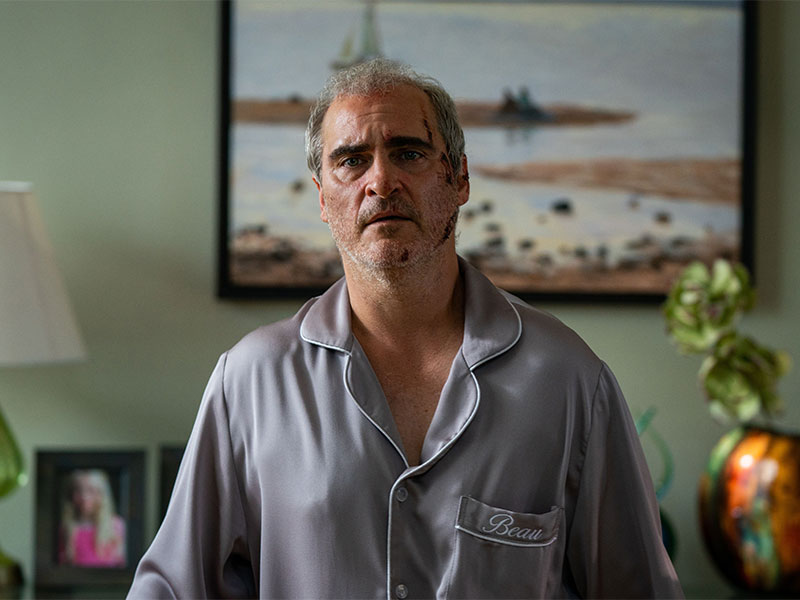
Beau Is AfraidJoaquin Phoenix in "Beau Is Afraid" (A24)

Beau (Joaquin Phoenix) gets an unexpected visitor when he is taking a bath, and, after an aggressive wrestling match, flees naked (running through broken glass) out into the street. There he encounters both a bloody naked man as well as a police officer who threatens to shoot the unarmed Beau. This surreal moment becomes even more surreal when Beau’s predicament is ended by a deus ex machina-like deliverance that acts almost like a rebirth, especially since he is naked.
Dicks: The MusicalJosh Sharp, Bowen Yang and Aaron Jackson in "Dicks: The Musical" (A24)
The comedy musical features gratuitous male nudity in an incestuous sex scene montage as long-lost twin brothers Craig (Josh Sharp) and Trevor (Aaron Jackson) consummate their love for one another in various energetic, acrobatic positions. But the arguably more shocking scene involves their mother Evelyn’s (Megan Mullally) vagina, which “fell off” as she explains in one musical number. (She keeps it in a bag). It makes a most memorable appearance in the film, flying in front of the screen, flapping its “wings” and chirping, “The End!” Never has bad taste been so good.
03
"Infinity Pool"
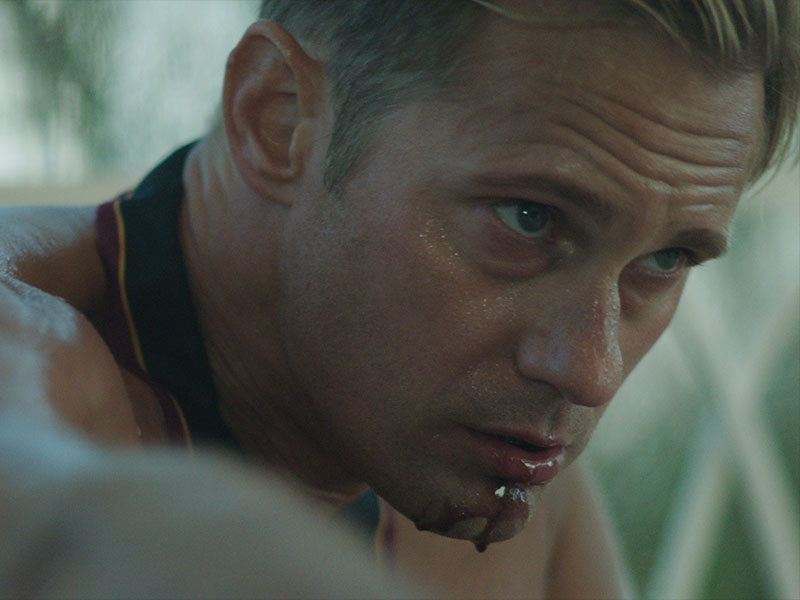
Infinity PoolAlexander Skarsgård in "Infinity Pool" (Elevation Pictures)

Early in Brandon Cronenberg’ gleefully nasty thriller, James (Alexander Skarsgård) receives a hand job from the manipulative Mia Goth. However, the erection, seen in the uncut version, was — ahem, circumcised — for the film’s theatrical release.
 
Nevertheless, the film still featured copious nudity during a trippy three-plus minute psychedelic orgy sequence (featuring some scary nipples!) And it was unsettling to see Mia Goth walking towards the camera, totally nude and totally in control in this out-of-control film.
04
Joy RideStephanie Hsu as Kat, Sabrina Wu as Deadeye, Ashley Park as Audrey and Sherry Cola as Lolo in "Joy Ride" (Ed Araquel/Lionsgate)

In this hilarious and crude comedy, Kat (Stephanie Hsu) is rumored to have a tattoo on her vagina. When a wardrobe malfunction occurs during a particularly inspired impromptu, airport rendition of “WAP,” Kat’s tat is revealed. The camera closes in on it, and it can never be unseen. Kat exclaims, “My vagina is the devil, and she’s here to stay!” Nor can it be erased. “It’s on the inside, too!” Kat proclaims, as another sight gag confirms. “Joy Ride” sets up this joke beautifully, and the “shocking” full-frontal nudity is a terrific payoff for fans of embarrassment humor.
05
"Kokomo City"
Kokomo CityDominique in "Kokomo City" (Magnolia Pictures)

D. Smith’s illuminating documentary features four Black trans sex workers talking about their life and work, as well as topics such as race and masculinity. Shot in gorgeous black and white, there are explicit descriptions and depictions of sex. The subjects’ candor about sexuality and gender is refreshing and it is matched by their willingness to expose and reveal themselves, most notably when Dominique is seen proudly displaying her full breasts in addition to her genitalia, as “Ain’t I A Woman” plays on the soundtrack.
06
"Lonesome"
LonesomeJosh Lavery in "Lonesome" (Dark Star Pictures)
Casey (Josh Lavery) has a sexy body, and it is his currency; Casey uses his sex appeal — and sex — to find places to stay or earn a little money. Casey may seem comfortable in his skin, but he is running from his past. As Casey has a series of encounters, some quite intense, Lavery is making choices out of need. Director Craig Boreham’s character study is wall-to-wall sex and nudity, and Lavery delivers an eye-catching performance as a man who just wants to be loved.
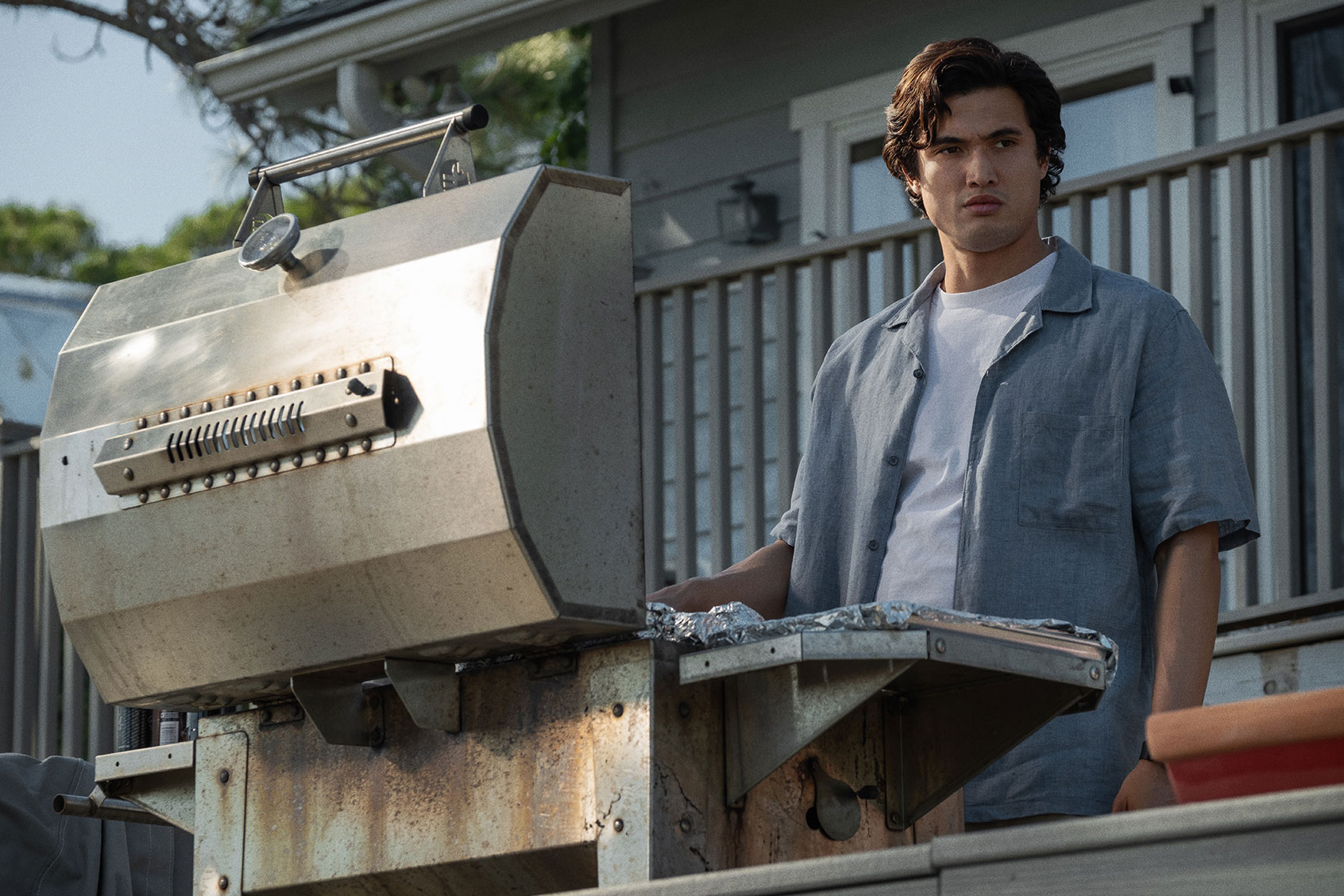
May DecemberCharles Melton as Joe in "May December" (Courtesy of Netflix/François Duhamel)
In Todd Haynes’ juicy drama, there is a brief full-frontal shot as Joe (Charles Melton) has sex outside his marriage. He has been seduced by Elizabeth (Natalie Portman), an actress researching Joe’s wife Gracie (Julianne Moore) for a film she is making. As Elizabeth flirts with Joe, she seduces him to “experience” what Gracie did when Gracie was intimate with 13-year-old Joe. However, the adult Joe is acting on his real attraction. As issues of consent and exploitation are raised, “May December” offers a multilayered examination of inappropriate desire.
08
"No Hard Feelings"
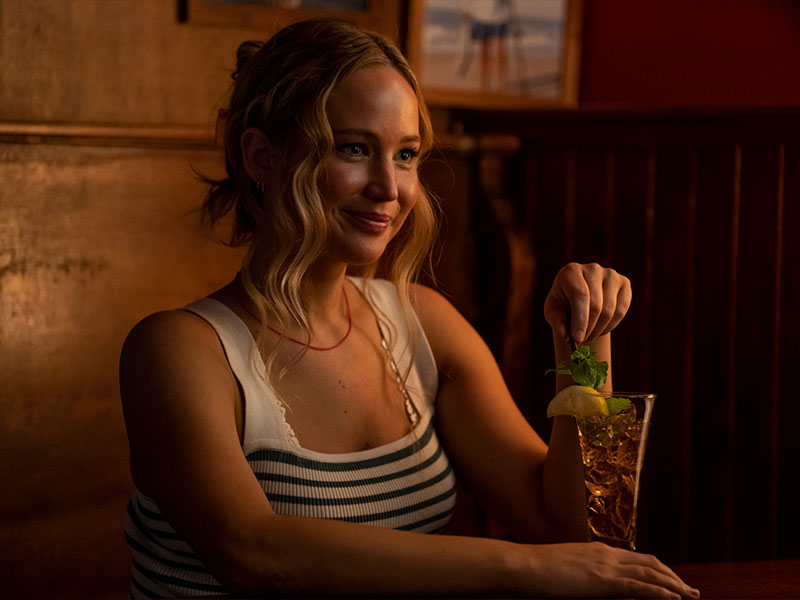
No Hard FeelingsJennifer Lawrence in "No Hard Feelings" (Columbia Pictures)

In this raunchy comedy, Maddie Barker (Jennifer Lawrence) hopes to coax a socially inexperienced teen, Percy Becker (Andrew Barth Feldman), out of his shell by taking him skinny-dipping. But when a trio of jokers try to steal their clothes, the naked Maddie beats up the thieves and suffers a punch to her crotch in the process. The nudity here goes for comedic effect not gross-out, as illustrated by scenes of Percy splayed naked on the hood of Maddie’s car, or a hot guy (Matthew Noszka) dropping trou while hoping to get Maddie to touch his penis in a finger trap.
OppenheimerFlorence Pugh is Jean Tatlock and Cillian Murphy is J. Robert Oppenheimer in "Oppenheimer" (Universal Pictures)

As Oppenheimer (Cillian Murphy) testifies to a committee about his relationship with Jean Tatlock (Florence Pugh), is seen fully naked and sitting in a chair, breasts prominent, while he is nude, but more discreetly posed. Oppenheimer is also seen naked in the hearing, literally exposing himself and his personal life for recorded history. But having an imaginary Jean writhing naked on his lap as he recounts their affair is awkward in every sense. Jean’s nudity might be an expression of her insecurity and vulnerability, but it also feels like a cheap storytelling device. Nolan is often criticized for not making his female characters three-dimensional, but Pugh’s nudity here feel especially exploitative.
10
"Passages"
PassagesFranz Rogowski and Ben Whishaw in "Passages" (MUBI/SBS Productions)

Ira Sachs’ aching romantic drama got unfairly slapped with an NC-17 rating this year. And “Passages” does, in fact, include a flash of a penis — which used to ensure NC-17 ratings — as Martin’s (Ben Whishaw) lover, Amad (Erwan Kepoa Fale), walks nude across a room. But the scene that triggered the ratings board is likely a two-minute sex scene between the breaking-up married couple, Tomas (Franz Rogowski) and Martin. While the only nudity is Whishaw’s bare behind, “Passages” was snared because of the intensity of the lovemaking — and likely because it was a gay male couple. Fighting censorship, the film was released unrated.
Poor ThingsEmma Stone in "Poor Things" (Yorgos Lanthimos/Searchlight)
As Bella Baxter (Emma Stone) goes off on a grand adventure with Duncan Wedderburn (Mark Ruffalo), she engages in “furious jumping” (her term for sex). Bella and Duncan go at it with uninhibited gusto, and she is ready at the drop of her shorts. When Bella later earns money for sex work in Swiney’s (Kathryn Hunter) “musty-smelling establishment of good time fornication,” a series of naked men have their way with the very naked Bella — touching her, tying her up, and even demonstrating copulation for children. She also has an enjoyable sapphic encounter. It is all very funny and illustrates that Bella is a woman with no shame about her body or sexuality. Emma Stone’s nakedness is shameless (in a good way) as well.
12
"Rotting in the Sun"
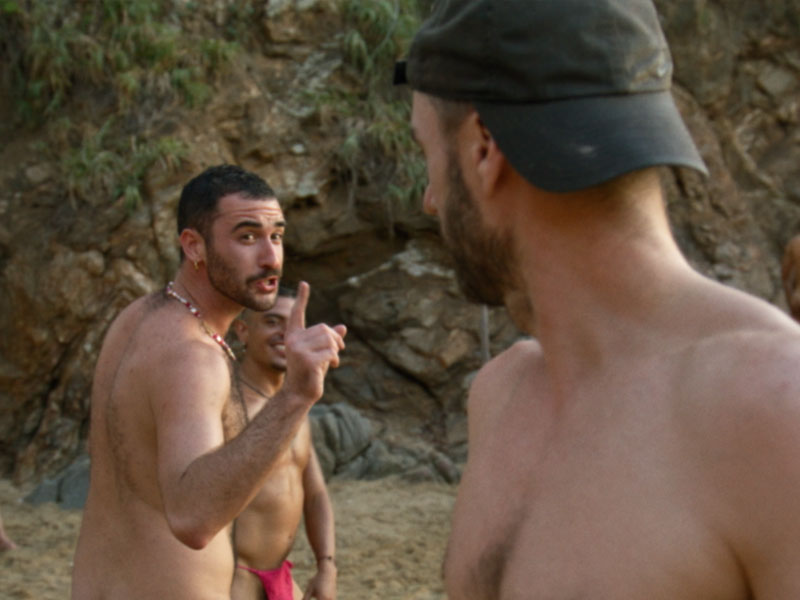
Rotting in the SunRotting in the Sun (MUBI)
Director Sebastián Silva’s outrageous film features countless penises as Sebastián (Silva, playing himself) visits a nude beach. Getting caught in the riptide, he meets Jordan Firstman (Firstman, playing himself) who hopes to collaborate on a series with the filmmaker. While “Rotting in the Sun” includes some real eroticized moments and all kinds of sex and nudity in the foreground and background of this extended sequence, a later episode where Firstman is having an orgy of sorts in Silva’s apartment makes “Rotting in the Sun” the most explicit film released this year.
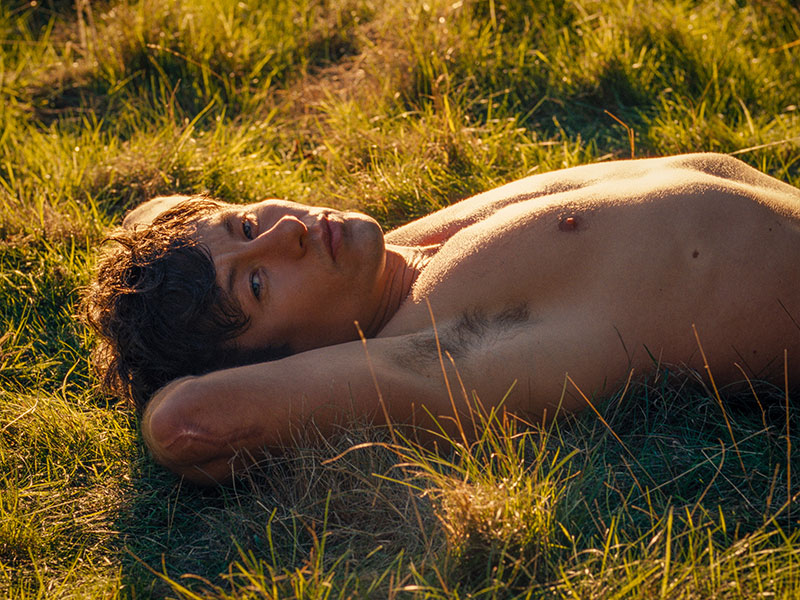
SaltburnBarry Keoghan in "Saltburn" (Prime Video)

When Oliver (Barry Keoghan) is told “no trunks allowed in the field,” Farleigh Start (Archie Makekwe) observes, “Well, well, well. Good for you. What a twist!” as he appreciates Oliver’s family jewels although viewers only see Oliver naked from behind. But after all the murder and mayhem that takes place — and that includes Oliver getting naked and fornicating with a fresh grave — he dances and prances naked to “Murder on the Dancefloor” through the halls of the Saltburn estate, having achieved the freedom he craved (and that his nudity symbolizes). It’s a delicious moment, and Keoghan, ahem, rises to the challenge. 

14
"Smoke Sauna Sisterhood"
Smoke Sauna SisterhoodSmoke Sauna Sisterhood" (Greenwich Entertainment)
The group of Estonian women in this inspiring and artfully made documentary bare their bodies and their souls as they sit naked in a sauna — a place of cleansing and purification. They talk poignantly about their body image and issues, discuss sex, and sexuality, menstruation, childbirth and families, as well as abuse and rape. The nameless women “sweat out their pain and fear,” and recounting their stories in the safe space of a smoke sauna, become mighty and more powerful in the process. 

15
"Swallowed"
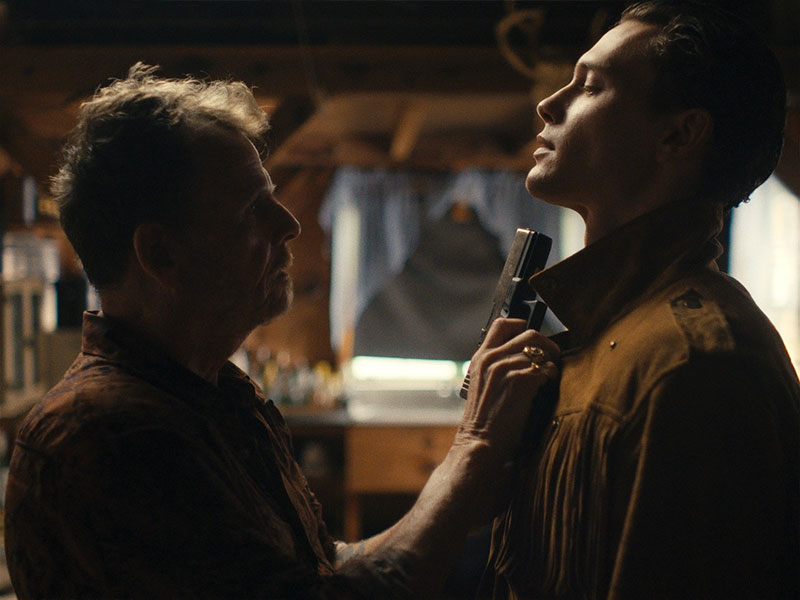
SwallowedMark Patton as Rich and Cooper Koch as Benjamin in "Swallowed" (Momentum Pictures)

Carter Smith’s nervy thriller has both its male leads spending long stretches of the film with their pants down. Forced to swallow sachets and transport them across the border. Dom (Jose Colon) has a bad reaction. Benjamin (Copper Koch of “They/Them”) gets the unenviable task of “collecting” the sachets from Dom’s anal cavity, which is as unpleasant as it sounds. Later, Rich (Mark Patton) forces the vulnerable Benjamin to strip. Viewers may also feel as pervy as Rich when Benjamin does bare all.


“Musicians hear chemistry”: “Immediate Family” director on artist and session player collaborations

Some of the most popular songs — Carole King’s “It’s Too Late,” Warren Zevon’s “Werewolves of London,” Jackson Browne’s “Running on Empty,” Stevie Nicks’ “Edge of Seventeen,” Jimmy Buffett’s “Volcano,” Don Henley’s “All She Wants to Do Is Dance” and so many more — were written, produced, or performed by session musicians Danny “Kootch” Kortchmar (guitar), Leland “Lee” Sklar (bass), Waddy Wachtel (guitar) and Russ Kunkel (drums). 

"These studio musicians go in and want to give more than what is written on paper."

The fantastic new documentary, “Immediate Family,” directed by Denny Tedesco (“The Wrecking Crew”) has these four friends sitting around and reflecting on their lives, careers and the music they made together. Tedesco nimbly assembles a who’s who of rock including King, Browne, Nicks and Henley, as well as James Taylor, Linda Ronstadt, Keith Richards, Phil Collins, Neil Young, Lyle Lovett and many others to provide comments and anecdotes on these session musicians. (Waddy’s recollections about visiting a strip club in Wheeling, WV, with Linda Ronstadt is especially amusing.)

Tedesco also includes fantastic clips of performances that showcase the music and the musicians on stage. “Immediate Family” traces the changes in music from the 1950s, when it was about the “face” of the singer, to the 1960s, when it was about the songwriting (cue Brill Building mention), through the 1970s singer-songwriter era, and the 1980s when synthesizers and technology along with MTV changed music

Salon chatted with Tedesco about his documentary and the music and musicians of “Immediate Family.”

How did you learn about these sessions musician and why did you take the approach of having them sit around a table reminiscing to tell their stories?

It comes from the first film, “Wrecking Crew.” My dad was a session player. I never went to work with him or saw him play an instrument at home until the mid-'70s. What I did see my father do is play cards or eat. And musicians banter. When I saw “Broadway Danny Rose,” one of my favorite movies, it reminded me of musicians and how they would talk about other players. I wanted that feeling of being around a kitchen table kibbitzing. Musicians have a rhythm. Even when they are talking, they listen to each other.

Can you talk about selecting the tracks you featured in the film? 

Everybody has their Top 5 all-time. Danny Kortchmar [on Carole King’s] “It’s Too Late” — his career skyrocketed because of the time and the place of that song. Everyone has different ones, and I asked them what would be representative of your career. 

The musicians describe themselves as character actors in that they come in, deliver what is needed, offer suggestions but know their place as supporting the talent. What observations do you have about their work? The band is as much the author of the song as the performer. 

Classical pieces are written, note for note, and you don’t go off that. You play what the composer wrote. Same with film music because you have to hit everything at the exact point. But these studio musicians go in and want to give more than what is written on paper. They have to create. It is their job to make it better. They thought of themselves as producers in a way. What does this song need? What might this singer or producer like? My dad said, “I play for smiles. If they are smiling, I am doing my job right, if not, I have to change it up to fit with what they want.”

You assemble an impressive roster of talent for interviews as the musicians got to play with their heroes. Who was the most open, who was the hardest/easiest to get?  

No one was difficult to get because these guys, when they came into the business in the 1970s, they were young kids and the people they were playing with were all the same age — James Taylor, Jacksons Browne, Carole King and Linda Ronstadt. They were not big stars yet. Carole was a big songwriter, but she wasn’t an artist at all. They worked together to make albums and went on the road together. It bonded them as sisters and brothers. Their memories are extraordinary. But even if they haven’t seen each other in years, they just pick up where they left off.  

I found it interesting that certain musicians wanted to work with members of the “Immediate Family” but were not singer/songwriters in the James Taylor/Jackson Browne/Carole King mold. Do you have thoughts about that? 

Don Henley is a perfect example. Why did he pick Danny Kortchmar to produce his album? Danny pushed Henley to produce a solo album. Henley liked Danny because he didn’t do anything like what Henley did. Don didn’t want The Eagles and those country harmonies. 

David Crosby said about folks like Russ and Lee [Leland], “When you play with these guys there’s chemistry.” Musicians hear chemistry. When you listen, you understand it. It all comes together. It may be a different genre, but they know Lee would be great at it. The jazz album, or Billy Cobham’s fusion album. It doesn’t sound like something a singer/songwriter bass player is going to do, but they know he can do it and what he is capable of. The artists know how far they can stretch it.  

I was surprised they went from Carole King to Warren Zevon. What are your thoughts on the diversity of performers they played with?

It’s all music to them. Every song is a different animal. They have to figure out what it needs. They go in and in their heads, they are putting their parts together. The drum can do this, maybe the bass will happen here. Musicians with that much talent do that naturally, and create instantly. And if it doesn’t work, they’ll try something else.

I thought it was great when they said, “I want to make the best song, not a hit song.” Another emotional moment was when Leland said he never gets bored playing “Fire and Rain,” a song he played thousands of times because someone may be hearing it for the first time. What can you say about their work ethic. 

That was one of the thoughts going through my mind: How do you keep yourself from getting bored doing the same set over and over again? Leland said, “I’m playing it for the first time for someone in that crowd.” Sometimes artists will play the same the set over and over. I’m sure it gets somewhat monotonous. But a great example of being on your toes is that Russ and Leland go on tour with Lyle Lovett and the book for Lyle is 80 songs, and Lee will know all 80 songs by heart. He doesn’t have any music in front of him. There may be a rough idea of what they will play that night, but Lyle will change on the dot. If someone yells from the crowd, he’ll play that. It’s quite something that Leland can do that! 

Immediate FamilyDanny Kortchmar, Leland Sklar, Waddy Wachtel, Steve Postel and Russ Kunkel in "Immediate Family" (Photo courtesy of Magnolia Pictures)

The other takeaway from your film is how the musicians realize what the music they make means to people. What does their music mean to you? What song specifically resonates? 

"All artists need to change. If you don’t, I think they get bored."

Every song is a bookmark in someone’s life. “Edge of Seventeen” might mean something to you, but it means something different to me because I’m a little older and in a different place in my life. I watch audiences and see people tear up sometimes or mouth the words all the way through. It’s really wild to watch that. I realize watching the film now what the music really meant to people. The album that does that for me is “Tapestry.” I know Danny’s solo in “It’s Too Late” note for note. 

What did you think of the session musicians’ efforts to make their own rock-fusion albums (“The Section”)?

I knew of it, but I didn’t know what it was about. When I heard it, I thought, this is the music I would have been listening to at the time! I was really into rock fusion. I became a new fan. They all stretch out. That’s why you’ll see musicians become jazz players pushing themselves. 

“Immediate Family” does not get into the sex-drug-rock-n-roll lifestyle, focusing instead on the music. Can you explain why you chose this focus? 

We went into it a little. That time period was rough — they survived it, obviously. Everyone did stuff but Leland, who never smoked and never drank. He’s the straightest cat you will ever meet. Not for any reason. He just didn’t like it. You can go down that road, and I think they lost a lot of friends, and I do talk about it. But it was a hard time. It was harder then than it was in the 1960s once the coke came out in the 1970s. Marriages were lost, and families broken up. I didn’t shy away from it, but it wasn’t the focus of the story.  

I liked the story about Jackson Browne and creating “Running on Empty.”

Jackson had the idea to take these guys on the road and do an album, and it was Russ who said, “Why not just do new songs? Why do old stuff?” and Jackson said, “Yeah, you’re right.” That’s when these guys were at their peak. They were playing as the warm-up band and then playing with Jackson at night, and then they go back to the hotel and playing more in the hotel and on the tour bus. Just before that, they were doing the James Taylor tour. These guys were just hot with their instruments at that moment. 


Want a daily wrap-up of all the news and commentary Salon has to offer? Subscribe to our morning newsletter, Crash Course.


And they played with Linda Ronstadt and Carole King, who changed things up . . .

Linda had huge changes. She did the standards with Nelson Riddle. My dad played on that album. Then she did the Spanish-language album, which is what she grew up with. Danny and Carole all listen to each other. Danny said something about the first album they did with “The City,” [“Now That Everything’s Been Said in 1968] which they did before “Tapestry.” It was like McCoy Tyner stuff, which was something I hadn’t heard. They do change. All artists need to change. If you don’t, I think they get bored. 

"Immediate Family" opens in theaters Friday, Dec. 15.

Sidney Powell blasted for “underwhelming” one-sentence Fulton County plea deal apology

The apology letters that Trump-aligned lawyers Sidney Powell and Kenneth Chesebro were required to pen as part of their plea deals in the sprawling Georgia election interference case are only one sentence long. The letters, which were obtained by The Atlanta-Journal Constitution, were hand-written and curt, and neither acknowledged the legitimacy of Joe Biden's 2020 electoral victory in the state or denounced the unfounded claims of election fraud the attorneys pushed. 

"I apologize for my actions in connection with the events in Coffee County,” Powell wrote in an Oct. 19 letter, dated the same day she pleaded guilty to six misdemeanors related to efforts to interfere with the performance of election duties. “I apologize to the citizens of the state of Georgia and of Fulton County for my involvement in Count 15 of the indictment,” Chesebro wrote in a letter dated Oct. 20, which is when he pleaded guilty to one felony count of conspiracy to commit filing false documents. Powell and Chesebro are among four defendants in the sprawling racketeering case to reach plea deals with Georgia prosecutors. The letters written by the other two defendants who pleaded guilty — Trump lawyer Jenna Ellis and Scott Hall, a bail bondsman — were longer and more detailed. 

"These letters from Chesebro and Powell are…underwhelming," MSNBC's Katie Phang wrote on X, formerly Twitter. "To be filed under 'THAT'S AN UNDERSTATEMENT,' former Mueller prosecutor Andrew Weissmann added. "No jail time, eventual expungement of criminal record, and court sign-off on crimes not being of moral turpitude (so can continue to practice law)—all the consequences for engaging in attempted overthrow of US presidential election."

The 7 biggest US women’s team World Cup revelations from Netflix’s “Under Pressure”

When the United States women's national soccer team (USWNT) won two consecutive World Cup titles in 2015 and 2019, the whole world was counting on them to secure a third winning title at the 2023 games. Winning two back-to-back titles isn’t an uncommon feat (Germany was the first to do it back in 2003 and 2007). But winning three would set a new record high.

Unfortunately, that didn’t happen.

On Aug. 6, the two-time defending champions were eliminated in the round of 16 by Sweden. Their heartbreaking loss still managed to score a few firsts for the team: It was the first time they had not made the semi-finals at the tournament. And it was the first time the team failed to progress to the quarter-finals.

Unlike their male counterpart, the USWNT has been a longstanding powerhouse since the 1990s. The team has won four Women's World Cup titles (1991, 1999, 2015 and 2019), four Olympic gold medals (1996, 2004, 2008 and 2012), and nine CONCACAF Gold Cups. The USWNT has successfully medaled in every Women's World Cup and Olympic tournament in women's soccer, except for two: the 2016 Olympic tournament and 2023 Women's World Cup, both of which they were eliminated by Sweden following a penalty shootout.

The USWNT’s 2023 season has been marred by skepticism and criticism, as many pointed fingers at the team’s head coach Vlatko Andonovski. Critics blasted Andonovski for his coaching decisions, namely his lack of substitutions on the pitch, along with his choice roster, which featured an overwhelming number of fresh faces.

The team’s World Cup journey — starting from the tryouts to the bombshell loss — is explored in Netflix’s latest docuseries “Under Pressure: The U.S. Women's World Cup Team.” The four-part series looks into the personal stories behind a few notable and up-and-coming players on the team. In addition to interviews with players, the series spotlights former USWNT players, sports journalists and critics.

Here are the 7 biggest moments from the series:

01
Many were skeptical about Vlatko Andonovski’s coaching abilities
Under PressureVlatko Andonovski and Andi Sullivan in “Under Pressure” (Photo courtesy of Netflix)
Andonovski was named the head coach of the USWNT on Oct. 28, 2019. He succeeded Jill Ellis, who coached the women’s national team from 2014 to 2019 and won two FIFA Women's World Cups in 2015 and 2019.


“I think you have to be built so differently to want the U.S. Women’s National Team head coaching job because you have the highest expectations and the highest pressure,” said Meg Linehan, a senior writer for The Athletic.


Andonovski was heavily criticized after the USWNT secured a bronze medal in the 2020 Olympics. Many critics felt the team had underperformed that year after winning four previous Olympic gold medals. Andonovski faced more criticism amid the Women’s World Cup, when the U.S. was eliminated in a penalty shootout against Sweden in the round of 16.   


Less than two weeks after the major upset, Andonovski resigned as head coach on Aug. 16.

02
Many also questioned whether 38-year-old Megan Rapinoe was capable of playing at another World Cup
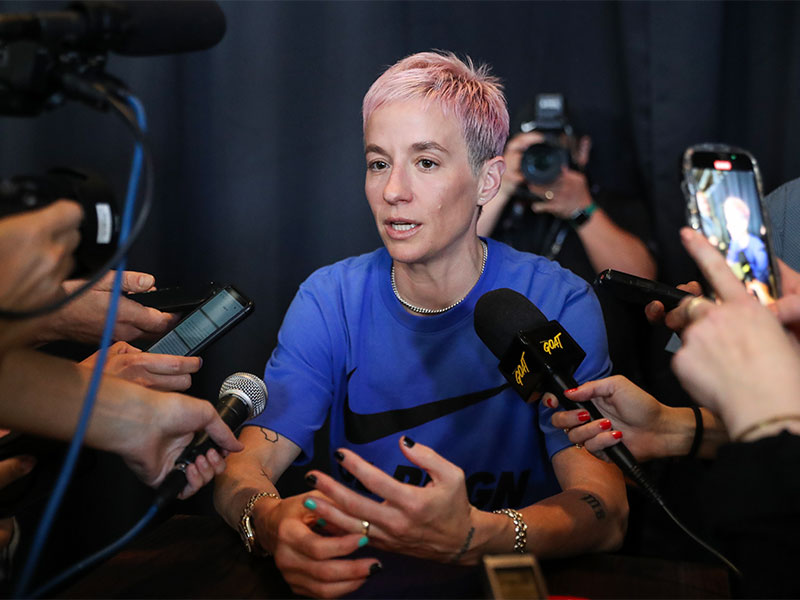
Megan RapinoeMegan Rapinoe #15 of OL Reign speaks to media ahead of the 2023 NWSL Championship at Venue 808 on November 09, 2023 in San Diego, California. (Meg Oliphant/Getty Images)
Prior to the World Cup, Rapinoe suffered from a calf injury, which spurred public speculation about her playing capabilities. Rapinoe previously won gold with the national team at the 2012 London Summer Olympics, 2015 FIFA Women's World Cup, and 2019 FIFA Women's World Cup. She also won the Ballon d'Or Féminin and was named The Best FIFA Women's Player in 2019.    


Several women’s soccer legends along with Rapinoe’s former USWNT players came to her defense:


“I say, ‘If she can give 20 minutes off the bench and change the game, why not?,’” said two-time World Cup champion Julie Foudy.


“When Megan is healthy and when Megan is fit, I don’t know if there’s been a better all-around player,” said retired USWNT soccer player Abby Wambach.


Rapinoe announced on July 8 that the 2023 World Cup would be her last major tournament, and that she would retire from professional soccer at the end of the year.


“I mean, to be honest, I’ve been thinking about this for a long time,” Rapinoe said in her announcement. “It is incredibly rare for athletes of any stature to be able to go out in their own way, on their own terms.”

03
The players were told over FaceTime if they made it on the team roster
Under PressureLynn Williams in “Under Pressure” (Photo courtesy of Netflix)

Securing a spot on the USWNT is not an easy task. Players from all over the country spent seven grueling months competing against each other during a series of tryouts. The players were then judged based on their individual skill sets and how well they could play alongside their teammates.


“Every single day you have somebody who is knocking on your door, waiting for you to mess up,” forward Lynn Williams said. “Waiting for you to get injured, waiting for you to fail so that they can come in and take your spot. It’s psychotic. But I can’t believe I get to be a part of it.”


The final team featured both seasoned players who were oftentimes guaranteed a spot — like forward Megan Rapinoe, defender Becky Sauerbrunn and midfielder Rose Lavelle — and hopeful newcomers, better known as “bubble players.”   


“A bubble player is someone who is just on the edge of making the roster [or] not making it,” explained Foudy. “They’re on the edge of the bubble. And that’s never a fun place to be. As the pool for the women’s national team grows and grows, it’s just harder and harder to get in the bubble.”


As for how each player learned if they made the roster or not, one would think the decision would be announced in a grand way, maybe via a mailed letter or even email. Instead, each player was notified through a FaceTime call from Andonovski.

04
More than half of the players on the final 23-woman roster were brand new
Under PressureLynn Williams, Sophia Smith, Alyssa Thompson, and Kristie Mewis in “Under Pressure” (Photo courtesy of Netflix)

“Of course you have injuries coming into a World Cup, but it feels like there’s a lot of injuries this World Cup,” Foudy said. “This team’s got a really interesting mix of nine returning players, 14 who are in their first World Cup, different lineups and changing of players, which starts to affect your flow and your continuity and your cohesion.”


One of the newest faces on the USWNT roster was Savannah DeMelo, who many believed was a shocking addition to the team. DeMelo has never made an international appearance or played a game with the USWNT.


“Because of some injuries, we needed another midfielder, and so there you have this player that can shine in that moment,” Foudy said.


When asked about the level of inexperience on the team, Andonovski wasn't concerned:


“I’m not worried about the inexperience. And in fact, on the way here, I traveled with Megan, Alex and Lindsey, and I felt pretty comfortable just being around them and knowing that these are the players that are gonna lead the young group.”

05
Andonovski came under fire for his lack of substitutions during the group stage
Under PressureVlatko Andonovski in “Under Pressure” (Photo courtesy of Netflix)

Within the tournament, Andonovski was heavily blasted for his lack of substitutions made throughout the games. In the series, players who spent most of their time sitting on the bench said it “sucks.”


“You gotta just suck it up, go to these sessions,” said midfielder Kristie Mewis. “The day after the game, you’re exhausted, you’re frustrated. It just all kind of builds up. It’s a stress and anxiety that you can’t do anything about. Like, you’re helpless.”


A few players said the lack of substitutions also hurt a lot of players’ confidence. “I think that was a tough game for a lot of players who didn’t see the field,” said striker and team captain Alex Morgan.


Andonovski justified his decision during a press conference, saying, “I just didn’t wanna disrupt the rhythm at that point because sometimes a substitute might take a minute or two to get into a rhythm, and we just didn’t wanna jeopardize anything.”

06
Being a new mom and a professional soccer player is pretty darn difficult
Under PressureAlex Morgan in “Under Pressure” (Photo courtesy of Netflix)

“Coming back from giving birth was really hard, and I didn’t feel super quick,” said Morgan, who welcomed her daughter Charlie Elena Carrasco in May 2020. Preparing for the 2023 World Cup was “definitely a little different than previous World Cups,” she added.


Other mothers on the roster included defender Crystal Dunn and midfielder Julie Ertz, who both gave birth to their first children in 2022. 


“We’re here to do work,” Morgan said. “We’re here to win a World Cup. But we’re also here to break down barriers along the way. I wanted to be my best every single day — not only to show my daughter that, but to show everyone else that moms really can do it all.”

07
Alyssa Thompson is expected to be a key player in the 2027 World Cup
Under PressureAlyssa Thompson in “Under Pressure” (Photo courtesy of Netflix)

“There is added value in bringing Alyssa Thompson, who is an infant, to the World Cup, to start getting that major tournament preparation,” said Linehan. “She is someone who we’re thinking about as a key player for 2027, potentially still in the mix for 2031.” 


The 19-year-old forward, who currently plays for Angel City FC, became the first teenager to make the U.S. World Cup roster since 1995. Although Thompson played only 17 minutes across two games at the 2023 World Cup, she’s expected to dominate in many more games to come.


“We’ve got a full decade of tournaments ahead of us,” Linehan added. “So hopefully, she’s living through the emotions of those big moments and feeling them again in 2027, and being on more solid ground.”

"Under Pressure: The U.S. Women's World Cup Team" is currently available for streaming on Netflix. Watch a trailer for it below, via YouTube:


“Worst legal strategy ever devised by a human mind”: Expert warns Giuliani faces “massive” verdict

Rudy Giuliani's legal strategy in his defamation trial astonished CNN legal analyst Elie Honig, who predicted Thursday that the two election workers the former Trump lawyer defamed will be awarded "massive" damages in their lawsuit against Giuliani. The presiding federal judge already found Giuliani liable for defamation when he falsely accused Georgia election workers Ruby Freeman and Shaye Moss of rigging the 2020 election in the state and repeatedly targeted them. A Washington D.C. jury began deliberating on the amount in damages Giuliani will owe the duo on Thursday. When asked about Giuliani's reneging on taking the stand just minutes before Thursday's proceedings despite insisting that he would be, Honig told CNN's Kaitlan Collins' that Giuliani pulling out was "the smartest move he's made in years."  

"I mean, if he had taken the stand, imagine what a catastrophe that would’ve been. This man is a pathological liar. He can’t help himself," he continued. The ex-New York City mayor, rather than show remorse after being found liable, doubled down on his lies, telling reporters outside the courthouse Tuesday that he "told the truth" about the women. “This case is what happens when you combine vicious, over-the-top defamation against innocent victims with the single worst legal strategy ever devised by a human mind,” Honig said. The former federal prosecutor broke down Giuliani and his lawyer's approach to the case, explaining that because they agreed Giuliani was liable and conceded to defamation, he should have gone into the trial expressing remorse in an effort to minimize damages. "Instead, they go in on this damages trial and commit more defamation," Honig concluded. "They are just asking for a massive verdict and I think we’re gonna see that tomorrow."

James Comer’s shady shell company makes clear that Republicans’ Biden crusade is pure GOP projection

It appears that Speaker of the House Mike Johnson's honeymoon is coming to an early conclusion. The right-wing House Freedom Caucus is hopping mad that Johnson allowed the Defense Authorization Bill to pass with Democratic votes, a big no-no signifying that the bill was obviously much too good. According to Puck's Tara Palmieri, they accused Johnson of going behind their backs and using a “page ripped from the [John] Boehner playbook" referring to the former speaker who, like Kevin McCarthy, was also chased out of the job for passing bills with Democrats.

Palmieri reports that a senior GOP aide told her that “people are turning on Mike fast; he won’t make a decision" because he wouldn't choose between two competing bills. And apparently, it has finally occurred to them that his lack of experience and expertise might be a problem, quoting the same aide saying, “his operation is minor league compared to Kevin’s team. At least they knew what they were doing and how the place ran. Mike’s team has no idea what they’re doing, and it’s pissing people off. We used to be able to get answers from people.” Who could have seen that coming? 

It's clear from his record that Johnson would love nothing more than to stand by their side and throw tantrums — but his new job as speaker is coming into conflict with his ideology as a MAGA warrior and it's probably not going to end well for him. 

He has certainly gone out of his way to show the hardliners that he's one of them. He immediately made the required pilgrimage to Mar-a-Lago to kiss Trump's ring and then enthusiastically delivered his endorsement making it clear that he is all MAGA all the way. And despite just a few weeks ago suggesting that impeachment was no longer necessary since President Biden's polls numbers are weak (therefore admitting that the whole thing is a partisan sham) he delivered for Trump and the MAGA faithful on their biggest priority this week. He brought the vote to formalize the inquiry to the floor and persuaded the so-called moderates in the party to go along. You'd think that would have appeased the Freedom caucus but let that be a lesson to Johnson: It is simply not possible.

More often than not, when you examine these scandals closely, you'll find that it's the Republicans doing the accusing who are actually guilty of the crimes.

All the usual suspects have been making the rounds since the vote suggesting that the party line vote (which Johnson once insisted could destroy the Republic) shows they have the goods. But once again, they are lying. They have still produced not one sliver of evidence that Joe Biden did any of the things they are implying he did with their histrionic innuendo about "the Biden Crime Family."

Interestingly, there is one member of the House who may have actually done the things he's accusing Biden of doing. 

 A few weeks ago, Roger Sollenberger of the Daily Beast broke a story about some shady dealings by House Oversight Chair James Comer that resembles some of the crimes he's accusing Biden of committing. In a new report this week, the AP unearthed new details that make it pretty clear that Comer's crusade is a clear example of GOP projection. 

We need your help to stay independent

Comer has been yammering about "the Biden family" shell companies, which Joe Biden had nothing to do with and were actually completely legitimate companies with real purposes, for months. He even once told Fox Business, “nobody creates shell companies.”

Actually, some people do. In fact, Comer himself has a shell company which grew from $50,000 and $100,000 at the time of purchase to between $500,001 and $1 million today. Evidently, he's conveniently forgotten to report the assets within it which goes against House rules which require members to disclose assets held by companies worth more than $1,000. Oh, and this shell company was formed from a transfer of a piece of land co-owned with one of his major campaign donors and nobody can figure out what the purpose of it was or why he has gone to such lengths to obscure it. 

When asked about this, he keeps saying that the questioner is "financially illiterate" which is hilarious considering the total illiteracy of his charges against Joe Biden. If you don't believe that, I highly recommend this thorough fact check by the Washington Post's Philip Bump or this one by Factcheck.org. It would be sad if it wasn't so outrageous. 

But the point of all this is to dirty up Joe Biden as corrupt to give some red meat to the Trump followers and make the rest of the country assume "where there's smoke there's fire" which is something they've been successful at doing against their enemies for decades. I'm sure I don't have to remind people about Whitewater which bears some similarities with this current bogus scandal in both its lack of evidence or its relevance to the current presidency. The memory of Benghazi and "But Her Emails" against Hillary Clinton are still fresh. The Birther scandal enraptured the right wingers throughout the Obama presidency and launched Donald Trump's political career. 


Want a daily wrap-up of all the news and commentary Salon has to offer? Subscribe to our morning newsletter, Crash Course.


This is what they do. And more often than not, when you examine these scandals closely, you'll find that it's the Republicans doing the accusing who are actually guilty of the crimes. James Comer's flagrant hypocrisy is just par for the course. 

Donald Trump wants revenge for his two impeachments and if there was time he would demand that they impeach Biden three times just so he'd have one more than him on his record. And because they've pounded this story on right-wing media for years now, the MAGA base is slavering over the prospect of taking down the president. It has nothing to do with any real crimes or evidence or anything else that would justify an impeachment. 

Those Representatives from swing districts who voted to open the inquiry this week may believe this was essentially a free vote and hope that they won't be asked to vote for an actual impeachment but I think they are deluding themselves. The constitutional standard for impeachment is “treason, bribery, or other high crimes and misdemeanors" but in practice, as the late president Gerald Ford put it, “an impeachable offense is whatever a majority of the House of Representatives considers it to be at a given moment in history.” 

At this moment in history, Donald Trump, James Comer and Jim Jordan will be deciding what it is and it's clear that their standard is literally nothing. They'll do it because they can. It's the only reason they need. 

“Might have already erred”: Legal experts say judge may have imperiled ruling dissolving Trump Org.

The judge overseeing former President Donald Trump’s New York fraud trial “might have already erred” in his ruling ordering some of his companies to be dissolved, legal experts told The New York Times.

Judge Arthur Engoron ruled before the start of the trial that Trump fraudulently inflated his net worth and ordered some of his New York companies be dissolved. But legal experts told the outlet that Engoron “may have lacked the authority to dissolve the companies.”

An appeals court last week stayed the judge’s punishment while it reviews the order.

“President Trump very much appreciates the court’s consideration and ruling,” Trump attorney Christopher Kise said after the appellate court took up the case, adding that it would help “pave the way for a much needed, and deliberative, review of the trial court’s many errors.”

Engoron could also adjust the order himself, the Times report noted, and use his expected January verdict in the case to amend the punishment before the appellate court rules.

“The judge has extraordinary powers to fashion a remedy to curtail and punish the misconduct, meaning bad news for Trump,” Steven Cohen, a former top official at the New York attorney general’s office, told the Times.

In addition to the $250 million financial penalty sought by New York A.G. Letitia James, Engoron could ban Trump and his company from signing new commercial real estate deals or seeking loans from banks in the state. He could also bar Trump from running any company in the state.

But the part of the order dissolving some of his New York companies is “less likely to stick,” according to the report.

We need your help to stay independent

The order canceled a special type of business certificate that allows some of Trump’s New York companies to operate using certain names, according to the report. The order could force about 10 of the former president’s businesses to obtain new certificates but the order also referred to the “dissolution of the canceled LLCs,” or limited liability companies that control Trump’s properties.

Legal experts told the outlet that a judge cannot dissolve an LLC unless one of its members seeks to do so.

“He’s going beyond what the statute seems to allow,” David Lowden, a lawyer who specializes in commercial transactions and corporate law, told the Times, predicting that the order would not destroy Trump’s empire but merely result in a “simple bureaucratic irritation, resolvable through paperwork.”


Want a daily wrap-up of all the news and commentary Salon has to offer? Subscribe to our morning newsletter, Crash Course.


Other experts noted that the judge applies the order to all 10 of Trump’s New York companies that have the certificate, not just the smaller number cited by James’ complaint. Experts told the outlet that imposing a punishment on a company not accused of wrongdoing could prompt the appeals court to intervene.

 “He may have bought himself an appellate problem,” Cohen said, “and fueled an otherwise dubious claim of bias.”

2023 proved that climate change isn’t coming — it’s here, and things are spiraling out of control

Politicians often speak of climate change as a problem for future generations to solve, but many scientists say the time to act is now and that the climate has already changed — it's not a far-off scenario. Never before has the devastation of global heating been more clear than in 2023, which is the hottest year in recorded human history.

But if this trend continues, 2023 may be one of the coolest years in recent memory. In other words, things are poised to get a whole lot worse unless we change our relationship with fossil fuels. In the meantime, we can expect the pile of broken records to climb even higher. Here are some of the main ways 2023 became a defining year in our anthropogenic spiral to the bottom, but with our constantly shifting baselines, it's not likely to be an anomaly.

Summer 2023 was the hottest summer on record.

When United Nations (UN) Secretary General Antonio Guterres told the world in September that summer 2023 had been the hottest summer in recorded history, he did so in unmistakably vivid and dramatic language.

"Our planet has just endured a season of simmering — the hottest summer on record. Climate breakdown has begun," Guterres declared, later adding that "the dog days of summer are not just barking, they are biting."

The year "will see a new global surface temperature record" which "underscores the fact that the planet is continuing to warm as we continue to burn fossil fuels and generate carbon pollution."

Indeed, according to the World Meteorological Organization (WMO), the period of June through August 2023 had an average global temperature of roughly 16.77°C (62.19°F), which was an increase of 0.66°C (1.19°F) from the normal average.

This extreme heat isn't just miserable, it can be very deadly, triggering what are essentially mass casualty events, while also worsening wildfires, wracking up health care costs and damaging critical infrastructure at a time when people need their AC running at full blast, if they even have it. What's more, an estimated 90 percent of the human population is expected to suffer through more extreme heat in the coming years.

The world is expected to hit 1.4ºC of warming in 2023

Last month the WMO came out with another dire statistic: The planet's temperature is scheduled to hit 1.4º Celsius (2.5º Fahrenheit) above preindustrial levels. Additionally the organization's provisional State of the Global Climate confirms that 2023 will be the hottest year on record (taking the place of 2016).

"Greenhouse gas levels are record high. Global temperatures are record high. Sea level rise is record high. Antarctic sea ice record low," WMO Secretary General Peterri Taalas said when discussing the report.

This figure is particularly troubling because experts believe that once the Earth warms by 1.5º degrees Celsius, a series of irreversible feedback loops will ensue, including the collapse of the Atlantic Ocean's Gulf Stream current and rapid melting from the Arctic and Antarctic to Greenland.

2023 will see a new global surface temperature record

According to the National Oceanic and Atmospheric Administration (NOAA), the average global surface temperature from January through October 2023 was the highest ever recorded in the 174-year-history since these metrics have been measured. Specifically, the global surface temperature during this period hit an astonishing 1.13°C (2.03°F) higher than the 1901–2000 average of 14.1°C (57.4°F). The previous record, set during the span of January to October 2016, had been 0.08°C (0.14°F). The National Centers for Environmental Information (NCEI) estimates that there is a greater than 99% chance that 2023 will rank as the warmest year in recorded history.

In the Northern Hemisphere, the January-October 2023 period ranked as the warmest on record with a temperature that was 1.44°C (2.59°F) above average. In the Southern Hemisphere, the January-October 2023 period was also the warmest on record with mean temperatures at 0.81°C (1.46°F) above average.


Want more health and science stories in your inbox? Subscribe to Salon's weekly newsletter Lab Notes.


"I expect these records to be regularly broken due to the continuing climate change. But I did not expect them to be broken by such large amounts."

Ocean heat content too will set a new record

When Salon reached out to Dr. Michael E. Mann, a professor of Earth and Environmental Science at the University of Pennsylvania, he listed among the biggest pieces of climate change news in 2023 that the year "will see a new global surface temperature record" which "underscores the fact that the planet is continuing to warm as we continue to burn fossil fuels and generate carbon pollution."

Mann also pointed to another worrying development — namely the fact that "ocean heat content… too will set a new record." He argued that this "is equal in significance, as the warming of the oceans is helping destabilize ice shelves and fuel more powerful hurricanes and tropical cyclones."

Indeed, according to NOAA, October 2023 was the seventh consecutive month to have record-high monthly global ocean surface temperatures. As far back as August, NASA proclaimed that "the ocean has a fever," with NASA oceanographer Josh Willis explaining that the two main factors behind the record heights are that "we have an El Niño developing in the Pacific, and that’s on top of long-term global warming that has been pushing ocean temperatures steadily upward almost everywhere for a century.”

Ice melt also took a huge hit

According to the WMO, the extent of Antarctic sea ice hit a record absolute low in 2023, at least in terms of what scientists know since the satellite era began in 1979. Starting in June, the extent of sea ice was at a record low, and the annual maximum in September 2023 was 16.96 million km2, an amount approximately 1.5 million km2 below the average from 1991 to 2020. The authors drew particular attention to Switzerland, where "glaciers have lost around 10% of their remaining volume in the past two years." Glaciers in North America and elsewhere amidst the European Alps have taken a hit.

"The minimum in global sea ice seen earlier this year emphasizes the larger trend toward melting of ice, warming of the polar regions, and destabilization of ice sheets," Mann wrote to Salon.

The bottom line: 2023 is on track to be the hottest year on record

As the WMO announced at COP28, the United Nations climate summit in Dubai, 2023 is "virtually certain" to be the hottest year on record once December 31st has come and gone. As Petteri Taalas, the WMO's Secretary General, explained in Dubai, “It’s a deafening cacophony of broken records.”

The experts who spoke with Salon agree with this assessment.

"The record monthly global mean temperature records this summer are unusual," Michael Wehner, a senior scientist in the Computational Research Division at the Lawrence Berkeley National Laboratory, told Salon by email. "I expect these records to be regularly broken due to the continuing climate change. But I did not expect them to be broken by such large amounts. So that is scientifically interesting."

Wehner added, "That being said, I am more concerned about the regular but incremental record breaking global mean temperature we have seen over the last 2 decades or so. That illustrates that we have not slowed climate change."

Mann echoed that observation.

"The record temperatures of 2023 emphasize how ongoing human-caused warming will continue to combine with natural climate variability — in this case, [weather patterns like] El Niño — to breach ever new thresholds, including increasingly sustained periods of time now where global surface temperatures exceed 1.5º C and brief moments where we even exceed 2º C," Mann told Salon. "It’s a warning that we will permanently cross those thresholds in a matter of a decade or two if we fail to reduce carbon emissions dramatically in the years ahead."

Republican voters know Trump isn’t joking with his “dictator” remarks — it’s why they love him

Stupid or evil?

It's the perennial question that haunts those of us who support democracy when gazing upon the red-hatted minions of Donald Trump, who are working to destroy it. The everyday Republican voters who issue ungrammatical and fact-averse defenses of their beloved orange demagogue are a forever mystery. Are they really just too stupid to know that backing Trump means ending democracy? Or are they fascists who long for an American Reich, where all the people who made them feel bad for being racist will be made to suffer? On one hand, Trump supporters do sound like a bunch of morons, leading credence to the "stupid" theory. On the other hand, it's impossible to believe anyone could think a guy who attempted a coup is safe for democracy. Most Republicans hold down jobs and manage to dress and feed themselves, suggesting they aren't so braindead as to miss that Trump cannot wait to be a fascist dictator. 

Are they really just too stupid to know that backing Trump means ending democracy? Or are they fascists who long for an American Reich, where all the people who made them feel bad for being racist will be made to suffer?

Regular readers know I'm Team They're Evil, in no small part because I grew up in red state America and know that Republicans like to play at being stupider than they are. But a recent Washington Post article interviewing Trump fans in Iowa underscores the point:  Republicans who plan to vote Trump in the primary know that he has promised to be a dictator. They know he's not joking. They're just thrilled, because they loathe America's multiracial democracy and want to bring it to an end. 

To be certain, many a Trump supporter claims to believe that he's merely "joking" when he says he wants to be a "dictator." Some may even keep a relatively straight face as they tell reporters, as one Republican, Clyde Carson, did, that Trump "was trying to fool with the media" and "he just done that because he knew the news would go crazy with it."


Want more Amanda Marcotte on politics? Subscribe to her newsletter Standing Room Only.


But it's worth unpacking this comment for a moment. The 53-year-old Carson admitted that he thinks it's good to lie to the media, who he has no doubt been trained to loathe after absorbing decades of right wing propaganda. As he notes, his hero, Trump, lies to the media. Which is not to single Carson out. The issue with believing anything Trump voters say to reporters is this: They hate reporters. They believe lying for the MAGA cause is righteous. Indeed, nothing is seen in MAGA-land as a better time than trolling reporters with lies and bullshit. And so their claims to believe Trump is "joking" must not be taken at face value. 

Another woman, 66-year-old Leann Reed, couldn't even keep her story straight on whether Trump is "joking." Her comments are worth quoting at length:

“I don’t think he meant what everybody is saying, being a dictatorship — and actually you know right now under Biden, that’s probably what we got because he does what he wants to do and he’s not really listening to the voters,” Reed, 66, said. “I think we need somebody that’s going to move forward fast to clean up everything, and I think that’s what he meant.”

We take an entire journey from "he's joking" to falsely claiming Democrats did it first to arguing that fascism is a necessary evil — all within the space of a few seconds. These aren't folks who are confused about what they're voting for. They're people who want a dictatorship very badly, and feel justified in playing word games to get what they want. 

Another woman didn't even bother to argue it's a joke, simply saying, "Like if you had a home that was in disrepair and your parents came in and they were firm and they wanted to get it done, and when you got done you had this beautiful home, how could you be mad?"

At this point, the space between Trumpism and Nazism is disappearing quickly. The "disrepair" we're talking about is not hard to suss out, when Trump is out there claiming immigrants are "poisoning the blood of our country." Four out of five his children were born to immigrant women, removing all remaining wiggle room that this phrase is anything but an assertion that non-white people are a subhuman taint. This is eliminationist rhetoric, which reduces human beings to "disrepair" that needs to be forcibly removed or destroyed. 

All credit to Marianne LeVine and Isaac Arnsdorf of the Washington Post, who do not fall into the trap of giving Trump voters the benefit of the doubt of assuming they're all just a bunch of innocent rubes who don't know what they're saying. The article includes plenty of quotes from scholars explaining the history here and why Trump is not joking, as well as the many other times Trump falsely claimed to be "joking" when he was not. They remind readers he already attempted a coup and that his supporters cheer robustly every time he promises to install himself in power permanently. Most importantly, these Trump voters are quoted at length, so it becomes clear that they aren't really confused, so much as rationalizing their ugly impulses. 

Unfortunately, much of the mainstream media is still unable to grapple with why Trump's fascism is not hurting him in the GOP primary. Flip on MSNBC on any given day and you're likely to hear pundits handwringing about what it will take to make people see that Trump is not joking. The assumption that his base is driven by ignorance rather than malice feels easier, because presumably, all it would take for them to wake up is to get educated. 

But having a clear-eyed view of what is really driving the Trump base is critical. For one thing, the less credulity shown the "just joking" argument, the harder it is for the small-but-crucial number of swing voters to convince themselves there's nothing to worry about with Trump. More importantly, it will help progressives and Democrats conserve their energies. Trying to convince Trump's loyal supporters that he's a fascist is not worth your time. They know — it's why they like him. That's time and energy that needs to be directed towards turning out the vote for Democrats and educating the persuadable voters to take the Trump threat seriously. And that will be much easier to do if we don't get bogged down with bad faith arguments that he's "just joking." 

We need your help to stay independent

How an oil executive led the world to an agreement to ditch fossil fuels

The bar was low for the success of this year’s COP28 climate conference, which was hosted by the United Arab Emirates, the world’s seventh largest oil producer. Ever since Sultan Al-Jaber, the head of the UAE’s national oil company, was announced as COP28 president in January, many observers approached the conference all but certain that the UAE would put its thumb on the scale in favor of oil interests. Indeed, leaked emails that emerged the week of the gathering showed that Al-Jaber’s team had prepared briefing documents outlining oil deals to discuss at COP28. 

Many of those who were most critical of Al-Jaber ahead of the conference now say their fears have proven unfounded. For the first time in the 28 years that world leaders have been meeting under the auspices of the United Nations to solve the climate crisis, negotiators have explicitly agreed to a transition away from fossil fuels — within this decade, no less, with an ultimate goal of reaching net zero carbon emissions by 2050.

The fossil fuel language — which stopped short of calling for the “phaseout” of the fuels demanded by the most aggressive negotiators, instead calling for a “transition away” from them — is buried in a dense 21-page document that hundreds of parties debated in excruciating detail for days. The final agreement clearly signals that the world needs to both move away from the use of fossil fuels and ramp up renewable energy at an unprecedented pace. 

“This is a strong message aligned with the science,” Susana Muhamad, Colombia’s environment minister, told Grist. “It’s a step forward and not a step backwards, and that’s good news because there was a lot of fear that a COP here will end up being a step backwards.” 

The endorsement of the so-called UAE Consensus capped a massive conference that saw an estimated 100,000 climate advocates, policy wonks, and government ministers fill Dubai’s Expo City, a sprawling venue on the outskirts of the city. Under a glaring sun, high-ranking officials met with Al-Jaber and his team late into the night Tuesday, jostling to push their individual agendas. The resulting agreement has been described by officials and observers as “historic,” “strong,” “monumental,” and “an unmistakable signal” that the fossil fuel era is ending. The final decision also includes a call to triple global renewable energy deployment, double energy efficiency, and “substantially” reduce methane emissions by 2030.

Al-Jaber gavelled through the adoption of the agreement within five minutes of beginning the final plenary meeting on Wednesday. Members of the Alliance of Small Island States, which represents 39 island nations, were not in the room as he moved swiftly through the procedure — even though the agreement has especially substantial implications for these countries, which are facing sea-level rise that threatens their very existence.

“We are a little confused about what just happened,” said Anne Rasmussen of Samoa. John Silk, a representative for the Marshall Islands, later called the move “unacceptable.” 

A spokesperson for the group told Grist there was “miscommunication” and that the UAE presidency thought all parties were present. “Otherwise we would have questions on inclusivity of the process,” she said. (COP presidents wield enormous power over the process and have the ability to overlook objections; at the 2012 COP in Doha, Qatar, the Qatari presidency famously ignored a request from Russia.)

Get caught up on COP28

What is COP28? Every year, climate negotiators from around the world gather under the auspices of the United Nations Framework Convention on Climate Change to assess countries’ progress toward reducing carbon emissions and limiting global temperature rise. 

The 28th Conference of the Parties, or COP28, is taking place in Dubai, United Arab Emirates, between November 30 and December 12 this year.

Read more: The questions and controversies driving this year’s conference

What happens at COP? Part trade show, part high-stakes negotiations, COPs are annual convenings where world leaders attempt to move the needle on climate change.

While activists up the ante with disruptive protests and industry leaders hash out deals on the sidelines, the most consequential outcomes of the conference will largely be negotiated behind closed doors. Over two weeks, delegates will pore over language describing countries’ commitments to reduce carbon emissions, jostling over the precise wording that all 194 countries can agree to.

What are the key issues at COP28 this year?

Global stocktake: The 2016 landmark Paris Agreement marked the first time countries united behind a goal to limit global temperature increase. The international treaty consists of 29 articles with numerous targets, including reducing greenhouse gas emissions, increasing financial flows to developing countries, and setting up a carbon market. For the first time since then, countries will conduct a “global stocktake” to measure how much progress they’ve made toward those goals at COP28 and where they’re lagging.

Fossil fuel phaseout or phasedown: Countries have agreed to reduce carbon emissions at previous COPs, but have not explicitly acknowledged the role of fossil fuels in causing the climate crisis until recently. This year, negotiators will be haggling over the exact phrasing that signals that the world needs to transition away from fossil fuels. They may decide that countries need to phase down or phase out fossil fuels or come up with entirely new wording that conveys the need to ramp down fossil fuel use. 

Read more: ‘Phaseout’ or ‘phasedown’? Why UN climate negotiators obsess over language

Loss and damage: Last year, countries agreed to set up a historic fund to help developing nations deal with the so-called loss and damage that they are currently facing as a result of climate change. At COP28, countries will agree on a number of nitty-gritty details about the fund’s operations, including which country will host the fund, who will pay into it and withdraw from it, as well as the makeup of the fund’s board.

The wins were also undermined by a lack of finance to support implementation of the lofty energy transition goal, as well as loopholes that provide room for unproven solutions such as carbon capture, observers and negotiators told Grist. Nor does the agreement include any new financial commitments to help countries adapt to climate-driven disasters such as droughts and wildfires.

The language on finance “is quite weak” and “not action-oriented,” said Isatou Camara, a finance minister from the Gambia and the lead negotiator for a coalition of the least economically developed countries. “Because almost everywhere in the document, it is ‘recalling,’ ‘recognizing,’ and ‘notes,’” as opposed to “urging” or “calling,” she said. Muhamad echoed those comments. “The signal on the reform of the financial system and taking measures that are extraordinary because of the climate emergency is not there,” she said. “Without that we cannot deal with a crisis and an emergency as if we are in business as usual.”

The final decision followed two weeks of chaotic uncertainty about where the conference was heading. The mood during the first week of negotiations was optimistic, driven in large part by a surprise consensus on the very first day: Wealthy countries agreed to launch a new fund that will help address the loss and damage that climate change has and will continue to cause in developing countries. 

This so-called loss and damage fund has long been one of the most contentious issues at COPs, because it requires developed countries to accept some responsibility for causing and redressing climate impacts. As a result, a committee tasked with setting up the fund before COP28 had made little progress. But then, just weeks before the conference was slated to begin, Al-Jaber and his team called for an emergency fifth meeting of the committee in Abu Dhabi. They achieved an agreement on loss and damage just in time for COP28 to start. Pledges for the new loss and damage fund began rolling in within minutes; contributions now total more than $650 million

Negotiators and longtime observers Grist spoke to emphasized the historic and game-changing nature of that decision — one that only the COP presidency could make. Presidencies are supposed to act as neutral and honest brokers of the process, cajoling and sometimes dragging countries along and making key procedural decisions. To the surprise of many, Al-Jaber appears to have done just this.

With the loss and damage win under its belt, Al-Jaber’s presidency had built momentum. Then came the hard part.

The main action item at COP28 was the so-called “first global stocktake,” a comprehensive assessment of countries’ progress toward meeting the goals of the landmark 2015 Paris Agreement. That agreement established the all-important target of limiting global warming to 1.5 to 2 degrees Celsius above preindustrial levels. It also laid out dozens of other climate goals: Leaders agreed to draw up plans for reducing their carbon emissions, create a global market for trading carbon credits, and to enable countries around the world to start adapting to the climate-driven disasters increasingly showing up on their shores. 

The latest projections suggest that countries are on course to blow through almost all of those goals. The world is on course for 2.9 degrees Celsius of warming, according to the UN’s own estimates, and finance for adaptation is nowhere near adequate. This was the grim backdrop for the “global stocktake,” and the key question entering COP28 was whether or not nations could agree to change course. The best way to do this, according to many climate advocates and national ministers, was for negotiators to send a strong message that the world was moving away from fossil fuels and that wealthy nations would help poorer countries make that transition.

The idea had momentum heading into Dubai. At the outset of the conference, ministers and advocates had debated whether to call for a “phaseout” of fossil fuels like oil and natural gas, or a weaker “phasedown” of those same fuels. The just-noticeable difference between the two words seemed to hold a world of significance for climate activists and vulnerable countries such as the Marshall Islands, who argue that the Paris targets demand the total elimination of carbon-intensive energy within the next few decades.

In Dubai, after a week of closed-door talks, it seemed like activists and the most climate-vulnerable countries had scored a big victory in the stocktake debate: A draft text that emerged on the Friday of the conference’s last full week contained four options for a line about fossil fuels, all of which referenced “phaseout” rather than “phasedown.” 

“I’m feeling hopeful,” Rachel Cleetus, a policy analyst at the Union of Concerned Scientists who has been to every COP since 2010, told Grist at the end of the first week. “For those of us who’ve been fighting for this for so long, it is an important moment.”

Al-Jaber, too, struck an optimistic tone, urging governments to come to an agreement on the transformative language regarding oil and gas.

“I want you to deliver the highest ambition on all items, including on fossil fuel language,” he said. “Let this COP be remembered as a collective COP that changed the game.”

But while national ministers spent a heated three days discussing the draft, oil interests launched a last-ditch attempt to counter the phaseout language. Leaders from the Organization of Petroleum Exporting Countries argued strenuously that phaseout language wasn’t necessary, and ministers from Saudi Arabia reportedly clashed with other countries in the negotiating room. Meanwhile, powerful governments huddled behind closed doors to sort out their differences: U.S. climate envoy John Kerry held a lengthy dialogue with his Chinese counterpart Xie Zhenhua. 

When the next version emerged after the weekend, just before the final scheduled day of the conference, it had changed altogether. The word “phaseout” had disappeared, and a new line had appeared about “reducing fossil fuel consumption and production.” And whereas the previous draft had “called on” countries to cut out fossil fuels, this draft only said that countries’ actions “could include” attempts to move away from oil and gas.

Kaveh Guilanpour, a former negotiator for the United Kingdom and vice president at Center for Climate and Energy Solutions, told Grist at the time that the watered-down draft was “definitely disappointing.” The biggest reason was that it wasn’t “directive” — the language was “basically saying you can do some of this stuff if you want, but you don’t have to.”

The new draft triggered a wave of anger and backlash from the majority of countries and civil society groups, ranging from small island states such as Samoa to wealthy European nations.

“That one word ‘could’ just kills everything,” said Eamon Ryan, the environment minister of Ireland, in press remarks at the conference. “We can’t have a ‘get out of jail’ card for the fossil fuel industry, and the current text would give them that.”  

Even the United States, which has opposed aggressive commitments on fossil fuels at some previous United Nations summits, said the text didn’t go far enough. In a press conference, Kerry said the language on carbon emissions “needs to be substantially strengthened.” Negotiators from Europe threatened to walk away from the talks altogether. Mona Ainuu, a politician from the island nation of Niue, wept at a press conference outside the media center. “My 12-year old, what am I going to say to her when I come back?” she said.

The intensity of the reaction forced Al-Jaber to correct course. About 24 hours later, around 7 a.m. local time, the presidency dropped new text. This time the “could” had vanished and stronger language had replaced it: The final text “calls on” countries to pursue an ambitious set of actions to cut emissions in line with Paris targets. These actions include “transitioning away from fossil fuels in energy systems,” a clear endorsement of a full-scale shift to renewables. 

The document also declares that the energy transition must be “just, orderly, and equitable.” This triple-adjective phrase is a favorite of Al-Jaber’s, and it has been everywhere at COP28, showing up in speeches given by U.S. Vice President Kamala Harris and European Commission President Ursula von der Leyen. It’s meant to underline that a rapid transition away from oil and gas could disrupt the lives of billions of people in developing countries, leading to rising fuel prices and less reliable power access. The language represents an attempt to ensure that negotiators don’t sacrifice global welfare for the sake of a speedy transition to renewables. The word “orderly” also acts as a buffer for states like the UAE, which faces economic risks if the world abandons oil.

The final adopted text also includes a number of loopholes for the oil and gas industry. For one, it calls for scaling down “unabated coal power” and also encourages the adoption of “abatement and removal technologies” for carbon dioxide. These phrases could allow countries to keep burning fossil fuels as long as they also invest in carbon capture, which is still unproven as a scalable climate solution. While the text does acknowledge that these technologies are to be used in sectors that are hard to decarbonize, climate hawks fear it could be used to undermine progress toward keeping warming in line with Paris Agreement targets. 

The text also “recognizes that transitional fuels can play a role in facilitating the energy transition

while ensuring energy security.” The line is a nod to natural gas as well as demands from developing countries with natural gas reserves that they not be asked to decarbonize at the same speed as developed economies like the United States and Canada.

Nevertheless, negotiators and observers noted that the combination of language instructing countries to transition away from fossil fuels and toward renewables will send clear signals to global markets. “Unlike in the past when we have all tried to hide behind consensus [and] have tried to use that to protect our national positions, this is the first time we have perhaps come out of our respective comfort zones and tried to look at the bigger picture,” a Bangladeshi representative said at the closing plenary.

The rest of the conference ended without any other huge breakthroughs. A parallel set of talks over how the world should adapt to climate disasters ended with a consensus agreement to prioritize key values such as water security, cultural heritage, and human health, but wealthy countries didn’t make major new financial contributions to vulnerable nations. Nor did the so-called “global goal on adaptation” contain a robust mechanism that could keep wealthy countries accountable for delivering their share of international aid.

“The [adaptation] text that we have now, I would say, is a step forward in some elements, but is two steps back on other elements,” said Linda Yassin, a negotiator from Sudan who represents a group of the world’s least economically developed countries.

Meanwhile, talks over how to implement a global market for trading carbon credits fizzled out in failure. The Paris Agreement calls for countries to establish such a system, but private carbon markets have drawn numerous accusations of fraud and deception, and negotiators in Dubai couldn’t agree on a framework for how to verify and monitor offset projects such as protected forests.

This outcome was a disappointment for the International Emissions Trading Association, a pro-carbon markets business group whose membership includes several large oil companies. A top policy official said in a statement that ministers “missed an opportunity” to “set a high bar on environmental integrity, safeguards, and human rights.” 

The other agreements likely won’t be transformative either. Negotiators signed a joint statement promising to devote more resources to protecting nature, but it mostly calls for countries to try harder and plan better. The first-ever UN food map, which the agency’s Food and Agriculture Organization launched at the conference, missed what activists said was a chance to get fossil fuels out of food production. Even the launch of the loss and damage fund, which set an optimistic tone for the start of the conference, is just a launch. The total amount of pledge money from rich countries won’t cover even a fraction of the climate losses that vulnerable states have already experienced.

Still, Muhamad, the Colombian minister, was buoyant as the final plenary wrapped up. In the hall outside the plenary room, she emphasized that the fears about the UAE presidency hadn’t borne out. In fact, the very fact that a petrostate hosted this year’s conference may have been the reason for an outcome that explicitly called out fossil fuels for the first time ever, she said. 

“I imagine a lot of political capital was expended in this process,” she said of the UAE presidency. “It was a fair process. And what the text reflects is what the real political situation is. It is the best possible outcome.”

Akielly Hu contributed reporting to this story.

This article originally appeared in Grist at https://grist.org/international/cop28-climate-agreement-fossil-fuel-transition-al-jaber/.

Grist is a nonprofit, independent media organization dedicated to telling stories of climate solutions and a just future. Learn more at Grist.org

Republicans have set a border trap. Biden can’t afford to fall for it

An overwhelming majority of Americans of all political stripes want Congress to fix immigration, and yet, Congress has failed to do so for decades. 

Despite fear-mongering political platitudes from the right, significant immigration and border proposals introduced in 2001, 2005, 2006, 2007, 2012, 2013, 2021, and 2022 all failed, largely due to Republican opposition. 

It seems the only thing Republicans want more than a fixed immigration system is a broken immigration system. 

We’ve been here before

After over 30 years of inaction, House Speaker Mike Johnson and the far right now  insist that U.S. borders must be fixed before the U.S. meets its security commitments to Ukraine and Israel. It’s a cynical bet on America’s short attention span. 

Ten years ago, a “Gang of Eight” U.S. senators, four Republicans and four Democrats, crafted an ambitious and comprehensive proposal to fix our nation’s broken immigration system.  It was the first comprehensive immigration reform plan presented in nearly 30 years.  

The proposal provided tech/science employers with more access to urgently needed engineers and foreign graduates with advanced degrees, included a merit-based review system to award more green cards based on skills and education, and created a legalization plan for undocumented immigrants already living and working in the country. It also revamped visa rules to assist industries that rely on immigrants to fill back-breaking jobs Americans won’t take.

The highly celebrated, bi-partisan plan went nowhere. After passing the Senate by an overwhelming margin of 68 to 32, it tanked in the House, where far-right conservatives blocked it from even getting a vote.  

Republicans talk the talk, won’t walk the walk

The late Sen. John McCain, the last real Republican champion of immigration reform, blamed the Gang of Eight’s House failure on the conservative Republican Freedom Caucus. McCain described the far right’s prescription to round up all the “illegals” and deport them as pure “bullsh—t.” 

We need your help to stay independent

“There are politicians today who would have Americans believe that illegal immigration is one of the worst scourges afflicting the country… Whatever their reasons, the cynical and the ignorant promotion of false information and unnecessary fear have the same outcome…”  

Ten years later, nothing has changed, Republican political attacks remain a cynical surrogate for action, and our borders remain a mess.

Republicans jeopardize national security for political points 

Despite GOP majorities in both House and Senate since the Gang of Eight failed, including from 2017-2019 under build-the-wall-Trump, Republicans have bypassed clear opportunities to fix immigration, which seems to be a crisis only when there’s a Democrat in the White House. 

Fox News now churns out alarmist immigration stories on the daily.  “Fresh surge,” “frightening toll of criminals,” and “massive influx” headlines run practically non-stop like a ticker tape. Meanwhile, President Biden has called on Congress to pass comprehensive immigration reform since his first day in office. 

In his latest Ukraine and Israel defense funding request, Biden sought $14 billion to increase the number of border agents, install new devices to detect fentanyl coming across the border, and increase asylum processing staff. Rejecting these common sense requests, Republicans decided to hijack NATO and national security commitments by making them contingent on hard-line border proposals they haven’t seriously pursued in over 30 years.

Sweeping decades of republican opportunities and inaction under the rug, Freedom Caucus member and House Speaker Mike Johnson has declared that immigration reform is now Republicans’ “hill to die on,” confirming that the right is willing to jeopardize long-standing military obligations to score political points from manipulated voters. Promoting #BidenBorderCrisis on social media, and falsely claiming that democrats support open borders, far right politicians approach immigration today like they approached abortion yesterday: as an opposition party whose role is to attack, not solve. They obviously don’t want the dog to catch this car either.

Effective reform requires nimble analysis, not grandstanding

Not all Republicans are so deliberately obtuse. Earlier this year, two republican governors- Spencer Cox of Utah and Eric Holcomb of Indiana- delivered an admirable essay in The Washington Post correctly citing the country’s economic dependence on immigrant labor.  Describing more than 300,000 job vacancies between Utah and Indiana alone, they wrote, “In meaningful ways, every U.S. state shares a border with the rest of the world, and all of them need investment, markets and workers from abroad.” They point out that rapidly declining U.S. birthrates coupled with accelerating retirements is becoming an American labor crisis that can only be fixed with increased immigrant workers. 

Labor-intensive industries in the US like farming, healthcare, food service and hospitality need immigrant labor to stay in business. Last week the US Bureau of labor statistics reported 8.7 million job openings, with the largest number of non-professional vacancies in transportation, health care, and accommodations/food service, positions that could easily be filled by migrants desperate to work. 

Farmers in particular need migrants who work in sweltering heat picking and packing produce, working with livestock and handling dairy operations. Last November the Wisconsin Cheese Makers Association begged Congress to enlarge legal immigration to expand their accessible labor pool.  They presented their own immigration proposal, advising Congress that the $753 billion American dairy industry needs immigrants to address “an acute national labor crisis,” that “would soon worsen.”

The Cheese Makers Association offered up specifics, urging Congress to expand the agricultural guestworker visa program to include dairy manufacturing and related supply chain jobs; eliminate “touchback” provisions that require agricultural guestworkers to return to their home country periodically (both expensive and disruptive); and to provide temporary legal status to the spouses and minor children of non-seasonal agricultural guestworkers, which would make immigrant farm work more attractive, among other provisions. 

Stock up on your cheese curds now, because the dairy farmers’ request to Congress also went nowhere.

Market complexities don’t fit into two-second sound bites

Despite U.S. labor demand exceeding labor supply to the tune of 9 million open jobs, no country can absorb unlimited numbers of people. And despite non-stop accusations to the contrary, no one on the credible left has ever called for open borders.

Most Americans understand that migrant labor is crucial to a growing number of domestic industries. Across party lines, over 62% of Americans think businesses should be allowed to hire as many migrant workers as they need to fill vacant jobs. Most Americans agree the immigration process takes too long, and overwhelmingly, the public supports a pathway to citizenship for people who have been here for years.

Republicans’ decades-long refusal to act has exacerbated supply chain problems, hurt struggling producers and farmers, and increased inflation and production gaps. It’s long past the hour for Congress to help border states and accommodate farmers and industry leaders desperate for workers, by developing a data-driven, market-specific immigration plan including clear rules on which skills and people can come in, enhanced enforcement, sustainable asylum standards, fast-track deportation procedures, increased border staff, temporary shelter so border states aren’t stuck with the bill, and a path to citizenship based on evolving labor, social and housing needs. These factors are ignored every time Lindsey Graham or Mike Johnson decide to grandstand on immigration. 

Bright red republicans do a great disservice to farmers and industry, and to Americans who understand these complexities, by ascribing Fox News viewers’ lowest-common-denominator intellect to everyone. Their fear-mongering pro-Putin platitudes make clear that Americans concerned about immigration are far smarter, more informed and more motivated to fix the problem than they have ever been.

Noam Chomsky at 95: Still speaking hard truths, still ignored by mainstream media

One of the rare times that Noam Chomsky’s name has been mentioned on a big national NPR program came two months ago. On “Weekend Edition” in mid-October, a week into Israel’s murderous assault on civilians in Gaza, a correspondent reported while visiting a bookstore owned by a Palestinian in Jerusalem: “I’m seeing a lot of books by Noam Chomsky.” 

Across the globe, people suffering from illegitimate power and violence have a lot of books by Chomsky. A recent interviewer aptly introduced him this way: “One of the world’s most-cited scholars and a public intellectual regarded by millions of people as a national and international treasure, Chomsky has published more than 150 books in linguistics, political and social thought, political economy, media studies, U.S foreign policy and world affairs.”

Ever since his meticulous writing and strong activism against the U.S. war on Southeast Asia in the 1960s and ’70s, Chomsky has been exposing Orwellian and often-deadly maneuvers by the most powerful government on Earth. Along the way, he has been tireless, humanistic and uncompromising.

For many decades, the core of corporate greed and militarism has remained basically the same. So has the core of Chomsky’s message.

In 1982, while visiting Philadelphia, he appeared as a guest on “Fresh Air” — back then only a local program on WHYY Radio. Host Terry Gross asked: “Your radical thoughts in linguistics completely changed the field. Your radical thoughts in politics hasn’t completely changed America. Has it been interesting for you to watch how your contribution to politics and linguistics has or hasn’t affected things?”

“I see them very differently,” Chomsky replied. “For one thing, in my view, linguistics is — well, it’s basically a branch of sciences, it’s hard intellectual work. Political analysis is not, quite frankly. I think it’s easily within the range of an ordinary person who doesn’t have any particular training and is simply willing to use common sense to pay attention to the available documentary record and to use a little diligence in searching beyond what’s on the surface.”

Chomsky continued: “There’s an elaborate pretense that this is an area that must be left to experts. But that’s simply one way of protecting power from scrutiny. So my own interest in political analysis and writing and so on is simply to bring information to people who I think can use it for the purposes of changing the world.”

His anti-elitism has endured, and so has enmity from some elites. One response is to block access to mainstream media. “Fresh Air” is a case in point. A search of the program’s full archive shows that after it went national on NPR in the mid-1980s, “Fresh Air” never interviewed Chomsky again. The program’s local interview with him back in 1982 was the first and last.

We need your help to stay independent

With few exceptions, Chomsky has been persona non grata in major U.S. media throughout his career — although that's certainly not true of major media in the rest of the world. (For the record, Salon has published Chomsky's work several times and has interviewed or quoted him on numerous occasions.)

One key factor is his implacable opposition to the many wars of aggression that the U.S. government has launched or supported. A particularly unacceptable deviation from approved views has been Chomsky's illuminating condemnations of Israel’s historic and ongoing suppression of Palestinian rights. For several decades, as a result, vast quantities of hostility and distortion have been directed at him.

One of Chomsky's most unacceptable deviations from approved views is his condemnation of Israel's ongoing suppression of Palestinian rights. As a result, vast hostility and distortion have been directed at him.

Here's a sample: In the mid-1990s, the longtime host of NPR’s “All Things Considered” program, Robert Siegel — operating within a lofty “public radio” bubble — wrote a letter to the industry newspaper Current declaring that Chomsky “evidently enjoys a small, avid, and largely academic audience who seem to be persuaded that the tangible world of politics is all the result of delusion, false consciousness and media manipulation.”

Chomsky, who turned 95 last week, has been spotlighting the inherent contradictions and expansive violence of Zionism for a long time. His landmark 1983 book “Fateful Triangle: The United States, Israel and the Palestinians” (an updated edition was published in 2015) dispelled many readers’ illusions about the goals and consequences of U.S. support for Israel.


Want a daily wrap-up of all the news and commentary Salon has to offer? Subscribe to our morning newsletter, Crash Course.


In 1986, journalist David Barsamian launched “Alternative Radio” — a national one-hour program that got underway by bringing Chomsky’s voice to listeners around the United States and far beyond. In the nearly 40 years since then, the weekly show has aired several hundred speeches and interviews with Chomsky (whose own website also overflows with a cornucopia of vital information and analysis).

“Solidarity is not some abstract concept for him,” Barsamian told me. “If you needed advice, a signature, a check, a fundraising talk, Noam would be there.”

Behind the scenes, working with Chomsky for so long while seeing him interact with a wide array of people, “what always impressed me was his kindness and decency,” Barsamian said. “Behind the mental acuity, stunning level of knowledge and intellectual brilliance is a mild-mannered, gentle man. Working with Noam over many years has been the most rewarding experience of my life.”

If you receive an email from David Barsamian, the bottom lines will be this quote from Noam Chomsky: “If you assume that there is no hope, you guarantee that there will be no hope. If you assume there is an instinct for freedom, that there are opportunities to change things, then there is a possibility that you can contribute to making a better world.”

George Santos has now taken to selling gossip on X for $7

After garnering attention on Cameo, the personalized video service on which he claims to be making over $80,000 a day, George Santos has branched off into a new money-making venture, offering up gossip on Congress, the media and celebrities via a subscription sold on X (formerly Twitter) for $7 a month.

In a clip posted to the platform on Wednesday, Santos breaks down what the subscription offers, issuing a warning along with it.

“You're going to go nuts with what's coming your way," the ousted Congressman says, seated in what appears to be his home office. "Hey Congresspeople! Beware! Hell hath no fury like a . . . scorned," he adds, making a cutesy little face where one guesses an expletive would have otherwise been verbalized.

According to Vanity Fair, weeks after he was ousted from his position, Santos was initially pricing his Cameo videos for $75 and then, after selling way more than anyone would have anticipated, jumped the price to $200 and then $500 a video. The outlet points out that he's on track to make more money in just a few days than his annual congressional salary of $174,000. If his new subscription service is anywhere near as successful, one can only guess what he'll get up to next, but reality TV seems like a safe bet. 

Andre Braugher’s 9 best scenes that show why we loved Captain Holt on “Brooklyn Nine-Nine”

Captain Raymond Holt is one of those characters who will stand the test of time. The beloved "Brooklyn Nine-Nine" character has joined the ranks of sitcom comedy hall of famers like bumbling fool Michael Scott (Steve Carell) from "The Office," the perpetual grump with an iconic mustache Ron Swanson (Nick Offerman) and the sunshiney Leslie Knope (Amy Poehler), both from "Parks and Recreation."

The late Andre Braugher's charismatic performance was a huge contributing factor to Holt's endearing and neverending appeal. Sadly, the actor died on Monday from lung cancer only a few months after his diagnosis, NBC News reported. He was 61. But his presence lives on in his fan-favorite and critically acclaimed characters and TV shows.

Braugher, a two-time Emmy winner for the show “Homicide: Life on the Street" starred as lead Det. Frank Fembleton which earned him his first drama lead actor Emmy in 1998. He also was in a short-lived TNT series “Men of a Certain Age.” However, the role that endeared audiences of all ages to Braugher and put him at the forefront of internet meme culture was Captain Holt in "Brooklyn Nine-Nine." 

Created by Dan Goor and Michael Schur, who also had their hands in writing "The Office," "Parks & Recreation," "The Good Place," the half-hour police comedy stars Andy Samberg's, Jake Peralta, a talented but reckless cop who wouldn't consider himself a rule follower. Well, that is until Brooklyn's 99th precinct gets a new captain. Here enters Ray Holt, a straight-laced traditional rule-following leader with a lot to prove. Holt and Peralta butt heads because of Peralta's carefree attitude and lack of work ethic but as the show progresses the two grow a close bond. The show follows the 99th precinct throughout all their cases, high jinks and growing and deepening personal relationships. 

Let's take a look at nine of Braugher's best moments as the snarky, corgi-loving Captain Holt:

01
“You’re not Cheddar, you’re just some common bitch!”

If you're a fan of the show, you know who adorable corgi Cheddar is. Holt's enduring love for Cheddar is probably the most surprising and lovable part of the brusque character. Their relationship is warm, and Cheddar even has his paws involved in the show's best Halloween episodes. Or so we think.


When Holt employs Cheddar to go steal the belt that the 99 hides each Halloween heist, in this perfectly delivered scene, Holt realizes the corgi that approaches him is not his dog. He says: “You’re not Cheddar, you’re just some common b***h!” It's kind of amazing watching a Juilliard-trained, Emmy-winning Braugher fully commit to the outrageousness of calling a dog that's almost exactly identical to Cheddar the slur, albeit an accurate one.

02
"Vindication!"

Holt is known for many things like his dry-as-toast sense of humor but he surprises even the people who know him best. Thanks to Braugher's incredible range as a comedic actor the fact that Holt can build beautiful balloon arches is an unexpected layer to the captain.


Amy (Melissa Fumero) doubts that the hardened and stone-cold Rosa (Stephanie Beatrix) will like the balloon arch that Holt made for her wedding. But he disagrees and says that she would actually like a seemingly more extravagant balloon arch. When Amy says the balloon arch sucks, Holt sadly and vindictively starts popping the balloons one by one with a pen.


In a later scene, when Holt reveals the balloon arch to Rosa, she begins crying in joy. He geekfully yells, "Vindication!" in what is one of the captain's most popular moments.

03
Crying with Rosa

For a man who is known for his deep deadpan delivery and stern leadership skills, we don’t really ever see Holt cry. Well, that is until Rosa dates his nephew Marcus played by guest actor Nick Cannon, and gets her heart broken. Rosa tells Holt she's "considering having her tear ducts melted shut," but he tells her, "It's not the end of the world to feel things." The two cold characters warm up around each other and become vulnerable, and it's beautiful. Braugher isn't just good at the sharp comedy as Holt but he's truly a knockout in the emotionally loaded scenes too. 

04
Holt one-ups Peralta … again

Personally, this has to be my favorite Holt moment because it's probably his most spiteful. The relationship between Holt and Peralta is one of pure comedy gold but their sincere father-son dynamic is really the backbone of the show. The chemistry between the characters and their ability to open one another up is a refreshing dynamic between two male heads.


But in this scene, Holt sprains his wrist and won't tell anyone how he did it. Peralta guesses that he did something embarrassing to earn the injury and he's right. Holt tells everyone that he got injured by falling on the sidewalk but later after everyone's gone back to work, he tells Peralta how he actually did it. He reveals that he sprained it while hula hooping and he even shows photos. But Peralta asks, "Why are you telling me this?" Holt deletes the pictures right in front of Peralta and explains it's because "Nobody will ever believe you," showing his dominance over the chronic prankster.


05
His loving relationship with husband Kevin

Not only is Holt an icon because of his humor, but in the fictional world of "Brooklyn Nine-Nine" he is NYPD's first Black gay captain. But he also has a longtime partner and husband in Kevin (Marc Evan Jackson). Kevin and Holt are each other's mirror, and the only person who can really humble Holt is Kevin. They are both analytical and have a sardonic sense of humor. They are the perfect couple, and we as an audience see how Holt relies on the stable loving relationship with his partner outside and inside work. 

06
Dancing to "Push It" with Terry

Holt’s responsibility as a leader is omnipresent. He always steps up to the plate. Whenever his team needs him, he will step up and be what the unit needs him to be. It's the reason why he’s so lovable. And also why Braugher is perfect as Holt.


In this scene, while Amy is in labor about to have her and Peralta's son, Terry (Terry Crews) and Holt step up because she needs a distraction from the pain. So they start twerking and popping and locking to “Push It” by Salt-N-Pepa, and it works. It shows his dedication and support to his team at all times. Also, a way to make a fool of himself for no reason at all.

07
Peralta and Holt's mumps fight gets nasty

For the most part, we know that Holt is straight-laced and even-keeled even when Peralta gets on his nerves. But this time the captain can't take Peralta's antics. The two are suffering from the case of mumps and they are going through it.


The pair develop massive lumps on their throats that just made you want to burst out laughing. When Peralta takes it too far, Holt jabs his finger into the younger detective's neck. It is hilarious but also a surprise from Holt as he is usually so unaffected by Peralta's trolling and mess.

08
A very gay Holt pretends to be straight

One of Holt's key characteristics is his pride in his sexuality. But things take a weird turn when the very gay Holt has to go undercover as a straight man, and it makes for such a ridiculous plotline for Holt who clearly has absolutely no idea what he is talking about. The man couldn't be the furthest thing from straight. 


In the scene, Holt is speed walking with elderly white women in the neighborhood, and when they try to set him up with a woman he tries to go along and states he likes "a strong, female woman with nice, heavy breasts."

09
"Hot damn"

Last but certainly not least, comes another one of Holt's best one-liner scenes. The captain is always right, and the team learns time and again they ought to trust him. 


As the team theorizes why Amy is a minute late to work, Holt sharply guesses there is a problem at the bank. When Amy arrives seconds later, she affirms that Holt is right — she was late because of the bank. Holt knows his unit well like the back of his hand so when he guesses why Amy’s late, righteousness takes over him and he yells, “Hot damn.”

Meghan McCain accuses “The View” of slander after host compares her to Hunter Biden

On Thursday's episode of "The View," co-host Ana Navarro drew a comparison between Hunter Biden using his name as leverage in his business dealings and what she viewed as similar behavior from "people sitting at this table," and although former co-host Meghan McCain's name wasn't mentioned outright, she caught their drift. 

Assuming that Navarro was talking about her, especially when it was clarified that the person being compared to Hunter is not a current co-host, McCain is accusing the show of slander and has issued a statement on X (formerly Twitter) clapping back at the hosts and doubling down on their alleged move against her with plans to potentially file a suit against them.

"I don’t understand why my former colleagues @TheView @ABC bring me up and slander me on an almost weekly basis," McCain writes. "It has been years – move on, I have. I have never been accused of a crime in my life and am a patriotic American – I would never and have never 'influenced peddled' in my life, let alone with foreign adversaries. Not all politicians children are the same – and I am no Hunter Biden. All accusations are absurd, defamatory and slanderous. I will be consulting my lawyers regarding what was libeled against me on 'The View' this morning.

Watch a clip from this morning's episode in which Navarro makes her comment here:


Jonathan Majors’ defense accused ex-partner of “big lies” in closing arguments

Closing arguments for Jonathan Majors' 10-day assault trial took place Thursday, as his defense attorney took aim at the actor's ex-partner Grace Jabbari's credibility and the fear of police in the Black community. But the prosecution painted a starkly different story — one of domestic violence.

The Marvel actor was arrested on March 25 on charges of assault, strangulation and harassment stemming from a domestic dispute with his ex-partner, Jabbari. Majors was released from custody that same day, with his legal team asserting that the "Creed III" star is “completely innocent.” He has pled not guilty to the charges.

During the closing arguments, Majors, who was supported by his current partner actress Meagan Good and his family members in court, was reportedly emotional whilst arguments were made by his attorney, The Hollywood Reporter reported. She said “His fear of what happens when a Black man in America calls 911 came true. And now we’re here.” 

She added, “These prosecutors bought Grace’s white lies, her big lies and all her pretty little lies,” she said. 

However, the prosecution argued that Jabbari's credibility has remained intact because she took the stand for several days unlike Majors, who declined. The prosecution said she had nothing to gain from the trial because the charges against Majors were brought by the state — not by Jabbari.

While the jury deliberates Majors' fate, the actor faces up to a year in jail if he is convicted of all four charges.

The world now has a roadmap for food and climate. But it’s missing a few things

The first-ever day devoted to food and agriculture at the United Nations’ annual climate conference was expected to be momentous. But some of the buzz fizzled at the gathering in Dubai on Sunday after the U.N. released the first part of its much-anticipated “roadmap” to easing hunger and reducing climate pollution from food and agriculture, a source of about a third of the world’s greenhouse gas emissions. It was far from the groundbreaking proposal that climate advocates hoped for. They say it lacks a vision to move away from chemical fertilizers and an industrial livestock industry that emits an astonishing amount of methane. 

“The roadmap fails to name the fact that industrial agriculture is the second largest cause of emissions on the planet,” said Teresa Anderson, who leads the global climate justice program at ActionAid International, a humanitarian organization. “It sort of dances around the elephant in the room by refusing to name the real problem. It’s a ‘trying to please people’ sort of report, without calling anyone out.”

The first-of-its-kind roadmap aims to reform how food is produced around the world to keep global warming below 1.5 degrees Celsius (2.7 degrees Fahrenheit). It’s essentially a guidebook drafted by the U.N.’s Food and Agriculture Organization in the hope that member countries will eventually follow the recommendations. The document outlines goals for cutting a quarter of methane emissions from livestock by 2030, feeding the world in a way that’s carbon-neutral by 2035, and turning agriculture into an industry that soaks up more carbon than it emits by 2050. Addressing not only crops but also fisheries, food waste, forestry, and more, the FAO advocates for a “global rebalancing” of meat consumption and access to nutritious foods and calls for “improved efficiencies,” like shifting to livestock feed that cuts down on methane pollution. 

Advocates have lauded world leaders for finally talking about food and agriculture at this year’s conference. But some think the roadmap falls short. In particular, critics say, it prioritizes incremental change over wholesale shifts in agriculture, such as moving away from industrialized farming and toward an approach that promotes biodiversity and carbon storage by integrating crops with surrounding ecosystems. 

The roadmap also barely mentions fossil fuels. By one estimate, 15 percent of global oil, gas, and coal use is tied to food and agriculture. The FAO’s proposal has a section on clean energy, but it focuses on making biofuels more sustainable and on controversial technologies such as carbon capture rather than tackling the pervasiveness of oil and gas across agricultural supply chains.

“Industrial food systems are locked into fossil-fuel dependency,” said Patty Fong, who directs a climate program at the Global Alliance for the Future of Food. “They’re not actually calling for decoupling food systems from fossil fuels.” 

The FAO document highlights 120 actions, such as curbing methane emissions from rice farming (a source of 8 percent of human-generated methane) and improving soil health by, for example, tilling less land and planting more cover crops like clover. The organization plans to release two more “volumes” of the roadmap at the next two U.N. climate conferences. The second installment will include regional analyses, and the third will have specific country action plans.

Before the organization published the document, climate advocates and critics had anticipated that it would call on wealthy countries like the United States, where the average person eats more than their body weight in meat each year, to consume less and help reduce the vast amount of methane generated by livestock, especially cows. But beyond saying that the world needs to “readjust consumption patterns,” the report doesn’t give details or call out specific countries for consuming too much. 

The roadmap also says next to nothing about alternatives to meat — a solution that the U.N.’s own environmental program, in its first-ever report on alternative proteins, described as “important” just a few days before the roadmap came out. 

Shayna Fertig, a co-author of that report and an adviser at the Good Food Institute, an international think tank based in Washington, D.C., that promotes alternative proteins, said efforts to improve animal agriculture are necessary but shouldn’t come at the “expense” of developing substitutes for meat and dairy. 

Fong said she wasn’t surprised that the roadmap didn’t harp on meat consumption, a “highly political” issue

One thing the report does advocate for is making livestock farming more productive by breeding climate-resilient cows and developing animal feed that’s more digestible — so that cattle belch less methane. Some researchers consider these reforms to be necessary as demand for meat rises, but others see them as distractions from the broader need to make the world less dependent on industrialized animal agriculture. 

Despite what she considers drawbacks and omissions, Fong said the roadmap wasn’t a total letdown. She praised it for being “comprehensive” — because it touches on a lot more than agriculture — and for taking on often-overlooked problems like land use. The destruction of carbon-rich forests and wetlands by expanding animal agriculture is one reason farming accounts for so much of the world’s greenhouse gas emissions, and among the FAO’s more ambitious goals is one to end all deforestation by 2035. 

Legal expert: Bogus election claims are coming back to bite Kari Lake’s lawyers

A committee that regulates attorneys in Arizona has found probable cause to take formal action against three lawyers who acted on behalf of former gubernatorial candidate Kari Lake in election-related matters, according to Arizona Central.

Orders were filed against lawyers Kurt Olsen, Bryan Blehm and Andrew Parker after an investigation by the State Bar of Arizona. All three of them were previously sanctioned by judges either related to Lake's election challenge initiatives or their involvement in pushing for a hand count of ballots in the previous year. 

Those cases, along with the conduct that resulted in sanctions, largely formed the foundation of the state bar's investigations. Their penalties could include a period on probation, reprimand or disbarment, the outlet reported.

Blehm and Olsen are implicated in a case stemming from a May ruling by the Arizona Supreme Court, which mandated they pay a $2,000 sanction for making false statements in Lake's legal challenge to her electoral defeat against Democratic Gov. Katie Hobbs. This ongoing case has seen a year's worth of court rulings favoring Hobbs, with Lake persistently pursuing an appeal.

The state's highest court found that the pair had repeatedly made false claims that it was an “undisputed fact” that about 35,000 ballots were illegally added to the results of the 2022 gubernatorial cycle in Maricopa County. 

The court wrote that Lake failed to present any evidence to support the claim and sanctioned Lake and her team for making “false factual statements to the Court.” Records within the state bar's complaint file indicate that Olsen's law firm paid the sanction on May 11.

Regardless of this, Blehm's response to the bar, more than a month later in June, claimed he had never been sanctioned. Both Blehm and Olsen told state bar investigators that 35,000 ballots were indeed added to the count, emphasizing that this was not a matter of dispute.

We need your help to stay independent

“When a court already has sanctioned a lawyer for violations, there is a presumption that the lawyers has engaged in the misconduct and such determination would weigh heavily against the lawyer in any investigation undertaken by a professional disciplinary body making a determination whether the lawyer engaged in ethical misconduct,” Bennett Gershman, a former New York prosecutor and law professor at Pace University, told Salon.

Blehm is facing an additional complaint regarding a tweet he shared on the social media platform X, formerly Twitter. His tweet alleged that the CIA and the Department of Justice colluded to pressure the Arizona Supreme Court into establishing a misinformation board. According to his claim, the board's purpose was to dissuade attorneys from pursuing legitimate cases of election fraud.

The committee issued another order, determining probable cause against Parker and Olsen in a case they initiated on behalf of Lake and former Secretary of State candidate Mark Finchem. This legal challenge questioned the use of electronic ballot-counting machines in the election in which both candidates were participating.


Want a daily wrap-up of all the news and commentary Salon has to offer? Subscribe to our morning newsletter, Crash Course.


The trial court initially dismissed the case in August 2022, referring to their claims as “vague” and the 9th Circuit Court of Appeals concurred with the trial court and also threw out the case on Oct. 16, The Arizona Mirror reported

Joe Hengemuehler, the chief communications officer for the Bar, said that Blehm and Parker could face different consequences compared to Olsen because they hold licenses in Arizona, while Olsen does not. 

Possibilities include the cases being dismissed, or the attorneys might be directed to participate in a diversion program as an alternative to disciplinary measures. They may also face an order of admonition, be placed on probation, or be mandated to pay restitution, according to The Arizona Mirror.

Paul Ryan goes off on podcast: “Trump’s not a conservative — he’s an authoritarian narcissist”

Former Republican House Speaker Paul Ryan during a podcast appearance denounced Donald Trump as an "authoritarian narcissist" while praising former Reps. Liz Cheney, R-Wyo., and Adam Kinzinger, R-Ill., for opposing the former president despite the cost to their congressional careers. The Fox Corp. board member's comments came during a November interview with Kevin Kajiwara, co-president of Teneo Political Risk Advisory, that has gained traction this week, according to The Guardian.  

“Look,” Ryan told Kajiwara, “Trump’s not a conservative. He’s an authoritarian narcissist. So I think they basically called him out for that. He’s a populist, authoritarian narcissist." the former speaker continued, saying that Trump's tendencies are guided by narcissism and "whatever makes him popular" or feel good at any given time. "He doesn’t think in classical liberal-conservative terms. He thinks in an authoritarian way. And he’s been able to get a big chunk of the Republican base to follow him because he’s the culture warrior,” said Ryan, who has faced criticism from both Democrats and Republicans for not strongly opposing Trump in 2016 or through his presidency.

“There has to be some line, some principle that is so important to you that you’re just not going to cross, so that when you’re brushing your teeth in the morning, look yourself in the mirror, you like what you see," the ex-congressman continued, saying he believes Cheney and Kinzinger are "liking what they see." He argued that, though many lawmakers thought Trump's reign would have ended following his second impeachment, the former president has been "resurrected." History, Ryan concluded, "will be kind to those people who saw what was happening and called it out, even though it was at the expense of their wellbeing.”

In the face of extreme weather, scientists look to adapt crops

In late September, an international team of researchers fanned out across a remote New Mexico mountain range, in search of an elusive plant. The group trekked through the rugged landscape looking for signs of delicate vines hugging a tree, or lingering low on a dried creek bank.

After seven days in the desert scrubland, the scientists left with a sample of nature's bounty: wild tepary bean plants.

The scientists wanted to collect the legume, which is native to arid regions of the southwestern United States and northwestern Mexico, for its hardy constitution: "They have evolved in this very hot, dry climate, so they have exceptional drought and heat tolerance, and potential tolerance to some extreme soil conditions as well," said Sarah Dohle, a bean curator with the U.S. Department of Agriculture, who was part of the New Mexico collection effort.

Those qualities could prove beneficial on a warming planet, as scientists figure out how to breed beans, peppers, potatoes, and various other grains, fruits, and vegetables that can withstand the harsh conditions of a changing climate.

Such effects are already wreaking havoc on agriculture around the globe. In the western U.S., a severe drought crushed California's tomato and rice production. In Guatemala, the combined effects of both drought and rain devastated corn and black bean harvests, both major food staples. In Sub-Saharan Africa, searing conditions have reduced yields of wheat and corn by more than a third since the early 1960s.

Climate and agricultural models predict a worsening scenario. The production of corn, a leading crop that feeds billions around the world, could decline by 24 percent as early as 2030, according to a 2021 study conducted by NASA. While other staple foods, such as wheat, may actually see an increase in production, researchers say it's important to diversify agriculture in order to foster resilient and sustainable food systems. In 2014, only nine crops accounted for two-thirds of global production, out of more than 6,000 cultivated plant species and more than 50,000 edible plants found on the planet.

Underutilized and hardy crops like the tepary bean could help diversify food production, said Richard Pratt, a plant scientist and professor at New Mexico State University. And their genetic material may help make other crops more drought- and heat-tolerant. Pratt took part in the September expedition, along with colleagues from the USDA and the Colombia-based International Center for Tropical Agriculture, or CIAT. They're among a growing number of researchers, plant breeders, and other scientists working to both preserve overlooked wild crops — keeping them safe for future generations — as well as breeding more resilient plants in the race to adapt to climate change.

To wit: The University of California, Davis, is leading a multi-state $15 million project involving 20 institutions to speed up the breeding cycles of wheat and to research ways to help the crop thrive in a toughened environment. At Auburn University in Alabama, scientists are working to breed a peanut variety that can better tolerate drought conditions. In parts of Asia and Africa, some farmers already grow a high-stress tolerant "green super rice" developed by the International Rice Research Institute in the Philippines. And scientists from various institutions have taken part in a sprawling effort, funded by the Norwegian government, to identify, collect, and evaluate wild crops for future development.

Still, there are numerous challenges at play: Crop breeding is a time-intensive process, so it can be difficult for researchers to keep pace with rapidly changing weather. Advances in genetic sequencing and gene editing can help speed up the process, but come with their own trials. Some researchers have cautioned that the gene editing technology Crispr, for example, may result in unintended changes to DNA and genetic contamination of crop wild relatives. Meanwhile, consumers still want foods that are flavorful. And farmers want crops that are easy to grow.

As hostile weather intensifies, plant breeding focused on climate-adapted crops has taken on a sense of urgency. "If global climate change keeps being hard on us," Pratt said, "we've got to have crops that are resilient."


Humans have a long history of domesticating and crossing wild plants to produce new generations with better flavor and higher yields. "Whether it is apples or pears or grapes or bananas that you eat from the supermarket, those plants have been domesticated by humans at one point somewhere in the world," said ecologist Jesús García, a research associate with the Arizona-Sonora Desert Museum in Tucson, Arizona.

For example, about 9,000 years ago, early Indigenous farmers in current-day Mexico transformed wild teosinte, a type of grass, into the single-stalked, plump corn produced around the world today.

As the science of genetics evolved, plant scientists could better select for a plant's more desirable traits, like taste, color, and size, and develop improved varieties for cultivation. But capturing such limited traits can result in less genetic diversity, which may make plants more susceptible to diseases, pests, and environmental impact. For example, the Irish Potato Famine was in part due to farmers propagating their plants so that each potato was a clone of itself. When a fungus started infecting the root vegetable in the 1840s, much of the crop fell to rot, and about 1 million people died from starvation.

"If global climate change keeps being hard on us, we've got to have crops that are resilient."

To avoid a similar agricultural catastrophe, scientists such as Pratt are turning to wild varieties, since they could offer valuable genetic traits that may have been overlooked in decades past."There's still probably a lot of genetic diversity in the wild tepary populations that are not present in the cultivated teparies," Pratt said. By crossing the wild specimen with a black bean or a pinto bean, for example, scientists may be able to breed a new variety that can better endure similar harsh environmental conditions that its relative thrived in.

The first step, though, is finding crops that can offer those hardier genetic traits in the wild.

Similar to how Pratt and his New Mexico team have searched for the wild tepary bean, other plant scientists are working to collect and preserve close wild cousins of crops that can help develop climate-adapted varieties and ensure food security for a burgeoning global population.

"Crop wild relatives just have a tolerance to more extreme conditions," said Perin McNelis, native plant program manager for the Borderlands Restoration Network, a conservation nonprofit in Southern Arizona. "They don't have nutrient-rich soils and daily watering, so they're just hardier."

The first step is finding crops that can offer those hardier genetic traits in the wild.

A couple of years ago, McNelis' team set out with USDA staffers to collect the wild chiltepin that grows profusely under the protective shade of mesquite and ironwood trees in a vast protected area within the mountainous canyons of the borderlands. Scientists from near and far come to study the tiny, round red chiltepin, considered the mother of all peppers. The hot pepper also grows wild in parts of Texas, New Mexico, and Mexico.

The collection of wild chiltepin specimens, which were sent to USDA labs, McNelis said, will aid in future research and safeguarding of genetic material that may be used to breed improved crops.

A more massive collection of wild varieties of crops involved more than 100 scientists in 25 countries working with the Crop Trust, an international nonprofit based in Germany. The initiative, called the Crop Wild Relatives Project, was funded by the Norwegian government, and is co-managed by the Royal Botanic Gardens, Kew.

In 2018, scientists wrapped up six years of scouring far-reaching corners of the world for the wild plants. In its published report the following year, the organization said it had secured more than 4,600 seed samples of 371 wild relatives of domesticated crops, for distribution to global gene banks, which collect and store seeds, with the idea that scientists and breeders can then use those seeds for further research and development. Some of the varieties they found were not represented in the gene banks at all.

In some cases, collectors learned that some wild crops relatives had disappeared from their historical habitats. Others returned with specimens never collected before, including a tiny wild relative of the common bean growing near a Costa Rican beach. Scientists have already found useful traits in seed samples, including varying combinations of tolerance to drought, heat, and salinity in crops such as carrots, sorghum, and alfalfa.

"Crop wild relatives have been either ignored, forgotten, or seen as a threat to agriculture," said Luis Salazar, a communications manager for the Crop Trust. "But they've been so resilient, they've been able to find a way to survive on their own."

Those resilient traits, Salazar said, "are what we need now and what we'll be needing more and more moving forward."


Wild crop relatives may be tough, but they're usually not suited for cultivation because they lack traits — such as good taste and rapid growth — that farmers want. The question, then, is how to develop new species that preserve the desirable traits of cultivated breeds, but are able to survive trying conditions.

Cultivating new plant species can take many approaches, but Pratt prefers conventional breeding methods: In New Mexico, he has grown different varieties of the viney, pod-bearing tepary plant on a campus field plot and other sites to see how well they adapt to the semi-arid soil. He selects plants with the characteristics he's looking for, like drought resistance and high yield, which can then be used to create offspring with the desired characteristics.

As part of his research, Pratt has studied cultivated tepary varieties' potential to produce high yields at different elevations and in mild to moderate drought stress. He's found that "tepary beans don't need as much water as common beans to produce a comparable yield," he said.

With the hunt for wild teparies, Pratt and his colleagues hope to boost representation of the resilient bean in the collections of seeds, plants, and tissue cultures that gene banks preserve worldwide and share with farmers to feed the world. But, Pratt said, there's still a lot of discussion about how best to integrate that beneficial genetic material into common beans that succumb to the heat or can potentially improve the hardiness of cultivated tepary beans.

Conventional breeding is not without limitations. It can often take many years to produce desired results, and selecting specific genetic characteristics without pulling in unwanted traits can be difficult.

Advances in genetic technologies have made it possible to speed up plant breeding. A plant's genes are like a blueprint, outlining how it will look and what traits it will have. Plant geneticists can identify specific genes of interest in those blueprints more quickly than they have in the past, due largely to increasingly powerful DNA sequencing, which essentially read through the plants' genetic material to identify genes and the traits that they control.

Scientists at McGill University in Montreal, for example, have sequenced the DNA of nearly 300 types of potatoes, including wild varieties, to create a "super pangenome" — a species' entire set of genes. To do this, the researchers used gene banks, such as the ones that the Wild Crop Relatives Project helped populate. Sequencing the DNA is something like a roadmap that makes it easier to select traits that make potatoes more resistant to disease and environmental burdens, said Shelley Jansky, a longtime research geneticist with the USDA.

"That pangenome really gives us a very powerful tool for manipulating the genetics of the potato and creating potato plants that are better than what we have," said Jansky, who recently retired and was not involved in the research, but specializes in potato genetics.

By reading and identifying the genetic information contained in the cells of plants, the years it takes to develop a new crop variety can be reduced from up to two decades to just a few years. Plant breeders can still use conventional methods, such as those used by Pratt with his tepary beans, to cultivate crops but, by using DNA sequencing, they significantly cut down on the grow time. For example, if a breeder wants to be sure the apple tree he's growing will produce red apples, he can scan a seed's DNA for that trait to determine what color apples the tree will produce, rather than wait for a tree to grow and mature to find out.

Some scientists involved in the Crop Wild Relatives Project have also used DNA sequencing to isolate select traits in the wild crops — such as salt tolerance — and incorporate them into a new gene line in a process called "pre-breeding." As of mid-2021, its project partners have incorporated genetic material from wild varieties in order to develop more than 14,000 new lines of 19 crops. Most of that material is stored in various gene banks around the world, and many have not been cultivated, but some have been shared with farmers to see how they react in local conditions.

"We involve them in evaluations to understand what they want, and that plays into the picture," Salazar said. "Farmers are not interested in wild relatives as just wild relatives. What they want is a plant that's going to deliver better than what's out there right now."

Such crops aren't considered to be genetically engineered, but gene editing — in particular Crispr — also makes it possible to introduce new genetic traits into a plant far faster than before. Crispr more or less allows scientists to modify a plants' genetic blueprint to cut, copy, or paste specific genes in and out.

"Breeding technologies evolve, and this what we see right now in soybean breeding with the first applications of gene editing through CRISPR," Daniel Debouck, one of the scientists from CIAT who joined the New Mexico expedition, wrote in an email to Undark. It seems reasonable, he said, that other beans, such as the tepary, may be the focus of the technology in the coming years.

Genetically engineered crops still carry a stigma, though, and are regulated more heavily than their conventionally grown counterparts. But, between 2019 and 2020, the number of gene-edited crops approved by the U.S. Department of Agriculture jumped from 7 to 70. Meanwhile, there is no consensus on gene edited crops around the world. While some countries and regions deem the technology safe and acceptable in food production, others are more cautious.


Back in southwestern New Mexico's Sky Islands mountainous region, which rises from mesquite-speckled desert to oak-studded terrain across four states and two countries, Pratt and his colleagues carefully inspected the landscape for signs of the tepary bean.

The scientists found the wild ancestor of the cultivated tepary where it's known to grow best: between 4,500 and 6,000 feet high. They also gathered three other related species that have not been cultivated. And despite rescuing a relatively low number of seeds, the scientists brought back some plants, soil samples, and valuable field observations.

The collectors had figured that early October would be an optimum time for tepary seed maturity. But the late arrival of this year's meager monsoon rains in the region delayed the plant's growth, he said. "They're still immature and the plants that grew last year were completely dry and had already shed the seed," Pratt said.

"It may just be that for a couple of decades we're growing what we can grow and not necessarily what we want to grow. And we've got to be prepared for that."

Dohle, with the USDA, will plant the seeds to grow tepary beans in a Pullman, Washington greenhouse and multiply the number of seeds to distribute freely to researchers and plant breeders. "That's going to take months," she said.

The fall expedition reinforced Pratt's belief in the importance of collecting crop wild relatives that may be in danger of disappearing in scorching temperatures and urban encroachment. He has gone back to the wild a few times in recent months to save seeds from still-maturing plants.

A crucial step, he said, is to secure the variation in the genetic resources of plants so that breeders and others can access them to address different needs as they work to improve crops for a drier, hotter planet.

"It may just be that for a couple of decades we're growing what we can grow and not necessarily what we want to grow," Pratt said. "And we've got to be prepared for that."


Lourdes Medrano is a journalist based in Southern Arizona, and a senior contributor at Undark. Her reporting often focuses on matters relevant to both sides of the U.S.-Mexico border, including environmental issues.

This article was originally published on Undark. Read the original article.