Spring Sale: Get 1 Year, Save 58%

“No such law exists”: Legal experts call out Trump for new made-up Mar-a-Lago defense

Former President Donald Trump was chided by legal experts over the weekend for seemingly making up legislation that he stated had authorized him to take national security documents home to his Mar-a-Lago estate in Florida. 

During a speech at the Turning Point Action conference in West Palm Beach on Saturday, Trump complained about his classified documents indictment and claimed, “whatever documents a president decides to take with him, he has the absolute and unquestioned right to do so.”

“This was a law that was passed and signed,” he added. “And it couldn’t be more clear.”

Legal experts quickly rejected Trump’s claim.

“Nope. No such law exists. Period.” wrote longtime Harvard legal scholar Laurence Tribe. 

National security lawyer Bradley Moss tweeted that Trump’s claim was “not a legitimate legal argument,” but rather a “political talking point.”

“It’ll fail in court,” he predicted. 

“Say you’ve never read the Presidential Records Act without saying you’ve never read the Presidential Records Act,” wrote former CIA analyst Gail Helt.

“No such law exists. Generally, laws granting rulers ‘absolute’ power aren’t a thing in U.S,” journalist Jeff Sharlet tweeted,

HuffPost reported that Trump’s latest assertion is only the latest in a number of erroneous statements made in the past about what a sitting president is allowed to do. Last month, for example, in referring to the National Archives and Records Administration, he argued that he maintained the “absolute right to keep [documents] or he can give them back to NARA if he wants.” 

Legal experts were quick to quash the ex-president’s claim, refuting his defense as “ludicrous.”


Want a daily wrap-up of all the news and commentary Salon has to offer? Subscribe to our morning newsletter, Crash Course.


Trump has tried to argue that the Presidential Records Act, which governs the handling of presidential records, is a defense against charges that he violated the Espionage Act by mishandling national security information.

“Trump isn’t charged with any violations of the Presidential Records Act,” former Assistant U.S. Attorney William “Widge” Devaney told Salon last month. “Trump is charged with having secret and top secret information, refusing to turn it over, obstructing the government’s attempts to turn it over and causing people to lie about those records. I mean, it’s really apples and oranges.”

Republicans beware, Donald Trump will turn his Big Lie against the GOP

I wish I understood what all these longshot Republicans running for president hope to get out of it. It can’t be that they actually believe they are going to win. We know that Donald Trump will never accept that he lost so he will proclaim that the winner stole it from him and many of his followers will believe him so they’ll stay home, handing the election to Joe Biden. Remember, Trump initially claimed that Ted Cruz stole the Iowa caucuses in 2016. After first conceding the race he turned around and tweeted:

“Ted Cruz didn’t win Iowa, he illegally stole it. That is why all of the polls were so wrong any why he got more votes than anticipated. Bad!” 

He eventually removed the word “illegally” but then followed it up with:

He let that beef go when he started winning primaries but once he got the nomination, Trump famously declared that he would only accept the results of the general election if he won.

He did win but he still wasn’t satisfied because he lost the popular vote so within a couple of weeks he was declaring that it was the result of voter fraud.

He even went so far as to create the Presidential Advisory Commission on Election Integrity and packed it with vote suppression activists to prove fraud. They were unable to do that of course because there were no facts to support it.

Fast forward to 2020 and we all know what happened. The results of Trump’s Big Lie are that even today, nearly three years later, 63% of Republicans still believe the election was illegitimate. Yes, it has shrunk from the 71% who believed it was stolen right after January 6 and the number of Republicans who now believe Biden won the election fair and square has risen from 22% to 36%. Big deal. The vast majority of Republicans are still convinced that Donald Trump is the legitimate president and most of them are going to vote for him.

Trump will not graciously concede and endorse his rival.

And why wouldn’t they? If you really believe that the election was stolen from him you must also think that he’s got a right and a responsibility to take the White House back from the usurper.

Even if any of the challengers to his claim to the throne wanted to explode the Big Lie (which thus far only seems to be former New Jersey Gov. Chris Christie) it would be hard to know where to start. Trump had dozens of different reasons why the election was stolen from him and there are new ones every day. Whether it’s the mail-in ballot scheme or the election machine rigging or censorship of the Hunter Biden story or foreign interference, Trump has claimed at one time or another that each was responsible for his loss.

He understands instinctively that when you are advancing a totally preposterous lie, the best thing you can do is offer as many rationales for it as possible. Some people will pick a particular reason and that’s good enough for them. Others just see it as “there’s an awful lot of smoke, there must be a fire.” Most Republican officials, including his rivals, have therefore decided to either back Trump’s lie outright or simply say that the election was full of “problems” that need to be fixed, which tacitly amounts to the same thing. They will twist themselves into pretzels making that case.

Here is GOP Chairwoman Ronna McDaniel:


Want a daily wrap-up of all the news and commentary Salon has to offer? Subscribe to our morning newsletter, Crash Course.


You don’t get any more “establishment” than the chair of the Republican Party and she says she does not believe the election was fairly decided. So, of course, the rank and file are going to believe that as well.

So let’s say that one of the other candidates starts to make a move and turns this into a real race. And let’s say that they end up eking out a win. As we know, Trump will not graciously concede and endorse his rival. And I do believe that many of his followers will stay home. But I also think there’s every chance that he will tell them to write him in and many of them will. He’s just not the quitting type.

And by now they must realize that his base is going to stick with him no matter what.

Maybe these candidates thought (hoped?) he would be taken down by one of the criminal investigations that are dogging him in various places around the country. I’m not sure why they would have thought that changed anything, however. He claims that too is a rigged deal on behalf of the “deep state” and his followers are in lockstep with him on that as well. Most of these candidates are barely willing to even timidly suggest that taking classified documents might not be exactly legal so there isn’t going to be much pushback there either.

So why are all these people running? They have to know that Trump will never admit that he lost. He even protested when he won insisting that he actually won bigger but they cheated him out of it! And by now they must realize that his base is going to stick with him no matter what.

I would guess that many of them just want to remain relevant in politics. Maybe they think that if Trump beats Biden they can get a job in the Cabinet. Some might even think they have a shot at vice president, although I can’t imagine Trump rewarding anyone who had the temerity to run against him in this race. He believes he is the president in exile and shouldn’t have to run for the nomination at all. I’d be shocked if he chooses someone from the pack.

Florida Gov. Ron Desantis may have been the one who believed his own hype and thought that because he won re-election handily he really was in a position to knock out Trump. He’s clearly starting to see the error in that calculation. Florida isn’t America and even there, he’s losing to Donald Trump by 20 points. He’ll be lucky to get out of this with a political career at all. But the rest of them aren’t dumb and they had to know that Trump would not stand for anyone else snatching away the nomination from him — that he would sabotage the ticket if he isn’t on it simply because he is congenitally incapable of admitting that he lost.

I think the thing is that they all just want to be in a position in case he moves beyond the Big Lie and takes the Big Sleep. For all the yammering about Biden’s age, after all, Trump’s not a young man either. This primary is basically a kind of death watch, hoping that if it should happen, one of them will be the next in line and he or she will have preserved themselves as MAGA’s heir apparent by never being disrespectful to the late leader. The problem is that people like Trump tend to live long lives. And even if he doesn’t, he will rise up from the grave to claim the deep state had him deep-sixed to prevent him from becoming president again and then demand a recount. In this election, for the GOP it’s Trump or no one. Either they let him have it or he’ll burn the party down. 

Corals are starting to bleach as global ocean temperatures hit record highs

The water off South Florida is over 90 degrees Fahrenheit (32 Celsius) in mid-July, and scientists are already seeing signs of coral bleaching off Central and South America. Particularly concerning is how early in the summer we are seeing these high ocean temperatures. If the extreme heat persists, it could have dire consequences for coral reefs.

Just like humans, corals can handle some degree of stress, but the longer it lasts, the more harm it can do. Corals can’t move to cooler areas when water temperatures rise to dangerous levels. They are stuck in it. For those that are particularly sensitive to temperature stress, that can be devastating.

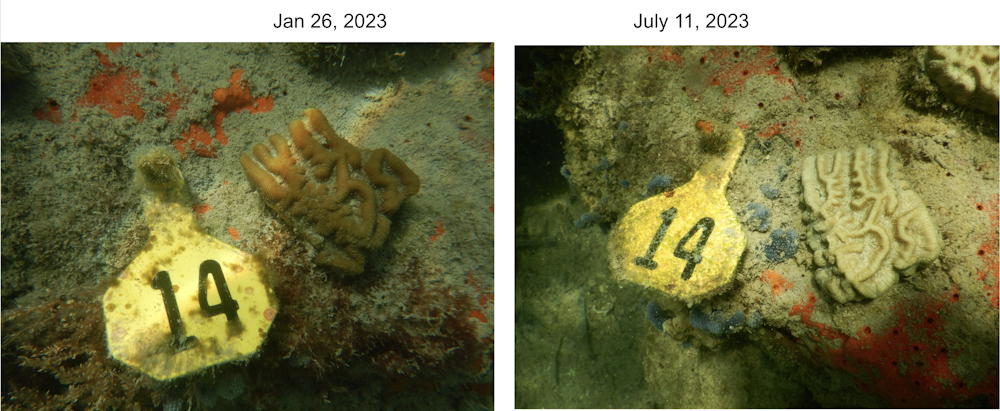
Two photos shows a coral on two different dates, one healthy and reddish in color, the other white.

A transplanted coral in the Port of Miami that was healthy in early 2023 had bleached in the warm water by July 11, 2023. NOAA/University of Miami

I lead the Coral Program at the National Oceanic and Atmospheric Administration’s Atlantic Oceanographic and Meteorological Lab in Miami, Florida. Healthy coral reef ecosystems are important for humans in numerous ways. Unfortunately, marine heat waves are becoming more common and more extreme, with potentially devastating consequences for reefs around the world that are already in a fragile state.

Why coral reefs matter to everyone

Coral reefs are hot spots of biodiversity. They are often referred to as the rainforests of the sea because they are home to the highest concentrations of species in the ocean.

Healthy reefs are vibrant ecosystems that support fish and fisheries, which in turn support economies and food for millions of people. Additionally, they provide billions of dollars in economic activity every year through tourism, particularly in places like the Florida Keys, where people go to scuba dive, snorkel, fish and experience the natural beauty of coral reefs.

If that isn’t enough, reefs also protect shorelines, beaches and billions of dollars in coastal infrastructure by buffering wave energy, particularly during storms and hurricanes.

What goes into a coral reef?

But corals are quite sensitive to warming water. They host a microscopic symbiotic algae called zooxanthella that photosynthesizes just like plants, providing food to the coral. When the surrounding waters get too warm for too long, the zooxanthellae leave the coral, and the coral can turn pale or white – a process known as bleaching.

If corals stay bleached, they can become energetically compromised and ultimately die.

When corals die or their growth slows, these beautiful, complex reef habitats start disappearing and can eventually erode to sand. A recent paper by John Morris, a scientist in my lab in Florida, shows that around 70% of reefs are now net erosional in the Florida Keys, meaning they are losing more habitat than they build.

Two maps show large areas of above average heat, particularly along the equator in the Pacific, which is an indicator of El Nino, and in much of the Atlantic.

About 40% of the global ocean was experiencing a marine heat wave in July 2023. NOAA’s experimental forecasts for August and October show sea surface temperatures well above average in many regions. An increase of 1 degree Celsius = 1.8 degrees Fahrenheit. NOAA PSL

Unfortunately, these critical coral reef habitats are in decline around the world because of extreme bleaching events, disease and numerous other human-caused stressors. In the Florida Keys, coral cover has decline by about 90% over the past several decades.

Coral bleaching in 2023

In the Port of Miami, where we have found particularly resilient coral communities, a doctoral candidate in my lab, Allyson DeMerlis, documented the first coral bleaching of her experimentally outplanted corals on July 11, 2023.

Other scientists we work with have reported coral bleaching off of Colombia, El Salvador, Costa Rica and Mexico in the eastern Pacific, as well as along the Caribbean coasts of Panama, Mexico and Belize.

We have yet to see widespread coral death associated with this particular marine heat wave, so it is possible the corals could recover if sea surface temperatures cool down soon. However, global sea surface temperatures are at record highs, and large parts of the Atlantic and eastern Pacific are under bleaching alerts. At this point, the evidence points to the potential for a very negative outcome.

A chart of every year's global daily average sea surface temperature shows 2023 far above all other years since satellite records started in 1981.

Sea surface temperatures have been off the charts. The thick black line is 2023. The orange line is 2022. The 1982-2011 average is the middle dashed line. ClimateReanalyzer.org/NOAA OISST v2.1

El Niño is contributing to the problem this year, but the longer-term trends of rising ocean heat are driven by global warming fueled by human activities.

To put that into context, a paper by NOAA scientist Derek Manzello showed that in the Florida Keys, the number of days per year in which water temperatures were higher than 90 F (32 C) had increased by more than 2,500% in the two decades following the mid-1990s relative to the prior 20 years. That is a remarkable increase in the number of days that corals are experiencing particularly stressful warm water.

What can we do to protect corals?

First, we cannot give up on corals.

Alice Webb, a coral reef scientist working with our group, recently published a study based on years of our research in the Florida Keys. She modeled reef habitat persistence under climate, restoration and adaptation scenarios and found that protecting reefs is going to take everything – active restoration of reefs, helping corals acclimate or adapt to changing temperatures, and, importantly, human curbing of greenhouse gas emissions.

A map shows warm ocean temperatures across a large part of the Atlantic and Pacific around North America.

Sea surface temperatures off South Florida were abnormally high in mid-July 2023. Coral Reef Watch/NOAA

Major restoration efforts are underway in the Florida Keys as part of the NOAA-led Mission Iconic Reefs. We are also assessing how different coral individuals perform under stress, hoping to identify those that are particularly stress-tolerant by combing through the massive amounts of data from restoration projects and coral nurseries.

We are also evaluating stress-hardening techniques. For example, in tide pools, corals are exposed to large swings in temperature over short periods, making them more resilient to subsequent thermal stress events. We are exploring whether it’s possible to replicate that natural process in the lab, before corals are planted onto reefs, to better prepare them for stressful summers in the wild.

Coral bleaching on a large scale has really been documented only since the early 1980s. When I talk to people who have been fishing and diving in the Florida Keys since before I was born, they have amazing stories of how vibrant the reefs used to be. They know firsthand how bad things have become because they have lived it.

There isn’t currently a single silver-bullet solution, but ignoring the harm being done is not an option. There is simply too much at stake.

Ian Enochs, Research Ecologist, National Oceanic and Atmospheric Administration

This article is republished from The Conversation under a Creative Commons license. Read the original article.

Legal expert: Trump may be “overplaying his hand” — and it may get Judge Cannon “taken off the case”

Former President Donald Trump’s attorneys are set to appear in court before Trump-appointed Judge Aileen Cannon in the Mar-a-Lago documents case on Tuesday, putting her in the spotlight after a series of pro-Trump rulings that were wiped out by an appeals court earlier in the investigation.

Cannon, who blocked the Justice Department from reviewing classified documents seized in last year’s FBI search of Mar-a-Lago before her ruling was overturned, will preside over a pretrial conference to discuss the procedures for handling classified information in the case. The arguments come as Trump pushes to delay the trial indefinitely, citing his presidential campaign, which the special counsel Jack Smith’s strongly pushed back on last week.

Cannon is expected to face additional scrutiny after her earlier rulings drew criticism from legal experts that she was overly favoring the former president.

“She is not going to want to do anything but go by the book. The challenge is there has never been a book like this,” former U.S. Attorney Kendall Coffey, who served on the advisory committee that reviewed Cannon’s judicial application, told the Associated Press. Whatever happens, he added, “the eyes of the world are on her. She is in the middle of writing a chapter in history.”

Her ruling last September blocking parts of the documents probe and appointing a short-lived special master to review the materials was thrown out by the 11th Circuit Court of Appeals, which called her order a “radical reordering of our caselaw limiting the federal courts’ involvement in criminal investigations.”

Tuesday’s conference is focused on the Classified Information Procedures Act, a law that governs how classified information is handled in criminal prosecution. It is intended to give a defendant access to key evidence while preventing potential leaks of classified information.

Trump’s lawyers and prosecutors are also locked in a battle over the schedule of the trial. The DOJ requested a December trial start date before Trump asked to push it back indefinitely.

Dave Aronberg, the Florida state attorney for Palm Beach County, told CNN that Trump’s attempt to delay the trial may have backfired.

“Jack Smith is now a pit bull, so he should have been careful what he asked for,” he said. “But now he’s saying the quiet part out loud. He’s saying, ‘don’t even try me until after the election,’ when he thinks he’ll be president and then can order his Department of Justice to get rid of the whole thing.”

Despite the pushback, Aronberg acknowledged that it would be “hard to try this case before the 2024 election” given the complicated matters surrounding the classified information.

The difference, he said, “is that Donald Trump is just saying, ‘give me the whole enchilada, just postpone it indefinitely.’ Whereas I think Judge Cannon is more likely to give him bits and pieces, delay here, delay there, and then you turn around, and it’s already past the election. Essentially, it’s death by a thousand paper cuts. But Trump may be overplaying his hand by asking Judge Cannon to go ahead and delay this thing indefinitely. I don’t think he’ll get that. If Judge Cannon grants that, I think she’ll be reversed by the 11th Circuit and possibly even taken off the case.”


Want a daily wrap-up of all the news and commentary Salon has to offer? Subscribe to our morning newsletter, Crash Course.


Some legal experts have downplayed the idea that Cannon could be taken off the case but former federal prosecutor Andrew Weissmann, who served on special counsel Bob Mueller’s team, predicted that Smith may wait for her first “erroneous ruling” given “that she’s had two decisions reversed in scathing opinions by a conservative 11th Circuit Court, including, by the way, judges appointed by Donald Trump.”

“They could wait for her to make another misstep, appeal that and in that appeal ask it be reassigned to a different judge,” he told MSNBC last month. “That’s a route that, while it’s not common, does occur. That would be the third time that she was reversed, not just in any case, but in this very investigation.”

While Trump has repeatedly lashed out at judges overseeing his other legal matters, he heaped praise on Cannon on Sunday.

“I know it’s a very highly respected judge. A very smart judge, and a very strong judge,” Trump told Fox News, adding that he was “very proud to have appointed her.”

“But she’s very smart and very strong, and loves our country,” he added. “We need judges that love our country so they do the right thing.”

The EPA’s plan to eliminate lead in buildings is a ‘gigantic leap forward’ for public health

The Environmental Protection Agency is proposing strict standards on lead paint that would prompt the removal of lead in millions of buildings, including homes, schools, and daycare centers. The move was set in motion by a lawsuit from environmental groups alleging that the EPA’s lead standards were too lax to protect public health.

Even after decades of efforts to reduce lead exposure from gasoline, pipes, and paint, half of children in the U.S. have detectable traces of lead in their blood, according to a study in 2021 that tested more than 1 million kids under the age of 6. Those who live in low-income neighborhoods and in older homes are at the highest risk.

“We know that no level of exposure to lead is good for our children. Zero,” said Janet McCabe, the EPA’s deputy administrator, at an announcement of the proposal in Newark, New Jersey, on Wednesday. The metal has been found to damage children’s brains, slow their growth, and cause developmental and behavioral problems, according to the Centers for Disease Control and Prevention.

While the United States banned lead paint nearly half a century ago, the rules didn’t require removing the toxic substance from existing buildings. An estimated 31 million houses built before the 1978 ban still have lead paint, and nearly 4 million of those homes are occupied by families with children younger than 6. The EPA’s new rule would virtually prohibit lead dust, reducing exposure for between 250,000 and 500,000 children under the age of 6.

Any sign of lead in a home or childcare center would classify it as a lead hazard. That would in turn trigger disclosures — say, to the families of kids attending the daycare or to prospective home buyers — and potentially require that the lead source be removed. The only exception is for contamination that existing cleanup methods can’t get rid of.

The plan was decades in the making. In 1992, after scientists found lead exposure was widespread among children, Congress passed a law requiring the EPA to establish the first hazard standard for lead in dust. But the agency was slow to create the standard, waiting until 2001 to do so, and it failed to tighten the rules when scientific evidence showed that lead was a health hazard even at the smallest levels of exposure.

Court battles ended up forcing the agency to revisit its lead standards — twice. The most recent lawsuit, filed 2019 by the Sierra Club, Earthjustice, and other public health and environmental groups, alleged that the EPA’s revised standards were still insufficient. In 2021, the U.S. 9th Circuit Court of Appeals ordered the EPA to set its standards based on health effects, as opposed to factors like feasibility and testing capabilities — a decision that prompted the EPA’s new proposed rule. Before an EPA regulation becomes final, it has to move through a public comment period.

Environmental groups applauded the EPA’s new, stricter proposal but admonished the agency for decades of delay. “Today’s proposal, which finally acknowledges that any exposure to lead at any level is a hazard, is a gigantic leap forward in this country’s long-delayed efforts to eliminate, or at least significantly reduce, lead exposures,” said Eve Gartner, the director of Earthjustice’s Crosscutting Toxics Strategies program, at the EPA’s announcement on Wednesday.

Removing lead from buildings won’t necessarily erase the threat entirely. For example, a recent investigation from the Wall Street Journal unearthed a hidden source of lead contamination in the environment: a countrywide network of lead-coated cables laid by telecom giants such as AT&T and Verizon that have gone unnoticed by regulators. It’s another sign that removing lead, with its once-ubiquitous use in the country’s construction, remains a daunting task.

This article originally appeared in Grist at https://grist.org/health/epa-rule-eliminate-lead-paint-buildings-homes/.

Grist is a nonprofit, independent media organization dedicated to telling stories of climate solutions and a just future. Learn more at Grist.org


Billionaires aren’t okay — for their mental health, time to drastically raise their taxes

The psyche of mainstream America is slowly starting to grasp what grumpy leftists have long argued: Extreme wealth does a number on people’s grasp on reality.

For decades, the dominant narrative about the rich, especially the billionaire class, was that they really are better than us: Smarter, more talented, and, in the case of tech billionaires, equipped with prognostication powers so profound they are indistinguishable from magic. Medieval people had the “divine right of kings.” Modern people have the “must be brilliant to be that rich” fallacy. As I wrote late last year, it does seem lately, however, the idea that money equals merit has finally started to falter in the public imagination. The myth of the superior intelligence of rich people has taken a beating from the repeated public stupidity of people like Tesla CEO Elon Musk or illiterate reality TV host Donald Trump. Even Microsoft founder Bill Gates, who coasted as one of the “good ones,” took a public faceplant by blowing up his marriage as idiotically as possible. 

Having established that money doesn’t equal brains was just the first step, though. Now another question is starting to arise in the public discourse around those who have impossibly huge bank accounts: Does having too much money damage a person’s mental health? 


Want more Amanda Marcotte on politics? Subscribe to her newsletter Standing Room Only.


Our billionaires are not okay. The most obvious example, of course, is Musk, who is having a midlife crisis so unhinged that it would be upsetting if he weren’t such a terrible person. He purchased Twitter for $44 billion last year, out of nothing more than a fit of pique over the company’s efforts to keep the social media app from being too overrun by Nazis. As the company swirls down the toilet under his watch, his public behavior gets ever more erratic. The threat from Threads, a Meta-owned competitor that launched earlier this month, caused Musk, age 52, to react with a level of immaturity that would be cause for alarm in a junior high school kid. He challenged Meta CEO Mark Zuckerberg to a “cage match.” And then again to a “literal dick measuring contest.” He keeps throwing schoolboy insults at Zuckerberg.

Too much money is not good for you.

Zuckerberg, age 39, comes across better, but only by comparison to Musk. By normal people’s standards, however, he’s behaving strangely. He has supposedly accepted the cage match invitation and is posting taunting photos from his martial arts training. 

That’s just the most prominent of a steady stream of “rich people are nuts” stories. The Titanic tourism sub, which charged $250,000 a seat only to implode as actual experts warned it would, fascinated the public for just this reason. Similarly, the internet fixated earlier this month on a story about Warner Bros CEO David Zaslav getting a story pulled from GQ for being critical of his management skills. He’s worth over $200 million but is so snowflake-sensitive he can’t brush such a story off. There is, of course, the drumbeat of stories about Trump behaving on social media as if he’s in the midst of an extended nervous breakdown. 

And then there’s the number of too-rich people rallying around Robert F. Kennedy Jr., the anti-vaccine activist with a ‘roid-suggestive physique who is “running” for the Democratic nomination at the behest of some of the nastiest fascists in the country. As soon as Democratic voters learn that Kennedy is an alt-right conspiracy theorist and not a liberal lion like his forebears, they stop supporting him. But even though he thinks cell phones are mind controlling us and wifi causes “leaky brain,” Kennedy has been championed by the supposed best-and-brightest of Silicon Valley, such as Musk and Twitter founder Jack Dorsey. 

Paul Krugman of the New York Times argues that their money and privilege are rotting their brains: 

It may seem odd to see men of vast wealth and influence buying into conspiracy theories about elites running the world. Aren’t they the elites? But I suspect that famous, wealthy men may be especially frustrated by their inability to control events, or even stop people from ridiculing them on the internet. So rather than accepting that the world is a complicated place nobody can control, they’re susceptible to the idea that there are secret cabals out to get them.

“It’s impossible to overstate the degree to which many big tech CEOs and venture capitalists are being radicalized by living within their own cultural and social bubble,” tech writer Anil Dash wrote in a recent newsletter. “Their level of paranoia and contrived self-victimization is off the charts, and is getting worse now that they increasingly only consume media that they have funded, created by their own acolytes.”

As a friend texted me when I shared the Krugman piece, we shouldn’t let women off the hook. Hollywood elites like Oprah Winfrey and Gwenyth Paltrow have also been massive purveyors of magical thinking, selling their gullible audiences woo-woo ideas like “The Secret” and even falsely telling people a “teaspoon” is enough sunscreen.

Too much money is not good for you. It means being surrounded by “yes” men and having your every bad idea validated. If that sort of thing goes on long enough, a person gets completely detached from reality. They can become unable to handle even the slightest cognitive dissonance, leading them to flip out dramatically at being criticized, even if, objectively speaking, there is no damage the criticism can do. 

The good news is that we already know how to save the hyper-wealthy from themselves: Tax them until their nest eggs make them merely rich. Sure, proposing this causes the rich, who are notoriously unable to handle even minor adversity, to flip out like you’re trying to render them homeless. But in the long run, it’s not just better for society if a handful of people are unable to hoard all the wealth. It’s better for the rich, as well. Just as your muscle system needs to be worked in order to stay strong, the brain needs to be challenged in order to stay healthy and sharp. The bubble of privilege around the excessively wealthy softens their brains. Less money, and more engagement with the real world, is the cure for what ails them. 

Look, for instance, at what’s happened to Ye, who used to go by his given name, Kanye West. Last year, the rapper and fashion designer was worth an estimated $2 billion. He was also, famously, losing his mind in a horrifically public way. He lost his marriage, lost his friends, and eventually, lost even basic common sense. Instead, he was hanging out with Trump at Mar-a-Lago, being exploited by greedy alt-right grifters, and raving on Infowars about how Hitler was just misunderstood. As a result, he lost his corporate partnerships, dropping his net worth by over $1.5 billion. He’s still incredibly rich, but not in a “listed in Forbes” kind of way. He’s also been a hell of a lot quieter in recent months, mostly sticking his head up briefly to apologize for his anti-semitic comments of the past. Whether or not the dramatic decline in wealth is a reason for such a turnaround is between Ye and his psychiatrist. But it definitely doesn’t seem to have hurt. 

Just one example, of course, but an intriguing one. The good news is there is nothing but upside to trying the “tax the rich” strategy. Even if it falls short when it comes to improving the morale and mental health of the wealthiest Americans, it still means reducing other negative effects of wealth inequality, incentivizing reinvestment instead of money-hoarding and, of course, funding government programs that could help everyday Americans. The worst that could happen is people like Musk have less money to invest in harebrained schemes like “ChatGPT, but more racist.” With so much to gain and nothing to lose, it’s time to tax billionaires until they are billionaires no longer. 

How the Supreme Court’s overturning of affirmative action could lead to the end of legacy admissions

In a much-dreaded outcome, the right-wing justices on the Supreme Court have finally decided to end the use of race-conscious affirmative action programs in college and university admissions. Not surprisingly, the same right-wing justices who were so outraged at race-conscious affirmative action showed little concern or similar contempt for donor and legacy admission programs which are a de facto way for unqualified and underqualified white students to buy or otherwise sneak their way into the country’s most prestigious institutions of higher learning.

The Lawyers for Civil Rights (LCR) is now pushing back against the Supreme Court’s decision to end affirmative action by filing a federal civil rights complaint against Harvard College “challenging its discriminatory practice of giving preferential treatment in the admissions process to applicants with familial ties to wealthy donors and alumni.” Per the law, Harvard will have to end legacy and donor preferences if it wants to continue to receive federal monies.

In an attempt to gain a better understanding of the Supreme Court’s decision against affirmative action and what comes next, I recently spoke with Oren Sellstrom, the litigation director of Lawyers for Civil Rights. Sellstrom oversees the organization’s litigation and advocacy work in all areas including education, economic justice, employment, police accountability, immigrants’ rights and voting rights.

In this wide-ranging conversation, Sellstrom details the basis of the LCR’s case against Harvard and how the recent Supreme Court decision(s) is part of a much larger right-wing backlash against the civil rights movement and racial progress that uses “original intent” to justify partisan right-wing outcomes that are contrary to the Constitution and the facts.

This interview has been lightly edited

What was your reaction to the recent series of Supreme Court decisions, especially the one against race-conscious affirmative action programs in college and university admissions?

Obviously, we were disappointed in a number of the Supreme Court’s rulings this term. But at the same time, the outcomes were not entirely unexpected. And there are important openings in the affirmative action decisions which will allow colleges to continue considering how race affects an individual applicant’s life. That means that the decisions are not going to be the last word. So we can be disappointed for a moment, but then, in this line of work, the job is always to look ahead and say, where does this take us next? How can we best represent our client communities, to take what the Supreme Court has said and move forward?

The right-wing justices’ decision to end affirmative action programs is part of a much larger agenda of retrenchment and white backlash against the gains of the civil rights movement and larger Black and Brown Freedom Struggle. Trumpism is central to this white backlash. Their next target is to end scholarships and other programs that are intended to improve access and opportunities for nonwhite students and members of other marginalized communities. Given that, how are balancing your hope and realism? This is all so very depressing and exhausting.

That is the key question for anyone in the civil rights struggle or any kind of social justice movement. On the one hand, we have to face reality.  But at the same time, we need a certain degree of optimism to continue pressing forward. At Lawyers for Civil Rights, that is our approach. Our clients depend on us to think strategically, and to be nimble and creative in advancing the law.  The struggle is ongoing, and giving up is not an option.

Language matters. We must define our terms. What is the reality of affirmative action vs how it has been distorted and misrepresented by the right-wing and other such actors?

Affirmative action is a very modest tool that schools and universities — and government and employers in some circumstances as well — have used to try and level the playing field. In the admissions context, race has been one of many factors that schools consider as they seek to assemble a diverse student body. That process has often been mischaracterized and caricatured by those on the right, in ways that are designed to sway the public against diversity efforts.

“Through the evidence that came out in that case, we know that the children of wealthy donors are given preferential treatment throughout the admissions process.”

In that sense, affirmative action has never been well-defined or well understood in practice. The right wing has used that misunderstanding and ignorance to turn affirmative action into a wedge issue. But at base, affirmative action and other diversity initiatives are just based on a recognition that we are stronger when everyone is valued and lifted up.

How do you conceptualize the relationship between the law and positive social and political change work?

The law is one tool in a broader social justice movement. The law by itself is not the solution; it is part of an ongoing struggle to create more fairness and equity in society. In fact, the law is often a lagging indicator, one step behind where social movements have already advanced on the ground. But lawsuits can certainly elevate issues in the public consciousness, which is critical for creating positive change. And Court orders and other favorable legal outcomes help propel movements forward.

America is in a struggle over the basic meaning of democracy and freedom. Central to this struggle are competing and often divergent understandings of “fairness” and “equity”. What do those concepts mean to you?

At Lawyers for Civil Rights, our conception of “fairness” and “equity” runs deep. We envision a world free of racism, with justice, dignity, and lived equality for all. One of the most frustrating aspects about the affirmative action debate has been seeing this very modest tool held up as a paragon of inequity — when in fact the true inequity lies in all of the preferences and manifestations of white privilege in American society.


Want a daily wrap-up of all the news and commentary Salon has to offer? Subscribe to our morning newsletter, Crash Course.


White privilege is so baked into the country’s institutions that many people don’t even recognize it until we force it to be obvious. Those racial inequities impact communities of color — and especially Black and Latino communities — in profoundly unfair ways. Any vision of “equity” has to start with rooting out those practices.

As a human being, how does it feel to argue a case, as we have seen repeatedly with this Supreme Court, where the “conservative” justices have already made up their minds based on ideology and not the law and/or facts? How do you navigate a situation where defeat seems inevitable?

As an advocate, you are always looking for the openings that exist. There are times when the fight feels like a losing battle. But even then, the key is to look for windows of opportunity. Often we are creating possibilities and openings for justice far off in the future. We advance in incremental steps that lead to greater and more profound changes down the road, through the law or through the political process. At this moment, we often find ourselves up against a right-wing judiciary that is not always receptive to civil rights claims. Yet by presenting the best legal argument and humanizing the issues we can often reach a positive outcome. Now that may not happen immediately, but progress is made step by step.

How does this Supreme Court see issues of racial justice?

There are diametrically opposed conceptions of racial justice represented on today’s Supreme Court. The concurring opinion by Justice Thomas in the recent affirmative action cases versus the dissenting opinion by Justice Jackson are like reading two different languages and descriptions of reality. Justice Thomas essentially adopts what he would call a colorblind view. Meanwhile, Justice Jackson demonstrates quite eloquently, both at oral argument and in her dissent, how ludicrous it is to talk about America as being a colorblind country. She describes the panoply of ways that race continues to matter, both for our country as a whole and for individuals.

What legal tradition do the right-wing justices represent and adhere to? What is their theory of the law and society?

Many of the conservative justices adhere — or at least purport to adhere — to what they describe as an “originalist” jurisprudence, which means looking to when the Constitution or its amendments were enacted in order to understand the meaning of the law. What many of the more liberal justices have done quite effectively over the past several years is to point out how that “originalism” is very selective on the part of the conservative justices. Justice Sotomayor, for example, has made the point that you cannot adopt an originalist viewpoint of the 14th Amendment and say that it is colorblind. Such a claim is historically inaccurate and factually incorrect. It ignores laws like the Freedmen’s Bureau Act, enacted at the same time as the 14th Amendment in an intentionally race-conscious way.

The so-called originalist viewpoint that abandons facts and history when it is convenient ultimately starts to look less like a consistent jurisprudence and more like just a partisan political opinion.

The right-wing justices who ruled against affirmative action claim to be concerned about merit and fairness. Yet, they do not appear to care too much, if at all, about donors or legacy admissions which by their very nature are contrary to those principles. How do they rationalize that obvious double standard? Or are they just intellectually dishonest partisan actors and there is no need for rationalization on their part?

All of the other forms of preferential treatment that go overwhelmingly to white applicants, while not directly part of the affirmative action cases, were very much at play in those cases. Justices on both sides of the spectrum pointed that out. Justice Gorsuch, who is traditionally seen as part of the conservative bloc, raised the issue of unfair legacy preferences in his concurring opinion, and of course, the dissenting justices did as well. As civil rights advocates, that presents a window of opportunity to move the conversation forward, by focusing on the inherent unfairness of continuing to allow legacy and donor admissions that overwhelmingly advantage white applicants.

We also have lots of public opinion data that shows widespread public disapproval of donor and legacy preferences. The size of your bank account and your family’s last name have nothing to do with merit. Yet, the same people who go after race-conscious affirmative action programs with such fervor do not seem to have the same level of concern about real injustices like donor and legacy special admissions. Why not?  Partly it’s hypocrisy and bias.  And there is also politics at work. 

Politicians have long used race as a wedge issue, often very effectively, to stoke fear and resentment. Attacks on affirmative action, attacks on voting rights, and so forth, can all be seen as part of that unfortunate reality.

Your organization has now filed a complaint against Harvard University for its policy of privileging legacies and the family members of donors in its admissions process. Can you elaborate?

The Supreme Court did not do away with all preferential treatment in its recent decisions against affirmative action. What it did is to curtail programs that don’t benefit white people. The much more substantial and deep-seeded systems that overwhelmingly benefit white students continue to exist. The public needs to be made aware of that unfairness. Our complaint against Harvard is designed to elevate that issue in the public consciousness.

What do we know about Harvard’s policies in this regard?

Much of this evidence comes from the recent case about affirmative action at Harvard that made its way up to the Supreme Court. Through the evidence that came out in that case, we know that the children of wealthy donors are given preferential treatment throughout the admissions process. This does not just happen once; it happens at multiple points. They are flagged at the beginning of the process. They’re flagged again at the interview stage, and are much more likely to receive interviews from admissions officers.

When final decisions are made, children of donors and legacies are flagged again. As a result of all that preferential treatment, being a donor-related applicant or being a legacy applicant increases the chance of admission by an order of six to seven times.

We also know that nearly 70% of the students who get donor and legacy preferences are white. If those preferences were removed from Harvard’s admission process, there would be significantly more black students admitted and significantly more Latino students admitted and significantly more Asian American students admitted. All of that evidence is quite clear from the Harvard case. It is also very consistent with studies that have been done of other colleges and universities that use donor preferences and legacy preferences.

How does this play into notions of “merit”?

The size of your bank account, or the fact that you share a last name with the science building, has nothing to do with your individual merit. If merit is to be the basis of how students are admitted to colleges and universities, then the use of donor preferences and legacy preferences is indefensible. That leads to a much wider discussion of how we measure merit more generally. For example, is merit to be determined just by how a person happens to perform on a standardized test on a particular day? Or should we be looking at the range of lived experiences that people bring to the table? What about a prospective student’s potential? Those are all factors that traditional affirmative action programs have looked at with the goal of assembling a class of highly qualified students who can learn from each other in a diverse environment.

What is the legal basis for your complaint?

In our complaint against Harvard for donor and legacy preferences, we do not need to prove that Harvard is intentionally attempting to reward white applicants and harm applicants of color. It’s enough to show that there is a racially disparate impact that has no legitimate justification. Federal law says that if you receive federal funding, and you have a process in place that systematically harms communities of color, and you cannot justify that outcome, then that process cannot be allowed to continue. Or, if you want to continue that discriminatory practice, you have to give up federal funding. Federal antidiscrimination law is quite clear on these questions.

In terms of framing these questions of access and opportunity at America’s colleges and universities — and across society — how do we balance questions of race and class? For example, in the case of the donor and legacy admissions, is it a more powerful frame to emphasize that those policies hurt working class and poor people — and middle-class people too — on both sides of the color line — or should be emphasize the specific way such policies are de facto tools for maintaining white privilege and other forms of unearned white advantage?

It’s important to do both, and to recognize that socioeconomics and race are often intertwined. On the other hand, we should not mistake one for the other. There are many people over the years who have said that affirmative action should be replaced by programs that emphasize socioeconomic diversity. Certainly, socioeconomic diversity is important. But at the same time, it’s different from racial diversity. To focus on socioeconomic diversity as a substitute for confronting the country’s deep legacy of racial inequality would be a mistake.

“Let’s remind them who’s actually the boss”: AOC stands with Teamsters as historic UPS strike looms

With hundreds of thousands of UPS workers preparing to strike as soon as August 1, Rep. Alexandria Ocasio-Cortez joined other New York lawmakers at a rally with members of the Teamsters union on Saturday to push the ultra-profitable shipping giant to agree to a just contract.

“This is about making sure that we not just demand better wages, equal wages for our part-timers, making sure that we’re getting the dignified conditions, A/C in trucks. But this is also about demanding respect,” Ocasio-Cortez (D-N.Y.) said during the rally at Teamsters Local 282 union hall in New Hyde Park.

“This shouldn’t even be a fight,” Ocasio-Cortez added, noting that UPS raked in record profits last year and could easily afford to meet the union’s demands.

UPS CEO Carol Tomé, a donor to anti-union Republicans, took home close to $19 million in total compensation in 2022.

“Let’s remind them who’s actually the boss in this, and that’s the workers,” said Ocasio-Cortez.

Saturday’s rally came days after negotiations between UPS management and Teamsters leaders fell apart for the second time in recent weeks, with the Teamsters accusing the company of presenting an “unacceptable offer” that “did not address members’ needs.”

UPS has since announced that it will be training nonunion delivery drivers in preparation for a strike. If the work stoppage moves forward, it would mark the largest single-employer strike in U.S. history.

Last month, 97% of UPS workers represented by the Teamsters voted to authorize a strike if there’s no acceptable deal with management by July 31, when the current contract expires.

The Teamsters have won significant tentative victories in recent negotiations, including an agreement from UPS to add in-cab air conditioning systems to newly purchased delivery vehicles and end the two-tiered wage system under which part-time workers earn significantly less per hour than full-time employees.

But the union said earlier this month that the company’s contract offers haven’t gone far enough to justly compensate employees, a message that Teamsters leaders echoed during Saturday’s rally.

“Our members bust their ass every day for this greedy company, keeping supply chains moving and generating historic, multibillion-dollar profits for UPS,” said Teamsters Local 804 President Vinnie Perrone. “Those record profits are unpaid wages. UPS Teamsters are done with the company’s disrespect.”

Sean O’Brien, general president of the Teamsters, said Saturday that the union “will take on this corporate bully for as long as it takes to get what we’ve earned.”

“UPS has a choice,” said O’Brien. “They can respect and do right by working people, they can pay the wages that part-time and full-time workers deserve, and they can agree to terms on a strong new contract. Or UPS can wait until August 1 and regret turning its back on the hardworking people who make it a success. We are not backing down.”

“MAGA’s MVP”: Marjorie Taylor Greene sits on a throne in pro-Trump rap video

Rep. Marjorie Taylor Greene, R-Ga. is “doing the most,” as the kids would say. On Sunday, a new music video from pro-Trump Florida rapper, Forgiato Blow, AKA Mayor of Magaville, circulated online that features Greene sitting on a variety of things while be rapped about. She sits on a throne. She sits on a fancy red car. She even stands for a bit while grinning, smirking and muttering things. “It was a blast filming this video and I’m proud of @ForgiatoBlow47‘s support of my Protect Children’s Innocence Act,” Greene said in a share of the video to Twitter. “Most rap videos exploit women, glorify drugs and violence, but Forgiato Blow’s new video is about calling out the left’s grooming agenda and protecting our children from genital mutilation,” she furthered in a quote obtained from Newsweek

“Search MTG On iTunes Let’s Make The Liberals Cry With Another #1 Song,” tweeted Blow in his own share of the video. Earlier this month, the artist topped Billboard’s hip-hop charts with his song, “Boycott Target,” which he recorded with fellow pro-Trump rapper Jimmy Levy in response to the retailer’s Pride Month collection.


“And Just Like That” the sex is back in the city, midlife edition

“It’s a lot like what people used to say about dating in Alaska: the odds are good, but the goods are odd. Except erase the first part.” This is how a single friend described the challenges women in their 50s face in the modern dating scene. Never mind the horrendousness that apps and websites bring to the bedroom. Provided two people can find each other at all, there’s the matter of navigating the other person’s entrenched views about sex, politics, money, hygiene . . . everything.

This makes finding a genuine connection with another person vastly more difficult in what Sarita Choudhury’s Seema Patel describes as a woman’s “sophomore years” in “And Just Like That.”

“Dating at this age – there’s always something,” she explains to Carrie (Sarah Jessica Parker) as she breaks down her latest one-night stand in the second season’s fifth episode “Trick or Treat.” Her guy’s “something”? He uses a penis pump to deal with his erectile dysfunction – the bizarre intermission dividing 30 minutes of “great foreplay” and B+ sex.

“With most of these I have to get myself off anyway at the end,” she says. “And at least with him, I had some laughs. And a sexy spoon after.”

Thanks to Seema, “Trick or Treat” is the first “And Just Like That” episode that feels like a classic “Sex and the City” story, where the home team dives into the wilds of Manhattan to snare some stranger.

In “SATC” most of these encounters were disastrous, giving Carrie fresh fodder for her weekly column.  There was the guy who licked Charlotte (Kristin Davis) on the cheek instead of kissing her goodnight at the end of the date. The man who picked up Miranda (Cynthia Nixon) by fake mourning his dead wife to seem vulnerable. And, pretty much everyone Samantha (Kim Cattrall) bumped uglies with before Smith Jerrod.

Carrie’s wonderland of whoa and woe was equally impressive ranging from the politician who wanted her to pee on him to the French architect to leaves money on her nightstand after sex.

At long last, the sex came back to the city.

The romance game can’t always be swings and misses or else the show would have been depressing. Each of the quartet eventually found nice guys to stick with, but with a few exceptions like Harry (Evan Handler) even these solid “goods” soured, establishing the show’s Bad Boyfriend trope. The king of those may be Berger, the writer who authored a breakup note for the ages on a Post-It: “I’m sorry. I can’t. Don’t hate me.” But Big and Steve (David Eigenberg) qualify too. Never forget: Steve cheated on Miranda before she stepped out on him.

“And Just Like That” signals that its relationship energy is moving into another borough early in the series by offing Big, spending most of the first season with Carrie’s mourning process. This set her up to be single again while also retraining our focus on the commodity Charlotte and Miranda pursued, and the condition to which Carrie eventually succumbed: married life.

And Just Like ThatNicole Ari Parker and Christopher Jackson in “And Just Like That” (Craig Blankenhorn/Max)

Depicting not one, but two good marriages refreshes the version of fantasy “And Just Like That” is peddling. Not only do Charlotte and Harry epitomize the ideal couple – one that has not only survived raising teenagers but where the spouses still hunger for each other – but so does the union shared by Herbert (Chris Jackson) and Lisa Todd Wexley (Nicole Ari Parker).

Both duos are wealthy, but the Wexleys are politically and socially connected. They’re also imperfect. In a recent episode the pair plan a lavish anniversary dinner at a restaurant where they’ve expected 31 guests but end up hosting a fraction of that because Herbert forgot to hit send on the electronic invitations. LTW can’t help forgiving him since she realizes she forgot to order their special dessert.

Currently LTW and Herbert are figuring out how to be a political couple, but until they hit those bumps, they make a wonderful pair – as marvelous as the Goldenblatts, who endure their oopsie of a feast with them.

We need your help to stay independent

But their relative bliss serves as a contrast to the deflated love lives of Miranda and her assigned non-white friend Nya (Karen Pittman), whose marriages have sunk. Miranda punched a hole in the hull of hers first, though; Nya realizes something is off in Season 1 before leaping off the ship in the second season.

So it’s Seema to the rescue, in “Trick or Treat” and with “And Just Like That” generally. Seema is a major facilitator in helping Carrie to reconnect her electricity as she processes her grief by empowering her not to apologize for it.

Her refusal to compromise is how Choudhury and the series’ writer quickly allayed the audience’s fear that she was supposed to be Samantha’s replacement. This episode establishes them as spiritual sisters while demarcating how they differ. Seema gets off on success and control above all else. She’s also sexually liberated but has stringent standards. Usually.

In “Trick or Treat” she leads Carrie and the newly separated Nya to a five-star hotel bar to get laid, explaining the logic behind hitting this hunting ground: “Super-expensive rooms, so you know he has coin, and deadbeats aren’t allowed to wander in off the street.”

And that, at long last, is how the sex came back to the city.

And Just Like ThatPeter Hermann and Sarah Jessica Parker in “And Just Like That” (Craig Blankenhorn/Max)

Times have changed, and so have these women. On “SATC” the worst men playact at adulting and try to exploit stereotypically gendered vulnerabilities. Carrie, Miranda and Charlotte, especially, sorted their fair share of men who wanted mommies or living sex dolls, for example.

As the second season progresses, the corners where the show’s improvements are most discernible are in its vision of midlife relationships and prioritizing pleasure.

But the encounters in “Trick or Treat” prove the conventional assumption that the older we get, the more set in our ways we become. Carrie, having eased back into the single life via an interlude of no-strings-attached sex with her former producer Franklyn (Ivan Hernandez), falls into her next thing by way of a bike accident.  

Her meet-cute crash with app designer/tech entrepreneur George Campbell (Peter Hermann) leads to them getting to know each other at urgent care. She follows up with a food delivery that leads to flirting and, maybe, something hotter than soup. But the thrill is iced down by constant interruptions from George’s true other half, his business partner.

Carrie arrives at this conclusion after a few dates that don’t get past heavy petting, but fellow singletons watching at home may have recognized the red flag flapping way back in the doctor’s office when he tells Carrie he’s never been married.

“When men are single at our age there’s a reason,” another wise woman recently shared with me, recalling her experiences with divorced men punishing her for their ex’s sins or man-children expecting caretaking while offering little to no reciprocation.  George is a good guy who can’t separate his work life from his love life, which got him a very expensive condo touched by investment art and little to no humanity.

Still, Carrie makes out better than Seema, whose sex partner (Daniel Cosgrove) is so disposable that she doesn’t even refer to him by his given name. To her, he’s Pump Gin guy, named for his mechanical fluffer and his job as a brand rep for a small-batch gin company who picks her up by calling her ma’am — a real lady-boner killer, except he follows that with, “I was told that’s how you address royalty.”

Cosgrove, a soap opera veteran, slathers on the cheese in this scene and in the bedroom where true to Seema’s description, he delivers an enthusiastic but unimpressive sprint to home base.

After their second encounter, she reaches for her vibrator, thinking he’d accept her technological assistant as easily as she does his. Of course he doesn’t, so Pump Gin exits the scene mad. But Seema doesn’t bother getting upset – she can get hers just fine.


Want a daily wrap-up of all the news and commentary Salon has to offer? Subscribe to our morning newsletter, Crash Course.


Overall “Sex and the City” viewers who came to “And Just Like That” expecting some version of the same thrill were disappointed at how messy the writers reintroduced these familiar characters and their dream of life in Manhattan. But as the second season progresses and the disarray begins to cohere, the corners where its improvements are most discernible are in its vision of midlife relationships and prioritizing pleasure, with Seema as a magnificent guide, and thank goodness for that.

The fact that neither she nor Carrie lands a connection lasting beyond a smash or two isn’t a tragedy or an indictment; it’s just life in the sophomore arena, whose players are done with freshman naivete. Instead of presenting settling as an option, however, their sexual adventures are about setting expectations and keeping them simple.  

To that end, Nya understands the assignment better than Carrie or even Seema – she hooks a handsome fish, and a few scenes later we watch her walk out of the hotel the morning after, smiling with satisfaction. Nya’s fling, whoever he was, is never seen again.

New episodes of “And Just Like That…” premiere Thursdays on HBO Max.


Dark matter power: James Webb telescope may have proven the existence of giant dark stars

Since 2007, astronomers have proposed the existence of a weird type of star: one powered by the heat of dark matter. In cosmology, dark matter is a difficult thing to explain because we literally don’t know what it is. We can’t see it, hence the name “dark,” but without it factored into our equations of the universe, things just don’t add up. Learning how certain so-called “dark stars” form would be a major win for better understanding our place in the cosmos. Now, the James Webb Space Telescope (JWST) may have just proven that dark stars exist.

The ancient universe was very different than it is today. Some astronomers believe that before our solar system existed — indeed, before our galaxy was formed — dark stars were abundant. According to this theory, dark stars would have been fueled by large quantities of dark matter that would generate heat. This heat in turn would prevent dark stars from turning into modern stars — the bright, burning kind fueled by nuclear fusion — and, instead, to become enormous clouds of molecular hydrogen and helium.

The first stars in the universe may have been much cooler and powered by the annihilation of dark matter

If these dark stars still exist today, they would be too cold and dark to be easily detected. Only their gamma ray, neutrino and antimatter emissions would reveal their existence, as might perhaps the presence of cold molecular hydrogen gas. A new study in the journal PNAS suggests that, thanks to the power of the James Webb Space Telescope, we may have identified three entities that might very well be lingering dark stars.

Theoretical physicist Katherine Freese, coauthor of the paper and a physics professor at both the University of Texas and Stockholm University, has been pursuing different ways to detect dark matter since her career began in the ’80s. In a 2008 paper in the journal Physical Review Letters, she and her colleagues proposed a “new phase of stellar evolution,” in which the first stars in the universe are much cooler and powered by the annihilation of dark matter.

One of the leading theories about dark matter is that it’s composed of a type of particle known as a WIMP, or Weakly Interacting Massive Particle. When two WIMPs collide, they can annihilate each other, transforming into other particles. This would generate energy that is different from the fusion process that powers modern stars (including our own), in which hydrogen atoms combine under extreme heat and pressure to form helium. However, until the James Webb telescope came along, there has been no direct evidence supporting this theory about dark stars.

“Nothing has been proven for sure by our paper,” Freese explained to Salon in an email, but it is some of the strongest evidence for dark stars to date. Back in 2007, Freese and her fellow coauthor Cosmin Ilie (then her graduate student at the University of Michigan) determined what a dark star would look like in the JWST. Once the telescope had enough data to test their theories, Freese and Ilie began sifting through the new information.

“JWST has found roughly 700 high redshift objects (i.e. from very early in the Universe),” Freese said. “Of these, one of their instruments has been able to measure spectra (i.e. the intensity at different frequencies) for 9 of them, thereby for sure proving that they are indeed from the early Universe.”

Five of those nine produced useable data, and from there the researchers studied four of them as JADES objects, which stands for the James Webb Advanced Extragalactic Survey. In the end, Freese said, they determined that “three of them are a good match to our predictions for dark stars.”

Those three objects include JADES-GS-z13-0, JADES-GS-z12-0 and JADES-GS-z11-0. The authors ruled out the possibility that their readings were somehow messed up by a low redshift contaminant, and they similarly found “smoking gun” features that their previous research had anticipated would signify the presence of dark stars. The study concludes with a bold proclamation: “The confirmation of even a single one of those objects as a Dark Star (with detailed NIRSpec spectra) would mark a new era in astronomy: the observational study of DM–powered stars.”


Want more health and science stories in your inbox? Subscribe to Salon’s weekly newsletter The Vulgar Scientist.


“The discovery of a new type of star, made of hydrogen and helium but powered by dark matter, would be a huge advance.”

“The discovery of a new type of star, made of hydrogen and helium but powered by dark matter, would be a huge advance,” Freese added, echoing the enthusiasm in her paper. “As yet it is not possible to distinguish dark stars from early galaxies; as yet both are possible explanations for the data. Better spectra in the future will enable discovery of a helium line in the data — that would be a smoking gun for dark stars.”

The research team — which included Freese, Ilie and Jillian Pauline from Colgate University —suggests that these dark stars would not be lit by nuclear fusion, but rather would be much more massive than most stars, so large they could even resemble galaxies from Earth-based telescopes. The researchers also argue that the dark stars collapse into supermassive black holes when they get older, which would explain why there are so many black holes in the universe.

This is hardly the first ancient celestial discovery that would have been made possible by the JWST. Speaking with Salon earlier this week, NASA official Dr. Michelle Thaller explained why she is particularly fond of some “splotches” that may be among the oldest known objects in the universe.

“The confirmation of even a single one of those objects as a Dark Star would mark a new era in astronomy.”

“The Big Bang was only about 13.8 billion years ago. So we’re looking back to the very, very early youngest galaxies here,” Thaller told Salon at the time. “The thing that blows my mind about these splotches is that I never thought I would be able to actually see an image of this, when I was in astronomy grad school and we were learning about what happened in the very earliest part of the universe.”

Freese also praised the JWST in her interview with Salon, making it clear that it alone was technologically advanced enough to acquire this data.

“JWST is the only telescope as yet capable of seeing far enough back in the universe to discover dark stars,” Freese told Salon, adding that other telescopic instruments currently being developed may also serve that purpose, such as Roman and EUCLID.

“As yet all we know for sure is that objects have been found in JWST that are the earliest ever to form in the universe,” Freese concluded. “We don’t know anything more about their past evolution, until we know for sure what these objects are.”

How the fight to mainstream raw milk is bringing liberals and libertarians together

Following Iowa’s decision to allow the state’s farmers up to ten animals for raw milk production starting on July 1, Mary McGonigle-Martin — who is the member of a working group that is “dedicated to the dissemination of accurate information regarding raw milk consumption” — told Food Safety News that “public health has lost the war on raw milk.” 

The publication frames the countrywide proliferation of raw milk this way, as well; over the last decade, advocates of unpasteurized milk have pushed state legislators for its legalization all across the country with an uneven effect. 

Across the western United States, customers can purchase raw milk from retailers. In Colorado, Michigan, Ohio, Tennessee, West Virginia and North Carolina, raw milk is legal through herdshare programs. Throughout much of the Midwest — as well as New York, Georgia and Vermont — farmers can sell raw milk directly to customers. 

Currently, only Rhode Island, Washington D.C., and Louisiana have laws on the books making raw milk illegal.

“A basic coalition has often been successful in beating raw milk back in legislative chambers, but bills to loosen raw milk regulation are often repeated in the next legislative session,” writes Food Safety News’ Dan Flynn. “That’s what happened in Iowa, where raw milk was kept more illegal than legal for years.”

He continued: “Iowa’s push-back in 2023 to allow up to ten animals for raw milk production is typical of how little openings are made for raw milk producers.” 

These rulings don’t come out of particularly splashy legislative sessions, but they’re worth paying attention to simply for the unique bipartisan collaboration they’ve inspired. Leading the fight to mainstream raw milk are both libertarians, who are concerned about government overreach and personal autonomy, and health-conscious liberals

Standing opposed? The FDA and work groups like McGonigle-Martin’s. 

But why does the government care about raw milk? 

According to the Centers for Disease Control and Prevention (CDC), the state of Michigan instituted the first statewide milk pasteurization requirement in 1947 after researchers found that the consumption of raw milk is linked to a “significant number of foodborne illnesses, some of which can result in serious complications and death.” The consumption and distribution of raw milk then became a public health concern. 

Per the organization, these illnesses are attributed to a variety of pathogens, including: Escherichia coli, Campylobacter jejuni, Salmonella, Listeria monocytogenes, and Brucella abortus

Then, in 1987, the Food and Drug Administration (FDA) issued its final regulation on the mandatory pasteurization of all milk or milk products — with the exception of some cheeses — for sale or distribution in interstate commerce. Anything that is labeled as “milk” that is sold in interstate commerce must be pasteurized as well under FDA guidelines. 

These rulings don’t come out of particularly splashy legislative sessions, but they’re worth paying attention to simply for the unique bipartisan collaboration they’ve inspired. 

However, as Bill Marler, a products liability attorney who has been litigating foodborne illness cases in 1993, writes, the distinctions between “applicable state laws and individual states are bewildering,” which meant that by the mid-2000s, the legality of unpasteurized milk in the United States was pretty scattershot. 

“In 2006, 25 states had laws making the sale of raw milk for human consumption illegal. In the remaining states, dairy operations may sell raw milk to local retail food stores or to consumers directly from the farm, or at agricultural fairs or other community events, depending on the state law,” Marler wrote in “A Legal History of Raw Milk in The United States.” 

He continued: “Restrictions vary from specific labeling requirements, to requirements that milk only be bought with personal bottles, to purchase of raw milk through cow shares exclusively, to permitting a sale only with a written prescription from a doctor, to sales of raw goat milk only, and to sales of a limited daily quantity only if made without advertising. Even in states that prohibit intrastate sales of raw milk, some people have tried to circumvent the law by ‘cow sharing’ or ‘cow leasing.'”

Why do people — both libertarians and liberals — want to drink raw milk? 

In 2015, “Portlandia” — a sketch comedy series that spoofed the lives of various hipster characters in the city of Portland, Oregon — released an episode about raw milk. In it, a husband and wife duo (played by Fred Armisen and Carrie Brownstein) are feeling a little listless. Their energy levels are low and they are plagued by various aches and pains. 

While a battery of doctor visits reveal that they probably just need to eat well and exercise, the duo decides that the way forward is getting a cow of their own after a back-alley seller tells them that “raw milk is the future.” The two become convinced that the FDA is conspiring against the American public by keeping “vitamin-rich” raw milk under lock and key and finally decide to protest, cow in tow, in front of their local doctor’s office. 

This sketch mimics reality in the sense that The Campaign for Real Milk — which was founded by raw milk activists in 1998 and launched as a website in 1999 — is packed with members who argue that “real milk that is clean, fresh, full fat, and unprocessed is a complete food and a source of a wide variety of vitamins, minerals, essential fatty acids and other important compounds.” 

“After all, raw milk is Nature’s exclusive food for infants, so it must supply every single nutrient that the infant needs,” they write. “Milk is an important source for nutrients like fat-soluble vitamin A, D, E and K2; vitamin C; all the B vitamins, especially vitamins B2, B6 and B12; and minerals like calcium, phosphorus and zinc as well as essential trace minerals. Levels of these vitamins will be higher if the cow is on pasture eating green grass.” 

“There definitely shouldn’t be a law against allowing people to do what they want within the framework of the rule of law. Just be careful”

The contentious belief that raw milk may be healthier than pasteurized is a bipartisan one, however, it has captured the imagination of, as the Atlantic put it in a 2014 story, “urbanite foodies (read: progressives).” That same year, Joel Salatin, which the publication referred to as a “food and farm freedom celebrity,” told Politico that it was nice to have some liberals join the fight for the mainstreaming of raw milk. 

“When I give speeches now,” he said. “The room is half full of libertarians and half full of very liberal Democrats. The bridge is food.” 

For libertarians, as one may imagine, their central argument for the legalization of raw milk hinges on concerns about personal liberty and government overreach. In 2016, when West Virginia decriminalized the consumption of raw milk, Modern Farmer categorized their motivation as distinct from those who believe raw milk can improve one’s gut flora or decrease one’s risk of cancer, statements government health departments dispute

“The West Virginia lawmakers involved here are a slightly different breed,” the publication wrote. “They mostly push for legal raw milk out of a libertarian instinct that citizens should be able to decide what they eat and drink.” 

At the time, Pat McGeehan, a Republican representative from the state’s first district, told reporters that “there definitely shouldn’t be a law against allowing people to do what they want within the framework of the rule of law. Just be careful.”

He, however, was not. As Modern Farmer also reported, legislators celebrated the passage of the new raw milk law by taking shots of raw milk. All those who participated, including McGeehan, became “severely sick to their stomachs.” 

While correlation doesn’t equal causation, the spread of foodborne illness in this manner is what concerns exactly what the FDA and food safety experts amid the increased push for the mainstreaming of raw milk. There are more recorded outbreaks of milk-borne illness in states where raw milk is legalized than in states where it is not. As the CDC puts it, “the presence of germs in raw milk is unpredictable. People can drink it for a long time without getting sick, and then get sick if their milk is contaminated.”

Abandoning nuclear power was a mistake. Germany must return to the future of energy

A little over a decade ago I was living in Charlottenburg, a Berlin neighbourhood just a few kilometres to the west of the Brandenburg Gate, on the other side of the lush, tree-lined paths and bathing lawns of Tiergarten. One of things I admire so much about Germany is its particular brand of pragmatic long-termism, which sets it apart from its Anglo-Saxon peers. But when it comes to energy, Germany has uncharacteristically abandoned pragmatism and championed renewables under its Energiewende strategy. It’s a failing energy policy that has been decades in the making.

Shortly after the reunification of Germany in the late 20th Century, British architect Norman Foster was commissioned to transform the neglected old Reichstag building. The structure he found had been cast adrift following the inferno of brutal war, and left largely abandoned during four decades of cold division. Whereas we rarely discover the secrets contained deep within most great offices of state, the Reichstag was opened up to reveal its soul. Foster uncovered a story of conflict, told in part through small details, including the Russian graffiti on crumbling walls marked by the scars of human misjudgement. 

In setting about designing the physical embodiment of a new nation, united and reborn in the early 1990s, Foster and his team prioritised four related considerations: the new Reichstag’s significance as a democratic forum; an understanding of history; a commitment to accessibility; and a vigorous environmental agenda. By the end of the decade his vision for the Reichstag was realised and it became the seat of the Bundestag (German Parliament) which, in 1999, convened in its rejuvenated home for the first time. It marked a moment in history: a reinvigorated young nation ready to reintroduce itself to the world, stepping boldly and confidently into the 21st Century. The old building together with its new occupants – and the people they represented – were united. They were looking to the future, just as the architect had intended that they might.

With a climate emergency so real, so immediate and so pressing, it feels as though that simple vision for the future could be fading from view

Foster’s design for the Reichstag was a model of sustainability and ahead of its time, using an on-site bio-fuel cogenerator to produce the building’s electricity. This machine works by storing surplus heat in an underground aquifer, the hot water from which is pumped up to heat the building and to drive an absorption cooling plant to produce chilled water. The result was a dramatic reduction in CO2 emissions. Theoretically, the Reichstag has the ability to produce more energy than it consumes, allowing it to serve as a mini power station for the surrounding government quarter.

Nearly a quarter of a century on from the unveiling of the new Reichstag, most of us – from Germany’s politicians to Norman Foster himself – want to see a more equitable world that operates sustainably, to ensure that future generations can inherit viable societies in a liveable planet. It may sound idealistic, but it’s really a modest ambition. Yet with a climate emergency so real, so immediate and so pressing, it feels as though that simple vision for the future could be fading from view.

Those nuclear power plant closures were a purely political move and make no economic or climate sense

The fear-inducing warnings from those with good climate intentions don’t seem to be working – they risk creating a sense of fatalism, especially if we keep being told that this is our last chance each time there is a Conference of the Parties summit on climate. Humanity must find a way to act with urgency to avert a climate catastrophe, and we can do so with a sense of optimism at the new possibilities and opportunities available to us if we seize this moment. We can look to the future.

But we aren’t seizing the moment.

We need to change course on the issue underpinning so many others we face today, which is also the overriding driver for climate change: how we produce, distribute and consume energy. A famous German, Albert Einstein, is widely – perhaps falsely – credited as once saying, “the definition of insanity is doing the same thing over and over again and expecting different results.” In the context of the current economic crisis accompanied by the climate emergency, the definition of insanity is doing the same thing over and over again and striving for the same results.

When it comes to energy, there are two forms of insanity we are witnessing today. The first is sticking with CO2-emitting fossil fuels, which account for 82 percent of global energy, according to BP’s Statistical Review of World Energy 2022. The second insanity is believing, as the prevailing forces within today’s Reichstag do, that renewables alone are the best alternative.

***

Energiewende isn’t working. The plan was to phase out nuclear energy, expand renewable sources and make its economy virtually carbon-neutral by the middle of the century. The only part of the plan that has had any clear “success” is regarding nuclear, which it recently discarded altogether, closing its final three nuclear plants in April this year.

Germany’s emissions aren’t reducing significantly, because the country remains dependent on fossil fuels for a more than half of its electricity

Those closures were a purely political move and make no economic or climate sense. No clear path to replacing them has been set out, other than to introduce a new set of gas plants which would only increase greenhouse gas emissions. The hope is that these would one day be converted to hydrogen, but it all amounts to a needlessly convoluted set of arrangements necessitated by abandoning nuclear power. Unsurprisingly, investors are not exactly champing at the bit to back costly transitional infrastructure and aspirations which are so clearly flawed.

Germany’s emissions aren’t reducing significantly, because the country remains dependent on fossil fuels for a more than half of its electricity, with coal – including dirty, heavily CO2-emitting lignite – the largest single source, providing almost one-third of all electricity. The problem is a refusal to acknowledge reality: renewables are variable and cannot continuously provide energy at all the times we need it.

Whatever its political aspirations, Germany’s energy networks are no different to any other country in the most basic sense: energy supply must at all times be equal to energy demand. Germany’s grid needs to meet the demands of consumers around the clock, including during peak times such as the coldest winter nights when solar is not producing.


Want more health and science stories in your inbox? Subscribe to Salon’s weekly newsletter The Vulgar Scientist.


Germany is generating 43 percent of its electricity from renewables, but it is paying a heavy price for this. The cost is felt through the volatility that intermittent renewables introduce to the network. Renewables may appear cost-effective when viewed in isolation on sunny or windy days when they produce a lot of energy.

However, when the sun or wind disappears, there is no affordable battery technology system that can store unused surplus energy at the scale required to supply an entire grid, covering unproductive periods. Therefore, to plug the gaps at night, Germany – with its grid interconnected with the rest of continental Europe – either draws from neighbouring countries, or turns to its natural gas or coal-fired power plants to kick in. Firing those up adds considerable cost, in more ways than one, which ought to be added to any calculation of the true cost of renewables.

So, the inevitable shortfall from renewables needs to come from a reliable source. If that reliable source is not clean nuclear, it will be a dirty fossil fuel. Bafflingly, Germany is choosing the dirty option.

The Greens have unswervingly made scrapping nuclear energy a key demand in coalition negotiations, resulting in them holding sway on German energy policy

This is because Germany’s political landscape is shaped by an electoral system of proportional representation. Federal elections consistently produce indecisive outcomes, which in turn require the establishment of cross-party coalitions to form a government. One of the main beneficiaries of this, down the years, has been Germany’s Green Party, which grew out of the 1970s anti-nuclear movement. The Greens have unswervingly made scrapping nuclear energy a key demand in coalition negotiations, resulting in them holding sway on German energy policy.

The net effect is that anti-nuclear propaganda has persuaded Germany’s politicians to oppose the safest, most reliable, concentrated, efficient and carbon-free energy source available to us. But already the plan is failing. In recent recognition that the Energiewende ambitions would not be met, Germany’s Bundestag – today’s occupants of the Reichstag – removed a target for 100 percent renewable electricity by 2035, instead requiring that electricity supply be ‘nearly’ climate neutral by 2035 and that 80 percent of electricity must come from renewables by 2030.

This rowing back of climate targets is the price for abandoning nuclear energy — for abandoning the carbon-free solution already staring us in the face, available and ready to be scaled-up now.

As with any parliamentary building, Norman Foster must have known that the competing ideas that would be contested underneath his iconic glass cupola redesign might not always lead to effective legislative instruments, delivering sensible policy outcomes. Perhaps nobody could have anticipated the extent to which Foster’s fourth consideration in renovating the Reichstag – the vigorous environmental agenda – might one day go so badly awry that it risks echoing the past misjudgements that reverberate inside that building without secrets. As was the case before, the wider consequences for humanity are huge.

This rowing back of climate targets is the price for abandoning nuclear energy — for abandoning the carbon-free solution already staring us in the face

An almost unquestioning support for renewables has become the new orthodoxy in mainstream thinking. However, whether we look at safety, measured as deaths per unit (terawatt-hour) of electricity created, or look at emissions, measured as CO2 per gigawatt-hour of electricity over the cycle of a power plant, nuclear is as clean and safe an energy source as any alternative. The unit of one gigawatt-hour is equivalent to the annual electricity consumption of one hundred and fifty people in the European Union.

Nuclear’s three tonnes per gigawatt-hour is cleaner than solar’s five tonnes. In a head-to-head comparison, including greenhouse gas emissions from the full lifecycle of the power plant (construction, operation, maintenance, fuel, decommissioning), nuclear is as low carbon as wind and much lower than solar, hydro, geothermal and bio renewables. A 2014 Intergovernmental Panel on Climate Change working group paper had nuclear on 13 tonnes per gigawatt-hour and solar on 53 tonnes per gigawatt-hour, measured on a life-cycle basis.

The five European countries with the lowest greenhouse gas emissions per unit of electricity generation are Norway, France, Sweden, Switzerland and Finland. They have all achieved this through nuclear, hydro or both. By contrast, the five countries which have invested most in solar and wind – Germany, Denmark, Portugal, Spain and Ireland – all have much higher emissions.

Sweden looked to the future when it embraced nuclear energy in the early 1970s

Sweden looked to the future when it embraced nuclear energy in the early 1970s and within twenty years, according to World Bank data for the period 1970 to 1990, saw CO2 per capita reduce by fifty percent whilst GDP per capita increased by fifty percent. Fifty years on from that policy decision, Sweden has clean, secure and affordable energy and is emitting less greenhouse gas than any comparator nation.

In fact, Sweden is the least polluting country in Europe and of any major industrialised nation, emitting carbon dioxide at under four tonnes per capita. By contrast, Germany is emitting more than double that, at just over eight tonnes per capita. Sweden’s use of nuclear as its reliable linchpin has enabled it to increase the share of renewables within its energy mix. Germany can only look on with envy.

Across the Atlantic, the United States emits almost 15 tonnes per capita – in large part because it chose to head in the opposite direction to Sweden over the same time period. Whereas the US had previously been intent on vigorously pursuing nuclear energy, and on course to a low carbon clean energy future, it changed track with disastrous consequences. President Eisenhower’s “Atoms for Peace” vision descended back down to fossil fuels.

The United States turned back from the future by curtailing nuclear expansion and that one policy decision, above all others in living memory, almost certainly precipitated the climate crisis we now face. Reversing it is humanity’s best hope of securing the simple ambition of gifting our children a future worth inheriting. 

As we look ahead to that future, we must look to the past for guidance. The clues are always there for us, if we pay attention to them. Norman Foster’s work is currently being showcased at the Centre Pompidou in Paris. The 2,200 square-metre exhibition – which includes Foster’s drawings and original models for more than one hundred projects – spans six decades of his achievements in reconceptualising the functions of architectural design and physical form, and runs until early August. The Retrospective provides an opportunity not only to celebrate his work, but to learn from past progress to inform how we look forward – something Foster’s life has been dedicated to doing. Indeed, ‘future’ is one of seven themes explored in the Pompidou exhibition. 

Humanity’s future hangs in the balance, and much depends on the energy technologies we decide to prioritise in facing a climate emergency against the backdrop of increasing global demand for energy. Beyond European borders, the world requires an abundance of clean energy as billions of people rightly demand a rise in their living standards. This requires supposedly “climate conscious” Europeans to revisit our preferences for particular energy technologies. Indeed, it requires us to focus on achieving a carbon free future, rather than promoting one energy source at the expense of others.

The German Government has committed to phasing out fossil fuels, and pledged for Germany to become greenhouse gas-neutral across all sectors, by 2045. However, there is no combination of renewable energy technologies currently known to mankind that is capable of delivering this. So, in order to meet the climate change challenge, Germany should focus on maximising low-carbon electricity supply rather than slavishly aiming to increase the share of renewables. Wind and solar energy cannot fully cover demand, so it’s difficult to see how Germany will avoid returning to nuclear eventually if it wants to decarbonise. Sooner or later, Germany and its glorious Reichstag will, once again, have to go back to the future. The best time to do that is now. 

How masa harina changed the course of human history — and gave us better tacos

For some, a tortilla is a easy convenience. You grab a bag from the store, pop it open, use a tortilla or two as your taco vessel — and that’s it. The focus may be on the taco filling, the garnish, the salsa, the guacamole, with very little thought going into the tortilla itself. 

But for others, tortillas represent a lot more, tethering families to previous generations, as well as to the land that sustained them.

In order to better ascertain the true depth of masa harina and tortillas at large, Salon Food spoke with Jorge Gaviria, author of “MASA: Techniques, Recipes and Reflections on a Timeless Staple” and the founder of Masienda, otherwise known as the “better masa company.” Here, Gaviria tells us why.

Masa book coverMasa book cover (Masienda)

The following interview has been lightly edited for clarity and length.

What exactly is heirloom masa?

Let’s start with the second word. Masa is the Spanish word for dough. In this case, we are referring to dough made from freshly ground nixtamalized corn or hominy. Nixtamalization is the ancient process of cooking corn in a mixture of alkali (like slaked lime or wood ash) and water.

When fresh masa is dehydrated and ground into a fine flour, it’s called masa harina, or ‘dough flour,’ which is the just-add-water ingredient many cooks use for making tortillas at home if they don’t have access to fresh masa. 

Next, heirloom. Until Masienda came around, most of the masa harina on the market was made from low-quality, genetically modified commodity field corn. When we talk about the heirloom corn that we sell (both in whole-kernel form and masa harina), we are referring to corn that comes from farmer-preserved seeds that have been hand selected for the best flavor and maintained for hundreds (even thousands) of years. These seeds are 100% farmer owned and exist outside of the large-scale value chains that we associate with the hybrid corn grown in the U.S. 

What does corn mean to you? Was it integral to your upbringing?
I grew up in Miami, where so many Latinx communities converge, so corn — and masa specifically — was an elemental part of my diet. It was weekend carnitas tacos, hallacas around Christmas time, toaster-oven tostadas after school and so much in between. What I didn’t know at the time was that much of the masa I was eating did not live up to its highest potential.

It wasn’t until a trip to Oaxaca in 2014 that I experienced the real thing for the first time, by way of a humble tortilla.

At its simplest, what is a tortilla?

A tortilla is, simply put, a perfect food. It can be used as a utensil, a wrapper, or the starting point for many delicious preparations. A good tortilla, made fresh and hot off the comal, needs nothing more than a sprinkle of salt to be enjoyed.

“A tortilla is, simply put, a perfect food.”

How would you define equitable farming?

We have built an equitable model for farming (and production) that is a win-win for everyone. Our customers win because our corn and masa are delicious. But our farmers and their communities also benefit because we are creating long-term economic stability while reviving and preserving access to heirloom corn varietals that are crucial to Mexico’s biodiversity.

Farmer sourcing corn-maizeFarmer sourcing corn-maize (Masienda)

What is Masienda? What is its mission statement and general ethos? What inspired you to create it?

Masienda is the better masa company. A combination of the words masa and tienda (store), Masienda is the masa purveyor of our generation, for our generation. We proudly partner with traditional farmers throughout Mexico to create a more equitable, sustainable and delicious model for sourcing heirloom corn. Bringing together heritage foods, a sustainable supply chain and inspiring content under one roof, Masienda is redefining what it means to be a 21st century food brand. 

I was inspired to create Masienda while apprenticing at Blue Hill in New York. I was so energized by the ethos of the farm-to-table movement, but began to wonder why the same principles weren’t being applied to the staple most elemental to what amounts to a large part of the U.S. population  corn. Thus began my journey to find a better tortilla, which led me to the Central Valleys of Oaxaca, the heartland of Mexico’s maíz criollo (heirloom corn). That first bite of a tortilla was transformative and I knew I had to find a way to bring that experience to customers in the US.

How does terroir factor into corn, masa, tortillas, etcetera?

Corn is a plant and therefore an expression of the ecosystem that gives it life. It has terroir just as grapes in France and coffee in Ethiopia, for example. In large-scale, commodity agriculture, inputs like fertilizers and pesticides overpower the naturally-occurring expressions of the soil and surrounding ecosystem, which compromises the flavor and terroir, in turn. 

By contrast, in the case of regenerative agriculture, the nuances of soil composition, climate, plant and animal diversity are front and center. Each variable conspires to create a wide range of expressions in flavor, texture and color of the raw ingredient (corn) and the finished product (masa). So, if you were to travel to different regions across Mexico, you’d notice that each tortilla looks and tastes a bit different from one another. This is a reflection of the terroir and the traditions that have grown from it. 


Want more great food writing and recipes? Subscribe to Salon Food’s newsletter, The Bite.


What gave you the idea or inspiration to write MASA?

After almost a decade of working with masa, I just couldn’t believe that there had yet to be a book written about the subject. Masa makes up a multi-billion dollar industry in the U.S. alone, it is as global of a staple as bread or rice or coffee and yet there were no dedicated literary resources to it; it has solely existed as an oral tradition for millennia. After connecting with hundreds and thousands of folks throughout the masa value chain, I realized I had developed a unique perspective to connect the dots and share this collective story with as many people as possible. That led to MASA: Techniques, Recipes and Reflections on a Timeless Staple.

Who were some of the collaborators you worked with to produce MASA?

I worked with a range of collaborators, from food scientists and historians to tortilla artisans and tortilleria owners, as well as contributing chefs like Carlos Salgado, Daniela Soto-Ines, Sean Brock and Alex Stupak.

Molinito stone for nixtamalizationMolinito stone for nixtamalization (Masienda)What can you tell me about the work Masienda does with smallholder farmers throughout Mexico?

We currently work across six states in Mexico, with a network of over 2,000 farmers who have preserved and improved their corn through natural selection over hundreds of years. They farm different varietals with different colors and characteristics, from blue cónico to bolita belove, pink xokoyul to yellow tuxpeño. Our role is not to dictate what is grown, but rather to open up market opportunities for those who would otherwise lack options for their available surpluses.

Many of these farmers grow heirloom varietals exclusively for the consumption of their own communities or families. And in order to preserve community access to heirloom corn, we only buy surplus inventory. Our pricing model and supply chain have been designed so as not to destabilize local markets, which are fundamental to the social, economic and nutritional well-being of these communities. We also guarantee advance payment to farmers in order to limit their exposure to risk, freeing them to further invest in their next planting cycle and balance their interests accordingly. The risk is thereby transferred to us/Masienda, who holds the inventory until we are able to sell it (or not sell, in which case it may become a loss). With almost ten years in the business, I take a lot of pride in seeing the trust we have established in communities and our ability to consistently show up for them, year after year. 

What do you think should be more widely known about corn, masa, tortillas, Mexican and Latin cuisine in general?

Well, the long version of this answer is essentially the book I wrote, Masa. The short version is that a tortilla — a good one at least — is an exquisite thing. It’s easy to be distracted by the taste: faintly sweet, a bit earthy, thoroughly wholesome. But also, we shouldn’t forget the role that nixtamalized corn (in the shape of tortillas, tamales, sopes, tlayudas, etcetera) is also the reason why civilization in the Americas thrived for thousands of years. Masa has literally shaped our history.

Using tortilla pressUsing tortilla press (Masienda)

“Masa has literally shaped our history”

What is “The Masa Map?”

The Masa Map is our directory of the growing movement of folks embracing masa in the U.S., that lives in the form of a Google Map on our website. It tracks noteworthy restaurants, taquerias, tortillerias, molinos and other establishments open to the public that are dedicated to either the traditional method of masa making (that is, the process of nixtamalizing corn) or show a commitment to heirloom corn. If you’re looking for some of the best Mexican restaurants in America, chances are you’ll find them here. 

Founder of Masienda and author of Masa, Jorge GaviriaFounder of Masienda and author of Masa, Jorge Gaviria (Masienda)

What would you most like to see for the future of masa?

I would love to see more people embracing masa making at home. With masa harina, making tortillas is easier than making bread and certainly faster too. As a parent, I delight in cooking alongside my daughter. While she’s only three, she loves helping to make the masa (especially when we make a few different colors) and press it out into shapes. She takes so much pride in the tortillas she makes herself — but don’t we all? Whether you’re three or ninety three, there’s something undeniably satisfying about making a perfect tortilla and taking that first bite.

Which recipes in MASA are you the proudest of? Which are your personal favorites?

Each recipe was selected because of how it says something new and dynamic about how masa can be used. I love all of the recipes we selected. I especially love the recipe for Lamb Birria with Masa Gnocchi from Gerardo Gonzalez, formerly of Lalito in NYC. It was so different, unexpected and yet totally familiar when I tried it for the first time at the restaurant. 

I’m obsessed with salsa machas and the ones in the Masienda store sound amazing! Can you tell me about the production process for those?

The Pura Macha Salsa recipes were sort of a side-hustle, pandemic project, developed by myself and our COO Danielle Dahlin. They ultimately resonated so much with our customers that they became a permanent feature of Masienda. They are playful combinations on global flavors we really enjoy and can’t get enough of. The cherry nib recipe is my current favorite  we subbed out nuts for cacao nibs, which give it an addictive texture. It’s a sweeter recipe that pairs incredibly well with cheese (all kinds), quesadillas and braised meats. I can’t get enough. 

Is there anything else that you want to add?

If you have ever enjoyed a taco, do yourself a favor and make your next tortilla with masa harina at home. Not only does it take no time (5 minutes!), it will forever change your relationship with a food that you already know and love. 

Bleeding money: DeSantis fires a portion of campaign staff to plug the hole

Only a few months into his presidential campaign, Ron DeSantis is attempting to remedy a looming financial emergency by making cuts to his staff.

According to NBC News, at least a dozen “mid-level staffers across several departments” got the chop, with more expected to follow in the upcoming weeks. Per their reporting, “sources involved with the DeSantis campaign say there is an internal assessment among some that they hired too many staffers too early, and despite bringing in $20 million during its first six weeks, it was becoming clear their costs needed to be brought down.” 

“They never should have brought so many people on, the burn rate was way too high,” a Republican source familiar with the campaign’s inner-workings said. “People warned the campaign manager but she wanted to hear none of it.”  A DeSantis donor who spoke on the matter to NBC News added, “Yeah, there are people grumbling about it, no doubt. There is an overall sense, including with me, that he just has not ignited the way we thought he would.”


The Tree of Life shooting horrified the nation: Is that a good reason for the death penalty?

This coming week, the jury in the trial of Robert Bowers will begin hearing evidence about whether he should receive a death sentence for killing 11 worshippers and wounding six others at Pittsburgh’s Tree of Life synagogue in 2018. Bowers was found guilty last month of a variety of federal crimes, including “obstruction of the exercise of religious belief resulting in death.”  

As horrible as his crimes were, mass killing in houses of worship sadly are not uncommon events in the United States. Those sacred places have gone from being sanctuaries for the poor, the political dissident and even the heretic to killing fields for mass murderers who see them as soft targets for their rage and hatred.

The loss of lives among parishioners in churches, synagogues and mosques is grotesque and shocking. Is there nothing holy? What kind of depravity would lead anyone to do such a thing?

Given these understandable feelings and questions, it is not surprising that they would provoke anger and disgust at the perpetrators of church killings. 

But the fact that they occur where people of faith gather should neither fuel the desire for vengeance nor become the grounds for putting those who carry them out to death. 

A Voice of America report notes that, like other mass murderers, the people who commit murders in houses of worship are “overwhelmingly white and male.” Most, it continues, “had criminal records, a violent history, and almost all of them had experienced serious childhood trauma.”

The report notes: “The first mass shooting at a house of worship in the modern era occurred in 1980 during Sunday services at First Baptist Church in Daingerfield, Texas. Five people were killed and 10 others were injured. The shooting was prompted by revenge involving a criminal domestic issue.”

Since then, Americans have become all too familiar with reports of killings in houses of worship. 

It is not surprising that murders in houses of worship provoke shock, anger and disgust. But should the setting of such crimes become the grounds for putting those who perpetrate them to death?

For example, in May of 2006, 25-year-old Anthony Bell made headlines when he went to the Ministry of Jesus Christ Church in Baton Rouge, Louisiana, where he shot and killed four people as the service was nearing its end. He also abducted his wife and three of his children, including an infant, who had all been at the church. He killed his wife later, at a different location. The children were found unharmed.

Bell was arrested within hours of the church shooting at a nearby apartment complex.

Louisiana charged him with five counts of first-degree murder and argued that he was death-eligible because two of the people murdered were over 65 years old, because he killed one of his victims in the course of a second-degree kidnapping and another because she was a witness to the other shootings, and because Bell had specific intent to kill multiple persons.

Throughout Bell’s trial and the sentencing hearing, the prosecutor referred repeatedly to the fact that the killings occurred in a church. He did so in the hope of arousing the jury’s revulsion and horror about the crime.

Bell was convicted and subsequently sentenced to death on Sept. 12, 2008.

In 2015, nine years after Bell carried out his mass killing, Dylann Roof murdered nine Black people and injured a tenth person during a Bible study group at Emanuel African Methodist Episcopal Church in Charlestown, South Carolina. He was 21 at the time.

Roof was a white supremacist and neo-Nazi. He hoped his crime would precipitate a race war in this country.

Roof was prosecuted by the federal government and convicted of crimes resulting in death and obstruction of exercise of religion resulting in death.

He was sentenced to death on Jan. 10, 2017, the first time a death penalty verdict was rendered in a federal hate crimes case. 

During Roof’s trial the prosecution made sure to remind the jury that he had defiled a famous church. As then-U.S. Attorney Beth Drake of South Carolina put it, “Motivated by racist hatred, Dylann Roof murdered and attempted to murder innocent African-American parishioners as they worshiped in the historic Mother Emanuel church…. Instead of agitating racial tensions as he had hoped, Roof’s deadly attack inside Mother Emanuel became an attack on all of us.” 

Attorney General Loretta Lynch also emphasized the fact that Roof had murdered people in a church in a statement made after the death sentence was passed: “Roof sought out and opened fire on African-American parishioners engaged in worship. … He did so because of their race. And he did so to interfere with their peaceful exercise of religion.”


Want a daily wrap-up of all the news and commentary Salon has to offer? Subscribe to our morning newsletter, Crash Course.


On Nov. 5, 2017, less than six months after Roof was sentenced, a 26-year-old man named Devin Kelley, “clad in all black, with a ballistic vest strapped to his chest and a military-style rifle in his hands,” opened fire at First Baptist Church in the small town of Sutherland Springs, Texas. Kelley killed 26 people, including an unborn child, and wounded 22 others. 

At the time, the Sutherland Springs church shooting was the deadliest mass murder ever to occur in Texas, and was deadlier than any previous mass shooting in an American house of worship. 

Like many of the other people who commit murder in houses of worship, Kelley killed himself at the scene of his crime. So there was no trial and no need for anyone to decide whether the fact that he had slaughtered people in a church justified a death sentence. 

The worst such killing in Texas before Sutherland Springs had been in September of 1999, when Larry Gene Ashbrook murdered seven people and wounded eight others at Wedgwood Baptist Church in Fort Worth. Ashbrook chose the day of a “See You at the Pole” rally at the church, an annual event for Christian youth who gather to pray together. The popular Christian rock group Forty Days was scheduled to perform at Wedgwood that day.

The Wedgwood congregation did not have to endure a death penalty trial because Ashbrook, like Kelley, committed suicide at the scene.

In 2019, 20 years after the Wedgwood Baptist Church murders, the minister who was pastor there at the time said, “We, to this day, don’t know why he was led to this church.”

As in the Bell and Roof cases, the prosecution team in the trial of Tree of Life shooter Robert Bowers chose to focus on the fact that he committed these brutal murders at a house of worship. They talked at length about the congregants who died as they arrived at the synagogue and offered evidence about the many antisemitic comments that Bowers had made online before he showed up at a synagogue and began killing Jews.

As the jury begins to consider what punishment Bowers deserves, it should remember that while hatred may explain why people like Bowers kill in houses of worship, the congregations who assemble in such places are often told about the dangers of responding to hate with more hate. Perhaps the jurors should consider this verse from the Book of Ezekiel: “Do I take any pleasure in the death of the wicked? declares the Sovereign Lord. Rather, am I not pleased when they turn from their ways and live?”

“Survival of the Thickest” masters the dynamic of platonic relationships

I recently viewed Michelle Buteau's newdramedy "Survival of the Thickest," in preparation for a "Salon Talks" and was surprised by a number a themes that spoke directly to reality. 

Buteau, a popular comedian is most known for a collection of TV roles including "Awkwafina Is Nora from Queens," "Rick and Morty," "2 Dope Queens" and "Russian Doll." Her hilarious comedy special "Welcome to Buteaupia" is also on Netflix, the same network that houses "Survival of the Thickest." 

The eight-episode series written, produced and staring Buteau follows her character Mavis – an up-and-coming stylist who seems to have it all – the growing career with limitless potential, the boyfriend Jacque (Taylor Sele), a guy that is as handsome as he is wealthy, and a strong community of friends including Marley (Tasha Smith) and Khalil (Tone Bell), who are excited about celebrating all of her wins. And then her life gets completely blown up when she catches Jacque sleeping with a younger, thinner version of herself. Keep the show's title in mind, as Mavis references her weight as one of the reasons why Jacque stepped outside of their union. 

The isn't a "woe is me tale" about weight, though; it's actually empowering. Mavis' size becomes an extra bonus when she lands former supermodel Natasha (Garcelle Beauvais) as a client. Natasha, who is stuck in the glory days of when she wore a size 0, is hungry to do anything to maintain the image of her past and garner the attention that came with it. The model is more than willing to wear uncomfortable corsets before squeezing into dresses that could lead to suffocation.

These shows all have one thing in common: a serious lack of authentic relationships between Black men and Black women. 

And it's Mavis who tells Natasha about the pressures that can come with being heavy, while forcing her to embrace her body and all of the new beauty added by the extra pounds in an inspiring way. This is one of the relationships that will get viewers to fall in love with Mavis as we will see her patience, hustle, compassion and the willingness to make sure everyone around her feels beautiful as well.

I thought this would be the tone of the show . . . until a jogging scene with Marley and Khalil.

There isn't much to be said of a jogging scene, accept that Mavis was catcalled and enjoyed it. I don't think the show has a goal of getting people excited about being catcalled as we know how frustrating, annoying and dangerous that could be. I believe that Buteau was trying to show viewers that that experience isn't as black and white as we think it is. It feels like she is saying that every caller isn't an a**hole, and every callee isn't completely against it. 

Still, Mavis is extremely progressive, independent, in control of her own life, experiences and sexuality. So if she wants to take a compliment from some guy on the street, then that's her business. Societal rules can't dictate the ways in which she is supposed to respond. As a man, I did not take this as an invitation to catcall, which I don't do anyway — but did see it as a way for people who aren't women, to understand that there are no rules to the ways in which women respond, as every woman gets to decide what she will and will not accept. 

What stuck out to me the most, was the way in which Mavis interacted with Khalil. I watch a lot of television ­­– dramas, comedies, murder mysteries and combinations of them all, and these shows all have one thing in common: a serious lack of authentic relationships between Black men and Black women. 

For too long, television has been married to the idea of Black cast members having to hook up, but why? Why can't Black men and women coexist without messy entanglements? Two Black men have been done well like in "Snowfall," and Black women friend groups in shows like "Insecure," "Run the World" and "Harlem" work all of the time, but Black men and women always have to end up crossing the line. In "Survival of the Thickest," Mavis and Khalil lean on each other like real friends should, by holding each other accountable, celebrating  growth and calling each other out on their bulls**t. 


Want a daily wrap-up of all the news and commentary Salon has to offer? Subscribe to our morning newsletter, Crash Course.


When Khalil isn't being honest with himself about a woman he loves, Mavis brings him to his senses. When Mavis considers reuniting with her ex Jacque after he cheated, because it was comfortable and people make mistakes, Khalil steps in to make sure she doesn't ruin her life.

Will they let each other down at times? Of course, but's that's how real friendships work, and "Survival of the Thickest" nails it. 

"Survival of the Thickest" is streaming on Netflix.


Large group of tourists trapped for hours in former home of mystery writer Agatha Christie

Talk about a tourist trap . . . 

At the start of the weekend, over 100 tourists found themselves trapped in the former home of British mystery writer Agatha Christie due to a road block caused by a tree that had fallen during a bad batch of stormy weather. If you’re thinking that this all sounds like the plot of one of the author’s own books, that joke was not lost on the nerve-rattled people left with nothing to do but wander around her property sipping calming beverages, eating sausage rolls prepared by the staff and playing croquet on the front lawn. “They are doing a great job, they are giving us free teas and things. It’s a bit bleak,” said Caroline Heaven from Greenway House and Garden in a quote obtained from DevonLive.

“If I am ever trapped in Agatha Christie’s house for several hours I am so walking around holding a tea cup and saucer asking people where they were and what they were doing, and shooting them suspicious looks as they answer,” joked @jeremynewberger on Twitter. Indulging in a bit of fun over the on-the-nose drama of it all, the tourists were able to leave the estate on Friday evening once local rescue services cleared the road. 

A new study shows the benefits of an accurate ADHD diagnosis — so why can’t women get one?

Ten years ago, when Emily Stoddard was in her late twenties, she asked her therapist if they thought she might have attention deficit hyperactivity disorder (ADHD.) Working tirelessly for a non-profit, often sleeping only four hours a night and forgetting to eat meals, Emily wondered if her restlessness and tendency to “hyperfocus” only on work for 12 to 14 hours at a time, which led to said sleeplessness and negligent starvation, could have to do with ADHD. Her therapist pushed back, pointing to Emily’s history of trauma as the clear culprit for her difficulties.

“It was very disorienting,” Emily remembers, to be dismissed by someone she’d come to for her help. She didn’t see her therapist again, even though she was having suicidal thoughts and desperately needed support.

In the years between that destabilizing therapy session and her eventual ADHD diagnosis, in 2020, from a thorough and sensitive psychologist, Emily struggled. The diagnosis was an immense relief, and set her on a path towards effective treatment, but the damage had been done. 

“The risk of not knowing you have ADHD isn’t just a few more years of misplacing your keys or talking out of turn,” Emily explained. “It’s relationships lost, jobs lost, a very harsh inner life, and sometimes even questioning whether you should keep going at all.”

Emily’s story is painful, but far from unique. We now know that ADHD often presents differently in girls and women – displaying more inattention and anxiety, less hyperactivity and more compensatory skills that make them even more likely to go under the radar. Still, as a diagnosing psychologist myself, and later, a woman with my own late-stage ADHD diagnosis, I have heard practitioners, behind closed doors, deride young women who seek an ADHD diagnosis, labeling them malingerers because of their otherwise successful lives. And, like in Emily’s case, what doctors and mental health professionals tell their female patients directly about an ADHD diagnosis can be just as dismissive, not to mention inaccurate.

A recent systematic review in the Journal of Attention Disorders titled “Miss. Diagnosis” attempts to quantify the impact of missed ADHD diagnoses for girls and women. Its authors, Darby Attoe and Emma Climie, conducted a literature review of studies of women with ADHD, separating out participants who didn’t receive a diagnosis until adulthood, to try and determine the impacts of living with a disorder that has not been recognized, or has been mislabeled. Their findings were striking.

We now know that ADHD often presents differently in girls and women – displaying more inattention and anxiety, less hyperactivity and more compensatory skills that make them even more likely to go under the radar

The fact that ADHD-diagnosed women were more likely than the general population to have low self-esteem, difficulty with relationships, and histories of emotional challenges, such as depression, was not news. But the researchers also found that undiagnosed women not only had more of these risk factors, but also tended to blame themselves more significantly for their challenges.

As the authors describe, “Lacking a better explanation, perceived personal flaws could become the reason for academic, social, and emotional struggles, resulting in self-blame and a negative self-image.”

The study’s co-author, Emma Climie, shared that many women whose stories they pored over felt that a diagnosis at an earlier age would have been “life changing.” Once they were diagnosed, most felt incredible relief and validation, and were able to begin the journey towards self-acceptance. 


Want more health and science stories in your inbox? Subscribe to Salon’s weekly newsletter The Vulgar Scientist.


Some of these women were “missed” while others were blatantly refused treatment. There is nothing like seeking out a professional because you feel something is wrong with you and then being told you’re making it all up because you simply can’t handle the demands of modern life, work or motherhood. I have now spoken to dozens of women who told me tales similar to Emily’s and added detail to the findings of the “Miss. Diagnosis” study.

Lucy, for example, was diagnosed in her late twenties. As a child, she scored well on tests but refused to do anything she found boring and suffered from intense procrastination. She pulled her first all-nighter in second grade working on a report for a Roald Dahl book. In college, she wrote her thesis over four uninterrupted days and nights, fueled by a friend’s Ritalin. Lucy never did her best on anything, because she couldn’t get started until “the panic set in.” But no one flagged her as having ADHD, even though she feels in hindsight that it couldn’t have been more clear.

There is nothing like seeking out a professional because you feel something is wrong and then being told you’re making it all up

Because she also suffered from chronic pain and depression later on, all of Lucy’s apparent ADHD symptoms were attributed to other causes, as had been done with Emily’s history of trauma. “I think the doctors thought my depression was hurting my executive function,” she explained, “but no one considered how my executive dysfunction fed into my depression.”

A new therapist finally helped Lucy unpack her challenges, until they arrived at the ADHD verdict. By then she had made it through law school, an accomplishment that might disqualify her from having ADHD in some practitioner’s eyes, as functional impairment is a critical requirement for diagnosis, though it is often only framed in external markers. But despite her degree, Lucy’s internal experience was exhausting and she was left feeling “like a lazy, stupid, self-defeating failure.”

Amanda, a clinical psychologist, was diagnosed while in graduate school. Her brother, who presented with the more traditional, hyperactive version of ADHD, was diagnosed 15 years earlier. Amanda’s psychology classmates, who were studying ADHD diagnosis and intervention at the time, were skeptical.

Many of the stories ADHD women share online are absolutely in line with current research and best practices on how ADHD can present in girls and women

“They didn’t understand that ADHD is really about dysregulated or variable focus,” Amanda told me. She says there weren’t frameworks then for considering what ADHD looked like in adults, particularly women. Even now, many people are surprised when she tells them she has ADHD. “They think, you’re a doctor, you’re so successful!”

But, especially now in perimenopause, when ADHD symptoms often worsen, Amanda struggles considerably with motivation swings and cognitive fog, and has difficulty finding resources meant to help older women with ADHD.

Much has been said in the media in the past few years about the explosion of ADHD diagnoses for women. Some claim that TikTok is serving people ADHD diagnoses like an ad for sex-positive lingerie. But according to reporting by Self, others are thanking their lucky stars that an internet algorithm reflected their identity back to them, because no professional seemed to have the training or chutzpah to do so. Either way, it is fascinating, and somewhat damning of the psychological profession, of which I am a part, that an app mostly intended as a platform for Selena Gomez to demonstrate how to apply her tinted lip oils has become the leading place women turn for the mental health support that they cannot find elsewhere. 

To understand more about what needs to happen to make official, earlier ADHD diagnoses a possibility for women, I spoke with Dr. Andrea Chronis-Tuscano, who directs the University of Maryland’s SUCCEEDS College ADHD Clinic and has researched and written about ADHD for years. Last year, Chronis-Tuscano published a “call to action” in the Journal of Child Psychology and Psychiatry, urging her peers to do better around diagnosing and supporting girls and women with ADHD, who longitudinal studies have linked to concerning outcomes such as increased rates of self-harm, partner violence and mental health challenges.

In her commentary, Chronis-Tuscano calls for more widespread understanding among practitioners of how ADHD can look different in girls and women, and more training in how to differentiate ADHD from other conditions like depression, anxiety, and trauma. You’ll find these topics discussed on numerous forums and blogs, like René Brooks’ “Black Girl, Lost Keys” and Emily Stoddard’s own “Creative Attention.”

Many adult women are coming to terms with their own undiagnosed ADHD through an unlikely source — their own children

Many of the stories ADHD women share online are absolutely in line with current research and best practices on how ADHD can present in girls and women. Many women have found these discussions and testimonials life-changing. And yet, as reflected in the TikTok-inspired self-diagnoses, actual professionals — who have the actual power to identify and support ADHD — aren’t spending enough time learning about them.

Such training could help women like Elissa, 37, who knows she has ADHD but still can’t get an official diagnosis because her health care required her to choose between treating her depression and anxiety or getting an ADHD assessment.

“I know that all these things (ADHD, depression and anxiety) can exist in a person,” Elissa insisted, “and I know that ADHD symptoms can look like depression/anxiety symptoms at times as well, especially in girls.”

Aside from the internet, many adult women are coming to terms with their own undiagnosed ADHD through an unlikely source — their own children. Elizabeth had identified media depictions of ADHD for years, but was told she shouldn’t self-diagnose. Her therapist insisted that her concerns were all related to anxiety. But when she began reading intensively about ADHD to support her newly-diagnosed daughter, she could no longer ignore the similarities.

“My daughter was disruptive, which is why her teachers and school pushed us to get her help. I was the classic girl who nobody noticed was quietly struggling,” Elizabeth said. She pursued a diagnosis through a private neuropsychologist, but, like other women I spoke to, found the process of getting a diagnosis — the waiting, the paperwork, the phone calls and follow-ups with insurance — to be like “ADHD kryptonite.” When she finally got her diagnosis, Elizabeth’s therapist refused to keep seeing her. Now she has a new therapist who understands and respects her ADHD and, after some trial and error, found an effective medication, which has been a “literal godsend.”

When Chronis-Tuscano noticed this phenomenon in her own ADHD clinic, she realized she needed to do something about it, saying “Moms brought their kids to these appointments, and they would be like, ‘Oh my gosh, this sounds just like me!'”

Both Chronis-Tuscano and Climie insisted that there needs to be greater effort to study and treat ADHD in more marginalized populations

Chronis-Tuscano began looking at ADHD in women, particularly in mothers, and how having ADHD impacts parenting, especially when your child or children also have ADHD. Often, she explains, ADHD mothers become demoralized by the increased structure and consistency required in parenting an ADHD child, as these have never been their strong suits. Chronis-Tuscano has been working on an initiative that would encourage screenings for ADHD at gynecology visits, as a way to identify and support women before they take on the added challenges of parenting.

Now that Elissa, who “chose” therapy for her depression over an ADHD evaluation, has a third child, she told me that she is struggling more than ever with parenting. A good diagnosis, and support for her ADHD through her health insurance, would likely make a difference.

Chronis-Tuscano sounded both hopeful about the medical and psychological establishment’s ability to do better by ADHD women and also very aware of how over-taxed these systems are already. She feels that targeting pediatricians and schools and increasing their capacities to screen and treat girls when they are young is the way to make the greatest impact. In her community research and in her clinic, which helps ADHD college students develop executive functioning skills, self-esteem and awareness, she also notices that cultural differences often shape the ways that someone arrives at their ADHD, lamenting the lack of attention to this in research, as well as the lack of representation among clinicians.

It would be devastating to learn from the mistakes of the past solely for the benefit of white, middle-class women

Both Chronis-Tuscano and Climie insisted that there needs to be greater effort to study and treat ADHD in more marginalized populations, such as women of color, transgendered folks and individuals with low income. It would be devastating to learn from the mistakes of the past solely for the benefit of white, middle-class women.

This “marginalization within the marginalization” of ADHD is already visible. When Joy, who is Black, identifies as genderqueer and uses the pronouns ey/em, began pursuing an adult ADHD diagnosis, ey had to pre-empt mistreatment with doctors. “I am very clear in medical spaces that I’ll brook no implicit bias in my treatment.” Joy insisted that the doctor walk through everything in fine detail, and luckily, he understood.

Alina, who was diagnosed with ADHD at 35, and whose parents immigrated to the U.S. from India before she was born, feels she may have received help for her ADHD earlier if there was better representation in the media of who ADHD affected. Growing up, she explains “ADHD was regarded as a white kid problem. It was really easy to say ‘wow, this is a white American parenting failure.’ But that isn’t true. We didn’t see it as a mental health concern and just used a lot of coping mechanisms to not show obvious symptoms.”

Ultimately, the challenges many face in getting ADHD diagnoses appear to be both about lack of knowledge and of good practice. While there is so much to uncover about who has ADHD, how it affects them, and what to do about it, trainings and improved diagnostic tools are out there, if only more therapists, diagnosing clinicians, and health care systems would prioritize them.

Though some may be concerned about the risk of overdiagnosis of ADHD,  it stands to reason that if more women get skilled evaluations, fewer will attach themselves to a label that might not be quite right for them.

“Trying to find your way with unrecognized ADHD can feel like breaking your own heart over and over again.”

In addition to some old classics, new books about girls and women with ADHD can provide major guidance for professionals. ADDitude magazine recently published an article, geared towards diagnosticians co-authored by Chronis-Tuscano, Dr. Stephen Hinshaw and Dr. Ellen Litman, that outlines how to make ADHD assessments more sensitive to the presentations found in girls and women. The field may seem nascent, but it is by no means empty of information.

Dr. Liz Angoff, author of “The Brain Building Book” and a practicing educational psychologist in the San Francisco Bay Area who assesses children and teens, says she’s gotten better at diagnosing girls and young women with ADHD by listening to them.

“Considering the changing landscape, I think it’s wisest to approach these cases with curiosity and humility,” she says. Angoff augments the research, which she stays up-to-date on through professional talks and podcasts, with the testimonials of adult women with ADHD that she sees on social media, as well as the inner experiences of her clients.

“Trying to find your way with unrecognized ADHD can feel like breaking your own heart over and over again,” Emily told me. She believed that as she shared her struggles with professionals someone would see it — but they didn’t.

Lucy, the lawyer, echoed this regret. “It should have been flagged when I was a kid,” she lamented over text. “If I had a nickel for every adult in my life who told me I wasn’t living up to my potential…” she trailed off, adding an “eyeroll” emoji. 

Perhaps with added urgency from both researchers and the general population, those who have the power to give such a life-saving diagnosis will start living up to theirs. 

From “Happy Endings” to “FUBAR,” Adam Pally’s goal is to “find the unexpected” chaos in each role

Adam Pally knows that you think of him as the wild guy. In almost all of his roles, from the loveable, slovenly Max on “Happy Endings” to the titular interloper of 2023’s “Who Invited Charlie?” The 41-year-old actor and performer always seems to gravitate toward havoc. It’s a bit of typecasting that stems partly from reality. Recollecting his improv years during “Salon Talks” (which we filmed on June 20 before SAG-AFTRA joined the WGA in its labor strike), Pally begins an anecdote of his early years by saying, “If you liked to party after a show, which I don’t know if you can tell by the way I look, I do . . .”

In the Arnold Schwarzenegger Netflix series “FUBAR,” Pally plays a similarly off-the-rails character, a shady operator known only as the Great Dane. But the home owner and middle-aged father of three is also a gifted storyteller, musician and character actor. “Chaos can be thought of as a negative word, but it also means that things are happening that are unexpected,” he said. “To me, that’s where the real meat on the bone is.”

During our interview, Pally opened up about what he learned from working with Arnold Schwarzenegger, why in spite of appearing in multiple blockbuster franchises he doesn’t have a “dream” role and how he’s figured out how to party hard when “I still have to go to work in the morning.” Watch Adam Pally on “Salon Talks” here.

The following interview has been lightly edited for clarity and length.

Tell me about your “FUBAR” character, the Great Dane. Who is this guy?

The Great Dane is a weapons expert, family man, who got caught up in a Turkish prison and is trying to ride his sentence out. He’s fast talking. He knows what he is doing is illegal, but he’s made a deal that you can pull the thread on anything and it’s kind of illegal, from the clothes we wear to the phones we use. They call him The Great Dane because he looks like a dog, not because he is Danish.

You get to do action with the G.O.A.T., Arnold Schwarzenegger.

Yes, I do action with the G.O.A.T.

You do a lot of physical stuff in your comedy. What did you learn from doing action with Arnold Schwarzenegger

“I don’t dream about getting the call for anything because most of my career is self-generated.”

I think you learn from everybody. You take a little from everybody, and Arnold has one of the best on-set demeanors and vibes of any actor I’ve ever worked with, especially someone so ubiquitous and from my childhood, a true hero and millionaire. Those people tend to have a lot of things around them that makes it difficult to get to know them, and Arnold is just out there sitting on the same apple box that you are, talking about the Italian food he had last night. You can tell when you watch the show that everyone feels good when they’re around him, and I think I learned how to do that from him.

And you get to work with some other people in comedy. You’re back with Fortune Feimster.

Fortune. I can’t get away from Fortune, even in my personal life. I love Fortune. We’re old, old close friends, and if she called me to be in the middle of the country tomorrow, I would be there.

You tend to get cast as the guy who comes in and creates chaos with all these other actors, who are also known as chaotic, like Ben Schwartz or Fortune. What is it about your background in improv that speaks to this approach to a role?

You learn how to act in the moment, and so you look for things. Chaos can be thought of as a negative word, but it also means that things are happening that are unexpected. To me, that’s where the real meat on the bone is, because anybody can take a scene that’s written and say it verbatim, but to find the unexpected in it that maybe even the writer didn’t know was in there and then go with it and make it all OK, that’s the common thread.

When I talked to Reid Scott earlier this year, he talked about improvising with you on “Who Invited Charlie?” and finding that sweet spot of going off the leash, but also being disciplined with the director. How do you create that balance when you’re working on a set with people who have different degrees of comfort with scripted work and improvisational work and physical work?

It’s just trust. You just have to really trust the people you’re working with. Sometimes it’s blind. Sometimes you’re just like, “Well, put me in a position, and I’ll do what you say.” Sometimes you have more of a thought to it, and so there’s a conversation, and sometimes it’s yours, so it runs the gamut. It’s just trusting the process and the people. 

I continue to work with the same people because I trust them. More importantly, they trust me, which is worth its weight in gold that a Sam Richardson or a Ben Schwartz or Fortune Feimster continue to work with me. I think it’s because they trust me that I’ll have their back too.

You’ve been at this for 20 years. You are not the college student creating chaos in that college-aged guy way.

No, it’s not cute anymore.

You are a family man. You are a homeowner. You are a serious adult.

I am a homeowner. I have a mortgage.

How do you see yourself evolving now as an actor and a performer? You are now in a different stage in your life. What does acting mean to you now?

It means more to me now. Especially over the pandemic and then the years that ensued, and even the years before a little bit, I just realized how much I enjoy working and enjoy being on a set and enjoy taking a project and throwing yourself into it and working with people. I really like the collaborative nature of it. So it means more to me because if I’m working, I want to cherish those times because I don’t know how many more times there’ll be. Not that anything’s wrong or anything.

“I’m hoping that the studios will pay the writers and we can get back to work.”

An actor’s shelf life is small, and there are actors that go through droughts of years at a time without working. I never know when my number’s going to be up as far as people wanting to work with me. I feel like any chance I get to work, I really, really relish it now. In a way, when I was younger, I was happy to do it, but it was like, “Yeah, that’s what I do.” Now, I feel so lucky to do it.

I’ve heard you talk about moments in your career where you thought, “Is this it? Is my career over? Am I going to be able to come back from certain things?”

Yes, I still think that all the time. When you grow through the industry, it’s really exciting because you’re like, “Oh, I’m going from a supporting player to someone they’re putting all this faith in.” And then if that doesn’t work out, even if it’s not your fault, it’s still your thing. It is your face. You were behind it. You were out on the talk shows telling everybody it’s good. You have to learn how to deal with that in a way that is both acknowledging it but not caring about it, and that’s a tricky dance.

Does it get easier as you get older or does it get harder?

It’s case by case. I just heard a quote. It was akin to the thing, “Love is pain,” or “The more you love, the more suffering you’re in for,” and that’s true for me in a job. I tend to love these jobs so much, and then inevitably, they go away. That’s the business. You get comfortable in those feelings of loving something so much and then losing it. I don’t think it gets easier. In some ways, for the ones that you really love, it gets harder.

You’ve been in so many franchises. I can’t think of another actor who’s been in the MCU, who’s been part of the “Star Trek” world, who’s been part of the “Star Wars” world, who’s been part of the “Sonic the Hedgehog” world, and part of “The Mindy Project.”

I’m sure that there’s another one. What about Zoe Saldana? She seems to do all right.

Was there a particular one that you felt really excited about? Is there one that you’re still dreaming of?

No. I don’t dream about getting the call for anything because most of my career is self-generated, so most of what I dream about is thinking up a good character or part that I can write or pitch to friends to write for me, and then we can work on it together. I don’t really spend a lot of my time, maybe that’s why I don’t have them, thinking about dream roles. 

“People will pay money to go see something that makes them laugh because there’s still a magic trick there.”

Again, it’s the people that you do it with. Jason Sudeikis and I used to play basketball together in New York years ago when he was a writer on “SNL” and I was just a struggling actor and improviser. So to be 15 years later in “Star Wars,” to walk out of the dressing room together in stormtrooper things, it’s like me and Jason have that now and it adds to the friendship that we’ve had before.

I’m so thankful to be in all these things. “Iron Man,” I got to work with my mentor and see how he works on set, and not just write funny jokes for him, but watch him command the set and watch Robert Downey just be like, boom, boom, boom, boom. Then you learn that, and you’re like, “Wow.” That movie was directed by Shane Black, which was like, as a film nerd, that was a huge deal for me, so it’s less the thing and more the people.

You do a lot that’s self-generated. You were in LA, New York and in the UK doing your show, “An Intimate Evening with Adam Pally” where you’re doing music and storytelling. Does this live show scratch a different itch for you as a creative person?

I started seeing the writing on the wall a couple years ago that the future of comedy is live. People will pay money to go see something that makes them laugh because there’s still a magic trick there. There’s still something special to that a human can do that’s worth money. Someone makes you laugh, makes you feel something on stage in front of you that wasn’t there before, that’s worth money. I think television and film and all that stuff is worth less money now.

While it wasn’t all economic, it was driven by, “Well, how am I going to survive? What skills do I have? What do I do that’s my magic trick that I can make money on?” It was music and storytelling and comedy. I put them all together and have been doing the show around Canada and the UK and a couple of my favorite cities and really low pressure and small venues, pop-up shows. Sometimes it’s 300 people, sometimes it’s 40 people in a small bar, but it keeps the pressure low, and no show is the same. And it makes me feel, again, I’m that 20-something year old kid in a basement underneath the Gristedes at 4:00 in the morning trying something.

You also just did a travel show. I want to ask about “101 Places to Party Before You Die.” As you get older, that “before you die” part becomes a little more real. The places that you want to go to party are a little different as one gets older. 

Yes, of course. Jon Gabrus, who’s my best friend and one of my oldest collaborators who I did the show with, was saying on the show that, had this show come to us 10 years earlier, it would’ve been way easier to do because partying in your 40s is not the easiest thing. 

The thing that naturally led to the show hitting a chord with people was that it was not destinations that were hard to get to or expensive. They were pretty local to the United States, smaller cities, cities with big airports that are cheap to fly to like Miami and Atlanta. We were focusing on smaller destinations like Portland or Richmond that have a food scene, just stuff that didn’t seem out of reach. 

When Jon and I used to tour as young comedians, you didn’t get to choose, “Oh, I’m going to go party in Buffalo tonight.” That’s where the show was. If you liked to party after a show, which I don’t know if you can tell by the way I look, I do, you know that’s where you did it, in Buffalo. So that was the organic nature of the show. 

Our age resonated with the idea of, I still have to go to work in the morning. I still have to be a dad. I still have to have my career, but this weekend is taking me here with my buddy, and so I’m going to have the best time I can.

When you talk about building a career with people you love to work with, your Instagram bio right now is “Steph Curry is my best friend.”

Yes.

You are working again… 

With David Caspe, yeah, who is my best friend, the creator of “Happy Endings” and “Champaign ILL.” This is our third go-round together, and this time we enlisted Steph Curry.

No big deal, right? 

That’s one of the things, when people are like, “Stop it. He’s not your best friend.” I’m like, “No, he is not my best friend, but we’re close.” They’re like, “What are you talking about?” It is a shocking thing to hear. 

But yeah, me and David were contestants on his wife’s newlywed game with our wives, and we hit it off with Steph, and we became friends with him. He could play however long he wants, but I think he wants to branch out [with his career], and this show was a natural way to do it. I’m hoping that the studios will pay the writers and we can get back to work.

Cluster bombs to Ukraine: War anxiety rises among Democrats

President Biden may have crossed a new red line for the Democratic Party when he announced he would send banned cluster munitions to shore up Ukraine’s slow counter-offensive against Russian troops. 

Last week, 19 House Democrats, led by Congressional Progressive Caucus chair Rep. Pramila Jayapal, D-Wash., signed a letter to Biden warning that his decision to send cluster munitions to Ukraine “severely undermines our moral leadership.” 

This time it’s not just left-leaning activists in CODEPINK and the Peace in Ukraine Coalition who recoil at Biden’s escalation in Ukraine, but congressional Democrats who previously stood by their president. These are the same Democrats who voted to approve more than $100 billion in Ukraine spending, approximately half of which went for weapons and military assistance with no accountability.

Rep. Betty McCollum, D-Minn., ranking member of the House Defense Appropriations Subcommittee, told Politico, “The decision by the Biden administration to transfer cluster munitions to Ukraine is unnecessary and a terrible mistake. …The legacy of cluster bombs is misery, death and expensive cleanup generations after their use.”

Last weekend, other prominent Democrats took to the airwaves, with Sen. Tim Kaine, D-Va., the party’s 2016 vice-presidential nominee, telling Fox News he had “real qualms” about the president’s decision. Rep. Barbara Lee, D-Calif., chair of the House Appropriations Subcommittee on Foreign Operations — and now a U.S. Senate candidate — told CNN, “Cluster bombs should never be used. That’s crossing a line.” Sen. Jeff Merkley, D-Ore., and former Sen. Patrick Leahy of Vermont, who visited Vietnam following the U.S. withdrawal, joined the chorus with a Washington Post op-ed explaining that they had witnessed first-hand the “devastating and long-lasting effects these weapons have had on civilians.” 

Even before the official White House cluster bomb announcement, Reps. Sara Jacobs, D-Calif., and Ilhan Omar, D-Minn., introduced an amendment to the 2024 military budget to ban the issuance of export licenses for cluster munitions.  

Rep. Jim McGovern of Massachusetts, who is ranking member of the House Rules Committee, was one of the first to co-sponsor the bill. McGovern told the New York Times that cluster munitions “disperse hundreds of bomblets, which can travel far beyond military targets and injure, maim and kill civilians — often long after a conflict is over.”

That amendment, however, will need overwhelming bipartisan support to pass — as well as a President who will obey the law should the ayes have it.

In greenlighting the provision of cluster munitions to Ukraine, Biden thumbed his nose at 18 NATO partners who had joined with more than 100 other state parties to sign the 2008 UN Convention on Cluster Munitions. As Biden headed to Vilnius, Lithuania, for the NATO summit last week, Newsweek reported that officials in Britain, Canada, New Zealand and Spain were not on board with sending cluster bombs to Kyiv.


Want a daily wrap-up of all the news and commentary Salon has to offer? Subscribe to our morning newsletter, Crash Course.


Biden has also chosen to bypass current U.S. law that prohibits the use of cluster munitions with a failure-to-detonate rate of 1 percent or more. In its last publicly available estimate, the Pentagon estimated a “dud rate” of 6% for its cluster bombs, meaning that roughly four of the 72 submunitions (or “bomblets”) within each shell failed to explode when unleashed. 

With a bow to hawkish Republicans such as Sen. Tom Cotton of Arkansas, who sits on the Senate Armed Services Committee, Biden has invoked an exception to the “dud rate” rule embedded in the statute, which allows for shipment of cluster munitions in the interest of vital national security.

The balance of power between Russian and Ukrainian forces in eastern Ukraine’s Donbas region hardly ranks as an issue of U.S. national security on the same level with mitigating the threat of climate catastrophe, providing clean water to those with lead in their pipes or investing in housing for unsheltered people who live under freeway overpasses.

Nonetheless, the same Joe Biden who a year ago warned the world of the risk of nuclear Armageddon has reversed himself yet again and agreed to up the ante in Ukraine. Biden first said no to a host of weapons and then flip-flopped: Stinger missiles, HIMARS rocket launchers, advanced missile defense systems, M1 Abrams tanks, F-16 fighter jets. Each one of these has been a mini-round of Russian roulette, in an almost literal sense, an attempt to test Vladimir Putin’s “red lines.” 

Biden’s decision is a likely sign of desperation in the face of Ukraine’s counteroffensive. But this dangerous new weapon will not miraculously break the stalemate and achieve a glorious military victory.

With Biden’s latest decision to send cluster bombs to Ukraine, anti-nuclear activists wonder whether the president — whose nuclear posture review does not rule out the possibility of “first use”— might also cross the nuclear red line, even though it’s Putin who has repeatedly issued veiled nuclear threats. In June of 2021, both presidents signed a statement that said, “Nuclear war cannot be won and must never be fought.” 

The impetus for the 2008 landmark UN Convention on Cluster Munitions came precisely from the indiscriminate U.S. use of these weapons in Southeast Asia in the 1960s and 1970s. In Laos, the U.S. military blanketed the country with almost 300 million bomblets, many of which failed to detonate immediately — but did so later, after the U.S. withdrawal, sometimes maiming adults and children who stepped on them accidentally or picked up the shiny balls thinking they were toys. 

Both Ukraine and Russia have already used cluster bombs in Ukraine, a development roundly condemned by human rights groups who have documented the resulting deaths and serious injuries of civilians. The hundreds of thousands of rounds Biden now plans to send would significantly increase the use of these banned weapons. 

Biden’s decision is a likely sign of desperation in the face of Ukraine’s counteroffensive in the south and east, which has so far failed to gain much ground. Biden told CNN it was a “difficult decision” but said Ukraine was “running out of ammunition.” The truth is that adding this dangerous new weapon will not miraculously break the stalemate and achieve a glorious military victory. But we can virtually guarantee that unexploded bombs will kill and wound Ukrainian civilians for years to come, and their use now may encourage other countries to violate the cluster munitions ban.

Rather than escalating an arms race to risk nuclear war, the Biden administration should consider promoting a ceasefire that will bring all parties in this conflict to the negotiating table without preconditions. Instead of breaking international law, the U.S. should break the military stalemate by joining the global call for a diplomatic resolution in Ukraine.


Kamala Harris opens her home to Muslims — including me — as Trump promises a “bigger” ban

Muslim Americans have come so far since the dark early days of the Trump administration. But even as we celebrate, there stands a stark reminder that there are still GOP leaders who will target our community with hate to score political points.  We saw that play out this week when Vice President Kamala Harris welcomed Muslim Americans, including myself, on Tuesday to the Vice President’s Residence to celebrate the Muslim holiday Eid al-Adha. This event—which was coordinated in association with the El-Hibri Foundation,  a philanthropic organization—marked the first time ever that a U.S. vice president has celebrated an Eid at their residence.

Yet just days before, there was 2024 GOP presidential frontrunner Donald Trump pledging during a rally in Iowa to implement an “even bigger” Muslim travel ban if he wins than he did when he was in the White House.  Trump as president originally banned people from nine Muslim-majority nations but after court challenges the final ban upheld by the GOP-controlled Supreme Court applied to five Muslim nations.) In typical Trump fashion, he reignited p anti-Muslim bigotry while pledging to implement a new travel ban. “We don’t want people blowing up our shopping centers. We don’t want people blowing up our cities.” 

This, of course, is the same Trump who has defended his followers who waged the Jan. 6 terrorist attack to overturn the election as being unfairly prosecuted—even pledging that if he wins in 2024 he would pardon “a large portion of them.” Apparently, Trump has no issues with terrorism when it is carried out by his supporters to help achieve his political goals. 

Trump’s proposed new Muslim ban is actually an important wake-up call for many in our community. I’ve repeatedly warned that GOP candidates will circle back to demonize Muslims in the 2024 election cycle because it has long played well with their base. And no one was more openly bigoted and hateful to our community than Trump during the 2016 campaign, serving up a buffet of anti-Muslim hate, from his bald-faced lie that American Muslims celebrated the 9/11 attack to his claim “Islam hates us” all to building to his call for a “total ban” on Muslims entering the United States. As a result, our community saw a spike in hate crimes — including physical attacks on Muslim Americans, bullying of Muslim students and vandalism of our places of worship — that eclipsed what we endured in the months after 9/11.

There are currently more than 100 Muslim Americans serving in the administration.

But if Trump and the right believed targeting our community was going to cause us to cower in the shadows, they were mightily mistaken. Instead, Muslim Americans became more active in electoral politics than ever before. Many became grassroots activists, others worked on campaigns and a record-breaking number of 145 Muslims ran for office in 2022. At least 80 Muslims won elections from school boards to Congress to statewide success, like Minnesota Attorney General Keith Ellison’s successful re-election.

In fact, the gathering at Vice President Harris’ residence was a testament to how far our community has come, with Harris vowing in response to the bigotry that “we are all in this together.”  However, with the Biden-Harris administration, it’s not just words of support. There are currently more than 100 Muslim Americans serving in the administration—many of whom were at the event such as White House assistant press secretary Abdullah Hasan.  And as Wa’el Alzayat, the executive director of Emgage noted while we are at the Eid gathering, there are now 13 Senate-confirmed Muslims serving in various positions in the Biden administration—the most ever.

We need your help to stay independent

This embrace by the Biden administration and the significance of the event with the Vice President resonates beyond our borders, as Farhan Latif, the President El-Hibri Foundation, explained via email. “Nearly two billion Muslims around the world,” Latif noted, “are watching our democratic values in action.” What a contrast to the message sent to the world’s Muslims by Trump who during the 2016 campaign called for “a total and complete shutdown of Muslims entering the United States.

A record-breaking number of 145 Muslims ran for office in 2022.

At the Eid event, Vice President Harris was clearly touched on the story behind the Eid al-Adha—known as the “Festival of Sacrifice”—a high holiday that marks when Abraham was tested by God to sacrifice his first son. Abraham was prepared to do as God commanded but then God stopped Abraham, instructing him to instead sacrifice an animal. If that story sounds familiar, it’s because it also appears, with slight variations, in the Bible. In fact, the reason Judaism, Islam and Christianity are known as the Abrahamic religions is because all share Abraham as a prophet. The Vice President then shared how she views faith as a “verb,” in that she sees a “connection between faith and action.” Adding, “Our faith is what allows us to believe in the good, but also in understanding that it requires our action to make it so.

However, it was something else the vice president stated near the end of her remarks that resonated deeply as she touched on the forces of the right trying to erase progress and move our nation backward. Paraphrasing a quote from Coretta Scott King, she explained that the “fight for civil rights and progress…must be fought and won by each generation. It’s also a message that perfectly applies to my fellow Muslims. While we have seen great progress in terms of political activism and achievements, there is a dark cloud gathering over the horizon as Trump once again ratchets up anti-Muslim hate. And we will soon be called again to fight to maintain that progress.

The great shake-down: How Grimace and Barbie milkshakes became TikTok’s favorite props

Within the greater world of TikTok is #FoodTok, a niche subsection dedicated to all things related to food. There’s step-by-step tutorials for quick and easy weeknight recipes. There’s visual restaurant reviews. There’s a new genre of food-themed thirst trap videos, which feature male cooks stripping and slapping thick mounds of dough. It’s a weird, wild corner of the internet — making it the perfect place for the ongoing Great Shake-Down between Grimace and Barbie. 

You’ve seen the videos: A customer records themselves before and after taste-testing one of these pop-culture themed milkshakes. It all started with McDonald’s “Grimace Shake,” a berry-flavored milkshake that was released as part of the Grimace Birthday Meal promotion. The franchise’s big purple mascot, who was formally introduced in 1971, celebrated turning 52 years of age on June 12. Grimace himself has been described as the “embodiment” of a milkshake, while other speculate that he’s actually just a sentient taste bud. Regardless, his wide smile, big google eyes and cuddly persona have earned him a large fan base. 

“Grimace is from Grimace Island and comes from a huge family [including his Grandma Winky, aunts Millie and Tillie and his Uncle O’Grimacey!],” McDonald’s said in a June statement. “Our timeless bestie has become a fan-favorite known for his signature fuzzy purple look, friendly and playful personality, love for shakes, and of course — ambiguous nature. What exactly is Grimace? Perhaps we’ll never know…”

On TikTok, however, Grimace is made out to be the complete opposite. There, he’s a ruthless murderer whose weapon of choice is his sugary yet deadly milkshake. The macabre trend features customers excitedly taking sips of the shake before cutting to scenes of them contorted in painful positions and bleeding purple. The scene of the crime varies. Sometimes victims are found in a tree. Other times, they’re shown in a car trunk, on an empty playground, parking lot or basketball court. 

What remains consistent throughout, though, is how the innocent treat has been turned into an object of horror. 

 TikTok user @thefrazmaz (Austin Frazier) is believed to be the first person to kickstart the trend on June 13, according to Stay Tuned NBC. The popular hashtag “#grimaceshake” has since garnered over 1 billion views on TikTok, with celebrities like Courtney Cox also joining in on the fun.

Shortly after the Grimace Shake took the internet by storm, Cold Stone Creamery’s all-new Barbie milkshake — a blended version of the chain’s All That Glitters Is Pink sundae — inspired many to start a similar taste-testing trend. Unlike the Grimace Shake incident, the Barbie Shake “yassifies,” or glamorizes, its lucky drinkers. TikTok users are seen taking a sip of the pink drink before transforming into a real-life Barbie. That means donning a dress, wearing a blonde wig, sporting a pair of heels or pulling up in a pink Corvette.


Want more great food writing and recipes? Subscribe to Salon Food’s newsletter, The Bite.


The recent trends further spotlight how TikTok, a video sharing platform akin to the late Vine, can be utilized as a powerful marketing tool. Despite the relative gruesomeness of the Grimace Shake videos, the trend helped boost the shake’s overall sales. According to data collected by market research platform CivicScience, 14% of U.S. adults have seen Grimace Shake videos. Among those who’ve watched a video, an astounding 42% have tried the shake, and 23% intend to try it.

The same effect was also seen for the Barbie shake trend, which comes in anticipation of Greta Gerwig’s upcoming film “Barbie.” The Cold Stone shake was made in partnership with Warner Bros. Pictures and Mattel and is one of many mass promotional items for the film. “Barbie” has already racked up viral tweets where people share pop-culture references using the film’s signature posters and thousands of pre-sale tickets — AMC already sold 20,000 tickets to members who want to see both “Barbie” and “Oppenheimer.” Data from Box Office Pro also predicted that “Barbie” will be the highest-grossing film in the US this summer with earnings between $215 million and $319 million.

Prior to the Grimace Shake and Barbie shake trends, TikTok meshed food, pop-culture and impeccable marketing in the Spider-Verse burger trend. That being said, perhaps there’s an “Oppenheimer” milkshake and trend that is currently in the works…

Cheryl Hines addresses the donkey in the room

In a recent interview with Newsweek, actress Cheryl Hines — best known for her role in Larry David’s “Curb Your Enthusiasm,” and for guest-hosting (along with comedian Tig Notaro) the podcast “Tig & Cheryl: True Story” — addressed the donkey in the room . . . her husband, 2024 Democratic presidential candidate and COVID-19 conspiracy theorist Robert F. Kennedy, Jr.

Speaking to the outlet from Hyannis Port, Massachusetts, where her family was vacationing, Hines avoided getting into specifics pertaining to her husband’s campaign talking points, saying, “I’ll let Bobby answer all of the policy questions,” but made sure to mention that he has her full support. “I’m glad he’s running. It took a minute to get to that space.”

Touching on the heat that comes her way as a result of her husband’s controversial views on COVID-19 and vaccinations, Hines said, “Online, there’s always hate coming at me because of Bobby’s stance on vaccines. But now, also, because he’s running for president, I’m overwhelmed by the positive comments. That’s a shift for me.” Hines mentioned to Newsweek that while many in her industry question his views, many others are all for them. “I’d never name the celebrities who told me they hated what my husband was doing, or the celebrities who liked it,” Hines said. “Elections are really dramatic, mean-spirited and invasive. I just want to make sure that my family — me, Bobby, our seven children — come out intact. That we’ll still be the same people when it’s all said and done. That we’ll still be grounded — but wiser.”