Spring Sale: Get 1 Year, Save 58%

“Trump’s worst day ever”: Appeals court says Mar-a-Lago judge “abused” discretion by backing Trump

An appeals court on Wednesday said that Trump-appointed U.S. District Judge Aileen Cannon “abused” her discretion by barring the FBI from continuing its criminal investigation into classified documents found at Mar-a-Lago.

Three judges on the 11th Circuit Court of Appeals in Atlanta, including two that were appointed by former President Donald Trump, allowed the FBI to continue its criminal probe in 29-page opinion that legal experts said ran “through all of Cannon’s errors” in the original ruling.

Trump has publicly claimed that he may have “declassified” secret documents seized from his property, even arguing he had the power to declassify material with his mind, though his lawyers have not cited this claim in any court filings and refused to turn over evidence that he declassified the documents in response to the special master they themselves sought.

“I declassified the documents when they left the White House,” Trump told Fox News host Sean Hannity on Wednesday. “There doesn’t have to be a process as I understand it. You’re the president of the United States, you can declassify … even by thinking about it.”

The appeals court rejected Trump’s claim that the declassified documents seized during the August 8 search of Mar-a-Lago may be his property.

Trump “has not even attempted to show that he has a need to know the information contained in the classified documents,” the court said. “Nor has he established that the current administration has waived that requirement for these documents.”

The court cited Trump lawyers’ refusal to turn over any evidence of declassification to the special master.

“Plaintiff suggests that he may have declassified these documents when he was President. But the record contains no evidence that any of these records were declassified. And before the special master, Plaintiff resisted providing any evidence that he had declassified any of these documents,” the panel wrote. “In any event, at least for these purposes, the declassification argument is a red herring because declassifying an official document would not change its content or render it personal.”

Former Solicitor General Neal Katyal said that the opinion was not only a “straight repudiation of every legal claim Trump has made” but also “justified a prosecution” in the case.

“It’s really hard to lose an appeal more decisively than Trump just did,” he tweeted.

The court also noted that the Justice Department argued that Cannon’s court “likely erred in exercising its jurisdiction to enjoin the United States’ use of the classified records in its criminal investigation and to require the United States to submit the marked classified documents to a special master for review.”

“We agree,” the judges wrote.

Cannon ruled that the Office of the Director of National Intelligence could continue to conduct a risk assessment on the documents found at Mar-a-Lago but blocked the Justice Department from continuing its criminal investigation. The DOJ argued that the distinction was impractical because they are “inextricably intertwined.”

The appeals court rejected Cannon’s decision.


Want a daily wrap-up of all the news and commentary Salon has to offer? Subscribe to our morning newsletter, Crash Course.


“This distinction is untenable,” the court said, citing national security concerns. “For example, information that could reveal the identity of a confidential human source or that relates to weapons of mass destruction is exempted from automatic disclosure,” the judges said.

The court also rejected Cannon’s argument that Trump could suffer “irreparable harm” if the criminal probe continues before a special master review due to the “threat of future prosecution.”

“No doubt the threat of prosecution can weigh heavily on the mind of someone under investigation,” the judges wrote. “But without diminishing the seriousness of that burden, if the mere threat of prosecution were allowed to constitute irreparable harm… every potential defendant could point to the same harm and invoke the equitable powers of the district court.”

The decision effectively removes the classified documents from the review led by special master Raymond Dearie, a longtime federal judge who on Tuesday expressed a desire to avoid reviewing those documents. Trump’s lawyers could still appeal the ruling to the Supreme Court.

The appeals court said that “an injunction delaying (or perhaps preventing) the United States’ criminal investigation from using classified materials risks imposing real and significant harm on the United States and the public.”

National security attorney Bradley Moss called the opinion “the most polite way the appellate court could smack down Judge Cannon.”

Harvard Law Professor Laurence Tribe praised the court for demolishing Trump and Cannon’s “ludicrous evasions of settled law and indisputable fact.”

“It reads a lot like a stern but polite reprimand of a child caught red handed who needs to be read the riot act,” he wrote.

The opinion came one day after Dearie called out Trump’s lawyers over their failure to produce evidence that he declassified documents and just hours after New York Attorney General Letitia James announced a massive fraud lawsuit against Trump and three of his adult children that seeks to bar them from doing business in New York and pay $250 million in penalties.

“Today was Trump’s worst day ever,” tweeted Norm Eisen, a former White House ethics czar who served as Democratic counsel in Trump’s first impeachment. “But it was a good one for the rule of law.”

It’s a scary time in America — but know this: Donald Trump is finished

UN Secretary-General António Guterres opened the first post-pandemic meeting of the General Assembly in New York this week warning that the world is in a dangerous place: more divided than ever, teetering on the edge of totalitarianism due to economic inequity and facing  a mountain of problems due to climate change. “Divides are growing deeper. Inequalities are growing wider,” he said. “And challenges are spreading farther.”

We all know the source of the great divide in the United States: former President Donald Trump. He’s the large rock thrown into the world’s political ocean, causing tsunamis and ripple effects that can tear nations asunder.

God bless his pointed, dyed and empty head, he’s still hard at it. A few days earlier, Trump held a rally in Youngstown, Ohio, before his faithful QAnon followers in a half-empty arena. They raised a one-finger salute to him at such an angle that for many it invited comparison to the Nazi salute. To me it looked more like something from a Three Stooges skit. And no, it wasn’t “that” finger.

Meanwhile, Marjorie Taylor Greene was accused of kicking child activists, Matt Gaetz was reported to have sought a preemptive pardon for sex-crime charges he has yet to face and Ron DeSantis and his Texas confederate, Greg Abbott, are using asylum seekers as pawns, shipping them off to Northern cities like a pair of human traffickers in training. All of this highlights the growing sense that we are two nations, instead of the United States, while also showing the world how regressive, hateful and fear-mongering the Republicans have become. 

I don’t feel completely certain this reality isn’t just the LSD flashback my college dealer promised before I took some bad blotter acid. Meanwhile, most who have a conscience and are conscious believe there will never be a reckoning for the loathsome, dehumanizing, racist, misogynistic, rage-fueled, empty-headed, divisive actions of politicians across the globe.

I don’t feel completely certain that this reality isn’t just the LSD flashback my college dealer promised me before I took that blotter acid.

There is a certain unity among the fans of authoritarianism, and today the American far right is replete with Vladimir Putin lovers. Putin is the ultimate strongman in today’s world and wants to get the old Soviet Union band back together. He hates democracy and, with the exception of Donald Trump, has never gotten along with American presidents. He’s funneled money into politics across the globe to try and destroy democratic governments — even dumping money into the NRA to spread his authoritarian message to those Americans who worship guns before Jesus, while still claiming they are Christian. 

Those gun-loving evangelicals are pushing hard to make sure women die or are forced to give birth, and don’t really seem to care which happens. If women die in childbirth, they’ll shrug their shoulders and say, “Whatever God wills.” If unwanted children are born, those same so-called Christians will shrug their shoulders and refuse the mother and child sustenance, health care or infrastructure. But they’ll happily support hiring those children a few years later to pick lettuce or work in coal mines, if only they can crush the unions that once pushed for child labor laws. They are eager to defend the right to choose when it comes to COVID vaccines, but not when it comes to women. They remain chattel. 

The Democrats are struggling to hold onto both their sanity and a majority in Congress. They just can’t seem to figure out why anyone would still support Trump, Abbott, DeSantis, Greene, Gaetz, Lauren Boebert, Jim Jordan, Mitch McConnell or the other rancorous horsefly larvae in the Republican Party.

Rusty Bowers, an Arizona conservative Republican who testified before the House Jan. 6 committee, recently lost the GOP primary for a state Senate seat to former state Sen. David Farnsworth, who said he had “no doubt” the 2020 election was stolen from Trump by a “conspiracy headed up by the devil himself.” Hmm — maybe he’s the one who took the wrong acid and is now having his flashback. 

At any rate, Bowers said “welcome to fascism” afterward, and that seems to be where we are just six weeks from the 2022 midterm elections. That’s a significant timeframe: It was six weeks before the 2020 general election when Trump told me in the White House briefing room that he wouldn’t accept a peaceful transfer of power. We all know where that ended. He has never accepted his defeat. 

It appears we’re still in the same boat, rowing toward the Trump-induced tsunami — an existential horror show highlighted by crimes against humanity and underscored by an especially scary week in news.

But let’s take some time to understand what we’re actually seeing this week: It’s the end of Donald Trump, the death throes of an anachronistic political party and the destruction of authoritarianism (if we choose) on a global scale.

Sure, it’s frightening to see Donald Trump sucking up to QAnon supporters while continuing to beg for money in the dozens of daily emails sent out to his supporters. Those QAnon folks are batshit nuts. But if they’re your core supporters, you’re cooked. National polls show Trump’s post-presidential popularity continuing to fade. Are those QAnon supporters violent? Sure, some are. But can Trump move the mainstream like he did in 2016? Not a chance. He’s supported by a continually dwindling number of malcontents, morons and mavens of autocracy. He’s losing his mojo.

Sure, it’s frightening to see Donald Trump sucking up to QAnon supporters — they’re bats**t nuts. But if they’re your core supporters, you’re cooked.

This week’s $250 million civil suit filed in New York by state Attorney General Letitia James against Trump, his company and his three adult children underscores how little time Trump has left as a grifter preying upon a gullible public. Trump had “violated several state criminal laws, including falsifying business records, issuing false financial statements and insurance fraud,” James said. She added that Trump wasn’t going to get away with it just because he was an ex-president. Thank God.

Let’s face it, we all knew it was going to end this way. If you saw Trump make fun of a reporter with a disability, if you ever saw him on his TV show or if you ever met the man in person — you had to know. If you didn’t, then you were his mark.

For months I’ve said that all this ends with an indictment, and I see no reason to change my mind now. Trump’s former fixer, Michael Cohen, who was thanked by James in her press conference, told me afterward that he was appreciative of the shout-out (after all, the original investigation began with him) but was surprised as well. “The last few years have been filled with sadness, pain and anger,” he told me, but Wednesday’s announcement by James “makes all that hell worth it.” Cohen also believes Trump will be indicted, and still thinks he won’t run for president again. “It’s all about the con,” he said.

And Trump’s powers to run the con are waning. He convinced a judge (who he had appointed) to order a special master to review classified and other material seized after the FBI search of Mar-a-Lago in August, but that hasn’t gone so well for Trump to this point. Judge Raymond Dearie of Brooklyn — the guy Trump’s team wanted — told Trump’s lawyers, “You can’t have your cake and eat it,” after they consistently declined to repeat Trump’s public assertions that he had declassified all the documents taken from his home. (In an interview with Sean Hannity on Wednesday evening, Trump claimed that as president he could declassify documents “just by thinking about it.”) It appears Trump is no longer the master of his domain.

The news got worse for him on Wednesday when a panel of judges on the 11th Circuit Court of Appeals granted a Justice Department request that will allow prosecutors to continue investigating the former president while Dearie evaluates the materials taken by the FBI from Mar-a-Lago — even if the agents refused to take their shoes off. 

But Trump isn’t the only racist, fear-mongering con man whose time is running out. 

Ron DeSantis thinks he’s a pretty smart guy. He’s managed to limit press coverage and criticism of his more Mussolini-like tendencies. He also really likes to stick it to the Democrats, the Walt Disney Company and anyone else in Florida who doesn’t bend over and take it. He is one of the biggest peddlers of fear in our country right now. His “stunt” in shipping immigration asylum seekers to Martha’s Vineyard could actually be considered a criminal act — and at the very least was irrational and hateful.


Want a daily wrap-up of all the news and commentary Salon has to offer? Subscribe to our morning newsletter, Crash Course.


Joe Walsh, the former Tea Party congressman who was Trump’s only GOP opponent in 2020, pointed directly at DeSantis for creating fear where there should be none. “This needs to be said again: There are people every day who sneak across the border and enter this country illegally,” Walsh wrote on Twitter. “But people seeking asylum are NOT entering this country illegally. And those people DeSantis put on a plane were seeking asylum. They were NOT here illegally.” 

Turns out some of those asylum seekers are now suing DeSantis. After that he reportedly backtracked from the chorus of hearty guffaws, allegedly saying he wasn’t the architect of the plan to spend Florida’s tax dollars on shipping asylum seekers from Texas all the way to Massachusetts. He’ll be cooked before he can ever become another Donald Trump.

Matt Gaetz is on the outs, and apparently can’t find a date on Tinder or Bumble. Ted Cruz can’t find a Cancún cabana in which to hide. Jim Jordan is facing scrutiny for his role in a college sexual abuse scandal, the focus of an upcoming HBO documentary produced by George Clooney. Greene and Boebert are pariahs with little actual power, just big mouths. They gain attention like the kid in the sandbox who constantly soils themselves, through indiscriminate yelling. That leaves Mitch McConnell and Rand Paul, two devilish freaks of nature who must  have a special ingredient in their Kentucky bourbon to keep them standing despite their fascist tendencies. Those two, along with Bill Barr, seem to have preternatural survival instincts.

That’s on the domestic front. Guterres pointed out that the problem of totalitarianism is spreading across the globe. Trump, with his bombast and open disregard for the law, enabled petty dictators everywhere. That point was underscored this week as Putin announced he would call up 300,000 reserves for the war on Ukraine and threatened to retaliate against the West with nuclear weapons if he so chooses.

“He has 81 percent of his army committed in Ukraine,” a source at the National Security Council told me. “He is losing and has no other play.” This move shows both Putin’s weakness and his danger. Much like Trump, he’s a cornered rat — the man behind the rise of global authoritarianism. He’s a master of deflection, propaganda and the long con, and he’s made the world much more dangerous. Still, there is hope.

In Guterres’ speech this week he made one thing exceptionally clear: If you can still speak out against the fascists, then there’s still hope they can be defeated.

But it was Letitia James and the 11th Circuit Court on Wednesday who made that deliciously clear.

If abortion isn’t available, 1 in 3 say they will do something to end the pregnancy on their own

The big idea

One in three people in need of abortion will consider doing something on their own to end the pregnancy if they are unable to get an abortion at a clinic. These are the findings of a study I recently published after surveying over 700 people seeking abortions in three states across the U.S.: Illinois, California and New Mexico.

The one-in-three figure is even higher among those who have a difficult time affording the cost of their abortion, have no health insurance or are seeking an abortion because of concerns about their own physical or mental health.

These findings offer a clear snapshot of what lies ahead as states move to ban abortion outright or severely restrict access.

Why it matters

Research over the past two decades has shown that pregnant people who face obstacles to getting to an abortion clinic or who have a desire for a more natural or private abortion experience will try to end a pregnancy on their own. This might include turning to self-sourced abortion pills, alcohol or drugs, herbs or physical methods.

My own research in 2017 found that 7% of U.S. women of reproductive age will use one of these methods in their lifetime to try to end a pregnancy outside of the formal health care system.

What has changed recently — and dramatically — is access to clinic-based abortion. With the Supreme Court’s decision overturning federal protections on abortion access, as of Aug. 30, 2022, 14 states have already implemented bans on abortion; an additional 12 are projected to do so in the coming months.

These restricted-abortion states are home to just over one-half of U.S. women of reproductive age. Putting these numbers together with data on who seeks abortion in the U.S., researchers estimate that over 100,000 pregnant people per year will soon face insurmountable travel distances to their nearest abortion provider and be unable to get an abortion at a clinic.

If people do as they project in our study, around 33,000 pregnant people per year will consider doing something on their own to end a pregnancy.

What still isn’t known

One yet unanswered question is how many of those in need of abortion and unable to get to a clinic will be able to end a pregnancy on their own with a safe and effective method such as the FDA-approved medications mifepristone and misoprostol, or misoprostol alone — versus how many will turn to other, likely less effective, methods with potentially harmful outcomes.

Researchers now have clear evidence that telehealth and mail-order models enabling access to medication abortion without the need for an in-person visit with a health care provider — models accelerated in part by the COVID-19 pandemic — are safe, effective and satisfactory to patients.

However, these models will remain out of reach for some. This is especially true for those who are further along in their pregnancy, cannot afford the cost, live in one of the 19 states that ban telehealth provision of medication abortion or don’t have a safe place to receive and use the pills.

What is also unknown is how many pregnant people will face legal repercussions for doing something to try to end a pregnancy. Although public support for criminalizing a pregnant person for self-managing an abortion is low, state legislators are actively proposing such policies. Between 2000 and 2020, more than 61 people were investigated or arrested for such attempts.

What’s next

In the coming months, my colleagues and I will document the magnitude of any increase in self-managed abortion by repeating a nationally representative survey that we fielded in 2017 and 2021.

Our research underscores that even when abortion is restricted, people will move forward with abortion on their own. Having access to abortion pills is critical so that when people need to self-manage an abortion, the health, medical and advocacy community is supporting them to do so safely and effectively.

Donald Trump’s QAnon cult rally: If you thought the fever was breaking, think again

Donald Trump continues to be the most dangerous man in America. Many people do not want to hear that; this version of reality is like an exhausting nightmare. But America needs to face the truth, and there isn’t much time left. 

Last Saturday, Trump held a political rally in Youngstown, Ohio. Officially it was in support of U.S. Senate candidate J.D. Vance, but as usual it was mostly a tribute to Trump himself, who delivered an epic speech that seemed equal parts Mussolini, horror movie and cult ritual. 

Trump told outrageous lies about Biden, asserting that he is mentally incompetent and and is likely to start a world war through his weakness. His speech was full of the usual white victimology and fantasies of vengeance, but was even more grotesque and delusional than usual. He accused “the radical Democrats and the deep state” of practicing “a form of political repression unlike anything our nation has ever seen,” which was obvious projection. So was this:

Everyone associated with this travesty will go down in history as scoundrels and arsonists who try to demolish our justice system, shatter our most sacred traditions and wipe out the very foundations of our democracy for their own selfish, partisan gain and probably other reasons that we’ll never know. …

They spy on my campaign and nobody wants to do anything about it. … We had a couple of attorney generals who weren’t too great. But no matter what our sick and deranged political establishment throws at me, no matter what they do to me, I will endure their torment and oppression and I will do it very willingly. They will never get me to stop fighting for you, the American people.

Trump continued: with an attack on the “cruel and vindictive political class,” which he said was coming after him, but not just him:

They’re coming after you through me. That’s what they’re doing. And they’ve already taken away your vote. They’ve taken away your voice and now they want to take away your freedom. … But as Biden laid out in that hateful and extremely divisive speech in Philadelphia … the radical Democrats view 75 million Americans as enemies to be canceled and suppress. … They want to censor you from the internet, banish you from the public square, get you fired from your jobs, target you for destruction with 87,000 new IRS agents. …

But the thugs and tyrants attacking our movement — and there’s never been a movement even close in the history of the United States — have no idea of the sleeping giant that they have awoken.

And then came Trump’s blatant embrace of the QAnon conspiracy cult. William Bunch of the Philadelphia Inquirer described this surreal moment:

The swelling, quasi-religious (or maybe late-night inspirational infomercial) melody that accompanied Trump’s Ohio jeremiad wasn’t random, according to Trump-tracking experts. Last month, the left-leaning watchdog group Media Matters for America identified that rising melody — hinting of a coming storm — that appeared again Saturday in Youngstown as either a) “Wwg1wga,” with its title an abbreviation of the main QAnon slogan “Where we go one, we go all,” that was posted to Spotify in 2020 and often appears with online posts about the conspiracy theory, or b) an exactly identical number called “Mirrors,” as claimed by Team Trump.

Even by Trump’s standards, the Youngstown speech was a vile example of fascist propaganda and political theater. His audience loved it. Those outside TrumpWorld and the right-wing echo chamber found it understandably revolting. But looking the other way is not an appropriate reaction. 

The mainstream media are supposed to be the “guardians of democracy” and do not have the luxury of ignoring this gathering darkness. But too many journalists and media outlets are doing exactly that. What is particularly lacking is any sustained narrative that clearly and consistently explains to the American public how Trump and the Republican fascists pose an existential danger to their democracy, their society and their literal personal safety.

Some media outlets have even preemptively surrendered to Trumpism, leaning into obsolete and dangerous habits and norms of “fairness” and “balance” in a time of ascendant fascism.

In an example of the type of incisive truth-telling that is rarely featured by the American mainstream news media, Anthea Butler, author of the book “White Evangelical Racism,” provided critically important context for Trump’s speech in a series of Twitter posts:

Yes, it’s creepy and weird. But take it all with the other rallies going on — The Re-Awaken America Tour with General Flynn, the Charlie Kirk Revivals in Arizona with Republican candidates… you have a major faction of the Republican Party morphing into Republican Religion.

Yes, it is fascism, but it is bringing elements of conspiracy theory (QAnon) alongside Evangelical Christianity to blend into a movement with charismatic “figures” who people can latch onto and imagine themselves part of the “end times” and saving the nation.

One of the most dangerous things about all of this is that it empowers regular people to believe their “special” part in a movement that can change the world morally. We don’t talk about the affective part of how feelings of belonging make for powerful motivators religiously.

These rallies, especially the Trump ones, have effectively blended religious fervor, calls for violence, and patriotism into a noxious stew. Add in ways in which Republicans have called Democrats “demons” demonic, etc. You can see where this is going.

As Trump’s Youngstown rally made clear, he has come ever closer to fully embracing the antisemitic QAnon conspiracy theory and its claim that the world is run by a secret cabal of Democrats, Hollywood celebrities, “globalists” and other “elites” who gain power by kidnapping, torturing and killing children. Within this deranged and befouled fantasy universe, a coming “storm” will destroy all such evil, meaning that Trump or some other Christian fascist overlord will preside over an orgy of violence that will “cleanse” society. After that, the QAnon faithful and other “real Americans” will be left to rule.


Want a daily wrap-up of all the news and commentary Salon has to offer? Subscribe to our morning newsletter, Crash Course.


In a new op-ed for MSNBC, Zeeshan Aleem discusses the already infamous moment when many of Trump’s supporters saluted him with the “QAnon linked-hand signal.” Conservative politics in America have typically been “irrepressibly individualistic and libertarian in outlook.” Aleem writes, but the “emphasis on unity” implied by the QAnon movement “could be a sign that that’s changing”:

It might seem strange that Trump would pander to a crowd that has already formed an actual cult around him. Sure, psychologically speaking, Trump will never turn down an opportunity to bask in the warmth of people who love him. But why repeatedly hold them closer at a time when his main electoral obstacle is appealing to people beyond his diehards?

It’s because this isn’t about winning by democratic means. It seems likely that Trump recognizes that QAnon followers represent his best bet at forming a militant vanguard for his ever-increasingly authoritarian political movement. Dozens of QAnon believers have already committed acts or attempted acts of vigilante (and domestic) violence. They were key players in the Jan. 6 insurrection. And they’re at the center of a new kind of politically infused spirituality that blends proto-fascist thinking, conspiracy theory and Evangelical Christianity. As … Anthea Butler describes it, these followers “imagine themselves part of the ‘end times’ and saving the nation.” They’re primed to do whatever it takes to restore Trump to power, out of a belief that it’s essential for civilization and humanity.

In keeping with his longtime deployment of stochastic terrorism as well as increasingly overt incitements to violence, Trump continues to threaten President Biden, Attorney General Merrick Garland, the Department of Justice and the FBI and other law enforcement agencies if they dare to continue investigating him over the stolen documents found at Mar-a-Lago (or for his many other probable crimes). 

As Wajahat Ali writes at the Daily Beast, the language of “hate-fueled violence” favored by leading Democrats and the mainstream media only serves to cloud the issue, since the threat of violence “is primarily coming from a single source”:

[A]n incestuous network of MAGA actors, promoted by the GOP and right-wing media, who have increasingly threatened law enforcement, Democrats, educators, poll watchers, doctors, Republicans who don’t support Trump, and anyone and every institution that stands in the way of their white Christian nationalist utopia.

Earlier this week, Igor Lanis, a 53-year-old Trump fanatic in Michigan, murdered his wife and badly injured one of his children. He, in turn, was killed after firing his shotgun at the police. His daughter, Rebecca Lanis, told The Daily Beast that her father’s embrace of the QAnon conspiracy theory was a “very big contributor to what happened.” She said he was once an “extremely loving” father with no history of violence but all of that changed after Trump’s loss in 2020. According to Lanis, her father latched on to the Big Lie and started going down “crazy rabbit holes” which eventually radicalized him and culminated in bloodshed. …

A quick recap: a domestic terror threat is being amplified by the former President of the United States, who is the figurehead of the GOP — a party that is currently supporting and championing extremist candidates, and working with pundits who promote hateful conspiracies that have radicalized individuals to harass, intimidate, and threaten violence.

One would think these revelations in light of the recent violence would be leading the news cycle. However, since Trump is a white man, and the criminal suspects aren’t Muslim, there is no War on Terror.

Instead, some media outlets are bending over backward to court Republican viewers and criticize President Biden for speaking in front of U.S. marines, like Republican and Democratic presidents have done many times before him.

The lesson is that it’s good to be a white MAGA extremist.

These apparently isolated instances of violence are leading indicators for a larger national trend: The United States feels like it is about to combust. Unfortunately, that is not just an intuition. It is a very fair description of the facts on the ground where law enforcement and other experts continue to warn that the country is on the precipice of a sustained right-wing insurgency or perhaps even a second civil war. Andy Campbell, author of the new book “We Are Proud Boys,” issued this recent warning in a New York Times op-ed: “I really do believe that, going forward, it’s not just going to be MAGA rallies. It’s not just going to be political violence at Proud Boys rallies or leftist rallies or B.L.M. events. It’s going to be political violence at any civic event that happens to fall in the cross hairs of Donald Trump and company.”

New research by the Anti-Defamation League finds that the Oath Keepers, the right-wing paramilitary group that played a key role in Trump’s coup attempt and the Capitol attack on Jan. 6, has tens of thousands of members across the country, including hundreds of law enforcement and military personnel. The mainstream American news media and other public voices have consistently relied on a narrative frame that presents Trumpism and the Republican-fascist movement as something anomalous, new and almost incomprehensible. That may attract eyeballs, but it certainly does not reflect reality.

The Republican fascists, the “conservatives”, and larger right-wing and white right are following a well-known playbook and model.

Here are some of its elements.

In a recent New York Times feature, David Leonhardt highlights the important long-term role played by a range of institutional actors in creating our crisis of democracy and the rise of right-wing populism, fascism and authoritarianism. He observes that about two-thirds of Republican voters, and nearly half of all Republican candidates running for statewide office this year, refuse to accept that the 2020 presidential election was legitimate. Of the 10 House Republicans who voted to impeach Trump in 2021, eight have either decided to retire or lost primary elections.

Political scientist Steven Levitsky, co-author (with Daniel Ziblatt) of the 2018 book “How Democracies Die,” told Leonhardt, “By any indication, the Republican Party — upper level, midlevel and grass roots — is a party that can only be described as not committed to democracy,” adding that he was “significantly more concerned about American democracy” than when the book was first published. Leonhardt continues:

Juan José Linz, a political scientist who died in 2013, coined the term “semi-loyal actors” to describe political officials who typically do not initiate attacks on democratic rules or institutions but who also do not attempt to stop these attacks. Through their complicity, these semi-loyal actors can cause a party, and a country, to slide toward authoritarianism.

That’s what happened in Europe in the 1930s and in Latin America in the 1960s and ’70s. More recently, it has happened in Hungary. Now there are similar signs in the United States.

Often, even Republicans who cast themselves as different from Mr. Trump include winking references to his conspiracy theories in their campaigns, saying that they, too, believe “election integrity” is a major problem. Gov. Glenn Youngkin of Virginia and Gov. Ron DeSantis of Florida, for example, have both recently campaigned on behalf of election deniers.

In Congress, Republican leaders have largely stopped criticizing the violent attack on the Capitol.

The right-wing propaganda machine’s ability to disseminate (dis)information, lies, and other distortions has no rival among the Democrats and other mainstream political actors in America. This machine was decades in the making.

New research by the Washington Post on how the Big Lie spreads through social media identifies “a powerful generation of online influencers” that emerged as a direct result of Trump’s claims of election fraud. Since the 2020 election, that small group of super-spreaders has begun “to shape the national debate on other subjects,” including transgender rights and the panic over “critical race theory”:

“Once they’ve gained a level of influence, they can continue to leverage that influence going forward,” said Kate Starbird, a leading expert on disinformation at the University of Washington. “Manipulation becomes embedded in the network.”…

By tracking follower counts on Twitter and Facebook, The Post found that this group rose steeply in popularity in the six months before the Jan. 6 riot, gaining a stunning 25 million followers on the two platforms. …

Of the 77 figures, 57 remain active on Twitter. To gauge their ongoing influence since Jan. 6, The Post measured their follower counts on Twitter, Facebook and other social media platforms, along with shares and retweets of posts containing misinformation on an array of topics that have shaped the national conversation since the 2020 election.

The analysis found that the massive megaphones built by posting about election fraud have given the 57 an outsize role in pushing other false and divisive narratives. For example, members of this group wrote five of the top 20 most-shared tweets about “grooming,” a homophobic meme that falsely equates teaching children about sexuality with befriending them for purposes of sexual abuse….

All told, these 57 figures have composed roughly a quarter of the most-shared tweets across Twitter on those hot-button topics plus two others — drag queens and ballot harvesting — The Post found. On Facebook, those still active posted more than 10 percent of the top posts on those issues.

Political scientist Evan Perkoski, an expert on political violence, offered additional context in an interview with UConn Today:

Evaluating the current security environment, the FBI, the Department of Homeland Security, and others have repeatedly stated that the radicalized far-right poses a threat to the US and the constitutional order. This is evident in the number of attacks and in the scale of those attacks. But to be clear, this is not the typical right-side of the political spectrum. It’s the extremists who are using and threatening violence to get what they want, it’s white supremacists, the Proud Boys, people who marched in Charlottesville with torches, and those who stormed the capitol on January 6th. Groups in other ideological categories simply don’t pose the same threat today. …

We’ve been seeing a rise in violent threats against government officials, like the attempt to kidnap Michigan governor Gretchen Whitmer and the death threats against former Vice President Pence on January 6th. 

This is a pretty standard operational profile for the alt-right. But we’ve seen even more of it since the FBI raid to recover classified documents from Mar-a-Lago. There have since been threats against individual members of the FBI, the federal judge who signed the warrant, and a gunman even tried to attack an FBI office in Cincinnati. You actually see a very quick feedback loop between news events and violent trends. Existing research also finds a clear, quick link between rhetoric and statements from political leaders and how their supporters behave. I think everyone today needs to think carefully about what words we’re using and what precedents we’re setting because it can have serious consequences.

In a recent New Yorker article, Susan Glasser, co-author (with her husband, Peter Baker) of “The Divider: Trump in the White House, 2017-2021,” uses a metaphor to describe Donald Trump, comparing him to the cunning velociraptors from “Jurassic Park”: 

I am thinking in particular of a chilling conversation I had with a former senior national-security official who regularly observed Trump in the Oval Office. The official compared him to the velociraptors in the movie “Jurassic Park,” horror-movie monsters who proved capable of learning while hunting their prey — a terrifying fact the audience learns when one of the predators chases a child into a kitchen by turning the handle to open the door.…

The man who finished his Presidency with a total of 30,573 false and misleading claims while in office … is not going to suddenly return to power as a truthteller. He will seek vengeance and vindication. He will run the same plays again and again. He will find aides and advisers who will do his bidding, unlike the faithless traitors who surrounded him before. The velociraptor will have learned to open the door.

Peter Wehner, a former official in the George W. Bush administration, writes in a new essay for the Atlantic that he fully expected Trump to act “recklessly and lawlessly, without empathy, as if he lives in a world devoid of moral rules,” but not necessarily to turn “a personal tragedy into a national calamity”:

He imprinted his moral pathologies, his will-to-power ethic, on the Republican Party. It is the most important political development of this century….

Republican officials showed fealty to Trump despite his ceaseless lying and dehumanizing rhetoric, his misogyny and appeals to racism, his bullying and conspiracy theories. No matter the offense, Republicans always found a way to look the other way, to rationalize their support for him, to shift their focus to their progressive enemies. As Trump got worse, so did they….

Something malicious has occurred since Trump won the nomination in 2016. Six years ago, Republicans jettisoned their previous moral commitments in order to align themselves with the MAGA movement. Today, they have inverted them. Lawmakers, candidates, and those in the right-wing media ecosystem celebrate and imitate Trump’s nihilism, cynicism, and cruelty. What was once considered a bug is now a feature.

This is the result of individuals’ and institutions’ accommodation of one moral transgression after another after another. With each moral compromise, the next one — a worse one — becomes easier to accept. Conduct that would have horrified Republicans in the past now causes them, at best, to shrug their shoulders; at worst, they delight in it.

Therapeutic language is very helpful for properly understanding America’s democracy crisis and the rising fascist tide and movement. American society has a worsening illness but has not yet decided that it wants to get better. Absent such a decision — the desperate epiphany often described as “hitting bottom” — the sickness will continue to get worse. The unanswered question is how long we have before the illness becomes terminal. Intervention is critical — but that never works if the patient refuses treatment. 

Biden told the nation that “the pandemic is over”: Experts say it’s not that simple

President Biden’s declaration that “the pandemic is over” raised eyebrows and the hackles of some experts who think such messaging could be premature and counterproductive.

But to many Americans who have long since returned to pre-COVID activities and are now being forced back into the office, the remark may ring true.

The problem is that what “back to normal” feels like may differ from person to person, depending on the individual’s circumstances and by what criteria they are judging the pandemic to be over. The Conversation asked three scholars of different parts of U.S. society affected by the pandemic — public health, education and the economy — to evaluate just how “over” the pandemic is in their worlds. This is what they said:

Public health: Not all black and white

Lisa Miller, adjunct professor of epidemiology, University of Colorado Anschutz Medical Campus

President Biden has answered the question of whether the pandemic is over with a clear yes, but this is not a black-and-white issue.

It is true that, thanks to widespread immunity from vaccines and infections, the U.S. is in a very different place than the country was even a year ago. But as an epidemiologist, I think the continued occurrence of between 350 and 400 deaths in the U.S. every day and hundreds of deaths per week in other countries around the world still constitutes a pandemic.

I understand the need Biden faces as a public figure to try to succinctly state where the country is and provide some hope and reassurance, but public health experts are still in a situation where no one can predict how the virus will mutate and evolve. These mutations may make the virus less dangerous, but it is also possible that the next variant could be more harmful.

At the end of the day, it doesn’t matter what you call the current situation — COVID-19 still poses a significant, ongoing risk to the world. Pandemic or not, it is important to continue investing in the development of improved vaccines and bolstering the preparedness of the medical and public health systems. As COVID-19 wears on, the risk is that decision-makers will lose sight of these important goals.

The economy: Back to a new normal?

William Hauk, associate professor of economics, University of South Carolina

As an economic researcher, I can speak to the impact of the COVID pandemic on the economy and its lingering effects.

And the good news is that the worst of the pandemic’s impact on the economy ended some time ago. After spiking to a postwar high of 14.7% in April 2020 as the ravages of the pandemic were taking its toll, the unemployment rate has been at 4% or lower for all of 2022. Notably, in the August employment report, the total number of employed workers in the U.S. exceeded its pre-pandemic high for the first time.

While the labor market has largely recovered, there are still economic ripples from the pandemic that the U.S. will be feeling for some time.

There are still supply-chain difficulties in some key areas, like computer chips. While we might have expected stronger recoveries in this area, geopolitical issues, such as the war in Ukraine, continue to cause problems. As a result, a full recovery may not occur for a while and may hamper efforts to fight higher inflation.


Want a daily wrap-up of all the news and commentary Salon has to offer? Subscribe to our morning newsletter, Crash Course.


Finally, many Americans may be reevaluating their work-life balance as a result of the pandemic. The aggregate labor force numbers suggest that the “Great Resignation” might be more of a job reshuffle. However, the rise of “quiet quitting” — the phenomenon of employees limiting their productivity and not going “above and beyond” — may lead many to conclude that workers are not as intrinsically motivated by their work as they were prior to COVID.

So while the “pandemic” phase of COVID may be over for the economy, the rise of a new normal might be seen as the start of an “endemic” effect. That is, we are no longer in an emergency situation, but the “normal” that we are returning to may differ in many ways from the pre-COVID world.

The schools: Pandemic exacerbated gaps

Wayne Au, professor of education, University of Washington, Bothell

While it is true that public schools may have largely returned to “normal” operations in terms of no mandatory masking, a return to using high-stakes tests to measure teaching and learning and in-person attendance policies, schools are not done with the pandemic.

The pandemic-induced traumas that many students have faced at home — through the deaths of friends and family, the impact of long COVID, isolation and anxiety brought on by the job insecurity of parents and unequal access to health care — live inside them as they attend classes today.

Many students are having to relearn how to be with each other in person and in social and academic settings. Moreover, students in low-income families are still trying to overcome the consequences of inequitable access to resources and technology at home during remote schooling.

The gaps in educational outcomes right now are the same as before the pandemic and appear at the intersection of race, class and immigration. In the same way the pandemic has exacerbated socioeconomic inequalities generally, it has similarly widened already-existing educational inequalities.

Additionally, the pandemic-related strains on the teachers and districts have resulted in staffing shortages around the country, creating increased instability for learning in schools and classrooms.

These problems have been intensified by the pandemic and may impact students — predominantly from lower-income backgrounds — for years to come.The Conversation

This article is republished from The Conversation under a Creative Commons license. Read the original article.

Marjorie Taylor Greene wants Mitch McConnell out of the picture

On Wednesday’s edition of former Trump adviser Steve Bannon’s podcast “War Room,” Rep. Marjorie Taylor Greene (R-GA) slammed Senate Majority Mitch McConnell (R-KY) — and outlined how she believes voters in Arizona could end his career.

This comes as McConnell has butted heads with Trump on candidate choices in key races around the country, and in particular pulled all support from the far-right Senate candidate in Arizona, venture capitalist Blake Masters.

“Give us your thoughts and observations,” said Bannon.

“Well I have to say I was so happy hearing you interview Doug Mastriano and Mark Finchem,” said Greene. “You know how much I love Kari Lake, and I’m so happy that you bring these candidates on, because these are the candidates that America is going to elect. And you know what, Steve? Everyone knows this nation is, we’re about to have a complete revival. Because Americans know who our identity is. We are a Christian nation, we are a country of nationalism, we care about our borders, we care about our economy, we care about our children.”

Greene then argued that Masters, if elected, could be a deciding vote to deny McConnell another term as Republican Leader.

“I have a message for Arizona: you guys have a major opportunity, and this is an opportunity, Steve, you’re going to understand exactly what I’m saying,” said Greene. “Mitch McConnell is pulling his support and pulling money from backing Blake Masters for Senate, and he’s doing that because Blake Masters is not the type of senator Mitch McConnell wants in Washington. But Arizona has an opportunity that only they can pull off. If they elect Blake Masters and send him to the Senate here in Washington, D.C., they are going to be cutting the head off the snake and defeating Mitch McConnell, the RINO that has controlled the Senate for years now. This is the message that needs to be sent to Washington, Steve.”

Ginni Thomas agrees to participate in Jan. 6 committee interview

The wife of Supreme Court Justice Clarence Thomas has agreed to be interviewed by the House Select Committee investigating the Jan. 6 Attack on the U.S. Capitol.

Citing a “source close” to the select committee, CNN’s Jamie Gangel reports “the committee has reached an agreement with Ginni Thomas and will be conducting an interview in the coming weeks.”

The reporting was confirmed by Maggie Haberman of The New York Times, who received a statement from Thomas lawyer Mark Paoletta.

“I can confirm that Ginni Thomas has agreed to participate in a voluntary interview with the Committee,” Paoletta said.

“As she has said from the outset, Mrs. Thomas is eager to answer the Committee’s questions to clear up any misconceptions about her work relating to the 2020 election,” Paoletta continued. “She looks forward to that opportunity.”

Paoletta had previously complained, “this has been a particularly stressful time as the Thomases have been subjected to an avalanche of death threats and other abuse by the unprecedented assault on the conservative Supreme Court Justices and their families.”

Federal Reserve makes third consecutive interest rate hike to fight inflation

Federal Reserve Chairman Jerome Powell announced on Wednesday that a plan has been set in motion to hike key interest rates for the third consecutive time in an effort to further fight against inflation.

According to CNN, the increase of three-quarters of a percentage point “marks the Fed’s toughest policy move since the 1980s” with a new target range of 3%-3.25% for the central bank’s benchmark short-term lending rate — a height not seen since 2008.

Speaking at a press conference on Wednesday afternoon, Powell commented on possible consequences of the hike saying “No one knows whether this process will lead to a recession or, if so, how significant that recession would be.”

This increase will have an affect on the cost of mortgage, auto and business loans — already difficult to manage in this current financial climate. And there are more substantial rate hikes to come, according to Powell.


Want a daily wrap-up of all the news and commentary Salon has to offer? Subscribe to our morning newsletter, Crash Course.


“If we want to light the way to another period of a very strong labor market,” Powell said, “we have got to get inflation behind us. I wish there was painless way to do that. There isn’t.”

Furthering his thoughts in regards to inflation Powell said “It would be nice if there was a way to just wish it away, but there isn’t. We have to get supply and demand back into alignment, and the way we do that is by slowing the economy.”

The underlying message being “Hope for the best, plan for the worst,” according to Powell.

Watch Powell’s press conference in full here:

On this Earth Wind and Fire Day, remember “September” as a beautiful case of accidental magic

September 21. That’s today! If you count yourself among the millions for whom the pandemic has ruined all sense of time, you’re welcome for the nudge. Many others need no such reminder because is September 21 is Earth Wind and Fire Day – a reason to get down to the iconic R&B band’s unsinkable 1978 hit “September.” 

Nearly 44 years after its release, it’s easy to understand why the track refuses to go the way of other late ’70s cultural fevers broken by shifting trends. Bellbottoms and leisure suits might be dead and buried, but “September” remains a wedding reception and class reunion staple. For Black and brown folks, the song evokes memories of house parties and cookouts. It has been endlessly remixed, sampled, and covered.

Others might recognize “September” from movie soundtracks and countless commercials; as with many funk anthems, it has been licensed to sell Subway sandwiches, Gap clothing, and Google products. The Extremely Online celebrate the song as the fuel for five flawless dance videos from Demi Adejuyigbe, who released them annually between 2016 and 2021 and always at 9:21 a.m. on the dot.

Long before Adejuyigbe made the song into a meme, “September” was the unofficial theme to the end of summer, with its lusty refrain of “ba-dee-ya!” pulling us into one last dance with sandal weather. 

Bellbottoms and leisure suits might be dead and buried, but “September” remains a wedding reception and class reunion staple.

It is, to call forth a cliche, one of the few works of art nearly everyone can agree on: certified six times platinum by the Recording Industry Association of America, and added to the Library of Congress’ National Recording Registry in 2018.

That makes it worth appreciating the fact that the song’s staying power is, in significant ways, a case of accidental magic. You can say that about most hit songs that achieve some level of ubiquity. But knowing the story of “September” is key to understanding why its appeal crosses generations.

Although cultural analysts and culture have taken to viewing nostalgia as a potentially dangerous narcotic in recent years, this song’s invitation to think of better times is one example that’s unproblematic and fulfilling.

Earth Wind and Fire’s late founder and lead singer Maurice White spent a month co-creating the song with lead guitarist Al McKay and songwriter Allee Willis beginning in September 1978. It didn’t debut until November 18, 1978, on the cusp of the holiday season. Think of the gray skies and bitter cold of the Thanksgiving season – especially in Chicago, where the band was founded. 

Placed in that context, the song’s opening lines hit differently:

Do you remember

The 21st night of September?

Love was changin’ the minds of pretenders

While chasin’ the clouds away…

“September” launched as a winter party banger, and with its release, Earth Wind and Fire had a December hit that wasn’t about Christmas. White and Willis, its lyricists, courted that potential with the verse that begins, “Now December/Found the love that we shared in September…” Nevertheless, it would take a few weeks after the new year to peak at #1 on the Billboard R&B charts, which it did on January 13, 1979. It hit eighth place on the Hot 100 days four days before Valentine’s Day 1979.

Earth Wind and Fire was always an established hitmaker, which meant “September” joined the ranks of Top 10 hits like “Shining Star,” which went to #1 on the Top 100 in 1975, along with “Sing a Song” and the group’s popular 1979 follow-up “After the Love Has Gone.”

Chart data doesn’t capture the feeling “September” evokes from the first licks of McKay’s rhythmic guitar riff, which struts for a measure or two before cannonballing into the brass section’s fog-splitting blast, all before White begins singing about memories of late summer grooving.

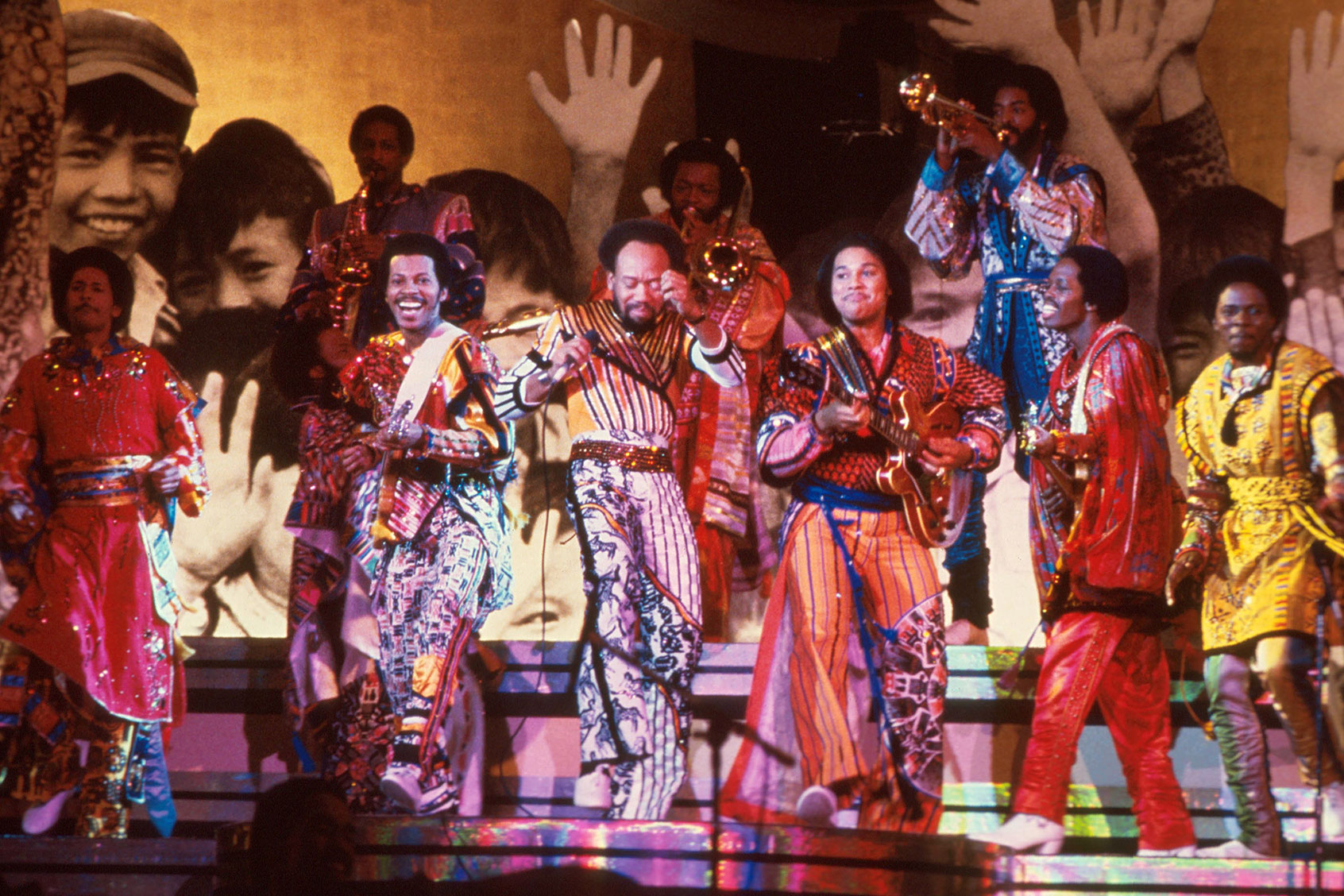
Earth Wind & FireEarth Wind & Fire perform at Music for UNICEF Concert at The United Nations in New York, on January 9, 1979. (Michael Putland/Getty Images)

But then, the words that you can find in a dictionary aren’t the ones that get people to sing along. It’s the “Ba-dee-ya!” that gets everyone on the same page. Famously Willis admitted to NPR in a 2014 interview that she initially objected to including the phrase in the refrain because it had no meaning. 

“I just said, ‘What the f*** does ‘ba-dee-ya’ mean?'” she said. “And he essentially said, ‘Who the f*** cares?'”

Now, apply that same songwriting logic to their decision to cite September 21 out of all the possible dates on the Gregorian calendar: “There is no significance beyond it just sang better than any of the other dates,” she explained.

Maybe September 21 sang better because the date represents the final deep breath of summer’s ease before we leap into fall. 

“Never let the lyric get in the way of the groove,” White said.

The popularity of “September” doesn’t make the song immune to being played out or sullied in some fashion. The 2005 Emmys, for instance, were barely memorable save for Earth Wind and Fire’s opening with a criminal version of “September” with lyrics rewritten to list that year’s popular TV shows and events. Among the name thuds: “24,” “Everybody Loves Raymond,” and Tom Cruise and Katie Holmes’ nascent coupledom. The Black Eyed Peas also swoop in to rap out a bridge.

You can be forgiven for having forgotten that happened. We apologize for reminding you that it did.


Want a daily wrap-up of all the news and commentary Salon has to offer? Subscribe to our morning newsletter, Crash Course.


But this also proves that, like every great song, the charms of “September” can wear thin. “Thanks for ruining September by Earth, Wind, Fire Google” a Reddit user posted nine months ago. “That is a great song and this unskipple [sic] ad I get 5 million times is annoying!”

Even Adejuyigbe made it known on September 1 that he was serious about last year’s “September” video, a true mic dropper, being his last.

“okay, i’m already starting to get a bunch of these countdown tweets so lemme say once again that i am not doing september videos anymore! last year’s was a finale. tried to make that very obvious last year! Sorry,” he tweeted, adding a request not to tag him whenever the song is mentioned. 

“please let me be free,” he concludes.

A simple enough request to fulfill, since many other folks have taken up the task of commemorating Earth Wind and Fire Day, and “September,” with their efforts. There are tweets, TikToks, and Instagram tributes aplenty, along with your own sound system — mementos that remind us not only of the date, but of the wisdom White bestowed on Willis so many seasons ago: never let the lyric get in the way of the groove. 

Why hot foam could be the weed killer of the future

Like many human inventions, pesticides come with numerous benefits but at a high cost. Just like plastics are simultaneously useful and toxic, the chemicals we spray to kill bugs, weeds and fungi can protect our farms but wreak havoc on the planet and our bodies.

But it’s not like we can simply allow our fields to be overrun by pests. The resulting decline in crop production would likely trigger mass starvation.

“Without the use of pesticides, there would be a 78% loss of fruit production, a 54% loss of vegetable production, and a 32% loss of cereal production,” a study published last year in the International Journal of Environmental Research and Public Health reported.

That’s why finding effective alternatives to the most toxic pesticides are crucial. Not only would it slow the devastating rate of insect decline, which could destabilize the planet’s entire ecosystem if not addressed; but also, more environmentally friendly pest control would improve soil, air and water quality while making food more safe to consume.  (Note that pesticide is a blanket term that refers to fungicides, herbicides, insecticides, among others; RoundUp, which contains glyphosate, is an herbicide and therefore also a pesticide.)

A particularly appealing eco-friendly pesticide is a hot biodegradable foam that can be sprayed on weeds. The foam, called Foamstream V4, creates a sizzling envelope that suffocates and destroys the unwanted plant. It’s already commercially available and is made from a blend of plant oils and sugars derived from corn, wheat, rapeseed oil, coconut oil and potatoes.

Hot foam could be an effective alternative to glyphosate, the widely-used ingredient in RoundUp, which has been found in the urine of 80 percent of Americans. But while some research on Foamstream V4 has been done before, previous experiments have been small, lacked controls and weren’t focused on largescale agriculture.

A team of Greek scientists from the Agricultural University of Athens and the University of Patras sought to amend this and secured four plots in two olive groves in Pyrgos and Kalamata, Greece to see how hot foam compared to other weed control methods.

First, they partitioned off the experiment site and inventoried the dominant weeds. In Pyrgos, the olive grove was dominated by charlock mustard (Sinapis arvensis) and cheeseweed (Malva parviflora) while the plantation in Kalamata was filled with burning nettle (Urtica urens), lichwort (Parietaria officinalis) and catchweed (Galium aparine), which can cause a rash in some people.

“The use of glyphosate throughout the whole field has been by far the most common method of weed control in most olive groves in the Mediterranean region in recent years,” the researchers wrote in the journal Smart Agricultural Technology. “However, overuse of this particular herbicide cannot be considered a sustainable agronomic practice for weed control in olive groves and other major perennial crops in the near future.”


Want more health and science stories in your inbox? Subscribe to Salon’s weekly newsletter The Vulgar Scientist.


Some weed plots were mowed, others were buried in mulch and some were sprayed with either glyphosate, hot foam or pelargonic acid, a corrosive and foul-smelling oily chemical that is sometimes used as an herbicide. The researchers also included control plots that received no treatment.

After a few weeks, the researchers used a handheld optoelectronic sensor that shoots bursts of red and infrared light at the weeds, which can indicate how unhealthy the plants are. They also took scissors, cut the weeds as the base, then bagged and weighed them to get an idea of how much biomass remained.

“The foam acted very quickly and the weeds looked stunted within an hour after treatment and showed signs of complete breakdown two days after treatment,” the researchers wrote. At one of the sites, “Hot foam application resulted in 70 and 78% lower weed biomass than glyphosate and mulching, respectively.”

Overall, hot foam and glyphosate were about equally effective at killing the weeds and preventing regrowth. However, many plants are quickly evolving resistance to glyphosate. Because the hot foam relies largely on heat to kill its target, there’s less chance of weeds developing defenses against it. Besides, glyphosate has been demonstrated to be far more toxic and can linger in the environment for a long time. Another benefit of hot foam is that it breaks down quickly.

The other methods such as mulching or the pelargonic acid didn’t fare nearly as well, but the authors emphasized that combining different strategies instead of using just one would be most advantageous. This approach is called Integrated Weed Management.

“Hot foam applications represent a new, smart concept in the area of thermal weed control,” the authors conclude, including wrangling “species that are difficult to control by conventional methods.”

However, things might turn out differently on other crops or weeds. Therefore, the authors recommend further research to “optimize the use of hot foam for weed control in olive groves, orchards and vineyards under different soil and climatic conditions.”

Hot foam comes with some drawbacks. It requires a large machine that can be difficult to use on huge fields, for example, so it may not scale very well. But it could represent a new frontier in how we control weeds without hurting ourselves in the process.

“One more round for my friends”: Notes on becoming a “regular”

José is still getting used to his prosthetic leg, but that doesn’t stop him from salsa dancing. When the music hits, he pushes himself back from the table and begins to swivel his hips. He steps forward with his left foot, then shifts his weight to the other, before finally slapping his right thigh. “That’s all titanium, baby!” he gleefully shouts at no one in particular. 

After about two minutes of pivoting, turning and checking with an imaginary partner, he sits down and wipes the condensation that’s formed on his Modelo Especial. After taking a long swig, followed by an even longer draw from a freshly-lit joint, he looks up at my boyfriend, Stephen, and me. “So, where were we?” 

We’re sitting on the patio at a little Puerto Rican bar in Chicago’s Humboldt Park. We were in the neighborhood and initially stopped for jibaritos — a city-favorite sandwich made by stuffing grilled meat, lettuce, raw white onion, mayonnaise and American cheese between two deep-fried green plantains — after seeing them advertised on the sidewalk menu board. I’d never been to this bar, but I liked it immediately. 

It was cool and dark and loud. People practically shouted over the string of Frankie Ruiz songs on the stereo (“Tú Con Él,” “Bailando” and “Señora”), which in turn blared over the boxy television set tuned into the local news. The ornate blonde oak bar sat on a concrete slab floor, which led to the roll-up garage door at the front of the building. Apparently, the door basically stays rolled up, regardless of temperature, until the first snow. As such, people pool in and out, congregating especially on the line between “inside” and “outside.” 

Well, except for José. 

It became apparent very quickly that José was a “regular” — the type of person who isn’t just in a place, but a part of it. He migrates from table to table, greeting newcomers and fellow regulars alike. He playfully punches a short man wearing a fedora in the arm: “Hey, hey, broki! Staying out of trouble?” He asks after the waitress’ son, before moving to a table with three curly-haired women, all of whom he kisses on the cheek. His lips linger on one woman’s cheek just a little longer than the rest (“My old girlfriend, man,” he later confides. “But I needed my freedom.”), which causes all the women to erupt in tittering laughter. 

They shoo him away, and he continues to orbit the bar until his eyes lock on my half-empty mojito. He hollers at the waitress, “Bring my friends another round!” He looks at Stephen, “Mind if I sit?” When we invite him to join us, he shouts across the bar again: “And three shots of whatever you like best!” 

Something I realized long ago is that there’s nothing like a microphone — turned on or off — to get a person to talk about themselves . . .

Stephen and I had been out recording interviews for a project, and our gear was tucked into an empty patio chair. When we move it to make room for José, he spots the recorder. Something I realized long ago is that there’s nothing like a microphone — turned on or off — to get a person to talk about themselves, which is what José begins to do. 

He tells us about coming to the contiguous United States and about how the neighborhood has changed since he did. He talks about his new Polish neighbors, and how they can’t speak the same language but have bonded over pastries. He talks about dominoes and “The House on Mango Street” and Saul Bellow. Occasionally, he punctuates his own thoughts with questions about us. Do you believe in God? Do you wish your Spanish was better? You’re a couple, yeah? 

Yes, yes and yes. 

“I could tell. Beautiful chemistry,” he responds. “Beautiful.” 

As it gets darker, the patio gets smokier. Through the haze, José spots another friend taking a cigarette break and excuses himself. While he’s gone, the short man in the fedora — whose name is Luis, though he says everyone here just calls him “The Colombian” — takes José’s seat. It turns out that he’s a regular, too. 

“I’m just quieter about it,” he says with a laugh, gesturing to José. 

“When did you know you were a regular?” I ask. 

Luis ponders for a moment, then looks towards the front door: “That’s a good question. It’s like one day, people here didn’t know me. Then one day, they did. What’s that show? ‘Cheers?’ I walked in and most everybody knew my name.” 


Want more great food writing and recipes? Subscribe to Salon Food’s newsletter, The Bite


I remember occasionally watching “Cheers” as a pre-teen and thinking that the concept of becoming a regular was so incredibly grown-up. In practice, however, I’ve always preferred bars that feel a little more liminal — airport bars, hotel bars, the places you stop at when you’re on the way to somewhere else. I’d been a regular at other places, like coffee shops and one particular strip-mall Vietnamese joint, but I had never given much thought to it. 

During the pandemic, though, I began to experience a kind of aching nostalgia for certain types of restaurants. I wanted to slide into a pleather diner booth, peel a laminated menu off the freshly-wiped table and order a mug of slightly burnt coffee, which the waitress brings out alongside ice water in one of those pebbled red Coca-Cola tumblers. I wanted to eat bucatini all’amatriciana at an old-school red sauce joint where they probably still bring the Chianti out in a little wicker basket. 

I wanted to find myself at a bar —one that is cool and dark and a little loud — where the boundaries between fellow customer and friend had blurred.

And I wanted to find myself at a bar —one that is cool and dark and a little loud — where the boundaries between fellow customer and friend had blurred. Part of this desire was underlined by the fact that we had moved cities mid-pandemic, but an even bigger part of it was that natural desire for human connection after months of Zoom meetings and virtual cocktail hours. Tonight was a taste of that. 

By this point, José had joined us back at the table. Luis and he were ribbing each other about their respective love lives — or lack thereof. Before anyone said anything that was a little too biting, someone cranked up the stereo. The bass’ pulsating thud, thud, thud was loud enough to rattle the melting ice cubes in my glass and draw José back out of his seat again. 

“I’m sorry, but I’ve got to dance,” he says, eying the curly-haired woman he’d kissed earlier, before waving to the waitress. “But let’s get one more round for my friends!” 

Exacerbated by climate change, Hurricane Fiona pummels Puerto Rico

One day before President Donald Trump took office in 2017, the Environmental Protection Agency (EPA) issued a public warning that climate change had caused Puerto Rico’s climate to warm by more than one degree Fahrenheit since the mid-20th century. The surrounding ocean waters had warmed by almost two degrees since 1901. As a result of these trends the EPA warned that “rising temperatures are likely to increase storm damages, significantly harm coral reefs, and increase the frequency of unpleasantly hot days.”

“Climate change is super-charging these storms, making them stronger, and packing greater flooding potential.”

By the time Summer 2017 had come and gone, Hurricane Maria had caused roughly 3,000 fatalities in the American commonwealth as well as an estimated $90 billion in damages. Then-President Trump aroused controversy for neglecting Puerto Rico and focusing more on victims in conservative states like Texas.

Five years later, history appears to be repeating itself as the tiny Caribbean island — which has yet to recover from the battering and neglect it received in 2017 — is being pummeled by Hurricane Fiona.

Experts who spoke to Salon are once again saying there is ample scientific evidence that the massive natural disaster caused by this hurricane is exacerbated by the effects of man-made climate change.

“Although climate change cannot be directly linked to increased hurricane intensity (yet), there are definitely more and more hurricanes, typhoons or cyclones storms in many parts of the world,” Dr. Ali S. Akanda, an associate professor and graduate director of civil and environmental engineering at the University of Rhode Island, told Salon by email. “It is understood that the warming of the oceans and the atmosphere are probably contributing to these occurrences.” In the case of Puerto Rico, this reality will make it increasingly difficult for the island’s beleaguered inhabitants to pick up the pieces of their lives when natural disasters hit.

“The island hasn’t fully gotten back on its feet since Hurricane Maria came ashore roughly the same time in 2017,” Akanda noted. “The intense rainfall and following floods will damage bridges, roadways, houses, utilities, and essential infrastructure. In addition, the longer-term economic impacts will close many businesses and make many people move out of San Juan and even from Puerto Rico itself.”


Want more health and science stories in your inbox? Subscribe to Salon’s weekly newsletter The Vulgar Scientist.


Dr. Michael E. Mann, an American climatologist and geophysicist and currently director of the Earth System Science Center at Pennsylvania State University, broke down the dynamics of exactly how climate change is worsening the hurricanes striking Puerto Rico.

“Climate change is super-charging these storms, making them stronger, and packing greater flooding potential,” Mann wrote to Salon. “The intensification of Fiona to a strong Category 4 storm is part of larger trend toward more intense hurricanes, and warmer oceans mean more moisture in these storms, and more flooding when they make landfall (like we saw with Fiona in Puerto Rico).”

Only 41 percent of Puerto Ricans currently have access to their water service, only 27 percent have access to their electricity service and only 71 percent have functional telecommunications antennas.

Since even the most proactive human technology will not be able to fully avert the short-term effects of climate change, those who live in vulnerable locations will continue to suffer disproportionately unless they find ways of preparing for the worst. Dr. William Sweet, a scientist at the National Oceanic and Atmospheric Administration (NOAA), wrote to Salon that “looking towards the future, coastal communities exposed to tropical cyclones will have to defend against both the rare event and the more chronic flooding brought on by rising seas.”

Another NOAA official elaborated on how weather and sea level conditions are expected to worsen.

“In a general sense I would expect that for each 1 degree [Celsius] rise in tropical sea surface temperatures, we would see about a 7 percent increase in tropical cyclone rainfall rates,” Tom Knutson, a physical scientist at NOAA’s Geophysical Fluid Dynamics Lab in Princeton, NJ, told Salon by email. “This increase is higher in some simulations of hurricanes, but I’m just reporting an average value from various studies.”

These calamities not only cause immediate devastation through the weather, but also more subtle and long-term public health problems. People will struggle to obtain clean water and provide for their sanitary needs, and diseases that flourish in fetid conditions will break out. At the time of this writing on Wednesday, only 41 percent of Puerto Ricans currently have access to their water service, only 27 percent have access to their electricity service and only 71 percent have functional telecommunications antennas.

“Authorities need to watch out for the deadly vector-borne disease Dengue in areas where flood water will stagnate, and waste and piled up damaged material will provide breeding ground for mosquitoes,” Akanda warned. “Puerto Rico is a historically Dengue endemic region and has been severely affected by the disease in recent decades. Continuing water insecurity in hurricane damaged areas may force people to store household water in drums and open containers, which also contribute to growing mosquito populations.”

MSNBC host predicts chances of Trump indictment just “skyrocketed” — thanks to his own lawyers

Twenty months after leaving the White House, former President Donald Trump continues to be the subject of a variety of investigations — from Fulton County District Attorney Fani Willis in Georgia to New York State Attorney General Letitia James to House Speaker Nancy Pelosi’s January 6 select committee to the U.S. Department of Justice. One DOJ investigation has been probing the events of January 6, 2021, while another has been investigating the government documents that Trump was storing at his Mar-a-Lago resort/home in Palm Beach, Florida when FBI agents executed a search warrant on Monday, August 8.

During a Monday night, September 19 commentary on DOJ’s Mar-a-Lago/documents probe, MSNBC’s Lawrence O’Donnell argued that Trump’s chances of facing a federal prosecution have “skyrocketed.”

O’Donnell, quoting a report by the New York Times’ Maggie Haberman, explained, “The New York Times is reporting tonight that a former White House counsel warned Donald Trump last year, when he was no longer president, that ‘Mr. Trump could face legal liability if he did not return government materials he had taken with him when he left office. The lawyer, Eric Herschmann sought to impress upon Mr. Trump the seriousness of the issue and the potential for investigations and legal exposure if he did not return the documents, particularly any classified material’…. And so now, we know the name of one witness, possibly the most important witness, federal prosecutors will call to testify in their grand jury investigation of Donald Trump’s possession of those documents: Eric Herschmann.”

Eric Herschmann, O’Donnell added, has been a witness for the January 6 select committee, and he will “obviously” comply with DOJ investigators.

Trump has claimed that all of the government documents he was storing at Mar-a-Lago were “declassified” before he left the White House in January 2021 — a claim that O’Donnell disputed during his September 19 commentary.

The MSNBC host told viewers, “If Eric Herschmann tells federal prosecutors the same thing that the New York Times is reporting at this hour tonight, then the chances of Donald Trump being indicted have just skyrocketed. And that is not the only breaking news in this case tonight. Donald Trump’s lawyers said, in writing tonight…. That they are refusing to answer the question of whether Donald Trump declassified documents seized by the FBI at his Florida home because they are saving their answer to that question as, quote, ‘a defense to the merits of any subsequent indictment.'”

Immigration law expert details the laws Ron DeSantis may have broken with Martha’s Vineyard stunt

The unexpected arrival of approximately 50 Colombian and Venezuelan migrants on Martha’s Vineyard, Massachusetts, on Sept. 14, 2022, has prompted legal questions about how and why, exactly, Florida Gov. Ron DeSantis chartered planes to drop them in this unlikely destination.

The move is part of a broader campaign by Republican politicians to transport large numbers of migrants to liberal states and cities.

Since then, Massachusetts Gov. Charlie Baker has activated 125 National Guard members to help distribute food and other necessities to the migrants, now living at a Cape Cod military base.

And a Texas county sheriff announced Sept. 20 that he was launching an investigation into allegations that a Venezuelan migrant was paid to recruit the other migrants for the trip. Lawyers for 30 of the migrants have been asking for a legal investigation into what they call a “political stunt.”

Many of the migrants said they were falsely promised housing, jobs and expedited work permits if they boarded planes in Texas set for Massachusetts — a likely preferred alternative to the San Antonio shelter where they were temporarily staying.

As an immigration law professor, I think it is important to understand that the answer to whether it is legal to move migrants potentially against their will and transport them across states is complicated and depends on several unknown factors.

The intent behind the drop-off

First, there is an open question of whether the migrants were illegally staying in the United States at the time they were transported to Martha’s Vineyard.

There is a federal law, called 8 U.S.C. § 1324, that criminalizes transporting an undocumented migrant anywhere within the U.S. if the migrant has entered the U.S. unlawfully or remains in the country without a visa or other documentation. This law also prohibits someone from even helping or planning to transport undocumented migrants.

But someone who is found guilty of this law must have also known — and disregarded the fact — that the migrants were in the U.S. without legal paperwork or other permission from immigration officials.

Transporting consenting migrants who have the paperwork to be in the U.S. is legal. But certain factors — like DeSantis’ intent and knowledge of the migrants’ immigration status — could create potential civil and criminal liability.

The migrants might legally be in the U.S.

One key issue, then, is whether the migrants are legally authorized to be in the U.S. — and if not, whether DeSantis, his team and the charter airplane company helped the migrants illegally stay in the U.S. by flying them to Martha’s Vineyard.

Some of the migrants are reportedly asylum seekers and not “illegal immigrants,” as DeSantis’ office has said.

Generally, a migrant who is seeking asylum in the U.S. is not violating immigration law. That is because immigration asylum law authorizes migrants to enter the U.S. and apply for asylum — meaning that they ask for the legal right to stay in the U.S. because they have legitimate fears of returning to their own countries.

Asylum seekers are allowed to temporarily stay in the U.S. while they await an immigration judge’s decision on their asylum application. Migrants might also get temporary permission to stay in the U.S. for other humanitarian reasons.

It is unknown how many of the migrants flown to Martha’s Vineyard were authorized to remain in the country or have pending asylum applications.

Moving migrants within the US

Another major question is whether transporting migrants could somehow help or promote their potentially undocumented immigration status.

In 1999, for example, a U.S. federal court of appeals determined that an individual transporting two undocumented migrants from New Mexico to Colorado in search of employment violated immigration law, since the move advanced the undocumented migrants’ unlawful presence in the U.S.

Perhaps there is evidence that DeSantis, or members of his team, helped or advanced the migrants’ unlawful entry or continued illegal presence in the U.S. by transporting them to a sanctuary location within Massachusetts.

Ultimately, DeSantis’ decision to fly migrants to Massachusetts likely frustrated the Biden administration’s immigration law enforcement. Randomly moving migrants across states makes it harder for the government to process asylum applications and to deport migrants who are not eligible for asylum.

The known unknowns

Other factors could determine whether DeSantis potentially violated human trafficking laws, as some immigrant advocates have said.

This includes what the migrants were told — and by whom. Deceiving people and then moving them from one place to another could constitute kidnapping. Falsely promising available work permits is also illegal.

Human trafficking, according to U.S. law, must include exploitation resulting in some kind of material gain. While there is nothing to indicate that DeSantis received compensation for flying the migrants to Massachusetts, the private airplane charter company did receive money to transport them.

The identities and knowledge of the government officials involved in the entire Martha’s Vineyard scheme have not been publicly released.

A formal investigation into the migrants’ individual circumstances — and an examination of those involved with the flight to Martha’s Vineyard — could determine whether this incident resulted in legal violations of civil or criminal laws.


Jean Lantz Reisz, Supervising Attorney, USC Immigration Clinic and Adjunct Assistant Professor of Law, University of Southern California

This article is republished from The Conversation under a Creative Commons license. Read the original article.

Watergate figure John Dean warns Trump may pull a “dictators’ ploy”: “There will be violence”

Former Watergate figure John Dean warned there will be violence as Donald Trump finds himself in increasing legal peril.

Richard Nixon’s former White House counsel, who was disbarred after his Watergate conviction, offered his analysis following Tuesday’s hearing in a Brooklyn courtroom before Special Master Raymond Dearie.

“It seems Trump’s lawyers are trying to protect his lie that he declassified all the Mar A Largo documents,” Dean wrote in a thread posted to Twitter. “GOP does not want him to declare until after 11/08 so he needs the lie. He feels (rightly) he won’t be indicted until after the midterms. After the midterms, he will declare!”

“As a POTUS candidate he is not only the center of attention but he can claim any indictment is a political act to keep him out of the Oval Office. Running for POTUS is his best defense from going to jail. Who knows, he might convince one or more jurors! If he wins…. No. He won’t,” Dean predicted.

Dean went on to predict multiple indictments for the former president.

“Trump will be indicted in a RICO action in GA, and federally for Obstruction of Justice (at minimum) for his theft of classified information, plus Seditious Conspiracy and Conspiracy to Defraud (at minimum) for Jan 6th. In short, he should face three criminal cases before 2024,” Dean wrote.

“He believes he can use the dictator’s ploy of mounting riots if the government comes after him, and some of his followers will comply so there will be violence. But law enforcement, the National Guard and the US military will prevail. And Trump will earn added criminal charges,” he further predicted. “Trump and GOP enablers are an evil that must be addressed for what it is doing to our nation. The way to deal with it is to stay informed for only fools want what Trump is offering.”

“Art of the steal”: Experts say Trump pleading the 5th in NY AG probe backfired — now he’s “screwed”

New York Attorney General Letitia James on Wednesday filed a lawsuit against former President Donald Trump, the Trump Organization and three of his adult children, alleging a decade-long fraud scheme.

The civil suit alleges that Trump, Ivanka Trump, Donald Trump Jr., Eric Trump and Trump’s company falsified and inflated the value of assets to get favorable terms from banks and insurance companies while deflating the same assets to minimize tax bills. 

“The complaint demonstrates that Donald Trump falsely inflated his net worth by billions of dollars to unjustly enrich himself and to cheat the system, thereby cheating all of us,” James said in a Manhattan press conference on Wednesday morning. 

James is seeking approximately $250 million in alleged illegal profits, and a five-year ban on the former president and his children from entering into commercial real-estate acquisitions or loans from any financial institutions registered in New York. Additionally, the suit seeks to permanently ban those involved in the business from serving as directors or officers of any New York-licensed corporations. 

“The examples I laid out are just scratching the surface of the misconduct that we have uncovered,” James told reporters. “The pattern of fraud and deception that was used by Mr. Trump and the Trump Organization for their own financial benefit is astounding.”

Trump’s attorney Alina Habba denied any wrongdoing.

“Today’s filing is neither focused on the facts nor the law – rather, it is solely focused on advancing the Attorney General’s political agenda,” she said in a statement. “It is abundantly clear that the Attorney General’s Office has exceeded its statutory authority by prying into transactions where absolutely no wrongdoing has taken place.”

Noah Bookbinder, a former federal corruption prosecutor and president of the D.C. watchdog group Citizens for Responsibility and Ethics, praised James for bringing the suit.

“Donald Trump and his family have run a corrupt enterprise for years. Even before his presidency, Trump apparently did everything in his power to profit the Trump Organization while keeping those he went to for loans and insurance in the dark about his company’s true financial position,” he said in a statement. “If his co-opting of the federal government as essentially a subsidiary of the Trump Organization was not bad enough, Trump appears to have committed repeated fraudulent acts, illegally inflating the value of his company to benefit the company and himself.”

Bookbinder also urged federal authorities to investigate the evidence.

“Should the Department of Justice judge it warranted on the facts and the law, they should bring criminal charges as well,” he said. “Trump has escaped accountability for too long. It’s well past time to pay the piper.”


Want a daily wrap-up of all the news and commentary Salon has to offer? Subscribe to our morning newsletter, Crash Course.


Other legal experts chimed in online.

“The Trump suit reveals what we’ve known all along from numerous sources and reports,” former federal prosecutor Ron Filipkowski wrote on Twitter. “Trump is a con man playing a shell game to fake his wealth to banks and investors who bankrolled his steady stream of failed business ventures.”

Andrew Weismann, a former federal prosecutor who served on special counsel Bob Mueller’s team, added that Alan Weisselberg’s guilty plea last month in Manhattan is a significant piece of evidence for the prosecution. 

“The ‘art of the steal’ is what NY AG says occurred here,” he tweeted.

Ryan Goodman, a professor at NYU Law School, explained that the most significant implications of today’s action may be the criminal referrals to the Internal Revenue Service and Department of Justice. “Recall: Scheme to which Allen Weisselberg (longtime Trump Org CFO) recently pleaded guilty included federal tax crimes. Many have been waiting for a fed criminal tax probe.” he wrote.

National security attorney Bradley Moss described the case’s long-term implications for the Trump family. “If Letitia James wins in this lawsuit, she will have ended the reign of the Trump business empire in New York,” he wrote on Wednesday.

He also wondered: “Has Melania double checked the terms of her pre-nup today?”

Former federal prosecutor Renato Mariotti wrote that Trump’s decision to plead the Fifth may end up backfiring.

“The New York AG has a lot of leverage in this lawsuit because Trump (and his son Eric) took the Fifth hundreds of times,” Mariotti wrote. “That was smart to do, but it means they’re screwed in this civil case. A jury would likely be instructed to presume their answers would have hurt Trump.”

Regardless of the outcome, the case may be Trump’s worst nightmare, explained Maggie Haberman, who has spent years covering Trump for the New York Times.

“Whatever the outcome of the James case,” she tweeted, “a day in which a prosecutor declared at a press conference that Trump isn’t worth what he claims is a day he’s tried to avoid for decades.”

Trump faces sexual battery lawsuit under new Survivors’ Law as New York legal troubles mount

Longtime magazine columnist E. Jean Carroll, who accused former President Donald Trump of raping her in a department store dressing room in the 1990s, plans to file a new lawsuit under a new New York law.

New York legislators in May passed a law that gives adult sexual assault victims, those 18 or older at the time of the alleged abuse, the opportunity to file civil lawsuits, even if the statutes of limitations have long expired.

The Adult Survivors Act will grant Carroll the chance to pursue legal action for the alleged assault since the state’s statute of limitations did not offer the opportunity before. 

Carroll sued Trump in 2019 for defamation, claiming that he had harmed her reputation by labeling her a liar and denying that the attack took place. 

The writer plans to file her new case against Trump on Nov. 24, when the state law takes effect. She will sue him for battery and intentional infliction of emotional distress, according to an August letter her lawyer Roberta A. Kaplan wrote to a New York federal judge. 

Kaplan plans to ask the judge to consolidate the two suits together in February 2023, when Carroll’s defamation lawsuit was scheduled for trial.

Trump’s lawyer Alina Habba has asked the judge to reject the request, saying that the former president “adamantly” objected to combining both cases. She added that it was “extraordinarily prejudicial” to add the new claims and violated her client’s rights.

The former president has responded to the allegations saying that Carrol concocted the rape claim to sell her book. Trump has repeated that Carrol was “totally lying” and “not my type”.

The longtime advice columnist detailed the events in an article published by New York magazine in 2019 while Trump was still serving his presidency. Her account was included in an excerpt of her upcoming book, “What Do We Need Men For?: A Modest Proposal.”

Carroll has said that she was not trying to sell a book about Trump and pointed to the numerous other women who accused him of sexual misconduct during his presidential campaign. 

“Think of how many women have come forward — nothing happens,” she said. “The only thing we can do is sit with you and tell our stories so that we empower other women to come forward and tell their stories because we have to change this culture of sexual violence.”


Want a daily wrap-up of all the news and commentary Salon has to offer? Subscribe to our morning newsletter, Crash Course.


She described the incident taking place in the upscale Manhattan department store Bergdorf Goodman in late 1995 or early 1996. She still has the coatdress that she was wearing that day. 

Carroll said she was not ready to speak out about her experience when Trump was running for president since she still blamed herself for the alleged attack.

“Receiving death threats, being driven from my home, being dismissed, being dragged through the mud, and joining the 15 women who’ve come forward with credible stories about how the man grabbed, badgered, belittled, mauled, molested, and assaulted them, only to see the man turn it around, deny, threaten, and attack them, never sounded like much fun,” she said. 

Trump has claimed that he did not know Carrol even though the two of them have been photographed together at a party in 1987. He has claimed that the image was misleading. 

“I don’t know anything about her. She’s made this charge against others, and you know, people have to be careful, because they are playing with very dangerous territory,” Trump has told reporters.

Trump and Carroll are still waiting for a decision by the federal appeals court in Manhattan over whether Carroll’s defamation case can proceed.

News of the lawsuit came a day before New York Attorney General Letitia James filed a lawsuit against Trump and his adult children, accusing them of 200 acts of fraud.

Carroll has responded to Trump’s previous allegations saying : “This is what happens to women who come forward.”

Trump donors think they’re giving to “save America,” but they’re paying Trump’s legal bills

When one is under federal investigation for serious crimes like potential espionage, the usual legal advice is to be silent. Lawyers tend to get nervous when clients talk publicly about their cases, fearful that they will inadvertently provide evidence prosecutors can use against their clients in court. But after the FBI raid on Mar-a-Lago in August, Donald Trump has not shut up. He rants on Truth Social about the FBI, portraying himself as the victim of an “unwarranted, unjust, and illegal Raid,” even though there appears little doubt that he was in possession of classified documents he appears to have stolen from the government. He gives lengthy and often ad-libbed speeches, ostensibly in support of Republicans running for office, in which he complains about his alleged victimization at the hands of the FBI. 

Trump’s lawyers haven’t put a stop to this, quite possibly because quieting Trump is an impossible task. But it’s also true that Trump has been fundraising heavily off the FBI raid for his leadership PAC, Save America. The PAC ostensibly exists to help Republican candidates win races, but as CNN reported last Tuesday, the majority of the money is going straight to Trump’s lawyers. Out of the $6.3 million spent by the PAC in August, over 60% — $3.8 million — was spent on Trump’s legal fees. That’s over 24 times what the PAC spent on actual candidates that month — the only expenditure listed under the PAC’s ostensible purpose was $150,000 spent to defeat Rep. Liz Cheney, R-Wyo., in her primary


Want more Amanda Marcotte on politics? Subscribe to her newsletter Standing Room Only.


As Salon reported at the time, Trump created this PAC immediately after losing the 2020 election, and it appeared shady from the start, rife with fundraising appeals that misleadingly implied President Joe Biden stole the 2020 election. Trump’s PAC may be excessive, but due to Supreme Court-forced deregulation of campaign finance laws, it’s actually normal for leadership PACs to be awash in grift. Money that donors think is going to political campaigns instead is often spent on funding politicians’ lifestyles — paying for airfare, restaurant meals, and other luxury goods and services. As campaign finance expert Brett Kappel told Salon in November 2020, “Save America funds could be used to pay many of the legal fees Trump will incur after he leaves office.” 

Trump’s PAC has been under heavy scrutiny for months now, both by law enforcement and by Republican leadership, albeit for entirely different reasons. Law enforcement is mostly concerned with questions of whether Trump defrauded his donors or used the money for illegal purposes. As the New York Times reported earlier this month, “A federal grand jury in Washington is examining the formation of — and spending by — a fund-raising operation created by Donald J. Trump after his loss in the 2020 election as he was soliciting millions of dollars by baselessly asserting that the results had been marred by widespread voting fraud.”

Indeed, Trump has raised over $100 million for this PAC, with emails both falsely implying that the 2020 election was stolen and that giving Trump money will help him be reinstated as president. This, however, is not what is bothering GOP leadership. As Jackie Calmes of the Los Angeles Times writes, “Trump is vacuuming up so much from small donors and funneling almost none of it to party candidates,” despite hitting donors with endless emails promising “he’s helping Republicans capture control of Congress.”

Trump went into September with over $90 million in his PAC, while the National Republican Senatorial Committee (NRSC) has less than $16 million. Part of the reason is the NRSC chair Sen. Rick Scott of Florida has mismanaged the fund. Still, it’s hard to ignore the fact that small donors are giving to Trump rather than to other Republicans, often at Trump’s own behest. He’s sent fundraising emails calling other Republicans “RINOs” (short for “Republican In Name Only”). Trump’s PAC has also sucked down more of the donation pool through shady tactics like tricking donors into donating twice, by automatically signing people up to do so and making it difficult to opt out. 


Want more Amanda Marcotte on politics? Subscribe to her newsletter Standing Room Only.


“He helped nominate many of the candidates who won primaries, and many of them are having a really hard time raising money,” a Republican strategist who works for Senate Minority Leader Mitch McConnell griped to the Washington Post. But rather than raising more money to elect Republicans, Trump’s PAC has solicited money for a new private plane and paid a fashion designer $60,000 to consult Melania Trump on her wardrobe. Until the FBI raid on Mar-a-Lago, Trump even had the Republican National Committee paying his legal bills. He’s tapping his massive war chest now because they finally cut him off

It’s unlikely Trump’s battle with the DOJ over his possession of classified documents is going to get any cheaper for his donors. Trump did manage to venue-shop his way to Judge Aileen Cannon, a Federalist Society member he put on the court who issued a widely-criticized decision to slow down the FBI investigation by appointing a “special master” to review the classified documents. But the “special master,” Judge Raymond Dearie, is not making things easy for Trump’s team, insisting they provide evidence for Trump’s unlikely claims that he declassified the materials before removing them illegally. Now he and his family are facing a civil fraud suit filed by New York Attorney General Letitia James, with $250 million on the line, plus significant corporate penalties.  

Trump’s standard legal tactic is to gum up the system by filing unnecessary motions, which he will no doubt be doing in these cases as well. As his long legal history shows, this strategy is both effective and expensive. But it won’t be expensive for him. Trump’s donors will be footing the bill, even as many mistakenly believe their money is going to elect Republican candidates.

“Repeated illegality”: NY AG files lawsuit against Trump and kids alleging 200 instances of fraud

New York Attorney General Letitia James on Wednesday announced a lawsuit against former President Donald Trump and three of his adult children, accusing them of a yearslong fraud scheme.

James filed a 220-page lawsuit detailing Trump’s efforts to inflate his personal net worth by billions to get favorable loan agreements and deflate it to pay less in taxes. The suit alleges more than 200 instances of fraud over a 10-year period by Trump, Ivanka Trump, Donald Trump Jr., Eric Trump and other Trump Organization officials.

The lawsuit seeks about $250 million in penalties. James is also seeking to permanently ban Trump and his kids from being in the office of any New York company and a ban on loans from any financial institution registered in New York for five years, among other penalties.

James at a press conference on Wednesday accused Trump of “violating the law as part of his efforts to generate profits for himself, his family and his company” with the help of his children.

Trump violated a New York statute that “gives the attorney general broad and special powers to go after persistent and repeated fraud and illegality,” she said.

James alleged that Trump and his children violated multiple state laws, including falsifying business records, issuing false financial statements, insurance fraud and engaging in a conspiracy to commit those violations.

James said that some of the instances also violated federal criminal law, including issuing false financial statements to institutions and bank fraud. James said her office referred those violations to federal prosecutors and the IRS.

Trump attorney Alina Habba called the allegations “meritless.”

James has investigated the Trump Organization’s business practices for three years. Trump and his kids have tried to avoid testifying and turning over documents in the probe, suing in federal court to block the investigation before the bid was dismissed. Trump also sought to block the probe in state court but a judge in February ordered Trump, Trump Jr., and Ivanka Trump to sit for depositions. Trump invoked his Fifth Amendment right against self-incrimination more than 440 times in his deposition.

James said that the evidence focused on the Trump Organization’s statements of financial condition between 2011 and 2021, the accuracy of which was the responsibility of Trump and later Donald Trump Jr. and indicted CFO Allen Weisselberg after Trump ran for president.

“Each statement was personally certified as accurate by Mr. Trump or by one of his trustees… with the intention that the information in the statements would be relied upon by banks and insurers,” James said. Trump expressed a desire for his net worth in the statements to increase, James alleged, which she said Trump Organization executives complied with repeatedly in their “fraudulent preparation of the statements.” Both Trump and Weisselberg invoked their Fifth Amendment rights when questioned about the scheme under oath, James said.

The statements included ever-changing methodologies to calculate the value of assets and properties and in some cases were based on entirely false numbers, James alleged. Trump inflated the size of his apartment almost threefold in one case to boost its valuation, she said in her press conference. In another instance, the company inflated the value of its property at 40 Wall Street from around $200 million to more than $500 million, according to the probe.


Want a daily wrap-up of all the news and commentary Salon has to offer? Subscribe to our morning newsletter, Crash Course.


In other cases, James argued, Trump violated restrictions that would have lowered his property values to inflate the value of certain properties. She cited Trump’s Mar-a-Lago resort in Florida as one example, arguing that it should have been valued at around $75 million based on its earnings but was valued by Trump as high as $700 million.

“The examples I laid out just barely scratch the surface of the misconduct that we have uncovered,” James said, pointing to nearly two dozen assets that were “fraudulently inflated.”

“The pattern of fraud and deception that were used by Mr. Trump and the Trump Organization for their own financial benefit is astounding,” she said. “It was a scheme that by its very nature became more profitable over time. And it was all in stark violation of the law,” she added.

Read the full lawsuit below:

Trump Complaint NY AG by Igor Derysh on Scribd

Trump paid key witness in Mar-a-Lago documents scandal $7,500 just days after FBI search: report

Donald Trump paid a key witness in the Mar-a-Lago and Jan. 6 cases only eleven days after the FBI conducted a search at Mar-a-Lago.

“Tonight, Trump was handed a loss by the special master that he put forward for the job and it’s a pretty significant loss because [Special Master Raymond Dearie] is calling Trump’s bluff by questioning the very heart of his argument in the Mar-a-Lago documents case,” CNN’s Erin Burnett reported.

“Trump has, for weeks — again and again, any time he spoke publicly — said that he declassified the more than 100 documents seized in the FBI search,” Burnett noted. “But there’s never been any evidence or anyone who has come to verify that and the special master is now saying that unless he receives any evidence to back up that claim that Trump is publicly making, he will consider all of the information marked classified to be classified.”

For analysis, Burnett interviewed former Trump White House press secretary Stephanie Grisham

“If I know Donald Trump, he’s going to tell them to lean into the fact that they were declassified,” Grisham said. “I know he has said that he had told Kash Patel that they were declassified, but I think it’s important for just your viewers, the country, to understand that that’s not how it works. You don’t just say the words, these are now declassified and it’s done. There is a process. And more importantly, people, agencies would need to be told, right? The CIA, the DOJ, the FBI, the people who have sources and methods out there. They would need to know that, hey, these documents are suddenly declassified so that they can move those sources around.”

Also on Tuesday, Trump’s Save America PAC revealed a payment to Patel’s consulting firm, Trishul LLC.

“Kash Patel makes his first appearance on Trump’s payroll — $7,500 on Aug. 19,” Daily Beast correspondent Roger Sollenberger reported.

Grisham suggested Patel and others might publicly testify that Trump declassified the documents.

“We point back to the magic wand you and I talked about before,” Grisham said. “He just looked at Kash and said, ‘Hey, these are all declassified,’ that’s it? It doesn’t work that way. Now if the president names names of people who actually witnessed it, then those people will have to come forward and say under oath the truth that that’s the truth.”

“Do I think there are people who would maybe do that for him, even if it wasn’t true? Sadly, I do,” Grisham added.

Watch below or at this link.

“Dangerous and scary”: Phony Trump electors still wield real power in key battleground states

More than two dozen of Donald Trump’s fake electors continue to hold positions of real power in key states.

Republicans in seven battleground states won by Joe Biden in 2020 offered slates of 84 phony electors who had signed certificates claiming to be “duly elected,” in a scheme that even Trump’s own White House counsel warned was possibly illegal, but at least 23 of them still hold leadership positions in their state GOP while others remain in legislative office or are seeking election, reported NBC News.

“It’s really distressing that many of them are still heavily involved,” said attorney Jeff Mandell, who is suing over Wisconsin’s 10 false electors. “These people violated the most fundamental idea of how our democracy works, and there shouldn’t be a place for them at this point in our political life and the public square.”

Mandell’s lawsuit alleges that Trump and his allies intended to use the false electors to pressure Mike Pence to help steal the presidential election, and federal authorities have subpoenaed numerous individuals who signed the phony certificates or were involved in the scheme, including Mike Roman, who directed the Trump campaign’s Election Day operations.

“It’s dangerous and scary,” Mandell said. “We’re closing on it being two full years since this has happened, and there’s only small and sporadic efforts toward accountability.”

Three phony electors — Michael McDonald in Nevada, Kelly Ward in Arizona and David Shafer in Georgia — are the chairs of their state Republican Parties, while state Sen. Burt Jones is the GOP nominee for Georgia lieutenant governor, and nine fake electors work for Michigan’s state GOP.

“When it’s tolerated by the entire party, and in fact, the vast majority of the party is pushing the same lie, it creates an environment in which accountability is very difficult,” said longtime Republican Sarah Longwell, executive director of the anti-Trump Republican Accountability Project. “The only way for anybody to end the collective illusion is for Republicans to say, ‘This is nonsense.’ We basically need 20 other Liz Cheneys in the Republican Party.”

“Trump’s request has already backfired”: Trump’s handpicked special master rebukes his claim on docs

Federal Judge Raymond Dearie, the special master tasked with reviewing thousands of documents seized at Mar-a-Lago, rebuked former President Donald Trump’s lawyers during a hearing on Tuesday for failing to back up his dubious claim that he “declassified” the records while still in office.

Dearie, who was selected by U.S. District Judge Aileen Cannon from Trump lawyers’ list of proposed special masters, earlier this week called on the former president’s team to turn over any details related to Trump’s repeated claim that he “declassified” secret documents that he took home after leaving the White House. Trump’s lawyers, who have not mentioned the declassification claim once in their court filings, balked at the request in a letter to Dearie, writing that they may save the details for a defense argument in a potential prosecution.

Dearie held his first hearing in New York on Tuesday and called out Trump’s legal team for refusing to provide evidence for the president’s key claim in the case.

“My view of it is: you can’t have your cake and eat it,” Dearie told Trump’s lawyers, according to Politico. Dearie said that if the Justice Department provides evidence of classification and Trump’s lawyers don’t provide any evidence of declassification, the documents would be considered classified. “What business is it of the court? As far as I’m concerned that’s the end of it,” Dearie said.

Dearie took issue with Trump lawyers’ arguments that they were saving details about the claim for a potential defense.

“I can’t allow litigation strategy to dictate the outcome of my recommendations,” he said.

Trump attorney Jim Trusty argued that it was “premature” to consider the issue right now because “it’s going a little beyond what Judge Cannon contemplated in the first instance.”

Dearie again rebuked Trump’s team.

“I was taken aback by your comment that I’m going beyond what Judge Cannon instructed me to do,” he said. “I think I’m doing what I’m told.”

Legal experts praised Dearie’s handling of the Trump team’s attempt to dance around the former president’s claims.

“The part that reassures me the most is that [Dearie] gets it on the classified information,” Ryan Goodman, a professor at NYU Law School, told MSNBC. “He’s not giving the Trump side any excuses in a certain sense, it is time for them to pony up.”

Former federal prosecutor Renato Mariotti predicted that “it doesn’t look like Trump will achieve anything significant from this process.”

Former U.S. Attorney Barb McQuade noted that Trump’s lawyers may be hesitant to identify documents Trump claims to have declassified because it could amount to perjury.

“Lies in court may be punished with sanctions or even criminal charges,” she tweeted. “They appear to have painted themselves into a corner.”

Even George Washington University Law Professor Jonathan Turley, who has publicly defended Trump amid numerous legal scandals, was taken aback by the lawyers’ failure to produce any evidence.

“The court’s request for support of the declassification was highly predictable and the absence of support at this stage is striking,” he tweeted. “Even if Trump is claiming an oral order, they could have offered a declaration from Trump or a staff member on such an order.”

Ultimately the matter may be irrelevant to the DOJ investigation since the three statutes cited in the search warrant for Mar-a-Lago do not require mishandled information to be classified to trigger prosecution.


Want a daily wrap-up of all the news and commentary Salon has to offer? Subscribe to our morning newsletter, Crash Course.


During another point in the hearing, the DOJ and Trump’s lawyers squabbled over the Trump team’s demand to view classified documents seized by the FBI last month.

Trusty asked Dearie to start the process to get proper security clearances for Trump’s lawyers. Dearie said that he takes national security issues “very seriously” and that he would like to resolve the issue without looking at the classified documents.

Justice Department lawyer Julie Edelstein cited a “need-to-know” standard for certain highly classified documents.

“It’s kind of astounding to hear the government say the president’s lawyers don’t have a need to know,” Trusty bristled. “I believe we have a need to know, absolutely.”

Edelstein said that some of the documents were classified beyond the “Top Secret” level.

“Some of the documents are so sensitive that members of the team investigating possible offenses here have not yet been able to see them,” she said.

“It’s not just a matter of having the clearance. It’s a matter of need to know,” Dearie said. “If you need to know, you will know.”

Conservative attorney George Conway, a frequent Trump critic, called Dearie’s handling of Trump’s legal team “brutal.”

“Judge Dearie is just destroying Trump’s lawyers here,” he tweeted.

The hearing came as the DOJ appeals Cannon’s original order to appoint the special master and put the criminal investigation into the documents on hold. The DOJ in a filing argued that Trump is implying he “could” have declassified the records before leaving office but has not provided any evidence to show that he “actually took that step.” The filing cited the legal team’s refusal to cite evidence to the special master, adding that even if the documents were declassified it would not affect the criminal investigation.

“This Special Master gambit does not appear to be going well for [Trump] at all,” tweeted national security attorney Bradley Moss.

“Trump’s request for a special master has already backfired, putting him in a position where he ended up declining, in writing, to state whether he declassified any documents,” wrote Mariotti, the former prosecutor. “Now DOJ is using that to undermine his argument on appeal. Self-inflicted wound by Trump’s team.”

Viruses may be “watching” you

After more than two years of the COVID-19 pandemic, you might picture a virus as a nasty spiked ball — a mindless killer that gets into a cell and hijacks its machinery to create a gazillion copies of itself before bursting out. For many viruses, including the coronavirus that causes COVID-19, the “mindless killer” epithet is essentially true.

But there’s more to virus biology than meets the eye.

Take HIV, the virus that causes AIDS. HIV is a retrovirus that does not go directly on a killing spree when it enters a cell. Instead, it integrates itself into your chromosomes and chills, waiting for the right moment to command the cell to make copies of it and burst out to infect other immune cells and eventually cause AIDS.

Exactly what moment HIV is waiting for is still an area of active study. But research on other viruses has long hinted that these pathogens can be quite “thoughtful” about killing. Of course, viruses cannot think the way you and I do. But, as it turns out, evolution has endowed them with some pretty elaborate decision-making mechanisms. Some viruses, for instance, will choose to leave the cell they have been residing in if they detect DNA damage. Not even viruses, it appears, like to stay in a sinking ship.

My laboratory has been studying the molecular biology of bacteriophages, or phages for short, the viruses that infect bacteria, for over two decades. Recently, my colleagues and I have shown that phages can listen for key cellular signals to help them in their decision-making. Even worse, they can use the cell’s own “ears” to do the listening for them.

Escaping DNA damage

If the enemy of your enemy is your friend, phages are certainly your friends. Phages control bacterial populations in nature, and clinicians are increasingly using them to treat bacterial infections that do not respond to antibiotics.

The best studied phage, lambda, works a bit like HIV. Upon entering the bacterial cell, lambda decides whether to replicate and kill the cell outright, like most viruses do, or to integrate itself into the cell’s chromosome, as HIV does. If the latter, lambda harmlessly replicates with its host each time the bacteria divides.

This video shows a lambda phage infecting E. coli.

But, like HIV, lambda is not just sitting idle. It uses a special protein called CI like a stethoscope to listen for signs of DNA damage within the bacterial cell. If the bacterium’s DNA gets compromised, that’s bad news for the lambda phage nested within it. Damaged DNA leads straight to evolution’s landfill because it’s useless for the phage that needs it to reproduce. So lambda turns on its replication genes, makes copies of itself and bursts out of the cell to look for more undamaged cells to infect.

Tapping the cell’s communication system

Some phages, instead of gathering intel with their own proteins, tap the infected cell’s very own DNA damage sensor: LexA.

Proteins like CI and LexA are transcription factors that turn genes on and off by binding to specific genetic patterns within the DNA instruction book that is the chromosome. Some phages like Coliphage 186 have figured out that they don’t need their own viral CI protein if they have a short DNA sequence in their chromosomes that bacterial LexA can bind to. Upon detecting DNA damage, LexA will activate the phage’s replicate-and-kill genes, essentially double-crossing the cell into committing suicide while allowing the phage to escape.

Scientists first reported CI’s role in phage decision-making in the 1980s and Coliphage 186’s counterintelligence trick in the late 1990s. Since then, there have been a few other reports of phages tapping bacterial communication systems. One example is phage phi29, which exploits its host’s transcription factor to detect when the bacterium is getting ready to generate a spore, or a kind of bacterial egg capable of surviving extreme environments. Phi29 instructs the cell to package its DNA into the spore, killing the budding bacteria once the spore germinates.

Transcription factors turn genes on and off.

In our recently published research, my colleagues and I show that several groups of phages have independently evolved the ability to tap into yet another bacterial communication system: the CtrA protein. CtrA integrates multiple internal and external signals to set in motion different developmental processes in bacteria. Key among these is the production of bacterial appendages called flagella and pili. Turns out, these phages attach themselves to the pili and flagella of bacteria in order to infect them.

Our leading hypothesis is that phages use CtrA to guesstimate when there will be enough bacteria nearby sporting pili and flagella that they can readily infect. A pretty smart trick for a “mindless killer.”

These are not the only phages that make elaborate decisions — all without the benefit of even having a brain. Some phages that infect Bacillus bacteria produce a small molecule each time they infect a cell. The phages can sense this molecule and use it to count the number of phage infections taking place around them. Like alien invaders, this count helps decide when they should switch on their replicate-and-kill genes, killing only when hosts are relatively abundant. This way, the phages make sure that they never run out of hosts to infect and guarantee their own long-term survival.

Countering viral counterintelligence

You may be wondering why you should care about the counterintelligence ops run by bacterial viruses. While bacteria are very different from people, the viruses that infect them are not that different from the viruses that infect humans. Pretty much every single trick played by phages has later been shown to be used by human viruses. If a phage can tap bacterial communication lines, why wouldn’t a human virus tap yours?

So far, researchers don’t know what human viruses could be listening for if they hijack these lines, but plenty of options come to mind. I believe that, like phages, human viruses could potentially be able to count their numbers to strategize, detect cell growth and tissue formation and even monitor immune responses. For now, these possibilities are only speculation, but scientific investigation is underway.

Having viruses listening to your cells’ private conversations is not the rosiest of pictures, but it’s not without a silver lining. As intelligence agencies all around the world know well, counterintelligence works only when it’s covert. Once detected, the system can very easily be exploited to feed misinformation to your enemy. Similarly, I believe that future antiviral therapies may be able to combine conventional artillery, like antivirals that prevent viral replication, with information warfare trickery, such as making the virus believe the cell it is in belongs to a different tissue.

But, hush, don’t tell anybody. Viruses could be listening!


Ivan Erill, Associate Professor of Biological Sciences, University of Maryland, Baltimore County

This article is republished from The Conversation under a Creative Commons license. Read the original article.

Oops, they did it again: How the right’s “unitary executive” theory unleashed Trump

It has been startling to see former Attorney General Bill Barr, at one time Donald Trump’s most powerful henchman, turn on him so viciously, both during the post-election period and the latest Trump scandal regarding the theft of government documents. Barr published a memoir a few months ago in which he vociferously defends Trump’s four years in office (even while saying his former boss was “prone to bluster and exaggeration” and may not have had the ideal temperament for a president). He proudly stands by all of his ham-handed interference in the justice system on behalf of Trump and his cronies behalf but then, almost inexplicably, seemed to draw the line at boosting Trump’s Big Lie after the election was over. Now we see Barr testifying before the House Jan. 6 committee and appearing on Fox News to call Trump’s excuses in the Mar-a-Lago document scandal a “crock of shit.” Apparently Barr is a champion of the FBI and the Department of Justice all over again.

Most people, including myself, originally viewed this as the usual rehabilitation tour by a Trumper who belatedly realized that he had trashed his reputation in service of an irredeemable sore loser. But now I think it’s clear that is just happening because Trump lost. It’s nothing more than that. Had he won the 2020 election, there’s every reason to believe Barr would still be in there, pushing Trump’s political and personal agenda without the slightest compunction. But once it was clear there would be no second term, Barr cut his losses: Trump was no longer useful to him.

Why do I think this? Mainly because of all the other old-time right-wingers who backed Trump (or who said nothing while he trampled on the Constitution and the rule of law) and are suddenly coming out of the woodwork to speak out against him. They have an agenda they care about and it basically has nothing to do with Donald Trump. For them, he was merely a means to an end.

Take, for example, John Yoo, the UC Berkeley law professor and former official at the DOJ Office of Legal Counsel who wrote the notorious “torture memos” early in the George W. Bush administration that sought to create a legal justification for grotesque, medieval interrogation practices. In 2020, Yoo published his book “Defender in Chief: Donald Trump’s Fight for Presidential Power,” a paean to Trump’s authoritarian policies that characterized the Russia investigation as “the revolt of the FBI” and insisted that the president had power to do pretty much anything.

Lately, however, Yoo has been appearing on TV calling the government’s case against Trump on the Mar-a-Lago documents “stunning.” He told an audience at the National Conservative Conference that Trump had definitely broken the law, only wondering whether it would be smarter to prosecute him for something bigger, like the Jan. 6 insurrection. Two years ago, Yoo extolled Trump as a historic American hero; now he wants him thrown in jail.

It’s pretty obvious that Yoo never really cared about Donald Trump, and neither did Bill Barr. They cared about their “unitary executive” theory and found in Trump a man who was so ignorant and so easily manipulated that when they told him he had unlimited power under Article II of the Constitution, he was willing to go far beyond what any sensible person would do — even someone who fully bought into their theory, like former Vice President Dick Cheney. Trump was their guinea pig. How far would he go? What would the system bear before it snapped?

Trump’s two impeachment acquittals made clear that as long as he had the party behind him, he could get away with anything. He doesn’t anymore.


Want a daily wrap-up of all the news and commentary Salon has to offer? Subscribe to our morning newsletter, Crash Course.


Josh Gerstein of Politico reported on Tuesday that Yoo speaks for quite a few Federalist Society conservatives who are suddenly perturbed to see Trump continuing to believe that he maintains presidential powers even after leaving office. From Trump’s point of view, all these people told him he could appropriate government documents as his own and declassify them without telling anyone. So what’s the problem? Yoo told Politico, “I think most people who agree on the unitary executive also think it’s the president who decides what’s classified and unclassified — the current, incumbent, sitting president.” They probably never explained that part to Trump?

John Yoo and Bill Barr never cared about Donald Trump. They found in him a man who so ignorant and so easily manipulated that when they told him he had unlimited powers, he pushed them far beyond any previous president.

Gerstein notes that the Federalist Society has been the spawning ground for this philosophy of untrammeled presidential power and that Judge Aileen Cannon — who has bent over backward to help Trump in the Mar-a-Lago case — is a member. Indeed, that was basically her only qualification for the bench. Cannon’s rulings are creating a lot of angst among her Federalist Society brethren, however. She looks to be a Trump loyalist rather than a far-right ideologue like Barr and Yoo, who believe that presidents are essentially elected kings — who must pass the crown to the next king once their four or eight years are over.

In fact, it seems conceivable possible that Cannon sees Trump as still the rightful president, since she has accorded him privileges that no other person under investigation for these crimes would ever get. If she’s a true-blue Trump supporter, she may even believe that he’s going to be “reinstated.” Millions of his followers do. How else can we understand why Cannon would think that a man who is effectively a disgruntled former federal employee who walked out the door with classified documents and refuses to give them back should get a special master to determine whether some bizarre interpretation of he executive privilege might entitle him to keep them?

Barr and Yoo and others who encouraged Trump to believe that the Constitution gave him unlimited power didn’t anticipate that he might think that included the power to determine the outcome of a presidential election. After Trump lost, even Barr and his cronies wouldn’t go along with the notion that a “unitary executive” has the power to overturn an election. So they cut their losses and moved on, assuming that Trump would be forced to do the same.

Apparently, it never occurred to them that telling a benighted, narcissistic (but cunning) head case like Donald Trump that there were no limits to his authority might not work out so well. Neither did it occur, apparently, to the Federalist Society or to Mitch McConnell that planting Trump cultists by the dozens in the federal judiciary with lifetime appointments might be a bad idea. Now they’re shocked and dismayed that the forces they unleashed have gotten away from them. Who could have ever predicted such a thing?