Spring Sale: Get 1 Year, Save 58%

7 delectable deviled egg variations for springtime snacking

Deviled eggs can (and should!) be a year-round side dish or snack, but something about them feels especially spring-y. Maybe it’s the Easter egg connection, or maybe it’s simply the look of the pastel yellow filling topped with a few bright green herbs. Regardless, they often start popping up at family meals and seasonal restaurant menus sometime around late March. 

Most recipes share some common elements. At its most basic, a deviled egg is a boiled egg white “cup” filled with a mixture made from mashed yolks, mayonnaise and mustard. 

However, there are endless variations on the snack, and after spending the last few weeks taste-testing batches and batches, we’ve compiled a list of some of the best versions — from the updated classic with frizzled shallots to one with a hit of secret Sriracha. 

The Basic

This New York Times recipe is adapted from “U.S.A. Cookbook,” Sheila Lukins’ tribute to classic all-American dishes. It’s a simple deviled egg, built on a basic combination of egg yolk, Dijon mustard, mayonnaise, a few freshly-snipped chives and a dash or two of Tabasco sauce. There’s a festive sprinkle of paprika, but not too many flourishes beyond that — making it an easy crowd-pleaser. 

The Updated Classic 

Frizzled shallots are the star of this updated deviled egg, and they’re flanked by a strong supporting cast of lemon juice, zest and chives. Bon Appetit’s Deviled Eggs with Crispy Shallot Gremolata has a few things that your typical deviled egg doesn’t have: textural contrast from the crispy shallots and a hit of freshness from the citrus. Dragging out a frying pan and zester may feel like an extra step too many, but that little extra effort is worth it in this case. 

Eggs for a Crowd 

If you’re making deviled eggs for a crowd, a mini-muffin tin is a really useful tool to have around. This Tasty recipe recommends spraying the tin with non-stick cooking spray and separating a dozen egg yolks and whites into each muffin tin hole. Before the tin hits the oven, you set it on top of a baking sheet that’s partially filled with boiling water. The egg yolks and whites steam until firm. 

From there, you mash the yolks together with non-fat greek yogurt, relish, mustard and hot sauce and pipe the filling onto the egg white disks. 

The Fully-Dressed Variety

So, let’s say you want a deviled egg with a little more heft — something that’s a tick closer to an appetizer than an hors d’oeuvre. Atlanta chef Ford Fry’s Deviled Eggs with Country Ham was first featured by Food and Wine in 2009, and in the years since, I’ve seen it copied on New Southern menus all across the country. The filling incorporates creamy goat cheese, minced shallot and chives, and the egg gets topped with a thin strip of country ham from Benton’s in Madisonville, Tenn.

I’m also partial to Mark Bittman’s Shrimp Deviled Eggs, which adds rough-chopped shrimp, chopped good olives, minced onion and Worcestershire sauce to the yolk filling. 

The Eggs with a Kick 

Chrissy Tiegen’s Spicy Deviled Eggs feature “a secret swoosh of Sriracha underneath the filling.” The filling, it should be noted, also contains finely-chopped bacon and sweet pickle relish, and the whole thing is topped with thin slices of pickled jalapeño peppers and/or gherkins. They really pack a welcome pucker and punch. 

The Saucy-Approved Eggs

I write Saucy, Salon’s weekly condiment column, and as such, I’ve been finagling with how a couple of simple condiment swaps can make a basic deviled egg even better. I have two big takeaways: 

The first is that Japanese mayo belongs in your deviled eggs. I’ve waxed poetic about Kewpie, the most recognizable brand of Japanese mayo, before. Unlike its American counterpart, Kewpie is made using just egg yolks, compared to the entire egg, which  — when combined with a splash of rice vinegar and a hit of umami flavoring — you’re left with one of the most craveable condiments on the planet. 

The second Saucy-approved tip is that you should seriously consider swapping plain yellow or Dijon mustard for Inglehoffer Creamy Dill Mustard with Capers (you can find it at many specialty markets or order it online). Why? Quite simply, it tastes like spring in a jar. It’s light and herby, and you get a little brininess from the capers. It’s the kind of condiment that makes me want to pack up a basket of sandwiches — smeared with this mustard — and go sit by the shore on a day that’s about 7 degrees too cool to be outside.  

Just substitute the mayo and mustard called for in your favorite basic deviled egg recipe for Kewpie and Inglehoffer. If you’re feeling fancy, top with a fresh dill sprig.

Eggs and Toast 

Finally, I really love this recipe from Food52 for Deviled Egg Salad on Toast. Creator Grant Melton says that “this egg salad tastes like a classic version of deviled eggs — only it’s easier to make and travels well.” It has a bunch of little tweaks that really amplify the flavor: a dash of sugar, a little white wine vinegar, celery seed and finely diced celery. In the end, it’s all smeared on toasted triangles of white bread.

In Lifetime’s joyful “Mahalia,” Danielle Brooks’ song and fury triumphs over a tepid script

Lifetime’s “Robin Roberts Presents: Mahalia” proves Mahalia Jackson’s story could span more than two hours quite easily. Scan her biography, listen to her voice, appreciate the fullness of her talent, and it isn’t farfetched to say she’d be as worthy a candidate for a season of “Genius” as Aretha Franklin.

Jackson didn’t sing popular music, though – she sang gospel. That may be the difference, although it shouldn’t be. Mahalia sang for the church with a blues-style fire and spirit inspired by Bessie Smith that scandalized Chicago churches at first but eventually brought Carnegie Hall calling. Her crossover appeal with Black and white radio listeners likely influenced Franklin to borrow a portion of Jackson’s flavor for her own vocal stylings.

One would become the Queen of Soul, donning her crown with confidence.

According to the version of Jackson presented in “Mahalia” and played by powerhouse performer Danielle Brooks (“Orange Is the New Black“), the Queen of Gospel did not assume her reign so easily. A lack of self-confidence was partly to blame for that, but propriety policing also dims her light for a time. We only see young Mahalia briefly as a child, singing to Smith’s records in an angelic voice that stops people in their tracks. Instead of celebrating the girl’s talent, her Aunt Duke chastises the girl, insisting she use her gifts only to upraise God and for no other purpose.

That message stays with her throughout her adulthood, as does the energy and spirit she picked up from those old blues records. Brooks rides out every swoop, rise and trill in Jackson’s style as she recreates signature moments from the singer’s life. In covering the gospel singer, Brooks doesn’t merely capture the essence of Jackson’s vocal fortitude. She’s holding true to Jackson’s guiding principle that gospel’s specialness lies in its its ability to lift a person’s spirit and make them feel better.

“When I sing God’s music, it’s hope,” she explains to one of the many people begging  her to make a blues record. “I can’t stand to live with any more pain.”

That line may prove to be an essential citation in an ongoing argument about how Black female artists have been portrayed in films like these, especially lately. Here writers Bettina Gilois (who died in July 2020) and Todd Kreidler create a story that is joyful, bright and facile in the way that Lifetime fictionalized biographies tend to be.

Take this not a mark against it but an indicator of what to expect: nice isn’t necessarily code for terrible. On the contrary “Mahalia” is pleasing, good mood fodder that should in no way be considered an exhaustive account of the gospel virtuoso’s expansive life. It may not qualify as an outstanding work of art or the definitive dramatization of Jackson’s life, but Brooks’ preeminence is the answer to any question of how this show will get over with audiences.

“Mahalia” isn’t entirely washed cleaned of the singer’s struggles; we see her encounter discrimination in the South and from Black people in the North, such as when a respected professor chides her during a voice lesson that the way she sang was “a discredit to the Negro race,” adding that white people would never understand it.

This is one moment, not a refrain in her life, and that’s a refreshing take in this season spotlighting Black women like Franklin, Billie Holiday and most recently, Tina Turner. Each of their treatments depict pain as an ongoing entity around which these artists had to navigate – and indeed, their tumultuous and abusive relationships with men in their lives loom large in their stories.

“Mahalia” explores the singer’s talent as an extension of the happiness she drew from her faith, her kindheartedness and her humility. Gilois and Kreidler measure her life by way of her talent and her friendships, especially that of her friend Estelle, rendered in a warm, lively performance by Olivia Washington.

As a tradeoff the writers leap over entire segments of her career, omitting key relationships such as her early work with Thomas A. Dorsey, one of American music’s most influential artists, while finding time and space to portray her friendship with Studs Terkel (Jim Thorburn). Each of these famous men figures prominently in Jackson’s legend, and certainly Terkel should be there. It remains worth inquiring why Dorsey is erased.

Meanwhile auxiliary characters like Jackson’s longtime pianist Mildred Falls (Joaquina Kalukango, Brooks’ co-star in the Broadway production of “The Color Purple”) are shortchanged of development and dimension, although Kalukango works wonders with what she’s given.

Furthermore, Jackson’s Civil Rights presence only shows up by way of her friendship with Martin Luther King, Jr. (Rob Demery), and even this plank is nailed in as something of an afterthought, essential as a way to include the fleeting moment everyone knows but few realize is attributable to her. The woman’s voice that cries out, “Tell them about the dream, Martin. Tell them about the dream!” at during King’s speech at 1963’s March on Washington is Mahalia Jackson’s, after all. And we see that for all of a few seconds.

Still, thanks to Brooks’ resolute performance and Kenny Leon’s sturdy directing style, “Mahalia” successfully argues for our attention. In the same way that Cynthia Erivo stellar work easily buys forgiveness of the many flaws in “Genius,” Brooks reaches beyond the screen and grabs you every time she breaks into song, doubling that power to meet the grandeur of bigger stages. A lesser director would struggle to adequate frame that mighty power, but Leon rises to her level by matching her artistry with visual artfulness.

Here, too, the director finds a way to marry historic images into the present in a way that makes sense and fits the narrative. When Mahalia walks on stage at Carnegie Hall, for example, the scene cuts to black and white, marking this as a recreation of a photographed moment in history that also translates the emotional context of the story – she’s scared.

It’s the largest venue she’s ever performed in, and her stage fright has rendered the world colorless. Then Brooks, as Mahalia, gazes upward and into the light pouring down from the ceiling, and the camera makes it look like carpet of power pouring down from heaven. That’s when the color floods the picture and the singer, overcoming her fear, belts out the holy spirit.

Such scenes announce the higher role “Mahalia” plays as a parable about a Black woman’s voice and identity, and how often and ferociously both are policed and diminished. Brooks give Mahalia Jackson her due by playing her as the titan she is while being honest about her internalized insecurity about her boldness and Blackness, which is relatable millions of people, but especially to women with similar life experiences to hers.

To those in awe of her musical contribution it’s unbelievable that she had to be talked into playing one of America’s most prestigious concert venues and not the other way around. It’s equally as inspiring to watch her find her voice once she’s there – not onstage, but before her performance, when she tells her adopted son to tell the concert promoter to bring the rest of her money in cash.

“It’s Carnegie Hall, Mama,” he replies with a laugh. Mahalia shrugs him off in a way that gladdens the heart as much as her singing and says, “I got to take me wherever I go.”

“Robin Roberts Presents: Mahalia” premieres Saturday, April 3 at 8 p.m. on Lifetime.

“Godzilla vs. Kong”: A functional morphologist uses science to pick a winner

The 2021 film “Godzilla vs. Kong” pits the two most iconic movie monsters of all time against each other. And fans are now picking sides.

Even the most fantastical creatures have some basis in scientific reality, so the natural world is a good place to look to better understand movie monsters. I study functional morphology – how skeletal and tissue traits allow animals to move – and evolution in extinct animals. I am also a huge fan of monster movies. Ultimately, this is a fight between a giant reptile and a giant primate, and there are relative biological advantages and disadvantages that each would have. The research I do on morphology and biomechanics can tell us a lot about this battle and might help you decide – #TeamGodzilla or #TeamKong?

Larger than life

First it’s important to acknowledge that both Kong and Godzilla are definitely far beyond the realms of biological possibility. This is due to sheer size and the laws of physics. Their hearts couldn’t pump blood to their heads, they would have temperature regulation problems and it would take too long for nerve signals from the brain to reach distant parts of the body – to name just a few issues.

However, let’s assume that somehow Godzilla and Kong are able to overcome these size limitations – perhaps because of their radiation exposure they have distinctive mutations and characteristics. Based on how they look on the big screen, let’s explore the observable differences that might prove useful in a fight.

Kong: the best of ape and human

At first glance, Kong is a colossal primate – but he’s not simply a giant gorilla.

An upright human skeleton next to a gorilla skeleton on all fours.

Kong has a mix of both gorilla and humanlike physical traits. Cliff/Wikimedia Commons, CC BY

One of the most striking things about Kong is his upright, bipedal stance – he mostly walks on two legs, unlike any other living nonhuman apes. This ability could suggest close evolutionary relationship to the only living upright ape, humans – or his upright stance could be the result of convergent evolution. Either way, like us, Kong has thick muscular legs geared toward walking and running, and large free arms with grasping hands, enabling him to use tools.

Humanity’s bipedal, upright posture is unique in the animal kingdom and provides a slew of biomechanical abilities that Kong might share. For example, human torsos are highly flexible and particularly good at rotation. This feature – in addition to our loose shoulder girdle – makes humans the best throwers in the animal kingdom. Throwing is helpful in a fight, and Kong could probably throw with the best of them.

A gorilla skull showing the tall saggital crest on top.

The tall ridge of bone on top of a gorilla’s skull helps it bite with incredible force. Didier Descouens/Wikimedia Commons, CC BY-SA

Kong is also, of course, massive. He absolutely dwarfs the largest known primate, an extinct orangutan relative called Gigantopithecus that was a bit bigger than modern gorillas.

Kong does have many gorillalike attributes as well, including long muscular arms, a short snout with large canine teeth, and a tall sagittal crest – a ridge of bone on his head that would be the anchor point for some exceptionally strong jaw muscles.

Strong, agile, comfortable on land and with the unparalleled ability to use tools and throw, Kong would be a brutal force in a fight.

A comparison between an upright Godzilla and a horizontal Godzilla.

Godzilla’s upright posture is unique among lizards and dinosaurs. Figure depicts what he’d look like with a dinosaur posture. Kenneth Carpenter/Wikimedia Commons, CC BY-SA

Godzilla: An aquatic lizard to be reckoned with

Godzilla appears to be a giant, semiaquatic reptile. Like Kong, Godzilla has the traits of a few different species.

Recent Godzilla movies show him decently mobile on land, but seemingly much more comfortable in the water despite his lack of overt aquatic features. Interestingly, Godzilla is depicted with gills on his neck – a trait that land vertebrates lost after they emerged from the sea about 370 million years ago. Given Godzilla’s terrestrial features, it’s likely that his species has land-dwelling reptile ancestors and reevolved a mostly aquatic lifestyle – kind of like sea turtles or sea snakes, which can actually absorb oxygen through their skin in water. Godzilla may have uniquely reevolved gills.

An image of a Tyrannosaurus rex showing large tail muscles connecting to the upper leg and hip.

Dinosaurs like Tyrannosaurus rex had huge muscles that connect their powerful tails to their hips and upper legs. Dr. Scott Hartman, CC BY-ND

Godzilla’s tail is what really separates him from Kong. It is massive, and anchored and moved by huge muscles attached to his legs, hips and lower back. Dinosaurs like Tyrannosaurus rex stood horizontally and used their tails for balance and to help them walk and run. Godzilla, in contrast, stands vertically and keeps his tail low to the ground, probably for a different type of balance. This vertical posture is unique for a two-legged reptile and more resembles a standing kangaroo. Godzilla stands on two muscular, pillarlike legs similar to those of a sauropod dinosaur. These would provide stability and help support his gargantuan mass but would also bolster the strength of his tail.

In addition to his powerful tail, Godzilla carries three rows of sharp spikes going down his back, thick scaly skin, a relatively small head full of carnivorous teeth and free arms with grasping hands, all built onto a muscular body. Taken together, Godzilla is a terrifying and intimidating adversary.

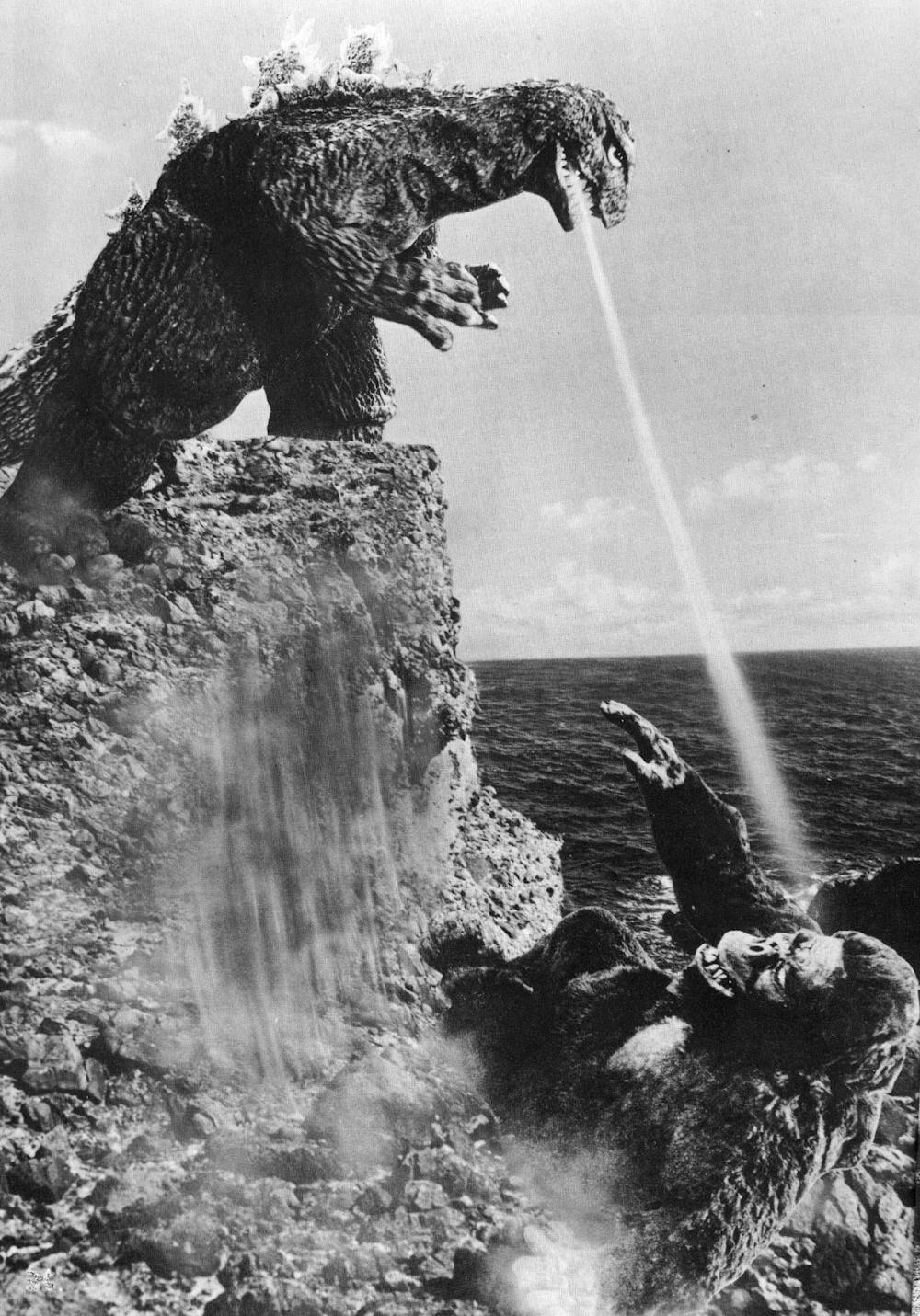
Godzilla shooting King Kong with his atomic breath from the 1962 film 'King Kong vs. Godzilla'

Kong is faster and could use tools, but Godzilla is stronger and has armored skin. Tim Simpson/Flickr, CC BY-NC

Ready, fight!

So now that we’ve looked a little closer at how Godzilla and Kong are built, let’s imagine who might emerge victorious in battle.

Though Kong is a little bit smaller than Godzilla, both are more or less comparably massive in size and neither has a clear advantage here. So what about their fighting abilities?

Godzilla would likely favor his robust tail for both offense and defense – much like modern-day large lizards that use their strong tails as whips. Scale up that strength to Godzilla’s size, and that tail becomes a lethal weapon – which he has used before.

However, Kong is more comfortable on land, faster and more agile, can use his strong legs to jump, and possesses much stronger arms than Godzilla – Kong probably packs a walloping punch. And as an ape, Kong would also likely use tools to some degree and might even capitalize on his throwing ability.

Both would have a gnarly bite, with Kong likely getting a slight advantage. However, Godzilla’s bite is by no means weak, and all of his teeth are flesh-piercing, similar to crocodile and monitor lizard teeth.

On defense, Godzilla has the edge, with thick scaly skin and sharp spikes. He might even act like a porcupine, turning his back to a rapidly approaching threat. However, Kong’s superior agility on land should be able to offer him some protection as well.

I will admit I am #TeamGodzilla, but it’s very close. I may give a slight edge to Kong in broad terrestrial battle ability, but Godzilla’s general mass, defense and tail would be hard to overpower. And lest we forget, the tipping point for Godzilla is that he has atomic breath! Until researchers find evidence of a dinosaur or animal with something like that, though, I will have to reserve my scientific judgment.

Regardless of who emerges victorious, this battle will be one for the ages, and I am excited as both a scientist and monster movie fan.

Kiersten Formoso, PhD Student in Vertebrate Paleontology, USC Dornsife College of Letters, Arts and Sciences

This article is republished from The Conversation under a Creative Commons license.

Music recommendation algorithms are unfair to female artists, but we can change that

These days, more and more people listen to music on streaming apps – in early 2020, 400 million people were subscribed to one. These platforms use algorithms to recommend music based on listening habits. The recommended songs might feature in new playlists or they might start to play automatically when another playlist has ended.

But what the algorithms recommend is not always fair. In a new study we showed a widely used recommendation algorithm is more likely to pick music by male than female artists. In response, we’ve come up with a simple way to give more exposure to female artists.

The representation of women and gender minorities in the music industry is tremendously low. About 23% of artists in the 2019 Billboard 100 were women or gender minorities. Women represent 20% or less of registered composers and songwriters, while 98% of works performed by major orchestras are by male composers.

This bias is also present in streaming services. A few female “superstars” dominate among the most popular artists, but most female and mixed-gender artists are in the lower levels of popularity. While the problem stems from beyond the music industry, online music platforms and their algorithms that recommend music – called recommenders – play a large role.

Our study

While previous studies have repeatedly asked consumers for their opinion, the music artists, those providing the content, are rarely in the loop.

We wanted to put the spotlight on artists. We asked musicians to give us their views on what would make online music platforms more fair. When they said gender imbalance was a major problem, we decided to study this in more detail.

Our analysis of around 330,000 users’ listening behaviour over nine years showed a clear picture – only 25% of the artists ever listened to were female. When we tested the algorithm we found, on average, the first recommended track was by a man, along with the next six. Users had to wait until song seven or eight to hear one by a woman.

Breaking the loop

As users listen to the recommended songs, the algorithm learns from these. This creates a feedback loop.

To break this feedback loop, we came up with a simple approach to gradually give more exposure to female artists. We took the recommendations computed by the basic algorithm and re-ranked them – moving male artists a specified number of positions downwards.

In a simulation, we studied how our re-ranked recommendations could affect users’ listening behaviour in the longer term. With the help of our re-ranked algorithm, users would start changing their behaviour. They would listen to more female artists than before.

Eventually, the recommender started to learn from this change in behaviour. It began to place females higher up in the recommended list, even before our re-ranking. In other words, we broke the feedback loop.

This shows how easy it can be. Our simple method can help address the biases in the algorithms that play a large role in the way many people discover new music and artists. Next, we hope to study how real consumers perceive the changes introduced by the re-ranking strategy and how it impacts their listening behaviour in the long term.

Another crucial step would be to collect and use data about the wide scale of gender identities. We’re aware this binary gender classification does not reflect the multitude of gender identities. The unavailability of data beyond the gender binary is a massive obstacle, both for research as well as for taking action and making progress on a societal level.

So far, our simulation could demonstrate the benefits of a simple re-ranking approach. But responsibility is, of course, not with the platform providers alone. Initiatives such as Keychange and Women in Music are working to represent the underrepresented in the music industry. The rest of us need to follow.

As music festivals are being criticised for the lack of women in their lineups, any step towards representing more women all genders in a more balanced manner is a step in the right direction.

Christine Bauer, Assistant Professor of Human Centred Computing, Utrecht University and Andrés Ferraro, PhD Candidate, Information and Communication Technologies, Universitat Pompeu Fabra

This article is republished from The Conversation under a Creative Commons license.

Here are 7 necessary ways to tax the rich

Income and wealth are now more concentrated at the top than at any time over the last 80 years, and our unjust tax system is a big reason why. The tax code is rigged for the rich, enabling a handful of wealthy individuals to exert undue influence over our economy and democracy. 

Conservatives fret about budget deficits. Well, then, to pay for what the nation needs – ending poverty, universal health care, infrastructure, reversing climate change, investing in communities, and so much more – the super-wealthy have to pay their fair share. 

Here are seven necessary ways to tax the rich.

First: Repeal the Trump tax cuts.

It’s no secret Trump’s giant tax cut was a giant giveaway to the rich. 65 percent of its benefits go to the richest fifth, 83 percent to the richest 1 percent over a decade. In 2018, for the first time on record, the 400 richest Americans paid a lower effective tax rate than the bottom half. Repealing the Trump tax cut’s benefits to the wealthy and big corporations, as Joe Biden has proposed, will raise an estimated $500 billion over a decade.

Second: Raise the tax rate on those at the top. 

In the 1950s, the highest tax rate on the richest Americans was over 90 percent. Even after tax deductions and credits, they still paid over 40 percent. But since then, tax rates have dropped dramatically. Today, after Trump’s tax cut, the richest Americans pay less than 26 percent, including deductions and credits. And this rate applies only to dollars earned in excess of $523,601. Raising the marginal tax rate by just one percent on the richest Americans would bring in an estimated $123 billion over 10 years. 

Third: A wealth tax on the super-wealthy.

Wealth is even more unequal than income. The richest 0.1% of Americans have almost as much wealth as the bottom 90 percent put together. Just during the pandemic, America’s billionaires added $1.3 trillion to their collective wealth. Elizabeth Warren’s proposed wealth tax would charge 2 percent on wealth over $50 million and 3 percent on wealth over $1 billion. It would only apply to about 75,000 U.S. households, fewer than 0.1% of taxpayers. Under it, Jeff Bezos would owe$5.7 billion out of his $185 billion fortune – less than half what he made in one day last year. The wealth tax would raise $2.75 trillion over a decade, enough to pay for universal childcare and free public college with plenty left over.

Fourth: A transactions tax on trades of stock.

The richest 1 percent owns 50 percent of the stock marketA tiny 0.1 percent tax on financial transactions – just $1 per $1,000 traded – would raise $777 billion over a decade.That’s enough to provide housing vouchers to all homeless people in America more than 12 times over.

Fifth: End the “stepped-up cost basis” loophole.

The heirs of the super-rich pay zero capital gains taxes on huge increases in the value of what they inherit because of a loophole called the stepped-up basis. At the time of death, the value of assets is “stepped up” to their current market value – so a stock that was originally valued at, say, one dollar when purchased but that’s worth $1,000 when heirs receive it, escapes $999 of capital gains taxes. This loophole enables huge and growing concentrations of wealth to be passed from generation to generation without ever being taxed. Eliminating this loophole would raise $105 billion over a decade.

Six: Close other loopholes for the super-rich.

For example, one way the managers of real estate, venture capital, private equity and hedge funds reduce their taxes is the carried interest loophole, which allows them to treat their income as capital gains rather than ordinary wage income. That means they get taxed at the lower capital gains rate rather than the higher tax rate on incomes. Closing this loophole is estimated to raise $14 billion over a decade.

Seven: Increase the IRS’s funding so it can audit rich taxpayers.

Because the IRS has been so underfunded, millionaires are far less likely to be audited than they used to be. As a result, the IRS fails to collect a huge amount of taxes from wealthy taxpayers. Collecting all unpaid federal income taxes from the richest 1 percent would generate at least $1.75 trillion over the decade. So fully fund the IRS.

Together, these 7 ways of taxing the rich would generate more than $6 trillion over 10 years  – enough to tackle the great needs of the nation. As inequality has exploded, our unjust tax system has allowed the richest Americans to cheat their way out of paying their fair share. 

It’s not radical to rein in this irresponsibility. It’s radical to let it continue.

CDC says vaccinated people can fly again, but the agency is not saying you should do so

It’s OK for fully vaccinated people to travel domestically again without quarantining, so long as they wear a mask and maintain social distancing guidelines, the Centers for Disease Control and Prevention announced April 2, 2021 in its updated guidelines for travel.

The agency advises that people still wash or sanitize their hands frequently when traveling. The guidelines also provide guidance for other modes of transportation other than air travel, and are for domestic travel. The CDC recommends delaying international travel for fully vaccinated people.

The agency also advises delaying domestic travel for those who are not fully vaccinated. And, the updated travel guidance comes only days after CDC Director Rochelle Walensky reminded people that mask-wearing is still essential and that the U.S. is not out of danger.

Fully vaccinated means that two weeks have passed since people have received the full dose of vaccine. That is two shots for those who have been vaccinated with the Pfizer or Moderna vaccines. For those who have been vaccinated with the Johnson & Johnson vaccine, that is one shot. Studies have shown that it takes the body two weeks to develop the full immune response to the vaccine, regardless of which vaccine they receive.

More than 50 million people have been fully vaccinated, and more than 100 million people in the U.S. have had at least one dose of one of the three COVID-19 vaccines as of April 2, 2021. Evidence continues to show that vaccination with the Pfizer, Moderna and Johnson & Johnson vaccines offers very high levels of protection against the coronavirus. And, research is showing that the risk of vaccinated people spreading the disease to others is low. However, there is still a small risk that vaccinated people could transmit the disease to others.

While this is good news to those who want to travel – as well as the airline industry and tourist destinations – people are still confused about what they can and cannot safely do. As an infectious disease doctor, I’ve been fielding a lot of questions from my patients as well as my friends and family about what someone is allowed to do once vaccinated. Do vaccinated people need to wear masks, socially distance and avoid travel?

If you are fully vaccinated – that is, if you are more than two weeks out from receiving both doses of the Pfizer or Moderna vaccines or one dose of the Johnson & Johnson – you can visit other fully vaccinated people without socially distancing or wearing masks, according to the CDC guidelines. You can even visit indoors with unvaccinated people from a single household who are at low risk for severe COVID-19 disease without wearing masks or physically distancing.

The CDC does suggest you be tested if you develop symptoms that could be COVID-19. You should then stay isolated until you are shown to be uninfected. If you are fully vaccinated, you should still avoid social settings that include multiple unvaccinated households. And, you should avoid medium to large crowds because of the increased risk.

You also should continue to wear a well-fitted mask, wash your hands frequently and maintain physical distance when outside the home. Worshiping indoors at a synagogue, mosque or church is still not advisable unless all attending are vaccinated.

With regard to the new guidelines, the CDC says that vaccinated people should still monitor themselves before and after travel and wash or sanitize their hands frequently.

So in the face of continued pandemic transmission and new viral variants, we all need to remain vigilant and observe good health practices even after being vaccinated. However, it is very good news that we can prudently lift some of the restrictions that have so limited our ability to be with loved ones. This is especially good news for seniors who are particularly vulnerable to the downside of isolation – and the loved ones who are keen to visit them.

William Petri, Professor of Medicine, University of Virginia

This article is republished from The Conversation under a Creative Commons license.

“Silly is healthy”: “Animaniacs” star on laughing through throat cancer & finding a whole new fandom

Recently, I got to interview two Teenage Mutant Ninja Turtles, an Animaniac, a happy-go-lucky talking mouse who says “Narf!” and the dog from “Rick and Morty.”

All of them inhabit the mind, soul and vocal cords of veteran voice actor Rob Paulsen. He is, in his own words, “in the happy business,” but right now he was remembering something unimaginably frightening and devastating. Specifically he recalled how Warner Bros. had told him that they wanted to reboot the animated ’90s series “Animaniacs” . . . roughly a month after he had been diagnosed with throat cancer.

Barely containing his emotion, Paulsen described how he was afraid that he wouldn’t be able to sing anymore (a key part of his job) or that something unthinkably worse might happen. But despite working in an industry so often associated with cynicism and selfishness, the colleagues with whom Paulsen shared these concerns — who also happen to be his dear friends — made it clear that they loved him and supported him. No matter what, they were going to stand by his side.

If you were a child in America during the 1990s and early 2000s, it’s a safe bet that you’ve heard Paulsen’s voice. The prolific actor has played Raphael in the 1987 animated series “Teenage Mutant Ninja Turtles” (and later Donatello in the 2012 reboot), Yakko Warner on “Animaniacs,” Pinky from “Pinky and the Brain,” and Carl Wheezer from “The Adventures of Jimmy Neutron, Boy Genius,” among other roles.

Fortunately, he’s beaten throat cancer and indeed reprised the roles of Yakko and Pinky for the 2020 “Animaniacs” reboot on Hulu, introducing a whole new generation of young people to his Paulsen’s vocal talents. And he hasn’t been just revisiting nostalgia roles either, instead taking on fresh challenges in newer projects. One of my personal favorites is a small role on Adult Swim’s “Rick and Morty,” Snowball/Snuffles, the fluffy dog given hyper-intelligence. Per Paulsen: “I love that critter. The inspiration? Let’s say it was ‘HAL’ from ‘2001: A Space Odyssey,’ with a ‘tude and a vasectomy.”

Yet very few of us — myself included — knew that the world was almost deprived of another chance to explore his gifts.

He discusses his experience with cancer in his memoirs “Voice Lessons,” which I cannot recommend highly enough. That said, I must confess that there is something about talking to Paulsen directly that cannot be replicated. There is a sweetness to the man, an authenticity and a humility, that is absolutely staggering. I had previously interviewed him in 2018 and, although that was a much briefer conversation, I was struck even at that time by his obvious passion for the seriousness of being silly.

That last phrase may sound like an oxymoron, but it really is the essence of Paulsen’s legacy. During our interview, which spanned a wide range of subjects, he repeatedly returned to the subject of why it is important to savor the humor and happiness that life offers whenever you can find it. It is easy to see why Paulsen is widely loved, not just by those who have heard his voice but by those who know him personally. And as he explained in one anecdote near the end of our conversation, he learned through his ordeal that even when you think life can’t get any better, it will often surprise you by doing precisely that.

The following interview has been edited for length and clarity.

Thank you again for the kind words earlier. I really do appreciate it.

You work for a high high-level outfit. People at Salon are not folks who are second-year journalism students at Podunk College. It’s always a pleasure to speak with somebody who’s a world-class journalist, especially about something that is sort of universally loved. That is to say animated cartoons, which are utterly timeless. And I love the fact that anyone likes to talk about this because the bottom line is: it just brings joy to both sides of the equation. So when you get to do that with somebody who knows how to do fancy writing, that’s great.

You have a book out about your experience with throat cancer.

It dropped in October of 2019. I’m happy to speak about the whole cancer experience. In fact, that’s the platinum lining of my cancer experience. It is having opportunities like this to help.

Your voice is quite literally the tool that you have used to make a career for yourself. Did it affect your ability to do your job when you first developed the cancer?

No, which is what was so disconcerting when I was diagnosed. I had probably six months, eight months previous to my diagnosis [when I] had noticed a lump on the left side of my neck. While it was obvious to the touch, and I didn’t have a goiter, someone had put his hand on it and said, “Oh dude, yeah, wow. You might want to have that looked at.” And of course, as you said, it pays the rent, but I was working with big Hollywood productions, the usual suspects: Disney, Nickelodeon, Warner Bros., Universal.

There is a lot of music. I sing all the time for my supper, literally, and I was fine. I wasn’t losing weight, nothing. So I went in for my physical, as I said about six to eight months after I noticed this, and put my doc’s hand on this spot and — I promise you, Matt, in five seconds he says, “Oh boy. Not good, Rob.” And I said, “Oh, come on.” I’ve known this guy forever. He said, “No, seriously, you’ve got to have this looked at yesterday.” And of course the first thing I thought of was cancer. But I thought, “Well, maybe it’s like a lymphoma,” because it was a lymph node that was swollen, but the cancer had already spread to that area. The original tumor was deep in my throat. I had no trouble eating, swallowing, no pain, nothing, but the lump was the area that the cancer had already metastasized to. And that’s what got my doctor’s attention. It was confirmed to be Stage 3 metastatic squamous cell carcinoma and a B primary tumor was at the base of my tongue in my throat.

What advice would you have for people who develop any kind of medical condition, whether it’s a disability, whether it’s a disease that specifically impacts their sense of identity or in general their sense of who they are?

In my now really lovely circumstance where I have very clear, authentic, anecdotal evidence of how I got through it, the most important piece of advice I could give to anyone who is suffering or dealing with something that literally hits somewhere they live is two things:

Find humor, joy, laughter. As trite as that sounds, Matt, it is very powerful and uniquely human. I know, we know, you know that our dogs are happy and stuff, but you see my point. They are uniquely human with respect to a defense mechanism.

And I make my living in the happy business, even if it’s gallows humor. I remember one of my doctors, who has become a dear friend. He’s my radiation oncologist, Dr. Henry Yampolsky. He’s the one who put together my two months of daily radiation to zap the tumor in my throat. When we met for the first time, he said with this glorious Russian accent, “Mr. Paulsen, I feel certain we can cure you. Unfortunately, before we do, we will almost have to kill you.” And I started laughing because I’m a big James Bond fan, and he sounded like Goldfinger. You know, that great scene where Sean Connery’s on the table, and there’s a laser coming up towards his crotch, and as Goldfinger is leaving the room 007 says “What do you think Goldfinger? Do you expect me to talk?” And he says, “No, Mr. Bond, I expect you to die.”

And that’s where my mind went: to the humor, to the weirdness, to all of that. It’s my sweet spot. And as soon as I started laughing and thanking him for approaching it that way he said, “Don’t lose that. Don’t lose that sense of humor. I tell you, seriously, how important that is for all my patients. Whether it’s music, whether it’s their family, their dog.” He categorically told me, “Don’t stop that as an adjunct to your treatment.”

. . . I’m also learning when it’s enough. . . . I would go back to work and I wasn’t able to do it the way I wanted to do it. From Rob 2.0 to Rob 1.0, I was not up to my standards yet, but the producers were very kind and saying, “Robbie, honest to God, I know you’re not going to believe it, but it sounds great, and if it doesn’t work out, we’ll tweak it in post-production later. You go back home and rest.” . . . I am better now at being able to say, “Hmm, you know, I feel my throat getting a little tired. I know what’s going to happen if I keep pushing. Now it’s as good as it’s gonna get.” And I’ll be fine with that.

So humor and giving yourself a break. Those are both things that are very important and I would absolutely recommend anyone.


“Animaniacs” key art (Hulu)

You really seem to embrace the joy and value of being silly. I know it may sound paradoxical to talk about the seriousness of being silly, but is being silly something that you think everyone should take seriously?

We should do this once every two years, if not once a day. That’s wonderful. Yes, you’re right. Like I said, I’m in the happy business. I’m effectively a blue-collar worker in the dream factory. I go to work every day and I get paid to do what essentially got me in trouble in seventh grade. I sound like Gordon Gekko, but silly is good. Silly is healthy. Silly is utterly human. I think we’re all silly when we’re kids. It’s just part of the deal. And as we get older, we’re all silly. When we go on vacation, have a couple of pops, whatever, that’s the deal. Silliness, laughter, joy for its own sake are utterly human emotions. And I know that I’m speaking from a unique, relatively privileged position in that my job is to be silly.

If you want the scientific, empirical data that shows what happens when you laugh from your soul, with respect to your endorphins and your brain, it’s out there. It’s not new, it’s not unusual. It transcends language. It transcends generations.

Here’s a quick anecdote that is important in this context. A good friend of mine is a world-class physicist, Leonard Mlodinow. He just published a book. He did three books with Stephen Hawking and they were very close friends. And so he wrote a book about his experience with Stephen Hawking and last fall, when the book dropped, he wanted me to interview him online for some collective bookstores. He wanted one of my characters, Pinky, to ask them some really important questions about Stephen Hawking because of the humor aspect of it. Stephen Hawking had a wonderfully wicked sense of humor at the very same time. And I had this like moderate epiphany at the moment that I was discussing his new book with this guy who teaches here at Caltech and knows he’s working on it. They call it this, the theory of everything.

I don’t even know how to get that, how to respond to that, the theory of everything. This is a super intellect, but it occurred to me that while I was riffing as Pinky and he was laughing and the people online were laughing and all that stuff. I was laughing literally a week before while I had had the same experience with a young man who is on the autism spectrum. He is a young man who will always, by his parents’ admission, need help to do the most rudimentary of things. I don’t mean brush your teeth and go to the bathroom, but he won’t be able to live by himself, drive a car and all that. He’s 30 and incredibly bright, a talented artist with pen and ink, but his ability to communicate as you and I are doing was, as is often the case, not what we’re used to. But the thing that really struck me, Matt, was that my young friend, Anthony was his name, when Pinky started riffing, he laughed at the same jokes in the same spot, the same way that a guy who used to hang with Stephen Hawking and who is working on the theory of everything did. That’s a big thing.

I have to interject at this point. I’m not sure if you knew this, but I actually am on the autism spectrum too. And growing up, I would watch “Animaniacs.” I would always laugh at “Pinky and the Brain.” Pinky in particular would crack me up. I also loved watching Yakko and Wakko and Dot and, being a child on the spectrum in the ’90s, people did not really understand autism as well as they do today. I was lucky because I had very supportive and nurturing parents, but I was also very socially isolated. And I felt like I was friends, in a way, with the characters that you and your colleagues played. So the story you just told took me back 25 years. God, it’s been even more than 25 years.

Friend, there are no accidents. How about that? I have a couple of friends on the spectrum out here who, by their diagnosis, have Asperger’s. One of them is Corey Burton, who is a really gifted actor. I had him on my podcast several years ago. And we were discussing in the context of the podcast his encyclopedic knowledge of microphones and how he would take his own mic with him to work. And we used to make fun of him, but not in a denigrating way. We’d say, “Oh my God, Corey, I wish I was as smart as you. . . . You’re a Hollywood regular and your insight, your knowledge of microphones is savant. Like it’s incredible.” And he looked at me and he said, “Oh, Rob, I’ve been diagnosed. I’m on the autism spectrum. I have Asperger’s.” And it’s like, boom. It made perfect sense.

Thanks to people like you and my friend, Corey, who gives me the privilege of speaking with you and sharing all my anecdotes, we don’t know when someone’s going to read this article and somebody’s going to hear your story, irrespective of whether it includes me or not. But you are an example, Matt, your life, the way that you move through it, what you’ve accomplished, despite what can be crippling for other people, just by virtue of you breathing. That’s not hyperbole. You, like my friend Corey and many others whom I’ve had the great privilege of meeting. I’m very involved with the autism community, personally, and I love it. There are important things to discuss, and so I just love these things. Like I said, there ain’t no accidents, my friend.

Now I have to ask, for you emotionally, what was it like returning to play these characters like Yakko and Pinky?

Oh my God, that’s almost impossible to quantify. In the book I recount that we had a dinner meeting. Tress MacNeille who is Dot, and Jess Harnell, who is Wakko, were called by Sam Register, the president of Warner Bros. Animation a few years ago. He wanted to have dinner at this really nice restaurant, literally in the shadow of a water tower in Burbank, a really high-end fancy Hollywood steakhouse. We were hoping that it was, “Oh my God, you know, we’d all wished that we got to do this again.” And you know, it was the start of kind of reboot mania. “Gosh, do you think there might be something to this?” And we went to have the dinner, but I had literally just started my chemotherapy and radiation and my two friends, Jess and Tress knew it, but Sam from Warner Bros. didn’t. Certainly Steven Spielberg didn’t, and I didn’t broadcast it. I hadn’t told anybody outside my dear close circle.

But that was the gist of the conversation, the meeting: Steven wants to do this again, probably pitch it to the new streaming platforms, but “Animaniacs” had already been back on Netflix, the original episodes, and it was just exploding. Here we go. “Are you guys in?” Well, of course, what do you say? “Steven Spielberg, no, I don’t think so?” Of course we’re in! . . .  And of course, what I’m thinking is because Steven insisted that it be just be me and Maurice LaMarche, the Brain — it wasn’t about movie stars doing our roles, it was about authenticity, it’s about the fact that we can still do this, if you do what you’re doing now it would have been all or nothing — so immediately I put myself in the position of thinking, “Well, I know they love me and it’s about me surviving. But if we can’t do this, I’m keeping them from doing this.” I mean, it’s not my fault, but you see my point.

It turns out it wasn’t an issue because we were on Steven’s time, which took a couple of years to get going. So when it happened and I signed a contract and we were getting ready to do it again. It was a show that changed my life, and to get to do it again with people I choose to have in my family, been to funerals, birthdays, gotten through each other through divorces, all of that family life stuff — and we’ve all gotten Emmys and make a nice living and make millions of people happy together — it’s an unbelievable opportunity, like winning the lottery of life. The way it played out was pretty precious.

Cut to 25 years ago. There was a moment during “Animaniacs” that I cite in my book, which we had everybody who is anybody in terms of voice talent in Hollywood, in a particular two-part episode of “Animaniacs.” We had so many actors in the booth, a big recording studio, that we were kind of playing musical microphones. We’d stop and I would switch with Jim Cummings, who was the voice of Winnie the Pooh and Tigger and [the Tasmanian Devil]. He was doing an episode, we even had a couple of celebrities. I think in this particular episode, it was Cary Elwes was in it. I think Dom DeLuise was in it, but it was a really big episode. 

And I remember sitting next to Tress. I did in every recording session, Tress was between her brothers Wakko and Yakko in every session . . . but I remember, I grabbed her hand during this episode of “Animaniacs” in the ’90s and said, “Holy s**t, honey, take a picture of this. Unless you’re on ‘The Simpsons,’ it don’t get no better.” Steven Spielberg, everybody’s winning Emmys, we’re making a nice living, look at all the actors around us. This was literally one of those situations where if a bomb hits this room, the cartoon business is shut down. These guys, this is the best of the best. Holy crap. It’s just doesn’t get any better, and we’re just enjoying being in the moment. This is as good as it gets, and we’re getting paid!

So 25 years later, Matt: I’m through my cancer. I’ve been hired again. They know I’m okay. I know I’m okay. And the first episode of the version that’s now on Hulu, I’m sitting next to Tress again. And this is the God’s honest truth. I took her hand. I said, “Honey, remember all those years ago when I said . . .” and she stopped me and said, “It doesn’t get any better.” And I said, “Unbelievable. You remember that?” She said, “Of course, I remember that. It does, doesn’t it, Mr. Cancer?” And I said, “Holy s**t.” I kind of lost it. Because she was there. She knew what I had gone through and she’s very close to my family and she says:

“It does, doesn’t it?”

Has a new fandom arisen from the show or is it mainly old fans from the ’90s? What have you experienced?

It’s huge! What we have noticed is that the fan base and the people who come to see us, the breadth of the age is literally mad! Eight or nine to 70 or 75, because the people who are now coming to see us and watching “Animaniacs” are people who were turned on to the show by their college kids. And just like I watched Looney Tunes with my parents and my siblings, they watch “Animaniacs,” “Ninja Turtles, “Pinky and the Brain,” “Jimmy Neutron,” “The Mask,” “Fairly Odd Parents,” “Goof Troop,” “Gummy Bears,” all the stuff I did for Disney, all that. They all watched that with their college kids or high school kids. So now their high school college kids have their own kids. And so now they’re saying, “Hey, let’s get grandma, grandpa, and go here, sing ‘Animaniacs’ songs,” say these kids, “and I’ll bring my own kids.” 

That’s exactly what’s happening. And it is freaking amazing to see the requests I get for autographs, from people who get their children with them online and say, “Here’s my little boy.” I listened to him sing “Animaniacs” and mom and dad are wearing “Animaniacs” T-shirts too. And then they say, “Oh, before we forget, would you do a voicemail from my dad – the kids’ grandpa? He loves Pinky.” Well, my dad loved Bugs Bunny until he died, so they’re timeless. And when you put that in the context of what this means to me, how on earth could it get any better than that?

I get to help people thanks to you. Jesus. I won a lottery, man. This is great! I’m such a privileged man. And to get a chance to speak with you, again, learn about your circumstance, your bravery, your example, your willingness to share it with the world. Come on, guys like us are truly, truly blessed.

“Animaniacs” is currently streaming on Hulu and will return for a second season later this year with another already ordered.


Why explorer Vanessa O’Brien left the corporate world to climb the world’s tallest peaks

The phrase climbing a mountain is often used as a metaphor to describe doing something hard. And for good reason — obviously, summiting a mountain, literally, is a challenging feat.

Author and mountain climber Vanessa O’Brien knows this firsthand. She was the first American woman to climb K2, and as a dual citizen, the first British woman to return from its summit alive. But O’Brien didn’t grow up wanting to climb mountains — a career she now doesn’t advise young children to take up because of the dangers that come with it. In fact, before the 2007 financial crisis, O’Brien was focused on a different kind of climb up the corporate ladder. Once her career fell into a tailspin in 2008, she decided to take up mountain climbing as a hobby that eventually turned into her career.

The jump from business to mountain climbing wasn’t an easy one for O’Brien. There were plenty of times she considered quitting, as detailed in her debut memoir “To The Greatest Heights: Facing Danger, Finding Humility, and Climbing a Mountain of Truth.”

The story begins in 2008 when O’Brien is forced to rethink her career, and it takes us on a journey of multiple attempts to scale the world’s tallest peaks — including Everest and K2. What makes the story riveting and inspiring is that failure is frequent, but often a catalyst for change, grounding readers in the reality that hard things take a lot of work. Even if you’re not the outdoorsy type, you’ll enjoy O’Brien’s story and quick-witted humor as she takes us around the world on unforgettable adventures. 

O’Brien spoke to Salon about her experiences by phone; as always, our interview has been edited and condensed for clarity.

What inspired you to take this pivotal moment and turn it into a memoir?

I started writing when I came off K2 in maybe 2018. When I was speaking to different audiences and people, I always found the Q&A would go as long as the talk or longer. But ultimately people would always end by asking: “When is the book coming out?”

And I would joke, like, “What book?” And they would say, “No, no, no, but these stories… Hollywood couldn’t make these stories up.” And I started thinking, and I thought, “You know what? Sometimes life is funnier. Maybe Hollywood couldn’t make this stuff up.” And some of the things — the situations you find yourself in or the things that happen to you — actually they are really funny stories and they are circumstantial. And they are real. And there’s learning in all of them. And so, it really was an on-request thing.

I started taking it more seriously. I thought, “You know what? Could I do it? And why should I just wake up one day and think I can’t?”

“Why should I just wake up and think I’d be a good author?” Right? But it’s almost the same way I approached climbing.

What was the writing process like for you revisiting these memories?

Very uncomfortable.

I see.

The litmus test for me was, if I felt it could help somebody else, it stayed in.

Right.

If it was just sensational, it was out. Because there are sensational things out there.

As a reader, I appreciated your vulnerability in disclosing what you did about your past. And even just being so frank about how your body changes at high altitude.

Yeah, sometimes I tried humor, but the humor was already there. I didn’t make those things up, that really happened. Like with the hemorrhoids.

Right.

At high altitude, it’s the same way you worry about strokes and things like that. It’s basically, it’s bubbles, and bubbles form in other aspects. A hemorrhoid is a bubble. Blood clots are bubbles.

So it’s scary when it manifests itself like that. It’s horrendous and horrible. And it’s attached to you, and how do you get rid of it? Those are humiliating things, but…

Not on the mountain?

Yeah, exactly. And I also know that probably every pregnant woman has had them and goes through them. There’s a lot of people that will read that and say, “Oh, 100%.”

There’s so much of a focus on Everest in popular culture, which is a big part of your memoir, but for you the biggest challenge is K2. Even though it’s a shorter peak than Everest, K2 is purportedly more difficult to summit; about a quarter of those who have tried died. Can you explain to our readers why summiting K2 was so significant for you, especially as a female mountain climber?

Sometimes you look at how hard things are by comparing different things. And I remember once looking at, say, the number of women who ran Fortune 500 companies. And I remember one year, looking at it, and it was like, okay, so the number had gone from 12 to 14, and then one year, it had gone to something like 24. So 24 of the 500 Fortune 500 companies were run by women. And, let me just see if I’ve got my math right here. Okay, so 24 divided by 500. 4.8%. So let’s call it five percent. Five percent of women were running Fortune 500 companies. And then I went on Everest and said, “Okay, well, of the women who have climbed Everest, what percentage was that?” And it turned out to be double.

Wow. Yeah.

Sometimes it’s the comparison that shocks you. Because people thought it was so hard to climb Everest. And yet there are twice as many women climbing Everest than women even making it to the C-suite. So, if I had my feminist hat on, I was appalled.

But Everest is the most climbed mountain. So when you go to just 237 meters left to the second-highest mountain, suddenly, there’s only 50 women who have climbed, instead of 377 women.

What I love about your memoir is that it shows how important accumulating experience is, even when you don’t reach your “goal.” And I loved this quote you had about this: “Experience is like the switchbacks that zigzag up the side of a mountain; you keep returning to the same parallel but with a higher point of view.” I got the sense that your view on “failure” has changed. Can you share more about that shift in perspective?

I don’t think you fail unless you give up. And that’s a really interesting point of differentiation because once upon a time, I would’ve looked at, say, season one or season two of K2 and said, “Hmm. Okay, well, it’s time to go home. This has been a failure.” But the point is, and it’s almost like when the UN women hand me that flag back and I’m crying because they won’t give up on me, even when I think I’m giving up on myself, right?

You can’t fail unless you give up. And as long as you don’t give up, you’re not out because you know you’re going to continue to do something. And that’s the difference between what is the end and what’s to be continued.

The problem with a goal is that it’s finite. If you hit it, then you’re done. So really, it’s not about a goal. Because if it were just about a goal, then you reach it and you’re done, and what’s next? And then you could say, “Oh, but what about a series of goals?” Well, okay. But a series of goals, really, what you’re talking about is a purpose. The more I thought about it… Now we’re getting more into philosophy.

So I’m curious how the pandemic has been for you. You were part of the Challenger Deep mission in 2020? Are you still climbing?

Yeah. Look, the pandemic was terrible for everyone. The only thing I will say is that, as a mountaineer, there were many tools in our toolkit that were really pandemic friendly. Like those masks. We wear these because the yaks kick up dust on the trail and there’s pollution in the city, and also, we want to warm our breath in the cold, dry air. And climbers get all sorts of respiratory diseases and it spreads really easily, so this is really necessary.

The other thing is, when we cough, we always cough in our elbow. We don’t cough in our hands because, again, you’re going to touch something with your hands. So that was something that was always the mountaineering protocol. And washing your hands. I’m so glad people learned how to wash their hands.

So many people might be where you were in 2008, when this story begins— without a job, not sure what’s next. What advice would you give them about starting over?

I think it does feel a little bit like then. I would say for people starting over to be optimistic and to think about what they want to do with an open mind. I didn’t know what I wanted to do at all. And what led me to this path was supposed to be temporary.

What I did was, I made a list. They can make a list and take stock of the things that they like to do, the things that they’re good at. See if they see any parallels in that. Talk to the people that know them, get advice. They’ll find that a penny will drop somewhere.

That’s what happened for me. The penny dropped. And they won’t know when they hear it. I knew. When somebody said “Everest,” it was crystal clear.

Anna Kendrick in space! Idris Elba on a horse! Here’s what new on Netflix in April

If anecdotes hold any truth, then you can expect at least a few rainy days this April. Quarantine burnout can be mitigated by the promise of those balmy spring days, but if you need some distraction on one of those drearier days, Salon has got you covered with some of the titles you should keep an eye out for this month on Netflix.

First, you might want to catch up on some titles that are on their way out. “The Great British Bakeoff: Masterclass” Seasons 1-3 will leave the streaming service April 21. The good thing about GBBO is that it can offer the same soothing benefits of self-care without the effort. What is more nurturing to the soul than soft-spoken British people waxing poetic over custards? 

“Blackfish,” the groundbreaking documentary that unveiled the cruelty of animal-based theme parks like SeaWorld is also leaving the platform at the end of the month. If you took our recommendation last month to watch “Seaspiracy,” consider Blackfish some supplementary material about aquatic life and how it is treated by humans.

If you’re in the mood for something a bit more serious, Bong Joon-ho’s “Snowpiercer” is also leaving Netflix. This is from the same director as 2019’s “Parasite,” and is a gripping sci-fi thriller that never got the credit it deserves (even thought it did inspire an American series adaptation). Check it out if you want more cultural commentary from the Oscar-winning filmmaker.

There are also plenty of classic additions that will make April the perfect month for staying in bed and catching up. You can reintroduce yourself to the world of sorority-queen-turned-law student Elle Woods in “Legally Blonde,” the girl-power cult classic that stars Reese Witherspoon, Selma Blair, and the incomparable Jennifer Coolidge.

Read on for the originals that are catching our eye this month:

“Searching for Sheela,” coming soon

If you found yourself sucked into “Wild Wild Country,” the gripping docuseries from 2018 that detailed the unreal story of Bhagwan Shree Rajneesh and his controversial Oregon commune, “Searching for Sheela” should be right up your alley. This series covers the events from the perpective of Ma Anand Sheela, the infamous spokesperson for the Bhagwan, and follows her long-awaited return to India, where she embarks on a campaign of interviews to tell her story and possibly earn redemption.

“Worn Stories,” April 1

Based on the best-selling book of the same title by Emily Spivack, “Worn Stories” is a charming anthology series that analyzes people, the clothes they wear, and the inextricable link between the two. 

“Concrete Cowboy,” April 2

Idris Elba and Caleb McLaughlin of “Stranger Things” fame play an estranged father-son duo in this dramatic coming-of-age movie based on the novel “Ghetto Cowboy.” Focused on the true history of cowboy culture within the Black community of Philadelphia, “Concrete Cowboy” shows the struggle of a young boy trying to define his identity between the streets and his father’s eccentric passion. Salon’s review deems the movie best “when its characters are on horseback” and addreses “issues of Black masculinity, as well as racism and discrimination.”

“The Serpent,” April 2

Based on the real life of a con man and murderer in the 1970’s, “The Serpent” tells the story of thief and con-man Charles Sobhraj. Following his string of crimes throughout Southeast Asia, the story shows the pursuit of European authorities to catch one of the most notorious killers of his time.Salon’s Melanie McFarland writes in her review that the film offers “travel, seduction, danger, and enough beauty to offset the frequent bouts of projectile vomiting.” 

“This Is a Robbery: The World’s Biggest Art Heist,” April 7

This docuseries unfolds the events leading to one of the biggest art heists in modern history. From the producers of “The Irishman,” “This Is a Robbery: The World’s Biggest Art Heist” tells the story of how two men dressed as police officers snuck into a Boston museum 30 years ago and stole so much precious art that it still remains untraced to this day.

“Thunder Force,” April 9

Two childhood best friends find themselves tasked with fighting crime and protecting a city when they develop a special serum that can give humans superpowers. Starring Melissa MCarthy and Octavia Spencer, “Thunder Force” introduces us to a new kind of superhero.

“My Love: Six Stories of True Love,” April 13

After his acclaimed documentary “My Love, Don’t Cross That River,” director Jin Moyoung expands his storytelling on a global scale. Filmmakers from half a dozen countries – from the suburbs of Tokyo to rural India – follow an elderly couple for different periods of time to reflect on their long-lasting love.

“Life in Color with David Attenborough,” April 22

If you’re itching to get out of your head, David Attenborough has another stunning nature flick up his sleeve. “Life in Color” explores the significance of color in the natural world, and uses specially developed cameras to reveal the intricacies of these creatures and how they utilize color in ways humans literally could not see before.

“Stowaway,” April 22

It’s hard to imagine accidentally getting stuck on a rocket headed to Mars, but “Stowaway” explores that possibility when an unintended extra passenger suddenly finds himself on a years-long voyage with three other people. After realizing their resources won’t be able to sustain the new addition, this star-studded cast that features Daniel Dae Kim, Shamier Anderson, Toni Collette and Anna Kendrick will be forced to make an impossible decision.

“Headspace Guide to Sleep,” April 28

From the makers of the “Headspace Guide To Meditation,” this spin-off series will teach viewers about sleep, how to handle their relationship with it, and techniques to build better habits. Each episode features educational content about rest, and also offers a real-time wind down to help prepare you for a restful night of z’s.

“Yasuke,” April 29

LeSean Thomas, creator of “Cannon Busters” has returned to Netflix with “Yasuke,” an anime that aims to tell the story of the first African samurai. Thomas has enlisted studio MAPPA, the animation house involved in hit shows like “Jujutsu Kaisen” and “Attack on Titan.” The titular character will be played by “Judas and the Black Messiah” star Lakeith Stanfield, and will also feature a soundtrack produced by the grammy-winning artist Flying Lotus. There isn’t an official trailer available yet, but this series sounds extremely promising for anime fans craving something new.

Here’s everything else coming to Netflix this month:

Coming soon:
“The Disciple”
“Searching For Sheela”

April 1
“2012”
“Cop Out”
“Friends with Benefits”
“Insidious”
“Legally Blonde”
“Leprechaun”
“Magical Andes” Season 2
“The Pianist”
“The Possession”
“Prank Encounters” Season 2
“Secrets of Great British Castles” Season 1
“Tersanjung the Movie”
“The Time Traveler’s Wife”
“Tyler Perry’s Madea’s Big Happy Family”
“White Boy”
“Worn Stories”
“Yes Man”

April 2
“Concrete Cowboy”
“Just Say Yes”
“Madame Claude”
“The Serpent”
“Sky High”

April 3
“Escape from Planet Earth”

April 4
“What Lies Below”

April 5
“Coded Bias”
“Family Reunion” Part 3

April 6
“The Last Kids on Earth: Happy Apocalypse to You”

April 7
“The Big Day” Collection 2
“Dolly Parton: A MusiCares Tribute”
“Snabba Cash”
“This Is A Robbery: The World’s Biggest Art Heist”
“The Wedding Coach”

April 8
“The Way of the Househusband”

April 9
“Have You Ever Seen Fireflies?”
“Night in Paradise”
“Thunder Force”

April 10
“The Stand-In”

April 11
“Diana: The Interview that Shook the World”

April 12
“New Gods: Nezha Reborn”
“Nicky, Ricky, Dicky & Dawn” Seasons 1-4

April 13
“The Baker and the Beauty” Season 1
“Mighty Express” Season 3
“My Love: Six Stories of True Love”

April 14
“Dad Stop Embarrassing Me!”
“The Circle: Season 2”
“Law School” 
“The Soul”
“Why Did You Kill Me?” 

April 15
“Dark City Beneath the Beat”
“The Master”
“Ride or Die”

April 16
“Arlo the Alligator Boy”
“Ajeeb Daastaans” 
“Crimson Peak”
“Fast & Furious Spy Racers” Season 4: Mexico
“Into the Beat”
“Rush”
“Synchronic”
“Why Are You Like This”
“The Zookeeper’s Wife”

April 18
“Luis Miguel – The Series” Season 2

April 19
“Miss Sloane”
“PJ Masks” Season 3

April 20
“Izzy’s Koala World” Season 2

April 21
“Zero”

April 22
“Life in Color with David Attenborough”
“Stowaway”

April 23
“Heroes: Silence and Rock & Roll”
“Shadow and Bone”
“Tell Me When”

April 27
“August: Osage County”
“Battle of Los Angeles”
“Fatma”
“Go! Go! Cory Carson” Season 4

April 28
“Sexify”
“Headspace Guide to Sleep”

April 29
“Things Heard & Seen”
“Yasuke”

April 30
“The Innocent”
“The Mitchells vs. The Machines”
“Pet Stars”
 “The Unremarkable Juanquini” Season 2

William F. Buckley and the Birchers: A myth, a history lesson and a moral

The story goes like this: in 1962, the leading conservative intellectual William F. Buckley Jr. used his magazine National Review to condemn the far-right John Birch Society. The denunciation isolated the Birchers and their wild conspiracy theories within America’s conservative movement and led to their downfall. 

The story is a myth, reliant on half-truths and omissions to make it convincing. Yet in articles and books, Buckley repeated it again and again. As the Republican Party grapples with QAnon believers and Trump loyalists, the myth that Buckley saved conservatism from extremists has been repeatedly cited as fact to explain how the party of Lincoln can save itself.

The truth is far more interesting. It shows that extremism in America’s conservative movement has ebbed and flowed since the 1950s, yet never disappeared. Buckley claimed to have vanquished the Birchers, acting as the gatekeeper of American conservatism. Yet when Barry Goldwater became the first conservative presidential nominee of a major political party in 1964, it was the Birchers, not Buckley, who played the key role. The Birchers had a profound impact on American conservatism, a fact Buckley wished to expunge. He wanted to make conservatism respectable. To acknowledge the influence of the Birchers would be an admission of failure. 

It’s true enough that Buckley and the Birchers represented opposite wings of American conservatism. Buckley was the erudite face of conservative intellectualism, a self-described “intellectual revolutionary” against the liberal order. In 1955, he founded National Review, which became the publication for highbrow conservative opinion and carried conservatism into America’s mainstream intellectual discourse. 

The John Birch Society, on the other hand, preached a unique brand of paranoid reactionary conservatism. The brainchild of retired candy manufacturer Robert Welch Jr., the society was founded in 1958 to root out communist subversives in government and American society. Although membership was secret, it is estimated that within a few years Welch had 20,000 to 100,000 followers. (The actual John Birch, by the way, had nothing to do with it: He was a U.S. military intelligence officer killed by communist insurgents in China in 1945, and later embraced as a martyr by the American far right.)

Inherent in the society’s mission to challenge subversion was Welch’s conspiracy theory-laced worldview. In 1958, Welch mailed Buckley a 300-page summary of his theories entitled “The Politician.” The manuscript contained the lurid claim that the sitting president, Dwight Eisenhower, was a communist and that past presidents, the CIA and civil rights activists were all secretly controlled by a global communist conspiracy.

Insane as the document was, Buckley did not denounce Welch, nor was he openly hostile to the John Birch Society. He instead tried to maintain cordial relations, even forewarning Welch when National Review published an essay criticizing the Bircher magazine American Opinion. “A little friendly controversy among ourselves now and then is not too bad an idea,” wrote Buckley. Welch agreed.

The society’s growing prominence alarmed Buckley, however. Such an avowedly conspiratorial group could very well hamstring American conservatism just at the moment he perceived it gaining momentum. With the Birchers in the public eye, Buckley believed he needed to make a statement. Yet he feared tearing American conservatism apart. Therefore, he directed all condemnation at Welch so as not to offend the society as a whole. 

Buckley wrote two editorials, in April 1961 and February 1962, criticizing Welch. The first gently critiqued Welch’s practice of citing communist subversion when there was none and concluded by saying “I hope the Society thrives” despite its bungling leader. The February 1962 editorial, entitled “The Question of Robert Welch,” was more biting. Buckley wrote that Welch’s conspiracy theories made him a man “far removed from common sense.” In an effort to not offend the Birchers as a whole, however, Buckley inaccurately portrayed Welch as an aberration from the society he led. 

Buckley even tried to maintain his friendship with Welch. Shortly after the 1962 editorial, he wrote Welch, “I am very anxious to keep current on your thinking and the society’s activities, and would be grateful if you would look into this. If our subscription has expired, I should be only too happy to look to renew it.” 

This was the totality of Buckley’s supposed purge. In later years, Buckley recast these two editorials as lethal salvos that drove the John Birch Society from the conservative movement. It was a narrative suited to Buckley’s view of himself as the patrician leader of conservatism. Yet it was a fallacious portrait. In the 1960s, American conservatism was a hodgepodge of groups held together by shared principles. National Review was one part of a large movement. Buckley was in no position to isolate those he disliked. There was no mass exodus from the John Birch Society. Buckley’s editorials were a disassociation, not a purge.

Aside from self-aggrandizement, there was another reason for Buckley’s desire to rewrite history. In 1964, Sen. Barry Goldwater of Arizona captured the Republican presidential nomination. With conservatism now on the presidential stage, it was the Birchers, not Buckley, who became the dominant force in the movement.

Despite Buckley’s friendship with Goldwater, he was sidelined early in Goldwater’s campaign. In a supreme irony, this effort was framed as necessary to distancing Goldwater from people who could be considered extreme. Two of Goldwater’s aides invited Buckley to dinner and then told the New York Times about the evening, disavowing Buckley in the process. Buckley thus spent the remainder of the campaign on the periphery.

The Birch Society, on the other hand, was heavily involved in Goldwater’s campaign. Since Bircher membership was secret and Goldwater had previously disavowed Welch, the Goldwater campaign had plausible deniability about Bircher support. This provided a passionate volunteer base for a contentious Republican primary. At the Republican convention, party moderates denounced Goldwater’s extremist supporters, namely the Birchers. Far from joining in the condemnation, Goldwater validated Bircher support. In his nomination acceptance speech, Goldwater famously declared “that extremism in the defense of liberty is no vice.” His supporters practically blew the roof off the convention hall with their ecstatic cheering.

In the general election campaign, Birchers spread their beliefs on an unprecedented scale by distributing a slew of paperback books — costing a dollar or less, with a form on the last page for bulk orders — which argued for Goldwater while parroting their conspiratorial worldview. Their three top selling books (Phyllis Schlafly’s “A Choice Not An Echo,” John Stormer’s “None Dare Call It Treason” and J. Evetts Haley’s “A Texan Looks at Lyndon”) preached the Bircher message of unwavering reactionary conservatism, repeating Welch’s conspiracy theories while claiming that Democrats were communist sympathizers and Goldwater’s opponents were un-American. By October 1964, their combined sales reached 18 million copies. This, calculated the historian Rick Perlstein, meant the books had sold enough copies to be in the homes of one in 10 Americans. National Review‘s circulation, by comparison, was infinitesimal. The Birchers had carried their rhetoric into the mainstream. Goldwater did not disavow the Birchers or their books. His resounding defeat in 1964 — by most measures the greatest electoral landslide in American history — was largely attributable to the widely held belief that he and his supporters were extremists. 

Buckley and Goldwater condemned the Birchers as a whole after Goldwater’s defeat. Yet the Birchers had already made their mark on the movement. Shortly thereafter, Buckley began to claim that he had purged the Birchers in the early 1960s. When, in 1966, the chairman of the Anti-Defamation League claimed that the Birch Society had played a key role in Goldwater’s 1964 campaign, Buckley bristled. He would not admit there were extremists in American conservatism. 

The clash between Buckley’s pretensions and reality was laid bare in his 1968 debate with the segregationist governor George Wallace, who was running as a third-party presidential candidate. Buckley tried to act as gatekeeper, saying Wallace was not supported by any prominent conservatives. Wallace was dismissive, saying, “Let’em be against me. What difference does it make?” Buckley failed again to curtail conservative extremists. Wallace, heavily supported by the Birchers, received nearly 10 million votes and carried five states in the Deep South. (No third-party candidate since then has even won one.) 

Reactionary extremists are a part of the conservative movement. Although membership in the Birch Society began to wane in the 1970s, that had nothing to do with Buckley. On the contrary, the Birchers’ rhetoric and tactics were now central to the Republican Party. Other conservatives — Pat Buchanan, Lee Atwater and Rush Limbaugh, among many others — carried on and perfected the Bircher tradition of reactionary conspiracy theories. Until Donald Trump, Republican leaders from George H.W. Bush to Mitch McConnell believed they could control the reactionaries. They failed in 2016 and they continue to fail today. Extremists have outlasted and undone all efforts to break their grip in the Republican Party. 

Buckley never purged the extremist far right from American conservatism, largely because he could not possibly have done so. Reactionary paranoia is an organic component of the American right. Such facts, however, run contrary to the way many “mainstream” conservatives view themselves. It behooves them to present the movement as capable of expelling its extremists. It is comforting to present Buckley as a sort of Edmund Burke reborn, the intellectual gatekeeper of conservative decency standing against the barbarous mob. Yet it is a fantasy. Until conservatives accept this, they will continue to underestimate the extremists. And as we see clearly today, it is the extremists who control the party, not the refined intellectuals who convince themselves otherwise.

As voting issue gets white-hot, we can’t afford to duck the moral implications

Suppressing and controlling the vote has become the Republican Party’s most urgent and most defining political issue, putting Washington reporters in the uncomfortable position of having to choose between covering it like any other partisan squabble — or as the grotesque, racist, anti-democratic sequel to Trump’s Big Lie that it is.

This really shouldn’t be a hard one.

Reporters should be covering the battle over voting as a civil rights issue. They should be putting it in the context of the urgent need to bind the injuries our democracy has suffered, not deepen them.

The principle that everyone deserves a vote, that every vote counts and that every vote should be counted ought not to be controversial — it is one of several principles, including accountability, transparency and fair play, to which American journalists have historically been proudly devoted.

Should a statement like this be considered partisan?

Yet because Republicans and Democratic leaders are, indeed, on dramatically opposite sides here, the voting debate is obviously political as well. And that makes it the domain of the swollen, self-important, super-savvy political press corps, where “taking sides” is considered a failing.

As it happens, most political reporters did eventually “take sides” on Donald Trump, finding the courage to call out his lies in increasingly simple, straightforward terms.

But going forward, as they cover how Republicans across the country are using Trump’s biggest lies as a blueprint to undermine democracy, they are backsliding — sometimes spectacularly.

Beltway media creature Josh Kraushaar, a managing editor(!) at the National Journal, actually wrote a column last week proposing that reporters stop getting caught up in the parties’ different views about voting rights and instead “start calling out partisan power plays for what they are.”

Here’s how the National Journal tweeted the piece:

The Twittersphere screamed in agony. Politics professor Brian Klaas offered a translation: “Both the arsonist and the firefighter interact with fire. But the firefighter’s efforts are being hailed as anti-fire, while the arsonist is being slammed as pro-fire.” MSNBC host Mehdi Hasan called it “one of the worst, most dangerous, most inaccurate ‘both sides!’ takes of 2021.” And history professor Thomas Zimmer wrote: “This is obviously written in bad faith. But even if it weren’t, think about how little you must value democracy to argue that ‘saving and extending voting rights’ and ‘curtailing the right to vote for specific groups’ are equally legitimate forms of ‘gaming’ the rules.”

But Kraushaar is not alone in wanting to treat this simply as a partisan dispute. As I wrote last week, when CBS News’ Nancy Cordes brought up GOP moves to restrict voting at Biden’s March 25 press conference, her question was not about the danger to democracy, but about whether Biden was “worried … that your party is going to lose seats and possibly lose control of the House and the Senate in 2022?”

It’s not enough to say “Critics say …”

Most political reporters, from what I see, can’t quite bring themselves to take Kraushaar’s advice. The moral stench around the Republican efforts is simply too overwhelming to ignore.

So the more common political-reporter approach, at least so far, is to provide the audience with the necessary indications of how outrageously anti-democratic the Republican actions are — but only by way of attribution to “critics” or “Democrats.”

Consider this tweet from the New York Times, which attributed an obvious reality not to the New York Times itself, but to “Democrats”:

That tweet, too, was savaged on Twitter, although the actual story, by Richard Fausset, Nick Corasaniti and Mark Leibovich, wasn’t nearly so timid. It declared unequivocally, for instance, that the new barriers “will undermine pillars of voting access” and “will have an outsize impact on Black voters” — statements that indeed need no attribution.

It seems to me that the greatest problem and opportunity for political reporters covering this story is explaining the GOP’s motives. It’s a problem because Republican proponents of these bills are only very occasionally going to be honest about those motives. But it’s an opportunity because those motives are so obvious that it really shouldn’t be that hard to make some clear, declarative statements about them.

Some facts: The sudden Republican legislative push (at least 361 bills with restrictive provisions, in 47 states) is an observably direct response to higher minority turnout and Trump’s failure to overturn the election. Most of the voting changes are plainly targeted at reducing the Black vote. And the attempt to give Republican-controlled legislatures more power is self-evidently intended to allow state officials to overturn the popular vote.

Republican Party officials have put forth not one good-faith, evidence-based argument to support these moves, nor to contradict the obvious conclusions. None of the things they say need fixing are broken, except in their own fantasies. The lack of faith in the system was the result of lies, not policies. There was no systemic fraud.

Here’s an admirably succinct explanation from New York Times columnist Jamelle Bouie: “Republicans are using the former president’s failed attempt to overturn the election as a guide to how you would change the system to make it possible.”

The most charitable Republican explanation that is at least nominally based in reality is that because there was so much mail-in voting, and because Trump disparaged it, Republicans don’t trust the system anymore. So, as Emma Kinery wrote for Bloomberg, Republicans defend their proposals “as necessary to restore faith in the system for Republican voters.”

But that’s still ludicrous. If they want to restore faith in the system, as Washington Post opinion writer Greg Sargent explained, they could do so simply by telling the voters the truth: “That the election was an inspiring success amid very difficult conditions — and its outcome was unimpeachably legitimate — precisely because of the integrity of election workers everywhere.”

On the rare occasions when Republicans do basically admit what they’re up to — as when Arizona state Rep. John Kavanagh said that “quantity is important, but we have to look at the quality of votes, as well” — reporters shouldn’t need to quote “critics” saying that’s straight out of Jim Crow. It just is.

The interesting case of the Associated Press

Several months before the election, Associated Press deputy managing editor Noreen Gillespie announced a major initiative — underwritten by the Carnegie Corporation of New York — to report on voting, “particularly focused on the tactics that reinforce systemic racism, and alienate voters of color from participating on Election Day.”

Presumably as a result, some AP stories have been refreshingly blunt. Anthony Izaguirre and Ben Nadler led a Feb. 23 article like this:

Fueled by Black turnout, Democrats scored stunning wins in Georgia in the presidential and U.S. Senate races. Now, Republicans are trying to make sure it doesn’t happen again.

AP reporters Ben Nadler and Jeff Amy noted the record turnout, then quoted Georgia Gov. Brian Kemp: “After the November election last year, I knew, like so many of you, that significant reforms to our state elections were needed,” Kemp said.

But old habits die hard, even when management is on the right side.

The headline on the first AP story resorted to the old attribution crutch: “Critics: GOP measures target Black voter turnout in Georgia.”

And in the second story, the reporters also quoted, without rebuttal, some nonsense excuses from other Republicans, such as the suggestion that cutting the time to request absentee ballots will increase the likelihood that they are counted, or that all this is a “temporary fix” until “after the problems are resolved.”

Filibustering

Another way to avoid taking sides on whether people should be allowed to vote or not is to focus on the process.

Even as Republicans at the state level are trying to restrict voting, Democrats in Washington are pushing their For the People Act, a sweeping package of voting rights, election, ethics and campaign finance measures aimed at expanding the franchise, reducing the influence of money and fighting political corruption.

The bill doesn’t get nearly as much coverage as it deserves, and when it does, political reporters are more interested in — one could even say obsessed with — whether Democrats will abolish the filibuster to pass it than in discussing its substance or asking Republicans why they oppose it. Ian Bassin, founder of Protect Democracy, tweeted:

The craziest thing about all this is that reporters are missing a great story here: How the voter-suppression fervor, being both profoundly anti-democratic and racist, is an expression of white supremacy, and how white supremacy continues to animate the Republican Party even after the supposed departure of Trump.

Why newsrooms aren’t excited about exposing and decrying white supremacy is of course a bigger question, and one that can’t be disassociated from the way many newsroom leaders squelch or just ignore the voices of their staff members who aren’t white men.

As Daily Show producer Matt Negrin tweeted:

So, yes, this is all very complicated.

I realize that political reporters are under a vast array of pressures — both from outside their news organizations and from within — to not appear biased, to keep getting scoops from both sides, to appear above the fray.

I realize that the raison-d’être for political reporters — creating an informed electorate — feels, let us say, increasingly elusive.

But defending the right of the American people to vote, and to have their votes counted, has got to remain a core value. Or else why is anyone even doing this job? 

There’s nothing wrong with being “California sober” — Demi Lovato’s haters be darned

Demi Lovato is no longer hiding her truth. Last month the singer and actress, who has struggled with addiction for years, revealed that she considers herself “California sober” — meaning not fully abstinent from substances. That goes against decades of conventional wisdom in the world of addiction recovery, which posits that recovery means total and permanent abstinence. How often do you see headlines about this-or-that celebrity celebrating a sobriety anniversary? Just as we celebrate them, we should also be celebrating Ms. Lovato’s recovery, even if it sounds unconventional.

Sadly, there has been an onslaught of ignorant criticism of Lovato’s recovery program, which just goes to show how far we have to go when it comes to understanding recovery from addiction.

The kerfuffle started with her new documentary “Dancing with the Devil,” in which the popstar speaks openly about a broad range of personal struggles, from surviving a nearly fatal overdose to struggling with eating issues and the trauma of sexual assault. But the headlines have focused on her choice to practice what’s known as “moderation management,” which is when people choose to indulge in some substances — but, as the name suggests, in moderation. 

“Yeah. I think the term that I best identify with is ‘California sober,’ ” said Lovato in a recent CBS Sunday Morning interview. The interviewer then asked her if that meant she still drinks some alcohol and smokes a little weed. “I really don’t feel comfortable explaining the parameters of my recovery to people,” Lovato responded, “because I don’t want anyone to look at my parameters of safety and think that’s what works for them, because it might not.”

Lovato is careful with her words, and has clearly thought about the implications of being a popstar and role model while also being true to herself and honest about her recovery.

But her caution with her words didn’t stop the haters. One blogger described her recovery path as “delusional” and “dangerous.” “I think the term ‘California sober’ is quite disrespectful to the sober community,” Ken Seeley, a professional interventionist, told Entertainment Today. “I know a lot of people that work really hard to hold their abstinence and fight for their lives in recovery and to bring up this new term, ‘California sober,’ is so inappropriate.”

Similarly, a People magazine story about the Lovato documentary was emblematic of this common misunderstanding of recovery. “Demi Lovato Reveals She Smokes Weed and Drinks ‘in Moderation,’ But Says ‘It Isn’t for Everyone,'” the judge-y headline read. In the story, People wrote that Demi Lovato “isn’t sober.” The article continued:

The singer then says she’s “done with the stuff that’s going to kill me,” but admits that she still smokes weed and drinks occasionally. Traditionally in rehabs and 12-step programs, recovery is predicated on complete abstinence from drugs and alcohol and not moderation.

But what is “traditional” is not necessarily right for everyone. There’s no shame in having a heterodox recovery.  

The fact is that recovery has as many paths as there are people. As a national advocate and person in recovery myself, I’ve learned first-hand and witnessed how diverse, creative, and innovative our community is. Recovery is defined as “a process of change through which individuals improve their health and wellness, live a self-directed life, and strive to reach their full potential.” That means that each individual who seeks relief from substance use disorder deserves the basic respect and dignity we’d offer any other person in recovery from a chronic illness. Instead, Lovato is described by armchair experts as being an “alcoholic” and “addict” and who doesn’t know any better and can’t be trusted to make healthy choices for herself.

Likewise, moderation is a recovery pathway, too. Abstaining from some substances while still using others is recovery. Just as total abstinence is recovery, or using medications like methadone is recovery. Incorporating wellness tools like yoga or relying on a spiritual practice is also recovery. Why is that so hard for some people to understand?

Lovato’s recovery is as valid as mine: zero-use abstinence, with the support of a 12-Step program. I don’t think that her pathway threatens mine, or “sets a bad example.” If anything, I think her courage shows that recovery is truly for anyone who wants it. The problem here isn’t what Lovato chooses to do with her own body. She’s a 28-year-old adult woman.

As one of the world’s biggest pop stars, Lovato is used to having her body policed by strangers. In her documentary, she describes how for years she had no control over her life. Her schedule, wardrobe, finances, and even what she ate was dictated and controlled. It’s frankly refreshing to watch a woman like Lovato take back control and live her truth. But it seems women, especially celebrities, are harshly criticized. They’re too thin or too fat, the wrong shape, too trendy or hopelessly out of style. They’re bad mothers or they spend too much time with their families. It’s no surprise that this same judgment extends to recovery, too. If a woman uses substances, she’s a lush; if she abstains, she’s uptight. There is no middle ground, and you know what? I am glad that Lovato isn’t trying to please anyone but herself with her recovery choices. Each person must decide for themselves what “recovery” means and how they want to live it.

But therapists, treatment specialists, and other so-called experts are doing plenty of hand-wringing over Demi’s decision to do what’s right for her. Yet, these are the very people who should know that what she’s doing is exactly how recovery support should work. It’s not a therapist’s job (or anyone else’s) to dictate how someone else must live, or what guidelines they should conform to. Instead, they are supposed to offer the tools, resources, and support that can help that person live their best life.

In my experience, finger-wagging, shaming, or criticizing does not help anyone get sober. Nobody shamed me into treatment; I chose to seek help because I finally accepted that my life was worth living, and I met other people who were brave enough to show me what was possible for me. One of those people was Demi herself: when I first met her in 2013 while living in Los Angeles, I was still in active heroin addiction and lying to everyone about it. Shortly after meeting Demi and hearing her story, I changed my life for good. I found a pathway that worked for me. Like Demi, I also came out publicly as a member of the LGBTQ community after getting sober. My identity and my substance use were very much connected. Shame kept me in the closet for a very long time. If I’d tried to please everyone, I would still be sick and self-hating. I might even be dead. But I’m not. I’m alive today and I’m happy. I am healthier than I’ve ever been, engaged to the man I love, and helping share the inspiration I received from Demi and many other friends.

The faster we let go of the idea that zero-tolerance, abstinence-only recovery is the only valid path, the sooner we will start saving lives. Hundreds of people die every day from substance-related causes. How many of them would be alive today if they were told there was another way? I am grateful for the incredible diversity of recovery pathways in my community. Our diversity is our strength. Instead of assuming a “one-size-fits-all” recovery that is dictated by institutions that pathologize and punish people, we need to focus on the individual and ask how we can support them on their unique journey.

John Kerry urged to help end flow of finance from Wall Street to industries fueling climate crisis

Just days after he suggested the private sector, not government, will lead the fight against the climate crisis, 145 organizations sent a letter Tuesday urging U.S. Special Presidential Envoy for Climate John Kerry to use his position to help end “the flow of private finance from Wall Street to the industries driving climate change around the world—fossil fuels and forest-risk commodities.”

President Joe Biden’s selection of the former secretary of state as the first-ever White House climate envoy was met with mixed reactions from advocates, with critics such as Food & Water Action executive director Wenonah Hauter calling Kerry “a long-time apologist for fossil fuel fracking and a reliable promoter of false climate solutions like market-based carbon-trading schemes.”

The sister organization Food & Water Watch signed on to the new letter. Other signatories included Amazon Watch, Center for Biological Diversity, Earthworks, Friends of the Earth U.S., Future Coalition, Greenpeace USA, Oil Change International, Public Citizen, Rainforest Action Network (RAN), SumOfUs, and several chapters of 350.org.

“Climate policy has so far been left to markets, and now we’re in a climate crisis,” saidMoira Birss, climate and finance director at Amazon Watch and steering committee member of the Stop The Money Pipeline coalition. “It’s time that the U.S. government take the reins back from Wall Street so we can assure the rapid, justice-centered decarbonization necessary for a livable planet.”

The letter (pdf)—sent just before the release of new data on deforestation that one expert warned “represents a crisis for climate stability and biodiversity conservation, as well as a humanitarian disaster and lost economic opportunity”—argues that demonstrating climate leadership on a global scale requires ending “financing of fossil fuels and deforestation around the world by U.S. firms and entities.”

“That is why we applauded President Biden’s executive order directing you and Treasury Secretary [Janet] Yellen to develop a U.S. climate finance plan, and why [we] were encouraged when you said this plan will include ‘ending international financing of fossil fuel projects with public money,'” the letter says. “However, in order to credibly take on this challenge, we must recognize that Wall Street is not yet an ally—as long as U.S. firms continue to pour more money into the drivers of climate change, they are actively undermining President Biden’s climate goals.”

The groups expressed disappointment that Mark Gallogly—a major Democratic donor who spent 16 years at Blackstone, the world’s biggest private equity firm and a notable investor in fossil fuels—joined Kerry’s international climate team, adding that “a climate action approach that seeks to partner with Wall Street without also holding it accountable is no longer credible in 2021.”

The letter encourages the Biden administration to embrace four key commitments that would address Wall Street’s financing of industries driving the climate emergency:

  • Push U.S. and international financial institutions to commit to ending fossil fuel and forest-destroying financing and insurance beyond inadequate, pre-emptive commitments;
  • Urge U.S. asset managers to divest from pure-play coal, oil, and gas, and adjust their corporate engagement to appropriately reflect climate risk;
  • Advocate for coordinated, international financial regulation; and
  • Engage regularly with climate advocates and the frontline communities most impacted by climate change.

“Wall Street amassed its riches by pouring money into fossil fuels, and they don’t want that gravy train to end,” said Doug Norlen, director of the Economic Policy Program at Friends of the Earth U.S. “It’s dangerous to suggest that the very institutions that financed and fueled the climate crisis should dictate our response to it. Climate Envoy Kerry must support the use of the levers of government to end U.S. and international institution support for fossil fuel and forest-destroying financing.”

The letter says that “until we can hold Wall Street firms to account, no amount of new green finance commitments can credibly undo the damage that their fossil fuel financing is doing to the climate, to U.S. climate leadership, and to our chances of meeting the goals of the Paris agreement.” The groups have requested a meeting with Kerry, who was involved with the crafting the 2015 climate deal.

David Arkush, director of Public Citizen’s Climate Program, said that “Kerry’s recent statement that the government can’t do much more than help Wall Street fix the climate crisis is deeply troubling” because “Wall Street is almost completely on the wrong track, and we need financial regulators to help right the course.”

Public Citizen and Americans for Financial Reform Education Fund on Wednesday released the Climate Roadmap for U.S. Financial Regulation (pdf), which includes recommendations for personnel, staffing, and agency organization; supervision and prudential regulation; and capital markets regulation.

“Wall Street is gambling against our future and putting the health of our communities and economy at grave risk. Given the urgency of the climate crisis, we can’t afford continued inaction,” said Arkush. “Financial regulators already have an obligation to protect us from Wall Street’s risky bets and this roadmap is designed to help them act immediately, using all the tools currently at their disposal.”

“Financial regulation is a key piece of the whole-of-government approach necessary to tackling the climate crisis and realizing the level of economic transformation needed to avert disaster for people and for the planet,” said Alex Martin, senior policy analyst at Americans for Financial Reform Education Fund.

The new letter and roadmap follow a report released last week by RAN and other advocacy groups detailing how the world’s 60 largest banks have dumped more than $3.8 trillion into the fossil fuel industry since the Paris agreement was adopted in 2015—despite recent “splashy” net-zero commitments from major U.S. institutions.

Last year, Sen. Jeff Merkley (D-Ore.) introduced a pioneering pair of bills that would prevent banks and global financial institutions from pouring money into fossil fuels. As he said in October: “It’s time to prioritize the interests of the American people and the planet above the wishes of fossil fuel CEOs who want to hold our economy hostage.”

Goldman Sachs has made big promises on climate policy — but where does the money go?

Since the mid-2000s, Goldman Sachs — the world’s second largest investment bank, with an estimated $44.56 billion in revenue last year — has repeatedly expressed its concern about climate change and promised to deploy its immense  financial clout to combat it. But Goldman is also one of the world’s largest financiers of the fossil fuel industry, and its actual record does not appear to live up to its pro-green rhetoric. 

In 2006, for example, the same year Al Gore’s film “An Inconvenient Truth” framed climate change as a “planetary emergency,” Goldman distinguished itself as an early bird in climate action. It launched the Center for Environmental Markets, partnering with a cohort of academic institutions, corporations and NGOs to “catalyze much-needed capital flows towards environmentally beneficial solutions,” and made the first in a series of promises to scale down its involvement in the fossil fuel industry.

Two years later, at the nadir of the Great Recession, Goldman began buying into carbon capture, technology that can trap carbon dioxide from the atmosphere and store it elsewhere, often underground. The company also introduced ESG (or environmental, social and governance) considerations into its funds and portfolios in order to “ethicize” its investment framework — to the extent, of course, that its bottom line would allow. 

Since then, Goldman has rolled out a “sustainability” fund for climate-inclined impact investors and pledged to invest hundreds of billions of dollars in “sustainable finance projects.” It is also constantly revising its Environmental Policy Framework and produces sweeping sustainability reports on an annual basis. Goldman Sachs, in other words, has virtue-signaled in just about every form of corporate theater imaginable when it comes to environmentalism. 

But even as overwhelming evidence continues to demonstrate that fossil fuel companies contribute to the vast majority of global emissions, Goldman has done very little to jettison fossil fuels in any material way.

According to Goldman’s filings with the SEC, in every year since 2016, roughly 10 to 15 percent of Goldman’s loans and lending commitments have been in what it calls “Natural Resources and Utilities,” which a company representative told Salon reflects the energy sector. Last year, Goldman Sachs had the highest loan exposure to oil and gas of any major investment bank, with 11.2 percent of its total loans in the sector. Salon asked for a comprehensive list of the bank’s holdings, but a representative declined. 

Goldman also routinely rates oil and gas extraction companies favorably, encouraging its clients to rally behind non-renewable energy despite its own rhetoric about the environmental ills of the sector. Last July, for example, Goldman put seven big oil and gas companies on its “Conviction Buy List,” a collection of stocks the bank expects to outperform the market. In December of last year, Goldman upgraded ExxonMobil to a “buy” rating for the first time since 2016, and since then, the oil giant’s stock has risen from about $38 to just under $60 per share. Most recently, in February, the bank’s analysts touted the “50 percent upside potential” over the next year of several European Big Oil stocks, including Galp, BP, Total and Repsol. 

The unavoidable conclusion is that Goldman Sachs, both in terms of its business financing and its financial guidance, has not walked the walk in terms of seeking change on climate policy.

In early March, however, Goldman, along with several of its industry rivals — including Bank of America, JPMorgan, Wells Fargo and Citigroup — announced one of its boldest plans to date. The bank said in a statement that it would be “aligning [its] financing activities with a net zero by 2050 pathway.” Broadly speaking, “net zero” refers to net-zero carbon emissions, meaning that the amount of carbon emitted by an institution is equivalent to the amount it takes out of the atmosphere. 

Many environmental advocates, however, have pointed out that it’s not clear what Goldman’s promise actually amounts to. Kate Mackenzie, a fellow at the Center for Policy Development, told Salon, “An important question is: what kind of net-zero pathway?” Many such “pathways,” she explained, involve carbon capture technologies; some make use of renewable energy, and some utilize a mixture of both. Net zero, in essence, could mean a whole host of things, not all of them equally consequential. 

Goldman Sachs may intend, for example, to continue financing carbon-intensive businesses while “offsetting” its emissions with “negative emissions technologies” (NETs) or by “reforestation” (i.e., planting lots of trees). But as Simon Lewis has noted in The Guardian, such ventures often serve as no more than accounting tricks. “Emitting carbon at the same time as building solar capability,” he wrote, “does not equal zero emissions overall.” Some emissions are harder to remove from the atmosphere than others. So if businesses are not targeting their own actual emissions, then they may not be operating at net-zero, strictly speaking.

There is also significant doubt about whether NETs are economically and scientifically scalable. One glaring problem with reforestation is that there is not enough open space in most countries to grow the millions of hectares of trees needed to achieve substantial carbon capture. Forests also take time to mature, meaning that the effect of reforestation would be too weak in the initial stages of the forest’s growth — and some or many newly-planted trees may die as the effects of climate change wreak havoc on the biosphere. So, if part of Goldman’s path to net-zero involves reforestation, the question then becomes how the bank intends to measure the changing carbon sequestration rates until 2050 (i.e., when Goldman will, in theory, have decarbonized completely) and whether those rates will even come close to offsetting the company’s investments in big emitters. 

It’s also possible that Goldman’s pathway does not involve additional NETs but some form of divestment. Fossil fuel divestment, a practice first put forth about a decade ago, can be an impactful symbolic gesture and send a political signal to the market, as Dr. Maximilian Horster, ISS ESG’s Head of Climate Solutions, told Salon. But Horster also said that divestment is weak as an accountability mechanism: If someone sells a fossil-fuel asset, the logic of the market dictates that someone else will buy it. “If a company’s value drops because everyone is selling its stock,” he explained, “the company will just buy back the stock.”

Horster argued that the best thing an asset manager can do to achieve net-zero is simply to stop lending money to fossil fuel companies — an option that Goldman does not appear to have contemplated. “By no longer lending money,” Horster explained, banks could “drive up the cost of capital for those businesses. We have to be much more surgical about what real-life economic impact you can have for each asset class.”

As of December, 12 percent of Goldman’s loans and 18 percent of its lending commitments were in the energy sector. So the bank will have to move far past divestment to comprehensively decarbonize its business.

There is also the question of how Goldman, as a major shareholder in all kinds of corporations, will engage with its portfolio companies to help them meet their respective climate targets. The Rev. Kristen Spalding, senior program director at Ceres, a nonprofit that focuses on climate-friendly investment solutions, said that Ceres “expects to see targets not only on the investment side but also on the engagement side.”

For asset managers like Goldman, Spalding explained, “Those targets should be about lining the companies that they hold with the same science-based trajectory — a temperature trajectory. I would expect their engagement policies should reflect the need to vote for or against resolutions that advance that company’s agenda.”

Goldman hardly has a spotless record when it comes to advancing shareholder advocacy on climate change. According to a Guardian report from 2018, when Goldman Sachs partnered with billionaire Paul Tudor Jones to unveil an ethically-focused exchange traded fund (JUST ETF), the bank blocked numerous environmental reforms proposed in shareholder resolutions. Despite being the second highest polluting company in the world, Chevron scored a position in the fund as its 17th largest holding (out of 450). Proxy voting records show that 14 Goldman funds shot down six out of seven proposals that sought to improve Chevron’s climate record, including the nomination of a director with an environmental background, the preparation of a decarbonization report, and greater transparency in company lobbying activities.  

Another sobering reality is that the time horizon of Goldman’s purported commitment simply is not adequate to the scale of the disaster. The Intergovernmental Panel on Climate Change recently posited that the average temperature of the Earth may increase by 1.5°C in the next five to seven years. According to climate scientist Kevin Anderson, a mere 4°C net increase in the global temperature will “devastate the majority of ecosystems” and is “incompatible with an organized global community.” This reality poses a colossal challenge for financial institutions looking to make a meaningful impact on climate change, and evinces the need for aggressive interim targets. 

“The work isn’t done with the pledge,” said Horster. “We as a civil society need to hold banks accountable every year. They need to make sure that carbon removal becomes scalable, and the time for that is long before 2050.” 

“We would expect to see clear interim targets,” echoed Spalding. “If you don’t see an interim target, it’s not meaningful.”

Goldman has promised to “set interim business-related climate targets by the end of 2021.” But the bank has not outlined what those targets will be or how it plans to reach them. Previous targets set by Goldman have been flimsily premised. In its Environmental Policy Framework from 2005, Goldman promised to “achieve carbon neutrality across our own operations from 2015 onwards and target 100 percent renewable power to meet our global electricity needs by 2020.” In the company’s latest statement from March 2021, it claims to have delivered on this promise. 

But according to a carbon emissions report conducted by APEX Companies, Goldman consumed 549,940 megawatt-hours of energy in 2018 alone. That number corresponds to roughly 50,000 times average household energy consumption in the northwestern U.S., according to the Northwest Power and Conservation Council. In terms of corporate comparisons, Goldman consumes more than eight times as much energy as Blackrock, but is less than three times its size. Goldman has said it is still “progressing toward [its] goal of 100% renewable power.”

In one corporate document, Goldman Sachs called climate change “one of the most significant environmental challenges of the 21st century,” adding that “urgent action by government, business, consumers and civil society is necessary to curb greenhouse gas emissions.” Climate activists would agree, but if this investment Goliath truly means what it says about the necessity of “urgent action,” then it needs to move beyond rhetoric and change its behavior.

Roger Stone — no stranger to indictment — offers Matt Gaetz potentially disastrous advice

Republican operative and pro-Trump dirty trickster Roger Stone, a man well acquainted with indictment (in his case for lying to Congress and witness tampering), is urging Rep. Matt Gaetz, R-Fla., the charismatic Trump ally now embroiled in seemingly bottomless scandal, to potentially incriminate himself further by going on “offense” and continuing to appear on cable news.  

“He needs to go on offense, this is right upfront in Stone’s Rules,” Stone told conspiracy theorist Alex Jones on his Infowars program. “The left-wing, non-journalist, fake-news media are the most vicious, malicious, dishonest people that I have ever come across,” the GOP operative continued. “All of these stories that are maligning Matt Gaetz today are based on leaks. Where is the beef? Where are the facts? I don’t think there are any facts. I think this is a good old-fashioned smear.” Later in the segment, Stone encouraged Gaetz to stay in the public eye, not hide in a “hole,” and make additional TV appearances. “He [Matt Gaetz] should not go hide in a hole, he should be out there, like he was on Tucker [Carlson] last night,” Stone added. 

As additional allegations about Gaetz continue to surface, Stone has kept on defending him enthusiastically, despite a Thursday night CNN report that Gaetz showed off nude pictures and videos of women he had sex with to fellow lawmakers on the House floor. “CNN Doesn’t identify the lawmakers making these FAKE allegations against Gaetz because they have no evidence or documentation. Loathsome bottom feeders,” Stone wrote on Parler after the story broke. 

Stone didn’t return multiple requests for comment from Salon as to why he continues to back Gaetz. The veteran GOP operative has refused to speak to this reporter after learning he now works for Salon, claiming that this site isn’t a “legitimate news organization.” 

Following the initial report about the Department of Justice probe of Gaetz’s personal life that emerged on Tuesday from The New York Times, Stone wrote on Parler, “I am going to public humiliate [sic] New York Times reporter Mike Schmidt tomorrow. He is the single most dishonest fabricator of the Russian hoax narrative in American press corps. And now he’s doing it again with the smear of Matt Gaetz. Watch for the slap-down of this cretin.”

No discernible “slap-down” came from Stone on Wednesday, although he continued to attack the media in Parler posts, writing: “The ‘leaked’ smear on Congressman Matt Gaetz is an extortion play and an effort to destroy the up-and-coming conservative leader who has the balls to call the left out.” 

In other Stone-adjacent news, two additional members of the Oath Keepers militia-style group, who were part of Stone’s security detail on Jan. 6, were added to a conspiracy indictment relating to the Capitol siege, which court documents allege that Oath Keepers founder Stewart Rhodes helped to spearhead.

The Washington Post summarized those charges in a report published on Thursday:

Oath Keepers founder Stewart Rhodes, his deputy, and three members who guarded Roger Stone exchanged nearly 20 phone calls over three hours on Jan. 6, coinciding with the first assault on police barricades protecting the U.S. Capitol and spanning the time the three members breached the building, prosecutors charged Thursday. In a new indictment adding previously charged Stone guards Joshua James, 33, of Arab, Ala., and Roberto Minuta, 36, of Prosper, Tex., to an Oath Keepers conspiracy case that now has 12 defendants, prosecutors bluntly laid a path to Rhodes and a person they said he put in charge of his group’s operations that day.

Fox News host suggests Michelle Obama is responsible for identity politics infiltrating the military

Fox News host Rachel Campos-Duffy on Thursday suggested that former first lady Michelle Obama was responsible for identity politics infiltrating an increasingly “woke” U.S. military.

“The left’s dangerous ideology continues its slow creep into all facets of Amerian life,” Campos-Duffy said on “Fox News Primetime.” “Critical race theory and gender ideology have infected nearly every institution in America.”

“The last vestige of the pro-American meritocracy still standing was the U.S. military,” she continued. “From the progressive perspective, the military was too masculine, had way too many Republicans and a dangerous nack of turning minorities into patriotic, self-reliant conservatives. This could not stand.”

From there, Campos-Duffy suggested that Obama put into motion “a stealth takeover” of the armed services after she made military families a top priority. Obama is a private citizen, and her husband no longer holds elected office.

“Michelle Obama’s decision to make military spouses her top initiative as first lady was the first clue that they had their sights set on the U.S. armed forces,” Campos-Duffy said. “By Obama’s second term, a stealth takeover of top military brass was underway. Officers who were aligned were promoted. A general who obeyed and advanced the woke progressive agenda could expect a lucrative afterlife on corporate boards already populated by the Obama-Clinton world.” 

Campos-Duffy then called out the continued “slippery slope toward military wokedom” under the Biden administration by pointing to a reading list provided to soldiers that included books like “How to Be an Antiracist,” “Stamped From the Beginning” and “White Rage.”

“Now this isn’t a Silicon Valley book club — this is our military,” she said. “But if our leaders in the Department of Defense don’t stand up and stop this rising tide of wokeness, before long, we won’t be able to tell the difference.”

Campos-Duffy previously suggested in February that Obama had the power to reopen Chicago schools “with one little tweet” but had “done nothing.”

You can watch the full clip below via Fox News

Angry, despondent, powerless: Loyal Trump voters are not coping well with his loss

Veteran Democratic strategist James Carville, who has been married to conservative consultant Mary Matalin since 1993, has long said that in order to defeat Republicans, Democrats need to understand where their voters are coming from. That includes Donald Trump supporters, who Carville and fellow Democratic strategist Stan Greenberg examined via some focus groups in March.

Carville and Greenberg are the leaders of Democracy Corps, a Democratic polling/research firm. Although its primary goal is to help Democrats win elections, Democracy Corps sometimes studies GOP voters in order to determine why they vote the way they do — Democracy Corps’ Republican Party Project has been studying trends among the GOP electorate. And in March, Democracy Corps’ used focus groups to compare diehard Trump voters with “non-Trump conservatives and moderates.”

In a March 26 report, Democracy Corps explained, “We conducted focus groups in March with Trump loyalists in Georgia and Wisconsin and Trump-aligned, non-Trump conservatives and moderates in suburban and rural Georgia, Ohio and Wisconsin. It took a long time to recruit these groups because Trump voters seemed particularly distrustful of outsiders right now, wary of being victimized, and avoided revealing their true position until in a Zoom room with all Trump voters — then, they let it all out.”

Democracy Corps found that “the Trump loyalists and Trump-aligned were angry, but also, despondent, feeling powerless and uncertain they will become more involved in politics…. The Trump loyalists and the Trump-aligned are animated about government taking away their freedom and a cancel culture that leaves no place for White Americans and the fear they’re losing ‘their’ country to non-Whites.”

Democracy Corps also found that “Trump loyalists and the Trump- aligned” were “angered most of all by Black Lives Matter (BLM) and Antifa” and believe those movements “were responsible for a full year of violence in Democratic cities that put White people on the defensive — and was ignored by the media.”

Meanwhile, Democracy Corps found “the non-Trump conservatives and moderates bloc” to be “marginally smaller but vocal in opposition to Trump’s direction and animated by his alienation of non-Republicans, the extremism, the 2nd Amendment and guns, and role of government and more.”

During the 2020 election, President Joe Biden enjoyed a broad range of support. Everyone from progressive Rep. Alexandria Ocasio-Cortez of New York City to prominent conservatives like Cindy McCain, former Sen. Jeff Flake and columnist Mona Charen endorsed him. But diehard Trump voters were bitterly disappointed that he lost the election, and Democracy Corps’ focus groups found that they are in a state of total despair.

Democracy Corps explained, “They felt powerless to reverse these important national political decisions, and frustrated that their divided party failed to act with the same determination and unity as the Democrats. They believed Democrats were smarter, rigged the election, had a plan to grow their support, and stuck to their guns — unlike the fickle Republican leaders who gave up on Trump.”

Democracy Corps found that the “Trump loyalist” voters didn’t feel threatened by Biden himself the way they felt threatened by President Barack Obama — as Biden is a White male in his late seventies. But they viewed Biden as a puppet of the far left. Meanwhile, the “non-Trump conservatives and moderates” expressed a willingness to give Biden a chance.

“The moderates and non-Trump conservatives are just 30% of their party, but it makes clear how divided the Republican Party is,” Democracy Corps explained. “They know they are a minority, but events since the 2020 election are forcing them to challenge Trump and his party.”

Democracy Corps concluded its report on the focus groups by stressing that opponents of Trumpism need to understand the divisions among conservatives.

“Forestalling the worst scenarios and empowering those intent on marginalizing a Trump-dominated Republican Party begins with understanding its new factions and what motivates them,” Democracy Corps concluded. “These first focus groups provide rich insights into an angry, despondent and divided party. And Democracy Corps hopes to use these groups and innovative survey methodologies to understand this Trump-dominated party and all its factions and provide its opponents with the tools they need to defeat it.”

Chocolate’s secret ingredient is the fermenting microbes that make it taste so good

Whether baked as chips into a cookie, melted into a sweet warm drink or molded into the shape of a smiling bunny, chocolate is one of the world’s most universally consumed foods.

Even the biggest chocolate lovers, though, might not recognize what this ancient food has in common with kimchi and kombucha: its flavors are due to fermentation. That familiar chocolate taste is thanks to tiny microorganisms that help transform chocolate’s raw ingredients into the much-beloved rich, complex final product.

In labs from Peru to Belgium to Ivory Coast, self-proclaimed chocolate scientists like me are working to understand just how fermentation changes chocolate’s flavor. Sometimes we create artificial fermentations in the lab. Other times we take cacao bean samples from real fermentations “in the wild.” Often, we make our experimental batches into chocolate and ask a few lucky volunteers to taste it and tell us what flavors they detect.

After decades of running tests like this, researchers have solved many of the mysteries that govern cacao fermentation, including which microorganisms participate and how this step governs chocolate flavor and quality.

From seed pod to chocolate bar

The food you know as chocolate starts its life as the seeds of football-shaped pods of fruit growing directly from the trunk of the Theobroma cacao tree. It looks like something Dr. Seuss would have designed. But as long as 3,900 years ago the Olmecs of Central America had figured out a multi-step process to transform these giant seed pods into an edible treat.

First, workers crack the brightly colored fruit open and scoop out the seeds and pulp. The seeds, now called “beans,” cure and drain over the course of three to 10 days before drying under the Sun. The dry beans are roasted, then crushed with sugar and sometimes dried milk until the mixture feels so smooth you can’t distinguish the particles on your tongue. At this point, the chocolate is ready to be fashioned into bars, chips or confections.

It’s during the curing stage that fermentation naturally occurs. Chocolate’s complex flavor consists of hundreds of individual compounds, many of which are generated during fermentation. Fermentation is the process of improving the qualities of a food through the controlled activity of microbes, and it allows the bitter, otherwise tasteless cacao seeds to develop the rich flavors associated with chocolate.

Microorganisms at work

Cacao fermentation is a multi-step process. Any compound microorganisms produced along the way that changes the taste of the beans will also change the taste of the final chocolate.

The first fermentation step may be familiar to home brewers, because it involves yeasts – some of them the same yeasts that ferment beer and wine. Just like the yeast in your favorite brew, yeast in a cacao fermentation produces alcohol by digesting the sugary pulp that clings to the beans.

This process generates fruity-tasting molecules called esters and floral-tasting fusel alcohols. These compounds soak into the beans and are later present in the finished chocolate.

As the pulp breaks down, oxygen enters the fermenting mass and the yeast population declines as oxygen-loving bacteria take over. These bacteria are known as acetic acid bacteria because they convert the alcohol generated by the yeast into acetic acid.

The acid soaks into the beans, causing biochemical changes. The sprouting plant dies. Fats agglomerate. Some enzymes break proteins down into smaller peptides, which become very “chocolatey”-smelling during the subsequent roasting stage. Other enzymes break apart the antioxidant polyphenol moleculesfor which chocolate has gained renown as a superfood. As a result, contrary to its reputation, most chocolate contains very few polyphenols, or even none at all.

All the reactions kicked off by acetic acid bacteria have a major impact on flavor. These acids encourage the degradation of heavily astringent, deep purple polyphenol molecules into milder-tasting, brown-colored chemicals called o-quinones. Here is where cacao beans turn from bitter-tasting to rich and nutty. This flavor transformation is accompanied by a color shift from reddish-purple to brown, and it is the reason the chocolate you’re familiar with is brown and not purple.

Finally, as acid slowly evaporates and sugars are used up, other species – including filamentous fungi and spore-forming Bacillus bacteria – take over.

As vital as microbes are to the chocolate-making process, sometimes organisms can ruin a fermentation. An overgrowth of the spore-forming Bacillus bacteria is associated with compounds that lead to rancid, cheesy flavors.

Terroir of a place and its microbes

Cacao is a wild fermentation – farmers rely on natural microbes in the environment to create unique, local flavors. This phenomenon is known as “terroir”: the characteristic flair imparted by a place. In the same way that grapes take on regional terroir, these wild microbes, combined with each farmer’s particular process, confer terroir on beans fermented in each location.

Market demand for these fine, high-quality beans is growing. Makers of gourmet, small-batch chocolate hand-select beans based on their distinctive terroir in order to produce chocolate with an impressive range of flavor nuances.

If you’ve experienced chocolate only in the form of a bar you might grab near the grocery store checkout, you probably have little idea of the range and complexity that truly excellent chocolate can exhibit.

A bar from Akesson’s Madagascar estate may be reminiscent of raspberries and apricots, while Canadian chocolate-maker Qantu’s wild-fermented Peruvian bars taste like they’ve been soaked in Sauvignon Blanc. Yet in both cases, the bars contain nothing except cacao beans and some sugar.

This is the power of fermentation: to change, convert, transform. It takes the usual and make it unusual – thanks to the magic of microbes.

Caitlin Clark is a Ph.D. Candidate in Food Science, Colorado State University

This article is republished from The Conversation under a Creative Commons license.

John Boehner spills the beans on “a**hole” Ted Cruz, Fox “propaganda” and the GOP’s “crazy caucus”

Former House Speaker John Boehner, R-Ohio, detailed how Fox News ushered in the rise of the Republican “crazy caucus” during the Obama era in his upcoming book “On the House,” paving the way for the rise of Donald Trump and fringe figures like Rep. Marjorie Taylor Greene, R-Ga.

Boehner blamed Fox News and conservative “propaganda” outlets for incentivizing the worst behavior by lawmakers after the 2010 Republican wave swept him into power. Rather than advance a conservative agenda or pass any actual legislation, the GOP House takeover resulted in years of conspiratorial attacks that cast him as a so-called “liberal collaborator,” even though he “hated Barack Obama” and repeatedly blocked his agenda. Boehner ultimately resigned in October 2015 amid Republican criticism that he was not doing enough to oppose Obama.

The shift, he argued, occurred after the 2010 midterms, which saw the election of 87 new Republican members of Congress in what Obama himself described as a “shellacking.”

“You could be a total moron and get elected just by having an ‘R’ next to your name — and that year, by the way, we did pick up a fair number in that category,” he wrote in an essay adapted from his book and published by Politico Magazine.

Boehner tried to “explain how to actually get things done” to new members, but a “lot of that went straight through the ears of most of them, especially the ones who didn’t have brains that got in the way.”

Instead, he wrote, the new members “wanted to blow up Washington” and “fundraise off of outrage” while making frequent appearances on Fox News. “They didn’t really want legislative victories,” he wrote. “They wanted wedge issues and conspiracies and crusades.”

Boehner, in large part, blamed “right-wing propaganda outlets” like Fox News, Breitbart, conservative radio hosts, the Drudge Report and a growing number of YouTube conspiracy theorists accusing Obama of being a “communist,” a “secret Muslim” and a “Manchurian candidate planning to betray America.”

Boehner specifically called out Fox News host Sean Hannity and former Fox News CEO Roger Ailes, who was forced to resign in 2016 amid sexual harassment allegations from nearly two dozen women.

“He got swept into the conspiracies and the paranoia and became an almost unrecognizable figure,” Boehner wrote of Ailes, recalling their decades of friendship and a 1996 dinner where Ailes and media mogul Rupert Murdoch told him about their early plans to launch the conservative network.

“I had no idea I was listening to the outline of something that would make my life a living hell down the line,” Boehner wrote.

Murdoch did not seem to believe the “kooky conspiracy theories that started to take over his network,” but he “didn’t have a problem with them if they helped ratings,” Boehner recalled.

Ailes, however, went deep down the rabbit hole following Obama’s election, pushing “bullsh*t” conspiracy theories about the Benghazi attack and “elaborate plots by which George Soros and the Clintons and Obama (and whoever else came to mind) were trying to destroy him.”

Boehner recalled a conversation in which Ailes claimed the Obama White House was “monitoring” him and revealed that he had built a “safe room” so he could not be spied on.

“There was a lot of conspiratorial talk. It was like he’d been reading whacked-out spy novels all weekend,” Boehner wrote. “And it was clear that he believed all of this crazy stuff. I walked out of that meeting in a daze. I just didn’t believe the entire federal government was so terrified of Roger Ailes that they’d break about a dozen laws to bring him down. I thought I could get him to control the crazies, and instead I found myself talking to the president of the club.”

The conspiratorial bent of the network transformed the image of Boehner, a hardline conservative, into an Obama sympathizer as hosts like Hannity repeatedly attacked him and other GOP leaders, even though “we were actually trying to stand up to Obama.”

“Sean Hannity was the worst,” Boehner wrote, adding that he became so incensed at the criticism that he called up the host and “called him a nut.”

Hannity took issue with the excerpt, criticizing Boehner as the “worst speaker in the history of the Republican Party.”

“Absolutely useless, no vision, no leadership skills, he accomplished nothing of significance, and was pathetically paralyzed with fear and was rolled by Nancy Pelosi and liberal Democrats almost daily,” Hannity told FoxNews.com.

Boehner went on to write that the conservative “propaganda” machine quickly transformed the GOP and gave way to a new breed of Republican like former Rep. Michele Bachmann, R-Minn., who “made a name for herself as a lunatic” before her ill-fated 2012 presidential run.

The former speaker recalled how Bachmann approached him during a busy period in late 2010 to press for a spot on the powerful Ways and Means Committee.

“There were many members in line ahead of her for a post like this. People who had waited patiently for their turn and who also, by the way, weren’t wild-eyed crazies,” he wrote. “There was no way she was going to get on Ways and Means, the most prestigious committee in Congress.”

Boehner tried to dismiss her request “diplomatically,” but as she kept talking, he realized that it wasn’t a request but rather a “demand,” he wrote.

“Well, then I’ll just have to go talk to Sean Hannity and everybody at Fox, and Rush Limbaugh, and Mark Levin, and everybody else on the radio and tell them that this is how John Boehner is treating the people who made it possible for the Republicans to take back the House,” Bachmann responded matter-of-factly, according to Boehner.

“I wasn’t the one with the power, she was saying. I just thought I was. She had the power now,” Boehner wrote. “She was right, of course.”

Boehner ultimately caved and offered a compromise by putting Bachmann on the House Intelligence Committee against the wishes of then-Chairman Mike Rogers, R-Mich., an Army veteran who lit into the speaker over the move.

Boehner said he tried to focus on governing after taking over as speaker, and he dismissed fringe allegations that Obama was not born in the U.S., which were pushed on outlets like Fox News by fringe figures like Trump. That’s when he realized exactly how far the party had gone over the edge.

“It was a simple statement of fact. But you would have thought I’d called Ronald Reagan a communist,” he recalled. “I got all kinds of sh*t for it — emails, letters, phone calls. It went on for a couple weeks. I knew we would hear from some of the crazies, but I was surprised at just how many there really were.”

Boehner wrote that this pushback undercut his plans to try to cut deals with the Obama administration, while also arguing that Obama did not make much of an effort to reach out to the GOP. But, he added, “on the other hand — how do you find common cause with people who think you are a secret Kenyan Muslim traitor to America?”

Before he knew it, the party was taken over by hardliners like Sen. Ted Cruz, R-Texas, the top cheerleader for the 2013 government shutdown over his opposition to Obamacare, costing the U.S. economy $24 billion.

“Under the new rules of Crazytown, I may have been speaker, but I didn’t hold all the power,” he concluded. “By 2013, the chaos caucus in the House had built up their own power base thanks to fawning right-wing media and outrage-driven fundraising cash. And now they had a new head lunatic leading the way, who wasn’t even a House member. There is nothing more dangerous than a reckless a**hole who thinks he is smarter than everyone else. Ladies and gentlemen, meet Sen. Ted Cruz. He enlisted the crazy caucus of the GOP in what was a truly dumba** idea. Not that anybody asked me.”

The audio version of Boehner’s book, which he recorded while sipping red wine with a cigarette in hand, features a number of unscripted asides that the former speaker let fly, including one aimed directly at Cruz, whom he previously described as “Lucifer in the flesh.”

While recording the audiobook, Boehner could not resist getting another shot in at his longtime nemesis: “Oh, and Ted Cruz, go f*ck yourself.”

Travis View tells Salon he didn’t hide pseudonym from Washington Post after paper claims ignorance

The Washington Post on Thursday announced that one of its columnists had operated under a pseudonym, putting the paper in violation of its own ethics policies – but the columnist in question disputes that he ever concealed this fact from the newspaper.

The perplexing affair began last week when, according to Gizmodo, counter-extremism researcher and QAnon critic Travis View revealed himself to be a former California marketer named Logan Strain. For years, Strain has used a pseudonym to protect himself from the groups in his research purview, many of which have demonstrable histories of violence. In an interview, Strain told Salon that his usage of a pseudonym has been well-documented.

“It’s been mentioned in a couple places that ‘Travis View’ uses a pseudonym,” he said. “I’ve mentioned it on Twitter. I’ve mentioned it on my podcast multiple times. I’ve always been open about how I use a pseudonym.”

The Post reportedly first discovered that Strain – an oft-quoted contributor and columnist – had been using a pseudonym upon his appearance in the HBO’s documentary “Q: Into the Storm,” which was released on Mar. 21. About a week later, the paper published an article with the headline “QAnon Anonymous co-host, riding a wave of newfound fame, acknowledges he was using a pseudonym all along,” wherein it claimed to have no prior knowledge of Strain’s pseudonym.

“The Washington Post, which like other news organizations quoted him several times offering analysis of QAnon, was not aware that the Travis View persona was an invention, created for the anything-goes world of the Internet in 2017,” the article by technology reporter Craig Timberg read.

The Post strictly forbids the usage of a pseudonym for its writers, except under certain circumstances.

“Experts in journalistic ethics said Strain’s use of a pseudonym created complex ethical issues for the news . . . But news organizations have a duty to be clear with their readers, experts said, while also using authentic identifiers of subjects and sources to hold them accountable for their representations in news articles,” the article continued. 

Strain, however, told Salon that he did not mislead anyone.

“The story seems to imply I was doing something misleading,” he said. “There’s this weird lingering over the success of the podcast.”

For example, the article speculates, without evidence, that Strain’s unmasking may have been profit-driven.

A related live stream on Twitch, which is where he publicly revealed his real name for the first time on Thursday, only added to that audience — and profit — for Strain and the show’s other two co-hosts.

It’s unclear at this point who green-lit the article’s publication. Following a phone call with the article’s author, Strain said he suspected that someone in the upper echelon of The Post’s management had an ax to grind.

In fact, the reporter in question “appears to have quoted Strain under his pseudonym more times than any other Post reporter,” Gizmodo noted, making it strange that he was “allowed to write an article spinning his own journalistic ethics into breaking news.”

A communications manager at The Post told Gizmodo that its article was “an act of transparency with our readers.”

“We were unaware that View was a pseudonym until the HBO documentary was released in March,” she said. “When we contacted him for verification, he agreed to participate in the story.”

Strain acknowledged to Salon that it was unrealistic to expect that he would be able to maintain his pseudonym forever.

“I knew my name would get out there eventually, whether it would be my choice or not,” he said. “I just wished The Washington Post handled the situation better.”

Salon has reached out to The Post for comment about its relationship with View. 

“We’ve been attacked”: Suspect dead, officer killed after vehicle rams barrier on Capitol Hill

The U.S. Capitol was placed under lockdown Friday after a person rammed their vehicle into a security barricade at the complex, killing one officer and injuring another.

After ramming the barricade, the driver reportedly exited the vehicle with a knife, stabbed one of the officers, and was shot by Capitol police. 

During a press briefing, Acting U.S. Capitol Police Chief Yogananda Pittman officially announced the death of the suspect and one of the officers.

Speaking to MSNBC, and confirming some of the details of what took place, one Capitol Hill Police officer reportedly told the outlet: “We’ve been attacked.”

Reporters at the Capitol Building posted footage of the scene in the wake of the incident, which unfolded at a security checkpoint that predated the fences that were erected around the complex following the January 6 insurrection by a mob of Trump supporters.

National Guard troops were also seen responding to the incident:

Pfizer’s COVID-19 vaccine still effective after six months: study

On Thursday, Pfizer released updated clinical trial data that revealed that six months after clinical trial volunteers were inoculated, its COVID-19 vaccine remains highly effective.

In a rush to bring a viable vaccine to the public, biopharmaceutical companies were not initially able to guarantee how long immunity against COVID-19, the disease caused by the coronavirus SARS-CoV-2, would last. Now, Pfizer is able to confirm that immunity lasts at least six months for its two-shot mRNA vaccine.

The question of how long SARS-CoV-2 vaccine immunity lasts has been a bit of a mystery. Those infected with COVID-19 only retain their immunity for 3 to 12 months, studies show — a condition known as “transient immunity,” meaning temporary, as opposed to long-lasting “durable immunity.” Vaccines can confer different types of immunity than a cleared infection, though because SARS-CoV-2 is a novel virus, scientists were uncertain how long vaccinated immunity would last. The new clinical trial data is encouraging for public health. 

The findings come from an ongoing review as to how volunteers from the vaccine’s late-stage trial are doing, and whether they contracted COVID-19 with symptoms or not. The analysis examined the vaccine’s efficacy in 46,307 people who enrolled in the Phase 3 trial, starting in July. Of the 927 cases of symptomatic COVID-19 cases from the clinical trial group, 850 of those cases came from people who received a placebo; 77 cases were from those who were vaccinated.

This means that the vaccine still has 91.3 percent vaccine efficacy rate up to six months after receiving the second shot, and 100 percent vaccine efficacy in preventing severe disease as defined by the U.S. Centers for Disease Control and Prevention (CDC). A further analysis found that the vaccine was also 100 percent effective in preventing COVID-19 cases in South Africa where the dangerous B.1.351 variant is now the dominant strain.


Want more science stories in your inbox? Subscribe to Salon’s weekly newsletter The Vulgar Scientist.


“It is an important step to further confirm the strong efficacy and good safety data we have seen so far, especially in a longer-term follow-up,” said Ugur Sahin, CEO and co-founder of BioNTech, in a press statement. “These data also provide the first clinical results that a vaccine can effectively protect against currently circulating variants, a critical factor to reach herd immunity and end this pandemic for the global population.”

Notably, the data collected showed no serious safety concerns. Overall, adverse reactions in participants over the age of 16 include pain at the injection site (84.1%), fatigue (62.9%), headache (55.1%), muscle pain (38.3%), chills (31.9%), joint pain (23.6%), fever (14.2%), injection site swelling (10.5%), injection site redness (9.5%), nausea (1.1%), malaise (0.5%), and lymphadenopathy (0.3%).

In a separate announcement, Pfizer and BioNTech announced on Wednesday that the vaccine is 100 percent effective in children ages to 12 to 15, according to recent clinical trial data. Currently, the vaccine is only authorized for use so far on an emergency basis for people over the age of 16.

Overall, how long immunity lasts after receiving the Pfizer vaccine remains unclear. As mentioned earlier, current science estimates coronavirus immunity only lasts 3 to 12 months. But that doesn’t mean the vaccine won’t be more durable than that estimate. Still, booster shots may become a normal public health measure in the next few years.

“The information coming from Pfizer-BioNTech is good news with evidence that those enrolled in the clinical trials last year are still protected. So we know that immunity will not be short-lived,” Dr. Peter Hotez, a vaccine expert and dean of the school of tropical medicine at Baylor College of Medicine, told CNN. “Hopefully the protection might last years, but we won’t know until we know.”

“The Serpent” is Netflix’s seductive serial killer drama that ultimately lacks legs

Netflix’s drama “The Serpent” builds real-life serial murderer and con artist Charles Sobhraj’s world with a shrewdness the attentive viewer can’t help but appreciate at times, if only for a limited span. A few such instances occur in the second episode where Sobhraj, played by Tahar Rahim (“The Mauritanian”) seduces Marie-Andrée Leclerc (Jenna Coleman) away from the man she’s traveling with. Sobhraj is sexy and mysterious and voraciously flirts with Leclerc, who is then a dreamy young woman from Quebec curious about the world.

As their affection grows one of Serge Gainsbourg‘s more notorious tunes thumps in the background – but not “Bonnie and Clyde.” That would be too on-the-nose for a couple of lovers and co-conspirators in a theft and murder racket. Instead, the music supervisor offers a subtler commentary by setting the blossoming of their love affair to “Requiem Pour Un Con,” a title many English speakers understand to mean “Requiem for a Con” but a French person may translate to “Requiem for an A••hole.”

Either way works since it’s a tune dripping with contempt and insult. Most people don’t realize that because most people don’t listen closely to the lyrics or bother to look up what Gainsbourg is saying – the libidinous bassline, the teasing guitar lick and hungry drumbeat are saying something else entirely. That’s the part that gets inside of a person’s head to the point that nothing else matters, making it an appropriate theme song for these two.

This is but one example of the small details supporting the work Rahim, Coleman, the set designers and directors Tom Shankland and Hans Herbots do to conjure the ambience of 1975, a time in the world defined by aimlessness and disillusion. “The Serpent,” based on a series of actual crimes, depicts the 1970s as the previous decade’s dirty hangover, and flaunts the naivete of privileged white kids too young to have experienced the supposed countercultural nirvana promised by late ’60s but wealthy enough to pursue it by way of international travel.

Scores of such souls backpacked across a route in Asia that came to be known as the Hippie Trail, where Sobhraj and Leclerc crossed paths with and murdered at least a dozen, stealing their money and passports to enable them to move between countries without being traced.

“The Serpent” presents Sobhraj, who is currently living out his golden years in a Nepalese prison in real life, as a young keen, non-nonsense gem broker with Leclerc at his side as his fashionable, doting wife – the face cooing over wandering but not yet lost lambs. Together they lure in bohemian travelers with their unusual combination of earthy generosity and flashiness, winning their trust before Sobhraj poisons them to incapacity.

Rich visuals capturing the lush beauty of Thailand dazzle us all the while, even as we accompany Sobhraj’s victims into his hazy lair where the party never ends and a revolving door of backpackers fall ill and disappear, never to be heard of again. For all of the ways it falls short one “The Serpent” is beautiful, without question, as are its co-stars.

Peel back the façade, however, and there isn’t much to explore beyond the filthiness of the crimes and the frustration tying up Sobhraj’s pursuers at every turn, namely Herman Knippenberg (Billy Howle), a junior diplomat at the Dutch Embassy in Bangkok who can’t let go of a plea from one vanished couple’s family to find them. Knippenberg’s boss advises him that solving mysteries isn’t his job, but something about this request bores into his brain, and he also realizes that the local cops will do nothing.

With the help of his wife Angela (Ellie Bamber) and a fellow Belgian diplomat Knippenberg finds his lost hikers, and although their story doesn’t have a pleasant ending their misfortune is only the beginning of his hunt.

If this reads as an entirely formulaic cat-and-mouse mystery thriller well, there’s “The Serpent” for you. Breaking it down in such a linear fashion is deceptive, however, since a central irritant with this series is the script’s incessant leaps back and forth through time – a few months ago here, then a few months later there, eventually jumping around over the space of years.

The cold open is set during a 1997 interview with an American reporter who can’t get Sobhraj to explicitly admit to killing anyone on camera, as if any killer would do so intentionally. But this sequence also allows us to see how emotionless and icy Rahim makes Sobhraj becomes in late middle age, when he has convinced himself that he’s untouchable.

Most of the limited series’ eight episodes covers a small capsule of time during which Sobhraj still exhibits a few droplets of humanity, enough to win the trust of young, naïve travelers drunk on the foreignness of their surroundings. This would be sufficient to lock in one’s interest if writers Richard Warlow and Toby Finlay reduced the chronological leapfrogging and expanded their examination of Sobhraj character and what made him tick beyond his cultural background.

Much of his psychological profile hinges on his feeling of being an outsider; he was born to Vietnamese and Indian parents and raised in France, and occasionally sneers at the excess that white travelers display when they visit Asia, presenting this disdain to his conspirators as an excuse to rob, poison and kill them. Though Rahim works to play up the inky evil underneath his character’s impenetrable presentation the script doesn’t seem to give him much in the way of unspoken, deeper-seated impulses that he could tap into.

Then again, part of the reason Sobhraj’s story has inspired three books and two films made before “The Serpent” is because so much about him is unknowable and he got away with so much outrageousness as to ostensibly make the why of what he did beside the point.

But this is the problem with spending eight episodes following a charismatic, lethal figure during a compressed timespan. After a point the grift and murders cease to shock and a person may start wondering what truly drives a man like Sobhraj. His extremity is the melody, but the words describing his soul don’t appear to be anywhere in the script.  

Rahim and Coleman exude a leonine elegance as Sobhraj and Leclerc, and Howle is solid as their adversary, especially since for most of the series they’re barely aware of who he is. As for the Asian characters besides Sobhraj’s Indian accomplice Ajay Chowdhury (Amesh Edireweera ) who is painted as your basic seedy sidekick . . . there aren’t any which, given that the story is set in Thailand about a South/Southeast Asian serial killer, should tell you something about whose interiority and emphasis Warlow and Finlay decide is worth exploring here and who they deem worthy enough to be part of the scenery.

A more overwhelming annoyance, exacerbated by the quick switchbacks across months and years, is the feeling that the crime story and the hunt are operating as two separate, shallow story streams. Knippenberg is all determination and little else; Bamber’s Angela is a creature of patient loyalty who occasionally snaps, and eventually they land on the heels of their quarry.

Having said that, critics may be more tired of serial killer tales than the average viewer, who seems to have an endless appetite for them. This retelling would seem to have everything that audiences could possibly want – travel, seduction, danger, and enough beauty to offset the frequent bouts of projectile vomiting. And while there might not be enough of a grip here to ensnare you in a full true crime binge, enough people may find “The Serpent” and its namesake a palatable enough to consume few small doses at a time.

“The Serpent” premieres on Friday, April 2 on Netflix.

Owner of firm hired to conduct Arizona election audit promoted baseless election conspiracy theories

The owner of a Florida-based tech company, who promoted baseless claims about widespread election fraud, has been charged by the Arizona state Senate with heading a recount of the 2.1 million general election votes in Maricopa County.

The company, Cyber Ninjas, will be leading three other firms – Wake Technology Services, Digital Discovery and CyFIR – to carry out a comprehensive audit and full hand recount. According to the firm’s website, it “specializes in all areas of application security, ranging from your traditional web application to mobile or thick client applications. Within these disciplines, we offer ethical hacking, training and general consulting.”

The Arizona Senate stated in a Wednesday press release that “the scope of work will include, but is not limited to, scanning all the ballots, a full manual recount, auditing the registration and votes cast, the vote counts and the electronic voting system.”

Cyber Ninjas is owned by Doug Logan, an active proponent of the “Stop the Steal” movement. 

Back in January, Logan was revealed to be an expert witness in a lawsuit filed by an Arizona man alleging systematic fraud in Antrim County, Mich., a claim pushed as a result of a brief glitch in the state’s ballot-counting software that temporarily switched vote totals between the former and current president.

In the month prior, Logan spread claims of election fraud on social media. Though he deleted his account in January, archives show a pattern of pushing baseless election conspiracies.

“I’m tired of hearing people say there was no fraud. It happened, it’s real, and people better get wise fast,” read a post he retweeted on Dec. 31.  

“The parallels between the statistical analysis of Venezuela and this year’s election are astonishing,” Logan also wrote in a December post.

Another post he shared in that same month said, “With all due respect, if you can’t see the blatant cheating, [sic] malfeasence and outright voter fraud, then you are ignorant or lying.”

According to AZ Mirror, Logan also retweeted posts by Ron Watkins, a known QAnon conspiracy theorist who was believed by many to be behind the Q account. Watkins alleged that Trump may have 200,000 more votes than was reported in the general election.

Following the election, Logan cast doubt over the structural integrity of Dominion, a voting technology firm used to count ballots in the 2020 election, and retweeted a comment written by attorney Sideny Powell, who filed several lawsuits challenging the results in Arizona and is currently being sued by Dominion for defamation.

Senate President Karen Fann, a Republican who selected Logan to lead the audit, has not commented on any concerns regarding Logan’s past rhetoric. State Sen. Warren Peterson, a Republican, came to Logan’s defense, insisting that “retweets are not endorsements.” 

“He didn’t tell us the election was fraudulent,” Peterson added. 

Last month, the county commissioned a limited audit of its tabulation machines and found that they had been working properly. Additionally, a hand count of 8,100 indicated a 100% match with the count facilitated by Dominion voting machines. 

“Our voters expect this audit, and it can be a big step in returning trust and confidence in our election process,” Fann said earlier this month on the new audit.

State Democrats, however, remain less convinced.

“This entire charade is only keeping the flame of fraud lit, and we’ve seen how gaslighting voters into thinking their election was stolen has to end,” state Sen. Rebecca Rios, the Senate minority leader, said.