Spring Sale: Get 1 Year, Save 58%

Is herd immunity even possible? New public health data calls that into doubt

Political leaders including UK Prime Minister Boris Johnson and President Donald Trump have at times touted a pandemic mitigation strategy of attaining “herd immunity” — meaning the point at which enough people have been infected and then recovered from coronavirus infection that they can no longer spread the virus. Given the death rate from COVID-19, some critics have described such strategies as “genocidal,” in that they sacrifice lives that might be saved through quarantine and social measures like paying people to stay home

Now, a new study reveals that there are biological barriers that may make it very difficult to achieve for human beings to develop herd immunity against the novel coronavirus. The finding has massive implications for public health measures around the world.

Researchers at the Imperial College London studied roughly 365,000 people between June and September through three rounds of finger-prick testing, according to the college’s website. (The study has not yet been peer reviewed). Instead of people developing more antibodies during that period of time, which their immune systems would then use to fight COVID-19, the REACT (Real-time Assessment of Community Transmission) study found that antibodies fell by roughly 26% during the period in question.

“This very large study has shown that the proportion of people with detectable antibodies is falling over time,” Dr. Helen Ward, one of the study’s authors and professor at Imperial College London, told CNBC. “We don’t yet know whether this will leave these people at risk of reinfection with the virus that causes COVID-19, but it is essential that everyone continues to follow guidance to reduce the risk to themselves and others.”

The study verifies an observation that other studies have shown, namely, that infection with the coronavirus may not confer “durable immunity,” meaning long-lasting immunity, on patients. While the immune system develops antibodies after clearing an infection, it does not always continually produce those antibodies; over time, it forgets how to detect some foreign bodies while it remembers others for a lifetime. This is why some vaccines, such as those for mumps and pertussis, lose their effectiveness over time and require re-vaccination.

This study has ominous implications for those who believe the pandemic can be brought to heel through herd immunity. Herd immunity — as Dr. Justin Lessler, an associate professor of epidemiology at Johns Hopkins Bloomberg School of Public Health, told Salon last week — “is the indirect protection we get because people around us are immune to the disease. The basic idea is if there are fewer people around me who can get sick, then there will be fewer people around who can infect me, so I will be less likely to get infected even if I am not immune to the disease myself.”

He added, “Herd immunity is a more general concept, but when people use the term they often mean herd protection; which is the point where there is so much immunity in the population that a community would not be able to start an epidemic if someone in that community got infected.”

If people are not producing more antibodies to fight COVID-19 after being infected, the possibility of herd immunity drops significantly. This is also why it is important for people to be vaccinated if a safe and effective drug is developed. As Dr. Georges Benjamin, executive director of the American Public Health Association, told Salon in May, “We very clearly know that, if we don’t get 70-something percent of the population covered, we will probably not get to herd immunity.”

He added, “There are some people that think that, with this virus, we might be able to achieve it with 50 percent, so that’s not 100 percent. But I’m thinking that 70-something percent is about where we need to be, and it’s because I’ve looked at some of the data. We may achieve it with 50 percent, but the bottom line is we’d run the risk of not getting herd immunity with the vaccine.”

Of course, even testing positive for antibodies is no guarantee that one is immune.

“Testing positive for antibodies does not mean you are immune to COVID-19. It remains unclear what level of immunity antibodies provide, or for how long this immunity lasts,” Dr. Paul Elliott, one of the study’s authors and director of the Real Time Assessment of Community Transmission program at Imperial College London, told CNBC. 

“If someone tests positive for antibodies, they still need to follow national guidelines including social distancing measures, getting a swab test if they have symptoms and wearing face coverings where required,” Elliott added.

Trolls from Russia are pro-Trump, trolls from Iran are anti-Trump, according to new study

A new study reveals that internet trolls sponsored by two hostile foreign governments, Russia and Iran, have been quite active in trying to convert people to their cause — of supporting Trump, in the case of Russia, and of opposing him in the case of Iran.

“Recent evidence has emerged linking coordinated campaigns by state-sponsored actors to manipulate public opinion on the Web,” the researchers from the University of Alabama at Birmingham, Boston University, University College London and Cyprus University of Technology explain in their report.

The researchers analyzed roughly ten million posts by more than five thousand Reddit and Twitter users they had identified as state-sponsored trolls from either Russia or Iran. Intriguingly, the different state-sponsored trolls had different messaging: “Russian trolls were pro-Trump while Iranian trolls were anti-Trump,” they write, noting that there is “evidence that campaigns undertaken by such actors are influenced by real-world events.” They explained that “the behavior of such actors is not consistent over time, hence detection is not straightforward.”

The report goes into detail about how Russian and Iranian trolls react to different current events and promote different types of misinformation. At one point the authors observe that the Russian trolls were “extremely influential and efficient in spreading URLs on Twitter. Also, by comparing Russian to Iranian trolls, we find that Russian trolls were more efficient and influential in spreading URLs on Twitter, Reddit, Gab, but not on /pol/.” /pol/, shorthand for “politics,” refers to a forum on 4chan that covers politics and is largely far-right in its posters’ political orientation. 

The type of internet propagandizing that Iran and Russia are engaged in is not at all unusual in global affairs; the United States engages in it all the time, sometimes via our own intelligence agencies, and sometimes via corporate propagandists or zealots. Back in 2011, the United States military was revealed to be developing software that would allow it to create fake personas to spread American propaganda, and awarded contracts to third-parties to aid them in their mission.

The revelation that Russian intelligence ran a misinformation campaign, largely through social media, in the 2016 election became a fixation of prominent American Democrats, many of whom believed that the campaign torpedoed Hillary Clinton’s electoral chances. That narrative, in concert with the special counsel investigation that sought to assess it, led to a wave of American Russophobia and allowed the American Democratic Party to scapegoat a foreign government rather than admit their political strategy had other flaws. 

“The myth that Russia swung the 2016 US presidential election from Clinton to Trump […] provide the managerial overclasses in Atlantic democracies with excuses to increase their near-monopoly of political, economic, and media power by freezing out political challengers and censoring dissident media,” Michael Lind wrote in Salon in January.

Since 2016, there have been numerous cases in which the public wrongly identified social media actors as Russian bots, driven by this new wave of Russophobia. Even when Russia does successfully exploit certain divisions in America — such as by stoking racial tensions — a strong argument could be made that much blame lies in America’s white supremacist power structures than on a third party which manipulates them for its own purposes.

Inasmuch as these digital election propaganda efforts are fascinating to historians, experts agree that they are minor in their ability to influence an election’s outcome – perhaps more so given that anti-Trump Iranian trolls and pro-Trump Russian trolls are cancelling out each other’s messaging.

“It only works if it is a close election,” Bill Browder, an American-born British financier who has been a target of the Putin regime for exposing Russian government corruption and human rights violations, told Salon. “If the election is not close, it doesn’t matter how much Russian trolls are working.”

Browder also emphasized that Putin himself is a relatively weak figure on the international stage.

“Putin is playing with a very weak hand,” Browder told Salon. “He’s got an economy the size of the state of New York and his military budget is 80% less than the U S military budget, and 90% of his military budget gets stolen by corrupt generals. And so in order for him to play hard on the world stage, he’s got to use asymmetric methods.”

“One of the things that has cost almost nothing, and yields huge results, is cyber attacking and troll farming,” Browder added. “And since there haven’t been any barriers put up since 2016, when this was first exposed, Putin is basically running rampant — and it’s not just in America but in Europe and all over the world — making mischief, causing trouble and having an asymmetric effect or an overstated effect based on his own position.”

Russia has much in common with America, which likewise has a long history of meddling with other nations’ political affairs, digitally and in real life. As the Inter-American Commission on Human Rights reported last year, thousands of fake Twitter accounts were created before and after a Bolivian presidential election in which the left-wing president, Evo Morales, was repeatedly attacked. After Morales won, he was falsely accused of election fraud on the international stage. President Donald Trump made a point of celebrating when Morales ultimately had to resign, but there have been lingering suspicions of American involvement in Morales’ ouster — and it did not help matters that a US Army veteran ran a massive disinformation botnet in support of the coup.

Bolivia is not the only country who has had its political system targeted by America: Chile, Guatemala, Iran and Nicaragua have all had similar experiences, to name just a few. In that sense, Putin is not doing anything unprecedented by targeting America’s democracy. He is engaged in the same anti-democratic foreign meddling that America often engages in — perhaps because, as Browder put it, “the entire political establishment of the United States is wise to Putin and wants to contain him. And Trump is one of the only people in America within the division of power who is anti-political establishment and likes Putin, and therefore Putin effectively found the only person in America who is sympathetic to him.”

As for Iran, Trump famously withdrew America from the nuclear deal hammered out by his predecessor, President Barack Obama, and assassinated Iranian Maj. Gen. Qassem Soleimani earlier this year, a major and widely respected public figure in that country. 

What’s real in “Borat 2”?

Sacha Baron Cohen’s “Borat” sequel began making headlines way before it hit Amazon — from reports of a Trump impersonator crashing the Conservative Political Action Conference (CPAC) to Baron Cohen sightings at a Washington gun rights rally. 

Oh, and then there was the whole Rudy Giuliani “shirt tuck” debacle. 

In the film, 14 years after his last trip to the United States, journalist Borat (Baron Cohen) is sent by Premier Nursultan Nazarbayev to deliver “Kazakh Minister of Culture” Johnny the Monkey to Vice President Mike Pence. This goes awry, and suddenly Borat finds himself without the monkey and in possession of his 15-year-old daughter, Tutar (played by 24-year-old actress Maria Bakalova) instead. Borat determines that Tutar would be the ideal child bride for Pence, and together they set out to prepare her for her new life in the States. 

Now, the film is finally out and it’s raising a ton of questions about what is real in the mockumentary and what is fabricated — including whether Kazakhstan is a real place. Answer: Yes, though citizens are very split on Baron Cohen’s depiction of the country.

Here’s a breakdown of each scene and what we know: 

The Scene: Borat’s daughter, Tutar, interviews Rudy Giuliani 
Where: A New York City hotel room
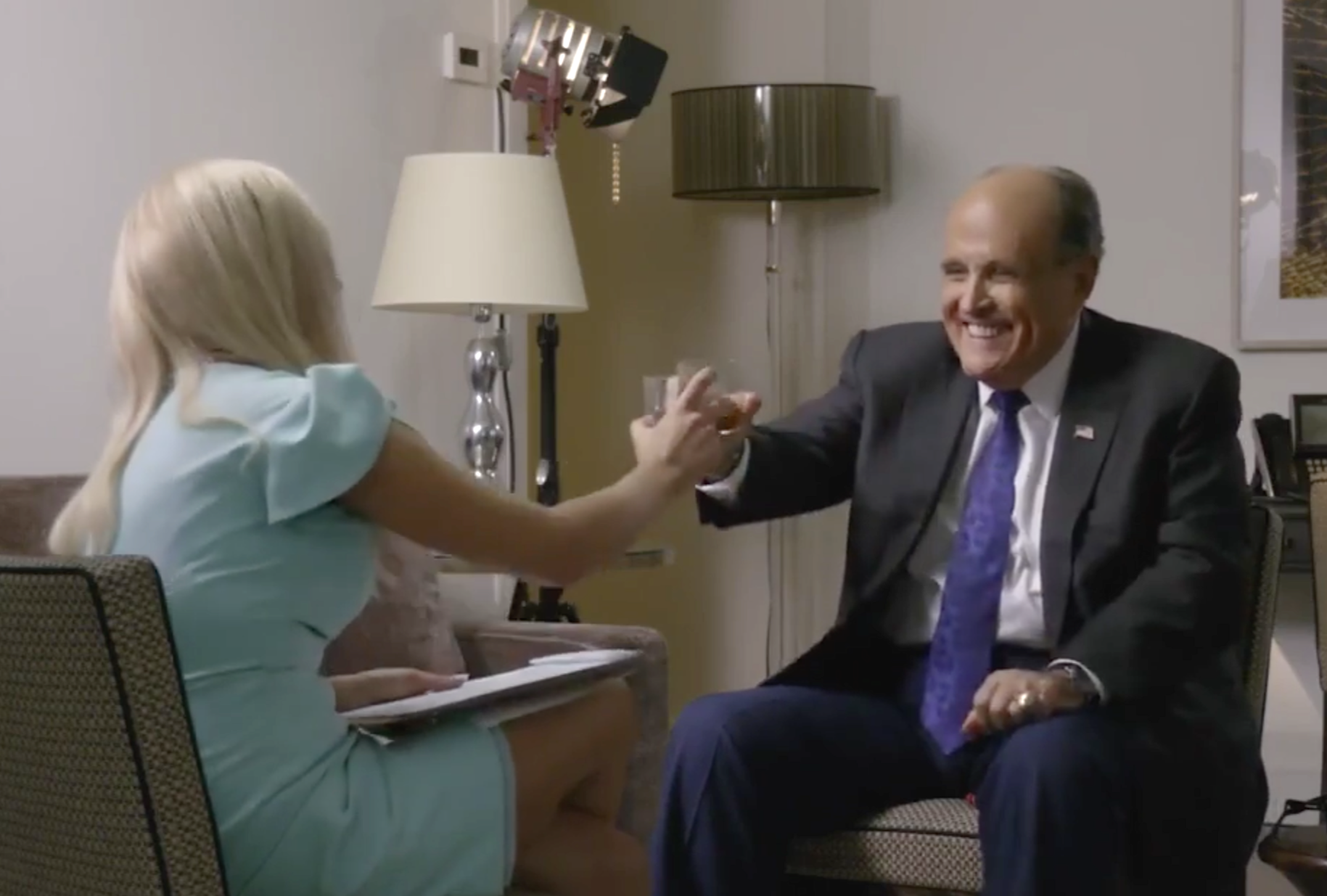
Tutar scores an interview with former New York City mayor and Trump advisor Rudy Giuliani, supposedly to discuss the Trump administration’s COVID-19 response, but things devolve as Tutar flirts heavily with Guiliani, touching his knee several times. Eventually, Guiliani blames China for the coronavirus pandemic, then agrees to eat a bat with her. 

Tutar then invites Giuliani into the hotel bedroom — where there are a number of hidden cameras. He follows and asks for her phone number and address while he sits on the bed. Tutar then reaches to remove Giuliani’s microphone and touches his pants, as he pats her backside. Giuliani then lies back on the bed and puts his hand down his pants. 

Borat bursts into the room at that point, declaring “She’s 15! She’s too old for you!” Giuliani immediately sits up and tries to leave as quickly as possible. Borat calls after him: “Rudy, Trump will be disappoint! You are leaving hotel without golden shower!”

What happened: Giuliani has maintained through several interviews that the scene was “doctored” footage. 

“The Borat video is a complete fabrication. I was tucking in my shirt after taking off the recording equipment,” Giuliani wrote in a tweet on Oct. 21. “At no time before, during, or after the interview was I ever inappropriate. If Sacha Baron Cohen implies otherwise he is a stone-cold liar.”

As Salon’s Roger Sollenberger reported, Giulliani is classifying the scene as a political “hit job” ” in retaliation for his recent smears on Democratic nominee Joe Biden’s son, Hunter. 

But on Monday, Baron Cohen told Stephen Colbert during a “Late Show” interview that he has questions about what Giuliani considers “appropriate.” 

“Do you have anything to say to Rudy Giuliani about going into a bedroom with supposedly a teenage girl to drink whiskey and zip your pants up and down?” Colbert asked the actor. 

“Well, he said that he did nothing inappropriate and, you know, my feeling is, if he sees that as appropriate, then heaven knows what he’s intended to do with other women in hotel rooms with a glass of whiskey in his hand,” Baron Cohen replied. “I mean, I don’t want to ruin the movie for anyone, so I would just say, see it and make your own mind up.”

The Scene: Borat, dressed in a Trump costume, crashes the Conservative Political Action Conference
Where: The Gaylord National Resort & Convention Center in National Harbor, Maryland
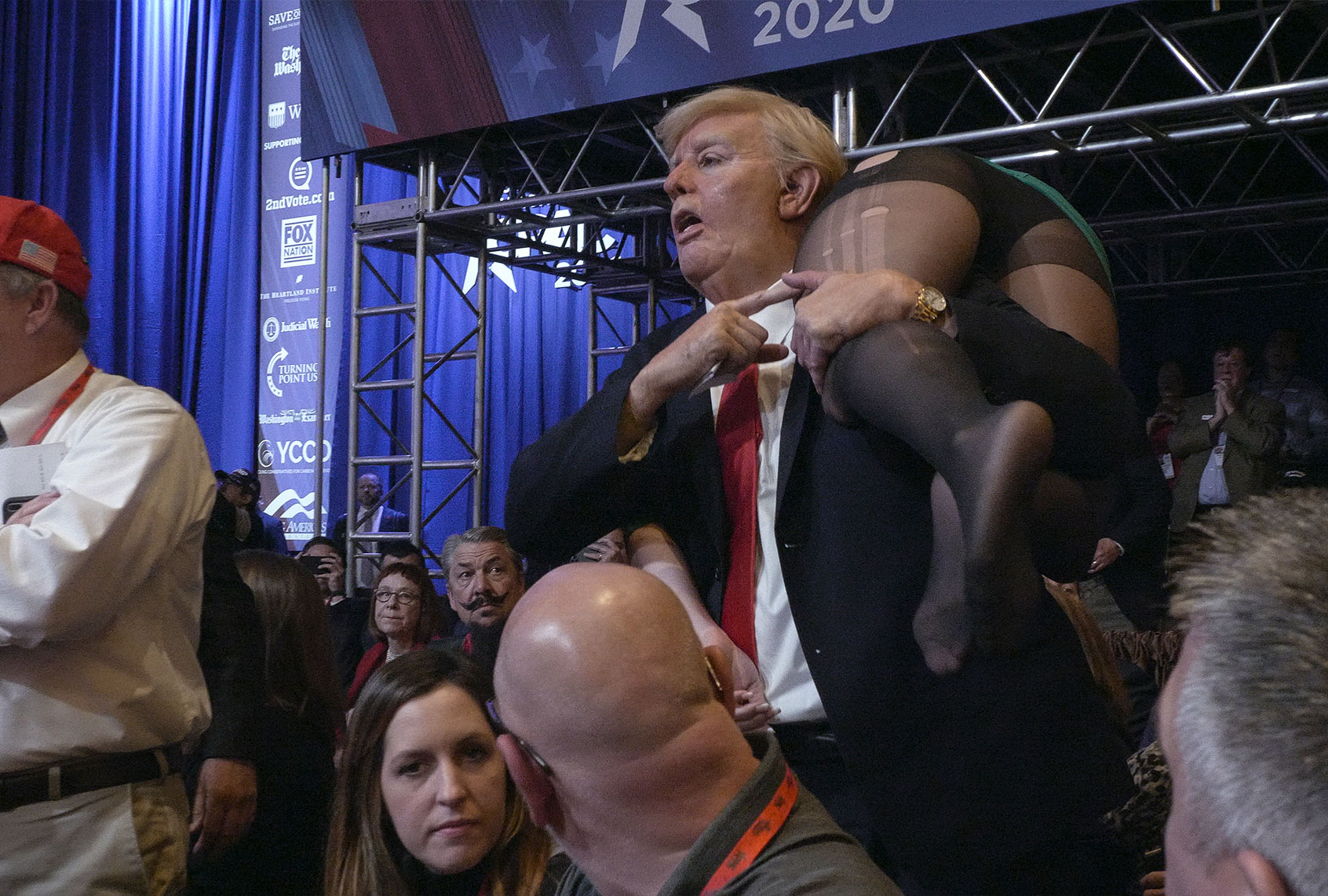
Borat Subsequent Moviefilm

Borat wants to present Tutar to Mike Pence as a child bride and decides that the best time to do so would be during the vice president’s speech at the 2020 Conservational Political Action Conference (CPAC). 

After infiltrating the conference lobby by dressing as a Klansman (mentioning to passersby that he is Stephen Miller, Trump’s senior advisor) he locks himself in a restroom and dresses up as Donald Trump, complete with an orange-toned mask and body padding. 

Once he’s dressed, he tosses Tutar over his shoulder and bursts into the ballroom, screaming, “I brought the girl for you!” 

He’s ejected by security.

What happened: I know this year feels like 15 shoved into one, but you may remember reports back in February of  Trump impersonator crashing CPAC? Yep, that was Baron Cohen. 

At the time, a spokesperson for the Prince George’s County Police Department told ABC News in an email that the convention center asked for help to escort the individual from the premises, but that the department was not pursuing charges against the man.

However, as Newsweek reported, CPAC and its organizers, the American Conservative Union (ACU), have decided to pursue legal action over their depiction in the film. 

“In a letter sent to Sacha Baron Cohen and production company Four By Two Films, the ACU demands that they, ‘immediately cease and desist from using any content filmed during CPAC in Borat 2 and its trailers,” Newsweek reporter Samuel Spencer wrote. 

He continued: “They later added: ‘If Amazon and the Borat team somehow believe that racism and white supremacy is amusing or entertaining, please know that CPAC strongly disagrees and finds repugnant your trivialization of the KKK’s legacy of hatred, intimidation, and murder.'” 

The scene: Borat sings at a March for our Rights 3 Rally
Where: Heritage Park in Olympia, Washington
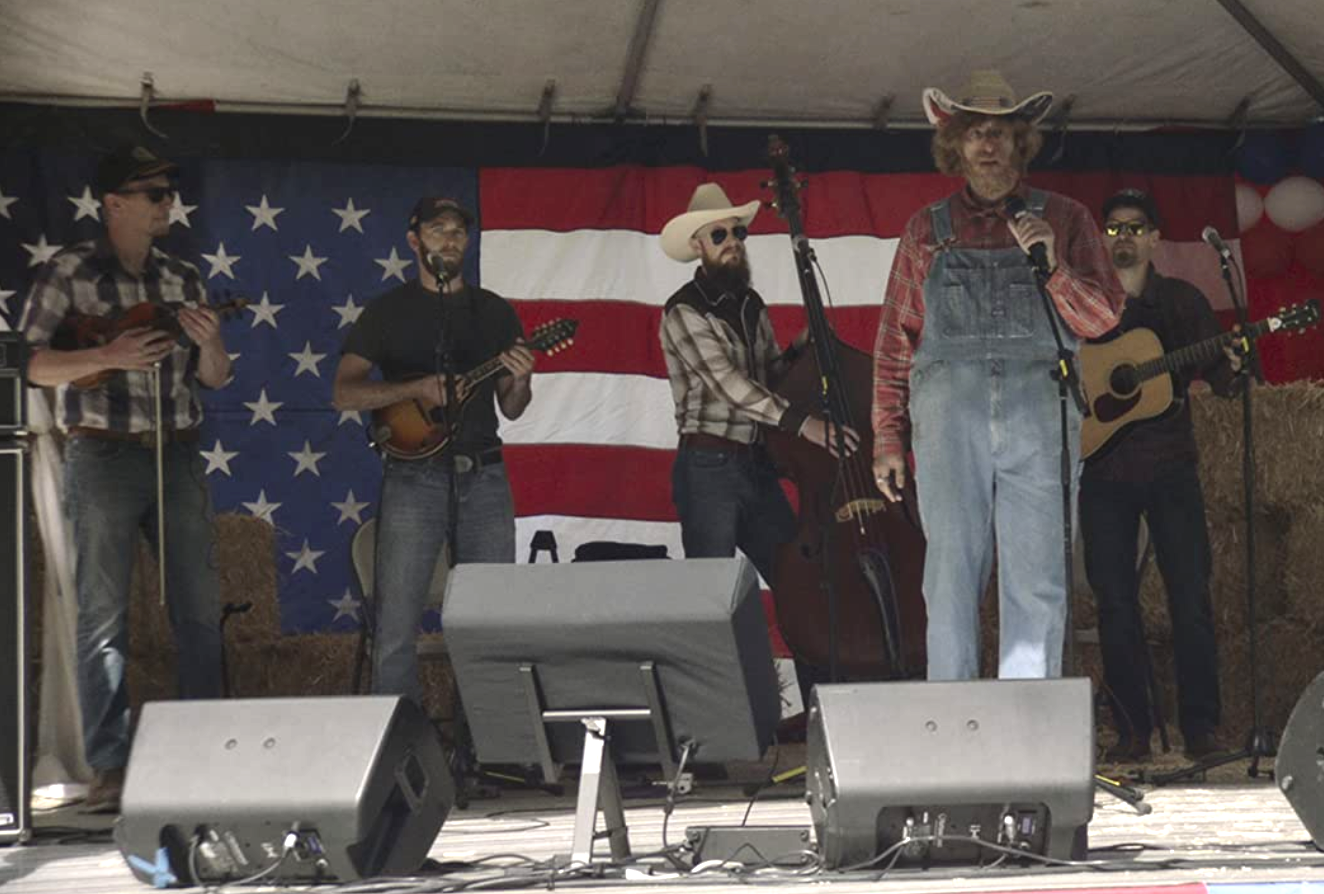
Borat, disguised in a beard and overalls, takes to the stage at the “March for Our Rights 3,” a pro-gun event initiated as a response to 2018’s student-led March For Our Lives demonstration held shortly after the Marjory Stoneman Douglas High School shooting in Parkland, Florida. 

Once he grabs the microphone, he begins to sing: “Obama was a traitor/ America, he hate her. He belong inside the jails. I ain’t lying, ain’t no jokes, corona is a liberal hoax. Corona is a liberal hoax.”

“Obama, what we gonna do?” he continues. “Inject him with the Wuhan flu. Dr. Fauci, what we gonna do? Inject him with the Wuhan flu.”

Some members of the crowd sing along, loudly cheering when he asks the crowd whether journalists should be injected with the coronavirus or whether people should “chop them up like the Saudis do.” 

What happened: According to a Facebook post from Yelm City Councilman James Connor Blair shortly after the incident, Baron Cohen’s team “disguised as a PAC out of Southern California, paid for the stage setup and musical entertainment. Came on stage disguised as the lead singer of the last band, singing a bunch of racist, hateful, disgusting s**t.”

“His security blocked event organizers from getting him off the stage or pulling power from the generator,” Blair wrote. “After the crowd realized what he was saying, and turned on him, his security then rushed the stage and evacuated them to a waiting private ambulance that was contracted to be their escape transport.”

Some of the crowd members recognized Baron Cohen at the time, according to the Seattle Times. Matt Marshall, founder of the far-right group Washington Three Percenters and emcee of the event, told the paper that the members of the crowd cheering the song were “paid agitators.”

“We got had, I guess that’d be the best way to put it,” Marshall said. “We got punked.”

The scene: Borat and Tutar attend a debutante ball
Where: The historic Hay House in Macon, Georgia
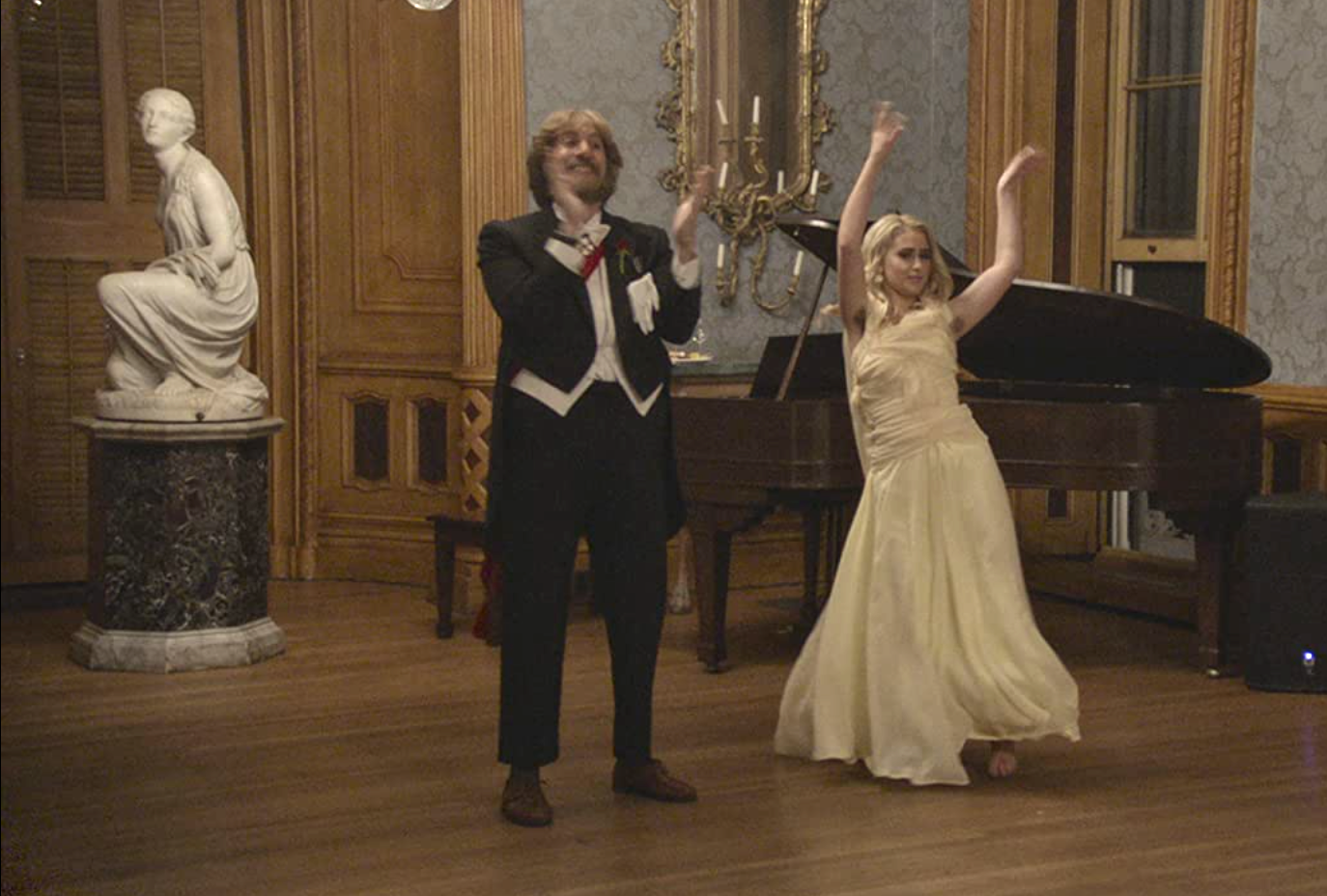
As part of Tutar’s transformation from feral teenager to child bride fit for Mike Pence, Borat decides she needs to undergo a makeover and practice her newfound social skills. After receiving advice from Instagram influencer Macy Chanel, Tutar is ready for her coming out party at a Georgia debutante ball. 

To signal Tutar’s fertility, she and Borat engage in a graphic choreographed dance, which concludes with her flashing her blood-covered crotch to the horrified attendees. 

What happened: According to Hay House operations manager Cliff Sims, the shoot was booked under “false pretenses.” 

“It was not discussed or approved by the Macon Film Commission,” Sims told a local television station after the “Borat 2” trailer was released. “What was discussed with the production company during the initial rental is not what happened or transpired on site.”

Will Davis, one of the fathers in attendance, wrote a first-person essay about the night for the Monroe County Reporter. 

“Our friends had been contacted by a movie company that wanted to film a fictional scene of Southern belles making their debut,” he wrote. “The company would pay fathers and daughters $100 apiece, and all we had to do was dress up, dance a little and enjoy free cuisine and drinks at the beautiful antebellum Hay House in downtown Macon.” 

According to Davis, interested attendees were given a pop culture quiz before being officially cast that tested their knowledge of certain events and whether they could identify various actors and politicians. Based on their responses, attendees were split into two groups — Groups A and B. 

“A friend who was there called me later that night,” Davis wrote. “He had talked with some other attendees and determined that our crazy Georgian guest was in fact Sacha Baron Cohen, the comedy actor whose movie ‘Borat: Cultural Learnings of America for Make Benefit Glorious Nation of Kazakhstan’ made famous his Eastern European character. My friend had discovered that everyone on our Team B were those who could not identify Cohen in the online test.” 

He continued: “Cohen’s modus operandi seems to be trying to embarrass and shock southern conservative audiences on film. Of course our cotillion friends, having been hoo-dooed into hosting the charade, were humiliated and apologetic.” 

The scene: Borat takes Tutar to a crisis-pregnancy center
Where: South Carolina 
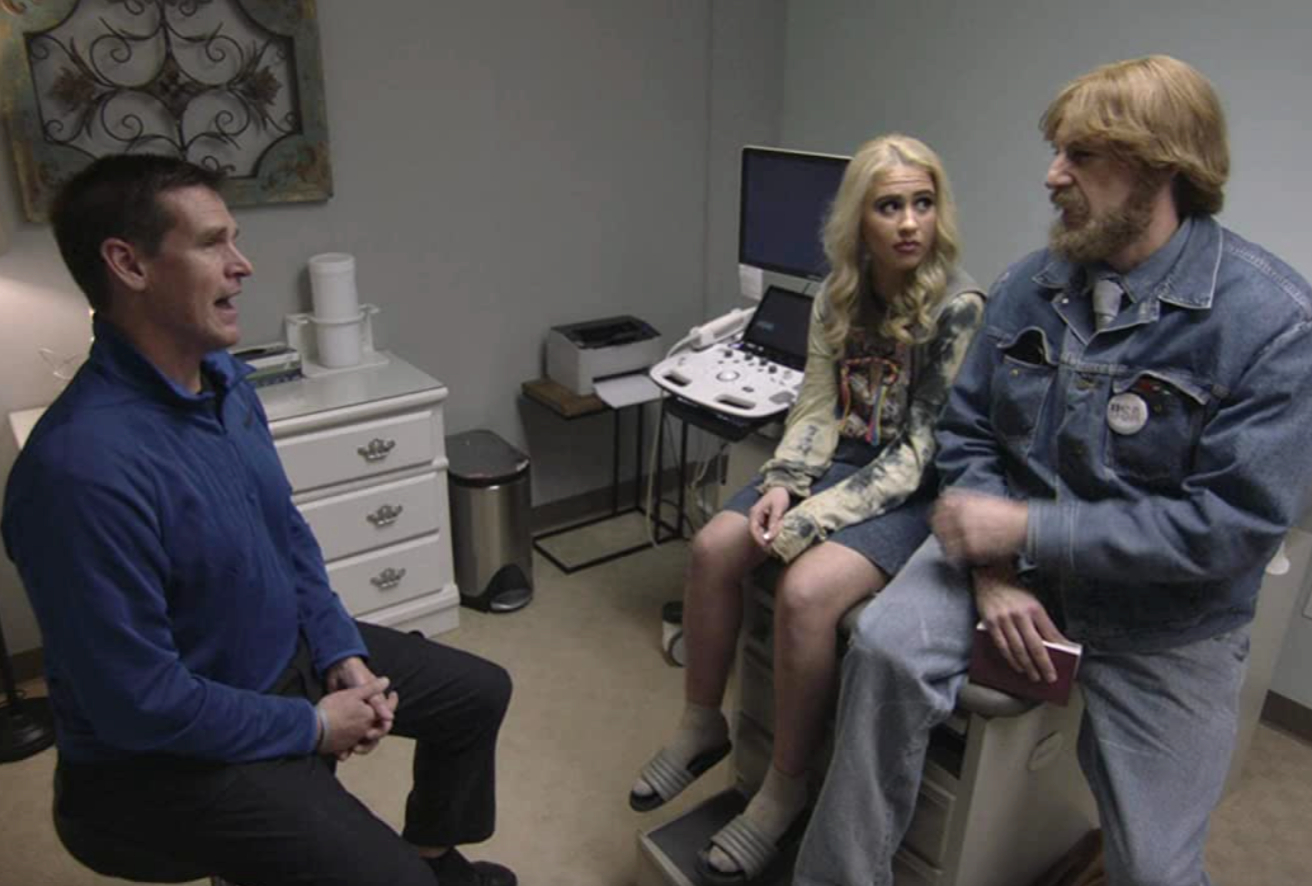
Borat gives Tutar a cupcake that is decorated with a small plastic baby. She accidentally swallows it, and the pair go about trying to figure out how to get it removed. They end up at a “crisis-pregnancy center” where they are counseled by Pastor Jonathan Bright, who is the founder and executive director of Faith for Fathers, a South Carolina Christian organization designed to “help dads leave a Godly legacy.” 

What happened: Borat informs Bright that he “put the baby inside her,” and makes it clear to Bright that Tutar is his daughter. Borat says that he was just trying to give Tutar pleasure and that the whole situation is a mistake. 

Bright responds, “I don’t need to hear any more of that,” he says. “Really, that is not important right now. We’re at this moment. It really doesn’t matter how we got to this moment.” 

Salon reached out to Bright and Faith for Fathers, neither of which have returned a request for comment. 

The scene: Borat visits a Holocaust survivor
Where: A synagogue in Atlanta 
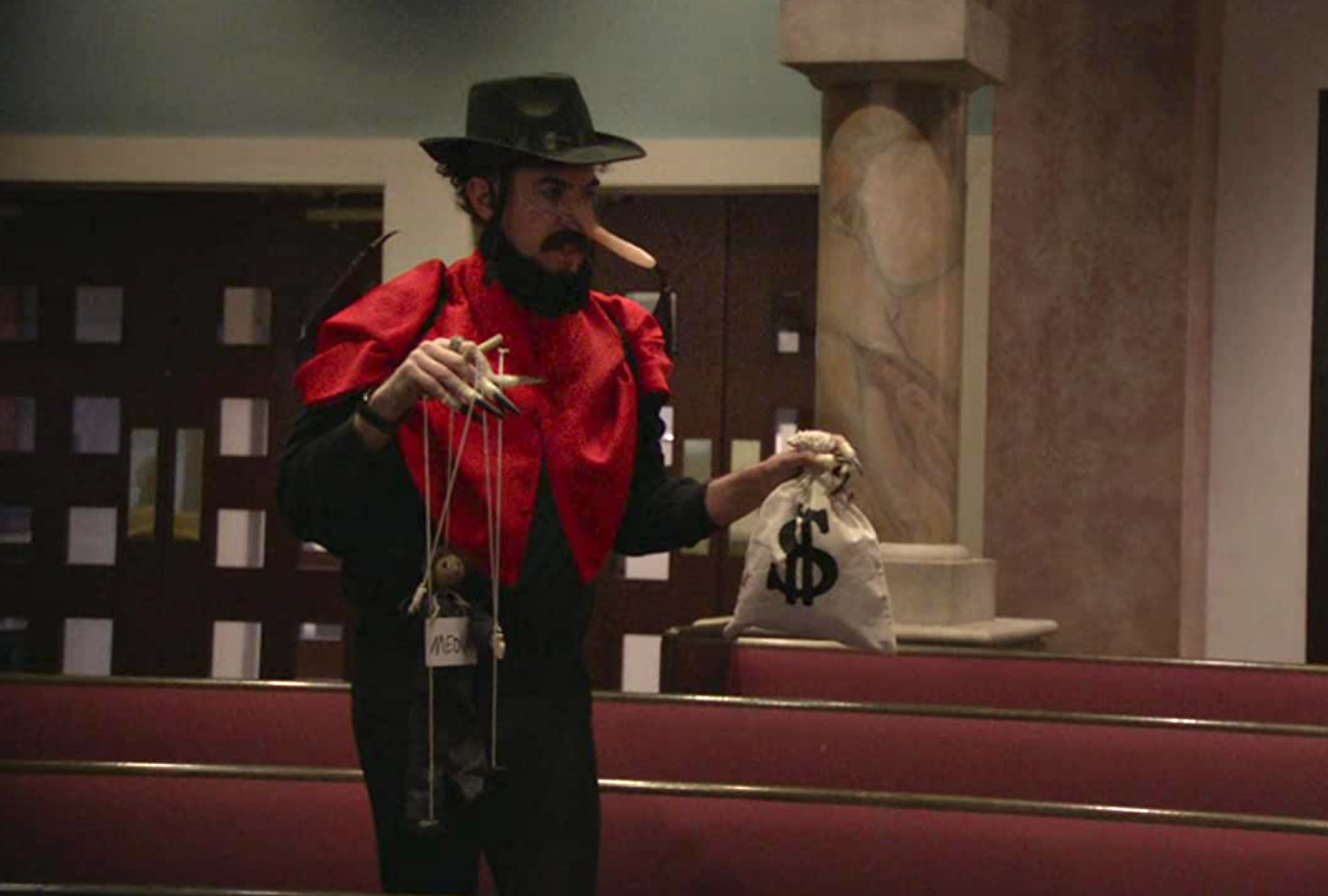
Tutar tells Borat that the Holocaust didn’t happen, based on a post she read on a Holocaust denier’s page on Facebook. To find out the truth, Borat dons an incredibly antisemitic costume and visits a synagogue where he meets Judith Dim Evans and her friend. 

Evans and the other woman embrace Borat, despite his offensive attire. Evans, in particular, kisses him, feeds him soup and educated him about the Holocaust, which she experienced firsthand. 

What happened: Evans died before the movie premiered, and the film is dedicated to her. However, her family filed a lawsuit against the production company, claiming that Evans was unaware the movie was satire and that it was meant to “mock the Holocaust and Jewish culture.” 

The suit, however, was dismissed by Fulton County Georgia Judge Kevin Farmer. According to Deadline, he referred to several defects in the plaintiff’s case, some of which were pointed out by the defendants.

Russell Smith, who repped Amazon in the proceeding, said that Baron Cohen was deeply grateful for the opportunity to work with Judith Dim Evans.

“[Her] compassion and courage as a Holocaust survivor has touched the hearts of millions of people who have seen the film,” Smith said. “Judith’s life is a powerful rebuke to those who deny the Holocaust, and with this film and his activism, Sacha Baron Cohen will continue his advocacy to combat Holocaust denial around the world.” 

According to Deadline’s sources close to the filmmakers, Cohen’s team also notified Evans about the real nature of the scene after it was shot. Deadline also reports there is footage of Evans being told the context of the scene, as well as Cohen’s real identity.

The scene: Borat hires a babysitter for Tutar
Where: Oklahoma City, Oklahoma
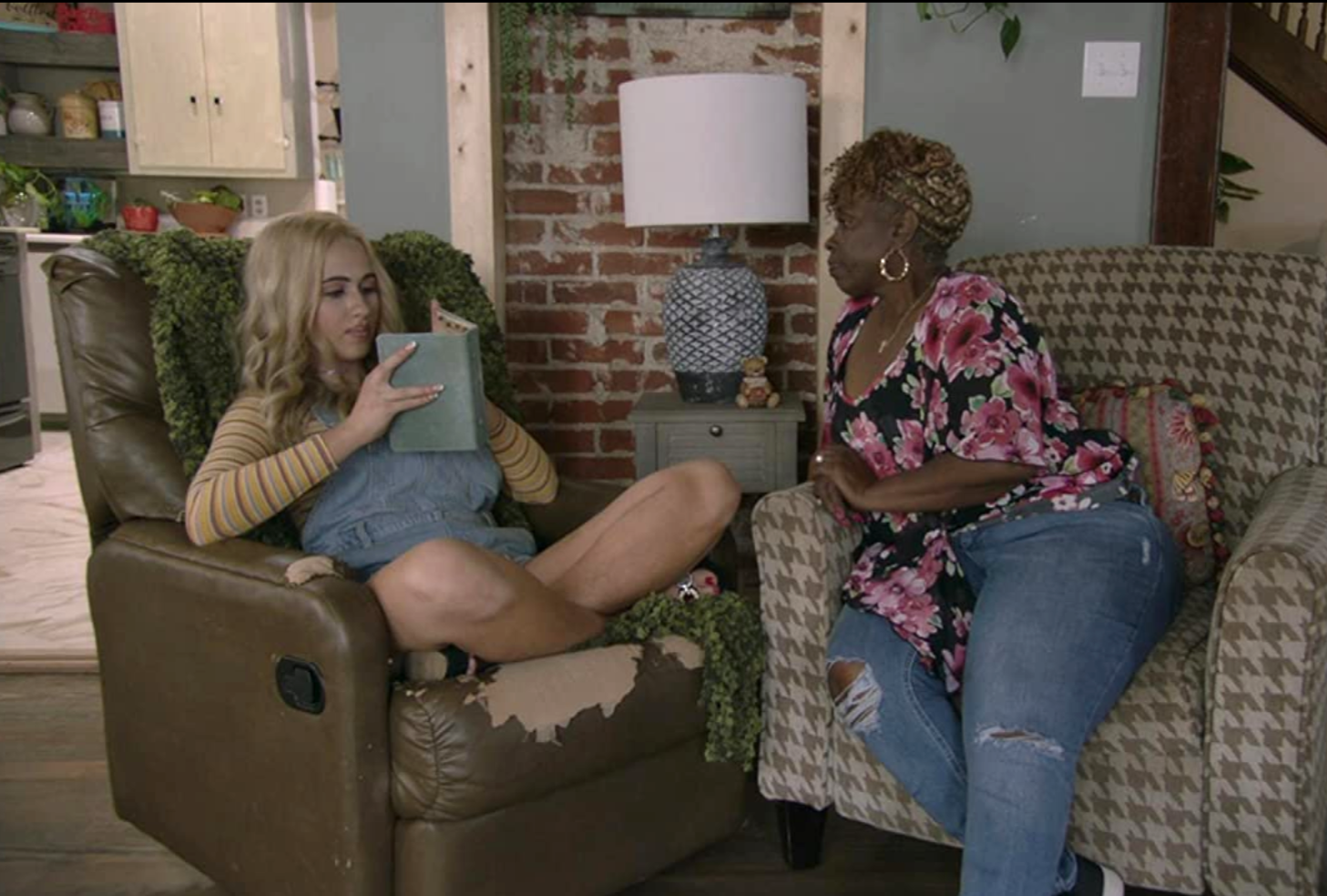
In the film, Borat takes Tutar to get plastic surgery, but finds himself short on the cash needed for her breast implants. So, he gets a job and takes Tutar to stay with Jeanise Jones, a babysitter, while he’s away.

Jones is horrified by Borat’s treatment of Tutar. He feeds her treats to reinforce her good behavior, uses a dog clicker to get her attention, and instructs Jones to give Tutar water from a dog bowl. 

Jones gently pushes back on Tutar’s beliefs that women can’t read or drive, and her desire for plastic surgery. “I mean, I understand what you’re saying, that your daddy told you that, but that’s not the real world,” Jones tells her.

She also encourages Tutar to forgo plastic surgery and consider her future career. “Think about going to school. Use your brain. Because your daddy is a liar, OK?”

What happened: Jones was an immediate hit with viewers; one Twitter user described her as the “moral compass” of the film. 

But in an interview with the New York Post, Jones said that she felt betrayed by the film crew. 

“I’m feeling like she’s from the ‘Third World’ and that kind of stuff does happen where they sell women,” Jones said. “I’m thinking this is for real so I felt kind of betrayed by it.”

According to Jones’ pastor, Derrick Scobey, the production approached Ebenezer Baptist Church in Oklahoma City about needing a “sassy” black grandmother in her 70s to participate in a documentary and landed on Jones after speaking to a few other congregants. 

Scobey has now set up a GoFundMe for Jones, saying that she wasn’t paid much for her participation (some reports say about $3,500) and that her fans could say “thank you to Jeanise with a tangible gift. She’s unemployed right now due to Covid. Previously, she worked on a job for 32 years.”

The scene: Borat spends five days with QAnon believers
Where: Lakewood, Washington
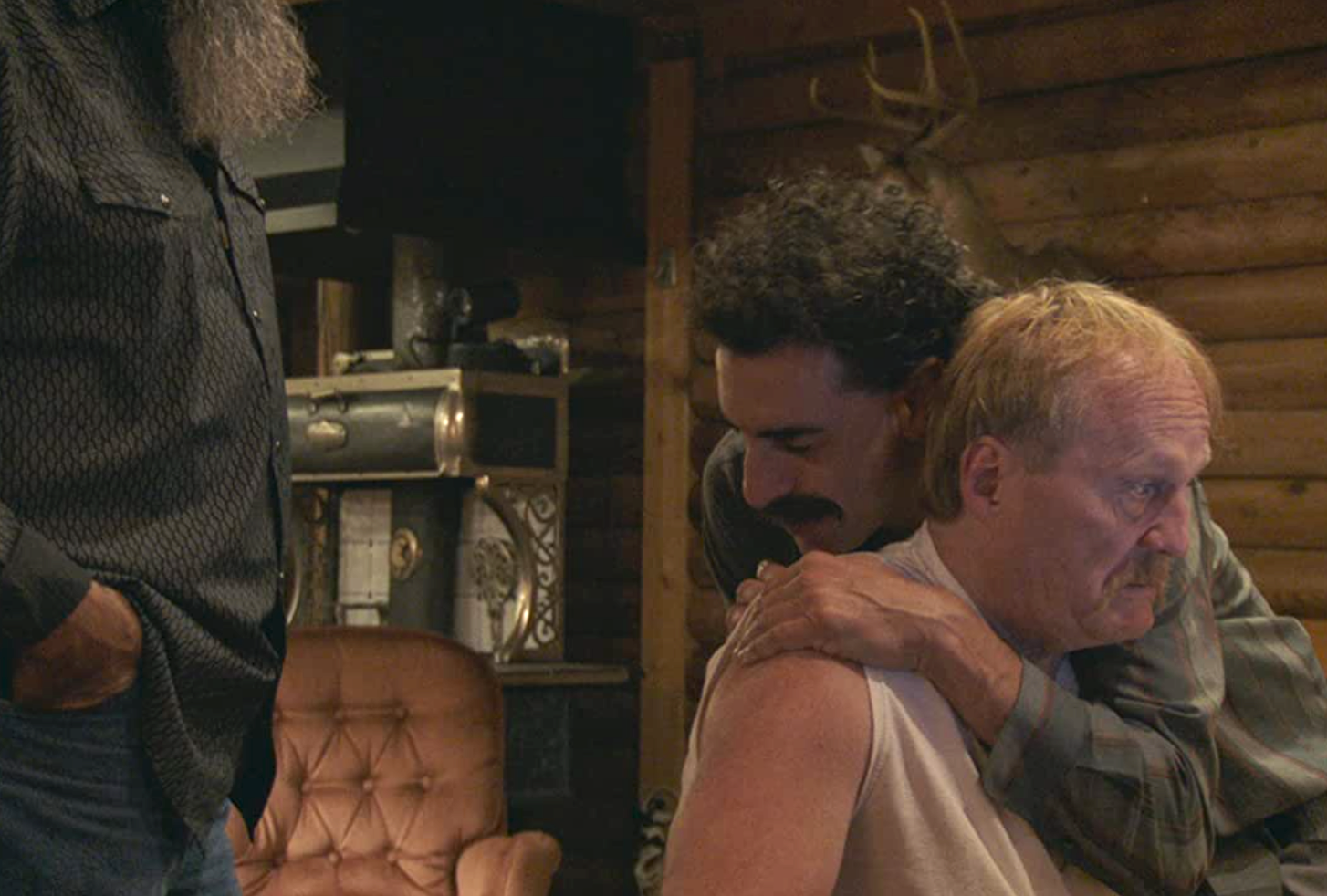
After the novel coronavirus was declared a global pandemic and business shutdowns begin, Borat finds himself wandering the streets of Lakewood, Washington. There he meets Russell and his roommate, Jerry Holleman, two Trump-supporting QAnon believers. 

Borat spends five days in their home while they attempt to explain some of their internet conspiracy theories to him. They also help him compose the racist song that he would eventually sing at the March for Our Rights 3 gathering. 

What happens: In an interview with the New York Times’ Maureen Dowd, Baron Cohen described the experience as “the hardest thing [he] had to do.” 

“I lived in character for five days in this lockdown house,” he said. “I was waking up, having breakfast, lunch, dinner, going to sleep as Borat when I lived in a house with these two conspiracy theorists. You can’t have a moment out of character.”

However, Salon could not locate Russell and Holleman for comment. 

“Borat Subsequent Moviefilm” is now available to stream on Amazon Prime.


How Brooklyn Avenue Pizza Company is fighting gentrification while honoring Boyle Height’s past

When Chef Mario Christerna’s mother was pregnant with him, she craved pineapple empanadas from La Mascota Bakery in Boyle Heights throughout the pregnancy. The connection was so strong, not only did her water break inside the panaderia, Christerna himself has had the same hankerings for the sweet, yellow jelly-filled pastries since he was a kid. 

Christerna not only was born and raised in Boyle Heights, but four decades and dozens of empanadas later, he is planting his restaurant’s roots in the neighborhood, cementing his legacy in the community that raised him. In November, his Brooklyn Avenue Pizza Company opens to the public below The Paramount music venue, and he envisions his new spot to be the setting of after-school meet-ups, family gatherings and late-night, post-show powwows. Though the name of the restaurant might seem like a signal of gentrification to the outsider, it’s actually an homage to the layered, resilient story of Boyle Heights as one of the first suburbs of Los Angeles. The neighborhood is home to Latinx, Japanese, Black, and Jewish community members, among others – and was popularized in the critically acclaimed Starz series “Vida.” The historic building also represents a convergence of values and identities for Christerna, and stands as a relic of the community’s self-determination.

Before 1994 when the street was named after Cesar Chavez, co-founder of the United Farm Workers union, it was called Brooklyn Avenue as a way to attract the Jewish community moving out west — with Boyle Heights eventually hosting the highest concentration of Jewish people in America outside New York. And it was at 2708 Brooklyn Avenue where the Jewish Bakers Union was headquartered in the 1920s. The radical union organized to promote workers’ rights, buying union-backed products and protested assimilation- and capitalist-minded constructs. 

When the bottom floor space of the building they occupied a century ago opened up, Christerna felt an immediate connection. “I grew up eating pizza. And I always wanted to have a fast casual spot and bake pies. So when this opportunity came to be in the space where the Jewish Bakers Union was, it just made perfect sense. I thought, ‘This is where it needs to be,'” he says.

Down the hall from Brooklyn Avenue Pizza Company is the Boyle Heights Arts Conservancy, an organization that provides pathways for youth of all economic backgrounds to hone their skills in the media arts — whether radio, film, television, broadcasting or other digital content creation. Christerna, who regularly serves his community by cleaning tombstones in Evergreen Cemetery and reading books to children at nearby elementary schools, is also invested in partnering with his neighbors, even hiring and training members of the Conservancy for his business. “We’re committed to creating jobs for each other and helping each other out as part of the bigger picture. We connected with them when we first started because we’re creating businesses here. Just like we want their programs to continue, we also want to keep our businesses going,” he says.

Christerna also brings his own background in the music industry into the foray. A former EDM promoter and forever punk rock enthusiast from a musically inclined family (his grandmother is a gospel mariachi singer), the resonance of The Paramount’s 100-year history is personal, as he’s attended many shows there. Though events at The Paramount, the last mid-sized ballroom in LA that’s located on the second floor of the building, might be on hold until after the pandemic, he has already revamped the bites and cocktail menu to reflect flavors and ingredients reminiscent of his Chicano background. 

Music, in fact, has been the impetus for Christerna’s cooking. While on tour with his musicians, he would often brainstorm and sketch the dishes he wanted to cook when he’d finally have the chance to open his own restaurant. And there is a keyboard in his office and cooking space, which he plays on for inspiration as he dreams up his menus. 

As efforts continue to fight back against gentrification across the nation, people like Christerna are just part of the fierce movement by locals for locals. And he’s not resting anytime soon. His next restaurant, Poblador, will be next door to the Brooklyn Avenue Pizza Company, featuring Alta California cuisine using ingredients native to the L.A. River in homage to the Indigenous Tongva people, who – along with the Chumash – were the most influential people in the Southern California region at the time of European arrival.

Justice Barrett: Culmination of the right’s five-year misogynist temper tantrum

It was five years and two months ago that candidate Donald Trump became livid that a mere woman — Fox News host Megyn Kelly — had the temerity to talk back to him, and responded with a vile sexist dig. Kelly is no friend to feminists, but for once in her miserable career as a right-wing troll, she had done the right thing: Standing up to Trump’s sexism.

During a Fox News debate in August of 2015, Kelly had questioned Trump’s long history of calling women “‘fat pigs,’ ‘dogs,’ ‘slobs,’ and ‘disgusting animals.'” 

Trump responded by going on a multi-day rampage to silence and punish Kelly, calling her a “bimbo” and telling CNN’s Don Lemon that there was “blood coming out of her eyes” and “blood coming out of her wherever.”

There was loud outcry at this sexist sneering, but it was also clear that Trump gambled correctly in believing that the Republican base would be thrilled at this misogynist outburst and would embrace his candidacy as a weapon against any women who injured their sensitive-snowflake feelings by speaking up against sexism. 


Want more Amanda Marcotte on politics? Subscribe to her newsletter Standing Room Only.


Now, five-plus years later, Trump and the Republicans are still at it, swearing in Amy Coney Barrett as the newest associate justice of the United States Supreme Court. Barrett isn’t there because she’s especially qualified or intelligent. No, the entire purpose of her nomination in the last days of the campaign is to get in one more giant fuck-you to feminists before the women’s vote throws Trump out on his butt. 

It’s all part of the same project: The right is using Trump’s presidency as a weapon to punish women for speaking out against sexism, and to put women in their place. 

Of course picking Barrett over any other cookie-cutter right-wing ideologues was about trolling feminists. The “joke” is that they’ve replaced a legendary feminist — the recently departed Ruth Bader Ginsburg — with a woman who believes husbands are the “heads” of their wives and who refused to agree with the 1965 Supreme Court decision that legalized birth control. 

In case there is any lingering doubt that Republicans view Barrett’s nomination mainly as a way to trigger the feminists, the Republican House Judiciary Twitter account announced the confirmation with this tweet

That the first impulse of whoever runs the official account of a House committee’s minority was to snap Clinton’s bra strap, virtually speaking, tells the whole story about how much sexism has pickled right-wing brains. The entire GOP now exists primarily as a weapon to lash out at liberals for daring to make conservatives feel bad about sexism, racism and other forms of bigotry. 

The years between Trump mocking women’s menstrual cycles and Republicans putting Serena Joy on the Supreme Court  have been one long, miserable temper tantrum by right-wing men who are furious at feminists for demanding equality, furious at Hillary Clinton for believing that a woman could be president, and furious at the #MeToo movement for demanding women’s right to go through life unmolested by sleazeball men. 

It’s impossible to catalog the amount of abuse that has been heaped on American women over the past five years. There was the “grab ’em by the pussy” tape and the “lock her up” chants. There’s the way Trump lashes out at any female reporter who challenges him and the way he and his supporters obsessively hate on any woman, from the members of the “Squad” to Speaker of the House Nancy Pelosi, who talks back to him. There’s Trump’s reflexive use of the word “nasty” to describe any woman who speaks out. There’s the utter fury of Brett Kavanaugh at attempts to hold him accountable for an accusation of sexual assault, which spread like wildfire through the right, as conservatives nationwide screamed in outrage and fear at the very thought that violence against women should ever be held against a white man, especially an upstanding upper-class conservative. 

Then there were the policy assaults on women. Trump’s administration has waged war on contraception access, trying to end coverage by health insurance and cut off funding for clinics that offer birth control at discounted rates. Republicans took yet another whack at trying to ban abortion with Kavanaugh on the court. That effort failed because of the legal sloppiness of the case, but there’s little doubt that with Barrett on the court, the next pass will succeed. (Unless, of course, Democrats are able to expand the court!) The Department of Education has rolled back protections against sexual harassment and assault, for both college and K-12 students. The Department of Justice has tried — and so far failed — to argue that taxpayers should fund a legal battle between Trump and one of the two dozen women who has accused him of sexual assault. 

Much attention has been paid to the role that racism played in the election of Trump, but research shows that misogyny was right up there, too. Holding sexist beliefs was nearly as strong a predictor of a vote for Trump as holding racist beliefs. 

Plenty of feminists saw this coming years ahead of time, sounding the alarm about pre-Trump misogynist movements like Gamergate and the bizarre but loud tantrum many men had about lady Ghostbusters. There’s also been significant evidence that the neofascist movement uses misogyny as a recruiting tool, to get bitter and insecure young men in the door before indoctrinating them with white nationalism. 

But those warnings were largely ignored by a mainstream media that was not just male-dominated but run in part by sexual harassers and abusers who were later outed by the #MeToo movement. It was made worse by those on the left who hated Hillary Clinton, often for reasons that reeked of sexism, and were quick to shame woman who objected to the Hillary hate as “vagina voters.” 

This whole situation is depressing as hell, but there is hope, possibly more than on any other progressive front: American women are extremely angry about all this.

The misogyny of the Trump administration and their supporters has been met with a feminist uprising unlike any that’s been seen since the ’70s, from the Women’s March to the #MeToo movement to the 2018 midterms in which a record number of women were elected. If Trump is defeated at the polls next week, it will largely be because of women, as polls show they support Joe Biden by huge margins, while more men still support Trump. 

It’s a bummer it had to get this bad before so many women woke up, of course. But feminist momentum is real, even if it’s fueled by so many Jill-come-latelys. With that kind of power, there’s a chance to right this ship. By being so over-the-top with the misogyny and electing a man who literally brags about how much he enjoys committing sexual assault, Republicans may have pressed their luck too far. The feminist backlash they’re facing could change the world.  

Time to dump the presidential dilettante — he’s a cruel and incompetent failure

In the earliest days of the Trump crisis, just about a month after the inauguration, I received the horrifying news that my best friend and podcast partner, Chez Pazienza, had died of a drug overdose. 

It was the evening of Feb. 25, 2017, and the shock still hasn’t quite worn off. In fact, I ask myself nearly every day what Chez might’ve said about the most recent atrocity committed by the chief executive. I’ll never know for sure, but there’s something comforting in that exercise, imagining how he’d frame this dark ride with equal parts Gen-X angst, stinging Bourdain-ish erudition and artistically worded blue streaks that would’ve made George Carlin applaud.

I’m convinced, however, that it wasn’t really an overdose that killed him. Sure, it was the weapon of choice, but it wasn’t the ultimate cause of death. Chez possessed the ability to foresee this Trump crisis stretched out in front of him — maybe not the specifics, but a general concept in his big brain for the horror show that was awaiting us. I believe it was the crushing reality of not only being force-fed a Trump presidency every day but also covering it professionally that forced him to drift back to his old addictions to ease the pain. And I wish more than anything that I could have stopped him.

Nevertheless, Chez could clearly see the incoming abuses, the crimes, the ungainly nonsense, the recklessness, the racism, the petty vindictiveness — all of it. 

In 2015, he accurately forecast that Trump, if elected, would spitefully withhold federal funding from regions that refused to support his cruel whimsy. Naturally, we’ve watched this play out with Puerto Rico, California and most recently Pennsylvania, where Trump, this week, threatened to withhold funding for the commonwealth because of Gov. Tom Wolf’s COVID plan. In Trump’s view, responsible leadership is worthy of punishment because it makes him look bad by contrast, while incompetence, mainly his own, is routinely lionized.

Trump’s blinding dumbness in the areas of history, the Constitution, the presidency and democratic institutions has infected him with an ugly, bastardized view of his job description, inflamed by his own biases and whatever he’s picked up from watching cable news. He’s a presidential dilettante, even now, nearly four years into the gig. 

His wafer-thin understanding of presidential leadership contributes to his most self-defeating misapprehension: that he’s only the president of the red states. Everyone else is the enemy, even more so than our actual overseas adversaries — surely more than Kim Jong-un and Vladimir Putin, whom Trump praises more often than many of his fellow citizens and colleagues. The rest of us are only useful to him as punching bags and targets for his screechy, obscene, misspelled tweets and, more recently, his fascist police force. The upside of his deformed view of the presidency is that if he loses this election, it’ll partly be because he refused to expand his support beyond his loyalists. 

This is one of the reasons why he felt compelled to cheat in the 2020 election by attempting to blackmail the president of Ukraine into smearing Joe Biden — a plot that ended with Trump’s impeachment and trial in the Senate. After all, how could he win re-election with only 40-44 percent popular support without making up the difference … somehow?

His relationship with his disciples is a match made in hell, given that his Red Hat fanboys have an equally stunted view of the presidency. I assure you, they’d never allow Trump-style behavior from their doctors, their kids’ teachers or, hell, their airline pilots. If they hadn’t been so badly brainwashed by the conservative entertainment complex, they never would have gifted the nuclear codes and the immense power of the presidency to such an unstable, erratic, incompetent political tourist who has utterly failed to grow into the job and rise to the occasion — who has failed to accept the intense gravity of his post. As Barack Obama said in August, “It’s because he can’t.”

At no other time has that been more evident than in Trump’s response to the pandemic. For the first two years of his presidency, many of us sat on the edge of our seats wondering when Trump would be seriously challenged either by a military threat, a terrorist attack or a global pandemic. From the moment Hillary Clinton conceded, I suspected this buffoonish greenhorn would be put to the test and fail badly. I never imagined that his reaction, untethered from experts, would be quite this calamitous. 

His response to the hurricanes that collided with Puerto Rico represented a harrowing preview of how he’d handle the pandemic. I was convinced at the time that he was at least temporarily unaware that Puerto Rico was even part of the United States. I mean, how could he have been so thoughtless and unsympathetic to actual Americans? Turns out, he probably knew — he just didn’t give a shit. Never before has a modern president behaved so callously toward a devastated population of his own people, hurling paper towels at their heads as if he were firing a T-shirt cannon at a college basketball pep rally. Today, the island territory continues to rebuild despite Trump’s reprehensible indifference.

America is better than this. We’re better than him. 

There have to be consequences for his indifference to the destruction in Puerto Rico as well as the 225,000 casualties of COVID-19 (and counting). Neither should have happened here. But this is what it looks like when the president and his people fail to do the paint-by-numbers things in response to a crisis — things that so many other presidents managed to achieve. Had Trump listened to the experts at the CDC and WHO, thousands of Americans would still be alive today and we might have been free and clear of this blight by now. Instead, Trump listened to the entertainers on Fox News, not to mention the shrieking voices in his head, convincing him to abandon the effort at exactly the wrong time — in April, at the initial height of the infection curve.

Before giving up, he applied travel restrictions to China, but it was too little too late. Forty thousand people arrived in the United States from China by flying through Europe and landing in New York, magnifying the catastrophic outbreak there. After that, Trump did nothing else to slow the spread, making George W. Bush’s 2005 response to Hurricane Katrina look masterful by comparison. Now, eight months into this disaster, Trump continues to ignore the rules, ignore safety protocols and ignore the experts, holding maskless, undistanced rally after rally, fueling his own ego, even after being infected himself. And there’s no end in sight.

Win or lose, his bungled, herky-jerky reaction to the pandemic will be remembered as the defining failure of his presidency, and it’s the No. 1 reason why he deserves nothing but ignominy and prison.

Rather than accepting the challenge and rising to meet it, as any other president would have, he’s spent all these months of national stress, uncertainty and illness not comforting or proactively leading the American people, but whining, whining and whining some more about how COVID ruined his presidency. Solving the pandemic could have been his greatest achievement — but Trump always makes things worse for Trump. Undermining himself and then playing the victim when things go sideways is the only thing he’s good at. 

He possesses the most brittle ego of any president since Richard Nixon — one of many character flaws that undermine his self-identification as a manly alpha. Indeed, he’s nothing more than an easily-ruffled snowflake who constantly bellyaches about how “unfair” the world treats him — you know, the alleged billionaire president. So unfair.

Donald Trump has redefined what it means to be an empty suit. He talks an enormous game, but in reality his entire record is composed of failures and stolen successes. He claims to understand things he’s never able to explain openly or in any detail. Accordingly, he’s obsessed with repealing the Affordable Care Act, but only because it was Barack Obama’s signature achievement, not because it’s bad policy — and it’s not bad policy, he just says it is and his fanboys believe him.

If challenged, I’d wager a year’s salary he couldn’t name anything in the law beyond the mandate and the coverage for pre-existing conditions. I’m sure he doesn’t know about the myriad consumer protections or the mandatory benefits, or how the low-income subsidies work or the Medicaid expansion or the marketplaces — none of it. Yet he’s seeing to it that the entire thing is obliterated mid-pandemic when Americans need coverage the most. He definitely doesn’t know that coverage for pre-existing conditions is made possible, for example, by placing caps on premiums and co-pays, while banning rescission and lifetime limits on coverage. Worst of all, he doesn’t know that many of his own voters are covered today because of the ACA.

Between the pandemic and the possible repeal of the ACA, America is physically sick. And because of Donald Trump, we’re spiritually sick, too. He doesn’t understand that the president sets the tone for the nation. He’ll never grasp that the way he communicates influences the way we communicate with each other. His constant firehose of crapola encourages others to let their hatred, racism and obnoxious, crazy-eyed antagonism fly freely — playing out in our public spaces and on our social media platforms every damn day. 

Trump has debased the presidency, replacing decency and humility with unearned self-praise and horrendous sadism. Our nation’s most cherished values and institutions have been randomly crushed by this 90-foot kaiju monster for too long. His constant antagonism has turned father against son, mother against daughter, family against family. Over what? The damaging misadventures of a political fraud — a garish old brat who bankrupted his businesses, defrauded Americans with his sham foundation and university and is currently bankrupting the U.S. treasury while establishing himself as a Putin-style kleptocrat

In 1860, our nation nearly crumbled under the weight of slavery and secession. Today, our nation is on the verge of collapse under the weight of a painted-up clown whose performative fascism has led to the extrajudicial murder of American citizens on American soil; the use of Homeland Security as a secret police force tasked with assaulting Americans in advance of awkward photo-ops; the use of the Department of Justice as a personal law firm; taxpayer revenue as a personal slush fund; and, worst of all, the construction of internment camps for Central American migrant children, where some have been raped by American guards. Rivaled only by the pandemic response, the Trump Cages are the most disgusting and unforgivable aspect of this presidential crisis.

The 2020 election is about ending all that, while beginning the process of a second Reconstruction — rebuilding our government in a way that guarantees this will never happen again, while convening a Trump Crimes Commission to hold the perpetrators accountable. Part of that process is about remembering what happened here, in this era. There will be voices who insist we should move on and forget about all this ugliness. We would do well to ignore those voices. The minute we forget the damage he’s inflicted upon us all, the next Trump will be waiting to strike. 

Indeed, the only way to move on is to punish the crimes and plug the holes. We have no choice but to use this dark ride — one that took my friend Chez and many thousands of others — as an opportunity to repair the gaping Trump-shaped craters in the system exposed and exploited by this unqualified, disgracefully unpresidential and obviously unglued president. If Joe Biden and Kamala Harris successfully oust Trump, a week from today, the Trump crisis will be on its way to ending, while the hard work of cleaning up the mess will begin. In both the election and the aftermath, we cannot fail. Everything depends on what happens next.

Despite pandemic threat, gubernatorial hopefuls avoid COVID nitty-gritty

Just 15 days ahead of the election, Montana Lt. Gov. Mike Cooney laid out his ideas on how he’d handle the COVID-19 pandemic if elected governor. Details were few, but the Democrat’s plan became one of only a handful being offered by candidates in the 11 U.S. governor’s races about how they’ll approach what’s certain to be the dominant issue of their terms, should they win.

While much of the nation’s focus is on who will be president come January, voters who are deciding the next occupant of their governor’s mansion are also effectively choosing the next leader of their state’s COVID-19 response. The virus has made governors’ power highly visible to voters. As the states’ top executives, they decide whether to issue mask mandates, close businesses and order people to stay home.

All but two races for governor feature incumbents running for reelection: Montana’s Democratic Gov. Steve Bullock can’t run again because of term limits and Utah’s Republican Gov. Gary Herbert decided not to run for another term. In several other competitive races for governor this year, such as those in North Carolina and Missouri, opponents clash on the role of state mandates in slowing the virus. Still, COVID-19 often fades into the backdrop of many long-standing platforms or primarily comes up as candidates talk about the need to revive the economy.

Cooney’s proposal, released Monday, suggested using the National Guard to transport patients in extreme weather and subsidizing heating bills to help those quarantining at home. But other parts vaguely described how he would “develop a robust plan” to come.

His opponent, Republican U.S. Rep. Greg Gianforte, has acknowledged the health crisis but has focused primarily on the economy, saying the state has to “cure the economic pandemic” the virus caused.

Bryce Ward, a health economist with the University of Montana, said Cooney’s list was one of the first times he’s seen long-term planning for COVID-19 come up in what appears to be the nation’s tightest governor’s race. But, he added, neither Montana candidate has offered a concrete plan to deal with the dual crises that risk public health when people gather and businesses’ bottom lines when they don’t. Meanwhile, the state’s number of COVID-19 cases climbs and its economy suffers.

“Whoever wins, this is going to be the bulk of their term,” Ward said. “How are the candidates going to keep people afloat as long as they can? What are we doing in terms of planning for what we think our post-COVID world is going to look like?”

An October KFF poll found 29% of registered voters said the economy was the most important issue in choosing a president, while 18% said the coronavirus outbreak was their top issue. Republican voters were more likely to pick the economy, the survey found, and Democrats were more likely to pick the coronavirus. (KHN is an editorially independent program of KFF.)

“There are voters that feel that the government needs to lead, and there are voters that feel that the government is utilizing a pandemic to become too invasive,” said Capri Cafaro, a former Democratic Ohio state senator now teaching in American University’s public administration and policy department. “People are not necessarily making their decisions on ‘Did you do contact tracing? Are you going to slow the spread?'”

Among the incumbent governors seeking reelection this year, most of their campaigns’ focus on COVID-19 has been on how well they’ve responded to the crisis. Several pledge more of what they’ve been doing. “We’ll continue to follow the science and wear masks,” Delaware Democratic Gov. John Carney said in a recent debate.

Meanwhile, their challengers generally seek to cast the incumbents as mismanaging their states’ response and promising to undo what’s been done. Those who have put out actual plans to handle the pandemic are Democratic challengers to Republican governors, and their plans are similar to what Cooney released — some specific ideas and promises to fill in the gaps later.

In Missouri, Democratic challenger Nicole Galloway, who is the state auditor, made health care the center of her campaign and released a plan to respond to the virus with a statewide mask mandate and a limit on when public school classes can meet in person based on the community’s rate of infection.

Republican Gov. Mike Parson is the apparent front-runner in that state’s race. He has pledged to lead “the greatest economic comeback that we’ve ever seen in Missouri history.” The former Polk County sheriff also has focused on supporting law enforcement amid backlash against police brutality and racial injustice.

Curbing the coronavirus has taken a back seat to boosting the economy in Parson’s campaign. And, as governor, Parson has refused to issue a statewide mask mandate, despite a White House recommendation to do so. In late September, the governor and his wife tested positive for COVID-19. Parson has returned to work, which includes traveling across the state.

One of the more heated races is in North Carolina, where Democratic Gov. Roy Cooper is defending his seat against a challenge by his lieutenant governor, Republican Dan Forest. Forest sued Cooper this year to challenge the governor’s authority to impose COVID-related restrictions by executive order.

Forest dropped the lawsuit in August after a judge made a preliminary ruling against his case, then said on Twitter, “I did my part. If y’all want your freedoms back you’ll have to make your voices heard in November.”

Cooper’s campaign called the lawsuit “a desperate tactic to garner attention” for Forest’s political campaign. Since then, the governor has slowly eased COVID restrictions, updating an executive order to allow a limited number of people in bars, sporting events, movie theaters and amusement parks. Cooper is leading the race in recent polls.

Back in Montana, the pandemic surfaced in the gubernatorial campaign after health officials announced on Oct. 16 that a Helena concert, which Gianforte attended, was linked to several COVID-19 cases. More than 100 health professionals blasted him in an open letter for flouting local health restrictions, going maskless and making light of safety precautions at campaign events. Cooney called on him to suspend his campaign events until tested. Gianforte’s campaign has said he’s taking proper precautions and accused Cooney of politicizing a public health issue.

Cooney has said he’ll keep Montana’s COVID-19 response on the track he is helping set as lieutenant governor, with science guiding that work. Gianforte, who built a tech startup in Bozeman, has touted his business experience as proof he can lead Montana’s comeback. Both have said more needs to be learned about this virus and have pitched themselves as the one to steer the state’s economy through the crisis.

Ward, the University of Montana health economist, said the details are missing, such as how the winner will support businesses through the winter without federal aid. Or what the new governor would cut from the state budget if the economic crisis hits its coffers.

The state has a public mask mandate and a plan for reopening the economy with no apparent thresholds or timelines. The option for stricter rules has been left to county governments as the state sees its largest COVID surge yet.

Jeremy Johnson, a political scientist at Carroll College in Helena, said the initial lack of detailed pandemic policy in the state’s race could be attributed to both candidates trying to win over swing voters with safe themes. President Donald Trump won Montana in 2016 by 20 points, but the state has also had a Democratic governor for 16 years. While polls show Gianforte leading Cooney slightly, election handicappers Real Clear Politics and the Cook Political Report still consider the race a toss-up.

Yet as Election Day nears, the question of how to address the pandemic only looms larger. Montana’s case count is rising, adding to its total of more than 23,000 cases in the state of roughly 1 million.

Kaiser Health News (KHN) is a national health policy news service. It is an editorially independent program of the Henry J. Kaiser Family Foundation which is not affiliated with Kaiser Permanente.

House Judiciary GOP celebrate confirmation of Amy Coney Barrett with tweet mocking Hillary Clinton

On Monday evening, the House Judiciary Committee tweeted a gloating jab at Hillary Clinton following the confirmation of Amy Coney Barrett to the Supreme Court.

The juvenile behavior of the committee, whose ranking member is Rep. Jim Jordan (R-OH), promptly earned criticism from commenters on social media.


Trump’s trade war — what was it good for? Not much

The 2016 election was a referendum on free trade, which many blamed for destroying millions of American manufacturing jobs. In 2020, it could be about the merits of trade wars.

During President Donald Trump’s first term, he tore up deals, launched a trade war with China and renegotiated NAFTA. His campaign claims the war was a success and that his policies were bringing back manufacturing jobs — until the pandemic arrived — and so voters should give him another four years.

His Democratic rivals disagree.

“You lost that trade war,” Sen. Kamala Harris snapped during her debate with Vice President Mike Pence, citing the loss of 300,000 manufacturing jobs during Trump’s presidency and bankrupt farmers.

So who’s right?

As an economist who researches international economic policy, I believe Trump’s impulse to rethink trade policy was understandable. If free trade hurt American workers, it stands to reason that putting up barriers to trade — even being willing to “go to war” — might protect those workers.

But wars can backfire — and trade wars are no different.

Free trade’s losers

Economic theory tells us that free trade means a greater availability of cheaper goods because everything will be produced where it can be made least expensively.

That sounds like a great deal for consumers and exporting industries like agriculture that find more buyers for their products. But it’s a raw deal for manufacturing workers as factories move to countries like Mexico and China with lower labor costs.

That’s what happened after the North American Free Trade Agreement became law in 1994 and China joined the World Trade Organization in 2001.

In each case, manufacturing workers were among the big losers as employment in the sector plunged from just under 18 million in 1990 to a little over 14 million in 2004.

The tide turns against trade

As a result, many politicians became more cautious about supporting free trade deals.

When he was a senator in 1993, former Vice President Joe Biden and many other Democrats voted to ratify NAFTA. A little over two decades later, when a free trade bill with Central America and the Dominican Republic came up for a vote, Biden and nearly every Democrat voted no. The bill barely passed.

And although Biden’s administration signed the Trans-Pacific Partnership in 2016 — which would have created the world’s largest free-trade zone — opposition among leading Democrats as well as Trump imperiled its passage in the Senate, leading to the U.S.’s withdrawal in 2017.

When Trump launched his presidential campaign in 2016, opposition to trade deals like NAFTA was one of his signature issues. At a time when Republican leaders mostly were staunch supporters of free trade, his promise to bring manufacturing jobs back to the U.S. helped him win the primary — and ultimately the presidency — as a growing number of voters began to see trade as bad for Americans.

And as president, he followed through on his pledge and unilaterally imposed tariffs on a range of Chinese products — a list that now totals US$550 billion worth — as well as on most aluminum and steel imports. Thus, Trump’s trade wars began.

My research with colleagues at Boston University shows that trade agreements have indeed hurt U.S. workers. But Trump’s trade wars have not solved the offshoring problem that they were designed to fix.

The trouble with trade wars

Trump has claimed “trade wars are good and easy to win.”

Trump seems to have based this on the assumption that America’s trading partners would not retaliate. He was wrong.

Over many rounds of tit-for-tat, China has retaliated repeatedly by placing tariffs on $185 billion of U.S. exports, most notably agricultural products. After U.S. soybean farmers saw their largest market dry up, the Trump administration was forced to spend $23 billion to offset some of their losses. All told, more than one-third of farm income will come from government subsidies in 2020.

And when the Trump administration planned to impose steel tariffs on Canada earlier this year, America’s northern neighbor vowed retaliation, which would have hurt U.S. exporters. So Trump backed down.

That’s the problem with trade wars. Intended to protect a country’s own workers, they wind up doing a lot of self-inflicted damage, as retaliatory tariffs drive up the cost of exports, hurting businesses and workers at home as well as abroad.

At the same time, U.S. policy seems to have lost sight of the original enemy: the offshoring of American jobs, which has continued to grow. The 2017 tax cut, for example, actually made offshoring more profitable and attractive — making it even harder to achieve the primary goal of the trade war.

Trade wars pay off only if they have a clear vision and lead to meaningful changes in how everyone does business. That hasn’t happened either.

While Trump did reach a “phase one” deal with China in January, it actually looks like it will make the offshoring problem even worse. As part of the truce, the U.S. agreed to reduce its tariffs on Chinese goods and China said it would buy a lot more American products, especially soybeans.

While it may make up for some of the damage caused by the trade war — such as by aiding ailing soybean farmers — it will make offshoring easier by making it more advantageous and profitable for American companies to transfer operations to China. That’s because China also agreed to stop requiring foreign companies that seek to do business within its borders to transfer technology to domestic partners.

A better way to protect workers

One notable exception to all this is the U.S.-Mexico-Canada Agreement, Trump’s replacement for NAFTA that became law in July.

That deal is likely to prevent more offshoring to Mexico because of bipartisan support for labor and environmental provisions that raise minimum Mexican automaker wages.

This points to one of the best ways to actually stop manufacturing offshoring: Negotiate trade agreements that set higher labor and environmental standards for all signatories. This not only helps workers and communities in other countries get better treatment, but also makes U.S. workers more competitive by raising the cost of doing business there. That makes American companies less likely to move operations overseas.

The evidence suggests the best way to limit offshoring is through negotiation and cooperation, not war.

Rebecca Ray, Senior Academic Researcher, Boston University

This article is republished from The Conversation under a Creative Commons license. Read the original article.

Why Brett Kavanaugh’s opinion on Wisconsin’s mail-in ballots has so many worried

Just about the time the Senate was voting 52-48 to confirm Amy Coney Barrett to become the ninth justice on the Supreme Court, the court itself released a decision Monday night on an election case centered on Wisconsin, a key swing state.

By a 5-3 ruling, the conservative majority upheld a decision blocking a district court from extending the state’s deadline for accepting mail-in ballots. Because of the court’s decision, Wisconsin voters’ mail-in ballots won’t count unless they arrive at the election office by Election Day itself, Nov. 3, even if they’re postmarked before that day. That means anyone mailing in a ballot in Wisconsin who hasn’t done so already should try to find alternatives to mailing in their ballots if they’re not confident the postal service, which has recently faced longer delays than normal, will deliver it on time. Some election offices will accept ballots delivered in person, and some set up official drop boxes where voters can deposit their ballots without having to rely on the postal service at all. (Wisconsin voters can find more information here.)

But while the decision was disappointing for those who would like to voting access expanded and for as many ballots as possible to count, it wasn’t unexpected. The conservative majority, which will shortly be expanded to six out of nine justices with the addition of Barrett, has proven itself hostile to efforts to expand the franchise.

What really disturbed many close readers of the case wasn’t the predictable if unfortunate conclusion — it was a concurrence written by Justice Brett Kavanaugh.

One passage, in particular, drew a lot of attention, because it seemed to echo many of President Donald Trump’s disturbing efforts to delegitimize the elections ahead of time:

For important reasons, most States, including Wisconsin, require absentee ballots to be received by election day, not just mailed by election day. Those States want to avoid the chaos and suspicions of impropriety that can ensue if thousands of absentee ballots flow in after election day and potentially flip the results of an election. And those States also want to be able to definitively announce the results of the election on election night, or as soon as possible thereafter. Moreover, particularly in a Presidential election, counting all the votes quickly can help the State promptly resolve any disputes, address any need for recounts, and begin the process of canvassing and certifying the election results in an expeditious manner. See 3 U. S. C. §5. The States are aware of the risks described by Professor Pildes: “[L]ate-arriving ballots open up one of the greatest risks of what might, in our era of hyperpolarized political parties and existential politics, destabilize the election result. If the apparent winner the morning after the election ends up losing due to late-arriving ballots, charges of a rigged election could explode.” Pildes, How to Accommodate a Massive Surge in Absentee Voting, U. Chi. L. Rev. Online (June 26, 2020) (online source archived at www.supremecourt.gov). The “longer after Election Day any significant changes in vote totals take place, the greater the risk that the losing side will cry that the election has been stolen.”

Had this been a throwaway sentence, it might have been ignored. But instead, Kavanaugh went on at length casting doubt on election results that take awhile to fully count, even though this is commonplace in the United States. And it seemed in line with many comments Trump has made trying to cast doubt on the election, including a tweet he sent Monday night (partially censored by Twitter because it violates rules around election misinformation):


Trump has also said he expects a dispute about the election to go before the Supreme Court, clearly suggesting he thinks he can’t win unless the conservative judiciary hands him victory. Kavanaugh might be indicating that the president would have at least one receptive justice.

In a dissent, Justice Elena Kagan criticized Kavanaugh’s remarks:

JUSTICE KAVANAUGH alleges that “suspicions of impropriety” will result if “absentee ballots flow in after election day and potentially flip the results of an election.” Ante, at 7. But there are no results to “flip” until all valid votes are counted. And nothing could be more “suspicio[us]” or “improp[er]” than refusing to tally votes once the clock strikes 12 on election night. To suggest otherwise, especially in these fractious times, is to disserve the electoral process.

However, it’s possible Kavanaugh’s remarks were being over-interpreted by critics. In the context of his ruling, he was arguing that states may have the concerns he cites as a reason for having a strict Election Day deadline for receiving ballots, and that federal judges should respect that decision. That’s not the same as saying the considerations are overriding or definitive in all cases, and he admitted in the subsequent paragraph that other states may legitimately make different decisions:

One may disagree with a State’s policy choice to require that absentee ballots be received by election day. Indeed, some States require only that absentee ballots be mailed by election day. … But the States requiring that absentee ballots be received by election day do so for weighty reasons that warrant judicial respect. Federal courts have no business disregarding those state interests simply because the federal courts believe that later deadlines would be better.

Still, the length at which he went to describe the concerns about ballots coming in after Election Day and the credulity he showed is understandably concerning.

There’s another portion of Kavanaugh’s remarks that also caused significant alarm among some court watchers, though the issue is more technical. In a footnote, he approvingly cited former Chief Justice William Rehnquist’s concurring opinion in the infamous 2000 election case Bush v. Gore, which handed the Republican candidate victory in the year’s disputed presidential election.

Kavanaugh’s footnote echoed one part of the concurrence, which was so extreme that not even all five conservative justices in the majority would sign on to it and which asserted the power of the Supreme Court to overrule state courts on matters of state law. This assertion is a massive expansion of the federal judiciary’s power, a particularly notable gambit at a time conservatives are securing a two-thirds stranglehold on the highest court. It also suggests that the Supreme Court could have even more power to insert itself into a disputed election than might otherwise be the case.

“This is a red alert,” said Slate’s Mark Joseph Stern. “I can’t believe he put it in a footnote. This is terrifying.”

Others pointed out, however, that it’s notable that Kavanaugh alone signed his concurrence, suggesting that the views he expressed therein are not widely held on the court. Chief Justice John Roberts even wrote a short concurrence explaining that there was a difference between the current Wisconsin case, which involved the Supreme Court ruling against the actions of a federal district court, and a recent Pennsylvania case, in which the question was whether to overturn the actions of state supreme court. Roberts did not expound on what these differences are.

Why is this election so painful? Because voting isn’t real political power

Donald Trump is not the central problem in American politics, and neither is the 2020 presidential election, as dire and urgent as those things seem at the moment. Our real problem is that our democracy is not a democracy, and that many Americans — most of them, I would argue — feel powerless, disenfranchised and despairing, confronted with a dysfunctional system that thrives on massive inequality and serves the interests only of the richest and most powerful. Those systemic problems made Trump’s presidency possible in the first place, and created the circumstances that make this election seem like a last-ditch struggle against autocracy.

I’m here to tell you there are signs of real hope — but they have almost nothing to do with the question of who wins next week’s election. Don’t get me wrong: I’m invested in the outcome too. But I also suspect that in the longer arc of history, it might not matter all that much. 

If you’re reading this during the last days of October 2020, almost anywhere in the world, you don’t need me to tell you that the final stretch of this presidential campaign has been agonizing. It’s probably closer to the truth to say that the last four or so years of our nation’s history have felt agonizing, not to mention draining and dispiriting, and that the coronavirus-dampened 2020 campaign has distilled all that into its purest form. 

Time has simultaneously been stretched and compressed by the surreal theater of the Trump presidency, which has felt endless largely because the same damn things keep happening over and over — disguised as brand new outrages — in an atmosphere suffused with dread, as if we were trapped in some art-student horror movie. Lenin’s supposed remark that there are decades when nothing happens and weeks when decades happen (which he almost certainly did not say) needs reworking: There are days that contain years of turmoil and suffering, and entire years that vanish into memory like bad dreams.

There is just a week to go, as I write this, until we reach the culminating stage (perhaps) of an election that we have told ourselves is a crucial turning point in the history of American democracy — but may well be remembered by posterity more in comic or pathetic terms. It looks from here as if a majority of American voters are poised to deliver a sweeping repudiation of Donald Trump and the psychotic, zombified Republican Party that he nominally rules, quite likely in the form of a “wave” election that will reshape the political landscape for years to come. 

At least that would be the logical conclusion: As I’ve written before, no incumbent president can reasonably hope to survive this much bad news. But logic and reason have little purchase in America’s dreamscape, and right now nobody much wants to listen to conventional bromides about what could happen or might happen or will probably happen. Odds are you just want the whole damn thing to be over: the campaign, the pandemic, the rising tide of social unease and constant low-level threats of political violence, the perennial suspension of disbelief of the “Trump era.” Who could blame you? 

You certainly don’t want me to tell you that none of that stuff will actually go away, no matter what happens on or after Nov. 3. Or that electing Joe Biden and a bunch of Democratic senators won’t actually fix anything about our broken political system or resolve the deep-rooted social and economic contradictions that got us here. 

Democrats and “liberals,” of course, remain anguished and haunted by the never-to-be-resolved trauma of 2016, and by the subsequent years of ineffectual hope that somebody would make it all go away, or make it never have happened in the first place: God or Congress or the New York Times or Robert Mueller and his posse of establishmentarian white knights.

Trying to stir up drama in a race that has remained virtually stagnant ever since Biden locked down the Democratic nomination in March — at virtually the same moment as the coronavirus shut down the country — the mainstream media keeps gleefully reminding us that it remains possible Trump could win again, by fair means or foul. There’s something to be said for steeling yourself against bad outcomes, but too many people in the left-liberal quadrant of politics — as in almost all of us — seem to be obsessed or paralyzed by those possibilities. We devour the latest polls but tell ourselves not to believe them, casting salt over our shoulders and muttering incantations to the numinous entities of our choosing. 

Like frightened children left alone in the dark, we invent bogeymen and invest them with immense power: “Shy Trump voters” will come out of the woods and turn the tide; the Postal Service will delay or destroy millions of votes; Republican legislatures in swing states will defy the voters and appoint their own slates of electors; Justice Amy Coney Barrett, newly fitted for her robes, will write an eloquent Supreme Court opinion finding that according to the Constitution’s original intent, votes in heavily Democratic precincts simply don’t count. Somehow or other, Trump will refuse to yield power even after a conclusive defeat, and somehow or other — with the help of Russian propaganda, Bill Barr’s devious machinations and the fine print of the 12th Amendment — he’ll get away with it.

I’m not saying that there’s no basis in reality for some or all of those fears, and it’s only human to resort to magical thinking in times of great stress. As bizarre and unlikely as the outcome of the 2016 election was, it happened — and it did indeed feel like the hand of fate, punishing America for its arrogance and hubris. Mathematically speaking, it could happen again. But taken together, all that fear and fatalism have created a paranoid landscape in which ordinary Americans feel powerless, waiting in finger-chewing, insomniac anxiety for the verdict of history to be handed down. That will happen in just seven or eight days, as I said earlier. Or perhaps it will be more like 14 or 15 days, when a final vote count should be completed. Or maybe 40 days, the approximate deadline for the states to send their electoral votes to Washington. Or, hell, it could take 70 days or so, right up to the moment in early January when the new Congress must count those votes and certify the victor. 

I know, it’s torture, and it feels like it will never go away. But this waiting, this dread, this feeling of powerlessness and despair are emblematic of a much deeper problem in America’s so-called democracy, next to which the question of President Biden or President Trump is nearly an afterthought. The real problem, as I said above, is that our democracy is not much of a democracy, a problem that is doubly or trebly multiplied in presidential elections. (I live in a state where my vote for president makes literally no difference at all. There’s better than a two-thirds chance that you do too.) 

Voting, the central ritual of American-style democracy, has become the subject of much conflict this year. It is endlessly fetishized and treated with mournful, religious reverence — both by those who would expand it and those who desperately seek to limit or suppress it. What neither side says out loud is that voting is always the most minimal and compromised form of political power, and that treating it as the be-all and end-all of democracy often distracts people from other, more effective, means.

I’m not saying that voting is not important. I’m not rolling out the old leftist line that both major parties are servants of the same corporate masters and there’s no point even bothering. That’s a half-truth that has metastasized into a lie, as is especially obvious here and now, and we have seen enough close elections in enough different contexts over the last few years to understand that exercising the franchise can be crucial. 

But voting is just one helpful but minor aspect of democracy — and in a locked-down, binary political system, always involves a set of negotiations and compromises. It isn’t sanctifying or virtuous, and when smug commentators start saying it is, I get that impulse to check whether my wallet is still there. People who don’t vote because they think it’s pointless and the whole system is bullshit may be overly cynical, but they’ve got a point. National elections in the United States have become a bizarre form of symbolic theater or public therapy. If you donated money to Amy McGrath’s unwinnable Senate race against Mitch McConnell this year, I hope that made you feel better — because it certainly didn’t accomplish anything else. 

America’s climate of near-permanent electioneering, in which the next presidential campaign starts as soon as the midterm elections are over, is itself a symptom of unhealthy democracy. Our quadrennial search for a messiah, or for the least bad option — staged as a mediocre, long-running entertainment spectacle — sucks up so much time, so much psychic energy and so much money that it is better understood as an impediment to democracy than as its demonstration or its instrument. 

We don’t have to go all the way to Mao Zedong’s famous maxim that political power comes from the barrel of a gun in order to free ourselves from electoral hypnosis — although one could say that the armed militiamen who occupied the Michigan state house earlier this year had absorbed part of Mao’s lesson, without any of his party-building discipline. Violence and threats of violence are certainly expressions of political power — and can effectuate change far more rapidly than the slow grind of electoral democracy — but in the 21st century more tolerant and tolerable examples are all around us, well short of the guillotine or the Bolshevik Revolution.

Indeed, America’s election hypnosis sometimes conceals the obvious truth that direct action — peaceful or otherwise — is what moves the political process forward, not the other way around. In their famous White House meeting, Lyndon Johnson and Martin Luther King Jr. both understood that the constant ground-level pressure of protests (and the impending possibility of something more than nonviolent civil disobedience) was the only force that would compel reluctant Southern Democrats to support the landmark civil rights and voting rights laws that followed. According to Bill Moyers, the only other person in the room, LBJ told MLK, more or less, “You’ve got to make me do it.”

Or consider the early to mid-1980s, when gay men and drug users were dying in large numbers from a mysterious illness, and neither political party wanted to touch the issue. People with AIDS were treated at best with pity and condescension, and at worst as disgusting sodomites who had brought a divine plague upon themselves. As Anthony Fauci could tell you, it was the often angry and controversial activism of groups like ACT UP and Gay Men’s Health Crisis that changed the course of that epidemic and ultimately revolutionized the relationship between medical science, pharmaceutical research and the human beings those institutions were supposed to help.

In the late 1990s, the mainstream media was largely mystified or bemused by what was called the “anti-globalization movement,” a series of confrontational protest actions that sought to unite labor unions, environmentalists and the anti-capitalist left, culminating in the “Battle of Seattle” during a 1999 conference of the World Trade Organization. Those protesters were depicted as ’60s throwbacks, unwashed tree-hugging lunatics or (at times) violent anarchist radicals, and their movement was generally deemed an incoherent failure. 

But it wasn’t. Two decades later, both American political parties have largely abandoned neoliberal “free trade” agreements — and the vision of a new left activism, which seemed like a ludicrous dream in the Bill Clinton era, has come to fruition in multiple ways. That relatively tiny activist moment 20-odd years ago wasn’t a ’60s flashback: It was a new seedling that produced many offshoots and tendrils; leading more or less directly to Bernie Sanders’ political campaigns and the resurgence of socialism, the more radical strains of climate activism, the street-action tendency now called antifa, Occupy Wall Street and Black Lives Matter.

In our own time and a far more mainstream register, the Women’s March emerged as a direct and extraordinary response to Trump’s election — but can anyone doubt that the Democratic “blue wave” midterm election of 2018 was a direct result of the Women’s March? In terms of restoring a sense of hope and possibility, along with the real potential of democracy, which of those things was more meaningful: Millions of women and men and children in the streets, proclaiming their rejection of an illegitimate misogynist president elected by a political fluke, or Nancy Pelosi? 

In terms of conventional political outcomes, the recent explosion of activism among younger adults and teenagers, from the post-Parkland student movement to Greta Thunberg and the climate strikers to the massive Black Lives Matter protests all across America (and the world) this past summer, has not actually accomplished anything. But those are unmistakable expressions of political power that announce the rising consciousness of a new generation. 

These younger activists have noticeably shifted the national temperature and the national discourse on guns and the climate crisis and police violence. (Consider how far the Biden campaign’s rhetoric has moved since the beginning of the primary season.) They have helped create an environment where the widespread popular rejection of Donald Trump and the Republican agenda seems not just possible but nearly inevitable. There is no way to know what long-term political impact they will have, but they offer far more lasting hope for the renewal of democracy than whatever President Joe Biden and a hypothetical Democratic Congress may accomplish. 

This year’s election will come and go — and that can’t happen soon enough. But Americans are beginning to understand what political power is, and how it works. Maybe they’ll learn to use it before it’s too late.

Now how do we reform the U.S. Supreme Court?

The battle over the Supreme Court nomination of Amy Coney Barrett has put a key issue of U.S. politics with renewed vigor onto the national agenda: How to achieve a degree of bipartisan balance, as other countries such as Germany manage to do it?

At a time when Supreme Court Justices appointed by Republican Presidents vote remarkably often on key issues in a manner desired by Republicans, that is a very serious question.

An unelected partisan quasi-legislature

Charges that the Supreme Court has devolved to a de facto branch of the Republican Party are clear evidence of what is at stake. Judicial independence and fairness as well as adherence to a solidly rules-based order are a key ingredient of any solid democracy. 

A Supreme Court that often appears to be just another partisan body, a peculiar, unelected legislature of nine, where “five votes beat a reason any day,” clearly is not the way to go.

How to ensure a degree of bipartisan balance?

Reforms to disentangle this judicial jungle and ensure a degree of bipartisan balance have been debated for years. 

Democratic presidential candidate Joe Biden, a former longtime chairman of the U.S. Senate’s Judiciary Committee, recently proposed establishing a bipartisan commission to figure it out and recommend changes. 

Although liberals and conservatives in the United States at the present time can hardly agree on something as simple as if water is wet, there is a degree of consensus among legal experts over Supreme Court reform. 

Four key reform proposals

Here are the most discussed proposals that should be on the table:

1. Judicial term limits

More than any other single factor, the lifetime appointments has been responsible for bruising and bitter confirmation battles. 

On the partisan chessboard, nailing down one of the nine spots is a major victory for any President, especially if you can install a young partisan who will serve for decades. 

Interestingly, during the United States’ first 20 years of existence, Supreme Court justices averaged 13 years in service. 

This remained true for a very long time. Typical appointees at the time were distinguished elders whose appointment was considered a capstone to a career in public service. 

For example, William Howard Taft, after serving as president and Cabinet secretary, was appointed as Chief Justice at the age of 64. 

Terms doubling

However, between 1989 and 2000, the average term for a Supreme Court justice doubled, to about 26 years. By the time she died, Justice Ruth Bader Ginsberg was nearly 90 years old and had served as a justice for nearly three decades. 

Justices Clarence Thomas and Stephen Breyer — now aged 72 and 82 years, respectively — also have been on the high court for nearly three decades. In recent years, the average retirement age has risen from 67.6 years to 78.8 years.

The European way

To address this, a number of well-established democracies use judicial term limits. Constitutional court justices in Germany are limited to a 12-year term, and in France, Italy and Spain a 9-year term. 

There is even a helpful U.S. precedent: Judges on the U.S. Court of Federal Claims are limited to 15-year terms. Similarly, members of the U.S. Federal Reserve Board, shielded from politics because they oversee the nation’s economy, serve 14-year terms. 

The length of a justice’s term is not established in the U.S. Constitution, which merely states that judges “shall hold their Offices during good Behavior.” That is pretty vague.

How to limit terms?

As a first step to deal with the issue, U.S. Representative Ro Khanna (D-CA) has introduced the Supreme Court Term Limits and Regular Appointments Act, which seeks to limit future justices to serving one 18-year term. 

To achieve bipartisan balance, the bill would also create a regular appointment process that would guarantee each president has an opportunity to nominate two justices per four-year term. 

The way it is now, some lucky presidents get to tip their thumb on the scales of justice more than others. The confirmation of Barrett will be Donald Trump’s third Supreme Court appointment.

While Barack Obama got to appoint two, Jimmy Carter never got to appoint any. Term limits will ensure that the luck of the draw does not allow a single president to dominate policy via Supreme Court appointments for many decades to come, often well into the next generation. 

2. Mandatory retirement age

The toxic partisanship that surrounds Supreme Court nominations in the U.S. Senate leads to other unsavory spectacles, such as the “judicial deathwatch.” 

In recent years, justices have stayed into their frail and doddering years, hoping a new president might appoint a successor with similar political leanings. 

Consider the recently deceased Justice Ruth Bader Ginsburg. She hung in there battling pancreatic cancer, hoping to live until a Democratic president could appoint her successor. 

There is a better way

There is a better way to deal with this. Other nations require that constitutional court justices retire at a certain age. In Germany that age is 68, in Israel and Australia it is 70, in Canada it’s 75. 

And all those who do not like to look abroad for useful examples should consider this: Seventeen U.S. states have established a retirement age for judges at 70 years, including Minnesota, Alabama, Wyoming and Missouri. 

If this rule had been applied to the current Supreme Court, Justice Ginsburg would have retired a decade and a half ago, and three other justices, Stephen Breyer, Clarence Thomas and Samuel Alito would also have retired already. 

3. Multiple appointing authorities

Beyond judicial term limits and a mandatory retirement age, it is also worth considering multiple appointing authorities. 

In France, Germany, Spain and Italy, no single person or institution has a monopoly on appointments to the constitutional courts. Moreover, politicians are not the only appointing authority. 

Under the German constitution, candidates for high justices are named by the Federal Minister of Justice and by a 32-member recruitment commission (of which 16 members are selected by the parliament and the other 16 by the justice ministers of the country’s individual states).

4. Bipartisan appointments

Requiring a confirmation vote of 60 out of 100 senators instead of a simple majority also holds promise. 

A body as unrepresentative as the U.S. Senate should not be confirming lifetime appointments, especially by a bare 51-vote majority. 

Let us not forget that the Senate is about as representative as the House of Lords in the UK. It is still overwhelmingly a chamber of elderly white guys, with only 25 female senators and 10 racial minorities (four Latinos, three Asian-Americans and three African-Americans) out of 100. 

Republicans over-represented

The Republican Party also is over-represented in the Senate, due to GOP strongholds in low-population, conservative states in the west and south. 

States like Wyoming, with barely half a million people, have the same two Senators per state as high-population states like California, with forty million people. 

The current GOP majority was elected by 153 million Americans, while the Democratic minority was elected by 168 million Americans.

Since no political party usually would have 60 votes, that requirement would nudge the parties towards bipartisan consensus. For this reason, Spain uses a three-fifths majority for judicial confirmations, and Germany uses two-thirds. 

This forces those legislatures to conduct the appointment process in a bipartisan fashion, with political parties negotiating over which nominees are acceptable to both the left and right.

Reform means focus on the dispensation of justice

Of course, defenders of the status quo on the Supreme Court nomination process will undoubtedly view any suggestion of reform as an assault on judicial independence. 

But the fact of the matter remains that the bitter partisanship over selecting new Supreme Court Justices that surfaces time and again in the current process has deeply undercut most notions of justice and fairness. 

Judicial term limits, mandatory retirement ages, higher confirmation thresholds and multiple appointing and confirming authorities would help to decrease hyper-partisan games and crass levels of politicization.

Sensible reforms to the Supreme Court nomination process would create a modest amount of turnover, increase partisan balance and ensure that one president or party does not get to monopolize the process. 

Conclusion

In these times of bitter polarization, all of these reforms would be good for these dis-United States of America.

Other nations, mainly European, have shown the United States the way in which nominations to the nation’s highest court can be suitably de-politicized to ensure that top non-partisan lawyers get to serve there.

This article is republished from The Globalist: On a daily basis, we rethink globalization and how the world really hangs together.  Thought-provoking cross-country comparisons and insights from contributors from all continents. Exploring what unites and what divides us in politics and culture. Follow us on Facebook and Twitter.  And sign up for our highlights email here.

Despite COVID outbreak among his staffers, Pence pushed to attend Supreme Court confirmation vote

With multiple members of Vice President Mike Pence’s senior staff now confirmed to be infected with the coronavirus—and Senate Republicans scheduled to ram through the final confirmation vote for Supreme Court nominee Amy Coney Barrett as early as Monday afternoon or evening—Democratic leaders in the Senate are calling on Pence to forgo his plans to preside over the chamber in the name of public health and out of concern for all who work there.

With at least five members of Pence’s office now under quarantine after testing positive for Covid-19, Pence has been under fire and accused of gross negligence for refusing to leave the campaign trail. A letter sent directly to the vice president by Democrats on Sunday night said it was equally disturbing to learn of his plans to attend Monday’s confirmation vote in the Senate.

“Not only would your presence in the Senate Chamber tomorrow be a clear violation of Centers for Disease Control and Prevention (CDC) guidelines, it would also be a violation of common decency and courtesy,” the letter stated. “Your presence alone could be very dangerous to many people—not just Senators, but to all the truly essential staff—both Democratic and Republican—who must be physically present inside the U.S. Capitol for it to function. These men and women are the Capitol Police officers, the custodians, the food service workers, the floor staff, and everyone else that makes the Capitol complex work. On their behalf, please reconsider your decision to attend.”

The letter was signed by Senate Minority Leader Chuck Schumer (D-N.Y.), Senate Minority Whip Dick Durbin (D-Ill.),  Assistant Democratic Leader Patty Murray, (D-Wash.), Senate Democratic Policy and Communications Committee Chairwoman Debbie Stabenow (D-Mich.), Vice Chair of the Conference Sen. Elizabeth Warren (D-Mass.), Vice Chair of the Conference Sen. Mark Warner (D-Va.), Chair of Steering Committee Sen. Amy Klobuchar (D-Minn.), Chair of Outreach Sen. Bernie Sanders (I-Vt.), Vice Chair of the Democratic Policy and Communications Committee Sen. Joe Manchin (D-W.V.), and Senate Democratic Conference Secretary Sen. Tammy Baldwin (D-Wis.).

While Democrats and progressive activists have expressed outrage over the Republicans’ rush to confirm Barrett—despite being in the middle of both a presidential election and a deadly pandemic—the Democratic senators said the decision by Pence, who has tested negative for the virus, to enter the chamber despite his recent exposure to so many infected people is made even worse because his presence is so unnecessary to the process.

“Nothing about your presence in the Senate tomorrow can be considered essential,” the Democrats said to Pence in their Sunday letter. “You will not need to cast the deciding vote to break a tie. Your presence tomorrow would be purely ceremonial. We believe that if you and President [Donald] Trump finally began to take this crisis seriously, instead of taking actions that could further increase the spread, we would all be safer and better off.”


What could go wrong: How the GOP is using suppression and intimidation in 2020

A year ago, Trump campaign senior adviser Justin Clark told a roomful of Republican lawyers in a closed-door meeting in Wisconsin that they had a “huge, huge, huge, huge” opportunity for what he characterized as the campaign’s “Election Day Operations” for 2020 — one that had not been available to them for decades: “The consent decree’s gone.”

Clark was referencing a recently lapsed decades-old court order that had barred GOP operatives from a number of voter-intimidation activities after a 1981 lawsuit, when the Republican National Committee was reprimanded for hiring off-duty law enforcement to intimidate voters at polling places in minority communities. As part of that decision, Republicans had to obtain advance approval for any further “ballot security” measures at the polls.

But a federal judge let the rule, called the “consent decree,” expire in 2018. The reasoning: There was no proof that Republicans had recently violated it — a conclusion that some have argued proves that the rule had been working as intended.

The decision set up Election Day in 2020 to be the first in nearly four decades when the RNC will not need to have poll security measures cleared in advance.

President Trump has in recent months repeatedly told supporters to watch the polls “very carefully,” a directive that, when combined with the images of militia groups gathered at state capitols this spring, has invoked fears that the president is greenlighting or even encouraging election violence.

“We’re going to have everything,” Trump said in August, in remarks widely observed as illegal. “We’re going to have sheriffs, and we’re going to have law enforcement. And we’re going to have hopefully U.S. attorneys, and we’re going to have everybody and attorney generals.”

This was Clark’s “huge deal,” which the Trump campaign has spun into a not-so-subtle attempt at a show of force intended to deter Democratic turnout ahead of an election where the president’s chances appear increasingly dim. Experts and officials have repeated that point in conversations with Salon: The risk is not violence itself, but the fear of it.

A few months after Clark’s backroom meeting, the campaign launched “Army for Trump,” an official website where supporters can register to pitch in with voting operations, including on Election Day.

Drawing heavily on military language and iconography — alternate URL: “defendyourballot.com” — the site calls on supporters of the commander-in-chief to “fight with the president” and “enlist” in a number of election activities, working alongside “battle tested Team Trump operatives” on the “frontlines” of the campaign.

Trump promoted the site in a Sept. 29 tweet, after the first debate, inviting supporters to become “a Trump Election Poll Watcher.” The president’s eldest son, Donald Trump Jr., also recently stumped for the project with a selfie video asking “every able-bodied man and woman” to join the “army for Trump’s election security operation.”

A Trump campaign email from June read: “You’ve been identified as one of President Trump’s fiercest and most loyal defenders, and according to your donor file, you’d make an excellent addition to the Trump Army.”  The email offered donors “exclusive” camouflage hats as something of a campaign uniform.

“The President wants YOU and every other member of our exclusive Trump Army to have something to identify yourselves with, and to let everyone know that you are the President’s first line of defense when to come to fighting off the Liberal MOB,” it said.

Last month, Forbes reported that the #ArmyForTrump Twitter hashtag featured “a large number of posts promoting violence against the president’s opposition, in some cases specifically naming Biden and other leading Democrats as enemies.” The hashtag, Forbes said, was used in posts attacking “a wide range of targets, including Jewish financier and philanthropist George Soros, Black Lives Matter leaders, Amazon founder Jeff Bezos and others.”

This week the president tweeted the URL again.

With a number of recent reports detailing plots to capture and kill Democratic officials, the rhetoric raises questions about cause and effect. Still, some experts say fears of Election Day violence are likely overblown. The intended effect, they believe, is simple suppression — to scare people from showing up to begin with.

Corey Goldstone, spokesperson for the Campaign Legal Center, a group that advocates for fair elections, told Salon that chances of Election Day violence, a rarity, are still low this year.

“Five states — Georgia, Michigan, Pennsylvania, Wisconsin and Oregon — have the highest risk of seeing increased militia activity around the elections: everything from demonstrations to violence,” Goldstone said, referencing conclusions from a new report from the crisis mapping project ACLED and MilitiaWatch researchers.

He does, however, see a threat to turnout — a typical election-year hurdle, in an atypical year.

“There are strict limits on what the military, law enforcement and poll watchers can do at the polls,” said Goldstone. “Voting rights advocates have dealt with these types of thinly veiled efforts to disenfranchise communities, especially Black and brown communities, for decades. Democracy will prevail. It’s important that people aren’t silenced by the threat of intimidation and that everyone makes a voting plan now.”

Turnout has long been a target of Republican operatives, as data shows that when more people vote, the electorate skews Democratic. Trump himself acknowledged this open secret in March, when he said that if voting were expanded, “you’d never have a Republican elected in this country again.”

It’s the chief reason that Trump and his allies have been pushing misinformation about election fraud for months, especially regarding mail-in ballots, which Republicans fear will boost an already supercharged 2020 turnout. Election law expert Rick Hasen finds the decision baffling.

“It is simply astounding to me that so many people are working so hard to make it more difficult to vote during a pandemic,” he told Salon.

Hasen points to heavily Republican South Carolina’s post-primary rule change as a particularly maddening example.

“Elected officials and the [state] Republican party didn’t mind when a federal court got rid of the signature requirement for absentee voting in the primaries, but they got the Supreme Court to kill it in the general,” he said, adding that any rules that increase voting burdens during this public health crisis “are just disingenuous.”

“Others are sincere but elevate other, lesser values over the right to vote. It’s wrong,” he concluded, “and especially during a pandemic.”

But Goldstone argues that the majority of states have been trying to make it easier to vote during the pandemic. “Many secretaries of state are recognizing that they should be doing all they can to ensure that citizens can vote safely and securely,” he added, while agreeing that some states are going in the opposite direction.

“In Texas for example, Gov. Greg Abbott has gone to extreme lengths to suppress voting, canceling the plans of its most populous counties to offer convenient drop boxes for voters to return their ballots,” Goldstone said, referring to Abbott’s controversial rule currently working its way through the courts. “Rather than letting the counties go through with their plans, the governor has insisted on only one dropbox per county. This is voter suppression in its simplest form. That’s why Campaign Legal Center sued the state, so that Texas voters could fight back.”

“Obviously there’s historically been suppression and barriers to voting long in place in Texas,” Austin Mayor Steve Adler, a Democrat, told Salon, adding that Abbott’s abrupt crackdown on the drop-off sites offered a particularly sinister and novel example.

Like Goldstone, Adler believes the rumblings of violence have compounded the threat, but made clear that, in his official position, he had seen no evidence of any real and immediate risks.

“In our city we need to be prepared and wary in the event that there is voter intimidation at polling places, but I haven’t seen any indications that this is actually going to happen,” he said. “But the fear it’s designed to create, the suggestion that there will be problems — those are real concerns.”

Adler believes that this year, however, voters simply might not be intimidated.

“I’m not sure it will work this time,” he said. “People have had four years of frustration, of waiting for this moment, and at this point they’re willing to crawl across broken glass to cast their ballot.”

That argument seems to apply to Georgia, another state where Republicans have deployed notorious tactics, particularly in the Black community, which saw intense suppressive efforts when Democrat Stacey Abrams, a Black woman, lost the 2018 gubernatorial race by 60,000 votes. That plan appears to be backfiring this year, inspiring a historic turnout.

“The thing is, this is the largest turnout, I think, statewide that I have ever seen. And that’s usually a very good sign. It’s a good sign for democracy,” former UN ambassador Andrew Young recently told Politico. “Whoever they voted for.”

Adler, the Austin mayor, also sees hope in the backlash.

“A lot of people want you to think your vote won’t count,” he said, “but the amount of energy they’re putting into those efforts is an indication of how much it does count.”

Amy Coney Barrett sworn in as Supreme Court justice

In an outdoor ceremony at the White House held Monday night, Amy Coney Barrett was sworn in as a Supreme Court justice by Justice Clarence Thomas.

At the ceremony, President Trump called her credentials “impeccable … unquestioned, unchallenged, and obvious to all.”

“Justice Barrett made clear she will issue rulings based solely upon a faithful reading of the law and the Constitution as written, not legislate from the bench,” Trump said, according to CNN. 

On Sunday, Senate Republicans voted to advance Barrett to confirmation, a vote which passed 51-48. Two Republicans voted against advancing Barrett, and Senator Kamala Harris, D-Calif., missed the vote, AP reports

Barrett’s entry to the country’s highest court cements a 6-3 majority of right-leaning justices on the bench, a situation which many analysts believe could lead to the undoing of hallmark civil rights and progressive legislation — including many tenets of the New Deal, Roe v. Wade, the Affordable Care Act, and numerous labor laws. Previously in 2013, under a 5-4 majority conservative court, the Supreme Court gutted the 1965 Voting Rights act, which had the effect of shuttering polling places and increasing voter suppression efforts, as former Secretary of Labor Robert Reich writes.

Congressional Republicans rushed Barrett through the nomination process, belying their previous promises regarding not appointing justices during an election year. In February 2016, after Supreme Court Justice Antonin Scalia passed away, Senate Majority Leader Mitch McConnell said that a vote on Supreme Court justice should not be held during an election year, and blocked President Obama’s nominee Merrick Garland from a vote. In September, Sen. Lisa Murkowski, R-Alaska, likewise expressed that a justice should not be voted on before the November election; yet she changed her mind last week. 

The 48-year-old Barrett, who was previously a judge on the Seventh Circuit Court of Appeals for three years, is viewed by Republicans as a reliable far-right voice on the court. As Salon’s Amanda Marcotte wrote, Barrett’s legal record reveals an opposition to the Affordable Care Act, a “desire to end legal abortion and strip women of contraception access,” and an “association with anti-LGBTQ groups.” 

Barrett stated during her Senate Judiciary Committee hearing that she had no “firm views” on the climate crisis, suggesting she misunderstands or denies scientific consensus on the issue.

Mother Jones reporter Stephanie Mencimer noted that Barrett would be the least experienced Supreme Court nominee in thirty years, speculating that her “limited CV” may have been a boon to Senate Republicans hoping her resume would provoke little in the way of objections by virtue of its paucity. That turned out not to be the case: the public and the media fixated on a verdict she rendered in 2018, when she and three judges on the Seventh Circuit Court of Appeals ruled against a pregnant inmate who was repeatedly raped by a jail guard, overturning a previous verdict which had found the county liable for $6.7 million in damages to the woman. As Salon’s Igor Derysh wrote

Barrett joined Judges Daniel Manion and Robert Gettleman in reversing the district court ruling against the county [….] Mannion wrote in the unanimous opinion that the county was not responsible for the guard’s conduct.

“Conduct is not in the scope if it is different in kind from that authorized, far beyond the authorized time or space, or too little actuated by a purpose to serve the employer,” he said.

“Even when viewing the evidence in the light most favorable to (the woman) and the verdict, we hold no reasonable jury could find the sexual assaults were in the scope of his (Thicklen’s) employment,” the opinion stated. “The evidence negates the verdict.”

Manion noted that the training materials stated guards were prohibited from having sex with inmates. 

Barrett’s relatively young age compared to other justices, and the lifetime nature of the appointment, means that she may serve for three decades or more. 

Pundits were quick to point out the implications of Barrett’s confirmation. 

“There goes my uterus,” activist Sema Hernandez lamented upon hearing the news.

“When Barrett joins the court, five of the nine justices will have been appointed by presidents who lost the popular vote,” Robert Reich wrote on Twitter. “The Republican senators who will vote for her represent 15 million fewer Americans than their Democratic colleagues. How is this representative government?”

The dissonance between the composition of the Supreme Court and the American political zeitgeist has led many politicians and activists to call for an expansion of the number of justices on the Supreme Court. While Democratic presidential candidate Joe Biden has been reticent to pledge to “pack the court,” prominent liberal and progressive voices have spoken strongly about the prospect. 

“If Democrats win and don’t expand the court, then the fight against climate change is probably over,” former Salon columnist and Bernie Sanders campaign advisor David Sirota wrote on Twitter. “If Beltway Dem[ocratic] lawmakers, staffers, think tankers, pundits and advocacy groups ignore this truth, our future is doomed. It’s that simple.”

“Anytime you hear a Democratic senator trying to downplay a court expansion plan because of some bulls**t notion of manners or norms, you should realize they are basically saying they are cool with you and your children being incinerated in a fire tornado,” Sirota continued.

The dying wish of the justice whom Barrett replaced, Justice Ruth Bader Ginsburg, was that her Supreme Court seat not be filled before the next president was elected. Ginsburg died on September 18, 2020.

Kushner questions if Black Americans “want to be successful” in widely criticized Fox News interview

Jared Kushner, the son-in-law of President Donald Trump, told viewers of “Fox & Friends” on Monday that “a lot of people” who publicly expressed solidarity in the wake of George Floyd’s death in custody of Minneapolis police earlier this year were “doing more to polarize the country.”

According to the senior White House adviser, Black Americans who are “complaining” about systemic racial injustice can rise up by their bootstraps if only they “want to be successful” and work with his father-in-law.

“There’s been a lot of discussions about things that were needed in the Black community for the last years, but particularly it intensified after the George Floyd situation,” Kushner said, referencing the unarmed Black man’s death. “And, you know, you’d see a lot of people who were just virtue signaling. They’d go on Instagram and cry, or they would, you know, put a slogan on their jersey or write something on a basketball court. And, quite frankly, that was doing more to polarize the country than it was to bring people forward.”

Floyd’s homicide, along with the shooting death of Breonna Taylor, sparked a national reckoning on race and police brutality. Amid the tumult, Trump declared himself “an ally to all peaceful protesters” in a Rose Garden address while riot police were simultaneously deployed to clear peaceful protesters near the White House for a photo-op in front of a church.

Nonetheless, Kushner characterized Trump as someone who “does the right things” and “gets results” for the Black community.” However, the senior White House adviser said the president cannot help Black Americans “complaining about” their problems if they do not “want to be successful” for themselves. 

“We’ve seen in the Black community, which is mostly Democratic, is that the president’s policies are the policies that can help people break out of the problems that they’re complaining about,” Kushner said. “But he can’t want them to be successful more than they want to be successful.”

Kushner went on to characterize the Black community as “realizing” it had been duped by Democratic officials and the media.

“I think what you’re seeing right now across the country is a groundswell in the Black community, because they’re realizing that all of the bad things that the media and the Democrats have said about President Trump are not true,” Kushner said. “And so they’re seeing he’s actually delivered, and they want to get on board and start working with President Trump.”

While Trump “might not always say the right things,” Kushner said his father-in-law “does the right things.”

“He says what’s on his mind and he gets results,” Kushner added. 

“Fox & Friends” co-host Steve Doocy replied, “Well he does say what’s on his mind . . . He’s really good at that.”

Kushner appeared to blame the old conservative trope that Black Americans do not have enough drive to be successful for a range of empirically observed structural inequities, such as access to equal pay, health care, and housing.

Attorney Ben Crump, who has represented a number of Black families impacted by police violence, including the Floyds, said Kushner had demonstrated “blatant” disrespect.

“Jared Kushner speaks as if Black people are lazy complainers who don’t want to be successful,” he tweeted in response. “This blatant DISRESPECT shows he has NO understanding of the Black community and its challenges that have spanned centuries. You can’t ‘fix’ these problems from this level of ego.”

Democratic National Committee National Press Secretary Brandon Gassaway said in a statement to NBC News that Kushner’s “dismissive approach to the issues that Black voters care about is indicative of Trump’s callousness and disregard for the lives of Black people.”

“We cannot afford another four years of a White House that does not take our voices seriously and tells us to be grateful for whatever scraps are leftover from the bargaining table,” Gassaway added. “We need leaders who not only value our input but prioritize and act upon it. Joe Biden and Kamala Harris are those leaders, and Black voters will continue to show up to the polls in record numbers to ensure that Donald Trump, Jared Kushner and this failed administration get the message.”

White House Press Secretary Kayleigh McEnany released a statement dismissing Kushner’s critics as “internet trolls.”

“It’s disgusting to see internet trolls taking senior advisor Jared Kushner out of context as they try to distract from President Trump’s undeniable record of accomplishment for the Black community,” she said. “From criminal justice reform and record HBCU funding to record low Black unemployment and record high income increases, there is simply no disputing that President Trump accomplished what Democrats merely talked about. Those who have worked with President Trump have seen success on these joint objectives, unlike with previous failed Democrat politicians.”

Trump has repeatedly and falsely claimed that no president besides him has done more for Black Americans except possibly Abraham Lincoln.

Kayleigh McEnany once hailed Joe Biden as a “man of the people” who could beat “tycoon” Trump

Before she warmed up to President Donald Trump, White House press secretary Kayleigh McEnany hailed former Vice President Joe Biden as a “man of the people” who was both “funny and likable.” That wasn’t all she had to say about the two nominees who are currently on the ballot. 

Trump’s press secretary recently blasted Biden as “a radical socialist.” But McEnany said in an August 2015 radio interview newly surfaced by CNN that the former vice president resonated with “middle-class voters” more than Trump, whom she called a “tycoon.” She also predicted that a Biden candidacy would pose “a problem” in a potential head-to-head matchup with the reality show billionaire.

“I think the Republicans run into a problem if it is Joe Biden and if it is maybe a Trump on the other side,” McEnany said at the time. “Because Joe Biden — one of the things he is remarkable at is really kind of being a man of the people and resonating with middle-class voters. Feeling like — coming off as human. His gaffes — as much as we make fun of them — to a certain extent, they make him look human. So not, since he’s likable.”

McEnany also predicted that Republicans would have a harder time running against Biden than former Secretary of State Hillary Clinton.

“I think — at the end of the day, probably Joe. Although, if Trump is against Joe, I think the juxtaposition of kind of the man of the people and kind of this tycoon is a problem,” McEnany said. “Although Donald Trump’s remarkably coming off as a man of the people despite being this wealthy business tycoon.”

Earlier that week, McEnany had predicted the “funny and likable” Biden would win the 2016 Democratic nomination. 

“When you have Joe Biden here, who’s funny and likable, and can resonate with the middle class — he really can speak to the average, everyday American, versus Hillary Clinton, who’s cold and somber,” she said. “Remember when she had to — that calculated move of drinking a drink at a bar to seem like a human being. Joe Biden is a human, and people will resonate with that. I predict he will be the nominee.”

Biden never entered the 2016 field, and Clinton went on to win the Democratic nomination.

In a statement to CNN, McEnany claimed that what she characterized as Biden’s “profound personal corruption” had since caused a change of heart. She added that the former vice president had become “an empty vessel for the liberal elites and far left” — a familiar Republican talking point which she had earlier repeated.

Trump and campaign surrogates have tried for more than a year to make widely discredited allegations of corruption stick to Biden. The campaign amped up those efforts when Trump personal attorney Rudy Giuliani planted a dubious story about the former vice president’s son in The New York Post — an attempt at an “October surprise.” 

Alleged emails belonging to Biden’s son have still not been independently verified, and multiple congressional and journalistic investigations have found no wrongdoing on the part of the former vice president.

Giuliani had already endeavored one year earlier to tarnish Biden with similar allegations, a plot which directly led to the impeachment of his client. 

What water on the moon means for the future of exploration

Earth news is a bit anxiety-provoking these days, which might be one reason why the Internet pulled out all the stops to communicate collective enthusiasm over the discovery of vast amounts of water on the moon.

The finding could be useful to humans who want to leave Earth immediately and live on the moon. (We’re only half-joking).

While scientists previously suspected that water existed in the shadowy, cold parts of the moon — such as its poles, where it would stay frozen — a pair of studies published on Monday in the journal Nature Astronomy confirm that there is a large amount of water on its sunlit regions, too. 

“We had indications that H₂O – the familiar water we know – might be present on the sunlit side of the Moon,” Paul Hertz, director of the Astrophysics Division in the Science Mission Directorate at NASA Headquarters in Washington, said in a statement. “Now we know it is there. This discovery challenges our understanding of the lunar surface and raises intriguing questions about resources relevant for deep space exploration.”

Yet even the data on water in the moon’s darker, colder regions was always iffy. Part of the challenge of finding water on the moon is that the Earth’s atmosphere, which has plenty of evaporated water, interferes with ground-based attempts to see water on the moon without the atmosphere interfering. Space telescopes or very high altitude telescopes can alleviate this problem. In this case, NASA used the Stratospheric Observatory for Infrared Astronomy (SOFIA), an infrared observatory mounted on a Boeing 747 airplane, which takes observations from the air. SOFIA data suggests strongly that yes, water is present on the sunlit surface of the moon.

That’s particularly unusual given the temperature cycles on the moon: the moon during the day is a scalding 250 degrees Fahrenheit, well above water’s boiling point. So why doesn’t said water immediately evaporate? As explained in the study, titled “Molecular water detected on the sunlit Moon by SOFIA,” scientists detail evidence that hypothesizes the water observed may be trapped in naturally-formed glass on the moon’s sunlit regions. Being encased in glass means that the water is impervious to the heating and cooling cycles that would usually evaporate the water. Since the moon doesn’t have an atmosphere and there’s very little gravity, it’s impossible for water to just hang out on its surface like it does here on Earth.

The second study, titled “Micro Cold Traps on the Moon,” catalogs all the potential sites that are cold enough for ice to remain stable, and where water could exist without being trapped in glass.

“Our results suggest that water trapped at the lunar poles may be more widely distributed and accessible as a resource for future missions than previously thought,” the authors state.

To put the discovery into context, NASA says that the Sahara Desert has 100 times the amount of water than what was detected on the moon’s surface.

Intriguingly, it turns out that there is no shortage of potential places where water could exist on the moon without being trapped in glass. According to the study, the moon’s southern polar region may hold nearly 40,000 square kilometers of lunar surface with water ice.

These studies are changing the way scientists look at the moon. Perhaps it is more than a dark, dry, and rocky place.

“Without a thick atmosphere, water on the sunlit lunar surface should just be lost to space,” Casey Honniball, a lead author of one of the studies, said in a statement. “Yet somehow we’re seeing it. Something is generating the water, and something must be trapping it there.”

According to NASA there are a few ways the water could be stored— in either “beadlike structures in the soil,” or “hidden” between “grains of lunar soil and sheltered from the sunlight.”

So, what does this all mean for moon colonization? Well, it might not mean that humans can move there once climate change gets us. But it does mean that NASA astronauts could perhaps spend significantly more time on the moon before needing to come home for a resupply.

“The existence of significant amounts of water on the lunar surface can be helpful for establishing a sustainable base there in the context of NASA’s Artemis program with its international partners,” Avi Loeb, chair of Harvard’s astronomy department, told Salon via email. “This will be the first step in advancing humanity to more distant destinations, such as Mars and beyond.”

Loeb added: “There is no doubt that our future lies in space, not only for national security and commercial benefits but mainly for scientific exploration aimed at opening new horizons to our civilization.”

“Borat” and Trump’s “60 Minutes” interview show what we’re missing: a sense of shame

Lesley Stahl opens her “60 Minutes” interview with Donald Trump with what should be the simplest query for the leader of the free world.  “Are you ready for some tough questions?” Trump responds with his hope that she “just be fair.”

Stahl tells him that she will, then poses her question again. “But you’re okay with some tough questions?”

“No, I’m not,” Trump says.  “I want them to be fair. You don’t ask Biden tough questions.”

The extent of Stahl’s fairness is up to the viewer’s perspective, and in this partisan political climate around half the country is bound to land on the side of Trump, who last Thursday released the 38-minute unedited version of his interview with Stahl on his Facebook page inviting his followers to look at “the bias, hatred and rudeness on behalf of 60 Minutes and CBS.”

However, to a person watching Sunday’s telecast of CBS newsmagazine, Stahl asks the type of straightforward questions anybody running for president should expect, especially the incumbent. And it went pretty much as expected, with Trump babbling over her and refusing to deliver straightforward responses. A whole five minutes before the planned end of the interview, Trump walked out on the “60 Minutes” correspondent, which sounded like a bigger deal than it actually played out to be.

The network went ahead with its planned airing of the interview with Trump and his Vice President Mike Pence, followed by Norah O’Donnell’s interview with his opponent former Vice President Joe Biden and his running mate California Senator Kamala Harris. “60 Minutes” edited Trump’s portion down to around 20 minutes, and having seen both I can assure you that much of what CBS News cut out was his standard ranting about fake conspiracy theories while spewing an array of long-debunked falsehoods.

As if Stahl and “60 Minutes” anticipated that Trump would somehow accuse them of quoting the president out of context to make him look bad, a mission he achieves ably enough on his own, about midway through the segment Stahl pauses. “Can I say something?” she says. “You know, this is ’60 Minutes.’ And we can’t put on things we can’t verify.”

Politicians lie, pivot away from questions they don’t want to answer and prevaricate. It’s in their breeding. However, one of the qualities I miss about contentious interviews such as this one before the era of Trump was the fact that the dogfight yielded substance and insight. Sunday’s “60 Minutes” interview is what happens when a leader isn’t used to being challenged and has therefore grown intellectually flabbier and even more shameless than he was to begin with.

Writers have often written about specific failures in governance brought on by Trump and abetted by his allies in the Senate as examples of the death of shame, and this exchange proves how necessary shame is for democracy to function and for leaders to approximate legitimate success. Without shame, crises go unsolved or worsen. Without shame, death tolls pile up even as leaders declare aloud that we’re rounding a corner and say, despite actual statistics showing the opposite, that pandemic infection rates are under control.

Shame, or the lack of it, is where the publicity surrounding Stahl’s “60 Minute” interview meets at the cultural crossroads with Sacha Baron Cohen’s latest opus “Borat Subsequent Moviefilm.” Baron Cohen has in the past proclaimed that he was done with Borat for the simple reason that too many people recognized him.

That the character doesn’t appear in Baron Cohen’s Showtime series “Who Is America?” is part of the reason so many Americans were willing dupes, but the other part of it is our collective absorption of and partial immunity to shamelessness. This is why a large portion of the public can watch Trump’s lawyer Rudy Giuliani fondle himself in the presence of an actor posing as a reporter who he’s just patted on her backside and entertain his suggestion that he was only tucking in his shirt.

Asked about the moment in another interview Trump said, “I don’t know what happened. But years ago, you know, he tried to scam me and I was the only one who said no way.” (He actually sat with Baron Cohen as Ali G for long enough to appear in an episode of his HBO series, which is a bit different from “no way.”) Trump went on to refer to Baron Cohen as “a phony” and “not funny,” to which Baron Cohen responded via tweet, “I admit, I don’t find you funny either. But yet the whole world laughs at you. I’m always looking for people to play racist buffoons, and you’ll need a job after Jan. 20. Let’s talk!”

This is not to say that shamelessness didn’t exist in 2006, when the first “Borat” film came out, or even in past administrations. If you ever want to see a tremendous portrayal of a shameless politician, go back to episodes of “Saturday Night Live” in the Bill Clinton era and take in Darrell Hammond’s impersonation of the man. Even when old Willie was being especially slick, however, there came various points at which shame put him in check, whether by his own reckoning or one forced upon him by his conservative adversaries.  

And I cannot imagine Clinton or George W. Bush or Barack Obama bristling at Stahl’s stated intent of asking tough questions. Sure, they’d resent it – but leaders concerned with maintaining the public’s trust as well as showing strength would never say so. Heck, even when better presidents resent their treatment by a newscaster, they handle it with some bit of aplomb.

Back in 1988 when CBS anchor Dan Rather questioned then-Vice President George H.W. Bush about his role in the Iran-Contra affair, those were actual tough questions. ”I’m asking for fair play,” Bush said in his interview with Rather, clearly annoyed with a taped segment prior to his appearance that suggested he knew more than he had previously acknowledged. Bush’s appearance took the network three weeks to negotiate, with producers warning his campaign aides that the back-and-forth would be “issue-oriented and tough.”

Bush not only sat through that exchange but, in unforgettable fit of anger, got a few hits in on Rather from which his reputation never fully recovered.

And Stahl? She asked fair questions that wouldn’t be construed as tough to a leader with a plan or a sense of ownership for his actions. A few even felt like she was setting him up for a layup knowing that Trump has a habit of pounding the backboard with the type of force better players would put behind a three-point shot. But that’s his fault, not hers; she’s simply passing him the ball here. What he does with it isn’t up to her.

Stahl begins with the following: Why do you want to be president again? What do you think the biggest domestic priority is for you right now? Who is our biggest foreign adversary? These are not particularly tough questions.

She then moves on to addressing the rise in COVID-19 cases and unemployment claims; his statements about suburban women; and his inflammatory statements about Dr. Anthony Fauci and other health officials. She asks him to clarify his position on mask wearing; and the status on the health care plan he insists is coming to replace the Affordable Care Act. Questions about tough situations, sure. But again – not tough questions for a leader willing to take responsibility for his actions.

A softball asking Trump to characterize his supporters winds up to a fast pitch by asking if he feels any responsibility for possibly encouraging violence against his political opponents, citing the thwarted kidnapping attempt of Michigan Gov. Gretchen Whitmer.

Then she asks of Trump, “Do you take any responsibility for the country being divided against itself?  Do you feel that?” This is the point at which the questions became too tough and unfair.

Lesley Stahl: You know, I didn’t want to have this kind of angry –

President Donald Trump: Of course you did.

Stahl: No, I didn’t –

Trump: Of course you did –

Stahl: – no, I didn’t.

Trump: Well, then you brought up a lot of subjects that were inappropriately brought up –

Stahl: Well, I said, I’m gonna ask you tough questions. But –

Trump: They were inappropriately brought up. Right from the beginning. No, your first question was, “This is going to be tough questions.” You don’t ask Joe Biden, I saw your interview with Joe, the interview with Joe Biden.

Stahl: I never did a Joe Biden interview.

She still hasn’t. O’Donnell did the honors here, and had to clarify a couple of things Biden said, including correcting him when he made a statement about Korea when what he meant was North Korea. But he didn’t throw a tantrum at that or claim she wasn’t being fair. Could it be that Biden has a sense of rectitude and therefore the welcome ability to be impacted by shame?

Who knows. Maybe, hopefully, we will find out in a few short months. But the dawn of a new presidency won’t automatically spell a new era of accountability across the board. The fact that Baron Cohen was able to get away with what he did in Borat’s 2006 escapades proves that this undercurrent in American politics and culture has always been there. Out of all the mitigating elements we should yearn to bring back on both side the aisle, however, real, pure and powerful shame is a motivator to actually do the right thing, take one’s lumps and create solutions and answers for actual tough questions.

Maybe it’s gone right now. Maybe we should bring it back. And maybe we shouldn’t say farewell to the likes of Borat and figures like him just yet.

The female recession: Why the workplace gender gap is growing during the pandemic

Policymakers may say they care about gender equality, but when a crisis hits America, it’s women who are the canaries in the coal mine. Indeed, since the start of the pandemic, multiple analyses have found that women’s careers face a greater risk of falling apart than men’s. According to the Women in the Workplace report, one in four women are thinking of either leaving the workforce of downshifting their careers—a move that would have been dubbed “unthinkable” last year. Black women said they were more likely to consider stepping away from their careers due to the pandemic, according to the study. 

This could put women back decades in terms of progress. While women made up 47 percent of the U.S. workforce in 2020 — a notable milestone — they also account for 54 percent of initial coronavirus-related job losses as of May 2020. The childcare gap is part of the problem: working mothers have reported that they’ve reduced their work hours four to five times more than fathers to care for kids, according to a study published in July. To top it all off, a recent study by Qualtrics and theBoardlist found that only 9 percent of women have received a promotion while working remotely with children at home, compared to 34 percent of men. The same study found that 26 percent of men with children at home received a pay raise; only 13 percent of women with children at home reported getting a raise. In other words, the pandemic is not merely bad for women’s progress — it’s setting back gender equality.

Hence, as many media outlets have noted, we’re entering a “female recession.” As much as it’s unfortunate that decades of progress around women’s economic empowerment is regressing, it is also unsurprising. American culture that doesn’t make it easy for women, especially working caregivers, to do their jobs. Emotional labor, which women are more likely to engage in whether as paid work or unpaid (i.e. caregiving), is coded as feminine. Yet this kind of work isn’t valued in our society, especially in the middle of a crisis. Most workplaces frown upon a woman having to leave early to pick up her kids from daycare; according to the 2016 Society for Human Resources Management’s National Study of Employers, only 7 percent of U.S. companies offer on-site or near-site childcare. This is precisely why when a crisis hits, women’s work is expendable.

I can’t help but think about the similarities between now and World War II. The 1940s appeared to be a revolutionary time for women in the workplace, as women took on many of the hard labor and factory jobs that was previously considered a man’s work. Still, the only reason that women entered the workforce en masse was because there weren’t enough men to do what were thought of as “men’s jobs.” “Women are called upon to leave their homes and take jobs,” wartime propaganda reels barked, implying it was their civic duty. While the propaganda today isn’t as explicit, I’d argue the cultural expectation remains that women will drop everything and change the course of their future because of a crisis.

In any case, back in the 1940s, having more women in the workforce, including in government jobs, had both positive effects on policy and the economy.  Most notably, Congress passed the Defense Housing and Community Facilities and Services Act of 1940, also known as the Lanham Act, which created publicly funded childcare centers in communities with defense industries to boost maternal employment.

But what happened when men returned from war? Most of the women who had entered the workforce lost their jobs. The Lanham Act was dismantled, too, as part of numerous efforts to push women back out of the workforce. Funds for the publicly-funded child care centers withered.

Once the pandemic ends, it will be harder for stay-at-home mothers to reenter the workforce. According to a one study in Harvard Business Review, mothers who get laid off are more likely to land a job interview than stay-at-home moms. As many schools are closed, childcare options are limited. For heterosexual couples with kids, the decision of who’s going to be responsible for childcare duties, especially if they can’t afford to hire assistance, generally falls on the partner who is making less. That’s most likely to be women; according to Census Bureau data from 2018, women of all races earned 82 cents for every $1 earned by men of all races.

This is all to say that women’s careers during the pandemic are disproportionately suffering. Yet it didn’t have to be this way. Many analysts could see that the pandemic workplace gender gap was bound to grow. The aforementioned Women in the Workplace study outlines a few actions companies can take to prevent the gender socioeconomic gap from widening from the pandemic. First, employers can change their cultural norms around flexibility, be active in eliminating gender bias, and offer more paid time off or resources for homeschooling. “Given how unprecedented this crisis is, they [employers] should also consider whether their benefits go far enough to support employees,” the authors of the paper state.

While these are good suggestions, change shouldn’t entirely be up to the private sector; it’s three-fold. Few employers will voluntarily change their behavior if it is not profitable, which is why it has to be top-down, from the government. While we shouldn’t hold out hope for the regressive Trump administration to take action, the coming election may also serve as an indirect referendum on the future of female progress.

Donald Trump just let slip his feelings about having a woman president

While attacking Democratic Sen. Kamala Harris of California on Friday, President Donald Trump seemed hung up on the fact that if she were elected vice president, she would have the potential to become the country’s first woman president.

Speaking at a campaign rally in Florida, Trump insisted that this can’t be allowed to happen, though at first he didn’t say why. But then he moved on to the complaint that Harris is supposedly a socialist — a claim that any actual socialist would tell you is not true. (He also mispronounced her name, for an extra insult.)

“By the way, Kamala will not be your first female president,” he said. “She will not be your first female president. That’s not the way it’s supposed to be. We’re not going to have a socialist — look, we’re not going be a socialist nation, we’re not going to have a socialist president.”

Then, cracking a smile and stifling a laugh, he added: “Especially a female socialist president. We’re not going to have it. We’re not going to put up with it. It’s not going to happen.”

Of course, even if you object to socialism, there’s no reason to object to having a female socialist president as compared to a male socialist president. It should make no difference. There’s nothing inherently different, or “especially” worse, or laughable, about having a female socialist as compared to a male socialist as president. Unless, that is, you take the misogynistic view that women are somehow intrinsically inferior to men or unsuited for the job of president. Only then does Trump’s comment make any sense.

Many have argued, of course, that there’s plenty of evidence that Trump is an extreme misogynist. And he just let slip what he really thinks about the idea of having a woman as president. Though really, it should be no surprise.

You can watch the clip below via Twitter

Coronavirus may dull the body’s pain receptors, helping the unsuspecting spread it, study says

A new study from University of Arizona Health Sciences found that SARS-CoV-2 (the virus which causes COVID-19) may actually have a pain-diminishing effect on those it infects, particularly in the initial phase of infection.

The finding may partially explain how the virus is able to so easily spread from people who think they are perfectly healthy, yet are actually pre-symptomatic. The study was published this month in the scientific journal of the International Association for the Study of Pain

Specifically, the researchers believe that the novel coronavirus co-opts a specific pain receptor in the body, effectively co-opting it and thus reducing the experience of pain in the body. 

While generally, less pain is better in medicine, the authors of this study note that this behavior by the virus is not necessarily a good thing. “A ‘silencing’ of pain via subversion of VEGF-A/NRP-1 [the receptor in question] signaling may underlie increased disease transmission in asymptomatic individuals,” the authors conclude. In other words, someone with the virus might feel well and fine thanks to the way the virus is co-opting their experience of pain. 

“There are many people being infected with Covid across the globe and it comes to our realization, in the last few months or so, that there are some symptoms that people experienced that are affecting the nervous system,” Dr. Rajesh Khanna, lead author and corresponding author and professor of pharmacology at the University of Arizona Health Sciences Center, told Salon. “People have been complaining of headaches, muscle pains, joint pain, brain fog, loss of taste and smell. All of these things have been coming and being recorded. And so what we’re adding to this litany of symptoms is the idea, in the initial stages, when you don’t have full blown COVID-19, when you’re perhaps asymptomatic or presymptomatic, you have this fact where the virus itself is giving you pain relief.”

He added, “So you’re feeling like you have no pain, which means that you are — quite wittingly, perhaps — spreading the virus. So that’s really the point of our finding, which is that you’re getting this unwanted or surreptitious kind of pain relief that’s being provided by this virus early on.”

If more studies bear out the findings of the Arizona researchers, it would constitute another way that the virus seems to cleverly encourage transmission before patients know that they are infected. 

Dr. Henry F. Raymond, an epidemiologist at the Rutgers School of Public Health, previously told Salon that the novel coronavirus appeared to be in a class of infectious disease that spread before the original infected person is aware of being infected. “Depending on the person someone could become infected with SARS-CoV2 and never exhibit symptoms but still shed virus in respiratory excretions,” Raymond told Salon. “We should assume there is potential asymptomatic spread and take the necessary precautions such as wearing masks, social distancing, reducing the number of people we are in contact with,” he added.

Yet the pain-reducing side effect would be a new twist on an old viral strategy. 

Dr. Khanna explained that their discovery suggests that there are mechanisms that cause COVID-19 to reduce sensations of pain in some of those who develop the disease, although he emphasized that this appears to be the case for the early stages of the virus only.

“We don’t have a full handle on it, but our thinking currently is that — in the initial stages versus the late stages — there may be a couple of things happening,” Khanna told Salon. One example is “differences in the immune activation. So when you have a virus, or any kind of viruses like these, you have a full blown viral attack. So perhaps in the early stages, this virus gives you some sort of prevention from that full-blown immune attack.” He also offered the explanation that the virus “works by coming into a secret sort of door” — namely the receptor in question — which allows the disease to dull pain in its sufferers.

Salon asked Dr. Khanna if the unorthodox mechanisms used by the novel coronavirus to reduce pain in some of its infectees could also explain another unusual symptom associated with the disease, anosmia (the loss of the ability to smell).

“I think there are some parallels,” Khanna told Salon. “I think the pathways that lead to anosmia and pain or pain suppression are through similar kinds of receptors and ion channels that fit in some of these key neurons that convey these eventual smells or pains. So I wouldn’t be surprised if, with some of the pathways, there parallels between them.”

Kazakh American community slams “Borat 2”: “Why is our nation fair game for public ridicule?”

The Kazakh American Association has slammed Sacha Baron Cohen‘s “Borat” sequel for what it deems to be a racist depiction of Kazakhs. The group is also questioning Amazon Prime Video’s support of a film that could, they say, “incite violence against a highly vulnerable and underrepresented minority ethnic group.”

“Sacha Baron Cohen and his crew white washes our ethnicity and therefore makes it okay to make fun of us. It would be completely politically incorrect if they were Asian or Black,” says Gaukhar (Gia) Noortas, a Los Angeles-based Kazakh native who is the founder and CEO of the Hollywood Film Academy.

Read more from Variety: Migos, Offset detained by police after run-in with Trump supporters

In the Oct. 20 letter, the collective — a Virginia-headquartered nonprofit organization dedicated to “preserving and promoting” Kazakh heritage and culture in the U.S. — requested that Prime Video cancel the film’s Oct. 23 release. The document is addressed to Jay Carney, senior vice president of global corporate affairs at Amazon; Drew Herdener, vice president of global corporate and operations communications; and Sarah Gavin, vice president of global communications and corporate brand.

The letter states that the first “Borat” film in 2006, in which British comedian Baron Cohen debuted as outlandish Kazakh journalist Borat Sagdiyev, saw members of the Kazakh community subjected to “ethnicity-based humiliation” and that Kazakh children were bullied at school. Kazakhstan, a predominantly Muslim nation, is a Central Asian country that shares a border with Russia in the north, China to the east, and Kyrgyzstan, Uzbekistan and Turkmenistan to the south.

“Considering today’s socially aware political climate, why is a racist film which openly berates, bullies and traumatizes a nation comprised of people of color an acceptable form of entertainment that meets Amazon’s ethical values?” the letter states. “Why is our small nation fair game for public ridicule?”

“In this film, a white person adorns a Kazakh persona and then culturally appropriates and belittles everything we stand for. We, Kazakhs, are a small nation, but it does not mean that we are allowed to be targets for racism,” it continues. “Mr. Cohen [sic] states that his primary target is Trump and racist Americans. If this was the case, he would have created a fake country, as he did in the film ‘The Dictator.’ However, Mr. Cohen [sic] chose to openly bully, humiliate and dehumanize an actual nation.”

Read more from Variety: Oscar Isaac in talks to star in “Moon Knight” series at Disney+

Borat Subsequent Moviefilm” is set in Kazakhstan, but was filmed in Romania. Meanwhile, the language spoken in the film between Borat and daughter Tutar is understood to be a mixture of Hebrew (in which Baron Cohen, who is of Jewish descent, is fluent) as well as Polish and Bulgarian, which is spoken by Bulgarian actor Maria Bakalova.

The Kazakh American Association asserts that by backing the sequel, Amazon Prime Video is actively promoting racism, cultural appropriation and xenophobia. The letter is signed by Ayauly Akylkhan, chair of the organization’s board, in addition to Noortas.

Reflecting on the impact of 2006’s “Borat,” Noortas says, “All kinds of strangers, when they find out I’m from Kazakhstan, ask me questions such as, ‘Oh, do you really like that kind of free sexual behavior? Do you sleep with your brothers?’ and all kinds of vulgar questions like that. They’re not bad people; they’re just misinformed.”

Noortas, who describes the film as “hijacking” Kazakh culture, says she is yet to receive a response from Amazon to the letter.

Variety reached out to Amazon for comment, but did not hear back by press time. Baron Cohen declined to comment.

Read more from Variety: Harry Styles invests in new state-of-the-art Manchester arena

An Avaaz.org petition calling for the film’s cancellation has so far drawn more than 110,000 signatures (100,000 of those came just ahead of the Oct. 23 release), while small groups of protesters also gathered outside the U.S. embassy in Almaty, Kazakhstan’s largest city, on Friday.

Now that the film has been released, Noortas and the Kazakh American Association still hold out hope that Amazon will pull the plug on the film. At the very least, they’d like an apology from Baron Cohen and Amazon.

“We just want to make sure that we bring as much awareness as possible to the masses of how wrong it is,” says Noortas. “This is utterly racist, and people need to understand that this is what our campaign is about.”

The Kazakhstan government, meanwhile, has not reacted as strongly to the sequel as it did to the first film, which was banned in the country. This time around, Kazakhstan has incorporated Borat’s “Very nice!” catchphrase into an upbeat new tourism campaign titled “Kazakhstan. Very Nice!” that features actors declaring the phrase in response to various landmarks and cultural activities.

“This is a comedy, and the Kazakhstan in the film has nothing to do with the real country,” Baron Cohen said in a written statement to The New York Times on Monday. “I chose Kazakhstan because it was a place that almost nobody in the U.S. knew anything about, which allowed us to create a wild, comedic, fake world. The real Kazakhstan is a beautiful country with a modern, proud society — the opposite of Borat’s version.”

Regardless, the #CancelBorat2 hashtag on Twitter continues to be a hotbed of outrage and disappointment.

Top Fox News hosts told to quarantine ahead of Election Day as COVID-19 cases hit network

The president of Fox News and several of the network’s top stars were advised to quarantine and undergo testing for COVID-19 after “a few” network employees were diagnosed with the disease.

Variety on Monday obtained an internal memo from Fox News Media CEO Suzanne Scott and Fox News President Jay Wallace, which states that anyone at the network who tests positive will be required to quarantine and adhere to “mandatory guidelines” before entering any company building. The New York Times earlier reported that Wallace was among those whom had possibly been exposed during the flight.

“Please know that we stay in close contact with those employees who have been affected and offer our complete support,” the memo, which was later published in full, read.

The exposures reportedly included top political anchors Bret Baier and Martha MacCallum, who host the 6 and 7 p.m. ET weekday time slots. The two hosts shared a private flight last week with an infected individual while covering the final presidential debate in Nashville, according to The Times. 

News of the potential high-profile exposures arrives as the network gears up for coverage of Election Day. The internal memo stated that the cable news giant would “be further reducing some of the workforce in our building and operating virtually wherever possible” throughout the week ahead. 

And it appears to have necessitated coverage changes. “Only those employees who are critical to that night’s production will be permitted” inside the network’s New York headquarters on Nov. 3, the memo obtained by Variety read. It added that “enhanced testing procedures” and “increased safety protocols” would be put into place.

“Yeah, it is crunch time,” Baier told colleague Brian Kilmeade, acknowledging his exposure in a Monday radio interview.

“I’ve tested negative three times now, and I’ll be doing the show from home this week,” he added. “And we’ll be in preparation for Election Day.”

Citing the network’s desire to keep personal health information private, a Fox News representative declined to confirm any details about the reports to Salon.

“Fox News Sunday” anchor Chris Wallace recently moderated the first debate in close proximity to President Donald Trump, who announced his COVID-19 diagnosis a few days later.

According to The Times, Fox News had “one of the largest in-person footprints” of the outlets that covered the debates this year. In addition to Baier, MacCallum, and Jay Wallace, the private flight included Dana Perino and Juan Williams, both co-hosts of “The Five.” Per the report, the on-air personalities were asked to carry out their hosting duties remotely from quarantine.

Network employees told The Times that their colleagues adhere to public health guidelines, including on travel to events such as the debates. Staff in Nashville were reportedly tested by the network, as well as by the Commission on Presidential Debates.

The network’s star personalities, including Sean Hannity and Laura Ingraham, appear to have gone out of their way to discredit advice from medical and public health experts. This spring, the network as a whole demonstrated a far shorter attention span for the crisis than its competitors, significantly cutting back on air-time dedicated to the pandemic.

Viewers of Hannity, who frequently pushed coronavirus misinformation on his audience, were more likely to die of COVID-19 than viewers of colleague, Tucker Carlson, according to a study released this spring. New research later showed that Fox News hosts and guests had peddled misinformation about the coronavirus more than 250 times in the span of one five-day bloc.

The trend appears to apply to the network’s viewers, as well. A study published in the British Medical Journal earlier this month found that Fox News viewers take fewer coronavirus safety precautions than CNN viewers.