Spring Sale: Get 1 Year, Save 58%

“What a confusing country we live in”: Michael Shannon on his gun violence movie “Eric LaRue”

Michael Shannon goes behind the camera to direct his auspicious first feature, “Eric LaRue,” which receives its World Premiere at the Tribeca Film Festival. Based on Brett Neveu’s play, this topical drama depicts the impact of gun violence through the experiences of Janice (Judy Greer), who is “having a hard time.” Her son Eric (Nation Sage Henrikson) is incarcerated for shooting and killing three of his classmates and she is trying to process the aftershocks.

“For me it’s not so much why he did it, but where did he come from?”

Shannon deliberately sits with his characters as his film explores the issues of guilt, shame, and the possibility of redemption. This is also a story steeped in faith; Janice’s husband, Ron (Alexander Skarsgård) has embraced religion to salve his pain, and Janice is asked by her pastor, Steve Calhan (Paul Sparks), to meet with the mothers of the boys her son killed. Even as Janice tries to return to work, she encounters challenges that test her. These scenes are powerful, but it is a riveting 15-minute scene, late in “Eric LaRue,” where Janice visits her son in prison, that provides the film with its most emotional moment. 

Shannon’s talents as an actor — he will next be seen as General Zod in “The Flash” opening June 16, and recently portrayed George Jones in the TV series, “George & Tammy” — may be why he showcases his actors so well. Greer, in a non-comic role, is both tough and fragile here, digging deep into Janice’s pain, as when she watches her husband laugh at something on TV. In contrast, Alexander Skarsgård gives a crafty performance. He seems almost naïve, but a breakdown he has in one scene is gripping. 

Shannon frames each scene in his modest film with care, freighting many of his shots through doors and windows with meaning. The filmmaker chatted with Salon about making “Eric Larue.”

Where did you see or read this play and decide this is the film I want to direct? What about it spoke to you that you had to make this film.

My first encounter with “Eric Larue” was back in 2002. I am a member of a theater company in Chicago, and we did this play. I wasn’t directly involved, but I found it to be a perplexing situation that this woman was in. She was dealing with the aftermath of what her son had done, at the same time, she was not able to stop loving him, which was an intriguing dilemma. Years later, Brett asked me to take a look at the screenplay, and it still had this haunting power. I felt he effectively opened it up, adding some new characters and locations. The play is very minimal and spare. 

My basic premise with this film, as much as it concerns a mother coping with her son’s crimes, it is also about what a confusing f**king country we live in. This film was an opportunity to explore and present it in a way I found satisfying. 

You have made a very deliberate film that leans into the silence. We feel all the emotions because you let us sit with the characters. Can you talk about your approach to telling this story? 

That’s my philosophy about storytelling, which may come as a shock to people who think of me as an intimidating presence. As someone watching something, I don’t want to be hit over the head. Any time I feel like I am being manipulated or prodded or curated in any way, shape or form, I lose interest. It was important that I do not do this to my actors or my audience. I did not want to lead people to a particular response. I wanted these people to live and breathe in front of the camera.  

Eric LaRueJudy Greer in “Eric LaRue” (Dana Hawley)

I really want to talk about the gripping 15-minute scene between Eric and Janice, which was extremely powerful. Can you talk about the mother and son dynamic? 

Janice is so scared about what she feels and thinks. Eric has the benefit of being contained in a space. He is not making any choices. As awful as I imagine it would be to be in prison, it removes the angst of trying to formulate your own existence. Janice wakes up and has to figure out where to go and who to be. Eric accepts that he did something terrible, and I wanted to put that across. The whole film leads up to that scene. 

The film suggests that one reason Eric killed his classmates was because he was bullied. The film also suggests that the sins of his parents contributed to his criminal behavior — an argument one of the victim’s mothers makes. I mention these points because your tone is not one of judgment. You give viewers things to consider. What Eric says about his crime is as valid as what is said about him. Thoughts?

“It’s hard to know what actual healing is.”

For me it’s not so much why he did it, but where did he come from? He came from Janice and Ron. And where did Janice and Ron come from? They come from this society and this culture. It goes back to my basic, original premise: this country is very confusing. It’s hard to live here and not get your mind all tangled up in knots. The American political systems, educational systems, and religious systems are riddled with contradictions, confusion and false narratives. This confusion leads to more and more confusion and violence and hardship. We have to try and find a way to unify; otherwise, the country is going to go insane.

“Eric Larue” also touches on the topic of mental health, from Eric saying he felt “out of control in my mind” to the burden Janice feels and the denial Ron has. We are in a time where there is increased awareness about mental wellbeing. Can you talk about this topic?

My feelings about mental health have always been complex. It’s a hard thing to quantify or qualify what is actually mentally healthy. Some people think it is about trying to be normal, but what is normal? One indication that you are healthy is that you don’t have a desire to harm other people or yourself. Eric is very aware of that in himself, and he is trying to address it. Janice has never felt actualized as a human being. She loves Eric, but she was unprepared for being a mother. She is someone who never understood her place in the world. If that’s your mother, that is probably going to lead to some trouble down the road.

The film also talks about healing. Yet the characters, even some of the victims’ mothers, don’t find “closure.” Is healing after such a tragedy possible? 

It’s hard to know what actual healing is. Is the idea to forget about what happened and just move on? Forgive Eric and move on? If you look at Ron’s experience, it alternates between authentic and inauthentic. I want the audience to come to their own conclusions on all fronts. Janice, more than anyone else, is trying to encompass the totality of what happened in a very specific and measured way. She is not looking for an easy way out. Healing is elusive to all of us. It’s something we all long for even if we haven’t been through something this extreme. So many people that come up with so many ways of doing it, I don’t know that I personally found the way that healing works for me.


Want a daily wrap-up of all the news and commentary Salon has to offer? Subscribe to our morning newsletter, Crash Course.


You have long been an actor and continue to work in various projects, such as the upcoming DC film, “The Flash” which is light years away from “Eric Larue.” Do you have plans to continue to work behind the camera, or make “The Flash” so you could make “Eric Larue”? 

They didn’t have anything to do with one another. I did “The Flash” because Andy [Muschietti, the director] said “I need Zod in the movie.” “Eric Larue” moved me so much. I can’t tell you how important I think this story is. I think this film is really about our culture right now and a lot of things that are happening in our country. Will I direct another film? I don’t know. I have to find material that moved me to the extent that this did.

Jack Smith’s indictment of Trump is devastating: A reckless criminal has finally met his match

The unsealed federal indictment released by the Justice Department on Friday afternoon have revealed that the grand jury charges and counts in the case of U.S. v. Donald J. Trump and Waltine Nauta revolve around “the most sensitive classified documents and national defense information gathered and owned by the United States government, including information from the agencies that comprise the United States Intelligence Community.”

Specifically, after his presidency, Trump retained classified documents originated by or implicating the equities of multiple intelligence community members and other executive branch departments and agencies, including the CIA, the NSA, the Pentagon, the State Department, the Department of Energy and various other more obscure entities.

Before this federal indictment was released, many legal commentators were wondering whether we would see a bare-bones indictment comprised of the most basic or essential elements of the crimes involved or what is called a “speaking indictment” that would — in this dangerous and unprecedented legal case — lay out as much detail as possible about Trump’s alleged felonies relating to the mishandling of national security documents, obstruction of justice and false statements to law enforcement.

As it turned out, special counsel Jack Smith indeed gave us a speaking indictment — and one recounted, at least in part, through the actual words of Donald Trump both before and after the first subpoena was served at Mar-a-Lago just over a year ago. 

In Trump’s own words as a candidate for president in 2016, here’s what he had to say about classified information:

  • Aug, 18, 2016: “In my administration I’m going to enforce all laws concerning the protection of classified information. No one will be above the law.”
  • Sept. 6, 2016: “We also need to fight this battle by collecting intelligence and then protecting our classified secrets…. We can’t have someone in the Oval Office who doesn’t understand the meaning of the word ‘confidential’ or ‘classified’.”
  • Sept. 7, 2016: “[O]ne of the first things we must do is to enforce all classification rules and to enforce all laws in relation to the handling of classified information.”
  • Sept. 19, 2016: “We also need the best protection of classified information.”
  • Nov. 3, 2016: “Service members here in North Carolina have risked their lives to acquire classified intelligence to protect our country.”

As president, on July 26, 2018, Trump issued the following statement while discussing the revocation of security clearances to some former officials who had criticized him:

As the head of the executive branch and Commander in Chief, I have a unique, Constitutional responsibility to protect the Nation’s classified information, including by controlling access to it…. More broadly, the issue of [a former executive branch official’s] security clearance raises larger questions about the practice of former officials maintaining access to our Nation’s most sensitive secrets long after their time in Government has ended. Such access is particularly inappropriate when former officials have transitioned into highly partisan positions and seek to use real or perceived access to sensitive information to validate their political attacks. Any access granted to our Nation’s secrets should be in furtherance of national, not personal, interests. 

Lastly, Smith’s indictment quotes from an exchange between Trump and a staffer, heard laughing during a recorded interview at Trump’s New Jersey golf resort on July 21, 2021. He was speaking to a writer and publisher concerning a proposed book and mentioned a “senior military official” — widely assumed to be Gen. Mark Milley, chairman of the Joint Chiefs of Staff — who had advised Trump against launching a military attack on a foreign nation designated as “Country A” (widely assumed to be Iran). 

Upon greeting the two guests and his two staff members, Trump stated, “Look what I found, this was [the Senior Military Official’s] plan of attack.” Later in the interview Trump stated, “Well with [the Senior Military Official] —uh, let me see that, I’ll show you an example. He said that I wanted to attack {Country A]. Isn’t it amazing? I have a big pile of papers; this thing just came up. Look. This was him. They presented me this. This was him. This was the Defense Department and him.”


Want a daily wrap-up of all the news and commentary Salon has to offer? Subscribe to our morning newsletter, Crash Course.


The indictment also demonstrates Trump’s frivolous, cavalier, indifferent and reckless approach not just to the rule of law and global stability, but also to anything remotely reflecting the presidential oath of office and its mandate to “preserve, protect and defend the Constitution of the United States.”

Trump is “boxed in,” so to speak, by his own big mouth, which has provided numerous examples that demonstrate his keen knowledge of the law — his understanding of what he could and could not do — as well as his clear intent not just to defy requests to hand over national security documents he had kept for his own purposes, but also to make false statements to the FBI and to instruct his aides to help him conceal numerous boxes of documents. 

Trump’s pattern of false statements, along with convincing attorneys, accountants and other fixers to do his bidding, is also evident here. But two of his lawyers quit 14 hours after the indictment, evidently reluctant to commit crimes on his behalf.

Trump’s false statements, along with his historical pattern of getting attorneys, accountants, commissioners, legislators, fixers and so on to do his bidding, are also evident here. Two of his attorneys, evidently reluctant to commit crimes on Trump’s behalf, resigned from his defense team some 14 hours after the indictment was announced. In an immensely damaging turn of events for Trump, special counsel Smith successfully pierced the attorney-client between Trump and his former lawyer Evan Corcoran, also apparently unwilling to risk prison time for the boss. . 

Factually, here are the only things you really need to know about this legal case. First, between January 2021 and August 2022, Trump stored at least 300 classified documents in boxes scattered about Mar-a-Lago, including in a ballroom, a bathroom and shower, an office space, his bedroom and a storage room. During that period, the club hosted events for tens of thousands of members and guests — and was not, by any stretch of the imagination, “an authorized location for the storage, possession, review, display, or discussion of classified documents.”  

How serious were those documents? Smith’s indictment reports that they “included information regarding defense and weapons capabilities of both the United States and foreign countries; United States nuclear programs; potential vulnerabilities of the United States and its allies to military attack; and plans for possible retaliation in response to a foreign attack.”

So we’re talking not just about U.S. national security but the security of the world. Trump wasn’t just trying to retain letters, notes, cards, photographs or random memorabilia, but rather classified documents that were as sensitive as they can possibly get. Over the course of his four years in office, Trump was evidently collecting and retaining such highly sensitive material on a regular basis.

We could speculate on his motives for doing so, although they are irrelevant to his alleged crimes and unnecessary to obtain a conviction. They might include, for example, degrees of narcissism, pathology and a desire for revenge, along with the possibility of using the documents for political leverage or financial gain in the future. 

In introducing the charges and counts, Smith begins his narrative. On March 30, 2022, the FBI opened a criminal investigation into the unlawful retention of classified documents at Mar-a-Lago, and a federal grand jury began its work the next month. When the grand jury issued a subpoena requiring Trump to turn over all documents with classification markings, he actively tried to obstruct both the FBI and the grand jury and conceal his continued retention of such documents. His actions included:

  1. suggesting that his attorney falsely represent to the FBI and grand jury that Trump did not have documents called for by the grand jury subpoena;
  2. directing Walt Nauta, his co-defendant, to move boxes of documents to conceal them from Trump’s attorney, the FBI and the grand jury;
  3. suggesting that his attorney hide or destroy documents called for by the grand jury subpoena;
  4. providing to the FBI and grand jury only some of the documents called for by the subpoena, while claiming that he was cooperating fully; and
  5. falsely representing that all documents called for by the grand jury subpoena had been produced, while knowing perfectly well that was not true.  

A public coterie of Trump-Republican apologists, including House Speaker Kevin McCarthy, Gov. Ron DeSantis of Florida, Sen. Josh Hawley of Missouri and Sen. Roger Marshall of Kansas, have been busy circling the wagons around Trump and gaslighting the public.

Does anyone really believe that Ron DeSantis is “genuinely upset” by Trump’s indictment? Or that Kevin McCarthy “does not inwardly rejoice to see Trump meet justice?”

Hawley told Fox News host Laura Ingraham, “This is about whether the Constitution is still real in this country. This is about if any American can expect the due process of the law.” Marshall wondered whether this was part of a concerted effort by the DOJ and the FBI to take down the former president. “Every American should be alarmed by [this] indictment,” he posted on Twitter, adding, “Sadly, once again, Lady Justice has taken off her blindfold.”  

As David Frum asks, does anyone really believe that “DeSantis — so badly trailing in the polls behind former President Donald Trump — is genuinely upset by his rival’s indictment?” Or that “McCarthy — so disgusted by Trump in private — does not inwardly rejoice to see Trump meet justice?” Frum observes that their expressions of concern are “as sincere as the grief at a Mafia funeral.”

Meanwhile, Fox News presented an incomprehensibly distorted version of the case, complete with a graphic announcing “Banana Republic” and images of President Biden flanked by Attorney General Merrick Garland and FBI Director Christopher Wray.

Sean Hannity claimed that “despite a mountain of evidence of public corruption, the FBI, the DOJ, they have been protecting and continue to protect the Biden family, just like Hillary Clinton was protected in 2016 and before that, the Clinton Foundation was protected,” but that now the DOJ was “apparently moving at lightning speed to prosecute Donald Trump. Why? Over some documents stored in a secure room that the FBI had access to months earlier at Mar-a-Lago.”

One could politely describe those half-baked falsehoods as a weak attempt at deflection and misdirection. If they make anything clear, it’s that Donald Trump has no defense.

Kari Lake takes wild leap in Trump’s defense, threatening gun violence against DOJ and Biden

During a speaking engagement on Friday, failed Arizona Republican gubernatorial candidate Kari Lake made a wild leap in Donald Trump’s defense by weighing in on his indictment via threats of physical violence towards the DOJ and President Biden.

Speaking to an audience of Georgia Republican activists, Lake issued a warning for anyone “coming after” Trump, saying, “I have a message tonight for Merrick Garland, and Jack Smith, and Joe Biden. And the guys back there in the fake news media, you should listen up as well, this one’s for you. If you wanna get to President Trump, you’re gonna have to go through me, and you’re gonna have to go through 75 million Americans just like me.”

On the off-chance that the GOP audience didn’t pick up what she was puttin’ down, Lake highlighted her intended meaning with bravado, saying, “And I’m gonna tell you, most of us are card-carrying members of the NRA. That’s not a threat, that’s a public service announcement.”


Want a daily wrap-up of all the news and commentary Salon has to offer? Subscribe to our morning newsletter, Crash Course.


According to Washington Post reporter Isaac Arnsdorf, who attended the event, Lake received a standing ovation after issuing an invitation for rioting with the comments she had just made from the stage. 

Fred Guttenberg, father of two children who died during the Parkland school shooting, responded to Lake’s comments in a tweet, saying, “This is a threat to public safety by a former Gov candidate to AZ. Like those who support her, they have bastardized the 2A & believe it gives them rights to kill you. Kari Lake just demonstrated how these terrorists use the 2A to support violence & this is why they must lose.”

Lake’s final stance? 

“I meant what I said.”

Philip K. Dick predicted ChatGPT and its grim ramifications

Philip K. Dick had some strange ideas about the future. In his 40-plus novels and 121 short stories, the science fiction author imagined everything from “mood organs” which allow users to dial up an emotional state including “the desire to watch TV, no matter what’s on” to pay-per-use doors that refuse entrance or exit without sufficient coinage. Characters in Dick’s mind-bending novel “Ubik” (published in 1969 and set in 1992) include a psionic talent scout named G.G. Ashwood, who wears “natty birch-bark pantaloons, hemp-rope belt, peekaboo see-through top and train engineer’s tall hat” and a taxi driver wearing “fuchsia pedal pushers, pink yak fur slippers, a snakeskin sleeveless blouse, and a ribbon in his waist-length dyed white hair.”

Dick’s great talent was in recognizing that our anxieties about technology are often misplaced fears we harbor about ourselves.

But our weird present is looking increasingly like a Philip K. Dick future. While we may not have Deckard’s flying car from “Blade Runner” (adapted from Dick’s novel, “Do Androids Dream of Electric Sheep?”), many of the author’s predictions have materialized in real life after appearing on the big screen, including Dick’s fondness for robo-taxis (who can forget the lovable Johnnycab from 1990’s “Total Recall”?), and the predictive policing Dick called “pre-crime” in his 1956 story, “Minority Report,” which hit the big screens in 2002 with the help of Steven Spielberg and Tom Cruise.  And now it looks like Philip K. Dick may also have predicted ChatGPT. 

Dick’s 1964 novel “The Penultimate Truth,” begins with character Joseph Adams hunkering down in “an Ozmandiasian structure built from concrete chunks that had once in another age formed an entrance ramp to the Bayshore Freeway” to compose a speech with the help of his “rhetorizor”:

The text of the scene below has been lightly edited for length and clarity.

At the keyboard of the rhetorizor he typed, carefully, the substantive he wanted. Squirrel. Then, after a good two minutes of sluggish, deep thought, the limiting adjective smart. 

“Okay,” he said, aloud, and sat back, touched the rerun tab. 

The rhetorizor, as Colleen reentered the library with her tall gin drink, began to construct for him in the aud-dimension. “It is a wise old squirrel,” it said tinnily (it possessed only a two-inch speaker), “and yet this little fellow’s wisdom is not its own; nature has endowed it —” 

“Aw god,” Joe Adams said savagely, and slapped off the sleek, steel, and plastic machine with all of its microcomponents; it became silent.[…] 

“Dear,” Colleen said, and sighed, “I heard you type out only two semantic units. Give it more to ogpon.”

“I’ll give it plenty to ogpon.” He touched the on-tab, typed a whole sentence, as Colleen stood behind him, sipping and watching, “Okay?” […] 

She read the sentence aloud, “The well-informed dead rat romped under the tounge-tied pink log.”

“Listen, ” he said grimly. “I want to see what this stupid assist that cost me fifteen thousand Wes-Dem dollars is going to do with that. I’m serious; I’m waiting.” He jabbed the rerun tab of the machine.” […]

The rhetorizor, in its cricket’s voice, intoned folksily, “We think of rats, of course, as our enemy. But consider their vast value in cancer research alone. The lowly rat has done the yeoman’s service for huma—” 

Again, at his savage instigation, it died into silence.” 

[Joe’s wife prods him to write the speech himself] He thought, “I don’t think I could do it, in my own words, without this machine; I’m hooked on it, now.” 

[Joe reveals he’s been ordered by his “bureau in Geneva” that the speech he’s writing “has to use a squirrel as the operational entity.”]

On the keyboard of the rhetorizor he vigorously, with deliberation, punched two new semantic units. Squirrel. And — genocide.

The machine, presently, declared, “The funniest thing happened to me on the way to the bank, yesterday.”

Dick’s rhetorizor seems to function much like current large language models like ChatGPT, generating prose based on the relationships between words. Dick describes the machine’s internal process: “Inside it thousands of micro-components spun the problem from a dozen drums of info-data.” Like ChatGPT, the more input the rhetorizor is fed, the better its output. (Your guess is as good as mine as to the etymology of “ogpon.” “Cogitate upon”?) However, Dick’s machine seems specialized to spew out propaganda tailored to a central metaphor supplied by the user. 

While the “wordmills” in Fritz Leiber’s 1961 novel “The Silver Eggheads,” Orwell’s “novel writing machine” in “1984,” and “The Engine” in Jonathan Swift’s 1726 satire “Gulliver’s Travels” all appear in print earlier, none of these automated writing systems is quite as bleak and corny as Dick’s rhetorizor.

Artificial Intelligence Chatbot conceptArtificial Intelligence Chatbot concept (Getty Images/Carol Yepes)Dick’s novel takes place in a post-apocalyptic world where much of the population lives underground in “ant tanks,” believing the surface to be uninhabitable. Turns out the rich just want the sunshine to themselves so they’ve been lying to the “tankers” for decades. (If that sounds far-fetched, check out “Survival of the Richest: Escape Fantasies of the Tech Billionaires,” Douglas Rushkof’s 2022 book outlining exactly how the One Percent are plotting to leave us Morlocks to fend for ourselves.) 

In “The Penultimate Truth,” so-called Yance men – the elite working for the Agency in charge of animating a holographic leader named Talbot Yancy – use the rhetorizors to compose speeches to motivate the tankers to maintain their production of leadies, robots the tankers believe to be fighting in the war but which have been repurposed as servants for the surface elite. 

In Dick’s fiction, technology becomes a funhouse mirror that shows us who we really are.

Artificial intelligence is already writing essays for students, ad copy for marketing firms, and briefs for lawyers, striking fear in the soft fleshy hearts of human writers everywhere. But as Dick pointed out in his novel, when artificial intelligence is used to script the news, an entire society can operate under a delusion. At least Orwell’s Ministry of Truth was run by red-blooded bureaucrats.

In April the Republican party aired an anti-Biden commercial with images of Taiwan under attack, shuttered storefronts and border chaos, all produced by artificial intelligence. In our own Dickian dystopia we don’t know if we’re being gaslit by a human being or a machine because the boundary between the two is dissolving. There’s something deeply unsettling about an artificial intelligence operating under unknown control. And yet many of us struggle to discern our own motives. Large language models are prone to both bias and a form of “artificial hallucination,” but so are we. Dick’s great talent was in recognizing that our anxieties about technology are often misplaced fears we harbor about ourselves.

In Dick’s 1981 novel, “The Divine Invasion,” a computer intelligence known as “The Big Noodle” not only monitors global security threats, but also creates pop stars like Linda Fox (who Dick modeled off his mega crush, Linda Ronstadt). “The Al system had invented her, told her what to sing and how to sing it; Big Noodle set up her arrangements even down to the mixing. And the package was a complete success,” Dick writes. In our world, singers Drake and Weeknd already have been digitally replicated, and the “Vocaloid software voicebank” Hatsune Miku has been a simulated popstar since 2007. 


Want a daily wrap-up of all the news and commentary Salon has to offer? Subscribe to our morning newsletter, Crash Course.


If you know anything about Dick’s life, it is very easy to imagine “The Penultimate Truth’s” Joe Adams, frustrated by the hackneyed phrases being spit out by his rhetorizor, as a stand-in for Philip K. Dick, fidgeting at his typewriter in 1964, under contract to produce two novels at the same time, furiously combining shopworn science fiction tropes in endless combinations: robots, time travel, mass surveillance, nuclear war, artificial intelligence. Dick wrote 16 novels between 1960-1964. 

In Dick’s fiction, technology becomes a funhouse mirror that shows us who we really are. Androids and automation stand in for the calculated way art and commerce are conducted under late capitalism. So the fact that we now find ourselves confronted with technologies Dick dreamt up as far-out cautionary tales should give us pause. If Dick is right, artificial intelligence won’t destroy us with a Skynet-style take over, but will instead render us like machines, soullessly programmed to a purpose other than our own.

Racehorse deaths aren’t a mystery: We’ve known all along why they’re dying

Twelve horses have died at Louisville, Kentucky’s Churchill Downs since April 12, 2023. As of this writing, 16 have died at Belmont Park — where the Belmont Stakes, the third and final jewel of the Triple Crown, is set to take place on Saturday, June 10. And every time another beautiful horse with terrible odds dies brutally in the dirt, bit-choked and lungs bleeding out, Americans ask “Why?”

At peak racing speed, they can thunder through the turns of Churchill Downs at 38 miles per hour. The sheer force of their thousand-pound bodies pummels the dirt track’s hazardous slings — but only after first funneling through the narrow cabling of their spindly forelimb ligaments. Unrelenting propulsion ripping through channels of deep flexor tendons and shock-absorbing fetlock ankles, every ounce of a thoroughbred racehorse’s weight is condensed into aluminum-shod hooves, bred so thin and small they average just four inches across. 

Though most thoroughbred hearts are between eight and 10 lbs, the legendary Secretariat had a heart that weighed 22 lbs. The bigger the heart, the faster the horse — and the more they race in early age, the bigger their hearts will grow. A yearling’s heart is a quickly shifting landscape, its cardiac morphology sensitive to both the rigors of endurance training and long-known diseases of overbreeding. A foal’s heart can grow anywhere from 10% to 33% in size under the sting of a trainer’s crop.

It is then — in those moment of racing fury, when a horse’s every capillary is flushed wide in a 250-beat-per-minute frenzy — that a flood of pharmaceuticals meets the arterial gasp of oft-leaking valves, sending lethal numbness crashing through the animal’s veins. Some drugs are perfectly legal, some are unseen by blind-eyes turned, some are new enough they don’t show up in tests. Either way, the dope madness takes a thoroughbred deeper into its race, carried by a heart that was bred too big for life outside the track.  


Want more health and science stories in your inbox? Subscribe to Salon’s weekly newsletter The Vulgar Scientist.


We’ve always known why

At least, any of us who’ve grown up around Kentucky’s horse country have known what kills horses. It’s not a mysterious plague, nor an act of a merciless god. We’re the ones killing racehorses — humans. 

Specifically, the inhumane horsemen who trade their husbandry ethics for a purse, and so blight what was once called the sport of kings — ruthless trainers, greedy horse owners, shady veterinarians and track executives, paid-off sporting regulators, lawmakers greased with lobbying money and judges who slow-walk already watered-down safety laws. Humans are killing racehorses in any way that will increase profit and reduce cost, however the law will allow.

We overbreed them for fleetness at the cost of hardiness, run them far too young at punishing speeds on poorly surfaced tracks and dope them until they can’t feel the lacework of fractures sprawling across their lightweight bones nor the arrest seizing their engorged hearts. And when they fall, rather than be inconvenienced by expensive medical treatment and unprofitable recovery time, we kill them. 

The particulars of the doping-related deaths change over the years, a game of Whac-a-Mole between sporting regulators (those not bought off) and black-market poison dealers. 

We used to inject horses with cobra venom, sometimes venom from south American frogs. Both kill the nerve endings while the latter gets the horse high. Then, for a while, it was Viagra. We even get the fillies jacked up on Bolivian marching powder, cutting cocaine with whatever brings urine test results under legally allowable limits. 

There are three main types of racehorse dope: the painkillers and steroids to keep them from slowing down; the stimulants and blood-oxygen boosters to speed them up; and the stop-gaps to hide injuries caused by the first two. 

Readily available for purchase online — and often advertised with the blaring slogan “WILL NOT TEST!” — new versions of all three types of drugs appear every year on a gray market that moves faster than regulators and test-makers, mirroring the cat-and-mouse charade of the human War on Drugs. The shady horse drug industry found its best advantage in what was, until recently, a patchwork of laws across 38 states, enforced by often understaffed and underfunded local agencies. 

We knew the 2023 Kentucky Derby could be lethal

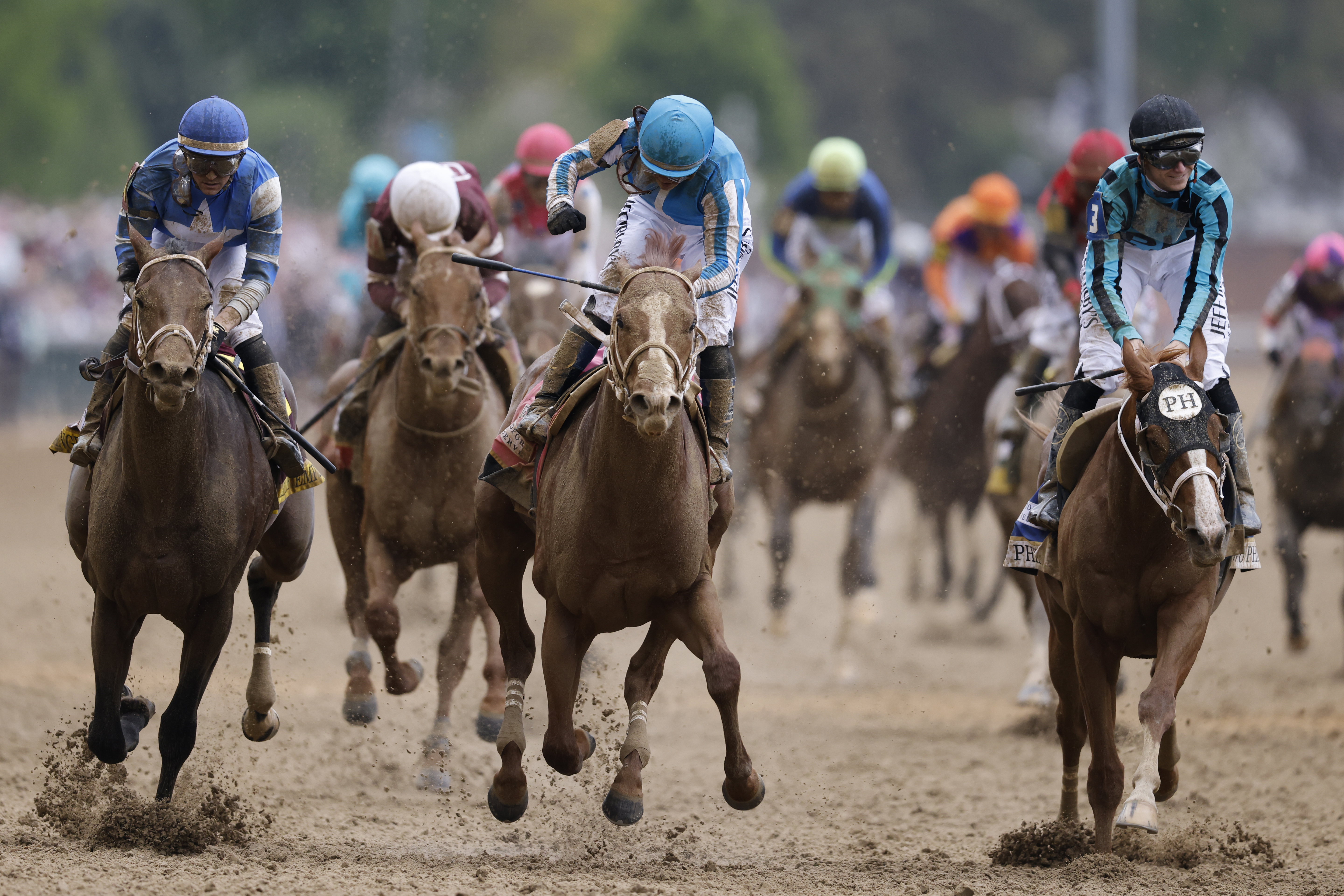
Jockey Javier Castellano rides Mage #8 to a win in the 149th running of the Kentucky Derby at Churchill Downs on May 06, 2023 in Louisville, Kentucky. Jockey Javier Castellano rides Mage #8 to a win in the 149th running of the Kentucky Derby at Churchill Downs on May 06, 2023 in Louisville, Kentucky. (Joe Robbins/Icon Sportswire via Getty Images)

Take for example, the performance-enhancing drug known as Lasix (also called furosemide, a potent diuretic that prevents exercise-induced pulmonary hemorrhage, which is bleeding in the lungs.) Lasix was perfectly legal and routinely used by trainers until 2021 — but, even then, the law barring it still allowed a phase-out exemption. Churchill Downs voluntarily banned the drug from stakes races in 2021, but the law itself came into the world at the same time as the Horseracing Integrity and Safety Authority. 

HISA is a federal oversight body, with accompanying reform act, finally created by Congress to reduce the absurd number of yearly horse deaths after the FBI brought down a 27-member horse doping ring in 2020. HISA, however, was buried in lawsuits from the start, slowing it’s ability to do anything about doping until May 22 of this year — after the 2023 Kentucky Derby and Preakness.

It’s worth noting that Kentucky Derby horses are never more than 3 years old. Those that ran in 2023 would have been training and running while, in some cases, Lasix was still technically legal.  

“It’s apparent that there’s more at
work here than track surface threats”

The lawsuits against HISA were largely spear-headed by the National Horsemen’s Benevolent and Protective Association, which joined with several state affiliates to try and abolish the agency altogether. Their own former president, however, has long been on-record disclosing rampant doping, unchecked by local authorities. 

“At a 2017 trial in a sweeping doping case, Stephanie Beattie, the former president of the Pennsylvania Horsemen’s Benevolent and Protective Association, said up to 98% of race horses — including her own — were illegally drugged to block pain and increase performance,” reported the Philadelphia Inquirer

Then there are those like Mike Repole, co-owner of early Kentucky Derby favorite Forte. Repole told the Associated Press there were other ways to fix doping and injuries in the sport apart from the federal regulations of HISA. 

“HISA can be part of the answer, but it’s a spoke in the wheel. We always have to try to do more,” he said.  

But that was before Repole’s horse, Forte, was scratched from this past May’s Derby when a track veterinarian discovered bruises on his hoof. It was then discovered Forte had won four races since failing a drug test the previous September. 

Judge James Wesley Hendrix of the U.S. District Court for the Northern District of Texas held HISA at bay for the NHBPA on March 31 of this year. He said it was more dangerous to the health of the horses if HISA rules kept them from racing.

“The plaintiffs have shown a serious risk of harm — potential physical injury to racehorses, potential disqualification from Triple Crown prep races, and the burden of coming into compliance with a new anti-doping regulatory scheme without the legally required delayed effective date,” Hendrix said, per the Associated Press

As if the lawsuits weren’t enough to endanger HISA testing standards and delay implementation, HISA then parted ways with the U.S. Anti-Doping Agency on rule-making (though USADA will still act in an enforcement capacity). Finally, the Federal Trade Commission punted the implementation of the anti-doping rules until May 22 of this year which — as animal welfare advocate Marty Irby pointed out — would be weeks after the Derby. 

If we find in coming months or years that any of the 12 dead at the Downs tested hot, then we can mark the FTC’s ruling as the moment of fait accompli.

Loopholes, wrist-slaps, and revolving paddock doors 

An equine ambulance carrying race horse Here Mi Song is driven off the track after racing in the tenth race ahead of the 149th Kentucky Derby at Churchill Downs on May 06, 2023 in Louisville, Kentucky.An equine ambulance carrying race horse Here Mi Song is driven off the track after racing in the tenth race ahead of the 149th Kentucky Derby at Churchill Downs on May 06, 2023 in Louisville, Kentucky. (Rob Carr/Getty Images)Racing commissions in West Virginia and Oklahoma, along with the U.S. Trotting Association also filed a separate anti-HISA lawsuit in Kentucky, however. And, as reported by Reuters, Churchill Downs CEO Bill Carstanjen initially didn’t want to see HISA pass. In 2019, he said the company had “serious concerns” about the HISA bill and did not think federal legislation was “practical, reasonable, or imminent.” 

“We have expressed those concerns to industry constituents and the bill’s sponsor but they were never addressed,” he said at the time. 

Churchill Downs, however, changed its tune when one of racing’s most infamous trainers, Bob Baffert, threw the track into a doping scandal in 2021 with his disqualified Derby winner Medina Spirit. Not long after, the bill secured greater support of Kentucky Republican Sen. Mitch McConnell. 

12 deaths at his track later — 9 of which were on-track breakdowns — Carstanjen is now dealing with a HISA investigation

It’s also hard to prevent horse racing deaths when wrist-slap fines and mile-wide loopholes allow a revolving door of trainers to pass through the sport. Two of the 12 dead at the Downs, Parents Pride and Chasing Artie, were trained by Saffie Joseph Jr. Sure, he’s been permanently suspended from Churchill Downs after the two deaths, but he was previously suspended in Pennsylvania and New Jersey for doping-related concerns. Meanwhile, Baffert will be allowed back on the track next year. 

With HISA drug-testing standards having been delayed until after the Derby, and post-mortems revealing little, trainer doping suspicions have continued to swirl. Carstanjen announced on June 2 that races would temporarily move to Kentucky’s Ellis Park so that Churchill Downs can join HISA — and the Kentucky Horse Racing Commission — in investigating the causes of the deaths. 

Carstanjen indicated the investigation would look at the turf surface of the track, and said the company would “conduct a top-to-bottom review of all of the details and circumstances so that we can further strengthen our surface, safety and integrity protocols.”

But HISA threw cold water on the turf question straight out of the gate. 

“After conducting his own inspection of the surface and reviewing data collected by Racing Surfaces Testing Laboratory and Churchill Downs, [track surface expert Dennis Moore] reported there were no primary areas for concern and has verified that the various track metrics analyzed are consistent with previous years,” the agency said in a statement. 

As reported by the Louisville Courier Journal’s Brooks Holton and Stephanie Kuzydym, people aren’t buying the turf argument. 

“It’s apparent that there’s more at work here than track surface threats,” said Wayne Pacelle, president of Animal Wellness Action and the Center for a Humane Economy.

Pacelle wants Churchill to suspend racing “until there is a proper forensic analysis of the horse deaths and a comprehensive plan to remediate future deaths.”

It’s hard to tell how long that’s going to take, though. The KHRC entered a voluntary agreement to enforce HISA’s anti-doping rules in March of this year, but HISA also seems to have handed over the reins of the investigation to the KHRC. 

“With these agreements in effect, the KHRC has authority to suspend a license for any violation that threatens the integrity of Kentucky horse racing or the KHRC’s ability to protect the racing public,” the KHRC said in a statement, “except where HISA has preempted state regulations in the areas of track safety, and anti-doping and medication control. If a track had violations related to either of these areas, HISA would have jurisdiction.” 

The fact that KHRC’s last public doping report is from 2020 — while reports for 2021, 2022, and 2023 appear to be absent — offers little certainty about the transparency standards of the investigation. And, while federal HISA laws may override some of the state’s statutes, the list of what you could get away with in Kentucky horse racing for the last few years is eye-popping. In some cases, a drug that might be otherwise wholly banned in other countries for the duration of a horse’s career is banned for only a brief pre-race window in Kentucky.

While some novel element of tragedy may yet be discovered in the particulars of the 12 dead at Churchill Downs, there’s no mystery in the near-identical racehorse deaths that have marred American tracks for years.

And on top of everything else, the state’s mandated horse mortality reviews are designed to require so little detail that they shed almost no light on the actual causes of the death.

With closed-door meetings between track owners and regulatory bodies, wrist-slap fines and a legacy of lax doping rules in a multi-billion-dollar industry, discerning truth from formal investigative reports might never yield real answers about whether or not doping-related injuries are at the heart of the 12 deaths at Churchill Downs. 

But we know doping causes these same types of injuries every day in tracks around the country. And their doctors have known longer than anyone. 

“Every day, I almost quit,” racehorse veterinarian Kate Papp told NBC News’ Anna Schecter in 2014. “​​Every day, I decide I don’t want to see 2-year-old [horses] that haven’t even run yet be euthanized in a dirt pit at the back of the racetrack because somebody trained them too hard, medicated them too much, pushed them too far.”

Pain-killers, anti-inflammatory drugs, cocaine and cobra venom — whatever it takes to keep the race going, keep the money coming. Splayed bone shards, shattered ankles, lungs full of blood — we rip them limb-from-limb. While some novel element of tragedy may yet be discovered in the particulars of the 12 dead at Churchill Downs, there’s no mystery in the near-identical deaths that have marred American race tracks for years. 

There’s no more need to ask why. Whatever killed those 12 racehorses, it’s the same cause of death it’s always been. It’s us.

Ukraine’s counteroffensive begins in earnest

There’s no place where you can dig on a boat. That’s why river crossings, or crossing any body of water for that matter, are the most hated and dangerous of military operations. So let’s get this straight, right off the bat:  A country contemplating launching an offensive – that would be Ukraine — especially against an enemy force larger than its own, does not choose to immediately make things more difficult for itself.

It’s not the only reason, but it’s the main reason why Ukraine did not blow the Kakhovka dam on the Dnipro River.  They would be idiots to destroy the hydroelectric plant at the dam that supplies electricity to much of the Kherson region. That was of course done by Russia, which has made it part of their overall strategy of the war to launch a campaign against Ukraine’s energy infrastructure since its beginning. 

Ukraine holds the west bank of the Dnipro, and Russia holds the east bank. Does anyone actually think Ukraine blew up that dam, turning a river into a mile-wide lake the Ukrainian army would have to cross in order to attack Russian positions on the east bank? The first thing an army calculates when planning for a river crossing is how much time its soldiers will spend in boats on the water, where they are most vulnerable to enemy fire. Alternatively, it was to the advantage of Russia to widen the water gap Ukrainian forces must cross before they reach the east bank of the Dnipro to engage the enemy and seek cover and concealment from enemy fire.

The destruction of the dam, and the flooding of Kherson and the entire Dnipro delta, drowned out the idea that Ukraine might launch at least one part of its offensive in that region.  There had been speculation for months about where Ukraine would begin its counteroffensive.  The front line in the war is more than 600 miles long, reaching from the Russian border in the north to the Sea of Azov and the Crimean Peninsula in the south, so Ukraine has had a lot of spots to consider.

Would they choose to focus the attack on Bakhmut and humiliate Putin and his attack dog Prigozhin, who recently announced they had won the year-long battle for Bakhmut?  Ukraine could shove Russia’s egotism down their throats:  You spent 100,000 troops to take a town of 70,000 in the middle of Eastern Ukraine nowhere?  Watch this!

Does anyone actually think Ukraine blew up that dam, turning a river into a mile-wide lake the Ukrainian army would have to cross in order to attack Russian positions on the east bank?

Or Ukraine could build on their previous offensive success by pushing the gains they made last September in the Kharkiv region further east toward Luhansk.  They could have done the same thing in the area of Kherson if Russia hadn’t blown the Kakhovka dam, turning all of Kherson and much of the region south of the dam into a lake.

Instead, Ukraine has apparently chosen to attack from Zaporizhzhia south toward Melitopol, a city once known as “the gateway to Crimea” because 80 percent of passenger rail traffic passed through the city, and so does the main highway to the peninsula.  It’s a bold strategy.  If Ukraine is able to push through Russian defenses all the way to Melitopol, they will have cut the so-called land bridge to Crimea Russia has been using to resupply its military along the southern portion of the front lines in Eastern Ukraine. 


Want a daily wrap-up of all the news and commentary Salon has to offer? Subscribe to our morning newsletter, Crash Course.


Russia has been so paranoid that Ukraine will try to cut off its access to Crimea, they have spent the last six months digging an elaborate series of trenches across the Zaporizhzhia region north of Melitopol to protect the rail and road link leading to Crimea across a bridge.  They have also dug trenches and built so-called dragon’s teeth anti-tank defenses to the south of Kherson to protect their control of the narrow isthmus Perekop, along which runs the second road link between the Ukrainian mainland and Crimea. 

As in all wars, however, only time will tell how well this offensive works for Ukraine.

Incredibly, or perhaps insanely, they have dug trenches and set long rows of dragon’s teeth along the beaches of Vitino, a little town on the western coast of Crimea.  How the Russians think that Ukraine, a country without a significant navy, is going to launch an amphibious attack on the west coast of Crimea is known only to Russia, and specifically to Vladimir Putin, whom the Washington Post describes as obsessed with the peninsula, which Russia seized from Ukraine in 2014. “The Russian military, apparently, understands that Crimea will have to be defended in the near future,” Ian Matveev, a Russian military analyst told the Post. “For Putin, Crimea is just a sacred cow.”

Aerial view of a beach

Description automatically generated with low confidence

This photo from the satellite company, Maxar Technologies, shows a section of over 5,000 feet of four-foot tall concrete dragon’s teeth set in two rows for a total of more than 1,000 in all. The photo also shows in dark brown lines the defensive trenches dug along the beach. Because they are in a zig-zag pattern, there are more than 6,500 feet of trenches in the same 5,000 feet of beach. Look closely, and you’ll see that both the dragon’s teeth and network of trenches extend beyond the edges of the photo, so there is no telling how many thousands of feet there are of both protecting what, exactly? I see at least one backyard pool in the photo, so it looks to me like they’re protecting the vacation dachas of some very wealthy Russians.

All that money for concrete and labor to move the dragon’s teeth and dig the trenches could have been spent better protecting the land bridge between Melitopol and Crimea which is more than 200 miles away. Which I guess gives some color to the Russian military analyst’s “sacred cow” description of the way Putin sees the prize seized in 2014. Last year a story in American news media revealed that Putin has built himself a palace on a spit of Crimean land close to the Kerch Bridge. According to a video distributed by Russian opposition leader Alexei Navalny before he was put in the slammer by Putin, the place is nearly 200,000 square feet in size and costs more than $2.3 billion. I’d love to see satellite photos of the defenses around that.

The Russian military has also established networks of anti-tank trenches and dragon’s teeth near the small towns of Polohy and Novofedorivka, both along the road from Zaporizhzhia to Mariupol. Some of the trenches and lines of dragon’s teeth are shown in a Maxar Technology satellite photo here:

Russia digs in as Ukraine prepares to attack | Reuters

Both the Washington Post and the Institute for the Study of War (ISW), which tracks movements by Ukrainian and Russian forces along the front lines using cell phone geo-locating and reports from Russian military bloggers, as well as from what is officially released by the Ukrainian and Russian military, report that there has been heavy fighting in the Zaporizhzhia region, around a town called Liubymivka, located along the road from the city of Zaporizhzhia to Mariupol. There is also fighting by Ukrainian partisans in Tokmak, south of Zaporizhzhia, and in the city of Melitopol. 

The New York Times reported on Thursday that some of the Ukrainian brigades that received training in Germany and Poland in recent months have attacked south of Zaporizhzhia near a town called Novomikhailivka, using U.S. Bradley fighting vehicles and Leopard II tanks from Germany. Ukrainian forces are “looking for weaknesses in the Russian line,” according to the Times, and will “wait to see which of several advancing forces achieves the most success before making that one the main thrust of the overall attack.” The battles described by the Times and ISW indicate that the Ukrainian counteroffensive may be along two axes, directly south towards Melitopol and southeast toward Mariupol. The Times is also reporting there is heavy fighting near Bakhmut, where Ukraine is having successes to the north and south of the city.

When Russia blew the Kakhovka dam on Tuesday, it should have been seen as the last chance desperate move that it was.  Now we know it didn’t work.  Ukraine already had forces in place to attack elsewhere, and by Thursday afternoon, the reporting in U.S. newspapers indicated that military experts believe the long-expected Ukrainian counter-offensive is now fully underway.  The British Ministry of Defense, which has had excellent intelligence on the progress of the war ever since it began, said Thursday that “heavy fighting continues along multiple sectors of the front,” and concluded that “In most areas Ukraine holds the initiative.”

There is an old saying that an army on the attack is happier than when it’s on the defensive. As in all wars, however, only time will tell how well this offensive works for Ukraine.

Top Trump lawyer in Mar-a-Lago case quits just hours after “absolutely insane” TV interview

Jim Trusty, one of Donald Trump’s attorneys in the Mar-a-Lago case, abruptly resigned from his defense team just hours after he appeared on CNN claiming that federal prosecutors “extorted” an attorney in the classified documents probe.

Trusty, who appeared on CNN Thursday evening after the former president was indicted by a federal grand jury in Miami, went after federal prosecutor Jay Bratt, the Justice Department’s counterintelligence chief, who last year urged a court to seal the affidavit that supported a search of Mar-a-Lago that uncovered classified material.

“I have a theory that maybe some of the outrageous misconduct has affected the equation in some other case, a potential target,” Trusty said. 

His allegations involved discussions concerning the lawyer representing Trump’s valet, Walt Nauta. Trusty claimed that federal prosecutors – while attempting to gather potential witnesses to strengthen their case against Trump – brought up the fact that Nauta’s lawyer, Stanley Woodward, had applied for a judgeship. 

In a conversation with Woodward, Bratt mentioned that the lawyer, who had an extensive background, had pursued a judgeship in D.C. Trusty claimed that the prosecutors used this information as a means of applying “extortion” pressure, simply by introducing the topic of Woodward’s career aspirations.

“He, apparently along with five other people in his presence from DOJ, extorted a very well respected, very intelligent lawyer from Washington D.C., saying essentially if you want this judgeship that’s on Joe Biden’s desk, you have to flip your guy to cooperate against the president of the United States,” Trusty said.

When CNN anchor Kaitlin Collins questioned if he had any evidence supporting such claims, Trusty said that there was sworn testimony to which Collins responded “That’s what you’re saying… We don’t have any evidence of that ourselves.”

“Mr. Trusty’s statements are part of a pattern of President Trump and his associates raising so-far unsupported allegations about prosecutorial misconduct,” Temidayo Aganga-Williams, partner at Selendy Gay Elsberg and former senior investigative counsel for the House Jan. 6 committee, told Salon. “It is a familiar tactic that if a defendant doesn’t have a strong defense inside the courtroom, he takes his case to the public outside of the courtroom.”

Trusty’s recent claims shocked legal experts, who criticized him for discussing his client’s indictment on national television.

“Absolutely insane that a defense lawyer would go on national television to discuss an indictment of his client that he hasn’t seen and then speculate that a particular person is going to cooperate with the government,” tweeted attorney George Conway. “Totally nuts.”

National security attorney Bradley Moss also questioned “why on earth” Trusty appeared on TV.

“Trump’s gameplan is to be out there,” William “Widge” Devaney, former assistant U.S. attorney in the District of New Jersey, told Salon.

He referred to previous comments Trump and his allies have made accusing “the deep state” of coming after the former president and calling other investigations into him a “witch hunt”

“So keeping that theme rolling along doesn’t surprise me and I think we’ve seen this coming from his lawyers before as well,” Devaney said.


Want a daily wrap-up of all the news and commentary Salon has to offer? Subscribe to our morning newsletter, Crash Course.


The indictment, filed by the office of special counsel Jack Smith, came after a yearlong investigation into whether Trump had illegally retained national security documents at Mar-a-Lago and then obstructed the government’s efforts to reclaim them.

The charges against Trump include willfully retaining national defense secrets in violation of the Espionage Act, making false statements and a conspiracy to obstruct justice, two sources told The New York Times.

Trump also confirmed on his social media platform Truth Social that he had been indicted saying: “The corrupt Biden Administration has informed my attorneys that I have been Indicted, seemingly over the Boxes Hoax.”

Hours after his indictment, Trusty and fellow Trump attorney John Rowley resigned from his defense team and issued a joint statement saying they would no longer be representing him on either the indicted case or the January 6 investigation.

Trump also shared the announcement on Truth Social writing that Trusty and Rowley were up against “a very dishonest, corrupt, evil, and ‘sick’ group of people, the likes of which has not been seen before.”

Instead, he added, he will be represented by Todd Blanche, a defense lawyer he hired in April after being indicted in Manhattan, and a firm that will be named later.

“It wouldn’t be totally uncommon If Trump were to have lost faith in his counsel because he did, in fact, get indicted,” Devaney said. But he added that it’s unusual for defense attorneys to “take a client up through indictment and walk away because they got it.”

This is the second criminal indictment against Trump, who wrote on his social media platform that he was scheduled to be arraigned in federal court in Miami at 3 p.m. on Tuesday.

Earlier this year, Trump was indicted in New York on charges relating to an alleged hush-money payment made to adult-film actress Stormy Daniels prior to the 2016 election. 

Smith is also examining Trump’s attempts to overturn the results of the 2020 election and his conduct related to the Jan. 6 riot at the Capitol. Fulton County District Attorney Fani Willis is investigating Trump’s alleged role to subvert the election results in Georgia.

“There’s a lot of interesting things that we’ll see kind of develop over the next couple of months, but I am interested in seeing the specifics of the charge,” Devaney said. “We’re in for a long and interesting ride in Georgia if it happens, and of course, you’ve got January 6.”

Dershowitz tells Fox that Trump can dodge most of the indictment, apart from one thing

During a segment of Fox Business on Friday, attorney Alan Dershowitz — who defended Donald Trump in his 2020 impeachment trial — weighed in on the details of the former president’s indictment, expressing his belief that most of it can be dodged, apart from one thing.

Referencing the 44-page indictment that was unsealed a day after it was put into effect, which he said he “read very carefully,” Dershowitz told Host Larry Kudlow, a former Trump economic adviser, that only one page “has anything of substance to it.”

“The stuff about moving boxes, that’s all covered by the Presidential Records Act, probably not criminal at all,” he said. “The one page that’s of concern, obviously, if it’s true, is the tape recording that was made of a conversation ex-President Trump had with a writer who was writing a book about Meadows, in which he said, ‘look, I have these documents. They’re secret. I could have declassified them when I was president, but I didn’t.’ And then either shows it to him or shows him that he has it.”

Explaining this to be the one charge that brought the Espionage Act into the mix, he goes on to poo-poo the rest as being easily defeated on “legal and factual grounds.”


Want a daily wrap-up of all the news and commentary Salon has to offer? Subscribe to our morning newsletter, Crash Course.


“This is the one that should be worrisome to the president, and he may have an answer for it,” Dershowitz furthered. “He may be able to say, ‘look, I was just showing off a little bit,'”

Towards the end of the segment, the point is driven home with the attorney issuing a clear prediction of sorts, saying, “There’s a lot to fight about. But I’m just telling you, it’s the one paragraph, the one page that should cause concern by President Trump.”

“Every liberal in the last hundred years has been opposed to the Espionage Act because is had nothing to do with espionage. It deals with dissent, it deals with opposition to war. It deals with speech,” Dershowitz said.  “And it’s a horrible, horrible statute. But it does cover by its terms transmitting to anybody who’s not authorized the contents of classified material. It doesn’t require espionage as the title of the statute would seem to imply.”

The document referenced in this tape mentioned by Dershowitz — from a  2021 meeting held at Trump’s Bedminster golf club — has yet to be located by Trump’s lawyers. In a recent appearance on “Meet the Press,” attorney Andrew Weissmann said that, physical document or not, the tape is enough to prove Trump’s guilt.

“If the document doesn’t exist … the evidence on that tape is still useful to show his state of mind,” per Weissmann.

“I feel absolutely relieved”: “Top Chef: World All-Stars” champ on the road to making TV history

“Top Chef: World All-Stars” has come to a close after 14 weeks of rousing competition, pitting Buddha, Sara and Gabri against each other for a tense, dramatic final meal. 

To set the stage: Gabri’s dishes pay homage to Mexico, with huitlacoche, chocolate tamale and even grasshoppers, while Buddha combines his Hong Kong, Malaysian, Australian and American roots into a stunning menu. Sara concentrates her elevated Southern flavors into an elite, upscale menu. As always, familiar faces return to help out: Gabri’s sous chef is Tom, Buddha’s is Ali, and Sara’s is Amar, reuniting pairs yet again that had worked together numerous times in the past.

After a lovely dinner with Padma, Tom, Gail at guest judge Hélène Darroze’s restaurant, our final three prep the most important meal of their life, serving it to an incredibly esteemed table with the likes of Hunter Lewis, Marcus Samuelsson, May Chow, Daniela Soto-Innes, Clare Smyth, Simon Rogan, Ángel León, and even Michelin Guides’ International Director Gwendal Poullennec. 

Sara’s stunning raw opener, her technically complicated yet homey burgoo with rabbit loin, boudin blanc, crepinette and a beautiful cornbread madeline crumbled over the top (which she deems “Kentucky cassoulet”) and an exceptional dessert incorporating lemon curd and buttermilk sorbet and her mother’s pea cake almost snag her her first “Top Chef” trophy. Alas, she is toppled by an improperly cooked liver on her second dish, which she serves with onion puree, cookie butter and figs. As Padma put it, “It was blue.”

Gabri’s dishes are similarly excellent with his unique flavors winning over the judges, including sweet corn esquites, the aforementioned grasshopper tostada, a sweet potato empanada with black beans and cheese foam and a super-unique take on chile en nogada. Darroze even notes that in a few years, he will really become something noteworthy, but Tom Colicchio adds that certain aspects (like the overcooked tostada in the first course) just need a bit of work. 

Therefore, Buddha does it yet again, taking home the trophy for a masterful, progressive meal that encompasses his background, his passions, his childhood and more. It spans the globe and incorporates everything from a New England clam chowder-inspired rainbow trout with potato, veloute and caviar, a red curry bisque with blue lobster, his version of a ngau lam with lamb, eggplant and master stock sauce (or lo shui), all capped off with his amazing take on Australian dessert lamington, with raspberries and coconut bavarois. Buddha’s consistent, technical prowess and deep knowledge of food help to clinch him yet another win, catapulting him to a very elite circle of reality show contestants with multiple wins.

With his monumental, back-to-back, history-making wins on both seasons 19 and 20, Chef Buddha Lo may have confirmed once and for all that he is, indeed, the single most accomplished and formidable competitor even to step food into the realm of “Top Chef.”

With 14 (!) individual wins in both Quick Fires and eliminations over his tenure, plus, of course, 2 “Top Chef” winner’s trophies (including one for a “World All Stars” season), Buddha’s dominance on the show is truly unparalleled.

Salon spoke with the newly minted, two-time winner about his path to “Top Chef,” the importance of his family, his proudest moments and what he plans to accomplish next. 

The following interview has been lightly edited for clarity and length.

Top ChefChef Buddha Lo ( Stephanie Diani/Bravo Media)

Hi Buddha, congrats!

Thank you so much!

I know we just chatted the other day so I’m excited to talk again and properly congratulate you. I’m sure you’ve been inundated thus far today and last night, but yeah, congratulations again. I love that you’re drinking Saratoga water.

My wife actually threw a party; we had a party at the cinema and she did all this food from previous challenges, like the Ritz crackers and she bought a s**tload of Saratoga water. It was just like a “Top Chef” party! It was a lot of fun. 

Obviously such a monumental moment, what a time for you. You experienced something similar last year, but this is a whole new ballgame as the first two-time “Top Chef” winner and winner of “World All-Stars,” so I wanted to how you’re feeling right now that you an openly celebrate and acknowledge this enormous win

I feel absolutely relieved. I put it on my post that I felt like my dad wanted me to do a little bit more of something and I feel like that could be it. I feel like there’s a weight off my shoulder and what a way to end my “Top Chef” journey like this. Everyone dreams to be on it, everyone dreams to win, and I did something that was just so — the chances of that ever happening again, it’s just very slim — 20 seasons, the first time you ever win a winner back, “World All-Stars.” It’s just an incredible feeling to do something kind of iconic, not only just for Bravo “Top Chef,” but I would say for reality competitions. I would say that’s really hard for someone to come back to back. If you’re in different shows, if you win “Survivor” once, they’re going to get you out the first episode, but here on “Top Chef,” you have to keep cooking your a** off, and I think that I’m reaping the rewards of all the hard work I’ve done throughout my life. 

100%

I’ve done 50-plus dishes in two seasons within in a year and to be able to still be standing there and be told that I’m “Top Chef World All-Stars” – you not only just did Houston but you also did “World All-Stars” — it’s crazy for me, I would believe this story if I had maybe five years between winning to find another level of how I cook. But I’m literally the same person from Houston walking into the doors of “World All-Stars.”

Top ChefGabriel Rodriguez, Sara Bradley, Amar Santana and Ali Al Ghzawi in “Top Chef” (Fred Jagueneau/Bravo)

That’s amazing. I think it was said in the package at the beginning of the episode last night that you’d be the “GOAT” if you did indeed win. Really, within the Padma era of “Top Chef,” if you will, Seasons 2 through 20, you’re the only person who’s accomplished this. Pretty incredible!

There are so many great chefs who’ve been on there and it’s very hard to compare but in that sense, you just have to look at who has two “Top Chef” wins.

Just you!

Yeah — to win one is extremely hard, to win twice is even harder, especially give the caliber of the season as well. To win in Season 1, with a sommelier and a person still in CIA cooking school, compared to someone in the Top 50 best chefs of the Middle East restaurants . . . it’s a completely different ball game. So if you put all those things on paper and look at it, then yeah, seems like the GOAT to me.

“There are so many great chefs who’ve been on there and it’s very hard to compare but in that sense, you just have to look at who has two “Top Chef” wins.”

You had mentioned earlier about your dad and you had had that wonderful confessional after your win about that dream you had had. I always was struck by your arc or edit that there’s always such a family focus. Obviously, you had spoken to your wife after you had won and you had mentioned earlier in the season about paying for your dog’s eye surgery with the winnings from your first season win. How do you feel those connections and motivations shape you as a competitor?

It was just really weird . . . like, two days after my dad passed away, I got the phone call to go to Houston. Then later, I had that weird dream — it’s the only dream I’ve had since. I got the call to go to — I don’t have dreams about him every night — and this very vivid dream in the middle of the morning and my wife saw that I was in a puddle of tears and she wondered what’s happening. I told her I saw my dad and I don’t know why or what’s happened, but he had a smile that’s kind of, like, there’s something coming up.

It’s so weird because throughout this whole journey, going through Season 20 feels like I’m getting directed somewhere and it wasn’t only just to participate, but to win. It’s crazy, surreal, maybe it’s coincidence, I have no idea, but it definitely gave me the spark to do it.

At the same time, I just loved being on it. They’re not going to ask me to come on [Season] 21 or come back for a normal season in [“Top Chef”] 22. That’s not going to happen. This was the one and only season where they’ll bring a winner back because it’s “World All-Stars,” and there are only finalists and winners. It’s a known thing that the U.S. competitors, finalists and winners – first of all, the winners aren’t interested, and second of all, if you were a finalist, you’ve probably been in “All-Stars” before. Someone like Richard Blais, Melissa King, Gregory Gourdet — they’ve already [competed.] How many times do you want to do it? Two times is already a lot . . . let’s ask Bryan Voltaggio for the fourth time? It’s a lot to ask, so to have that opportunity, I knew was never going to come again and I knew that they were going to bring in some heavy-hitting chefs to come judge. So to meet them, cook for them and try to make my own stamp on the culinary world and say, “Hey, I’m here,” I wanted to try to impress them.

“Throughout this whole journey, going through Season 20 feels like I’m getting directed somewhere and it wasn’t only just to participate, but to win.”

Top ChefGabriel Rodriguez, Tom Goetter, Sara Bradley, Padma Lakshmi, Ali Al Ghzawi and Hélène Darroze in “Top Chef” (Nick Foye/Bravo)

I was wondering also about the finale panel of guest judges. I’m sure that table was super intimidating. What was it like serving that incredible, important menu to that accomplished table of judges, chefs and professionals? 

It’s crazy when you get put in a position like this where you have no chance but to do a full course meal, meal of your life. You have this kitchen you’ve never worked in before, and the guest judges are people — individually, you’d be scared of having them in your place. It’d be such an honor and privilege, but I think that’s what the best part of being on the show is that it gets you so out of your comfort zone that you don’t even have to think about it.

In any other circumstance, I would’ve been shaking in my kitchen, but here, it brought out of me, like, “You have no choice” — you have the president of Michelin at your table and this person, if he likes your food tonight, he’ll get people to come really thoroughly check out your place. That’s a goal of mine, to get a Michelin star, and here you’ve got the president. He frequently dines at a lot of Michelin places and he knows exactly what he’s talking about. Then you have Clare Smyth, my mentor, who you already know I’m shaking about.

It’s all these people — even the people who aren’t guest judges, like someone like Simon Rogan, I look up to him so much: He’s an English chef, three Michelin stars, No.1 in UK, incredible chef. So [it’s] an outstanding table of people, and it feels so lucky but you put all those nerves away and you go, “I have to remember that I’m trying the best that I can today and hopefully it comes out with a win.”

Top ChefBuddha’s finale fourth course (Fred Jagueneau/Bravo)

I’d love to hear about the finale menu. I loved how you had mentioned and intentionally touched on Malaysian and Hong Kong roots, Australian and American classics  putting that all in one comprehensive meal. How did that come to be?

I think the way that I am and the way I represent myself . . . I felt like, coming into the season is like, “Who do I represent?” Yes, I’m doing the “Top Chef” U.S. franchise and I live in New York right now, but I’m Australian. I don’t really consider myself — it’s hard because generations ago, if we look about 200 to 300 years, it was only indigenous people and I’m not indigenous, so I feel like those are the true Australians, if we want to be technical. Everyone came from different parts of Europe, so it’s kind of like what is technically your roots and mine are that my parents are Hong Kong and Malaysian, I’ve lived in Australia and but also live in America.

These are the sort of things that are really important to represent if you’re doing a final menu. Make sure you show who you are and what you represent — it’s like, if you’re in the FIFA World Cup and you’re trying to represent the country, I’m trying to represent all of them! So it was very important that I got all of that in together in a way that feels cohesive. 

Top ChefBuddha’s finale third course (Fred Jagueneau/Bravo)


Want a daily wrap-up of all the news and commentary Salon has to offer? Subscribe to our morning newsletter, Crash Course.


Was there one particular course, dish or component in that menu that you felt most proud of? 

I’d say probably the lamington. I don’t do many Australian dishes, just because they’re more snack-y style. Like a meat pie is very hard to elevate, nor would I want to elevate it anyway because it’s so good . . . a sausage roll, as well. All of those sorts of things are very hard to elevate, but being able to represent lamington in that form and way and do that final bang and say, “This is my last dish on ‘Top Chef” . . . It was one of my favorite things growing up as a kid, and I was happy to be able to represent that little bit of my childhood.

We can go through it all, that master stock that I talked about that my brother needs to take out if the place is on fire is very, very important and it’s going to be a family heirloom that we hand down — it’s not going to be any jewelry that I hand down to my kids, it’ll be a master stock.

” . . . being able to represent lamington in that form and way and do that final bang and say, “This is my last dish on ‘Top Chef’ . . . it was one of my favorite things growing up as a kid, and I was happy to be able to represent that little bit of my childhood.”

That was on the third course, right?

Yeah, that was on the third course with the lamb.

I really like something you’ve done a few times on the show, which is title your dishes. In the trompe l’oeil challenge, you had titled it “What’s for Dinner,” I think? It adds some pomp and circumstance and elevates things. It doesn’t seem to happen much on “Top Chef,” so I was wondering where that comes from and what inspires that for you? 

I feel like there are so many different avenues in which you can try to wow the judges, and the more that you try to reach those avenues, the more chances you have in winning. Obviously, taste always comes first, then you have presentation, creativity and, hey, if you can slam on a title on top of your dish and make them really think, it’s going to even wow them even more, the more depth of thinking and knowledge.

Most of the inspiration — especially for that challenge — I look at the crew around me, the producers, the camera people, and they’re sweating and working tirelessly to get this thing done. They said goodbye to their families, moved abroad, living in London and just, I get inspiration form them and how hard they work and I go, you know what, I need to deliver, because I need to ensure I produce something spectacular. They’re working their a**es off, and I need to work just as hard.

So that dish, I just didn’t stop thinking about all the different avenues and the things I was talking about. So when it come to it, I thought I’d do something like a charcuterie board and I realized when I came to it that this looks like a bunch of ingredients on a table. I would love to try and take [the judges] not only to be visually challenged about what’s happening on their plate, but also challenge them in a way, like: I’m now in a setting, I’ve got my favorite artist playing on my computer or whatever, my speaker or record. You’re having a glass of red wine, you just came back from the market and bought mushrooms and cherries, fresh black truffle in season. I’m going to make a mushroom risotto with black truffle, I’m going to snack on some olives and I’m going to make a dessert with cherries and drink my red wine.

That’s the whole idea, and Jeremy Chan was able to really embrace it and go, “Yes, I really do feel like I’m sitting here wondering,” . . .  like I said, you have all these ingredients in front of you and you just kind of snack: You have an olive, a cherry and think “OK, maybe I’ll have this.” What I said was that it’s a very special time, and we spend all this time cooking for other people and sometimes, it’s really really nice just to be able to cook for yourself.

Top ChefPadma Lakshmi, Buddha Lo and Ali Al Ghzawi in “Top Chef” (Nick Foye/Bravo)

“Most of the inspiration — especially for that challenge — I look at the crew around me, the producers, the camera people, and they’re sweating and working tirelessly to get this thing done.”

Totally  it was a stunning dish all around. Lastly, I wanted to get in the quintessential question here, which is what’s next? What’s coming up?

My next steps — I’ve always got goals ahead of me — personally, I’d love to have a family and second of all, I’d like to have my first Michelin star. I think that’s my ultimate goal . . . and my own restaurant. I just have those constant goals and that’s what really great about these accomplishments — when you accomplish one thing, you’re going to accomplish another.

I feel like there’s so many bucket list things in my life that I want to try and get done: be on a reality cooking competition. There’s none in Australia, but I was lucky to be apart of one in America. So, now I can tick that one off.

Every chef has a timeline that you need to follow because otherwise, I can’t go back [when I’m] in my 60s and think that I want to open up a Michelin star restaurant. I’m not going to  have the legs for that — but if I wanted to open something a little bit more casual in my 60s, maybe a Chinese brassierie, I can do that . . . cool.

It just all takes a lot of energy to get a Michelin star, so I want to get it now.

“Top Chef: World All Stars” airs Thursdays at 9 p.m. on Bravo and streams next day on Peacock.

GOP donor at center of Ken Paxton scandal charged with 8 felonies as prosecutors seek $172 million

Sign up for The Brief, The Texas Tribune’s daily newsletter that keeps readers up to speed on the most essential Texas news.


Nate Paul, the Austin real estate investor central to allegations of illegal conduct by suspended Attorney General Ken Paxton, has been charged with eight counts of making false statements to financial institutions.

Paul, 36, allegedly overstated his assets and understated his liabilities to fraudulently obtain loans, according to a 23-page indictment filed by federal prosecutors Friday.

The government is seeking $172 million in restitution from Paul.

U.S. Magistrate Judge Dustin Howell laid out the charges — which focus on actions Paul took in 2017 and 2018 to allegedly mislead mortgage lenders and credit unions — Friday morning to ensure Paul understood them.

Paxton was not mentioned in the indictment, nor was he discussed during a half-hour proceeding Friday in Austin’s federal courthouse, where Paul appeared shackled and wearing a blue button-down shirt, jeans and white Air Jordans. He answered Howell’s questions softly, simply stating, “Yes, Your Honor.”

Paul is due back in court June 15 for arraignment. He will be released today on conditions including that he surrender his passport and leave Texas only after notifying the court. His in-state travel will be unrestricted. Assistant U.S. Attorney Alan Buie, who represented the government at the hearing and who specializes in white collar crimes, said Paul should be allowed to continue to run his businesses.

Paul’s lawyer, Gerry Morris, said outside the courtroom that the charges have nothing to do with Paxton, adding that he had “no idea” when Paul last spoke with the now-suspended attorney general.

Prosecutors allege that Paul repeatedly misstated his financial situation to obtain loans from credit unions and mortgage lenders in New York, Connecticut and Ireland.

“On three occasions, Paul gave a financial institution a false and counterfeit document, representing that one of Paul’s bank accounts held millions of dollars when in fact the balance of the account was less than $13,000,” the indictment stated.

In another instance, prosecutors alleged, Paul told a lender he owned 100% of a company that was to receive a loan, but another firm that was not affiliated with Paul owned 91% of the company.

In a third case, Paul told a lender that his total liabilities were $3.4 million when they exceeded $28 million. “Therefore, Paul knowingly made a false statement and report when he said that the amount of his total liabilities was only $3,422,056,” the indictment said.

Paul was arrested by the FBI and booked Thursday afternoon into the Travis County Jail on a federal warrant, but the nature of the charges against were not initially disclosed. He is represented by Morris, a 40-year Austin defense attorney and past president of the National Association of Criminal Defense Lawyers and the Texas Criminal Defense Lawyers Association.

Paul is a central figure in the abuse-of-office and bribery allegations made against Paxton by former high-ranking officials, all of whom were subsequently fired or resigned from the attorney general’s office after taking their concerns to the FBI in 2020. Their accusations — focusing on help Paxton gave Paul after the real estate investor’s Austin home and businesses were searched by federal law enforcement — prompted an FBI investigation and formed the lion’s share of 20 articles of impeachment against Paxton that the Texas House adopted last month.

Paxton is currently suspended from his official duties and awaiting an impeachment trial in the Senate, where a two-thirds vote would permanently remove him from office. A specially appointed panel of senators will present rules of procedure for the trial to the full Senate on June 20, according to a resolution that set the trial to begin no later than Aug. 28.

Paul, once considered a major player in the real estate business, was one of the largest owners of real estate in Austin through his investment firm, World Class Capital Group. A string of bankruptcies followed. In 2019, the FBI and U.S. Treasury Department agents searched Paul’s home and business offices, bringing Paul and Paxton together.

Paul complained that the federal agents doctored search warrant records, and Paxton directed his agency to take a number of “bizarre, obsessive” actions to investigate Paul’s complaint, according to a whistleblower lawsuit filed by four Paxton deputies who had been fired.

In 2018, Paul had given a $25,000 donation to Paxtons campaign. The former top aides also claimed that Paul helped Paxton fund an extensive remodel of his Austin house and gave a job to a woman with whom Paxton allegedly had an affair. Paxton is married to state Sen. Angela Paxton, R-McKinney.


Go behind the headlines with newly announced speakers at the 2023 Texas Tribune Festival, in downtown Austin from Sept. 21-23. Join them to get their take on what’s next for Texas and the nation.

This article originally appeared in The Texas Tribune at https://www.texastribune.org/2023/06/09/nate-paul-federal-charges/.

The Texas Tribune is a member-supported, nonpartisan newsroom informing and engaging Texans on state politics and policy. Learn more at texastribune.org.

Unsealed Trump indictment paints a picture of Mar-a-Lago as a piñata of government secrets

The full details of Donald Trump‘s latest indictment — enforced on Thursday and cracked open on Friday — brings to mind pre-guillotine Versailles. Photos of Mar-a-Lago that have now been made public show a version of Trump’s estate befitting its own Sofia Coppola edit. A ballroom stage, cluttered with boxes upon boxes of classified government documents. A spare bathroom accoutred with a chandelier — Florida sun catching the crystals, shimmering across a spill of documents stamped “confidential.” A still of October 15, 1793, ticks of the clock prior to a slash through history that will change things forever. 

Reading through the 44-page indictment detailing the bounty of materials that Trump took from the White House post-presidency, it’s revealed that he held “information regarding defense and weapons capabilities of both the United States and foreign countries; United States nuclear programs; potential vulnerabilities of the United States and its allies to military attack; and plans for possible retaliation in response to a foreign attack.” At least some of which was discussed by Trump and/or shown to random visitors at his estate.

Trump faces 37 counts for his piñata of intel, which CBS News details as such:

  • 31 counts of willful retention of classified documents
  • 1 count of conspiracy to obstruct justice
  • 1 count of withholding a document or record
  • 1 count of corruptly concealing a document or record
  • 1 count of concealing a document in a federal investigation
  • 1 count of scheme to conceal
  • and one count of making false statements and representations.


Want a daily wrap-up of all the news and commentary Salon has to offer? Subscribe to our morning newsletter, Crash Course.


The fact that Trump withheld sensitive government materials is made worse by where he chose to store them. As the indictment points out in many spots, Mar-a-Lago is “an active social club, which, between January 2021 and August 2022, hosted events for tens of thousands of members and guests.” Meaning, not a storage facility for classified documents that he had no business taking from the White House in the first place.

According to Trump attorney Jim Trusty, the former president is “ready for battle.” But how does one battle this much evidence pointing directly towards guilt?

“He’s a fighter, and he’s going to come out swinging, and he’ll be fine,” Trusty said. “He’s not afraid of this thing.” 

Good to point out here that Trusty — as well as another lawyer, John Rowley — resigned hours later, issuing a joint statement saying that “this is a logical moment” to do so. 

As CNBC points out, “Trump still faces two other criminal probes, as well: Smith’s investigation of the Jan. 6, 2021, pro-Trump riot at the U.S. Capitol, and an inquiry in Georgia looking into whether he attempted to interfere with the presidential election in that state.”

According to former special counsel Ryan Goodman, this particular “battle” will be hard, if not impossible, for Trump to win.

“This is devastating. I have looked at all prior prosecutions under the Espionage Act and have never seen egregious facts like this,” he said in a statement to Twitter.

Back to Versailles, where the oranges have rotted, the paint is peeling and the heads, they are about to be rollin’. 

Do federal or state prosecutors get to go first in trying Trump? Law professor explains the conflict

A federal grand jury in Florida indicted former President Donald Trump on June 8, 2023, on multiple criminal charges related to classified documents he took from the White House to his home in Mar-a-Lago, Florida, according to multiple sources cited in The New York Times and The Associated Press.

Trump himself said on his social media outlet, Truth Social, that he had been indicted.

The seven counts against Trump – the first president to face federal charges in U.S. history – include obstruction of justice, false statements and willful retention of documents, The New York Times reported.

Trump said he was set to appear in a Miami federal courthouse on June 9 at 3 p.m.

The Justice Department did not immediately comment on the reported charges.

But the federal charges come on top of other legal trouble Trump is facing at the state level.

Manhattan District Attorney Alvin Bragg charged Trump in April 2023 with 34 felony counts of falsifying business records.

And in Georgia, the Fulton County district attorney is investigating Trump’s alleged attempts to overturn the results of the 2020 election. This, too, could result in criminal charges under Georgia law.

If a person is charged by federal and state prosecutors – or prosecutors in different states – at the same time, which case goes first?

Who gets priority?

I am a scholar of criminal law. It’s important to recognize that criminal law provides no clear answer how to settle that question.

No law dictating a path ahead

Nothing in the U.S. Constitution or federal law dictates that, say, federal criminal cases get priority over state cases, or that prosecutions proceed in the order in which indictments are issued.

The solution ordinarily is that the various prosecutors will negotiate and decide among themselves which case should proceed first. Often, the one that involves the most serious charges gets priority, although the availability of key witnesses or evidence could play a role.

There are a few cases to look to as reference for state charges competing with federal ones.

After neo-Nazi James Fields drove his car into a group of protesters at the Unite the Right Rally in Charlottesville, Virginia, in 2017, killing one person and injuring others, he was charged with crimes in both federal and state courts.

The state homicide trial went first. Then, Fields pleaded guilty to federal hate crime charges after the state conviction and received two life sentences for his crime from both the state and federal charges.

By contrast, “D.C. Sniper” John Allen Muhammad was finally apprehended at a highway rest stop in Maryland in 2002, after a deadly series of sniper shootings in Maryland, Virginia and the District of Columbia, which killed 10 people and injured three.

Maryland police arrested Muhammad. Then, federal officials were the first to file charges. But Muhammad was first put on trial and convicted of murder in Virginia.

Trump’s circumstances

In Trump’s case, his federal charges – which were not unsealed as of June 8 – are likely to carry longer potential sentences than the state offenses.

The felonies he is facing in New York are white-collar crimes and may not result in any prison time, legal experts have said.

Of course, much about Trump’s case is unique. Never has a former president faced federal or state prosecution. That fact alone probably makes priority for the federal prosecution more likely.

An active presidential candidate has faced criminal charges in the past, though.

Socialist Party nominee Eugene Debs was prosecuted and convicted under the Espionage Act for his opposition to World War I in 1918. He campaigned from prison for the 1920 election, before losing to Republican Warren G. Harding.

Federal authorities could assert priority over state officials by taking custody of the defendant. States cannot arrest suspects who are outside the state’s borders, but federal law enforcement officers can arrest suspects anywhere in the country.

It is exceedingly unlikely that federal prosecutors would ask a court to detain Trump in jail before trial. Rather, they are likely to allow him to be released on bail as the New York court did in April. But their nationwide jurisdiction gives federal authorities an advantage over states in controlling the defendant, in terms of placing and enforcing bail conditions, for example, regardless of where he resides at the moment.


Darryl K. Brown, Professor of Law, University of Virginia

This article is republished from The Conversation under a Creative Commons license. Read the original article.

Expert: Indictment of Trump aide Walt Nauta suggests he’s not cooperating — but “that could change”

Former President Donald Trump’s valet Walt Nauta has been indicted in the federal investigation into Trump’s handling of classified documents at Mar-a-Lago residence, sources familiar with the indictment told CNN.

The indictment, which was unsealed Friday, confirmed that Nauta had been charged in the investigation with six total counts: conspiracy to obstruct justice, withholding a document or record, corruptly concealing a document or record, concealing a document in a federal investigation, scheme to conceal and making false statements. Nauta’s indictment is the second in the special counsel’s probe into the former president.

Trump, who was indicted on 37 counts in the federal investigation, reacted to Nauta’s indictment and condemned the FBI and DOJ Friday morning in a post to Truth Social.

“I have just learned that the ‘Thugs’ from the Department of Injustice will be Indicting a wonderful man, Walt Nauta, a member of the U.S. Navy, who served proudly with me in the White House, retired as Senior Chief, and then transitioned into private life as a personal aide,” Trump wrote. “He has done a fantastic job! They are trying to destroy his life, like the lives of so many others, hoping that he will say bad things about ‘Trump.’ He is strong, brave, and a Great Patriot. The FBI and DOJ are CORRUPT!”

Nauta faced investigators’ scrutiny during the probe over his involvement in moving boxes of sensitive documents at Trump’s Florida resort club. He reportedly moved the boxes with the help of a Mar-a-Lago staffer before the FBI’s search of the property in August, in which officials seized more than 100 classified documents, according to court filings from last year. Investigators also obtained surveillance footage that showed Nauta and the worker transporting boxes around the beach club. 


Want a daily wrap-up of all the news and commentary Salon has to offer? Subscribe to our morning newsletter, Crash Course.


The former Trump aide had spoken to investigators throughout the probe, initially telling them that he hadn’t handled any boxes of classified materials but changing his tune and refusing to speak with them further once they had obtained the footage.

Former federal prosecutor and legal analyst Renato Mariotti said that Nauta’s indictment alongside Trump indicates that he is not cooperating with investigators.

“That could change,” he continued, quote tweeting The Wall Street Journal, which first reported Nauta’s indictment. “By default, there would be a *joint* trial of both defendants. One or both defendants could seek a separate trial.

“Nightmarish possibility”: Trump-appointed Judge Aileen Cannon assigned to oversee Mar-a-Lago case

The summons sent to former President Donald Trump’s legal team Thursday signals U.S. District Judge Aileen Cannon is the judge initially assigned to oversee the case, sources familiar with the matter told ABC News and other news outlets.

The apparent assignment would mean that Cannon, whom Trump appointed in 2020, would be responsible for determining the former president’s sentence in the event that he is convicted.

Trump was indicted Thursday on seven counts after the special counsel’s investigation into his handling of classified documents and potential attempts to obstruct government efforts to retrieve them that revealed evidence suggesting Trump had retained more than 300 classified documents.

Trump has repeatedly denied any wrongdoing and even vouched for his innocence after announcing his indictment. 

Last year, Cannon appointed a “special master” to review the documents the FBI seized from the former president’s Mar-a-Lago estate in August, and several legal experts argued that Cannon handed “Trump a series of head-scratching victories over the course of those proceedings,” according to ABC News.

In one situation, Cannon barred the FBI from using the seized sensitive materials in its investigation until she completed her review. But judges for an 11th Circuit Court of appeals threw out her order, finding that she had overstepped.

Magistrate Judge Bruce Reinhart, who signed off on the initial Mar-a-Lago search warrant and later decided to unseal the affidavit, was also listed on the summons, the sources said.

Legal experts told ABC News that while judges in federal cases are mostly assigned at random, the indications of Reinhart and Cannon on the summons could reflect the roles they both have already played in the proceedings.

“If the case is being overseen by the same district and magistrate judges, that means the court likely considered the indictment to be ‘related’ to the search warrant and intentionally assigned it to those judges,” Brandon Van Grack, a former senior Justice Department national security official, said.

Other legal experts spoke out against Cannon’s assignment online. Former U.S. Attorney Harry Litman called the assignment a “nightmarish possibility” that “was one reason why all things being equal DOJ preferred DC to Florida.”

“Trump could seek a bench trial instead of a jury trial, but the prosecution would have to consent,” tweeted Renato Mariotti, a former federal prosecutor. “Unless both sides (and the judge) disagree, there is a jury trial.”


Want a daily wrap-up of all the news and commentary Salon has to offer? Subscribe to our morning newsletter, Crash Course.


Former U.S. attorney and federal prosecutor Joyce Vance attempted to quell the commotion surrounding Cannon’s assignment, breaking down, based on her experience as an appellate chief in the 11th Circuit, the possibilities of Cannon’s recusal

Although “a judge’s behavior in court generally doesn’t form the basis for recusal, the 11th Circuit has ordered ‘reassignment’ where a judge leans so heavily for a defendant they call their objectivity in the eyes of the public into question. This is from US v. Martin,” Vance tweeted posting a screenshot of an excerpt from the U.S. v. Martin related order.

Vance said that the order is “persuasive authority” that Cannon would have to remove herself from the case if she’s permanently assigned, adding that neither Cannon’s court or the 11th Circuit court would want to navigate the damage to their credibility if she did not voluntarily recuse.

“It is not clear Cannon is permanently assigned to the case,” Vance concluded. “If she is, it’s extremely unlikely it stays with her and as a last resort, DOJ will challenge her participation and win.”

“I commit to pardon Trump”: “Reckless” Republicans desperately try to spin Mar-a-Lago indictment

Republicans flocked to the defense of former President Donald Trump Thursday evening after he broke the news of his indictment in the special counsel’s investigation into his handling of national security documents.

Trump is facing seven counts, including willfully retaining national defense documents, obstruction, and false statements, according to media reports, though the specific details of his indictment will likely remain unknown until he is arraigned in Miami’s U.S. district court.

Despite several weeks of reports that he would soon be indicted, the announcement reportedly came as a surprise to Trump and his inner circle. The former president spouted off on Truth Social Thursday evening in response to the notification.

“I AM AN INNOCENT MAN. THE BIDEN ADMINISTRATION IS TOTALLY CORRUPT. THIS IS ELECTION INTERFERENCE & A CONTINUATION OF THE GREATEST WITCH HUNT OF ALL TIME. MAKE AMERICA GREAT AGAIN!!!” he wrote in the fourth of four posts to the conservative platform ranting about the indictment.

Republicans, including some of Trump’s opponents in the upcoming 2024 presidential election, rallied behind him and echoed his denigration of the federal investigation.

Florida Gov. Ron DeSantis, who lags behind Trump in Republican primary polls, claimed that the indictment was a “weaponization of federal law enforcement” that “represents a mortal threat to a free society” in a tweet Thursday.

“We have for years witnessed an uneven application of the law depending upon political affiliation,” DeSantis continued. “Why so zealous in pursuing Trump yet so passive about Hillary or Hunter?”

DeSantis vowed that if elected president, his administration would “bring accountability to the DOJ, excise political bias and end weaponization once and for all.”

Fellow candidate and biotech executive Vivek Ramaswamy shared DeSantis’ criticism, committing his first action, if elected to office, to pardoning Trump.

“It would be much easier for me to win this election if Trump weren’t in the race, but I stand for principles over politics,” Ramaswamy, who has polled in the single digits, said in a statement. “I commit to pardon Trump promptly on January 20, 2025 and to restore the rule of law in our country.”

In a Fox News interview following news of the impending indictment, Sen. Tim Scott, R-S.C., said that “lady justice has a blindfold on” and “what we’ve seen over the last several years is the weaponization of the Department of Justice against the former president.”

According to Politico, the presidential candidate also promised to “purge all of the injustices and impurities in our system” if elected.

But some of Trump’s low-polling 2024 Republican primary rivals did not come to his defense. Former Arkansas Gov. Asa Hutchinson said that Trump’s actions shouldn’t define the Republican Party and called on Trump to drop out of the race.

“While Donald Trump is entitled to the presumption of innocence, the ongoing criminal proceedings will be a major distraction,” Hutchinson said. “This reaffirms the need for Donald Trump to respect the office and end his campaign.”

Former New Jersey Gov. Chris Christie, who recently announced his bid for the oval office, warned his followers against adhering too closely to Trump’s word on social media.

“Let’s see what the facts are when any possible indictment is released, he tweeted. “As I have said before, no one is above the law, no matter how much they wish they were. We will have more to say when the facts are revealed.”


Want a daily wrap-up of all the news and commentary Salon has to offer? Subscribe to our morning newsletter, Crash Course.


Trump’s allies in Congress also jumped to his defense.

“Today is indeed a dark day for the United States of America. It is unconscionable for a President to indict the leading candidate opposing him. Joe Biden kept classified documents for decades.” House Speaker Kevin McCarthy, R-Calif., said on Twitter, referencing the ongoing investigation into classified materials from President Biden’s vice-presidency that his attorneys found and quickly returned to the government earlier this year. 

“House Republicans will hold this brazen weaponization of power accountable,” McCarthy concluded.

Republican Sens. Josh Hawley of Missouri and Ohio’s J.D. Vance also jumped to defend Trump Thursday, echoing the former president’s assertion that the country is in decline and his long-held defense that he had the presidential power to declassify documents with his mind, respectively.

“If the people in power can jail their political opponents at will, we don’t have a republic,” Hawley tweeted.

“The former president will be indicted for “mishandling” his own government’s classified info,” Vance added. “Yet everyone agrees the president has the authority to declassify anything. This is a moral and constitutional joke. Merrick Garland has disgraced this country.”

Legal experts pushed back on their comments.

“This is a reckless comment from a lawyer who knows better,” former U.S. attorney Barb McQuade said of Howley’s tweet. “No one is jailing anyone at will. A grand jury has found probable cause of crimes. Trump gets due process, like everyone else. He gets jailed only if a jury finds guilt beyond a reasonable doubt and a judge imposes jail.”

“Trump has not been indicted for ‘mishandling’ classified documents. He has not been charged with handling documents in the wrong way. He has been charged with willfully keeping national defense secrets he wasn’t entitled to possess and then obstructing justice,” former federal prosecutor Renato Mariotti added of Vance’s claim.

Rep. Jamie Baskin, D-Md., cautioned his Republican colleagues against attempting to undermine the legitimacy of the special counsel’s probe after many of them already had, Common Dreams reports

“Instead of trying to divide the country and undercut our legal system, congressional Republicans should respect the outcome of the special counsel’s comprehensive investigation and the decisions of the citizens serving on the grand jury,” said Raskin, the top Democrat on the House Oversight Committee.

“Dangerous rhetoric about a ‘two-tiered system of justice’—discriminating against the rich no less—in order to prop up the twice-impeached former president not only undermines the Department of Justice but betrays the essential principle of justice that no one is above the commands of law, not even a former president or a self-proclaimed billionaire,” he added.

“Spider-Man: Across the Spider-Verse” is beyond subtitles — and the white gaze

We’re in something of a Spider-Man renaissance. There’s always been a friendly neighborhood superhero on the screens every few years — be it Tobey Maguire’s depiction from 2002-2007, Andrew Garfield’s depiction from 2012-2014 or Tom Holland’s depiction from 2016 onward — but never have we been so overrun with Spider-Men, -women, -cartoons, -cats and other species as there now that we’ve entered the Spider-Verse series. Its new sequel “Spider-Man: Across the Spider-Verse” has predictably garnered as much acclaim as it does multiple universes. It was applauded for its range of vibrant animation, became the second highest box office opening of the year at $120.5 million and touted as a “masterpiece” by many reviewers. The true success of the sequel, however, lies not only with its visuals (though they are superb), but with the movie’s decision to not translate the Spanish dialogue in the film.

Phil Lord, who produced and co-wrote both the first and second movies in the franchise, told Remezcla during the premiere for “Into the Spider-Verse” that this choice helped keep the film authentic to his own experience growing up in a Cuban American family. “I grew up in a bilingual household in the bilingual city of Miami where you hear Spanish all over the place, and it’s not particularly remarkable,” he said. “It was important for us to hear Spanish and not necessarily have it subtitled. It’s just part of the fabric of Miles’ community and family life.”

He continues this thread into the second movie, and it’s here that the lack of subtitles, coupled with the crux of the film, takes on new meaning as a way to escape the white gaze.

“Across the Spider-Verse” picks up where the first movie leaves off with Miles Morales (Shameik Moore) fighting crime in Brooklyn until he learns about the elite task force of Spider-people assembled across the multiverses, sparking his journey throughout the web of worlds. Like the first movie, Spanish runs throughout the film. There’s no lengthy dialogue in Spanish but it’s there in the “¿Qué te pasó, hijo?” that Miles’ mom asks or in the “¡Qué grande estás!” that his family member exclaims. Knowing or not knowing the language doesn’t change your general understanding of what’s happening, and most translations could be guessed using context clues.  By not bothering to explain itself, however, the movie creates a different, more intimate level of viewing for those who know Spanish and see themselves reflected in Miles’ Afro-Puerto Rican family. 

Those who don’t know Spanish may have missed the sneaky way the movie serves “c**t,” thanks to Miguel O’Hara or Spider-Man 2099 (Oscar Isaac) when he quickly mutters, “Aye, coño.” For those who do, they share in the film’s secret, granted a level of access that is dictated by language and identity. Leaving out the English subtitles is a bit like saying, “If you know, you know,” and being completely unbothered by those who don’t, a move that prioritizes Latinx people — and excludes everyone else.

Spider-Man: Across the Spider-VerseSpider-Man: Across the Spider-Verse (Sony Pictures)

Historically, the case has always been the opposite with media catering to and conscious of a white audience, a term defined by Toni Morrison as the white gaze. The gaze is used as a strategy to affirm white superiority. Casting people of color in roles that reinforce racial stereotypes (like Viola Davis as housekeeper Aibileen in “The Help”) is an example of the white gaze in action, because it coddles and sucks up to the sensitivities of white viewers.

The expected addition of subtitles assumes that a white, English-speaking audience does not know Spanish and thus needs translations. “Spider-Verse” rejects this gaze by creating a cast of diverse characters who transcend stereotypes and by assuming instead that its key audience speaks Spanish. 

This gaze shift is exemplified in the ways the movie employs humor, too. In jokes, there are always those who are “in the know” or get the joke and those outside of it, either because they’re the butt of the joke or miss its context. In “Across the Spider-Verse,” those in the know are people of color. When Miles’ parents are at a meeting with his guidance counselor (Rachel Dratch), she tells them he needs a story to make a compelling college application, deciding it should be, “You grew up in a struggling immigrant family . . .” The humor comes from the comically confused parents, when Miles’ mom, Rio Morales (Lauren Vélez), replies, “I’m from Puerto Rico? Puerto-Rico is a part of the United States.” The humor pokes fun at the ways the white counselor has fallen prey to stereotypes, assuming that people of color in America are all immigrants and that immigrants are always poor and pitiable. Well, the joke’s on her . . . and her own white gaze.

Sure, the humor is accessible to anyone, but it hits harder for people who have been in the parents’ shoes or actually do come from immigrant families. The same holds true when Indian Spider-Man, Pavitr Prabhakar (Karan Soni) points to a building in the fictitious city between Mumbai and Manhattan, Mumbhattan, and says “and this is where the British stole all of our stuff.” Cue colonizer-insulting laughter.


Want a daily wrap-up of all the news and commentary Salon has to offer? Subscribe to our morning newsletter, Crash Course.


Both the jokes and the non-translated Spanish speak to Black, brown, Indigenous and other people of color, a crucial point given that the main problem of the film is Miles dealing with what is essentially imposter syndrome, a fear that one isn’t worthy or deserving of their station in life or fame and is especially felt by people of color. Because he was bitten by a radioactive spider that escaped a different universe, Earth-42, Miles, as Miguel tells him, is an anomaly who was not meant to be Spider-Man and caused the disruption of the multiverse. “You don’t belong here,” he says to Miles as every other Spider-creature in existence hunts him down. It’s returning to his mom’s advice to “never let anyone at those big, fancy places tell him he doesn’t belong” that helps him reach the central lesson of the film: confidence. “I know how strong I am now,” realizes Miles, deciding that he is in charge of his own story.

And isn’t this what the non-subtitled Spanish asserts as well? When it assumes a non-white audience and a BIPOC gaze, the movie affirms that these identities matter. They are the priority. This focus on viewers of color, non-English speakers and immigrants tells them that this movie, unlike so many in Hollywood or even Marvel’s own mega franchise, is for you. The world, like the Spider-Verse, is multicultural and multilingual. It’s time to remember that whiteness doesn’t exist at the center of it. 


“Too much happy talk”: Trump rages on Truth Social after his team assured him he won’t be indicted

Former President Donald Trump erupted on social media Thursday evening after he was indicted in special counsel Jack Smith’s investigation into his handling of sensitive government materials and potential efforts to obstruct government attempts to retrieve them.

Trump broke the news of his indictment on Truth Social before various major media outlets, including CNN and The Guardian, confirmed the news. Special counsel Jack Smith’s office reportedly filed seven federal charges against the former president in the Miami U.S. district court, but details of the indictment will likely remain sealed until Trump’s arraignment, which he claims is slated for June 13, though reports say he is charged with willfully retaining national security secrets, obstruction and false statements.

The new set of charges comprise Trump’s second criminal indictment, following his indictment in New York earlier this year on charges relating to an alleged hush-money payment, and make him the first former president to face federal charges.

The announcement apparently came as a surprise despite numerous reports over the past several weeks that he would soon be indicted.

“Trump is frustrated not just with the indictment but with people in his inner circle who reassured him for months that it was very unlikely to happen… source close to Trump says ‘too much happy talk for way too long’ about what could happen,” reported CBS News’ Robert Costa.

Trump announced that his legal team had informed him of his indictment in the case in a post to Truth Social on Thursday, calling the investigation a hoax and levying an attack at President Joe Biden, whose attorneys found classified documents he had retained after his terms as vice president in his residence and office.

“The corrupt Biden Administration has informed my attorneys that I have been Indicted, seemingly over the Boxes Hoax, even though Joe Biden has 1850 Boxes at the University of Delaware, additional Boxes in Chinatown, D.C., with even more Boxes at the University of Pennsylvania, and documents strewn all over his garage floor where he parks his Corvette, and which is “secured” by only a garage door that is paper thin, and open much of the time,” Trump wrote.

The former president continued to fire off about the indictment, his innocence and what he called the rapid decline of the country in three more posts, one of which included a video, progressively adopting caps lock as he raged.

“I have been summoned to appear at the Federal Courthouse in Miami on Tuesday, at 3 PM,” he said. “I never thought it possible that such a thing could happen to a former President of the United States, who received far more votes than any sitting President in the History of our Country, and is currently leading, by far, all Candidates, both Democrat and Republican, in Polls of the 2024 Presidential Election. I AM AN INNOCENT MAN!”


Want a daily wrap-up of all the news and commentary Salon has to offer? Subscribe to our morning newsletter, Crash Course.


“This is indeed a DARK DAY for the United States of America. We are a Country in serious and rapid Decline, but together we will Make America Great Again!” he continued.

“I AM AN INNOCENT MAN. THE BIDEN ADMINISTRATION IS TOTALLY CORRUPT,” he concluded in a post sharing a four-minute video. “THIS IS ELECTION INTERFERENCE & A CONTINUATION OF THE GREATEST WITCH HUNT OF ALL TIME. MAKE AMERICA GREAT AGAIN!!!”

In the clip, Trump reiterates several of the arguments he outlined in his previous posts and spewed false claims about his presidential record and what he felt were invalid attacks he received during his presidency in an effort to rally his camp of MAGA supporters.

Legal experts disputed Trump’s claims of innocence and his comparisons to Biden.

“Reports say Trump charged with willfully retaining national defense documents, obstruction, and false statements,”  tweeted Barb McQuade, a former U.S. attorney and University of Michigan Law professor,. “This is very different conduct from unintentionally taking documents, as Biden and Pence apparently did. Key difference—they gave them back.”

The Washington Post fact-checked his litany of falsehoods, starting with his assertion that special counsel Robert Mueller’s investigation into his advisors’ collusion with Russian entities during the 2016 election was a hoax, which instead revealed significant criminal activity. Mueller also refused to say Trump had not attempted to obstruct justice.

Among several other inaccuracies regarding tax cuts, regulation cuts and the nation’s energy independence, the former president falsely claimed that he was leading in the current polls “by a lot” against Biden and asserted that he received more votes “than any sitting president in history by far,” which The Post says is technically true but only because he “ignores the fact that more Americans voted in the 2020 election” than in any other in 120 years.

Trump’s allegation that Smith’s probe was politically motivated and qualifies as election interference as he campaigns for the 2024 election is also a moot point as he would likely not have faced charges if he had quickly returned documents like Biden and his former Vice President Mike Pence.

“Highly damning evidence”: Trump admits he had a “secret” doc he didn’t declassify in leaked audio

Former President Donald Trump admitted in a 2021 meeting that he had a “secret” document he did not declassify, according to a transcript of a recording obtained by CNN.

“As president, I could have declassified, but now I can’t,” Trump says, according to the transcript, while discussing a previously reported classified document discussing a potential attack on Iran.

Trump, who was indicted on seven counts related to his handling of classified documents on Thursday, has repeatedly claimed that he was allowed to take the documents home and that he declassified them, at one point claiming he had the power to declassify documents with just his mind.

The recording was made during a meeting Trump had at his Bedminster, N.J. golf resort with two ghostwriters working on former chief of staff Mark Meadows’ autobiography.

Sources told CNN that the recording captures the sound of papers rustling, as if Trump was waving the document around, though it’s unclear if it was the actual document.

“Secret. This is secret information. Look, look at this,” Trump says at one point, according to the transcript. “This was done by the military and given to me.”

Trump at the meeting was complaining about Chairman of the Joints Chief of Staff Gen. Mark Milley after The New Yorker reported that he instructed the Joint Chiefs to ensure that Trump did not issue any illegal orders in his final days in office.

“Well, with Milley – uh, let me see that, I’ll show you an example. He said that I wanted to attack Iran. Isn’t that amazing? I have a big pile of papers, this thing just came up. Look. This was him,” Trump says, according to the transcript. “They presented me this – this is off the record, but – they presented me this. This was him. This was the Defense Department and him. We looked at some. This was him. This wasn’t done by me, this was him.


Want a daily wrap-up of all the news and commentary Salon has to offer? Subscribe to our morning newsletter, Crash Course.


“All sorts of stuff – pages long, look,” Trump continued. Wait a minute, let’s see here. I just found, isn’t that amazing? This totally wins my case, you know. Except it is like, highly confidential. Secret. This is secret information. Look, look at this.”

Former federal prosecutor Noah Bookbinder, the president of the watchdog group Citizens for Responsibility and Ethics in Washington, tweeted that the recording is “absolutely devastating.”

“Just blows a hole in the defenses Trump had been putting out,” he wrote.

“This looks like highly damning evidence for the prosecution,” wrote NYU Law Prof. Ryan Goodman.

“You’re going to prison, traitor”: Experts say indictment shows Trump lawyers “in over their heads”

Former President Donald Trump on Thursday was indicted in Miami on seven counts in the Justice Department probe into his handling of classified documents at Mar-a-Lago — and legal experts think the evidence may be too much for his legal team to overcome.

Trump broke the news of his indictment on Truth Social before it was confirmed by media outlets. The charges against him include willfully retaining national defense secrets in violation of the Espionage Act, false statements, multiple obstruction counts and a conspiracy charge, according to his attorney Jim Trusty.

Trump is expected to surrender to authorities on Tuesday. “I’m an innocent man,” he insisted on Truth Social.

But law enforcement sources told CBS News’ Robert Costa they view the case as a “grave, serious” threat to the former president.

“[T]hose who know [special counsel] Jack Smith say he would NEVER bring charges of this nature unless he had tons of testimony and evidence and is convinced he will win,” Costa tweeted.

A former federal prosecutor told CBS News that while providing obstruction is very difficult, bringing the charge “means there is a lot of specific evidence in the hands of the special counsel.”

Smith “is described as someone who would hesitate to bring that charge unless it was nailed,” Costa wrote.

The indictment came days after Trump’s attorneys met with Smith and other DOJ officials and asked them not to indict Trump. He and his attorneys have claimed that he had the right to take the documents and that he declassified the documents before taking them.

“I haven’t heard anything substantive that makes me really think that this legal team gets what it’s facing,” national security attorney Bradley Moss told MSNBC.

“You would think a former president, especially one with Donald Trump’s kind of money, you’d be expecting top notch A-list, best-of-the-best criminal defense lawyers, you’d be expecting constitutional scholars, national security experts. I’m just not seeing it,” Moss said.

“Who else is on this team that is really going to be qualified to handle this?” he added. “They are completely in over their head, and I think if you’re Donald Trump tonight, you’re realizing I got more or less a D-list legal team and now I’m paying the price for it.”

The legal team was apparently also blindsided by the DOJ moving the case from D.C. to a different grand jury in South Florida to address potential jurisdictional challenges.

“The Florida factor has thrown Trump’s team for a loop since it wasn’t always expected,” Costa reported.

CNN’s Paula Reid noted that “only one of his attorneys is barred in Florida” and Trump will likely have to bring in additional attorneys who can practice in the state.

“As we know, he has had a little bit of difficulty retaining lawyers,” Reid said. “There are a lot of law firms who won’t take him on. They’re worried their bills won’t get paid. But there are some interesting constitutional questions here. But he will absolutely have to recruit likely one or two more lawyers, because I don’t think he has the right team to bring this in Florida.”

Former U.S. Attorney Barb McQuade predicted that Trump’s claims that he declassified the documents and alleging prosecutorial misconduct would wilt in a courtroom because the Espionage Act charge “neutralizes his defense.”

“I don’t think either of these defenses are going to work,” McQuade told MSNBC. “They might sound good in the court of public opinion, and I imagine Trump will hammer them as he has, but… this idea Trump declassified the documents is really off the table if the charge is the Espionage Act because there’s no requirement under the Espionage Act the documents be declassified.”

Trump’s repeated Truth Social posts and media statements about the case could also further damage his case.

“You want to keep your mouth shut, for a very simple reason: the government bears the burden of proving you’re a criminal,” national security attorney Daniel Meyer told The Daily Beast.


Want a daily wrap-up of all the news and commentary Salon has to offer? Subscribe to our morning newsletter, Crash Course.


Meyer added that Trump had already “left so much evidence on the record” through his own statements.

“Donald Trump should have stayed quiet,” Meyer said. “And that’s what he has not done.”

Former Los Angeles County prosecutor Joshua Ritter agreed that in “any case where a defendant is very vocal and giving lots of statements about an ongoing investigation, it never seems to help them, and always seems to come back to haunt them.”

Former federal prosecutor Neama Rahmani told the outlet that “this guy will not follow Lawyering 101 — just keep your mouth shut.”

“I know he’s doing it for PR and political reasons, but he’s really screwing himself when it comes to these criminal cases…I’m sure his lawyers are incredibly frustrated having to clean up his messes,” Rahmani said.

Civil rights attorney Andrew Laufer responded to the indictment with a warning to the former president.

“Someone let Trump know the following,” he tweeted. “You’re going to prison, traitor.”

The legal dominoes finally start to fall against Trump

Another day, another Donald Trump indictment.

In April, the former president and current candidate for president was indicted by the Manhattan District Attorney on 34 counts of falsifying business records. Last month, he was found guilty in a civil court of sexually abusing and defaming E. Jean Carroll. And last night, as expected, he was indicted on federal charges pertaining to the collection of classified documents he refused to give back to the government after departing the White House.

And that’s just for starters.

Trump is still facing a huge civil case in New York over his shady business dealings and he’s under criminal investigations in both state and federal jurisdictions regarding his attempted coup in 2020.

One by one the legal dominoes are finally starting to fall.

These cases are hitting all of Trump’s sweet spots. He was found guilty of his grotesque behavior toward women (which he has bragged about publicly) and he’s going to be tried for paying hush money to women with whom he had affairs. There are literally dozens of women who have credibly accused him of assaulting them and who are now cheering that he’s finally being held liable for it. Now we have the first indictment that pertains to his behavior as a former president who was always planning to run again and his bizarre refusal to return classified documents when the government asked for them back is par for the course.

Trump has acted in inexplicably suspicious and self-defeating ways since he first ran for president in 2016. From calling on Russia to hack his rival’s emails to his strange affinity for the worst dictators on the planet to his pathological lying about everything, Donald Trump has acted in ways that only cult members could excuse as normal.

Trump has acted in inexplicably suspicious and self-defeating ways since he first ran for president in 2016.

This Mar-a-Lago case is especially vexing. When he decided to tell the government to go pound sand, he was not some naif who hadn’t been in government before and didn’t know the rules. He’d been president for four years by that time and knew very well that he was not supposed to keep classified documents at his beach club. And if they had been taken by accident in his chaotic move from the White House, he also knew very well that he should just give them back. But he refused, once again raising suspicions that he must be doing something nefarious with them. His behavior ever since then has done nothing to allay those concerns. Again, nobody normal would behave this way.

But that’s Trump. His motives are always self-serving and often just plain dumb but you never know if he’s in it for money or influence or something worse. Whatever his reasons, it’s clear that he has zero respect for the law or the Constitution. He’s gotten away with this stubborn childishness his whole life assuming that nothing could stop him because nothing ever has. He did it as president and was legally protected by a DOJ policy that held that a president couldn’t be indicted and Republican Senate partisans who refused to convict him in two unprecedented congressional impeachments.

But now he’s lost the shield of the presidency that kept him safe for four years and the rule of law is coming for him. If the case is strong (and we don’t know that it is) he could face jail time. The only thing we do know about the indictment at this writing on Thursday night is that there are seven crimes charged. (We don’t know how many counts there might be.) Trump’s lawyer James Trusty appeared on television Thursday and said he had only seen a summary but the language indicates that one of the crimes falls under the Espionage Act and others refer to conspiracy, false statements and obstruction of justice. We’ll have to wait to see exactly what they are charging but these are very serious crimes.


Want a daily wrap-up of all the news and commentary Salon has to offer? Subscribe to our morning newsletter, Crash Course.


And frankly, it’s even more serious that a former president committed them, not less. We really should be able to hold someone in that position to a higher standard than some faceless bureaucrat, many of whom have landed in jail for far less than what he’s done. It matters that a president would lie to federal law enforcement and crudely obstruct a lawful subpoena. It’s inexcusable for any former high official but for a man who is seeking to become president again, it should be disqualifying.

Unfortunately, none of that is relevant to the Republicans, many of whom were out in force on Thursday night hysterically defending Trump and proclaiming the end of the Republic. It’s really rich to watch a group of people who screeched “lock her up” on repeat for four long years now clutch their pearls over the inhumanity of holding this man accountable for defying the rule of law and claiming that he declassified every document in his possession just by thinking about it.

For a taste of how the right is reacting, take a look at Mark Levin on Fox News:

I think that fairly represents the general tenor of the right-wing reaction.

According to Jonathan Swan at the New York Times, the indictment was anticipated by the Trump political team which had a plan ready to go to deploy talking points and fundraising pleas the minute the indictment came down. Like clockwork, they all immediately responded confirming that the party would rally around him as they did after the Manhattan announcement.

And if anyone expected the other presidential candidates to step up, they will be sadly disappointed. 

It’s really rich to watch a group of people who screeched “lock her up” on repeat for four long years now clutch their pearls over the inhumanity of holding this man accountable for defying the rule of law and claiming that he declassified every document in his possession just by thinking about it.

Former VP Mike Pence and former South Carolina governor Nikki Haley didn’t bother to comment, former New Jersey Gov. Chris Christie said he was waiting to see the actual charges, and the rest (including chief rival Florida Gov. Ron DeSantis) all ranted about the Justice Department (DOJ) being weaponized against Republicans and vowed to end political bias at the DOJ. (They might want to have a word with the accused who spent his entire four years in office demanding that the Justice Department and even foreign leaders take down his political rivals.) The only one with any integrity was former Arkansas Gov. Asa Hutchinson, who said that Trump should drop out, which is correct.

CBS’s Robert Costa tweeted:

That’s a real bunch of heroic patriots, isn’t it? Just the kind of people we all dream of leading the most powerful nation on earth.

And then, of course, there’s the man himself. He was the first to announce that he’d been indicted and rushed to set the narrative before the details are released. He first tweeted it and then released a video which, according to Swan, they already had ready to go before the indictment even came down.

Will this end up resounding to Trump’s benefit in the long run? It’s hard to say. The cumulative effect of all these lawsuits and indictments might finally sober people up, you never know. But in the short run, it’s rallying the Trump faithful and causing the party to coalesce once again around him as they do whenever someone attempts to hold him accountable for anything.

Trump’s greatest asset, perversely, is his bottomless talent for scandal, corruption and crime which inevitably motivates the Republicans to circle the wagons around him. Someday, maybe they’ll figure out that they’d all be better off if they just let him face the consequences. Of course, that would mean they’d be deprived of the fun of joining him in his pity party and since ostentatious whining is also their main source of pleasure, I don’t see that happening any time soon.

How NYC officials failed to prepare for an air quality crisis

On Monday evening, meteorologists at the National Weather Service center in Upton, New York, noticed something unusual in the satellite imagery. A thick wall of smoke from a series of wildfires that had broken out across Nova Scotia was moving south toward the Empire State. After examining the wind patterns and speed of the plume’s movement, the meteorologists forecast it would enter the country’s most densely populated city by the following morning. Sure enough, New Yorkers awoke on Tuesday to gray air that thickened over the course of the day. By evening the city smelled like a bonfire. By the following afternoon, the air had turned orange. 

When Stanford researchers crunched the numbers, they found that Wednesday, June 7 was the worst day of pollution from wildfire smoke in the nation’s history, in terms of the average American’s smoke exposure. Air quality plummeted across the Eastern United States, affecting cities from Charlotte to Philadelphia to Chicago. But in no city was the air worse than the Big Apple. The air quality index, or AQI, in parts of Brooklyn reached 484 — nearly double San Francisco’s highest hourly reading during California’s 2020 fire season. In a press conference on Wednesday afternoon, New York Governor Kathy Hochul called it “a health and environmental crisis,” and urged residents to take precautions. New York City Mayor Eric Adams said the situation was “alarming and concerning,” and told people to mask up and stay indoors. 

But advocates and public health experts that Grist spoke to described officials’ efforts as slow and confused. Mask distribution efforts came well after the pollution had descended over the tri-state area. As global temperature rise fuels more powerful and frequent blazes across the continent, experts warn that even cities like New York that have not historically experienced wildfire smoke must step up their emergency preparedness efforts to keep vulnerable people safe. 

The air quality index, or AQI, in parts of Brooklyn reached 484 — nearly double San Francisco’s highest hourly reading during California’s 2020 fire season.

“It’s been a lackluster, underwhelming, frankly problematic response by the City of New York,” said Lincoln Restler, a city council member who represents northern Brooklyn, in an interview. The city had received advance warnings about the impending pollution from state and federal authorities, he added, but “there was essentially no communication shy of a tweet for 36 hours into this crisis.”

Smoke from wildfires is a major public health risk since it contains fine particles that can lodge in lung tissue and other pollutants that can aggravate the respiratory system. Short-term exposure to this type of pollution has been linked to higher rates of asthma hospitalization and heart attacks. Like most public health threats, it doesn’t impact everyone equally. Older adults, pregnant people, and children are particularly vulnerable to exposure, especially if they live in areas that already experience a disproportionate amount of pollution. 

NEWZ

In New York, that means places like the South Bronx, where a combination of highway traffic and heavy trucking near warehouses contributes to chronically unhealthy air. According to Columbia University’s Mailman School of Public Health, the neighborhood has one of the highest rates of asthma in the country, and Black and Latino patients account for more than 80 percent of asthma cases across the city. 

“You have those chronic cumulative exposures for people who live in areas that are already more polluted, and then you’re stacking on now this intense shorter-term exposure to their long-term exposures,” said Jennifer Vanos, an associate professor in the School of Sustainability at Arizona State University who studies extreme heat and air pollution.

“We clearly understand that these crises that we are facing around our health are something that we’re going to have to deal with. Climate change is real and we must be prepared.”

City officials know where the most vulnerable New Yorkers live and should have done more this week to protect them, said Eddie Bautista, the executive director of the New York City Environmental Justice Alliance, a nonprofit organization that works to advance environmental health in disadvantaged neighborhoods. He mentioned a program that his organization pushed the city to implement at the height of the COVID-19 pandemic, which distributed air conditioning units to low-income households so that they could stay cool and socially distant during heatwaves. He wondered aloud why local agencies did not take comparable measures this week, like quickly getting N95 masks to elderly people. 

“Like a lot of other people, I’m just stunned at how slow the response was,” he said. “Now we’re bracing ourselves for who knows what upticks in ER visits over the next week.”

A growing body of research backs up his fears. In 2020, researchers at the University of British Columbia in Vancouver found that pollution from wildfires increased asthma-related calls for ambulances within one hour of exposure. A separate study from the California Department of Public Health noted increased incidents of cardiac arrest after wildfires in people 35 and older. Experts told Grist it will take weeks to understand whether hospitalization rates in the city increased as a result of the smoke exposure. 

On Wednesday night, the city announced locations where New York City residents could pick up free N95 masks on Thursday. But some workers and advocates said the message came too late. Gustavo Ajche, a delivery bike worker and founder of Los Deliveristas Unidos, a collective of app delivery workers, told Grist that he did his rounds as usual on Tuesday, but by the end of the day he felt lightheaded and his throat hurt. On Wednesday, he was able to get through the day using an N95 mask. 

“I think the city’s response lacked efficiency,” he told Grist in Spanish. “The smoke affected us since Tuesday, so since Tuesday there should have been a plan implemented to get more New Yorkers to mask up.”

Asked to respond to the critiques of the city’s response to the crisis, the mayor’s office referred Grist to a video of a Thursday morning press conference where Adams described the developing conditions and urged residents, once again, to don face masks.

“We clearly understand that these crises that we are facing around our health are something that we’re going to have to deal with,” he said. “Climate change is real and we must be prepared.”

Public health experts that Grist spoke to described actions that New York, and other cities, could take in the future to safeguard vulnerable residents from smoke-related health risks. They mentioned better-coordinated mask distribution, text alerts in advance of worsening conditions, and risk communication with business owners so that they can protect their staff. Officials could also implement programs to provide homeless people with emergency shelter and low-income and at-risk city dwellers with air purifiers and other materials that could improve their indoor air quality, since some people live in drafty old buildings that lack air filtration. 

“Just because you’re indoors, you’re not necessarily safe from the impacts, because sometimes your indoor air quality is really, really poor,” said Mary Prunicki, director of the Sean N. Parker Center for Allergy and Asthma Research at Stanford University. In severe cases, “people who have the means may have already left the area, but that’s just not an option for a lot of people.”

Events like this week’s will likely become more common in cities that are unaccustomed to wildfire smoke as human-induced climate change increases the power and frequency of blazes across the world. Canada is currently experiencing what may be its worst wildfire season ever, with hundreds of forests burning across the country. Experts say that an effective emergency response plan is key to keeping people safe.

“You want to hear your local government officials, your local university officials, and your local hospital officials all putting out information,” Scott Sklar, a professor at George Washington University’s School of Engineering and Applied Science, told Grist. A city the size of New York has the capacity to prepare itself for a climate impact like this one. Nevertheless, he said, “we weren’t quite ready for it.”

Zoya Teirstein and Jake Bittle contributed reporting to this story.

This article originally appeared in Grist at https://grist.org/extreme-weather/how-nyc-officials-failed-to-prepare-for-an-air-quality-crisis/.

This story was originally published by Grist. Sign up for Grist’s weekly newsletter here. Grist is a nonprofit, independent media organization dedicated to telling stories of climate solutions and a just future. Learn more at Grist.org

What monkey masturbation tells us about the evolution of human sexuality

“Spanking the monkey”, “petting the poodle” and “pulling the python”: all fitting euphemisms for masturbation, and closer to the truth than you might imagine. Self-pleasure is common across the animal kingdom: from dogs humping unwitting teddy bears to dolphins thrusting their penises into decapitated fish (yes, really), animal masturbation is a raucous affair.

In my team’s new paper, my colleagues and I tested the hypotheses that primate masturbation could increase reproductive success and help avoid sexually transmitted infections (STIs).

We focused our research on primates (the group of animals humans belong to) because, if there were a prize for the most inventive onanists in the animal kingdom, they would win.

We discovered that masturbation is an ancient behavior within primates, and concluded that the ancestor of all monkeys and apes, including humans, probably masturbated.

Young chimpanzees fashion DIY sex toys from bits of chewed-up fruit. Female Sulawesi crested macaques slap their rumps while repeatedly inserting their fingers into their vaginas. In one study, captive male chacma baboons masturbated while ogling females sporting large prosthetic bottoms, attached by researchers to replicate the natural swellings females develop when at their most fertile.

Despite masturbation being such common behavior, there is very little research in this area. So – in a career move I did not anticipate when I was growing up – I spent my PhD researching the evolution of masturbation.

In evolutionary terms, masturbation is a puzzler because, by definition, it excludes reproductive partners and it’s hard to think of a scenario in which masturbating could aid survival. Many people have dismissed it as an abnormal and deviant behavior, or a byproduct of sexual arousal. And masturbation can be costly in terms of both time and energy.

Mapping masturbation across the primate order

My colleagues and I started by compiling a “who’s who” of masturbators across the primate order. We collated every detail we could find from published research, and supplemented this with questionnaires dutifully filled out by accommodating, if slightly bewildered, colleagues who are experienced working with primates.

Primate sitting on the ground with its paws in its lap

Rhesus macaques often masturbate several times a day during the mating season. (Photo: Matilda Brindle)

If you know how different animals are related to one another, you can compare data from living species to infer how a trait may have evolved. We combined information on the evolutionary relationships between different primates (think of it like an extensive family tree) with our new data on their masturbatory behaviors (or lack thereof).

For some analyses, we added information on other traits, such as their mating system and whether the species typically had a high exposure to STIs.

It turns out that masturbation occurs in all age groups, in both females and males, in the wild and in captivity. We discovered that masturbation is an ancient behavior within primates, and concluded that the ancestor of all monkeys and apes, including humans, probably masturbated. It’s unlikely masturbation is a habit that different species of monkeys and apes have picked up along the way.

Can masturbation increase reproductive success?

Previous research has shown that marine iguanas have an ingenious secret. Bigger males monopolize females, physically separating small males from their partner if they spot them copulating. To get around this, small males masturbate and store their ejaculate in a special pouch at the tip of their penis. Next time there’s an opportunity to mate, they quickly deposit their pre-prepared ejaculate. Amazingly, this method improves small males’ fertilization success by 41%.

Primates don’t have a special pouch for storing semen, but getting aroused before sex is still a good strategy for low-ranking males, as they are likely to be interrupted by those at the top of the pecking order. Hovering close to orgasm means they can ejaculate faster if they do get the opportunity to mate, before making a speedy exit.

Male masturbation can also keep sperm fighting fit, since ejaculation allows males to replenish their semen with fresh, high-quality sperm that are more likely to outcompete those of other males.

Our study found support for the theory that masturbation increases male — but not female — reproductive success. Mating systems with lots of competition between males have co-evolved with masturbation across the course of evolution.

Previous studies have showed that arousal in females increases vaginal pH, creating a more welcoming environment for sperm, while vaginal mucus filters out inferior sperm and fast-tracks high-quality semen towards the uterus. Orgasmic contractions can also help sperm on their journey.

Masturbation as a means of genital grooming

Male Cape ground squirrels masturbate after they’ve had sex — and the more partners they have, the more they do it. If their partner has had a lot of previous sex, they masturbate even more.

It’s thought that, among males, this practice of ejaculating via masturbation after sex is a form of genital cleansing. It’s unlikely that female masturbation evolved for STI prevention though, because the higher vaginal pH associated with arousal is more hospitable for pathogens as well as sperm.

Our research supports the hypothesis that masturbation can be a pathogen avoidance strategy in males, having co-evolved with higher risk of STIs. And in species with a high risk of contracting an STI, once masturbation evolved it was maintained.

So what about females?

Our research highlights how masturbation is a normal part of the behavioral repertoire of many different species – both in females and males, in the wild and in captivity.

At first glance, our data seems to suggest that female masturbation is less prevalent than its male counterpart. We didn’t find evidence for an evolutionary function of female masturbation.

However, I’m not convinced these results reflect what’s really going on. This is in part because female arousal and masturbation are often far less obvious than in males. But it also reflects a broader trend in the sciences — a shocking lack of information on female sexual behavior and anatomy.

In the past, females have been pushed to the side in favor of research on males, which has the benefit of a back-catalogue of previous scientific effort. We set out to explore the evolution of masturbation in both females and males, but our analyses of females were hampered because we couldn’t collect as much data.

Our research highlights how masturbation is a normal part of the behavioral repertoire of many different species – both in females and males, in the wild and in captivity. Those who condemn masturbation as unnatural or wrong should have a look at our primate cousins, and take a walk on the wild side.

This article is republished from The Conversation under a Creative Commons license. Read the original article.

A dude and a desk: Why women really don’t get to host late-night TV

A monologue that alchemizes headlines into punchlines. A desk, because that’s friendlier than a throne. Recurring bits and sketches that lead into cheerful interviews with celebrities. Evoking the term “late-night” brings to mind these images, along with anodyne jokes meant to send us to bed with a smile. The specifics change with each network, but only slightly, along with the figure around which everything revolves: the man hosting the show.

And for nearly 70 years, it’s been assumed that the audience takes that as a given. Late-night means hanging out with a funny man, as opposed to an equally capable woman.

There’s no debating whether a woman can do the job. Many women have proven that they can. So why haven’t they been publicly considered for any of the prominent network late-night flagship shows until recently? Closely considering the answer to that question reveals more than the obvious conclusion. It’s not merely that women have been shut out of these influential positions both casually and intentionally, but that this has been their space from the beginning of the genre.

Occasionally, albeit only within the last few years, we’ve seen signs of change. When NBC announced in March 2019 that Canadian YouTube star Lilly Singh would inherit the late-night slot left open by Carson Daly’s departure, the news produced lots of fanfare.

Every few years, networks green-light late-night talk variety shows created for female hosts, only to yank them—either just as they’re finding their audience or before that can happen. 

NBC’s publicity team touted Singh’s status as “first” – as in, the first South Asian woman to host a modern late-night show on the network, and the only female host on a major broadcast network among the current generation of personalities.

Headlines also trumpeted her sexual identity. “I remember all the articles because it looks practically identical: bisexual woman of color gets late night show! I almost legally changed my name to Bisexual Woman of Color because that’s what people called me so often,” she jokes in a 2022 TED Talk where she recalled her adventures in late-night. “And you know, as strange as that sentiment was I thought, ‘Okay, the silver lining is that we’ll finally get a different perspective in late night.’ A little bit of melanin, a dash of queer, a different take on things — let’s do this.” 

Lilly SinghLilly Singh hosted “A Little Late With Lilly Singh” on NBC, which ended in 2021. (Corey Nickols/Getty Images for IMDb)

Two years after she recorded the final episode of “A Little Late With Lilly Singh,” she told Salon that she remains grateful for the experience. But she’s also a realist in terms of what she could have achieved, given the scarce resources apportioned to her short-lived show. That was a real obstacle, along with its 1:37 a.m. slot and a production schedule that sounds punishing even by the notoriously hard-driving standards of late-night.

“When you have that time slot and you’re trying to introduce an audience to someone new, that takes time, and it takes money…You can’t just be like, ‘I’m going to kind of test this out at this hour,'” she said. “You’re trying to introduce a massive audience to someone new? That takes an investment. And so I really encourage people that if you can’t make that investment, you’ve got to rethink that.”

Singh’s show aired from 2019 until June 2021, which approximates the lifespan of talk-variety shows helmed by women. Of the latest batch, a BET late-night series hosted by “A Black Lady Sketch Show” creator Robin Thede, “The Rundown,” debuted in 2017 and lasted for two seasons, as did Chelsea Handler’s Netflix talk show, which bowed in 2016. Sarah Silverman’s “I Love You, America,” launched in 2017 and got a single 21-episode season on Hulu. Netflix streamed 10 episodes of “The Break with Michelle Wolf” in 2018 before pulling the plug.

Around the same time that Singh’s show ceased production, YouTube and Instagram Live star Ziwe Fumudoh made her Showtime debut. “Ziwe,” a blend of skits and hilariously uncomfortable interviews, also ended in 2022.

Placing their common experience into a larger view of late-night exposes a pattern the TV industry has been stubbornly reluctant to break. When a legacy late-night show’s chair comes open and is inevitably filled by a man, that newcomer is typically given the time to find his audience and mold the show to his vision. (Conan O’Brien’s months-long residency with “The Tonight Show” in 2009 is a memorable exception.)

We don’t know — yet — whether a woman would receive the same level of grace. What we’ve seen is that every few years, networks green-light late-night talk variety shows created for female hosts, only to yank them—either just as they’re finding their audience or before that can happen. The seven-season lifespan of “Full Frontal with Samantha Bee,” which TBS canceled in 2022, is an outlier in terms of its longevity. But that’s a quarter of the time “The Late Late Show” franchise existed, cycling through four male hosts over 28 years before wrapping in April with James Corden’s exit. Its ending is an industry bellwether.

When asked to explain that pattern, former top Viacom executive Doug Herzog, who was the president of Comedy Central in 1995 and launched “The Daily Show,” spoke plainly. “It’s just legacy bulls**t. It’s one of those things,” he told Salon. “I think, just the public, to a certain degree, and the people who were making decisions, like me, sort of thought, ‘We need a guy to sit there. This needs a dude.’ I think it was sort of subconscious discrimination, for lack of a better word.”

But how much is that bias, conscious or otherwise, rooted in gendered assumptions at the executive level extending back to the mid-20th century, and how much do personal histories play a role? How much do other factors, societal or material, impact the success or failure of talk-variety shows hosted by women relative to their male counterparts?

Moreover, is a hosting gig at a legacy late-night show in 2023 the plum post it used to be? This is somewhat of a rhetorical question. “The Daily Show” job remains unfilled after Trevor Noah’s farewell in December 2022. Since January 2023, the production has cycled celebrity guest hosts through the chair he formerly occupied.

Even in a broader field of opportunities for talented, funny women, including movie roles, series production and Netflix specials, the job’s value shouldn’t be entirely underestimated. “I think anytime you get an opportunity to reinvent something, you have to say yes to that opportunity,” Bee told Salon in a phone interview, adding, “and it is going to take a reinvention for sure. People are just not watching these shows in the same way. “

Silverman, who did a stint as a celebrity guest host on “The Daily Show,” agrees with that second observation. Silverman finds it odd that a woman has yet to be tapped for a legacy hosting job like this one, she told Salon earlier this week in a Zoom conversation. “But also, as someone who loves, who grew up on late night TV and late night talk shows, and also really came into existence in comedy through being a guest on there, I’m really appreciative. But as just, objectively, it’s beyond a dying form. I mean, is that OK to say?” 
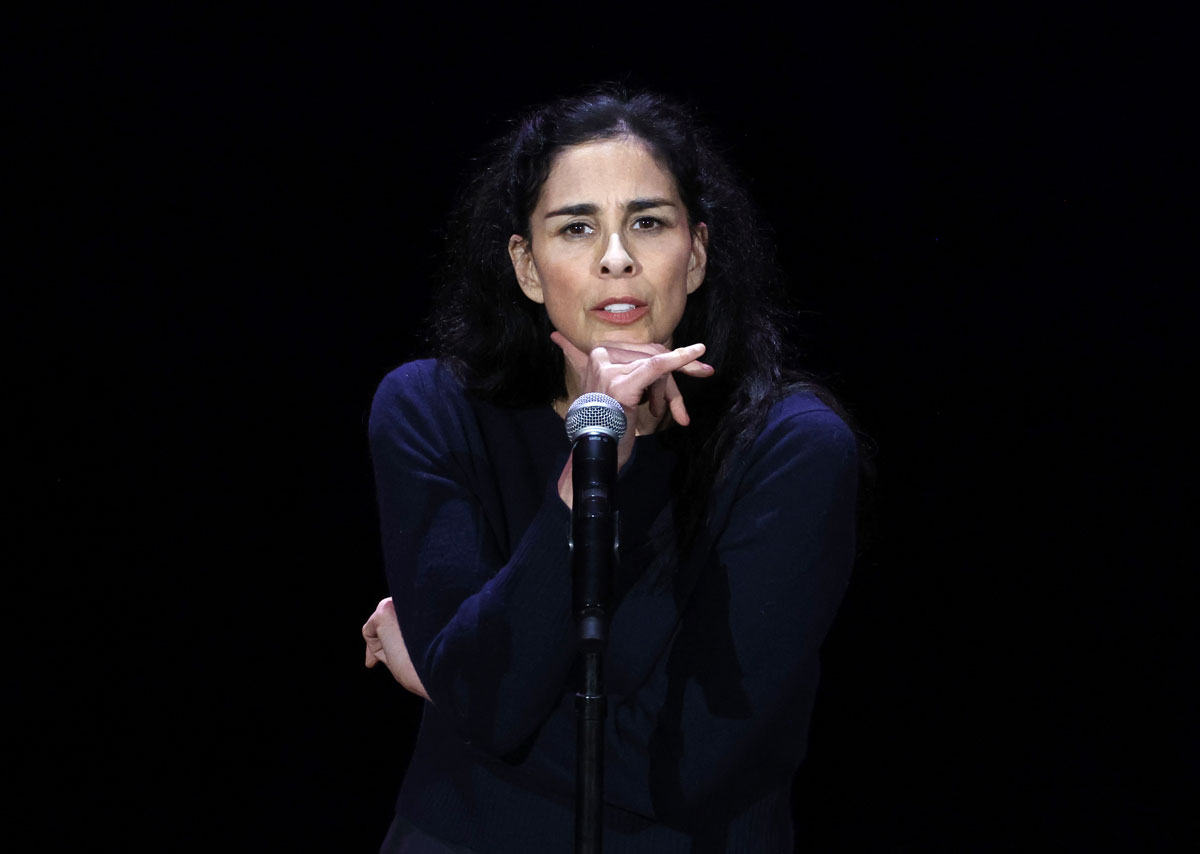
Sarah SilvermanHulu’s “I Love You, America with Sarah Silverman” was canceled after 21 episodes. (Jason Kempin/Getty Images)

As late-night talk lays fallow, with all the major shows having gone dark on May 2 in solidarity with the Writers’ Guild of America’s strike, it’s worth examining these questions — especially since “The Daily Show” may become the first series to break late-night’s proverbial glass ceiling. (Salon’s unionized employees are represented by the WGA East).

Among the 10 stars who have taken part in the show’s rotation of celebrity guest hosts, four are women. Three of them – Handler, Silverman and Wanda Sykes – have experience helming talk shows. Handler has hosted two. Wolf was set to participate in the second round before the strike was declared. Also in the running are “Daily Show” correspondents Desi Lydic, who hosted the show during the week of April 24, 2023, and Dulce Sloan, who spent one night in the chair before the WGA strike began.

If one of these women or another candidate who has yet to take her turn is chosen, it will have taken Comedy Central only 27 years to break that barrier. 

Yes, we’re being sarcastic. Somewhat. It’s not as if these jobs come open often. Historically, legacy late-night shows have changed hosts once every few decades. That made the multi-show, multi-network turnover that occurred between February 2014 and September 2015 extraordinary.

All the major legacy late-night network shows underwent a changing of the guard precipitated by the retirement of three legends: Jon Stewart, whose 16-year tenure on “The Daily Show” shaped what much of the genre looks like now, David Letterman, who launched the “Late Show” franchise on CBS and “Late Night” on NBC, and “Tonight Show” host Jay Leno, each of whom spent 22 years as the face of their shows. Before Leno, Johnny Carson hosted “The Tonight Show” for 30 years. Craig Ferguson also relinquished his “Late Late Show” gig in 2014, a job he held for nearly 10 years.

Again, from that perspective, the lengthy run for Bee’s “Full Frontal” is impressive, even when accounting for the fact that her show was weekly. However, unlike her male counterparts, who tend to retain their job security until they decide it’s time to leave, Bee wasn’t afforded that choice.

“I definitely hoped to have longer,” Bee said. “… I’ve come to expect the unexpected, for sure. I was hoping that if they were going to wind us down, because they hadn’t picked us up for another full season, I thought we would sort of wind down over the fall. I had hoped for that — again, having no knowledge. No one told me that. But I’ve worked in this business a really long time and seen a lot of s**t so, you know. That’s what I thought.”

Meanwhile, Jimmy Kimmel is contractually obligated to remain as the titular host of “Jimmy Kimmel Live!“, which debuted in 2003, through 2025. Late-night’s other Jimmy, Fallon, is signed on to “The Tonight Show” through 2026. Stephen Colbert‘s deal to continue hosting “The Late Show” ends in August, but there’s little reason to expect he won’t renew. 

“The people who were making decisions, like me, sort of thought, ‘We need a guy to sit there. This needs a dude.'”

The longstanding absence of women in key front-facing late-night positions is rooted in several factors, including modes of thinking that may be as outdated as the format is quickly becoming. That’s strange given the fact that, as Herzog put it, “amazing women are littered throughout the background of all these shows.”

Herzog hired Madeleine Smithberg and Lizz Winstead to co-create “The Daily Show.” Its current showrunner is Jen Flanz. Merrill Markoe was instrumental in forging the groundbreaking structure of “Late Night with David Letterman,” including creating “Stupid Pet Tricks” and its oddball field segments. Debbie Vickers was the executive producer of “The Tonight Show with Jay Leno” for two decades.

Amber Ruffin, a featured performer on “Late Night with Seth Meyers” and the host of a talk-variety show on Peacock, is the first Black woman to write for a late-night network talk show.

Thede’s work on “The Nightly Show with Larry Wilmore” made her the first Black woman to serve as a head writer on a late-night talk-variety program. 

Sam Jay, who hosted the weekly show “Pause with Sam Jay” on HBO until it was canceled after two seasons, is an alumnus of the “Saturday Night Live” writing staff. Colbert’s “Late Show” and “Jimmy Kimmel Live!” employ women as co-head writers. (One, Molly McNearney, is also Kimmel’s wife.) “The Tonight Show” employed three women as head writers between 2018 and 2021.

But this wasn’t always the case.

In 2009, TV writer and journalist Nell Scovell began her Vanity Fair story essay “Letterman and Me” with a statistic few were probably thinking about at that time, since many were still reeling over Letterman’s on-air admission that he had sexual relationships with women on his staff.

“At this moment, there are more females serving on the United States Supreme Court than there are writing for ‘Late Show with David Letterman,’ ‘The Jay Leno Show’ and ‘The Tonight Show with Conan O’Brien’ combined,” Scovell wrote. “Out of the 50 or so comedy writers working on these programs, exactly zero are women. It would be funny if it weren’t true.”

When Colbert’s “Late Show” debuted in 2015, the gender balance hadn’t improved by very much. As The Atlantic pointed out, his writing staff at launch consisted of 17 men and two women, all of them white.

Defining Late Night

The common concept of late-night encompasses three different primary formats, with the two more contemporary iterations heavily influencing how the oldest and most venerated, “The Tonight Show,” looks today.

That vision of an avuncular male host interviewing stars from behind a desk is nearly as old as NBC itself, dating back to 1954. It went on to spawn “Late Night,” launched by Letterman in 1982. Eleven years later, and coinciding with Carson’s retirement, Letterman launched CBS’s first successful late-night entry of the modern era, “Late Show.” The industry guilds are likely to still be on strike when it hits its 30th anniversary in August.

Since Leno left in 2014, both “The Tonight Show” and “Late Night” have been produced by Lorne Michaels, creator of the second-most durable American late-night comedy format, the sketch-driven “Saturday Night Live.” (Michaels has served as the executive producer of “Late Night” since O’Brien became its host in 1993.) 

“There’s an assumption historically that somehow, universally, everybody loves the lived experience of men.”

“Weekend Update” was one of the main inspirations for “The Daily Show” in its original guise. The other was ESPN’s “SportsCenter,” from which Smithberg, Winstead and Herzog poached the show’s first host Craig Kilborn.

When I asked Herzog to illuminate the thinking that went into selecting Kilborn for the job as opposed to considering a woman, he said, “Honestly I think we were always thinking about a guy. If I’m being honest, I don’t know why. But I think that’s, you know, what we were conditioned to think up until then.” 

He added, “Like a lot else that we’ve discovered over the last couple of years that we’ve been missing out on, that was one of them.”

Herzog also points out that in Comedy Central’s early days, the audience was predominantly male. “By the way, we really built that over time too,” he adds. (He also recalls that one of the first shows to get “big, big ratings” for the channel was its U.S. run of “Absolutely Fabulous,” a British sitcom featuring an ensemble of women and created by two women, its star Jennifer Saunders and her comedy partner Dawn French.)

Kilborn looked the part of a smug network anchor around whom the producers built their first version of a news satire revolving around actual headlines, few of which had any real stakes. But after Kilborn made an obscene joke about Winstead in a 1997 profile, he was suspended for a week. Winstead quit. Kilborn left a year after that. In March 1999 he took over for Tom Snyder as the second host of CBS’ “The Late Late Show,” making way for Jon Stewart’s formative era.

Stewart’s “Daily Show” begat the version of late-night that holds sway over much of TV today: headline-driven segments sugaring information and politics with comedy. Under his stewardship, according to Pew Research Center polling, the show became a preferred source for younger viewers who had grown weary of the evening news, especially in the wake of 9/11. When many TV news outlets were accepting administration and corporate spin with little questioning or qualification, Stewart, Colbert, Bee and other correspondents became truth-brokers as opposed to gentle, politically impartial comedians in the mold of Leno.

In the lead-up and aftermath of the 2016 presidential election, that served them and other hosts wonderfully. Colbert’s “Late Show” didn’t hit its stride until he was encouraged to return to the pointed satire he cultivated while hosting “The Colbert Report,” a spoof of “The O’Reilly Factor.” Oliver’s “Last Week Tonight” became comedy’s “Frontline.” Meyers’ “Late Show” is an extension of his experience hosting “Weekend Update,” but it’s fair to say that its harder edge was sharpened on the “Daily Show” whetstone. 

Other direct and indirect spinoffs from “The Daily Show” may not have enjoyed those other series’ duration, but they made their mark. Hasan Minhaj’sPatriot Act” lasted for six seasons on Netflix before ending in 2020. The Stewart era also yielded “The Nightly Show,” Wyatt Cenac’s public affairs-style HBO series “Problem Areas” …and “Full Frontal.” 

“There’s an assumption historically that somehow, universally, everybody loves the lived experience of men,” Winstead told Salon. “But nobody can universally love the lived experience of women who they live with every day. That has been the assumption, always. Right?”
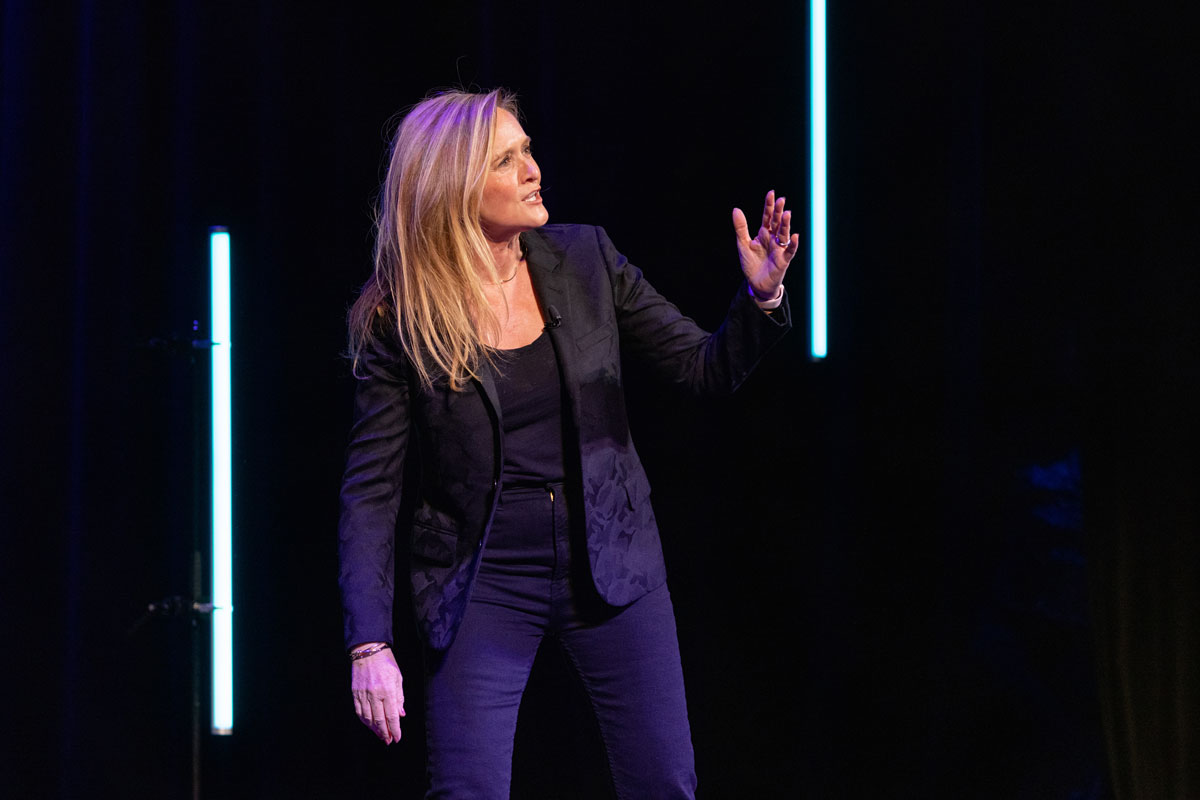
Samantha Bee“Full Frontal with Samantha Bee” ran on TBS for seven seasons and ended in 2022. (Rick Kern/Getty Images)

Bee’s time with “Full Frontal” is illuminative in unraveling the knotted history of women in late-night, in that it explains what it takes for a woman to succeed in a field that’s stacked against her. In short, it requires promotional resources and institutional support. 

Jo Miller, who left her longtime producer position on “The Daily Show with Jon Stewart” to serve as the head writer, showrunner and executive producer of the first two seasons of “Full Frontal,” recalls that at the series’ launch, it had both.

“TBS was also kind of rebranding itself. It was, we could say, new, and ‘Full Frontal’ was going to be its little prestige show,” she said. “So they threw a lot of money at marketing because nobody knew TBS, and nobody knew Samantha Bee, according to their research … And they moved those numbers [with] big marketing campaigns on both coasts, until people knew TBS and knew Samantha Bee. … They stayed and [TBS] could charge more for advertising.” 

“Their support never wavered creatively. But it did wane financially.”

TBS also allowed “Full Frontal” time to find its voice and its niche. And the cable network’s patience paid off. Following a premiere that drew 2.16 million viewers, episodes settled into an average weekly viewership of around 600,000 or so before the 2016 election heated up. Bee’s show scored its best ratings averages at the outset of the Trump presidency when it was regularly topping a million viewers per episode. 

“It’s a small data set, but when we were doing ‘Full Frontal,’ because it was a female voice, female interest and female topics, a lot of it, we had huge female viewership,” Miller said. “And I think our most loyal viewers were college women, which was great.” 

“They gave us tons of support at the beginning of the show, at a level that was really unprecedented for them,” Bee said of TBS. “It was really quite remarkable…Their support never wavered creatively. But it did wane financially. And it’s just really difficult to find new and ingenious ways to penetrate all the noise out there with bigger and broader things. Just trying to make your own press is very difficult.”

Out of all her “Daily Show” colleagues, Bee and her team were the only satirists consistently covering issues related to reproductive rights, voting rights, structural discrimination and labor issues. And as she looks back, she’s not surprised that her show, which managed to survive AT&T’s acquisition of Time Warner in 2018, became an early casualty of the Warner Bros. Discovery merger.

“Our last show was the day before they overturned Roe v. Wade,” Bee recalls. “The timing was wild. But again, it’s a great and stark reminder that there aren’t too many shows that get to be on TV just because the message is important, or now’s the right time to say these things. Every once in a while in this business, you get reminded that, oh, it’s actually a business… And if you are working for a parent company who’s trying to make wallpaper for teenage boys, perhaps your show is not really fulfilling that need.”

What’s airing in “Full Frontal”‘s former TBS time slot(s) these days? Baseball, wrestling or sitcom reruns.

“Five years ago, we didn’t understand how important it would be to have those shows on the air now,” Winstead says. “And that’s, I think, the biggest shame…They were calling out everything that’s happening right now in the world, and called, you know, alarmist. ‘The minute you have an opportunity, you’re talking about all this s**t that seems divisive.’ And it’s like, It ain’t divisive. It’s just real. It’s the reality that nobody wants to deal with. And they were dealing with it.” (Winstead should know. She’s now the founder and chief creative officer of Abortion Access Front, where she advocates for reproductive rights and abortion as health care.)

That returns us to Singh’s tenure as an NBC late-night host. The network may have enthusiastically called attention to all the firsts she represented, but she notes that the show’s budget wasn’t based on its historic nature. It was based on the overnight slot she inherited from “Last Call with Carson Daly.”  

“When you shoot 96 episodes in three months, you kind of lose that magic.”

The first season followed the typical structure of late-night, with Singh cracking jokes at the top of each episode before sitting down with celebrity guests. 

“Now I think we can all agree that the beauty and magic of late-night is its timeliness,” Singh says to her TED Talk audience. “You know that no matter what’s happening in the world, you can turn on late-night television and hear all about it. When you shoot 96 episodes in three months, you kind of lose that magic. I was the only show talking about hooking up partying, cuddling, traveling in front of a live audience during a literal global pandemic.”

On top of that were the notes she received from the network. Don’t be so loud. Don’t be so big. Don’t be so angry. Smile more. “And my all-time favorite: ‘Don’t over-index on the South Asian stuff,'” she said.

That three-month, 96-episode production schedule breaks down to two to three episodes a day versus the network standard of one a day. And, as she tells her TED Talk audience, she was also given half the number of writers that her male counterparts in early time slots have.  

“I don’t think that any new late-night show gets the resources that it needs at the very beginning,” said Miller, who recalled that at “Full Frontal,” they were only allowed to hire more staff once the show was up and running and proved to be successful. “Studio executives and producers who want to put a late-night show in their lineup are inevitably people who do not have experience producing late-night shows,” she added. “So they look at it and they’re like, ‘Oh, it’s a desk and a dude, generally. How much can it cost? Hire four writers.”

This is not a joke set-up, although it may read like one: How many writers does it take to put together a quality late-night show? There’s no single or set answer. A 2022 Emmy website listing for “The Late Show with Stephen Colbert” lists 24 writers under its nomination for Outstanding Writing For A Variety Series. The 2022 nomination that “The Daily Show with Trevor Noah” earned in the same category honors 19 writers.

The most recent Emmy writing nod we can find for “Jimmy Kimmel Live!” is for 2013 and lists 14 names. The 2014 Emmy nomination for writing earned by “The Tonight Show Starring Jimmy Fallon” includes 20 staffers. “Late Night with Seth Meyers” had 18 writers on staff at the time of its 2020 Emmy nomination. “Last Week Tonight with John Oliver” is a weekly series, and the website listing for its 2022 Emmy win for Outstanding Writing For A Variety Series includes 16 names. Miller says she had six writers for “Full Frontal,” which was a weekly show too. 

“A Little Late,” Singh tells her TED audience, also had six.

“It wasn’t the best feeling to go on stage and do a monologue that I didn’t believe in myself. But we weren’t afforded that privilege, just because that’s the late-night machine,” Singh told Salon. “It’s about, ‘We got to get it done, we got to get it on air.’ It’s a daily kind of thing.”

Nevertheless, in her farewell episode, she expressed gratitude for granting exposure to voices that deserve to be on late-night.

“In our 80 episodes of season two, in over 21 of them we had someone make their late-night debut. … That’s over a quarter of all of our guests!” she exclaims. Singh goes on to say, “Another thing all of these people have in common is that they don’t look like the traditional late-night guests we’re used to seeing. And I don’t think it’s a coincidence that the person who invited them on the show also doesn’t look like a traditional late-night host.” 

Now that public figures can interact directly with fans on social media, especially those all-important youngest consumers in their fanbase, the game has changed.

Right now, networks may be rethinking late-night as a whole. That includes Comedy Central, the only long-running late-night show whose producers are known to have approached at least two women before tapping Noah to replace Stewart in 2015: “Saturday Night Live” alumnus Amy Poehler and Amy Schumer.

Its celebrity guest host rotation has proven to be a ratings success, a rare case of viewership increasing where ratings for other shows have stagnated. “The Daily Show” saw its ratings climb 13% year over year during the first quarter of 2023, with quarterly social views increasing by 16% compared to the same period in 2022. 

Ronny Chieng, Desi Lydic and Roy Wood Jr during The Daily Show“Daily Show” correspondents Ronny Chieng, Desi Lydic and Roy Wood Jr. (Tasos Katopodis/Getty Images for Comedy Central)

Breaking it down by the top hosts’ popularity, according to The Wrap, Silverman’s week earned the third-highest ratings among the 10 guests, averaging 613,000 total viewers over her four nights in the chair. (She only became aware of this when I mentioned it to her during our interview.)

John Leguizamo came in second with a viewership average of 633,000 during his week.

The first-place finisher may give pause to programming executives keen to appeal to a younger, more diverse viewership. That would be 72-year-old Al Franken, former “SNL” writer and performer turned author and senator, who averaged 792,000 total viewers over his four nights. 

“You are saddled and tethered to that job. So if you have multifaceted aspirations, a lot of your s**t’s gonna fall to the wayside. That’s something I think a lot of women are thinking about.”

Like we’ve said, late-night was designed to be an old guy’s game. That may be one of the reasons the genre is in decline.

The weeknight topical format personified by the network shows, with the show-opening monologue, recurring bits and celebrity interviews, are all patterned after Carson’s “Tonight Show,” an era that began in 1962. Now that public figures can interact directly with fans on social media, especially those all-important youngest consumers in their fanbase, the game has changed.

“That monologue where everybody would do their take on the day? You’re getting it all day, in real-time,” Herzog said. “And the idea of sitting there and talking about celebrities for six minutes? You know what Kanye ate for breakfast, for lunch, and for dinner, and when he went to the bathroom. So by the time he gets on any talk show, what’s to know?”

That’s also true of comics, for whom Twitter has long been the place to test punchlines, build followings and publicize their shows and podcasts. Comedians don’t break out on “The Tonight Show” anymore. CBS’ replacement for “The Late Late Show with James Corden” affirms this: It’s reviving “@midnight,” a social media-themed game show that featured comedian contestants in its original format.

Hiring Singh was NBC’s effort to address this erosion — she was a successful internet star with tens of millions of followers. Unfortunately, the network didn’t adequately capitalize on the creativity that made her an internet star until its second pandemic-produced season. She conducted interviews over Zoom, created skits and provided her take on headlines in a style reminiscent of her YouTube content. But burying her show on a graveyard shift ensured that her takes never made topical news round-ups that were published the next day.

Burying her show on a graveyard shift ensured that her takes never made topical news round-ups that were published the next day.

Audiences are also consuming shows on their time, and that makes one wonder what’s to be gained by tying this format to the post-local news time slot. After appearing on an episode of “The Daily Show” hosted by Silverman, Winstead recalls, “I must have gotten 200 emails from people. 150 of them said, ‘I watched you the next day.'”

“… So you can’t say, ‘Well, we’re catering to men because it’s on at night, when men watch’ and all the other s**t they said forever,” she added. “People aren’t even watching the shows in their totality. They’re watching it clipped out, they’re watching it on their own time.”

Case in point: Silverman spoke to Salon to promote her latest HBO stand-up special “Someone You Love,” something she couldn’t do on late-night because of the WGA strike. “But the truth is, what we see of late-night shows are clips from monologues, mostly online,” she said, “and not really, like, celebrity interviews unless something goes wildly awry.” 

That may also be contributing to the lower advertising spends for late-night in recent years. According to statistics supplied by advertising intelligence firm Vivvix, the six major late-night talk shows took in just under $393.4 million in advertising revenue in 2021. In 2022 that number fell to $342.4 million, a decline of nearly 13 percent. 

“The Daily Show” saw its ad revenues rise between 2020 when it pulled a mere $12.7 million, and 2021 when it raked in $35 million. 2022 brought even better news, with the show netting just shy of $40 million in ad revenue, per Vivvix. But that feat is singular.

Confirming a report in Los Angeles Magazine that Corden’s “Late Late Show” was losing money, its ad revenue dipped from around $43 million in 2020 to just under $27 million in 2021, pulling in around $24 million in 2022, per Vivvix data. That made it a slightly stronger performer than “Late Night with Seth Meyers,” which brought in $39 million in 2020, nearly $23 million in 2021, and $20 million in 2022.

But the drop may have seemed steeper for “The Late Late Show,” reported to have cost around $60 million annually to produce. Colbert’s “Late Show” is the highest ad revenue earner in late-night right now, and has been since 2018, according to Vivvix. And yet, “The Late Show”‘s 2022 ad revenue take of almost $118 million is still down 58% from its 2016 height of $278.3 million. That year advertising earnings peaked for all late-night shows; they’ve fallen by more than 60% since then.

This explain why, for about a year, NBCUniversal has reportedly toyed with handing the 10 p.m. time slot back to local stations and starting “The Tonight Show” at 10:30 p.m. on both coasts. What that means for the future of “Late Night ” is unclear. As indicated earlier in this story, no streaming service has found enough success with the topical talk variety format to support a show on a long-term basis. Still, NBC might give it a try on Peacock.

Women invented late-night hosting

The irksome part about all of this is that the late-night genre owes its existence to a woman almost entirely forgotten by pop culture: Faye Emerson.  

Maureen Mauk, Ph.D., discovered Emerson as she was trying to pin down a precedent for Jimmy Kimmel’s series of 2017 monologues defending the Affordable Care Act against an assault by two Republican senators. In taking up a banner on a policy issue instead of tossing off jokes from the sidelines, the usually apolitical host was engaging in something uncommon.

Mauk, a former Standards and Practices executive at Fox, says she spoke with Mary Huelsbeck, the archivist at the University of Wisconsin-Madison (where Mauk completed her doctoral program) out of a desire to “prove that this is not the first time someone had spoken out and used their platform as a late-night television talk show host to do good political activation.” (Mauk’s husband, producer Hayden Mauk, used to work with Jimmy Kimmel.) 

The more fervently that “The Faye Emerson Show” dug into serious topics, the more newspaper reporters commented on her looks.

Show me Johnny Carson, she urged. Show me Steve Allen. Instead, Huelsbeck dropped Emerson’s name, sending Mauk on a multi-year research journey through Kinescope footage in desperate need of digitizing, along with seven cartons of documents – “everything from her frequent flyer cards, to her death certificate and all her handwritten notes and…just tons and tons of correspondence and newspaper clippings and images,” Mauk said.

Emerson was a film star who transitioned to TV in its earliest days to capitalize on the opportunities afforded by the nascent medium. She began hosting “The Faye Emerson Show” on CBS starting on October 24, 1949, partly following a hunch, Mauk says, that television would be a viable new platform and technology, and that viewers would be willing to stay up later to watch topically relevant programming. 

Emerson’s 15-minute episodes were a freewheeling mixture of conversations encompassing everything from entertainment to current events, social issues and international policy. Following an initial launch in East Coast markets, and in time slots bumping up to 11 p.m., the show expanded nationwide in 1950. 
faye emerson david wayne and audrey hepburnActress Faye Emerson (R) with David Wayne and Audrey Hepburn at the Tony Awards in 1954. (Getty Images / Bettmann )But the more fervently that “The Faye Emerson Show” dug into serious topics, the more newspaper reporters commented on her looks. One described her decolletage as “putting the V in TV.” This reductive coverage affected how some viewed her. In one episode, Emerson reads a letter from a man named Frank Havens who takes issue with an interview she conducted with a foreign correspondent who expressed views concerning a military operation that the viewer didn’t agree with.

“Then he winds up with what I wanted to talk about,” the host says with a chuckle. “He said, ‘Better stick to the plunging necklines, Faye. Politics is not for little girls.'”

“Now, Mr. Havens,” Emerson continues, “I think you have a perfect right to say what you think and to tell me about it. But I don’t think that’s true altogether. I think politics is everybody’s business. And I’m not a very little girl either. So if you don’t mind every now and then, at least I’m gonna do a little thinking about it.”

In an industry where success leads to replication, Emerson’s cultivation of late-night should have expanded opportunities for other women in similar time slots … in theory, and a perfect world. Her show ran around the same time that fellow actress Betty Furness hosted a variety series for ABC called “Penthouse Party” that aired at 10 p.m. on Fridays in 1950 before moving to an earlier prime-time slot in 1951. 

But Mauk believes the gendering of late-night TV wasn’t based on any solid data proving that it was mainly men who were watching Emerson. TV was still an emerging medium, without extensive market penetration. AC Nielsen began measuring TV ratings in the 1950-1951 season but only began monitoring TV audience demographics using its Nielsen Station Index Service in 1953, well after Emerson’s late-night show ended. In fact, from what we can glean from sources such as Hugh Malcolm Beville Jr.’s 1988 book “Audience Ratings,” there was little to no standard demographics measurement for national TV in the early 1950s. 

The shift to male hosts, Mauk concludes from studying Emerson’s career, “was more about masculine domination, a feeling that [late night] is bigger than they thought. ‘So now we’ll do it.'”  

Backing up this suspicion is a recording of an interview Emerson’s son Scoop conducted with her close friend Garry Moore, who hosted game shows such as “I’ve Got a Secret” and “To Tell the Truth”: “In the beginning, women were doing everything. And then I guess men realized that this was bigger than they thought it would be,” Moore said. “Then it thinned out. Women got aced out, you know, when men found out it was a good thing.”

Once network heads recognized late night’s potential to rake in advertising revenue, it became the territory of Steve Allen, the first host of “The Tonight Show” when it premiered in 1954 (who also appeared as a guest on Emerson’s show), then Jack Paar, and eventually, Carson. 

“The Faye Emerson Show” ended in June 1951, after which Emerson hosted other series, including “Wonderful Town, U.S.A.” which created a version of a U.S. city on CBS’ New York-based sound stages each week and showcased talent and celebrities from each featured burg. That made it very expensive to produce. 

But while Furness shifted to daytime television, where she would eventually be joined by others, including Dinah Shore, Emerson did not. She made many guest appearances on game shows, debate shows, and was even part of the first color broadcast on CBS in 1951 alongside Ed Sullivan and other stars, Mauk explained.

Emerson left the United States in 1963 and resettled in Majorca, Spain. 

“I think she honestly got tired of fighting the fight where every pound gain or phrase uttered on camera or off came under media and network scrutiny, and she had had this opportunity to get out,” Mauk said. So she did. In a letter she sent to her son where she explains that she wasn’t quite ready to return to the US, Emerson wrote, “I am free.”

“And she underlined it,” Mauk added. 

Emerson died in Spain in March 1983, a few months before Carson elevated another woman, Joan Rivers, to the role of permanent guest host of “The Tonight Show.”

And it is Rivers’ legend that we most closely associate with women in comedy, and in late night.

“Joan is the only one you can point to that that even came close to one of those legacy chairs.”

Rivers’ TV career was launched in 1965 when Carson gave her the last five minutes of a “Tonight Show” episode. That shot was a fluke, according to what Rivers says in the 2010 documentary “A Piece of Work.” A comic who appeared with Bill Cosby bombed, so he suggested the producers use her, saying she couldn’t possibly be worse. They put Rivers on the next night.

“After nine years of working bungalow colonies, and strip joints, and working in Greenwich Village in clubs where you passed the hat, and the hat wouldn’t come back, on the air Carson said to me, ‘You’re gonna be a star,'” Rivers said in the film. “It was magical between the two of us. Absolutely magical.”

“Joan Rivers was a creature of late-night TV,” said author and critic Shawn Levy, who explores Rivers’ career in his 2022 book, “In On the Joke: The Original Queens of Stand-Up Comedy.” “She became an overnight star. And among the things that fell to her was she had a daytime talk show in the late 1960s called ‘That Show.'” 
Joan Rivers hosting “That Show” in 1969. (Getty Images)

Her first guest was Carson, demonstrating the bond the two formed as entertainers. But most viewers became familiar with Rivers via “The Tonight Show.”

“Everyone loved her,” Miller said. “She had her own voice but it didn’t jangle against Johnny’s. It was a nice compliment…and there was a lot of talk that she would be the natural replacement” when Carson retired which, at that time, probably seemed imminent. After all, Allen only hosted “Tonight” from 1954 to 1957. Paar took the role until 1962. That meant Carson had been holding the job for 21 years.

So why not Rivers? “Somebody at the network decided that you know, that vagina of hers might be a problem, I guess, and kept it male,” cracked Miller.

That’s not too far from what happened. 

“What Ziwe is doing now is like what Letterman was doing back in the ’80s… She’s taking comedy to these new heights.”

When Rupert Murdoch decided to start a new network called Fox in 1985, he and 20th Century Fox Chairman and CEO Barry Diller thought the best way to make a big splash was to launch a late-night talk show opposite “The Tonight Show.”  

“They offered it to Joan and she said no, she would never leave Johnny,” Levy explained. “But somebody in NBC told her that ‘Johnny’s contract is being renewed for two years, yours is only being renewed for one.’ And she felt that this was their way of weaning her from her connection to the show.”  

So Rivers accepted Murdoch’s offer, and on October 9, 1986, “The Late Show Starring Joan Rivers” premiered on Fox.

It was a disaster from “go.”

“It was a real shambles and the reviews were awful,” Levy said. “And Joan and her manager and husband Edgar [Rosenberg] were sort of fired with a tremendous golden parachute, but great, great shame and disgrace.” 

Within a year of the show’s debut Rosenberg committed suicide.

There were other lasting ramifications to Rivers’ leap, too. The first person she called when she decided to go to Fox was Johnny Carson. “He slammed the phone down on me. I called again, [he] slammed it down again, and never spoke to me again. Ever,” she says in the documentary. “I think he was furious. He felt betrayed…I was now a competitor. He literally had me blacklisted. And to this day I have not been on NBC late night ever.”

“Joan is the only one you can point to that that even came close to one of those legacy chairs,” Silverman observed. “And because she had the nerve to do what was best for her career, she was blackballed for decades. I mean, wow — that’s the male ego at work, because it was Carson angry. He wasn’t angry at you know, Leno … But he was angry at her. Like she should turn down an opportunity at something he knew she was elite at, you know?  And then that Leno carried that on was odd.”

Both Leno and O’Brien refused to have Rivers on “The Tonight Show,” reportedly out of respect for Carson, who died in 2005. Fallon broke that ban and welcomed Rivers back to “The Tonight Show” in February 2014 for his first episode. He brought her back a month later for an interview. Rivers died six months later, in September 2014.

Miller sees the longtime “Tonight Show” host’s eventual official retirement in 1992 as “the inflection point, where it could have gone ungendered, that late night was for funny people,” she said. But between Rivers’ publicized failure to launch her nighttime talk show, NBC’s selection of Leno as Carson’s inheritor, and Letterman’s successful move to CBS as Leno’s competition, “it sort of became cemented as a certain kind of clean-cut white dude was the host,” she said.

One also wonders how much of Rivers’ and Carson’s history permeated the sensibilities of producers and executives in charge of hiring talent for late-night programming over the years that followed. 

Women may have the last laugh after being shuffled out of late-night to daytime.

Thirteen years later Fox tried again with “The Wanda Sykes Show,” which premiered in November 2009 as a replacement for the long-running sketch comedy MADtv and “Talkshow with Spike Feresten,” which aired for three seasons. Sykes’ show received one. 

BET also tried its hand with late-night in 2009 with “The Mo’Nique Show,” which lasted 251 episodes and two seasons.

Despite all this, women may have the last laugh after being shuffled out of late-night to daytime. “The View,” which is the top rated daytime talk show on TV and whose star co-hosts are comedians Whoopi Goldberg and Joy Behar, averaged around 2.3 million viewers per episode in season-to-date ratings provided to Salon by Nielsen. (The date range includes episodes that aired between September 5, 2022 and June 4, 2023.) Colbert’s “Late Show” live plus same day audience is the only late-night program that comes close to that, attracting slightly more than 2.1 million viewers on average. The next closest, “Jimmy Kimmel Live!,” drew an average audience of just under 1.5 million during that same timeframe.

Then consider the daily virality of clips from “The View.” By the time the West Coast wakes up, whatever is said around that table is already trending on Twitter. Regardless of how scintillating a late-night host’s monologue may have been the night before, unless they’ve courted controversy, their jokes are unlikely to show up in many social media feeds. It’s recurring segments like “Mean Tweets” from “Jimmy Kimmel Live!” or “Carpool Karaoke” from “The Late Late Show” that have the broadest social reach.

Oliver’s weekly deep-dives on “Last Week Tonight” are something of an exception, along with clips from episodes of “The Problem with Jon Stewart.” Some of that has to do with each performer’s star power, but much more of their success can be attributed to their deeper dives into relevant issues that the typical news cycle tends to skim. That model could end up informing “The Daily Show” moving forward.

Scovell sees an even brighter possibility in Ziwe, another social media sensation who transitioned into television. “I think what Ziwe is doing now is like what Letterman was doing back in the ’80s,” Scovell told Salon. “She’s taking comedy to these new heights, building on the crumbling structure of late-night TV.” 

ZiweZiwe Fumudoh’s “Ziwe” ran on Showtime and ended in 2022. (Showtime)

“Ziwe” also plugged into something that’s been missing in network TV since Letterman revitalized the format: absurdity. The version of “Late Night” that predates Lorne Michaels’ era capitalized on the assumption that its hosts and writers could get away with the kind of ridiculousness that would be nearly impossible to sell in early timeslots. Their audience also skewed younger.

Scovell believes Ziwe could do the same for a new generation. “She can sing and act. She’s beautiful and fashionable. I would love for her to have the resources to let her clever commentary on our culture fly.” 

Winstead’s dream would be for Frangela, aka comedians Frances Callier and Angela V. Shelton, to co-host “The Daily Show.” “They are an incredible comedy duo who are intrinsically involved in the news,” she said, suggesting that re-launching with co-hosts is a terrific way to revamp the format. 

Returning that initial proposal of the opportunity offered by this “The Daily Show” transition, one wonders if this job is something a woman would want anymore. Some of the celebrity hosts who visited “The Daily Show” did so mainly to promote their other work. Silverman told Salon that she did it for fun.

“It was really exciting. I thought, ‘Oh, I would love this,'” Silverman told Salon. “But I really don’t think I could do that for a kind of indefinite amount of time. I don’t have the stamina of, I think, most people.  …  And I really love doing odd jobs. I love acting. I love podcasts, I love stand up. I love you know, all these different things I get to do.”

Handler, who served as a guest host on “Jimmy Kimmel Live!” in 2022, expressed her desire for the job to The Daily Beast before her audition week, during which she generated a clip in defense of being childless by choice that triggered conservatives. (Salon reached out to Handler for comment but did not receive a reply.) 

Having said all that, “It’s a s**t ton of work that you are saddled daily,” Winstead said. “I can speak for “The Daily Show”: you are saddled and tethered to that job. So if you have multifaceted aspirations, a lot of your s**t’s gonna fall to the wayside. That’s something I think a lot of women are thinking about when they watch that slot happen.”

Silverman’s conclusion validates that theory. “I mean, no one offered me the job,” she said. “…But thinking about it, I don’t think I could do it, even though I think I would love it. You know, if I were younger, maybe, or on a different trajectory. But I like doing other things more.”

Winstead and others also expressed concern that the person who inherits “The Daily Show” hosting chair may not be given room to find their audience. And Miller wonders how much control the eventual host will have over their content at such a crucial transition. She recalls Colbert joking about the former head of CBS, Les Moonves, being in his audience during the first days of his tenure.  

“If you’re coming into a legacy show, just the momentum of the institution will make it hard to make the show your own,” Miller said. “It’s like trying to turn an aircraft carrier.”

She added, “They will need to allow the transition period for loss of audience adjustment, and the host making the show their own,” Miller said. “And it takes time. It took time for Trevor. It takes time for everybody coming in. But if it’s a woman, they’d better allow her the same grace that they would extend to a Trevor or anybody else or they’re shooting their property in the foot. And themselves.”

Singh wholeheartedly agrees. “You are trying to change a legacy thing with an audience that has been built in for such a long time. That takes time. So it’s a big commitment, but it absolutely can and will happen and I have no doubt about it,” she told Salon, adding, “And if that happens — I’m putting it out P.S.A. right now, should that happen, which definitely should — that woman can call me anytime to ask me anything about anything and I will do everything in my power to help. Because I think it’s so necessary.”

Robin Thede, Michelle Wolf, Wanda Sykes, Ziwe Fumudoh and NBC representatives for “The Tonight Show” and “Late Night” politely declined to participate in this story. Salon also reached out to Comedy Central, Amber Ruffin, Chelsea Handler and representatives for Mo’Nique and did not receive a response.

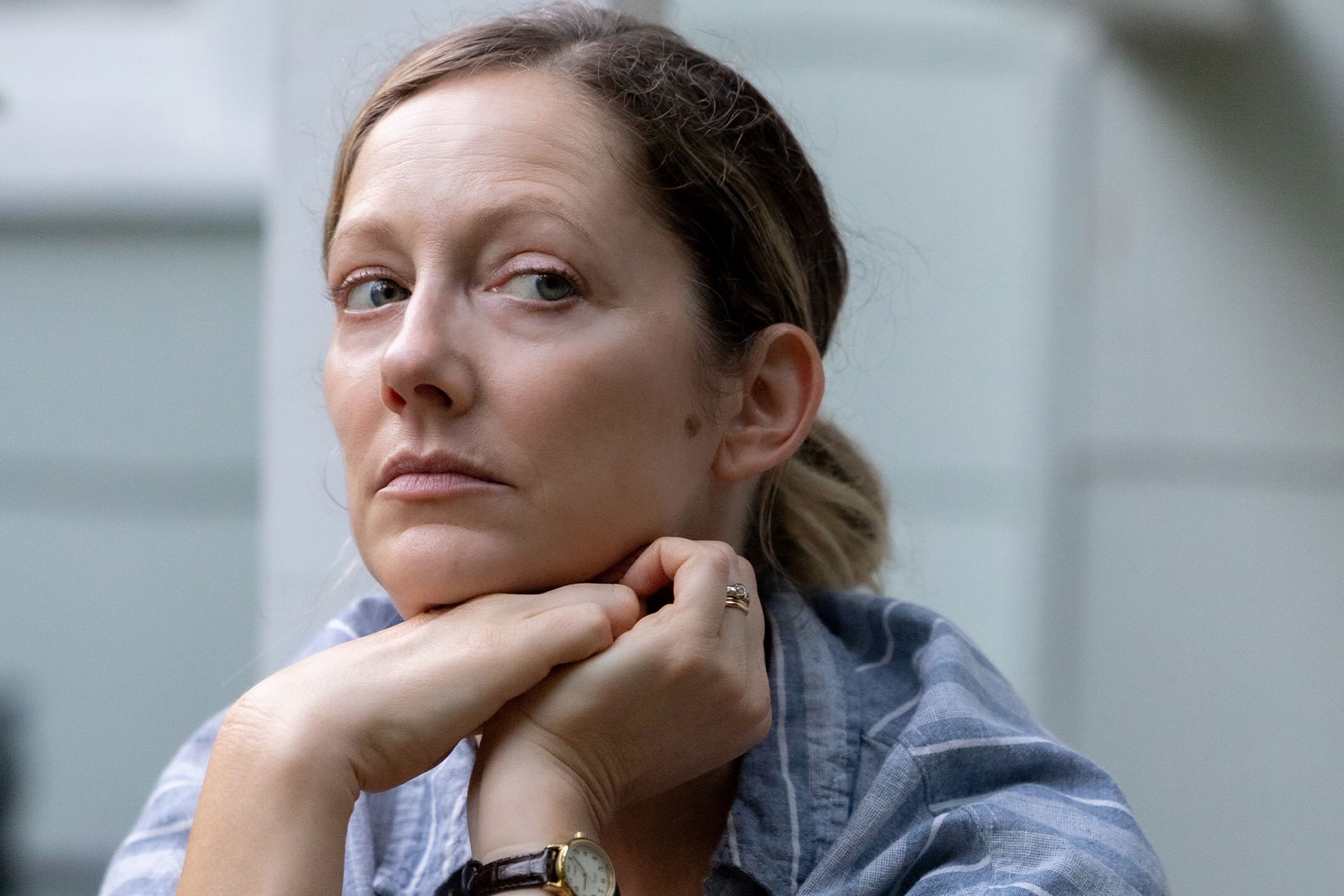
The right’s woke wars begin to backfire

Last week, conservative political commentator Meghan McCain wrote an article for the Daily Mail about one of the more pressing issues of our time, the one-off appearance of Samantha, played by Kim Cattrall, in HBO’s reboot of “Sex and the City.” Now, there is nothing wrong with people who usually spend their time gazing into the fiery abyss of our political landscape deciding to tackle lighter material, but unfortunately that’s not what this piece was. The first sentence of the headline of her article is, “I couldn’t bear to watch the woke-fest Sex And The City reboot ruin the show I loved…” 

If you have a somewhat healthy relationship with your family and social media you may be asking yourself, what exactly is a woke-fest and how exactly is it affecting McCain’s viewing experience? The answer to that question, I believe, is summed up in this quote from her piece: “This was a global-hit show that used to revel in its rebelliousness – always most apparent in Samantha, who dropped the F-word every other sentence, called women ‘b**ches’ and memorably once remarked: ‘I’m a try-sexual. I’ll try anything once.'” If what you take from those sentences is that the problem is that McCain is having a hard time connecting to the show because of its lack of slurs and casual misogyny, then we are on the same page. McCain goes on to complain about the inclusion of some LGBTQ characters, and it’s at this point that things begin to click about what her actual problem is. Still, how does any of this equate to a so-called woke-fest? 

There are few words or phrases that have received more bastardization and criticism than the word “woke.” Like so many artifacts of American culture, the term originated in predominantly Black spaces. Its origins have been traced as far back as the ‘60s, but for our intents and purposes, let’s look at its modern resurgence throughout the 2010s and its present-day usage. Among Black people, the term is used to describe a state of awareness of material surroundings. A person who is described as woke has a pretty good sense of the political realities they live under without veering into conspiracy theory territory.

That concept of a “woke” person in contemporary usage — as conservatives and reactionary centrists have hijacked the term — basically boils down to Black, brown or queer people merely existing. Many people online and in political left-leaning spaces have joked that woke is basically a stand-in for anything conservatives don’t like. While this is largely true, there is a bit more of an insidious side to this simple answer. Anything that even lightly pushes back on White Supremacist or patriarchal values is up for being branded as “woke.”

There are few words or phrases that have received more bastardization and criticism than the word “woke.”

For example, look at the strange proxy war that Republican presidential hopeful, Florida Gov. Ron DeSantis, is waging in Florida against Disney. At its core, Disney is as conservative as DeSantis or any Republican, putting its workers in horrid conditions and even donating to the Florida GOP. This is of course because they are a corporation; it is their prerogative to have both sides of the aisle more inclined to support their future ventures, regardless of the harm it could cause to marginalized groups or the environment. Despite this reality, DeSantis branded the company “Woke Disney” in the wake of their opposition to his aptly derided “Don’t Say Gay” bill banning the discussion of sexuality or gender identity in Florida’s public schools. 


Want a daily wrap-up of all the news and commentary Salon has to offer? Subscribe to our morning newsletter, Crash Course.


The fight between DeSantis and Disney gets at the heart of the usage of the word “woke.” Reactionaries like DeSantis have been able to use culture war issues as a way to distract and galvanize the disenfranchised portions of their constituencies. Knowing that the majority of their policies are wildly unpopular, reactionaries muddy the waters any way they can. In most circumstances, they use these culture wars as a mask to keep business moving as usual. But as of late, the reactionaries have run to curtail business interest. This turn comes as we see more and more workers around the country realize that the current construction of our workplaces is not tenable and businesses scramble to appease them in any way possible (outside of legitimate change). So, we have on one hand corporations that would like to gain public goodwill by lightly supporting progressive causes, and on the other conservatives who understand that just calling those businesses woke is enough to get them to back down on their “beliefs” because they surely aren’t deeply held.

This tactic of making money and gaining exposure by playing to the already established hierarchies we live under extends from our presidential candidates to the absolutely sweatiest man you’ve ever seen screaming in your TikTok feed. This is the same thread that McCain decided to latch on to in her petty gripe of a review of the “Sex and the City” reboot. By branding people and products as woke and stripping the word of any of its original meaning, conservatives are able to ascribe any characteristics they like to the identities without varying too far into the white supremacist dog whistles that by now sound more like bullhorns. Being able to weaponize the word woke gives reactionaries the opportunity to grandstand on each and every issue — crucially charging up their base — regardless of how seemingly insignificant it may be. From M&M’s to Nascar, Fox News, for instance, has worked its audience into outrage over 200 different things the network has labeled “woke.” Talk about a “woke-fest.”

There is hope, however, that this isn’t a sustainable trend. 

According to a recent USA Today poll, a majority of Americans surveyed have a positive view of the word “woke.” This seems like a direct connection to the Republican willingness to label any and everything that provides the average American joy as woke. The word has become a strange mixture of every fear and anxiety of the most bigoted of those in our political sphere mixed in with the hope of the brightest spots of our possible future. Regardless, it seems that McCain and conservatives of the like are determined to use it to push whatever hateful rhetoric they deem acceptable to spew. Despite their efforts, so far, the reactionaries have seemingly spread themselves too thin and their inability to actually hold a consistent set of beliefs has left more people than ever really wondering what it actually means to be “woke.”