Spring Sale: Get 1 Year, Save 58%

Even BPA-free plastic particles can mess with your sex hormones, study finds

When inhaled at moderate levels, plastic particles without dangerous additives appear to be able to disrupt sex hormones, according to a new study published by researchers at Rutgers University.

Previously, research suggested that chemical additives used to improve plastics, like bisphenol-A (or BPA), were potentially having all kinds of disruptive effects on human hormones. Alarming research into BPA spurred numerous manufacturers of goods with plastics in them to advertise them as “BPA-free.”

Yet this new study suggests that even plastic without BPA can have comparable endocrine-disrupting effects.

“This is one of the first studies to show endocrine disrupting effects from a plastic particle itself, not based on exposure to the plasticizing chemical,” said Phoebe Stapleton, assistant professor at the Rutgers Ernest Mario School of Pharmacy and senior author of the study published in Particle and Fiber Toxicology, in a media statement. “The other innovation was the method of exposure.”

As explained by Stapleton, previous studies have injected animals with the particles being studied, or they’ve been fed to them. In their study, published in the journal Particle and Fibre Toxicology, the researchers found a way to successfully aerosolize the particles so they could see what happened to them when inhaled. Plastic is so pervasive in human environments that this is a common method of absorption into the body.

Stampleton and her colleagues used extremely fine, food-grade nylon powder to model the potential effect of extremely tiny, “nanoscale” particles or plastic. In their experiment, researchers placed the powder on a rubber pad and put the pad on top of a bass speaker. The pulse of the bass sent small particles into the air, which delivered them to the rats used in the experiment, who breathed them in. Twenty-four hours later, the researchers observed the potential toxicological effect of a one-day exposure. Researchers followed up to study the potential impact on pulmonary inflammation, cardiovascular function, systemic inflammation and endocrine disruption. They found an impairment in vascular function and a decrease in the levels of the reproductive hormone 17 beta-estradiol.


Want more health and science stories in your inbox? Subscribe to Salon’s weekly newsletter The Vulgar Scientist.


“Unfortunately, there’s very little that people can do to reduce exposure at the moment,” Stapleton said. “You can be aware of your flooring, wear natural fibers and avoid storing food in plastic containers, but invisibly small plastic particles are likely in nearly every breath we take.”

Many believe that the disruption of sex hormones delivered by the endocrine system could explain consistently declining fertility rates across the Western world. As Dr. Shanna Swan, a professor of environmental medicine and public health at Mount Sinai School of Medicine in New York City, previously told Salon, it is possible that the dramatic decrease in reproductive health over the last 40 years is partly because of our everyday exposure to chemicals that affect human hormones.

“An endocrine disruptor is a chemical that impacts the body’s endogenous natural hormone function. And by impact, it could be increases, slows, or interferes with in various ways,” Swan said. “The most profound way they do that is by disturbing prenatal development, so that the exposure to the pregnant woman early in pregnancy is going to have the biggest impact on later reproductive health and function in the offspring.”

As Salon has previously reported, microplastics — meaning are plastic particles that are five millimeters or less across or in length — have polluted virtually every inch of the planet, from the deepest parts of the ocean to the most remote regions of the rainforest. Animals small and large constantly eat microplastics accidentally, which are sent up the food chain, while humans themselves ingest the rough equivalent of a credit card’s worth of plastic each week.

Stapleton said it is tough for people to protect themselves from the damaging effects of plastics today.

“Unfortunately, there’s very little that people can do to reduce exposure at the moment,” Stapleton rued. “You can be aware of your flooring, wear natural fibers and avoid storing food in plastic containers, but invisibly small plastic particles are likely in nearly every breath we take.”

Tucker Carlson’s unreleased texts were so bad Fox News didn’t think it was “survivable”: reporter

Former Fox News anchor Tucker Carlson’s redacted text messages were far worse than any public comments he’s made previously and ultimately led to his termination, New York Times reporter Michael Schmidt told MSNBC on Thursday.

Schmidt was one of the Times journalists who reported that Carlson was fired after Fox executives learned of damning texts discovered in Dominion Voting Systems’ defamation lawsuit that were not publicly released.

The Times reported that even though Fox attorneys had access to the new messages for months, its board of directors and executives didn’t learn of their existence until the day before the defamation trial against the network was scheduled to start. A trove of other incendiary messages from the former host to other Fox executives contained in Dominion’s court filing were already made public in February.

“I can only describe the way that people, you know, reacted,” Schmidt told MSNBC. “When they saw it — and what they saw, they didn’t think it was survivable for the network to have known about it and to allow him to stay on the air. I realize that is not a satisfying answer to many people.”

Schmidt told host Nicolle Wallace that the Times and several other media companies had challenged the redactions in court in an ongoing effort to get the texts and remaining court documents to be made public and “bring to light” their contents.   

“It is a very fair question. It’s like, well, what is the straw that breaks the camel’s back? What is the point at which in the modern-day conservative media landscape, Trumpworld, whatever — what is the breaking point for people and for institutions?” Schmidt said of the desire to know what Carlson wrote in the messages. “What was it that really put this over the edge?” he wondered.

Carlson, who was ousted from the network Monday, spoke publicly for the first time since his firing on Wednesday, criticizing the “unbelievably stupid” and “completely irrelevant” debates on TV in a video he shared on Twitter. He did not address his removal from Fox.

Despite dismissing him from the network, Fox is reportedly trying to keep Carlson under a contract that is set to expire after the 2024 election, according to conservative outlet Breitbart.

“Carlson’s current contract runs through December 2024, and as of now three sources familiar with the matter told Breitbart News that executives at the network are trying to keep Carlson on contract and not release him until after the 2024 election,” the article says. “The shocking decision to cancel Carlson’s top-rated weeknight program came just days after the network shut down its top-rated weekend program with host Dan Bongino.”


Want a daily wrap-up of all the news and commentary Salon has to offer? Subscribe to our morning newsletter, Crash Course.


Fox is reportedly still recovering from its nearly $800 million settlement with Dominion and has been in complete “disarray” following all its losses, according to the report.

Though Breitbart claims that Fox’s account of the ousting is untrue, citing several anonymous sources, it notes that disparagement clauses will likely prevent Carlson and other former Fox anchors from speaking out against the network. The report says none of the sources agreed to speak on the record, in part, “because Fox News and the broader Murdoch empire are known for their ruthlessness against anyone who speaks the truth about what is actually happening there.”

“As of right now, the plan remains the same: pay out Carlson’s contract and keep him on the sidelines through the 2024 elections,” one of the sources close to Fox News senior executives told the outlet. “They knew they would take a beating for this but everyone — and I mean everyone — is pretty rattled. They weren’t expecting the blowback to be this bad. Hate to say it but it’s clear that Rupert has lost a step or two.”

“Everyone needs to find the best way to live”: “Eight Mountains” stars talk friendship and choices

“The Eight Mountains” is a beautiful, heartbreaking drama of friendship and absent fathers. Written and directed by the team of Felix van Groeningen and Charlotte Vandermeersch (“The Broken Circle Breakdown“), it is set largely in the mountain village of Grana, Italy, where 12-year-old Pietro (Lupo Barbiero) goes to stay for the summer. He meets Bruno (Cristiano Sassella), the only other youth in the village, and they become fast friends. They reunite every summer and even going on mountain hikes with Pietro’s father, Giovanni (Filippo Timi) until something happens that separates them.

Two decades later, Pietro (Luca Marinelli) and Bruno (Alessandro Borghi) rekindle their friendship. Giovanni has died, and the two men work together to build a house in the mountains per Giovanni’s wishes. As their friendship deepens, their lives again start to grow apart. Pietro goes to Nepal, becomes a writer and falls in love with Asmi (Surakshya Panta). Bruno stays in Grana, marrying Lara (Elisabetta Mazzullo) and makes cheese in an alpeggio.

What transpires between these two men during their lengthy friendship and how they rely on one another for support forms the emotional core of “The Eight Mountains.” The film, which features glorious cinematography, is about how the people and the environment we surround ourselves in shapes us, and who we love and look after that defines our lives. 

Alessandro Borghi and Luca Marinelli, friends in real life — they developed a strong bond working together on the 2015 film, “Don’t Be Bad” — give outstanding performances. 

The actors each chatted separately with Salon about their new film, which won the Jury Prize at the 2022 Cannes Film Festival. 

Bruno and Pietro have a close friendship. What qualities do you share with your closest friends? 

Alessandro Borghi: In Italy, they say you can count your best friends on the fingers of one hand. I need both hands. I need to take care of other people. I’m an extrovert. I love to share my thoughts and emotions with people. I figured out that what I need is the capacity to go deep and talk with my friends about everything. It is about trust, the exchange of kindness and the sensation of being acceptable in everything. 

Luca Marinelli: The most important quality of a very close friendship, and I consider it a declination of love — it’s called friendship, but in a way it’s a form of love. For me, being there, is the answer. Being there every time there is a need for it. It’s what we see in the film. Pietro asks, “Do I have to be there?” 

Why did Bruno and Pietro have such a lifelong bond despite some long periods of separation? 

Borghi: Luca and I really love each other; we’re friends in real life. In the film, [our characters] could understand each other without saying anything. They are different, but they need to trust each other. Bruno’s feeling is to be protected by Pietro. This is a real friend who understands everything and every situation. That’s why Bruno decides to share everything with him. On set, we didn’t need rehearsal. We just had to look at each other and have this deep relationship with each other and land. The most important scenes are us sitting and looking out at infinity and sharing emotions. 

Marinelli: That’s why I use love as a metaphor for friendship. I think there is something between souls. I don’t want to be metaphysical. Two people who have to be together and help each other. In this case, you can say there is a book writer, and someone who lives alone on a mountain. What do they have in common? They were originally like two young animals playing together, but they changed because they grew up and build some armor to fight against life. But they try to reach each other. As kids, they shared a lot of words that were not spoken. That is something special you have with a close friend.

How did you work with Alessandro on creating the bond between Pietro and Bruno? This is a bromantic love story. There is a natural affinity between you both that is palpable. 

Marinelli: We had an advantage because we were already friends. Our friendship was the starting point, and we filtered Pietro and Bruno’s friendship through our friendship. When I hug Alessandro, for me it’s a very emotional moment because I really love him. He was acting, but seeing him in a particular state, he was making me more emotional as Pietro. 

There are many scenes of a physical nature — building the house, hiking up mountains, and doing farm work. Can you talk about the physical aspects of the role?

Borghi: I am soft, but I can do whatever I want. I asked the directors if I could learn everything. I learned about building houses, making cheese, milking cows. I didn’t do everything, but I was curious about it, it was all new. The most incredible thing was to deal with animals in the alpeggio. You wake up at 5 a.m. and milk, and then again at 10 a.m., and it’s tiring. There is a smell you can’t forget. If you stay in the alpeggio, you have to take 10 showers a day, and the smell is not going to leave you. It stays with you for two to three weeks. When it becomes normal, you realize you can use that sensation. I’m going to smell like s**t for four months, and this is going to part of the process. I had my moments where I thought, I’m an actor, but maybe I made a mistake, and I am supposed to stay here with cows in the mountains.

What about the strength and vulnerability of these men? Both are stubborn, prideful, and both are sensitive.

Marinelli: In a way, that’s also their strength — they are unique. Bruno has his own world, and to survive in this world, he thinks he has to live this kind of life. Pietro has a different world he lives in, but he was following his dream, but he knows he cannot tell everyone he wants to be a writer. What are you going to eat tomorrow, a pen? It’s like when I said I wanted to be an actor [laughs]. You are following your dream. It’s beautiful to see his determination, but Bruno is the same. He says, “I want to be a montanaro.” They both succeed, but there are different psychological issues or damages and different ways they confront life that affects them. But I love the characters for their stubbornness. If you want to follow your dream, you have to be stubborn. They are like twins. They both succeed in things that are incredible and difficult. 

The Eight MountainsThe Eight Mountains (Courtesy of Sideshow and Janus Films)
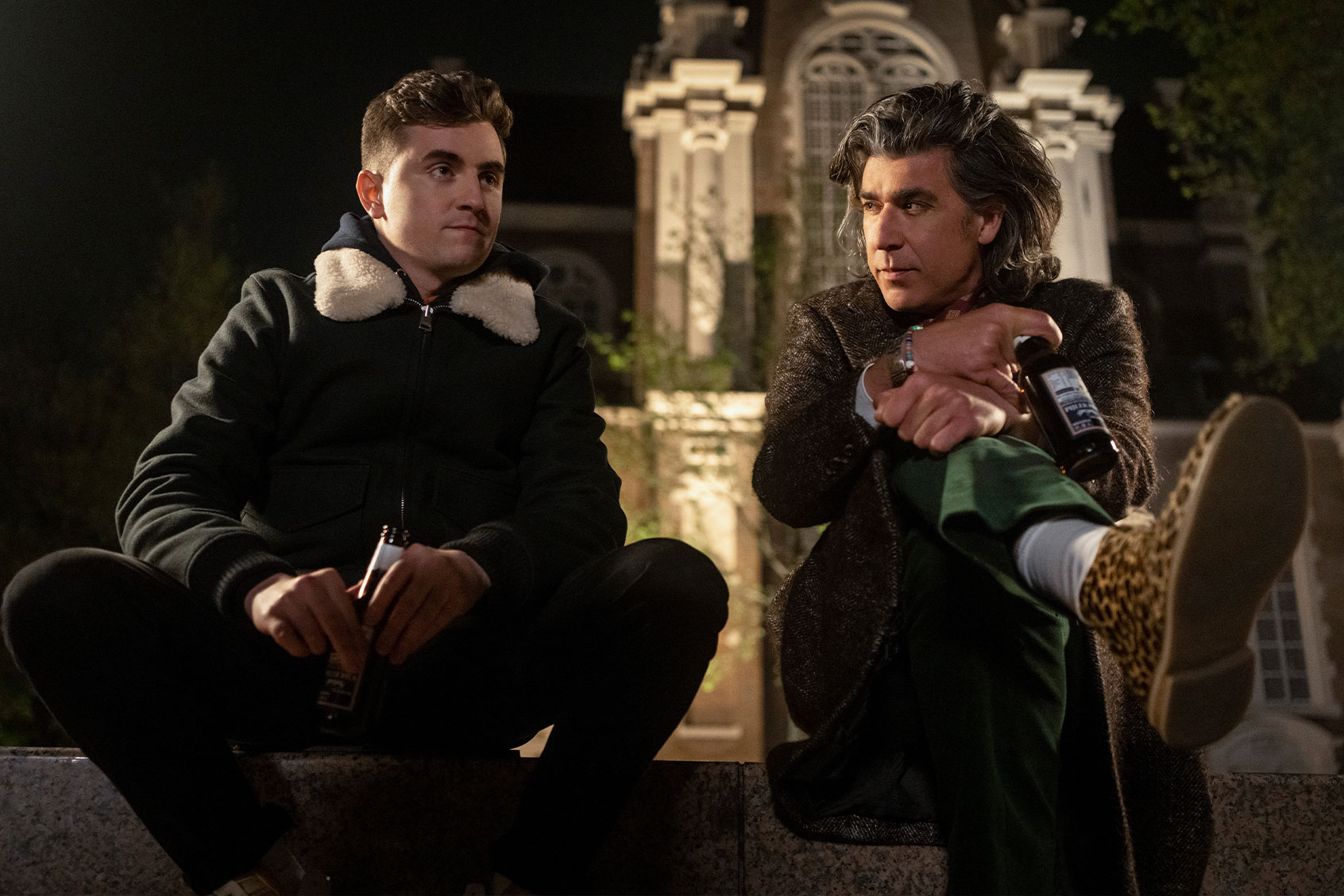
What do you think the film is saying about masculinity? There is a line from Pietro’s mother about “Silent men,” and Pietro and Bruno are not forthcoming where feelings are concerned.

Borghi: The film has huge thoughts about masculinity. You have to be vulnerable, If not, you’re not human. At the end of the film, you see a hug. In the beginning, Bruno can’t give him a handshake. When they meet each other during a period of grief, they have to start this process together. I had the opportunity to meet with real people from the mountains, and they have a complex relation with physical stuff. It is complicated for them to hug people. I had sensation that I had to hide something. At beginning of relationship between Pietro and Bruno, I forced myself to communicate without touching him. I hope audiences catch that. People have to share their emotions and find the right way to be kind to others. Even if you are introverted, and not able to hug and kiss people, you are still in a position to be a great human being. In our journey as characters, we started with handshakes and finished with hugs. 

Marinelli:  I never put a label on it. I think it was peculiar for them to be silent. But that was maybe because of the mountain, which is another character in this film — maybe the protagonist that effects everyone. The mountain is silent. There is a holy atmosphere there. But I never thought about it as a “male” friendship. I found the point of contact with Pietro and Bruno in the way they share silence and are close to each other. I don’t say, “I’m male so I’m taking emotion inside.” I’m sharing with my closest friend everything. If I need to hug them, I do it. It’s natural. I need to share, either physically or with words. Sometimes, I found Pietro was trying to reach this point. Please, Bruno, share your thoughts with me. The last part of the film is so powerful when Bruno is in silence for three days. Then they fall into this silence together and Bruno says something and it’s like an epiphany. And there is this hug. For me it’s normal. It’s strange to not have contact. Maybe there’s a cliché of masculinity. But I think it’s not so healthy to not share. 

What observations do you have about the father/son relationships in the film? 

Borghi: The film is about killing the father in our mind. We will survive without our fathers, and maybe we are ready to be fathers — or not. Is there a timing to figure out what important things people did for you? The important thing is to deal with emotions and ideas we have about our parents. We are full of our parents. We all think we can be alone, but when you are low mood, you need parents to stay with you because they are the know ones who know you for real. It’s that replacing of that figure that is so important for us. 

Marinelli: I think that in general, they were trying to put the film as a father-son, but the mother was important, too. She had a lot of interactions with the son. The father, in a very poetic way, gave this wonderful present of friendship to his son, demonstrating nothing is stronger in life than sharing things with your brother, sister and the people who love you. There was a lot of silence between Pietro and his father, maybe because of the mountain; his father loved the mountain. You think about something you’ve lost when you are watching “The Eight Mountains.” I was thinking nothing is lost because even though there are places you can never return to; those places are still with you. That is why travel is the most important thing.


Want a daily wrap-up of all the news and commentary Salon has to offer? Subscribe to our morning newsletter, Crash Course.


There is a moment in the film where the characters try to figure out their path in life. What decisions did you make about your lives? 

Borghi: It’s so complicated for me to understand what is the best way to live. At some point I had necessity to go away. I felt so constricted in Rome. I didn’t like mindset of city. I had a massive problem with racism, and Italy is a very racist place, so every time I had to deal with that, I had the sensation that I had to go away and find a place where people could deal with strangers. But after two or three years, I missed my family and friends. I came back, and after three years I felt forced to go away again. The idea of the film is that everyone needs to find the best way to live, and maybe you don’t have to stay on the highest mountain or go across all eight mountains but find a balance between the two. 

Marinelli: I think the most important thing is to be in the place where you feel best. That can be geographical place or something inside of you. For Pietro it was experiencing the Eight Mountains and for Bruno it was this one mountain. They were very honest with their life. That’s something I learned from this movie. You have to be honest with yourself and stay where you want to stay. The most important thing is to make a choice. Choice is what makes your path.

“The Eight Mountainsopens April 28 in New York City theatres, with theatrical release in additional cities, including Los Angeles, May 5 and beyond.

Joe Manchin helps GOP gut climate rule thanks to Dianne Feinstein’s absence

U.S. Sen. Dianne Feinstein is facing fresh calls to resign after her extended absence—and Sen. Joe Manchin’s inclination to partner with Republicans—led to the Wednesday passage of a resolution to roll back Biden administration emissions standards for heavy-duty trucks.

In a 50-49 vote, Manchin, D-W.Va.—a fossil fuel industry beneficiary known for obstructing his own party’s priorities, particularly on climate policy—joined all Senate Republicans to narrowly pass the Congressional Review Act resolution, which the White House has said President Joe Biden will veto if it is also approved by the GOP-controlled House of Representatives.

Feinstein, D-Calif., an 89-year-old who plans to retire when her term expires in January 2025, has been away from Capitol Hill since late February recovering from shingles. She has already faced pressure to step down because without her vote on the Senate Judiciary Committee, the GOP can block Biden’s judicial nominees—and Republicans have prevented Democrats from temporarily replacing her on the panel.

“Because Sen. Feinstein was absent, the Senate overturned a Biden rule that would cut pollution from heavy-duty trucks and causes harm to people’s lungs. We are putting decorum over democracy and our values. It’s time for Sen. Feinstein to step down gracefully,” Rep. Ro Khanna, D-Calif., said Thursday morning.

Khanna—who is supporting Congresswoman Barbara Lee, one of three California Democrats running to fill Feinstein’s Senate seat next year—is one of a handful of House Democrats who have previously called for the veteran lawmaker to step down.

Democratic strategist and communications consultant Sawyer Hackett similarly said Wednesday night that “Feinstein’s refusal to resign negates the expanded Senate majority Democrats overcame tremendous odds to achieve.”

“Republican measures are passing in a Democratic Senate,” Hackett stressed. “Step down.”

Also emphasizing the Senate GOP’s power under current conditions, San Francisco-based immigration attorney Jeremy Rosenberg tweeted: “Unconscionable. Yet completely avoidable. It’s past time for Sen. Feinstein to step down.”

Rosenberg further noted that if Feinstein were to acquiesce to resignations demands, Democratic California Gov. Gavin Newsom would be responsible for selecting her replacement.

While calls for Feinstein to exit the Senate mounted, Manchin came under fire as “a one-man pollution machine” for what one reporter described as his “warpath against his own party.”

Echoing Senate Republicans, Manchin claimed Wednesday that “the Biden administration wants to burden the trucking industry with oppressive regulations that will increase prices by thousands of dollars and push truck drivers and small trucking companies out of business,” and warned against enabling the U.S. Environmental Protection Agency (EPA) to “continue to seize unrestrained power.”

As Roll Call detailed Wednesday:

The EPA’s nitrogen oxide (NOx) rule, finalized in December, requires heavy- and medium-duty vehicles starting in model year 2027 to meet the “most stringent” emissions reduction option first proposed by the agency a year ago.

Nitrogen oxides are produced from fuel burning and mix with other pollutants in the atmosphere to create smog and acid rain. High levels of smog have been linked to respiratory diseases and asthma. The EPA estimates that the rule will reduce NOx emissions from the heavy-duty truck fleet by 48 percent by 2045.

If the most ambitious goals outlined in the rule are met by 2045, the EPA projects that early onset asthma cases among children will decline by 18,000 per year and premature deaths will go down by 2,900 annually.

Evergreen Action highlighted in a series of tweets that “heavy-duty vehicles are a MAJOR source of NOx pollution that contributes to negative health impacts like lung and heart diseases—and are especially harmful to low-income, Black, and Brown communities that live near major roads and ports.”

“Meanwhile, many automakers have already committed to transitioning to zero-emissions vehicles, and the cost of electrifying heavy-duty vehicles is getting cheaper every year,” the group added. “The Biden administration has also already committed to vetoing the resolution if it passes the House, but it is still shameful to see Republicans trying to undermine the right of every American to breathe clean air.”

Mike Pence finally takes the witness stand: How afraid should Donald Trump be?

On Wednesday night, the U.S. Court of Appeals for the District of Columbia ruled that Donald Trump could not claim executive privilege to prevent his former vice president Mike Pence from testifying before the grand jury that’s hearing evidence for special counsel Jack Smith’s investigation into the former president’s activities leading up to January 6. Immediately on Thursday morning Pence testified for more than five hours. I guess they didn’t want to waste any more time.

Pence and his team had negotiated with the special counsel for months to avoid having to do a voluntary interview and ended up filing a lawsuit to prevent testifying under subpoena. He claimed that as president of the Senate, he could not be compelled to testify under the speech and debate clause of the Constitution which protects members of Congress. A judge partially bought the argument. Pence was told he must testify — but he can avoid answering questions about his legislative role on Jan. 6.

In theory, Pence could have a boatload of first-hand information to share with the special counsel, backing up other testimony and possibly offering new details to which only he was privy. He can’t invoke his 5th Amendment right to refuse testimony because he isn’t implicated in anything illegal and he’s not someone who flipped for special consideration. He would be a great witness before a jury.

The assumption seems to be that Pence will tell the truth, the whole truth and nothing but the truth. But I have to wonder, why? Is it beyond the realm of possibility that Mike Pence would lie? I know he is a very pious, prayerful man but he worked shoulder to shoulder with the greatest liar in history for four long years and lavishly praised him to such an extent he was known as the sycophant in chief. His adoring, puppy dog gaze toward the president spawned hundreds of memes. In one cabinet meeting, he praised Trump once every 12 seconds for three minutes straight. If Pence is really as honest as the day is long, how did he last for four years with a man who lies as easily as he breathes?

Pence could have a boatload of first-hand information to share with the special counsel, backing up other testimony and possibly offering new details to which only he was privy.

On the other hand, while he hasn’t officially announced, he appears to be running for president — against Donald Trump. A ruthlessly ambitious politician in his position wouldn’t hesitate to air every bit of dirty laundry to the grand jury, and since it’s secret, he could do that even as he presents himself to the MAGA crowd as a more or less loyal soldier. Unfortunately, they hate him anyway because Trump told them it’s his fault that Trump isn’t still in the White House so I don’t think any Machiavellian maneuvers would make a difference. MAGA will never forgive Pence for what he did. He can help to destroy Trump but it won’t redound to his benefit.

So maybe Pence is actually looking at his political legacy. He was right in the middle of one of the most famous political events in American history and he showed himself to be quite brave that day. The mob was coming for him after Trump held him to blame for the fact that his coup plot didn’t work and he stayed at the Capitol in order to certify the vote later that night. It was the only time Pence ever publicly stood up to Trump and it happened to be at a very crucial moment.

But let’s remind ourselves of what else Pence did.


Want a daily wrap-up of all the news and commentary Salon has to offer? Subscribe to our morning newsletter, Crash Course.


From the day after the election, Pence joined with Trump in casting doubt on the election results. On November 9 he tweeted, “It ain’t over til it’s over. And it AIN”T over!” On January 5, at a big rally in Georgia for the runoff for the two Senate seats, he told the crowd, “We all got our doubts about the last election I want to assure you that I share the concerns of the millions of Americans about voting irregularities. I promise you come this Wednesday we’ll have our day in Congress.” Even after the horrifying events of January 6, a couple of months later, Pence wrote an op-ed calling the election results into question and railing against the Democratic initiatives to shore up the voting laws. He led with this:

After an election marked by significant voting irregularities and numerous instances of officials setting aside state election law, I share the concerns of millions of Americans about the integrity of the 2020 election.

Pence spread the Big Lie right along with Trump all the way to the end and beyond.

So maybe Pence is actually looking at his political legacy.

More significantly, Pence gets tremendous credit for refusing Trump’s entreaties to either refuse to count the electoral votes or call for a “pause” as his hack legal advisers were advising. According to Bob Woodward and Robert Costa in their book “Peril,” he consulted with several lawyers and experts to see if it really was possible and even called upon his fellow Indianan, former vice president Dan Quayle, who told him, “Mike you have no flexibility on this. None, Zero. Forget it, Put it away.”

But he didn’t need to seek advice from any lawyer or former vice president. Anyone with the tiniest bit of integrity would have said, “Absolutely not” the minute it was brought up and that would be the end of that. Pence knew Biden won the election, they all did. And he knew that Trump was trying to steal it by first lying about the so-called “irregularities” which had been litigated in more than 60 lawsuits, and then concocting a scheme to obstruct the peaceful transfer of power.

Keep in mind that others in the White House did the right thing. Even Trump’s accomplice, Bill Barr, a man who believes in almost limitless executive power, finally called it a day at the end of December. But Pence kept questioning what he should do even though he certainly knew that what they were asking him to do was unconstitutional and wrong. He was looking for reasons to do it anyway and he just couldn’t find anyone but Trump’s looney legal freakshow to tell him he should. It was only then that he decided, once and for all, that he couldn’t do it.

If his memory holds up, Pence could certainly shed light on some of the conversations he had with Trump leading up to January 6. What we know of those conversations could be very damning for Trump, particularly if he let on that he knew he didn’t really win. And as far as the insurrection goes, according to Woodward and Costa, on the night of January 5, when Pence told him finally that he did not have the power to do what Trump was asking him to do, Trump, looking out on the noisy crowd that had gathered in front of White House, said to him, “well, what if these people say you do? If these people say you have the power wouldn’t you want to?” It certainly would be interesting to know what Pence thought he meant by that. The very next day Trump was telling those people he was going to lead a march to the capitol to let Congress know exactly what they wanted.

Mike Pence might do the right thing and testify truthfully and thoroughly to this grand jury. He did finally do the right thing on January 6. But he tried every way he could think of to find a way to do what his boss and mentor wanted him to do and he just couldn’t figure out how to get it done. He’s no profile in courage.

Everything we thought we knew about Mars’ moon Deimos could be wrong

The red planet Mars, fourth from Earth’s sun, has two little moons: Phobos and Deimos. Neither is anything like Earth’s moon: small and irregularly shaped, astronomers have long believed that they are more likely captured asteroids, pulled into the Martian orbit by the red planet’s gravity and then kept there indefinitely as makeshift moons. That makes sense, given Mars’ proximity to the Asteroid Belt.

Yet a new report by Hope, an orbiter sent around the red planet by the United Arab Emirates, offered the first highly detailed image of Deimos — and the data from Hope has caused scientists to reevaluate that assumption.

Deimos was probably not a captured asteroid but a chunk of Mars that broke off from the planet at some point in its history. 

During a fly-by mission of Deimos on March 10, the Hope mission team scanned the planet’s surface using instruments that detected light waves ranging from the infrared to the extreme ultraviolet, according to Nature. Using spectrometry, the scientists could analyze the readings and learn about the type of elements on the planet’s surface. The Hope onboard instruments all showed a flat spectrum in their readings, meaning that Deimos is composed of the same minerals seen on Mars — as opposed to the carbon-rich rocks detected in asteroids. That suggests an entirely different origin than theorized.

These types of spectrographic analyses are a common means of figuring out the composition, and therefore origin, of different bodies int he solar system. The geologic history of every body in the solar system is unique — so much so that scientists have been able to figure out with little doubt that some small meteorites that struck Earth millions or billions of years ago originated on Mars. 175 such Martian meteorites have been discovered on Earth, including one that may have held evidence of past life on Mars.

The scientists involved in the study said that Deimos’ composition did not resemble the carbon-rich nature of the asteroids that dominate the Asteroid Belt. “If there were carbon or organics, we would see spikes in specific wavelengths,” Hessa Al Matroushi, the lead scientist at the Emirates Mars Mission (EMM), told Nature. Al Matroushi first reported these findings on April 24th to the European Geosciences Union meeting in Vienna.

Hence, through spectrometry, it became readily apparent to scientists Deimos was probably not a captured asteroid but a chunk of Mars that broke off from the planet at some point in its history. If indeed Deimos is composed of the same minerals found on Mars, this opens the door to a new hypothesis: That Deimos, and possibly its sister moon Phobos, were formed after a large celestial object collided with Mars, sloughing off some of Mars’ surface material in the process. This isn’t an unprecedented theory, as a similarly catastrophic strike from a much larger celestial body was what created the Earth-moon system over 4 billion years ago. 

Of course, as The New York Times reported, it is not yet clear with any certainty how Deimos was formed from Mars. In other words, this theory holds that before Deimos was Deimos – as opposed to Deimos being an asteroid — that Deimos was originally part of Mars.

The Martian probe to Deimos is historic for one additional reason. Deimos is tidally locked with Mars, meaning that the same side of Deimos is always facing the same side of Mars. This means that previous probes that visited Mars only studied one side of Deimos’ surface — until Hope. Hope was launched in mid-2020 and reached Mars in early 2021. Initially, Hope was designed to study the Martian atmosphere; it completed that mission and still had extra propellant, and so the mission engineers decided to move the space probe into the region around Deimos so they could learn more about the moon.


Want more health and science stories in your inbox? Subscribe to Salon’s weekly newsletter The Vulgar Scientist.


As mentioned, this is not the first probe to explore Deimos. In 1976, NASA’s Viking 2 orbiter got as close as 19 miles above the surface of Deimos, although its cameras and other equipment were much more primitive that Hope’s. Viking 2 was also — like every spacecraft before Hope — unable to capture information about the side of Deimos that does not face the Martian surface. Although Hope did not set a record for being the spacecraft that got closest to Deimos, it is easily the one that captured the most information.

The new data on Deimos comes at a heady moment for Mars studies. Earlier this month, data from the InSight probe’s seismograph provided novel data about what Mars’ core looks like. Last year, a paper in the journal Nature Astronomy suggested that life may have once flourished in Martian regoliths (that is, the loose dust and rock on top of Mars’ main layer of bedrock). That paper suggested that if said life emitted methane gas, this may have altered the planet’s climate so much that it could not longer support it. (The life forms in question though would have resembled Earth microbes.) And last year, scientists found water on nakhlites, or Martian meteors that struck Earth roughly 11 million years ago, although there is debate over whether the water originated on Mars or not.

“Expect decisions soon”: Experts say Pence’s “sharply incriminating” testimony is bad news for Trump

Former Vice President Mike Pence testified on Thursday before a grand jury investigating former President Donald Trump’s efforts to overturn his 2020 election loss, according to Politico.

Pence fought the subpoena issued by special counsel Jack Smith’s office but a court ultimately ruled that he would have to testify, though it limited the scope of the questions he had to answer. Trump tried to intervene and block Pence’s testimony, citing executive privilege, but an appellate court rejected his motion as well just hours before Pence’s appearance.

Pence arrived at the federal courthouse in D.C. at around 9 am on Thursday and did not leave until around 4:30 pm, according to NBC News. He apparently entered the courthouse through a parking garage entrance that allows witnesses to avoid being seen in public areas.

Pence is a critical figure in the Justice Department’s probe of the events surrounding the Jan. 6 Capitol riot. Trump repeatedly pressured Pence to block the certification of President Joe Biden’s win and later lashed out at him after the former veep refused. Trump supporters who overran the Capitol marched through the halls chanting “hang Mike Pence” as he was whisked away to safety by Secret Service.

U.S. District Judge James Boasberg rejected Trump’s executive privilege claims and a three-judge appeals panel upheld the ruling on Wednesday. Boasberg also rejected Pence’s bid to avoid testifying but ruled that he has immunity from testifying on topics related to his role as president of the Senate on Jan. 6.

“I don’t know what he said, but I have a lot of confidence in him,” Trump told NBC News on Thursday.

Pence, who may challenge the former president for the 2024 Republican nomination, has criticized the former president over the Capitol attack even as he refused to cooperate with the Jan. 6 committee and fought the DOJ subpoena.

“President Trump was wrong. I had no right to overturn the election,” Pence said during a speech last month. “And his reckless words endangered my family and everyone at the Capitol that day, and I know history will hold Donald Trump accountable.”

Pence’s testimony may be crucial in Smith’s probe.

Pence had “access to information that few or no other people have,” explained MSNBC host Ari Melber. “It’s the kind of information that the DOJ wants because it could inform quite decisively whether other people are indicted or not in this coup probe.”


Want a daily wrap-up of all the news and commentary Salon has to offer? Subscribe to our morning newsletter, Crash Course.


Former federal prosecutor and MSNBC legal analyst Glenn Kirschner called the testimony a “historic benchmark.”

Pence “just testified in the grand jury about the crimes of his former boss,” he tweeted. “Take it from this old prosecutor-Pence’s testimony is sharply incriminating of Trump & moves the needle further in the direction of a Trump indictment.”

Former federal prosecutor Andrew Weissmann, who served on special counsel Bob Mueller’s team, said that there was “very little reason to dawdle” by prosecutors after Pence’s testimony.

“Expect decisions soon from Jack Smith,” he wrote.

“We’re so close to events that some times it’s hard to see their significance,” noted former U.S. Attorney Harry Litman. “The former VPOTUS just testified in a criminal investigation of his former POTUS.  That is basically breathtaking.”

How LA’s teachers are making good on their promise to support community schools

“We should have been miserable,” said Emily Grijalva, recalling the first days of the 2019 strike by Los Angeles teachers. Grijalva, who is currently the community school and restorative justice coordinator at Felicitas and Gonzalo Mendez High School, joined her colleagues on the picket line in 2019 despite the biting cold and an unusual, prolonged rainstorm that flooded city streets and sidewalks and drenched picketers. Many of them did not wear, much less own, suitable rain gear for their normally sunny, mild Southern California climate.

“But even through the rain and cold, we felt togetherness and support from the community. Families dropped off food for the teachers, students and parents joined us on the front lines, and people opened their homes to let us dry off or use the bathroom,” she said.

Grijalva’s experience in 2019 was echoed in 2023 as, once again, teachers in Los Angeles joined in a three-day strike in support of the 30,000 school service workers who belong to the Service Employees International Union (SEIU) Local 99 who are leading the labor action. A tentative agreement was reached between the district and the unions the day after the strike ended that largely meets the key demands of the educators, including increased pay and health care benefits to community representatives and other school support staff. One factor that may be figuring prominently in the teachers’ corner is their success in 2019 at convincing the district to provide funding for converting 30 campuses to what’s become known as community schools.

The community schools approach seeks to strengthen the relationships between public schools and their surrounding communities by addressing the broader needs and interests of children and families and giving students, parents, and community members more of a voice in guiding school policies and programs.

In its account of the 2019 strikeReclaim Our Schools LA (ROSLA)—a coalition of community groups and the teachers’ union, the United Teachers of Los Angeles (UTLA)—noted that one of the demands the teachers won in their contract negotiations was nearly $12 million in funding from the district for the development of community schools.

The demand grew out of an agreement among the groups that formed ROSLA in 2016 to make community schools a key part of the coalition’s organizing strategy. The strategy would include educating the general public on the concept of community schools and forcing district leadership “to take sides: were they for—or against—this research-supported school design?” as ROSLA’s case study of the 2019 strike explained. The strategy appears to have worked.

The 2019 contract hammered out between UTLA and the Los Angeles Unified School District (LAUSD) called for funding of community schools implementations in 30 campuses, Capital and Main reported in 2021, with allocations of $150,000 in the first year of transition and $250,000 in the second year. It also established the Community Schools Steering Committee, which oversees the transition process. In 2021, the district added funding for transitioning 40 more community schools over the next three years.

“We knew the community schools idea would better address what our students need,” Grijalva said. Even though implementations of the approach are still very much in their early phases, the schools, and the families who attend them, are already seeing tangible benefits.

‘The Way Every School Should Be Run’

“I knew nothing about community schools when we went on strike [in 2019],” said David George, the community school coordinator at Marina del Rey Middle School and Performing Arts Magnet. But the approach’s appearance on the union’s platform prompted him to read more about it. “I’m now a big believer that this is the way every school should be run,” he said.

Much of George’s conversion to the community schools approach is due to what it’s done for his school, where he taught history for 16 years until transitioning into his current role in January 2020.

The school—a combination of a performing arts magnet drawing students from outside its South Los Angeles community and a marine science academy drawing students mostly from the surrounding community—has long struggled. Enrollment has declined over the past two decades, George said, from 1,400 when he started with the school in 2004 to the current 450 students. He noted, though, that there has been a recent uptick in enrollment in the past two years.

The school’s student population is 45 percent Hispanic and 50 percent Black, two demographics the district is least successful at educating. According to George, virtually all the students qualify for the federal government’s free and reduced-price meal program, a common identifier for poverty. “The school has had low test scores for as long as I’ve worked here,” he said.

George’s first few months as a community school coordinator were a bit of a baptism by fire. A mere 60 days after he started, the pandemic closed his school and sent students and teachers into a hastily contrived online learning mode. But he quickly learned how the philosophy of the approach helped the school address some of the pandemic’s most difficult challenges.

First, because one of the supporting pillars of the community schools strategy is “active family and community engagement,” George and his colleagues were already attuned to the need to reach out to families, and they had developed the beginnings of a system for doing that.

“We quickly found out which families had become disconnected from the school, which had become unhoused, and which needed to be told about the weekly food bank that the school had set up with the help of a local partner,” he said. “When we found out we had two students whose parents had been shot and killed, we had the capacity to find out what kind of mental health support they needed and how they could get it.”

George and his colleagues also rallied around another pillar of the community schools approach: to develop partnerships in the community for integrating health care, nutrition, and other student supports with the academic program.

“We had success with a mobile dental clinic that came to the school. Now it’s going to come twice a year,” he said. “We had a vision company come and examine our students. Thirty percent had issues related to glasses. Half of the students who got new glasses had never worn glasses before. One student was legally blind in one eye, and his parents didn’t even know it.”

Since a return to in-person schooling, Marina del Rey’s implementation of the community schools approach has also focused on expanding learning opportunities for students, another pillar of the community schools approach.

The school has added a girls’ empowerment group that meets twice a week to learn about entrepreneurship and other life skills. It also offers a robotics program, and it’s about to start a program for teaching computer coding. The school has introduced students to local Hispanic and Black artists and had local artists come in to teach students how to paint and draw.

Using a grant from the California Department of Food and Agriculture, the school started a culinary justice program that has students growing and harvesting their own food. “When I took a photo of one of the students working in the garden and emailed it to the parent,” George recalled, “I got the nicest note in reply, saying ‘You don’t know how happy this made me feel. My kid couldn’t wait to come to school because of this project.'”

Another new addition is an adult education program, beginning with students learning English as a second language. Half of the adults enrolled aren’t even parents of students in the school, but they live in the local neighborhood and will help with improving the reputation of the school.

‘Our Lighthouses’

Other community school coordinators in LAUSD report similar benefits from using this approach.

“I had absolutely zero awareness of the community schools strategy until my principal asked me to help with the application,” said Julie Chun, who is the community school coordinator at John H. Francis Polytechnic Senior High School in the Sun Valley area. “When I learned what [community schools] entailed,” she recalled, “I realized it aligned with my vision of what school should be. The reason I went into education to begin with was to promote equity, and the community schools strategy does that.”

The school, located in the San Fernando Valley region, is quite large with an enrollment of 2,200 students, a large majority of whom identify as Hispanic. Ninety-four percent have been identified as socioeconomically disadvantaged, according to Chun. Many of the students are also designated as English language learners, and virtually all qualify for the federal government’s free and reduced-price meals program.

“The four pillars have been our lighthouses,” Chun said, but, so far, most of her energy has gone into assessing assets and needs, a key early step in the community schools implementation process.

“In our assessment, we got lots of confirmation of assumptions,” Chun said, “but a few surprises stood out.” For instance, students had an intense interest in learning job training skills for the here and now and not for future employment. Also, there was a lot of interest in learning Korean language and culture.

So, the school now has a full Korean program of learning, and it offers a full week of instruction in job readiness skills, including job search and interviewing skills.

The school staged weekend job fairs, the last one of which brought in 25 vendors, Chun said. “I don’t have numbers, but I know of students who were able to find employment as a result of that.”

‘The Only Way You Get Better Test Scores’

Not all current LAUSD staff implementing the community schools learned about it because of the 2019 strike. Martha Gonzalez, the community school coordinator at Lucille Roybal-Allard Elementary School, first learned about the approach in 2012 when she was helping to organize with parents and other teachers on a plan to pilot an idea for a small school in the district. The group researched schools in Chicago, where the district operated on a site-based management idea with some similarities to the community schools approach.

“Our idea was for the school to act as a hub for the local community,” she recalled, “and to address the social-emotional and health needs of the students, not just academics.” So, she was excited when, as a result of the 2019 strike, the district agreed to fund a rollout of a districtwide community schools effort. “Even before the strike, we had the vision and values of the community schools approach, only now we were going to get the support and funding we need,” she said.

Like other LAUSD schools implementing the community school approach, Gonzalez’s school is still deeply involved in the assessment phase. But some new initiatives are already under way.

The school has been able to partner with outside agencies to bring in mental health counselors. It opened a wellness center with an outside entrance so parents can access the center without having to go through the school.

With funding from the district, the school has added instructional support time after the school day and on Saturdays. It has brought in intervention teachers to address learning problems of struggling students who can’t come to the added support time.

The school has also worked with a partner to start computer classes for parents, and it’s working with the county’s department of parks and recreation to hold outside events at a nearby park.

As the 2023 contract negotiations between the district and the two unions (UTLA and SEIU Local 99) continued, Gonzalez was concerned the district will go back on its support for community schools. She feared that, instead, student testing and school accountability, to the exclusion of community schools, will return as the emphasis.

Gonzalez believes that change wouldn’t make sense. “If what you value are test scores and numbers,” she said, “then you have to emphasize community schools first, because that’s the only way you get better test scores.”

‘Not About Quick Successes and Hitting the Numbers’

“Already, there are so many success stories from becoming community schools,” said Grijalva, “but people need to realize this takes time. It’s not about quick successes and hitting the numbers. Hopefully, people will understand that adopting this approach must be for the long haul.”

Nevertheless, community school coordinators Our Schools spoke with are working on getting data to show the approach is moving the needle.

“My school has had tremendous teacher turnover, which has been a huge problem,” said George. “But we’re hoping the community schools approach starts to turn that around. Also, we’re hoping to see enrollment declines have at least bottomed out and that they are starting to tick back up.”

Other community school coordinators are hoping to see improved student attendance as a result of the new programs and supports they’ve put into place. They believe that if they can make improvements on quantitative measures like family engagement, teacher retention, and student absenteeism, then test scores will eventually follow.

If there has been a difficult sticking point so far, it’s been in relation to the fourth pillar of the community schools approach, which calls for “collaborative leadership practices.” (An email from Our Schools to a district representative agreeing to an interview did not get a follow-up as of this writing.)

“For one thing,” George said, “some people see anything coming from the union as a tough sell. If the idea had come from the district administration, more people would have been quicker to embrace it.”

Further, community school coordinators Our Schools interviewed are wary that the administration would support the more popular student support services—due to their public relations value—rather than embrace the entire range of principles the community schools approach is grounded in.

Also, district leaders who are used to centralizing services, programs, and decision-making may have a tough time handling a more democratic system of governing. “When a school commits to the community schools approach,” said George, “administrators suddenly become more vulnerable. [They] have to be ready to hear bad things about [their] schools and [their] leadership and be willing to listen to other people and change.”

“The hardest part of being a community school is realizing that everything is a process,” said Grijalva, “and that you have to ask students and families for their opinions of everything.”

Despite these concerns, Los Angeles teachers are upbeat about the prospects for continuing their success with the community schools approach.

“I’m hoping eventually the approach will be more fully embraced, and the district will help with more money,” said George. “Every school in this district needs help. And the community schools approach can turn the whole district around.”

“Disinformation can come at a cost”: What Fox News learned from Tucker Carlson

On Monday, Tucker Carlson was suddenly and quite unceremoniously fired by Fox “News”. To say that Carlson was not “fired well” is an understatement: he was dumped without having the customary opportunity to even say a proper goodbye to his many millions of loyal fans and devotees.

There continue to be rumors and much speculation about why Fox “News” removed Tucker Carlson. These include that the Dominion lawsuit and settlement for defamation in connection to the Big Lie about the 2020 Election and the Jan. 6 coup attempt (including a pending lawsuit from the voting technology company Smartmatic) made Tucker Carlson an expensive liability.

Carlson may have also been fired because he was named in a harassment lawsuit by a former Fox “News” producer, which alleges that he created a hostile work environment marked by sexism, misogyny, racism, antisemitism, and other foul behavior. To that point, the New York Times is now reporting that the Dominion lawsuit revealed that “private messages sent by Tucker Carlson that had been redacted in legal filings showed him making highly offensive remarks that went beyond the comments of his prime-time show”.

Alternatively, Carlson may have been fired because of personality conflicts with the Murdochs and other senior management. Fox News is a very sophisticated type of political technology and propaganda machine that is much bigger than any one person. As they say in professional wrestling, Fox “News” made Tucker Carlson and gave him “the big push.” Tucker Carlson (who was the most popular host on the network) likely convinced himself that he was more powerful and influential than Fox “News” and the Murdochs. And as often happens in professional wrestling, the Murdochs and their agents showed Tucker Carlson that they are ultimately in charge and the talent is disposable.  

Whatever the reason(s), the following remains true: Tucker Carlson and Fox “News” were and remain great threats to America’s multiracial democracy and the rule of law and public safety.

In an attempt to make better sense of the Tucker Carlson saga, I asked a range of experts for their insights about what this means for American democracy, how Carlson still matters (or not), and what they believe happens next as we try to navigate our way of this fascist fever dream nightmare and the “Trumpocene.” 

These interviews have been lightly edited for clarity

Matthew Sheffield is the founder of the progressive media platform Flux and host of the Theory of Change podcast

At this juncture, the complete rationale behind Tucker Carlson’s sudden departure from Fox Corporation remains unknown. But given the reporting thus far and the fact that Carlson himself promised to be back on Monday, it is a virtual certitude that he was fired.

Carlson’s exit from Fox’s most-coveted 8pm ET time slot is unquestionably a good thing for America. His nightly program was the number-one media vector in the radicalization of the Republican Party that has taken place in recent years. Many racist activists and conspiracy theorists have admitted this, including former KKK leader David Duke who has hailed Carlson for proclaiming malicious and debunked claims that unspecified “elites” are trying to replace native-born Americans with “more obedient voters.” Carlson’s program also was known for airing numerous interviews with extremist activists who no one else at Fox was willing to promote.

Given that Carlson has been openly promoting and hiring racists for a number of years at Fox and his website the Daily Caller, Fox founder and chairman Rupert Murdoch should have fired Carlson long ago. That he did not suggested that Carlson’s extremism was not the cause for his presumptive firing, or that Fox will choose to dial back its totally biased propaganda. Instead, the indications are that Carlson was forced out because he had become a legal liability for the network.

“Carlson’s program also was known for airing numerous interviews with extremist activists who no one else at Fox was willing to promote.”

Nonetheless, there is hope that the ongoing lawsuits filed by a former Carlson producer alleging a hostile work environment and a $2.2 billion lawsuit from the Smartmatic voting machine company against Fox for its lies about the 2020 election can create enough of a legal or financial deterrent for Fox that Murdoch and his underlings might have to choose out of necessity to stop trying to inspire violent revolution if they wish to remain in business.

Rachel Bitecofer is a political analyst and election forecaster.   

Tucker has done more than anyone, convincing millions of Americans that they should root for Putin. Even after the defamation revelations, he told his audience the night of Trump’s indictment that if they really love America they’ll stand up and fight. He continually used his platform to juice up political violence and mainstream white nationalism so [his ouster] is a major win for democracy. Also, he didn’t “leave” Fox. When a long-time anchor leaves a network they let him have a sendoff. He was fired, absolutely. The only question to me is did he take a non-compete on the way out? If not, bad for Fox, bad for democracy.

Steven Beschloss is a journalist and author of several books, including “The Gunman and His Mother.” 

Tucker Carlson may have said privately that he hates Trump “passionately,” but that never stopped him from regularly pushing Trumpist lies of election fraud and minimizing the violent reality of Jan. 6. Nor did he hesitate to serve as a pro-Putin apologist feeding his audience Kremlin talking points to doubt the legitimacy of Ukraine and its democracy. But what especially distinguished Carlson as a dangerously ugly and racist force in the Fox universe was his white supremacist message of a “great replacement” by immigrants and other people of color who make the country “poorer and dirtier” and endanger the power of the shrinking white population.

In a sane world, where a news organization embraces its duty to tell the truth, Fox and its owner Rupert Murdoch would have reined in Carlson for any of these lies and conspiratorial ideas that enhanced his demagogic appeal to nightly viewers and expanded his utility to the far right. But we may soon learn that none of this was the reason Murdoch fired him—that it was his offensive and possibly illegal off-camera behavior that bothered his bosses—which bodes poorly for the possibility that Fox “News” will change its tune and act more responsibly. Sadly, I have little confidence that whoever comes next will help put an end to the malevolent, divisive role Fox plays in American life.

Reece Peck is an associate professor at the Department of Media Culture at the College of Staten Island and author of the book “Fox Populism: Branding Conservatism as Working Class.”

I’m actually stunned because Carlson is the greatest ratings generator at Fox News. Like Bill O’Reilly before him, Carlson’s show “Tucker Carlson Tonight” served as the tentpole for Fox’s entire primetime lineup, meaning it helped attract viewers to the programs right before and after his own. And Tucker’s value to Fox didn’t end there. He was the most important star on Fox Nation, Fox News’ OTP streaming venture that was designed to set up Fox for the post-cable TV future. As more reporting comes in, it looks like Tucker’s ousting was the result of both his damning comments that were revealed in the Dominion lawsuit and a sexual discrimination lawsuit that is being waged against him by a former producer.

“Tucker pushed Fox News further to the left on economic issues and war, while simultaneously pushing the network further to the right on issues of race and immigration.”

No American media figure has embraced Trump’s “white-replacement-through-immigration” rhetoric more than Tucker Carlson. Filling the void after longtime number one host Bill O’Reilly was forced out in disgrace, Carlson picked up the mantle and became the face of the Fox News organization in short order. Instead of the basement-dwelling “Anons” of right-wing chat forums, Carlson could speak to the living-room-watching-“normie” audience of cable TV. And unlike the online conspiracy theorist Alex Jones and the digital news site Breitbart, Carlson’s position at Fox means that he enjoyed the “authoritative” imprimatur of a “legacy” news organization.

In many ways, this made his Fox program “Tucker Carlson Tonight” a far more effective vehicle for conveying white-nationalist discourse than the edgiest alt-right YouTuber and 4Chan meme makers could carry out. But to make clear from the outset, it s not that Carlson’s trick was to simply put a more respectable cover on white nationalism’s ugly racist underbelly. The true genius of his strategy rested in the way he associated racial grievances with a broad array of non-racial, class-based discontents. This was his essential move: to constantly reframe white nationalist grievances as economic grievances and draw a linkage between anti-immigrant attitudes with working-class identity, blaming everything on immigration, from rising housing costs (August 18, 2021) to decreased wages (January 8, 2019). This will be his main legacy.

Tucker pushed Fox News further to the left on economic issues and war, while simultaneously pushing the network further to the right on issues of race and immigration.


Want a daily wrap-up of all the news and commentary Salon has to offer? Subscribe to our morning newsletter, Crash Course.


In an ideal world, the post-Tucker Fox would follow his lead and parrot his economic populist message (e.g., fighting for workers, railing against corporate greed) and then discontinue peddling the white nationalist themes of Tucker’s programming formula.

Arguably, it was Tucker’s appropriation of left critiques against corporate power and war that helped him expand “Tucker Carlson Tonight’s” audience to include more independents and even more young Democrats. In fact, in 2021, “Tucker Carlson Tonight” attracted more Democratic viewers in the 25–54 age demographic than MSNBC and CNN had. But this is probably wishful thinking. Anti-immigration is simply too central to right-wing populism. We see this with the new crop of Republican politicians like JD Vance.

“The indications are that Carlson was forced out because he had become a legal liability for the network.”

Fox News has survived losing its major stars before. When O’Reilly was fired in 2017, some speculated whether Fox News could flourish after losing a host that was the face of the network for two decades. Not only did Fox survive, it thrived with Tucker at the helm. In fact, Tucker broke all of O’Reilly’s previous ratings records. As far as Tucker’s future, I doubt he will achieve the kind of national visibility he enjoyed as a Fox News opinion host. The case of Glenn Beck is instructive here. While at Fox, Beck was making Time Magazine’s covers and stood at the center of American public life. In 2009 and 2010, no one would have ever thought that just a few years later Beck would retreat back into the margins and become an obscure figure in the U.S. media. But that’s precisely what happened after he was let go in 2011.

Beck’s online media network The Blaze is not insignificant, but I wouldn’t call it a success either. With this said, the U.S. media environment has transformed a great deal since the Obama era with the rise of independent media in streaming and podcasting. Who could have predicted that Joe Rogan, a comedian, and MMA commentator, would accrue one of the largest audiences in the world basically without any major corporate support behind him? Like Alex Jones before them, right-wing commentators like Steven Crowder and Ben Shapiro have amassed huge audiences on YouTube. It’s not beyond the realm of possibility that Tucker could follow suit and remain relevant in alternative media.

Jean Guerrero is an investigative reporter and author of the books “Crux: A Cross-Border Memoir.” and “Hatemonger: Stephen Miller, Donald Trump, and the White Nationalist Agenda.” She is currently an opinion columnist at the Los Angeles Times.

The death of Tucker Carlson’s political career at Fox News is a victory for U.S. democracy and the diverse Americans whose lives were endangered by his disinformation. It’s even a victory for Fox News viewers who were the most psychologically damaged and made delusional by Carlson’s lies. Regardless of the reasoning behind the dismissal, it’s a clear sign that Fox News executives are beginning to grasp that disinformation can come at a cost. Although those executives didn’t seem to care about the polarization or domestic terrorism that Carlson’s falsehoods fueled, they do care about corporate profits, and this was a rare situation in which the Murdoch family’s financial well-being aligned with the well-being of average Americans. It’s not a coincidence that the decision came after Fox settled for three-quarters of a billion dollars with Dominion Voting Systems for spreading lies about its voting machines.

It’s unlikely that Tucker Carlson will ever be as significant again. He and Fox News together were a special force for destruction. But it’s not clear that Fox will abandon its business model of feeding on division and extremism. Now that Fox News is in a moment of turmoil and weakness, it’s the ideal time for opponents of its propaganda to strike. Call your cable company and tell them you refuse to pay Fox’s fees. Carlson’s ouster isn’t enough; Fox, too, must be held accountable for its role in pitting Americans against one another.

Matt Gertz is a senior fellow at Media Matters, where he focuses on the relationship between Fox News and the Trump administration, politics and elections and media ethics.

Tucker Carlson’s firing is great news for America and terrible news for Fox News.

There are a lot of different theories going around as to why it happened – from private comments he made about Fox executives that came to light in the Dominion lawsuit, to another lawsuit that alleged he oversaw a misogynistic and antisemitic workplace, to an effort by the Murdochs to strengthen control. One thing’s for sure – it wasn’t about the bigoted and incendiary content of his show. The Murdochs had no problem with the blood-soaked conspiracy theories he mainstreamed to their viewers.

Fox News will certainly survive, though its competitors are using Carlson’s firing to attack the network and try to snag some of its market share. But what made Carlson uniquely dangerous was his willingness to present the most extreme talking points of the fringe right to his massive audience, which helped to radicalize the Republican Party. With his removal, that pipeline has been severed.

Fox News is currently trying to renegotiate several crucial contracts with cable carriers to boost its profits. The network is vulnerable after the one-two punch of the Dominion settlement and Carlson’s dismissal – there’s no better time to try to throw it an anvil by encouraging cable providers not to give Fox those increases.

Republicans deny they want to erase trans people — Montana silencing Zooey Zephyr proves otherwise

The most recent Conservative Political Action Conference (CPAC) was an anti-trans hatefest, but even by their low standards, the effort by D-list speaker Michael Knowles to get attention was revolting. “There can be no middle way in dealing with transgenderism,” he declared, successfully beating Rep. Marjorie Taylor Greene in the headline-attracting contest. “For the good of society, transgenderism must be eradicated from public life entirely.”

It was a well-crafted troll, garnering not just outrage, but creating an opportunity for right-wingers to pretend Knowles wasn’t saying what he was obviously saying. Sure enough, when progressives pointed out that Knowles’ rhetoric is genocidal — that you can’t eradicate “transgenderism” without eradicating trans people — there was a tedious and predictable explosion of disingenuous umbrage-taking on the right. They are just talking about the “ideology,” they insisted, eliding the fact that the “ideological” belief in question is that trans people have a right to exist. 

The angels-dancing-on-heads-of-pins argument that you can somehow separate hatred of trans “ideology” from hatred of trans people has always been bad faith. And that was once again proven this week in Montana, where Republicans voted for the removal of a trans legislator from the state house. 


Want more Amanda Marcotte on politics? Subscribe to her newsletter Standing Room Only.


It all started last month, when Montana Republicans brought up a bill to bar trans kids from receiving gender-affirming care, such as puberty blockers. The bill, like those in other states, is being justified with false accusations that adults are pressuring minors into transitioning, allowing anti-trans people to claim they are “protecting” children. All of these bills restricting trans rights to health care and public accommodation are not about “protecting children,” much less some vague claim about “ideology.” It’s about a belief that trans people should be booted from public life altogether — in a word, eradicated. 

So last week, Democratic state representative Zooey Zephyr, who is trans, denounced the bill by saying, “I hope the next time there’s an invocation, when you bow your heads in prayer, you see the blood on your hands.”

Obviously, the party that’s about to re-nominate Donald Trump for president, even after he incited an insurrection, does not care about “decorum.”

For this, Zephyr has now been barred from the state house floor in a party-line vote held Wednesday. Republicans claim it wasn’t just her words, but because she supposedly encouraged a protest on her behalf on Monday. That excuse doesn’t fly, however, as the protest was in response to earlier Republican efforts to silence Zephyr by cutting her microphone and barring her from debate. 

Republicans claim this is not about trying to erase the voice and presence of the only trans person in the state legislature from debate about what kind of health care trans people are allowed to have. Instead, as with the bad faith justifications for the similar “Tennessee Three” expulsion votes earlier this month, there’s a lot of Republican lip-flapping about “decorum” and “civility.”

This is transparent nonsense anywhere, but especially in Montana, where the Republican governor was literally convicted of using violence to silence a journalist who had done nothing more than ask him a question.  In 2017, Guardian reporter Ben Jacobs asked then-state house candidate Greg Gianforte about his health care views, to which Gianforte exploded in rage. “Get the hell out of here,” Gianforte can be heard on tape, as he body slams Jacobs. Gianforte was convicted later that year. He has since been handsomely rewarded for his violent temper by Republicans, who promoted him to the governor’s mansion. 

Obviously, the party that’s about to re-nominate Donald Trump for president, even after he incited an insurrection, does not care about “decorum.” They do care very much about doing whatever they can to silence, erase, and yes, eradicate trans people. As Zephyr told NBC News, she is not being “hyperbolic” when she says Republicans are killing people with anti-trans bills. Studies show anywhere from 40-56% of trans and non-binary young people have attempted suicide, with higher rates in red states. Research published by the American Academy of Pediatrics shows that gender-affirming care like puberty blockers is highly effective at reducing suicidal ideation in young people. 


Want more Amanda Marcotte on politics? Subscribe to her newsletter Standing Room Only.


Republicans have been shown these statistics again and again, but they keep banning this life-saving care anyway. It’s hard to avoid the conclusion that Republicans would rather have young people be dead than trans. Sounds harsh, but this is the same party that’s more avid about banning books than banning guns, as well. And the same party that is passing draconian abortion bans, even as the evidence piles up that it’s maiming and will likely start killing women to do so. Republicans simply don’t care who their policies kill, so long as they get to control who you are, how you use your body, and even what you’re allowed to think about. 

It’s hard to avoid the conclusion that Republicans would rather have young people be dead than trans.

With Gianforte, the cruelty is incredibly personal. His own son, David Gianforte, identifies as non-binary and has publicly pleaded with his father to veto this anti-trans bill, writing that “these bills are immoral, unjust, and frankly a violation of human rights.” Yet Gov. Gianforte has publicly demurred when asked if his own child’s concerns bother him enough to reconsider signing a bill he has been eagerly supporting so far. I wouldn’t hold your breath, however, waiting for Greg “Body Slam” Gianforte to start showing signs of humanity. 

Meanwhile, outside of Montana, the genocidal impulse towards LGBTQ people continues to animate the Republican Party.

In Florida, Republicans dramatically expanded the “don’t say gay” bill to high school students, in an overt effort to force teenagers back into the closet. They also passed provisions to criminalize gender-affirming care for minors, threatening parents and medical providers with prison if they want to save the lives of trans youth. To make the situation uglier, Florida Republicans have also passed a bill that would make it legal for the state to remove trans children from the homes of parents who support their gender identity. 

The United Nations classifies the abduction of children to “re-educate” them as a “grave violation.” That’s why the International Criminal Court has charged Russian President Vladimir Putin with war crimes. He’s being accused of conspiring to kidnap Ukrainian children to force them to be Russian loyalists. Taking someone’s child to brainwash them to hate themselves and/or their family is taken that seriously as a human rights violation, for good reason. Not that Republicans care how much psychological damage they would do to children by going this route. Causing pain to those who they see as “different” is the entire point. 

Zephyr, for her part, remains defiant. During her speech before she was officially banned from the floor, she said she refuses “to be complicit in this legislature’s eradication of our community.”

Republicans simply don’t care who their policies kill, so long as they get to control who you are, how you use your body, and even what you’re allowed to think about. 

Rex Huppke of USA Today argued there is “some good to be found in seeing what the smallness of Republicans in the Montana Legislature did to Zooey Zephyr. By trying to silence her, they made sure she was heard.” She went from a relatively unknown politician to a national figure. Just by being visible, Zephyr is doing the necessary, if basic, work of showing people that may not know much about trans people that she is not a scary figure at all. She’s just a woman trying to do her job and live her life. She’s not a threat to kids, but she is trying to protect them. 

That visibility terrifies Republicans. It’s why they threw a national tantrum over Budweiser sending some beers to trans influencer Dylan Mulvaney. They see Mulvaney, who has 1.8 million Instagram followers, as a threat simply because she’s cute and charming. She reveals the truth they want so badly to hide, which is trans people are fine the way they are and should be allowed to be themselves. Not erased from existence, as Republicans clearly intend with their anti-trans legislation. 

As rail profits soar, blocked crossings force kids to crawl under trains to get to school

ProPublica is a Pulitzer Prize-winning investigative newsroom. Sign up for The Big Story newsletter to receive stories like this one in your inbox.

Jeremiah Johnson couldn’t convince his mother to let him wear a suit, so he insisted on wearing his striped tie and matching pocket square. It was picture day and the third grader wanted to get to school on time. But as he and his mom walked from their Hammond, Indiana, home on a cold, rainy fall morning, they confronted an obstacle they’d come to dread:

A sprawling train, parked in their path.

Lamira Samson, Jeremiah’s mother, faced a choice she said she has to make several times a week. They could walk around the train, perhaps a mile out of the way; she could keep her 8-year-old son home, as she sometimes does; or they could try to climb over the train, risking severe injury or death, to reach Hess Elementary School four blocks away.

She listened for the hum of an engine. Hearing none, she hurried to help Jeremiah climb a ladder onto the flat platform of a train car. Once up herself, she helped him scramble down the other side.

ProPublica and InvestigateTV witnessed dozens of students do the same in Hammond, climbing over, squeezing between and crawling under train cars with “Frozen” and “Space Jam” backpacks. An eighth grade girl waited 10 minutes before she made her move, nervously scrutinizing the gap between two cars. She’d seen plenty of trains start without warning. “I don’t want to get crushed,” she said.

Recent spectacular derailments have focused attention on train safety and whether the nation’s powerful rail companies are doing enough to protect the public — and whether federal regulators are doing enough to make them, especially as the companies build longer and longer trains.

But communities like Hammond routinely face a different set of risks foisted on them by those same train companies, which have long acted with impunity. Every day across America, their trains park in the middle of neighborhoods and major intersections, waiting to enter congested rail yards or for one crew to switch with another. They block crossings, sometimes for hours or days, disrupting life and endangering lives.

News accounts chronicle horror stories: Ambulances can’t reach patients before they die or get them to the hospital in time. Fire trucks can’t get through and house fires blazeout of control. Pedestrians trying to cut through trains have been disfigured, dismembered and killed; when one train abruptly began moving, an Iowa woman was dragged underneath until it stripped almost all of the skin from the back of her body; a Pennsylvania teenager lost her leg hopping between rail cars as she rushed home to get ready for prom.

In Hammond, the hulking trains of Norfolk Southern regularly force parents, kids and caretakers into an exhausting gamble: How much should they risk to get to school?

The trains, which can stretch across five or six intersections at a time in this working-class suburb of 77,000, prevent students and teachers from getting to school in the morning. Teachers must watch multiple classrooms while their colleagues wait at crossings; kids sit on school buses as they meander the streets of an entirely different city to be dropped off a half-hour late. Brandi Odom, a seventh grade teacher, estimates that at least half her class is delayed by trains multiple times a week.

The adults entrusted with their safety — parents and teachers, police and fire officials, the mayor — say they are well aware of the pressures on students’ minds when they face a blocked crossing on foot. They know some are hungry and don’t want to miss breakfast; the vast majority in this 86% Black and Latino district qualify for free or reduced-price meals at school. And they know that many of their parents commute to work an hour away to Chicago, trusting older brothers or sisters to pick up or drop off their siblings.

“I feel awful about it,” said Scott E. Miller, the superintendent. His district has asked Norfolk Southern for its schedule so that the schools can plan for blockages and students can adjust their routines. The company has disregarded the requests, school officials said.

Mayor Thomas McDermott Jr. said that his experience with the rails has been similar, and that company officials have reminded him the rails “were here first,” running through Hammond before it was even a city. “To them, I am nobody,” he said. “They don’t pay attention to me. They don’t respect me. They don’t care about the city of Hammond. They just do what they want.”

In written responses to questions, a spokesperson for Norfolk Southern said children climbing through their trains concerns the company.

“It is never safe for members of the public to try to cross the cars,” spokesperson Connor Spielmaker said. “We understand that a stopped train is frustrating, but trains can move at any time and with little warning — especially if you are far from the locomotive where the warning bell is sounded when a train starts.”

He said trains routinely sit in Hammond for a number of reasons: That section of track is between two busy train intersections that must remain open; Norfolk Southern can’t easily move a train backward or forward, because that would cut off the paths for other trains, which could belong to other companies. And Hammond is a suburb of Chicago, which is the busiest train hub in the nation, creating congestion up and down the network.

He said Norfolk Southern is working to identify an area where trains can stage further down its line and to have less impact on the community. The company will also review its procedures to see whether its trains can give louder warnings before they start moving. (ProPublica reporters witnessed trains in Hammond start moving without warning.) Spielmaker said that train schedules vary so much that giving Hammond one might not be helpful. He said that the company is in “constant communication” with local officials, and that representatives will discuss any proposed fixes with Hammond.

Rail companies around the country could better coordinate their schedules, parking trains far from schools that are in session. They could also build shorter trains that fit into railyards so their tail ends don’t block towns’ crossings. Hammond essentially serves as a parking lot for Norfolk Southern’s trains, creating a problem so pressing that Indiana plans to spend $14 million — about $10 million of which is coming from federal grants — to build an overpass for cars. The bridge won’t help many students, who would need to walk at least a mile out of their way just to reach it. Norfolk Southern, the multibillion-dollar corporation causing the problem, is contributing just $500,000 of the bridge’s cost, despite the city asking for more.

Norfolk Southern did not respond directly to questions about whether it should chip in more to the upcoming project, but the company said it contributes to many safety projects and maintains more than 1,600 grade crossings in Indiana alone. Read the company’s full response here.

On three separate occasions during the fall and winter, reporters witnessed Norfolk Southern trains blocking intersections leading to an elementary, a middle and a high school for four, six and seven hours. ProPublica and InvestigateTV showed footage of kids making the crossing, including an elementary student crawling under a train, to representatives of Norfolk Southern, lawmakers and Secretary of Transportation Pete Buttigieg, whose remit includes rail safety.

He was shocked.

“Nobody,” Buttigieg said, “can look at a video with a child having to climb over or under a railroad car to get to school and think that everything is OK.”

The video also stunned state officials who had long known about the problem. “That takes my breath away,” said Indiana state Rep. Carolyn Jackson, who represents the Hammond area and has filed a bill attempting to address blocked crossings every session for the past five years. None has ever gotten a hearing. “I hope that they will do something about it and we won’t have to wait until a parent has to bury their child.”

The blocked crossing problem is perennial, especially in cities like Hammond that are near large train yards. But in the era of precision scheduled railroading, a management philosophy that leans heavily on running longer trains, residents, first responders, rail workers and government leaders told ProPublica it is getting worse as trains stretch farther across more intersections and crossings. “The length of the long trains is 100% the cause of what’s going on across the country right now,” said Randy Fannon, a national vice president of the Brotherhood of Locomotive Engineers and Trainmen. “No engineer wants to block a crossing.”

The Federal Railroad Administration, the agency that regulates rail safety, started a public database in late 2019 for complaints about blocked crossings and fielded more than 28,000 reports of stopped trains last year alone. Among them were thousands of dispatches from 44 states about pedestrians, including kids, crossing trains. Someone in North Charleston, South Carolina, summarized the situation in three letters: “Wtf.”

A rail administration spokesperson said the agency shares the data monthly with companies. “When railroads fail to act quickly,” and if a crossing is reported as blocked three days in a calendar month, officials will contact a company to determine the cause and try to work out solutions, Warren Flatau said. “We are receiving various levels of cooperation … and welcome more consistent engagement.” Read more about what the agency says it is doing here.

Buttigieg said that this spring or summer, he expects to announce the first grants in a new U.S. Department of Transportation program designed to help alleviate blocked crossings. The federal government is putting $3 billion into the program over five years.

State lawmakers have tried to curb blocked crossings by restricting the lengths of trains. Since 2019, in Arkansas, Iowa, Kansas, Georgia, Nebraska, Virginia, Washington, Arizona and other states, lawmakers have proposed maximum lengths of 1.4 to about 1.6 miles. (There is no limit now, and trains have been known to stretch for 2 or more miles.) Every proposal has died before becoming law.

Opponents, including the nation’s largest railroad companies, claim that the efforts are driven by unions to create jobs and that the measures would violate interstate commerce laws. As ProPublica has reported, train length has been essential to creating record profits for rail companies in recent years.

The industry has also sued to block more modest measures. In Hammond, for instance, police used to be able to write tickets for about $150 every time they saw a train stalled at a crossing for more than five minutes. Instead of paying the individual citations, Hammond officials told ProPublica, Norfolk Southern would bundle them and negotiate a lower payment.

“We weren’t getting anything,” McDermott, the mayor, said, “but it made our residents feel good.” An Indiana court took the industry’s side — as many courts in other states have done — ruling that only the federal government held power over the rails. “We can’t even write tickets anymore,” the mayor said. “It was more of an illusion, and we can’t even play the illusion anymore.”

He said the blockages have forced Hammond to keep more firefighters and stations than would normally be needed for a city its size. “I have to have a firehouse fully staffed on both sides of the rail line so that we can respond in a timely manner to an emergency, which is very expensive,” McDermott said.

The problem has become so endemic in Hammond that getting “trained,” or stalled at crossings, has become a verb.

Police officers are delayed several times a day, said Hammond Police Department spokesperson Lt. Steve Kellogg. Last October, an officer couldn’t get backup as he confronted a man who was holding a knife, bleeding and not responding to commands. The officer pulled his weapon and the man ultimately cooperated, but someone could have died, Kellogg said. Hammond’s powerlessness over the rails is frustrating, he added. “They’re all controlled by the feds, and they do whatever the hell they want to do.”

Spielmaker, the Norfolk Southern spokesperson, said: “We work with first responders on a daily basis to assist however we can. For example, there was a situation in Georgia where a train was stopped on a crossing due to a broken down train ahead. The train could not be moved, so we worked with the first responders to make sure the train was safe for them to maneuver through with it in place.”

In his 24 years fighting fires in Hammond, Mike Hull, president of a local union, said not once has he seen railroads do that for first responders. “They’ve never come back and said, ‘We’re going to move this train for you,'” he said.

State and local officials grew hopeful on March 20 when the U.S. Supreme Court invited the federal government to comment on a petition from Ohio seeking the authority to regulate how long a train can block a crossing. The high court will likely hear the case if the solicitor general recommends it, said Tom Goldstein, publisher of SCOTUSblog, which is widely seen as an authority on the court. Nineteen other states have signaled their support for a Supreme Court case. Goldstein expects the solicitor general to respond in November or early December. A favorable court opinion could allow other states to finally enforce their laws on blocked crossings.

In the meantime, Buttigieg believes federal lawmakers must intervene to give the Federal Railroad Administration the power to compel rail companies to keep crossings clear. This time of intense public interest in railroads has opened a window for action, Buttigieg said, but it is fleeting. “Any moment that the public attention starts to fade, the railroads are then once again in a position to assert themselves in Washington and to ignore some of the phone calls they are getting in the communities,” he said.

Buttigieg said his staff is ready to participate in a federal hearing in which it can tell lawmakers what new authorities they would need to regulate blocked crossings.

U.S. Rep. Sylvia Garcia, D-Texas, said she is eager for new law. A fire chief in her district, which covers parts of the Houston area, told her the department has had to detour 3,200 times since 2019 because of blocked crossings. She and other congressional Democrats introduced the Don’t Block Our Communities Act in early March, but it has not yet gained bipartisan traction. The proposed law would prohibit rail companies from blocking crossings for more than 10 minutes and would allow the rail administration to fine companies for repeated violations.

Like the other officials, Garcia said she was aghast, but not surprised, about the situation in Hammond. “That is outrageous, look at the little bitty baby,” she said while watching a video of a young girl crawling under a train car. “That’s what I mean about making sure we do more to protect the safety of our children. That happens too in Houston.”

In Hammond, a public meeting is scheduled for Wednesday at 5:30 p.m. at Scott Middle School to discuss the overpass project. Among those who hope to voice their concerns about the blocked crossings are rail workers themselves who worry about the kids. “It’s just a matter of time until there is a catastrophic incident,” said Kenny Edwards, the Indiana legislative director for the nation’s largest rail union.

Efrain Valdez, president of the parent teacher association, said he hopes officials can adjust plans to help students who need to walk to school. “To see our children in danger like that, that’s just downright crazy,” he said. “I’m just appalled and heartbroken that [the railroad] would think that’s OK. That their money means more to them than a child’s life.”

Until there’s a better solution, the ritual continues. Some parents act as de facto crossing guards, standing beside trains to help their children and others cross. Others ask their kids to call them before and after they make the climb, while warning them about the worst that can happen.

Rudy Costello tells his daughter, who is in high school, to be careful, because if the train moves she “could slip and then there goes your leg and your foot. Or you get pulled under the train and there goes you all together.” He added: “That’s been my biggest fear, her foot slipping off. … But what can you do? Because those trains are always stopping over there, for hours.”

Akicia Henderson said she has tried to avoid making the dangerous climb with her 10-year-old daughter. “I called a Lyft,” she said. “The Lyft driver actually canceled on me twice because he couldn’t get around the train.”

So she walks toward the tracks, picturing all that can go wrong — a jacket snags, a backpack tangles, the wheels begin to turn. She prays that this will be one of the days their path isn’t blocked and that she doesn’t hear the sound she has most come to fear, a horn in the distance.

“It’s like, ‘Oh my God, the train is coming.'”

Texas Department of Agriculture imposes anti-trans “biological gender” dress code

Transgender and gender nonconforming people are the apparent target of a new dress code recently mandated by the head of the Texas Department of Agriculture and exposed by a genderqueer journalist this week.

Texas Observer digital editor Kit O’Connell obtained an April 13 “dress code and grooming” memo to agency employees from Texas Department of Agriculture (TDA) Commissioner Sid Miller, who was an adviser to former President Donald Trump.

“Employees are expected to comply with this dress code in a manner consistent with their biological gender,” the memo states, conflating sex and gender.

While “Western apparel” is acceptable attire for women, “no excessive cleavage” can be shown and “skirts should be within four inches of the knees.”

Grooming standards include “no unnatural neon or fluorescent hair colors,” and “no nose, lip, or other facial piercings.”

Violators will be sent home to change; repeat offenders could face further sanction and termination.

“The policy, which is primarily aimed at office workers, would force trans employees back into the closet by forbidding them from expressing their identity,” O’Connell wrote. “But even cisgender people who wear gender-neutral clothing—such as women who favor men’s formalwear—could conceivably be caught up in the new restrictions.”

“The freedom to dress according to one’s gender identity is vital to the mental health and happiness of trans and nonbinary people,” they explained. “Clothing is an important part of the “social transition” process, which—along with other changes like using new pronouns—allows a trans person to be themselves in public.”

Brian Klosterboer, an attorney with the ACLU of Texas, toldThe Texas Tribune that the dress violates the First Amendment’s right to free expression and the equal protection clause, as well as Title VII’s prohibition of employment discrimination based on sexual orientation or gender identity.

“State agencies should be focused on doing their jobs and not discriminating against their own employees and trying to make political statements through their agency regulations,” he said. “There is no important governmental interest that this can meet.”

Explaining that TDA personnel are often seen wearing cowboy hats and boots, one department employee interviewed by O’Connell—who wished to remain anonymous for fear of retaliation—said that “my eye was drawn to the lines about Western wear being encouraged.”

“Then, another employee alerted me and said, ‘Hey did you see the line in the first paragraph?'” the employee added, referring to the memo’s “biological gender” language.

The new TDA dress code comes amid a wave of Republican-led attacks on LGBTQ+ people at the federal and state level. The ACLU is tracking 469 anti-LGBTQ+ bills in state legislatures, while laws banning gender-affirming healthcare, transgender students from competing on sports teams or using restrooms matching their gender identity, and drag shows have been passed in more than 20 states.

In Texas—which has advanced bills to ban trans student-athletes and gender-affirming care—Republican Gov. Greg Abbott ordered Child Protective Services to investigate parents of trans kids for child abuse, a policy blocked by multiple state courts. Abbott also staunchly opposes diversity, equity, and inclusion policies in state agencies.

This super unique take on a Southern classic highlights fried fish and a spicy honey drizzle

Waffles and fried chicken are Southern comfort-food classics, so it felt crucial for me to come with a fishified version. Crispy, golden fried fish is the perfect stand-in for chicken, while buttermilk pancakes offer an easier alternative to waffles (as in, no waffle maker required). It’s just the right amount of salty greasiness paired with sweet and spicy jalapeño honey that makes this dish an instant brunch favorite. 

Buy the book here!


Want more great food writing and recipes? Subscribe to Salon Food’s newsletter, The Bite.


Buttermilk Fried Fish and Pancakes with Jalapeño Honey
Yields
4 servings
Prep Time
15 minutes
Cook Time
35 minutes

Ingredients

For the Jalapeño Honey 

1 cup honey 

1 jalapeño, stemmed, seeded, thinly sliced 


For the Pancakes 

1 1/2 cups all-purpose flour, sifted 

3 1/2 teaspoons baking powder 

1/2 teaspoon kosher salt 

1 tablespoon granulated sugar 

1 1/4 cups milk 

2 large eggs 

3 tablespoons unsalted butter, melted 

2 tablespoons canola oil 


For the Buttermilk Fried Fish 

2 cups buttermilk 

1 cup all-purpose flour 

1 teaspoon baking powder 

2 teaspoons kosher salt 

1 teaspoon ground cumin 

1 teaspoon onion powder 

1 teaspoon garlic powder 

1 teaspoon ground black pepper 

1 cup canola oil 

4 thick, firm white fish fillets, such as halibut, halved crosswise 

Directions

  1. Make the jalapeño honey: Place the honey and sliced jalapeño in a saucepan set over medium-high heat. Stir to combine and let the honey come to a boil. Once the honey starts to boil, reduce the heat to a very low simmer and let the honey simmer for about 15 minutes. Remove the pan from the heat and set aside.

  2. Preheat the oven to 200°F. 

  3. Make the pancakes: In a large bowl, combine the flour, baking powder, salt, sugar, milk, eggs, and butter. Whisk until just combined. (Make sure not to overmix the batter; there should be small lumps.) 

  4. Heat a large skillet over medium heat, then add the oil to the skillet. Once the skillet is hot and the oil is shimmering, add 1/4-cup portions of the batter to the pan, being careful not to overcrowd the pan. Cook on each side for about 3 minutes, or until golden brown and cooked through. Repeat with the remaining batter. Transfer the pancakes to a baking sheet and keep them warm in the oven while you fry the fish. 

  5. Prepare the fish: In a large, wide metal bowl, combine the buttermilk, flour, baking powder, salt, cumin, onion powder, garlic powder, and black pepper. Whisk all the ingredients together until the batter is smooth. 

  6. In a large cast-iron skillet set over medium-high, heat the oil to 350°F. (If you don’t have a thermometer, look to the point when the oil has just barely started to smoke.) Once the oil is to temp, reduce the heat to medium-high, dredge 1 fish fillet in the batter so that it is fully coated, and transfer the fillet to the hot oil. Fry on each side until golden brown and cooked through, about 3 minutes per side, 5 to 6 minutes total. Transfer to a paper-towel-lined plate and repeat with the remaining fillets. 

  7. To serve, divide the pancakes among 4 plates, then top each with a fried fish fillet and drizzle with the warm jalapeño honey

Reprinted with permission from Good Catch: A Guide to Sustainable Fish and Seafood with Recipes from the World’s Oceans by © 2023 Valentine Thomas. Published by Union Square & Co.

Salon Food writes about stuff we think you’ll like. While our editorial team independently selected these products, Salon has affiliate partnerships, so making a purchase through our links may earn us a commission.  

You can be queer but you can’t be happy on “Ted Lasso”

Earlier this season, “Ted Lasso” introduced a troubling storyline. Footballer Colin (Billy Harris), long suspected by watchful viewers to be gay after he corrected his Richmond teammates on the proper spelling of Grindr, hard launched a boyfriend, kissing goodbye to Sam Liu’s Michael before heading out to train. Here’s the troubling part. Trent Crimm (James Lance), formerly of The Independent and now writing an H. G. Bissinger-style book about the team, witnessed the two kissing again later in an alley at night, and started following Colin. The Apple TV+ show pretty heavy-handedly expected us to believe Trent would out the athlete.

The show is tolerating them, but their storylines are miserable.

That’s not been the case, thankfully. But also troubling? Colin introduced Michael to his teammates — who by all means appear supportive, behaving as if positive masculinity was their true sport and spouting wisdom it would likely take years of therapy to instill — as a friend only and as “the world’s greatest wingman.” Not as his boyfriend. Perhaps the most troubling? Popular PR boss Keeley’s relationship with a woman is doomed before it even really begins, because something is terribly wrong. 

In earlier seasons, “Ted Lasso” was rightfully criticized for its lack of queer characters. This season it seems to be throwing multiple examples at us. See? They’re gay or biBut none of its queer characters appear well-rounded. They won’t get lasting love or happiness or escape trauma. The show is tolerating them, but their storylines are miserable.

As The Advocate writes, “After two and half seasons, 11 Emmy Awards, and a recent visit to the White House, ‘Ted Lasso’ has finally acknowledged its LGBTQ+ characters.” But the experiences of those characters are largely rooted in misery. A professional athlete, Colin is closeted, even from his teammates, who are all now close friends. When Trent follows him into a gay bar in Amsterdam, Colin’s so terrified, he pretends to have a made a mistake and walks out. Given the journalist’s past treatment of mental health issues in his reporting, Colin is right to be alarmed. But Trent, like Nate (Nick Mohammed), is undergoing a massive character shift, faster than Nate’s hair turned gray (and the coach shifted from kind to evil now back to kind again; it’s enough to give you whiplash). 

It’s hard not to wonder if Trent’s queerness was a last minute revision, meant to quell the criticism of the show.

Trent hasn’t been following Colin to write about the athlete’s sexuality but to give him solace. Trent is queer too. It’s a meaningful connection, and it could be a lovely, important moment, especially given the lack of LGBTQ+ elders not only in Colin’s life (the little that we know about it) but on television in general. The two share a conversation by the river together, then back to a gay bar for a night of dancing, of being yourself, at least in the darkness. 

But it’s a subplot also tinged in sadness and difficulty. Trent is not out to the team or the people at Richmond either, even to friends like Ted. Trent also has a young daughter with a woman and has only recently come out to the mother of his child. While it’s not the most unrealistic of storylines, it’s perhaps not the happiest, either. It’s hard not to wonder if Trent’s queerness was a last-minute revision, meant to quell the criticism of the show.

Ted LassoBilly Harris and James Lance in “Ted Lasso” (Apple TV+)Juno Temple’s Keeley is another matter. Throughout past seasons, she’s sprinkled hints of being bisexual, supporting Rebecca (Hannah Waddingham) and profusely appreciating her beauty (and her nude photos run by the tabloids). But the show’s treatment of Keeley’s romance with Jack (Jodi Balfour of “For All Mankind“) is about as subtle as some of her outfits. First of all, we have the surprise (not really) reveal of Jack not being a man, despite her traditionally masculine-coded name. Then we know the moment the two will kiss as Keeley has been dressed in possibly the lowest-cut top the show has seen. It plays right into the stereotype of the sexy, promiscuous female bisexual. Keeley deserves better.

In a rosy show where bad boys mature into Jedis basically overnight, why can’t gay characters be happy? 

Keeley’s queer relationship is also doomed after two episodes. Because Jack is love-bombing her, a warning sign of an abuser, where someone shows a partner elaborate displays of affection as a kind of manipulation in the beginning, only to tear the person down later after the honeymoon period is over. In case we don’t get it, the show tells us this. Repeatedly. Keeley and Rebecca have a dinner together where Rebecca brings up her cheating and cruel ex Rupert as a comparison to Jack, which is possibly the most obvious move the show could have made. If we don’t know Jack is trouble, we know now. Jack also flat-out tells Keeley she’s jealous — so much so she’s willing to deface a first edition Jane Austen.

Frustratingly, it feels as if “Ted Lasso” wants so desperately for Keeley and Roy to eventually end up together, that the show won’t take a relationship between two women seriously. Such a decision plays into the trap that bisexuality isn’t real, that this is just a stage fun-loving gal Keeley’s going through and of course, she’ll return to Roy. 

Ted LassoJodi Balfour in “Ted Lasso” (Apple TV+)This transparent writing also falls into the bury your gays trope. You can have your queer characters, but they can’t be happy (or, alive at the end) too. As Digital Spy writes, “Despite being touted as a rose-tinted vision of a Premier League team, when it comes to its LGBTQ+ characters, ‘Ted Lasso’ has so far let a character out of the closet only to push them straight into the fire. Once again, a queer storyline on TV has become wrapped up in the cultural straitjacket of queer trauma storylines.” Colin is closeted. Trent has possibly been trapped in an unhappy relationship, and Keeley is dating a toxic person. 

Want a daily wrap-up of all the news and commentary Salon has to offer? Subscribe to our morning newsletter, Crash Course.


Props to the show for avoiding homophobia when it comes to Keeley (or rather, Jack) announcing her queer relationship, and when it comes to other characters — including both her ex-boyfriends — finding out. They simply accept it, make no comment. But that goodwill erodes slightly when Ted makes comments like how he was “compelled to express my individuality. Since I was a straight fella in Middle America working in sports, and I was scared of tattoo needles, the only option for me to do so was through my facial hair.” Wait. What? “Ted Lasso” has slid by on niceness for a long time. But in the immortal words of Stephen Sondheim’s Little Red Riding Hood, “nice is different than good.” And the Ted Lasso way may be losing its way, particularly when it comes to LGBTQ+ characters who are more than stereotypes and who face more than sadness. 

Homophobia is a real and urgent issue in sports, perhaps particularly in soccer where a bigoted and popular chant is a punishable offense in England and has stopped games elsewhere. “Ted Lasso” has missed the opportunity — so far — to have an out athlete. Or, any queer character who isn’t tragic. And in a rosy show where bad boys mature into Jedis basically overnight, why can’t gay characters — yes, even athletes — be happy? Why can’t they be out? Why can’t they have the fully realized lives that the straight characters do and be allowed to be themselves, to live and to love, without the show punishing them?

“This is harassment”: GOP investigates lawmaker with trans child for opposing anti-trans bill

Nebraska state Sen. Megan Hunt on Wednesday said she had received word that the state’s Accountability and Disclosure Commission was opening a formal investigation into an alleged conflict of interest stemming from the fact that she has a transgender child and has fought against anti-LGBTQ+ legislation—a probe she said amounted to “harassment.”

Hunt (D-8) addressed her colleagues shortly after receiving a hand-delivered packet from the commission in which the executive director, Frank Daley, explained that the panel was investigating claims in a complaint by a right-wing Omaha lawyer named David Begley.

Begley said in his complaint that Hunt was obligated to officially disclose that she has a transgender child before she voted against advancing Legislative Bill 574—the so-called “Let Them Grow Act”—which would bar medical professionals from providing gender-affirming healthcare including puberty blockers, hormonal therapies, and surgeries to people under the age of 19.

“This is using the legal system that we have in our state to stop corruption, to increase transparency, to hold government accountable, and using it to harass a member of the Legislature who you all know is trying to do the right thing,” Hunt told her colleagues on Wednesday. “Is trying to parent her child in a way that keeps that child alive.”

The attorney noted in his complaint that Hunt has said on the Legislature floor that she has tried four times to obtain care for her child, whose health coverage is through Medicaid. Nebraska’s Medicaid coverage does not include so-called “sex change procedures,” under regulations passed by the state’s Health and Human Services Department in 1990.

Begley said that Hunt and her child would “have a slightly more than average chance of obtaining Medicaid coverage for the child’s gender transition medical services via a lawsuit if L.B. 574 does not become law.”

Hunt’s child “could receive a financial benefit” if the bill fails to pass, he added in the complaint.

“It’s not enough to pass these hurtful laws, they also have to silence and make examples of anyone who stands up to them,” said Alejandra Caraballo of the Harvard Law Cyberlaw Clinic regarding anti-LGBTQ+ activists.

Hunt noted that Begley is well-known to many of her colleagues in the Legislature. The Omaha attorney attends city meetings on a regular basis to spread conspiracy theories “about the negative effects of solar power [and] how Covid was caused by 5G,” according to one critic, and made racist remarks about Black Americans to U.S. Transportation Secretary Pete Buttigieg, then a presidential candidate, at a public Fourth of July event in 2019.

“This colleagues, is not serious, this is harassment,” Hunt said of the complaint.

Both Republican and Democratic lawmakers spoke out against the investigation that was opened in response to Begley’s complaint.

“Every time we have a tax bill, I’m a taxpayer. So I may be involved [in] that every time,” state Sen. Wendy DeBoer (D-10) told Nebraska Public Media. “We have a bill that involves families, well, I have a family. So I may be involved. Every time we have a bill on basically anything in here, I’m involved because I care about my state. I care about the people in my state, and I’m involved with them, just like Senator Hunt is.”

The commission opened the probe on the same day that the Republican majority in the Montana House voted to bar state Rep. Zooey Zephyr (D-100) from entering the House floor for the remainder of the legislative session after she accused GOP members of having “blood on their hands” for supporting a ban on gender-affirming care.

Earlier this month, three Democratic lawmakers in Tennessee faced an expulsion vote by the GOP majority for supporting a protest by gun control advocates in the state Capitol building.

Hunt has been joined by state Sen. Machaela Cavanaugh (D-6) in filibustering against the Let Them Grow Act in recent weeks. Hunt said Wednesday she is planning to personally appeal to Republicans in the unicameral Legislature to reject the bill. Republicans hold 32 seats compared to Democrats’ 17.

“In effect, the case is over”: Legal experts say Carroll’s testimony was emotional “home run”

Legal experts say the jury has likely already made up its mind on E. Jean Carroll’s rape and defamation allegations against former President Donald Trump after her emotional testimony this week.

Carroll, who has alleged that Trump sexually assaulted her in a Bergdorf Goodman store in either 1995 or 1996, was the second witness to appear on the stand on Wednesday and Thursday.

“I’m here because Donald Trump raped me, and when I wrote about it, he said it didn’t happen. He lied and shattered my reputation, and I’m here to try and get my life back,” Carroll said.

Former federal prosecutor Faith Gay told Salon that Carroll had to answer the single most important question on every juror’s mind: why is a three-minute-long incident that happened 30 years ago a federal case – other than the fact that the former president is the defendant?

“Carroll’s answer was the emotional equivalent of a home run,” said Gay, a founding partner at Selendy Gay Elsberg. “When Trump raped Carroll 30 years ago, he changed her life forever. She never had an intimate personal relationship again. A huge part of her died as a result of Trump’s acts.”

Gay added that Carroll spent four hours on the stand and testified in brutal detail about how “power and aggression” by Trump “violently reshaped her life.” The jury went home with a story that they will never forget.

After the writer came forward with the allegations in 2019, Trump “lied and shattered” her reputation, Carroll said.

Trump has repeatedly denied the incident and said things like Carroll is “not my type.” His denials have caused her further torment, she has said. 

“She was the first major witness called in the case,” Gay said. “The jury will now either accept her story or not – no matter what happens going forward. So, in effect, the case is over.”

Carroll sued the former president for battery and defamation last year.

“I’m trying to get my life back,” Carroll said in her testimony at the civil trial in federal court in lower Manhattan.

The alleged assault took place nearly three decades ago when Carroll worked at the upscale Manhattan department store and Trump was married to model Marla Maples. 

At the time, she was an advice columnist with a cable news TV show while Trump was a real estate magnate and social figure in New York. They were both public figures who ran in similar media circles, Carroll said. 

Trump first approached her seeking advice on what to buy for someone as a present, Carroll said during her testimony. After browsing through the handbag and hat sections, Trump proposed they head to the lingerie section on the sixth floor.

“He was very talkative on the escalator and said he was thinking of buying Bergdorf,” Carroll said. “I was thinking, ‘I have a great story,’ and I was delighted to go to lingerie” with him. 

Carroll said Trump gestured her toward a dressing room, then shut the door and pushed her against the wall, and sexually assaulted her. She broke down in tears as she recalled the incident.

“I couldn’t see anything was happening, but I could certainly feel that pain,” Carroll said.

The attack was brief, and she left the store immediately after it happened, calling a friend to tell her about it.

The sexual assault left her permanently shaken by the attack and “unable to ever have a romantic life again,” Carroll said during her testimony, adding she felt guilt over flirting with Trump before the attack. 

For decades, she didn’t tell anyone except for two friends because she was afraid Trump would retaliate, because she thought it was her fault, she said.

Her testimony lasted about three and a half hours. Carroll took the stand again Thursday and continued her testimony.


Want a daily wrap-up of all the news and commentary Salon has to offer? Subscribe to our morning newsletter, Crash Course.


“From what I could tell, the testimony was very powerful, detailed, sometimes harrowing, but related in a calm and reflective manner,” former federal prosecutor Kevin O’Brien told Salon. “Carroll was particularly articulate about the impact on her life — not just her physical person — of the alleged rape, especially her inability to enter into intimate relationships since.”

He added Carroll also took the edge off some anticipated cross-examination by explaining her initial reluctance to come forward and criticizing her own judgment for putting herself in a vulnerable position and allowing herself to be charmed by Trump.  

“Carroll was very well prepared for her chance, as she put it, to tell her side of the story,” O’Brien said.

Trump has still maintained that Carroll’s claim is utter fiction. Referring to the case as “a made-up scam,” Trump took to Truth Social to attack Carroll’s credibility. 

“This is a fraudulent & false story — Witch Hunt!” Trump wrote, adding that Carroll’s lawyer is “a political operative, financed by a big political donor.”

The judge cautioned Trump’s legal team that their client’s remarks could potentially result in additional legal issues.

Carroll’s legal team for the most part has remained “laser-focused on the facts” even though the event happened decades ago while Trump’s lawyer has “focused on disparaging Carroll,” Gay said.

“Judge Kaplan runs a tight, rules-based courtroom, and while he will allow evidence of Carroll’s motive, he will not permit the jurors to base their verdict on innuendo,” Gay said. “Whoever has the evidence, and is credible in presenting it, will win in this particular courtroom. Right now, that is looking like Carroll – especially if her story is backed up by similar conduct testimony by two other women and the Access Hollywood tape that shows Trump bragging about groping women.”

The jury will also see the infamous tape, in which Trump explicitly detailed how he groped women and later defended his language, saying it was “locker room talk.”

Whether Trump will testify during the trial still remains an open question, Gay said. But if he does show up, “he’ll have to explain the Access Hollywood tape, explain why he confused Carroll for his wife, and admit that he has disparaged Carroll time and time again.”

As “Top Chef” goes global, Tom Colicchio reflects on the competition’s recipe for success

This season, “Top Chef” goes international, with 16 chefs representing 11 global editions competing for the title of world all-star in London. When Tom Colicchio joined “Top Chef” nearly two decades ago, he had no idea that the culinary competition, which airs Thursday nights on Bravo, would reach this scale.

“When we first started shooting, I thought maybe we’d get a couple seasons, and family and friends would watch, and then that was about it,” Colicchio said on “Salon Talks.” “We had no idea that it would turn into what it turned into.”

From the moment that Season 20, officially titled “Top Chef: World All-Stars,” kicks off, something quickly becomes evident to viewers. Since its debut stateside in 2006, the reality series has touched all corners of the globe.

“I don’t think the average person realizes how difficult it is to do what these chefs are doing,” Colicchio shared. “They’re often cooking 16 hours a day. They’re being judged in a quick fire and then the elimination, and then there’s one day of rest, and then they’re back in it again. It’s just day, after day, after day. They’re putting a lot of time and a lot of effort in. It’s physically demanding.”

What makes this season unique is that every contest is either a winner or a finalist, upping the stakes of the challenges right out of the gate. The list of contestants begins with Buddha Lo, who arrives in London fresh off winning “Top Chef” Season 19 in Houston, as well as Spain’s Begoña Rodrigo, whose La Salita restaurant in Valencia has a Michelin star. Despite their depth of experience, the game remains difficult even for this group of all-stars.

But it’s still the “Top Chef” viewers know and love, a competition revered for its sense of authenticity. The winners of each season, as well as those asked to “pack your knives and go,” have been chosen by the show’s judges rather than a team of producers.

“I’ve always judged exactly the same way,” Colicchio said. “It’s a criteria that I set for myself. It’s looking at technique, looking at if something is cooked correctly. Is a green vegetable cooked correctly? Is it green, but still cooked through? Is a piece of meat cooked to the desired temperature that the chef wants?”

In an appearance on “Salon Talks,” Colicchio described what it was like behind the scenes of the current season of “Top Chef,” which filmed in London as history unfolded: the passing of the late Queen Elizabeth II. As we talked about the show’s recipe for success, Colicchio also got personal — reflecting on his earliest memories of food, his Italian roots and why he still loves to cook at home. “At a very young age, I saw the power that food had to bring people around the table,” he said. “And I think that’s what really attracted me to it.”

Watch the “Salon Talks” episode with Tom Colicchio here, or read the Q&A below.

This transcript has been lightly edited for clarity and length.

“Top Chef” goes international this season and there are 16 chefs representing 11 global editions. When you were filming the very first episode of “Top Chef,” did you ever imagine that you would one day be hosting a global competition of all-stars?

I’d love to say absolutely I had that vision 17 years ago, but no. When we first started shooting, I thought maybe we’d get a couple seasons, and family and friends would watch, and then that was about it. We had no idea that it would turn into what it turned into. It’s exciting.

The one goal that I had for the show when I agreed to do it was just to make sure that my industry accepted it as something that was worthwhile, and I think we passed that hurdle about Season Three or Four. We’ve just been fortunate that season after season, we just get great talent that we cast on the show. We’re casting chefs that are already fairly accomplished, so it’s no surprise that we’ve become the standard bearer for, I think, all reality TV, to tell you the truth, not just cooking competitions. If you see our chefs that are on, they go on to open multiple restaurants. They’re winning awards. They’re getting Michelin stars. I think the mission was accomplished. It’s something our industry really looks up to and holds in pretty high regard.

As all-stars, every contestant is either a finalist or a winner, so in the very first episode, it felt to me like we were almost in the final four. Does it make your job as a judge more difficult?

 “At a very young age, I saw the power that food had to bring people around the table, and I think that’s what really attracted me to it. “

The job judging it, it doesn’t change. I’ve always judged exactly the same way. It’s a criterion that I set for myself. It’s looking at technique, looking at if something is cooked correctly. Is a green vegetable cooked correctly? Is it green, but still cooked through? Is a piece of meat cooked to the desired temperature that the chef wants? You don’t usually see it on camera, but I usually ask the chef, how are they looking to cook this? If they say medium rare and it’s medium, well, then they failed. Is something seasoned properly?

Then, you look at composition. And when I say composition, looking at all of the secondary ingredients on a plate and make sure that they’re all in harmony. And then of course, you look at the challenge itself and to see if they adhered to the challenge. And so, the judging has never changed for me. When you have better chefs, it gets a little more nuanced. You’re not seeing the remedial mistakes. Especially if you go back to the first couple seasons, we had some home cooks in there. You had some chefs who weren’t as accomplished, and you saw some pretty basic mistakes.

You’re not seeing that right now. But also, keep in mind that the chefs are under a lot of pressure with that clock. So it’s very different from cooking, say in a restaurant, even though there is a time crunch in the restaurant as well. But if you were just home creating these dishes, you wouldn’t have a clock constantly on your shoulders. So mistakes are made because of that too.

The other thing, I think also because of the way the kitchen is set up, where the stove is so far away from the workstation and they have to run back and forth, they’re not just really spending all that time on the stove just watching every little thing. And so, mistakes can happen during that period. And also, cooking on location where the conditions aren’t ideal can also throw a wrench into the works. There’s a lot of parameters that we set about in the challenge and location, things like that, that clearly make it more difficult than if you had the perfect conditions cooking in your kitchen at home.

Even though it’s “Top Chef,” the competition actually varies from country to country. For example, in the first episode, we say goodbye to a contestant from France. However, we’ve learned that in France, contestants get a minimum of an hour and a half to cook, and they always cook in-studio, so it’s very different from cooking on location. Do you think this gives American contestants an advantage, as they’re used to these different parameters?

I don’t think so. With the exception of Buddha, the chefs who are on, the American chefs, they haven’t competed in a while. It’s not like they’re competing every day, and it’s not like they’re training for the Olympics or anything like that. So no, I don’t think so. But the France show, I haven’t seen it, but yeah, it’s different. It’s a two-hour show, and it’s focused a lot more on technique, and they give the chefs a lot more time. It could be different going in, if that’s that’s what you think. But I’m assuming that the producers are letting the chefs know ahead of time, this is the way this show works. But listen, it’s an even playing field. And some of the chefs that were on different regions, they did really well the first couple episodes too. The French chef made a very basic mistake. He didn’t clean the shrimp. It doesn’t matter if you have two hours to do that or 20 hours to do that, that’s a basic mistake.

During that first episode, there’s a dish that stuck out to me. It highlighted vegetables, and I’m still fascinated by Charbel Hayek’s onion dish. I’ve never seen an onion cooked like that. Can you tell us a little bit about it and what made it a winning dish?

It was wildly creative and taking something really humble and simple like an onion and just the idea that he cooked it and then pulled it apart. He peeled back the onion layers, and then put — I forget what he put in between each layer and built it back up — but the flavor was just incredible. It really stood out. It was also one of these things where it was unanimous. Every single person at the table thought that was the best dish. Whenever you have that going, someone really knocked it out of the park. It was just an unexpected dish, taking something so simple. I wasn’t privy to all of his planning because we’re not involved in that and so I first saw it the same time everybody else saw it. Just watching that process of what he was thinking of going about and doing, and then watching him do it, it shows that he had some real skills.

He’s such a young chef too. I think he’s about 25-years-old. For a 25-year-old to have that much confidence to do something that simple… Because usually, younger chefs, they try to do a lot more and often get tripped up because they over-complicate dishes. And to do something that simple, or it appeared to be simple, but there were a lot of steps to make that simple dish work, it showed a lot of confidence and a lot of range.

You were filming in London when the late Queen died. What was it like to experience that historic moment up close?

“We don’t interact with the chefs at all unless we’re on camera until the finale. I treat them like they’re in my kitchen and I’m mentoring.”

What was really interesting about that is, the Saturday after she passed, I was living in Notting Hill. I walked to Buckingham Palace, and it was a beautiful Saturday afternoon. I had to go through two parks to get to Buckingham Palace, and walking through the parks, it was just a nice Saturday. Families were out having picnic lunches and playing ball and stuff. Then as you got closer to Buckingham Palace, you started seeing all the flowers and people coming to visit. It was strange because, in an hour-long walk, I went from a normal Saturday afternoon in the parks in London to this worldwide event. It was an interesting day. The Queen’s motorcade passed our studio, and we all stopped and went outside and lined the streets like all the other Londoners and took it all in, but it was interesting.

It’s funny though, being there and then seeing the news reports, it was very different. Yes, people were paying attention, but things were still going on in London. If you just watched the news, you would think that the whole entire city just came to a standstill for two weeks. That wasn’t the case. But every shop that you went into, there was a portrait of the Queen that was actually put on counters. You saw it on billboards and in bus kiosks and things like that. It was a long time since there was a passing of a Queen or a King. Talking to my driver, he didn’t remember any other Queen or King. That was it for him, and he was probably in his 60s. And so, it was interesting being there during such a historical event.

After initially turning “Top Chef” down, one of the things that you made sure of was that the decisions would be in the hands of the judges and not the producers. Do you think that’s one reason that “Top Chef” has endured for so long and what sets it apart from other cooking shows?

I think so. I’m not going to say which show, but I was on a reality show a while back, and it was more of a design show. I thought the person who made the worst design should go home. And they turned to me and said, “No, we can’t do that.” I was like, “What do you mean you can’t?” They said, “Oh, no, the producers won’t allow us to do that.” I said, “Well, we’re in a very different show than mine.” They were shocked that we got to make those decisions, but it’s a cooking competition, and unless you’re tasting that food, I’m sorry, you can’t comment. Unless you’re eating that alongside of us, you have nothing to add to the conversation.

There are times when we have a hard time. Maybe a producer will come down and talk to us and say, “You said X, Y, and Z, you said X, Y, and Z. What are you thinking?” But they don’t make the decisions for us. They help us by at least just reminding us of what we’ve said in the past about certain dishes, but they don’t interfere at all. It’s our decision, and we take it seriously. We want to make sure we get it right.

I think the only difficult times that we’ve had in 20 seasons — and we stopped doing this — there was a while where we would split up. Maybe I would go with Gail [Simmons] and one of the guest judges and Padma [Lakshmi] would go with another guest judge. If we had two guest judges, maybe she would go and we would split up and have different dinners. Sometimes, they didn’t match up. I remember Nick and Nina, in that finale, it was clear that there was one dish that, as described to me, was not the dish that we got. That was really, really hard to make that decision because I can only base it on what I got. And then, there was a whole other thing that Nick yelled at a waiter, and I didn’t know that. I had no idea. And so, I couldn’t factor that into it, nor would I factor that into it. But we stopped doing that for that reason. It just became very, very difficult to judge if we were eating different meals at different times.

“I think the show has mirrored the industry and how it’s changed.”

It’s something that we take seriously. And we each have our ways of looking at food, and we try to actually get to a consensus. There are times we don’t, but for the most part we do. We’ll argue it out, and we’ll spend a lot of time. The viewing audience sees very little of that, but we take a lot of different factors into consideration. But I think, ultimately, we strive to get it right, and we start even in the early rounds. And there are times when the judges will come together and go, “Yeah, this was the worst dish. There’s no discussion.” Obviously, we have to have one or there would be zero drama. And there are times that we know right away who’s going to win, and there’s no discussion. Sometimes it’s that obvious, but other times it’s not.

How do you see your role on the show? Do you think of yourself more as a mentor or a power broker, perhaps?

No, not a power broker, definitely a mentor, though. I’m giving them honest feedback. I’m giving them the kind of feedback that I would give any chef in one of my kitchens. What I try to do is try to really understand what they’re trying to [do]. When you’re cooking at that level, it’s good to understand what the chef is going for, what they’re trying to accomplish, and seeing if they actually do that. For me, the criticism that I’m giving is just constructive criticism, and I’m trying to be very careful. I’m not giving them feedback on how I would make the dish because that’s not the issue. The issue isn’t what I would do, it’s what they did. So I critique on what they did. You’ll never hear me say, “Well, I would’ve done X, Y, and Z.” What does it matter what I would’ve done? It doesn’t matter. It matters what they did, and that’s what I’m critiquing them on.

I think the show has become a power broker. But I think for me, I treat them like they’re in my kitchen and I’m mentoring them. We don’t interact with the chefs at all unless we’re on camera until the finale. When I say the finale, once we announce who’s winning, and then we get up, and then we’re allowed to actually have conversations with them. A lot of times the feedback that I’m getting is, “Thanks for the feedback. It’s changed the way I look at food. It changed the way I cooked.”

Going through this is like a bootcamp. I don’t think the average person realizes how difficult it is to do what these chefs are doing. They’re often cooking 16 hours a day. They’re being judged in a quick fire and then the elimination, and then there’s one day of rest, and then they’re back in it again. It’s just day, after day, after day. And they’re putting a lot of time and a lot of effort in. It’s physically demanding. And you start hearing the chefs that get to about halfway through, they’ll start saying, “This is the hardest thing I’ve ever done.” And these are chefs who are working in hot kitchens and spending a lot of time on their feet. And they’ve come up through the ranks, and they’ll all say, “This is as difficult as it gets.”

For me, it’s about being honest and about giving them really good feedback. It’s not about power trips. In some of the early seasons, we would try to pit them against each other—and they all stopped doing that—which I think is much better because it was hard to sit back and watch them go after each other and not try to get to the bottom of what was really happening. I think we spent too much time on that and I think it detracted from the food. Luckily, I think the show has mirrored the industry and how it’s changed. I think especially the last six or seven seasons, it’s just become more and more about the food. And again, for the judges, it’s always been. But I think for the contestants, sometimes they were trying to play a game. I think they’re all realizing that game was not worthwhile even trying to play, and speak with your dish and speak with your food.

What are your earliest memories of food? How did your heritage inspire your first Italian restaurant, Vallata?

The name Vallata comes from the town that my father’s family is from. It’s in Campania, in Avellino, which is in the south. It’s a little northeast of Naples. But growing up, food was always important. As a kid I was required to be at the table every night for dinner. My mother cooked most of the meals. Every now and then, my father would. But there’s moments in my life that I could think of how important food was. And for instance, I didn’t really think much about some of these things until the pandemic. I was doing a lot of Zoom cooking classes. And of course, you had to spend a lot of time talking as well as cooking, and I kept coming back to a few things.

One was, I have a passion for fishing as well, and started fishing with my grandfather when I was very young. I had two jobs in going fishing. One was, I had to clean all the fish and mostly crabs. We would go crabbing, occasionally catch fish, and also clamming. So I had to take care of all the fish. My other job was keeping my grandfather awake on the ride home. Looking back on it, it was the ’60s. I was probably in the front seat without a seatbelt, and my job was to keep an eye on my grandfather on the way home. If I saw him nodding out, I would just nudge him. He would always have the same response, “I’m not sleeping, I’m just resting my eyes,” and we always make it home.

And then, I would have to go into the basement and clean everything and then bring it upstairs, and then my mother and grandmother would cook. Whenever we would go, we would catch two bushels of crabs and clams. We had a ton of food, and this wasn’t just a meal for the family, this was extended family and friends would come by. It was always 20 people around the table. We made crab. We would steam it the way you normally would steam crab, but then we would take the shell off, take out the gills, and then cook it in marinara sauce. We called it crab gravy. And then we would use that over linguini. And then if we had clams, they were usually just steamed with garlic, and olive oil, and some white wine, and some herbs. Fish was always just fried, if we caught fish.

This was a long meal. Because after you eat your linguini, you’re picking crab. And you’re picking crab for a couple hours. And the conversations would always start with the day, fishing, always the big fish that got away, and then it would go to sports, and family gossip, and politics. But politics in my family, we were all on the same page, so there was no arguments there. At a very young age, I saw the power that food had to bring people around the table, and I think that’s what really attracted me to it.

“I got lucky. I found something that I was good at, something that I was passionate about and was able to pursue a career.”

There was the technical side of it. I found at a very young age that I was good at. It came very easy to me. I was fortunate when I was about 15, I would’ve been diagnosed with ADHD. All of my children are clinically diagnosed. I struggled reading recipes and trying to understand what the recipe was trying to tell me. When I was about 15, my dad brought a bunch of books home from the library at work. Now, I have no idea what Jacques Pépin’s La Technique was doing at a county jail library — my father was a corrections officer — and yet, this book came home.

The introduction talked about how techniques and methods were really how you cook and once you learn these techniques that he set out in the book, then you can really become a cook. It just unlocked something in my brain. I’m just like, “Wow, so this long recipe about braising a lamb shoulder, all this text that I’m trying to get through, all they’re telling me is braise the lamb shoulder? Well, now I know how to do that.” So now I can braise a lamb shoulder, I could probably braise anything. It’s all the same technique. And then you understand, at that point, when you could start flavoring different dishes and then how to combine stuff. It really changed my life. I got lucky. I found something that I was good at, something that I was passionate about and was able to pursue a career.

I think I was also probably at the right place at the right time. When I graduated high school and started cooking in kitchens, this was when American cuisine was coming about. Alice Waters was popularizing California cuisine in California. You had Jonathan Waxman at Michael’s in Santa Monica, and your Larry Forgione at American Place in America. And you had a bunch of French chefs doing some great stuff as well, and Barry Wine at Quilted Giraffe. And so, American cuisine was really coming into its own. And I was there as a young cook in the middle of all of it. I was fortunate that I found this calling.

Touching on that, why did it take so long to open your first Italian restaurant?

I grew up working in French kitchens and learning French technique. When I was coming up, that’s what you did. And a lot of Italian American chefs that I know, Tom Valenti and Alfred Portale, we didn’t open Italian restaurants. We did French restaurants because that was our training. If you really look at Craft and what we were doing there, you can very easily say that it was Italian, but we never told anybody that it was Italian. A lot of the style of cooking was more akin to Italian cooking than French cooking. But Vallata was the first Roman trattoria. That’s what I’m doing.

The restaurant originally was Craftbar. And then we moved Craftbar around the corner, and we turned the original Craftbar into our private dining room for Craft. It’s right next door to Craft. And actually, the buildings are attached. We had just renovated the space, and, obviously, no private parties, especially coming out of COVID, and so we had the space, and it was like, “We have to do something here.” It started out as a pop-up. I was like, “Let’s do Italian. Let’s do trattoria food.” There was a book that I was inspired by, by a woman named Katie Parla, who just put out a second book. I think she lives in Rome. And I was really inspired by it. It was just very simple cooking and I was doing a lot of cooking at home. And I was like, “You know what? I like doing this food, so let’s do it in a restaurant.” And that’s how it came about.

Why do you cook? For me, I love cooking because my grandmother is from Mexico and she taught me her traditions growing up and it connects me with my family and culture.

I think cooking at home is just that. In fact, right now, my wife’s Jewish, we celebrate Passover, and I just put a brisket in the oven. We’re braising it. And so, we’re getting ready for the holiday. A lot of it is about family traditions. I do a big Christmas Eve feast of, well, it’s about 13 fishes now. It’s something we always look forward to.

Cooking in restaurants I think are very, very different than cooking at home. I cook very differently in both restaurants and at home. I think cooking at home is not only about adhering to tradition, but it’s also creating new traditions that are carried down from, hopefully, generation to generation. I hope my children… I teach them these dishes, and they’ll make them for their family as well, down the road when I’m long gone. It’s about that tradition.

“If I go out fishing and I catch fish, and I’m getting produce out of my garden and everything that’s on the table is something that I either grew or caught, that’s a good day.”

For me, cooking was also something that I was good at. I was good at something else when I was young. When I was very young, I was a competitive swimmer, and I was very good at a young age. When I was about 13, I stopped practicing as much, and I started, now, swimming in high school, and the kids that I beat when I was in the juniors, they were beating me. It bummed me out because I know if I just kept it up and kept practicing hard, I probably would’ve gone on and swam in college. I just messed up. And I said, “If I find something that I’m good at again, I’m not going to mess up. I’m going to really give it my all.”

When I started cooking in restaurants, that’s all I did. I read everything that I could read, whether it was all the cooking magazines — back then, there wasn’t internet and you had to go out and buy books and if there was a certain chef and you wanted to see what they were doing, you had to go there. You couldn’t just go on the internet and dial in. It was something that I just completely immersed myself in. After working 10, 12 hours a day, five days a week, I would go home and cook on Sunday, Monday. It was something I just loved. It was something also that came very easy. I never struggled with it. It all just made sense to me.

“Nowadays, I cook for relaxation as well, especially if I have time . . . I really enjoy it.”

Nowadays, I cook for relaxation as well, especially if I have time. If I’m rushing and I have to get dinner on the table because it’s getting late and the kids need to eat, then it’s a bit of a hassle. But if I have a lot of time to just cook, I enjoy it. I really enjoy it. It’s a lot of fun. I cook a lot at home, especially during the pandemic. I was cooking breakfast, lunch, and dinner at home. And there’s just something about it, especially if you’re cooking every day at home.

I garden as well. And you start preserving stuff. And whatever you made for dinner, if there’s something left over, you’re turning it into lunch the next day. And so, there’s a whole home economics piece to it too, that I just get a kick out of. Especially if you’re that close to it, if you’re doing it every day. Now I’m in the restaurants again, so I’m not here every day. There’s just something about it that I just enjoy, but it’s also about producing food too. I just love gardening and love being able to make a meal. If I go out fishing and I catch fish, and I’m getting produce out of my garden and everything that’s on the table is something that I either grew or caught, that’s a good day.

Top Chef: World All Stars” airs Thursdays at 9 p.m. on Bravo and streams next day on Peacock.

Create less waste and more color in your kitchen with natural dyes

At FoodPrint, we are always encouraging you to make the most of your food, finding creative ways to eat your food scraps. But their uses don’t stop at food. Here we highlight some great foodstuffs that you can use to make a wide range of natural dyes and paints. Some are natural dyes that can be incorporated into edible delights as natural food coloring, enhancing your culinary clout. But there are also dye, paint and chalk recipes that are geared toward beautifying the things around us, like home decor and textiles.

Food Scraps Can Impart a Spectrum of Color

Natural dyes have been part of the human experience for centuries and there are all sorts of colors that can be extracted from commonly-used food scraps, including onion skins (which make a pretty golden orange hue) to lemon peels (pale yellow) and spinach (pale green), while some scraps yield more unexpected colors. Can you guess what color dye can be made from avocado skins? If you weren’t sure, here’s your answer!

Once you’ve learned the basics, you can start building your own color palette, making anywhere from a light blue to purple from varying concentrations of blueberries; soft jade and olive hues from artichokes and herb greens and deep red-pinks from beets. You can expand your hue range even further with other food scraps, making additional green tones from swiss chard and kale, more oranges from carrots and citrus peel and a wider range of reds using strawberries, raspberries and pomegranates.

Here are some of our favorite projects:

Making Food Dyes Out of Food Scraps

Now may also be the perfect time to create a stash of natural food coloring dyes to keep on hand for future baking needs. No matter the holiday, celebration or just plain good excuse to get together, you can now elevate your offerings with bursts of customized color.

If you find yourself in need of icing for baked treats, try using these frosting recipes.  Leftover coffee makes a warm brown, sweet potato gives an orange glow and matcha can create light greens.  Some of these ingredients may impart more flavors than others, so keep that in mind as you choose how to incorporate them into a particular dessert or snack.

Turmeric-Dyed Produce Bags and Avocado Pit Pillowcases

If you like to double and even triple-up on shrinking your waste foodprint, this DIY repurposed doily project not only uses natural dyes of the spice-y kind (turmeric is used here, but also think about saffron, paprika and cinnamon), but it incorporates a great reuse of vintage linens, too. Many natural dyes, like those made with turmeric, are not always as light or washfast as other color sources, so be prepared for future color shifts or possibly re-dyeing down the road. You can also repurpose textiles into useful kitchen supplies, like sandwich bags and bowl covers!

As we know, avocado skins are great for dye-making and so are their pits. Start saving up now, because you’ll get to use 10 of them with these instructions for dyeing pillowcases.

Eggshell Sidewalk Chalk and Dip-Dyed Paper

Many of these scrap-using projects can be easily folded into fun outdoor activities that make for easier clean-up. You’ll definitely want to head outside to make this eggshell sidewalk chalk recipe (see if you can up your DIY game and now combine one of those natural food dyes you just made with this) and get the whole gang involved, because crushing eggshells can also be a load of stress-reducing fun just by itself!

This paper dyeing project utilizes some of the same natural dye sources we’ve just explored. Consider experimenting with various types of paper you may have lying around the house, even repurposing some pieces that were otherwise headed to the recycling bin. The smallest squares of scrap paper dipped in natural dyes can become the perfect stash of quick little gift cards and special notes to special people. Remember to try out double-dipping (this time, it’s allowed!) in different tones and make sure to play around with pattern-making for added joy!

Expressions of Art

Natural paints and dyes have been foundational to art-making for centuries and those historical roots are a good reminder that many paint recipes can still be created today using home ingredients, like watercolor paint made from varying eggshell colors and this range of plant paints.

If this introduction has fueled your curiosity to dig in deeper into the art of extracting colors from your compost, there are many rich resources online to learn about contemporary artists working with natural dyes (from plants, weeds, roots, bark and more) and there are places to build community and engage more directly about natural dyeing processes.

What Tucker Carlson and Don Lemon’s firings say about the impact of episodically dominant figures

When the news cycle spins up as wildly as it did on Monday, when the firings of Tucker Carlson and Don Lemon were announced in tandem, it’s natural for the audience to seek to make sense of it all through nonsense.

Carlson’s firing was a special gift to late-night comedy, with all of the usual suspects weighing in except for Stephen Colbert, the host from which we would have most wanted to hear. Alas, “The Late Show” had the week off.

Colbert’s previous Comedy Central colleagues at “The Daily Show” stepped up to the plate, though, with correspondent Desi Lydic taking shots from the anchor chair. Her grave dance extended into Tuesday as more details and speculation related to Carlson’s firing emerged. “He was Fox’s most popular anchor — and they still fired him!” she marveled. “That’d be like if MSNBC fired . . . Um . . . Well, imagine if there was a show people watched on MSNBC. It would be like firing them!”

The name Lydic feigned an inability to recall is Rachel Maddow.

Granted, “The Rachel Maddow Show” has downsized to a weekly affair. Luckily for viewers jonesing for more context than punchlines, albeit with a liberal slant, her primetime hour airs Mondays. Since the news about both anchors broke that morning, Maddow had all day to prepare her sermon on the subject.

Clocking in at 20 minutes, Maddow began with a look at a 1936 political rally that drew more than 100,000 to see the most popular radio host of the time: Father Charles Coughlin. Coughlin was a rabid racist and antisemite who commanded a weekly audience estimated to include a quarter of the nation’s population. The Catholic Church gave him a wide berth, Maddow said, until it didn’t.

Rush LimbaughRush Limbaugh poses for a Portrait on July 6th, 2005 in Los Angeles, California. (Harry Langdon/Getty Images)

Next, Maddow pointed to Rush Limbaugh, crediting him with changing the role of the American media form known as AM radio. “At his height, it really seemed that . . . his influence would just keep growing and growing and growing, until it didn’t.” Then came Glenn Beck, who did well on Fox News, and the network was very happy with him, “until they weren’t.” Beck left before his employee pass stopped working in 2011.

“Whoever is dominant for their time gets smaller and smaller and smaller over time,” MSNBC’s Rachel Maddow says.

Fox legend Bill O’Reilly was once “the most dominant voice in right-wing television, ever, until he wasn’t.” In 2017, Fox also fired him.

What, exactly, is Maddow’s point? Carlson is simply the latest in a line of “episodically dominant figures.”

“If you can see them as a sequence rather than just as standalone individuals . . . I think it’s easier when you look at them as a group to get to what matters about them for the country,” she said. “Because what you realize if you look at this over a 90-year spread of time . . . whoever is dominant for their time gets smaller and smaller and smaller over time.”

Maddow likely kept Lemon’s name out of her mouth during her April 24 opener as the impetus for the CNN anchor’s firing, though also unclear, isn’t in any way close to the reported reasons Fox knifed its highest-rated anchor.

Returning to the subject of episodically dominant conservative media figures, Maddow’s purpose was less about offering true context than blunt honesty with a thimble of comfort. “Success in conservative media is a thing. There’s always someone,” she said, echoing commonly accepted wisdom that Carlson won’t be the last of his ilk.

It was when Maddow added, “It does not tend to translate success anywhere other than the conservative media,” that her argument veered into the territory of numbing balm.

Tucker CarlsonTucker Carlson (Roy Rochlin/Getty Images)
That is part of Maddow’s job. MSNBC positions itself as the liberal response to Fox News, and like Fox, its hosts tend to validate the audience’s viewpoint. Hence MSNBC is the more successful of Fox’s competitors in the 24-hour news cycle. It certainly was on Monday, when MSNBC narrowly bested Fox News during primetime in the 25-54 demographic, according to Nielsen data. “Maddow” drew an estimated 2,734,000 total viewers to the 2,531,000 audience for Fox’s “Hannity.” (CNN regularly comes in third place in the ratings, one of the many quandaries its new boss Chris Licht is tasked with solving.)

In viewing conservative media’s decades-long track record, Maddow is right.

Referring to Limbaugh’s short-lived foray into TV, Maddow said that “you don’t get to call football games on TV for the NFL.” Speaking to Beck’s shrunken media stature, she observed that “you don’t lead 100-year-long messianic religious revivals.” Her last example didn’t require context: “You don’t persuade Americans to start tanning their testicles en masse.”

True, but if you’re a wealthy man with massive currency on the right — especially among its younger members — your profile may not necessarily diminish after being evicted by a media giant. Instead, the relative lack of daily visibility could work to Carlson’s advantage.

If you’re a wealthy man with massive currency on the right, your profile may not necessarily diminish after being evicted by a media giant.

This is where Carlson and Lemon’s paths forward diverge even more sharply than they already did.

Both men have worked in the news industry for decades, as the resurfaced 2004 clip of “Daily Show”-era Jon Stewart excoriating Carlson shortly before he was tossed from CNN’s “Crossfire” reminded us.  Unlike Carlson, Lemon was a broadcast journalist before becoming a pundit. He was a co-anchor at NBC’s Chicago affiliate station before joining CNN in 2006 as a correspondent. He was named host of “CNN Tonight” in 2014. “Don Lemon Tonight” would debut a year later, in 2015, and he held onto it until 2022.

That show was also a joke until Lemon found his niche in confronting Donald Trump’s bigotry. To echo what Maddow said of conservative media’s episodically dominant men, CNN’s management under Jeff Zucker loved him. Under the recently installed Licht, not so much.

Lemon’s termination has been attributed to “a business decision” and linked to accusations of sexist behavior, some of which spilled out in front of the camera and some of which played out behind the scenes. Lemon never gelled with his “CNN This Morning” co-hosts Poppy Harlow and Kaitlan Collins, which was evident mere days after their launch six months ago.

But to Maddow’s point, Lemon’s odds of continuing his career with a larger mainstream media platform are far greater than Carlson’s, not to mention that he has allies such as his former colleague Sunny Hostin defending him on “The View,” one of the most influential shows in broadcasting.

“I can say that my experience with Don was not an experience with a misogynist,” Hostin said in a recent Salon Talks interview, adding: “I know that he made some comments that were ageist for sure and were sexist, but he apologized. I’ve never heard Tucker Carlson apologize for anything.”

Hostin’s ABC co-worker Whoopi Goldberg seconded that notion on air: “If you’re concerned that somebody is a misogynist, why would you put them with two women to do a show?” Especially since the morning TV audience skews female, we should add.

Wherever Lemon lands next, his new bosses would be smart to take into account that he’s not a morning person. 

Carlson has already been fired from CNN and MSNBC, though considering his toxicity with advertisers, it’s not as if either would have him. He’s probably too expensive for Newsmax and OAN, both of which are also facing Dominion’s legal wrath. He’s also already tripped over his two left feet on “Dancing with the Stars.”

Television anchor Don Lemon arrives at the 2022 Robert F. Kennedy Human Rights Ripple of Hope Award Gala at the Hilton Midtown in New York City on December 6, 2022. (ANGELA WEISS/AFP via Getty Images)Streaming may be his next chapter, but contrary to Maddow’s assessment, it may not necessarily reduce him to irrelevance. Think of all the damage Alex Jones incurred, and then imagine Carlson, a man who spent years polishing his conservative prepster image for TV cameras and fine-tuning the level of his bigotry, sexism and hatefulness to suit whichever master he served, staking out territory in a similar venue.

Since Carlson’s abrupt firing on Monday, there have been several theories as to why. His prominence in Dominion Voting Systems’ case against the network, which cost Fox Corp. $787.5 million, could have been enough of a reason, especially with Smartmatic’s lawsuit still to come. A lawsuit brought by former Carlson producer Abby Grossberg accusing the host of fostering a sexist workplace where the C-word was casually thrown around might have played into Fox’s decision, as well.

On Wednesday evening, The New York Times reported that the day before the Dominion trial was set to kick off, leadership at Fox learned of the content of texts previously redacted in legal filings that showed Carlson “making highly offensive and crude remarks that went beyond the inflammatory, often racist comments of his prime-time show and anything disclosed in the lead-up to the trial.”

In short, Carlson thought he could get away with all of this as Fox’s top-rated anchor, but he forgot he was working for Rupert Murdoch, a man who doesn’t take kindly to people who think they’re bigger than him.

Tucker CarlsonTucker Carlson speaks during 2022 FOX Nation Patriot Awards on November 17, 2022 in Hollywood, Florida. (Jason Koerner/Getty Images)“Carlson is not a team player, and in fact is uncontrollable,” CNN media analyst Oliver Darcy said in a recent newsletter. “He carries legal baggage, and the Murdochs are trying to put an end to the legal disputes they find themselves in. He regularly births negative news cycles about the network that tarnish the brand, and Fox News is desperate to emerge from the cloud of negative press it has been the subject of.”

Carlson also speaks to a younger segment of the Fox News audience and MAGA right-wingers than his former colleagues Sean Hannity and Laura Ingraham do.

Cable and broadcast news are still the most broadly consumed media forums, as evidenced by the shockwaves these firings produced. Over the last eight Mondays, Carlson averaged 3.3 million live viewers, according to The Hollywood Reporter. Wherever he goes won’t offer that level of concentrated exposure. Editorially unfettered, however, he will continue to wield sizable political heft behind the scenes and get paid millions to do it.

After all, Beck didn’t disappear. He founded TheBlaze, a news and video website that averaged around 11.5 million users in March. O’Reilly, Maddow dismissively said, “does YouTube videos, I think, from his home.” Both men have podcasts, and Beck’s is relatively popular, according to Chartable. He’s currently ranked seventh on Apple’s podcast charts for U.S. news, a few slots behind another former Fox personality, Megyn Kelly, whose podcast is Apple’s second most popular in the category.


Want a daily wrap-up of all the news and commentary Salon has to offer? Subscribe to our morning newsletter, Crash Course.


Maddow understands this. In Monday’s monologue, she said conservative media and the conservative movement “tend to drag the actual Republican Party around like a rag doll that’s missing a limb or two. I mean, the Republican Party is comparatively very weak, very disorganized and has no idea how to talk to people.”

She then landed on the question of whether the conservative media is at any risk of losing “its power, its capacity, importantly, to drag the Republican Party around in its wake, no matter how hapless that party is and remains.”

That is worth asking as we head into the 2024 presidential campaign cycle.

What Carlson does next is central to answering this question — and now that he’s out of the spotlight, we may not know for some time. As NBC “Late Night” host Seth Meyers sums it up, that is great but also unsettling. “At least when he had a show we knew where he was,” Meyers said. “It’s creepy trying to fall asleep with a ventriloquist dummy in your room, but it’s way creepier when you wake up and it’s not there anymore.”

Sometimes the nonsense makes the most sense.

“Under threat”: E. Jean Carroll testifies about “onslaught” of sexist abuse from Trump’s supporters

E. Jean Carroll described the abuse she has faced over her lawsuit as her testimony in the trial over her allegations that former President Donald Trump raped her came to a close on Thursday.

Carroll returned to the stand in the morning after her lawyers began her direct examination Wednesday, stating that she thinks “rape is one of the most violent and horrible things that can happen to a woman or a man,” according to reporting from CNN.

“I don’t particularly like attention because – I’m suing. Getting attention for being raped is not – It’s hard. Getting attention for making a great three-bean salad, that would be good,” she said.

Carroll is suing Trump for battery and defamation. Carroll first claimed in her 2019 memoir that Trump violently raped in the dressing room of a Bergdorf Goodman in the spring of 1996. She filed the defamation lawsuit after Trump accused her of lying. The former president has repeatedly denied the allegations.

Carroll had lobbied for the New York Adult Survivors Act that passed in 2022 and allowed her to sue Trump for battery long after the statute of limitations had passed, The New York Times reports. She explained what motivated her action to the jury on Thursday.

“It takes sometimes years to get the courage to face the person who hurt you, if at all,” she said.

When her attorney, Mike Ferrara, presented Trump’s Truth Social post from last year calling Carroll’s first lawsuit a “con job” to the jury, Carroll explained how it affected her after recovering from a difficult time. According to The New York Times, Carroll has previously said Elle magazine fired her in 2019 and she began to publish on the newsletter platform Substack.

“I felt happy that I was back on my feet, had garnered some readers and feeling pretty good,” she said, “and then boom: He knocks me back down again.”


Want a daily wrap-up of all the news and commentary Salon has to offer? Subscribe to our morning newsletter, Crash Course.


Soon after Trump’s comments, Carroll continued, she was bombarded with similar insults online.

“A wave of slime, seedy comments, very denigrating. Almost an endless stream of people repeating what Donald Trump said,” she explained, according to CNN. “The main thing was ‘way too ugly’ … It’s very hard to get up in the morning receiving these messages that you are way too ugly to go on living, practically.”

Carroll testified that the comments “particularly hurt, because I thought I had made it through.”

When Ferrara asked if she regretted filing the suit and about her life in the last four years, she responded, “About 5 times a day.”

“It doesn’t feel pleasant to be under threat,” Carroll added, describing the new “onslaught” of denigrating comments calling her “Liar, slug, ugly, old,” that she saw upon checking Twitter Thursday morning.

Despite waking up to all the online vitriol, she told the court that she “couldn’t be more proud to be here.”

Pimento cheese is a classic for a reason: sandwich spread, party dip, all-around cheesy delight

My step-mother, Carolyn, is a gifted cook and hostess. She is warm and welcoming and her food tastes as good as it looks. Her kitchen often smells of fresh baked bread and her dining table is a work of art, set to perfection with one of her many, enviable collections of fine China, chosen to match the season, dotted with vases of fresh flowers.

Born and raised in Hattiesburg, Miss., where she and my dad still reside, she comes from quite a long line of exceptional cooks. In fact, her family owned and operated a very popular restaurant in the Hattiesburg area for many years. Although retired now, she never entered into the restaurant business, but rather chose a career in public education, one for which she excelled as precious few do. She received numerous national recognitions and awards for excellence, not only as a teacher but also as a principal and later a supervising principal. She is an impressive lady, but she won my sister and me over with her amazing food pretty much as soon as we met her in 1990 after marrying our dad.    

As the years have gone by, we don’t do as many sit down lunches at Dad and Carolyn’s as we once did, but it’s Carolyn’s “snacky things” — as she calls them — that I love most. Her trays of nibbles and dips and spreads are wonderful. She humbly downplays many of my favorites: her homemade Thousand Island dressing (into which I believe I could dip cardboard and find it amazing), her bread and butter pickles, her deviled eggs and, as you may have guessed, her pimento cheese.

Growing up, we didn’t make homemade pimento cheese. Like most every family we knew, there was always a tub of puh-minnah in our refrigerator, but I never thought much about it. It wasn’t until Carolyn came into our lives that my sister and I began making it ourselves, using her recipe of course and serving it (also as she does) primarily as a dip with crackers and raw vegetables. 

Her homemade version is so good that once you make a batch, you’ll come up with all sorts of ways to eat it—on baked potatoes, burgers or even melted over French fries. One of my favorite creations is to have it on a piece of pumpernickel bread, topped with thinly sliced cucumbers and toasted until piping hot. 

Most people associate Pimento Cheese with the South and for good reason: We claimed it and made it our own after World War II. But Robert Moss, a food writer for numerous publications, did a deep dive into the history of pimento cheese, explaining in detail that pimento cheese is actually not Southern by birth. 


Want more great food writing and recipes? Subscribe to Salon Food’s newsletter, The Bite.


Moss explains that Pimento Cheese actually originated in New York in the 1870s, when local farmers started making what would eventually be known as cream cheese, an American version of Neufchatel. This creamy cheese was mixed with Spanish-grown, imported pimentos and that constituted the first pimento cheese. 

It wasn’t until around 1911 when farmers in Georgia began growing pimentos (primarily because importing them from Spain had become too expensive) that this New York version of pimento cheese became popular and available commercially. From the 1920s through the 40s, people couldn’t get enough of it, but sales waned soon after to the point that it disappeared from store shelves.

After World War II, though, Southerners began making their own homemade pimento cheese from hoop cheese, a soft, pale, neutral-tasting cheese, also known as Bakers, Rat or Red Ring cheese because of the red wax ring. It was made by draining the whey from cow’s milk then placing it in a round mold called a hoop. 

Once cheddar cheese became more readily available, however, it became the cheese of choice for Southern pimento cheese. 

In my family’s opinion — Carolyn’s pimento cheese is the best. Carolyn will tell you that she puts either onion or sweet pickle relish in hers, but I generally put both because I didn’t pay attention to the or in the recipe she wrote for me. My husband likes an added dash of Worcestershire; my brother-in-law likes a dash (or two . . . or three) of hot sauce. 

There is a restaurant in Pensacola, Fl., not far from where I live. It’s a good restaurant; a very nice restaurant, in fact. And they serve pimento cheese as an appetizer. Theirs has jalapeños and pecans in it and is predominantly white instead of the sunny orange color to which I am accustomed. I can’t say that I don’t think it’s good. It is. But it is such a departure from what I know that it is off-putting, which makes me feel old and set in my ways, something I really don’t think I am. I typically love fresh takes on familiar foods. 

But I guess if the shoe fits . . . maybe I feel nostalgic about Carolyn’s pimento cheese because it reminds me of her and of my dad and of our visits and that they are getting older and that I’m not ready. Exactly what it is I’m not ready for is unclear, but I think it’s the inevitability of Carolyn and Dad no longer being able to do and be all that they do and are.

I am thankful and grateful to have them both in my life and to have so many of Carolyn’s recipes. I am thrilled I get to share this one with you now.    

Carolyn’s Pimento Cheese
Yields
3 cups
Prep Time
10 minutes
Cook Time
0 minutes

Ingredients

2 8-ounce blocks of cheddar (preferably two different kinds, one of them sharp cheddar)

1 small jar of diced pimentos, drained

1 cup Hellmann’s or Blue Plate mayonnaise, plus more if needed

1-2 teaspoons finely grated onion

1/4 teaspoon garlic powder

1 tablespoon sweet pickle relish or more to taste

Salt 

Dash of Worcestershire, optional

Dash of hot sauce, optional


Directions

  1. Using a box grater, grate each block of cheese using different holes on the grater so you have two different sizes and set aside.

  2. In a bowl, combine 1/2 cup of mayonnaise, pimentos, pickle relish, grated onion and garlic salt.

  3. Add mayo mixture to the grated cheese and gently stir.

  4. Add more mayo by the spoonful until mixture stirs easily and is well combined.

  5. Season with salt and optional Worcestershire and/or hot sauce.

  6. Serve with crackers, pita chips,  raw vegetables, chips, fried potatoes, or on a charcuterie board. 

  7. Store any leftovers in an airtight container in the refrigerator.

Ivanka Trump splits from family and ditches Don Jr. and Eric’s lawyer in $250M lawsuit

Ivanka Trump ditched the lawyers representing her and her brothers in the New York Attorney General’s fraud suit against the family on Friday, according to Forbes. The attorneys are still defending Don Jr. and Eric.

Attorney General Letitia James filed the lawsuit in September, claiming that former President Donald Trump, along with his three eldest children, his real estate firm and its executives, inflated property values for economic gain, which the defendants deny. James’ suit is seeking $250 million in penalties and restrictions on the defendants’ business actions in the state.

At the end of September, Don Jr. and Eric Trump hired lawyers Clifford Robert and Michael Farina, who notified the court the following month that they would also be representing Ivanka. They would work alongside her DC-based attorneys Reid Figel and Michael Kellogg, who she hired independently.

Figel wrote to the judge in charge of the suit on March 6 to ask him to delay the trial, stating in the letter that “the complaint does not contain a single allegation that Ms. Trump directly or indirectly created, prepared, reviewed or certified any of her father’s financial statements. The complaint affirmatively alleges that other individuals were responsible for those tasks.”


Want a daily wrap-up of all the news and commentary Salon has to offer? Subscribe to our morning newsletter, Crash Course.


On Tuesday of last week, Ivanka’s attorneys withdrew from the case, solidifying the separation foreshadowed by Figel’s letter the month prior. That Friday, according to a New York County Clerk filing, Bennet Moskowitz, who previously served as legal counsel for Jeffrey Epstein’s estate, told the court that he would be Ivanka’s sole attorney and said that her brother’s lawyers, Robert and Farina, would no longer be defending her.

The trial is set to begin in October with the suit’s discovery period ending on April 30.

What to eat when you have COVID

Got COVID? Again?

Deciding what to eat can be mentally taxing, especially when you are not feeling well. However, our diet plays a role in preventing and managing poor health, including COVID.

Having a healthy diet is associated with a reduced risk of COVID. And, if you do have COVID, a healthy diet is associated with milder symptoms.


What should I eat during COVID infection?

When we are sick it can be challenging to even think about food. However, the best way to fight the infection is by providing your body with foods that best support you to heal.

Fresh fruit, vegetables, whole grains and various forms of protein are broken down into substances by the body to support your immune system.

The Australian Guide to Healthy Eating suggests we eat a variety of fresh foods every day including:

  • two serves of fruit and five serves of vegetables

  • whole grains, such as wholemeal pasta, brown rice or wholemeal bread

  • healthy fats, such as avocado or olive oil

  • meat and meat alternatives (such as lean beef, chicken, tofu or legumes) and dairy (such as cheese or milk).

Eating these kinds of foods every day helps provide our body with the nutrients required to fight infections and remain healthy.

Avoiding processed and ultra processed foods is also encouraged due to the high levels of salt and sugar and lack of nutrition found in these types of foods.


What about chicken soup or similar?

A great way to get all the nutrition your body requires when sick with COVID is through homemade chicken soup, chicken avgolemono, chicken congee or other similar dishes.

Why? Here are four good reasons:

1. It’s easy and cheap to make

The great thing about chicken soup is you can pop it in one pan (or into a slow cooker), throw all the ingredients in together and let it simmer away.

While the ingredients in chicken soup pack a powerful nutritional punch, they don’t cost the Earth.

2. It’s easy to absorb

The boiling process releases the nutritional elements found in the ingredients and aids in digestion and absorption of these vital nutrients.  

3. It’s full of vitamins and minerals

Essential vitamins and minerals found in chicken soup include: iron, magnesium, sodium, potassium, calcium, chromium, copper, zinc, vitamin A, vitamin C, vitamin B6 and vitamin B12.  

4. It’s flavorsome and powerful

The tasty flavor of chicken soup is enhanced by the seventeen different amino acids found in chicken soup. These amino acids also provide strength for your immune system


Nutrition can support immune health but it’s not the only answer

The best way to treat and manage a COVID infection is to avoid it in the first place. So remember to practise good hygiene, like washing your hands regularly and maintain your recommended vaccine schedule.

Practicing a healthy lifestyle will also reduce your risks of not only contracting COVID, but also developing chronic disease. This includes not smoking or vaping, maintaining healthy physical activity habits, getting enough sleep and reducing alcohol consumption.

The current recommendation for maximum alcohol intake is ten standard drinks in one week and no more than four standard drinks in one day.  


Don’t forget to drink plenty of water

Water is crucial when you’re sick.

Being dehydrated can enhance symptoms of colds and infections, including COVID. It is also associated with a higher risk of developing long COVID.  

Aim to drink at least two liters of water per day, even more if you have a high body weight or have been losing fluids through vomiting or sneezing/runny nose.

If you don’t feel like having plain water, there are many healthy alternatives such as tea, broth or soup.


Let’s remember to eat healthy anyway

Eating a healthy and balanced diet is an important part of maintain good health and vitality.

Getting caught up in fads or buying supplements can be expensive and there is controversy around their effectiveness.

In the long run, eating healthy will make you feel better and save you money.The Conversation

Lauren Ball, Professor of Community Health and Wellbeing, The University of Queensland and Julie Marsh, PhD Candidate, Accredited Practising Dietitian, BNutrDiet (Hons), The University of Queensland

This article is republished from The Conversation under a Creative Commons license. Read the original article.

Disney sues DeSantis over “targeted campaign” originating in LGBTQ rights feud

The Walt Disney Company has sued Florida Gov. Ron DeSantis (R) after a Florida board voted to punish the company in the latest move in a protracted fight over the company speaking out in favor of LGBTQ rights.

A five-member board hand-picked by DeSantis voted on Wednesday to undo a decades-long agreement with the company allowing it to self-govern its operations in the state, revoking a deal struck between Disney and the previous board in February.

Just minutes after the vote, Disney sued DeSantis and the board, alleging that they are threatening the company’s operations in order to target protected speech from the company. The lawsuit said that the move was part of a “targeted campaign of government retaliation — orchestrated at every step by Governor DeSantis as punishment.”

The lawsuit pinpoints the moment that DeSantis seemingly decided that he would begin antagonizing the company. “Governor DeSantis and his allies paid no mind to the governing structure that facilitated [the Walt Disney World resort]’s successful development until one year ago, when the Governor decided to target Disney. There is no room for disagreement about what happened here: Disney expressed its opinion on state legislation and was then punished by the State for doing so,” the lawsuit says.

“State leaders have not been subtle about their reasons for government intervention. They have proudly declared that Disney deserves this fate because of what Disney said. This is as clear a case of retaliation as this Court is ever likely to see,” the lawsuit continued.

Under the agreement between Disney and the previous board, the company was slated to enjoy a special status allowing it to effectively govern itself for the next three decades, barring the board from making significant changes to the agreement. But the new board’s legal counsel says that that agreement isn’t valid.

The lawsuit is an escalation of a feud that largely originates from Disney’s move to criticize DeSantis and Republicans’ “Don’t Say Gay” law, which was passed by the legislature last year. The law, widely condemned by LGBTQ and progressive advocates as dangerous and hateful, bans discussion of topics related to LGBTQ people in elementary school classrooms and restricts discussion of LGBTQ topics in high schools.

Disney initially stayed mum on the bill as it moved through the legislature last spring. After Disney workers organized a protest and criticized the company for its silence, however, the company came out against the bill, albeit in a manner that advocates said was lukewarm. Still, even the lukewarm statement was viewed as an act of war by the DeSantis administration, which commenced a barrage of attacks against the company.

Disney has been subject to its fair share of criticisms over its relationship with the LGBTQ community and its portrayal — or lack thereof — of LGBTQ characters in its media; progressives have also long criticized the company for its perpetuation of a hyper-capitalist, consumerist culture, labor misdeeds and general conservative influence over American politics.

That DeSantis would target what is a relatively conservative company for mild remarks in support of the LGBTQ community, observers have noted, is a show of how far the governor and the GOP will go to advance their culture wars — even when people’s lives are at stake. Meanwhile, Republicans’ supposed attacks on corporations in recent years come as right-wing lawmakers have fought tooth and nail to lower corporate tax rates behind the scenes for decades.