Spring Sale: Get 1 Year, Save 58%

Frustrated with delays, doctors take aim at prior authorization

Last December, a young patient was admitted to Nationwide Children’s Hospital in Columbus, Ohio, after several medications had failed to quell the child’s relentless seizures. A hospital pediatrician, Vignesh Doraiswamy, consulted with neurologists and then tried a different drug. The child had fewer seizures, became more interactive, and was ready to go back home, says Doraiswamy. But there was a problem: The patient’s insurance company refused to authorize the new medication for the parents to administer. The family had to remain in the hospital for at least two more days, Doraiswamy recalls, while the decision went through an appeals process.

Doctors have long asserted that prior authorization — the need to get approval from the patient’s insurer before proceeding with treatment — causes delays that can hurt patient care. In an American Medical Association survey conducted in December 2021, one-third of physicians reported that such delays have caused at least one of their patients to experience a serious problem, such as hospitalization, the development of a birth defect, disability, and even death. In that same survey, more than 80 percent of surveyed doctors said patients at least sometimes abandon their recommended treatment because of prior authorization hassles. Just over half of the physicians who treat adult patients in the workforce said prior authorization has interfered with patients’ ability to do their jobs.

Prior authorizations also exact a toll on doctors, who say the paperwork has gotten out of hand. The average physician must now seek approval for dozens of prescriptions and medical services each week, an administrative burden that contributes to burnout and costs physician practices an estimated $26.7 billion in time each year.

Perhaps counter-intuitively, prior authorization is one of several strategies that insurers use to reduce wasteful medical spending. (Other strategies include patient cost-sharing and requiring patients to try low-cost drugs before the insurance company will pay for a more expensive therapy.) These strategies can discourage the use of inappropriate and overpriced medications and promote the use of better options. But, as drug prices rise, insurers are intensifying prior authorization requirements and physician practices have built up a huge infrastructure to fight for the drugs they want to prescribe.

Frustrated physicians are turning to state and federal legislators, hoping elected representatives will force insurers to curtail the crushing burden of faxes and phone calls needed to get permission to do what physicians think is right. In 2021, Congressman Ami Bera, an internal medicine physician, joined three colleagues to introduce a bipartisan prior authorization reform bill. Nearly 300 members of Congress have since signed on to the House bill or a companion bill in the Senate.

(The AMA, as well as health insurance companies and their trade groups, donate to both major political parties and are among the top spenders in lobbying Congress.)

Bera says that, since the vast majority of prior authorization requests are eventually authorized, insurers’ overzealous use of the strategy merely delays care and wastes physicians’ time instead of saving the health care system money. With the help of legislation like his, Bera said, “We could actually move the pendulum back towards doctors taking care of patients.”


The idea that insurance companies could influence how patients should be treated emerged in the 1980s, when insurers began requiring pre-approval for some hospital admissions and high-cost procedures before they would agree to pay for them. In the ensuing decades prior authorization was extended to new high-cost drugs.

The anti-seizure medication that worked for Doraiswamy’s patient is expensive. But in recent years, some insurers have started requiring prior authorization even for low-cost generic drugs, said Andrew Spector, a neurologist who specializes in sleep medicine at Duke Health. “And it’s unclear why.”

According to AHIP, a trade group formerly known as America’s Health Insurance Plans, the goal of prior authorization is to improve the quality of care, protect patient safety, and avoid inappropriate care. In an email to Undark, spokesperson Kristine Grow wrote: “Patients deserve the most effective, safest, and most affordable care. That’s what prior authorization helps deliver.”

Insurers say their efforts are working: 91 percent of health-plan respondents to a 2019 AHIP survey said prior authorization had an “overall positive impact” on the quality and affordability of care, and 84 percent said it positively impacted patient safety.

When he was a practicing pediatrician, Thomas Schenk was as annoyed by prior authorization hassles as most doctors are. But when he became chief medical officer for a regional health plan in western New York, seeing the claims filed by physicians gave him a new perspective. While most physicians do follow evidence-based guidelines and request only the drugs and services their patients need, not all of them do so. For example, doctors who rarely see patients with migraines are likely to order more tests, perhaps more than are warranted, to confirm a diagnosis than doctors with more experience, he said.

And the addition of high-cost equipment — say, a magnetic resonance imaging machine — inevitably leads to more frequent use. “If a practice buys a new MRI, there will be an increase in MRI orders” by the practice’s physicians, said Schenk, now chief medical officer at a health technology firm.

More fundamentally, prior authorization helps control wasteful spending just by existing as a process, he said. Knowing that an insurer will balk at approving a costly brand-name drug if a lower-cost generic is effective, many doctors will automatically choose the generic to avoid a prior authorization fight.

Physicians and insurers do have some common ground. Insurers agree that prior authorization approvals can be burdensome for everybody involved. Many physicians agree that prior authorization can be appropriate for some costly drugs or procedures that should only be used in limited situations. In fact, in 2018, AHIP, the American Medical Association, the American Hospital Association, and several other major industry groups signed a consensus statement attesting to their shared commitment to improve prior authorization processes.

But there is no consensus that anything has improved since then. “It really appears that the number of cases where we have to do a prior auth and the kind of delayed tactics that are being applied through the prior auth system really appear to have gotten worse to me,” said John Ratliff, a spine neurosurgeon at Stanford Medicine. “That’s my perception as an individual practicing physician, but I also hear it from our surgery schedulers who run into many more challenges with getting surgeries approved, and I hear it from other neurosurgeons around the United States.”

The Medical Group Management Association, a trade group for physician practices, polled its members in 2019, a year after the consensus statement. Ninety percent said prior authorization requirements had increased. In its latest survey, conducted this spring, 98 percent said the situation had gotten worse or stayed the same over the past year.

The burden of prior authorization on individual physicians varies greatly, depending on the medical specialty, the insurance companies they work with, and other factors. The AHIP survey found that the health plans covering the vast majority of enrollees limit prior authorization to fewer than 10 percent of prescription medications and less than 25 percent of medical services. But over a quarter of the drugs covered by Medicare Part D plans — private prescription-drug insurance for people 65 and older — required prior authorization in 2021, up from just 8 percent in 2007, according to the federal government. For certain classes of drugs, including antidepressants and multiple sclerosis treatments, a majority of drugs require prior authorization.

Physicians decry the quantity of authorizations they are forced to request and the lengthy process this entails. Prior authorization isn’t just a quick phone call to the insurance company and an immediate answer; rather, it’s often a weeks-long tug-of-war in which only the insurer knows the rules of the game, according to Jack Resneck Jr., a dermatologist in San Francisco and president-elect of the American Medical Association.

For starters, doctors often do not know that prior authorization is required for a drug until the pharmacy calls to say the insurer has rejected the claim. Then the physician or their staff must submit documentation to justify the request, but each insurer has its own forms, processes, and criteria.

Although some insurers use electronic prior authorization systems, cumbersome faxes and phone calls are the most common methods of making a prior authorization request. Physicians or their staff members are routinely on hold for 20 minutes or more for a prior authorization call, according to the American Hospital Association; many health plans do not have anyone to field calls on evenings or weekends, leaving patients stranded in the emergency department or hospital bed, waiting for the insurer to decide what care will be delivered.

The resources needed to deal with those requests adds up. The University of Utah Department of Dermatology, for example, employs two full-time and eight part-time employees specifically to deal with prior authorizations. An analysis of a single month, September 2016, found that the department spent almost $6,000 in administrative costs for prior authorizations.

Doctors also lament that prior authorization rules are contradictory. Insurers say they use evidence about the safety and efficacy of a drug or service to make their decisions about what to pay for, but they do not agree on what constitutes appropriate care. For example, HIV pre-exposure prophylaxis, or PrEP, is highly effective in reducing HIV infections, and most insurers do not require prior authorization for its use. But 37 percent of plans in the South do require prior authorization. In the Northeast, just 2 percent of insurers do so.


Ratliff, the spine neurosurgeon, was scheduled to operate on a young veterinarian suffering terrible pain caused by herniated discs — until the insurer declined the request. The patient “couldn’t hold her head in the right position to be taking care of animals,” he said. “So she’s out of work.”

After a month’s delay, the insurer authorized the procedure. “It’s not like these procedures are getting denied,” he said. “It’s just roadblocks that are being put up that delay care.”

Doraiswamy, the hospitalist in Columbus, agrees. He eventually got approval for the drug that relieved his young patient’s seizures, just as he knew he would. “The prior authorization process really is just a lot of bureaucracy, red tape, and headaches,” he said. “I see a lot of children and their families who really suffer through delays in care. It wouldn’t be so frustrating if almost universally the meds didn’t get approved at the end of the day anyway.”

Indeed, the majority of prior authorization requests are approved, according to physician and hospital surveys. The University of Utah Department of Dermatology found that 99.6 percent of requests for procedures in September 2016 were approved, along with the majority of medications.

Additionally, many requests that are denied should have been approved, according to a new report from the Office of Inspector General for the Department of Health and Human Services. Its investigation of Medicare Advantage plans — a privatized type of Medicare coverage for people 65 and older — during a single week in June 2019 found that 13 percent of their prior authorization denials were for services that should have been covered.

And even requests that are initially denied are often approved upon appeal — a phenomenon that makes some physicians believe that prior authorization delays are a financial game for insurers, who hold onto their money while the prior authorization process plays out.

“Every delay that they can throw at us is another day that they haven’t had to pay for the drug,” Spector said.

In written comments, AHIP’s Grow said prior authorization helps avoid unnecessary medical spending and abuse that can make insurance premiums less affordable: “Let me be clear: Prior authorization helps save money for patients and consumers — not for health insurance providers — and protects the safe care of patients.”

At the request of patient and physician advocates, 41 states are considering or have taken action to reform prior authorization. In 2021, for example, Texas lawmakers created a system that exempts physicians from preauthorization if at least 90 percent of their requests for a given service are approved over a six-month period.

But state laws have limited effectiveness because insurers change their authorization rules so frequently and because drugmakers are producing such expensive therapies, said William Soliman, founder of the National Board of Prior Authorization Specialists. “It’s going to be a challenge to try to legislate in a meaningful way to try to alleviate the burden on patients,” he said.

Ratliff chairs the Washington Committee of the American Association of Neurological Surgeons and Congress of Neurological Surgeons. His group supports a federal response and is pushing Congress to pass Rep. Bera’s bill, the Improving Seniors’ Timely Access to Care Act. The American Medical Association, the American Hospital Association, and more than 400 other groups also support the bill.

Among other things, the reform bill would require some insurers to use electronic prior authorization programs and render immediate decisions for certain prior authorization requests. Insurers would have to identify all the items and services for which prior authorization is required and list the documentation needed to support any request.

AHIP did not respond to a request for comment on the bill.

The proposed legislation applies only to insurance companies that offer Medicare Advantage plans because Congress has more direct authority over the Medicare program than private insurance companies. But Ratliff and other advocates think that, if insurers are forced to adopt new ways for their Medicare Advantage business, they will apply the same processes to their other plans.

Meanwhile, Spector is waiting impatiently for relief. He recently received a copy of a denial letter an insurance company sent to one of his patients. The letter explained that the authorization had been denied because the requested medication is only approved for narcolepsy. The letter went on to say, Spector said, “‘Your doctor submitted a claim and said that you have narcolepsy.'”

“It’s as ridiculous as it sounds,” Spector wrote in a follow-up email to Undark. “They actually denied the claim for narcolepsy saying it would only be approved for narcolepsy. Human error? Malice? Incompetence? I can’t explain it.”

This article was originally published on Undark. Read the original article.

19 no-churn ice creams that are summertime magic

Bake It Up a Notch is a column by Resident Baking BFF Erin Jeanne McDowell. Each month, she’ll help take our baking game to the next level, teaching us all the need-to-know tips and techniques and showing us all the mistakes we might make along the way.

As a baker, I’m not afraid to practice patience to get to the perfect end result. But here’s the truth: Some shortcuts are worth shouting about, and no-churn ice cream is definitely one of them. In this month’s ice cream episode of Bake it Up A Notch, I spend a lot of time chatting about this exact topic, and all the things you can do with it it. So whether you are looking for an easy summer recipe hack, or you don’t have room to store an ice cream maker, nothing should stop you from making homemade ice cream this summer.

No-churn basics

While there are many recipes for no-churn ice creams, I prefer the method that starts with a base of sweetened condensed milk + whipped heavy cream. The sweetened condensed milk pulls double duty here, serving as both a concentrated, lower moisture dairy-base and as the primary sweetener. Many homemade ice cream recipes involve heating the base on the stove, and one reason is to help the sugar dissolve. Using a base of sweetened condensed milk means truly no heat required to get started, so you can manage it on even the hottest of summer days.

Flavorings can be added to this base — some examples include things like vanilla or other extracts, spices, citrus zest or juice, coffee, chocolate or cocoa, and so on. Then, whipped cream is folded into the base. The air incorporated into the cream sort of emulates the air incorporation that would typically happen during churning. After this mixture freezes, it has a smooth, creamy texture, just like freshly churned ice cream.

Of course, the best part about no-churn ice creams is that you don’t need an ice cream maker to make it. But really, there’s a lot more to love:

  1. The base ingredients are super simple. In fact, you might even already have them on hand!
  2. It’s fast — the base doesn’t require chilling or aging after preparing like many standard ice cream recipes, so you can get from zero to cone a lot faster.
  3. It’s ready to riff on: In my recipe for no-churn ice cream, you’ll see a few ideas for other flavors, because it’s so easy to get creative with no-churn recipes. Think of this recipe as a base you can tweak to your heart’s content.

If you’re still not convinced, let’s dive into some of the ways you can flavor no-churn ice creams, and even ways you can turn them into an entirely new dessert that’s meant to impress! I’ve pulled some of my favorite no-churn recipes for this list to show you that the possibilities are truly endless. From sundaes and floats to ice cream cakes and pies, there’s plenty of no-churn ideas and recipes to keep you cool all summer long!

Best no-churn ice cream recipes

1. Simplest No-Churn Ice Cream + Custom Floats

Think of this as the simplest base recipe for no-churn ice cream. Of course, it’s delicious all on its own – but I love to use it to make customized floats. On Bake it Up A Notch, we made a fruit syrup using rhubarb, then added that and some seltzer to a glass, before topping it off with no churn ice cream for the creamiest, fizziest – totally homemade – float!

Don’t forget to check out the variations in this recipe, which include some of my favorite no-churn flavors, and may spark some DIY ideas of your own! Swap out the sweetened condensed milk for sweetened condensed coconut milk for a super-flavorful coconut variation, or add some peppermint extract and hot fudge for a beautiful rippled ice cream twist.

If you’re a fan of rolled ice cream, you can try my DIY version at home by pouring your favorite no-churn ice cream base into an even layer on a baking sheet. After it’s frozen, use the flat end of a spatula or the edge of a bench knife to start to roll the ice cream. This takes a little practice, but couldn’t be more fun to do for family and friends. Serve the rolls stuffed in a bowl, and prepare for “oohs” and “ahhs.”

2. Nigella Lawson’s One-Step, No-Churn Coffee Ice Cream

This Genius Recipe courtesy of Nigella Lawson makes this already easy recipe even easier by making it one step only. Instead of whipping the cream separately, she adds all the ingredients — including the espresso powder and liquor used to flavor it — to a single bowl. A whisk not only combines the ingredients, but incorporates the air needed to make this super smooth and creamy after freezing.

3. No-Churn Chocolate Chip Ice Cream

Fellow resident Carolina Gelen wants to be sure you consider the liquor cabinet when making no-churn ice cream. Since alcohol doesn’t freeze, it’s the perfect addition to any no-churn recipe, reducing crystallization and keeping the final product even creamier. And of course, it adds a ton of great flavor, too! I like to add coffee liqueur to this particular recipe to add another dimension of flavor.

4. No-Churn Strawberry Cheesecake Ice Cream

I love Ella Quittner’s tangy-creamy recipe, which adds mashed strawberries, goat cheese crumbles, and crushed cookie crumbs to the standard base recipe. This is just one example of how you can mix it up and create your own flavors. Choose a favorite flavor combo you love, like s’mores or PB+J, and no-churnify it!

5. Chocolate Chunk and Pecan Pie with No-Churn Bourbon Ice Cream Base

I can’t make any sort of ice cream list without including some pie options, and Samantha Seneviratne knows just what I’m talking about. Her hearty pecan pie recipe comes complete with a no-churn ice cream pairing, because no slice deserves to go without an a la mode moment.

6. Berries and Ice Cream Pie

Speaking of pies and ice cream, here’s another way to look at this classic combo: You can take my recommendation from Bake it Up a Notch, and use your favorite no-churn flavor as a pie filling, scooping it inside a crumb crust for a sliceable summer treat!

7. Chocolate-Coffee Ice Cream Cake

Nothing says summer celebration like a towering ice cream cake! Yossy Arefi wants to remind you that store-bought cakes aren’t the only option: you can make your own using no-churn ice cream and all your favorite toppings and accompaniments. Her cake here is the stuff of party dreams, with a chewy brownie layer providing the perfect base for two no-churn flavors.

8. Dori Sanders’ No-Churn Fresh Lemon Ice Cream

Hello, new Genius graduate. This sweet, bright lemon ice cream comes from Dori Sanders, a now 84-year-old peach farmer, novelist, and cookbook author, and might be one of the best no-churn treats we’ve tried yet.

9. Peaches and Sour Cream Ice Cream

If you’re looking for a simple, sweet summer treat, go ask Alice Medrich: “Somewhere between ice cream and sherbet, it’s neither as creamy-rich as the first nor as icy as the latter. By using sour cream in place of a custard base, you’ll get a dessert that’s colder and more refreshing in your mouth than classic ice cream, with a cleaner and tangier fruit flavor.”

10. Totally Homemade, Ridiculously Easy Hot Fudge Sundae

Why just make ice cream when you can have a whole dang sundae? OK, OK — you will need your stove to make the hot fudge sauce, which is a sacrifice I’m willing to make.

11. No-Churn Coffee-Cinnamon Ice Cream with Caramel Sauce

Heavily inspired by Nigella’s masterpiece, this recipe comes from Izy Hossack, who adds a dash of cinnamon. Again, the sauce needs a stove . . . but the ice cream is so good, it doesn’t need the sauce.

12. Mrs. Owen’s Unchurned Ice Cream Cake

What’s more impressive than no-churn ice cream? A no-churn ice cream cake (duh). It’s easy to make and even easier to eat. But what really impressed the community recipe testers was something else: “The part to shout from the rooftops is the use of cream cheese and crème fraîche. I think all ice cream should include cream cheese!”

13. No-Churn Ice Cream with Vanilla Bean and Scotch

This recipe has an ingredient list you can count on one hand, and one step to boot. Single-malt scotch keeps the ice cream creamy as can be, and enhances the caramelly vanilla.

14. No-Churn Pumpkin Ice Cream

For Thanksgiving. Or for when it’s summer and you wish it were Thanksgiving. By ditching the usual pumpkin pie spice, you can appreciate pumpkin’s squashy flavor even more.

15. No-Churn Tortilla Chip Ice Cream

Tortilla chip! Ice cream! Need we say more? OK, well, we will: This recipe is an excellent way to give stale, sad tortilla chips new life.

16. No-Churn Chocolate Soft-Serve

A generous pour of booze ensures that this ultra-chocolatey ice cream stays silky and scoopable. The magic chocolate shell is optional but, you know, not really.

17. No-Churn Avocado Ice Cream with Lime and Coconut

Buttery from avocado, rich from coconut milk, sweet from mango, zingy from lime. Where the heck do we sign up?

18. No-Churn Butter Pecan Ice Cream

Double the butter, double the pecans. This Big Little Recipe is just as welcome in summer as it is in fall and winter.

19. No-Churn Mango Sherbet

OK, not technically an ice cream. But no-churn, you bet. All you need is mangoes, milk, sugar, and limes. (Psst: Swap out the milk for yogurt if you want something tangy.)

How “Stranger Things” transforms Max into a dream warrior worthy of Wes Craven

None of the young women in the “Stranger Things” main cast fits the classic profile of the Final Girl, to the credit of Matt and Ross Duffer. The ’80s edition of the trope is a mewling mess who triumphs by sheer luck or last-second intervention of some other savior, usually a man previously believed to be dead.

Nancy Wheeler (Natalia Dyer), however, confronts her monsters while packing heat. Before psychic superchild Eleven (Millie Bobby Brown) lost her powers, she tossed those who crossed her around with her will. Lucas Sinclair’s (Caleb McLaughlin) kid sister Erica (Priah Ferguson) is a master of fact-based intimidation. 

Then there’s Max Mayfield (Sadie Sink) the tough girl who has seen a monstrous death up close. Six months after she watched a giant monster impale her stepbrother Billy in Starcourt Mall, Max has withdrawn from her friends, retreating into the moody melody of Kate Bush’s “Running Up That Hill (A Deal with God)” playing through her headphones.

RELATED: The frustrations of “Stranger Things”

This also makes her a target, but her tormentor is far worse than the school mean girl. She and the other Hawkins Scoobies reassemble when the captain of the cheerleading squad turns up mangled and eyeless in the trailer of the school’s metal-loving burnout Eddie Munson (Joseph Quinn).

Nancy, Steve Harrington (Joe Keery), Robin Buckley (Maya Hawke) and their younger friends Dustin Henderson (Gaten Matarazzo) and Lucas recognize this as a sign that the Upside Down’s denizens aren’t done with their town. Even scarier, Max realizes the monster is coming for her next. It calls her by name and knows the reason she’s shutting out the people who care about her. And in a blink, it turns her waking life into a surreal torment.

High school might as well be a Wes Craven nightmare.

Every season of “Stranger Things” rewinds through ’80s movie nostalgia, with its first seasons straddling the worlds of Steven Spielberg’s child-centered and Stephen King’s visions of small towns as portals to otherworldly terror. With its younger kids navigating middle school, and the older ones in high school, infusing the story with a “Goonies”-meets-“Close Encounters of the Third Kind” vibe adds a warmth to its frightening confrontations with the Upside Down.

For kids like these – the nerds, dethroned jocks and brainiacs – middle school can still be a carefree space protected by the bubble of pre-adolescent innocence. But high school might as well be a Wes Craven nightmare. Hawkins, Indiana’s place above a ravenous dark world demands such Freddy Krueger-esque brutality, along with a dash of Clive Barker’s “Hellraiser” and King’s classic “It.”

In theory California should be nicer to Eleven, who has joined Joyce Byers (Winona Ryder) and her fellow teens Will (Noah Schnapp) and Jonathan (Charlie Heaton) in relocated there. But Eleven is still adjusting to a world where she isn’t a lab rat with superpowers, and her new schoolmates are brutes who shove her around with “Carrie” levels of cruelty. If we’re ever treated to the “Stranger Things” version of that cinematic classic’s red reckoning, it won’t be until the second batch of fourth season episodes drops on July 1.

Finn Wolfhard and Sadie Sink in “Stranger Things” (Courtesy of Netflix © 2022)One horror homage at a time probably works best. These episodes’ focus on the Nightmare in Hawkins contain a psychological richness most ’80s slasher films don’t bother to channel, achieved by drawing our attention to Sink’s compelling evolution of Max. The “Nightmare on Elm Street” franchise doesn’t leave much of a reason to wonder why Freddy keeps rising from the grave to hunt high schoolers, although the established lore is that his victims are the children of the parents who murdered him. The audience stopped caring around four films in, since reason and plausibility never drove this genre’s popularity.

Whereas “Chapter 4: Dear Billy,” roots its demon’s power over his prey in their guilt and shame. 

Although Robert Englund’s cameo in this episode makes the connection between the show and Craven’s “Nightmare” films explicit, the choice to make guilt the lures for this year’s evil, a being the kids nickname Vecna, expands on a thread in “A Nightmare on Elm Street 3: Dream Warriors.”

The Duffers make Max’s guilt a curse that almost kills her.

In that movie, the psychiatrist treating Patricia Arquette’s Kristen Parker dismisses her deep sleep skirmishes with Freddy as a manifestation of guilt and nothing more. But the doctor only says this in passing. In “Stranger Things 4” The Duffers make Max’s guilt a curse that almost kills her.

It’s easy to see why the Duffers may have been attracted to “Dream Warriors,” along with the original of course. The third “Nightmare” sequel came out in 1987, which is only a year later than this season’s events. Out of all the “Nightmare on Elm Street” movies, it has the most in common with role playing games; another the young patient in the psych ward with Kristen is a gung-ho Dungeons & Dragons player.

Robert Englund as Victor Creel in “Stranger Things” (Netflix)Sink’s Max never takes part in the basement campaigns that cement the friendship Dustin, Lucas, Will and Mike Wheeler (Finn Wolfhard) share. So when her despair over Billy’s sacrifice pulls her into Vecna’s dungeon by herself, the battleground isn’t familiar. But her inner fighter is.

Want a daily wrap-up of all the news and commentary Salon has to offer? Subscribe to our morning newsletter, Crash Course.


Sink pins us to the episode’s tension by playing Max as someone who is committed to fighting for her life despite the likelihood that she’ll lose. She holds the sum of these feelings in her anxious darting glances along with a rending sadness, making us understand why a girl like that would find comfort in Bush’s best-known anthem.

But “Running Up That Hill” isn’t employed merely to set a tone or place us in an era, like neon roller skate wheels or Scrunchies. It instantiates the adolescent tendency to claim a song as talismanic protection.

Bush’s lyrics evoke a desire for men and women to swap roles in order to dispel misunderstanding. In the context of Max’s dream prison it rips open a window of escape from the underworld with its offer of  “a deal with God” – but it’s up to Max to push her way through it. The sequence showing her running to Lucas, Dustin and Steve, back to life from her sleepwalk of mourning, is one of the series’ truest, emotionally stirring passages.

All told, the “Stranger Things 4” episodes are too long and too reliant on our affection for these characters to overcome the far-fetched scenarios they find themselves in. Mainly this refers to Joyce and her conspiracy-obsessed sidekick Murray’s “To Russia, With Love” quest to save Hopper (David Harbour).

“Dear Billy” is an exception because of the way Sink carries the burden of Max’s doom with a combination of anger, fear and resolve. She’s grieving her impending death and it’s rare to see a young actor depict that weight with such knowing. Her escape doesn’t mean Max is free of her demons, but it conveys her willingness to stand and face them – no more walls, no more running.

The first seven episodes of “Stranger Things 4” are now streaming on Netflix. The second half of the season debuts on July 1.

More stories like this:

Pickle pasta salad will be this summer’s potluck hit

On the cusp of potluck season, with another year of mostly outdoor gatherings on the horizon, a recent viral TikTok video seems like a strong candidate for this summer’s trendiest dish: pickle pasta salad. The only thing cooler than this easy pantry recipe might just be that in the five days since the video on how to make it posted, it earned about two and a half million views, and even got a comment from Lizzo, whose music plays over the directions.

It’s not necessarily a groundbreaking dish — after all, midwestern moms have been stirring pickles into creamy pasta and serving it for picnics and football games for ages. But the timing just hit the crowd hard: Everybody is clearly ready to start thinking about dishes that signify the sunshine season is here, and the simplicity of the recipe helps make it that much more enticing.

To make the pickle pasta salad, as per the video and Lizzo’s blessing, you cook a box of noodles, then strain and rinse the cooked pasta with cold water. Stir in pickle juice, chopped dill pickles, diced onion, and cubed cheese. Whip up a quick dressing of mayonnaise, sour cream, more pickle juice, fresh dill, and salt and pepper. Toss everything together to combine, gather your friends, and get excited for the beginning of outdoor entertaining season. Because, in the words of the video’s soundtrack and most famous commenter, it’s About Damn Time.

It’s time to shed our misconceptions about chicken intelligence

Interest in raising backyard chickens spiked after the start of the pandemic, and shows no sign of slowing down. As a chicken owner, I have had a steady stream of curious friends visit my hobby farm to see my setup and ask how they can get started with their own flock. I have been shocked by the kinds of questions I’ve been getting about my chickens. The public’s persistent misunderstanding of chicken behavior and intelligence is surely rooted in our relationship to them as a food source; we see them as a farm commodity and not an animal worth thinking about.

But I have spent a lot of time thinking about my chickens. As a scientist studying animal cognition, I feel obligated to help the public shed our misconceptions about chickens and see them for the complex — and admittedly somewhat comical — creatures that they are.   

The biggest misconception most visitors to my farm have concerns something rather mundane: what chickens eat. When I tell people that I feed my chickens raw meat, their jaws drop. But chickens absolutely love meat. My chickens are never happier than when tearing into a plate full of kitchen scraps with strips of raw pork or beef.

I think the picture most people have of chickens is of birds pecking away at a tray full of corn. Many supermarkets and restaurants advertise “corn-fed chicken” as a superior type of meat, which surely contributes to the pervasive idea that chickens are corn-loving vegetarians. But this is patently false. Chickens are omnivores: they eat both vegetation and meat.

RELATED: Stupid turkeys? Scientists say that the unfairly maligned bird may actually be stuffed with smarts

My chickens have access to a huge fenced in area where they tear up the ground in search of worms and bugs. Chickens will also eat lizards, frogs, and even mice. Like many chicken owners, I have witnessed my chickens at their most velociraptor-like when fighting each other over access to a mouse they’ve killed. The idea that chickens are gentle little vegetarians is nothing like reality; a reality wherein a chicken would surely kill and eat a human if they were only an order of magnitude larger.

The image we have of chickens scurrying around a dusty farmyard also paints a false picture of the kind of animal that they are. Chickens are jungle birds; happiest when surrounded by or perched in trees. Most people do not think of chickens as tree-loving animals, but this is another misconception that needs to be debunked. 

In the wild, adult chickens prefer to roost as high up in the trees as they can get – reaching as far as 40 feet. Domestic chickens are no different: they would love to be high up in the trees at night.

My chicken coop has ceilings that are nearly ten feet tall, with tree-like branches I have installed about eight feet up in the air. This is where my chickens go to roost at night. Undoubtedly, they would prefer to roost even higher if I had the space. Visitors are amazed if not shocked when they see my chickens happily perched in the rafters. Most backyard chicken coops are only a few feet off the ground, and some larger commercial operations don’t have roosts for their chickens at all (which is illegal in some countries due to welfare laws). Chickens sleeping on the ground or on short perches is, from the perspective of an animal behavior researcher like me, a bonkers and ridiculous situation. Farm chickens are, for all intents and purposes, the same species of bird as their wild ancestor: the red junglefowl. These wild chickens want nothing more than to avoid the ground at night, where they are vulnerable to any number of predators. In the wild, adult chickens prefer to roost as high up in the trees as they can get – reaching as far as 40 feet (12 meters). Domestic chickens are no different: they would love to be high up in the trees at night, which is why my unusually tall perches are not that unusual in the eyes of a chicken.

Perhaps you are wondering how chickens manage to get that high up in trees if they can’t fly. That is another misconception that needs revision. Chickens can and do fly – albeit for short distances. And it’s not just that they flap their wings to slow their descent. Chickens are able to achieve lift – rising into the air. My chickens get up into the rafters by hop-flying from branch to branch. Of course, not all breeds can fly to the same extent. Some breeds are heavier than others, with meat chickens bred to have extra muscle mass which makes it difficult for them to walk, let alone fly. It won’t take you very many searches on TikTok, Instagram, or YouTube to find hundreds of videos of chickens soaring through the air.

The saddest misconception for me is the pervasive idea that chickens are unintelligent. It’s a sentiment I often hear from my farm visitors. I suspect that the public’s belief in chicken stupidity is a defense mechanism developed during our long history of farming and eating chickens. It’s far easier to justify eating a stupid animal. But as many backyard chicken owners can attest to, there is a lot more going on in the mind of a chicken than most folks believe. Scientist studying animal minds are well aware of chicken cognitive complexity, but that information is slow to enter public consciousness.

My farm visitors are amazed when I show them my chickens and explain their intricate, individual personalities. Ghost is my friendliest lap chicken and will hop up onto my lap at every opportunity. Dr. Becky is anxious and still keeps her distance from me after all these years. These individual differences in personalities suggest to me (and other scientists) a kind of complex cognition. Most animals—including chickens—have quantifiably distinct personalities; traits like shyness/boldness that remain stable throughout an animal’s life. Like humans, some chickens are born more introverted or extroverted, more vigilant or more aloof. Some hens are better, more attentive mothers than others, and some will seek out the affection of their owners whereas others shun physical contact. Chickens, like most animals, are not one-dimensional little robots, but individuals with distinct likes and dislikes, unique thoughts and desires, and diverse ways of interacting with the world.


Want more health and science stories in your inbox? Subscribe to Salon’s weekly newsletter The Vulgar Scientist.


One of my favorite things to show visitors to my hobby farm is how my rooster reacts when I hand him a yummy treat. His behavior reveals a level of cognitive complexity that is, in my opinion, undeniable. He will gently grab it and drop it on the ground in front of him while making a distinct clucking sound and shuffling his feet it a bit; a behavioral display known as tidbitting. This display is something he does when food is present, and it attracts the attention of the hens who come rushing over to see what the fuss is all about.

For scientists studying animal communication, this food calling behavior is an important precursor to the type of communication that eventually evolved into language for our species. My rooster’s clucks are used to refer to the food – with the hens understanding that reference. It is distantly related to the concept of a word as we’d know it for human language. This kind of referential communication is part of chickens’ complex communication systems. They have other calls that refer to predators in their environment (called alarm calls), as well as a variety of calls that they make in other situations, like a purring sound when they are happy/content. As many chicken owners know, hens will sing the egg song just after (and sometimes before) laying an egg – a call that might be used to attract attention to themselves (and thus away from their vulnerable egg), or to let their rooster know where they are and what they are up to. Chickens have a complex communication system that hints at a rich inner mental life.

I hope that our collective, renewed interest in keeping backyard chickens will inspire people to think more deeply about chicken behavior and the intelligence of chickens. As I and many visitors to my farm now know, it’s almost impossible not to develop a fondness and respect for chickens once they become a part of your life.  

Read more on animal intelligence:

How to make a better Aperol Spritz, according to an Eataly beverage expert

About two weeks ago, as the temperature finally climbed about 80 degrees in Chicago and the push-pull between urban haze and lake breeze was punctuated with early evening cracks of heat lightning, my boyfriend walked into our apartment with a bag containing three ingredients: a bottle of Prosecco, a bottle of Aperol and a few plump oranges

It was officially spritz season. 

Related: 8 best light and refreshing cocktails for cookouts and picnics

The Aperol Spritz is a summer darling of a cocktail that, according to Matthew Orawski, Eataly’s North American beverage director, has its roots in early 1900s Italy. It’s easy to make and has a low ABV, making it ideal for daytime sipping. In a recent phone call, he offered Salon readers a few simple tips for upping their spritz game this season. 

Start with the 3-2-1 formula 

According to Orawski, making cocktails is a lot like baking. 

“You have your ingredients, and you have precise measurements,” he said. “And that is what balances your final product. I would say for a lot of people, when a cocktail comes out ‘wrong,’ they mixed up the measurements for the ingredients.” 

That’s where an Aperol spritz is an ideal cocktail for fledgling home bartenders. Per Orawski, it is based on a three-two-one recipe. “So, it’s three ounces of Prosecco, two ounces of Aperol and one ounce of soda.” 

There are other popular ratios — Eataly’s own website offers a recipe for a variation of the spritz that is equal parts Prosecco and Aperol, with just a splash of soda — but balance is key to this simple cocktail. When you’re at the liquor store picking up ingredients for it, grab a two-ounce jigger, which is an hourglass-shaped measuring cup. Use that instead of eyeballing for more consistent results. 

Choose the right glass 

Now, let’s choose the right glass. While some cocktails work best in stout, tapered glasses (which are meant to “capture” the aroma of the spirit), you can go a little bit bigger and broader for spritzes. Choose a large, stemmed wine glass that allows you to enjoy the effervescence of the cocktail — and allows you to pack in the ice. 

Ice and garnishes 

Speaking of ice, feel free to go just a little overboard. “That ice will kind of dilute it and kind of mix all those flavors together,” Orawski said. As for garnishes, keep it simple. At Eataly, their Aperol spritz are served with a juicy slice of orange, which mimics the citrus kick from the Aperol itself. 

Oh, and it’s totally cool to drink an Aperol spritz with a straw. 

While a little dilution of the ice is good, a straw, plus the stem glassware, can keep your hands from melting the ice too fast. 

Got the Aperol spritz down? Try a few variations 

“Aperol is an aperitivo that falls under a category that you could loosely call ‘amaro,'” Orawski said. “Basically, they’re pretty interchangeable, and in most Italian cocktails, you could swap them in, like-for-like, and the drink will develop a whole new flavor profile while preserving the essence of that cocktail.” 

So, if you’ve mastered the Aperol spritz, poke around your local spirits shop for some other amaros to swap into your summer spritzes. Campari, for instance, has more intense bitter-sweet citrus notes than Aperol. Braulio has an herbaceous nose with an almost minty kick. Luna Amara (one of my personal favorites) swings into juicy grapefruit territory.

Need a snack to pair with your drink? Try these simple sweet and savory recipes: 

15 fascinating facts about Scrabble

Whether you’re a logophile or just enjoy casual wordplay, chances are you’re obsessed with Scrabble. Here’s what you should know about the game and the competitions it has inspired.

1. Scrabble was invented by an architect.

In 1933, New York City architect Alfred Mosher Butts created an early version of the game we know as Scrabble. To determine how many tiles there should be and how many points each letter should be worth, he calculated letter frequency on the front page of The New York Times. So, for example, “Q is a letter that occurs least often in English text, so it should be a letter that there is only one tile of, and that tile should be worth 10 points,” John Chew, the co-president of the North American Scrabble Players Association (NASPA), told Mental Floss in 2014.

2. It wasn’t always called Scrabble.

Butts named his game Lexico, then changed the name to Criss-Cross Words. His friend and eventual business partner James Brunot came up with the name Scrabble in the late 1930s.

3. Initially, no game manufacturers would buy Scrabble.

Butts made the games himself in his garage with Brunot’s help, Chris Cree, co-president of NASPA, told Mental Floss in 2014. “Around 1957, the president of Macy’s saw a game or became familiar with one and placed a huge order that Brunot and Butts couldn’t really fill,” Cree said. “Butts had to sell it to Brunot, who had to sell it to Selchow and Righter, who were the manufacturers of the game when I started playing. And they held it until they sold it to Coleco Industries, which sold it to Hasbro.”

4. Despite its long history, Scrabble hasn’t changed much.

“The previous squares are exactly what they were when I first started off — the same 100 tiles and the same distribution,” Cree said. “That’s something pretty neat about the game. It hasn’t changed one iota and it’s still popular.”

Still, there are variations that people play, including one called Clabbers. “That’s the anagram of Scrabble,” Cree said. “You can play words in any order you want to and play the letters in any order you want to as long as the letters can make an anagram of a word.”

5. But there are some who think changes should be made.

Chew told Mental Floss in 2014 that “There was some controversy [recently] over whether or not — given how much the nature of the game has changed based on the expansion of its playing lexicon in the 60 years that the game has existed — we should still be playing with the same tile values as they get increasingly out of whack compared to the original statistics on which they were based. To be specific, there was a major change in the strategy in the game when the word qat was introduced, I think in the 1980s, and more recently, when the word qi was introduced. Playing the game before you had either of these words as options, if you got the Q, you were pretty much stuck with it until you got a U. And even then, you weren’t sure you could score a lot with it. So we would think that whoever got the Q on average was going to get 10 or fewer points in their game. Now the Q is a much less negative tile to hold on to, so there are some people who think it should be worth 8 points instead of 10 points.”

6. You can use the word bingo while playing.

When players use all seven of their Scrabble tiles to make a word, it’s called a bingo. Yell it out to confuse your opponent!

7. NASPA uses different tiles for competition.

“If you reach your hand in a bag of wooden set of tiles, you can kind of feel what doesn’t have anything on it and know it’s a blank,” Cree said. “We play with smooth tiles to make sure no one can Braille anything.”

8. There are different word lists for different levels of competition.

If you’re playing at the school level, the competitive level, or the international level, NASPA has different lists. “Those are all sort of inclusively nested so that you just have to learn more words as you get on and on to a higher level,” Chew said. “The nature of the vocabulary changes — if you’re playing at a school level, you’re not allowed to play words that could possibly cause offense, even if used in the most polite situations. If you’re playing at an adult-level, you’re supposed to be able to play any word a well-read college educated person should have seen in print in some way. And then if you want to compete at an international level, you have to memorize things like misprints in Shakespearian manuscripts and Syrian texts, names of various obscure animals and plants from around the world and words in Indian and things like that.”

9. Scrabble is played competitively in other languages — which can make things complicated.

Chew said he thinks the game is best played in English, though, for a number of reasons. “Some of the aspects of the board and the rules in terms in the spacing of the bonus tiles and the way you build words is best utilized in English,” he said. “For instance, in French, it’s a little bit too easy to make words because most French words they can stick an E or an S at the end of so, every time you make a word, your opponent just sticks more letters and gets more points. It’s kind of frustrating that way; everyone scores more points overall.”

German Scrabble players have the opposite problem, Chew said; it’s hard to turn an existing German word into a longer German word, which creates a looser word grid — and led to a debate about whether they should use the standard seven tiles or up it to eight. “There was a substantial body of players who felt that there are relatively few words that are interesting in German that are less than eight letters long,” he said. “There’s no point to playing with just seven letters.” Eventually, the dispute was resolved, and today, Germans play with seven letters, just like the rest of the world does.

There are also tiles specific to certain countries. “In Spanish, there’s a single tile that has two Ls on it,” Chew said. “Or Catalan, which has two Ls with a dot in between it, or Dutch, which has an I and a J on it that look a little bit odd to our eyes.” Professional linguists have determined the values of those tiles.

10. NASPA’s rule book is 50 pages long.

“Basically every rule that you look at is a result of someone coming up with a weird interpretation or weird situation,” Chew said. If two games are happening at one table, they try to use different colored tiles so they don’t get mixed up (although that sometimes still happens). Each player has 25 minutes total to play his game, and opponents shouldn’t address each other. And there’s computer adjudication of words, too.

11. There have been a few Scrabble competition scandals.

Before players start a game, they lay out the 100 tiles — in four groups of 5×5 squares — to make sure all the letters are there. According to Cree, one player allegedly saw the blanks and made sure to pick them out and hide them under his leg. “Various times during the game he would introduce them from underneath his leg to his rack,” he said. “He was suspected [the first] year of doing so, and it was reported he drew both blanks in 29 out of 31 games. The next year, people were looking for him and he was caught.”

There was also something Chew referred to as the “strip search incident,” which occurred during a world championship. “In the world championship, we get a huge cultural divide between the way the people play Scrabble in different countries,” he said. “The rules are slightly different around the world, and definitely the etiquette is different around the world.”

In this particular incident, a Thai player was facing off against a British player. It was near the end of the game “to the point where there were few enough tiles in the bag that they were keeping track of all the tiles they didn’t play, all the tiles that were sitting in front of them on their rack, and tried to figure out what tiles were still in play and work out all the possibilities and maximize their score regardless of what tiles were in the bag,” Chew said. “And they realized that there was a tile that was missing from the game.”

The players assured the officials that they had counted the tiles as they were supposed to, but that this tile was gone. “It’s not unheard of for this to happen,” Chew said. “Sometimes people turn the board too energetically or brush up against it and a tile falls off. In this case, whether or not the missing tile was in the bag, or was active in the game, affected the win/loss of the game. It was played in the tournament, so there was a lot riding on it. So the emotions were quite heated because the two players didn’t know each other, and the Thai player didn’t really speak English and couldn’t express himself in English to his opponent. It was a situation where if the tile was not discovered or brought back into play, the Thai player would win and if not, the English player would win.”

So someone asked the Thai player to turn out his pockets, which made him very angry; he wanted his opponent to turn out his pockets, too — which the Brit didn’t feel like he should have to do, because there was no advantage for him to hold on to the tile. “Then this escalated to well, maybe it’s not in their pockets, maybe it’s down their pants,” Chew said. “Maybe they should be strip searched. Maybe they should be taken to the bathroom and undergo a thorough examination at that point. At which point, the British press got a hold of it and I don’t think they ever reported who ended up winning the tournament, but for several days all the tabloids wanted to talk about the missing G.”

The missing tile was later found in the coat pocket of a player who had played in the game before. “What happened was, instead of making four 5×5 squares for the players to verify that there are a 100 tiles, these guys made one 9×11 square,” Cree said. “Which when you just sit down and look at what you think is a square and it’s actually a bit of a rectangle, 9×11, 10×10, you just glance at it, it looks fine.”

12. The most valuable Scrabble tiles depend on your level of play.

“When you’re at a lower level, you probably want to hang on to higher value tiles because you don’t know enough about board strategy to get double or triple value for the high value tiles,” Chew said. “At the lowest level, if you get a blank, all you’re going to score with it is 0. But if you get even to the bottom rung of competitive play, then the blank becomes by far the most important tile to hang on to. It lets you occasionally make the 50 point bonus for playing all of your tiles. In theory, if you’re paying at your best, or if you’re a computer program, then that blank is worth about 25 points to the average future value of your score.” S is also a good tile to save, Chew said, and a good combination to keep on your rack is “ER or ERS or as many letters in the word RETINAS as you can hold on to.”

13. Tons of new words have been added to the Scrabble dictionary.

The words added in 2014 included geocache, chillax, beatbox, frenemy, hashtag, joypad, mojito, selfie, soju, texter, vodcast, vlog, and yuzu, among others. But the ones that will make the most difference are the two-letter words, Cree says, the addition of which “allows words to fit on the board that otherwise wouldn’t have.”

The two-letter words added were gi, po, te, and da, which is actually making a comeback — it was in the first edition of the Scrabble dictionary, but Chew had it removed for the second edition. “I’m a little bit relieved and nervous about da coming back into the dictionary,” he said. “I got [death threats] for about 10 years after it was removed. I’ve learned that if there’s one thing Scrabble players can really get united on — despite the fact that they disagree about everything else — it’s that they don’t want anyone messing with their words. Add new ones if you want, but don’t take away the old ones. Ever since then, I’ve made sure we don’t delete words except in extremely unusual situations, and we definitely don’t mess with the two letter words.”

In 2018, 300 new words were added to the dictionary, including emoji, bestie, bitcoin, puggle, and yowza.

14. It’s possible to score 1782 points on a single word.

That word is OXYPHENBUTAZONE, and to get the points, it would need to be played across the top of the board, hitting three Triple Word Score squares while making seven crosswords downward.

15. National Scrabble Day is April 13.

The date was picked to coincide with inventor Butts’ birthday. To celebrate, make sure to brush up on a few words that are sure to lead to Scrabble victory.

A version of this story ran in 2014; it has been updated for 2022.

Why Tears for Fears deserves Rock & Roll Hall of Fame consideration

Last week, Tears for Fears kicked off a North American tour with openers Garbage. The British band was in fine form from the start, with co-founders Roland Orzabal and Curt Smith spinning through a setlist full of hits that showed off their range. “Shout” emerged as a prog-inflected slow burn; “Change” was a sizzling dance break; and the “Head Over Heels” was as majestic as a royal ceremony. For good measure, the setlist included deeper cuts (including “Suffer the Children”) and Tears for Fears songs released when Smith wasn’t in the band, namely 1993’s post-psychedelic cascade “Break It Down Again.”  

The tour is pegged to Tears For Fears’ latest album, 2022’s “The Tipping Point,” a dense album shaped by personal, social and cultural earthquakes. Atmospheric synths, warm electronic production, skyscraping chorus hooks, and keening lead vocals and harmonies abound, led by the stunning “Rivers of Mercy” and the turbulent title track. Sacha Skarbek, who co-wrote James Blunt’s “You’re Beautiful” and songs for Adele and Jason Mraz, adds an aggressive touch on the electro-prog standout “My Demons,” while long-time Tears for Fears band member/songwriter collaborator Charlton Pettus adds flourishes throughout, tying together the contributions from Orzabal and Smith. 

Tears for Fears sound only like themselves.

“The Tipping Point” has subtle links to past Tears for Fears eras. The album’s moody synth textures and introspection certain point to 1983’s “The Hurting,” and its arrangements are a piece with the ambitious pop panoramas of 1985’s “Songs From the Big Chair” and 1989’s “The Seeds of Love.” However, the dramatic dynamics of certain songs point to the Smith-less 1995 Tears for Fears album “Raoul and the Kings of Spain,” while more electronic-heavy moments even echo Orzabal’s 2001 solo album “Tomcats Screaming Outside.”

RELATED: Tears for Fears’ new greatest hits album is a hello – and a farewell

With all that being said, “The Tipping Point” emphasizes the group’s singularity. The songs are immediately recognizable as being by Tears For Fears, largely due to Orzabal’s rich baritone and Smith’s empathetic croon. But it’s difficult to pinpoint the album’s antecedents and the band’s influences. That’s a hallmark of Tears for Fears’ entire catalog; they’ve never made the same album twice, and each LP has its own sonic contours and approach. What they perhaps lack in quantity — “The Tipping Point” is the band’s first album since 2004 — they more than make up for with quality. Tears for Fears sound only like themselves.

Despite this sterling track record for uniqueness, Tears for Fears has never been nominated for the Rock & Roll Hall of Fame. Curiously, the band also isn’t often mentioned in conversations focused on overlooked or snubbed artists, even though they’ve been eligible since 2007. But with the Rock Hall’s concerted push toward inducting bands that revolutionized the 1980s — and then kept on influencing subsequent generations — it’s overdue for Tears for Fears to be in the potential inductee mix.

“The Hurting” especially continues to resonate with younger generations, judging by the abundance of TikTok videos using songs from the album as a backdrop.

Criteria for induction includes influence, and it’s safe to say Tears For Fears have that in spades. Smith and Orzabal were childhood friends who grew up in Bath and played together in a two-tone-ska-inspired Graduate prior to forming Tears for Fears. Their 1983 debut, “The Hurting,” is muted-tones synth-pop that topped the charts in the UK and spawned three Top 5 singles. The multiplatinum “Songs from the Big Chair,” meanwhile, sold better in America, thanks to two No. 1 hits, “Shout” and “Everybody Wants to Rule the World.” The ambitious “Seeds of Love,” meanwhile, was a success in both places, closing out the decade with splashes of colorful, dense psychedelic rock.

Like many of their ’80s peers, Tears for Fears weathered lineup and label changes after their imperial phase. However, the duo weathered this personal and creative turbulence better than most. They continued to tour, honing a live show that helped their songs evolve and expand in scope while staying fresh and modern. Tears for Fears’ songs aren’t crystallized in amber.

RELATED: From the Beatles’ influence to personal strife, revisiting Tears for Fears’ “Seeds of Love”

However, “The Hurting” especially continues to resonate with younger generations, judging by the abundance of TikTok videos using songs from the album as a backdrop. Part of this enduring adoration stems from the music, of course; the moody, intimate production and keyboard textures are similar to the approach of many modern bands. “The Hurting” doesn’t necessarily sound like it comes from 1983.

Today, vulnerability is valuable pop currency; Tears for Fears created a blueprint for that nearly 40 years ago. 

Lyrically, the LP was also ahead of its time in the way it centered emotional honesty and adolescent confusion, with the kind of directness and sincerity not heard on many ’80s new wave albums. Today, vulnerability is valuable pop currency; Tears for Fears created a blueprint for that nearly 40 years ago. 

“We wrote and made ‘The Hurting’ when we were still adolescents,” Orzabal told me earlier this year. “We were struggling in that passage from childhood to adulthood, leaving your parents behind and becoming more self-sufficient, becoming an individual. That’s a universal period of turmoil.” Added Smith: “People that are around the age that we were when we made those records and wrote those records certainly are going to relate to them. They’re going through the same things now that we were then.”

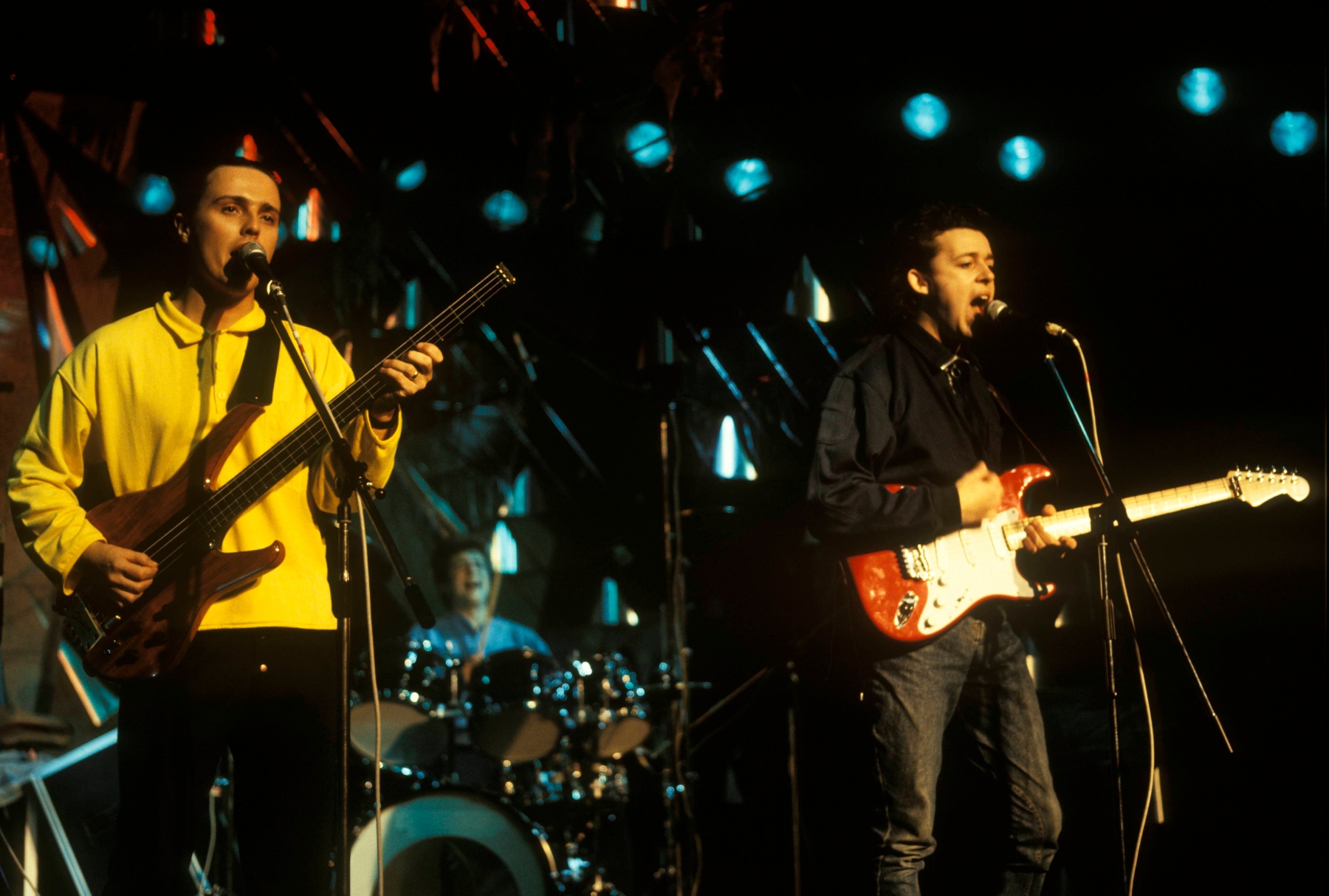
Curt Smith and Roland Orzabal of Tears for Fears performing, circa 1985 (David Redfern/Redferns)The band’s songs have become rich source material for rap, hip-hop and pop samples. Most notably, Kanye West sampled “Memories Fade” on his 2008 song “Coldest Winter,” while The Weeknd updated the shuffling riff of “Pale Shelter” on 2016’s “Secrets.” The propulsive “Shout,” meanwhile, has been incorporated by Busta Rhymes, Ghostface Killah and Kirk Franklin. Tracking down other samples and interpolations is a challenge, as there are simply so many. 

Tears for Fears covers also abound: The hard rock band Disturbed tackled “Shout,” while Miley Cyrus crooned elements of “Everybody Wants to Rule the World” on a remix of West’s “Black Skinhead. Perhaps the most famous Tears for Fears cover is a spare, spectral version of “Mad World” by Gary Jules and Michael Andrews that appeared in 2001’s “Donnie Darko.” Jules and Andrews tap into the song’s despair (“I find it kind of funny/I find it kind of sad/That dreams in which I’m dying are the best I’ve ever had”) and imbue these lyrics with gravitas and reverence. Such dark moods can be difficult to express or feel taboo to say out loud; “Mad World” does the heavy lifting and provides catharsis.

MTV-era bands with keyboards aren’t necessarily treated with the same respect as, say, guitar-bass-drum rock bands from the 1960s.

This cover most of all has kept Tears for Fears in the pop culture conversation even when the band was dormant. It reached No. 1 in the UK in 2003, while American Idol contestant-turned-Queen frontman Adam Lambert also did a somber version of it. The song also surfaced in Australia in 2020 thanks to a well-received “Masked Singer” performance.

In addition to extending Tears for Fears’ relevance, these placements and covers have helped establish credibility for 1980s-era songwriters. Although this presumption has been disproven many (many) times, MTV-era bands with keyboards aren’t necessarily treated with the same respect as, say, guitar-bass-drum rock bands from the 1960s. That’s partly because many of these new wave acts appealed to teenage girls — a group whose tastes are routinely dismissed or considered less serious or worth examining — or the presence of modern synthesizers was like Kryptonite to rock purists.

But hearing “Mad World” and other Tears for Fears songs in different contexts illuminates the music’s sturdy bones. Tears for Fears tapped into primal feelings of joy, desperation, yearning and optimism. Regardless of the sonic dressing, these universal emotions ring true.

In recent years, the Rock Hall has begun to recognize the impact of (for lack of better terms) the post-punk, synth-pop and new wave artists that shook up music in the 1980s — the artists that built on the punk foundation of Blondie, Sex Pistols and Talking Heads. That includes Depeche Mode, The Cure, The Go-Go’s and now 2022 inductees Duran Duran and Eurythmics. (Nine Inch Nails, who started touring and recording at the very end of the ’80s, could arguably qualify.) 


Want a daily wrap-up of all the news and commentary Salon has to offer? Subscribe to our morning newsletter, Crash Course.


Tears for Fears certainly fit right in on a retro playlist featuring those acts, and have a comparable musical impact and loyal fanbase. But apart from Eurythmics, all of those recent inductees are continuing to at least tour, if not make new music, and push their legacy forward into new directions. “The Tipping Point” certainly qualifies as yet another move forward — and it’s also one more mark in the column arguing for Tears for Fears to start to earn serious consideration for Rock Hall induction.

More stories about rock and or roll:


Everything you need to know about growing beans

You can Grow Your Own Way. All spring and summer, we’re playing in the vegetable garden; join us for step-by-step guides, highly recommended tools, backyard tours, juicy-ripe recipes, and then some. Let’s get our hands dirty.

The bean has always held a special nostalgia for me. Some of my fondest childhood memories include standing at the kitchen sink helping my grandma snap beans after an afternoon of climbing the apple trees in her backyard. There’s something about that repetitive movement and the sound of snapping that still brings me comfort in my own kitchen as an adult — which is why it’s a vegetable I always have in my summer garden.

Regardless of your own food memories, I’m here to encourage you to grow them in your garden, too! They’re simple to grow and are feverish producers — and you don’t need a full-fledged homestead, either (small-space dwellers, I’m looking at you). If you’ve got a pot, there’s a bush bean ready to reward you.

There are a lot of bean varieties out there to explore, and the hardest part about growing them can be deciding which ones to pick from the seed catalog. So, get ready to start dreaming up spicy green bean saladssmooth fava bean dips, homegrown edamame snacks . . . heck, you could even try your hand at some gorgeous Greek gigante beans, and save them for fall stews!

Since there are so many bean varieties, it can be hard to know which type might work best for your growing conditions. The most important things to know are the differences between two basic bean groups, pole and bush beans. From there, you can explore the flavors, textures, and colors that excite you most.

Know your legume

Pole beans:

These climbing vine varieties can reach 10 to 15 feet in height, which means they’ll need some sort of support as they grow. They offer a longer harvesting window, producing pods as they climb (usually 6 to 8 weeks), so if you have the vertical space for it, this is a great bean to grow all summer long.

Bush beans:

Far more compact (topping out at about 2 feet), these varieties are great for smaller spaces and patio gardens, as they do not need any support as they grow. Usually planted in double rows and perfect for raised beds and containers alike, they produce during a shorter 3 to 4 week window, making succession planting a consideration for longer harvesting windows throughout the season.

Snap, shell, and dry beans:

The most commonly grown beans are snap varieties, which are eaten whole, tender, and young while the beans are still small. Shell beans like edamame and fava are removed from their pod and enjoyed fresh or steamed. Finally, dried beans are left on the plant to dry before harvesting, and can have an incredible shelf life when stored properly.

Green, wax, and purple beans:

These podded varieties can also be broken down into color categories. The “green” in green beans (the most commonly grown) actually refers to its immature, soft texture instead of its color, while wax beans have a waxier texture and, in some cases, yellow pods. Purple beans are gorgeous hanging from the vine, but it’s worth noting that they lose their color once cooked.

Plot (and pot) needs

No matter what kind of bean you decide on, they all have the same basic needs (outside of spacing and trellis support): full sun and rich, warm, loamy soil with good drainage. Beans don’t typically enjoy being transplanted, so it’s recommended they be sown in place well after the last frost. I personally like to soak my bean seeds overnight before planting them to kick-start germination, but it’s not necessary. If you happen to impulse-buy a perky pack of bean seedlings at the nursery, don’t fret — just take extra care not to disturb the root balls when placing them into the ground.

The amazing thing about beans is they don’t need much else, including fertilization, and, in fact, are incredible for your garden’s overall soil health. They improve soil with the bacteria that create nodules in their roots while converting atmospheric nitrogen into ammonium nitrogen, which is released into the soil to be shared by neighboring plants. This is why many gardeners plant legumes as a rotation crop to revitalize overworked soil. Plants are amazing, my friends, and the humble bean is no exception!

If you’re growing in a container, make sure you’ve got a pot that’s at least 12 inches deep, and with great drainage. Unglazed pots and wine barrels are ideal as they allow extra moisture to evaporate, avoiding overly damp soil and root rot. As long as you plant in full sun and stay on top of your watering routine, you should have no trouble. If you happen to have the vertical space, I encourage you to experiment with some pole bean varieties, too. I know people who love growing them as privacy screens and shade barriers for summer patios.

Support group

Perhaps the most important part of growing beans (specifically for the pole varieties) is to have a trellis ready come planting day. Most folks underestimate the need to have support early — what looks like a little seedling one day could be a floppy vine in distress the next. Here are a few ideas for support that you can source, or even DIY yourself.

A-Frame:

These collapsible trellises are a great option if you need to store them flat come winter time. I love them because you can adjust the width of the frame quite easily to fit a number of vining vegetables, or to use in different locations as needed.

https://www.instagram.com/p/B2U2y7uA6bD/

Pyramid:

For those of you experimenting with trellising in containers, pyramid trellises are quite simple for smaller spaces. They’re great for breezy areas as their circular structure can stand up to gusts better than others.

https://www.instagram.com/p/CAtSFjKAGJU/

Tower:

Essentially a tomato cage for beans, these can run on the pricier side but are a pretty basic plug-and-play option. Most also fold flat for storage, which is a bonus. If you’re in the mood for a DIY, you could make your own version with some twine and wooden poles.

https://www.instagram.com/p/CAxu9hxAuUW/

T-Post:

The simplest and most widely used trellis for its ease of customization, this consists of two posts placed within the borders of your growing area with hog wire or twine strung between them to provide support.

https://www.instagram.com/p/B_q40jXpv-e/

Arch:

If you’re looking for a trellis that doubles as a design accent, the garden arch is your friend! These can be made by purchasing a sheet of hog paneling from your local tack shop. For added visual interest, try growing a flowering vine or another vining vegetable like squash from the other side — or double up on your beans for double the harvest.

https://www.instagram.com/p/BwnlSuvBgEN/

Pests and diseases

Whether it’s the Mexican bean beetle, the Japanese beetle, or the bean leaf beetle, your plant’s biggest nemesis will likely be . . . the beetle. The best way to tackle this problem is by detecting them early and dropping them into a bucket of soapy water. Make sure to check in on your plants each morning — when beetles are a little less active — until the problem is resolved. Protecting young plants with garden fabric is also a great way to prevent early infestations from setting in.

Other common ailments are Alternaria leaf spot, white mold, bean rust, and mosaic virus, which can be avoided by keeping leaves dry and trellising or pruning to allow maximum airflow between vines.

Companion plants

Speaking of beetles, why not try a few companion plants that will help keep those pests away? Adding catnip, marigold, nasturtium, or rosemary to your bean patch will deter flea and bean beetles. Another interesting bean BFF is potato, which keeps Mexican bean beetles away. In turn, the bean plants protect potato buds from the Colorado potato beetle. A win-win!

Harvesting

There are a few ways to properly harvest your crop for best results. The key to a bean bounty is to harvest frequently to stimulate production. It’s also advised that you pluck your pods in the afternoon instead of dewy, damp mornings because the dry leaves limit the spread of potential pathogens and bacteria.

For snap beans, wait until you can see individual seeds bulge through the pod. When it comes to shelling beans, hold off until the pods are tough, but not dry. Finally, for your dry varieties, the beans should rattle inside the pod before you remove them from the plant.

Bush varieties have a much smaller production window, so remove and compost the entire plant once it stops producing. Pole beans, however, will continue to grow and produce until the first frost, so build those trellises tall and get your bean baskets ready!

Merrick Garland “fears no person,” says legal scholar Norm Eisen — and he’s coming for Trump

Like other forms of fascism, authoritarianism and reactionary politics, Donald Trump’s so-called movement is a symptom of deeper problems in society, not the cause. Trumpism is not a boil that can be lanced, thereby ending the infection. It’s more like a tumor growing from the bones. 

It’s not exactly true that the Republican Party was conquered or “taken over” by the Trump movement, as many observers still perceive it. The seeds of Trumpism were planted in Republican soil decades ago, and found it a hospitable environment. It’s more accurate to perceive Trumpism as the next evolutionary (or, more properly, devolutionary) stage of the Republican Party and the overall conservative movement. It’s where right-wing politics were going in America, whether leading conservatives understood that or not. 

To discuss the current state of the Trump movement and America’s efforts to defeat it, I recently reached out to Norman Eisen, a senior fellow in governance at the Brookings Institution. He served as special counsel to the House Judiciary Committee during Donald Trump’s first impeachment, and is the author of the new book “Overcoming Trumpery: How to Restore Ethics, the Rule of Law, and Democracy.” 

RELATED: “Any Republicans wanna speak out now?”: Alarm after Trump shares “civil war” post

In this conversation, Eisen describes the power of “Trumpery,” as he calls it — a combination of disdain for ethical restrictions, assault on the rule of law, incessant falsehood and disinformation, the shameless pursuit of personal and political interest, not the public interest, the exploitation and exacerbation of political division, and attacks on democracy itself. He also discusses why the Republican Party so enthusiastically mated with Trumpism in its quest for autocratic and near-dictatorial power and control over American government and society.

Eisen also discusses why so many members of America’s mainstream news media remain in denial about the danger posed by Trump and his Republican-fascist movement and remain locked into to obsolete patterns of “both-sides-ism,” “balance” and “neutrality” that are entirely inadequate to the country’s worsening democracy crisis.

Toward the end of this conversation, Eisen counsels patience with Attorney General Merrick Garland and the Justice Department, suggesting and that the upcoming House committee hearings on the events of Jan. 6, 2021, will be crucial in holding Donald Trump and his cabal accountable for their obvious or likely crimes against democracy.

This conversation has been edited for length and clarity.

How are you feeling now, given America’s democracy crisis and all the other challenges we face as a country and people?

Everybody has their own way of medicating their anxieties about our country’s democracy. One of my forms of self-medication is to write books. “Overcoming Trumpery” is my fourth book, and this one was really born out of the alarm that I felt when I realized that Donald Trump may be out of the White House, but Trumpery was still with us. Moreover, Trumpery might even be more dangerous now than when Trump was in office. Trumpery is running amok in the GOP. It has really conquered one of our major political parties.

Why is it so challenging for many people to accept — especially the mainstream news media and other Beltway types — that the problem is much bigger than Donald Trump? That the real problem is not just Trump personally, but what he represents and what he has unleashed?

Yes, the problem is not the man himself, but rather the ideology and the approach to governance that he represents. Trumpery is an American-flavored form of the autocracy that we see from Vladimir Putin in Russia, Recep Tayyip Erdoğan in Turkey and Viktor Orbán in Hungary. That’s all it is. The ideology is more dangerous than the man himself. The idea we are discussing is a hard sell for many, even though it is self-evident.


Want a daily wrap-up of all the news and commentary Salon has to offer? Subscribe to our morning newsletter, Crash Course.


One of the traits of Trumpery is the attack on democracy. The press, to their credit, said, “These phony electors who were sent to Congress are not real.” They didn’t treat Trump and John Eastman’s cockamamie ideas about Congress throwing out Electoral College votes as being genuine. They said these are baseless ideas. The press also did not say that there was any substantial question as to whether Trump won the election or Biden did. They said that Trump lost and that he is lying about it. That is true objectivity. They did not hide behind some notion of “press neutrality.” But now that Trump is no longer president they have fallen back to that habit.

Has there been some decision made in the media, like a kind of editorial consensus not to highlight the danger? What is going on here with the media’s framing and agenda-setting?

I give the press credit. In a pre-Trump America, there were norms that applied in our government and politics. Trump transgressed those norms. The problem is, when you have a norm- and law-defying person like Trump you cannot continue to apply the old norms of journalism, such as neutrality.

The norms hold that if you provide one side of the story, then you have to provide the other side — and that there’s a very steep burden to prosecute an ex-president. But those norms have to adapt to these circumstances. They have to come unstuck.

That norm deems that if you’re going to provide one side of the story then you have to provide the other side of the story. If something happens, you need to report it neutrally. Editorializing is for the editorial page. The inferences, the interpretation, that doesn’t go in the news. But if you have a norm-transgressing figure like Donald Trump, then those journalistic norms have to adapt to that circumstance. We can’t be static. That is why journalism in this country is stuck.

And thinking about the law, that is why the prosecutors are stuck. Why on earth has nobody prosecuted Trump? Because we have a norm that there is a very steep burden to prosecute an ex-president. We don’t want to be like those countries where the winner prosecutes the loser in an election.

I do think that both are going to come unstuck, certainly on the prosecutors’ side. The best way to overcome Trumpery is through prosecution. It sends a message to everyone that there are consequences for this kind of norm- and law-busting behavior that Trump and his alleged co-conspirators engaged in.

Why isn’t Donald Trump in prison? Why haven’t Trump’s inner circle and the other coup plotters been prosecuted?

The Jan. 6 hearings in the House are going to be very important. The DOJ typically starts at the bottom and works their way up the food chain. They’ve done that with the hundreds of insurrectionists that they’ve charged. We know they’re asking them about the involvement of the White House and other members of the inner circle. There are other signs that are pointing, at the very least, to a DOJ investigation.

Is Merrick Garland afraid to prosecute Trump and other members of his inner circle because of “norms” and “precedent” about holding a former president accountable? What do you think the legal and political calculus is?

Garland fears no person. I’ve known him for years and he is a great American jurist and lawyer. He has said that he’s going to follow the evidence where it leads and apply the law without fear or favor. He’s going to let the chips fall where they may.  I believe him. He’s very methodical. He’s very deliberate.

Merrick Garland is a great American jurist. He needed to get things settled down in the DOJ before he made a momentous move. I have a lot of confidence in his decision-making.

There’s some element of not bumping into the Jan. 6 committee’s work. There are strong norms at work here: You don’t stampede into prosecuting a president.

Garland also needed to restore another kind of norm — and that was the norm of a properly functioning Department of Justice. He’s only a year and a half into his tenure, if even that long. He needed to get things settled down in the DOJ before he made such a momentous move. I have a lot of confidence in Merrick Garland’s decision-making.

They are running out of time. What about the Jan. 6 committee’s decision not to televise its work? I am of the opinion that most if not all of the hearings should have been on television to keep this in the public’s consciousness for all these months.

They were gathering the evidence. The hearings are going to take place in June. Based on the evidence we’ve seen so far, those hearings are going to be very dynamic. Undoubtedly, even with all the leaks, we’ve just seen the tip of the iceberg. I believe they have time to do their Watergate-style hearings. A month is a lot more time now than it was in the 1970s. You can get a lot more done in a month now. People get bombarded with more information on their iPhones and via social media in an hour than you used to get in an entire day. The committee has ample time left. They wanted to be thorough and now we’re going to see the results. I think they’re going to be strong.

As you were watching the events unfold on Jan. 6, what were you thinking?

I was in a TV studio just a few blocks from the insurrection. I watched the video feed on multiple screens as the insurrection unfolded. As a student of the American political process, I felt horror at the fact that for first time since 1860 we had a disruption of the peaceful transfer of power in this country.

I felt that the warnings that I and others had made about the dangers of Trumpery had come to pass. I was sad to be proven right. I had said that this could lead to violence and that Donald Trump was playing with fire. I was not surprised that he was silent for 187 minutes. I feel quite certain that Trump was rooting for the insurrectionists, and we now have evidence to that point. I felt a mix of emotions. I was uncertain about the future.

When Republicans initially spoke out about Jan. 6, I was encouraged that this would be the end of Trumpery and the ongoing risk to our country. But that turned out to be wrong. Trump reasserted his grip and power. Above all, I would say that the insurrection is continuing. The Republicans, motivated by the Big Lie and the attempted coup, have now just moved it into the states.

What the Republicans attempted to do in the aftermath of the 2020 election was to attack the rules and the referees, meaning the election officials, as a way of attacking the results. They failed, but they’re still doing it. There are hundreds of bills to attack the rules so that they can change the results next time. The Republicans are doing this from coast to coast. The attempted coup has not ended.

What is so compelling about “Trumpery” for the Republicans? For Trump’s followers?

They want power at all costs. We need to deal with that. We cannot allow this slow rolling preparation for another coup to go unchecked. The coalition of Democrats, Republicans and independents that defeated Trump and the Republicans in 2020 need  to step up and do the same thing in 2022.

What is “democracy”? What is the “rule of law”? These concepts are summoned all of the time in conversations about the Age of Trump and this crisis, but they are rarely defined or explained. These definitions are critical.

The legitimacy of our constitutional republic is founded in the choices of the American people. In the United States, it’s sometimes said that “the voters choose their leaders.” In an autocracy, the leaders make that choice. That is the core difference between American democracy and the kind of American autocracy that Donald Trump is pushing.

Trump’s behavior was anti-democratic because he wanted to substitute his own decision to stay in power for the choice that the voters made. The moral legitimacy of our democracy and government stems from the choice of the people. It’s really as simple as that. Trump wanted to substitute his own choice for that of the American people and the Constitution.

As for the rule of law, there is a system of rules that we’ve agreed on, and the rules apply equally to all. Again, no person is above the law. Trump wanted to put himself above those rules. The rules should be the same for everyone. He wanted a special new set of rules for himself. So, that’s what the rule of law means. Trump transgressed it thousands of times, but the last one, on Jan. 6, 2021, was the worst.

Did Trumpery impose itself on the Republican Party, or was the party already afflicted with the sickness before Donald Trump? In essence, those values and beliefs were already there.

The seeds were certainly there for a very long time. When Sen. Mitch McConnell was asked at the beginning of the Obama administration, in which I served, “What’s your objective?” he said, “To deny Barack Obama a second term.” That’s a form of Trumpery. He’s putting his narrow partisan political interests above the interests of the country.

Every single one of the deadly sins of Trumpery was germinating in the Republican Party before Donald Trump: Disdain for ethics, attacking the rule of law, lies and disinformation — and sheer shamelessness.

Every single one of the deadly sins of Trumpery was germinating in the Republican Party before Donald Trump. For example, the disdain for ethics, attacking the rule of law, lies and disinformation. The sheer shamelessness. Pursuing personal political interest and not the public interest. Driving divisions and attacking democracy. The nativism, the populism, the attacks on minorities. We’ve seen so much of this with the Republicans even before Trump. We’ve seen so much that’s wrong, but it was a minority position that was germinating. It took Trump to really lead Trumpery to dominance in the Republican Party. The Republican Party is now a wholly owned subsidiary of Mar-a-Lago. That’s a disaster with one of our two major parties.

What can we do to purge or inoculate America’s democratic culture from Trumpery?

We have to empower the people who are pro-democracy to get out there and fight for our democracy, as we did in 2020. The tools are there. We need to have the will. We need to join together. We need to set party aside; democracy should not be a partisan issue. It worked in 2020. I think it can work again in 2022 and beyond.

Read more on our 45th president and his legal problems:

What makes us subconsciously mimic the accents of others in conversation

Have you ever caught yourself talking a little bit differently after listening to someone with a distinctive way of speaking?

Perhaps you’ll pepper in a couple of y’all’s after spending the weekend with your Texan mother-in-law. Or you might drop a few R’s after binge-watching a British period drama on Netflix.

Linguists call this phenomenon “linguistic convergence,” and it’s something you’ve likely done at some point, even if the shifts were so subtle you didn’t notice.

People tend to converge toward the language they observe around them, whether it’s copying word choices, mirroring sentence structures or mimicking pronunciations.

But as a doctoral student in linguistics, I wanted to know more about how readily this behavior occurs: Would people converge based on evidence as flimsy as their own expectations of how someone might sound?

Three years of experimentation and an entire dissertation later, I had my answer, which was just published in the academic journal “Language.”

People do, in fact, converge toward speech sounds they expect to hear – even if they never actually hear them.

What, exactly, is convergence?

But before getting into the specifics, let’s talk about what convergence is and how it’s related to other speech adjustments like code-switching, which refers to alternating between language varieties, or style-shifting, which happens when a person uses different linguistic features in different situations.

Convergence refers to the shifts people make to their speech to approximate that of those around them. This is an intentionally broad definition meant to encompass all sorts of adjustments, whether intentional or inadvertent, prominent or subtle, or toward entire dialects or particular linguistic features.

You could imitate aspects of speech you actually observe. Or maybe you throw in some words you think kids these days use, only to have your use of “bae” and “lit” be met with teenage eye rolls.

Code-switching or style-shifting can also be examples of convergence, as long as the shift is toward an interlocutor – the person you’re talking to. But people can also shift away from an interlocutor, and this is called “divergence.”

Code-switching and style-shifting can occur for other reasons, too, like how you feel, what you’re talking about and how you want to be perceived. You might drop your G’s more and say things like “thinkin'” when reminiscing about a prank you played in high school – but switch to more formal speech when the conversation shifts to a new job you’re applying to.

Are expectations enough to alter speech?

To determine whether people converge toward particular pronunciations they expect but never actually encounter, I needed to start my investigation with a feature that people would have clear expectations about. I landed on the “I” vowel, as in “time,” which in much of the southern U.S. is pronounced more like “Tom.” This is called “monophthongization,” and it is a hallmark of Southern speech.

I wanted to know whether people would produce a more Southern-like “I” vowel when they heard someone speak with a Southern accent – and here’s the crucial part – even if they never heard how that person actually pronounced “I.”

So I designed an experiment, disguised as a guessing game, in which I got more than 100 participants to say a bunch of “I” words.

In the first part of the game, they read a series of clues on their computer screen – things like, “this U.S. coin is small, silver, and worth 10 cents.”

Then they named the word being described – “dime!” – and I recorded their speech.

In the second part of the game, I had participants listen to clues read by a noticeably Southern-accented talker and instructed them to respond in the same way. By comparing their speech before and after hearing a Southern accent, I could determine whether they converged.

Using acoustic analysis, which gives us precise measurements of how participants’ “I” vowels sound, I observed that Southerners and non-Southerners alike did, in fact, shift their “I” vowels toward a slightly more Southern-like pronunciation when listening to the Southern-accented talker.

They never actually heard how the Southerner produced this vowel, since none of the clues contained the “I” vowel. This means they were anticipating how this Southerner might say “I,” and then converging toward those expectations.

This was pretty clear evidence that people converge not just toward speech they observe but also toward speech they expect to hear.

Social asset or faux pas?

What does this say about human behavior?

For one, it means that people perceive accents as coherent collections of different linguistic features. Hearing accent features X and Y tells people to expect accent feature Z, because they know X, Y and Z go together.

But it’s not just that people passively know things about others’ accents. This knowledge can even shape your own speech.

So why does this happen? And how do those on the receiving end perceive it?

First, it’s important to point out that convergence is usually very subtle – and there’s a reason. Overly exaggerated convergence – sometimes called overaccommodation – can be perceived as mocking or patronizing.

You’ve probably witnessed people switch to a slower, louder, simpler speech style when talking to an elderly person or a nonnative speaker. This type of over-the-top convergence is often based on assumptions about limited comprehension – and it can socially backfire.

“Why are they talking to me like I’m a child?” the listener might think. “I understand them just fine.”

For expectation-driven convergence – which, by definition, is not rooted in reality – such a faux pas might be even more likely. If you don’t have an actual speech target to converge toward, you might resort to inaccurate, simplistic or stereotyped ideas about how someone will speak.

However, subtler shifts – in what might be called the “sweet spot” of convergence – can have a number of benefits, from social approval to more efficient and successful communication.

Consider a toddler who calls their pacifier a “binky.” You’d probably be better off asking, “Where’s the binky?” and not “Where’s the pacifier?”

Reusing the terms our interlocutors use is not just cognitively easier for us – since it takes less effort to come up with a word we just heard – but it often has the added benefit of making communication easier for our partner. The same could be said for using a more familiar pronunciation.

If people can anticipate how someone will speak even sooner – before they utter a word – and converge toward that expectation, communication could, in theory, be even more efficient. If expectations are accurate, expectation-driven convergence could be a social asset.

That’s not to say that people necessarily go around consciously making these sorts of calculations. In fact, some explanations for convergence suggest that it is an unintentional, automatic consequence of speech comprehension.

Regardless of why convergence happens, it’s clear that even beliefs about others play a major role in shaping the way people use language – for better or for worse.

Lacey Wade, Postdoctoral Researcher, University of Pennsylvania

This article is republished from The Conversation under a Creative Commons license. Read the original article.

A gun and a prayer: How the far right took control of Texas’ response to mass shootings

As the gunman approached her family in the corner of the restaurant, Suzanna Hupp wanted nothing more than a gun in her hand.

But Texas law in 1991 didn’t allow that, leaving her defenseless. Her father was fatally shot when he ran at the gunman, unarmed. Her mother died holding him on the floor of that Luby’s restaurant in Killeen. Twenty-one other diners and the gunman also died that day.

The Luby’s shooting, as it became known, shocked the nation and galvanized Hupp, who escaped through a window. She spent the next 30 years, including 10 in the state Legislature, fighting to give others the option she did not have.

Unlike other mass shooting survivors who advocate for gun restrictions — the parents of Sandy Hook Elementary students or the teenagers who watched their classmates die at Marjory Stoneman Douglas High School — Hupp’s goal has been eliminating gun regulations.

Sign up for The Brief, our daily newsletter that keeps readers up to speed on the most essential Texas news.

For all the conversation about common sense and compromise, these are the two fundamental choices: The answer to preventing future tragedy is either fewer guns or more.

At their core, these philosophies do not form a Venn diagram. They are ideologically distinct and incompatible worldviews.

While there will be discussions in the coming weeks about incremental steps and public support for tightening gun regulations, the political reality is that three decades of Republican dominance in the state have erased the middle ground. In Texas, the chosen response to mass shootings is a gun and a prayer.

The state’s elected officials, influenced by an ultra-conservative religious movement and profit-driven gun companies, have chosen the path of least regulation, elevating firearm ownership into a referendum on faith and freedom.

Addressing the state Wednesday after a gunman massacred 19 students and two teachers, Lt. Gov. Dan Patrick made it clear how the state should respond to mass shootings.

“In these other shootings — Sutherland Springs, El Paso, Odessa, Santa Fe — it’s God that brings a community together. It’s God that heals a community,” Patrick said. “If we don’t turn back as a nation to understanding what we were founded upon and what we were taught by our parents and what we believe in, then these situations will only get worse.”

Texas is on a path that may not reflect public opinion but absolutely reflects the larger political forces sweeping the state. And it’s not just Texas: Republican state legislatures, data shows, are 115% more likely to pass legislation loosening gun laws in response to mass shootings.

Texas remains among the more heavily armed states in the country — more than a third of Texas households have a gun, and while the rate of household gun ownership has declined nationally since the 1980s, it has not declined as quickly or consistently in Texas.

More than 1.7 million Texans have an active state firearm license, and Texas has more federally registered guns than any other state. Nationally, data shows two-thirds of gun owners own more than one gun, and nearly a third own five or more guns.

“If the states are laboratories of democracy, where we figure out what policies work, you might think over time we’d converge on a set of policies,” said Chris Poliquin, who researches gun laws at the University of California, Los Angeles. “But you don’t actually see that on gun policy.”

From sport to self-defense

When the pickup truck crashed through the plate glass window of the Luby’s in Killeen, halfway between Austin and Waco, Suzanna Hupp assumed it was an accident.

When the driver pulled out a gun, she assumed it was a robbery.

It wasn’t until he started shooting — picking off patrons, one by one — that she realized what was happening.

“It took me a good 45 seconds, which is an eternity during something like that,” she said. “Now, it would be the first thing your mind goes to, but back then, we hadn’t had anything like that before.”

It was 1991, long before the era of active shooter drills and school lockdowns. It would be another eight years until the shooting at Columbine High School and three decades before a man walked into an elementary school in Uvalde and massacred 19 students and two teachers.

It was also an era of much tighter gun laws in Texas. Hupp’s handgun was in the glove compartment of her car. She had not brought it inside for fear of losing her chiropractor’s license if caught violating the state’s prohibition on carrying a concealed weapon.

“I realized we were just sitting ducks,” she said. “That is just the most sickening feeling in the world to just wait for it to be your turn.”

Hupp emerged from that shooting with a new mission, and the gun rights movement had a new crusader.

“I testified in, I don’t know, 25 different states, some of them a couple of times,” she said. “And they all have concealed carry now.”

Her argument has been simple but effective: Stricter gun laws would not have stopped the gunman who killed her parents. A gun would have. She believes the key to preventing more gun deaths is more guns — mental health treatment and better risk assessment, too, but most importantly, more guns in more places.

“Here’s the truth of the matter that no one can argue with,” she said. “If I’d had my gun that day, even if I had screwed it up somehow, it would have changed the odds, wouldn’t it?”

When Hupp first got involved in the gun rights movement, many states banned concealed carry and the United States was on the verge of passing a federal assault weapons ban.

But a change had been building for some time. Since the 1960s, the country had been in the process of shifting from what Wake Forest University researcher David Yamane calls “gun culture 1.0” — guns for sport or recreation — to 2.0 — guns for self-defense.

“A lot of people in developed, suburbanized parts of the country who maybe previously thought they didn’t need a gun anymore, because they’re not on the frontier, start to develop the notion that they might have to defend themselves,” Yamane said. “That link has become much more prominent these days.”

Hupp’s story capitalized on a previously unimaginable idea that a man might come into the restaurant where you’re eating and just start shooting. This free-floating fear has morphed in recent years depending on the moment — gun sales spiked during the original COVID lockdowns and amid the 2020 racial justice protests, and they tend to rise after mass shootings like the one in Uvalde.

“In the ’90s and 2000s, people really do start to see guns increasingly as a viable option to face down crime, uncertainty and unrest,” Yamane said. “There’s an element of defensive gun ownership that looks at the gun as a tool of last resort for when the worst possible thing is happening.”

At the same time, the National Rifle Association began bringing more of its lobbying firepower to state legislatures, fomenting the idea that the world was full of things that needed defending against.

“The NRA built this identity around gun ownership and then it portrayed that identity as being threatened,” said Matthew Lacombe, the author of “Firepower: How the NRA Turned Gun Owners into a Political Force.” “So the minority of Americans who oppose gun control are historically more politically active than the majority that support.”

In Texas, like other red states, the NRA slid sideways into the newfound alliance between evangelical Christians and the Republican Party, aligning gun rights with the religious right.

Gun ownership became a symbolic weapon in fighting the culture wars.

“I am not really here to talk about the Second Amendment or the NRA, but the gun issue clearly brings into focus the war that’s going on,” said then-NRA President Charlton Heston in a 1997 speech. “Mainstream America is depending on you … to draw your sword and fight for them.”

And Texas did fight. In 1994, George W. Bush beat Ann Richards for the governorship after she vetoed a concealed carry law. In the decades since, Texas passed open carry, allowed guns on college campuses and in churches, prohibited cities from passing stricter gun laws and deemed the state a “Second Amendment sanctuary.”

Hupp left the Legislature in 2007. In the years since, she’s watched ideas she said her colleagues once dismissed as “nuts” pass into law — like permitless carry and allowing teachers to carry guns.

As the Texas Legislature has steadily embarked on a conservative crusade, gun rights hasn’t just been on the list of priorities. In many ways, it’s the linchpin of the whole thing.

“God-given” guns

In 2018, after a gunman killed 17 students at Marjory Stoneman Douglas High School in Parkland, Florida, NRA executive vice president Wayne LaPierre spoke to a conservative convention.

“There is no greater personal, individual freedom than the right to keep and bear arms, the right to protect yourself and the right to survive,” LaPierre said. “It is not bestowed by man, but granted by God to all Americans as our American birthright.”

The idea that God has granted Americans a fundamental right to bear arms is not a new one, but it’s become an article of faith.

True believers derive the inherent right to self-defense by drawing a line from the Declaration of Independence — that all men are “endowed by their Creator with certain unalienable rights, that among these are life, liberty and the pursuit of happiness” — to the Second Amendment as the legal representation of God’s will.

This is the cross that some gun owners have chosen to bear — that their defense of gun rights is not just about firearms, but about ensuring the continued manifestation of God’s will on Earth.

Andrew Whitehead, author of “Taking America Back for God: Christian Nationalism in the United States,” said equating gun rights with the “will of the sacred” essentially erases any hope of finding a middle ground.

“If we do anything about gun control, we are turning our backs on God’s desire and plan for this country and the Founding Fathers and all of those things,” Whitehead said. “It’s so strongly ingrained and has become so central to that identity, so to float the idea of gun control is almost to attack, in their view, their Christian identity.”

Christian nationalism is an effort to more closely intertwine evangelical Christian morality and American civic identity. It’s associated with a slate of other conservative political agenda items, all framed around bringing America and its citizens’ hearts back to God.

Modern Christian nationalism tightly defines a “true American” and a “true Christian” in largely white, evangelical, conservative terms, emphasizing capitalism, traditional gender roles and parents’ rights.

Not all evangelical Christians subscribe to Christian nationalist ideas. But some of those ideas have taken hold in the Texas Legislature in recent years.

In 2019, after the second mass shooting in Texas in a month, state Rep. Matt Schaefer, R-Tyler, tweeted that he was “NOT going to use the evil acts of a handful of people to diminish the God-given rights of my fellow Texans. Period.”

Schaefer’s tweet thread went on to say he opposed gun reform measures, including universal background checks, bans on assault weapons and mandatory gun buybacks. Instead, he said he would support praying for the victims, for protection and for hoping “God would transform the hearts of people with evil intent.”

He also endorsed the idea of “giving every law-abiding single mom the right to carry a handgun to protect her and her kids without permission from the state, and the same for all other law-abiding Texans of age.”

Schaefer did not respond to request for comment.

By citing Texans’ “God-given rights,” Schaefer and his fellow state legislators transform a gun into a symbol of morality, piety and identity.

“The ability to craft and create that narrative gets politicians who might not even be that interested in Christian nationalism in touch with people who are activated by that rhetoric,” said Whitehead. “And that can be very powerful.”

It’s not just gun control. Support for Christian nationalist ideas is a predictor for support for a slew of other political agenda items, Whitehead said, including the most high-profile right now: ending abortion.

Gun rights and abortion access occupy the same philosophical space in the Texas Legislature, where the conversation is centered more on morality and theology than facts and science. Government has a responsibility to defend life in the womb, the argument goes, and individuals a right to defend themselves.

“There is more of an entrenchment with the gun issue than almost any other issue,” said state Rep. Donna Howard, D-Austin. “There’s little room for any kind of discussion, any kind of debate, any willingness to look at compromises … even with abortion, there was more room to negotiate a few things.”

What comes next

After 10 people were killed in a school shooting in Santa Fe, Texas, in 2018, Gov. Greg Abbott suggested considering a “red flag” law. Lt. Gov. Dan Patrick then nixed it.

After 23 people were killed at a Walmart in El Paso and seven people were killed in Midland-Odessa in 2019, Patrick discussed expanding background checks. Instead, the Legislature passed permitless carry.

But after the mass shooting in Uvalde, neither Patrick nor Abbott indicated any interest in reforming the state’s gun laws. On Fox News, Attorney General Ken Paxton said it’s unreasonable to think we can “stop bad people from doing bad things.”

“We can potentially arm and prepare and train teachers and other administrators to respond quickly,” he said. “That, in my opinion, is the best answer.”

While Democrats expressed their outrage — some more immediately than others — none of this came as any surprise to people who study gun issues.

Poliquin’s research shows that Republican-dominated states tend to pass legislation in the wake of mass shootings that make guns more readily accessible. Democrat-led states don’t see a statistically significant increase in gun laws of any kind after these events, in part, Poliquin hypothesized, because they already have strong gun control laws.

Republicans in Texas are acting on their party’s ideology on guns, which emphasizes more guns in more places as a deterrent to acts of violence. And even if that doesn’t reflect public opinion, they have no reason to anticipate backlash in the voting booth.

Even conversations about compromise are enough to rile up the faithful, and in a polarized and gerrymandered state like Texas, the political fringes are where a politician’s career can be made or lost.

“The more the gun control advocates try to put in place what they euphemistically call common-sense gun laws … those of us that believe in the Second Amendment and everything it was set in place to protect tend to hold much tighter,” Hupp said. “We recognize what their ultimate goal is, which is to completely disarm citizens.”

Howard, one of a minority of Democrats in the state Legislature, said Texas’ approach to gun policy reminds her of the bumper stickers she would see in the 1960s: “America: Love it or leave it.”

It feels like her fellow legislators are telling her — and any Texans who want gun control — “if you don’t like it, you can just leave,” she said.

“That’s not something I have felt until recent years,” she said. “This is my home, and the fact that what I believe and people like me believe, and the way we would like to have society structured, is just totally discounted, it feels like we don’t matter.”


This article originally appeared in The Texas Tribune at https://www.texastribune.org/2022/05/29/texas-mass-shootings-self-defense-gun-ownership/.

The Texas Tribune is a member-supported, nonpartisan newsroom informing and engaging Texans on state politics and policy. Learn more at texastribune.org.

“Gun control” is a great idea — and what about for the U.S. military too?

New outcries for gun control have followed the horrible tragedies of mass shootings in Uvalde and Buffalo. “Evil came to that elementary school classroom in Texas, to that grocery store in New York, to far too many places where innocents have died,” President Biden declared over the weekend during a university commencement address. As he has said, a badly needed step is gun control — which, it’s clear from evidence in many countries, would sharply reduce gun-related deaths.

But what about “gun control” at the Pentagon?

The concept of curtailing the U.S. military’s arsenal is such a nonstarter that it doesn’t even get mentioned. Yet the annual number of deadly shootings in the United States — 19,384 at last count — is comparable to the average yearly number of civilian deaths directly caused by the Pentagon’s warfare over the last two decades.

From high-tech rifles and automatic weapons to drones, long-range missiles and gravity bombs, the U.S. military’s arsenal has inflicted carnage in numerous countries. How many people have been directly killed by the “War on Terror” violence? An average of 45,000 human beings each year — more than two-fifths of them innocent civilians — since the war began, as documented by the Costs of War project at Brown University.

RELATED: Can we stop calling our humongous military spending the “defense” budget?

The mindset of U.S. mass media and mainstream politics has become so militarized that such realities are routinely not accorded a second thought, or any thought at all. Meanwhile, the Pentagon budget keeps ballooning year after year, with Biden now proposing $813 billion for fiscal year 2023. Liberals and others frequently denounce how gun manufacturers are making a killing from sales of handguns and semiautomatic rifles in the U.S., while weapons sales to the Pentagon continue to spike upward for corporate war mega-profiteers.

As William Hartung showed in his Profits of War report last fall, “Pentagon spending has totaled over $14 trillion since the start of the war in Afghanistan, with one-third to one-half of the total going to military contractors. A large portion of these contracts — one-quarter to one-third of all Pentagon contracts in recent years — have gone to just five major corporations: Lockheed Martin, Boeing, General Dynamics, Raytheon and Northrop Grumman.”

What’s more, the U.S. is the world’s leading arms exporter, accounting for 35 percent of total weapons sales — more than Russia and China combined. These U.S. arms exports have huge consequences.

Pointing out that the Saudi-led war and blockade on Yemen “has helped cause the deaths of nearly half a million people,” a letter to Congress from 60 organizations in late April argued that “the United States must cease supplying weapons, spare parts, maintenance services, and logistical support to Saudi Arabia.”


Want a daily wrap-up of all the news and commentary Salon has to offer? Subscribe to our morning newsletter, Crash Course.


How is it that countless anguished commentators and concerned individuals across the nation can express justified fury at gun marketers and gun-related murders when a mass shooting occurs inside U.S. borders, while remaining silent about the need for meaningful gun control at the Pentagon?

The civilians who have died — and are continuing to die — from use of U.S. military weapons don’t appear on American TV screens. Many lose their lives due to military operations that go unreported by U.S. media, either because mainline journalists don’t bother to cover the story or because those operations are kept secret by the U.S. government. As a practical matter, the actual system treats certain war victims as “unworthy” of notice.

Whatever the causal mix might be — in whatever proportions of conscious or unconscious nationalism, jingoism, chauvinism, racism and flat-out eagerness to believe whatever comforting fairy tale is repeatedly told by media and government officials — the resulting concoction is a dire refusal to acknowledge key realities of U.S. society and foreign policy.

To heighten the routine deception, we’ve been drilled into calling the nation’s military budget a “defense” budget. Congress devotes half of all discretionary spending to the military, the U.S. spends more on its military than the next 10 countries combined (most of those nations U.S. allies), the Pentagon operates 750 military bases overseas, and the U.S. is now conducting military operations in 85 countries.

Yes, gun control is a great idea. For the small guns. And the big ones.

Read more on America’s military and defense spending:

How the U.S. has struggled to stop the growth of a shadowy Russian private army

For nearly a decade, U.S. officials watched with alarm as a shadowy network of Russian mercenaries connected to the Kremlin wreaked havoc in Africa, the Middle East and most recently Ukraine.

A number of them now say they wish the U.S. government had done more.

President Vladimir Putin has increasingly relied on the Wagner Group as a private and unaccountable army that enables Russia to pursue its foreign policy objectives at low cost and without the political backlash that can come from foreign military intervention, U.S. officials and national security experts said.

In recent years, governments in the Middle East and Africa hired the fighters to crush insurgencies, protect natural resources and provide security — committing grave human rights abuses in the process, according to U.S. officials and international watchdogs.

In Syria, Wagner fighters were filmed gleefully beating a Syrian army deserter with a sledgehammer before cutting off his head. In the Central African Republic, United Nations investigators received reports that the mercenaries raped, tortured and murdered civilians. In Libya, Wagner allegedly booby-trapped civilian homes with explosives attached to toilet seats and teddy bears. Last month, German intelligence officials linked Wagner mercenaries to indiscriminate killings in Ukraine.

The U.S. was slow to respond to the danger, and it now finds itself struggling to restrain the use of the mercenaries across the globe, according to interviews with more than 15 current and former diplomatic, military and intelligence officials. Unilateral sanctions have done little to deter the group. Diplomacy has stumbled.

“There was no unified or systematic U.S. policy toward the group,” said Tibor Nagy, who served the State Department for nearly three decades, most recently as the assistant secretary of state for African affairs until 2021.

The Kremlin officially denies any connection with the activities of Russian mercenaries abroad, and much about Wagner’s structure and leadership remains unclear. But experts say that Wagner’s top officers have participated in meetings between foreign leaders and top Russian officials. They also say the Russian air force has transported Wagner fighters to launch the group’s international missions.

Wagner has spread around the world, particularly in Africa, because it presents an enticing package to leaders of embattled nations, experts said. It offers to quash terrorism and rebel threats with brutal military crackdowns, while rallying public support for their government clients through disinformation campaigns.

U.S. officials said they have felt underequipped in trying to curtail the mercenaries’ incursions, in part because American diplomacy in Africa has been gradually stripped of resources over the past three decades. Some also said the U.S. was slow to appreciate the severity of the Wagner threat before it became a formidable weapon in the Kremlin’s arsenal.

In Africa, American efforts to persuade governments not to work with Wagner have generally been late and ineffectual, the officials said. U.S. diplomats have been surprised when Wagner arrives in a faltering country, leaving them scrambling to counter the group’s influence with limited tools and incentives.

During the Cold War, America’s policy of containing the spread of Soviet communism led to a substantial investment in courting African leaders, offering developmental aid, university exchange programs, even concerts. But when the Berlin Wall fell, so too did the U.S. government’s interest in the African continent, the officials told ProPublica. Embassy staffs shrank; programs shriveled.

“America’s soft power is unbeatable, but it needs to be deployed,” Nagy told ProPublica. “The quiver is empty.”

Nagy and other current and former high-level State Department officials said embassies in Africa tend to employ few public diplomacy officers, with barebones staff that must juggle everything from routine visa issues to terrorist threats.

“That doesn’t leave a lot of time for a thin staff to develop the expertise or the relationships necessary to have or pursue a robust engagement strategy,” one senior State Department official said about efforts to steer foreign officials away from Wagner. “The ability of a fairly junior diplomatic officer to build a relationship with the Cabinet member who’s going to be making the decision — that is just not realistic in most cases.”

The State Department declined to comment. The Pentagon and the Kremlin did not respond to questions for this story.

The most visible U.S. effort to keep Wagner out of a specific country transpired in Mali, where the mercenaries arrived last December to fight jihadists rampaging in the north. Malian President Assimi Goïta had recently come to power in the latest of a series of coups that prompted international sanctions.

Before Wagner landed, Gen. Stephen Townsend, the head of the U.S. military’s Africa Command, traveled to Mali to meet with Goïta. “I explained that I thought it was a bad idea to invite Wagner,” Townsend told Congress in March. “Wagner obeys no rules. They won’t follow the direction of the government.”

But the entreaties from Townsend and other U.S. officials were unsuccessful. Former diplomats say the effort was part of a troubling pattern where American officials parachute into complex situations equipped with little more than talking points. Africa Command declined to comment.

The Americans were telling the Malians not to work with the Wagner group but offering no meaningful alternatives, said J. Peter Pham, who served as the first-ever U.S. special envoy to the Sahel region until last year and maintains close contact with Malian and other African officials.

“You either have concrete programs of assistance, or you have personal relationships and diplomatic capital built up over the years that you can call upon,” Pham said. “Many American officials, often of middling rank, are often dispatched with neither.”

In March, the French newspaper Le Monde reported that Wagner mercenaries had participated in the torture of civilians, including by electrocution, while working with Malian soldiers. Last month, Human Rights Watch issued a detailed report accusing Russian fighters of participating in a massacre of roughly 300 civilians during a military operation. The killing began at a crowded cattle market on March 27 and continued for several days. In a statement, State Department spokesman Ned Price said, “We are concerned that many reports suggest that the perpetrators were unaccountable forces from the Kremlin-backed Wagner Group.”

The Malian government has said that the Russians are helping their military as formal instructors, and that their army killed 203 “terrorists” and arrested 51 more during the operation. The Malian Embassy in the U.S. did not respond to requests for comment.

The Wagner group first attracted public notice in 2014, during the Russian invasion of eastern Ukraine. Its mercenaries fought alongside Russian federation forces, attacking Ukrainian forces in the still-contested Donbas region.

Gary Motsek, then a U.S. deputy assistant secretary of defense, was alarmed by the emergence of what seemed to be a new breed of Russian mercenary.

For years, the Pentagon had been aware of Russian military contractors disregarding international law, Motsek said in an interview with ProPublica. But the contractors had mostly been consigned to securing oil tankers and other Russian assets. Now the Wagner Group was in combat, like a private army.

“Looking at the growth of the Wagner Group, it was clearly a missed opportunity” from roughly 2008 to 2010, Motsek said. “We should have made it a priority.”

At the time, Motsek led a Pentagon office that helped create international standards for private military contractors. He said the office focused on voluntary compliance and companies active in American warzones. When the Russians chose not to sign on to the standards, he was not aware of any effort to rein them in.

“It was probably my fault, more than anyone else, because I was the only one working on this on an almost daily basis,” Motsek told ProPublica. “We never went and said, ‘Let’s control these guys.’ I didn’t have the mandate to do that. And I guess I didn’t have the vision.”

American officials say Wagner operates through a web of shell companies controlled by the Russian oligarch Yevgeny Prigozhin, a food industry magnate with close ties to Putin, sardonically referred to as “Putin’s Chef.” Prigozhin has vehemently denied his involvement in the group, supposedly named after the German composer — a favorite of one of the mercenaries’ alleged commanders. Efforts to reach Prigozhin were not successful.

The U.S. sanctioned Prigozhin in 2016 and the Wagner Group in 2017 in response to their role in the Ukrainian conflict. Prigozhin was subsequently indicted for his alleged involvement in meddling with the 2016 U.S. presidential election through the troll farm known as the Internet Research Agency.

Experts say the Wagner Group appears to be paid in proceeds from natural resources like oil, gold and diamonds in countries where they are fighting. The Kremlin has used them as a cheap alternative to Russian armed forces.

“Russia has opened up military operations in two continents, for the first time since the 1980s,” said Sean McFate, a professor at the National Defense University. “The tip of the spear is the Wagner Group.”

In 2015, Russia sent its military to fight in the Syrian civil war on behalf of the dictator Bashar al-Assad. It was the Kremlin’s first armed intervention outside former Soviet territories since the end of the Cold War. Soon, Russian Federation forces and fighters from Wagner and other mercenary groups helped tilt the war in Assad’s favor.

On Feb. 7, 2018, Wagner mercenaries and Syrian soldiers carried out an assault on a U.S. special forces outpost near the town of Khasham, hammering the American position with artillery rounds as the Russians and Syrians advanced. Americans responded with airstrikes in a four-hour battle, killing an estimated 200 combatants. No Americans died.

Joseph Votel, a retired four-star general, was then the head of U.S. Central Command. In an interview, he told ProPublica that he believes the assault was financially motivated, and that Wagner sought control of an oil field near an ongoing U.S.-led counterterror operation.

But Votel said U.S. commanders regarded the fight as an isolated incident rather than a significant development in souring relations between the two nations.

“I didn’t particularly dwell on it,” Votel said. “I wasn’t pressed on it. What happened, happened.”

Joseph Siegle, director of research at the Africa Center for Strategic Studies, said Russian military successes in the Syrian conflict represented an “inflection point for Russia.”

“They saw how quickly they could gain influence in a region where they’d had relatively little influence,” Siegle said.

In 2019, Wagner began to fight in the Libyan civil war, supporting a campaign by the warlord Khalifa Haftar to overthrow the country’s internationally recognized government. Haftar had appeared to be faltering, but, together, Wagner and rebel fighters launched a new offensive that brought their combined forces to the outskirts of Tripoli.

At the top levels of American foreign policy agencies, alarm bells were beginning to sound.

“We were watching it change the course of the war,” David Schenker, then assistant secretary of state for Near Eastern affairs, said in an interview with ProPublica. “This was the beachhead. Wagner was the landing party.” Haftar’s attempt to retake Tripoli ultimately stalled after Turkey intervened on the opposing side. But if Haftar had succeeded, Schenker worried, Russia could have been rewarded with “a base on NATO’s southern flank.”

Schenker said he believed the most immediate potential countermeasure was to push the European Union to impose sanctions on Wagner and crack down on its finances. But he said many of his colleagues in the U.S. government and in Europe didn’t view that as realistic.

“I really pressed hard for a designation from the E.U. What’s complicated is that Russia routinely goes and assassinates dissidents in foreign countries,” he said. “People weren’t interested in angering Putin. Putin for these guys is like Voldemort.”

The E.U. did not impose sanctions on Wagner until December 2021.

In response to questions for this story, E.U. spokesperson Nabila Massrali said the E.U. aggressively sanctioned Russia in response to the invasion of Ukraine and sanctioned Wagner “to take tangible action against those threatening international peace and security and breaching international law,” noting that all sanctions require unanimity among member countries.

As the Ukrainian conflict drags on and the Kremlin becomes further isolated from the global economy, experts say that Wagner is likely to play an increasingly important role in Russian foreign policy. The Wagner Group’s expansion could help Russia evade the impact of sanctions, entice governments to support it in the U.N. General Assembly and secure strategic positions in its fight against the NATO alliance.

Economically, Russia pales in comparison to superpowers like China and the United States. But in the Wagner group, officials said, Russia has found a cheap and novel foreign policy tool that America has yet to find a way to address. Client governments appear to absorb most of the cost.

“The Russians don’t have a blank checkbook,” said Nagy, the former top U.S. diplomat for Africa. “They are playing a fairly weak hand extremely, extremely well.”


ProPublica will continue to report on the Wagner group and the power struggle between the U.S. and Russia as it plays out around the globe. We are especially interested in relationships between Western companies and Russian mercenaries.

If you know about these issues, please contact reporters Joaquin Sapien at joaquin.sapien@propublica.org or Joshua Kaplan at joshua.kaplan@propublica.org. We take your privacy seriously and will contact you if we wish to publish any part of your story.

ProPublica is a Pulitzer Prize-winning investigative newsroom. Sign up for The Big Story newsletter to receive stories like this one in your inbox.

Texas Gov. Greg Abbott booed as he arrives at site of Uvalde shooting

Texas Gov. Greg Abbott (R) faced heckling and jeers on Sunday as he arrived to meet President Joe Biden at the site of a school shooting in Uvalde.

In videos shared on Twitter, members of the crowd could be heard booing Abbott by name as he wheeled passed the Robb Elementary school sign.

Abbott was later seen speaking with the president. The governor has faced criticism for loosening gun regulations in the years before the shooting in Uvalde.

Watch the video clips below or at this link.


Bonnie Piesse on “Obi-Wan Kenobi” and her neurodivergent romcom

When Bonnie Piesse first stepped into the Star Wars universe, she was 16. The franchise was already decades old, and it had reached new heights with the beginning of the prequel trilogy that would tell Darth Vader’s origin story. It was 2000, two years before the film that would change her life – “Star Wars Episode II: Attack of the Clones” – would premiere, and Piesse was just at the start of her career.

Fast-forward 22 years later and the actress/songwriter is set to reprise the role of Beru Whitesun Lars in the Disney+ original series, “Obi-Wan Kenobi.” Much has changed in Piesse’s life, but one thing remains the same: her love for the franchise that jump-started her career and opened doors to new opportunities and experiences.

Piesse has lent her voice and music to both television and film in the likes of The CW‘s “Life Unexpected” and the HBO docuseries, “The Vow,” to name a few. She’s a multi-talented creative with an eye toward roles that expand the conversation on topics that include neurodivergence in romance as can be seen in her upcoming film, “My Favorite Girlfriend.”

Hidden Remote had the opportunity to speak with Piesse ahead of “Obi-Wan Kenobi’s” premiere to discuss the two decades between the introduction of a young Beru into the Star Wars live-action franchise and what it means to be playing her now as a woman and a mother.

Bonnie Piesse talks “Obi-Wan Kenobi,” the impact of “Star Wars,” and her neurodivergent romcom

When you joined the Star Wars universe, was “Attack of the Clones” your first introduction to the galaxy far, far away or were you already a fan when you became Beru Whitesun Lars?

I had seen “Episode I: The Phantom Menace,” and I liked it. But, that’s about all I knew about the Star Wars world. I did know that it was a huge thing, that people love Star Wars. So, I was aware of all that, but I had to pretty much catch up on watching the old movies before filming “Episode II.”

So it was a brand new world for you. Considering it was brand new, what was it like filming “Attack of the Clones” and “Revenge of the Sith”?

Filming “Attack of the Clones,” I was 16 when I got the role, so I was still in school. It was beyond exciting. There weren’t very many Hollywood movies shooting in Australia at the time, so the fact that I got to be a part of that was just so exciting. Everyone in my school was jumping around. Then, the actual filming, I did one day in Sydney, Australia at Fox Studios and the rest was in Tunisia in northern Africa.

The Tunisia part was a total adventure. We were kind of all traveling through the desert together and having dinner with George Lucas. We even went into an oasis on a day off and there were lots of camels. It was pretty amazing and just so exciting to look around at the sets and feel like, “Wow, we’re actually in Tatooine.”

I didn’t realize you were so young [when filming]. Would you say it shaped your perspective on Hollywood or at least your introduction into Hollywood?

Yeah, I guess it was kind of a big bang entry into Hollywood to just jump right into a set that size. It was obviously way bigger than any sets I’d be on in Australia. They were just little TV shows. It felt like a pretty huge entrance. Then I went to the premiere in Hollywood where I suddenly found myself on the red carpet. One day, I actually started pursuing music in Hollywood. [“Attack of the Clones”] was definitely my entrance.

Legacy castings have such an impact on fans when they’re reunited with actors for the continuation of a story. What was it like for you stepping back into Beru’s shoes?

The first time round, as I said, it was really exciting. This time, there was so much more of a depth to it since I’ve obviously lived a lot since then. I’ve also met a lot of the fans. I’ve been to conventions and have been able to see how much it means to people. People are so moved by it; it’s so meaningful to them. So, this time I was able to really appreciate it in a whole new way. It was really emotional trying on the costumes and stuff. I was looking in the mirror going, “Wow! It’s just so crazy to be back.”

And, actually, since “Episode II,” it’s been 22 years because it came out in 2002, but we filmed in 2000. We filmed in 2003 for “Episode III,” so yeah, a lot of time has passed. But, it was really meaningful to be back.

How has Beru changed since the last time we saw her?

When we last saw [Beru], she was welcoming baby Luke onto the Lars homestead, and she was really just a girl. She was Owen’s girlfriend. And, that was her introduction into motherhood. Suddenly, here’s Luke Skywalker and you need to take care of him.

Now, she’s really grown into motherhood. Her whole purpose has been taking care of Luke, protecting Luke and moving on the farm. She’s a lot more mature. When we first saw [Beru] in “Episode II” she was kind of shy and now she’s just really stepped into motherhood.

I love tough action dads, but I really really love tough action moms, too. It’s going to be wonderful to see that.

Yeah, there’s some great moms in the Star Wars universe, so I’m really proud and happy that I get to be one.

Yeah, you’re among their amazing ranks, and we get to see more of that in “Obi-Wan Kenobi.” You said it was emotional to be back on set, what were some of your favorite moments?

Even stepping onto the set for the first time, it was really emotional to look around and see the sets again. And feel like, “Wow, this is actually Star Wars. This is actually happening.” And also to see how excited the crew and the rest of the cast were. I think everyone was aware that we were a part of something important and historical. Everyone was really so happy and grateful to be there, and you can feel that on the set.

Do you have a favorite moment or scene with Beru? Or one in the series in general?

I definitely have a favorite moment, but I don’t want to give it away for the fans. My favorite moment from the series, I just think in the beginning it’s going to be really great to see Obi-Wan. So seeing Ewan step back into Obi-Wan was really special. And, obviously, the fans are going to be so excited about that because it’s years later and Obi-Wan is such an iconic character. So, yeah, just seeing him embody that again.

What’s your favorite Star Wars movie or show?

I’d have to say “The Force Awakens” is one of my favorites. I just really love Daisy Ridley’s character, Rey. I feel like that was a really important turning point for Star Wars. Princess Leia is an awesome female character and there are other great characters. But it was an important time in Hollywood where I feel like women’s roles were just getting better and better. And, to see kind of a female warrior was awesome.

I fell in love with Daisy’s character and there’s something about “The Force Awakens” that really had all the essence of the old ones that people loved but was bringing it into a new world. I love J.J. Abrams, too, so that one definitely sticks with me. [Rey] was so young, too, but so strong. [Her] strength of character as well was really great.

Strength of character is a big part of the Star Wars franchise.

Totally. I remember that moment in “The Force Awakens” where they want to buy the droid off of Rey, and she’s really thinking about it. And, it would mean a lot to have those resources. She’s like nope not for sale, and I just love that.

As far as next projects for you, besides “Obi-Wan Kenobi,” what are you excited about coming up?

I have a movie I just finished called “My Favorite Girlfriend” and that was a really, really challenging role. I play a character with DID, so dissociative identity disorder. And I actually played seven characters. I wasn’t even sure I could do it, it was so challenging. But I jumped in and I’m really proud of it. I think that’ll come out probably later in the summer.

With a character with DID, what type of research did you go into for the film?

I did a lot Googling and there are amazing YouTube channels by people who have DID. You can watch them even transition between [alters] for real. So, I did a lot of research that way. Then I spoke to someone who suffers with DID, so that was amazing. I got to really understand what that’s like, what it’s like for the people in their lives. And also the trauma behind it. That was really important for me to understand how that happens. That it’s something really difficult until they come to terms with it and learn how to really live with that in their lives.

We’ve seen DID in “Moon Knight” but that’s a Marvel project and superhero way of telling that story. With your movie it’ll be a romcom and more contemporary.

Yeah, and it’s a really romantic comedy and a love story. And it’s kind of got a heart of gold. It’s really a beautiful story.

That’s exciting for romance fans who’ve wanted more roles for neurodivergent characters.

Exactly. Hopefully it’ll change the discussion about it and get people to understand more what it’s really like.

This interview has been edited for time and clarity.

The 22 best movie soundtracks of the 2000s

After assembling lists of the best songs from movie soundtracks of the 1980s and 1990s, a compilation of the best movie music from the 2000s was only inevitable. In reviewing that decade’s options, what quickly became apparent was that the popularity of soundtracks slowed significantly after the turn of the century, when digital platforms allowed collectors to buy just the one or two tracks they wanted from the movies they loved, leaving curated albums as a bit of a curio, appealing mainly to lingering physical media collectors and a handful of auteurs.

Nevertheless, there are still plenty of great soundtracks to choose from, even if narrowing down a list to the absolute best requires a judicious ear and a willingness to sacrifice personal favorites for some enduring crowd-pleasers.

1. “High Fidelity” (2000)

After a career marked by movies whose soundtracks featured diehard classics, it’s no surprise that John Cusack delivered a nonstop selection of bangers for this film about a Chicago record shop owner, which the actor helped adapt from the Nick Hornby novel of the same name.

Cusack’s eclectic tastes are well-represented in the film, as characters name-drop everyone from Ryuichi Sakamoto to The Chemical Brothers. But this single-disc release features classic tracks by The Kinks, The Velvet Underground, and Love alongside newly-minted standards by Royal Trux, Stereolab, and The Beta Band — whose track “Dry The Rain” Cusack pointedly uses to showcase the irresistible attraction of a random banger dropped into rotation on a record store sound system while you think you’re shopping for something else (as seen above).

2. “American Psycho” (2000)

Mary Harron’s adaptation of Bret Easton Ellis’ “American Psycho” offered a revelatory portrait of toxic masculinity and vapid consumerism, which she paired with a collection of songs that condensed ’80s pop, rock, and hip-hop into a buffet of best offerings. In addition to John Cale’s performance of an elegant, piano-driven score, the official soundtrack features remixes of David Bowie, The Cure, and Eric B. and Rakim’s legendary “Paid in Full,” along with one hit wonders like Information Society’s “What’s On Your Mind (Pure Energy)” and M/A/R/R/S’s immortal “Pump Up The Volume.” Sadly, none of the homicide-inducing Huey Lewis or Whitney Houston tracks actually made it onto the soundtrack, but what takes their place is more than good enough to slay the dance floor.

3. “Love & Basketball” (2000)

Gina Prince-Blythewood’s tribute to all the young women who’d rather play sports than subscribe to outdated gender stereotypes was itself a masterpiece. But the songs on its soundtrack charted a progression into adulthood that transcended jams of the jock or any other particular variety. Its use of then-contemporary artists such as Lucy Pearl, Donell Jones, and Angie Stone gave the film a modern energy, even as the collection shuffled them in between undeniable, even timeless hits like Guy’s “I Like,” Roger’s “I Want To Be Your Man,” and the all-time party-starter, Rob Base & DJ E-Z Rock’s “It Takes Two.”

4. “The Virgin Suicides” (2000)

Sofia Coppola’s directorial debut adapted Jeffrey Eugenides’ novel of the same name with a tenderness and hypnotic immediacy, amplified by the one-two punch of a score by French band Air and a soundtrack featuring some of the biggest and best hits of 1970s AM radio. Spread across two releases, score and soundtrack, you could choose which vibe you wanted, but Air’s “Playground Love” perfectly sets up the cascading, semi-melancholy melodies of tracks like Todd Rundgren’s “Hello It’s Me,” The Hollies “The Air That I Breathe,” and Gilbert O’Sullivan’s heartbreaker “Alone Again (Naturally).”

5. “Almost Famous” (2000)

It would be a crime to exclude one of cinema’s greatest music lovers, Cameron Crowe, from a list of soundtracks in virtually any decade in which he was active. But it’s easy to recognize the more than semi-autobiographical “Almost Famous” as his magnum opus, and its soundtrack more than keeps pace with its intimacy and specificity. Sure, there are the tracks like “Tiny Dancer” that were already classics that his film catapulted into stratospheric cinematic immortality, but in tracing his own journey from Simon & Garfunkel’s “America” to Thunderclap Newman’s “Something In The Air” — with a handful of distant soundalike originals from the movie’s fake-real band Stillwater tossed in for good measure — Crowe captured something truly special: the soundtrack of adolescence as it’s happening.

6. “Dancer in the Dark” (2000)

Whatever you may have thought of Lars von Trier’s minimalist approach to telling stories on film, he created an undeniable triumph with this weird, mechanical, beautiful musical featuring songs composed and created by Björk. Utilizing diegetic sounds from the spaces the characters in the film occupy, von Trier and Björk still somehow conjure a Technicolor movie musical that lumbers and pirouettes with equal weight and dexterity, from the vibrant “Cvalda” to the meditative “I’ve Seen It All,” featuring Radiohead‘s Thom Yorke. It was undeniably a movie for a certain moment in film history, but the music has enabled it to endure.

7. “O Brother, Where Art Thou?” (2000)

The Coen Brothers had already proven themselves skillful chameleons before this film was released, but their Depression-era semi-musical made them chart-toppers as well. Enlisting T-Bone Burnett to create a collection of songs that were either covers of or inspired by songs from the time in which the movie was set. They captured an unforgettable moment in the zeitgeist when gospel and Appalachian music made an explosive comeback, culminating in the Grammy-clinching original “I Am A Man Of Constant Sorrow.” 

8. “Hedwig and the Angry Inch” (2001)

Based on the stage musical by Stephen Trask and John Cameron Mitchell, “Hedwig and the Angry Inch” follows the professional and romantic misadventures of the eponymous German rock singer (Mitchell) navigating a musical career that gets stolen away by Tommy Gnosis (Michael Pitt), Hedwig’s much younger lover and collaborator.

To some extent, this particular soundtrack feels a bit like a cheat — no less so than, say, the exceptional music for Bill Condon’s “Dreamgirls,” anyway — because of its stage pedigree. But the comparative obscurity of Mitchell and Trask’s source material, and the undeniable fact of Mitchell’s skill in directing its big screen adaptation, makes it a more than worthy addition to this list. “The Origin Of Love” remains one of the loveliest songs about romance recorded in the last two decades, while Mitchell and Trask, as Hedwig and Gnosis, provide perfect counterpoints for the film’s musical tete-a-tete. 

9. “Josie and the Pussycats” (2001)

Deborah Kaplan and Harry Elfont’s big-screen adaptation of the Archie comic and Hanna-Barbera series of the same name took its time achieving cult status after a rough run at the box office. The film’s soundtrack, however, employed a murderers’ row of pop, punk, and pop-punk luminaries, from Babyface to Letters From Cleo to Matthew Sweet. The result was a soundtrack that not only perfectly suited the fictional band but matched the explosion of that mall-punk sound that was enormously popular at the time of the movie’s release.

10. “Moulin Rouge!” (2001)

A close runner-up for this film’s title of “postmodern masterpiece of the decade” goes to Brian Helgeland’s “A Knight’s Tale,” which utilized a string of jock jams for the soundtrack to its Medieval-set, coming of age, rom-com period piece, but Baz Luhrmann handily mesmerized audiences worldwide with this Parisian-set jukebox musical about a hungry young poet (Ewan McGregor) who romances a cabaret actress (Nicole Kidman). Luhrmann’s dedication to securing the rights to his chosen songs took more than two years, but he eventually used them to transform some bona fide standards, from Nat King Cole’s “Nature Boy” to Labelle’s “Lady Marmalade,” into contemporary pop standards.

11. “The Royal Tenenbaums” (2001)

Choosing one soundtrack among Wes Anderson‘s films to best represent him is a Sisyphean task, but “The Royal Tenenbaums‘” nexus between his independent roots and crossover audiences makes it the obvious, and possibly most deserving, candidate. The way the director uses Nico and Nick Drake perfectly aligns with the world’s then-resurging interest in those artists. Yet he also manages to revive tracks like Vince Guaraldi’s “Christmas Is Here” to serve his sweet, somber, lowkey character studies in a way that makes the viewer want to give his characters hugs after we watch them get put through their disastrous, semi-comical paces.

12. “About A Boy” (2002)

Another Nick Hornby adaptation, this film — directed by Chris and Paul Weitz (“American Pie“) — features a score by Badly Drawn Boy, whose ascent to scorer and songwriter for film epitomized the transition of indie and alternative rockers growing and expanding as artists. Which isn’t to say that anyone was yet quite claiming the outlier status that would be staked out by Jonny Greenwood in his collaborations with Paul Thomas Anderson and others. But Damon Gough not only created some terrific, catchy songs (especially “Something To Talk About” and “Silent Sigh,” which capture the film’s bittersweet but irrepressible spirit), but some great instrumental music to capture an important transition into adulthood—not just for young Nicholas Hoult, but for Hugh Grant as his erstwhile role model, too.

13. “Brown Sugar” (2002)

The soundtrack to Rick Famuyiwa’s second film (following 1999’s “The Wood”) remarkably captures the unmistakable and singular sound of rap and R&B in 2002. Mos Def, of course, plays a character in the film, giving him plenty of opportunities to wax poetic on the microphone, but Erykah Badu’s “Love Of My Life (An Ode To Hip Hop)” is an all-timer of a tribute to the music that forms the film’s backbone. Meanwhile, The Roots and Mary J. Blige are among the other artists who contribute tracks that stick in your memory almost as well as the ones that inspired them. 

14. “8 Mile” (2002)

“8 Mile,” Eminem’s semi-autobiographical acting debut, teed up a lot of great opportunities for the rapper, not the least of which was the biggest commercial and artistic success of his musical career. But it also led to one of the purest expressions of creativity in movie music history: The main track, “Lose Yourself,” chronicled Eminem’s own desperate determination to show the world what he could do, even if he had to wipe away some anxiety-driven vomit in order to do it. It also won Em an Oscar. In addition, it allowed Marshall Mathers to further showcase some of the members of his crew D12, while attracting guest performances from Xzibit, Nas, Rakim, Gang Starr, and 50 Cent, who got his own prestige biopic, “Get Rich or Die Tryin’,” in 2005.

15. “City Of God” (2002)

Not quite fairly dubbed a Brazilian “Goodfellas,” Fernando Meirelles’s breakthrough film offered a jolt of energy bathed in the golden sun of São Paulo, and its score by Antonio Pinto and Ed Cortes captured the time and place with a vivid specificity that makes its story unforgettable. But combined with that score, Meirelles used tracks by Azimuth, Hyldon, Raul Seixas, and others to further focus on the moment between the 1960s and 1980s in which its characters pursue their ruthless criminal ambitions. In the process, the soundtrack aids in telling a culturally and musically authentic story and introducing audiences around the world to Brazilian music royalty that it behooves them to know.

16. “Bad Boys II” (2003)

P. Diddy executive-produced the soundtrack to “Bad Boys II,” and marshaled many of the biggest artists (past, present, and future) in the industry to create a collection of songs that, quite frankly, holds up better than any other aspect of the “Bad Boys” films throughout the history of the franchise. “Show Me Your Soul,” featuring Diddy, Pharrell, Lenny Kravitz, and Loon, is produced by the Neptunes, as is Jay-Z’s “La-La-La.” From there, “Shake Ya Tailfeather” gave Nelly another hit, Beyoncé tossed off the first of what would be an indefatigable string of bangers with “Keep Giving Your Love To Me,” and Justin Timberlake continued to carve out his solo career with “Love Don’t Love Me.” Then there was “Realest N*ggas,” which brought together the late Notorious B.I.G. and then-exploding star 50 Cent.

17. “Shaun of the Dead” (2004)

Edgar Wright is a lot like Quentin Tarantino, Wes Anderson, and even Sofia Coppola in his extremely specific, extremely attuned musical accompaniment for his films. And he proved that from the get-go with the soundtrack for “Shaun of the Dead,” which is a nonstop blend of score and songs. While there are some original songs, many of them are classics and/or obscurities mashed together in unique ways to showcase his expert, unique creativity. That he backs Queen’s “Don’t Stop Me Now” into Grandmaster Flash and Melle Mel’s “White Lines (Don’t Do It)” and then combines Goblin’s “Zombi” from “Dawn of the Dead “with Zombie Nation’s “Kenrkraft 400” is nothing short of a nonstop stroke of genius. Tracks like Lemon Jelly’s Chicago-sampling “Soft,” meanwhile, offer delicate interludes and breaks in the action that perfectly match Wright’s masterful manipulation of pacing and emotion.

18. “Garden State” (2004)

Zach Braff’s directorial debut has lived on since the enormous success of its release as a too-often-twee romantic comedy. Yet its soundtrack defined a musical moment almost like no other on this list. While Badly Drawn Boy blanketed “About A Boy” almost completely with his music, Braff licensed tracks from Coldplay, The Shins, Zero 7, Remy Zero, Thievery Corporation, and more for an overview of rock in the mid-2000s that almost immediately receded as the industry splintered into subgenres and streaming platforms that made monoculture music appreciation obsolete.

19. “Grindhouse” (2007)

Like Wes Anderson, Quentin Tarantino always give music collectors something to enjoy and explore, but “Death Proof” — his directorial half of “Grindhouse” — maintains a unique balance in his filmography between soundtrack and score. Opening with Jack Nitzsche’s “The Last Race,” Tarantino leverages his knowledge of movies and music to explore entire subgenres of music alongside chugging classics like T. Rex’s “Jeepster” and rediscovered masterpieces like Dave Dee, Dozy, Beaky Mick & Tich’s ” Hold Tight,” which is used so expertly that you’ll never be able to hear it without picturing the brutal fate of a young woman’s leg.

20. “Once” (2007)

Once” captured the romantic imaginations of its audience as much as it did their ears. John Carney directs this Dublin-set story of a busker (Glen Hansard) who falls in love with a young woman (Markéta Irglová) who ends up making beautiful music with him. The film introduced Hansard, frontman of The Frames, to a global audience and the film essentially captured the time during which the co-stars fell for each other in real life. Their song “Falling Slowly” not only provided the glue that connected their characters on-screen, but earned the duo a much-deserved Oscar for Best Original Song, too.

21. “I’m Not There” (2007)

Even before he recruited a who’s who of contemporary pop and rock giants to cover Bob Dylan‘s most famous songs for the soundtrack, Todd Haynes’s kaleidoscopic semi-biopic about the enigmatic singer-songwriter felt like an exciting art project. Eddie Vedder does a version of “All Along The Watchtower,” Karen O covers “Highway 61 Revisited,” and Jeff Tweedy sings “Simple Twist of Fate” on Disc One, while Charlotte Gainsbourg reimagines “Just Like A Woman” on Disc Two next to Antony & The Johnsons’ “Knockin’ On Heaven’s Door.” It’s a greatest hits album featuring versions you’ve never heard before, and it’s as endlessly listenable as it is constantly surprising.

22. “Bronson” (2009)

Nicolas Winding Refn justifiably made his name internationally with this impressionistic portrait of British criminal Michael Peterson (mesmerizingly played by Tom Hardy in a kind of cinematic one-man show), which was photographed by Stanley Kubrick cinematographer Larry Smith and features an eclectic, endlessly fascinating collection of songs on its soundtrack. The Walker Brothers’s “The Electrician” opens the record and the movie with an ominously romantic tone, before songs by Pet Shop Boys and New Order capture the restless, synthetic energy of Refn’s main character. He ultimately uses a lot of opera and classical music to give the film a lot of the complexity and emotional depth that he refuses to express in the dialogue or storytelling. However, it’s Glass Candy’s “Digital Versicolor” that brings the film fully into the present moment.

Is noise bad for us? The authors of “Golden” on why silence is good for your brain

I used to think that silence was something I could escape to. I used to think it existed somewhere else. I was looking in all the wrong places. It turns out, it’s closer than I ever imagined.

While Justin Talbot Zorn and Leigh Marz’s fascinating new book “Golden: The Power of Silence In a World of Noise” does explore the physical and emotional toll of living in our noisy modern world, it understands that moving to a nice, quiet cave is not really an option for most of us. Instead, they explore the value of learning first to turn down the volume inside our own heads.

Salon talked to the authors recently via Zoom about what we get wrong about silence, why it’s neither passive nor boring, and what happens when we discover even a few quiet moments in our loud, busy days. This conversation has been edited and condensed for clarity.


Want more health and science stories in your inbox? Subscribe to Salon’s weekly newsletter The Vulgar Scientist.


True silence is elusive for most of us. We live in noisy cities, we’re getting notifications on our phones all day. This book is not about getting away from those realities.

Leigh Marz: It was very much a journey. We had this intuition that there was something about silence to discover. At different times we would grapple with the fact that we were not living this pristine, silent life at all. For example, we had the blessing of Justin becoming the father of twins, as well as being a father of a five-year-old now. There were times where I know Justin was thinking, “What? How could I be writing and thinking about silence?” That was such a blessing on so many levels, but it really kept us true to this message, which is really, “How do we stay engaged in this life?”

How do we stay in our full lives and find the silence from there in the micro-moments, to emphasize the quality of that silence rather than the quantity, perhaps more accessible to us in this life phase that we are in? What are we going to tap into and do, whereas we might used to have gone off to big nature resorts or meditation retreats? That’s just not the reality right now. So what is possible from here?

“The noise of the world isn’t going away at any level. That’s okay.”

Justin Zorn: I love that emphasis on what is possible. It’s such an important question. For us, the focus on the internal silence felt born of necessity, given the fact that the noise of the world isn’t going away at any level. That’s okay. We’re not looking for a world of total pristine silence everywhere. We just wanted to explore how within this reality that we inhabit right now, is it possible to make more room for silence and maybe build more appreciation for the silence that’s always available?

You talk in the book about the concepts of silence and noise as issues also of social justice.

Zorn: We start looking at the cultural assumption that silence is complacency. Sometimes in the face of injustice, silence is violence. We honor that and respect that and we feel that apathy can be one of the greatest evils in the world. But when we look at the challenges of apathy in the world today, most of it is a result of noise of social media, of constant distractedness. If we can find the space in ourselves, in our lives, to be able to really pay attention deeply, then we find more engagement.

RELATED: Even “low-level” noise is unhealthy: A neuroscientist explains how sound and health are connected

With neighborhood levels of noise and those disparities, that’s part of it as well, because people who have fewer material resources are often engaged in the most noise of all the world. That can be most disorienting, and silence has become something of a luxury good. You see luxury electric cars being sold for their silence, places to live that are removed from the noise of the world, and spas that advertise on the basis of unplugging from your phone and from the noise of the world.

At one level, the work of justice requires that we turn down the noise and the work of building a just society requires that we’re able to democratize silence a little bit more, to all turn down the noise.

Marz: This was another one of those surprise discoveries we thought we might just be able to say in maybe a paragraph or two — “This is the type of silence we are talking about and this is the type of silence we’re not talking about.” In domestic violence, we talk about that the tagline “breaking the silence” all the time, the silence that reinforces that dynamic from those around, whoever is in that violent situation.

We ended up diving deep into this real issue and speaking with amazing thinkers about this, Sheena Malhotra and other professors who’ve been thinking about how important it is to not get into this dichotomous thinking about “silence bad, making noise good.” It’s valued in different cultures differently, it’s not always about being loud.

In this process found that Gandhi, a great lifetime steward of justice, kept every Monday in silence. This was astonishing to us to think about. With the amount he had on his plate, every Monday he would take meetings and attend conferences, but not speak a word to allow for him, as he put it, to take a step back and discern, what is true here? What is the true signal? What needs my attention versus what is distraction and noise? We think we can of course learn from that. We’re not expecting each of us to be Gandhi or hold up to that standard, but it demonstrated a lot to us.

You used a phrase in the book about the difference between the silence of the mouth and the silence of the mind. We live in such a reactive culture. Talk to me about what it means for silence to be an active thing in our lives and how we can cultivate it. It’s about understanding those little moments of pause that we may be able to find.

Zorn: I love how you talk about this, about the silence as something active in our lives. One of the core ideas of this book is that silence itself really is an active force of healing and clarity. We talk about the research from Duke Medical School. The act of listening to silence more than other auditory stimulus, there’s evidence that it regenerates neurons in the brain. It really comes down to seeing this as an active force of renewal, rather than just something passive, like passing the time.

“Quiet is what one experiences as quieting.”

Marz: We met up with Dr. Joshua Smyth at Penn State University, who has done many of these large scale stress and mindfulness studies. We asked him about that internal silence as we honed in on what’s happening in our internal landscapes. He said quiet is what one experiences as quieting. This was a big moment for us because we realized, okay, yes to meditation, if that’s your thing. But if it’s not that, what matters is what is bringing us quiet. Maybe we feel that in our bodies, we feel a sense of that calm. We feel it in our emotional state. We notice our relationships are going a little better, that we’re getting through our day with more ease.

What might bring us quiet might be something very small in a day, like taking just a moment to step outside in the rays of the sun, hearing birdsong, listening to the breeze, just walking to get a glass of water with a little bit more frequency or even paying attention to the in and out breath and the little moment of quiet between the two. It could be very small. They can be shared, or they could be alone. They could be out outrageously loud on the outside, like dancing, but so quiet inside. We like the idea of this democratizing silence, but also democratizing the idea of what brings you quiet is valuable stuff. And maybe we need to even prioritize it more in our lives.

The idea of being alone with our thoughts can seem so boring. We think that silence is boring because we are accustomed to never having an un-entertained moment.

Zorn: We share a part of a poem in the book from Kabir, where he says, “Be silent in your mind, silent in your senses and also silent in your body. Then when all these are silent, don’t do anything. In that state truth will reveal itself to you. It will appear in front of you and ask, what do you want?” We love this ancient poem that is basically saying, if you want to really figure out what it is that you want, it’s important to spend some time in that place of not being entertained, not having the music on when you’re folding the laundry. Maybe you can when you folding the laundry, that’s fine.

But maybe not always. Not having that just as the default. You’re not talking about retreat. You’re talking about, just let it sit for a moment, whatever happens. But I’m an extrovert. The thought of there not being patter is a primal terror for me. When you lean into that terror, that’s where discovery happens.

Zorn: I love how you described that as a terror. That was one of the psychological questions and even spiritual questions we sought to answer. Why is that a terror? What is it for you?

For me, it’s my sense that I need to entertain. I need to provide. The optimists and the extroverts of the world don’t want to make anybody else uncomfortable. I think a lot of us want to rush in to rescue someone in their silence because the thought that someone could be comfortable in their silence is almost untenable.

Zorn: One line we had in that original Harvard Business Review article that we wrote that really seemed to resonate with people was about the idea of taking a break from one of life’s most pervasive responsibilities, which is having to think of what to say. One of the things we explored is the cognitive and emotional burden of what you’re talking about. It’s also having to sound smart, having to sound optimistic, having to perform.

There is a toll that noise does take on us. You talk about the effect it has on our heart and on our brain and on our body and why, even a few moments in your day that are quiet and restful can really do a lot of repair.

Talk to me about what the assault on our senses can do, which is why it’s important that we find those little pockets of quiet when we can.

Marz: It’s quite astonishing how we bombard ourselves with the auditory noise, to cardiovascular health and diabetes and depression. And then loss of sleep, which is tragic. We’re really understanding more about how that is and what a great disparity that is. Black That is a big problem, and all that downstream impact occurs.

In terms of informational noise and the impact of having our attention yanked from thing to thing, to thing to thing, there’s that that feeling the sense of stress and anxiety and that spills over into this internal chatter and worrying and ruminating. Ethan Kross of the University of Michigan estimates that we have something like 320 State of Union addresses going through our minds every day. Most of it is kind of gnarly. We’re being harangued and nagged and all these things.

Then there’s just how we spend our days, how we spend our precious life on this planet. You can see that’s getting in the way of our health and our wellness and our connection to self and our connection to others, even our connection to this planet and what we’re doing to it. We were really deeply concerned with the toll of noise. We’re not really paying attention to what that cost is to our lives.

Zorn: The story of Florence Nightingale really brings it into stark relief, how serious this is. Though her experience in the hospital and the Crimean War and Istanbul, she emphasized noise as this cruel absence of care, this cruelest absence of care. She really created her own kind of taxonomy of kinds of noise and the challenges because she pointed to the most stress coming with the kind of noise that creates expectations in the mind. She could identify that it’s not just the jackhammer per se, but it’s when someone is whispering something just outside a range of intelligibility.

Let me ask you about fighting noise with noise, which certainly those of us who live in urban environments do a lot. If I put in noise-canceling headphones, or I turn on a white noise machine at night, am I just creating a more tolerable noise?

Zorn: It goes back to the nature of this world and how we’re not going to live in a world of pristine silence. That’s okay. We honor that. Would it be better perhaps for the nervous system to be sitting in a serene lake by a forest? Yes, I think the answer is, according to the neuroscience and according to the physicians we’ve spoken with. That is a place where there’s going to be likely the least stress and to what we were talking about before, the most opportunity to know yourself and to know the people around you.

That said, we explore these ideas of finding silence within through what’s variously called entrainment or sensory harmony, where you can get into a place where you are focused enough on the story that’s being told in that podcast. Or you’re focused enough on the beat and the music you’re listening to, or you’re in a place of sensory harmony in your breath in your body and that white noise is playing. There’s still a kind of silence that you can access within those relative conditions. The core message that we’re wanting to get across here is to be noticing the noise where it arises, the disruptions to that harmony within yourself, the stress that’s arising.

More on finding peace in a noisy world: 

You deserve a better fruit salad

I recently sent out a message to one of my group chats: “Hey, when I say ‘fruit salad,’ what do you think of?” One responded, “The stuff they offer at hotel breakfast buffets?” Another sent a list: “Grapes, strawberries, chunks of melon, maybe a blueberry if I’m lucky.” 

Another friend, who recently became a mom, responded initially with a link to the song “Fruit Salad” by the children’s entertainment band The Wiggles. “JK,” she later sent, followed by a picture of a fruit cup. 

I switched over to a different group chat — made up of a whole different group of people — and the answers were nearly identical. When people hear the term “fruit salad,” one particular type of dish comes to mind. But I’m here to tell you that (at least occasionally) you deserve a better fruit salad. Something that maybe feels a little bit more bespoke or sophisticated, that’s packed with flavor, texture and the occasional surprising pairing. 

Here’s how to get there: 

Let one fruit be the star sometimes 

One of the easiest ways to move away from the continental breakfast-style fruit salad is by choosing a single fruit and making it the star of its own dish. This means treating it with a little extra care and truly thinking about what ingredients pair best with it. 

Start by visiting your local farmer’s market or your supermarket’s produce section and seeing what jumps out to you as looking exceptionally fresh. Recently, I did so and came home with a little bundle of sleek black plums. Unlike red plums, which have a kind of tart pucker, black plums are predominately sweet and I wanted to enhance that flavor rather than mask it. 

So, I dug through my refrigerator and pulled out a tub of whole-milk ricotta cheese and formed a few tablespoons into a “bed” on a plate. I thinly-sliced the plums and layered them over ricotta. This alone, of course, would be delicious, but I wanted to make the dish feel a little more complete, so I reached for lemon zest, a bottle of agave and some flaky sea salt to dress this simple little salad. 

It was sublime. 

In your own kitchen, have fun playing with similar combinations of complementary and contrasting flavors. Cubed watermelon, for instance, pairs well with funky blue cheese and mint. Give sliced strawberries a try with briny feta, toasted pine nuts and basil. 

Don’t be afraid to mix sweet and savory produce 

In many restaurant salads, fruits are kind of treated as a glorified garnish. Even classics like spinach and strawberry salads are definitely more vegetable-heavy than fruit-heavy. Sometimes, it’s fun to shake up that balance. 

Again, start with a fruit that appeals to you based on its seasonality and freshness and build out from there. For instance, ripe, tart blackberries are always good with something that is creamy and a little buttery. Sure, that could mean camembert, but it could also mean avocado. 

As we head into warmer weather, make a crunchy fruit slaw with shredded green apples and pears, mixed with shaved fennel and tossed with a little lime juice. Or, play up the sweetness of seasonal, segmented produce with diced, roasted sweet potatoes and a sprinkle of golden raisins. 

Play with heat and texture 

Speaking of roasting, that last salad — roasted sweet potatoes, segmented citrus and dried golden raisins — reminds me of a universal salad truism. They tend to be better when there’s some variety in the bowl, and one of the easiest ways to achieve that is by adding some ingredients that have been cooked. 

This doesn’t have to be time-consuming. Strawberries that have been roasted, with a little salt, for about ten minutes? A revelation, even if just spooned over a basic fruit salad. Grilled peach segments are a unique summer treat — and pair beautifully with tart cherries, blood orange and a little crumbled goat cheese. You don’t necessarily have to do the cooking yourself, by the way. 

Dried fruit, which has been sun-dried or dehydrated, offers some great variety, too. 

Season and dress 

If you ordered a salad at a restaurant and were presented with a bowl of raw, unseasoned and undressed vegetables, you’d probably feel like something was missing. While it’s not exactly (sorry) apples and oranges, one surefire way for a fruit-based salad to feel a little more special is by seasoning and dressing your fruit. 

This can be simple. A lot of fruit really shines with a drizzle of really good olive oil and flaky salt. Alternatively, a sweet vinaigrette made with apple cider or balsamic vinegar, citrus zest and neutral oil makes the perfect dressing for many combinations of fruits. 

This post first appeared in Salon Food’s weekly newsletter, The Bite. To get access to other special recipes, how-to’s and essays, be sure to subscribe. 


Want more great food writing and recipes? Subscribe to Salon Food’s newsletter.


Some of our favorite warm-weather recipes

Wine jelly is the nostalgic dessert from a bygone era that couldn’t be more deserving of a comeback

June Juanico introduced me to wine jelly about 20 years ago after she became friends with my mom. June is the author of “Elvis: In the Twilight of Memory,” and she was Elvis Presley’s girlfriend in 1955 and 1956. 

When my niece, Blakelyn, was just a little thing still in elementary school, she and my mom loved nothing more than to pile up with popcorn and watch old movies. From Shirley Temple to Fred Astaire and Ginger Rogers, they watched nearly every film with song and dance from the Golden Age of cinema. Blakelyn was enthralled not only by the movies themselves but also with hearing mom recount all of the behind-the-scenes, Hollywood stories that accompanied them.       

Once they made it through the ’30s and ’40s, it was time for Elvis and the musical movies of the ’50s. Even so many years after his death and despite Blakelyn being only around 6- or 7 years-old at the time, The King’s charisma, charm and talent moved her deeply. She was immediately obsessed with all things Elvis, his music and his movies. Her enthusiasm rekindled my mom’s prior Elvis-mania from her younger days, and thus was born their quest to meet any remaining people they could who had actually known Elvis during his lifetime. 

RELATED: A nostalgic southern dessert made from spring’s greatest treat: strawberries

Blakelyn and mom visited Elvis’ childhood home in Tupelo, Miss., and they also made several pilgrimages to Graceland Mansion in Tennessee. They managed to meet a cook here and a housekeeper there, each encouraging and happy to give an opinion about where to go next to meet another person with a first-hand account of Elvis. 

The two struck gold once they found out about Gulf Hills, a resort built in the late ’20s where Elvis spent a good deal of time. Located just outside of Biloxi, Miss., in Ocean Springs, it was hardly an hour away from where they lived in Mobile, Ala. They booked a trip for a long weekend as quickly as they could, knowing it was practically in their own backyard.

Through research, luck, determination and charm, Blakelyn and mom found June still living in her hometown of Biloxi. Their quest came to a close and a true friendship was born. More than 20 years later, June and mom have remained very good friends into their 80’s.        

RELATED: This new take on hummingbird cake captures the nostalgia of a timeless Southern dessert

It was summertime when June excitedly offered to bring her homemade wine jelly with her to what had become her regular visit to see my mom, who had recently moved to Fairhope, Ala. When I was told about it, I assumed she was bringing “jelly” i.e. something like jam in a jar, definitely a condiment. 

I soon learned that it was a dessert. June explained that long before the brand Jell-O was a household staple, desserts made from gelatin were referred to as “jellies,” and they were quite elaborate, impressive creations. Upon first hearing of it, I had never dreamed her jelly was a dessert. Well, it was love at first bite.  

Since tasting wine jelly for the first time, I’ve made it using many different types of wine, from Madeira and sherry to all sorts of reds. It never disappoints; in fact, I’ve never served it without being asked for the recipe, which I admit is embarrassingly simple. It makes the perfect “little something sweet” to have at your backyard barbecue, but it’s equally perfect dressed up for a less casual affair. It reminds me of that little black dress that hits in all the right places: It looks unassuming on the hanger, but when you put it on, it’s a stunner. 

I’ve never served it without being asked for the recipe, which I admit is embarrassingly simple.

According to how you serve wine jelly, it can be casual and fun like a wine lover’s version of a Jell-O shot, or you can dress it up in elegant slices alongside berries and fresh whipped cream. And because you can make it with your choice of wine, you can pair it with virtually anything. Once you try it, you’ll understand exactly how versatile it is and see just how many variations are possible.

This dessert will create quite the buzz, both literally and figuratively. First, you don’t heat the wine, so it doesn’t lose any of its alcohol. Second, because it’s so delicious and so different, it will instantly take over all table conversation with oohs and ahhs and lots of questions about the recipe. It’s hard to believe that only four ingredients can create such a wonder.

I wish I could say June and Elvis enjoyed wine jelly together during their romance back in the ’50s, but that isn’t the case as far as I know. What I do know is that every time I make this dessert, I think of June and the fun I had hanging out with her and my mom in Fairhope, laughing and listening to their stories each time I crashed their “Girls Night In” parties. They were both in their 60’s at that moment in time, which I used to think was old. Now, I can see 60 on my own horizon, and I don’t think it sounds so bad. Age is only a number (so I’ve been told), but I want to pack as much life into my years as possible. June certainly has done so.

Perhaps because wine jelly has its roots from such a bygone era (the 1890’s) coupled with my own memories of eating Jell-O as a child, I become sentimental and nostalgic when I make it. Mostly, I’m simply reminded of June. I was around her the most when she was in her 60’s and 70’s and still shining so brightly. Those memories remind me to celebrate life today, to be open to making new friends, to laugh, to share and create memories filled with good food and drink — in the case of wine jelly, food and drink are one — and most of all to LOVE!

Ingredients

Gelatin/Gelatin substitute for vegans and vegetarians

Wine jelly can be made using agar agar, a seaweed-based substitute for gelatin commonly used by vegans and vegetarians. Simply use the package directions to determine how much to use based on the amount of liquid in the recipe. 

Full disclosure, I’ve never used this substitution, but I have a friend who made it with agar agar, and it turned out just fine.

Wine

Choose any wine you like, including Madeira or sherry. Between the sugar/sweetener and the fresh lemon juice, every batch you make will be delicious and unique.  

Sugar

I prefer less-sweet desserts, while others enjoy theirs more sweet. You can easily adjust the sugar quantity to what you think is just right. Taste before refrigerating and add more sugar or sugar substitute if desired. 

I choose to use the granular version of the sugar replacement, Swerve, an erythritol sweetener. Despite having a chemical-sounding name, it’s actually made of a naturally sweet-tasting fiber. Check it out if you’re so inclined; it’s used 1:1 to replace sugar

Remember: You’ll need to make sure your sweetener of choice is dissolved. You don’t want any grainy, undissolved sugar in this dessert.

***

Recipe: June’s Wine Jelly 

Yields
8 servings
Prep Time
5 minutes
Cook Time
5 minutes, plus chilling

Ingredients


Directions

  1. In a small bowl, stir to combine the gelatin with cold water. Allow to stand 5 minutes.

  2. Boil the water and pour over the sugar, stirring until fully dissolved.

  3. Add the gelatin while the water is still hot (but not boiling), stirring until dissolved.

  4. Add the wine, then add the lemon juice a bit at a time. Taste and add more lemon juice if desired.

  5. Pour into individual containers or a decorative bowl.

  6. Cover and refrigerate until fully firm and set — 2 hours to overnight.


Cook’s Notes

Upon serving, there’s nothing wrong with adding a bit of fresh whipped cream and/or berries for a lovely presentation. 

Some like to add fruit to the mixture before refrigerating. While that also works, I typically prefer to add anything extra once it’s plated, leaving the jelly simply as is.  


Want more great food writing and recipes? Subscribe to “The Bite,” Salon Food’s newsletter.


Enjoy even more recipes from Bibi’s kitchen: 

Salon Food writes about stuff we think you’ll like. Salon has affiliate partnerships, so we may get a share of the revenue from your purchase.

Georgia prosecutor says she has evidence to prove “criminal intent” in Trump election fraud: report

Appearing on MSNBC’s “The Katie Phang Show,” former U.S. Attorney Joyce Vance explained that Georgia prosecutor Fani Willis has a leg up on other investigations into Donald Trump’s attempts to steal the 2020 presidential election when it comes to proving the former president knew he was breaking the law.

Asked by MSNBC host Phang what happens now that over 50 witnesses have been subpoenaed, Vance made the point that Willis has a key piece of evidence that could lead to criminal charges.

“She [Willis] is looking into several possible crimes, including fraud and racketeering. What does she need to present to the special grand jury in order to get the indictment returned against Donald Trump?” the MSNBC host asked.

“She’ll need what everyone else who is investigating the former president’s involvement in election fraud or outright election criminality, and that is proof of the former president’s state of mind,” Vance replied. “Fani Willis has got a good case walking in the door to that grand jury because she has the tape that you just played where he [Trump] is asking not for an investigation into potential voting fraud, not for a look to see if something went wrong. but asking the [Georgia] secretary of state [Brad Raffensperger] to find the specific number of votes that he needs.”

“That is pretty good evidence of criminal intent walking into it,” she added. “Now, she will lock down the witnesses and see what else they can do, put some flesh on the bones.”

Watch at this link.


Adam Conover on demystifying government on an Obama-produced show: “It was my primary misgiving”

One thing you should know about this interview with Adam Conover is that it was meant to be 15 minutes long, and we ended up speaking for over an hour. I could have listened to the comedian talk about government for a few more hours. No kidding.

Conover can explain how anything works, and if he doesn’t know, he lustily throws himself into finding out. Add in the fact that he’s legitimately funny and friendly, and it’s easy to see why Barack Obama tapped him to host “The G Word with Adam Conover.” 

The six-episode Netflix series from Obama’s production company Higher Ground enlists Conover to take the same inquisitive approach that made his TruTV series “Adam Ruins Everything” so engaging. Here, he examines the aspects of government that regulate our food, our health, our environment, our money and technology. If that sounds boring, then you’re underestimating how well Conover knows us.

There is an audience that loves to learn and wants to have this information; they just need it delivered a little bit entertainingly,” he told Salon in a recent interview. “If you give them the same information in a digestible way, they will show up for it every time.”

RELATED: Salute teachers—they’re the real heroes

This time he’s drawing inspiration from Michael Lewis’ “The Fifth Risk,” for which Higher Ground obtained the docuseries rights. At its essence, Lewis’ book explores the most critical operations the government performs, which is to protect citizens from threats, and assist those in need by extending services and benefits.

Lewis uses the impacts the transition from the Obama administration to Donald Trump’s had on the Department of Commerce, the Department of Energy, and the Department of Agriculture as a way in to explaining what these agencies do for us. Conover goes to work with the people doing related jobs in our communities, shadowing USDA meat inspectors and accompanying pilots who fly into storms to provide data for our severe weather warning systems, among other expeditions. 

At every step of the way he expresses a wonder at what these agencies do for us, matched by his frustration at the mismanagement that occurs when politicians or private corporations muscle their way into the process.

He never forgets that point about digestibility; no episode of “The G Word” is longer than 32 minutes. And that episode needs to be long due to its subject matter: its title is “Change.”

The following interview excerpt is much shorter that our full conversation, but none Conover’s passion and enthusiasm is lost. Maybe it’ll even inspire you to fulfill Conover’s ultimate wish for his fellow Americans, which he expresses in his closer.

This interview has been edited for length and clarity.

In “The G Word,” you express a lot of amazement about how the government should work in an ideal environment, along with the fact that a lot of people believe and observe that government doesn’t work. So what amazed you the most when you went into this: how much it actually works or how badly it doesn’t work?

What I found most amazing was how often government does work. It works in ways that we don’t normally acknowledge that are behind the scenes that are quiet, that just sort of hum along day after day, and that we don’t normally take the time to appreciate.

. . . So a good example of this is, one of my researchers brought in the FDIC, which I was aware of. I knew what the FDIC did, that FDIC meant that my money is insured in the bank.

“What I found most amazing was how often government does work.”

When the New Deal coalition put the FDIC in place, it was seen as a completely radical steps that the U.S. government would guarantee everyone’s savings in the bank. But it completely eradicated the threat of bank failures, and not a single penny has been lost in the entire time. The FDIC does this incredibly dramatic thing where, when a bank fails, they take it over secretly . . . so that nobody who has an account at the bank even notices or has any kind of disruption. And finally,  the cost for that is not even borne by the taxpayers, it’s actually paid for by the banks themselves.

So if you look at that together, this is one of the most successful government programs of all time. It completely eradicated this problem that was really harming Americans. It’s one of the foundations of our entire economy.

And if this program didn’t exist, and you tried to propose it in today’s political environment, you’d be laughed out of the room by Republicans and Democrats.

Adam Conover in “The G Word” (Courtesy of Netflix © 2022)If we look at the problems that we face today, we might be in a better place if we were to take the example of not even 100 years ago, of things Americans very recently thought that their government could do and put into place with such great success. That these programs now make sure that our lives are running along smoothly, and we don’t even know about them, we didn’t even know that they’re there, that whole process, to me, was very astonishing.

Of course, we do plenty of stories about things that government does not do well. But those were a little bit less astonishing to me, because I kind of knew what those would be. I am by nature a cynic, so I was little bit more surprised by the positive stories.

There’s the very obvious question of Obama’s involvement. Higher Ground came to you and obviously, Obama is very much a part of this series. And yet, within the series, you are critical of him. There’s a point where there is an actor portraying him gutting Uncle Sam. Was there ever a point at which Higher Ground or even Obama himself came back to you like, “OK, that’s kind of going a little hard on us here”?

The fact that there’s a conflict in the genesis of this show was extremely obvious to me from the beginning. And it was my primary misgiving about the entire project, right? That this is a show about the United States government ,and I have made my career on being a “fearless comedic truth teller” . . . put that in quotation marks. But you know, that’s what people know me for.

I can’t allow the impression to exist that I am giving the Obama administration position. So I made that very clear at the beginning, that this has to be my perspective, I need editorial independence on this project. And they understood that and granted it.

It’s very similar to when on “Adam Ruins Everything,” we talked about the nature of our relationship with advertisers, we did an entire segment about me getting notes from the network related to advertisers and steered into it head-on. We fought for that as hard as we could, we were transparent about how it works. And as a result, we did something that was more interesting than I think is normally able to be done on advertising-supported television.

In this case, the thing that people would not expect me to be able to do would be to criticize the Obama administration . . . We do a segment on drone strikes in this episode in the series, which is obviously one of the things that the Obama administration is most often criticized for.

We didn’t set out to do that. But we were doing an episode about the future and about technology and about DARPA, and our research team came and said, “In recent American history, one of the most unsettling technological developments, the United States government has created are drones, and because of the moral hazard they create that causes more strikes, which leads to more civilian deaths.” And this, by the way, is a mainstream position … held by basically anyone who studies the issue.

And there were people at Higher Ground who said, “Uh, are you sure you want to do that?” And we said, yes, in fact, we do want to do that. But I think it ultimately ends up being worth it for the for the credibility that it that it adds to the show.

Were you originally going to do something on the CDC [the Centers for Disease Control and Prevention] in the “Disease” episode before the pandemic happened?

That’s a really good question. The answer is, I don’t recall if we were going to do something on the CDC specifically. I know that we were going to do something on the NIH [the National Institutes of Health].

Our research room was meeting for about a month before the COVID-19 lockdown. . . . And then we were suddenly writing over Zoom. COVID-19 life became a story while we were working together. And we eventually realized it had to be part of the show.

But prior to that, we had been talking about what are the biggest ways the U.S. government affects our lives, one of those is the NIH. It is the largest funder of biomedical research in the world, and has been for decades upon decades.

A lot of its studies are so foundational that they have increased the American lifespan by decades, literally. I mean, you’re talking about the foundational research on cancer and heart disease, that have resulted in us changing our diets for the better, but more importantly, to develop treatments that have made those diseases far more survivable. That’s a really incredible story and one that we were going to spend a lot more time on in the “Disease” episode until we realized that COVID was a story we would absolutely have to cover.

Every comedian has their constituency, and you’re certainly no different. What you were covering in “Adam Ruins Everything” is viewed as transcending partisanship. The issues in “The G Word” should also transcend partisanship. But I imagine that since you not only have  Higher Ground and Obama as part of it . . . I wonder if there’s there was ever a part of you that was thinking once the finished product was out, “I wonder if, say, only half of the electorate is going to be even remotely interested in looking at something like this, simply because of the association with Obama.”

Look: Obviously, America is a very partisan, very tribal place right now. One of my deep beliefs is that it’s not partisan on every single topic, along every single axis. There are huge swaths of American life that people do not think about, that have not yet been pulled into the culture war. That is not to say it won’t be in the future. But in if you engage people on those issues, they will generally be open-minded and interested in what you have to say. So that has always been my approach. I call it avoiding the fault lines of American culture instead of going to the spots where people aren’t so dug in.

Now, I haven’t always followed that rule. On “Adam Ruins Everything,” we eventually did an episode called “Adam Ruins Guns,” which was something I said we would never do. And then finally, we said, “You know what? Let’s steer right into this battle, and let’s try to make an episode that we think is going to entertain and also surprise people who are on both sides of this issue.” And I think we did a pretty good job of that.

Barack Obama on “The G Word” (Courtesy of Netflix © 2022)

I tried to do something similar here was we’re talking about like, “Hey, where does your f*****g food come from?” That’s what the show is. And we’re going to tell you, and then you can draw your own conclusion, right? I’m not going to tell you that factory farming is terrible. I’m going to have my own reaction, tell you what my reaction is, you can watch it and have your own reaction as well.

When I do have a position, it’s one that I think we can all share, which is: “Why the f**k can’t the government bring bottled water to Puerto Rico?” Why not? Don’t you want to know the answer to why not? Well, we looked into it and we can tell you. And that’s something that almost anybody in the country, was like, “OK, I want to know the answer to that question.”

“America is a very partisan, very tribal place right now. One of my deep beliefs is that it’s not partisan on every single topic, along every single axis.”

In terms of Obama himself being in the show and there being people who say, “I hate Obama, I’m turning the TV off,” that’s something that we knew going in that there will be people who have that reaction. . . . We just have to expect that there’s more people in the world who say, “Oh, there’s Barack Obama. Yeah, I like that guy, I’ll watch a little bit more,” because you know, he does happen to be the most famous man in the world. . . . And I can frame his involvement to people in a way that is honest, and that says, “Hey, these are the conditions under which the show were made.” We feel it was done with integrity. Hopefully you do, too.

At the end of the day, after doing this project, how well do you think our government works?

I don’t feel great about the state of it right now. Obviously this show is designed to be a scream into the sky about the state that it’s in. We focus on all the things that work well first of all, because we know that they’re under threat. We introduce you to the meat inspectors, and then we tell you about how a pilot program from the USDA is trying to cut them.

We tell you about the National Weather Service, and then we tell that private weather businesses are trying to cut you off from them. We tell you about how incredible your local public health department is. And then we tell you about how politicians – again, from both sides – have systematically de-funded them over the past 30 years, with the catastrophic results for the pandemic. A big part of the mission of the show is to say, “Shoot, this is important, and we need to stop doing this. We need to start stop eviscerating our own government, and we need to start taking it seriously for the incredible tool that it is, and the fact that it protects all of our lives.”

This issue of making change at the local level, to me, is the answer to that question. So while I am not happy about the state that our government is in, and I’m not optimistic about the state of our national politics, I have found that by rooting myself in local government and local activism, getting involved in politics in my city, I can really make a tangible difference.

. . . What I have found is that it’s really easy to be pessimistic if you’re just sitting there scrolling on Twitter, watching TV, watching cable news, reading the news, feeling bad about it. But if you have a meeting to go to, and then you go to another meeting, and you get to know the other people who are doing the work . . . you’re suddenly too busy to be pessimistic because you’re thinking about how we create the tangible change for ourselves. And it really works.


Want a daily wrap-up of all the news and commentary Salon has to offer? Subscribe to our morning newsletter, Crash Course.


I’m glad that you mentioned Twitter, because one of the things that bothers me the most is when I see people in my feed who, when their campaign promises aren’t in a timely fashion or at all, say, “That’s why I’m not going to vote in the next election.” Then someone else points out that’s exactly what politicians are counting on: people not voting. This series is a good answer to that.

I agree with you entirely. However, there is a growing movement that I agree with that is against the “just vote” answer. 

I do call upon everybody in America to step up and do something, but they need to do something more than just voting. What I’d like people to do is go to a goddamn meeting. Join a community organization that’s working on an issue that you care about, and you will learn so much about the issue that you had no idea about. You will learn the actual challenges. You will learn why things don’t get done.

And that is truly transformative and a big part of what we were trying to showcase. So voting is the first step, but actually going and being a part of something, being a part of a group, part of the community, is incredibly powerful.

“The G Word” is currently streaming on Netflix.

More stories like this:

Yes, you can save lives by planting trees, a new study says

It’s hard not to love trees. They provide us with shade during the scorching heat of summer, help clean the air and water, and improve our physical and mental well-being. Now, a recent study has found that boosting urban greenery — including trees, shrubs, and other plants — could also save tens of thousands of lives in cities across the country.

For a study published earlier this month in “Frontiers in Public Health”, researchers looked at 35 metropolitan areas within the U.S. They compared satellite data showing changes in how much greenery a city had with mortality data for people aged 65 and older from 2000 to 2019. Using these measures, they estimated that even small increases in greenery could have saved over 34,000 lives over the past two decades.

“One of the primary questions that urban planners ask is where should they implement greening, and can we quantify the impact of greening initiatives for them — because there is a cost for tree planting campaigns or shrubbery planting,” Kevin Lane, an assistant professor of environmental health at Boston University, told the School of Public Health’s news service.

Now, researchers can quantify the benefits, and hopefully “policymakers and urban planners can use this information to support local climate action plans and ensure that those plans include greening initiatives,” said Paige Brochu, a doctoral candidate at Boston University and lead author of the study.

How exactly can trees and other plants save lives? Previous research has found that they filter harmful pollutants out of that air, dampen stress-inducing noise pollution, encourage outdoor physical activity, boost social interaction and cohesion, improve mental health, and decrease violent crime. Perhaps most significantly, they can cool neighborhoods by up to 9 degrees Fahrenheit. With climate change making extreme heat waves more frequent and more severe, urban greenery can help us adapt.

City planners and residents have taken note, and overall, metropolitan areas across the U.S. are becoming greener. In the cities Brochu and her colleagues examined, they found that overall greenness increased by nearly 3 percent between 2000 and 2010, and by an encouraging 11 percent in the following decade.
But not all Americans have equal access to greenery and its life-saving benefits. Last year, a study conducted by the Nature Conservancy found that 92 percent of low-income blocks have less tree cover and hotter average temperatures than high-income blocks. Race is also a powerful predictor of how many trees there are in a neighborhood. This recent study shows that adding more greenery to our cities, and particularly to environmental justice communities, could help stamp out inequities and save lives.

Were dinosaurs warm- or cold-blooded? A new study settles an old debate

There is an iconic scene in “Jurassic Park” when a velociraptor’s breath fogs up a window as it searches for its prey. If the so-called “terrible lizards” (as “dinosauria” roughly translates to) were cold-blooded — you know, like actual lizards — this scene would have been inaccurate. Yet even though many things about the “Jurassic Park” franchise are factually questionable (not the least of which is the notion that bringing back dinosaurs from extinction is even plausible), the concept of warm-blooded dinosaurs may very well have been realistic.

At least, that is the argument of a new study published in the scientific journal Nature.

RELATED: The delicate evolutionary dance of dinosaurs and ancient plants

Their crucial piece of evidence is, quite literally, splotchy — the paleontological team led by Jasmina Wiemann, a postdoctoral researcher at the California Institute of Technology, analyzed the dark patches that often appear in fossils. Sometimes these patches are caused by oxygen reacting with lipids, proteins and sugars and forming waste products. Researchers deduced that more of these molecules would appear among dinosaurs that were warm-blooded, since warm-blooded animals have a higher metabolic rate and therefore require more oxygen. All they needed were samples from creatures both ancient and modern; for the former, they found femurs from pterosaurs and plesiosaurs.

“The question of whether dinosaurs were warm- or cold-blooded is one of the oldest questions in paleontology, and now we think we have a consensus, that most dinosaurs were warm-blooded.”

Even better, the waste molecules are stable enough not to significantly deteriorate during the fossilization process. When previous paleontologists attempted to learn if dinosaurs were warm-blooded, they looked for growth rings or chemical isotope signals in the blood, both of which are less reliable because they can alter during fossilization. What’s more, because the processes for extracting that type of information can damage the fossils, scientists have been understandably wary about accumulating too much data in that way.

By contrast, the scientists working with Wiemann used Raman and Fourier-transform infrared spectroscopy, a method of probing the fossils that can reveal incredible detail about these animals’ biology. As Wiemann put it in a news release: “these methods work like laser microscopes, we can basically quantify the abundance of these molecular markers that tell us about the metabolic rate. It is a particularly attractive method to paleontologists, because it is non-destructive.”


Want more health and science stories in your inbox? Subscribe to Salon’s weekly newsletter The Vulgar Scientist.


This method of probing the fossils seems to have paid off handsomely. Using their approach, the researchers concluded that the high metabolic rates consistent with endothermy (that is, being warm-blooded) existed “in pterosaurs, ornithischians, sauropods and theropods well before the advent of energetically costly adaptations, such as flight in birds.” This means that a wide range of iconic dinosaurs were warm-blooded: Velociraptors and tyrannosaurus rexes were theropods, pterodactyls and so-called “monkeydactyls” were pterosaurs, triceratopses and stegosauruses were ornithischia, and brontosauruses and brachiosauruses were sauropods.

That said, the study also notes that warm-bloodedness comes in different flavors compared to how we think of it today. 

“Although they had higher metabolic rates ancestrally, ornithischians reduced their metabolic abilities towards ectothermy,” the authors wrote. They ruled out the possibility that larger dinosaurs like sauropods and T. rexes used special forms of ectothermy (i.e., being cold-blooded) known as gigantothermy or mesothermy. “Giant sauropods and theropods were not gigantothermic, but true endotherms,” the authors explain, adding that “endothermy in many Late Cretaceous taxa, in addition to crown mammals and birds, suggests that attributes other than metabolism determined their fate during the terminal Cretaceous mass extinction.”

“This is really exciting for us as paleontologists,” Wiemann said in a news release related to the study. “The question of whether dinosaurs were warm- or cold-blooded is one of the oldest questions in paleontology, and now we think we have a consensus, that most dinosaurs were warm-blooded.”

Wiemann’s views were backed up by another co-author on the team.

“The new proxy developed by Jasmina Wiemann allows us to directly infer metabolism in extinct organisms, something that we were only dreaming about just a few years ago,” Matteo Fabbri, a postdoctoral researcher at the Field Museum in Chicago, said in a news release. “We also found different metabolic rates characterizing different groups, which was previously suggested based on other methods, but never directly tested.”

The paper’s conclusion pointed the way forward for future scientists examining these questions. The authors noted that because warm-bloodedness in birds is “ancestral to pterosaurs and dinosaurs,” this suggests that they were neither gigantothermic nor mesothermic. They also noted that the “major clades of ornithischian dinosaurs secondarily reduced their metabolic rates towards those found in ectotherms today, suggesting these taxa had lifestyles more similar to nonavian reptiles than to modern birds or mammals.” Overall, this opens the path to a lot of research into how metabolism evolved in response to environmental factors.

For more Salon articles about dinosaurs: