Spring Sale: Get 1 Year, Save 58%

2024: Crypto’s most transformative year yet

The dust from the cryptocurrency meltdown of 2022 hasn't quite settled yet, but the industry reemerged in 2024 with its most pivotal year yet

Even before President-elect Donald Trump pledged to make the U.S. the "crypto capital of the planet," it was already an important year for the crypto community as it gained more mainstream acceptance among traditional financial institutions.

“It’s pretty remarkable just to take a step back and think of how far the industry has come, if you look at some of these key inflection points, like the spot Bitcoin ETFs being approved just this year, and the ethereum ETFs being approved,” Patrick Kirby, policy counsel at Crypto Council for Innovation, said in September.

Victories followed the rest of the year, with bitcoin hitting new records, legal cases and electoral wins setting the stage for crypto's powerful role in the second Trump administration.

Here are some of the pivotal moments over the last 12 months:

Crypto goes mainstream

One of the clearest indicators of the crypto market maturing and becoming more mainstream is traditional financial institutions embracing it through popular investment vehicles known as exchange traded funds. An ETF — a basket of securities that trades like a stock — allows investors exposure to digital assets without directly owning it.

On Jan. 10, the U.S. Securities and Exchange Commission approved 11 spot bitcoin ETFs, clearing them to start trading for the first time in U.S. history. Since then, the ETFs have amassed over $120 billion in BTC, which amounts to 5.76% of its market cap, according to data compiled by CCN.

U.S. spot Ethereum ETFs (ETH), which have also been some of the biggest winners this year, attracted $14.28 billion in net assets, accounting for 2.93% of ETH’s market cap.

The rapid growth of the exchange traded funds shows increasing comfort levels with crypto among mainstream institutions.

“It’s conceivable that spot bitcoin ETFs could account for 10% or even 20% of bitcoin's market cap — maybe even more,” said Sumit Roy, senior ETF analyst at trade publication etf.com.

Crypto crime & punishment

In February, Frank Ahlgren III of Austin, Texas was indicted for underreporting nearly $4 million in bitcoin capital gains, the first Department of Justice indictment for cryptocurrency tax evasion. The case highlighted increased scrutiny on crypto tax compliance. Ahlgren was sentenced to two years in prison.

In March, Sam Bankman-Fried, founder of the collapsed FTX cryptocurrency exchange, was sentenced to 25 years for fraud and money laundering — the most severe punishment for crypto-related crime to date. The firm starts bankruptcy payouts next year.

The crypto crackdown that occurred under the Biden administration could change under Trump

In early December, Alexander Mashinsky, founder and former CEO of the failed cryptocurrency platform Celsius Network, pleaded guilty to federal fraud charges. He admitted that he misled customers and illegally manipulated the price of Celsius’ proprietary token while secretly selling his own tokens at inflated prices. He is set to be sentenced in April. 

The crypto crackdown that occurred under the Biden administration could change under Trump, who has nominated pro-crypto Paul Atkins to take over the Securities and Exchange Commission. 

Crypto gets political

The 2024 presidential election transformed the status of crypto from a niche movement to a power player in U.S. politics.

Crypto donors surpassed traditional heavyweights like oil and gas, pharmaceutical and Wall Street. The crypto industry contributed a record $238 million this election season, according to data compiled by blockchain analytics platform Breadcrumbs and FOX Business.

In some cases, crypto-funded ads didn’t even mention crypto. This led advocacy groups like Public Citizen to raise questions about crypto’s growing power in politics and who will hold major players accountable.

“This tsunami of corporate crypto cash is a brazen and unprecedented attempt by for-profit businesses to force their private, pecuniary priorities ahead of the public interest,” said Ray Claypool, author of the Public Citizen report.

Crypto donors surpassed oil and gas, pharmaceutical and Wall Street donors and contributed a record $238 million this election season

Crypto money is already filling coffers for the 2026 midterms. At least $128 million has been recorded, with the biggest crypto industry super PAC Fairshake allocating $103 million and Ripple’s CEO Brad Garlinghouse committing $25 million

Bitcoin surges with more active users

Bitcoin surpassed $100,000 about a month after Trump’s reelection and continued to set new records in December, fueling user activity and broader interest in cryptocurrencies.

The number of daily crypto users around the world surged to all-time high of 18.7 million in early December, according to Token Terminal data. The industry is also attracting a wider variety of investors.

Research from Coinbase suggests that crypto owners are not uniform in how they vote and don’t always fit the stereotype of a “hoodie wearing tech bro.” The research found 18% of the crypto owners are moms with a child at home, 10% are small business owners and 41% listen to country music.

Landmark legislation

The most ambitious piece of crypto legislation in years cleared the U.S. House in May, nearly a year after it was introduced. Known as the Financial Innovation and Technology for the 21st Century Act, or FIT21, its passage with a bipartisan vote was notable.

“This was a remarkable inflection point for the industry, where a number 71 Democrats joined over 200 Republicans in passing a market structure bill,” said Patrick Kirby of the Crypto Council for Innovation.

The bill, which would provide more regulatory guidelines for crypto companies, is now in the Senate, where analysts say there is an appetite to craft into something more ambitious.

Memecoin mania

Despite the crypto industry maturing, it’s still memecoins that are capturing popular imagination. In 2024, memecoins became the fastest-growing crypto segment, with an average return rate of 1,300%, according to data compiled by Chain Catcher. 

Fartcoin, launched in October, reached a peak valuation of $836 million. Another token called the Patriot — created after Trump's reelection — saw a 626% jump within a week, reaching a market cap of over $73 million. According to its website, the Patriot community commissioned a 22-foot bronze statue of Trump with a raised fist, set to be unveiled at his inauguration in January.

Solana has emerged as the primary blockchain for memecoin activity, accounting for 89% of new token launches, according to The Block.

States embrace crypto

Ohio Rep. Derek Merrin has introduced a bill to create a bitcoin reserve in the state treasury, allowing it to invest in bitcoin as a strategic hedge against dollar devaluation and position Ohio as a leader in government cryptocurrency adoption. Pennsylvania and Texas have passed similar legislation.

Some lawmakers like Texas Rep. Giovanni Capriglione think a bitcoin reserve could help fight the inflation.

"Probably the biggest enemy of our investments is inflation," Capriglione said on Spaces on X, quoted by Markets Insider. "A strategic bitcoin reserve, investing in bitcoin, would be a win-win for the state."


Why dark matter’s mysteries persist after decades of searching

One mile beneath a mountain in Italy, scientists at the Gran Sasso National Laboratory fill a particle detector with liquid xenon, hoping to observe evidence of dark matter. The idea is that, free from cosmic rays that interfere with these sorts of experiments aboveground, the lab will eventually detect invisible particles that do not interact with light by mapping how those particles collide with the xenon in the experiment — almost like a group of pool balls that shoots out in all directions when struck by a cue.

Around one billion of a certain group of particles called weakly interacting massive particles — or WIMPS, for short — are expected to pass through this detector per second. But so far, none of them have collided with dark matter, said Dr. Abigail Kopec, an Assistant Professor of Physics & Astronomy at Bucknell University in Pennsylvania, who works with the particle detector’s data. However, there are many experiments currently being run in the dark matter hunt, each specifically geared to detect it based on what we know about how it behaves in the universe. 

If dark matter is discovered through one of these experiments or another that hasn’t yet been dreamed up, it could essentially shed a light on an entire hidden universe that for now remains a mystery, said Dr. Tracy Slatyer, a theoretical particle physicist at the Massachusetts Institute of Technology.

“We could unveil that whole invisible scaffolding of the universe, to map it out, not just by its gravity, but by now seeing it directly in the right kind of light,” Slatyer told Salon in a video call. “The reason to understand what dark matter is to understand the universe.”

"We could unveil that whole invisible scaffolding of the universe."

The first evidence that dark matter existed is traced back to the 1930s, but it became even more clear that some invisible mass was acting on the gravitational forces of the universe in the 1960s. That's when astronomers noticed that galaxies were moving too fast given the amount of light they were observing coming out of them. In other words, some other form of matter besides what we could observe was influencing their gravitational pull. Throughout the decades, numerous observations of how dust, gas, and ripples in the cosmic microwave background, or the leftover radiation from the primordial plasma of the universe, moved indicated that dark matter exists. 

“All of this has come down to the conclusion that gravitationally, something is pulling on the luminous matter, the matter we can see, that does not interact with light,” Kopec told Salon in a video call. “Dark matter makes up about 25% of the universe … Right now this is a huge gap in our understanding of the universe.”

Although astrophysicists have been able to calculate very precisely that the universe is made up of 26.8% dark matter, its true characteristics remain elusive. This is difficult to puzzle out because, as mentioned, dark matter does not interact with light and it does not seem to decay over time — but it does have gravity. It is clearly present in our galaxy, but is found in higher concentrations in some other galaxies called dwarf steroidal galaxies. And when two galaxy clusters collide with each other, clouds of dark matter in them pass straight through each other, without slowing down.


Want more health and science stories in your inbox? Subscribe to Salon's weekly newsletter Lab Notes.


These clues serve as the basis to design experiments. Currently, the two most popular designs involve experiments like Kopec’s in Italy that try to determine whether dark matter consists of WIMPs, versus experiments investigating whether dark matter is an axion, a hypothetical elementary particle proposed in the theory of quantum chromodynamics (QCD.)

The WIMP idea is related to another idea that could explain dark matter called supersymmetry. This is essentially the idea that there is an underlying symmetry in the universe, and for every particle we know about there is a partner particle (yet to be found) that could constitute dark matter, Slatyer said. The names for these speculative particles often tack on an S to the names of known particles: selectrons contrast electrons, the squark is the inverted twin of the quark, and so on.

However, in more than 10 years of observations there has been no evidence to support this idea, even using the Large Hadron Collider as some had hoped.

"Dark matter could be a new particle that is lighter than any of the particles we know about."

“This class of ideas has become less popular because when we turned on the Large Hadron Collider, we did not see evidence of supersymmetry,” Slatyer told Salon in a video call. “This is still a viable possibility, but one of the things that happened after the LHC didn't find this was that it prompted people to realize that this was never the only possibility.”

The idea behind the QCD theory is that dark matter could be thousands and thousands of times lighter than any of the particles we currently know about and acts more like a wave. This is an attractive hypothesis because it would also solve something called the strong CP problem in the standard model of cosmology, said Dr. Ciaran O’Hare, a particle astrophysicist at the University of Sydney who studies dark matter. This is essentially a tension in the model where something doesn't add up when examining the nuclear force that binds together protons, neutrons and other particles. 

“If dark matter were a QCD axion, it would essentially be invisible to us,” O’Hare told Salon in a video call. “We would be flowing through it, but we wouldn’t notice most of the time and would have to build very specific experiments to see that."

Although technology has advanced since the first axion detectors went online in the 1980s, the challenge with most of them is that they test each mass possibility of dark matter one at a time, Kopec said. 

We need your help to stay independent

Scientists were able to detect a form of "hot dark matter" when they discovered neutrinos, enigmatic particles that are so small they have next to zero mass. Unsurprisingly, this makes detecting this particle extremely challenging to study. In an experiment colliding particles in a 5-by-5 foot detector, it took Kopec’s team two and a half years to identify just 11 neutrino collisions. Still, others are testing whether the rest of dark matter exists as “sterile” neutrinos, meaning particles that don’t interact with other visible particles. Although this is still a plausible hypothesis, these particles likely would not constitute the majority of dark matter in the universe. 

Another leading theory is that dark matter could be hiding out in primordial black holes, which were created early in the universe. The challenge with finding evidence to support this idea is that scientists have determined that for this to be true, it would have to be black holes the size of about an asteroid, which are difficult to stumble upon given the scale of the universe, O’Hare said.

“Observing black holes with the mass of an asteroid is just unbelievably difficult,” O’Hare said. “We have ideas but it will take a bit of time to really develop those ideas and flesh them out. I would say maybe in the next five years if we're really lucky we will close that gap and have either seen the thing or ruled it out completely for black holes.”

The field has been searching for dark matter for decades, but each unsuccessful experiment is hopefully one step closer to finding dark matter. Or it could turn up in one of the current experiments tomorrow. Scientists remain optimistic that we'll might turn up evidence of dark matter in the next decade. Another possibility is that we may never find it and that doing so involves some physics we don’t yet understand or cannot observe, Slatyer said.

“It could be that this idea that we’re going to test this experimentally is just a false hope,” Slatyer said. “But at the same time, given what we know, dark matter could be a new particle that is lighter than any of the particles we know about, something that is [present] all the time around us, particles that are continually flying through the room — and you just need to put up a sensitive detector and you will find them.”

“Great tragedy”: Deadly plane crash in Kazakhstan sparks conspiracy theories Russia did it

An Azerbaijani airliner crashed into a fireball Wednesday near the Kazakhstani city of Aktau and the internet is abuzz with theories as to what caused it. A Kazakh official said 67 people were onboard and 38 people died, according to Associated Press. Some details are still emerging about the cause of the crash, but some are speculating that Russia may have shot the plane down. 

Azerbaijani President Ilham Aliyev said at a news conference that it was too soon to speculate on the reasons behind the crash, pointing to bad weather as the reason the plane diverted from its original course. "This is a great tragedy that has become a tremendous sorrow for the Azerbaijani people," he said.

The Azerbaijan Airlines plane, an Embraer 190, was traveling from the Azerbaijani capital of Baku to the Russian city of Grozny in the North Caucasus before it attempted an emergency landing. AP reported that Russia’s civil aviation authority, Rosaviatsia, said that the plane struck a flock of birds.

However, images and video appearing on social media of the crash depict strange holes on the rear fuselage that some say aren’t consistent with an avian collision. BNO News reported that “The pilots sent a distress call around the time Russian air defense was responding to a Ukrainian drone attack.” When asked whether the plane was shot down, Kazakh deputy prime minister Kanat Bozumbayev said, "I dare not make premature statements."

According to the Wall Street Journal, the plane’s intended destination in southern Russia was in an area where Moscow’s air defenses have recently battled Ukrainian drones. In 2018, international investigators concluded that Malaysia Airlines Flight 17, which was shot down on July 17, 2014 while flying over eastern Ukraine, was hit by a Russian missile.

“A love letter to the mentors”: Brian Tyree Henry on his success from “Atlanta” to “The Fire Inside”

When I sat down with Brian Tyree Henry to talk about playing in his first biopic, "The Fire Inside," I couldn't help but ask him about the breakout role that I remember him most for: Paper Boi from Donald Glover's award-winning FX comedy-drama series "Atlanta."

Alfred "Paper Boi" Miles was a gritty, old school, big polo shirt and heavy chain-wearing type of artist making his way in the world full of coked-up, man purse-toting mumble rappers in skinny jeans. He represented hope for an expired generation. He was a rare win for the common man and maybe even the resurgence of the '90s golden era of rap that will never come back.

I asked Henry if Paper Boi was real (which he kind of is to many of us) what he would be doing right now. “Hopefully, living free on his farm, counting those residual checks, mentoring. You know what I mean?” Henry said.

“I think he'd be gardening, honestly,” Henry continued, “He's making his own preserves and pickles, but unencumbered by fame and what people think of him. I think simpler living because it's something I want.”

Henry may dream of living a simple life, but his career is anything but. Since "Atlanta," he has stared in a collection of films, including "If Beale Street Could Talk," "Widows," "Bullet Train," and the "Spider-Verse" films. He has earned Academy Award, Emmy, Screen Actors Guild, and Tony Award nominations. The Oscar buzz is already building around his newest project, "The Fire Inside," which follows women's boxing pioneer and gold medalist Claressa Shields and is in theaters on Christmas.

In the film, Henry plays Coach Jason Crutchfield, a family man living in Flint, Michigan, who spends his free time teaching neighborhood kids the art of boxing. He encounters Shields when she is a little girl, determined to get in the ring. The problem is that Crutchfield had a strict no girl's policy, and so Shields has to show him that she's got the power to beat up the boys he has been training. This impress Crutchfield who becomes her coach, and the two go on to make history.

"What I hope this movie does is inspires more people to mentor, inspires more people to listen to that thing. When you see that spark, when you see that thing in somebody to go and nurture it," Henry said.

Watch my "Salon Talks" episode with Brian Tyree Henry here on YouTube or read a Q&A of our conversation below to hear more about the making of "The Fire Inside, how mentors and teachers played a key role in his success and why he says he had the time of his life making "Atlanta."

The following interview has been lightly edited for clarity and length.

Congratulations on the new film, man. Were you already a fan of Claressa Shields?

The craziest thing is that when I was approached with this script, I had not heard of this story, and that was a big reason why I knew I needed to take it. When I read it, I was so upset that I did not know about it. And then, I took a step back and realized why I didn't know about it. You know what I mean? 

I wanted to make sure that no one felt what I felt hearing about it for the first time. I wanted to make sure that it was immortalized and that you couldn't forget her name. She definitely should be a household name with all the accomplishments that she's made. But no, I did know about this two-time gold medalist, historical female boxer, no, I didn't.

It's what we love about life though, right — the ability to just be surprised. It makes you feel like, "Wow, what else is out in the world that I don't know about?"

Truly. That's the interesting thing, especially when it comes to our narratives as Black people, the things that we have exposure to and the things that we don't know.

But what I love about this story in particular is that it's such a story of perseverance and hope that learning about it when I did was better than not knowing about it at all. But also, it put a charge in me to make sure to spread it far and wide. I talk to everybody about Claressa, and the fact that she's still doing what she's doing to this day. 

The end title card of this movie, we had to change like four times because she was still out there winning one after another after another. And so, to know that this is a still actual living, breathing story that's going on — history is still being created as we speak — was just the greatest accomplishment for me.

You play Coach Jason Crutchfield. Walk us into his world.

This is my first time ever playing an actual person. This is biopic, and so, not only is this person living and breathing and still doing what they do, this person is a championship boxer themselves. There was a huge responsibility for me to get this right because I did not want to meet this man on the corner, and he'd be like, "I don't really appreciate the way that you represented me."

But to know Jason, know that he's the complete opposite of that. I mean, he is one of the most humble, most meek, most kind. His heart is one of the hugest hearts I've ever seen in my life. He is still coaching to this day in Flint, Michigan at his gym. He's coached over 700 kids at this point. And you can tell that he loves what he does. And not only that, he also is a part of coaching one of the most historical female boxers of all time.

"I am a Boys & Girls Club kid. I truly am a product of all the mentors in my life."

There were a few ways to do it. I didn't want to be very method and be like, "Let me call this man every five minutes and be like, 'So when you eat cereal, what time do you eat it? What kind of spoon?'" I didn't want to be that person. I didn't want to interfere with his life as it was being lived. I think we spoke maybe once or twice. His gratitude was off the charts because I didn't want to go in expecting that this man knew who I was or that he had ever seen anything that I did, I just wanted him to know that I was going to honor him every step of the way.

And then, there's this wonderful documentary called “T-Rex,” which literally follows Jason and Claressa's journey to the Olympics from when she's like 16 or so. And so, we were able to use that as a guide. Some of the shots from that documentary we were using shot-for-shot in the movie. So I was able to watch how Jason interacts with Claressa, watch how he interacts in his personal gym with his kids, watch how he interacts with his wife and his family at home.

But for the most part, I just really wanted to honor the legacy that Jason was leaving and that legacy was definitely his mentorship and his coaching of Claressa because I had never seen a story like this before that followed this Black man and this young Black woman, coach and athlete. I had not seen this on screen before. I also had never seen a man like Jason on screen before, and I wanted to make sure to honor that, to make sure to show that he is necessary in this world.

Doing this project was really just like a love letter and a letter of appreciation to Jason because I think about all the mentors that I've had in my life who believed in me, who literally would knock me around and be like, "What are you doing? You need to be in theater class. You need to do this. Why aren't you going?" This movie is also for them. So I hope that the takeaway isn't just learning about the exceptional feats that Claressa has done in her life, but also, as a love letter to the mentors and the people who have guided us to those heights as well.

So you didn't have to pull up and just watch him in the gym.

I really wish that I had that time to submerge myself that way, but I didn't. They had been working on this film two years prior to when I attached. It was going in 2019, and then, the pandemic hit, and put it on hold. And then, it took them a while to get it back together. I was also coming into a lived story, and I wanted to honor what was already there. 

What I love about the film is it shows that our coaches, especially our Black coaches in our neighborhoods, what they mean to us. It's not just sports instruction. Coaches can be like fathers, big brothers, you got to help with the homework. It's so much. And I think you did a good job of showing that as well.

Thank you. I, too, sit here as testimony to my mentors and my coaches and my teachers, truly, who were all Black men and women. My education was mostly all Black from preschool all the way to college, until I went to grad school at Yale, that's when it changed. And not only was it all Black, but it was in the South, North Carolina, and also, Washington D.C.

I'm sitting here as a walking testament to those people who believed in me, to seeing this kid who was sitting in the library reading these crazy books and reenacting different scenes from movies in the street. I am a Boys & Girls Club kid. I truly am a product of all the mentors in my life and all the people who came before me to tell me, "Hey, there's much more for you to do. You should follow this."

"Self-worth, especially as Black people in this society, is something that we can't look for, we have to really find it within ourselves." 

I always say that about my career is that I never came into this career thinking that I would be all these things that you just mentioned — Emmy-nominated, Tony-nominated. I never thought about it. It felt so unobtainable, actually, to me, because I knew what I saw on television, I knew the examples that I didn't see on television or in theaters or on stage. 

If it wasn't for all these people coming up to me being like, "This is what you really should be doing," my Mr. Thomasons from Morehouse, my Miss McNairs is from high school, if it wasn't for these people really seeing that in me, I know I wouldn't be sitting here talking to you. I would not even have pursued it. I would've not even thought to audition for some of the plays and things that I went up for if it wasn't for my mentors telling me that.

What I hope this movie does is inspires more people to mentor, inspires more people to listen to that thing. When you see that spark, when you see that thing in somebody to go and nurture it, because it's harder now. We live in a digital time. We're all here. We want fast results. But when you see it, really nurture it, really go for it, really pour into the youth and these young boys and girls that they can be anything that they want to be. And teach them discipline and teach them that the stars are possible, because I'm telling you, I would not be sitting here talking to you if it wasn't for the ones that did that for me.

It sounds like you had a couple of Crutchfields in your life.

Oh, man, without a doubt. Still do. 

I feel like the timing for this film is perfect, as it pertains to women’s sports.

Yeah. I mean, there is no better time than now to empower Black women. I think we should be empowering Black women all the time, 24 hours a day, seven days a week. And when it lines up like this, the way that it's lining up, also for it to be on Christmas, I'm like, "Well, that's a gift."

There’s so many people who could have denied this being made. There's so many people who could have just been like, "Nah, the world's not ready for that." And I think about how often Claressa must have heard that, how often Claressa going into these gyms of all men, all boys, being told that she can't, being told that she's not a girl enough, that she's not feminine enough, that she's not . . . And here we are telling this story of the greatest female boxer, if not best boxer of all time, and she still got so much more to do.

And also, knowing that the challenges are going to come, and man, you're going to have to take your licks, you're going to have to take your licks. Boxing is such an amazing metaphor, it's such an amazing metaphor. Even getting in the ring to box is hard. To figure out which rope to go through, to strap up, to go in and know that you are going to have to take a hit, you're going to have to take licks. But it's truly those hits that make you. It's truly you showing up in the ring that makes you. 

Claressa's life and this movie and what this movie is about is such a metaphor, I think, that our hopes reaches far and wide, yes, to all audiences, but definitely, to young Black women and girls, for sure. 

When people ask you where you from, what'd you say?

Well, I have to honor both because I was raised and born in Fayetteville, North Carolina, but my sisters and my mother and my niece and nephews are still in the DMV. And so, I literally am like, "Oh, I'm country mouse and city mouse." You know what I'm saying? I have to honor both. The women of my life are in D.C. and Maryland, and I grew up in Fayetteville.

I'm from Baltimore.

Hey, hey, so you know. 

We have these situations where we come from these dense Black populations where that one person who has that talent becomes responsible for delivering the community. 

Mm-hmm.

You need that one Claressa . . . so that so many people can eat. Sometimes I sit back and I'm like, "Man, when are we going to reform that?" You know what I'm saying?

What's crazy is that because when I was growing up in Fayetteville, North Carolina, there was nothing really saying that I could be where I'm at. You know what I mean? Now, look, I was supported. Let me explain something, Fayetteville supported me. I mean, every single corner that I was in, I was a part of some arts or some program. I was definitely in the community, and I love Fayetteville for that, I really do. 

But I always knew when I was in Fayetteville, I was like, "I got to see what else is out there. I want to see what else is out there." The people of Fayetteville supported that for me. They were like, "Go. Go see. You can aim for all of it. Do all of it. Go for it."

"Teach them that the stars are possible. I'm telling you, I would not be sitting here talking to you if it wasn't for the ones that did that for me."

I was always very much an idealist and was like, "Let's just try." I was that kid, I was like, "Let's see." And I never really had that kind of, I guess, censorship about what I was allowed and what I was denied. I was like, "I'm just going to try. There's nothing that's going to hurt me from trying." And if it wasn't for knowing that there was something bigger or trying to aspire for something bigger, I don't think I'd be sitting where I am. 

If it wasn't for people who wanted that for me also, my community wanted that for me, I don't think I would've gone as far as I did. So I think about Claressa and Jason a lot because I can only imagine this male boxer who sees this young girl coming to his gym that's like, "I want to be a boxer." And knowing that . . . He's like, "What are you talking about? Are you sure?" Because it made him question himself. It made him question his ideals and his morals. I think it made him a better man and a better human being because he showed up for that challenge. But I also believe he didn't think it was a challenge that much because he knew he had the greatest boxer. 

I love that story of seeing the potential in somebody and really wanting to raise it to its greatest capabilities. And it takes heart, it takes a care, it takes a courage as well.

The film is set in Flint, Michigan, and I think you show that being good is just the beginning because you also have to survive your family, you have to survive your block, you have to survive a coach who might not feel like you're ready to participate in this sport. So it's like being good is just the tip of the iceberg, and I don't think we talk about that enough.

It's one thing to be good and Black, that's one thing, but you got to be great, right? You got to be great. It's still things that I see in my rise all the time. It's like, "Oh, well, I thought that I did this. Maybe, am I good enough? I went through this. I put this time in." But it's such an interesting challenge because we tend to sometimes be our hardest critics.

Absolutely.

We're really hard on ourselves. And what I learned from meeting Claressa, I promise on everything that I own, is to truly, truly, truly believe in myself because no one's going to take this from her, nor can you. It's on record, she's the only female who has won two consecutive gold medals in boxing, period. And yes, she's a Black woman. And she's also a Black woman from Flint. And yes, she did it before she was 21.

And there are going to be people . . . like when I listened to her and I was like, "There are still people saying that you're not. There are still people who have the audacity to draw breath and tell you that you don't deserve and that you don't . . . And I know that feeling." I was like, "Yeah, I can't understand that. I feel that." But self-belief and self-worth, especially as Black people in this society is something that we can't look for, we have to really find it within ourselves and believe it within ourselves and nurture it amongst ourselves.

"People will leave this movie, hopefully, feeling charged, hopefully, feeling empowered."

You know what I mean? Because one day you're feeling like this, and the next day society is like, "Psych, nope, actually, you got to start from the beginning." And that's hard.

If it were up to me, I'd be raging every day, I'm like, "Let's flip this table. I don't understand. What do you mean?" But there's something to be said about the tenacity, the determination, the perseverance of who we are.

Sports is an actual physical thing that you watch, that you get to see. Well, look, Simone Biles is the only one that's ever done what Simone Biles has ever done. She has moves named after her. There are so many different ways that we, especially as Black people, have excelled in sports, have made ways in sports, and that we still have to find even more ways to be seen and noticed.

But what I hope “The Fire Inside” does is just shines a light, truly, a light that I hope blinds you, so that you remember, so you always remember that this story exists, that you always remember that what she did has yet to be outdone and that it exists. It's a sense of pride. It pours a sense of pride into you that we have this story for our own and that we never forget it, honestly.

The film was written by Barry Jenkins. You worked with him on "If Beale Street Could Talk," which he adapted and directed. What was it like working with Barry again?

This was different because he wrote this one, so he wasn't really on set that much, but Barry carries his own essence, and the universes he builds are very lived in, very authentic. And so, because this is a true story and because there were actual moments to pull from, I don't want to say it was easy, but it was lived in.

And Rachel [Morrison], our director, this being her debut, directorial debut, spent so much time, really cared about this story, really cared about Claressa, really cared about making sure that she showed the authenticity of the story of Claressa and Jason. Certain scenes were in the streets of Flint, making sure to recreate Claressa's journey and training, and even making sure to show the lows of what it was as well. This isn't your conventional road to riches and fame; she still had to overcome quite a bit. She gets her first medal and she has to go back to Flint. There's no money, there's no endorsements.

And people don't really see that, people don't really think about those moments, but with Claressa's permission, she allowed us to really peel back the layers of that and showcase that because it's real, it's really, really real. And I'm so grateful to Claressa for being so transparent about it, for being so open about it. Because when it comes to telling a story about your life, you can sugarcoat as much as you want, it's your life, you can withhold as much as you want to, it's your life, but Claressa was very much like, "No, no, no, no, no, this is what it was like. And people need to know that the journey for me as a young Black woman in boxing, this is what it looked like, this is how it was."

People will leave this movie, hopefully, feeling charged, hopefully, feeling empowered, hopefully, feeling like there is a story that reflects a part of our lives that they have ownership to, be like, "Those wins feel like our wins. When Claressa wins, it feels like our wins."

"If I don't get this right, you think Atlanta going to let me back in?"

As an actor, you have had a hand in some of the most influential work being created by Black artists today. One of those examples is “Atlanta.” Why do you think that show was so different and impactful?

Because that city is, to be honest with you. Atlanta is where I, from 18 to 22 years old, became the man that you see right now. I had the luxury of going to college in Atlanta, the turn of the millennia in 2000, 2004. Atlanta is such, I mean, when you talk about a city that has morphed in so many different ways and has become this amazing melting pot of talent, of culture, of Black talent, of Black culture, because it is the Black Mecca, right?

I think that everybody thinks they know Atlanta, everybody thinks they know the South, everybody thinks they know. And what I liked about what our series, “Atlanta,” did, from the brain of Donald Glover and his brother Stephen, is that it allowed us this kind of play space to create something culturally that belonged to us. 

Like Atlanta, the series and the city, also feel like ownership to us. You either know about it or you don't. Doesn't mean we won't allow you to come and be a part of it, but you either know about it or you don't. And I think, for me, the best part of being able to be a part of “Atlanta “was that I got to play the Atlanta native, yet another instance where I was like, "If I don't get this right, you think Atlanta going to let me back in? Please." 

"In these day and times, he's making his own preserves and pickles, but unencumbered by fame and what people think of him."

But I knew him. You know what I mean? I knew this man. I knew him. I wanted to honor him. I knew that many people who tuned in had never even allowed somebody like him in their living room. You know what I mean? There's some people who would've crossed the street, but then, there's other people like, "Oh, that's my cousin, man. I know him. The familiarity. I also wanted to show all the different dimensions of who this man is, like he does get scared, he is funny, he is this, he is that. And I wanted it to feel lived in. 

But also, Atlanta's a crazy city too. It's so funny, after doing that show, there's so many instances in my life where I'm like, "Oh, this is an ‘Atlanta’ episode." It’s true, especially living in this society as a Black person, period. There are just so many instances where I'm like, "Did you see that? What?" The otherworldiness of it. So I'm grateful that we came at a time that shows like that were being made, that you allowed these four actors to come together and showcase all these different ways to be — to exist. And that people loved it. It's so weird that I was standing in the middle of that and just having the time of my life. I want you to know I had the time of my life.

You made one mistake — you called Atlanta the Black Mecca. The Black Mecca is Baltimore.

Oh, here we go. Lord, here we go . . . And I be hearing your Baltimore come out too, you like, “Burry.” But yes, there are more . . .

What do you think Paper Boi would be doing right now?

Hopefully, living free on his farm, counting those residual checks, mentoring. You know what I mean? I think he'd be gardening, honestly. I think, in these day and times, he's making his own preserves and pickles, but unencumbered by fame and what people think of him. I think simpler living because it's something I want. So I think he is me and I am he.

Can we expect any more collaborations between you and Donald Glover?

Well, he's family. That's my cousin, my brother. I support him a thousand percent, I know he supports me too, so who knows? I mean, we stay in touch, so who knows?

And you're working on "Beyond the Spider-Verse," right?

I can't tell you that.

OK.

Can't really share that, but maybe.

What's next for you?

I have a series coming out on Apple TV next year that I got the opportunity to executive produce with Ridley Scott as well, Ridley Scott directed the first episode, and it's also written by this amazing Academy Award-nominated writer named Peter Craig, called “Dope Thief.” And it takes place in Philadelphia. It's a wonderful thriller-drama that I think that people will be very excited by.

“Clash of the Cookbooks”: A fresh serving of history, drama and delight

Cooking competitions have become as ubiquitous on television as nonstick skillets in home kitchens. From the breakneck eliminations of “Chopped” to the glitzy stakes of “Top Chef,” it’s easy to feel as though food television has entered its well-worn phase — perfectly palatable, but lacking a certain secret ingredient. Enter “Clash of the Cookbooks,” a refreshing reminder that even a well-loved format can still surprise.

The Roku series, hosted by the effervescent Phoebe Robinson of “2 Dope Queens” and the erudite food historian Max Miller, strikes a compelling balance between intrigue and ease. At its heart, the show is a celebration of cookbooks, those often-overlooked volumes that are as much about storytelling as they are about sustenance. With its blend of culinary history, intense challenges and playful banter, “Clash of the Cookbooks” feels like comfort viewing with a brainy twist, perfect to binge over the holiday break. 

The premise is deceptively simple: contestants cook their way through recipes from some of the world’s most challenging and fascinating cookbooks. But this is no ordinary cooking show. Each episode delves into culinary texts that span centuries, from opulent Victorian dinner party menus to modern Moroccan fare, creating a treasure trove for cookbook nerds and culinary history buffs alike.

The inaugural episode immerses viewers in the tragic glamour of Titanic-era dining. Contestants Ann, Seis and Maya are tasked with recreating dishes from “Last Dinner on the Titanic,” a book inspired by the grand (and final) menu of the ill-fated ship. Under the ticking clock, the chefs wrestle with dishes like tournedos aux morilles and quail with cherries. A small kitchen fire — now de rigueur for cooking competitions — raises the tension, but the true drama lies in the historical details, like one contestant’s attempt to execute a dish with a precision befitting Edwardian haute cuisine.

The show’s hosts keep the mood buoyant. Robinson’s sharp wit pairs perfectly with Miller’s encyclopedic knowledge of food history. A YouTube star whose channel “Tasting History” has garnered a devoted following, Miller seamlessly blends critique with historical tidbits. His comment on a just less-than-perfect dish — “If I were aboard the Titanic, I might send it back” — lands with just the right mix of humor and historical flair.

We need your help to stay independent

As the competition advances, so does the culinary timeline. In the second round, contestants tackle recipes from Mourad Lahlou’s “Mourad: New Moroccan,” a Michelin-starred exploration of traditional Moroccan flavors reimagined for modern palates. The surviving chefs face an entirely different set of challenges, trading aspics and tournedos for kefta tagines and lamb with eggplant-date purée. The juxtaposition of historical and modern cookbooks reveals not just how tastes have evolved, but also how much of cooking is rooted in reinvention.

By the time the show ventures into medieval cuisine in the next episodes — via texts like “The Forme of Cury” and “English Royal Cookbook”— it becomes clear that “Clash of the Cookbooks” is playing a long game. Here, contestants must decipher recipes that read more like riddles than instructions, relying on intuition and culinary ingenuity to bridge centuries of gastronomic evolution. The result is as much about problem-solving as it is about cooking, with plenty of commentary from Miller to illuminate the historical context.

What sets “Clash of the Cookbooks” apart is its unabashed embrace of cookbooks as cultural artifacts. Each text is treated as a living document of its era, rich with insights into the ingredients, techniques and stories of the time. The show makes a compelling case for cookbooks as history books — snapshots of human ingenuity, shaped by geography, class and politics.

While the show’s concept might sound niche, its execution is anything but. By anchoring each episode in a familiar competition format, “Clash of the Cookbooks” ensures that even casual viewers can appreciate the creativity and skill on display. But for those with a passion for culinary history, it’s an indulgent feast, offering a rare blend of entertainment and education.

In an era of food television that often feels over-seasoned and under-inspired, “Clash of the Cookbooks” is a savory surprise. By blending historical depth with a touch of competitive flair, the show doesn’t just entertain; it transports.

The entire first season of “Clash of the Cookbooks” is available to stream on Roku.

“He’s a contrarian”: “A Complete Unknown” unmasks Bob Dylan to reveal the man, not enigmatic icon

James Mangold’s excellent biopic, “A Complete Unknown,” chronicles Bob Dylan’s (Timothée Chalamet) arrival in New York in 1961 and his burgeoning success to his electrifying performance at the Newport Folk Festival in 1965

The film, adapted by from Elijah Wald’s book, “Dylan Goes Electric!” by Mangold and Jay Cocks, is full of musicians and musical performances. “A Complete Unknown” captures the heady days of the folk scene with affection but also a clear-eyed look at how the times, they are a-changin’. 

"He is not trying to meet fashion in the moment, he is trying to chase a feather out in front of him somewhere."

Dylan first meets Pete Seeger (Edward Norton) when he visits an ailing Woody Guthrie (Scoot McNairy) in the hospital. Seeing Dylan’s promise, Seeger takes the 20-year-old singer-songwriter in and helps him with his career, getting him gigs at open mic nights and introducing him to Joan Baez (Monica Barbaro) and producer Alan Lomax (Norbert Leo Butz). Dylan also gets romantically involved with Sylvie Russo (Elle Fanning), before his career starts to take off. 

When fame hits, Dylan retreats. How he navigates commerce and art as well as doing what is expected versus what he wants creates the film’s dramatic tension. Dylan, the film suggests, is a contrarian and a disrupter; it is not just that he boosted the appeal of folk music as its heyday was ending, but that he took the music, with its roots in blues and social justice to the next level with his performances. 

Mangold is no stranger to the music biopic having helmed “Walk the Line” two decades ago. That film’s subject, Johnny Cash (Boyd Holbrook), has a supporting role in “A Complete Unknown” and he champions Dylan's and his progressive efforts, even as the Folk Festival fears them. 

The filmmaker spoke with Salon about Dylan’s music and making “A Complete Unknown.”

Watching your film, I saw Dylan as a disrupter. He is not always likable. He changes things his way and perhaps doesn’t care what other people think to a degree. What does Bob Dylan mean to you that you wanted to make this film? 

I take those things you’ve observed and say, I don’t know that he doesn’t care what other people think, and I don’t know that he is only interested in disrupting. He has done an awful lot of constructive — there have to be limits to the disruptiveness if you are going to get anything done in the world . . .

And I am speaking generally here . . .

The words I gave to Elle’s character are that I do think he’s a contrarian, and I do think he likes to look at the other side. That’s part of the reason why he has gone through all of the changes that he has. He starts to get won over by another argument and chases that. He is a very deep thinker and very confident. He moves from one genre and framework to another with a kind of confidence that is really beautiful. There’s a level where he is ahead of us. He is not trying to meet fashion in the moment, he is trying to chase a feather out in front of him somewhere.

"I was absolutely disinterested in making a movie about the icon."

This may be really subjective and personal, but because I got to spend a good deal of time with him in person alone, I found him immensely likable and charming, but to be all the things nonetheless which we’ve seen all his life, which is challenging and playful. One thing I learned spending time with him — and tried to put in the screenplay — were the aspects where we perceive him as being disruptive, but it takes two immovable objects for there to be a kind of eruption of any kind. When Bob came to New York with his guitar, I don’t think he saw his future as necessarily being a solo folk act. I don’t think he knew what his future would be. 

But as he articulated to me, as much as he worshiped Woody Guthrie, and other folk singers, he also worshipped Buddy Holly and Johnny Cash and Hank Williams and Little Richard, and a myriad of others. A lot of those people had bands and were playing in areas that purists, like Pete Seeger and Joan Baez, who were more dogmatic about what real music is and is not. So, what’s more likable, the kind of person who says only my kind of music is real, and the rest is corrupt in some way? Is that more likeable, or is that kind of ludicrous on its own level? This is a level I really identify with him in my own modest way. I too have made my way making feature movies as really enjoying jumping from one kind of picture to another and testing myself in a way. I can see that you do that at some peril and with some cost for the way that frankly folks like yourself will write about me. It is so much harder to write about someone making a kind of intimate Bob Dylan movie after a gigantic Indiana Jones, after a racecar picture, and that following a film where I end the life of one of the most beloved superheroes of all time. How do you turn that into a compact editor-friendly narrative that makes a wry observation? It presents problems and challenges. It makes it harder to brand me and know what bin I would go in in the video store. 

But that is an incredible allyship I feel with Bob. I love that recent song of his, “I Contain Multitudes.” It's an autobiographical and very direct statement that he feels there are so many artistic voices in him, and that he can bring his soul and creativity into each genre. You can see how this singular sensibility wrestles with another set of challenges. As opposed to the much more “easy reader” version, which is bringing the same sensibility to the same music and feeling stuck but giving your fans a known quantity they can eat and consume year in and year out.

I appreciate that, and the film I most identify you with is your debut, “Heavy,” which is a great little indie. I found just observing Dylan’s character revealed more than scenes telling me about him. Can you talk about your approach to telling his story and presenting Dylan, the icon? 

I wasn’t interested in the icon. I was absolutely disinterested in making a movie about the icon. I was more interested about the kid and the transformation into what you call the icon or the Bob we know. Part of that challenge was to not get lost in the biopic-y — “this song was recorded at this time in this place. . .” There is a real lack of biographical data. I am really focused on this being just like a fiction film, although the scenes are accurate and historical. Letting you experience them as Bob experienced them, they weren’t historic events when they were happening. They were just a show or just singing in an apartment. The intimacy of that. Very often, when history is getting made, the participants don’t know that history is being made. They don’t all pose for a painting like the signing of the Declaration of Independence. They happen to make something amazing that they have no f**king idea is going to live as long as it does.

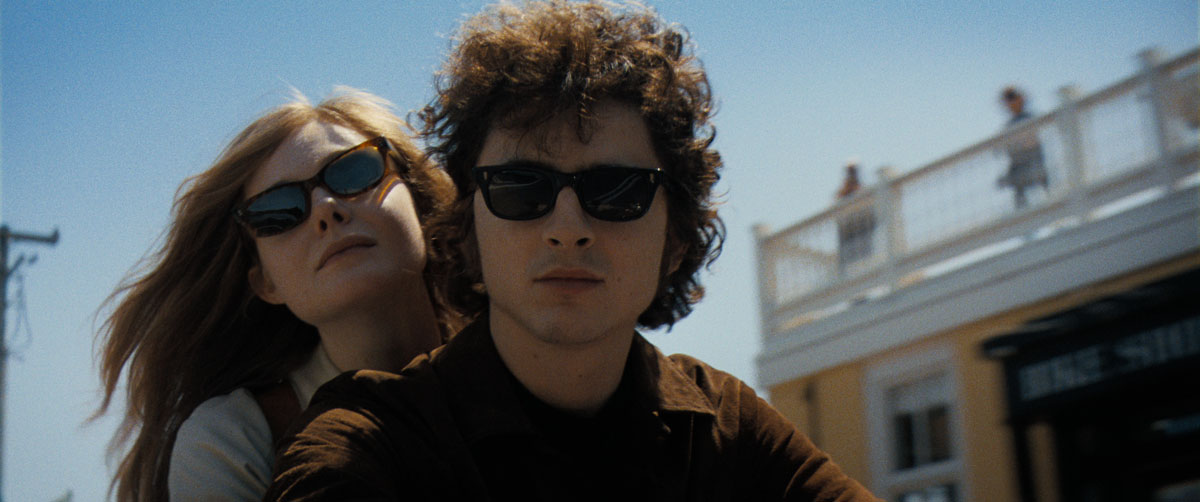
A Complete UnknownElle Fanning and Timothée Chalamet in "A Complete Unknown" (Searchlight Pictures)The film features many scenes of songwriting and performances, to recording sessions, to major concerts. Can you talk about how you incorporated and presented the music in the film? The songs help tell the story. 
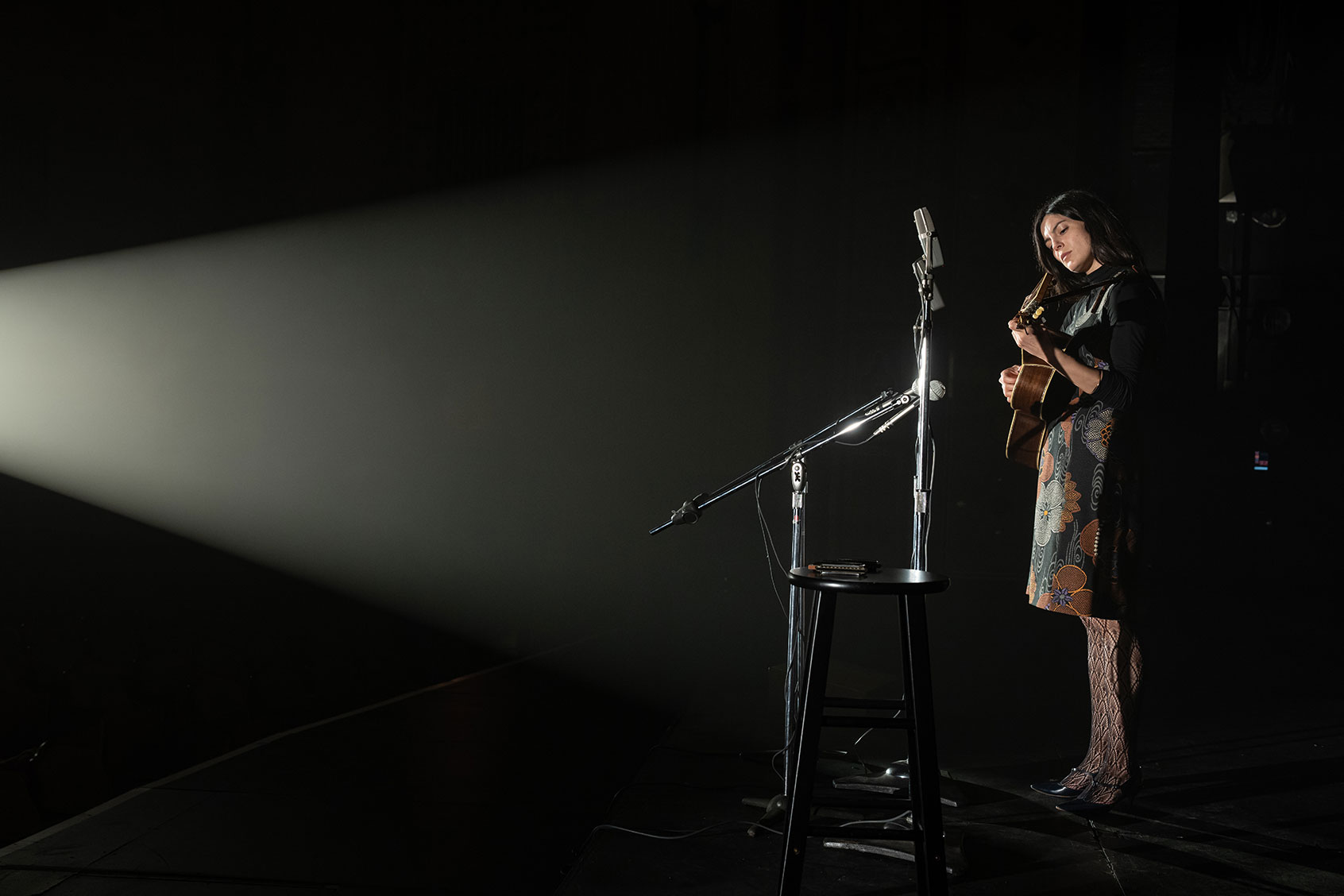
What was so interesting to me was for the way we characterize Bob as “enigmatic and mysterious” — the words we see over and over again. What was interesting to me was as I took his early songs and arranged them in the timeline of the film and see them getting born in relation to the events around him, both political and cultural, but even more specifically to where he was at in his relationships and with the record company and his fans. The songs became much less oblique as you began to feel them in the face of his journey. His first song in the movie is called “Song for Woody,” and it is a song he wrote for Woody Guthrie, and he sings it in the movie to Woody Guthrie. It couldn’t be more straight ahead. His next song, where we see him in his first show at Gertie’s, he sings, “I was young when I left home,” and he was. His songs, “It Ain’t Me, Babe,” and “Don’t Think Twice, It’s All Right,” are commentaries about his relationships and less oblique than we actually give him credit for. 

You shape the film through political messages. There are TV news segments like the Cuban Missile Crisis, as well as personal politics, such as the letters between Johnny Cash and Dylan, that emphasize social change. What can you say about the narrative episodes you included and how you incorporated into the film?  

"The songs became much less oblique as you began to feel them in the face of his journey."

I thought it was so interesting that “Masters of War” came out of him being alone. Sylvie had gone away on this art trip, and he was alone in this apartment during the Cuban Missile Crisis. The writing of potent, really political songs came about as a result of the instability that was happening at that moment. That relationship of the world and what Bob was writing about; his first instinct was not writing political songs at all. It came mostly from Sylvie and her concerns about civil rights etc. Even when he did write political songs, Bob never wades into the specifics other than “The Lonesome Death of Hattie Carroll,” where he’s literally telling the story of some tragedy, he most often sings obliquely. “The answer my friend is blowing in the wind,” which is kind of saying something and nothing at same time. That is part of the appeal of his music.  No matter where you fall in terms of your politics, there is something about the way he pulls you into his story that make you open.

Can you describe how you presented the film visually? There are close-ups in the music scenes, but there Is also tension in your framing — especially in the scenes with Joan and Dylan. You feel the relationship tension with one in the background and one in the foreground the same shot. 

It’s something I learned making “Walk the Line” — and it was the same DP [Phedon Papamichael] and I on that picture. We applied ourselves to this obvious idea that when you are shooting a stage, the logical access would be over the [performers] to the audience and from audience on to the performers at the mic. Those angles exist in the movie, but they are the minority. Almost all of the access is in line in the wings. The audience is visible obliquely off to the side or in raking shots. It’s about feeling really intimate with what it feels like to be someone on the stage. The frontal shots are shot intimately, about 8 to 10 inches away from the actors. The other thing that creates the visuals that you are fond of is the anamorphic framing which is so wide not tall, it allows me to put two heads in a frame and make it feel like two singles because they are so stacked and the rectangle is wide enough to hold two heads in a shot. 

You frame the characters that makes viewers understand their relationship visually, even without dialogue . . .

They are playing this dance of gazes and glances that communicates so much underneath the song. You can’t shoot the song because of the drama; you learn this making action pictures. You can’t just shoot cars going around corners really fast. There has to be some kind of drama and character development going on at the same time. It’s no less different shooting a musical number. It isn’t just that they are singing, but what is going on while they are singing? That’s what makes it so interesting. How the show must go on and how they walked on stage after fighting with their girlfriend, or feeling this guilt or this weight upon them, and they have to press on through that. That makes the songs and the performance of them all the more richer. 

Dylan’s relationship with both Woody Guthrie and Pete Seeger are important to him. Why do you think he behaved the way he did with each man? He is caring towards one and practically betraying the other.

I do not think he betrays Pete Seeger. How? Was he supposed to be betrothed to him forever, and be a mantlepiece for folk music until his death? When did he get married? How could he betray him? He literally picked folk music up and made it gigantic. I don’t doubt that he disappointed Pete Seeger, but that’s different from betraying. 

What observations do you have about Dylan’s relationship with the various women in his life? A love triangle of sorts develops between Dylan, Sylvie and Joan Baez, and it is complicated by his success. The film lets viewers observe and draw their conclusions about how his fame shaped those relationships. Your thoughts?

I was really conscious as we cast both actresses that I wanted very different energies. Elle is a deeply loving sweet person and there is a kind of kindness and understanding and an intellectual voraciousness to her that I felt that could play in Sylvie. That relationship exists before Bob became Bob. I felt in talking with Bob about that relationship that he really cherished it and still does. That relationship is pure and a first love. He grew up with her. 

A Complete UnknownMonica Barbaro in "A Complete Unknown" (Searchlight Pictures)

She broke my heart.

"Historically, Joan was a conqueror romantically also, not just Bob."

Joan is more of a kind of equal and also a powerful attraction and connection but more of a mercenary herself. She is a showbiz professional in the world of folk. She is more seasoned than Bob when the movie begins and has her own set of issues. Bob is uniquely shlumpy and awkward and resistant to standard stage etiquette. And Joan is incredibly presentable and beautiful. She has an angelic voice, and Bob has this craggy kind of Blues man’s croak. Yet Joan doesn’t write songs very often, and Bob is this incredibly prolific songwriter at 19 years of age. They each have something the other admires, and there is even a slight air of competition between them. That doesn’t mean anything bad or good about the relationship; it just makes it entirely different than the one between him and Sylvie. 

Joan gets the song from him because she knows it will be a ticket to success . . .

The song is a bit of a consolation prize because she says, “What is this?” – their relationship, and he says, “I don’t know,” and she moves on and thinks, "Maybe I can get the song." There is a level where I see her a little hurt beneath the bravado because he doesn’t go, “I’m yours forever,” and she is probably used to that. Historically, Joan was a conqueror romantically also, not just Bob.

What did you learn about Dylan making this film? 

The sense that he wanted to make rock and roll and have a band from the beginning. The idea of being alone on stage all his life was not something he anticipated. The way that Pete [Seeger] saw making music, he respected. But he didn’t want to live that way, and never did. It was not something he agreed to in the beginning and changed his mind. We are pretty clear about that. In the first car ride, he is waxing poetic about Johnny Cash and Little Richard, and it makes Pete a little uncomfortable because he’s a purist. 

The other things I learned from Bob were that even the implosion in Newport ‘65 was less a planned performance art implosion and more a Thanksgiving dinner awry among a family that is at the boiling point. That’s how I viewed it. All the cultural reverberations that came from that were assigned to it later, but it was motivated by the emotional family dynamic and that some of the children were outgrowing the parents. It was one of those Thanksgivings that ends up with someone driving off.

What is your favorite Dylan song? And are there any you never want to hear again!?

Can’t answer either. I’m just going to pass. 

“A Complete Unknown” opens Dec. 25 in theaters nationwide

A U.S. manufacturing renaissance? Yes, please, but it won’t be easy

As someone with a tech founder, finance and real estate investing background, I am hopeful that a new U.S. manufacturing renaissance can bring back jobs and investments into parts of America that have been devastated. It will not be a surprise to many that millions of Americans involved in the huge manufacturing sector and states that rely heavily on it will benefit greatly from a renaissance. 

While robotics have advanced, and AI demolishes service industries, the idea of a “lights out” factory — meaning there are no human workers — is not quite there yet. People are still required in these state-of-the-art factories, although admittedly of higher skill and fewer numbers. That could translate to a lot of American jobs if manufacturing returns here. But there are several hurdles and considerations.

Trump has always stated that he intends to pursue tariffs on key imported products unless they build their factories here. Economists say those tariffs will only make products more expensive. But if those manufacturers agree to bring those factories and jobs here, Trump has said the tariffs will not be imposed, effectively making it a bargaining chip. In general, when you increase the input costs of a manufactured product for various reasons, including adding tariffs to components, equipment and materials, the product price will increase. For imported finished goods, once a tariff is applied, the final price will increase — unless in both cases the company decides to absorb these added costs and not pass these on to buyers, but only if their profit margins are sufficient.

Making manufacturing totally based in the U.S. is not that easy. The supply chain for building airplanes, chips, cars and other sophisticated tech products can be a complex network. On the contrary, building these products and moving their supply chains all to one country requires herculean selection, coordination and monitoring of expert suppliers from different parts of the world. It is probably impossible to expect that everything in the downstream (or upstream) supply chain can be manufactured in the U.S. for these products, but the key ones with sophisticated intellectual properties should ideally be in democratic countries who are strong U.S. allies.

To say “Made in the USA” does not mean everything in your cellphone or laptop is actually American made. This is true whether the manufacturing company is Boeing, Ford, Intel or any U.S. company.

We need your help to stay independent

For example, the entire chip industry relies on a company in the Netherlands called ASML. ASML builds equipment that are around as big as a bus, containing advanced robotics and something called Extended UltraViolet Lithography machines that cost a few hundred million dollars per machine. The way these huge machines blast droplets of tin with a pulsed CO2 laser, then direct the EUV laser towards the silicon wafer, is something out of a sci-fi film. These ASML EUVL machines are used by Intel, Samsung, TSMC and others to lay chip patterns of atomic level size. You cannot just copy these EUVL machines, as the technology is extremely complex, and these are restricted for export to certain countries like China.

The trend to offshore manufacturing actually began in the 1970s, with the predominant factor being labor and energy costs. Many Asian and other Third World countries during the 70s, hungry for jobs for their own locals, began to set up tax-free export processing zones. This allowed American (and other) foreign corporations to build factories and operate at cheaper labor, energy and other costs offshore. 

The same is still true today. However, because certain countries such as Taiwan received manufacturing revenues for decades, they actually took what they earned and invested it in technology innovation. So not only is chip manufacturing in Taiwan cheaper, it is actually better and in some cases more advanced. Their famous wafer fabrication company, Taiwan Semiconductor Manufacturing Corporation, runs more advanced wafer fabs at smaller transistor sizes than Intel and other chip giants. This is why Apple and other big gadget manufacturers outsource their chips to them.

TSMC has actually built a wafer fab in Arizona alongside other fabs by Intel, and has started test production this year driven in part by tensions in the South China Sea. However, all is not rosy. Some labor issues have cropped up. Asian engineers and workers have a Confucian attitude towards work and stay very long hours in the plant, in contrast to American workers who are cognizant of their safety, leave and work hours. This is not to say American workers do not work hard. It just points out that money alone is not enough to move manufacturing here.

The U.S. gave American chipmakers significant amounts of capital to innovate and retool for newer semiconductor processes. Intel is a major recipient of the Chips Act. It remains to be seen if it can actually beat newer and faster horses such as Nvidia in Silicon Valley and TSMC and Samsung in Asia. Intel is currently building a state of the art major fabrication facility in Ohio, which has been labeled the Silicon Heartland.

If cost and profitability concerns can be assuaged for investors and the manufacturing companies themselves — meaning the numbers make sense — the implications are enormous. Manufacturing critical products is important for U.S. national security. Outsourcing critical components to countries like China, while it may make sense costwise, is dangerous from a strategic perspective.

The economic benefits, if manufacturing can be brought back here en masse, are enormous. Manufacturing creates direct and indirect (e.g. consultants, suppliers, etc.) labor jobs and supply chain contracts. Communities spring up to create small towns and cities (such as the Silicon Heartland) where there may have been empty land, creating housing, retail, hotel, food, gym, schools, churches, groceries, restaurants, barbershops, salons and other basic infrastructure which creates its own local economy dynamic. Construction jobs are often the start of that boom, as those empty lands need to be surveyed, bulldozed and leveled, buildings and roads constructed, and people and businesses come in to develop a small growing community.

If manufacturing can be brought back to the U.S. in significant numbers, we will definitely be on our way to creating a smart, healthy, more prosperous, vibrant economy. Failing to do so creates the opposite, and creates instead cesspools of hatred, crime, and other downward societal spirals.

Moving on from a “Big Show” Christmas: What my preschooler taught me about holidays and abundance

My 4-year-old daughter Cross already has a better idea of the energy we should put into Christmas gifts than either of her parents combined. 

Reliving childhood holiday memories through the gifts you buy your kid is a guilty parenting pleasure. Yes, you buy the latest, most popular toys; yes, you stay up all night putting those toys together; and yes, you play with them as much as your child does, or maybe more. A guiltier pleasure is attempting to go above and beyond anything your parents may have done for you. In my case, that's an even more ridiculous project — I always felt fortunate enough to get everything I needed in my childhood Christmases — but here we are.

I had an excellent plan. I would teach my child to expect only three gifts for Christmas: something she wants, something she needs, and something educational. In theory, it makes perfect sense. In reality, two things happened I did not game-plan for. The first obstacle was that I didn't know she would be so stinking cute, with a perfect little smile that made me want to spoil her rotten. The second is that putting only three gifts under a family Christmas tree pushes against the gift culture in which I was raised. It's kind of like asking a fish not to swim. I am a product of the Big Show.

Where I'm from, we only live for the Big Show. 

The Big Show is a grand gesture by parents eager to prove how much they love their children. It looks like a gift explosion. Imagine a beautiful Christmas tree, then pile around it so many gifts it's almost impossible to get close to the tree — maybe impossible to even see the tree. Gifts all over the floor, gifts stacked up against the wall, gifts on top of other gifts, gifts on the couch, gifts under the couch, gifts in the kitchen, gifts by the toilet, gifts spilling out of the front door — gifts, gifts, gifts.

The Big Show is a grand gesture by parents eager to prove how much they love their children. It looks like a gift explosion.

This was normal in my childhood household and throughout my neighborhood. We were taught to go all out for Christmas. If it was Christmas and the $600 rent is due, and there was exactly $600 in the bank, then you did not pay the rent. You attempt to create the Big Show. This was Dad Logic 101 when I was growing up: You can talk to the rental office, negotiate with the mortgage company, come up with the extra money in January. You will be able to figure it out. But you cannot recreate Christmas. You cannot attach yourself to the magic of December 25 on December 26. Once it’s gone, it’s gone.

I saw this throughout my childhood. Automobiles were repossessed in the middle of the night. The power was cut off. Creditors made my house sound like a call center with the way they would ring us all day looking for money owed. That money was spent on those gift explosions. When Christmas came around, my dad had no time to chase a good credit score. He was more into chasing that magical moment — the moment when his spouse or child would tear open their dream gift, take a hard pause, and then say something corny like, “This is all I ever needed in life.”

Lucky for Dad, I was always a grateful kid. When he sprang for that Triple F.A.T Goose coat, I made sure I wore it until the feathers burst out. And when the rent money was spent on those Air Jordans, I wore them until my feet grew and busted at the seams. I played with all of my toys: Mr. Potato Head, Connect 4, the Michael Jackson doll. And every time I received a gift that my dad scraped and saved and borrowed to purchase, I always gave him that look and the little speech about how I could not live without the item he fought so hard for me to have.

My father mastered The Big Show and Dad Logic. We never missed a meal and always had a place to stay, while my siblings and I gifted him the smiles he was searching for while spending his last dollars on our gifts, even as he gave Santa, the imaginary king of giving, all the credit. 

Before I had my own child, I wondered why my dad worked so hard just to give credit to Santa. Once I earned the role, I understood that the Big Show was never about getting credit — it was about the smiles on our faces. Our smiles were like a drug to Dad — an unimaginable high that forced him to take risks and allowed him to float through most of the year feeling like the best parent ever. I imagine my father believed that if he messed up a thousand other things, but got Christmas right, then everything else would be OK.

I imagine my father believed that if he messed up a thousand other things, but got Christmas right, then everything else would be OK.

I find myself chasing that same kind of smile when my wife Caron and I began dating. I would do things like charge trips I could not afford or buy the designer items she would randomly mention during our conversations about the things we dreamed of having. Delivering these items made me extremely happy. Receiving those items made her extremely happy. Like me, she is also a very grateful person. But this also pushed us into very dangerous territory. We loved each other dearly, but began letting expensive gifts define that love. She would go over budget to chase the Big Show, just like I would. Just like my dad before us. 

I brought this up in a conversation and we both agreed to scale back. We failed. I also brought up the idea of not spoiling our daughter by buying a mountain of toys, promising to stick to the three-gift rule. We failed at that as well. We didn't even beat ourselves up over it, but we vowed to stick to the rules in years to come. That future came quicker than I could have imagined. It was our 4-year-old daughter who stepped up and ended the Big Show for us.

One night over dinner, we asked her what she wanted for Christmas. Cross tilted her little head and raised an eyebrow. “A Moana baby doll and a Moana dress,” she said. 

When my daughter wakes up on Christmas Day without an American Girl doll, I can let someone else take the blame.

She did not ask for a house full of gifts, a new Power Wheels truck, a bicycle, 60 Barbie dolls, a Barbie mansion, a Barbie automobile tire rotation, a toddler kitchen, a toddler hair studio, or any of the other gifts I probably would have purchased to make the Big Show happen. She was simple and to the point, and we listened to her.

A week after Cross gave us her two-item obtainable list, she added an American Girl doll. I whipped out my phone and went to the website ready to order because I'm such a sucker. My wife stepped in and told her, “You have a list. You can get that for your birthday next month.”

Cross did not fight or complain — she simply said OK. She is way smarter than me and understands that she doesn't need any and every thing to feel loved. Just her family.

In these scary times, when it's easy for a parent to feel like you're not doing enough or you're doing too much for the children, I'm happy that my child understands going overboard isn't a sign of love. She has indirectly taught Caron and I to focus on what really matters, like our health, well-being and commitment to our family, and to strive for an abundance of love over an abundance of gifts.

I know now I don't have to hold myself accountable for every magic moment like my dad did. When my daughter wakes up on Christmas Day without an American Girl doll, I can let someone else take the blame. This Christmas, let’s drag Santa through the dirt instead, and maintain our good names.  

Sugar is irresistible like a drug. Is it actually addictive?

We’ve all said it, even if we regret it: “There’s always room for dessert.” Turns out, there is a scientific explanation for why we can consume so many sweets compared to other types of foods with a similar number of calories. For sweets, the threshold for satiety, which is triggered by the human appetite center in the ventromedial hypothalamus, is higher than any other flavor stimulants — meaning we can eat many more sugary foods than salty or savory ones.

Essentially, sugar is a vehicle that makes you able to eat more. And because sugars are added in everything from salad dressings to pasta sauce to bread and other processed foods, people tend to eat more of many things than they normally would — without that sugar throwing their satiety center out of whack, said Dr. D. L. Katz, the founding director of Yale University’s Prevention Research Center.

“Having the sugar there is a pretty reliable way of getting people to eat more of it than they otherwise would, to run out sooner, and to go back to the store and buy more — and if you're selling the stuff, that's a great formula,” Katz told Salon in a phone interview. “The result is that sugar is in everything.”

We like sugar so much that we often call foods steeped in it "addictive" or "like crack," despite this comparison having little to do with substance use disorders. Or is it relevant after all? Is sugar essentially a drug?

While sugar is not classified as a drug in the traditional sense, scientific evidence suggests that its effects on the brain's reward system and dopamine receptors are similar to those of addictive drugs. Of course, just because something acts on the same receptors does not make it a one-to-one comparison to a drug. For example, nicotine is a drug that interacts with acetylcholine receptors, but so does choline, an essential nutrient that is not considered a drug.

The American Psychiatric Association (APA) defines substance use disorder as a repeated and uncontrollable pattern of substance use that causes impairment or distress. A substance is considered addictive if a person can build up a tolerance to a drug and experiences withdrawal when not using it. Although sugar is not included in the APA’s list of substances, some argue that sugar should be considered a drug, and various countries have moved to restrict its consumption by implementing taxes or changing dietary guidelines. 

"[Sugar] seems to be different in that it is acting more like a drug in the brain than it is a food."

“What we've been able to show over the past several years is that, yes, sugar could meet the criteria for being an addictive substance,” said Dr. Nicole Avena, a neuroscience professor at Mount Sinai who recently wrote a book on sugar addiction. “It can produce signs of craving and withdrawal; it can produce alterations in behavior, and people have this kind of loss of control [with sugar] that comes along with substance use disorder in many cases.”

In rodent studies, sugar consumption has been shown to release chemicals in the brain similar to other addictive substances like alcohol or nicotine, including the release of dopamine and endogenous opioids. As a result, eating sugary foods feels pleasurable, encouraging us to do more of it.

“Traditionally, when you're eating food, it's not going to release dopamine,” Avena told Salon in a phone interview. “[Sugar] seems to be different in that it is acting more like a drug in the brain than it is a food.”

Interestingly, some studies have shown that people with an allele to the dopamine D2 receptor gene are more likely to develop a substance use disorder, including a stronger affinity for sugar. This predisposition is also reflected in research that shows people with substance use disorder are more likely to consume more sugary foods in their diet.


Want more health and science stories in your inbox? Subscribe to Salon's weekly newsletter Lab Notes.


It has been hypothesized that the reason our reward system is triggered by sugar is rooted in evolutionary biology. For our ancestors gathering food to survive, bitterness in food often signaled that it was toxic, while sweet foods like fruits — or breast milk, the first food most of us ever tried — were safe. 

“These pathways were built to reinforce behaviors that favored survival,” Katz said. “We still have the same cravings we had in the Stone Age, but they’re not helpful now.”

Children have a higher threshold for saccharine foods, which is why sugar-laden cereals and sweets are often targeted toward kids, Avena said. Because of the prevalence of sugar in the food supply, it’s easy for them to already develop a high tolerance for sugar before they reach adulthood, she added.

While excessive consumption of sugar has been linked to health problems like eating disorders, obesity and Alzheimer's disease, whether sugar is harmful depends on the type and dose. Glucose, a sugar naturally circulating in the body, is so important that if we do not consume enough of it, the body will make its own. Fructose is also naturally found in honey and fruits. But added sugars like sucrolose and high fructose corn syrup are often composed of glucose and fructose as free molecules and are primarily found in processed foods or commercially produced sugar cane. 

“The only place you're going to get pure fructose is in a fruit — and eating whole fruit is good for you, and actually reduces the risks of diabetes and obesity,” Katz said. “Otherwise, you're getting fructose in combination with glucose for the most part.”

Altogether there are more than 60 different variants of added sugars in the food supply, and people in the U.S. consume double or triple the recommended amount of sugar in their day. Studies show this overconsumption of sugar is directly linked to an increased risk of obesity, heart disease, type 2 diabetes and non-alcoholic fatty liver disease.

We need your help to stay independent

“Essentially, the more of it you put into the food supply, the more of it people need to feel satisfied, and that becomes a toxic spiral, where the dose goes up and up,” Katz said. “Then the excess of sugar that isn't needed for fueling activity is just empty calories triggering an insulin response, leading to inflammation, extra calorie consumption, weight gain, increasing the risk of insulin resistance and type 2 diabetes, and all the rest.”

However, breaking a dependency to sugar is something each person can do. Taste preferences can change, and even after a few weeks without sugar, a person’s tolerance can return to baseline. The debate over sugar being a drug or addictive rages on, but one thing they have in common is that people can consume either responsibly. Fentanyl is safely used in hospitals every day and sugar can be part of a balanced diet.

“If you do it incrementally, you actually can train your taste buds to prefer a whole different suite of foods,” Katz said. “You can love the food that loves you back.”

CORRECTION: This article originally stated that HFCS is fructose and glucose chemically bonded together, but it is actually a mixture of free molecules.

Ozempic could curb our shopping sprees. That doesn’t mean we should go there

These days, it feels like everyone is using Ozempic. The results have been astonishing: The average person taking Ozempic loses about 15 pounds after three months and 27 pounds after six months.

But now it seems there are additional benefits besides weight loss. News reports from The Atlantic and NPR found that Ozempic could curb compulsive habits like online shopping, nail biting, gambling and more. 

So if you have a shopping addiction or compulsive habit, could Ozempic help? It might help those struggling with other addictions, but consider how the drug works, its cost and what happens when you stop taking it. 

How does Ozempic work?

From the outside, Ozempic seems to be a miracle drug. But here’s how it works: When you indulge in something rewarding, your brain releases dopamine, a feel-good chemical. So your brain tells you to take another bite.  

If you struggle with any kind of addiction, you probably know that the urge to use — whether it’s eating a brownie, popping a pill or adding to a shopping cart — starts with an uncomfortable feeling or a sense that you need something right now. Your brain signals you that something is wrong and your automatic response — whatever that is — kicks in. 

We need your help to stay independent

“For individuals with compulsive shopping tendencies, the act of purchasing can create a dopamine surge similar to eating a favorite food or engaging in other pleasurable activities,” said financial therapist Dr. Alex Melkumian, Psy.D, LMFT.

Some patients who are on Ozempic for weight loss or diabetes management have discovered that it also curbs their shopping habits. That’s because what Ozempic does isn’t necessarily limited to food cravings. It could apply to many types of cravings.

Can Ozempic stop addiction?

People who have compulsive food cravings often describe hearing a constant or semi-constant background voice telling them to eat. When they take a drug like Ozempic, the food cravings cease or become quieter. However, that might not be the only result.

Patients taking Ozempic for weight loss or diabetes management have discovered fewer cravings for other addictive behaviors

Patients who are taking Ozempic for weight loss or diabetes management have also discovered fewer cravings for other addictive behaviors. 

“The chatter, often referred to as ‘food noise,’ is something we frequently hear about, but what I have noticed is that other rumination-related behaviors also seem to take a back seat,” said psychotherapist Rachel Goldberg, LMFT, PMH-C.

Some anecdotal data has found that patients who use Ozempic may also find themselves stopping smoking or using drugs less – even if that’s not the reason they were initially prescribed the drug.

What happens after using Ozempic?

One of the most noticeable problems with Ozempic is that — like any drug — it only works while you’re on it. If you stop taking the drug, then you may notice those cravings come back.

And since Ozempic has not been studied and approved for use in other addictive behaviors, it’s hard to say what will happen if you’re taking Ozempic for a shopping addiction and stop using it. If you quit using the drug and the craving comes back, you’ll need another tool to help you cope.

"Long-term treatment often benefits from combining pharmacological support with therapeutic interventions"

“While these medications can help reduce urges, long-term treatment often benefits from combining pharmacological support with therapeutic interventions, such as cognitive-behavioral therapy or financial therapy, to address the underlying emotional drivers and build sustainable habits,” Melkumian said.

The cost of Ozempic

Like any prescription drug, the downside to a new drug like Ozempic is the cost. If you have insurance, your monthly cost for Ozempic could be as low as $25. That also depends on your particular insurance. 

However, if you don’t have insurance — or your insurance provider doesn’t cover Ozempic — then you could pay up to $1,000 a month. You may be able to find coupons and discount programs to lower the cost, but many of these require that you meet certain income criteria or receive other types of government assistance. 

If you truly have a shopping addiction, the money you save may outweigh the cost of Ozempic. Unfortunately, getting a prescription for Ozempic or another semaglutide drug might be harder than it seems if you don’t have diabetes or need to lose weight.

If you’re struggling with compulsive spending, talking to a therapist specializing in addiction can be helpful. You can find a list of qualified therapists through Psychology Today; filter for addiction specialists.

“What’s important is getting to the root of the issue because while therapists can offer coping strategies and ways to pause spending, the core issue lies deeper,” Goldberg said. “If the root cause isn't addressed, even with tools in place to control the behavior, the person may eventually find other ways to act out the compulsion.”

NASA spacecraft touches Sun’s atmosphere, breaking record

The concept of touching the Sun can be traced back to the ancient Greek myth of Icarus, but scientists at NASA have turned that idea into a reality. On Dec. 24th, their Parker Solar Probe managed to travel to just within 3.86 million miles (6.1 million kilometers) of the Sun’s surface, a new record. The probe, which is roughly the size of a small car, has now become the human-made object to come closest to touching the Sun among everything our species has created.

“Moving at up to 430,000 miles per hour (692,017 km per hour), the spacecraft endures temperatures up to 1,800 degrees Fahrenheit (982 degrees Celsius) as it flies through the tenuous outer atmosphere of the Sun called the corona to help scientists better understand our closest star,” the scientists write on their website. If the probe were to travel on Earth at that same velocity, it could move from Los Angeles to New York City in only 20 seconds.

Overall, this is the 22nd time the Parker Solar Probe has made a close approach to the Sun. According to the program director, Arik Posner, the solar explorations are part of NASA’s broader ambition to reach new frontiers in space exploration.

“This is one example of NASA’s bold missions, doing something that no one else has ever done before to answer longstanding questions about our universe,” Arik told Earth.com. Because the probe is currently very close to the Sun, scientists are not able to communicate with it, but they hope to receive a beacon tone on Dec. 27th to confirm the probe has survived.

Oh the humanity! “Look Back” yells from the rooftops why art needs to exist in the age of AI

“Why do you draw?”

A seemingly innocuous question that in truth carries immense weight.

It’s the kind of question that you can brush off with a casual wave of the hand, or it can leave you speechless, unable to even find the words.

Art isn’t numbers on a spreadsheet. It’s life itself.

In “Look Back,” the film based on Tatsuki Fujimoto’s one-shot manga, two teenage girls bond over their love of creating manga. Fujino handles the characters and story, while Kyomoto takes care of the background art. They make a powerful team. When Kyomoto asks Fujino why she draws, we don’t get an explanation. We don’t need it. We’ve seen it. Every moment the pair shares with each other is why. Seasons change outside Fujino’s window as she and Kyomoto work on their first manga together. The duo quietly scribbles away, creating in the presence of one another, as pages of manuscript pile up. We see that life and art are intimately linked. That creation is born out of the wonder, the mystery and of course, the tragedy of life.

This is not a review of “Look Back.” Enough beautiful words have already been said about the film, and it is most certainly one that any fan of anime, manga, cinema or art in general should see.

But it is that simple-but-not question, “Why do you draw?” asked by Kyomoto to Fujino, that echoed in my head, clanging and clattering in the space between my ears in the days and weeks after I saw “Look Back.” I think it struck a chord because it increasingly feels like the creative process, and deeper and more troubling than that, humanity itself, is under attack

There is a contingent of craven capitalists who have slowly turned the entertainment industry into just another financial market. Moving into senior positions at major studios in film, television and video games, these ghouls seek only to maximize profit. The art at the center of these industries is, to many of these bigwigs, a means to an end. That end being stock prices and shareholder satisfaction. It’s why we got “Inside Out 2” and “Moana 2” this year. Unnecessary sequels that a bunch of suits knew would rake in the dough. Although talented people worked on both, when art is kept within the confines of a giant, soulless corporation, art (and the people creating it) is held captive by the profit motive. Money becomes the mantra. When someone’s life’s work, their passion, their expression of creativity, is diminished to merely being seen as content, as numbers on an earnings report, it is an attack on art.

This year, “Coyote vs. Acme” was shelved and seems destined to become lost media, buried before even being given a chance for audiences to see it. The hard work of hundreds of people, a mere tax write-off under the mighty pen of Warner Bros. Discovery CEO David Zaslav. One of my favorite shows from last year, “Scavengers Reign,” was unable to avoid the axe. Despite winning an Emmy (for background design) and being nominated for outstanding animated program, the show didn’t bring in the viewer hours so it was unceremoniously thrown on the heap.

Critical acclaim or simply letting art exist in the world and be received by the people (with no concern for the size of the audience) aren’t things that Zaslav and his ilk consider. Imagine if “Mad Men” or "The Sopranos" was cut after its first season because target demos, algorithm data and KPIs just didn’t support renewal. In 2024, the only concern is that the numbers look good, so that CEOs can line their pockets with millions in compensation. And if recent reaction to UnitedHealthcare CEO Brian Thompson’s murder is anything to go by, the people are getting a little fed up with the unfettered greed of the C-suite.     

Art isn’t numbers on a spreadsheet. It’s life itself.

We need your help to stay independent

“Look Back” implores the viewer to see how art and life are intertwined. Every adventure that  Fujino and Kyomoto go on becomes the inspiration for another manga. They visit the ocean, and that leads to the duo writing “The Sea Cities.” Looking for bugs in summer turns into “The Cicada Humans.” A trip to the aquarium yields “The Man Who Ate the Crab.” The pair experiences life, and their art echoes those experiences. Reverberating through the creative process, those echoes twist and distort just enough to give the art they produce a fantastical fiction, but at its core, their art is quite literally their lives.

The works of Dickens capture Victorian London so well because he lived it; he worked in the warehouses, and his worldview was shaped by these formative experiences. Nintendo’s Shigeru Miyamoto explored forests and hunted for bugs as a child, and wanted to recreate that feeling in a video game, eventually leading to the creation of “The Legend of Zelda.” Hayao Miyazaki’s works are tinged with autobiographical moments, such as his mother’s hospitalization with tuberculosis — an element of both “My Neighbor Totoro” and “The Wind Rises” — or his father building rudders for fighter planes during World War II, a piece of his own history we see alluded to in the Oscar-winning “The Boy and The Heron.” And for Miyazaki in particular, art and life are nearly one and the same as we come to learn in this year’s documentary that sneakily landed on Max this summer, “Hayao Miyazaki and The Heron.”

The documentary chronicles the entire production timeline for “The Boy and The Heron,” starting with Miyazaki announcing his retirement in 2013 through to the film’s Oscar win this year. The iconic director has been the subject of a few documentaries in the past, but in those, Miyazaki always remained guarded, never really letting the viewer understand the man we have so endlessly mythologized. His politics are evident in the films he has made over the past 40 years, but what motivates this man, now nearly 84 years old, to create the worlds of “Nausicaa,” “Castle in the Sky” or the Great Uncle’s tower in “The Boy and The Heron”? Much like Fujino in “Look Back,” the answer seems to be human connection. 

Throughout “Hayao Miyazaki and The Heron” there is an urgency to Miyazaki’s work. People close to him are passing away; there is guilt and there is sadness. “Why am I still here? Why am I the one that lived?” he wonders aloud. Miyazaki “reeks of death” like Mahito the titular boy of the film. But he storyboards furiously, creating characters based on the people he has lost. Michiyo Yasuda, the color designer on Miyazaki’s films at Studio Ghibli, passed away in 2016, but she appears in the documentary’s footage like a ghost, a vision of the past that haunts the present day Miyazaki. She was the one who told him to make another film, and he felt a sense of obligation to do it. He creates Kiriko in “The Boy and The Heron” based on Yasuda.

But no one looms larger than Isao Takahata, Studio Ghibli co-founder and director, who passed away in 2018. And it's in their relationship where it becomes clear that nearly everything Miyazaki has ever made has been driven by the man he affectionately calls Pak-san.  

Pak-san, Pak-san, Pak-san. A clap of thunder rumbles in the distance while on a walk. “That’s Pak-san.” When Miyazaki is asked if he ever dreams, he responds “Only about Pak-san.” A missing eraser is Pak-san playing a trick on him.

Studio Ghibli producer Toshio Suzuki says that “Miyazaki idolized Takahata, but it was always one-sided.”   

The Boy and the HeronThe Boy and the Heron (Hayao Miyazaki/Studio Ghibli)

Miyazaki agonizes over the character of the Great Uncle who has built the fantastical world of the tower in “The Boy and The Heron.” The character is Pak-san. In this one-sided relationship, made even more so by the divide between the living and the dead, Miyazaki is determined to show the world who Takahata was. He wants people to know what this man meant to him. The man who was his idol, his rival, his friend.

The documentary cuts to a particularly powerful quote from Takahata back in the ‘80s, talking about Miyazaki, where he says, “I’d like to see him make all kinds of films. There are things he hasn’t shown me. I hope to see them one day.” The interview cuts to a wide shot showing Miyazaki beside him with a beaming smile, “Really?” he asks Takahata gleefully.

This is how art comes to be. For Miyazaki. For Fujino in “Look Back.” It is driven by the desire for human connection, by wanting to express one’s self to someone, to honor someone who has passed to ensure that they are remembered. Which is why when AI software is used to generate an image, or write a story, it is so revolting. You can’t tell AI to create the Great Uncle. You can’t tell it to create an old man who kinda looks like a wizard who was the whole world to me and everything I did was for him and all I wanted was for him to see my films and enjoy them and I want people to know that. It can’t convey that level of emotional depth, or any emotional depth. AI is mere facsimile (and poorly done at that), and yet, it has been integrated into nearly every piece of technology creating nothing but slop. 

AI is a threat to art, a threat to culture, a threat to humanity itself. How far are we willing to go to utterly dehumanize ourselves? Late capitalism is already turning us away from one another, with the convenience of technology isolating us, keeping us from making a connection to someone. Companies like Disney are fully on board with AI, where acting in a “responsible way” means, “How much can we get away with and not pay people for?” So don’t be surprised when a round of layoffs is announced, so more money can be funneled up to executives at the top. Companies like X are training their AI by using (read: stealing) art uploaded to the platform by artists. And it would be easy to write a whole thesis on how the demands of AI usage and development is causing emissions at companies like Microsoft to rise at a staggering rate, decimating any plans of reaching previously set carbon-neutrality goals. This AI slop, this soulless mimicry of human life, is accelerating the planet’s demise. AI is anti-human in all facets.

How far are we willing to go to utterly dehumanize ourselves?

2024 felt like a year where, more than ever before, art was under attack. From corporate fat cats cutting jobs to AI software to humanities programs getting slashed in higher education, the assault on engaging with our world, and on engaging with art is in full effect. It is deeply distressing. 

But 2024 also produced a film that tells us why art needs to exist, why it is so special, and what it means to be human. “Look Back” yells from the rooftops that art is tough, it is work, but the reward is it connects us like nothing else can. 

Look BackLook Back (Tatsuki Fujimoto/Shueisha

Art is beautiful because of the humanity it contains within it. There is energy in a work of art that cannot be quantified, cannot be calculated, cannot be replicated by a machine. It reflects us, it connects us, it bears all of our tragedy, all of our joy. 

I’m hardly the best writer out here. There are people who write much more eloquently than I do. I admire these writers greatly. But I just want to connect. I want someone to read my words. Someone. Anyone. Even if it just ends up being my family or friends. I have entire worlds inside my head that I want others to experience the way I see them in my mind’s eye. No AI program can scrape these worlds accurately out of my head. There are so many thoughts and ideas in here that I want to share. I hope that my words make someone feel something. I just have to do the work to get them onto the page. That, to me, is something very worth the effort. 

Art is what makes us human, so why would we want a robot to do it for us?

I just want to connect. To prove that I’m alive.

I’m not a machine. 

The Justin Baldoni fallout: What he’s facing after Blake Lively’s bombshell lawsuit

Justin Baldoni is facing the swift fallout of a lawsuit Blake Lively has filed against him.

Earlier this year, the release of "It Ends With Us" inspired whispers, rumors and online theories surrounding the co-stars' puzzling behavior by never appearing together while doing promotion for the film or even on the red carpet for the premiere. Fast-forward to Friday, Dec. 20, Lively filed a lawsuit that alleges sexual misconduct on set and a Baldoni-led effort to destroy Lively's reputation. 

Directed by Baldoni, "It Ends With Us" is the adaptation of Colleen Hoover's bestseller that explores the blossoming relationship between a florist Lily (Lively) and a neurosurgeon Ryle (Baldoni) that slowly unravels into an abusive relationship. While shooting the movie, Lively's complaint revealed a troubling portrait of Baldoni and producer Jamey Heath allegedly crossing the actress' personal and professional boundaries on set. Baldoni's legal camp has quickly fired back, claiming Lively's allegations are "false, outrageous and intentionally salacious with an intent to publicly hurt."

Following the complaint's filing, a New York Times exposé illuminated an alleged public relations smear machine at work to elevate Baldoni and cut Lively down. Since then, Baldoni has experienced pushback for his alleged behavior with many distancing themselves from him.

First, talent agency WME dropped Baldoni the same day Lively's lawsuit was filed, the Daily Beast reports. Lively is also a client of WME and continues to be represented by the agency.

Also, Vital Voices rescinded their Voices of Solidarity Award given to Baldoni on Dec. 9 to honor “remarkable men who have shown courage and compassion in advocating on behalf of women and girls."

On Monday, Dec. 23 the organization took to Instagram to address the controversy swirling around Baldoni. In a statement, Vital Voices said, "We learned through news reports about a lawsuit brought by Blake Lively against Mr. Baldoni, his publicists, and others that is disturbing and alleges abhorrent conduct.

"The communications among Mr. Baldoni and his publicists included in the lawsuit — and the PR effort they indicate — are, alone, contrary to the values of Vital Voices and the spirit of the Award. We have notified Mr. Baldoni that we have rescinded this award,” it read.

https://www.instagram.com/p/DD74TEHS6Ug/?utm_source=ig_embed&ig_rid=bc4a941d-632a-4b80-b4b2-18f4d08eda0f

Meanwhile, Baldoni's podcast "Man Enough," co-hosted by Heath and Liz Plank also seems to be suffering from the fallout of the complaint. The podcast, produced by Wayfarer Studios, the company responsible for "It Ends With Us," focuses on "what explores what it means to be a man today and how rigid gender roles have affected all people."

Plank, a former journalist and author, has officially announced her departure from the podcast after co-hosting it for three years.

In a statement posted to her Instagram on Monday, she said, “I’m writing to you today to let you know that I have had my representatives inform Wayfarer that I will no longer be co-hosting 'The Man Enough' podcast."

Plank concluded, "I will have more to share soon as I continue to process everything that has happened. In the meantime, I will continue to support everyone who calls out injustice and holds people standing in their way accountable."

https://www.instagram.com/p/DD7_B3VSyDH/?img_index=3

We need your help to stay independent

Baldoni is also facing another legal dispute with his former publicist, Steph Jones, who has sued Baldoni, his company and his publicity team including her former employee Jennifer Abel and publicist Melissa Nathan. Jones has accused Baldoni of breaching their contract, which requires him to pay $25,000 per month.

Only a few months into a yearlong contract, she claims that Baldoni dropped Jones' firm in August following Abel's departure from Joneswork. Baldoni then retained Nathan's company, TAG PR. Jones is also alleging that Abel and Nathan orchestrated the smear campaign against Lively behind her back and attempted to pin that fallout on her, Variety reported Tuesday.

LA County warns bird flu is killing cats as human cases top 65 nationwide

The Los Angeles County Department of Public Health has issued a warning about bird flu, caused by the virus H5N1, that is killing domestic cats. On Dec. 20, the agency reported that five, indoor-only cats died after consuming raw milk that was part of a recall. The agency is also investigating a separate case, also in LA County, concerning a cat that has "tested presumptive positive for H5 bird flu after consuming two different brands of raw pet food composed of raw poultry and raw beef."

“The risk of H5 bird flu remains low in Los Angeles County, but these confirmed cases of the virus in pet cats are a reminder that consuming raw dairy and meat products can lead to severe illness in cats," said Dr. Barbara Ferrer, director of the Los Angeles County Department of Public Health in a press release. “To avoid the spread of disease, including H5 bird flu, we strongly encourage residents and their pets to avoid raw dairy and undercooked meat products, limit contact with sick or dead animals, report sick or dead birds and keep pets or poultry away from wild animals and birds.”

According to the Los Angeles Times, the cats’ symptoms appeared between 8 to 12 days after consuming the raw milk. They had signs of liver damage and yellowing of the eyes and gums. 

This isn’t the first time cats have been susceptible to death after being infected with bird flu. Last year, over half of a cluster of cats that sporadically died in Poland were infected with the H5N1 bird flu. Experts previously told Salon in June that when cats die from bird flu, it can be grisly. They experience fever, loss of appetite and severe respiratory and neurological symptoms that are unpleasant and painful.

The news about the cats in Los Angeles comes as the bird flu situation continues to escalate, with more human cases being reported in addition to animals. According to the Centers for Disease Control and Prevention (CDC), there have been 65 confirmed human cases of bird flu during the 2024 outbreak. Los Angeles County also confirmed this week the first human case of bird flu, an adult public health officials say who was exposed to infected livestock. Meanwhile, the first human case of bird flu was also reported in Iowa. And last week, the first severe case of bird flu was reported in Louisiana. While there is no evidence that virus is spreading from human to human — a key factor of another pandemic like COVID-19 — with each infection, including those in domesticated animals, brings us closer to such an outcome.

The bird flu crisis began several years ago but ramped up last April when dairy cows became infected. Since last spring, public health officials have publicly criticized the Biden administration for not properly handling and monitoring the situation, but as Salon recently reported, they don’t have faith that the situation will improve under a Trump administration.

How America lost control of bird flu, setting the stage for another pandemic

Keith Poulsen’s jaw dropped when farmers showed him images on their cellphones at the World Dairy Expo in Wisconsin in October. A livestock veterinarian at the University of Wisconsin, Poulsen had seen sick cows before, with their noses dripping and udders slack.

But the scale of the farmers’ efforts to treat the sick cows stunned him. They showed videos of systems they built to hydrate hundreds of cattle at once. In 14-hour shifts, dairy workers pumped gallons of electrolyte-rich fluids into ailing cows through metal tubes inserted into the esophagus.

“It was like watching a field hospital on an active battlefront treating hundreds of wounded soldiers,” he said.

Nearly a year into the first outbreak of the bird flu among cattle, the virus shows no sign of slowing. The U.S. government failed to eliminate the virus on dairy farms when it was confined to a handful of states, by quickly identifying infected cows and taking measures to keep their infections from spreading. Now at least 875 herds across 16 states have tested positive.

Experts say they have lost faith in the government’s ability to contain the outbreak.

“We are in a terrible situation and going into a worse situation,” said Angela Rasmussen, a virologist at the University of Saskatchewan in Canada. “I don’t know if the bird flu will become a pandemic, but if it does, we are screwed.”

To understand how the bird flu got out of hand, KFF Health News interviewed nearly 70 government officials, farmers and farmworkers, and researchers with expertise in virology, pandemics, veterinary medicine, and more.

Together with emails obtained from local health departments through public records requests, this investigation revealed key problems, including deference to the farm industry, eroded public health budgets, neglect for the safety of agriculture workers, and the sluggish pace of federal interventions.

Case in point: The U.S. Department of Agriculture this month announced a federal order to test milk nationwide. Researchers welcomed the news but said it should have happened months ago — before the virus was so entrenched.

“It’s disheartening to see so many of the same failures that emerged during the covid-19 crisis reemerge,” said Tom Bollyky, director of the Global Health Program at the Council on Foreign Relations.

Far more bird flu damage is inevitable, but the extent of it will be left to the Trump administration and Mother Nature. Already, the USDA has funneled more than $1.7 billion into tamping down the bird flu on poultry farms since 2022, which includes reimbursing farmers who’ve had to cull their flocks, and more than $430 million into combating the bird flu on dairy farms. In coming years, the bird flu may cost billions of dollars more in expenses and losses. Dairy industry experts say the virus kills roughly 2% to 5% of infected dairy cows and reduces a herd’s milk production by about 20%.

Worse, the outbreak poses the threat of a pandemic. More than 60 people in the U.S. have been infected, mainly by cows or poultry, but cases could skyrocket if the virus evolves to spread efficiently from person to person. And the recent news of a person critically ill in Louisiana with the bird flu shows that the virus can be dangerous.

Far more bird flu damage is inevitable, but the extent of it will be left to the Trump administration and Mother Nature.

Just a few mutations could allow the bird flu to spread between people. Because viruses mutate within human and animal bodies, each infection is like a pull of a slot machine lever.

“Even if there’s only a 5% chance of a bird flu pandemic happening, we’re talking about a pandemic that probably looks like 2020 or worse,” said Tom Peacock, a bird flu researcher at the Pirbright Institute in the United Kingdom, referring to covid. “The U.S. knows the risk but hasn’t done anything to slow this down,” he added.

Beyond the bird flu, the federal government’s handling of the outbreak reveals cracks in the U.S. health security system that would allow other risky new pathogens to take root. “This virus may not be the one that takes off,” said Maria Van Kerkhove, director of the emerging diseases group at the World Health Organization. “But this is a real fire exercise right now, and it demonstrates what needs to be improved.”

A Slow Start

It may have been a grackle, a goose, or some other wild bird that infected a cow in northern Texas. In February, the state’s dairy farmers took note when cows stopped making milk. They worked alongside veterinarians to figure out why. In less than two months, veterinary researchers identified the highly pathogenic H5N1 bird flu virus as the culprit.

Long listed among pathogens with pandemic potential, the bird flu’s unprecedented spread among cows marked a worrying shift. It had evolved to thrive in animals that are more like people biologically than birds.

After the USDA announced the dairy outbreak on March 25, control shifted from farmers, veterinarians, and local officials to state and federal agencies. Collaboration disintegrated almost immediately.

Farmers worried the government might block their milk sales or even demand sick cows be killed, as poultry are, said Kay Russo, a livestock veterinarian in Fort Collins, Colorado.

Instead, Russo and other veterinarians said, they were dismayed by inaction. The USDA didn’t respond to their urgent requests to support studies on dairy farms — and for money and confidentiality policies to protect farmers from financial loss if they agreed to test animals.

The USDA announced that it would conduct studies itself. But researchers grew anxious as weeks passed without results. “Probably the biggest mistake from the USDA was not involving the boots-on-the-ground veterinarians,” Russo said.

Will Clement, a USDA senior adviser for communications, said in an email: “Since first learning of H5N1 in dairy cattle in late March 2024, USDA has worked swiftly and diligently to assess the prevalence of the virus in U.S. dairy herds.” The agency provided research funds to state and national animal health labs beginning in April, he added.

The USDA didn’t require lactating cows to be tested before interstate travel until April 29. By then, the outbreak had spread to eight other states. Farmers often move cattle across great distances, for calving in one place, raising in warm, dry climates, and milking in cooler ones. Analyses of the virus’s genes implied that it spread between cows rather than repeatedly jumping from birds into herds.

Milking equipment was a likely source of infection, and there were hints of other possibilities, such as through the air as cows coughed or in droplets on objects, like work boots. But not enough data had been collected to know how exactly it was happening. Many farmers declined to test their herds, despite an announcement of funds to compensate them for lost milk production in May.

“There is a fear within the dairy farmer community that if they become officially listed as an affected farm, they may lose their milk market,” said Jamie Jonker, chief science officer at the National Milk Producers Federation, an organization that represents dairy farmers. To his knowledge, he added, this hasn’t happened.

Speculation filled knowledge gaps. Zach Riley, head of the Colorado Livestock Association, said he suspected that wild birds may be spreading the virus to herds across the country, despite scientific data suggesting otherwise. Riley said farmers were considering whether to install “floppy inflatable men you see outside of car dealerships” to ward off the birds.

Advisories from agriculture departments to farmers were somewhat speculative, too. Officials recommended biosecurity measures such as disinfecting equipment and limiting visitors. As the virus kept spreading throughout the summer, USDA senior official Eric Deeble said at a press briefing, “The response is adequate.”

The USDA, the Centers for Disease Control and Prevention, and the Food and Drug Administration presented a united front at these briefings, calling it a “One Health” approach. In reality, agriculture agencies took the lead.

This was explicit in an email from a local health department in Colorado to the county’s commissioners. “The State is treating this primarily as an agriculture issue (rightly so) and the public health part is secondary,” wrote Jason Chessher, public health director in Weld County, Colorado. The state’s leading agriculture county, Weld’s livestock and poultry industry produces about $1.9 billion in sales each year.

Patchy Surveillance

In July, the bird flu spread from dairies in Colorado to poultry farms. To contain it, two poultry operations employed about 650 temporary workers — Spanish-speaking immigrants as young as 15 — to cull flocks. Inside hot barns, they caught infected birds, gassed them with carbon dioxide, and disposed of the carcasses. Many did the hazardous job without goggles, face masks, and gloves.

By the time Colorado’s health department asked if workers felt sick, five women and four men had been infected. They all had red, swollen eyes — conjunctivitis — and several had such symptoms as fevers, body aches, and nausea.

State health departments posted online notices offering farms protective gear, but dairy workers in several states told KFF Health News that they had none. They also hadn’t heard about the bird flu, never mind tests for it.

Studies in Colorado, Michigan, and Texas would later show that bird flu cases had gone under the radar. In one analysis, eight dairy workers who hadn’t been tested — 7% of those studied — had antibodies against the virus, a sign that they had been infected.

Missed cases made it impossible to determine how the virus jumped into people and whether it was growing more infectious or dangerous. “I have been distressed and depressed by the lack of epidemiologic data and the lack of surveillance,” said Nicole Lurie, an executive director at the international organization the Coalition for Epidemic Preparedness Innovations, who served as assistant secretary for preparedness and response in the Obama administration.

Citing “insufficient data,” the British government raised its assessment of the risk posed by the U.S. dairy outbreak in July from three to four on a six-tier scale.

Virologists around the world said they were flabbergasted by how poorly the United States was tracking the situation. “You are surrounded by highly pathogenic viruses in the wild and in farm animals,” said Marion Koopmans, head of virology at Erasmus Medical Center in the Netherlands. “If three months from now we are at the start of the pandemic, it is nobody’s surprise.”

Although the bird flu is not yet spreading swiftly between people, a shift in that direction could cause immense suffering. The CDC has repeatedly described the cases among farmworkers this year as mild — they weren’t hospitalized. But that doesn’t mean symptoms are a breeze, or that the virus can’t cause worse.

“It does not look pleasant,” wrote Sean Roberts, an emergency services specialist at the Tulare County, California, health department in an email to colleagues in May. He described photographs of an infected dairy worker in another state: “Apparently, the conjunctivitis that this is causing is not a mild one, but rather ruptured blood vessels and bleeding conjunctiva.”

Over the past 30 years, half of around 900 people diagnosed with bird flu around the world have died. Even if the case fatality rate is much lower for this strain of the bird flu, covid showed how devastating a 1% death rate can be when a virus spreads easily.

Like other cases around the world, the person now hospitalized with the bird flu in Louisiana appears to have gotten the virus directly from birds. After the case was announced, the CDC released a statement saying, “A sporadic case of severe H5N1 bird flu illness in a person is not unexpected.”

‘The Cows Are More Valuable Than Us’

Local health officials were trying hard to track infections, according to hundreds of emails from county health departments in five states. But their efforts were stymied. Even if farmers reported infected herds to the USDA and agriculture agencies told health departments where the infected cows were, health officials had to rely on farm owners for access.

“The agriculture community has dictated the rules of engagement from the start,” said Michael Osterholm, director of the Center for Infectious Disease Research and Policy at the University of Minnesota. “That was a big mistake.”

Some farmers told health officials not to visit and declined to monitor their employees for signs of sickness. Sending workers to clinics for testing could leave them shorthanded when cattle needed care. “Producer refuses to send workers to Sunrise [clinic] to get tested since they’re too busy. He has pinkeye, too,” said an email from the Weld, Colorado, health department.

“We know of 386 persons exposed — but we know this is far from the total,” said an email from a public health specialist to officials at Tulare’s health department recounting a call with state health officials. “Employers do not want to run this through worker’s compensation. Workers are hesitant to get tested due to cost,” she wrote.

Jennifer Morse, medical director of the Mid-Michigan District Health Department, said local health officials have been hesitant to apply pressure after the backlash many faced at the peak of covid. Describing the 19 rural counties she serves as “very minimal-government-minded,” she said, “if you try to work against them, it will not go well.”

Rural health departments are also stretched thin. Organizations that specialize in outreach to farmworkers offered to assist health officials early in the outbreak, but months passed without contracts or funding. During the first years of covid, lagging government funds for outreach to farmworkers and other historically marginalized groups led to a disproportionate toll of the disease among people of color.

Kevin Griffis, director of communications at the CDC, said the agency worked with the National Center for Farmworker Health throughout the summer “to reach every farmworker impacted by H5N1.” But Bethany Boggess Alcauter, the center’s director of public health programs, said it didn’t receive a CDC grant for bird flu outreach until October, to the tune of $4 million. Before then, she said, the group had very limited funds for the task. “We are certainly not reaching ‘every farmworker,’” she added.

Farmworker advocates also pressed the CDC for money to offset workers’ financial concerns about testing, including paying for medical care, sick leave, and the risk of being fired. This amounted to an offer of $75 each. “Outreach is clearly not a huge priority,” Boggess said. “I hear over and over from workers, ‘The cows are more valuable than us.’”

The USDA has so far put more than $2.1 billion into reimbursing poultry and dairy farmers for losses due to the bird flu and other measures to control the spread on farms. Federal agencies have also put $292 million into developing and stockpiling bird flu vaccines for animals and people. In a controversial decision, the CDC has advised against offering the ones on hand to farmworkers.

“If you want to keep this from becoming a human pandemic, you focus on protecting farmworkers, since that’s the most likely way that this will enter the human population,” said Peg Seminario, an occupational health researcher in Bethesda, Maryland. “The fact that this isn’t happening drives me crazy.”

Nirav Shah, principal deputy director of the CDC, said the agency aims to keep workers safe. “Widespread awareness does take time,” he said. “And that’s the work we’re committed to doing.”

As President-elect Donald Trump comes into office in January, farmworkers may be even less protected. Trump’s pledge of mass deportations will have repercussions whether they happen or not, said Tania Pacheco-Werner, director of the Central Valley Health Policy Institute in California.

Many dairy and poultry workers are living in the U.S. without authorization or on temporary visas linked to their employers. Such precarity made people less willing to see doctors about covid symptoms or complain about unsafe working conditions in 2020. Pacheco-Werner said, “Mass deportation is an astronomical challenge for public health.”

Not ‘Immaculate Conception’

A switch flipped in September among experts who study pandemics as national security threats. A patient in Missouri had the bird flu, and no one knew why. “Evidence points to this being a one-off case,” Shah said at a briefing with journalists. About a month later, the agency revealed it was not.

Antibody tests found that a person who lived with the patient had been infected, too. The CDC didn’t know how the two had gotten the virus, and the possibility of human transmission couldn’t be ruled out.

Nonetheless, at an October briefing, Shah said the public risk remained low and the USDA’s Deeble said he was optimistic that the dairy outbreak could be eliminated.

Experts were perturbed by such confident statements in the face of uncertainty, especially as California’s outbreak spiked and a child was mysteriously infected by the same strain of virus found on dairy farms.

“This wasn’t just immaculate conception,” said Stephen Morrison, director of the Global Health Policy Center at the Center for Strategic and International Studies. “It came from somewhere and we don’t know where, but that hasn’t triggered any kind of reset in approach — just the same kind of complacency and low energy.”

Sam Scarpino, a disease surveillance specialist in the Boston area, wondered how many other mysterious infections had gone undetected. Surveillance outside of farms was even patchier than on them, and bird flu tests have been hard to get.

Although pandemic experts had identified the CDC’s singular hold on testing for new viruses as a key explanation for why America was hit so hard by covid in 2020, the system remained the same. Bird flu tests could be run only by the CDC and public health labs until this month, even though commercial and academic diagnostic laboratories had inquired about running tests since April. The CDC and FDA should have tried to help them along months ago, said Ali Khan, a former top CDC official who now leads the University of Nebraska Medical Center College of Public Health.

As winter sets in, the bird flu becomes harder to spot because patient symptoms may be mistaken for the seasonal flu. Flu season also raises a risk that the two flu viruses could swap genes if they infect a person simultaneously. That could form a hybrid bird flu that spreads swiftly through coughs and sneezes.

A sluggish response to emerging outbreaks may simply be a new, unfortunate norm for America, said Bollyky, at the Council on Foreign Relations. If so, the nation has gotten lucky that the bird flu still can’t spread easily between people. Controlling the virus will be much harder and costlier than it would have been when the outbreak was small. But it’s possible.

Agriculture officials could start testing every silo of bulk milk, in every state, monthly, said Poulsen, the livestock veterinarian. “Not one and done,” he added. If they detect the virus, they’d need to determine the affected farm in time to stop sick cows from spreading infections to the rest of the herd — or at least to other farms. Cows can spread the bird flu before they’re sick, he said, so speed is crucial.

Curtailing the virus on farms is the best way to prevent human infections, said Jennifer Nuzzo, director of the Pandemic Center at Brown University, but human surveillance must be stepped up, too. Every clinic serving communities where farmworkers live should have easy access to bird flu tests — and be encouraged to use them. Funds for farmworker outreach must be boosted. And, she added, the CDC should change its position and offer farmworkers bird flu vaccines to protect them and ward off the chance of a hybrid bird flu that spreads quickly.

The rising number of cases not linked to farms signals a need for more testing in general. When patients are positive on a general flu test — a common diagnostic that indicates human, swine, or bird flu — clinics should probe more deeply, Nuzzo said.

The alternative is a wait-and-see approach in which the nation responds only after enormous damage to lives or businesses. This tack tends to rely on mass vaccination. But an effort analogous to Trump’s Operation Warp Speed is not assured, and neither is rollout like that for the first covid shots, given a rise in vaccine skepticism among Republican lawmakers.

Change may instead need to start from the bottom up — on dairy farms, still the most common source of human infections, said Poulsen. He noticed a shift in attitudes among farmers at the Dairy Expo: “They’re starting to say, ‘How do I save my dairy for the next generation?’ They recognize how severe this is, and that it’s not just going away.”

Healthbeat is a nonprofit newsroom covering public health published by Civic News Company and KFF Health News. Sign up for its newsletters here.

KFF Health News is a national newsroom that produces in-depth journalism about health issues and is one of the core operating programs at KFF—an independent source of health policy research, polling, and journalism. Learn more about KFF.

Subscribe to KFF Health News' free Morning Briefing.

This article first appeared on KFF Health News and is republished here under a Creative Commons license.

Big banks sue Federal Reserve over minimum cash requirements

Some of the nation’s biggest banks and industry groups are suing the Federal Reserve over the annual “stress tests” it uses to determine how much cash banks are required to keep on hand in case of economic turmoil. 

The Bank Policy Institute, an industry group representing JPMorgan, Goldman Sachs, Citigroup and others, joined the American Bankers Association and other major groups to file the suit. The groups said they don't oppose stress tests but that the Fed's “lack of transparency” around how it conducts them translates to “significant and unpredictable volatility” for banks, according to the suit filed Tuesday in the U.S. District Court for the Southern District of Ohio.

“When banks are forced to hold excess capital — not to protect against the risk of loss, but instead to guard against the volatility of the Board’s undisclosed and ever-changing criteria — it reduces credit availability, hinders economic growth, and harms the American consumer,” the suit states.

The suit comes as regulators like the Federal Reserve are facing pressure from a second Trump administration to “regulate with a lighter touch,” Bloomberg reported. On Monday, the Fed announced it was evaluating major changes to the formula it uses for its stress tests. 

Those changes could include inviting public comment — including from the banks being regulated — on the hypothetical models the Fed uses to determine how much capital banks need to keep readily accessible. The Fed could also change the way it enforces those cash requirements, by averaging the annual stress test’s result over two years to “reduce year-over-year changes” and “reduce the volatility of resulting capital buffer requirements,” the regulator said in a statement

“The Board will continue its exploratory analysis, which assesses additional risks to the banking system in ways that are separate from the stress test,” the Fed said. 

Stress tests were implemented after the Great Recession of 2008 as a way to ensure banks have enough money to operate during economic crises. 

The Great Recession was spurred in part by banks giving home mortgage loans to individual borrowers without much vetting. When those borrowers couldn’t pay their mortgages, many banks didn’t have enough cash to cover the loss, resulting in a wave of staggering losses. Roughly $245 billion in government funds were committed to stabilize banks and financial institutions amid the crisis.

In a bleakly exquisite “Nosferatu,” Lily-Rose Depp has more bite than the titular vamp

Just a few months after the release of his gripping, gothic feature film debut “The Witch” in 2016, director Robert Eggers balked at the immensity of his next opportunity: a remake of F.W. Murnau’s legendary vampire flick “Nosterfatu.” Sitting for the “Filmmaker Toolkit” podcast, Eggers joked to host Chris O’Falt, “It feels ugly and blasphemous and egomaniacal and disgusting for a filmmaker in my place to do ‘Nosferatu’ next.” He elaborated by saying that he had planned to wait before taking on his lifelong passion project. But as fate would have it, “Nosferatu” moved up on his docket.

Lily-Rose Depp's performance is full-bodied and ravenous, and its nuance must be seen to be believed.

But fate is a fickle, unreliable bedfellow, especially for directors. They plan, and the studios, production teams and scheduling conflicts laugh. Shortly after its announcement, “Nosferatu” was delayed, and more impediments would arrive well into the next decade. Fans of Eggers’ work struggled to keep the faith. Murnau’s film was a distinctly German approach to Bram Stoker’s “Dracula,” and its expressionist style seemed like the ideal putty for Eggers to mold after crafting a haunting debut feature that shot to the top of so many 2016 best-of lists. Unfortunately, one of the painful realities of being an artist is that the paradigm of an individual’s creative interests can often remain out of reach.

Yet, Eggers was not one to sit and twiddle his thumbs. Two more films followed, with 2019’s seafaring tale “The Lighthouse” and the epic 2022 Viking fable “The Northman” revealing new strengths in writing and directing that hadn’t been immediately visible in Eggers’ debut. These movies confirmed Eggers as a classic storyteller, the kind of person whose yarn-spinning would be as effective across a crackling campfire as it is on the silver screen. They were ambitious works that wore their excellence modestly, which would be critical when “Nosferatu” finally entered into production after years of stalling. Only a total lack of hubris could allow “Nosferatu” to arrive how it has: completely unparalleled. “Nosferatu” is more retelling than remake, like a myth that takes on new, sickly detail to petrify the curious as it’s passed down through the years. It’s both heart-stopping and frighteningly believable, a tale of desire and destruction that will go down as the definitive take on the vampire for this generation.

Eggers’ “Nosferatu” succeeds because the director’s alterations to Henrik Galeen’s original 1922 screenplay, aped from Stoker’s novel with a few tweaks, are minimal. The film shares the same narrative structure as past versions but fleshes out sequences that necessitate more introspection to enhance the story’s already enchanting framework. In its newly penned prologue, a catatonic young Ellen (Lily-Rose Depp) stands shrouded in night with her hands clasped in prayer, begging the universe for a guardian angel. A newly awakened voice answers her call, telling Ellen that she is not for the living before beckoning her to the garden, asking her to promise her allegiance to the darkness. Beleaguered, she agrees, and an unholy bond is consummated atop the dewy earth.

Years later, in 1838, Ellen has quelled the melancholy that once walked beside her. Her marriage to Thomas Hutter (Nicholas Hoult) dulled the voice of her despondency and filled her with love. But the sun no longer shines on their quaint German town, and Ellen prophesies that something is wrong. Thomas’ employer, Herr Knock (Simon McBurney), must send Thomas away to bring the insistent Transylvanian nobleman Count Orlok (Bill Skarsgård) the deed to a nearby home. Ellen begs Thomas to stay, but their livelihood depends on his commission; there is no happiness that the allure of riches can’t devastate. Thomas departs, leaving Ellen in the care of their close friends Friedrich (Aaron Taylor-Johnson) and his wife Anna (Emma Corrin). 

NosferatuNicholas Hoult in "Nosferatu" (Focus Features)Thomas’ journey to Orlok’s dilapidated castle in the Carpathian mountains is rife with some of the most bewitching shots of both any film this year and Eggers’ career thus far. “Nosferatu” often looks like the pages of a macabre children’s story come alive, with winding roads and endless forests that put the Brothers Grimm to shame. After making his way through a Romanian town filled with zealots warning Thomas of Orlok’s corruption, he finds himself alone, deep in the snowy woods. The figment of a carriage appears in the distance, steadily drawing closer in Thomas’ sight as the sound of horses’ hooves mimics his steadily increasing heartbeat. When the coach arrives and comes to a stop, Thomas finds it empty, with the door leisurely swinging open to invite him to ruin. It’s pure movie magic, playing with image and sound in the chimeric ways that kids do when they’re alone in their bedrooms, convincing themselves that the shadows of trees outside are monsters in the corner waiting to bite.

Vampires have always been a way for filmmakers to explore and explode society’s soft-spoken misdeeds. These ghouls straddle the line between romance and predation, and Eggers’ Orlok is no different.

Atmosphere is paramount in Eggers’ film, but it doesn’t do all of the heavy lifting. Where this “Nosferatu” sets itself apart from Murnau’s original and Werner Herzog’s achingly romantic 1979 “Nosferatu the Vampyre” — itself a masterpiece, too little regarded in the conversation for my taste — is in its character writing. That is to say, Eggers’ take is the first “Nosferatu” to really have characters at all: dynamic, three-dimensional, realized people at the story’s bloody, beating heart. But the movie’s key advantage can be seen in three four-letter words: Lily-Rose Depp. Depp is nothing short of transcendent in front of Eggers’ camera, at once hypnotic and repulsive as Ellen descends into the throes of madness in Thomas’ absence. The choice to center Ellen in the story over Thomas or Orlok was the correct one. Depp supplies a truly tragic, spectral quality to the role, performing torment with rattling empathy. If I blinked when she was onscreen, I felt as though I’d cheated myself out of a millisecond’s more rapture, a curse akin to Ellen’s ethereal affliction. The performance is full-bodied and ravenous, and its nuance must be seen to be believed.

Regrettably, it’s difficult to consistently say the same of Skarsgård’s Orlok, who provides significant frights but feels almost too conventionally scary for a film so keen on being its own creation. He’s large and powerful, a far cry from Max Shreck’s frail yet imposing sight in Murnau’s original. And though it’s admirable that Eggers and Skarsgård did not simply repeat Shreck’s iconic look — which was one point against Herzog’s remake — this 8-foot tall, muscular Orlok lacks the surreptitious tranquility that has made past versions so eerie. Glimpses of that ghoulishness arrive in scenes where Orlok is plaguing Ellen, but when he’s hunting and not haunting, Skarsgård overextends himself to the point it veers on goofiness. At times, this brings a humor that makes “Nosferatu” feel credible; at others, it’s laughable. Though, I can’t say I wouldn’t listen to a half-hour breakdown about Eggers’ choice to give his hideous Count a decidedly handsome Tom Selleck mustache to make his vamp more like the real-life Vlad the Impaler

NosferatuLily-Rose Depp and Emma Corrin in "Nosferatu" (Focus Features)But in a film so detailed, it feels worthy to nitpick, especially because other particulars are so damn impressive. (Take note of the film’s title card, which quivers ever so slightly to evoke silent-era film projection.) The richest aspects, though, are woven into the movie’s thematic framework. Vampires have always been a way for filmmakers to explore and explode society’s soft-spoken misdeeds. These ghouls straddle the line between romance and predation, and Eggers’ Orlok is no different, although his version is more concretely steeped in the latter — particularly how carnal desire can attract vulturous beings if yearning is not wielded with care. From an early age, Ellen is rife with longing, both for love and for the flesh. Her hunger is not immoral, only reckless. This lust is the progenitor of a curse that will destroy all she loves, and as Eggers dips into that dark, woefully depressing extreme, he damns a culture so hellbent on endless, instant gratification while affirming “Nosferatu” as a generational work.

Since the nascent days of filmmaking, “Nosferatu” has been a sociological cipher. There was Murnau’s film: the groundbreaking achievement made from unauthorized artistic property. It was a renegade masterwork that would begin conversations about the importance of passion until the end of time while exploring burgeoning ideas about othering that still hold value today. Herzog’s take was the romantic’s ideal, a tale of life and death in a world broken by paranoia and the nonstop threat of global war that made its vampire antagonist into a tragic figure, begging viewers to understand that eternal life is a curse one should never wish to endure. Now, there is Eggers’ film: the aesthete’s rendition, concerned with how the past works blur into the now. He vilifies a ruthless, pleasure-hungry society and wonders if there can be piety without the loss of desire and sexual satisfaction, questioning whether that cultural paradigm was gone before we ever knew it was lost. His “Nosferatu” correctly leaves that question unanswered, allowing the door to remain ajar for the next person to posit their solution. In the absence of a single, broad truth, fear remains. Feeling terrified has never been quite so exquisite.

"Nosferatu" arrives in theaters on Christmas Day, Dec. 25.

“People are starting to forget”: 9/11 health care funding stripped from budget deal

Long-term funding for first responders with lingering health issues from the 9/11 terror attacks was dropped from the federal budget to avoid a government shutdown last week, prompting criticism from the workers and their unions.

“Obviously we are not against smarter spending and we’re not against cutting wasteful spending,” James Brosi, president of the Uniformed Fire Officers Association, told The New York Times. “What we are against is universal killing of a bill without looking deeper into individual parts of it that have merit and are not wasteful spending.”

Over 130,000 people are still suffering from respiratory ailments and other illnesses from 9/11 and over 35,000 people in the healthcare program have been diagnosed with cancer, Brosi told The Times. 

The bi-partisan bill would have provided the 120,000 first responders who contracted illnesses and health complications with health care through 2040, but the broader spending package was heavily criticized by President-elect Donald Trump and Elon Musk.

After two failed votes, the House and Senate approved stripped down government funding to just enough to fund its operations through March 2025, narrowly avoiding a government shutdown. But the legislation did not include any health care funding for 9/11 survivors.

“We have people who, again, ran towards danger, who ran towards what could have been death, and were told the air was safe when they continue to die,” one of the bills sponsors, Rep. Anthony D’Esposito, R-N.Y., told Politico. “There is no reason that those people should continue to have to come to Capitol Hill to beg for funding.”

D’Esposito voted to pass the government’s spending plan, despite the 9/11 funding being left out. “It’s paramount that we keep the government open. I don’t think this nation can stand a government shutdown over the next few weeks,” he told Politico, adding that he had “no choice” but to vote yes.

Holiday travel’s secret ingredient: The food we bring along

Despite being something of a nervous traveler — one of those people who needs to have eyes on their gate at least two hours before departure — I increasingly find myself savoring the strange choreography of holiday air travel. There’s a ritual to it: informing the check-in agent, with unnecessary solemnity, that I am not transporting aerosol containers, flame starters or fireworks; reaching into my pocket countless times in the security line to ensure that my boarding pass and ID haven’t somehow dissolved into another dimension; the TSA guards barking orders about shoes, jackets and liquids in tones that oscillate between weary and militaristic. 

Travelers corral small dogs in small bags, babies in oversized strollers and, inevitably, someone realizes they’ve forgotten their passport. At 8 a.m., someone else is ordering a tall draft beer at Chili’s in Terminal B.

This spectacle, so often gray and transactional the rest of the year, becomes tinged with a certain charm when set against the twinkling garlands and strings of white lights at O’Hare. Yet my favorite part of this seasonal migration isn’t the festive decor or the peculiar theater of the security line. It’s watching what people have tucked into their carry-ons: the foods that reveal where they’ve been or where they’re going.

On the conveyor belt alongside laptops and shoes, I’ve seen Giordano’s deep-dish pizzas, Wawa hoagies and glass containers of rare Italian cherries, precariously arguing their way past the 3.4-ounce liquid rule. (One man, desperate to save his jar, popped the lid right there at security, dipped in a finger, and exclaimed, “See? It’s not even that much liquid!”) On my first flight post-pandemic, two passengers boarded with sourdough starters, as carefully cradled as infants. Food, it seems, is as much a part of the holiday season as the destinations themselves.

For me, the tradition is candy. Each December, my mom transforms the kitchen into a whirlwind of holiday baking, crafting treats that appear only in this fleeting season. The highlights: chocolate-covered peanut butter balls, their glossy shells encasing a sweet-salty filling she’s perfected over decades, and my favorite, cranberry date bars — tangy, crumbly squares adapted from my dad’s mother’s recipe, a relic of holiday kitchens past. I carry these treasures home each year in a frozen plastic tub tucked in my carry-on, feeling their weight as more than confection. They are threads of connection to my mom and the women before her, reminders that food can say what words sometimes can’t: I love you.

We need your help to stay independent

The sight of these homemade sweets nestled among my travel essentials — right next to my laptop and noise-canceling headphones — has become as much a part of the holidays as the taste of the candy itself. It’s not just the act of bringing the food back that feels special, though. It’s the quiet, unspectacular intimacy of its presence. Late at night, after a long travel day, I’ll open the tub, eat a sliver or a cranberry date bar, and feel momentarily, impossibly, back in my mom’s kitchen. 

I’m not alone in this. Look around any holiday airport, and you’ll see it: travelers transporting a kaleidoscope of edible treasures, carrying with them the flavors of home. There’s something deeply human about it—this need to bring back a piece of wherever we’ve been, to share a slice of our world with others. Food is a connection, a bridge between here and there.

Sometimes I wonder about the stories behind the other foods I see. The deep-dish pizza: Is it a gift for someone who’s never tasted Chicago’s indulgent, polarizing culinary export? The jar of cherries: A thoughtful souvenir, or simply a splurge for a home bartender in need of cocktail garnishes? The sourdough starter: A quirky holiday experiment, or an heirloom culture, handed down like a family secret?

And then there are the foods I don’t see, packed tightly in checked luggage, surviving the cargo hold with quiet resilience. Frozen tamales wrapped in foil. Jars of homemade Sunday sauce sealed tight. A whole smoked ham, or an entire roast duck. I like to imagine that all of this food is a kind of invisible thread, connecting families and friends, stretching across cities and states. It’s a reminder that even in this age of convenience and two-day shipping, there’s still something special about carrying something home yourself — something made with care, meant to be shared.

“Sclerotic gerontocracy”: Lawmaker’s struggle with dementia revives criticism of elderly politicians

Long-standing criticism of public officials for refusing to step down and pass the torch to a younger generation resurfaced this weekend after it was revealed that 81-year-old Rep. Kay Granger, R-Texas., has been residing for months at an assisted living facility and struggling with dementia, despite still holding office.

On Friday, conservative news outlet The Dallas Express published a speculative report about the congresswoman’s whereabouts, noting that she had not voted on the floor since last July. Granger’s son later told The Dallas Morning News that his mother has been struggling with “dementia issues” and living at Tradition Senior Living in Fort Worth, Texas.

“There’s nothing wrong with someone wanting to live in a community with other folks their age,” the son said.

The lawmaker has served as the U.S. representative for Texas' 12th district since 1997. Last year, she made history as the first woman to chair the Appropriations Committee, though she stepped down in March and announced she would not seek re-election.

Granger’s living situation has sparked criticism from Democrats and Republicans alike, reviving a heated conversation about age in American politics that arose this summer after President Joe Biden’s apparent cognitive decline was visible at his June debate with President-elect Donald Trump, eventually leading to his withdrawal from the 2024 race. 

“Kay Granger’s long absence reveals the problem with a Congress that rewards seniority & relationships more than merit & ideas. We have a sclerotic gerontocracy,” Rep. Ro Khanna, D-Calif., wrote on X. “We need term limits. We need to get big money out of politics so a new generation of Americans can run and serve.”

According to an analysis published by The Conversation, nearly 20% of House and Senate members are over 70 years old, compared to just 6% who are under 40. The average age of a House member is up 10% since 1960, from 52 to 58; in the Senate, the average age is 63, up from 57. 

While House members must be at least 25 year and Senate members must be at least 30, there is no maximum age limit for either branch of Congress. At 91 years old, Sen. Charles Grassley, R-Iowa, is the oldest member of Congress and has served almost 45 years. 

Much of the criticism surrounding aging politicians has come from the right, despite President-elect Donald Trump being the oldest person to ever be elected president.

“Congress should do its job, and if you can’t do your job, maybe you shouldn’t be there,” Rep. Tony Gonzales, R-Texas, said in an interview on CBS. 

“I’m more concerned about the congressmen who have dementia and are still voting,” Rep. Thomas Massie , R-Ky., wrote on X. 

A number of top party members have struggled with the ailments of old age in the last year, publicly displaying the lack of transparency when it comes to the health and well being of aging Congress members. In February, 82-year-old Senate Minority Leader Mitch McConnell announced he would step down after freezing mid-sentence in a public speech. More recently, 84-year-old former House Speaker Nancy Pelosi fell earlier this month at an event in Luxembourg, which eventually led to hip replacement surgery — at the same time she was organizing to stop the 35-year-old Rep. Alexandria Ocasio-Cortez, D-N.Y., from serving as the top Democrat on the House Oversight Committee.

“The public is entitled to far greater transparency about the health of the elected officials who represent them,” Rep. Ritchie Torres, D-N.Y., told Politico. “The incapacitation of an elected official is a material fact that should be disclosed to the public, rather than concealed by staff. Transparency, not cover-ups, should be the norm.”

Despite the widespread criticism, few serious solutions have been proposed to tackle the country's gerontocracy. In June, North Dakota set an age limit that prevents anyone from running for Congress if they will be over the age of 81 during their term, but it will likely be challenged in court. 

In 2025, Congress will include 10 senators and 24 House members over 77.5 years, which is the average American life expectancy, Politico reported.

Jingle bells, shotgun shells: The stick up on Christmas Eve

It was 11 in the morning on the day before Christmas in 1968, and Johnny Machine, 6-2, skinny, ruddy, unshaven, nose like the prow of a tugboat, was sitting at the far end of the bar in the 55 on Christopher Street sipping a coffee with a splash of Jameson’s. Ice from a two-day-old snow was still brown and chunky in the gutters, the winter light coming through the window at the street end of the room barely making a dent in the gloom. The door opened, sending a gust of freezing wind down the bar. A squat figure waddled in.

“Fookin’ Mikey screwed us, Johnny. Said he had a .38, but it was bulls**t. Fookin’ single shot .22 anybody’d laugh at soon as stick up their hands.”

They were meeting up to plan another robbery that very night, Christmas Eve, less than a block away. Neither the robbery nor the timing made much sense, but making sense wasn’t on the menu for either Johnny Machine or Beansie, his friend since they were kids on Avenue C on the Lower East Side. It seemed like a long time ago they were sprinting down Eighth Street in the West Village, snatching purses, coming up behind tourist couples as they came out of bars at night, sticking a wooden dowel in the back of the guy like it was a gun, warning them not to turn around or they’d shoot ‘em, croaking gimme your fookin’ wallet in as deep a voice as they could muster, then taking off in their stolen sneakers down McDougal into the dark corners of Washington Square.

They had each been in Sing-Sing up the river the year before, Johnny at the end of a three-year stretch for, what else, robbery, Beansie finishing up five years for pistol-whipping a bartender near to death on Avenue B in ’62. Cops caught him a few blocks away on St. Marks Place in a joint where his girlfriend, Roberta, worked tables flashing her boobs and getting her butt pinched for tips. 

Beansie was short, round as a barrel, with a crew cut that looked like he barbered it himself, which he did standing at the sink in the kitchen of Roberta’s sixth-floor walk-up on Avenue C, a block from where he grew up on 11th Street. It was a railroad tenement, three rooms, you walked into the kitchen and you could see into the living room in one direction, a bedroom the size of a horizontal phone booth in the other, toilet down the hall, window in the kitchen stuck open six inches, you got slammed with blast furnace heat from the airshaft in the summer, snow swirling down off the roof in the winter, misery in every breath, every corner of the dump tenement, but with forty dollar rent, who was complaining.

Johnny slept on a daybed in the front room the nights he didn’t score a hippie chick hanging out in Thompkins Square Park or a waitress in one of the coffee shops on 14th Street where you could get coffee and an egg and two slices of toast for fifty cents. Women’s knees folded like a lawn chair for Johnny, somebody once said, watching him do his act in a corner booth one-night, dark, hooded eyes he got from his father who beat him Saturday nights after losing at the track and a mother he had to scrape out of junkie crash pads when he was still in grade school. Chicks love the wounded ones, he told guys he played poker with when they marveled at his prowess with the women.

We need your help to stay independent

Beansie said poker had Johnny by the balls. Johnny was always short of money. He was into loan sharks in Hells Kitchen, on the Lower East Side, the Village, all over town when it came right down to it. Johnny and Beansie were what they called take-off artists. They had knocked over a bar in Chelsea two nights ago, but the owner had taken most of the cash out of the register when he went home an hour before closing and all they got was a couple hundred which didn’t cover the vig on even one of Johnny’s loans. So, a day later, they were in the 55 Bar gaming out how they were going to hit the Buffalo Roadhouse, half a block away down Seventh Avenue at the corner of Barrow.  The Roadhouse was a hip bar with a younger crowd. Johnny had had a thing with one of the waitresses who told him that the take on Christmas Eve would be enough to retire on, crowded with dudes flashing cash to impress their dates and look big. Champagne assholes, she called them. 

Gay bars had more money, but the mob owned the gay bars, so they were off limits. The Stonewall, next door to the 55 on Christopher, was owned by the Demartinos and raked in gazillions from Wall Street closet cases cruising the boys after work, but you didn’t take off joints owned by the mob.

“What are we gonna do, Johnny?  I tole’ you we shouldn’t have dumped those pieces.”

“I told you the rule, man. You don’t use the same piece twice.”

“We didn’t even shoot the fookin’ things, Johnny. Cops can’t trace them without a bullet.”

“Bad luck, Beansie. You know that better’n anybody. The place you put a gun after a job is the East River. That’s that.”

Beansie pointed to Johnny’s cup and raised two fingers. The bartender grabbed the pot, refilled Johnny, poured another cup, and topped off both with Jameson’s.

Johnny said, “You still got that shotgun we stole off that guy up at Bear Mountain?”

“What good’s a fookin’ shotgun gonna do us. You can’t walk around carrying a fookin’ shotgun on the street, man.”

“I got an idea,” Johnny said.


Want a daily wrap-up of all the news and commentary Salon has to offer? Subscribe to our morning newsletter, Crash Course.


An hour later, Johnny and Beansie were at the Salvation Army storefront south of Canal off Broadway, volunteering to be street Santas, ringing bells, quarters clanking into their tin buckets. 

As they walked out in their beards and red suits and Santa hats, Johnny ran down the scam. 

“It’s perfect,” he told Beansie.  “Nobody will recognize us in these beards, and we can carry the shotgun in a sack, you know, like it’s full of presents.  We walk in, pull out the shotgun, blow out the back bar, wave it around, tell the assholes to hand over their wallets.  The bartender will shit bricks, give us the whole take.”

“We’re gonna rob the Roadhouse wearing Santa suits.  You’re outta your fookin’ mind.”

“You got a better idea?”

Beansie pointed at Johnny’s nose. “What we gonna do ‘bout that beak of yours?  Anybody at that bar will be able to pick you out of a mugshot book.”

“We’ll glue a couple of clown balls on our noses. C’mon. I know where we can get ‘em. Magic shop on 27th Street.”

“Fookin’ magic store?”

“Magicians, man. Losers workin’ kids birthday parties as clowns. They rent’em the whole outfit.”

*    *        *     

The storm hit in the late afternoon. When they headed south from Roberta’s apartment on Avenue C around 10,  there were two-foot drifts against the side of stoops. The snow was blowing sideways so hard, when they reached 9th Street, they couldn’t see Thompkins Square Park at the end of the block. On the corner of East 4th Street, the all-night fried chicken joint was empty, and the counter man was sitting at one of the tables reading a copy of the News. 

Johnny pulled his Santa hat down over his ears as they turned west on East 3rd, leaning into the wind. Beansie was walking behind him trying to stay out of the wind, complaining with every step. The gates were down and the lights were off in Slugs Saloon when they walked past. By the time they reached the Bowery, the snow was a foot deep on the sidewalk. They hadn’t passed a single person the whole way.

At LaGuardia Place, a cop car pulled alongside. The driver’s window rolled down. “What are you two doing out so late?” the cop asked. 

“Headed home, officer,” said Johnny. His feet were freezing, and his Santa beard was caked with snow. 

“You want a ride?  It’s fuckin’ freezing out there.”

“Thank you, sir, but we just got a couple more blocks.”

Beansie was clapping his hands together, trying to keep the blood flowing.

“What you got in the sack?” the cop asked.

“Presents, sir,” answered Beansie. 

The cop shot him a look, shook his head as he rolled up the window and drove on.

As they reached the corner of Sullivan Street and turned uptown, a door opened. A thick figure in a bathrobe grabbed Johnny by the arm. Beansie skidded to a stop. Everyone knew who the man in the bathrobe was:  Vincent “The Chin” Gigante, the biggest bookie and loan shark in the West Village. 

Gigante took the cigar out of his mouth and dragged Johnny inside, signaling Beansie to follow. He did. The room was dimly lit, with an espresso machine and several small tables where men in suits sat with tiny cups and saucers before them.

“Fuckin’ mook.” Gigante pulled the red ball from Johnny’s nose. “You owe me two fuckin’ grand, Machine, you loser.  I’m guessing you don’t have it on you.”

“You’re right, Chin,” said Johnny. His face broke into a smile. “But I know where I can get it.”

“They let him walk”: Merrick Garland’s DOJ under fire after damning Matt Gaetz report released

Attorney General Merrick Garland declined to prosecute former Rep. Matt Gaetz, R-Fla., despite a trail of text messages and testimony from seemingly scores of women detailing the Republican lawmaker’s alleged penchant for buying sex, including from a woman he later learned was under 18. Garland’s Justice Department then obstructed congressional investigators, claiming an internal policy — not a statute on the books — barring the sharing of any information, damning or exculpatory, that it uncovered during its own investigation into the congressman.

Gaetz was never charged with a federal crime even though his friend, former Seminole County tax collector Joel Greenberg, pleaded guilty over similar allegations. Text messages revealed in the House Ethics Committee report released Monday show Greenberg explicitly facilitated the purchase of sex for his friend in Congress, even sharing a photo of Gaetz in one of the exchanges (followed by the question: “Have you ever tried molly”).

In May 2021, Greenberg pleaded guilty to charges of soliciting and paying for sex with a minor, among other federal crimes, and was sentenced to 11 years in prison. At the time, federal investigators were still investigating Gaetz and whether he “broke federal sex trafficking, prostitution and public corruption laws,” CNN reported, an investigation that would formally end in February 2023.

Prosecuting a crime in an actual court of law is rather different than alleging one in the court of public opinion. A decision to not pursue charges does not necessarily mean someone is innocent in the eyes of the law, but could reflect the perceived difficulty of securing a conviction — of, perhaps, a desire to avoid a political firestorm.

In its report, the House Ethics Committee said it had found “substantial evidence” of Gaetz breaking federal and state laws, noting that an adult man having sex with a 17-year-old constitutes statutory rape in Florida (where the statute of limitations has already expired). Not only did Gaetz “regularly” pay for sex, but he also was using and purchasing drugs from his office on Capitol Hill, investigators allege; at one point, he abused his influence as a member of Congress to help a woman he was having sex with obtain a passport, falsely claiming she was constituent. Investigators also accuse Gaetz of obstructing justice, a federal offense, noting that “some women cited a fear of retaliation from the congressman when declining to speak on the record with the Committee.”

In sum, “the Committee concluded there was substantial evidence that Representative Gaetz violated House Rules, state and federal laws, and other standards of conduct prohibiting prostitution, statutory rape, illicit drug use, acceptance of impermissible gifts, the provision of special favors and privileges, and obstruction of Congress.”

The report also accuses the Department of Justice of obstruction, noting that investigators were repeatedly stymied in their attempts to obtain information on Gaetz and his accusers, the department citing a policy against sharing evidence in cases where it has not brought charges.

The argument against pursuing at least some federal charges does find support from the committee. Although alleging that Gaetz had sex with a minor — more than once, including in front of witnesses at a party, paying $400 to a girl who “had just completed her junior year of high school” — investigators note potential lines of defense. Speaking to investigators, “Victim A” said she did not tell Gaetz her age at the time nor did he ask it; she also does not allege that the sex was nonconsensual, a key factor for federal prosecutors, though she noted that she was “under the influence of ecstasy during her sexual encounters with Representative Gaetz,” who she said was using cocaine (per investigators, “at least one women felt that the use of drugs at the parties and events they attended may have ‘impair[ed their] ability to really know what was going on or fully consent’”).

“The Committee did not obtain substantial evidence that Representative Gaetz violated federal sex trafficking laws,” the report notes. “Transportation of an individual for purposes of commercial sex could violate such laws if the individual was a minor, or if the sexual activity occurred through force, fraud, or coercion.”

Put another way: Gaetz has plausible deniability on his side, at least on that particular charge. Former federal prosecutors also told Politico that the Department of Justice is reluctant to prosecute commercial sex crimes in the absence of clear coercion.

“It’s a crime, it’s a statute on the books that they can prosecute — but it’s not a high-priority thing,” Robert Bittman told the outlet. “It’s not something that’s often prosecuted, and really would only be prosecuted if there are significant, other aggravating factors.”

We need your help to stay independent

But critics of the Garland-led DOJ can point to Gaetz’s status as a public official: Shouldn’t lawbreaking by the most powerful be prosecuted as an example for others in the service of good, honest government? They can also point to Joel Greenberg: Here was someone who was indeed charged for trafficking the 17-year-old “Victim A” — a minor who he explicitly arranged to have sex with his friend and U.S. congressman, Matt Gaetz, even sharing a photo to remove any doubt (“Oooh my friend thinks he’s really cute!” the 20-year-old intermediary replied). Greenberg’s lawyer insisted he too had no idea that the girl was underage, telling reporters after his sentencing that the minor had advertised herself as being over 18 on a website for “sugar daddy” relationships.

Greenberg’s claimed ignorance did not save him from a federal prison. And he was willing to testify against his former associate; congressional investigators likewise spoke with more than two dozen witnesses of Gaetz’s alleged behavior and compiled a list of 15 women “who were alleged to have received payments from him or on his behalf relating to sexual misconduct and illicit drug use.”

The decision not to prosecute Gaetz is legally defensible, at least judging by the former prosecutors willing to defend it and congressional investigators’ admission that the evidence they managed to obtain — without much help from the Department of Justice — would likely not be enough to convict Gaetz, at least on a charge of sex trafficking a child. But it’s also true that Gaetz could have been charged: Greenberg was. Gaetz likewise could be said to have acted “in reckless disregard of the fact” that the girl with whom he was engaging in a “commercial sex act” may have been a minor.


Want a daily wrap-up of all the news and commentary Salon has to offer? Subscribe to our morning newsletter, Crash Course.


In terms of appearances, it at least looks like Gaetz benefited from his notoriety. He was not just some podunk tax collector, but a prominent ally of President-elect Donald Trump — so close to Trump, in fact, that he was put forward as Merrick Garland’s replacement. Was that a factor? According to CNN, the “final decision” to not charge Gaetz “was made by Department of Justice leadership after investigators recommended against charges last year."

That decision came despite Greenberg spelling out his arrangement with Gaetz. In a text message to Roger Stone, from whom he was seeking help in getting a pardon from then-President Trump, Greenberg said he’d told his lawyers all about the congressman and his escapades. “They know he paid me to pay the girls and that he and I both had sex with the girl who was underage,” Greenberg wrote in December 2020, The Daily Beast reported.

Garland’s four-year tenure has been characterized by a hesitancy to pursue high-profile cases against alleged criminals who are top Republicans, it taking him more than a year and a half to appoint a special prosecutor to look into Trump’s actions on Jan. 6, 2021, and his retention of classified documents. In that case, according to the Washington Post, “A wariness about appearing partisan, institutional caution, and clashes over how much evidence was sufficient to investigate the actions of Trump and those around him all contributed to the slow pace.”

That sure sounds a lot like the Gaetz saga, too — bolstered by the fact that an alleged co-conspirator is behind bars while the man who was a member of Congress remains free, just as dozens of rioters are imprisoned while the man accused of inciting them is returning to the White House.

Tristan Snell, a former New York state prosecutor who investigated Trump and his businesses, put it this way: “Sex trafficking, sex trafficking of a minor, statutory rape, cocaine/ecstasy use, bribery, abuse of his office, obstruction of justice,” he wrote on social media. “Federal prosecutors knew ALL this about Matt Gaetz[.] And yet they didn’t charge him with anything — they let him walk.”

Starbucks union’s “strike before Christmas” spreads to 300 stores

You may want to figure out how to whip up a Peppermint Mocha at home — this Christmas, your local Starbucks workers might be on strike.

At least 5,000 employees at more than 300 Starbucks locations throughout the U.S. plan to join the union’s planned work stoppage on Tuesday, capping the union’s five-day strike that began Dec. 20, Bloomberg reports

Starbucks Workers United represents employees at more than 500 stores, and the Christmas Eve stoppages represent “a breakdown” in the union’s negotiations with company leadership for better wages and improved hours and schedules, according to Bloomberg. The company’s latest offer to the union didn’t include any immediate pay raises for its members, the union said in a statement.

Most of Starbucks' more than 10,000 storefronts remain open, the company said in a statement

The strike has spread to 12 major U.S. cities, including New York, Boston and Philadelphia. Some city officials, including Pittsburgh Mayor Ed Gainey, joined workers on the picket line.  

“Right now, I’m making $16.50 an hour. Meanwhile, [Starbucks CEO] Brian Niccol’s compensation package is worth $57,000 an hour,” Silvia Baldwin, a Philadelphia barista and bargaining delegate, said in a statement from the union. “The company just announced I’m only getting a 2.5% raise next year, $0.40 an hour, which is hardly anything.”

Starbucks said in a statement that its baristas earn average wages of $18 an hour, and baristas that work more than 20 hours per week earn an average of $30 an hour when benefits are included. 

The union dubbed its five-day protest “the strike before Christmas” and aims to cut into the retailer’s holiday profits. In 2022, the company recorded a “record holiday season” with profits up 12% during the December quarter, Forbes reports. That’s compared to overall retail profits rising 8% over the same period. 

“I’m 6. What’s wrong with you?”: Kieran Culkin says director called him “dummy” at first acting job

"Succession" star Kieran Culkin may be having a buzzy year for his role in Jesse Eisenberg's "A Real Pain" but his career didn't start at the top.

The former child actor recalled on the "Smartless" podcast how his first acting job turned into a disaster. The now 42-year-old actor told Jason BatemanSean Hayes and Will Arnett that the “first professional experience I had was a commercial when I was 6.” He didn't quite remember what it was for but it had “something to do with learning disabilities.”

“The concept was I'm standing in front of a chalkboard with chalk in my hand, and I don't know how to solve the easy thing in front of me,” he recalled. “And the kids in the class are supposed to be calling me a dummy and stupid, all that.” 

Culkin continued, "I have a distinct memory of being there and the director going, ‘OK, action.’ And he starts going, ‘Dummy. Idiot. Stupid.’"

“I'm thinking like, ‘I get it. I'm 6. Stand here and look sad. I'm not f**king Method. I'm 6. What's wrong with you?’" the actor explained.

Since that bizarre experience, Culkin went on to star in several other movies as a child. His 36-year career spans movies like "Home Alone" and its sequel "Home Alone 2" both starring his older brother Macaulay Culkin. The actor was also in "Igby Goes Down" and "Father of the Bride" series with Steve Martin and Diane Keaton.  He's most recently known for starring as one of the Roy siblings on HBO's now-concluded drama "Succession," for which he won an Emmy.