Spring Sale: Get 1 Year, Save 58%

American madhouse at a turning point: Is our nation finally ready to rejoin reality?

America in the Age of Trump is a madhouse, a type of malignant reality in which right and wrong have been inverted.

It is a surreality: So much is so wrong, but most people lack the vocabulary, historical perspective and overall ability to describe the full horror of it all.

It is a place where deviance has been normalized. This goes beyond the normalization of the immoral, where civic disfigurement and its related pain (physical and emotional), along with the violence and death caused by Trump’s fascist and authoritarian movement, are imagined as being beautiful and great by his followers and other believers. Such a state of being is something more, and worse: It is a state in which millions of Americans have lost the capacity to know right from wrong — or perhaps never understood such things to begin with. At any rate they have chosen to follow Donald Trump, a Pied Piper for all that is wrong with American society and culture, into the abyss.

Time seems broken: This is what Timothy Snyder describes as “the politics of eternity,” in which an authoritarian regime unleashes a torrent of norm-breaking, cruelty, lies and other forces that undermine democracy on a country and its people. The result is a sense of being lost and dislocated from normal time and space.

Election Day 2020 is a world-historical event. Such moments are, by definition, uncommon. In the case of this year’s Election Day, the American people are faced with a choice either to begin a return to some type of sanity or to further surrender to the many political, social, ethical, moral and existential derangements of TrumpWorld.

As the Animals sang more than 50 years ago during the Vietnam War, “We gotta get out of this place; If it’s the last thing we ever do; We gotta get out of this place; Girl, there’s a better life for me and you.”

The details of America’s madness are almost overwhelming. To attempt a full accounting threatens to leave a person stuck in a state of paralysis. That is by design: such an outcome is one of the ways through which authoritarianism and fascism dominates and controls a people, breaking their resistance.

What have the American people and the world witnessed and experienced so far during the Age of Trump?

Donald Trump is a carnival barker, a reality-TV character and a professional wrestling heel, made president of the United States. He is a white supremacist, a nativist and a misogynist. He is an alleged rapist, a pathological liar, mentally pathological and likely guilty of many kinds of criminal corruption. He is ignorant, impulsive and sadistic. He is quite possibly a traitor to the United States, democracy, the American people and the U.S. Constitution.

In sum, Donald Trump is evil. His movement is evil. All those who support Trump are co-conspirators with evil and are therefore stained by it.

In the punishing dark satire made real that is TrumpWorld, the president is a character straight from legendary science fiction writer Octavia Butler’s book “Parable of the Talents”:

His speeches during the campaign have been somewhat less inflammatory than his sermons. He’s had to distance himself from the worst of his followers. But he still knows how to rouse poor people, and sic them on other poor people. How much of this nonsense does he believe, I wonder, and how much does he say just because he knows the value of dividing in order to conquer and to rule?

Well, now he’s conquered. In January of next year, he’ll be sworn in, and he’ll rule. Then, I suppose we’ll see just how much of his own propaganda he believes.

Writing at The New Republic, legal scholar and activist Kimberlé Williams Crenshaw summarizes the Age of Trump this way:

This is the stuff of disaster movies: the apocalyptic unraveling of a nation nearing the brink, thrown into crisis after crisis while the very worst character imaginable sits in the Oval Office. As drama, it’s a story that should be concluding with a lopsided victory for the not-Trump candidate, yet the fact that there is even a remote possibility Donald Trump may win reelection is what turns this spectacle into horror.

True to the genre, as the bodies pile up, the specter of mistakes, oversights, and outright denial constitutes the cautionary tale of what not to do. The horror is not that its victims are without agency, but that they fail to exercise it responsibly.

And then there are the things which have happened in the Age of Trump which almost defy credulity.

Donald Trump has sabotaged coronavirus relief efforts and made decisions which led, both directly and indirectly, to the deaths of many tens of thousands of people. Donald Trump’s sabotage and negligence have also caused financial ruin for the American people.

Trump leads a literal death cult. His followers are willing to sacrifice themselves to his ego in an act of collective narcissism, which they experience as love and loyalty to their savior and leader.

Trump and his regime have put tens of thousands of nonwhite people into concentration camps. Cruelty is the modus operandi of the Trump regime and drives its commitment to white supremacy and other forms of human misery. Many children have been stolen from their families, and recently we have learned that hundreds of these children may never be reunited with their parents or other relatives.

Women and girls have been raped and suffered other forms of sexual abuse in Trump’s detention centers. Some women have been sterilized without their consent. People in need of medical assistance have been left to die on the floors of these facilities, and there are reports that government agents have tortured people. Little or nothing has been done to help those human beings imprisoned for the “crime” of seeking a better, safer life in America. Despite Trump’s claims, his detention centers and concentration camps are not “clean” and “safe”.

Donald Trump has suggested that people inject themselves with bleach, use ultraviolet light inside their bodies and use unproven, dangerous drugs to combat the coronavirus pandemic. When Trump himself was infected and hospitalized, he was not humbled or frightened into being a more responsible leader or a better human being.

Instead, Trump initially wanted to emerge from Walter Reed Medical Center and tear open his shirt to reveal a Superman logo underneath, as if the virus had somehow augmented his greatness, virility and strength. Trump doesn’t even conceal his fascist impulses, in this case his yearning to be a literal Übermensch.

News networks have reported stories about a child who considers a life-size plastic skeleton to be his best friend. The boy drags the skeleton with him everywhere, including to the playground. Such behavior is the perfect metaphor for the United States, a society stuck in a season of death, where “doom scrolling” has become a national pastime.

Osama bin Laden’s niece has publicly endorsed Trump’s re-election. By comparison, Joanne Rogers, the widow of children’s TV hero “Mister” Fred Rogerssupports Joe Biden, and has condemned Trump for the harm he has done to the country and the world.

Predictably, Trump’s mouthpieces have deemed Mister Rogers’ fundamental human decency and goodness to be an example of weakness, a trait not desirable in America’s presidents.

White right-wing evangelicals and other fundamentalist Christians believe that Trump is a type of prophet, perhaps almost a god. In their mythology, Trump’s evil behavior is somehow part of God’s plan, and very likely a means of creating a racist Christian theocracy.  

Public opinion surveys show that more than 50 percent of Republicans believe in the QAnon conspiracy theory, which holds that a cabal of Democrats and celebrities are kidnapping children and shipping them around the world hidden inside furniture, to be sexually abused and eaten. Donald Trump has claimed ignorance of this conspiracy theory, but has eagerly welcomed the support of its adherents.

Trump’s followers show their allegiance through “boat parades,” during which fake naval cannons are fired off in tribute as part of an elaborate 19th-century seamen cosplay. To this point, Trump’s supporters have not yet publicly re-enacted the plot of Herman Melville’s novel “Billy Budd.”

Trump’s supporters also participate in caravans, often consisting of hundreds of cars and trucks, flying MAGA banners and the “Blue Lives Matter” flag and engaging in acts of intimidation and often violence against Trump’s “enemies.”

As they always do, the plutocrats and leaders of the corporate kleptocracy are profiting from the insanity and destruction caused by the Age of Trump and his pandemic.

The madness radiated by the Age of Trump rests on a foundation of political sadism whose harm and suffering empower Trump and his followers. In that unhealthy relationship, Trumpists have been convinced by their leader, his media followers and other right-wing influencers that pain in service to Donald Trump and “real America” is a good thing.

Moreover, death in service to that cause is a desirable goal because it provides a sense of meaning to lonely, alienated white people who fear of their obsolescence in a world that is rapidly changing. Existentially empty inside, they are emotionally sustained by racial anxiety and the opiate of white privilege, and compelled by fear and socialization toward outright authoritarianism. For some, this provides a sense of meaning, a grand narrative of their existence.

Writing at The New Inquiry, literary theorist and philosopher Lauren Berlant describes the relationship between whiteness, Trumpism, and emotions of entitlement and aggrievement:

For some people in the liberal tradition, the equal distribution of suffering has come to look like democracy, which is why they are so excited by the phrase “the 1%.” The rich are not suffering! It’s not fair! Everyone should be equally vulnerable!

But Trump’s people don’t use suffering as a metric of virtue. They want fairness of a sort, but mainly they seek freedom from shame. Civil rights and feminism aren’t just about the law after all, they are about manners, and emotions too: those “interest groups” get right in there and reject what feels like people’s spontaneous, ingrained responses. People get shamed, or lose their jobs, for example, when they’re just having a little fun making fun. Anti-PC means “I feel unfree.”

The Trump Emotion Machine is delivering feeling ok, acting free. Being ok with one’s internal noise, and saying it, and demanding that it matter. Internal Noise Matters. The reason white people can be so reactively literal-minded about Black Lives Matter, reeling off the other “lives” that matter too, isn’t only racism. It’s that in capitalism, in liberal society, in many personal relationships, they feel used like tools, or ignored, or made to feel small, like gnats. They feel that they don’t matter, and they’re not wrong.

They’re saying, I want to matter. They’re saying I want my friends, my group, to matter. Who matters? Why should group x matter more, or first, or get more attention? It’s hard for the formerly optimistic and unmarked whites to feel right about other people mattering before they do, because they didn’t know that their freedom was bought on the backs of other people’s exploitation and exile from protection by the law.

They thought their freedom was their property, constitutionally. They’re wrong about that: liberty has always been a bargaining tool. But they’ve been sold an ideology that hides the truths of structural inequality in an Oz-like image of capitalist democracy and individual sovereignty.

One must be careful and precise: the madness of America in the Age of Trump is not at this point (or perhaps in its origins either) caused by “a crisis of imagination.” Historians, political scientists and other experts warned in 2016 and before that electing Donald Trump would further empower the forces of white supremacy, social Darwinism, gangster capitalism and other fascistic forces to the point where American democracy might suffer irreparable damage. 

Moreover, the antecedents of Trumpism and American fascism were long present in the United States — as in the overthrow of Reconstruction, the Black Codes, the Jim and Jane Crow era and other symptoms of institutional white supremacy — as well as visible in many other nations around the world. 

Ultimately, America has become a Trumpian madhouse because it never had a proper reckoning for the genocide against First Nations people, the enslavement of black people, and the other crimes which pose great contradictions to our national mythos as “the greatest country on Earth” and global role model for democracy.

That deep psychological, emotional and material investment by elites and too many “average Americans” in the country’s internal contradictions is one of the primary reasons why America succumbed so readily to the madness of Trumpism.

If the madness is purged, what then? What do the American people do with those feelings? Can Donald Trump’s lost Americans ever rejoin empirical reality and normal society?

In a short story published in the March 2020 edition of the Sewanee Review, author Ben Fountain reflected on those questions:

For five years now the country has been in a kind of spell or trance in which Trump’s reality is our reality, a situation that corporate media has been all too eager to abet, and profit from. Even those of us who reject Trump with every molecule of our heads and hearts are living inside Trump world; even those of us who know damn well the sun’s not chicken.

Someday the spell will break, the trance shatter; reality is stronger even than presidents. Maybe this is where morality starts, with basic reality connect. Seeing the world for what it is. Acting and speaking on the basis of that reality, those facts. By this standard the current president is a moral monster, while here in Texas 26 years of morally bankrupt “conservative” rule have put a critical mass of the state’s citizens on the cusp of disaster. “The arc of the moral universe is long, but it bends toward justice,” the martyr King once told us. Morality, justice, we have far too little of those, far too much of the kind of toxic fantasizing that kills people, destroys families, ruins communities. When the spell breaks, the trance shatters — when at last we realize we’ve been sold a bill of goods — there’s gonna be hell to pay. These are days of great suspense. What will our world look like in two weeks? A month?

Fountain is correct: There will be hell to pay when TrumpWorld is defeated on Election Day 2020, or whenever that finally occurs. 

At amusement parks in Japan, people who ride rollercoasters are being told to “scream inside their heart.” Masks are obligatory because screams of fear and excitement could risk spreading the coronavirus to others.

On Election Day in America, we are all on a rollercoaster, screaming inside our hearts. It is enraging, frustrating, unbelievable. But as the votes are finally counted and a winner decided, perhaps as soon as Tuesday night. some of the screams will become audible. 

And after this day, this week, this era of madness, what comes next?  
Rural Texans have long helped Republicans. Will that hold true on Tuesday?

Rural Texas saved Ted Cruz in 2018. Will it save Donald Trump on Tuesday?

That is one of the defining questions as Texas barrels toward what could be its closest presidential race since 1976 — or the first time the state picks a Democratic presidential nominee since then.

The story of Texas politics in 2020 is about the cities becoming bluer, the suburbs becoming more competitive and the Latino vote rising — but it is also about a rural firewall that has kept Republicans in power for so long. Rural areas of the state have historically been Republicans’ strongest line of defense in Texas as polls show suburbs — even in traditionally red areas — shifting toward Democrats. But with the state’s changing demographics and a noticeable surge of Democratic energy in deep Trump country, there’s an open question of whether Republicans can hold onto these districts with the same large margins they did in 2016.

Lt. Gov. Dan Patrick, who chairs Trump’s reelection campaign in Texas, called into a Lubbock radio show Thursday with an explicit appeal to rural Texans.

“The margins will depend on all of our great friends and our patriots in West Central and East Texas who say, ‘I don’t want the president just to win, I want him to stomp the Democrats here 75-25,'” Patrick told host Chad Hasty. “And the bigger rural Texas [votes] will determine the final margin he wins by — is it 4? Is it 6? Is it 8? Is it 3?”

In 2018, Cruz needed the state’s rural counties to fend off a blockbuster challenge by Democrat Beto O’Rourke. The former El Paso congressman defeated Cruz 51% to 48% in the non-rural counties, which Trump carried by 3 points in 2016. But Cruz held strong in the rural counties and carried them 75% to 24%, nearly identical to Trump’s margin in them two years earlier.

No one expects Smith County, which includes Tyler, to flip to Democratic control after Trump bested Hillary Clinton by more than 67 percentage points in 2016. And no one doubts the passion of GOP voters in red enclaves across the historically Republican counties across Texas and the South. Texas is dominated by Republicans in all levels of state government.

The problem for Republicans is that rural Texas is making up a shrinking share of the statewide vote as population growth largely favors the cities and suburbs. Rural counties contributed 13% of the statewide vote in 2014, 12% in 2016 and 11% in 2018.

And the GOP dominance has not gone unanswered in rural Texas, where Democrats have made investments to at least cut down on their deficits there.

“Republicans are in trouble out here,” said Stuart Williams, the West Texas organizer for the Texas Democratic Party. “Trump won in places like Lubbock in 2016 at the lowest level that any Republican had won since 1996. And that was four year ago before we all saw … what can happen to our country.”

Biden’s campaign has made some overtures to rural Texas. In mid-October, the campaign hosted a “Rural Texas Community Conversation” with Tom Vilsack, the former U.S. agriculture secretary and Iowa governor. And the campaign did a three-day surrogate bus tour last week whose first three stops were in Amarillo, Lubbock and Abilene. (The tour was derailed Friday after a highway skirmish with Trump supporters south of Austin.)

The Lincoln Project, the anti-Trump group run by former Republican operatives, has also sought to help Biden in rural Texas. In early October, the organization announced a $1 million ad campaign called “Operation Sam Houston” that was aimed at over 600,000 suburban and rural Republican women in Texas.

The divide between rural and non-rural Texas does not just matter for the presidential race. It is poised to factor into other statewide contests, including those for U.S. Senate and a seat on the Railroad Commission, which regulates the Texas oil and gas industry.

In the U.S. Senate election, Republican incumbent John Cornyn has been prioritizing more conservative, rural parts of the state in the closing days of his reelection campaign. He is in the middle of a statewide bus tour whose itinerary is largely filled with cities like Wichita Falls and Tyler.

“We’re counting on you,” Cornyn said Thursday in Tyler. “We’re depending on Tyler, Smith County and East Texas to win this.”

Cornyn’s Democratic rival, MJ Hegar, said Saturday she was “not concerned at all” about a repeat of 2018, when rural Texas rescued an otherwise vulnerable Republican U.S. senator.

“I grew up in rural Texas, and I know what rural Texas needs,” said Hegar, who was raised in Williamson County — north of Austin — when it was less suburban than it is today. “It’s why I’m running for office. Rural Texas is hurting because of a lack of access to education and health care, two of the biggest employers in rural Texas. Rural agricultural Texas is hurting because of the China trade war that we’re losing right now because of ineffective leadership from the top down.”

Democrats say they are also appealing to rural voters with issues such as broadband internet access. Republicans, meanwhile, say their rural voters are energized by Trump’s follow-through on campaign promises to restrict abortion and appoint conservative judges.

Republican congressional nominees who do not have competitive races, many from rural areas, have nonetheless hit the campaign trail hard this fall to try to maximize their district’s vote for Trump. Right after securing the GOP nomination for the 4th District at a convention in August, Pat Fallon gave a speech in which he said Republicans in the largely rural northeast Texas district “need to make sure we run the score up in CD-4 so we can help President Trump carry this state and save our country.”

It’s also the mission of Ronny Jackson, the former White House doctor who is set to become the next congressman from Texas’ 13th District, the reddest in the country. While Jackson’s election is all but guaranteed Tuesday, he said he has been impressing upon voters that they still need to show up for Trump.

“I think it’s going to be absolutely crucial,” Jackson said. “Texas 13, 19, 11 — these three big rural [congressional] districts out here in West Texas and the Texas Panhandle, we really are the firewall that keeps Texas red. It’s just overwhelmingly Republican out here … and that really does make a difference statewide.”

Among Democrats, there’s optimism that Biden-backing allies in rural Texas could not only prevent Trump from recreating his overwhelming 2016 margins in white, working class areas, the kind of support that offset his losses in the suburbs and among voters of color four years ago, but also make Trump’s path to victory in Texas all the more difficult.

“I’m also seeing a pretty substantial uptick in folks volunteering with Democratic-adjacent organizations,” said Amy Hull, 42, who lives in Tarrant County. “It’s been interesting to see people who were pretty tuned out four years ago become unapologetic about their politics and determined to do everything possible to make our community, state and country government work better for everyone.”

Republicans could especially take heart in rural areas that have only grown more red in recent election cycles. Take for example Jones County, which includes part of Abilene and went for John McCain by 47 points in 2008, Mitt Romney by 55 points in 2012 and Trump by 65 points in 2016.

The county GOP chair, Isaac Castro, said there is “a lot more enthusiasm” for Trump in Jones County compared to four years ago, when some local Republicans had reservations about his conservative credentials.

“I really think that this year he’s probably going to do better,” Castro said, adding that he was not worried about Trump losing statewide. “You know, West Texas is going to be strong for him again.”

The Texas Tribune is a nonprofit, nonpartisan media organization that informs Texans — and engages with them — about public policy, politics, government and statewide issues. 

Whatever happens this week, our democracy and open society are in critical condition

Financier and philanthropist George Soros must have seen Trump coming as early as 2011. He certainly saw where a disturbingly large proportion of American voters were going. “The United States has been a democracy and open society since its founding. The idea that it will cease to be one seems preposterous; yet it is a very likely prospect,” he wrote in the New York Review of Books in June of that year. 

George W. Bush’s reelection in 2004 had convinced Soros “that the malaise in American society went deeper than incompetent leadership.” The public had proved “unwilling to face harsh reality and was positively asking to be deceived by demanding easy answers to difficult problems.” 

Will the American public now reconfirm Soros’ observation? This year’s campaign has given us plenty or reasons to worry.

By the end of Bush’s second term in 2009, few Americans denied the harsh realities of the Iraq war fiasco and of failed federal responses to Hurricane Katrina’s devastation and to tsunamis of predatory financing that were throwing millions of people out of their homes and jobs. Yet Soros insisted that much of the public, reluctant to face other realities, grasped at vague, easy hopes that Barack Obama’s 2008 campaign offered but that his presidency proved sometimes unwilling and sometimes unable to fulfill, especially against a Republican Congress after 2010. 

The ongoing public flight from reality only accelerated with Donald Trump’s 2016 campaign, when millions of voters sought scapegoats to blame for rising dangers and craved simplistic directions to safety and salvation. 

Soros proposed that Americans’ reluctance to face reality had been “coupled with the refinement in the techniques of deception” by Rupert Murdoch’s and other right-wing media and by sundry impresarios and invaders of internet social media. But he also warned that democracy can be undone by a much older danger, inherent in human nature, that discredits the Enlightenment “assumption that freedom of speech and thought will produce a better understanding of reality.” That assumption “is valid only for the study of natural phenomena,” not of politics, Soros wrote. Instead of standing “apart from reality, acting as a searchlight illuminating it,” reason and rational analysis were of little help in understanding how even prosperous, well-educated people think and act in society.

That disturbing proposition has been reinforced by Trump ever since 2016 and by the public distempers he stoked on the eve of this election. Those distempers won’t abate even if Joe Biden wins. American history offers ample reasons why. Whenever the republic’s civil society has been under great stress, defenders of its traditional values, joined by opportunistic free riders like Trump who are driven only by power-lust and greed, have ginned up public paroxysms of alarm and rage at selected internal enemies whom they’ve blamed for the crises.

In the 1690s, the enemy was witches, hysterical women and girls said to had been taken by Satan. In 1619 and ever since, it has been African Americans and other people of color, said to be inferior and therefore all the more dangerous to their oppressors. In the 1840s, it was Catholic immigrants, said by a presidential candidate to be besotted with “rum, Romanism and rebellion.” In the 1920s, it was anarchists, Reds and pushy Hebrews. In the 1950s, it was Communist spies for Stalin, the Satan of that time. In the 1960s, it was hippies, inner-city rioters, and opponents of the Vietnam War. Since 9/11, it has been American Muslims. 

Trump drew some of his inspiration from another such paroxysm in 2015, when a yet another scapegoat was conjured up by another cohort of self-avowed civic champions, propagandists, opportunists and keyboard-pounding alarmists (including more than a few sensation-hungry journalists). Civil society, they warned the public, was endangered by fragile, college-student “snowflakes” and petulant, censorious “cry-bullies,” obsessing, with their coddling, over-controlling parents, counselors and deans, about “safety.” According to this account, their perverse culture of “safetyism” censures all who don’t follow its rules. 

This was all well before the real threat to safety posed by COVID-19, which certainly does require that we follow strict rules. Yet public response to safety-obsessed college snowflakes and cry-bullies society was almost as intense as it had been in response to Puritan alarms about witches and alarms about domestic Communist spies. A 7,300-word article in the September, 2015 Atlantic magazine, “The Coddling of the American Mind,” garnered more than half a million Facebook shares with its claim that a new “movement” on American campuses was demanding protection from even stray phrases uttered in conversation or offending sentences in textbooks that might frighten or discomfit students and their mentors.

Introducing readers to preoccupations with “trigger warnings,” “micro-aggressions” and “safe spaces,” Atlantic authors Greg Lukianoff and Jonathan Haidt warned that “safetyism” and “vindictive protectiveness,” driven by “generally left-leaning campus sensibilities,” was spawning “pathological thinking,” such as “catastrophizing,” a malignant pessimism that turns “commonplace negative events into nightmarish monsters.”  

Keyboard-pounding culture warriors, many of them older white men, including some of my own college classmates, responded, often anonymously but with alacrity, raging from internet “safe spaces” at videos of black students demanding apologies for racism and sexism. Some students’ demands were histrionic and destructive to civility, but residential undergraduate college campuses, at least before COVID, have been civil societies on training wheels, where young adults sometimes experiment in a politics of self-discovery through moral posturing. Some act like hypersensitive barometers or canaries in a coal mine, registering tremors of a much larger civic implosion that they can’t help but carry but certainly haven’t caused.

The same can’t be said of their angry elders, presumably more mature but nostalgic for visions of their own youth (which they might wince to recall accurately). They exhibit “a distinctive attitudinal structure” that the political theorist Peter F. Gordon, in “The Authoritarian Personality Revisited,” reminds us has a “tendency to be on the lookout for, and to condemn, reject, and punish people who violate conventional values.” In 2015, conservative provocateurs, editors and reporters obliged these keyboard authoritarians by prowling campuses, notebooks and video-cams at the ready to catch the “cry-bullies” in action.

Necessary though it is to challenge wayward students’ and mentors’ affronts to free inquiry and expression, it’s just as important to understand what’s driving them. But well-funded orchestrators of grand-inquisitorial takedowns of leftish “social justice warriors” and  “safetyism” developed a strategy that was embraced and adapted by then-candidate Trump: Knowing a successful marketing gambit when he saw one, he promised his followers “safety” from “political correctness” in colleges and, soon enough, from urban anarchists, feral invaders of suburbs and other “nightmarish monsters.” 

Trump being Trump, he couldn’t stop accusing his conjured-up adversaries of sins that he himself and his Republicans are guilty of: fear-mongering and craving the “safety” he supposedly defies; fomenting violence and the swamp of corruption that submerges his own family and supporters. In this year’s campaign, “Make America Great Again” became “Make America Safe Again,” outdoing the obsessions about safety that the anti-“coddling” crusade had ascribed to college scapegoats. 

“In Joe Biden’s America, you and your family will never be safe,” Trump told a Tampa audience in July. In a perfect instance of “catastrophizing,” he warned that under Biden, “rioters and criminals will be totally protected, law-abiding citizens will be totally disarmed, and American families will be at the mercy of the violent left-wing mob that you’ve been watching on television.”

Adopting a more coddling tone, Trump assured senior citizens in Fort Myers, Florida, in August that “our groundbreaking therapies have significantly … improved our outcomes for elderly patients, but I’ll not relent until all American seniors are safe. You’re going to be safe — 100 percent safe.” Losing his train of thought in the midst of that talk, he added, “Suburban women want security, they want safety, they want law and order. They want their homes to be protected…. You know why they like me? Because I’m saving their homes.” 

In a tweet reported by the Boston Globe, Trump added, revealingly, “They want safety & are thrilled that I ended the long running program where low income housing would invade their neighborhood.”

The biggest irony in Trump’s “safety” gambit is that it doesn’t really copy the campus left as much as it picks up a strong current in conservative thought that generated campus “safetyism” in the first place. In 1972, conservative activists David and Holly Franke wrote a book identifying towns — including Holly’s hometown of Wellesley, Massachusetts — that they deemed safe from the social upheavals and maladies of that time. Catastrophizing that 50 percent of Americans felt “afraid to walk the streets of their own communities at night” and that 47 percent predicted “a real breakdown in this country,” the Frankes commended “only one rational route possible for the law-abiding citizen: escape.” 

Their book — “Safe Places — sold well through several iterations (“Safe Places West” and “Safe Places for the ’80s”). But to revisit the book’s fear-driven, fear-inducing assessments of American society now is to uncover some instructive ironies.

The first involves the conservative turn from demanding safety for suburbs that, in 1972, weren’t truly threatened by inner-city invaders, to condemning the more-recent demands for “safe places” by students and mentors, many of whom were raised in precisely the “safe places” defended so ardently by the Frankes. 

A second irony lies in David Franke’s history, since his student days in the 1950s, of mobilizing campus conservatives against leftist radicals. In 1970, two years before publishing “Safe Spaces,” he edited “Quotations from Chairman Bill: The Best of William F. Buckley Jr. He co-founded the Intercollegiate Studies Institute to train college students to counter “liberal betrayals” of “our nation’s founding principles — limited government, individual liberty, personal responsibility, the rule of law, market economy … ideas that are rarely taught in your classroom.”

So when Trump rails against political correctness on campuses and danger in the suburbs, he’s forgetting or denying that imaginary escapes from nightmarish monsters have been peddled successfully for decades by conservatives to millions of people burdened by harsh realities they were reluctant to face honestly. Huge, swooning crowds followed evangelical impresarios such as George Whitefield in colonial times, Billy Sunday in the early 20th century, and a swarm of opportunistic preachers since the 1980s. Earthbound salvation was promised by demagogues such as Louisiana Gov. Huey Long (fictionalized memorably by Robert Penn Warren in his novel “All the King’s Men”) and the Communist-hunting Sen. Joseph McCarthy. 

Trump is outdoing them all. Tens of millions of Americans have surrendered their independence of mind and even of body and property to him, mortgaging their liberties and material security for the dubious satisfactions of wreaking imaginary vengeance on false targets. Forgotten or excused are the greed and power-lust that drive both the coolest and the most impassioned dealers of such delusions.

If there’s been little news lately about coddled, safety-obsessed campus “snowflakes” and “cry-bullies,” it’s because Trump’s marketing of fear and false solutions has shifted public attention from political censure to political violence, not only by a relatively few looters, anarchists and antifa militants, but by uniformed murderers of unarmed young Black people, by militias with assault rifles converging on state capitols, by militarized riot cops, by military itself in Lafayette Square and by mysterious federal agents yanking peaceful protesters off the streets in Portland.

Eruptions of “unsafety” have also come from financialized, market-mad distortions of civil society and governance since long before COVID exposed as much devastation as it has caused directly. Trump has ridden and compounded these distortions. His efforts to project responsibility and blame for the damage onto those who are protesting it — including some protesters who, yes, have been damaged by it — were parodied unintentionally by Rudy Giuliani in his speech to this year’s Republican National Convention about New York City’s supposedly riotous crime and anarchy. 

A better American response to Trump and his Republican Party came in the NBA coach Doc Rivers’ almost-plaintive, at one point tearful, lament after he’d watched the Republican convention:

All you hear is … all of them talking about fear. … We’re the ones getting killed. … [We] protest. … They send people in riot outfits. They go up to Michigan with guns. …  Nothing happens [to them]. … My dad was a cop. I believe in good cops. … It’s amazing why we keep loving this country, and this country does not love us back. It’s really so sad. [I]f you watch that video, you don’t need to be Black to be outraged. You need to be American and outraged. 

This election has shown that many Americans love the country as Doc Rivers does and that they’re determined to keep the republic and all that’s been redemptive in its political culture. They have voted to safeguard a pluralist, economically sane, civically rich society against its real enemies, who include Trump himself. Whatever Joe Biden’s weaknesses, he said rightly that that kind of civic love really was on the ballot.

Trump’s top campaign strategist, Jason Miller, is hiding payments from Steve Bannon

President Trump‘s top campaign strategist, Jason Miller, has been paid tens of thousands of dollars a month through a third-party campaign vendor rather than taking a salary from the campaign, obscuring the flow of money and apparently concealing how much he makes — an arrangement campaign finance experts say is illegal.

Miller, a 2016 senior adviser who joined the re-election campaign in early June, additionally appears to have been paid as recently as July by Citizens of the American Republic (COAR), a nonprofit founded by Steve Bannon which is currently part of a federal fraud and money laundering investigation into the former Trump campaign chief, as a vehicle used to fabricate invoices in furtherance of that scheme. (Salon first reported that COAR had paid Miller $20,000 a month.)

Miller also appears to have taken monthly payments of several thousand dollars from a firm co-founded by two Trump officials — one of them being Trump campaign manager Bill Stepien. Salon was first to report that the campaign does not report any salary payments to Stepien, either.

The question of the campaign payments, and Miller’s mysterious and varying monthly income, is important not only for reasons of public transparency, but for determining how much Miller, who is married, should pay for child support in a contentious custody case with a 2016 Trump campaign adviser which has dragged out for years in Florida family court.

Prior to re-enlisting on the Trump campaign, Miller worked over the last two years as a consultant and, for about six weeks this spring, a lobbyist, reporting monthly incomes ranging between $27,000 and $99,000, including side payments from his old firm, Teneo, where he had collected a $500,000 salary.

During this time Miller paid the mother of his child as little as $500 a month, one-sixth of what a courts had demanded. That sum of $500 would also the minimum monthly amount required by the state for a parent who makes $2,300 a month. Miller spends $2,300 a month just on expenses related to his cars, according to a financial affidavit filed in August, which states that he made more than $600,000 last year.

After Trump’s 2016 victory, Miller expected a White House post, but had to withdraw when news broke that he had fathered a child with fellow 2016 campaign adviser AJ Delgado, who is not his wife.

Delgado, who joined the transition team and expected a job in the administration or cable news before news broke of the affair, alleges that Miller, a staunch conservative who once worked for Sen. Ted Cruz, told her at the time that he was separated from his wife, and twice asked her to have an abortion. Delgado also alleged in a court filing which later leaked to the press that Miller had slipped an abortion pill into the smoothie of another woman he had gotten pregnant.

Miller denies that accusation and has sued the outlet, Gizmodo, for $100 million. In a 2019 sworn deposition for that suit he admitted to hiring prostitutes and receiving sexual favors at multiple “Asian themed” massage parlors, an industry known to have connections to sex trafficking rings.

Throughout his professional political life, Miller has been known as an attack dog, someone “not beyond throwing binders,” a former colleague of his told Salon.

In recent months he has become the Trump campaign’s preferred media presence, the 2020 answer to Kellyanne Conway. On television, comes across as a deft but maddening dissembler, sailing through the Sunday shows on currents of lies and backtalk — the exact personality that Trump wants to put out front.

“He sort of failed his way up,” Rick Wilson, longtime Republican strategist and co-founder of the Lincoln Project, told Salon. “He’s got a certain shamelessness about him that media bookers can’t get enough of.”

Miller has built those skills over the last 20-odd years, working for former New York mayor Rudy Giuliani — who officiated what a longtime friend of the Miller family described as the Millers’ “shotgun” wedding — as well as Cruz and former Rep. Mark Sanford, a South Carolina Republican whose extramarital affair scuttled his political ascent.

Like many Cruz-backing conservatives, Miller was initially anti-Trump. The Millers’ longtime friend recalled Miller’s wife, Kelly, going out of her way to compliment his social media posts blasting Trump during the 2016 primary, going so far as to put their conversation on speakerphone and calling Jason in to the room to take part. A few months later, the Millers cut that social tie.

In 2003 and 2004, Miller joined Jack Ryan’s ill-fated Senate campaign in Illinois against then-state senator Barack Obama. He was brought on as a PR specialist, a known dirty player who in his first weeks onboard allegedly fought not to fire an Obama tracker who had been so aggressive he followed the then-candidate with a camera to a bathroom, and waited outside the door.

When Miller arrived on the Ryan campaign, Chicago media outlets were trying to unseal custody documents which later revealed that Ryan pressured his wife to perform sexual acts with him at strip clubs, a scandal that ended his campaign. According to a person who worked on the campaign, Miller himself enjoyed strip clubs and was frequently seen in “obvious embraces with women who were not his fiancée.”

“Women in particular got a lot of his wrath,” the person said, adding that Miller was “uneven towards women.”

Ryan, who now runs a real estate business, briefly hired Miller as a lobbyist this spring, Salon previously reported.

Other people who knew Miller characterized him as “untrustworthy,” and that his behavior around women had made them nervous.

“I can handle being around assholes at work. All my life. But not this guy,” said one person, who described Miller as pugnacious, especially when he’d been drinking: “Get a little liquor in him, and you get the sense he’s not somebody totally in control.”

Miller has invoked substance abuse and mental illness multiple times in his custody case, including multiple stints in rehab. Delgado, herself a graduate of Harvard Law, has expressed suspicion about the timing and forthrightness of these check-ins, which have coincided with court dates.

A few years before he joined the Ryan campaign, Miller had a central role in a Washington Post article about the party scene at George Washington University, where he was a fraternity member:

The frat brothers show off for the girls and the cameras, ripping off shirts and chugging beers. …  Jason Miller surveys the crowd like a proud father. “It’s my senior year so I’m going to party,” he says. Miller says he’s got a 3.0 average, a major in political science and a job as a staff assistant in Sen. Slade Gorton’s (R-Wash.) office on Capitol Hill. He will become a lawyer and probably a politician some day. Life is good.

“He wants you to know he’s there, that he’s the guy with the rolodex,” the Ryan campaign colleague said. “He kicked the campaign director out of his office and just took it. Demanded a personal driver. Now, this is Chicago. We don’t put on airs. But he had a tailor come into the campaign office once, to work on his suits.”

“The attitude he brought into every room — the attitude fit him, but it didn’t fit the room,” the person added.

“You’d think he would have burned his bridges,” the person said. “But Jason knows how to play nice.”

Salon reviewed communications that illustrate those two sides today.

In an email last January, Miller’s attorney wrote that Delgado, who often drags Miller on Twitter, acted out as a jilted and jealous ex who couldn’t process that Miller’s interest in her did not range beyond the sexual:

She cannot accept that the relationship was simply just sexual encounters and Mr. Miller’s decision not to have any emotional commitment or future involvement with Ms. Delgado made your client launch a venomous campaign designed to publicly harm and humiliate Mr. Miller.

(A Page Six piece that ran shortly after their son’s birth in 2017, and which Delgado alleges Miller planted, describes their relationship in similar terms, as “a wild night in Vegas.”)

Miller later admitted in court, however, that the relationship was not just a one-night stand, an implication echoed by multiple voicemails reviewed by Salon, which Miller left on Delgado’s phone early in their relationship.

“Hey beautiful, it’s me. I just wanted to call, say I miss you,” Miller says in one, his voice smooth. “Hope you’re having a nice Thanksgiving with Nancy. I miss you so much. Just want you to know I’m thinking about you. I’ll try you again tomorrow. Bye.”

In two other voicemails Miller expresses the same concern, endearment and attention to detail. Delgado says that he later had a D.C. gossip website remove the only existing picture of the two of them together, taken at a media party during the campaign. (“That is actually, to make it even weirder, the night things ‘started,'” Delgado told Salon.)

Miller’s mother-in-law has repeatedly and publicly weighed in on the custody case, which the judge has told Miller is not helpful. At one point, for instance, she accused Delgado in a since-deleted tweet of being “ALL about the Benjamin’s. … No doubt about it!!”

In a 2018 Daily Mail article Miller accused Delgado broadly of a “pattern of harassment,” which later was more narrowly defined in court as Delgado’s filings and critical tweets.

“First, he falsely portrays me as a drunken one-night encounter in Vegas, only to then privately admit in a deposition the involvement was months-long,” Delgado told Salon. “His false narrative will harm [their son] in the future. It was completely unnecessary and done for his wife’s benefit. Then, as if it that isn’t bad enough, he goes to the Daily Mail in 2018 and … heavily indicates I’d been harassing him only to then admit in the family-law matter that that wasn’t true, either.”

Delgado was fired from her position at America First Policies after that article ran. She claims no specific reason was given.

“Jason doesn’t understand how all of this is playing out in the public square,” said a former Miller colleague. “He doesn’t seem to have that fatherly instinct.”

Miller’s parenting plan, which he submitted to Florida family court in May 2019, when his son with Delgado was not yet two years old, did not express any desire to see his son: “This parenting plan does not contain any time sharing between the child and the father.”

Delgado, a former journalist and political analyst — she shared with Salon a 2016 email from a top Fox News executive saying that one day she would “have her own show” on the network — says she believes Miller and his allies have tried to block her professional opportunities.

“My career? There is none of which to speak,” she told Salon, claiming that her former media go-tos dropped her after the affair. “As an example, after my tweets disclosing I was pregnant and, essentially, complaining about Miller still being promoted — I don’t know if Jared [Kushner] called up Fox News, but I was suddenly never invited on again.”

“I don’t think people realize how degrading it is to have to beg for money from strangers doing a GoFundMe just to be able to keep up on costs of the litigation, and not even then,” she said.

“There is a reason she is sitting home, unemployed and blackballed from the political arena,” reads one recent email that Miller’s attorney sent Delgado’s attorney in the custody case. “She has nobody to blame besides herself.”

It is unclear who “blackballed” Delgado.

“Jason is a problem child,” said Wilson, whose never-Trump group of former Republicans raked in nearly $40 million last quarter. “If you’re a real campaign, you cannot justify giving this guy fiduciary responsibilities of any kind, or putting him out there any sort of public-facing role. He is leaving the mother of his child out in the cold.”

But even Miller couldn’t successfully ride out the smoothie allegations, after which his CNN contributor gig vanished. He had ducked into the private sector and landed the Teneo job. Last June, Teneo severed public ties with Miller, reportedly as a result of crass insults he tweeted at Rep. Jerry Nadler, D-N.Y., over what Miller saw as Nadler’s rude treatment of Hope Hicks, another 2016 Trump campaign aide who has now returned to the White House.

Delgado alleged in court that Miller’s apparent split with Teneo was fraudulent. Citing Miller’s financial disclosures, Delgado asserted that in the month after Miller’s departure Teneo began paying him through a corporation called SHW Partners tat Miller had set up for that purpose, and which Delgado characterizes as a “ruse” for Teneo to keep working with him.

In the months after leaving Teneo, Miller decreased his child support payments, citing an inability to pay, which, according to Delgado’s court filing, appears fraudulent and the fruit of his private arrangement with Teneo (which has not replied to Salon’s request for comment).

Indeed, Miller has pulled in a remarkable amount of money for a man who paid $500 in child support — between $27,000 and $60,000 a month over the last year, court documents show. In July, communications reviewed by Salon show, his income hit $99,000.

But none of those payments came from the Trump campaign — or at least none did so officially or directly.

As Salon previously reported, though the campaign does not list payments to Miller, it does pay a firm called Jamestown Associates, a media company founded in New Jersey which specializes in campaign publicity, and which lists Miller as an executive and partner. The campaign attributes all the disbursements to “video production services.”

According to Salon’s analysis of court documents, FEC filings and other communications, as well as a senior campaign source who confirmed the arrangements, Miller has been paid $35,000 a month through Jamestown Associates. That would be $420,000 annually — a larger salary than the president. 

Salon previously reported that FEC filings show that the Trump campaign made a number of payments to Jamestown from January and June, each somewhere between approximately $7,500 and $45,500. In July, however, those expenditures increased significantly, including a $78,394 payment on July 13 and a $133,800 payment on July 28 — at the time the campaign’s single largest payment to the firm.

Communications reviewed by Salon show that the next day, Miller received $70,000 in a single payment from Jamestown. In a public court document from the child support case, Miller reported an unattributed $35,000 monthly payment, exactly half the amount Jamestown paid him in late July — which was apparently two months’ pay.

Jared Kushner personally signed off on the payment arrangement, according to the senior campaign source, who added that the president was typically aware of such decisions.

Trump campaign chief spokesperson Tim Murtaugh did not respond to Salon’s multiple requests for comment.

“If the Trump campaign is paying Jason Miller for consulting services, but disclosing the payments as disbursements to Jamestown Associates for ‘video production,’ then the campaign would be violating its legal reporting requirements,” Brendan Fischer, director of federal reform at Campaign Legal Center (CLC), an organization that advocates for fairness and transparency in elections, told Salon.

In July, CLC filed an FEC complaint that alleged the Trump campaign hid the true recipients of at least $170 million in payments through the scheme Fischer described above, most specifically through American Made Media, a consulting firm co-founded by top campaign officials.

“These campaign finance violations would be in addition to, and separate from, the violations that arise from the Trump campaign routing its spending through LLCs created and managed by senior campaign officials,” Fischer said.

Campaign finance experts say that FEC advisory opinions dating back to the 1980s have held that political committees only have to report expenditures to the primary vendor, but do not have to report expenditures to subvendors. The FEC has held, however, in a series of enforcement cases, that the initial vendor cannot simply act as a conduit for payments to subvendors.

In short, experts say, the arrangement is illegal.

In recent weeks, Miller and his attorney have refused to tell Delgado whether he is being paid by either Jamestown Associates or the Trump campaign. In an email and court filing, Miller’s attorney no longer refers to Jamestown CEO Larry Weitzner as a “former” associate of Miller, but has refused to clarify the current relationship.

Over the course of the last year, court documents show, Miller has dramatically and inventively reduced his child support payments. While reporting income of between $27,000 and $99,000 a month, he made six monthly support payments of $500, often in immediate proximity to mandatory court dates.

While his creative accounting in court documents somehow reduces the monthly sums to around zero, the court has recently ruled those arguments invalid. In March, for instance, Miller paid $500 to his child’s mother, yet spent more than $4,000 on guns. At one point he argued that he did not have enough money for a plane ticket.

And while Miller has paid the full mandated $3,167 the last two months — since taking the campaign job for no official salary — he ignored a July 22 court order to pay more than $11,000 to make up for the payments he ducked earlier this year. Delgado has requested that the court hold him in contempt.

It is unclear why Miller’s income structure over the last year has been so opaque, and why in recent months he has fought to keep the details secret. It’s also not clear why Miller’s most lucrative month of the last calendar year — July, when he earned $99,000 — was the same month he dedicated himself to working for the campaign without taking a paycheck.

However, one source of Miller’s income over the last year has recently become the subject of federal scrutiny: Bannon’s nonprofit, COAR, which prosecutors alleged in a charging document this August was a vehicle that Bannon and his collaborators used to create fake invoices as part of a money laundering scheme.

In an Aug. 23 interview on NBC’s “Meet the Press,” Miller told host Chuck Todd that although he had worked for COAR, he had not been interviewed by government investigators: “I have not, and from public reports it looks like this investigation was going long before the podcast even started, the podcast and the radio show that I co-hosted with Steve.”

The indictment says that a financial institution had alerted Bannon and his collaborators that they were under federal investigation around October 2019, after which group members began communicating via encrypted messaging apps.

Miller co-hosted a podcast with Bannon for COAR, reportedly beginning in October 2019, the month after he left a stint in rehab. Ordinal invoices that Miller references in his custody filings suggest that COAR began to pay him around that time.

Those filings, obtained by Salon, along with additional communications, show that Miller appears to have been paid tens of thousands of dollars a month for his work at COAR, from October 2019 through as late as July — nine months after Bannon’s group allegedly took steps to conceal communications after learning they were under investigation.

At the time of that July payment, of $10,000, Miller had been working on the Trump campaign for at least a month, and had recorded his last COAR podcast in May. It is unclear whether the Trump campaign is aware that Miller was being paid by Bannon’s nonprofit while working for them.

Communications reviewed by Salon also show that Miller received $7,500 in July from a group called National Public Affairs, a consulting firm cofounded by former White House official Justin Clark and Trump’s current campaign manager, Bill Stepien. Miller received at least one other payment from the firm in that amount, communications show.

Stepien joined the campaign in December, but FEC filings do not disclose a salary. Reports have suggested that Stepien took a 33% pay cut through another firm, Revolution Strategies LLC, when he took the campaign manager job. But it is unclear what work Stepien’s other firm paid Miller to do while he worked for the campaign for free. FEC filings also show that National Public Affairs had several high-dollar candidate clients who also did spots on Bannon’s podcast, featuring Miller, around the time of some of those payments.

“The fact that Jason Miller is being paid by Bannon is completely unsurprising to me,” Wilson remarked. “Stepien seems caught in the wheel of history here, kept as one of Jared’s pets. But the Bannon connection illustrates exactly the shocking but yet unsurprising nature of the whole thing.”

Miller’s COAR income for podcasts and radio was effectually an annual salary of around $200,000. By comparison, COAR’s 2018 tax returns, the most recent available, show that the highest-paid official made $55,000 a year.

Federal prosecutors say in the Bannon indictment that they are seeking to seize assets belonging to the nonprofit.

“These allegations are very serious and I hope that Steve has some good answers for the things he’s been accused of,” Miller told Todd. “It’s not something I worked on. I don’t know anything about the financial dealings of this organization or how it worked, and I hope Steve has an opportunity to tell his side of the story.”

“It’s TrumpWorld played out in real-life,” Delgado said. “Mediocre white men fail upwards and are given every leeway in the book, while women, minorities — and heaven forbid one is both — and children don’t matter.”

Delgado has passed through a series of events that she experiences as a bitter personal irony. Today a brassy, albeit jobless, Trump critic, Delgado had been one of the Trump campaign’s earliest architects, advocating for him since fall 2015 and playing a surrogate role until she came on board as a senior communications adviser the following August. That path tracks the opposite of Miller’s, who spent months trying to stop Trump, but has since dug himself into the president’s inner circle — and been paid handsomely. 

Wilson said the saga is a reflection of the larger culture Trump has conjured over the last five years.

“Jason Miller’s terrible personal reputation is appealing to Trump, in a strange kind of way. And that’s because Donald likes to be around people who are as broken as he is,” Wilson said.

“This is why there is no bottom in TrumpWorld. There is no standard,” Wilson added. “And at the end of the day, at the end of the campaign, the end of the presidency, you see it — that people like this are the types who have survived.”

Miller directed Salon’s questions to his attorney in the custody case, Sandy Fox, who did not reply.

Swing-state doctors target Trump: “His lies are killing my neighbors”

Dr. Chris Kapsner intubated his first COVID-19 patient — a 47-year-old man who arrived short of breath at an emergency room in Minnesota’s Twin Cities — back in April.

Now, seven months later, Kapsner, who lives across the border in Wisconsin, is weary and exhausted from the steady stream of patients arriving with a virus that is spreading across this part of the Midwest. Hospital beds and personal protective equipment are in short supply, and his colleagues are getting sick. “Even if we put up all the field tents in the world, we don’t have the staff for this,” he said.

Kapsner believes political disfunction at the state level and a “disastrous” federal response are responsible for Wisconsin’s spike in cases. It’s part of the reason he’s running for office.

Kapsner is one of at least four health care workers running for Democratic seats in the Wisconsin state assembly, and one of many in his field, speaking out against President Donald Trump and the GOP’s response to COVID-19.

Wisconsin is in the throes of one of the country’s worst COVID outbreaks. On Oct. 27, the state reported more than 5,000 new cases and a test positivity rate of over 27%. Nearly 2,000 people have died, and only the Dakotas are currently reporting more cases per capita.

Despite this, Trump has been holding large rallies across the state where crowds gather by the thousands, often without masks. Another Trump rally was planned for Monday evening in Kenosha, the site of unrest last summer after Jacob Blake was shot in the back by police. Wisconsin is a crucial swing state in Tuesday’s election; Trump carried the state by just 27,000 votes in 2016 and is currently trailing Joe Biden in the polls.

Last month, a group of 20 doctors sent an open letter to Trump asking him to stop holding rallies in the state. Thursday, the night before Trump was scheduled to appear in Green Bay, hospitals released a joint statement urging locals to avoid large crowds. Earlier in October, the Trump campaign scuttled plans for a rally in La Crosse, in western Wisconsin, after the city’s mayor asked him not to come amid a spike in cases there.

Dr. Kristin Lyerly, an OB-GYN in Appleton, in eastern Wisconsin, said she struggles to find the right words to describe her anger over the rallies, which have been linked to subsequent coronavirus outbreaks. On Oct. 24, at a rally in Waukesha, about 100 miles south of Appleton, Trump falsely accused health care workers of inflating the number of COVID cases for financial gain.

“His lies are killing my neighbors,” she said.

Lyerly, who is also running for state assembly, said she spends her days trying to reassure terrified pregnant patients, while fearing she might contract the virus herself. She and her colleagues are overwhelmed. She keeps her PPE in her car to ensure she never goes without it. “We’ve completely forgotten about the human impact on our health care workers. Our health care workers are exhausted, they’re burned out and they feel entirely disrespected,” she said.

Lyerly said she decided to run for office in April, after the Republican-controlled assembly refused to postpone a statewide election in which the Democratic presidential primary and a key state Supreme Court seat were on the ballot. The state GOP also stymied efforts to make it easier for Wisconsinites to vote by mail.

“As a physician, I think many of us were shocked that our legislature would put us in danger, and make us decide between our vote and our health,” she said. She’s running in a district that typically leans conservative but said her campaign’s latest polls put her within the margin of error of her opponent, an incumbent.

Dr. Robert Freedland, an ophthalmologist in southwestern Wisconsin and state lead for the Committee to Protect Medicare, signed the letter asking Trump to stop holding rallies in Wisconsin. He wanted to go on the record as having spoken out in the name of public health.

Freedland, who is 65 and has Type 2 diabetes, said he fears for his health when he goes to work.

Dr. Jeff Kushner, a cardiologist who also signed the letter, said he hasn’t been able to work since March because of the pandemic. Kushner, 65, has non-Hodgkins lymphoma and is on immunosuppressants. “If I got COVID, I wouldn’t survive,” he said.

Though he follows politics closely, Kushner said that he’s not “politically involved” and that he tends to keep his politics to himself and a close inner circle. But he said he doesn’t consider signing the letter to Trump a political act. “It’s a statement of what I believe about our society’s health and not a political statement,” he said. “It wasn’t an anti-Trump letter. We were just saying, ‘Please don’t have these superspreader events in our state.'”

Kapsner, the emergency room doctor, said he still speaks with patients and voters who doubt the severity of COVID-19. “My job isn’t to shame them,” he said. “There are many people out here who have had the good fortune of not being personally affected by COVID. Their friends or families haven’t had it yet. I fear their luck is going to run out.”

So far, Trump’s “army” of poll watchers looks more like a small platoon

Donald Trump Jr. looked straight into a camera at the end of September as triumphant music rose in a crescendo. “The radical left are laying the groundwork to steal this election from my father,” he said. “We cannot let that happen. We need every able-bodied man and woman to join the army for Trump’s election security operation.”

It was an echo of what his father, President Donald Trump, has said in both of his presidential campaigns. At a September campaign rally in Winston-Salem, North Carolina, the president encouraged his audience to be poll watchers. “Watch all the thieving and stealing and robbing they do,” he said. “Because this is important.”

But the poll-watching army that the Trumps have tried to rally hasn’t materialized. Although there’s no official data, election officials across the country say that they have seen relatively few Republican poll watchers during early voting, and that at times Democratic poll watchers have outnumbered the GOP’s. In Colorado and Nevada, where the Trump campaign was particularly active in recruiting poll watchers, its efforts largely petered out.

Jordan Fuchs, the deputy secretary of state in Georgia, ­a swing state experiencing a record voter turnout, said both county governments and political parties can supply poll watchers in Georgia. Most are showing up in Fulton County, whose seat is Atlanta.

“I am receiving reports of a few thousand poll watchers from a variety of left-leaning groups. There are very few poll watchers from right-leaning groups,” she said. “The Trump campaign is simply calling for additional poll watchers because they know there is a dearth of right-leaning poll watchers.”

Although Kentucky election law doesn’t allow for poll watchers, the parties can have registered “challengers” at the polls on Election Day whose only job is to challenge a voter’s eligibility. In Fayette County, home of Lexington, Republicans have submitted only seven names of challengers while Democrats have submitted 117. Don Blevins Jr., the clerk in the county, says he doesn’t know how many will actually show up on Tuesday.

“Only in recent years have campaigns thought about doing this, and then rarely followed through,” he said.

In Williamson County, Texas, a swing county just north of Austin, election administrator Christopher Davis said that the few poll watchers there were mostly sent by a local conservative activist who promotes unfounded claims of voter fraud. When the county opened up its central count office this past weekend to process mailed ballots, only one poll watcher showed. The watcher, Davis said, was from the Trump campaign and behaved according to the rules.

“Maybe we’re just lucky in WilCo,” Davis said.

Several Trump supporters in Arizona said they volunteered to be poll watchers, but there was no follow-up. “I actually signed up twice because I never heard from them. I never was contacted, and I signed up almost two months ago,” said Lynne Berreman, who lives in Phoenix. “Hopefully it’s because they already have enough people.”

A late October lawsuit by Nevada’s Republican Party tacitly acknowledged that the GOP’s poll watching operation there was ineffective. The party sued Clark County, home of Las Vegas, in an effort to stop the counting of mail-in ballots until “meaningful observation” was allowed. The suit alleged that poll watchers were not allowed to be close enough to the counting process to do their jobs. A state court judge denied the request for a temporary injunction hours after it was filed.

Despite the small number of official poll watchers, unauthorized Trump supporters at times have shown up and behaved aggressively at polling places and drop boxes, according to tips received by Electionland.

The Trump campaign did not respond to requests for comment.

The paucity of Republican poll watchers doesn’t necessarily reflect a lack of enthusiasm for the candidate. In fact, avid supporters may prefer more vocal or demonstrative ways of expressing their views than watching polls all day. Trump’s cries for help in the prevention of fraud make the poll watcher’s role seem far more dramatic and consequential than it actually is. More than 20 Trump campaign training videos for poll watchers, reviewed by ProPublica, make clear the mundane nature of the task, encouraging volunteers to be on time, to bring a water bottle, to not interact with voters and to be respectful “even to our Democratic friends!”

Poll watching “is like watching paint dry,” said Justin Levitt, a professor at Loyola Law School in Los Angeles, specializing in elections. “If you’re waiting for the busloads of fraud to arise, and what you get is small American-flag-waving democracy, you begin to go out of your head. It’s like sitting in a field waiting for the UFOs and the UFOs never show up. And then you’re just sitting in a field, which is fine for a couple hours, but polls are open about 15 hours a day.”

Analysts say that the president and his staff may not believe their own predictions of a poll-watching army, but that they may be raising the specter to deter Democratic voters from going to the polls. The campaigns also want people to sign up to be poll watchers, even if they don’t actually follow through, because their contact information helps identify potential donors.

Bob Bauer, the attorney for the campaign of former Vice President Joe Biden, said the Trump campaign is betting on scaring voters into staying home to avoid confrontation. But, he said, that tactic appears to have backfired, as young people and other likely Democratic voters have flocked to the polls during early voting.

Democrats have their own poll-watching strategy, according to campaign insiders. They encourage volunteers to watch not only voters but also Republican poll watchers, and to be on the lookout for any GOP effort to intimidate voters or challenge them without justification.

Poll watchers are common in American democracy and have been a fixture of precincts since the 1800s. In the vast majority of states, the parties or the campaigns are allowed to send trained watchers to each precinct. Poll watchers largely sit silently, taking notes on anything out of the ordinary to report to the party or campaign attorneys. Their job is not to intervene but to observe and serve as witnesses for court cases or challenges if they observe something illegal or inappropriate, said Ben Ginsberg, one of the most well-known Republican election attorneys. Most often, poll watchers report nothing.

This isn’t the first Republican campaign with a lot of talk about poll watchers but little action. In 2016, Trump adviser Roger Stone mounted a last-ditch effort only days before Election Day while Trump was down in the polls and threatening not to accept the results of the election. Stone had pledged to recruit 3,000 hand-selected volunteers in a list of cities, but few showed up.

By text, Stone said that his efforts in 2016 were not poll watching but exit polling to ensure the legitimacy of the count and were “entirely independent of the Trump campaign.” Litigation lodged by Democratic groups, portraying the effort as a veiled attempt to intimidate voters, hurt his ability to recruit in large numbers, he said.

“Unfortunately defending against extensive litigation and our legal victories sapped our resources so that the number of exit polls conducted fell far below what we had hoped to achieve,” he said. Federal courts ultimately ruled that the effort did not constitute voter suppression or intimidation.

Stone was convicted and sentenced to prison time in February for lying to Congress and witness tampering during the House investigation into Russian activity in the 2016 election. In July, the president commuted his sentence and he was released.

In 2008, the conservative group True the Vote, which promotes unfounded allegations of voter fraud, sent hundreds of volunteers to minority neighborhoods around Houston, where the organization is headquartered. In the 2010 midterms, it pledged to mobilize thousands of people to serve as poll watchers. Between 2010 and 2012, True the Vote chapters opened across the country and the organization began preparing a national recruitment effort.

But what happened?

“Long, sad trombone sound,” Levitt said. While a few people showed up, and some counties had a larger presence than others, the campaign largely fizzled. “It was nowhere near the all-caps nightmare that it was reportedly supposed to be.” True the Vote did not respond to a request for comment.

In 1982, after the New Jersey GOP sent off-duty law enforcement officers to watch voting, the state’s Republican Party and the Republican National Committee entered into a consent decree barring them from “ballot security” initiatives. North Carolina’s Republican Party was added to the consent decree in 1990. All three parties were released from the consent decree in 2018, raising concerns that the intimidating behavior would start anew. But so far it hasn’t.

Every state has different rules for poll watching, though some form of it is generally allowed. In general, parties or candidates register watchers with the county. Volunteers generally must pay their own way to the polling location, and they must be trained and present proof of that training at the polls, where their behavior is intensely restricted. They generally cannot be on their phone, speak to voters or engage in any way with the process, or they may be removed from the polling location.

The result, poll workers say, is rampant boredom. “It was just a really long day,” said Zachary Brown, who served as a vote challenger — the equivalent of a poll watcher in Michigan — in Pontiac in 2012 for the conservative group Protecting Michigan Taxpayers. Brown said he saw nothing out of the ordinary. The determination behind the campaign to fish out fraud when there was none was “disheartening,” he said, and it led him to turn away from the conservative movement. He hasn’t been a poll watcher since and considers himself an independent politically. “All I saw were people voting,” he said.

The Trump campaign’s poll-watcher efforts this year were more centralized than normal in Colorado, where state Election Day operations manager Joe Samudio took over the task from county party chairs of appointing poll watchers during early voting and on Election Day. Samudio seemed successful in recruiting volunteers but then was reassigned to Minnesota, leaving the program in limbo. Although Colorado sends mail-in ballots to all voters, it also has numerous locations for in-person voting. Poll watchers also can observe counting of ballots whether they’re mailed in or cast in person. Samudio did not respond to emailed requests for comment.

“He had all these people and then suddenly he was sent to Minnesota and I didn’t hear from anyone else for several days,” said Peg Perl, the election director for Arapahoe County in Colorado. She said she did not recall seeing or hearing of any Republican poll watchers during the first week of early voting, while some Democratic poll watchers did show up.

Colorado GOP spokesman Joe Jackson said that the party is currently dispatching watchers in all major counties.

The Trump campaign’s frustration over poll watching has boiled over in Nevada. In an early October poll watcher training in Las Vegas, Jesse Law, the Trump campaign’s Election Day operations manager, complained to online and in-person trainees that Democratic poll watchers can “get away with anything” but Republicans are heavily watched.

Democrats were there not to ensure the integrity of the vote, as his volunteers would be, but to watch Republicans, Law said in a video obtained by ProPublica. “The problem with the Democrats being at these locations … is they are sent here to destroy your life,” he said, saying that they would “make up that we are suppressing the vote.”

“They are there to know everything that’s on your phone, everything you’re writing down, everything about you,” he said, looking around the room. Law did not respond to an email asking for comment.

Law emphasized that trainees should not break the law and give Democrats ammunition to use against Trump (whom he called “the boss”) in court. “If you are over here going ‘that person isn’t legal’ and that person is completely legal, that’s a black eye for us. Don’t do that,” he said. “If you are seeing a problem, document it, talk to an attorney about it, and let’s get to the bottom of it — no spectacles please!”

Let’s cut to the chase: If you don’t vote for Trump, he doesn’t want you to vote

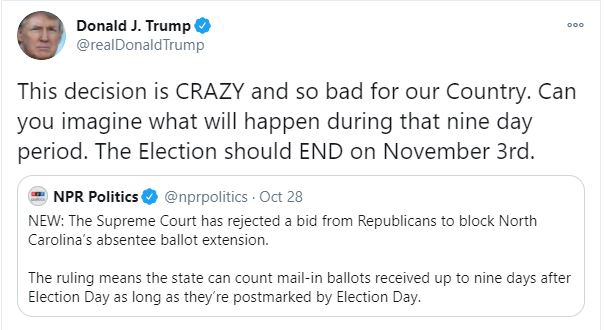
OK, Donald Trump is insisting that “The Election should END on November 3,” even willing to slap the Supreme Court justices around, including his own appointees, for allowing the count to continue for nine days in North Carolina.

Of course, the voting will stop tomorrow, just as he wants.

It’s the count of late-arriving mail ballots that will continue. The rulings in North Carolina, Pennsylvania and elsewhere concern the count, not the vote. Only ballots postmarked by tomorrow night will be eligible to count.

In a 3 a.m. tweet, Trump, who has moved beyond his predictions of widespread fraud from mail ballots, argued that “This decision is CRAZY and so bad for our Country. Can you imagine what will happen during that nine-day period. The Election should END on November 3rd.”

Actually, what will happen during those nine days is vote counting. Otherwise, why do we have elections at all? The alternative, as monarchies and dynasties have shown, is that a Trump-like figure would just tell us who’s the king.

As it happens, many states have taken days to count all of their ballots. This year, it seems obvious that election officials may need extra time for counting solely because there is a flood of mail ballots as a result of concern about pandemic.

Nevertheless, those orders by Trump’s postmaster general, Louis DeJoy, had the effect of slowing mail delivery. That prompted state officials to create alternatives, including drop-off sites and, yes, postponing the count deadline.

What is he talking about?

Regardless of those rules, voting ends on Nov. 3, making Trump’s tantrums yet more curious.

I’d guess that most of these mail ballots have already been sent or dropped off. It may be that the arguments are over a very little actual vote that could change a result.

Of course, Trump isn’t really arguing about the count deadline. He wants loyalty from the three justices he put on the Supreme Court, just as he wants absolute loyalty to whatever he utters aloud from all appointees, whether medical doctors, hurricane forecasters or senators.

As things stand, the Court has supported extending the count deadline in Pennsylvania and North Carolina but not Wisconsin. Minnesota is forgoing an extension too. And voters in one Pennsylvania county say about half the requested mail ballots never arrived, forcing them to vote physically.

What Trump wants is to win – at any cost to the sanctity of actual voting or for the health of voters in a time of the pandemic.

As always, Trump’s contorted attack on mail ballots is based more on a desire to suppress votes for his opposition – or perceived opposition – than on fact. At base, he argues, the distribution of mail ballots and mail ballot applications in at least five new states this year as an alternative to standing for hours in line to vote at a reduced number of polling places is an invitation to fraud.

The White House took control of a local mistake in a county office in Pennsylvania in September in which nine ballots not protected by a special envelope were discarded. That blew up into “evidence” of widespread fraud, generating court challenges against mail ballots across the country.

The bottom line

By comparison, 550,000 ballots were disqualified during the presidential primaries this year, according to an analysis by National Public Radio. “This sort of sweeping disenfranchisement—most often the result of missing signatures or improperly sealed envelopes—should concern anyone who believes that every vote should count.

But Trump’s agenda is not to fix our electoral problems; Trump’s agenda is to scare away enough voters to win or sow enough doubt in the minds of those who do vote to preemptively justify a loss,” noted Politico.

In the end, Trump supporters say in interview after interview that the only way Trump can lose is if the other side cheats. “If Trump loses, the Supreme Court needs to call a new election. They should investigate all these ballots that have been thrown out and give him four more years on that basis alone. They’re trying to cheat him out of office,” one named supporter told Politico.

The other side seems now to include the Supreme Court – which actually has indicated it may well find in favor of challenges of mail ballots– any concern about coronavirus, mail ballots and the governors of both parties who have allowed them to increase, as well as Democrats.

I’d mail Trump a complaint about his illogic, but he might not receive it.

Trump’s DOJ plans a “highly politicized” election monitoring plan, civil rights groups warn

President Donald Trump’s Justice Department was accused Monday of threatening “the integrity and neutrality of the electoral process” after announcing its plan to send personnel to 44 jurisdictions in 18 states—including key battleground states of Florida, Pennsylvania, and Wisconsin—to monitor compliance with federal voting rights laws.

“This Justice Department has been missing in action for nearly four years as communities of color have faced voter suppression, voting discrimination, and rising levels of voter intimidation,” said Kristen Clarke, president and executive director of the Lawyers’ Committee for Civil Rights Under Law, in a statement.

“Under this administration,” she continued, “we have seen virtually no enforcement of the Voting Rights Act and little action, if any at all, to protect and safeguard the rights of Black voters and voters of color.”

The department released the plan for the monitoring Monday, noting that its Civil Rights Division is tasked with enforcing federal voting rights laws.

“The work of the Civil Rights Division around each federal general election is a continuation of its historical mission to ensure that all of our citizens can freely exercise this most fundamental American right,” Eric S. Dreiband, the assistant attorney general for the division, said in a DOJ statement.

While the Justice Department regularly undertakes such monitoring, Clarke, in her statement, expressed skepticism that its plan is intend to protect voting rights. She asserted that the track record of the Trump aministration and Attorney General William Barr, as well as locations chosen, make clear the motivation for this year’s monitoring effort are cause for concern.

“This plan appears to be nothing but a thinly-veiled effort to deploy federal government personnel to communities in so-called ‘battleground states,'” said Clarke, urging local offiicals to “refuse to provide voluntary access inside polling places or to vote counting processing to federal officials given the politicized nature of the Justice Department’s work.”

“Given Attorney General Barr’s recent efforts to weaponize the Justice Department during the middle of a presidential election, federal presence at the polls stands to threaten the integrity and neutrality of the electoral process,” she said.

“The most striking evidence of the politicized nature of this plan,” she added, “is the absence of Louisiana, Mississippi, Alabama, South Carolina, and other states that are home to some of the largest shares of Black voters.”

Legal analyst Joyce Vance agreed with Clarke’s assessment, calling the plan “a dangerous sign” of the role the DOJ might play on Tuesday and in the days to follow.

The plan also appears to have ruffled the feathers of at least one state election official—the Minnesota secretary of state—and Minneapolis is named as one of the cities where DOJ monitors are being sent.

“When asked for comment,” reported local WCCO-TV, “Minnesota’s Secretary of State Steve Simon said the state law is very specific and Justice Department personnel won’t be allowed inside polling places.”

Republican strategist warns Trump is “in big trouble” in Fox News column

GOP strategist Colin Reed believes that Donald Trump’s presidency is on its last legs.

In his latest Fox News column, Reed argues that the president and his party are “big trouble” while warning that conditions that created Trump’s upset win in 2016 seem to be absent from this year’s race.

“Trump faces an ominous four-headed monster as campaign 2020’s hourglass winds down — factors that will reverberate down-ballot into Senate races,” he writes.

Among other things, Reed notes that Trump was forced to campaign in states like Georgia in the waning days of the election, which shows that he’s playing “defense” in states that should be locked away by this point.

He also notes that Democratic presidential nominee Joe Biden is “swamping” the president’s campaign financially, and that the COVID-19 pandemic is “cresting at the worst possible moment.”

The “most important” factor, writes Reed, is the fact that “Biden is not Hillary Clinton.”

“His approval numbers are right at 50 percent, according to Real Clear Politics, with his unfavorable marks sitting at 44,” he writes. “Clinton, by contrast, entered election day 2016 with her favorability 12 points underwater, 42-54 percent.”

Reed concludes by noting that Trump still has a shot at winning, but argues that “if Trump can somehow pull another rabbit out of his hat, it will be a greater political feat than even his remarkable 2016 victory.”


Fox News host shuts down Trump adviser’s false claim: Votes “regularly” counted after Election Day

Trump campaign adviser Erin Perrine repeated the false claim on Monday that Democrats are trying to “steal” the election from President Donald Trump by counting all the votes.

During an interview on Fox News, Perrine was asked about comments made by Trump campaign staffer Jason Miller, who predicted that Trump would be ahead early on election night before Democrats try to “steal it back” by continuing to count votes.

“Isn’t it misleading to use a word like ‘steal it back’ considering that we know that some of these ballots will be counted after election day,” Fox News host Sandra Smith asked, “to claim that the president can claim victory that night if he is leading with electoral votes?”

“No,” Perrine replied. “Jason is absolutely correct there. And this is the election integrity that President Trump has been fighting so hard to protect across the United States. It means making sure that mail-in ballots have postmarks and that election security safeguards remain in place.”

“What we don’t want to see is that on election night the president has a lead and that because election safeguards were removed by Democrats attempting to sow chaos and confusion into the election results that they go and try to find more ballots,” she continued. “And they want the American people not to believe what they will see with their own eyes on election night.”

Perrine added: “Democrats will try and steal this election from President Trump.”

“But votes are regularly counted after election day,” Smith noted.

“Here’s the thing,” Perrine asserted. “Democrats have tried to upend the election chaos — the election system and put in chaos here in the United States. They want to remove safeguards like ballot signatures and safeguards like postmarks.”

“What we’re worried about is Democrats putting chaos into the system to try and steal this election from President Trump!” she said. “So, we’re going to make sure we’re ready to go.”

You can watch the video below via Twitter:

President Trump tells advisers that he fears prosecution if he loses the election: report

With Election Day approaching and his poll numbers still flagging, President Donald Trump has allegedly begun to express concerns to aides about the potential criminal liabilities which may await him in a post-White House life.

The threats are broad: Trump’s businesses are currently under investigation by the New York State attorney general and the Manhattan District Attorney’s office for possible tax and financial crimes. He is also worried about the potential for new federal investigations, according to a new report from The New York Times.

Trump has reportedly expressed these concerns to advisers “for weeks.” Aside from the known state and local probes, The Times did not specify which specific liabilities might have unnerved the president at the federal level.

The difference is significant, because presidential pardons only apply to federal crimes; they do not extend to state and local levels. The constitutional question of whether Trump would pardon himself before leaving office — which no president has tried — has simmered throughout his term. It even came up during Justice Amy Coney Barrett’s confirmation hearings last month.

While former special counsel Robert Mueller’s final report did not directly accuse Trump of any crimes, “it also does not exonerate him.” Though Mueller laid out what many legal experts called textbook examples of obstruction of justice, he did not make a decision “either way” about whether to prosecute Trump. The lack of conclusion maddened the president’s supporters and detractors alike.

That decision largely — but not solely, according to testimony from Attorney General William Barr — hinged on existing Department of Justice guidance which bars a sitting president from be criminally prosecuted. That same guidance deterred federal prosecutors from listing Trump as a co-conspirator by name in the indictment which ultimately sent his former personal attorney Michael Cohen to federal prison. 

Federal prosecutors in the Southern District of New York claimed in that case that Cohen had an accomplice in his hush-money payment to Stormy Daniels, an unindicted co-conspirator whom the charging document against Cohen referred to as “Individual-1” — someone who had run “an ultimately successful campaign for president of the United States.”

Because communications about those payments extended into 2017, it may be argued that the five-year statute of limitations would not apply to Trump’s involvement in that crime as a co-conspirator if he were to be prosecuted in 2021.

Ken Starr, the independent prosecutor who investigated former President Bill Clinton, said before Mueller submitted his report in 2018 that he believed the former special counsel would either refer Trump to Congress for impeachment or he would face indictment once he is no longer president.

“Those are the two avenues that I see,” Starr said at the time.

Further, there has been no reporting about what happened to the counterintelligence investigation that the FBI opened into Trump in 2017, and Mueller was prevented from digging into Trump’s finances as a result of a decision from Deputy Attorney General Rod Rosenstein in the investigation’s early stages.

While it is unclear whether the ongoing investigations at city and state levels may concern issues of federal interest, multiple New York Times reports on various findings in Trump’s tax returns have detailed what experts called a number of possible federal violations.

Notably, The Times reported on Monday that the president had been concerned for “weeks” about new federal cases — not old ones. The newspaper published its first report on his tax returns on Sept. 27.

“Shallow little hypocrite”: The View’s Ana Navarro shreds Marco Rubio for mocking Biden bus ambush

Over the weekend, President Donald Trump’s supporters took to the streets with trucks and cars to wreak havoc on highways, bridges and other roadways around the country. In Texas, however, the Biden campaign bus was attacked as the heavily armed Trump supporters surrounded the bus and slowed it to just 20 mph on the interstate, which is dangerous and illegal. It was something that co-host Whoopi Goldberg said was out of the film “Mississippi Burning,” about 1964 Civil Rights workers.

Trump mocked it as an “escort” and called the drivers “patriotic.” 

“You really are lucky that you didn’t get anybody killed talking this way, sir,” said Goldberg. “With what I’ve been seeing, his supporters have given me a flashback. And when they talk about,’Oh, we think there’s going to be some issues happening,’ you know, who do they think is going to start this? I haven’t seen Biden flags trapping anybody. Am I crazy when you saw this caravan, did you remind you of a ’50s thing as well?”

All of the women on the panel agreed, but it was Sunny Hostin and Ana Navarro who were outright furious by the behavior and that police refused to do anything to stop it. 

“I saw the fact that Trump has emboldened bigots and racists to come out from under their rocks,” Hostin said. “Before this anger and hatred existed in the country of course, it was taboo to behave this way. He has emboldened them. He calls them patriots and when you learn more about the incident, you know, these were heavily armed people brandishing weapons in their trucks. They outnumbered police officers, 50 to 1. 50 to 1. Think about that. And I immediately, Whoopi, thought, imagine the outrage from the Trump administration had this been a Black Lives Matter protest, imagine the difference in the reaction, right?”

She noted that Trump’s White House calls the BLM movement terrorists but somehow these Trump supporters are patriots.

Navarro said that she spoke to a police chief in Miami who told her that what those Trump supporters did was a felony and would be charged as “aggravated assault with a deadly weapon.” 

But for her it was Sen. Marco Rubio, R-FL, that “incensed” her. 

“I can’t believe it’s happening in America in 2020,” she said. “When I saw Marco Rubio last night at this Trump rally, Rubio, who president Trump used to refer to as Little Marco Rubio, referred to — has now turned into little Trump. And he took a break from tweeting Bible verses to make fun and mock and make a joke about what people did with this bus. It endangered people’s lives. People could have been hurt. It’s an aggression against democracy. Against people’s rights to vote. It’s suppression. it’s instilling fear in people. It’s absolutely wrong and Marco Rubio, you who talk about socialism and talk about dictatorships to be making fun of this and making light of this, you shallow little hypocrite, I’m so embarrassed I ever supported you!”

“Hillbilly Elegy” author faces backlash over remarks connecting nationalism to fertility rate

J.D. Vance, the author of the best-selling Rust Belt memoir “Hillbilly Elegy” and the whisperer of the white working-class, is under fire after calling himself a “nationalist who worries about America’s low fertility.”

Critics view the label as a nod to both white nationalism and the “great replacement” conspiracy theory, the racist fear that falling birthrates among white women will lead to whites being replaced by non-whites.

“As a parent of young children and a nationalist who worries about America’s low fertility I can say with confidence that daylight savings time reduces fertility by at least 10 percent,” Vance wrote in a Sunday evening tweet.

Vance later characterized his tweet as a joke, though he did not clarify its meaning. 

He also neither explained his use of the word “nationalist,” which over the last few years has been widely associated with white nationalism, nor his curious claims about fertility. (Most Americans set their clocks back an hour over the weekend, returning to standard time.)

Vance’s 2017 memoir about growing up in what he describes as extended Appalachia was widely hailed as a sort of Rosetta stone for understanding the plight of the white working-class who supported President Donald Trump in 2016. The book topped best seller lists, making Vance a momentary celebrity pundit as Democrats grappled with Trump’s election. The New York Times called it “a compassionate, discerning sociological analysis of the white underclass.”

But Vance has also been widely criticized for the conclusions he draws from his experiences, as well as for ignoring racial undertones in the culture about which he writes. His comments over the weekend drew similar criticism after being seen by many as dogwhistles for white nationalism and misogyny.

While some have argued that “nationalism” with no adjectival modifier may apply to anyone who feels positively about their country, Vance, a white man and graduate of Yale law, explicitly connects a worry about fertility rates to his nationalism.

People quickly pointed out that Vance’s phrasing echoed the ideology of white supremacists, who have worried for years about declining white birth rates in Western countries. For instance, the white supremacist who carried out a mass shooting at a New Zealand mosque in 2018 repeated the phrase “it’s about the birth rates” several times in his manifesto. 

A number of right-wing figures in Trump’s circle play loosely with the phrase, including Stephens Miller and Bannon, who publicly soften their far-right views with phrases like “populism” and “economic nationalism” and a strategically nonspecific concern for “our civilization.” White supremacists have also embraced the generic use of the word “nationalism” as a wink, and Trump himself has used it to troll critics.

“Americans act with the understanding that Trump’s nationalism promises to restore traditional boundaries of race, gender, and sexuality,” The Atlantic’s Adam Serwer wrote in 2017. “The nature of that same nationalism is to deny its essence, the better to salve the conscience and spare the soul.”

Jared Yates Sexton, an author and political journalist who grew up in Indiana, has criticized Vance’s book as “traditional right-wing propaganda” that traffics in white supremacist undertones. He told Salon that Vance’s comments revealed what many people had long suspected.

“J.D. Vance has spent the past few years sanitizing right-wing appeals and camouflaging white supremacist-pandering,” Sexton said. “I’m surprised it took him this long to let his mask slip.”

Salon’s Amanda Marcotte pointed out that Vance’s remarks also reveal the misogyny that undergirds white nationalist ideology.

“It’s an effective troll, because you can’t ‘prove’ that these people are malicious when there’s always the outside, absurd possibility that they might not know what they’re saying,” Marcotte said. “But it is also part and parcel of what white supremacist groups like the Proud Boys do: making white nationalist arguments that are rooted in misogyny.”

While Vance later framed his concern as applying to the country’s ability to sustain its social net as the population ages, the U.S. has historically supplemented its workforce with an open immigration policy. It is unclear why internal birth rates would alone cause Vance such concern.

Indeed, a 2020 report from the Centers for Disease Control and Prevention found that while the country’s fertility rate had been dropping, that fact was nothing new. “The (total fertility) rate has generally been below replacement since 1971 and consistently below replacement since 2007,” the report read.

Salon reached out to Vance through his publisher, but did not receive a reply.

Stanford faculty demand university sanctions for Trump adviser and faculty member Scott Atlas

Scott Atlas, one of President Trump’s special coronavirus advisers and a faculty member at Stanford University’s Hoover Institution in Palo Alto, Calif., is causing a minor fracas among students and faculty at the elite university. Specifically, Atlas’ recommendations on coronavirus public health measures fly in the face of scientific consensus, faculty says — a charge that Atlas denies, and which he has threatened litigation over.  

During a Faculty Senate meeting at Stanford University late last month, the college’s president and provost were asked whether Dr. Scott Atlas should face university sanctions for positions he has taken about the novel coronavirus pandemic that go against the scientific consensus. (As the faculty noted, Atlas is a neuroradiologist, not an epidemiologist or a scholar of infectious disease.) At the meeting, similar questions were raised about the university’s relationship with the Hoover Institution, where Atlas is a senior fellow. The Hoover Institution is a conservative think tank located on Stanford’s campus that has supported a laundry list of prominent right-wing statesmen over the years, from Condoleezza Rice to Reagan Secretary of State George Shultz

Unsurprisingly given the politics of his employer, Atlas’ public statements tend to delight conservatives and alarm scientists who study public health and infectious diseases. Atlas recently tweeted that masks do not work to prevent infection (an unsupported claim, and one which Twitter wound up taking down for being misleading); previously, he claimed publicly that the threat of the coronavirus is greatly exaggerated. Atlas also claimed that summer civil rights protests were to blame for coronavirus outbreaks, as well as proximity to the U.S.-Mexico border, two more claims for which there is no evidence.

Despite being described by Trump as “one of the great experts of the world,” Atlas is reported to not have expertise in infectious disease mitigation or public health. Most recently, Atlas raised eyebrows last week for appearing on Russian state broadcaster RT, which is registered with the Justice Department as an agent of the Russian government.

David Spiegel, a medicine professor and associate chair of the Department of Psychiatry and Behavioral Sciences, claimed during the late October meeting (which occurred before the RT interview) that Atlas is the “latest member of the Hoover Institution to disseminate incorrect and unscientific information about the coronavirus pandemic,” according to Stanford News. He also accused Atlas of violating the American Medical Association’s Code of Ethics and claimed that he may have additionally violated Stanford’s Code of Conduct.

University President Marc Tessier-Lavigne responded by citing the college’s Statement on Academic Freedom, although the provost acknowledged the validity of engineering professor Stephen Monismith’s concern about a New York Times report that some of Trump’s senior economic advisers had briefed the Hoover Board of Overseers about the dangers of COVID-19 and shared that information with parts of the investment world. Provost Persis Drell responded that the involved individual resigned and that the many others who attended the same meeting did not share that person’s account of what happened.

Who is Scott Atlas?

Atlas’ profile on Stanford University’s website says that he studies how government and private sector policies impact the access to and quality of health care. After Trump was apparently impressed by his Atlas’ appearances on Fox News, the neuroradiologist was invited to join the president’s coronavirus task force over the summer. During his time there, Atlas allegedly pushed for a “herd immunity” approach to addressing the pandemic, downplayed the potential threat presented to children and questioned the use of masks.

Although Atlas has tried to deny that he has pushed the Trump administration toward a “herd immunity” policy, he told Fox News in a July radio interview that “when you isolate everyone, including all the healthy people, you’re prolonging the problem because you’re preventing population immunity. Low-risk groups getting the infection is not a problem. In fact, it’s a positive.”

During his RT interview last week, Atlas said, “if you wanna know what’s happening right now, I think there’s a gross distortion that has sort of been typical of the reporting on this. And that is that there’s this frenzy of focusing on the number of cases when we see a lot of reasons to be sort of, you know, cautiously optimistic here rather than fearful.”

The academic pushback

In response to Atlas’ rhetoric, a group of 98 Stanford physicians and researchers affiliated with Stanford Medicine published a public open letter in September lambasting Atlas for making what they said were false claims and pushing bad science.

“Many of [Atlas’] opinions and statements run counter to established science and, by doing so, undermine public-health authorities and the credible science that guides effective public health policy,” the letter read. “To prevent harm to the public’s health, we also have both a moral and an ethical responsibility to call attention to the falsehoods and misrepresentations of science recently fostered by [Atlas],” it continued.

The letter then went point by point and refuted Atlas’ claims about face masks, social distancing, asymptomatic transmission, child susceptibility to infection and about his supposed belief in “encouraging herd immunity through unchecked community transmission.”

Atlas responded to the letter by defending his positions and threatening to sue.

But in addition to the 98 Stanford Medicine faculty who spoke out about Atlas’ views, other public health experts, too, believe that Atlas “misunderstands” the science behind the coronavirus. Holden Thorp, the editor-in-chief of Science Magazine, also tweeted his dissatisfaction with Atlas after the doctor claimed that “top scientists all over the world” support Trump’s response to the pandemic.

“No they’re not. I would know,” Thorp tweeted.

“I strongly endorse and agree with the letter from Atlas’s colleagues that he does not understand, or is purposefully misunderstanding, the nature of the virus, this pandemic, and appropriate control activities,” Dr. Alfred Sommer, dean emeritus and professor of epidemiology at Johns Hopkins Bloomberg School of Public Health, told Salon by email.

Dr. Anthony Fauci, the nation’s top infectious disease expert, has also expressed reservations about Atlas’ views. In September he told CNN he was “concerned that sometimes things are said that are really taken either out of context or actually incorrect,” particularly drawing attention to how the “data [was] very strong” about the importance of wearing masks in protecting people from coronavirus infections.

“Masks are important for catching droplets and microdroplet aerosols expelled while talking and breathing (not just sneezing or coughing), which was just recognized by WHO [World Health Organization] and 239 scientists,” Dr. Eric Feigl-Ding, Senior Fellow at the Federation of American Scientists, told Salon by email in May. 

Atlas’ views on herd immunity are also belied by recent studies that suggest herd immunity is not possible to achieve, because the coronavirus appears not to confer long-term immunity on patients who have recovered from it. A study of roughly 365,000 people released by researchers at the Imperial College London last month was one of several that suggest being infected with the novel coronavirus does not provide “durable immunity,” or long-lasting immunity, to patients. The most recent study noted that, instead of people developing more antibodies to the novel coronavirus over a period of three months (which their immune systems would then use to fight COVID-19), antibodies fell by roughly 26% during the period in question.

Comfort TV: 9 comedies to binge as an escape from our nation’s madness

Television is an essential worker right now. At a time of amplified anxiety and uncertainty, it offers solace and escape, and as millions contend with the emotional toll of being separated from family and friends, or stuck with same, it can be a bulwark against loneliness.

Admittedly these factors are the reason people knocked TV for decades, but in case you haven’t noticed, the state of the world has been anything but normal for years, and now we’re in a pandemic. Waking life shouldn’t make a person yearn for a long bath in one of those “Westworld” tubs filled with viscous goo – something emollient, encompassing and sound-deadening sounds wonderful, doesn’t it? – and yet, here we are.

That said, although yearning for “Westworld”-style hydrotherapy (minus the flesh-building needles) is normal, HBO can keep its accompanying dystopia thanks much. The live horror show that is life in early November 2020 is checking that box already, and as our nerves continue to unravel, we can’t think of many dramas other than “This Is Us” that can soothe them.

Bring on the comedies instead, and please, also thank you.

Salon’s Mary Elizabeth Williams created a wonderful list of soothing comedies in July, which feels like a year ago. Besides, during this Election Week the more comedy options we can enjoy the better. Here are few our Culture team will be watching to help ease the stress of waiting for voting totals to come in from swing states. May they comfort you through this week and long afterward.

“A.P. Bio” (Peacock)

Sometimes, you just want to give into your trash impulses, and “A.P. Bio” is where you can see them played out. Disgraced Harvard philosophy professor Jack Griffin (“It’s Always Sunny” star Glenn Howerton) loses his dream job to his rival Miles, and must resort to working as an advanced placement biology teacher at a Toledo high school to stay solvent. Instead of teaching these overachieving kids anything on the syllabus, however, he exploits their brains and desires for an A to devise elaborate ways to exact revenge on Miles. Patton Oswalt co-stars as the school’s ineffectual principal, while queen of comedy Paula Pell steals scenes as his assistant. The show’s stellar ensemble cast – including a trio of fellow teachers and a colorful group of students who demonstrate an affinity for something other than studying – only add to the gleefully enjoyable performances.

NBC canceled this schoolroom comedy after only two seasons, but they’re now streaming for free on Peacock, the network’s relatively new streaming service. This move also revived the show, and its third season is also available but only for subscribers. After watching the first two installments, you’ll have a good idea if you’ll find that investment worth your while. – Hanh Nguyen

“Dash & Lily” (Netflix)

This is a bit of a cheat since the show doesn’t premiere until Nov. 10, but assuming there’s life after the election this still could fly under some viewers’ radars amidst Netflix’s other November offerings. Add it to your queue now. In this adaptation of Rachel Cohn and David Levithan’s novel (the same folks who wrote “Nick & Norah’s Infinite Playlist”), two teenagers anonymously pass a notebook back and forth, within which they open up about their hopes and fears while daring each other to perform tasks around New York that take each of them out of their comfort zone. The pen pals – the perpetually disgruntled Dash (Austin Abrams) and the awkward, Christmas-loving Lily (Midori Francis) – begin to fall for each other, but it remains to be seen if they can continue their connection off the page. 

Now that it’s officially November, you don’t have to feel too dirty about giving into Christmas creep, and the story’s nods to “From the Mixed-Up Files of Mrs. Basil E Frankweiler” gives it that nostalgia factor. The series is a love letter to all the New York locales we’re missing right now and boasts a killer soundtrack that doesn’t dip into the overused yuletide well. How can you not appreciate needle drops for Joni Mitchell, the Pogues, and Sufjan Stevens? With only eight short episodes, it’s a quick hit of eggnog to your veins. – H.N.

“Harley Quinn” (HBO Max)

It’s high time that Gotham had a crime queen. That’s the spirit in this secondary origin story for Harley Quinn (voiced by Kaley Cuoco, who also executive produces) rallies around – you know, the one that develops after she breaks it off from the Joker (Alan Tudyk). The fantabulous live-action movie “Birds of Prey”  also teases us with that possibility but – no offense to Margot Robbie, who slays the role – this animated series more fully realizes the magnetic appeal of Harley apart from the Clown Prince of Gotham’s crime world.

The show’s sharp, wicked humor vaults it into the must-watch circle, and as the writers push harder into evolving the ride-or-die friendship between Harley and endlessly patient bestie Poison Ivy (Lake Bell) into something more profound in Season 2 the action transforms into something more soulful as well.

Along the way “Harley Quinn” series creators Patrick Schumacker, Dean Lorey and Justin Halpern liberally bounce scads of tongue-in-cheek humor into the Gotham universe’s mythology and have a veritable hootenanny with the ludicrous nature of the heroes and villains in Batman’s orbit, granting an odd amount of development the likes of Kite Man and the Condiment King in addition to plenty of queer subtext. (Ever muse about the true nature of the Joker’s obsession with Batman? This show does.) The unrepentantly blue streak threaded throughout makes “Harley Queen” very much an adult-style treat, and with each of its 26 episodes coming in at around 20 minutes long, you can somersault through the entirety of its two seasons and bust a gut without breaking a sweat. – Melanie McFarland

“The Hookup Plan” (Netflix)

If you were among the hordes who watched the problematic Darren Star confection “Emily in Paris,” then this French series will give you a far better picture of the city and its people despite the show’s ridiculous premise. Elsa (Zita Hanrot) is a quirky, marine biology-loving young woman who can’t stop pining after her ex-boyfriend even two years after their breakup. Her pals – the pregnant and uptight Emilie (Joséphine Draï) and nonconformist Charlotte (Sabrina Ouazani) – secretly hire male escort Jules (Marc Ruchmann) to take Elsa on a couple dates to raise her self-esteem. Of course, human nature intervenes, and feelings become rather entangled.

The show, which is fueled by the refreshingly flawed characters’ lies and deceptions, has a bit of a “Friends” vibe with a tight-knit group of six pals, with a few more oddballs orbiting. With only eight half-hour episodes in Season 1 and six in the second, it’s a quick and breezy binge. Plus, there’s a bonus “Lockdown Plan” episode coming to Netflix on Nov. 6 for a satisfying if surreal “Where are they now?” conclusion. – H.N.

“Kim’s Convenience” (Netflix)

Here’s another Canadian comedy with a big heart that unabashedly presents a vision of the world as it is for anyone who has a favorite corner spot in their neighborhood. The Kims own such a place in Toronto, a convenience store run by parents “Appa” (Paul Sun-Hyung Lee) and “Umma” (Jean Yoon) (or “mom” and “dad” in Korean) along with their daughter Janet (Andrea Bang), who aspires to be a professional photographer. While she attends art school, Janet also helps out with the store and maintains connection with Jung (future Marvel star Simu Liu), her older brother who is estranged from their father. 

Jung works at a car dealership with his friend and roommate Kimchee (Andrew Phung) and harbors a crush on his manager, the sweetly awkward, Shannon (Nicole Power) that definitely proves to be mutual. That’s pretty much the gist of “Kim’s Convenience,” and its classic sitcom simplicity is its power: it is another place where everybody knows your name, and even if Appa isn’t always glad you can he eventually shows how much he appreciate your and your business.

That also make “Kim’s Convenience” a show about immigrants where the folks are living their lives and dealing with the same screwball situations as mainly white sitcoms. And while various subplots throughout its four seasons and 52 half-hour episodes touch upon xenophobia, anti-immigrant politics, and white privilege, the series’ strength is in its diligent focus on the Kims and their individual quirks.

Its sweet, kind-hearted spirit provides a view of the world as we know it can be – and better yet, as it still exists in many communities. In this sense, “Kim’s Convenience” does more than make us laugh. It gives us hope. – M.M.

Lodge 49” (Hulu)

Dud — a charming, genial beach bum played by Wyatt Russell, Kurt Russell’s youngest son — is searching, in his own languid way, for . . . well, something. Maybe it’s answers surrounding his father’s mysterious death, or insight into his own freak accident that took place on a Costa Rican surfing trip, a snake bite left him with a long-lasting, noticeable limp. Maybe it’s a pathway back to the middle-class existence he enjoyed growing up, or at least out of the pawn shop sell-and-buy-back cycle. 

His seeking eventually leads him to the doorstep of Lodge 49, a not-so-secret fraternal society that appeals to Dud on two levels. There’s the social aspect; he becomes fast friends with “Luminous Knight” Ernie (Brent Jennings), a world-weary plumbing salesman on the hunt for a career-changing client, and the two quickly run up their tabs at the lodge bar. And then there are the metaphysical underpinnings of the lodge. 

The lodge was founded on Old World alchemical lore and, to the delight of trippy apothecary owner and lodgemember Blaise (David Pasquesi), Dud stumbles into some evidence that those teachings may not just be myths, after all. 

“Lodge 49” is a leisurely paced show, but one densely packed with quirky subplots, a hefty dose of surrealism, and a strong cast of supporting characters — especially Dud’s sister, Liz (Sonya Cassidy). Together, they make the appealing case that everything is, in fact, connected. Both seasons are only 10 episodes each. – Ashlie D. Stevens

“Lovesick” (Netflix)

The show was previously called the defiantly absurd “Scrotal Recall,” and I’m forever sad that it was changed to a more palatable title, but if that helps this lovely series to draw eyeballs, then so be it. Johnny Flynn (known for playing Mr. Knightley in the latest “Emma” and soon-to-be David Bowie in “Stardust”) stars as the well-meaning but rather bumbling Dylan, who discovers that he has chlamydia, and therefore must divulge this information to every woman he’s slept with. This sends him on a psychosexual 12-step journey as the series hops around in his past, where the viewers begin to piece together his messed-up emotional state and come to guess which lady might actually be his destiny.

He shares a house in Glasgow with his pals – the crass womanizer Luke (Daniel Ings) and sarcastic Evie (Antonia Thomas of “Misfits” and “The Good Doctor”) – whom we also get to meet in the various states of their emotional maturity through Dylan’s flashbacks. Hilarious but stealthily heartbreaking, the series is a smart take on the difficulties of dating and knowing what’s best for oneself. The series is complete in three short seasons, only 22 episodes total. – H.N.

PEN15” (Hulu)

An Emmy rout for Canada’s “Schitt’s Creek” resulted in untold numbers of people discovering that comedy posthumously either in syndication or streaming. (It’s currently on Netflix.) But this is another Emmy nominee as deserving of our attention right now, and it’s especially potent medicine for anyone harboring a nostalgia fix. That’s because it isn’t an analgesic. It’s an antacid.

PEN15″ is created by and stars Maya Erskine and Anna Konkle, two thirtysomething actors playing excessively uncool 13-year-old versions of themselves struggling through seventh grade in the year 2000 – you know, when that other contentious election with lasting ramifications upon America played out.

Maya and Anna have much bigger concerns to contend with than politics, though . . . like their crushes, being popular and scoring cool points with their classmates. Remember the careless days of early adolescence? This show takes us back there. Then it reminds us why most of us are relieved that it is a dot in our rearview mirror. Two words: puberty sucks.

No doubt about it, this show will snap your heart in two, but in the best way. It also enables viewers to stumble down memory lane and collectively cringe at the dumb things we did while also forgiving ourselves. Ultimately this makes “PEN15” a healthy kind of comfort, the type that doses us with nostalgia over the 17 episodes that are currently streaming, while successfully arguing that it’s better to keep moving forward. – M.M.

“Ted Lasso” (Apple TV+)

I initially held out on jumping into “Ted Lasso” because sports dramas aren’t typically my thing, but as the weeks went by, I kept seeing tweets in passing about how wholesome the show was. Things like “Ted Lasso is wholesome hope in a cute little TV box,” and “Ted Lasso is a soothing balm in these mean-spirited times.” 

And indeed, it is. 

Ted Lasso, played by Jason Sudeikis, is essentially Mr. Rogers if Fred Rogers ordered whiskey whenever the opportunity presented itself. Saturated with well-trodden fish-out-of-water tropes, the show follows American football coach Ted, who is recruited to move across the pond by the new Richmond FC owner, Rebecca (Hannah Waddingham), precisely because he doesn’t know the basic rules of soccer. Rebecca inherited the already-floundering team from her philandering ex-husband and she wants to destroy the thing he loved most. 

But the story quickly turns away from the obvious jokes about Ted’s ignorance of England and the game itself, and transforms into a series that quietly proclaims the importance of believing that you can make your community — be that a sports club, a friend group or a more literal community — a better place to be, and the power of pairing that belief with action. 

Ted’s the kind of guy who learns names and makes people feel valued. He elevates voices that go unheard, but have important things to say, like that of Nathan Shelley (Nick Mohammed), the team’s “kit man” who’s deeply shy, but knows a ton about the sport. Ted’s cheerful in a way that’s unrelenting, but never feels disingenuous. He makes tough choices, like pulling the star player from the pitch because he refuses to be a team player. 

Watching Ted put his goodness into action — even, or perhaps especially, when facing professional and personal adversity — keeps this from becoming just a situational comedy about an average dude failing upwards. Instead, it’s a feel-good show about an imperfect, but genuinely good person, which is absolutely a source of hope. Checking out the 10-episode first season, even if it requires an Apple TV+ subscription, is well worth your time since the show will be returning for a second season. –A.D.S.

GOP officials debunk Trump adviser’s lie that Democrats will “steal” election by counting all votes

President Donald Trump and his top aides drew a rebuke from several current and former Republican officials over their repeated attacks on voting.

Trump campaign adviser Jason Miller on Sunday echoed Trump’s false claims about vote counting, an act which is never complete in any state on election night and is expected to take even longer this year due to the influx of mail-in ballots amid the coronavirus pandemic. The embattled aide suggested in an interview with ABC News that counting all of the votes cast would be tantamount to stealing the election from a deeply unpopular president who trails badly in the polls.

“If you speak with many smart Democrats, they believe that President Trump will be ahead on election night. Probably getting 280 electors — somewhere in that range. And they’re just going to try to steal it back after the election,” Miller claimed. “We believe we’ll be over 290 electoral votes on election night. So no matter what they try to do — what kind of hijinks or lawsuits or whatever kind of nonsense they try to pull off — we’re still going to have enough electoral votes to get President Trump re-elected.”

The remarks echoed Trump’s false complaints that all votes won’t be counted on election night — something which never happens. 

“I think it’s a terrible thing when people or states are allowed to tabulate ballots for a long period of time after the election is over,” Trump said on Sunday in North Carolina. “I think it’s terrible when we can’t know the results of an election the night of the election in a modern-day age of computers.”

Utah Lt. Gov. Spencer Cox, who is expected to win the state’s gubernatorial race this week, rejected such claims.

“Please ignore this type of garbage. The truth is that elections are never decided on election night,” he wrote on Twitter. “In Utah (and most states) it takes 2 weeks to finalize counting and certify results. It really doesn’t matter who is ahead on election night, it only matters when every eligible vote is counted and each county canvasses and certifies the vote totals.”

While media outlets may “call” certain races, such actions are “technically meaningless,” Cox added.

The New York Times noted over the weekend that Trump’s demand for all votes to be counted on election night was “not possible and never has been.” In 2008, for example, Missouri was not called until Nov. 19. In 2012, Florida was not called until four days after the election. And in 2016, Michigan was not called for more than two weeks after Election Day.

This year, Trump may appear ahead in certain states like Pennsylvania and Michigan after the Election Day vote is counted. That may change once mail-in ballots — which take longer to count and have overwhelmingly been used by Democrats — are tallied.

Trump and Republicans have also sued to try to invalidate mail-in ballots cast before the election which do not arrive until after Election Day in states like Pennsylvania and Minnesota.

Longtime top Republican election lawyer Ben Ginsberg, a key figure in the 2000 Bush v. Gore case, said in a Washington Post op-ed on Sunday that Trump’s attacks on voting were “as un-American as it gets.”

“Trump has failed the test of leadership. His bid for re-election is foundering. And his only solution has been to launch an all-out, multimillion-dollar effort to disenfranchise voters,” he wrote. “It returns the Republican Party to the bad old days of ‘voter suppression’ . . . [and] puts the party on the wrong side of demographic changes in this country that threaten to make the GOP a permanent minority.”

Ginsberg wrote that in his 38 years as a Republican election lawyer, the party had failed to identify a single case of widespread voter fraud to substantiate its false claims about voting security.  

Ginsberg criticized the GOP for backing Trump’s false claims. He submitted a court brief on Monday urging a federal judge to reject a bid by Texas Republicans to throw out about 127,000 valid ballots cast in Harris County’s drive-through voting locations.

The brief said Ginsberg was “particularly sensitive to the irony that Republicans are now seeking to throw out votes cast by eligible voters because of what would amount to a technical error by elections officials.” He and co-counsel Amy Coney Barrett, now a Supreme Court justice, fought a similar argument by Democrats in the 2000 recount.

Ginsberg was joined in the brief by fellow Republican Joseph Straus, the former speaker of the Texas House of Representatives.

“The lawsuit attempting to disenfranchise more than 100,000 voters in Harris County is patently wrong,” he wrote on social media. “The Republican Party needs to return to a place where we win with ideas and persuasion rather than trying to intimidate and silence our fellow citizens. I hope all elected statewide leaders in the Texas Republican Party will stand up against these desperate tactics.”

The “Whitest Kids U Know” — a cult classic comedy group whose sketches eerily foresaw the Trump era

“I just think we’re very cynical people, and cynical people tend to be right more often than not.”

Whether or not you personally agree with Trevor Moore’s observation, the comedian’s philosophy is all over the work of “The Whitest Kids U’ Know” (WKUK), a sketch comedy group whose self-titled TV show (2007-2011) has become a cult classic. It also may explain why the group’s political sketches seem eerily prophetic today.

It just so happens that in the process of making us laugh about the problems they observed in America during their show’s run — and which have gotten so much worse — they foresaw the advent of the Trump era. Their sketches also manage to speak directly to the problems of our time.

This is not intended to say that their material never crossed over to the problematic. For instance, although their name “The Whitest Kids U Know” was based on a joke made about them by a friend, one could argue that it is a little tone-deaf more than a decade later. That said, as the world has finally awoken to Black Lives Matter, the group’s 2008 sketch “Be a Cop” (discussed below) directly addresses the police’s excessive use of force. Salon reached out to a member of the group to get their current thoughts on their name after our original interviews, but was unable to receive a response prior to publication. While their name may not have aged well, however, it is a testament to their comedy skill that — even as they made us laugh — they also made us think.

Below, Salon spoke to each member of the group – Moore, along with Timmy Williams, Zach Cregger, Sam Brown, and Darren Trumeter –  to break down seven of the sketches that have proven especially relevant to the world we inhabit in 2020.

“Presidential Props” (2009)

Starring Williams as an idealistic senator at a presidential debate intent on discussing issues like fighting poverty and ending America’s latest war, the sketch takes a turn for the absurd (or so it seemed at the time) when the other candidates begin using props to distract each other as well as win over the crowd with cheap entertainment. This sketch gives insight into how people like Trump get elected president.  Of course, after Trump’s performances in the 2016 and 2020 debates — where he indulged in “braggadociousness” (his own word) while disingenuously denying doing so and, in the first 2020 debate, repeatedly interrupted former Vice President Joe Biden  — the sketch’s central joke seems more like a slight exaggeration.

“I don’t think we knew that we were on this trajectory,” Cregger said. Both this sketch and another one (see below) “are about that tendency of American culture to blend entertainment into its politics. And I think that 2016 was sort of the logical outcome of that sort of innate desire in all of us. It sucks because you then end up with a f***ing moron reality star as your president.”

“President Trump is a symptom of the disease, not the start of it,” Williams added. “So I think that those things were already there when we made those sketches, our tendencies toward worshiping celebrities and distracting ourselves with shiny objects. And it’s only gotten worse.”

“As a comedian, you don’t hold a mirror up to society; you hold a funhouse mirror up to society,” Brown explained. “As someone looking into a funhouse mirror could look and be like, ‘Oh, this is what I would look like if I was super overweight in this part of my body,’ all the negative stuff was there. We just happen to be living in that part of history where we’re fat.”

Of course, while it’s funny to see yourself looking distorted in a funhouse mirror, Cregger observed it’s just depressing when that becomes an accurate reflection.

“Now the person is on life support and at death’s door. It’s just not funny anymore,” Cregger mused. “Everything is ruined. You could kind of hint at it and poke fun at it because society was kind of sick this way, but now we’re f***ed.”

“Ronald Reagan” (2009)

A fictionalized account of how President Ronald Reagan was nearly assassinated by John W. Hinckley in 1981, this sketch has a number of jokes about the intersection of celebrity and politics. A decrepit Reagan (Cregger) is met by adoring fans who love his past work in a silly movie about a pet monkey (a reference to his starring role in the 1951 comedy “Bedtime for Bonzo”) and returns the adulation by (a) using the original “Star Wars” trilogy to legitimize his aggressive foreign policy and (b) talking about movies in general instead of answering questions about the AIDS epidemic (which Reagan refused to even acknowledge for many years) and his unprecedented budget deficits. While all of this is happening, Hinckley (Moore) is being manipulated by Vice President George H. W. Bush (Brown) into assassinating Reagan, an effort that only succeeds when Bush learns that Hinckley is also obsessed with movies and convinces him that “Taxi Driver” star Jodie Foster will make out with him if he assassinates Reagan.

Incidentally, while the stuff about Bush being behind the Reagan assassination attempt is fictional, the aforementioned jokes about pop culture being used to distract the masses from important issues are historically accurate. Reagan was very much like Trump, a man who became a public figure as an entertainer and used his celebrity to rise to the presidency, even as he pursued terrible policies.

“The sad thing is that this isn’t going to die,” Brown told Salon. “Even if Trump loses, these people that are still like, ‘No, it was cool having a dumb guy president’ are still going to be out there. ‘He’s a dumb piece of s*** like me!'”

Williams noted the downward trajectory that American politics has taken since the Reagan years, pointing out that at least “Reagan had some experience,” while Trump is the first president to lack any previous political or military experience. “I think 10 years from now, there’ll be more similarities when someone reveals, ‘Hey, Trump had all this horrible amnesia and f***ing dementia that we had to pretend didn’t exist.'” He agreed with Brown that things are only going to get worse, speculating that “I can certainly see Kid Rock or some asshole like that trying to run in 2028 or 2024.”

“Why not the f***ing Paul brothers?” Williams said, referring to both Logan Paul and his fellow YouTube star, Jake Paul. “You guys are right. That’s the trajectory because you go from movie star to reality star to YouTube star. It’s perfect. It’s a perfect downward angle.” Cregger holds out hope that America can still make a “course correction.”

“The goal is to try to get things more progressive, but you have to get back on the game board to do that right now,” Williams explained. “It’s like the pieces fell off onto the floor. We just need to get back on track a little bit, at least get someone who’s got a little empathy and forethought.”

“It’s illegal to Say…” (2007)

Stylistically this is one of the group’s simpler sketches. It shows Moore sitting on a stool in front of a generic backdrop explaining how it is illegal to say, “I want to kill the President of the United States of America.” Of course, Moore then proceeds to continue saying it, finding progressively more elaborate phrasings that even he admits are “extremely illegal” and “ridiculously, horribly felonious” and adding, “They will come to your house in the middle of the night and they will lock you up” if you utter them.

Moore argued that this was probably their most controversial sketch.

“As far as making a big splash, I don’t think you can beat going to the Supreme Court,” Moore explained. He was referring to the case of Elonis v. United States, one in which a man named Anthony Douglas Elonis repurposed Moore’s monologue into a diatribe against his wife and made other controversial online posts that he characterized as “art.” Although he was eventually convicted on multiple counts of making threats (including the one involving his estranged wife), the Supreme Court reversed his conviction in 2015 in an 8 to 1 decision. Chief Justice John G. Roberts explained in the Opinion of the Court that they did not prove mens rea, or the state of a “guilty mind” required for convictions in certain types of crimes.

“We didn’t realize [that the sketch had gone to the Supreme Court] until someone called me and they’re like, ‘They’re playing your kill the president sketch on the nightly news,'” Moore recalled, adding that he found it “hilarious because it means like all of the Supreme Court justices had to watch our stupid sketch.”

“Even RBG!” Williams added admiringly of the late Justice Ruth Bader Ginsburg.

“There’s an irony to it in that the sketch itself was about how there there’s laws against you making threats against this person who in a sense is an idea — we don’t actually know the president [George W. Bush at that time] — and here’s a way that we’re going to express this angst, this broad angst” Brown said, adding that they did this while at the same time managing to “kind of sidestep it. And then someone else took what we did and then used it in a way where no, you shouldn’t do that. You shouldn’t be allowed to threaten someone you actually know and can actually harm.”

“Be A Cop” (2008)

In this faux recruitment commercial for joining the police, the running gag is that all of the cops featured in it are shown firing their guns without any good cause. It concludes with a disturbingly accurate statement about the psychology that motivates many police officers:

“Law enforcement offers it all: Comfortable wages, an exciting work environment and a false sense of superiority! So join the police force to serve, protect . . . and to control the poor.”

“We were kids when that Rodney King thing happened, you know?” Williams reflected. “So it was something we thought that everyone agreed, like that’s f***ed up, you know?”

“I just think it’s kind of a bizarre place that we’ve gotten to where like that sketch kind of comes through this new light,” Cregger added, saying that he is appalled at how opposing “police shooting Black people is somehow political, not just universally condemnable.” He pointed out that police officers abusing their power has “always been a problem, and now in 2020, that’s a divisive sketch. It is ridiculous. Everyone should look at that sketch, because yeah, that’s kinda f***ed up.”

“There was already a problem and now it’s gotten even f***ing worse,” Williams added regarding the issue of police racism. “So like Zach said, it’s gotten more politicized than it used to be, which is just weird and stupid since it should be something everybody’s against.”

Brown recalled how shortly after writing the sketch from a house in Queens, “there was this guy who was at his bachelor party and was getting out of a strip club or something like that and got shot like 50 times by the police. That was a thing that happened in New York around that time.”

“Be A Cop” is not their only sketch to discuss racism in American law enforcement. During their last season, the troupe made a multi-sketch series called “The Civil War on Drugs” about two potheads in the 1860s who mistakenly believe that the Civil War is about banning marijuana. Later cobbled together as a movie, it included a number of references to the horrors of racism and slavery, subversively identifying how the oppression of racial minorities associated with the former conflict still exists — albeit in a different form — in today’s war on drugs.

“It’s definitely overtly hinted at certain moments in the movie,” Cregger said.

“We made a joke and we found, after we made the joke, we found more and more truth in it,” Brown observed. “And that’s kind of, I think, what made it work. It worked because there was something there.”

“Backseat” (2009)

My personal favorite among the WKUK sketches, “Back Seat” tells the story of two kids (Moore and Brown) who start pulling pranks from the back seat of their school bus while the driver (Williams) becomes increasingly suspicious. While he tolerates them throwing firecrackers and food out of the window, he draws the line and starts yelling at them when they pivot to discussing how socialism is preferable to capitalism.

“It’s kinda like just being really nice and fair,” Moore’s character muses. Brown’s character agrees, observing that “if you think about it, socialism is like everybody helping everybody else out, and capitalism is like greed.” Their discussion continues, with Moore saying that “the only reason capitalism works is because it plays on man’s biggest flaw” and Brown adding that capitalism constantly throws obstacles in the way of being a good person. Both students are summarily punished.

“I think there was a pretty hard critique of capitalism,” Moore said. “I don’t think there was a whole lot to read between the lines of that . . . I don’t want to sound like a pink.” Moore added that they have covered many points of view and, “if you look at all of them together, we kind of just attack any angle that we think is funny.” 

Williams made a similar point several months ago when interacting with this author on Twitter about a Salon interview with conservative talking head Ben Shapiro, who argued, “I do not accept your premise that we live in a society where people literally cannot afford to feed their children, [where] their children will starve without a free school lunch.” After joking that it must have been difficult to not fold Shapiro into a suitcase, Williams pointed out that “he thinks every struggle that he has been too privileged to have to deal with is just a ‘debate topic.'”

“Point/Counterpoint” (2007)

In one of their most pointed sketches, “Point/Counterpoint” stars Moore as an extreme right-wing firearms advocate (clearly meant to represent an NRA spokesman) and Trumeter as the host of a talk show. Despite the host’s attempts to have a rational conversation, the advocate becomes increasingly unhinged as he tries to justify his positions. First he argues that hunters need handguns to hunt a hypothetical “buck” in abandoned warehouses and factories so “he won’t be around with your daughter anymore and filling her head with ridiculous ideas and corrupting her character.” Then he argues that kevlar-piercing bullets should be legal in case “punk kids” strap a bulletproof vest onto a bear, which would lead to the “invincible bears” running around “raping your churches, burning your women.” And on it goes like that, culminating in a climax that perfectly sums up how the misinterpretations of the Second Amendment, racism, conspiracy theories and threats of violence used by the pro-gun movement are nothing more than absurd and self-aggrandizing macho posturing.

“It’s making fun of the mass shootings that are perpetrated by people who believe all that kind of crazy s*** that the dude in the sketch thinks,” Williams told Salon. “There’s people coming for you and that they’re going to do all this stuff. And so that’s why we need guns, you know?”

Drawing from his personal experiences, Williams explained, “Trevor and Zach are from the South where some of that stuff is a little more prevalent too. And me, out in the boonies [Williams lives in South Dakota], there are people who think they need to have a separate building full of guns because they’re coming for you, that kind of thing.”

He added, “I got told by a listener on my radio station yesterday — and he’s way old too but I like talking to him because he always educates me about music and requests old stuff — but he also says stuff like, ‘By the way, if I don’t talk to you until after the election, some people are going to be rioting and damaging this country if their person loses, just watch out. I’m like, ‘Okay, thanks man.’ Cause he’s totally talking about Democrats, you know?”

“People think that way. It’s crazy,” Cregger added.

Williams and Cregger also talked about a thematically similar sketch, 2009’s “Call of Duty,” in which the idea that video games are somehow violent is subverted by one player’s incompetence. Trump, after all, has blamed violent video games for mass shootings to displace blame from the gun lobby.

“Video games are so widespread at this point,” Williams commented. “I mean, everyone has a video game on their phone, you know? It’s just like, leave it alone man. It’s part of who we are now.”

Cregger was unconcerned about Trump trying to shift the blame to video games. “Everything Donald Trump tries to do fails. So if he wants to take a crack at ruining video games, go for it. He can’t get anything done or anything right. I don’t give a s***.”

“Scarin’ Babies” (2007)

I’m closing this with “Scarin’ Babies” because, in its own way, it best captures the distinct brand of cynical progressivism that defines the group. After Moore sneaks into a baby’s bedroom, he proceeds to “scare” it by explaining how he will inherit a world in which college tuition will be unaffordable and global warming will severely damage the entire planet’s ecosystem. It’s a brilliantly simple and effective idea: Traumatizing the young by merely letting them know that we’ve left a terrible world behind for them.

“It’s a common theme that we’ve had in our show,” Brown explained. “There was a lot of resentment, especially at that time, that we had about the world that our parents were leaving us. And I think that kind of rings throughout the show in a lot of different ways.”

Moore also commented, when this author speculated about whether they were worried about their own children when they wrote the sketch, “that ‘Scarin’ Babies’ thing I wrote when I was a teenager. I wasn’t thinking about kids in my own at all for that. I was just scared of things.”

As Americans prepare to choose between Trump and Biden in the upcoming election, we remain scared of things — indeed, many of the same things that WKUK presciently satirized a decade ago. We have a president who was elected because he was a celebrity who distracted the public with spectacle and bigotry (and might try to become a dictator), a capitalist system that has robbed millions of their futures, abusive and racist cops, global warming, rising college tuition and a generation that in general feels it has been abandoned by its elders.

But at least we can still laugh about it. That’s what I did when Brown sarcastically observed about “Scarin’ Babies,” “Hey, at least all all that s*** has been fixed since we wrote that sketch!”

Boats keep striking right whales, and they’re almost extinct because of it

A new estimate of the North Atlantic right whale population shows they’re in worse shape than previously thought. According to the National Marine Fisheries Service (NMFS), there are an estimated 366 remaining in the wild on Earth as of January 2019. That number is an 11 percent decrease from the previous estimate of 214 in January 2018.

North Atlantic right whales can be found off the coast of New England, North Carolina and Cape Canaveral, depending on the time during their migration season. They can grow to be up to 52 feet long and live to be up to 70 years old. They feed by opening their mouths swimming slowly through large patches of zooplankton, and they communicate using low-frequency groans and pulses. Like all whales, they’re major carbon sequesters; it’s been estimated that whales can absorb an average of 33 tons of carbon throughout their lifetime. As such, they’ve been hailed as a potential natural solution to climate change.

According to the National Oceanic and Atmospheric Administration (NOAA), the population of the north Atlantic right whale peaked in 2011 at 481. Within the current population, only 94 are believed to be reproductive females. The species is facing a genetic bottleneck, meaning a sharp decline in population size due to environmental events, which limits the genetic diversity that can occur within the species. One example of this is what happened with the Northern Elephant Seal, despite being a conservation success story the genetic bottleneck has made the species more susceptible to various diseases.

Officials at Oceana, a nonprofit ocean conservation organization, say it will take urgent action to save the species.

“The new estimates that only about 360 North Atlantic right whales remain underscores the need for immediate action to protect this critically endangered species,” Oceana campaign director Whitney Webber said in a statement. “The time to act is now.”

Studies have found that ship collisions are the leading cause of injury and death for North Atlantic right whales. Whales being caught in fishing gear is a second leading cause of injury and death.

North Atlantic right whales can be difficult to spot in the ocean, since they are dark in color and don’t have a dorsal fin. They are also slow swimmers, averaging around 6 miles per hour; at normal operating vessel speeds, ships can’t easily avoid them since they’re too slow to move out of a ship’s way. This puts them at a great risk of being hit by a ship and injured from propellers. Macabrely, the right whale got its name because it was the “right” whale to hunt because of the slow pace at which it moves. 

“We know that North Atlantic right whales are getting entangled in fishing gear and hit by vessels,” Webber said. “We must reduce the number of fishing lines in the water and require vessels to slow down when right whales are present.” 

North Atlantic right whales have been listed as “endangered” under the Endangered Species Act since 1970.

“It’s a challenge of health and mortality,” Michael Moore, senior scientist and director of the Marine Mammal Center at Woods Hole Oceanographic Institute, told WBUR. “The species needs to have healthy individuals that can be reproductive, and we have to stop killing them.”

In 2018, the Trump administration approved five requests from oil and gas companies to conduct offshore seismic testing. Such tests involve massive underwater detonations which can harm thousands of marine mammals. Dr. Howard Rosenbaum, director of the Wildlife Conservation Society’s Ocean Giants Program, told Salon he was “disappointed” that the Trump Administration approved the permits which were previously denied by the Obama administration in 2017 right before he left office.

Marine researchers and advocates were concerned about how the testing would create more stress for a whale population that is already overtaxed.

“Whales and dolphins and other species depend on sound for their ability to find food, mates, avoid predators, and to navigate everything they need to do to survive and reproduce in the wild,” Michael Jasny, the Director of the Marine Mammal Protection Project at the Natural Resources Defense Council, told Salon. “When you introduce an activity this disruptive you have effects on the entire marine ecosystem on a wide scale.”

The North Atlantic right whale’s precarious fate is part of the larger global bioextinction crisis, a epochal event that is known as the anthropocene to geologists and anthropologists. In July, the International Union for Conservation of Nature expressed concern for the North Atlantic right whale.

“The dramatic declines of species such as the North Atlantic Right Whale included in today’s IUCN Red List update highlight the gravity of the extinction crisis,” Dr. Jane Smart, Global Director of the International Union for Conservation (IUCN) of Nature Biodiversity Conservation Group, said in a statement.  “Saving the fast-growing number of threatened species from extinction requires transformational change, supported by action to implement national and international agreements.”

Texas Republicans try to get 127,000 early votes thrown out in heavily Democratic Harris County

Update: Judge Andrew Hanen rejected the Republican lawsuit on Monday afternoon, finding that the plaintiffs did not have the standing to sue.

“I’m not happy with that finding,” he said. “But the way I look at it, the law requires it.”

The Republicans who brought the suit may still appeal the decision, but Steve Vladeck, an election law expert at the University of Texas at Austin, argued it was unlikely that an appellate court or the Supreme Court would intervene given Hanen’s finding.

Hanen said that if the 5th Circuit Court of Appeals reverses his finding, he would deny the request to throw out votes that were already cast but agree to ban the use of drive-through voting sites on Election Day, according to BuzzFeed News’ Zoe Tillman.

Original story: Texas Republicans are seeking a court order from a “staunchly conservative” federal judge to throw out 127,000 early ballots cast in heavily Democratic Harris County after the state Supreme Court denied their petition.

U.S. District Court Judge Andrew Hanen will hear a case on Monday brought by three Republican candidates and a conservative activist arguing that drive-through voting locations set up amid the coronavirus pandemic were an illegal expansion of curbside voting, which is restricted to voters with illnesses or disabilities, Politico reported. 

The Republicans are seeking a court order to invalidate nearly 127,000 ballots cast in the county, which Hillary Clinton carried by 12 points in 2016, as well as a ban on drive-through voting locations on Election Day.

The case comes after the all-Republican Texas Supreme Court on Sunday rejected the same petition without issuing an opinion. But the assignment of the lawsuit to Hanen, a “staunchly conservative” appointed by former President George W. Bush who previously ruled against former President Barack Obama’s expansion of the Deferred Action for Childhood Arrivals (DACA) program, prompted concern among Democrats, according to Politico.

Attorneys for Harris County Clerk Chris Hollins, a Democrat, argued that it would undermine the election to toss out more than 125,000 ballots cast by voters under the rules they were given.

“There are more than 125,000 horses out of the barn,” they said in a court brief. “These voters cast ballots for candidates of both political parties in good-faith and justified reliance on the legality of the drive-through polling places.”

The Republicans also asked Hanen in the lawsuit to segregate the drive-through ballots from other ballots so their legality can be determined later.

Hollins’ attorneys said such a move would undermine voter confidence.

“They would be left to wonder whether their votes would be counted,” they said in the brief. “Confidence in the democratic process would be shaken.”

The lawsuit, led by Jared Woodfill, the former chairman of the Harris County GOP, argued that counting ballots cast at drive-through locations would “call into question the integrity and legality of a federal election” and complained that the locations were set up “in Democrat areas of the county.”

Secretary of State Ruth Hughs, a Republican, signed off on the drive-through locations back in June. Hollins previously asked Gov. Greg Abbott, a Republican, to affirm that the drive-through locations were legal but received no response. Abbott limited ballot drop-off boxes to only one per county, including in massive counties like Harris, which has nearly 5 million residents. Texas is one of only five states which did not expand its mail-in voting system amid the coronavirus pandemic.

“This is simply an un-American attempt to disenfranchise voters,” Hollins told NPR.

Some Republicans in the state slammed the effort, as well.

“I hope all elected statewide leaders in the Texas Republican Party will stand up against these desperate tactics,” former Texas House Speaker Joe Straus said, calling the effort “patently wrong.”

The Texas case is the latest effort by Republicans to throw out votes cast by perfectly valid voters.

Republicans in Pennsylvania and Minnesota are suing to throw out votes that were sent and postmarked before the election but do not arrive until several days later. A federal appeals court ordered Minnesota to segregate late-arriving ballots, and Pennsylvania has also agreed to segregate late-arriving ballots. Though the Supreme Court denied a Republican petition for an expedited hearing on the Pennsylvania case, conservative Justice Samuel Alito appeared to leave the door open to invalidating votes after the election.

“The court’s denial of the motion to expedite is not a denial of a request for this court to order that ballots received after Election Day be segregated so that if the State Supreme Court’s decision is ultimately overturned, a targeted remedy will be available,” he wrote.

Slate’s Mark Joseph Stern noted the case was likely to fail. Whichever way Hanen rules, the decision will be appealed to the 5th Circuit Court of Appeals.

“Thanks to President Donald Trump, the 5th Circuit is one of the most extreme and partisan appeals courts in the country and an avowed enemy of voting rights,” he wrote. “Its members may be eager to seize upon this case to prevent Joe Biden from carrying Texas. At that point, only the U.S. Supreme Court could end Republicans’ mischief. And SCOTUS’ ultraconservative bloc has already expressed its zeal to throw out as many Democratic ballots as possible under the theory that only legislatures get to run elections.”

Trump is encouraging anti-democratic violence — but don’t let that stop you

After a group of Donald Trump’s supporters menaced a Joe Biden campaign bus on a Texas highway, it was completely predictable that Trump would openly encourage such behavior. He has never hidden his contempt for democracy and, in recent weeks, been open about his belief that the election process is an illegitimate challenge to his right to rule without accountability. Nor has he been shy about endorsing violence against political opponents, or even ordering such violence, as when he sent federal law enforcement to tear-gas peaceful protesters he was worried might ruin a photo op. 

Things got even uglier over the weekend, when a group of Trump supporters in Texas — where openly brandishing weapons has become normalized, at least among the right — surrounded a Biden/Harris campaign bus heading toward Austin on Interstate 35, slowing the bus down and appearing to try to run it off the road. Campaign staff inside the bus called 911, and law enforcement showed up to escort them to safety, although the campaign events were canceled as a precaution.

Trump, of course, was delighted, tweeting “I LOVE TEXAS!” along with a video on the incident. In case there was any doubt where he stood, he later tweeted that “these patriots did nothing wrong”.

This isn’t surprising, but we should not allow the lack of surprise dull the outrage of this. This is the same man who celebrated the St. Louis couple who threatened peaceful protesters with guns and who told the neofascist group Proud Boys to “stand by” during a presidential debate. Trump’s view is simple enough: He’s the only person in the world who matters, and there’s no limit to what can and should be done to help him get what he wants. Of course he’s all for political violence — as long as he, personally, doesn’t have to get his hands dirty. 


Want more Amanda Marcotte on politics? Subscribe to her newsletter Standing Room Only.


People are worried, with good reason, that this situation will get worse and that we’ll see more violence, or threats of violence, this week and possibly thereafter, especially if Trump is losing and he turns to armed right-wing goons in an effort to prevent both voting and vote-counting. Salon’s Chauncey DeVega published an interview with counterinsurgency expert David Kilcullen on Monday, in which Kilcullen warned that there are right wing groups that are “motivated and mobilized and willing to engage in violence.”

It’s important to understand, however, that while these right-wing militants may be dangerous, their numbers are very small and they present very little risk to progressives who wish to vote, go to campaign events, or attend protests.

Trump is amplifying the threat of violence in order to scare people out of taking action to stop him. But there’s no need to be afraid. Trump and his supporters make a lot of noise, but very few of them are willing to risk prison, serious injury or death to defend their beloved reality-TV fascist. 

As Kilcullen says, right wing militias tend to be “very small,” often with no more than “five or 10 members.” They can definitely commit sporadic acts of violence, as when 17-year-old Kyle Rittenhouse shot three people — killing two of them — at a Black Lives Matter rally in Kenosha, Wisconsin. On the whole, however, they don’t have the numbers needed to present a real threat to the huge throngs of progressives who have hit the streets demanding social justice in recent months. 

The truth of the matter is that Trump voters tend to be older and more financially comfortable than Democrats, and most of them just aren’t reckless enough to get serious about violence. Like their beloved president, who hides behind a phalanx of security to make impotent threats on Twitter from the White House bathroom, most Trump voters like to play at being tough-guy warriors, but have no real interest in actually making good on those threats. 

The centrality of the motor vehicle to these Trump-supporter tantrums really illustrates this point. Even when they decide they want to get out there and act macho, most of these Trump goons still hide in their expensive pickups, afraid of direct physical confrontation with the progressives they are trying to menace. 

The Austin incident is a good example. As frightening as that undoubtedly was for the people in the Biden/Harris bus, it’s noteworthy that the Trumpers stayed in their vehicles, too craven to get out and look their victims in the eye. It was the same story with Trump supporters in Fort Worth, who harassed a crowd of Biden supporters from the safety of their cars over the weekend. Or in Portland, Oregon, where the major right wing efforts to intimidate Black Lives Matter protesters have been truck caravans, which allow Trump voters to play at being scary while protected behind glass and steel. 


Want more Amanda Marcotte on politics? Subscribe to her newsletter Standing Room Only.


Even the violence that broke out at Black Lives Matters protests over the weekend reflected this right-wing cowardice. Most of the attacks on protesters were from people in cars trying to run demonstrators over. That’s reckless and dangerous, of course, but it’s also a stark contrast with the crowds of progressives marching boldly in the streets. 

There’s no reason to be afraid of people who are too gutless to even get out of their cars.

There are real concerns that right wing groups will react poorly to a Biden victory — or, for that matter, will engage in celebratory violence if Trump wins — but the likeliest scenario is such violence will be sporadic. We saw what is likely the worst of it at the Black Lives Matter protests over the summer. There were some troubling outbreaks of violence from right-wing counter-protesters, but very few demonstrators were harmed by these idiots. (Violence at the hands of police, sadly, has been quite a different story.) 

The infamous incident in St. Louis, with Mark and Patricia McCloskey waving their guns at passing protesters, illustrates the realities here. Yes, the couple was armed, but the entire episode was more pathetic and comical than genuinely scary. When you watch videos of the encounter, it becomes clear what whiny little babies the McCloskeys are, obviously terrified by protesters who posed no threat to them — and who talked back to them without fear. 

Folks on the left need to be able to balance two ideas in their head. First, it’s deplorable that Trump is encouraging this violence and heartbreaking that there appears to be almost no pushback, and widespread complicity, among other Republicans. Second, the actual threat posed by right-wing militants remains incredibly low. 

Instead of letting Trump intimidate them, progressives should get angry — and even more determined. The threats to our bodies are largely empty, but the threats to democracy are very real. Don’t let a bunch of empty macho posturing scare you away from doing what must be done to save this country. 

“White House on lockdown”: Trump to host election night party House behind “non-scalable” fence

Federal authorities are expected to erect a “non-scalable” fence around the White House ahead of Tuesday’s election amid concerns of civil unrest.

Federal law enforcement agents will erect the fence around the perimeter of the White House complex, the Ellipse and Lafayette Square, NBC News’ Geoff Bennett reported as he described a “White House on lockdown.” About 250 National Guard troops have been put on standby, according to the report.

CNN confirmed the development, noting that a similar fence had been erected during Black Lives Matter protests over the summer. The Secret Service reportedly rushed President Donald Trump and his family to the White House’s underground bunker during a protest against police brutality following the death of George Floyd. 

The new fence comes as Trump plots to fight the results of the election as polls show him trailing badly across the nation and in key swing states.

“We’re going to go in the night of,” Trump declared on Sunday during a rally in Charlotte. “As soon as that election is over, we’re going in with our lawyers.”

Trump has told allies that he plans to announce victory prematurely if it appears he is ahead, Axios reported on Sunday. It is very possible that early results show Trump ahead in certain swing states before mail-in ballots, which have been overwhelmingly sent in by Democrats, are counted.

The nation’s capital has been on edge ahead of the election, with some businesses boarding up windows.

“It is widely believed that there will be civil unrest after the November election regardless of who wins,” D.C. Police Chief Peter Newsham told the city’s lawmakers last month. “It is also believed that there is a strong chance of unrest when Washington, D.C., hosts the inauguration in January.”

The new fence will go up ahead of Trump’s election night party at the White House after plans were scrapped to host it at his Washington hotel, according to The New York Times and Reuters.

The event was supposed to be a “small gathering,” but it is now expected to pack in about 400 attendees in the East Room amid the coronavirus pandemic, according to The Times. The party will be held after Trump, his wife, youngest son and numerous other allies and attendees tested positive for COVID-19 following a White House event to announce Supreme Court Justice Amy Coney Barrett’s nomination earlier this fall. Washington recorded its highest number of new cases since June over the weekend.

Biden, meanwhile, plans to spend election night in his hometown of Wilmington, Del., according to his campaign.

The planned White House event raised concerns about safety. A recent Stanford University study estimated that at least 30,000 infections and 700 deaths had been linked to rallies Trump held between June and September.

Dr. Anthony Fauci, the director of the National Institute of Allergy and Infectious Diseases, warned over the weekend that indoor gatherings could result in large infection spikes during the fall and winter.

“We’re in for a whole lot of hurt. It’s not a good situation,” he told The Washington Post, adding that the country “could not possibly be positioned more poorly.”

Fauci’s comments came after the U.S. hit a new record-high of nearly 100,000 new cases on Friday and after at least 31 states hit one-day record highs in the past month.

Trump, during a rally in Florida on Sunday, suggested he may fire Fauci, who has served as the nation’s top infectious disease expert since 1984, after the election. Under federal law, Trump does not have the power to directly fire Fauci. The president could order political appointees to dismiss him, though Fauci could appeal such a move.

“Don’t tell anybody, but let me wait until a little bit after the election,” Trump told a mostly maskless crowd. “I appreciate the advice.”

“One candidate has said he will make Fauci his top medical advisor on the pandemic. The other says he intends to fire him,” Ron Klain, the former Obama administration Ebola response czar who is rumored to be Joe Biden’s chief of staff pick if Democrats win the election, wrote. “You decide which is the best path to protect your family, and get our country going again.”

Trump may plan to declare victory on Tuesday — and hold rallies after Election Day

If you are a Democrat watching the polls this weekend and seeing millions of voters standing in line to vote in unprecedented numbers, you should start to feel pretty good about this election. Joe Biden has somewhere around an 8- to 10-point lead nationally and is either within striking distance or ahead in the battleground states, along with a few others that nobody thought would be on the board. If this were a normal election, I think Democrats would be feeling optimistic right now.

But they’re not, and there’s good reason for it. And that reason is not just the semi-joking “2016 PTSD” which everyone says was so damaging that the nervous Nellies can’t allow themselves to look at data rationally. I’m sure there’s a bit of that. I too am having flashbacks of that awful night when I saw Florida called for Trump and then sat there while one battleground state after another went his way. It was a nightmare I won’t soon forget.

But the real reason Democrats are having massive anxiety attacks is that Trump has made clear that he has no intention of accepting the election results if they don’t go his way. He and his henchmen plan to follow through with their plan to contest absentee mail-in ballots that received after Election Day — and possibly, if Trump is to be believed, contest the idea that ballots can even be counted after Election Day.

Speaking of the recent decision to allow mail-in ballots that arrive after the election to be counted in Pennsylvania, Trump said, “I don’t know if that’s gonna be changed …” In the case he’s complaining about, the Supreme Court merely agreed not to make a hasty decision before the election, pointedly leaving the issue hanging to such an extent that the state has told local election officials to set aside any ballots that arrive after Election Day, in case they will have to be discarded.

Jonathan Swan at Axios reported on Sunday that “Trump has told confidants he’ll declare victory on Tuesday night if it looks like he’s ‘ahead.'” Evidently, this isn’t just Trump running his mouth at his rallies, and his team has been strategizing this seriously for several months. His top lieutenant Jason Miller appeared on ABC’s “This Week” and explained their logic:

According to Swan, Trump’s campaign is particularly focused on Pennsylvania because his brain trust expects that he may be ahead in the election night tally, and Trump’s discussion suggests that’s where they plan to make their stand. But as Trump seemed to acknowledge in his “chopper talk” on Sunday, the polls show a close race in a number of other states that Trump will need to win as well, meaning they could try to contest the results in states like Arizona, Nevada, Georgia, North Carolina and Florida, and possibly even Ohio and Iowa. They seem prepared to do all of that if that’s what it takes.

Ben Ginsberg is perhaps the most famous Republican election lawyer of the past 40 years — and he’s appalled. He wrote in the Washington Post on Sunday that Trump’s campaign is floundering and “his only solution has been to launch an all-out, multimillion-dollar effort to disenfranchise voters” which he calls “un-American.” Moreover, speaking as someone with vast experience in the field litigating cases for GOP candidates, Ginsberg declares:

Proof of systematic [voter] fraud has become the Loch Ness Monster of the Republican Party. People have spent a lot of time looking for it, but it doesn’t exist.

Donald Trump, of course, doesn’t listen to experts unless they tell him what he wants to hear. Neither do his followers, who have watched the election campaign unfold on Fox News, which tells them that Trump is winning. As CNN’s Brian Stelter wrote in his newsletter, this is an important component of Trump’s plan:

Fox’s coverage is one of the reasons why Trump’s base might believe that any Biden victory is a fraud, a crime, a hoax. For all the talk of anxious Democrats refusing to believe the polls, there are lots of aggrieved Republicans who feel the same way, due to distorted right-wing media coverage. That’s the Fox factor …

Trump said in his comments on Sunday, “I think it’s a terrible thing when ballots can be collected after an election. It think it’s a terrible thing that states are allowed to tabulate ballots for a long period of time after an election is over because it can only lead to one thing and that’s very bad and you know what that one thing is … and I think it’s terrible that we can’t know the results of an election on election night. We’re gonna go in the night of, as soon as that election’s over, we’re going in with our lawyers.”

This is, of course, absurd, but he seems to be intent upon pushing this idea that TV should project a winner and then all vote-counting should stop. It’s hard to imagine even this hyper-partisan Supreme Court going along with this, even if Justice Brett Kavanaugh hinted that he was sympathetic to the idea in his opinion in a case in Wisconsin. These are the real counting deadlines, set by law:

Election Day: November 3.
Deadline for states to finish counting votes: November 5–December 8 (it varies by state).
Electoral College votes: December 14.
Congress certifies the Electoral College vote: January 6.

There is ample evidence, that at least four Supreme Court justices are willing to throw away mail-in ballots postmarked by Election Day but received later, despite the fact that numerous states have long allowed such votes to be counted. It seems like a stretch, but that’s likely why Trump is riling up his base to create an atmosphere of chaos and crisis. It’s a not-so-subtle tactic that’s worked before:

According to Politico, Trump is planning to hold rallies in swing states like Pennsylvania and North Carolina “even as election officials continue to count ballots,” in order to let the president “fire off about the election to crowds.” I wonder what the purpose of that might be?

None of this may come to pass, or at least not in a way that changes the outcome of the election. A lot of what Team Trump is doing can be seen as hype to get their voters out and work the refs, meaning the media, state officials and the federal judiciary. Whether Trump is able to seriously contest the election results will remain unclear until we see how the votes come in, but there’s every indication that when he told some of his extremist fans to “stand by,” they heard him loud and clear.

Let’s hope that the results are decisive and that Trump is persuaded to behave like a mature, responsible leader for once. It would be a welcome irony if the night he loses the election is the night he finally does become a president. 

Election Day is almost here: What are the chances of serious political violence?

The alarm sirens are blaring. The warning lights are flashing bright red. Donald Trump has repeatedly used the strategy of stochastic terrorism to encourage violence against Democrats, liberals, progressives and others he deems to be the “enemy.” Some of his followers have enthusiastically followed these commands.

Beginning with Trump’s 2016 campaign and through to his presidency, the United States has experienced a large increase in hate crimes and other violence against nonwhite people, Jews, Muslims and others by Trump supporters and those who share their beliefs.

There have been repeated examples of Trump supporters threatening to kill prominent Democrats, including Joe Biden, Kamala Harris, Nancy Pelosi, Hillary Clinton and others.

With Election Day almost upon us, Trump has escalated his appeals to political violence. During the first debate with Joe Biden Trump told the Proud Boys, a right-wing group of political street thugs, to “stand by” in case he was not re-elected. The Trump regime is also trying to create an “army” of 50,000 “poll watchers” whose purpose will be to intimidate and threaten Democratic voters, especially Black and brown people.

A group of alleged right-wing terrorists, inspired by Trump, was recently arrested by the FBI for plotting to kidnap (and perhaps murder) Michigan Gov. Gretchen Whitmer, a Democrat. This terrorist cell also planned to attack “tyrants” in other states.

 The FBI and other law enforcement agencies have warned that white supremacist terrorism — as well as violence by the far right more generally — poses a great threat to the country’s domestic security. Trump and his inner circle have ignored these warnings and suppressed the information, because the Trump regime does not want to alienate its most enthusiastic supporters.

Trump’s rallies have always been a festering cauldron of fascism, cult behavior, violence and white supremacist ideology. As Election Day approaches and it appears increasingly likely that Trump will be defeated if the votes of the American people are actually counted, Trump comes ever closer to overtly embracing fascist violence.

At Trump’s rallies, the United States flag has almost officially replaced by the fascist, racist, authoritarian “Blue Lives Matter” flag. This is another encouragement of state-sponsored violence by Donald Trump against his movement’s perceived enemies — meaning nonwhite people, Black Lives Matter activists, liberals and progressives, and anyone else deemed to be “justifiable” targets.

Writing at the Milwaukee Independent, Mаurіcе Chаmmаh and Cаry Аspіnwаll explore this:

What originally began as a banner supporting law enforcement in recent years been increasingly hijacked by White Supremacist groups who use it as a Neo-Confederate flag and symbol of the anti-Black Lives Matter movement. Since the death of George Floyd it has been flown alongside the American flag at Trump rallies.

At his “superspreader” event in Waukesha [Wisconsin] on October 24, Trump’s campaign took the unprecedented step of replacing the patriotic red, white, and blue of the “Stars and Stripes.” Instead, the cold black, white, and blue was displayed as the dominant background for Trump at the event, in what critics call a visual dog whistle.

Those who fly the flag have said it stands for solidarity and professional pride within a dangerous, difficult profession and a solemn tribute to fallen police officers. But it has also been flown by white supremacists, appearing next to Confederate flags at the 2017 ‘Unite the Right’ rally in Charlottesville.

Philosopher Jason Stanley described this on Twitter as the “replacement of the American flag by a fascist one. Whether Trump manages to stay in office or not, the second Confederacy now has a banner.”

In total, Trump is a racial authoritarian who views the country’s multiracial democracy as something to be destroyed as a means to create a new American apartheid state, which will keep him in power indefinitely.

Public opinion polls and other research show deep apprehension about the possibility of political violence on Election Day and beyond, up to and including the possibility of a new civil war led by Trump’s supporters and other right-wing extremists.

These anxieties and fears are not misplaced: Experts on political violence have concluded that the United States in the Age of Trump is on the precipice of large-scale political violence.

What are the scenarios for political violence and social upheaval on Election Day? What are the likely tactics and strategies that right-wing extremists, paramilitaries and other groups may use to disrupt the Election Day and American society more broadly? How are “accelerationists” as well as the “Boogaloo boys” taking advantage of political and social tumult in the Age of Trump? Does the United States face an armed insurgency if political polarization and extremism continue to escalate?

In an effort to answer these questions I recently spoke with David Kilcullen. He is one of the world’s leading experts on counterinsurgency and military strategy. Kilcullen is also a professor of practice in the School of Politics and Global Studies at Arizona State University, where he teaches in the Global Security program.

Kilcullen is also founding chairman of Caerus Associates, a strategy and design consulting firm. He served as an officer in the Australian Army and then as a counterinsurgency adviser to Gen. David Petraeus and Secretary of State Condoleezza Rice during the wars in Iraq and Afghanistan. He is the author of several books, including “The Accidental Guerrilla,” “Counterinsurgency,” “Out of the Mountains,” and “Blood Year.” Kilcullen’s new book is “The Dragons and the Snakes: How the Rest Learned to Fight the West.”

You can also listen to my conversation with David Kilcullen on my podcast “The Truth Report” or through the player embedded below.

This conversation had been edited for clarity and length.

How are you feeling amid this election campaign?

I’m in a pretty negative place. I feel this way primarily because if the United States wants to avoid where it looks like it is all heading toward, with political violence, there needs to be reconciliation and listening and compromise. As I see it the problem is that the media environment is so polarized — which includes social media — that the situation is like a non-overlapping Venn diagram. People on the right are looking at a completely different reality than the people who are on the left. There is very little overlap, to the point where basic facts are not in agreement. The right wing and the left wing in America disagree on the nature of reality. An echo chamber has replaced consensus knowledge of the world.

You are an expert on guerrilla warfare, insurgency and military strategy and tactics more generally. When you look at political violence in the Age of Trump and the 2020 election, what do you see and understand that the mainstream media and the other non-experts do not?

I have been doing this type of work for several decades. Consider antifa, for example. There is an argument at present where the right wing from the attorney general on down are talking about antifa as a domestic terrorist organization, or at the very least as a nationwide extremist movement. That is a significant exaggeration. But there are also people on the other end of the political spectrum who say that antifa is a myth. Antifa is a real organization, but it is organized in a way that many among the general public may not be familiar with. Antifa is what I would label as “militant street activists.” The right wing is trying to paint antifa as being the equivalent of [right-wing groups] The Base or Atomwaffen or another terrorist group.

The equivalence is not accurate. The equivalent on the right are the Proud Boys or Patriot Prayer, who are also militant street activists. “Militant” does not necessarily mean armed with rifles. It just means that they are out there on the street. They are motivated and mobilized and willing to engage in violence. Overall a small part of the population that is involved in street activism are willing to engage in violence by throwing concrete milkshakes or using pepper spray or something like that. A willingness to engage in that activity does not make them militias or terrorists.

Many of the right-wing militias have only five or 10 members. They are very small, and they are also very defensive-minded. Likewise, on the left much has been made of Redneck Revolt and the John Brown gun clubs. They too are defensive and are trying to protect people on the streets from the possibility of violence.

Now, that does not mean they’re not violent. Analysts often look for hate as the key driver of violence. But the research on civil war and our experiences with counterinsurgency and guerrilla warfare generally shows that most of the worst atrocities are not driven by hate. They are instead driven by fear. Obviously, that fear can be a much bigger problem when there is a spark that triggers violence.                           

And then there are the insurgents. They are at the top of the threat pyramid. We have not really seen any of that type of action in the United States. That is why the country at present is in a “pre-insurgency” or “incipient” state of insurgency.

How do accelerationist groups and the Boogaloo Boys fit into your model?

Consider Atomwaffen or The Base. Accelerationist groups fit into that category of insurgents. What we are discussing here is an urban insurgency or urban guerrilla operations. They consist of three- to four-person cells that operate on the ground. They attack by using means such as bombings or mass shootings. Perhaps targeting the water supply for example. These types of operations also make use of a network of safe houses. At this moment in the United States I see such groups waiting. We have not seen such groups do very much. There have been a few incidents but nothing on a wide scale.

The scariest thing about the present moment is that the really violent groups have not really taken part yet in the protests and other activities. If there is a repeat of such events like the George Floyd protests after Election Day, that creates a perfect storm for someone to then step into the middle of the situation with a couple of shooters or an actual IED instead of fireworks. At that point the situation changes to an incipient civil war rather than just an insurgency.

“Boogaloo” is a phrase used as a way of avoiding getting banned on Twitter. It is a type of code that has been misinterpreted for a good amount of time. There is not a Boogaloo Boys “movement.” They do not think of themselves that way. “Boogaloo” is the name of an event, that event being the next civil war. It is not something that they want — it is actually something they think is inevitable. In the spaces online where they talk, there is a debate of sorts going on about, “Should we just sit this one out or should we actually take a hand?” If they wanted a civil war, they would be pushing it.

The accelerationists are the ones who want to see a war in America. They do not use the term “boogaloo.” They are coming from a different ideological place. They are very anti-Semitic and “anti-globalist.”

If you were to go to some of the right-wing sites, you would see how many of the people there laugh at how badly the New York Times and Wall Street Journal and similar mainstream media publications misinterpret what is really happening. These accelerationists and other such groups are dangerous — but dangerous in a way that is not commonly understood. They are dangerous because if they continue to see antifa as domestic terrorists — and somehow, in their minds, connected to Black Lives Matter and Black people — then we are heading into a “race war.”

How do these right-wing and other extremist groups radicalize and recruit new members?

People that are higher up that pyramid go looking for recruits lower down. Groups actually go out and talent-spot at protests, to see if they can find somebody particularly militant and also particularly willing to engage in violence. That person might then get approached or otherwise recruited to join a more organized group. That radicalization and recruitment process is how it works on the right.

For the left it is a little bit different, because antifa in particular organizes through affinity groups. Essentially it is like a conveyor belt, where people move up the chain from just being a street protester to a very small subset of them becoming more militant. Then some people will get recruited to carry weapons and be “security forces.” People are very carefully groomed into such behavior such that they do not see the ultimate destination until they are almost there.

In terms of context, if one looks at the level of violence so far in 2020 and the last three or four years in the U.S., it is well below the levels of political violence that we saw in the 1970s. But the difference between now and the 1960s or 1970s is that every single incident gets amplified and broadcast and rebroadcast and turned into a meme and a T-shirt, and there is also a type of martyrdom function at work as well.

Kyle Rittenhouse has become a martyr on the right. They call him the “Kenosha Kid.” There are all these video tributes and memes about him. Michael Reinoehl, who was killed by law enforcement agents [in Washington state] is now essentially viewed as a type of martyr by the left. Aaron Danielson, a supporter of Patriot Prayer [killed by Reinoehl in Portland], is now being portrayed by the right as a martyr who was killed by some antifa/Black Lives Matter assassination squad. Of course, there is little if any evidence to support such a claim. Moreover, the argument that Danielson was a completely innocent person who just happened to be wandering around a protest in Portland also falls apart under scrutiny.

I felt like what happened with Kyle Rittenhouse in Kenosha was akin to crossing the Rubicon. Having lethal violence involving Garrett Foster, Kyle Rittenhouse, Jay Danielson and Michael Reinoehl all in the short period of a few weeks helped to normalize political killing using military-grade weaponry out in the streets. Once that starts, it is very hard to stop it.

What do think is the worst-case scenario for Election Day and immediately afterward, in terms of political violence and other disruptions?

Logically, there are only three outcomes that can happen: A clear Biden victory, a clear Trump victory, or a contested outcome. I believe the third outcome is the most likely one, where both Biden and Trump claim victory, the public does not know the outcome, or it is just unclear on Election Day. There will certainly be enough motivation and justification for people who want to promote violence to claim that the 2020 presidential election has been stolen or rigged. There could be a disputed election which takes weeks to try to resolve. Then people are torching schools or surrounding courthouses as a way of exercising some type of heckler’s veto over the outcome. Such events could become a repeat of what happened in the aftermath of George Floyd.

The worst scenario at that point is that the cell-based accelerationist groups decide that now is the moment to provoke a bigger conflict. If you are the Russians, the Chinese or the Iranians, three countries that are known to have a strong interest in keeping the United States disrupted and facing inward for as long as possible, the temptation would be almost overwhelming to engage in some kind of externally sponsored accelerationism.

The extreme worst-case scenario on Election Day and afterwards is a disputed outcome where Biden and Trump both claim to be president of the United States. There is a breakdown in the Electoral College, mass rioting in the streets and somewhere it suddenly becomes even more violent where 25 people are killed in one incident, or an IED is exploded, or it is not cars ramming a crowd but a mass shooting instead.

At that point it is the beginning of a second civil war here in America. It will not involve states seceding but something like Colombia, where there is low-grade violence in multiple places simultaneously — but it adds up to a lot of people killed.

Why Clarence Thomas is a clear-cut case for impeachment from the Supreme Court

With the confirmation of Amy Coney Barrett, the radical right has completed its long and painstaking project to seize control of the Supreme Court, and to reshape constitutional law for generations to come. Barrett’s elevation will give conservatives a 6-3 majority on the court and usher in a crisis of legitimacy for the third branch of government not seen since the 1930s.

The right’s triumph has prompted anger and soul-searching among Democrats and progressives, sparking calls to expand the number of Supreme Court justices, echoing Franklin D. Roosevelt’s unsuccessful effort to add additional seats to the high tribunal in the midst of the Great Depression.

Enlarging the Supreme Court is entirely within the power of Congress, as the number of justices is not set by the Constitution. The court’s composition has, in fact, varied over time, ranging from six justices when the Constitution was ratified to 10 in 1863. The panel was reduced to nine by an act of Congress in 1867 and has remained there since then by statute.

While Democrats should definitely demand court expansion if they retake the White House and the Senate and hold the House, there is at least one additional step they should take to address the court’s legitimacy crisis—the impeachment of its most corrupt member—Clarence Thomas.

Thomas should be impeached on charges of perjury for allegedly lying in his annual financial disclosure statements for over a decade and, more fundamentally, for lying in his 1991 confirmation hearing about his disgusting history of sexual harassment.

Although federal judges are appointed for life, their terms are subject to “good behavior.” Like all civil officers of the United States, they can be removed, under Article II, Section 4 of the Constitution, “on Impeachment for, and Conviction of, Treason, Bribery, or other high Crimes and Misdemeanors.”

The impeachment process, as we were reminded by the experience of President Trump, consists of two basic steps: First, members of the House of Representatives impeach an official by adopting, on a simple majority vote, one or more articles of impeachment, which read very much like a criminal complaint or a grand jury indictment. Step two proceeds with a trial in the Senate, which has the power to convict on a two-thirds ballot. Ouster from office follows conviction automatically, and cannot be appealed.

Only three presidents—Andrew Johnson, Bill Clinton, and Trump—have been impeached in our history, and all were exonerated in their Senate trials. A fourth, Richard Nixon, resigned in the face of near-certain impeachment and removal for his role in the Watergate scandal.

The impeachment of federal judges, by contrast, has been far more common. To date, 15 federal judges have been impeached, and eight have been convicted by the Senate. Indeed, the only Senate impeachment trials resulting in convictions have involved judges.

Since 1988, three federal judges have been impeached and removed on charges involving perjury. The last judge to be impeached was G. Thomas Porteous Jr. of the Eastern District of Louisiana, a Clinton appointee who was convicted by the Senate and ejected from office in December 2010 for accepting bribes and, among other derelictions, signing false financial declarations under penalty of perjury.

Thomas, if targeted, would become just the second Supreme Court Justice to be impeached. In 1804, the House charged Associate Justice Samuel Chase with eight articles of impeachment for engaging in arbitrary and oppressive conduct and expressing political bias while serving as a trial judge in certain Sedition Act cases during an era when Supreme Court justices also conducted trials. An outspoken Federalist and supporter of John Adams, Chase incurred the ire of Thomas Jefferson and his Republican allies. Chase was acquitted the following year in a Senate trial presided over by Vice President Aaron Burr. (The chief justice of the Supreme Court presides only in presidential impeachment trials.)

As the Senate’s website instructs, Chase’s exoneration has since been construed to insulate the “judiciary from… congressional attacks based on disapproval of judges’ opinions.” Guided by the Chase example, an impeachment proceeding against Thomas could not be initiated because of policy differences Democrats may have with him, even though Thomas has demonstrated a flagrant disregard for the constitutional rights of minorities, women and criminal defendants during his tenure on the Supreme Court.

Like Porteous, however, Thomas is vulnerable to perjury allegations.

Under the 1978 Ethics in Government Act, all high-ranking federal officials are required to file yearly financial disclosure statements for themselves and their spouses to safeguard against conflicts of interest. But for 13 years, Thomas failed to report his wife Virginia’s earningson the mandatory annual financial disclosure forms that he signed under penalty of perjury, indicating that his spouse had no non-investment income when in fact she was steadily employed in high-level jobs as a policy analyst and an outspoken conservative activist.

According to Common Cause, Virginia—who is also a lawyer and a one-time aide to former Republican House Majority Leader Dick Armey—received more than $686,000 between 2003 and 2007, working for the Heritage Foundation. In 2011, claiming incredulously that he had misunderstood his reporting responsibilities, Thomas amended his financial disclosures, which can now be examined on the OpenSecrets.org website.

As University of Colorado law professor Paul Campos pointed out in a 2011 Daily Beast article, “The relevant question on the disclosure form isn’t complicated: Even if Justice Thomas wasn’t a lawyer, he shouldn’t have needed to hire one to explain to him that the box marked NONE next to the phrase ‘Spouse’s Non-Investment Income’ should only be checked if his spouse had no non-investment income.” In Campos’ view, Thomas’ omissions were “criminal.”

Thomas’ alleged perjury in his testimony before Senate Judiciary Committee in 1991 was of a far greater magnitude, centering on his denial under oath that he harassed Anita Hill and other female colleagues while he served as the chair of the Equal Employment Opportunity Commission (EEOC) during the presidencies of Ronald Reagan and George H.W. Bush.

The clash between Hill and Thomas was televised and made for riveting viewing, even more so than the rancorous battle over the 2018 confirmation of Brett Kavanaugh. Thomas was treated with kid gloves by the all-male members of the Judiciary Committee, who sat largely in silence as he denied ever engaging in inappropriate behavior and claimed that he was being “subjected to a ‘high-tech lynching.'”

Hill, who is now a professor of social policy and law at Brandeis University, was treated with scorn and contempt by the Judiciary Committee. Some members called her “delusional,” suggested she was mentally “unstable” and was a “scorned woman” out for revenge against Thomas for rebuffing her romantic advances.

In addition to assassinating Hill’s character, the committee, under the chairmanship of Joe Biden, then the senior Democratic senator from Delaware, declined to call three other female Thomas accusers to testify at the hearing. One of those accusers, writer Angela Wright, remains an outspoken critic of Thomas, and has publicly called for his impeachment. Anita Hill, too, has never wavered, insisting she told the truth.

Unlike criminal trials, impeachment proceedings are not governed by statutes of limitations. In any event, it is never too late to do justice and provide Hill and Thomas’ other accusers with the fair hearing they never received.

Even assuming Thomas would avoid conviction in the Senate, his impeachment trial would be nothing like the farce of Trump’s proceeding. With Democrats holding a majority in the Senate and Kamala Harris presiding as vice president, documents would be subpoenaed and witnesses, including Thomas, would be called to testify.

The impeachment of Thomas would also offer Biden a full and final opportunity to make amends for the past. Above all, combined with a move to expand the number of seats on the Supreme Court, impeaching Thomas would restore the legitimacy of the judiciary as a bulwark of constitutional rights, and send a message that the nation has had enough of Republican efforts to return the country to the dark days before the New Deal and the civil rights movement.

Before any of that happens, of course, Donald Trump and his GOP enablers must be defeated at the polls.