Spring Sale: Get 1 Year, Save 58%

Evangelicals and “sex trafficking” hysteria: Another exercise in Christian hypocrisy

Given my experience, I do not trust the intentions behind anything the American evangelical leadership says. Specifically, there’s one agenda item that has recently emerged from the evangelical movement that I’m especially curious about. The current obsession with sex trafficking, especially the trafficking of children, is largely about political posturing. It may also contain a degree of psychological projection, given the recurrence of troubling stories like the one about Benjamin Garlick, a traveling evangelist who was recently indicted in Tennessee (along with his wife) on charges of raping and abusing a child. In any event, it’s no way based on actually saving people from the sex trade. 

First of all, let’s admit this is a brilliant political move. Sex trafficking is without question a real and dreadful thing, happening to far too many people in too many places around the world. The numbers coming out of the evangelical propaganda machine are almost certainly exaggerated, and are also overly focused on the U.S.-Mexico border. But at least we can say evangelicals are paying attention to a legitimate human rights issue, even if there is something decidedly off about their political obsession.  

So let’s break this down. There has been considerable pressure within the evangelical movement to engage with some sort of social justice issue, especially since the evangelical positions on abortion and same-sex marriage are broadly unpopular. There are far too many messages around social justice in the teachings of Jesus Christ to ignore the question together. The most conservative elements of the evangelical church look increasingly heartless when it comes to the suffering of the poor and disenfranchised. So evangelicals had to find an issue that could prove they still had some heart for vulnerable people and that had nothing to do with oppressing women and rejecting the LGBTQ population. But at the same time, they needed an issue that aligned with the current talking points of the Republican Party, rejected the reforms of President Biden and the Democrats and was difficult to criticize on the merits.

One key ingredient here is that the sex-trafficking issue aligns with the Republican agenda in a particular way — because of another issue conservative evangelicals have really struggled with. There is nothing less Christian coming out of the current Republican Party than its anti-immigration policies. The Bible is absolutely clear on this question, as are the teachings of Jesus: Christians are called to welcome foreigners, travelers and strangers, with no regard for their legal status. There is no theology available anywhere in Christian thinking or teaching that allows believers to reject the immigrant for any reason — except, apparently, if the threat of sex trafficking is used as a pretext.

It is a perfect theological and political loophole, and Republican evangelicals have seized upon it and exploited it to the maximum. The success earlier this year of the evangelical propaganda movie “Sound of Freedom” is the perfect example. Fueled by evangelical money and the supposed star power of Hollywood lunatic Jim Caviezel, this unexpected hit supposedly showed the world the horrors of child sex trafficking, while hinting at elements of the QAnon conspiracy theory (which overlaps with the evangelical community to some degree). But for what purpose? To save people caught in this deplorable trade in human beings, or to win elections and build support for restrictive immigration policies? 

My honest opinion, as an evangelical minister of long experience, is that leaders of the evangelical church largely couldn’t care less about the substance of this issue. What they care about raising money, holding and keeping political power and keeping poor and downtrodden people in their place. The advantage of this issue, for conservative evangelicals, is the way it can be framed in language that no reasonable human being could reject.

Most evangelicals genuinely believe that liberals reject the teachings of Jesus because they are diseased and immoral people who want to destroy the family, murder babies, make sex with children legal and outlaw Christianity.

Consider the words the evangelical movement favors. They claim to support life, liberty, freedom and family, while rejecting murder, rape, human trafficking and pedophilia. Liberal perverts, they claim, are in favor of everything on that second list. I’m not exaggerating. If you don’t know much about the inner workings of the evangelical mind, let me assure you that most evangelicals genuinely believe that liberals reject the teachings of Jesus Christ because they are diseased and immoral people who want to do dreadful things. In the evangelical imagination, liberals and progressives want to destroy the family, murder babies, make sex with children legal and outlaw Christianity.

Admittedly, Biblical scripture poses certain problems for evangelical believers. It’s important to understand that no matter what some evangelicals claim, almost no one treats scripture literally. If I did that, I would surrender my daughters to be raped in order to protect angels, I would silence any women who held authority over any church, I would expect all married women to submit sexually to their husbands at all times and in all circumstances, and I myself would accept death by stoning for my tattoos. 


Want a daily wrap-up of all the news and commentary Salon has to offer? Subscribe to our morning newsletter, Crash Course.


I am honestly grateful that the evangelical movement understands the importance of social justice issues, and that some of its leaders and followers are at least pretending to stand against oppressors and defend the innocent, as nearly all of us would agree that scripture calls us to do. With that in mind I would humbly ask evangelical leaders to use their enormous political voice on behalf of a few other issues:

  • Isn’t it time to have every American covered under a single-payer health insurance program? I seem to recall some stuff in the gospels about healing the sick, am I right? 
  • It would also be cool if every person in America, regardless of the class they come from, the color of their skin or the neighborhood they live in, could received the same level of educational opportunity.
  • It strikes me that Christians should support a justice system that treats everyone equally, not one that punishes the poor and rewards the rich.
  • I would personally argue that scripture calls us to grant legal status to all immigrants now in our nation, and to welcome others who come here willing and able to work. The commandment here is not just religious but also economic: Who do you think will build and repair our houses, pick our fruit and vegetables, care for our children and older loved ones? 
  • Lastly, I would be grateful if evangelical leaders fought for my daughters’ rights to marry whoever they want and to control their own bodies. I sadly recognize that wish won’t come true anytime soon.

In both political and human terms, this sex trafficking issue is total bulls**t. If evangelicals actually cared about protecting the innocent and the weak, they would have behaved quite differently over the last 50 years. This is yet another cynical political gambit. It has literally nothing to do with ending the sex trafficking industry, and everything to do with protecting right-wing evangelicals’ wealth and power.

Why we should stop using acronyms like BIPOC

When I first heard the acronym BIPOC, my stomach tightened and I immediately felt resistance. It was a gut reaction at having my identities seemingly collapsed into an acronym.

Exploring this discomfort, I read an article by American author Kearie Daniel. She shared similar unease from her perspective as a Black woman. Reading Daniel’s words, I knew I was not alone in my reaction to the abbreviation.

BIPOC is an acronym for “Black, Indigenous and People of Colour,” and has become increasingly popular in recent years. The acronym came about as a way to address the erasure of Black and Indigenous Peoples and centre their unique struggles while promoting solidarity.

However, the problem is BIPOC amalgamates distinct experiences of racism and colonialism and misses those that do not fit within one category, like individuals of mixed ancestry.

What’s in an acronym?

Acronyms like POC, BIPOC, IBPOC, BAME, AAPI and others can highlight the similar ways racism, colonialism and inequality impact different communities. However, they can also undermine and gloss over the distinct experiences of those who do not easily fit into one of those letters.

Observed race can shift based on context, clothing and appearance. For instance, if I show my tattoos or wear clothing with Haida designs, I am more likely to be seen as broadly Indigenous. Based on my appearance, I might be vaguely classified as a person of color, however, I am also white. Instead of being Haida, Irish, Ojibwe and British, my identities are collapsed into an acronym for ease of reference.

An explainer on the term BIPOC. Acronyms for racialized people have become more common over the years.

Indigenous identity: contestation and self-determination

Indigenous Peoples have long been subject to identity control through legislated elimination in the Indian Act and categorized as non-status versus status Indian, Inuit or Métis.

Our Nations have been identified as one group (Aboriginal, Native, First Nations, First Peoples, Indian, Indigenous) to facilitate colonial control, and the BIPOC acronym contributes to the further grouping of distinct identities.

Being Indigenous in Canada involves continually pushing for our self-determination and inherent rights to be recognized while ensuring our survival as distinct nations. Acronyms like BIPOC represent a step back in the struggle to assert and sustain nationhood.

Oppression Olympics

Scholars have argued that Indigenous and Black liberation movements are interconnected, and the possibility of coalition-building increases the chances for racial justice.

However, despite the intentions of those who use BIPOC, the combination of these experiences can have the opposite effect and contribute to a sort of oppression Olympics.

For example, some organizations and news outlets have more recently switched the order of the acronym to IBPOC (Indigenous, Black and people of colour) to recognize Indigenous Peoples as First Peoples. This Indigenous first acronym is an inadequate solution. It still results in racialized people being broadly categorized and essentialized.

Furthermore, these kinds of debates over the order of letters can also disrupt coalition-building among racialized people. American activists Angela Davis and Elizabeth Martinez suggest that competition between racialized peoples, or the oppression Olympics, perpetuates harm and division.

This kind of debate further reinforces white supremacy and settler colonialism that rely on the continued marginalization of racialized peoples.

Indigenous Peoples are in a place of contestation over lands, rights, self-determination and reparation. Being amalgamated further into acronyms distracts attention from our work towards self-determination. Rather than accepting the convenient terminology of BIPOC, IBPOC, First Nations, Indigenous or Aboriginal, we need to assert our Nationhood and unique identities.

So, what should we call people?

When discussing individuals, use the terms they use to identify themselves where possible and do not assume someone fits within a predetermined category. Many people occupy the space in between racialized categorizations. If a broad term is required, “racialized” is much more appropriate. It includes recognition of the socially constructed nature of race and allows room for further specificity.

The terminology that we use has real-world impacts. Racial justice requires recognizing the distinct and socially situated identities of racialized people and providing space for those with diverse identities.

The right of Indigenous self-determination is asserted and affirmed in the United Nations Declaration on the Rights of Indigenous Peoples. To protect our identities as distinct Nations, we must be cautious of the language we use to describe ourselves and others use to describe us.

Michaela M. McGuire, PhD Candidate, School of Criminology, Simon Fraser University

This article is republished from The Conversation under a Creative Commons license. Read the original article.

Trump lashes out at Howard Stern on Truth Social, calling him a “broken weirdo”

In a tirade unleashed upon Truth Social on Saturday, Trump lashed out at radio show host Howard Stern in response to comments made by the popular shock jock which he took extreme offense at. 

“The real Howard Stern is a weak, pathetic, and disloyal guy, who lost his friends and MUCH of his audience,” Trump wrote. “Until just recently, I haven’t heard his name mentioned in years. I did his show many times in the good old days, and then he went Woke, and nobody cares about him any longer. I don’t know what they (really!) pay him, but it shouldn’t be much. His influence is gone, and without that, he’s got NOTHING – Just a broken weirdo, unattractive both inside and out, trying like hell to be relevant!”

Trump’s explosion of raw emotion here is in reference to Stern saying he takes being called “woke” as a compliment during a recent episode of “The Howard Stern Radio Show.” In that same episode, Stern said point-blank that he doesn’t believe the 2020 election was “rigged.” 

This Jewish high holiday is good for your mental health: Yom Kippur and the value of atonement

According to the Torah — for gentiles, the first five books of the so-called Hebrew Bible — Jews celebrate the holiday Yom Kippur to honor the anniversary of when God forgave them. The story begins after the great exodus from Egypt, one which Biblical legend says occurred after the Jews had been enslaved there for generations. When their leader Moses ascended Mount Sinai to obtain ten holy commandments from God, the impatient Jews crafted a golden calf as an idol and began worshipping it. Upon discovering this betrayal, Moses became so angry that he smashed the original tablets containing the Ten Commandments. Later, however, he re-ascended Mount Sinai and eventually came back with a new set.

“There is good science to show that accountability and amends do yield meaningful mental health benefits.”

In short, God is said to have forgiven the Jews for betraying him, and in return Jews honor that day of forgiveness with their own day of atonement. As the Torah explains, “For on this day shall atonement be made for you, to cleanse you; from all your sins shall ye be clean before the Lord.” On Yom Kippur, Jews all over the world will fast, pray, avoid work or play and otherwise repent both for their sins and those of humanity as a whole. They do this for religious reasons… but what if, in addition to being spiritually cleansing, Yom Kippur is also flat-out good for one’s mental health?

While psychological experts can not comment on the religious merits of Yom Kippur, it is quite another matter to discuss the benefits of atonement. On that, the consensus is clear: Whatever might be said of one’s soul, atonement is definitely good for the mind.

“One of the big things involves a shift from what is called an external locus of control to an internal locus of control,” explained Art Markman, a psychology professor at the University of Texas and author of Smart Change, in an email to Salon. “In an external locus of control, you feel as though you are being carried along by forces that you cannot influence. When you truly atone and start implementing your own plan for the future, you shift to an internal locus of control in which you feel like the author of your own destiny.”

In addition to feeling good, this process also allows people to shed the psychological toll of being in unhealthy relationships.

“There is a lot of relief that comes from apologizing to someone else and getting out in the open something you have been feeling guilty about or are ashamed of,” Markman added.

“There is a lot of relief that comes from apologizing to someone else and getting out in the open something you have been feeling guilty about or are ashamed of.”

Yet it is not enough, from a mental health standpoint, to simply utter words of remorse. While this part of the atonement process is certainly important and respectable, it is insufficient if it occurs alone. According to Charlotte Witvliet, Ph.D., Professor of Psychology at Hope College, it is also important that acts of atonement are paired with genuine humility.

Indeed, when Witvliet helped lead a 2017 study about heart health and forgiveness among Christians, it yielded intriguing conclusions. In the study, 80 healthy patients (40 men, 40 women) had their emotional patterns and heart rhythms studied while being asked to recall an unresolved offense in which they wronged another person. After that, they were asked to imagine four possible scenarios: “ruminating about the offense, being humbly repentant and engaging in self-forgiveness, seeking forgiveness from the victim and receiving forgiveness, and seeking forgiveness from the victim and being begrudged.”


Want more health and science stories in your inbox? Subscribe to Salon’s weekly newsletter Lab Notes.


“Forgiveness-seeking included humble owning of responsibility for wrongdoing against another person and repentant relational repair through confession, apology, restitution and evidence of change.”

“An insight from this study was that forgiveness-seeking included humble owning of responsibility for wrongdoing against another person and repentant relational repair through confession, apology, restitution and evidence of change,” Witvliet wrote to Salon. These things helped a person’s health regardless of the imagery they were given about the possible responses by the person they had harmed. By contrast, when people ruminated on what they had done wrong, it led to “escalated heart rate and dysregulated the parasympathetic indicator.”

Psychologist Samantha Stein elaborated on the science of forgiveness.

“There is good science to show that accountability and amends do yield meaningful mental health benefits,” Stein told Salon by email. “For example, in one study, apology and restitution each independently increased empathy, forgiveness, gratitude, and positive emotions, while reducing unforgiveness, negative emotion, and muscle activity above the brow.” Regardless of whether restitution was offered, if a person apologized sincerely and thoroughly, it led to “calmed heart rate, reduced rate pressure products indicative of cardiac stress, and decreased muscle activity under the eye,” Stein said.

“We tend to carry guilt and even shame for having wronged another person,” Stein added. “Even if we aren’t thinking about it regularly or consciously, we carry it with us psychologically and it affects our choices, ways of thinking and behaviors . When we are accountable and make amends, it helps to free us from the shame. When we face the suffering we have caused others, we feel more at ease in the world. We are able to forgive ourselves and, equally as importantly, we are able to learn from what we have done.”

Markman broke down the different phases that truly meaningful atonement must contain.

“Atoning for sins has a few components to it,” Markman explained. “First, if the misdeed involved another person, it is crucial to connect with that person and apologize. Second, regardless of whether the sin involved someone else, it is important to acknowledge what led to the transgression and then work on a plan to ensure better behavior in the future.”

Drawing from the lessons of his book “Smart Change,” Markman argued that “it is important to find ways to minimize the likelihood you will face these temptations in the future and have a specific plan for how you will deal with those temptations when they do appear.” When a person does this, it allows them to potentially repair relationships and move past their misdeeds so they can start a fresher future — assuming, of course, that they protect themselves from the encroaching darkness of their past.

“It is valuable to have a good plan for dealing with temptations, because it helps you to engage in healthier behaviors in the future,” Markman pointed out. “It also minimizes the number of situations in which you are likely to experience guilt, because you did something you know you were not supposed to do.”

We need your help to stay independent

In fact, this long-view approach is embedded in the Jewish holiday of Yom Kippur. As Markman observed, Jews do not assume that the process of forgiveness is one-and-done in the single day of Yom Kippur. That would go against the spirit of the holiday.

“Meaningful atonement has to involve a specific plan to do things differently in the future,” Markman said. “You cannot expect to do all of those things in one day. Indeed, Jewish tradition asks people to spend the entire month before the High Holidays (the month of Elul) preparing to atone and preparing to live differently in the following year. If you haven’t spent this month preparing already, then use a key holiday (like Yom Kippur) to commit to making changes, but then spend time assessing how to act differently in the future and making sustainable plans for changing behavior.”

Chandrayaan-3’s measurements of sulfur open the doors for lunar science and exploration

In an exciting milestone for lunar scientists around the globe, India’s Chandrayaan-3 lander touched down 375 miles (600 km) from the south pole of the Moon on Aug. 23, 2023.

In just under 14 Earth days, Chandrayaan-3 provided scientists with valuable new data and further inspiration to explore the Moon. And the Indian Space Research Organization has shared these initial results with the world.

While the data from Chandrayaan-3’s rover, named Pragyan, or “wisdom” in Sanskrit, showed the lunar soil contains expected elements such as iron, titanium, aluminum and calcium, it also showed an unexpected surprise – sulfur.

India’s lunar rover Pragyan rolls out of the lander and onto the surface.

Planetary scientists like me have known that sulfur exists in lunar rocks and soils, but only at a very low concentration. These new measurements imply there may be a higher sulfur concentration than anticipated.

Pragyan has two instruments that analyze the elemental composition of the soil – an alpha particle X-ray spectrometer and a laser-induced breakdown spectrometer, or LIBS for short. Both of these instruments measured sulfur in the soil near the landing site.

Sulfur in soils near the Moon’s poles might help astronauts live off the land one day, making these measurements an example of science that enables exploration.

Geology of the Moon

There are two main rock types on the Moon’s surface – dark volcanic rock and the brighter highland rock. The brightness difference between these two materials forms the familiar “man in the moon” face or “rabbit picking rice” image to the naked eye.

The Moon, with the dark regions outlined in red, showing a face with two ovals for eyes and two shapes for the nose and mouth.

The dark regions of the Moon have dark volcanic soil, while the brighter regions have highland soil. Avrand6/Wikimedia Commons, CC BY-SA

Scientists measuring lunar rock and soil compositions in labs on Earth have found that materials from the dark volcanic plains tend to have more sulfur than the brighter highlands material.

Sulfur mainly comes from volcanic activity. Rocks deep in the Moon contain sulfur, and when these rocks melt, the sulfur becomes part of the magma. When the melted rock nears the surface, most of the sulfur in the magma becomes a gas that is released along with water vapor and carbon dioxide.

Some of the sulfur does stay in the magma and is retained within the rock after it cools. This process explains why sulfur is primarily associated with the Moon’s dark volcanic rocks.

Chandrayaan-3’s measurements of sulfur in soils are the first to occur on the Moon. The exact amount of sulfur cannot be determined until the data calibration is completed.

The uncalibrated data collected by the LIBS instrument on Pragyan suggests that the Moon’s highland soils near the poles might have a higher sulfur concentration than highland soils from the equator and possibly even higher than the dark volcanic soils.

These initial results give planetary scientists like me who study the Moon new insights into how it works as a geologic system. But we’ll still have to wait and see if the fully calibrated data from the Chandrayaan-3 team confirms an elevated sulfur concentration.

Atmospheric sulfur formation

The measurement of sulfur is interesting to scientists for at least two reasons. First, these findings indicate that the highland soils at the lunar poles could have fundamentally different compositions, compared with highland soils at the lunar equatorial regions. This compositional difference likely comes from the different environmental conditions between the two regions – the poles get less direct sunlight.

Second, these results suggest that there’s somehow more sulfur in the polar regions. Sulfur concentrated here could have formed from the exceedingly thin lunar atmosphere.

The polar regions of the Moon receive less direct sunlight and, as a result, experience extremely low temperatures compared with the rest of the Moon. If the surface temperature falls, below -73 degrees C (-99 degrees F), then sulfur from the lunar atmosphere could collect on the surface in solid form – like frost on a window.

Sulfur at the poles could also have originated from ancient volcanic eruptions occurring on the lunar surface, or from meteorites containing sulfur that struck the surface and vaporized on impact.

Lunar sulfur as a resource

For long-lasting space missions, many agencies have thought about building some sort of base on the Moon. Astronauts and robots could travel from the south pole base to collect, process, store and use naturally occurring materials like sulfur on the Moon – a concept called in-situ resource utilization.

In-situ resource utilization means fewer trips back to Earth to get supplies and more time and energy spent exploring. Using sulfur as a resource, astronauts could build solar cells and batteries that use sulfur, mix up sulfur-based fertilizer and make sulfur-based concrete for construction.

Sulfur-based concrete actually has several benefits compared with the concrete normally used in building projects on Earth.

For one, sulfur-based concrete hardens and becomes strong within hours rather than weeks, and it’s more resistant to wear. It also doesn’t require water in the mixture, so astronauts could save their valuable water for drinking, crafting breathable oxygen and making rocket fuel.

The gray surface of the Moon as seen from above, with a box showing the rover's location in the center.

The Chandrayaan-3 lander, pictured as a bright white spot in the center of the box. The box is 1,108 feet (338 meters) wide. NASA/GSFC/Arizona State University

While seven missions are currently operating on or around the Moon, the lunar south pole region hasn’t been studied from the surface before, so Pragyan’s new measurements will help planetary scientists understand the geologic history of the Moon. It’ll also allow lunar scientists like me to ask new questions about how the Moon formed and evolved.

For now, the scientists at Indian Space Research Organization are busy processing and calibrating the data. On the lunar surface, Chandrayaan-3 is hibernating through the two-week-long lunar night, where temperatures will drop to -184 degrees F (-120 degrees C). The night will last until September 22.

There’s no guarantee that the lander component of Chandrayaan-3, called Vikram, or Pragyan will survive the extremely low temperatures, but should Pragyan awaken, scientists can expect more valuable measurements.

Stephen King’s “Holly” reframes his hero’s mental illness as an asset

In every form of media you can think of — across all genres, but especially in horror — a common trope is for villainism and mental illness to go hand in hand. Rare are the instances when a character in a movie, TV show or book is introduced and described as having anxiety, depression, OCD or any other number of difficult to manage disorders where that character is not later revealed to be a catalyst for some sort of problem needing to be solved. But in “Holly,” Stephen King‘s latest notch on his ever-growing bibliography, there’s a noteworthy shift in this unfortunate standard in that the main character, Holly Gibney, is the one solving problems, not causing them. And in his writing, he makes it so easy to see how this can, and should, be absorbed as a new norm in culture. 

What’s perceived as unstable can, in Holly’s instance, prove to actually be pretty useful.

Often referenced as one of King’s most beloved characters, dating back to when she first appeared in “Mr. Mercedes” — the first in his Bill Hodges trilogy, released in 2014 — Holly Gibney was initially depicted as a reclusive  chainsmoking eccentric who takes Lexapro for her anxiety and struggles with extreme OCD. Seeing something of himself in her — and mentioning in various interviews that other people would likely as well — King took what what he originally envisioned as being a one-off character and stretched her role, revisiting her in “Finders Keepers” (2015), “End of Watch” (2016), “The Outsider” (2018), his short story collection, “If It Bleeds” (2020), and now a book all her own. Clearly seeing something in the character worth fleshing out, he does something rare — especially for a horror writer — by not twisting her mental illness into that of the stabby kill-y variety, which he’s certainly been guilty of doing before. 

For anyone who’s read King’s fandom gone wrong book, “Misery,” released in 1987 and adapted to film in 1990, his ability to contribute to the “crazy” equals killer trope is known. The main character in that story, Annie Wilkes, (portrayed by Kathy Bates in the movie) is given no descriptor other than “mentally unstable,” and yet her obsessive love of fictitious author Paul Sheldon’s work leads to her kidnapping him, holding him hostage, drugging him, physically torturing him until she’s eventually . . . rehabilitated and seen as someone worthy of love? No. She’s killed.

Holly Gibney, with her laundry list of disorders, is mercifully spared that same fate, and that same problematic framing, while continuing to keep her creator and his readers intrigued. All goes to show that interesting doesn’t have to be deadly, and what’s perceived as unstable can, in Holly’s instance, prove to actually be pretty useful.

In King’s new book, we pick back up with her at age 55, running the Finders Keepers detective agency and investigating a string of disappearances credited to professors Rodney and Emily Harris, elderly academics who got it in their minds that eating young people will help keep them spry. Here, we see how her anxiety and OCD has been channeled into a healthy and functional purpose, aiding in her detective work and negating her as someone who needs help. She is the helper.


Want a daily wrap-up of all the news and commentary Salon has to offer? Subscribe to our morning newsletter, Crash Course.


Her anxiety and OCD has been channeled into a healthy and functional purpose, aiding in her detective work.

In an interview with CBS pegged to the release of “Holly,” King speaks lovingly of keeping the character going, saying, “Every now and then, I’ll say to myself, ‘What’s Holly doing now? What’s Holly up to?’ And if I don’t know, I’ll play with that a little bit on a morning walk, or on the treadmill or something like that. Eventually, she seems to turn up again.” And as remarkable as it is for an extremely wealthy white man to find value in a female character who is not described as being particularly attractive, or easy to deal with, or as offering any sort of social currency by society’s usual narrow gendered standards, it’s also extremely sad for it to seem as such. For it to seem so remarkable.

King made this character flawed from the jump and not only did he decide not to make her become a monster, or from being discarded via a death of some violent fashion, but he promoted her. He let her shine. More creatives should follow suit.

“I could never let Holly Gibney go,” he says in a blurb for the new book. “She was supposed to be a walk-on character in ‘Mr. Mercedes’ and she just kind of stole the book and stole my heart. Holly is all her.”

Imagine where we could go from here. Maybe King’s in the process of doing just that, for his next book.

Joe Biden and Vietnam: American presidents can’t tell the truth about a tragic mistake

When Joe Biden flew out of Hanoi on Sept. 11, he was leaving a country where U.S. warfare caused roughly 3.8 million Vietnamese deaths. But like every other president since the Vietnam War, he gave no sign of remorse. In fact, Biden led up to his visit by presiding over a White House ceremony that glorified the war as a noble effort.

Presenting the Medal of Honor on Sept. 5 to former Army pilot Larry L. Taylor for bravery during combat, Biden praised the veteran with effusive accolades for risking his life in Vietnam to rescue fellow soldiers from “the enemy.” But that heroism was 55 years ago. Why present the medal on national television just days before traveling to Vietnam?

The timing reaffirmed the shameless pride in the U.S. war on Vietnam that one president after another has tried to render as history. You might think that — after killing such a vast number of people in a war of aggression based on continuous deceptions — some humility and even penance would be in order.

But no. As George Orwell put it, “Who controls the past controls the future: who controls the present controls the past.” And a government that intends to continue its might-makes-right use of military power needs leaders who do their best to distort history with foggy rhetoric and purposeful omissions. Lies and evasions about past wars are prefigurative for future wars.

And so, at a press conference in Hanoi, the closest Biden came to acknowledging the slaughter and devastation inflicted on Vietnam by the U.S. military was this sentence: “I’m incredibly proud of how our nations and our people have built trust and understanding over the decades and worked to repair the painful legacy the war left on both our nations.”

In the process, Biden was pretending there was an equivalency of suffering and culpability for both countries, a popular pretense for commanders in chief ever since the first new one after the Vietnam War ended.

We need your help to stay independent

Two months into his presidency in early 1977, Jimmy Carter was asked at a news conference if he felt “any moral obligation to help rebuild that country.” Carter replied firmly: “Well, the destruction was mutual. You know, we went to Vietnam without any desire to capture territory or to impose American will on other people. We went there to defend the freedom of the South Vietnamese. And I don’t feel that we ought to apologize or to castigate ourselves or to assume the status of culpability.”

Carter added, “I don’t feel that we owe a debt, nor that we should be forced to pay reparations at all.”

In other words, no matter how many lies it tells or how many people it kills, being the United States government means never having to say you’re sorry.

When George H.W. Bush celebrated the U.S. victory in the 1991 Gulf War, he proclaimed: “By God, we’ve kicked the Vietnam syndrome once and for all.” Bush meant that the triumphant killing of Iraqi people — estimated at 100,000 in six weeks — had ushered in American euphoria about military action that promised to wipe away hesitation to launch future wars.


Want a daily wrap-up of all the news and commentary Salon has to offer? Subscribe to our morning newsletter, Crash Course.


From Carter to Biden, presidents have never come anywhere near providing an honest account of the Vietnam War. None could imagine engaging in the kind of candor that Pentagon Papers whistleblower Daniel Ellsberg provided when he said: “It wasn’t that we were on the wrong side. We were the wrong side.”

Mainstream political discourse has paid scant attention to the deaths and injuries of Vietnamese people. Likewise, the horrendous ecological damage and effects of poisons from the Pentagon’s arsenal have gotten short shrift in U.S. media and politics.

Does such history really matter now? Absolutely. Efforts to portray the U.S. government’s military actions as well-meaning and virtuous are incessant. The pretenses that falsify the past are foreshadowing excuses for future warfare.

Telling central truths about the Vietnam War is a basic threat to the U.S. war machine. No wonder the leaders of the warfare state would rather keep pretending.

How cocktail culture forever changed women’s fashion

In 1947, French designer Christian Dior debuted a rather unique dress that quickly became a staple in every woman’s wardrobe. Fitted with a tight bodice, cinched waist and mid-length skirt, the dress was both alluring yet functional. It was dressy but not too dressy. And, it propelled a new era of fashion that celebrated both food and rapid socio-economic changes.

Dior’s famed dress, primarily worn during the early evening, was dubbed the “cocktail” dress. The attire was hailed as revolutionary — the first of its kind. But turns out, cocktail dresses existed long before then as women gradually entered the workforce and took on new roles within a more progressive society.

Alongside its social and cultural influences, the cocktail dress is rooted in food. After all, the dress literally has the word “cocktail” in its name. The boozy beverage — which is essentially an amalgamation of spirits, juices, flavored syrups, tonic water, shrubs, herbs and bitters — rose to popularity in America and Europe throughout the 1800s. Back then, however, the drink was rarely enjoyed by women out in the public. Going out to a Victorian-esque happy hour with your closest gal pals was unheard of. Enjoying a few dirty martinis in the comfort of your own home was also a major no-no. Simply put, drinking was solely a man’s sport.

That all changed after World War I, when cocktail culture took off and it became more acceptable for women to indulge in a drink or two. Amid the late 1920s, the concept of the modern “drinking woman” was introduced. Women were going out more and, yes, wearing less. Their dresses were shorter and often accompanied with matching accessories, like gloves, shoes, hats and jewelry.

Women were also more prominent in social and cultural scenes. “By 1929, with the aid of liberation parties like the Women’s Organization for National Prohibition Reform, women had become more visible in the social sphere and the ‘modern’ woman was born,” fashion historian Elyssa da Cruz wrote for The Metropolitan Museum of Art. “This ‘Drinking Woman’ was an ideal rooted in newfound concepts of individuality and a denial of Edwardian matronly functions.” 

Women were enjoying their booze while abandoning gender stereotypes and societal norms. Long gone were the subservient, traditional ladies of the 1800s. The 20th century woman attended cocktail time, typically between 6 p.m. and 8 p.m., and wore cocktail dresses, which “became the 1920s uniform for the progressive fashionable elite.”

We need your help to stay independent

In the following years, the cocktail dress underwent several design changes. Coco Chanel, Jean Patou, and Elsa Schiaparelli all released their own version of the cocktail dress that “helped popularize the dressy cocktail suit as transitional clothing from the afternoon tea to the intimate evening fête,” explained Cruz. In the midst of economic hardships of the early 1930s, the dress became a go-to “day-into-evening” attire, revered mainly for its functionality and flexibility.

By the mid-1940s, cocktail dresses became a high fashion item, all thanks to Dior’s famed design. A post-World War II society also popularized both at-home cocktail parties and at-home drinking culture. So, the dress, which also featured a higher hemline, became a formal and universal choice of attire amongst women.

Perhaps what’s so interesting about the cocktail dress is that it exemplifies how food can dictate an entire genre of clothing. It’s a nice subversion of what we’re currently seeing in fashion, where food is commonly used as a pattern on clothes. Think Nik Bentel’s viral blue Barilla pasta box purse, Wes Gordon’s cherry print dress for Carolina Herrera and Rachel Antonoff’s bowtie-themed Parker Pasta Puffer. More designers have been drawing inspiration from the things they consumed amid an isolating pandemic. So, it makes sense why food has been a common theme across so many clothes and accessories. The New York Times even said food prints are now “the new florals.”


Want more great food writing and recipes? Subscribe to Salon Food’s newsletter, The Bite.


“I think you have links when it comes to trends, our cultural tastes, and our cultural appetites,” Melissa Marra-Alvarez, a co-curator of an all-new exhibition on food and fashion at the Museum at the Fashion Institute of Technology in New York City, told Delish about the intersection of both mediums. “There are also these intimate connections with nostalgia between fashion and food.”

Additionally, what we eat, when we eat and how we eat have greatly influenced the kinds of clothes we wear. Take for example the hyper-feminine style of large, poofy-sleeved gowns, which emerged in the Renaissance and had a resurgence in popularity during the 1930s. The sleeves were featured in many old-time gowns as a symbol of wealth and affluence. When women sat down at the table for elaborate dinner parties, only what they wore from the waist up could be seen. The bigger their sleeves, the more wealth and status they had to flaunt.

It’s why balloon sleeves, along with a fitted waist, are frequently seen in Carolina Herrera’s designs. The Venezuelan fashion designer and socialite spoke of her early beginnings in fashion with Vogue, saying, “When I decided to launch a collection, I decided I wanted to do it in a very glamorous way, with the waist in the right place and the shoulders in the right place and very glamorous.” You can’t miss the sleeves in Herrera’s Roll Sleeve Silk Gown or her mini Heart-Print Dress.

As for the cocktail dress, the attire remains a closet essential for many today. Typically, the dress is worn during semi-formal occasions, whether that’s a weekend gathering, a business event or a dressed-up celebration. Cocktail dresses are also a frequent sight in the office — for the working woman, the dress is typically worn with a blazer during the day and sans a blazer during a night out. In addition to its wearability, the cocktail dress serves as a wonderful reminder of just how powerful food and drink can be in the realms of fashion and culture.  

Are we witnessing the death of the writer? Facing the AI crossroads in class and on the page

Last semester a bugle horn blared “Taps” inside my head after I assigned a review of “Kontemporary Amerikkan Poetry.”

As part of the class’s final portfolio, students were required to write a 3-4 page review of the poetry collection by John Murillo, winner of the 2021 Kingsley Tufts Poetry Award for his powerful explorations of identity, desire and violence in the modern world. At the end of the spring semester, while trying to grade final projects to be submitted to the registrar’s online platform, I came across a student’s review that scared me. It was problematic and disappointing, yet more than that — frightening. The student had not read the poetry collection. The premise of their entire review was based on the state of contemporary American poetry beginning in the 1950s, which was inaccurate and had nothing to do with the collection at all. The student didn’t even care to investigate what the three Ks meant in Murillo’s book title.

It was then I realized I was looking at my first AI-generated paper, likely written by ChatGPT. The student had plagiarized to my eye, submitting their final portfolio with supreme confidence that I had little to no intelligence, that I would not notice the subtle nor the blatant imperfections. Upon further investigation, all the flash fiction and poetry appeared to have been AI-generated. My emotions went from anger to disappointment to sadness to reading between the tea leaves — or, as they say in my home state of Alabama, I could peep through mud and see dry land. I understood, at that moment in time, that I was staring at the reordering of the ordered order and possibly my own death as a writer, one who is committed to independent thinking and uses creativity and language to deconstruct the intricate ills of society, but also the joys and humanism of everyday life.

Through the mud and peeping onto dry land, I was confronted with the possibility that writers are now in a battle to confront: their very existence as creative minds, not to mention their intellectual property, as the Writers Guild of America’s ongoing strike in Hollywood shows. On that dry land, I stood witness to ruin and rubble against the backdrop of an invisible message resting on a cloud in the darkened sky that offered this cautionary tale: For all the good AI can and will bring, it will also leave devastation in its wake, and writers will drown in the undertow.

Dear Reader, with supersonic speed new constructs of artificial intelligence (AI) are being integrated into the contours of societal living, and for all the wonderful things AI can and has accomplished, there is also an underlying sentiment of concern on college and university campuses, and more specifically in English and creative writing programs. The scramble has now begun within these academic programs to address not only what this means to pedagogical practices, but how these practices will affect the act of writing going forward. Me, personally, I am not feeling the process of submitting a set of parameters to have artificial intelligence craft a draft of a poem I did not create myself, let alone place my name on it. Dear Reader, I also thought long and hard before writing this essay. I never want to sound like that person that time has passed by, a relic screaming in a dark ocean about nostalgia, the good old days, standing in the way of progress or advancement of the human race.

To be clear, we have been living with AI for a while. According to Forbes, these are some of the ways AI is already integrated within our everyday lives: “opening your phone with face ID, social media, sending an email or messages, Google Search, Digital Voice Assistant, Smart home devices, Banking and Amazon recommendations.” I would also add TVs, the weather, Siri, aviation control, space exploration. The list can go on and on.

I have never wanted to be the unprogressive, afraid-of-technology type of writer or professor.  

However, this ain’t that. This is different.                    

“I can mimic Toni Morrison, but I can’t sustain that mimicry for a whole novel nor provide the million nuanced understandings that came from a lifetime of living from her particular perspective.”

If there is such thing as a crossroads — that real or mythological place at the intersection of Highways 61 and 49 in Clarksdale, Mississippi, where legendary bluesman Robert Johnson was said to have met a bent-over elderly man walking with a cane and cap over his forehead (whom many would call Papa Legba or Eshu or Eleggua, that trickster orisha in African theology who seeped into the lexicon of American life via the slave trade, always reemerging to subvert) who gifted him an unexplainable talent that came with consequences and perhaps even his poisoned death — I would argue we are now at that intersection, a converging point where writers must collectively ask themselves if they are willing to sell their creative souls for the convenience of a hand clap, some sort of ego-derived praise, to take the easy-lazy path that requires no deep investigation, no deep learning, where you drive up, place your order, and pick up a short story to go.

To further understand this problem, I reached out to writers in administrative roles to get their take on the state of AI.

“We are going to have to find ways to teach students how to use AI as a tool and not a crutch,” said Dr. Jaqueline Trimble, an award-winning poet who lives and writes in Montgomery, Alabama, and is chair of English at Alabama State University. “Nothing is going to stop cheating 100%, but if we learn to use AI creatively and teach students how to do it, they may be less likely to cheat, especially if we have better-designed assignments that are more cheat-resistant.”

Dr. Christopher Dowd, chair of my English Department at the University of New Haven and a fiction and nonfiction writer, said he worries that AI will damage the learning of some students in English courses if they use it to bypass doing the work. 

“I also worry that it will damage English Departments long term as some students going forward will not see value in being able to read critically and write well, as they believe those are tasks that can just be delegated to AI,” Dowd said. “This could lead to a decline in the perceived value of English and the presence of English Departments in the future. And this would come concurrently with a potentially grave decline in literacy and basic writing ability of college students.”

I asked both writers how alarmed they are at the ease and speed with which AI technology is being introduced. Do they think the practice of creative writing — poetry, fiction and creative nonfiction — is in jeopardy? Where does AI leave the writer? 

“I can mimic Toni Morrison, but I can’t sustain that mimicry for a whole novel nor provide the million nuanced understandings that came from a lifetime of living from her particular perspective. Every bit of technology changes the practice of writing — the pencil did, the printing press did, the word processor did, Amazon did, but we are still here,” she said. “Amazon will be able to produce a lot more cheap, predictable books. Some networks will be able to churn out a lot of cheap, predictably plotted stories, but brilliant writing will rise to the top, and some people will tire of the snacks and want a satisfying meal.”

“Clearly, there is a widespread perception of danger to the creative arts (not just writing),” Dowd said. “The current writers’ strike in Hollywood is in part responding to the danger of AI replacing writers’ jobs. Similar concerns are out there about replacing visual artists, musicians, and even actors. If AI can do these jobs faster and for less money than human artists, it will certainly impact the livelihoods of creative artists.” 

I still do believe we are at a crossroads in terms of what AI means for the future of creative writing. I know also that each younger generation has battles to face.

When asked the same set of questions, Sonya Huber — an essayist, memoir writer and journalist who is associate professor of creative writing at Fairfield University and director of the low residency MFA program — said she was “so torn” about AI. 

“I’m already working ChatGPT into my classes because I know we have to engage with it and be open about its strengths and limitations,” she said. “But as an author and researcher I’m deeply uneasy that our hold on what is ‘fact’ will become even more tenuous as we get used to computer applications that can fabricate viewpoints and information through predictive text with no acknowledgment of what is human and what is real.”

Dr. Shauna Morgan, a poet as well as associate professor of English at the University of Kentucky — a faculty member in one of the most diverse MFA programs in the country in terms of alumni, faculty and students — was quick to point out that she “initially felt some trepidation when AI topics first became a part of our regular discussions.”

“I am, admittedly, still mainly a paper and pencil writer,” Morgan said. “I find the conversation intriguing, however — particularly for the questions it raises about language and the evolution of meaning-making.” 

Morgan also invoked Toni Morrison in response to the threats that AI could pose to the creative writer. 

“I keep returning to what Toni Morrison said about Black art in her essay ‘Rootedness: The Ancestor as Foundation.’ The point she shares about her ‘struggle to find that elusive but identifiable style’ characteristic of Black writing demands that we acknowledge the constraints of AI when it comes to making art,” Morgan said. “In ‘City Limits, Village Values: Concepts of the Neighborhood in Black Fiction,’ an essay published in 1981, [Morrison] offers a prescient observation about the state of (then) ‘mainstream’ writing in this country in contrast to Black writing. One statement that stays with me is ‘writer after writer after writer concedes that the ancestor is the matrix of his yearning.’ What is the yearning of AI? Of its programmers? Of the corporations who develop it?” 

My conversations made it clear to me that there is not one singular solution, thought or approach to AI in the English classroom or in the writer’s practice. 

When the fall semester began, I was hellbent on trying to correct what I saw as AI encroaching on what is essential to a great classroom experience. I lectured my Intro to Creative Writing class for 45 minutes straight on how I felt about AI technology as it relates to the writer and its place in my creative classroom. I told them they were handwriting all drafts in a writing journal that would be graded each week. I need to know that they were writing original work. However, that night at home in my study, upon reviewing what I shared in class, I did not feel good about it. I thought about my conversations with other writers and academics. I told my class what I wanted and thought, but I never asked them what they wanted or thought. I was talking at them and not with them. I did not give them any kind of grace. I, of all people, should know better. In each class I teach, I constantly challenge the notion of what it means to be an ex-con or convict or inmate, those stereotypical monitors (that I do not believe in) that are more about perception than reality. I judged my students, and that was wrong.

I told them so in the next class, as I apologized for not asking what they thought. We spent that entire period talking about what they do and don’t like about AI. When it comes to creative writing, they also feel that is sacred ground.

I still do believe we are at a crossroads in terms of what AI means for the future of creative writing. I know also that each younger generation has battles to face. This generation is now on deck and must address and define this issue going forward for the generations after them. I decided the classroom is right where I need to be, to mold and help shape this generation of potential writers while embracing their truth, their reality, their languages.

I remember watching “The Jetsons” as a kid. The scientific technology imagined in that cartoon was futuristic, way ahead of its time. Now technology has caught up and is headed for an unknown destination. Will it be guided by the creative writer, or will the future reveal the death of the writer?

Only time will tell. The first step is to talk about it.

Roger Stone calls DeSantis a “weasel” in word of warning to Matt Gaetz

In a tense back and forth between Roger Stone and Matt Gaetz that played out on X (formerly Twitter) on Saturday, Stone attempted to bend Gaetz’s opinion of Ron DeSantis by airing out his own.

The exchange began when Gaetz wrote the following on the social media platform: “DeSantis will return to Florida as a popular, successful governor with two years of runway to cement a legacy of accomplishment in America’s third largest (and best) state.”

To which Stone replied, “Wrong, Matt Gaetz. You created this monster who has proven to be a backstabbing weasel and ingrate. He’s done and if you keep kissing his a**, so are you.”

In coverage by Newsweek, they provide backstory here, which centers on a Politico article that was published on Friday about DeSantis’ popularity plunging in Florida. Bruce LeVell, a longtime advisor & appointee to Trump, shared this to his own socials, writing, “Hey ⁦Ron DeSantis⁩, do you remember when I was sitting next to you in Orlando when President Trump announced his run for a 2nd term? I told you that you’re doing great and have a bright future. Wellllll.”
 

Tripping up the King’s Jester: How is Hasan Minhaj still in the running to host “The Daily Show”?

In 2018, Seth Meyers‘ wife Alexi Ashe gave birth to their second child in the lobby of their apartment building. This wildly unexpected, blessed event received broad coverage at the time because Meyers spent around 11 minutes of the next day’s broadcast of “Late Night with Seth Meyers” recapping the craziness. The following year he expanded the story with additional details and descriptions into an hourlong stand-up special called “Lobby Baby.”

Meyers’ stagecraft differs from his work on “Late Night,” where he distills the absurdity of our leaders into digestible analysis in “A Closer Look” and other segments. Meyers is in many ways an all-purpose broadcast late-night host, but one who echoes the frustrations and fears born of a relentlessly grim news cycle by cracking mordant jokes.

What if, a year or two after “Lobby Baby” dropped,  Meyers confessed to making up the whole thing because he needed material, and the circumstances of his son’s birth were “not very interesting or compelling”? Would we buy anything else he presents as truth after that? How would that impact our trust in his co-workers’ veracity? After all, if Meyers made that up, why should doubters believe any of the stories his colleague Amber Ruffin shared about her experiences with police brutality and racism?

Hopefully you’ve figured out these scenarios are not about Meyers or Ruffin but fellow comedian Hasan Minhaj. A recent New Yorker story made the former “Patriot Act” host a headliner in debates over whether comics are obligated to deal in pure fact in their routines, because he admitted that some of his best bits — large swaths of them, in fact — are created out of whole cloth.

Many performers and fans come down on the side of fabulism in service of a good joke, pointing out legendary routines in which some of the funniest bits are obviously implausible. But this sidesteps a related discussion, which is that not all comedy styles are equal or subject to the same rules. There are sets that follow the structure and rules of classic joke writing, with setups and callbacks. There are meandering odysseys captained by storytellers with a wicked sense of humor. There are absurdist flights reshaping reality into improbable caricature.

Then there are graduates from the school of what used to be called fake news before a certain orange POTUS took all the fun out of the concept. But even that bolstered the purity of purpose behind the satire plied by Jon Stewart during his era on “The Daily Show” or the version John Oliver serves on “Last Week Tonight” (that Stewart cribs for “The Problem with Jon Stewart“) or that Minhaj presented through six seasons of his Netflix show “Patriot Act.”

Over the later years of Stewart’s reign and through most of Trevor Noah‘s, “The Daily Show” was a release valve for liberals’ existential anxiety. Regardless of how ridiculous its correspondents could and can be, their conclusions are derived from a legitimate place. And the production draws a clean line between what’s real and what isn’t. Supposedly live stand-ups are shaggily delivered in front of green screens steps away from the host in the same studio. Nobody is pretending to be anyone that they aren’t.

Regardless of the spoofy Photoshop images inserted within segments or blatantly boneheaded questions lobbed at interview subjects, there is an unspoken contract with the audience guaranteeing that the news and information inspiring the comedy is genuine.

Sometimes you really can make this stuff up.

That distinction sets the offense in Minhaj’s stand-up inventions apart from the fictional indulgences of workaday stand-up. Frankly engaging with real-world events and phenomena is what he’s known for. Inserting fantasies about himself into notorious headline-making stories and passing them off as fact in the name of shoring up what he considers to be “emotional truths” diminishes that brand.

After the New Yorker story made the rounds, Comedy Central confirmed to Rolling Stone that Minhaj remains in the running to succeed Noah as the next host of “The Daily Show.” Which is stunning, considering what the report uncovers.

Clare Malone’s article cites specific claims from his 2022 Netflix special “The King’s Jester,” including an elaborate bit in which Minhaj, a practicing Muslim and the son of Indian immigrants, supposedly hoodwinked an undercover F.B.I. informant he called Brother Eric who infiltrated his faith community. He bookends this with news footage of a verified F.B.I. informant who spied on mosques named Craig Monteilh, whom Minhaj claims is Brother Eric. When Minhaj workshopped this bit, he probably wasn’t counting on Monteilh telling a reporter that he never met him and wasn’t even working with the F.B.I. at the time Minhaj alleges their run-ins took place.

Elsewhere in the special a dramatic denouement to observations about his addiction to Internet fame has him opening a mailed envelope containing white powder, some of which spills on his daughter. A frantic trip to the hospital ensued . . . in his mind. A representative for Minhaj told Salon that an envelope was sent to his apartment that contained white powder. None of the rest happened.

We need your help to stay independent

Other embellishments are easier to sniff out than Brother Eric’s intentions, like the threatening tweets Minhaj projects on a screen behind him that he purports to have received while he was hosting “Patriot Act.” (He admits to Malone that they aren’t real.)  There was not a chair symbolically left empty for an imprisoned Saudi activist honored at the 2019 Time 100 gala, in which he says Jared Kushner thoughtlessly sat before Minhaj shaded him in public. These exaggerations are easily to fact check because they involve witnesses, some of whom were part of Minhaj’s Netflix show.

That’s the least of a comic’s problems when they tell funny lies involving real people. The ramifications were worse for Minhaj’s childhood friend who starred in his prom rejection story that inspired the title of his Peabody Award-winning 2017 special “Homecoming King,” who was harassed online and doxed because he didn’t do enough to disguise her identity as he cast her as the villain in his rejection story.

My husband and I attended a live version of “The King’s Jester” in late 2021, when Minhaj was still refining it. Those stories and others he admitted to pulling from thin air commingled with news footage and citations of published coverage in a way that made them indistinguishable fact, making his connections to those people and events sound incredible. Now we know they were, and not in a way that compliments Minhaj’s comedic talent. But that night, the audience, which was mostly comprised of brown folks, didn’t seem to suspect a thing.

The tale of his child’s endangerment blanketed the room in silence. His recollection of his wife’s anger at his clout chasing was relatable. We applauded his teen version for exposing Brother Eric, who called the cops on him after adolescent Hasan joked about wanting a pilot’s license. And we clapped not because the stories were discernibly preposterous, but because they approximated experiences anyone who’s been othered have had. You could even call it emotionally . . . authentic.  

Sometimes you really can make this stuff up. But some of the people seduced by those fibs may not appreciate having been duped.

“The Daily Show” under Jon Stewart transformed from a flimsy spoof of network news into a truth-teller in a time colored by 9/11’s aftershock in the media, giving rise to an era of false equivalency born of mainstream news organizations placed on the defensive by a surging conservative media ecosystem.

For a time its tongue-in-cheek slogan was, “When news breaks, we fix it.” But the producers weren’t entirely joking. Stewart and his all-star correspondents were fog cutters in an era of informational murk. Polling backs up the extent of their influence, like the Pew Research Center’s 2007 report in which the host tied with NBC’s  Brian Williams and Tom Brokaw, CBS’ Dan Rather of CBS and CNN’s Anderson Cooper for most admired journalist among TV news viewers.

Stewart responded to that and other data-driven findings concerning the show’s trustworthiness as a news source by constantly reminding people that neither he nor his colleagues are journalists. Oliver seconded that in a 2016 NPR interview where he admits, “We are a comedy show so everything we do is in pursuit of comedy. . . . [W]hen people say: “This is journalism,” it almost makes me feel like: Am I a terrible comedian?”

Some of the people seduced by those fibs may not appreciate having been duped.

Heavens no.  But Oliver infuses his reports with a level of journalistic rigor rivaling longform news reports, only with a focus on topics most organizations aren’t covering. Minhaj applied a similar stringency to “Patriot Act,” but at a cost. Malone’s article cites claims by three female employees claiming they were subjected to gender discrimination, sex-based harassment, and retaliation. They threatened to sue Netflix and the production company behind “Patriot Act,” but the matter settled out of court.

Treating employees poorly behind the scenes isn’t enough of a reason for a network to refrain from hiring a comic. That doesn’t mean such behavior is excusable; this is merely an informed observation about how this industry works. Read the recent report on Jimmy Fallon, who isn’t in any danger of being ousted from his “Tonight Show” perch.

There’s also cold business logic in keeping Minhaj in the “Daily Show” mix, in that he has a history with the show and hosting experience beyond it. Minhaj worked with Stewart, who hired him in 2014, and remained on the team under Noah until 2018. He knows its production cadence and could transition into the job seamlessly.

Then again, Roy Wood Jr. and Desi Lydic are right there too — and neither has this baggage.


Want a daily wrap-up of all the news and commentary Salon has to offer? Subscribe to our morning newsletter, Crash Course.


But if “The Daily Show” wants to remain a destination for thought leaders and presidential candidates who want to be interviewed by a respected truth broker, choosing Minhaj now would be foolish. 

Although he refused to concede to Malone that fabricating parts of his stand-up acts might undermine his ability to speak truth to power – with jokes – as the host of “Daily Show,” it’s not difficult to imagine right-wing critics pointing to that story every time he punctures one of their treasured shibboleths.

These days it doesn’t take much to get the public to doubt the indisputable. Just counter those assertions with a screengrab of a few choice paragraphs from that piece under the heading of “This you?”

Processing Minhaj’s lapses brought Stephen Glass’ name swimming to the surface of my thoughts. Their sins aren’t equal, mind you – Minhaj appended a few ego-burnishing inventions to widely known true stories. Glass’ fraud was vastly more extensive. Also, as Oliver and Stewart would insist, Minhaj isn’t a journalist. Neither was Glass, as it turns out. He simply enjoyed playing one as a staff writer for The New Republic in the mid-’90s.

What happened to him after his scandal exploded in the media is informative. He graduated magna cum laude from Georgetown University Law Center and passed the bar exam in New York and California, but each state’s committee of bar examiners refused to certify him due to his many published distortions.

Minhaj’s misrepresentations don’t compare to the scale of Glass’ deceptions; he will definitely get work after this, including more televised specials. I wouldn’t be surprised to see him turn up on “Late Night” to make light of this chapter with Meyers once it’s farther away in his rearview mirror. If “The Daily Show” producers value the integrity of their venerable fake news gem, that’s as close as Minhaj should get to a hosting chair until he can make it through his next acts without bluffing.

NASA mission to return from asteroid as big as the Empire State Building that may one day hit Earth

On Sunday, September 24 at approximately 10:42 EST, a NASA mission known as OSIRIS-REx will return to Earth after having collected samples from an asteroid named Bennu. Some experts also predict that 159 years from now, there’s a good chance Bennu could collide with Earth.

Such an event would be extremely unlucky for life on this planet, with potential for catastrophic destruction. Bennu is roughly 1,640 feet (500 meters) wide — or as large as the Empire State Building — and upon impact it would release 1,200 megatons of energy, or 24 times as much as the most powerful nuclear weapon built so far. This would equate to roughly the energy produced by 22 atomic bombs.

What do we know for sure about this celestial behemoth that is barreling toward Earth, conjuring up images from sci-fi disaster movies like “Deep Impact” and “Armageddon” as it does so? Here’s everything we know so far about Bennu and what we hope to learn once a sample of it (ideally) returns on Sunday.

01
When will Bennu probably arrive at Earth?
There is a morbid appropriateness to the date when OSIRIS-REx is expected to make contact with Earth and return from its mission. It comes exactly 159 years to the day before Bennu — which NASA considers among the asteroids most likely to pose a threat to our planet — is predicted to itself collide with Earth.
02
What are the odds of it colliding with Earth?
The impact probability associated with that date is still infinitesimally remote — a mere 0.037 percent. In general scientists are best able to come up with mere estimates for the various possible outcomes involved in this asteroid. Nothing can be known with certainty. Of course, the odds that Bennu hits Earth go up to a more sobering 1 in 1,750 by 2300.
03
What is Bennu like?
To come up with a more accurate sense of the asteroid’s trajectory and composition — which will help scientists figure out if Bennu will ever strike Earth and, if so, how to destroy it — NASA launched OSIRIS-REx in 2016. In the process they discovered a world out of a gothic pulp novel. The asteroid was formed from primordial debris leftover from the earliest days of our solar system’s creation, some 4.5 billion years ago. The asteroid is very dark and has very few flat surfaces, covered in jagged peaks and massive boulders.

Want more health and science stories in your inbox? Subscribe to Salon’s weekly newsletter Lab Notes.


04
What hiccups did OSIRIS-REx experience during its mission?
Upon arriving in 2018, OSIRIS-REx was nearly destroyed when the smooth surface that scientists expected on Bennu proved instead to be a “bouldery hellscape.” As chief scientist Dante Lauretta later told Space.com in an earlier interview, “When we designed the spacecraft, we had a design targeting accuracy [for the landing] of about 50 meters [164 feet]. The thermal properties, also the radar properties [of Bennu], really looked like a smooth surface. So when I first saw that [the surface was completely different], I really thought we might be in trouble there.” 
 
The mission nevertheless succeeded and OSIRIS-REx since reported data to “better predict where Bennu will be when it makes its close approach to Earth more than a century from now.”
05
What are the overall odds of humans being struck with a planet-destroying asteroid or comet?
While it is unnerving to imagine even the remotest possibility of an asteroid or comet striking Earth, experts agree that this event is far less likely than Hollywood blockbusters might make appear to be the case. “Such an impact is very, very, very improbable in the lifetime of anyone,” Dr. David Stevenson, a planetary scientist at the California Institute of Technology, wrote to Salon in May. “It would be unwise to obsess over such events when there are things that happen much more often to be concerned about.”
 
Stevenson observed at the time that the average duration between extinction-size asteroid strikes on Earth is tens or hundreds of millions of years. “The time between impacts is probably almost a million times the lifetime of any particular individual, probably even much longer than the total survival time of the human species based on what we know about biological evolution,” Stevenson concluded.

Bennu; AsterdoidThis mosaic of Bennu was created using observations made by NASA’s OSIRIS-REx spacecraft that was in close proximity to the asteroid for over two years. (NASA/Goddard/University of Arizona)
06
What does Queen have to do with any of this?

If humanity is destroyed by a giant chunk of space rock known as Bennu, at least we will know that a legend of musical rock helped us learn a little more about it before the end was nigh. While NASA struggled to find a smooth patch on Bennu to land OSIRIS-REx, Queen guitarist Brian May reached out to help. In addition to being a musical genius, May is also an astronomy PhD after acquiring his degree 30 years following his music career-hiatus.


May offered his insights to the intrepid scientists, as he specializes in stereoscopic imaging. This form of imaging replicates how human eyes perceive surrounding space in three dimensions, which has helped with Mars missions. Even though OSIRIS-REx did not have a stereo camera, May chose images of various spots from Bennu’s surface as taken at different angles. He then processed them for 3D viewing. Thanks to May’s help, OSIRIS-REx’s team eventually did land their vehicle in a crater that was sufficiently free of obstacles.


“Once you have a stereo image of that particular potential landing site, you can really make that instinctive judgment as to whether things are going to work out,” May told Space.com in an earlier interview. “You see that there is this boulder, how much slope there is, how dangerous it is to get on and to get off.”


More information about Bennu will become available in the coming weeks.

I used to hate salmon — until I tried this 4-ingredient honey marinade

There’s a clever trick to clean eating and I am slowly learning it. Now, I am not saying this will work for everybody, however, the trick is slowly working for me. Let me back it up first, though. 

“…and salmon is the most overrated fish in the sea,” used to be my favorite thing to say. I said it all of the time­­­­­­–– at the bar, house parties, or to any person I ever met in my travels, “Nobody likes it, it’s just so available that we are forced to eat it and people think they like it, they don’t.”

“Have you ever told a friend to try that restaurant on the corner of 55th because they make the best salmon?” I’d say. “Absolutely not!” 

This was truly how I felt for most of my life, and as I got older, I became more vocal and sharing my disdain for the oily fish, because I enjoyed everyone collectively telling me how crazy I am, “You don’t love salmon?” they would say with confused looks wiped the across their faces, “It is so delicious, my God, you just haven’t had it the way I prepare it.” 

We need your help to stay independent

My rant normally ends with me telling them that I’ve had it at restaurants with Michelin stars, so I don’t think you can make me flip my stance. And I didn’t have to — I was a proud lamb chop guy. 

I never had the opportunity, but if I was blessed with a heavy bank account, then I would have eaten lamb chops for breakfast, brunch, lunch, dinner, desert and my midnight snack everyday.  There’s no way in hell a person can look at a menu, or travel to a restaurant, and choose salmon over a rack of delicious robust lamb chops, a perfectly cut filet mignon or juicy chicken breast. 

Lay the salmon next to these foods: it’s pink like an unhealed scar, frail and looks in need of a hug. Even if you seasoned salmon to perfection, and used some type of rare plant from the Garden of Eden as a garnish, it is still an unattractive fish to me. But lamb chops are high in cholesterol and salmon, unfortunately, helps lower cholesterol — and I am actively trying to lower my cholesterol, so here we are. 

Sometimes I hear sad violin playing in the background of my local market as I slowly walked past those beautiful hunks of lamb only to make my way toward the sad fish, but that was early in my journey to achieving healthy cholesterol levels, because I mastered the clever trick. 

The clever trick requires eating healthy every day until it becomes normal. No gimmick, no fads, just repeating the same boring eating activity every day, until it becomes not so boring. I’ve been at this for a little over a month now, and I have to say I am starting to enjoy salmon––  salmon has become my ice cream, salmon is my love language, the pink fish is one of the things I look forward to every single day. And no, it is not boring nor bland, because I have been finding and modifying, and creating simple ingredients that has allowed me to appreciate salmon as much I love my precious lamb chops. 

My newest love is honey-glazed lemon pepper salmon. 

Easy honey-glazed lemon pepper salmon
Yields
4 servings
Prep Time
30 minutes
Cook Time
12 minutes

Ingredients

  • 1 pound of salmon fillets 
  • 1/2 cup of olive oil for marinade 
  • 1/2 olive oil for roasting 
  • 1/2 cup fresh squeezed lemon juice
  • 1 cup of honey  
  • 1 table spoon of pepper 


Directions

  1. Preheat oven to 450 degrees
  2. Combine 1/2 cup olive oil, lemon juice, honey and pepper in a bag 
  3. Place the salmon fillets in the bag and allow them to marinate for 20 to 30 minutes (any more than that and the flesh will begin to lose its texture)
  4. Drizzle a sheet with the other 1/2 cup of olive oil 
  5. Bake for 12 minutes for perfectly medium-done salmon. 

Fear spreads in New Orleans as possible saltwater intrusion threatens drinking water

Leading into the weekend, fear is quickly spreading amongst New Orleans residents after mayor LaToya Cantrell signed an emergency declaration for the city due to a saltwater intrusion that is threatening the local water supply.

Per reporting from various outlets, saltwater from the the Gulf of Mexico has been creeping up the drought-hit Mississippi River in Louisiana, and markets are being wiped clean of any and all bottled water as people ready themselves for the possibility that they may no longer be able to rely on water from the tap for drinking, washing or cooking.

In a feature from The Guardian, Louisiana governor, John Bel Edwards, is quoted addressing the issue, saying, “the state would be requesting an emergency declaration from the federal government in the next couple of days as well to get federal funds and agencies involved.”

Per their coverage of the emergency, “the saltwater has already entered the drinking water of communities south of New Orleans – from Empire Bridge to Venice, Louisiana – making the water undrinkable for about 2,000 residents and causing water outages at local schools. As the saltwater moves upriver, it could affect the drinking water for another 20,000 people in Belle Chasse. After that it could reach the drinking water intake for the New Orleans community of Algiers, across the river from the French Quarter.”

According to CNN, The US Army Corps of Engineers is planning to barge 36 million gallons of freshwater daily into the lower Mississippi River near New Orleans as a preventative measure. 

Think this summer was bad? It might be the best one you and I will ever see

This year we saw the hottest July ever recorded, and the same was true again in August. In fact, 2023 is on track to be the hottest year so far recorded, breaking the record set by 2020 and 2016. Over the past few months, more than 6,500 daily heat records have been broken in the U.S. alone, and in some places the roads became so hot that people suffered serious burns from falling on them. Terrible floods have ripped through China, Spain, Greece and elsewhere. Wildfires raged in Canada, the Canary Islands, Maui and parts of Europe. A tropical storm hit Los Angeles, the first in living memory. Wind speeds of Hurricane Lee, in the Atlantic Ocean, increased from 80 mph to 165 mph in roughly 24 hours.

The climate catastrophe is already here. We’ve been watching it unfold in real time on the news and over social media. Some have witnessed it first-hand, losing their homes, being forced to evacuate under emergency conditions and even losing their lives or the lives of friends and family. For those sensitive to human suffering and the grave injustices driving the climate crisis, this summer has been difficult to deal with. It’s been one extreme weather event, one shattered record, one shocking tragedy after another — and though the summer is now officially over, there’s more to come.

Much more to come. The disturbing fact that puts everything in perspective is that this summer will likely be among the mildest summers that you and I will experience for the rest of our lives. The extreme meteorological events of 2023 will be among the least disruptive that humanity encounters from here on out. Or to paraphrase the environmental philosopher Yogi Hendlin, the hottest summer so far on record will be one of the coolest and most stable of all the summers between now and the end of this century.

In a few decades, we’ll look back on 2023 as the calm before the storm, when life was still fairly normal. Our children may even remember this year with nostalgia, as a fading glimpse of a world they never got to know — one marked by relative stability rather than environmental chaos and catastrophic collapse. For all the horrors of this summer, we should perhaps take a moment to appreciate it, because this may be as good as it gets moving forward.

Imagine what our children will face. Scientists warn of potential “tipping points” in Earth systems, causing dramatic and irreversible shifts in the conditions of our planet. One paper warns of a sudden, catastrophic collapse of the global ecosystem, while a consensus is emerging that human actions have initiated the sixth major mass extinction event in the 3.8 billion-year history of life on Earth. Another paper published just this year estimates that 1 billion — with a “b” — people will likely die because of climate change within the next century.

As numerous commentators have noted, the headlines two, three and four decades from now will be nothing like the headlines of today. Imagine reading that “another 1 million people have died this month” because of climate catastrophes, or that “another 20 million have been forced to relocate the past year” due to extreme weather events and rising sea levels. Right now, the U.N. High Commissioner for Refugees estimates that “around 21.5 million people have been forcibly displaced by weather-related events since 2008.” Yet studies project that 2 billion — again, with a “b” — people will be displaced by the end of the century.

Imagine the social, political and economic havoc this will certainly cause. Immigration to Europe and the U.S. has already fueled the rise of xenophobic far-right movements. What happens when it’s not just millions but hundreds of millions of desperate refugees trying to cross state borders? What happens when countries begin to fight over scarce resources? What happens when deep fakes generated by AI spread disinformation about real-time disasters, and social media websites like X allow propaganda about the nature and causes of the climate crisis to proliferate? What happens when humanity finds itself in an existential calamity but is unable to agree on the most basic facts about reality?

Are we ready for this? Is anyone prepared for what’s coming? If you’re my age — in your 40s — is there any hope of a peaceful retirement? The question strikes with even greater force when asked about our children. A child born today will turn 65 in 2088, at which point hundreds of millions of people will have already died prematurely because of climate change. If that child is one of the lucky few born to wealthy parents in an affluent country and avoids such a fate, they’ll still have to endure the psychological trauma of reading the news every day. What kind of life will that be? What will these generations have to look forward to by the time they reach their 40s, to say nothing of their 60s, 70s or 80s?

Some people I speak with tell me that “humanity” deserves what’s coming because of its profoundly irresponsible, destructive actions. We’ve razed forests, poisoned the oceans and polluted the atmosphere with heat-trapping greenhouse gasses. We’ve decimated ecosystems, annihilated habitats and pushed many species to the brink of extinction — or beyond. We’ve trashed this little oasis in space as if there’s some Planet B waiting for us when Earth is no longer habitable.


Want a daily wrap-up of all the news and commentary Salon has to offer? Subscribe to our morning newsletter, Crash Course.


But who is this “we”? Children don’t deserve to suffer for the foolish behavior of their forebears. Justice isn’t served if one generation gets punished for the actions of another. Furthermore, studies show that the socioeconomic elite are disproportionately responsible for the climate crisis. In the U.S., the richest 10% produce 40% of the country’s global warming pollution. Another study concluded that “a billionaire emits a million times more greenhouse gasses than the average person.”

There is no sense, then, in which “humanity” deserves to suffer — indeed, the study mentioned above notes that many of the 1 billion deaths expected to occur because of climate change this century will happen in the Global South, which has contributed to the climate catastrophe far less than the major industrial nations of the Northern Hemisphere.

The injustice of this situation is spectacular. It’s a crime against humanity — a crime against the future of humanity. Yet by the time children born this year are my age, the main culprits will be gone.

The injustice of this situation is spectacular. It’s a crime against humanity — a crime against the future of humanity. Yet by the time children born today are my age, the main culprits of the 20th and early 21st centuries will likely be gone (unless they’ve chosen to be cryogenically preserved after death, in which case perhaps they can be revived and prosecuted). The catastrophe of climate change isn’t just physical, it’s moral. And there’s nothing much you or I can do about it: We are essentially passive spectators in a world system run by avaricious sociopaths who have consistently chosen to ignore the warnings of climate scientists over the past three decades or more.

This, right now, may be the most tranquil year of our lives moving forward. It doesn’t get any better than this, because it can only get worse from here on out. The heat records set this year will soon be broken, and those records will be broken soon after that. For the rest of our lives, we are likely to see each new year break previous records. That’s what we have to look forward to.

If you and I live long enough, we may witness 2 billion people displaced by climate change and another 1 billion or more die prematurely from causes related to global warming. If you and I don’t live that long, our children will be forced to witness these horrors unfold, while quietly — or perhaps loudly — cursing the generations that came before and let it all happen through denial and indifference.

So, despite the traumas of 2023, it’s worth reminding ourselves just how good this year has been, at least when compared to what’s coming.

Russell Brand is evolving his next gig: Cult leader

In response to allegations of sexual assault, comedian Russell Brand issued an absolutely bonkers denial video last week. Not content with that, in response to YouTube suspending his advertising, he issued on Friday what can only be described as his most extreme call-to-action yet, the old, “I need your support now more than ever.”  

As a survivor of sexual abuse who’s just written a book about my various brushes with cults, I find the performance reason enough to convict him of, at the very least, trivializing sexual assault. 

Recorded in the style of the anti-establishment guru he’s shoehorned his way into being — a dead-eyed stare delivered direct-to-camera, plus excessive hand-gesturing — Brand refers to his past as a problem of promiscuity. It’s not the first time he’s used patriarchal norms to excuse his behavior and promote his agenda. 

When convenient, Brand has worn his “Shagger of the Year” title (first awarded by The Sun in the U.K. in 2006) as a badge of honor. He told GQ UK in 2006 he could bed three women a day. By 2017, his past helped shore up his creds as a spiritual influencer. “Because I’ve experienced, forgive me, sort of a promiscuous lifestyle . . . that I thought might resolve the way I feel, I now know that they won’t,” he told BBC Newsnight at that time.

Over the years, I’ve had a (one-sided) love/hate relationship with Brand. I had no idea he’d been a drug-fueled comic when I saw him in the comedy “Forgetting Sarah Marshall,” where I enjoyed what I thought was his performance as an oblivious cad. He didn’t come back on my radar until his marriage to Katy Perry, when I learned both were sober. Then I forgot about him until he wrote a book updating the classic text of “Alcoholics Anonymous,” which — as someone who’s been continuously clean and sober for 27 years — I applauded for demanding more inclusive definitions of the problems faced by people in recovery.

Promiscuity and sexual assault are unrelated.

More recently, however, I’ve watched in growing dismay as he’s slid down the conspiracy theory rabbit hole, much like his recent guest/pal Tucker Carlson. “Thanks for joining us on our voyage for truth and freedom,” Brand exhorts viewers of his YouTube channel, which covers everything from COVID to spirituality to racism. His video denying these sexual allegations is a mortifying culmination of his work to date.

First, there’s Brand’s dismissal of his past. He claims the relationships were consensual, and though he doesn’t address the allegations directly, he doesn’t deny having relations with these particular women. This implies he’s including the 16-year-old he was with for three months when he was 30. Lumped together, the women are simply part of his “promiscuous past.” But promiscuity and sexual assault are unrelated. Having multiple partners is a choice, one I’ve made in the past. Sexual assault is a crime, something that was forced on me against my will.

We need your help to stay independent

While it’s worth noting that these assertions haven’t been proven in any court of law, claiming that his promiscuity is being mistaken for something it’s not is injurious to survivors of sexual assault everywhere in the here and now. Worse, suggesting that the past must be buried — in that same BBC Newsnight interview, Brand waved off the promiscuous label saying he’d “made amends for all that” — is also insulting to people recovering from their addictions. 

We must change in order to stay sober, not to be excused from past misdeeds. 

Having spent years in recovery, I know that putting down substances doesn’t equal immediate reform. Many of us barely can acknowledge that our using has anything to do with our problems, let alone see how we’re responsible for causing them. This, I eventually discovered, is true of all acting-out behavior. Owning up to our mistakes can take much longer than any reasonable, non-addicted person might suspect. But there’s no spiritual bypass. We must change in order to stay sober, not to be excused from past misdeeds. Nobody gets out of a drunk driving charge because they quit drinking.

Perhaps this comes easily to Brand for the same reason it did for one of the founders of 12 Step recovery, Bill Wilson, a notorious womanizer. One of my issues with the seminal text, “Alcoholics Anonymous,” is over its dismissal of extramarital affairs. Written in 1939, the book says, “unless some good and useful purpose is to be served, past occurrences should not be discussed.”

With Brand, it’s worse. He’s pretending these allegations are part of a conspiracy against him, and that he and his fans must stand together to speak truth to power. “It feels to me like there’s a concerted effort to control these spaces . . . and I mean my voice and your voice.” He’s saying this in front of a backdrop of wood and greenery that also includes not one but two statues of young Krishna, which symbolize the Hindu gods’ power to command attention and attract young women.

www.youtube.com/watch?v=ZGr_PVUHn2I

His words decry the fact that a media outlet broke this story, instead suggesting this makes the claims suspect. But massive attention is what it takes to get any movement on a sexual assault case. That, and more than a single source. Imagine what he’d say if the accusation came from just one person, and with no media attention. But wait, you don’t have to imagine. This did happen, in 2020, when one of these women approached his publisher about her allegations. Brand had his lawyer issue a denial and a claim that she was looking for money.


Want a daily wrap-up of all the news and commentary Salon has to offer? Subscribe to our morning newsletter, Crash Course.


Now, in yet another move that will sound familiar to American audiences, Brand is calling on his supporters to move to Rumble, a separate media platform that is to YouTube what Truth Social is to Twitter. Except Rumble hosts Truth Social, and Brand already has 1.49 million (and growing) followers there. This second video doesn’t reference the sexual assault allegations — he’s also ditched the Hindu gods in the backdrop  — but instead stays squarely in the lane of how he’s being persecuted. And it’s not just him, but “us” who are in trouble. He runs through all the top hits — the “deep state,” “a military industrial complex” and, of course, “Big Pharma.”

This is what nefarious cult leaders do, rely on cultural tropes that have become normalized to drum up support among followers they’ve groomed. I began the week hoping these allegations would mean a #MeToo-style reckoning for influencers across the board, now I can only imagine how far he’s willing to go to save his own skin, with a growing group of followers

Meet Miss Toto, the drag queen serving up shark science in South Florida

Recently a group of citizen scientists set out into the waters of Biscayne Bay off the coast of Miami and cast their lines in the hopes of catching some of the dozen shark species that live in the area. As they waited for a bite, they also got to live their own Shark Tale fantasy when Miss Toto, the Queen of Shark Research, put on a themed drag show.

As part of the third annual “Drag ‘n Tag” event hosted by Miss Toto and the Field School Foundation in Florida, the group spent the day tagging sharks to help map their habitat in the region. Their goal was twofold: to promote shark research and conservation, and to expand spaces for queer people and people of color in marine science, raising donations in a fundraiser that will go to Pridelines, a nonprofit created to empower the local LGBTQ community. 

“Drag ‘n Tag is a really cool experience because you get to partner and marry the drag community and the queer community with marine science,” Miss Toto told Salon in a phone interview.

“You get to partner and marry the drag community and the queer community with marine science,”

Sharks love Biscayne Bay, with hammerhead, bull and tiger sharks among the many species found in the region. Because it’s located less than a mile from downtown Miami, it’s a prime case study to examine how human-made changes to the climate like pollution impact shark habitats, said Jake Jerome, the assistant director of Program Development at the Field School.

Drag 'n Tag, 2023Drag ‘n Tag, 2023 (Photo courtesy of University of Miami)

“We’re checking for parasites that they might have, we’re taking blood samples to see what their stress levels are, and just trying to see how they’re utilizing this type of habitat,” Jerome told Salon in a phone interview. “All of that kind of stuff can help us learn more about how to protect them and how to conserve the species that we have.”

If the event seems like an unexpected marriage of two things, that’s exactly why it’s being hosted. With a graduate degree in marine science from the University of Miami, Miss Toto has worked closely with the folks at the Field School in research prior. It was during her master’s program that Miss Toto also started doing drag, but she often found herself having two different lives: her science career and her drag career. 

“I have a life outside of drag and then I have my drag life and queer community who knows what I do in that aspect, but they usually don’t cross over and blend,” Miss Toto said. “But I don’t see why not.”

The purpose of Drag ‘n Tag and the Field School in general is to ensure that everyone feels safe in this environment.

Today, marine science is a field dominated by white men. Fewer than 15% of doctorate degrees in geoscience are awarded to people of color and fewer than 2% are awarded to Black scientists. In 2021, the Society for Conservation Biology-Marine Section hosted a focus group to identify barriers to onboarding and retaining underrepresented groups in marine science and found the financial costs of educational programs, inequitable representation in scientific journals and harassment during fieldwork were all factors restricting access.​​ 

Drag 'n Tag, 2023Drag ‘n Tag, 2023 (Photo courtesy of University of Miami)
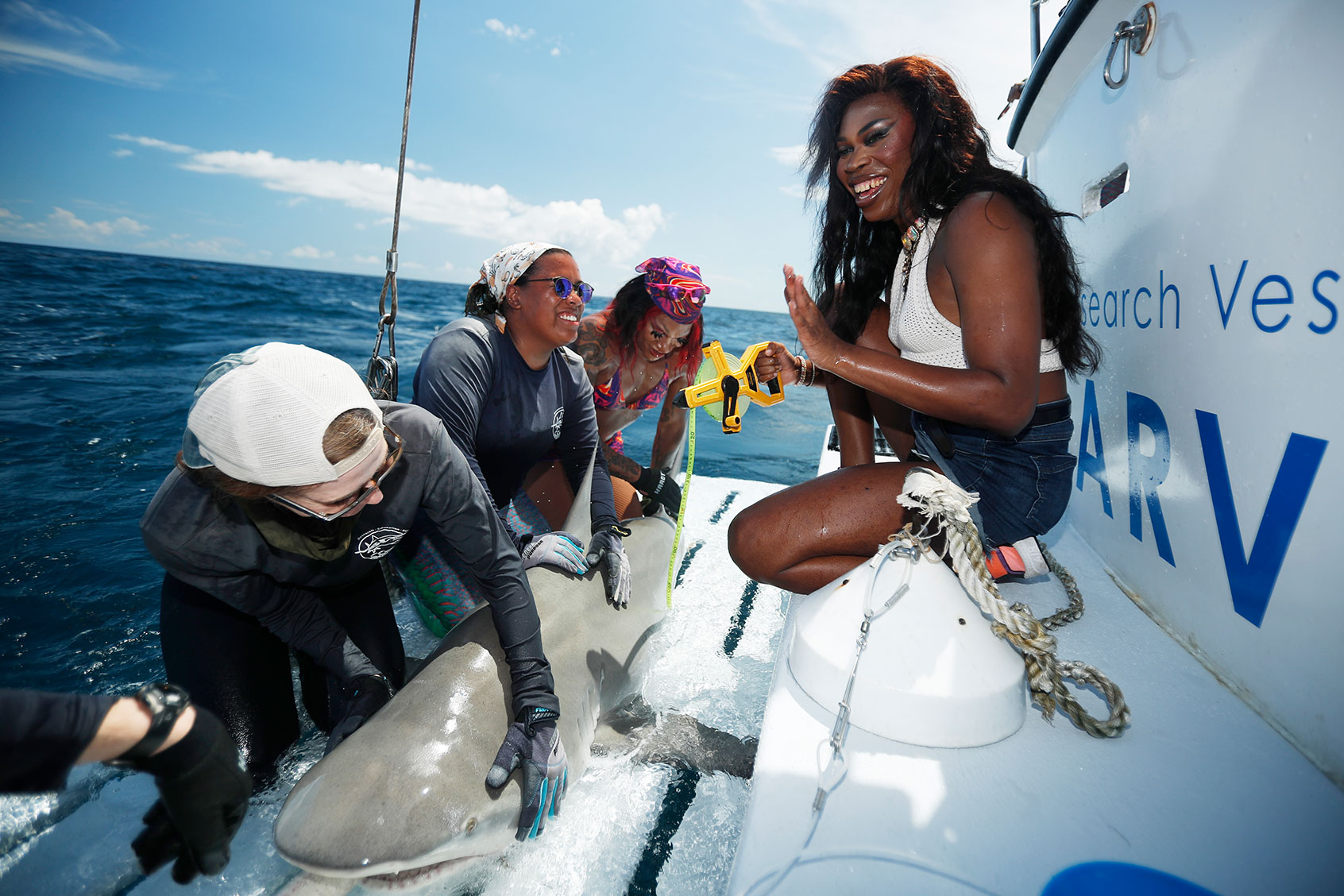
Unfortunately in many programs, fieldwork can be an unwelcoming space for underrepresented communities, said the director of the Field School Catherine Macdonald, Ph.D. The purpose of Drag ‘n Tag and the Field School in general is to ensure that everyone feels safe in this environment, she added.

“Seeing how meaningful it is to our students to know that we’re in it with them, I believe every scientist should be figuring out how to support the communities that their students are part of and how to give back to them,” Macdonald told Salon in a phone interview.


Want more health and science stories in your inbox? Subscribe to Salon’s weekly newsletter Lab Notes.


In addition to the work at the Field School, there are other efforts being made to increase diversity in the field. In 2020, marine ecologist Tiara Moore, Ph.D., created Black in Marine Science, which now has over 300 members in 27 countries, to amplify the voices of Black marine scientists and improve ocean literacy for everyone.

“At the end of the day, we are marine scientists,” Moore wrote in a 2022 article in PLoS Biology. “We want our voices to be heard, we want our work to be published and cited, we want to be invited to give scientific talks, elected to leadership boards and to have our research funded at the highest levels, and we will.”

The SCB focus group found mentorship and creating a code of conduct that makes fieldwork a safer space were essential to increasing diversity. According to the focus group’s report, “discrimination, bullying, and harassment all lead to a higher likelihood of LGBTQ+ scientists leaving academia.” 

Florida, in particular, has been a battleground for LGBTQ equality in recent years, with legislation restricting access to gender-affirming healthcare and banning the use of university funds for diversity programs. In March 2022, Gov. Ron DeSantis passed the “Don’t Say Gay Bill,” prohibiting lesson plans from including instruction regarding sexual orientation or gender identity. Meanwhile drag shows have become a target for far-right extremism.

Drag 'n Tag, 2023Drag ‘n Tag, 2023 (Photo courtesy of University of Miami)

As one of just a handful of queer people and one of even fewer Black students on campus during her time in grad school, Miss Toto knows firsthand about the barriers that exist for certain communities to get involved in science. But that didn’t stop her from completing her degree.

These days she is pursuing drag full-time but continues to participate in events with the Field School. In showing up for both communities as her full self, she is creating the space for the next generation of scientists to be welcomed as they are.

“A lot of queer people don’t feel like they have space or room to even explore marine science or explore STEM in general,” Miss Toto said. “I also had those moments growing up of being like, ‘This isn’t really a field for me and I should just try something else.’ But I was like, ‘You know what, screw it. This is what I want to do, and if I’m the only one, I’m the only one.'”

Sen. Amy Klobuchar on drug reform: Big Pharma “spent hundreds of millions — and the public won”

Sen. Amy Klobuchar of Minnesota is known for a lot of things. She is the author of four books, she’s a longtime civil rights defender and she made an impression on the national stage as a 2020 candidate for president, albeit briefly. But you likely don’t know she was a childhood fan of Monopoly, the venerable board game.

It was her fascination with the game that led to one of her strongest and most consequential positions in the Senate, and is indirectly responsible for actions she’s taken to make sure American consumers will pay less for prescription medication in the coming years. Klobuchar discussed all that and more in our recent “Salon Talks” conversation, describing in great detail the problems posed by Big Pharma’s stranglehold on the drug business and by monopolies in general.

“We are paying in America 250 percent more for our drugs than you see in other industrialized nations. It’s an outrageous situation,” Klobuchar explained. She was part of the push to lower prescription drug prices reflected in the recent Inflation Reduction Act, President Biden’s signature legislative achievement to date. One result is that beginning in 2026 Medicare officials can directly negotiate with drug companies to lower the prices of drugs for seniors. The first 10 drugs that will be included in those negotiations accounted, in 2022 alone, for more than $3.4 billion in out-of-pocket expenses paid by 9 million senior citizens.

“Not million,” Klobuchar made clear. She meant $3.4 billion. “That’s the kind of money when we talk about a drug like Xarelto or Eliquis, those are blood clot drugs. Nearly five million people take those drugs alone in America. Then there’s diabetes drugs like Januvia and psoriasis drugs in the top 10. Basically now what will be unleashed,” she concluded, is the true market power of all those senior consumers. The benefits, Klobuchar said, will go beyond seniors and help all Americans by creating lower drug prices across the board and saving consumers billions of dollars every year.

Watch my interview with Sen. Amy Klobuchar below. The following transcript has been edited for length and clarity.

I just started reading one of your books and I found out that you and I share something in common. We were both fans of Monopoly as a kid. 

As you now learn, it was actually invented by a woman who got totally screwed. She actually meant it originally as an anti-monopoly game, and then it got ripped off and made into something different, but it was her game. That was a pretty wild story.

It’s a great story, but you and I took the same lesson from it. I would win that game, and I’m going, “What’s next?” It seems like it’s not quite fair.

You get a lot of those hotels and houses, by luck of the draw, if you land on Park Place …

That’s it! We’re actually here today to talk about the Biden administration’s announcement on Aug. 29 that the first 10 drugs were selected for Medicare price negotiation as part of the Inflation Reduction Act. I know you had a lot to do with this. Beginning in 2026, Medicare can negotiate directly to get better deals for seniors. Can you explain to us how this works and how it affects others, not just those on Medicare?

Let’s step back to explain how we got to where we are: About 20 years ago, the pharmaceutical companies, the Big Pharma companies, got a sweetheart deal written into the law, that they literally wrote, saying there couldn’t be any negotiation for less expensive prescription drugs under Medicare. [Negotiation] worked great for the VA, and it should, for our veterans. They get much less expensive drugs. They negotiate, as do private entities all over the country and all over the world. But in this case, Medicare has to lock in and the drug companies get what they want. 

I’ve led this bill for years and years and years and worked through many different administrations and finally we have gotten this done. There were two game-changers. The first is the president and his leadership wanting to get it done. The second is that AARP actually put on ads against Big Pharma so their members who were willing to take on the pharmaceutical industry at least had a major entity that had their backs, because otherwise we were just on our own. 

“These first 10 are blockbuster drugs… Just last year 9 million seniors were taking the top 10 drugs and they spent, be ready, $3.4 billion.”

The bill that passed allows first 10 drugs, then next year it’ll be 15 more, then 15 more, then 20 more. These first 10 are blockbuster drugs. When you ask how it will save money, just last year 9 million seniors were taking the top 10 drugs and they spent — be ready — $3.4 billion. Not million. $3.4 billion in out-of-pocket costs. That’s the kind of money when we’re talking about a drug like Xarelto or Eliquis, those are blood-clot drugs. Nearly five million people take those drugs alone in America. Then there’s diabetes drugs like Januvia, and there’s also psoriasis drugs in the top 10. 

Basically now what will be unleashed is market power. Last time I checked, we’re in a capitalist system. The market power of negotiations, instead of having Big Pharma lock in their profits. This is very exciting, and it’s the beginning of what I hope will be more and more.

Also, we had insulin limits for seniors in this. This is all in the Inflation Reduction Act, a $35 per month limit. You’re now seeing, and this is what I think will happen with some of these other drugs, you’re seeing some pharmaceutical companies actually say, “You know what? We’re going to offer the $35 insulin limit to other people who aren’t seniors,” because it’s really hard to explain why you’re charging someone $35 and someone else $100. That is going to be one of the natural outcomes. 

So to answer one piece of this that people ask me sometimes, “OK, I’m not a senior. How does this help me?” Two big ways. One, it’s your taxpayer money that’s helping pay all these inflated prices for these drugs, because Medicare is taxpayer-funded. That will be helpful to everyone. The second one is maybe less obvious, but when you start negotiations for the biggest drug-buying group in America, 50 million seniors, you’re going to start seeing price reductions in other ways.

You and I both know Big Pharma doesn’t sit still for this. They’re already pushing back. You’re filing an amicus brief in an important court case, Merck v. Becerra. Explain to me how they’re pushing back and why you’re filing that brief?

They tried so hard to stop us from passing this bill. They had three lobbyists for every member of Congress. They spent hundreds of millions of dollars, and guess what? The public won. That was in the Democratic bill, the Inflation Reduction Act. However, they didn’t stop there. Now they are suing — multiple companies are suing in many different courts.

“In this area of antitrust, I will tell you, it has been completely bipartisan except for maybe one or two bills.”

A group of us led by Peter Welch, who’s the new senator but longtime congressman for the state of Vermont, he and I actually filed what’s called an amicus brief and got a number of other senators on the brief that argues, in the Merck case, that argues that members of Congress have every right to do something like this. It was Congress that gave them this sweetheart deal to begin with, so of course we can change the law and take it away.

They’re arguing that somehow they should be protected and that this is taking things away from them. We are of course on the side of the administration in arguing the case that this was a dutifully and carefully passed provision that came out of years of hearings about how prices for drugs for seniors and non-seniors had gone sky-high since this had been locked in.

We are paying, in America, 250% more for our drugs than you see in other industrialized nations. It’s an outrageous situation. So that’s the case that we make in this amicus brief, which means “friends of the court.”

Yes, I’ve had a few of them filed on my behalf when I was fighting for my First Amendment.

Oh, so you know what it is. You like all these nice friends of the court, if they’re on your side.

They’re always friends of the court when they’re on my side. You bring up an interesting point that goes to some of the work that you’ve done in your book “Antitrust: Taking on Monopoly Power From the Gilded Age to the Digital Age.” You bring up something beautiful in the book about trust-busting. Some of what we’re seeing now, as far as the accumulation of wealth and power by Big Pharma, is because they’ve of the way they’ve accumulated and consolidated. You’ve advocated for busting up these monopolies. How can we solve this problem in the future?

Have you read the 200 footnotes yet? No, not 200 footnotes. I’m sorry, 200 pages of footnotes.

I had 75 in mine.

I’m not going to quiz you on it, but OK. So yeah, it got on the New York Times bestseller list for one week.

Yeah, mine did too. I think I beat you by two weeks.

I tried to make it accessible in telling stories about the game monopoly and the like, because antitrust is a huge deal. We’re seeing more and more consolidation in pharmaceuticals, in technology. Google has a 90% market share for search engines alone. 

In the past, courts got involved in these things. The AT&T breakup resulted in lower long distance rates, like way lower, along with the burgeoning cell phone market. When they started that, cell phones were the size of a brick and because of competition, we are where we are today. Sadly, the Supreme Court over the years has really limited the ability to bring these antitrust cases, so I argue in the book, and in person in my job, for some tweaks to the antitrust laws to make it easier to bring those cases by funding the [regulatory] agencies. 

“They tried so hard to stop us from passing this bill. They had three lobbyists for every member of Congress. They spent hundreds of million dollars, and guess what? The public won.”

When it comes specifically to pharmaceuticals, as I’m the chair of the antitrust subcommittee with Sen. Mike Lee of Utah, we were most known this year for our very interesting hearing we did together on Ticketmaster. The Big Pharma part of it is interesting, because they have monopolies in a weird way. They have their drugs and then they pay competitors, their generic competitors — no one can believe this — to take their products off the market so they don’t compete. So Sen. Grassley and I have a bill called Pay for Delay — which is what the practice is called — a bill that would stop them from doing that. Another thing they do is file sham petitions to stop the approval of competitors. They also do something called “product hopping,” which is where they add tiny little changes [to a drug] and then take out a new patent so that people can’t compete with them. Those three practices are actually the subject of three different bills, two of which I lead with Sen. Grassley and one of which is Sen. Blumenthal and Sen. Cornyn’s bill.

We’ve actually passed those through the Judiciary Committee, and we would love to get them to the floor as part of the momentum we’re seeing out of the negotiation on drug prices, out of the insulin caps. We’re finally taking on pharma. To me, the next step is this patent system, which is related to monopolies because they’re basically trying to stop competitors from getting on the market or paying them to get out of the market.

You bring up a very interesting point there. One of the things that I write about is that in my business, in journalism, there has been a huge consolidation of media over the years. As you point out in your book, it’s in every industry. The consolidation is pretty much in every industry.

Cat food, sunglasses.

Yeah. Media.

John Oliver did a piece a few years ago, and we actually had to call him on it. It was very funny, as he is, and it ended with him saying, “So if this all makes you want to die, good luck, because there’s only three coffin makers left in the United States of America.” We had to call him and tell them that one of those companies had bought one of the others, so there were only two.

The problem is in consumer prices, lack of innovation, all these things. It catches up. You don’t see evidence of it immediately. But what you’re seeing in the tech area, with regard to the media, is that Facebook and Google have so much power that when the media companies say, “Wait a minute, we did that piece. We should get reimbursed for our content when you put, not links, but snippets of that content up, we should be reimbursed.” The media companies just go, “Oh, sorry, we’re getting out of your market.” That’s what they did in Australia, but Australia actually took them to task. So $200 million has changed hands from the platforms to media companies, including small ones, little newspapers, radio stations. There’s things going on in Canada right now, where Trudeau stood up to them. So Sen. Kennedy and I have a bipartisan bill. We’ve gotten it through the committee twice, and we’re ready to get a floor vote.

Well, 95% of what you see, read or hear is owned by six media companies, and there are vast media deserts across the country, where vulture capitalists have swooped in and bought several hundred newspapers. But to your point, I want to bring up something that you wrote:

The freedom to buy and sell goods and succeed on your own merit has long been at the core of American antitrust policy. But more important, a century before antitrust laws were even considered, the freedom to participate in a competitive market was a central guiding tenet of the American economy. It is one of the major reasons our country was founded in the first place when a ragtag group of settlers and a group of settlers and colonists decided to start a new life in a new land.

So to those who are saying they want “unfettered capitalism,” there is an answer to that, is there not? I hear this all the time: “You want socialism. You want communism.” People say they want unfettered capitalism without seeing what the end product looks like.

Right. So I have one of the highest rates, No. 1 in the Senate for bipartisan bills, No. 3 for passing bills, and in this area of antitrust, I will tell you, it has been completely bipartisan, except for maybe one or two bills. It’s just that we have to move these forward. So why is it that, in the past, you’ve seen support from conservatives on antitrust? Well, people like Adam Smith, the godfather of capitalism, there was a lot of attention paid to his work by the founding fathers. It was not only about the “invisible hand.” He also warned about the unbridled power of the standing army of monopolies. That was his work.

As time went on and they didn’t do something about it right away, there started to be this movement. It started in the Midwest with the farmers, the Granger movement, the unions, but at its core were Democrats and Republicans. When the Sherman Act passed, it had strong bipartisan support. It was led by a Republican out of Ohio, Sen. Sherman, who was close to Abraham Lincoln, and then Teddy Roosevelt, a Republican president, came in and was the first one to really enforce the Sherman Act. From there you had other presidents, during the Progressive Era, that actually moved forward on it. 

The history of this, including AT&T and everything, spans Democratic and Republican presidents. It spans congresses and authors of both parties. That’s why I am able, especially given some of the people I work with on these bills, to make the case that this is not socialism. It’s not. The companies will use that all the time. They’ll say it limits innovation in Democratic states and in Republican states they’ll use the socialism argument. It’s crazy, they literally use opposite arguments. I think the time has come — it’s not going to be tomorrow. The House will not move on some of these bills right now. They might move on the pharma bills, however. I just keep pushing the issue and eventually I will triumph.

Also, let’s not act like I’m out here by myself, even if some days it feels like it. But the Justice Department under both Trump and Biden has taken this on. Some of these tech suits started under Makan Delrahim, who was head of antitrust under Trump. They’re being continued now under Jonathan Kanter, who works for Merrick Garland in the Biden Justice Department. Usually success in the past has come when it’s bridged different administrations. That’s why I’m bullish that we’re eventually going to move forward on this.

California’s Surgeon General wants schools to be the front line against childhood stress

Twenty-five years ago, as a young physical education teacher at Whaley Middle School in Compton, Craig Hardesty abruptly learned his limits. As a Black teacher, he hoped to make a difference with children like him. He often joked with Antwoine, a boy with a bright smile and easy going manner. One day he saw that Antwoine came to class with his chest puffed out and an intense edge to his smile. Hardesty asked him if something was wrong, and Antwoine told him he was upset after witnessing a family argument at home. Antwoine said he wanted to fight somebody.

Hardesty spoke to Antwoine soothingly, trying to calm him, but with 59 other students in the class, he had to begin roll call. As he called students’ names, Antwoine punched another child. Hardesty yelled at Antwoine, who backed down, then called for help. The assistant principal arrived, took Antwoine out of class and sent him home on suspension. Already managing large class sizes, Hardesty was not trained to address children dealing with severe stress outside of school.


Join our email list to get the stories that mainstream news is overlooking.
Sign up for Capital & Main’s newsletter.

 
“In retrospect, I should have known he wasn’t calm enough to sit down,” Hardesty says. “I would have kept him next to me.” Hardesty had to learn that on his own over the course of decades.

Now, the Office of the California Surgeon General wants to give teachers the tools to better support such students in need, because not helping these students can start a cascade of problems affecting their futures. Confronting “Adverse Childhood Experiences” — abuse, neglect and challenges such as domestic violence or substance abuse in the home — is a top priority. Those kinds of stressful events are a leading cause of self-sabotaging behavior at school, such as chronic absenteeism and outbursts like the one that got Antwoine suspended. Over time, the constant stress becomes toxic to the body, increasing the likelihood of heart disease, diabetes, obesity, stroke and mental health problems as adults.

Teachers are more likely than others to witness stress-induced behavior in children, and those students may trust them more than other adults in their lives.

While those kinds of childhood traumas have afflicted more than 60% of adults in California, across ethnic, socioeconomic, and gender lines, some groups are especially vulnerable. Black, Latino and low-income students are more likely to experience multiple forms of abuse and neglect. High school students who reported four or more adverse childhood experiences before the age of nine were nearly four times more likely to be suspended or expelled compared to students who had no adverse childhood experiences, according to the journal Social Science Research.

Schools are the front line for Surgeon General Diana Ramos’ campaign because teachers are more likely than others to witness stress-induced behavior in children, and those students may trust them more than other adults in their lives.

The idea is to provide support before it’s too late.

So in mid-July, the Office of the California Surgeon General began emailing to teachers and school officials Safe Spaces, an online training program to help teachers identify student behavior that may mask mental health needs. The training teaches the kinds of skills teachers like Hardesty have had to learn on their own, from trial and error and by witnessing students spiral from school suspension to ruining their educational opportunities and, ultimately, their health and overall well-being. The idea is to provide support before it’s too late.

In the free, two hour program, a teacher reads through a series of scenarios and prompts involving characters much like their colleagues. There is a physical education teacher, a bus driver and a teacher, led by a counselor. The group learns that all behavior — even disruptive behavior, like throwing things, yelling and even fighting — is communication.

Yelling at a student, threatening punishment or sending them away may worsen the disruptive behavior, explains the counselor. Adults need to first respond to their own feelings — anxious or threatened by the student’s behavior — to be able to calmly respond to the student. Doing so can help the young person self-regulate their response to stress. The counselor notes the neuroscientist Bruce Perry’s Three R’s method. “Supportive responses build trust and strengthen relationships,” says the counselor.

Black and Latino students are more likely to attend schools with more novice teachers, often unfamiliar with how to manage student outbursts.

But will anyone open that email? July is vacation time for most teachers in California. The Surgeon General’s Office isn’t an education agency. So its email doesn’t have the urgency of something from, say, a principal or superintendent. A random request from an unfamiliar source to set aside two hours isn’t a priority amidst the chaos of a new school year, especially to teachers facing students with multiple challenges. Safe Spaces can be especially useful to teachers of low-income students of color. Black and Latino students are more likely to attend schools with more novice teachers, often unfamiliar with how to manage student outbursts. California also has the highest student to teacher ratio in the nation. Trauma response isn’t typically a part of teacher training.

Since August, Surgeon General Ramos has been visiting schools and district offices to publicize Safe Spaces. Dr. Ramos’ staff hopes education leaders — principals and teachers recognized by their peers — will spread the word.

One educator inspired by the program is Vanessa Garza, principal of Girls Athletic Leadership School Los Angeles (GALS LA), an all-girls, public middle school in the northeast of Los Angeles’ San Fernando Valley. Garza is sharing the training with her staff. At GALS LA more than 80% of its students receive free or reduced lunches. Nearly 90% are Latina.

Garza initially dismissed the messages from the surgeon general about Safe Spaces. They didn’t require immediate attention nor were they from education officials, she said.

A student tuning out of or cutting classes might be avoidance but it might also be a form of coping.

But the emails arrived repeatedly, so late one night she clicked. The presentation was about understanding student behavior and offering support rather than resorting to parent calls, suspension or expulsion. It clearly presented knowledge she has been trying to provide to her staff. Garza said she plans to “chunk” Safe Spaces, breaking the training into 20 minute exercises and discussions during teacher training. Safe Spaces, Garza notes, complements work already happening at GALS LA. Then she introduces me to Emma Salazar, a smiling 13-year-old returning to GALS for eighth grade.

Salazar left GALS last spring to attend an honors program elsewhere. But in her semester away, Salazar accumulated nearly 30 tardies — she was avoiding her math class. The teacher scolded her for asking for help. The same teacher often called campus security to remove students. Salazar stopped speaking in class.

A student tuning out of or cutting classes might be avoidance but it might also be a form of coping. Salazar acknowledges showing up late and not participating hurt both her learning and grades. But there’s more to consider: Salazar’s mother is unhoused and addicted to opioids — two forms of childhood trauma that can lead to toxic stress and manifest as acting out in school, or conversely, withdrawing from participation. By the age of 9, those kinds of stresses and trauma increase the risk of suspension or expulsion, according to a study published in Social Science Research. Considering the context of Salazar’s homelife, the scolding may not have been the sole cause of her withdrawal but, as Safe Spaces explains, it doesn’t help and in fact may exacerbate student stress.

At GALS, Salazar knows she can talk to a teacher, work things out and avoid punishment.

“Here, we laugh off our mistakes,” Salazar explains. “I can make mistakes.”

Garza said that while she opened the Safe Spaces email, many others will not. Hoping a busy teacher will open an email leaves too much to chance. She said school leaders — principals, mentors, veteran teachers and educators — will need to watch it and lead. How that will happen, no one is exactly sure. But Dr. Ramos is trying.

In late August, the surgeon general published an essay in the journal EdSource to publicize Safe Spaces. Ramos spoke at the state Department of Education’s student mental wellness conference in Anaheim the first week of September. Ramos’ staff hopes these efforts will earn invitations to schools and get teachers to spread the word.

Safe Spaces could have helped Antwoine and Craig Hardesty. Safe Spaces can help Emma Salazar and her classmates. But if Safe Spaces is going to help students, teachers need to know.

How Texas became the new “homebase” for white nationalist and neo-Nazi groups

Texas has seen a sudden surge in extremist activity within the past three years, with white supremacist and anti-LGBTQ+ groups making the Lone Star state its base of operations.

According to a new report by the Anti-Defamation League, there has been an 89% increase in antisemitic incidents in Texas from January 2021 to May of this year. Along with six identified terrorist plots and 28 occurrences of extremist events like training sessions and rallies, Texas also saw an increase in the frequency of propaganda distribution.  

“Texas has a long history of white nationalist activity and for many years has had a very active presence of white nationalist and neo-Nazi groups in the state, but the report’s findings really do paint a very troubling picture of the current situation,” Stephen Piggott, who studies right-wing extremism as a program analyst with the Western States Center, a civil rights group, told Salon. 

“Texas is the homebase for a number of really active white nationalist and neo-Nazi groups, such as the Patriot Front and the Aryan Freedom Network.”

We need your help to stay independent

This is one of the main factors driving extremism in the state. Patriot Front has contributed to Texas experiencing the highest number of white supremacist propaganda distributions in the United States in 2022, the report found. 

The group has a “nationwide footprint,” with members all around the country and their messaging contributing to 80% of nationwide propaganda in 2022 – a trend replicated every year since 2019, according to the report. 

Patriot Front has also held rallies in major cities across the country, including Washington, D.C., Boston, Philadelphia and Indianapolis, where the events are frequently the largest public white supremacist gatherings.

Texas’ close proximity to Mexico also makes it a hotbed for anti-immigrant activity, Piggot added, pointing to a growing number of nationalist and neo-Nazi groups focusing on immigration issues. 

“They’ll have rallies where a lot of the rhetoric is focused on demonizing immigrants and using dehumanizing rhetoric about immigrants,” he said. “They’re focused on the issue of immigration because Texas is a border state, but also an avenue for getting more recruits.”

The political context further amplifies this phenomenon, Peter Simi, a sociology professor at Chapman University and an expert on white supremacists in the U.S., told Salon. 

“When you look at the political context of what’s happening in Texas as far as [the movement of] anti-CRT, anti-reproductive rights, anti-gay… that is extremely conducive and consistent with groups like the Patriot Front, so they kind of thrive,” Simi said.

Last year, 31 members of Patriot Front were arrested near Idaho after police stopped a U-Haul truck near a “Pride in the Park” event and found members dressed uniformly and equipped with riot shields. Every present Patriot Front member was charged with criminal conspiracy to riot.

But this hasn’t deterred the group from putting on public demonstrations and in many cases, even documenting them. In July, close to 100 masked group members recognized Independence Day by holding a flash demonstration in Austin while carrying riot shields, a banner reading “Reclaim America” and upside-down American flags. 

“Whenever they have a gathering or any type of kind of public demonstration, they have folks filming and they put out really kind of flashy videos on social media, especially on places like Telegram and it’s all designed to make it look cool and edgy,” Piggot said. 

Extremist groups often use online platforms to recruit and spread their ideology. Over the past year, ADL found that online hate and harassment rose sharply for adults and teens ages 13-17.

Among adults, 52% reported being harassed online in their lifetime, the highest number we have seen in four years, up from 40% in 2022, ADL spokesperson Jake Kurz said.

“Many online platforms either recommend more extreme and hateful content or make it easier to find once searched,” Kurz said pointing to the report’s findings. “For some, this could lead to a dark spiral into hate and extremism.”

Patriot Front has emerged as one of the most aggressive groups in terms of distributing propaganda, Simi pointed out. They often even post pictures of the propaganda they’ve distributed online and circulate those images more broadly. 

“In a nutshell, they’re trying to really be aggressive in establishing a physical presence through [distributing] flyers as well as through actual demonstrations,” Simi said. “They’ve also been known to do these flash mob style demonstrations and sometimes more coordinated demonstrations where they’ve shown up in places, like our nation’s capital.”

As a part of their recruitment strategies, white supremacist groups have consistently targeted the LGBTQ+ community, disrupting drag shows, targeting pride events and even going after businesses that support LGBTQ+ events. They have used slurs like “groomers” when talking about the LGBTQ+ community to draw more individuals to their movement. 

“The anti-LGBTQ+ animus is probably the single greatest driver of white nationalist and anti-democracy activity that we’re seeing across the country right now,” Piggot said.

ADL tracked 22 anti-LGBTQ+ incidents in 2022 across Texas. While some actions involved extremists, others engaged more mainstream anti-LGBTQ+ entities, offering extremists opportunities to expose new audiences to different forms of hate.

“Hate and extremism seem to be a growing issue across the United States,” Kurz said. “The number of antisemitic incidents across the country are the highest we have ever measured. Instances of white supremacist propaganda are high and we are seeing an alarming amount of violence motivated by hate and misinformation.”

Kurz added that people should look at the Texas report and recognize that while some of the types of extremism are different, extremism is a problem in every community in the country.

The communities that are being targeted in Texas mirror those targeted nationwide, said Rachel Carroll Rivas, deputy director for research, reporting and analysis at the SPLC. 

“Some of the real intense false conspiracies that circulate around QAnon are resulting in an increase in the sovereign citizen movement – a conspiratorial movement that is not followed and and even recognized a lot in the U.S.,” Carroll Rivas said.

Other trends in Texas that are indicative of broader extremism patterns in the country include the targeting of school curriculums, she added. 

The reason why these groups feel comfortable operating in Texas is because of the role that elected officials in the state are playing in “echoing white nationalist talking points,” Piggot said.

He pointed to Texas Governor Greg Abbott’s extreme anti-immigrant actions, putting up barbed wire across the Rio Grande and a chain of buoys with circular saws.

“Governor Abbott is essentially doing the work for white nationalists by echoing and then amplifying their dehumanizing rhetoric,” Piggot said. “Just this week, he declared an invasion [at the border]. That’s a phrase that white nationalists have used to describe what’s happening on the U.S. [and] Mexico border for decades.”

In both Texas and Florida, neo-Nazis and white nationalists are “feeling energized” and have increased their activities due to seeing this type of messaging from Abbot and Florida Gov. Ron DeSantis, he added.

“We need elected officials to be closing the political space for these groups and denouncing them instead of amplifying their messages for them,” Piggot said.

On “Sex Education,” Ncuti Gatwa’s Eric always shines, even in a disappointing final season

“Sex Education” is one of the few really charming and consistently watchable Netflix originals but in its final season, it falters and reminds us that no television show is immaculate. Fortunately for the show, one character will always keep the audience hooked. We all know who it is; we have never watched “Sex Education” for Otis (Asa Butterfield), sorry. Our fan-favorite will forever be Eric (Ncuti Gatwa). Gatwa’s boundless charisma and beaming smile sink you into this psychedelic foray into teenage horniness like quicksand. The actor’s charm knows no bounds as he played a version of Ken in this year’s summer blockbuster “Barbie” and preps for the release of his historic leap into playing the first Black and gay Doctor in the longstanding British hit “Doctor Who.”

While Eric may be the shining light that saves this season’s muddled and disjointed final leg, I still need to voice my qualms with the direction this season went in. My biggest gripe is that the show cut most of the cast to make room for new characters at the college our favorite characters alongside Otis and Eric have started at this year. This should be a way to give its series regulars like Maeve (Emma Mackey), Viv (Chinenye Ezeudu), Jackson (Kedar Williams-Stirling) and Aimee (Aimee Lou Wood) more space to breathe and connect with each other but it doesn’t. Even though all our Mooredale favorites aren’t best friends, it would have been great to really see them all come together in solidarity. The show is at its strongest when all its characters come together in surprising moments. Remember the second season episode where all the Mooredale girls rallied together to ride the bus with Aimee after she was sexually assaulted on the bus?

One major positive in the new characters is that they have amplified a sense of a queer community of color for the isolated Eric who only has mostly straight, cisgender white friends. This opening into Eric’s identity also further explores his internal conflict with his faith as a Christian and someone who is gay. It makes for a fascinating insight into a constant battle that he has with dimming himself to be accepted by his religious African community juxtaposed to the comfort he has found in his queerness. 

Most importantly though Otis is still insufferable. As the protagonist after four seasons, Otis and his everyday struggles should feel important but I find myself continuously wondering why every other character that revolves around him is actually far more interesting and thought-provoking than him.

But to make up for Otis’ annoying storylines, his best friend, Eric alleviates the banality of the boring protagonist. This year at Cavendish College, Eric blossoms into the queer icon he always was meant to be because of a strong sense of community that he finds at a more accepting, progressive college with queer friends and students. In the earlier seasons of the show, Eric struggled at a regressive Mooderale. Eric existed as the comedic foil to Otis’ chronic main character syndrome. Their friendship continued to be one of the stronger focal points of the show as they helped the students of Mooredale with episodic sexual issues. But Eric sometimes fell into the Black Gay Best Friend trope. The few storylines he had were focused on his sexuality and how he was bullied by his future boyfriend, Adam (Connor Swindells) who was a closeted bisexual homophobe (yikes, I know).

Last season, Adam and Eric realized they were not a match when Eric traveled to Lagos, Nigeria in a series stand-out episode, examining the nuances of the Black queer experience in Africa. In Nigeria, Eric, who is out and proud, is told to tone down his queerness and gender expression because of the country’s laws that criminalize being gay. Eric does what he’s told but he meets a gay Nigerian photographer at a family member’s wedding and he takes him to an underground LGBTQ+ party. This is the first time in the series that Eric looks at home — simply at peace. He is seen and he revels in it. 

We get more of this Eric in the final season. He has always been louder and larger than life in personality and fashion but finding a community of like-minded young, queer people who also see Eric for the gem he is only amplifies everything that’s already there inside and outside of him. It’s not just Otis who gets to experience the wonder that is Eric. Not only does this season allow Eric to be the person he’s always dreamed of but it further pushes his connection with his faith. Eric hears from many characters this season that his queerness doesn’t have to be isolated from his Nigerian-Ghanian community — they can happily co-exist and he will be accepted not in spite of his queerness but because of it.

As the show concludes its successful run even though it had a lackluster final season, it can always be proud of the positive image it created in an eternally iridescent character like Eric. Most of it has to do with Gatwa’s commitment to shaping Eric into someone who each one of us can laugh and cry with.

All four seasons of “Sex Education” are now streaming on Netflix.


The origins of the “revenge dress,” a breakup trend pioneered by Princess Diana

If you’re chronically online like me, you’re probably well aware of the ongoing hoopla surrounding Joe Jonas and Sophie Turner. But if you’re not, which I applaud you for, let me explain:

Earlier this month, Jonas — who is best known for being part of the band the Jonas Brothers — shocked fans by filing for divorce from Turner, who starred as Sansa Stark in HBO’s “Game of Thrones.” The ex-couple has since remained a trending topic across social media for the messiness of their split. But it wasn’t until a few days later, when Turner made her first public appearance following the announcement, that the internet went completely berserk.

Turner, looking hot and unbothered, wore what many have dubbed her “revenge outfit” — a glittery silver halter-neck top that bared her toned midriff, above loose gray trousers. Turner, clearly enjoying a night out, wasn’t all by herself, of course. Pictured alongside her was Taylor Swift, who (get this!) happens to be an ex of Jonas. Cue the drama!

Once the photos of Turner and Swift went public, fans attempted to decode the deeper meaning behind Turner’s outfit. Was this some kind-of publicity stunt? Was this Turner’s middle finger to Jonas? Or, was Turner just innocently hanging out with a close friend with no other ulterior motives?

Indeed, that’s the power of a “revenge outfit” — an ensemble that holds so much allure, intrigue and mystery. 

Revenge dressing following a high-profile split has been a long-standing trend that has been credited to Princess Diana. In June 1994, Diana famously wore a black off-the-shoulder, form-fitting number after separating from the then Prince Charles. Charles had just released his tell-all documentary, which was made in hopes of salvaging his public image following his bombshell separation from Diana in 1991. That plan, however, majorly backfired when Charles confessed to adultery with his now-wife Camilla Parker-Bowles. In the wake of scandal, Diana took the opportunity to break away from royal protocols, strutting out in a revealing outfit that turned heads and fueled controversy.

As explained by People Editorial Director Michelle Tauber, “On a human level for Diana, you can only imagine how upsetting that would have been, not only to hear that but to know that now the world has heard it. Effectively, Charles has aired some serious dirty laundry.

“Some may have decided this was altogether too much and tried to avoid the cameras, stay out of the limelight — just let the storm pass. That is not what Diana chose to do that night.”


Want a daily wrap-up of all the news and commentary Salon has to offer? Subscribe to our morning newsletter, Crash Course.


Diana’s “revenge dress” quickly became a media spectacle, mainly because it said so much without saying anything. It was Diana’s message to Charles and the world, spoken solely through fashion. She made it quite clear that day that she wasn’t afraid to fight against her ex-husband, who, along with his family, treated Diana had power over her for years. Amid her troubled marriage to Charles, Diana was frequently exploited by tabloids and harassed by paparazzi, who made her life a living hell. It was Diana’s activism and glamour that earned her sympathy from the public. After all, she was known as ” the people’s princess.”

Today, Diana’s “revenge dress” remains an iconic symbol in pop culture history. There’s even a whole Wikipedia page dedicated to the revenge dress, with Diana’s being hailed as the first of its kind. The dress paved the way for other notable revenge dresses in fashion history.

In addition to Turner’s outfit, there’s Mariah Carey’s skirt and crop-top ensemble, which she wore at the 1997 MTV VMAs following her separation from her controlling ex-husband, Columbia Records-head Tommy Mottola. There’s Bella Hadid’s sheer catsuit, which she wore on the 2017 Met Gala carpet amid a temporary split with her then-boyfriend The Weeknd. There’s Julia Fox’s black cut-out dress, which she wore the day after her breakup with Kanye West during her NYFW runway debut. There’s Jennifer Aniston’s sparkly get-up, which she wore on the 2005 Oscars red carpet after her split with Brad Pitt. And who among the “Vanderpump Rules” crowd could forget Ariana Madix’s barely-there red dress in light of the whole messy Scandoval.

Trump ditched his mask during pandemic because it smeared his bronzer, according to former aide

In her upcoming memoir, “Enough,” former Trump aide Cassidy Hutchinson details what it was like to work in close proximity to the former president during the onset of the COVID-19 pandemic.

Recounting a visit to the Honeywell mask-making factory in Phoenix, Arizona, in May 2020 — after which Trump was criticized for, ironically, not wearing one — Hutchinson claims that his excuse that he “did not wear it after consulting the company chief executive,” was not entirely accurate.

According to The Guardian‘s coverage, Hutchinson writes that Trump “decided on a white mask,” then asked staffers for their thoughts on the matter.

“I slowly shook my head,” she writes. “The president pulled the mask off and asked why I thought he should not wear it.

“I pointed at the straps of the N95 I was holding. When he looked at the straps of his mask, he saw they were covered in bronzer.”

“Why did no one else tell me that,” he snapped. “I’m not wearing this thing.”

“The press would criticize him for not wearing a mask,” Hutchinson furthers, “not knowing that the depth of his vanity had caused him to reject masks – and then millions of his fans followed suit.”


Ken Burns defends himself after photo with Justice Clarence Thomas circulates

Acclaimed documentarian and longtime Democrat Ken Burns is distancing himself from controversial conservative Supreme Court Justice Clarence Thomas after a photo was published by ProPublica that showed the filmmaker posing with Thomas and late businessman David Koch.

In a statement to The Hollywood Reporter, the filmmaker’s spokesperson said, “Around 10 years ago, Ken was stopped and asked to take a photograph with a Supreme Court Justice and David Koch, who was a supporter of public television and would later provide some funding for his film, ‘The Vietnam War.’

“So he took the photo, as he has done with many, many others. Other than the taking of that photograph and innocuous pleasantries, that’s the extent of his contact with Justice Thomas,” the statement said.

The photo was first obtained by ProPublica for an article the publication shared on Friday. The article stated that Thomas participated in two donor events for the Koch Network an organization funded by the libertarian billionaires Charles and David Koch. Other than appearing in the photo stamped on the cover of the story, Burns was not mentioned in the investigative piece.

Following the circulation of the article and photo, Thomas and Burns have received heaps of backlash. Burns is a decades-long donor to the Democratic Party, and left-leaning people have questioned his politics after the photo was published. As for Thomas, political and legal experts are disgusted with the implications that Thomas participated in Koch donor summits and the political network which has appeared before the high court in multiple cases, including one of the most highly anticipated of the upcoming term.