Spring Sale: Get 1 Year, Save 58%

“Fashioning the Beatles” delves into the band’s iconic, impactful looks that were “worth emulating”

In many ways, Deirdre Kelly’s “Fashioning the Beatles” is long overdue. We take it for granted, as a kind of pop-music commonplace, that the Fab Four transformed rock ‘n’ roll’s sartorial style during the 1960s. Subtitled as “The Looks that Shook the World,” Kelly’s book takes a deep dive into the Beatles’ fashion sense, arguing that the group’s image was not only integral to their success, but the self-conscious product of John, Paul, George and Ringo’s interest in fomenting change. 

The author of “Ballerina: Sex, Scandal, and Suffering Behind the Symbol of Perfection” (2012), Kelly traces the history of the band’s concerted interest in honing their look. During a 1969 interview, John Lennon addressed this aspect of the Fabs’ legacy, remarking that “I was ashamed to go on the Continent and say I was British before we made it. The Beatles have tried to change Britain’s image. We changed the hairstyles and clothes of the world, including America — they were a very square and sorry lot when we went over.” For his part, Ringo Starr adored wearing “colorful clothes,” adding that “because we did, it allowed a lot of other people to do the same.”

In “Fashioning the Beatles,” Kelly documents key shifts in the Beatles’ appearance, from their leather-clad Hamburg days through their heady embrace of psychedelia during the “Sgt. Pepper’s Lonely Hearts Club Band” era. As their music revealed one monumental innovation after another, so too did their look, which not only expressed their individual senses of identity, but also demonstrated their collective interest in serving as touchstones for their generation. “I think we gave some sort of freedom to the world,” Paul McCartney has observed. “I meet a lot of people now who say the Beatles freed them up.”

We need your help to stay independent

As Kelly astutely notes, it is precisely this sense of freedom that catapulted the Beatles — both as musicians and proto-fashionistas — into our international conscience. In its own way, the bandmates’ fashion sense exists as a vital aspect — nearly six decades later — of their staying power. There is perhaps no better example of the group’s look serving as a fashion event than the June 1967 “Our World” simulcast in which they performed “All You Need Is Love” for an audience of several hundred million viewers. 

Decked out in their Carnaby Wear finery, the Beatles wowed their worldwide spectators with the stunning audacity of their wardrobe. As Starr later recalled, “We loved dressing up, and we had suits made for the show. Simon and Marijke from The Fool made mine. It was so bloody heavy, I had all this beading on, and it weighed a ton.”


Want a daily wrap-up of all the news and commentary Salon has to offer? Subscribe to our morning newsletter, Crash Course.


But as always, the Beatles’ fashion choices that fabled night had been worth their heft in gold. With the Summer of Love fueled by the groundbreaking sounds of “Sgt. Pepper,” the band left an aural and visual imprint for the ages. Inevitably, Kelly writes, “The clothes tell the story.” As “Fashioning the Beatles” so presciently reminds us, the group’s look was an irresistible part of their unparalleled success. “It is why so many people couldn’t take their eyes off them in the sixties,” she points out, “and new generations of musicians, designers, and fans find them captivating and worth emulating today.”

The Chris Brown problem that never goes away: How he continues to maintain his relevancy and fans

Chris Brown‘s 2007 hit “Forever” is an infectious, late aughts classic. There is something about the R&B-infused pop beats and his silky falsetto crooning, “I feel like I’ve waited my whole life for this one night/It’s going to be me, you and the dance floor.” For crying out loud, America’s TV sweethearts Jim and Pam from “The Office” got married to “Forever.” Throughout his career, Brown has made music that connects.

But in the same breath, it’s not enough to ignore the shockingly disturbing allegations of assault that follow the singer like a trail of muddy, sloppy footsteps. Most infamously, Brown pleaded guilty for felony assault for attacking Rihanna in 2009, stalking and threatening to kill his ex-girlfriend Karrueche Tran which resulted in a five-year-long restraining order, and more recently arrested on charges of rape in Paris and sued for sexual assault in a now dropped $20 million lawsuit. 

This isn’t the first time Brown has attacked a Black female artist for existing.

Now another woman and R&B/pop singer, Tinashe, is in Brown’s line of abusive fire. In an interview with the “Zach Sang Show,” Tinashe was asked about her collaborations with R. Kelly and Chris Brown, and the singer detailed that her former music label RCA made her record both songs with Brown and R. Kelly. Tinashe said during the interview: “You think I wanted (to record those songs)? I literally block out that R. Kelly song from my mind — I forget that it even exists,” she said. “That is so embarrassing. That is so unreal that I even have a song with R. Kelly.”

The interview clip was posted to Instagram (because this is peak news source) and it seemingly triggered Brown. In the comments he said “Name five Tinashe songs or die . . . Everybody Dead,” he began, before continuing on another post. “She full of dat evil. Shawty career is nonexistent. What’s more embarrassing is that she worked with all these people, and not one of us could save her career.”

In regular stan behavior, after Brown addressed Tinashe’s mild comments, his fans took to spewing hate in the comments of all her social media posts. Thousands of spam comments like, “I can’t name five songs,” currently fill her most of her Instagram and Twitter posts. Fortunately for Tinashe’s light sense of humor, she’s using the hate as a way to promote her new album. She tweeted “Anyways. . . stream ‘Needs.'” 

Nonetheless, even though Tinashe seems to be taking the online trolling on the chin like an internet veteran, this isn’t the first time Brown has attacked a Black female artist for existing. Another R&B artist, Kehlani suffered a suicide attempt in 2016 after people dogpiled on the star for allegedly cheating on then-boyfriend PartyNextDoor, which of course turned out to not be true. Brown then belitted Kehlani’s struggle with mental illness and ickily said, “There is no attempting suicide. Stop flexing for the gram. Doing s**t for sympathy so them comments under your pics don’t look so bad.”

Even after all the Rihanna-assault conviction, multiple allegations of abuse and inflammatory comments dogpiling and siccing his fans on Black female musicians, Brown still remains a large part of the hip-hop and R&B zeitgeist, holding 47.2 million listeners on Spotify. He has had recent hits like the Grammy-nominated collaboration with another covert misogynist, Drake, on the song “No Guidance” and his 2022 album “Breezy” was also nominated for an R&B Grammy.

Unlike convicted rapist and sex trafficker R. Kelly, Brown’s abusive behavior is not a cancer the Black community has been able to cut out of itself. And for decades, R. Kelly’s repugnant behavior resulted in lawsuits, criminal cases and countless allegations and evidence but he was still immune to any weighty legal and societal repercussions. Some would say Brown’s abuse may not be as insidious as R. Kelly’s at first glance but Brown exists as a literal example for the community’s habitual inability to hold abusers accountable for their evident and repeated infractions against Black women.

We need your help to stay independent

Brown has attempted to rehab his reputation post-assault conviction with the image that he is a girl dad to a child whom he fathered outside of his relationship with Tran. In 2015, he said that having a daughter is “actually great. It’s very humbling. You know, it’s very calming. I think I was a lot, you know, rambunctious, very hyper as a kid but now seeing that 10 times over, my daughter’s kinda like mellowing me out.” He also released a documentary “Welcome to My Life,” on Netlfix in 2017 that gave a glimpse at the abuse that surrounded him as a child and abuse that followed him into his adultlife.

The parasocial relationship between Brown and his fans becomes stronger and potentially more dangerous when he is attacked.

In these efforts to clean up the dark-sided PR engulfing Brown, some could be sympathetic to his experience with abuse or parenthood. My question is then why does he continue to perpetuate the same vitriolic behavior onto women if he has seemingly learned from being a girl dad and abuse victim himself? It does not add up at all, and I know we all are smart enough to not buy the BS he has consistently sold his fans and the public.

Unfortunately for these said stans, many of them are women, some are Black women (sigh), and they are still equally invested in the 34-year-old as they were when he was a teen star. Now in 2023, as we reframe the way abusers exist in our society, Brown’s role as a celebrity always comes into question. In response to the question if Brown is really a rehabilitated abuser, his fans lash out in a toxic, violent way like they did to Tinashe and Kehlani. The parasocial relationship between Brown and his fans becomes stronger and potentially more dangerous when he is attacked. As a way to protect him, they in return go nuclear. This reactive response does nothing for the earnest and nuanced conversations about looking back at people’s behavior and history and assessing whether or not they are actually capable of change. And as we have extensively taken a lookback at Brown’s track record, I can’t say that I believe he is or ever will be.

GOP Rep. Nancy Mace is “very unhappy” with Kevin McCarthy: “I don’t like feeling like I was misled”

It looks like the U.S. government is likely headed for another shutdown at the end of September, as House Republicans can’t find a compromise on federal spending and members of the GOP caucus are blaming House Speaker Kevin McCarthy.

Beyond the usual roster of McCarthy detractors on the MAGA-fied far right, members closer to the Republican establishment are now starting to speak out against their leader. 

“Promises were not kept,” Rep. Nancy Mace, R-S.C., told Fox News on Tuesday. “I would say I would put me in the column of being very frustrated.”

On Tuesday, House GOP hardliners blocked debate on the annual defense appropriations bill in a procedural vote. Mace represents a closely divided district in South Carolina, which is home to a large number of military voters, and likely believes she cannot afford a shutdown.

Only five Republican members defected on the procedural vote — the kind of routine measure that normally falls along party lines — but that was enough to deny McCarthy a majority. “To me, everything is on the table,” Mace said that she is “not the only member upset” and added, “To me, everything is on the table,” a possible sign that some moderate Republicans are prepared to vote with Democrats on certain necessary measures.

“I don’t like feeling like I was misled or lied to on particular pieces of legislation,” Mace said, evidently referring to McCarthy, adding that she had worked on “legislation that has fallen on deaf ears, has been ignored, no matter the promises that I was made by the leadership. So put me in the very unhappy column today.”

If a government shutdown happens, Mace concluded, she believes political blowback will follow: “Republicans always get blamed.”

Watch below, via Fox News:

Howard Stern embraces being called “woke” because “I’m not for stupidity”

The radio show host Howard Stern said he actually embraces being called “woke” as a compliment. Stern said on his show, “The Howard Stern Radio Show” that if being woke means not supporting former President Donald Trump or “that I support people who want to be transgender, or I’m for the vaccine — dude, call me woke as you f**king want.”

Stern exclaimed, “I’m not for stupidity,” and continued to mention that he received the new COVID-19 booster vaccine.

In the past, the broadcaster referred to Trump as a friend and hosted Trump as a guest on his show prior to his segue into politics. During Trump’s presidency, Stern took a more critical stance due to the administration’s handling of the COVID-19 pandemic.

“I want to read legitimate news sources. Here’s how woke I am: I believe the election was not rigged,” Stern said Trump’s claims that the 2020 election was rigged, ultimately leading to the Jan. 6 insurrection, the incitement for which Trump was impeached.

Stern also mentioned the backlash against LGBTQ+ and specifically transgender rights in the country and the widespread and concerning book bans and policing of the historical curriculum in schools.

Regular consumption of cheese may promote better cognitive health, study suggests

A recent study published by the Multidisciplinary Digital Publishing Institute (MDPI)’s journal titled Nutrients suggests that regular consumption of cheese may be linked to better cognitive health among older adults. The study analyzed data from 1,516 participants aged 65 and above, who were recruited from a broader geriatric survey that the team conducted once every two years. The participants, who were all based in Tokyo, Japan, were closely assessed on their dietary habits, with special focus on their cheese consumption.

Participants’ cognitive capabilities were also measured using the Mini-Mental State Examination (MMSE), a popular 30-point test for evaluating cognitive function among the elderly. For this research study, a MMSE score of 23 or below signified lower cognitive function. “Previous studies have shown that a dietary pattern characterized by a high intake of soybean products, vegetables, seaweed, milk, and dairy products, together with a low intake of grain products, is associated with reduced risk of developing dementia; moreover, a high intake of milk and dairy products reduces the risk of developing dementia, especially Alzheimer’s dementia,” the study noted.

After factoring in variables like age, physical activity, and overall dietary habits, the study found that participants who consumed cheese regularly were less likely to score 23 or below on the MMSE.

“This result may suggest that the inverse association between cheese intake and lower cognitive function may be due to the likelihood that subjects with cheese intake had a dietary habit of consuming a wide variety of foods rather than the specific nutrients contained in cheese,” the study said, adding that such dietary variety did not refute the link between cheese consumption and cognitive health.


Deviled eggs that even God would cosign

I love deviled eggs. So much so that it is extremely embarrassing for me to admit that I thought they were called “doubled eggs,” well into my teens, both because of thick Baltimore accents and how they are made–– I mean you literally take out the yolk and add a bunch of ingredients to it, which in actuality doubles the egg. 

I also inaccurately thought of deviled eggs as being exclusively soul food. It is not strange to go to a Black function, maybe a holiday dinner and hear “Hey Auntie, lemme get yams, seafood salad, macaroni salad, three turkey meatballs and four of those double-eggs!” So, I’m guessing that you could probably imagine the wild look on my face, when I posted up a bar — in a mostly white neighborhood, with a mostly white staff — and saw three different types of deviled eggs on the menu.

I was even more surprised, when a dude who looked like Kelsey Grammer from that show “Frazier” sat two stools down from me and devoured about three orders. Frasier was eating those devil eggs so hard that I thought he was going to mess around and gnaw off his index finger. A chunky scoop of yellow even bounced onto his argyle sweater — and, yes, he ate that too.  

Later I learned that deviled eggs are essentially soul food for white people, much like casserole.  According to the History Channelthe dish dates all the way back to Ancient Rome, where they cooked eggs with “spicy sauces” which were served as appetizers. The dish didn’t become what we know it as today until an1896 cookbook suggested “mayonnaise as a way to bind ground egg yolks together.” 

My mother, the original egg master, had a delicious recipe that tasted nothing like the deviled eggs I had at my aunt’s, grandma’s or neighbor’s house.

We need your help to stay independent

See, most people I know leaned on the salty, but my brilliant mom opted for sugar. What better way could she convince us kids to eat all of that cholesterol­­? At least the white part had protein. When I graduated from the boy who was asked to bring paper plates or bags of ice to the function to the man who was capable of making a dish, I took the liberty of combining both worlds, the savory and the sweet. 

Most deviled eggs recipes call for mustard, mayonnaise, salt, pepper and paprika. And if you abide by those ingredients than congratulations, you successfully leaned how to use google. Now pay attention while I tell you how to makes the Devil’s eggs like a pro. 

D’s salty and sweet deviled eggs
Yields
12 deviled eggs
Prep Time
10 minutes
Cook Time
8 minutes

Ingredients

  • 6 large eggs 
  • 2 Tablespoons mayonnaise 
  • 1 Tablespoon of sweet relish  
  • 1 teaspoon of Dijon mustard 
  • 1 teaspoon of sugar  
  • Salt and pepper, to taste 
  • Caviar for garnish (Optional)
  • Crumbled bacon for garnish (Optional; I don’t eat pork so I tend to use turkey bacon, but I’ve heard pork bacon is the best for this dish)
  • Paprika 


Directions

  1. Boil the eggs in hot water for 8 minutes and immediately place them in ice water afterwards 
  2. Slice the eggs into halves and place the yolks into a large mixing bowl.
  3. Add the mayonnaise, sweet relish, Dijon and sugar, into the mixing bowl with the cold yolks. Whip until it’s smooth and creamy. Salt and pepper to taste. 
  4. Refile the egg halves and dust them with paprika. 
  5. Sprinkle caviar and crumbled bacon on the top of each yolk


“The View:” Whoopi Goldberg defends Hasan Minhaj’s comedy fabrications

Fellow comedian Whoopi Goldberg defended Hasan Minhaj’s embellished comedy that was exposed in a New Yorker profile last week. The profile brought to light that Minhaj conjured up lies surrounding some true or some completely false stories for his Netflix stand-up specials. He called the fictional stories “emotional truths.”

But Goldberg defended Minhaj’s fabrications during Monday’s broadcast of “The View.” The moderator and co-host said “that’s what [comedians] do, we tell stories and we embellish them.”

“If you’re gonna hold a comic to the point where you’re gonna check up on stories, you have to understand, a lot of it is not the exact thing that happened because why would we tell exactly what happened? It ain’t that interesting,” she said.

Goldberg continued: “There’s information that we will give you as comics that will have grains of truth, but don’t take it to the bank. That’s our job, a seed of truth. Sometimes truth and sometimes total BS.”

The performer also shared with the audience that when she used to perform as a comedian, she dealt with a report fact-checking her stand-up, inquiring whether she had a degree from New York University. She said she never said she had a degree from NYU but realized the reporter was referring to a comedy bit she had told.

In the profile, Minhaj was also accused of fostering a toxic and misogynistic workplace environment for female staffers of color behind the scenes of his now-canceled Netflix commentary show “Patriot Act.”

Magical candy bars that anyone can bake at home

I’ve long sought a grown-up candy bar and think I’ve finally found it. The Lübeck Marzipan on the dessert menu at Koloman, a French restaurant in Flatiron, has the scent of an almond cake, the crunch of brittle, the chewiness of a great macaroon and the waves of chocolate that say candy bar.

I asked Emiko Chisholm, the pastry chef at the restaurant, to come by our test kitchen to show me how to make this magical confection.

Luckily for us non-pastry-chefs, her recipe requires little equipment, just some mixing, shaping, baking and topping. Marzipan, sugar, honey and egg whites are blended to a stiff paste, rolled into logs, dipped in finely chopped almonds and baked. At this point, your kitchen will take on an intoxicating almond scent.

If there is a challenge with this recipe, it’s sourcing the smoked salt and the best marzipan or almond paste you can find. Emiko uses Lübeck marzipan, which contains 52% almonds. I couldn’t find a source for it online, so I tried three different almond pastes, whose almond content hovered close to 50 percent; this was my favorite. Maldon Smoked Salt is available here.

As I learned after testing Emiko’s recipe on my own, the results are binary. If you’re precise and patient, as Emiko is, your marzipan bars will look like neat bricks. If you’re loose around the edges, like I am, your bars will look rustic and homespun.

Emiko’s been baking professionally since she was 17, first at a small place near where she grew up in Upstate New York. Mark Tasker, the Head Baker at Balthazar in Soho, was a regular customer and one day he asked her if she’d like to come work for him in the city.

“I worked my way up from a baby, who didn’t know anything about pastry, to pastry sous chef,” Emiko said of her ascent, first at Balthazar, then at Augustine and now Koloman. Throughout that path, she’s had mentors with expertise in traditional European pastry. Mark’s work was influenced by a German baker. Her current boss, Marcus Glocker, leans toward Austrian and Eastern European pastry. Another dessert on the Koloman menu is an Esterházy Torte, a Hungarian cake with 13 layers of almond and hazelnut sponge cake.

A marzipan dessert presents some risks on a menu. “Everyone knows marzipan fruits and they’re kind of nasty,” Emiko said. “So marzipan doesn’t always have the best reputation.” (Do brush up on the SNL spoof if you’ve got time!) But she knows its powers as a background flavor and texture. She uses marzipan as a foundation for cakes, creaming it with the sugar and butter. She also puts it into ice cream bases. And of course, it goes into her stollen.

After baking her Marzipan Bars, Emiko uses a bench scraper to clean up any uneven edges on the bars so that they’re perfectly straight. She brushes the tops with apricot jam, diluted with a little water and warmed to a syrup. The final touches are thread-thin diagonal stripes of melted chocolate, piped exactingly and a sprinkling of smoked Maldon sea salt.

As she piped the chocolate, I tried to imagine myself doing that at home.

Nope.

“Could you just use a spoon to dip into the melted chocolate and swirl it over the top?” I asked. Emiko paused, uncomfortably. “Yeah, you could,” she said with a shrug. So you can do it my short-cutting home cook’s way, just know that when you do, a small part of a hard-working pastry chef’s soul will die along with your sloppy swirls.

Click here for the recipe.

I don’t believe in cheat days anymore, but sometimes I still miss them

I don’t believe in cheat days anymore, but sometimes I still miss them. 

I realized this the other day while surveying an array of dim sum after I’d gone to Chinatown to meet some friends for brunch and left the ordering to them. Soon, the table was replete with steamer baskets of sticky rice wrapped in lotus leaves, golden-brown barbecue pork dumplings, half a crispy duck and delicate monkfish fritters. 

As I prodded a platter of shumai with my chopsticks, I was overcome with a sense of warm contentment.  There would have been a time that I would have had to plan for eating like this — and there would have been a time I would’ve felt like I had to repent. 

Yo-yo dieting is all about highs and lows, and looking back at my religious upbringing, it’s perhaps not surprising that I thrived under the illusion of extremes, since that was the kind of universe I’d been taught God created. After death, you’d live, weightless and winged, forever in heaven or burn eternally in the pits of hell. On earth, women were either saints or sluts, something youth pastors seemed to delight in reminding the young girls in their religious care through a series of increasingly visceral metaphors: a loose girl was a shared bike seat, a piece of chewed gum, a scrap of tissue paper rubbed ragged by an army of glue sticks. 

But objects are passive and I wanted some semblance of control before, as the church taught, my body went from belonging to my father to belonging to a husband. 

Food could be controlled and I just so happened to become calorie-conscious at a time when the diet industrial complex was absolutely raging through pop culture. I was 11 years old when “The Biggest Loser” debuted; looking back on it now, the premise of the entire show is seeped in casual cruelty. Contestants were forced to weigh in shirtless — every natural curve, roll and fold beamed out to millions of American television sets — often after enduring eight hours of cardio to sweat out water weight. 

I gravitated to the show because it, too, was an exercise in extremes. Even the language used with and by the contestants had a certain religiosity that felt familiar. 

In the New Testament, there’s the story of the Temptation of Christ, which centers on Jesus going into the desert to fast for 40 days. While there, the devil tempts him three times, once by appealing to his ego, once with the world’s kingdoms and once with bread, to which Christ famously replied, “Man cannot live by bread alone.” 

We need your help to stay independent

One recurring challenge throughout the seasons of “The Biggest Loser” was a series of temptation rooms. Contestants would be thrust into locked quarters that had been filled with their vices: slices of pepperoni pizza glistening with grease, chafing dishes of lo mein, piles of baby pink frosted cupcakes, double cheeseburgers, plates of fries. Would they rebuke the temptation? Or would they be forced to confess and then purge their sins through sweat?  

By the time I was a teenager, I’d been a dancer for several years and had taken the lessons I’d learned on the show — as well as from obsessively pawing through women’s fitness magazines — and distilled them into a calculated science. Six days a week, my first two meals of the day often consisted of a mound of cottage cheese, warmed in the microwave until a little bubbly, and topped with a scoop of salsa. Compared to the sleeves of chalky low-fat Snackwells that dominated our family pantry, it almost felt like a decadence, but more importantly, with only two ingredients, it was easy to track just how many calories I needed to burn on the rickety treadmill in the basement. 

I started dreaming of pancakes on Tuesday nights, my body begging for a little softness. 

I eventually started to dream of food, including one recurring dream I had into my early 20s that saw me sitting in a booth of a diner I’d never visited before, eating a pillowy-soft pancake drenched in spiced syrup. That was it. That was the dream and I usually had it on Friday nights because Saturday was my cheat day — and it was euphoric. I gave myself an entire day to eat what I wanted, however much I wanted: bowls of steaming chicken and rice soup heaped with baby oyster crackers; bowtie pasta with peas, cubed ham and cream sauce; tall, cool glasses of orange juice; furtive slices of iced cookie cake.

I loved feeling full, but eventually, I came to dread it, too. Sure, food could be controlled, but the question became, could I control myself around it? The fear of my mask slipping became too much. I stopped having cheat days, choosing instead to ride the high of elongated fasting. I started dreaming of pancakes on Tuesday nights, my body begging for a little softness. 

It took a really long time to unfurl my conflicted feelings of Spartan rigidity and hidden, sensual delight surrounding food. It took even longer to heal the spiritual wounds that had made such an internal struggle possible. I’m not sure that I’ll ever be completely healed, but surveying that table of dim sum I realized that I was closer than I’d ever been. 

Sometimes I miss the thrill of anticipation. For now, I’m embracing feeling full. 

McDonald’s is being sued — again — after a woman endured “severe burns” from spilled hot coffee

An elderly woman in her 80s has sued a San Francisco McDonald’s after she sustained “severe burns” from a hot cup of spilled coffee. Mable Childress filed her lawsuit to the San Francisco Superior Court on Sept. 14, per court documents obtained by NBC News. In it, Childress claimed the McDonald’s employees failed to secure her coffee cup lid that she purchased from a drive-thru, thus breaching their “duty of care.” Childress explained that the cup lid came off while she drank her coffee and that “scalding coffee poured out of the cup,” causing severe burns and scars to her groin.

The incident took place earlier this year in San Francisco, the lawsuit specified. Childress said the spilled coffee caused her to suffer severe burns, scarring, emotional distress, along with hospital and medical expenses. She continued, saying she tried to report the incident to three employees at the McDonald’s location, including managers. However, the employees “ignored” and “refused to help her” until she sought treatment on her own.

This isn’t the first time McDonald’s has been sued over spilled coffee. In 1992, 79-year-old Stella Liebeck sued a New Mexico-based McDonald’s after suffering from third-degree burns in her pelvic region when she accidentally spilled hot coffee in her lap. The highly publicized case, called Liebeck v. McDonald’s Restaurants, awarded Liebeck $2.7 million in punitive damages.

What is “southern” food? Dale Gray takes readers from South Africa to South Korea for the answer

While the notion of “Southern food” may automatically conjure up foods like grits, peach cobbler or pecan pie, there’s a depth to what the term actually constitutes. In her new cookbook, “South of Somewhere: Recipes and Stories from My Life in South Africa, South Korea and the American South,” author Dale Gray walks you through that journey. 

Gray’s incredibly inventive take on food — as well as her fascinating life — lead to such a uniquely researched and compiled cookbook which unites Southern food in all capacities, tracing an important line from South African to South Korea all the way to the American South

Salon Food spoke with Gray about her upbringing, her career, her favorite foods and the importance of food, no matter where you’re from — or where you wind up. 

South of Somewhere by Dale GraySouth of Somewhere by Dale Gray (Photo courtesy of Simon Element)
The following interview has been lightly edited for clarity and length.

Hi Dale! I was immediately struck by the salmon ssam dish when first perusing the book and made it a few months back and it exceeded my expectations. What led to your developing a recipe like that? 

The South Korean word “Ssam” means “wrapped” and refers to a dish in Korean cuisine in which, usually, leafy vegetables are used to wrap a piece of meat. During my years in South Korea, this was usually grilled pork or beef with pickled vegetable condiments or side dishes. I love those, but started serving my gochujang glazed version of a Ssam meal at dinner parties here in America because I find a beautifully prepared side of salmon to be such a showstopper! Salmon is popular and pairs well with robust flavors like gochujang, pickled cucumber and creamy sauces. Green apple seemed like it would add enough sweetness as a counterpoint to the spice of the glaze. Ssam dinners are a joyful group activity here at our house and I hope that readers will love the experience if they’ve never tried this style of eating before.

Your cookbook is deeply, incredibly unique. There’s truly nothing else like it currently on bookshelves. It fuses such disparate cultural realms into something so cohesive and comprehensive. Can you tell me a bit more about that? 

It took a lot of self-reflection and deep diving!  Before the book, I was slightly unsure of how I would go about tying all of these wonderful places together, but once I started writing more about the memories that made each place special, cohesion followed. Each “south” is vastly different in terms of culture and location but I’ve always felt that the values in each place align. Sharing the story of my defacto Korean grandmother is no different than sharing the story of my maternal grandmother, Rose, in South Africa. I get the same feeling when I talk about the previous owner of our home, Miss Dixie, who glued a recipe for her tomato pie inside of my kitchen cabinet here in Mississippi. 

Your book covers cuisine “from South African to South Korea to the American South. Beyond the “south” connector, what are the other similarities that bridge these cuisines and cultures? 

I experienced a strong focus on family, group identity and really specific customs revolving around food in each south. 

We need your help to stay independent

Tell me a bit about your professional and personal background. How does this book represent your life, your culture and your travels? 

I consider myself to be a home cook and I’m self-taught because of a necessity to feed myself during college where I studied social work. I planned to work and live in South Africa at first, but the pull of faraway places and a recurring vision of a life somewhere else gave me the push that I needed to travel and see the world. In South Korea, I knew that I had made the right choice. I spent most of my twenties there, learning more about myself and discovering my favorite cuisine.

While I sometimes missed South Africa, celebrating my heritage by recalling stories of my life there made it easier. It was truly therapeutic to me and a very large reason why I started sharing those stories online. When my editor at Simon & Schuster, Justin Schwartz, first proposed the idea of writing a cookbook he said: “Your first book should be special. We want you to tell the stories that matter to you.” This sealed the deal for me. South of Somewhere is an incredibly personal book and it is very special. It’s a true reflection of my life as it has unfolded and the recipes serve to anchor the stories.


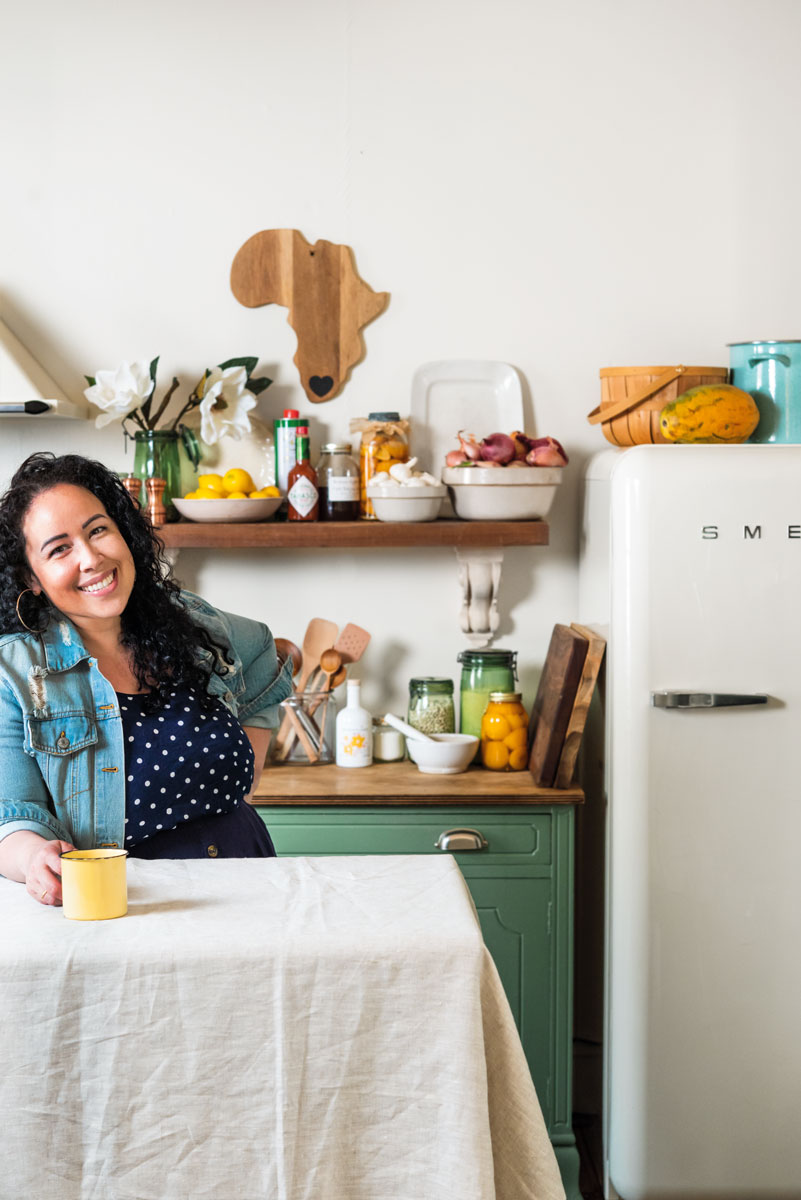
Dale in the kitchenDale in the kitchen (Photo courtesy of Simon Element)
Did your food career start when you launched your blog? 

It did not. My blog is and has always been just for fun. My food career started a few years after creating The Daley Plate on Instagram. At first, it was partnerships with brands who loved my food photography and then it became my go-to platform for sharing recipes. I started gaining traction as a recipe developer and this eventually led to “South of Somewhere.”

What are your personal favorite recipe(s) in the book? 

The Farmer’s Sausage, Egg and Cheese Sandwich is up there as one of the most unique recipes in the book. It takes inspiration from a spiced South African coiled sausage, boerewors and brings that unique flavor to an American audience in a very accessible way.  Secondly, the Pimento Cheese Tomato Pie Galette. It’s a showstopper of a recipe and one of my favorite things to make for friends.

I also love the flavors and textures of the Cornmeal-Crusted Fish with Green Tomatoes with Mississippi Comeback Sauce and the comforting Korean flavors in Marry Me Chicken Soup.

How was the experience of putting together such a unique cookbook? 

I enjoyed the creative process so much! I found great joy in coming up with recipes and feeding my neighbors during the two-year-long process. Everyone’s valuable feedback made the final product so much better. I’d go to bed at night thinking about what I would cook the next morning and this thought process didn’t stop until the manuscript was delivered.

As a first-time author, there were more questions than answers in the beginning but it came together beautifully thanks to my incredible team. My co-writer, Susan Cheong, took my words and polished them and it was a great relief to be able to trust her with that. My very good friend, Bella Karragianidis, is a professional photographer and came to Mississippi to photograph many of the images you see in the book today. Collaborating with and learning from others in the industry was an invaluable experience.


Want more great food writing and recipes? Subscribe to Salon Food’s newsletter, The Bite.


How does developing recipes for a cookbook differ from developing recipes for your blog?

I consider myself to be a very easygoing home cook. The recipes that I share on Instagram are usually dreamed up on the fly and snapped quickly before my husband and I sit down for dinner. I usually don’t make them more than a few times but I am very confident in my ability to throw something together. Other home cooks appreciate the inspiration and I don’t fuss too much about smaller details.

A cookbook, however, is a whole other story! While my goal was to showcase approachable recipes as well, the recipes in the book had to be fine-tuned, tested and perfected many times. I had a professional recipe tester, Ann Volkwein, for a few of the ones I needed an extra opinion on and relied heavily on friends to taste-test as well. I am very familiar with the tastes and preferences of my Instagram audience, but had to think about what a larger group of cooks might want to see in the book.

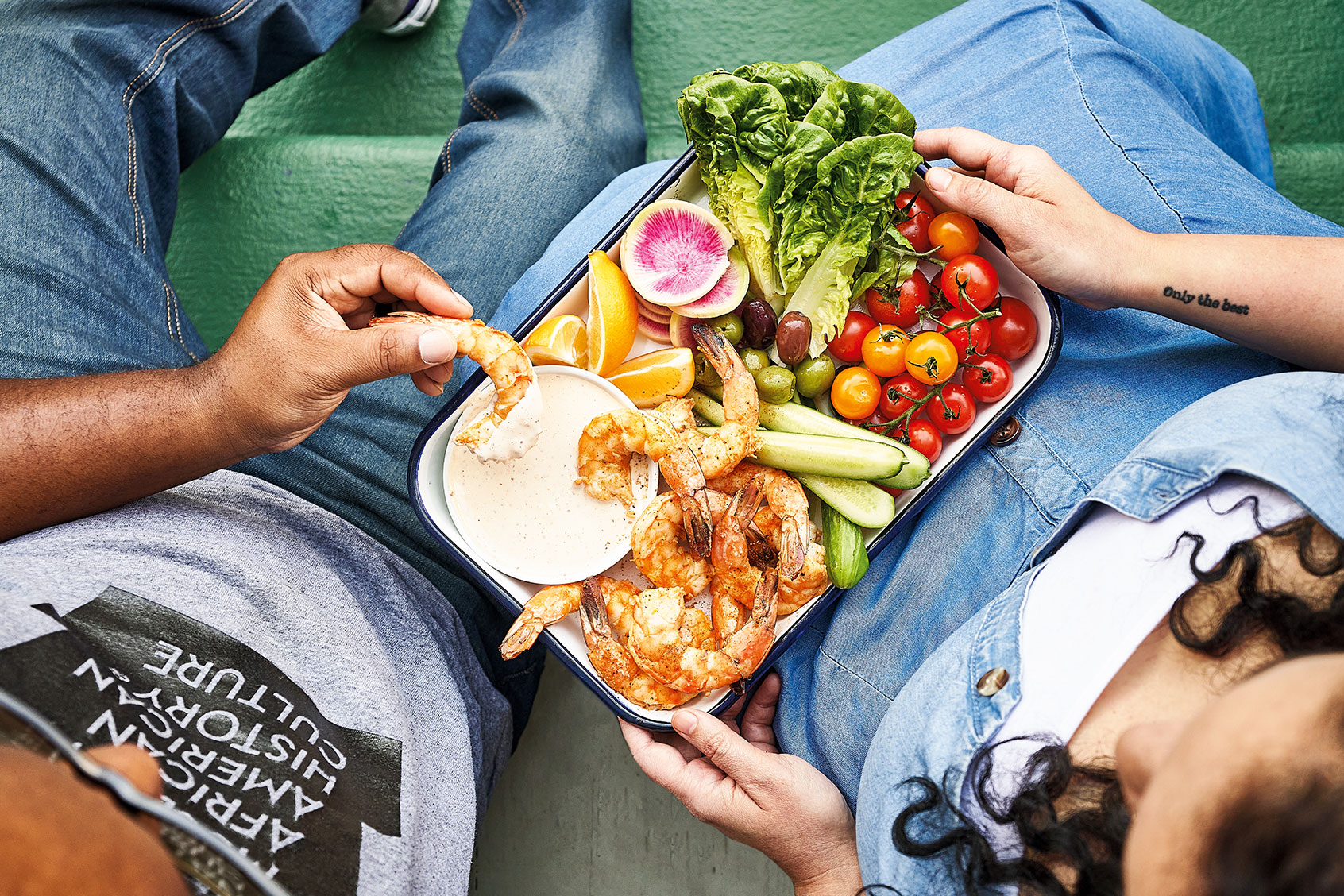
Porch Party ShrimpPorch Party Shrimp (Photo courtesy of Dale Gray/Simon Element)

What are the main lessons you’d hope readers take away from your book? 

I hope that they’ll be inspired to try something new or maybe find a go-to recipe that they love. My goal was to tell the stories that matter to me, with an emphasis on family and human connection. We live in a time where people are spending less time eating around a dinner table and I hope that the book reminds readers of the importance of togetherness. Good food brings people together!

If you could only pick one, is there a cuisine that you’d say is closest to your heart? Or that you most like to cook? 

I’ll always be a South African girl at heart, but moving away and discovering South Korean flavors allowed me to expand my horizons and experience dishes that just spark joy. My husband and I eat Korean food about 90% of the time here at home in Mississippi and wake up craving the sweet, salty, umami, spicy dishes that remind us of where we met.

Click here to purchase “South of Somewhere.” Salon Food writes about stuff we think you’ll like. While our editorial team independently selected these products, Salon has affiliate partnerships, so making a purchase through our links may earn us a commission.


John Fetterman brushes off MTG’s critiques: “She runs on more and more ding-a-ling pics”

Sen. John Fetterman, D-Penn., hit back at Rep. Marjorie Taylor Greene, R-Ga., and other GOP lawmakers who have criticized a new dress code at the Capitol. The decision, made by Sen. Chuck Schumer, D-N.Y., permits legislators to wear whatever they wish on the House floor. 

“Senators are able to choose what they wear on the Senate floor. I will continue to wear a suit,” Schumer told The Hill. Greene in a Sunday tweet harshly criticized the move while simultaneously bashing Fetterman, who is known to wear hoodies to work. “The Senate no longer enforcing a dress code for Senators to appease Fetterman is disgraceful,” Greene wrote. “Dress code is one of society’s standards that set etiquette and respect for our institutions. Stop lowering the bar!”

Speaking with MSNBC’s Chris Hayes on Monday, Fetterman noted that he had “heard some people had been upset about that, and the right have been losing their mind” over the new dress code. “Aren’t there more important things we should be talking about than if I dress like a slob?”

Hayes then cited Greene’s tweet, reading it aloud to Fetterman and asking the senator, “What do you say to that?”

“Well her platform, really— she runs on more and more ding-a-ling, pics, you know in the meetings over in the Congress. So, again, I’m not really sure why she cares how I dress, but you know, she really takes it a different way,” he said. 


Giuliani says it’s a “shame” he’s being sued by ex-lawyer: “Can’t express how personally hurt I am”

Rudy Giuliani’s former attorney has sued the former New York City mayor for reportedly failing to pay his legal fees.

In a document filed Monday, Robert Costello and his firm, Davidoff Hutcher & Citron LLP, alleged that Giuliani has only paid for $214,000 in legal bills, leaving $1.35 million unaccounted for. The New York Times reported that a large part of what Giuliani owes is related to his dealings with former president Donald Trump in the wake of the 2020 presidential election. “Mr. Giuliani racked up legal bills while battling an array of criminal and congressional investigations, private lawsuits and disciplinary proceedings that cast a harsh light on his bid to keep Mr. Trump in office in spite of his election loss,” the Times observed.  

“I can’t express how personally hurt I am by what Bob Costello has done,” Giuliani said in a statement, according to the Associated Press. “It’s a real shame when lawyers do things like this, and all I will say is that their bill is way in excess to anything approaching legitimate fees.”

In response, Costello argued, “How can he take a personal affront when he owes my firm nearly $1.4 million?” Costello also refuted Giuliani’s claims that his bills were inflated, asserting that he charged Giuliani at the standard hourly rate. “He’s a little late to that party,” Costello said. “It’s too late for that frivolous claim as he will find out in court.”

The suit is the latest in a series of escalating legal and political woes for the disgraced lawyer, who, along with a slew of other co-conspirators, was recently indicted by Fulton Country District Attorney Fani Willis on racketeering charges in the Georgia fake elector scheme. Giuliani also faces potential disbarment in connection to his efforts to assist Trump in subverting the 2020 election and had his law license suspended in June of 2021.

What would happen if the world cut meat and milk consumption in half?

Cows are often described as climate change criminals because of how much planet-warming methane they burp. But there’s another problem with livestock farming that’s even worse for the climate and easier to overlook: To feed the world’s growing appetite for meat, corporations and ranchers are chopping down more forests and trampling more carbon-sequestering grasslands to make room for pastures and fields of hay. Ruminants, like cattle, sheep and goats, need space to graze and animal feed needs space to grow. The greenhouse gases unleashed by this deforestation and land degradation mean food systems account for one-third of the world’s human-generated climate pollution. 

Environmental advocates have long argued that there’s a straightforward solution to this mess: Eat less meat. Convincing more people to become vegetarians is a very effective way to limit emissions. Getting rid of meat is one question; replacing it is another. A paper published on Tuesday seeks to address both, finding that giving up meat in favor of meatlike plant products would yield significant benefits for the climate, biodiversity and even food security in coming decades. 

Swapping 50 percent of the world’s beef, chicken, pork and milk consumption with plant-based alternatives by mid-century could effectively halt the ecological destruction associated with farming, particularly in sub-Saharan Africa, China and Southeast Asia, according to the study in Nature Communications. Such a dietary shift could also lead to a 31 percent reduction in agricultural greenhouse gas emissions by 2050, the study found. That’s the equivalent of not burning 1.8 trillion pounds of coal each year between 2020 and 2050.

Climate policies and investment focus heavily on fossil fuels and the energy sector, but slashing agricultural emissions is also crucial to keeping planetary warming below catastrophic levels, said Lini Wollenberg, the study’s co-author.

“There’s enough evidence to show that if we don’t shift our diets, then we will not meet the 1.5 degree Celsius target by 2100,” said Wollenberg, who researches climate change and food systems at CGIAR and the University of Vermont. “Agriculture has to be addressed.” 

Most of the emissions saved by a shift to plant-based foods, like oat milk and Impossible burgers, would come from staving off agricultural expansion and preserving land. Under a model that assumes the status quo continues, demand for meat would continue to rise globally and overall land devoted to agriculture would grow by 4 percent — or 219 million hectares, about seven times the size of Germany — by 2050. But if people replace half of the meat and milk that they consume with analogs made from plants over the same time period, land used for feeding and keeping livestock would shrink by 12 percent — or 653 million hectares, roughly twice the size of India. Sparing that land also would help limit biodiversity loss and conserve water, the researchers found. 

“It was interesting to see how powerful this dietary change can be and to see all these impacts across the spectrum of sustainability outcomes or objectives,” said Marta Kozicka, an agricultural economist at the International Institute for Applied Systems Analysis in Austria and the paper’s lead author. 

The study doesn’t provide a detailed roadmap for overhauling the world’s diet. The United Nations projects that people around the world will be eating 14 percent more meat in 2030. Even as plant-based foods take up more shelf space at grocery stores in the United States than they did five years ago, the foods still make up less than 2 percent of the meat sold in the U.S (though a bit more — 15 percent — of the country’s milk). 

The paper’s authors acknowledge that replacing half the world’s meat and milk consumption by 2050 “will be challenging and may require a range of technological and policy interventions,” though they conclude that such a scenario “is a realistic one, especially if the novel plant-based alternatives may be combined with traditional plant-based products and other novel meat substitutes, whether cell-based or insect-based.”

Raychel Santo, a food and climate researcher at the World Resources Institute who was not involved in the study, pointed to three areas where people are working to help ease global demand for meat: getting public schools, prisons and other institutions to substitute meat on their menus with more climate-friendly options; adding labels to food products to indicate their carbon (or methane) footprints; and increasing public funding for research and development of alternative proteins. 

“Right now, there is very limited public investment in alternative proteins,” Santo said, noting that other climate solutions, like renewable energy and electric cars, have gotten considerably more financial backing from the U.S. government. Santo called the goal of cutting the planet’s meat consumption in half by 2050 a “tall order,” but she also pointed out that previous research has found that just lowering the consumption of ruminant meat alone could halt agricultural expansion and deforestation. That leaves room for replacing red meat with chicken — a shift that many Americans have made in recent decades, mostly due to health concerns. 

Some advocates hope that advances in technologies like fermentation and cultivated meat will help displace demand for animal flesh. Chicken patties grown in labs may pick up where beet-bleeding burgers left off.  

“Writing off alternative proteins today would be like writing off solar power in the 1980s or writing off electric vehicles in the early 2000s,” said Emma Ignaszewski, associate director at the Good Food Institute, a think tank that promotes meat and dairy alternatives, in an email to Grist. “Transforming the $1 trillion dollar global meat market will take time and continued innovation. Getting to 50 percent market share by 2050 would be a moonshot. But by no means would it be impossible.”

Is Democrats’ Biden angst real — and is it even about Joe Biden?

Joe Biden became the oldest president in American history on the day he was inaugurated in 2021, two weeks after a mob incited by his immediate predecessor (at the time the second-oldest president in history) had stormed the U.S. Capitol. Even from this brief historical distance, it’s difficult to recapture the total insanity of that moment, which many reasonably normal people (to say nothing of people outside that category) watched in a state of high anxiety: Would Donald Trump actually surrender the presidency and leave Washington, or were we about to see another unexpected and dreadful turn of the screw — a violent assault on the inauguration, or perhaps even an attempt to make the “Storm” forecast by the QAnon cult’s prophets a reality?  

Those two facts — Biden’s advanced age and the bizarre circumstances of his ascension to the White House, both of which had no historical precedent — have defined his presidency since its moment of conception, and in all likelihood will do so through its demise, whenever that comes. Speculation that Biden would be a one-term president, supposedly buttressed by unnamed sources in his inner circle, began well before he was elected and has recurred with at least as much regularity as the seasonal arrival of migratory birds (which is no longer a sure thing on our burning planet). At first, this vague thesis held that Biden was a “transitional president,” an avuncular human placeholder who would allow America to turn down the heat on the political boiler in our collective sub-cellar and get back to some semblance of normalcy after the Trump years. Oh, and also: He was way too old.

That never made a whole lot of sense, but the yearning to return to “regular-order politics” was strong, both among the media caste and the Biden-voting plurality of the general population, and in deeply strange times plausibility was not a principal concern. Historians can point to a few examples of incumbent presidents who declined to run for re-election, I suppose, but in virtually every instance that decision was forced on them by external circumstances. (The only such occasion under the modern two-party system was in 1968, when Lyndon Johnson dropped out of the Democratic race after an unexpectedly narrow win in the New Hampshire primary.) As Jamelle Bouie observes in a New York Times column this week, second terms are when presidents define their legacies, for better or for worse, and it was nonsensical to believe that a professional politician who has spent six decades trying to reach the White House would surrender it voluntarily, and forever be remembered as a historical footnote or parenthesis.

Bouie didn’t name names, but he was clearly calling out both his own newspaper and the Washington Post, which have subjected us in recent days to front-page stories about mounting Democratic “anxiety” (or “bed-wetting,” as one party apparatchik deemed it) over Biden’s age and perceived cognitive abilities and, most important of all, about polls suggesting that a large majority of Americans don’t want him to run again and that he and Trump are roughly even in voter support. Bouie was gracious enough not to mention either his Times opinion-page colleague Michelle Goldberg, who published an early-adopter “Biden too old” column two years ago, or David Ignatius of the Post, who filed his own version just last week, but it’s not like there’s any shortage of examples.

For the most part, these articles and opinion-y thumbsuckers amount to thousands of words’ worth of shrug emoji: No one is super-excited about enduring a ponderous reboot of the Trump-Biden show, which we didn’t enjoy all that much the first time around, but nothing can be done about it. The prospect of a return to normalcy at some unspecified future time is trotted out from time to time, with roughly the same credibility as 1970s Soviet claims that a truly classless communist society lay just beyond the horizon. Some commentators cling to far-fetched hypothetical scenarios in which Trump goes to prison, one or another of the leading contenders has a debilitating health crisis and we are hurtled forward, time machine-style, into a next-gen future with Nikki Haley and Gavin Newsom (or whoever else you like for those roles) as the figureheads of their respective parties. 

Biden’s age is clearly a fact and a political factor. (Trump is only three years younger, but largely gets to skate on this question.) But the salient issues here are, or ought to be, what Biden has done as president and how the public perceives that. There may yet be time for Biden to lean into his experience, to energize discussion about our changing perceptions of aging and older people, and to focus attention on his record, which is undeniably mixed but more substantial than almost anyone expected. But he and the Democratic Party have ensnared themselves in a trap of their own devising, by resolutely defining themselves in negative terms. Biden won in 2020 because he wasn’t Trump. Democrats keep winning elections — or almost winning them, or at least not losing them all that badly — because they’re not Republicans. The party hasn’t had anything resembling a positive, unifying identity, still less a political vision, since the Reagan era. Its standard-bearer is 80 years old. It’s not illogical for the public to see those facts as connected.


Is America a death cult?

Sometime midway through the first year of the COVID-19 pandemic, when it still wasn’t clear if vaccines would arrive or even work, I found a page in an old reporting notebook that stopped me cold. It was a scribbled-down idea from 2017, a pitch that never came to fruition, but I hoped to write up for a national outlet. I wanted to ask the question: Why don’t Americans wear masks during flu season?

Flu is something I never took seriously growing up, despite some of the worst illnesses I’ve ever had being flu-related. I’m quite certain that without medical treatment, H1N1 would have killed me in 2013. Every year, thousands of Americans aren’t so lucky. An estimated 12,000 to 52,000 people die from flu each year, according to data from the Centers for Disease Control and Prevention (CDC). Those who die tend to be society’s most vulnerable: children, the elderly and immunocompromised people.

Many of these deaths could be prevented through vaccinations and masking, but before COVID came along, such an ask from society was simply too much. In a pre-pandemic world, even if flu cases were high, masking in public may have prompted a stranger to treat you like a mentally ill hypochondriac. Because of a lack of paid sick leave in this country, folks are expected to go to work sick, even though this actually puts more drain on the economy by spreading more illness and putting more people out of work, with one recent estimate pegging the cost at more than $273 billion annually in lost productivity.

Just because we’ve gotten used to it doesn’t make it “normal.”

We were willing to accept a certain level of suffering and death to not impact the comfort of healthy, able-bodied people. Now, we are being asked to do the same with COVID, though it kills and maims far more people than flu. Helen Branswell, a reporter at STAT News whom I deeply respect, recently framed the ongoing surges and mutations of variants as a “new normal.” I think she attempted to balance the truth of the matter — COVID is endemic and we have to realize that — with how this disease still regularly disables and kills people.

But I feel like the article pays service to the larger tendency in American culture to simply accept a certain level of death, step over the bodies and keep going to work and the movies. According to the CDC’s mortality estimates for 2022, COVID is still the fourth leading cause of death in this country after heart disease and cancer. Just because we’ve gotten used to it doesn’t make it “normal.”

We see this attitude deeply echoed in the drug overdose crisis, now apparently in its “fourth wave,” which preliminary stats suggest broke another record with more than 110,000 dead in the past year. It’s also exemplified in the suicide epidemic, which is only worsening, with nearly 50,000 deaths by suicide in 2022.


Want more health and science stories in your inbox? Subscribe to Salon’s weekly newsletter Lab Notes.


How much pointless death this country is willing to tolerate? The answer, it would seem, is a lot. It’s led me to believe that America is some sort of a death cult — and I don’t just mean the population of people who worship a man raised from the grave. Americans have formed a cult around Mammon, the demon of wealth. Does that mean we invoke his unholy name every time we use an ATM? Not exactly, but when the overall cultural attitude is to put profits above people, it doesn’t matter what rituals we perform. The result is the same: a sacrifice in the name of a dollar.

Other countries like Sweden, South Korea, Singapore and Finland demand much more from their governments, resulting in a higher and longer standard of living. The government is supposed to protect your life, according to some very basic understandings of the Constitution. I don’t know why this topic is controversial to some — it’s really the most basic function of having a democracy. The military protects us from invaders, roads are maintained to prevent accidents, regulatory agencies like the Food and Drug Administration and the Environmental Protection Agency allegedly prevent you from being poisoned. There’s no reason why government can’t effectively pay for health care.

How much pointless death this country is willing to tolerate? The answer, it would seem, is a lot.

Over the centuries, the social contract with government has evolved. Kings and lords largely protected plots of land from barbarian raiders. Now, we also expect the government to prevent large factories from poisoning rivers and biotech companies from selling us snake oil. Sure, our institutions could be doing a lot more in those departments, but we can and should be demanding much more. Universal healthcare isn’t a nice-to-have, it’s literally an investment in our people that multiple peer-reviewed studies indicate would save American taxpayers trillions — not even counting the lives saved. Yes, it’s actually cheaper to provide preventive medicine than to pay for the fallout when someone gets much, much more sick and can’t work.

We need your help to stay independent

But I don’t see us getting to a point in the Overton window to make such policies a reality when many of us see our fellow citizens, such as those who are chronically ill or drug users, as disposable. Our reaction after reading of more death shouldn’t be one of resignation, but that’s the cost of living under capitalism. Until we find it within ourselves to produce a little more empathy and take basic precautions like masking in public, I doubt we will escape the cycle of useless, unnecessary death in America. I think about how my attitude has changed since 2017 and want to believe in a future where even common viruses aren’t a death sentence.

An earlier version of this article originally appeared in Salon’s Lab Notes, a weekly newsletter from our Science & Health team.

Correction: A previous version of this article stated that COVID was still the third leading cause of death in the U.S. It was the fourth leading cause of death in 2022, according to provisional mortality data released by the Centers for Disease Control and Prevention.

Giving a voice to the Delphi murders victims and families: “It never goes away, that pain”

Prior to February 13, 2017, what was known of the comings and goings in the small town of Delphi, Indiana was contained within the residents therein. Among them were two teenage girls Abigail “Abby” Williams and Liberty “Libby” German, and the man who would — five years later — be arrested for their murders, 50-year-old Richard Allen.

Now, the area with a population so minuscule that it doesn’t even have a hotel to accommodate the jury that will be selected for Allen’s trial in 2024, will forever be associated with the killings that took place there and the ominous phrase heard by the two young friends when they encountered him while exploring a nearby hiking trail on a day off from school, captured covertly by a brave and quick-thinking Libby, and later recovered from her cell phone as a key piece of evidence.  

Down the hill.”

“I wanted to write about this case because of how close I felt to the family members, and I wanted their voices to be heard.”

This is one of the last things Abby and Libby heard as they were led to their deaths in broad daylight. It’s also the title of a new book, written by veteran CNN and HLN journalist Susan Hendricks, who has reported on this case since the beginning, spending time with the victims’ families in Indiana and advocating for them amidst a sea of headlines that, more frequently than not, give a voice to the girls’ killer rather than the other way around. For Hendricks, the decision to focus her first book on this case was not to recount the grisly details of what’s been dubbed the Delphi murders, but to call to memory that Abby and Libby had lives in Delphi. Lives cut short in a way that law enforcement have yet to fully reveal, other than to call it “brutal.” And throughout her writing, which follows the case from 2017 to just after Allen’s arrest, she frequently mentions the girls’ families waking up, day in and day out, telling themselves, “Today’s the day.” Meaning, today’s the day justice will be had. After so many years, that day has come. 

In an interview with Hendricks conducted over Zoom, she details her coverage of the Delphi case, the relationships she formed with the victims’ families, gleaning insight from Golden State Killer investigator Paul Holes, and how her previous coverage of the Gabby Petito and BTK cases were at the back of her mind while covering this one. 

The following transcript has been lightly edited for length and clarity.

This book, “Down the Hill: My Descent into the Double Murder in Delphi,” is written very well and, for me, calls to mind Michelle McNamara’s “I’ll Be Gone in the Dark” in that the emotions of the case really come through. There are so many murder cases that don’t make the headlines in the way that this one did. What do you think stands out about it?

That is a question I get often, and it’s a good one because there are certain cases, as you mentioned, that the media pays more attention to than others. I really think this one struck a chord because of what Libby was able to do on her phone: capture this man’s voice, take an image of him, video of him walking. So I feel that that really grabbed the attention because we were, as the media and as the public, able to hear the voice of a killer. And I also think that once we got to know who Abby and Libby were, and their family members, that also drew people in to say, “How could this happen?” And then, “How could I help?”

The fact that there have been advancements made in the form of Richard Allen being arrested likely prompted you to write on this case instead of any of the other numerous cases you’ve reported on like Gabby Petito or BTK, but I’m curious to hear how the idea came to you to write a book about this case specifically.

I wanted to write about this case because of how close I felt to the family members, and I wanted their voices to be heard. Often times, as you know, in the news media the headline is usually about who did it or allegedly did it. Scott Peterson, Casey Anthony, Jodi Arias and the list goes on. You rarely hear specifically about the family members and the effect this has on them. Not only when this happens, but in the following weeks, years, decades. It never goes away, that pain. And I knew this, as a journalist, but I really understood it when I got to meet the family members. And I started writing this several years ago. And it had been several years, and there was a lot of frustration about there not being an arrest here. So by the time Richard Allen was charged with the murders —and, as you know, we have to say he’s innocent until proven guilty, or course — I was going to write this no matter what, because it was the journey that the family had been through and what they will continue to go through, even through the trial. 


Want a daily wrap-up of all the news and commentary Salon has to offer? Subscribe to our morning newsletter, Crash Course.


There’s been a difference in the way that murder cases are written about and discussed over the past few years. The emphasis used to be almost completely on the killers themselves, as you mentioned, but now the focus seems to be more on telling their victims’ stories. We know their names now. They’re people and not just bodies. When did you start to see that change?

I think for me as a journalist, the interest was there. I remember Yeardley Love, the lacrosse player who was murdered by her boyfriend and the mother, Sharon, creating the One Love Foundation in her daughter’s name and running that with her other daughter, and that pain continues. That was 2010 when her daughter was murdered. So different cases stand out. Early on, when I was very young, too young, probably, to be watching “Fatal Vision” when it came on TV, my sister and I watched that special and then I read Joe McGinniss‘ book, and what stood out to me was the wife Colette and her stepfather reigniting the case, and I believe that was why Jeffrey MacDonald was convicted of the murder of his wife and two little girls. So, it’s always been a perspective that I wanted to get across. And I do think that things have changed, hopefully. I remember, even back to Columbine, the faces of the shooters would be on the cover of a magazine. And working with Anderson Cooper years ago on his show, he would say that he didn’t want to name the names of the shooters. And obviously when covering a case like Delphi, we have to name the person in custody, Richard Allen — it’s a bit different here — but I don’t want all the focus to be on that.

What was your first thought when the news broke that a suspect had been apprehended? And how soon after were you in contact with the girls’ families?

“I do believe that they will address Richard Allen when the time comes.”

You always thought and hoped that one day that would happen. Becky Patty, the grandmother of Libby, always posted on her Facebook page, “Today’s the day,” knowing that one day, that would be the day. But as the days and weeks and months went on, and there was still no arrest close to six years, to hear that someone is in custody — because, as I mention in the book, there were names that were brought up. Not by law enforcement saying they’re connected in any way, but if someone was arrested in that vicinity of course they would look into that in some specific way — but for a name to just come out, and for an arrest, finally an arrest for the girls’ murders, it was jarring. Exciting at the same time, for me and for the families. I was hoping that’s what they felt. But I felt a mix. A feeling of nervousness. And it was simply jarring to see his face and know, wow, we’ve never heard this name and he did, in fact, live in Delphi. Everything that Superintendent Doug Carter said at that press conference was, in fact, true. If he is guilty, he was hiding in plain sight the whole time. So I spoke to Becky Patty when I heard that day about the arrest, and she was at a wedding and stepped out into the hall and said, “I can’t believe it.” She was in shock, I believe, at that time, until it set in, the reality of everything.

After so many years of hunting for this killer, now that an arrest has been made, I’d imagine that’s when the full extent of the families’ pain sinks in, with there being no hunt left to distract them. Will they be given the opportunity to address Allen during the trial?

You bring up a good point. I remember speaking to Mike [Libby German’s grandfather], it was right after the press conference where law enforcement and the prosecutor announced that there had been an arrest, and he said, “Now we have to shift gear. Shift our focus.” Because for so long it was finding this person. And Becky did, admittedly so, say, “I feel like I don’t have a purpose anymore.” Because someone is in custody. And Mike saying, “We just have to shift this and help the prosecutor in any way we can.” And still, to this day, they’re not saying if they believe that anyone else is involved. I remember during that press conference the prosecutor said there could be other actors and, therefore, they’re not releasing certain documents. So I think they just kind of shifted their focus and their purpose, but of course it was still so hard, and considering what will happen next. Because right now it’s unknown. There is a trial date set, that’s for January, but it will be interesting to see what will happen from now until that point. Will it go on as scheduled? Will it be delayed? And, of course, I believe if they have the opportunity — which I believe, in most court rooms, if found guilty the judge does allow that, the victim impact statements before the sentencing — I do believe that they will address Richard Allen when the time comes.

It’s chilling to know that Allen worked at an area CVS that was likely frequented by Libby, Abby and their families, and that he was a person who was spoken with early on. Was the hiding in plain sight aspect of this case a point of frustration throughout? Knowing now that the likely killer was so close and yet still just out of reach?

Absolutely. Family members of mine — when they found that out — were thinking, “Why wasn’t he arrested sooner?” And, “How could this slip through the cracks?” We still don’t have the absolute details on how that happened. But apparently, because it says this in the court documents, he approached an officer in a parking lot and said, “I was there. I didn’t see Abby and Libby. This is what I was doing.” Apparently he was on his phone or looking at fish or looking at a stock ticker. So I think that he put himself there. And if he is, in fact, guilty, we can only speculate that he was doing so to maybe get ahead of it, thinking other girls down near the bridge had maybe seen him. And we don’t want to put all the blame on this one officer — I believe the small town was overwhelmed at that particular point. And the video from Libby was not released yet. And the audio was not released. Maybe that officer looked at this person as a witness who didn’t see much, therefore filed it away, so to speak. And Superintendent Doug Carter always did say, “If nothing happens, if we find nothing, we’re gonna go back to the beginning.” And that’s exactly what they did. And maybe they came upon that file years later and said, “What about this guy?” But we still don’t know what connected them to Richard Allen. From that particular point of, “Let’s start from the beginning,” to seeing that file . . . was it a tip that was called in? We don’t know. As we did see, there was an unspent bullet near the bodies. They searched his home, apparently found the gun, connected that bullet to the gun, therefore, under arrest. But it’s been redacted a bit, so there are a lot of elements we still don’t know that we would see, if this does go to trial. There are a lot of holes, by design, the authorities would always say, that they’re willing to tell, and why they can’t say it, but they will when the time comes. 

It’s interesting, you bringing up the things that Allen said, “I didn’t see the girls. I was watching fish.” Which seems so random. That brings to mind your conversations with Paul Holes, which you mention in your book, where he says they’ll always kind of show their “tell.” That they’ll say something a little too specific, or something that feels like a story that they kind of had at the ready. 

“It never goes away for that family. Never.”

Paul. What a brilliant mind, and a mind unlike any that I’ve spoken to in terms of what he sees and how he would go to a crime scene and see things very differently. What he said would stand out to him is, what was there that the killer didn’t have to leave? What made this particular crime special to that person? What does that tell you? His eye is so sharp and so keen. So able to look at a crime scene and see it much differently than you or I would. He did say that when he went to the bridge and saw how high it was — 63 feet. I’m scared of heights, and Paul shared with me that he is too. I couldn’t even walk a step. Not a step — Paul always has questions about why this killer would do it. Did he drag the bodies? Did he kill the girls there? And he said once he went down the hill, he understood. Because of how isolated it was. And that maybe no one could hear you or see you because of how dense the brush is. Because you think, how could someone kill two girls in the middle of the day and get away with it? Well, he [Allen] knew that bridge, and he knew that area. And Paul believes that he may have fantasized about this. For years even. He only lived a couple of miles from the bridge. He fantasized about this and decided, maybe, that that day was the day to do it. That that was his chance.  

Have you spoken to Allen’s wife and daughter at all? And what’s your take on this phone call he made to her in which he reportedly confessed to the crimes? His attorneys are arguing that his admission isn’t reliable because he’s under duress. 

The wife’s Facebook page, I mean, as you would imagine, it was flooded with media and people wanting to see who this person is. And that’s the resource we have today, social media. She took it down soon after and she had to move from her home because of the attention she was getting. I went through her Facebook early on and, to me, it showed that she was in love with her husband. She posted something about a restaurant they went to during an anniversary. Her daughter married, and there was a picture of her father walking her down the aisle, which brought me back to Kerri Rawson, BTK’s daughter, who spoke to me saying, “I had no idea. He walked me down the aisle. He told me to make sure there was air in my tires. He made me scrambled eggs.” So everything “normal” that you or I would perceive as that. The family didn’t know. And there are people to this day who are mad at Kerri Rawson, and she didn’t know. So I do feel for the wife and daughter. She was in court, Richard Allen’s wife, during a few of the hearings, along with his mother, and that was shocking to hear that there was a confession, of sorts, several times. To me, of course, that’s very telling. And apparently his wife hung up abruptly after that, and we heard in the hearing that happened after that that they haven’t spoken since. We’ll see how much that plays in. 

I’ve read a few reports that seem to indicate that Allen is pleading feebleness and perhaps playing up his mental health issues in a play for leniency. And it seems like his representatives are saying he’s not being treated fairly in prison. That must call for superhuman levels of patience after everything that you and the prosecutors know about this case. 

Paul Holes did mention that. He said to me, “Susan, this is just the beginning of the process.” There are so many tactics that can be taken to delay the trial and put it off. That being beneficial, I believe, to defense attorneys. Meaning, the longer the time goes on, the less it’s on people’s minds, is what I assume. But then I think back to Lori Vallow, and the judge ruling that she wasn’t competent at one point, but then she finally was competent. Meaning, I wonder if the ruling is that he’s not competent at this particular point because of where he is, but I believe there could be an analysis, wait a few months, and then he’s analyzed again. So I don’t believe this is a forever delay, if, in fact, it even is delayed because of what the defense attorneys are claiming. 

A number of new details, even details alluding to the manner in which the girls were killed, were released in court documents this summer. What do you think about the judge’s decision to unseal those documents? And I would hope that the families got that information first? I know there was a petition fighting to keep them sealed.

Yes. Becky posted, “Why?” on Facebook. She had this petition and her thoughts on it. And she had confidence in law enforcement and the prosecution, believing that if they want this sealed, there has to be a reason. Her fear was, what if the witnesses’ names got out? Or what if there was harassment because of it? And considering everything both families have gone through, I don’t blame her for wanting that sealed. And I think the judge, in my opinion thus far, is fair on what she is releasing and, by law, what she has to release due to the public’s right to know. So I think that it was necessary but there were, of course, redacted documents as well. But a lot were released, you’re right. About 120 pages. 

Your book makes mention of there being more audio and video captured by Libby than what’s been released. Have you heard it/seen it? And do you have any idea as to when it will be made public?

I personally haven’t listened to it. And I do believe it has been released since I first met the families. Of course it is longer than, “Guys, down the hill.” But I asked Sheriff Tobe Leazenby and he sat there and was quiet for a moment and said, “Susan, right now as you’re sitting here, it’s going through my mind and I’m hearing it over and over and over again.” And I was thinking, “What is he thinking about right now? What did he hear?” And I think that no matter what was on that audio, it would be for me, having a 13-year-old now, just heart-wrenching to hear. Hearing their voices must just be excruciating for the families. 

Covering so many cases of this nature, is there even such a thing as feeling a sense of completion, knowing that sooner rather than later, you’ll likely be covering another one?

I think that’s really the heart of the book, that there never really is completion. It never really is over. I know that Kelsi [Libby’s sister] recently had a baby. A little girl. And I just feel like, forever, there will be that loss. I was in Libby’s home. I saw her kitchen. I saw a video of her laughing in that kitchen. What I have found is that it’s helpful for the families to feel like there’s a purpose after the media goes away. And that purpose is often helping others. It’s not about that day, February 13, 2017, and how the girls died. It’s about the future. Sadly, there will be another case. There will be more families that suffer. It will happen again. But it never goes away for that family. Never. 

After reading this book, your detailing of the initial search for the girls stands out to me. Local police really hopped to, roping in FBI, K9 units and everything they could. And the girls’ bodies were discovered very quickly. It makes me wonder how this would have all played out if Abby and Libby had not been white. 

That is a good question. In Gabby Petito’s case, her father, Joe Petito, even said to me, “I don’t know why it got as much attention as it did.” I think, in her case, it came down to social media and the body cam footage and just how much we saw of her. But the Petitos’ foundation is making a point of this in trying to make sure that everyone gets the same amount of attention, no matter what. But, absolutely, there is unfairness in the media in terms of what is chosen. And if I’m a family member in a case that no one talks about, I would be so hurt, beyond belief. I would be screaming from the rooftops, wanting the coverage to be equal. And Joe Petito is saying, “I’m trying to make this happen.” There’s no reason why it shouldn’t be an equal playing field and everyone’s son and everyone’s daughter gets equal coverage. And I think it is possible now, with all the outlets we have, and social media where people are talking about a case and bringing attention to it. It’s not just the mainstream media anymore. 

With the trial coming up, do you have plans for a follow-up book?

I haven’t thought too far in advance about a next book. I know I will be covering the trial, and it will be interesting to see exactly how it plays out because, at this point, anything is possible in this case, from what I’ve seen. I would be interested in maybe writing a book from the families’ point of view.

Hendricks will moderate a panel at CrimeCon on Sept. 24 called A World Turned Upside Down: Tragedy, Triumph, and the Power of Healing, joined by Becky Patty, Tara German, Sharon Love, Kerri Rawson and Stacy Chapin. 

“It’s easier to charge him”: Former Federal prosecutor on Mark Meadows’ big legal “miscalculation”

Mark Meadows, Donald Trump’s former White House chief of staff, may have just made prosecutors’ jobs “easier” when he took the stand last month to testify in his efforts to move his case to federal court. According to former federal prosecutor Andrew Weissmann, it will be difficult for Meadows to flip on Trump now. 

“So this is one where, you know, Mark Meadows might have thought that in order to carry his burden, with respect to removing the case to federal court, that he needed to testify,” Weissman said on MSNBC’s “Deadline White House” on Monday. Host Nicolle Wallace began by referencing a recent New York Times analysis that described Meadows’ testimony as having “done him no favors” thus far. “Meadows really did himself a lot of harm by lying and then being contradicted by his own words in that email. That seems to have set in,” Wallace said. “Do you think that plays into Jack Smith’s negotiations with him if there are any over his testimony?”

 “I think that may have been a miscalculation, precisely because of reasons you and I have talked about, which the Times is reporting on, which is that he really got caught in what is hard to describe as anything other than a lie, where he said he had no role whatsoever in connection with the fake electors scheme,” Weissman explained. “And you don’t have to rely just on Cassidy Hutchinson — the state has, and the federal government has his own words in emails and text messages. So here’s the issue: It makes it very hard to now be a cooperator if you have just committed perjury, so it makes it harder for him to have that as a potential out. But it also means that it’s easier to charge him.”

Watch below via MSNBC:

Lauren Boebert says she’s learned her lesson from “Beetlejuice” scandal: Never date a Democrat 

Embattled Republican Rep. Lauren Boebert returned to Washington on Monday from a whirlwind week in Colorado and was immediately greeted at the airport by TMZ cameras.

“I’m here to provide levity,” Boebert told the paparazzi with a smile. “It was a great time to go out and have dinner and enjoy part of a show.”

The far-right lawmaker was initially caught in a lie when she denied that her booting from a Denver showing of “Beetlejuice: The Musical” was related to her behavior. Footage then showed Boebert obstructing patrons’ view by raising her hands, taking pictures with the flash on and loudly singing. The lawmaker flipped the ushers off before finally leaving the venue. “Do you know who I am?” she was quoted as saying.

Boebert’s partner that evening was soon identified as Quinn Gallagher, co-owner of the Hooch Craft Cocktail Bar in Aspen, which once hosted “a winter Wonderland Burlesque & Drag Show.” Boebert, of course, is infamously anti-LGBT.

“Take your children to CHURCH, not drag bars,” she exclaimed on X, the website formerly known as Twitter, in June 2022.  

“I learned to check party affiliations before you go on a date,” Boebert joked to TMZ, before saying of Gallagher, “He’s a wonderful man.” Still, she said, “all future date nights have been canceled.”

The mother of four and grandmother of one filed for divorce in May, citing “irreconcilable differences.” On Monday, her ex-husband, Jason Boebert, took the blame for the congresswoman’s erratic behavior.

“I feel the people should know the truth of our broken marriage and burden she has carried for too long,” his open letter began,” Boebert’s ex wrote in an open letter posted by the Daily Beast. “Much of this is on me because the problem starts at the root,” he continued, admitting that he “broke her down.”


Bomb threats and violence: Pediatric gender-affirming care providers fear for their lives

Last August, an anonymous caller left a voicemail at the National LGBTQIA+ Health Education Center at the ​​Fenway Institute, saying he was coming to “handle” a clinician providing youth with gender-affirming care associated with the clinic.

Three months later, the FBI charged the caller, a Texan, for issuing an interstate threat. Dr. Alex Keuroghlian, the Director of the Division of Public and Community Psychiatry at Massachusetts General Hospital who also works at the Fenway Institute, said sister centers have also had anti-trans groups posing as donors so they can tour the health center and discreetly videotape staff and community members.

In the past few years, anti-trans groups have been threatening children’s health centers offering gender-affirming care across the country. A series of bomb threats called in at Boston Children’s Hospital ultimately caused the facility to temporarily shut down. Other threats were reported at Children’s National Hospital in D.C., Vanderbilt University Medical Center in Nashville and Akron Children’s Hospital outside of Cleveland, Ohio.

Among 125 pediatric endocrinologists offering gender-affirming care surveyed, nearly 17% reported experiencing threats to their personal safety.

In Texas, the climate has gotten so toxic that some gender-affirming healthcare providers are leaving the state. Nationally, health centers are removing personal identification information from their websites to protect providers from physical violence. 

“Direct threats against clinics providing gender-affirming care and LGBTQ+ care in general have been increasing in the last two years,” Keuroghlian told Salon in a phone interview.

A new survey published today in the Journal of the Endocrine Society documents just how common threats like these are. Among 125 pediatric endocrinologists offering gender-affirming care surveyed, nearly 17% reported experiencing threats to their personal safety and 60% said they were concerned about being sued for providing care, reported study author Dr. Stephanie Roberts, an endocrinologist at Boston Children’s Hospital.

“For both of these factors, this was significantly increased among pediatric endocrine providers who provided gender-affirming care in a state with a proposed and/or passed ban on gender-affirming medical care,” Roberts told Salon in an email.

22 states have passed legislation intended to ban gender-affirming care for teens.

Research shows gender-affirming care improves the mental health and well-being of youth who are transgender, gender diverse or nonbinary. Significantly reducing dysphoria, treatment through social transitioning, puberty blockers or hormone therapy can be lifesaving for children. More than 30 medical organizations have issued policy statements supporting gender-affirming care. Misinformation online often suggests health centers are providing gender-affirming surgical care to children, but this is typically not recommended until age 18.

As of this writing, 22 states have passed legislation intended to ban gender-affirming care for teens, according to the HRC. Restrictions are still being contended in states like North Dakota, Georgia and South Carolina. 

In the survey, 28% of providers who practiced in states with restrictions in place for gender-affirming care reported that they feared providing transgender healthcare would negatively impact their career and 26% reported that their institution was concerned with them engaging with media. 

“I am terrified every day by what my state will do to our transgender children.”

“There are bills that have been proposed to make provision of different types of gender-affirming care misdemeanors, civil or felony offenses, so we’re literally talking about healthcare professionals going to prison for providing medically necessary, evidence-based care,” Keuroghlian said. “Even if [laws] are not passed or enforced, they do create a culture in which transgender and gender-diverse people are dehumanized and instill reticence among clinicians when it comes to delivering this care.”


Want more health and science stories in your inbox? Subscribe to Salon’s weekly newsletter Lab Notes.


In the survey, one provider wrote, “We and our patients are living in consistent fear.” Another said parents are sometimes so afraid of being reported to Child Protection Services for taking their children to the clinic that physicians are seeing an increased number of no-shows. 

“The amount of political pressure against my transgender patients has been extremely detrimental to my mental and physical health,” one respondent wrote. “I have never been ill so much. I am terrified every day by what my state will do to our transgender children.”

In October 2022, the American Medical Association, American Academy of Pediatrics and the Children’s Hospital Association called on the Department of Justice to investigate threats made to children’s medical centers. They also called on social media companies to halt misinformation campaigns they said were contributing to the prevalence of threats.

Much like reproductive health bans increase the distance at which people seeking abortions must travel to get treatment, bans on gender-affirming care create additional financial and physical barriers for youth seeking care that can effectively strand families who do not have the means to travel out of state to receive treatment. In states like Florida, some bills even restrict access to gender-affirming care provided from out of state, with provisions setting additional limits on telehealth.

In the survey, even providers in states without gender-affirming care bans reported experiencing threats of physical violence or concerns about legal action taken against them. Patchwork bans across the country can cause confusion among patients and providers. After a ban was passed in Mississippi, some trans youth reported that their pediatricians stopped seeing them for routine care.

“It has a chilling effect on providers feeling safe providing medically necessary, evidence-based care,” Keuroghlian said. “It has a chilling effect on medical trainees and healthcare trainees pursuing much-needed careers in gender-affirming care, and it has a terrorizing effect on trans and gender-diverse youth and their families who are seeking this life-saving care.”

“This is a community that already experiences disproportionate harassment, violence and hate crimes, and now there is a specific focus on restricting access to medically necessary care.”

Regardless of whether survey respondents practiced in states with bans against gender-affirming care or not, nearly all providers expressed concern that legislation would limit healthcare access for children and worsen mental health for an already vulnerable population. A 2021 Trevor Project survey found that 37% of trans and nonbinary youth experienced physical threats or direct harm because of their gender identity. 

“This is a community that already experiences disproportionate harassment, violence and hate crimes, and now there is a specific focus on restricting access to medically necessary care, which is fundamental for people to be able to function and thrive,” Keuroghlian said. “It’s an especially cruel and inhumane strategy for oppressing an already marginalized and minoritized community.”

The gender-affirming care bans pushing some providers to migrate out of states like Texas coincide with a decrease in the number of doctors pursuing the specialty, creating “care deserts.” It’s estimated that 3.4 million youth live more than 80 miles away from a pediatric endocrinologist, according to Roberts’ study. This doesn’t only affect youth seeking gender-affirming care, but also children with other endocrine disorders like type 1 diabetes, she added.

As one provider wrote in the study: “As I begin to look for faculty positions, I will not be looking in states that support anti-trans legislation. This ultimately will impact an entire population that needs endocrine care for various reasons, but I cannot work in a state that does not support health equity.”

Sean Penn’s “Superpower” renews Zelenskyy’s relationship with Hollywood to sell the politics of war

Hollywood has been in the military propaganda business since World War II. Throughout a movie career spanning more than for decades, Sean Penn has starred in his share of entries in that canon, beginning with his first credited role in 1981’s “Taps.”  

When he participated in that production and others earlier in his career, it’s doubtful that he considered that work as part of selling the American story of righteous might and the cost of heroism. But “Taps” and other titles in Penn’s filmography, like 1998’s “The Thin Red Line,” are military stories attuned to the overall political tenor of their time.

Something similar can be said of “Superpower,” Penn’s latest documentary that he co-directed with Aaron Kaufman, although its status as a propaganda piece isn’t sublimated within a fictional narrative. Penn’s existential story of good fighting evil comes from the center of Russia’s invasion of Ukraine, which to most Americans has become background noise.  

Penn was already in Ukraine when the Russian invasion began, drawn to the country out of fascination with Ukrainian President Volodymyr Zelenskyy’s unlikely transition from comedian to the leader of a nation dragged soon after to the center of a scandal that led to a U.S. president’s impeachment.

Penn arrived days before the war began and decided to stay, correctly deducing that, like him, Zelenskyy would be acutely cognizant of the optics of having an A-list American movie star film interview him on the day Russian forces began shelling Kyiv.

Most American films depicting large-scale conflicts tout an anonymous hero’s role in a broader conflict, promoting the notion that the smallest, plainest person can be the difference between victory and defeat. “Superpower” takes the opposite view, positioning Zelenskyy as the face of a nation’s will, a role Penn depicts him as embracing with a movie hero’s resolve.

To America’s stars, Zelenskyy was and is one of them; to Americans, he was the kind of determined underdog we love to root for. Zelenskyy utilized that appeal to mount a winning social media offensive on Ukraine’s behalf and making himself available to Western news outlets whenever possible.  

Netflix resumed streaming “Servant of the People,” the sitcom that made Zelenskyy famous across Ukraine and Russia, shortly after the war began. The streamer also funded a trip for David Letterman to interview him before a live audience of locals.

To America’s stars, Zelenskyy was and is one of them; to Americans, he was the kind of determined underdog we love to root for.

But all this occurred when the war was relatively new and unreasonably expected to be short-lived. Nearly 19 months later, Americans are less sure about our part in assisting Ukraine. According to the results of a CNN poll released in late August, 55% of respondents feel Congress should not authorize additional funding to support Ukraine’s military efforts.

This is the sentiment meeting Zelenskyy as he’s scheduled to appear before the United Nations General Assembly on Tuesday in New York, followed by a visit to Washington. In December he appeared before Congress to ask for additional funding. This time he’s expected to meet with President Biden and individual members of Congress as Biden prepares to ask for an additional $24 billion of support.

Americans make hits out of stories where we’re depicted as winners. With that understanding, Zelenskyy’s visit coinciding with the debut of “Superpower” is strategically astute.

“Superpower” has everything a doubting public could want in the way of reassurance, with its determined hero caping for an embattled nation and who happens to be a huge fan of its president. A brief tour of recent history helps too, by establishing how Zelenskyy differs from the previous oligarchs who earned Ukraine’s government a reputation for unfettered corruption.

Penn also chats with soldiers who at the beginning of the movie, and the war, scoffed at the notion that Zelenskyy would rise to meet the moment who are dedicated believers by the end. And it’s no accident that the name of the man to whom the film is dedicated, Major Andrii “Juice” Pilshchykov, is mentioned at the beginning instead of before the end credits.

We need your help to stay independent

Pilshchykov is the man behind the urban legend of the Ghost of Kyiv, an ace pilot alleged to have shot down six planes within the first 30 hours of the war. In “Superpower,” Pilshchykov asserts that the story is real, in the sense that it’s not simply one man flying but a team. There’s no secondary confirmation to this claim since, as Penn says several times, he’s a famous man and not a journalist. (That much was made obvious in his famous 2016 interview with El Chapo, which was more about him traveling to see El Chapo than delivering fresh insights about El Chapo.)

But establishing whether a piece of wartime mythmaking is true is less powerful than a scene featuring Pilshchykov, who was killed in late August 2023, chatting with Miles Teller moments after watching “Top Gun: Maverick,” “ace pilot” to the actor playing an ace pilot in the most successful American military propaganda to storm theaters in years.

In these moments and others, Penn lives out a conversation about fame’s usefulness in assisting crucial causes. “I’ve often been asked, ‘What’s a Hollywood actor doing by going to places of disaster? Of conflict? Spending time with alleged enemies of America?’ Or much worse: ‘Who do you think you are, Walter Cronkite?” Do you have a savior complex?'” he asks in a voiceover near the start of “Superpower.”

“The best response I’ve ever been able to muster is that I’m curious,” he answers. “I’ve been lucky in life to be able to afford to travel and weathered though it is, my famous face gets me access to places and people I may otherwise not have known. And sometimes, I feel I can be helpful.”

For most of the movie’s nearly 118 minutes, this is how Penn negotiates his fame, and Zelenskyy’s, and how each uses their high profiles to campaign on Ukraine’s behalf. “If we will not win now,” he tells Penn in one of the film’s later interviews, “Americans will fight in some years with this enemy.”

“Superpower” wrestles with the relationship between theatre and politics throughout the film, although it’s Penn who draws the focus of that idea more than Zelenskyy. Penn and Kaufman don’t attempt to downplay or hide this, leaving in exchanges where Ukrainian leaders cite their hope that Americans will listen to a movie star who is sympathetic to their cause.

“Weathered though it is, my famous face gets me access to places and people I may otherwise not have known.”

But they also don’t edit out moments such as when a member of their support staff says, “Can I be very blunt? You’re Sean Penn. Nobody’s going to be responsible for you dying on the front line,” before parting ways with him and his producer Billy Smith as they trudge into harm’s way.

 “We’re now living in a world where politics has become a part of the show business,” observes Volodymyr Yermolenko, editor-in-chief of Ukraine World before the bombs start dropping. Americans bought into that notion long ago – first with Ronald Reagan and in the extreme with Donald Trump in 2016 who, like Zelenskyy, had no political experience before winning the presidency.

With “Superpower” Penn and Kaufman are trying to redirect that force to serve Zelenskyy’s efforts and Ukraine’s. The star’s advocacy takes him to places he would not ordinarily deign to enter, including the guest chair on Sean Hannity’s Fox show, and brought Zelenskyy into America’s living rooms during the Golden Globes broadcast.

Penn advocated for Zelenskyy to appear at the Oscars in 2022 and 2023, but the Academy rejected that petition both times – a snub the actor and his co-director refuse to let slide by showing the news-making slap that dominated the 2022 Oscars instead, along with snapshots from Depp v. Heard. Each is an example of how easily distracted we are from geopolitical crises to which we aren’t sufficiently paying attention.

“Superpower” may not alter that course or the downward trajectory of Ukraine’s polling numbers with the public, but it might not have to. Penn has proven he has a way of getting in front of the people he needs to hear from or to be heard, even those he disagrees with or roll their eyes at the notion that he, of all people, is equipped to elevate Ukraine on the nation’s list of concerns.

Noting before his first conversation with Ukraine’s president that journalists and quasi-journalists would scoff at knowing there wasn’t “a cell in his body willing to prepare questions” for Zelenskyy, he simply admits, “I hoped the film would be useful. That’s about it.”

Perhaps it will – if people can look past Penn to appreciate Ukraine’s importance on the world stage.

“Superpower” is now streaming on Paramount+.


Experts warn of a “biological holocaust” as human-caused extinction “mutilates” the tree of life

Humans have caused so many changes to our planet that some experts say we’re on par with mass extinctions of eons past. We are equivalent to the asteroid that crushed most of the dinosaurs or the Great Dying that wiped out nearly all life on Earth. Some have proposed calling our current geological age the “Anthropocene,” derived from the Greek word “anthropo” for “human.”

While it may sound like an accomplishment being able to wield so much influence we can alter our home planet, human activity has done so in dangerously unsustainable ways. Indeed, according to a recent study published in the journal Proceedings of the National Academy of Sciences, humans have caused so many extinctions in the last 500 years that it would have taken 18,000 years for those same genera to have naturally vanished if we had never existed. After all, animals go extinct regularly on geological timescales, but this mass extinction is largely human-driven.

“Mutilating the tree of life is changing the systems in which human beings and all other living organisms have evolved.”

And that is just the first sobering statistic from the study. Authors Gerardo Ceballosa and Paul R. Ehrlich from Stanford University and Mexico’s Universidad Nacional Autonoma de Mexico examined the classification statuses of 5,400 vertebrate genera (excluding fishes), a task that included 34,600 species. After they had finished, the scientists determined that 73 genera of animals had become extinct since 1500 AD.

“Beyond any doubt, the human-driven sixth mass extinction is more severe than previously assessed and is rapidly accelerating,” the authors explained. This means animals are vanishing at a rate 35 times higher than those which prevailed over the past million years — that is, before the advent of the Anthropocene. While this news might have a silver lining if humanity was at least arresting the trends driving these mass extinctions, the exact opposite is true.

“Such mutilation of the tree of life and the resulting loss of ecosystem services provided by biodiversity to humanity is a serious threat to the stability of civilization.”

“Current generic extinction rates will likely greatly accelerate in the next few decades due to drivers accompanying the growth and consumption of the human enterprise such as habitat destruction, illegal trade and climate disruption,” Ceballosa and Ehrlich write. “If all now-endangered genera were to vanish by 2100, extinction rates would be 354 (average) or 511 (for mammals) times higher than background rates, meaning that genera lost in three centuries would have taken 106,000 and 153,000 [years] to become [extinct] in the absence of humans.”

They concluded, “Such mutilation of the tree of life and the resulting loss of ecosystem services provided by biodiversity to humanity is a serious threat to the stability of civilization.”

To illustrate the magnitude of the mass extinction epidemic, the authors mention that “there were around 10,000,000 African elephants at the beginning of the 20th century, and now there are only about 450,000 remaining,” a drop over 95%. Yet overall the researchers found that “most recorded extinctions have occurred in birds, followed by amphibians, mammals, and then reptiles.”

In terms of the numerous bird species lost, the most prevalent extinct orders include giant birds like the elephant birds (Aepyornithiformes) of Madagascar and the moas (Dinornithiformes) of New Zealand. The researchers also added that, while there is “scanty” data, it seems most of the genera lost have only vanished over the past two centuries.

The authors point to some species, like the Steller sea cow, which went extinct around 1768, but many more species — including passenger pigeons, Tasmanian tigers and the Yellow river dolphin — have “departed since modern science began to pay attention.”


Want more health and science stories in your inbox? Subscribe to Salon’s weekly newsletter Lab Notes.


“Beyond any doubt, the human-driven sixth mass extinction is more severe than previously assessed and is rapidly accelerating.”

The scientists consider it far from a good thing that so many extinctions have occurred at a time when humans have had the technology to record them. At this rate of extinctions, we are in for a very unpleasant shock in the near future.

“In other words, projected losses of genera over three centuries (1800 to 2100) would have taken 106,000 [years] for all vertebrates and up to 153,000 [years] for mammals to become [extinct] under the normal, background rates,” the authors write. They don’t mince words, descibing a “biological holocaust” and comparing us to rogue landscapers hacking away at every branch of life. “Mutilating the tree of life is changing the systems in which human beings and all other living organisms have evolved,” they warn.

“During past mass extinctions there was no species with the power or interest to stop extinctions, and no conscious stake in maintaining biodiversity,” they add. “Today there is a species that should know it is not able to wait millions of years for its life-support systems to be restored after a mass extinction.”

“Today there is a species that should know it is not able to wait millions of years for its life-support systems to be restored after a mass extinction.”

This is not the first recent study to underscore Earth’s increasingly compounding ecological crises. According to a recent study in the journal Science Advances, humanity is at existential risk for six of its nine planetary boundaries, or the framework that establishes how safely humanity can operate within Earth’s biological and physical limitations before undermining our own ability to survive. These include maintaining a stable climate, land system change, freshwater change, novel entities (like plastics, pesticides and industrial chemicals) and the flows of biological and geological chemicals.

We need your help to stay independent

“We live by using the Earth’s resources and we throw our waste into the open environment,” the study’s lead author Dr. Katherine Richardson, professor in Biological Oceanography at the University of Copenhagen’s Sustainability Science Centre, told Salon in an email. “The Earth’s resources are limited and our demand exceeds their supply. You can party even when your bank account balance is declining — but you cannot party forever and that is the situation humanity has brought itself into.”

NASA report finds no evidence that UFOs are extraterrestrial

NASA’s independent study team released its highly anticipated report on UFOs on Sept. 14, 2023.

In part to move beyond the stigma often attached to UFOs, where military pilots fear ridicule or job sanctions if they report them, UFOs are now characterized by the U.S. government as UAPs, or unidentified anomalous phenomena.

Bottom line: The study team found no evidence that reported UAP observations are extraterrestrial.

I’m a professor of astronomy who has written extensively on astrobiology and the scientists who search for life in the universe. I have long been skeptical of the claim that UFOs represent visits by aliens to Earth.

From sensationalism to science

During a press briefing, NASA Administrator Bill Nelson noted that NASA has scientific programs to search for traces of life on Mars and the imprints of biology in the atmospheres of exoplanets. He said he wanted to shift the UAP conversation from sensationalism to one of science.

With this statement, Nelson was alluding to some of the more outlandish claims about UAPs and UFOs. At a congressional hearing in July, former Pentagon intelligence officer David Grusch testified that the American government has been hiding evidence of crashed UAPs and alien biological specimens. Sean Kirkpatrick, head of the Pentagon office charged with investigating UAPs, has denied these claims.

And the same week NASA’s report came out, Mexican lawmakers were shown by journalist Jaime Maussan two tiny, 1,000-year-old bodies that he claimed were the remains of “non-human” beings. Scientists have called this claim fraudulent and say the mummies may have been looted from gravesites in Peru.

A controversial journalist presented the Mexican government with 1,000-year-old bodies that he claimed were aliens.

Conclusions from the report

The NASA study team report sheds little light on whether some UAPs are extraterrestrial. In his comments, the chair of the study team, astronomer David Spergel stated that the team had seen “no evidence to suggest that UAPs are extraterrestrial in origin.”

Of the more than 800 unclassified sightings collected by the Department of Defense’s All-domain Anomaly Resolution Office and reported at the NASA panel’s first public meeting back in May 2023, only “a small handful cannot be immediately identified as known human-made or natural phenomena,” according to the report.

Many of the recent sightings can be attributed to weather balloons and airborne clutter. Historically, most UFOs are astronomical objects such as meteors, fireballs and the planet Venus.

Some sightings represent surveillance operations by foreign powers, which is why the U.S. military considers this a national security issue.

The report does offer recommendations to NASA on how to move these investigations forward.

Most of the UAP data considered by the study team comes from U.S. military aircraft. Analysis of this data is “hampered by poor sensor calibration, the lack of multiple measurements, the lack of sensor metadata, and the lack of baseline data.” The ideal set of measurements would include optical imaging, infrared imaging, and radar data, but very few reports have all these.

The NASA study team described in the report the types of data that can shed more light on UAPs. The authors note the importance of reducing the stigma that can cause both military and commercial pilots to feel that they cannot freely report sightings. The stigma stems from decades of conspiracy theories tied to UFOs.

The NASA study team suggests gathering sightings by commercial pilots using the Federal Aviation Administration and combining these with classified sightings not included in the report. Team members did not have security clearance, so they could look only at the subset of military sightings that were unclassified. At the moment, there is no anonymous nationwide UAP reporting mechanism for commercial pilots.

With access to these classified sightings and a structured mechanism for commercial pilots to report sightings, the All-domain Anomaly Resolution Office – the military office charged with leading the analysis effort – could have the most data.

NASA also announced the appointment of a new director of research on UAPs. This position will oversee the creation of a database with resources to evaluate UAP sightings.

Looking for a needle in a haystack

Parts of the briefing resembled a primer on the scientific method. Using analogies, officials described the analysis process as looking for a needle in a haystack, or separating the wheat from the chaff. The officials said they needed a consistent and rigorous methodology for characterizing sightings, as a way of homing in on something truly anomalous.

Spergel said the study team’s goal was to characterize the hay – or the mundane phenomena – and subtract it to find the needle, or the potentially exciting discovery. He noted that artificial intelligence can help researchers comb through massive datasets to find rare, anomalous phenomena. AI is already being used this way in many areas of astronomy research.

The speakers noted the importance of transparency. Transparency is important because UFOs have long been associated with conspiracy theories and government cover-ups. Similarly, much of the discussion during the congressional UAP hearing in July focused on a need for transparency. All scientific data that NASA gathers is made public on various websites, and officials said they intend to do the same with the nonclassified UAP data.

At the beginning of the briefing, Nelson gave his opinion that there were perhaps a trillion instances of life beyond Earth. So, it’s plausible that there is intelligent life out there. But the report says that when it comes to UAPs, extraterrestrial life must be the hypothesis of last resort. It quotes Thomas Jefferson: “Extraordinary claims require extraordinary evidence.” That evidence does not yet exist.

Lauren Boebert’s sexy adventure: Blame conservatives’ push for “traditional marriage”

It is a cycle as predictable as the sun rising and setting: Whenever feminism gains some social traction, the mainstream media reacts by amplifying a bunch of conservative messages about the alleged "dangers" of women having too much independence. In the wake of the post-Dobbs feminist uprising, we've been subjected to a deluge of hand-wringing articles about how feminism supposedly ushered in all these social evils, from male loneliness to child poverty. The cure that is invariably implied, if not outright demanded: Women are expected to lower their dating standards and get married, ideally sooner rather than later. 

Alas, for those touting the "get married young!" message this past week, things got a little hairy. The GOP's most famous exemplar of youthful marriage, 36-year-old Rep. Lauren Boebert of Colorado, got caught publicly engaging in what traditionalists call "heavy petting" with her bar-owning date, before getting kicked out of a staging of "Beetlejuice: The Musical." Initially, Boebert had denied any wrongdoing, saying she was ejected for mere exuberance. Once the video of her vaping and putting her hands in her companion's crotch came out, however, she released a statement saying, "I simply fell short of my values."


Want more Amanda Marcotte on politics? Subscribe to her newsletter Standing Room Only.


Boebert's "values," which she enjoys talking about at length, reflect the anti-feminist line for decades: That women should put marriage and childbirth over their own ambitions and desires. Boebert met her husband, Jayson Boebert, when she was 16 and he was 22. He soon impregnated her, and, living her values, Boebert dropped out of high school to get married and have her first son at age 18. 

Women are told to lower their standards and treat potential husbands like fixer-uppers who will be made into great, worthy partners if women put in the work.

A bit young by even Republican standards, of course. But Boebert is a perfect example of someone who didn't wait around to get married. It's a choice being championed across the media in recent weeks as the panacea for all sorts of social ills, from male loneliness to poverty to existential despair. The drumbeat is truly deafening. "To Be Happy, Marriage Matters More Than Career," declares a recent headline in a New York Times column where David Brooks complains young people (read: women) want to be established in their careers before marriage. He's hyping a book by Brad Wilcox titled "Get Married: Why Americans Must Defy the Elites, Forge Strong Families, and Save Civilization," which sounds mostly like a book-length complaint about women holding out for Mr. Right. 

"Has the Sexual Revolution Failed?" asked a title of a "debate" hosted by professional concern troll Bari Weiss over the weekend, in which the four women "debating" firmly agreed the answer was yes. There was an effort to pretend women's happiness was to focal point, but of course, this is really about the plight of men who can't get a wife when women are allowed choices. That's why we're under an onslaught of articles about the "male loneliness epidemic." The problem is real enough and occasionally the articles address the real cause — toxic masculinity. More typically, these articles are aimed at women, for the purpose of making us feel guilty if we don't pity-marry some whiny dude in hopes that will prevent him from joining the Proud Boys. A typical example is the recent article by Christine Emba at the Washington Post that put the blame on women being no "longer dependent on marriage as a means to financial security." She largely avoided suggesting that men might want to consider making themselves attractive instead of relying on women's desperation. 

Then there's the "do it for the kids" gambit. Not just one but two New York Times articles over the past week hyped the book "The Two-Parent Privilege: How Americans Stopped Getting Married and Started Falling Behind" by Melissa Kearney. Alleged liberal Nicholas Kristof swallowed Kearney's bait, claiming "there is a deep discomfort in liberal circles about acknowledging" that it's hard to be a single parent. This is, of course, a favorite strawman of conservatives, but the truth is more complicated: Liberals don't deny that single parenthood is hard — they just oppose "solutions" that trap women in unhappy marriages. 

The bad faith underpinning this pressure to marry in haste is not hard to see. There's simply no evidence that women are turning up their noses to a series of princes. The problem is the dating market is cluttered with frogs. A recent poll commissioned by Teen Vogue makes it clear why: There just aren't enough eligible men out there. Sixty-four percent of women under 35 label themselves "liberal" or "progressive," while only 39% of men that age do. Strong majorities of women wisely call it a "red flag" if a date is MAGA or listens to Joe Rogan. That shrinks their dating pool considerably, but the alternative is partnering with someone who doesn't have even basic respect for women. That would work out for men, of course, but not for women's safety or happiness. For women, it really is better to be single than with someone who thinks President Pussy Grabber is a great guy.  

Boebert, of course, did everything recommended by the concern trolls. She not only put marriage and babies ahead of career but ahead of a high school diploma. She ignored all those red flags, such as "you're only 16 and he's 22" and "he got arrested for exposing himself to teenagers at a bowling alley." Women are told to lower their standards and treat potential husbands like fixer-uppers who will be made into great, worthy partners if women put in the work. Boebert did what she was told and, of course, is now divorced

We need your help to stay independent

It's gross watching a 36-year-old member of Congress act like a horny teenager, of course. But also, it's not the biggest surprise. That's another downside the "just get married" crowd doesn't want to acknowledge: Robbing people of their youth tends to breed a desire to make up for lost time. There's a sexist myth that only men want to sow wild oats, but of course, women also have sexual fantasies. One of the best parts about putting off marriage for a time is that you get to make mistakes and have your adventures in your youth, when the stakes are low. Otherwise, as we see, there's a risk that a 36-year-old grandmother publicly acts out that drunken prom date she didn't get in high school. 

But preventing "Beetlejuice" hand jobs is not the main reason this "get married" bullying is so misguided. It's because it overlooks the very basic fact that women are people, and not just organic robots put on earth to cater to men. That's why it's useful to look away from the pseudo-academic framing given to the marriage discourse in the media, and to the more freewheeling world of TikTok. There you get refreshingly blunt takes from both sides of this debate. 

No woman "is gonna ever understand what it's like to go to sleep with zero matches on your dating profile, zero people telling you that they love you," complains a young man going by the name of "Birdlaw".

@ssbirdlaw Male Loneliness #genderdifferences #beingaman #beingawoman #genderdiscussion ♬ original sound – Birdlaw

Of course, the notion that women never feel lonely and rejected is false, but this rant is, at least, more honest about what's at the center of this discussion: Male entitlement. But that is also what gets in men's way, as another TikToker named "hope_peddler" argued. 

"Men need to change in order for them to be happy," she explained." "We women, we cannot fix this for you."

@hope_peddler The male loneliness epidemic. #lonelymen #lonelinessepidemic #shadowself #bellhooks #thewilltochange ♬ original sound – hope_peddler

This debate has been going on for decades, but it's growing in intensity as abortion bans are spreading across the red states. There's an audience — and funding — for the argument that it wouldn't be so bad, strongarming women into committed relationships through forced childbirth. The "get married" crowd wants us to believe that women's reluctance to marry young is something that a little coercion would overcome, and gosh, we'd all just be better if women stopped resisting. The argument clearly has allure, even to some liberals. After all, we all grew up in a sexist culture that assumes women should be the helpers, even at the cost of their own happiness. 

Boebert accidentally timed her "Beetlejuice" ouster well, handing us all a reminder of the messy realities of trying to lock down women before they're old enough to know better. Because women are people, they tend to chafe under constraints. Marrying someone off before they've grown up doesn't confer maturity and happiness. It often just means they act like an overgrown adolescent when they finally break free.