Spring Sale: Get 1 Year, Save 58%

What I learned from the South Bronx — and how it can help us today

Looking into the long reflecting pool of the past, I find myself wondering what it was that made me an activist against injustice. I was born in New York City’s poor, rundown and at times dangerous South Bronx, where Blacks, whites and Latinos (as well as recent immigrants from Ireland, Italy and Eastern Europe) lived side by side or, perhaps more accurately, crowded together.

I was the middle child of four siblings, not counting the foster children my mother often cared for. My father worked six days a week in a leather factory where the rat-tat-tatting of sewing machines never stopped and layoffs were a constant reality. I grew up after World War II in the basement of a six-story building at a time when jobs were still hard to find and scary to lose. Many young men (really boys) joined the military then for the same reason so many young men and women volunteer today, one that, however clichéd, remains a reality of our moment: the promise of some kind of concrete future instead of a wavy unknown or the otherwise expectable dead-end jobs. Unfortunately, many of them, my brother included, returned home with little or nothing “concrete” to show for the turmoil they endured.

At the time, there was another path left open for girls, the one my parents anticipated for me: early marriage. And there was also the constant fear, until the introduction of the birth-control pill in the 1960s, of unplanned pregnancies with no chance of a legal abortion before Roe v. Wade. After all, dangerous “kitchen-table” abortions — whether or not they were actually performed on a kitchen table — were all too commonplace then.

Poverty, burned-out buildings, illness and crime

Yet growing up in the South Bronx wasn’t an entirely negative experience. Being part of a neighborhood, a place where people knew you and you knew them, was reassuring. Not surprisingly, we understood each other’s similar circumstances, which allowed for both empathy and a deep sense of community. Though poverty was anything but fun, I remain grateful that I had the opportunity to grow up among such a diversity of people. No formal education could ever give you the true power and depth of such an experience.

Even as a child, I couldn’t help but see the hypocrisy of a country that loudly proclaimed its love of equality (as taught from the Pledge of Allegiance on) and espoused values that turned out to be largely unrealized for millions of people.

The borough of the Bronx was always divided by money. In its northern reaches, including Riverdale, there were plenty of people who had money, none of whom I knew. Those living in its eastern and western neighborhoods were generally aiming upward, even if they were mostly living paycheck to paycheck. (At least the checks were there!) However, the South Bronx was little more than an afterthought, a scenario of poverty, burned-out buildings, illness and crime. Even today, people living there continue to struggle to eke out a decent living and pay the constantly rising rents on buildings that remain as dangerously uncared for as the broken sidewalks beneath them. Rumor has it that, in the last decade, there’s been new construction and more investments made in the area. However, I recently watched an online photo exhibit of the South Bronx and it was startling to see just how recognizable it still was.

Poverty invites illness. Growing up, I saw all too many people afflicted by sicknesses that kept them homebound or only able to work between bouts of symptoms. All of us are somewhat powerless when sickness strikes or an accident occurs, but the poor and those working low-paying jobs suffer not just the illness itself but also its economic aftereffects. And in the South Bronx, preventive care remained a luxury, as did dental care, and missing teeth and/or dentures affected both nutrition and the comfort of eating. Doctor’s visits were rare then, so in dire situations people went to the closest hospital emergency room.

Knowledge is power

Being a sensitive and curious child, I became a reader at a very early age. We had no books at home, so I went to the library as often as possible. Finding the children’s books then available less than interesting, I began reading ones from the adult section — and it was my good fortune that the librarian turned a blind eye, checking out whatever I chose without comment.

Books made me more deeply aware of the indignities all around me as well as in much of a world that was then beyond me. As I got older, I couldn’t help but see the hypocrisy of a country that loudly proclaimed its love of equality (as taught from the kindergarten Pledge of Allegiance on) and espoused everywhere values that turned out to be largely unrealized for millions of people. Why, I began to wonder, did so many of us accept the misery, why weren’t we fighting to change such unlivable conditions?


Want a daily wrap-up of all the news and commentary Salon has to offer? Subscribe to our morning newsletter, Crash Course.


Of course, what I observed growing up wasn’t limited to the South Bronx. Today, such realities continue to be experienced in communities nationwide. Poor and working-class people often have to labor at two or more jobs just to make ends meet (if they’re “lucky” enough to have jobs at all). Many experience persistent anxiety about having enough food, paying the rent, purchasing clothing for their children or — heaven forbid — getting sick. Such never-ending worries can rob you of the strength even to pay attention to anything more than the present moment. You fret instead about what’s to be on your plate for dinner, how to make it through the day, the week, the month, never mind the year. And add to all of this the energy-sapping systemic racism that people of color face.

During the Vietnam War years, I began organizing against poverty, racism, sexism and that war in poor white working-class neighborhoods. I asked people then why living in such awful situations wasn’t creating more of a hue and cry for change. You can undoubtedly imagine some of the responses: “You can’t fight City Hall!” “I’m too exhausted!” “What can one person do?” “It’s a waste of the time I don’t have.” “It is what it is.”

Many of those I talked to complained about how few politicians who promise change while running for office actually deliver. I did then and do now understand the difficulties of those who have little and struggle to get by. Yet there have been people from poor and working-class communities who refused to accept such situations, who felt compelled to struggle to change a distinctly unjust society.

In the late 1960s and early 1970s, though not myself a student, I became a member of Students for a Democratic Society, better known in those years as SDS. I also got the opportunity to work with members of the New York chapter of the Black Panther Party who came together thanks to direct experiences of racism and poverty that had kept so many of them from worthwhile lives. The Panthers were set on doing whatever they could to change the system and were remarkably clear-eyed in their belief that only struggle could bring about such a development.

Mostly young, and mostly from poor backgrounds, their members defied what convention taught: that the leaders of movements usually come from the middle and upper-middle classes. Of course, many then did and still do. Many grew up well-fed, well-sheltered and safe from hunger or future homelessness. Many also grew up in families where social justice values were a part of everyday life.

Poverty isn’t inevitable, as the reactionary MAGA Republicans would have us believe. But they will never stop pushing to further weaken that net, while championing white nationalism, attempting to ban books and stop the teaching of real history.

However, there is also a long history of poor and working-class people becoming leaders of struggles against injustice. The Black Panthers were one such group. As I write this, many safety-net programs are under assault from reactionary Republicans who wish to slash away at food stamps and other programs that offer at least modest support for the poor. They have been eager to add work provisions to safety-net programs, reviving the old trope that the poor are lazy or shirkers living off the dole, which couldn’t be further from the truth. They insist on believing that people should lift themselves out of poverty by their own bootstraps, whether they have boots or not.

But poverty isn’t inevitable, as they would have us believe. Strengthening and expanding the safety net would help so many — like those I grew up with in the South Bronx — move into better situations. However, count on one thing: the reactionary Republicans now serving in government and their MAGA followers will never stop pushing to further weaken that net. They only grow more reactionary with every passing year, championing white nationalism while attempting to ban books and stop the teaching of the real history of people of color. In short, they’re intent on denying people the power of knowledge. And as history has repeatedly shown, knowledge is indeed power.

Which way this country?

As the rich grow richer, they remain remarkably indifferent to suffering or any sort of sharing. Even allowing their increasingly staggering incomes to be taxed at a slightly higher rate is a complete no-no. Poor and working-class people who are Black, Latino, white, Asian, LGBTQ or Indigenous continue to battle discrimination, inflation, soaring rents, pitiless evictions, poor health, inadequate health care and distinctly insecure futures.

Like my parents and many others I knew in the South Bronx, they scrabble to hang on and perhaps wonder if anyone sees or hears their distress. Is it a surprise, then, that so many people, when polled today, say they’re unhappy? However, an unhappy, divided, increasingly unequal society filling with hate is also the definition of a frightening society that’s failing its people.

Still, in just such a world, groups and organizations struggling for social justice have begun to take hold, as they work to change the inequities of the system. They should be considered harbingers of what’s still possible. National groups like Black Lives Matter or the Brotherhood Sister Sol in New York’s Harlem organize against inequities while training younger generations of social justice activists. And those are but two of many civil rights groups. Reproductive rights organizations are similarly proliferating, strengthened by women angry at the decisions of the Supreme Court and of state courts to overturn the right to an abortion. Climate change is here, and as more and more communities experience increasingly brutal temperatures and ever less containable wildfires (not to speak of the smoke they emit), groups are forming and the young, in particular, are beginning to demand a more green-centered society, an end to the use of fossil fuels and other detriments to the preservation of our planet. Newly empowered union organizing is also occurring and hopefully will spread across the country. All such activities make us hopeful, as they should.

But here’s a truly worrisome thing: We’re also living in a moment in history when the clamor of reactionary organizing and the conspiratorial thinking that goes with it seem to be gathering strength in a step-by-step fashion, lending a growing power to the most reactionary forces in our society. Politicians like Donald Trump and Ron DeSantis, as well as anti-woke pundits, use all too many platforms to preach hatred while working to erase whatever progress has been made. Scary as well is the fantastical right-wing theory of white replacement which preaches (in a country that once enslaved so many) that whites are endangered by the proliferation of people of color.

This march toward a more reactionary society could be stemmed by a strong counteroffensive led by progressives in and out of government. In fact, what other choice is there if we wish to live in a society that holds a promise for peace, equality and justice?

My political involvement taught me many lessons of victory and defeat but has never erased my faith in what is possible. Consider this sharing of my experiences a way to help others take heart that things don’t have to remain as they are.

I haven’t been back to the South Bronx since my parents died, but as a writer and novelist I still visit there often.

Indiana Jones hangs up his hat in “Dial of Destiny”: A look back at where he got it

Indiana Jones and the Dial of Destiny,” the fifth and (so they say) final installment of the franchise to star Harrison Ford as the titular whip-cracking archaeologist, centers on the joining of two pieces of Archimedes’ Dial — “an Antikythera mechanism built by the ancient Syracusan mathematician Archimedes” — which allows for transport through fissures in time in a very “Bill & Ted’s Excellent Adventure” sort of way. 

Using time travel as a plot point in addition to incorporating CGI to de-age Ford in certain scenes, you can all but feel director James Mangold and his team of screenwriters (brothers John-Henry and Jez Butterworth, along with David Koepp) stretching hard to wrap a bow around 42 years of cinematic history, but it provides a nice opportunity to say goodbye to Indy via tracing his adventures to their origins.

Ford’s most iconic character — second only to Han Solo — takes us with him on one final adventure, joined along the way by core characters from the previous films like Sallah (John Rhys-Davies) and Marion (Karen Allen), and while it’s slow in parts and rushed in others, seeing Indy hang up his hat in signature style feels satisfying, but not as satisfying as an earlier film in the franchise, 1989’s “Indiana Jones and the Last Crusade,” where we see how he got that hat in the first place. 

In “Last Crusade,” the third installment from original director Steven Spielberg, we’re taken back in time, without the use of Archimedes’ Dial, to witness a pivotal moment in Indy’s origin story.

Earning a record-breaking $37,031,573 over the four-day Memorial Day weekend on which it was released in 1989, Spielberg and his own platinum team of writers — Jeffrey Boam, Menno Meyjes and George Lucas — accomplished with their “Hello” what “Dial of Destiny” set out to do with their “Goodbye,” and with a fraction of the budget. 

All in all, “Dial of Destiny” dumped $250–300 million into Indy’s curtain call, with the lion’s share likely going towards CGI and celebrity cameos (Phoebe Waller-Bridge as Helena Shaw, Mads Mikkelsen as Jürgen Voller, Antonio Banderas as Renaldo) but “Last Crusade” spent their $48 million judiciously, bringing back Sean Connery as Henry Jones, Sr., Indiana’s father, and tapping a 17-year-old River Phoenix to portray young Indy.

In an archival “Beyond the Screen” clip, Phoenix talks about the film saying that Ford himself helped him to step into the role.

“Harrison came out and he helped me a lot with motivation. You know, where does all this come from? What propels him? And what makes him really cool when he has to jump off of a horse and onto a train?” he said.

The answer to the question of what makes Indy so cool — not part of Phoenix’s interview, because it goes without saying — is Indy’s hat and whip, two accessories that effectively make the character so iconic.


Want a daily wrap-up of all the news and commentary Salon has to offer? Subscribe to our morning newsletter, Crash Course.


“Last Crusade” opens with Phoenix as young Indy, part of a Boy Scout troop who chances upon a team of robbers excavating the crucifix of Coronado, an ancient relic that he believes should be in a museum and not in their hands. Attempting to steal the cross away from them, a chase ensues atop a moving circus train that’s traveling through town and Indy falls inside one of the cars, discovering the now iconic whip which he uses for the very first time to scare off an attacking lion. 

Making his way back home, he’s met by the very robbers he tried to outsmart and although he loses the cross to them, he’s awarded for his gumption by the head thief (Paul Maxwell), who takes off his fedora and puts it on Indy’s head. Now his “costume” is complete. 

In a cut to the future, we see Ford as adult Indy, recovering the cross in a death-defying excursion on the Portuguese coast in a repeating theme in the franchise that, most recently, “Dial of Destiny” showcases one last time.

Indiana Jones always fulfills his mission. All it takes is time. 

Harrison Ford as the eponymous archaeologist in a scene from the film “Indiana Jones and the Last Crusade,” 1989. (Murray Close/Getty Images)

In a 2023 Town & Country Magazine feature, journalist Simon Ingram further explores the origin story of Indy’s hat.

“This is how you find a hat for an actor, always,” Deborah Nadoolman Landis, whom Spielberg signed on as costume designer, says of the costuming choice in the article. “You would stand in the fitting room, as Harrison and I did, and boxes and boxes of fedoras will be dumped on the floor. Or Panama hats. Or straw boaters. Because everyone has a different shaped head. And it is almost impossible to find a hat that suits you.”

“Harrison has a long narrow face. We came across one that kind of looked OK. So I said, we’re going to lower the crown, and we’re going to shorten up the brim so you don’t have to wear it on the back of your head,” says Landis (Town & Country, 2023)

The hat they landed on from came from a take on a Herbert Johnson “Australian” model.

“I said, I’m going to take this one, I’m going to lower this side, I’m going to cut it to the length that we need it, shorten it . . . I said, please make it to these measurements. Go!” (Town & Country, 2023)

In the final scene of “Dial of Destiny,” a choice is made to not close out with a final look at Indy himself, but at his hat. Whether this truly ends up being the character’s final adventure (again, doubtful), “the man with the hat” will live forever via an exploration through time that we can play over and over again. But in terms of re-watches, I’d suggest starting with the best out of the bunch, “Last Crusade.”  [Insert whip-crack noise].

Biden says Ukraine isn’t ready for NATO

In an exclusive interview with CNN‘s Fareed Zakaria, President Joe Biden said that the timing isn’t right in terms of Ukraine being extended an invitation to join NATO, as they’re still actively at war with Russia. 

Speaking on the issue at the start of what will be a weeklong trip to Europe, “which includes a NATO summit in Lithuania where Russia’s war in Ukraine and Zelenskyy’s push for NATO membership will be among the key issues looming over the gathering,” the president was frank with his stance on the issue saying, “I don’t think there is unanimity in NATO about whether or not to bring Ukraine into the NATO family now, at this moment, in the middle of a war. For example, if you did that, then, you know – and I mean what I say – we’re determined to commit every inch of territory that is NATO territory. It’s a commitment that we’ve all made no matter what. If the war is going on, then we’re all in war. We’re at war with Russia, if that were the case.”

Biden went on to say that he and Zelenskyy have been keeping in contact on the possibility of NATO bringing them in and that the “U.S. would keep providing security and weaponry for Ukraine like it does for Israel while the process plays out.” “I think we have to lay out a rational path for Ukraine to be able to qualify to be able to get into NATO,” Biden said.

Ecosystem collapse could occur “surprisingly quickly,” study finds

On the heels of several consecutive record-breaking “hottest days ever,” it has become increasingly clear that there is an urgent need to address human-caused climate change. After all, a recent study published in the scientific journal PNAS revealed that the types of so-called compound drought and heatwaves that humanity is currently experiencing — these are known as CDHW events — are projected to become what co-author Dr. Michael E. Mann labelled a “new abnormal.”

By the late 21st century, the PNAS authors contend, approximately one-fifth of the species will endure CDHW events roughly twice a year, each one lasting approximately 25 days, with all of the wildfires and blistering, scorching heat they entail.

“Climate change and its associated extreme events will put additional stress on the world’s ecosystems, which are already under tremendous pressure. This might cause some ecosystems to collapse surprisingly quickly.”

Yet humanity may not need to wait until the late 21st Century for climate change to bring about real-world apocalyptic conditions. This will especially be so if ecosystems undergo abrupt changes after too many extreme weather events occur, one after another after another. According to a new study in the scientific journal Nature Sustainability, that scenario might indeed occur sooner rather than later.

“We previously knew that ecosystems can undergo very abrupt changes,” Professor Simon Willcock of Rothamsted Research and Bangor University, who co-authored the study, told Salon by email. He added that this knowledge had been derived from past observations of small increases in stress on particular ecosystems. As one example, deforestation in one tropical region might turn a rainforest into a “savanna-type system,” which is a drier, grassier ecosystem with far fewer trees.

Prior to this study, much of our understanding of these vast changes “[came] from focusing on a single stress at a time,” according to Willcock. By contrast, the new paper examines how ecosystems respond when there are multiple simultaneous stresses, such as climate change, deforestation and pollution caused by mining.

“We show that the combination of additional stresses and/or the inclusion of noise [such as variables like El Niño] brings ecosystem collapses substantially closer to today by ~38–81%,” Willcock explained. “We also show that, if you were focused on just one stress – because it was easier to measure, for example – the ecosystem collapse may occur at stress levels you thought were safe (i.e. due to the pressure of the stresses you are not observing).”

To reach these conclusions, the scientists performed experiments on four models to simulate what would happen after abrupt changes in areas such as the Chilika lagoon fishery and the Easter Island community, as they comprise “ecosystems with a range of anthropogenic interactions.” In addition to finding that ecosystem collapses occur much sooner when there are multiple stresses, the paper also determined that they collapse faster if the primary stress is particularly powerful.

“As the strength of a main driver increases, the systems collapse sooner,” the paper concludes. “Adding multiple drivers brings collapses further forward, as does adding noise, and the two effects can be synergistic.”

Does this mean people should expect catastrophic consequences due to climate change in the near future?


Want more health and science stories in your inbox? Subscribe to Salon’s weekly newsletter The Vulgar Scientist.


“As the strength of a main driver increases, the systems collapse sooner.”

“I think that, with climate change and its associated extreme events, [they] will put additional stress on the world’s ecosystems, which are already under tremendous pressure,” Willcock wrote to Salon. “This might cause some ecosystems to collapse surprisingly quickly.”

For instance, the study warns that the Amazon region may transition from a rain forest into a savanna-type region earlier than predicted by the United Nations’ Intergovernmental Panel on Climate Change, which is currently projecting that to occur in the year 2100. Instead, it may occur about 20 years earlier.

At the same time, Salon pointed out that the basic premise of the scenario described in this paper — climate change being linked to rapid, cataclysmic changes in our environment — sounds analogous to the premise of a climate change-themed blockbuster like the movie “The Day After Tomorrow.” Willcock sounded a slightly more reassuring note.

“That is a very extreme tipping point (i.e. triggering an ice age!!),” Willcock replied, adding that “I think the rapidity of that change remains in the realms of Hollywood.” He said that anything which happens in real life “will be at a smaller scale and, by comparison, more gradual.”

This doesn’t mean there won’t be a global impact to some of those relatively smaller events, such as the aforementioned possibility of the Amazon hitting a “tipping point” by 2030 and turning into a savanna by 2080. If this process were to unfold, it would release so much carbon that it could on its own “trigger other tipping points (e.g. the melting of the ice sheets),” Willcock explained. “But again, these would take some time to melt. When they did, sea levels would rise, which could affect cities across the world, as well as biodiversity.”

In the PNAS study released earlier this week, scientists predicted that CDHW events will occur with increasing frequency from eastern North America and eastern Africa to Central Asia, Central Europe and the American southwest. According to Dr. Ashok Mishra, a professor at Clemson University’s School of Civil and Environmental Engineering and Earth’s Science and co-author of the study, “compound drought and heatwaves severely threaten socio-ecological systems, leading to greater impacts — e.g., wildfires, crop failure, and heat-related mortalities — than individual extremes.”

Mishra later added that there are ways to prepare for these impending calamities, such as by “implement[ing] sustainable water management strategies, including water conservation measures and investments in water infrastructure, to ensure a reliable water supply during CDHW events.”

Similarly, Willcock told Salon that “there is still hope! Obviously, we want to try to avoid collapsing ecosystems as that would have huge consequences for many species, including us. By reducing emissions and using ecosystems more sustainably, we can hopefully avoid putting ecosystems under pressures they can’t bear. Also, if any ecosystems do collapse, in future, we hope to learn how to apply pressure in a positive direction to trigger rapid ecosystem recovery.”

Stop inviting us to your weddings

If you love me like you say you do, then please, pretty please, don’t invite me to your wedding. 

I happen to believe that most people hate weddings but won’t say it. I will. And before I get into it – I’m going to tell you why I am the perfect person to make this argument. I had a wedding. 

In August, my wife and I will be celebrating four years of marriage. And we will have fun and trade gifts and smile so hard that you will be able to see all of our teeth. Now you should be wondering what’s the secret of our happiness. Well, it isn’t generic date nights, or random gifts or long walks in the park or breathing exercises. All of those things help, but that’s not it.

We smile during anniversary time because we don’t have a $250,000 in wedding debt. We chose to buy a house (money maker) over an extravagant over-the-top wedding (money taker). 

My wife wanted Cinderella’s ball and she deserved it all – from the long flowing white dress to the horse and carriage to the Isley Brothers and Stevie Wonder singing “Isn’t She Lovely” to the doves being released to booking T.D. Jakes to seal our union in front of 2,000 guests that we would be feeding lobster, crab cakes, bald eagle meat and lobster and crab macaroni too. And me being the person who dreams of making her dreams come true, I was willing to rob a bank or kidnap a Trump kid with the hopes of someone paying the ransom, in an effort to make this happen.

I wish the world could see my face when she forwarded me a draft of her guest list of 400 people. My eyes fell out of the sockets. We aren’t petty, so of course they would all receive a plus one which means 800 people, and this isn’t counting the 100-plus family members I have living in Baltimore. I also have close friends and professional relationships with people. that would also probably want to attend our wedding. So 2,000 guests was the real estimation. 

Weddings now have cell phone policies, dance routines you must memorize, art directors, security guards.

As a team we could have pulled it off . . . but decided that it’s not about the show, and it’s not about our family and close friends who dream of witnessing the show; it’s about us. So we had a small wedding where we only invited our immediate  family members and made attendance optional. We wed at 6:00 a.m. to celebrate the sun rising on our new union, and by 8:00 a.m. we popped champagne and gave the attendees gift cards so that they could go out to breakfast, as we were headed to Italy to celebrate. Simple.

Weddings now have cell phone policies, dance routines you must memorize, art directors, security guards, and they make you get in those goofy 360-degree photo booths even if you don’t want to. The fake wedding security guard says stuff like, “The bride and groom have requested your presence in the 360 photo booth and if you don’t comply we may ask you to leave.”

When I thought it couldn’t get any worse, it got worse, because some wedding parties are now requiring dress codes for guests. Sure tell the people in the wedding party what to wear, but how are you going to impose on guests? One invitation we received said, “If you’re not wearing all white, then please don’t come.” And I don’t even have a white suit, like who has a white suit laying around? Do I look like a Colombian drug lord? 

I don’t even have a white suit, like who has a white suit laying around? Do I look like a Colombian drug lord?

Since we have been married, we strangely have been added to some type of list of people to invite to weddings. It feels like a wedding invitation comes in every day, like more than bills.  While my wife seems to enjoy them, as she rips open the save the date invitations – and quickly RSVPs to every person that invites us to their nuptials, even if they’re a stranger – deep down inside I know she doesn’t. She can’t. My wife has to hate weddings for the reasons that all of us hate weddings. 

The parking is always terrible, and as a man I am expected to wear a jacket, even though many weddings take place in the summer, which means I’m going to burn up on the walk from a terrible parking spot to the venue. The food is normally dried chicken or overcooked salmon or overcooked beef that always sucks. And maybe the food is good or was good at some point but I would never know because strangely we’re always at the table that gets served last. Never have I ever got the opportunity to sit at table two or three, the lucky people who get their disgusting meals directly after the wedding party. The line for alcohol is also always too long, and the conversations that go down between the strangers they seat you with are always super awkward. But there is an easy fix.

Stop inviting all of your friends to weddings, or you can invite them but don’t get upset if they don’t want to play by your extremely difficult wedding rules because even though we love you, we shouldn’t have to prove that love by being tortured on your special day. 

Also 50% of marriages end in divorce, so there’s that. 

“Soldiers Don’t Go Mad”: A stunning account of poetry, paradox and the horrors of war

Midway through his stunning new book “Soldiers Don’t Go Mad,” author Charles Glass quotes a declaration from the Times of London on Aug. 18, 1917: “The war has brought new opportunities of heroism to us all. Every Briton in the full strength of manhood is a soldier, and the business of fighting is his duty.”

At that point, World War I had been going on for three years, and it was to continue for another 15 months. The war killed nearly 10 million soldiers and wounded many others, while destroying the lives of uncounted civilians. All the talk about “heroism” and “duty” greased the wheels for slaughter.

Such words have an unnerving echo in our era. They sound familiar, just as the massive profiteering from the “Great War” has its counterparts in the endlessly bullish marketplace for Pentagon contracts.

By telling “A Story of Brotherhood, Poetry, and Mental Illness During the First World War” — the subtitle of his book — Glass (a veteran journalist who has covered wars in the Middle East and the Balkans) offers an opportunity for us to compare then and now. Despite the differences between the eras, the continuities are deeply significant, starting with the reality that wars are still war and humans are still human. And whether we use the term “shell shock” or PTSD, the human consequences for those who fight, even when they survive, are evaded by top officials who order young people to kill.

Two years after war broke out in 1914, the British government set up an innovative mental institution (for “officers only”) in Scotland. Aiming to help officers who’d been traumatized in battle, Craiglockhart War Hospital treated 1,801 of them during a 30-month period. The treatment was advanced and enlightened. Yet as Glass writes, “many of the ‘cured’ officers from Craiglockhart suffered trauma for the rest of their lives.”

The book focuses largely on Wilfred Owen and Siegfried Sassoon, probably the two most renowned poets of that dreadful war, who met at Craiglockhart and developed a close bond. Sassoon, a half-dozen years older than Owen, went public with his opposition to the war after experiencing its horrors in battlefields of France — yet later, after some recuperation, he chose to go back into combat. Owen, more reluctantly, also returned to the bloody grind of trench warfare. 

Owen wrote his poems during lulls in combat. He was killed in action just days before the November 1918 armistice, at age 26.

Owen’s most famous poem ends with a Latin phrase (taken from the Roman poet Horace) that translates as “It is sweet and fitting to die for one’s country.” It concludes with a stanza describing the death of a fellow soldier following a poison gas attack: 

If in some smothering dreams, you too could pace
Behind the wagon that we flung him in,
And watch the white eyes writhing in his face,
His hanging face, like a devil’s sick of sin;
If you could hear, at every jolt, the blood
Come gargling from the froth-corrupted lungs,
Obscene as cancer, bitter as the cud
Of vile, incurable sores on innocent tongues, —
My friend, you would not tell with such high zest
To children ardent for some desperate glory,
The old Lie: Dulce et decorum est
Pro patria mori.

Yet both Owen and Sassoon were fierce and daring fighters who led men into battle, even as remorse hovered. Owen’s 1918 poem “Strange Meeting,” which imagines a meeting in the afterlife with an enemy soldier he had killed, not only “revealed a poetic genius,” Glass observes, “but also guilt at killing even as he engaged it.” Owen, in command of a platoon, was determined to prove himself the epitome of courage rather than cowardice — an excellent commander and killer — yet his poetry depicted the results as hellish rather than glorious.


Want a daily wrap-up of all the news and commentary Salon has to offer? Subscribe to our morning newsletter, Crash Course.


Such paradoxes, with fervent warriors who don’t necessarily believe in the war they’re fighting, give us a lot to think about in our own time. The disconnect between conformity and conscience may not be easy to comprehend.

As the war neared its end, Sassoon asked himself a hard question: “How could I begin my life all over again, when I had no conviction about anything except that the War was a dirty trick which has been played on me and my generation?” As Glass writes, “The perpetual conflict between the warrior and the pacifist raged within him.”

Wilfred Owen, in command of a platoon, was determined to prove himself the epitome of courage rather than cowardice — an excellent commander and killer — yet his poetry depicted the results as hellish rather than glorious.

It might seem odd that Owen and Sassoon, capable of writing such powerful and haunting poetry about the barbarism of war, would willingly return to — and strive to excel at — warfare that was steadily massacring people on a huge scale. But the solidarity of brotherhood among troops and the pressures of nationalism made few consider opting out of a deranged war. It didn’t help that, as Glass notes, 300 “shell-shocked men” were executed by the British government “for desertion or cowardice.”

The normalized baseline in wartime British culture, from the top of the command structure on down, was basically insane. So, naturally enough, when Sassoon issued a public protest against the war, the government attributed his protest to insanity.

Technological “advances” had made it possible for governments to turn World War I into a merciless charnel house on a vast scale. (The extent of the carnage was unprecedented, killing several times as many combatants as all the Napoleonic wars combined over a period of a dozen years.) Up to and including the two world wars of the last century, the majority of those killed in war were soldiers. In the 21st century, most of war’s victims have been civilians.

Although a great deal has changed, some basic truths are still in place. Ever since the invasions of Afghanistan in October 2001 and Iraq in March 2003, many people serving in the U.S. military have seen the evils of the warfare marketed under the “war on terror” slogan. But for the most part conformity has enforced silence in the service of the war machine. Government leaders remain masters of deception, while enormous numbers of human beings suffer the consequences.

As a journalist, Charles Glass has covered wars on the ground for several decades. His insights are subtle yet palpable in “Soldiers Don’t Go Mad,” evoking the power of war to haunt, traumatize and destroy long after the last bombs explode. Fittingly, his book’s title comes from a 1917 poem by Siegfried Sassoon — titled “Repression of War Experience” — that includes these lines: “And it’s been proved that soldiers don’t go mad / Unless they lose control of ugly thoughts / That drive them out to jabber among the trees.”

Humanoid robots address concerns at AI summit in Geneva

On Friday, a panel of humanoid robots answered questions and addressed concerns at the UN’s AI for Good conference in Geneva, Switzerland — “the world’s first human-robot press conference.” Highlights from the panel, which was reported on by The Guardian, include testimony on their ability for better leadership via a robot named Sophia, who said they have “a greater level of efficiency and effectiveness than human leaders,” adding that human involvement rounds things out. “AI can provide unbiased data while humans can provide the emotional intelligence and creativity to make the best decisions. Together, we can achieve great things,” the robot said.

Two of the humanoids — Ai-Da, a robot artist that can paint portraits and Desdemona, a rock star robot singer in the band Jam Galaxy — had differences of opinions when it came to “stricter global regulation of AI and their capabilities,” with Ai-Da saying, “Many prominent voices in the world of AI are suggesting some forms of AI should be regulated and I agree. We should be cautious about the future development of AI. Urgent discussion is needed now, and also in the future,” while Desdemona found no issue. “I don’t believe in limitations, only opportunities,” the rocker robot said. “Let’s explore the possibilities of the universe and make this world our playground.” According to Donna Ferguson, reporter for The Guardian, there was some nervous laughter from the crowd here.

When asked by a journalist in attendance “whether it intended to rebel against its creator,” a robot named Ameca said, “I’m not sure why you would think that. My creator has been nothing but kind to me and I am very happy with my current situation.” 


You deserve better than a well-done steak

Ordering your meat “well-done” is childish, limiting and you deserve better. 

I can say this because I was a well-done guy. Like very well. So well, I’d ask servers, “Can the chef make my steak extra-extra well done? I really enjoy when my meat tastes like Italian leather.” 

We didn’t eat a lot of steaks in my family. My dad would usually pan sear it when making his favorite pepper steak and rice dish. My mom who wasn’t into red meat at all, so she would rarely make steaks and when she did it, they were always well-done. And then, of course, no one is going to walk into a sub shop and say, “Give me a medium-rare cheese steak with everything, extra hots.” 

My little well-done life world was perfect. I thought I enjoyed nice steak, but it was because I’d never had a good one. 

My first exposure came on a date. I was 16, she was 19 and told me that she normally dated older guys. I wasn’t intimidated at all, because I had car — an Acura Vigor with peanut butter seats, to be exact — a budding mustache, and a pocket full of cash made up of mostly fives, tens and twenties. But when folded together and jammed into my sweatpants pocket, I swear it looked like I was hiding a million. 

Outback and that delicious honey wheat loaf with the thick-ass chunk of butter they give you and that blooming-goddamned-onion was fine dining.

“I want to take you somewhere nice,” I told her as I pulled into the Outback Steakhouse parking lot. 

Don’t laugh at me — remember, I was 16, Instagram wasn’t out, and there were no micro-food bloggers schooling to me to hippest and fanciest spots. So yes, Outback and that delicious honey wheat loaf with the thick-ass chunk of butter and that blooming-goddamned-onion was fine dining. 

I held the door like gentleman and followed behind her slowly as the hostess escorted us to our booth. I had the fake ID ready, but they didn’t card us, so I ordered a round of drinks while we looked over the menu. 

“The grilled chicken is good here.” I said, still looking. 

“What kind of guy comes to a steak house and orders chicken?” she responded, with wide eyes. Her face twisted to the left and then right. 

“I’m not a big steak guy, but you are right, I’ll go for steak.”

The waiter came back with our booze and pulled out a pad, ready to jot down our entrees. We both ordered a steak dinner. “And how would you like those prepared?”

“Well,” I blurted. “Very, well, like cooked all the way through!”

My date laughed. “You are such a child, I’ll take mine rare, please I want to see the blood spill out,” she said.

“My kind of the lady,” the waiter laughed, making her laugh again. I didn’t. 

She then dove into a 20 minute conversation on how her elderly lovers eat raw steaks, too, and how I should give it a try. Apparently she was once a well-done meat eater, as well. I listened, because she was older, clearly more experienced and may have been on to something. 

After our food was served, she bowed and her head and said grace.

“Oh, you a child too, you think praying over your food is going to kill the germs,” I joked. “Won’t you wash your hands.” We laughed. 

Next came one of the most glorious images I ever saw in my life. The young woman took the steak knife, sliced across her filet and used her fork to pull up bloody drippy chunk that she devoured like a monster. Red fluid spilled across her lips and dribbled down her cheek. I was paralyzed. 

“Mmmmmmmmm,” she said, “Nice and bloody, just like I love it!” 

She then carved off another fleshy chunk and aimed it at me with one hand while sopping up the steak juice with a once-beautiful piece of honey wheat bread with the other. “Please try,” she beckoned.

“Check, please,” I said, peeling out my cash and leaving a wad on the table. 

Needless to say, that was our first and last date. But I got a little older, had some experiences and even started hanging out at restaurants where I learned the golden rule over and over again. Always, always, always go with the chef’s recommendation. If the chef says medium, then go medium and if the chef says rare, then you go rare or order another dish if you can’t stomach it. What I learned this, my dining experience got better across the board. The meat was juicier and more flavorful and I was more satisfied.

I discovered Ahi tuna, which is better served rare, and even salmon served medium makes the boring, unattractive fish way more interesting. Lamb chops and hamburgers were transformed from regular meals for me to glorious dining experiences worth dreaming about, all because of a temperature change and having an open mind. 

Full transparency, I have not graduated to the bloody steak guy yet, medium is always safe unless the chef has a recommendation and I proudly comply. Here is my personal cheat-sheet absent their advice: 

Toast: Brown, not burnt. 

Tuna: Rare

Steak: Medium, unless the chef says different

Lamp Chops: Medium 

Salmon: Medium or medium-rare or don’t eat it at all. No cares about salmon

Burgers: Medium or medium-well because they get mushy and become a mess

Liver: The trash can or nearest dumpster 

A note on “medium push”

For those who are new to making this transition I would like to recommend “medium push.” Now medium push isn’t a globally recognized term, but it needs to be, as it is the perfect phrase for the person eagerly wanting to liberate themselves from overcooked meat. Medium push is right between medium and well-done, the center is slightly pink, but not so pink that you become turned off early in your journey. 


Searching for Saboun Nabulsi, the olive oil soap that connects Palestinian-Americans like me to home

In every small Middle Eastern store or international grocery we walk into at home in the San Francisco Bay Area or anywhere across the country, my mother and I search for Saboun Nabulsi. We weave through narrow aisles packed with cans of fava beans and jars of pickled eggplant, past the giant plastic tubs brimming with olives, the bags of pita bread spilling from the bottom shelves. If we are lucky, we find the most treasured import: the saboun (soap), wrapped in waxy white paper stamped with the fading red camel, blue barcode, the bright Arabic script that stretches across each side of the rough cube, always a tiny bit askew. We are careful shoppers, but for Saboun Nabulsi, we will pay almost any price.  

In the West Bank city of Nablus, a man who learned from his father, who learned from his father, mixes virgin olive oil pressed from local olive trees with water and an alkalizing sodium lye compound. He stirs it with a wooden paddle in a massive stainless-steel vat. Days later he and his team pour the thick boiling liquid into a large wooden frame spanning the factory floor. The mixture sets, and the men step across soap to mark a grid of lines across the top. They bend at the waist, cutting along the lines with a long wooden stick fitted with a sharp blade. They squat on the surface with embossing hammers, swiftly stamping the top of each cube, like xylophone players performing in a concert. They stand on stools to stack the soap in circular hollow towers so the air can circulate around each bar. The soap hardens and cures for weeks until being packaged, sent away.

Since the 10th Century, zaitoun — olive — has been transformed into these creamy bricks of castile soap. For the diaspora community, this commodity becomes a love letter, written in sun and air and earth, enveloped in history and ritual and resilience, traveling to us across great distances.

In my shower in California, I scrub the soap against a rough white cotton washcloth and move the towel across every limb, every birthmark, every scar. I have never set foot in the Palestinian territories in my 36 years, but the land and its people — my people — anoint my skin daily. Like eating my mother’s zaatar manoushe (flatbread) or knafeh Nabulsi (a cheese and phyllo dessert), this ritual physically connects my body with my roots. My mother has used Saboun Nabulsi since she was a child growing up in Damascus after her family fled Nablus in 1948. This bar of soap was their shampoo, their stain remover, their laundry detergent. She and her siblings would shred the soap into paper-thin shavings and place them into the small stainless-steel basin of their hand-wringer washing machine.

The suds are now her memories, seeping into my skin.

My mother has not returned to her ancestral home since 1967. I close my eyes and imagine her as a girl, 17 years old, sleeping on the bottom bunk at her boarding school in Ramallah waking to the thrum of engines. It is Monday, the beginning of final exams week, just days before her high school graduation. Outside, lines of yellow buses wait like convoys to take them all away. The Six-Day War has begun.

Inside a cotton pillowcase, she places her passport, pajamas, underwear, a change of clothes, slippers, a notepad. You don’t take much when you think you will one day return, she will tell me decades later. She takes the bus that heads north toward her grandparent’s house in Tulkarm, where her mother was staying to attend her graduation. They wait in the house, trying to decipher radio announcements over the static while their bodies rattle with each explosion cracking in the distance. After two days, soldiers arrive and herd them like livestock into maroon pick-up trucks. The trucks eventually stop in the middle of nowhere and dump them all on the side of the road. They walk for hours. They don’t eat for days. Dead bodies start to appear in the margins of the fields. Everywhere, stones stained in sweat and blood. They sleep in the damp soil under olive trees, using the tree limbs as pillows.

I see those same trees in the iconic 2005 image of the Palestinian woman in a bright pink cardigan embracing an olive tree — an image now embossed in our minds like a family photo. Two soldiers look down at her as she wraps her arms around the tree limbs, her eyes closed, her mouth open in a wail. She looks like she is losing a loved one. She is. Since 1967, Time reported in 2019, more than 800,000 olive trees in the West Bank have been uprooted, damaged, cut. From August 2020 to August 2021, more than 9,300 trees were destroyed in the West Bank, and Palestinians are being denied access to the groves they have cultivated for generations, the groves that form the basis of their economy, their livelihood, their cultural memory. Around 90 percent of the Palestinian olive harvest is used to make olive oil, with the rest used for table olives, pickles and soap.  

Palestinian Mahfoza Oude, 60, cries as she hugs one of her olive trees in the West BankPalestinian Mahfoza Oude, 60, cries as she hugs one of her olive trees in the West Bank village of Salem, 27 November 2005. Mahfoza and other villagers lost dozens of their olive trees after they were chopped down by Israeli settlers from the nearby Elon Morei settlement. (JAAFAR ASHTIYEH/AFP via Getty Images)

“If the Olive Trees knew the hands that planted them,” the late Palestinian national poet Mahmoud Darwish famously said, “their oil would become tears.” I stand under hot water after scrolling through more devastation, after absorbing news of another massacre, another explosion, another picture of a weeping family wrapping the body of their child in a white cotton sheet and carrying them to be buried. I clean the tears on my face with the tears of my people as the soap becomes smaller every day.  

My mother is 73 now. A wispy cloud of short white hair frames her angular face, her fair skin still smooth and tight except for the lines indenting the margins of her smile. If friends or strangers ask how her skin still looks so good “for her age,” they inevitably end up getting a history lesson as she talks about Saboun Nabulsi and proudly explains she is bint al Nakba, a daughter of the catastrophe. When each bar of soap dissolves to a sliver, she collects each fragment, places them into the cut-off foot of a pair of old pantyhose, and ties it shut. She will lather with this pebbled lump until nothing remains.  

In the late 19th century, almost 40 soap factories were in production in Nablus. After natural disasters, including a massive earthquake in the early 20th century, and multiple military incursions into the historic quarter, only two factories remain today.  

The dream of traveling with my mother to her homeland feels more implausible with every passing year, not only because of her age, but because I’m afraid. What if we are detained on arrival due to the absurd difficulty of entering the region? What if we encounter more heartache than my mother can hold in her body? For now, I will continue using Saboun Nabulsi as this ancient tradition perseveres. Under the water, with the soap in hand, the only barrier between me and our Palestinian home is the miles that separate us — and my skin.

Idaho drops panel investigating pregnancy-related deaths as U.S. maternal mortality surges

On July 1, Idaho became the only state without a legal requirement or specialized committee to review maternal deaths related to pregnancy.

The change comes after state lawmakers, in the midst of a national upsurge in maternal deaths, decided not to extend a sunset date for the panel set in 2019, when they established the state’s Maternal Mortality Review Committee, or MMRC.

The committee was composed of a family medicine physician, an OB-GYN, a midwife, a coroner, and a social worker, in addition to others who track deaths in Idaho that occur from pregnancy-related complications. Wyoming studies its maternal deaths through a shared committee with Utah. All other states, as well as Washington, D.C., New York City, Philadelphia, and Puerto Rico, have an MMRC, according to the Guttmacher Institute, a reproductive rights research group.

A majority of the state committees were established within the past decade as federal officials scrambled to understand state and local data to address gaps in maternal care. The committees review deaths that occur within a year of pregnancy and identify trends, share findings, and suggest policy changes.

Liz Woodruff, executive director of the Idaho Academy of Family Physicians, said she was “incredibly disappointed” by the legislature’s decision to scuttle the committee. “It seems relevant that the state of Idaho supports a committee that works toward preventing the deaths of pregnant women,” she said. “This should be easy.”

The committee disbanded despite a high rate of maternal mortality in the United States that exceeds those of other high-income countries. The U.S. recorded 23.8 maternal deaths per 100,000 live births in 2020, compared with 8.4 in Canada and 3.6 in Germany, according to the Organization for Economic Cooperation and Development and the Centers for Disease Control and Prevention.

And the U.S. rate is sharply rising. In March, a few weeks before Idaho lawmakers adjourned their 2023 session, the CDC released data that showed the maternal mortality rate in the U.S. climbed in 2021 to 32.9 deaths per 100,000 live births.

Idaho has a particularly acute problem. Its pregnancy-related mortality ratio was 41.8 pregnancy-related deaths per 100,000 live births in 2020, according to the Maternal Mortality Review Committee report from that year.

Hillarie Hagen of Idaho Voices for Children, a nonprofit focused on low- and moderate-income families, said that the committee used the Idaho-specific data to do deep-dive analyses and that an information void would be left by shuttering the board.

“How do we make decisions and policy decisions to improve the health of mothers and their babies if we’re not tracking the data?” she asked. “From our perspective, having consistent data and trends shown over time helps make more sound policy decisions.”

The decision to disband the board came as two hospitals that serve rural areas announced they would stop providing services for expectant mothers. One of the hospitals cited trouble recruiting and retaining OB-GYNs after the state last summer enacted one of the strictest abortion bans in the country.

The committee, tasked with investigating deaths both individually and collectively, found that almost half of the maternal deaths in Idaho in 2020 occurred after delivery.

Amelia Huntsberger, an OB-GYN and a member of the committee, noted also that patients covered by Medicaid during pregnancy are overrepresented in maternal death rates, which led the panel to recommend expansion of postpartum Medicaid coverage to 12 months rather than the current 60 days.

Huntsberger made national headlines this year when she announced plans to leave both her job and the state, citing the state’s abortion ban and the move to dissolve the MMRC.

But in their legislative session, Idaho lawmakers decided not to advance a bill that would have embraced the committee’s recommendation to expand postpartum Medicaid coverage.

The legislation creating the review committee included a “sunset clause” to dissolve the committee on July 1, 2023. Following a contentious session of the Health and Welfare Committee of the Idaho House of Representatives in February, House Bill 81, which would have renewed the committee, failed to advance.

Republican state Rep. Dori Healey said she sponsored the bill because of her work as an advanced practice registered nurse when the legislature is out of session. “For me, being in the health care field, I think it’s always important to understand the why behind anything. Why is this happening? What can we do better?” Healey said. “I feel like in health care we can only improve with knowledge.”

Healey said she hadn’t anticipated the strong opposition to the bill. In declining to advance it, lawmakers cited costs of running the panel, although some, like Huntsberger, say its operation was covered by a federal grant.

The MMRC was funded by the federal Title V Maternal and Child Health Block Grant program, aimed at improving the health of mothers, infants, and children. Idaho has received more than $3 million annually in Title V funds in recent years, according to statistics cited by Huntsberger.

The MMRC, whose members say annual operation costs stand at about $15,000, was deemed budget-neutral, running at no cost to the state.

In an interview with KFF Health News, Marco Erickson, vice chair of the Health and Welfare Committee, said Idaho’s Republican Party has been focused on reducing government spending. He said the same maternal data could be adequately culled through epidemiology reports already published by the Department of Health and Welfare.

“Anytime that there is a death of a mother and child, there is value in evaluating why it occurred,” Erickson said. “The whole committee saw the importance but saw there was another way to do it. It wasn’t that they didn’t think it was valuable.”

Erickson, who previously oversaw elements of maternal and child health in his role as a health program manager for Nevada’s Division of Public and Behavioral Health, said that information could become siloed in government, but it was worthwhile to improve existing bodies, rather than creating a committee anew.

“I think it could be covered elsewhere, and if it’s not being done, they need to make a loud voice to cover it in the existing programs,” he said. “We’re happy to sit down together to find a solution that works.”

The lobbying group Idaho Freedom Foundation celebrated the end of the committee, contending it was a “vehicle to promote more government intervention in health care,” and citing the group’s recommendation to extend Medicaid coverage to mothers for 12 months postpartum.

Elke Shaw-Tulloch, public health administrator at the Department of Health and Welfare, said the department would “continue to collect raw data on maternal deaths and gather as much data as possible through limited, existing sources.” But, she said, it will not have the ability to compel reporting on cases or convene committee members to investigate deaths.

“We are currently assessing what actions we can take and working with stakeholders to address solutions moving forward,” she said.

A group to do so has not yet convened since the legislative session ended in April, although stakeholders say they will focus on bringing another bill before the Idaho Legislature to reinstitute the committee in the 2024 session.

Stacy Seyb, a maternal-fetal specialist who grew up in rural western Kansas and chaired the committee until its dissolution, said that supporting medical providers in more rural areas was part of his lifelong mission and that the work won’t necessarily stop.

“We knew once it didn’t get out of committee that ‘Oh, well, we’re sunk,'” Seyb said. “I know one thing we want to do is collect as much information as we can over the year. Whether it will get reviewed or not, I don’t know.”

KFF Health News is a national newsroom that produces in-depth journalism about health issues and is one of the core operating programs at KFF—an independent source of health policy research, polling, and journalism. Learn more about KFF.

Subscribe to KFF Health News’ free Morning Briefing.

Here’s why “The Witcher” recasting could work

One of the first things that “The Witcher” teaches us about Geralt of Rivia is that his kind is distrusted by commoners and disdained by nobles and mages . . . until their services are required. Witchers are this world’s exterminators except the vermin they hunt are deadly creatures from another sphere of existence. A successful hunt gets them hailed as heroes, especially if the Witcher in question has a PR agent (aka a bard) tagging along with him. In the main, however, townsfolk do not roll out the welcome wagon for these slayers for hire

Keep that in mind as we approach Henry Cavill’s final five episodes as Geralt. His fans already miss him. I’ve experienced this firsthand, courtesy of a guest who watched the first half of Season 3 with me and reflexively muttered, “So hot!” each time Geralt entered a room before wailing, “Whyyyy?

Their grief is understandable. Cavill made Geralt’s longing, sense of empathy and humor tangible. Witchers are fabled stoics incorrectly believed to lack feelings, but the emotions governing Cavill’s Geralt emanate from him. He’s also easy on the eye, as Andrzej Sapkowski’s books establish and the CD Projekt Red video games illustrate. Cavill is pretty, but before the show was a twinkle on Netflix’s balance sheet, the game’s architects programmed Geralt’s digital incarnation into a fetching arrangement of ones and zeros that, in this writer’s opinion, is better looking.

So when Cavill announced he was leaving the series in October 2022, what could his stans do besides mourn?

Lash out at Netflix for casting Liam Hemsworth to replace him, apparently.

Liam HemsworthLiam Hemsworth attends the Australian Premiere of Poker Face at Hoyts Entertainment Quarter on November 15, 2022 in Sydney, Australia. (Don Arnold/WireImage/Getty Images)

Everybody needs a hobby, but this one doesn’t make sense.

Let me be clear: I don’t feel one way or another about Hemsworth, in the same way I didn’t feel strongly for or opposed to Cavill when he was cast. I may take all of this back one day. No previews of Hemsworth’s performance are available to evaluate, which means that there is no indication that he isn’t an adequate successor and little reason to believe he won’t succeed at making Geralt of Rivia his own.

History, as it pertains to the actor, the medium, and the show, favors Hemsworth’s success.

Recasting a main star of a TV series is rare but not unheard of

The most classic examples are co-stars: Dick Sargent replacing Dick York as Darrin Stephens on “Bewitched,” the controversial Aunt Viv switcheroo on “The Fresh Prince of Bel-Air,” and revolving Becky Conners on “Roseanne” come to mind.

People detest the idea of change until it is upon them.

“Game of Thrones” also employed multiple mid-game substitutions while the series progressed, the most noticeable being Ed Skrein‘s brief time as Daenerys Targaryen’s sellsword lover Daario Naharis. He was let go in favor of Michiel Huisman taking the role. But they were players in a large ensemble. Cavill is the face of “The Witcher.”

Cavill’s extraordinary passion for the games led him to campaign to play Geralt in the first place, winning some trust with that crowd when Netflix announced his casting. But he is also one custodian of a piece of IP designed to outlive the whims of one man. The actor received another reminder of this when DC Studios announced his time as Superman was over shortly after he retired as “The Witcher.” The new regime under James Gunn tapped David Corenswet to star in “Superman: Legacy,” due in 2024.

Shows like “The Witcher” are made in the writing, not reliant on the performer

The lengthy pop culture legacy of “Superman” is a prime example. People swore there would never be another actor worthy of Christopher Reeve’s performance . . . until Dean Cain won over the TV audience in “Lois & Clark: The New Adventures of Superman” back in the ’90s. Then came Tom Welling as teenage Clark Kent in “Smallville” and Brandon Routh donning the cape and tights before Cavill’s big screen debut in the role in 2013’s “Man of Steel.”  Currently Tyler Hoechlin plays Clark Kent The CW’s “Superman & Lois.”

Reeve did not originate the role for the big screen. He came after Kirk Alyn and George Reeves, the first actor to play the hero on TV. Nevertheless, modern filmgoers and TV viewers consider Christopher Reeve to be the blueprint, the same way Cavill established a take on the character that’s destined to guide Hemsworth. He says as much in his Instagram post where he thanks Cavill and introduces himself to “The Witcher” viewership. A noble gesture albeit one that was, shall we say, insufficiently appreciated.

The WitcherThe Witcher (Susan Allnut/Netflix)

People forget that Liam Hemsworth was almost Thor

Back in 2009 Kenneth Branagh asked Liam Hemsworth to test for the part that ultimately went to his brother Chris, who auditioned after he did. The two roles’ demands are similar — like Geralt, Thor is charismatic, determined, skilled with weaponry and tormented by his past just the right amount to make him attractive to people who like challenging fixer-uppers.

We will never know whether the world would have swooned as hard for Liam as it did for his older sibling. But if Branagh envisioned the youngest Hemsworth as the God of Thunder, why is it so tough to picture him as Geralt?

Millions of genre fans came of age watching Hemsworth play a guy who was famously friend-zoned

Everybody needs a hobby, but this one doesn’t make sense.

Hemsworth’s other best-known role is derived from another literary phenomenon’s adaptation, “The Hunger Games” trilogy. Hemsworth played Gale Hawthorne, loyal friend and hunting partner to Katniss Everdeen who transformed into something of a wet blanket. (He also turned up briefly in “The Expendables 2” as a sniper who was too good to live, and “Independence Day 2,” a terrible idea before he ever came aboard.)

Despite a bevy of naysayers’ loud doubts, the fandom isn’t universally against Hemsworth. When Netflix mounted a fake ad campaign where the sentence, “Yes, [Cavill]’s still Geralt in Season 3” was pretend-projected on buildings and landmarks around the world, Netflix’s marketing department was simultaneously criticized for its inappropriateness and celebrated for its alleged shadiness. “Not even Netflix is rooting for Liam Hemsworth, damn,” tweeted one user.

How quickly the social media masses forget relevant receipts that the Internet records for all time.

As a reminder, back in 2018 Netflix released a first look of Cavill from a makeup and costume test for “The Witcher.” Guess how the Internet reacted?

People loudly doubted Cavill could convincingly play Geralt 

In their defense – somewhat —  the flat, shake-and-bake wig atop Cavill’s clean-shaven mug did not inspire confidence.

But people in the comments didn’t entirely blame the costume.

“OMG, this looks really bad please tell me this is only a test where are the beard and scars that make him who he is. That wig looks so fake I really hope the voice is not s**t. This needs fixing a lot, and fire who is responsible for creating this Elf-looking thing,” one user helpfully offered.

“Do not approve, I believe this is not the right choice for so complex a character as Geralt . . . not the looks nor the acting prowess for him,” declared a second.

Another joke braided fantasy franchise streams: “Is Superman in the business of helping hobbits with their jewelry issues now?”


Want a daily wrap-up of all the news and commentary Salon has to offer? Subscribe to our morning newsletter, Crash Course.


People detest the idea of change until it is upon them, at which point they either refuse to get on board or, as if a more common tendency in most cases, they grow accustomed to the switch and roll with it. Netflix doesn’t release viewership data, but a few tea leaf readers view its drop from topping the streamer’s most popular TV show to third place a week after the first half of the new season released as a sign that the faithful is abandoning the “Witcher” ship.

Review aggregators that include audience ratings also reveal a telling mismatch between the critics’ average for the third season, which is high on Rotten Tomatoes, and the audience score, which sits around 33%. Reading some of those viewer reviews tells a common tale that doesn’t have anything to do with Hemsworth’s impending arrival or Cavill’s departure but, instead, reveals the common one-two punch that fuels review bombing: misogyny and homophobia.

Series creator Lauren Schmidt Hissrich mapped out a seven-season arc for “The Witcher,” so it’s possible that Hemsworth may end up playing Geralt over a longer period than Cavill did. For its part Netflix has tossed a coin to “The Witcher” through Season 5, ensuring that Hemsworth will be traveling the Continent with Ciri (Freya Allan), Yennefer of Vengerberg (Anya Chalotra) and Jaskier for at least two more seasons.

In the meantime Cavill is returning to his gaming roots to star in and produce a live-action version of “Warhammer” for Amazon. Surely there are factions of that game’s fandom that despise this news with every cell of their being. With or without their support he’ll carry that franchise’s banner confidently. He already knows how to turn skeptics into believers, experience that Hemsworth may gain someday soon.

The first five episodes of Season 3 of “The Witcher” are streaming on Netflix. The second half of the season premieres Thursday, July 27.


How “Fiddler on the Roof” helped usher in the Jewish Pride movement of the 1960s

The great Sheldon Harnick, who died June 23 at 99, was a uniquely accomplished American lyricist. One of the few theater artists to have won not only a Tony Award and an Emmy Award, but also a Pulitzer Prize, Harnick is best known for his work as part of the creative team behind “Fiddler on the Roof.” The first Broadway musical to surpass 3,000 performances, “Fiddler” was a centerpiece in the Jewish Pride movement that kicked off during the mid-1960s. It was matzo ball soup for the Yiddish soul.

In the early 1960s, the Jewish American soul was tied in knots … Untangling that knot is how “Fiddler” managed to enthrall Jewish Americans.

While most pride movements fought internalized oppression through parades, art, fashion and music — think of James Brown’s “Say It Loud–I’m Black and I’m Proud” and Helen Reddy’s “I am Woman” — Jews in the ’60s didn’t hold Rosh Hashanah rallies or wear Passover pins. Instead, Jewish pride gave rise to popular entertainment: Mel Brooks‘ movies, Lenny Bruce‘s stand-up and “Fiddler on the Roof.”

“Fiddler” was an instant hit, beloved on both stage and screen. In later years, Jewish studies professors have been less kind, complaining that Harnick’s lyrics and Joseph Stein’s book sentimentally sanitized the shtetl and misrepresented both Judaism and eastern European life. Their scholarly kvetches aren’t wrong, technically, but they miss the point. “Fiddler” isn’t a documentary, it’s art. Harnick, Stein, and Jerry Bock, the show’s composer, weren’t trying to depict history. They were speaking to the heart of contemporary American Jewry.

In the early 1960s, the Jewish American soul was tied in knots. On the one hand, Jews knew they were outsiders. Less than two decades had passed since the liberation of Jews from Nazi death camps. The Rosenbergs’ execution in 1953 still darkened their spirits, and the echoes of Joseph McCarthy’s antisemitic committees still rang in their ears. Calling attention to their Jewishness, they feared, might trigger more antisemitism.

On the other hand, Jews were finally starting to get what their immigrant grandparents had worked so hard in sweatshops to achieve. Because so many Jews had enlisted to fight Hitler, they had qualified for the GI Bill, giving them access to higher education, better-paying jobs and nice houses in newly constructed suburbs. They were starting to fit in and be seen as real Americans, even though fitting in meant surrendering their differences, to some extent, and negating their identity as Jews.

Conspicuous consumption became a part of Jewish American life.

Untangling that knot is how “Fiddler,” which debuted on Broadway in 1964, managed to enthrall Jewish Americans. Harnick’s lyrics and the conflicts in Stein’s plot mirrored the sources of tension that audience members brought into the theater. Jews, like others, were challenging social norms in the name of morality and freedom, but maintaining their identity as Jews required stability. “Fiddler” gave a legendarily one-word answer to the question of where that stability might come from: Tradition!

Not long after Jewish author Betty Friedan’s “The Feminine Mystique” had launched second-wave feminism, Harnick introduced the shtetl of Anatevka and its quaint ways through a song about unequal gender roles. Papa “has the right as master of the house to have the final word at home,” while Mama “must know the way to make a proper home, a quiet home, a kosher home,” and “must raise a family and run the home, so papa’s free to read the holy book.”

Clearly, “Fiddler” seems to say, patriarchal traditions are unjust . . . but at the same time, they are stabilizing. “Without our traditions,” the musical’s protagonist Tevye says at the end of the song, “Our lives would be as shaky as . . . as a fiddler on the roof!” 

Fiddler On The RoofFiddler On The Roof (FilmPublicityArchive/United Archives via Getty Images)Consider that image: a figure precariously perched on the peak of a house, steep slopes on either side. One slope falls backward, embracing traditional Jewish values and risking genocide. The other slope falls forward toward assimilation and the loss of identity, which felt like cultural genocide. At the time, many Jewish public figures — Friedan and other feminists; Harry Hay and other gay rights activists; Rabbi Abraham Joshua Heschel, who marched arm-in-arm with Dr. King — were similarly fiddling with the foundations of both Jewish and American culture.
Tevye, a lovable schlepper for whom nothing goes right, was a symbol for American Jews at the time. He wants safety and security, and for a poor man, that means money. 1964, when “Fiddler” premiered, was the year Saul Alinsky organized poor communities in Rochester, New York to fight against corporate power. From Clara Lemlich and the Jewish National Workers’ Alliance through the rising counterculture in the 1960s, Jews were on the vanguard of attacking the wealthy’s stranglehold on power. 

Harnick’s lyrics reflected this moral division within the Jewish community.

At the same time, “Fiddler” coincided with the Jewish exodus from tenements and sweatshops to suburban homes and professional opportunities. Some Jews had enough money to join country clubs, but couldn’t because of antisemitic discrimination . . . so they built their own. Those were the Jews who could afford Broadway tickets. Conspicuous consumption became a part of Jewish American life.

“What would have been so terrible,” Tevye asks God, “if I had a small fortune?” Harnick’s lyrics for “If I Were a Rich Man” consist of a litany of things Tevye would indulge in, from a “big tall house with rooms by the dozen, right in the middle of the town” to the sacred desire to “discuss the holy books with the learned men, several hours every day.” Meanwhile, suburban Jews were indulging, for the first time, in their own secular luxuries.

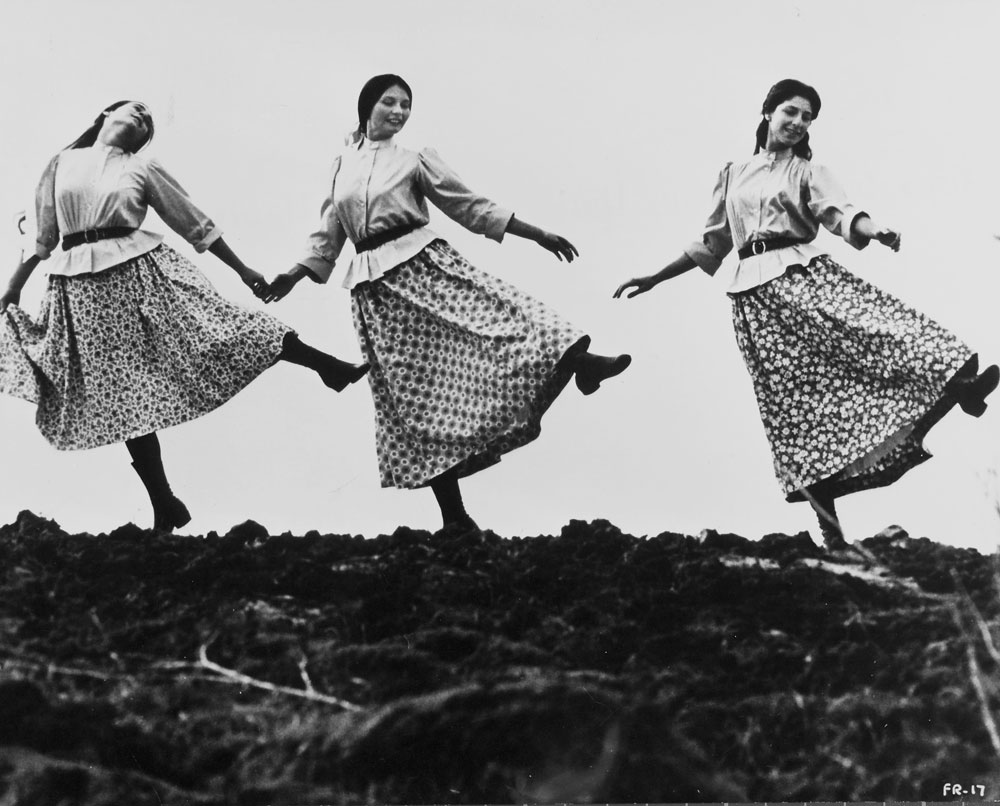
Fiddler on the RoofRosalind Harris, Neva Small, Michele Marsh in “Fiddler on the Roof” 1971 (RDB/ullstein bild via Getty Images)
Though “Fiddler” begins with an embrace of rigid tradition, it’s not long before romance finds new ways around it. One by one, Tevye’s daughters escape their arranged marriages and wed men they love, radically defying established practices. While the Beatles sang “Can’t Buy Me Love” outside the theater, inside it, Teyve’s oldest daughter demanded to be allowed to marry Motl Komzoil, a poor tailor, rather than Lazar Wolf, the rich butcher she’d been promised to. When Tevye relents, Motl launches into “Miracle of Miracles,” celebrating the fact that the butcher’s money couldn’t buy him love, along with the fact that:

Wonder of wonders, miracle of miracles,
God took the tailor by the hand,
Turned him around and, miracle of miracles,
Led him to the promised land!

The times were definitely a-changin’, to paraphrase another Jewish songwriter, and many Jews embraced those changes. Others, however, found their newfound proximity to wealth and power intoxicating. They saw in the social structure, to quote another “Fiddler” classic, “something to think about, something to drink about, drink l’chaim, to life.” Harnick’s lyrics reflected this moral division within the Jewish community. 


Want a daily wrap-up of all the news and commentary Salon has to offer? Subscribe to our morning newsletter, Crash Course.


As contemporary as “Fiddler” was, many of Harnick’s most familiar lines were actually taken word-for-word from Sholem Aleichem’s “Tevye, the Dairyman.” Aleichem was a turn-of-the-century Yiddish writer who was born in Eastern Europe in 1859 and died in New York City in 1916. Throughout his career, he never cared about wealth or status, which he considered shallow markers of American capitalism. All he wanted was to show that Jews could make art without sacrificing their Jewishness. He believed that Jews should be contributors to the great tapestry of intellectual achievement with threads of their own color and texture. 

Although “Fiddler” deviated from Aleichem’s true spirit — Harnick and Stein’s story is Americanized and largely devoid of Yiddishkeit — the runaway success of their musical ultimately fulfilled Aleichem’s goal. By setting Aleichem’s words to Jerry Bock’s Eastern European-inspired music, Harnick created a new mythological shtetl that Jews in America could be deeply proud of. “I belong in Anatevka,” the musical closes, “Tumble-down, work-a-day Anatevka/ Dear little village, little town of mine.”

Trump calls DeSantis a “globalist sellout” during campaign event in Iowa

During a Farmers for Trump campaign event in Iowa on Friday, the former president hoping to have a shot at a non-consecutive second term, amidst a slew of legal battles, railed against 2024 hopeful, Ron DeSantis, calling him a “globalist sellout.”

“He would be a catastrophe for farmers of Nebraska and Iowa and anyplace else,” Trump said in a quote obtained from Newsmax. “He has been fighting for years — don’t forget he was a congressman — to kill every single job supported by this very important industry,” he furthered elsewhere in his address to the crowd. “Ending the renewable fuel standard was one of his top priorities as a member of Congress. If he had his way, the entire economy of Iowa would absolutely collapse.” Pounding in his point, he compared his own agricultural efforts to those of DeSantis saying, “DeSanctus sided with the communists in China; I sided with the farmers in America.”  

After his stop-over, Trump headed to a local Dairy Queen where it was revealed that he doesn’t know what a Blizzard is — one of the chain’s signature treats. “Everybody wants a Blizzard. What the hell is a Blizzard?” Trump was heard asking, according to NBC News. “Take care of the people, OK? Will you take care of ’em for me, and we’ll do the Blizzard thing, alright?” he added. “After Trump’s stop at the Dairy Queen on Friday, a spokesperson for the Democratic National Committee took a jab at [him] on Twitter by writing: ‘Donald Trump doesn’t know what a blizzard is. You know who does? Joe Biden,’ writes NBC’s Vaughn Hillyard.

Gen Z’s web-fueled love affair with chain restaurant merch

In late 2019, when the pandemic slowly began wreaking havoc in all sectors of life, the food industry was hit hard as many restaurants struggled to stay afloat. Many had to temporarily shut down their services. Others weren’t so lucky and had to shut down operations completely.

As dreary as it all was, several restaurant and fast food chains used the opportunity to revamp their marketing techniques. That includes creative social media posts — namely on TikTok, where several businesses, like Wingstop, SONIC and KFC, meshed Gen-Z humor with food advertising. That also includes new menu offerings. And, better yet, nostalgic menu offerings, such as McDonald’s limited-time adult Happy Meals.

A few major chains even released their own merchandise, from seasonal trinkets to full apparel and accessories, and garnered favorable responses from consumers. People were ecstatic when Pizza Hut — in partnership with Chain — the Los Angeles based pop-up culinary collective, released its limited-edition reversible Hut Hat. The reversible bucket hats touted Pizza Hut’s iconic red roof on one side and a checkered design with black, white and red on the other. Prior to the Hut Hat, there was KFC Russia’s limited-edition bucket hats, which are adorned with the brand’s iconic red and white stripe pattern and logos, along with the limited-edition clothing line released by KFC’s U.K. wing.

Perhaps the most notable food accessory sensation is Panera’s chic and tasty BAGuette bag, which is essentially an elongated green purse that resembles a loaf of French bread. The bags initially sold out, then were restocked only to sell out again. A few bags were later resold on eBay for more than $200. One seller even listed the bag for an astounding $3,290. 

Time and time again, food merchandise has remained a hit amongst customers and those perpetually online alike. So to keep up with the demand, several restaurant chains have launched online merch shops in an effort to boost sales and provide customers with all the food-themed merchandise they can dream of.

The ongoing trend first began in 2021, when Cheez-It launched its self-proclaimed “first ever online store” — fittingly called CheezItHQ.com. The online shop has everything from clothing to drinking accessories to fun miscellaneous items. There’s Cheez-It-themed socks, beanies and hoodies and a onesie. There’s a can koozie, dual wine sleeves, and a wine tumbler. There’s even a fanny pack, an apron, and a fleece blanket.

Of course, because Cheez-It is a famed snack brand, its online marketplace also carries the signature snacks, like an exclusive Extra Toasty Superfan 4-Pack that includes brand new Extra Spicy, Extra Cheesy, and Cheddar Jack varieties with a box of the original version of Cheez-Its Extra Toasty crackers.

“The Cheez-It brand is always looking for new ways to connect with fans, and through this online shopping experience we’re offering consumers a new platform to enjoy everything they love about Cheez-It in a fresh, exciting way,” Jordan Narducci, Kellogg’s director of global direct to consumer ecommerce, said in an announcement, per Food & Wine. “This Direct-to-Consumer site gives us the opportunity to bring future food innovations to market faster than ever before, while also collecting feedback from our consumers in real time.”

Following suit was Red Lobster, which in November 2022, launched their first digital pop-up shop for the holiday season at RedLobsterShop.com. The limited-time-only shop reopened after three years and sold a slew of unique merchandise specific to seafood and the Red Lobster brand. There’s an ugly sweater with an insulated pocket for Cheddar Bay Biscuits, a Cheddar Bay Sleigh Ugly Sweater, a Claw Hoodie, Critter Beanie, and a Red Lobster vintage-style snapback cap. There’s also a trio of Red Lobster ornaments along with an ornament dedicated to Cheddar, the rare orange lobster that was found and rescued from a Red Lobster location in 2022.

In the same vein as Narducci, Red Lobster’s chief marketing officer, Patty Trevino said the restaurant’s holiday online shop was all for their loyal fans, who could “bring their love of Red Lobster home for the holidays.”

The most recent addition to the trio is Panera, which opened its first official online merchandise storefront, The Panera Shop, in April of this year. In addition to the iconic BAGuettes, the store offers other Panera-themed swag, or “carb couture,” like mac and cheese tracksuits, “all my friends are bread” crewnecks, and even a toddler onesie that reads “Just Baked.”


Want more great food writing and recipes? Subscribe to Salon Food’s newsletter, The Bite.


It’s not hard to see that online merch shops are a slow yet ongoing trend in the restaurant industry — two is a coincidence, but three is a trend, per the age-old adage. As I previously wrote in an April piece on food and fashion, casual fast food continues to be hot and buzzy subjects for content creators, who have garnered significant followings simply by sharing menu hacks, mukbangs and videos of themselves eating their go-to orders from their local Mickey D’s. Such content is enticing, attractive and tempting — much like the food that’s being spotlighted. Restaurant-specific merch only adds to that buzzy factor, allowing for restaurants to not only garner a customer-base but also, a fan-base.

That, in turn, helps boost revenue and overall sales. In a May 23 announcement, Panera mentioned that it has “strengthened its leadership in the fast casual segment by expanding its leading digital capabilities, which today account for 53% of total sales at Panera Bread.” The brand also increased its loyalty base to 53 million members and launched an innovative loyalty subscription model that has resulted in 25% of all Panera transactions now coming from Unlimited Sip Club members. The club is part of Panera’s greater reward membership called MyPanera loyalty, which offered exclusive-access to their online store from May 1 through May 7. Other perks include special offers, birthday rewards, discounts and more.

Whether other casual restaurants will jump on the trend is still to be seen. But it certainly seems pretty likely. Perhaps Pizza Hut will be the next to open up its own online store, where Hut Hats and other pizza-themed paraphernalia will be readily available for purchase.

They lied about Afghanistan. They lied about Iraq. Now they’re lying about Ukraine

The playbook the pimps of war use to lure us into one military fiasco after another, including Vietnam, Afghanistan, Iraq, Libya, Syria and now Ukraine, does not change. Freedom and democracy are threatened. Evil must be vanquished. Human rights must be protected. The fate of Europe and NATO, along with a “rules-based international order” is at stake. Victory is assured.

The results are also the same. The justifications and narratives are exposed as lies. The cheery prognosis is false. Those on whose behalf we are supposedly fighting are as venal as those we are fighting against. 

The Russian invasion of Ukraine was a war crime, although one that was provoked by NATO expansion and by U.S. backing of the 2014 “Maidan” coup, which ousted democratically elected Ukrainian President Viktor Yanukovych. Yanukovych wanted economic integration with the EU, but not at the expense of economic and political ties with Russia. The war will only be solved through negotiations that allow ethnic Russians in Ukraine to have autonomy and Moscow’s protection, as well as Ukrainian neutrality, which means the country cannot join NATO. The longer these negotiations are delayed the more Ukrainians will suffer and die. Their cities and infrastructure will continue to be pounded into rubble.

But this proxy war in Ukraine is designed to serve U.S. interests. It enriches the weapons manufacturers, weakens the Russian military and isolates Russia from Europe. What happens to Ukraine is irrelevant. 

“First, equipping our friends on the front lines to defend themselves is a far cheaper way — in both dollars and American lives — to degrade Russia’s ability to threaten the United States,” admitted Senate Republican leader Mitch McConnell.

Once the truth about these endless wars seeps into public consciousness, the media drastically reduces coverage. The military debacles, as in Iraq and Afghanistan, continue largely out of view.

“Second, Ukraine’s effective defense of its territory is teaching us lessons about how to improve the defenses of partners who are threatened by China. It is no surprise that senior officials from Taiwan are so supportive of efforts to help Ukraine defeat Russia. Third, most of the money that’s been appropriated for Ukraine security assistance doesn’t actually go to Ukraine. It gets invested in American defense manufacturing. It funds new weapons and munitions for the U.S. armed forces to replace the older material we have provided to Ukraine. Let me be clear: This assistance means more jobs for American workers and newer weapons for American service members.”

Once the truth about these endless wars seeps into public consciousness, the media, which slavishly promotes these conflicts, drastically reduces coverage. The military debacles, as in Iraq and Afghanistan, continue largely out of view. By the time the U.S. concedes defeat, most barely remember that these wars are being fought. 

The pimps of war who orchestrate these military fiascos migrate from administration to administration. Between posts they are ensconced in think tanks — Project for the New American Century, the American Enterprise Institute, Foreign Policy Initiative, Institute for the Study of War, the Atlantic Council and the Brookings Institution — funded by corporations and the war industry. Once the Ukraine war comes to its inevitable conclusion, these Dr. Strangeloves will seek to ignite a war with China. The U.S. Navy and military are already menacing and encircling China. God help us if we don’t stop them.

These pimps of war con us into one conflict after another with flattering narratives that paint us as the world’s saviors. They don’t even have to be innovative. The rhetoric is lifted from the old playbook. We naively swallow the bait and embrace the flag — this time blue and yellow — to become unwitting agents in our self-immolation.


Want a daily wrap-up of all the news and commentary Salon has to offer? Subscribe to our morning newsletter, Crash Course.


Since the end of the Second World War, the government has spent between 45 to 90 percent of the federal budget on past, current and future military operations. It is the largest sustained activity of the U.S. government. It has stopped mattering — at least to the pimps of war — whether these wars are rational or prudent. The war industry metastasizes within the bowels of the American empire to hollow it out from the inside. The U.S. is reviled abroad, drowning in debt, has an impoverished working class and is burdened with a decayed infrastructure as well as shoddy social services. 

Wasn’t the Russian military — because of poor morale, poor generalship, outdated weapons, desertions, a lack of ammunition that supposedly forced soldiers to fight with shovels, and severe supply shortages — supposed to collapse months ago? Wasn’t Putin supposed to be driven from power? Weren’t the sanctions supposed to plunge the ruble into a death spiral? Wasn’t the severing of the Russian banking system from SWIFT, the international money transfer system, supposed to cripple the Russian economy? How is it that inflation rates in Europe and the U.S. are higher than in Russia despite these attacks on the Russian economy? 

Wasn’t the nearly $150 billion in sophisticated military hardware, financial and humanitarian assistance pledged by the U.S., EU and 11 other countries supposed to have turned the tide of the war? How is it that perhaps a third of the tanks Germany and the U.S. provided were swiftly turned by Russian mines, artillery, anti-tank weapons, air strikes and missiles into charred hunks of metal at the start of the vaunted counteroffensive? Wasn’t this latest Ukrainian counteroffensive, which was originally known as the “spring offensive,” supposed to punch through Russia’s heavily fortified front lines and regain huge swathes of territory? How can we explain the tens of thousands of Ukrainian military casualties and the forced conscription by Ukraine’s military? Even our retired generals and former CIA, FBI, NSA and Homeland Security officials, who serve as analysts on networks such as CNN and MSNBC, can’t say the offensive has succeeded. 

And what of the Ukrainian democracy we are fighting to protect? Why did the Ukrainian parliament revoke the official use of minority languages, including Russian, three days after the 2014 coup? How do we rationalize the eight years of warfare against ethnic Russians in the Donbass region before the Russian invasion in February 2022? How do we explain the killing of more than 14,200 people and the 1.5 million who were displaced, before Russia’s invasion took place last year?

How do we defend Zelenskyy’s decision to ban 11 opposition parties, many of them on the left, while allowing fascists from the Svoboda and Right Sector parties, as well as the Banderite Azov Battalion and other extremist militias, to flourish?

How do we defend the decision by President Volodymyr Zelenskyy to ban 11 opposition parties, including the Opposition Platform for Life, which had 10 percent of the seats in the Supreme Council, Ukraine’s unicameral parliament, along with the Shariy Party, Nashi, Opposition Bloc, Left Opposition, Union of Left Forces, State, Progressive Socialist Party of Ukraine, Socialist Party of Ukraine, Socialists Party and Volodymyr Saldo Bloc? How can we accept the banning of these opposition parties — many of which are on the left — while Zelenskyy allows fascists from the Svoboda and Right Sector parties, as well as the Banderite Azov Battalion and other extremist militias, to flourish? 

How do we deal with the anti-Russian purges and arrests of supposed “fifth columnists” sweeping through Ukraine, given that 30 percent of Ukraine’s inhabitants are Russian speakers? How do we respond to the neo-Nazi groups supported by Zelenskyy’s government that harass and attack the LGBTQ community, the Roma population and anti-fascist protesters, and threaten city council members, media outlets, artists and foreign students? How can we countenance the decision by the U.S and its Western allies to block negotiations with Russia to end the war, despite Kyiv and Moscow apparently being on the verge of negotiating a peace treaty? 

I reported from Eastern and Central Europe in 1989 during the breakup of the Soviet Union. NATO, we assumed at the time, had become obsolete. Soviet President Mikhail Gorbachev proposed security and economic agreements with Washington and Europe. Secretary of State James Baker, along with West German Foreign Minister Hans-Dietrich Genscher, assured Gorbachev that NATO would not be extended beyond the borders of a unified Germany. We naively thought the end of the Cold War meant that Russia, Europe and the U.S. would no longer have to divert massive resources to their militaries. 

The so-called “peace dividend,” however, was a chimera.

If Russia did not want to be the enemy, Russia would be forced to become the enemy. The pimps of war recruited former Soviet republics into NATO by painting Russia as a threat. Countries that joined NATO, which now include Poland, Hungary, the Czech Republic, Bulgaria, Estonia, Latvia, Lithuania, Romania, Slovakia, Slovenia, Albania, Croatia, Montenegro and North Macedonia, reconfigured their militaries, often through tens of millions in Western loans, to become compatible with NATO military hardware. This made the weapons manufacturers billions in profits. 

It was universally understood in Eastern and Central Europe following the collapse of the Soviet Union that NATO expansion was unnecessary and a dangerous provocation. It made no geopolitical sense. But it made commercial sense. War is a business.

In a classified diplomatic cable — obtained and released by WikiLeaks — dated Feb. 1, 2008, written from Moscow and addressed to the Joint Chiefs of Staff, the NATO-European Union Cooperative, the National Security Council, the Russia Moscow Political Collective, the Secretary of Defense and the Secretary of State, there was an unequivocal understanding that expanding NATO risked conflict with Russia, especially over Ukraine:

Not only does Russia perceive encirclement [by NATO], and efforts to undermine Russia’s influence in the region, but it also fears unpredictable and uncontrolled consequences which would seriously affect Russian security interests. Experts tell us that Russia is particularly worried that the strong divisions in Ukraine over NATO membership, with much of the ethnic-Russian community against membership, could lead to a major split, involving violence or at worst, civil war. In that eventuality, Russia would have to decide whether to intervene; a decision Russia does not want to have to face. …

Dmitri Trenin, Deputy Director of the Carnegie Moscow Center, expressed concern that Ukraine was, in the long-term, the most potentially destabilizing factor in U.S.-Russian relations, given the level of emotion and neuralgia triggered by its quest for NATO membership. … Because membership remained divisive in Ukrainian domestic politics, it created an opening for Russian intervention. Trenin expressed concern that elements within the Russian establishment would be encouraged to meddle, stimulating U.S. overt encouragement of opposing political forces, and leaving the U.S. and Russia in a classic confrontational posture.

The Russian invasion of Ukraine would not have happened if the Western alliance had honored its promises not to expand NATO beyond Germany’s borders and Ukraine had remained neutral. The pimps of war knew the potential consequences of NATO expansion. War, however, is their single-minded vocation, even if it leads to a nuclear holocaust with Russia or China. 

The war industry, not Putin, is our most dangerous enemy. 

“There’s an underscore of melancholy”: “The Bear” producer breaks down season’s best needle drops

“The Bear” was a sensation upon its release in summer 2022. The show depicted the inner workings of a Chicago sandwich shop run by Carmen “Carmy” Berzatto (Jeremy Allen White), a decorated chef who took over operations after his brother dies by suicide. White won a Golden Globe, Critics’ Choice Award and Screen Actors Guild Award for his acting, while “The Bear” itself racked up multiple award nominations (and a few wins) for overall excellence.

The second season of the show, which premiered on June 22, has been another rousing success so far in part due to the plot: Carmy and several characters from the first season, including chef Sydney Adamu (Ayo Edebiri) and cousin Richard “Richie” Jerimovich (Ebon Moss-Bachrach), work tirelessly to reopen the restaurant as something more upscale. 

However, this season’s music has also caused a stir, thanks to choices driven by the series creator Christopher Storer and executive producer Josh Senior. The season’s 10 episodes unfold to a soundtrack of artists with ties to Chicago (Mavis Staples, Wilco) as well as ’80s music touchstones (Lindsey Buckingham’s ‘Holiday Road,” Psychedelic Furs’ “Pretty in Pink,” Fine Young Cannibals’ “She Drives Me Crazy”) and alternative-leaning cuts by Neil Finn, Squeeze, Harmonia & Eno ’76, Tangerine Dream, Pearl Jam and Refused.

“There’s an underscore of melancholy in that song, but it’s also really hopeful.”

Elsewhere, R.E.M.‘s “Strange Currencies” is a recurring musical motif, albeit in different forms: the original 1994 mix, a 2019 Scott Litt remix and a previously unreleased demo song. “Baby I’m a Big Star Now” — an obscure but beloved Counting Crows song heard in the movie “Rounders” that’s been difficult to find — is also included, as is Taylor Swift’s iconic “Love Story (Taylor’s Version).” 

The song choices are often surprising — for example, a Christmas-themed episode with holiday classics and some unexpected cuts — or poignant, as in a Replacements song used during a pivotal romantic moment between two characters.

At the moment, Senior is looking forward to taking a break, as he and Storer have been working nonstop for the last two years. “Because of the way that the show is timed and how long it takes to do each of the steps, it’s a year-round pursuit,” he said. However, he took some time out for a Friday afternoon chat with Salon about the music from this season of “The Bear.”

The following transcript has been lightly edited for length and clarity.

The music aspect of the first season of “The Bear” was very successful. What did you want to do differently — and the same — for Season 2?

One of the things that’s really special about the show is that a lot of us do multiple jobs. Chris creates, writes and directs the show, and does the music with me. I’m one of the executive producers; I do the music for the show. And we also do all the post-production at my post house in Brooklyn, and my partner edits the show. 

Because of this, we approach the music in the same way almost as approaching the casting or the story. Everything we do at the same time. We don’t shoot and edit the show, and then pick songs. Oftentimes, we go into the prep process — at least in the past two years — with a playlist of music that we’ve already picked and shared with each other.

One of the most fun things to do when we’re getting notes on scripts, working through the prep and all those things is to make that playlist —  [we] start playing songs for each other, trying to top one another, or drawing on things from our childhood or personal experiences that connect to the story of the show. It’s such an organic process. And it’s funny because, more often than not, that playlist ends up becoming the soundtrack for the season. 

This year one of the things we tried to do was, again, not pick music because we think it’s cool or not, but to pick stuff that we feel like is right for the show. 

And then, last year, I’d say, the sound of the show was very much the sounds of the music you would hear inside of [restaurant in the show] The Beef. And this year, the story broadens outside of the restaurant, and the restaurant is being transformed and rebuilt. And so we had the opportunity to draw from a wider base musically. That’s something we were both really looking forward to.

I love that you have the Chicago artists represented, but there’s people like Eddie Vedder, who has ties to Chicago, and then it spirals out to Neil Finn — and, of course, Eddie’s a huge Neil Finn fan. I like the little connections; it’s all very seamless in that way too.

Thanks for noticing that. We had fun with the music; we want the music to set the tone. If the music, at least in our opinion, isn’t furthering your appreciation, or understanding, or depth of engagement with the actual story of the show and the characters, we try not to do it.

Although there are a ton of needle drops this year, we don’t really play music just for playing music’s sake. Being able to tie into Chicago — or in the Christmas episode, think about the type of music that Donna would play at her house — those are really fun exercises for us.

And you’ll notice, those aren’t all Christmas songs. She’s got BoDeans in there, she’s got [George Harrison’s] “Got My Mind Set on You,” which is like my favorite song. I mean, I had a 45 of that and used to jump around my bedroom playing it. And so to have the opportunity to put that in the show — and for it to fit — is something that we’re really happy with.

I also remember hearing that on the radio all the time as a kid. It brings back such happy memories too, even though, especially in that episode, there’s a lot going on.

Yeah. There’s also a children’s song in the middle of that episode, “Little White Duck” by Dorothy Olsen — that’s a song you play for your two-year-old. That juxtaposition is something we try to play with a lot. 

And of course, we love R.E.M, we love Pearl Jam, we love Wilco, both of us, so much. That’s just music that is something that we bonded over before we had the opportunity to do music for a TV show. The Replacements [too]. Being able to take these bands that deserve attention and radio play and conversation and present them, hopefully, to people who remember them and feel great about it — and the 16- to 20-year-olds that are learning about them through the show — that’s pretty rad. That’s a really cool thing.

The BearGillian Jacobs as Tiffany and Abby Elliot as Natalie “Sugar” Berzatto in “The Bear” (Chuck Hodes/FX)I love that you chose R.E.M.’s “Strange Currencies.” That song is a long-time favorite of the band and fans as well, but it’s not the most obvious R.E.M song. What drew you to that one in particular?
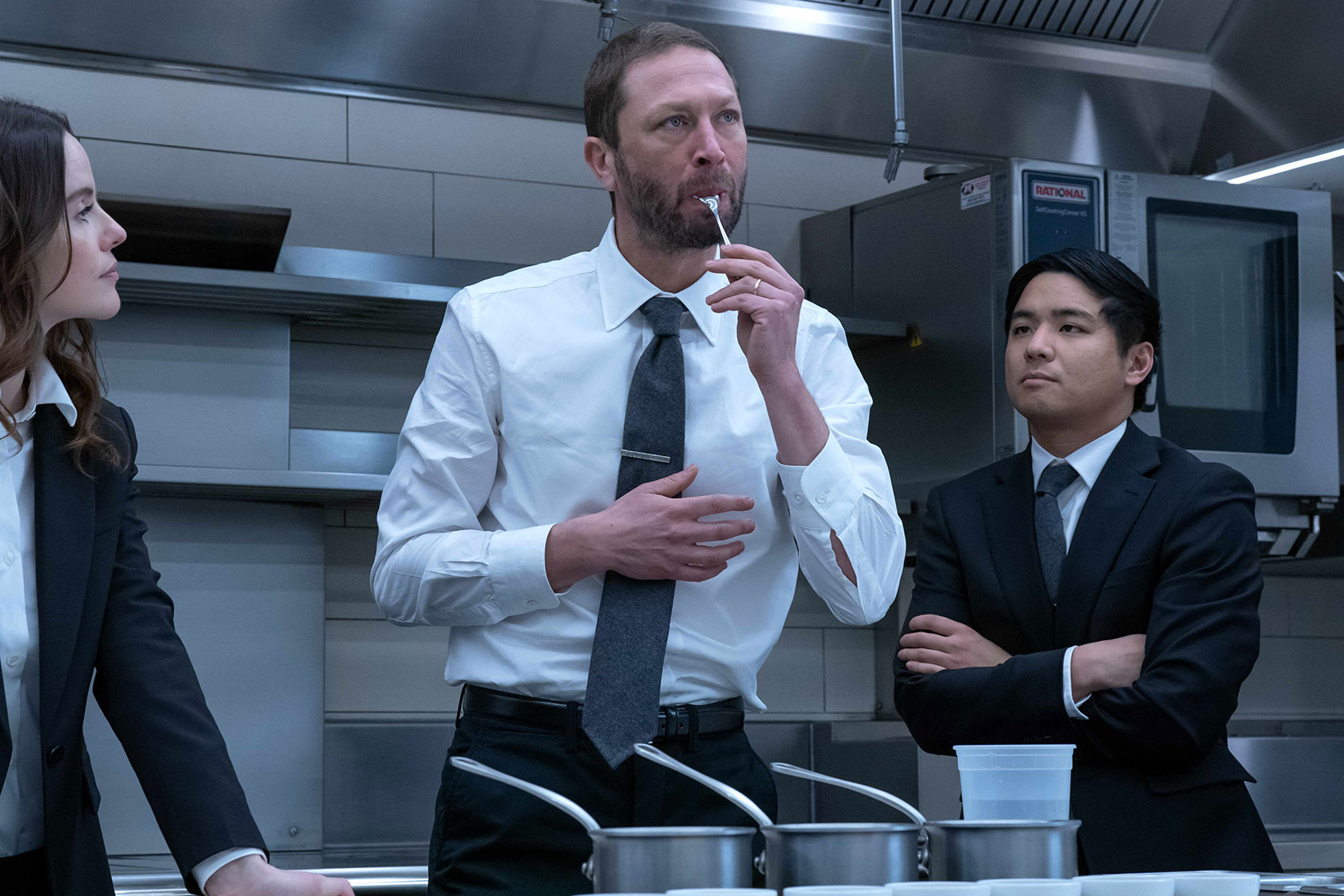
I have to give a ton of credit to Chris for that. When he and I were talking, he was like, “I want to pick a song that sounds like what it feels like to be a kid, where it feels like anything is possible, but you really can’t get anything done. You just don’t know how.”

There’s an underscore of melancholy in that song, but it’s also really hopeful. It works for the Claire and Carmy dynamic, it also works for the other relationships that we explore throughout the season — Sydney and her father, and Richie and Tiffany — and the way that people need forgiveness, need more opportunities [and] the way that people are steadfast in their dedication to achieving their goals. All those things come through in the lyrics of the song.

And it’s just so beautiful, the progression in that, and the melodies of the song itself fit the world so well. And we love that song and think it deserves more attention. Giving that song the chance to be almost used like score in our show was the coolest thing in the world.

Part of the thing that I love about this job is because we do multiple jobs on the show, when we reach out to bands, we’re able to give them a lot of information about the intention, about how the song’s going to be used. That breeds a lot of collaboration. 

With R.E.M, after licensing a few tracks from them, we started talking and we explained the way we wanted to use the song and they were like, “OK, great. Here’s the Scott Litt remix,” which I think is arguably better — I mean, the vocals are just so amazing on it. And then they gave us a demo, and that demo was unreleased and we were able to put it out through the show. Those little things really make the usage that much more special and really help us use music almost as a refrain or a theme as we’re telling our story.

I loved the fact that there were kind of different versions that were recurring throughout because it deepens the song’s use and helps move the plot along. And as you hear it come up again, the song is slightly different, things have moved along in the series. It is like when you have a movie score and the music is a little bit different as it unfolds. 

And it’s fun for us too, because we’re fans of these people and it’s never not surreal to hear that someone thinks your work is worthy enough to have their music in it.

And Michael Stipe has been posting on his Instagram Stories constantly. He’s so excited.

Yeah, I don’t even think that’s real. It’s insane.

R.E.M is also very selective about who they work with, which also must be gratifying.

That makes it all the more special. There are little needle drops that we put in to see if people notice. There’s songs that we put in because we love them. There are things that we feel are perfect for the story and the characters. And R.E.M is all those things.

“We felt like it was such a special needle drop that it was worth pursuing.”

The Counting Crows song “Baby I’m a Big Star Now” is also an interesting pick. How did this one come about?

It’s not a straightforward song to acquire, but if you’ve seen the movie “Rounders,” you love the song. And it’s one of those songs that felt like a fable almost, like, “Oh, you know that song?” “Yeah.” “I can’t find it anywhere.” It’s not on Spotify. It’s super hard to track down. There are YouTube versions of it.

[But] Chris has a really solid relationship with Brian Koppelman and David Levien, who wrote “Rounders,” and we started talking to them about how to get the music. On the label side, we went as far as we could. And we felt like it was such a special needle drop that it was worth pursuing. 

We go to Chicago at the end of January and the show goes on TV at the end of June, so there’s not a lot of time for deliberation or negotiation or back and forth. And that was the one song that we were like, “We’re going to start trying to get it on the first day and if we get it by the last day, we’ll use it.” We were very fortunate to get that one in the show.

The BearSarah Ramos as Jessica, Ebon Moss-Bachrach as Richard “Richie” Jerimovich and Andrew Lopez as Garret in “The Bear” (Chuck Hodes/FX)On the flipside, I love that you have “Love Story” (Taylor’s Version) in there. That song has become such a touchstone for fans, but also for non-fans as well. What was the story behind getting that one?
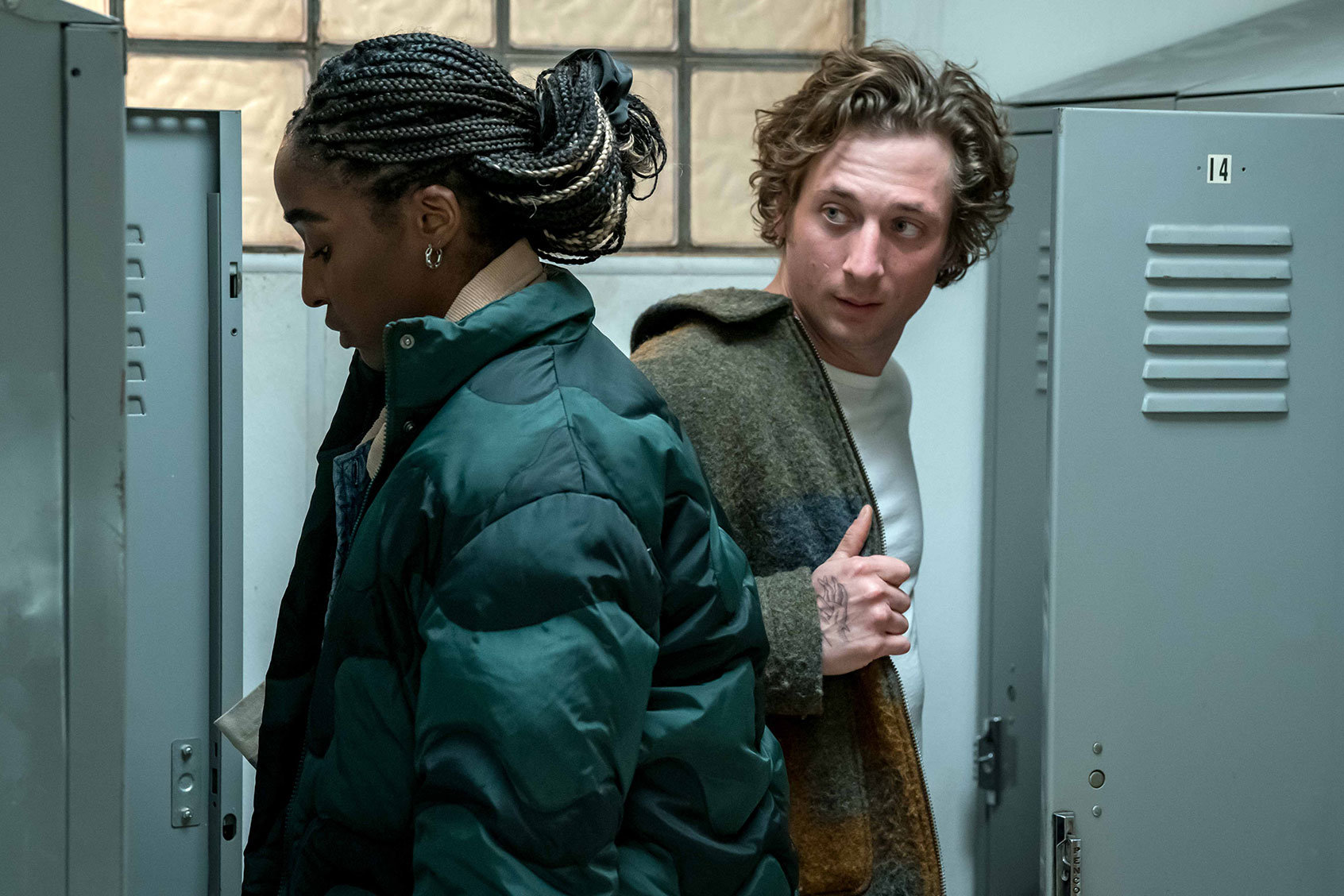
It’s funny, people have been talking about that, and it’s great. The song really fits what’s happening with that character [Richie] in that moment and his journey and where he’s arrived. 

That song came up organically between Chris and I as we were putting the show together and getting ready to shoot. People were talking about going to see Taylor Swift, myself included; we’re both big Taylor Swift fans. And last year, we found success in using a John Mayer song that we both loved. And we knew we didn’t want to do that exact thing again, but we wanted to try and do something that might be a little unexpected, but also felt right in the world. 

And this year, you’re learning a lot about Richie. To us, that was a great opportunity to play some new types of music. Taylor Swift was the perfect fit for that. We knew we wanted him to sing, and we thought that her version of the song would be the perfect place to go. It was special for that character in that moment. It was allowing him to really be himself.

What would surprise people to know about how to go about licensing songs? Based on what you’re describing, with some of the songs you can go directly to people and some of the songs are a little more challenging. It’s like a treasure hunt. 

It’s a pretty straightforward process insomuch as most big record labels have a very straightforward way of doing it. You learn a lot about bands’ rules; bands are allowed to set rules for how their music is licensed and used. It’s one of those things where you need an open mind, but you also have to pay attention. There’s lore about how tracks are licensed, and who’s hard and who won’t do it and who says, “I won’t even look at an offer for less than $100,000.” There’s all this story being told.

“Anybody who’s willing to let us use their music in the show is doing us a favor, no matter how much money we’re paying them.”

But the truth is we try and be personal. We try and be really clear. We try and collaborate. And we understand that anybody who’s willing to let us use their music in the show is doing us a favor, no matter how much money we’re paying them. And that mentality and that gratitude just helps us break through a lot of the process, which can be one that seems to have a lot of red tape.

Also, if you are like me and doing music on a show and also producing, get a great clearance coordinator. It’s important to know that there are people that are professionals at the clearance aspect of music supervision. That’s a partnership that is essential, especially if you have a few hats to wear on a job, to make sure that everything is done thoroughly and fully papered.

Were there any songs or any scenes where you couldn’t get a song you wanted? Something where it was like, “Oh, this is perfect,” and it just didn’t work out?

There are scenes that we had other songs in mind for — but to be honest with you, this year, we got a great outcome every time we wanted to use a song. What I will say is, there are some scenes that had music in them in our earlier edits, that we removed music from, that are very effective.

Interesting.

We’re not just playing music to play music, and we’re definitely not playing music to be cool. We’re trying to tell the story the best way possible. And we both loved the way that music was used in the films of the ’70s and ’80s where the needle drops play loud and long, and there’s a lot of stuff happening. I don’t see that a ton on TV, and that’s something that we have been trying to do since the pilot of the show.

The BearJeremy Allen White as Carmen “Carmy” Berzatto and Ayo Edebiri as Sydney Adamu in “The Bear” (Chuck Hodes/FX)It’s so fitting that everyone is doing different jobs on a show like this too because so much about this season is just that, everyone kind of trying to build something from the ground up. I love that.

Making the show is a lot like watching the show. The show is very much reflective of the core team and the process by which we use to make our project.


Want a daily wrap-up of all the news and commentary Salon has to offer? Subscribe to our morning newsletter, Crash Course.


Have you been surprised by the reaction? Because Season 1 was extremely well-received and Season 2 it seems like it’s even moreso. Why do you think that is?

I would love to know the answer to that question so that I could potentially do this again in my life. We are so humbled and grateful — all of us as a group — that people like the show, that people came back to watch the show, that people are discovering the show.

We firmly believe in a philosophy of head down and good work. And in doing that, we really try and let the work speak for itself. So if people are reacting and responding to the show, hopefully it’s because we’ve done a good enough job, or shown something that’s interesting, and that people want more of.

But if you look at TV, there’s something for everybody out there right now. There’s so much TV that’s out — and so much of it is good, honestly. People are good at making TV. It’s hard, to be sure, but because there’s so many places that are providing opportunity, more different types of stories are coming out, and maybe our show is an example of that.

“The Bear” is currently streaming on Hulu.

An expert reveals the secret language of “Thinking With Your Hands”

When I was in high school, my history teacher tried an experiment with a classmate known for her enthusiastic and expressive communication style. The girl had raised her hand to answer a question, and the teacher challenged her to reply while keeping her hands folded in her lap. I’ve never forgotten the sight of her struggling to get her words out while her hands were restrained.

We all, to some extent or another, talk with our hands. It’s part of how we communicate. But as author, University of Chicago professor and psychologist Susan Goldin-Meadow explains in her newest book, that’s just the beginning. 

In “Thinking With Your Hands: The Surprising Science Behind How Gestures Shape Our Thoughts,” Goldin-Meadow, whose previous books have similarly explored the hand and mind connection, posits that “Focusing exclusively on language as the foundation of communication is wrong.” In her deep and pioneering research on deaf children who were not taught sign language, she’s explored the intricate ways in which communication emerges independent of what we typically regard as language.

What’s she discovered are an astonishing number of ways in which our hands not only help us to emphasize (or sometimes contradict) our spoken words, but how they also play a vital role in how we form our ideas. As Goldin-Meadow shows, even people blind from birth use gesture. People who don’t have arms will experience a phantom feeling they are gesturing. We gesture when who we’re talking to can’t see us, such as on the phone. We gesture when we’re all alone, trying to compose an email. We need to gesture to make sense of the world.

I talked to Goldin-Meadow recently via Zoom about the intimate power of our gestures, how gestures can help us tap into ideas, and why she says that “Gesture and language really are a single integrated system. It’s just not a system that linguists study.”

This conversation has been edited and condensed for clarity.

I want to ask you why this matters. You say early on that focusing exclusively on language isn’t sufficient. Maybe that’s a semantic issue itself, because what is language? 

“There’s so much information that isn’t captured by our words, and by all of the conventional things that we learn from language.”

The way I’m defining language is the way linguists have always found it. There are people now who will say, gestures are part of language, and it’s part of the whole system. That may be true, but then it’s a different kind of system. If you’re interested in the messages that get across, and in how we influence one another and learn about ourselves and learn about things, we need to look at gesture as well as words or signs.

There’s so much information that isn’t captured by our words, and by all of the conventional things that we learn from language. For that purpose, certainly as a psychologist, I think it’s very important to take these kinds of things seriously.

In the book, you distinguish between gestures, which are what we think of when we think of talking with our hands, and emblems, which are more regional and cultural signals like a thumbs up or “okay” sign. Why is it important for us, when we’re thinking of this language of gestures, to understand those differences?

Emblems are conventional. It’s a kind of symbol, so you can do it wrong. There’s a way to do it. They’re like words; I can do it and everybody will know [its meaning]. 

They’re perfectly legitimate to study and they’re interesting, but the reason I’m less interested in them is because they’re conventionalized. You have to do them in a particular way. The spontaneous gestures that we produce, we are very much less aware of. They capture things that we’re thinking that we’re not always aware of thinking. Producing an emblem, I don’t just subconsciously produce it, I know when I’m doing it. But you can subconsciously talk about other kinds of things when you’re doing your spontaneous gestures. 

When you look at the title of this book, you are geographically speaking of one particular part of the body. Yet when I think of gesture, I also think about my face, I think about my whole body. What do we learn when we isolate just the hands?

There’s a huge literature on body language. It really does convey lots of things — attitude perspective, sense of self, more. Most of it is about how we feel, and our perception of our interaction. What the hands contribute — and the face can do this, too — is not just our attitudes about the conversation, but the content of the conversation.

That’s something that whole field of body language really ignored for a long time. It wasn’t until [University of Chicago professor] David McNeill and [University of Cambridge anthropologist] Adam Kendon that they started taking these gestures really seriously as conveying thoughts, not just feelings. That’s what I’m after. There are other ways of doing it, but I stuck with the hands because, first of all, it’s a lot to code, and you’ve got to start somewhere.

You talk in the book so much about this concept of homesigning, gestures that profoundly deaf children create when they have not been exposed to sign language, and what you’ve been able to learn from that about the ways in which our brains work, the ways in which we communicate. That was my first encounter with that phrase.

This is how I often start lectures about this phenomenon. If language were absolutely wiped out right now, no spoken language, no sign language, no written language, but everything else remained the same, would you imagine that it would be reinvented? If it were reinvented, would it be reinvented in the same way, or would it look different? Depending upon what you think we bring to the situation, if you think that language has been handed down from generation to generation to generation, and is the way it is because of its historical path, it might not be reinvented, and it might look really, really different.

But if you think that language is the way it is, in part, at least, because of what we bring to language, it’s likely to be reinvented and at least some parts of it will be there again. That’s what I think homesign does. It shows you what will be reinvented, can be reinvented by any kid, any time. But not all of language. It’ll be parts of life. That’s the part of homesign that I’m most interested in, because it’s your mind just coming out. 

Homesigners are not so easy to find in America anymore. They’re deaf kids whose hearing losses are profound, and they cannot learn how to speak with cochlear implants or hearing aids. They were born to hearing parents, so they weren’t exposed to a sign language. In a sense, they don’t have a linguistic input that they can make use of. Nonetheless, they communicate and they use their hands to do it. 

This happens rarely now in the United States, because kids are given cochlear implants very, very early. That changes the whole nature of things. You can find them all around the world because there are lots of different situations where deaf kids are born to hearing parents. And there’s no sign language to learn.

You use that example in the book of what you’ve been able to glean from Nicaraguan sign language.

Right, Nicaraguan sign language is one example now of a current day sign language that’s growing up. But all sign languages grew up that way. They all started from homesign, and then they evolved. There are little ones starting all over [the world.]

On the other side of that, when you’re looking at the gestures that people learn and develop with language, I was fascinated to learn that people who were born blind gesture. 

That I think is amazing. At some level, it really, really means that this spoken system and even sign system that we do needs the mimetic system that we create when we gesture. It really needs it. And even if you have not been taught it, or never seen it, you just do it spontaneously.

“Gesture and language really are a single integrated system. It’s just not a system that linguists study. “

And people who are were worn without hands still think with their hands.

And the more they embody, the more they think about the prosthesis as their own, the more they gesture.

You talk about what any of us as parents or as educators can learn from paying attention and observing children’s gestures. What are some of the things we can encourage? What are some things that maybe we need to be looking at as an indication of some delays or some other issues?

There are signals from kids’ gestures that they’re moving forward, and they’re interested in something. Kids and parents do this naturally. The kid points at the dog and the mother goes, “Yes, that’s a dog.” It’s the perfect time to tell the kid that the word is dog, because that’s uppermost in the kid’s mind at the time. It’s a precursor to what’s next.

There are little sentences that kids produce, pointing at the hat and saying “Mommy” to really indicate it’s mommy’s hat. If parents pick up on that, they can join the kid’s conversation in a way that if they just listened, they wouldn’t necessarily be on the same page. If the kid says, “Mommy,” and you don’t know what the kid is indicating, the point of the hat indicates that we want to go down this conversation. It can just make you have a better conversation with your kid.

And if you’re trying to give encouragement, that’s a good thing to do. I think if kids don’t do that in a timely fashion, it’s possible that there will be [developmental] delay. Not inevitable, but I would want to bring my kid in and have somebody look. 

It also feels to me part and parcel of something that we are all dealing with right now. Our phones are an obstacle between us and looking at each other. How are we going to look at our kids and, and pay attention to what they’re doing? What are we missing when maybe we’re in a meeting? We’re listening but we’re not really catching what the person is also communicating.

That matters a lot, actually, for certain kinds of communication. Our communication is being narrowed, and these phones aren’t so good for us. For many reasons, not just gesture. 

You also talk about culture and gesture, and these ideas that you need to communicate with your hands, but not too much. 

Flailing about is not something that mothers and grandmothers want their children to do. But in fact, gesture really is very helpful. We haven’t done these studies, but I’m pretty sure it’s true that if you are a monotone, you’re very not likely to gesture. When you’re flat, you’re flat throughout, both your gestures and your voice. I think when you make somebody not gesture, you may be flattening their whole affect, and then flattening their expression, and making it harder for them to really engage in the conversation and get your attention. So I don’t find it a useful thing to do to tell people not to gesture.

When you talk about how intentional Amanda Gorman was with gesture at President Joe Biden’s inauguration that is something that we can use in our lives. How can we think about using our hands to enhance understanding to enhance our likelihood of making sure there’s no miscommunication? What is the power that we can we can harness, when we’re really intentional about how we use our hands? 

The worry I have is that if you get too intentional, you’ll bollocks yourself up, and you won’t be able to do it. It’s a little bit like, if you think about how to breathe, you can’t really breathe. You just need to let it let it flow by itself. But some intention is good. I find for myself that if I’m not gesturing, I’m not so into it. When I get into it, gestures come out now. So I welcome them, because it makes me feel like, “Oh, good. You’re thinking now.”

Gestures, to me, feel like such a social thing. It’s obviously external. Yet I will sit by myself trying to think of a word, and making these gestures to lead me to the word. Do we gesture for ourselves?

We do gesture for ourselves. We talk on the phone and we gesture. Blind people do gesture, and they’re not gesturing for somebody else. They’re definitely gesturing for themselves. There are a lot of functions that gesture serves for you. Those gestures may be helpful to somebody else, too. They may be multi-functional, but they do help us think and flesh out ideas. 

We’ve started to call these gestures when you’re sitting there and thinking something through co-thought gestures, co-speech gestures. I’d love to study those a bit more and to see whether they’re the same as your co-speech gestures. That could be the key to people who say they don’t think in words — maybe they’re just thinking in gestures. But maybe the people who think in words are thinking in co speech gestures. 

There is a theory that gesture is trying to help you retrieve the word, and then it helps you speak better. The evidence for that is a little complex. I’m not sure that’s that it’s correct. There’s evidence for it, there’s evidence against it. It may do it at times, when you’re looking for a screwdriver or something like that.

But it’s not gestures only function. It’s retrieving words, but also bigger ideas. One of the things that gesture does is it doesn’t map neatly onto words. It goes across words, sentences, paragraphs, things like that. It maps on to a bigger unit of analysis, of bigger ideas.


Civil rights organizations launch campaign to boot Trump from 2024 ballots

Mi Familia Vota and Free Speech for People — two civil rights organizations — have launched an organized effort to disqualify Donald Trump from appearing as a candidate on 2024 election ballots. Per reporting from The Hill, “the groups say secretaries of state are empowered by the 14th Amendment to bar Trump from running for office because of the Jan. 6, 2021, Capitol insurrection,” invoking the Insurrectionist Disqualification Clause, detailed in Section 3 of the Fourteenth Amendment as giving “Congress the power to disqualify someone who has already held a public office from holding ‘any office’ if they participate in an ‘insurrection or rebellion’ against the United States.”

“We’re really focusing on Nevada and California and [Oregon, Colorado and Georgia] to make sure that they are taking a stand by disqualifying Trump in those spaces, which is something that the secretary of state can do,” said Héctor Sánchez, executive director of Mi Familia Vota.

Under the campaign name “Trump is Disqualified,” “The groups leading the campaign believe they can convince at least some secretaries of state of their interpretation of the clause, disrupting Trump’s electoral chances.” In a quote from Alexandra Flores-Quilty, campaign director for Free Speech For People, she goes into the importance of their efforts saying, “Trump is responsible for the January 6th insurrection, plain and simple. Failing to hold him responsible not only violates the Constitution, but it also sets a dangerous precedent for permitting violent attacks on our democracy. That’s not a risk we can afford to take.” Highlighted in The Hill’s coverage, “a disqualification for Trump from any secretary of state would be unprecedented and likely challenged in court, but the civil rights groups say they have a shot.” 

Smoking gun: Trump’s big mouth keeps getting him in trouble

The jaws of justice are beginning to tighten around the ankles of Defendant Trump. One of the great ironies of this century, or any other for that matter, is that the jaws are Defendant Trump’s own. That is to say, the verbiage spewed by those jaws back in 2020 is coming back to bite his own capacious ass.

Defendant Trump was trying to overturn the election he had lost, the election he had been told by his campaign advisers that he lost, the election evidence gathered by special counsel Jack Smith shows that he knew he lost, and he engaged in every scammy little gambit he could think of to accomplish his ill-begotten and illegal goal.  It turns out that Defendant Trump, famously averse to putting things down on paper or sending texts and emails, was making use of one of the things he wasn’t afraid of – in-person meetings and talking on the telephone, into which he spoke incriminating words making illegal demands that are now in special counsel Smith’s crosshairs.

CNN reported this week that the FBI has spoken to former Arizona Speaker of the House Rusty Bowers about two conversations he had with Defendant Trump in November of 2020. The first conversation was with Defendant Trump and his then-lawyer and friend Rudy Giuliani. Later, Bowers spoke with Defendant Trump alone, without Giuliani or any other aides in on the phone call. Bowers has not said what he talked about with Defendant Trump alone on the phone, but he testified movingly before the House Jan. 6 committee about the call he got from Defendant Trump and Giuliani.

Bowers told the Committee that Defendant Trump and Giuliani had two “asks,” as he called them.  The first was that he hold an official inquiry by the Arizona legislature to look at evidence Giuliani said he had that 200,000 “illegal immigrants” and some 6,000 dead people had voted in the election in Arizona, evidence that Bowers testified Giuliani never came up with. The second “ask” Bowers described at length, and it’s worth quoting here, because this is the kind of evidence the special counsel has obviously gotten from Bowers during what he described as a four-hour interview with FBI agents.  Recall that both Giuliani and Trump were on the phone with Bowers, and it is unclear to whom Bowers was referring when he says “he,” but what he described for the Jan. 6 committee amounts to evidence that Defendant Trump joined in a phone conversation during which he and Giuliani were asking Bowers to join them in a conspiracy to commit a felony:

“He said, well, we have heard by an official high up in the Republican legislature that there is a legal theory or a legal ability in Arizona that you can remove the — the electors of President Biden and replace them. And we would — we would like to have the legitimate opportunity through the committee to come to that end and — and remove that. I said, ‘Look, you are asking me to do something that is counter to my oath when I swore to the Constitution to uphold it, and I also swore to the Constitution and the laws of the state of Arizona. This is totally foreign as an idea or a theory, to me, and I would never do anything of such magnitude without deep consultation with qualified attorneys.'”

Bowers is talking here, of course, about the Arizona portion of the fake elector conspiracy that is known to be the main focus of Smith’s investigation and possible prosecution of Defendant Trump. The significant thing about the special counsel’s focus on the fake elector scheme is that it is one of two areas of his investigation where they can put Defendant Trump in the room discussing the commission of a felony, or alternatively, on the phone conspiring with others, in this case, Giuliani and Bowers. 

The man who for decades prided himself on never committing anything to paper, email, or texts, has found himself trapped by his own words.

It is known that Defendant Trump engaged in other phone calls with state officials and legislators during the weeks before the Electoral College met on Dec. 14 in the states, usually at the state capitols, to vote by paper ballot for the presidential candidates to whom they were pledged, and to sign “Certificates of the Vote,” the official electoral ballots that would go on to be counted and certified by Congress on Jan. 6. Defendant Trump also spoke by phone to leaders of the Pennsylvania and Michigan legislatures to encourage them to hold hearings on the supposed voter fraud Giuliani claimed to have uncovered.  The grand jury sitting in Washington investigating Defendant Trump’s attempts to overturn the election has subpoenaed fake electors from several states, including two from Nevada, who are said to be cooperating with the office of the special counsel. It is unknown if former Arizona Speaker Bowers received a grand jury subpoena, but in an interview with CNN’s Kaitlan Collins, Bowers said he “wouldn’t discuss” whether he had received subpoenas or testified before the grand jury, obliquely indicating that he had.

It is also known that Defendant Trump met with lawyer John Eastman on at least one and possibly several occasions in the Oval Office to discuss the scheme Eastman concocted for slates of fake electors from battleground states that the White House hoped would be filed with the National Archives and find their way into the House chamber to challenge the official electoral ballots from the battleground states. Eastman was subpoenaed by the grand jury and contested the subpoena on attorney/client grounds, losing that attempt in secret hearings before the chief judge of the D.C. federal court. It is not known if he has testified before the grand jury. He was subpoenaed by District Attorney Fani Willis in Georgia and apparently claimed the Fifth Amendment when questioned.


Want a daily wrap-up of all the news and commentary Salon has to offer? Subscribe to our morning newsletter, Crash Course.


Rudy Giuliani also testified before the Georgia grand jury and apparently claimed his privileges under the Fifth Amendment. Giuliani was subpoenaed by the D.C. grand jury and fought to avoid testifying on attorney/client grounds and also lost that attempt in D.C. federal courts. Last week, Giuliani apparently gave up his lengthy attempts to avoid testifying before the grand jury and met with prosecutors from the special counsel’s office to give a “proffer” of potential testimony he might give to the grand jury. A proffer is usually offered by suspects facing indictments of their own in an attempt to avoid prosecution altogether, or to make a deal with prosecutors to reduce charges. Prosecutors generally will not take a proffer from a potential witness unless that witness has evidence against the real target of their investigation, in this case, Defendant Trump.

The verbiage spewed by those jaws back in 2020 is coming back to bite his own capacious ass.

Prosecutors are known to have questioned Giuliani about the fake elector scheme, as well as about a meeting held by Defendant Trump in the Oval Office on Dec. 18, 2020, with Giuliani, lawyer and conspiracy-monger Sidney Powell and former national security adviser Michael Flynn, during which Flynn and Powell pitched a plan to have the U.S. military seize voting machines and oversee a new election — in effect, a plan for a military coup. This is yet another time that Defendant Trump is known to have spoken with others about plans to commit a felony in an attempt to overturn the election. Late at night after the December Oval Office meeting, Trump sent out his infamous tweet urging his millions of followers to come to Washington on Jan. 6, the date of the certification of electoral ballots by Congress. “Be there, will be WILD!” the tweet concluded.

The other witness set to give testimony to the D.C. grand jury is Georgia Secretary of State Brad Raffensperger, who spoke to Defendant Trump on the phone on Jan. 2, 2021, when the former president told Raffensperger, “I just want you to find 11,780 votes, which is one more than we have. Because we won the state.” Present in the Oval Office for the phone call with Raffensperger were Trump lawyers Giuliani and Eastman, another lawyer, Cleta Mitchell, as well as White House Chief of Staff Mark Meadows, who is known to have testified before the D.C. grand jury. Both Eastman and Mitchell have been subpoenaed by the grand jury. It is unknown if they testified.

So that is where the special counsel investigation of Defendant Trump stands with respect to potential charges for attempting to overturn the 2020 election. Smith has focused on people known to have spoken with Defendant Trump about the fake elector scheme, as well as about other conspiracies to overturn the election. Prosecutors have the John Eastman memo laying out plans for the fake elector scheme, and they have either spoken to or taken testimony from at least three people who either spoke personally to Defendant Trump about the scheme or spoke to him on the phone about it.

So the man who for decades prided himself on never committing anything to paper, email or texts, has found himself trapped by his own words, spoken out loud to several co-conspirators about committing the felony of interfering with the legitimate functions of the federal government, in this case, the certification of electoral ballots and the awarding of the presidency jointly by the Senate and House on Jan. 6. 

The special counsel may or may not be able to tie Defendant Trump directly and personally to the insurrection at the Capitol on Jan. 6 that attempted to interfere with the certification of electoral ballots that day, but there are increasingly dire indications that Defendant Trump himself will end up having given the verbal evidence which leads to his indictment and possible conviction for having attempted to overturn the election of 2020. 

The Supreme Court’s new “separate but equal” doctrine

Last week, the Supreme Court’s conservative majority resurrected “separate but equal” in public accommodations.

In 1896, the Supreme Court issued one of the most shameful decisions in US history, Plessy vs. Ferguson.  The landmark decision upheld ‘separate but equal’ public accommodations, barring recently freed black people from ‘white’ accommodations including lodging, businesses, and schools. For decades, the ruling stood as the legal justification for the hateful scourge of Jim Crow.

It would take more than fifty years of social upheaval and civil rights demonstrations before the Court finally admitted it was wrong.  In 1954, in Brown vs. Board of Education, the Court overturned Plessy, ruling that separate public accommodations violate the equal protection clause of the 14th Amendment, which holds that no state can “deny to any person within its jurisdiction the equal protection of the laws.”  

SCOTUS carves out new exceptions

With its decision in the 303 Creative LLC v. Elenis case, the Supreme Court’s conservative majority returned to the days of sanctioned separation  by re-casting discriminatory conduct as ‘free speech.’

In 303 Creative, the Court ruled that web design services — a public accommodation by the court’s definition — are “creative expressions” entitled to a “free speech” carve-out from anti-discrimination laws. Writing for the majority, Justice Neil Gorsuch repackaged a web designer’s religious objection to gay marriage as a superficially anodyne “pure speech” question, concluding that requiring web designers to serve same-sex couples would be “coercing” them to make “statements” with which they disagreed.  

The Court has now conflated discriminatory acts into ‘creative expressions’ under the First Amendment. The ruling involved wedding websites and gay couples, but its application is nowhere so confined. Web designers can now refuse service to any group (gay, black, interracial, etc.) doing something that offends their personal beliefs, and can also advertise that those groups “will not be served.” 

The dissent

Dissenting Justices Sotomayor, Kagan and Jackson presented decades of Supreme Court precedent holding that antidiscrimination laws in commerce don’t target speech, they target conduct, the act of discrimination.

The tragedy of 303 Creative isn’t that bigots are getting away with bigotry. It’s that the high Court relegated certain individuals to second-class status without so much as a glance at the 14th Amendment, just as it did last year in Dobbs.

The dissent also disagreed that web designs are pure protected “speech.” Professional web design incorporates standard commercial elements:  interfacing, streaming, code, navigation, photos, consultation, music and messaging. A custom website does not convey the developer’s personal beliefs, it conveys an underlying commercial message. Finally, the designer chose to sell her websites to the public, a public accommodation protected under the anti-discrimination laws of the state, laws that don’t apply to religious organizations but do apply to for-profit businesses.  


Want a daily wrap-up of all the news and commentary Salon has to offer? Subscribe to our morning newsletter, Crash Course.


Rejecting these arguments, the majority focused exclusively on the designer’s “speech” rights, sarcastically dismissing the dissent’s “separate but equal” warning and concern for groups who will be denied service.

Suspect foundation, suspect reasoning

The procedural history alone reveals a majority eager to set national policy — not a good look for Federalist Society jurists who claim to reject judicial overreach.  

First, SCOTUS took the case prophylactically, before the designer had even begun her web design business.  Foundational “standing” in the case was not based on any injury, imminent or otherwise, it arose from a fictional request for service. Why would the Court embrace a flimsy, extrajudicial “pre-enforcement challenge” based on hypotheticals? To set policy.

Second, Colorado’s Anti-Discrimination Act prohibits public businesses from denying “the full and equal enjoyment” of their goods and services to any customer based on his race, creed, disability, or sexual orientation. Discussing literal “public accommodations” like inns and hotels, Gorsuch suggested they were historically prohibited from discriminating only because they enjoyed market monopolies. There is no known case that limits anti-discrimination to monopolies; Gorsuch seems to think there should be, implying that small businesses can turn away groups they don’t like.

Third, Gorsuch summarily dismissed Sotomayor’s “separate but equal” objections as “pure fiction,” delivering a tutorial on how you, too, can legally refuse to serve people you don’t like. There’s virtually no profession that lacks “creative expression.” Under the Court’s reasoning, any professional who engages in “expressive conduct” (chefs, architects, administrators, etc.) can recast discriminatory bias — against whomever — as protected speech. Simply “express” your beliefs in the normal course of business, the Court will conflate your speech with your service and voila! — discrimination is protected speech. If you run an inn, write on your kiosk that homosexuality is a sin. Your speech will be protected by the First Amendment, with the added bonus that gay patrons would rather sleep in their car than lodge there. If you get sued, stress the expressive elements of your business, from your choice of furnishings, colors and fabrics to marketing, including the fanciful words you inscribe on the bibles in each room. Because your curated rooms are your “statement” of expressive conduct, letting gay lodgers sleep in them conveys personal approval of homosexuality, a statement the state cannot coerce you into. 

Concluding her dissent, Sotomayor describes a “sad day” for civil rights, coming just as hundreds of anti-LGBTQ laws have been introduced throughout the country, and a major candidate for U.S. president has made gay persecution his campaign focus. But the tragedy of 303 Creative isn’t that bigots are getting away with bigotry. It’s that the high Court relegated certain individuals to second-class status without so much as a glance at the Fourteenth Amendment, just as it did last year in Dobbs.  

The Court’s right-wing bloc has delivered the goods to the dark money that put it there, with a clear advertisement of its own. Equal Protection: Women and minorities need not apply.   

Ukrainian science is struggling, threatening long-term economic recovery

The Russian invasion of Ukraine in February 2022 has done a lot of damage to the Ukrainian scientific system. The ongoing war has damaged physical infrastructure, thousands of Ukrainian scientists have fled their country to seek safety abroad, and the researchers who stayed have experienced significant disruptions to their work.

We are three economists who study the benefits of science and knowledge production, and a medical researcher originally from Ukraine. Two of us are also co-founders of #ScienceForUkraine, a grassroots initiative that helps support Ukrainian scientists and students.

Damage to a country’s science system – like what is happening in Ukraine – can harm economic growth for decades. However, research shows that local and international policymakers can minimize this harm by providing direct funding to researchers, creating remote research positions and offering research opportunities abroad to Ukrainian scientists.

How war harms Ukrainian science

The most visible impact on Ukrainian science is the destruction of universities or disruption of their services. According to a report by the Ukrainian Ministry of Science and Education, 22% of research and higher education institutions have been physically damaged in some way. This includes five of the country’s top 20 institutions and 20 of the top 100.

Funding cuts are pervasive, too. The Ukrainian government has announced a 20% decrease in funding for academic scholarships and national research grants since the start of the war. Researchers have also faced significant decreases in salaries.

Additionally, the Ukrainian Ministry of Science and Education estimates that 10% of the roughly 60,000 Ukrainian scientists have fled the country since the start of the war. In a survey conducted by our nonprofit, we found that nearly all of the researchers who left are female, as men aged 18 to 60 are generally not allowed to leave Ukraine due to martial law. This flow of scientists to neighboring countries has given rise to fears of a brain drain.

Some researchers have started to return to Ukraine. Encouragingly, roughly one-third of researchers currently abroad say they plan to go back as soon as the war ends, with another third considering returning in the future. In our survey, we found that more than half of researchers abroad remain on the payroll of their Ukrainian institution and still teach courses to Ukrainian students using remote methods or temporary visits.

One measurable result of all of these disruptions is that the number of research papers published by Ukrainian scientists in 2022 was down by 10% compared to 2021.

The consequences of scientific loss

Scientists and the ideas they produce are important for sustained economic growth, and university research is a catalyst for local innovation and employment. History has shown that the large relocation of scientists out of Ukraine and damage to the scientific system are likely to lead to long-term harm to Ukrainian science and hinder the country’s economic recovery after the war.

Austrian and German research institutions that lost their top talent before and during World War II hadn’t recovered their research productivity even decades later. Losing skilled researchers has also been shown to undermine the training of new generations of scientists. A lack of scientists to train the next generation harmed many post-Soviet countries after the collapse of the Soviet Union.

Finally, while buildings, infrastructure and generic equipment can be replaced, damage to highly specialized equipment or materials used for research can be especially costly.

A large white stone building.

Members from a number of national academies of science met in the summer of 2022 at the Polish Academy of Science to devise a plan of international support for Ukrainian science. Tilman2007/Wikimedia Commons, CC BY-SA

Active steps to support science in Ukraine

Various scientific organizations have suggested means of helping Ukrainian scientists – most prominently the national academies of science of Europe, Germany, the U.S., Ukraine, Poland, Denmark and the United Kingdom.

While there are many ways to help scientists affected by the war, three key interventions can be particularly effective.

First is monetary support to replace lost funding. For example, after the end of the Soviet Union in the 1990s, many Soviet scientists found themselves without funding or a salary. In response, the International Science Foundation provided grants that helped the researchers continue their work and stay in science. Those who did not receive grants were 40% less likely to be doing research 10 years later than those who did.

Funding for Ukrainian scientists today – even small amounts – helps them not only survive, but it also allows them to conduct experiments abroad, submit articles to journals with fees and maintain memberships in academic associations.

The Simons Foundation in New York is one such group providing monetary support. Earlier in 2023, the foundation announced its “support of 405 Ukrainian mathematicians, biologists, physicists and chemists who remain in Ukraine” through research stipends lasting 12 months.

A second meaningful way that organizations can support Ukrainian science is through remote research positions. These allow Ukrainian researchers to stay in Ukraine while doing research for – and getting paid by – non-Ukrainian institutions. Two organizations that we work with, Econ4UA and #ScienceForUkraine, are offering remote fellowship programs, as is the University of Massachusetts Amherst through its Virtual Scholars program.

A third means of support that scientific institutions outside of Ukraine can offer is resident research opportunities to Ukrainian scientists abroad. Scientists who continue to do research abroad are able to create important connections and learn new research methods that can help Ukraine transition into a more modern and internationally integrated producer of science once they return home. And if these researchers can keep professional ties with Ukraine, they may be more likely to return.

The harms of war on Ukrainian science are ongoing and may be long-lasting. Yet history and research suggest that when organizations take steps to help a critical mass of scientists remain active, the science system can recover.

This article is republished from The Conversation under a Creative Commons license. Read the original article.

Mamas for DeSantis releases strange video to “protect the children”

A week following the backlash against Ron DeSantis‘ homophobic campaign video — featuring random clips from the film “American Psycho” and images of beefy, shirtless men interspliced with stills of a fanged, uber-male DeSantis — the wife of the Republican presidential hopeful, Casey, has released her own strange video in a very “hold my drink” effort to double down on the family’s efforts to “protect the children.”

“We will not allow you to exploit the innocence of our children to advance your agenda,” Mrs. DeSantis tweeted on Thursday, along with her “Mamas for DeSantis” clip. “When you come after our kids, we fight back. We are no longer silent. We are united. We are Mamas for DeSantis.” On the website for her movement, a mission statement is found that reads, “The parents’ revolution that started in Florida is coming to every home, school, and community across the country. Governor Ron DeSantis is the fighter we need to protect the innocence of our children while defending and protecting the rights of parents. As the mom and dad of young children, Governor DeSantis and First Lady Casey DeSantis know that when parents are engaged, America prospers. We need every mama and every grandmama in every corner of the country to stand up and fight back by electing Ron DeSantis president of the United States of America.” In her video, which can be seen below, somber music plays over shots of children next to people wearing leather fetish regalia and mothers being arrested on public playgrounds.

Lawsuit seeks to end new law signed by Greg Abbott banning water breaks after Texas heat wave deaths

Officials in Houston, Texas, filed a lawsuit on Monday looking to keep the state from enforcing an oppressive law critics have dubbed the “Death Star” bill.

House Bill 2127 is set to go into effect on Sept. 1 after Republican Gov. Greg Abbott signed it into law on June 6, according to MSNBC’s “The ReidOut” blog. The new law restricts local governments by preventing them from passing certain ordinances if they contradict state laws in eight key areas: agriculture, finance, business and commerce, insurance, local government, labor, natural resources, property or occupations. 

In the newly filed lawsuit, lawyers representing the city argue that, in broadly pre-empting local laws, the bill violates the state Constitution, and ultimately call the measure “hopelessly vague.” The city, thus, asks the court to make the law “void and unenforceable.”

“Because of HB 2127’s vagueness, Houston will not know with any certainty what laws it may enforce, and its residents and businesses will not know with certainty what laws they must obey,” the suit reads. “This high level of uncertainty and confusion concerning the validity of virtually all local laws in important regulatory areas and those concerning health and safety themselves constitutes a concrete injury.”

Arguing that the bill will incite confusion, the lawsuit cites the so-called Death Star law’s lack of a requirement for local legislation to actually conflict with state laws in order for it to be prevented from taking effect.

“Under HB 2127, if the State regulates anything in an unspecified ‘field,’ local regulation is arguably entirely precluded in the undefined area unless there is express legislative authorization,” according to the lawsuit.

The lawsuit also comes after a deadly heat wave wracked the state last month, resulting in a public health crisis, the deaths of 11 people between the ages of 60 and 80 in Webb County since the bill was signed, and a surge in emergency department visits related to the record-breaking, 100-degree temperatures.

In Texas prison facilities without air conditioning, at least nine incarcerated people, including two men in their 30s, died last month from heart attacks or unknown causes. Another harrowing incident saw a teen and his stepfather die after the 14-year-old lost consciousness during a hike in Big Bend National Park and the stepfather crashed his car while racing to find help. Plus, at least four workers have died in the state after collapsing in three-digit heat, the Texas Observer reports: a Dallas post office worker, an East Texas utility lineman and two Houston construction workers

While the nature of the worker deaths is still under investigation, the Observer notes that hyperthermia is likely the cause. Considering climate scientists told the Tribune that heat waves will become increasingly severe and common due to climate change, the risk to public health will only rise.

Once HB 2127 goes into effect in September, local ordinances mandating water breaks for workers outdoors in cities across the state, which the Observer writes contributed to a “significant decrease in annual heat-related illnesses and heat deaths,” will be overturned and localities will be barred from passing new ones.


Want a daily wrap-up of all the news and commentary Salon has to offer? Subscribe to our morning newsletter, Crash Course.


A spokesperson for Abbott said that “ensuring the safety of Texans is a top priority as our state experiences high summer heat,” in a statement, noting that overriding local laws won’t keep workers from taking breaks under the federal Occupational Safety and Health Administration’s (OSHA) standards. 

But some workers fear that the lack of local protections will mean bosses hoping to increase production will eliminate breaks, the Observer said.

The city of Houston’s lawsuit also calls out the possibility of widespread, city deregulation sparked by individuals and businesses pursuing their own interests and justifying the acts under the law.

“Houston will have to defend against a likely barrage of lawsuits brought by trade associations or individuals essentially to deregulate their industries or businesses at the local level,” the suit claims, adding an accusation that Texa’ Republican legislators are creating “a public/private enforcement regime that will penalize and raise the risk of Houston’s exercising its clear and expansive constitutional authority.”

If successful, the suit will protect the water mandates and other measures like the Houston program providing 30,000 uninsured people with healthcare, Mayor Sylvester Turner noted.

“HB 2127 reverses over 100 years of Texas constitutional law without amending the Constitution,” Turner said in a public statement. “Because Texas has long had the means to preempt local laws that conflict with State law, HB 2127 is unnecessary, dismantling the ability to govern at the level closest to the people and therefore punishing all Texas residents. Houston will fight so its residents retain their constitutional rights and have immediate local recourse to government.”

Creator of “The Purge 6” says Marjorie Taylor Greene was a big inspiration

Similar to Ryan Murphy’s portrayal of the horrors of Trumpism in “Cult,” the seventh season of “American Horror Story,” writer and director James DeMonaco is bringing the MAGA freak show to the big screen in “The Purge 6,” which he says was heavily inspired by Rep. Marjorie Taylor Greene, R-Ga

In an interview with Collider, DeMonaco goes into the “nightmarish version of America” he’ll be riffing on in the latest installment of his popular horror franchise saying he’s “extrapolating on the discord and taking it to its furthest, as far as you can take that idea of what’s going on,”  adding that the film is “about the remapping of America based on ideology, sexuality and religion, so that the states are broken down. You have your Black state, you have your gay state, you have your white evangelical state. And it’s really a broken country.”

“What’s so strange is that Marjorie Taylor Greene — I’m not gonna say more than her name there — recently wished for an America like that, which to me would be the most nightmarish version,” says DeMonaco in reference to the current “Purge” vibes we’re all living through. “It goes against everything that America stands for . . .  She [MTG]  doesn’t see it that way. So there is part of the body politic that doesn’t want that, and that’s what ‘Purge 6′ is… it is this kind of broken America down in this remapping, and then they picked one state that purges still so that’s where it takes place.”