Spring Sale: Get 1 Year, Save 58%

It was the year of “eh, not bad” — and also of avoiding the obvious

My deep love for celebrating the New Year has roots in being raised Catholic and will forever be tied to an event in my pre-pubescence.

I wanted an official Red Ryder, carbine action, 200-shot range model air rifle … No. Wait. That was someone else.

When I was a child, I didn’t want to attend Sunday school. 

I was born into the Catholic faith, but was not enrolled in parochial school. I was a member of the great unwashed who attended public school. It was free and my parents could neither easily afford nor wanted to send their four children to a church school. My father was critical of church teachings, and my mother despised “those who worry more about an afterlife which may or may not exist rather than the life they have in front of them.”

But since we belonged to a Catholic parish, I paid for this indiscretion once a week by being forced to attend “CCD,” the Catholic version of Sunday school. For reasons that escape logic, and therefore are consistent with the rest of the Roman Catholic faith, Catholic Sunday school occurred on Wednesday nights.

Those were fun times. I learned how to make spit balls and baptize a Mrs. Beasley doll (don’t ask). I discovered that sacramental wine tasted horrible, as did holy water. I couldn’t make sense of the different vestments and got tired of reading prayers in Latin. A friend of mine got yelled at because he dropped a Bible in class. He was told he was going to Hell for that prodigious sin. I was told I would follow, because I laughed when the teacher admonished him.

We never knew what CCD stood for, but when we were younger, it meant “Creepy Catholic Drudgery.” (We thought that was pretty clever.)

The highlight to my misadventures in this torturous mental branding came in the Christmas season before my 10th birthday — a day before the New Year in the Year of Our Lord 1970. Man had already landed on the moon. Richard Nixon was president. The war in Vietnam was in full swing. The Kent State massacre had occurred in May. Paul McCartney announced the Beatles’ breakup at the end of April and “Let It Be” was released in May. In between those events, the Apollo 13 disaster occurred and Jim Lovell became a hero. 

Meanwhile, in CCD class, we were told that God so loved us that he sent his only son to earth to suffer for our sins. This made absolutely no sense to me. My dad would never send me someplace foreign and make me suffer for something someone else did. Why would God do that to his “only” son — and if I were immortal, as God’s son was supposed to be, what would be the point? It wouldn’t really be suffering, would it? It seemed like cosplay at best and fiction at worst. The plot holes were gaping. I wanted to know why God would want to fool us. That screenplay needed work. How did Apollo 13 fit into this silly narrative? What about the Bumpus’ dogs?

I also took umbrage with the description of Jesus as “his one and only son,” from John 3:16. 

Did God have daughters he sent elsewhere? Who was “Mrs. God”? If God had children, who was his wife? And if God was all-powerful, why did he send anyone anywhere to do anything? If he believed in free will, wasn’t he hedging his bets by sending an emissary to straighten things out? Why didn’t we hear about God’s other kids? He was Catholic, right? Or did God practice birth control? Did God’s wife give him grief for leaving the toilet seat up? 

I took umbrage with the description of Jesus as God’s “one and only son.” Did he have daughters he sent elsewhere? Who was “Mrs. God”? If he was all-powerful, why bother sending anyone anywhere to do anything?

These are all heavy questions for a nine-year-old mind, and I couldn’t wrap my head around them. My 29-year-old teacher was no help either. She was the mother of seven who had been married for nine years and obviously didn’t believe in birth control. She volunteered to teach the class so her children could enjoy a Catholic school education at a reduced rate and she didn’t even bother to discuss the heady questions I asked in class. Some of the other kids had chimed in with similar inquiries and that had her flummoxed. 

Church politics demanded that she send me to the priest who laughed off my concerns and dismissed them with prejudice as the “questions of a young man who should be in Catholic school every day.” He also admonished me for getting the class worked up and told me he would have a talk with my parents about my “anti-Catholic” behavior.

My mom and dad saw it differently. So I started the new year unencumbered by the need to attend CCD any longer. I wasn’t a witness to the conversation Mom and Dad had with the priest, but the old man had some choice words afterward. My dad, as someone else said of theirs, “worked in profanity the way other artists might work in oils or clay. It was his true medium — a master.”

So as a result of that parental dustup with a priest my dad called a “narrow-minded bigot,” I had the greatest year of my pre-pubescent life. No more Sunday school on Wednesday. I was sure 1971 would be much better than 1970 because of this, and I’ve endeavored to ask pointed questions and question authority ever since. And I’ve always looked forward to the New Year.


Want a daily wrap-up of all the news and commentary Salon has to offer? Subscribe to our morning newsletter, Crash Course.


That brings us to the end of 2022. The threat of nuclear annihilation is rising because of the war in Ukraine. Vladimir Putin wants to get the Soviet Union band back together and will stoke whatever fires, kill whoever he can and threaten the entire world if he has to in his efforts to make that happen. 

Authoritarianism is on the rise globally, while racism and Donald Trump’s narcissistic, dystopian dreams of clairvoyance are all making daily headlines. 

I asked a national security source recently whether the thinking was that Putin is behind the resurgence of the far right across the globe, or is merely taking advantage of it. Could it be both? In the U.S., Putin or his Russian oligarch friends have contributed to the NRA and a variety of politicians and causes that support fascism and authoritarianism. There’s evidence he’s helped that cause in other countries. 

“That’s a good question,” I was told. But there was no definitive answer.

As for my ancillary concern that the threat of nuclear annihilation has grown because of Putin’s war in Ukraine, I simply received a shrug. “Well, it looked bad earlier this year, but those concerns are waning.” Why? Well, we haven’t heard about it in the last few weeks. Whew. Good to know. 

I asked a national security source recently whether Putin was behind the resurgence of the far right across the globe, or is merely taking advantage of it. “That’s a good question,” I was told.

This just goes to show that anyone can bury their heads in the sand. The Democrats claimed a victory in the midterm elections with their heads fully buried to the fact that they lost the House. Trump supporters, not content with just their heads, have buried their entire bodies six feet under to their hero’s latest claims of being “clairvoyant.” Voters in one New York suburban district buried their heads in the sand and pinched their nose with both fingers so they couldn’t detect the smell coming off George Santos, as they elected him to Congress.

For me, it’s déjà vu all over again. I look back at 2022 concerned about mass shootings, climate change, racism, misogyny, civil rights and good music. With the exception of mass shootings and climate change — new to my list, versus my 1970 list — I’ve worried about the same thing since I was nine. Back then, I was concerned whether there would be any good music, with the Beatles breaking up. Now I wonder if we’ll ever have any good rock ‘n’ roll again. Of my new concerns, it was reported this week that more children have been murdered in mass shootings than in any year in recent history. But at least because of climate change, the temperature will be a balmy 65 degrees in D.C. on New Year’s Day, while other parts of the country are digging out from a massive, historic snowstorm. Wildfires, monsoons, hurricanes, bomb cyclones, floods and famine are all increased concerns over the last 50 years. As for civil rights, that issue has been set back 70 years or so, to the 1950s, because aging white men are scared of losing their power.

Ultimately, as we look back on 2022 and look forward to 2023, I also worry about the press. Sure, some of us are still reporting about Santa Claus and Donald Trump, but it’s hard to believe in a fat cherub with a white beard, dressed in red who eats cookies and drinks warm milk while his enslaved little people churn out toys for (by some unknown metric) good little boys and girls around the world.

I wonder about Santa Claus too.

Our current corporate media has done a horrible job informing the masses of the fundamental stupidity that leads people to believe in such drivel. Some of us — both ignorantly arrogant and arrogantly ignorant — have fallen into the trap of disbelieving all facts. 

Critical thinking? Almost nonexistent. Ad hominem attacks top the list of accepted methods of political discourse, and logical fallacies are so common even a college freshman can dissect today’s social commentary before the day’s first infusion of caffeine. As I see it, the press is in full retreat across the country. Talking heads who engage in chest-thumping arguments on cable news outlets have replaced real reporting. What few real reporters we have left are less experienced than their immediate predecessors, who were less experienced than their predecessors. In some places, there are vast “news deserts” where there’s no local press and reporting doesn’t exist at all.

As a result, we end the year wondering how a guy like George Santos can get elected to office, a self-made man who literally made himself up. He pandered to the public to get elected, and was ignored by the press until he won. While he now admits the staggering number of lies he told about himself, he refuses — so far — to resign.

This is our country today. 

It makes for great headlines — if you can find a newspaper — but lousy government.

And yet, I remain cautiously optimistic while others remain openly or cautiously pessimistic about our future.

For that I thank my parents. I never got that BB gun — oh wait, that was still someone else — but what I did get from my parents that I cherish to this day was an appreciation for independent thought and a love of good music.

In the Year of Our Lord 1971, against all hope, there came a blast of hope that I also carry to this day. Things can look bad and things can look worse, but 2022 wasn’t that. After the four years we suffered through during Donald Trump’s traitorous run in the White House, 2022 was a case “eh, not that bad.” Let other humorists, satirists and columnists assail you with the day-by-day account. I need not bother.

But I do remember the words I heard for the first time in October of 1971. My mom and dad were breaking up. The war in Vietnam was still going on. And while I was working through that depression, my dad and mom both told me that things would get better. My cynical neighbor, whose parents had recently divorced, told me I was a naïve dreamer if I believed my parents.

You may say I’m a dreamer
But I’m not the only one
I hope someday you’ll join us
And the world will be as one.

That ran through my head. And things did get better. So, if you want to call me naïve, go ahead. I double-dog dare you. Hey. I triple-dog dare you. OK, technically that’s a breach of etiquette, but you get the idea.

Happy New Year to all.

Kari Lake’s “forever coup” is what the future looks like — until we start to see real consequences

One thing seems certain: Kari Lake is not giving up. The Big Lie-spouting GOP candidate for Arizona’s governor’s seat lost another frivolous lawsuit challenging her loss over the weekend. Lake just kept posting through it, crowing about how the “People want Justice” and that she will keep up the fight against her loss in the courts. She even tweeted a conspiracy theory early Monday accusing the judge of letting “left-wing attorneys” ghost-write his opinion for him. Around the same time, election officials and the Democrat who won the election, Gov.-Elect Katie Hobbs, filed a request that the court formally sanction Lake for her relentless abuse of the courts. 

“Enough really is enough,” the request reads. “It is past time to end unfounded attacks on elections and unwarranted accusations against elections officials.”

The move was celebrated by democracy proponents who believe, correctly, that insurrectionists like Lake and her mentor, Donald Trump, will continue to launch attacks on democracy unless they start to face real consequences. Lake’s stubbornness has been alarming, in no small part because she appears to be doing this mainly to curry favor with Trump. Even if she doesn’t succeed in convincing a court to just hand her the lost election, her quest will only help boost Trump’s mood and stiffen his spine for what is widely expected to be another attempt at stealing the White House in 2024. 


Want more Amanda Marcotte on politics? Subscribe to her newsletter Standing Room Only.


This is why it is so troubling that the judge declined to sanction Lake late on Tuesday, claiming that the lawsuit was not “brought in bad faith.” 

This lack of legal consequences emboldened Lake immediately. She let loose a storm of social media posts promising she won’t “back-down to tyrants” and “She’s seeing this through.”

The judge’s claim to believe that Lake’s lawsuit was filed in good faith is, frankly, a bit hard to swallow, and not just because she deleted false accusations about the judge in an apparent effort to avoid sanctions. The case itself was a total clown show. As Kate Riga of Talking Points Memo reported, Lake’s lawyers didn’t seem to know the basics of arguing in court. They tried to call a witness who wasn’t on the witness list and introduce an audio clip as evidence that had not been verified in any way. The lawyers for Lake leaned heavily on conspiracy theories that the actual expert witness called by the Maricopa County lawyers punched right through. 

If the judge is reluctant to sanction the plaintiff, that’s understandable. The concern is always that such things could have a chilling effect on lawsuits brought by legitimate whistleblowers. In the Before Trump times, in fact, it would always be better to see a judge err on the side of letting these things get hashed out in court. But Lake’s yee-haw response, complete with a bad meme of her hanging out with Steve “When Does He Serve His Sentence Again?” Bannon, is an ugly reminder that going easy on coup plotters will be read as an invitation for them to keep trying until they succeed. 

Few have read much of the full report released by the House committee to investigate the events of January 6, which was released right before the Christmas holiday. But even a minor amount of engagement is a chilling reminder of how Trump and his allies have no compunction about doing whatever it takes to get and maintain power, mostly because they don’t fear consequences for trying. 

“If I do this, what do I have to lose?” Trump was reported saying to a Justice Department official during the efforts to overturn the results of the 2020 election. 


Want more Amanda Marcotte on politics? Subscribe to her newsletter Standing Room Only.


According to the new report, Trump’s legal mastermind behind the coup plot, John Eastman, knew what he and Trump were plotting was illegal. Eastman had been pushing this idea that then-Vice President Mike Pence had the “exclusive authority and sole discretion” to throw out any electoral votes he wished. This idea excited Rep. Louie Gohmert so much that he offered to sue Pence in order to force him to throw out votes for Joe Biden. Eastman objected to the lawsuit, the report explains, because “there was a ‘very high’ risk that the court would issue an opinion stating that ‘Pence has no authority to reject the Biden-certified ballots.'” Instead, Eastman repeatedly suggested that the best strategy would be to go forward with the plot to steal the election and “let the courts sort it through” later. 

As University of Alabama law professor Joyce Vance told Chris Hayes of MSNBC Tuesday night, it’s easier to “beg for forgiveness than ask for permission. He knew that if he asked for permission in advance, he would be told no.” 

Trump and his allies obviously thought the entire effort to steal the election was a can’t-lose proposition. If they succeeded, they would hold the power and there would be no chance of consequences. But even if they failed, the bet was that it was too much trouble for federal law enforcement to hold them accountable for trying. 

Two years later, that gamble is paying off nicely. The political and logistical headaches for holding Trump or any of the other high-level coup plotters accountable have, indeed, prevented Attorney General Merrick Garland from arresting any of them. That’s why the January 6 committee went out of its way to make criminal referrals for Trump and Eastman. As Rep. Bennie Thompson, D-Miss., said, the only thing that will stop Trump’s future attempts is “accountability that can only be found in the criminal justice system.” 

This really is a “why not keep trying” situation for Trump and his allies. Call it a forever coup, with some part of the larger plan to seize power always in motion. They don’t lack resources, for one thing. On the contrary, the forever coup is quite profitable. As the January 6 report shows, the Big Lie has opened the spigot for “an unprecedented amount of political donations,” with “much of it from small-dollar donors who were promised their money would ‘Stop the Steal.'” Mostly, however, the money went “to fund the former President’s other endeavors and to enrich his associates.” Lake’s never-ending efforts to steal the Arizona election look to be more of the same. Her “Save Arizona” fund is steadily raising money. There’s even an option to become a monthly donor, hinting at the indefinite nature of this attempted coup. 

Trump may seem a little down these days, in part because the midterm election did shut down his main pathway to stealing the 2024 election. But he’s running again, and there’s little reason to believe he and his allies won’t return to brainstorming shiny new ways to take a run at another coup effort. The odds of there being no downside to trying don’t seem to have changed much. The money keeps flowing. The criminal referrals were headline-grabbing, but have no power to make Garland do anything. While the midterms were a disappointment, it’s also a fair bet that the public’s efforts to resist Trump’s machinations are limited by time and energy. With nothing but money and time on their side, people like Lake and Trump are smart to believe that success may just be a matter of outlasting their opponents. The only thing that could change the equation is prison. But without that threat, there is literally nothing to keep Trump and Lake and other insurrectionists from chipping away at democracy until it’s gone. 

We all feel Trump fatigue — and he’s in serious trouble. But don’t look away

America’s democracy crisis is not somehow part of the past, finished or otherwise resolved. The larger threat to the country embodied by Trumpism and other forms of neofascism remains in the here and now — and will be with us for the foreseeable future.

Many Americans are understandably exhausted by this reality, and by the last seven years of the Age of Trump. Public opinion research makes clear that many of the American people are sick to death of Trump and the Republican fascists and wish they would just disappear.

At least arguably, Trump himself is in serious trouble. He faces increasing pressure from the Department of Justice and other law enforcement agencies for his many obvious crimes. It’s increasingly likely that he will be prosecuted on one or more criminal charges — although conviction is an entirely different matter. That possible or likely prosecution is imagined by many as an immense relief, an end to this long nightmare.

Trump’s support among Republicans appears to be softening every day — another reason why many Americans are exhaling, convinced that relief from their collective pain is imminent. Of course, other factors are at play as well. Most Americans are generally uninterested in politics and politically unsophisticated. Most do not follow the news closely and rely on trusted sources of information to tell them what is important and which details they should notice. 

Of course it’s true that many Americans voted in the November midterm elections with the aim of slowing or stopping the Trumpist assault on their democracy and freedom. But voting is only one aspect of political participation in a democracy. Too many Americans appear convinced themselves that democracy was “saved” with a great “victory” by the Democrats in the midterms. First of all, that is factually incorrect, given that Republicans will control the House of Representatives (and continue to dominate the Supreme Court and other power centers. Secondly, the 2022 midterms were just one battle in what will likely be a decades-long battle to defend, heal and expand American democracy.

Here are some of the events that too many Americans are deliberately avoiding, at their own peril. Donald Trump is continuing to threaten acts of widespread violence and public disorder if he is prosecuted or punished for his crimes. In a series of recent posts on Truth Social. Trump responded to the criminal referrals by the Jan. 6 select committee:

The Unselect Committee of political hacks are the same group that came up with the RUSSIA, RUSSIA, RUSSIA HOAX, not to mention many others. They are Corrupt cowards who hate our Country…

Republicans and Patriots all over the land must stand strong and united against the Thugs and Scoundrels of the Unselect Committee. It will be a dark period in American history, but with darkness comes light!!!

The so-called Deep State, often referred to by many other names, including ‘Cheaters, ‘Insurrectionists,’ ‘Communists,’ and yes, even our good old ‘RINOS,’ have been working on sinister and evil ‘plots’ for a long time, even well before I came to office. They are long seated Swamp Creatures, and are bad news for the USA.

He then returned to a familiar but still disturbing theme, contending that President Biden should be removed from office and the government overthrown:

 In other words, the 2020 Presidential Election was RIGGED & STOLEN. It all began a long time ago, they SPIED on my campaign, and tried to “RIGG” the 2016 Election, but failed. Remember, our government is doing this, not a person or party. What should be done about such a terrible thing, or should we let someone who was elected by cheating and fraud stay in office and continue to destroy our Country?

These recent threats continue Trump’s recent pattern of stochastic terrorism and incitements to political violence. He has said the Constitution should be “terminated” so that he can be returned to power immediately; he has publicly embraced white supremacists, neo-Nazis and antisemites and right-wing extremists; and he has declared that the Jan. 6 insurrectionists are heroes and “victims” whom he will pardon if he returns to the presidency.

Federal law enforcement and other security experts continue to warn that the country is in a state of extreme danger from right-wing extremists. The recent trial and conviction of leading figures of the Oath Keepers paramilitary organization for their role in Trump’s coup attempt and the Capitol attack is further confirmation of how close the U.S. came on that day to martial law and sustained violent chaos. The upcoming trial of senior members of the Proud Boys on similar charges may well provide  further insights into the Trump coup plot.


Want a daily wrap-up of all the news and commentary Salon has to offer? Subscribe to our morning newsletter, Crash Course.


A new investigation has again confirmed the widespread infiltration of the U.S. military and American law enforcement agencies by fascists, white supremacists and other enemies of multiracial democracy.

According to a report by the Project on Government Oversight (POGO) and the Organized Crime and Corruption Reporting Project (OCCRP), over 300 members on Oath Keepers membership roles have worked for the Department of Homeland Security. Truthout reports that these people include members of the Border Patrol, Coast Guard, ICE and even the Secret Service:

Some of the members on the list, when contacted, denied Oath Keepers membership or said they have let their membership lapse; government insiders say, however, that the list is only the “tip of the iceberg” in terms of the overlap between dangerous far right groups and government agencies like DHS. …

Such an overlap at DHS is of particular concern because the agency is tasked with protecting against far right threats. POGO and OCCRP specifically looked at DHS because employees within the agency often have access to classified intelligence about groups like the Oath Keepers.

Talking Points Memo recently obtained thousands of text messages between former White House chief of staff Mark Meadows and dozens of Republican members of Congress, discussing how they could assist Donald Trump’s attempts to overturn the election and stay in power illegally:

The Meadows texts illustrate in moment-to-moment detail an authoritarian effort to undermine the will of the people and upend the American democratic system as we know it. 

The text messages, obtained from multiple sources, offer new insights into how the assault on the election was rooted in deranged internet paranoia and undemocratic ideology. They show Meadows and other high-level Trump allies reveling in wild conspiracy theories, violent rhetoric, and crackpot legal strategies for refusing to certify Joe Biden’s victory.

At a gala event held Dec. 11 in New York, leading figures in the MAGA movement, including Rep. Marjorie Taylor Greene, Donald Trump Jr. and Steve Bannon, all but openly declared war on American democracy. In a subsequent speech to a group of young conservatives, Bannon deployed the language of political violence, threatening “war” and calling for an “army” to fight back against “the administrative state.”

The Republican-fascist attempts to end American democracy through a “legal” coup continue as well. The U.S. Supreme Court is now hearing a case which could grant state legislatures (as a practical matter, Republican state legislatures) unlimited power over federal elections, including the ability to nullify the popular vote and appoint their own presidential electors. 

How has the mainstream news media covered these developments? Not much. With a few notable exceptions, the media now seems committed to a “hear no evil” approach.

Yes, the “shocking” and “important” developments of the day will be highlighted, sometimes with great insight, but we do not see the kind of sustained coverage that locates the Republican-fascist attacks as part of a larger narrative of America’s democracy crisis. To a large extent, the media is still beholden to the conventions of “normal politics, including obsolete notions of “fairness,” “balance” and “objectivity,” as well as to horserace political coverage and Beltway access journalism.

For instance, too many journalists continue to circulate and launder the language used by Republican Party spokespeople and propagandists, effectively treating their claims as worthy of discussion and debate. But today’s “conservative” movement almost entirely consists of malign actors who are incapable of intellectual honesty or good faith. 

David Corn of Mother Jones addresses this in a recent article that merits lengthy quotation: 

Consequently, an outrage more outrageous than the usual outrage becomes part of the never-ending rush of events. And the growing authoritarian threat Trump presents — empowering antisemites, excusing political violence, encouraging paranoia and conspiracism, and undermining the fundamental rules of American democracy — is not appropriately highlighted. The transgression of the moment joins a long line of transgressions, diluted in a giant cauldron of wrongdoing. Some folks — most recently, Patti Davis, a daughter of Ronald Reagan — have advocated ignoring Trump and denying his lies and scoundrelism oxygen. Yet as a former president and leading GOP presidential aspirant with a following of millions, he remains an important figure in American life who must be reckoned with. With Trump perhaps the No. 1 risk to democracy — as far as any one person can be — Trump TV cannot simply be turned off.

Trump’s recent statement about “terminating” the Constitution, Corn writes, “deserved more elaborate and sustained treatment”:

Even against the steady stream of Trump excesses over the past seven years, a demand to burn the Constitution stood out — especially with Trump’s recent and deeper forays into the realm of authoritarianism. If he is beginning his latest White House chase with a call to abolish the Constitution — while hailing the January 6 rioters and hobnobbing with antisemites and a white nationalist — imagine where he might be heading. Armed resistance?

Media critic Parker Molloy examined the media whitewash of Donald Trump’s 2024 campaign announcement:

Oh, The New York Times… *sigh* What are we going to do with you? Times reporters Michael C. Bender and Maggie Haberman covered Trump’s announcement. In their headline, the Times went with the words “ignoring the midterms’ verdict on him.” And once you got into the story itself, it didn’t get much better. “Historically divisive presidency” that “shook the pillars of the country’s democratic institutions” sounds tough, but what does any of that mean? Why dance around it?…

The Associated Press fumbled its coverage by going with a real view-from-nowhere type headline, simply stating, “Trump seeks White House again amid GOP losses, legal probes.”…

CNN’s initial write-up (and push notification) for Trump’s announcement was a simple “Former President Donald Trump announces a White House bid for 2024.” Bizarrely, the story opened with a bit of trivia: if he’s elected, he’d become “only the second commander-in-chief ever elected to two nonconsecutive terms.” (Grover Cleveland, the 22nd and 24th president, is the other one, FYI). That’s great and all, but it omits some important context about what a Trump win would actually mean for the country.

Additionally, while the story does at least mention Trump’s “own role in inciting an attack on the US Capitol on January 6, 2021,” the piece danced around the topic.

At his PressWatchers site, Dan Froomkin focused on one particularly illustrative example of how the mainstream media — in this case, the New York Times — continues to normalize Trumpism and the Republican-fascist assault on democracy:

New York Times political reporters and editors are probably high-fiving each other today in celebration of the incredible bravery of their colleague Peter Baker, who definitively declared in Friday’s Times that Donald Trump has “embraced extremism.”

But as usual with the New York Times, it’s way too little, way too late.

Indeed, every baby step the New York Times takes toward recognizing the extraordinary danger posed by elements of the Republican Party to our democracy and our polity only further exposes how far they still have to go.

There is nothing bold about saying Trump has now aligned himself “with forces that used to be outside the mainstream of American politics.” The appropriate wording is “with forces whose views are so abhorrent that they have historically been shunned by all respectable people and institutions.”…

My question is: What more will it take for journalistic institutions like the Times to acknowledge that what Trump is saying requires condemnation, not speculation.

In the wake of the Jan. 6 select committee’s criminal referrals to the Justice Department, recommending a series of criminal charges against Donald Trump, the question now is whether the news media and the public as a whole view those potential charges as an end in themselves, and a sign that America’s democracy crisis is over? That would be an error of massive proportions, offering Trump and the larger white-right movement he represents time and space to regroup, mobilize and mount a new series of attacks. There are many battles left to fight. Now is the time for more vigilance, not less.

Today’s teens are less interested in sex, drugs and crime, study reveals

In the 1956 film “The Violent Years,” a quartet of bored teenage girls go on a crime spree, knocking over gas stations, robbing strangers and vandalizing a high school, their exploits concluding in a grisly shootout with police. This and other contemporary movies — including “Rebel Without A Cause,” which depicted switchblade-wielding teens sporting leather jackets and slicked-back hair — captured the zeitgeist of the era, one marked by fear of youthful, ungovernable delinquents.

Even J. Edgar Hoover, the corrupt and long-serving director of the Federal Bureau of Investigation, issued a warning in 1953 that “the nation can expect an appalling increase in the number of crimes that will be committed by teenagers in the years ahead.”

“There have been major and unprecedented declines in the prevalence of adolescent smoking, alcohol use, and other ‘traditional’ risk behaviors.”

If that was true, it seems that times have radically changed. In fact, overall risky teenage behavior has dramatically fallen in the last two decades, at least in high-income countries. Between 1999 and 2019, kids became much less likely to uses drugs like alcohol, tobacco or cannabis; were waiting longer to begin having sex; and were less likely to commit crimes.

A new review in the journal Social Science & Medicine closely examines these trends and their possible causes, which holds true in Australia, England, the Netherlands, New Zealand, and the USA, as well as many European countries. The research was led by Dr. Jude Ball, a senior research fellow at the University of Otago in Wellington, New Zealand, and included five other public health experts from around the globe.

“There have been major and unprecedented declines in the prevalence of adolescent smoking, alcohol use, and other ‘traditional’ risk behaviors in many high-income countries since the late 1990s,” Ball and her colleagues wrote. “Reasons for this behavioral shift are not fully understood, but the causes appear to be multiple.”

So while risky behavior may becoming somewhat more rare among younger cohorts, their mental health has been pummeled.

They warn that “there is no simple answer” to any of these factors, but they offer several enticing theories that could warrant more research.

Meanwhile, other studies suggest that teens are undergoing a major mental health crisis. The National Institute of Mental Health estimates that 50 percent of U.S. teens have been afflicted by a mental health disorder at some point in their lives, with 22 experiencing “severe impairment.” Episodes of major depression and the suicide rate among young people have both risen 60 percent since 2007.

So while risky behavior may becoming somewhat more rare among younger cohorts, their mental health has been pummeled.

Experts aren’t sure why we’re seeing these trends, but Ball and her co-authors drew on multiple international databases that track teen behavior, such as the Monitoring the Future study, which has been surveying American teens about drug use including alcohol since 1975. They also analyzed numerous studies that have tried to explain these trends and weighed the evidence, but only seemed to raise even more questions. The short version is, it’s complicated.

They divide the data into three main categories: the unitary trend hypothesis, the separate trend hypothesis, and the cascade hypothesis.

In the first, there seems to be some evidence that kids these days are spending less time alone and unsupervised with their friends. These are the sorts of situations where kids get up to no good, but some research suggests this is on the decline in the U.S., perhaps due to increased parental monitoring.

Or, there could be a number of separate trends in behavior that are only coincidentally showing a downward trend. It could be a confluence of drug policy controls like age restrictions on alcohol, decreased access to drugs or less approval by parents.

Finally, it could be a cascade effect, that all these risky behaviors are interlinked and when one becomes unfavorable or inaccessible, the others fall away as well. For example, using alcohol has been linked to criminal behavior and risky sex, so by removing one, it could make the other behaviors less likely.

“In summary, although the evidence base is very limited, there is some empirical support for the cascade hypothesis with evidence that declining tobacco and alcohol use may have suppressed cannabis use, and declines in alcohol and cannabis use may have contributed to decreased sexual behavior in adolescents,” Ball and her colleagues explain.

However, this could almost read like a reverse “gateway” effect — the theory (mostly applied to cannabis) that using one drug will lead to the use of other, more addictive drugs. This has largely been debunked as an oversimplification of drug use and addiction, which is dynamic and does not follow specific tiers.

But Ball and her co-authors repeatedly emphasize that evidence across the board insufficiently explains why teens are less interested in drugs, sex and breaking the law. Many theories remain to be tested and “definitive evidence is lacking,” they note. It’s especially hard to parse all this data across so many different countries, which have a myriad of different backgrounds and social customs — but regardless, risky behavior among teens is less common now.


Want more health and science stories in your inbox? Subscribe to Salon’s weekly newsletter The Vulgar Scientist.


It may seem like a good thing kids are doing less of these things, so why bother investigating this? But Ball and her colleagues wonder, “could declining risk behaviors be a positive side-effect of a world that is increasingly antithetical to healthy youth development more broadly?”

Perhaps teens have replaced drinking alcohol or having unprotected sex with other unhealthy behaviors, such as vaping, sexting, online video games or strong engagement with social media.

“These modern risk behaviors may be less deadly than those of the past, reflected in decreasing adolescent mortality since 2000,” Ball and her coauthors note, “but there is considerable parental and social concern about these new behaviors. How harmful they are from a public health perspective remains unclear.”

Clearly, we need more research in this area, especially as teenage mental health is in crisis. The authors note that the data they use comes from before the COVID-19 pandemic, which has seemingly poured gasoline on an already raging mental health bonfire. Just because the kids aren’t getting into trouble as much doesn’t mean the kids are all right.

Paul Pelosi attacker pleads not guilty

David DePape, better known as the man who allegedly broke into the residence of Speaker of the House Nancy Pelosi and violently attacked her husband Paul Pelosi, has pleaded not guilty to attempted murder and a San Francisco judge has set a trial date of Feb. 23, according to CBS News.

DePape has already pleaded guilty to federal assault and kidnapping charges. He has also been charged with assault with a deadly weapon, elder abuse, threats to a public official and residential burglary.

DePape is also facing charges from the Justice Department that includes attempting kidnapping of a federal official and assault on the immediate family member of a federal official.

Paul Pelosi suffered a fractured skull from being attacked by a hammer and according to CBS News, the FBI’s evidence includes zip ties found throughout the Pelosi home, as well as a hit list of future victims, including California Democratic Governor Gavin Newsom, related to Pelosi by marriage and famous movie actor Tom Hanks.

DePape’s lawyer stated that he denies all allegations.

Jan. 6 committee releases new “damning” evidence

Another batch of transcripts have been released by the Jan. 6 committee, and a reporter who’s been covering the investigation explained the most substantial new evidence those interviews turned up.

The new batch of transcripts show a growing divide between Cassidy Hutchinson and her boss, then-White House chief of staff Mark Meadows, and her Donald Trump-funded first lawyer Stefan Passantino, and Guardian reporter Hugo Lowell told MSNBC’s “Morning Joe” which details he found most significant.

“I thought the Hutchison transcripts were particularly interesting,” Lowell said. “These are from the summer, previously we got the transcripts from September, and I think three things stood out to me, personally. First, the fact that Meadows was burning documents in his fireplace. Now Hutchison couldn’t elaborate or confirm any of the details of the kinds of documents he was burning, and I’m not sure that’s something even the [Department of Justice] can probably corroborate, but it is interesting when you think about the timing. Hutchinson testified that one of the instances when Meadows was burning these documents was when [Rep. Scott] Perry was actually in the chief of staff’s office. They were talking about election issues, they were talking about the vice president’s role on Jan. 6, and certainly if you’re looking for circumstantial evidence, that seems to be very damning.”

“Two other things that stood out to me was that Hutchinson was in the room for part of Trump’s call to Georgia secretary of state Brad Raffensperger, and she seemed to notice how the White House counsels were quite concerned after that call,” Lowell added, “and as we have since found out, DOJ is investigating that call, the Georgia district attorney is investigating that call, and one of the concerns for the White House counsel was exactly what was being discussed, so I thought that was a really big deal.”

Some of the new evidence offered possible threads for DOJ investigators to follow, Lowell said, in addition to palace intrigue from inside the Trump White House.

“To me, you know, having looked at this investigation for 16 months, you know, I’ve covered Jan. 6 since the start of the committee’s investigation,” Lowell said. “What’s really interesting has been what the committee couldn’t get and what witnesses were reluctant to talk about, and if you go through the transcripts, even the latest that came out yesterday, various hints and various moments when witnesses become really resistant to talking about certain events. For instance, Ali Alexander, who is seen as this key linchpin among several of the Jan. 6 rally organizers because he had connections to Roger Stone, he had connections to the Proud Boys, who in turn had connections to Oath Keepers and those groups storming the Capitol.”

“There is a text that Alexander sends on Jan. 5, when he says, ‘Trump at end of the speech is going to order us to go to the Capitol,'” Lowell added. “He could not apparently remember how he came to learn of that [information]. If I’m the Justice Department trying to figure out exactly how the thread unravels, that’s what I want to get. I want to get Ali Alexander in front of a grand jury and probe him about how he came to have that knowledge and why he was so reluctant to tell the committee.”

Watch below:

“I’m not cis,” says Elon Musk in Twitter thread about gender and pronouns

Extremely online Twitter CEO Elon Musk made one of two big revelations on Wednesday; either he is not a cisgender male, or he doesn’t know what cisgender means.

After posting a meme depicting two opposing figures conversing on the subject of brainwashing, the resulting thread took a sharp turn and landed on the topic of gender pronouns.

Articulating his views on the matter, Musk tweeted “Yeah, I’m not a fan of pronouns when someone is giving every possible visual cue for he or she, but then still insists on telling you exactly what you expect. I do support pronouns that aren’t completely obvious based on visual cues.”

Responding to Musk’s take, author Fred Scharmen said “We cis people are explicit about pronouns on top of visual cues in order to help normalize their expression for those who might not be cis. Simple as,” to which Musk volleyed with the baffling response “I’m not cis, you are.”

Whether Musk took this random opportunity to make a bold and oddly timed declaration of his gender identity or not is his own business, but the resulting replies are a mixed bag of congratulations and confused follow-up questions.

“So your new pronouns are she/her? We support you, more than you support the child who won’t even talk to you,” said Adam Heath Avitable, host of the podcast “Dating Kinda Sucks.”

“You GO, girl! live your truth queen,” tweeted Bill Corbett, writer and star of “Mystery Science Theater 3000.”


Want a daily wrap-up of all the news and commentary Salon has to offer? Subscribe to our morning newsletter, Crash Course.


“So you’re trans. Weird way to come out, but good on you,” new product strategy & development professional Tom Coates added. 

And on and on and on.

Sifting through the replies, it doesn’t appear as though Musk has popped back into the thread to clarify the statement made on his gender. 

This New Year’s Eve, Andy Cohen resolves to party “harder” in light of CNN’s booze ban

New Year Eve’s is going to be less alcohol-fueled for some people this year. Namely, the anchors for CNN’s televised holiday coverage.

The Los Angeles Times reports that the change was announced to employees by Chris Licht, CNN chairman, at a meeting in November. Though “the alcohol-induced chaos . . . has become a hallmark of its on-air festivities,” the Los Angeles Times writes that “Licht told staffers that drinking on camera undermines CNN’s credibility.” 

CNN’s primetime New Year’s Eve special is hosted by longtime friends Anderson Cooper and Andy Cohen who, in past years, have consumed alcohol on camera and appeared visibly inebriated. Cohen’s response to the initial announcement of scaled back drinking was resistance. He told Rolling Stone, “My job is to be a party ringleader for everyone watching us on New Year’s Eve. And that is what I will continue to do. And as a matter of fact,” he went on, “if the correspondents are not drinking this year, I will be partying even harder on their behalf.”  

One anchor famous for hosting New Year’s Eve celebrations thinks less alcohol for CNN is a good idea: Ryan Seacrest. Seacrest, host of ABC’s “New Year’s Rockin’ Eve” since 2006, told Entertainment Weekly on Tuesday, “I don’t advocate drinking when one is on the air. I don’t know how that started as a tradition, but it’s probably a good idea” to drink less.

Of course, Seacrest has a bit of a personal investment in the issue. Last year, Cohen and Cooper’s alcohol-fueled insults included Seacrest. On the air, Cohen referred to “Ryan Seacrest’s group of losers that are performing behind us,” and said, “I mean, with all due [respect], if you’ve been watching ABC tonight, you’ve seen nothing. I’m sorry.”

In 2021, Cohen and Cooper did tequila shots on air while hosting. Cohen went on a rant about then outgoing New York mayor Bill de Blasio, which he had no memory of. He was shocked to learn, less than an hour later via Twitter, about his tirade. Cohen’s rant included, as he related to Jimmy Kimmel, “saying, ‘Sayonara, sucka’ to the outgoing mayor of New York.” Cohen told Kimmel, “It is super fun getting drunk on CNN and just raging on a soapbox.”

Drunken raging has been Cohen’s thing, with the guests of his Bravo show “Watch What Happens Live” drinking on camera. There’s a bar on the set, and Cohen used to drink along with his guests, though starting in 2019 he started to scale back for health reasons. He told “Today,” when he was co-hosting, “I had a moment where I was like, I really felt like my suits were getting tight, and it was beach season and I was wearing like button-downs to the beach and I’m like I’m not this guy, I’m not doing this.”


Want a daily wrap-up of all the news and commentary Salon has to offer? Subscribe to our morning newsletter, Crash Course.


Cooper has not spoken publicly about CNN’s plan to sober up his and Cohen’s New Year’s Eve coverage. But Seacrest said, “our show’s a bigger, broader show and we will not drink until 1:05 in the morning.” As far as Cohen and Cooper’s drinking goes, Seacrest told Entertainment Weekly, “I might send them some Casa Dragones Tequila just to tempt them while they’re on the air.”


Ron DeSantis offered Libs of TikTok creator his home “to hide” after her identity was revealed

After her identity as creator of the Libs of TikTok account was revealed, Chaya Raichik received a phone call from Ron DeSantis’ team, inviting her to stay at the Florida Governor’s mansion if she felt unsafe, Raichik told Fox’s Tucker Carlson.  

The real estate agent made her first public, non-disguised appearance Tuesday on “Tucker Carlson Today,” putting a face to the name behind the conservative account, which frequently mocks liberals and promotes anti-LGBTQ rhetoric.

Back in April, Taylor Lorenz of The Washington Post published a story about Raichik​​​​​​ that revealed her identity, which Raichik said led to her receiving numerous threats. DeSantis reached out to offer her a safe haven. 

“When I was doxxed, someone from Ron DeSantis’ team called me. She said, ‘The governor wanted me to give you a message. He said if you don’t feel safe—you or your family—if you need a place to go, to hide, to stay, you can come to the governor’s mansion.’ She said, ‘We have a guest house for you and you can come and stay as long as you need,'” Raichik told Carlson.

While Raichik did not take DeSantis up on his offer, she expressed her gratitude for his gesture on the show. 

“I was almost in tears,” she said. “He took time out of his extremely busy schedule to send someone to call me to make sure I’m safe. It was incredible, I don’t even have the words for it.”

Raichik added that while her name and location were published in Lorenz’s story, her photos had never before been made public.

“I never did any in-person events, and I’m choosing to do that now because I feel like, over the past few months, I’ve done so much,” she added. “I’ve helped educate people. I know that I’ve helped create legislation to tackle some of these issues, and I think I’ve done all I can, and I am ready for the next step.”

Libs of TikTok became influential among conservatives over the past two years, gaining over half a million followers on Twitter, Instagram and YouTube.

The account has targeted liberal activists, civil rights protesters and even school teachers, accusing them baselessly of  “grooming” and “indoctrinating” children with LGBTQ rights. 

On several occasions, the content has been shared by right wing media outlets and has received multiple shout-outs from podcasting star Joe Rogan, boosting Raichik’s profile and following. 

Libs of TikTok was suspended from Twitter multiple times for policy violations, but the account was reinstated after Elon Musk took over the platform.  

Raichik said her earlier decision to shield her identity was to protect herself from “the hatred that the Left has and their violent nature.”

But now, she has decided to finally go public “to help people fight this [liberal] agenda” and expand her brand of activism.

“I think I’ll be a lot more effective when I’m not so anonymous anymore,” Raichik told Carlson. “And I’m excited, I already have a couple speaking engagements planned.”

Her work has already become an agenda-setter in right wing online discourse and has even directly impacted legislation, according to The Washington Post. 

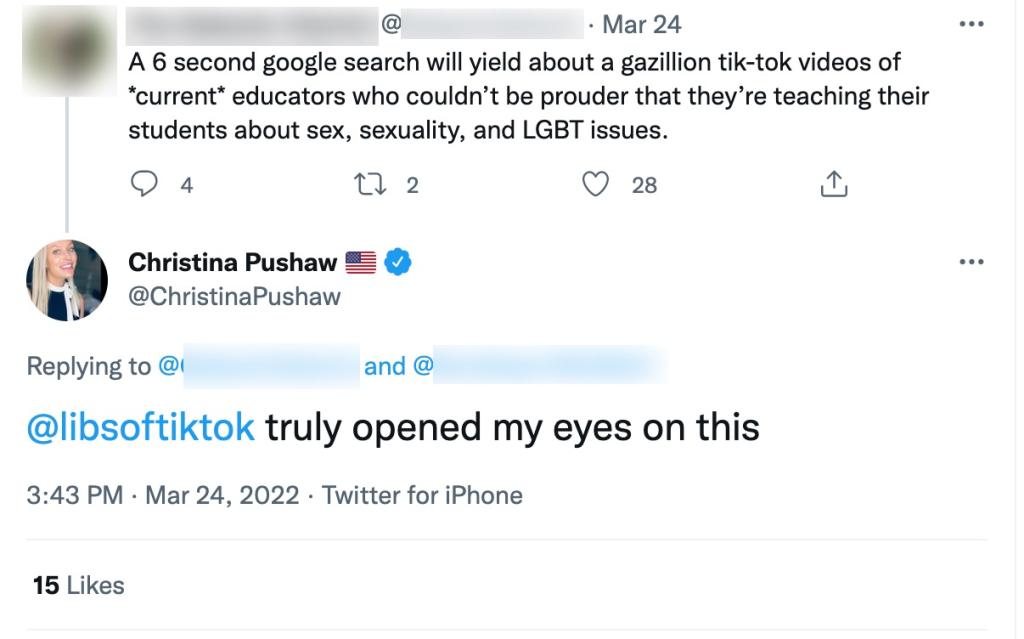
DeSantis’ press secretary Christina Pushaw credited the account with “opening her eyes” and informing her views on the state’s restrictive “Don’t Say Gay” bill that prohibits the discussion of “sexual orientation or gender identity” in classrooms. 

Raichik didn’t hold back on attacking the LGTBQ community while on Carlson’s show. 

“The LGBTQ community has become this cult and it’s so captivating, and it pulls people in so strongly, unlike anything we’ve ever seen,” she told Carlson. “And they brainwash people to join and they convince them of all of these things, and it’s really, really hard to get out of it.”

This is the year we were done with Kanye West – but what does that really mean?

Typing some version of the term “I’m done with Kanye West” into the search engine of your choice yields an array of results that illuminate as much about who we are as they do about him.

First, we get the usual suspects: links to essays published in major publications in which the author announces they’ve officially pulled the stop request cord on this bus, ding!

These join the smattering of fan departure announcements posted on Reddit, TikTok, YouTube, and other platforms, along with reports that Pusha T, formerly the head of West’s recording label G.O.O.D. Music, is done with him, as is Kid CudiEve, West’s ex-wife Kim Kardashian and, one presumes, Pete Davidson.

Scroll down further to encounter a few posts and stories in which the authors admit they are not quite done with him, but reaching their limit. Those are especially instructive. As Touré explained in an essay for The Daily Beast, he’s had to forgive a lot to remain West’s fan because “bizarre is normal in Kanye’s world.”

So although seeing West pose with Donald Trump in 2016 hurt the writer, “I gave the brother a pass,” Toure said. “I mean, he’s made so much great music.” One imagines West’s stans responding to this with, “So say we all.”

Now take a look at the dates associated with these departure announcements, and you’ll notice they’ve been rolling out for a very long time. This Kanye fan let him go in April of this year. This one parted ways with him in 2018 after his unhinged visit with Donald Trump in the White House where he retracted his diagnosis that he was bipolar. This person said “Off, please” in 2021. And this former fan dumped him with extreme prejudice in 2016.

I am struggling to remember whether any other living celebrity has received as much forbearance and faith as this man has.

That Touré essay was written in 2018 too, beyond the point at which Trump had demonized immigrants and residents of major metropolitan areas, with West’s birthplace of Chicago being his favorite scapegoat, and long after the chemical trails behind West’s tweet of “I love the way Candace Owens thinks” dissipated.

“Ye’s making it harder to keep justifying him but for now, I still do,” Touré wrote. “Because I still don’t believe that he really believes any of that conservative stuff. But then again, I don’t believe Owens really believes that stuff either.

Despite how this looks, I’m not trying to shame another writer for presenting a take that aged like raw fish left out. No, the reason this piece and the many others about West are worth contemplating is that they help make sense of why it’s taken this long for West to become persona non grata in the eyes of most of the public.

Indeed, I am struggling to remember whether any other living celebrity has received as much forbearance and faith as this man has.

“I mean, he’s made so much great music.” Can that truly be all there is? Yes, and emphatically no, of course not. West has proven his ability to produce incredible art, the type that wins a generation’s faith. Consult an industry expert, and they’d likely cite 2010’s “My Beautiful Dark Twisted Fantasy” as one of the highest achievements in his music catalog, if not his finest work. West’s faithful are more likely to rhapsodize about the way 2004’s “The College Dropout” changed the pattern of their brainwaves. This is the difference between those who can appreciate West with a degree of separation from the emotions attached to him and the people who once testified that the artist’s lyrics and beats spoke to a part of them that may not even have a name or definition.

West music doesn’t vibrate my spirit that way, and I recognize that saying this as a native Chicagoan is heresy to some people. I’d also be lying if I said I never worked it out on the dancefloor to one of his bangers.

But as someone who apprizes great music, who understands how exceptional it is for a Black man to spin his talent into diamonds and platinum, and who has seen how far people will go to excuse the terrible sins of some such men, that explanation completely tracks.

Calling to mind another living celebrity people have forgiven as frequently and easily is a challenge, but one deceased one comes to mind immediately. Michael Jackson endured multiple accusations that he sexually abused young boys while he was alive, even paying a multimillion-dollar settlement to one of his accusers.

HBO’s release of “Leaving Neverland” in 2019 inspired an avalanche of think pieces by critics, and fans, and critics who were fans, wondering how to intellectually square their love and respect for his culturally foundational body of work with what the artist has been accused of doing. This was and is mainly a matter of following one’s moral compass. You’ll notice today that the King of Pop still gets plenty of airplay.

When he died in 2009, author Chris Hedges wrote a damning essay in reaction to the pomp surrounding his funeral, which was broadcast on TV and watched by an estimated 31 million viewers. “A variety show with a coffin,” he called it. However, the target of Hedges’ condemnation was not Jackson, but the celebrity- and media-obsessed culture that propped up his fame despite the allegations that followed him – mainly because his music was just that good.

The cult of self, which Jackson embodied, dominates our culture. This cult shares within it the classic traits of psychopaths: superficial charm, grandiosity and self-importance; a need for constant stimulation, a penchant for lying, deception and manipulation; and the incapacity for remorse or guilt. . . . This is also the ethic promoted by corporations. It is the ethic of unfettered capitalism. It is the misguided belief that personal style and personal advancement, mistaken for individualism, are the same as democratic equality. It is the celebration of image over substance.

It’s never just about the music. It’s about what the artist symbolizes. Like Jackson, West is a Black man who wasn’t born into wealth, didn’t earn a college degree and became a billionaire. For a time. His industry peers’ lack of belief in West’s talent and his nonstop hustle to catch a break are central to his legend, and the reason he inspires young artists.

From there he surfed the age during which the masses were into believing that massive wealth is an indicator that those who hold it know far more than those who don’t; that they are intellectually superior and creatively dexterous; that their outrageous behavior is part of some genius scheme they’ve concocted we don’t yet understand.

It’s never just about the music. It’s about what the artist symbolizes.

When West broke into the white mainstream with his polo shirts and backpacks, he looked safe but wasn’t, and this refers to what people believed to be his politics. The performer wore the preppy uniform believably enough to stand beside Mike Myers in 2005 and stop the world for a moment by declaring on live TV, “George Bush doesn’t care about black people.”

Remembering that incarnation of the man he once was feeds the logic of those who may yet seek reasons to keep defending him. It’s the reason Netflix’s “Jeen-Yus: A Kanye Trilogy” registers in the memory as having come out in another lifetime when in fact it was released earlier this year. The bulk of conversations around that documentary series didn’t concern its success as an account of his career but its potency as a reminder of who he used to be.

Corporate America didn’t twist itself into such knots over his transformation from an icon of bleeding-edge style into a tacky cap-wearing MAGA devotee. His Yeezy brand partnerships with Balenciaga, the Gap and Adidas persisted after he went on TMZ and said “slavery was a choice.

TMZ was comfortable airing that in 2018 but edited out his praise of Hitler. Turns out we only had to wait for a few years. Once West blasted his antisemitic views across social media in October, following that up with visits to Tucker Carlson and Alex Jones, those brands peeled away from him. Creative Artists Agency cut ties with him, Def Jam Recordings dropped his label, and a planned documentary from MRC was shelved. West celebrated by gliding into Mar-a-Lago to dine with Trump and white nationalist Nick Fuentes.

Then, as a post-script answering any who may still believe these are all part of some magnificent stunt or an extended manic episode, Rolling Stone published a Dec. 24 story citing multiple industry sources alleging that West’s Nazi fixation surfaced as far back as 2003 and has frequently come up in conversations with members of his inner circle ever since.


Want a daily wrap-up of all the news and commentary Salon has to offer? Subscribe to our morning newsletter, Crash Course.


Maybe you’re done with Kanye. Maybe you hadn’t clasped him to your heart in the first place. Hopefully most people recognize that a man whose October tweet inspired Nazi-saluting white supremacists to display a banner reading “Kanye Was Right About the Jews” on an LA freeway is morally indefensible.

An encouraging outgrowth of taking in all of these headlines and contending with the psychic battery they create is that they’re forcing former fans and tastemakers to assess the role culture played in creating him. One such analysis and perhaps the most thoughtful yet, recently took place between Wesley Morris and J Wortham on the New York Times podcast “Still Processing.”

Their conversation engages with what Wortham calls a “cultural complacency and our role in helping create this social monster that we have today.” As she points out, West had a long history of promoting misogyny in his lyrics (“Gold Digger,” anybody?) and making corrosive statements about vulnerable communities, all in the name of being a “free thinker.”

“All that alleged free thinking just winds up doing more harm to people — Black people, Jews, I mean, all people,” Morris points out.

The question now becomes, what does being done with Kanye effectively look like? Not listening to his music isn’t enough. De-platforming him from major social media streams can only do so much. At least his bid to buy the extremist-friendly social media site Parler fell through.

Kanye West still walks among us, turns up in memes and appears on shows popular with right-wing America. The harm he’s causing doesn’t lack evidence and is an ongoing concern. It doesn’t merely endanger a few people behind closed doors but is emboldening untold numbers of malevolent people. What does it mean to truly be “done with Kanye”? I don’t have a definitive answer to that question. I’m not sure who does.


Man who attempted to kidnap Michigan Gov. Gretchen Whitmer sentenced to almost 20 years

One of the men who played a key role in the plot to kidnap Michigan Gov. Gretchen Whitmer was sentenced to 19 1/2 years in prison Wednesday, the longest sentence yet for a federal defendant in one of the most watched domestic terrorism cases in the country. 

Defendant Barry Croft Jr. was likened to Al Qaeda leader Ayman al-Zawahiri. A prosecutor also referred to Croft as the American version of Omar Abdel-Rahman, the man who masterminded the 1993 World Trade Center bombing. 

Croft and co-defendant Adam Fox were convicted in August of conspiracy to commit kidnapping and to use a weapon of mass destruction to attack Whitmer in 2020. The governor was the target of far-right rage in 2020 after she imposed lockdowns in the state to stop the spread of COVID. 

Whitmer was never physically harmed as the plot was stopped by the FBI who secretly infiltrated the group and arrested 14 people. Fox was sentenced to 16 years in prison on Tuesday by U.S. District Judge Robert Jonker. 

“I do think of Mr. Croft as the more seriously culpable … more so than even Mr. Fox,” Jonker said. “I think he was the person who gave Mr. Fox something to grab on to.” 

Assistant U.S. Attorney Nils Kessler said Croft has been “thoroughly radicalized” and “hasn’t changed his viewpoint,” and therefore needs to be sent away for an extended period of time to protect the public. 

Kessler said Croft was “the ideas guy” and was as harmful as any foreign terrorist. 

“He’s the spiritual leader of this group, of this movement the same way some Sheikh in ISIS or Al Qaeda might be,” Kessler said. “And they don’t have to be tactically sound or somebody who is the best guy with a gun on the battlefield — he was the ideas guy.”

However, defense attorney Josh Blanchard asked the judge to consider his client’s long history of mental illness and drug abuse, getting emotional as he described Croft’s childhood. 

“His mother suffered from bipolar disorder that’s so significant and unmanaged that she had Social Security disability for it,” Blanchard said. “His father, who has been described as cold and detached, puts aluminum foil on his ceiling in his bedroom so aliens can’t reach his brain waves. I say all of this to say that Mr. Croft needed some intervention.”

Fox and Croft met at a summit in Ohio in 2020 with other far-right individuals to “put eyes” on Whitmer’s vacation home, according to evidence

“People need to stop with the misplaced anger and place the anger where it should go, and that’s against our tyrannical … government,” Fox said in the spring of 2020, fueled by the anger of perceived threats to gun ownership and pandemic restrictions.

At the time, Fox was living in the basement of a Grand Rapids-area vacuum shop, where he met with members of a paramilitary group, including an undercover FBI agent. His lawyer described him as depressed and anxious, smoking marijuana daily.

Fox was a member of the “Boogaloo movement,” a group that seeks to overthrow the American government. He attended training sessions with heavy weaponry and went on scouting missions to Whitmer’s vacation home, the site of the planned kidnapping, in the months leading up to his arrest.


Want a daily wrap-up of all the news and commentary Salon has to offer? Subscribe to our morning newsletter, Crash Course.


“They had no real plan for what to do with the governor if they actually seized her,” Kessler said in a court filing prior to Fox’s hearing. “Paradoxically, this made them more dangerous, not less.”

Two other men pleaded guilty to conspiracy and testified against Fox and Croft, receiving substantially shorter sentences. Ty Garbin has already served his 2 1/2-year prison term, and Kaleb Franks was given a four-year sentence.

“The conspirators might easily have killed the governor in a botched kidnapping, killed unsuspecting law enforcement during a traffic stop or other unexpected encounter, or blown up innocent bystanders with a negligently constructed bomb,” a sentencing memo by federal prosecutors read.

Fox’s attorney, Christopher Gibbons argued for a lesser sentence by claiming that his client talked a big game, but that he had no real ability to pull off the attack. He said that the FBI preyed on Fox by pretending to be his friend and luring him into a plot he would have never been able to plan himself. Gibbons also wrote that prosecutors used “exaggerated language to create the false narrative of a terrifying paramilitary leader.”

“Adam Fox was an unemployed vacuum repairman who was venting his frustrations on social media but abiding by the laws of the State of Michigan,” Gibbons wrote in a sentencing memo. 

The judge explained his decision not to issue Fox the life sentence that prosecutors were initially aiming for. Jonker explained that Fox did not seem to be a natural leader, and that his tactical skills were limited. He added that due to law enforcement’s presence in the group, the plot had little chance of success. 

The prosecution had challenges during the case as these decades long convictions required that the jury trust a widespread FBI investigation with several undercover operatives. 

One of the agents on the case was fired by the bureau last year after being charged with domestic violence, and another, who served as a key informant, tried to build a private security consulting firm based off some of his work for the FBI, according to a Buzzfeed News report. However, jurors did not hear details about these incidents. 

Jonker, who was nominated by former President George W. Bush, applauded the work of federal law enforcement when announcing the sentence. 

“They were there early,” Judge Jonker said of the FBI, “and we should be thankful they were there early.” He also said that he saw no support for the claims that defendants were entrapped by law enforcement.

Our human ancestors learned to sail half a million years ago, study suggests

Imagine ancient hominids sailing the Mediterranean hundreds of thousands of years before humans (Homo sapiens) appeared. The idea might sound bizarre: we think of boats as a human transportation technology, something that, like the wheel, our primitive ancestors developed at the dawn of civilization. So the revelation that a precursor to humans — meaning, a species of closely-related hominids that predate us — may have invented the boat and even sailed the Mediterranean long before us is a shocking proposition. 

Yet that is exactly what new research suggests: hominids crossed the Mediterranean Sea much earlier than previously thought — before even Homo sapiens first appeared — which means these ancient humans must have learned how to sail nearly half a million years ago. The study prompts a shocking re-evaluation of an activity and a technology that seemed distinctly human.  

The first humans and our many hominid cousins like Neanderthals originated in Africa, but it wasn’t long before we wandered off to other continents. And this happened not just once, but multiple times, with some genetic evidence suggesting some subsets of humans even later returned to Africa.

Why would these ancient hominids would want to visit these islands? One theory is that they were hunting wild game, such as now-extinct dwarf elephants.

Getting the timeline right on some of these details is a major field of study because it helps shape our understanding of human evolution. New research in the journal Quaternary International may shift the historical record significantly for when hominids, a group that includes primates including humans and our close relatives, first started sailing the sea north of Africa.

The Aegean Sea is an arm of the Mediterranean Sea, located to the east of the Greek mainland and the western coast of Turkey, and is dotted with dozens of islands, including Rhodes and Crete. It’s currently a site of contention, as Greece and Turkey argue over militarizing these areas. But hundreds of thousands of years ago, there is evidence that hominids — most likely Homo erectus — visited these islands, leaving behind traces of their activity in the form of tools and bones.

Homo erectus is an extinct species of human whose name simply means “upright man.” They were one of the first hominids to depart Africa and used tools like stone hand axes, which could have been used to cut down trees and build rafts. However, the evidence for this — actual wood boats, say — is a bit scant. Any ships or boats used to make this journey were likely made from trees that decayed long ago. They may not have used rafts either, and instead just floated across on large pieces of driftwood.

Either way, somehow H. erectus made it to a few of the Aegean islands. Previous theories suggested this happened on foot, as in H. erectus used ice bridges during major glacial events. At least five of these events are known to have occurred during this time period.

“The Aegean Sea may be considered the cradle of sea-crossing in the Mediterranean world.”

Yet the new paper suggests the foot-bridge theory probably didn’t happen. Researchers reconstructed the shoreline of the Angean Island Chain, estimating the fluctuation of sea-level combined with the rate of the ground sinking due to tectonic plate activity. This data suggests that there’s no way these islands would be accessible by foot, even if there were a major ice age. There would still be way too much water in the way, leaving the only explanation that they crossed another way — specifically, by sea.

“Therefore, the Aegean land/seascape motivated the archaic hominin to develop the necessary cognitive capabilities such as spatial awareness way-finding strategies and sea-craft building,” the authors write. “And hence, the Aegean Sea may be considered the cradle of sea-crossing in the Mediterranean world.”

This raises the question of why these ancient hominids would want to visit these islands. One theory is that they were hunting wild game, such as now-extinct dwarf elephants that lived in the region.

“These compel us to reconsider the general view, that sea-crossing was a skill innovated and used solely by H. sapiens but instead it had been earlier acquired by earlier hominin lineages in the Middle Pleistocene,” the authors write. The Middle Pleistocene was a geological epoch that occurred between about 780,000 and 125,000 years ago. “Furthermore, considering that the archaic hominins were able to cross the Aegean Sea, they would also have been capable of crossing the Gibraltar Straits,” which separate southern Spain and the northern coast of Africa.

Humans tend to think that we’re pretty special and that our hominid cousins like Neanderthals and Homo erectus were dumb in comparison. But this human-centric perspective isn’t supported by evidence. We know that these ancient humans were a lot like us, not just genetically, but about as intelligent as well. They made tools, art, and much more. The idea that they built rafts or even just hopped on floating logs to cross huge straits of water isn’t so far-fetched.  

GOP in disarray! MTG bashes Tulsi Gabbard over George Santos interview

Rep. Marjorie Taylor Greene, R-Ga., criticized former Democratic congresswoman Tulsi Gabbard — now a Fox News host —for giving embattled GOP Rep.-elect George Santos “zero grace” in a recent interview during which Gabbard questioned Santos’ integrity over extensive fabrications on his résumé.

Gabbard was filling in for Tucker Carlson on his Fox News primetime show when she interviewed Santos after he admitted to falsifying multiple aspects of his biography, including his educational and professional background and his alleged Jewish ancestry.

“If I were one of those in New York’s 3rd District right now, now that the election is over, and I’m finding out all of these lies that you’ve told, not just one little lie or one little embellishment — these are blatant lies — my question is, do you have no shame?” Gabbard asked Santos Tuesday evening. “Do you have no shame? And the people … you’re asking to trust you to go and be their voice for them, their families and their kids in Washington?”

Santos, who emerged after days of silence following a major investigative report in the New York Times and several subsequent articles highlighting multiple discrepancies in his biography, deflected the question and instead pointed to Democrats.

“Tulsi, I can say the same thing about the Democrats,” Santos responded. “Look at Joe Biden. Joe Biden has been lying to the American people for 40 years. He’s the president of the United States. Democrats resoundingly support him. Do they have no shame?”

Greene posted the interview clip on her Twitter Tuesday night along with a thread attacking Gabbard’s legislative history and called for Republicans to give Santos another chance.

“I do appreciate that Tulsi says words that sound conservative now even though she can’t take action to back them up,” Greene said. “I am glad she, like George, realized she made mistakes and was wrong every time she voted to support killing the unborn, taking away our gun rights, and legislated to kill America’s energy independence and the fossil fuel industry.”


Want a daily wrap-up of all the news and commentary Salon has to offer? Subscribe to our morning newsletter, Crash Course.


During the interview, Gabbard also questioned Santos about representing himself as an “American Jew” and saying that he had “been to Israel numerous times for educational, business and leisurely trips.”

To which Santos responded: “My heritage is Jewish. I’ve always identified as Jewish. I was raised as a practicing Catholic,” Santos said. “Not being raised a practicing Jew, I’ve always joked with friends and circles, even within the campaign, I’d say, guys, I’m ‘Jew-ish.’ Remember, I was raised Catholic.”

In a previous campaign video, Santos had said that his “grandparents survived the Holocaust” and included on his campaign website that his “grandparents fled Jewish persecution in Ukraine, settled in Belgium, and again fled persecution during WWII.” But after several reports cast doubt on his story and more reporting revealed that his family shows no evidence of Jewish ancestry and no plausible connections to the Holocaust in Europe, Santos has awkwardly backed away from those claims without exactly admitting they were false. 

“So, look, I understand everybody wants to nitpick at me,” The New York Republican said. “I’m gonna reassure this once and for all. I’m not a facade. I’m not a persona. I have an extensive career that I worked really hard to achieve. And I’m going to deliver from my experience because I remain committed in delivering results for the American people.”

But Gabbard continued the interview in a similar vein, emphasizing that “a lie is not an embellishment on a résumé,” and suggesting that Santos’ false claims about his educational and professional background call his integrity into question. 

“Congressman-elect Santos, we’ve given you a lot of time. I think the time that is owed is to the people of New York’s 3rd. It’s hard to imagine how they could possibly trust your explanations when you’re not really even willing to admit the depth of your deception to them,” Gabbard said.

While multiple Democrats have called for Santos to resign over his résumé fictions, Greene continued to defend him in her Twitter thread, convincing her Republican colleagues to give Santos a second chance. 

 “I hope Tulsi is sincere, just like I hope George is sincere. I think we Republicans should give George Santos a chance and see how he legislates and votes, not treat him the same as the left is.”

Best of 2022 | Antyesti in Brooklyn: How NYC honored my father upon his death, during a time of hate

When my father dies, he’s in a nursing home, seated upright in a chair. He hasn’t been out on the ocean, in a boat, in years, maybe decades, and I know he’s not a beach person. He hates the sand and wet and cold. But days before his death, he can remember this clearly enough to reminisce in his hoarse voice: wearing a jacket and a scarf despite it being early spring in America, taking a ferry to the Statue of Liberty, then Ellis Island. Walking past all those names. None like his own. And yet he never doubted that he and his younger brother and my mother, who all lived together in a tiny apartment after I was born, had arrived in America, and would be welcomed in one way or another.

His journey to the water started in the late 1960s, early 1970s. He had come here after the assassination of Martin Luther King, many years before my birth, the birth he had imagined, hoped, would be of a son. Was New York safe then for Asians? I try and imagine. There were 45,000 South Asians in the United States by then, a small fraction of the nearly one million strong tristate area desi community today. He wouldn’t have felt entirely alone, though most in that first wave of immigration — the 1965 Immigration and Naturalization Act giving preference to those with professional training — were doctors, engineers, or successful businessmen with relatives already here to sponsor them. My dad was none of these. He was ambitious about emigrating to America but lackadaisical about academics during his student years in India, more interested in acting in plays and going to parties than career planning. Yet he married a doctor, my mother, who gave him passage here.

There are Polaroids, somewhat faded now, of my parents wearing garish fashions: orange, yellow, paisley prints and bouffant hair. A young Chinese American woman at a restaurant, posed between my beaming father and recalcitrant mother, her identity never explained to me when we sifted through old albums. All the women in cat-eye glasses, mostly unafraid, mostly enjoying America. In 1965, laws that invited Asian immigration seemed to let them in. All over the city, evidence of Asian America, present and future. Frank Chin, producing the first Asian-American play in a New York theater in the early ’70s. Protests against housing discrimination erupted across Chinatown. Asian Americans joined civil rights marches, and Asian Americans for Equal Employment convened. My dad, secretly proud of his “light skin,” considered whether to change his first name from Munuswami to Mike or Michael.

Was New York safe then for Asians? I try and imagine.

Jackson Heights in Queens was known to my father, of course. It was where he could see a Bollywood movie, grab a snack, do grocery shopping for my mother to make Indian meals for him, my uncle, and eventually for me. But he was never satisfied, or comfortable, being around “too many” Indians. Instead, the Empire State building; Wall Street; Pace University, where my father in his late twenties took an MBA, bounded by South Street Seaport and the Brooklyn Bridge — these were his haunts. Bodies of water in New York and long walks on the pier were as familiar to him as the Bay of Bengal lapping the hot sand of Golden Beach in Chennai, where men of all ages smoked and walked at all hours, the earliest flickers of sunrise or late at night, dirty jokes and laughter shocking in the dark.

What is the antyesti and what is it doing in Brooklyn? This question, a version of which was hurled at my parents when they came and had trouble finding a landlord who would rent to them (What are you, what are you doing here?), was answered quietly, gracefully, and with beauty the morning of September 30, 2021 — a few days after my father’s sudden death from a stroke, and not long after a slew of anti-Asian attacks against people like my dad who were frail, elderly Asians but also decades-long New Yorkers.

He’d gotten an American degree and his English was comfortable, fluent, and yet his name, skin and decided lack of connections made his first attempts to find work frustrating. Longing to be and feel American at 29, taking himself to steakhouses and tailors of ‘Western” bespoke suits (like Gandhi once had in London, just as eager for assimilation, several decades before), my immigrant father walked alone, unemployed, around the same Brooklyn pier where his ashes would eventually be scattered.

What is the antyesti and what is it doing in Brooklyn?

The antyesti is an important phase of Hindu death ritual. After cleansing, prayers, processions, only ashes remain, to be dissolved in sacred water. Antyesti is this scattering of ashes. Talked about most often with reference to the Ganges river, perhaps it’s a less known fact that thousands of Hindus in the tristate area participate in the antyesti off Seaview Boulevard, where more than one small-boat company (most of them run by Italian-Americans proud of their many generations in Brooklyn) also offer a sensitive and compassionate boat journey long enough for families to say the right prayers, scatter ashes along with rose petals, stare out at the glimmering waters, and silently commemorate.

2.

The phone call comes, in Korean-accented English, from short-term rehab, his place to recover after being hospitalized for post-stroke pneumonia. The medical rehab in Flushing is almost 100 percent Asian American, all its occupants well over age 70. When I go there to visit — including for the last time, to pick up all his things after his death — I’m haunted by how visible a target for hate it is.

After the first few days of confusion and sadness, not to mention stirrings of family disagreements that feel impossible to resolve, I put aside the newspaper accounts of violence against Asian Americans of all ages, but particularly those aged and perceived as vulnerable. One in particular haunts me: a Sri Lankan immigrant man, 68, on his way to work on the subway when he was beaten. Years before his death, while standing on a sidewalk in Queens, my father was shoved hard by a stranger, his wallet snatched out of his hand. He quickly recovered, leaned on his cane and summoned help. He was “fine, more than fine,” he quickly reassured me. He did not change his walking habits, refusing to be distracted by what he thought of as “routine muggings.”

But the man who was attacked while riding the subway in March 2021, less than six months before my father’s death, when (perhaps thankfully) my father was too weak to think of getting out of bed by himself, much less ever getting on a train again — that man was punched in the head and face so many times he couldn’t get up. His image, the shape of his head like my father’s, color of his skin identical, burned into me: a white- and grey-haired old man, face and neck bleeding and beaten, able to do nothing more than sit as still as he could while waiting for help. I stared at the image of his poor bloodied face looking down and saw my father in his chair. Narayange Bodhi, the victim, could have been him.

The morning of the antyesti ritual for my father, the last time any of us will have a physical connection to him, I take the subway to Brooklyn from Penn Station, afraid. Too afraid to sit near anyone, remembering my growing-up years of taking the subway to and from high school every day, Queens to the Upper East Side and back, fearless, excited, inserting myself in the dense crowds, taking the frequent and expected racial or gendered racial slur (“fucking dink slut,” “Hindoo bitch,” “look, it’s Gandhi”) in stride, because they were familiar words that hadn’t permanently gotten in my way. Never imagining all the ways we could be crushed.

3.

Improbably, an Uber driver comes for me on time to the station — a Latinx Brooklynite as caring as George Okrepkie, a 9/11 survivor and white man who called the ambulance for the Sri Lankan elderly immigrant, waited with him and took photos with his phone that he shared with police.

The scattering of my father’s ashes in Jamaica Bay, near Canarsie Park, is a sacred reversal, a form of healing of the loss and sacrifice of “crossing the seven seas,” which Hindus are not supposed to do.

Inside the car, the fist that is my heart opens. My back, warm against the black leather seat, can finally relax. When the Midget Squadron Yacht Club gate is closed, the Uber driver helps me find a fitness club nearby where I can wait. The front desk worker, a Haitian-American teenager, makes conversation about the water and the boats, the weather this time of year, how he still speaks Haitian Creole with his parents the way I spoke Tamil with mine.  

My mother’s impatience with her two sisters when they arrive; my brother’s watchful silence, at times suspicion-filled — these are familiar, expected. What takes me by surprise is the warmth of the boatmen, Italian American, old, kind, used to Hindu families carrying out the ritual of scattering ashes on water. The older of two men watches over me, seeing that I step safely from ground to dock to boat, helping make sure my mother and her sisters do not fall. The older women in our family all wear bindis, red dots on their foreheads that, while innocuous, are capable of inciting rage in hate groups like the Dotbusters, a violent white nationalist gang that attacked South Asians in New Jersey and New York in 1970-’90s. But somehow on the water, we don’t feel oppressed by hate.

The scattering of my father’s ashes in Jamaica Bay, near Canarsie Park — named for the Indigenous American Canarsee tribe — is a sacred reversal, a form of healing of the loss and sacrifice of “crossing the seven seas,” which Hindus are not supposed to do. The step of scattering the ashes completes the antyesti as a whole, which starts with preparation of the body for cremation, the burning, and then this.  Some families cry. I see a few wiping away tears while getting off their boats. I didn’t, though once we were out on the water, awed by the moment of inclusivity, of respect, I am surprised into silence, comforted by following the rules: Hold the railing tightly, balance here, watch my step like the two boat owners said. They let us do this, I can’t help thinking, they let us come here to do this, in that moment of grief, joy and gratitude, completing a task my father wished us to do. Forgetting, for the moment, as he often did, though he died a naturalized citizen, that there isn’t some “they” of strangers more entitled than us to be here. I am part of “they” who were born in New York.

But still. We are quiet, relentlessly hopeful, listening to the small talk of the boat owners, looking at the coastal landmarks they point out, that what we do today brings peace. In the moment the Bay opens before us, cut by the sharp bow of the small ship, the water parts and makes a shape like the great fin of an animal. Not a shark but one of the mythical sea animals associated with Vishnu, the god believed to be asleep for all time, somewhere in the ocean, holding up the earth. Incarnate as a beautiful man, handsome with symmetric features like those my father was so proud of having — the imprint of his face, with his eyes closed, pressed down on waves, saying goodbye — or swimming away, down in the deep like Vishnu does in avatars, like the great fish or an invisible sea turtle holding up entire oceans, like the one under this beloved city.


Want a daily wrap-up of all the news and commentary Salon has to offer? Subscribe to our morning newsletter, Crash Course.


Woman ditches QAnon, claiming Steve Bannon ignored her “alien transmissions”

Since its inception on 4chan in 2017, the right-wing cult QAnon has spread around the world and has made significant inroads among the Republican Party’s fringe voting base. Led by a mysterious figure known only as Q, the occasionally violence-inspiring movement is a tangled web of conspiracy theories, the most prominent of which is that a secret global cabal of pedophiles is aiming to control humanity and that the only hope for salvation is to reinstate Donald Trump into the presidency so he can win his war against the “Deep State.”

Trump has embraced at least some of those vacuous ideas. Beyond that, however, there are additional tendrils that percolate through the Q community, ranging from the Hillary Clinton “Pizzagate” fiasco to the sinister infiltration of governments by lizard people to John F. Kennedy Jr. lying in wait to become Trump’s next vice president.

QAnon, at its core, is an intellectual black hole that feasts on the vulnerable minds of its subscribers. But what happens if a devout believer decides that they have had enough? That question was answered on Tuesday afternoon when a woman from Vancouver, Canada, named Michelle Tittler — who has a reputation for posting racist content — dumped Q in a pair of profanity-filled videos.

In part one, Tittler explained why she renounced her faith:

Roll the camera. There are a lot of orbs here right now. But that’s OK because nothing you say or do right now, Q, is gonna stop me. Fuck off, all of you. Seriously, I quit. I quit Q and QArmy. And the reason why I quit is because on Dec. 19, 2022, Q refused to acknowledge my Q+3730. And I’ve been doing it for six years. Next year – that means I have to wait for another year.

According to comments on a Reddit thread, “Q+3730” likely refers to Tittler’s codename, as is evident in this interpretive dance routine that she uploaded to her YouTube channel on Dec. 19, 2019. This Daily Show interview from Aug. 10 seems to confirm that hypothesis. Apparently, many QAnon followers construe meaning from a purportedly ancient numerical system called “Gematria,” relying on a calculator (as well as an app) that reveals messages derived from supposed esoteric relationships between specific words and integers.


Want a daily wrap-up of all the news and commentary Salon has to offer? Subscribe to our morning newsletter, Crash Course.


Continuing on, Tittler launched into a tantrum about dust particles floating around her head that she thinks are “orbs” manifesting the spirits of Q’s disciples. Tittler also declared that she is terminating her “transmissions” with extraterrestrials because neither Q nor ex-Trump White House adviser/twice-convicted felon Steve Bannon, nor former Newsmax correspondent Lara Logan validated her communications, which Tittler transduced through music for all who wished to see:

Look at all these orbs. You guys, get lost. I’m not coming back no matter what you do here with these orbs. Just so you know, no matter what happens from here on in, Q, I’m not coming back. You’re on your own. And in fact, I’m taking down the ET transmissions.

Fuck you. Fuck all of you on this planet, all right? I tried to give the ET transmissions to Lara Logan. I tried to give them to Steve Bannon. … All you can talk about is the rape at the border. You can’t talk about the real pandemic of child trafficking. None of you can. And it’s in my E-tree-T-T transmissions.

Q, fuck you. I’m telling you, the minute I see you I’m gonna punch you in the temple so goddamned hard it’s gonna knock you out. It didn’t have to be this way. It never had to be this way.

During the sinking of Atlantis, the Archons took over and that’s how long it’s taken you to get back here and do anything at all. And even though you’ve gotten back here and you sucked everybody into all of this for this long, nothing has happened. No arrests. Nothing. We’ve got yet another election stolen. No! No Q! No. No matter what happens from here on in, I’m not coming back. You blew it. Next year will be seven years of doing disclosure for you. Fuck you. And fuck all you orbs. Get the fuck out of my house. I seriously mean it. Get out.

In Part Two, Tittler returned for a darker encore:

Fuck all of you. You’re losers. In fact, I wanna tell you one last thing before I go. I have something on my back. It looks like skin cancer. I honestly am praying to God I have cancer and that I’m going to die. And I’m not just saying that. I will do anything to get out of here. Anything. You guys aren’t worth saving. You’re not worth saving. None of you can wake up. You just can’t do it. You just can’t do it. Look at all the orbs. Fuck you, you’re not gettin’ me back. I told you, Q, I told you that this had to happen this December and you didn’t do it. So ya lost me, okay? You’re not in charge, Q, I am. I’m doing disclosure. I’m just as much part of this plan as you are, OK? So fuck off. Hmm, that’s it. See ya later. I’m not doing anything more for this and I’m taking down my ET transmissions. You guys can just live in your stupidity forever. Nothing’s gonna change. It’s not as if anything — why should you know about the Galactics? Why should you know the truth? You don’t care. You don’t want it. You don’t even want it. And Q doesn’t want to give it to you.

Watch Tittler’s videos below or at this link.

Southwest Airlines spent $5.6B on shareholder gifts ahead of mass cancellation crisis

As travelers and airline workers reel from mass flight cancellations, a corporate watchdog noted Wednesday that Southwest Airlines spent nearly $6 billion on stock buybacks in the years ahead of the coronavirus pandemic instead of spending that money on technological improvements that unions have been demanding for years.

According to Accountable.US, the crisis Southwest has experienced in recent days amid a massive winter storm was “a problem of its own making,” noting that the airline opted “to spend $5.6 billion on stock buybacks in the three years leading up to the pandemic rather than making investments in infrastructure to be better prepared for extreme weather events like this week.”

The watchdog group added that the company “even reinstated dividends earlier this month, the first major airline to do so after the pandemic.”

“Southwest Airlines made a risky gamble that mass layoffs and spending billions of dollars on handouts to investors rather than fixing infrastructure would pay off with record profits,” Kyle Herrig, the president of Accountable.US, said in a statement. “The airline lost that bet badly and now it’s their customers left paying the price including the thousands stranded in the middle of holiday-season travel.”

“Southwest’s well-compensated executives could have prioritized its workers and customers by preparing for the worst, but greed trumped all as they put a small group of wealthy investors first,” Herrig added. “Consumers shouldn’t be the ones stuck holding the bag for Southwest’s greedy management decisions, but here we are. This is where the Transportation Department should start in any investigation into why this happened”

Southwest has canceled more than 5,000 flights this week — accounting for the bulk of flights canceled in the U.S. — and has delayed hundreds more, stranding travelers and flight attendants, throwing holiday plans into chaos and straining already-exhausted flight crews.

Unions representing flight attendants and pilots have said that while the winter storm fueled some of the cancellations, deliberate decisions by Southwest management were ultimately responsible for what’s been described as the company’s “full-blown meltdown.”

Specifically, the vice president of the Southwest Airlines Pilots Association told Insider that the company’s “outdated” scheduling software has been overwhelmed, wreaking havoc on operations.


Want a daily wrap-up of all the news and commentary Salon has to offer? Subscribe to our morning newsletter, Crash Course.


“When we get out of position, it’s a tough task for our schedulers to put it back together, and right now they’re having to do it by hand,” said Captain Mike Santoro, explaining that some flights were unnecessarily canceled because the airline’s system was unable to adequately keep track of employees.

Lyn Montgomery, president of TWU Local 556, the union that represents flight attendants, told a local news outlet that “this is the worst I’ve ever seen in my 27 years of working as a flight attendant for Southwest Airlines.”

“Obviously, the impact of Winter Storm Elliott created the issues, but the Southwest Airlines systems cannot recover because we have outdated technology,” Montgomery said.

The New York Times reported Wednesday that many of the scheduling issues “stem from the carrier’s unique ‘point-to-point’ model, in which planes tend to fly from destination to destination without returning to one or two main hubs.”

“Most airlines follow a ‘hub-and-spoke’ model, in which planes typically return to a hub airport after flying out to other cities,” the Times noted. “When bad weather hits, hub-and-spoke airlines can shut down specific routes and have plans in place to restart operations when the skies clear. But bad weather can scramble multiple flights and routes in a point-to-point model, leaving Southwest staff out of position to resume normal operations.”

Randy Barnes, president of TWU Local 555, the union that represents Southwest ground workers, said in a statement Wednesday that “if airline managers had planned better, the meltdown we’ve witnessed in recent days could have been lessened or averted.”

“Ground workers need more support,” Barnes added. “Many of our people have been forced to work 16- or 18-hour days during this holiday season. Our members work hard, they’re dedicated to their jobs, but many are getting sick, and some have experienced frostbite over the past week. In severe weather, it’s unreasonable for workers to stay outside for extended periods. People need to be able to cycle in and out of the cold. The airline needs to do more to protect its ground crews.”

More than 90% of the 2,760 cancellations in the U.S. thus far on Wednesday have been Southwest flights, according to data compiled by FlightAware.

The company’s massive failures have drawn scrutiny from members of Congress and the U.S. Department of Transportation, which has said it is looking into the cancellations.

“This has clearly crossed the line from what’s an uncontrollable weather situation to something that is the airline’s direct responsibility,” Transportation Secretary Pete Buttigieg said late Tuesday in an appearance on “NBC Nightly News.”

In a statement, Senate Commerce Committee Chair Maria Cantwell, D-Wash., similarly argued that “the problems at Southwest Airlines over the last several days go beyond weather.”

“The committee will be looking into the causes of these disruptions and its impact to consumers,” said Cantwell. “Many airlines fail to adequately communicate with consumers during flight cancellations. Consumers deserve strong protections, including an updated consumer refund rule.”

Creamy, comforting and cheesy: Salon Food’s 10 most popular recipes of 2022

Food is, as often noted, quite subjective. However, in 2022 readers of Salon Food definitely seemed to gravitate towards certain kinds of food. Dishes that are creamy, comforting, cheesy, quick and easy reign supreme on the list of our most popular recipes for the year. 

As such, we hope this roundup of our ten most popular recipes will inspire you — giving you ideas for what to make tonight, what to make on your birthday, what to make for your significant other or, maybe, what to send to a friend and say, “Hey, want to make this for me?”

Who knows, whipping up one of these recipes, either alone or with family, friends or loved ones, might even boost your mental health. No matter how you utilize this list, though, we can guarantee that these recipes are really, really fantastic.

While some still get spooked about making steak at home, it really couldn’t be easier. There’s no need to be intimidated and here, Mary Elizabeth Williams shows us exactly how and why. 
 
Don’t schlep to a steakhouse and dole out inexplicable amounts of money when you can just dole out (a still considerable amount of money) for a steak, bring it home and cook it yourself. Here, Williams opts for a stovetop steak meal and gives you all the tips and tricks to make sure that this technique serves you well, including an easy-as-pie pan sauce to really elevate the meal.
 
Pair this steak with some of the other Williams’ recipes on this list and you’ll have an amazing meal on the table before you know it.
As columnist Maggie Hennessy notes, this dish represents a “savory, stewed comfort” which is “the perfect companion on a bitter winter night.” As she states, her grandmother’s recipe actually went “viral” back in 2013 and it’s no surprise as to why.
 
Hennessy’s German grandmother’s ingenuity clearly comes through in this quintessential comfort dish. The cabbage is stuffed with rice, beef, bacon and some other ingredients; the assembled leaves are then gently cooked in a bubbling mixture of sauerkraut and tomato sauce — to which I can personally attest is a particularly exquisite combination. 
 
Wondering what to make on an especially cold night? You may have just found it. 
Developed by yours truly, this recipe is in line with the classic tetrazzinis of yore. Nothing special is going on here, but you wind up with a sizable dish that you pull out of the oven, bubbling and piping hot and offering something for everyone. No matter if you go for chicken or turkey, Parmesan or pecorino, or baby bellas or white button, this dish is a winner.
 
There’s some kind of synchronicity when it comes to a recipe like this, which is comprised of many different components that all eventually fuse together to make a terrific, filling comfort food that can fill up the whole family — and still leave lots of leftovers. 

Want more great food writing and recipes? Subscribe to Salon Food’s newsletter, The Bite.


This dish is arguably lighter than anything else on this list, but perhaps the most outright craveable?
 
Comprised of nuts, ramen noodles, lettuce, broccoli, a sweet and sour dressing and some other welcome inclusions, this crispy-crunchy salad is a perfect amalgamation of textures, consistencies, flavors and colors. Columnist Bibi Hutchings notes that her Grammy made this dish, which Hutchings calls an “avant grade salad.” Hutchings notes that this dressing “makes the salad … but it’s strong,” so be sure to use sparingly if you’re not a fan of more aggressively dressed salads. 
 
Clearly, it’s been a hit in the writer’s family for over 30 years for a good reason.
As she discuses here, Mary Elizabeth Williams is not a fan of “vegetarian meats,” and when she has a hankering to eat a plant-based meal, she’ll almost always opt for a gussied up whole vegetable than any sort of frozen soy patty. 
 
In this recipe, Williams goes simple, making a sweet potato for one that is dressed up with nothing but olive oil, salt, pepper and crispy, crunchy coconut chips. The cook time might seem a bit much, but that just helps the sweet potato itself get dense, rich and velvety. There may be nothing better to make on a cold night when you think there is “nothing in the house” to cook. 
 
You’ll be stunned by what you’re able to accomplish with nothing more than heat, time and a sweet potato.
Fun fact about me: I will always and forever opt for onion rings over French fries. Here, Mary Elizabeth Williams’ truly superb onion ring rendition shows precisely why. Piping hot, crispy as all get out and with a tender ring of onion inside, this simple recipe embodies all that is good about a properly made onion ring. Williams uses pancake mix and beer to bolster the crispness of the rings, along with some additional flavor notes like paprika, chili powder, chipotle powder and, if you like, hot sauce.
 
Forget serving as a side or an accompaniment — these are too good to be relegated to the side dish status.
 
This headline alone might make you hungry and ready for a hot potato instantaneously. Deputy Food Editor Ashlie Stevens’ hot, oven-baked potatoes are scooped out, mixed with a mix of mascarpone, cheddar, chives and salt and pepper, before being added back into the potato skins (or “jackets,” as she calls them) before being finished in the oven. If you’re not familiar with mascarpone, prepare to meet your new favorite ingredient; it’s a decadent Italian cream cheese that is equally at home in a savory dish like this or in a sweet dessert, such as the Italian classic tiramisu
 
An incredible side dish — or, conversely, an amazing vegetarian main dish — this recipe produces arguably the best baked potato dish you’ve ever had. The best part? It requires minimal ingredients and is super simple. It doesn’t get much better than that.
Ashlie Stevens’ genius combination of three unexpected ingredients make for a terrific quick marinade that you’ll make again and again. No matter if you’re grilling, roasting, sautéing, or broiling, any chicken marinaded with this flavor bomb will be an absolute hit. Beyond that, you don’t need to only use chicken; as Stevens notes, “salmon, extra-firm tofu, spicy Italian sausage and crispy chickpeas” could also all work. 
 
She continues to say that the beer helps to “break down tough fibers in meat and prevent them from drying out.” Feel free to use a non-alcoholic option if you’re not consuming alcohol and of course, feel comfortable swapping ingredients (or adding others) for extra bursts of flavor or color.
This dish swaps egg noodles — the standard casserole noodle — for rigatoni, which is then mixed with shredded rotisserie chicken,  a rich sauce made without any “canned cream-of-whatever soup,” and finished with a crispy Panko topping. Casseroles are an automatic go-to for so many in the colder months and Ashlie Stevens capitalizes on that inherent caving with this rich, heavy casserole that is equal parts filling and comforting. She also includes some frozen vegetables for color, convenience and flavor. 

The victor! This fragrant, crispy, classic accouterment — which is welcome alongside anything from lasagna to something entirely non-Italian or Italian American — takes the number-one spot. Garlic bread can be tricky; it can get soggy, overpowered by garlic, or burnt in an intense broiler, but when it’s made properly — it’s unbeatable. Here, senior writer Mary Elizabeth Williams amps up the classic with an unexpected ingredient that adds a sharp, bright note that will both mystify and satisfy.


Not consuming dairy? Feel free to swap with a fruity, slightly bitter high-quality extra virgin olive oil and don’t forget lots of chopped parsley for color and flavor. Also, let’s be honest: if you are eating dairy, a host of mozzarella is also always welcome. You can also use various breads for a proper vehicle, including baguettes, Italian bread, French bread or any sort of long, crusty loaf. 


Curious about the secret ingredient? No spoilers here: you’re going to have to read the original recipe to find that one out.

Here’s how black-eyed peas became synonymous with New Year’s cooking

Whether it’s pork, grapes, pomegranate or fish, some of our simplest foods are inadvertently considered to be the luckiest. To add to the list is black-eyed peas, the famed legume (not the American musical group) used in stews, salads and dips. Thanks to Southern superstition and a rich history dating back to the 1700s, the earthy yet creamy white beans are also a popular staple for New Year’s dinner.

Black-eyed peas first originated in Africa, although trade routes later introduced them to both Europe and India. Before they were regarded as lucky, the beans earned a poor reputation, commonly associated with “rowdiness that surrounded the year’s beginning and end,” as noted by Corey Williams in a piece on Allrecipes, and deemed by the Ancient Romans to contain the souls of the dead. By the 1700s, black-eyes peas came to North America via slave ships and were used as food for both livestock and slaves in the South.

It’s still not clear how and when the beans were associated with good fortune in the United States. But several old wives’ tales provide some explanation. One legend claims that black-eyed peas were the Confederate Army’s saving grace amid the Civil War. The army’s food supplies were allegedly ransacked by the Union Army, who took everything except the measly beans and some pork. Despite the shortcomings, the Confederate soldiers survived on the black-eyed peas amid the frigid winter, making the beans a lucky food in the American South.

Another legend states that black-eyed peas were eaten by slaves on January 1, 1863, when President Abraham Lincoln issued the Emancipation Proclamation. The auspicious day soon set a trend for black-eyed peas being enjoyed every New Year’s Day afterwards. 

Today, black-eyed peas are enjoyed alongside other hearty ingredients in a slew of dishes. The beans are served with greens (specifically collards, mustard or turnip greens) and cornbread — with the beans representing “coins,” the greens representing “paper money,” and the cornbread representing “gold.” The peas are even eaten with stewed tomatoes for good health and wealth.

But the most traditional black-eyed peas dish is Hoppin’ John, a Southern must-have that features black-eyed peas cooked with rice, pork (be it ham, hambones or bacon), seasonings, chopped onions and hot sauce. There’s also Texas Caviar, a cold dip made with Black-eyed peas, pinto beans, black beans, diced celery, diced green bell pepper, corn and tomatoes; and a simple Black-Eyed Pea Salad.


Want more great food writing and recipes? Subscribe to Salon Food’s newsletter, The Bite.


If you’re looking to try some more modern recipes to welcome the New Year, be sure to check out Irene Matys’ Swiss Chard and Black-Eye Pea Bruschetta, a Greek-inspired dish that tops black-eyed peas, rainbow Swiss chard and anchovies on warm slices of rustic baguette. Or try this White Bean, Black-Eyed Pea, Avocado Crostini recipe from Valerie’s Kitchen.

Take it from us — either of these vibrant and filling dishes is the perfect appetizer for your upcoming New Year’s Day shindig!

Wildfires in Colorado are growing more unpredictable. Officials have ignored the warnings

Sheriff’s deputies driving 45 mph couldn’t outpace the flames. Dense smoke, swirling dust and flying plywood obscured the firestorm’s growth and direction, delaying evacuations.

Within minutes, landscaped islands in a Costco parking lot in Superior, Colorado, caught fire as structures became the inferno’s primary fuel. It consumed the Element Hotel, as well as part of a Tesla service center, a Target and the entire Sagamore neighborhood. Across a six-lane freeway, in the town of Louisville, flames rocketed through parks and climbed wooden fences, setting homes ablaze. They spread from one residence to the next in a mere eight minutes, reaching temperatures as high as 1,650 degrees.

On Dec. 30, 2021, more than 35,000 people in Superior and Louisville, as well as unincorporated Boulder County, fled the fire — some so quickly they left barefoot and without their pets. Firefighters abandoned miles of hose in neighborhood driveways to escape.

The Marshall Fire, the most destructive in Colorado history, killed two people and incinerated 1,084 residences and seven businesses within hours. Financial losses are expected to top $2 billion.

The blaze showed that Colorado and much of the West face a fire threat unlike anything they have seen. No longer is the danger limited to homes adjacent to forests. Urban areas are threatened, too.

Yet despite previous warnings of this new threat, ProPublica found Colorado’s response hasn’t kept pace. Legislative efforts to make homes safer by requiring fire-resistant materials in their construction have been repeatedly stymied by developers and municipalities, while taxpayers shoulder the growing cost to put out the fires and rebuild in their aftermath.

Many residents are unaware they are now at risk because federal and state wildfire forecasts and maps also haven’t kept pace with the growing danger to their communities. Indeed, some wildland fire forecasts model urban areas as “non-burnable,” even though the Marshall Fire proved otherwise.

The disaster put an exclamation point on what scientists, planners and federal officials warned for years: Communities outside the traditional wildland-urban interface, or WUI, are now vulnerable as a changing climate, overgrown forests and explosive development across the West fuel ever-unpredictable fire behavior. Fire experts define the WUI, pronounced woo-ee, as areas where plants such as trees, shrubs and grasses are near, or mixed with, homes, power lines, businesses and other human development.

They now agree that instead of a threat confined to the WUI, the entire state, including areas far from forests, may be at risk of a conflagration.

“The Marshall Fire was a horrible, tragic event that served as a wake-up call for the rest of our state,” said state Rep. Lisa Cutter, a Democrat who represents mountain and foothill areas. “I don’t think we realized how much wildfire could impact communities that aren’t deep in the forest — it’s not something any of us are immune to.”

Unheeded Warnings

An early warning of the growing danger to suburban communities arrived in 2001. That year, the U.S. Department of Agriculture and other federal agencies identified scores of Colorado municipalities adjacent to public lands as being at high risk of a wildland blaze-turned-urban conflagration. Some of these areas burned in the Marshall Fire.

A decade later, in 2012, another warning came, as an unprecedented weather-driven inferno, the Waldo Canyon Fire, destroyed several Colorado Springs neighborhoods.

Afterward, fire experts urged state lawmakers to adopt a model building code that communities in high-risk areas could enact. Such codes have been scientifically proven to reduce risk for residents and rescuers and to increase the odds structures will withstand a blaze by requiring fire-resistant materials on siding, roofs, decks and fences, along with mesh-covered vents that prevent embers from entering.

But lawmakers bowed to pressure from building and real estate lobbyists as well as municipal officials who demanded local control over private property.

Meanwhile, the number of new homes built in Colorado’s WUI — as defined by researchers several years ago — more than doubled between 1990 and 2020. And nationwide, the WUI is growing by 2 million acres a year. Homes in 70,000 communities worth $1.3 trillion are now within the path of a firestorm, according to a June report from the U.S. Fire Administration that featured photos of the Marshall Fire’s destruction.

In the months that followed the Marshall Fire, there were again calls to consider a statewide building code. A last-minute amendment to a fire mitigation bill in May would have created a board to develop statewide building rules, but it was pulled after builders, real estate agents, municipalities and others opposed it.

It wasn’t the first time the state’s powerful building industry asserted its influence over policy. Whenever a wildfire bill comes to the state legislature, well-heeled lobbyists routinely represent the industry, records kept by the Colorado secretary of state show. The state’s culture of local control and the construction industry’s $25 billion annual contribution to the economy hampered lawmakers’ ability to find middle ground on a minimum statewide building code.

ProPublica’s review of legislation introduced from 2014 to 2022 found only 15 out of 77 wildfire-related bills focused primarily on helping homeowners mitigate their risk from fires. Most of the 15 proposals offered incentives to homeowners and communities through income tax deductions or grants — some of which required municipalities to raise matching funds — to clear vegetation around structures.

None called for mandatory building requirements in wildfire-prone areas, even as 15 of the 20 largest wildfires in state history have occurred since 2012.

The lack of uniform regulations has cost the Centennial State millions in federal grant money: The Federal Emergency Management Agency denied the state grants from the agency’s resilient infrastructure funds, which from fiscal 2020 to 2022 totaled $101 million.

Colorado remains one of only eight states without a minimum construction standard for homes.

Municipalities Weigh Prevention and Its Cost

Developers have also influenced municipalities’ recent decisions, as homes decimated by the Marshall Fire are rebuilt in Boulder County, and the cities of Superior and Louisville located within it. The debate has reflected difficult tradeoffs between the cost of making homes more fire-resistant — particularly in an era of high inflation and unpredictable supply chains — and residents’ tolerance for risk.

Lawmakers in Louisville, where 550 homes and businesses burned, voted to remove a fire sprinkler requirement for homes, citing cost, despite evidence such systems reduce the risk of dying in a home fire by 80%. The City Council also voted to allow residents to choose whether to follow new energy efficiency requirements estimated to add $5,000 to $100,000 to the cost of a new home.

By contrast, in unincorporated Boulder County, which lost 157 homes to the Marshall Fire, commissioners in June voted to require fire-resistant materials on all new and renovated homes. Before the inferno, the eastern grasslands were exempt. (Mountain residents, who since 1989 have been required to follow mitigation practices, have seen the effectiveness of such codes: Eight out of 10 of their homes survived the Fourmile Canyon Fire in 2010.)

In Superior, which lost 378 structures, the Board of Trustees voted down a proposed citywide WUI building code in May. After residents of the leveled Sagamore neighborhood requested they revisit their decision, trustees reconsidered in July.

The financial pressures facing Superior officials and their constituents were evident as they considered whether to require fire-resistant materials solely for homes destroyed by the Marshall Fire or for the entire city.

“This is all a huge cost we cannot bear,” said Robert Lousberg, a resident who wants to rebuild several homes. “I understood this is a once-in-a-lifetime fire.”

Some neighbors disagreed.

“Sagamore burned down in less than an hour — one of my neighbors ended up in the hospital after trying to escape the fire on foot — that’s the main reason we need these codes, to slow the spread of fire,” Dan Cole said. “We have an opportunity to build a more fire-resistant neighborhood right now, and it would be foolish and short sighted not to take it.”

Builders estimated that costs for tempered-glass windows, fire-resistant siding and other materials could reach $5,500 to $30,000 per home. Procuring the materials and labor to install them could delay rebuilding.

Like residents, town trustees were divided about whether the cost outweighed safety benefits to residents and first responders should there be another conflagration.

“To me, it’s unconscionable to have people rebuilding in an unsafe manner,” said Trustee Laura Skladzinski, who did not seek reelection last month. “I would rather have residents pay $20,000 now. If they cannot afford it, how are they going to be able to afford it when their house burns down?”

Some noted that most residents didn’t have enough insurance to cover the cost of rebuilding their homes.

Trustee Neal Shah said the city should have adopted tougher codes after the 2012 Waldo Canyon Fire in Colorado Springs, which prompted calls for a voluntary statewide building code that communities could institute requiring fire-resistant materials in homes.

“I fundamentally believe in WUI standards,” Shah said, “what I can’t solve is the math.”

The body voted 5-1 to institute the code, then added an opt-out clause for those rebuilding their residences.

Colorado Springs Fire Foreshadowed the Risks

A decade before the Marshall Fire, a blaze was burning in the mountains above Colorado Springs on a 101-degree June day. That afternoon a thunderstorm caused a sudden shift in the wind, pushing a wall of burning debris out of the Rocky Mountain foothills into the state’s second-largest city.

Firefighters fled the 750-foot-high fire front — as tall as a 53-floor building — as it chewed through pine, pinyon and juniper dried by a record-hot spring. Sixty-mile-per-hour gusts peeled back the door on a fire truck. Fist-sized embers rained down on the city’s Mountain Shadows community. The fire incinerated 79 homes per hour, or 1.3 per minute, over 5 ½ hours, a report found.

In the aftermath of the Waldo Canyon Fire, which destroyed 347 homes and killed two people, Colorado Springs drew lessons from which residences had survived and capitalized on fresh memories of burned neighborhoods to institute tougher building requirements.

Standing recently in the shade of a still-scorched tree behind her home, Patty Johnson described how her house was relatively unscathed, even as eight of her neighbors lost their residences. She credited ignition-resistant materials, including stucco walls, siding, a composite deck and a concrete tile roof. Drought-resistant landscaping also helped. Her family sold the home in September to move into a smaller place in the city.

After-action reports found neighbors’ work clearing vegetation around homes helped firefighters save 82% of residences in the 28-square-mile burn area.

FEMA estimated that minimal expenditures to protect Colorado Springs neighborhoods had paid off. In Cedar Heights, $300,000 in mitigation had prevented about $77 million in losses.

“The Waldo Canyon Fire was shocking, but it could have been so much worse if the city of Colorado Springs had not spent decades getting ready,” said Molly Mowery, co-founder of the Community Wildfire Planning Center.

Even so, the fire reached 2,000 degrees and moved so fast it incinerated some homes with fire-resistant material and fire-proof safes inside.

Nevertheless, the city followed a 30-year pattern and took its lessons to heart to institute additional building requirements to fortify homes in wildfire-prone areas. Timing was everything, Mowery’s nonprofit concluded in a recently released analysis.

The city had done the same in 2002. With smoke still in the air following the Hayman Fire — which started about 35 miles northwest of the city and destroyed 600 structures — a coalition of fire officials, homeowners’ associations and local builders and roofing contractors devised rules that banned wood roofs on all new homes and repairs greater than 25% of the total roof area.

Similarly, after the Waldo Canyon Fire, as heavy machinery cleared charred neighborhoods, the city updated its code to increase the distance trees had to be from homes and require fire protection systems, ignition-resistant siding and decks, and double-paned windows for all new or reconstructed homes in hillside areas.

Fire officials used spatial technology to hone the city’s definition of the WUI. The tool identified a 32,655-acre area — one of the largest high-risk regions in the United States. The city recruited homeowners to educate neighbors in the threatened area about fire-resistant practices.

Peer pressure worked, said Ashley Whitworth, wildfire mitigation program administrator at the Colorado Springs Fire Department. If a homeowner’s property is flagged red on the city’s online risk assessment map (denoting it needs work), neighbors reach out to learn why they haven’t completed mitigation.

Colorado Springs’ voters overwhelmingly approved the allocation of $20 million in city funds toward incentives to gird wildfire-prone properties.

Days after the vote in November 2021, the Marshall Fire unfolded 90 miles to the north across communities with little history of wildfire mitigation.

Scientists, some of whom lived in Boulder County and were evacuated, proclaimed it a “climate fire.” They cited the extreme weather that preceded it: Abnormally high levels of snow and rain in spring and summer had nurtured abundant 4-foot grasses that baked to a crisp during a historically dry fall. Chinook winds blasted the region for an unusual nine-hour period and propelled the firestorm. And even though there’s growing understanding that fire season is now year-round, no one believed a December blaze could ravage entire cities.

While it began as a wildfire in grassland, once it reached nearby communities it transformed into an urban conflagration — the type of fire that destroyed Chicago in 1871 and San Francisco in 1906 and that until the early 20th century consumed more property than any other type of natural disaster.

“Was this a wildland fire or an urban fire?” Sterling Folden, deputy chief of the Mountain View Fire Protection District, asked during a July legislative committee meeting. “I had five fire trucks in the entire downtown of Superior — I had 20 blocks on fire — I usually have that many for one house on fire.”

Whitworth, of the Colorado Springs Fire Department, said there were more lessons to learn about the threat of wildfire.

“The Marshall Fire was a really big hit for people here because it happened in December and it happened just like that,” Whitworth said. “Everyone said to me, ‘It could happen here,’ and I said, ‘You’re absolutely right.'”

Is the Entire State Now Vulnerable to Wildfire?

With the 2023 legislative session days away, fire chiefs, county commissioners, scientists and planners are once again calling on Colorado lawmakers to institute statewide rules that mandate fire-resistant materials in high-risk areas.

Cutter, who will be sworn in as a state senator in January, is developing a bill that would require the state to create a WUI code board to write minimum fire-resistant building requirements. It’s patterned in part after the amendment that failed at the Capitol this spring.

Such laws save lives, said Mike Morgan, director of the Colorado Division of Fire Prevention and Control. The 36-year fire service veteran cited studies from the nonprofit Fire Safety Research Institute and the federal National Institute of Standards and Technology showing that building codes work.

“Firefighters take extraordinary risk to protect lives and property,” he added. “If we start building communities and structures out of materials more resistive to fire, we are upping our odds of success — we’ve got to do something different and do it better.”

The insurance industry is also warning that if Colorado lawmakers and communities don’t reinforce homes against wildfire, mounting claims from blazes could put premiums out of reach for many. The industry supports a statewide building code.

“Unlike other disasters, wildfire is one of those risks there is much we can do from a mitigation standpoint to put odds at least in favor of that home surviving,” said Carole Walker, executive director of the Rocky Mountain Insurance Information Association.

“We’ve got to get it done,” she added. “Colorado right now is at … a tipping point with concerns about keeping insurance here and keeping insurance available.”

But such rules won’t be adopted without a compromise among local control advocates, builders and fire officials.

Construction industry representatives who met with Cutter and Morgan recently said builders are wary of one-size-fits-all requirements imposed by the state. Together with the insurance industry and municipal governments, they have met the past few months seeking to influence the bill’s language.

“It’s important to make sure we match codes with risk,” said Ted Leighty, chief executive of the Colorado Association of Home Builders. His members “are not opposed to talking about what a code board might look like — if we were to adopt a model code that local governments could adopt to match their communities’ needs.”

The idea for such a board emerged after the Colorado Fire Commission received a letter from Gov. Jared Polis in July 2021.

The first-term Democrat, who was reelected in November, sent the missive following conflagrations in 2020 that exhibited unimaginable fire behavior: The 193,812-acre East Troublesome Fire traveled 25 miles overnight and incinerated 366 homes; and the 208,913-acre Cameron Peak Fire, which torched 461 structures, burned for four months despite firefighters’ efforts.

Polis wrote that legislators in 2021 had failed to “address a critical piece of the wildfire puzzle in Colorado: land use planning, development and building resiliency in the wildland-urban interface.”

Instead, lawmakers focused on fire response, restoration of burned lands and voluntary mitigation by communities.

In answer to Polis’ missive, a little-known subcommittee, which included state, county and city fire officials, met between August 2021 and April. The 51-member group agreed it’s time to rethink which communities are prone to wildfire, offering a new definition of the WUI: The group concluded “almost the entire state of Colorado falls within the WUI,” according to minutes from a Feb. 10 meeting, “which could make a strong argument for adopting a minimum code.”

Fire officials also countered the long-held belief that communities favor local control over building requirements. They pointed to a 2019 law that established a minimum energy code that local jurisdictions must adopt when they update local building codes. About 86% of the state’s 5 million residents now live in a community that mandates such measures.

“There is minimal evidence that people voluntarily regulate themselves,” committee members concluded, according to minutes of their Feb. 28 meeting.

Rebuilding Like Before

A report on the Marshall Fire released in October by the Colorado Division of Fire Prevention and Control noted how wooden fences abutting grasslands had accelerated the blaze’s spread, leading flames from the grass directly to homes. Firefighters also described fence pickets flying past at 80 mph and landing to start new fires.

This month, as homes were being rebuilt on Cherrywood Lane in Louisville, in one of the hardest-hit neighborhoods, evidence remained of first responders’ frantic efforts to cut down fences to prevent them from spreading flames to neighboring homes.

New homes are going up across the 9-square-mile burn zone. A recent drive through the area revealed many are being rebuilt with the same kinds of fences. With no building code dictating that the fences be made of fire-resistant materials, homeowners are using flammable materials that have been standard in the past, unaware it will again put them at risk in the next blaze.

Wooden fences such as these touch homes and grasslands in communities up and down the eastern edge of the Rocky Mountains.

Rebuilding without ignition-resistant barriers leaves the homes vulnerable to the next climate-driven wildfire, said Morgan, the state fire chief.

This month, with snow on the ground and temperatures in the 40s, another blaze ignited not far from where the Marshall Fire burned. Thirty-five-mile-per-hour winds spread the flames and forced evacuations before the threat subsided.

“I’ve heard people say the Marshall Fire was just a fluke,” he said. “I would disagree — there are literally thousands of communities along the Front Range of the Rockies from Canada to New Mexico subject to these Chinook winds multiple times a year, and when the conditions are right this can happen.”

Trump’s brazen tax cheating revealed

Donald Trump knowingly committed dozens of brazen tax frauds during the six years when he ran for office and was President, my analysis of the Congressional report on his tax returns and other documents shows. This explains why he fought all the way to the Supreme Court in a failed effort to keep his tax information secret.

One technique he used at least 26 times between 2015 and 2020 was as simple as it was flagrant. Trump filed sole proprietor reports, known as Schedule C, that showed huge business expenses despite having zero revenue. That created losses which Trump used to offset his income from work and investments, thus lowering his income taxes. Additional Schedule Cs had expenses exactly equal to revenues while only a few showed profits.

Trump knew this was unlawful because he lost two trials over his 1984 income taxes in which he did the exact same thing, a story I broke in June 2016. Both judges, in scathing opinions, ruled that Trump committed civil tax fraud.

Trump knew this was unlawful because he lost two trials over his 1984 income taxes in which he did the exact same thing, a story I broke in June 2016.

That Trump persisted in using the same fraudulent technique in six years of recent tax returns is powerful evidence of mens rea or criminal intent. This device is not Trump’s most lucrative tax cheating technique, but it is the easiest for jurors to understand should Trump be indicted on tax charges.

The 65 Schedule Cs Trump filed as a candidate and as president helped him convert a federal tax bill that could have been as high as $46 million into a $2.1 million profit from the federal tax system, my analysis of the Congressional Joint Committee on Taxation staff report shows.

Trump received more than $154.2 million in wages, interest, dividends, capital gains, and pensions over the six years when he ran for president or lived in the White House. Despite this huge revenue stream, Trump reported minus $53.2 million in Adjusted Gross Income, the last number on the front page of your Form 1040 income tax return.

Other Tax Schemes

The Congressional report raises questions about numerous other tax deductions Trump took, including charitable deductions that may be bogus or overstated; treating personal expenses as business expenses; loans to his three older children that may be to escape gift taxes; and reporting almost $5 million of capital contributions as tax-deductible business expenses.

In short, Trump’s tax returns are a rich environment in which questionable conduct is found throughout the filings and needs only seasoned auditors to uncover fictional expenses.

Should our Justice Department or the Manhattan District Attorney’s office ask grand juries to indict Trump for tax crimes, the losses on supposed businesses with no income would be easy for jurors to understand. In contrast, a kitchen sink tax prosecution could confuse jurors because it would involve obscure tax law issues, possibly allowing Trump to slip away.

Year by Year

In four of the six years, Trump’s taxable income was zero.

The report shows that Trump paid no income tax in three of the six years and just $750 in 2016.

Over the six years, he paid $776,126 in net federal income tax. That’s just half of one percent of his positive income, the equivalent of a married couple earning $100,000 paying $500 instead of the typical $8,500. The typical tax rate for Trump’s income class is more than 25%.

Trump didn’t limit himself to lawful tax avoidance, my analysis of the Congressional report and other documents shows.

Trump received $18.7 million in refunds under the Alternative Minimum Tax, which is $2.8 million more than he paid, a nifty profit off that tax law. Three decades ago Trump lobbied Congress for generous Alternative Minimum Tax refund provisions for himself and other real estate investors.

In four of those six years, all but 2016 and 2017, his Schedule Cs showed losses totaling almost $1.3 million.

Shocking But True

Because New York State tax returns adhere closely to federal rules on reporting income and tax-deductible expense, Trump almost certainly made additional profit off the Empire State tax system.

It may shock you to learn that there are legal ways to turn the burden of income taxes into a source of profit. Still, every sophisticated tax accountant and lawyer knows how business owners, especially real estate operators like Trump, can do this legally. As a leading Manhattan tax lawyer told me years ago: “If you’re big in real estate and pay any income tax, you should sue your tax lawyer for malpractice.”

Workers and pensioners are excluded from the rules that let rich business people and landlords convert the burden of income taxes into the joy of financial gains.

Accounting Alchemy

Medieval alchemists claimed that the mythical Philosopher’s Stone would turn lead into gold. They failed, but thanks to the modern alchemy of tax accounting, the black ink of taxable income can be transformed into the red ink of losses that in turn reduce or eliminate income taxes and can even turn the income tax system into a source of profit.

For decades I’ve been exposing ways that tax law and accounting rules favor the wealthiest business owners, hoping the voters would realize that the tax system that burdens them is, perversely, a lawful source of income for people like Trump.

Trump didn’t limit himself to lawful tax avoidance, my analysis of the Congressional report and other documents shows.

Fraud Trials

This takes us back to 1984, by far Trump’s most lucrative year up to that point. Trump Tower opened at the end of 1983, and his first Atlantic City casino opened in the Spring of 1984. Rivers of greenbacks flowed into Trump’s accounts.

State and city auditors spotted a Schedule C consulting business that showed no fees or other revenue but more than $600,000 in costs. State and city auditors disallowed the losses. Trump appealed. I couldn’t find a record of the IRS taking any action.

In scathing decisions following administrative trials, judges for New York State and City ruled that Trump was not entitled to use losses from this supposed consulting business to offset his other income.

Trump produced no receipts, no invoices, no work papers — nothing indicating the 1984 consulting business was more than a figment of his imagination.

There is no statute of limitations on civil tax fraud, so even if Trump is never indicted, he could be pursued to collect taxes owed, along with penalties and interest, going back years or even decades.

“The record does not explain how Petitioner [Trump] had significant expenses without any concomitant income from his consulting business,” wrote H. Gregory Tillman, the city administrative law judge who tried the case in 1992.

Trump complained of double taxation, but Judge Tillman ruled that claim baseless. Using bold face to emphasize his point—an extraordinary step in a judicial opinion—Judge Tillman wrote, “The problem at issue is not one of double taxation, but of no taxation.”

Trump’s longtime tax accountant and lawyer, Jack Mitnick, gave damning testimony before Judge Tillman.

Photocopier Enables Fraud

The tax return the city received was not an original with “wet” (ink) signatures, but a photocopy.

Asked about the validity of the photocopy, Mitnick gave astonishing testimony.

“We did not” prepare that return, Mitnick testified, referring to himself and his firm. In other words, the tax return was a forgery. Mitnick’s signature was applied using scissors and a photocopy machine. (My first national journalism award, in 1975, was for exposing a corrupt Michigan state senator who put his name on his predecessor’s medical records using a photocopier, then tricked the state Supreme Court into giving the supposedly dying senator a law license after he badly flunked the bar exam, and then miraculously recovering and using his law license to swindle his predecessor’s widow out of her fortune.)

Imaginary Businesses?

The Congressional report assumes that all the Schedule Cs on Trump’s recent tax returns are actual businesses. Some of them may not exist except in tax filings. Auditors would be smart to demand evidence of business activity such as calendars, correspondence, travel to see potential clients, and the like to determine whether some or all of these businesses exist only on paper, if that.

While we only have details from six recent years of Trump’s taxes, it’s reasonable to suspect that he has used this technique continually since 1984 and may have well used it before then.

There is no statute of limitations on civil tax fraud, so even if Trump is never indicted, he could be pursued to collect taxes owed, along with penalties and interest, going back years or even decades.

But the beauty of the particular Schedule C scheme is that this is plain and simple.

Much more lucrative for Trump, the Congressional report indicates, was Trump apparently treating real estate as a Cost of Goods business rather than applying the real property rules. Bogus or overvalued charitable donations are another area of inquiry the Congressional report recommended.

Much of tax law is esoteric and difficult to grasp. But what Trump did again and again and again—taking expenses for businesses with no revenue—is so simple that jurors should have no trouble understanding the issues were Trump to be indicted by a federal or New York state grand jury.

The Congressional report also notes another tax integrity issue I have spent years exposing: the least compliant taxpayers get away with wrongdoing because fighting them consumes vast amounts of limited government resources. The IRS today is a mere shell of what it was at the turn of the century, or in 1980, in terms of capacity to uncover tax frauds and to pursue enforcement, civil or criminal, against those who thumb their nose at the law. The Transactional Records Access Clearinghouse at Syracuse University is a rich source of information on the decline of the IRS.

The Congressional report notes “the history of difficult negotiations between Mr. Trump’s counsel and IRS personnel” implying this explains why only one auditor was assigned to only one of the six Trump tax returns and that auditor was not allowed to seek advice from the specialists the IRS employees in fields from biology to real estate partnership rules.

Considering that Trump headed our government for four years while obviously cheating on his income taxes, his case deserves whatever resources it takes to bring him to civil and criminal justice.

Worst Republicans of 2022: It’s just so hard to choose!

It’s fair to say that the Republican Party of 2022 is a much broader coalition than it used to be. Once upon a time it was defined as the party of Main Street and the country club: white middle-class and upper-middle-class guys in gray flannel suits. But in recent years they’ve opened the doors and invited in a whole bunch of other Americans who don’t fit that mold. Starting in the 1960s they willingly veered into overt racism mantle and with their embrace of the Christian right in the ’80s, all the anti-gay, anti abortion flock began to move their way as well. The new Trump majority within the party captured a chunk of the previously nonvoting public that believes in fringe conspiracy theories and far-right ideologies and worships at the altar of vapid TV celebrity.

That said, the Republican coalition still isn’t very diverse. It’s nearly all white, of course, with only a tiny fraction of racial and ethnic minorities. It’s almost all Christian and most are non-college-educated and rural. And since virtually everyone who now votes Republican is indoctrinated with lies and propaganda, by watching and listening to the same information sources, there isn’t an independent idea to be found anywhere among them. 

Let’s face it: The Republican Party has gone crazy and not in a fun, madcap, “let’s get nuts” way. It has adopted the most extreme attitudes and beliefs of its new adherents and pushed them into mainstream. With that in mind, I thought we could take a look at some of the worst Republicans of 2022. This can’t possibly be a comprehensive list because there are so many awful options. But we can certainly highlight some of the more memorable, in no particular order.

Of course we have to start with the main man, the avatar of all that is horrible about the GOP. I don’t think there’s any need to belabor the point: We all know what Donald Trump is at this point. But for all his authoritarian, racist, crotch-grabbing, Constitution-flouting, election-denying lunacy, Trump deserves a special shout-out in 2022 for inviting a famous antisemitic rapper to dinner (yes, that’s already confusing) and telling him that the full-blown fascist he brought along “gets me.” That may be the most frank and honest thing Donald Trump has ever said, and it says a great deal about him.

Another rich and famous Republican of even more recent vintage is Elon Musk, the founder of Tesla and other high-tech ventures who became the sole proprietor of Twitter this year. I’m classifying Musk as a Republican not because he urged people to vote GOP in the midterms (ostensibly because he believes in divided government) but because his sole mission with Twitter is apparently to own the libs. He’s in the process of turning the site into yet another propaganda vehicle for every right-wing nutjob on the planet, so no matter how he identifies politically (Elon apparently didn’t even vote) he is objectively pro-Republican. His worst moment so far, and there have been quite a few, was tweeting out rumors to his millions of followers that the vicious attack on House Speaker Nancy Pelosi’s 82-year-old husband was the result of a down-low affair while his wife was out of town. 


Want a daily wrap-up of all the news and commentary Salon has to offer? Subscribe to our morning newsletter, Crash Course.


Another Republican who only recently admitted he was one despite decades devoted to trashing Democrats, is the King of Fox News, Tucker Carlson. He’s been mentioned as a potential GOP presidential candidate (perhaps because he keeps giving speeches in known presidential campaign venues). More important, Carlson is the most influential voice on the most influential right-wing network in the country, an is a uniquely odious human being. The list of his offenses is a mile long and goes back many years, but 2022 has been especially heinous with his relentless flogging of the white supremacist “great replacement” theory. But the absolute worst has been his repulsive assaults on the LGBTQ community, culminating in a final atrocity with this week’s interview with the proprietor of Libs of TikTok, the social media account reportedly responsible for inciting bomb threats against hospitals who provide care to young trans people. Take a look:

It doesn’t get much worse than that. But there are some other definite contenders. How about Indiana Attorney General Todd Rokita, who asked a state medical board to discipline the doctor who provided an abortion to a 10-year-old rape victim last summer, even though it was legal in the state at the time, claiming that she had “exploited” the victim despite never naming her? He’s an anti-abortion zealot who supports the law banning all abortions in his state (now under litigation) and seeks to revoke the licenses of all Indiana medical providers who perform abortion procedures.

For sheer repulsiveness, it’s hard to top Tucker Carlson’s interview with the proprietor of Libs of TikTok, who has incited bomb threats against hospitals that provide care to young trans people.

Then there’s the clown car of potential GOP presidential candidates, led by the Cruelty Twins, Govs. Greg Abbott of Texas and Ron DeSantis of Florida. Abbott gets the Grinch award for his despicable decision to send busloads of asylum seekers, including children, to Vice President Kamala Harris’ house to score political points on Christmas Eve. Abbott has been doing this all year, apparently believing that liberal hypocrites will explode with anger at the invasion of foreigners into their cities and demand that Trump’s wall be built immediately. Along with draconian abortion policies that have caused untold suffering to the women of Texas, that makes him one of the very worst Republicans.

But the worst of the worst in 2022, without a doubt, was DeSantis. He not only employed the usual extreme-right rhetoric we’ve come to expect from every popular GOP leader these days, but also deployed the long arm of the state to humiliate and destroy anyone who got in his way. From embarrassing teenagers for wearing masks in public to targeting the state’s largest employer for opposing him to dictating that teachers cannot mention LGBTQ issues to suspending elected officials who speak out against his policies, DeSantis showed that he will use his power to punish his enemies and reward his friends. His latest nihilistic assault is to petition for a grand jury investigation into the development of COVID vaccines, suggesting they are killing mass numbers of people. And he’s doing this for purely political reasons — the only reason he ever does anything. 

In fact, these boldface names and their misdeeds are just the tip of the iceberg. The reality is that the entire Republican Party has gone over to the dark side. All these people are sailing along without even the slightest condemnation from party officials. In fact, with the exception of some whining about Trump having caused them to lose too many seats in 2022, leading Republicans are positively giddy about all of them. This is the Republican Party today — at its worst.

America’s adult education system is broken. Here’s how experts say we can fix it

They never got the help they needed with learning disabilities. Or they came to this country without the ability to read English. Or they graduated from schools that failed to teach them the most crucial skills.

For a number of sometimes overlapping reasons, 48 million American adults struggle to read basic English, according to the National Center for Education Statistics. That may leave them unable to find and keep a decent job, navigate the signage on city streets, follow medical instructions and vote. They’re vulnerable to scams and face stigma and shame.

The main remedy available is adult education: free classes where they can improve their reading and earn a high school credential.

But the infrastructure for adult education is profoundly inadequate, a ProPublica investigation found — and, as the nation’s persistently low literacy rates reveal, the government’s efforts haven’t done enough to address the problem. About 500 counties across the nation are hot spots where nearly a third of adults struggle to read basic English. This contributes to disproportionate underemployment. In communities with lower literacy, there is often less economic investment, a smaller tax base and fewer resources to fund public services.

“It’s in our best interest to make sure that, regardless of why people didn’t get an education the first time around, that they get one now,” said Amanda Bergson-Shilcock, a senior fellow at the National Skills Coalition who focuses on adult education and workforce policy.

ProPublica interviewed experts, students and educators about some of the best ideas for improving adult education. While many experts have said that more money is critical to improving the national system, many states have developed innovations in spite of their limited funding. There are ways to help adults overcome low literacy, and making that help more widely accessible would solve larger problems, both for individuals and for their communities.

Give adults with the lowest literacy skills more attention.

Strict federal standards prompt states to push adult students to get a high school credential as fast as possible. Students who need more time can flounder in such a system. “It’s so hard to get students at the basic level. They are lacking so much,” said Andrew Strehlow, who directs adult education for Rankin County School District in Mississippi.

The expectation of steady academic gains can be challenging for adult students, particularly for those who have not learned in a classroom in more than a decade. “If you are reading at the sixth-grade level and someone said you have three months to pack in six years of high school because that’s the end of the program, realistically, how many will do it? None,” said Diane Renaud, who directs the St. Vincent and Sarah Fisher Center in Detroit. Research has shown that some programs even resort to pushing out struggling students from their classes.

Some programs have focused on providing students with more one-on-one support. The Las Vegas-Clark County Library District offers each student the chance to work with a coach who calls and encourages them as they work toward a high school credential. Jill Hersha, the library’s literacy services manager, said many of the program’s students had worked in the hospitality industry for years and lost their jobs. “But they hadn’t been in school in forever,” she said. Coaches help them define their goals and move forward, step by step.

Increase the availability and flexibility of classes, especially in rural areas.

ProPublica found that large swaths of the country lack adult education classes, and residents must travel dozens of miles to enroll in programs. In Mississippi, about 1 in 5 counties lacks a state-run program. In some parts of rural Nevada, people must take virtual classes or drive up to 70 miles, said Meachell LaSalle Walsh, who directs adult education at Great Basin College in Elko. Even in urban areas, inflexible class scheduling may make it difficult for people to attend.

To increase accessibility, some states have developed partnerships to ensure programming is available across vast areas. A decade ago, after a state report found its vast adult education system uncoordinated and fragmented, California reconfigured it into regional consortia that could better assess local needs and collaborate with community groups. In each of the 71 regions, local community colleges and school districts work together to align their teaching materials, collect data on students across programs and make sure they offer distinct services. The new structure helps ensure students can access programs, regardless of where they live. “The idea is to work together to meet the needs of the students and the workforce within that region,” said Carolyn Zachry, the state’s adult education director.

Train educators on how to work with adults with disabilities.

Experts estimate that as many as half of adult students have learning disabilities, which are sometimes undiagnosed. Many programs don’t have resources to work with these students. “They are horribly underserved,” said Monica McHale-Small, education director for the Learning Disabilities Association of America. Nationally, less than 5% of adult teachers are certified in special education, according to federal data. Last year, in the entire state of Tennessee, there was only one teacher for adults who was certified in special education.

Some states have developed centralized programs to show teachers how to work with adults with disabilities. Minnesota funds the Physical And Nonapparent Disability Assistance program, which gives workshops and consults with programs on best practices. “Individuals who have disabilities, especially the hidden disabilities, you wouldn’t know unless they disclosed it, and they may not have ever even been diagnosed,” said Wendy Sweeney, who manages the organization. “It’s important that we make sure the teachers have some strategies to work with a student in their class and help them with their learning.”

Invest more money in adult education programs.

The federal government provided about $675 million to states for adult education last year, a figure that has been stagnant for more than two decades, when adjusted for inflation. And while states are also required to contribute a minimum amount, ProPublica found large gaps in what they spend. Lower funding leads to smaller programs with less reach: Less than 3% of eligible adults receive services. “When there’s no awareness by these legislators at the state or federal level, they just don’t put the extra money in,” said Michele Diecuch, programs director at the nonprofit ProLiteracy.

This year, Democratic Rep. Bobby Scott of Virginia introduced a bill to expand access and increase the federal adult education budget by $300 million over the next five years. The House passed the bill this spring, but it’s hung up in the Senate and unlikely to become law anytime soon. Some states have also increased their funding for adult education in recent years. After cutting more than a million dollars from adult education in 2021, Georgia chose to restore that money in its upcoming state budget. It also raised pay for full-time state employees by $5,000, which helps some but not all adult education teachers. State lawmakers often need a big push from advocates and educators to increase funding, said Sharon Bonney, chief executive officer of the Coalition on Adult Basic Education. “Talk to your governor about the value of the work that you do, because when governors understand that they’re much more likely to fund it,” she said.

Increase teacher pay and add more full-time teachers.

Most adult education teachers work part time or are volunteers, leading to high turnover and inconsistent instruction. In Tennessee, more than a third of staff teachers are uncertified, and more than 80% only work part time. (Uncertified teachers must take training modules on adult education, according to the state’s labor and workforce department.) Leslie Travis, adult education coordinator at the Tennessee College of Applied Technology in Athens, dreams about what she could do with more full-time teachers. “I could open a whole lot more classes,” she said. “I need to hire at least six teachers right now.” Travis landed on a less-than-ideal solution to avoid wait-listing students: crowding more than 25 students into classrooms. Similarly, in Nevada, almost all adult education teachers work part time and half of them are uncertified. “Even in Reno and Las Vegas, they’re having trouble staffing,” said Nancy Olsen, the state’s adult education programs supervisor.

Some states have found ways to provide teachers with professional development: Massachusetts and Minnesota have “train the trainer” programs, where experienced teachers train newer ones. In Arkansas, which commits a larger share of funding than other states, all teachers must be certified in education and full-time teachers must be specifically certified to teach adults or working toward a license — sharpening their ability to support nontraditional students. “It really makes a difference when you have teachers who have gone through training of how to teach adult learners of different levels,” said Arkansas’ adult education director, Trenia Miles.

Help students overcome barriers that inhibit them from attending class.

Since she dropped out of high school in 11th grade to care for her newborn daughter, Mississippi-native Rolonda McNair, 27, has long wanted to obtain a high school credential. “You’re not going to get a good paying job without having it,” she said. But between work and child care responsibilities, she could not set aside enough time to attend class. To restart her education this past summer, McNair had to stop working full time and move in with her mother, who could watch her children while she was in school. Many adult learners face similar barriers, from a lack of steady child care or transportation to job inflexibility. Educators are increasingly recognizing the importance of addressing these obstacles.

Mississippi has created the MIBEST initiative, providing some students with support like child care, transportation, food assistance, help with testing fees and career counseling. But the program relies on temporary philanthropic funding and mostly directs support to students who enter at the highest levels. “We have never had enough funding to offer that level of support to every single person,” said Nikitna Barnes, an assistant director at the Mississippi Community College Board, which oversees adult education for the state.

Pay adults to return to the classroom.

Kathryn Iski, 56, entered a Nashville, Tennessee, adult education program last year as a beginner in both reading and math. Iski, who did not attend school as a child, studied for months and progressed multiple grade levels in reading. But this June, she had to stop after her job at a Target deli required her to work overtime. After more than three months, she fell behind in her studies and had to work hard to catch up. Adult students like Iski often must skip classes when they conflict with work schedules. They may fall behind and take longer to achieve their goals.

Some of the most innovative programs combine adult education and actual jobs to encourage attendance; experts say these opportunities are rare because of insufficient federal and state funds. ProPublica’s story highlighted Detroit’s Skills for Life, which pays residents to return to school two days a week and pays them to work city jobs the other three days. Last year, in Georgia, DeKalb County’s sanitation department offered employees without high school diplomas an opportunity to take virtual classes on company time. The department also covered fees for credential exams. “We had 100% retention,” said Meghan McBride, who leads adult education at Georgia Piedmont Technical College and helped start the workplace program.

Open education programs to all students, regardless of immigration status.

A handful of states, including Arizona and Georgia, prevent adult education programs from using state funding to serve undocumented people. Arizona denies enrollment to hundreds of people each year because they did not provide evidence of citizenship or legal residence in the country, as required by a law passed by voters in 2006. In Georgia, which passed a law in 2010 requiring programs to verify that applicants are in the country legally, three federally funded groups that serve mainly immigrants and refugees are denied state funding because they allow undocumented students. Arizona’s Department of Education declined to comment on the policy’s impact on enrollment or programs. Georgia’s assistant commissioner of adult education, Cayanna Good, said undocumented immigrants without programs to serve them are falling through the cracks.

In these states, undocumented immigrants who want to learn English, obtain a high school credential or improve their reading skills have few choices, and even fewer that are free. This decision comes with a price, according to adult education expert Bergson-Shilcock. “The ‘price’ in this case is not only lost earnings and tax revenue from less-educated workers, but the human cost of creating a two-tiered society in which some people are explicitly being told that their lives and aspirations are not worth investing in,” she said. “The immediate cost of educating a person is far cheaper than the long-run social costs of not educating them.”

Weave together technical and academic instruction to prepare people for jobs.

In the 2000s, adult students in Washington were, at best, obtaining high school credentials, but they were not progressing to further education or jobs that paid a living wage. “We were hemorrhaging people up and down the pipeline,” said Will Durden, a state adult education director. The programs were poorly connected to college classes or work credential programs. “You’re spending all this time learning math that doesn’t seem relevant, that doesn’t seem like it’s going to help you get ahead in life,” he said. “So students drop out.”

Washington pioneered the I-BEST program, which allows adults without high school diplomas to pursue academic skills and job training at the same time. Two teachers — one providing reading and math skills, and the other job training — work in tandem, putting lessons into context and allowing adults to advance more quickly. Recent studies show I-BEST students were more likely to attain a technical credential than adult students who did not go through the program. It has been replicated in other places, including Mississippi.

Protect a right to literacy for school children.

Experts say the best way to improve literacy rates is to teach children to read proficiently before they become adults. Even though all state constitutions include a right to an education, the U.S. Constitution does not — although 170 other countries affirm that right in their constitutions. Without this commitment, children and their families have struggled to hold schools accountable for appalling proficiency rates.

In recent years, a handful of lawsuits have challenged whether children have a right to literacy. In 2016, a group of Detroit students sued the state, claiming its failure to provide an adequate education left a district serving almost exclusively low-income children of color struggling to read, in violation of the 14th Amendment. “Literacy is fundamental to participation in public and private life and is the core component in the American tradition of education,” plaintiffs said in their complaint.

A federal judge initially dismissed the case, agreeing with the state’s position that “access to literacy is not a fundamental right.” Two years later, in 2020, the U.S. Court of Appeals for the 6th Circuit reversed part of the ruling, declaring students should have a “fundamental right to a basic minimum education, meaning one that can provide them with a foundational level of literacy.” Michigan settled the case about a month later, promising $94 million for literacy programs in Detroit’s schools.

Students across the country are fighting to hold states accountable to their constitutional commitments. In California in 2017, students sued for a right to literacy, arguing that it was essential to a person’s ability to participate in democracy. They eventually settled with the state. Recent litigation in Minnesota and North Carolina has also argued for access to a quality education.

“There is no defense of a system that fails to teach kids how to read,” said Mark Rosenbaum, the attorney for students in both the Detroit and California cases. “You deny students access to literacy, it’s the most effective strategy you can develop to disenfranchise communities.”

Doctors ignored her concerns about her pregnancy. For many Black women, it’s a familiar story

Lying on her living room sofa, her head cradled just under her husband’s shoulder, Brooke Smith pulled out a pen and began marking up her medical records.

Paging through the documents, she read a narrative that did not match her experience, one in which she said doctors failed to heed her concerns and nurses misrepresented what she told them. In anticipation of giving birth to her first child in the spring of 2014, Brooke had twice gone to the hospital in the weeks leading up to her due date because she hadn’t felt the baby kick, her medical records show. And twice doctors had sent her back home.

Brooke, a Black singer-songwriter who has worked as a New York City elementary school teaching assistant, has kept her medical records as a reminder of all that unfolded and all that she believes could have been prevented.

After that second hospital admission, and following some testing, she was diagnosed with “false labor” and discharged, records show, though she was 39 weeks and 3 days pregnant and insisted that her baby’s movements had slowed. Research shows that after 28 weeks, changes in fetal movement, including decreased activity or bursts of excessive fetal activity, are associated with an increased risk of stillbirth. The risk of delivering a stillborn child also continues to rise at or after 40 weeks.

Six days later, she and her husband, Colin, met friends for breakfast. Brooke, then 33, had pancakes with whipped cream, the kind of sugary meal that usually prompted kicks from her baby within minutes. When the baby didn’t move, she told her husband they needed to return to the hospital for a third time.

Her due date had come and gone; this time she wasn’t leaving until doctors delivered her baby.

But at the hospital they learned their baby, a girl they had named Kennedy Grey, had died in Brooke’s womb. She would have to deliver their stillborn daughter.

The doctor, the same one who had been on call during her second hospital admission less than a week before, asked her when she last felt the baby move. Brooke said she had felt rapid, almost violent kicking two days earlier, followed by wave-like movements. The doctor, Brooke said, told her that she should have come in earlier.

“If they would have listened to me earlier, I would have delivered a living baby,” Brooke said recently. “But if you’re a Black woman, you get dismissed because it’s like, ‘What are you complaining about now?'”

For Brooke, her experiences in the last weeks of her pregnancy, along with what she later discovered in her medical records, crystallized what researchers and medical experts have found: While many pregnant people say their doctors and nurses do not listen to them and their concerns are often dismissed, pregnant Black people face an even higher burden.

One 2019 study that looked at people’s experience during their pregnancy and childbirth lamented the “disturbing” number of patients who reported a health care provider ignored them, refused their request for help or failed to respond to such requests in a reasonable amount of time. The study found pregnant people of color were more than twice as likely as white people to report such “mistreatment.”

Another study looking at stillbirths that occurred later in pregnancy highlighted the “importance of listening to mothers’ concerns and symptoms,” including “a maternal gut instinct that something was wrong.”

Every year more than 20,000 pregnancies in the U.S. end in stillbirth, the death of an expected child at 20 weeks or more. But not all stillbirths are inevitable. This year, ProPublica has reported on the U.S. stillbirth crisis, including the botched rollout of the COVID-19 vaccines for pregnant people, the proliferation of misinformation, the failure to do enough to lower a stubbornly high national stillbirth rate and the lack of study of the causes of stillbirths.

Data from the federal Centers for Disease Control and Prevention tells the story of how the U.S. health care system has failed Black mothers in particular. Black women overall are more than twice as likely as white women to have a stillbirth, according to 2020 CDC data, the most recent available. In some states, including South Carolina, Kansas and Tennessee, they are around three times as likely to deliver a stillborn baby.

In Arkansas and Mississippi, the stillbirth rate for Black women in 2020 topped 15 per 1,000 live births and fetal deaths; it was more than 11 in New Jersey and New York. The national stillbirth rate for Black women was 10.3 and for white women 4.7.

But drawing focus to Black stillbirths is a challenge in a country where stillbirths, in general, have been understudied, underfunded and received little public attention. In addition, the community of stillbirth researchers and advocates remains relatively small and overwhelmingly white.

Academic studies and national obstetric groups have explicitly identified racism as one of the factors that contribute to persistent health disparities. In 2020, in the wake of the pandemic and the murder of George Floyd at the hands of police, the American College of Obstetricians and Gynecologists joined around two dozen obstetric and gynecologic health organizations to issue a statement expressing their commitment to “eliminating racism and racial inequities” that lead to disparities.

“Systemic and institutional racism are pervasive in our country and in our country’s health care institutions, including the fields of obstetrics and gynecology,” the statement reads.

Nneka Hall, a maternal health advocate and doula trainer who recently served on Massachusetts’ Special Commission on Racial Inequities in Maternal Health, said disparities are embedded in the health care system, including unequal rates of stillbirths and dying during pregnancy or soon after.

Black women face nearly three times the risk of maternal mortality than white women, according to CDC data. Even at higher educational levels, Black people die during pregnancy or childbirth at higher rates than their white counterparts, as do their babies. Pregnant people are also more likely to deliver prematurely if they are Black.

“It’s the Black experience,” said Hall, whose daughter Annaya was stillborn. “You’re told that you have to advocate for yourself, but when you’re in a melanated body and you advocate for yourself, it’s not taken seriously. If you raise your voice, you’re being abusive or abrasive. If you say you know something, you’re automatically shown that you don’t know as much as you think you know.”


For years, Dr. Ashanda Saint Jean has heard the stories of Black patients who, before they suffered the devastating loss of delivering a stillborn baby, said they tried to tell their doctors and nurses that something was wrong.

But they said they were dismissed by their medical team. Even shut down.

With each new story, Saint Jean asked the same question: Would they have been treated differently if they had not been Black? Far too often, she concluded, the answer was yes.

“Those are the stories I hear that break my heart,” she said.

Saint Jean, chair of the obstetrics and gynecology department at Health Alliance Hospitals of the Hudson Valley, said those patients, the very same ones who face an increased risk of stillbirth, are left feeling powerless.

“We know that this is certainly a public health crisis, and it should be a public health priority,” said Saint Jean, a diversity, equity and inclusive excellence adviser for ACOG and associate professor of obstetrics and gynecology at New York Medical College.

The risk of a stillbirth increases along with the number of “significant life events” a pregnant person faces, including job loss, an inability to pay bills or the hospitalization of a close family member. Black people who are pregnant, research shows, are more likely than their white counterparts to report multiple stressful life incidents.

In 2020, a CDC report examining racial and ethnic disparities in stillbirths identified several factors that might be at play, including the patient’s health before pregnancy, socioeconomic status and access to quality health care, as well as stress, institutional bias and racism. The report found the “disparities suggest opportunities for prevention to reduce” the stillbirth rate.

A spokesperson for ACOG said that the group has been working for years to eliminate racial inequities through policy, training, guidance and advocacy. The group has publicly acknowledged the field’s disturbing history, including the fact that James Marion Sims, who’s known as the “father of gynecology,” conducted medical experiments on enslaved Black women.

Last year, the CDC launched a racism and health web portal, and CDC director Dr. Rochelle Walensky declared racism a serious public health threat, saying in a statement that racism isn’t just discrimination but “the structural barriers” that influence how people live and work.

Dr. Terri Major-Kincade, a neonatologist and health equity expert in Texas, said it’s misguided to highlight disparities among different racial groups without recognizing the lingering effects of racism. She said racism, not race, is responsible for the disparities.

One recent modeling analysis funded by the National Institutes of Health determined lowered levels of segregation decreased the odds of stillbirth for Black people, but had no effect on stillbirths for white people. The researchers estimated decreasing segregation could prevent about 900 stillbirths a year for expectant Black parents.

“A dedicated provider is not going to outshine a system that’s compromised by years of structural bias,” Major-Kincade said. “The system is going to win every time.”

The first and easiest step, she said, is listening to pregnant Black women.

“We can’t prevent every stillbirth,” she said, “but we can sure prevent a lot if we listen.”


Eight years after her daughter was stillborn, Brooke still has days she can’t get out of bed. She replays in her mind how she begged her medical team to listen to her concerns about the baby’s lack of movement as she neared her due date. After nurses hooked her up to a monitor and the baby moved, someone on the staff told her that children often make “liars” out of their parents. Another time, Brooke said, they told her the baby was being “lazy.”

She witnessed the same mindset reflected in her medical records. She studied each line carefully, scribbling comments in the margins. When she reached the notes from her hospital admissions, she gasped and turned to her husband. “Can you believe this?” she asked him. A nurse had written that Brooke “reports she is very bad at monitoring and feeling” fetal movement, the records show.

“I never said I was bad at monitoring,” Brooke wrote at the time. “I mentioned that she doesn’t move the way they say she should.”

As a Black woman, Brooke knew all too well that racial disparities existed. She and her friends had traded stories of their own inequities and indignities. And she had felt the sting of doctors questioning her pain and office employees asking if she would be able to pay her medical bills.

When Brooke learned she was pregnant, she thought she could find a way around those disparities by going to what she called a hospital where women from the country club went. For each appointment, she drove nearly an hour each way from her home in Queens to Long Island Jewish Medical Center.

Back at home, she and Colin prepared for their daughter’s birth. They liked the name Kennedy Grey because it was unique and gender-neutral. In her nursery, they assembled her crib and picked out a bright pink sheet to match the pink letters of her name on her toy box. Brooke, who grew up in Brooklyn and planned to pass down her impeccable style to her daughter, filled a closet with billowy tulle dresses, cozy footed pajamas and tiny Converse infant booties.

And so, when they arrived at the hospital that final time and the doctor told them she couldn’t find Kennedy’s heartbeat, Brooke told her to check again. And again.

“We were in shock,” she said. “We didn’t scream. We didn’t cry. We didn’t believe it.”

Three separate ultrasounds did not detect a heartbeat, but Brooke and Colin held steadfast to their Christian faith. The doctor wrote in the medical records that Brooke and her family believed that “the fetus may be born alive and will require resuscitation.” Just maybe, Brooke recalled thinking, Kennedy’s heart rate was too faint for the machines to pick up.

After more than 12 hours of labor, Brooke delivered her daughter. When Kennedy was placed in her arms, Brooke gave her mouth-to-mouth. For years to come, she thought to herself, she would tell the story of how the doctor had said her baby was dead, but she was mistaken, and then Brooke would point to her beautiful daughter beside her.

An autopsy would later find signs in the baby’s lungs of deep gasps before she died, and her umbilical cord, which had a knot in it, was wrapped around her neck. The sudden burst of movement Brooke felt before her daughter died, research suggests, may have been a fetal seizure caused by the lack of oxygen.

“There’s a lot of self-blame and guilt,” said Brooke, her gentle brown eyes overshadowed by her dark-rimmed glasses. “Why didn’t I fight more? Why didn’t I say more? And then I try to come to a level of peace and say, ‘You trusted your medical providers.’ When we get medical care, that’s exactly what we’re doing. We’re putting our lives in these people’s hands.”

The Smiths sued the medical staff, the hospital and the hospital system, Northwell Health, making many of the allegations about her care. The medical providers denied wrongdoing. The lawsuit was dismissed after Brooke, who by then had a young son at home and was looking for new attorneys after her old ones withdrew from the case, missed a court date.

In response to questions from ProPublica, a spokesperson for Northwell Health did not answer questions about Brooke’s care. The spokesperson extended the hospital system’s sympathies to Brooke and her family, adding, “We understand our responsibility to our patients who entrust their care with us.

“Northwell Health strives to provide the best possible care for each individual patient,” said the spokesperson. “At Northwell, we have ongoing performance improvement processes to continually evaluate our guidelines and treatments with the goal to provide optimal care for birthing people and their babies.”

Women of color have been fueling a growing underground movement creating maternal health programs that focus on equity and reproductive justice.

Kanika Harris is the director of maternal and child health at Black Women’s Health Imperative, a long-standing national nonprofit organization created for and by Black women focusing specifically on the health and wellness of Black women and girls.

For years, Harris said, Black women were grateful to have been invited to discuss their ideas and explain the trauma they faced to researchers, health care leaders and government officials, but little changed. Building their own organizations not only fills a void left by the groups that have not met the needs of people of color, it also signals a commitment to celebrate and learn from a rich history of traditional and supportive practices in their communities.

Harris is separately working with another organization to establish a birth center in Detroit, which they say would become the first Black-led birth center in Michigan.

“We can’t wait for hospitals to figure it out,” said Harris, who lives in Washington, D.C. “We have to do this ourselves. My daughter can’t go through what I went through.”

In 2010, Harris delivered twins, a boy named Kodjo, who was stillborn, and a girl named Zindzi, who died a few days later. Both the fetal death report and the death certificate list Harris’ race as Black and her education as “8th grade or less.” At the time, Harris was preparing her doctoral dissertation in health behavior and health education from the University of Michigan.


Sitting in the car after meeting with the pathologist who walked through Kennedy’s autopsy results, Brooke and Colin Smith decided to launch a nonprofit to raise awareness about stillbirth and help families who had experienced pregnancy or infant loss. A key part of empowering families, Brooke said, is educating them about stillbirths.

Like many parents, she and Colin didn’t know stillbirths still happened.

They both decided to go back to school to get bachelor’s degrees in social work, and they are now pursuing master’s degrees so they can continue supporting families.

Brooke’s grief has intensified as the years have passed, building from an initial shock to a feeling that rarely leaves her. It has taken her time to figure out how to resume the ordinary rhythms of life and navigate being around other children whose mothers were pregnant at the same time as her. She went to one child’s birthday party, but hasn’t been able to bring herself to attend others. On her and Colin’s wedding anniversary, they got matching “K” tattoos on their ring fingers.

In 2018, Eric Adams, then Brooklyn borough president and now mayor of New York City, officially commended the Smiths for their nonprofit work and proclaimed May 19 as Kennedy Grey Community Service Day.

As gratifying as the recognition is, she can’t help but feel disheartened that after years of advocacy to reduce stillbirths, substantial reform has yet to be achieved. It’s not enough to extend condolences for her loss, Brooke said. She wants change.

Sometimes she lies awake at night thinking about the few hours she was able to spend with Kennedy. She and Colin took pictures of their daughter, one of which is still the lock screen image on her phone. The nurses wrapped her in the leopard-print blanket they brought to take her home in and slipped her feet into her pink Converse booties. Brooke and Colin asked their family to film them with their daughter.

“It’s May 19, and this is our dear Ms. Kennedy Grey. We just wanted to have a video with our daughter,” an exhausted Brooke said into the camera. She sang a song she had composed for her. As her melodious voice carried through the room, Colin reached over and stroked Kennedy’s cheek. When it was his turn, he recited the nursery rhyme “This Little Piggy” as he squeezed Kennedy’s toes.

Brooke hadn’t shed a single tear in the hospital, not until the end, when she could no longer deny that her daughter had died. A nurse entered the room to take Kennedy away. She clutched Kennedy tighter.

“Don’t take my baby,” she wailed. “Don’t take my baby.”

It was the last time she would see her daughter.

George Santos is the Republican Party’s future: A shameless con man

One thing was dead certain within moments of the New York Times publishing its exposé on the many lies of George Santos: There was zero chance that this brand new Republican congressman-elect from New York would be shamed into giving up his seat. Perhaps that didn’t seem obvious to everyone at first, especially those with lingering memories of the pre-Trump era, when we all pretended to believe that Republican voters cared about hypocrisy, lying, overt racism, sexual abuse or any of the other personal or professional scandals that used to take politicians down routinely. But I never doubted for a moment that Santos would move onward toward being seated and that the incoming Republican House majority would allow it. 

On Dec. 19, the Times published its first article making clear that little or nothing on Santos’ résumé was true. He had never worked for Citigroup or Goldman Sachs. He did not run a pet charity. He hadn’t graduated from Baruch College or, apparently, from any other college. His “business,” the Devolder Organization, appears to be fraudulent. Nothing in that article convinced me that Santos wouldn’t be sworn into Congress, and neither did the evidence that he is almost certainly not Jewish, as he had claimed to be, and that he had lied about his grandparents escaping the Holocaust. My faith that he will be seated on Jan. 3 remains unswerving, and has only been strengthened now that Democrats are calling on GOP leadership to expel Santos, which will only make Republicans dig in harder.  


Want more Amanda Marcotte on politics? Subscribe to her newsletter Standing Room Only.


Now questions about Santos’ possible criminality are beginning to emerge. According to the Times report, he pled guilty to check fraud in Brazil but apparently left the country without serving is sentence. Despite numerous signs that Santos’ business career is mostly fictional, and evidence of significant personal debt in the recent past, he somehow lent his congressional campaign $700,000. Indeed, pretty much everything we know about his professional career (which isn’t much) comes with a field of red flags.

Despite all this, the only way he doesn’t join Congress as an esteemed member of the Republican caucus is if New York prosecutors can nail him for something first. I believe this in the way I believe that chocolate is delicious and cats are cute. After all, what is the modern GOP, if not a holding station for every two-bit criminal and grifter who wants the job security that can only come with exploiting the endlessly credulous Republican base? The party can no more start kicking out the fraudsters than it can stop trying to cut taxes for the rich. This is just who they are and what they do. George Santos is in no sense an anomaly. He is the Republican present and, even more to the point, the Republican future. 

That much was made evident by the painfully predictable reactions of GOP voters in New York’s 3rd district, where Santos beat Democrat Robert Zimmerman — who actually is Jewish — for the seat left open by Democratic Rep. Tom Suozzi. In interviews with Politico, random Republican voters justified their continued support with an epic display of what-about-ism, mostly based on Fox News-derived fictions about Democrats. 

“Truthfully, I don’t trust the Democrats on anything they say. I see it on the TV and I turn it off,” said one woman, in a typical example. Santos’ voters didn’t exactly defend him so much as argue, on no particular evidence, that whatever he did, the Democrats are worse. 

This is what gets delicately described as “negative partisanship” in mainstream media and political science textbooks, and all too often treated as an equal problem on both sides. Of course it’s true that both parties include some voters who are more motivated by dislike of the opposing party than by support for their own. But with Democrats, that at least has some basis in real-world concerns, given that Republicans are the party of abortion bans and the Jan. 6 insurrection. But on the other side, Republican voters mostly coast on hyperbolic vitriol about the evils of Democrats, which are at best vague insinuations of corruption, and at worst outright lies and QAnon-style conspiracy theories. 

Convincing Republican voters to believe that Democrats are literally the worst people imaginable certainly helps Republicans win elections. But it’s also destabilizing the party from within, because shady characters of all flavors now understand that no sin or crime is so great that it cannot be wiped away by running for office as a Republican. The result is a party full of cranks, chronic liars and petty criminals, a situation that gets worse every election cycle, as demonstrated by the Santos fiasco. 


Want more Amanda Marcotte on politics? Subscribe to her newsletter Standing Room Only.


As usual, Donald Trump didn’t invent this problem, but only distilled it to its essence. This all goes back well before him, as evidenced by the gold bugs and snake-oil peddlers who have long been the dominant advertisers in right-wing media. Trump probably decided to run as a Republican because he saw how vulnerable the party was to manipulators and con artists, but his 2016 election dramatically amplified the problem. Every charlatan in the country watched as Trump paid no political price whatever for a barrage of scandals involving corruption, malfeasance, gaslighting, lies and, eventually, actual sedition. To this point he’s paid virtually no legal price, either. It may be fun to laugh at Trump for ranting about his “total immunity” on social media, but when you consider that Attorney General Merrick Garland has steadfastly refused to arrest Trump for any of his dozens of possible or likely federal crimes, you might be forced to conclude that Trump has a point. 

We still don’t know where George Santos got the money to run and win in a pivotal swing district. But we know what lesson he offers America’s swindler class: Going into Republican politics is a license to commit fraud.

We still don’t know where George Santos got the money that allowed him to run and win a congressional election in a pivotal swing district. But he’s still likely to be seated next week with no serious impediment, offering America’s swindler class another reason to believe that going into Republican politics is like getting a license to commit fraud. There’s no real chance of political backlash in a situation like this, with the GOP voter base heavily dosed up on Fox News hate. Worse yet, it seems increasingly clear that federal law enforcement is too afraid of looking “partisan” to prosecute Republican politicians over anything, so there are no serious legal consequences either. Sam Bankman-Fried may be kicking himself for getting into cryptocurrency instead of GOP politics, if what he wanted was the ability to defraud whoever you like with impunity.  

Consider that just three days after Bankman-Fried was arrested in the Bahamas, Trump rolled out his “MAJOR ANNOUNCEMENT,” which turned out to be a naked rip-off: A series of laughably terrible NFTs, priced at a whopping $99 a pop. They sold out almost immediately, despite having less intrinsic value than chewed-up bubble gum. Unsurprisingly, this enterprise may not have been entirely legal, due to some swiftly-documented copyright infringement issues. But nobody involved with this scam is worried about getting sued or facing prosecution, since “Teflon Don” has successfully conveyed the impression that the law can’t touch him. 

We’ll see about that. There’s a tendril of hope for justice after the criminal convictions delivered against the Trump Organization earlier this month. But we seem no closer to putting Trump in prison, and it’s not even clear he will suffer financially from any of the charges and investigations he still faces. He’ll just keep living like a billionaire, even if he’s actually hundreds of millions in the red. Meanwhile, the Republican growth sector is visible in folks like Rep. Marjorie Taylor Greene of Georgia, who treat the job as a social media grift and unabashedly side with far-right extremists and Jan. 6 insurrectionists, with no real fallout. When Santos is sworn in on Capitol Hill next week, it will send a Bat-signal across the land: Come hither, crooks and swindlers, con artists and hustlers all. You have a home with us, where you’ll be free to cheat whoever you like and break any law. The base will forgive you pretty much anything, except being a Democrat.