Spring Sale: Get 1 Year, Save 58%

Former Fox News regular arrested for kidnapping her mother

A former Fox News regular dubbed the “Liberal Sherpa” was arrested in Miami this Friday after an arrest warrant was issued over charges that she allegedly kidnapped and financially extorted her own mother, the Miami Herald reports.

Investigators say Cathy Areu stole more than $224,000 from her elderly mother and opened credit cards in her name.

Authorities think she may have been hiding out in Mexico after the arrest warrant was issued in June.

A press release from a Miami-Dade State Attorney’s Office says Areu is also accused of involuntarily placing her mother in an assisted living facility “in an attempt to gain control over her mother’s financial assets.”

In 2020, she sued Fox News over harassment claims, which a judge later dismissed.

Read the full report over at the Miami Herald.

“Taking sides is not my job”: “Retrograde” filmmaker Matthew Heineman on documenting a war’s end

Matthew Heineman has been referred to as “one of the most talented and exciting documentary filmmakers working today.” His signature style combines a cinéma vérité approach with “gonzo fearlessness” and “empathetic sensitivity.” Beginning with Oscar-nominated “Cartel Land,” Heineman developed a filmmaking process that depends on building an extraordinarily high level of trust with his subjects, which allows him to film scenes of intense intimacy.

Heineman has been nominated for a Directors Guild of America award for both the documentary and feature categories, an honor he shares with Martin Scorsese, making them the only two filmmakers to have ever achieved that recognition. 

In his latest film, “Retrograde,” he hones his signature style to a new level of art as he covers the final days of the U.S. War in Afghanistan. The film begins by covering the story of a group of Green Berets supporting the Afghan National Army. Once they are ordered to pull out, an operation referred to as “retrograde,” Heineman then focuses the film on a young Afghan general, General Sami Sadat, who is fighting desperately to protect his country from a Taliban takeover.

I interviewed Heineman about his new film by phone earlier this month. Our conversation has been edited for length and clarity.

The concept of the film shifted when the Biden administration announced plans to pull out of Afghanistan. Had you and your team prepared for the possibility that you would be there at this pivotal historical moment?

Yes and no. This project started several years ago when the timeline of Afghanistan was very unclear. Honestly, it started as sort of an exploration of the cliché question of why we fight wars. I wanted to go on a deployment and do a holistic look at what warfare looks like in the modern age. My producing partner has deep ties with the Green Berets and we worked to get access and permissions to them, but it took several years for that to happen. By that time, it became clear that, wow, we could actually, maybe, use it as a chance to explore this final chapter in the war in Afghanistan, the longest war in U.S. history. So, it wasn’t necessarily what we originally intended to do. But, like most films we have made, it evolved and changed numerous times, including obviously, when Biden pulled out our troops and we were left rethinking what the film was really about.

The film title “Retrograde” refers to a military phrase for withdrawal. But it is obviously a word with a lot of other meanings. What was it about that word that drew you to choose it for the title? 

Obviously, there are multiple interpretations of the title, and the references are all intentional. In the military sense, it’s a term for leaving a war zone. But the word obviously means other things and that works with a film that has many meanings. It’s a historical document of this final chapter in the war in Afghanistan. It’s also an allegorical tale for a dynamic that has happened throughout history and will continue to happen long in the future: going into a country to fight a war, then leaving the country, and the effect that process has on everyone involved. So, I think, like most of the films I’ve made, whether it is about drugs in Mexico, ISIS in Syria, the opiate epidemic, human trafficking, I try to take this large complex subject that has already been framed by news headlines and stats and humanize it. I try to put a human face to it. And that’s certainly what I try to do with “Retrograde.”

It’s been suggested that the film doesn’t take sides when maybe it should. What are your thoughts on whether the film should have been more political in traditional ways? And do you think that at some level your film redefines the idea of taking sides?

“We live in silos, we live in echo chambers. And to me, that’s one of the many problems facing our country today.”

I feel like I’ve been trying to redefine even the intention of that question. At some level, I don’t even understand the need to ask that question because our world is so divisive. We live in silos, we live in echo chambers. And to me, that’s one of the many problems facing our country today. We just don’t have rational conversations. And I don’t see why I need to play into that as a documentary filmmaker. With “Retrograde” I had this very unique chance to film a story over months and years and tell this deep, emotional, longitudinal story with human beings at the center of it. There’s no part of me that feels like I need to explain how we got here or who’s at fault or to analyze the war because that’s done every day by the traditional news media.


Want a daily wrap-up of all the news and commentary Salon has to offer? Subscribe to our morning newsletter, Crash Course.


Instead, I feel like it’s my job to generate conversation and to allow entry points for people of all political persuasions and beliefs and ideologies to create this empathetic connection with a conflict that feels far away. When we think about the American public, you have to ask: When’s the last time they might have had a conversation about the war in Afghanistan? And if they did at all, did they understand the personal side of the story? What I try to do is make you feel the story so that you can imagine, what would that be like if that was me, if I was a general faced with this hard situation? What choices would I make, what decisions would I make? If that was my son, my brother, my cousin, my sister fighting, how would I feel?  

My goal is to make this world a little bit smaller by building more empathy and then maybe, you know, creating a dialogue that can actually be rational and include all sides at the table. I could go on forever about this, but I feel very, very passionately that “taking sides” is not my job and we have more than enough of that in this world right now. I don’t even know what taking a political stance means. I don’t mean to be argumentative, but it truly makes my blood boil when I get that question, which I get all the time.

So, in a sense, you go into each film deliberately avoiding having a predefined expectation of how the story will go? 

Exactly. You’ve heard me say this before, and I’ll say it again because it still is true. When I was 21 years old, I had a mentor who taught me that if you end up with the story you started with, then you weren’t listening along the way. It’s good advice for life and good advice for filmmaking. Don’t be dogmatic. Be open to the story changing. That advice is something that I truly hold incredibly close to my heart and that I have used every step of the way in my career, both in terms of macro decisions like which films I choose to make, but also in a micro sense within each shoot, within each day filming, within each scene or moment. I feel like so many films and filmmakers do go into these experiences with preordained ideas that they’re trying to fulfill. And I just don’t know what the point of that is. You’re just reinforcing your own beliefs, or finding people or ideas or interview subjects to reinforce your own beliefs. And that’s just not that interesting to me.


Want a daily wrap-up of all the news and commentary Salon has to offer? Subscribe to our morning newsletter, Crash Course.


So, speaking of unexpected outcomes, talk to me about what drew you to focus so much of the film on the story of General Sami Sadat, who carries on trying to defend Afghanistan from the Taliban after the U.S. military left.

“There are a thousand reasons we lost to the Taliban and this film is not an attempt to answer those questions, but one of the reasons why it went so badly was the lost morale after the U.S. left the way it did.”

He was just this extraordinary person and he was pushed into extraordinary circumstances.  A great part of the narrative tension of the film as we pivot to focus on the general is the way that every metaphorical neon sign is blaring “stop, give up, this is over, the country’s falling.” Yet, up until the very end, he had this sort of unwavering belief in himself and his men that maybe, just maybe, they could pull it off.  That if they could keep the Taliban from taking over in Helmand or southern Afghanistan, that maybe the country could hold together. And you know, he believed in Afghanistan, he believed in his country and his people and in the importance of winning this. He knew the Taliban and what they would bring if the Afghan army lost.

To have that level of access to a general is really unique. I mean, in some ways, we’re making “The Darkest Hour.” It’s rare to be in control rooms and in the bathroom shaving with someone with that much power. It was an incredibly, incredibly unique window both into human nature, but also into warfare. And the viewer knows about the war in Afghanistan and how it all fell apart, but this is a totally new part of the story. I think we owe so much to him for making himself vulnerable at such an incredibly difficult moment in his career and his life. There are a thousand reasons we lost to the Taliban and this film is not an attempt to answer those questions, but one of the reasons why it went so badly was the lost morale after the U.S. left the way it did. And part of General Sadat’s job in his position was to motivate his men and to coalesce them into a belief that they could win. He literally had to recruit new soldiers into the army as people were fleeing the battlefield. We tried to capture that story.

Your style doesn’t rely on either traditional interviews or voiceovers, but it leaves viewers with a sense that they’ve been witness to a lot of personal sharing. Your films offer more vulnerability, more intimacy than viewers tend to get in a documentary. Talk about those style choices and how you achieve them.

I get criticized for that. The other day someone wrote an amazing review of “Retrograde” and then in the final paragraph complained that it looks like a Hollywood feature because it looks too slick. I just don’t understand that. Am I supposed to not hone my craft and grow as an artist? To me, the aesthetics are really important. And you know, my goal always at every step along the way, whether it’s shooting or in the edit room, is I want you to feel what it’s like to be there. I want you to feel like what it’s like to be in the control room as you’re calling in an airstrike or drone strike. I want you to feel like what it’s like to be in a Blackhawk Helicopter as rockets are being shot at you. I want you to feel what it’s like to go to the front lines of a war zone as your country is crumbling and there’s a lack of communication and information.

I want you to feel like you’re there and that’s what I fight for every single day. It’s what I fight for in terms of getting access to shoot the way I shoot, whether it’s inside General Sadat’s mind, mining the emotional depth and feeling of what he’s going through as a leader, or whether it’s in difficult circumstances while he’s sitting on the fence of the Governor’s Palace in Lashkargah as the Taliban are encroaching and sniper bullets are going overhead. I’m interested in both the deep recesses of the human brain and the experiences. So, when I’m editing, I am thinking through how to achieve those two things at the same time. Every single frame, every single moment, every single sound, every single pixel in my film was deliberated, thought about, was argued about and was intentional.

So how would you describe your aesthetic goals? 

I guess there are many, many, many different things I am reaching for, but if I were to summarize one thing, it would be to place you in situations and make you feel like you understand what it’s like to be there. And maybe in doing so, you will either gain more empathy for the world or greater understanding of the subjects in a way that headlines or stats or interviews can’t. There’s a reason why I hold on faces for a very long time. You know, faces don’t lie, cannot lie. In interviews, people can lie, either because they’re nervous or they want to spin a narrative. But faces don’t lie. That explains the motif that we developed both in the field and also in the editing room of holding on faces for a really long time. 

“In interviews, people can lie, either because they’re nervous or they want to spin a narrative. But faces don’t lie.”

That’s why when President Biden announced the pullout of our troops, we wanted to capture the look on the Green Beret’s faces. Those looks said more than any interview could ever say about what they felt. The subsequent scene, as they say goodbye to their Afghan counterparts, has reaction shots that speak more than words can ever speak about the feeling of being abandoned and the feeling of “I can’t believe this is happening” and the sorrow of leaving our Afghan partners. We go after this kind of shot all the way up until the final part of the movie where we shoot a woman looking out from across a fence. She writes an essay, a novel, with her eyes and facial expressions and body language in a way that, you know, interviewing her could never do. So, I just believe deeply in this type of storytelling, for better or worse. I don’t know if I’m right or I’m wrong. But these are my instincts and I follow them. 

Have you heard any feedback from the Afghan community on the film?

We had a number of Afghans on our crew, above and below the line, and were getting feedback constantly and in the filmmaking process from the Afghan perspective about how it was being interpreted and received. Now that it’s out in the world it has been seen by hundreds of thousands and in general, it is just incredibly emotional. It’s the loss of their country, whether they’re in exile or not. It pulls back all the memories of that horrific time. Then for someone like General Sadat, it adds the feeling that he failed to keep his country together. So, I think it’s just incredibly hard to watch the movie and incredibly emotional.

In 2002, one year after the war in Afghanistan started, 83 percent of U.S. citizens couldn’t even find Afghanistan on the map. Today many experts talk about how the quick fall of the Afghan government took place because Americans never understood the country. Do you think this film will help Americans understand Afghanistan? 

It seemed clear that we didn’t understand Afghanistan. I’m not disagreeing with that. But the film doesn’t focus on why things went wrong or right. I’m not sure the country will be understood or not understood through the film. But I think one of the things that our president said and many people echo is that the Afghans didn’t have a will to fight. They patronizingly say that we gave them everything and they failed to hold it together on their own because they didn’t have a will to fight. Yet, in the film we show a general living, for better or worse, with a will to fight up until the very end.

I think wars are often started and debated by politicians in white houses, white buildings, very far away from the practical realities of the places in which these wars are actually fought. I think the film is a living, breathing document of the massive chasm between the ideological reasons for going to war and the reality of those who are actually fighting it in real time.

We start the movie with voices from presidents of both political parties speaking from a podium and then we smash cut right down into the chaos of the Kabul airport. It’s not an accident we started the movie that way.

“Retrograde” premiered on National Geographic Channel on December 8 and Disney+ on December 9, and will be available on Hulu on December 11.

Doctors often miss depression symptoms for certain groups — a routine screening policy could help

Depression is a costly and debilitating condition that profoundly influences a person’s quality of life. In 2020, more than 21 million adults in the U.S. reported having at least one major depressive episode in the previous year. Depression symptoms increased dramatically during the COVID-19 pandemic, and now affect nearly 1 in 3 American adults.

There are also many disparities in access to depression treatment. Clinicians are less likely to recognize and treat depressive symptoms in certain groups, including racial and ethnic minorities, men, older adults and people with language barriers. These disparities may be driven by poor patient-physician communication about mental health, cultural differences in discussing depressive symptoms, stigma around mental illness and limited available treatment options.

Limited time to discuss mental health symptoms in depth in primary care settings may also contribute to the depression treatment gap. As a researcher and primary care physician focused on improving access to mental health treatment, I have seen many patients struggle to have their depressive symptoms recognized by their clinicians and access quality care. Depression screening often only occurs when a clinician suspects the patient may have depression or when the patient specifically requests mental health care.

But making depression screening a routine practice could help reduce treatment disparities. In January 2016, the U.S. Preventive Services Task Force began recommending depression screening for all adults. In October 2022, given the mental health effects of the pandemic, it extended the recommendation to include screening all adolescents age 12 and up for depression and suicide risk during routine wellness checkups.

In our recent study, my team and I found that implementing universal, routine depression screening for adults in primary care is one way to make detection more equitable.

Depression and anxiety increased across the U.S. during the pandemic.

Depression screening in one large health system

The goal of our study was to evaluate whether the six primary care practices in the University of California, San Francisco health system had adopted routine depression screening for all their adult patients, and whether traditionally undertreated or untreated groups were being screened.

Medical assistants were asked to administer the screening test before patients saw their clinician. The clinician, after reviewing and discussing the results with the patient, could then arrange a follow-up appointment, prescribe a depression medication or submit a referral to a behavioral health specialist.

After two years, we analyzed data for 52,944 adult patients who had an appointment at one of the primary care clinics in that period. Screening rates were initially low – only 40.5% of patients were screened. Furthermore, men, older adults, racial and ethnic minorities, those with public health insurance, and those with language barriers were all less likely to be screened. For example, patients who spoke a Chinese language were almost half as likely to be screened as patients who spoke English.

However, with the UCSF health system’s coinciding focus on equity, screening rates increased to 88.8% by 2019. UCSF Health established a task force that met over the course of the project to discuss its progress, share best practices across primary care clinics and actively make adjustments to address screening disparities.

Overall, screening rates dramatically increased over those two years for all groups at risk of having their depression go unrecognized and untreated.

Improving depression care for all patients

Depression is a leading cause of disability worldwide. It can affect a person’s ability to manage other chronic conditions, and can lead to worsened disability and earlier death.

Our research found that increasing universal screening efforts can help reach groups that are less likely to be screened and treated for depression. We ensured that screening tools were available in other languages, clinical staff were periodically trained, and screening was integrated with routine clinical tasks. We also made sure that our efforts were aligned with the UCSF health system’s priorities, quality improvement efforts and reimbursement policies to reduce the burden of implementation and ensure sustainability.

While depression screening is necessary, it is not sufficient on its own to decrease care disparities for depression. Additional research is needed to see whether improved screening will lead to increased treatment and care engagement among at-risk groups.

Our team’s next steps are to evaluate whether a positive screen led to initiation of treatment for depression, and whether all patient groups were equally likely to engage in treatment. Our hope is that the lessons we learned from implementing routine depression screening in our primary care practices can encourage other health care systems around the country to do the same, and help better serve diverse patient populations.


Maria Garcia, Assistant Professor of Medicine, University of California, San Francisco

This article is republished from The Conversation under a Creative Commons license. Read the original article.

Voters rejected election deniers — but there are still 6 very real threats to democracy

First the good news.

One of the biggest concerns heading into November’s midterm elections had been the possibility that election deniers would sweep statewide offices that oversee elections in key battleground states. Another was that they would refuse to concede once they lost. Those concerns were given a reprieve due to surprising wins by Democrats nationwide, in races from the U.S. Senate down to state and local offices. 

But those who have been warning about the rise in political extremism say this is no time to rest. American democracy is in a weakened state. Among its ailments: a segment of the public in thrall to the Big Lie that Trump won the 2020 election, social media platforms that peddle misinformation and gerrymandering that polarizes state politics. Along with those threats, two looming U.S. Supreme Court cases could further imperil voting rights and make the country even more vulnerable to the politically motivated overturning of presidential elections. “You can’t get complacent,” said David Pepper, the former Ohio Democratic Party chair who has been warning of rising extremism in statehouses. There are “still some really blaring alarm bells, some really disturbing attacks on democracy and the rule of law happening all over the place.” These are some of the causes for alarm:

1. An election system that can be subverted. 

Recent refusals by election boards to certify the votes in Cochise County, Arizona, and Luzerne County, Pennsylvania, may be outliers. But local officials declining to perform a function that is purely ministerial does expose a weakness that those seeking to undermine a fragmented election system can exploit. 

“We have a very decentralized election system. There are many pressure points where we rely on people to act in good faith. And if they don’t, we don’t always have a good way of dealing with that,” UCLA law professor and election law expert Richard Hasen said.  

Could a presidential election still be overturned? Election experts have warned of a worst case scenario in which local and state officials refuse to certify election results and state legislators in battleground states substitute their own preferences for those of the voters, with the excuse that the election was compromised. The defeat of election denying candidates in Pennsylvania, Michigan and other states has made that much less likely, says Daniel Squadron, director of the States Project, a Democratic-aligned group that focuses on turning legislatures blue.

The Electoral Count Reform Act, crafted in response to the fake elector scheme hatched by Trump supporters in 2020, would make it harder for rogue actors to try to override the popular vote for president in their states by sending alternate slates of electors or declaring a failed election. It would also limit the ability of U.S. senators and representatives to challenge slates chosen by voters, and clarify that the vice president has no power to determine who won the electoral vote. But it wouldn’t block every path to election subversion. Hasen has written that if it does not pass in the lame duck session it will not likely move forward in a Republican-dominated House of Representatives.

And the state Republican Party, dominated by extremists, still controls narrow majorities in Arizona’s Legislature. There are “one or two Republicans in the Legislature who will reject subversion,” Squadron believes. He added, “We also know that the pressures from that party as embodied by gubernatorial candidate Kari Lake to do the wrong thing are real.” Lake, a prominent election denier, is perhaps singular in refusing to concede her loss. Lake’s actions are not about her “having any chance of taking the governor’s mansion this year,” said Squadron. “It has everything to do with pressure testing the system to find the weak spots.”

2. A media ecosystem that breeds disinformation and mistrust in elections

Arizona election officials overwhelmed by false allegations of fraud. Election officials swamped with public record act requests demanding that they debunk election myths. One in five election workers saying they are unlikely to remain in their position through the next presidential election. These were the kinds of reports that have emerged since 2020 and that worried observers heading into the midterms. While voting went surprisingly smoothly this time, the social media platforms that transmit election-related misinformation and disinformation have not changed.

What’s more, Americans are living in different information universes. Some 35% of midterm voters falsely believed that Biden did not legitimately win the 2020 election, according to exit polls conducted by CNN. “Shared facts are foundational to a functioning society,” says Rachael Dean Wilson, head of external affairs at the Alliance for Securing Democracy at the German Marshall Fund.

Wilson adds that one of the few shared spaces for exchanging information is currently facing an uncertain future. “You can’t miss what’s going on with Twitter right now,” she said, referring to Elon Musk’s tumultuous takeover of the platform. As he has laid off half of Twitter’s staff, Musk has also fired an unknown number of contracted content moderators. Those moderators were a line of defense against the potential for a surge in disinformation and misinformation on the platform.

Disinformation, false information spread deliberately, can cause confusion — or even lead to violence as it did on Jan. 6, 2021. It has also led to violent threats against election officials, including one in Texas following the 2020 election, according to a staff report to a congressional oversight committee. Social media messages included “hunt him down” and “hang him when convicted for fraud until maggots drip from his mouth.”

3. Concerted attempts to undermine the voting process

Of course, election related disinformation is promoted by politicians and right-wing agitators. Wilson’s organization has been keeping a watchful eye on efforts to recruit election deniers as volunteer poll workers. Interest in volunteering for those positions surged as Steve Bannon, host of the popular podcast “The War Room,” promoted his “precinct strategy.” That strategy involved recruiting partisans to take over every level of the Republican Party, from statewide office to precinct captain.

But volunteer poll workers actually participate in running elections. They process ballots, check IDs and help voters. A misinformed volunteer poll worker or one with “less than good intentions” could report false information that “catches fire and causes untrue information to become disinformation on social media,” says Wilson. “Election administration is going to remain in the crosshairs,” she said.

Neal Kelley, the former registrar of voters for Orange County, California, and a lifelong Republican, is part of the Committee for Safe and Secure Elections, which brings together law enforcement and election officials to safeguard elections. He participated in FBI briefings a few weeks before midterms. “There’s real intelligence out there that shows that this chatter continues across social media platforms.” The smooth functioning of the November election and the fact that so many election-denying candidates conceded their loss gives him strong reason for hope. “The problem is that the embers are still there from 2020,” he said.

4. Gerrymandering leading to partisan minority rule

A perhaps underappreciated contributor to extremism is the persistence of partisan gerrymandering by state legislatures, says Pepper, the former Ohio Democratic Party chair. His home state of Ohio is a poster child for politicians who fashion districts to create partisan advantage. It’s a tactic used and abused by both political parties, but Ohio’s Republican-led Legislature has defied repeated court orders to draw districts that comply with the state’s constitution. The result: a state with a 54/46 partisan split over the last decade has a Republican supermajority in both chambers of its statehouse. It’s a similar story in Wisconsin and other states. Importantly, says Pepper, it leads to an unrepresentative government and legislation that caters to the most extreme members of the governing party. “If you didn’t have gerrymandered legislatures, we wouldn’t have nearly as many legislators pushing to ban abortion because it would be a losing issue as it was in Kansas, Kentucky, Montana and other states when it’s actually on the ballot,” Pepper said.

Republican leaders in Ohio are advancing legislation that would require a 60% threshold to pass a constitutional amendment, a move that Pepper sees as a way to protect unpopular abortion bans from being challenged by citizen-initiated referendums — or to keep independent redistricting initiatives from winning support from voters. 

Pepper laments the U.S. Senate’s failure to pass voting rights legislation that could have put a halt to partisan gerrymandering and protected voting rights. “In the long arc of our history, that can be viewed as a major, major miss,” he said.

5. Laws that limit who votes

Since the beginning of 2021, lawmakers have passed at least 42 restrictive voting laws in 21 states. Those who support such restrictions say they safeguard elections from fraud. But studies have shown that voter fraud is vanishingly rare, and voter suppression disproportionately harms minority and young voters. 

Georgia’s Senate Bill 2 led to a racial discrimination lawsuit from the U.S. Department of Justice for unfairly targeting Black voters. Still, voting rights activists have sometimes been able to counteract suppression efforts with voter mobilization, leading to an uneasy draw. Bertrall Ross, a University of Virginia law professor and expert in elections, credits the financial resources that were poured into the midterms with producing the recent results in Georgia. “What we saw were just extraordinary mobilization efforts on the ground,” says Ross. Voter suppression legislation tends to provoke a “countermobilization effort that is both directed against suppression and at the party that instituted or imposes those suppressive laws,” he said.

But in a state like Ohio, which is not closely contested, it may be a different story. Molly Shack is co-executive director of the Ohio Organizing Collaborative, a nonprofit statewide organization that registers voters. Shack says one of the biggest barriers young voters repeatedly face is the state’s 30-day voter registration deadline. “I’d be trying to help them look up their polling location and come to find out that they’re not registered to vote,” she said. Add to that a controversial “use it or lose it” voting law that allows the state to purge voters from the registration rolls if they fail to return a mailed address confirmation form or don’t regularly vote. The gerrymandered districts also mean races are decided in primaries by voters who are often strong partisans. “So there is very little opportunity for regular people to have their votes solicited and engaged,” she said. “That has dried up investment and resources” in Ohio’s elections.

6. Upcoming Supreme Court rulings that could upend elections

This week, the U.S. Supreme Court is scheduled to hear oral arguments in Moore v. Harper, the case that has advocates most on edge. The case concerns the Independent State Legislative theory, which Trump’s allies unsuccessfully invoked to justify his effort to steal the election in 2020. If it is validated, it could give increasingly extremist legislatures unchecked power to create the rules that govern elections. A governor’s veto, a citizen initiative or a state constitution would be unable to serve as a check to the legislature, according to the once fringe idea advocated by the far right.

“The implication of the theory would be that state legislatures could pass all manner of voter suppression legislation. They could potentially outlaw independent redistricting commissions. They could enact the most gerrymandered maps you’ve ever seen, and their governor might not be able to veto it and their state constitution, and their state courts, could have nothing to say about it,” said Lala Wu, a San Francisco attorney who is executive director of Sister District, a grassroots organization that also supports Democratic state legislative candidates.

Advocates and legal scholars have warned that an adverse ruling in Moore v. Harper could enable the kind election subversion Trump attempted in 2020 — although the defeat of election deniers in key states has made that less likely in the immediate future.

Another significant case that has drawn less attention is Merrill v. Milligan, which concerns racial gerrymandering. Unlike partisan gerrymandering, racial gerrymandering is policed by federal courts, which enforce the Voting Rights Act. Section 2 of the Act was designed to identify cases where legislators “cracked and packed” minority voters — spreading them out in a way that diluted their voting power or concentrated them geographically to produce the same result. The ruling in Merrill v. Milligan may substantially weaken that protection, say court watchers.

The case originates in Alabama, where the mostly white Legislature drew just one out of seven congressional districts in which Black voters made up a majority, even though Black people make up 27% of the voting age population in the state. Voting rights groups sued, arguing Black votes had been unlawfully diluted. The Federal District Court in Birmingham ruled that the Legislature should have drawn a second majority-Black district. On Oct. 4 the Supreme Court voted 5-4 along ideological lines to temporarily block the lower court’s ruling and is expected to rule on the case this term. “The future of racial minority voting rights” and the country’s efforts to create a multiracial democracy are at stake in Merrill v. Milligan,” said Ross, the University of Virginia law professor. He noted that both cases could have far-reaching effects on future elections. “This will be a rather consequential Supreme Court term in terms of the future of American democracy.”

“It’s terrifying”: Texas drag shows become a right-wing target amid rising extremism

For LGBTQ mental health support, call the Trevor Project’s 24/7 toll-free support line at 866-488-7386. You can also reach a trained crisis counselor through the Suicide and Crisis Lifeline by calling or texting 988.

On a recent Saturday afternoon, four drag performers gathered in a hotel lobby that doubles as a bar just west of the University of Texas at Austin. It was time for the monthly Divacakes Drag Revue show, the first since a gunman killed five people and injured more than 20 others at a queer club in Colorado.

“It’s absolutely horrendous and awful, and it’s terrifying,” said Noodles, one of the show’s hosts. “But you can’t let things like that make you not keep doing what you’re doing because otherwise, we wouldn’t be where we are today.”

The act of violence sent shockwaves of grief and fear through the American LGBTQ community. But on that Saturday in November, the Austin performers strived to shift the mood while lip syncing for a small crowd — Noodles emoted to Taylor Swift’s “Love Story” after her co-host, Diamond Dior Davenport, nailed every single beat of Lizzo’s “About Damn Time.” Dior Davenport said drag is about self-expression — and spreading lighthearted fun.

“I like performing to give them that,” she said. “I like to bring joy to other people.”

While there were no protesters outside the Divacakes show, Texas drag performances, particularly those where children are present, have increasingly become the targets of anti-LGBTQ rhetoric this year. Far-right groups have labeled drag performers as “groomers,” a homophobic and transphobic slur that insinuates LGBTQ people are pedophiles, and fanned baseless fears that they’re “sexualizing” children and “indoctrinating” them into queerdom.

This comes after Republican Texas lawmakers have spent years targeting LGBTQ people — particularly transgender Texans — with bills that seek to limit everything from which public restrooms they can use to whether they can access gender-affirming care. GOP lawmakers have already filed a bill ahead of next year’s legislative session that would ban children from attending drag shows and classify show venues as “sexually oriented businesses.”

“Like any form of art, drag can be modified to be appropriate for children,” said Brigitte Bandit, an Austin drag queen who has performed at family-friendly events. “We are smart enough to know what that is.”

Drag performers and LGBTQ advocates say the groups targeting shows are misrepresenting what happens at them. They say demonstrators are using children as an excuse to propagate hate and violence against queer people — something people calling for protests and claiming that drag shows are never appropriate for children deny.

“It seems like any comment that opposes allowing children to be exposed to sexually explicit events with scantily-clad men dancing provactively is going to be deemed as ‘hateful’ by those who disagree,” wrote Kelly Neidert, the executive director of Protect Texas Kids, a nonprofit that organizes protests at all ages-drag shows, in an email to The Texas Tribune.

Misinformation experts say these protests are the first phase of a rising wave of right-wing extremism.

“This hate does not happen in a vacuum,” said Jay Brown, a senior vice president at the Human Rights Campaign who is transgender. “In Texas — an open carry state — we see multiple armed protests in opposition to LGBTQ+ bars, culture and events each week. These attacks in Texas aim to perpetuate lies about who LGBTQ+ people are and set a dangerous precedent of singling out members of the community that will only result in higher instances of violence.”

Far-right extremist groups and white nationalist hate organizations like the Proud Boys and Patriot Front have become more engaged in anti-LGBTQ demonstrations, according to the Armed Conflict Location & Event Data Project, which tracks political violence and protests.

“Demonstrations are over four times more likely to turn violent and/or destructive when far-right militias or militant social movements are involved,” ACLED wrote in a November report.

This coordinated online targeting and political rhetoric has left performers and venues across Texas to choose between canceling shows for their own safety or performing anyway.

“I think some of these people that are mad about kids being at drag shows think that we’re trying to get children at the drag shows at the gay bars at 11 p.m. at night,” Bandit said. “That’s not what anybody’s fighting for.”

From Shakespeare to modern expression

The roots of drag can be traced back to Ancient Greece, Shakespearean times and traditional Japanese kabuki shows, Frank DeCaro told NPR in 2019. DeCaro is the author of “Drag: Combing Through the Big Wigs of Show Business,” a book of essays about the history of drag.

In modern times, drag queens became staples of underground gay bars, which were often raided by the police, who arrested people for dancing with members of the same sex. In 1969, when police raided the Stonewall Inn in New York City, drag queens like Marsha P. Johnson and Sylvia Rivera fought back in an uprising that launched the gay rights movement.

In the 1980s, as the AIDS epidemic wreaked havoc on a generation of LGBTQ Americans and federal officials bungled the public health response to what they deemed a “gay disease,” drag shows became an integral part of the LGBTQ community.

When people were diagnosed with AIDS, “they lasted hours to days,” said Judy Reeves, chair of Texas’ Gulf Coast Archive and Museum of Gay, Lesbian, Bisexual and Transgender History. “That’s when a lot of people that were still [HIV] negative, obviously, stepped up and started doing drag shows for money. We did many of them for money to bury a friend or, you know, anything we could do.”

Today, drag performers say their work is valuable as both a means of queer expression and joy and a form of constitutionally protected speech about societal gender norms.

“I think the importance of drag is expressing yourself through aspects of gender and art and also kind of the kickback toward societal norms of what gender norms are,” said Nayda Montana, a Dallas-based drag queen. “It’s a political statement against what gender is supposed to be and also a celebration of your gender and the artistic ways you can create.”

Drag queens who spoke with the Tribune acknowledged that there are plenty of drag performances that are not appropriate for children. Particular performers and regular late-night shows at venues across Texas are known for raunchy banter and references to sex, which is the allure for adults who attend these drag shows at nightclubs and bars that already don’t allow children inside. But performers say that’s not what happens at daytime, kid-friendly shows.

She said drag appearances and shows where kids are present aren’t about sex at all. They’re often about exploring the fluidity of gender expression.

“Just like you have movies that can be G-rated and R-rated, you have drag shows that can be appropriate for kids, and you can have drag shows that are not appropriate for kids,” Bandit said.

Days after the shooting in Colorado, Matt Walsh of The Daily Wire, a right-wing digital media outlet, described drag as “inherently sexual and ideological” and suggested drag artists — and all queer people — stop expressing themselves to avoid attracting future violence. While these ideas are effective at winning many to the side of extremism, drag performers and misinformation experts agree that these arguments aren’t based in reality.

“This idea that it’s indoctrination is just hate. It’s just mindless,” Bandit said. “I think it’s kind of stupid. I think ultimately it’s sad because [they] are ignoring the real issues and the real problems that actually do hurt kids, you know?”

A litany of threats and protests

Extremists are targeting drag performers as just the latest in a “long line of threats” to the LGBTQ and trans communities, said Human Rights Campaign spokesperson Elizabeth Bibi.

“What we’re seeing is that these threats are starting online, kind of being perpetrated by a select few extremists … who are then kind of siccing their followers on LGBTQ events and medical providers and drag shows and drag queen story hours and kind of all of these people, and it’s leading to offline violence,” Bibi said.

While the LGBTQ community is one of the main victims of rising extremism, they’re not the only group suffering from it.

“What we’re seeing is a full-scale rise in discriminatory rhetoric online and harassment online,” Bibi said. “It’s targeting the LGBTQ+ community. It’s targeting the Jewish community. It’s targeting migrants. It’s targeting anybody who may be a little bit different than the people that are perpetrating this misinformation and disinformation.”

An HRC report from August found that the use of “groomer” rhetoric about the LGBTQ community increased by more than 400% following the passage of Florida’s “Don’t Say Gay” law in March.

Protect Texas Kids, the group that Neidert leads, alerts its followers to drag shows advertised as kid-friendly or open to all ages. Its aim is to combat attempts to corrupt children’s identities and turn them queer, its website says. Its mission statement includes misinformation about gender-affirming care for trans minors and public education’s “leftist curricula.”

“Our goal as an organization is to protect Texas kids from indoctrination and exposure to harmful, inappropriate content,” wrote Neidert, a well-known conservative figure on the University of North Texas campus, in an email. “Our goal is to get drag shows for kids banned; we believe these shows should only be open to people 18 and up.”

While a bar in Denton canceled its Disney-themed drag brunch after receiving threats spurred by Protect Texas Kids calling attention to the show, Neidert refuted the nature of the messages her group encouraged its followers to send.

“I did not personally see anything that would be deemed a ‘threat,'” she wrote.

Neidert also said she attended drag shows to capture footage of the performers but had never seen a full show.

This weekend, far-right social media personality Tayler Hansen released a video from a drag show in San Antonio, alleging the performers were inappropriately interacting with a child in the audience. The venue canceled all of its drag shows for the rest of the year out of safety concerns after being “bullied and threatened” and “made to feel unsafe in [its] own space.”

“We stand by our queens and the sentiment that there was nothing wrong done at this past Friday’s toy drive,” the venue said in a statement published to social media on Sunday. “The story is being twisted into something disgusting to fit a political narrative. It’s sad, frustrating, & disappointing.”

The San Antonio incident follows several family-friendly or all-ages drag shows that have been protested, canceled or threatened this year. In June, demonstrators gathered outside a Dallas bar where the performers encouraged children in the audience to walk alongside them during the show. In August, protesters and armed counterprotesters clashed at a Roanoke distillery.

In September, a progressive church in Katy hosted a drag bingo night to raise funds for its free closet for transgender and questioning members of the community. The church’s senior pastor estimated around 300 people showed up to protest, including a prominent Houston neo-Nazi and others holding antisemitic signs. In October, footage of a drag show in a Plano bar went viral because a young girl was spotted in the audience while a queen performed to an explicit song. The bar’s owner said the girl’s family understood what they were going to see. A right-wing group similar to Protect Texas Kids even created an “alert system” for Texans to report drag shows happening in the state.

The U.S. Department of Homeland Security issued a terrorism bulletin last week that said the country is in a heightened threat environment as “lone offenders and small groups … continue to pose a persistent and lethal threat to the Homeland.” LGBTQ people and spaces are among potential targets of ongoing violence.

“Following the late November shooting at an LGBTQ bar in Colorado Springs, Colorado … we have observed actors on forums known to post racially or ethnically motivated violent extremist content praising the alleged attacker,” the bulletin said.

Texas lawmakers reviving push to target LGBTQ people

In the 2021 legislative session, Republican lawmakers pushed a slate of bills that sought to restrict or punish gender-affirming health care, like puberty blockers. Most didn’t pass, though LGBTQ advocates said the mere idea of such measures becoming law damaged the mental health of transgender people.

Earlier this year, Gov. Greg Abbott directed the Department of Family and Protective Services to open child abuse investigations on parents who provide gender-affirming care to their kids. Abbott’s order largely can’t be enforced as a court challenge plays out.

Already, Republican lawmakers are targeting LGBTQ people ahead of the 2023 legislative session, including drag performers. State Rep. Jared Patterson, R-Frisco, has filed House Bill 643, which would classify any venue in Texas that hosts a drag performance as a “sexually oriented business,” the same category that strip clubs and sex shops fall under. That means those businesses could not allow minors to enter their premises and would have to pay the state comptroller $5 for each customer who enters. Allowing a minor inside would be considered a Class A misdemeanor, which is punishable by a fine of up to $4,000 or up to a year in jail.

The bill would legally define a drag performance as one where “a performer exhibits a gender identity that is different than the performer’s gender assigned at birth using clothing, makeup, or other physical markers and sings, lip syncs, dances, or otherwise performs before an audience for entertainment.” This definition encapsulates many drag performances, but not all of them. Many drag artists perform under a drag persona whose gender expression matches the gender that the performer was assigned at birth even though many others do not.

Patterson declined to comment.

“They don’t really have any ground to hate gay people other than the fact that they’re gay, so they’re using this as a weapon to weaponize [against] queer people and be like, ‘Well, look at what they’re doing with our kids,'” Montana said. “They think that they can use this as something that will make us look like bad people in some way, when really we’re just living our lives.”

State Rep. Jessica González, D-Dallas, the vice chair of the Texas LGBTQ Caucus, said the bill would have “significant implications” for queer Texans.

“Drag shows are sometimes the only place LGBTQ individuals feel comfortable expressing their true selves,” González wrote in a prepared statement. “This bill is another attempt by Texas Republicans to try to shut out the LGBTQ community from existing.”

“At least I was living honestly”

The Divacakes show in Austin last month avoided controversy. There were only a handful of attendees, including one mother who brought her 2-year-old daughter. The performers joked with them and made sure to prance by their table during their numbers.

At one point, a performer asked the girl if she wanted to walk with them. She didn’t, but at another point, she got up and handed one of the performers a dollar bill after some encouragement from her mother.

Dior Davenport and Noodles made sure to keep their language and stories kid-friendly when they bantered. The young girl was under her mother’s supervision the entire time, and none of the performers exhibited inappropriate behavior toward her. They did not force her to interact with them, their outfits were not revealing and their performances were not sexual or suggestive.

Montana said entertaining people does make her worry about her safety, but she’s willing to risk it for her art.

“I’m going out and doing what I love, and that’s what matters,” she said. “If something happens to me, going out and doing what I love, then at least I was living honestly.”

Each drag performer whom the Tribune spoke with agreed: The show must go on. They refuse to give into fear and retreat into the closet.

“They’re not going to win that from me, at least,” Montana said.


Disclosure: Human Rights Campaign, University of Texas at Austin and University of North Texas have been financial supporters of The Texas Tribune, a nonprofit, nonpartisan news organization that is funded in part by donations from members, foundations and corporate sponsors. Financial supporters play no role in the Tribune’s journalism. Find a complete list of them here.

This article originally appeared in The Texas Tribune at https://www.texastribune.org/2022/12/09/texas-drag-shows-all-ages-family-friendly/.

The Texas Tribune is a member-supported, nonpartisan newsroom informing and engaging Texans on state politics and policy. Learn more at texastribune.org.


Pastor testifies on the reason evangelicals support Republicans: We “made a deal with the devil”

The Rev. Robert Schenck, who was once a prominent anti-abortion activist, testified before the House Judiciary Committee on Thursday that he and his fellow conservative Christians made a Faustian bargain with the Republican Party as part of their quest to overturn Roe v. Wade.

During his testimony, Schenck described a meeting he and his fellow evangelicals had with Republican operatives in which they were told that, in order to get what they wanted with Roe, they would have to accept and promote an entire package of right-wing policies that they otherwise might have found objectionable.

In that meeting that I participated in, the conversation went something like this: ‘You guys want Roe v. Wade overturned, we can do that for you, but you take the whole enchilada, you take the whole thing,”‘ he said. “You take everything else that comes with it. Because if you want Roe gone, you have to work with us.”

Schenck then argued that, while Christian conservatives eventually got what they wanted from Republicans, it came at a great spiritual cost.

“From that point on that community that I had served, and still do, made a deal with the devil,” he said. “That deal was, we would support everything on the conservative agenda, whether or not we had conscientious conflict with them. The means were justified by the ends of that.”

Watch the video below or at this link.

Who comes after Trevor Noah to host “The Daily Show”? The answer may be among these stars

As of Thursday night, Trevor Noah’s seven-year watch over “The Daily Show” has ended.

Noah’s closing statement as the host of Comedy Central’s politically influential late night talk-show began with a simple expression of gratitude to his audience.  “I remember when we started the show, we couldn’t get enough people to fill an audience,” he said, eliciting gasps from the packed studio seats. “I always think it’s good. That’s how comedy is, funny enough. I remember all my shows people didn’t want tickets, there were empty seats. And then I look at this now. I don’t take it for granted, ever. Every seat that has ever been filled to watch something that I’m doing I always appreciate, because I know that empty seat that sits behind.”

As Noah’s era closes, he’s in no danger of returning to those days. His latest stand-up special “I Wish You Would” is streaming on Netflix, and his 2023 tour will probably pack houses in cities across the country.

Comedy Central has yet to name his permanent replacement, and there are no guarantees that anyone on the existing correspondents team will be tapped for the job. Instead the cable channel’s parent company Paramount is ushering the show into its next phase using a structurally sound yet entirely unadventurous bridge made of – please resist the urge to cue the “Jeopardy!” theme – celebrity hosts.

Currently the list includes Al Franken, Chelsea Handler, D. L. Hughley, Leslie Jones, John Leguizamo, Hasan Minhaj, Kal Penn, Sarah Silverman, Wanda Sykes and Marlon Wayans. 

Paramount is ushering “The Daily Show” into its next phase using a structurally sound yet entirely unadventurous bridge made of celebrity hosts.

“Trevor redefined the show, as did Jon Stewart before him, and as we look to the future, we are excited to reimagine it yet again with the help of this incredible list of talent and correspondents, along with the immensely talented ‘Daily Show’ team,” Paramount Media Networks chief Chris McCarthy said in a statement.

Trevor Noah greets the studio audience for his final episode of “The Daily Show” (Matt Wilson/Comedy Central)
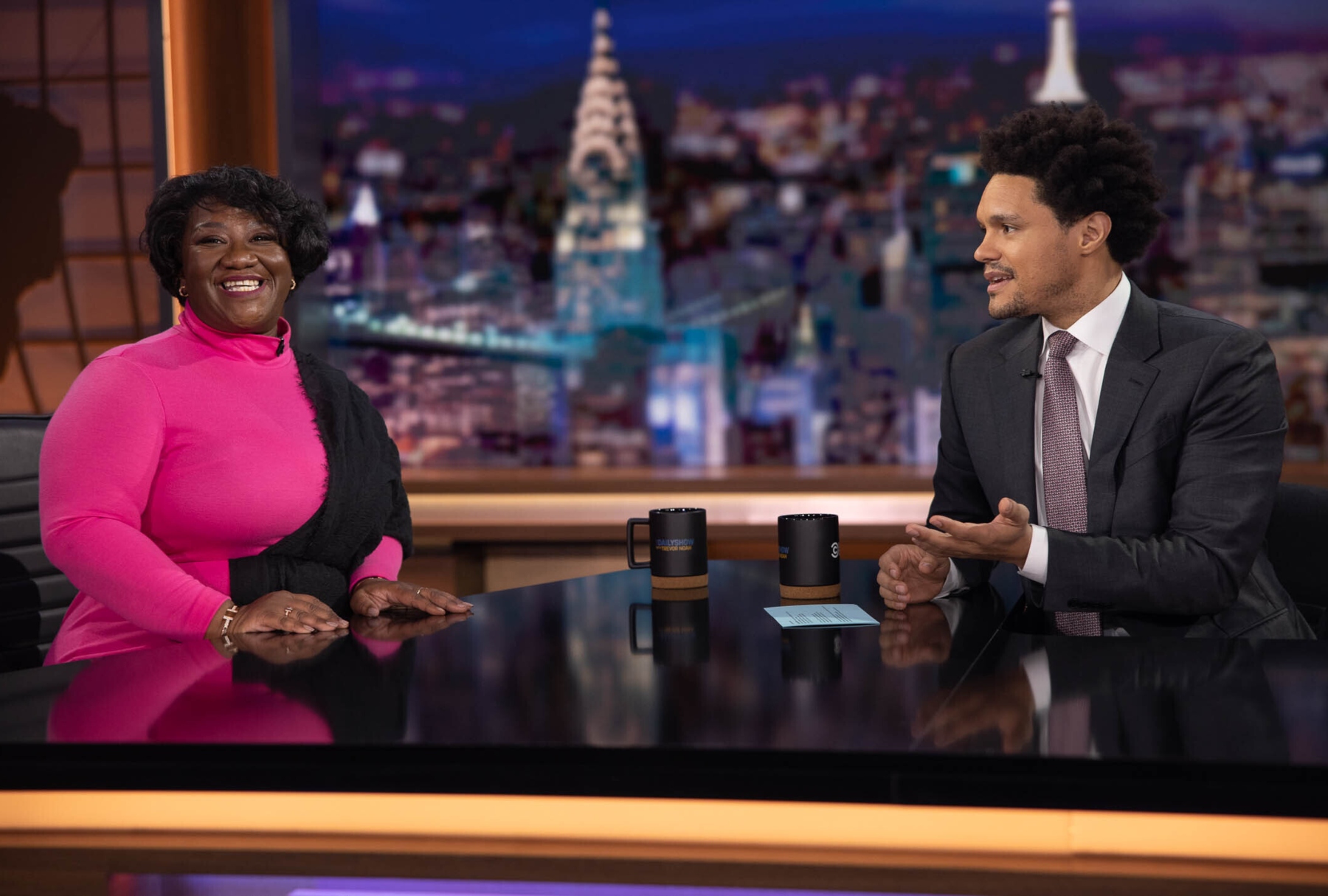
Each of these performers has relevant experience. Handler, Hughley, Minhaj, Penn, Silverman and Sykes previously helmed topical comedy or late night talk shows, most featuring an interview component. Franken hosted a radio show on the defunct left-leaning Air America and has a podcast; Leguizamo has a long track record in live stage performance on top of an impressive film career. Jones and Wayans have both served as game show ringmasters.

Some are easier to envision slipping into that chair and doing the job on a full-time basis with the show’s tone dropping a stitch. Minhaj brings the respectable track record he earned as the host and creator of Netflix’s gone-too-soon “Patriot Act,” which helped him develop the muscle required to produce a nightly political comedy series. 

Returning home to “The Daily Show” could allow him to tailor it to his style beyond remixing the theme song.

Or he may view the gig as a lateral step.  

On Hulu’s “I Love You, America,” Silverman proved her ability to deliver tough monologues and bridge partisan gaps through empathetic conversation, although she admitted she has some TV blackface baggage. Freeform’s “Kal Penn Approves This Message” enabled the actor to dip his toe into the political talk variety space in a narrowly focused limited series related to educating young voters on relevant issues. Handler is a convivial interviewer, and among her peers listed here feels like the most mainstream choice. 

But if this is the production’s version of a soft audition, Paramount’s succession plan seems more geared toward stability than imagination. 

When Noah took over for the show’s transformative host Jon Stewart, he was a relatively unknown South African comic whose biggest stateside TV debut before landing this gig was on FX’s short-lived 2012 talk show “Totally Biased with W. Kamau Bell.” But Stewart hand-selected Noah, a move that bewildered many onlookers but was trusted nevertheless.

The runway up to his 2015 debut wasn’t smooth. Social media bloodhounds dug up misguided sexist and antisemitic tweets for which he apologized. His coverage style favored a more internationalist outlook, requiring an adjustment period after 16 years of watching Stewart shred the hypocrisy in politicians’ stances and statements and reveling in watching him draw blood whenever a right-wing figure dared to show up as a guest.

But for reasons I’ve outlined before, Noah evolved the show to suit the modern media age by appealing younger, more technologically savvy and diverse audience that includes 44 million followers across multiple platforms, according to the network. (Besides, the Olds can still bask in Stewart’s presence on his Apple TV+ show.)

Noah leaves “The Daily Show” in a shape that reflects his paradigm with a more inclusive correspondent team than his predecessor put in place, which includes Roy Wood Jr., Dulcé Sloan, Ronny Chieng, Desi Lydic, Jordan Klepper, Michael Kosta and elder statesman commentator Lewis Black. As the Paramount statement indicates, a few of them will receive their time in the host’s chair.

Ultimately, and somewhat depressingly, it’s tough to picture Paramount taking the same chance on one of them, let alone repeating what Stewart did seven years ago by tapping an up-and-comer.

If the point is to select someone who can make sense of fluctuations in the culture’s political and social temperature, the host should be a woman.

Noah, as Stewart recognized, is a unique case for reasons he’s established over most of the last decade and talked about in his 2016 bestseller “Born a Crime.” He brings his curiosity about the world into his comedy, and that shone through the show’s content, especially during the xenophobic Trump administration. With him taking over for Stewart, Comedy Central can claim it caught lightning in a bottle twice in a row.

As for who is capable of continuing that streak, that remains to be seen. However, if the point is to select someone who can notice and make sense of fluctuations in the culture’s political and social temperature, the host should be a woman. If Paramount takes the hint Noah dropped to close out his finale show, it should be a Black woman.

Tressie McMillan Cottom on “The Daily Show with Trevor Noah” (Comedy Central)
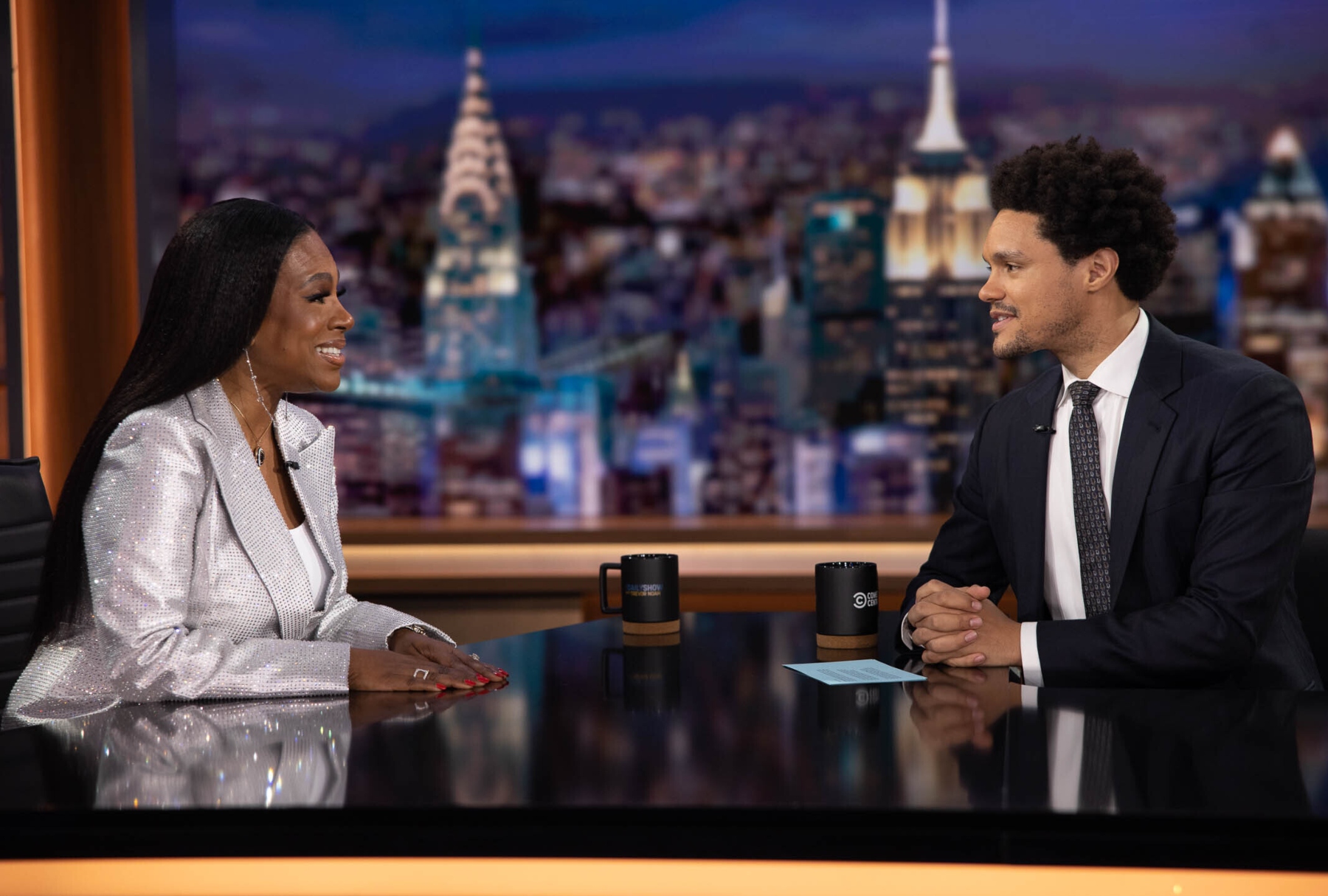
“This is random for some, but: special shout-out to Black women,” he said with tears in his eyes, going on to acknowledge his mother, his grandmother and his aunt — the women in his life, but also women he’s met in this position, including Roxane Gay, Tressie McMillan Cottom, Tarana Burke and Zoe Samudzi. “I’ve often been credited with you know, having these grand ideas and people are like, ‘Oh, you’re so smart . . . I’m like, who do you think teaches me? You know, who do you think has shaped me? Nourished me? Informed me?” 

“I always tell people if you truly want to learn about America, talk to Black women. Because unlike everybody else, Black women can’t afford to f**k and find out. Black people understand how hard it is when things go bad, especially in America, but any place where Black people exist, whether it’s Brazil, whether it’s South Africa — wherever it is, when things go bad, Black people know that it gets worse for them.”

“But Black women in particular? They know what s**t is. Genuinely,” he continued. “People always be shocked. They be like, ‘Why do Black women turn out the way they do in America? Why do they vote the way — Yeah, because they know what happens if things do not go the way it should. They cannot afford to f**k and find out. . . .  I’ll tell you now, do yourself a favor. If you truly want to know what to do, or how to do it, or maybe the best way or the most, the most equitable way? Talk to Black women. They’re a lot of the reason that I’m here.

Mr. McCarthy, are you listening? We have a woman with relevant experience in Robin Thede, creator of “A Black Lady Sketch Show,” who hosted her own talk variety series for BET and was the head writer for “The Nightly Show.” She, Handler and Silverman hosted shows at a time — 2017, to be precise — when they, along with former “Daily Show” senior correspondent Samantha Bee, brought the count of women hosting talk-variety shows to, yes, four.


Want a daily wrap-up of all the news and commentary Salon has to offer? Subscribe to our morning newsletter, Crash Course.


Bee was the last woman standing from that group, lasting until July of this year when Warner Bros. Discovery abruptly canceled her TBS show “Full Frontal with Samantha Bee.”

Bee, you’ll notice, is not on that host list. Then again, she could turn up later. If she doesn’t the contenders should at least take a few notes on “Full Frontal”‘s coverage of issues related to the rights of women and marginalized populations, i.e. the main thrust of Bee’s show. Those are the topics steering most political conversations right now and will be on much of the audience’s minds as we careen toward the next presidential election.

Indeed, several talented Black women on TV right now have demonstrated the ability can lead these conversations in ways that suit the jocular edge of “The Daily Show.” One, Ziwe Fumudoh, already works for Paramount. Sloan’s also right there, and she merits serious consideration. If the company really wants to make headlines, it could poach Amber Ruffin from NBC Universal. But I’ve said all this already.

Sheryl Lee Ralph on “The Daily Show with Trevor Noah” (Comedy Central)

What about those who have signed on to guest host? Well, Jones carved out a niche as the unofficial commentator on an array of live telecasts, memorably including her divine work covering the Olympic games. Nightly political humor represents a substantial tonal shift for her.

Sykes is a comeback quick-draw, politically savvy, personable and beyond qualified. She’s also a showbiz veteran who is slightly younger than Stewart is now.

The counterpoint to this is that very few women have ever received the same opportunities, patience and grace granted to Noah and for that matter, other late-night talk show hosts whose shows took a while to find a direction that works. Note that there are four women on a list of 10 comedians, which hints at the way the wind is blowing – that is to say, in the direction it almost always does.

It would be pleasantly shocking to be proven wrong in the long run. For the time being, it may be enough to appreciate that the space this one-time unknown comedy leaves is wide enough to require a parade of celebrities to fill it. The fact that a multilingual son of a Xhosa mother and a Swiss-German father slipped through Hollywood’s system to sit in one of its most rarified chairs in the first place is a miracle. Heaven knows those are challenging to repeat.

“The Daily Show” resumes with new episodes on Tuesday, Jan. 17.


Legal experts: Trump attorneys may throw him under the bus after DOJ moves to hold them in contempt

The Justice Department is asking a federal judge to hold former President Donald Trump’s legal team in contempt of court for failing to comply with a subpoena issued this summer ordering him to return all classified documents in his possession, sources told The Washington Post.

U.S. District Court Judge Beryl Howell has not yet held a hearing or ruled on the DOJ’s request, which came months after Trump’s lawyers assured the department that a search had been conducted for classified documents at his Mar-a-Lago residence, before the FBI later executed a court-authorized search that led to the discovery of more than 100 documents marked as classified. Trump’s team recently reportedly found two additional items marked classified at a Florida storage locker after Howell ordered them to keep looking.

Trump’s legal team has refused to designate a custodian of records to sign a document attesting that all classified materials have been returned to the federal government. This has remained a key area of disagreement in the matter after Trump attorney Christina Bobb signed a declaration affirming that all documents had been returned over the summer — before the DOJ discovered additional documents.

The former president’s team has taken the position that such a request is unreasonable.

“President Trump and his counsel continue to cooperate and be transparent, despite the unprecedented, illegal, and unwarranted attacks by the weaponized Department of Justice,” Trump spokesperson Steven Cheung said in a statement to the Post.

Trump is under investigation for three potential crimes, including mishandling classified documents, obstruction and destruction of government records.

“What the DOJ is trying to do is simply get an answer… from some person to say yes, you have all of [the classified documents]… and I can’t being to imagine how long this has taken to finally percolate to the stage where DOJ is asking for this,” former FBI official Peter Strzok told MSNBC

After the raid, Howell ordered Trump’s legal team to conduct a search for more records, which reportedly uncovered two more classified documents around Thanksgiving in a storage unit in West Palm Beach, Fla, according to the Post.

Searches at other Trump properties, including his Bedminster golf course in New Jersey and at Trump Tower in Manhattan, did not yield any records, according to the report.

Former U.S. Attorney Harry Litman predicted that attorneys like Bobb and fellow Trump lawyer Evan Corcoran will “will point the fingers at others and ultimately Trump in seeking to excuse their  noncompliance.”


Want a daily wrap-up of all the news and commentary Salon has to offer? Subscribe to our morning newsletter, Crash Course.


“Part of the dynamic with the Trump Team contempt motion is that the lawyers are afraid to sign certifications of compliance, given that their client can’t be trusted,” Litman wrote on Twitter. “There’s a poetic justice to the fact that Team Trump can’t even comply with a subpoena, a simple act which defendants, and anyone else, do every day, because of fault lines leading in all directions to Trump’s dishonesty,” he added.

“If you represented Trump, you wouldn’t want to certify under oath that he returned all the classified materials either,” quipped former federal prosecutor Renato Mariotti. 

New York University Law Prof. Ryan Goodman agreed that Trump’s attorneys had good reason to be nervous given that their earlier declaration was proven to be false.

“This just reached a whole new level of seriousness,” he tweeted, noting that the DOJ motion “adds significantly to the likelihood of indictments.”

A theory on why Lensa is turning us into AI thirst trappers with its ubiquitous portrait app

Over the past week or so, word began to spread that there was a free one-week trial of the Lensa AI: Photo & Video Editor app that would allow you to upload 10-20 selfies and have artificial intelligence spit out 50 avatars in under an hour. If, after reading that, you found yourself muttering, “what the hell is Lensa?” Don’t even worry about it. Prior to Sunday I didn’t know what it was either, but am I now in possession of 50 AI-created portraits of myself ranging in thematic expressions, from “oh wow,” to “am I holding a wand?” Well, yes, I certainly am.

The Lensa AI: Photo & Video Editor app is made by a company called Prisma Labs out of Sunnyvale, California, and, after seemingly appearing out of nowhere, it is currently #1 in Apple’s U.S. app store. The punchline is that the “free” trial wasn’t exactly free. After uploading roughly 12 of my own selfies over the weekend, I received a prompt asking for $3.99 before I could receive my 50 avatars. Normally that would have me backing out and heading for what I’d been doing prior to accessing the app — watching dog videos on TikTok — but in this particular instance, they got me. After already arriving at the point where 50 AI portraits of myself seemed like something worth pursuing, paying $3.99 for the experience seemed no less reasonable.

You’ve seen them. You know what I’m talking about. Square, ultra-glossy images of someone in your feed — perhaps your old college buddy, or brother who lives in Staten Island — appearing to be floating in space with a backward hand and a “band t-shirt” with gibberish on it because AI doesn’t know about Fleetwood Mac. But how are these portraits made exactly?

The New York Times breaks down the technology of Stable Diffusion, which they describe as using “image prompts (selfies) and text prompts (Lensa AI’s categories) to generate high-quality images.” So we know how. But what isn’t explained in this report is the why of it all. Why are so many of us doing this? Why would we want 50 pictures of ourselves looking like a Björk costume change? I have a theory about that.


Want a daily wrap-up of all the news and commentary Salon has to offer? Subscribe to our morning newsletter, Crash Course.


If I’m even slightly curious about seeing myself as a cartoon lesbian floating on the moon, or whatever the internet is encouraging me to try, I’m all in.

Now that I have reached what is undeniably the middle of my allotted average lifespan, I have reached a relatively easy-breezy mindset in which I am no longer particularly interested in seeming cool. I have full conversations about decorative seasonal towels. I go to bed at 9 p.m. I don’t care anymore. I give up. So when trends like these AI-generated avatars pop up I no longer pause to ask, “Will this make me look dorky?” Nay. If I’m even slightly curious about seeing myself as a cartoon lesbian floating on the moon, or whatever the internet is encouraging me to try, I’m all in. The fear that I’ve likely just uploaded images of myself to Russian spies, sex pests, or a cabal of hackers doesn’t hold me back at all. This ship’s going down, might as well enjoy the ride.

My need to seem cool and casual has, over the years, been replaced with a growing interest in knowing myself to the best of my ability — and, in that knowing, coming to terms with how I present to the world physically. 

I used to be really uptight about my face. My looks in general, really. As a woman occupying space within a relatively forward-facing industry such as journalism, having my looks commented on by strangers from the internet goes with the territory. And boy, have I heard it all. Throughout my 20-plus-year career as a writer, I’ve been told that I look like a softer/cuter version of the serial killer Richard Ramirez. I’ve been told that I look like Cindy-Lou Who from “How the Grinch Stole Christmas.” I’ve been told that I look like a chubby Carrie Brownstein. That last one I consider to be a compliment, although I don’t think it was entirely meant to be.

As a woman occupying space within a relatively forward-facing industry such as journalism, having my looks commented on by strangers from the internet goes with the territory.

This used to not-so-secretly upset me to such a degree that one time, many years ago, when I asked a co-worker if she’d think I was cute if she didn’t know me and just saw me walking down the street and her reply was “this is a trap,” I took that to mean “you are the ugliest person I’ve ever seen in my life”  rather than the more logical “we’re friends, so this is weird.” I used to carry all this angst around with me and it used to wear me down. It’s a smaller pain now, but I still credit such dwindling hangups for being the reason why I was drawn to this AI portrait app. Random Larry from the internet might think I have a pig nose, but what does artificial intelligence think? If I can’t ask a friend or a stranger if I’m pretty and feel comfortable doing so, let’s have a computer show me and just be done with it. Beauty as science. As math. Is about as blunt of a reply as one could hope for. 

After receiving my avatars I was pleasantly surprised. They made me look young. They made my lips full in the way they used to be in my twenties. My hair appeared less frizzy and better styled. I found myself looking at these pictures and liking what I saw in a way I would be less likely to when looking at a real-life snapshot. My brief experience using this app left me with images of myself I wasn’t ashamed to share alongside everyone else’s.

In the eyes of a computer, we’re all just dorks. But, hey, we look pretty cute.

“Don’t overthink it”: There appears to be a simple reason Kyrsten Sinema left the Democratic Party

Sen. Kyrsten Sinema of Arizona announced early Friday morning that she has officially left the Democratic Party, registering as an independent in her state and surprising very few people who have seen her as a major obstacle to her party’s progressive agenda while serving powerful corporate interests.

“In the most shocking, surprising, and unexpected news in modern American political history,” MSNBC host and commentator Mehdi Hasan tweeted with clear sarcasm, “Senator Kyrsten Sinema is leaving the Democratic Party.”

The move makes sense, Hasan continued, “because 1) she was never really a Democrat, and 2) she can’t win a Dem primary in 2024. So Sinema being Sinema…”

In an op-ed in The Arizona Republic explaining her decision, Sinema equated the far-right and increasingly fascist faction of the Republican Party with those on the Democratic side pushing harder for action on climate, economic equality, and universal healthcare by expressing her concern that “the loudest, most extreme voices continue to drive each party toward the fringes.”

“When politicians are more focused on denying the opposition party a victory than they are on improving Americans’ lives, the people who lose are everyday Americans,” argued Sinema. “That’s why I have joined the growing numbers of Arizonans who reject party politics by declaring my independence from the broken partisan system in Washington. I registered as an Arizona independent. ”

In the still closely-divided Senate, Sinema’s move will not be without impact in terms of the power balance, but ultimately that will depend on which party caucus she joins:

PBS News correspondent Lisa Desjardins quoted a Sinema spokesperson who said the senator “intends to maintain her committee assignments through the Democratic majority.”

Having helped Republicans and corporate interests block key pieces of legislation that would actually “improved American’s lives” during her tenure in the Senate—siding with donors in the private equity industry in legislative battles for public investment and infamously voting down a federal minimum wage increase in 2021—progressive critics expressed incredulity Friday over her altruistic explanations.

“Apparently ‘independent’ is the new way to say ‘corporate lobbyist,'” said radio host Dean Obeidallah in response to the news.

With the party exit coming just two days after Democrats secured a larger 51-49 majority over the Republicans when Sen. Raphael Warnock of Georgia defeated far-right Republican challenger Herschel Walker in a runoff election on Tuesday, Hasan was not alone in skewering Sinema’s timing.

“Sinema owes her entire career to the Democratic Party, she’s been endlessly indulged by party leadership, but she waits till a moment of celebration for the Democrats to make this announcement,” he said. “Like I’ve said before, it goes way beyond politics or ideology—she’s just awful.”


As a reminder, he added, “America has no higher minimum wage, no extended child tax credits, and no voting rights protections because of Kyrsten Sinema.”

Florida Republican behind “Don’t Say Gay” law charged with COVID relief fraud

The Republican state lawmaker behind legislation that’s pushed some LGBTQ+ teachers in Florida to leave education is facing federal charges for allegedly defrauding a federal program meant to provide aid for small businesses of his during the Covid-19 pandemic.

State Rep. Joseph Harding was indicted by a grand jury and has been accused of falsifying bank statements and making illegal bank transfers in order to wrongfully obtain $150,000 in federal pandemic relief funds for businesses that were not actually operating at the time.

Harding will go to trial on January 11 for the six-count indictment of wire fraud, money laundering, and making false statements—crimes that carry maximum prison sentences of 20, 10, and five years, respectively.

In 2021, he allegedly applied for relief funds using the names of two inactive businesses, falsely claiming that one had four employees and had earned $420,000 in the 12 months prior to the pandemic and that another had two employees and had earned nearly $400,000.

Harding said in a statement Wednesday that he “fully repaid the loan and cooperated with investigators as requested.”

His fellow Florida lawmaker, state Rep. Anna Eskamani (D-47), expressed doubt about Harding’s denial of wrongdoing.

“It does not surprise me that someone who exploits queer kids for political gain would be charged with exploiting taxpayers for personal gain,” tweeted Eskamani.

Harding sponsored the Parental Rights in Education Act, known by critics as the state’s “Don’t Say Gay” law. The measure bans Florida public school teachers from holding classroom discussions in kindergarten through third grade about topics involving sexual orientation and gender identity. The law has sparked at least 20 “copycat” proposals this year and has been condemned as an attack on LGBTQ+ teachers and students and those who have LGBTQ+ family members.

The lawmaker suggested in an interview ahead of a key vote on the legislation this year that teachers need to be stopped from “discussing heavy sexual topics with children before puberty.”

“Anyone who watched Rep. Harding defend his ‘Don’t Say Gay’ bill in committee could see he had some trouble with the truth,” said Slate journalist Mark Joseph Stern.

Harding also called on authorities to “release the dogs” when Planned Parenthood affiliates were accused of wrongfully receiving coronavirus relief.

Orlando Sentinel columnist Scott Maxwell posited that Harding may be among “many politicians who demonize gay people… to distract from their own sins and flaws.”

“On Wednesday, the sponsor of Florida’s ‘Don’t Say Gay’ bill was indicted for fraud and money laundering,” said Maxwell. “But sure, two loving mothers are the problem.”

Ron DeSantis’ gruesome campaign plan: I’m the genius who defeated COVID — and let thousands die

The House of Representatives passed an $858 billion National Defense Authorization bill on Thursday and it now heads to the Senate where it is also expected to pass. This legislation funds a pay hike and aid for Taiwan and Ukraine, circumventing the battles that presumptive House Speaker Kevin McCarthy promises are on the way for all funding measures in the new Congress. But the Republicans did win one skirmish: they managed to include a rollback of the COVID vaccine mandate for military personnel on the dubious grounds that it is limiting recruitment because so many would-be heroes refuse to get the jab. (The Pentagon rejects that assertion.) Democratic congressional leaders obviously felt it was the better part of valor to pass the Ukraine funding before Marjorie Taylor Greene’s shock troops get veto power, so they let this one go.

This is purely political, of course. The Pentagon requires all personnel to take vaccines for any number of illnesses and military leaders obviously think this is ridiculous. But we have civilian control of the military for good reasons even if, from time to time, partisan politics wins the day. As it happens, very few service members have refused to take the vaccine and the military will surely be able to maintain readiness without the mandate. 

After all we’ve been through in the last three years, the anti-vaxxers are still claiming victims. There are outbreaks of measles and other dangerous diseases all over the country due to this new resistance to the science that has saved countless lives over many decades. There remain pockets of liberal intransigence on the subject, but resistance is concentrated mainly on the right among people who have been influenced by conspiracy theories and right-wing politicians and media. It’s tremendously ironic, since the political leader who can take credit for pushing a swift rollout of the COVID vaccines is none other than their Dear Leader Donald Trump. It’s the one positive achievement of his presidency, and it’s the one his followers boo him for. 

On Thursday, the Democratic staff of the Senate Committee on Homeland Security & Governmental Affairs released its report on the government’s handling of the pandemic, focusing on the first six months. (It’s necessary to say “Democratic staff” because in the current 50-50 Senate the committees are evenly split and the Republicans, as usual, refused to cooperate. This problem will go away in the new Senate, with a 51-seat Democratic majority.) It’s a devastating document that describes, the first months of the crisis “one of the worst public health responses in U.S. history.” Multiple failures, including in threat recognition, cohesive response, clear communication and timely mitigation measures “resulted in the avoidable yet devastating loss of human life.”

We all saw this happen in real time but the details of how chaotic it was behind the scenes are downright chilling. The administration “failed to take decisive action and adequately convey the threat to the American people” and “remained focused on containing the virus by trying to keep it out of the U.S., rather than implementing needed measures to mitigate its spread within the country.” (You may remember Trump’s comments at the CDC that he was eager to “keep his numbers down.”)

The report cites example after example of how “contradictory and inadequate communications left Americans confused and unclear on what to do to minimize their risk and over time, eroded public trust in public health guidance.” That’s an understatement. Tens of thousands of people, if not hundreds of thousands, died unnecessarily because of Trump’s refusal to back the social distancing and masking measures that were all we had in the beginning as scientists were trying to understand the scope of the crisis.

And what went on within the Trump administration, as it abruptly shifted responsibility from one agency to the other and injected politics into every aspect of the response, was even worse than we knew. The report reveals that the administration’s “influence in CDC’s guidance expanded to the point where political officials within HHS altered public health guidance and reports.” Former CDC chief of staff Kyle McGowan is quoted saying that “every time that the science clashed with the messaging, messaging won.” It was a disaster. But the report does indeed credit the administration with quickly approving Operation Warp Speed, which, as I said, is the one big  thing Trump did right — and the one thing his followers resent him for.


Want a daily wrap-up of all the news and commentary Salon has to offer? Subscribe to our morning newsletter, Crash Course.


One major finding of the report, as with others we have already seen, is that the government was woefully unprepared for a pandemic at virtually every level, even if we look past the Trump administration’s missteps. This goes to the heart of the troubling question of why the United States handled COVID response so much worse than most other major industrialized countries. The Government Accountability Office, House Democrats and the National Academies have previously issued reports that came to similar conclusions. None of those have gotten much press and it seems clear that the government, no matter which party holds the White House, isn’t going to take their recommendations seriously enough to prepare for the next pandemic either.

Perhaps that explains why Florida Gov. Ron DeSantis is riding so high on his pandemic-response reputation. Despite the fact that Florida has among the higher per-capita death tolls in the country, DeSantis has bamboozled the media into seeing him as a crusader for common sense public health measures. Apparently his “maverick” image on the pandemic is considered the key to his potential presidential campaign. (Appointing an anti-vaxxer as Florida’s surgeon general was a sweet way to own the libs, you must admit,) Evidently, he plans to run to Trump’s right as the guy who didn’t succumb to all that weak-kneed, girly-man, Fauci-loving, vaccination nonsense.

It’s hard to say whether that will work in the real world. Florida voters sure seem to love it, so maybe that approach will be hugely popular all over the nation if he runs. It’s clear that America is done with the COVID pandemic and has simply accepted that it’s going to keep killing people at the rate of about 100,000 a year. There’s no discussion about funding any more major medical interventions or new pandemic preparedness. Vaccine manufacturers are pulling back. The scientific progress we’ve made is already slipping away. It looks like we’ll be dealing with the next pandemic on a wing and a prayer, all over again. 

As I write this, 1,092,099 people have died of COVID in the United States. About 1,500 more succumbed just yesterday. It is now the third leading cause of death in the nation. Are Americans really going to decide that a ruthless politician who embraced that as the new normal is just what the doctor ordered?  

“She is scared about her reelection”: Kyrsten Sinema ditches Democrats and registers as independent

Arizona Sen. Kyrsten Sinema announced on Friday she is leaving the Democratic Party and registering as an independent.

Sinema told Politico days after Democrats won their 51st seat in the Senate that she is changing her party affiliation but will not caucus with Republicans. Unlike Sens. Bernie Sanders, I-Vt., and Angus King, I-Maine, Sinema does not plan to attend weekly Democratic Caucus meetings, though she rarely does that now, according to the report. And she is not sure whether her desk will remain on the Democratic side of the Senate floor — but said she expects to keep her committee assignments through the Democrats despite leaving the majority party.

Sinema, who repeatedly blocked key pillars of the Democratic agenda and drew backlash from her party as she cozied up to big corporate donors, insisted that she still plans to vote the same as she has during her first four years in the Senate.

“Nothing will change about my values or my behavior,” she told Politico’s Burgess Everett. “I don’t anticipate that anything will change about the Senate structure,” she said, adding that the details of how her switch will affect the mechanics of the Senate are a “question for Chuck Schumer,” the Democratic majority leader.

Sinema denied that she was waiting for the results of the Georgia Senate runoff to make the announcement, telling Politico that it is “less about the timing” and more about “thinking how can I be most productive.”

“This completes a remarkable transformation for Kyrsten Sinema, from Green Party activist to Democrat to centrist independent,” tweeted NBC News reporter Sahil Kapur.

Sinema’s decision is not expected to significantly change the dynamics of the Senate majority but it does impact her potential re-election campaign. Rep. Ruben Gallego, D-Ariz., and others have talked about launching a primary challenge against Sinema over her opposition to corporate tax hikes and filibuster reform, which derailed Democratic efforts to pass ambitious social programs, voting rights protections and other legislation sought by the majority of the party.

“She is scared about her reelection race and she puts Chuck in a tough position,” an anonymous top national Democrat told CBS News’ Robert Costa.


Want a daily wrap-up of all the news and commentary Salon has to offer? Subscribe to our morning newsletter, Crash Course.


Sinema, who has not said whether she intends to run again, told Politico that she is on separating herself from a party that’s never been a fit rather than focusing on 2024.

“Politics and elections will come later,” she said, though she did add that “I am not running for president.”

It has been more than a decade since the last Senate party switch, when Pennsylvania Sen. Arlen Specter left the Republican Party to join the Democrats in 2009. Connecticut Sen. Joseph Lieberman previously left the Democratic Party and became an independent in 2006.

Sinema’s close relationship with Senate Minority Leader Mitch McConnell, R-Ky., became a point of contention during her opposition to President Joe Biden’s signature agenda items. Politico noted that she also maintains a relationship with House Republican Leader Kevin McCarthy, R-Calif., and has already connected with other Republicans about working together.

With the Democrats still maintaining a working majority in the Senate, Sinema’s move is not expected to change much given that she helped derail key Democratic priorities already. But it could impact whether she is still in the Senate after 2024.

“In Vermont and Maine Ds agree not to run a candidate against Sanders and King. That is almost certainly not going to happen in Arizona. Sinema was facing the increasing likelihood of a primary she would likely lose,” wrote the Talking Point Memo’s Josh Marshall. “If that’s so, it seems vanishingly unlikely that [Democrats] would choose not to run someone. So it’s a three person race. In a closely divided state there’s a very good chance that gives the seat to the GOP. But … there’s an even better chance that Sinema is a distant 3rd.”

That’s a significant risk since. NBC News’ Marc Caputo noted that the Republican in the race could very well be far-right election denier Kari Lake, who narrowly lost her gubernatorial bid last month.

Sinema could use that threat to her advantage.

“If she runs for re-election as an independent, this would mean rather than being primaried out, Sinema would challenge Dems to support her, saying that they would otherwise be electing a Republican in a 3-way race,” tweeted Matt Grossmann, a political science professor at Michigan State University. “This would also make needing strong campaign finance support from a few private-equity folks a bit more plausible.”

Still, Sinema’s poll numbers show that she faces an uphill climb in any reelection contest.

“Sinema was not very popular with anyone,” tweeted FiveThirtyEight’s Nate Silver, “I’m not sure whether today’s move increases or decreases her chances of winning another term (I actually suspect decreases) but they were low to begin with and they remain low.”

Hey, new parents — go ahead and ‘spoil’ that baby!

When an infant cries, parents frequently wonder whether they should soothe the baby or let the baby calm itself down. If they respond to every sob, won’t the baby cry more? Isn’t that spoiling the baby?

I hear these questions a lot as a professor of child development and family science. The notion of spoiling a baby remains common in the U.S., despite evidence that infants who have parents who respond to their needs are better at calming themselves down later in life.

Many of the students I teach say that their parents resisted calming their cries and that they turned out just fine. Of course, there are individual differences in early childhood development. There is no “one size fits all” for parenting.

That said, for decades now, developmental scientists have studied emotional regulation in children and the caregiver-infant bond. There is an answer to the common question of whether it’s better to comfort a crying baby or let them learn to calm themselves down. Let me explain …

Emotional regulation during infancy

Infants are born with a remarkable number of capabilities. Indeed, research shows that babies seem to “know” a lot more about the world we live and grow in than previously believed. For instance, infants possess an understanding of numbers, object permanence and even morality.

However, infants’ abilities are still immature. They rely on their caregivers to fine-tune those skills, much like other young mammals.

And one thing newborns cannot do is regulate their own distress — whether that distress comes from feeling cold, hunger, pain or any other discomfort. That ability does not develop until approximately 4 months of age. So infants need their parents’ help to calm down.

Since crying is one of the first ways infants communicate their needs to caregivers and others, it is imperative for the infant-parent bond that caregivers respond to their infant cries.

Moreover, research shows that infant cries elicit an apparent psychological need in others to ease their distress. As such, infant cries serve a fundamental purpose for both infant and caregiver.

Critically, infants also learn from the responsiveness of their caregivers what it feels like to calm down. This feeling is similar to the internal changes that adults and older children feel when they regulate their emotions — that is, their heart rate slows and they feel at ease. This repeated experience gives infants new life skills: Longitudinal research indicates that infants whose caregivers respond to their distress are better able to regulate emotion and behavior as they get older.

For babies, self-soothing likely means sucking on a pacifier or a fist. Later in life, those foundational infant calming skills learned in response to parental care develop into more adultlike habits for regulating distress, like counting to 10 or taking deep breaths.

Caregiver-infant bonding

Parental responsiveness to infant cries also affects the infant-caregiver relationship. Caregivers provide the first information for infants about the predictability of the social world, the trustworthiness of others and about their own self-worth.

This lays the foundation for the quality of the lifelong relationship between a caregiver and child. When infants are soothed in times of distress, they learn that their caregiver is trustworthy and reliable. They also learn that they are worthy of caring, loving relationships, which positively influences their future relationships.

Caregiver responsiveness is also associated with a cascade of well-documented outcomes in infants, children and adolescents, including cognitive functioning, language development, self-esteem and future sensitivity to infant needs.

The absence of caregiver responsiveness, on the other hand, is linked to later behavioral difficulties and developmental challenges. Studies show that neglected children can struggle to bond with their peers and to cope with rejection.

Though one study recently reported that these ill effects might not apply at night — as in, when parents let babies “cry it out” to teach them to sleep — the major consensus in the literature is that before 4 months of age babies should not be left to cry. I recommend no earlier than 6 months because of the formation of the attachment bond, and highly encourage caregivers to consider the individual abilities of their child. Indeed, some children are able to self-regulate better than others. In addition, there are alternative ways to help babies learn to self-soothe at night that include responding to infant distress.

Fortunately, caregivers are biologically primed to care for their infants. Research with animals and humans demonstrates that there are hormones that drive caregiving.

Go ahead, ‘spoil’ that baby

My best advice, based on the scientific literature, is that parents should respond promptly and consistently to infant cries through at least 6 months of age.

But take a pragmatic approach.

Caregivers know the idiosyncrasies of their infants: Some may be more placid, while others are more excitable. Likewise, culture drives the goals caregivers set for themselves and their children. So, responsiveness and adaptive caregiver-infant relationships will look different for different families. Parents should act accordingly, fitting their responsiveness to their infant’s needs and their cultural context.

However you look at it, responding to an infant’s every cry is not “spoiling” the baby. Instead, the act of soothing a crying infant provides the baby with the tools they will use to soothe themselves in the future.


Amy Root, Professor of Applied Human Sciences, West Virginia University

This article is republished from The Conversation under a Creative Commons license. Read the original article.

Coach Prime is not the HBCU savior: On Deion Sanders and the money-making machine of college sports

Deion Sanders,­ AKA “Prime Time” — college football and NFL Hall of Famer, former shutdown cornerback, erstwhile rapper, and currently a force injecting revolutionary energy into HBCU NCAA football — shocked the world when he announced that he would be leaving Jackson State University, the public, historically Black university in Jackson, Mississippi, where he has served as head football coach for three seasons, for the University of Colorado earlier this week. 

After the news broke, Sanders tweeted, “Change makes people get uncomfortable. Change is inevitable in every age & stage of life but it somehow someway brings Love but Hate, Joy but Sorrow & Life & Death. There’s a time & season for every activity under the sun the bible declares. CHANGE is INEVITABLE. #CoachPrime” 

I know what you might be thinking: Who cares about a college coach switching jobs? Coaches move schools all the time, right? Especially for a better offer. His new deal, according to The Denver Post, includes $5.5 million for his first season alone. Jackson State was paying Sanders $300,000 per year. Colorado will be more than quadrupling his annual pay, on top of other incentives. This is America, right? And we know the rule is to be paid. To save your space, time, energy and — most importantly — your talents for the highest bidder. I honestly don’t think anyone has a problem admitting that. However, Deion’s situation is different. 

Now certain Republican politicians and other deniers of racism will never admit that America was built on the backs of Black people who slaved all day — literally — and weren’t legally allowed to share space with our white counterparts, even after emancipation. That meant we couldn’t live in the same neighborhoods, shop at white stores or eat at white restaurants. We couldn’t even drink out of the same water fountains, let alone be educated at white colleges. As a result, Historically Black Colleges and Universities (HBCUs) were established. And you don’t have to be a history expert to know that colleges for Black people, like Jackson where Sanders coached, have been historically underfunded. 

In 2022, Forbes did a deep dive into the history of America cheating its Black colleges, even though these intuitions were responsible for educating “80% of Black judges, 50% of Black lawyers and doctors and 25% of Black science, technology, engineering and math graduates.” Here’s how poorly North Carolina Agricultural & Technical State University (NC A&T), the country’s largest HBCU, is funded compared to predominately white public institutions: 

“The single worst instance of annual underfunding for any school was in 2020, when the North Carolina legislature appropriated A&T $95 million, $8,200 less per student than the $16,400 per student it gave to NC State. Instructional expenses per student at NC State: $15,681, versus $7,631 for the HBCU. Even Student Services, which includes admissions and the registrar’s office, are better funded at the predominantly white school. At NC State it amounts to $1,342 per Wolfpacker versus $726 per Aggie.” 

So imagine if you are one of the top Black athletes in America with dreams of playing professional sports. Do you enroll at the mega-white college with the pro-athlete-sized stadium, located on the campus with the pro-athlete-equipped fitness center, and the necessary contracts needed to put you on television every week just like a pro, or do you commit to the historically underfunded Black school that produces a small fraction of professional athletes compared to big white schools? Deion Sanders was on the road to changing the predictable outcome of that question. 

Jackson State was lit before Coach Prime was blessed with the coaching job.

I want to be extremely clear that Jackson State was lit before Coach Prime was blessed with the coaching job. They were known for their magnetic energy, beautiful history and having some of the most passionate students in America. However, Prime’s use of social media is so good that my wife who doesn’t even watch football knew that he lost two toes, because like millions of other people, she tunes into his Instagram like a TV show. Add that to his larger-than-life NFL persona, crazy dance moves, Tony Roberts meets Diddy pre- and post-game speeches and coaching ability gloriously amplified the magic experience that was Jackson State. He coached the school to two consecutive Celebration Bowl appearances and the only undefeated season in the school’s history. For the first time since colleges were desegregated, Black fans across the board were raving about HBCU sports and Black players were considering, getting excited about, and actually attending HBCUs — including Prime’s own son Shedeur Sanders, the star quarterback at Jackson State. 

Since the announcement, Prime has hinted at Shedeur leaving. Also, star wide receiver Robert Lockhart, Jordan Hall, Twan Wilson, and other top recruits have already de-committed from Jackson State, which is the worst news resulting from the departure. Losing top recruits means diminished hope for the potential to make tens of millions of dollars or more in revenue from ticket and memorabilia sales, donations from excited alumni and TV deals that could go toward Jackson hiring more top academics, building a bigger and better stadium, expanding the campus, introducing new disciplines, and overall elevating the school, not to mention closing some of those gaps found in the Forbes study. 

HBCU advocates, Jackson fans and spectators following Coach Prime’s viral motivational speeches have been ripping him apart on Instagram and Twitter all week. The basic narrative is that he used Jackson to propel himself to a godly status and then abandoned it as soon as the white school came knocking. 

“In coaching, you either get elevated or get terminated. Ain’t no other way,” Sanders told his team.

Joining the white school is elevating? I don’t think he meant the people. I think he was referring to the same money and resources that have been leading Black athletes away from HBCUs historically. Jackson did bless Sanders with his first head coaching gig. But we must acknowledge that he was already one of the most celebrated athletes in sports history and a successful commentator on “NFL Today.” Sanders also has a history of preaching, motivating and sharing the word of God everywhere he goes — that energy he became known for over the last two years at Jackson is him all of the time. Dude has been like a running, jumping and rapping one-man mega-church­­, even back in the 1990s when he visited my high school. 


Want a daily wrap-up of all the news and commentary Salon has to offer? Subscribe to our morning newsletter, Crash Course.


I attended Paul Laurence Dunbar, a citywide school surrounded by five housing projects. And while the school has been known for producing celebrated world-class athletes like Reginald Lewis, Tyrone “Muggsy” Bogues, Sam Cassell and Tavon Austin, professionals never visited our school in an effort to motivate us. No doctors, no lawyers, no journalists, no politicians, no reverends. Nobody except Prime. 

“Line up, straighten up, clean it up,” Mr. Brown, our sharpest history teacher — and a heavy HBCU advocate — said to us as we entered the auditorium, “Chin up, doctors, keep those heads up.” 

Even though Dunbar’s student population was predominantly female — not on purpose, it just worked out that way — the assembly was for boys. The mid-’90s was one of the most dangerous segments of the crack era. Baltimore had an extremely high murder rate, and many of the boys who weren’t going to make it in sports like Sanders needed some kind of hope, some other inspiration, even just an example of the kind of success that could exist outside our neighborhoods. Enter Prime. 

Prime can have a big heart with good intentions, while simultaneously breaking the hearts of others. And that’s what happened.

It is important for people to know that Deion wasn’t at the end of his career when he decided to visit us. He was actually at the top — an icon, a mega star, a guy with his own Nike sneaker. Prime was in his prime. He didn’t need to go speak to a bunch of poor kids, but he did. The power of his stardom kind of drowned out the bouncing around on stage, the “you can do it” rants, and his message in general, but he came. He came to inspire us when no one else did. Over 20 years have passed, and the impact of that visit still holds meaning for so many of us. It is not strange for one of my friends from high school to say, “Yo, remember that time Prime came?” 

Coach Prime had no connection to Dunbar. I’m sure he visited schools like mine all over the country, which is an honorable gesture. That does not mean he is not capable of hurting people. Both things can be true. Prime can have a big heart with good intentions, while simultaneously breaking the hearts of others. And that’s what happened. Adults who get to pick and choose where they decide to work, live, and play are using social media to attack Coach Prime for doing the same. So let’s say this all together: Coach Prime was great for Jackson State, but he is not a savior. He is not and will never be. He is a person. After two magnificent years as head coach at Jackson, poverty is still poverty, earning a livable wage is still a luxury, Ted Cruz is still employed, and Black people are still dying at alarming rates. The Savior Industrial Complex (I think I just made that up) is hurting us as much as Sanders hurt the fans of Jackson, if not more.

It bothers me that we are not using this moment to properly capitalize on the positive energy that surrounded Jackson State over the last two years. HBCU graduate (Texas Southern University) and former NFL player turned “GMA” host Michael Strahan acknowledged the star power high-profile coaches like Sanders bring to these institutions in an interview here at Salon last year. “These kids want to see someone that they’ve admired or someone that they’ve seen on TV, who’s had success,” he said.

We should be using this moment to encourage more successful black coaches, former professional athletes with an interest in coaching, and other powerful Black people in sports, to flood the HBCUs and continue to carry the torch so star coaches don’t have to leave in search of more money, media and resources. And while we’re at it, Strahan gave this advice in that interview, too: “[I]f you have an opportunity to support an HBCU, do your best to support them.” Donating to Jackson State and other HBCUs is extremely easy. That will go a lot further than bashing Prime or refusing to critique the white power structure that is collegiate sports. 

Journalists reporting on the COVID-19 pandemic relied on research that had yet to be peer reviewed

A story on gender inequity in scientific research industries. A deep dive into the daily rhythms of the immune system. A look at vaccine effectiveness for COVID-19 variants. These are a few examples of news stories based on preprints — research studies that haven’t been formally vetted by the scientific community.

Journalists have historically been discouraged from reporting on preprints because of fears that the findings could be exaggerated, inaccurate or flat-out wrong. But our new research suggests that the COVID-19 pandemic may have changed things by pushing preprint-based journalism into the mainstream.

While this new normal offers important benefits for journalists and their audiences, it also comes with risks and challenges that deserve our attention.

Peer review and the pandemic

Traditionally, studies must be read and critiqued by at least two independent experts before they can be published in a scientific journal — a process known as “peer review.”

This isn’t the case with preprints, which are posted online almost immediately, without formal review. This immediacy has made preprints a valuable resource for scientists tackling the COVID-19 pandemic.

The lack of formal review makes preprints a faster way to communicate science, albeit a potentially riskier approach. While peer review isn’t perfect, it can help scientists identify errors in data or more clearly communicate their findings.


Studies suggest that most preprints stand up well to the scrutiny of peer review. Still, in some cases, findings can change in important ways between the time a study is posted as a preprint and the time it is published in a peer-reviewed journal, which can be on average more than 100 days.

A ‘paradigm shift’ in science journalism

As researchers of journalism and science communication, we’ve been keeping a close eye on media coverage of preprints since the onset of the pandemic. In one study, we found that a wide range of media outlets reported on COVID-19 preprints, including major outlets like The New York Times and The Guardian.

Unfortunately, many of these outlets failed to mention that these studies were preprints, leaving audiences unaware that the science they were reading hadn’t been peer reviewed.

We dug deeper into how and why journalists use preprints. Through in-depth interviews, we asked health and science journalists about the strategies they used to find, verify and communicate about preprints and whether they planned to report on them after COVID-19.

Our peer-reviewed, published study found that preprints have become an important information source for many journalists, and one that some plan to keep using post-pandemic. Journalists reported actively seeking out these unreviewed studies by visiting online servers (websites where scientists post preprints) or by monitoring social media.

Although a few journalists were unsure if they would continue using preprints, others said these studies had created “a complete paradigm shift” in science journalism.

A careful equation

Journalists told us that they valued preprints because they were more timely than peer reviewed studies, which are often published months after scientists conduct the research. As one freelancer we interviewed put it: “When people are dying, you gotta get things going a little bit.”

Journalists also appreciated that preprints are free to access and use, while many peer-reviewed journal articles are not.

Journalists balanced these benefits against the potential risks for their audiences. Many expressed a high level of skepticism about unreviewed studies, voicing concerns about the potential to spread misinformation.

Some journalists provided examples of issues that had become “extremely muddied” by preprints, such as whether to keep schools open during the pandemic.

Many journalists said they felt it was important to label preprints as “preprints” in their stories or mention that the research had not been peer reviewed. At the same time, they admitted that their audience probably wouldn’t understand what the words “preprint” or “peer review” mean.

In addition, verifying preprints appeared to be a real challenge for journalists, even for those with advanced science education. Many told us that they leaned heavily on interviews with experts to vet findings, with some journalists organizing what they described as their “own peer review.”

Other journalists simply relied on their intuition or “gut” instinct, especially when deadlines loomed or when experts were unavailable.

Supporting journalists to communicate science

Recently, media organizations have started publishing resources and tip sheets for reporting on preprints. While these resources are an important first step, our findings suggest that more needs to be done, especially if preprint-based journalism is indeed here to stay.

Whether it’s through providing specialized training, updating journalism school curricula or revising existing professional guidelines, we need to support journalists in verifying and communicating about preprints effectively and ethically. The quality of our news depends on it.


Alice Fleerackers, PhD Student, Interdisciplinary Studies, Simon Fraser University and Lauren A Maggio, Professor, Uniformed Services University of the Health Sciences

This article is republished from The Conversation under a Creative Commons license. Read the original article.

Scientists discover five new species of black corals near the Great Barrier Reef

The Research Brief is a short take about interesting academic work.

The big idea

Using a remote-controlled submarine, my colleagues and I discovered five new species of black corals living as deep as 2,500 feet (760 meters) below the surface in the Great Barrier Reef and Coral Sea off the coast of Australia.

Black corals can be found growing both in shallow waters and down to depths of over 26,000 feet (8,000 meters), and some individual corals can live for over 4,000 years. Many of these corals are branched and look like feathers, fans or bushes, while others are straight like a whip. Unlike their colorful, shallow-water cousins that rely on the sun and photosynthesis for energy, black corals are filter feeders and eat tiny zooplankton that are abundant in deep waters.

The team of researchers collected 60 specimens of black corals over 31 dives using a remotely operated submarine.

In 2019 and 2020, I and a team of Australian scientists used the Schmidt Ocean Institute’s remotely operated vehicle — a submarine named SuBastian — to explore the Great Barrier Reef and Coral Sea. Our goal was to collect samples of coral species living in waters from 130 feet to 6,000 feet (40 meters to 1,800 meters) deep. In the past, corals from the deep parts of this region were collected using dredging and trawling methods that would often destroy the corals.

Our two expeditions were the first to send a robot down to these particular deep-water ecosystems, allowing our team to actually see and safely collect deep sea corals in their natural habitats. Over the course of 31 dives, my colleagues and I collected 60 black coral specimens. We would carefully remove the corals from the sandy floor or coral wall using the rover’s robotic claws, place the corals in a pressurized, temperature-controlled storage box and then bring them up to the surface. We would then examine the physical features of the corals and sequence their DNA.

Among the many interesting specimens were five new species — including one we found growing on the shell of a nautilus more than 2,500 feet (760 meters) below the ocean’s surface.

Why it matters

Similarly to shallow-water corals that build colorful reefs full of fish, black corals act as important habitats where fish and invertebrates feed and hide from predators in what is otherwise a mostly barren sea floor. For example, a single black coral colony researchers collected in 2005 off the coast of California was home to 2,554 individual invertebrates.

Recent research has begun to paint a picture of a deep sea that contains far more species than biologists previously thought. Considering there are only 300 known species of black corals in the world, finding five new species in one general location was very surprising and exciting for our team. Many black corals are threatened by illegal harvesting for jewelry. In order to pursue smart conservation of these fascinating and hard-to-reach habitats, it is important for researchers to know what species live at these depths and the geographic ranges of individual species.

What still isn’t known

Every time scientists explore the deep sea, they discover new species. Simply exploring more is the best thing researchers can do to fill in knowledge gaps about what species live there and how they are distributed.

Because so few specimens of deep-sea black corals have been collected, and so many undiscovered species are likely still out there, there is also a lot to learn about the evolutionary tree of corals. The more species that biologists discover, the better we will be able to understand their evolutionary history — including how they have survived at least four mass extinction events.

What’s next

The next step for my colleagues and me is to continue to explore the ocean’s seafloor. Researchers have yet to collect DNA from most of the known species of black corals. In future expeditions, my colleagues and I plan to return to other deep reefs in the Great Barrier Reef and Coral Sea to continue to learn more about and better protect these habitats.


Jeremy Horowitz, Post-doctoral Fellow in Invertebrate Zoology, Smithsonian Institution

This article is republished from The Conversation under a Creative Commons license. Read the original article.

MAGA Republicans are obsessed with harassing drag shows — here’s why

“I woke up like this.” So sayeth the 2013 Beyoncé anthem “Flawless,” a song that also features a speech by feminist writer Chimamanda Ngozi Adichie. When it was released, the lyric caused some grumbling among feminists who took it literally, but in my experience, fans understand it how Beyoncé almost certainly meant it, as an ironic joke. We do not wake up like this. Feminine presentation, in particular, can be a lot of work, with heavy investment in hair, makeup and clothes. Plenty of folks feel like genderless puffbags when they wake up, until they groom and doll themselves up. 

In other words, Beyoncé boiled down reams of Judith Butler-style feminist theory for the masses: Gender is a performance. It’s an idea that caused much angsty academic debate for years. But when you put it like Beyoncé does, it starts to sound more like common sense. 

“Flawless” has been rattling around in my head for months now, drawn out of my subconscious as reaction to months of growing right-wing attacks on drag shows. Just a couple of weeks ago, there was a mass shooting at Club Q in Colorado Springs that left five people dead and 22 injured, on a night in which a drag show was scheduled. The alleged shooter has been charged with hate crimes. Groups like the Proud Boys have only escalated the harassment since then, successfully terrorizing some performers into canceling shows. CNN reports that investigators are exploring the theory that right-wing terrorists vandalized a power system in North Carolina, wiping out electricity for thousands of people, in an effort to shut down a drag show. 


Want more Amanda Marcotte on politics? Subscribe to her newsletter Standing Room Only.


Why the sudden right-wing obsession with drag shows? The simplest explanation is it’s part of a deliberate increase in anti-LGBTQ rhetoric and action from the MAGA movement in the wake of Donald Trump’s 2020 election loss. Conservative media now regularly flings false accusations that LGBTQ people and allies are “grooming” children for sexual abuse. Books that feature queer characters are being banned from schools and libraries. Florida passed the infamous “don’t say gay” law that is scaring teachers and students back into the closet. Texas Gov. Greg Abbott directed Child Protective Services to “investigate” families for accepting trans children. Republicans are attacking the right of trans people, especially kids, to play sports or receive gender-affirming care

Even amid this onslaught, however, the paranoid focus on drag stands out, for the sheer volume of protests and vitriol. In addition to the now-regular protests and online threats, Republican-controlled state legislatures are threatening to ban drag and criminalize people who do it. Drag has become the focal point for right wingers intent on making homophobia great again after years of watching it recede in public life.  

I have a theory as to why: Drag, probably more than any other cultural artifact of American life, exposes how much of femininity — and how much of gender overall — is socially constructed. The whole point of drag is to celebrate how much you did not wake up like this. The exaggeration of drag draws attention to the lesser, but still time-consuming, effort that everyday women and other femme-presenting people put into performing their identity. As feminist writer Simone de Beauvoir wrote in 1949, “One is not born, but rather becomes, a woman.” Drag, like Beyoncé, takes that concept out of the lofty world of academic theory and makes it part of the pop culture understanding of gender. 

Needless to say, conservatives hate that. The growing fascist right, as represented by the Proud Boys and other MAGA-centric groups, especially hates that. As I’ve written before, it’s important to understand how much the surge of far-right politics in our era is rooted in misogyny. Fascists recruit by appealing to straight male insecurity and grievance over women’s burgeoning equality. They motivate each other with the promise that they can return men to some imaginary glory days when the line between the genders was thick and inflexible, and women’s role was unquestionably that of subservience to men. 


Want more Amanda Marcotte on politics? Subscribe to her newsletter Standing Room Only.


In service to that ideal, they tend to argue that gender is not socially constructed, but a biological imperative. It’s easier to cast women as a born servant class if everything culturally associated with women — especially the way women are expected to look, walk and talk — is deemed to be “natural” rather than understood as learned and practiced behaviors. Drag performers and trans people, simply by existing, throw a wrench into that understanding. They stir up not just queerphobic rage, but misogynistic insecurity about how all of us perform our genders. That double whammy is fueling the redoubled rage against trans people and drag performers we’re seeing all around us. More to the point, right-wing culture warriors do not draw fine distinctions between misogyny, homophobia and transphobia. It’s one big rat king of gender insecurity and fury for them, one that drag especially aggravates. 

Drag exposes how much of femininity — and how much of gender overall, masculinity included — is socially constructed. Fascists hate that, since they need to believe gender is a biological imperative.

Conservatives aren’t just unnerved because drag reveals how much of femininity is performative. The thing is, once you understand that, it starts to become clear how much that’s true of masculinity as well. Those right-wing militia dudes marching around in camo and wielding assault rifles are, in their own way, doing masculinity drag. Granted, it’s a lot less fun than the more familiar version. There’s always a grim, sad character to the chest-thumping theatrics of right wing hyper-masculinity. Despite all the showy proclamations of courage and strength, you get a strong whiff of fear and weakness from such behavior. They seem to worry that relaxing, even for a moment, will expose the soft-handed losers underneath the guns and baggy cargo shorts. They most definitely did not wake up like this, and are terrified that we can see that. (Believe me, we do.) 

As readers may have surmised by this point, I’m a big-time fan of “RuPaul’s Drag Race,” and would be happy if it ran for a dozen more seasons. From the beginning, it was important to RuPaul that we see the performers living their offstage lives and especially how they self-present when they’re not in drag. This was initially controversial, as Tom Fitzgerald and Lorenzo Marquez explain in their book “Legendary Children: The First Decade of RuPaul’s Drag Race and the Last Century of Queer Life.” Some drag queens believed it was important never to pierce the illusion. But I think doing so was clearly the right call, precisely because it reveals — and honors — the work that goes into constructing gender. That’s true not just of the cisgendered male contestants, but of the women and non-binary folks, as well. We see the gulf between how people roll out of bed, how they look in their everyday lives (which also takes work!) and the padded-and-painted queens who appear on stage. We’re never allowed to forget that their — and our — waking hours are largely a performance, both onstage and off. 

“Drag Race” has helped mainstream drag, even though we should make clear that drag has played a role in American pop culture for decades, if not centuries. RuPaul’s show also made drag into a family-friendly entertainment, at least when it gets stripped of some of the raunchier humor. And why not? Kids understand playing dress-up, probably better than some of us adults who have been doing it so long we start to forget that it is dress-up. (Given the shock some adults expressed when Sen.-elect John Fetterman of Pennsylvania put on a suit, you’d think we were born in the clothes we wear.) In a healthy society, we’d be delighted to see drag queens in small-town Christmas parades, which the Washington Post reports caused so much controversy in Taylor, Texas. Drag is a reminder to take ourselves all a little less seriously, to remember that whatever self-presentation we choose is in a choice, and to have some fun with it. 

But of course, the right is melting down because gender, to conservatives, is deadly serious business. It determines who gets rights and privileges. It’s about who gets listened to and who gets told to shut up. It dictates who deserves to be a person and who has to live as an object. You can’t play with gender. It’s meant to be a prison, at least for anyone who isn’t a straight cisgendered man. (And arguably it’s a kind of prison for them too.) If people start questioning what gender even means, then the whole right-wing system of power allocation begins to crumble. That’s why the histrionic hatred of drag has been playing out onthe right for months now. For most people, drag is about being playful and having fun. For the paranoid, fascist right, however, it’s an existential threat. 

What we learned in Georgia: Raphael Warnock made history, Herschel Walker sent a warning

Earlier this week, the people of Georgia spoke clearly. Overcoming a range of voter suppression tactics, Sen. Raphael Warnock won re-election by defeating Republican Herschel Walker by 51 to 48 percent, a margin of almost 100,000 votes.

That victory gives Democrats a 51-seat majority in the U.S. Senate, a net gain of one. It will be easier to confirm President Biden’s judicial nominees and other high-level appointments and to advance legislation through committee. Admittedly, with Republicans taking control of the House, we are not likely to see much actual legislation. An actual Democratic majority in the Senate may also mean that investigations into the Jan. 6 coup attempt and other crimes of the Trump administration can continue.

But Warnock’s victory also possesses another kind of significance. It has great symbolic and historic meaning for the country’s centuries-long struggle toward multiracial democracy.

Warnock is only the 11th African American to have served in the Senate in the nation’s history (and only the seventh to be elected by popular vote). He is the first Black senator from Georgia, and for that matter the first Black Democratic senator from any Southern state.

The Georgia Senate election was about what “type” of Black person white voters were most comfortable with, and what the difference between the two Black candidates revealed about whiteness and white identity.

The historic weight and resonance of Warnock’s victory cannot be overstated in the aftermath of Jan. 6 and Trump’s coup attempt, when an overwhelmingly white mob overran the Capitol, some carrying Confederate flags and other symbols of white supremacy, yelled racial slurs at Black and brown police officers, erected a functioning gallows like the Ku Klux Klan, all with the goal of nullifying the results of the 2020 election and in effect ending multiracial democracy in America.

In so many ways, Jan. 6 was a rebirth of the hateful energy behind the Confederacy and the Jim Crow era, channeling the same current of white terrorism that was used to tear down multiracial democracy across the South during the decades after the Civil War. This year’s midterm election, and the subsequent Georgia runoff, were an important test of white voters and an object lesson in how white racism creates grotesque caricatures of Black personhood and Black dignity.

On a basic level, the Georgia Senate election was about what “type” of Black person white voters were most comfortable with. Such a choice reveals a great deal about whiteness and white identity in the Age of Trump and beyond. The differences were striking.

Raphael Warnock is a highly intelligent and accomplished person, who also comes the moral authority and gravitas of serving as senior pastor at Ebenezer Baptist Church in Atlanta, a position once held by Dr. Martin Luther King Jr. Whatever one’s party affiliation may be, it should be clear that as a senator Warnock has shown himself to be a competent, knowledgeable and a responsible public servant who builds consensus and has tried to serve the best interests of all the people of Georgia.

His Republican opponent, of course, was Herschel Walker, who was personally chosen for that campaign by Donald Trump because of Walker’s previous fame as a star running back both in college football and the NFL. He was a disastrous candidate, credibly accused of domestic violence and abuse, who repeatedly lied about his personal and professional life. Walker also appears to be delusional or profoundly ignorant, quite possibly both. It’s highly plausible that he suffers from cognitive impairment or neurological damage resulting from his football career. 

Walker is of course also Black, and that fact is crucial to his symbolic meaning in the American white popular imagination. He functions as comic relief and fulfills racist and white supremacist fantasies about Black people as ignorant, nearly childlike beings (yet to varying degrees potentially menacing and dangerous) who are more physical than intellectual and serve as cheerful sycophants who make white people feel comfortable and superior. Such images and caricatures are highly malleable: They were once used to legitimate chattel slavery and then changed over time in service to the Jim Crow era and now the age of “colorblind” racism.

In a powerful essay at the New York Times, Danté Stewart works through the deeper meaning of Herschel Walker and what he represents about race and power, writing that when Walker entered the Georgia race, “he represented himself less as Black people’s potential representative than as white America’s tool”:

As the months rolled on, the scandals piled up: the allegation that Mr. Walker, who strongly opposes abortion rights, allegedly paid for his former girlfriend to abort their baby; his son’s rants against his father, and even recent questions about his Georgia residency. Throughout it all, Mr. Walker’s campaign draws from white supremacy’s greatest fantasy and stereotype: using a Black man for white people’s entertainment and consumption.

Mr. Walker is part of a long tradition of Black people willing to distance themselves from the humanity and dreams of their community in exchange for white praise and white power. Black people betraying Black people has a legacy stretching from the plantation to today. Mr. Walker has willingly, as he did in the N.F.L., taken the handoff from the likes of Mr. Trump, Ron DeSantis and Lindsey Graham, shucked and juked and jived over Black people’s real needs, just to hit the end zone and win at the white man’s game….

Politics aside, positions aside, I have to wonder: What is it that so many white people see as desirable in Mr. Walker? … The race and runoff are reflections of who white people believe is best for Black people and the nation. Mr. Walker is a very visible and violent symbol of just how far many white people in America will go to preserve a dying world of whiteness they refuse to let go of.

What a sad thing it is to watch a man’s and a people’s desire to destroy even themselves in an attempt to control what America is, means and can become. It is not just white supremacy. It is not just white hatred…. It is white ingratitude that refuses to acknowledge just how deeply racist a vote for Mr. Walker actually is

Both in the November general election and the runoff this week, nearly all of Walker’s support came from white voters.

Although Warnock is an ordained Christian minister, white Christian evangelicals overwhelmingly voted for Walker, who has had numerous children out of wedlock, allegedly coerced at least two women to have abortions, allegedly abused multiple intimate partners and by all accounts has led a less than virtuous life.


Want a daily wrap-up of all the news and commentary Salon has to offer? Subscribe to our morning newsletter, Crash Course.


In an essay for Ms. Magazine, Jackson Katz observes that in the first round of the Georgia election white women supported Walker over Warnock “by a wide margin that was even more pronounced along class lines,” while Walker’s advantage among white men was overwhelming:

But Walker utterly trounced Warnock among white men by 71-27 percent. This was nearly identical to the margin that Donald Trump had over Joe Biden among these Georgia voters in the 2020 presidential race. Walker’s advantage among white men without a college degree was an astounding 80-19 percent.

This conservative appeal to “masculinity” helps to explain why — despite Walker’s numerous gaffes and bizarre statements on the campaign trail — he has kept this election within the margin of error. It has simply become unthinkable for millions of white men to vote for a party they see — in crudely stereotypical and misogynous terms — as soft, weak and effeminate.

Very few Black voters chose Walker: they see him as an embarrassing caricature who is working in direct opposition to their political progress and collective dignity. As historian Peniel Joseph writes in his book “The Third Reconstruction”:

Black Dignity serves, then, as a precursor to effective claims of citizenship. It took a cataclysmic civil war to make the prospect of Black citizenship viable. Dignity provided the resilience, tenacity, and courage to make freedom dreams that included citizenship possible.

Some might respond that the overwhelming white support for Walker was “just” about partisanship and a corollary to the fact that Republican voters are overwhelmingly white. Logically, any Republican candidate, irrespective of that individual’s race or gender or any other identity, will receive most of their votes from white people. 

That is a superficial and incomplete conclusion. The post-civil rights era Republican Party is committed to a political and societal project centered on protecting, advancing and enshrining white privilege and white power. Black and brown “conservatives” play an important role in that agenda, providing cover in the guise of “colorblindness” and the seemingly commonsensical proposition that the Republican Party cannot really be racist if it nominates a Black or Latino or Asian-American person as a candidate for an important position. 

Black and brown conservatives play an important role in the white supremacist agenda, providing cover in the guise of “colorblindness” and the seemingly commonsensical proposition that Republicans cannot be racist if they nominate a person of color. 

In fact, there is no way to understand the contemporary Republican Party as separate or apart from white supremacy and racism, especially after the rise of Donald Trump and the MAGA movement. As America becomes more racially diverse and inclusive, the Republican Party will clearly be eager to include more Black and brown faces (as well as more women and members of other marginalized communities) as candidates, spokespeople, celebrities, media figures and so on. But those individuals, virtually by definition, do not feel a sense of linked fate or shared struggle and commitment to those groups, and intentionally or otherwise are actually working to reverse the progress that Black and brown people, women, LGBTQ people and other historically disenfranchised Americans have struggled to achieve.  

Fascism and related authoritarian movements often possess an inherent absurdity, which also makes them especially dangerous. For many observers, it becomes easier to mock and point fingers than to sound the alarm about the imminent danger. That is one of the processes by which political deviance takes hold and becomes normalized, even irreversible.

At the Daily Beast, Michael A. Cohen noted the obvious but alarming fact that even though Walker lost the Georgia election, more than 1.6 million people voted for him, a problem also seen with other grossly unqualified Republican candidates, including Doug Mastriano in Pennsylvania and Kari Lake and Blake Masters in Arizona: 

Before Trump ran for office, it’s hard to imagine candidates as unskilled and dangerous as Walker, Lake, Masters or Mastriano could win their party’s nomination for the U.S. Senate or governor. But in the modern GOP, where competence and experience have become foreign, even toxic concepts, the bar for political entry has been lowered to the floor.

Herschel Walker deserved to lose, but what does it say about the Republican Party that so many of the party’s voters were willing to support a candidate who had no business being a U.S. Senator — no less running for the office? American democracy survived 2022, but Walker’s narrow defeat is a disquieting reminder that we’re hardly out of the woods yet.

Although America avoided disaster in the 2022 midterms, and Warnock’s re-election provides a historic coda, one thing is certain. There will be more Herschel Walkers, more buffoonish Republican fascists in the future — and not all of them will collapse the way he did.

Eric Trump says his dad saved religious freedom from Obama

Former one-term President Donald Trump’s second-eldest son Eric said on a right-wing podcast that his father resurrected religious freedom in the United States from unsubstantiated attacks upon it during his predecessor Barack Obama’s eight years in office.

Trump told ReAwaken America tour founder Clay Clark and pseudo-prophet Julie Green:

Thank you for also standing up. And thank you for standing up for, you know, the Lord and Christianity and just religious freedom in general. I mean, something that is massively attacked right now and it’s, it’s something that I’m actually pretty convinced, I’m gonna get hit for saying this, but coming out of Obama, where we were losing massive amounts of religious liberty in this country, I mean, massive amounts. You, you could hardly even say ‘merry Christmas’ without being, like, shunned because you might offend somebody who wasn’t, you know, Christian, – I mean, it was crazy.

Trump offered no evidence for any of that, but Clark agreed regardless.

“True,” he interjected.

Trump then unironically accused “certain politicians” of weaponizing faith to obtain power:

I’m not sure if, you know, organized religion would not be what it is right now, um, if it wasn’t for Donald Trump. And he made, you know, a lot of people are, ‘well is he a religious guy?’ Yeah he’s a religious guy. He might not have worn it on his shirt sleeve the way that certain politicians do, often times, unfortunately – and I have to say this sounds terrible – but, for votes.

Trump concluded that “there’s probably no one who’s done more for religious freedom than” his dad, who has privately ridiculed Christiansreferred to Muslims as terrorists, and spread stereotypes about Jews.

Watch below:

Carolina electrical facilities continue to be targeted

Gunshots were fired near an electrical facility in South Carolina, just days after attacks on utility substations knocked out service for tens of thousands of customers in North Carolina.

Duke Energy issued a statement on reports of gunfire near the Wateree Hydro Station in Ridgeway, and Kershaw County sheriff’s deputies and federal agents are investigating, reported WLTX-TV.

“We are aware of reports of gunfire near the Wateree Hydro Station in Ridgeway SC,” the utility provider said. “No individuals were harmed. There are no outages reported. There is no known property damage at this time. We are working closely with the FBI on this issue.”

The South Carolina Law Enforcement Division contacted the sheriff’s office to offer assistance, and sheriff Lee Boan said it wasn’t clear whether the power station was targeted by the person who fired the gun near a wooded area.

Ridgeway is about 150 miles away from Moore County, North Carolina, where power substations were deliberately targeted by gunfire that caused power outages all week, and officials in Oregon and Washington said electrical facilities had been attacked in both states last month.

The Department of Homeland Security warned in January that domestic extremists had been plotting attacks against the electricity infrastructure since at least 2020.


“Harry & Meghan”: The 6 biggest takeaways from the first part of Netflix’s docuseries

More than a year after their bombshell interview with Oprah Winfrey, Prince Harry and Meghan Markle, the Duke and Duchess of Sussex, are once again opening up about why they decided to part ways with the British royal family, this time in a tell-all series.

Aptly titled “Harry & Meghan,” the intimate showcase from Netflix is split into two volumes that contain three episodes each. Vol. 1, released Dec. 8, specifically delves into the couple’s high-profile love story, from their early, private beginnings to their tumultuous conflicts and controversies with the British media and press. At the forefront of the series is Harry and Meghan, who appear in both formal interviews and personal video footage, along with their close acquaintances, friends and family members — notably Meghan’s mother Doria Ragland.

“A friend of ours actually suggested that we document ourselves through this period of time,” Harry said when asked why the couple decided to move forward with a documentary. “With all of the misinformation that was going on out there, especially about us and the departure, it seemed like a really sensible idea.”

Prior to its anticipated release, “Harry & Meghan” caused quite a stir in Buckingham Palace, with several royal insiders reacting to its trailer with “horror and an increasing sense of anger,” and another saying, “I don’t see how anyone could view it as anything other than a declaration of war.” Despite the backlash, the documentary doesn’t appear to be seeking outside validation — rather an opportunity for Harry and Meghan to take control of their story.

Here are the six most surprising takeaways from the first part of the documentary:

01
Harry likens Meghan to his mum
Diana, Princess of Wales, 1983Diana, Princess of Wales, 1983 (Getty Images/Bettmann)
Early in the series, Harry speaks about the overbearing attention he received from paparazzi during childhood and how his mother, Princess Diana, did everything in her power to protect her children.


He also compares Meghan to his mother, who died when he was 12 years old. On Aug. 31, 1997, Diana died in a high-speed car accident after being chased by paparazzi.


“So much of what Meghan is and how she is is so similar to my mum. She has the same compassion, she has the same empathy, she has the same confidence, she has this warmth about her,” Harry said.


“I accept that there will be people around the world who fundamentally disagree with what I’ve done and how I’ve done it. But I knew that I had to do everything I could to protect my family, especially after what happened to my mum.”

02
The media goes to extremes to hound Meghan early on
Meghan MarkleMeghan Markle (Steve Back/Getty Images)

Meghan was first hounded by paparazzi in 2016, while coming out of a flower shop located in Toronto. The British tabloid newspaper The Sun plastered a pap photo of Meghan smiling along with a lurid deck that read, “Prince Harry’s girlfriend Meghan Markle couldn’t stop smiling as she was spotted wearing a necklace with their initials on it.”


“It felt like all of the UK media descended upon Toronto,” Meghan said in the docuseries. “My house was just surrounded. Just men sitting in their cars all the time. Waiting for me to do anything.”


“Then my neighbors said they are knocking on everyone’s doors, trying to find you,” she continued. “They had paid certain neighbors to put a live stream camera into my backyard. Suddenly, it was like everything about my life just got so much more insular. Like all the curtains were pulled, all the blinds were pulled. It was scary.”

03
Meghan recalls her mother, Doria, being called the N-word
Meghan Markle and her mother, Doria RaglandMeghan Markle and her mother, Doria Ragland arrive at Cliveden House Hotel on May 18, 2018 in Berkshire, England. (Steve Parsons – Pool / Getty Images)
In her first public interview following her daughter’s marriage to Prince Harry in 2018, Doria Ragland speaks about Meghan’s childhood and the racial prejudice she and her daughter faced in Los Angeles.


Doria recalls how she oftentimes would be mistaken for her daughter’s nanny when she was a child.


“I just remember my mom telling me stories about taking me to the grocery store and women going, ‘Whose child is that? You must be the . . .’ She’s like, ‘It’s my child,'” said Meghan, who is biracial. “‘No ― you must be the nanny. Where’s her mom?’ Cause I was really fair-skinned and my mom, darker.”


The pair also recount a separate incident that took place as they were trying to leave the Hollywood Bowl parking lot: “My mom honked her horn. This woman was taking a long time to figure out how to get out, and the woman turned around and screamed the N-word at my mom.” 


Meghan added, “I just remember my mom, the grip that her hands had on the steering wheel. You could see her fist was so tight, like the knuckles got all white. And she was just silent the rest of the drive home. We never talked about it.


“Very different to be a minority but not be treated as a minority right off the bat. I’d say now, people are very aware of my race because they made it such an issue when I went to the UK.”

04
The slew of racist headlines targeting Meghan
The SunA variety of daily newspapers, including The Sun, for sale at a newstand in London, England. (Robert Alexander/Getty Images)

A week after Harry and Meghan’s relationship became public knowledge, The Daily Mail ran the headline, “Harry’s girl is (almost) straight outta Compton: Gang-scarred home of her mother revealed – so will he be dropping by for tea?” Another explosive headline from The Daily Star read, “Harry’s hottie Meghan Markle comes from one of the city’s roughest suburbs, famed for its gangland wars.”


The Palace subsequently told everyone to refrain from speaking about the issue. “But what people need to understand is as far as a lot of the family were concerned, everything that she was being put through, they’d been put through as well,” Harry said.


“So it was almost like a rite of passage,” he continued. “And some of the members of the family were like, but ‘My wife had to go through that. So why should your girlfriend be treated any differently? Why should you get special treatment? Why should she be protected?’


“And I said, ‘The difference here is the race element.'”

05
The Royal Family was wary of Meghan the actress
The Royal FamilyThe Royal Family on the balcony during the Queen’s annual birthday parade, on June 08, 2019 in London, England. (Getty Images/Karwai Tang/WireImage)
“I remember my family first meeting her and being incredibly impressed,” Harry recounted. “Some of them didn’t quite know what to do with themselves. So I think they were surprised, they were surprised that the ginger could land such a beautiful woman. And such an intelligent woman.


“But the fact that I was dating an American actress, was probably what clouded their judgment more than anything else in the beginning. ‘Oh, she’s an American actress, this won’t last.'”


Meghan added that there “was a big idea” of what her former profession and Hollywood looked like from the U.K. standpoint.

06
Harry blames himself for Meghan’s bad relationship with her father
Prince Harry, Duke of Sussex, Meghan, Duchess of Sussex and their baby son Archie Mountbatten-WindsorPrince Harry, Duke of Sussex, Meghan, Duchess of Sussex and their baby son Archie Mountbatten-Windsor (Getty Images/Pool/Samir Hussein/WireImage)

The U.K. media grew increasingly ruthless and specifically targeted Meghan’s mother, whie her father’s side of the family was actively tarnishing her reputation.


“My half-sister [Samantha Markle] who I haven’t seen for over a decade, and that was only for a day, suddenly, it felt like she was everywhere,” Meghan said. “I don’t know your middle name. I don’t know your birthday. You’re telling these people that you raised me, and you call me ‘Princess Pushy’?”


Then, a week before Harry and Meghan’s wedding, Meghan received word that her father, Thomas Markle, staged paparazzi photos with a British tabloid and took money from the press. Her father, however, denied the wrongdoings during a phone call with both Harry and Meghan. But it was soon revealed that he was speaking with tabloids and told TMZ that he would not be attending Meghan’s wedding.


“Of course, it’s incredibly sad what happened,” Harry said in the docuseries. “She had a father before this and now she doesn’t have a father.


“And I shouldered that because if Meg wasn’t with me, then her dad would still be her dad.”

The first half of “Harry & Meghan” is currently available for streaming on Netflix, with the second dropping on Dec. 15. Watch a trailer for it below, via YouTube:


Is the new DC Studios regime the apocalypse that “Doom Patrol” can’t survive?

If there’s any truth to that dictum about judging a man by the quality of his enemies, it’s no wonder that Cliff Steele, Rita Farr, Larry Trainor, and Jane are so quick to see the worst in themselves.

The misfit “Doom Patrol”  housemates never wanted to be heroes, view their powers as a burden, and resent the man who bestowed their abilities on them, Dr. Niles Caulder (Timothy Dalton). If it were up to them, the world would forget they exist. 

The fourth season sees them attempting to embrace their heroic side – clumsily and ineffectually, but they’re trying! – to stop a world-ending horde known as . . . the Butts.

As you might guess, these creatures are shaped like a badonkadonk, except the crack contains sharp teeth that infect victims with a zombifying virus.

Harebrained TV plots like this aren’t unheard of, but “Doom Patrol” flaunts them as its central feature. Its cast pulls them off with zest, and includes Matt Bomer (“White Collar”) voicing Larry, a post-World War II test pilot bandaged from head to toe, whose radioactive flesh holds a negative spirit. He’s joined by Diane Guerrero (“Orange Is the New Black“) as Jane, a woman with dissociative identity disorder whose many personalities each have distinct superpowers; and April Bowlby (“Drop Dead Diva“) as Rita Farr, an actress who can manipulate her flesh into a gooey form.

Rounding out their number is Brendan Fraser as Cliff, a racecar driver whose still-living brain was placed inside a crude metal body following a crash that killed his wife. His involvement with “Doom Patrol” could increase its survival odds.

Doom PatrolMatt Bomer in “Doom Patrol” (Dan McFadden/HBO Max)

Before we get into that along with the accompanying list of howevers, let’s talk about the fourth season’s many, many Butts. The team initially faced the species, designated gluteus morticus, during a first-season rescue mission to retrieve a teammate from a secret prison called the Ant Farm. (This is the show’s Guantanamo run by a nefarious military organization called the Bureau of Normalcy.)

They encountered them again in Season 3 while temporarily transformed into zombies. One of the team sank their undead teeth into a monster during an attack. After that, they were forgotten. In a show that features everyday encounters with sex ghosts, time travel and a non-binary hero who is teleporting a community sheltering extraordinary outcasts, ravenous zombie butts are on brand.

However – yes, it’s that time – right now devoted fans of the exuberantly wacky show may be wondering whether the newly debuted fourth season will be its last. There are several solid arguments in favor of giving the writers an opportunity to build a proper farewell for Cliff, Jane, Larry, Rita, the hero formerly known as Cyborg, Vic Stone (Joivan Wade), along with new housemate Laura (Michelle Gomez), a reformed supervillain who can shapeshift.

Gale force winds may be heading in the direction of razing the gloom-tinged Snyderverse .

As many reasons exist for “Doom Patrol” and “Titans” – another live-action holdover from the tiny DC Universe streaming service – to be swept off the board as part of a restructuring of the DC Extended Universe, set to be announced soon by DC Studios new co-CEOs Peter Safran and James Gunn.

While the Safran-and-Gunn regime began in November, their transformational mission was announced in August by Warner Bros. Discovery CEO David Zaslav. The company’s goal is to create a DC-focused 10-year plan similar to Marvel head executive Kevin Feige’s successful multi-decade blueprint for the Marvel Cinematic Universe.

This week the public is getting an idea of what that means. Wednesday evening The Hollywood Reporter broke the news that the studio smothered Patty Jenkins’ plans for “Wonder Woman 3.” That may not mean Gal Gadot is finished as Wonder Woman, but it leads one to contemplate whether Henry Cavill has another flyby as Superman in his future.

Wonder Woman 1984Wonder Woman 1984 (Warner Bros./HBO)

Warner did not officially confirm the “Wonder Woman” news, and Gunn addressed it in a Thursday Twitter thread which begins with, “As for the story yesterday in the Hollywood Reporter, some of it is true, some of it is half-true, some of it is not true, & some of it we haven’t decided yet whether it’s true or not.”

Even so, between that, Warner’s unceremonious burial of “Batgirl,” the funk of controversy surrounding “The Flash” star Ezra Miller, and the rumor that Jason Momoa is being considered to take over the role of the DC character Lobo, gale force winds may be heading in the direction of razing the gloom-tinged Snyderverse and all its related shortfalls and controversies.

But if Momoa signs on to play a character most people have never of, that may indicate oddball titles like “Doom Patrol” could have a place in new DC.

More moviegoers and coach surfers are familiar with Gunn than Safran. Gunn ushered broad swaggering humor into the MCU via the “Guardians of the Galaxy” movies, then turned around to correct the misstep that was 2016’s “Suicide Squad” with 2021’s “The Suicide Squad.” That title is a ballsy rejoinder if you think about it. Leading with such a very definite article instead of calling it “Suicide Squad II” signals that it is the only one that matters.

The success of “Peacemaker” backs up that bravado, pulling John Cena out of a movie ensemble that returned Viola Davis and Margot Robbie from the 2016 movie and features Sexiest Man Alive Idris Elba, and placing him as the lead of an ensemble that held its own against his comedic and physical charisma.

PeacemakerJohn Cena in “Peacemaker” (Katie Yu/ HBO Max)
Folks who notice an artist or producer’s patterns may see how Gunn’s approach may bode well for “Doom Patrol” receiving a limited reprieve while understanding why his new creative direction doesn’t favor Dwayne Johnson’s chances of starring in a “Black Adam” sequel. Gunn has a soft spot for underutilized comic book characters, and that’s probably because he has more latitude to push the comedic edge with their stories.

With Momoa being an exception (if the Lobo rumors hold any water) he also favors using those characters to make established, underutilized actors into stars by way of those characters; after all, if Chris Pratt had never become Peter Quill, in the public’s eyes he’d have remained Andy Dwyer forever.

A similar theory applies to Cena and “Guardians” star Dave Bautista, both wrestling superstars whose aura doesn’t approach the blindingly expensive glow surrounding Johnson.

Oddball titles like “Doom Patrol” could have a place in new DC.

To circle back to “Doom Patrol,” the new season hits at the same time as this cancellation news is popping off, but also just as Fraser’s performance in “The Whale” is gaining awards season steam. Fraser’s resurgence has been accelerating for some time, and his continued participation in “Doom Patrol” only serves that comeback: Cliff is hilariously crass and desperate to reconnect to his humanity.

In the current season, Vic’s scientist father develops a way to return sensation to Cliff’s metal hands, making his primary motivation to hold his new grandson. He’s also battling Parkinson’s disease, a frightening archenemy in a season where the stakes are holding back (yet another) apocalypse.

Doom PatrolDiane Guerrero, Matt Bomer, April Bowlby and Brendan Fraser in “Doom Patrol” (Dan McFadden/HBO Max)

Cliff may be reduced to grey matter existing inside a bucket of bolts, but he presents Fraser an opportunity to flex his voice acting range; like Bomer, he makes a few appearances in each season, but primarily speaks for his character while another actor (Riley Shanahan) wears Cliff’s robot suit. (Dalton is no longer featured for a reason that counts as a spoiler, although one of the main rules in any comic book universe is that disappearances are rarely final. To wit, the team has a time machine now.)

Cliff’s storyline constantly offers Fraser heartrending interludes to break up the silliness of “Doom Patrol.” Then again, the characters’ psychological sagas are at the series’ forefront, replacing any expectation of weekly battles. That’s a main reason critics who have connected with this underdog of a show have a soft spot for it – the group’s struggle to live in the world outranks their abilities in terms of power. In another example, Vic has removed his Cyborg tech and is now on a quest to find his bliss, which may be as important to defeating those Butts as figuring out how to physically defeat them.

Despite everything in its favor, and the fact that it’s inexpensive relative to “Peacemaker,” what the show’s fate may most depend on, other than the whims of the new head of DC Studios, is whether it can fit into the larger DCEU. Gunn acknowledges that by describing the road ahead as “an unavoidable transitional period as we moved into telling a cohesive story across film, TV, animation, and gaming.”

An animated series like “Harley Quinn” radiates with the type of quirkiness Gunn favors, and as a cartoon, it can be seen as a companion to Robbie’s character without necessarily impacting the live-action storyline.

Harley QuinnHarley Quinn (Courtesy of HBO Max)

And if “The Suicide Squad”-to-“Peacemaker” pattern inspires DC’s new gameplan, that means more emphasis on TV shows linked to theatrical releases instead of standalone players, which was how the studio operated before. Between Zack Snyder’s movies and The CW’s DC TV titles, there were two versions of The Flash and two versions of Cyborg kicking around.

“The Batman,” Robert Pattinson’s introduction to DC’s most resilient franchise, will extend through a sequel and two HBO Max series spinoffs: One will be set in Arkham Asylum, and the other has Colin Farrell reprising the Penguin, which is set to move into production next year.

With all that said, it would seem the new age of DC Studios favors weirdos and unexplored outsiders, recognizing the room for creative development they offer. To that end, one might have hope for the residents of Doom Manor. The world of the DC Extended Universe may be ending, but if there’s one thing we know about this bizarre band, it’s that it has a knack for surviving the impossible and the highly improbable.

Part one of the fourth season of “Doom Patrol” is streaming on HBO Max.


Republican congresswoman bursts into tears after House passes Respect for Marriage Act

After it was announced on Thursday that the House passed the Respect for Marriage Act, protecting the rights of same-sex and interracial marriages, Rep. Vicky Hartzler (R-MO) made a tearful plea to her colleagues to help her in pushing back against it.

In a statement made on the House floor, Hartzler squared off against the Speaker saying “I’ll tell you my priority; protect religious liberty, protect people of faith, and protect Americans who believe in the true meaning of marriage.”

As highlighted in Insider‘s coverage of Hartzler’s breakdown, this is not the first time she’s taken a firm stance against same-sex marriage. Before entering into Congress, the Republican “pushed for an amendment to be added to Missouri’s constitution that would define marriage as between a man and a woman.”

Although the Respect for Marriage Act is better than nothing, it is an imperfect bill in that individual states are not legally required to issue marriage licenses to same-sex couples, but they must honor the rights of couples who were legally married elsewhere. 

In a November interview with Tony Perkins, Family Research Council President, Hartzler expressed her views towards gay marriage in regards to the bill that was passed today saying “They act like they’re being so magnanimous in this bill to protect our pastors, to not force them to carry out same-sex marriage ceremonies, and yet they trample on the freedom of everyone else in this country . . . It’s a very sad situation and it’s deceiving.”


Want a daily wrap-up of all the news and commentary Salon has to offer? Subscribe to our morning newsletter, Crash Course.


The 258-169 vote in favor of the  Respect for Marriage Act on Thursday sends the issue over to President Biden’s desk. Biden has expressed support of the bill and, once approved, will sign it into law.

“I am shocked that conservatives that have a libertarian bent believe that somehow we ought to get involved in this,” said House Majority Leader Steny Hoyer, D-Md. according to NBC. “It’s not the government’s business.”

“Your love is your choice,” said Hoyer. “The pursuit of happiness means you can love whom you choose.”