Spring Sale: Get 1 Year, Save 58%

Are hypoallergenic pets a real thing?

The world is full of animal lovers who must enjoy animals from afar. Indeed, roughly 10 to 20 percent of the world’s population is allergic to dogs, while 10 to 14 percent of Americans are allergic to cats. Allergy symptoms include nasal congestion, sneezing, running nose, red and watery eyes, itchiness and other forms of discomfort and pain. As your body struggles with your immune system’s overreaction to the pet dander, the rest of your health takes a toll. While some choose to endure the misery, many allergic animal-lovers wish for a world where they could hang out with their furry companions (who, in a post-climate change world, will need more care than ever) and not endure allergies.

“No published scientific evidence indicates that such animals truly exist.”

Such is the promise of so-called hypoallergenic dogs and cats, or animals that are supposedly bred to not trigger allergic states in people. The idea of a hypoallergenic dog or cat breed has become relatively normalized. In 2009, President Obama famously adopted a Portuguese Water Dog, Bo, because its reputation as a hypoallergenic breed meant it would accommodate his allergic daughter Malia. 

That there is a market for hypoallergenic dogs are cats is self-evident. The problem? “Hypoallergenic” dogs and cats don’t actually exist.

It all comes down to biology. When a human experiences an allergic reaction to the dander produced by a dog or cat, it is because of a protein created by that specific animal. This same protein can, not coincidentally, also be found in other bodily fluids produced by the animal. The hair or fur on the animal has no bearing on whether the allergen comes off of its body.

Salon reached out to the University of South Florida’s Dr. Richard Lockey, who in 2012 co-authored a paper on the subject for the peer-reviewed journal Annals of Allergy, Asthma & Immunology. Aptly titled “Do hypoallergenic cats and dogs exist?” Lockey and his fellow researchers explained their unambiguous conclusion: “No published scientific evidence indicates that such animals truly exist.”

Lockey and his co-authors explain that 60 percent to 90 percent of people who are allergic to cats are reacting to an allergen known as “Fel d 1,” leading to symptoms of allergic rhinitis and allergic asthma. The main allergy-inducing proteins produced by dogs, “Can f 1” and “Can f 2,” have similar effects on susceptible patients.

Lockey and the other researchers strongly emphasize removing a pet from a home as a solution if someone living there is allergic. Because most of those co-habitating with pets are averse to leaving behind a pet, they suggest thorough cleaning regimens and regular baths for the animal as less effective substitutes.


Want more health and science stories in your inbox? Subscribe to Salon’s weekly newsletter The Vulgar Scientist.


“Animal allergy can affect allergic eczema, allergic rhino conjunctivitis and allergic asthma,” Lockey wrote to Salon. Lockey reiterated that he advises removing a dog or cat from the home of someone who is allergic; but, if that is not possible, he suggests keeping the pet out of the bed and bedroom.

“It takes up to six months to de-cat or de-dog a home, after the pet is excluded, regardless of where the pet lives in the home. There is no documented evidence that keeping the cat or dog out of the bedroom helps, but it makes sense,” Lockey added.

Locky was sympathetic to the strong underlying resistance that many of those with pet allergies have to getting rid of their pet. 

“Emotional attachment to an animal today is much different than when I was a resident,” he said. “Animals were excluded from homes for the most part at that time because homes became contaminated with fleas — hard to get rid of — and we did not have as many excellent medications to treat hay fever, allergic eczema, and asthma.”

Now that medications and “shots” exist, Lockey observed, there is less risk to living with an animal while you are allergic — but still nowhere near zero risk.

 “Can f 1, the main dog allergen, is present in all dog breeds, even hypoallergenic ones.”

“All are very effective but of course, avoidance of any potential allergen — in this case, cat and dog and other animal dander — is the treatment of choice,” Lockey wrote.

Molly H. Sumridge, an assistant professor of anthrozoology at Carroll College, told Salon by email that the evidence on the subject is “mixed,” noting that “most owners of hypoallergenic dogs perceive fewer symptoms even though allergen exposure is the same” and that this is also true “with hypoallergenic cats and the Fel f 1 feline allergen.” Yet Sumridge added that the science still leans against them.

“Most of the scientific literature states that there are no true hypoallergenic pets,” Sumridge wrote to Salon. “Can f 1, the main dog allergen, is present in all dog breeds, even hypoallergenic ones. It is also found in many non-dog or limited dog spaces like classrooms, airplanes, and in the homes of individuals who do not own dogs. Dogs are just so common their allergens get everywhere.”

The underlying ethical question, then, is whether it is harmful to people with pet allergies if they buy a dog which they think is “hypoallergenic.” If they believe their symptoms are alleviated around the animal, does that count for something? Is it ethical for these dogs to be sold as hypoallergenic at all?

Lockey does not think so.

“Selling anything which is not what the customer thinks they are getting or wants, is fraud, and should be so treated,” Lockey told Salon. “It is just like selling me a car or home without disclosing what you know about the defects, one or the other.”

Green cabbage merits your undivided attention

Owing to a hereditary compulsion to eat fresh fruit and vegetables with every meal, I occasionally find myself in a panic when the veg drawer stores have dwindled at lunch or dinner time. But lo, way in the back of the fridge sits a neglected head of green cabbage! No matter that the outer leaves look a little limp; this spherical brassica can endure forgotten for up to two months, bagged in plastic in the crisper drawer. 

Although my relationship to cabbage unfortunately began as a last-resort veg (celery, your article is forthcoming), I’ve come to cherish its versatility — grilled, roasted, sautéd or raw, recipe star or supporting actress. 

My early memories cemented cabbage as little more than root vegetable filler in a boiled dinner starring brackish corned beef, or encasing humble beef and rice filling in my German-born grandmother’s stuffed cabbage rolls. As much as I loved the latter, the use of cabbage leaves owed almost entirely (and explicitly) to their practicality — another economical use for this sturdy “storage vegetable,” as my grandmother, a lifelong gardener, often called it.

With time, I realized I was willfully leaving deliciousness on the table by limiting cabbage to the role of background vegetable or beef-and-rice envelope. For instance, have you ever known the sweet, roasty charred delights of a grilled cabbage wedge sprinkled with bright lemon zest and a drizzle of olive oil? Or considered what a tasty fried rice building block sliced cabbage makes alongside ginger, scallions, eggs and shrimp? Have you delighted in the jammy sweetness of braised cabbage smeared with tomato paste and showered with fresh dill? What about the beguiling, cooling quality of peppery raw cabbage slaw tossed with lots of lemon and a generous pinch of dried mint? Would you say no to cabbage sautéed with garlicky kielbasa and thinly sliced potatoes, or swirled into a warming minestrone starring white beans, fennel and tomatoes? 

The good news is, once you’ve opened your mind to one of these possibilities — or, perhaps, to my all-purpose stir-fried cabbage and tomato — you should have enough cabbage leftover to venture into a second or a third. 


Want more great food writing and recipes? Subscribe to Salon Food’s newsletter, The Bite.


Before long, you’ll find yourself wondering whether thinnish sliced cabbage wedges make for a delicious gratin base in place of potatoes. (Spoiler: Yes.) Or perhaps you’ll start tossing your homemade caesar dressing with charred cabbage leaves instead of romaine. (Just don’t forget a shower of fresh, pan-fried breadcrumbs, please.) 

All of this awaits you in the back of the crisper drawer, and with far more patience than the rest of those frail vegetables, I might add.

Stir-fried cabbage and tomato
Yields
3 servings
Prep Time
5 minutes
Cook Time
15 minutes

Ingredients

¼ cup low-sodium soy sauce or tamari

½-inch knob ginger, grated

¾ tsp toasted sesame oil

2 Tbsp grapeseed or other neutral oil

4 cups sliced green cabbage

½ tsp sugar

2 smallish roma tomatoes, diced

3 fat garlic cloves, minced

1 small shallot (or ¼ a small red onion), minced

Freshly ground black pepper


Directions

  1. In a small measuring cup, whisk together the soy, ginger and sesame oil. Set aside. 

  2. Heat a large skillet or cast iron pan over high, and add the oil. Add the cabbage and sprinkle in the sugar; sauté, tossing occasionally, until the cabbage starts to soften and char in places, 5-7 minutes. Turn the heat down to medium-high, and add the tomatoes, garlic and shallot. Cook for another couple of minutes, until the shallot softens and you smell the garlic.

  3. Add the soy-ginger mixture, tossing well, and cook for another minute. Taste, and adjust the seasoning as desired with soy. Add about 10 grinds’ worth of black pepper. Toss, and serve.


Cook’s Notes

If you want to make a meal out of this savory, all-purpose side, scramble a couple of eggs into the mixture (or toss in half a can of chickpeas) near the end, then heap that beautiful mess on a thick piece of buttered toast or serve it over rice

Salon Food writes about stuff we think you’ll like. While our editorial team independently selected these products, Salon has affiliate partnerships, so making a purchase through our links may earn us a commission. 

Alex Jones says CIA told him Obama was secret fan: “Obama likes you; he cares about you”

Conspiracy theorist Alex Jones believes that former President Barack Obama secretly was a fan who liked and cared about him.

During an interview with the Human Events Daily podcast on Sunday, Jones revealed that he had been visited by the CIA when Obama was president.

“In the last two years of Obama’s administration — not bragging,” Jones said, “they sent a high-level CIA guy to meet with me and he said, ‘Listen, Obama likes you, he cares about you. Just stop attacking him. Come on board. Come to us, you know, to New York.'”

Jones also dropped Elon Musk’s name.

“But it’s not about me,” he continued. “You asked the Elon Musk question. I can’t say everything at this point but when you actually get told directly by these people — and I’ll leave it at that — when you directly have dinner with these people — and I’m not going to say Elon Musk, but I’ll just leave it at that — and they tell you to your face, ‘No, we know you’re right.'”

“I’m just like, wow, this is the next level,” Jones remarked. “I’m not getting directives from anybody. I just have had a lot of these high-level people in the last two years reach out. And it started with that meeting two years ago.”

In 2016, Obama mocked Jones after the conspiracy theorist claimed that the then-president was a demon who smelled like sulfur.

Rediscovering my family’s history through cornmeal dumplings

My family moved from Atlanta, Georgia to Boston, Massachusetts when I was a child, a dislocation that was the source of much tragedy, small and large. To be southern was to be special, but we seemed to lose our identities and our drawl overnight. At the same time, my mother discovered the price of heating oil for a drafty New England colonial home, died of shock, and then rose again to buy down booties and electric blankets. Not only were we no longer special, we had elf feet and slept in fear of being electrocuted by the blanket. Lost in the shuffle, I barely noticed that we could no longer buy Stivers’ Best, our family brand, in the grocery store.

The brand hadn’t been ours for a generation, even when we lived in our proper place where the dirt was red and the daffodils bloomed on my birthday. But it was founded by my great-grandfather, Theo Stivers, a miller from Cleveland, Tennessee. He moved his headquarters to Rome, Georgia in the 1930s and the flours, cornmeals, and grits were widely available in the regional grocery stores of my youth. My grandfather and his siblings grew up working for the Theo Stivers Milling Co., and the loss of it during the Great Depression was a theme of his conversation until the end of his life.

Growing up, the stories of the old mill were something of a family joke. One of my grandfather’s framed promotions for our flour advertised “The Stivers Sack,” causing great mirth to my mother and father, though as a child I couldn’t grasp why. My grandfather, Ted Stivers, wore pastel caps that matched his trousers, spoke in a slow drawl, and rebounded from the loss of his dad’s mill to run a milling-engineering consulting firm that built state-of-the-art facilities all over the world, including one in Saudi Arabia. In later years, he was proud of his contributions to a densely written, two-volume, self-published hardcover book on the history of “our” mill. Certain members of his family who had moved North and lost their roots failed to read it cover to cover.

Coincidentally—or maybe not—my life path has taken me into the food business as a writer and recipe developer. Several years ago, I looked up Stivers’ Best in order to use a southern brand to make the cornmeal dumplings mentioned in a Zora Neale Hurston novel. I found that the brand has a diminished presence, but its self-rising flour, self-rising cornmeal, and grits can still be found in Kroger and Piggly Wiggly supermarkets. At that time, Stivers’ Best was owned by Southeastern Mills, a fourth-generation family-owned company whose Better Than Bouillon is a household name. (The company has since reorganized and goes by the name Summit Hill Foods.) I also discovered that many of my questions could be answered by that unappreciated family book, “Hard Work/A Vision,” which was written by the second-generation owner of Southeastern Mills, Gaynelle Parrish Grizzard, and had voluminous contributions by my grandfather. To my adult eye, Grizzard’s book is a treasure trove, and my grandfather was right to be proud of it.

The book tells the intertwined stories of the Stivers and Grizzard family businesses, which started with two men in the food industry 100 years ago. My great-grandfather, Theo Stivers, was a “country boy” and survivor of polio, who had to leave school to start work in 1909 at age 14. He began doing odd jobs in a mill owned by his great-uncle. Grizzard’s father, Claude Umstead Parrish, was a Merita Bread salesman who went in on a commercial bakery in Emporia, Virginia in 1941 with $15 and sweat equity. Both men were good with numbers and both were interested in technology, branding, and sales. Parrish scaled down the bakery, making only 4.5″ pies (coconut was the most popular flavor), but scaled up investments in machinery, new technology like cellophane, and regional outposts for wide distribution of a fresh product. Theo Stivers hopped from accounting to sales, which he had a natural gift for, bought stock in the mill, and eventually opened a mill of his own.

Our stories converged in the 1970s, when Gaynelle and husband Vernon Grizzard, then running the Parrish-Grizzard businesses in Rome, Georgia, bought out Southeastern Mills, the then-owner of the Stivers mill. The Parrish-Grizzard bakery businesses had grown to include subcontracting for brands like RJ Nabisco (a notable creator of the Nature Valley granola bar). With the buyout of the mill, they inherited the physical plant built by my family and several of my relatives as employees. Linda Owens, a third-generation member of the Parrish-Grizzard family and current president of the holding company that owns Summit Hill Foods, tells me that the last of the Stivers machinery was replaced in the 1990s. Over time, under her family’s guidance, Southeastern Mills survived the ruthless economics of the flour and milling industry by focusing on mixes and seasonings. Owens describes her mission today as “flavors and textures,” and says her strategy is to “find small family businesses that we can buy and make bigger.”

My ancestors lived in a time when a regional salesman could build a business that competed with the largest corporations. Names like General Mills, RJ Nabisco, and Kelloggs appear throughout “Hard Work/A Vision,” if not quite as peers, as partners or competitors. Both the Stivers’ businesses and the Parrish-Grizzard business were about people, too, in the sense that they were family-run, multi-generational, and treated employees like family. And both families considered the business’s ethics to be an extension of the founder and an important part of the model.

I decided to try again to make the perfect cornmeal dumplings. I couldn’t get Stivers’ self-rising cornmeal up North, and I don’t use enough cornmeal, let alone self-rising cornmeal, to go through a 4lb bag. (This is a niche product these days, Owens says, bought mostly by people who make southern staples for a big special-occasion meals.) I used a 24oz bag of Bob’s Red Mill medium-grind, which I keep in my freezer to prevent it from getting bitter before I’ve finished the bag. My original dumpling recipe called for 2/3 cup cornmeal to 1/3 cup all-purpose flour, and resulted in a light and floppy dough that fell apart in my soup and turned it to mush. I embarked on variations, trying 1/3 cup cornmeal to 2/3 cup flour (too stiff), doing a version with butter in the dough and one without (butter is better), kneading the dough more or resting it longer (really doesn’t matter), and even steaming the dumplings Caribbean-style (delicious but non-absorbent in the soup). After many failures, in frustration, I tried my original recipe again, using the 2:1 proportion of cornmeal to flour, though making fewer, smaller dumplings which I’d come to believe were easier to eat.

They were perfect. I was reminded that many staples of home-cooking get better the more times you make them. My finished soup is smoky and spicy, with tartness from the tomatoes, a touch of heat and bitterness from the mustard greens, and a delicious softness and mouthfeel from the dumplings. For me, it offered renewed hope that maybe I can cook southern after all.

Recipe: Sausage and Greens Soup with Cornmeal Dumplings for Zora Neale Hurston

Weed, wine and apple fritters: A travel writer’s guide to autumn in Niagara Falls

In the last edition of “A Fatty’s Guide to Traveling and Eating the World,” a monthly travel and food column here at Salon that’s dedicated to helping travelers of all sizes find adventure, I detailed my love of Toronto, with its long streets filled with lots of little shops and restaurants, alongside the parks and greenery. 

Oh, and some seriously good, delectably crisp Jamaican ackee and saltfish bites. 

During that same trip, my wife and I also managed a quick visit to the Niagara Falls and Niagara-on-the-Lake region. It was a fun-filled stop packed with wine, weed and apple fritters. 

Things to Do

Bird Kingdom

I’ve been to the zoo before, but I have never been anywhere with the number and variety of birds that are at the Bird Kingdom in Niagara Falls, the largest free-flying indoor aviary in the world. 

The Bird Kingdom includes elements of the museum it once homed, which you can peruse on the first level of the attraction where you’ll also find tortoises, snakes, bearded dragons and even a tarantula. 

Once you get to the top floor, you’ll enter the indoor aviary. The Bird Kingdom is designed in such a way that visitors walk down ramps from the top floor to the bottom; this mimics the descent from the top of the rainforest trees to ground level. As visitors descend, they come face-to-face with the birds that would live at that level of the rainforest. 

There is so much to see! Everywhere you turn in the Bird Kingdom there is something else remarkable. And don’t forget to stop at the Lorikeet Landing to feed the lorikeets and get a souvenir photo. 

Voyage to the Falls

You’re sure to see a few rainbows while on the Voyage to the Falls, a boat tour operated by Hornblower, that takes you into the mist and up close to the Niagara Falls. For a relatively simple experience, it’s truly magnificent. It doesn’t require you to do anything other than be in the moment and experience the power and beauty of Niagara Falls. 

Want to be first on the boat? Take Hornblower’s full walking tour, which includes the Journey Behind the Falls — an experience packed with underground tunnel and cave openings — and you have that opportunity. Either way, be prepared to get wet! 

Maple Leaf Place

The Maple Leaf Place looks like a typical tourist trap, with loads of souvenirs as soon as you walk in. But if you keep walking towards the back, you’ll find a newly renovated space dedicated to maple syrup. In addition to an audio tour (which is completely free) to teach you about the history of maple syrup and its intersection with that of First Nations people, you’ll find a tasting bar and a maple taffy making station. At the tasting bar, you’ll learn about the different types of maple syrup, and get to try all of them. The Maple Leaf Place also bottles and labels maple syrup in full view, which you can buy once you’ve figured out which one you love.

Niagara Helicopter 

Every time I plan a trip, I look into the helicopter tours, and every time I’m disappointed because of the weight limit. That is until I saw the listing on Viator for the Niagara Helicopter tour

It had no weight limit and was only 12 minutes long — the perfect length for someone like me who is still a little afraid of heights. The view of the Falls from the air is breathtaking, absolutely breathtaking. As a bonus, the tour is complete with narration as you fly across the Falls so you know exactly what you are looking at as you watch from the helicopter. 

Squish factor: We did have to weigh ourselves and include our weight when registering, but it wasn’t confirmed at check-in or anything of that nature. You are required to wear a chest harness seatbelt, and you will be buckled in by someone. The seat belt fit comfortably, and it seemed like it could easily fit someone larger than me, although I couldn’t see the slack since I was buckled in.


Want more great food writing and recipes? Subscribe to Salon Food’s newsletter, The Bite.


Shaw Festival

It had been a while since I’d seen a play in a theater. It used to be a tradition when I was traveling to look up local performances, but over the years, I’ve grown away from it unintentionally. As I was researching the Niagara region, I came across the award-winning Shaw Festival, and just had to go and watch a play. It was such a blast, and so worth it. We attended “Just to Get Married,” written by Cicely Hamilton, which was about a young woman growing up in 1910, a time when you “had” to be married to be whole. The play takes you through her engagement, family “drama,” preparations for the wedding, and ultimately calling it off before ending on a surprising high note. Do yourself a favor and build a visit to Shaw Festival into your itinerary for a magical theater experience.

Squish Factor: The seats were surprisingly larger than I expected, but I still felt a little squished. Choose a seat at the end of the row to have a bit more of a more comfortable experience. What was surprising was how narrow the interior doorways were. I had to turn and go through them sideways to get into the theaters. The bathroom is also in the basement, only accessible by stairs. 

Where to Eat

Casa Mia

It is hard to put into words the warmth that was the service at Casa Mia, a family-owned restaurant that’s been in Niagara Falls for over 30 years. Every single bite we ate at Casa Mia was marvelous. Our meal was expertly paired with wine, and despite my general dislike for a lot of wine, they managed to nail it. The bread was served with olive oil and butter, so you can enjoy it according to your preference, and it was amazing! We started with a creamy, rich burrata, served on top of a thick slice of heirloom tomato and sliced peaches

Eggplant parmigiana isn’t usually my go to, but the mother-and-son duo in the kitchen just knocked it out of the park. The rigatoni is made in-house, making for a finger-licking good rigatoni bolognese. I can confidently say that in my opinion, having been to Niagara Falls multiple times and eaten at many of the restaurants, Casa Mia is my current all-time favorite in the region.  

Fritters on the Lake

Do you remember the old Starbucks pastries? Before they changed bakeries? They used to have an apple fritter on the menu, and much to my surprise, I fell in love with the silly pastry. After Starbucks did away with them, I never had another apple fritter until I walked down Queen Street in Niagara-on-the-Lake and stumbled into Fritters on the Lake (there might have been some of the perfectly legal green stuff in play). 

The little shop smelled like heaven, the staff welcomed us in with open arms despite being a few minutes from closing. We immediately ordered some apple fritters. This was the best fritter I’ve ever tried. Starbucks never even came close to the pure magic that is Fritters on the Lake. Scratch that — this was one of my top ten pastries of all time! In fact, it was my favorite sweet bite I had in Canada, period. The fritters are a perfect balance of dough and apples. Their acidity complements the sweetness from the sugar and cinnamon that dusts the made-to-order piping hot fritter. Make sure you get caramel drizzle on top and get a few. One is definitely not enough!

Niagara Falls Weed & Wine Tour

Niagara’s wine and wineries are a must-visit while in the area, and if you like to indulge, Venku’s Weed and Wine Tour is the way to do it. It’s a private tour, the only one of its kind in Niagara Falls, and family-owned and run. You’ll start the tour at Niagara’s largest dispensary, learning more about cannabis in Canada, before heading to the Niagara River to smoke with the most wonderful view of the rapids. 

Then, you’ll hop back in the Ford Transit, and head to the wineries. It’s such a relaxed tour, and you’ll learn so much about the region, wine, and just have a really wonderful time. Make sure to pace yourself. There was a lot of alcohol and a lot of weed, and by the end of it, my wife and I were so, so, so, so tired. Each winery will offer you a selection of wine samples, including the Niagara region’s famous ice wine, fruit wines and of course, white and red wine.

Beware the rise of vampire shows. It could mean a recession is looming

Economic experts can’t decide whether we’re in a recession. We’re not there yet, although a recent CNBC survey of economists and other experts posits there’s a 52% chance that the U.S. could enter into recession over the next 12 months. Another headline, this one from NPR, blares, “It’s almost impossible to find a CEO who isn’t bracing for a recession.”

But if you can’t bring yourself to believe Wall Street’s soothsayers, consider reading the tea leaves of your TV schedule. The zombie wave that lasted more than a decade is receding at long last, with vampires ruling once again.

“Vampire Academy,” “First Kill” and the animated series “Vampire in the Garden” already debuted, with three new fang fictions joining them this month: Showtime’s pensive adaptation of “Let the Right One In,” AMC’s lush update of “Anne Rice’s Interview with the Vampire,” and Syfy’s quirky “Reginald the Vampire.”

Such a surfeit of elegant coffin surfers may be good news for the goth crowd. For our economy, maybe not so much: a longstanding pop culture theory correlates recessions with vampires returning to the limelight.

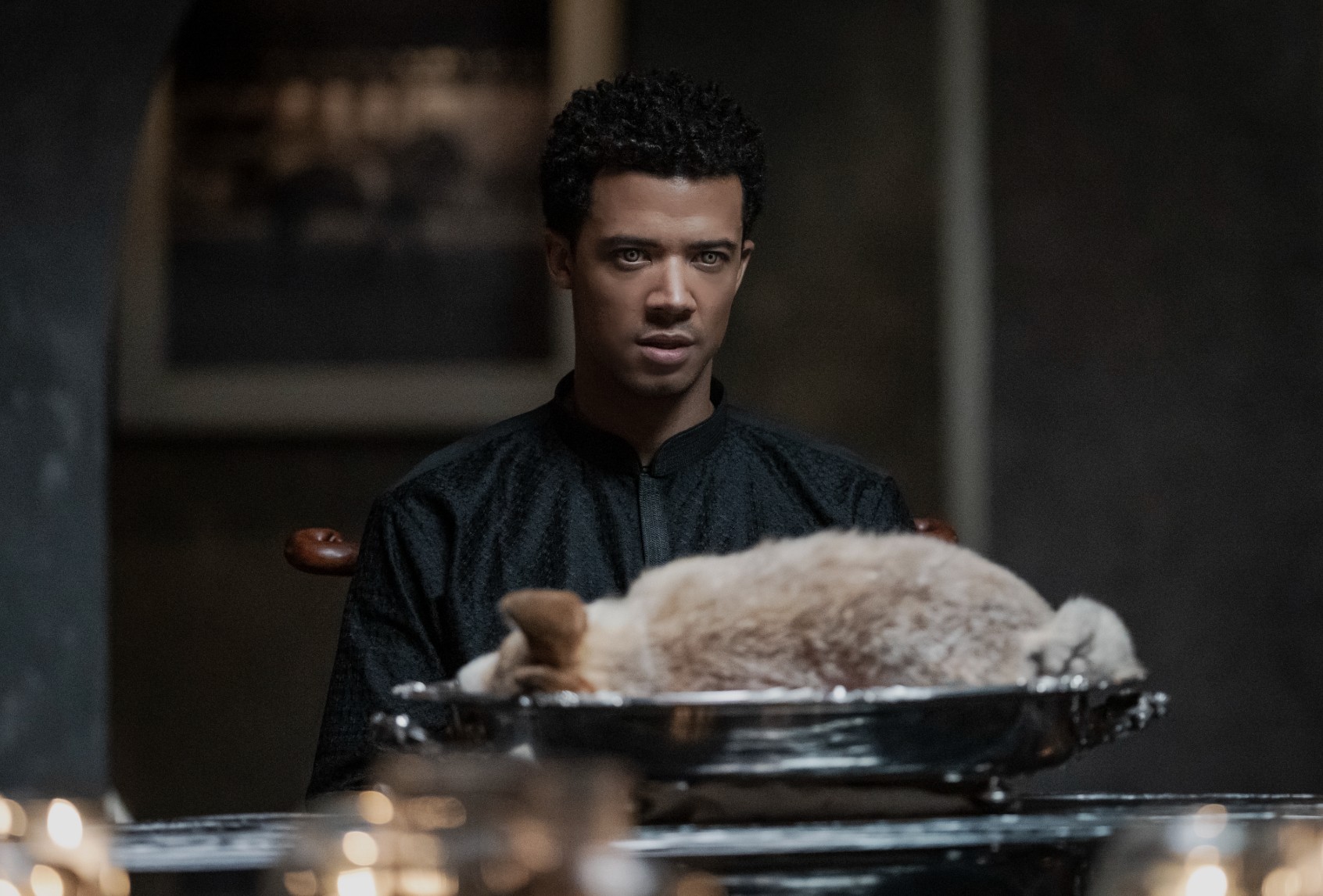
Consider the similarities between some of the world’s richest men, and the 2022 version of Louis de Pointe du Lac (Jacob Anderson), an astronomically wealthy vampire who transforms an entire floor of a Dubai skyscraper into a crypt. Servants attend to his needs and that of his biographer, journalist Daniel Molloy (Eric Bogosian), and other humans allow Louis to drink their blood fresh from the vein.

We never glimpse the underclass toiling on the streets below and beneath hammering sunrays that would turn Louis to ash, but we know they’re down there. So does our vampire. Fortunately for him his wealth and the intentionally designed darkness of his architectural jewel insulate him from that rabble.

Louis is quite literally above it all, draining the life from Earth’s creatures similar to hungry corporate profiteers waiting to swoop in and suck the marrow of the financially stricken.

Jacob Anderson as Louis De Point Du Lac – Interview with the Vampire _ Season 1, Episode 2 (Alfonso Bresciani/AMC)

“Vampires are killers,” he tells Danny over a multicourse dinner after he’s drained a fox-like creature. “Apex predators whose all-seeing eyes were meant to give them detachment, the ability to see human life in its entirety, not with any mawkish sorrow, but with the thrilling satisfaction of being the end of that life. Having a hand in the divine plan.”

He goes on to explain to Danny, “Our book must be a warning as much as anything.”

Anxiety over a looming recession isn’t the stated reason “Interview with a Vampire” is making its TV debut right now alongside “Let the Right One In” or “Reginald the Vampire,” all shows based on popular book series, two of which have previously been realized as theatrical releases.  

The same can be said of “The Twilight Saga” and “True Blood,” both of which made their movie theater and small screens debuts in 2008.

The current vampire resurgence is not some mystical omen but, rather, a reflection of our national mood.

However, they follow a loose pattern that popular culture theorists have tracked since at least the second half of the aughtsA 2019 essay by s.e. smith extensively tracks the rise of the vampire in times of economic stress before the arrival of “Dracula,” but here’s a short list of recent, famous titles that fit this phenomenon: Charlaine Harris’ Sookie Stackhouse novels, the source material for “True Blood,” and Stephanie Meyers’ “Twilight” novels all published in the years leading up to The Great Recession, with the “Twilight” movies and “True Blood” finding audiences in the thick of it.

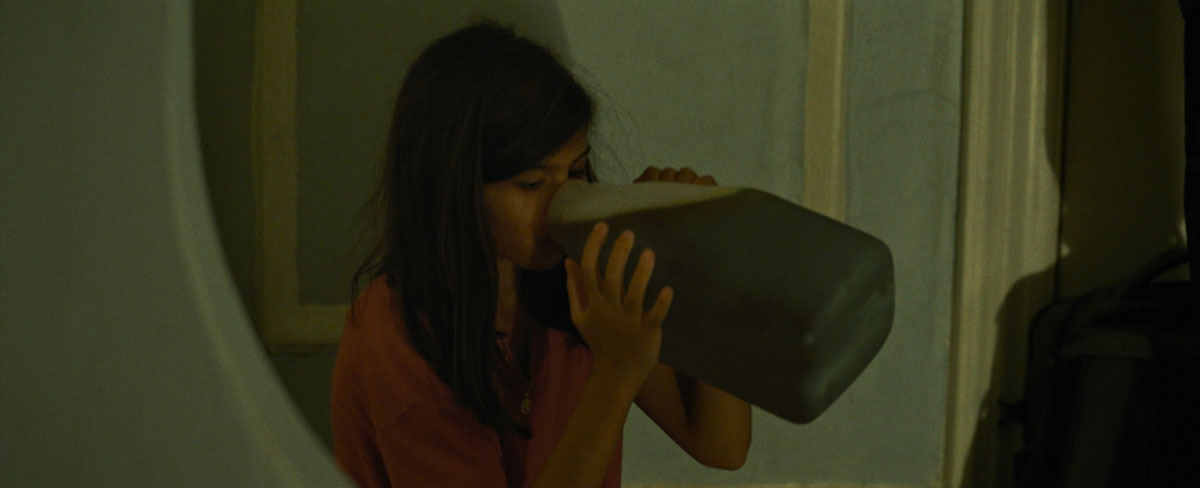
Let The Right One InMadison Taylor Baez as Eleanor Kane in Let The Right One In, “Anything for Blood” (Courtesy of SHOWTIME)
A similar coincidence exists with the summertime debut of “The Lost Boys” in 1987 months before Black Monday dealt a wallop to Wall Street in October.  And Rice’s vampire novels were originally published in the 1970s during a shaky economy. The 1994 adaptation of “Interview with the Vampire” that starred Tom Cruise and Brad Pitt arrived in the same year as the worldwide crisis known as the Great Bond Massacre.

Again, this doesn’t make the current vampire resurgence some mystical omen but, rather, a reflection of our national mood. The 1987 crash didn’t materialize out of the ether any more than the Great Recession did. Every economic crisis takes years to ripen, and the average person may not be able to read the signs of when the plunge is coming or how long it will last. But we can sense the nervousness leading up to it through rising prices at the gas pump and the grocery store. Austerity brings out our fear of fangs.

Zombies… are stand-ins for the exploited masses.

There are few more efficient ways to unleash the demons, madmen, and ghosts hidden in the darkest crevices of the human psyche than to inject anxiety into our imaginations. And among the most familiar figures to relate to in the monster pantheon are, yes, vampires and zombies. That’s why these two incarnations of the undead regularly cycle in and out of fashion – they’re handy metaphors.

Zombies, formerly sentient individuals doomed to mindlessly serve a hunger that can never be fully satiated, are typically interpreted as stand-ins for the exploited masses. George Romero’s 1978 classic “Dawn of the Dead” concretely linked the idea of undead hordes with unchecked consumerism by setting the action inside a mall. Since then they’ve served as parables for rampant groupthink and, more recently, the pandemic. Indeed, AMC’s long-running horror hit “The Walking Dead” saw its ratings plummet during the pandemic. Its final episode are airing while “Interview with a Vampire” is being introduced.

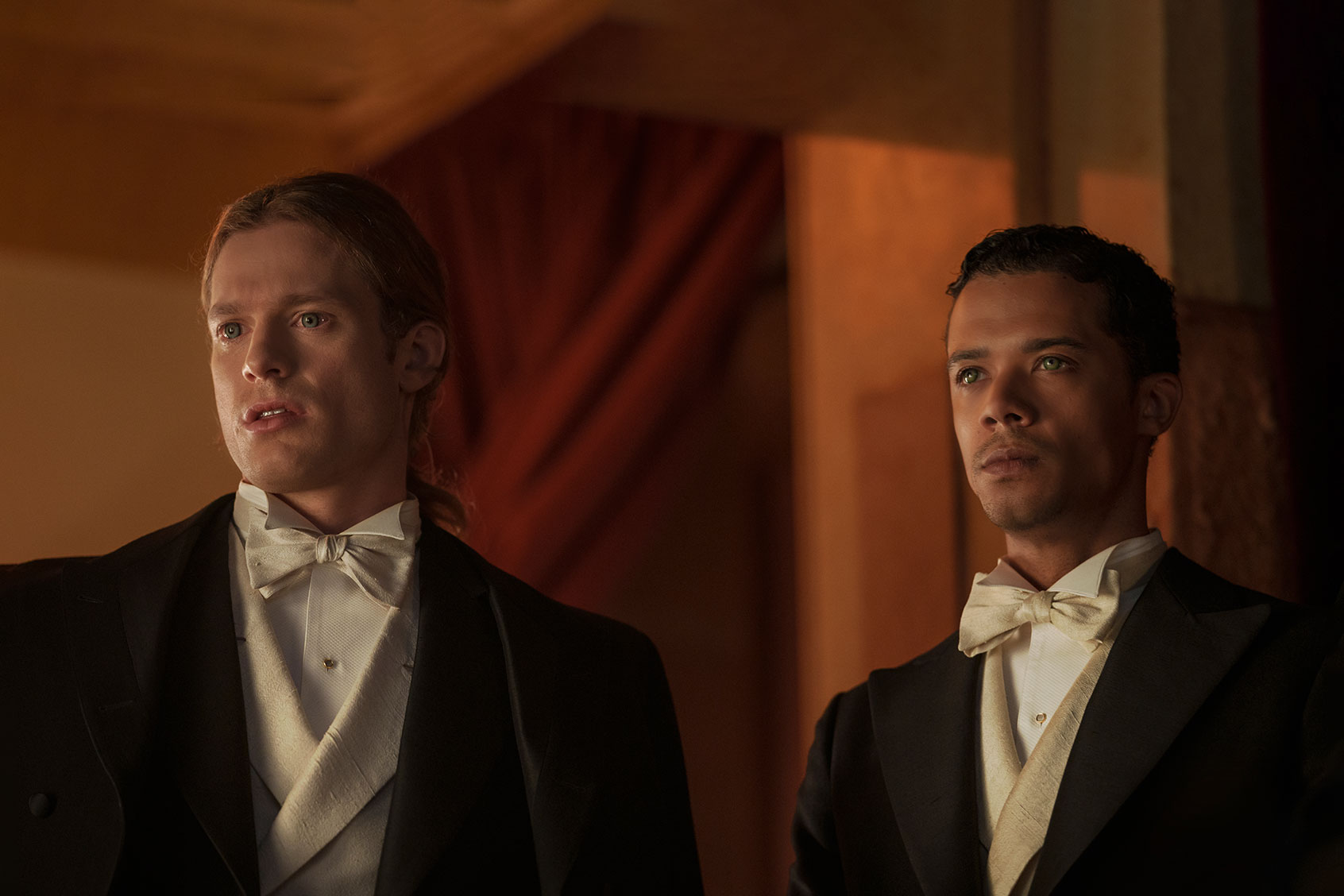
From what the ratings show, it’s safe to say we’re ready to trade the bloody apocalypse for gleaming fangs and velvet luxury. Vampires also represent exclusivity, the good (after)life enjoyed by former humans deemed worthy of immortality, as Sam Reid’s Lestat de Lioncourt decided of Louis.

Interview with the VampireJacob Anderson as Louis De Point Du Lac and Sam Reid as Lestat De Lioncourt in “Interview with the Vampire” (Alfonso Bresciani/AMC)
Lestat represents the most successful of them – let’s call them the one percent. They’re the elegant figures who live hundreds of years and amass generational wealth beyond measure. They also tend to have extravagant, libertine tastes in fashion and entertainment, the pleasures we fantasize about and forgo when budgets are strained.

And yet, we should be leery of being seduced by bloodsuckers actual and figurative since they can hide among us. Louis tells Danny that vampires wait for opportunities to feast on humanity at its weakest, such as global pandemics and “the unraveling of geopolitical foundations.”


Want a daily wrap-up of all the news and commentary Salon has to offer? Subscribe to our morning newsletter, Crash Course.


There are other factors in play that make this vampire wave serve a different purpose than others (as well as outliers such as “What We Do in the Shadows,” which would soar regardless of the era in which it premiered).

Madison Taylor Baez’s Eleanor, the child vampire at the heart of “Let the Right One In,” is hinted to be collateral damage in some yet-to-be-revealed plot related to a Sackler-like millionaire who played with forces he should have. Eleanor and her protective father aren’t rich – they’re desperate. In their story blood isn’t power but a trap, an addiction she yearns to be free of.

Let The Right One InMadison Taylor Baez as Eleanor Kane in Let The Right One In, “Anything for Blood” (Courtesy of SHOWTIME)“Reginald the Vampire,” on the other hand, makes Jacob Batalon’s title character a wish-fulfillment figure: people around him call out the fact that he’s fat, and his maker Maurice (Mandela Van Peebles) warns him that the rest of the vampire will shun him because he doesn’t fit their image of perfection.

Each of these shows features vampires who are brown and Black, outsiders before they received what Lestat called “the dark gift,” or a curse.

“Interview” leans into this with force, proving how useless Louis’ superhuman powers are in the face of institutional bigotry, especially the version that plays out in early 1900s New Orleans. But this also keeps Louis connected to his humanity and, therefore, relatable. That’s good, because if the sun is about to set on our economy, we’ll appreciate the cold, cool comfort that his extraordinary adventures offer.

Mary Trump says Uncle Donald is a mass murderer, that Secret Service “knew” about Jan. 6

Psychologist and podcaster Mary Trump, who is former President Donald Trump’s niece, blasted the Federal Bureau of Investigation and the United States Secret Service on Saturday’s edition of “The Mary Trump Show” over the revelations that the agencies were aware of the threats against House Speaker Nancy Pelosi (D-California) [as well as then-Vice President Mike Pence] in advance of the January 6th, 2021 Capitol insurrection. The House Select Committee investigating the attack broke that news during its public hearing last week.

“People continue to pretend that [President] Joe Biden just waltzed into office as if everything was just fine. And he’s being measured against this completely irrelevant standard. Like, this is not normal. None of it’s normal. And he had so much on his plate to deal with because of the last administration. And and, you know, he had to like, dig us out of like, the Marianas Trench,” Trump said. “So now we’re finding out that, as we learned last week from the January 6th [Committee], the FBI and the Secret Service knew. They knew! What was heading our way. Maybe not down to the last detail, maybe not to the exact size of the crowd, but they knew that there were threats against Nancy Pelosi. They didn’t act on that until after the insurrection had already started. They knew that people were coming. They did nothing. In fact, they stood down! Right?”

Watch here via Mediaite.

Later in the episode, in which she was joined by Law Professor Jennifer Taub of Western New England University and Brian Karem, the White House correspondent for “Playboy” and a CNN political analyst, Trump expressed exasperation that her uncle has never been held accountable for making the COVID-19 pandemic worse.

“The Trump, the soon-to-be deceased Trump Organization charged the Secret Service like five times the government limit to stay at his sh*tty hotels, we’re learning. We’ve learned that – and this, this to me. I will never cease to understand why this wasn’t made a bigger deal – that he politicized it, not just politicized the CDC. I mean, that happened eventually. But before he got that far, he essentially hamstrung the CDC and prevented it prevented them from doing what it was designed to do, which was to protect the American people from things like COVID-19, which resulted in the unnecessary deaths, and therefore purposeful deaths of hundreds of thousands of Americans. That alone – that alone should have landed this, the former, whatever the f*ck we want to call him, the mass murderer criminal Donald Trump — in prison,” Trump lamented.

“And yet I don’t I don’t see anything being made of that. So. Well, like in the backgr – hang on a sec – and then, Brian, go take it wherever you want to go. But it’s like, that’s, that should be the context in which everything else is discussed,” added Trump. “And yet it’s literally the f*cking horse race again.”

Report: Extreme heat will hit urban poor the hardest, worsening inequality

Extreme heat kills more people globally than any other climate-change related hazard, and will likely increase human suffering in parts of the world with already high humanitarian needs, according to a new report

The joint report from the UN’s humanitarian aid office and the International Federation of Red Cross and Red Crescent Societies, or IFRC, outlines the unequal impacts of extreme heat and the steps that governments and humanitarian organizations can take to reduce the risk to vulnerable communities and help them adapt.

The report, released ahead of next month’s UN climate change conference in Egypt, states that parts of the world facing the most extreme health and social crises — the southern Sahara region, the Horn of Africa, and areas of South and Southwest Asia — will also be the hardest hit by heat waves in the coming decades. This would not only result in suffering and loss of life, but also massive population movements and deeper inequality. 

“The climate crisis is intensifying humanitarian emergencies all around the world,” said Jagan Chapagain, the Secretary General of the IFRC, in a statement. “To avert its most devastating impacts, we must invest equally on adaptation and mitigation, particularly in the countries most at risk.”

In both wealthy and poor countries, the dangers posed by extreme heat are growing at an astounding rate due to climate change. But its impacts are unequal. Agricultural workers, migrants, children, and the elderly are at the highest risk of illness and death as a result of high temperatures. And low-income countries — those least responsible for climate change — will see the highest temperature increases and will bear the brunt of heat stress.

In low-income countries, vulnerability to extreme heat will be felt the most in urban communities that lack access to reliable electricity and water infrastructure. A 2018 report from a collaborative project called The Future We Don’t Want, predicted that by mid-century there would be a 700 percent increase in the number of urban poor living in extreme-heat conditions. While a number of countries like India have adapted city, state, and national “heat action plans” to reduce risk from extreme heat, few low-income countries and no African countries have put any in place.

But the good news, according to the report, is that at-risk urban communities are also uniquely positioned to benefit from heat action plans that humanitarian groups have already implemented in sprawling migrant camps. These plans include using religious sites and public spaces as cooling centers, painting roofs white to cool shelters, and establishing seasonal heat warning systems. The report encouraged these humanitarian groups to share these techniques and other expertise with city and national governments in countries where they are already established.

Are depressed moms to blame for their children’s developmental delays?

Watch your tone, moms. A new study out of Germany reports a link between maternal postpartum blues and developmental delays in infants.

But while the ripple effects of parental mental health on children and the need for improved resources for families are real and pressing problems, the framing around these issues reveals some other things that could use some improvement, too.

“Communicating with babies in infant-directed-speech is considered an essential prerequisite for successful language development of the little ones,” the Max Planck Institute for Human Cognitive and Brain Sciences release on the study reads. But a brief that includes “successful” and “infant” in the same sentence immediately raises a few questions. The research itself is intriguing, focusing on a small sample of 46 mothers and their infants, and the correlation between the moods of the moms and the early language development of the babies.

The findings revealed that “Even children whose mothers suffer from mild depressive mood that do not yet require medical treatment show early signs of delayed language development.” Or, as a CNBC headline drastically puts it, “Mother’s mood can affect the child’s ability to speak, study reveals.”

A mother’s voice exerts an undeniable influence. A child will begin to recognize it in utero, before it learns the voices of other family members. In early infancy, it will prefer that sound over other feminine voices. And babies, as anyone who has ever found themselves in the presence of one knows, also prefer the higher pitched, universal singsong that researchers call “motherese.” We instinctively lapse into that rhythmic, soothing way of talking to babies because it’s how they best begin to grasp language.


Want more health and science stories in your inbox? Subscribe to Salon’s weekly newsletter The Vulgar Scientist.


The CDC estimates that roughly one in eight mothers experiences postpartum depression. The number of mothers who have any postnatal mood disruption may be as high as 70 percent. And any mother facing postpartum depression, or even mild baby blues, may find it challenging to modulate her speech, leaning toward the lower, flatter tones that are often a dead giveaway of mood disorders. The mother may also be less engaged and interactive overall.

The scientists at the Max Planck Institute found that “If mothers indicate a more negative mood two months after birth, their children show on average a less mature processing of speech sounds at the age of six months,” which potentially could lead to a higher risk of the child suffering a speech disorder as they grow up. This is an understandably sincere concern.

That said, it is important to stress to those individual moms who are just trying to keep a tiny screaming meatloaf alive and not feeling great today that it does not automatically follow that your child will “suffer” a speech disorder because of your immediate mood.

Perhaps more troubling here is the implication that women’s legitimate physical and emotional needs are of greater concern if it means somebody won’t be accepted into the Harvard class of 2044. Sure, there is nothing wrong with identifying the mental health challenges new mothers face, or the potential long term effects they may have on their offspring. 

“Women are especially good at taking credit for everything that’s wrong in their kids’ lives.”

But the dire implications of these kinds of studies, based on six month-old infants and without substantive long range data, put even more pressure on a population that is intensely vulnerable to guilt and shame.

As University of Canterbury researcher and clinical psychologist Lisa Marie Emerson told the Washington Post in 2021, “Women are especially good at taking credit for everything that’s wrong in their kids’ lives, in part because the tremendous societal pressure to raise kids ‘right’ often falls on moms, not dads.” And there it is.  

We don’t parent in a vacuum. Our children may know their biological mothers’ voices first, but they are not the only ones they hear. They are welcomed into a noisy world where not just one person should be entirely responsible for their “success” or “suffering.” “To ensure the proper development of young children, appropriate support is also needed for mothers who suffer from mild upsets that often do not yet require treatment,”  Gesa Schaad, lead author of the Planck Institute study said in a recent statement. “Sometimes it just takes the fathers to be more involved.” You don’t say?

Curious about plant-based milk? Tom Philpott answers your questions

Walk into any coffee shop or browse any milk case at the grocery store and you’ll be sure to find an array of plant-based milks. From nut milks such as almond and macadamia, to the trendy oat milk, these alternative milk options may leave you with questions — are some really more sustainable than others? Should I be concerned about all of the ingredients I read on the labels?

In the latest episode of our podcast, “What You’re Eating,” we dive deep into the different milks you’re putting in your coffee, including plant-based milks and cow’s milk, to evaluate the different foodprints of each type. On that episode we speak with food journalist and researcher, Tom Philpott, who has written extensively about almond production and plant-based milks.

We asked Tom to join us in a Twitter chat to field your questions about plant-based milks. Keep reading to hear his insights and then tune in any time after 10/18 to listen to our podcast episode.

Q. Any environmental impacts from the added oils and gums in plant-based milks?

TP: These are used in such tiny amounts that I doubt they move the needle much environmentally. Should also note that they’re widely used in loads of processed dairy products, like flavored milk and many yogurts.

Q. What could the future of plant-based milk look like if we are looking for true sustainability?

TP: I’d like to see a move away from feedstocks that can only be grown in a tight range of climates (almonds) to ones that have a broad range, like oats. I also like feedstocks that do well when grown in rotation with other crops — another advantage for oats.

Q. Do you foresee a future where plant-based milk is normalized?

TP: We’re already there, or close. Plant milks make up 15%, and growing, of US total milk sales. A ubiquitous union-busting coffee chain now features a specialty product centered on oat milk — you’d have to make a special request to get dairy milk.

Q. What’s the most planet-friendly alt milk?

TP: Right now, it’s oat milk. Simply rotating oats into the Midwest’s ruinous corn-soy duopoly  — along with a legume like red clover — could go a long way toward ramping down that region’s environmental wreckage. In short, an expansion of US oat agriculture could have large environmental benefits.

That’s simply not true of, say, almonds. California almond acreage will have to shrink because of declining water resources. I make the case for oat milk here. (Pardon the overblown headline. Oat milk can’t and won’t “change everything.”)

Q. Is oat milk truly considered healthier/more sustainable?

TP:”Healthy” is a hard one to quantify, but it brings more protein and fiber than most alt milks. I think it wins on sustainability for reasons laid out above.

Abortion and authoritarianism: Why women’s freedom threatens male supremacy

Will America’s future be one of democracy and women’s control over their own bodies or one of authoritarianism and forced pregnancy? The two issues most motivating Americans to vote for Democrats in the rapidly approaching midterm elections are far more intertwined than is generally recognized. 

At a time when right-wing extremists are hellbent on making American states — or, as many intend the whole nation — into the fictional Republic of Gilead, it is appropriate to turn to Margaret Atwood. “Tyrants and dictators like Adolf Hitler and Nicolae Ceausescu have often dictated the terms of fertility and criminalized those who did not comply,” she pointed out in 2017. “It’s no accident that Napoleon banned abortion. He said exactly what he wanted offspring for — cannon fodder. Lovely!” 

Speaking of authoritarian regimes, Atwood said in 2020, “What it comes down to is that they assert their right to control reproduction, and they assert their right over people’s bodies. All totalitarianisms, no matter what they say their aims are, no matter what’s on the flag, they all have in common the rollback of women’s rights.” 

Historian Ruth Ben-Ghiat, who has conducted a transnational and transhistorical study of authoritarian regimes, makes the same point.  “Control over female bodies,” she writes in her 2020 book, “Strongmen: Mussolini to the Present,” is invariably among the goals of the insecure males who call themselves by that name.

To understand, and try to overcome, both the treatment of women as property and the basis of authoritarianism, we must dive into the deep history of humanity. When we do so, we find that those two evils emanate from the same source. 

It is more than mere coincidence that the desperate, redoubled quest to outlaw abortion gained traction during an era in which women have achieved a greater degree of autonomy in other areas. The underlying question is not whether a fetus is a person. Rather, it is whether a woman a person, or simply property.

That oldest and most consequential question in human history is the deep font of the struggle to control women’s bodies, which is why it is so crucial to the self-doubting men who turn toward authoritarians.

The original sin

It is often and correctly said that enslavement is the original sin of America. Less recognized is another foundational condition shaping much of recorded history and our lives today: Sexism is the original sin of humanity.

Misogyny is the gateway drug to all other hatreds, all other relationships of dominance and subordination. The belief that men are superior to women is the model on which all other vertical divisions — race, class, nationality, master/slave, religious hierarchies and so on — have been constructed. The subordinate position in these relationships is always depicted as corresponding to women.

Consider the 1975 Alice Cooper song “Only Women Bleed,” which — believe it or not — hints at the origin of what is at stake in the struggle over a woman’s right to control her own body. The foundation of the conviction for thousands of years that “he got the power” and “she got the need” is the erroneous idea that men have the “seed” and women’s purpose and need is to “take” that seed.

The seedtime of sexism

A very deep history lies beneath this subject. To understand it, we need to go back to what can accurately be termed the seedtime of sexism.

Creative power had presumably been seen as female in most societies over the vast eons in which our distant ancestors lived as hunter/gatherers, dependent on plant and animal food produced by nature. Terminology like “Mother Nature” and “Mother Earth” are remnants of that belief. Men appeared to have little or no role in reproduction. Here’s a striking example of that way of thinking: Nearly a century ago, anthropologist Phyllis Kaberry tried to explain the role that men have in creating babies to a group of indigenous women in Australia. One responded that she had proof that men have nothing to do with making new life: Her husband had died many months before she gave birth. Another woman summed it up succinctly, “Him nothing!”

Misogyny is the gateway drug to all other relationships of dominance and subordination. The belief that men are superior to women is the model on which all other vertical divisions — race, class, nationality, master/slave, religious hierarchies and so on — have been constructed.

In addition to being seen as the possessors of the power to create life, women in most hunter/gatherer societies were also co-providers through the collection of plant food. Those roles appear to have resulted in women having a rough level of equality with men in many of those societies. The development of agriculture, in all likelihood by women, more than 10,000 years ago began a mega-revolution that radically altered human life.

Agriculture led to both animals and women being domesticated. Increased food supply made population growth possible. Women spent more of their lives bearing and raising children. When the plow was introduced — in some areas roughly 6,000 years ago — and men began planting seeds in the rutted ground, a seeming correspondence was noticed. The furrowed soil resembled a woman’s vulva, and it occurred to men that planting seeds in a groove in Mother Earth seems analogous to a man “planting” what came to be called semen (Latin for seed) in the groove between the labia of a woman.

This correlation came to be taken as an operational equivalence, and it overturned the understanding of which sex has creative power as readily as a plow overturns soft, moist soil. “Who will plow my vulva?/ Who will plow my high field?/ Who will plow my wet ground?” asks Inanna in “The Courtship of Inanna and Dumuzi,” a Mesopotamian poem from around 1750 BCE. Men were elevated to the all-powerful creators — authors — of new life and so those with authority. Women were reduced from being thought to possess sole power to create new life to the counterpart of dirt — a place for men to plant their seeds. The common reference that continues to this day to women who do not conceive as “barren” is a reflection of the belief that they are soil.


Want a daily wrap-up of all the news and commentary Salon has to offer? Subscribe to our morning newsletter, Crash Course.


Both human gametes are microscopic, and the sperm is even smaller than the egg. Semen, however, is visible and it is obviously the case that a woman becomes pregnant only after it is “planted” in her. Yet, for those who thought much about the view that semen is the seed of a new life there were a few difficulties that needed to be explained away. One is that women also produce a visible fluid, and its discharge ceases during pregnancy. Wouldn’t that indicate that menstrual fluid also contains something necessary to the creation of new life? The other is that offspring sometimes resemble their mother. How can that be if the woman provides nothing to the new life except a place, analogous to soil, where the generation can occur?  

In his 4th century BCE explication on female inferiority in “Generation of Animals,” Aristotle sought to answer those questions. In a convoluted argument, he achieved his objective of propping up the belief that men are the sole authors of life. Hippocrates had previously hypothesized that each sex provides life-giving material. Aristotle rejected that idea by taking it as axiomatic that “it is impossible that any creature should produce two seminal secretions at once.” So it followed, he claimed, “that the female does not contribute any semen [seed] to generation.”

Menstrual fluid, Aristotle suggested, was a weak, powerless concoction that merely provided the lifeless material to which semen gives life. A woman, he declared, is merely “an infertile male” who “lacks the power to concoct [seed].” The female “is as it were a deformed male” and menstrual fluid is an impure form of semen lacking “one constituent … the principle of Soul.” This argument seemingly solved the problems Aristotle had set out to address. A woman cannot produce new life, but if she provides the matter that will become a child when it is given life by a man, then of course it could resemble her. If the material given life by a man is necessary, that seemed to explain why menstrual discharge ceases during pregnancy.  

The reversal of reproductive power based on the Seed Metaphor (so central in human history that it merits capitalization) can be found in numerous ancient texts. A few examples:

  • In Genesis 13, God tells Abram, “I will make your seed like the dust of the earth.”  
  • “The mother is no parent of that which is called her child, but only nurse of the new-planted seed that grows,” Aeschylus has Apollo proclaim in “Eumenides” (circa 458 BCE). “The parent is he who mounts.” 
  • In Sophocles’ “Antigone” (circa 442 BCE), when an astonished Ismene says to Creon, “What? You’d kill your own son’s bride?” the king calmly responds, “Absolutely: There are other fields for him to plow.”
  • “Your wives are a place of sowing of seed for you,” verse 223 of the second surah of the Quran instructs men, “so come to your place of cultivation however you wish.”

The evil effects of taking this metaphor literally have been monumental on a scale similar to those that flowed from accepting the story in the second and third chapters of Genesis as literally true. In both cases, those consequences centered on seeing women as inherently inferior.

Considering women as the functional equivalent of tilth — prepared soil ready to be seeded — reclassified them as property: real estate in which men grow their crops of children. Property owners have rights; property (implying that which is properly, or rightfully, owned) does not.

Viewed in the light of the Seed Metaphor, planter was an especially appropriate term for American enslavers. Many of them were planters of their “seeds” in enslaved women, using them as fields in which to grow a cash crop: more enslaved human beings. “I consider a woman who brings a child every two years as more profitable than the best man of the farm,” Thomas Jefferson wrote in 1820 of the value of enslaved women. “What she produces is an addition to the capital, while his labors disappear in mere consumption.”

The long and pernicious afterlife of the conception misconception

The improvement of the microscope in the 17th century and beyond made possible the identification of two components in sexual reproduction, but the functions of sperm and egg were still unclear. The ovum was seen through a microscope in 1827. But the fact that the woman produced ova did not necessarily mean she was a source of life. The egg could readily be seen as the container of the matter to which Aristotle had contended the man’s seed gives life and soul. Indeed, after sperm had been seen under microscopes, the already existing idea of preformism, which held that organisms grow from preexisting tiny versions of themselves, crystalized into the concept that the homunculus — the “little man” — was inside the sperm. 

It was not until the 1870s that it began to become clear that a new life resulted from the combination of life-giving material from both parents. It is therefore ludicrous to claim that the “traditional” Christian view was that life begins at conception, since through the first nearly two millennia of the Christian Era, no one clearly understood when or how conception took place.

Although educated people have known for well over a century that the Seed Metaphor is inaccurate, it goes on like a zombie, eating the brains of people across modern cultures much as it did in the past, insidiously germinating the poisonous misconception that women are and ought to be property for the use of men. 

It was not until the 1870s that it became clear that new life resulted from the combination of life-giving material from both parents. So it’s ludicrous to claim that the “traditional” Christian view was that life begins at conception.

The message to women is unmistakable: Your only purpose is to carry his seed. That is the dominating, degrading and debilitating — authoritative, in a word — lesson that has been taught to women for thousands of years. And it is the cracking foundation beneath the authority that Roman Catholic bishops, evangelical pastors and other insecure men fear is being “usurped.”

Authoritarianism is an extreme manifestation of the power relationship based on the never-to-be-questioned inequality between men and women. That is the motive force in the rise of authoritarian rulers and would-be rulers around the world, from Russia to Hungary to Turkey to Brazil to the Philippines to the United States. A man claiming unlimited power over others asserts that he is in the position of a god, the Author to whom all others are subordinate. Authoritarians are males terrified that they aren’t “real men.”

 Ironically, the weak men who are so attracted to these “strongmen,” apparently believing that some of the authoritarian leader’s supposed virility will be infused in them if they submit — offer themselves — to him, are unconsciously putting themselves in what they classify as the woman’s place: subordinate, powerless, submissive, obedient, serving, groveling before “The Man.” They act like Ilsa in “Casablanca” when she says to Rick, “Oh, I don’t know what’s right any longer. You’ll have to think for both of us, for all of us.” Please, Dear Leader, tell me what I must think and do. Picture Mike Pence and other members of Donald Trump’s entourage telling him that serving him was the greatest honor they could imagine. They were presenting themselves for “The Man” to plant his putative manhood in them.

Authoritarianism, forced pregnancy, and the “great replacement”

This deep history explains why the issue in Dobbs v. Jackson is seen by many anxious males as monumental. If male dominance is to be maintained, women’s reproductive freedom must be curtailed. It isn’t really about choice, as such, but about denying women the right to make the choice. Ancient Romans, for example, were “pro-choice,” but the choice was solely that of the man. His supposed creations were his, not hers. Farmland has no say in whether crops planted in it will be allowed to grow or be pulled out or plowed under. The patria potestas, the authority of the father, was absolute.

Thou shalt not pull up what man has planted. That sentence sums up the position of many churches today — and, alas, the radical right-wing majority on the Supreme Court.

In the decades since women began moving toward equality, male supremacists have intensified their efforts to put them back “in their place,” accurately described by Atwood in “The Handmaid’s Tale” as “two-legged wombs, that’s all: sacred vessels, ambulatory chalices.” As George Carlin put it in a 1996 routine, “Pro-Life Is Anti-Woman,” those who oppose women’s control over their own bodies “believe a woman’s primary role is to function as a brood mare for the state.”

After Kansas voters overwhelmingly rejected removing abortion protection from the state constitution, one postmortem used Seed Metaphor terminology to describe the position of forced-pregnancy advocates. They want “to treat a woman’s body like it’s a high-yielding 160 acres of Kansas farmland,” Priti Gulati Cox wrote. Presumably without being aware that she was doing so, she pointed out that those who sought to deny women’s ownership of their bodies are applying Thomas Jefferson’s 1820 argument on the value of enslaved women: “The higher the yield, the higher their value.” 

The connection between authoritarian regimes and the use of women as fields in which to grow new members of the favored race is undeniable. “Cradles are empty and cemeteries are expanding,” Benito Mussolini warned in 1927, language often echoed by the American right today. “The entire white race, the Western race, could be submerged by other races of color that multiply with a rhythm unknown to our own.” One of Mussolini’s programs was called the “Battle for Babies.” It presented awards to prolific women for being such rich, productive soil (if not quite in those terms), while banning abortion and contraception. If that sounds familiar to Americans in 2022, it should. On July 21, 96 percent of Republican members of the House of Representatives voted against legislation to protect access to birth control.

The connection between authoritarian regimes and the view of women as fields for growing new members of the favored race is undeniable: “Cradles are empty and cemeteries are expanding,” Mussolini warned in 1927.

American right-wing extremists have chosen the racist and misogynist Hungarian Prime Minister Viktor Orbán as their model. He and others on the radical right in Europe and the United States have taken up fear-mongering about the “great replacement” of white Christians by others (whether identified or not). In July, Orbán gave a speech in which he declared, “We mix within Europe, but we don’t want to be a mixed race.” One of his own top aides characterized it as “a purely Nazi diatribe worthy of Joseph Goebbels.” Yet the American radical right’s admiration for Orbán remains undiminished. The Conservative Political Action Committee (CPAC) still welcomed him to speak at their gathering in Texas in early August.

This is easily overlooked, but much of the replacement fear authoritarians fire up among insecure men is not only that they will be replaced by people of other skin colors, cultures or religious faiths, but also that they will be replaced by the original “other”: women. 

CPAC also held a 2022 meeting in Budapest. On May 19, Matt Schlapp, chairman of the American Conservative Union, said there that one way to reduce the supposed “replacement” of white people in the United States was to grow our own population by outlawing abortion. This is an interesting twist on the use of enslaved Black women as soil to grow more people who would be classified as Black and owned by the seed planters. Now white supremacists want to use white women to grow crops of “free” white children. The color of the “soil” has changed, but the treatment of women as owned real estate remains a constant.

Forced pregnancy fits into the “great replacement” hysteria not only on the premise that it will increase the white population, but also in that again classifying women primarily as soil will remove many of them from the workforce as competitors with men. On the day the Dobbs decision was announced, a Republican candidate for lieutenant governor of Minnesota explicitly argued that abortion leads to women having careers.

“Our culture,” Matt Birk pronounced, “loudly but also stealthily, promotes abortion. Telling women they should look a certain way, have careers, all these things.” Forced pregnancy, in this worldview can help put women back in their proper place: serving and servicing men, not replacing them: Kinder, Küche, Kirche (children, kitchen, church) as the Nazis defined women’s roles. And, of course, opening their furrows for men to plant the seeds that will produce more and more white babies.

“Question Authority”

The 1960s slogan “Question Authority” is key to the attainment of equality by women, and nothing questions male authority as much as women having the power to control their own bodies. Preventing women from deciding whether to continue a pregnancy is the sine qua non of the regime of male dominance and female subordination. Acceptance of that right recognizes that women and men are the co-authors of new life and have equal “authority.” Equality of the sexes is the foundation of an equal society. As long as women are seen as inferior, authoritarianism remains a danger.

The war on women’s choice is Armageddon for insecure men because if women have control over their own bodies, they are their own bodies — that is, they are equal human beings, not property owned by men.

That way lies the unraveling of male dominance and so it is on the issue they call “pro-life” (in truth, forced pregnancy), where self-doubting men who are terrified of equality with women have dug in for their last stand. Because the concept that men are superior to women is the foundation for all other claims that one classification of people is superior to another, to question male authority endangers the whole edifice of inequality that has been raised upon it.

Deuteronomy 22:29 declares that a woman must marry her rapist. Italian law had this requirementmatrimonio Riparatore, “rehabilitating marriage,” to restore a raped woman‘s reputation — well into the second half of the 20th century. After the Dobbs decision, in many states a woman — or even a 10-year-old girl — may be required to carry and deliver the child of her rapist. The message to women in the abortion laws passed in several states over the past few years is essentially the same as that in Deuteronomy: When you’re fucked, you’re fucked. Anxious, fragile men are determined to keep it that way.

Women and secure men must work together to establish, once and for all, that women are not real estate, but equal human beings. One place to start is by mobilizing to ensure that those who are unequivocal in their affirmation that women are free human beings have the political power to pass a federal law protecting women’s bodies from government control. Women being slaves of the state is what authoritarianism looks like. To surrender women’s freedom is to surrender all our freedoms.

Fascism expert: Here’s what’s stopping Trump from ending democracy

Donald Trump’s effort to stay in power despite losing the 2020 presidential election has resulted in congressional, federal, and local investigations. But far-right efforts to end democracy still lack two critical components, according to an authoritarianism expert.

Andrea Pitzer is the author of the 2017 book, “One Long Night: A Global History of Concentration Camps,” and explained her perspective in a thread posted to Twitter on Saturday.

“I was in the middle of writing my history of concentration camps when Trump announced his candidacy in 2015,” Pitzer wrote. “He did so many disturbing things ahead of the election. People asked me if the red flags meant inevitable disaster, if we were doomed to repeat grim 20th-century history.”

“It was all certainly alarming, and I drew several parallels in essays I wrote at the time. But I also noted some key differences in that moment–elements which distinguished 2015 and 2016 from the worst historical moments,” she explained. “Organized paramilitary violence in support of Trump or his platform was limited. There were not praetorian-guard law enforcement agencies whose allegiance he had fully cultivated. Many inside his own party were willing to call him out as a threat or mock his legitimacy.”

In May of 2016, Sen. Lindsey Graham tweeted, “If we nominate Trump, we will get destroyed… and we will deserve it.” But on Friday, Graham appealed to the Supreme Court with a “hail Mary” pass to avoid testifying about his role in “finding” votes for Trump in Georgia.


Want a daily wrap-up of all the news and commentary Salon has to offer? Subscribe to our morning newsletter, Crash Course.


“Unfortunately, despite Trump’s loss of the election in 2020, he has remained a significant threat to the country. And now many of those factors that were missing in 2015 are now in place, along with other conditions that risk destabilizing the election process,” Pitzer said.

“That said, there are two key areas still missing from the common template for ending democracy and establishing strong authoritarian rule: unambiguous support from the military and a court system willing to consistently defer to the executive,” Pitzer explained. “I think it’s not impossible for the army & courts to surrender eventually, but he’s not there yet. And neither is any other Trump rival. I offer this not to reassure but instead to say there’s still room to work. More than 50% of surveyed voters view him somewhat/very unfavorably.”

Pitzer concluded, “Having grown up in a Christian nationalist household, I’m pretty aware of what Trump supporters want and the damage they’re willing to do. But they are not a majority, and there is still time to stop them.”

Read the full thread.

Teen O’Ween: Let older kids trick or treat

I love my home, but around summer road improvements, elections and major holidays, the debates on the local social media pages get heated. One flaming thread that forever burns in my mind involves complaints about families from rural areas driving into the small but centralized town for the good and plentiful candy on Halloween. I nurse a controversial opinion that certainly would get me banned from the neighborhood Facebook page, or at least, some side-eyes at the grocery store: if someone shows up at your house on trick or treat night, no matter where they came from, what they look like, or how old they are, give them candy.

On YouTube, a video on how to “shame” teens who try to trick or treat at your house has over 18,000 views. Daytime talk program “The Real” had a show debating an age limit for Halloween, which some cities have actually passed laws about. Chesapeake, Virginia has a law on the books that will charge children over 14 with a Class 4 misdemeanor for trick or treating, while multiple other cities in Virginia prohibit trick-or-treating for kids above the age of 12. Some towns forbid the wearing of Halloween masks in public above a certain age while other have instituted curfews for teenagers on Halloween nights.

Also at work with Halloween laws is a confused view of what childhood is. 

The issue here is that we don’t trust teens, and certainly judgment is an area where adolescents are sometimes lacking, through no fault of their own. Adolescents’ brains are still developing and they don’t have a lot of lived experience to always make good decisions. At the same time, they want more independence and we try to give it to them when we can: I trick or treated alone with friends (no parents) when I was a teen, and my tween asked to do the same this year (I said no, not yet). Peer pressure is notoriously never the wellspring of great ideas — it’s why more and more states are passing laws restricting new teen drivers from having peers in the car, fewer distractions, fewer opportunities for drinking and texting. 

But also at work with Halloween laws is a confused view of what childhood is. Not wanting teens to egg your car or toilet-paper your house is understandable, but not wanting teens to spoil your younger kids’ fun with their . . . slightly older-ness smacks of elitism. Parents writes, “Parents of young children may worry that their little ones’ magical night might be ruined by rambunctious teenagers.” Who is Halloween for: you the grownup or the kids? All kids, because teens still are that.

Ascribing teenagers, a stage of development that is still a part of childhood, to be older than they are leads to a host of other problems. About 250,000 teens per year are tried in the criminal justice system as adults, despite their youth, putting them at great risk of victimization from an adult prison population — and making them 36 times more likely to die by suicide. Children given adult motives can lead to grooming and victim-blaming when a child is the survivor of sexual abuse perpetrated by an actual adult. 

To be a kid still is especially important for the children of now.

Kids are also not a monolith. As their developmental milestones are not the same, they also don’t all get “too old” for something at the same magical age. My kid started ordering for himself at a restaurant at age 5 — and eating what he asked for. He’s always been adventurous when it comes to food. At the same time, I slept with a night light well into my teens, and some adolescents never outgrow the beloved stories of their youth.

Allowing teens to trick or treat, giving them candy when they ask for it at your door, permits them to have fun without mischief, to run around in the dark for one night without fear. To be a kid still is especially important for the children of now, this moment, children who were robbed of and who continue to be denied central aspects of childhood, thanks to the pandemic, like going to school, being with their friends, even getting to play on playgrounds or go to movies or the mall. Teens of today lost at least two Halloweens to COVID, maybe more. 


Want a daily wrap-up of all the news and commentary Salon has to offer? Subscribe to our morning newsletter, Crash Course.


From deadly viruses to climate chaos to school shootings, it’s a horribly difficult time to be a person, but especially a young person with little to no power. Kids should be allowed to hold onto their childhood, if they want to, a little bit longer without conditions. Some kids have difficulty choosing among types of candy in a bowl. Some kids can’t say “thank you” or “trick or treat” because they’re non-speaking. Some kids might not have a costume because of their family’s financial situation. And some kids might be taller or older. You’re not the Halloween police. Leave the porch light off or let them treat. 

Dark money groups have pumped $1 billion into GOP campaigns to recapture Senate

Shadowy organizations that are legally allowed to hide their donors have pumped nearly $1 billion into the Republican Party’s effort to retake the U.S. Senate, according to an NPR analysis released Saturday.

In total, NPR found that “more than $1.6 billion has been spent or booked on TV ads in a dozen Senate races, with $3 out of every $4 being spent in six states — Georgia, Pennsylvania, Arizona, Wisconsin, Nevada and Ohio.”

“Most of that money is coming from dark money outside groups with little-to-no donor transparency — and Republicans are getting a huge boost from them,” the outlet reported.

Nearly 90% of the money spent on pro-Republican television ads this midterm cycle has been from dark money groups, according to NPR’s analysis of ad data. By comparison, 55% of spending on ads boosting Democrats has come from dark money organizations, which have exploded in number and influence since the Supreme Court’s 2010 Citizens United decision.

Predictably, key battleground states such as Georgia, Pennsylvania and Arizona have drawn massive ad spending from outside groups in recent months, as Senate races in those states tighten with just over two weeks until the November midterms.

Outside organizations have poured more money into Pennsylvania — where Democratic Lt. Gov. John Fetterman is locked in a competitive Senate contest with Republican nominee Dr. Mehmet Oz — than any other state this cycle.

“Outside groups have spent nearly $64.9 million to back Fetterman or sway voters away from the celebrity doctor, while conservative outside spenders have poured $66 million into the race,” OpenSecrets noted Friday. “One of the top outside spenders is the Senate Leadership Fund,” a super PAC aligned with Senate Minority Leader Mitch McConnell, which has “made Fetterman their top target, spending almost $37.2 million to oppose the Democrat.”

NPR analysis

NPR’s analysis came a month after Senate Republicans unanimously voted down legislation that would have required dark money organizations to disclose their large donors and funding sources, a step that would shine light on the forces attempting to sway critical races.


Want a daily wrap-up of all the news and commentary Salon has to offer? Subscribe to our morning newsletter, Crash Course.


OpenSecrets discovered last month that a newly created dark money group that has spent big on ads mocking and attacking progressive candidates in battleground states is “connected to officials in former President Donald Trump’s administration who now work with the America First Legal Foundation.”

“The group, Citizens for Sanity, has paid for billboards emblazoned with messages like ‘Protect Pregnant Men from Climate Discrimination’ and ‘Real progressives support violent criminals in their hour of need’ in states across the country — including Massachusetts, Colorado, Arizona, Nevada, Pennsylvania, California, Michigan, Texas, Illinois and Georgia,” the watchdog noted. “The ads have been described as racist and transphobic.”

“Federal Communications Commission records reviewed by OpenSecrets reveal that the group’s board includes three former Trump administration officials involved in the America First Legal Foundation, a group founded by former Trump White House official Stephen Miller,” OpenSecrets added.

The South lost the Civil War — but won the PR War

The violence broke out after the losing side in a presidential election refused to accept their defeat.

No, we’re not talking about the January 6th Capitol Riots, but the American Civil War. On a basic level, the Civil War was little more or less than 11 states violently seceding from the Union after the 1860 election because they opposed the victorious candidate, Republican nominee Abraham Lincoln. Correctly or otherwise, they feared that Lincoln was an abolitionist and opponent of white supremacy, both ideals that they held to be central to their Southern identity. Despite Lincoln’s repeated reassurances that he only wished to limit the expansion of slavery and would otherwise leave it untouched, the newly-formed Confederate States of America waged bloody war to form their own country so they could keep slavery intact.

“Imagine being a newly freed slave having to pass by an outsized monument of your enslaver.”

Four years and 620,000 deaths later, slavery had been abolished anyway and the South had been defeated — on the battlefield, that is. In the equally important war of public relations, the South slowly yet assuredly won a considerable victory: They created a romanticized myth about their defeat known as the “Lost Cause” narrative. Coined by Southern author Edward Pollard in 1866, the phrase “Lost Cause” referred to a narrative that refused to acknowledge how Confederates committed treason and were primarily motivated by a desire to preserve slavery, in a war catalyzed by a refusal to accept a lost election. The Confederates and their sympathizers insisted on being told they had fought a valiant and heroic crusade for “states’ rights” against unprovoked aggression from the North. The Lost Cause narrative was given a boost when the controversial 1876 presidential election proved so close that, to prevent a second Civil War, Republicans and Democrats struck a so-called “Compromise of 1877.”  This agreement ended the remaining federal attempts to dismantle systemic racism in the South in return for allowing Republican Rutherford Hayes to win the presidency. Before long, all mention of slavery related to the Civil War was downplayed or rationalized away, at least in mainstream culture; the focus, perhaps best epitomized by Hollywood epics like the 1930s novel and film “Gone with the Wind,” was on a supposedly chivalrous golden age tragically lost. Blacks, by contrast, were depicted as the enemies of both northern and southern whites, a notion that underpinned discriminatory racial laws and laid the foundations for a strong trend toward racism among police officers. Even though Black Americans had suffered as slaves for more than two centuries, Lost Cause advocates claimed that they had actually liked slavery. Some even perpetuated the myth that there had been Black Confederates.

In other words, the South and its supporters engaged in large-scale psychological manipulation against the rest of America so they could save both their dignity and their white supremacist society — and it worked like a charm.

“Imagine being a newly freed slave having to pass by an outsized monument of your enslaver,” Lecia Brooks, Chief of Staff and Culture at the Southern Poverty Law Center (SPLC), wrote to Salon. Brooks was referring to the mass production of Confederate monuments (which often occurred in Northern states), a process that reached a peak in the 1890s and occurred alongside a surge in white supremacist terrorism against Black Americans.


Want more health and science stories in your inbox? Subscribe to Salon’s weekly newsletter The Vulgar Scientist.


According to the SPLC, there are roughly 2,000 Confederate monuments still in the United States today. “While the term ‘domestic terror’ did not exist back then, the actions of those who championed the so-called Lost Cause mirror what we see today,” Brooks added. In addition to building statues and other memorials, Confederate sympathizers and other supporters of Jim Crow policies renamed streets, courthouses, schools, parks and military bases after either prominent Confederates or the Confederate cause more broadly. They targeted public property in both Union and neutral states to make sure their message spread far and wide.

“The perception of being disrespected, dishonored, rejected, or treated as inferior — what psychological professionals call ‘narcissistic wounds’ — can be powerful drivers of violence.”

“All of this iconography was used as racist props to intimidate and remind African Americans of their place, first and foremost,” Brooks explained. “Their widespread placement allowed the Confederacy to reimagine its treasonous acts as a noble effort while minimizing their brutal role in preserving slavery.”

In addition to terrorizing racial minorities and tricking whites into misremembering their own history, Confederate sympathizers had more personal psychological reasons for engaging in this campaign.

“Developmentally speaking, shame develops before guilt, and at the societal level we can speak of shame cultures and guilt cultures,” social psychiatrist Dr. Bandy X. Lee wrote to Salon. “The American South is a shame culture, where feelings of shame and humiliation are central, and the perception of being disrespected, dishonored, rejected, or treated as inferior — what psychological professionals call ‘narcissistic wounds‘ — can be powerful drivers of violence. Hence, there will be a great incentive to create a narrative that signifies the opposite — pride, self-love, and innocence — even if it is false.”

Dr. Edward Blum — a historian at San Diego State University who wrote the book “Reforging the White Republic: Race, Religion, and American Nationalism, 1865-1898” — told Salon by email that it was not simply Southern white pride and racism that made their “Lost Cause” mythology so persuasive. White Americans outside the South were all too willing to acquiesce for their own reasons.

“While the term ‘domestic terror’ did not exist back then, the actions of those who championed the so-called Lost Cause mirror what we see today.”

“I think northern whites had the very real problems of governance after the Civil War,” Blum explained. “They needed to govern the northern states who had lost men and money to the war; they had to somehow convince former Confederates to remain at peace; they had to determine the legal and civil status of African Americans (those who had been enslaved and those who had been free, but relegated to marginal status).”

“As these northerners dealt with of-the-moment social issues, they had less time and energy to fight a culture war with Lost Cause enthusiasts,” he continued. On top of that, some saw there was money to be made off of it, but others were less blatantly cynical. The Civil War had drained America’s energy as well as its manpower; many whites simply had no more stomach for rehashing what seemed to them to be dead conflicts. Even if they didn’t agree with the Lost Cause characterization, the path of least resistance was often simply ignoring it — even if the price of letting it go unchallenged was lending credibility to a lie.

Of course, it is difficult to morally square abandoning millions of people to the apartheid conditions that existed in Jim Crow America. As Blum explained, white Americans had a “a lot” of rationalizations to get around that conundrum, “which is an indication that they knew better.”

The Lost Cause narrative prevailed in America by, in essence, resorting to the oldest bully tactic in the book: Win by psychologically wearing down the opposition.

“Some used flat-out racism, the idea that white people (however defined) were just better than non-whites,” Blum wrote. “Then there were culturalists, those who believed the environment from which people came directed how they would be in society. So well-educated northerners saw themselves as better to lead, better to run the country, than uneducated African Americans. The direct reasoning was not nature, but nurture. Then there were those who invoked tradition. This is how things had been in the past, and things in the past were somehow more moral or better.”

Yet among all these groups, the one that Blum observed “seemed to really win out” were those who argued that it was simply unrealistic to hope to create a racially equal society. In their mind, “the price of change was simply too high,” Blum argued. “The cost to transform the United States, to genuinely recognize African Americans as equal Americans would have meant massive shifts to the economy, large-scale penalities and imprisonments for those who stood in the way, and ultimately a willingness to change the entire course of the past.”

While this decision likely seemed practical at the time, that sense of necessity existed because the South and its supporters abused the rest of the country into accepting its own Big Lie. The Lost Cause narrative prevailed in America by, in essence, resorting to the oldest bully tactic in the book: Win by psychologically wearing down the opposition. Confederate sympathizers repeated their lies so often, and engaged in both figurative and literal violence so often, that white America gave up in a state of collective exhaustion.

Even today, there are still many American whites who are prone to being psychologically manipulated by Confederate sympathizers. The only thing that has really changed are the tactics.

“When a shame culture becomes pathological — that is, no longer affirming life — it will use the same maladaptive manipulations that narcissistically-disordered individuals use.”

“People feel protective of their lineage and culture,” Brooks wrote to Salon. “So, when Confederate supporters claim they only want to protect their heritage, that resonates. Further, it is implied that anyone venerated by a statue or a building name has done something worthy of honor.” Yet all of this ignores that the Confederacy existed for no other reason than a large group of states wanted to keep and spread white supremacist slavery and believed that the winner of the 1860 presidential election, Abraham Lincoln, threatened their “peculiar institution.” By definition, this means that the cause was, as Brooks put it, “actually rooted in an ideology of hate.” Despite this, Brooks added that “the Confederacy continues to be branded as a victim of the ‘War of Northern Aggression,’ whose soldiers fought a noble effort solely to protect states’ rights. Anyone who romanticizes the Confederacy chooses to ignore what history has already proven – the Civil War was fought entirely to maintain chattel slavery for the Confederacy’s own selfish purposes.”

Lee broke down the dynamics at play in the continued embrace of Lost Cause ideas by using directly psychological terms.

“When a shame culture becomes pathological — that is, no longer affirming life — it will use the same maladaptive manipulations that narcissistically-disordered individuals use: denial of reality, reversal of victim-perpetrator status, and exploitation of others for self-interest,” Lee explained. “Denying that Black slaves were treated badly, insisting that the South was the valorous and righteous party, and using a myth of victimhood to continue subjugating others through racism, sexism, and religious authoritarianism are such features.”

Will offshore wind bring “good-paying, union jobs”? Texas workers aren’t so sure

The Biden administration is gearing up to turn the Gulf of Mexico, long a hub for offshore oil and gas drilling, into a new city of skyscraping offshore wind turbines. Opening up the Gulf to wind development is part of President Joe Biden’s goal to employ “tens of thousands of workers” to establish 30 gigawatts of offshore wind by 2030. But in Texas, workers are worried that the new industry will continue the low-wage, unsafe, exploitative conditions that pervade the construction and offshore oil industries there.

For the past year, a coalition of Texas labor unions, along with their allies in Congress and in the environmental movement, have been lobbying the Bureau of Ocean Energy Management, or BOEM, to make sure that doesn’t happen.

“We saw the opportunity,” said Bo Delp, the executive director of the Texas Climate Jobs Project, a nonprofit that advocates for the unionization of clean energy jobs. “But we also saw the danger.”

There’s no doubt the offshore wind industry will bring a flood of jobs to communities along the Gulf. There will be jobs manufacturing wind turbines, shipping them out to sea, and installing them; building transmission lines and electrical substations; and operating and maintaining the equipment. But contrary to the White House’s promise of “good-paying, union jobs,” there’s no guarantee they will come with decent wages, benefits, or safety standards — especially in Texas.

“The lack of living wage requirements in the state, the lack of safety requirements, the lack of workers’ comp requirements, all point to an industry that has prioritized their bottom line,” Delp said. “It is unique, and so we believe the policy response must be unique as well.”

The BOEM is expected to issue a notice for the first offshore wind lease sale in the Gulf sometime in the next month, and the announcement will include the lease terms. Previous sales, like the recent auction in the New York Bight, have included terms requiring leaseholders to “make every reasonable effort to enter a project labor agreement.” A project labor agreement is a deal between a developer and local unions, prior to any hiring, that establishes wages, benefits, and other provisions, like health and safety protections, for all workers involved in a project. It does not require the developer to use union labor, but it does level the playing field for union workers to compete with non-union workers for the jobs — and sets higher labor standards for whoever is ultimately hired. 

The coalition in Texas wants the BOEM to go further than asking developers to “make every reasonable effort” and instead make project labor agreements a requirement. 

The argument is laid out in a letter that the Texas Climate Jobs Project, along with the Texas AFL-CIO and several other unions, sent to the BOEM in February. It cited data from research conducted by the Workers Defense Project, a Texas nonprofit that advocates for protections for workers in the construction industry, including surveys of Texas construction workers about wages and workplace safety. For example, a survey of more than 1,000 workers in the state found that 60 percent had never received basic safety training, and one in five had suffered from a workplace injury that required medical attention. Seventy-eight percent reported having no health insurance, and 60 percent were not covered by any workers’ compensation policy. Texas is the only state that does not require workers’ compensation for on-the-job injuries. 

The Workers Defense Project also found that more than one in five workers experienced wage theft at some point while working in Texas. When paid for their work, more than half received a rate that put them below the federal poverty line, and half of the workers surveyed reported not being paid a higher rate for overtime hours.

Federal data also illustrates the disparity in Texas compared with other states. While Texas has the most construction workers of any state, those workers earn some of the lowest annual mean wages of about $35,000 — just over half of what construction workers in New York make. Texas also has one of the lowest unionization rates in the country — only 3.8 percent of workers are union members, compared to 22 percent in New York, and 10 percent of workers nationwide. 

“Unions have been on the decline here for decades,” said Michael Mayer, a 28-year-old Houston-based electrician who belongs to the International Brotherhood of Electrical Workers, or IBEW. Mayer sees a lot of possibility for the offshore wind industry both to produce low-carbon electricity and to reinvigorate organized labor in Texas. He said he’s seen firsthand how the construction culture there harms workers. Mayer works on big commercial projects, like hospitals and warehouses, and said that IBEW is often the only union represented. He said that other workers, like carpenters and sheetrock hangers, often make less money and face pressure from the contractors who hired them to work fast, even if it means sacrificing safety. 

“They are cutting corners, they work at a breakneck pace,” he said. “All that matters to the employer is getting things done as quickly as possible. Who cares if it’s not safe? Who cares if you have to go up on the scissor lift without a harness? Those kinds of employers just want to see profits at the end of the day.” 

So far, at least one of the offshore wind developers that purchased leases from the BOEM in the Northeast has followed the agency’s discretionary guidance. Ørsted, a Danish developer, entered a project labor agreement with the North American Building Trades Unions for its projects up and down the East Coast.

But Rick Levy, the president of the Texas AFL-CIO, said the state policy environment in Texas is very different from New York, for example, where Governor Kathy Hochul is a major supporter of unions and the state energy authority requires offshore developers to commit to project labor agreements in order to sell electricity into the state. “Our state government in Texas has not shown itself to be particularly receptive to issues of working people,” he said. “So it’s particularly important that the federal government make a strong statement in this lease.”

Unions tend to have strong representation in downstream oil and gas industries in Texas like refineries and pipeline construction. But they are almost entirely absent from the existing offshore industry in the Gulf, said Megan Milliken Biven, who worked for the BOEM for eight years and helped lay some of the groundwork for offshore wind leasing in the Gulf. Biven is now the founder of True Transition, a nonprofit that advocates for better working conditions for oil and gas workers today and clean jobs they can transition to in the future. 

Biven has not been directly involved in the Texas coalition, and she thinks the campaign to make project labor agreements mandatory should be extended to all offshore energy projects, including drilling — especially in light of the recently passed Inflation Reduction Act, which requires the government to continue selling oil leases in the Gulf for several more years. “If you want offshore wind jobs to be safe, you have to make sure all offshore jobs are safe,” she said. Biven argued that the BOEM has full latitude to attach as many restrictions and requirements to its leases as it wants. “This is a market they get to design and determine. I think there’s a lot of possibility to instill some responsibility back into the Gulf.”

When asked for comment on the coalition’s demands, a BOEM spokesperson said the agency “has authority to pursue novel lease stipulations for Project Labor Agreements (PLAs) and enhanced engagement for underserved communities” and pointed to the stipulations included in the New York Bight sale. They added that the agency is considering taking nonmonetary factors into account in future lease sales, such as rewarding bidders who plan to offer community benefits like funding to train local workers.

The BOEM’s lease terms are also not the only hope for higher labor standards. The Inflation Reduction Act, which Biden signed in August, created a hierarchy of tax credits for clean energy projects — including offshore wind — offering more money to companies that pay prevailing wages and hire workers from Department of Labor-registered apprenticeship programs.

Some members of the coalition in Texas see the campaign for good offshore wind jobs as a way to expand the horizons of the climate movement. The Sierra Club often clashes with oil and gas workers when the environmental group is fighting the expansion of fossil fuel infrastructure in the Gulf. Dave Cortez, the director of Sierra Club’s Lone Star chapter, said it’s important that the group be able to point to a vision for the future that those workers can be a part of. “The ultimate goal is to not fight with working people in working class communities,” he said. “It’s going to take all our constituencies working together to combat the climate crisis, and do it in a way that serves our communities — not just big corporations or those who have access to money.”

The 5,000-year history of writer’s block

Ann Patchett, who has written eight novels and five books of nonfiction, says that when faced with writer’s block, sometimes it seems that the muse has “gone out back for a smoke.”

It doesn’t matter whether you’re an award-winning novelist or a high schooler tasked with writing an essay for English class: The fear and frustration of writing doesn’t discriminate.

My most recent book, “A Writing Studies Primer,” includes a chapter on gods, goddesses and patron saints of writing. When conducting research, I was struck by how writers have consistently sought divine inspiration and intercession.

It turns out that frustrated writers who pine for a muse or help from above are adhering to a 5,000-year-old tradition.

The first writers look to the skies

The first writing system, cuneiform, arose in Sumer around 3200 BC to keep track of wheat, transactions, real estate and recipes. Scribes used clay tablets to record the information – think of them as early spreadsheets.

Originally the Sumerian goddess of grain, Nisaba became associated with writing. She was depicted holding a gold stylus and clay tablet.

As it was common for people to adopt a god or goddess for their professions, a new class of scribes latched onto Nisaba. Practice tablets from schools that trained young scribes invoke her name – “Praise be to Nisaba!” Poets trumpeted her influence and credited her for giving beautiful handwriting to diligent students.

Her Egyptian counterpart was Seshat, whose name translates to “female scribe.”

Identifiable by a stylized papyrus as her headdress and a stylus in her right hand, Seshat guided the reed pens of scribes as priests communicated with the divine.

Writing was all about communicating with the gods, and the Greeks and Romans continued this tradition. They turned to the nine daughters of Zeus and Mnemosyne, known collectively as the Muses. Calliope stands out most notably, not only because a musical instrument was named after her, but also because she was considered the foremost of the sisters for her eloquence.

The Muses have since evolved into one overarching “muse” that serves as a source of inspiration.

Global gods and goddesses of writing

Gods and other legendary figures of writing are not limited to Western civilization.

In China, the historian Cangjie, who lived in the 27th century B.C., is said to have created the characters of the Chinese language. Legend has it that he was inspired by the pattern of veins on a turtle. (Back then, the Chinese often wrote on turtle shells.)

A competing story says that cultural folk hero Fuxi and his sister Nüwa created the system of Chinese characters circa 2000 B.C. Yet it is Cangjie’s name that lives on in the Cangjie Input Method, which refers to the system that allows Chinese characters to be typed using a standard QWERTY keyboard.

In India, writers still invoke the elephant-headed Hindu god Ganesha before putting ink to paper. Known as a remover of obstacles, Ganesha can be especially meaningful for those struggling with writer’s block. There’s also Saraswati, the Hindu goddess of learning and the arts, who’s renowned for her eloquence.

In Mesoamerica, Mayan culture looked to Itzamná as the deity who provided the pillars of civilization: writing, calendars, medicine and worship rituals. His depiction as a toothless and wise old man signaled that he was not to be feared, an important characteristic for someone promoting an anxiety-inducing process like writing.

Enter the patron saints

In Christianity, patron saints are exemplars or martyrs who serve as role models and heavenly advocates. Various groups – professions, people with a certain illness and even entire nations – will adopt a patron saint.

Within the Catholic Church, a range of patron saints can serve as inspiration for writers.

St. Brigid of Ireland, who lived from 451 to 525, is the patron saint of printing presses and poets. A contemporary of the better-known St. Patrick, St. Brigid established a monastery for women, which included a school of art that became famous for its handwritten, decorative manuscripts, particularly the Book of Kildare.

Following St. Brigit in Ireland is St. Columba, who lived from 521 to 597 and founded the influential abbey at Iona, an island off the coast of Scotland. A renowned scholar, St. Columba transcribed over 300 books over the course of his life.

The influence of patron saints dedicated to literacy – reading and writing – continued long after the Middle Ages. In 1912, the College of Saint Scholastica was founded in Minnesota in tribute to Scholastica (480-543), who with her twin brother, Benedict (died in 547), enjoyed discussing sacred texts. Both Italian patron saints came to be associated with books, reading and schooling.

Objects charged with power

Some writers may think supernatural figures seem a bit too far removed from the physical world. Fear not – there are magical objects that they can touch for inspiration and help, such as talismans. Derived from the ancient Greek word telein, which means to “fulfill,” it was an object that – like an amulet – protected the bearer and facilitated good fortune.

Today, you can buy talismans drawn on ancient Celtic symbols that purport to help with the writing process. One vendor promises “natural inspiration and assist in all of your writing endeavors.” Another supplier, Magickal Needs, advertises a similar product that supposedly helps “one find the right word at the most opportune moment.”

Others turn to crystals. A writer’s block crystals gift set available through Etsy offers agate, carnelian, tiger eye, citrine, amethyst and clear quartz crystals to help those struggling to formulate sentences.

What makes a writer?

What drove the creation of divine beings and objects that can inspire and intercede on the behalf of writers?

To me, it’s no mystery why writers have sought divine intervention for 5,000 years.

Sure, tallying counts of sheep or bushels of grain might seem like rote work. Yet early in the development of writing systems, the physical act of writing was exceedingly difficult – and one of the reasons schoolchildren prayed for help with their handwriting. Later, the act of creation – coming up with ideas, communicating them clearly and engaging readers – could make writing feel like a herculean task. Ironically, this complex skill does not necessarily get easier, even with lots of practice.

The romantic image of the writer in the garret doesn’t do justice to the tedious reality of churning out words, one after another.

In his memoir “On Writing,” Stephen King reflected, “Amateurs sit and wait for inspiration, the rest of us just get up and go to work.” At the suggestion of a friend, the writer Patchett attached a sign-in sheet to the door of her writing room to ensure she wrote every day.

No matter how accomplished a writer, he or she will inevitably struggle with writer’s block. Pulitzer Prize−winning author John McPhee, who began contributing to The New Yorker in 1963, details his writer’s block in a 2013 article: “Block. It puts some writers down for months. It puts some writers down for life.” Another famous writer for The New Yorker, Joseph Mitchell, was struck by writer’s block in 1964 and simply sat and stared at his typewriter for 30 years.

I’ve even wrestled with this article, writing and rewriting it in my head a dozen times before actually typing the first word.

Poet and satirist Dorothy Parker once said, “I hate writing; I love having written.”

You and me both, Dorothy.


Joyce Kinkead, Distinguished Professor of English, Utah State University

This article is republished from The Conversation under a Creative Commons license. Read the original article.

Media isn’t doing nearly enough to defend democracy — but it’s not too late to change

For the last two years, much of the Republican Party has been claiming that any elections they lose must in some way be illegitimate. Some Republicans have even encouraged threats of violence toward beleaguered election workers. Now election liars are on the ballot across the country. Lying, fomenting violence and refusing to accept the will of the people should be political non-starters for candidates in a democracy. Yet rather than depict them as dangerously unfit, too many newsrooms have been protecting the electoral viability of these extremists. Journalists who know the 2020 presidential election was free and fair still frequently describe those who lie about it as mere “skeptics” who “dispute the results.”

The 2022 midterms are a referendum on how well America’s newsrooms have conveyed the authoritarian threat to the voting public. Studies show that the issues most important to voters closely match which issues the media’s been covering. The words and frames journalists choose to describe parties, candidates, policies and their consequences have everything to do with what the public believes as they head to the polls. We call on the news media to urgently communicate that this is not an ordinary election, but rather a contest between would-be authoritarians and candidates who defend the rule of law and the electoral system. To aid in this effort, we propose a set of guidelines for pro-truth, pro-democracy election coverage. For the next two weeks, journalists must 1) make threats to democracy clear, 2) protect Americans against disinformation and 3) treat elections as if they are more important than the sports page (we flesh out our vision here).

Voters deserve the blunt truth about candidates who lie. Newsrooms must overcome their reluctance to use strong language in the face of an increasingly violent, authoritarian, seditionist movement. Neutral euphemisms like “election denier” convey validity to a strategic disinformation campaign. Timidity from the news media is creating a nationwide permission structure to “deny” elections (70% of Republican voters say they do not believe Joe Biden won the 2020 election). Saying candidates are simply “repeating conspiracy theories about the 2020 election,” as PBS did this August, softens the severity of purposeful, immoral acts. Did Blake Masters, the Republican nominee for U.S. Senate in Arizona, “soften his anti-abortion stance” or simply begin lying to Arizonans in the 11th hour to fool them into voting for his extremist positions? American journalism must cease its toxic normalization of candidates who practice fascist tactics. 

To protect American voters against an onslaught of disinformation, reporters need to stop being stenographers for strategic election lies designed to undermine public confidence in elections. A recent NBC article explained how ranked choice voting works, and even provided quotes from Republicans in support. That article had the potential to be a good example of reporting that uplifts the voting process. But the headline undermined all that by blasting disinformation: “After Sarah Palin’s election loss, Sen. Tom Cotton calls ranked-choice voting ‘a scam.'” The journalist’s role is to investigate such claims and debunk myths, not amplify lies. Undoubtedly, the midterms will immediately by followed by claims of fraud by losing candidates. Newsrooms should inoculate Americans against a repeat of this “Big Lie” strategy by writing “here’s what to expect” articles ahead of Election Day, e.g., “Why you should expect to see false claims of voter fraud in the midterm elections,” or “Expect that even if a candidate wins in a landslide, some losers will demand a recount. Surprise: Taxpayers may pay for it.” Reporters can detail for their audiences how the transfer of power works and what happens behind the scenes, so people understand what the norms are, how the culture of politics works and what the law says. 

To protect American voters against an onslaught of disinformation, reporters need to stop being stenographers for strategic election lies designed to undermine public confidence in elections.

Journalists should abandon the mendacious convention of treating politics like sporting events. The decisions made by elected officials can mean the difference between life and death, freedom and fascism. Candidates’ positions on the issues need to take center stage. How will their proposals impact our lives, liberties and pursuit of happiness? Voters need essential information like candidates’ histories of public service, their motivations for running, who their financial backers are and any past history of corruption. Predictions and polls trivialize what’s at stake and crowd out the substantive information voters need to make decisions in their self-interest. Devoting valuable newsroom resources to making it all seem like a game accomplishes nothing — except generating and spreading vote-suppressing cynicism.


Want a daily wrap-up of all the news and commentary Salon has to offer? Subscribe to our morning newsletter, Crash Course.


Unfortunately, with so much at stake and so little time left before all votes are tabulated, our national media has mostly failed to take a pro-democracy stance. Just a month ago, President Biden gave a speech in Philadelphia in which he clearly described the threat to democracy posed by “MAGA Republicans.” His words were irrefutable:

MAGA Republicans do not respect the Constitution. They do not believe in the rule of law. They do not recognize the will of the people. They refuse to accept the results of a free election, and they’re working right now as I speak in state after state to give power to decide elections in America to partisans and cronies, empowering election deniers to undermine democracy itself.

Much of our national media failed to convey the urgency of his message. Their dangerous shoulder shrug was reflected in Peter Baker’s dismissive, sporty headline for the New York Times, “A Rematch of Biden v. Trump, Two Years Early.” Biden’s warning about the GOP’s fascist creep took a backseat to optics and evaluations that focused more on the ballgame aspects of all this than on the looming catastrophe. ABC, CBS and NBC did not even air the president’s address.

The good news is that, as part of the Democracy Day 2022 effort that kicked off in mid-September, some newsrooms have begun adopting pro-democracy reporting practices that promote democratic health. But a full-throated, industry-wide effort is needed. Some additional recommendations for pro-democracy coverage:  

  • Highlight and celebrate election workers, so they don’t remain abstracted and thus easier to demonize. 
  • Feature the efforts of those working to enfranchise voters, like registration drives led by doctors’ offices and youth organizations. 
  • Drop paywalls for election coverage and make newsrooms a one-stop shop for voters’ information needs.
  • Frame election coverage through the lens that all Americans benefit from competitive, fair elections and the peaceful transfer of power between politicians who respect the results and our established electoral system. 

A journalist’s duty to democracy and the truth means keeping anti-democratic candidates from power by providing clear warnings to the public. We have written an open letter to the news industry outlining our pro-democracy guidelines, which is available here. Several leading experts in the fields of media policy, authoritarianism and history, as well as many concerned citizens, have signed on. We encourage anyone who wants to support our effort to do so as well. We urge newsrooms to adopt our guidelines quickly. Journalists will be doing our country a service to consider them and to report from a pro-democracy stance. 

Armed men “watch over” ballot drop box in Arizona

Video footage released Friday night showing armed individuals sitting near a ballot drop box in Mesa, Arizona is heightening alarm over right-wing intimidation efforts as early voting kicks off across the United States.

The Maricopa County Sheriff’s Office told a local ABC affiliate that it is investigating several individuals who were watching a Mesa voting location on Friday. The department confirmed that two individuals at the site were armed.

A clip posted to social media by ABC reporter Nicole Grigg shows two masked people dressed in tactical gear observing the ballot drop box.

“This is obviously totally incompatible with liberal democracy and an open society,” MSNBC‘s Chris Hayes wrote in response to the video.

Maricopa County, the largest county in Arizona, emerged as a key election-denial flashpoint in 2020 as Trump supporters baselessly accused local officials of engaging in fraud to deny the former president a second term. President Joe Biden narrowly won the state in 2020, a victory that was subsequently confirmed by a GOP-led review of the vote count.

Two years later, in the midst of the critical midterm election season, Arizona is once again drawing national attention as right-wing groups animated by false fraud narratives mobilize and harass voters. Making matters worse, election deniers are running for key posts in the state, including governor and secretary of state.

Earlier this week, Arizona Secretary of State Katie Hobbs referred to the U.S. Justice Department a report from a Mesa voter who said that a group of people gathered near a ballot drop box filmed and photographed him and his wife as they attempted to vote.

The person said he was accused of “being a mule,” a reference to a ballot-stuffing conspiracy theory that’s become popular in right-wing circles.

Justin Heywood, a spokesperson for the Maricopa County Recorder’s Office, told VICE that “the county supports the referral to the Department of Justice on this potential case of voter intimidation.”

“We have received four reports forwarded by the Arizona Secretary of State’s Office,” Heywood said. “We encourage any voter who feels threatened, harassed, or intimidated to report it. It is unacceptable and unlawful to impede any voter from participating in the election.”

In another complaint that Hobbs forwarded to local election officials, a voter said there were “camo-clad people taking pictures of me, my license plate as I dropped our mail-in ballots in the box.”

“When I approached them asking names, group they’re with, they wouldn’t give anything,” the complaint continued. “They asked why I wanted to know, well it’s because it’s a personal attack.”

One individual who was watching a ballot drop box in Maricopa County earlier this week said he was with a group called Clean Elections USA, which declares on its website that it is “asking every patriotic American citizen to join us as we organize to safeguard our elections with a legal presence at every ballot box in each and every state that has them.”

The organization’s about page features an image of a person submitting a ballot crudely labeled “dead person’s vote.”

Concerns about right-wing voter intimidation efforts reach well beyond Arizona.

“While poll watching has been an element of electoral transparency since the 1800s, the practice grew in prominence in the 2020 election cycle due to former President Donald Trump’s unfounded allegations of voter fraud,” the Associated Press reported in August. “Trump’s debunked claim that the 2020 presidential election results were fraudulent has motivated thousands of his supporters to scrutinize elections operations nationwide, intensifying concerns of voter intimidation.”

“A survey of county elections directors in late May found violations in 15 North Carolina counties, where officials observed poll watchers harassing voters and attempting to enter restricted areas to view confidential voting records,” the outlet noted.

In addition to intimidation efforts at polling sites, recently released police bodycam footage shows cops arresting people accused of voter fraud as part of Florida Gov. Ron DeSantis’ newly formed Office of Election Crimes and Security.

While a Miami judge on Friday dropped charges against one 56-year-old man who was arrested for supposed fraud, rights groups have warned that such arrests could have a chilling effect on voter turnout.

As Politico reported, the man “was among 20 mostly Black defendants arrested in August as part of a voter fraud crackdown led by the Florida Office of Election Crimes and Security. The first wave of arrests, which were announced during a high-profile press conference in mid-August, focused on people previously convicted of felonies who voted despite not having their voting rights restored.”

“Yet since those arrests, new information was uncovered showing that most of the defendants were told by state officials that they could vote,” Politico added. “In each case, the defendants registered to vote without issue. Election officials with the DeSantis administration processed the voter registrations, which caused confusion among the defendants who believed they were legally allowed to vote.”

The ACLU of Florida said in a Wednesday statement that “the timing of these arrests and the respective announcement in August, less than a week from the primary, made clear then that the purpose of this office is to investigate and intimidate Florida voters.”

In other key states such as Georgia—which could determine control of the U.S. Senate—voters are running up against barriers established by Republican officials and lawmakers as part of a nationwide voter suppression push.

“Under the state’s new Election Integrity Act, Georgia citizens can challenge a voter’s eligibility on the state’s voting rolls an unlimited number of times,” The Guardian reported Saturday. “Right-wing groups, spurred by baseless claims that the 2020 election was rife with voter fraud, have mounted thousands of organized challenges across the state, putting even more pressure on the election process for voters, poll workers, and election officials.”

“While most have been dismissed already,” the newspaper observed, “more challenges cropped up ahead of early voting.”

Trump employee agrees to cooperate in Trump org tax fraud case

On Monday, jury selection for the Trump Organization tax fraud trial, which will feature top executive Allen Weisselberg likely serving as the central witness, will begin with the future of the company hanging in the balance, reports Bloomberg.

As the report notes, Weisselberg — who was responsible for the company’s finances during the period being examined — accepted a guilty plea in an effort to stay out of prison for an extended time, but is expected to spill the beans on how the company operated, with a focus on perks provided to top executives provided in such a way as to avoid federal taxes at the behest of Donald Trump.

As Bloomberg’s Greg Farrell wrote, “Trump is not on trial in the case, brought by the Manhattan district attorney’s office, and if the company is found guilty, it would have to pay back taxes and fines totaling about $1.6 million. A conviction of Trump Corp. and Trump Payroll Corp., the two entities charged, wouldn’t put the parent company out of business. But it will be the first trial involving the firm since Trump left office.”

According to former U.S attorney Barbara McQuade, “The world is about to see just how the Trump Organization ran its business.”

She added, “This is a significant case. The criminal charges are against Trump’s corporation, which is a small private company, but Donald Trump is the Trump Organization.”

Noting that Trump is already involved in a $250 million real estate fraud case filed by New York Attorney General Letitia James, Farrell added that, in this case, “Weisselberg, 75, agreed this summer to plead guilty to 15 charges in exchange for a maximum jail term of five months. He is required to testify truthfully, or the deal is off and he could face years in prison.”

Suggesting that prosecutors working for Manhattan District Attorney Alvin Bragg will likely ask whether Trump’s children, Don Trump Jr., Eric and Ivanka also benefited, Farell asked some outside experts how it might impact the company long-term.

According to attorney Daniel Horwitz, “A conviction in a criminal case is serious.”

He then added, “Is it definitive that a company convicted of a crime will be shunned by lenders and creditors? Not necessarily. Is it a good thing if the Trump Organization is convicted of cheating the government of millions of dollars in taxes over the years? No, it’s not good.”

The Bloomberg report added, “In any case, the trial will offer a rare view inside the company, whose holdings include marquee New York skyscrapers, Trump-branded golf courses and Mar-a-Lago, the Florida resort where federal agents this summer seized thousands of documents taken from the White House, some of which were marked classified.”

How a Utah utility is helping an Estonian oil company hoard Colorado River water

Millions of years before dinosaurs went extinct, what is now Utah was submerged by a broad, shallow sea. Over millennia, as the water receded and tectonic plates shifted, rich organic marine material accumulated, forming thick layers of sediment that eventually became the fossil fuel deposits of the Uinta Basin in the northeastern part of the state. The formation is estimated to hold as many as 300 billion barrels of oil — more than the proven oil reserves of Saudi Arabia.

The basin’s immense oil-producing potential remains largely untapped. Drillers in the Uinta Basin extract about 65,000 barrels of oil per day, or just over 1 percent of the more than 5 million barrels daily drilled in the Permian Basin, which straddles West Texas and New Mexico and is the country’s most productive fossil fuel reserve. One of the biggest hurdles is the waxy and viscous quality of Uinta oil, which is so thick that it needs to be constantly heated to keep it liquid. The deposits are also trapped in tiny pores between rocks and more widely dispersed than other shale formations in the country. As a result, oil drillers have been tepid in exploring the basin, despite high gas prices and calls to boost American oil production. 

A state-owned company from the tiny Baltic nation of Estonia wants to change that. The company, Enefit American Oil, has proposed strip-mining 28 million tons of rock, heating them up to temperatures around 1,000 degrees Fahrenheit, and extracting a type of synthetic crude oil. Enefit plans to operate on about 7,000 acres of desert land just south of Dinosaur National Monument and produce 50,000 barrels of oil per day, almost doubling the entire basin’s production. Its novel oil extraction method is also reportedly up to 75 percent more carbon-intensive than traditional fossil fuel extraction. No operation of its kind currently exists in the United States.

But Enefit’s grand plans hinge on one crucial resource that’s in short supply all over the American West: water. The operation needs millions of gallons a day to break up the petroleum-carrying rock and extract oil. In 2011, the company purchased a water right for approximately 10,000 acre-feet — or 3.2 billion gallons — of water from the White River, a tributary of the Green River which flows into the beleaguered Colorado River.

Utah and six other Western states are overwhelmingly dependent on the Colorado for their needs, from urban drinking water to agriculture. But a yearslong megadrought fueled by climate change has left the river in dire straits, and states hold more water rights on paper than physically exist in the river. As a result, water users are making painful cuts to prevent the river’s reservoirs from reaching dangerously low levels. Historically, Utah has not used its full allotment from the river and has restricted large new appropriations for decades in order to fulfill its obligations to Native tribes and downstream states. 

A complex set of rules govern the ownership and use of water in the Colorado River basin. Key among them is the “use it or lose it” principle, which dictates that a water right once appropriated must be put to “beneficial use” — such as for farming or mining — within a specific amount of time. Utah law requires that this threshold be met within 50 years, which is where Enefit ran into trouble. The water right that the company purchased in 2011 dated back to 1965 — meaning it was due to lapse in 2015. If Enefit didn’t put it to use by then, the water right would return to the state. Given the number or regulatory hurdles it needed to overcome before it could even start drilling, there was no way it would start using its water in time to keep its right.

State laws allow one exception to the 50-year rule: Public water suppliers and electrical cooperatives may apply for a 10-year extension to prove the water has been put to use. The logic is that it’s OK to hoard water rights only if it means preserving reliable water and electricity access for Utah residents.

How Enefit could claim to be promoting either of these goals is unclear. Nevertheless, the company found a way to capitalize on the loophole. With the deadline looming, Enefit transferred its water right to Deseret Generation and Transmission Cooperative, a public utility serving about 45,000 customers in northeastern Utah. The price? Just $10 for all 3.2 billion gallons. Deseret then turned around and leased the water right back to Enefit, granting it the 10-year extension it needed. 

The extension application requires public entities to prove that the exception they’re requesting “is needed to meet the reasonable future requirements of the public.” An electric cooperative holding on to a water right at the behest of an oil mining company does not appear to be in line with the letter or spirit of the law, given that Deseret produces its electricity from coal shipped in from a mine in Colorado. 

Michael Toll, an attorney with the conservation nonprofit Grand Canyon Trust, called the move “completely unlawful” and said that it “undermines the legislature’s intent in carving out that narrow exception to the 50-year deadline.” The Grand Canyon Trust has been protesting the water right transfer with the state water rights agency and litigating Enefit’s project in federal court. The Trust and a coalition of environmental groups argue that the water right should’ve been forfeited and returned to the state.

Jeff Peterson, a representative for Deseret Power, did not respond to specific questions about the Trust’s allegations but referenced a legal filing submitted to the Utah Division of Water Rights, in which the cooperative questioned the Trust’s standing to file an administrative protest and stated that its “legal assertions are contrary to Utah law.” The cooperative plans to build additional electricity generation units, according to the filing, and the water right in question “will play an important role in Deseret Power’s continued operation of the Bonanza Plant and its ability to meet the reasonable future electricity needs of the public.”

The stakes are high: If Enefit’s project moves forward, it is likely to worsen air quality in a region that is already one of the most polluted in the country, thanks to its mountainous topography and intensive drilling that’s already happening there. The basin is routinely out of compliance with federal smog regulations, and the state public health department has documented spikes in stillbirths in the area.

Even beyond its local effects, Enefit’s plan would be a “climate disaster,” according to Brian Moench, president of the nonprofit Utah Physicians for a Healthy Environment. Producing 50,000 new barrels of oil a day for the next 30 years would lock in the annual equivalent of carbon emissions from 63 coal plants at a time when the Biden administration is pushing to cut the nation’s carbon emissions in half by 2030. 

“It’s really not an overstatement to say that this project would be one of — if not the — most harmful single industrial project in the history of industrial development on the Colorado Plateau,” Toll concluded.

Enefit’s ambitious plans to mine oil in the desert highlands of Utah depend on the Bonanza power plant in northeastern Utah, which is one of just a handful of coal plants still clinging to life in the American West. The 500-megawatt plant is owned by Deseret Power, sits just a few dozen miles from Enefit’s proposed mining location, burns 2 million tons of coal a year, and is dependent on water from the Green River to generate power. The cooperative has a pipeline that moves water from the Green River to the Bonanza plant. (According to public comments and documents submitted by Enefit and Deseret, the mining company plans to make use of this pipeline and develop its own extensive infrastructure to ferry water to its mining location about 20 miles away.) 

Deseret is allowed to draw millions of gallons a day from the river, but for decades it only used a portion of its allocated water right. In particular, one 1959 water right was never put to “beneficial use.” Utah’s 50-year rule meant the right would expire in 2009 and return to the state’s public pool. Not wanting to lose its access, Deseret Power pushed legislation that would allow public water utilities and electric cooperatives a 10-year extension to the water use rule. According to the state legislator who sponsored the bill, the electric cooperative always had plans to construct a second coal unit and the water was needed for the expansion. The bill sailed through the legislature, and after it was signed into law, Deseret received the extension it was seeking. 

Deseret made use of the 10-year extension once again in 2013 — but this time to benefit Enefit. After Enefit transferred its 10,000 acre-feet water right to Deseret, the electric cooperative submitted an extension request, again citing its future plans for the Bonanza coal plant. The Uinta Basin was at the height of the fracking boom at the time, and a recent Utah Department of Transportation report projected significant growth in the region. The boom would mean increased demand for electricity both at the fracking sites and as a result of population growth. Deseret claimed that it planned to meet that need with a second coal generation unit in the next 5 to 15 years and a third unit in 15 to 25 years.

“It is anticipated that the operation of each of these generation units will require up to an additional 15 [cubic feet per second] of water, resulting in a total water demand at the Bonanza plant of approximately 45 [cubic feet per second],” the application noted. The state water division approved the request without any fuss. 

Almost a decade later, Deseret has not built even that second unit. In fact, in 2015 the company entered into an agreement with the Environmental Protection Agency and green groups to limit its coal consumption to 20 million tons for the rest of its plant’s operational life after 2020. Given that it burns about 2 million tons a year, that would mean the plant is due to shut down around 2030.

Deseret appears to have since leased the water right back to the mining company. In 2016, Enefit responded to the Bureau of Land Management’s environmental review of a new water pipeline the company planned to build from the Bonanza plant to its proposed mining location. In the letter, Enefit revealed that it has “an exclusive contractual right” to use Deseret’s water right. This was the first public indication that Deseret had entered into a contractual agreement with Enefit to lease the oil company its former water right.  

The existence of the contract means that the electric cooperative is no longer using its 10-year extension to meet public demand for power, according to Toll, the Grand Canyon Trust attorney. 

“Deseret power is not meeting its legal obligation to exercise diligence, because its contract seemingly all but forecloses Deseret Power from using the water itself,” he said. “If it really no longer needs this water to generate electricity to meet the public’s future power demand, then there is no reason that they would even hold on to it in the first place — and the water right would be forfeited if they don’t actually need it for the purpose that they said they were going to use it for.”

It’s unclear exactly how Deseret stands to benefit from the deal. The contract is not public, and both companies declined to comment on the details in the agreement. Attorneys Grist spoke to speculated that Enefit may be paying Deseret for its services, or that the Estonian company may have agreed to purchase power from Deseret when it sets up its mining operation.

In the legal filing filed with the Division of Water Rights, Deseret claims that it still has plans to build a second generation unit and possibly a third. Since the settlement with the EPA does not require it to close the Bonanza by 2030, Deseret noted that it may install additional emissions control technologies or run its existing unit on a seasonal basis, thereby extending the plant’s life beyond 2030.

“Deseret Power is currently evaluating alternative generation options at the Bonanza Plant,” the cooperative noted. “All the additional generation capacity will increase the water demand at the Bonanza Plant.”

Jared Manning, the deputy state engineer with the Utah Division of Water Rights, said that if Deseret lost its water right, the water would most likely not be reappropriated and would remain in the White River. That’s because the state has not been appropriating large new water rights in the Colorado River Basin since 1990.

“We’re not approving large applications in the Colorado River right now,” said Manning. “If this lapsed, we wouldn’t change our policy. We wouldn’t go out and approve some similar size application or anything like that.”

Manning added that, since only municipalities and public utilities can apply for the 10-year extension, his office doesn’t receive many applications requesting additional time to prove a water right has been put to beneficial use. Since the 2008 law allowing extensions was signed into law, Manning said the agency has processed nearly 450 such applications. Deseret has received three such extensions for two different water rights.

With its purchase of Enefit’s right, Deseret now has ownership of a precious and dwindling resource: Almost all waterways in the state have been fully appropriated and, since the state has not been granting large new water rights, the water that is available is typically purchased from another user. Emily Lewis, a former attorney in the Utah Division of Water Rights who is now a water rights attorney and a professor at the University of Utah, said that farmers and industrial water users — like coal plants — are some of the major water holders in the basin, and therefore hold the keys to new water-intensive projects in the area.

“There’s not a lot of water out there these days,” she said. “One of the biggest sources of water that’s going to become available is from retiring coal plants. That’s already happening.”

When Deseret’s 10-year extension expires in 2025, the utility will either have to show the water is being used or apply for another extension. State law requires that Deseret show both that it has a need for the water to produce power and that it has constructed infrastructure to move the water from the river to the plant. It’s unclear how the cooperative will meet these requirements if the coal unit at the plant is expected to shutter in the coming years.

Enefit’s infrastructure plans, which the company has dubbed the “South Project,” have also run into legal trouble. The company plans to build a pipeline and transmission corridor on federal lands administered by the Bureau of Land Management, or BLM. In 2018, after conducting a years-long environmental assessment, the BLM approved the company’s request for seven rights of way.

The Grand Canyon Trust and a number of other environmental groups that had been following the agency’s deliberations sued in early 2019 to challenge the approvals. They alleged that the BLM had failed to adequately consult with the Fish and Wildlife Service, a federal agency in charge of protecting endangered species, among other shortcomings. The Service had not properly considered the effects of the project on four endangered fish species in the Green River, they argued, and thus BLM’s approval of the rights of way did not comply with the Endangered Species Act and the National Environmental Policy Act. A federal court is currently weighing the environmental groups’ arguments. 

If the federal court sides with the agencies’ decision and the project moves forward, Moench, the physician, said the effects could be devastating for both the natural landscape and those who live in Vernal, the closest town to the proposed mining location. He pointed to the environmental degradation in Estonia, where Enefit has already been mining . When Enefit finishes mining and processing shale oil, 45 percent of the shale is converted into fine ash, which is deposited in giant piles visible from space. The prospect of such externalities in the Uinta Basin, which already faces a plethora of environmental threats, has hardened Moench’s opposition to the project.

“We have wildfire pollution, dust pollution, particulate pollution, high volatile organic compounds, and high ozone,” Moench said. “Approving the Enefit project would be like pouring gasoline on the fire of an existing pollution nightmare.” 

Correction: An earlier version of the story misnamed the Utah Division of Water Rights.

I was born in Iran, and misogyny pushed me away from my culture. Now I have hope for Iranian girls

As a woman from Iran who carried shame about her country of birth for four decades, watching the widespread protests turn into a feminist revolution in Iran has raised feelings I thought were deeply buried. The protests, sparked by the death of Jîna Amini, also known as Mahsa, an Iranian Kurdish woman who was reportedly beaten by the “morality police” for improperly wearing her hijab, have transformed into a nationwide revolution led by women and school-aged girls. Some in the Iranian diaspora, including my family, have stayed silent. Not because they don’t support the people fighting and dying every day, but because they are numb as a result of the decades of suffering the regime has caused. 

My mother always says I was American before I knew what America was. She tells the story of when I was seven and stormed into our living room where my relatives were having a meeting to divide my grandfather’s substantial estate and declared, “Why is everyone saying my mom and my aunts get less than my uncle? Why should they get less than the one man? It’s not fair!”

Horrified by my outburst, my mom apologized to everyone, then grabbed my arm and pulled me out of the room.

Once it became clear my homeland would be controlled by a new theocratic authoritarian regime, my secular family decided not to go back.

She tells this story with frustration and a hint of pride. “You were a difficult child,” she insists, “not listening to anybody, always too opinionated and ready to fight.”

A year after my outburst, in 1979, we fled Iran because of the protests, strikes and demonstrations throughout the country and the resulting violent government crackdowns. Once it became clear my homeland would be controlled by a new theocratic authoritarian regime, my secular family decided not to go back. We moved from country to country trying to find a new home before settling in Vancouver two years later.

My home life in Canada was strained by conflict. My parents struggled to figure out their place in this new world. My mother with her broken English tried to make a home for me and my two brothers. My father, his business and home both taken by the new government, had to find a career in order to support his family. 

There was another problem. My mother was angry about my weight gain during this time. In Iran, every example around her showed that a woman’s power was her beauty and being thin was the key to achieving it. The most beautiful women found the best husbands. She was a striking woman who’d married a successful businessman. So, the formula worked.

Mom and my community made it clear that an ideal Iranian woman should be slender, modest, and measured. Instead, I was big, opinionated, bold, and ready to tell them what I thought was wrong with their way of life. But when my parents sent me away to boarding school in California, these qualities proved to be strengths. I was praised for expressing myself and fighting for my ideas. I embraced everything Americana, from baseball – I played shortstop on our forever-losing softball team — to apple pie — baked it, ate it, loved it. My friends often told me I was more American than anyone they knew. Before long, I was excelling in school and getting affirmation from my teachers.

One summer, in my early teens, while visiting my grandparents, my imposing grandfather with a round belly and stern face hired a doctor to figure out why I was so fat, maybe a size 10. In my grandparent’s dark antique-cramped living room, I sat across from a wrinkly-faced doctor, his spectacles sliding down his pronounced nose. “Tell me about your periods, girl?” he said. I looked down at the elaborate pattern on the Persian carpet, disconnecting.

Not getting a response, the doctor and my grandfather, with his deep gruff voice, took turns asking why I couldn’t lose weight. Was it because I was lazy? Undisciplined? The meeting ended when my heaving sobs made it impossible for the interrogation to continue. 

Because I didn’t have the body my family thought I needed to attract a suitable husband, to survive I told myself my worth was my intelligence, my will, my ideas. Whenever they shamed me or made me feel inadequate, I reminded myself I had these secret weapons no one could take away.

I believed I was working towards a virtuous goal, to be everything American and nothing Iranian.

After high school, I moved across the country for college and law school in Washington, D.C. I stood as an equal to my male friends in learning, debating, and leading. My views about this country became more refined but my adoration didn’t wane.  

Most importantly, my adopted homeland allowed me the opportunity to have a legal career. That translated into financial independence, an understanding of my rights, and the thing I wanted most — not to have to depend on anyone, especially a man.

When I was 29 — in the spring of 2001 — I stood in front of a silver-haired judge, next to men and women from all over the world wearing suits, saris, headscarves and dresses. With my hand over my heart, I recited the pledge of allegiance in unison with my fellow immigrants. My kind mild-mannered boyfriend from Kansas looked on as I got the one thing I wanted most, to be an American. Two years later, I married him and took his last name, becoming Rebecca Morrison. With the release of my ethnic maiden name, Khamneipur, I took another step towards assimilation and shedding my past.

I believed I was working towards a virtuous goal, to be everything American and nothing Iranian. I was ashamed of what I thought were the cornerstones of my culture and country of birth — misogyny, inequality, control. Iranian men in my community set the rules, handled the money and diminished women, including me. I was independent with a successful career, but continuously reminded that my worth was measured by my body, its purpose to get a man for marriage.

My ideas of the greatness of my new home and the horridness of my old one were simplistic and limited. As an Iranian exile, my view of the Persian culture that went back thousands of years was shaped by several dozen people. And my understanding of the values in the U.S. was propped up by my self-selected bubbles in big coastal cities where I saw the fairytale cliché that echoed my idealistic views. 

Weeks after 9/11, I heard stories from family and in media reports of acts of hate against Middle Eastern immigrants. Nervous about being targeted, on a pre-planned road trip through several Midwestern states, at every gas station I bought an American hat, flag or red-white-and-blue T-shirt along with my Pringles and Kit Kats. My beat-up black Honda Accord looked like a diplomatic car with little flags in every corner.

My ideas of the greatness of my new home and the horridness of my old one were simplistic and limited.

On my first night of the trip, self-conscious, I walked into an Indiana Holiday Inn looking around for clues of hate. Afraid of being identified as one of them, I used what I thought was a small-town accent to talk to the young woman at the counter.  

“How y’all doin? Lovely night we’re havin! I’m checkin’ in for the night!” I said way too loud. A young couple sitting in the lounge looked up when they heard me. I smiled at them and raised my hand to wave as if to say I’m a good one, don’t worry. They gave me an awkward half-smile and went back to what they were talking about. I turned to the receptionist and grabbed my room key.  

This clownish behavior was my misguided attempt at patriotism. In the months that followed, my guarded behavior continued as I saw cruelty towards others because of how they looked or where they came from.

While the attacks on innocent people were heartbreaking and enraging, my behavior during that time was also disappointing. Desperate and terrified of losing the story of my adopted home, which I had nurtured for decades, I demeaned myself, betraying who I was in order to belong. These experiences pushed me to grow up and see the U.S. for what it is: a flawed and imperfect country.

* * *

A few years later when I became a mother, my ideas about the two disparate parts of myself fundamentally shifted. Seeing my own mother through different eyes, I understood that she did what she believed was best for her daughter. I opened up to her about my pain. She shared her regrets. We found a way to accept and love each other.  

This opened the door for me to look at my culture through a different lens.

I tried to come to terms with its shortcomings and develop a deeper understanding and connection with my Persian heritage. This helped me let go of the anger and shame about how I’d been treated as a young woman, and the misogyny I’d seen. I made Nowruz, a pre-Islamic Zoroastrian tradition where Iranians gather with family and friends to celebrate the first day of spring, a part of our family traditions. I taught my children the beautiful writings of Rumi, the Persian scholar and theologian and one of the world’s most-read poets. Also, on the Fourth of July, I made sure my children celebrated our country’s independence with an appreciation for the opportunities it had given me as an immigrant.

Today, I celebrate my Iranian and American identities without fear or shame. These countries, no matter their governments, are made up of the same people, women and men yearning for freedom, equality and prosperity. I watch as the astoundingly brave people of Iran fight for their most basic human rights. And mourn from afar as they are slaughtered, beaten or jailed.

“Nothing will change, the government will kill and jail them, until they stop,” my mother told me on our daily call a few days ago. She said my relatives in Iran are scared and heartbroken about the killing of Iran’s youth but they don’t think anything will change. I hope they are wrong.

I remember scattered scenes of the day we left Iran. Driving down Pahlavi Street, the main road stretching through downtown Tehran, I watched the city fly by with the majestic snow-topped Alborz mountains in the distance. The wind carried a hint of the freshly roasted chestnuts and charcoal-cooked corn on the cob street vendors were selling. I couldn’t have imagined on that day, 43 years ago, I would not see Iran again. After four decades, even with the enormous obstacles in their way, I have hope for the first time about the possibility of Iran’s women having a free society with gender equality — the very thing I came here to find, and what every human being deserves.

My mother was right — I was meant to be American. But I’m also of Iran, my place of birth and where my ancestors, heritage and history are grounded. I will not diminish my pride, admiration and support of these countries in order to be accepted by the other. That’s what makes America great — the fact that I don’t have to. As immigrants, we have the right and privilege to celebrate and take pride in our heritage and still be fully Americans.

“My price will only go up”: Collectors bet on nostalgia as they resell McDonald’s Adult Happy Meals

One of the most fascinating things about the business of collectibles is the way in which items are assigned value in relation to other items that may seem nearly identical to outsiders. For instance, I once watched a man pull into a Kentucky liquor store parking lot and set up about a dozen bottles of bourbon on his unlatched pick-up tailgate. A few minutes later, another man cradling a single bottle under each arm met him there. After a few moments of chit-chat, they swapped collections.

It’s like trading Pokemon cards, marbles or Beanie Babies. To the right buyer, one 1999 Pokemon Japanese Pocket Monsters Venusaur card could be worth two 1999 Pokemon Japanese Pocket Monsters Blastoise cards. A special edition Princess Diana Beanie Baby could be traded for a 1993 lot of five Beanie Babies — a pink bear, a panda, a koala, a duck in a hat and a goose in a baby blue ribbon.

And to Rowan Quinain Jr., a human resources professional from Chicago, one Hamburglar from the new McDonald’s Adult Happy Meals was worth both his Birdie and Grimace figurines.

“The Hamburglar figure was exceptionally rare in the Chicagoland area,” he told me via Facebook messenger after I spotted his offer to trade his figurines on the social media platform’s Marketplace.

In early October, McDonald’s announced they would be partnering with Cactus Plant Flea Market, the buzzy streetwear brand co-signed by celebrities like Travis Scott and Kanye West, to produce the limited-run Happy Meals complete with collectible toys. One of four figurines — a Grimace, a Birdie, a Hamburglar or a “Cactus Buddy” — would be in each box.

After seeing an advertisement for the new meal on the McDonald’s app, Quinain Jr. was immediately struck by the toys.

Collection of McDonald's Adult Happy Meal Toys for saleCollection of McDonald’s Adult Happy Meal Toys for sale (Photo courtesy of Christine Luther)“I honestly loved the design of it,” he said. “I thought it was unique, and it made me really nostalgic about old Happy Meal toys back in the day. So, I wanted to collect the whole set for myself.”
But what he didn’t want to do was wade into the predictable, if occasionally capricious, resale market that has developed for McDonald’s collectibles, which encompasses everything from old-school Happy Meal toys to packets of discontinued sauce.

“I genuinely enjoyed these figures for my own collection without any hype behind them. But I know that a lot of other resellers just want them because everyone else wants them, and they think the price is going to go up for them,” Quinain Jr. wrote. “Which they have, but only because people have been artificially inflating prices for no real reason.”

For reference, the Adult Happy Meals cost $10.79 in North Chicago, which is $2.40 more than the same meal without the toy. The current resale value of the figurines starts at $20, while full packs of the toys are selling for around $150 on eBay.

Shane, an Idaho-based vendor on Facebook Marketplace who asked that I use only his first name for privacy, is currently selling the toys that he scooped up for $30 each. He has three Cactus Buddies, one Grimace, one Birdie and one Hamburglar currently left in stock.

“The resale is hot for anything with a ‘hype brand’ behind it. Personally, I don’t buy into it, but I wasn’t going to waste the easy opportunity to possibly capitalize on it.”

“I just bought them on a whim thinking the hype would make a lot of clout chasers pay extra for them because of the ‘hype brand,'” he said. “I just went on eBay and checked the going rate. The resale is hot for anything with a ‘hype brand’ behind it. Personally, I don’t buy into it, but I wasn’t going to waste the easy opportunity to possibly capitalize on it.”

Resellers like Shane are one of the reasons Quinain Jr. opted to trade with his figurines in an effort to get the full set; according to him, it’s a cheaper and cleaner process. However, Shane’s not the only one betting on the fact that people will continue to pay a premium for these collectibles — at least for now.

Currently, there’s such a fervor surrounding the collaboration that Ava, a Marketplace vendor who similarly asked that I use only her first name for privacy, is selling just the boxes the meals came in — no toy — for $50. “Years ago, I collected Precious Moments and Hummels and Hallmark ornaments,” she wrote via messenger. “I know how collectors can be.”

According to Kelly Goldsmith, the E. Bronson Ingram Professor of Marketing at Vanderbilt University, McDonald’s and Cactus Plant Flea Market essentially created collector bait through their “veritable Russian doll of scarcity marketing tactics.”

“There is a natural relationship between scarcity and nostalgia,” Goldsmith told Salon Food. “Things we are nostalgic for, like foods from our childhood, are inherently scarce in our present day lives — perhaps because now our diet is different, or simply because they are no longer sold.”


Want more great food writing and recipes? Subscribe to Salon Food’s newsletter, The Bite.


For that reason, Goldsmith said, when we have an occasion to engage in that scarce but special nostalgic consumption, we often jump at the chance.

“McDonald’s first capitalized on this by offering ‘adult happy meals,’ designed to give present-day adults a chance to recapture some of the magic of a favorite childhood experience,” she said. “However, in an act of marketing genius, McDonald’s took it one step further. They partnered with Cactus Plant Flea Market, a modern-day streetwear brand, to create unique, collectible toys that were placed inside their adult happy meals. In doing so, they leveraged scarcity in a second way. If you didn’t get your adult happy meal now, your chance to get the collectible toy might be gone for good.”

In many ways, the Adult Happy Meal craze is reminiscent of when in 2017 McDonald’s briefly re-released Szechuan Sauce, a limited-run condiment that was offered as part of a promotion for the 1998 film “Mulan.” The sauce had developed something of a delayed cult following after it was referenced in an episode of the popular adult animated series “Rick & Morty.”

The relaunch was messy — there wasn’t nearly enough inventory, which led to riots at some McDonald’s locations — but the resale value of the sauce packets was strong. Packets were listed on eBay for $200 each (and there was a report of one packet eventually being resold for $14,700).

Collection of McDonald's Adult Happy Meal Toys for saleCollection of McDonald’s Adult Happy Meal Toys for sale (Photo courtesy of Christine Luther)However, as Goldsmith points out, the success of the Adult Happy Meals collaboration shows that this level of consumer interest isn’t the result of lightning in a bottle. It’s replicable – and that’s what brands like McDonald’s count on during these releases.

“Given how effective scarcity marketing tactics can be, it is no surprise that the meals sold out quickly and the toys are captivating interest on the secondary market – being resold on eBay and the like,” she said.

“Right now, part of me is trying to sell them but also wants to keep them for the future when they may potentially go up in price.”

Whether they’ll ultimately be worth it in the long run for vendors and collectors remains to be seen.

Christine Luther is both a collector and seller of the figurines. Her interest piqued after she received multiple Grimace toys in her Happy Meals and realized time might be running out to put together a complete set.

As a result, she and her boyfriend spent days canvassing McDonald’s locations in their county for remaining toys.

“We took to eBay and noticed all the crazy listings for them,” she said. “Right now, part of me is trying to sell them but also wants to keep them for the future when they may potentially go up in price. I definitely think the resale market is crazy high because it is like a throwback piece from the 1990s.”

“It honestly feels like a gamble because the Happy Meals do add up in price,” she added. “The figures are super cute though! McDonald’s definitely knows what they’re doing with this one.”

These Martha Stewart-inspired pumpkin bars are packed with the best flavors of fall

Fall slipped quietly through the side door a few weeks ago with its cooler, crisper air, and I  didn’t even notice. Usually I’m prepped and ready before our warm summer temperatures come to an end with a fresh jar of cinnamon, plenty of whole nutmegs, decorative pumpkins of all sizes, plush throws, velvet pillows and bright pots of mums. I am standing at the door waiting for its arrival, but not this year. Not only did I fail to usher in my favorite month of the year (October) with enthusiasm and fanfare, I was blindsided, as evidenced by the beach towels still stacked in the bin on the porch. 

I had a few hiccups going into the season this year; namely, my mother and my husband had back-to-back health crises, which threw me into quite a spin. Both are okay now, my nervous system no longer on high alert and I am making up for lost time baking cookies and cakes, roasting every variety of winter squash I can find and putting out as many knobby little pumpkins and gourds that I can fit in decorative arrangements up the stairs and at the entryway. I absolutely love this time of year.     

In 1990, I was in college when the first issue of the Martha Stewart Living quarterly magazine hit the stands. Working two jobs and going to school full-time, I was far from having a home to fluff, seasonally or otherwise. Every gorgeous cover of every single issue of Martha Stewart Living magazine made me yearn to be at a place in my life where I could slow down and enjoy having the kind of home, and the kind of lifestyle, pictured in her magazine.

By 1995, Martha Stewart Living had become an established monthly publication, and I had a job and a home and my own subscription. This was before HGTV or Pinterest or even Google for that matter, and I looked to Martha for everything. From how to arrange my couch pillows to how to grow a garden to what and how to cook, she was my guru. 

No one who knew me the first 25 years of my life would have ever believed I would love fall like I do now, and I give credit to Martha for that, too. Growing up, I was not a fan of fall because of how much I disliked school, which never made sense, really, since I was good at it, always had plenty of friends, was never bullied and had no real issues of any kind ever. But, all the same, I hated it with a passion, and therefore, I hated fall. The back-to-school commercials literally made my stomach ache, and the bright oranges and Burnt Sienna color scheme….spare this beach-loving coastal girl all of it.     

It wasn’t until I had graduated twice from college, had a “real job,” and my recurring nightmare of walking into class unprepared for an important exam had subsided that Martha helped me see what I had been missing. No longer associating fall with school, I saw the beauty of the season. Once, I fell in love with pumpkins — decorative pumpkins, canned pumpkin, big carving pumpkins — I was all in. 


Want more great food writing and recipes? Subscribe to Salon Food’s newsletter, The Bite.


I always loved warming spices like cinnamon, ginger, nutmeg, allspice and cloves. I loved gingerbread and cinnamon toast has been a lifelong comfort food, but I don’t remember ever buying a can of pumpkin before Martha. I certainly had not made or eaten pumpkin muffins, pumpkin scones or pumpkin pancakes before, and I don’t think any of my friends had either. This was long before Starbucks and pumpkin-spice lattes, practically eons before pumpkin-spice took over the world each October.    

I’m not saying that Martha, herself, created those adorable, smaller, more muted-shaded pumpkins, but I never saw anything but big orange ones before she came along. She showed me that fall could be more to my taste with calmer, more inviting autumn hues, rather than having to embrace the country-comes-to-town hay bales, dried corn and scarecrow motif. 

Martha walked me through creating some of the prettiest Jack-o’-lanterns I ever imagined making, using her templates to only remove shallow bits of the pumpkin’s outer skin so that elegant shadowy patterns glowed through. Even her Halloween Jack-o’-lanterns were charming and unique. I remember a witch design with a long, skinny carrot for the nose and funny-faced gourd-ghosts with a template to stencil “Boo” on them. I was smitten. 

No longer a mere grasshopper. I was killing it as a homemaker.

She brought autumn elegance to the dinner table, and I followed right in step, serving my favorite fall soup out of small, hollowed-out pumpkins and dressing up my caramel apples by using little natural sticks gathered from outside instead of those gauche, uninspired Popsicle sticks I had used pre-Martha. No longer a mere grasshopper. I was killing it as a homemaker.     

Although not a Martha Stewart recipe, these Pumpkin Bars have been on my fall bake-list for at least fifteen years. They are easy and delicious, light and more cake-like than what I associate with a “bar.” They fill up the house with the scrumptious aroma of cinnamon and fall spices and come out of the oven a gorgeous, rich shade of brown. Topped with pale cream cheese frosting, the contrasting colors make them so attractive on a serving platter. No one can resist them. They are a great dessert or snack anytime but have also proved to be a big hit on the brunch table as well.

I realize not everything “pumpkin spice” necessarily has pumpkin in it, but people of all ages sure seem to love all the pumpkin baked goods that are prevalent this time of the year in cafes and coffee shops. 

No longer relegated to health food stores and hippies, pumpkin enthusiasm has crossed over to mainstream big time and does not appear to be waning. It’s a good thing to have such a healthy ingredient embraced as pumpkin is one of the most nutrient dense fruits on the planet (yes, pumpkins are a fruit). Pumpkins are full of fiber and provide vitamin C, vitamin E, folate, iron, potassium, and beta carotene, which your body converts to vitamin A, so eat up! We definitely are at my house. 

Pumpkin bars 
Yields
24 servings
Prep Time
20 minutes
Cook Time
25 minutes

Ingredients

Pumpkin Bars (or Cake)
2 cups sugar
4 eggs
1 cup oil (I prefer avocado oil)
1 15oz. can pumpkin
2 cups all-purpose flour
1 tsp baking soda
2 tsp baking powder
1/2 tsp salt
2 tsp cinnamon
1 tsp vanilla
1 cup chopped pecans, optional

Cream Cheese Frosting
1/2 cup unsalted butter, softened
1 8oz package cream cheese
2 cups powdered sugar
1 tsp vanilla
 

Directions

  1. Preheat oven to 350 degrees.
  2. Combine flour, soda, baking powder, salt and cinnamon and set aside.
  3. Beat sugar, eggs, oil, and pumpkin at medium speed.
  4. Add flour mixture to the pumpkin mixture and beat low to medium until the batter is smooth.Add vanilla at the end and combine.
  5. For bars: Pour batter onto a greased or buttered cookie sheet. For cake: Pour batter into a greased or buttered 9×12″ baking dish.
  6. Bake for 25 minutes or until toothpick comes out clean.
  7. To make the frosting, beat butter and cream cheese to thoroughly combine, then add powdered sugar and vanilla. If frosting is too thin, add more powdered sugar.
        
  8. Once cooled, spread with Cream Cheese Frosting and top with chopped pecans before cutting into bars. 

Cook’s Notes

You can make a frosted cake using this recipe if you prefer it to individual bars. Once you prepare the batter, simply pour it into a 9′ x 12′ oiled dish rather than onto a baking sheet, and you’ve got yourself a cake. Bars make the prettiest presentation, but I am generally cooking and baking for only two. I most often make it as a cake because it is easier to store in the refrigerator that way.