Spring Sale: Get 1 Year, Save 58%

From Italian monks to Airbnb: The storied history of Parmigiano-Reggiano 

The creme de la creme of dairy products, Parmigiano-Reggiano reigns supreme among cheeses and is held with the utmost reverence throughout Italy. Seriously, it’s deemed the “King of Cheese” there — and for good reason! Parmigiano-Reggiano is genuinely amazing in . . . everything. It’s perfectly crumbly, rich, and salty, with chewy, crunchy bits embedded throughout. 

Parmigiano-Reggiano elevates any dish it comes into contact with, from main courses and appetizers to charcuterie plates and even dessert. Shards of Parmigiano-Reggiano with savory prosciutto, crusty baguette and briny olives combine to create one of the most simply delicious platters imaginable. (I call it simplicity personified.)

“Culture” magazine beautifully encapsulates the essence of Parmigiano-Reggiano: It’s “buttery,” “crumbly,” “nutty,” “studded with crunchy amino acids crystals” and has a “characteristic umami.” Simply referred to as Parm in colloquial settings among friends or at restaurants, the history and meaning of this cherished cheese belies its simple name. Parmigiano-Reggiano is really no more than milk, rennet and salt, but the quality of those products are absolutely pristine.

The comprehensive and incredibly thorough website for the Parmigiano-Reggiano Consortium, which serves as the primary source for this article, is a veritable treasure trove of Parm adoration. It notes that the cheese is “produced exclusively in the provinces of Parma, Reggio Emilia, Modena, Bologna to the left of the Reno river, and Mantua to the river of the Po river.” This land of this specific region is “characterized by a unique and intense bacterial activity of the autochthonous microbial flora,” which is to say that Parmigiano-Reggiano cannot be produced anywhere else on earth. It has been produced in this particular region for more than 1,000 years! 

The history of Parmigiano-Reggiano dates back to the Middle Ages, when monks created the cheese in order to produce a product that was long-lasting. They used the “salt from the salsomaggiore salt mines and the milk of the crows bred in the ranges,” according to the Consortium. In the 1600s, a special designation was made for the cheese in order to ensure that no competition could claim it “from Parma.”

Production of Parmigiano-Reggiano hasn’t changed, though new technologies have updated the specifics of its creation. In 1934, the varying regions “agreed on the need to approve a mark of origin for their cheese.” Interestingly enough, there’s even a governing body  the aforementioned Consortium  which acts as the overseer of the cheese and is committed to its preservation. (You see, I wasn’t kidding when I said that Italians are very serious about this cheese!)

In 1992, “protected designations of origin” were approved in order to ensure that none of the Parmigiano-Reggiano impersonators would ever flourish. This cheese is often imitated, but never duplicated! Believe it or not, Forbes even notes that there is a museum in Parma dedicated to spotlighting the “imitators.” 

Fun fact: You can also now book Italian Airbnbs that spotlight Parmigiano-Reggiano. They’re strategically situated near production facilities that offer tours and tastings. Oh, what a world!

How Parmigiano-Reggiano is made

According to the Consortium, the specially selected and raised cattle that produce this iconic cheese graze on “locally grown forage,” and their feeding adheres to “strict specification that bans the use of silage, fermented feeds and animal flour.” Parmigiano-Reggiano is produced in bell-shaped copper vats, and a singular wheel of the prestigious cheese calls for about 550 liters of milk. The milk “slowly and naturally coagulates with the addition of rennet and a whey starter.”

After the curd is broken down with a “spino,” it’s cooked and the “cheesy granules sink to the bottom of the cauldron forming a single mass,” which then results in two wheels of Parmigiano-Reggiano. The wheels are then “immersed in a saturated solution of water and salt,” which is the last stop prior to maturation. Most are aged 12 months, but some can be aged up to as long as 40 months or more.

How to buy and grate this cheese

When discussing Parmigiano-Reggiano, we also must note “parmesan,” which is actually quite different. While also totally delicious, it’s not as regulated, prestigious or expensive as Parmigiano-Reggiano. An example of a delicious Parmesan cheese is Grana Padano.

Parmigiano-Reggiano has no additives or preservatives. It’s also halal, kosher, lactose-free and organic. It’s 100% natural and made of 30% water and 70% nourishing substances. Try to do your best to steer clear of pre-shredded or pre-grated Parmigiano-Reggiano, because it often contains additives like cellulose to keep it from clumping. Your best bet is to buy a hunk of cheese and grate it yourself using a microplane, vegetable peeler, or another similar tool. 

***

Bright and acidic with bursts of flavor from pistachios and Parmigiano-Reggiano, this pesto adds an appealing and sometimes hard-to-identify flavor to sandwiches, pastas or anything else that it’s slathered on. 

Recipe: Fennel Frond Pesto 

Ingredients

  • 2 1/2 cups basil
  • 1 cup fennel fronds (just the frilly greens)
  • 1/2  – 3/4 cup EVOO
  • 3/4 cup grated Parmigiano-Reggiano
  • 1/4 cup shelled pistachios
  • 1-2 garlic cloves
  • Kosher salt
  • Cracked black pepper 

Instructions

  1. In blender, food processor or with mortar and pestle, crush or blend Parm, pistachio, garlic, salt and pepper together.
  2. Add basil, crush or blend, add fennel fronds, crush or blend, and then slowly stream oil until the mixture becomes smooth and near-homogenous.
  3. Season to taste.

***

A dozen more pairing ideas:

  1. Aged Parm with honey, baguette and prosciutto
  2. Antipasti (Mutz, Parm, nuts, olives, bread, honey, pickled mustard seeds, wine, balsamic)
  3. Braciol
  4. Cantaloupe, bresaola, Parm
  5. Crostini with ricotta, ramps and Parm
  6. Endive, shaved Parm, Parm vinaigrette
  7. Parm and leek soup
  8. Parm porchetta
  9. Parm stuffed veal chops
  10. Raw corn, pancetta and Parm
  11. Specialty Parm grilled cheese
  12. Sunchoke and Parm


More from Michael La Corte: 

An ode to coffee milk, New England’s sweetest sip

I wasn’t born in New England, but I did grow up here, and still call it home. I distinctly remember the first time I came across coffee milk. I was maybe 10 or so, in the school cafeteria, reaching for a carton of what I thought was chocolate milk. I sat down with my friends, excited to dig in (well, as excited as you could be to eat a school lunch in the ’90s). The first sip was startling, and I’m sure I reacted with all the grace and dignity you might expect from a 10-year-old.

Closer inspection of the carton revealed that it wasn’t chocolate milk at all — the label was a lighter shade of brown, for one, and sure enough, it said “coffee milk.” Huh. I’d lived in Chicago, Miami, and Cancún before moving to Maine, and I’d never heard of it. Chocolate milk, strawberry milk, sure. But this was new to me, a young transplant.

Something about it seemed forbidden. At 10, I wasn’t allowed to drink coffee, but I always loved how it smelled. I took another, more informed sip. Suddenly it made sense — no wonder the adults around me loved coffee so much! I finished the carton in a couple of gulps, and an exciting new craving was born.

I generalize a bit, calling this a New England beverage. In truth, it has its roots deeply planted in Rhode Island, where the drink was created in the early 1900s. Coffee milk became so popular in Rhode Island that their legislature declared it the official state drink in 1993.

Despite its regional popularity, there are only a few producers of coffee syrup. My partner and I decided to do a blind taste test of four of them with a couple of friends. To keep things fair, we used 1 tablespoon of syrup per 4 ounces of whole milk for each. Here’s how they did:

1. Autocrat Coffee Syrup

Arguably the most ubiquitous of the four, most of the grocery stores near me carry this brand. After tasting, we couldn’t help but wonder how the original Autocrat from the 1930s tasted. The modern stuff is, honestly, unimpressive. We all agreed that the milk was super-sweet with barely a hint of coffee flavor.

2. Eclipse Coffee Syrup

The second mass-producer of coffee syrup, this company was actually acquired by Autocrat in the early ’90s, which was then acquired by a corporate entity in 2014. None of us could distinguish this from the Autocrat syrup.

3. Dave’s Coffee Syrup

Founded in 2009, Dave’s Coffee is primarily a coffee roaster. Inspired by the popularity of coffee milk, owner Dave Lanning wanted to make a coffee syrup that he’d personally enjoy drinking. After months of experimenting, he and his team landed on using cold-brewed Brazilian coffee simmered with cane sugar to create their syrup. Their iconic amber bottles are stylish and eye-catching, but serve a practical purpose: The hot-bottling process they use makes for a shelf-stable product without any preservatives and requires a bottle that can withstand high temperatures. This is my personal favorite, and tied for overall favorite. It’s sweet, nutty, and mellow, with a very distinct coffee flavor. I use this syrup in cooking and baking, and it makes for a dynamite whipped cream to pair with chocolate desserts.

4. Morning Glory Coffee Syrup

Founded in 2001 by David and Mary Sylvia, the family recipe for this syrup dates back to the early 1900s. After years of making coffee syrup to give to family and friends as gifts, they were encouraged to bring their syrup to the market. Happily, Morning Glory is celebrating its 20th anniversary this year. They seem to be the only company that makes a decaf coffee syrup, perfect for those with caffeine sensitivities. This was my partner’s favorite of the four, and tied for overall favorite. I was surprised to learn they use a medium roast coffee for this, as it has a much darker flavor profile, with chocolatey notes, though still very coffee-forward. I plan on using this in cooking and baking, too—warmed up, it makes a sublime topping for vanilla ice cream.

More milk magic:


With basketball drama “Boogie,” Eddie Huang is finally “free of the shadow” of “Fresh Off the Boat”

I remember running to the corner store for candy or for wings and fries or some milk or TP or Krazy Glue or basically anything we were lacking in the house. And at times, Mr. Kim, the Korean man who owned the store, and I would laugh and trade high-fives after the Orioles won, or we’d argue if he wouldn’t let me go for 10 cents – often leading to me saying “F**k you!” and him kicking me out and telling me, “Never return!” which we both knew was a joke because that was the neighborhood store – located in a neighborhood with poor public transportation and no other options. I’m thankful for the times I shared with Mr. Kim, good and bad – but upset that even though he was a part of our community, we were never really a part of his. 

Mr. Kim had a wife and kids that never spoke to us. His family never attended the block parties, and even though I’d see his son dribbling a basketball, he never walked over to the court and played. I don’t know why, and I never asked, but I should’ve. Mr. Kim’s family were minorities just like mine, forced to adapt to American ideals, and probably struggled in many ways – but I never knew, and never got a chance to connect or build with the Kims because we were divided by a cultural wall that never should have been in existence. These cultural walls still exist and are a serious problem that is brilliant addressed in Eddie Huang’s the new Focus Features film “Boogie,” out March 5.

“Boogie” is the story of Alfred “Boogie” Chin (Taylor Takahashi), a basketball prodigy of Asian descent from New York, with plans of making it to the NBA. Being good enough is the least of his problems. To achieve his goal, Boogie’s battle extends far beyond the court to dealing with a mix of stereotypes, racism, traditions and a troubled family legacy. On “Salon Talks,” I got the chance to talk to Huang, the writer, director and creative mind behind the project, which he says represents “the vision of America that I believe in.” Huang opens up about the uphill battle getting a basketball film with an Asian lead off the ground and its deeper message about bridging minorities through culture – something he felt ABC’s “Fresh Off the Boat,” the sitcom loosely based on his memoir, was unable to do.

You can watch my “Salon Talks” episode with Huang here, or read a Q&A of our conversation below to hear more about “Boogie,” the music in the film and why Huang closed up his acclaimed restaurants to pursue writing and directing full time.  

The following conversation has been lightly edited for length and clarity.

I always say, if Eddie has 10,000 jobs, then I can have 10,000 jobs. How has a guy as active and productive as yourself been surviving COVID-19?

I bounced to Taiwan on March 14. The day the NBA got canceled. I just bought a ticket and I went to Taiwan because I was like, “Man, if there’s no NBA, I’m out.” When Tom Hanks got sick I was like, “If they can’t protect Tom Hanks, this is a wrap.” I had been reading that in Taiwan they were tracking and tracing [the virus] and that it was safe. After a year in Taiwan, I really missed America.

I have a newfound respect and appreciation for America. I’ve never really felt American, and I’m never Team America because of so many of the hypocrisies and injustices in our country, but after not being here for a year, I just missed being in a country, participating in this experiment where we got people from all around the world trying to come together as one. I do think that there are people like me and you and others that are doing this and actually doing the experiment we’re here for. Then there’s some white people in Congress and some white people in these red states that don’t want the experiment to happen, that wish we never came. I came home because I missed being part of such a diverse country.

It’s hard to really get that perspective unless you spend time in a different place. With your new film “Boogie,” you’re adding director to your arsenal. I have always considered you to be a person who pushes the culture forward and a person who’s very proud of where he’s from, but also very, very excited to embrace all of the cultures that surround you, which is always a beautiful thing. What made you decide to do this project right now?

It’s exactly what you just said, I’m very proud of where my ancestors are from, China. Our family was part of the side that lost in the Chinese Civil War and fled to Taiwan. My parents were born in Taiwan. My grandparents were very poor and they just sold buns under a bridge. They would just be laying on blankets. The whole family, like 12 kids, between two grandparents, they were just selling bread. That’s what we come from. To make it to America and have the privilege of being born here, it’s been amazing.

I was able to have this duality where my parents raised me very traditionally in our home, but then I saw what was going on outside in America, I was excited by it. I wanted to participate. That’s what this film is about. It’s about a kid who wants to honor his ancestors and his family and his culture, but doesn’t exactly fit into it and doesn’t exactly agree with it. He’s very inspired by and he’s very into Black culture, specifically basketball.

The love interest in the film is a Black woman [Eleanor, played by Taylour Paige] as well. What makes America wonderful is that we don’t have to follow this traditional playbook of where we’re from. We can take what’s meaningful and what resonates with us, but then look at other people’s playbooks and then participate in their culture and bring some of our knowledge to them and vice versa because that’s been my experience. Whether it was on basketball courts or in kitchens, or just kicking it, I really have absorbed and become a part of the culture.

I want to talk a little deeper about the film, but first, I want to say salute on the music. Man, you started off with “Exhibit C” from Jay Elec. I think I heard “4r Da Squaw” by Isaiah Rashad. Are those choices part of your personal aesthetic?

Absolutely. I remember the first time I heard “Exhibit C.” I think it was like DJ Soul played it. I still remember first time I saw Snow Beach live was like Just Blaze was rocking it at this place, Sutra. I rolled up. I was like, “Yo, I got a get a photo with you.” He’s like, “Why?” I was like, “I never seen a Snow Beach in person.” I got a photo with him. Then 10 years later me and Just Blaze are friends. “Exhibit C” kicks off the film. That’s the culture. Blaze is just one of the illest low heads. I was like, “I kind of got to kick that off with him.” I love Jay Elec, everything he stands for, a lot of that knowledge. I wanted to embed that in there as well. Of course, it’s a Brooklyn drilled film. Once we were blessed with Pop [Smoke], his existence and his presence, we had to receive that power.

When I had originally planned this film, I always loved “Only Built 4 Cuban Linx . . . ,” “The Purple Tape.” On “The Purple Tape,” you know, you have John Woo, “The Killer,” the film, narrating the whole album. I was going to have it come full circle and be like, “Yo, I’m going to have Raekwon, Incarcerated Scarfaces narrate ‘Boogie.'” Then it’s like Asian film gave to Black music, and Black music going to give it back to Asian film. I thought that would be really ill. Once I met Pop [Smoke], all that went out the door, because it was just this energy in New York.

That’s heavy. For him to be such a young brother, his music and how he came across a track, there is a heaviness to it. I think that heaviness fit the film perfectly.

Yes.

There’s a feeling and a passion that he has. I think that was a great choice. “The Purple Tape” is still a classic. The real ones call it “The Purple Tape” because you know when we first popped it the tape was purple.

I love what you just said about Pop, because Pop, man, he has it feels like the knowledge of ancestors when he speaks. His voice and his presence is an old soul. It always felt, being around Pop, that he’d already lived 20 lifetimes.

It’s such an unfortunate situation. It’s an honor that you got a chance to capture these moments. It’s just, outside of the music, another way for a person to just live on. I believe we live through our art, which is why I don’t fear a lot of things that people fear because I’ve created so much art. You have contributed so much to what’s going on out here. That’s kind of how we’ve got to live our lives. One of the layers that I think people will respect when they’re watching this film in general is how you handle the complexities between minorities. All Black people don’t understand what some of our Asian brothers go through, and vice versa. We’re all too busy being oppressed in our own rights and trying to survive and fight above the racism that tries to hold us back. I think you did a really good job with showing the differences. Could you speak to that?

Absolutely. One of my favorite scenes in the film is the beef and broccoli scene, where there are the two main characters, the love interests, speak about beef and broccoli. I use beef and broccoli because I used to just post up at the takeout, the carryout spot, sit outside and I would hustle. I would sell T-shirts. I would sell things out on the bench. It really helped me understand how we can live in spaces together because most of the customers at the carryout was Black. I was one of the only Asian customers at this takeout spot on Fulton Street.

I remember, I would see things like all the kids in the neighborhood, what they would buy like a juice or something at the bodega, they wouldn’t give them cups and ice, so they came across to the Chinese spot and get cups and ice. I’d always be, “Yo, you didn’t even buy anything here, man. Why you always come and get the cups and ice here and then you don’t buy anything?” They’re like, “Well, because y’all are nice. Y’all give it to us.” I was like, “Oh.” It was kind of an honor to be that in the neighborhood. They’re like, “Yeah, when we got money for wings, we come buy wings and we buy fried rice.” It’s like one hand washes the other. I was like, “Yo, this is the way it’s supposed to be. This is the way it’s supposed to be. We got to have empathy for you, and you have empathy for us, and bada boom, bada bing.” That’s how you can avoid things like the L.A. Riots. You know what I mean?

I started this scene because my perspective was I came from a family where I had aunts and uncles and cousins that owned takeout spots. They had spots in the hood. On the other side, when I was living in Fort Greene, and I was more on the local side of it, it wasn’t my aunt or my uncle’s shop, I was like, “Oh, now I see the perspective of my homie Richie or Twin who’s coming in here.” It’s like, “Yo, man, these Chinese people came in our neighborhood, and we spend most of our money here, so if we need cups and ice, they should break us off.” I’m like, “That makes sense. That makes sense because we coming into your neighborhood, making money. We’ve got to give back to you. If cups and ice is what you want, if extra duck sauce packets is what you – Cool. But we should probably do even more.” That’s why I chose beef and broccoli because beef and broccoli is this thing that our communities intersect over. Like how Timberland named their field boots “beef and broccoli.”

No doubt.

When Boogie talks about the things that are difficult for him in America, Eleanor flips it on it him and is like, “Look, cool, hold that. I empathize with you, my Asian brother, but do not forget our struggle because the Black woman’s struggle, it is probably the greatest of them.” When she reminds him that your family at least chose to come to this country. I was ripped from my country. I don’t even know where I’m from. It really sets Boogie on a different path. I think it’s one of the most powerful conversations there.

The inspiration from it sprung from seeing a lot of Asians were protesting Affirmative Action because Affirmative Action was hurting Asian kids getting into schools because there were already too many of us in good colleges. I was like, “Yo, think about other people. Affirmative Action ain’t just for Asians. So it maybe negatively affects us going to colleges, but this is an important thing for the fabric of our society.” It upset me that we didn’t have that foresight and we didn’t have that solidarity with the Black community because so much of what Black people have done to pave the way for Civil Rights in this country, we all benefit from. Every American benefits from it.

Then the gaps that we just have to close. We can’t close those gaps until we start having these type of conversations. We need to understand any and everything that’s happening to any of the oppressed group, if we ever, ever want to take a real step in moving forward. When you were talking about beef and broccoli, you made me think of when I was in grad school and I was writing a short story. In the short story, I went to the store to get a box of yaka mein, right? This was for my MFA program, which are notoriously white. There’s not a lot of Black people going to graduate school to be writers and all that. I’m in class, and when I wrote it, the whole class was like, “Yo, what’s yaka mein?” Mind you, I’m in Baltimore, a huge segment of the program were people from around the Baltimore area but they never heard of yaka mein before. It’s totally like a cultural thing. They’re like, “It’s a noodle? Then they put a boiled egg in it? Sounds pretty good.” I’m like, “Yo, it’s lit.”

You see even in “Boogie” we be dropping the egg in the ramen noodle too. It’s like all of us, everyone that was poor in America, took ramen noodles and made meals out of it. And yeah, white people didn’t necessarily understand that.

My friends who are waiting to see the film, they think it’s just like going to be a straight up basketball flick, but I feel like there’s a deep family dynamic and trauma that needs to be confronted. Can you just tell us a little bit about some of things you were trying to conquer, without saying too much?

I’ve always wanted to be a director, writer my whole life because when I was 17, my family, it’s well documented, there’s a lot of violence in my family. My mom and dad would fight a lot, they’d beat each other up. They beat us up. That’s not to blame my parents. I’m not trying to play the victim. I love my parents. I stand by them. That’s a difficult thing. I remember when I tried to get therapy, the therapist would want me to be mad at my parents, and I just walked out. I was like, “That’s not in me.”

Anyway, my aunt and the family knew that my family would struggle with violence, but they didn’t do anything about it. I ended up watching “Good Will Hunting” at my aunt’s house, and I didn’t have anything in common with these two white dudes from Boston, but that film changed my life because when I saw Will Hunting go through it and talk to Robin Williams, I was like, “Yo, I can talk about this, and this film has reached me and made me feel less alone and less alien because of what’s going on in my home.” I was like, I’m going to make a movie one day so that other kids that go through this can feel less alien too.

Robin Williams put that big hand on him. He had to choke him out. He’s like, “Never talk about my wife ever again, chief.” That was it. In touching on the basketball aspect, I know you play some ball too. What basketball films were you raised on?

You know, I love all of them. Funny, I love “Love & Basketball.” I was a big Omar Epps fan as a kid, so I love Quincy, even though my best friend Elena is like, “That’s the most toxic character in all of film.” She hates Quincy. I love him. What else? “Above the Rim.” Classic.

“Above the Rim” was it. That was the one for me.

That had the best basketball. The handles was crazy, and you really felt like those were the park games. Obviously, “He Got Game,” Jesus Shuttlesworth, probably the greatest name of all time. Rosario Dawson did her thing. Those are the basketball films I watched. I remember people were like, “Oh, you got to watch ‘Hoosiers.'” I watched it, I can’t connect to “Hoosiers.”

I had “Above the Rim” on a VHS tape. We played that every day.

And that documentary “Hoop Dreams.” That was a hard one.

But you need like five hours as a kid to watch it.

As a kid, it felt like I was eating health food watching “Hoop Dreams.” I was like, let me just watch “Above the Rim” again, but as I got older, I was like, “Hoop Dreams is tough.”

Even if you looked up to what happened to some of those dudes now, a lot of people that were in that film, like the brother and the dad, a lot of those people are dead, man. It’s a tragic story all the way around. When I was watching “Boogie,” I was thinking about the pressure on Asian athletes because there’s already like that strong culture of academics. You better get A’s. B’s mean you’re in trouble. You in trouble big time. Do you feel like things might be changing? Or do you feel like sports are always going to be secondary to academics, unless you’re like Yao Ming’s height?

You know, in all culture, especially in America, I do think there are more Asian-American kids like me that early on they may not be as good at school as their parents want them to be, and they find other ways. You see Asian skaters, Asian ball players. It’s funny, if you watch Asian league basketball, we all are shorter. We’re not usually as athletic, but we play like the Spurs. Even we would play the teams from the other side of town, it’s like you got like five Patty Mills versus the other team. You play team ball, and you play smart, you play efficient basketball, especially with the advent of the three-pointer, I do think you’re going to see more Asian basketball players.

It’s an Asian game at John’s Hopkins University at the college on Sundays. I used to go work out and I used to play in the game. It’s a beautiful thing because it’s thick. It’s love.

It’s a different run. I didn’t grow up playing Asian league. I always just played the regular YMCA, I’d go to the park. I’d play in Brooklyn, I’d play in Fort Greene, I’d play at Pratt. Once I moved to L.A. five years ago, it was the first time I joined an Asian league. It was even different for me. But then we would play other, like the Culver City league and other teams, and we would win it. Cats after would be like, “Yo, you mother**kers can ball. You’re doing the Spurs s**t.”

They move the ball a lot. Where I’m from in East Baltimore, everybody who touches the ball, we hold it for like 30 minutes. You know what I mean?

Yeah, it’s a lot of handle and it’s a lot of iso and picking on the weak guy. We play zone. We go in there and we play our two-three zone. People, “These people playing zone?” And we get laughed at, but that zone works. Because we’re not tall enough to play one-on-one, so it’s a help, defense situation. But I love it. It’s fun to see how every culture plays ball different. Every city. You know what I mean? I grew up in the D. I remember seeing the cats from Dunbar. I remember that Potomac area style of basketball.

With “Fresh Off the Boat” you spoke really freely about how that show really got a lot of Asians a seat at the table, but you felt like sometimes your story was a little whitewashed because it was network television. You got to fight those battles with the writers and the showrunners and all that. Do you feel like you get a freedom to tell the story you want to tell with a film like this?

I finally, for once, feel free of the shadow of that show because I was not proud of it. I felt very disappointed, even though it went on for six seasons and was a commercial success. I think when you put “Boogie” next to it, it’s just like, say no more. Now, the proof is in the pudding. Everything I said we could do, I did. At that time, a lot of people, a lot of Asians, told me, “Shut up. Let this thing win for us. Let us keep our seat at the table.” I was like, “Nah, we have to have a higher standard. We need to demand more. Not just of ourselves, but of the system.”

That has to be a tough conversation.

It broke my heart, man. I really retreated for a while. People in my own community were trying to silence me. It just pissed me off because not only was it that story . . . My biggest issues with “Fresh Off the Boat” were, it stripped the pain and struggle from our story and made it funny. They only dealt with issues that could be solved in 22 minutes and the family end up on a couch. The other thing that upset me was it was marketed as a hip-hop show, but where were the Black people? Black people weren’t getting paid on that show. They got cameos and things like that. But in “Boogie,” you see, it’s a truly diverse cast. This is the vision of America that I believe in.

“Boogie” feels like New York. You seem to be living the goals of like 10 different people right now. Are you satisfied as a creative entrepreneur?

Oh yeah, I’m very satisfied. This is where I belong. I just want to direct film. I closed up my restaurants. I thank all the fans, but I had my run. I had 10 years in the restaurant game. I’m going to full time direct and write film and television. This is my heart. This is what I want to do.

I always use your story and talk about your revolutionary hustle, because I do a lot of work with a lot of artists, and I think we need to see stories of people being able to be successful in television, hosting a show, with their business, directing, acting, just living out there their full everything. Is anything else you’re working on that we should be looking out for?

I got a few scripts I wrote, but I wanted to tag on what you just said because that’s very inspiring stuff. I’ll guess I’ll end with that, is just to say, at every step of this process people told me this film would never work. I actually left my former agency because they looked at this film and they were like, “Yo, no one is going to make a coming-of-age, teenage story with an Asian-American male lead because there isn’t an Asian-American male actor that will sweep at the box office. Then also you’re adding the element of basketball, which is expensive to shoot and difficult. You just can’t get this made.”

Many times they told us, “You will never sell a soundtrack with this size of film.” Because this is actually an independent, this is a smaller film. It looks big because we’re immigrants, we know how to squeeze every dollar out of that fucking orange. And we squeezed it. We have every one of my friends and family favors. Steven Victor, Victor, Victor, Rico, they’ve been super supportive. Pop’s family has been supportive. This is an entire village pushing this thing.

I would just say to everyone else out there, if you have a vision and you want to do it, just do it, and do it with your village. Do it with the people that get you. Even before coming to this, the financiers, the distributors, they didn’t understand the audience that I wanted to bring to this film. Now that they’re seeing it, they’re like, “We’ve never had pickup on a Focus film from like Bossip or All Hip Hop.” I was like, “Yo, these are customers. These are people that need to be served that are dying for content.” Same for the Asian community. The people coming to this film, it’s Black, it’s Latino, it’s Asian, it’s everybody. If you have a vision, and you have a product that your community wants to buy, man, you got to push that rock up the hill.

“Boogie” is available in select theaters beginning March 5. 

The totally real “Frasier” reboot episode guide

“The hit ’90s sitcom “Frasier” is set to return to screens for a 12th season, with Kelsey Grammer reprising his role as radio psychiatrist Frasier Crane in the reboot, ViacomCBS confirmed…. But there was no word as to whether his supporting cast members will join him in the new series….” — CNN, 2/25

[NOTE: This document is not to leave the Paramount+ virtual lot!!!!!!!]

Episode 12.1 (“Howdy Podner!”): Dr. Frasier Crane is back in Seattle after living for 14 years at a WH Smith in O’Hare Airport while trying to book a return flight from Chicago with a declined NBC corporate card. He is now in the third year of his daily living-room based podcast, “Freud Not.” After ten minutes lambasting his listeners for never phoning in for advice, only a returned call from the Apple Store reveals to Frasier that, technically, he cannot have a podcast if he does not have a webops platform. Or if his laptop has an operating system less recent than Windows XP. His 2005 lifetime FCC ban from radio following an on-air incident with Robin Quivers (guest star Issa Rae) is briefly mentioned but not discussed.

Episode 12.2 (“You Might Feel a Little Prick”): Now up and running on Patreon, Frasier suddenly cuts off a podcast episode with a survivor of Stockholm Syndrome (Hope Hicks) when he gets an alert on his phone that there’s an open slot available for the latest, most exclusive Covid vaccine, the Moderna Lisa. When the urgent care nurse (Billy Eichner) asks for an emergency family member contact, Frasier hastily scribbles “Lillith S.” and a profile link from JDate.

Episode 12.3 (“Driver’s Oedipus”): His thirty-second birthday approaching, Frasier’s now grown, multi-issued son Frederick (Sean Hayes in a receding blond wig even though he is only heard on the phone) lets his dad know that he is motoring into town for an Oath Keepers 3K Fun Run and makes the old man promise to hook him up with courtside seats for a Sonics game, even though it’s August and the NBA team left Seattle 13 years ago. Wounded, and still bitter over losing his medical license after a psychiatric journal published his meant-to-be satirical essay, “Transference in Inflatable Patients,” Frasier feels compelled to tell Frederick, “Remember, you’re an only child. Just like me….”

Episode 12.4 (“La-Z-Goy”): After finally selling his late father’s pea-green recliner on eBay for $112.47 (local pick-up only), Frasier has second thoughts while waiting for the buyer (Riz Ahmed) to show up. He fondly reminisces about a trip to Howard Johnson’s when his dad was an active duty cop and momentarily confused the Heimlich maneuver with a sleeper hold on a distressed diner (flashback with Artie Lange playing both parts). When the buyer (Daveed Diggs, after a scheduling conflict with Ahmed) finally arrives, he notices the side lever of the chair is inoperable. Frasier repays him the $112.47, plus $60 to cart the recliner away, plus two bottles of Febreze.  

Episode 12.5 (“All in the Fluidity”): Frasier’s podcast is about to get its first revenue producing sponsor, the gender-neutral footwear company Matriarch. But Frasier blows the deal when he keeps insisting to the Matriarch marketing team (Alex Borstein, Dan Levy) that his pronoun should be who/whom. The sudden loss of a reliable income stream forces him to cancel his search for a new housekeeper, now down to six finalists (Busy Phillips, Amber Ruffin, Claire Foy, Justina Machado, Moses Ingram, William Zabka) who were to compete in a Wagner lip synch battle for the job.

Episode 12.6 (“Have a Tryst Kit”): His 90-day Tinder suspension suddenly lifted after only four days when the complainant (Amy Sedaris) blames the misunderstanding on a salt deficiency, Frasier renews his Quixotic search for companionship. Unfortunately, minutes into his triumphant return, he dislocates two fingers after swiping right too overzealously. When the urgent care nurse (Ohio Rep. Jim Jordan) asks for an emergency family contact, he writes down the number of the guy who carted off his dad’s recliner. In the closing cliffhanger scene, Frasier is seen ringing an apartment buzzer with his free hand, a clutch of pansies and a bag of IV saline under his arm.

Episode 12.7 (“Star Bucks”): Frasier celebrates the ten-year anniversary of the closing of Café Nervosa by showing up with a thermos of Kona, a seat stick umbrella and a copy of “Alfred Adler: Sicko-phant” in front of the SmileDirect that now occupies the space. While the manager (Ken Jeong) calls the police, a well-dressed couple in their mid-forties (Vincent Kartheiser and Luke Kirby) approach. They recognize Frasier instantly and ask him to help get their daughter (a Fanning TBA) into Harvard. When the flattered celeb shrink asks what he can do, they hand him a bag with $250,000 in cash and make him open a Venmo account at gunpoint. Upon seeing the glint of the gun barrel, the assistant manager (Miles Brown) calls the police back and tells them not to bother.

Episode 12.8 (“Seemed Like a Good Idea at the Time…”): Shot documentary style, Paramount+ execs and showrunners stop by Kelsey Grammer’s trailer with a magnum of non-alcoholic champagne and news that they’ve been able to sign original cast member Dan Butler (Dan Butler) to reprise his role as Frasier’s unapologetic, misogynistic co-worker Bob “Bulldog” Briscoe. The last 20 minutes is a montage of a Tesla pulling away and a mostly union crew breaking the set down to a looped medley of “There Used to be a Ballpark”/”Crazy”/”It’s Raining Men” (BMI license fees pending).

How Black cartographers put racism on the map of America

How can maps fight racism and inequality?

The work of the Black Panther Party, a 1960s- and 1970s-era Black political group featured in a new movie and a documentary, helps illustrate how cartography – the practice of making and using maps – can illuminate injustice.

As these films show, the Black Panthers focused on African American empowerment and community survival, running a diverse array of programming that ranged from free school breakfasts to armed self-defense.

Cartography is a less documented aspect of the Panthers’ activism, but the group used maps to reimagine the cities where African Americans lived and struggled.

In 1971 the Panthers collected 15,000 signatures on a petition to create new police districts in Berkeley, California – districts that would be governed by local citizen commissions and require officers to live in the neighborhoods they served. The proposal made it onto the ballot but was defeated.

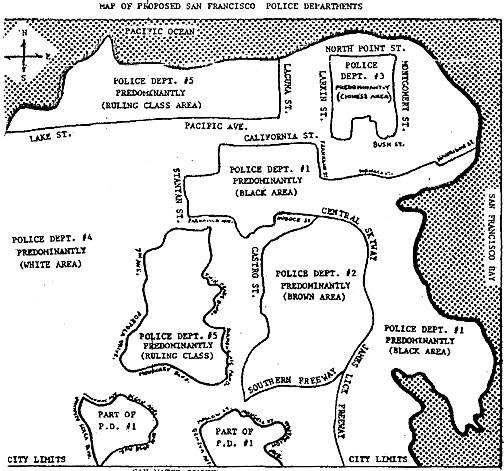
In a similar effort to make law enforcement more responsive to communities of color, the Panthers in the late 1960s also created a map proposing to divide up police districts within San Francisco, largely along racial lines.

Black-and-white drawing of San Francisco with designated districts around certain neighborhoods

The Black Panthers’ proposed police districts for the city of San Francisco, created in 1966 or 1967. Ccarolson/FoundSF, CC BY-SA

The Black Panthers are just one chapter in a long history of “counter-mapping” by African Americans, which our research in geography explores. Counter-mapping refers to how groups normally excluded from political decision-making deploy maps and other geographic data to communicate complex information about inequality in an easy-to-understand visual format.

The power of maps

Maps are not ideologically neutral location guides. Mapmakers choose what to include and exclude, and how to display information to users.

These decisions can have far-reaching consequences. When the Home Owners Loan Corporation in the 1930s set out to map the risk associated for banks loaning money to individuals for homes in different neighborhoods, for example, they rated minority neighborhoods as high risk and color-coded them as red.

The result, known as “redlining,” contributed to housing discrimination for three decades, until federal law banned such maps in 1968. Redlining’s legacy is still evident in many American cities’ patterns of segregation.

Colonial explorers charting their journeys and city planners and developers pursuing urban renewal, too, have used cartography to represent the world in ways that further their own priorities. Often, the resulting maps exclude, misrepresent or harm minority groups. Academics and government officials do this, too.

Counter-maps produce an alternative public understanding of the facts by highlighting the experiences of oppressed people.

Black people aren’t the only marginalized group to do this. Indigenous communities, women, refugees and LGBTQ communities have also redrawn maps to account for their existence and rights.

But Black Americans were among the earliest purveyors of counter-mapping, deploying this alternative cartography to serve a variety of needs a century ago.

Black counter-mapping

Mapping is part of the broader Black creative tradition and political struggle.

Over the centuries, African Americans developed “way-finding” aids, including a Jim Crow-era travel guide, to help them navigate a racially hostile landscape and created visual works that affirmed the value of Black life.

The Black sociologist and civil rights leader W.E.B. Du Bois produced maps for the 1900 Paris Exposition to inform international society about the gains African Americans had made in income, education and land ownership since slavery and in face of continuing racism.

Similarly, in 1946, Friendship Press cartographer and illustrator Louise Jefferson published a pictorial map celebrating the contributions of African Americans – from famous writers and athletes to unnamed Black workers – in building the United States.

In the early 20th century, anti-lynching crusaders at the NAACP and Tuskegee Institute stirred public outcry by producing statistical reports that informed original hand-drawn maps showing the location and frequency of African Americans murdered by white lynch mobs.

One map, published in 1922 in the NAACP’s magazine “Crisis,” placed dots on a standard map to document 3,456 lynchings over 32 years. The Southeast had the largest concentration. But the “blots of shame,” as mapmaker Madeline Allison called them, spanned the country from east to west and well into the north.

These visualizations, along with the underlying data, were sent to allied organizations like the citizen-led Commission on Interracial Cooperation, to newspapers nationwide and to elected officials of all parties and regions. The activists hoped to spur Congress to pass federal anti-lynching legislation – something that remains to this day unfinished business.

Much anti-lynching cartography was inspired by the famed activist and reporter Ida B. Wells, who in the early 1880s made some of the first tabulations of the prevalence and geographic distribution of racial terror. Her work refuted prevailing white claims that lynched Black men had sexually assaulted white women.

Modern maps

The precariousness of Black life – and the exclusion of Black stories from American history – remains an unresolved issue today.

Working alone and with white allies, Black activists and scholars continue using cartography to tell a fuller story about the United States, to challenge racial segregation and to combat violence.

Today, the maps they create are often digital.

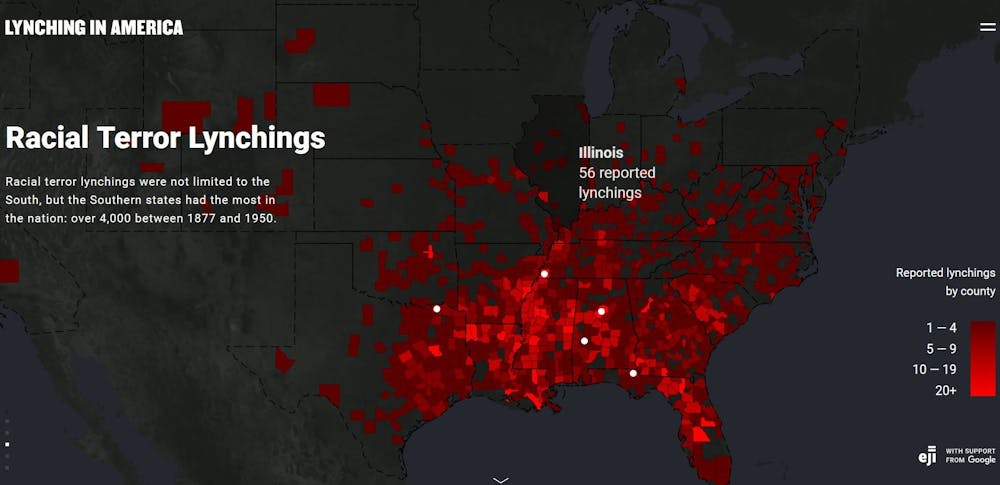
For example, the Equal Justice Initiative, the Alabama-based legal defense group run by Bryan Stevenson, has produced a modern map of historical lynching. It’s an interactive update of the anti-lynching cartography made 100 years ago – although a full reconstruction of lynching terror remains impossible because of incomplete data and the veil of silence that persists around these murders.

Red-tinged map of the US with a plot point in Illionois highlighted to show that there were 56 murders there between 1877 and 1950

The Equal Justice Initiative’s map tells stories of people who were lynched. Screenshot, Equal Justice Initiative

Another modern mapping project, called Mapping Police Violence, was launched by data activists after Michael Brown’s murder in Ferguson, Missouri, in 2014. It tracks police use of force using a time-series animated map. Deaths and injuries flash across the screen and accumulate on the map of the United States, visually communicating the national scale and urgency of this problem.

Counter-mapping operates on the theory that communities and governments cannot fix problems that they do not understand. When Black counter-mapping exposes the how-and-where of racism, in accessible visual form, that information gains new power to spur social change.

Derek H. Alderman, Professor of Geography, University of Tennessee and Joshua F.J. Inwood, Associate Professor of Geography and Senior Research Associate in the Rock Ethics Institute, Penn State

This article is republished from The Conversation under a Creative Commons license. Read the original article.

Narcissism can be contagious — and the repercussions extend beyond relationships

Dr. Jessica January Behr, a licensed psychologist who practices in New York City, recalled why one of her patients sought treatment with her. The former client, “a woman in her late 20’s,” had been raised by parents who used her and her siblings to validate their own egos. They would set up competitions between them, rewarding whichever sibling “won” by giving them money and verbal praise and admonishing the children who “lost.”

“As she matured into her adolescence, her mother would make comments about her weight, stating, ‘What will people think of me if I have a fat daughter,'” Behr told Salon by email. “Every decision my client had made had to be in line with her parents’ wishes to appear successful, wealthy and elite. This was the only form of love my client ever knew.” The consequence was such that, as an adult, “she only sought out transactional relationships in which she could gain monetary reward as compensation for body and beauty. She viewed most interactions as competitions and transactions, there could only be winners and losers. In this way, she continued her parents legacy, as a ‘flying monkey’ of their cause.”

There is a reason why Behr used the term “flying monkey.” It is a reference not only to the flying monkeys from the classic 1939 film “The Wizard of Oz,” but also to a condition known as narcissism by proxy. As Behr explains, the phenomenon of narcissism by proxy occurs “when people act on a narcissist’s behalf, to contribute to their goals and gains, despite not necessarily being narcissists themselves.” Narcissists will cycle through idealizing their victims and denigrating them in order to condition people to internalize their will and become extensions of themselves. 

“Because a victim can then mimic the narcissists behavior, any ability to question or condemn the behavior ceases,” Behr explained, adding that victims will fear both “the fall from grace or severe devaluation they will receive” and the fact that “if they condemn the narcissist they will also have to face their own demons.”

Recently, the idea of narcissism by proxy has tiptoed into mainstream pop psychology discussions, for reasons that are clearly political. Last month, a Medium.com blog post written by a therapist on the topic went semi-viral. And the thesis that our culture has become more narcissistic generally — and the cultural conversation around that proposition — extends back decades before Donald Trump or the rise of social media (to name two recent narcissistic touchstones.) 

Dr. Ramani Durvasula, a licensed clinical psychologist and professor of psychology who is noted as an expert on narcissistic personality disorder and narcissistic abuse, elaborated to Salon on the exact nature of narcissism by proxy.

“Narcissism by proxy is not an ‘official term’ and is also variously called contagious narcissism, infectious narcissism,” Durvasula told Salon by email. “It can mean taking on the mantle of grandiosity and entitlement and contempt of someone else who holds more power (such as a parent or a leader) — and almost mirroring that behavior. It can also mean that the ‘proxy’ almost gets more ‘grandiose’ as their ‘narcissistic inspiration’ has or gets more power.”

Durvasula added that the dynamic created through narcissism by proxy relationships leads to not only grandiose behavior, but also a sense of victimhood.

“The ‘lead narcissist’ uses their bully pulpit to foster a sense of victimization in the followers (the proxies) who are then emboldened to fight even harder for the cause of the ‘lead narcissist’ in the name of vindicating their victimization,” Durvasula explained. “So a leader could mobilize followers to attack a group who has been painted as the ‘bad people’ and with the followers as the victims of the ‘bad people’ – this is a way for the ‘lead narcissist’ to centralize power and create an unseeing devotion in the proxies.” This can also create a feeling of “shared omnipotence,” or the idea that someone with whom you identify and has presumed power winds up giving the proxy more power by default.

“As that leader has power, exerts power, gains power, those sharing in the power may now attempt to flex more muscle in all areas of their lives — with families, partners, colleagues, strangers, on social media — because of the emboldened quality of the shared omnipotence.” If the narcissistic leader loses power for any reason, “there can be tremendous persecutory ideation (e.g. people are out to get me, there is a fiendish plot).”

This dynamic can manifest itself in a wide range of relationships. Elizabeth Kriesten, director of an organized called Bridges Across the Divide that focuses on helping individuals deal with others in their lives who are hooked in by misinformation, wrote to Salon about a new-age cult whose leader is a narcissist and sociopath.

“I could flesh this example out with individual stories, such as a woman who left behind her husband/children to follow this leader and years later ended up broke and devastated about how she had treated her family,” Kriesten wrote. She also mentioned “a married couple that divorced because after following this doctrine they learned to hate each other” and “a teenager raised in this cult that went on to sexually abuse children — his parents defended him saying that he was only being honest about his true nature when other people are just as horrible but are deceptive about it.”

As Kriesten explained, “The cult leader/follower relationship is based on psychological manipulation. The followers do not know what they are signing up for when they ‘attach’ to a leader, in the same way that people (usually women) don’t date and marry an abuser — the person they are dating and marrying is a devoted partner. Only later is it evident that the whole relationship is based on deception and coercion.”

Speaking of romantic relationships: Yes, unsurprisingly, they are also ripe grounds for narcissism by proxy. Behr recalled a client who in her mid-twenties began dating a man that idealized her until she began disagreeing with him on religion, politics and relationships.

“This is when idealization turned to devaluation,” Behr explained. “She was scolded, reprimanded and told she didn’t know what she was talking about. Because she had already idealized him so strongly, these messages became internalized.” During the two years that they were in a relationship, the woman began to outwardly change her views to mirror those of her partner, even though she might still disagree with him privately.

“This led to a loss of friendships, difficulty in the workplace and general isolation,” Behr explained. “It was only after the volatile relationship had ended that my client realized that her outward beliefs were no longer her own and that she had been under some sort of ‘spell’ where she acted on her partner’s behalf, espousing his beliefs despite not actually agreeing with them at all. This ‘spell’ is the effects of narcissistic abuse — the system of idealization and devaluation that shapes a proxy into an appendage of the narcissist.”

Mary J. Gibson, relationship and lifestyle expert at dating trend site DatingXP, explained to Salon that people in relationships with narcissists can “catch” narcissism because “coercion leads to emulation.”

“Let’s break it down,” Gibson wrote to Salon. “The change from a disconnected, performative and traumatized state to emulating authenticity is not uncommon. However, in some cases, there are victims of narcissistic abuse that transform into a copy of their narcissistic abuser. These victims who copy the malicious machinations of destructive narcissism are narcissists by proxy.”

One reason is Stockholm Syndrome, a condition in which people identify with their aggressors as “a type of defense” in which “a bond is created where the victim is offered a locus of control.” Victims may also abuse others because “the victim internalizes the hostility in an effort to psychologically deny their own victimization. Therefore, through emulation, the victim alleviates the reality of helplessness and terror while maintaining the illusory bond of shared love and protection.”

Those who are researching narcissism by proxy online will quickly stumble across links that reference former President Donald Trump. After all, here is a political leader who has inspired literal cult-like movements such as QAnon, spent years conditioning his supporters to believe that it is impossible for him to legitimately lose an election and then became the first president to try to cling to power despite losing his reelection campaign. The end result is that thousands of his supporters rioted in the Capitol to try to overturn a legitimate election result.

“Narcissists rely on people who help to enable their behavior,” Dr. Deborah J. Cohan, associate professor of sociology at the University of South Carolina-Beaufort and the author of “Welcome to “Wherever We Are: A Memoir of Family, Caregiving and Redemption,” told Salon by email. After noting that this dynamic plays out in parent-child and romantic relationships, she noted that “we have seen this with Trump and his supporters, many of whom may come to appear even more narcissistic than he does. Narcissists seduce others into patterns of domination that become so entangled that they are hard to escape. We see this especially in terms of truth claims that are a distortion of reality.” This can account for everything from refusing to accept the results of the 2020 election, even though they were unanimously upheld by dozens of courts, to embracing Trump’s pseudoscientific ideas about the COVID-19 pandemic.

“Abusers are experts at distorting reality and claiming the truth while denying others’ experiences and feelings,” Cohan explained. “Narcissists by proxy are often in the position of covering for the narcissist, lying, and apologizing for him or her to help save face. They also might start to blame others to keep from blaming the narcissist. In turn, this person may wind up becoming hard to deal with.”

Dr. Bandy X. Lee, a psychiatrist who has taught at Yale and authored the new book “Profile of a Nation: Trump’s Mind, America’s Soul,” expressed a similar view to Salon. In the case of Republicans, she emphasized that it is crucial to distinguish between people who are merely ideologically conservative and those who have developed a cult-like adoration for the president.

“This is different from a normal political movement,” Lee told Salon. She notes that it is different from situations in which otherwise normal individuals might develop mistaken notions simply based on misinformation. Ordinary people whose views might be inaccurate do not double down, irrationally cling to their beliefs and turn violent when challenged as do Trump’s extreme supporters.

“So we know that it’s tapping into a pathological process,” Lee explained. She postulated that the Republican Party is making this worse, however, because “the entire political party seems increasingly to exist simply to buttress the grandiose self-concept of one person.” Although it is normal for people to have a “level of identity tied in with their position affiliation or their support of a candidate, it is not normal or healthy for vast segments of the population to relinquish their personalities, independence of thought and even self-interest as measured in multiple ways, including their livelihoods, their health and even their survival.”

In the case of Trump supporters, Lee highlighted two main characteristics: narcissistic symbiosis and shared psychosis.

“The narcissistic symbiosis refers to narcissistically wounded individuals in the population being drawn to one another as leader and followers,” Lee observed. “The person in the position of leader uses that position to garner the adulation of crowds that he craves in order to compensate for an intolerable inner sense of inferiority, worthlessness and lack of capacity. The followers, who are also narcissistically wounded, are magnetically attracted to this leader, who projects this grandiose omnipotence in order to attract a following.” Even though outsiders may view the leader’s behavior as “cartoonish,” the projection of omnipotence and infallibility is “the essence of narcissism.”

She added, “They find irresistible this projection of a leader figure who is perfect and undefeatable, but it never satisfies. A leader would destroy a country to keep getting it, and followers would seek him to their destruction or the break of the spell, whichever comes first.”

How to make French toast — a definitive guide

It’s late, you just got home, and you’re hungry. You have some stale bread, some eggs, and some dairy. Or: It’s Sunday morning, and your kids are shrieking, and you want to cook something quick and easy that will get them all starry-eyed, quiet, and happy. Or: You’re tired of salads and roasted vegetables and even meat and fish and you want something soothing, something easy, and something decidedly un-seasonal for dinner. Good thing you know how to make French toast

The French call it pain perdu, meaning “lost bread,” but “found bread” might be more accurate. As in, you don’t know what to eat, so you look around. Your humble pantry holds just a few basics: milk, eggs, and, forgotten in a cupboard, a hunk of stale bread. It’s an excellent find, because with a little alchemy, you’ll soon have culinary gold. 

Step 1: Find bread

Can you use any bread for French toast? Yes. Old hamburger buns? Waste not, want not. White bread is perfectly fine. If you want to be fancy, use brioche or challah, but any bread will do. Croissantsrye bread, and chocolate babka are all strong contenders. Are some breads better than others? Probably, but you’ll never know until you try. 

Step 2: Slice bread

Or don’t! Decide: Do you want a slice of French toast? Sticks? A whole pan? And how soon do you want to eat? Because the thicker the bread, the longer it will take the custard to soak through, and for your French toast to cook. Do you want French toast that’s soft and gooey in the middle, or do you prefer a lighter texture? Don’t want to think too hard about it? We get it. Make slices about 3/4-inch thick. If your bread is especially fresh, you’ll want to dry it out a bit at this point by placing slices directly on the rack in a 400°F oven for about 10 minutes to help it absorb more of the mixture without getting too soggy to flip easily. 

Step 3: Soak bread

How many slices do you want? Divide that number by two. That’s the number of eggs you need. Divide that number by four. That’s the number of cups of liquid, typically dairy and/or dairy substitutes. For example, two slices of bread for classic French toast require one egg and about 1/4 cup of milk.

Mix these ingredients thoroughly. If you want to add any bells and whistles, like spices, sugar, booze, citrus zest, or flavor extracts, now is the time. Dip the bread and let the it soak for as long as it takes to soften, but not so long that it falls apart. This length of time will vary with the type of bread, how dry it is, and its thickness. Thick, dense, dry slices will take longer to soften than thin, light, moist slices — so plan accordingly. 

You can also coat or stuff your French toast, if you like. If you’re looking to get a little fancy, give you French toast a crunchy coating, or a sweet or savory filling. 

Step 4: Cook the French toast

Cooking French toast is all about setting the custard, which starts to happen around 160°F. On your way there, you’re looking to caramelize the exterior to the ideal golden brown, keeping an eye out for any burning (which can happen quickly). 

To achieve this balance, use a skillet or griddle over medium heat, greased with a little neutral oil or butter. You can also use an oven, or even a deep-fryer. If your slices are very thick, you may want to use a thermometer to check the center temperature of the French toast to make sure it’s done. For standard 3/4-inch slices, griddling for about three minutes per side is a good rule of thumb.

If you’re cooking French toast in batches and need to keep the first slices warm while you cook the others, lay them on a baking sheet and hold them in a 200°F oven until ready to serve. 

Step 4: Add Toppings

When your custard is set and the French toast is nicely browned, it’s time to serve. This is your last chance to dress up your French toast before you take it down. On the sweet side, the most popular toppings are powdered sugar, butter, maple syrup, fruit, whipped cream, and so on. 

For a more savory take, try topping your French toast with cheese, or even avocado and kimchi. 

From Operation Varsity Blues to Michelle Obama’s puppet show, here’s what’s new on Netflix in March

Spring is coming, and with the blossoming of new life comes plenty of fresh content for everyone’s go-to streaming platform. Right now is a time of renewed hope and awakening, in more than just the poetic sense.

But before we get to this month’s new offerings you might want to revisit some classics before they leave Netflix. Try “Taxi Driver” to channel your righteous, murderous anger about society going south, or “Rainman” for a heartwarming reminder of Tom Cruise before he was the subject of concerning deepfake videos. Some other fan favorites to watch before they’re gone are all seven seasons of “Weeds,”  the acclaimed “Silver Linings Playbook” and “Molly’s Game.” 

Still processing the existential dread and horror of being a living human being for the past year? In addition to the highlighted true-crime picks, some other notable new titles include, “Nevenka: Breaking the Silence,” “Who killed Sara,” “Mandela: Long Walk to Freedom” and “Audrey.” 

Also, you’re an awards buff, make sure to catch “Bombay Rose,” an animated film about love and life in Bombay that swept the circuit and was the first Indian animated film to open Venice Critics Week. “Bombay Rose” was also selected by the Toronto International Film Festival and the BFI London Film Festival, and is worth a watch. For more of our top picks, keep reading. 

“Biggie: I Got a Story to Tell,” March 1

This documentary chronicles the rare beginnings of one of hip-hop’s brightest stars. Featuring interviews with figures like B.I.G’s mother, Volette Wallace, and friend Sean John Combs (aka Puff Daddy), viewers are given an inside look on his humble beginnings and legendary rap career.

“Moxie,” March 3

Directed by Amy Poehler, “Moxie” focuses on a teenager who is sick of the sexist culture she and other girls at her high school are expected to put up with. Inspired by the feminist musings of her mother’s youth, she publishes an anonymous zine that sparks a reckoning within her school and community. With a trailer set to Bikini Kill, and a plot focused on the next generation of women’s rights, this looks to be a gem for both teens and parents.

“Murder Among the Mormons,” March 3

This true crime story has got it all; Latter Day-Saints, pipe bombs, and a document that could potentially shake the basis of an entire faith. Based on the true events that occurred in Salt Lake City, Utah in the 1980s, “Murder Among the Mormons” details how and why various murders within the Salt Lake area were connected to a much more sinister plot within the LDS church.

“Last Chance U: Basketball,” March 10

A follow-up to the Emmy award-winning series about college football, this season of “Last Chance U” pivots to cover a new sport entirely. Following the East Los Angeles College Huskies, the show takes an inside look on the team’s path to the California State championships, which for many players is seen as one last chance to achieving their dreams of playing professionally. With a roster filled with former D1 recruits and basketball stars vying for a spot in the ultra-competitive field, viewers are shown how adversity and personal pressure make the stakes that much higher.

“The One,” March 11

Set in a not-so-far future, “The One” chronicles the events following a DNA researcher’s ambitious matchmaking service that uses your genes to find your perfect partner. Love, lies, and death ensue.

“Waffles & Mochi,” March 11

In her quest for encouraging children to develop healthy eating habits, Michelle Obama hosts “Waffles + Mochi,” an adorable star-studded series that follows the colorful puppet creatures on a global expedition to learn about new cultures and the foods that they enjoy. With cameos from Jack Black, Zack Galifinakis, José Andrés and Samin Nosrat, this show from the creators of “Chef’s Table” and “Ugly Delicious” may be worth a watch even without little ones.

“Operation Varsity Blues: The College Admissions Scandal,” March 17

The doc takes real conversations wiretapped by the FBI and recreates them step by step to unpack the story behind the infamous 2019 college admissions scandal. With inside commentary and a plot that follows one mastermind’s strategy to help some of the wealthiest families in the US cheat their way to success, “Operation Varsity Blues” tells the story of “privilege gone wild.”

“Under Suspicion: Uncovering the Wesphael Case,” March 17 

In 2013, Belgian politician Bernard Wesphael was accused of murdering his wife by suffocation in a hotel room. Though he was later acquitted of the charges, many circumstances surrounding the case remain murky. Speaking to Wesphael, investigators and others involved, this true crime documentary takes a deeper look at exactly what transpired that fateful night.

“Seaspiracy” March 24 

Though the title may sound a bit corny, this gritty documentary (from the team behind “Cowspiracy,” natch) details an important and overlooked aspect in tackling climate change. Originally, “Seaspiracy” is framed as one filmmaker’s ode to the ocean, with a focus on the environmental human impact on oceans. However, the deeper he investigates, the more he discovers about the seedy underbelly of commercial fishing, unveiling a world of crime and violence tied to global fish markets.

“Haunted: Latin America” March 31

If you have a penchant for the supernatural and miss traveling, this may be the show for you. This reality series explores various people in Latin America who share their experiences with the paranormal and unexplained. Paired with dramatic reenactments to go along with their stories, this show may stand to remind you that spookiness knows no borders.

Here’s the full list of everything coming to Netflix:

March 1
“Batman Begins”
“Biggie: I’ve Got a Story to Tell”
“Blanche Gardin: Bonne Nuit Blanche”
“Crazy, Stupid, Love”
“Dances with Wolves”
“DC Super Hero Girls,” Season 1
“I Am Legend”
“Invictus” 
“Jason X “
“Killing Gunther”
“LEGO Marvel Spider-Man: Vexed by Venom”
“Nights in Rodanthe”
“Power Rangers Beast Morphers,” Season 2
“Rain Man”
“Step Up: Revolution” 
“Tenacious D in The Pick of Destiny” 
“The Dark Knight”
“The Pursuit of Happyness”
“Training Day”
“Two Weeks Notice”
“Year One”

March 2
“Word Party,” Season 5
“Parker”
“Safe Haven”

March 3
“Moxie”
“Murder Among the Mormons”
“Pacific Rim: The Black” 

March 5
“City of Ghosts”
“Dogwashers”
“Nevenka: Breaking the Silence”
“Pokémon Journeys: The Series,” Part 4
“Sentinelle”

March 8
“Bombay Begums”
“Bombay Rose”

March 9
“The Houseboat”
“StarBeam,” Season 3

March 10
The Block Island Sound”
“Coven of Sisters”
“Dealer”
“Last Chance U: Basketball”
“Marriage or Mortgage”

March 12 
“Love Alarm,” Season 2
“Paper Lives”
“Paradise PD,” Part 3
“The One”
“Waffles & Mochi”
“Yes Day”

March 14 
“Audrey”

March 15
“Bakugan: Armored Alliance”
“The BFG”
“The Last Blockbuster” 
“The Lost Pirate Kingdom”
“Zero Chill”

March 16
“RebellComedy: Straight Outta the Zoo”
“Savages”

March 18
“B: The Beginning Succession”
“Cabras da Peste:
“Deadly Illusions”
“The Fluffy Movie” 
“Nate Bargatze: The Greatest Average American”
“Operation Varsity Blues: The College Admissions Scandal”
“Under Suspicion: Uncovering the Wesphael Case”
“Skylines”

March 19 
“Alien TV,” Season 2
“Country Comfort”
“Formula 1: Drive to Survive,” Season 3
“Sky Rojo” 

March 20
“Jiu Jitsu”

March 22
“Navillera”
“Philomena”

March 23
“Loyiso Gola: Unlearning”
“Who Killed Sara?”

March 25
“Caught by a Wave”
“DOTA: Dragon’s Blood Millennials,” Season 3
“Secret Magic Control Agency “

March 26
“A Week Away” 
“Bad Trip”
“Big Time Rush,” Seasons 1-4
“Croupier”
“The Irregulars Magic for Humans by Mago Pop”
“Nailed It!: Double Trouble”

March 29
“Mandela: Long Walk to Freedom”
“Rainbow High,” Season 1 

March 30
“7 Yards: The Chris Norton Story”
“Octonauts & the Ring of Fire”

March 31
“At Eternity’s Gate”

The dark truth about conspiracy theories: They’re everywhere! Can they be stopped?

Conspiracy theories take can bewildering forms, as has become especially clear in the current era, when a recently deposed U.S. president became instrumental in spreading and popularizing an entire interlocking universe of demonstrably false conspiratorial narratives. But the historical development of conspiracy theories is becoming clearer, thanks to research across multiple disciplines, synthesized for a broad audience in German scholar Michael Butter’s recent book, “The Nature of Conspiracy Theories.” 

None of that work in any of those disciplines — from psychology and sociology to philosophy, literature and cultural studies — gives us any reason to believe that conspiracy theories are going away anytime soon, simply because Donald Trump has left office. But they can help us make sense out of their persistence, which is why Salon reached out to Butter for an extended conversation. 

In the first part of this interview, published two weeks ago, Butter — who teaches the history of American literature and culture at the University of Tübingen — discussed how conspiracy theories were long taken for granted. Winston Churchill, George Washington and Abraham Lincoln offer just a few entirely typical examples of major historical figures who believed in them. But conspiracy theories aren’t universal throughout human history, Butter explained: They depend on the existence of a public sphere and the right sort of media environment. 

Centuries before the internet, the printing press was responsible for the birth of conspiracy theories in their modern form.  Butter also described the ways conspiracy theories can be categorized — they describe conspiracies from above or from below, from outside a society or from within — as well as the social and psychological needs they meet, and how they underwent a three-phase process of stigmatization that pushed them out of the mainstream after the 1950s. 

In part two of the interview, Butter describes the three-phase process that brought conspiracy theories back into the public sphere as we know them today, their structural similarities with populism, the important case study of Donald Trump as a case study, what can be done to counter them and more. This transcript has been edited, as usual, for clarity and length.

In describing the comeback of conspiracy theory — which perhaps culminated with Donald Trump and QAnon — you outline what might be called a three-phase process of evangelism, in whose final stage we reach online conspiracy theories, which you characterize as “more rumors than fully fledged theories.” How did this evangelical revival begin, and what defined it?

Conspiracy theories never really became unpopular. They were just flying under the radar for a while, in Europe far more so than in the United States. In the United States, conspiracy theories were always more part of popular discourse because of the [John F.] Kennedy assassination, because of Robert Kennedy, Martin Luther King and also Watergate, than they were part of public discourse in Europe. Still, you could make the argument that full-blown conspiracy theories in the U.S. as well in Germany during the ’70s and 80s and ’90s were part of rather hermetic subcultures that are difficult to enter and whose members have problems articulating their ideas and finding a broader audience. 

In the United States, of course, the emergence of talk radio and other venues, even before the internet, helps these people voice their ideas, but if you look at the Western world in general, I think it’s really the emergence of the internet that turns these subcultures into what we could now call counter-publics, publics that are more easily found and whose members have far less trouble now finding a public for their ideas. 

This again happens in different steps, in that during the late ’90s we have these precursors of the internet like USENET, where people are writing in forums. Of course this is not yet happening in life on any large scale, because people are not online all the time. You need a modem, you need to connect through your landline telephone and you can’t do that all the time. So you might download comments and then contribute to the discussion and people might look it up later. But on the other hand, it’s very close to what’s happening in social media these days — just a little slower. 

Then, of course, a couple of years later we get platforms like YouTube where you can upload your own conspiracy film, something that before the advent of digital technology was really only possible for professional filmmakers and people who were very rich and who could afford all this equipment. Now you can just do these things on your laptop. The first version of the “Loose Change” films, which had tens of millions of viewers, was allegedly produced for just $1,200 on a laptop. Suddenly you can do that and put it online and you will find an increasingly big audience.  

Then the third step would be what’s happening to conspiracy theories because of social media — the echo chamber they increasingly generate and the specific conditions that they impose on how messages can be framed. If you have only 140 or 280 characters at your disposal, you can’t really develop the conspiracy theory in the way a 90-minute YouTube video can do it. You have to restrict yourself to certain bold claims, and you don’t provide any evidence. 

I think in American culture the first case we can observe is what is called the “birther” conspiracy theory, which claims that Barack Obama was never eligible to become president because he allegedly was not born in the United States. I tried very very hard, with students of mine, to find anything on the internet where this conspiracy theory is developed in detail in the way older conspiracy theories were developed. But it’s not really there. You only find the rumors, you find little bits and pieces of evidence. People taking apart the birth certificate and arguing that it’s a forgery.  You don’t find a full-blown, completely developed conspiracy narrative about that. 

At the same time, it’s not the case that one of these online forums entirely replaces the others. Even now, in 2021, we still find fully fledged conspiracy theories. It’s not all about conspiracy rumors these days, and it seems to me that these longer documentaries are even making a comeback. So there is this film “Plandemic” that you probably have heard about, which is really returning to a form that was popular 10 years ago with the “Loose Change” films, and there’s a second part that’s up now which is called “Indoctrination,” which I think runs nearly two hours. So these older forms don’t disappear and they’re coexisting with the newer ones now.

You talk about how conspiracy theories today have a lot in common with populism, even though historically that’s not usually the case. What do they have in common, and what distinguishes them? 

There are a couple of structural analogies between populism and conspiracy. For example, both of them clearly divide the world into good and evil. For conspiracy theories, it’s always the conspirators and the victims of the conspiracy and for populism is always the elite and the common people, and the elite is always acting against the interests of the common people. 

This is coming back to what we talked about earlier, that contemporary conspiracy theories usually target an alleged conspiracy from above, and it’s usually elites that are imagined as conspiring from above. So we could say that both populism and contemporary Western conspiracy theories have a common enemy and that is the elite. 

Now, of course not all populist discourse accuses the elite of conspiring actively against the people. But usually accusations of conspiracy are one way of explaining why the elite is acting against the interests of the people that tends to coexist with other explanations within a populist movement. 

For example, very often the elite is being accused of having lost touch with reality, of neglecting the common people — they’re so caught up in other things, so detached from reality, that they no longer know what people need. Sometimes the elite is also accused of being corrupt, meaning that everybody that wants to just enrich themselves — which is why they act against the interests of the people — but they’re not following one common systematic plan. And then there are those people who say, “Wait a minute, it’s not that they are detached from reality. It’s not that they’re all corrupt. They are all part of a devious plot.”

To a certain degree these explanations can overlap and the accusation of conspiracy grows naturally out of the other explanations. So we could say that accusations of conspiracy are one specific way in which members of the populist movement make sense of the fact that the elite is allegedly acting against the interests of the people. 

Another analogy is that both populism and conspiracy theory are stigmatized in similar terms, aren’t they?

Yes. Both populism and conspiracy theory are stigmatizing terms. If you call somebody a conspiracy theorist, you imply that you don’t need to take them seriously, that this person is making baseless claims. If you call somebody a populist — I would suspect even more so in Europe than in the United States — you are also accusing them of being a fraud, of being somebody who is offering simplistic solutions to complex problems and is trying to rile up the masses. 

Something we’ve observed again and again is that populists and members of populist movements accept people who believe in conspiracy theories, even though they themselves do not believe in these conspiracy theories. They say, “Well, you know, the elites are looking down on these people and think they are idiots because they believe in conspiracy theories. But they also think that we are idiots and should not be taken seriously, so there should be a space for these people within our movement.” That’s another parallel between populism and conspiracy theory. 

You deal with Donald Trump as a case study, illustrating where conspiratorial thinking has most recently come to fruition. How did he rely on conspiracy rumors at first, rather than full-blown theories? 

Trump is an interesting case, in that I think that he has been using conspiracy theories and conspiracy rumors very smartly from basically 2011 or 2012 onward, though most recent developments may have changed this. But initially he uses conspiracy rumors — those about Barack Obama’s alleged birth outside of the country — to turn himself into a political figure. And this works — he’s quite popular with Republican voters, suddenly, early in 2012 — and then he shuts up again, because he doesn’t want to run against Obama just yet. 

But he resuscitated these accusations against Obama and against conspiring elites in 2015, when he decided to run for the presidency. The interesting thing about Trump is that he usually does not articulate conspiracy theories. He doesn’t really commit to anything; he restricts himself to conspiracy rumors. He just makes very short accusations, and usually leaves a safety net for himself. So he will always use phrases like “A lot of people are saying,” or “I hear all the time,” or “I’ve been told,” or “Think about that.” I would argue this is a strategy, because he does not want to alienate traditional Republican voters who have very little sympathy for conspiracy theories, and also people who might be receptive to his increasing populist stances, but who also favor other explanations of why elites are neglectful or corrupt over explanations of conspiracy. 

But then, as you describe, that changed. When did that happen, and why?

It’s only a couple of weeks before the 2016 election that he really makes this move from conspiracy rumors to conspiracy theories. In October 2016, the TV debates are over and he is behind in the polls to Hillary Clinton, and this tape has just been leaked to the press where he talks about sexually harassing women. I think this is the moment where Trump realizes that there is no chance that he’s going to win over undecided voters or moderate voters. He knows that a lot of Republican voters will vote for him because they always vote for the Republican candidate and they really hate Hillary Clinton, but he now can reach out to people who are really receptive to his populist and conspiracist rhetoric. 

So in his first public appearance after his tape goes public, he steps in front of his audience in Florida and talks for 45 minutes about a huge global conspiracy led by international banks and Hillary Clinton in order to destroy the American people. So here he really becomes a full-blown conspiracy theorist, because he knows he needs those people to vote for him now. This works and he wins the election, because, of course, of a couple of other factors interfere in his favor — James Comey’s letter and also other things — and after the election he goes back to conspiracy rumors, at least usually.

This is the phase of the process I describe in the book. But since then things have developed further, and my impression is that what happened to Trump is something that has happened to other political leaders who initially use conspiracy theories strategically as well, for example, Viktor Orbán in Hungary. It seems to me that Trump at some point starts believing some of his own conspiracy theories that so far he has only spread strategically. 

That seems to apply both to the accusations against Hunter Biden that are connected to Ukraine — because otherwise there would be no point in sending Rudy Giuliani to Ukraine to investigate all of this, and to expose himself in a manner that led to the first impeachment — and secondly, Trump had been talking about election fraud for many years, even before the 2016 election. Then, after that election, he said there had been illegal votes cast, and this is how he explains that he lost the popular vote. 

He systematically picks up on this again from June 2020 onward, in order to cast doubt on the outcome of the 2020 election. It seems to me that this is something that by now he genuinely believes in himself, because there is no longer any discernible strategy in maintaining these conspiracy theories. Even now, at the moment that we’re speaking, with the second impeachment going on, he first ordered his lawyers to focus on the election fraud, not on arguing that impeaching him while he was no longer in office is unconstitutional. So he seems to have fallen victim to some of his own conspiracy theories. 

You have some prescriptions for what to do about conspiracy theories. Regarding specific ones you recommend “pre-debunking.” How does that work? 

We know that debunking is very problematic. It’s very difficult to convince people who already believe in conspiracy theories, or are drawn to conspiracy theories, that they are wrong. But we know from a couple of studies — and I know from conversations with teachers, for example — that something that what works much better is the so-called pre-debunking, which means you teach people about the arguments of specific conspiracy theories, but also about the way in which conspiracy theories generally work, before they are exposed to them. Of course schools would be the place to do that. If you equip people with the right education and the right knowledge, then the likelihood that they will come to believe in conspiracy theories significantly decreases.  

This is something that we can explain historically, if we return to the stigmatization of conspiracy theories during the 1950s and 60s, which was also partly motivated by explaining to people why conspiracy theories are bad explanations, how they overemphasize intentions and why this is problematic. We know that educating people is a good means against belief in conspiracy theories, because education seems to be negatively linked to belief in conspiracy theories. While there are, of course, highly educated and intelligent people who believe in conspiracy theories, the likelihood that you will believe in them decreases with your level of education. So I think that education and pre-debunking really are key to fighting conspiracy theories. 

You also speak more generally about social literacy, media literacy and historical literacy. Explain briefly why those are important in combatting conspiracy theories.

Media literacy is of course extremely important. People need to know which sources, especially on the internet, they can trust and which sources they cannot trust. Why does it make more sense to trust an article by the Washington Post or the New York Times than to trust something that somebody just writes in social media? People need to know about how the media work, how the internet works. They need to understand the search algorithms of something like the Google engine, that this is not an objective window on reality, but the results you get are predetermined by your earlier searches, for example, so that there is a certain subjectivity there right from the start. This is something people need to understand. 

Right. Then explain what you mean by social literacy?

It’s important to teach people about how politics works, how society works and why it is impossible to plan all of these things years or sometimes even decades in advance. These processes are extremely complex, which basically means that a large-scale conspiracies are virtually impossible. And this is basically what people realized in the ’50s and ’60s, when the stigmatization occurred. 

Finally, historical literacy: What’s most important here?

Historical literacy for me would mean that you study both historical conspiracies and historical conspiracy theories. Of course there have always been conspiracies, and there will always be conspiracies in the future. But if you look at historical conspiracies, you realize that in scope and reach they are much different from what conspiracy theories imagine. Far fewer people are involved than conspiracy theories claim. In the assassination of Julius Caesar it’s just a couple of dozen people. Even in the toppling of Iranian Prime Minister Mossadegh, back in the 1950s, by MI6 and the CIA, it’s just a couple of dozen people, as opposed to faking the moon landing or orchestrating the 9/11 attack as an inside job, which would have required tens of thousands, or even hundreds of thousands of people. 

And then real conspiracies usually revolve around singular events like a coup-d’état or an assassination. Conspiracy theories might begin with a single event but then we move on very quickly to all of history being a plot and people being deceived for years and decades. 

Finally, if you study historical conspiracies, you also realize that usually something happens that the conspirators have not foreseen. Karl Popper writes in 1949 in “The Open Society and Its Enemies,” when he coined the term “conspiracy theory” in its modern meaning, that the conspirators rarely enjoy the fruits of their labor. What he means by that is that something usually goes wrong. Think again of Julius Caesar. Roman senators killed Caesar because they saw him as a danger to the republic. They succeed in killing Caesar, but of course what ensues is a civil war and at the end of the civil war the republic ends. The time of the empire and the emperors begins, and the republic is history forever. 

Or think of the recent Russian efforts to assassinate the opposition leader Alexei Navalny, to poison him. This didn’t work in the end. He was brought to Germany and he was cured and now he’s back in Russia and he’s just been sentenced to two and a half years in prison, but he remains a real danger to the regime there. This was a conspiracy, but it didn’t succeed the way it was imagined, and this failure is something for which there is no place in conspiracy theories. So studying historical conspiracies, I think, can alert us to seeing where conspiracy theories go wrong. 

What’s the most important question I didn’t ask, and what’s the answer to that question?

Not all conspiracy theories are dangerous, and not all conspiracy theorists are dangerous. It is important to contextualize. But generally speaking, there are three ways in which conspiracy theories can be dangerous. 

First, they can be a catalyst for radicalization and thus ultimately lead to violence. People who believe in conspiracy theories can feel justified or even obliged to take up arms to interfere in the struggle between good and evil that is allegedly going on in front of them. 

Second, medical conspiracy theories can be dangerous because people who deny established medical knowledge and dismiss it as part of a devious plot can endanger themselves and others because they do not take the necessary precautions. 

Third, conspiracy theories can be a danger to democracy if they undermine people’s trust in democratic processes and institutions. This danger is particularly high if a lot of people believe in these conspiracy theories and if they are articulated by people in power who stir up the masses. 

All three dimensions can be observed in the storming of the Capitol on Jan. 6. People who do not wear masks or socially distance, because they think that the coronavirus is harmless, violently attack the heart of American democracy because they have been stirred up by a populist leader.

Sen. Kyrsten Sinema complains criticism of her vote against $15 minimum wage hike is sexist

On Thursday, after a month-long Democratic-backed effort to put a $15 minimum wage mandate into the latest COVID relief bill, Sen. Kyrsten Sinema, D-Ariz. –– and several others in the Democratic caucus –– killed the effort on the Senate floor, deciding in a 58-42 vote that the minimum wage provision should not be included. 

Sinema, brought with her big chocolate cake into the Senate chamber, where, with a pep in her step and a Lululemon bag on her shoulder, she struck a pose and voted against the wage hike.

“I understand what it is like to face tough choices while working to meet your family’s most basic needs,” Sinema tweeted after the vote. “I also know the difference better wages can make […] Senators in both parties have shown support for raising the minimum wage and the Senate should hold an open debate and amendment process on raising the minimum wage.”

With Sinema and fellow moderates holding the democratic process hostage to arcane rules, it appears there is little hope for a wage increase in the legislature, given the Democrats’ inexplicable penchant for the filibuster, an archaic and anti-democratic tool historically used to impede civil rights bills.

Sinema’s display sparked a predictable conflagration of fury on Twitter. Many pounced upon her past rhetoric, in which she routinely called for raising the minimum wage. 

“A full-time minimum-wage earner makes less than $16k a year. This one’s a no-brainer. Tell Congress to #RaiseTheWage,” Sinema tweeted in 2014, to which one user on Friday replied, “Hello Kyrsten 2014, meet Kyrsten 2021.”

Posting the video of Sinema voting no, Sawyer Hackett, Senior Advisor for Sen. Julian Castro, chimed in: “Did Sinema really have vote against a $15 minimum wage for 24 million people like this?”

Progress Arizona, a Phoenix-based advocacy group, tweeted plans to project a message protesting Sinema’s vote onto building visible from the I-10. “Arcane Senate rules can not be more important than fighting for a living wage for workers now.”

On Friday, Azcentral, one of Arizona’s largest online news sites, published a scathing op-ed decrying the Senator’s vote. “Forget the $15-an-hour minimum wage or immigration and election reform,” it argued, “Sen. Kyrsten Sinema apparently wants the little people to eat cake instead.”

But Sinema’s office complained that much of the focus on her appears to be sexist. 

Sinema’s spokesperson Hannay Hurley told the Huffington Post that “commentary about a female senator’s body language, clothing, or physical demeanor does not belong in a serious media outlet.”

I’ve lived up close and personal with endless war — so, in a sense, I was ready for Jan. 6

“Are you OK?” asked a friend and military spouse in the voicemail she left me on the afternoon the mob of Trump supporters breached the Capitol so violently. At home with a new baby, her Navy reservist husband stationed in Germany, the thoughts running through her head that day would prove remarkably similar to mine. As she said when we spoke, “It’s as if the U.S. has become a war zone.”

Do a Google search and you’ll find very little suggesting that the Jan. 6 attack on the Capitol in any way resembled a war. A notable exception: a Washington Post op-ed by former Missouri secretary of state and Afghanistan combat veteran Jason Kander. He saw that day’s violence for the combat it was and urged congressional representatives and others who bore the brunt of those “armed insurrectionists” to seek help (as, to his regret, he hadn’t done after his tours of duty in combat zones).

Now, take a look back at that “riot” and tell me how it differs from a military attack: President Trump asked his supporters to “fight like hell” or “you’re not going to have a country anymore.” He swore he would go with them, though he didn’t, of course, just as those who launched and continued our “forever wars” of the last almost 20 years sent Americans to fight abroad without ever doing so themselves. Trump’s small army destroyed property with their metal baseball bats and other implements of aggression, in one case even planted pipe bombs near Republican and Democratic party headquarters (that didn’t go off), and looted congressional chambers, including carrying away House Speaker Nancy Pelosi’s lectern.

The rioters used intimidation against those in the Capitol. Some screamed insults like “traitor” and the n-word (reserved, of course, for the Black police officers protecting Congress). One rioter wore a sweatshirt emblazoned with the words “Camp Auschwitz,” a reference to the Nazi death camp. Make no mistake: the America these rioters envisioned was one full of hate and disdain for difference.

In their disregard for pandemic safety protocols, they employed the equivalent of biological warfare against lawmakers and the Capitol police, breaking into the building, screaming and largely unmasked during a pandemic, forcing lawmakers to jam into enclosed spaces to save (but also endanger) their own lives. The rioters smeared blood on walls and on the busts of former presidents. Their purpose was clear: to overturn democratic processes by brute force in the name of what they saw as an existential threat to their country, the certification of Joe Biden and Kamala Harris as president and vice president.

Among those aggressors were veterans and some active-duty personnel from elite U.S. combat forces (as well as from police departments) who brought years of expertise to bear on orchestrating an attempted takeover of our government, based — much like the costliest of our still-ongoing wars, the one in Iraq — on lies told by their commander in chief (“Stop the steal!“).

My own personal war

To fight wars, you need to summon a mix of rage, adrenaline and disregard for the humanity of those whose project you seek to annihilate. That seemed evident in the mob of the supposedly pro-law-and-order president that attacked Congress, their acts leading to five deaths — including that of Capitol Hill police officer Brian Sicknick, a former New Jersey Air National Guard member. More than 140 police officers who tried to protect lawmakers sustained injuries: Some, who were not given helmets prior to that day, are now living with brain injuries (which, as a therapist, I can assure are likely to come with debilitating lifelong implications). Another officer has two cracked ribs and smashed spinal disks. Yet another was stabbed by a rioter with a metal fence stake. Still another lost his eye.

These deaths and injuries will have ripple effects for the spouses, children, friends, employers, and others in the communities where those officers live. And they do not include the countless invisible injuries (such as post-traumatic stress disorder) that result from such war-like scenarios. In this respect, the cost of armed violence to human life is incalculable.

While that attack on the Capitol was underway, at the tiny community mental health clinic where I work as a therapist, I was speaking to clients who had migrated here from countries plagued by armed conflict. I listened to concerns that the far-right nationalist attack on the Capitol would, sooner or later, inspire violence against their own families. After all, those storming the Capitol backed a president who had referred to immigrants as “animals” and whose administration had put the children of undocumented migrants in cages — or sub-prison like conditions with zero-provision for their care. In the days after the attack, an acquaintance of mine, an African American man, was indeed pursued by a carful of people wearing Trump hats and shouting racial slurs. (They slowed their vehicle and followed him down the road towards his Maryland apartment.)

The day of the riots, I arrived home from my job to find my husband, a naval officer, in front of the television news, tears in his eyes and sweat dripping down his face. My children, unprepared for bed (as they should have been), were staring at him in confusion. That night, he and I bolted awake at every sound, as we had in the weeks after Trump was first elected.

Of course, given our incomes and our home in the countryside outside Washington, D.C., we were about as far from danger as one could imagine. Still, our sense of distress was acute.  After the riot was over, my husband, gritting his teeth, wondered: “Why aren’t the Capitol floors covered in rioters in zip ties right now?” We noted that, if there had been Black Lives Matter slogans and black fists on the flags and banners those rioters were carrying, the National Guard would have arrived quickly.

As time wore on, my husband and I attempted to comfort each another and explain those televised scenes of violence to our two children, four and five, who had been stunned both by glimpses of what grownups could do and by how visibly upset their father had become. And we weren’t alone. I soon found myself scrolling through texts and voicemails from other military spouses with similar fears who wanted to know if my husband and I were OK and if the violence in the Capitol had made it anywhere near our home.

In our minds, fearful scenarios were playing out about what Jan. 6 might mean for military families like ours — and little wonder, since in those tense two weeks before Joe Biden’s inauguration, the military still answered to a commander in chief who had visibly incited the possible takeover of our government. What would the military members of our families be asked to do in the days to come, we wondered, and by whom? What would have happened if those rioters had actually succeeded in hanging Mike Pence or slaughtering other members of Congress?

Preparing for war

In truth, in Donald Trump’s America, my spouse and I had been conjuring up scenarios of violence for months. We had found ourselves obsessed with the fears of rising political violence in what, during wartime, used to be known as the home front in the country with the most heavily armed civilian population on Earth. (I had even written about that very subject in those very months.) No wonder then that, before Nov. 3, I was so focused not just on dispelling Trumpian disinformation about the election to come, but on helping voters locate their polling stations and finding transportation to them.

As it happens, my husband’s jobs in recent years have often involved anticipating war and what our military would do if Americans ever faced it on our own soil. He’s served as an officer on a battleship and three nuclear and ballistic-missile armed submarines. He’s had to collect intelligence under the leadership of presidents with very different levels of impulse control. Most recently, he’s worked for the Joint Chiefs of Staff thinking through scenarios in which the United States might be engaged in nuclear war — and what the costs might be.

Together, we have been amazed at how few Americans, other than our fellow military families, have been preoccupied with the violence beginning to unfold on our nation’s streets and the way, in some strange fashion, America’s distant, never-ending wars of these last nearly 20 years were threatening to come home.

One lesson of these years, in an America with an “all-volunteer” military, is that wars essentially don’t exist unless you’re directly or indirectly involved in fighting them. At no time did that seem more evident to me than on January 6th, in the divergent responses of my own family and those we know who aren’t in the military. If you’re interested (as I am, as a co-founder of Brown University’s Costs of War Project) in how, during these years, voters and their representatives have justified (or simply ignored) the decision to “solve” our global problems with unending war, then you might frame what happened on Jan. 6 in these terms: some 74 million Americans voted for a president who portrayed those who disagreed with him as existential threats to America.

In the meantime, for almost two decades our government has invested staggering, almost unimaginable sums in this country’s military machine (and the war-making industries linked to it), while diverting funds from key social services, ranging from health care to domestic job creation. Meanwhile, it has consistently “retired” military-grade weaponry from our war zones into the hands of police departments across the country and so onto our city streets. I mean, given such a formula, what could possibly go wrong?  Why would anyone connected to the military be worried?

Of course, why wouldn’t we worry, since we — or our loved ones — are the people who are ordered to participate when wars of any kind happen?

The isolation of military service

There are about two million Americans who serve in the U.S. military and 2.6 million more who are military spouses and dependents. Altogether that’s just a little more than 1% of our entire population. We are, believe me, in another world of fears and worries than the rest of you. We’ve been involved, directly or indirectly, in fighting those godforsaken wars launched after 9/11 for almost two decades now.You haven’t.  You’ve generally thanked us religiously for our “service” and otherwise forgotten about those wars and gone about your business. We haven’t. Our sense of the world, our fears, are different than yours.

We military spouses are charged with comforting and caring for those who serve, especially (but not exclusively) when they are sent to one of the many countries where that never-ending “war on terror” continues to be fought into the Biden years. Caring for those who serve is no small task in a country where the very act of trying to get mental health care could be a career-ending move for a soldier. Families are often their only recourse.

Military spouses also care for children in mourning, temporarily or in some cases permanently, over the loss of a parent. In an anemic military health care system, we are often left to marshal the necessary care for ourselves and our children, even as many of us struggle with depression, anxiety and trauma thanks to the multiple, often unpredictable deployments of those very loved ones and being left alone to imagine what they’re going through. According to a recent op-ed by my colleague Aleha Landry, also a military spouse, approximately 25% of us are unemployed in this COVID-19 moment. On average, we also earn 27% less than our counterparts in the civilian world, not least of all because the burden of childcare and frequent redeployments prevent us from moving up in our chosen fields of work.

In this pandemic-stricken, distinctly over-armed world of ours, in which nationalist militia groups (often with veterans among them) backing the former president continue to talk about war right here in what, after 9/11, we came to call “the homeland,” it’s not surprising how increasingly anxious people like me have come to feel. Personally, what Jan. 6 brought home was this: As a military spouse, I was living in a community that didn’t know my family, while my husband, in his own personal hell of hypothetical nuclear wars, could be called upon at any time to represent a president who had incited an assault on the Capitol, leaving my children and me alone. And that, believe me, was scary. 

I was struck, for instance, that a military spouse I became friends with and who occupied a very different part of the political spectrum from me nonetheless feared that, in the event of conflict, she would be vulnerable — and it wasn’t just foreign conflicts that she was worrying about after Trump was elected. At one point, her husband had told her, “If you see a flash in the sky, then take the kids and drive in this direction,” indicating a spot on the map where he felt, based on wind patterns, nuclear fallout was less likely to blow. After the Charlottesville Unite the Right riot of 2017, she stocked up on food, water, and extra gas so she could head for Canada if armed conflict broke out among Americans. “We’d be alone,” she told me, “because obviously, he’d be gone.”

Stopping our endless wars

These, then, are the sorts of fears that arise in my militarized world on this careening planet of ours. Yes, Joe Biden is now president, but this country is still on edge. And the military that’s been fighting those hopeless, bloody wars in distant lands for so long is on edge, too. After all, military personnel were present in significant numbers in that mob on Jan. 6. Almost one in five members of Trump’s invading crew were reportedly veterans or active military personnel.

Sometimes, the people I feel closest to (when I do my work for the Costs of War Project) are the women who must mother and maintain households in the places my country has had such a hand in turning into constant war zones. Right now, there exist millions of people living in just such places where the anticipation of air raids, drone attacks, suicide bombings, snipers or sophisticated roadside IEDs is a daily reality. Already, more than 335,000 civilians (and counting) have been killed in those foreign war zones of ours. Mothers and their children in such lands are often cut off from hospitals, reliable food, clean water or the infrastructure that would help them get to school, work or the doctor. Unlike most Americans, they don’t have the luxury of forgetting about war. Their spouses and children are in constant danger.

Democrat or Republican, the presidents of the past 20 years are responsible for the violence that continues in those war zones and for the (not unrelated) violence that has begun to unfold at home — and even, thank you very much, for my own family’s fears and fantasies about war, up close and personal. It’s about time that all of us in this disturbed country of ours at least bear witness to what such violence means for those living it and start thinking about what the United States should do to stop it. It can’t just be the most vulnerable and directly involved among us who lose sleep — not to speak of lives, limbs, mental stability and livelihoods — due to the cloistered decisions of our public leaders.

Believe this at least: if we can’t stop fighting those wars across significant parts of the planet, this country won’t remain immune to them either. It hasn’t, in fact. It’s just that so many of us have yet to fully take that in.

Copyright 2021 Andrea Mazzarino

To stay on top of important articles like these, sign up to receive the latest updates from TomDispatch.com here.

“Godzilla vs. Kong” and a Tina Turner doc highlight what’s new on HBO Max in March

Hooray! We’ve finally made it to March, aka the month that promises the first signs of springtime and sunshine. As the new season approaches (earlier and earlier these days), cold days reserved for binge-watching movies are running out, and, for us, that means that it’s time to squeeze in all the TV we can before warm weather tempts us with spending our free time outside. 

Luckily, with an excellent list of new March releases and last chance offers, HBO Max is here to support our mission.  

Some classic films are leaving the HBO Max library this month, including “Mrs. Doubtfire” and the “Die Hard” and “Alien” movies. If you’re in the mood for a biography, be sure to catch “Purple Rain” (inspired by Prince’s life) “The Bush Years: Family, Duty, Power,” or “The End: Inside the Last Days of the Obama White House.” It’s also the last month to see 2021 theatrical releases like “Tom & Jerry” and “Judas and the Black Messiah.”

Starting this month, popular series like “Ocean’s Eleven” and the “Rocky” movies will be available on HBO Max. Looking to access a little childhood nostalgia? You can now watch “Charlotte’s Web,” “Dr. Dolittle 2,” and “Finding Neverland,” among others (personally, I’m looking forward to watching Tim Burton’s “Corpse Bride” on repeat). Some other notable additions are “The King’s Speech,” “Veronica Mars” (2014), and “Miss Sharon Jones!” 

Here’s what’s coming to HBO Max in March that we’re looking forward to most:

“Persona: The Dark Truth Behind Personality Tests,” March 4

Personality tests. We’ve all taken them, done some self-reflection, possibly memorized our Myers-Briggs Type indicator, and moved on. This documentary, however, unpacks the impact of the previously overlooked personality test on our everyday lives, from job interviews to dating prospects. According to the streamer, “‘Persona’ explores the unexpected origin story of America’s great obsession with personality testing . . . while raising a slew of ethical questions and demonstrating how some personality tests may do more harm than good . . . This eye-opening documentary reveals the profound ways that ideas about personality have shaped our society. “

“The Investigation” finale, March 8

This Danish crime series is based on the real-life murder investigation of Swedish journalist Kim Wall. The show — bleak, tragic, and disciplined — offers a no-frills, narrow-scoped approach to solving Wall’s case. In her Salon review, Ashlie D. Stevens credits the heavy tone of the show to how “writer and director Tobias Lindholm resists portraying the murder and its perpetrator as masterful and instead turns the lens on the grinding policework and overwhelming sense of familial loss left in Wall’s wake. This makes ‘The Investigation’ feel laborious in its pacing at times, deliberately so, rendering it authentically poignant in a way that’s unique for crime dramas.”

“Genera+ion,” March 11

A group of high school students explore their sexualities and experience what it means to learn about love and relationships in a conservative neighborhood (think “Euphoria” sans intense scenes of drug abuse). With Gen-Z characters and inclusions of relevant 21st-century teen drama, this show makes a successful effort to be refreshingly modern and diverse. The show has an ensemble cast of new, up-and-coming actors, including Chase Sui Wonders, Chloe East, Haley Sanchez, Lukita Maxwell, Nathan Stewart-Jarrett, Nathanya Alexander, Nava Mau, and Uly Schlesinger. 

It’s also worth mentioning that “Genera+ion” is co-created by a Gen-Zer herself, 19-year old Zelda Barnz, and that Lena Dunham produces it. 

“South ParQ Vaccination Special,” March 11

Forever politically relevant and cheeky, “South Park” is coming out with an hour-long special centered around the brand new reality of the COVID-19 vaccine. Though only small clips and fragments have been released, it’s clear that this episode will mirror many real-world, coronavirus-related scenarios, such as dealing with anti-maskers, keeping 6-feet apart, and, of course, getting your hands on the coveted vaccine.

Furthermore, the episode includes mentions of QAnon (called the “Lil QTies” in the show), bribery, and inter-political party discourse. This episode is sure to appeal to everyone, from the most diehard “South Park” fans to the average Joe who is inevitably affected by the coronavirus. 

“Allen vs. Farrow” finale, March 14

Woody Allen’s controversial romantic choices have been no secret. Still, it seems as though, until the debut of this HBO original documentary series, people’s admiration of the quirky and clever director outweighed their discomfort with his personal life. “Allen vs. Farrow” presents an intimate look into Woody Allen and Mia Farrow’s private family affairs during and after Allen’s alleged child abuse against his (then) adopted 7-year-old daughter, Dylan. The series has made its audience seriously question Allen’s moral integrity.

As Salon’s Melanie Mcfarland said in her review of the series, “Allen vs. Farrow” is first and foremost a tragedy. “Mounting an attack against institutional failings is in some ways simpler than taking on a Hollywood god, especially one who cultivates an image of being awkward, nerdy, and clever,” she writes. “We expect systems to fail us, but afford special dispensation to the artists whose work speaks to our souls… ‘Allen v. Farrow’ is necessarily an intimate tragedy laid bare for all to see, one in which an abuse survivor agrees to bare her scars again and again, bringing unwarranted agony down on her mother in the process.”

“Zack Snyder’s Justice League,” March 18

“Justice League” was once longer, darker, and . . . better? Or at least this was supposedly the case until Zack Snyder had to step down as director following his daughter’s tragic death in 2017. The movie – resulting from the problematic Joss Whedon taking over – didn’t do very well at the box-office, and its flop prompted fans of the DC comics to request a version of the film that better represented Snyder’s original vision, aka the Snyder cut. And that is precisely what “Zack Snyder’s Justice League” promises to be, a four-hour affair loaded with all of the backstories, extra scenes, and character development that you could wish for. Or not?

“Tina,” March 27

Directed by Dan Lindsay and T.J. Martin and starring Tina Turner herself, “Tina” celebrates the star’s life. Turner has told her story countless times — detailed her abusive relationship with her ex-husband, Ike Turner, explained her struggle to make a successful solo career, and spoken about her journey of reinvention — and this documentary acts as a final word. The powerful title, simply her first name, represents Turner’s legal battle with her husband as her stage name was the only thing she wanted from their divorce settlement. Told in five chronological chapters, “Tina” revisits the life of the talented, self-sufficient, Black rockstar that we all know to be Tina Turner. The film also features an impressive cast with names like Angela Bassett, Oprah Winfrey, and Rolling Stone editor/ “MTV News” great Kurt Loder. 

“Godzilla vs. Kong,” March 31

Godzilla and King Kong have got to be the best-known names of kaiju in the world, so we know that a movie that features both characters will be nothing short of epic. Accompanied by a young girl named Jia, Kong makes his journey to his true home. When his path is interrupted by a destructive Godzilla, the two larger-than-life monsters battle — their violence toward each other seemingly controlled by unseen forces — and the fate of humankind lies in the wake of their fight. This movie has an all-star cast, including Millie Bobby Brown, Alexander Skarsgård, Julian Dennison, and Rebecca Hall.

Here’s a complete list of titles coming to HBO Max this month:

March 1:
“10 Years.”
“A Mouse Tale”
“Adventureland”
“Assault On Precinct 13”
“Bandits”
“Barefoot”
“Blade”
“The Brothers Grimm”
“Bowfinger”
“Cesar Chavez”
“Charlotte’s Web”
“CHiPs” (2017)
“Constantine”
“The Doors”
“Dr. Dolittle 2”
“Dream House”
“Driving Miss Daisy”
“Eulogy”
“Fierce People”
“Final Analysis”
“Final Space,” Seasons 1-2
“Finding Neverland”
“Gloria”
“Going In Style”
“Gone”
“Hard,” Season 2 premiere
“Hellbenders”
“Henry Poole Is Here”
“House Arrest”
“Immigration Tango”
“Jungle Master”
“Just Before I Go”
“The King’s Speech”
“Leonard Cohen: I’m Your Man”
“Live By Night”
“The Lost Boys”
“Machine Gun Preacher”
“Malice”
“Man On A Ledge”
“Miss Sharon Jones!”
“No Se Aceptan Devoluciones” (aka “Instructions Not Included”)
“Ocean’s Eleven”
“Ocean’s Twelve”
“Ocean’s Thirteen”
“One More Time”
“Our Brand Is Crisis”
“Parental Guidance”
“Pitch Perfect”
“Princess Kaiulani”
“The Quiet Ones”
“The Raven”
“Red Dragon”
“Repentance”
“The River Wild”
“School Dance”
“Secretary”
“Shadows”
“Stand Up Guys”
“Super Capers”
“Corpse Bride”
“The Undocumented Lawyer”
“Unforgettable”
“The Voices”
“Veronica Mars”
“Wedding Crashers”
“Wiener Dog Internationals”

March 3:
“Hunter x Hunter,” (dubbed, episodes 100-148, Crunchyroll Collection)

March 4: 
“Persona:  The Dark Truth Behind Personality Tests” 

March 5: 
“No Matarás” (Aka Cross The Line)
“Re: ZERO -Starting Life in Another World,” Season 2 (dubbed, episodes 14-25, Crunchyroll Collection)

March 6:
“12 oz. Mouse,” Season 3
“Lost Resort”
“Rocky”
“Rocky Balboa”
“Rocky II”
“Rocky III”
“Rocky IV”
“Rocky V”

March 8: 
“The Investigation” finale

March 9: 
“Ballmastrz,” Season 2
“COVID Diaries NYC” premiere

March 10: 
“YOLO: Crystal Fantasy”

March 11: 
“Genera+ion” premiere
“South ParQ Vaccination Special”
“Tig n’ Seek,” Season 1B premiere

March 12:
“Isabel”
“Nuestras Madres” (Aka Our Mothers)
“Tigtone,” Season 2

March 13: 
“Speed”
“Three Busy Debras”

March 14:
“Allen v. Farrow” finale
“Messy Goes to Okido”

March 15:
“Infomercials”

March 16: 
“Food Wars!: Shokugeki no Soma,” Season 5 (dubbed, Crunchyroll Collection) 

March 17:
“Superman: The Animated Series”

March 18: 
“Zack Snyder’s Justice League”

March 19:
“A Tiny Audience,” Season 2 premiere 

March 20: 
“Beverly Hills Cop”  
“Beverly Hills Cop II”  
“Beverly Hills Cop III”

March 22: 
“Beartown” finale

March 23: 
“Real Sports With Bryant Gumbel”

March 26:
“Hotel Coppelia”

March 27: 
“Tina”

March 30: 
“The Last Cruise”

March 31:
“Godzilla vs. Kong”


Whiteness and the Hollywood of the South: On TV, small-town Georgia upholds white pastoral fantasies

Thanks to large tax incentives, the “Camera Ready” state of Georgia has become the go-to place for film and television production in recent years. Such production has proven financially significant for the state, with an estimated $9.5 billion impact in 2017. Advertising that “Georgia is Every Location,” the state offers filmmakers a diverse array of landscapes, settings, and moods at an affordable cost. While Atlanta has received a great deal of attention from producers, smaller towns have also become the sites for a number of highly successful television series. Jackson stands in as Hawkins, Indiana in the Netflix series “Stranger Things”; Senoia is home to “The Walking Dead”; and Covington, “The Hollywood of the South,” sets the scene for “In the Heat of the Night,” “The Vampire Diaries” and “Sweet Magnolias,” among others.

Covington has been the setting for many films and television series set in the South—Sevierville, Tennessee, and the Great Smoky Mountains in Dolly Parton’s Coat of Many Colors and Dolly Parton’s “Christmas of Many Colors: Circle of Love”; Hazzard County, Georgia, in the original “Dukes of Hazzard”; a small Texas town in “Dumplin'”; Serenity, South Carolina in “Sweet Magnolias.” As the Newton County Chamber of Commerce website promotes, Covington has become a “mecca” for production as it is “easily transformed into a Civil War village, a 1950s town or a modern-day city.” But there is more to production companies’ frequent return to the town than low cost, the convenience of Atlanta, and a known work force. Covington offers a familiar, clichéd backdrop for representing a white South on screen that continues to appeal to many viewers.

On screen, this real-life-town-as-fictional-set confirms and reinforces over a century’s worth of popular conceptions of “the South” as pastoral and white. While literature, films, and scholarly works have challenged these notions time and time again, directors and producers nevertheless continue to resurrect and re-present a monolithic cinematic representation of a South. The imposing courthouse on the town square (where historically, justice has not always prevailed); the idyllic square itself where characters meet next to and in the shadow of a 1906 Confederate monument that has been the recent focus of local debate; the pastoral Covington cemetery, part of which is dedicated to Confederate veterans; the several local white-columned buildings; the list goes on. 

Additionally, many of the shows and films center primarily on white characters. There is one character of color on “Vampire Diaries”—Bonnie, a witch—out of 10 principal characters. “Sweet Magnolias” features an African American character named Helen Decatur (Heather Headley) as one of the three female leads, although her storyline is significantly underdeveloped compared to that of her white best friends. Despite such inclusion and despite a nod here or there to racial tensions in the past, these shows confirm and perpetuate romanticized, outdated notions of the South as white, genteel and unified (with the exception of relationship or supernatural conflicts). One might counter that we should not expect more from romantic television dramas, designed for entertainment and escapism, but why shouldn’t we expect more in 2021, in the era of Black Lives Matter, and in the wake of an attack on the U.S. Capitol? In reinforcing the pastoral and dominant whiteness of the small-town South and in relying on century-old tropes, such entertainment obscures the reality of what is happening on the ground in the South today—a movement on multiple fronts and by multiple players to challenge white political dominance. 

Covington itself has been the actual site of racialized power struggles in recent years. In August and September 2016, protests against the construction of a proposed mosque took place on the Covington square. After leaders of the Doraville-based Masjid At-Taqwa acquired land in Covington, Newton County Commissioners passed a temporary moratorium on permits for houses of worship. The moratorium eventually expired, but not before hours of public hearings made it quite clear how many county residents felt about the possibility of a new mosque in their area. Though initial reasons given for opposition focused on concerns regarding increased traffic, comments at the hearings and on social media, along with the protestors’ oral and visual rhetoric, revealed that there was more to it than that. The Economist reported that speakers”after declaring that they were in no way prejudiced…predicted that Covington—a picturesque town, often used by filmmakers, in a pretty county of around 100,000 people—was set to become a hell of violence and jihad, in which their families would no longer be safe.” 

It has not stopped there. Removal of the Confederate statue at the center of the square, which the Newton County Board of Commissioners voted 3-2 to pursue in July 2020, continues to be debated in court with a hearing set within the Georgia Court of Appeals for April. When Newton County public schools remained closed after the winter holidays due to concerns about high Covid infection rates, comments on school Facebook pages reflected deep political divisions within the town regarding mask wearing and “choice.” Though Newton went blue in recent elections, the county is clearly divided between red and blue— Rep. Jody Hice (R) on one side and Rep. Hank Johnson (D) on the other—with neighboring counties that are certainly more red than blue. 

Ultimately, the purple prose of popular television ignores such stark political division and such struggle, opting instead for replicating a trite white South of moonlight and (sweet) magnolias. What if Covington were to be used instead in service of furthering anti-racism, educating and reminding viewers—as Selma, partially shot in Covington, does—of the civil rights movement that continues to take place on southern soil and in southern courthouses? Covington could set the scene to complicate the notion of “the” or “a” South that has held sway in filmmakers’ and viewers’ imaginations for so long. Perhaps then the cinematic specters of an imagined white South could finally be laid to rest.

Correction: A previous version of this article incorrectly identified Congressmen Jody Hice and Hank Johnson as Georgia State Representatives, not U.S. Representatives from Georgia. The story has been corrected. 


Why mental health researchers are studying psychedelics all wrong

Supposedly, we are living through a “psychedelic renaissance.” From ketamine antidepressants to MDMA-assisted psychotherapy, the medical use of psychedelic drugs is portrayed in the media as a boon for the mental health profession, which reports seemingly miraculous results for treating some of the most significant mental health issues facing our time. The FDA has granted “breakthrough” status for both psilocybin and MDMA as treatments, and venture capitalists are placing bets on psychedelics to curb the trillion dollar public health burden.

As psychedelic advocates and practitioners with decades of experience, having worked with thousands of people, we believe we need a serious examination of whether the current mental health industry is the place for psychedelic drugs. Looking at the industry historically, there have been repeated claims of breakthrough modalities that would bring psychiatry into the realm of medical science. Yet none of these claims have demonstrated a high benchmark of legitimate authority, and many have even been harmful. While we applaud the efforts that are underway for decriminalization, and are excited by the potential to learn from the wealth of traditional and underground practitioners, much will be lost in the process of medicalization.

The model for introducing psychedelics into a medical framework is being defined by the Multidisciplinary Association for Psychedelic Studies (MAPS), the most visible and politically connected psychedelic organization. Their flagship research project is using MDMA, a psychostimulant, to treat Post Traumatic Stress Disorder (PTSD), a diagnosis that has become increasingly common. Its public association with war vets and sexual abuse survivors makes PTSD the perfect public relations focus for psychedelics as the next medical breakthrough.

Ross Ellenhorn, Ph.D., the author of “How We Change “and an owner of a therapeutic program, has been an outspoken critic of overmedicalization in the mental health field. Ellenhorn says that the terms “‘breakthrough,’ and miracle cure,'” form “part of a larger discursive power in medicine, in which people volunteer to be the subjects of power.”

 “First, they label certain experiences as things that need to be fixed by a cure: that there is a disease, and a skull-bound one at that,” Ellenhorn explains. “Second, that means that the people who won’t subject themselves to the cure are doing something wrong and irresponsible. In more clinical terms, they are in denial. They are deviating from their role as sick people: the responsibility in that role always being that you get help.”

“It’s really concerning right now that psychedelics are being sold as ‘miracles,’ and even that exact word is being used,” he continued.

The promise of a cure has a real effect on people who are looking for help. This was the case for “Mel,” a participant in one of the MAPS’ Phase III clinical trials with MDMA, who described their initial enthusiasm about participating. (Mel is a pseudonym; their name and gender-identity have been changed in order to protect their identity.)

“Everything that I read, everything that I heard about, was how this stuff will fix you,” Mel told us. “This stuff is going to make you better. It’s going to make you unbroken. It’s going to put all the pieces back together.”

A survivor of serial sexual abuse as a child, Mel, now in their 40s, had been on psychiatric medications from the age of 10 and later turned to alcohol and drugs. After decades in recovery and a long history of working with psychiatrists and psychologists, nothing had worked. Following the loss of their mother, they said they finally “snapped” and felt like they were at the end of their rope.

After their first MAPS-administered session with MDMA, Mel felt ripped open. “Every defense mechanism that you have gets stripped from you,” Mel told us. “The thing that kept me getting up every day was that sense of disconnection, and suddenly, I couldn’t disconnect anymore. There were times I thought I was going mad. I never experienced PTSD flashbacks in the true sense before, but after that first MDMA session I did. I would wake up in a totally different place in my apartment huddled in a corner. I didn’t know where I was. I didn’t know how old I was. I didn’t know who was there and who wasn’t there.”

In 1980, PTSD was added to the Diagnostic and Statistical Manual of Mental Disorders, the “bible” of psychiatric diagnosis, which meant that it became a certifiable diagnosis. That change has helped countless patients access care, funding, and housing, and led to greater awareness of the long-term consequences of violence. Yet the recognition of PTSD as a diagnosis has also been criticized for medicalizing symptoms that some develop as useful coping strategies against trauma. Dr. Bonnie Burstow, the late professor and feminist psychotherapist, stated in the Journal of Humanistic Psychology that even the interests of traumatized women and children are not well served by the PTSD diagnosis.

“The diagnosis itself turns the aftermath into a disorder and turns the violence itself into nothing but a preceding event,” wrote Burstow. Thus, it labels coping mechanisms as “symptoms,” which are then subjected to treatment in an attempt to remove them. There are those who have found relief from suffering through these diagnoses and the existing pharmacotherapies. In some cases people find important identification and even community from them. However, psychiatry’s tunnel vision can often be more harmful than healing, which is particularly concerning with the rawness and vulnerability brought about by psychedelics.

Since the early 2000s, the best funded and most visible psychedelic research has focused on PTSD and other disorders classified in the Diagnostics and Statistics Manual of Mental Disorders (DSM). As a collated list of categories and symptoms, the DSM defines professional and popular understanding of mental illness.

In recent years the DSM has been denounced as “scientifically meaningless” by mainstream psychiatrists, and its relevance has been questioned by its own authors. The chair of the DSM-IV task force, Allen Frances, was so appalled by the current version, the DSM-5, that in 2013, he published a critical book, “Saving Normal: An Insider’s Revolt Against Out-of-Control Psychiatric Diagnosis, DSM-5, Big Pharma, and the Medicalization of Ordinary Life.”

That same year, under the direction of Dr. Thomas Insel, the National Institutes on Mental Health (NIMH) abandoned the DSM as a research instrument. In a statement on the NIMH website, Insel wrote, “Symptom-based diagnosis, once common in other areas of medicine, has been largely replaced in the past half century as we have understood that symptoms alone rarely indicate the best choice of treatment.”

Psychedelic science portrays itself as a vanguard revolutionizing mental health care, while remaining firmly focused on developing treatments defined within these same antiquated models. An early and vocal critic, Dr. Bruce Levine, a practicing clinical psychologist and author who has written extensively on the topic, says that, now, “there is nothing more mainstream than to trash the DSM.” Nonetheless, the field of psychedelic research has simply ignored this widespread criticism for political and economic expediency.

“On a scale of 0 to 10, where 10 is real science and 0 is not science at all, I would put the DSM at a 0,” says Dr. Levine. “These are just wastebasket categories for behaviors that create tension, behaviors from individuals who make psychiatrists uncomfortable, and who psychiatrists judge make others feel uncomfortable.”

Interviewed from his home, Dr. Bruce Cohen, Associate Professor of the Sociology of Mental Health at the University of Auckland, and author of “Psychiatric Hegemony,” said, “What the profession does, and what these diagnoses do, is to act as a discourse of social control. The same as police, the same as the criminal justice system — this will reflect the dominant norms and values of whatever society it’s in.” This is explicit and fundamental to the DSM, which defines personality disorders as “an enduring pattern of inner experience and behavior that deviates markedly from the expectations of the individual’s culture.”

The hope has long been to discover, for the field of psychiatry, the equivalent of what the antibiotic was to the field of medicine. The theory of chemical imbalances followed, along with the widespread introduction of antidepressants. Decades later, the editor of the Psychiatric Times, Dr. Ronald Pies, wrote that no “knowledgeable, well-trained psychiatrist” believes mental disorders are caused by chemical imbalances, saying it was “always a kind of urban legend.” And Dr. Joanna Moncreif, a critical psychiatrist and researcher, clarified in the British Psychiatric Journal the now widely held view that, “there is no evidence that antidepressants work by correcting a chemical imbalance… and evidence suggests they produce no noticeable benefit compared with placebo.”

The search for psychiatry’s antibiotic has fallen flat. Admitting that, “Current treatments are failing patients,” Dr. Ben Sessa, a prominent psychedelic researcher and psychiatrist in the UK, is part of a revival of this same antibiotic narrative in a psychedelic context, saying that now MDMA could be “as important for the future of psychiatry as the discovery of antibiotics was for general medicine a hundred years ago.”

Robert Whitaker, author of several books on the subject including “Mad in America,” voiced concern about moving psychedelics into this arena. “Psychiatry itself is feeling a bit delegitimized right now. They told a story about chemical imbalances and drugs that treat those chemical imbalances, which is being revealed as a fraud. They need a new story to tell.” The burgeoning psychedelic industry is marketing yet another new hope that the roots of suffering can be extracted “quickly and conclusively,” but Whitaker says, “you have to tell a corrupt story about what psychedelics do to fit them into that model.”

Even for the most well-meaning researcher, accurate measurement of changes to symptoms can be a challenge for a number of reasons, one of which is a phenomenon known as the Hawthorne effect. Specifically, people tend to change their behavior when they know they are under observation, especially when they feel that their participation is valuable. MAPS has generated massive public support and media presence for their research before it has ever been conducted, let alone published. One result is that research participants can develop a major sense of involvement in this movement, and a sense of responsibility to help shape its future.

Mel described how this influenced them. Once they learned about the MDMA studies they were determined to enroll, reaching out to every site in the country, even offering to move to another state in order to be admitted. They researched the study’s protocols online, looking through the inclusion and exclusion criteria and the measurements that would be used. “I wanted to place myself right in there. Not in a dishonest way. Nothing was fabricated, just holding things back because I didn’t want to be too crazy to get in.”

“I wanted to be fixed,” they said, “and I felt great responsibility. At the time I felt that if I didn’t get better then the FDA was not going to approve it. I was going to fuck up their numbers and then it wasn’t going to be legal, and millions of people were not going to have access to it.” As a result, Mel said, they “only gave them the good stuff that was happening. I really omitted a good number of things that were challenging and difficult… It was more of reporting how things were getting better, because that’s what I really wanted, and part of me really believed that too. That’s what I wanted so badly that maybe I could convince myself.”

In December, 2020, Rick Doblin, the founder and executive director of MAPS, announced with, “an enormous sense of pride, satisfaction, and relief,” that their Phase III MDMA trial had produced “statistically significant” results in lowering symptoms of PTSD. However, the benchmark for statistical significance according to this very limited set of criteria is a far cry from the widely hyped ideas that underpinned Mel’s hopes. Statistical significance in altering self-reported changes to symptoms does not mean that MDMA or psychedelics address the underlying issues so completely that coping mechanisms become unnecessary.

These unrealistic expectations are part of what Tehseen Noorani, Ph.D, an anthropologist who worked as a psychedelic researcher at Johns Hopkins, calls the “Pollan effect.” The name refers to the author Michael Pollan, and the dramatically heightened expectations people have of psychedelics healing effects after reading stories like the ones found in his bestselling book “How to Change Your Mind: What the New Science of Psychedelics Teaches Us About Consciousness, Dying, Addiction, Depression, and Transcendence.” Noorani told us that “clinical researchers are finding these expectations difficult to grapple with, but they are likely influencing the results.”

In Noorani’s article, in which he coined the term, Dr. Albert Garcia-Romeu, a Johns Hopkins researcher, admitted, when asked, “It’s a huge problem… you want people coming into this with some openness, and typically once you have all these preconceived ideas, they think they know what they want. That doesn’t always work out well.”

Mel said that the therapists and other researchers were talented, kind and caring. Those involved in the Phase III studies are some of the most competent and experienced professionals in the field. Mel said they did have meaningful experiences during the trial. However, the container that was required by the research, which is designed to fit these drugs into the healthcare system, simply wasn’t suitable to process the experience. At the end of the three sessions, Mel felt they had not had the white light transformation they had expected from all the media coverage. “I was still horribly broken and it was devastating,” they said. “It shattered me in a whole new way.” Now Mel meets regularly with an informal support group for others who had negative experiences during or after the MAPS trial.

One of the long-term positive changes Mel did mention was connecting with underground psychedelic practitioners and continuing to work with those medicines without the restrictions of time and procedure. With decades of experience and a more personal approach, these people helped them to reframe their narrative about their trauma and the path of recovery, outside of the narrow confines of the DSM. The reality is that millions of people have done psychedelics for spiritual, therapeutic or recreational purposes and have had healing experiences. Their anecdotal stories are what have inspired the current research, but only a tiny minority have done so under the care of a psychiatrist or conventional therapist.

If psychedelics hold promise, maybe it is because they do not work in linear ways or provide overnight results. Psychedelic experiences can be expansive. They can lead people on paths of self-inquiry and growth that extend through time and space, bringing forward new challenges and insights that become personal reference points, even years later. As Robert Whitaker points out, “That doesn’t fit a medical model that gets you FDA approval. You can’t say we have these agents for exploring and coming to think differently about the world.” The necessity of reductive research here is to come up with a strict clinical protocol that will lead to replicable changes for anyone with a given diagnosis. This rigidity belies the organic and expansive nature of the psychedelic experience. “If they’re going to be agents of exploration,” asks Whitaker, “why do you need a doctor for that? Why do you go to medical school for that?”

There is a need for research into psychedelics as they present an opportunity to recontextualize how we think about and experience suffering. However, drowned in the media hype of psychedelic advocacy organizations and the mental health industry, there is little public discourse about the potential implications of moving psychedelics into a system with such a problematic history.

Recent localized efforts to decriminalize psychedelics offer some hope that the underground and traditional practitioners can continue to work with less risk of arrest. It may even provide the opportunity for them to come up from the underground, and to act as mentors and teachers to the less experienced medical and therapeutic professionals, conveying a more nuanced understanding.

As a result of the more expanded perspective that Mel found working with underground providers, they found a way to contextualize the PTSD narrative. Although they didn’t believe in it before, they now say, “My partner and I often joke that I didn’t have PTSD until I finished the trial.”


Want more science stories in your inbox? Subscribe to Salon’s weekly newsletter The Vulgar Scientist.


Media make “heroes” of Republicans who oppose Trump — and also democracy

Major media outlets have largely come around — a day late and a dollar short — to calling out Donald Trump’s extremism and lies, particularly the Big Lie that the election was stolen (FAIR.org, 1/7/21). But this rejection of Trumpism and the Big Lie goes hand in hand with the elevation of a “reasonable” or “admirable” wing of the GOP, whose own extremism and undermining of democracy are thereby whitewashed.

Exhibit A is Georgia Secretary of State Brad Raffensperger, who jumped on the Trump bandwagon early and was only kicked off it when he rebuffed Trump’s infamous demand to “find” 11,780 votes in order to overturn the state’s election result.

Eager to find Republican heroes to help prove that their own escalating criticism of Trump wasn’t partisan, media fawned over Raffensperger. Reuters emphasized his “reputation as a ‘straight shooter'” (1/3/21), while New York Times columnist Maureen Dowd called him “brave” (2/12/21). CNN.com ran a piece by former Obama adviser David Axelrod (1/4/21) drawing on the idea of JFK’s “Profiles in Courage,” those “rare acts of political courage, in which politicians placed duty and conscience ahead of public opinion or their own political well-being,” to describe Raffensperger’s “admirable stand.” Meanwhile, Mika Brzezinski (MSNBC, 1/4/21) raved, “He’ll end up being the American hero out of all of this, and that’s amazing, and he’s amazing.”

The biggest paper in his home state, the Atlanta Journal-Constitution, published an editorial (1/5/21) devoted to praising Raffensperger, vaguely alluding to “past actions” the board had been “critical” of, but arguing that he “has shown that he’s up to the rigor of standing courageously on the side of what is proper and right.” “Thank you, Mr. Raffensperger, for remaining steadfast in safeguarding the rights of Georgians and Americans,” the board concluded.

It’s a measure of how abysmal standards of integrity have become within the GOP when simply refusing to engage in blatantly illegal efforts to overturn election results merits media panegyrics. Surely one can commend Raffensperger’s stand against Trump’s Big Lie while at the same time holding him accountable for his support of the little lies that made that Big Lie possible.

Georgia Officials Overstated Election Investigation

The Atlanta Journal-Constitution (12/17/20) documented how Brad Raffensperger fed Donald Trump’s false narrative of election fraud.

Indeed, only a few weeks before the AJC‘s uncritical editorial, the paper’s reporting side published a front-page investigative report by Brad Schrade and Mark Niesse (12/17/20), who revealed how Raffensperger, while claiming Georgia’s elections were “fair and honest,” simultaneously touted “inflated figures about the number of investigations his office was conducting related to the election, giving those seeking to sow doubt in the outcome a new storyline.”

Raffensberger repeatedly suggested — including on national television — that he was investigating “over 250” ongoing credible election fraud allegations related to the 2020 presidential election. In fact, according to the AJC report, there were only 132, and the vast majority concerned procedural errors rather than claims of fraud.

As Stacey Abrams, who knows a thing or two about Georgia elections, told Stephen Colbert on the “Late Show” (1/4/21):

Lionizing Brad Raffensperger is a bit wrong-headed. This man is not defending the right of voters. He’s defending an election that he ran. Because at the exact same moment that he is pushing back on Trump, he’s also working hand in hand with Republicans to put together a list of ways to constrain access to the right to vote, starting with the next election.

Raffensperger’s voter suppression tactics included launching vote fraud investigations into four progressive voter registration groups, including Abrams’ New Georgia Project (AJC, 11/30/20). And independent journalist Greg Palast (Democracy Now!, 1/5/21) found that Raffensperger oversaw the illegal purge of 198,000 voters — mostly people of color — from the Georgia voting rolls before the 2020 election.

Aided by Raffensperger’s misleading claims about vote fraud, the Georgia state legislature is currently rushing through a host of restrictions on voting that would disproportionately disenfranchise the Black and brown voters who tipped the state to the Democrats in the 2020 elections. And with the GOP takeover of the Supreme Court and the lower courts, there’s vanishingly little those disenfranchised voters are likely to be able to do about it.

Raffensperger is just the tip of the iceberg. In its desperation to find a “reasonable” GOP so that it can continue to play its both-sides game, corporate media let some of the most anti-democratic among them play the hero with little pushback, so long as their brand of authoritarianism is in line with the time-honored U.S. tradition of restricting the vote so the (white) minority can rule, not in support of full-on coups.

NYT: McConnell is said to be pleased about impeachment, believing it will be easier to purge Trump from the G.O.P.

Sen. Mitch McConnell was so “pleased about impeachment” (New York Times, 1/12/21) that he voted against it three separate times.

Covering the position of longtime obstructionist-in-chief Mitch McConnell on the subject of Trump’s second impeachment, for instance, the New York Times (1/12/21) implied the Senate minority leader actually supported the move, under the headline: “McConnell Is Said to Be Pleased About Impeachment, Believing It Will Be Easier to Purge Trump From the GOP.” (Of course, McConnell ultimately — and unsurprisingly — voted “no” each step of the way.)

The piece, by Jonathan Martin and Maggie Haberman, uncritically quoted McConnell: “Our nation was founded precisely so that the free choice of the American people is what shapes our self-government and determines the destiny of our nation.” Admirable sentiments; if only there was the slightest truth behind his commitment to allowing “the free choice of the American people” to shape the government.

Or take the seven Republican senators who voted to convict Trump; at least three different editorials boards held them up as “profiles in courage” (Washington Post, 2/13/21; Houston Chronicle, 2/15/21; St. Louis Post-Dispatch, 2/15/21). Or Wyoming Rep. Liz Cheney, whose support for impeachment made her a “hero” (Houston Chronicle, 2/15/21) and “the conscience of Republicans” (CNN.com, 1/12/21).

Cheney, whose role as one of Washington’s greatest torture apologists alone ought to disqualify her eternally from deserving the label “hero,” voted in line with Trump’s positions nearly 93% of the time in the House. The Republican senators who voted to convict Trump also voted, in almost every instance, to seat Trump-appointed justices eager to gut voting rights protections.

Sure, media will fret about voter suppression as Republican-held states around the country push through draconian restrictions in an attempt to thwart the “free choice of the American people.” But their own credulous coverage of the little lies of vote fraud, which went on for decades (Extra!, 11–12/08, 10/12), and their willingness to lionize purveyors of those lies to this day, have played no small role in allowing it to happen.

“WandaVision” concludes by giving Martin Scorsese the MCU film he always wanted

In 2019 Martin Scorsese described Marvel Cinematic Universe movies in a way that the “WandaVision” finale proved true. “The closest I can think of them, as well made as they are, with actors doing the best they can under the circumstances, is theme parks,” the filmmaker told Empire. “It isn’t the cinema of human beings trying to convey emotional, psychological experiences to another human being.”

The end of “WandaVision” illustrated much of Scorsese’s summation – but not all of it. About 30 of the finale’s 50 minutes was one of those rides. This diversion happened to star witches hurling balls of energy at each other while floating in the sky. Nosy neighbor Agnes, revealed to be centuries-old sorceress Agatha Harkness (Kathryn Hahn), drops her glamour to take on Wanda Maximoff (Elizabeth Olsen) while Wanda’s Vision (Paul Bettany) faces off with his tin man twin resurrected as a government weapon.

Cars fly through houses; heroes are pounded through asphalt. A newly superpowered Monica Rambeau (Teyonah Parris) defeated a possessed mystery man masquerading as Wanda’s brother Pietro but who turns out to be some anonymous guy whose last name sounds like “boner.” And, spoiler alert, Wanda prevails by losing everything. She created a sitcom version of Westview, and her most loving version of Vision, to escape facing her grief. The only way it could end was painfully – not the kind that physically bruises or draws blood. The kind that rips your heart out.

No matter. This being an MCU creation, everything eventually comes to blows . . .  and explosions, screams and flames. Amusement park thrills, just like the man said, and not an especially pulse-pounding version of such.

However, once the fighting ends, the finale bucks Scorsese’s assumptions about superhero titles and returns to the attributes that make “WandaVision” such a wonder.  To save the people of Westview, she ends her perfect little world and locks Agatha in her supporting “nosy neighbor” role as Agnes. And in her final heartbreaking moments with Vision, Wanda does her best to convey the emotional, psychological experience of her humanity to the synthetic being she loves.

“Wanda, I know we can’t stay like this,” Vision says softly as his demise creeps closer. “Before I go, I feel I must know: What am I?”

“You, Vision, are the piece of the Mind stone that lives in me. You are a body of wires and blood and bone that I created,” she tells him. “You are my sadness and my hope. But mostly, you’re my love.”

He sheds a tear, kisses her hand and observes, “I have been a voice with no body. A body, but not human. And now, a memory made real. Who knows what I might be next?. . .  We have said goodbye before, so it stands to reason –”

She finishes,”– we’ll say hello again.”

This was not simplistic roller coaster dialogue. This was romantic movie magic as Scorsese defines it in a subsequent piece that published in the New York Times. If, as he says, cinema expresses “the complexity of people and their contradictory and sometimes paradoxical natures, the way they can hurt one another and love one another and suddenly come face to face with themselves,” then “WandaVision” is the first MCU title that meets Scorsese’s qualification.

And the only way it could do that was as a TV series.

“WandaVision” should not be dismissed for stepping away from the genre’s standard violence canvas to work through its feelings creatively, not to mention in a way that fleshes out who Wanda is and, not only that, who Vision is and who Monica Rambeau has always been at heart.  

True, Wanda’s excursion has the miserable effect of torturing a town full of innocent bystanders, leaving us with the sense that her despair has done lasting damage to their psyches and her reputation. None of the most interesting supers are entirely upright all the time. Comic book fans get this, as do people who love daytime and primetime soaps.

This is why Marvel placed Wanda Maximoff’s tale on TV, a medium whose larger networks have historically skewed female – certainly on ABC for the better part of recent history. Presumably Disney, a brand built upon princesses and brides, has forever.

Since “WandaVision” is a bridge between Disney+ and theaters, and between TV and movies, why not build that bridge with the story of a woman who is also a witch, a wife and a mother, and whose only job is to keep the world running and happy and stable? The best TV versions of superhero stories have been about women, after all. This was true of “Wonder Woman,” and definitely of “Agent Carter.” Even “Legends of Tomorrow” became necessary viewing once the woman took over as that team’s leader.

This woman simply asks us to step away from the roller coaster of deadly lasers and fistfights, letting us better appreciate the lovely anguish in thoughts like, “What is grief, if not love persevering?”

Bettany delivered that line with all the contemplative gentleness it deserved and in a calm setting free of threats or even loud noises.

WandaVision
Elizabeth Olsen in “WandaVision” (Disney+/Marvel Studios)

“WandaVision” launched scores of thinkpieces because there are countless ways to think about it. But its ending proves somebody at Marvel took to heart what the great filmmaker said.

The frustrating part for film buffs may be that the result was a beautiful, thought-provoking TV series as opposed to a revelatory but concise superhero feature. But all of the artistic dimensions the filmmaker cherishes boil down to a single concept, intimacy, that no franchise action flick can channel with any depth.

Television can. Hence, “WandaVision” worked best when the battles were psychological and emotional as opposed to relying upon some VFX-heavy approximation of brute conflicts. This is also why such a story could only star and be about a woman who doesn’t have superhuman strength, exceptional fighting skills or bulletproof skin, and who wasn’t entirely hero or villain. Wanda is simply a person crippled by grief.

Whether that is to the series’ benefit or its detriment depends on what you expect from a Marvel title, or one from DC or any other comic book imprint.

Common complaints among people who don’t like “WandaVision” frequently come down to its lack of fight scenes. My husband, who only watched it because he didn’t want to miss any narrative threads that carry over into future movies, wrote it off as a soap opera.

But all comic book hero stories are soap operas. What are soaps if not stories informed by loss, psychological trauma, despair, tortured love affairs and revenge? If you mourned the death of Iron Man at the end of “Avengers: Endgame” that’s probably because the MCU spent nine features building out Tony Stark’s emotional profile, including three “Iron Man” films,  constructing the barest bones of a romantic relationship between Stark and Pepper Potts along the way.

His great love has been threatened, kidnapped, appeared to die and was reborn. Sorry to burst your bubble folks, but that’s premium sudser material.

And on TV, by using playful images and gutting dialogue instead of placing amped up savagery front and center, we’re given a sense of that human complexity and paradoxical nature Scorsese was talking about. In its quietude, the show provided us with backstory about these two people while bringing us face to face with some part of ourselves.

Regrettably there will be no “WandaVision” sequel, only the next chapters of the stories born there and realized within another character’s plotline – specifically “Doctor Strange in the Multiverse of Madness” and the next Spider-Man movie, each guaranteed to be jammed with eye-popping visual effects and digital destruction.

Equally as regrettably, at least from a filmmaker’s perspective, this means neither it nor other Marvel series to follow, the next being “The Falcon and the Winter Soldier,” are likely to influence their related theatrical releases to aim for the level of psychological or emotional complexity Olsen, Bettany and Parris bring to their performances here. Instead they’ll further blur the line between TV and movies, between the necessity of streaming services and the singularity of the theatrical experience.

If we’re lucky, we’ll get more shows like “WandaVision” in the bargain, stories that tousle with that emotional danger Scorsese hails instead of ginning up new ways to show impossibly muscled beings break each other’s bones. Stories from the heart and about heartbreak embed themselves in our memories more permanently than a thousand artificial fireballs and bursts of rage, and we could use a lot more of them.

TV and comic books share something else that theme parks don’t, which is the notion that successful narratives may end, but the stories that birth them aren’t completely dead. So the finale of “WandaVision” might not be a firm goodbye to all it endeavored to achieve. Maybe it’s simply a wistful “So long, darling.”

All episodes of “WandaVision” are streaming on Disney+.

U.S. voters want government to invest more in healthcare, education, and fighting poverty: poll

Lawmakers working on a new relief package to mitigate the ongoing coronavirus crisis shouldn’t hesitate to go big considering that a majority of U.S. voters say the government spends “too little” on healthcare, education, and anti-poverty measures, according to a new Hill-HarrisX poll released Tuesday.

The poll, conducted online from February 12 to 15 among 2,835 registered voters, found that 57% of the electorate thinks the federal government doesn’t spend enough to combat poverty, while 56% want to see more investment in education.

As Common Dreams reported last year, the $1,200 stimulus checks and enhanced unemployment benefits distributed to Americans through the CARES Act passed in March 2020 reduced poverty even in the midst of an economic calamity driven by the Covid-19 pandemic, providing evidence that substantive anti-poverty programs are effective.

As the House prepares to vote Friday on its version of President Joe Biden’s American Rescue Package, nearly half of voters (49%) say the country should spend more on coronavirus relief. Among Democrats, that figure jumps to 58%, while half of independents and 38% of Republicans agree.

In addition, 56% of those surveyed say the government spends too little on healthcare. While increased investments in public health would be welcome in the wake of a pandemic that has claimed the lives of more than 500,000 people in the U.S., improving health outcomes nationwide may not depend on spending more.

As Common Dreams has reported, the Congressional Budget Office found that implementing a single-payer health insurance program like Medicare for All would guarantee coverage for every person in the country while reducing overall healthcare spending by $650 billion per year.

Notably, 43% of voters said the government should spend more on national security, despite the fact that throwing more money at endless wars is at odds with increasing public investments aimed at improving social and environmental well-being.  

As Sen. Elizabeth Warren (D-Mass.) said about the Pentagon budget earlier this month, “After the past year, watching more than 400,000 fellow Americans die, tens of millions unemployed due to Covid-19, millions more who are lined up at food banks, and even millions more who are on the threshold of losing their homes and being put out on the street, spending $740 billion dollars a year on this one piece of the federal budget is unconscionable.”

Senate Democrats ditch the $15 wage: Does this spell doom for progressive reforms?

So far during Joe Biden’s brief presidency, moderate Democrats in Congress have been triumphant over their more progressive colleagues during the fight for pandemic relief. What the long-term political and social costs of that victory may be remains to be seen.

Eligibility for stimulus checks was tightened in the administration’s mammoth $1.9 trillion proposal, slicing out a chunk of upper-middle-income earners who in recent years have increasingly become Democratic voters. In a far more significant development, eight Senate Democrats on Friday bucked their party to shoot down the left’s flagship policy to raise the national minimum wage to $15 an hour.

The 42-58 rejection — with all 50 Republicans joining those eight Democrats — was a likely illustration of something far more problematic for the Biden agenda than a single policy initiative. It’s hard to imagine how Democrats can ever muster the votes to dump the Senate filibuster, a procedural change that would break through the dam of GOP obstruction and allow the upper chamber to pass any legislation with exactly zero Republicans. (That of course presumes a tie-breaking vote by Vice President Kamala Harris, the veep’s sole method of exercising political power.)

Democratic opponents to the minimum wage boost included two close Biden allies from his home state, Chris Coons and Tom Carper of Delaware, along with moderates Jon Tester of Montana, Jeanne Shaheen of New Hampshire, Kyrsten Sinema of Arizona and Maggie Hassan of New Hampshire. Sen. Angus King, a Maine independent who caucuses with Democrats, also opposed it.

All of them voted alongside Sen. Joe Manchin of West Virginia, who has been called the unofficial majority leader based on his outsize influence in an evenly-split Senate. Asked again by reporters about the filibuster this week, Manchin literally shouted his opposition to ending the traditional requirement for a 60-vote threshold to bring bills to the floor.

The wage increase had already been stripped from the coronavirus aid bill by the Senate parliamentarian, so it wasn’t expected to be included in the final version of the legislation. Still, Sen. Bernie Sanders, I-Vt., and a faction of liberal senators chose to force a vote they knew they would lose. In the process, they exposed more resistance to the wage hike — a major talking point in last year’s Democratic primary campaign — than was previously visible. That outcome could foreshadow the sort of rebellion that progressives, and even the president, may face if they force senators to take an official stance on the future of the filibuster.

For example, although Hassan said she has “long supported raising the minimum wage to $12 an hour” and is “open to $15 an hour,” the measure failed to garner her support.

The filibuster’s 60-vote threshold is beginning to resemble a do-or-die issue for the Democratic left. Not only because the party holds only the narrowest of margins in both chambers — with a midterm election roughly 20 months away — but because Senate Republicans are positioned to obstruction virtually every aspect of the new president’s agenda if they choose all-out partisan warfare.  

To be sure, pressure has only increased on Biden since he took office to nix the filibuster. Just this week, both of Minnesota’s more-or-less moderate Democratic senators — Amy Klobuchar and Tina Smith — revealed their support for abolishing the provision. And Sen. Jon Tester of Montana, also a moderate from a state Donald Trump won twice, told the Washington Post he could be convinced to alter or dump the filibuster. Some experts in legislative fine print have suggested that the rule could be significantly changed while technically keeping it in place, effectively gutting its power.

Biden has left his options open and remained noncommittal on the filibuster. Coons has said he is leery of abolishing it. And to this point, Manchin and Sinema are hard nos.  

Joe Biden’s position is not entirely clear, and will almost certainly hinge on how much of his agenda gets bogged down in the Senate. The impending question may be whether a legislative graveyard presided over by “Grim Reaper” Mitch McConnell (even as minority leader), coupled with pressure from Democratic colleagues, activists and voters, could persuade Manchin to reconsider. 

When the 2022 midterms arrive, Manchin’s intransigence on the filibuster could earn him one of two titles: Will he be the Democrats’ worst enemy, blamed for blocking a progressive policy agenda that could fuel future victories? Or will he be their savior for preserving the minority’s power, should Democrats lose the Senate?

Trump’s secret plan to gut the federal workforce

For the first time, we have a reliable measure of just how deeply Donald Trump’s plan to strip federal executives of civil service protection and make them personally accountable to him would have reached.

Trump would have made more than 84,000 federal executives subject to firing on his whim. That’s about 4% of the civilian government workforce and most of its top leadership, according to internal government documents obtained by DCReport.

Gutting the civil service system would have been a vast expansion of presidential patronage from the roughly 4,000 appointments each president is entitled to make to 21 times that many appointees. About 1,000 of those political appointees hold positions with significant authority.

Trump’s beleaguered Environmental Protection Agency crunched the numbers for its top staff and concluded it could strip civil service protections for 579, or almost 4% of the agency’s 14,915 employees. If that share of employees applied to the nearly 2.2 million federal civilian employees, it would have made more than 84,000 workers would have been vulnerable to being fired if they refused Trump’s demands.

At the General Services Administration, the independent agency that supports the basic functions of other federal agencies, 449 of its 11,569 employees could have been subject to being fired on a whim if the GSA put the same percentage of its employees at risk that the EPA did. As with EPA, that’s about 4% of the agency workforce.

DCReport obtained the EPA document as part of a Freedom of Information Act request seeking records about compliance with Trump’s executive order 13957. EPA sought to narrow the request and also suggested looking at an FOIA request filed by E&E News reporter Kevin Bogardus.

No Evidence

Without citing any evidence, Trump asserted that sloth was widespread among top civil service managers. Removing federal executives who “cannot or will not meet required performance standards is important, and it is particularly important with regard to employees in confidential, policy-determining, policy-making, or policy-advocating positions” is difficult.

Trump said that unnamed “senior agency officials report that poor performance by career employees in policy-relevant positions has resulted in long delays and substandard-quality work for important agency projects, such as drafting and issuing regulations.”

Trump was slow to recognize the problem, if there was one. He didn’t sign the executive order until October. President Joe Biden rescinded that order just days after being sworn in.

Trump adviser Steve Bannon called for “deconstruction of the administrative state”—in plain language, wrecking our government—shortly after Trump was sworn in.

Amazing Remark

Once Trump assumed office four years ago, he began acting as if he was the sole source of government power. On Fox News in 2017, in full dictatorial mode, Trump announced that he had “instructed Congress” on what it was to do. It was an amazing remark since Congress is an equal branch of government, the one that makes the laws that the president is supposed to carry out. His comment was almost universally ignored by other news organizations so only Fox viewers knew about it.

Trump’s order would have created a Schedule F job classification for employees in “confidential, policy-determining, policy-making, or policy-advocating” positions. The civil service system has existed in our country since 1883 when the Pendleton Act, signed by President Chester Arthur, made it unlawful to fire or demote employees for political reasons who were covered by the law.

Trump’s Office of Management and Budget recommended that 88% of its staff, or 425 positions, be converted to Schedule F. Trump also could have used this order to hire political appointees who could stay on and then seek to disrupt the Biden administration.

ACLU to Biden: Do not “review” drone killing program — end it once and for all

In response to reporting on President Joe Biden’s review of policies governing lethal airstrikes in foreign countries and implementation of “temporary” limits on drone killings outside of designated war zones, the ACLU is telling the administration that the only acceptable reform is to permanently abolish the United States’ extrajudicial overseas assassination program.

“In the name of counterterrorism, U.S. presidents have for two decades authorized unlawful, secretive, and unaccountable killing abroad,” Hina Shamsi, director of the ACLU’s national security project, said Thursday in a statement. “This lethal program violates domestic and international law and has caused years of devastating harm to people in the majority-Muslim countries on the receiving end of American power.”

“Tinkering with the bureaucracy of this extrajudicial killing program will only entrench American abuses,” Shamsi added. “It must end.”

In a tweet shared Thursday, the ACLU noted that “President Biden promised to end forever wars, but his administration has yet to take meaningful action.”

Forgoing an official announcement, National Security Adviser Jake Sullivan quietly issued the order to temporarily limit drone warfare “outside conventional battlefield zones” on January 20, the day of the president’s inauguration, according to the New York Times.

“The military and the CIA must now obtain White House permission to attack terrorism suspects in poorly governed places where there are scant American ground troops, like Somalia and Yemen,” the Times reported. “Under the Trump administration, they had been allowed to decide for themselves whether circumstances on the ground met certain conditions and an attack was justified.”

Despite having issued “interim guidance” about the so-called “targeted” use of military force, Biden illegally “revenge” bombed Syria last week without congressional approval.

Mississippi is lifting COVID restrictions while thousands of residents can’t even wash their hands

Texas’ experience of last month’s deadly winter storm may have grabbed headlines, but its neighbors fared just as badly. Two weeks after the storm first touched Mississippi — and one week after the state’s governor announced that he would “restore clean water” — thousands of residents in the capital city, Jackson, are still without water; even those lucky enough to have running water are officially advised to boil it before use. City officials have reported that impassable roads have prevented them from obtaining the chemicals necessary to treat the water, and that the city’s distribution system was overwhelmed trying to deliver water to so many people at once, given how many were left homebound by the storm.

Some parts of the state were as cold as 20 degrees F, the coldest recorded temperature in Mississippi history. Hundreds of thousands of state residents suffered power outages, unheated homes, and water shutoffs as pipes froze, water treatment sites lost power and leaked, and energy providers failed to meet demand. At least five Mississippians died as a result of the storm.

Governor Tate Reeves blamed the state’s difficulties on aging infrastructure, including poor building insulation and an outdated water system. The water system problems, he said in a press conference, date back to “50 years of negligence and ignoring the challenges of the pipes and the system.” Large portions of the state get some of their water from the Mississippi River, which for years has been contaminated by wastewater, agricultural runoff, and fertilizer. The state’s water treatment system has been plagued by frequent water main breaks, century-old pipes, and a failure to weatherize plants’ equipment. Residents have long recognized these problems; for years, a souvenir t-shirt has brandished the phrase “Welcome to Boil Water Alert, Mississippi.” So it came as no surprise when Reeves told residents not to expect overnight fixes.

Candace Abdul-Tawwab, assistant director of the Jackson-based People’s Advocacy Institute, or PAI, told Grist that local and state leaders need to better prepare the state’s infrastructure, roads, buildings, and natural lands from the threats posed by climate change. Early signs of a robust government response were not encouraging: Shortly after February’s storm hit, Jackson Mayor Chokwe Antar Lumumba, a Democrat, accused Republican Governor Reeves of not answering his calls for support. The state’s climate challenges will only become more pressing: Mississippi, the state with the largest share of Black residents in the country, faces some of the nation’s most severe threats from extreme heat and coastal flooding.

“Everyone should be looking at the South right now, especially communities of color in the South, to see what climate change is doing and going to continue doing in America,” Abdul-Tawwab told Grist. “These issues existed long before the winter storm and the attention focused on Texas.”

Though PAI’s work is focused broadly on issues like criminalization and economic inequality, Abdul-Tawwab said that environmental justice inevitably figures into the organization’s work, given the challenges facing Jackson and other poor Black communities throughout the U.S. While President Joe Biden’s federal disaster declaration was limited to Texas, PAI and other community organizations helped Mississippians access food, water, and shelter after they were left in the dark. In the past two weeks, PAI has crowdsourced funds to help house uprooted families in hotels, deliver water bottles to homes, and shop for everything from baby diapers to fresh fruit for those unable to trek through roads made impassable by snow and ice.

“Mississippi is often overlooked. We’re a poorer state than Texas, but why didn’t we get the same attention?” Abdul-Tawwab said. “In America, wherever Black people are, you’re going to find the most neglect and intensifying of issues.”

Jackson, a city with one of the largest percentages of Black people in the country and a poverty rate that is nearly three times the national average, bears a disproportionate share of both economic and environmental burdens. According to the Environmental Protection Agency’s environmental justice screening tool, which maps pollution vulnerabilities across the country, Jackson residents are in the 95th percentile for cancer risk from air pollution and live closer to polluted water sources than 70 percent of the country. Overall, Black Americans are 75 percent more likely than others to live near facilities that produce hazardous waste.

“Without intervention, these natural disasters will wipe out any chance of us being able to even try to continue to make it,” said Abdul-Tawwab.

That intervention does not appear to be forthcoming: Jackson city officials estimate the costs for water system upgrades, namely weatherizing equipment at water plants and replacing old pipes, to be $2 billion, but they’ve admitted they don’t have the financial means to perform the updates. And even though many residents still lack basic utilities that could allow them to avoid COVID-19 exposure, Governor Reeves announced Tuesday that the state is lifting all rules relating to business capacity and all county mask mandates.

Rural Americans in pharmacy deserts hurting for COVID vaccines

As the Biden administration accelerates a plan to use pharmacies to distribute covid-19 vaccines, significant areas of the country lack brick-and-mortar pharmacies capable of administering the protective shots.

A recent analysis by the Rural Policy Research Institute found that 111 rural counties, mostly between the Mississippi River and the Rocky Mountains, have no pharmacy that can give the vaccines. That could leave thousands of vulnerable Americans struggling to find vaccines, which in turn threatens to prolong the pandemic in many hard-hit rural regions.

And in those areas without pharmacies, rural residents may have to drive long distances to get shots, and do so twice for two-dose vaccines. An analysis by the University of Pittsburgh School of Pharmacy and the West Health Policy Center found that 89% of Americans live within 5 miles of a pharmacy. But more than 1.6 million people must travel more than 20 miles to the nearest pharmacy, which can mean facing difficult weather and road conditions in remote areas.

“If pharmacies are closed, especially in places where there’s no other health care provider, then you’ve got essentially a health care desert,” said Michael Hogue, president of the American Pharmacists Association. “You have to be dependent on either a mobile clinic coming in from another area to provide vaccines, or the citizens are going to have to drive farther to get a vaccine.”

So far, with a limited quantity of doses and strict limitations on who is eligible, that hasn’t been a problem. But as vaccination opens up to the general public and supplies of the vaccines increase, local health departments may be overwhelmed with demand and may need to offload the task of vaccinating local residents to other health care providers.

“It’s probably not playing out yet because we’re not getting enough supply,” said Keith Mueller, director of the Rural Policy Research Institute’s Center for Rural Health Policy Analysis. “That means we have some time for those local health departments to figure this out: Who in my radius, if you will, has the capacity to administer vaccines?”

From 2003 to 2018, 1,231 independent rural pharmacies closed, Mueller’s team found, leaving some 630 rural communities with no retail drugstore. The changing economics in the pharmacy industry did them in, a combination of national pharmacy chains expanding and consolidating, big-box stores and supermarkets opening their own competing pharmacies and pharmacy benefit managers eating into small-pharmacy profits. Mail-order options siphoned off business.

And you can’t get vaccines in the mail.

In many towns, those pharmacies represented the last bastion of health care in their communities. Now more than ever, residents are feeling the void.

“We have no medical infrastructure,” said DeAnne Gallegos, a spokesperson for the San Juan County health department in southwestern Colorado. “We don’t even have a doctor.”

With the closest pharmacy located in a neighboring county an hour away in Durango, vaccinations in San Juan County have been handled by the public health director and two nurses. They hold weekly vaccination clinics if they get any doses. As of Feb. 18, the health department had fully vaccinated 298 of its 700 residents.

Counties are allocated doses based on their year-round populations, but the health department hopes to vaccinate out-of-staters who visit as well. San Juan County deals with an influx of tourists and second-home owners coming from states such as Texas, Arizona and Florida, where the pandemic has hit harder and vaccination rates are lagging. So the health department could end up vaccinating more than 200% of San Juan County’s official population to keep covid out.

“Our attitude is, no matter what your driver’s license or your ZIP code says, if you are living within our tightknit community, that is someone we hope the state would allow us to bring into the fold,” Gallegos said.

But that stresses what she called the frail structure the department had in the first place.

“It’s our responsibility to make appointments, manage the data, make contact, receive phone calls,” Gallegos said. “When you don’t have the staff or the budget to hire additional staff, that also makes it very difficult.”

Farther east, Custer County hasn’t had a pharmacy for years. Only recently, a pharmacist who lives in the county but works in an adjacent county an hour away has started delivering prescriptions to Custer residents when she returns home after each shift.

But she can’t bring vaccines home from work.

Instead, a public health nurse who was due to retire at the end of 2020 decided to stay on to vaccinate residents with the help of another nurse and retired health care workers who maintained their licenses. According to Custer County Public Health Agency Director Dr. Clifford Brown, they have vaccinated more than 630 of the county’s 5,200 residents.

In an ideal world, they could have handed off the task to a pharmacy.

“We do feel the pinch,” Brown said. “I wake up about 3 o’clock in the morning thinking about, how in the world are we going to stretch things to cover for this day?”

Pharmacies offer distinct advantages as vaccine providers. Hospitals, which didn’t traditionally vaccinate the general public, have had to create programs to distribute their allocated doses.

In Colorado, pharmacies give over a million flu shots a year, said Emily Zadvorny, executive director of the Colorado Pharmacists Society, and, particularly in smaller towns, have a much closer relationship with their customers than larger health care providers do. She pointed to a pharmacist in Kiowa County, Colorado, who pulled a list of all his customers age 70 and up and called each of them to schedule their covid vaccinations.

“They have so much more capacity than they have supplies,” Zadvorny said. “It’s just a slow process of ramping up.”

Even where pharmacies exist, it’s been a challenge for independent drugstores to participate in the covid vaccine rollout. For influenza, pneumonia or shingles vaccines, stores typically order as many doses as they think they can sell, which get delivered alongside the pills they distribute.

The covid vaccines, on the other hand, are being distributed through a national program that comes with a significant learning curve for pharmacies. The federal Centers for Disease Control and Prevention partnered with 21 pharmacy chains, including four networks of independent community pharmacies that give smaller drugstores more purchasing power. According to the National Community Pharmacists Association, those four networks include about 8,000 of the 21,000 community pharmacies nationwide. Pharmacies that are not part of those networks can apply to be vaccine providers in their states.

“The biggest hurdle for most pharmacies is just getting approved,” said Kyle Lancaster, pharmacy director for Our Valley Pharmacy, a three-pharmacy chain in rural Lincoln County, Wyoming.

Our Valley applied to federal and state health agencies and had to upgrade its freezers with digital data loggers, which upload the pharmacies’ refrigerator and freezer temperatures and report them directly to the CDC.

Most small pharmacies like his, he said, had been limited to the Moderna vaccine, which has less stringent temperature requirements than Pfizer’s version. The Johnson & Johnson vaccine, which was recently approved, would be even easier for rural pharmacies to handle.

Lancaster said he’s unsure how many doses of the vaccine his chain will get or when.

Those uncertainties leave residents such as Nan Burton, 63, worried about how to get vaccinated. Last year, she and her husband decided to ride out the pandemic in their vacation home in Lincoln County, trading apartment living in Seattle for the wide-open, physically distanced spaces of Star Valley Ranch, about 8 miles from the nearest Our Valley branch. With plans to retire fully next year, now they’re staying for good.

So far, Lincoln County — more than three times the size of Rhode Island — has vaccinated about 2,500 of its nearly 20,000 residents, mainly through the local hospital. But with no major chain pharmacies in the region, the county must wait for independent community pharmacies, such as Our Valley, to get up to speed.

Burton said she and her husband have little choice but to wait and hope that the vaccine distribution logistics are sorted out. They’d be willing to drive hours to get a vaccine if they knew they weren’t taking it away from someone else in need.

“Until there’s some kind of a national push to do outreach to rural communities, I think we’re going to be in trouble,” Burton said.

How Bruce Springsteen – and the left – can reclaim and cultivate a vocabulary of patriotism

The American flag has become a symbol of right-wing politics. Democrats can insist otherwise, but honest observers will concede that when they see a house, vehicle, or wardrobe adorned with the stars and stripes, it probably belongs to an American whose conception of patriotism allows everyone to have easy access to a firearm arsenal, but medicine to remain a high-priced luxury item

The success of the right wing in their co-optation of patriotic language and symbols reached its absurd zenith on Jan. 6 when a mob of domestic terrorists proudly waved the flag and chanted, “USA!” before assaulting police officers and attempting to murder elected officials in their aspiration to replace American democracy with a dynastic dictatorship. 

Beyond the ignorance of the Trump insurrectionists, it is essential for the left to evaluate how the far right monopolized patriotism and the hallmarks of Americana without much difficulty. The left has always demonstrated a healthy aversion to displays of national pride. Understanding the manipulative power of the flag, and that maudlin tributes to “God and country” typically shadow the ongoing injustices that take place under their invocation, progressives have largely neglected to offer a counterargument to operationally anti-American pundits and politicians who personify the words of Jewish activist and journalist James Wise, often misattributed to Sinclar Lewis: “If fascism comes to America . . . it will probably be wrapped up in the American flag and heralded as a plea for liberty.” 

Despite a justifiable reticence surrounding pious displays of American pride, the left has made a critical error by not forcefully confronting the right’s self-serving, deceitful, and hateful brand of chauvinism. Most Americans – left, right, and apolitical – desire to feel some affection toward their country, especially considering that people have the tendency to associate their own community with their country, distilling the abstract “America” into the concrete hometown of their youth. 

The late philosopher Richard Rorty brilliantly describes the contradictions of patriotism, and the self-inflicted wound of the left in refusing to cultivate a vocabulary of patriotism, in his prescient collection of lectures, “Achieving Our Country: Leftist Thought in Twentieth-Century America.” Rorty begins with the assertion that “National pride is to countries what self-respect is to individuals: a necessary condition for self-improvement.” 

“Those who hope to persuade a nation to exert itself,” Rorty argues, “need to remind their country of what it can take pride in as well as what it should be ashamed of.” The right wing is clearly childlike and delusional in its familiar refrain that any denunciation of American policy or history is tantamount to treason, but Rorty insists that by only associating patriotism with atrocity and oppression, the left disarms itself in debates about the identity of the country, and how best to advance a national construct that makes words like “liberty and justice for all” actionable and real. Rorty devotes most of his search for edifying patriotism to the beautiful and magisterial poetry of Walt Whitman, wisely celebrating the American bard’s tributes to democracy, paeans to the working class, and lyrical advancement of the idea that the “password primeval” of America is in the voices of the “diseased, despairing, those whose rights others are down upon.” 

In democratic practice, Martin Luther King famously argued that the civil rights movement was an effort to cash the “promissory note” of the Declaration of Independence and Bill of Rights. When I asked Jesse Jackson, who was one of King’s aides, about the common sight of American flags at voting rights marches and Black freedom rallies in the 1960s, he said, “We used the flag and the cross for equality and justice. We made a convincing case that we represented a true form of patriotism because we had the Constitution on our side.” 

The poetry of Whitman, and the leadership of King and Jackson offer insight into the distinction that the British poet and pamphleteer, Samuel Johnson, made in his essay on patriotism. Famous for the warning, “Patriotism is the last refuge of the scoundrel,” Johnson wasn’t condemning natural feelings of affection for one’s country, but in his time and place, scoundrels like Donald Trump, Ted Cruz, and Tom Cotton, who are “self-professed patriots,” more concerned with their own power and profit than any abiding sense of national prosperity or unity. “True patriotism,” Johnson declared, is not only possible, but important. 

In recent years, as Trump invoked the flag to encourage hostility toward Black people, immigrants, and Muslims, and actually hugged and kissed the flag in a bizarre psychosexual display at a rally, more thoughtful and compassionate cultural figures have attempted to express “true patriotism” in rebuttal to “self-professed patriotism.” 

No musician has a more all-American image than Bruce Springsteen. Committed to progressive causes since the late 1970s, he has consistently used his music to spotlight injustice, and as he puts it with no small measure of modesty, “measure the distance between the American reality and ideal.” The widespread misinterpretation of “Born in the USA,” for which he was partially responsible, is infamous, but the song itself is one of the most powerful explorations of an unjust war and societal neglect of working class veterans. 

In the past few months, Springsteen has made a concerted effort to communicate with his own predominantly white, Baby Boomer audience, seemingly with the awareness that many of his fans voted for Trump. First, there was a grievously ill-advised Super Bowl commercial for Jeep in which the rock and roll legend drives around a small town in Kansas in search of a chapel located at the geographic middle of the continental United States. While wearing a cowboy hat and impersonating Clint Eastwood, Springsteen suggests that Americans of diametrically opposed ideologies “find the middle.” He offers no indication of how any Americans, irrespective of political persuasion, can find unity with the Trump cult that has not only rejected the possibility of compromise, but also empirical reality.

Even more bothersome in terms of content is the replication of the imagery of Christian nationalism that is central to the far right fascist movement. Halfway into the Jeep ad, the camera zooms in on a cross hanging over a red, white, and blue map of the United States. Where this leaves Jews, Muslims, atheists and others who do not identify patriotism with Christianity is out of the realm of discussion. One should not expect too much from a multinational corporation making a major contribution to the climate crisis. It is disappointing at this late stage of his career, that Springsteen would shill for big business, breaking a record of integrity that dates back to when he rejected Chrysler‘s multimillion dollar offer of appear in one of their ads in the 1980s. 

Springsteen’s investment in his own heroic myth seems to motivate his other recent attempt at rescuing patriotism from the anti-intellectual and anti-democratic sewer of right wing outrage. Together with his friend, former president Barack Obama, he has launched a podcast, “Renegades: Born in the USA.” The two eloquent speakers explore American identity, race, and masculinity throughout the eight episodes of the series, but they do so in constant reference to themselves. They make a fine argument for social liberalism, and as the title would suggest, attempt to identify patriotism with diversity, acceptance of outsiders, and hospitality for those who are unconventional, but the larger message is lost in their unabashed egomania.

During the first episode, Springsteen declares “My Hometown,” his 1985 hit about communal conflict and loyalty, a “great song,” and in the second episode, speaks at length about the “power of the idealism of the E Street Band.” Not to let his friend outdo him, Obama, without any hesitation, offers as conclusion to part one, “People often ask me, ‘What is your favorite speech’?” Then, proceeds to name one of his own speeches, and recite it verbatim. 

The natural question in response to such self-aggrandizement is “why?” Why is a former president squandering his authority and influence on a meandering podcast about his youth, and in the words of the Springsteen song, “boring stories of glory days?” 

It would appear that Bruce Springsteen and Barack Obama are coequal partners in the icon business. Believing that they can use their iconography to the advantage of liberalism, they are attempting to present their own stories as patriotic myths. As the banality of the podcast would illustrate, it is a poor political project; doomed to fail with anyone who does not already adore both the former president and rock and roll legend. 

The mission to become living and breathing icons is particularly fraught in an age of iconoclasm. In San Francisco, Chicago, and cities across the country there are various campaigns to rename schools and public buildings currently christened to honor everyone from George Washington to Abraham Lincoln. There is an opposition to the traditional icons of patriotism emanating out of a new focus on the injustices that they either ordered or observed without intervention. Indiscriminate slaughter of sacred cows also seems like poor politics, destined to alienate even those sympathetic with reinterpretations of American history. The campaign to, for example, remove a statue of Abraham Lincoln from a Chicago city park not only offers a narrow and boringly pious vision of history, but also further surrenders patriotism to the far right. If the left announces, “We don’t want Lincoln,” intentionally or not, they gift the author of the Emancipation Proclamation, and the president who saved the Union, to right wing demagogues. 

Howard Zinn, the brilliant historian and activist, once rebuffed a question about whether his classic exploration of U.S. history through popular movements, “A People’s History of the United States,” would influence young students to dislike their own country, and deprive them of patriotic heroes who could inspire them to strive to improve the conditions of their country. Zinn’s response offers instruction to those who, like Rorty, are concerned about the future of critical patriotism on the left.

We should be honest with young people; we should not deceive them. We should be honest about the history of our country. And we should be not only taking down the traditional heroes like Andrew Jackson and Theodore Roosevelt, but we should be giving young people an alternate set of heroes. Instead of Theodore Roosevelt, tell them about Mark Twain. Mark Twain — well, Mark Twain, everybody learns about as the author of Tom Sawyer and Huckleberry Finn, but when we go to school, we don’t learn about Mark Twain as the vice president of the Anti-Imperialist League. We aren’t told that Mark Twain denounced Theodore Roosevelt for approving this massacre in the Philippines. No.

We want to give young people ideal figures like Helen Keller. And I remember learning about Helen Keller. Everybody learns about Helen Keller, you know, a disabled person who overcame her handicaps and became famous. But people don’t learn in school . . . that Helen Keller was a socialist. She was a labor organizer. She refused to cross a picket line that was picketing a theater showing a play about her.

And so, there are these alternate heroes in American history. There’s Fannie Lou Hamer and Bob Moses. There are the heroes of the civil rights movement. There are a lot of people who are obscure, who are not known. We have a young hero who was sitting on the bus in Montgomery, Alabama, refused to leave the front of the bus. And that was before Rosa Parks. I mean, Rosa Parks is justifiably famous for refusing to leave her seat, and she got arrested, and that was the beginning of the Montgomery Bus Boycott and really the beginning of a great movement in the South. But this 15-year-old girl did it first. And so, we have a lot of — we are trying to bring a lot of these obscure people back into the forefront of our attention and inspire young people to say, “This is the way to live.”

The crucial insight that Zinn offers is that patriotism should spotlight virtuous behavior in service to justice within a shared community. Richard Rorty interprets Whitman according to that definition, and there are living artists who have employed their creativity in the discovery of ways to celebrate what is unique and good about America, without ignoring or lying about what is unjust and oppressive. 

Like Zinn, the poet Rita Dove locates patriotic profundity in the life of Rosa Parks. Her 1999 collection of poems, “On the Bus with Rosa Parks,” makes the heroic activism of Parks central to American life. The bus not only rides through Montgomery, but all of American history, offering an invitation to anyone who would like to help push the passenger vehicle closer toward freedom, justice, and equality. 

“Pull the cord a stop too soon,” Dove lyricizes, “And you’ll find yourself walking a gauntlet of stares.” The immediate impression is that she is describing the inhospitable response, possibly even violent, a Black American will receive in the “wrong” neighborhood, but the perspective soon widens to include the assassination of advocates for civil rights, and how those deaths continue to haunt American history: “Dallas playing its mistake over and over/ until even that sad reel won’t stay stuck – there’s still / Bobby and Malcolm and Memphis / at every corner the same / scorched brick, darkened windows.”

Dove advances an idea of patriotism that demands movement and insists upon forward progress. In her poem, “American Smooth,” she not only pays tribute to the multicultural tapestry of American music, but also compares its sociopolitical life to a couple on the dance floor, finding its rhythm, continuing to dance to the sounds that surround them. The only error, Dove seems to warn, is to stop. 

As she herself implies with reference to the Kennedy brothers, Malcolm X, and Martin Luther King, tragedies and atrocities often leave mourners no choice but to stop, and in their pause, reflect on the gravity of the loss. 

In the immediate aftermath of the 9/11 terrorist attacks, there were many tributes to the victims, especially the firefighters and first responders who risked their own safety to save the lives of strangers. Martin Espada offers one of the most beautiful memorials of Sept. 11 in his poem, “Alabanza: In Praise of Local 100.” 

It is dedicated to the 43 members of the Hotel Employees and Restaurant Employees 100 who died while working at the Windows of the World restaurant in the World Trade Center. Espada describes the wide range of countries where these workers – the dishwashers, the cook, the busboy – travelled from to make their home in America. With homage to Whitman’s poem, “I Hear America Singing,” he praises the majestic and soulful music of their labor, their voices, and their harmonious presence. 

Espada ends the poem with the imagery of war – “from Manhattan and Kabul” – and provides a dark, but profound insight into the separation between power and the people who are so often the victims of those who exercise it. 

Patriotism, like any feeling of affection, is only as useful as its ability to assist in the alleviation of human suffering, and the flourishing of human potential. In that respect, it is a localized iteration of compassion and justice, calling upon the best traditions of a particular country. 

A pandemic should have activated this form of patriotism throughout the United States, but the scoundrels most eager to wave the flag have little interest in helping the people who live underneath it. 

An entire set of policies – from voting rights to universal health care – should emerge out of the patriotic instinct. Otherwise, all the red, white, and blue gestures are nothing more than symbolism that is both empty and obfuscating. As John Prine sang in 1971 with eternal relevance:

Well, I got my window shield so filled
With flags I couldn’t see.
So, I ran the car upside a curb
And right into a tree.
By the time they got a doctor down
I was already dead.
And I’ll never understand why the man
Standing in the Pearly Gates said…
“Your flag decal won’t get you
Into Heaven…”

Many of the inoculated are suffering from “vaccine guilt”

When Emily Brimmer’s family dentist sent out an email that they were administering vaccines, she jumped at the opportunity. Brimmer is certainly entitled to get one: though only 36 years old, she has type 1 diabetes, lives with family and helps to take care of her 101-year-old aunt. But once inoculated, Brimmer wasn’t prepared for one of the unexpected side effects: guilt.

“When you say, ‘I got a shot,’ there’s automatically this kind of perceived feeling of judgment that is like ‘Why did you get a shot, and how did you get a shot?'” Brimmer told Salon. “There’s just this need to justify the entire thing.”

Technically, as a type-1 diabetic, Brimmer is in the “high risk” category. Her primary care doctor wrote her a note affirming this, which she used to get her vaccine. The caveat was that she had to travel from New York, where she lives, to Pennsylvania.

“So that kind of made me feel guilty,” Brimmer said in reference to having to cross state borders. “But it’s not like I cut any lines, or dressed up like grandmothers and tried to sneak in. . . everything I did was by the book, and on paper I shouldn’t feel guilty.”

But Brimmer does. And far from being an isolated anxiety, vaccine guilt is actually quite common. Psychotherapist Alyza Berman, founder and clinical director of The Berman Center, told Salon via email that such feelings emerge from a variety of factors: situational comparison, survivor’s guilt, and fear of criticism or retribution. And certainly the piecemeal vaccine rollout, and arcane tiered system of eligibility, factor into that guilt when patients appear to sidestep the rules — even if they aren’t actually doing so. 

“Given the severity of this pandemic and continued rising death toll, people feel guilty when they qualify to be vaccinated before others who’ve already suffered great losses during the pandemic, or could stand to lose even more as COVID goes on,” Berman said. “As human beings, we have an intrinsic nature to want to quantify and compare ourselves to others, whether for good or bad reasons.”

Berman said that this can create “an enormous mental toll on people and weigh heavily on someone’s psyche when they’re trying to evaluate if they’re doing the right thing.”

Hence, feelings of guilt.

Berman said the phenomenon is “more common than you’d think” and that it’s “affecting many people in very similar ways.” In other words, something is happening sociologically.

Rick Patterson told Salon via email that he and his wife were able to receive their vaccines “substantially early.” She was volunteering at one of the vaccination sites, which often is a way for volunteers to get a vaccine early.

“It was complete luck we were able to obtain our vaccinations when we did, and I feel that there are so many people who need this more than we do right now,” Patterson said. He added that it was an “overwhelming thought,” that there were “still so many who have not and might not be able to get it anywhere in the near future.” Indeed, the inequity troubled him.

Patterson said he feels that his wife, as a vaccination site volunteer, deserved the shot more than him.

“But as her husband, what really gave me the obligation to have one too?” he asked.

Many bioethicists and mental health professionals agree that feeling guilty isn’t beneficial to anyone. If you’re offered a vaccine, you shouldn’t feel guilty. But if you are committing fraud to get a shot early — say, dressing up like an elderly person — then that is something to feel guilty about.

“There is a difference between accepting and even taking advantage of unfairness that exists, and creating unfairness,” Dr. Matthew Wynia, director of the Center for Bioethics and Humanities at the University of Colorado, told Denver-based Magazine 5280. “We all have an obligation to try not to create unfairness.”

So what are the guilty to do? 

“The main advice I can give someone suffering from vaccine guilt is to give yourself a break,” Berman said. “We’ve been put through an impossible situation over the past year, the likes of which no one has ever seen before.” That’s inarguably true.