Spring Sale: Get 1 Year, Save 58%

Church at the Super Bowl: Football, Jesus and fascism

Sunday’s was one of the most exciting Super Bowls in recent years, with the Kansas City Chiefs defeating the Philadelphia Eagles in a nailbiter. But the Super Bowl is more than a game; it is a metaphor for American life. 

American society is one of increasing economic precarity and desperation. It is estimated that 16 billion dollars will be legally gambled on the Super Bowl, lots of that by people desperate to improve their life circumstances. Consumerism and late-stage capitalism are insatiable cannibals. Many people watch the Super Bowl, not for the competition on the field but instead primarily for the commercials. The NFL has created a multimedia machine worth tens of billions of dollars and has succeeded in making Sunday football and the Super Bowl a type of civic religion and unofficial national holiday, respectively.

A spectacle — in the truest sense of the world — of nationalism, militarism and so-called patriotism, this year’s Super Bowl was the first time that the Black National Anthem was sung. It was also the first NFL championship game where both opposing teams were led by black quarterbacks. Almost all of the NFL’s teams are owned by rich white men. Most of the NFL’s players – who literally sacrifice their health and well-being in what is a brutally violent sport – are Black and brown. Those same Black and brown football players (and coaches) are expected to be silent on political and social matters (unless they are “conservatives”) lest they offend the sensibilities and expectations of White America.

Fox News CEO Rupert Murdoch was shown watching the game with Elon Musk as his guest. Murdoch and Musk are two of the greatest dangers to American democracy and freedom, so it is no coincidence that Elon Musk was his guest at the game.

And predictably, right-wing propagandists and “culture war” bloviators attacked the Super Bowl for its supposedly “woke” politics. They singled out Rihanna and her half-time performance for special scorn and contempt, accusing it and her of being “Satanic.” 

Donald Trump could not resist sharing his hatred of Rihanna on his propaganda disinformation platform Truth Social: “EPIC FAIL: Rihanna gave, without question, the single worst Halftime Show in Super Bowl history — This after insulting far more than half of our Nation, which is already in serious DECLINE, with her foul and insulting language….” 

And of course, there were the ads for “Jesus Christ” that aired during this year’s Super Bowl.

Mockery and laughter is just taken as validation of the righteousness of the Christian right’s struggle to end pluralistic democracy

The ads were sponsored by an anonymous group of “Christian” big money funders who de facto want to turn the country into a White Christian theocracy. At Christianity Today, Bob Smietana provides these details about the new “Jesus Christ” ad campaign:

For the past 10 months, the “He Gets Us” ads have shown up on billboards, YouTube channels, and television screens—most recently during NFL playoff games—across the country, all spreading the message that Jesus understands the human condition.

The campaign is a project of the Servant Foundation, an Overland Park, Kansas, nonprofit that does business as The Signatry, but the donors backing the campaign have until recently remained anonymous—in early 2022, organizers only told Religion News Service that funding came from “like-minded families who desire to see the Jesus of the Bible represented in today’s culture with the same relevance and impact He had 2000 years ago.”

But in November, David Green, the billionaire co-founder of Hobby Lobby, told talk show host Glenn Beck that his family was helping fund the ads. Green, who was on the program to discuss his new book on leadership, told Beck that his family and other families would be helping fund an effort to spread the word about Jesus.

In an interview with NPR, Josiah Daniels, who is an Associate Opinion Editor at Sojourners, shared these concerns about the Christofascist politics at work in the “He Gets Us” ad campaign:

I think that the confusing thing is that when you go to the site, they’re using language like activist, like inclusive, like marginalized. You know, you’ll go to the site, and you’ll see that there are these multiple posts tagged with activist, justice, inclusive. And so they’re using the language of social justice, but there’s no material commitment to actually practicing social justice. So that disturbs me

Slate’s Molly Olmstead focuses on how the real motivation behind the new “Jesus Christ” ad campaign is to increase the power of White Christians in American life at a time when their numbers are shrinking:

But of course, the funders of these ads think they’re doing just that. As one spokesperson of the campaign told Ad Age, “the ‘He Gets Us’ Super Bowl spots will explore how the teachings and example of Jesus demonstrate that radical love, generosity, and kindness have the power to change the world.” This, ultimately, gets at the real political underpinnings of the campaign: the belief that America will become a much more peaceful, successful, and wholesome place once it has become a more fully Christian nation—a more traditional perspective than the focus on diversity and “radical compassion” and “standing up for the marginalized” implies. On Sunday, $20 million is being placed on that bet.

Now new research from PRRI (Public Religion Research Institute) and the Brookings Institution reinforces just how “Christian nationalism” is an existential threat to American democracy and freedom.

Some of PRRI’s findings include how Christian nationalism is correlated with hostility towards pluralistic democracy, support for political violence as seen on Jan. 6 with Trump’s coup attempt and the terrorist attack on the Capitol, racism and white supremacy, misogyny and hostile sexism, nativism and xenophobia, authoritarianism and social dominance behavior, and a range of beliefs and attitudes that are illiberal and anti-democratic.

In an essay in response to the new PRRI data, author and historian Jemar Tisby highlights how Christian nationalism is not race-neutral but is actually a White supremacist political project:

Whenever I talk about Christian nationalism, I make sure to highlight the racism inherent in the ideology.

While it is often unspoken, the word “white” should be presumed as a prefix of Christian nationalism. Racial bigotry is inherent to and inseparable from this belief system.

To give one example, the most notorious racist terrorist group, the Ku Klux Klan operates from a white Christian nationalist framework. The founder of the second major wave of Klan activity, William J. Simmons, wrote in 1922, “[The KKK only admits] “native born, white, Gentile, Protestant Americans…”

The white Christian nationalist view of “true” Americans has always centered on people deemed white and has labeled anyone else—Jews, Blacks, immigrants—as “other.”

To put a finer point on the risk: White Christian nationalism not only greatest threat to democracy and the witness of the church, it is the greatest threat to a multiracial and inclusive church and democracy.

For several decades the Christian right has been attempting to tear down the wall between church and state in America. They have been largely successful in that project. The Christian right now controls the Republican Party, the “conservative” movement, and the Supreme Court. The election of Donald Trump and the rise of his MAGA movement was another victory in their campaign to create a White Christian theocracy. Women’s reproductive rights have been taken away with the end of Roe v. Wade.

Although Trump is no longer president – for now – the Christian right is continuing to expand its influence across the country well beyond Republican-controlled neofascist states such as Florida and Texas.

The American mainstream political class, and especially the Democrats, centrists, liberals, and progressives, have been very ineffective in stopping the Christian right’s escalating assaults on multiracial pluralistic democracy and the Constitution.

Why is this?

The Christian right has created a parallel set of very well-funded institutions that operate outside of normal democratic politics but that simultaneously use democratic institutions as a way of subverting them. Today’s Republican Party and “conservative” movement constitute a type of religious politics where reason, facts, reality, and the truth are secondary to obtaining and keeping political power. In essence, this is a type of faith where White Christianity plays a very important role in structuring the ideology, belief system, behavior, and the social cognition of its followers.

The Christian right and its followers truly believe that they are on a mission from God in their attempts to tear down multiracial secular pluralistic democracy. Many of them also believe that we are in the End Times and that the Apocalypse will soon arrive. Such people cannot be negotiated or reasoned with. Contrary to what many in the American political class and news media would like to believe, the Christian right cannot be shamed or mocked or otherwise embarrassed into changing their beliefs and behavior.

To that point, liberal schadenfreude may generate clicks and ad revenue, but it does no real political work in terms of protecting American democracy. In the end, that mockery and laughter is just taken as validation of the righteousness of the Christian right’s struggle to end pluralistic democracy and replace it with a White Christofascist “Shining City on the Hill” where white men with money rule over all others because their God commands it.  

Pro-democracy Americans need to understand these realities so that they can formulate a plan to stop the Republican fascists and their shock troops. Part of that will require using the appropriate moral language. Another part of an effective resistance campaign will involve enlisting liberal and progressive pro-democracy Christians to provide a counter-narrative against so-called “evangelicals” (meaning White Christians) and a Republican Party that has created a brand name where they are identified as being the party of “morality” and “family values” and what it means to be a “real American.”

The White Christian Nationalism project can be defeated. But the first step in victory is correctly understanding what is actually being fought over, the enemy’s capabilities, and how they see the battlefield and victory. Unfortunately, too many Democrats, liberals, progressives, centrists, the American news media, pundits, and everyday Americans still believe that denial and wish-casting and “dialogue” are effective ways of stopping the Christian right-wing and Republican fascists – and that is why they are losing.
Media spin and politicians’ lies are fueling a bloody war of attrition in Ukraine

In a recent column, military analyst William Astore described Rep. George Santos as “a symptom of a much larger disease: a lack of honor, a lack of shame, in America. Honor, truth, integrity, simply don’t seem to matter, or matter much, in America today. … But how do you have a democracy where there is no truth?” 

Astore went on to compare America’s political and military leaders to the disgraced New York congressman. “U.S. military leaders appeared before Congress to testify the Iraq War was being won,” Astore wrote. “They appeared before Congress to testify the Afghan War was being won. They talked of “progress,” of corners being turned, of Iraqi and Afghan forces being successfully trained and ready to assume their duties as U.S. forces withdrew. As events showed, it was all spin. All lies.”

Now America is at war again, in Ukraine, and the spin continues. This war involves Russia, Ukraine, the U.S. and its NATO allies. No party to this conflict has leveled with its own people to honestly explain what it is fighting for, what it really hopes to achieve and how it plans to achieve it. All sides claim to be fighting for noble causes and insist that it is the other side that refuses to negotiate a peaceful resolution. They are all manipulating and lying, and compliant media (on all sides) trumpet their lies. 

It is a truism that the first casualty of war is the truth. But spinning and lying has real-world impacts in a war in which hundreds of thousands of real people are fighting and dying, while their homes, on both sides of the front lines, are reduced to rubble by hundreds of thousands of howitzer shells.

Yves Smith, the editor of Naked Capitalism, explored this insidious linkage between the information war and the real one in an article titled, “What if Russia won the Ukraine War, but the Western press didn’t notice?” He observed that Ukraine’s total dependence on the supply of weapons and money from its Western allies has given a life of its own to a triumphalist narrative that Ukraine is defeating Russia, and will keep scoring victories as long as the West keeps sending it more money and increasingly powerful and deadly weapons.   

But the need to keep recreating the illusion that Ukraine is winning by hyping limited gains on the battlefield has forced Ukraine to keep sacrificing its forces in extremely bloody battles, like its counter-offensive around Kherson and the Russian sieges of Bakhmut and Soledar. Lt. Col. Alexander Vershinin, a retired U.S. tank commander, wrote on Harvard’s Russia Matters website, “In some ways, Ukraine has no choice but to launch attacks no matter the human and material cost.” 

Ukraine’s dependence on weapons and money from the West has fueled a triumphalist narrative that Ukraine is defeating Russia, and will keep on doing so as long as the West keeps the supply flowing.

Objective analyses of the war in Ukraine are hard to come by through the thick fog of war propaganda. But we should pay attention when a series of senior Western military leaders, active and retired, make urgent calls for diplomacy to reopen peace negotiations, and warn that prolonging and escalating the war is risking a full-scale war between Russia and the U.S. that could escalate into nuclear war

Gen. Erich Vad, who was German Chancellor Angela Merkel’s senior military adviser for seven years, recently spoke to Emma, a German news website. He called the war in Ukraine a “war of attrition,” and compared it to the First World War, and to the Battle of Verdun in particular, in which hundreds of thousands of French and German soldiers were killed with no major gain for either side. 

Vad asked the same persistent unanswered question that the New York Times editorial board asked of President Biden last May. What are the U.S. and NATO’s real war aims? 

“Do you want to achieve a willingness to negotiate with the deliveries of the tanks? Do you want to reconquer Donbas or Crimea? Or do you want to defeat Russia completely?” asked Vad. 

He concluded, “There is no realistic end state definition. And without an overall political and strategic concept, arms deliveries are pure militarism. We have a militarily operational stalemate, which we cannot solve militarily. Incidentally, this is also the opinion of the American Chief of Staff Mark Milley [that is, chairman of the Joint Chiefs of Staff]. He said that Ukraine’s military victory is not to be expected and that negotiations are the only possible way. Anything else is a senseless waste of human life.”

Whenever Western officials are put on the spot by these unanswered questions, they are forced to reply, as Biden did to the Times eight months ago, that they are sending weapons to help Ukraine defend itself and to put it in a stronger position at the negotiating table. But what would this “stronger position” look like? 

When Ukrainian forces were advancing toward Kherson in November, NATO officials agreed that the fall of Kherson would give Ukraine an opportunity to reopen negotiations from a position of strength. But when Russia withdrew from Kherson, no negotiations ensued, and both sides are now planning new offensives.

The U.S. media keep repeating the narrative that Russia will never negotiate in good faith, and it has hidden from the public the fruitful negotiations that began soon after the Russian invasion but were quashed by the U.S. and Britain. Few outlets reported the recent revelations by former Israeli Prime Minister Naftali Bennett about the ceasefire negotiations between Russia and Ukraine in Turkey that he helped to mediate in March 2022. Bennett said explicitly that the West “blocked” or “stopped” (depending on the translation) the negotiations. 


Want a daily wrap-up of all the news and commentary Salon has to offer? Subscribe to our morning newsletter, Crash Course.


Bennett confirmed what has been reported by other sources since April 21, 2022, when Turkish Foreign Minister Mevlut Cavusoglu, one of the other mediators, told CNN Turk after a NATO foreign ministers’ meeting, “There are countries within NATO who want the war to continue. … They want Russia to become weaker.”

Advisers to Ukrainian President Volodymyr Zelenskyy provided the details of then-Prime Minister Boris Johnson’s April 9 visit to Kyiv that were published in Ukrayinska Pravda on May 5, 2022. They said that Johnson had delivered two messages. The first was that Putin and Russia “should be pressured, not negotiated with.” The second was that, even if Ukraine completed an agreement with Russia, the “collective West,” whom Johnson claimed to represent, would take no part in it.

The Western corporate media has generally only weighed in on these early negotiations to cast doubt on this story or smear any who repeat it as Putin apologists, despite multiple-source confirmation by Ukrainian officials, Turkish diplomats and now the former Israeli prime minister.

The propaganda frame that Western establishment politicians and media use to explain the war in Ukraine to their own public is a classic “white hats versus black hats” narrative, in which Russia’s guilt for the invasion doubles as proof of the West’s innocence and righteousness. The growing mountain of evidence that the U.S. and its allies share responsibility for many aspects of this crisis is swept under the proverbial carpet, which looks more and more like the Little Prince’s drawing of a boa constrictor that swallowed an elephant.

The propaganda frame that Western politicians and media use to explain the war is a classic “white hats versus black hats” narrative: Russia’s guilt for the invasion doubles as proof of the West’s innocence and righteousness.

Western media and officials were even more ridiculous when they tried to blame Russia for blowing up its own pipelines, the Nord Stream underwater natural gas pipelines that channeled Russian gas to Germany. According to NATO, the explosions that released half a million tons of methane into the atmosphere were “deliberate, reckless, and irresponsible acts of sabotage.” The Washington Post, in what could be considered journalistic malpractice, quoted an anonymous “senior European environmental official” saying, “No one on the European side of the ocean is thinking this is anything other than Russian sabotage.”

It took former New York Times investigative reporter Seymour Hersh to break the silence. In a blog post on his own Substack, Hersh recently published a spectacular whistleblower’s claim that U.S. Navy divers teamed up with the Norwegian navy to plant the explosives under cover of a NATO naval exercise, and that the explosion was then detonated by a sophisticated signal from a buoy dropped by a Norwegian surveillance plane. According to Hersh, President Biden took an active role in the plan, and amended it to include the use of the signaling buoy so he could personally dictate the timing of the operation, three months after the explosives were planted.

The White House has dismissed Hersh’s report as “utterly false and complete fiction,” but has not offered any reasonable explanation for this historic act of environmental terrorism.

Dwight Eisenhower famously said that only an “alert and knowledgeable citizenry” can “guard against the acquisition of unwarranted influence, whether sought or unsought, by the military-industrial complex. The potential for the disastrous rise of misplaced power exists and will persist.”

So what should an alert and knowledgeable American citizenry know about the role our government has played in fomenting the crisis in Ukraine, a role that the corporate media has swept under the rug? That is one of the main questions we have tried to answer in our book “War in Ukraine: Making Sense of a Senseless Conflict.” The answers include:

  • The U.S. broke its promises not to expand NATO into Eastern Europe. In 1997, before Americans had ever heard of Vladimir Putin, 50 former senators, retired military officers, diplomats and academics wrote to President Bill Clinton to oppose NATO expansion, calling it a policy error of “historic proportions.” Elder statesman George Kennan condemned it as “the beginning of a new cold war.”
  • NATO provoked Russia by its open-ended promise to Ukraine in 2008 that it would become a member of NATO. William Burns, who was then the U.S. ambassador to Moscow and is now the CIA director, warned in a State Department memo, “Ukrainian entry into NATO is the brightest of all red-lines for the Russian elite (not just Putin).”
  • The U.S.backed a coup in Ukraine in 2014 that installed a government that only half its people recognized as legitimate, causing the disintegration of Ukraine and a civil war that killed 14,000 people.
  • The 2015 Minsk II peace accord achieved a stable ceasefire line and steady reductions in casualties, but Ukraine failed to grant autonomy to Donetsk and Luhansk as agreed. Former German Chancellor Angela Merkel and former French President François Hollande now admit that Western leaders only supported Minsk II to buy time for NATO to arm and train Ukraine’s military to recover Donbas by force.
  • During the week before the invasion, OSCE monitors in Donbas documented a huge escalation in explosions around the ceasefire line. Most of the 4,093 explosions in four days were in rebel-held territory, indicating incoming shell-fire by Ukrainian government forces. U.S. and British officials claimed these were “false flag” attacks, as if Donetsk and Luhansk’s forces were shelling themselves, just as they later suggested that Russia blew up its own pipelines.
  • After the invasion, instead of supporting Ukraine’s efforts to make peace, the U.S. and U.K. blocked or stopped them in their tracks. Boris Johnson said they saw a chance to “press” Russia and wanted to make the most of it, and Defense Secretary Lloyd Austin said their goal was to “weaken” Russia.

What would an alert and knowledgeable citizenry make of all this? We would clearly condemn Russia for invading Ukraine. But then what? Surely we would also demand that U.S. political and military leaders tell us the truth about this horrific war and our country’s role in it, and demand that the media transmit the truth to the public. An “alert and knowledgeable citizenry” would surely then demand that our government stop fueling this war and instead support immediate peace negotiations.

New study: Cost of getting sick for older people of color is 25% higher than for white Americans

As you age, you’re more likely to get sick. And health problems can affect your financial well-being too.

People with health problems spend heavily on health care – the cumulative cost of chronic diseases in the U.S. is nearly $4 trillion a year. And illnesses make it less likely that you can work as many hours as you might have put in otherwise. Getting sick may even mean you have to stop working altogether.

We are gerontology researchers who study financial vulnerability in later life. We wanted to see if it was possible to estimate the economic tolls of chronic health problems and whether race and ethnicity makes a difference.

To do this, we took advantage of a relatively new way to figure out the approximate costs of treating illnesses and the missed income among people who are employed but have to reduce their hours or stop working. This missed income also represents lost productivity to the economy. Experts often lump these two costs into a single “disease cost burden” estimate.

This measurement is expressed in total dollars and makes it possible to better understand the costs associated with different groups of people when they get sick. When we analyzed and cross-referenced a nationally representative panel study of 11,820 U.S. adults age 60 and older using this new metric, the results were disturbing.

We found that Black people and Latinos over age 60 – who are typically less able to afford to get sick than their non-Hispanic white counterparts – face bigger financial consequences when they get chronic illnesses.

$22,734 a year

Most older Americans will have at least one of these common and often fatal chronic conditions sooner or later: diabetes, cancer, lung disease, heart disease, stroke and some kind of dementia, according to the Centers for Disease Control and Prevention.

Three other illnesses are also very common late in life: hypertension, arthritis and depression.

We used that new measurement, created by the Milken Institute, a think tank, to obtain estimates for the costs of lost wages for adults age 60 and over, and total treatment costs for specific illnesses.

We adjusted these combined costs to reflect 2022 prices. For people with multiple conditions, we summed up all of those costs.

We found that the average yearly disease cost burden associated with older people who are Black or Hispanic, including those who have to stop working or reduce their employment hours, is $22,734. That’s about $4,500, or 25%, higher than the $18,145 average cost of getting sick for their white counterparts.

Our data relayed findings regarding non-Hispanic white, non-Hispanic Black and Hispanic people. Our analysis also included similar results for other people of color but with smaller sample sizes.

Major disparities

One big reason for this disparity is that older people of color are more likely to have losses in earned income when they get sick. For example, we found that 39% of people of color lost wages due to common chronic diseases, versus 17% of non-Hispanic white older adults – a rate more than twice as high.

Most people of color are particularly vulnerable due to three factors:

  1. They usually have less wealth than white people.

  2. The illnesses they tend to get are costlier overall as compared with non-Hispanic white people – even though health insurance covers the majority of costs for individuals in all groups.

  3. They are also more likely to have to leave the labor force once they become ill.

Diminishing wealth

We also divided the population of all older people into four equal groups based on how much money they lost in wages due to illness. Those who lost the least missed out on about $8,000 a year. Those who lost the most had to make do without more than $30,000 of earned income they would otherwise have taken home.

We then looked at the relationship between mean household net wealth – a broad measure of wealth that includes the value of any housing someone owns – and lost wages due to illness among these four groups.

We found that older Americans who lost the most in wages due to chronic illnesses tend to have the least wealth to spend on dealing with getting sick. We also found that Black people and Latinos who get chronic diseases and lose out on the most earned income have only 15% to 22% of the net wealth of older white people.

Taken together, this means that older people of color, who generally have fewer assets that can cushion the blow from their lost economic productivity, face the highest costs for the common chronic diseases that people 60 and up tend to get.


Marc Cohen, Clinical Professor of Gerontology and Co-Director LeadingAge LTSS Center @UMass Boston, UMass Boston and Jane Tavares, Research Fellow, LeadingAge LTSS Center, UMass Boston

This article is republished from The Conversation under a Creative Commons license. Read the original article.

Military justice reforms still leave some criminal cases to commanders with no legal expertise

ProPublica is a Pulitzer Prize-winning investigative newsroom. Sign up for The Big Story newsletter to receive stories like this one in your inbox.


More than a year has passed since Congress adopted reforms that promised to overhaul the U.S. military justice system. Lawmakers stripped military commanders of their authority to prosecute certain serious cases but allowed them to maintain control over other alleged crimes.

However, the reforms, which will not go into effect until the end of this year, may have created additional challenges, military experts said.

Commanders, who oversee service members but are not trained lawyers, still have control over various aspects of the system, including whether to confine soldiers ahead of trial for alleged crimes, ProPublica and The Texas Tribune found.

We spoke to two military legal experts, Geoffrey S. Corn and Rachel E. VanLandingham, about the reforms and what they mean for the future of the military justice system. Corn is a retired Army lieutenant colonel who is now a professor and directs Texas Tech University’s Center for Military Law and Policy. VanLandingham is a professor at Southwestern Law School in Los Angeles and a retired Air Force lieutenant colonel. They are both former judge advocate generals, or military lawyers. Here are takeaways from those conversations.

The ReformsWere Long Overdue

The military justice system was initially formed as a way to discipline soldiers during times of war, giving commanders unfettered authority to mete out discipline and punishment. That included determining who should be prosecuted and for what crime.

VanLandingham was largely unfamiliar with that system when she enlisted at the Air Force Academy at age 18. She remembers being sexually assaulted and harassed while at the academy but said she never reported anything for fear of being ostracized or retaliated against.

She was a senior at the academy when dozens of women reported being sexually assaulted or harassed during a three-day 1991 convention of Navy and Marine Corps aviators in Las Vegas.

The incident, which became known as Tailhook after the association that put on the event, was among the first times there had ever been focus on sexual misconduct in the military or how the military treated women in the armed services. The secretary of the Navy eventually resigned in the wake of the scandal and several admirals were censured or relieved of duty. The Navy also adopted a “zero tolerance” policy to sexual harassment.

“Tailhook was the first time that I recall that it hit me that ‘Oh, there might be a bigger problem here than just this little academy world,'” VanLandingham said. “‘That was my first time thinking, ‘Huh, is the military going to take care of me?’ But at that point, I couldn’t think about it too much because I had a five-year commitment.”

Similar scandals unfolded over the next three decades, prompting additional public scrutiny of military culture and commanders’ attitudes toward sexual assault. Congress turned up the pressure in 2013 as lawmakers like Sen. Kirsten Gillibrand of New York began to push the idea that commanders should not oversee the justice system.

But large-scale reform wouldn’t happen until 2021, one year after the disappearance and murder of Army Spc. Vanessa Guillén at Fort Hood in Central Texas. Her death, along with the deaths of several other soldiers at the post, spurred louder calls for change. Guillén was sexually harassed by a supervisor months before she was allegedly killed by another soldier. That year, an independent review committee appointed by the Secretary of the Army published a report that found evidence soldiers had underreported sexual assault and harassment at the post for fear of “ostracism, shunning and shaming, harsh treatment, and indelible damage to their career.”

“That commission actually found that there was an environment that was permissive of sexual harassment and assault, which was the first time any kind of military-related formal document actually pointed a finger at the commanders and said, ‘You allowed an environment that was conducive to this stuff,'” VanLandginham said.

The Compromise Will Change Only Some Things

In 2021, Congress made sexual harassment a separate offense in military courts, easing the path for charging soldiers. Previously, ambiguity in the law made it so that soldiers often would be charged with sexual harassment only in conjunction with other misconduct. Lawmakers also mandated that military judges, not jurors, sentence service members for all non-death penalty offenses and ordered the creation of recommended sentencing guidelines.

But the most significant change was lawmakers’ creation of a new office of military attorneys, called the Office of the Special Trial Counsel. Instead of leaving it up to military commanders to decide whether to prosecute cases related to serious offenses that include sexual assault and domestic assault, murder and involuntary manslaughter, attorneys within the new office will do that.

VanLandingham, who supports taking legal authority from commanders, believes that the new system does not go far enough because it leaves some cases in the hands of military commanders. For example, commanders continue to decide whether to prosecute offenses such as robbery, assault and distribution of controlled substances.

That disparity “makes no sense,” VanLandingham said. “It’s a product of politics versus a product of doing the right thing.”

By comparison, Corn supports maintaining commanders’ ability to decide cases in which service members are accused of crimes. He said commanders “are in those positions because they have had a career of exercising careful, thoughtful and decisive judgment.” But he said if Congress was going to take away that authority, it should have done so across the board and not only in certain cases.

“I struggle with the idea that Congress has said a nonlawyer commanding general is not competent to make decisions on whether or not an individual should be brought to trial for sexual harassment, but he is competent to make decisions on whether another defendant can be brought to trial on some other offense,” Corn said. “If I’m that other defendant, I’m saying, ‘Wait a minute, that’s fundamentally unfair.'”

The 2021 Law Wasn’t the Last Word

Congress passed additional changes in December that VanLandingham said helped address some of what had been left unfinished in 2021.

Lawmakers moved three additional charges under the purview of military attorneys. Those are sexual harassment, causing the “death or injury of an unborn child” and “mailing obscene matter,” which means wrongfully sending explicitly sexual materials like a nude photo of a child.

The new law also requires the U.S. president to remove such powers as the ability to grant immunity to witnesses and hire witness experts from commanders in cases that the new trial counsel office is handling.

Congress also passed a measure requiring the Secretary of Defense to annually report on the outcomes of cases handled by the new Special Trial Counsel office beginning no later than 2025.

All service members will also for the first time have the ability to seek judicial review of their convictions. Previously, only service members who were sentenced to several months of confinement or received a punitive discharge were eligible to ask for such a review.

Congress directed that an existing advisory committee examine what information about a case should be shared with lawyers representing victims of crimes allegedly committed by military personnel. Victims have historically had trouble accessing evidence connected to their cases.

Corn believes the change will bring more transparency for alleged victims. “If I’m a victim’s counsel, and the prosecutor is saying, ‘We have decided not to prosecute this case,’ and my client is distraught and doesn’t understand it, my ability to have access to the file to show the victim what the problems are in the case helps me do my job,” Corn said.

VanLandingham said one of the most significant changes in December was Congress’ decision to require that courts-martial jurors — known as panel members — be selected at random, like a civilian jury. Currently, military commanders select the panel members. Those rules are not expected to go into effect until the end of 2024.

The change is “huge, at least appearance-wise,” VanLandingham said. “It’s just one more step to show that, yes, all these things that have been done for hundreds of years in the civilian sector really do and can be done” in the military.

More Work Remains to Be Done

The 2021 overhaul, which included the creation of the Office of the Special Trial Counsel, won’t go into effect until the end of this year at the earliest. That’s too long, VanLandingham said: “We can invade a country in far shorter of a time frame.”

She expects Congress and the Department of Defense to want time to see how the new system works before considering other large-scale reforms.

VanLandingham said she believes the only solution is to transfer prosecutorial authority of all felony-level offenses in the military to the Justice Department, “whose prosecutors do nothing but prosecute.” Short of that, she said, commanders should be taken out of the military justice equation entirely instead of having the two-pronged system Congress created.

“You’ve created a Frankenstein system that is doubly inefficient and, I think, still leaves in place things like gross racial disparities, gross rank disparities in the administration of military injustice. It’s hard for me to even call it military justice when you have twice as many African Americans still court-martialed to this day,” VanLandingham said.

She said commanders should not be in the business of practicing law.

Corn said future reforms should focus on creating more uniform and effective training for commanders “on the ethical guideposts that prosecutors, good prosecutors, use to decide whether or not to send the case to trial.”

Still, he expects that prosecution of almost all criminal offenses will one day fall to the special trial counsel office.

“So 10 years from now, when the captain at Fort Hood who is a brigade or division commander, if you said to him, ‘Hey, did you know that 15 years ago, if you were in this job, you would decide what cases go to trial?'” Corn said. “He’d probably say, ‘That’s crazy.'”

Big Oil allies outspent clean energy groups by 27 times on ads and lobbying to kill climate policies

You’ve probably seen ads promoting gas and oil companies as the solutions to climate change. They’re meant to be inspiring and hopeful, with scenes of a green, clean future.

But shiny ads are not all these companies do to protect their commercial interests in the face of a rapidly heating world. Most also provide financial support to industry groups that are spending hundreds of millions of dollars on political activities, often to thwart polices designed to slow climate change.

For example, The New York Times recently reported on the Propane Education and Research Council’s attempts to derail efforts to electrify homes and buildings in New York, in part by committing nearly US$900,000 to the New York Propane Gas Association, which flooded social media with misleading information about energy-efficient heat pumps.

The American Fuel and Petrochemical Manufacturers, which represents oil refiners and petrochemical firms, has spent millions on public relations campaigns, such as promoting a rollback of federal fuel efficiency standards.

These practices have been going on for decades, and evidence shows that industry groups have played key roles in blocking state and federal climate policies. This matters not just because of the enormous sums the groups are spending, but also because they often act as a command center for political campaigns to kill pro-climate policies.

We study the political activities of industry groups. In a recent research paper, we dug through tax filings to follow the money trail of trade associations engaged on climate change issues and track the billions they have spent to shape federal policy.

What we found

After NASA scientist James Hansen sounded the alarm on climate change in 1988, three trade associations – the National Association of Manufacturers, the Edison Electric Institute and the American Petroleum Institute – banded together with a couple of electrical utilities to form the Global Climate Coalition, or GCC.

The GCC systematically opposed any international regulation of climate-warming emissions, and successfully prevented the U.S. from ratifying the Kyoto Protocol, a 1997 international agreement to reduce greenhouse gas emissions.

This was the first example of trade associations working together to stall government action on climate change. Similar efforts continue today.

So, how much do trade associations spend on political activities, such as public relations? As not-for-profit organizations under the Internal Revenue Code, trade associations have to report their revenue and spending.

We found that trade associations historically opposed to climate policies spent $2 billion in the decade from 2008 to 2018 on political activities, such as advertising, lobbying and political contributions. Together, they outspent climate-supporting industry groups 27 to 1.

The oil and gas sector was the largest, spending $1.3 billion. Across the 89 trade associations we examined in nine different sectors of the U.S. economy between 2008 and 2018, no other group of trade associations came close.

No. 1 expense: Advertising and promotion

What came as more of a surprise as we were tallying up the data was how much trade associations are spending on advertising and promotion. This can include everything from mainstream media ads promoting the industry to hiring public relations firms to target particular issues before Congress.

For example, until they parted ways last year, Edelman, the world’s largest public relations firm, received close to $30 million from American Fuel and Petrochemical Manufacturers to promote fossil fuels, reporters at the online news site Heated found.

Our study found that trade associations engaged on climate change issues spent a total of $2.2 billion on advertising and promotion between 2008 and 2018, compared with $729 million on lobbying. As 2022 lobbying data shows, their spending continues. While not all of this spending is directly targeting climate policy, climate change is one of the top political issues for many industries in the energy sector.

Media buys are expensive, but these numbers also reflect the specific role trade associations play in protecting the reputation of the firms they represent.

Trade groups run promotional ads for their industries, as well as negative ads.

One reason that groups like the American Petroleum Institute have historically taken the lead running negative public relations campaigns is so that their members, such as BP and Shell, are not tarred with the same brush, as our interviews with industry insiders confirmed.

However, many firms are now coming under pressure to leave trade associations that oppose climate policies. In one example, the oil giant Total quit API in 2021, citing disagreements over climate positions.

Spending on social media in the weeks ahead of the U.S. midterm elections and during the U.N. Climate Conference in November 2022 offers another window into these groups’ operations.

A review by the advocacy group Climate Action Against Disinformation found that 87 fossil-fuel-linked groups spent roughly $3 million to $4 million on more than 3,700 ads through Facebook’s parent company alone in the 12 weeks before and during the conference.

Facebook received millions of dollars to run ads promoting natural gas.

The largest share came from a public relations group representing the American Petroleum Institute and focused heavily on advocating for natural gas and oil and discussing energy security. America’s Plastic Makers spent about $1.1 million on climate-related advertising during the two weeks of the U.N. conference.

Funneling money to think tanks and local groups

Trade associations also spent $394 million on grants to other organizations during the decade we reviewed. For example, they gave money to think tanks, universities, charitable foundations and political organizations like associations of mayors and governors.

While some of these grants may be philanthropic in nature, among the trade associations we spoke to, most have a political purpose in mind. Grants channeled to local community groups, as one example, can help boost an industry’s reputation among key constituent groups, and as a result their social license to operate.

What this means for climate policy

Fossil fuel companies, which reported record profits in 2022, still spend more on political activities than their trade associations do.

But industry groups historically opposed to climate policies are also big spenders, as our research shows. They outspent those that support actions to slow climate change, such as the solar and wind industries, by a whopping $2 billion to $74.5 million over the 10 years we reviewed.

This likely helps to explain why it took Congress almost 35 years after Hansen first warned representatives about the dangers of climate change to pass a major climate bill, the 2022 Inflation Reduction Act.


Christian Downie, Associate Professor, Australian National University and Robert Brulle, Professor of Sociology, Brown University

This article is republished from The Conversation under a Creative Commons license. Read the original article.

The Super Bowl deaf performers were standouts, but were forgotten as an audience

On Sunday’s Super Bowl broadcast, viewers paid sharp attention to a performer some had never known about before the game started. The performer is Justina Miles, who interpreted Rihanna’s halftime performance. Miles, who is Hard of Hearing and rose to fame on TikTok, also performed “Lift Every Voice and Sing” in a pre-show rendition sung by Broadway and “Abbott Elementary” star Sheryl Lee Ralph.

Miles’ performances were part of some firsts for the broadcast: the first deaf woman to interpret the halftime show and, according to CNBC, “the first deaf person to perform the ASL rendition of ‘Lift Every Voice and Sing,’ known as the Black national anthem, at the Super Bowl.” Oscar-winning actor Troy Kotsur, who appeared in “CODA,” and Colin Denny also performed. Denny, a Navajo scholar, performed a mixture of ASL and North American Indian Sign Language.

From sports to news, overwhelmingly, interpretation for the deaf/Deaf and Hard of Hearing has been done by performers who are not themselves deaf, a source of frustration within the community. Hearing interpreters have usually not been signing since birth, have a different relationship with sign languages, and their hiring provides fewer opportunities for deaf artists to work.

The inclusion of three deaf artists at the Super Bowl is a kick in the right direction, but the network’s treatment of their performances? It was less than superb

Miles, Kotsur and Denny all received overwhelming praise for their performances. Yahoo! News wrote, “Rihanna may have headlined the Apple Music Super Bowl LVII Halftime Show. But according to the internet, the singer’s American Sign Language performer, 20-year-old Justina Miles, was the real star.” Miles was energetic and animated throughout Rihanna’s long medley, with the full-body movement and facial expressions needed for signing. The writer/director of “CODA,” Sian Heder, was among the many who praised Kotsur’s empathetic performance as well where he “absolutely killed it.” 

People were also moved by Denny’s performance. As Jonathan Nez, who was the ninth President of the Navajo Nation, wrote on Twitter, “Great to hear the ‘Navajo Nation’ on international television once again.” But unfortunately most were unable to witness very much of Denny’s historic and moving performance as the television cameras cut away, focused on football players’ reactions to Babyface’s “America the Beautiful,” and not on the person working hard to interpret it.

This was a problem for all the deaf performances. It was really hard to find them. No performer, including Miles, was shown throughout the television broadcast. Viewers could have steady access to the sign language performers through a YouTube link, which featured the performers side by side with what they were interpreting. However, the link was mislabeled, the feed was glitchy. 

And that feed specifically for the deaf/Deaf and Hard of Hearing? It did not have any captions.

An easy solution exists and has for years: picture-in-picture technology, a type of multi-window mode which allows the user to watch a smaller video in a corner of the screen while a larger video plays on the main screen. This second, smaller video could show the interpreters consistently throughout the broadcast. Making this technology standard for huge events like the Super Bowl, a time when not everyone in a household might have control over their own viewing device, would go a long way toward these events actually being accessible.


Want a daily wrap-up of all the news and commentary Salon has to offer? Subscribe to our morning newsletter, Crash Course.


We’re in an odd time of people who don’t need accommodations finding romance in them. Witness hearing people’s new obsession with captions. I’m glad you think they’re cool but as a deaf person, I need them to be able to communicate (and I need them to be straightforward, not fancy, and actually there). But people don’t love captions enough to make them open in movie theaters.

And as the well-deserved attention toward Miles and the other performers proves, non-disabled people sure love sign language. But they don’t love to provide it consistently, clearly or easily to the ones who need it most. 


The origins and evolution of Galentine’s Day

Sure, Valentine’s Day continues to steal the show in February, the month of all things love and romance, but the far more inclusive and arguably better holiday is Galentine’s Day. 

Galentine’s Day began as a fictitious holiday introduced on prime-time television and is a friendship version of Valentine’s Day. Think Galentine’s Day is to Valentine’s Day as Friendsgiving is to Thanksgiving. In the same vein as its successor, Galentine’s Day is celebrated via gift giving, endearing acts of service and quality time. So, be sure to send your close friends a sweet message, surprise them with their favorite treats or share another kind gesture that lets them know you’re thinking of them.

What makes Galentine’s Day so fun is that it can be celebrated by everyone, whether you’re married, in a relationship or single. And although the pseudo-holiday did begin as a festivity just for the “gals,” Galentine’s Day has transformed into an inclusive celebration in recent years. 

Here’s a closer look at the fictional holiday, from its origins and evolution to its celebrations today:

What exactly is Galentine’s Day?

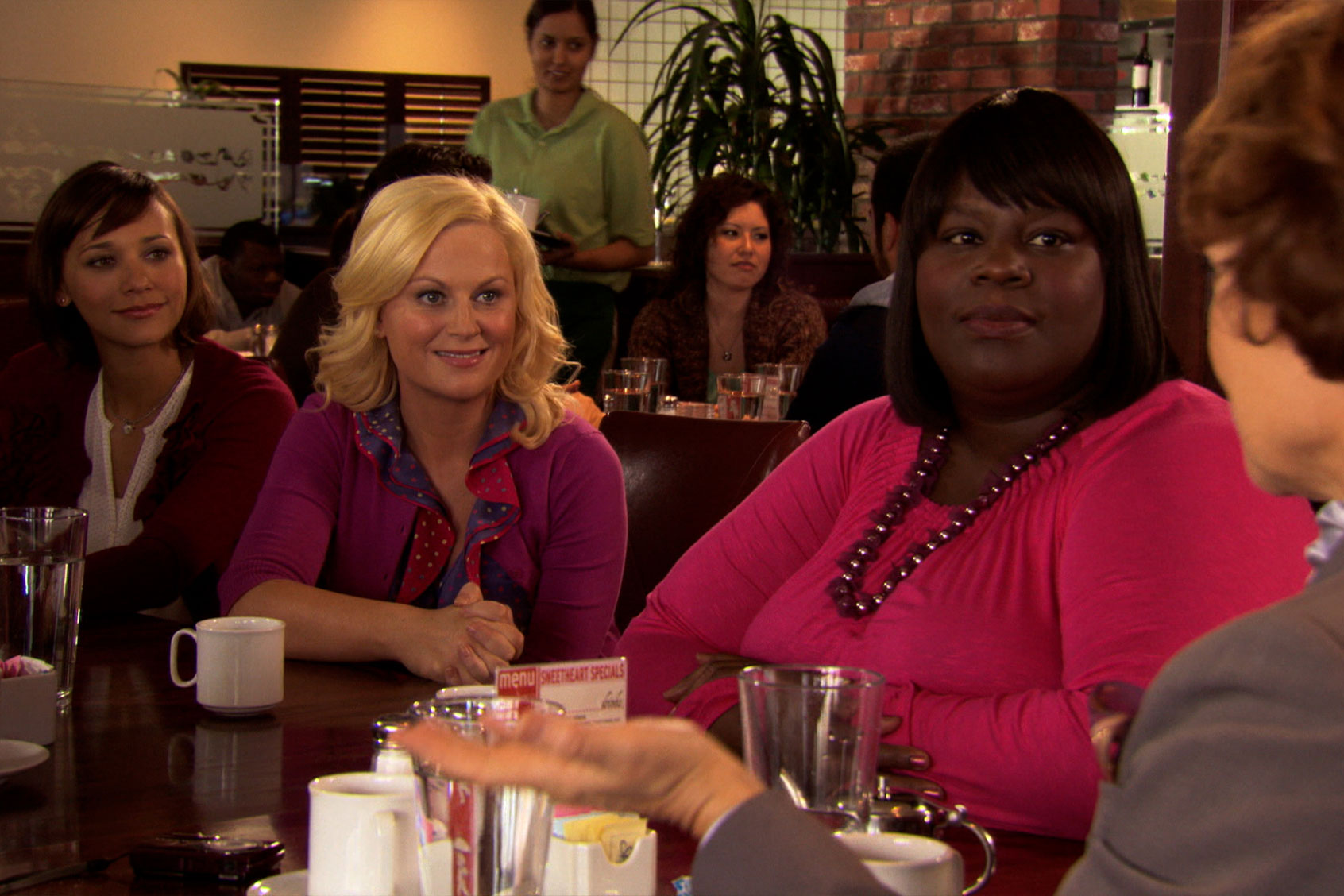
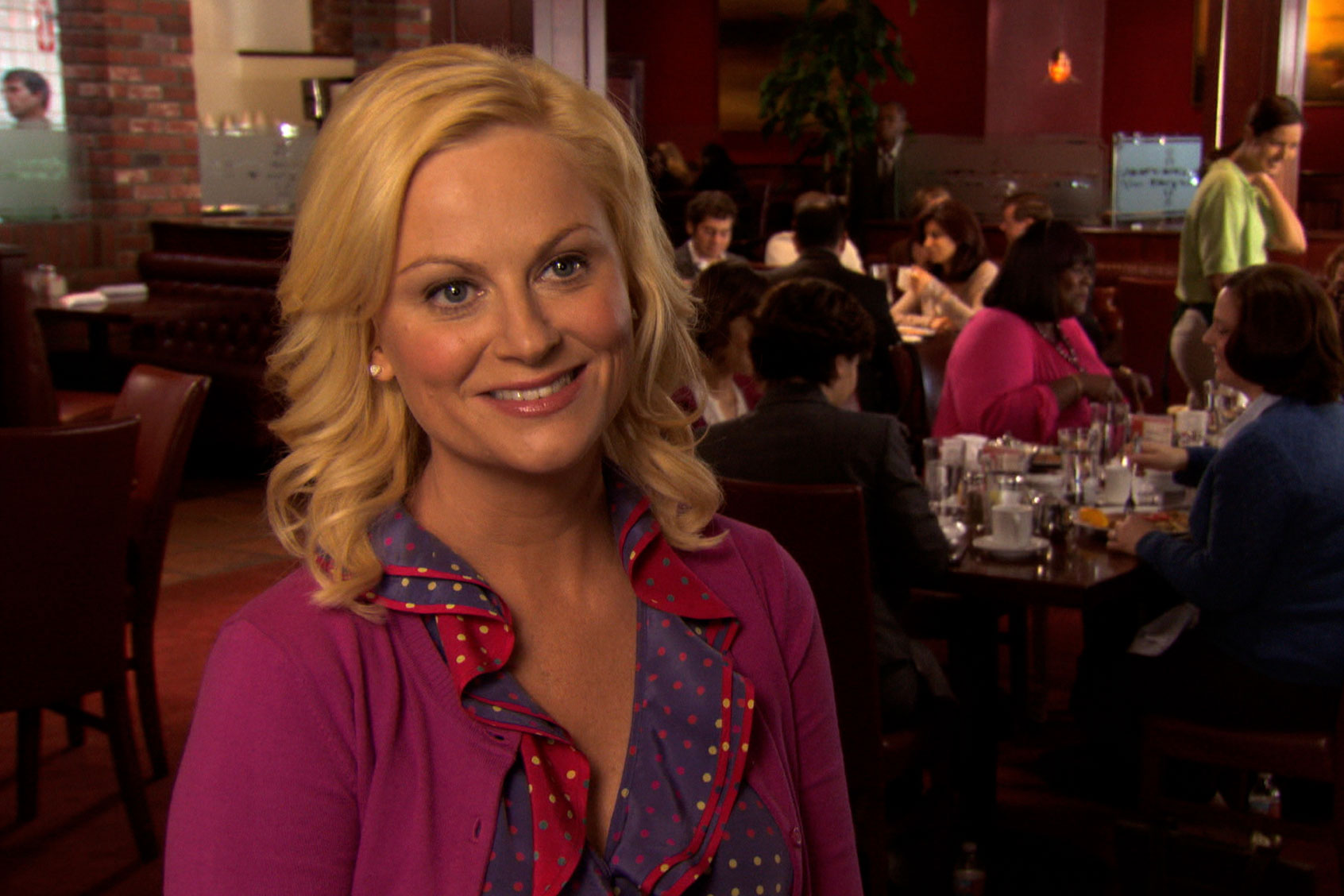
Galentine’s Day is celebrated on Feb.13, the day before Valentine’s Day. The term was first coined over a decade ago by Amy Poehler’s Leslie Knope, the plucky protagonist of NBC’s hit sitcom “Parks and Recreation.” In the 16th episode of the show’s second season, Leslie gathers a group of her close friends at a restaurant, where they enjoy breakfast foods in true Leslie fashion: 

“What’s Galentine’s Day? Oh, it’s only the best day of the year,” she explains. “Every February 13th, Leslie Knope and her lady friends leave their husbands and their boyfriends at home and just kick it breakfast-style. Ladies celebrating ladies. It’s like Lilith Fair, minus the angst. Plus, frittatas!”

Parks and Recreation“Parks and Recreation” Season 2, Episode 16 “Galentine’s Day” (Courtesy of Peacock)

Leslie then gives her friends gift bags, each filled with a bouquet of hand-crocheted flower pens, a personalized mosaic portrait made from the crushed bottles of their favorite diet soda, and a 5,000-word essay of why they’re all amazing.

Years after the episode’s release, Galentine’s Day has been adopted in the real world as more individuals celebrate the joys of friendship. Major retailers, companies and brands have also jumped on the bandwagon, releasing Galentine’s Day-themed merchandise in addition to Valentine’s Day goodies.

Parks and Recreation“Parks and Recreation” Season 2, Episode 16 “Galentine’s Day” (Courtesy of Peacock)
The evolution of Galentine’s Day

Although Galentine’s Day is now synonymous with girl power and female empowerment, that wasn’t always the case. In fact, Feb. 13 used to be widely known as “Mistress Day,” when unfaithful men indulged in their affairs before spending the 14th with their wives and girlfriends. Take it from Ryan (B.J. Novak) from “The Office,” who knows that the day before Valentine’s Day is the worst time to hook up with someone, especially your coworker.

Galentine’s Day has since changed that narrative. As Megan Garber wrote for The Atlantic, “Galentine’s Day was, in its initial conception, the character of Leslie Knope, fictional woman, realized in micro-holiday form: insistently earnest, aggressively generous, finding deeply canny methods of ensuring that every social occasion will involve the consuming of waffles.”

At its core, Galentine’s Day is fun. It’s joyous and it’s lighthearted. But its original concept only spotlighted cishet women and female friendships (hence the “gal” in Galentine’s). 

To make the holiday more inclusive, Galentine’s Day is also called “Palentine’s Day” by many. Similar to Galentine’s Day, Palentine’s Day is the time to celebrate and appreciate all of your friends, regardless of their gender.

Galentine’s Day today

Parks and Recreation“Parks and Recreation” Season 2, Episode 16 “Galentine’s Day” (Courtesy of Peacock)Like Festivus, the made-up holiday on “Seinfeld,” Galentine’s Day seems to have taken hold. Even more so since it seems to have been adopted more universally.

Per an annual survey released by the National Retail Federation (NRF) — the world’s largest retail trade association — and Prosper Insights & Analytics in 2019, people are spending more on chocolates, roses, cards and gifts during the week of Valentine’s Day.

“The vast majority of Valentine’s Day dollars are still spent on significant others, but there’s a big increase this year in consumers spreading the love to children, parents, friends and coworkers,” said NRF President and CEO Matthew Shay. 

Overall, 51% of individuals said they were planning on celebrating Valentine’s Day while 49% said they were not. Among the latter group, “11% plan to treat themselves to gifts like clothing or jewelry and 9% plan to get together with other single friends or family,” the survey noted.

As for Galentine’s Day merch, there’s plenty available on Amazon, Target and Walmart, including themed cards, jewelry, toys and decorations.

It’s fascinating to see just how popular Galentine’s Day is today, all because Leslie Knope wanted to eat waffles with friends.

All episodes of “Parks and Recreation,” including “Galentine’s Day,” are now streaming on Peacock.

Rihanna and the pressure on Black artists to be political

Robyn Rihanna Fenty is a singularity. Descending from the rafters on a glass stage, clad all in red against a backdrop of dancers dressed in white parkas, performing solo in spite of widespread internet speculation on Twitter and in the Vegas prop bet market about whom she might invite to collaborate and returning skyward  – the first Barbadian, the first billionaire and the first pregnant woman to perform the Super Bowl halftime show stood alone.

Rihanna is an exceptionally unusual billionaire.

Confronted with the practical expectations of stepping onto one of the most prominent stages after a long absence, and facing enormous political pressure as an Afro-Caribbean woman in the U.S. with a history of boldly progressive activism, Rihanna’s performance walked a complicated line between professional, personal and activist goals, with layered politics of representation holding it all together.

The halftime show had been both hotly anticipated and rife with controversy. While the musician and fashion mogul has remained in the public eye through her work with her Fenty cosmetic and lingerie lines, as well as her single “Lift Me Up” on the “Wakanda Forever” soundtrack,  she hasn’t appeared on stage since the 2016 release of “Anti,” her first album for Jay-Z’s Roc Nation label. The Feb. 12 performance marked the end of a seven-year hiatus. Rumors continue to fly online that it will be the first and highest profile stop in a world tour, and maybe even a launchpad for a new studio release.

At the same time, Rihanna’s history with the NFL is complicated. In a now-famous 2019 interview with Abby Aguirre in Vogue – an article where she aligned herself with political progressives on issues ranging from gun rights to immigration reform – she unequivocally acknowledged that she rejected an opportunity to appear at Super Bowl LIII in Atlanta in support of Colin Kaepernick. “I couldn’t dare do that,” she told Aguirre. “For what? Who gains from that? Not my people. I just couldn’t be a sellout. I couldn’t be an enabler. There are things within that organization that I do not agree with at all, and I was not about to go and be of service to them in any way.” Dropping in October 2019, hot on the heels of Jay-Z’s widely critiqued summertime deal between Roc Nation and the NFL, Rihanna’s political stand was applauded by liberals and progressives across the U.S. and around the world. 

Four years later, in her Apple Music-sponsored press conference with Nadeska Alexis, Rihanna shifted political gears as she explained why she had taken the job, speaking extensively about the importance of representation. Rihanna told Alexis, “That’s a big part of why this is important for me to do this show: representation. Representing for immigrants. Representing for my country, Barbados. Representing for Black women everywhere. I think that’s really important. That’s key for people to see the possibilities.” 

The tension between Rihanna’s 2019 and 2023 positions – and the halftime show performance itself – reveals both the virtues and the limitations of the politics of representation, and calls into question the viability of a multi-billion-dollar platform like the Super Bowl as an engine for social change.

It’s important to understand that Rihanna is an exceptionally unusual billionaire. While Rihanna currently has money in the bank, that wasn’t always so. Whereas many of her white, male counterparts like Elon Musk launched their careers with enormous loans from family members, Rihanna is virtually entirely self-made. Her family wasn’t poor, but nor were they wealthy, and their financial and emotional lives were severely impacted by her father’s substance addictions and abusive behavior. But as much as these particular issues are specific to Rihanna’s family, they are also structural. Like so many afro-diasporic people, Black Barbadians very seldom have access to generational wealth, which tends to be consolidated among the white colonial elites in that country, together with accounts associated with foreign investors taking advantage of the country’s status as a relative tax haven while contributing minimally to local economies.

For Rihanna to have achieved what she has in spite of the enormity of these systemic obstacles is astounding, and absolutely worthy of celebration.

Rihanna also had an entirely different set of cards stacked against her as a musician. The music industry had already moved into an unsustainable revenue distribution model for musicians when Rihanna released her “Anti” in 2016, but since then it has only gotten worse. With organizations like Spotify paying out fractions of a cent per stream, and the costs of touring skyrocketing due to the pandemic, inflation and rising energy costs, it has become more and more difficult for artists in North America to make a living from their craft, even artists on Rihanna’s scale.

Rihanna’s prescient choice to shift gears with the 2017 establishment of her Fenty beauty and fashion companies was the entrepreneurial masterstroke that moved her from being merely wealthy to the world’s youngest self-made billionaire. Needless to say, the 50/50 Fenty ownership split with Parisian fashion house LVMH has been more productive for her than the $0.003/stream she makes from Spotify. Indeed, at this point, her musical career is very much just one aspect of her broader personal brand, albeit a foundational one. For Rihanna to have achieved what she has in spite of the enormity of these systemic obstacles is astounding, and absolutely worthy of celebration.

The Super Bowl performance offered her an unparalleled opportunity for brand visibility and integration. Although she made far less money in her career as an artist than as a fashion mogul, her music was nevertheless at the center of the brand equity she leveraged to develop and grow the Fenty fashion empire. Her credibility and salability as a fashion icon coheres around her status as a bold musical visionary. Her personal and business profits from the Super Bowl appearance are a case in point: like all Super Bowl halftime show performers, she won’t be paid an appearance fee by the NFL. But she has forged a partnership with halftime show lead sponsor Apple TV that will apparently pay her “millions” to co-develop a documentary film that will weave together elements of the rehearsal and performance process with her life story – perhaps in the model of Beyoncé’s 2019 “Homecoming” for Netflix, based on her 2018 Coachella set. At the same time, Rihanna has developed new “Game Day” products for all of her Fenty brands, and even launched a new sportswear line for Savage x Fenty. The iconic moment at the opening of “All of the Lights” where she paused to touch up her makeup was merely a gesture towards the extensive work already done behind the scenes.


Want a daily wrap-up of all the news and commentary Salon has to offer? Subscribe to our morning newsletter, Crash Course.


At the same time, there is good reason to be circumspect about a billionaire using a huge media platform to make even a progressive political statement, especially where that statement doubles as a revenue-generating brand position. By focusing on representation – and the pursuant liberal assumption that if she can make it to the Super Bowl stage, anybody who looks like her can make it there – Rihanna and her team risk disguising the colossal hurdles she has had to overcome. The sheer improbability of her artistic and financial successes makes them both more remarkable and less replicable. With a performance that focused on representation without naming those challenges, Rihanna certainly enhanced her bottom line, put on an incredible show, and made her audience feel fantastic. Without question, all of these things matter immensely.

By focusing on representation … Rihanna and her team risk disguising the colossal hurdles she has had to overcome.

But it’s unclear what, if any, material impact these factors will have on the lives of the immigrants, Black women, Caribbean people and pregnant women whom she proposes to represent, especially relative to the likelihood that her appearance would enrich the bank accounts and brand equity of NFL owners who, as a group, are overwhelmingly committed to working against Rihanna’s political positions. What does seeing someone who looks like you on a stage like that accomplish if their path is practically impossible for you or anyone else to reproduce? 

With the cross-brand integration opportunities she has mined from her halftime show appearance, alongside the renewed interest it will surely generate in her back catalogue – recently remastered for streaming using Apple’s patented “spatial audio” – all in the face of enormous obstacles, Rihanna won the Super Bowl even before the Chiefs did. In an event that opened with a stirring performance of “Lift Every Voice,” the Black national anthem, and featured two black quarterbacks for the first time in the championship game, Black excellence was on full, powerful display. Now that the show is over, we all have to commit to ensuring that Rihanna doesn’t remain a singularity by dismantling the systems and structures of white supremacist capitalist patriarchy that have made her path so remarkable and so difficult to follow.

Would you give up your cat for love?

It’s easy for cats to capture the hearts of many, with their bushy tails and wise eyes. Many people enjoy them as pets because they’re more independent than dogs, and can even have longer life spans. But for people with cat allergies, cats aren’t cute, snuggly pets. They’re a constant source of skin rashes, itchy eyes, and sometimes, nearly fatal asthma attacks.

So what happens when a cat lover falls for a cat loather?

It’s a love story as old as time (well, since cat allergies and love have existed) but one that surprisingly hasn’t been the plot of a romantic comedy yet: Girl meets boy. Girl has a cat. Boy is allergic to cats. What’s a girl to do? 

It happened to Salon writer Mary Elizabeth Williams.

“She was the sweetest, nicest cat,” Williams recalled of a cat that she rescued from the basement of her old office building.

“A real lap cat.”

But when Williams met her now husband who had a major cat allergy later that winter, her newfound cat posed a problem right away.

“He couldn’t come over at all,” Williams said of her new beau — not the cat. 

“No cat breed can be hypoallergenic, including those adorable hairless ones.”

Nearly a year later, the two wanted to move in together, but the cat was still around. Williams said the fact that she was going to have to give up her cat was a bit of a “motivator” to get engaged prior to living together. “I needed to know this was going somewhere if I was going to give up this really cool cat,” she said. So they got engaged, and she said goodbye to her cat. Luckily, she was able to rehome the cat with her aunt where she still had “visitation rights.” Eventually, they moved in together. Yet despite rehoming her cat, and having her apartment professionally cleaned, her now husband still landed in the emergency room two days later because he couldn’t breathe.

“He was so allergic that my coat, and my clothes, would make him allergic,” Williams explained.


Want more health and science stories in your inbox? Subscribe to Salon’s weekly newsletter The Vulgar Scientist.


According to a study published in the Journal of Feline Medicine and Surgery, an estimated 10 to 20 percent of human adults are allergic to cats, and that number is on the rise.

“Although the severity of symptoms varies widely, the rising prevalence of this condition is a significant human health problem and in many individuals the disease can be serious and debilitating,” the authors explained. In a separate study surveying the reasons why 195,387 families relinquished their cats to shelters, 1% said “relationship” was the cause while another 2% cited “allergy.”

Colleen Lambo, a veterinarian with The Vets, told Salon that cat allergies can range from mild sneezing and a stuffy nose to hives and an asthma attack.

“Allergies can be a huge road-block when you love your cat but want to welcome an allergic human into your life,’ Lambo said. “The allergens that cats produce are contained in their saliva, which they spread onto their fur and skin when they groom; unfortunately, this means that no cat breed can be hypoallergenic, including those adorable hairless ones.”

As Lambo alluded to, it’s a common misconception that people are allergic to cat hair. But instead, the culprit in the saliva is a protein called Fel d1, which is produced in a cat’s salivary and sebaceous glands. It’s the cat hair that is coated in cat spit. But it’s not just hair the protein attaches to, it can stick to curtains, carpets and clothing. As reported by Nature, the protein’s tiny size makes it so it can sneak into the lungs and trigger asthma attacks, too.

“If you have a cat but hope to spend time with an allergic friend or partner, all is not lost.”

“If you have a cat but hope to spend time with an allergic friend or partner, all is not lost,” Lambo said, suggesting that some of the “best solutions are usually based on cleanliness.” She suggests replacing carpeting for “wood or tile floors” as well as “frequent vacuuming and dusting” to reduce allergen levels. “You can also bathe your cat regularly and install high-efficiency particulate air (HEPA) filters to limit allergens,” Lambo said.

Medical relief 

New research suggests that allergen immunotherapy is an emerging treatment that can bring relief to people with cat allergies. According to a study led by the University of California-Los Angeles, monoclonal antibodies called tezepelumab could help provide lasting relief up to one year. A separate study published in The Journal of Allergy and Clinical Immunology showed that researchers have made a vaccine that could help people who are allergic to cats. According to the Mayo Clinic, depending on the severity of one’s symptoms, antihistamines, corticosteroids, decongestants, immunotherapy and nasal irrigation are all potential treatments. There’s also the theory that cat allergies can be controlled by a cat’s diet, hence Purina’s Live Clear. Currently, allergy shots are available for people who are allergic to cats, but patients must receive several injections, usually starting off at twice a week and then every two weeks or so for up to six months.

Lambo added: “It is always advised to offer a cat-free area, perhaps restricting their access to a bedroom or spaces your guests frequent.”


Want more health and science stories in your inbox? Subscribe to Salon’s weekly newsletter The Vulgar Scientist.


But is all this worth it in the name of love?

Cristy Brusoe told Salon she was surprisingly able to make it work with her partner who was allergic to cats, even when she had six cats.

“My cats are like my children, so it never really crossed my mind [to give them away],” Brusoe said. “I was very clear upfront in our relationship that they came first.”

Brusoe said it was a process of introducing her partner to each cat. They also went through a round of allergy shots, but Brusoe said “they actually seemed to make her allergies worse.” 

“We found that my partner would react worse to some cats than others,” Brusoe said. “We were surprised at how she reacted to some of our cleanest, short hair cats but not our long hair cat.”

“Intimidation tactic”: Florida GOP voting bill may “disenfranchise” voters for simple mistakes

Civil rights advocates on Friday condemned the Republican-led Florida Legislature for passing another voter suppression bill that far-right Gov. Ron DeSantis, a likely GOP presidential candidate for 2024, is expected to sign into law.

The Florida House passed Senate Bill 4B by a margin of 77-33 on Friday, two days after state senators approved the bill in a 27-12 party-line vote. The legislation seeks to expand the authority of the Office of Statewide Prosecution (OSP) to pursue charges for alleged election-related crimes. The OSP reports to Republican Attorney General Ashley Moody, a close ally of DeSantis.

A coalition of voting rights groups—including NAACP Florida, ACLU of Florida, Common Cause Florida, and the Brennan Center for Justice—submitted joint testimony opposing S.B. 4B on Thursday. In a joint statement issued after its passage on Friday, the coalition warned that the legislation “risks impacting people with past convictions who will continue to be arrested and prosecuted in the criminal legal system for honest mistakes about their voter eligibility.”

“This proposal is a solution in search of a problem,” the coalition said. “There is no legitimate need to waste taxpayer dollars and state resources by expanding the Office of Statewide Prosecution for these purposes. This bill is being heard and swiftly passed only because the governor desires to expand his prosecutorial authority over Floridians who are lawfully trying to exercise their right to vote.”

S.B. 4B comes as DeSantis faces rebuke for using Florida’s newly established Office of Election Crimes and Security to arrest 20 formerly incarcerated individuals who believed they were eligible to vote—thanks to Amendment 4, a voter-approved 2018 referendum re-enfranchising 1.4 million people with past felony convictions—for alleged “voter fraud” last year.

Most of the people who were arrested for improperly casting ballots had been approved by the Florida Department of Elections, which mailed them voter registration cards prior to the 2020 election. Despite this, all of them have been slapped with felony charges carrying prison terms of up to five years and fines of up to $5,000. The arrests, unsurprisingly, have reportedly scared away many potential voters.

“While one of the cases has been settled, judges have in many cases dismissed charges and some local state attorneys have been reluctant to pursue charges,” Florida Politics reported Friday. “Democrats have questioned if the proposed legislation will allow the statewide prosecutor to take over cases that local state attorneys won’t try.”

Florida Rep. Anna Eskamani (D-47) alluded to body cam footage showing that many of those arrested—and some of the police officers—were confused about the nature of the charges.

“We had folks in Orange County that, after that amendment passed, they called the Supervisor of Elections, they called the Division of Elections, and were told they could vote,” she told Florida Politics. “There’s a reason why these cases are being tossed out.”

According to the news outlet, many critics of S.B. 4B view it as “an intimidation tactic to discourage many former felons from registering regardless, even if they are now eligible to do so.”

Florida Rep. Yvonne Hinson (D-20) said that after “citizens served their time, they should be able to have their civil rights restored.” She called the bill “an intentional act by the Legislature to manipulate the judicial process to fit a political position.”

The coalition of voting rights groups opposed to S.B. 4B shared the Democratic lawmakers’ assessments.

By increasing the OSP’s power, this legislation “would remove cases from local prosecutors and prosecute minor occurrences of mistaken voters rather than having to prove a widespread voter conspiracy,” the groups lamented. “It would also seek to circumvent three Florida courts’ decisions which have rejected the OSP’s argument for more expansive jurisdiction.”

“The office made arrests, claimed jurisdiction, and is now seeking to change the law after the courts said no,” the coalition continued. “We have grave concerns about the potential for this office targeting returning citizens for honest mistakes about their eligibility to vote in an effort to intimidate communities of color.”

“All voters should have equal, meaningful, and non-burdensome access to the ballot box,” said the coalition. “To date, Florida has failed to effectively and efficiently verify people’s eligibility under the current system, and the state’s failure has disproportionately harmed Black Floridians.”

According to the rights advocates, the state has refused for years “to provide sufficient guidance to those looking to determine whether they can vote. At the same time, government officials have allowed and, in some instances, outright encouraged people with past felony convictions to register to vote without verifying their eligibility to do so.”

“This bill will create more confusion and disenfranchise eligible voters as part of what’s been a continued effort to intimidate voters—especially returning citizens—from participating in our democracy,” the groups warned. “Rather than trying to give unchecked power to prosecutors who report to the governor and his political appointees, state officials should instead find ways to fix the complex and unnavigable system for returning citizens to determine their eligibility and invest resources to solve current known problems.”

The worst thing Biden could do: Replace Labor secretary with a “political hack” or “absolute loser”

Speculation in the New York Post that former Mayor Bill de Blasio and former Rep. Sean Patrick Maloney were both angling to succeed outgoing U.S. Secretary Marty Walsh was received with a mix of laughter and outright disdain during an informal survey of several New York City union leaders.

According to the website Daily Faceoff, Walsh was offered the executive directorship of the National Hockey League Hockey Players Association. Calls to the U.S. Department of Labor were not returned and there was no statement on the DOL’s website confirming the story although Politico and Bloomberg reported his departure. 

Walsh was the first Labor Secretary since the 1970s who was out of the union movement. A son of Irish immigrants, he rose through the ranks of Boston’s Laborer’s Local 223 and went on to lead that city’s Building and Construction Trades Council while serving in the Massachusetts legislature. Walsh was elected Mayor of Boston in 2013 and re-elected in 2017. The International Association of Firefighters, the first union to endorse Biden in the 2020 primaries, pushed hard for his nomination.

As Secretary, Walsh was overt in his support of the union movement including walking with the Kellogg workers on their picket line in 2021. Walsh played key roles in the passage of the Inflation Reduction Act, the $1.2 trillion Bi-partisan Infrastructure Act, and the CHIPS and Science Act, which collectively represent the most ambitious investment in American industrial policy in decades.

John Samuelsen, international president of the Transport Workers Union, which represents 150,000 workers in several sectors, said he found it insulting that anyone else was being considered other than Walsh’s current deputy, Julie A. Su who previously served as secretary of the California Labor and Workforce Development Agency and as California’s Commissioner of Labor from 2011 through 2018.

“Julie Su is an incredibly talented person. She’s been doing this work and she comes from a labor background. Is it on anybody’s serious agenda to knock her out of the box for Sean Patrick Maloney who was just rejected by his own constituents — or Bill de Blasio who is an absolute loser?” Samuelsen asked rhetorically. “How does anybody not think that isn’t discriminatory — I thought the Democratic Party was supposed to be the party of the elimination of the glass ceiling?”

Bloomberg reported Biden “could face pushback if Su were to lead DOL for too long, as many business lobbyists have raised concern that she could take the department in a more liberal direction based of her work as California’s labor secretary.” Specifically, companies like Uber and Lyft are critics of Su’s tenure in California.

Politico reported that Sen. Mazie Hirono, D-Hawaii, was already in Su’s corner, however. “I will be very happy to support her because I have talked with her and as I said she and Marty really made a very good team,” Hirono told the news website.

New York Taxi Workers Alliance President Bhairavi Desai issued a statement saying, “Corporations lobbying against you should be the highest endorsement for a Labor Secretary candidate.”

Su is one of the nation’s leading legal experts on workers’ rights and civil rights, as well as a past recipient of a MacArthur Foundation “genius” grant. In 2014, she launched the first “Wage Theft Is a Crime” multimedia, multilingual statewide campaign targeting low-wage workers and their employers. A Harvard Law graduate, Su was the litigation director at Asian Americans Advancing Justice-Los Angeles, the nation’s largest non-profit civil rights organization devoted to issues affecting the Asian-American community.

“Absolutely not — to go with a political hack is a step backward,” said Lt. James McCarthy, president of the Uniform Fire Officers Association, which represent the FDNY’s fire officers. “Maloney does not have the union chops that Marty Walsh has— he was a decent legislator. [Bill] de Blasio settled all the contracts that Bloomberg left open when he first got into office, which was a positive, but on his 11th hour dictates undid whatever good will there was.”

Specifically, McCarthy pointed to de Blasio’s refusal to collectively bargain the COVID vaccine mandate before he imposed it as a workplace requirement, and his embrace of the controversial strategy to push the city’s retired civil servants to a privatized Medicare Advantage program.

“He proclaimed to be the mayor of labor and did nothing for labor — that’s the bottom line,” said. Vincent Variale, president of DC 37 Local 3621, which represents the FDNY’s EMS officers. “He was not respectful to members during COVID, when we needed a boost of the morale of the workforce with all the sick and dying and he did things that brought morale down and people quit — then he tried to replace the healthcare benefits our retirees rely on.”    

Marianne Pizzitola, president of the NYC Organization of Retirees, warned President Joe Biden that appointing de Blasio — who, by the way, was also known by many in Brooklyn as “Bill de Blah, Blah” during his New York City Council tenure — would be “the worst thing he can do.”

“Don’t entertain that,” Pizzitola urged de Blasio directly in a video posted to YouTube on Feb. 10, “You do not deserve that position.”

Walsh’s tenure was certainly not without controversy. Last year, the Biden administration had Congress impose a freight rail contract that Walsh had helped negotiate but was rejected by a majoring of the nation’s 125,000. That move, last used by President Bush in 1991, sparked protests by thousands of rail workers and their supporters who blasted the imposed contract because it lacked any paid sick days.

“Most notably in a sports context: Walsh played a key role as a mediator in helping Major League Baseball come to a lockout resolution in 2022,” reported Daily Faceoff. “As for how he fits into the pro hockey world: from a union-to-owners relations perspective, he also has a key connection to Boston Bruins owner Jeremy Jacobs, an extremely influential voice as chairman of the NHL’s Board of Governors. In 2017 the Jacobs family donated $13,000 to Walsh’s political committee.

“Throughout his tenure as Secretary of Labor, Marty Walsh has done a phenomenal job ensuring workers have a seat at the table,” the Communications Workers of America said in a statement. “He has gone above and beyond to protect and expand the rights of working families, including CWA members. In addition to focusing the Department’s resources to support worker organizing and empowerment, he has personally met with and encouraged workers who are organizing with CWA.”

The CWA statement continued. “Serving under President Biden, the most pro-union President in history, Walsh played an instrumental role in executing key pieces of the Administration’s pro-worker agenda. His role in ensuring the inclusion of strong labor standards in federal broadband funding, raising wages and workplace standards for federal contract workers, and strengthening health and safety rules cannot be understated.”

Walsh’s name surfaced in press reports surrounding President Biden’s State of the Union address because he was the Cabinet member selected to be the “designated survivor” kept at a remote unknown location away from the U.S. Capitol in the event of a catastrophic event.

Politico reported that Walsh will see a significant pay hike from his $200,000 government salary considering that the current executive director of the NHLPA is paid $3 million a year.

“Never seen anything like it”: “Aggressive” Trump special counsel hauls lawyers before grand jury

Two of former President Donald Trump’s attorneys have reportedly appeared before a federal grand jury investigating the former president’s handling of sensitive government documents that he took to his Mar-a-Lago club and residence after he left office.

Trump attorney Evan Corcoran, who handled the former president’s responses to the government over its requests for the return of records, was interviewed before a grand jury, The New York Times reported on Friday. Fellow attorney Christina Bobb, who signed an affidavit affirming that Trump had returned all classified materials in response to a grand jury subpoena in June before the FBI found additional documents marked classified during an August search, also appeared before the grand jury, according to The Wall Street Journal.

Special counsel Jack Smith, who was appointed to oversee the investigation into Trump’s handling of classified documents and his involvement in the Jan. 6 assault on the Capitol less than three months ago, is “moving aggressively” in the probe before the 2024 presidential campaign gets underway this summer, according to a recent report by The Times. 

Smith’s team is also looking to interview Trump attorney Alina Habba, who is not representing Trump in the Mar-a-Lago case but said in an affidavit in another case that she searched the former president’s office and residence in May, according to the report.  Prosecutors are also seeking to question former Trump attorney Alex Cannon, who reportedly advised Trump to cooperate with the government’s requests to return the documents.

“I’ve never seen anything like it,” Chuck Rosenberg, a former U.S. attorney and senior FBI official, told the Times. “It’s just a whirling dust cloud, and everyone who gets near it gets covered in grime.”

Former U.S. attorney Joyce White Vance said the report makes it sound like Smith is “fixing to give some Trump lawyers & aides the option of being codefendants or cooperating witnesses.”


Want a daily wrap-up of all the news and commentary Salon has to offer? Subscribe to our morning newsletter, Crash Course.


Last week, Smith issued a subpoena to former Vice President Mike Pence, who is one of the people best positioned to provide information about Trump’s actions and state of mind in the days leading up to the Jan. 6, 2021, assault on the Capitol.

While Smith has been focused on the Jan. 6 investigations and the document’s case, he is also examining Save America, a pro-Trump political action committee through which Trump raised millions of dollars with his false claims of election fraud. As part of his investigation, Smith is looking into how and why the committee’s vendors were paid. A vast array of Trump vendors have been subpoenaed, the Times reported. 

Smith’s operation structure closely resembles the organization he oversaw when he ran the Justice Department’s public integrity unit from 2010 to 2015, The Times reported. His first three hires included J.P. Cooney, Raymond Hulser and David Harbach – all of whom were trusted colleagues during his time in the department. 

His team is looking through testimony provided by the House Jan. 6 committee, including witness statements on the fake electors scheme in which Trump’s advisers and campaign officials assembled alternate slates of Trump electors from contested states that he lost.

“When zealous prosecutors are intent on bringing a case, they leave no stone unturned,” former federal prosecutor Dennis Aftergut wrote at The Bulwark, adding that the Pence subpoena “makes clear that the special counsel is proceeding full speed ahead on that front, too.”

Greg Abbott pushes bill to ban transgender college athletes — but it could backfire

Sign up for The Brief, The Texas Tribune’s daily newsletter that keeps readers up to speed on the most essential Texas news.


Gov. Greg Abbott said Saturday that he would back legislation banning transgender student athletes from competing on a collegiate level on teams that match their gender.

“This next session, we will pass a law prohibiting biological men to compete against women in college sports,” Abbott said at the Young America’s Foundation Freedom conference in Dallas. He made the comments during an interview billed as a “fireside chat” with former Wisconsin Gov. Scott Walker.

State lawmakers passed legislation in 2021 that restricted transgender student athletes from playing on K-12 school sports teams that align with their gender. But Abbott has previously demurred extending such restrictions to college athletes. When asked at a Kingwood Tea Party event in October 2021 if he would implement limitations on transgender college athletes, Abbott did not directly answer the question.

Republican lawmakers have already filed two bills — Senate Bill 649 and House Bill 23 — this legislative session that would target transgender students’ sports participation at colleges and universities.

The bills restricting transgender college athletes could open the door to a political fight. The National Collegiate Athletic Association Board of Governors, which oversees the main governing body for college sports, has long prioritized the inclusion of transgender student athletes in its competitions. At least 20 Texas universities compete in NCAA competitions, including the University of Texas at Austin, Texas State University and Texas A&M University.

In 2021, the NCAA board announced it will only hold championships in which transgender student athletes can participate without discrimination.

The NCAA’s participation policies currently require transgender student athletes to document sport-specific testosterone levels beginning four weeks before their sports’ championship selections.

The 2021 legislation around K-12 sports prompted amendments to rules from the University Interscholastic League, which governs primary and secondary school sports in Texas. The UIL had previously accepted legally modified birth certificates in which someone may have had their sex changed to align with their gender.

In recent sessions, Republican lawmakers have targeted transgender people as a means to shore up appeal among social conservatives, beginning with the 2017 special legislative session, when they made an unsuccessful play to limit transgender people from using public and school bathrooms that aligned with their gender. This session, conservatives are also trying to criminalize types of gender-affirming care for minors and restrict lessons about sexual orientation and gender identity in public schools.


Disclosure: Texas A&M University and the University of Texas at Austin have been financial supporters of The Texas Tribune, a nonprofit, nonpartisan news organization that is funded in part by donations from members, foundations and corporate sponsors. Financial supporters play no role in the Tribune’s journalism. Find a complete list of them here.

This article originally appeared in The Texas Tribune at https://www.texastribune.org/2023/02/12/transgender-college-athletes/.

The Texas Tribune is a member-supported, nonpartisan newsroom informing and engaging Texans on state politics and policy. Learn more at texastribune.org.

Why heart attacks are rising for young people, according to experts

When Buffalo Bills safety Damar Hamlin suffered cardiac arrest during a live game earlier this year, many spectators commented that it seemed bizarre for a 24-year-old to experience a near-fatal heart-related incident. Yet even before that infamous game against the Cincinnati Bengals, experts had been raising alarms about the COVID-19 pandemic, which is demonstrably linked to heart disease. More recently a national survey by The Ohio State University Wexner Medical Center revealed that young people remain largely unconcerned about their risk of heart disease even though experts continue to warn about the disturbing trends.

“We are in a society now that people are less physically active. There is more use of screen time in general and less activity for a lot of people for their job. They sit all day.”

As it turns out, the growing epidemic of youth heart disease precedes the Hamlin incident, and may ultimately have deadly consequences. In the words of Dr. Ron Blankstein — a preventive cardiologist and professor of medicine at Harvard Medical School — “It’s never too early to start thinking about prevention of heart disease,” in no small part because of the growing obesity epidemic, and additionally because “cardiovascular disease among young people has been increasing since before COVID-19.”

“The main reasons [for the spike in youth heart disease] have been increases in obesity and diabetes,” Blankstein told Salon. He added that young people dealing with mental health issues are also turning increasingly to substances like marijuana, alcohol, cocaine and nicotine, all of which are also linked to heart disease. Beyond what they put into their bodies, however, modern American young people are also simply not moving enough to stay fit.

“We are in a society now that people are less physically active,” Blankstein explained. “There is more use of screen time in general and less activity for a lot of people for their job. They sit all day.” Americans have been trending toward increasingly sedentary lifestyles for decades, as more and more jobs do not require sustained physical labor, and the foods fueling people sap rather than restore their energy. Indeed, the term “food desert” exists today because there are so many places — including in the United States — where the food options available to the average consumer are nutritionally inadequate and bad for your heart.


Want more health and science stories in your inbox? Subscribe to Salon’s weekly newsletter The Vulgar Scientist.


“When we talk about diet choices and diet availability, we’re in a society where there is a large consumption of processed foods that are readily available, fast food that at times is cheaper and more readily available and more accessible than healthier options like fruits and vegetables and whole grains and food that is not processed,” Blankstein pointed out. Compounding the damage from regularly consuming heart-unhealthy foods, low-income Americans also lack access to the type of regular health care that could help them stay on top of potential heart problems.

“Although observed rates of myocarditis were higher than expected, the benefits of vaccination against SARS-CoV-2 in reducing the severity of COVID-19, hospital admission and deaths far outweigh the risk of developing myocarditis.”

“Addressing heart disease risk factors at a young age is important because when conditions are treated at an earlier age, you can slow the progression or onset of developing heart disease,” explained Dr. Laxmi Mehta, director of Preventative Cardiology and Women’s Cardiovascular Health at The Ohio State Wexner Medical Center, in a statement after Ohio State University released a study on youth cardiac disease. Yet because so many young people dismiss heart disease as a problem exclusive to the middle-aged and elderly, detectable and thus avoidable diseases are often missed.

For those who do not have access to a robust personal health care plan, there are other ways to protect yourself. The American Heart Association (AHA) has a list of the so-called “Essential Eight” — that is, eight things that any person should do to maintain good heart health regardless of their age. In addition to eating well, avoiding nicotine and exercising more, the AHA urges people to watch their weight, maintain their cholesterol, manage their blood sugar, manage their blood pressure and get seven to nine hours of sleep.

Finally, it is especially important for young people to receive COVID-19 vaccinations. Patients infected with the SARS-CoV-2 virus (which causes COVID-19) often have damaged cardiac muscle as a result. Although anti-vaccine advocates have argued that COVID-19 vaccines are heart-dangerous, the same studies that identify a slightly increased risk of myocarditis linked to vaccines also emphasize that there are far greater health perils involved with not being inoculated. 

“Although observed rates of myocarditis were higher than expected, the benefits of vaccination against SARS-CoV-2 in reducing the severity of COVID-19, hospital admission and deaths far outweigh the risk of developing myocarditis,” explained the Canadian Medical Association Journal (CMAJ) at the time. Blankstein elaborated on the heart-COVID connection.

“There is a lot you can do to lower your risk of heart disease. It’s never too late to start some of these preventive efforts.”

“There are various reasons why COVID-19 in general has increased cardiovascular disease,” Blankstein explained, including many related to the unique way in which the virus infects the body.

“That’s one reason why there is a higher risk of a stroke or heart attack. There is also the systemic inflammation that is associated with having a viral illness like COVID-19, and we know inflammation is a factor that can accelerate coronary disease and lead to more events. In addition to that — and those are a direct effect of the virus on the body — there is the stress of both the pandemic in general and stress of individuals who are sick, who may sometimes have a prolonged illness, and we know that contributes as well.” As any casual perusal of TikTok demonstrates, a lot of people have gained weight and become more sedentary during the pandemic.

“I think that heart disease is mostly preventable, so I think it’s important for people to know that nobody is doomed to have heart disease,” Blankstein explained. “There is a lot you can do to lower your risk of heart disease. It’s never too late to start some of these preventive efforts. But in generally, the earlier we start, the better, because when people have heart disease and it’s diagnosed in their 30s or 40s, it’s usually been building up over decades. It’s never too early to start thinking about prevention of heart disease.”

The history of “better than sex” cake, a sweet dessert with a sinful reputation

The first time I remember seeing the word “sex” in print was actually in a cookbook. I can’t recall the title, but it had a green plastic spiral binding and a paperback cover with a rosy-cheeked grandmother in a frilled apron on the front. It belonged to my mother by way of her mother, who likely picked it up at one of the antique book fairs or library sales she frequented on the weekends. 

I was probably nine or ten when I initially grabbed it off the kitchen bookshelf. My school was holding some kind of character day — and as I had decided to dress as the sufficiently broad character of “grandmother,” I thought it made sense to consult this cookbook’s cover for grandmotherly fashion inspiration. Thanks to the Food Network, my interest in cooking was also really burgeoning at the time, so I flipped back to the last chapter which contained the desserts

There were cookies, cupcakes, pies and then there it was — “Better than Sex Cake.” 

Again, I don’t remember much about the cookbook itself, though I do remember that each recipe was introduced with a short blurb; the paragraph that preceded this recipe was obviously suggestive enough that it had me knocking on my parents’ bedroom door to ask my mom, “Hey, what is ‘sex?'”

“Where did you hear that word?” she demanded. I sheepishly pointed to the cookbook. 

She scanned the page I had dog-eared and let out a tired sigh. Sex was something for married grown-ups, she said before sending me off to play. Intrigued, I later surreptitiously spirited the book up to my bedroom to look for some more context clues, but when I flipped back to the dessert section, the page containing the recipe had been carefully torn out. Like most girls my age, I continued to gather clues for the next several years —  through playground whispers and vague hotel pamphlets about adult pay-per-view — until my family got a home computer and the internet provided detailed answers. 

Intrigued, I later surreptitiously spirited the book up to my bedroom to look for some more context clues, but when I flipped back to the dessert section, the page containing the recipe had been carefully torn out.

By that point, I had long forgotten about “better than sex” cake. I wouldn’t think of it again until a few years ago, when I was at a now-shuttered bakery located in Fulton, Kentucky, a 3,000-person town set along U.S. 51. When I saw the cake in the display case, bookended by bowls of banana pudding and Jell-O salad, I immediately remembered the cookbook and my childhood curiosity reemerged. 

“Hey, what is that?” I called back to the woman behind the counter. She was in her 60s with a smart gray bob and a forest green apron that smelled like frosting and menthols. “‘Better than sex’ cake, hon,” she replied, tapping the sign with her manicured nail. 

“No, no — I mean, what is it? What is in it?” I asked. 

The woman behind the counter responded that there was a little bit of everything in this cake. Her version started with a chocolate sheet cake base, which was then soaked in condensed milk and topped with an ungodly amount of Cool Whip. After being refrigerated for a few hours, or overnight, the cake was then garnished with crushed Butterfingers and a drizzle of Hershey’s chocolate sauce. When I asked where she first learned the recipe, the woman shrugged and said she thought her sister had clipped it out of a magazine. 

To be fair, I’ve since found out that the exact origin of the “better than sex” cake is actually pretty murky, as are the recipe specifications. 


Want more great food writing and recipes? Subscribe to Salon Food’s newsletter, The Bite.


According to Bonnie McDowell, the author of “Quaint Cooking: For the Love of the Vintage Kitchen,” the cake started appearing in newspaper columns in the early 1980s, which means that it was likely first popularized by home cooks in the decade prior. 

“What I can tell you is how it spread across the country,” McDowell wrote. “The epicenter seems to be a June 1981 meeting in St. Louis of newspaper food writers from across the country. This recipe seemed to be passed around between editors. A Pittsburgh paper who posted the recipe said that she got the recipe from a fellow editor at the St. Petersburg Times (Florida) who in turn says she got it from a mutual at the Charlotte Observer (North Carolina). So it should be no surprise that after the conference, it kept getting passed around by the reader word of mouth. Mary Alice Powell wrote in her 1983 food column that this cake recipe proved the ‘neighbors still exchange recipes over the backyard.'” 

Seven years later, “The Dallas Morning News” columnist Marlyn Schwartz posed the question: “Can food be better than sex?” 

“This is not an X-rated column,” she wrote. “But in the interest of good reporting, I must point out that a lot of people these days are carrying the ‘safe sex’ campaign one step further.” Schwartz reported that she had received a cookbook for Christmas that offered four distinct recipes for “better than sex cake.” 

In her research, McDowell also found four distinct recipes for “better than sex” cake. 

The first is a vanilla cake topped with sweet, crushed pineapple that’s been stewed with sugar, followed by a thick layer of vanilla pudding. That’s then topped with whipped cream and coconut flakes. The next variation also starts with vanilla cake batter, this time blended with chocolate chunks, sour cream and nuts. 

The third variation is similar to the chocolate cake I tried in Fulton, topped with whipped topping and crushed candy. McDowell describes the final variation like this: 

First flour, butter, and chopped pecans are mixed together and pressed in a pan, and baked. A layer of cream cheese, confectioners sugar, and whipped topping are spread on top of that. Then vanilla pudding and chocolate pudding are mixed together and spread over that. It is then topped with whipped topping and garnished with shaved chocolate.

This cake, McDowell wrote, was also sometimes referred to in cookbooks by the less explicit, but equally suggestive name, “Better than Robert Redford” or simply “Better than Redford” cake, referring, of course, to the “Indecent Proposal” actor who is still regarded as a sex symbol. There’s also the G-rated “Holy Cow Cake” name, which was typically applied to chocolate variations of the cake. 

The original saucy name, however, definitely seemed to add to the cake’s appeal. 

“Sinful, positively sinful,” read an article in the food section of a 1998 issue of Lawrence Journal-World. “Rita Larson of Tonganoxie submitted a recipe to the Journal-World’s Recipes from Readers contest that was simply too intriguing to pass up. We suggest Better Than Sex Cake is one possible way to reward someone who’s been very, very good.” 

As someone who was raised in the church, it’s not lost on me the ways in which we culturally insist on branding decadent food and pleasurable sex as “sinful,” especially in media typically written by and for women, but it’s undeniable that even the illusion of something being illicit can be somewhat alluring. 

That’s why the “better than sex” cake still endures, though instead of the being exchanged by neighbors “over the backyard,” it’s now largely through blogs like Spaceships and Laser Beams, Preppy Kitchen and Tastes Better from Scratch — which each published their own recipes for the cake in 2023, 2022 and 2021, respectively. 

Some variations on the recipe, including Paula Deen’s, phrase the name as a question: “Is it Really Better Than Sex? Cake.” 

When I jokingly asked that same question of the woman behind the counter at the bakery in Fulton after ordering a slice, she gave a wry chuckle and simply said, “I’ve definitely had better, but I’ll tell you, I’ve definitely had way worse.”

Ron DeSantis’ campaign wanted to ban guns from event — but didn’t want to get blamed: report

The campaign of Florida Gov. Ron DeSantis—a strident supporter of loosening gun regulations—tried to ban firearms at an election night event in Tampa last year and blame the city for the policy, The Washington Post said in a report published Friday that had critics on both sides of the political aisle calling the presumptive 2024 Republican presidential candidate a hypocrite.

According to the Post, DeSantis’ campaign sought to prohibit guns from the governor’s reelection victory party at the Tampa Convention Center, a city-run venue, last November 8, while suggesting city officials claim responsibility for the ban.

The Post obtained an October 8 email from Chase Finch, the convention center’s safety and security manager, saying that “DeSantis/his campaign will not tell their attendees they are not permitted to carry because of the political optics.”

Finch explained that the request for the city to shoulder blame was due to “Republicans largely being in support of 2A,” a reference to the Second Amendment.”

“Basically it sounds like they want us to say it’s our policy to disallow firearms within the event space if anyone asks,” he added, drawing a response from city administrator Nicole Travis stressing that “we are not saying anything about concealed carry.”

“That is the responsibility of the renter,” Travis said. “We follow state statute that permits concealed carry.”

Responding to the Post report, California Gov. Gavin Newsom, a Democrat, tweeted that “the level of hypocrisy here is just astounding.”

Fred Guttenberg—an activist whose daughter Jaime Guttenberg was one of 17 students and staff shot dead during the February 14, 2018 massacre at Marjory Stoneman Douglas High School in Parkland, Florida—said DeSantis “is a fraud and he should be treated that way.”

“The tough guy act covers for a small, weak, and weird man,” he tweeted. “His decision to be OK with others being at risk of gun violence but not him and to try and cover that up? WEAK!”

Shannon Watts, founder of the gun control advocacy group Moms Demand Action, wrote on Twitter that “the hypocrisy of ‘the dangers of unregulated guns for thee but not for me’ is next-level.”

“DeSantis caters to an extremist, MAGA Republican base by pushing permitless carry while having the privilege to keep those same armed extremists at a distance,” she added. “DeSantis is reportedly forcing attendees at his events to go through metal detectors and he’s also refusing to attend events unless guns are banned. Yet he’s simultaneously pushing for permitless carry to strip gun safety requirements. Safety for him, violence for everyone else.”

Under a Republican-authored bill backed by DeSantis, Florida would become the 26th state to allow people to carry concealed loaded guns without permits. There are currently around 2.6 million concealed carry permits in the state, according to the Tallahassee Democrat.

The election night party wasn’t the only time DeSantis’ campaign has tried to keep guns out of events attended by the governor.

Alachua County GOP Chair Tim Marden told the Post that he skipped a DeSantis fundraiser last October because the governor was insisting upon having metal detectors at the event—outside of which a gun rights protester was arrested.

“In my thinking, it was a little hypocritical to have this measure in place for law-abiding citizens at a time when a lot of folks in the gun community will condemn a Democratic politician for having a security force,” Marden said.

Luis Valdes, Florida state director of Gun Owners of America, told the Post that “DeSantis continually pays lip service to the Second Amendment as he positions himself for a nationwide run, and yet what I am seeing as a constituent of his and as a Floridian is that his events are gun-free zones.”

“His primary rivals will clean his clock on guns,” he added.

At the polar opposite of the gun control issue, Florida Moms Demand Action volunteer Wendy Malloy told the Tampa Bay Times that “this proves what we already knew—when it comes to gun violence, Gov. DeSantis puts ‘political optics’ before public safety.”

“Our lawmakers should stand up to Gov. DeSantis’ hypocrisy and reject permitless carry,” she added.

A guide to winter citrus varieties

It’s citrus season in the U.S., and if you live along the citrus belt — the string of states that hug the southern border from California to Florida — a bevy of fresh local oranges, lemons, kumquats and so much more are showing up in your farmstands. For everyone else, these fruits make a longer journey to enliven the dwindling selection of storage apples and pears in produce aisles, bringing some welcome variety to our diets.  If you’re lucky enough to have a relative in a citrus-growing state, you likely have received shipments of fresh fruit as a gift; if not, order your own! Companies that specialize in mail order abound; but since some conventional citrus is a pesticide-heavy, especially tangerines and grapefruits, check out growers that specialize in certified organic, like Frog Hollow Farm.

According to Tracy Kahn, curator of the Givaudan Citrus Variety Collection at the University of California, Riverside, which has 1,000 different cultivars or citrus and related species, relatives of the citrus varieties we know today likely originated in Yunnan Province in China elsewhere in Southeast Asia in the Miocene period. They made their way to the Mediterranean, Australia and beyond and are now grown mostly between 35 north latitude and 35 south latitude, “in areas that are a little bit tropical but basically all over the world,” Kahn says.

Mandarins, pomelos, citrons, kumquats and papeda were likely main, original biological species. But lots of the citrus we eat today, from what Americans might consider basic fare (morning favorite grapefruits, say) to specialty fruit (finger limes and bergamots) are hybrids.

For example, oranges are mandarin/pummelo hybrids. And “what we think of as mandarins now actually include a lot of things and they have some pummelo genes,” Kahn says. “But the original, most primitive types were very small; they weren’t very sweet, and they were quite seedy.”  Papeda, which Kahn calls “edible, but not very palatable,” is one parent of both key limes and Mexican limes.

Throughout human interaction with citrus we’ve used their various parts for food, flavor and fragrance. We’ve also developed recipes to accommodate their sometimes astringent characteristics. “The first oranges that ended up in Europe were actually sour oranges, something like Seville, and that’s why Seville got made into marmalade, as a way of sweetening and then making it more palatable,” says Kahn.

The mixing of citrus has gone on and on over centuries so that today we have sweet, easy-to-peel mandarins with brand names like Cuties, mandarin/kumquat hybrids called mandarinquats, and the Valentine — a pummelo/blood orange/mandarin hybrid with low acid, high sweetness and an intense ruby interior.

Parts of UCR’s collection may become root stock for growing citrus trees; rather than growing from seed, most fruit trees are grown from scions that are grafted to rootstocks to help them gain pest and disease resistance, for example. They’re also used for research: into varietals that do well in California’s ongoing drought conditions, or that contain genes that don’t succumb to huanglongbing, aka citrus greening disease, which is devastating Florida’s juice industry and has also spread to Texas, Arizona and California.

No matter what sort of citrus you choose, or for what purpose — candying the peel, throwing leaves into curries, gobbling up the flesh— it is likely to be is delicious and nutritious, loaded with vitamins A, C, B6, calcium, potassium and more. But there are also reasons to branch out and try varieties beyond the usual bags of clementines. They tend to come from smaller businesses, says Kahn, and “that diversity in our food is pretty and it tastes good and it smells interesting.”

Below, we list some of the less common citrus types you might find out there this season, which runs roughly through February or March, depending on variety and growing region.

Australian Finger Lime Tree (Citrus australasica)

Also known as caviar lime, this odd, long variety that vaguely resembles a jalapeño, doesn’t show the usual segments when you cut it open. Rather, its tiny, spherical innards, called pulp-vesicles, are the part you squeeze out and consume.

Bergamot (Citrus bergamia)

You know this type of very small orange from the distinct flavor the oil in its skin gives to Earl Grey tea. Spotted on the produce aisle, it looks like a nondescript, greenish lemon with a thin peel. It’s sour and somewhat floral (especially in its zest) and it works well as a pizzazzy lemon substitute in pretty much any dish.

Buddha’s Hand Citron (Citrus medica)

Possibly the oddest looking of all the citruses, the Buddha’s hand has clumps of long, yellow, bumpy “fingers.” Unlike pretty much all the other citrus out there, the Buddha’s hand has no flesh to speak of; under its skin is all white pith, and in China, where it originates, it’s considered lucky and may be used as decoration. You can eat it, though, and it’s got a flavor that’s been described as redolent of violets. Slice and eat it raw (the pith is sweet), or candy it in a syrup of sugar and water.

Calamansi (Citrofortunella microcarpa)

A.k.a. calamondin, this tiny tangerine-like fruit is actually a kind of lime. It’s a little sour, a lot juicy, and probably has kumquat as a parent somewhere along its lineage. It can be juiced for drinking (although due to its small size it may take a lot of fruit to fill a glass), or to add to Filipino dishes; or slice it and eat it in quarters out of the rind.

Clementine (Citrus clementina)

Not exactly exotic at this point, clementines are varieties of mandarin have become a huge component of the U.S. citrus market. Sweet and usually seedless, they’re a great addition to a school lunchbox. You may find these fruits marked simply as clementines in the produce aisle. Or, you might find them under the Cuties and Halos labels, although, depending on time of year, these brands may fill in with non-clementine varieties of mandarins like murcotts.

Kumquat (Fortunella spp)

Kumquats are small, oval, OG citrus fruits. Sweet and slightly tart with a mildly bitter skin, you can simmer them in syrup, pickle them, or just pop them in your mouth whole.

Limequat (Citrofortunella spp)

Exactly what it sounds like: lime crossed with kumquat, to make a small, smooth-skinned, pale-yellow fruit. You can eat these whole, too, or squeeze their juice into tea or any other beverage.

Makrut Lime (Citrus hystrix)

These are small, round, very green and extremely bumpy-skinned limes. Both their peel and their leaves are used in cooking in Thailand and elsewhere in Southeast Asia, especially in curries.

Meyer Lemon (Citrus meyeri)

Probably an orange/lemon hybrid, Meyer lemons have a lot less of an acid base than ordinary lemons, and they tend to look a little plumper. Lots of people favor them for dessert recipes, although they can also be preserved for relish for savory dishes.

Oroblanco (Citrus paradisi)

This is a hybrid between a pummelo and a white grapefruit, with characteristics of both: a grapefruit’s smaller-than-pummelo size and a slight bit of its bitterness, and a pummelo’s thick pith and sweet flavor. Its skin is pale, and it tends to have a flat bottom before it’s peeled. This is a good fruit for straight eating — either in segments or cut in half and drizzled with honey like a grapefruit.

Palestinian Sweet Lime (Citrus limettioides)

Also known as the common sweet lime, this pale, thin-skinned fruit has a very low acid content like its cousin the Meyer lemon that gives it more of the taste of an un-tangy orange than a lemon (although it’s also described by some as “insipid”). You can eat it straight like an orange, or toss it into a fruit salad.

Pummelo (Citrus maximus)

As its Latin name indicates, this is a large citrus fruit, and it’s also an ancestor of the grapefruit. It’s got a super-thick and fluffy pith underneath its thick skin; after you peel it you might discover that you’ve got a lot less actual fruit than you imagined. It’s sweeter and less astringent than grapefruit, and it’s also less juicy. The best way to eat it just may be to peel it and pop its white, yellow or pink segments right into your mouth.

Satsuma (Citrus unshiu)

This type of small mandarin is ubiquitous at this time of year, with overflowing boxes of fruit offered for sale everywhere from supermarkets to specialty food stores, often with leaves still attached. Although it might originally hail from China, it came to the U.S. from Japan. It’s small, sweet and easy to peel.

Seville Orange (Citrus aurantium L.)

The original marmalade orange, Seville oranges are sour and slightly bitter and are the perfect fruit to cook up for chutneys and other sauces and relishes.

Yuzu (Citrus junos)

This is a larger-than-average lemon, with thick, bumpy peels and a perfumy aroma. Hailing from Japan, where it commonly makes its way into “herbal” teas and mixed with honey, it’s also a key ingredient in ponzu sauce — a mixture of soy, mirin and yuzu juice.

“Tell the real story”: Super Bowl slammed for “hijacking the Pat Tillman story”

Advocates of peace, truth, and basic human decency on Sunday excoriated the National Football League’s “whitewashing” of former Arizona Cardinal and Army Ranger Pat Tillman’s death in Afghanistan by so-called “friendly fire” and the military’s subsequent cover-up—critical details omitted from a glowingly patriotic Super Bowl salute.

As a group of four Pat Tillman Foundation scholars chosen as honorary coin-toss captains at Super Bowl LVII in Glendale, Arizona were introduced via a video segment narrated by actor Kevin Costner, viewers were told how Tillman “gave up his NFL career to join the Army Rangers and ultimately lost his life in the line of duty.”

The video did not say how Tillman died, what he thought about the Iraq war, or how the military lied to his family and the nation about his death. This outraged many viewers.

“Obviously the army killing Pat Tillman and covering it up afterwards is the worst thing the U.S. military did to him, but the years they’ve spent rolling out his portrait backed by some inspirational music as a recruiting tool is a surprisingly close second,” tweeted progressive writer Jay Willis.

“Pat Tillman called the Iraq invasion and occupation ‘fucking illegal’ and was killed by friendly fire in an incident the military covered up and tried to hide from his family,” tweeted Washington Post investigative reporter Evan Hill.

“I’m writing a book for FIRST GRADERS on Pat Tillman that contains more truth about his life and death than the NFL just provided at the Super Bowl,” wrote author Andrew Maraniss.

“Another year of hijacking the Pat Tillman story and not telling that he hated the Iraq War and was killed by the military,” said one Twitter user.

“Tell the real story of Pat Tillman or get off the screen,” fumed yet another.

Tillman, 25 years old at the time, turned down a $3.6 million contract with the Cardinals to enlist in the U.S. Army in May 2002 after the 9/11 attacks on the United States. He expected to be deployed to Afghanistan. Instead, he was sent to invade Iraq—a country that had no ties to 9/11. Tillman quickly came to deplore the “fucking illegal” war, and even made “loose plans” to meet with anti-war intellectual Noam Chomsky, according to The Intercept‘s Ryan Devereaux.

As Tillman’s brother Kevin sardonically wrote:

Somehow we were sent to invade a nation because it was a direct threat to the American people, or to the world, or harbored terrorists, or was involved in the September 11 attacks, or received weapons-grade uranium from Niger, or had mobile weapons labs, or WMD, or had a need to be liberated, or we needed to establish a democracy, or stop an insurgency, or stop a civil war we created that can’t be called a civil war even though it is. Something like that.

Pat and Kevin were sent to Afghanistan on April 8, 2004. Stationed at a forward operating base in Khost province, Pat was killed on April 22, 2004 by what the army said was “enemy fire” during a firefight.

However, the army knew in the days immediately following Tillman’s death that he had been shot three times in the head from less than 30 feet away by so-called “friendly fire,” and that U.S. troops had burned his uniform and body armor in a bid to conceal their fatal error.

“The deception surrounding this case was an insult to the family, but more importantly, its primary purpose was to deceive a whole nation,” Kevin Tillman testified before Congress in 2007. “We say these things with disappointment and sadness for our country. Once again, we have been used as props in a Pentagon public relations exercise.”

Tillman’s father, Patrick Tillman Sr., told the Washington Post in 2005 that after his son was killed, “all the people in positions of authority went out of their way to script this. They purposely interfered with the investigation, they covered it up.”

“I think they thought they could control it, and they realized that their recruiting efforts were going to go to hell in a handbasket if the truth about his death got out,” he contended. “They blew up their poster boy.”

The following year, Tillman’s mother Mary was interviewed by Sports Illustrated and blamed U.S. military and George W. Bush administration officials all the way up to then-Defense Secretary Donald Rumsfeld for covering up her son’s killing.

“They attached themselves to his virtue and then threw him under the bus,” she said. “They had no regard for him as a person. He’d hate to be used for a lie. I don’t care if they put a bullet through my head in the middle of the night. I’m not stopping.”

Legal experts mock Trump lawyer’s “really weak defense” of classified-marked folder found by his bed

Former President Donald Trump’s attorney downplayed a folder marked classified that was found in his bedroom, claiming that he merely used it to help him sleep.

Trump attorney Timothy Parlatore told CNN on Sunday that the former president’s legal team completed its searches for classified material on his properties and turned over an empty folder marked “Classified Evening Summary,” which was found in Trump’s bedroom, in response to a subpoena.

Parlatore told CNN that Trump used the folder to block a light on his phone, calling it one of the more “humorous” aspects of the investigation.

“He has one of those landline telephones next to his bed, and it has a blue light on it, and it keeps him up at night. So he took the manilla folder and put it over so it would keep the light down so he could sleep at night,” Parlatore said. “It’s just this folder. It says ‘Classified Evening Summary’ on it. It’s not a classification marking. It’s not anything that is controlled in any way. There is nothing illegal about it there’s nothing in it. And when DOJ found out about it, they went crazy. They actually gave me a subpoena that said give us over this empty folder that means nothing.”

“Now the president has to find a different way to keep the blue light out of his eyes,” he added.

The DOJ is investigating classified materials found at Trump’s residence at Mar-a-Lago that were found during an FBI search after the former president’s lawyers affirmed that he had turned over all classified materials in response to a grand jury subpoena. Parlatore during the interview pushed back on the fact that Trump failed to cooperate with the DOJ in turning over the documents, a stark contrast from how President Joe Biden and former Vice President Mike Pence handled classified documents that were found in their possession.

“From the beginning, he has tried to cooperate,” Parlatore insisted. “DOJ has taken really an adversarial position on this where as much as we want to cooperate with them, they would rather make this into an adversarial fight and try to make it into a criminal case. Had they handled it appropriately from the beginning… this all would have been avoided. A lot of what you have here is an appearance of noncompliance, which is created by DOJ in the matter in which they have handled this.”

Legal experts pushed back on Parlatore’s argument.

“This is a really weak defense,” wrote national security attorney Bradley Moss.

“I’ve dealt with this attorney. Defeated him. Partisan to the core. Chastised by federal judge for his behavior. Doesn’t know what he’s talking about when it comes to classified info. Very typical Trump attorney,” tweeted national security attorney Mark Zaid.

But Zaid stressed that “as STUPID as this explanation is,” the folder in question is not classified.

“If there is no classified doc within, folder itself is unclassified,” he explained.


Want a daily wrap-up of all the news and commentary Salon has to offer? Subscribe to our morning newsletter, Crash Course.


The latest search for classified materials comes as special counsel Jack Smith appears to be “moving aggressively” in the DOJ’s probes of Trump, according to The New York Times.

Smith’s team recently hauled Trump attorney Evan Corcoran before a grand jury and have interviewed at least one other Trump attorney in connection with the classified documents found at Mar-a-Lago, according to the report. The “intensified pace” of the probe appears to signal Smith’s desire to wrap up before the 2024 campaign gets underway, potentially by summer, according to the Times.

Smith’s probe into the documents appears wider than just Trump’s post-presidential actions. Prosecutors have interviewed people in connection with how Trump handled classified material at the White House, perhaps to establish a pattern of behavior by Trump related to “how he handled secret information he was provided about foreign countries and how he treated presidential documents generally,” according to the report.

Trump was known to frequently rip up pieces of paper and at times even threw documents in the toilets, according to the Times. Some aides were routinely tasked with putting the documents back together and preserving them as required by federal law.

Trump’s attorneys have increasingly drawn scrutiny from prosecutors. Along with Corcoran, prosecutors have twice interviewed Trump attorney Christina Bobb, who signed a document affirming that Trump had handed over all classified materials prior to the August FBI search. The DOJ has also contacted Trump attorney Alina Habba, who signed a document in another case saying that she searched Trump’s office and residence in May. Prosecutors are also looking to question former Trump attorney Alex Cannon, who urged Trump to turn over documents to the National Archives.

“I’ve never seen anything like it,” Chuck Rosenberg, a former senior FBI official and U.S. attorney, told the Times. “It’s just a whirling dust cloud, and everyone who gets near it gets covered in grime.”

Hunter Biden is a distraction: Republicans are deflecting for Jared Kushner

Last week featured the first of what promises to be many public hearings about President Biden’s son Hunter, whom the new GOP House majority vows to investigate for the next two years. Going after what they all now casually call “The Biden Crime Family” is their number one priority.

That first hearing was about a now infamous New York Post story about the exceedingly weird “discovery” of Hunter Biden’s laptop that Twitter initially suppressed only to allow back on the website just 24 hours later. This incident has become evidence, if you want to call it that, that proves Twitter was working on behalf of the Biden campaign and its alleged allies in the woke FBI and Department of Justice (DOJ) to cover up the Bidens’ corruption.

That hearing fizzled out, however, when it was pointed out that virtually everyone in politics, most especially Trump and his administration, were constantly asking Twitter to remove tweets they didn’t want widely seen. In the case of Hunter Biden’s laptop, Twitter made the decision itself. As it happened, the Biden campaign did seek to keep the nude pictures of Hunter which had been found on the laptop off the website, just as Trump had requested that Twitter remove a tweet from Chrissy Teigen in which the model called Trump a “p*ssy *ss b**ch.”

One of the goals of the GOP is to get Joe Biden to break down emotionally over Hunter Biden’s laptop. 

But this was just the opening salvo.

The committee plans to throw up a smoke screen on this Hunter Biden pseudo-scandal so thick that the public will eventually believe there must be something to it even though they have no idea what it’s really all about. This is a patented GOP tactic that they honed to perfection with Bill and Hillary Clinton over many years and which contributed mightily to the “email” scandal that brought her down in 2016. They will never stop pushing this as long as Joe Biden is in office. As I have mentioned before, because they know that Biden is extraordinarily sentimental about his children and they see him as a doddering old fool, I think one of the goals of the GOP is to get Joe Biden to break down emotionally over Hunter Biden’s laptop. 

None of this is to say that Hunter Biden didn’t engage in a series of business deals that created the appearance of a conflict of interest, some of which coincided in some cases with his well-documented history of substance use disorder. As the New York Times reported in this thorough investigation of the whole story, it’s clear that he made quite a bit of money mainly trading on his famous father’s name. But there is no evidence that Joe Biden was involved in any of Hunter’s business dealings and, in fact, behaved in some ways that conflicted with Hunter’s financial interests.

As the Times reported, a prosecutor who was named by Donald Trump has been looking into Hunter’s business dealings and apparently homed in on two criminal violations, both of which took place while Hunter was grappling with his drug addiction. One is for failure to file tax returns in two years (he has subsequently paid the tax owed) and lying on a form to purchase a gun by saying he didn’t use drugs when he did. The Senate Oversight Committee looked into all this and reported that there is no there, there as well.

On the other hand, if you want to see an example of the kind of corruption Republicans are implying that Biden and his son engaged in, you need to look no further than Donald Trump and Jared Kushner.


Want a daily wrap-up of all the news and commentary Salon has to offer? Subscribe to our morning newsletter, Crash Course.


Keeping in mind that Trump never divested his business and openly encouraged foreign interests to curry favor by spending vast sums at his hotels and resorts while he was president, the latest revelations about how he and Kushner sold out American interests to Saudi Arabia are truly shocking. Trump certainely made millions as president, but the deals he and Kushner struck for the post-presidency were massively lucrative. The Washington Post dropped a new story on Kushner’s relationship with the Saudi crown prince this past weekend that sheds new light on how he and his father-in-law cashed in. The article lays out how both these men were in financial binds as they left the White House due to some bad deals and Trump’s brand being severely tarnished:

The day after leaving the White House, Kushner created a company that he transformed months later into a private equity firm with $2 billion from a sovereign wealth fund chaired by Saudi Crown Prince Mohammed bin Salman. Kushner’s firm structured those funds in such a way that it did not have to disclose the source, according to previously unreported details of Securities and Exchange Commission forms reviewed by The Washington Post. His business used a commonly employed strategy that allows many equity firms to avoid transparency about funding sources, experts said.

A year after his presidency, Trump’s golf courses began hosting tournaments for the Saudi fund-backed LIV Golf. Separately, the former president’s family company, the Trump Organization,secured an agreement with a Saudi real estate company that plans to build a Trump hotel as part of a $4 billion golf resort in Oman.

The substantial investments by the Saudis in enterprises that benefited both mencame after they cultivated close ties with Mohammed while Trump was in office — helping the crown prince’s standing by scheduling Trump’s first presidential trip to Saudi Arabia, backing him amid numerous international crises and meeting with him repeatedly in D.C. and the kingdom, including on a finaltrip Kushner took to Saudi Arabia on the eve of the Jan. 6, 2021, attack.

The article traces Kushner’s push for a ‘special relationship” with Saudi Arabia to the earliest days of the presidency and shows how he worked it assiduously throughout the term, up until the very final days. The quid pro quos are laid out in the story but frankly, we don’t know how much information Kushner was sharing on his private line to the crown prince over the years. There was certainly plenty of suspicion about that — recall that Trump had to personally order that Kushner be given a top security clearance.

We are talking about billion-dollar agreements here, not some penny-ante deals from five years ago that were never consummated, as in the Biden case. And this is still happening as we speak — while Trump is running for president again.

The Chairman of the House Oversight Committee appeared on ABC’s “This Week with George Stephanopoulos” and was asked about all of this:

Kushner has never answered any questions about this $2 billion Saudi deal with any authority, whether legal or congressional. Trump hasn’t answered any questions about the LIV golf agreement with Saudi Arabia either and what they both did goes far beyond “influence peddling.” There is ample evidence that Trump and Kushner both sold out their country’s interests for personal gain. Unfortunately, as far as I know, there aren’t any nude pictures or emails involved — so I’d guess the American people probably aren’t going to hear much about it. 

PTSD expert Seth Norrholm: “George Santos likely has a disordered personality”

American society is very sick.

What public health experts have termed “the deaths of despair” have shortened the life spans of “working class” whites aged 45-54. Such a large decrease in lifespans for an entire demographic is relatively unique in the world. The American people – especially men – are experiencing very high levels of loneliness, disconnectedness and social atomization.

These problems are not separate or apart from Age of Trump.

In the most obvious example, more than 1 million people have died in America from the COVID pandemic – hundreds died just this week. The nation has not properly grieved such a massive loss. Part of that inability to properly grieve is a function of how the Trump regime and its agents have faced no serious criminal (or even civil) punishments for their role in what was a de facto act of democide.

Ultimately, however, Trumpism and other forms of fake populism are symptoms, not the cause of a deep societal rot that spans American society. When social deviance and other anti-social and anti-human behaviors are normalized entire cultures become pathological. This is one of the main lessons from the Age of Trump and in other countries where democracy and civil society have succumbed to authoritarianism, fascism, and other illiberal forces.

What would a healthy American society even look like? What would it require for America to confront its deep traumas and then find closure and healing?

In an effort to answer these questions I recently spoke with Dr. Seth D. Norrholm, a translational neuroscientist, psychologist, and one of the world’s leading experts on PTSD and fear. He is currently a scientific director at the Neuroscience Center for Anxiety, Stress, and Trauma (NeuroCAST) in the Department of Psychiatry and Behavioral Neurosciences at Wayne State University School of Medicine. Dr. Norrholm explores how America is in the midst of a collective type of pathological and other unhealthy behavior that the country’s leaders as well as everyday Americans are afraid to confront. The fact that Americans are overprescribed mood-altering drugs and are addicted to social media and other technology contributes to this denial and disengagement with reality. Of note: Americans are 4.4 percent of the world’s population but consume more than 80 percent of the opioids.

“What we have now are elected officials who aim to do real, significant harm to those they view as the enemy.”

Ultimately, Dr. Norrholm is deeply concerned that today’s Republican Party (and by implication the larger “conservative” movement and white right) has become a vessel for pathological behavior where “personality disordered” individuals like Donald Trump, Marjorie Taylor Greene, George Santos, and others are elevated and given great power on a national and international stage.

This conversation has been edited for clarity and length.


Want a daily wrap-up of all the news and commentary Salon has to offer? Subscribe to our morning newsletter, Crash Course.


How are you feeling given the state of this country and world?

We are in a precarious situation and many Americans either don’t see it or don’t want to see it. The fact is we have a major political party in this country that is hell-bent on breaking democracy – for largely selfish and nihilistic reasons. This major political party has a huge influence on almost half of the population (according to polls and the results of the 2020 Presidential and 2022 mid-term elections). This influence is bolstered and magnified by the right-wing news media and social media platforms. And let’s be honest here, a loud voice has been given to people who, according to many widely held societal, moral, legal, psychological and faith-based criteria, are the worst humanity has to offer. They worship guns. They devalue the life of children. The support corporate greed and resist oversight despite deadly effects on the populace. They contort and misinterpret and mis-apply Christian thought and values. They lie with impunity. They define patriotism as fidelity to one man and his disciples – and it ain’t Jesus or George Washington. Social pressures and outright deception and corruption have muted any accountability efforts. These long-lasting ripple effects of the Trump era have created an open space for the delusional and dysfunctional to grab the wheel of our government and the people held hostage. Just look at the election process for Kevin McCarthy to Speaker of the House. One renegade group of MAGAites hijacked the U.S. Congress for days.   

What are you doing to maintain your own balance, emotionally, psychologically and the like given the tides we are being buffeted by?

We are now, perhaps more than ever, forced to think of our lives on micro- and macro-scales. The micro-scales are your immediate family, your housing and job situation, your hobbies, likes and dislikes, and social network of friends and acquaintances. The macro-level is your position as an American, as a global citizen, and as a steward of this world for the next generations. There was a time not too long ago where you could clearly separate your micro- and macro-worlds. There was a time when politics was brought up in social or work situations and you could appropriately say, “I don’t follow politics.” This was in large part due to the fact that for most Americans, they could operate in a micro-world and not spend time following C-SPAN or any other political platforms and do just fine. What we are facing now is a socio-political-cultural environment in which the political (macro-world) is making decisions, enacting legislature and promoting platforms that can effect direct harm to us and our loved ones. We have elected officials who are concocting fake personas out of whole cloth, who are (and were) opposing restrictions like closings and mask wearing meant to stop the spread of a deadly virus, and rather than wearing ribbons of support for the victims of gun violence are wearing depictions of deadly assault rifles – all while claiming to be “pro-life.”

To answer your question, my advice is to build up your micro-world, build relationships, celebrate the little things, spend time with your parents, siblings and kids. Take time for self-care, relaxation, and hobbies. Exercise regularly and eat right. All of these micro-scale activities will help you gain resistance against the socio-political-cultural world that you can no longer blissfully ignore. I run several times a week, meditate, call friends and family often – all in the service of girding myself for the long haul.


“It is this lack of accountability coupled with the removal of the “conscience” of the GOP that has ushered in an era where it is not just lying that has been accepted but pathological lying and personality-disordered individuals who would be unfit for many jobs in the American workforce.”

American society is one of spectacle and distraction. There are dream merchants in advertising, politics, technology, and across American life who are dedicated to selling fantasies and manipulating the public. How has that impacted the collective mental health of the American people and their ability to deal with personal and collective problems?

Let’s be clear here. There have always been lies and deception in American politics and government. It has occurred often in a “wink and nod” fashion where a political candidate says something to get elected but then acts differently once in office. But there was a long-standing, underlying assumption. That assumption being the politician might act in a way that I disagreed with and that might have had consequences for me or not (e.g., higher taxes, higher prices, longer processing times) but ultimately believed in democracy and didn’t want to actually hurt me/us. What we have now are elected officials who have torched that underlying understanding and aim to do real, significant, often malicious harm to those they now view as the enemy.

One inflection point in recent history that we can point to is the death of John McCain. That was one of the true points where Republican decency and its moral compass were shattered. So the spectacle has become more real and the collective anxiety felt in America is due to REAL threats (to Social Security, to alternative lifestyles, to women’s rights, to civil rights, to school safety, and to protection from being shot in public). 

George Santos and Donald Trump are more than fabulists. They appear to be pathological liars and malignant narcissists. But the more important fact is that such behavior is embraced by American society on so many levels. In fact, I would argue that they are able to get away with such behavior and profit from it encouraging that pathology and legitimizing it among the public at large. It is not a coincidence that both Santos and Trump are Republicans.  

Related to my point above, the destruction of the moral compass and avarice and cowardice in the Republican party has ushered in a new wave of candidates and politicians. What were once damning qualities or behaviors are now either swept aside or embraced

“The amplification and distortion of the public self has pushed many people further away from self-reflection.”

George Santos likely has a disordered personality characterized by pathological lying and lack of respect for others. He was just sworn into the U.S. House of Representatives. There was a time when Howard Dean’s candidacy for President was derailed because he once yelled too loud into a microphone at a campaign event. Jim Jordan covered up a university sexual assault scandal. Marjorie Taylor Greene cheered the 1/6 Insurrection. 147 Republicans voted to overturn the 2020 Presidential election. None were sanctioned, punished, or removed.

It is this lack of accountability coupled with the removal of the “conscience” of the GOP that has ushered in an era where it is not just lying that has been accepted but pathological lying and personality-disordered individuals who would be unfit for many jobs in the American workforce.

In terms of Santos, Trump, and the other Republican leaders, Fox News etc they are truly a pathocracy. What does it mean for a country and society to have some of its most prominent leaders model such unhealthy behavior? Likewise, what of the influence of Biden and others who are trying to model responsible leadership?

The problem with our elected officials and their wide platforms of influence (through television, social media, and official actions) modeling unhealthy behavior is that we as a society have long given news anchors and media figures and elected officials such as Congressmen and women positions of authority. It made a real impact if Dan Rather said there was a crisis in America. It matters when governmental figures make public statements. In many ways, these media and governmental influences stitch together the fabric of our society. The question that laid dormant for years was “What happens if these influential figures had ill-intent, a lack of remorse, or self-serving biases?” The “authority” figures are now redefining patriotism, loyalty, health priorities, international relations, and so much more. A key example of this is the Republican lionization of Kyle Rittenhouse. Yes, in legal terms, he was acquitted of shooting and killing two unarmed fellow Americans. You can debate his intentions, his self-defense claims, and his outcomes after this but the facts of the case are clear: He entered a situation where he did not live, brought an assault rifle, and engaged and killed people. No gun, no killing. The right has embraced Rittenhouse, invited him as a guest at their “conventions,” put him on Fox News and the like. There are numerus pictures of him mugging with Republican officials both current and recently elected out of office. In other words, they have provided a justification for killing while hiding under a fake umbrella of Second Amendment rights. Another deadly example is the refusal of “leaders” such as the former President and Florida governor Ron DeSantis who actively worked against vaccinations, against masks, against closures despite the fact that the COVID-19 pandemic has taken the lives of over 1.1 million Americans as of this week.

The image that comes to mind with Biden and his administration is consistent with the use of the word “tides” in your question. Biden is at the wheel of a cutter ship in the midst of a horrific storm. Waves, in the form of Republican obstructionism and corruption, MAGA loyal members of Congress and their threats of impeachment, and a large sector of his constituents calling him criminal and treasonous, that keep striking the hull with the potential to permanently damage the ship. Biden holding that wheel right now is indicative of where we are as a country. If he manages to sail us through the worst, then there is a chance to right the ship aka return some sense of normalcy. 

Does the average American want to be honest with themselves? What would that look like in practice? Moreover, what about a type of critical self-reflection and personal inventory on an individual and societal level? That would require that we look at the ugliness in the mirror. To do such a thing is terrifying for a culture and a people who are addicted to social media, the stupidity of the human zoo that is TikTok, obsessed with being “micro celebrities” on Twitter or Instagram, and the like. 

This is a great point. Psychologists have long known that we tend to have a public self and a private self. Before the age of social media, the coverage, influence, and impact of the public self was relatively limited. You could write an op-ed to the local newspaper, call into a radio show, or contact your member of Congress through a snail mail letter. Social media has pushed the public self beyond what was once envisioned. Tweets, Instas, Snaps, and Facebook posts can be “blown up” and go viral within seconds and minutes.

People who were once “on the fringe” have a louder voice and farther reach. Force multipliers like Fox News and other media outlets amplify messages that (1) never got very far and (2) were pretty easily dismissed. So, to answer your question, the amplification and distortion of the public self has pushed many people further away from self-reflection.

Those experience machines are a way of filling up one’s deep personal emptiness with dopamine hits from being “seen” and “acknowledged” by their so-called friends online. What of meaningful interpersonal human relationships? Loneliness and social atomization are a public health problem and a precondition and fuel for fascism and other anti-human politics. 

Technological advances, 24/7 at-the-fingertips access, and social media have greatly increased the size of the echo chambers within which the far right and extremists reside (and you could argue the far left as well). Through confirmation bias, an attentive audience, and a broad platform, people have a greater sense of seeing and being seen – even if it is in a fantasy world where elections are rigged, viruses are hoaxes, and immigrant invasion threatens our lives and property.

You are absolutely right that we know as neuroscientists that “likes”, “follows”, “retweets”, and other social media affirmations and validations increase dopamine like a rewarding drug, food, or sexual experience might. This fuels and reinforces the extreme behaviors and bolsters allegiance to false gods, golden calves, and their message.

What would a healthy American society look like? 

A healthy American society starts with accountability. It means pursuing the case against the former President and his acolytes for the only insurrection on American soil at the heart of our democracy. It means Fani Willis in Georgia fully pursuing the criminal case against the former President (and other loyalists) for actively interfering in an election. It means banishing the former President and his loyalists from serving in elected office. The best analogy in this case is cancer. The stage was set for the development of cancer (i.e., the Trump presidency) by a number of pre-existing conditions in our politics (like the Freedom caucus, for example). The tumor emerged and grew steadily between 2017-2021 as guardrails fell, customs and traditions were shattered (like the inner sanctum that is the Oval Office being invaded by Russians with ill-intent), American lives were devalued, Supreme Court Justice requirements and qualifications were tossed, and laws were treated as optional (see Hatch Act and Emoluments clause of the Constitution). In November of 2020, the tumor was scheduled for surgery and then excised on January 20, 2021. However, enough cancerous cells remained in the body to germinate and set the stage for a return of the larger tumor. Regaining healthy society depends on excising the cancer permanently and then building up the body’s resistance to a return to a diseased state. Not pulling punches, Marjorie Taylor Greene, Matt Gaetz, Kevin McCarthy, Ron DeSantis, Ted Cruz, Paul Gosar, Lauren Boebert, Tucker Carlson, Sean Hannity, Laura Ingraham, Jesse Watters, and too many others to name are acting like cancer cells, poised to kill our beloved patient.

Why do so many Republicans now dress like cartoon supervillains? It’s what the MAGA base craves

After President Joe Biden's State of the Union address on Tuesday, it was generally agreed across the media that Joe from Scranton had won the evening by masterfully baiting Republicans into showing their asses. The second star of the night, however, was also indisputable: The brilliant white wool coat with alpaca fur trim that had the misfortune of being draped over the body of Rep. Marjorie Taylor Greene, R-Ga. 

Look, it was a lovely coat. But its proximity to such a repulsive person created an unmistakable air of comic book supervillain. It served as a stark reminder that, despite her classless and illiterate demeanor, Greene is a wealthy heiress who spent her pre-political life as a woman of leisure. She was compared to a Stephen King monster, a gangster's wife in a mob movie, and, of course, a campy Disney villain:


Want more Amanda Marcotte on politics? Subscribe to her newsletter Standing Room Only.


Alas, even though Greene made the unusual choice of wearing a coat inside, all too many folks assumed she must not have known how she looked. "Why is she wearing a white fur coat to the State of the Union address?" Seth Meyers asked on his late-night comedy show. He went on to compare her to "a Long Island dance mom about to get her final warning."

The MAGA movement is about glorying in their own self-image as political scoundrels. 

But, of course, it's wiser to assume that Greene knew exactly how she looked. Moreover, her ridiculously out-of-place outfit did exactly what it was meant to do: Get her photo on the front of every newspaper and website imaginable. Also intentional: Drawing scorn from people like Meyers, which she can then repackage as "proof" that she's a victim of the "coastal elite," defined not by money, which she has plenty of, but knowing the difference between the Nazi police and cold tomato soup. Above all else, she wanted to look the part of the villain. Far from being the people who are unaware they're the baddies, the MAGA movement is about glorying in their self-image as political scoundrels. 

Greene is far from the only one. Despite their hatred of actual drag queens, the modern GOP has a robust interest in using costumes to create fantasy versions of themselves — and almost always, that fantasy is of someone who is a proud scalawag. The current trend of Republicans dressing like Batman villains can be traced back to dirty trickster and shameless Nixon fan Roger Stone. For instance, he dressed like the antagonist of a Charles Dickens novel for Donald Trump's inauguration. 

Trump is more married to his badly fitting suits than he ever has been to one of his wives. However, the White House staff understood the value of sinister costuming choices and used the body of Melania Trump to often send a message of cackling evil. 


Want more Amanda Marcotte on politics? Subscribe to her newsletter Standing Room Only.


Since then, the Bond villain method of self-expression has started to spread through the GOP. Rep. George Santos of New York has a background as a drag queen, but the current fantasy he's serving is "malevolent prep school student in an '80s movie." (Are those even prescription glasses?) After successfully evading an FBI investigation for sex trafficking of minors, Rep. Matt Gaetz of Florida's hair only seemed to grow taller, turning him into a dead ringer for Cesar Romero's version of The Joker. Rep. Anna Paulina Luna of Florida favors dramatic makeup paired with shiny menswear that looks very much like a cheap knockoff of Annie Lennox's dominatrix stylings in the "Sweet Dreams (Are Made of This)" video. 

If this was "RuPaul's Drag Race" and the category was "Sinister Visions," most of these folks would be strong competitors. But they are politicians in D.C., a town where a lot of people deliberately dress terribly so that the voters keep buying the humble-servant-of-the-people routine. For Republicans, especially, looking too stylish has always been a dangerous proposition. Vanity is associated with femininity, and "feminine" is the worst thing you can be in GOP land. Even the women tend to dress more like church ladies than people with real money (which they usually are), lest someone accuse them of having airs. 

More Republicans look the part of cartoon villains because that's what they've turned themselves into. 

But MAGA is not interested in the traditional false humility of American politicians. It's a movement dedicated to the darkest desires of American right-wingers. It's about dispensing entirely with pretensions of morality and giving themselves permission to be proud villains. Trump, of course, started things by bragging about how good he is at getting away with crime, from sexual assault to tax fraud. He was backed by an online army of trolls with Pepe-the-frog avatars, who relished their newfound freedom to use politics as cover to harass and abuse people. 

By the time the pandemic rolled around, Republicans were so caught up in their Trump-era self-image as vainglorious evildoers that they didn't even hesitate to reject masks, vaccines, or any measures to save human lives. Basic decency has been redefined as being "woke." People like Kyle Rittenhouse and Alex Jones are held up as heroes. One of their most popular pundits is a guy who calls himself "Cat Turd." More Republicans look the part of cartoon villains because that's what they've turned themselves into. 

To a certain degree, I get it. Playing the part of the villain can be thrilling. I've long been a fan of goth and punk fashion, both of which get their glamour through transgression. The bad guys in movies are often way more fun than the heroes, from Ursula in "The Little Mermaid" to the characters in pretty much every Martin Scorcese film. The Satanic imagery in Sam Smith and Kim Petras's Grammys performance drew fake outrage from the right, but most people watching it had a good time with the playful blasphemies. Even a shiny good girl like Taylor Swift likes to play at being bad occasionally. 

The problem with Republicans, of course, is they aren't actually playing. Their goals are straight evil, from forced childbirth to turning away political refugees to slashing the retirement benefits of seniors to decimating health care. What's shifted in the past few years is a willingness of GOP leaders to wink knowingly about the immorality of their own views. Sure, there's still plenty of effort put into pretending that they want to do heinous things for good reasons. So we still have to sit through disingenuous conservatives feigning "pro-life" reasons for abortion bans, for instance. But, led by shameless criminals like Trump, there's just a lot more trollish approach on the right, one that treats evil like it's just an impish good time. Once "triggering the liberals" became the main political goal, gleeful wickedness became inevitable. Of course, many of them want the costuming to match their self-congratulatory attitude about being the worst. 

Rihanna sang like an angel in what Republicans feared to be a “Satanic” Super Bowl halftime show

Days before Rihanna was scheduled to take the stage for her highly anticipated Super Bowl halftime show, Republicans were already up in arms about the “wokeness” of this year’s game. 

Responding to a tweet from Texas Congressman Ronny Jackson regarding a 2020 photo of Rihanna spray painting “F**k Trump” on a car at the Cadillac Ranch in Amarillo, Trump weighed in on Truth Social earlier this week saying, “Without her “Stylist” she’d be NOTHING. Bad everything, and NO TALENT!”

And although Rihanna performed a flawless medley of some of her biggest hits during the show, which was her first big performance in nearly seven years, Trump doubled-down on his initial statement with another message to Truth Social made minutes after she left the stage.

“EPIC FAIL: Rihanna gave, without question, the single worst Halftime Show in Super Bowl history,” Trump wrote. “This after insulting far more than half of our Nation, which is already in serious DECLINE, with her foul and insulting language. Also, so much for her ‘Stylist.'”

Prior to the halftime show, Donald Trump Jr. was braced for a performance that could only be seen as shocking if you were born in a glass of whole milk, tweeting, “On a scale of 1 to the Grammys how satanic will the #SuperBowlLVII Halftime Show be?”

This worry of “satanism” at the Super Bowl was echoed by other likeminded Republicans like Nick Adams from the America First Policy Institute who tweeted, “Something about Rihanna’s performance feels Satanic. I could be wrong, I am just speaking my mind.”


Want a daily wrap-up of all the news and commentary Salon has to offer? Subscribe to our morning newsletter, Crash Course.


Opening with her 2015 single, “B***h Better Have My Money,” although she will receive no paycheck for her performance tonight, she filled the set with the following songs:

“Where Have You Been?”
“Only Girl in the World”
“We Found Love”
“Rude Boy”
“Work”
“Wild Thoughts”
“Pour It Up”
“All of the Lights”
“Run This Town”
“Umbrella”
“Diamonds”

What makes the already spectacular performance even more so, is that she performed while visibly pregnant. Rolling Stone confirmed as much in a report after the show referring to her unborn child as the night’s “special guest.”

How to fix “Miss Scarlet and the Duke,” PBS’ Victorian detective series that’s lost its way

For three seasons, fans of Masterpiece’s “Miss Scarlet and The Duke” have watched as Kate Phillips’ heroine Eliza Scarlet has outsmarted and outmaneuvered everyone around her to solve mystery after mystery as the first-ever female private detective in Victorian London. Despite her success, though, she still has to fight tooth and nail to be taken seriously as a PI — considered by most to be a man’s profession — leading her to take on cases no one wants or partnering with her childhood friend William “The Duke” Wellington (Stuart Martin), a detective inspector at Scotland Yard, to solve cases together.

The series’ recently concluded third season — which debuted on PBS only a few months after the end of Season 2, much to fans’ delight — saw Eliza come closer than ever to making a name for herself as a private detective and securing financial stability. But some things aren’t meant to be (yet), and unfortunately for the show, this lack of substantial movement with regards to the biggest storylines means the series left the season almost the same as it entered. 

With the news that the drama has been renewed for a fourth season (thank goodness, since the season ended on a cliffhanger), one has to wonder whether “Miss Scarlet and The Duke” is destined to remain trapped in a loop of its own creation or whether the writers will finally allow its heroine to evolve and find both professional success and personal happiness without always taking two steps forward and one step back. If it’s the latter — and it should be — here are a few suggestions for how to make it happen.

01
Don’t mistake inaction for a slow burn
Miss Scarlet and the DukeSophie Robertson as Arabella Acaster in “Miss Scarlet and the Duke” (Courtesy of Element 8 Entertainment and MASTERPIECE / Sergej Radovic)

If there is one thing fans of period dramas like “Miss Scarlet and The Duke” know a lot about, it’s a slow burn. But even those accustomed to drawn-out romances — the fans who enjoy the longing looks and all the things that go unsaid as the tension steadily builds — have reached their limit with regards to the complicated relationship that has been brewing between Eliza and William since the start of the series. 


The headstrong duo have essentially been stuck in a holding pattern since the Season 2 premiere, when it was casually revealed they regularly dine together. It wasn’t much, but it felt like Eliza and William might soon acknowledge what’s been painfully clear to everyone around them: that beneath the veneer of friendship and the latter’s frequent frustration with the former are two people in love who’d be desperately lost without each other. Two full seasons and some complex feelings on marriage and Eliza’s career later and they’re essentially in the same place they were then, if not worse off. 


The decision this season to have William embark on a relationship with Eliza’s childhood nemesis – Arabella Acaster (Sophie Robertson) – turned mostly friendly acquaintance (a decision he had to know would hurt her) was an unnecessary roadblock that only exacerbated fans’ growing frustrations. After all, it’s not as if William hadn’t realized his feelings for Eliza. If anything, Eliza is the person holding them back. So, theirs isn’t so much a slow-burn romance as an example of writers blatantly going out of their way to keep characters apart believing it makes for good TV. It doesn’t. The inaction has to end.

02
Don’t put William in the corner
Miss Scarlet and the DukeStuart Martin as William “The Duke” Wellington in “Miss Scarlet and the Duke” (Courtesy of Element 8 Entertainment and MASTERPIECE / Dunja Dopsaj)
There’s likely a reasonable explanation for Martin’s absence from two of the season’s six episodes, but one of the downsides of a short episode order like this one is that two episodes equates to one-third of the season. Screen time matters more on a show like “Miss Scarlet and The Duke” than it does on shows with eight or even 13 episodes. But it matters even more when one is portraying one of the two characters in the show’s title. Without William around to quietly brood and/or assist Eliza (or she him) in both “Hotel St. Marc” and “Bloodline,” the writers were forced to look elsewhere to fill out their narrative, and the results were middling at best. 


The former episode took Eliza to France where — away from her friends like William and Moses (Ansu Kabia) — she engaged in a battle of wits with fellow private detective Patrick Nash (Felix Scott) in a hotel-set mystery involving an infamous con artist (or two). The latter hour then offered up a backstory for Phelps (Tim Chipping), a detestable police detective who did little to earn a backstory, let alone one slightly sympathetic. 


While it’s always good practice to let secondary characters shine in the name of world-building or even to give leads some time off, these episodes arguably suffered too much without William to act as a balancing presence in the narrative. And when the series’ foundation is built and relies upon the natural chemistry of the actors and budding on-screen romance between Eliza and William, removing half the central equation will always have it coming up short.

03
Experiment more – a lot more
Miss Scarlet and the DukeKate Phillips as Eliza Scarlet and Felix Scott as Patrick Nash in “Miss Scarlet and the Duke” (Courtesy of Element 8 Entertainment and MASTERPIECE / Dunja Dopsaj)
The mysteries at the heart of “Miss Scarlet and The Duke” have, unfortunately, never been its main draw, so experimenting with form and style is welcome whether it ultimately pans out or not.
 
Although “Hotel St. Marc” inevitably fell flat, the show’s attempt to try something new — a new setting, a cast of mostly new characters, a single remote location — is still commendable. As the show embarks on its fourth season, it would be cool to see the writers attempt to create more intricate and clever mysteries, potentially even stretching them out over a few episodes. It’s a tall order — we can’t all be Rian Johnson — but change is always good.
04
Strike a balance between Eliza’s relationships and career
Miss Scarlet and the DukeAnsu Kabia as Moses and Kate Phillips as Eliza Scarlet in “Miss Scarlet and the Duke” (Courtesy of Element 8 Entertainment and MASTERPIECE / Sergej Radovic)

Eliza’s career as a private detective and her desire to be taken as seriously as any man in her position would be is one of the show’s main throughlines. But it’s also become a crutch for the writers, an excuse for hitting the brakes on Eliza’s burgeoning relationship with William.
 
While it might be more appropriate for the time period, from a 2023 perspective — which is from where we all must view this story — it’s become tiresome. It’s also laughable that Eliza must choose between personal happiness and professional success in the wake of the introduction of Arabella, a woman (albeit a widow) running a successful business while also engaging in a courtship with William. This relationship no doubt was meant to show that the latter would also support Eliza’s career ambitions (though we’d seen plenty of evidence of this before Arabella entered the picture).
 
The Season 3 cliffhanger of Nash offering Eliza the opportunity to become his company’s chief investigator in London while he sets up the Paris office hints at some major changes in Season 4, and while it seems somewhat unlikely that Eliza is going to give up her own practice at this point, something has to change.
05
Tell the dang story
Miss Scarlet and the DukeStuart Martin as William “The Duke” Wellington and Kate Phillips as Eliza Scarlet in “Miss Scarlet and the Duke” (Courtesy of Element 8 Entertainment and MASTERPIECE Photographer / Sergej Radovic)
The decision to release Season 3 mere months after the conclusion of the show’s sophomore outing initially had excitement levels high, especially after the way Eliza and William left things at the end of Season 2. But by the end of these six episodes, both characters are largely in the same place.
 
Sure, Eliza’s career has potentially taken a step forward thanks to Nash’s offer, and William has been dumped for acting like a teenager with all his talk about how frustrating Eliza is, but this doesn’t necessarily make for good storytelling. In fact, at times it barely qualifies as storytelling since so little movement has been so made. So this ties back into the first point, which is that the show must stop dilly-dallying and tell its story. No more roadblocks. No more contrived reasons for why something cannot happen. Otherwise, the show might find itself facing not just a lack of movement but also a lack of fans.